A recent all-star week for Secretary of State Marco Rubio is fueling fresh chatter about a 2028 presidential bid. But insiders in the orbit of President Donald Trump aren’t jumping on the bandwagon just yet. Rubio’s May 5 appearance in the White House briefing room ignited a wave of praise across conservative media and Trumpworld. Rubio, 54, […]
Show full content
A recent all-star week for Secretary of State Marco Rubio is fueling fresh chatter about a 2028 presidential bid. But insiders in the orbit of President Donald Trump aren’t jumping on the bandwagon just yet.
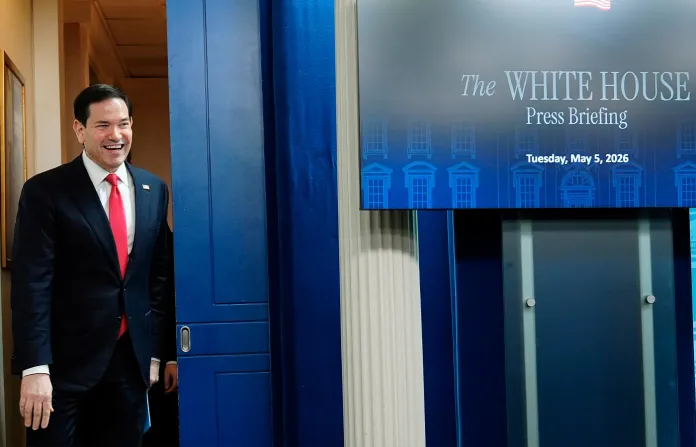
Rubio’s May 5 appearance in the White House briefing room ignited a wave of praise across conservative media and Trumpworld. Rubio, 54, made his debut as a stand-in for White House press secretary Karoline Leavitt, who was on maternity leave. Rubio made history as the first sitting secretary of state to conduct a White House press briefing.
Rubio, at the White House podium, addressed a range of national security issues, such as the Iranian blockade in the Strait of Hormuz, which he condemned as “illegal” and “unacceptable.” He also jokingly cited the “chaotic” atmosphere of the briefing room. At one point, he responded to a reporter, “You can ask me two questions, I’ll give you one answer, and I’ll pick the one I like better.”
The Miami-born Rubio, whose parents are from Cuba, also won praise in some quarters for seamlessly switching to Spanish when asked a question in that language.
Secretary of State Marco Rubio walks out to speak to reporters in the James Brady Press Briefing Room at the White House, Tuesday, May 5, 2026, in Washington. (AP Photo/Jacquelyn Martin)
Rubio’s turn at the White House podium fueled speculation that the former 2016 presidential candidate may be emerging as a serious contender for the GOP’s post-Trump future. Though Rubio, also acting national security adviser, would presumably have to get through Vice President JD Vance for the 2028 Republican nomination.
Dennis Lennox, a Republican strategist based in battleground Michigan, told the Washington Examiner that “nobody who isn’t being paid to say otherwise watched Rubio’s presser and didn’t think, ‘Can’t we make him president right now?’”
Yet even many Republicans fueling the excitement acknowledge it’s unclear whether the momentum reflects a genuine shift in the GOP’s 2028 landscape, or the political world simply getting carried away after a strong media performance.
“Sometimes it’s Rubio’s day. Sometimes it’s the vice president’s day. Sometimes they’ll be onstage together,” a former senior White House official told the Washington Examiner. “The only constant is dealing with the media trying to make a mountain out of a molehill.”
Republicans say Tuesday’s briefing crystallized something already brewing inside MAGA: a growing belief that Rubio has evolved from an establishment-minded Florida senator once mocked by Trump as “Little Marco” into a polished messenger for America First.
“I just think [2028] is Rubio’s time,” one veteran Republican operative, who worked on two of Trump’s presidential campaigns, told the Washington Examiner. “That’s not a knock against the vice president. I just think — when you compare Rubio from yesterday to where he was in 2016, debating President Trump, he’s like a totally different person. He’s gotten his hands dirty. He’s showing what MAGA can be after Trump. He’s ready.”
2028 field slowly begins to gel
The renewed attention on Rubio has also coincided with movement in prediction markets. In the hours after Rubio’s White House podium appearance, he overtook Vice President JD Vance and Gov. Gavin Newsom (D-CA) on Kalshi as the most likely winner of the 2028 presidential election. However, Polymarket still gives Vance better odds of winning, with Rubio in a close third behind Newsom.
Even college football legend Urban Meyer, a close friend and supporter of Trump, joined what one former Trump White House official jokingly described as the “Marco love-fest.” On Wednesday, Meyer posted a clip from Rubio’s briefing in which the secretary outlined his “hope for America.”
“My hope for America is what it’s always been,” Rubio said in the one-minute video. “I think it’s the hope, I hope, we all share. We want it to continue to be the place where anyone from anywhere can achieve anything, where you’re not limited by the circumstances of your birth, by the color of your skin, by your ethnicity, but frankly, it’s a place where you are able to overcome challenges and achieve your full potential.”
Rubio’s government X account posted the same exchange, with some enhanced graphic work, granting the clip a campaign ad-esque feel.
But even as Rubio dominated the conversation this week, a longtime, out-of-government adviser to Trump told the Washington Examiner that one good press briefing was unlikely to seal the 2028 GOP nomination for any candidate. Instead, the adviser said Trump would make his own decision on who to back.
“Nobody at the White House is sitting down and tracking who got better coverage on any given day, and President Trump certainly isn’t letting social media influence who he’ll eventually pick as his successor when he leaves office,” the adviser said.
“He’s been abundantly clear there — JD and Marco, Marco and JD,” they added. “You put those two on the ticket, and it’s eight more years of Republicans in the White House.”
Still, 2028 predictions at this point are wildly early. Republicans face strong political headwinds ahead of the Nov. 3 midterm elections. Trump’s approval rating is falling consistently as gas prices rise, and the Iran war remains unresolved, among other national challenges.
Moreover, in recent decades, the White House has largely fluctuated between the two parties. It’s a cycle that has accelerated in recent years, with eight years under former President Barack Obama followed by Trump’s first term. Democratic President Joe Biden served for a single, four-year term, only to be followed by the return of his predecessor, Trump.
Christian Datoc (@TocRadio) is a White House reporter for the Washington Examiner.
DefenseMagazineMagazine - Washington BriefingPremiumDonald TrumpForeign PolicyIranMiddle EastNational SecurityStrait of HormuzWarWashington D.C.
The war in Iran, which President Donald Trump thought would be a quick and easy romp given America’s vastly superior military might, has instead dragged on for weeks. Flummoxing Trump, who was sure Iran would capitulate once most of its navy, air forces, and leadership had been wiped out. In early April, the president was […]
Show full content
The war in Iran, which President Donald Trump thought would be a quick and easy romp given America’s vastly superior military might, has instead dragged on for weeks. Flummoxing Trump, who was sure Iran would capitulate once most of its navy, air forces, and leadership had been wiped out.
In early April, the president was feeling good enough to declare a two-week ceasefire based on what he said in a Truth Social post was that the U.S. had “met and exceeded all military objectives.” And made great progress on a “long-term” peace agreement.
There was one condition: Iran had to end its stranglehold on the Strait of Hormuz, gateway for 20% of the world’s oil supply.
And more than a month later, Iran’s surviving hard-line leaders are still holding fast to that hole card. Despite a U.S. naval blockade that prevents Iran from exporting its own oil.
Call it “The Great Strait Stalemate,” says Brett McGurk, a former top U.S. national security official who is now an analyst for CNN. “I’ve negotiated with the Iranians … and when they have an asset, whether it’s a hostage, something else, they will not give it up. So, it’s kind of like a hostage situation.”
Trump insists he is focused squarely on achieving a singular outcome — ensuring that Iran never acquires a nuclear weapon.
But until the strait is reopened, it appears the nuclear talks are going nowhere.
President Donald Trump, Defense Secretary Pete Hegseth and Chairman of the Joint Chiefs of Staff Gen. Dan Caine layered on the Strait of Hormuz. (Mark Schiefelbein/AP; Amirhosein Khorgooi/ISNA via AP)
Time after time, Trump has thought he was close to a deal. Only to find that instead of giving in, the Iranians were digging in.
When he received Tehran’s response to his latest proposed memorandum of understanding, delivered through Pakistani intermediaries, Trump hit the roof. Calling it “garbage and “totally unacceptable.”
“I’ve had a deal with them four or five times. They change their mind,” Trump said. “They’re very dishonorable people, the leadership … they’re mind changers.”
“Diplomacy is deadlocked,” McGurk said. “Both sides think time is on their side.”
One option for Trump would be to simply declare victory and leave the problem of the strait to others. Including European allies and China, who Trump believes need the strait open more than the United States does.
After all, Trump has insisted Iran’s nuclear program has been obliterated. And he said it will take them 20 years to rebuild.
But leaving the strait in worse shape than he found it, and walking away without an ironclad nuclear deal would be a humiliatingly small return on investment for a war that’s already cost more than $30 billion. With 14 Americans dead and more than 400 wounded.
Plus, it’s not exactly true that the U.S. doesn’t need the strait reopened. Oil is a fungible commodity, and, therefore, the supply of oil on the world market sets the price for everyone. Including the U.S., as evidenced by the recent jump in gasoline prices.
Options on the table
The U.S. could use military force to take control of the strait and escort ships through it. That’s a risky prospect as evidenced by the short-lived “Project Freedom,” in which two U.S destroyers had to shoot their way in and then out of the Persian Gulf and to liberate two U.S.-flagged commercial ships.
“This is where asymmetrics come in,” McGurk said. “The Iranians have these drones, the Shahed drones, which can fly 1,500 kilometers. So, let’s say 1,000 miles. They can be fired from anywhere in the Hormuz mountains, which is inland from Iran, and hit a tanker, slow moving tanker, which has to go through this choke point. To stop that is, it’s a needle in a haystack game.”
Retired Adm. James Stavridis, a former Supreme NATO commander, says the U.S. has the wherewithal to reopen the strait by military force. But for it to remain open in the face of Iranian threats would, in his estimation, require allies.
“If we’re going to keep it open with Iran pushing back, we really want to get Europeans involved, Stavridis told CNN. “And they have the capability. They have excellent minesweepers, they have guided missile frigates, destroyers, cruisers, and they have intelligence networks.”
In testimony before a Senate Appropriations subcommittee, War Secretary Pete Hegseth said the Pentagon has drawn up plans for what Trump has called “Project Freedom Plus,” a second try at guiding ships through the strait.
“We have a range of options, as the chairman [of the Joint Chiefs of Staff] and I have discussed extensively, mostly privately. But some in public, to ensure that transit would continue, should the president or others want us to go in that direction,” Hegseth testified.
The Pentagon has been accused, mostly by Democrats, but also by nonpartisan think tanks, of vastly overstating the effectiveness of Operation Epic Fury. While understating the extent of Iran’s remaining drone and missile arsenals.
Trump has said Iran has only 18% or 19% of its ballistic missiles left, while a classified U.S. intelligence assessment has put the percentage of missiles and launchers at 70%, according to the New York Times.
“Most alarming to some senior officials is evidence that Iran has restored operational access to 30 of the 33 missile sites it maintains along the Strait of Hormuz, which could threaten American warships and oil tankers transiting the narrow waterway,” the report said.
“Unwelcome news if it’s the truth,” Stavridis said on CNN. “The opening of the Strait of Hormuz is becoming the critical path in this, and if Iran does in fact have considerable — particularly short-range — tactical and strategic ballistic missiles, that’s a real problem.”
The Pentagon is confirming neither the New York Times report nor Trump’s public pronouncements. But either way, the numbers suggest there are still significant targets to be hit should Trump decide to resume major combat operations.
In his congressional testimony, Hegseth admonished lawmakers for being too willing to write off a military campaign that is not yet three months old.
A stalemate is not a quagmire, at least not for now.
“I don’t think enough has been stated about the blockade, and the power of the blockade, and the dilemma that our blockade creates for them,” Hegseth said, suggesting Iran may yet crack. “They can’t move anything out of Iranian ports, and over, I think it’s 65 ships at this point have been turned around or disabled. The economic pressure that creates on them greatly outstrips the pressure on us.”
Trump’s first national security adviser, retired Lt. Gen. H.R. McMaster, agrees with Hegseth that it’s a mistake to think Iran has the upper hand.
“I think what we’re up against is the intransigence of a regime that retains this permanent hostility to the Great Satan, the United States, the little Satan, Israel, and its Arab neighbors,” McMaster told CNN’s Anderson Cooper.
“There’s also been, Anderson, a big disparity between the massive damage that has been done to this regime, its military capabilities, and the portrayal of Iran having some kind of an advantage,” McMaster said. “I think Iran really is in a desperate situation.”
McMaster concluded, “I think that because of the intransigence of the regime and because President Trump won’t accept an agreement, that’s unacceptable. I think the chances are quite high that there will be a continuation of this campaign. And I think the regime is making another huge mistake, they’re driving past another off-ramp.”
Jamie McIntyre (@jamiejmcintyre) is the Washington Examiner‘ssenior writer on national security.
CongressionalMagazineMagazine - Washington BriefingPremium2026 ElectionsCaliforniaCongressCourtsRedistrictingSupreme CourtVirginia
A growing sense of dread is spreading through Democratic circles as a rapidly shifting political landscape threatens to complicate the party’s path back to House control in November. Democrats entered the year with momentum after California voters approved Proposition 50, a mid-decade redistricting overhaul that redrew congressional lines to benefit the party through the 2026, […]
Show full content
A growing sense of dread is spreading through Democratic circles as a rapidly shifting political landscape threatens to complicate the party’s path back to House control in November.
Democrats entered the year with momentum after California voters approved Proposition 50, a mid-decade redistricting overhaul that redrew congressional lines to benefit the party through the 2026, 2028, and 2030 election cycles. Under the new map, Democrats could potentially capture as many as 48 of California’s 52 House seats. The move was in response to President Donald Trump urging Texas to redraw its maps to potentially net five more Republican House seats ahead of November’s general election.
Following the California Democratic victory, led by outgoing Gov. Gavin Newsom (D-CA), Utah Democrats won a long-running legal fight over the drawing of House districts. It’s led to a new map that could give Democrats one of four House seats in the Beehive State after years of a 4-0 Republican romp.
But the early optimism Democrats felt has been tempered by a series of setbacks.
Two court rulings — one from the U.S. Supreme Court and another from Virginia’s highest court — combined with an aggressive GOP-led effort to redraw congressional maps in several red states, have handed Republicans their strongest burst of momentum in months, putting Democrats on shaky ground.
Voting rights activists gather outside the Supreme Court in Washington on Oct. 15, 2025, as the justices prepare to take up a major Republican-led challenge to the Voting Rights Act, the centerpiece legislation of the Civil Rights Movement. (Cliff Owen/AP)
“Redistricting is one of the most powerful political weapons in America, and these rulings just gave Republicans a major opening at exactly the right time politically,” political analyst Mike Fahey told the Washington Examiner.
Despite the wins, Republicans are hardly guaranteed a smooth path in the midterm elections. Trump, approaching the midway point of his second, nonconsecutive White House term, seems increasingly like a drag on House Republicans. And the opposition party to the president has picked up seats in every midterm election cycle but three over the past century.
House Republicans are defending their majority amid a difficult political environment marked by sagging presidential approval ratings, exorbitant White House spending requests for a proposed ballroom sought by Trump, rising inflation, persistently high gas prices, and an unpopular, erratic war with Iran that shows no sign of ending soon.
Republicans currently hold a razor-thin 217–214 House edge, with several vacancies. It amounts to House Democrats needing to net at least three seats in the 435-member chamber to claim their first majority in four years.
Last month, the Cook Political Report’s House ratings gave Democrats a relatively straightforward path to the majority, with 217 seats categorized as safely Democratic or leaning their way, enough that flipping a single toss-up district could have handed them control of the chamber. Democrats are now favored in only 208 seats, leaving them with the far more difficult task of capturing 10 out of 18 competitive toss-up races to win back the House.
Court throws out Virginia vote
Virginia voters in April narrowly approved an expensive Democratic-backed redistricting effort designed to potentially net the party as many as four additional congressional seats. The Democratic edge is currently a mere 6-5, and ballot measure supporters sought to make it deeply blue, to the tune of 10-1.
The measure’s approval by voters briefly shifted momentum in Democrats’ favor in the escalating national fight over congressional maps. It was a big part of Democrats’ strategy to counter Republican gains in Florida, Missouri, and North Carolina. In Ohio, where redistricting had to take place in 2026 due to a voter-approved ballot measure, Republicans are looking to pick up two seats.
So, for a moment, the redistricting battle had appeared roughly even. Yet that advantage did not last long.
Republicans filed suit against the Virginia redistricting ballot measure approved by voters. The Virginia Supreme Court on May 8 dealt Democrats a major setback, ruling 4-3 that lawmakers failed to follow the state’s constitutional amendment process properly. The decision forced Virginia to revert to its existing congressional maps for the midterm elections, erasing what Democrats had hoped would be a crucial edge.
The state’s Democratic attorney general, Jay Jones, recently filed an emergency appeal with the U.S. Supreme Court, asking the justices to overturn the ruling, arguing that the Virginia court had effectively overridden the will of voters who approved the amendment at the ballot box. It’s unlikely the high court, which has historically been reluctant to interfere with state courts’ interpretations of their own constitutions, will get involved.
Democrats do, still, have a shot at beating two of four Republicans targeted by the would-be redistricting plans, Reps. Jen Kiggans (R-VA) and Rob Wittman (R-VA). Both have long been on House Democrats’ target list.
Kiggans is likely to face a rematch in the suburban Hampton Roads 2nd Congressional District against the former Democratic congresswoman she ousted in the 2022 midterm elections, ex-Rep. Elaine Luria. Voters there in 2024 backed Trump over Democratic nominee Kamala Harris by a sliver, 49.5% to 49.3%.
To the north, several Democrats are competing in the 1st Congressional District, which includes the Western Chesapeake Bay and suburbs north and west of Richmond. Trump won more easily there, 51.8% to 46.9%. But persistent sprawl from the outer Washington, D.C. area has led many Democratic and independent voters to move there, giving Democrats hope of beating the incumbent.
Still, the late-game Republican redistricting wins — the pair of court decisions and a Florida map that could increase the Sunshine State’s House delegation from 20-8 to 24-4 — quashed Democratic boasts that they had evened the redistricting score. Roughly akin to a basketball team that falls behind in the first quarter and then, through smart play and hustle, evens it up in the second quarter, even taking the lead for a short time. But after holding the other team even in the third quarter, it falls way behind in the fourth and loses big.
Supreme Court guts key section of Voting Rights Act
The Virginia Supreme Court decision came just days after the U.S. Supreme Court signed off on weakening a key section of the Voting Rights Act that for decades had protected black representation in the South. The ruling gave Republican-controlled legislatures a new opening to redraw congressional boundaries in ways critics warned would weaken minority voting influence while expanding GOP opportunities in the House.
Several red states moved swiftly to capitalize on the court’s decision.
In Tennessee, lawmakers redrew the state’s congressional map in a way that may effectively dismantle the last Democratic-held district, shifting from an 8-1 Republican edge to a 9-0 shutout. In Louisiana, the Republican governor postponed congressional primaries after ballots had already been distributed so lawmakers could approve a revised map more favorable to the GOP. The Bayou State’s House delegation is likely to move from a 4-2 advantage to 5-1.
Alabama officials also turned to the Supreme Court, seeking permission to use a proposed map that could place another Democratic seat at risk. Justices signed off on the request, and the state’s delegation is set to increase from 5-2 to 6-1.
South Carolina Republicans, who dominate the state legislature, are considering a new redistricting plan targeting the state’s only Democratic-held congressional district in the Columbia area. The seat has long been held by Rep. Jim Clyburn (D-SC), a two-time House majority whip.
The changes could hand Republicans a sizable built-in advantage in the House, potentially allowing the party to remain competitive or maintain control, even if Democrats win the national House vote by a significant margin in November.
Conservative radio host Sam Mirejovsky crowed about the outcomes.
“Play stupid games, win stupid prizes,” Mirejovsky, a partner at Sam & Ash, told the Washington Examiner. “Democrats spent 15 years gerrymandering states they controlled and expected Republicans to play dead. They didn’t. The lesson, which applies in politics and in life, is that if you do something, expect a response. And if your side is running the shady playbook and you’re cheering it on, do not act shocked when the pendulum swings back and hits you in the face.”
Still, Republicans may not max out on redistricting for the 2026 elections. Alabama and Louisiana could have each tried to draw out all Democrats from their states’ congressional delegations. Doing so might endanger the reelection prospects of some Republican lawmakers by diluting GOP voting bases.
A few states over, Rep. Bennie Thompson (D-MS) got a reprieve from the elimination of his district, the 2nd, covering Jackson and the Mississippi River and Delta. Thompson is the only Democrat in Mississippi’s four-member House delegation, and the lone African American lawmaker. Gov. Tate Reeves (R-MS) said May 13 that any redrawing of maps for the state, which already held primaries, would have to wait until 2027.
Unrecoverable body blow?
How much these redistricting fights matter in the battle for the House will largely depend on Democratic performance in November. Even before the latest round of gerrymandering, Democrats already faced a difficult map, due to geographic sorting among voters and other factors. The massive blue wave in 2018, when Democrats flipped 40 House seats during Trump’s first term, was never considered very likely this year.
Political pundit Jamie E. Wright believes the Nov. 3 elections will reveal whether the Supreme Court and Virginia decisions were temporary setbacks or unrecoverable body blows to Democrats.
“Losing district opportunities in a state such as Virginia adds another layer of difficulty to the already-difficult road Democrats face,” she told the Washington Examiner. “Furthermore, losing those map opportunities in key battlegrounds requires Democrats to expend far more resources to defend districts that they previously considered safe.”
But Wright said that she didn’t believe the recent rulings would be “fatal” for Democrats. Wright pointed to candidate qualifications, message development, get-out-the-vote efforts, fundraising, and national sentiment, which she said played enormous roles in elections.
James Christopher, founding and managing editor of New York-based James Christopher Communications, said he agrees that politics is not purely structural, but added that the judicial branch stepping in sends a “complicated message to voters about the courts, redistricting, and democratic legitimacy itself.”
“In states like California and Virginia, contentious redistricting disputes have at least involved visible court proceedings, public scrutiny, or voter-facing mechanisms,” he told the Washington Examiner, as opposed to several Republican-led states that have been “pursuing increasingly aggressive top-down remapping efforts.”
“That distinction matters because voters increasingly view voting rights, district maps, and representation itself as active political battlegrounds rather than neutral democratic frameworks,” he said.
Christopher added that aggressive redistricting can “absolutely affect turnout, enthusiasm, and public trust.”
Historically, political anger has been one of the strongest drivers of turnout in American elections.
“At this point, Republicans likely retain the upper hand because of structural leverage, institutional control, and redistricting flexibility,” Christopher said. “But Democrats’ path remains viable, particularly if economic frustrations deepen and if these legal and map fights become symbolic of a broader public concern that democratic participation itself is increasingly under strain.”
Veteran Democratic strategist Garry South told the Washington Examiner that the midterm elections could ultimately expose unexpected risks for Republicans pursuing aggressive redistricting efforts.
South argued that redrawing congressional boundaries in Republican-led states may force dozens of GOP incumbents, once considered politically secure, to compete in unfamiliar territory before voters with little connection to them.
“We’ll have to see how it plays out, but there’s a real possibility this strategy could backfire on Republicans,” he added.
Barnini Chakraborty (@Barnini) is a senior political reporter at the Washington Examiner.
Congressional Republicans face increasing political pressure to get bipartisan housing legislation on President Donald Trump’s desk before the midterm elections, amid rising voter dismay over affordability. The bipartisan legislation in question is the 21st Century ROAD to Housing Act, which cleared the Senate in March. The proposal has been held up in the House of Representatives, with some Republicans upset about provisions added to […]
Show full content
Congressional Republicans face increasing political pressure to get bipartisan housing legislation on President Donald Trump’s desk before the midterm elections, amid rising voter dismay over affordability.
The bipartisan legislation in question is the 21st Century ROAD to Housing Act, which cleared the Senate in March. The proposal has been held up in the House of Representatives, with some Republicans upset about provisions added to the bill in the upper chamber, which, they say, could limit the nation’s housing supply.
The underlying bill is meant to ease the housing affordability crunch by lessening some government regulations on housing and incentivizing state and local governments to ease land-use regulations. The rising cost of housing has played a major role in the broader inflation that has sent consumer sentiment to record lows. Higher costs have also driven up disapproval of Trump’s handling of the economy 16 months into his second, nonconsecutive term.
And the longer the legislative logjam persists, the more it deprives the GOP of a key affordability talking point to present to voters on the campaign trail. The midterm elections are Nov. 3, and polls show Democrats in a strong position to win the House, though that climb has been made steeper by recent adverse court decisions on redistricting and new GOP congressional gerrymanders enacted in state capitals.
Even if the congressional housing legislation fails to lower prices this year, it would still be a legislative achievement Republicans could message on.
“Housing is a big issue, it polls very high, and Republicans do want to say they did something about housing — and passing this bill would give them the opportunity to jawbone the issue,” Brian Darling, a Republican strategist and former Senate aide, told the Washington Examiner.
Republican leaders in the House and Senate are being lobbied hard to address their differences and pass the legislation. For instance, both the president and Vice President JD Vance recently posted about it on social media, calling on the House to pass the Senate’s version of the bill.
But with less than six months left until the public casts its ballots and decides whether Republicans keep control of the House and the Senate, lawmakers aren’t yet able to tell their constituents that they have done anything to help with housing affordability.
“This is an issue that I think that Republicans want to get across the finish line so they can have something to campaign on,” Darling said.
House Speaker Mike Johnson (R-LA) and Majority Whip Steve Scalise (R-LA) have indicated that they are weighing changes to the Senate bill, which could lead the House to reopen debate over several controversial aspects of the legislation, especially a provision backed by Trump that would ban large institutional investors from buying single-family homes.
GOP leadership plans to move housing legislation ASAP
House Republican leadership is reportedly planning to put an amended version of the Senate’s housing bill on the floor for a vote as soon as mid- to late-May.
But it is unclear how the lower chamber would handle the ban on purchases by institutional investors. It was added to the Senate bill after Trump called for it in his 2026 State of the Union address. The bill also contains language that would require investors in build-to-rent homes to sell those houses within seven years, a requirement that would likely make many such investments uneconomical. Housing experts argue it would decrease the housing stock, and industry groups have come out hard against the proposal.
The National Association of Home Builders, long a supporter of the bipartisan legislation, threatened to withdraw support over the bill’s language.
Also, in an open letter, a group of prominent housing experts and economists told lawmakers that it would make housing investment uneconomical and amount to a soft ban. They also said it would directly lead to fewer homes being built.
And even if Republicans can coalesce around legislation that can pass and make its way to Trump’s desk, voters likely won’t feel relief directly from the bill in time for the election, Desmond Lachman, a senior fellow at the American Enterprise Institute, told the Washington Examiner.
“Firstly, a lot of the measures take a while before they have an effect,” Lachman said. “That if you change regulations, you get rid of red tape, you make it easier for zoning and all of that, it takes a while before you build the houses. So you’re not going to get short-term relief.”
Still, the affordability problem isn’t going away for Republicans, and any messaging that could help — such as the bipartisan housing legislation — is welcome.
“It’s important for the Republicans to do anything on affordability before the midterms,” Peter Loge, director of the George Washington University’s School of Media and Public Affairs, told the Washington Examiner.
Polling consistently shows that high inflation and cost-of-living concerns are top considerations for voters heading into the midterm elections.
Recently, the consumer price index showed inflation shot up 0.5 percentage points to 3.8% for the year ending in April. And, the producer price index showed that wholesale inflation exploded to a blistering 6% rate, the biggest increase since 2022.
Much of the most recent increase in inflation is attributable to the war in Iran, which has pushed energy prices higher.
Andrew Bates, a Democratic strategist and former Biden administration White House spokesman, pointed out low economic approval ratings for Republicans.
“This legislation won’t make up for how tariffs and chaos are raising housing costs, but it would be a mistake not to pass a bill that increases housing supply,” Bates told the Washington Examiner. “Unless they’d prefer to talk even more about gas prices and Trump’s ballroom.”
Zach Halaschak (@zhalaschak) is the economics reporter for the Washington Examiner.
CongressionalMagazineMagazine - Washington BriefingPremium2026 ElectionsDemocratic PartyElissa SlotkinGary PetersMichiganPoliticsPrimariesSenate
Retiring Sen. Gary Peters (D-MI) has a warning for the three Democrats fighting to replace him in Michigan’s marquee Senate race: Keep it civil. In an interview with the Washington Examiner, Peters expressed concern that the candidates will get increasingly “chippy” with one another as the primary draws closer. Holding Michigan in the Democratic column is crucial for the party to […]
Show full content
Retiring Sen. Gary Peters (D-MI) has a warning for the three Democrats fighting to replace him in Michigan’s marquee Senate race: Keep it civil.
In an interview with the Washington Examiner, Peters expressed concern that the candidates will get increasingly “chippy” with one another as the primary draws closer.
Holding Michigan in the Democratic column is crucial for the party to win a Senate majority in the Nov. 3 midterm elections. Republicans currently have a 53-47 edge, and Michigan is one of the few battlegrounds where Democrats are playing defense due to Peters’ retirement.
Ahead of the Aug. 4 primary, the race has already exposed many of the dividing lines in Democratic politics. Abdul El-Sayed, a medical school graduate who was public health director in Detroit and suburban Wayne County, is trying to steer the primary left. El-Sayed is backed by Sen. Bernie Sanders (I-VT).
Sen. Gary Peters (D-MI) (Evan Vucci/AP)
He is competing against Rep. Haley Stevens (D-MI), who is seen as the establishment pick, and state Sen. Mallory McMorrow, who is courting both progressive and traditional Democrats.
The winner will face Republican nominee-in-waiting Mike Rogers, who represented a Lansing-based district in the House from 2001 to 2015 and spent his last four years there as House Intelligence Committee chairman.
Rogers narrowly lost a 2024 open-seat race to now-Sen. Elissa Slotkin (D-MI). Even as President Donald Trump won Michigan, Rogers came up just short against Slotkin, then a House member for nearly six years. Slotkin edged him out 48.64% to 48.30%, by just 19,006 votes out of nearly 5.6 million cast.
With no clear frontrunner less than three months out from the Democratic primary, Peters is advising the party’s trio of candidates not to resort to low blows to gain momentum.
“Primaries aren’t necessarily bad,” said Peters, 67, who is set to retire from the Senate after 12 years representing Michigan. “It’s an opportunity for folks to get to be known in the state, particularly if they aren’t already known statewide.”
“Our hope is that it just doesn’t get too acrimonious. And unfortunately, a lot of primaries, especially if they’re close, get a little chippy at the end,” Peters said. “I’m encouraging everyone to try to avoid that, but it’s not easy.”
From left to right: State Sen. Mallory McMorrow, Rep. Haley Stevens (D-MI), Abdul El-Sayed. (Emily Elconin/AP; Carlos Osorio/AP; Jose Juarez/AP)
Senate Republicans are watching from the sidelines as the Democratic candidates carve each other up rhetorically, hoping that the jockeying for the nomination leaves the eventual nominee bruised going into the general election.
“The Democrats have got a mess on their hands in Michigan,” Sen. Steve Daines (R-MT), who ran Senate Republicans’ campaign arm last cycle, told the Washington Examiner.
Daines, a nearly 12-year Senate veteran who is retiring after the November elections, cited Democratic infighting in the primary in handicapping the GOP’s chances.
“I realize this environment in a midterm is always more difficult than in a presidential, but I think it bodes well for our chances to pick that seat up,” said Daines, who helped Republicans win a Senate majority in 2024 after four years in the political wilderness.
Democratic tensions boil over
Democratic tensions in the Senate race are on the rise. One of the latest flashes of bitterness came on May 6, when McMorrow chided former Democratic Sen. Debbie Stabenow for supporting Stevens, who was first elected to the House in 2018. McMorrow suggested Stabenow’s endorsement of Stevens was orchestrated by Senate Minority Leader Chuck Schumer (D-NY) because he is “feeling threatened.”
Stevens, 42, has declined to say if she supports Schumer today. But the party leader’s perceived backing of her has become part of a larger, anti-establishment critique from her opponents.
At other times, the candidates have sparred over the influence of pro-Israel lobbying groups on the Senate race and El-Sayed’s embrace of controversial Twitch streamer Hasan Piker as a campaign surrogate.
So far, none of the Democrats has been able to pull ahead in polling, despite multiple debates and a steady drip of opposition research. Both Peters and his Michigan Senate colleague, Slotkin, plan to stay neutral in the race.
Hard-earned advice from a political veteran
In pleading for the younger crop of candidates — El-Sayed is 41, and McMorrow is 39 — to measure their rhetoric, Peters brings the experience of a campaign veteran. The one-time investment adviser and Navy Reserve member spent eight years as a state senator. He lost an agonizingly close race for Michigan attorney general in 2002, falling short by 5,200 votes out of more than 3 million cast, for a 0.17% margin.
Peters spent four years as Michigan Lottery commissioner before beating a Republican incumbent in 2008. He moved up to the Senate in 2014 by winning an open-seat race in an otherwise terrible year for Democrats, with Republicans gaining control of the chamber for the first time in eight years. In 2020, he won reelection by 1.7 points over now-Rep. John James (R-MI).
As the former chairman of the Democratic Senatorial Campaign Committee, Peters is well aware of how contested primaries drain candidate resources and damage the image of the eventual nominee.
That challenge is especially problematic for Senate leadership in Michigan, where the primary is not until August, relatively late in the election cycle. The timing is one reason Republicans were so eager to clear the field for Rogers to make a second straight Senate bid.
“That’s a structural problem with Michigan,” Peters said of the primary date. “I’d love to have an earlier primary in Michigan.
He added, “It’s tough for the person who emerges to be able to do what they all have to do before the general election.”
Democrats have all the electoral advantages that come with running in a midterm year with Republicans in full control of Washington. Political history is also on the Democrats’ side, as Republicans have won only a single Senate race in Michigan since 1978, and there are new headwinds for Republicans, including the war in Iran and its impact on energy costs.
With the national political environment favoring Democrats, Peters expressed cautious optimism that they could retake the Senate this fall, a task that would require them to hold blue seats such as Michigan and flip four others in GOP territory.
“I wouldn’t have been as optimistic six months ago as I am now, looking at the dynamics,” Peters said.
“I’m fairly confident there’s going to be wind in our sails,” he added. “I still don’t know how strong that wind is. Right now, I think it’s pretty good … but we still have a lot of time.”
David Sivak (@DISivak) manages the Congress and campaigns team at the Washington Examiner, while also reporting on Capitol Hill.
MagazineMagazine - Letter From The EditorOpinion2026 ElectionsAl GoreBarack ObamaDonald TrumpHakeem JeffriesHillary ClintonLetter from the EditorRedistrictingVirginiaWashington D.C.
Remember when it was bad to describe elections as “rigged?” Such terminology was Exhibit A proving President Donald Trump’s anti-democratic tendencies. That’s all gone out the window as Democrats protest both Republican redistricting efforts ahead of the midterm elections and the recent Supreme Court Voting Rights Act decision by using the “r-word.” House Minority Leader […]
Show full content
Remember when it was bad to describe elections as “rigged?” Such terminology was Exhibit A proving President Donald Trump’s anti-democratic tendencies.
That’s all gone out the window as Democrats protest both Republican redistricting efforts ahead of the midterm elections and the recent Supreme Court Voting Rights Act decision by using the “r-word.”
House Minority Leader Hakeem Jeffries (D-NY) accused the “illegitimate Supreme Court majority” — “It’s the Trump Court,” he said — of hatching a “scheme to suppress the vote and rig the midterm elections.”
“The extremists have completely and totally failed America,” he added. “So they’ve concluded, aided and abetted by the Trump Court, that they have to cheat to win.”
“MAGA has rigged the system,” Gov. Gavin Newsom (D-CA) wrote on social media after the Virginia Supreme Court tossed the 10-1 Democratic map on the grounds that the referendum in which it was approved violated the state Constitution. Newsom, a leading candidate for the 2028 Democratic presidential nomination, protested that other, Republican-led states pursued mid-decade redistricting without a statewide vote at all, as if all state redistricting and constitutional amendment processes are identical or that any were designed by “MAGA.”
Former President Barack Obama urged Virginians to erase all but one of the Republican districts in their purplish state using similar terminology.
“Virginia, we are counting on you,” he said in an ad. “Republicans want to steal enough seats in Congress to rig the next election and wield unchecked power for two more years. But you can stop them by voting ‘yes’ on April 21.”
The New Republic warned of Trump’s “plot to rig midterms as polls turn brutal.”
One can plausibly object to mid-decade redistricting as a practice, and neither party has clean hands when it comes to partisan gerrymandering. But the steady drumbeat that the election fix is in, maintained by the same people who are themselves using whatever leverage they have to maximize their partisan advantage ahead of the voting, goes well beyond such reasonable good-government concerns.
Before Trump’s “stop the steal” machinations in 2020, a poll by the Economist and YouGov found that two-thirds of Democrats believed it was probably or definitely true that “Russia tampered with vote tallies in order to get Donald Trump elected president.” That would be quite the steal, if it weren’t for the fact that there was absolutely no evidence this actually happened.
Relatively few elected Democrats went quite this far, but many hinted at it with imprecise claims that Russia “hacked the election” in 2016. Even the more modest claims of Trump-Russia collusion weren’t substantiated by special counsel Robert Mueller’s lengthy investigation.
Unlike Trump in 2020, Al Gore and Hillary Clinton accepted their election losses. But they also undermined the legitimacy of their Republican opponents’ victories to anyone who would listen. What Trump did was a dramatic and dangerous escalation, as is his wont. But the partisan conviction that the election wasn’t totally on the up and up was not his creation, nor has this kind of talk died down among Democrats since then.
The only way Democrats are likely to heed the Rahm Emanuel types in their party and moderate ahead of the 2028 election is if they underperform in the midterm elections. But if a disappointing outcome can be even semi-plausibly blamed on gerrymandering or the Supreme Court, even that seems far-fetched. “Rigging” will further radicalize Democrats.
In 1861, President Abraham Lincoln announced he was suspending the most basic of civil rights: the right of habeas corpus, which prohibits the government from imprisoning you without charges. When a court ordered the federal government to release an unindicted U.S. citizen, Lincoln simply ignored the order. The Bill of Rights and the courts were […]
Show full content
In 1861, President Abraham Lincoln announced he was suspending the most basic of civil rights: the right of habeas corpus, which prohibits the government from imprisoning you without charges.
When a court ordered the federal government to release an unindicted U.S. citizen, Lincoln simply ignored the order. The Bill of Rights and the courts were now null and void. Such niceties could not be indulged when the very existence of the Republic was at stake.
Democrats today think they are the Republicans of 1861. They may not be fighting a literal war against secessionist slave states, but they have been delayed in their efforts to draw a mid-decade partisan gerrymander. In their mind, they are now justified in using any means necessary to gain and keep power — anything less is bowing to autocracy.
Gov. Abigail Spanberger (D-VA) won last year after saying she opposed mid-decade gerrymandering. She and her party promptly voted to replace the sensible, balanced, non-partisan congressional map with a shameless gerrymander.
Virginia Democrats pointed to similar Republican mid-decade gerrymanders to justify their act of vandalism. To this point, they could argue that turnabout is fair play, even if it means effectively disenfranchising your own people for partisan gain.
But Virginia Democrats didn’t follow the state constitution in their gerrymander. The proper procedure would have been (1) to vote in the legislature to place a constitutional amendment on the ballot, (2) to vote again after the next election, and then (3) to hold a popular vote on the ballot measure.
But the Democrats held their first vote during the 2025 election (after early voting had started), rather than before it. Nevertheless, state officials placed the proposed amendment on the ballot in April.
When Republicans sued, Democratic Attorney General Jay Jones (who is most famous for repeatedly wishing death on Republicans for the crime of being Republicans), argued that the state Supreme Court should not rule until after the public voted on the measure.
The court obeyed Jones. After the ballot measure passed, the court ruled, with a Democrat-appointed justice writing the opinion, that it was invalid.
That’s when Democrats went wild. They decided to not only assail the state Supreme Court’s ruling, but to disregard it.
Members of Congress started planning to remove the entire Virginia Supreme Court, not through impeachment but by legislating a new mandatory retirement age of 54 with no grandfather clause. Democrats could then pack the court with only partisan Democrats who would then overturn the recent decision and reinstate the Democrats’ illegal gerrymander.
Liberal blogger Matt Yglesias, presumably aware that liberals in recent years have tried to assassinate Republicans (including justices) in order to secure favorable policy, nevertheless posted on X that the justices “need to go.”
Marc Elias is the Democratic Party’s premier elections attorney. He was the top lawyer for John Kerry and Hillary Clinton, and he worked for Joe Biden and Kamala Harris. Elias proposed that Democrats simply abolish the government of Virginia.
None of these Democrats had a substantive critique of the Virginia Supreme Court. They just thought the court should have allowed the Democratic power grab because Republicans are really bad.
The Democrats in charge of Virginia are now filing a laughable appeal to the U.S. Supreme Court. The only reason to do this, when their defeat is guaranteed, is to give them grist for attacking the Supreme Court.
If you spent the last decade listening to Democrats call themselves the defenders of democracy and the Constitution, and watching the legacy media nod in agreement, you might be surprised to see their behavior these days. But there’s no inconsistency. The Democrats have been pretty clear.
President Joe Biden made it clear that “MAGA Republicans” were a threat to democracy, and that by “MAGA Republicans,” he basically meant Donald Trump voters and conservatives. Thus, “saving democracy” was never about preserving norms or democratic procedures. It was always about defeating the threats to democracy: the Republicans.
Trump is, in fact, extraordinarily corrosive of our politics and government. He’s as bad as Joe Biden and Barack Obama in arrogating power to the executive. He’s worse than any previous president in loudly demanding loyalty from the justices he appointed. And to his eternal shame, he refuses to accept his loss in the 2020 election, and in his temper tantrum, he spurred a deadly riot at the U.S. Capitol.
Democrats clearly have decided that they will respond to Trump’s power grabs and norm-breaking by grabbing power and breaking norms. They justify their attacks on the rule of law by claiming such attacks are necessary to save the rule of law.
But nobody who has been paying attention should assume this Democratic fervor will die off when Trump is gone. Every single Republican will be dubbed worse than Trump. We know this because they already said it.
Biden declared in 2012 that Republicans would reinstitute slavery. That same election, once-and-future House Speaker Nancy Pelosi declared “democracy is on the ballot,” and adopted that as the central slogan in the final weeks of the election. If Romney wins, she was clearly asserting, democracy is done.
In 2016, the liberal commentariat argued that Marco Rubio and Ted Cruz were worse than Trump. Later, they argued that former Vice President Mike Pence was worse than Trump. They’re already arguing that Vice President JD Vance is worse than Trump.
Republicans could nominate Sen. Susan Collins (R-ME) for president, and MSNow would spend three months convincing viewers she is Mussolini in heels.
Democrats speak as if they must gain power by any means necessary.
Republicans spoke this way very recently. In 2016, many conservatives, including most conservative intellectuals, were wary about voting for Trump, even in the general election, because he was so clearly unfit for the job and unconcerned with the Constitution.
Writer Michael Anton penned a famous essay urging conservatives to discard all considerations besides power, because we conservatives were in the same position as the passengers in the back of the hijacked Flight 93 on Sept. 11, 2001.
Anton was wrong in 2016. Liberals are wrong today to emulate his desperate disregard for norms and standards. This won’t end well.
The United States has more pressing matters than fixing Europe, but Americans cannot afford to leave Europeans unsupervised. Europeans resent American supervision, but they expect the U.S. to protect their interests, whether they fit with American interests or not. These are not new problems. They were there in 1919, when President Woodrow Wilson got lost […]
Show full content
The United States has more pressing matters than fixing Europe, but Americans cannot afford to leave Europeans unsupervised. Europeans resent American supervision, but they expect the U.S. to protect their interests, whether they fit with American interests or not. These are not new problems. They were there in 1919, when President Woodrow Wilson got lost in the Hall of Mirrors at Versailles. They were there in 1947, when the Truman Doctrine admitted that only the U.S. could resist Soviet expansion.
They were still there in the 1990s, when the first Bush administration directed the reunification of Germany and the Clinton administration supported the issue of the Euro currency and made NATO’s borders the European Union’s borders. And they are still here today. We say Europe is moribund, but Europeans are as ingenious and productive as ever at devising new ways to mess up their affairs and create trouble for themselves and the American babysitter.
The hot war in Ukraine and the enrichment of Western European cities by millions of undocumented and unassimilable immigrants are merely the most eye-catching aspects of Europe’s current problems. Solve them tomorrow, and the structural problems will remain and intensify. Europe has lost a generation since the crash of 2008 and the consequent Eurozone crisis that took almost a decade to ricochet through Europe’s national economies. Read David Marsh’s recent book, Can Europe Survive?, and it’s clear that Europe might not. It’s also clear that Europe’s reflexive responses could make it more of a problem for a U.S. that is deepening its commitments in the Middle East and Asia.
The overpriced Euro currency is the old Deutschmark under another name, but the German motor of the Eurozone economy has stalled. The German economy’s stagnation between 2018 and 2025 was its longest and weakest phase of low growth since 1945. The Franco-German relationship is Europe’s economic and political core, but the adoption of a common currency did not lead to systemic convergence. The French and German banking, finance, and defense sectors remain patriotically fragmented. On energy policy, France sought self-sufficiency through nuclear power, while Germany decommissioned its nuclear power stations and pressed weaker European states to buy Russian gas.
The Ukraine war exposed their divergence of political priorities. Germany returned to its historic preoccupation with Russia. France resumed its historic preoccupation with megalomaniac freelancing. The third Western European power, Britain, also reverted to its historical habit and armed Ukraine to prevent the emergence of a dominant power on the European continent. The problem wasn’t just that Britain lacked the means and money to go it alone. Even if the Europeans had managed a united policy, they lacked the weapons. The U.S. spends twice as much on defense as the EU’s entire membership. The U.S. also produces one main battle tank, while the Europeans produce a dozen. Ukraine became America’s war, as every European war since 1917 has been.
The war fulfilled Donald Rumsfeld’s prophecy about the birth of a New Europe of pro-American Eastern states. Poland’s emergence as a military force deprives Russia and Germany of their historic option, carving up central Europe over the heads of its peoples. Despite Viktor Orban’s departure from office, Hungary will remain a singular and pivotal state, wedged between Russia and Turkey. The band of states between the Baltic and the Black Sea, including a future western Ukrainian state, will need American support if they are to thrive. Apart from being more appreciative than Old Europe, the New Europe states will be more stable partners.
Old Europe’s states face social collapse due to immigration, which is a euphemism for Islam, and economic collapse due to the resulting welfare tab. These issues consume their domestic politics and foreshorten their political horizons. We are seeing the beginnings of course correction in Western Europe. Not in the retrenchments of a failed elite, which commits to increases in defense spending that it knows the current political settlement cannot support, but by public demand. In Germany, Chancellor Friedrich Merz admits that the gravy train has run out of steam. In Britain, Nigel Farage’s Reform UK triumphed in the May 7 local elections. In France, polling shows that the nationalist Jordan Bardella has a good chance of becoming president in 2027. But fixing Old Europe, if it can be fixed, will take a generation or more.
Meanwhile, it’s all too easy to see Europe seeking survival by lurching into the kind of quick but strategically reckless fixes that David Marsh recommends. An uncompetitive European currency is caught between “American monetary colonisation” and an onrush of cheap Chinese imports. The answer, Marsh writes, is to make Europe “less dependent on America,” with Britain and Switzerland helping the Eurozone’s capital market integration, and Britain adopting Germany’s pro-China trade policies to “offset political complications with Trump’s Washington.” Marsh doesn’t explore how the US might react to Europe rushing into alignment with China. As ever, Europe is not the most important issue for American policy makers, but it’s too important to be left to the Europeans.
Dominic Green is a Washington Examiner columnist and a fellow of the Royal Historical Society. Find him on X @drdominicgreen.
Karen Bass is the unpopular Democratic mayor of Los Angeles, where a recent poll found her favorability rating languishing at just 31%. She is currently fighting to keep her job for another term, battling a city council member from the far Left while being challenged from the center by former reality television star Spencer Pratt. […]
Show full content
Karen Bass is the unpopular Democratic mayor of Los Angeles, where a recent poll found her favorability rating languishing at just 31%. She is currently fighting to keep her job for another term, battling a city council member from the far Left while being challenged from the center by former reality television star Spencer Pratt. Before their debate last week, in which Pratt leveled intense criticisms of the city’s leadership and governance, Bass appeared on a progressive platform and dismissed his candidacy in a startlingly tone-deaf manner.
“Honestly, before this, I had never heard of Spencer Pratt,” Bass told MeidasTouch. “The thing I am concerned [about] and feel about him is that I feel like he’s exploiting the grief of people in the Palisades, and I just think that’s just reprehensible.” She went on to suggest Pratt was pursuing this campaign to revive his celebrity status.
Accusing Pratt of “exploiting grief” over the Palisades fires is a stunning approach, not just in light of Bass’s prominent failures in handling that disaster, but because both Pratt and his parents lost their homes as a result of the catastrophe. He is not “exploiting” someone else’s grief; this event affected his family in the most personal way imaginable.
Karen Bass speaks during a 2026 Los Angeles Mayoral debate at Skirball Cultural Center on Wednesday, May 6, 2026 in Los Angeles, CA. (Jason Armond / Los Angeles Times via Getty Images)
What is actually reprehensible, to borrow her word, is this cheap and clueless line of attack from a politician who presided over the devastation that motivated Pratt to try to unseat her. In a recent CNN interview, Bass was asked about the fires and how her challengers have accused her of “mismanaging that response on a number of levels.” After paying brief lip service to the notion that the “buck stops” with her as mayor, Bass promptly passed the buck to “climate change” and “climate events” beyond her control.
Let’s set aside the atrocious governmental response to the fires, the dry fire hydrants, the scandalously lethargic and snarled rebuilding efforts, and the fact that Bass was out of the country when the fires started raging, despite red flag warnings and in violation of a campaign pledge not to travel abroad while mayor. It is breathtaking to see the mayor retreat to the “climate change” talking point given the recent revelation that the fires were allegedly set as an act of intentional arson by a leftist who was obsessed with the accused assassin of healthcare CEO Brian Thompson.
Does she not know this information? Does she not care? Does she believe “climate change” is a magic phrase that absolves her of responsibility?
Angelenos must choose among a flailing and inept leftist incumbent, an even further-left Zohran Mamdani/Brandon Johnson/Katie Wilson-style socialist, and an outsider being branded as a “MAGA Republican” to scare a deep-blue, albeit very dissatisfied, electorate. The heavily Democratic composition of that electorate may well doom a candidacy like Pratt’s, but he hasn’t been gaining traction by some fluke or coincidence. He is speaking passionately and clearly about glaring problems plaguing the city, cranking out one viral video after another, and at least making his two leftist rivals, both professional politicians, sweat. So much so, it seems, that Bass doesn’t want to deal with the accountability and inconvenience of another candidate forum.
Spencer Pratt is shown during the 2026 Los Angeles Mayoral debate at Skirball Cultural Center on Wednesday, May 6, 2026 in Los Angeles, CA. (Jason Armond / Los Angeles Times via Getty Images)
Organizers of an upcoming event posted online on May 9 that “the League of Women Voters and the Pat Brown Institute for Public Affairs regret to announce that Mayor Karen Bass has withdrawn from the televised Los Angeles mayoral forum scheduled for May 13 on FOX 11.” The mayor had committed to participating and confirmed her appearance in late April, only to pull out after the May 6 debate less than a week before the next scheduled forum. Her “commitments” appear to mean precious little, including her aforementioned vow not to travel internationally during her mayoral tenure.
The event quickly collapsed and is now canceled altogether. The arrogance and entitlement are staggering. It seems clear as day that the citizens — and potential noncitizen voters, apparently — of Los Angeles deserve better than Karen Bass and the city’s existing leadership, but voters will have to make that determination for themselves.
One challenge is that among the many voters who crave change in their city, a substantial portion want to follow the lead of other hyperliberal cities by downgrading from a bad Democratic mayor to a worse socialist mayor. Nithya Raman, a limousine leftist, thinks the cure for LA’s myriad ills is a sharp leftward turn.
Like Mamdani, she is pretending to disavow her explicit and publicly stated “defund the police” radicalism, but that sort of COVID-era activism is a heuristic for the type of ideology she would seek to impose as mayor. As usual, people will get, and deserve, what they vote for. The city’s mayoral primary is June 2. If none of the candidates receives a bare majority of the vote, a two-person runoff will occur in November’s general election.
It’s easy to blame the politicians. Ask anyone, and they will tell you that Congress is full of cowardly, venal shysters. If that is true, what makes them that way? They are, presumably, ordinary human beings before they get elected. So what is it about asking their fellow citizens for support that turns them into […]
Show full content
It’s easy to blame the politicians. Ask anyone, and they will tell you that Congress is full of cowardly, venal shysters. If that is true, what makes them that way? They are, presumably, ordinary human beings before they get elected. So what is it about asking their fellow citizens for support that turns them into crooks?
Maybe, as the old saying goes, democracies get the leaders they deserve. Maybe the black-and-white division between The People (honest and patriotic) and The Politicians (shifty and shiftless) needs nuance. Maybe The Politicians are following the incentives laid down for them by The People. Maybe The People ask for unreasonable things, such as more benefits and lower taxes at the same time.
I don’t want to be rude about American voters. So let me instead give the example of my British compatriots. You, dear reader, can decide whether my criticisms also apply to Americans.
The first problem is that voters’ perceptions are often awry. For example, British voters believe that foreign aid accounts for around 18% of government expenditure, when the true figure is less than 1%. They think that members of Parliament’s salaries and expenses are among the five biggest government budgets, when in reality the figure is perhaps 0.001% of state spending.
They assume that businesses, especially businesses that they dislike, such as their electricity suppliers, make profits of 50% or more (real profit margins are in single digits). Incredibly, the median British adult believes that the dysfunctional National Health Service, a wholly state-funded monolith that is not allowed to levy charges, runs a profit margin of 34%.
How do candidates begin to appeal to voters whose understanding is so far removed from reality? How, when our taxes and spending are higher than in the immediate aftermath of World War II, do they engage with people who are convinced that our problems are caused by “neoliberalism”?
The only solution I can see is education. Economics is often counterintuitive, running up against our Stone Age heuristics. For a million years, wealth was more or less fixed. If I got more meat after the hunt, you got less. The idea of creating more value through voluntary exchange and specialization needs to be taught because it does not come naturally.
It can be taught, though, even to children. One economics lesson involves giving children bags of assorted candy and asking them to put a value from 1 to 10 on each item. The value is totted up. Then they are allowed to trade, and a new total is calculated. Hey presto: value has been added, not through exploitation or theft, but through voluntary exchange. Internalizing that lesson acts as an inoculation against bad economics in later life.
What goes for trade goes for other counterintuitive ideas. Understanding, for example, that imports are a benefit, not a cost. Or that jobs are not an end in themselves, but a means to the end of greater prosperity. Or that price-fixing never results in lower prices, at least not for long. Or that you can cut tax rates and, by generating economic activity, end up with more revenue.
All these things need to be explained and, as a rule, they are neither taught in schools nor communicated by the media. So someone has to do it.
In the United States, various private organizations step up, consciously remedying the deficiencies of the public education system. I have been spending a lot of time this year with The Fund for American Studies, whose mission is to explain the often difficult individualist philosophy that built the American republic.
I was so inspired by the success of TFAS that I decided to accept a job running the only British think tank that is engaged in that space, namely the Institute of Economic Affairs, which has been teaching classical liberal economics — or, as Milton Friedman liked to say, “just economics” — since 1955.
To run it, I am quitting the Conservative Party after 40 years. Those 40 years taught me that we are leaving things until too late: by the time young people arrive on campus, their cultural assumptions are fixed. If they are convinced that the economy is a racket run in the interests of big corporates, everything they read at university will be slotted into that assumption.
To answer my own earlier question, I believe many American voters do have a problem with bad economics, especially when it comes to support for tariffs and tolerance for huge deficits. Your problem, though, is less severe than Britain’s, in no small measure thanks to organizations like TFAS. We Brits badly need to copy them.