GeistHaus
log in · sign up

The Null Hypodermic

Part of blogger.com

Common Sense for Lots of Things That Don't Matter (And Some That Do)

stories
A Look Back at Alex Gordon's Mad Dash Home That Never Was
analyticsbaseballKansas City RoyalsSan Francisco Giants
Show full content

Introduction

Apparently, I like doing sports forensic analysis. I must, since I'm clearly not doing it for the money. So here's a third installment, after my look at Derek Fisher's 0.4 shot and Mookie Betts's encounter with Houston's right field fans. This makes it two for three on forensic analyses done many many years after the fact, haha.

Let's set the stage: It's October 29, 2014. The San Francisco Giants and the Kansas City Royals are locked in a tightly contested winner-take-all Game 7 of the World Series. Both starting pitchers have long since been knocked out, and the Giants are clinging to a 3–2 lead in the bottom of the ninth. Giants ace pitcher Madison Bumgarner entered the game in the bottom of the fifth inning and hasn't left. He gave up a sharply rapped single to right to Omar Infante, then subsequently mowed down twelve straight batters.

Here, in the bottom of the ninth, he strikes out Eric Hosmer for the first out and gets Billy Butler to foul out weakly to first base for the second out. Bumgarner has now retired fourteen straight batters and needs just one more to record a five-inning save and earn the Giants their third title in five seasons.

But Alex Gordon, after fouling off the first pitch, cues a tailing liner into left center that dies just in front of the hard-charging center fielder Gregor Blanco, then bounces by him toward the wall in left center. He pulls up as it appears clear that left fielder Juan Pérez is going to beat him to the ball.

Pérez boots the ball as he rushes to pick it up, though, and a tense couple of seconds pass before he succeeds and finally gets the ball back to shortstop Brandon Crawford in shallow left. By the time he does so, Gordon is pulling into third base on a single plus two-base error, having gotten the stop sign from third base coach Mike Jirschele. Crawford checks to make sure that Gordon doesn't keep running, then throws routinely to first baseman Brandon Belt near the pitcher's mound.

Salvador Pérez (hereafter "Salvy," his nickname, to avoid confusion with Juan Pérez) now comes to bat, and there follow six specimens of what writer Wade Kapszukiewicz calls "Golden Pitches": pitches whose end result could potentially win the World Series for either team. Such pitches can only occur in the bottom of the ninth or any later inning of Game 7. If Salvy hits a home run, the Royals win the World Series. If he makes an out without first driving in Gordon, the Giants win the World Series.

Bumgarner goes to a tactic that has been successful all game for him: climbing the ladder on his high fastball and daring the Royals to hit it. Salvy swings repeatedly at pitches that are nearly neck high, and on the sixth pitch of the at-bat (and the 68th pitch of Bumgarner's appearance), he finally fouls out meekly to third baseman Pablo Sandoval, Gordon is stranded at third, and the Giants win.

In the aftermath of the game, and indeed all throughout the offseason, Jirschele and Royals manager Ned Yost were repeatedly asked whether they could have or should have sent Gordon home on that second-to-last play. Both were adamant that they made the right decision to hold Gordon, but the fact that Salvy never seemed to be able to contend on an equal footing against Bumgarner in this final at-bat sustained the fervent wish that Gordon had gone home.

But should he have? The question is a tantalizing one and touches on many notions of tactics and strategy. In this post, I'll analyze the game footage and other media and create a framework for deciding whether the Royals would have been better off sending Gordon home.

Technology and Stuff

The first order of business is to establish the basic facts of the play. How long after the crack of the bat did Gordon take to reach first base, second base, third base? When did Crawford field the throw from Pérez in left field? How far was he from home plate at that time? And how long would it take him to deliver the ball to catcher Buster Posey at home, if Gordon were to run home?

The play's timing can be determined by counting frames of the MLB video of the play and its various live-speed replays. Here's the play on YouTube; this video is encoded at 30 frames per second, so by counting frames from the initial contact with the bat and dividing by 30 frames per second, we can construct a timeline of the play:

  • 0.00 s: crack of bat
  • 2.97 s: ball falls in front of Blanco
  • 4.00 s: ball bounces a second time, then rolls to fence
  • 4.73 s: Gordon touches first base
  • 6.63 s: ball reaches the fence
  • 7.80 s: Pérez boots ball along fence
  • 8.43 s: Gordon touches second base
  • 10.00 s: Gordon turns to look at the play in the outfield (approx)
  • 10.17 s: Pérez throws ball to cutoff
  • 10.67 s: Jirschele begins raising his hands (approx)
  • 11.17 s: Jirschele's hands are now up to hold Gordon (approx)
  • 11.77 s: Crawford fields ball (about 212 feet from home plate)
  • 12.17 s: Gordon stops at third base
  • 13.53 s: Crawford throws to Belt
  • 14.93 s: Belt fields ball and time is called

For some of these events, I also used, as secondary event and time sources, this MLB Statcast video, this fan video from just above the Giants' dugout, and this other fan video from the left field stands, all encoded at 30 frames per second. None of these times are accurate to any better than 1/30 of a second, therefore, though they've been rounded to the nearest hundredth to simplify the arithmetic. I estimate these times have an error of about ±0.05 seconds.

Incidentally, ESPN also analyzed the MLB video, and somehow got 8.30 seconds for Gordon to touch second. I've measured it a few times, and I don't see how they get that. The rest of our times are within my ±0.05 second error bar, including notably the time it took for Gordon to reach third base, which makes that 0.13 second discrepancy even odder. I'll use my figure of 8.43 seconds, to keep the methodology consistent.

Next, how far was Crawford as he fielded the throw and prepared to throw home if necessary? For this analysis, as a reference frame for determining event locations, I used the special groundskeeping design for the World Series games at Kauffman Field in Kansas City, which is depicted here (click to enlarge):

Gorgeous setting, by the way. This photo is from before Game 1, but I don't think the pattern changed for Game 7. As you can see, left field (and right field, but we're focusing on left field) is criss-crossed with a lattice of intersecting light and dark bands, which will serve as a grid for us to identify the locations of players and events during the play. We'll need to fix this grid on a diagram of Kauffman Field, which we create from Google Maps's satellite view (click to enlarge):

North is up. This groundskeeping pattern is not the one from the 2014 World Series, so we can't simply use the satellite image as is. Rather, by comparing the two images, we create an overlay for the World Series groundskeeping pattern. I've rotated the image counter-clockwise by 2 degrees to line the field up horizontally and vertically, then added the relevant portion of the pattern as green outlines (click to enlarge):
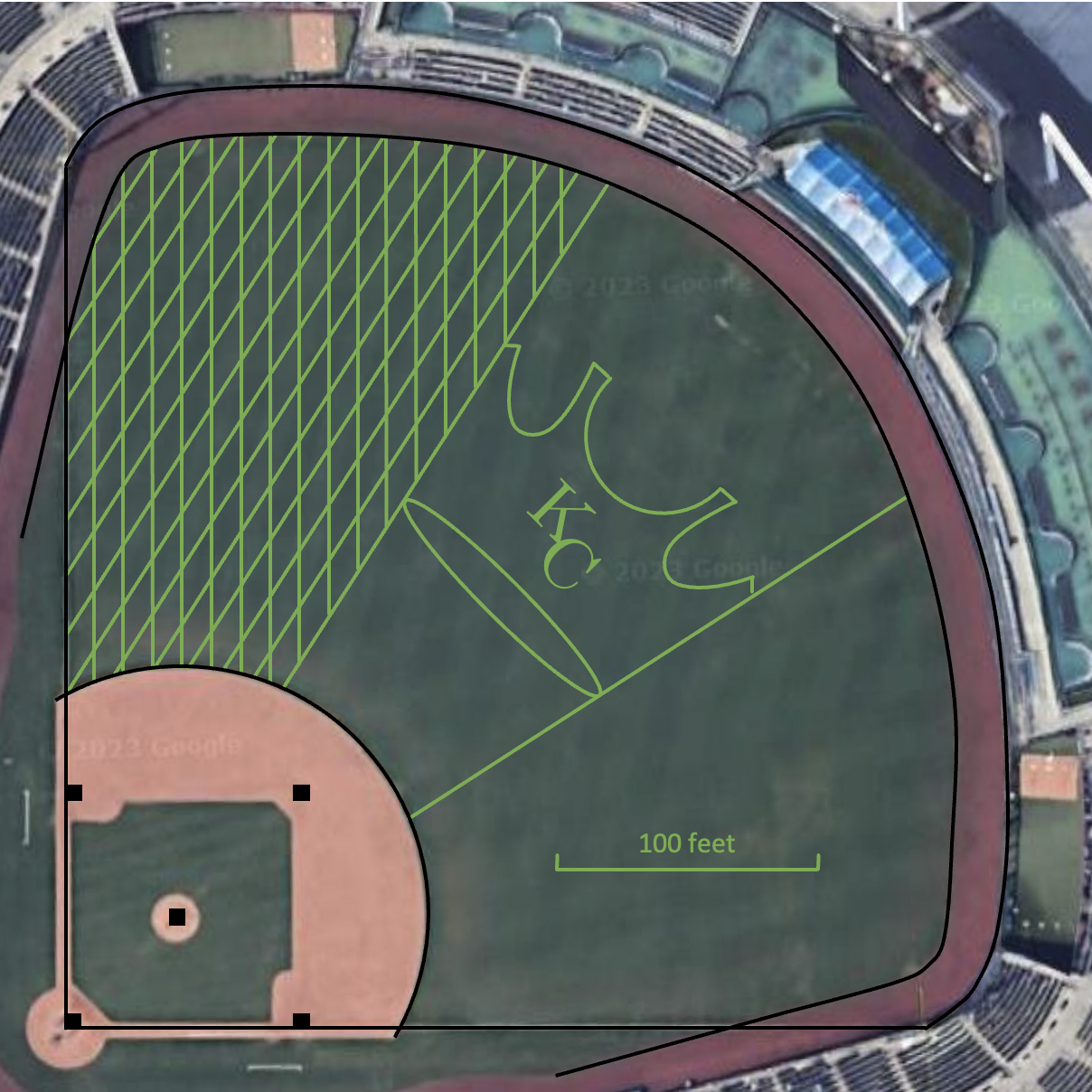
Now that we have the grid laid out, we dispense with the satellite view, go through the video, and place the various events on our overlay (click to enlarge):

These events include positions of Blanco (B1 and B2), Pérez (P1, P2, and P3), and Crawford (C1 and C2) throughout the play, as well as the path of the hit ball through the outfield (H1, H2, H3, and H4). We now remove the grid as well, and connect the main events (click to enlarge):

The throw that Crawford would have had to make is the dotted orange arrow to home. By measuring against the 100-foot scale, we see that the throw is about 212 feet. I estimate this method to have an error of maybe ±10 feet, so it's somewhere between 202 feet and 222 feet, but the rest of my analysis will assume a distance of 212 feet.

That's well outside most casual estimates. ESPN's article gauged it at 180 feet, which is 15 percent low. My first off-the-cuff estimate was 140 feet, which is on the skinned infield and ridiculously low, though it was echoed by multiple commentators; then, I guessed 180 feet, in line with ESPN's estimate. Crawford himself thought he was 30 to 40 feet out onto the outfield grass, which would put him 180 to 190 feet from home plate. The longer throw makes the potential play closer than otherwise—but is it close enough to send Gordon?

So Much Crawford

The critical factor is how long Crawford reasonably needs to turn that throw around to home plate. Fortunately, we have plays to compare this one to. The closest play I could find is from September 9, 2016, with the Arizona Diamondbacks hosting the Giants. In the bottom of the seventh inning, with the Giants leading 5–4, Chris Owings hits a fly ball to deep center that bounces off the glove of Denard Span. Socrates Brito scores easily from second base to tie the game, and Owings tries to come all the way around to score also, but he's nipped at the plate by a strong throw from Crawford. (The game went into extra innings tied at 5, and the Giants eventually won 7–6 in 12 innings, so the play turned out to be critical.) Again, we can create a timeline:

  • 0.00 s: crack of bat
  • 11.47 s: Crawford fields ball (about 235 feet from home plate)
  • 12.20 s: Crawford throws ball
  • 14.33 s: Posey fields ball
  • 14.80 s: Posey applies tag
  • 14.93 s: Owings reaches home plate (already out)

This play is almost directly behind second base and there is a convenient sequence of 25 light and dark diamonds, again created by groundskeeping. Crawford is in the middle of the ninth diamond, counting from the edge of the skinned infield, at 155 feet—the skinned infield is a partial circle with a 95-foot radius centered on the pitching rubber—to the edge of the 16-foot warning track in deep center, at 391 feet. That gives us our final figure of 235 feet (again, ±10 feet).

On this play, Crawford took 0.73 seconds to throw the relay, which traveled 235 feet in 2.13 seconds, for an average speed of about 110 feet per second, almost exactly 75 mph. Posey then needed an additional 0.47 seconds to tag Owings. When Posey fielded the ball, Owings was about 13 feet from home plate (that's the radius of the circle surrounding home plate), and he applied the tag when Owings was about 3 feet from home plate.

It's worth noting that a thrown baseball loses a lot of velocity in the air, about 15 percent per second at typical speeds. Crawford probably threw the ball at around 90 mph, and it slowed down to around 60 mph by the time it reached Posey.

There is also a play from September 7, 2013, in the top of the eighth inning of a game in San Francisco between the Giants and Diamondbacks, where Crawford relays a throw from center fielder Ángel Pagán. It's difficult to determine Crawford's distance from home plate; I estimate that he's 195 feet away. The throw covers 1.77 seconds in the air, which is consistent with an average speed of 75 mph, but because of the uncertainty in the distance, it's not my primary comparison.

Additionally, in the second inning of this Game 7, Crawford threw a relay to home plate from right fielder Hunter Pence. Again, it's hard to tell just where Crawford is, but I estimate he's 50 feet past the skinned infield, or 205 feet from home plate, and the throw took 1.90 seconds to get there, an average speed of about 74 mph. The throw was not in time to catch Billy Butler scoring the Royals' first run, but Butler was already halfway from third base to home plate when Crawford made his throw.

Later, in the fourth inning, Crawford made a snap throw to first to complete a sparkling double play started by second baseman Joe Panik, who made a catch diving to his right and glove flipped the ball directly to Crawford. That throw was made under different circumstances, but Crawford's performance was similar: As this MLB Statcast video indicates, he needed 0.77 seconds to throw the relay, which he did at 72 mph, though he was forced to throw it flat-footed.

Reconstructing the Sequence

With all this in mind, let's run through the play again, annotated this time with the sequence and commentary (click to enlarge):

  1. At 0.00 seconds, Gordon hits the ball to left center (blue dashed line). The ball is hit near the end of the bat, which causes it to tail away toward left field; see the path above. Blanco initially thinks he can catch the ball on the fly, and he charges forward. Pérez also thinks Blanco will catch the ball and starts jogging toward the infield; Posey similarly jogs to the mound, anticipating a celebration involving the notorious Posey Hug.
  2. By the time the ball hits the ground at 2.97 seconds, Blanco has realized that he can't catch up to the ball, but it's too late for him to pull up to play it on the bounce. It squirts right by him toward the fence. This counters the notion that by running hard out of the gate, Gordon would risk being caught between first and second; he would never get to first base within 2.97 seconds. Pérez has to turn around and sprint toward the ball, and Blanco pulls up as he realizes he can't get there any quicker than Pérez.
  3. At 4.00 seconds, the ball bounces a second time. Had Blanco played the ball safely, he would have caught it at about 3.90 seconds. He would have been about 210 feet from second base and would have gotten the ball back well in time to keep Gordon from advancing past first base. In reality, the ball continues bouncing toward the wall, Pérez in hot pursuit.
  4. Meanwhile, Gordon has run toward first base, but not at top speed. At 4.73 seconds, he reaches first base, having seen the ball bounce once and then twice. At this point, Gordon knows he'll get to at least second and has a good chance at third. Posey returns to the plate for a potential play, and Bumgarner retreats toward the backstop to back him up. Crawford began the play at the edge of the skinned infield, but now runs out to short left field to act as the primary relay. Panik sets up about 40 feet behind him as the secondary cutoff.
  5. At 6.63 seconds, the ball reaches the fence. Pérez gets there shortly thereafter, but at 7.80 seconds, he boots the ball about 10 feet leftward along the fence. However, even if he fields it cleanly, he is over 300 feet from third base. It would take a phenomenal throw to nail Gordon there, even with Crawford relaying. Blanco's misplay is almost solely responsible for Gordon advancing, and indeed the official scorer assigned an error only to Blanco, not Pérez.
  6. At 8.43 seconds, Gordon reaches second base. He stumbles slightly as he rounds the bag, but regains his balance. He turns his head to the outfield to try to gauge the play, but it turns out he can't see it clearly because of glare from the outfield display.
  7. At 10.17 seconds, Pérez has finally secured the ball and throws it (orange dashed line) to the cutoff man Crawford, who stands 212 feet from home plate. Panik is behind him, keeping an eye on the play in left field as well as Gordon's progress on the basepath. Meanwhile, Jirschele starts raising his hands, and at 11.17 seconds (give or take), the stop sign is up.
  8. At 11.77 seconds, Crawford fields the throw, having had to "pick" it on the short hop. Normally, the cutoff man is supposed to avoid trying to catch a throw on the short hop; he should let it go to the secondary cutoff man to avoid the ball bouncing away and letting the run score uncontested. Crawford later said, "Nothing against Panik, who was the second cutoff man on the play, but I was going to catch the ball unless I couldn't catch it [that is, literally couldn't reach it]." Panik puts his hands up to forestall an immediate throw home.
  9. At 12.17 seconds, Gordon pulls in at third base. Crawford has turned around, poised to throw home, but after seeing Panik's signal and checking that Gordon isn't going, he tosses a more routine 140-foot throw at 13.53 seconds to Belt, who catches it at 14.93 seconds. The umpires call time.

So much for what actually happened. It's time to speculate! Suppose that Crawford again takes 0.73 seconds to turn around his relay throw, which we'll suppose averages 75 mph. (At 212 feet, this throw is somewhat shorter than our comparison, but it's close enough that the difference is probably minor. If anything, however, this approximation overestimates the time elapsed by the throw.) He would then make that throw to the plate at 12.50 seconds, and it would be fielded by Posey 1.92 seconds later, at 14.42 seconds.

Would that be in time to catch Gordon? He actually got into third base at 12.17 seconds. Let's suppose he could have gotten home in another 3.50 seconds, landing him there at 15.67 seconds. He would be more than 30 feet from home plate as the ball reaches Posey's glove. That gives Posey more than a second to apply the tag; in the play on Owings, Posey needed less than half a second to apply the tag.

The What-If Scenario

But suppose that Jirschele hadn't put on the stop sign, and encouraged Gordon to run all the way home. It remains to be seen whether that would be a good idea, but suppose he did that. Let's also assume that Gordon ran flat out all the way and didn't stumble going around second. Gordon would then have reached third earlier, but how much earlier?

On a triple the previous season, on April 5, 2013, in which Gordon seems to have run hard the whole way, he slid into third base 11.90 seconds after the crack of the bat. (AZ Central ran an article on this play, and somehow measured the run at 11.03 seconds. Again, I'll stick with 11.90 seconds to keep the methodology consistent.) If he ran the same way in Game 7, his time to home plate would be longer, by about the time on one of his intermediate legs (first to second, or second to third). As far as I can tell, Gordon is rarely better than 3.60 seconds on any of these—his intermediate first-to-second leg in Game 7 was 3.70 seconds—but again, let's say it adds 3.50 seconds. That gets him to home plate at 15.40 seconds, and still gives Posey nearly a full second to apply the tag. Gordon would be about 25 feet from home plate when Posey fielded Crawford's throw.

All in all, it seems as though Posey would tag Gordon comfortably out in almost any circumstance—barring an error. So how often does Crawford uncork a wild throw? In 2014, Crawford committed 21 errors, on 634 opportunities, which included 185 putouts and 428 assists (throws that lead to a putout). It's unlikely that all 21 errors were throwing errors, and also unlikely that he only threw 428 times, but let's assume both of those are true to put an upper bound on his error rate. In that case, he would have 21 errors on 449 throws, for an error rate of 0.047, a bit under 5 percent. You'd never send a runner if you thought his chances of making it were under 5 percent.

Of course, most of those throws were from shortstop to first base, a throw that averages about 120 feet. The throw in this case was 80 percent further, certainly well within Crawford's range, but probably it increases his error rate. Let's say it doubles it, to 10 percent. Is that high enough to send Gordon?

Probably not. Statistically, for the 2010–2015 era, with a runner on third base and two outs, that runner scores about 26 percent of the time. That itself should be enough to settle the matter, but there's more. In that situation, the team scores an additional run (or more) about 7 percent of the time; otherwise, in this case, the game goes to extra innings and it's a coin flip as to who wins. Maybe the home team has an edge, but it's small. Rob Mains's study in Baseball Prospectus suggested it was about 52–48 to the home team (less than it is in regulation, interestingly).

That means that with Gordon stopping at third, the Royals have about a 17 percent chance of eventually winning the game (a win in nine innings with 7 percent probability, and a win in extras with 0.52 times 0.19, or 10 percent). If he goes home and makes it, the Royals have about a 55 percent chance of eventually winning the game (a win in nine innings with 7 percent probability, and a win in extras with 0.52 times 0.93, or 48 percent). If he goes home and is tagged out, of course, the Royals simply lose.

So in order for it to be worth it to send Gordon, he has to have a success rate of at least 17/55 or 31 percent. Incidentally, Nate Silver did only this part of the analysis, arriving at a figure of 30 percent using slightly older scoring statistics. (He then simply assumed that Gordon would score more often than that and therefore advocated sending him. Very lazy, Nate!) David Freed, writing for the Harvard Sports Analytics Collective, determined a threshold of 29.6 percent based on more specific statistics (though they use the dramatic underestimate that Crawford stands 140 feet from home plate for the rest of their analysis). So there's general agreement on that roughly 30 percent figure.

I don't see Gordon scoring with anything like that probability. Maybe the long throw increases Crawford's error rate a bit more than double, maybe that 30 percent can be edged a little downward because Salvy was hit by a pitch earlier in the game, but I just don't think those two lines cross. Crawford was no playoff newbie in 2014, and sending Gordon just to force him to make a play isn't the percentage call. I'm sympathetic to those who wanted Gordon to be sent home for the excitement value, but it should be recognized for what it is: a gut reaction call that goes against both traditional baseball judgment and post-mortem analysis.

Thursday Morning Third-Base Coaching

Afterwards, there were a lot of fans who insisted that not only should Gordon have been sent home, but that people who agreed with holding Gordon were flat out wrong. Frankly, I think that's a little crazy. It comes from thinking that because Salvy did in fact pop out, he was destined to pop out. Even having been hit by a pitch back in the second inning, Salvy had a chance of walking it off against Bumgarner. He had hit a homer back in Game 1, accounting for the Royals' only run against Bumgarner. And there's the history of Kirk Gibson hitting a home run off the great Dennis Eckersley in Game 1 of the 1988 World Series. Does anyone watching that video think that either of Gibson's legs was in better shape than Salvy's? Salvy would go on to earn the 2015 World Series MVP when the Royals came right back to win the title.

Other fans thought that Bumgarner's admittedly dominant performance argued for a more aggressive stance on sending Gordon home. But again, this smacks of after-the-fact destiny. Bumgarner had already thrown 62 pitches (before facing Salvy), after throwing 117 pitches in Game 5 just three nights earlier. It was by no means a foregone conclusion that he was unhittable. Certainly Yost thought they would get to Bumgarner.

Tim Kurkjian wrote the ESPN article that analyzed the video for timings. That same article also collected quotes and observations from many of the principals involved. To a man, they all agreed that the right call was made. Most of those interviewed thought it wasn't close. (Yost thought Gordon would have been out by 40 feet, which I think is a bit of an overestimate.) The only player who was even halfway wondering what would have happened was Gordon himself, and by his own admission, he couldn't clearly see what was going on in the play at the time, because the bright display on the left field wall cast a glare that obscured Blanco's and Perez's hijinks.

Some other observations out of that article: Jirschele claimed that he was waiting for Crawford to field the throw from Pérez cleanly before holding Gordon up. But Jirschele began holding his hands up over a second before the ball had gotten to Crawford. I suspect he felt Crawford's chances of fielding the throw cleanly were too high not to put the stop sign up before it was too late; if so, his intuition was vindicated.

Gordon recalls running hard out of the box. It didn't seem that way to most observers, including Jirschele, and in fact some fans thought he was just jogging to first until the ball dropped. The 4.73 second time to first base suggests that he was moving faster than that, but not running all out. The explanation is pretty straightforward—Gordon clearly thought that he could expect no more than a single and ran accordingly—but the charge that under the circumstances he should have been running harder than he did is a reasonable one. As we've seen, though, even his fastest run would have had a hard time beating a halfway accurate throw home.

During the following offseason, a local college baseball team reenacted the play and nailed the runner five times out of six, failing only the first attempt on an overthrow. Some fans pointed to that one failure as an additional point in favor of sending Gordon, but that first reenactment got the timing wrong; the shortstop didn't throw until the runner was nearly a full second past third base. (This video is encoded at 24 frames per second.) Seeing the runner that far ahead may have caused the shortstop to rush the throw; also, with that extra time, the catcher could plausibly have retreated to catch the ball properly and race back to tag the runner. This experiment differed too much from the original game conditions to be of much probative value, though.

Finally, five years after the game, Jirschele revisited the call, affirming that he made the right call, and capping it all with an amusing anecdote. But the plain fact of the matter is that if he had sent Gordon home, there would very likely be no debate, and instead Jirschele would be held up as the Royals' third base coach who made the call that ended his team's season.

tag:blogger.com,1999:blog-1788456751773099887.post-1993151256133379524
Extensions
Bias, Unseen But Not Unfelt
perceptionprejudiceracismsexism
Show full content

 [This post is adapted lightly from a Facebook post I just made.]

<tl;dr> The Atlanta crime doesn't need to have been racially or sexually motivated, per se, for race or sex to have been a factor. </tl;dr> So the other day, about a week and a half ago, I was accosted at the drug store where I was picking up some medications for the family. Harassed, really. Some fellow had come in line behind me, rather closer than six feet away. So (as is my wont) I moved forward a bit so I was halfway between him and the person in front of me. Something about that set him off and there followed a fairly dreary 30 to 45 seconds of him pointing in my face and accusing me of racism. He was Black, you see. I'm not in need of any kind of support over this; it didn't last long, and I'm afraid I have too high an opinion of myself to be too upset by it. Mostly, I was anxious that he was breathing at me pretty heavily from close up (12 to 18 inches?). Only now, as the usual incubation period has more or less passed without any symptoms, have I gradually relaxed—about that, anyway. (And yeah, I'm aware the chances of my contracting COVID from him were pretty low—I figure about one in a thousand, something on that order. We were both masked. But I'm the sort to obsess about it a little.) 
I've been thinking about that episode the last few days, though, in light of recent events in Atlanta. And it's not just about the fact that it happened, or that a police captain characterized the shooter as "having a bad day." These things are bad enough, but I think it's clear that they're bad. Few people are having trouble understanding that. What got to me was a side line after the captain was taken out of his spokesperson role. Officials were quoted as saying that although the shooter denied a racial motive, they weren't ruling one out. And though that's not a bad thing as far as it goes, I'm concerned that it focuses on what is really a small percentage of a very large problem. See, as I say, most people understand that racism is a bad thing, or at the very least, they understand that it's generally viewed as a bad thing. So as far as overt expressions of racism go, they know not to do it, or if they do do it, they keep it among like-minded people. But that's just the tip of the racist (or sexist, or any otherist in general) iceberg. Underneath all of that is a much larger mass of subliminal prejudicial behavior that mostly goes unnoticed. Maybe that fellow would have harassed me anyway, but I think he was just that little bit more likely to do it because I was Asian. Or maybe that shooter would have been up for shooting someone who wasn't Asian, or wasn't a woman, but I think he was that much more likely to do it because they were. And a million other things that happen every day, of lesser consequence, but are just a bit more likely to have happened to the people they did in fact happen to. And what makes them so insidious is the spectre of plausible deniability, that in any individual situation, one can defend oneself sincerely and successfully against charges of bias. Only in the large, statistically, can these biases be seen. Most of these are not racist or sexist motives per se. Most of the time, the person is not actively (consciously or otherwise) seeking out someone who fits a particular profile. But by the same token, when the situation hits them, the voice inside them that says, hey, maybe let's not escalate this—that voice is just a little bit softer when it's someone they don't sympathize with for those reasons. That voice is inside us all (mostly). But I don't believe that this voice speaks equally in response to all people of all creeds, colors, and sexes. I certainly don't believe mine does. Oh, I don't think I'm exceptionally biased or anything; I'm quite ordinary. But part of the reason I wasn't more upset about being called racist, I think, is that I deeply believe bias exists in us all, and it's not possible to eliminate it. We can reduce it, but there's a part of being human that makes kneejerk classification a bit too automatic. The only real way to address that irreducible core of bias, I feel, is to explicitly bend over backward to counteract it; it's just too easy, otherwise—too human—to believe, honestly, that one is free of bias. And maybe I gave this man a pass for that reason. Or maybe I just don't like to think of myself as being upset by it. Who knows?
tag:blogger.com,1999:blog-1788456751773099887.post-6901923874187907668
Extensions
High-Dimensional Weirdness
mathematicsrecreational mathematics
Show full content
At work, I run a mathematics colloquium that meets every other Thursday.  I don't always present—I probably present about 20 to 25 percent of the time—but I did a recent one on the behavior of high-dimensional spaces.  I then came upon an oddity that I thought was worth sharing, for those three or four of you who might like that kind of thing.

In this presentation, I made reference to some dimensional weirdnesses.  While making the point that additional dimensions make room for more stuff (as I put it), I pointed out that if you put four unit circles in the corners of a square of side 4, you have room for a central circle of radius r = 0.414.  (Approximately.  It's actually one less than the square root of 2.)

 
Correspondingly, if you put eight unit spheres in the corners of a cube of side 4, you have enough space for a central sphere of radius r = 0.732 (one less than the square root of 3), because the third dimension makes extra room for the central sphere.


If you were to put a sphere exactly in the middle of the front four spheres, or in the middle of the back four spheres, it would have a radius of r = 0.414, just as in two dimensions, but by pushing it in between those two layers of spheres, we make room for a larger sphere.

Finally (and rather more awkwardly, visually speaking), applying the same principle in four dimensions makes room for a central hypersphere of radius r = 1 (one less than the square root of 4).


The situation for general dimension d (which you've probably guessed by now) can be worked out as follows.  Consider any pair of diametrically opposed unit hyperspheres within the hypercube (drawn in orange below).  Those two hyperspheres are both tangent to the central green hypersphere, and they are also tangent to the sides of the blue hypercube.


We can figure out the distances from the center of any unit hypersphere to its corner of the hypercube, as well as to the central hypersphere.  Since we also know the distance between opposite corners of the hypercube, we can obtain the radius of the central hypersphere:


One interesting consequence is that at dimension d = 4, the central green hypersphere is now as large as any of the orange unit hyperspheres, and above dimension d = 9, the central hypersphere is actually large enough to poke out of the faces of the hypercube.  Keep that in mind for what follows.


One other oddity had to do with the absolute hypervolume, or measure, of unit hyperspheres in dimension d.  A one-dimensional "hypersphere" of radius 1 is just a line segment with length 2.  In two dimensions, a circle of radius 1 has area π = 3.14159; in three dimensions, the unit sphere has volume 4π/3 = 4.18879....  The measure of a unit hypersphere in dimension d is given by


For odd dimensions, this requires us to take a fractional factorial, which we can do by making use of the gamma function, and knowing that


With that in mind (and also knowing that n! = n (n – 1)! for all n), we can complete the following table for hyperspace measures:


That last entry may come as a bit of a surprise, but it is simply a consequence of the fact that as a number n grows without bound, πn grows at a constant pace (logarithmically speaking), while n! grows at an ever increasing rate.  As a result, the denominator of Vd totally outstrips its numerator, and its value goes to zero.


But what if we combine the two, and ask how the measure of the central green hypersphere, expressed as a proportion of the measure of the blue hypercube, evolves as the number of dimensions goes up?  On the one hand, we've seen that the measure of a unit hypersphere goes to 0 as the number of dimensions increases, but on the other hand, the central green hypersphere isn't a unit hypersphere; rather, its radius goes up roughly as the square root of the number of dimensions.  How do these two trends interact with increasing dimensionality?  In case it helps your intuition, here's a table for the ratios for small values of d.


Those of you who want to work it out for yourself may wish to stop reading here for the moment.  Steven Landsburg, who is a professor of economics at the University of Rochester but earned his Ph.D. in mathematics at the University of Chicago, told a story of attending a K-theory conference in the early 1980s, in which attendees were asked this very question.  Actually, they were specifically asked not to calculate the limiting ratio, but rather to guess what it might be, from the following choices:

  • –1
  • 0
  • 1/2
  • 1
  • 10
  • infinity

Attendees were invited to choose three of the six answers, and place a bet on whether the correct answer was among those three.  Apparently, most of the K-theorists reasoned as follows: Obviously, the measure can't be negative, so –1 can safely be eliminated.  Then, too, the central green hypersphere "obviously" fits within the blue hypercube, so its volume can't be greater than that of the hypercube, so the ratio of the two can't be greater than 1, so 10 and infinity can likewise safely be eliminated.

Well, "obviously," you know that the hypersphere can in fact go outside the hypercube, so 10 and infty can't actually be eliminated.  So what is the right answer?

At the risk of giving the game away so soon after offering it, I'll mention that the answer hinges on, of all things, whether the product of π and e is greater or less than 8.  Here's how that comes about: We know that the measure of a unit hypersphere in dimension d is given by


But that's just the unit hypersphere.  If we take into account the fact that the radius of the central green hypersphere is


then the question becomes one of the evolution of the measure Gd of the central green hypersphere:


To figure out how this behaves as d goes to infinity, we first rewrite it as


Next, we make use of Stirling's approximation to the factorial function:


Applying this to n = d/2 gives us


and when expressing it as a proportion of the measure of the hypercube of side 4, we get


Finally, we observe that we can write (by taking into account one extra higher-order term in the usual limit for 1/e)


and we see that


The right-hand side is eventually dominated by the factor involving πe/8 = 1.06746..., which drives the ratio Gd/4d to infinity as d increases without bound—but it takes a long time.  A more precise calculation shows that the fraction first exceeds 1 at dimension d = 1206.  A plot of the ratio as a function of dimension looks like this:


Notice that the ratio reaches a minimum of very nearly 0.00001 at 264 dimensions; the exact value is something like 0.00001000428.  As far as I know, that's just a coincidence.
tag:blogger.com,1999:blog-1788456751773099887.post-2556039686830798437
Extensions
Misunderstood Rules in Sports, Part One of a Trillion
basketballofficiatingout of bounds
Show full content
Because I apparently don't have enough random crap on my plate, I occasionally participate on Quora.  I'm there as Brian Tung; I'm not hard to find, other than you actually have to want to find me, and so far, that's not a very common thing.

Anyway, I often find myself embroiled in various debates (generally well-mannered, if not always good-natured) about various sports rules.  Most recently, the question was about passes or shots that go over the backboard.  For example, should this shot from 2009 by Kobe Bryant count?


Or how about this one from Jamal Murray, in 2019?


The common feeling is that these should not count, because the ball goes over the backboard, and everyone knows that a ball that goes over the backboard is out of bounds, right?

Right?

Well, it's complicated.  Complicated enough that I'm just going to drop this here for the next time this comes up.  Here's Rule 8, Sections II.a and II.b from the official NBA site:

a. The ball is out-of-bounds when it touches a player who is out-of-bounds or any other person, the floor, or any object on, above or outside of a boundary or the supports or back of the backboard.

This part of the rule is about what the ball touches, not where it goes.  There's a bit of excitement in that it uses the word "above," but in context, I think it's pretty clear that it refers to the ball touching something or someone above the boundary (the out-of-bounds line).

b. Any ball that rebounds or passes directly behind the backboard, in any direction, or enters the cylinder from below is considered out-of-bounds.

This is the relevant part.  Note that it uses the wording "directly behind the backboard."  To me, that means you take the backboard, and project it back away from the court; anytime the ball passes through that imaginary three-dimensional box, it's out of bounds.  It says nothing about the ball passing over the backboard.  If it meant that, I think it would have said that.

In both cases, the ball clearly goes over the backboard, but it never goes directly behind the backboard.  In the case of Kobe's shot, the best angle in this video (pretty poor resolution, but it was the best I could find) is found at about 0:48.  As for Murray's shot, well, read on.

I think the phrase "directly behind" is crucial.  It isn't enough that the ball go behind the plane of the backboard (which is four feet inside the baseline, so that would happen all the time).  It has to go somewhere where, if you were to look from the opposite baseline, you would see the ball through the backboard, not around it.

If you go online, you will see a majority of the web sites that discuss this question insist, quite authoritatively, that such shots are not to be counted.  As irritating as I sometimes find this, it's sort of understandable, because the wording of the rule is a bit terse, and also because the rules vary from governing body to governing body, as well as era to era.  For instance, these shots would be illegal in the NCAA:

Rule 7-1-3.  The ball shall be out of bounds when any part of the ball passes over the backboard from any direction.

This rule is stated again, almost verbatim, as Rule 9-2-2.

On the other hand, they're legal in FIBA:

Rule 23.1.2.  The ball is out-of-bounds when it touches:
  • A player or any other person who is out-of-bounds.
  • The floor or any object above, on or outside the boundary line.
  • The backboard supports, the back of the backboards or any object above the playing court.
So there's some excuse for getting this wrong (plus they eschew the Oxford comma, but that's another blog post for another time).  If that's not enough, the rule in the NBA has changed—see the postscript below.

Fortunately, we have an approved ruling, from none other than Joe Borgia, NBA Senior Vice President of Replay and Referee Operations (I'll bet you already knew that):

Joe Borgia, NBA Senior Vice President of Replay & Referee Operations, joined @NBATV to discuss three plays from Sunday's NBA Playoff action:
- Butler charge in Q1 of #TORatPHI
- Gasol offensive foul in Q4 of #TORatPHI
- Murray shot over backboard in Q1 of #DENatPOR pic.twitter.com/5Lto9JNxOr — NBA Official (@NBAOfficial) May 6, 2019
 
Jamal Murray's shot is discussed as the third case, at about 1:38 of the video.

"...When you look at this angle, our rule is the ball cannot pass directly behind the backboard.  So when you saw that replay, you saw the ball went up, and it went over, but it never went directly behind it.  Otherwise, we would have seen it through the glass; that would have been illegal.  But up and over is fine, so that is a good basket."

I think that should settle the matter fairly nicely.

---

Here's more from Borgia:

"The old rule stated it was illegal when the ball went over the backboard (either direction). So imagine the backboard extending up to the roof—if the ball bounced off the rim and hit any part of the imaginary backboard a violation was assessed. We had too many game stoppages when the ball bounced over the edge so we changed the rule to say the ball cannot go directly behind the backboard. That is why I said the backboard is now an imaginary ‘tunnel’ that goes back, not up to the roof like in the old rule."
tag:blogger.com,1999:blog-1788456751773099887.post-2498733748950417656
Extensions
Postmodernism and a Classic of Chinese Literature
Cao XueqinChineseHongloumengliteratureRed Mansionstranslation
Show full content
Bottom line up front: This is probably going to end up long, longer than it is now.  That might be true no matter when you're reading this. (Update 2022-01-26: I have indeed added more to it, mostly in the last section.)

A couple of years ago, I detailed on this blog a series of Chinese novel reading projects: 西遊記 Journey to the West by 吳承恩 Wú Chéng'ēn, 生死疲勞 Life and Death Are Wearing Me Out by 莫言 Mò Yán, 邊城 Border Town by 沈從文 Shěn Cóngwén, and 圍城 Fortress Besieged by 錢鐘書 Qián Zhōngshū.

After that, I took a bit of a break.  I had intended to continue on to 紅樓夢 A Dream of Red Mansions by 曹雪芹 Cáo Xuěqín, and had even read a couple of pages, but my father warned me against that one, suggesting instead 三體 The Three-Body Problem by 劉慈欣 Liú Cíxīn.  Well, I read a couple of pages of that too, but put it aside, probably because I read the Wikipedia plot summary and I decided I didn't like the conspiracy-theory angle.

Then sometime in the spring of 2018, I restarted Red Mansions once again, this time in (relative) earnest.  I had bought David Hawkes's English translation around the time of my first abortive attempt, and I now followed along in both languages, more or less as I had with my previous projects. It took a year and change, but I did finally finish it. And far from a chore, I enjoyed most every step of the way. (Though I did occasionally lose patience with some of the characters...)

Red Mansions (more commonly translated as The Dream of the Red Chamber, but Hawkes suggests this is misleading, and I tend to agree) is unusual—perhaps even unique—in Chinese literature for persistently and insistently asserting its own fictionality.  Other Chinese novels exhibit an array of the magical and the mystical, more so than Red Mansions, but even with that wink and nod to the reader, the novels themselves typically present the events as though they really happened, usually tying the events to a specific epoch in Chinese history (for example, such-and-such a year in so-and-so's reign).  Historicity is a big deal in Chinese fiction, ironically enough.

Not so Red Mansions.  After Cao motivates his novel with the desire to commemorate the young girls he knew as a well-to-do boy, the rest of the novel is said to be a story engraved on a consciousness-endowed, polymorphic jade stone, whose own story frames the central story, and who is brought down to earth to experience life by a Daoist priest and a Buddhist monk.  Echoes of all three (or perhaps it is they themselves) reverberate throughout the book, pushing the plot—engraved on the stone, remember!—this way and that.  Such adumbrations seem familiar to those of us looking back at the evolution of 20th-century Western literature; see James Joyce's Finnegans Wake for a notable, if rather denser, English analogue.  But for a novel written in 18th-century China (manuscripts were circulating at the time of Cao's death in 1763 or 1764, and the first printed edition arrived in 1791), it was positively revolutionary.

Perhaps because of that, perhaps because of the iconic love triangle in the central story, or perhaps it is supposed to be revered in the annals of Chinese literature, Red Mansions occupies a central position in the Chinese collective literary consciousness.  (My mother started reading it when she was younger, and never finished it.  She found it fairly ordinary, but in addition, she has a tendency to mistrust any hyperbolic criticism, positive or negative, and the mountains of praise heaped on the story, amounting almost to hysteria, turned her off to reading it.)  When I went to Taiwan earlier this year, I stopped in a bookstore, and there were no fewer than a dozen different editions of Red Mansions, along with at least as many critical studies and examinations. 

And Red Mansions is enormous.  I read a version I had found online, cobbling it together and having to fix occasional typos, and in one case, replacing three pages that had strangely gone missing.  At a normal font size, it occupied nearly 1400 pages; this is typical of printed editions too.  The English translation by Hawkes and John Minford (Hawkes's student) runs about 2500 pages, in five volumes.  (This kind of expansion is typical of translations from Chinese to English, and there's plenty of speculation as to why that is.)  This is something you have to commit to.

Speaking of the translation, Hawkes and Minford are meticulous, translating every detail of Cao's versatile prose and poetry.  As is typical, the author makes assumptions of his readership, assumptions that are still reasonable-ish for well-read modern Chinese, but which native English readers have no hope of meeting.  Hawkes and Minford usually meet the reader halfway, finding the corresponding English connotations whenever possible, and also choose the expedient of weaving historical context into the main text, resorting to footnotes and appendices only when absolutely necessary to avoid an abrupt dump of background.  Some appendices also explain some editorial choices in the translation.

Some of the word choices are oddly obscure, opting for 75-cent words (accounting for inflation) when a nickel will do without interrupting the tone.  And when I say 75-cent words, I mean words that I had never heard of in my entire life until now.  I'll try to collect a selected list of them so you know what I mean.  But by and large, the text fits what I read in the original Chinese.  There is another complete English translation, by the husband-and-wife team of 楊憲益 Yáng Xiànyì and 戴乃迭 Gladys Tayler Yang, that is also supposed to be good, and a bit more literally faithful, at the cost of being occasionally more opaque to Western readers.

The Story

At the center of the story that occupies the vast majority of Red Mansions' 120 chapters is the 賈 Jiǎ family.  Attached to the emperor by virtue of the service of past family members, long since dead, they are wealthy and extravagant.  People dress up to have tea, to move from one house to another in the compound, to go to bed.  They live a life of leisure, eating rare delicacies and drinking fine wine.  Even when they fall ill, their medicines (Chinese traditional, naturally) are the most exquisite available.  Their ginseng has to be picked at just the right time, with just the right shape to it.

The young scion of the family is 賈寶玉 Jiǎ Bǎoyù, a precocious and willful boy of about 13 at the start of the novel, who is pressured by his father to study the Confucian classics, but who mostly only has eyes for the girls of the family.  His name means "treasured jade," because he was born with a jade stone in his mouth—the magical stone from the frame story.  (An alternate title for the novel in both Chinese and English is 石頭記 Shítoujì The Story of the Stone.)  The two principal girls in the story are 薛寶釵 Xuē Bǎochāi, the only daughter of Baoyu's mother's sister, and 林黛玉 Lín Dàiyù, the only daughter of his father's sister.

Daiyu and Baochai are complementary yin and yang.  Daiyu is artistic, mercurial, and consumptive; Baochai is sensitive, compassionate, and robust.  A combination of dream sequences and wordplay implies that Baoyu's ideal woman would be a combination of the two: Both Daiyu and Baochai share one character of their given name with Baoyu.


But most of the family's younger generation is girls—a circumstance that exerts multiple forces on the main characters.  Baoyu is the only proper male member of the Jia family in his generation; he has only a half-brother Huan who is miserably jealous of Baoyu and who spends most of the novel plotting against him and otherwise acting like a dog who has been kicked to the curb rather too often.  As a result, tremendous pressure is brought to bear on Baoyu to continue the line and to sustain the emperor's favor.  As the family holdings slowly dwindle as the combined result of extravagance, bad luck, and traitorous servants, the family feels with greater urgency every ebb and flow in the affairs of Baoyu.

It is not only Baoyu who feels the effect of the gender imbalance in the household.  Daiyu comes to the family grounds when her mother dies and her father, who cannot bring her up, sends her to his in-laws.  From the beginning, she feels like an outsider with almost all of her relatives, despite their best efforts—all, that is, except Baoyu, to whom she feels an almost instant connection and affinity (and vice versa).  Otherwise, she is in constant fear of being left out on her own in the cold.

It is their romance, suppressed and sublimated by the strictures of Chinese tradition (in which marriage is a matter of parental prerogative), that forms the backbone of the novel, and which plays against the backdrop of the slowly declining Jia family fortunes.  Daiyu yearns with all of her heart to marry Baoyu, both for survival and because she loves him, but it is not up to her.  And because there are no other eligible Jia boys, any other girl—meaning Baochai, first and foremost—represents potential competition for a prize that only one of them can win.  In the end, the resolution of this emotional struggle also serves to drive the resolution both of Baoyu's psychological development and, at a larger scale, of the Jia family's fate.

The Authorship Question

It almost wouldn't be a classic Chinese novel if there weren't some question about its provenance.  Journey to the West, for instance, is merely attributed to 吳承恩 Wú Chéng'ēn; it is not actually known with certainty that he wrote it.  He is known to have written something by that name, but because there are in fact many writings of various lengths and degrees of historical accuracy by that name (it is rather generic, after all), and it was not found in his possession after his death, the attribution is only probable.

In the case of Red Mansions, there is no such question regarding Cao and the first two-thirds of the novel.  Though there are a dozen or so different manuscripts, the differences are generally minor and betoken no substantial variance on plot or characterization.  Nor is there nowadays any question that Cao is responsible for them.

The problem arises with the remaining 40 chapters.  There seem to be no fair copies that date back to Cao's day that contain anything past Chapter 80, at all.  And the plot moves along with sufficient leisure—the leisure that eventually dissuaded my mother from finishing the book—that by Chapter 80, things only then seem to begin to climb toward a climax.

Nevertheless, in 1791 (when Cao had been dead for nearly three decades), for the first printed edition, 高鶚 Gāo È, along with his friend 程偉元 Chéng Wěiyuán, cobbled together a collection of manuscript drafts that together appeared collectively to comprise the 40-chapter conclusion of the novel.  By this time, the authorship of the novel had been forgotten and would have to await future literary investigation to rediscover.

But there would be other, thornier questions to resolve almost immediately.  The general public had been clamoring for the end of Red Mansions, and Gao's completion served to satisfy their needs. The more dedicated aficionados of the book were another matter. At issue are an array of intimations and premonitions in the first part of the book, notably a series of poems in Chapter 5, which seem to impose quite clear restrictions on the eventual fate of many of the main characters (including the "big three").  These are further reinforced by a series of well-known annotations by anonymous commenters who are nevertheless clearly intimate friends or relations of Cao. But Chapters 81 through 120 in Gao's edition seem to contravene much of this material, some of it quite severely.

For example, in Chapter 5, Baoyu dreams that he sees a book that depicts, in pictorial and textual riddle form, the fates of the girls in the family.  One of them is 香菱 Xiānglíng, which Hawkes renders as Caltrop.  The picture associated with Caltrop makes it clear that she will die at the hands of the jealous stepwife of her master.  But in Gao's ending, it is the stepwife who dies, accidentally poisoned by her own hand when she tries to murder Caltrop.  What's more, it seems likely, in the light of various suggestive passages, that Cao originally had planned a much more harrowing ending for the Jia family than what was eventually presented in Gao's ending.

There are lesser inconsistencies, different manners of death from what seems preordained.  Together, they seemed to indicate to the increasing number of close students of the novel that the completion that Gao edited was not Cao's.  Either Gao edited material that was written by someone else, or (it was suggested increasingly often as decades passed) Gao wrote it himself.  This is still the orthodox position.  In recent years, statistical stylometry has even been employed to show that there is a substantial discontinuity in style between the first 80 chapters and the last 40.

On the other side of the ledger are troubling inconsistencies of the same sort, which already appear in the first 80 chapters that are universally acknowledged to be Cao's.  The root of the problem is that Cao was an inveterate reviser, who by his own admission (in the body of the novel itself, naturally) had already rewritten various parts of the entire story several times.  Over time, he must have changed the fates of many characters across the entire breadth of the book.  He was not, however, the most careful reviser, however, and scattered in the thousand-plus pages are numerous continuity errors.  Chief among these were the various poems.  They could not be rewritten nearly as easily or as transparently as prose, so in many cases, Cao merely left them the way they were (possibly intending to return to rewrite them, should the opportunity arise), preserving the older versions of characters (in Hawkes's words) "like flies in amber."

Such observations have led Hawkes, Minford, and Anthony Yu (who authored the tremendously literate translation of Journey to the West, remember) to conclude that despite the questions raised by some of the unfulfilled prophecies, the last 40 chapters in Gao's edition appear to complete Cao's general intent, if not his exact wording, and that Gao likely did just edit some collected fragments, rather than creating the completion out of whole cloth, as used to be the prevailing opinion. Of course, that editing could have been quite substantial, especially if the parts that Cheng and Gao collected were substantially incomplete in patches. But the debate continues.

Its Place in Chinese Literature

All of these needlesome questions notwithstanding, Red Mansions engrosses more of the Chinese reading public than ever.  What accounts for its endless fascination?

Some of it is surely what my mother complained about: a kind of worship cult that has grown up around it.  Because it is continually written about, readers conclude, there must be something for people to be writing about.  We always want to know what all the fuss is about.

But it seems to me that there is more to it than mere reputation.  There is an air of mystery pervading it, both in the story itself and in the story of its creation.  And despite its occasionally glacial pace and fascination with 18th-century Chinese high-class culture, it confronts questions about the meaning of life and reality more directly than any other prominent piece of Chinese literature.  To read Red Mansions is to expose oneself to contradictions of experience and truth. One can decide that they are merely a matter of perspective, but I think it is hard to argue that they are immaterial—fictional or otherwise.

Remember that Red Mansions itself states baldly that it is fiction. There are parts of it that clearly belong to the realm of magical realism: monks disappear into the mist almost in front of one's eyes, characters somehow discover truths that they should not be able to know, and even some lives are lost by some kind of sympathetic magic. Yet this mysticism runs headlong into the crushingly realistic depiction of the juxtaposition between rich and poor, and the cataclysmic fall of the Jia family.

Cao even alludes to this duality in the names of two families in the novel: the aforementioned 賈 Jiǎ family, central to the story, and another, more peripheral family named 甄 Zhēn. There is even a Baoyu in the Zhen family, who closely resembles Jia Baoyu. Nor are these two names chosen by accident, for they are exactly homophonous with the characters 假 jiǎ "false, not real" and 真 zhēn "real." But aside from this obvious piece of symbolism, what exactly does Cao tell us?

As it happens, Cao was born into the lap of luxury, but when he was about 13—the same age as Jia Baoyu at the start of the novel—the old emperor (who had grown up with Cao's grandfather and always supported the Cao family) died and the new emperor, intending to make a political example and distance himself from his predecessor, had the Cao family's holdings stripped. By all accounts, Cao's own family's decline mirrored the Jia family more closely than the Zhen family, who never make much of a deep impression on the story. Does the Jia family in the story merely represent an exaggerated version of Cao's own family?

There is a suggestion that Cao knew, or was told, that it would be impolitic for him to make the Jia family's decline too obviously an unmitigated disaster, that his family (already poor) might have more miseries visited upon it by the powers that be if he were not to soften the blow. Seen in that light, the use of the Jia name might be a way to deflect additional persecution over what could be seen as overly frank criticism of the emperor.

Even then, however, the mere presence of that kind of symbolism (for there is more of it, usually less obvious, scattered throughout the names in the novel) makes it almost irresistible to treat the novel as a roman a clef, which we could interpret as a kind of biography of Cao, if we could only discover the key. Contributing to that sensation is the fact that the earliest versions of the novel include annotations by some commenters who are clearly closely connected with Cao, and which indicate that many of the characters were closely modeled on real people. I think that certainly accounts for a large part of the novel's appeal to readers, year after year after year.

To be sure, there are plenty of episodes that Cao has clearly put in as comic relief or dramatic color. And yet even the characters that Cao puts forth here, these one-offs, are memorable in their short appearances because Cao endows them with recognizable human weaknesses and biases. They do not serve solely to further the plot—in fact, they frequently don't advance the plot at all—but in addition (or instead) remind us of people we all know, until it almost seems as though Cao knows our friends better than we do.

The bulk of the rest of it, of course, is the love triangle between the three main characters. It is not, plotwise, a very complex story, and flatly described, it would not be very compelling. But though it is occasionally sentimental and overwrought, it is nonetheless told with such richness and verisimilitude that generations of readers have found it memorable. And in this novel, it is tied together with notions of predestination and of former lives, which I think Western and even modern Chinese readers associate with some distant ineffable Eastern mysticism.

But in fact, for all its romantic filigree, that part of the story is remarkable at its heart for its utter ordinariness. The emotions, though they may be expressed in a foreign and unfamiliar way (especially for Western readers), are still clearly recognizable. Seeing themselves in the novel, readers have for centuries envisioned themselves as Lin Daiyu or Jia Baoyu, much as people in the West have envisioned themselves as Romeo or Juliet, or Puck. It is the ease with which the novel transports readers into its milieu—its seductive immersiveness—that truly makes this novel a cornerstone of Chinese culture.

tag:blogger.com,1999:blog-1788456751773099887.post-2012630979516773970
Extensions
Mookie Betts's Glove Was in the Field of Play
baseballBoston Red SoxHouston Astrosreplay
Show full content

I got the tl;dr out of the way in the title.

I've written previously about the value of multiple points of view (literal points of view in this case, but I think it's valuable for figurative points of view, too).  Last night, in Game 4 between the Boston Red Sox and the Houston Astros, was another example.

Here's the situation as it was in Houston (the location is kind of interesting, though not really important to the ruling).  It's the bottom of the first, and the Astros are already down 2–0, but they have George Springer on first after a one-out single, and Jose Altuve up to bat.  Altuve hits a deep fly to right, and Red Sox right fielder Mookie Betts reaches up and seems about to make the play, when his glove is closed shut by a fan's hand.  The ball bounces back into right field, where Betts retrieves it and fires it back into the infield.  Altuve ends up on second, and Springer (who presumably had to wait to see if Betts made the catch) stands on third.

Umpire Joe West initially calls a home run, and then appears to indicate interference (as shown here at the 8:48 mark).  The umpires collectively go to the replay, and after a delay of a few minutes, they call Altuve out, and order Springer to return to first.  After Marwin González is hit by a pitch, Yuli Gurriel flies out more conventionally to right and the Red Sox escape without further damage.

In the aftermath of the Red Sox' 8–6 victory, however, there was considerable controversy over whether the interference call was the right one.  The ruling was that because Betts's glove did not exit the field of play—that is, it did not cross the imaginary plane of the outfield fence—he was interfered with.  Had the glove been beyond the fence, then any contact with the fans would not have been considered interference.

The problem is that it's far from obvious where Betts's glove was at the moment of contact.  The Red Sox observed (as did some others) that Betts's body had yet to reach the fence, but the Astros pointed out that Betts was reaching backward for the ball.  Both sides agreed that the ball would have gone into the stands were it not for Betts, and both sides agreed that Betts had a good chance of catching the ball.  (I've seen a few fans claiming that Betts simply closed his glove early, but neither I nor any professional commentator seems to find that credible. See here at the 0:45 mark for a pretty clear video of Betts's glove being closed by a fan's hand.)

Incidentally, whether Betts would have caught the ball doesn't have any bearing on the correct call. West's call was predicated only on whether the fans interfered with Betts's fielding in the field of play. The approved ruling associated with Rule 6.01(e) reads:

If spectator interference clearly prevents a fielder from catching a fly ball, the umpire shall call the batter out.

The comment on that rule goes on to clarify:

No interference shall be allowed when a fielder reaches over a fence, railing, rope or into a stand to catch a ball. He does so at his own risk. However, should a spectator reach out on the playing field side of such fence, railing or rope, and plainly prevent the fielder from catching the ball, then the batsman should be called out for the spectator’s interference.

That's what made the correct interpretation of the replays so vital.

Nevertheless, both sides also thought the replays confirmed their conclusion, each perhaps pretending to a greater certainty than they really felt.  They're really not that conclusive either way, at first glance, and it was important, probably, that the call on the field was interference.  Here's a shot from one angle, for instance (the left-field camera, I think):


Can you tell where Betts's glove is in relation to the fence?  I can't.

Well, we don't have to tell from that shot alone.  Here's a second shot from another angle (maybe the first-base camera):


Hmm, it's not obvious from that shot either.

Once again, though, we don't have to rely on either shot in isolation; fortunately, the two images together will tell us what we need to know.  Both shots show the play a split-second after the fan had made contact with the glove, and with the ball just about to strike the outside of the glove.  The fans are still looking up because they're not trained to follow the ball into the glove, and because that baseball is moving fast, but that white blur is the ball in both photos.

How does this help us?  Well, let's take a look at where the glove is in relation to the wall.   Here are the same two shots, but with the same location marked on the outfield wall padding:


Notice where the glove is in relation to that mark in the two images.  It's to the right of that mark from the point of view of the left-field camera, but it's just about in line with the mark (or maybe a little to the left) from the point of view of the first-base camera.  It's simple triangulation: If the glove is directly above the fence, then it should be in the same position with respect to the mark from both views.  If it's in front of the fence, it should appear further to the right in the first view (from left field), and if it's beyond the fence, it should appear further to the left in the first view.

Since it's further to the right in the first view, the glove must have been in front of the fence at that moment, and the interference call is the right one.  (I was mildly surprised to discover this, by the way.  If I had to guess, I would have guessed that the glove was beyond the fence—but I would have been pretty loathe to guess.)  Without knowing more about the location of the cameras relative to the wall, we can't be sure how much in front it was, but at any rate, the contact was made in the field of play.


ETA: Here's a third, intermediate view—from the third base camera, I think—further confirming the findings:

tag:blogger.com,1999:blog-1788456751773099887.post-1763324528532653834
Extensions
Cicada Recurrence and the Allee Effect
biologyevolutionmathematics
Show full content
One of the best-known phenomena in the insect world is the unusual recurrence of various populations of cicada.  There aren't any cicadas out here on the West Coast, where I live, but they are endemic to the Northeast.  The periodical cicadas (there are non-periodical cicadas, apparently) are notorious for having life cycles that are synchronized to one of two (relatively) large primes: 13 years and 17 years.  The big question, of course, is why: Why do cicadas have life cycles that are synchronized in this fashion?

One could divide the 13-year cicadas into 13 distinct subgroups, depending on which year they emerged, and divide the 17-year cicadas into 17 subgroups along the same principle.  Physical observation of cicadas, as shown in the Wikipedia plot summary, reveals that only about half of the 13+17 = 30 subgroups actually manifest in the United States (where the cicada is native), however, with two subgroups becoming extinct within the last century or two.  Nonetheless, the periodicity is well enough established that there should be a rational explanation of this phenomenon.


 One historically proposed reason for the synchronization has been that the long recurrence time limits exposure of the species above ground to predators, and that when they are exposed, there are so many of them that predators cannot possibly decimate them (a fact well attested by the unfortunate farmers who have to deal with them), thereby ensuring the continued existence of the population.  Although this is surely part of the answer, it only explains why the period is long; it doesn't explain why the period isn't 12 or 15, for instance, rather than 13 or 17.  These latter periods would only provide additional benefit if the likely predators of the cicada likewise had a life cycle punctuated by years of inactivity, which turns out not to be so.

A more successful explanation involves hybridization.  It is hypothesized that whatever mechanism governs the return of the population after however many years is based on a biological clock that is adjusted to activate periodically, and that if a 13-year cicada were to mate with a 17-year cicada, the result would be a substantial number of cicadas with unpredictable, but likely shorter, periods.  (Too long, and the individuals would die of old age, anyway.)  Such offspring would be more vulnerable to predation, so there is an evolutionary premium placed against hybridization.  Computer simulation studies show, however, that if we assume an initial species-wide distribution of a variety of periods—some prime-numbered, some composite—the prime-numbered periods remain, but so do some of the composite periods.

This 2009 paper, by Tanaka et al., explains away the remaining composite periods by means of something called the Allee effect.  In many population dynamics analyses, it is assumed that the fewer instances of a species exist, the more likely any instance is to survive—it being presumed that there is no disadvantage owing to an excess of resources.  There may be no such disadvantage, but it is nonetheless the case that there are situations where the reverse is true, for small populations: the greater the population, the more likely any individual is to survive to reproduce, because it benefits from the increased support and robustness of the larger population, up until the point where that larger population represents more competition than cooperation.  This reverse but very natural-seeming tendency constitutes the Allee effect.

Tanaka and company simulated the cicada species under a very simple hybridization model, both with and without the Allee effect, starting with subgroups with a range of periods varying from 10 through 20 years.  They found that without the Allee effect, there was broad survival of all of the cicada subgroups, with the 16-year subgroup thriving the best.  But with the Allee effect, the result was startlingly different: Only those cicada subgroups with periods of 13, 17, or 19 years survived, depending on some of the initial parameters.

Since the actual mechanism of the periodicity is not well understood yet, this study is more suggestive than dispositive, but the results are provocative.
tag:blogger.com,1999:blog-1788456751773099887.post-252289576130727973
Extensions
Competing at the Limit
AbelardHeloiselogiclovemathematicsreligionromance
Show full content
I participate from time to time at a site called Math StackExchange, where users ask and answer questions about mathematics.  Most often, the questions relate to a student's coursework, but there are some deeper questions as well.  It's one of a family of similar StackExchange sites devoted to a wide variety of topics, only some of which are academically inclined.

One question that comes up every now and then is the definition of a limit.  It looks like this:
limx→af(x)=L⇔∀ε>0,∃δ>0,∀x,0<|x−a|<δ⇒|f(x)−L|<ε

And it reads like this:
The limit of f(x) as x approaches a equals L, if and only if for every positive ε, there exists a positive δ such that whenever x is within δ of a (except possibly exactly at a), f(x) is within ε of L.
Understandably, to many math students starting introductory analysis, this looks like so much gobbledygook.  Textbooks typically try to aid understanding by drawing a picture of a function f(x) in the vicinity of some value x = a, showing that as x gets closer to a, f(x) in turn gets closer to its limiting value L (which might not in fact be f(a) itself, if that value even exists).

But what if the sticking point for students isn't always that notion of better and better approximations (central as that is to the definition of a limit)?  What if the sticking point is the interplay between the "for every" (symbolized by the upside-down A: ∀) and the "there exists" (symbolized by the upside-down E: ∃)?  The intent of this definition, first conceived of by the French mathematician Augustin-Louis Cauchy (1789–1857) and formalized by the Bohemian mathematician/philosopher Bernard Bolzano (1781–1848), is to ensure that we can always get as close as we want to the limiting value (without necessarily hitting it), simply by being as close as we need to be to the argument x = a.

We can represent this as a sort of (almost irredeemably nerdy) game between two players, the Verifier and the Falsifier.  The Verifier is trying to prove the limit is right by showing that everything near x = a maps to an f(x) that's close to L, while the Falsifier tries to disprove the limit by challenging the Verifier to get even closer to L.  For instance, if the function f(x) = 2x+3, the Verifier might be trying to demonstrate that the limit of f(x), as x approaches 5, is 13:
Falsifier.  I don't think it's true; I think the limit is not 13.
Verifier.  Well, if that's so, then you must think there's some neighborhood of 13 that I can't force f(x) to lie in.
Falsifier.  Right.  OK, I challenge you to get within 0.1 of 13.
Verifier.  Sure.  If x is within 0.05 of 5, then f(x) will be within 0.1 of 13: f(4.95) = 2×4.95+3 = 12.9, which is within 0.1 of 13, and f(5.05) = 2×5.05+3 = 13.1, which is also within 0.1 of 13.  [There is more to it than that, such as that f(x) is monotonically increasing, but we'll leave these details out for now.]
Falsifier.  All right, but can you get within 0.01 of 13?
Verifier.  Yes.  All I have to do is force x to be within 0.005 of 5: f(4.995) = 12.99 and f(5.005) = 13.01.  In fact, I can answer any neighborhood of 13 you challenge me with, simply by halving it to obtain my vicinity of x = 5.  If you want me to be within ε of 13, then all I have to do is be within δ = ε/2 of 5.  Then f(5–ε/2) = 2×(5ε/2)+3 = 13ε, and f(5+ε/2) = 2×(5+ε/2)+3 = 13+ε.  It's foolproof.
Falsifier.  Hmm, I guess you're right.  I'll have to concede that the limit is 13.
The exchange would have gone quite differently if Verifier had claimed that the limit was 12.  Then, for instance, when Falsifier challenged Verifier to get within, say, 0.1 of 12, Verifier would have been unable to choose a vicinity of x = 5 such that f(x) is between 11.9 and 12.1 over that entire vicinity, because any value of x very close to 5—close as we like—always has f(x) very close to 13, and that clearly doesn't fall between 11.9 and 12.1.  But if Verifier can always figure out the right vicinity to force the function to fall in Falsifier's neighborhood, then they can prove the limit to be correct.

This approach to proofs has much broader applicability; in game semantics, and in a kind of logic called independence-friendly logic, many demonstrations rely on this kind of interplay between a Falsifying universal quantifier (the "for every" ∀) and an existential quantifier (the "there exists" ∃).


Now for a digression to something that will seem totally unrelated at first.

In the late 11th century, into the 12th, there lived a Breton named Pierre le Pallet who was a precocious philosopher.  He was initially trained by William of Champeaux, but quickly grew capable of duelling wits with his teacher, and ended by starting a school of his own, against the advice of William.  By all accounts, he was a self-proud man, convinced simultaneously that he was brighter than anyone else and that no one else was giving him proper credit for this.  In his defense, he was generally regarded as one of the leading philosophers of his time, his specialty being logic, a tool that he wielded in an almost competitive spirit in defense of positions that were then considered heretical.  It was during his late adolescence that he took on the name that we know him by today, Peter Abelard.

As Abelard, his fame grew considerably, and people from all around sought his counsel.  One of these was a canon in Notre Dame named Fulbert, who wanted Abelard as a tutor for his niece.  She was then in her early twenties (we think—there is significant uncertainty about her birthdate), and had demonstrated herself to be remarkably capable in classical letters.  She had mastered Latin, and Greek, and Hebrew, and had applied these to a study of Christianity, to which she was devoutly dedicated.

Her name was Heloise d'Argenteuil, and she and her relationship with Abelard were in time to become famous.  Both of them found the other attractive, and in or around 1115, they started an affair just out of the watchful eye of her uncle.  Ostensibly, Abelard was tutoring her, but this would be interrupted periodically by a bout of lovemaking.  When they were separated, they would exchange personal messages on wax slate (parchment being too expensive even for billet doux that would have to be discarded or hidden).  A message would be incised on a layer of wax mounted to a wooden back; this message could then be read and the wax melted and smoothed over to be used again and again.

The two lovers could not necessarily deliver the messages personally without incurring Fulbert's suspicion, and so would have to rely on the discretion of messengers.  But as the messages were typically written in Latin or Greek, which the messengers couldn't read, teacher and pupil could exchange their letters under the apparent guise of lessons.  Abelard and Heloise apparently exchanged over a hundred letters this way, letters we have access to only because Heloise seems to have transcribed them onto a scroll (now lost) which was found centuries later by a French monk named Johannes de Vepria.

The affair progressed as far as Heloise bearing a son by Abelard, whom she called Astrolabe, after the astronomical instrument, and about whom we know almost nothing at all.  Around this time, Fulbert caught wind of it, and managed to force them to marry, although Abelard extracted a promise from Fulbert not to publicize the marriage, so as to protect Abelard's reputation.

Fulbert, however, had had his own reputation damaged by Abelard over other matters, and so he began spreading rumors of the marriage.  Abelard had Heloise installed at an abbey for her own protection, a gesture that Fulbert misunderstood as Abelard trying to wash his hands of her.  So Fulbert hired some henchmen, and one night, they went to Abelard's sleeping quarters, and castrated him.


Abelard went into seclusion, and it is unclear that he ever saw Heloise again after this time.  However, about a decade or two later, they exchanged a sequence of seven or so longer letters, instigated when Heloise somehow got her hands on a letter that Abelard had written to a monk about his life story.  That letter included a retelling of her own story, and the two lovers were reintroduced to one another in this way.

Except that by this time, Abelard had decided to impose a sort of pious asceticism on himself that extended to any romantic feelings he might have had for his one-time wife.  Heloise, in turn, wrote him back, entreating him to concede those feelings, feelings she was sure he still retained.  In the last pair of letters, Heloise appears to have relented, and buried herself in her religious life, and Abelard seems to have praised and encouraged this.  But these letters are permeated through and through with an almost overwrought subtext.

So who convinced whom?  As if in honor of these two, whose story has become synonymous with medieval romance, the roles of the Falsifier and the Verifier are often personified by the love-denying Abelard, whose initial is a convenient mnemonic for the universal quantifier ∀, and by the love-asserting Heloise, whose name is sometimes spelled Eloise, whereby her initial is a convenient mnemonic for the existential quantifier ∃—symbols ineluctably entwined in the cherished logic of Abelard's youth.
tag:blogger.com,1999:blog-1788456751773099887.post-5247077862790546343
Extensions
Racing to the End
ChineseliteratureQian Zhongshutranslation
Show full content
The last of four Chinese novels on my reading list, 錢鐘書 Qián Zhōngshū's 圍城 Fortress Besieged, is its author's sole piece of long fiction, he having turned his hand to literary history and criticism after the cultural turmoil of China in the 1950s and beyond.  It is also at once the funniest and most tragic of the ones I read, too.

The novel's title shares its second character with another one of the novels I read—邊城 Border Town.  This generally does just mean "town," and the other character, 圍 wéi, generally means "to surround."  So why are the two titles translated so differently?  Because Qian's title is drawn from a Chinese rendering of a French proverb:
Le mariage est une forteresse assiégée, ceux qui sont dehors veulent y entrer, ceux qui sont dedans veulent en sortir.
Roughly translated, that reads, "Marriage is a fortress besieged, which those on the outside want to enter, and those on the inside want to leave."  And that should give you an idea of what the novel is about—but only a little.  Marriage is only one of the themes touched upon in Fortress Besieged, and though it is in the end the dominant one, the first three-quarters of the novel are bursting with other motifs contending for the spotlight.

方鴻漸 Fāng Hóngjiàn is a Chinese-born itinerant international student, spending time at a fair number of schools, but never dedicating himself at any of them.  The start of the novel, in pre-war 1937, finds him at last on his way back to China after his money has run out.  He can hardly return home empty-handed, but with his money mostly spent, he is somewhat at a loss for what to do, until by chance he finds an ad for a correspondence school willing to furnish the necessary credentials—if not the actual education—for a nominal fee.  As it happens, the school is no longer a going concern (even as a for-pay degree mill), the original advertiser having given up after failing to lure any suckers, but an American Irishman living in the same apartment sees an opportunity to make a fast buck.  After a comical exchange in which Fang gets the better of the Irishman in a battle of wits over whose intentions are more insincere, Fang gets his papers and boards a ship for Shanghai.

It is one of the few triumphs for Fang, who spends most of the novel on one end (usually the butt end) of Qian's jokes, whether it's to do with Fang's hunt for a stable university position (on the strength, or lack thereof, of his faked credentials), his talking up of various women on the voyage home or afterward, competitions with other Chinese travellers over whose colloquial English is stronger, or his escape to China's interior from the wartime turmoil in Shanghai.  Ultimately, his tenuous university position as lecturer is not renewed (partly on account of those credentials, partly because of Fang's naiveté), and after rushing into a faute-de-mieux sort of marriage with another lecturer, is forced to return to his hometown with his new bride.  The last chapter is a dazzling depiction of the marriage's dramatic denouement.

Qian's prose is a raucous, rollicking ride with Nabokovian twists and turns, tossing out quick throwaway gags in an offhand measure, as if to show (as Nabokov was wont to do as well) how much cleverer he is than his characters.  And yet it doesn't come off as excessive showboating; indeed, it sustains the novel through to its final conclusion, where he suddenly turns solemn, anguished, and revealing.

The sole translation, executed by Nathan Mao and Jeanne Kelly in 1979—well, that depends on how you like your translations.  This one is copiously researched and endnoted, much like Anthony Yu's translation of Journey to the West, but unlike Yu, Mao and Kelly must contend with a master modern stylist as well, and more often than not, they're simply not up to the task.  There's rarely anything actually wrong with the translation, but Qian's supple prose is alternately rendered sensitively one moment, then woodenly the next.  In my opinion, the uneven tenor of the translation doesn't allow the brilliance of the original to shine through entirely unobscured.  (It's also the only one of the four whose translation is not available in digital format, though that didn't really affect my consideration of it.)

Still, the translation, and its annotations, permit one a rather detailed understanding of the cultural background to Qian's novel, and that's a not inconsiderable benefit, especially for those readers who, like me, didn't grow up in China.  Some people find the incessant endnoting irritating, but not me.  And the translation is essentially always at least competent, giving us a tantalizing hint of the author Qian might have been, if the cultural environment in China had allowed it.
tag:blogger.com,1999:blog-1788456751773099887.post-7924144712723245471
Extensions
On the Border
Chineseliteraturetranslation
Show full content
Third on my Chinese novel reading list was 邊城 Border Town, by 沈從文 Shěn Cóngwén.  This slender volume, occupying only seventy or so pages at 16 point Chinese type on my tablet, was the shortest of the four I read, by a substantial margin, and by the time I got to it, I had advanced sufficiently in my literacy that I was able to read through this book in about two weeks.

Central to the story are an old boatman, who ferries travellers both ways across a river, where the old pagoda he lives in sits, along with his daughter and his dog.  The action, such as there is, concerns a love triangle between the girl and two brothers of a wealthier businessmen from the nearby city, but even when the foreground is occupied by the youngsters, lurking in the background, everpresent, is the old man, as constant as the river and the boat he directs from bank to bank.  Meanwhile, the old ways—represented by the time-honored fashion in which the boys make their overtures to the boatman's daughter—are fighting their battle against the intrusion of the modern world, with occasionally tragic casualties.

Shen Congwen grew up, I gather, in the sort of village he depicts in Border Town, and his reverence for the town and the people who inhabit it are palpably present in his prose.  He has been called the Chinese Faulkner, and the comparison is apt, though I also see hints of Hemingway in him.  Although in English comparative literature, the two, stylistically, are likely as not to be contrasted rather than paired, they share with Shen Congwen a common appreciation for duty, and perseverence, and quiet endurance.  At the same time, Shen Congwen draws a stark spotlight on the consequences of the quietness of that endurance, for oftentimes things, and people, are gone before we have had time to appreciate what they have gone through.

The frequently somber tone of the Chinese that Shen produces is mirrored, reasonably accurately, by Jeffrey Kinkley's translation.  Like Howard Greenblatt's translation of Mo Yan's Life and Death Are Wearing Me Out, Kinkley's translation makes do without commentary, and the very occasional passages that require some understanding of Chinese language or culture are handled through parenthetical asides that don't distract from the often hypnotic rhythm of Shen's prose.  And that prose does not rely for the most part on obscure references anyway.

Border Town is a story of responsibility, and virtue, and the results of their collisions with chance and fate.  Told in its own unobtrusive way, it worms its way into your consciousness and without realizing it, you find yourself wondering how you would act, thrust into a different world, at a different time.
tag:blogger.com,1999:blog-1788456751773099887.post-2738576137713861778
Extensions
A Turn of the Wheel
Chineseliteraturetranslation
Show full content
The second Chinese novel in my reading program was Mo Yan's 生死疲勞 Life and Death are Wearing Me Out.  This absurd tale of reincarnation and redemption is the author's own choice for the work that best represents his world outlook.  If so, his outlook is sardonic, dark, and cynical indeed, yet still leaving room for optimism for the future—if only the distant, distant future.

莫言 Mo Yan—literally, "don't speak"—is in fact the pen name of 管謨業 Guan Moye, which derives (he says) from his parents' admonition not to be quite so frank and open in public as he was apparently prone to be at home.  He is the only author of the four represented in my novel-reading project to still be alive at the present time, and he is also the only one to have won a Nobel Prize for literature—even more, the only Chinese winner of that prize, ever.  He is perhaps better known for his maiden novel, 紅高粱家族 Red Sorghum Clan (1986), in large part because it was adapted into the screenplay for the award-winning movie, the haunting Red Sorghum, and perhaps in time I will read that in the original Chinese (I do have it in my library), but for now, it was Life and Death that occupied the second slot in my reading program.

The title is drawn from a Buddhist adage: 生死疲勞,從貪慾起,少欲無為,身心自在.  Loosely translated, this reads: The weariness of life and death arises from greed; when one eschews desire and meddling, the body and mind are at ease.  The title translation—chosen by Howard Greenblatt, who has translated a number of Mo Yan's books—obviously takes a different and more irreverent angle, one that reflects the twists and turns of the main character as he? it? they? trace the evolution of Chinese politics and culture over the latter half of the 20th century.

The confusion over the proper pronoun in that last sentence stems from the structure of the novel, which is divided into five parts.  西門鬧 Ximen Nao is a benevolent landowner (or so he believes), wrongly executed by Chinese communists on the opening day of the year 1950 for the crime of owning land and exercising domination over his fellow citizens.  He feels so strongly that he has been wronged that Yama, the lord of the underworld, agrees to send him back to the world of the living to give him a chance to right the wrong—though not as a human, but as a donkey under the care and stewardship of his erstwhile hired hand, 藍臉 Lan Lian (literally, "Blue Face," a reference to the birthmark on one side of his face).  As a donkey, he earns partial redemption, but only at the cost of his life.  Still unrepentant, he compels Yama to send him back again, and again, and again, each time (rather against Ximen Nao's will) as a different animal: an ox, a pig, a dog, and then at last—but that would be telling.

Because I grew up on English literature, of course, I feel a compulsion to draw an analogy between any of the Chinese authors I have read so far and familiar English-language authors.  When I read the short stories of 魯迅 Lu Xun, for instance, I saw a strong similarity to Joyce—in particular, his collection Dubliners.  Both authors have a hankering to expose the decay and inertia at the core of the culture in which they grew up, and both do so via the unremitting disillusionment experienced by some of their characters, and the callous disaffection felt by others.  In the case of Mo Yan and Life and Death, the analogy I draw is to Kurt Vonnegut and works such as Breakfast of Champions; the often impotent outrage of characters, faced with an outrageous, illogical world, is common to both.

Mo Yan has a tendency to the caustic, which works in his favor, but also, at times, to the verbose, which doesn't.  Ximen Nao's life as a pig, in particular, seems to drag on occasionally, to little end it seems beyond the reinforcement of his position as Pig Number One, Chief Porker, the Boar D'Oeuvre.  Howard Greenblatt's capable translation actually helps a little here, because although he translates Ximen Nao's life as a donkey in nearly its entirety, about 20 percent of each of the remaining sections of the novel are left out.  Mo Yan revised his novel somewhat, after Greenblatt completed his translation a year or two after the novel's original publication date, so that may account for some of the discrepancy, but it seems unlikely that those edits represent all of the difference, especially as some of the omitted passages rely on peculiar aspects of Chinese language and history, which are very difficult to translate.  In contrast to Anthony Yu's translation of Journey to the West, which is almost half endnotes, Greenblatt avoids all endnotes and footnotes altogether, instead occasionally interpolating an interpretation as a parenthetical aside, but more generally leaving tangential observations along entirely.

In the end, Mo Yan inserts himself into the story, albeit a distorted image of himself (à la Vonnegut again, I suppose).  Mo Yan the character apologizes for having to relate the pain and sorrow experienced by the characters in the novel (and created by Mo Yan the author).  But the author himself has nothing to apologize for, minor longwindedness aside, for he has created a uniquely Chinese vision of redemption and rebirth in a few hundred pages of unforgiving prose.
tag:blogger.com,1999:blog-1788456751773099887.post-4216517746019352281
Extensions
Monkeying Around
Chineseliteraturetranslation
Show full content
As I mentioned previously, my first Chinese novel reading project was 西遊記 Journey to the West (1592).  Attributed to 吳承恩 Wú Chéng'ēn, it is considered one of the four great classic novels of Chinese vernacular literature.  Serious Chinese literature was not to be written in Vernacular Chinese, or 白話 báihuà, which literally means clear speech, but in Classical Chinese, or 文言文 wényánwén.  Classical Chinese is to Vernacular Chinese what Classical Latin (e.g., what Virgil wrote in) was to Vulgar Latin, the ancestor of all the modern Romance languages like Spanish, French, and Italian.  That is to say, if you wanted to be taken seriously, you wrote in the Classical form, which was terse and dignified; if you wanted to reach the masses, you wrote in the Vernacular form, which was what the people spoke and could read—the literate people, at any rate.

Journey to the West is so famous, as a result, that there's almost no point in critically assessing it.  No critique takes place in a vacuum; it all relies on some aesthetic basis as a foundation.  In this case, though, Journey to the West is part of that foundation, so firmly that judging it is tantamount to judging Chinese literature as a whole.  I won't even bother.

It will suffice, instead, to give a general sense of the novel.  I don't have a firm handle on its character count, but it's probably in the neighborhood of half a million characters, which puts it firmly in the "lengthy epic" category.  It spans a hundred characters, and is a highly fictionalized account of the exploits of 唐玄奘 Táng Xuánzàng, known in Buddhist lore as Tripitaka, after the Buddhist scriptures that he went from China to India to gather.  In the novel, he is accompanied by three mythical creatures, the homely and sincere 沙悟淨 Shā Wùjìng, a river-dwelling sand demon; the avaricious 豬八戒 Zhū Bājiè, a pig-human; and the star of the show, the trickster hero 孫悟空 Sūn Wùkōng, the monkey king.  Though Tripitaka is the nominal main character, he appears in the novel as so ineffectual and so cowering that he needs his three attendants just to get through each day.  (The real Tripitaka was in contrast well educated, not flighty, and was of course not accompanied by three mythical creatures.)  Sun Wukong is so much the real main character that when Arthur Waley published in 1942 what for a long time was the only substantial English language translation of Journey, he called it simply Monkey.

In fact, Waley's translation covers only about a quarter to a third of the novel.  The first section of the novel, a sort of prologue that covers the background of Sun Wukong, is translated almost in full, but the rest of the novel, which is a long sequence of adventures of mostly supernatural character, is translated only selectively.

In some sense, this is justified, because the episodes (lasting a few chapters each) are self-contained and somewhat repetitive.  Nonetheless, the novel could stand to have a complete, unabridged translation, if only because of its historic place in Chinese literature.  Thus it was that Anthony Yu, born in Hong Kong and eventually to become a professor of Chinese literature (among other things) at the University of Chicago, made it his life project to produce the definitive translation of Journey.

Make no mistake about it; this is a monumental task.  The novel is mostly prose, but contains hundreds of poems in various forms, all of which were elided by Waley (because he was not really that well grounded in Chinese literature); Yu made sure to translate all of them faithfully, which mired him in all of the usual challenges involved in translation, plus the unique obstacles imposed by the brevity of classic Chinese poetry.  The novel is so long that Yu's translation is published in four volumes, each of which is rigorously researched and copiously annotated.  He also includes a lengthy introduction in which he discusses the publication history of the novel, and the specific textual issues he contended with while translating it.

Because this was my first really substantial reading project, I read both the original Chinese novel and Yu's translation on my tablet, with the original in the Pleco app, and the translation in the Kindle app.  I would go back and forth between the two, at first alternating almost sentence by sentence, and then, as I steadily became more proficient, a few sentences at a time, and finally paragraph by paragraph (they're long paragraphs) or even passage by passage.

It took me quite a while to get going, and at first, it took me perhaps a week or two (or three) to get through a single chapter.  By the end, with growing facility at reading Chinese and an increased familiarity with the characters and the flow of the story, I was able to get through a chapter every day or two.  In all, it took me about a year and a half to read through the entire book.

Wu's prose—assuming he really is the author—is puckish, but dated, a feel that I'm sure I have only a partial sense for.  He uses turns of phrase that are evidently out of step with current usage.  Some of that was apparent even to me, but other parts I could only detect because Pleco called them out as dated, or because I asked native speakers.  Still, enough of the playful nature comes through that I could feel it, if a little hesitantly.  I would liken it to Don Quijote (which I haven't read in the original Spanish, so I'm going by a translation).  Yu captures the cavalier style of writing quite well.  From time to time, there are a few stilted turns of English phrase, which I attribute to him not being quite a fully native English speaker, but these are truly few and don't really detract from the overall feel of the translation.  Of the four novels I read, this one probably has the best translation.
tag:blogger.com,1999:blog-1788456751773099887.post-2481555421536563087
Extensions
A Novel Way to Read Chinese
Chineseeducationlanguageliterature
Show full content
For me, anyway.

This is, likely, the first in a series of posts, and ironically, one I'm writing as I come to the end, temporarily, of a reading program that has covered a couple of years.  You see, over that time, I've read four Chinese novels of varying era, genre, and style, in the original Chinese: 西遊記 Journey to the West (1592), 生死疲勞 Life and Death Are Wearing Me Out (2006), 邊城 Border Town (1934), and 圍城 Fortress Besieged (1947).  I'll be discussing those works in later posts.

This program is something that I could not realistically have considered more than a few years ago, because at the start of this reading program, my Chinese reading skills were not to the point where I could have attempted to even begin any of these novels.  To explain that, and the evolution of my literacy since then, I have to explain a little about my own background, as well as a remarkable little application called Pleco.

I call myself, among other things, a first-generation Chinese American, by which I mean that I was born in the United States, but my parents immigrated here.  (Some people call that second generation, but I think it's somewhat more common to call it first generation.)  As is common in children with my background, my parents spoke to me in Chinese, and I spoke to them in Chinese...and English.  Technically, in fact, Chinese is my first language, but it has been a long time since it was my best language, and my parents have stories of me speaking in a kind of pidgin with Chinese vocabulary but English grammar.

As is also common, my parents shuttled me off to Chinese school every Saturday morning (as a matter of fact, they and their friends started the darned thing), which was a real hardship, you had better believe, because (a) cartoons were better then (they reran all the theatrical shorts they used to show before movies in the theatres), and (b) this was before DVRs or even VCRs.  Time shifting was not even a twinkle in any commoner's eye yet.

For two hours every weekend, rather than watching Bugs Bunny, my friends and I learned to read and write Chinese and a smattering of Chinese culture as well (we also got that at home, to be sure).  I don't want to make it seem as though it was some kind of prison camp, for we enjoyed the company and I, at least, always found the idea of being bilingual in English and a totally different language such as Chinese rather interesting.

I went to this Chinese school—which is still a going concern, by the way, forty years later—from age six all the way through high school, and finished with a vocabulary of maybe 1000 to 1500 characters.  To give that some context, a child growing up in China or Taiwan has that kind of written vocabulary probably by the age of about eight or so.  Since Chinese characters have to be more or less memorized one by one, as opposed to spelled with an alphabet of tens of letters, this is no mean achievement, at age eight or eighteen.

I should add, incidentally, that this does not mean that I had the fluency of an eight-year-old.  A native eight-year-old Chinese speaker would have spoken circles around me.  Chinese characters, though perhaps the most outwardly obvious representation of the challenge of Chinese fluency, are only one aspect.  The grammar is another, and plain practice using the language is another.

Then, too, the 1000 to 1500 characters I knew were not necessarily those that a native eight-year-old would know.  There were some interesting gaps that I now attribute to the sometimes inconsistent attention of the Taiwan Ministry of Foreign Affairs (I think?) who issued the teaching materials we worked with.  It's a little as though you learned how to write "chocolate" but not "however"; both are common words, but "however" as a function word is more important than "chocolate" is as a concrete noun.  (And in fact, although I knew how to say it, I didn't learn how to write "however" until later, and partly in consequence, rarely used it in conversation.)  What's more, although Chinese looks like a long sequence of distinct characters, it is actually organized into words of mostly two or more characters, and there are some tens of thousands of those, and I knew a much smaller fraction of them.

The bluntest indication of my limited literacy was that I simply could not read a newspaper, which in Chinese as well as in English requires the vocabulary of about a twelve-year-old—about 2500 or so characters and probably ten to twenty thousand words.  It had taken me (and my teachers) about twelve years of fairly dedicated effort to get me halfway there.  On my own, it would take much longer than another twelve years to get the rest of the way there.  I considered taking Chinese language courses at college, but they met for an hour once a day at eight in the morning, and even I, who found the idea of becoming literate in Chinese more than a little intriguing, was not quite ready to make that level of commitment.

So at the end of college, I still had more or less those same 1000 to 1500 characters in my vocabulary when I went on the Taiwan Study Tour, which is known informally (and rather hoarily) as the Love Boat, for all of the extracurricular activities that go on there.  I don't really know about that, because in line with my rather generally nerdish outlook, I went there to learn Chinese and so I did.  I might have picked up a hundred or two hundred additional characters, but what really changed was my broadened awareness of Chinese literature.

The program spanned six weeks, of which most of the mornings and the early part of the afternoons were spent in language and culture classes.  In the latter part of the afternoons, and the early evenings after dinner, we were pretty much free to do what we liked.  I liked to play basketball, so I tried that once or twice, but Taiwan is in the tropics and the court was outdoors, and it was both hot and humid, so that was a no-go.  I already felt like I had to take a shower every four hours as it was.

So instead, I went out onto the street and browsed in stores, especially bookstores.  I've always loved going into bookstores and just browsing, from the time that my dad would take me to a department store and leave me in the book department while he went to do errands, back when you could do such a thing without having child services pick you up.  It was no different now, even though I couldn't read most of the books.  I just liked the look of the books—the typefaces (much more creative than for English, generally speaking), the arrangement of the text, even the cheap flimsy paper that many books used to save on cost.

It did irk me, though, that I couldn't read most of the books.  I finally found a book, however, that had pronunciation marked in for some of the text—not pinyin, which is used on the mainland, and more recently now in Taiwan as well, but zhuyin fuhao, which was the Taiwan standard at the time.  I still didn't know a lot of the characters, but it still helped that I could sound the characters out.  I didn't recognize it at the time, but this was the first time I really felt the benefit of having grown up hearing a lot of Chinese.

The book looked like it was a compendium of a few hundred mostly short poems (short helped!) with some explication after each one: a glossary and a synopsis, neither of which, notably, came with pronunciation keys.  Anyway, it looked interesting, so I bought it.  Only later, after I brought it home and showed it to my father, did I discover that it was possibly the most famous collection of Chinese poetry, 唐詩三百首 Three Hundred Tang Dynasty Poems.  (There are actually 310 in this edition, perhaps on the same principle as the baker's dozen.)  The poems are from the Tang Dynasty, from the seventh through ninth centuries.  These people were writing over a thousand years ago, and through the accident of my selection in some minor bookstore in Taiwan, I was touched by them.  I still have that same book on my bookcase right now, not ten feet to my left as I write this.

Learning to read through them, however, was still a daunting challenge.  A lot of this has to do with the process of looking up a Chinese character in the dictionary.  Looking up an English word is straightforward once you learn the alphabet; words are assembled in alphabetical order, which is sort of like numerical order for letters.

Chinese, not being an alphabetic language, has no such easy method for looking up characters.  There are dozens of ways to look up characters, some of which require you to know how to pronounce the character, which is useful if you're already literate but just want to know some fine nuance of definition, but useless for a learner like myself.  The rest are based more or less on some notion of how to break the character down into parts and looking the character up by those parts, but since characters are organized every which way, it's still not straightforward.  Someone in my position would take a couple of minutes to look up a single character.

Enter, at this point, Pleco.  At this stage, ten or so years ago, the earliest smartphone were just then making it onto the market, which was still dominated by the personal digital assistant (PDA).  These had touch screens but no phone.  It occurred to Mike Love, Pleco's founder, that that touch screen could make looking Chinese characters up a lot easier for language learners.  The one thing anyone knows who's trying to look up an unfamiliar character, is what that character looks like.  The touch screen made it possible to enter that character in directly into the device.

I downloaded the free app onto my Palm Pilot (remember those?), and bought the handwriting recognizer and a couple of the (inexpensive) dictionary packs, and for the first time, looking up a character took seconds rather than minutes.  I decided to start learning Chinese anew, and within a couple of months had added a couple of dozen more characters to my vocabulary.

But the real sea change happened when Pleco added a reader to their dictionary.  By this time, I had gotten an iPad (Pleco has used iOS as its flagship platform for several years now) and the larger screen made it more comfortable to use Pleco.  The new Pleco reader also made it possible to read online newspapers and books in Chinese, and if one encountered a new character, one simply tapped it on the screen, and Pleco popped up a definition, so that looking characters up was now essentially instantaneous.  What's more I didn't need to read something on one device or book, and look it up in another.  I was not interrupted in the process of reading beyond the minimal step of apprehending the meaning of the new character.

What followed was simply an explosion of new characters added to my vocabulary, at an average rate of dozens of characters per week, to the point that I probably now have a vocabulary of about 3000 characters, and I can (at last!) read a newspaper without needing to look something up more than pretty occasionally—not because I don't recognize a character, but because its use in a word is something I can't figure out on its own.  It's a bit like seeing the word "prevaricate" and knowing the Latin roots pre- "before" and varicari "straddle" and not being able to recognize the meaning "to lie".

At any rate, I got to the stage where I could reasonably attempt to read a novel, and the first one I tried (because it was available for free online) was the sixteenth-century Journey to the West.  Understandably, the language has a dated feel to it (sort of like reading Shakespeare has for English readers), which made it possibly not the best first choice, but it was still an instructive project.  I'll discuss this in my next post in this series.

But before I end this rather long article, I want to make one more plug for Pleco.  It's really an outstanding dictionary.  The app is still free (though the handwriting recognition costs a small fee), and I've spent probably over a hundred dollars on the dozen or so dictionaries and extra features I've added to it over the years, and I don't regret any of that.  The founder, Mike Love, is incredibly responsive and listens to all of the user feedback.  The user base is tremendously loyal and that's returned by the Pleco team.  If you're at all interested in learning Chinese, and you have a supported device, I can't recommend Pleco highly enough.
tag:blogger.com,1999:blog-1788456751773099887.post-8239751667940157558
Extensions
Rating the Droughts
baseballprobabilitystatisticsWorld Series
Show full content
Although I live in California, this actually has nothing to do with rainfall.

Earlier this month, the Chicago Cubs ended a century-long drought—that is to say, they hadn't won the World Series since 1908, a span of 108 years.  (I suppose it's really 107 years without a title, since there's a span of a year even between consecutive titles.)  In so doing, they defeated a team that has now gone 68 years without a title, the Cleveland Indians.  The combined droughts of those two teams was a large part of what made the 2016 World Series matchup so compelling (not to mention the twists and turns of Game 7, one of the all-time great baseball games in history).

Joining them in Major League Baseball's version of the Final Four were the Los Angeles Dodgers and the Toronto Blue Jays.  The Dodgers have now gone 28 years without winning the title, and the Blue Jays have gone 23 years.  Those seem like long-ish times, although obviously nothing like the waits the Cubs endured and the Indians continue to endure.

Consider, though, that there are currently 30 teams in MLB, and if they each had an equal chance of winning each year (which they obviously don't), you'd expect each one to win one out of every 30, which also means that the expected wait between titles, for any given team, is 30 years.  So, by that measure, the Dodgers and Blue Jays haven't yet waited as long as they should expect to, the Indians have waited over twice as long as they should have, and the Cubs waited about three-and-a-half times as long as they should have.


But wait!  That assumes that there have always been 30 teams in MLB, which there certainly hasn't.  The major leagues started out with just 16 teams in 1901, which is when modern baseball is reckoned to have started: eight in the National League, and eight in the American League.  There were 16 teams still when the Cubs last won in 1908, and also when the Indians last won in 1948.  In those days, teams should have won the title every 16 years, on average, not every 30.  When assessing the severity of title droughts, years in the early days of baseball should count for nearly twice as much as they do now.

We can reflect that insight by adding title expectations per year, rather than years.  Presently, for instance, each team can expect to win 1/30 of a title each year.  Of course, that's on average.  What happens in reality, of course, is that 1/30 of the teams win one title, and the other 29/30 of the teams win no title.  But the magic of mathematics is that by adding the average, you get a measure of how long you've waited for a title, compared to how long you should wait.  In the early years, you would have added 1/16 of a title, and in intermediate years, the value would also be intermediate—more than 1/30, but less than 1/16.

To make things a bit more manageable, let's narrow our focus to those teams that haven't won in the last 50 years (and to give a basis for comparison, we'll depict the situation as it was this fall, before the Cubs won):

Chicago Cubs: No titles in 1909–
Cleveland Indians: No titles in 1949–
Texas Rangers: No titles in 1961–
Houston Astros: No titles in 1962–

Now, let's take a look at the expansion history of baseball, setting aside situations where teams just moved from one town to another:

1901–1960: 16 teams
1961: 18 teams (American League added two teams)
1962–1968: 20 teams (National League added two teams)
1969–1976: 24 teams (Both leagues added two teams)
1977–1992: 26 teams (American League added two teams)
1993–1997: 28 teams (National League added two teams)
1998–2012: 30 teams (Both leagues added one team, but the Milwaukee Brewers moved from AL to NL)
2013–present: No change in total team count, but the Astros moved from NL to AL

Thus, the Astros have played seven years with title expectations of 1/20, eight years with title expectations of 1/24, 16 years with title expectations of 1/26, five years with title expectations of 1/28, and 18 years (remember, we're looking at the situation before the Cubs won) with title expectations of 1/30.  Add those all up and you get about 2.08; the Astros have waited more than twice as long as they should have.  We might call this the waiting factor.

The Rangers are almost in the same boat, but they played a single extra year with a title expectation of 1/18, so their waiting factor is just a little bit higher, at about 2.13.  The Indians have played 12 more years without a title than the Rangers, all with a title expectation of 1/16, so their waiting factor is 2.88.

And the Cubs, those grand old lovable losers, had, as of this October, played an extra 40 years, all with title expectations of 1/16, so their waiting factor was a whopping 5.38.  They had waited, effectively, nearly twice as long as the Indians have, and compared to the average team, over five times as long as they should have.  To put it another way, if you had substituted a merely average team for the Chicago Cubs back in 1908, those alternate-universe Chicagoans would have won an extra five or so World Series.  By comparison, the Yankees won all 27 of their World Series during that time.

Holy cow indeed!

Actually, it's just a little more complicated than that, even, since (as you can tell from the brief expansion history above) the two leagues have on occasion had different numbers of teams.  The World Series always pits one National League team against one American League team, and if the National League had 12 teams that year, the chances of any given National League team winning should be 1/24, no matter how many American League teams there were.  If we take that into account, the numbers change ever so slightly:

Astros waiting factor = 2.10
Rangers waiting factor = 2.12
Indians waiting factor = 2.87
Cubs waiting factor = 5.41

For the Cubs, of course, their waiting factor has reset.  For everyone else, the wait continues.
tag:blogger.com,1999:blog-1788456751773099887.post-8809979183410789082
Extensions
A Few Thoughts on the Election and Exit Polls
analyticspoliticsstatistics
Show full content
Whether you're pleased or dejected this morning, I think there's very few of us who aren't stunned by the result in the general election yesterday.  In particular, polling was way off—even exit polls, which are supposed to take the pulse of voters as they leave the booth.  How did they get the result so badly wrong?  (Pre-count models showed Clinton with an average of about 300 electoral votes, and winning about 80 percent of the time.)

I'd guess that there are a number of factors (aside from the conspiracy theories, GOP or Dems):
  1. People were embarrassed to admit voting for Trump (i.e., he was viewed as the less respectable candidate), but that shame didn't translate to the actual ballot. That doesn't mean that people voted for Trump on a whim; it just means that they weren't keen on admitting that to someone else, even a pollster they'd never see again.
     
  2. Exit polling was not done at all locations, for obvious reasons. So projections were based on a regression analysis that fits estimates to the sampled locations. That regression assumes, among other things, a certain degree of polarization between demographics. It looks like that polarization was even more extreme than expected (which was already significant).
     
  3. Trump was simply a higher-variance candidate than the traditional Republican. This strategy makes sense in any contest where you're the underdog (as Trump was for most of the time)—if he were to play a low-risk strategy, he was almost guaranteed to lose. Employing a high-risk strategy increases the probability of a blowout loss, but it also increases the probability of a close win, which is what happened. We're seeing this all the time in sports, where endgame strategies by the trailing team are becoming more aggressive. That increase in variance translated to the polls. Five thirty-eight was very open about this—they pointed out that their model, though predicting a Clinton win, had about three times more variation (by some metric) in it than in past years.
I don't think fraud played any significant role in this election. We're seeing real disquiet with the state of the nation. Whether that disquiet has a basis in fact is immaterial as regards the result of the election.

I may have more to say about the election results themselves, but I'll save that for another post. 

[Most of this post was drawn from a Facebook comment.]
tag:blogger.com,1999:blog-1788456751773099887.post-8113847309337106732
Extensions
Reasons Why I Use the Mutt Mailreader
computinge-mail
Show full content
My favored mailreader is mutt.

The running joke is that I like it because it's conspicuously antediluvian.  Well, I don't dislike it for that reason, but there are better and more accurate reasons for why I actually like it.

The first and most important reason is that it has support (after a fashion) for tagging of mail messages.  I grew up (so to speak) on the Berkeley mailreader, which stored old messages into an array of files within an archive directory.  Although it's the term "directory" and not "file" that implies "folder" in a post-Windows world, these files are the moral equivalent of modern mail folders.

And folders are a distinctly sub-optimal way of organizing mail.  Suppose I have a folder for bills and statements, and a separate folder for medical.  So an e-mail receipt for the gas bill goes in the bills-and-statements folder, and an eyeglass prescription goes in the medical folder.  But what happens if I get a medical statement?  Where does that go?  Either I have to choose a folder to go in, or I save it in both folders.  The former makes it more difficult for me to find the message later on, and the latter is more tedious (some mailreaders consciously resist any attempts to store multiple copies) and causes consistency problems in case you want to go in and edit messages (for example, to make notes).

The proper solution to this problem is to support mail tagging, a la Gmail.  In Gmail, one creates tags, not folders, and then any number of tags can be attached to a given message.  One can put both the bills-and-statements tag and the medical tag on a medical statement e-mail, and then it will show up whenever you search either.  More usefully, you can search for both tags together, and then only medical statements (and anything else that has both tags simultaneously) will show up.  When I started using my Gmail account, I was blown away by how powerful an organizing mechanism tags were.  They basically implement multiple inheritance.  I never wanted to go back to folders for my personal e-mail.  I mean, social networking (including this blog) relies critically on tagging, why shouldn't e-mail?

Work e-mail, alas, was a different matter.  Understandably, they wanted people to use the company e-mail address and not a Gmail address, and the corporate IT infrastructure didn't support using the Gmail interface (at either of the places I worked at)—until, that is, I discovered mutt's tagging support.

To be sure, it is support after a fashion: It provides support for the X-Label header field, in terms of displaying it, but scripts have to be added in order to support adding the tags yourselves (because tags aren't very useful if you have to manually add them into the e-mail).  There's a certain amount of, ahh, customization needed to make the experience minimally unpleasant, but it's worth it.  The corporate-approved mailreader doesn't support tagging, and I won't (willingly) switch to it until it does.  We recently switched to an Exchange server, and that threatened to coerce me into the corporate mailreader, but I found a solution, Davmail, that provides an IMAP interface to an Exchange server, and that has permitted me to happily continue tagging my e-mail.

But that's only the most important reason I cleave to mutt.  Among others:
  • It can be used on any dumb text terminal you can think of, as long as it can log into my machine.  I occasionally have to check my mail on some remarkably incapable devices, and mutt will work on all of them.
  • It is blindingly fast, meaning that I can access and search my entire mail archive from years back and expect results back effectively the moment I hit the enter key.
  • It is remarkably configurable.  That's not a bonus for some people, but I like tinkering with my e-mail interface, and this suits me.
  • A somewhat backhanded compliment of mutt is that it prevents me from being exposed to e-mail attacks that depend on code being automatically loaded and executed within the e-mail message.  Well, OK, I do like that, but it's really a way of admitting that mutt can't possibly support the same kind of message display interface that a graphical mailreader can.
Mutt's slogan sums it up nicely: "All mail clients suck. This one just sucks less."
tag:blogger.com,1999:blog-1788456751773099887.post-4637944688209333705
Extensions
Harmolodics and Holomorphy
harmolodicsjazzmusicmusic theoryOrnette Coleman
Show full content
Ornette Coleman died today.

And with him died any chance for an authoritative version of his treatise on harmolodics, which he had reportedly been working on for decades.  Oh, I daresay we may eventually see some fractured notes (pun intended) about harmolodics, but we will not see the definitive statement of what it is.

To be sure, it's entirely possible that any treatise about harmolodics would have been allusive and telegraphic at best.  Coleman was notoriously cagey about describing harmolodics, and players in Prime Time, Coleman's group, were obviously fearful of being pinned down to any concrete statement that might get back to Coleman (who understandably might be upset about his creation being characterized in a way not to his liking).

Practically speaking, harmolodics was what Coleman played with Prime Time, or at least aimed at playing.  He was said to have denied that any of his albums actually achieved harmolodic playing.  So we have no guarantee that any particular piece was exemplary of his musical philosophy.  In some sense, then, there might not be any ironclad difference between harmolodics and entirely free jazz.

Nonetheless, the nagging suspicion of many a listener was that there was something to harmolodics, that it didn't sound entirely free, that there was some structure lurking in there somewhere.  We might even imagine Ornette himself, driven by inspirations even he couldn't completely articulate, nonetheless moving the music in directions that felt "right" to him, if not specified or unique.  It's a tantalizing task to try to describe what that structure might be like.

If any authoritative vision of harmolodics died with him, so however did the possibility of being declared definitively wrong.  Musicology is in a sense freer now to come up with a descriptive notion of harmolodics, as opposed to what might have been Coleman's own more prescriptive one.  So here are my personal thoughts on harmolodics, based on a moderate amount of listening to Ornette Coleman recordings.

It's an odd idea, the concept of Coleman prescribing what harmolodics was, because even if it wasn't entirely free, he still viewed it as being freer than traditional jazz.  Still, he did seem to consistently assert that harmolodics was about denying the hegemony of harmony.  He viewed harmolodic music as equal parts harmony, melody, rhythm, dynamics, articulation, etc., all acknowledged as parts of a musical performance.  Granted, it's probably not possible to say precisely what "equal" means in this context (can you imagine measuring a particular piece to be exactly 75 percent harmony and 25 percent melody?), but it's hard to deny that traditional jazz performance is driven more by harmony—the chord changes—than by the melody in the head.  Presumably, that dominance is what Coleman wanted to counter; he frequently alluded to a "democracy" amongst the performers and the music they created.

One of the things that strikes me when listening to Prime Time and other ostensibly harmolodic groups play is that although any piece may seem to meander along aimlessly, individual segments of it typically do not.  That is, if you were to listen to any one-second snippet of a harmolodic piece, it "makes sense" in a way that we don't usually associate with harmolodics.  It sounds like it could come out of many a jazz piece.  So perhaps one thing that distinguishes harmolodics from other jazz forms is that the parts that make sense don't persist as long in harmolodics.

Let me try to make that more explicit by reference to traditional jazz pieces.  Suppose we're looking at a twelve-bar blues, the most traditional of the traditional jazz forms.  Everyone plays this at some point.  Even in a jazz setting, with its penchant for alteration, a fairly standard chord progression runs

| C7    | F7    | C7    | %     |
| F7    | %     | C7    | Em A7 |
| Dm7   | G7    | C7 A7 | D7 G7 |

Because everyone is playing to the same chart, whenever the bass is playing G7, so is the piano, so is the horn, etc.  It all "makes sense," because each performer is playing notes in the same scale.  We might characterize such playing as all taking place along the same line, or "linear."

What's more, the transition from, say, G7 to C7, although it's not exactly the same scale, is very nearly the same.  It differs in exactly one spot: The position occupied by B in the G7 scale becomes a Bb in the C7 scale.  So although it's not exactly on the same line, it's still diatonic.  We might say that it's in the same plane, to stretch (ever so slightly) a mathematical metaphor.  Thus it's not very surprising to hear.  Most of the other transitions in these changes are like that, and even those that aren't, are so familiar to our ears that we don't find them jarring at all.  On the contrary, those transitions are so familiar that it becomes jarring when we don't follow them.

It occurs to me that there is an analogue to be made here between the familiar plane of traditional jazz and harmolodics on one hand, and the familiar plane of Euclidean geometry and curved space on the other hand.

I've talked about curved space in other contexts before, where it's directly related to gravitation.  Here, obviously, the application is less precise, but I'll try to keep it from being wholly vacuous.  The idea is that when we say a section of music is diatonic, that's like saying it's flat—and I don't mean "flat" as in opposite of "sharp," or even that it's uninspired.  It simply means that it obeys the familiar rules of traditional jazz.

When it came time to specify what curved space means in physics, one of the central motivating tenets is that although it's globally curved, locally it's flat, in the limit.  That's why wherever you are in the universe, as long as you're relatively small (small compared to the curvature of spacetime), things behave more or less the way you're used to.  That's relativity.


In the same way, when you're listening to a piece of harmolodic music, although the whole of it doesn't constrain itself to any single musical plane, locally (that is, at any immediate moment), it does.  In particular, that means there aren't any immediately jarring transitions, but changes smoothly (differentiably, we might say!) from one moment to the next.  That's what gives harmolodic music the feel of being unanchored, and yet not having any moments of discontinuity, where what happens next is wholly divorced from what came before.

And how does one arrive at what comes next?  To my ear, that's where the democracy that Coleman was striving for comes in.  In traditional jazz, the lead chart—the chord sequence—dictates what comes next.  When I listen to harmolodic music, what I hear is an instantaneous bending of the musical fabric, where at any moment, any performer might play the note, or the rhythm, or even the articulation that changes the direction of the group and the music as a whole.  Maybe, if the recent actions of the rhythm section have pointed toward a C major scale, the horn might begin C-E-D-F—

—but then continue E-G#-F#-A-Ab-C-Bb-Db, following the intervallic motive of up a major third, down a major second, up a minor third, down a minor second, and then repeating a major third higher.  The bass and piano might follow suit—perhaps playing in double time for a moment to match the speed of the melodic line—but only for the moment, before one or the other of them again takes the lead in steering the music in yet another direction.

Obviously, carrying such an idea to fruition requires the performers to listen intently to each other, and to develop an almost preternatural intuition about their fellow musicians and their likely directions.  It's an interesting balance, though, since too little anticipation means that the music won't make sense for long stretches, while too much anticipation means implicitly restricting where the music can and can't go, and paradoxically limiting the very freedom that the approach was meant to foster.  Still, properly handled, it could enable a group to produce music that sounds cohesive and yet is freed from much of the shackles of traditional jazz.  To put it in the vernacular of the time in which harmolodics started, it would allow the music to ascend to a higher dimension.

I hope to make some time in the future to look at specific recordings and use them to substantiate the general framework I've described here.  (Also, I realize there's precious little reference to holomorphy here, other than the one mention of differentiability, but I couldn't resist the alliteration.)
tag:blogger.com,1999:blog-1788456751773099887.post-898556564938136551
Extensions
No More Dirty Looks
education
Show full content
This article makes for interesting reading, and I love the introductory comic. But despite making some insightful points, this open letter tends to put up a barrier to progress—a barrier that could be resolved with a more conciliatory approach, I believe.
Some of the problems are minor:
  • The letter is repetitive. Homework creates a burden for parents. It also takes away time. It also causes conflict for families. All placed in separate bullets that can't help but overwhelm the reader into thinking the conclusion is right along so many different directions.
  • He also believes that a single anecdotal piece of evidence (the educational background of his daughter) is compelling.  I'm sure it is to him, because she's his daughter, but that's an advantage that her teachers don't have.  They are beholden to many more people than that.
  • The letter places any objection in a belittling light.  This is a "(hopefully minor) conflict."  The implication is that it's minor, unless the teacher makes it major.  (That won't happen, so long as the teacher simply acquiesces, perhaps.)
But some of the other flaws run deeper. In an attempt to bring the teacher on board, the writer also commiserates about the burden that assigning homework places on them. Well, homework may well create a burden for teachers. Sometimes they may complain about it. Nonetheless, it was a burden they knew was there when they decided to become teachers.  That burden is still there, and is now accompanied by the burdens of coming up with new ways to ensure that Johnny is figuring out what he needs to figure out now that he's a homework Conscientious Objector. Oh, not to mention the letters and phone calls from parents who (quite rightly) wonder why their kids should have to do homework when Johnny doesn't. Or worrying about keeping their job under administrators who aren't particularly sympathetic.
This letter doesn't much recognize these additional pressures that its unilateral declaration imposes on the teacher. (One of the problems with such an open letter is that it biases the discussion—the open letter becomes the presumed position, from which opponents must come to dislodge the writer, rather than the position arising out of a balanced dialogue.)  That might be because the writer is also writing school administrators, city council members, legislators, etc., in a broad campaign aimed at reforming the way homework is assigned and managed in the school curriculum.  Or it might be because the writer recognizes that any such acknowledgement will weaken support for this position and therefore chooses to omit it.  Without further elaboration, one simply can't tell.
As a reader, and as a parent, I think that the conclusion (that homework should mostly be done away with) is appealing, and should therefore be viewed with the greatest suspicion.  The notion that homework is an outmoded relic is enticing on so many different levels that we are predisposed to accept it.  But one of the lessons of science is that one can so easily convince oneself to accept imperfect arguments and insufficient evidence on behalf of a position one is inclined to believe in the first place.  We sometimes hear that extraordinary claims require extraordinary evidence.  Attractive claims should be added to that maxim.
To be sure, some of the observations do occasionally fit the bill.  Sometimes, homework is just busy work.  It's excessive.  It's misguided.  It's boring.  Does that mean that the inevitable solution is to jettison practically everything with the bathwater, except (here are the writer's two exceptions) reading and other homework that the kids find engaging?  Instead of getting rid of homework because it's broken (if indeed it is), why not figure out what's broken about it, and how to fix it?  And while there'll be no objection from me about requiring reading, who's to say what kids find engaging?  The kids themselves?  The writer?  As human beings, we often find grass-roots approaches like this engaging because they feel organic, natural, unforced, and while there may be something to that, it's one thing for an approach to work at a family or even a single-school level, quite another for it to scale to the district level, let alone the state.
Despite a perfunctory invitation to discussion at the end of this letter, its tone brooks no debate, and therefore runs the risk of setting the interaction on an oppositional edge practically before it begins.  It seems to me that whatever change the writer hopes to make could be achieved less confrontationally (if less social-networkily) by making a series of observations to educators about what he finds flawed about homework.  That could progress to a discussion of what the aim of homework (whatever form it might take) should be, and at what levels change should take place in order to benefit children most pervasively.  Interested parents and teachers could support each other.  Instead, the writer chooses a direct and public we-will-not-actively-support-you-on-any-homework-we-don't-approve-of line.  An interesting approach to public consensus, but I can think of better.
tag:blogger.com,1999:blog-1788456751773099887.post-2798029721205621636
Extensions
The Most Beautiful Equation in Mathematics
mathematicsrecreational mathematics
Show full content
What follows is a bit I did over at Math StackExchange.  Posting it over here was an experiment in whether the mathematical typesetting would transfer correctly in a copy-and-paste.  For the most part, as long as I leave it alone, it seems to have done so (modulo the line breaks being lost in the shuffle).

Euler's equation

eiπ+1=0
is considered by many to be the most beautiful equation in mathematics—rightly, in my opinion. However, despite what Gauss might say, it's not the most obvious thing in the world, so let's perhaps try to sneak up on it, rather than land right on it with a bang.

It's possible to think of complex numbers simply as combinations of real values and imaginary values (that is, square roots of negative numbers). However, plotting them on the complex plane provides a kind of geometric intuition that can be valuable.


On the complex plane, a complex number a+bi is plotted at the point (a,b). Adding complex numbers is then just like adding vectors—(a+bi)+(c+di)=(a+c)+(b+d)i, for instance—just as you might have expected. (It's probably useful to draw some of these out on graph paper, if you can.)

Multiplication is where things get a little unusual. Multiplication by real values is just as you'd expect, generalizing from the one-dimensional real number line to the two-dimensional complex plane: Just as k times a positive number is (for positive k) another positive number k times as far from the origin, and correspondingly for negative numbers, k times a complex number is another complex number, k times as far from the origin, and in the same direction.

But multiplication by imaginary values is different. When you multiply something by i, you don't scale that something, you rotate it counter-clockwise, by 90 degrees. Thus, the number 5, which is 5 steps to the east (so to speak) of the origin, when multiplied by i becomes 5i, which is 5 steps to the north of the origin; and 3+4i, which is to the northeast, becomes −4+3i, which is to the northwest. And so on.


OK, let's step away from the complex plane for a moment, and proceed to the exponential function. We're going to start with the ordinary ol' real-valued exponential function, y=ex. There are lots of exponential functions: 2x,10x,πx,… But there's something special about the exponential function with e, Euler's constant, as its base.

If you graph y=ex, you get a curve that starts out at the far left, at (−∞,0) (so to speak), and proceeds rightward, crawling very slowly upward, so slowly that by the time it gets to x=0, it's gotten no further upward than (0,1). After that, however, it picks up speed, so that further points are (1,e),(2,e2),(3,e3),…, and by the time x=20, we've nearly halfway to a billion.

Another way to put that is that the derivative of y=ex, which you might think of as its slope, starts out as an almost vanishingly small number far to the left of the origin, but becomes very large when we get to the right of the origin.

To be sure, all exponential functions do that basic thing. However, the very unusual thing about y=ex is that its derivative—its slope, in other words—is exactly itself. Other exponential functions have derivatives that are itself multiplied by some constant. But only the exponential function, with e as its base, has a derivative that is exactly equal to itself.

It's very rare that an expression has that property. The function y=x2, for instance, has derivative (or slope) y′=2x, which is not equal to x2. But if you want to know the slope of y=ex at any point, you just figure out what y is, and there's your slope. At x=1, for instance, y=e≐2.71828, so the slope there is also y′=e≐2.71828.

The only functions that have that property have the form y=Cex, where C is any constant.

There's another way to think of the derivative that is not the slope, although it's related. It has to do with the effect that incremental changes in x have on y. As we saw above, the derivative of y=ex, at x=1, is also y′=ex=e≐2.71828.

That means that if you make a small change in x, from 1 to 1+0.001=1.001, then y approximately makes 2.71828 times as much of a change, from 2.71828 to 2.71828+0.00271828≐2.72100. This is only accurate for small changes, the smaller the better, and in this case at least is exact only in the limit, as the change approaches zero. That is, in fact, the definition of the derivative.


Now, let's return to the complex plane, and put the whole thing together. Let's start with e0=1. We can plot that point on the complex plane, and it will be at the point with coordinates (1,0). It's important to remember that this does not mean that 0=e1. The value of x is not being plotted here; all we're doing is plotting y=e0=1=1+0i, and that 1 and 0 are the coordinates of (1,0), which is one step east of the origin. By the unusual property of ex, the derivative is also 1.

Suppose we then consider making a small change to x=0. If we add 0.001 to x, we make a change to ex that is equal to the derivative times the small change in x. That is to say, we add the derivative 1 times the small change, 0.001, or just 0.001 again. So the new value would be close to (though not quite exactly) 1.001, which is represented by the point (1.001,0). It would be in the same direction from the origin—east—as the original point, but 0.001 further away.

But what happens if we add not 0.001 to x, but 0.001i? The derivative is still 1, so the incremental impact on ex is the derivative ex=1 times 0.001i, or 0.001i again. So the new value would be close to (though, again, not quite exactly) 1+0.001i, which is represented by the point (1,0.001). It would be 0.001 steps to the north of (1,0), because the extra factor of i rotates the increment counter-clockwise by 90 degrees.

Symbolically, we would say

e0.001i≐1+0.001i
Now, suppose we added another 0.001i to the exponent, so that we are now evaluating e0.002i. We'll do what we did before, which was to multiply the increment in the exponent, 0.001i, by the derivative. And what is the derivative? Is it 1, as it was before? No, since we're making an incremental step from e0.001i, it should be the derivative at 0.001i, which is equal to e0.001i again, which we determined above to be about 1+0.001i. If we multiply this new derivative value by the increment 0.001i, we get an incremental impact on ex of −0.000001+0.001i, which is a tiny step that is mostly northward, but which is also just an almost infinitesimal bit to the west (that's the −0.000001 bit). We've veered ever so slightly to the left, so the new estimated value at x=0.002i is

e0.002i≐0.999999+0.002i
One thing to observe about the small steps that we've taken is that each one is at right angles to where we are from the origin. When we were directly east of the origin, our small step was directly northward. When we were just a tiny bit north of east from the origin, our small step was mostly northward, but a tiny bit westward, too.

What curve could we put around the origin, such that if we traced its path, the direction we're moving would always be at right angles to our direction from the origin? That curve is, as you might have guessed already, a circle. And since we start off 1 step east of the origin, the circle has radius 1. Unsurprisingly, this circle is called the unit circle.

If we follow this line of reasoning, then the value of eiπ must be somewhere along this unit circle; that is, if eiπ=m+ni, then m2+n2=1 (since that's the equation of a circle of radius 1, centered at the origin). The only reason our estimated values weren't exactly on the unit circle is that we made steps of positive size, whereas the derivative is technically good only for steps of infinitesimal size. But where on the unit circle is eiπ?

The crucial observation is in how fast we make our way around the circle. When we made our first step, from x=0 to 0.001i, that step had a size, a magnitude, of 0.001, and the incremental impact on ex was also of magnitude 0.001. Our second step, from x=0.001i to 0.002i, was also of magnitude 0.001, and the incremental impact on ex was, again, about 0.001.

In order to get to eiπ, we would have to make a bunch of steps, whose combined magnitude total π. The result would be, if we reason as we did above, to move a distance π around the unit circle. Since the unit circle has radius 1, and diameter 2, its circumference must be 2π. Therefore, eiπ must be halfway around the circle, at coordinates (−1,0). That is none other than the complex value −1+0i=−1:

eiπ=−1
or, in its more common form,

eiπ+1=0
The foregoing is not, by any means, a rigorous demonstration. It's an attempt to give some kind of intuition behind the mysterious-looking formula.
tag:blogger.com,1999:blog-1788456751773099887.post-3590692356078350453
Extensions
Let's Play the Last Line Game!
Mad Menseries finaletelevision
Show full content
Possible last lines for AMC's Mad Men.

Status Quo is God: "Don.  Don Draper."

Status Quo is God (subverted): "Dick.  Dick Whitman."

Wrong Series: "Everything is all right."

Pete Campbell Being Pete Campbell: "Oh Peggy."

Matt Weiner, You Should Be Ashamed of Yourself: "I'm faaaaaalllllliiiiinnnnnngggggg."

The Long Con: "I always thought my death would be meaningless, and whaddyaknow."  (And who do you think would say that, huh?  Hint: The actor's name rhymes with "flattery.")

It Was a Long Summer, Charlie Brown: "What are you talking about?  You never liked working here."

Some of these are serious, honest!  I figure I'll keep adding to this list, to enhance the chances I guess the real one by sheer numbers.
tag:blogger.com,1999:blog-1788456751773099887.post-4775593661480578467
Extensions
Facing the Facts and Missing the Forest
creationismevolutionreligionscience
Show full content
Bill Nye, he of Science Guydom, recently had this to say about creationism and evolution, and the debates between them.

I have mixed feelings about his position on debating creationists.  I sort of agree with him that there should be debate—although I view most televised debates as theatre without much illumination—but I think he goes about it in an ineffective way.

And it's sort of lampshaded immediately, in that link, in his explanation as to why people oppose evolution.  "I think humans have an unwillingness to face the facts...."  I think many of his answers are well considered and on point, but with that sentence right off the bat, you might as well dig trenches for everyone and tell them to settle in.  Nothing's going to make people more hostile to evolution than telling them they're only opposed to it because they're delusional.

One of the more illuminating ideas in Michael Shermer's Why Smart People Believe Weird Things is the notion that people generally do not arrive at their beliefs through a series of rational arguments.  They might construct rational arguments once they've arrived at a belief (and smart people are usually better at that, convincing not only others but themselves), but the order is usually belief first, rational argument second, and that goes for evolutionists and creationists alike.  Of course, we all have conclusions that we do reach through rational argument, and that tends to make us think that we do that as a matter of course—because rational argument is good, right?—but I got from Shermer the principle that that sort of situation is the part of the iceberg above the water, the part we're conscious of.  The part below the water, the unconscious part, is much, much larger.

There's no way to prove that, of course—it's a way to view the world, not really a testable statement (yet)—but I find it useful.  It explains a lot of things to me, such as why Nye in some ways got owned by Ken Ham in their debate: He tried to make the debate about facts.  To do so is reasonable at first blush, since the facts are on his side, I think, but wouldn't evolutionists suppose that if the debate were about facts, it would have been over a long time ago?  Nye claims that he, unlike previous scientists in his position, was not outcompeted or outmaneuvered, but I think he was, a bit, because he failed to adequately address what makes creationism compelling.  If Nye, and others, are genuinely interested in drawing people "across the fence" (or, at least, "off the fence"), they must convey something of the elegance and wonder of the scientific view.  Scientists often say that the scientific view is elegant and wonderful (and it is!), but it's not enough to say it; one must, I think, illustrate it in a vivid way that's not simultaneously a knock on creationism.

I think scientists in this debate fail to consider sufficiently what draws people to the creationist perspective in the first place.  What is creationism, after all, but a way to view the natural world?  There's a wealth of beauty and danger in the world; how did that all come about?  Creationism provides an explanation for the natural world that is straightforward, intuitive, and convincing, if only largely because most of its adherents were exposed to creationism before anything else.  With theories, as with people, first impressions matter, a lot.

In speaking with people who find creationism at least plausible, I sometimes ask them why they like it.  One common thread is that they like it because they enjoy the thought of the ubiquitous immanence of God (although they don't usually put it that way).  It reinforces the pleasure they get from believing in God; each biological oddity becomes yet another brick in the divine edifice, a reminder that God is once again just around the corner.  The constant refrain of God-did-it, far from being the vehicle of ridicule intended by evolutionists, is encouraging to creationists.  It proclaims God's pervasive influence in the universe.  If you're invested in believing in an all-powerful deity (and evolutionists generally say that they want to accommodate these people), honestly—why wouldn't you find that appealing?

Science has, to a large extent, not spoken loud enough on this matter.  In my more cynical moments, I feel that creationists intentionally draw evolutionists toward facts, not because they're too clueless to realize that their facts are wrong, but because they're insightful enough to recognize that it doesn't matter whether their facts are wrong.  Even if that's not the case, though, it behooves scientists to every now and then resist the siren call of facts, and speak more about why science is a beautiful way to view the world.

And it is beautiful, in my (admittedly biased) opinion!  If one thinks of creationism as a sequoia with God in the towering trunk and the various aspects of the natural world as branches going outward at every height, then science in general and evolution in particular is a web of unimaginable richness, with connections in every conceivable direction, splitting and rejoining and looping in almost infinite variety.  The strength of the sequoia is its enormous trunk, a monolithic invulnerability; that of the web is its deep interconnectedness, so that even if a few of its strands are found to be flawed (and they surely are, from time to time), the overall structure retains its integrity with room to spare.  A scientific theory can tie a wide array of observations together, and do it with a beauty that is utterly captivating.  Albert Einstein was famously convinced of the rightness of his general theory of relativity, not through observation, but through its elegance and beauty.

One of my favorite stories as a child was Aesop's fable of the fasces, so much so that I reference it all the time.  Maybe you know it: An old man demonstrates to his squabbling sons the strength of unity, of a single purpose, by showing how easy it is to snap a single stick, but how difficult it is to snap a lot of sticks bundled together.  I was struck by the moral when I first read it, but when I was rather older, I began wondering why one wouldn't simply split the bundle down its length.  As far as I could tell, one could put together sticks in a more connected way that would be much harder to break down significantly.  And I find in that a deep metaphor for how I see the world.

I do not know which of these views of the world is more beautiful in any inherent sense.  It's entirely possible that the guiding principle here, as elsewhere, is de gustibus non disputandum est.  But I feel quite confident that there is little to be gained with continued debate that does not engage, at a significant level, the profound and abiding manner in which the human mind cleaves to beauty and elegance.  It's why many of us became scientists, and it seems a shame that we don't spend more time sharing it.
tag:blogger.com,1999:blog-1788456751773099887.post-6386296052906043950
Extensions
Little's Result and the Baseball Hall of Fame
baseballdrugshall of famequeueing theory
Show full content

Today, in purely descriptive blog post titles...

Baseball Hall of Fame voters have been getting in their annual opportunity to gnash their teeth and/or practice their sanctimony, as a result of drugs that were first banned by the sport barely a decade ago.  It's become a thing, by which I mean that it is now possible to get all "meta" about it and write not only about the Hall of Fame itself, but also about the tooth-gnashing and sanctimony-practicing that goes on around the Hall of Fame. Here is my "meta"; here are my two big thoughts about the Hall of Fame.

I have a principle about PEDs and the Hall of Fame that is conceptually simple but practically challenging. And that is, how do I think the player would have performed if he didn’t take PEDs? If I’m certain he didn’t take PEDs, then he would have performed as he actually did. If I’m certain he did take them, then I have to correct for how he would have performed without them. If I think there’s a chance he took them (but a chance he didn’t), there’s a correspondingly smaller correction.

With that in mind, I don’t think there’s a chance in hell (or anywhere, really) that, let's say, Barry Bonds isn’t a Hall of Famer. Even without PEDs, I feel confident that he’s a top-20 player. He might be better than that, but I don’t need to know that. That’s enough to put him in the Hall of Fame with room to spare.

Other decisions are harder than that, of course. But the most damning thing about the "no PEDs in the Hall of Fame" rule of thumb is the same thing that damns so-called "zero-tolerance rules": it relieves us of our need to make judgment calls. To think. If we deny ourselves of that, why even have human voters? Why not just set a machine to the task and leave it at that? And my answer to that is, because we want and crave human approval. Well, I don’t know about anyone else (that’s a lie), but I’d like my approval to come from humans who at least exercise a bit of thought and reason in the matter.

Here’s another thing, which just got called to my attention: the ten-year limit on player eligibility. When I was just a wee lad in late youth, I’d wonder why it was that the player vote percentage would inch up slowly year after year until they either made it in, or were ruled ineligible after ten years. The other possibility—that they would be removed from the ballot after not getting enough votes—that made sense to me. But the other one was mystifying, at first.

In time, of course, I figured it out. Because of the other limit, on the number of players one is allowed to vote for, there’s limited space in the pipeline, so to speak. I received my training for my day job in a fairly abstruse field called queueing theory. It’s essentially the study of waiting in lines, and although it has some applicability to computer networks (which is indeed why I took the course), it’s usually the class that people try to avoid taking.

Nonetheless, there’s a result of queueing theory which is extremely important, is broadly applicable to fields way outside computer science, and which ought to be known by anyone who tries to make things more efficient. It’s called Little’s Result (or Little’s Law), and it is usually taught within the first six weeks of queueing theory. It goes as follows:

In any system, at equilibrium, the average number of things in that system equals the average rate at which things enter the system, multiplied by the average time they spend there.

That’s it. And as evidence that it’s applicable to lots of things, I’ll apply it to Hall of Fame voting. Voters can vote for ten players, but in order to make it into the Hall of Fame, players must receive 75 percent of the vote. Roughly speaking, that means that each year’s class can contain no more than about 13 players, and that assumes that all of the 13 players receive almost exactly 75 percent of the vote (13 times 0.75 = 9.75, leaving about a quarter vote for the remaining eligible players). Each player can stay eligible for ten years at most.

That means that at best, there’s room for 13 times 10 = 130 players in the pipeline. Everyone else will be squeezed out. And it also explains why player vote percentages inch up; the voters have to vote for players earlier on in the pipeline, to get them out of the system before they can vote in the more recent players. They have to vote for the younger players just enough to keep them eligible. This is defensible, by the way; if you just allowed people to vote for however many players they wanted to, you’d have no control on the overall consistency of the selection. More generous voters would have disproportionately more influence on the result than more selective ones.

That’s theory. In practice, of course, it’s lower than 130; I’d be surprised if it was as high as 100. Well, you might say, that’s OK. If a hundred players was good enough for Ted Williams’s time, it ought to be good enough for ours, right? All other things remaining equal, to be sure.

The problem is, all other things have failed to remain equal! The biggest culprit is expansion. In Williams’s day, the league contained sixteen teams. (Williams was voted in in 1966, when there were twenty teams, but he didn’t compete against players active in 1966; he competed against players active much earlier.) The number of players retiring to become eligible for the Hall of Fame was probably about a hundred a year—again, a number you can ballpark with Little’s Result.

Today’s league contains thirty teams, nearly twice the number in Williams’s day. A smaller but still not neligible factor is the increasing specialization in the league. There are more players playing a significant role on teams (especially with the pitching staff). The number of retiring players is therefore about twice was it was before, about 200. But here we are, trying to shoehorn all those extra players into the same pipeline we had back when the league was much smaller.

Little’s Result also tells us what you need to do to expand the pipeline. If you want to scale it to the size of the league, then you just need to expand the vote limit and the time limit enough to double the pipeline. You could expand the number of votes to 20. Or you could expand the time limit to 20. Or you could expand them to 12 and 15, and make up the difference by reducing the vote requirement to 70 percent. But keeping them the same artificially raises the bar for entry into the Hall of Fame, unless you think today’s league draws from a talent pool no larger than before, despite baseball’s growing internationalism and the world population boom.

I still care about the Hall of Fame, too. I’d rather care about a better product, but I’m human and can’t help myself: I’ll probably always care about the Hall of Fame.
tag:blogger.com,1999:blog-1788456751773099887.post-2806820798102096114
Extensions
Open and Shut
game theoryLos Angeles Dodgersprobabilitystrategy
Show full content
The other day, I was listening to sports radio, which I used to do quite a bit.  It's been a while now, though.  This time, they were chatting about how the Los Angeles Dodgers and Anaheim Angels*, the local baseball teams, did very little at the trade deadline.  (One of the trade deadlines, rather.  There are a few of them, apparently.)

One of the speakers thought the Dodgers should have done something at least.  He based his assertion on the notion that there is such a thing as a championship window, and that many teams, including the Dodgers, don't pay enough attention to that, but instead meander from season to season, doing their best to maintain the best team they can within the strictures of their finances.  He felt that the Dodgers should instead opportunistically go "all in" for a season or two, to maximize their chances of winning a title within that window, and pay the cost of mediocrity (or worse) down the road, rather than maintain respectability on a continual basis at the cost of never winning a title.

Actually, I rather think he overplayed the extent to which teams are unaware of their championship windows, the way that he was describing them.  I tend to believe the Dodgers are perfectly aware that there is a finite window for them, since that is true for everyone.  (Even the Yankees.)  Nonetheless, let's take a look at the championship window, and maybe there's something interesting to be divined from it.

Normally, when people think of a championship window, they tend to think of it as having a certain length—of time, that is, usually measured in years.  The Miami Heat have had a window of about five years, during which they went to the NBA Finals four times and won two championships.  It appears to be closing, given the departure of LeBron James, but it hasn't shut entirely, I think most people would say.

The fact that people do think of a championship window as having gradations of openness suggests that there's a second dimension to the championship window: its height, which we might conceive of as representing a team's probability of winning a championship during any given year.  For instance, if the Dodgers have, let's say, a 15 percent chance of winning the World Series any time in the next three years, we might say that the window is three years long—or wide, perhaps it's better to say—and 15 percent tall.

The sports talk host's opinion might then be construed as being that the Dodgers should have made some kind of deal that might shorten the window to two years, but increase its height to 22 percent, or 25 percent.  Would that be worth it?  Well, let's think about that a bit.  If you start off with a 15 percent chance of winning a title in each of three consecutive years, that means that at the end of the window, you'll have won 0.45 titles on average.

If, instead, you have a two-year, 25-percent window, you'll win an average of 0.50 titles.  On that basis, we might consider that kind of deal to be worth making (if you can make it).  On the other hand, if you have a two-year, 22-percent window, you'll win an average of 0.44 titles, which would seem to make that deal just barely not worth making.

The average title count isn't all that matters, however.  Extra importance is attached to the first title; there's a much bigger jump perceived from zero titles to one title than there is from one title to two titles (or, conceivably, to any larger number of titles).  We might evaluate championship windows based on the probability of winning at least one title during that window.

A three-year, 15-percent window wins at least one title about 38.6 percent of the time, a two-year, 25-percent window wins one about 44.8 percent of the time, and a two-year, 22-percent window wins one about 39.2 percent of the time, which would (according to this standard) make that deal just barely worth making.

Of course, a window need not be uniformly high.  Maybe the Dodgers could make a deal that would put their title probability up to 30 percent in 2014, but have it drop to 10 percent in 2015, and just 5 percent in 2016.  That would yield an average title count of 0.45—same as the initial situation—but now the probability of winning at least one title would be 40.2 percent.

At this point, it occurred to me that there's one aspect of championship windows that people don't talk about a lot, and when they do, it's not really couched in terms of the window.  The fact is that multiple teams can have championship windows at the same time, and when they do, they tend to squeeze against each other.  Imagine a top-heavy league in which two teams each have a three-year, 40-percent window, and the remaining 20 percent of a title is parceled out to all the rest of the teams.  Those two teams would each win, on average, 1.20 titles in the next three years, and each would have a whopping 78.4 percent chance of winning at least one title during that time.

Now, suppose that one of those two teams can make a deal that, in isolation, would front-load their window, raising it to 65 percent this year, but dropping it to 40 percent the following year, and only 15 percent the year after that.  The average title count would remain at 1.20, but the probability of winning at least one title goes to 82.2 percent.  Seems like a marginally better deal, right?

But what if the other team could make the same deal?  Worse yet, what if the other team could make the same caliber of deal, but an entirely different one, so that both deals could be made at the same time?  They can't both win a title this year with a probability of 65 percent; the best they can do is win one with 50 percent.  And in fact, it would very likely be less than that—let's say, 45 percent.  Perhaps, as a result of both front-runners making that deal, they would win the following year at 40 percent each, and the year after that at 20 percent each.

That yields an average title count of "only" 1.05, and a probability of winning at least one title of "just" 73.6 percent.  In other words, both teams are still good, but somehow worse off now than if neither of them had made a deal.  On the other hand, it's also the case that either team would be better off making the deal, whether or not the other team made their deal, which makes this situation a little Prisoner's Dilemma-ish.  (This reminds me that I've never written a post on the Prisoner's Dilemma, and I really should get to that at some point.)  It intrigues me that two of the also-ran teams could screw the front-runners up by conspiring to offer them both "good" deals.

In practice, of course, you probably couldn't force the two front-runners to pull the trigger on the deals at the same time.  One deal would almost certainly make the news before the other.  At that point, it's not clear what the other team would do.  The rational thing to do might be to search for some other deal that has the same general impact, but perhaps back-loading it so that the championship windows dovetail with each other, rather than squeezing each other out.  My intuition, though, suggests that the other team would probably try to engage in the arms race, so perhaps my Prisoner's Dilemma-ish scenario would still play out.

*Yes, I realize that they are technically the Los Angeles Angels of Anaheim.  You'll pardon me if I refuse to employ that ungainly circumlocution.

(Also, this post would probably benefit from some figures.  I'll try to add them at some point.)
tag:blogger.com,1999:blog-1788456751773099887.post-7645108343222360257
Extensions
Fine, I'll Take It
basketballgame theoryprobabilitystrategy
Show full content
So, this happened.  And I have to wonder—are we supposed to be impressed by this fine?  Because I'm pretty sure Phil Jackson isn't.

I don't know if Phil was aware that this was a violation of league rules.  I kind of suspect that he was; it doesn't strike me as the sort of thing he'd do without even considering whether it broke the rules.  I don't say that just because I'm somehow impressed with his knowledge of league restrictions.  I say it because this tampering makes sense strategically.

Listen: The Clippers are going to be sold for somewhere in the neighborhood of $2 billion.  If you didn't hear that correctly, do not pass GO, just return to the beginning of this paragraph.  Two billion dollars.  The Clippers.  I really admire (I won't go so far as to say "love" or even "like") the current incarnation of this team.  They hustle, they want to win, and for once, they have the talent to do it.  They remind me of the Lakers in the late 1990s.  But even the Lakers of the 1990s had some history.  What do the Clippers have?

And yet a Microsoft CEO, whose previous claim to Internet fame was a clip in which he repeated the word "developers" approximately a zillion times, but who otherwise doesn't actually seem insane, felt the Clippers were worth $2 billion.  (Sorry if this grosses you out.)

Against that backdrop, consider what Phil Jackson has to gain by mentioning Derek Fisher's name in advance of the Thunder's ouster from the Western Conference Finals: Fisher now knows that he's wanted, on the short list for the Knicks job.  Is Fisher the best man for the job?  I don't know.  He has a reputation for clutch (built in part upon this shot), he's earned respect from much of the league outside of Salt Lake City fans, and he's done it with seemingly very little in the way of natural physical gifts.  He's not a preternatural baller the way his longtime backcourt mate Kobe Bryant is.  It's quite conceivable that he could turn out to be a successful NBA coach.  Given the Knicks' recent history, that bar is not set excessively high.  Jackson's words have made it a bit more likely that Fisher will lean toward New York than he would have otherwise.

So let's suppose that the Knicks are currently worth as much as the Clippers are, that their current state of basketball inferiority is compensated for by the fact that they are New Friggin' York.  The team finished with 37 wins this past season, a .451 clip.  How much do you think they'd be worth if they finished at .500 (41 wins)?  How much if they finished at .600 (49 wins)?  I think conservatively, the team would increase their net value by at least $10 million per additional win to start with, and each successive win would only increase that margin.  And Jackson's supposed to be worried about $25,000?

Admittedly, Jackson doesn't get all of that increase in value.  That's James Dolan's.  Still, Dolan has to pay Jackson, and he'd be a lot happier about paying Jackson if his team were suddenly worth $100 million more.  The more candidates Jackson has to choose from, the more likely it is that the team will make that leap.  That's the real value of the so-called tampering with Derek Fisher: It makes it more likely that Jackson will have him to choose from.  Nothing in his words binds him to choose Fisher at all.  There's very little downside, compared to that negligible $25,000 fine.

So what's it worth, exactly?  I'll take a look at that in a future post, but for now, I'm confident Phil Jackson knows what he's doing.
tag:blogger.com,1999:blog-1788456751773099887.post-8511351589960905948
Extensions
Stages of Prejudice
prejudiceracismsciencesexism
Show full content
I don't want to become a downer, I really don't, but when the urge to write hits, I write, and here I am again with another post on prejudice.

I will admit that the immediate trigger for this post is the Elliot Rodger case, but although that's obviously at the forefront of our minds right now, let's not kid ourselves into thinking that a year-and-a-half from now, anyone not directly connected with the case will still be thinking hard about it.  There will always be new tragedies—that's part of being human—and focusing too closely on one of them leads to the fallacy that one makes progress in apprehending a forest by understanding each tree individually.

Still, let's start with that case.  It seems evident that there were some serious problems with Elliot Rodger, to say the least.  It also seems evident to me, however, that those problems mostly just exaggerated attitudes that are already floating around in society all the time: that for men, women are prizes to win, plot devices to negotiate; that because some men are awful, a man deserves a woman's love merely for not being awful; etc.

Now, it may seem ridiculous to say that people think this all the time.  I'm quite certain that if I were to ask a hundred people if they thought like that, and if all hundred were to answer the question sincerely (a big if, I concede), very few—maybe none—would admit to thinking like that.  Because when you put it that baldly, very few people—though not none—do think like that.

But those attitudes are there, all the same.  I don't think there is anyone, myself included certainly, who is completely free of these attitudes.  Such a person would probably have had to grow up completely isolated from everyone else.  Do you think there are numbers of such people around?  I don't.

Listen: Arthur Schopenhauer, whom I've quoted before, once said, famously,

"All truth passes through three stages. First, it is ridiculed. Second, it is violently opposed. Third, it is accepted as being self-evident."

That's probably painting with an overly broad brush, but there's a kernel of truth in it.  (I guess I don't know if it passed through three stages.)  At the risk of oversimplification, a similar process happens to prejudices on their way out, but in the reverse order.  First, it is accepted as being self-evident.  When racism was at its post–Civil War peak in the United States, in the late nineteenth and early twentieth century, it was received wisdom that African Americans were simply inferior to European Americans, and could appropriately be treated as such by the latter.  (Other groups were subjected to racism, too, but none so violently as African Americans.)  To be sure, the African Americans didn't tend to feel that way, but their opinion was roundly ignored, coming as it did from inferior African Americans.

Eventually, there was violent opposition to this attitude, coming to a boil in the middle part of the twentieth century.  There was always some violent opposition, even before the twentieth century, but it never managed to change societal attitudes.  We can speak all we like of peaceful opposition, but I'm not sure we get what advances were made in the 1950s and 1960s, and later, without violent opposition of some sort.  (I know that's not necessarily the kind of violence that Schopenhauer was talking about, but I find the parallel poetic, OK?)

Finally, it is ridiculed.  And I do think we have, to a certain extent, reached a point where racism, open racism, is ridiculed.  Even an assay at a kind of academically-treated racism (in The Bell Curve) was ridiculed, albeit in a meticulous, academic sort of way.

(Incidentally, you would think that we're fighting thousands of years of racism, but racism in the way that we think of it today—based principally on skin color—is a comparatively new phenomenon.  Several hundred years ago, Europeans considered Africans unusual-looking, but not inherently inferior.  It was only when they found they could manipulate them with marginally more advanced technology that they then had to justify the manipulation.  We don't even know for sure whether the Egyptians of the dynastic era were "Nubians."  As I understand it, we think they were, but we don't know, because people of the time didn't think it noteworthy enough to comment on consistently.  That's not to say that they weren't prejudiced, but their prejudices apparently had more to do with place of origin than with skin color.)

And do we have it there, are we done with it?  Have we put racism to bed?  Not by a long shot, for after all, it is still around to be ridiculed.  We do not have to go back into the history books, to find decades-old instances of racism to poke fun at.  There's more than enough to go around now.

Part of the problem, of course, is that racism, like most prejudices worthy of the name, is subconscious, automatic.  It's difficult to reason away, even if you realize it would be better to do so.  We are not so different from little children who, when scolded for drinking directly from the milk jug, don't actually stop drinking directly from the milk jug.  They just figure out how to do it without getting caught.

So we've learned, as a group, how to be prejudiced without getting caught.  We learn that if we denounce racism openly, we're less likely to get caught for being racist covertly.  We learn that if we apologize for our prior racism, we're less likely to get caught for our present racism.  We learn that if we have a non-racist cover story for a racist act, we're less likely to get caught.  We even learn—in one of the few examples of the random person on the street "getting" statistics—that if our racist decisions are parsimoniously made, we're less likely to get caught, because the sample size is too small.

There's nothing special about racism, in this regard (and this regard alone).  The kind of sexist prejudice that reigned in the Elliot Rodger case is at about the same stage.  Open sexism is (mostly) ridiculed, so it's been sublimated, suppressed in favor of covert sexism.  You know, the kind where we root for the loyal nerd friend crushing on a girl over the glib jock, because he's, well, loyal, and all guys know how irresistible it is when an otherwise plain girl is always there for us.  Well, don't we?

In some sense, there's been progress made, because it's now clear that We Won't Stand For That Anymore (In Public).  On the other hand, it might be a lot harder to stamp out the covert sexism, the hidden racism, especially if it's the 90 percent of the iceberg hanging out under water.  It might be insuperably difficult to root out every last bit of it.

In fact (and I recognize that this is a controversial question to even ask), is there much point in trying to root out every last bit?  Before you excoriate me, let me draw an analogy with science.  Science is a social endeavor in which the community at large attempts to address questions about nature in an objective manner.  It does this, not by attempting to eliminate bias in scientists (for it's recognized that this is plainly too hard), but by having procedures in place for recognizing biases and even potential biases, and compensating appropriately for them.  These procedures, when properly applied, are so successful that it is difficult for scientists to influence their results materially without getting caught—so difficult, in truth, that it must be done intentionally and consciously, if it be done at all.  It cannot be just the result of subconscious bias.

The measures that we take in society at large to deal with biases are not at that relatively advanced stage yet.  These so-called "social programs" are bluntly applied, and although they can and do help, that bluntness also tends to make them easy targets for their detractors.  To be fair, the biases they deal with are probably more intractable.  Science has the luxury of dealing with one almost infinitesimally small question at a time.  Society is, at least with our present understanding, much more tangled.  But the present practice of avoiding getting caught won't work in the long run, and I have a sneaking suspicion that when prejudices are finally dealt with successfully, if they ever are, it will be by having such measures in place that are considered culturally de rigeur, and not by eliminating them entirely.
tag:blogger.com,1999:blog-1788456751773099887.post-8692192362984591124
Extensions