Show full content
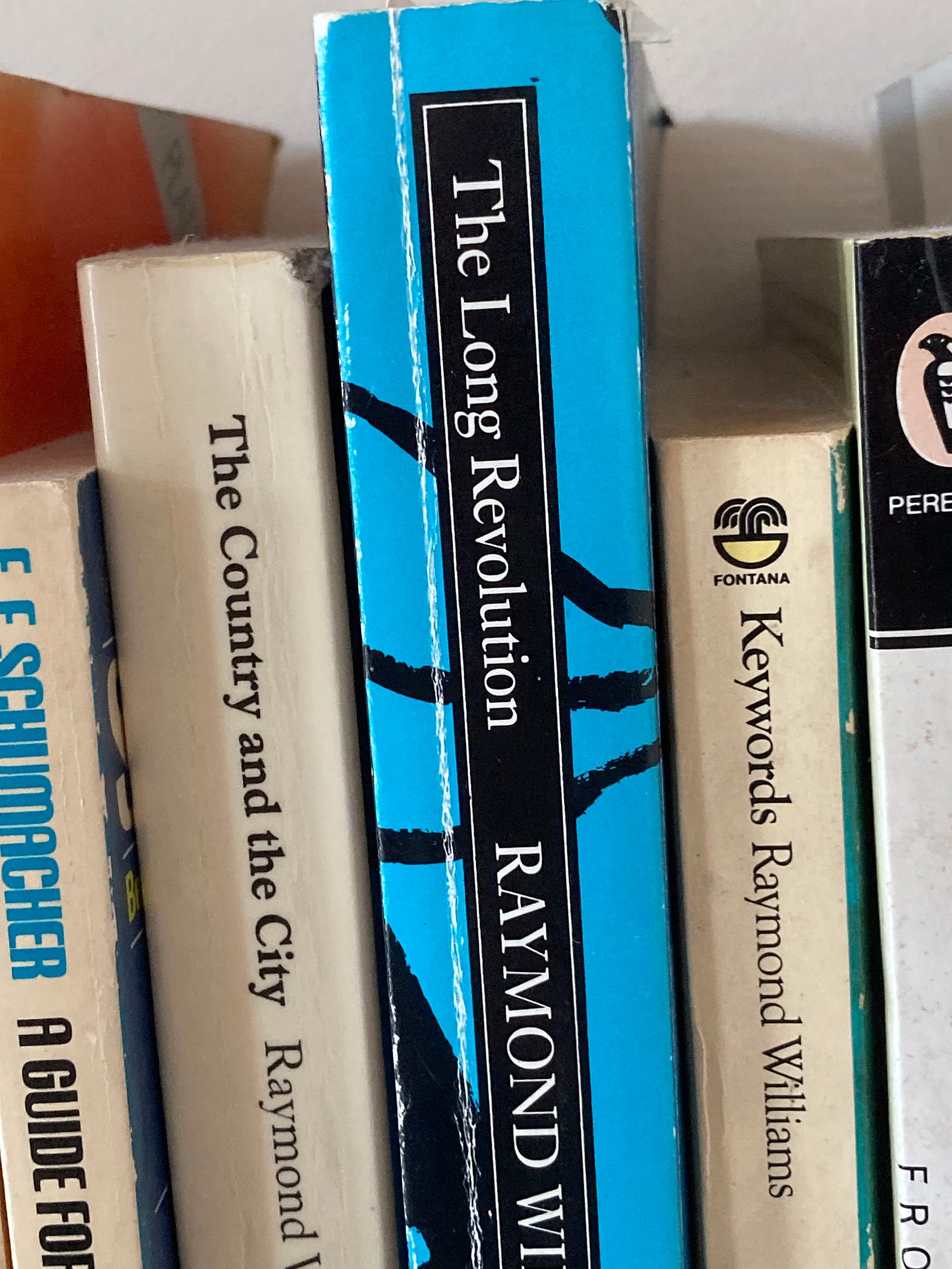
The idea of “structures of feeling” was developed by the cultural theorist Raymond Williams during the 1960s and ‘70s. These days, if he is remembered at all, Williams is remembered for his influential books The Country and the City, Keywords, Television: Technology and Cultural Form, and perhaps a novel such as Border Country.
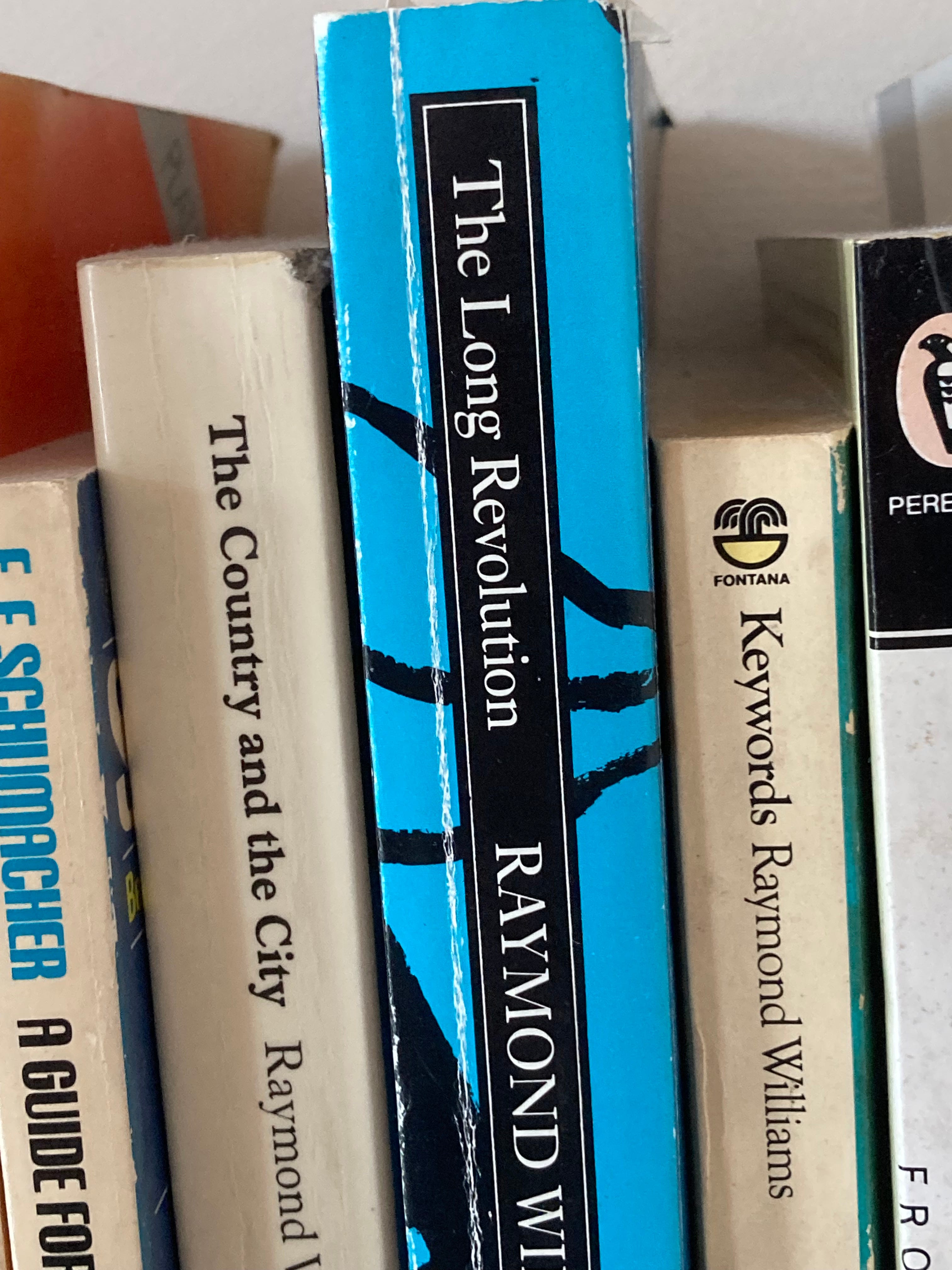
(Photo: Andrew Curry, CC BY-SA-NC 4.0)
Williams was a Marxist, and he was interested in how change happens—especially progressive change—and the idea of “structures of feeling” was a way to talk about changes that you could feel or sense before you could quantify them or measure them.
My purpose in writing about it here is to link it to the futures literature on emerging issues. In doing this, “structures of feeling” may fill a gap in this futures literature. Williams’ concept is inherently social, yet many of the ways that futurists talk about emerging issues lack this social dimension.
The fullest version of his concept that I have found is in his book Marxism and Literature (Oxford University Press, 1977), although the original idea is sketched out much earlier in a section of The Long Revolution (1961), as part of a bravura discussion of culture, literacy, and society in England in the 1840s. Page numbers here reference Marxism and Literature.
Meanings and valuesRaymond Williams acknowledges that “structures of feeling” is a difficult term, and it is quite a complex argument, so needs to be built up bit by bit.
[W]e are concerned with meanings and values as they are actively lived and felt… We are talking about characteristic elements of impulse, restraint, and tone; specifically affective elements of consciousness and relationships: not feeling against thought, but thought as felt and feeling as thought: practical consciousness of a present kind. [132]
The definition here is that these elements together constitute a “structure”. They have “specific internal relations” which are both “interlocking and in tension.”
However, you don’t always recognise these structures until later. Williams describes them as a “cultural hypothesis”, effectively awaiting evidence. We experience them individually, but analysis and reflection allows us to understand them as “a social experience”. Because of this social nature of such a structure, with elements of both affect and thought, Williams says it has “a special relevance to art and literature.” [133]
‘The very first indications’And also vice versa. Because of the nature of art and literature, they “are often among the very first indications that such a new structure is forming.” This notion that there is a fluidity about structures of feeling is underlined by one of the metaphors that Williams uses here:
“structures of feeling can be defined as social experiences in solution”, as opposed to other social formations that have already “been precipitated.” [133-134]
However, not all art comes into this category.
Williams uses language about “emergent formations” and “pre-formations”, which is bit technical but can be unpacked. At their start, such formations are “at the very edge of semantic availability,” meaning that we have little understanding of them. They then become visible as “new semantic figures” which emerge through “material practice.”
‘New practices, new relationships’In an earlier chapter in the book, Williams has written about the characteristics of “emergent formations.” He describes these as “new meanings and values, new practices, new relationships and kinds of relationship are continually being created.” [123]
In addition, “there is always a social basis for elements of the cultural process that are alternative or oppositional to the dominant elements.” [124]
But this still requires some analysis, he says. Williams suggests that it is “exceptionally difficult” to distinguish between emergent practices that are the beginnings of “a new phase of dominant culture,” and those that are “alternative or oppositional.” (There’s a connection that can be made here to the distinction in the Three Horizons literature between ‘H2-’ innovations which reinforce current dominant systems, and ‘H2+’ innovations which help to bring a new system into being.)
In the second case, he argues, we are talking about elements of culture that are, for example, mostly overlooked by the dominant culture—for example, in working class schools of art. Bringing him up to date, we might consider minority cultures of different kinds.
The potential for emergenceSometimes these cultures are ignored, sometimes they are incorporated.
But, “no dominant culture”, Williams writes, “ever in reality includes or exhausts all human practice, human energy, and human intentions”. [125]
There is, in other words, always the potential for the emergent to emerge. All the same, writing in 1977, he noted that “the dominant culture reaches much further into capitalist society than ever before,” partly because of the nature of mass communications, a subject that was a particular interest of Williams. This is almost certainly more true than it was then, both because of the concentration of media ownership we have experienced in the last 50 years, and the online spread of mimetic visual culture.
Williams argues that the extent of the reach of mass communications means that the gap between “alternative” and “oppositional” effects of culture has narrowed. I struggled a little with Williams’ distinction here, and I’ll return to this shortly. But, in brief, they blur because, well, culture behaves in complex and emergent ways.
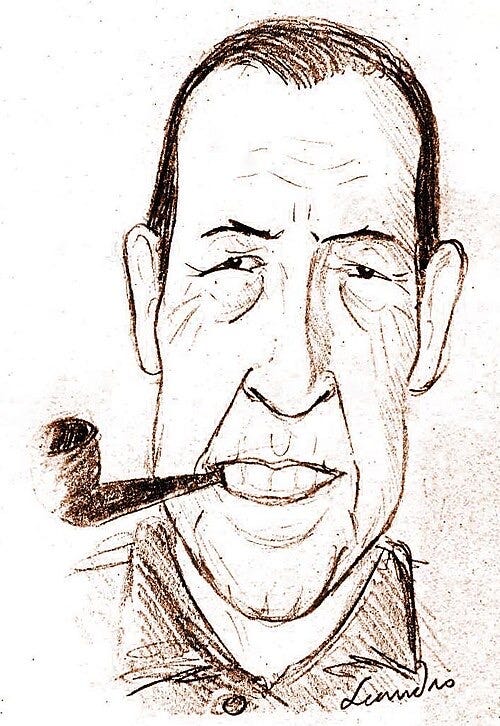
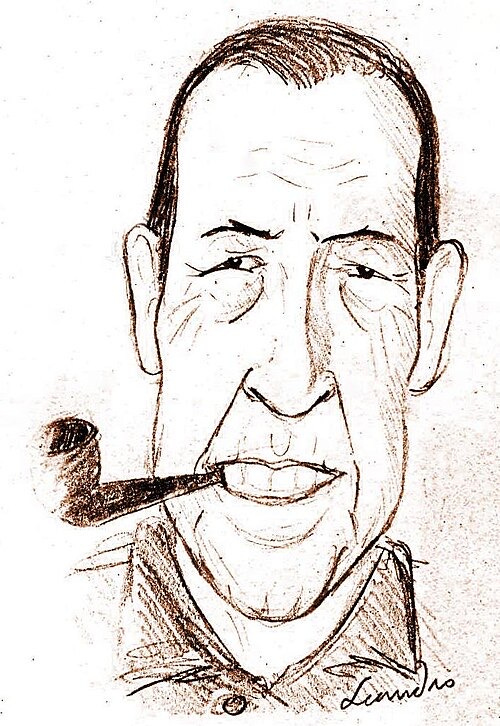
(Raymond Williams, sketched by Leandro Gonzalez de Leon. CC BY-SA 3.0)
‘Alternative’ and ‘oppositional’Broadly though, if my understanding is right, “emergent” speaks to the appearance of new forms of culture, and “alternative” and “oppositional” speak to their positioning in relationship to dominant culture. Some emergent cultures remain separate, detached, from dominant culture for relatively long periods of time (grime, for example).
The distinction between “alternative” and “oppositional” is harder to get to. Williams writes them together a lot of the time (as in, “alternative or oppositional”), and the reason he does this is because the definition partly depends on the response of the dominant culture, and partly by the nature of the social institutions (or “formations”) they generate. But my best reading here of his analysis, using music examples—mine, not his, obviously—punk seems oppositional, in that its lasting political legacy was Rock Against Racism.
In contrast, “alternative” structures of feeling connect to the creation of alternative forms of social institution and organisation, even while being partially recuperated into dominant culture. My best example here is the cultural thread from electronic music to disco. If this seems like an odd example, I have written about it here: it is the point that crystallises the fight over values that is still the dominant political conflict of our times.
The limits of recuperationThese examples also underline Williams’ point that there are limits as to how completely a dominant culture can absorb or recuperate elements that come from outside of it. Sometimes this is done as pastiche (“facsimiles”).
The notion of class runs through the book—it is called Marxism and Literature for a reason. But Williams’ reading of culture owes as much to the Italian theorist Gramsci as it does to Marx. The problem he is trying to solve here is about the relationship between the ‘base’ in Marx’s writing—the economic relations in society—and the ‘superstructure’, which references the forms of social and cultural structures that emerge. Marx saw this relationship as largely deterministic: base determined superstructure.
But if this is the case, how does change happen that can lead to changes in the base? This is a long-standing question, at least for Marxists. Gramsci’s answer to this was to develop his notion of ‘hegemony’, in which particular classes were able to rule through social consent rather than depending on force.
Williams argues, similarly, that the superstructure is not simply determined by the base.
Emergent culture[T]here is always other social being and consciousness which is neglected and excluded: alternative perceptions of others, in immediate relationships; new perceptions and practices of the material world. In practice these are different from the developing and articulated interests of a rising class.
In this formulation, these represent two different forms of the emergent. The first is class, the second is “the excluded social (human) area.” They can travel together: “political practice” is shaped by both. But they are not the same thing.
The final, and critical, point about emergent culture is that it is not just about practice. “[I]t depends crucially on finding new forms or adaptations of forms.” [126]
One of the elements of this that connects it to the way that futurists think about emerging issues is Williams’ argument that initially these new “semantic figures” can seem isolated, which is why they start as “hypotheses”. It is only later that we can connect them up as a form of social or cultural change.
Victorian attitudes to debtThe example he gives is from the mid-19th century.
“Early Victorian ideology”, Williams writes, “specified the exposure caused by poverty, debt or illegitimacy as social failure or deviation.”
In contrast, Dickens, Emily Bronte, and others created new semantic figures. These
”specified exposure and isolation as a general condition, and poverty, debt, or illegitimacy as its connecting instances”.
A new “structure of feeling” can therefore also be thought of as a new structure of meaning. He also stresses the importance of specificity:
A specific structure of particular linkages, particular emphases and suppressions,… and particular deep starting points and conclusions. [134]
In the case of debt, these fictional representations were early signs of a new ideology that coalesced only later, based on a different explanation of the social order, in which elements of social protection were developed initially by trades unions and the co-operative movement, and later codifed into law by the reforming Liberal government of 1906-11.
New cultural representationsIn other words, what happens here is that these “new semantic figures” describe “a pre-emergence, active and pressing but not yet fully articulated”. In turn, this creates an initial tension, which is articulated by cultural representation. This tension reduces over time as new institutional forms, and social and cultural forms, emerge to solidify this new social explanation.
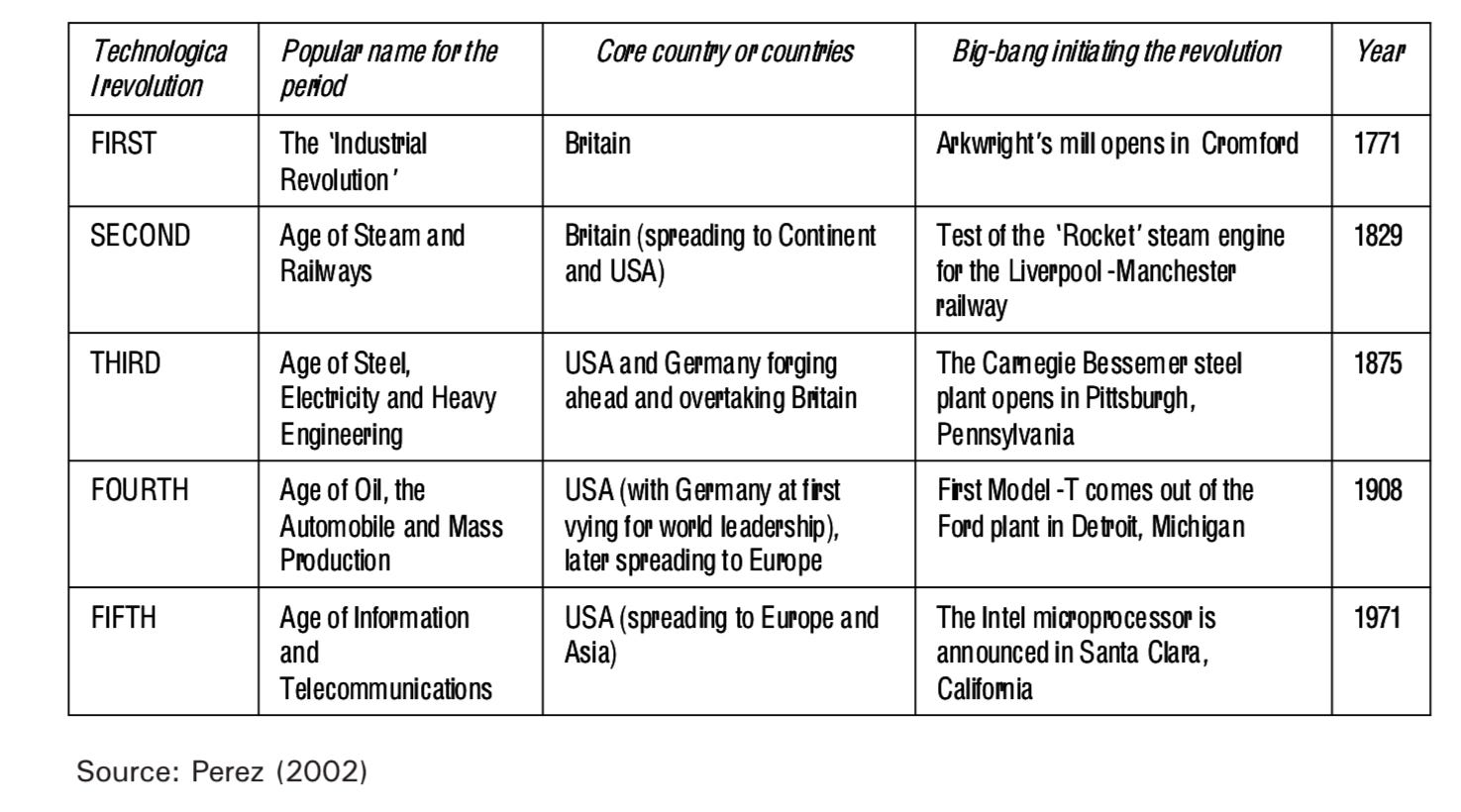
As an aside, I wrote about something a little similar in an article that discussed, in the context of Carlota Perez’s technology and finance model, the “pre-installation” conditions that could be seen in the period before a new technology surge started.
Futurists have become more interested in the nature of weak signals and emerging issues over the past two decades, as methods have come into the mainstream that were less interested in structural factors of change. It happens, and perhaps this is not a coincidence, that Graham Molitor’s pioneering article on emerging issues analysiswas also published in 1977.
To be sure, Molitor’s approach was very different. When he wrote his short article, he was Director of Government Relations at the large American foods company General Mills, and he came to emerging issues analysis through a public policy lens. He was also interested in improving the quality of forecasts, in a relatively positivist way, rather than understanding the relationship between cultural change and social and political change.
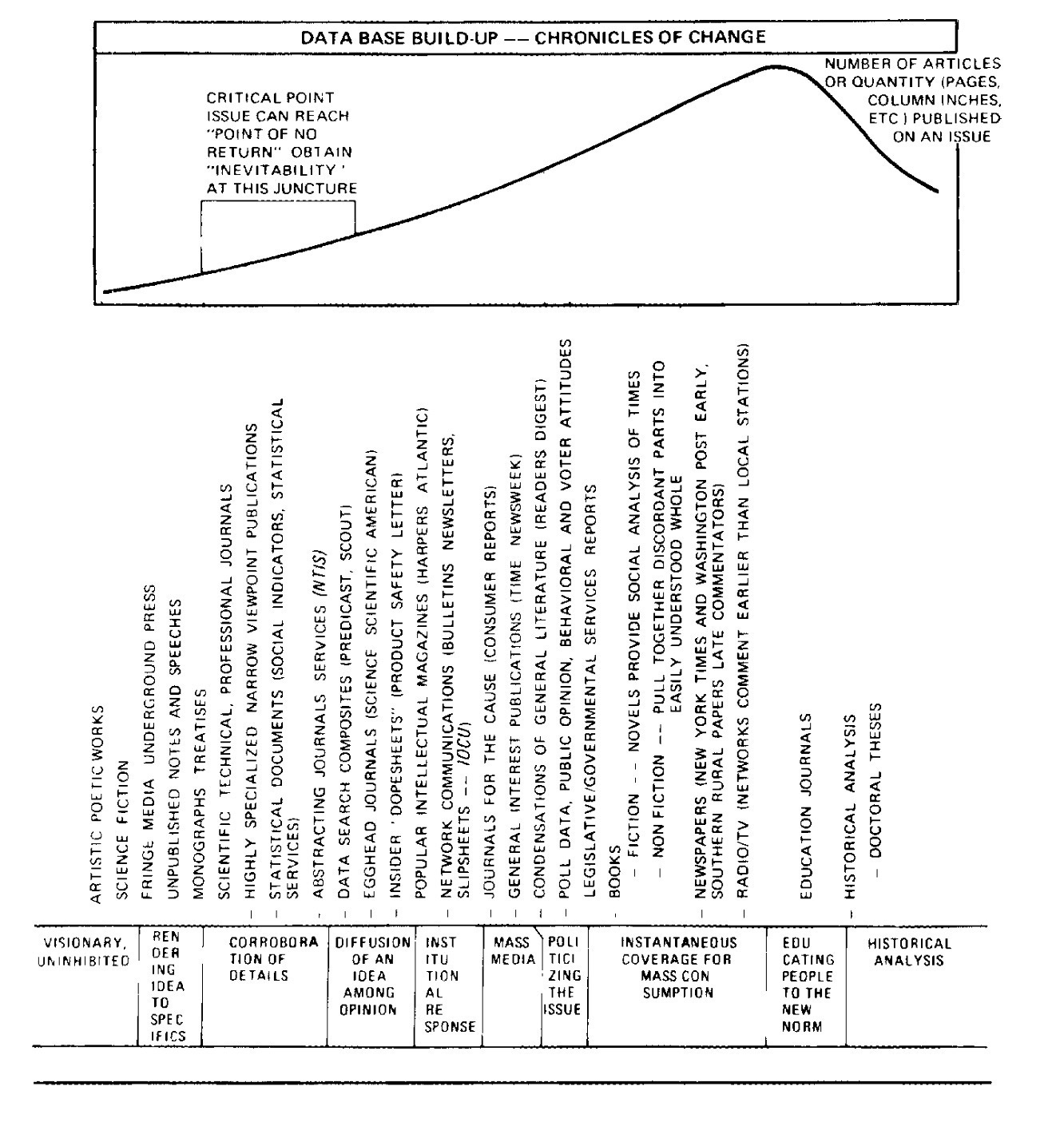
Graham Molitor’s S-curveHis S-curve approach has become standard in futures work now, but what is interesting in this context is the way that he analysed the sources that could be signs of early stage change. Early in the short article (1977, 7) he argues that “isolated events, often viewed at first as bizarre or unique, eventually are pulled together, ans also how aggregation of the events prompts analysis and the identification of trends.”
Part of analysis is, specifically, about literature, as we see in his Figure 3 (1977, 9).
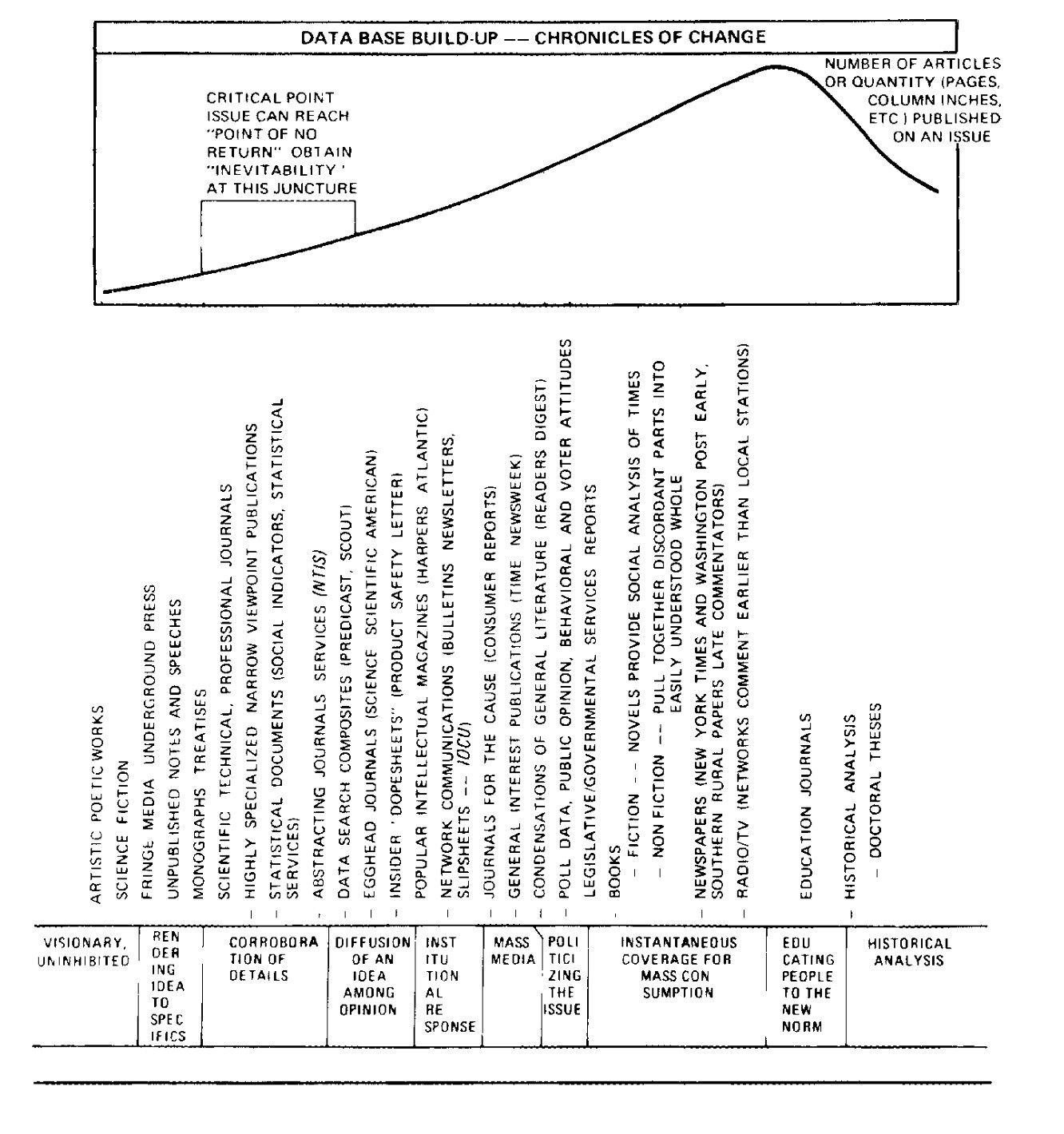
(Source: Graham Molitor, 1977.)
In his description, Molitor says of Figure 3 that
The messy stage of ‘framing’Various classes of literature emerge at different times — lead-lag times of up to 100 years can be involved — therefore, “early warnings” about emerging problems can be obtained from careful literature search.
At the left hand end of the S-curve, which is approximately where we would expect to find Williams’ structures of feeling, Molitor’s list of sources seems narrower—“artistic poetic works, science fiction, fringe media, underground press.” Perhaps his positivism is getting the better of him here, since Williams would certainly argue that fiction in general—such as Dickens and Emily Brontë—is just as capable of analysis for “structures of feeling”.
In later work (2009), Molitor characterised this early stage as ‘Framing’. I’d say that he saw this as a research stage, where researchers were making sense of a policy issue, but I would read it as messier than this: that stage where ideas are floating around but are not fully understood, and therefore there are arguments about what they mean and how they might evolve. The notion of structures of feeling, I’d say, is a way to understand the way in which cultural activity helps re-shape our understanding of issues that are in the ‘Framing’ stage.
I don’t think the two men would have got on, had they ever met. Molitor came to General Mills after two periods working on policy in the White House, for Presidents Nixon and Ford. Williams was a founding figure of New Left Review and had edited the May Day Manifesto 1968. But the differences between the two men were bigger than this. Molitor wanted to build a forecasting machine; Williams wanted to change the world.
—
A version of this article was also published in two parts on my Just Two Things Newsletter.