GeistHaus
log in · sign up

Antiquarian's Attic

Part of wordpress.com

"A Farrago of Antiquities routed out of the Rusts and Crusts and Fusts of Time!"

stories
Thetford Priory
Uncategorized
 The remains of The Cluniac Priory of Our Lady of Thetford The Cluniac Priory of Our Lady, Thetford, was first founded on the Suffolk side of the Little Ouse river by Roger Bigod in the early twelfth century during the reign of Henry I. Bigod founded the Priory instead of making a pilgrimage to the […]
Show full content

 The remains of The Cluniac Priory of Our Lady of Thetford


The Cluniac Priory of Our Lady, Thetford, was first founded on the Suffolk side of the Little Ouse river by Roger Bigod in the early twelfth century during the reign of Henry I. Bigod founded the Priory instead of making a pilgrimage to the Holy Land.

Approach from the south
View of the remains of choir arch from the north
View across the Lady Chapel from the north.
Late15th- or early 16th-century spiral stairway.
Position of the vault at the centre of the presbytery for Thomas Howard, who died in 1524, and whose funeral, celebrated with enormous pomp, lasted two days. Thomas Howard, Earl of Surrey and second Duke of Norfolk, led Henry VIII’s troops to victory against the Scots at Flodden field in 1513. The Flodden helmet, the funerary helm of Thomas Howard is in the church of St Michael, Framlingham. The presbytery vault has been filled with sand, but a cross-section drawing of it exists from excavations in 1938.

Anne Howard née Plantagenet, Countess of Surrey, the the fifth daughter of King Edward IV, aunt to Henry VIII and first wife of Thomas the third Duke, was also initially buried in the priory church c.1511.

North-east corner of the lady chapel
North transept viewed from the south
North transept apsidal chapel, facing east.
The probably site, north of the north transept, of the tomb of John Howard who had died fighting for Richard III at Bosworth. In 1483 John Howard was created Duke of Norfolk by Richard III in return for his military and political support and Priory remained associated with the Howard Dukes of Norfolk until the Dissolution. Renaissance sculptured fragments, similar to the tombs for the Howard family in Framlingham church were discovered during excavation. The tomb of Thomas Howard, third Duke of Norfolk, stands immediately to the south of the high altar at the church of St Michael the Archangel, Framlingham, and it is known that there are three male bodies interred in the tomb. As the Howard family remains were removed to Framlingham after the dissolution of Thetford Priory, it is assumed that the third duke’s tomb contains his remains and those of his father, Thomas, and his grandfather, John, and the tomb may incorporate some parts of the tombs from Thetford. Thetford Priory was also the original resting place for Henry Fitzroy, illegitimate son of Henry VIII, in 1536. The 3rd Duke of Norfolk’s daughter had married Fitzroy. The last Norfolk burial was in 1537 and was that of Thomas Howard, a younger son of the 3rd Duke.
South transept
View east along the south aisle
South transept.
South transept viewed from the east
spiral staircase between the south transept and the sacristy adjoining the south transept
Looking along the buildings range, west of the cloister towards the north
Part of the early kitchen 1400-1540
Foreground: eastern wall of the buttery and later kitchen, beyond which are the remains of the southern wall of the refectory
lycra
http://saesferd.wordpress.com/?p=4341
Extensions
From Margins of Empire at Ely Museum 22 Jan – 26 Jun
Roman
This second-century AD skillet was found in Prickwillow, Isle of Ely, Cambridgeshire in1838. Copper-alloy decorated with copper and niello inlay and tin-plating.
Show full content

This second-century AD skillet was found in Prickwillow, Isle of Ely, Cambridgeshire in1838. Copper-alloy decorated with copper and niello inlay and tin-plating.

lycra
http://saesferd.wordpress.com/?p=4320
Extensions
From Margins of Empire at Ely Museum 22 Jan – 26 Jun
MuseumsRomanUncategorized
This first-century Roman cavalry combat helmet was discovered at Witcham, Cambridgeshire. Tinned copper-alloy. On loan from the British Museum.
Show full content


This first-century Roman cavalry combat helmet was discovered at Witcham, Cambridgeshire.

Tinned copper-alloy. On loan from the British Museum.

Replica of the Witcham helmet at Ely Museum.
lycra
http://saesferd.wordpress.com/?p=4301
Extensions
Extramural Venta Icenorum
HistoryIron AgeRoman
Venta Icenorum was the civitas-capital of the Iceni tribe, and the site of the remains of the Roman town is located about four miles south of Norwich, on the east bank of the river Tas, at Caistor St Edmunds in Norfolk. The Iceni, a British tribe with a territory which covered present-day Norfolk and parts […]
Show full content

Venta Icenorum was the civitas-capital of the Iceni tribe, and the site of the remains of the Roman town is located about four miles south of Norwich, on the east bank of the river Tas, at Caistor St Edmunds in Norfolk. The Iceni, a British tribe with a territory which covered present-day Norfolk and parts of Suffolk and Cambridgeshire during the Late Iron Age and early Roman period, are recorded by the historian, Publius Cornelius Tacitus (c. AD56-c.AD120), as instigating a tribal revolt against Roman rule, led their queen Boudica in AD60/61. 

The walls and banks of Venta Icenorum

The name Venta Icenorum appears in the Antonine Itinerary and Ptolemy refers to Venta as a polis of the Iceni. The name also appears in the Ravenna Cosmography (compiled c. AD700). 

Wroxeter, Silchester, and Venta Icenorum survive as the only Roman regional capitals in Britain that have not been obscured by the building of later towns. 

From the 13th to 28th August 2022, an excavation concentrated upon an area about 800m beyond the Roman town and its walls. The open grazing land site is about 150m from where previous excavations discovered evidence of two phases of a Romano-Celtic temple. Approached by a mid-second-century monumental gateway, the phase II temple cella is considered one of the largest in the country with a footprint of c.16m by 17m, with an additional portico. The substantial foundations suggest a two-storey building. There was also evidence of a sizeable ‘villa-like’ ancillary structure nearby.

Pottery finds

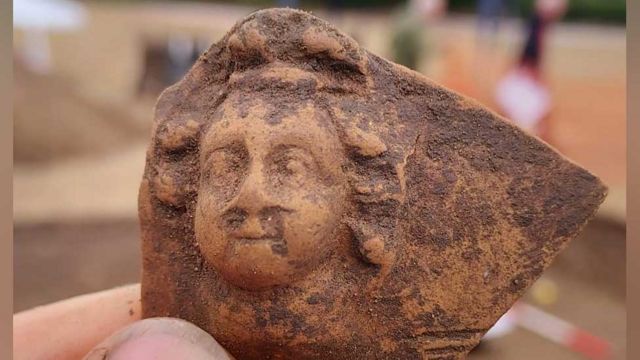
This year’s excavation did not reveal any buildings, but there were scattered fragments of ceramic roof tiles, nails, and tesserae in the trenches. A series of Roman pits and ditches have yielded 1st/2nd-century pottery, including complete pottery vessels, some inverted suggesting deliberate deposition, a cherubic face on a bowl sherd,

Samian ware shards and pieces of mortaria. One of the latter was stamped with a maker’s mark of Crispus, a local manufacturer (c. AD80-100).

Crispus’ mortarium

A couple of copper-alloy probes which have been discovered, are interpreted as part of the physician’s general equipment. Other small finds were bone and bronze pins, and several coins in surprisingly good condition, such as one depicting Julia Domna (wife of Septimius Severus, emperor of Rome from AD193 to AD211). A corroded iron stylus, for writing on a waxed tablet, was found near the base of one of a series of pits in Trench 4 (cf. An inscribed stylus from London). Another iron stylus was found within the town walls during a 2009 excavation in Caistor St Edmund churchyard.

In Trench 4, a linear feature visible in a magnetometry survey turned out to be an aqueduct. The pipes, which were most likely of wood (cf. Vindolanda), may have conducted water down-slope towards the temple complex. Although the actual pipes were not found, the iron connector collars which would have linked sections together were in situ. The pipeline would have been encased in clay to make it as watertight as possible.  

An iron connector in the foreground
The line of the aqueduct in the trench
Spoil heaps
lycra
http://saesferd.wordpress.com/?p=4264
Extensions
“The Marlow Warlord”
Uncategorized
ANGLO-SAXON WARLORD FOUND BY DETECTORISTS COULD REDRAW MAP OF POST-ROMAN BRITAIN The burial, on a hilltop site near with commanding views over the surrounding Thames valley, must be of 6th century AD, archaeologists from the University of Reading believe. The ‘Marlow Warlord’ was a commanding, six-foot-tall man, buried alongside an array of expensive luxuries and weapons, […]
Show full content
ANGLO-SAXON WARLORD FOUND BY DETECTORISTS COULD REDRAW MAP OF POST-ROMAN BRITAIN
University of Reading archaeologists excavate the remains of the 'Marlow Warlord' and weapons

The burial, on a hilltop site near with commanding views over the surrounding Thames valley, must be of 6th century AD, archaeologists from the University of Reading believe.

The ‘Marlow Warlord’ was a commanding, six-foot-tall man, buried alongside an array of expensive luxuries and weapons, including a sword in a decorated scabbard, spears, bronze and glass vessels, and other personal accoutrements.

The pagan burial had remained undiscovered and undisturbed for more than 1,400 years until two metal detectorists, Sue and Mick Washington came across the site in 2018.

Archaeologists from the University of Reading and local volunteer groups are now hoping to raise funds to pay for further conservation work, to allow some of the finds to go on display to the public at the Buckinghamshire Museum in 2021, when their newly refurbished permanent galleries re-open.

FUNDRAISER TO PUT FINDINGS ON PUBLIC DISPLAY

lycra
University of Reading archaeologists excavate the remains of the 'Marlow Warlord' and weapons
http://saesferd.wordpress.com/?p=4207
Extensions
A14 update and the Huntingdon bypass – discoveries
Uncategorized
Anglo-Saxon settlement and Roman army camp found in A14 bypass dig   It’s taken more than 700 years, but the medieval villagers of Houghton in Cambridgeshire have had the last laugh: the foundations of their houses and workshops have been exposed again, as roadworks carve up the landscape they were forced to abandon when their […]
Show full content
Anglo-Saxon settlement and Roman army camp found in A14 bypass dig


It’s taken more than 700 years, but the medieval villagers of Houghton in Cambridgeshire have had the last laugh: the foundations of their houses and workshops have been exposed again, as roadworks carve up the landscape they were forced to abandon when their woodlands were walled off into a royal hunting forest.

Their lost village has been rediscovered in an epic excavation employing more than 200 archaeologists, working across scores of sites on a 21-mile stretch of flat Cambridgeshire countryside, the route of the upgraded A14 and the Huntingdon bypass.

Much of it is now flat and rather featureless farmland, but the excavations have revealed how densely populated it was in the past, with scores of village sites, burial mounds, henges, trackways, industrial sites including pottery kilns and a Roman distribution centre. The archaeologists also found an Anglo-Saxon tribal boundary site with huge ditches, a gated entrance and a beacon on a hill that still overlooks the whole region.

Finds include prehistoric flint tools, seven tonnes of pottery, and more than 7,000 small personal objects including a Roman jet pendant carved with the head of Medusa*, a brooch in the shape of a chicken**, a beautifully carved Anglo-Saxon bone flute – and a startlingly well preserved timber ladder, radiocarbon dated to about 500 BC, found with a wooden paddle in a pit several metres deep.

_100589303_mediaitem100589302

Roman jet pendant carved with the head of Medusa*

Roman-chicken-shaped-brooch-c-Highways-England-courtesy-of-MOLA-Headland-Infrastructure_preview-1024x683A Roman brooch in the shape of a chicken**

2801

An Anglo-Saxon bone flute from between AD 5th-9th century.

DaBcxwkW4AInxmf

A 2.4 metre long Middle Iron Age wooden ladder which has been radiocarbon dated to 525 – 457 BC

A-bone-plaque-with-Roman-cursive-text-c-A14C2H-courtesy-of-MOLA-Headland-Infrastructure-1024x585

A plaque dating to 43-400 AD is inscribed with Roman writing, perhaps a note or someone’s name. The text is called “cursive” which is more like everyday handwriting rather than the more familiar Roman capital letters seen on stone inscriptions.

“There is not one key site but a whole expanse – the excavation has given us the whole of the English landscape over the past 6,000 years,” said Steve Sherlock, head archaeologist for Highways England. “The Anglo-Saxon village sites alone are all absolute bobby dazzlers. The larger monuments such as the henges and barrows show up in crop marks and geophysics, but you can only really see things like the post marks of timber buildings by getting down into the ground and digging.”

A14_Image1

Neolithic henge monument being excavated on the A14 Cambridge to Huntingdon scheme

“The workshops and animal enclosures give you an impression of the hard grind of everyday life, but when you get something like the bone flute you suddenly see into a world that also had art and music, dancing and entertainment.”

At Houghton the archaeologists have been walking along alleyways first used centuries before the Norman Conquest. The deserted medieval village, with remains of 12 buildings, had even earlier – and completely unsuspected – origins. The buildings overlay remains of up to 40 Anglo-Saxon timber structures including houses, workshops and agricultural buildings.

“The medieval village was occupied between the 12th and early 14th centuries, and the most likely explanation for its abandonment was that they lost the use of their woods when they were enclosed as a royal forest,” said Emma Jeffery, senior archaeologist from Mola Headland Infrastructure, who has been working on the site. “At a stroke they lost their grazing, foraging and bark for uses such as tanning leather, so the economic justification for the village was gone.”

The distribution of sites suggests that many were aligned along a lost stretch of Roman road now under the A1. Others are clustered around the ancient barrows and henges, suggesting they remained significant features in the landscape long after their original use as gathering and burial places ended. Major centres of Roman and later pottery production were found around Brampton and on the banks of the Great Ouse.

The excavation of around 350 hectares has been one of the largest archaeology projects in the UK. Work continued through one of the coldest winters in decades, with the diggers pulled off the sites only when the recent blizzards and sub-zero temperatures hit. Work will continue into the summer and there will be open days at several of the sites, including the deserted village.

*Jet Medusa-head pendants are an example of the integration of Roman and British traditions. It is a powerful, Roman emblem, yet executed in a local material, if definitely of jet (in Roman, as in more recent times jet was obtained from Whitby on the Yorkshire coast) and thus, most probably of British workmanship.

The Medusa is usually represented as a staring female face with writhing snakes for hair, nearly always depicted with a frontal rather than a profile head. In Greek mythology, the hero Perseus beheaded Medusa and thereafter used her head as a weapon to turn onlookers to stone. Thus, in classical antiquity the image of the head of Medusa appeared as an evil-averting Gorgoneion, considered to be an apotropaic symbol of protection, also appearing in mosaics and sometimes placed on doors, walls, floors, pediments, antefixes, coins, shields, tombstones and sarcophagi, in the hope that the staring eyes and serpents would avert evil.

Black, shiny materials for jewellery were popular in both Britain and the Rhineland from the late second century AD to the end of the fourth century AD. Without detailed analysis by reflected light microscopy, all black jewellery from this period, irrespective of composition, has inevitably been described as being made of `jet’. However, some items have been shown to be made of jet-like substances, such as shale, coal, or lignite.

**Zoomorphic plate brooches were very popular in Roman Britain c. AD 100 – 200. These were often cast in whimsical animal forms from copper alloy, many with multicoloured champlevé enamel details as decoration.

The distribution of three-dimensional chicken brooches has revealed a distinct military spread in Britain (Allason-Jones, 2015: 76-77 and Fig. 4.4.) or, at least, a predominance in large towns and civitas capitals (Crummy 2007: 225). Figurines representing the Roman god, Mercury, often include a cockerel as one of his attributes and it is possible that the chicken brooches were worn by devotees of the god’s cult (Crummy 2005: 225). However, the Mercury statuettes most often show him with a standing cockerel, as the herald of a new day, but it is difficult to establish whether the brooch depicts a sitting cockerel or a brooding hen.

  • Allason-Jones, L. (2015) Zoomorphic Brooches in Roman Britain: Decoration or Religious Ideology?, in: R. Marzel & G. D. Stiebel (eds), Dress and Ideology: Fashioning Identity from Antiquity to the Present. pp. 69-86.
  • Crummy, N. (2007) Brooches and the Cult of Mercury, Britannia, Volume 38. pp. 225-23
lycra
_100589303_mediaitem100589302
Roman-chicken-shaped-brooch-c-Highways-England-courtesy-of-MOLA-Headland-Infrastructure_preview-1024x683
2801
DaBcxwkW4AInxmf
A-bone-plaque-with-Roman-cursive-text-c-A14C2H-courtesy-of-MOLA-Headland-Infrastructure-1024x585
A14_Image1
http://saesferd.wordpress.com/?p=4184
Extensions
Late Iron Age Skull
Uncategorized
Dog walker finds human skull  A dog walker has come across an unexpected find whilst out in Somerset. Roger Evans found a ‘well-preserved’ human skull whilst walking along the banks of the River Sowy. He reported his findings to the police and it was analysed. After months of research, results revealed it belonged to a […]
Show full content
Dog walker finds human skull 

A dog walker has come across an unexpected find whilst out in Somerset.

Roger Evans found a ‘well-preserved’ human skull whilst walking along the banks of the River Sowy.

487699E900000578-5298081-The_skull_which_was_found_in_Langport_in_Somerset_was_reported_t-a-51_1516642938449

He reported his findings to the police and it was analysed. After months of research, results revealed it belonged to a woman aged 45 or older during the late Iron Age (380-190BC) – several centuries before the first Roman invasion of Britain.

No other human remains were found, but the archaeologists discovered that the skull lay close to a series of round, timber posts driven deep into the river bed. Credit: Environment Agency 

Analysis by a human bone expert showed that the female skull suffered considerably from gum disease and tooth loss.

99691570_thefemaleskullfoundonariverbankcreditsouthwestheritagetrust_1_trans_NvBQzQNjv4BqqVzuuqpFlyLIwiB6NTmJwfSVWeZ_vEN7c6bHu2jJnT8

Her diet included coarse material, which had unevenly worn her remaining teeth, and resulted in severe osteoarthritis in the joint of her right jaw. She had also suffered at least one episode of chronic illness or nutritional stress during childhood.

The woman’s head also appears to have been deliberately removed at, or shortly after death. Archeologists say such discoveries are becoming more common.

Severed heads are not an unusual discovery for the Iron Age, but the placement of the skull in a wetland beside a wooden structure is very rare, possibly reflecting a practice of making ritual offerings in watery environments. RICHARD BRUNNING, SOUTH WEST HERITAGE TRUST  


lycra
487699E900000578-5298081-The_skull_which_was_found_in_Langport_in_Somerset_was_reported_t-a-51_1516642938449
99691570_thefemaleskullfoundonariverbankcreditsouthwestheritagetrust_1_trans_NvBQzQNjv4BqqVzuuqpFlyLIwiB6NTmJwfSVWeZ_vEN7c6bHu2jJnT8
http://saesferd.wordpress.com/?p=4177
Extensions
St John the Baptist Church in Reedham may be Roman fortlet
Uncategorized
A Norfolk church may have begun life as a Roman fortlet protecting supplies on their way to Hadrian’s Wall. Trevor Heaton hears how ‘keyhole archaeology’ is solving the riddle of Reedham. Sometimes things can hide in plain sight. But that doesn’t it make any easier to tell their story. For centuries, researchers and historians have […]
Show full content
A Norfolk church may have begun life as a Roman fortlet protecting supplies on their way to Hadrian’s Wall. Trevor Heaton hears how ‘keyhole archaeology’ is solving the riddle of Reedham. Sometimes things can hide in plain sight. But that doesn’t it make any easier to tell their story.

For centuries, researchers and historians have realised that there is something rather special about St John the Baptist Church in Reedham

A reconstruction of the Roman frontier fortlet near Gundremmingen in what is now Bavaria in Germany. Prof Fulford believes Reedham might have looked something like this.A reconstruction of the Roman frontier fortlet near Gundremmingen in what is now Bavaria in Germany. Professor Fulford believes Reedham might have looked something like this.


For this 15th-century Broadland gem clearly has Roman roots, as can be seen in the large amounts of material in its walls, the thin tiles particularly distinctive. That impression was only strengthened after a disastrous 1981 fire which gutted the church – and revealed yet more ancient masonry inside.

Now new research may finally be helping to solve the riddle of one of East Anglia’s most mysterious sites.

But first, let’s scroll back the best part of two millennia to Reedham in the Roman age. These days the village is several miles inland, and the nearest it gets to water is the familiar chain ferry across the Yare which saves grateful drivers a long detour.

image (1)

In Roman times the landscape was completely different. What is now the Yare Valley was then a vast expanse of water, the ‘Great Estuary’, a very different coastline in which Great Yarmouth did not exist, and the sea stretched into east Norfolk like a three-fingered hand.

The Roman pharos (lighthouse) behind St Mary de Castro Church - originally built in Anglo-Saxon times - which can be found in the grounds of Dover Castle. Is this similar to what happened at Reedham?The Roman pharos (lighthouse) behind St Mary de Castro Church – originally built in Anglo-Saxon times – which can be found in the grounds of Dover Castle. Is this similar to what happened at Reedham?


In this world, the site of Reedham suddenly takes on a much more important significance, being on a promontory guarding the approach to our Roman ‘capital’, Venta Icenorum – the modern-day Caistor St Edmund

It’s this position which has led to speculation that the mysterious lost Roman building here could have been a pharos – lighthouse – similar to the one which survives in the grounds of Dover Castle.

But now research led by Professor Mike Fulford of Reading University is hinting at a story which may prove even more fascinating. Prof Fulford is one of this country’s leading experts on the Roman period and has excavated at such iconic sites as Pompeii and Carthage, as well asB Silchester near Reading. He is also a big supporter of Caistor Roman Project , which is uncovering the story of Venta.

Prof Fulford, who came to Norfolk a few weeks ago to talk about his latest research, explained that it had long been established that the building at Reedham had an obvious connection with the fort of Branodunum (Brancaster) . Both were built out of a grey ‘sparkly’ sandstone called Leziate Quartzite*.

The stone would have been excavated a few miles to the west of King’s Lynn and taken by boat around the coast to Brancaster, and then to Reedham. “I can’t think of any other example in Roman Britain where stone has been brought so far,” he said. “It’s 100km as the crow flies, by sea 130km or so. This would have been a terrific undertaking.”

Research has shown this material turns up in other Broads churches, but nothing like the quantities of Reedham. It’s clear that this is where the original building must have been.

Prof Fulford said investigating the church site offered considerable challenges. Forget about digging large trenches everywhere – this is a consecrated site with hundreds of burials in the churchyard. Researchers first had to win support from the parochial church council and the Diocese of Norwich for their investigation.

First, the site was surveyed – inside and outside the church – by ground-penetrating radar, one of the famous ‘geophys’ tools so beloved by Channel 4’s Time Team. Burials showed up as black lines, with white areas showing masonry. “It produced some really promising results,” the professor added.

There was a very strong 20-metre-long signal along the north side of the church, with more interesting results inside in the nave and the chancel too (‘but of course we can’t excavate there’.)

Then came a series of very small, very targeted, test trenches. In 2016 three were dug, with one proving a complete blank but the other two revealed as ‘robber trenches’ where later builders had removed the Roman material for reuse. “I felt we were getting ‘warmer’ but there was still no hard-and-fast [Roman] foundation,” he said.

The breakthrough came the following year when three more trenches were dug, producing ‘really encouraging results’.

One was empty, one was a robber trench – but the third revealed a spread of rough Roman blocks. These were not just of the grey west Norfolk stone but also of limestone from Northamptonshire and Lincolnshire. “They seemed to be really indicative of something substantial, something clearly Roman.”

He added that the 20-metre wall lying under the church’s north wall showed it was ‘something more than a lighthouse’.

image

So what was it? Prof Fulford thinks the answer can be found not in this country, but in Germany. There is a fortlet at Bürgle, near Gundremmingen in Bavaria, then on the borders of the empire. Built on a cramped site – like Reedham – it was long and narrow in shape with a tower at both ends. In fact it looks more like a medieval castle than a classic Roman fort (“A good parallel is with one of the milecastles on Hadrian’s Wall”).

Nothing has been found that gives a firm date to the fortlet, but we can speculate it must have been started its life around AD200-230, the same as its ‘parent site’ in Brancaster. Reedham was part of a chain of coastal forts which began at Reculver in Kent  and included Caister north of Yarmouth , Brancaster, Skegness (possibly), Brough-on-Humber and finally South Shields. They may have acted as safe staging posts for supplies for Rome’s northern frontier and Hadrian’s Wall.

By 300 the military situation had subtly changed. A rebel ‘British Empire’ had – briefly – broken away from central Roman control and there were growing problems caused by incursions from tribes outside the empire, in northern Germany and southern Denmark.

A post was created known as the ‘Count of the Saxon Shore’ and more forts were added, such as at Burgh Castle, the now-vanished Walton in Suffolk and (fast-vanishing) Bradwell in Essex.

It wasn’t all war and strife. There is growing evidence that the Great Estuary was an important trading crossroads too. Will Bowden, Associate Professor in Roman Archaeology at Nottingham University and a director of the Caistor project, said: “Grain, instead of going northwards, also went eastwards [to the Rhine frontier].” The pottery shows there were links too, and the number of hoards which turn up in later Roman Norfolk show how well people were doing. “People in Norfolk were getting pretty rich on the back of it,” he added.

But what about the old idea of Reedham being a lighthouse? There is no reason why it couldn’t have been a fort AND a lighthouse – all they had to do was heighten one tower. That might also imply that there was some sort of relay signal station sited somewhere near Brundall where the merchants of Venta Icenorum could be alerted that a ship was on its way.

And what about those ships? Where were they being built? Some must surely have come to grief – are they waiting to be discovered under metres of silt in a Broadland field? All that waterlogging could preserve some amazing finds. It seems the best may be yet to come.

Back at Reedham, research continues. The fortlet discovery was unveiled in July 2017 but work is still needed to establish more of the layout of the building, and to try to find its date.

Prof Fulford believes there would have been a garrison of around 50 troops – and where there are troops, there would have been some sort of shanty settlement nearby. The wine shops, the drinking dens, the food stalls… they had to go somewhere (as did all the rubbish). Perhaps a villager will uncover evidence in their garden.

And there’s more.

One of the test trenches had a surprise in it. Underneath a spread of mortar were some fragments of charcoal. These were sent away for tests to find what tree species they were and, crucially, what date. Using the technique known as carbon-14 dating, the tests showed that the charcoal wasn’t Roman at all, but Anglo-Saxon.

The two samples, with a 95 per cent certainty, are dated to AD 650-770 and the other AD 647-778. These are the decades immediately after the death of St Felix, the first Bishop of East Anglia. We are talking about the dawn of the second Christian era in these islands.

Prof Fulford believes that a mass of the Leziate stone on the north wall may show a blocked-up arch of what was the first Anglo-Saxon stone-built church on the site. It may have looked something like the (still existing) St Peter’s-on-the-Wall at Bradwell, another Roman Saxon Shore fort.

And all this has been revealed by a total of just 12 square metres of digging.

The work goes on this spring. Somewhere on the site must be evidence of the equally substantial Roman south wall. And what about that elusive date – and more evidence about how the Anglo-Saxons took the site over?

*‘Silver Carr’ stone. Allen, J.R.L., 2004. Carrstone in Norfolk Buildings: Distribution, use, associates and influences. BAR 371. Banbury.

lycra
A reconstruction of the Roman frontier fortlet near Gundremmingen in what is now Bavaria in Germany. Prof Fulford believes Reedham might have looked something like this.
image (1)
The Roman pharos (lighthouse) behind St Mary de Castro Church - originally built in Anglo-Saxon times - which can be found in the grounds of Dover Castle. Is this similar to what happened at Reedham?
image
http://saesferd.wordpress.com/?p=4170
Extensions
Vindolanda boxing gloves
Uncategorized
“Now, whoever has courage and a strong and collected spirit in his breast, let him come forward, lace on the gloves and put up his hands. (5.363-364) ― Virgil, The Aeneid Roman boxing gloves unearthed during an excavation near Hadrian’s Wall have gone on public display.  Experts at Vindolanda, near Hexham, in Northumberland, believe they are “probably the […]
Show full content

5097

“Now, whoever has courage and a strong and collected spirit in his breast, let him come forward, lace on the gloves and put up his hands. (5.363-364) ― VirgilThe Aeneid

Roman boxing gloves unearthed during an excavation near Hadrian’s Wall have gone on public display. 

Experts at Vindolanda, near Hexham, in Northumberland, believe they are “probably the only known surviving examples from the Roman period”.

Dr Andrew Birley, Vindolanda Trust director of excavations, described the leather bands as an “astonishing” find.

The gloves were discovered last summer along with a hoard of writing tablets, swordsshoes and bath clogs.

Made of leather, they were designed to fit snugly over the knuckles and have the appearance of a protective guard.

4966056800000578-5412087-The_larger_of_the_gloves_pictured_is_cut_from_a_single_piece_of_-a-24_1519124784920

The larger of the gloves (pictured) is cut from a single piece of leather

180221-old-roman-boxing-gloves-03

Dr Birley said: “I have seen representations of Roman boxing gloves depicted on bronze statues, paintings and sculptures, but to have the privilege of finding two real leather examples is exceptionally special.

“The hairs stand up on the back of your neck when you realise you have discovered something as astonishing as these boxing gloves.”

The larger of the two is filled with natural material, which would have acted as a shock absorber.

The smaller glove found “in near perfect condition”, is filled with a coil of hard, twisted leather.

It is understood they would have been used for sparring sessions as they do not have metal inserts used in ancient boxing bouts.

bro005-530x317

detail of the bronze Hellenistic Greek sculpture of The Boxer of the Quirinal wearing caestūs

ITV report

lycra
5097
4966056800000578-5412087-The_larger_of_the_gloves_pictured_is_cut_from_a_single_piece_of_-a-24_1519124784920
180221-old-roman-boxing-gloves-03
bro005-530x317
http://saesferd.wordpress.com/?p=4161
Extensions
Bamburgh Castle find
Anglo-Saxonarchaeology
Bamburgh dig uncovers unique find The continued archaeological investigation of Bamburgh Castle , once the palace site of the early medieval kings of Northumbria, has revealed a marvellous new find of national significance. The copper alloy fragment is small, 23mm by 12mm, but beautifully decorated with an intricate zoomorphic representation of a bird, characteristic of […]
Show full content
Bamburgh dig uncovers unique find The continued archaeological investigation of Bamburgh Castle , once the palace site of the early medieval kings of Northumbria, has revealed a marvellous new find of national significance.

The copper alloy fragment is small, 23mm by 12mm, but beautifully decorated with an intricate zoomorphic representation of a bird, characteristic of early medieval north European art.

The discovery was the star find of the Bamburgh Research Project’s (BRP)  2016 summer excavation and has since been undergoing careful conservation to reveal an intricately decorated artefact that is a window into the art of a lost era of early medieval royal society.

Initial comments from a number of experts has suggested that the bird mount is unique, with no direct parallels and likely to be 8th century in date.

It is fascinating that the new image appears to hark back in time to the bird of prey motifs of the 6th and 7th centuries AD* and could represent a descendant of these earlier styles just as the later 8th century York helmet , is an update of the form known from the earlier Sutton Hoo, Staffordshire [helmet pieces in the Staffordshire Hoard perhaps?] and Wollaston helmets.


Bamburgh Research Project Director, Graeme Young, said: “The find was recovered from a cobbled surface revealed at the base of a narrow trench towards the end of the 2016 excavation season.

“The layers above date to the 9th century, immediately before the time of Alfred the Great and the before York became the Viking town of ‘Yorvik’ [Jorvik] and 100 years before there was a single kingdom of England. At this time there were a number of smaller kingdoms and Northumbria was one of these.

“The palace fortress of Bamburgh was one of the most important places in the kingdom and we have evidence of metal working, probably associated with the production of arms and armour for the warriors of the royal court in our excavation.

“In summer 2017 we will continue our investigations of the find spot and we hope to discover if it represents an earlier period of metal working or some other activity.

“At the moment our investigation of this horizon is at such an early stage we are unsure if the find came from within a building or from a yard surface or path where it may have been dropped. We are very much looking forward to getting back on site and continuing our excavations. Who knows what other finds await us this summer!”

Francis Armstrong and his son Will, owners of Bamburgh Castle said: “The bird is a spectacular discovery. It is a beautiful artefact and we are proud that it has been found here at Bamburgh. Finds like this help us to connect with the castle’s history and it is wonderful when we get the opportunity to display these ancient wonders so our visitors can enjoy them close up. We are grateful for the work the BRP do here at the castle and we have a great time working with them unearthing the stories that Bamburgh Castle has to tell.”

The bird will be on display at the castle, open 10.00am to 5pm until 29 th October with many other fascinating finds including pattern welded swords and intricately decorated gold work.

*cf birds on The Sutton Hoo Purse-Lid

and Staffordshire Hoard eagle mount


bird
lycra
http://saesferd.wordpress.com/?p=4119
Extensions