GeistHaus
log in · sign up

Raccoon’s Trash Can

Part of racc.blog

Hi! I’m a raccoon, and this is my trash can. It’s full of my thoughts about the mess of being human. No human is perfect, including me, and that’s why we are so fascinating :]

stories primary
Blue vs red button debate
2026
Show full content

IMG_0224

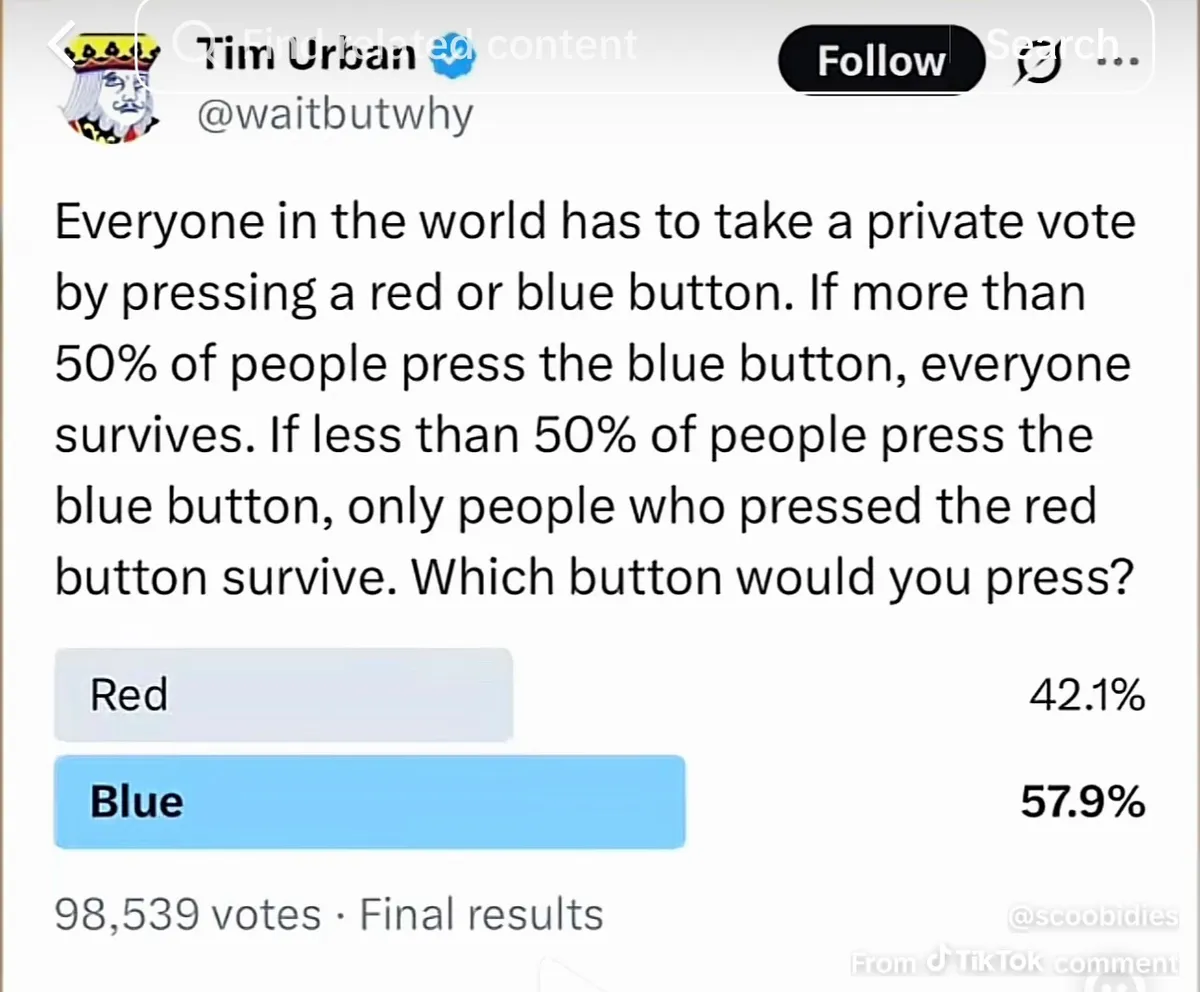
I found a very interesting logical debate. At least it is designed to feel like a logic puzzle, but it’s actually a values elicitation test. It reveals what you optimise for, not how well you reason.

Red button guarantees your survival, but only yours.

Blue button saves everyone if more than 50% voters pick this option. If not, they die.

I see red as the „safe” option - definite outcome, no gamble. However, if majority chooses to self-preserve themselves they are the winners, ones that live while others die. But does this make them complicit in whatever % of humanity dying? Everyone knows the rule upfront and choosing blue means agreeing on the possibility of dying if they fall short of the 50% mark. Total possible death toll is directly proportional to their choice. Blue voters who fall short are as guilty as red voters. Why would anyone choose blue then?

The answer is already visible in what humans have built. Not as proof that blue is correct, but as evidence that enough people, across enough generations, kept choosing it anyway - Jonas Salk developed the polio vaccine in 1955 and refused to patent it meaning forfeiting an estimated $7 billion so that every child on earth could access it freely, expecting nothing in return.

Every hospital ever built was a blue button. Every sewer system, every vaccine program, every bridge, every legal code. Civilisation itself is the accumulated product of people who found cooperation individually rational, because reputation, reciprocity, and shared outcomes made it so. Not because they were selfless, but because they were smart enough to expand what “self” meant.

The world wasn’t built exclusively by people who pressed blue. Competitive self-interest, conquest, and individual ambition built plenty of it too. But the parts that lasted: the institutions, the infrastructure, the social contracts - those required enough people to accept short-term personal risk for long-term collective return. People who pressed blue before they knew if enough others would follow. Who sometimes fell short and paid for it. Who kept pressing it anyway.

Not out of naivety. Out of a calculated understanding that individual survival inside a collapsing collective is a diminishing prize. Red is internally consistent if survival is your only variable. But humans repeatedly, across cultures and centuries, kept adding variables. Family, community, strangers, future generations. People they’d never meet. Whether that expansion was driven by genuine altruism or enlightened self-interest is almost beside the point. A hospital treats patients regardless of whether it was built by saints or shareholders.

So, would you take a gamble for your values, or play it safe with your life?


Enjoyed the article? Subscribe to my RSS feed :D
https://racc.blog/blue-vs-red-button-debate/
What I’ve been up to lately!
2026
Show full content

To whoever still managed to find this, hi! :] I’ve been off blogging for some time now so I wanted to explain my inactivity.

read as: I’M STILL STANDING🎶

Running

I’ve picked up running recently!!! Bought nike vomero 18’s as my daily trainer because the shoes I had didn’t have enough amortisation for my already extra stressed bones (thin legs + low muscle mass + high-impact activity would probably lead to stress fracture). I also signed up for Rossmann run event. You are given two hours and you get 5% discount per kilometre - up to 10km/-50% off. I think it’s only available in Poland sadly!

Sleeping properly

I go to sleep on average around 10pm and I’m getting ~ 8h a day! It does make a difference actually. I found myself more conscious during the day and I don’t take naps anymore.

Taking things slower

Slowing down my pace was very much something that I needed. I had to relax or I’d be already burned out by now.

Being off-social media

I still use it daily, but I don’t rot on it anymore and I’m not sending my friends tens of reels everyday. I default to YouTube as my source of “rot” entertainment, even though it always been a case more or less.

So yeah it was a very nourishing month and hopefully more are to come!! Regarding my blogging activity - I’m hoping to post something in the next week >:P


Enjoyed the article? Subscribe to my RSS feed :D
https://racc.blog/what-ive-been-up-to-lately/
My favourite unconventional animal(s): Procyonidaes
2026
Show full content

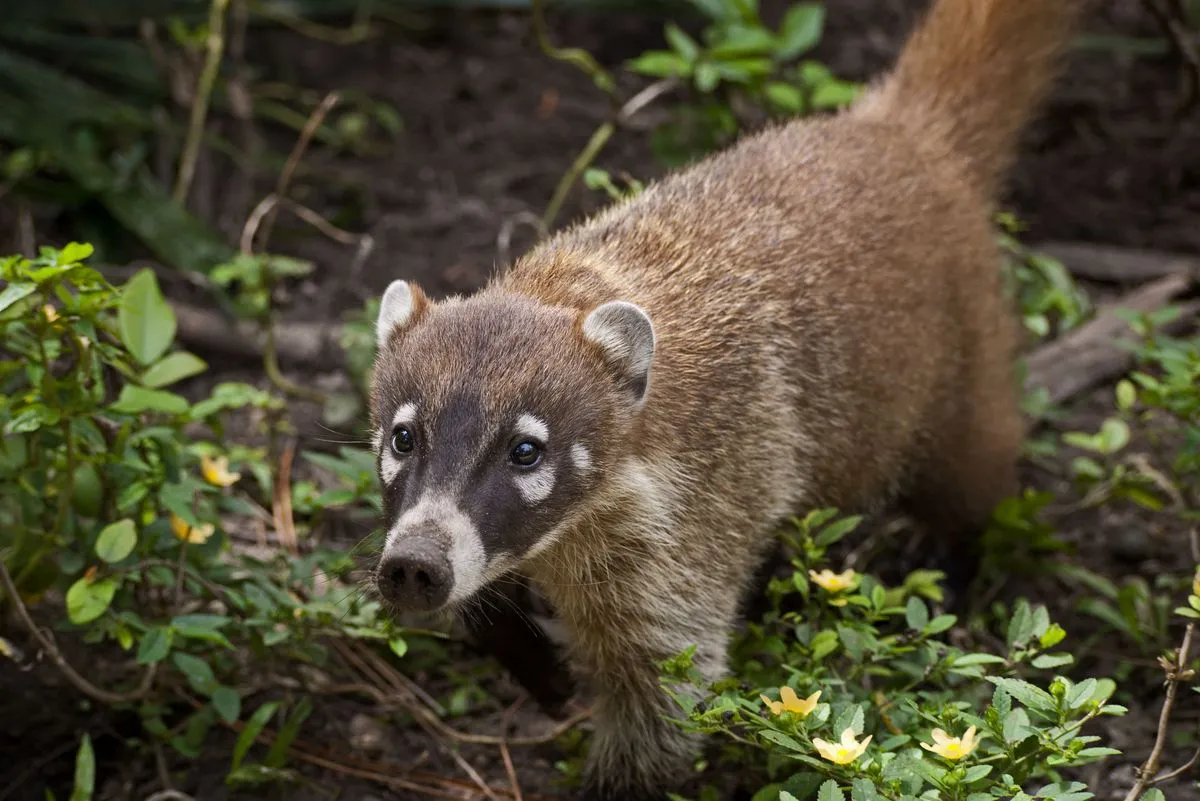
coati

Okay, maybe it’s not one animal but a family.. but hear me out!!

Raccoons and coatis.

There’s something in the procyonidae family that scratches my itch. Maybe it’s the usually ringed long tails or interesting snouts.

How I found out about them? I actually don’t know, I haven’t seen any yet, and that’s on my bucket list. sigh. Raccoons aren’t a very popular animated character choice so it’s definitely not that.

No, I haven’t watched guardians of the galaxy.

Fun fact: They mostly DO NOT “wash” their food, even though in german they are literally called “wash bears” - waschbär

“Research has shown that this food-dousing behavior only occurs in raccoons raised in captivity. In the wild, raccoons do not exhibit food-washing behavior, but search for aquatic prey by dabbling and feeling along the stream or pond bottom. Their paws contain highly developed nerves, and the water actually makes their paws more sensitive. Dabbling behavior in water is a fixed motor pattern in raccoons. Since only captive raccoons exhibit food- dousing behavior, scientists believe that washing food is simply a substitute for normal dabbling behavior, which has no other outlet in captivity. Raccoons have well-developed salivary glands and have no need to wet their food before eating it.”

Source: https://www.pa.gov/content/dam/copapwp-pagov/en/pgc/documents/wildlife/wildlifenotesindex/raccoon.pdf

In captivity, water is immediately next to food. So the raccoon’s instinctive foraging motor pattern gets triggered, and it dunks the food. Food dunking in captivity is a shore foraging instinct. The claim that this is strictly a captivity-only behavior is slightly overstated though. Wild raccoons near predictable urban food sources have been observed doing it too. Captivity just artificially creates the triggering conditions all the time. In cities, carrying food to the nearest puddle or drain would cost extra energy and increase risk of exposure to humans or predators. (Also the water would be too shallow in most cases) But if they had a bucket of water next to the food in a city, they probably would dip it in, I guess. And the increased sensitivity of the paws is a benefit of the instinct (which likely contributed to the evolution of the motor pattern), but it does not fully explain the expression of the behaviour​​​​​​​​​​​​​​​​.

Check out the rest or the bearblog’s carnival participants articles!! They are really fun :]


Enjoyed the article? Subscribe to my RSS feed :D
https://racc.blog/my-favourite-unconventional-animal-procyonidaes/
What is value, and is there a way to measure it objectively?
2026
Show full content

What makes something valuable? A painting may remain overlooked for centuries before selling for millions after its creator's death. People have been owned, traded, or inherited, and a dog can be assigned a price.

The easy answer is that value is subjective. One man’s trash, another man’s treasure. Right? We don’t all want or need the same things, so value is just a matter of preference with a price tag.

But price and value are not the same thing. Price tells you what people are willing to pay. It does not tell you what something ought to be worth. And that difference matters. Because if value is only preference, then there is no stable way to explain why some things should never be treated as mere commodities. Slavery was once widely accepted and efficiently priced. Calling it wrong requires more than pointing out that preferences have changed.

So what is value then? I see it as a measure of importance. And price as our attempt to translate that importance into numbers. It’s a common language that lets us trade, compare, and exchange. For most things, this works well enough. A Rimowa suitcase costs ten times more than a generic one that does the same job. Difference isn’t function, but it’s about showing status and identity. Relative importance, priced accordingly. The system is imperfect, but it remains in place.

The problem starts when we move from things to living beings.

A dog in a pet shop has a price tag. It feels wrong when you think about it, though we don’t do anything about it. It feels wrong because a dog isn’t just a thing with features and a function. It can suffer. It can feel fear and attachment. It has, in some sense, a stake in its own existence. And we sense, even if we can’t articulate it, that this puts it in a different category than a suitcase.

But then, why is a fish cheaper than a dog? We price them both. And most of us feel, without quite admitting it, that a dog's life matters more than fish's. That intuition isn’t random. It follows how much a creature can actually experience - how much it can suffer, or want, or be afraid. The more of that a creature has, the more wrong it feels to reduce it down to a number.

But sometimes we don't have a choice.

Picture a mother having to make a choice whether sacrificing one daughter is better than having them both die. Conjoined twins, and a surgery that can only save one. Implicitly or explicitly, a calculation is being made. Not out of cruelty, but of necessity. And that’s what makes it the hardest version of the problem. Pricing life isn’t always something we can opt out of by being more ethical. Sometimes reality forces the question.

The scenario I’m talking about really happened.1 In 2000, a British court authorised the separation of conjoined twins, Jodie and Mary, knowing it would kill Mary. The judges admitted the decision was exceptionally difficult. Their conclusion wasn’t that Mary’s life was worth less than Jodie’s. It was narrower than that: without separation, both would die within 3-6 months. The surgery wasn’t framed as choosing one life over another, but as choosing one life over none. Even under extreme pressure, the court avoided saying one life was more valuable than the other, even though the outcome depended on treating them as if one were.

And yet a calculation was made. A life ended. Whatever language you use around it, that is what happened.

So, is there a way to measure value objectively? No. And I don’t think there ever will be. A number can tell you what someone was willing to pay. It can’t tell you what something was worth. And the difference between those two things is where the complexity of this subject lies.


Enjoyed the article? Subscribe to my RSS feed :D
  1. https://www.globalhealthrights.org/wp-content/uploads/2013/03/EWCA-2000-In-re-A-Children.pdf

https://racc.blog/what-is-value-and-is-there-a-way-to-measure-it-objectively/
A cup of tea left on the counter
2026
Show full content

I was brushing my teeth, getting ready to leave.

I walked into the kitchen and saw my cup of tea, which I had completely forgotten about.

It stood there, waiting until it became cold.

Tea bag still inside, waiting for me to take it out and throw it away.

I looked at it with pity for a while, and I went to finish getting ready, because I knew I was at the point of no return.

But I thought about it, and came up with the conclusion that it’s a perfect metaphor for something. I didn’t know for what, but I knew it was something that I had to find out.

I came back home and saw the tea, still anticipating its finale. I poured it down the sink and threw away the tea bag mechanically, with no emotions. No guilt, no sadness, no frustration. Nothing.

The metaphor evaporated with the water. I had spent the day thinking there was something to learn from the forgotten tea, some insight waiting to be extracted. But when I finally dealt with it, I felt oddly indifferent. No disappointment, no amusement. Just a dull emptiness I hadn’t expected. I watched the tea swirl away, and realised there was nothing. Just a bag in the trash and an empty cup.

Not everything that feels significant actually is. Sometimes you just forget, and life goes on, and the meaning you were searching for was never there to begin with.

Sometimes tea is just tea, apparently.

But I'll keep looking anyway. I can't help it. This is just how I see.


Enjoyed the article? Subscribe to my RSS feed :D
https://racc.blog/a-cup-of-tea-left-on-the-counter/
People with screens bigger than 1470x956, I’m sorry
2026
Show full content

I was blissfully unaware of how my site looks on bigger screens than my 13-inch macbook’s one.

Well, today that changed. Now content scales up on screens over 1920px and over 2560px

I apologise for making my content unreadable :] I hope it looks better now!

If there are still issues please contact me!!!

https://racc.blog/people-with-screens-bigger-than-1470x956-im-sorry/
Investing in war and its ethics
2026
Show full content

For the last few days, I was fighting with my feed on TikTok. No matter how many times I clicked “not interested” it remained the same, pushing the same shit over and over. It was full of day trading and “best stocks to invest in right now!” content.

Most of the “best" stocks contained:

  • $RTX (Raytheon)
  • $PLTR (Palantir)
  • $KTOS (Kratos Defense)
  • $GD (General Dynamics)
  • $LMT (Lockheed Martin)

… and so on.

You get the point - “defence” systems, autonomous warfare, missiles, and aircrafts.

Does your stock portfolio consist of any of those aforementioned? If it does, you’re probably satisfied with your investments and the profits they've brought you. Well, congratulations, enjoy the money.

But is investing in war ethical?

Some would argue that investing in war stocks supports national security, or that it stabilises the portfolio in turbulent times. Missile defence or air-defence systems are designed to prevent attacks or reduce casualties. Under that view, investment supports the ability of countries to defend themselves rather than encouraging war.

However, the justification for these companies’ products depends on the assumption that conflict is inevitable, while they manufacture the very weapons that create the possibility of war.

Investing in companies that produce weapons used in wars, causing destruction and civilian harm, should never be considered neutral or even patriotic. Profiting from these stocks means financially benefiting from violence and conflict.

Some might say, "I only have a $1,000 investment - I don’t influence anything anyways" True, your individual impact is small, but collectively, shareholders sustain these companies and enable the continued production of weapons.

Would you be proud telling people “Yes, I earn money because people in another country are being torn apart by missiles manufactured by the company I invested in.”?

Could you sleep at night knowing that your investment helped to develop a drone that blew someone’s father’s head off?1

Even if defence companies claim to provide security or deterrence, the scale of profit incentivises the production of even more lethal systems.

If you care about where your money goes, consider redirecting investments toward companies that advance renewable energy, preserve wildlife, and support social development, or use your shareholder voice to push for ethical practices

Profit should never come at the cost of someone else’s life.

Fuck war.


Subscribe to my RSS feed

  1. While buying a stock doesn’t directly fund a drone, it supports the company’s overall growth and profitability, which enables the continued production of weapons. Major shareholders can influence company decisions through voting, proposals, or pressure on management, but for large defence contractors, this influence rarely changes core weapons production, which is primarily driven by long-term government contracts.

https://racc.blog/investing-in-war-and-its-ethics/
My favourite memes
2026
Show full content

March’s bearblog carnival topic is “Your favourite meme”, hosted by Suliman!!

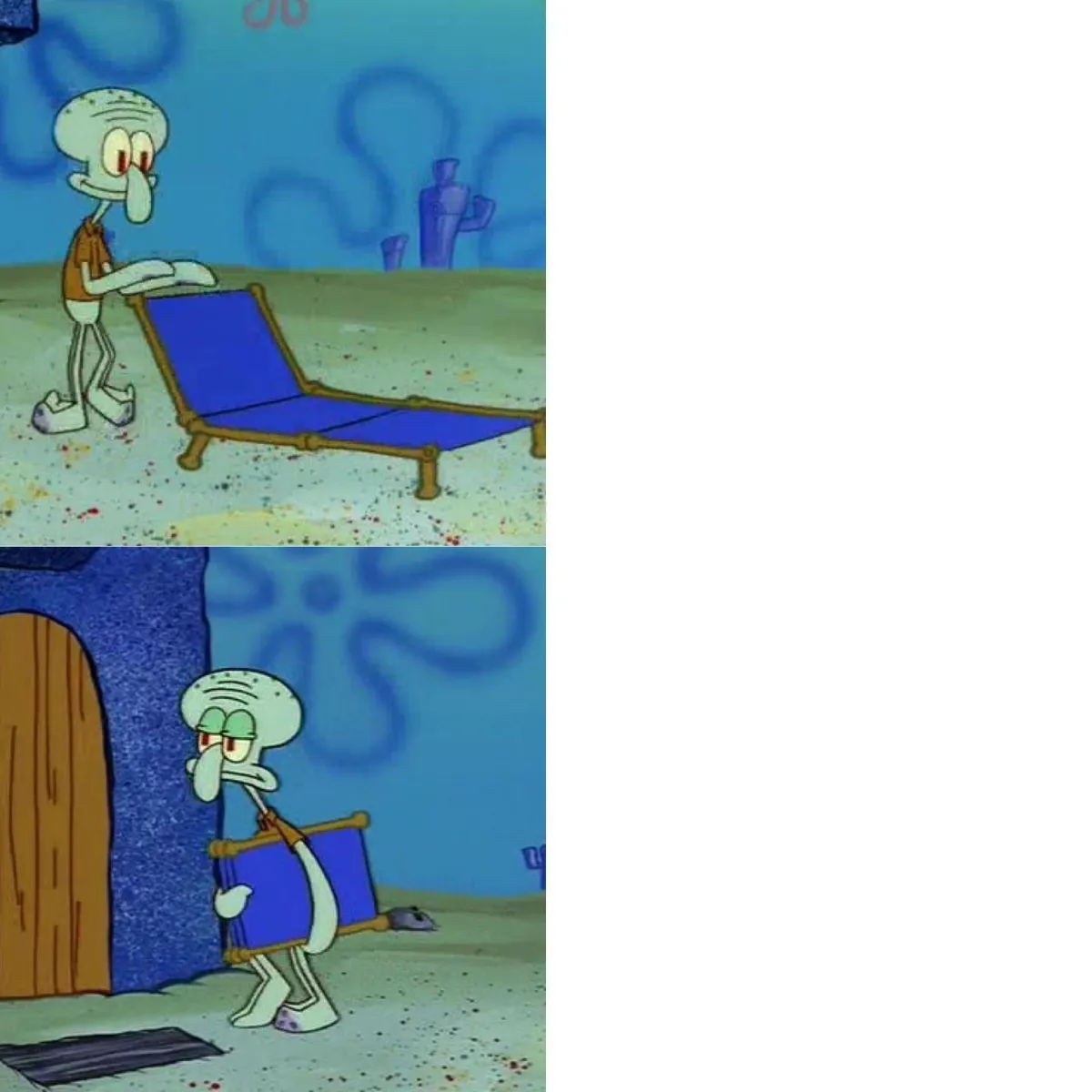
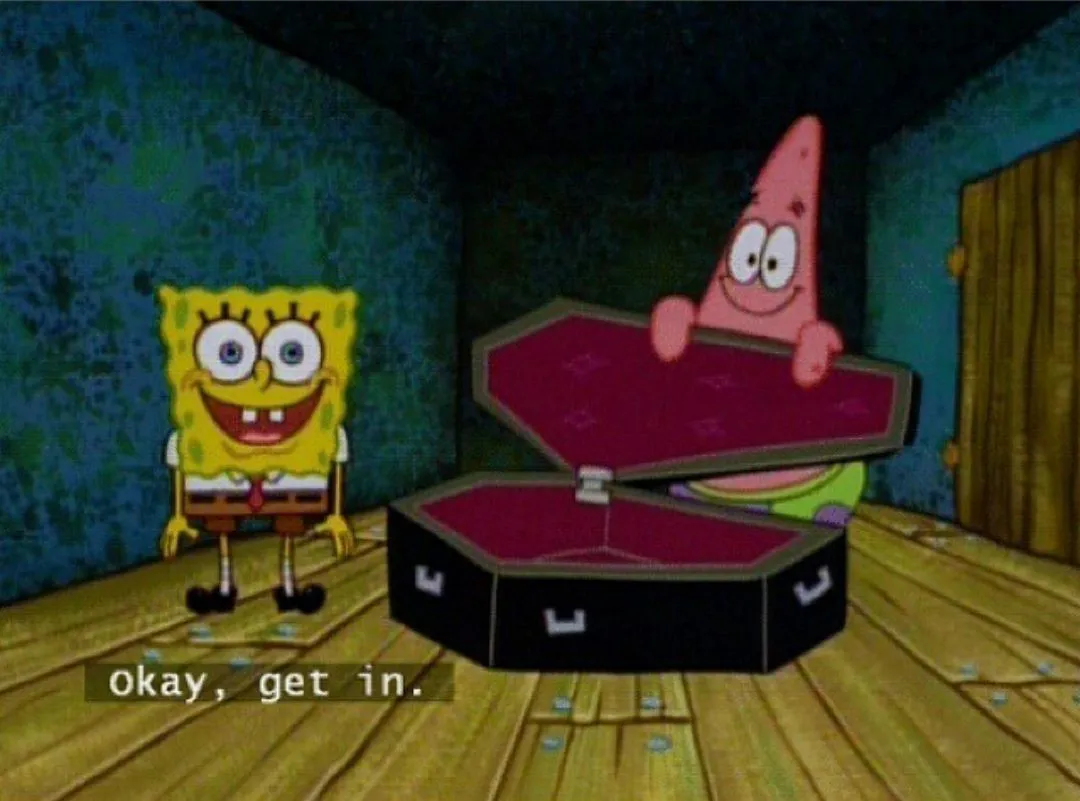
After I saw this month’s topic I instantly knew exactly what I will be writing about. And it’sssss *drumroll and suspense* Spongebob memes! I love Spongebob and I love memes, so I took my chance and decided to write about this silly guy ;]

God, I love this cartoon. Seasons 1-3 especially (before Stephen Hillenburg stepped away from being the show-runner1) up to the season 7. Why only up to the season 7? Because after that it became enshittified. The humour became for the most part well.. non-existent or totally imbecilic. And the episodes, repetitive or just plain boring. It lost its early seasons charm, where everything felt idyllic. Where you could feel immersed in what’s happening. Anyways, enough of my feelings about how it is currently and how it was. Time to get to the point before I get lost in my TED talk about him2, and that is - memes.

There is a crazy amount of memes coming from Spongebob, and I think this is because the faces are often exaggerated and instantly readable! I’ll list some of my favourite frames and their origin:

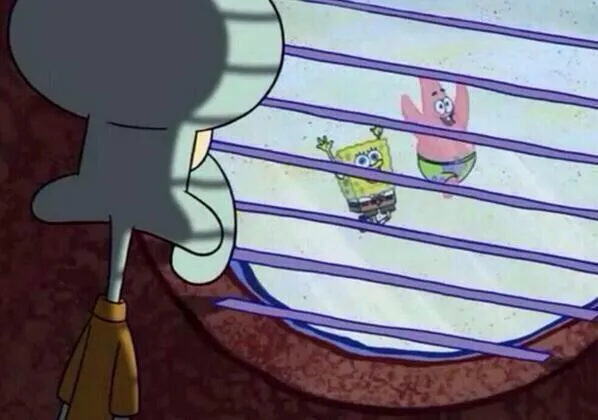
sp-window

S7E18 - "That Sinking Feeling"

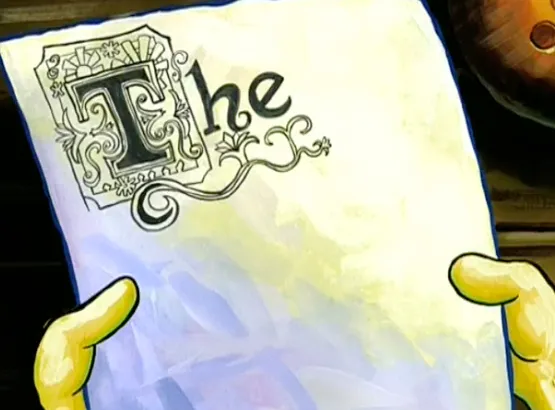
sp-the

S2E17 - “Procrastination"

sp-squid

S1E16 - “The Paper"

sp-get

S1E11 - "Squidward the Unfriendly Ghost"

P.S: Sorry Suliman for listing more than 3!! xoxo


Enjoyed the article? Subscribe to my RSS feed :D

  1. The SpongeBob SquarePants Movie (2004) was supposed to be the finale of show

  2. Did I mention that I love this cartoon called “Spongebob Squarepants”?

https://racc.blog/my-favourite-memes/
What is freedom?
2026
Show full content

In the broadest sense, freedom is the ability to act or not act as we choose, within the limits that we set for ourselves, or that are set for us by external factors. For example something as trivial as choosing what to eat for lunch is an everyday expression of freedom. This illustrates how freedom always exists within boundaries, both self-imposed and external, as we try to balance our preferences and desires with considerations such as health, budget, and societal pressures.

Freedom comes down to three aspects:

  1. Freedom of choice - the ability to decide between various options without external coercion.
  2. Freedom of action - the ability to implement chosen options, acting in accordance with one's own beliefs and goals.
  3. Inner freedom - autonomy of thought and emotion, the freedom to be oneself without pressure or manipulation.

Freedom can mean different things to different people. Cultural background, personal values, and life circumstances shape how individuals experience and prioritise these aspects, so any definition must remain flexible. For a terminally ill patient, freedom might mean pursuing aggressive treatment in line with their will, or choosing palliative care to die with dignity. However, in such decisions, freedom is unevenly distributed: access to quality healthcare, financial resources, and supportive family or social networks can heavily shape which options are realistically available, so some patients face constraints that others never encounter.

Aspect of Freedom Example in a terminally ill patient Freedom of choice The patient decides between available treatment options or chooses palliative care. Freedom of action The patient is able to carry out that decision by accessing care or arranging their environment to support their wishes. Inner freedom The patient reflects on personal values, beliefs, and acceptance of mortality, making a choice aligned with their authentic self rather than external pressure. Are we ever truly free?

However, if freedom is always shaped and limited by external and internal forces, including the freedom of others, law, responsibility, societal norms, and conscience, the question arises whether we are ever truly free.

At first sight, it may seem that the existence of law, social expectations, and the freedom of others reduces our autonomy. Yet, a world without such limits would not necessarily mean more freedom. Without legal boundaries, the stronger would dominate the weaker, and what would appear as “absolute freedom” would quickly turn into chaos or oppression. In this sense, certain limits do not destroy freedom, but make its coexistence possible. John Stuart Mill defended the idea that liberty should extend only until it harms others, presenting a vision of an idealised society in which freedom survives only through structured constraints. It was a compelling vision, yet it underestimates the complexities of real social inequalities and human behaviour.

“The only purpose for which power can be rightfully exercised over any member of a civilised community, against his will, is to prevent harm to others.” - John Stuart Mill

However, the deeper challenge to freedom may not be external but internal. Sometimes it is a habit that quietly steers us, a bias picked up long ago, or an old fear making us doubt just as we consider a new path. Even when no one forces us, our choices are inherently shaped by our upbringing, biology, culture, and personal experiences. These inner forces can be as constraining as any external rule, though they get often overlooked.

In this sense, freedom is not all or nothing. It depends on how aware we are of our choices and the world around us. Even with limits set by society, circumstances, or our own minds, true freedom comes from acting in line with our values and understanding how our situation shapes what we can do.


Enjoyed the article? Subscribe to my RSS feed :D

https://racc.blog/what-is-freedom/
The stars don’t compete, yet each one shines
2026
Show full content

This article is inspired by Maximus's article about putting other people down

In his article, Maximus observes that many people put others down because they do not understand the effort behind growth. There is truth in that observation. It is easier to criticise than to create. It is easier to mock ambition than to risk failure. While this may explain some instances of spite, I think that the cause of criticism lies deeper. Sometimes it comes from feeling threatened, sometimes from insecurity, and sometimes from living with a belief that everyone is their competitor.

Like stars in the sky, each person has their own “light". One person’s shine does not make another’s fade, yet people often act as if success is a limited resource. When success is seen this way, another person’s achievement can feel threatening or diminishing. With a growth oriented approach however, success can instead be inspiring. It can be a sign of what is possible, rather than something to envy. By focusing on oneself, people can let others’ achievements inspire their own.

Growth comes from focusing on what one can build, not on what others lack. Stars do not burn brighter by extinguishing one another. Their brilliance comes from what is happening inside them, and human effort works the same way. Energy spent trying to diminish others is energy lost. The same one that could have gone toward developing skills.

But, not all criticism is spiteful, and not all competition is destructive. Constructive feedback can guide growth, and healthy rivalry can benefit both parties. But when a sense of self becomes tied to comparison, and when applause for others feels like a loss, it destroys the potential that one could have.

Some never clap for others, and that is why it will never be their turn.


Enjoyed the article? Subscribe to my RSS feed :D

https://racc.blog/the-stars-dont-compete-yet-each-one-shines/