GeistHaus
log in · sign up

Orson Cart – at large

Part of wordpress.com

Carriage building, driving and general horsing around in country Victoria

stories
A Vardo – Part Eight
Carriage Buildingawninglouvrespan boxstepstarpvardo
With the roof and mollicroft completed, and no more up-and-downing the step ladder, I felt it safe to put the rear wheels on. This revealed the true size of the cavernous area delineated by the rear underbody, rear axle and … Continue reading →
Show full content

With the roof and mollicroft completed, and no more up-and-downing the step ladder, I felt it safe to put the rear wheels on. This revealed the true size of the cavernous area delineated by the rear underbody, rear axle and rear wheels into which I wanted to suspend the pan box. Pan boxes were traditionally employed to house the greasy pans and other grimy cooking paraphernalia essential to everyday life on the road.

I have more modern and compact cooking arrangements. I do, however, still have a penchant for bacon, sausages, steak and the odd cold cider of an evening, so my ‘pan’ box will accommodate a 95-litre fridge/freezer (figures 1, 2 & 3) to sustain me whilst out and about.

Fig. 1. “It fits; I’ll take it!”

The pan box is suspended beneath the floor by four lengths of all-thread (figure 2).

Fig. 2. A length of 3/8” all-thread in each corner supports the pan box.

Fig. 3. “A man’s not a camel”.

Next job was the shutters, which were quite straightforward; just the louvres required a fair amount of time to shape and fit (figure 4).

Fig. 4. A handful of the pine louvres.

The shutters slide, top and bottom, in the channels behind the top wriggle (weather) boards and the mid wriggle boards (figure 5).

Fig. 5. Finished louvered shutters.

The shutters are prevented from sliding open too far by wooden stops (figure 6), and conversely, are held in the closed position, whilst travelling, by short (yet-to-be-decorated) sticks placed in the channels between the shutters and the shutter stops.

Fig. 6. Red shutter stop.

The steps, of course, needed sanding – not, as you might imagine, with a cork block and some 120-grit paper, but with three more coats of buttermilk paint and a bucket of sand from Ninety Mile Beach.

I lit a good fire in the shop’s wood stove, filled a baking tray with sand and placed it over the heat. Whilst the sand was drying, I masked each tread – and the vardo’s footboard. Beginning with the bottom tread, I applied a goodly coat of paint to the masked area and drizzled the dry sand over the paint, pressing it down. I repeated the process up the steps and sanded the footboard too. Once the paint had dried, I brushed off the surplus sand and each step was treated to two additional coats of paint to seal the sand in (figures 7, 8 & 9).

Fig. 7. “Sanded” steps…

Fig. 8. … and footboard.

Fig. 9. Non-slip entrance.

Fig. 10. Steps stowed for travel.

I recently had an overflow of visitors staying with me for a night, so I gladly offered up my own bed to some of the guests. I’m not normally that generous, but it presented the opportunity to try out the new mattress in the vardo. I didn’t think to apply the brakes (with the vardo standing on the smooth shed floor), so there was a rather uneasy swaying motion every time I rolled over during the night. Other than that, I was very comfortable.

To provide accommodation for any accompanying guests whilst I’m on the road, or when pulled up for the day, I have equipped the vardo with a 3.7m x 3m (12’ 1-5/8” x 9’ 10”) canvas awning which can be configured in two ways: As a straightforward awning (figure 11), or with half the roof area and a vertical “wall” to create a virtual room for campers.

Fig. 11. A useful sitoutery.

When not in use, the canvas can be stowed beneath my bed and the extendable aluminium poles are secured in the tall cupboard with lengths of Velcro tape, screwed to the cupboard’s interior. (figure 12).

Fig. 12. Awning poles secured for travel.

The removable cratch is hooked into eyes at the bottom rear of the body and supported by chains, clips and eyes at the top. The chains are doubled up for travel to prevent them slapping around, unduly damaging the paintwork (figure 13) and are adjustable anywhere between that, and the cratch laying horizontally (figure 14).  

Fig.13. Cratch chained up for travelling…

Fig.14. … and lowered.

There is also a canvas cover for the cratch to protect luggage such as harness and hay etc. from the elements (figure 15).

Fig. 15. Protective tarp over the cratch.

Inside, the seats and cushions are all finished (figure 16), as are the under-bed drawers (behind the bed-cupboard doors). The battery and battery-controller (for the flexible solar panels on the roof) reside in the shorter under-seat storage.

Fig. 16. Completed seating.

Fig. 17. First time out in the winter sun.

Fig. 18. Time to go back in the shed – for now.

My total hours involved to-date come to 2,237.25.


Orson

orsoncartatlarge
http://orsoncartatlarge.wordpress.com/?p=631
Extensions
A Vardo – Part Seven
Carriage Buildingcanvaslockmollicroftstepsweatherboardswindows
Regular readers will have previously seen the lock and wheels etc. upside down in A Vardo – Part Four, but now that I have it all painted (figure 1), it’s constantly in the way and easily damaged. I decided, therefore, … Continue reading →
Show full content

Regular readers will have previously seen the lock and wheels etc. upside down in A Vardo – Part Four, but now that I have it all painted (figure 1), it’s constantly in the way and easily damaged. I decided, therefore, to lift the vardo up and install the lock in its rightful place (figure 2).

Fig. 1. Carefully assembling the painted lock and wheels.

Fig. 2. Bugger! Now I need a taller stepladder.

Vardos traditionally employ vertical sliding sash windows – with a difference. Because wooden vardo walls are essentially a very meagre 1-1/2″ thick (1″ ribs + 1/2penny boards), there is little space for conventional casings and counterweights – at any rate, heavy cast iron weights swinging around on the ends of their cords would likely smash the casements apart whilst travelling the roads. Therefore, the upper sashes are permanently fixed in the frames and only the lower sashes open vertically and are supported at the chosen height by a stick or other prop (figures 3 & 4).

Fig. 3. Trial fitting one of the windows.

Fig. 4. Lower sash supported by temporary stick.

During another go-slow whilst waiting for paint to dry, I decided to tackle the steps (figure 5).

Fig. 5. Pine steps…

Fig. 6. …with their tension rods, and knots all shellacked.

Fig. 6. …and painted.

Then shortly before Christmas, the 100% waterproof 12oz / 535gsm military grade DX12 canvas arrived, so I attached it to the roof with stainless steel staples before someone used it to line a newly dug goldfish pond.

Fig. 7. The roof all sheeted.

I then made up the ‘hockey stick’ weather boards (figure 8) that cover the staples and canvas along the top edges of the mollicroft.

Fig. 8. Narrow two-part mollicroft weather boards.

My total hours involved to-date come to 1,795.75.

Wise Nancy

I knew Nancy as a very kind and gentle soul who lived with her aged mother in a picture postcard thatched cottage not far from my own home in Northern Ireland. She was acutely clairvoyant.

“Wise” Nancy didn’t possess a telephone, yet any time I dropped in on her, she’d have tea in the pot and the table laid out with sandwiches and freshly baked comestibles. And every Christmas Nancy would present me with a perfectly-fitting, hand-knitted pair of socks – yet she never once asked my shoe size.

In late 2000, I flew to England for a few weeks break and whilst there, I caught a ferry back to Northern Ireland one day to bid a last farewell to an ailing aunt.

I hadn’t seen Nancy for about eight years, so on the spur of the moment, I decided to call in and see her before I caught the return ferry. When I arrived, she was waiting for me by the gate at the end of her tree-lined drive, wearing a pretty dress and a smidgen of red lipstick. She still made a good strong cup of tea and wonderful Victoria sponge cake – my favourite.

Orson

orsoncartatlarge
http://orsoncartatlarge.wordpress.com/?p=601
Extensions
What the Hell am I doing Wrong?
Carriage Buildingvardo
A vardo in a week‽ Image 1. These pictures show a week in the life of a clever gypsy whom the editor of this magazine met in a strawberry field in Kent. He builds his caravans chiefly with his knife, … Continue reading →
Show full content

A vardo in a week‽

Image 1. These pictures show a week in the life of a clever gypsy whom the editor of this magazine met in a strawberry field in Kent. He builds his caravans chiefly with his knife, as we see him doing here, by the fire of the gypsy camp.

Image 2. Buying his wood from a local builder, or picking it up as he goes along, he shapes it rapidly to his purpose. Here he is shaping his caravan, putting into place the strong supports to which all the other pieces must be fixed.

Image 3. By the end of the second day our clever builder has almost finished the skeleton of his little home, and his happy family sit by, watching the progress of the house in which they are to live. Our gypsy, until last year, had never slept inside a house, and could only get to sleep then by putting up his tent in the bedroom.

Image 4. At the end of the fourth day the roof is on and the floor is laid, and the caravan now needs only doors and windows to protect it from the rain, and wheels to carry it along the road. The wheels can easily be bought in Kent.

Images 5 & 6. Our gypsy has a merry heart, and his work is a pleasure to him ; but the pleasure grows as he nears the end of his week’s labour, harnessing his horse, housing his family, and setting out for the first journey in his new home.

Image 7. At last they reach their camping-place, and a happy family it is that gathers round the fire and waits for the dinner to boil. The grandfather and father of our builder were gypsies, and his children will be gypsies too, always on the move, but always happy – or nearly always happy – and always, let us hope, as honest as a gypsy should be.

Orson

orsoncartatlarge
http://orsoncartatlarge.wordpress.com/?p=596
Extensions
Season’s Greetings
DistractionsChristmas 2024
Whatever your persuasion and situation, I wish you all well during the festive season. Santa Clause under attack from those pesky rabbits, circa 1565. Orson Cart
Show full content

Whatever your persuasion and situation, I wish you all well during the festive season.

Santa Clause under attack from those pesky rabbits, circa 1565.

Orson Cart

orsoncartatlarge
http://orsoncartatlarge.wordpress.com/?p=591
Extensions
A Vardo – Part Six
Carriage Buildingbracketlockmollicroft
I attached the roof panels to the mollicroft frame, undercoated it all (figure 1) and then hoisted the whole thing atop the body and fixed it to the two end-wall rafters (figure 2). Fig. 1. The mollicroft ready for installation… … Continue reading →
Show full content

I attached the roof panels to the mollicroft frame, undercoated it all (figure 1) and then hoisted the whole thing atop the body and fixed it to the two end-wall rafters (figure 2).

Fig. 1. The mollicroft ready for installation…

Fig. 2. … and screwed to the end rafters.

I made up the short side rafters (figure 3), which are attached to the top wall plate at their outer ends and to the ledge along the bottom of the mollicroft at their inner ends (figure 4).

Fig. 3. Side rafters, primed and undercoated.

The crown boards were installed next, thereby finishing off the end walls (figures 4 & 5).

Fig. 4. Front and rear crown boards installed.

Lining boards were nailed onto the rafters, completing the roof structure (figures 5 & 6).

Fig. 5. The roof, sealed…

Fig. 6. … and viewed from the inside.

I cut and fretted the front and rear brackets out of mahogany and screwed them to the corner stanchions and top wall plates (figures 7 & 8).

Fig. 7. Front brackets in white (first coat) undercoat…

Fig. 8. … and scaled-down rear brackets.

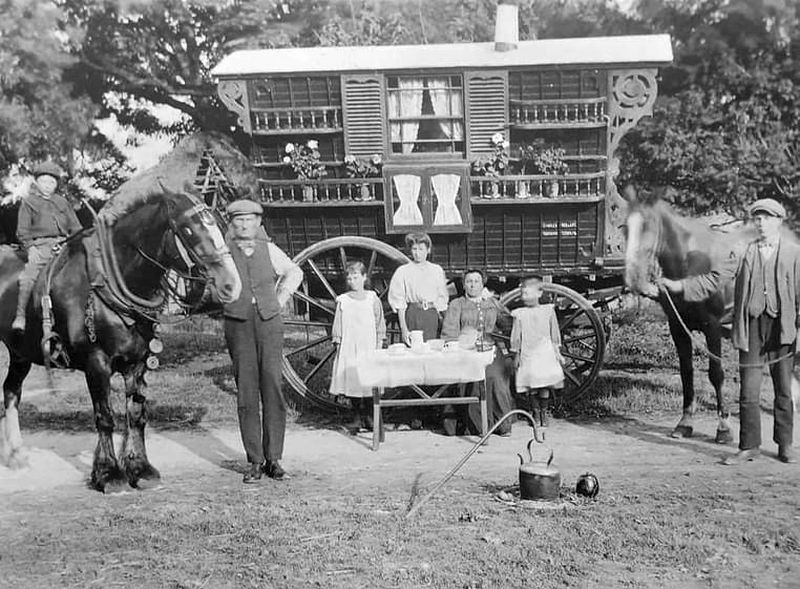
The bed arrangement commonly found in vardos comprises a raised slatted base supporting a mattress (where the family elders would have traditionally slept), over a large cupboard (the grandchildren’s accommodation: Their mother and father would most likely have slept beneath the wagon or, if there were babies and toddlers, in a bender close by – figure 9).

Fig. 9. Living out of a bender.

I made the castellated mattress slat supports and nailed them to the vardo walls at the appropriate height in the rear of the vardo (three of them just visible, with the front one loose on top of the rearmost in figure 6).

The front bed framework – which retains the mattress and accommodates the cupboard aperture – was made up and installed (figure 10).

Fig. 10. Bed front with cupboard access and bench seat supports attached.

There has been fervorous activity going on elsewhere viz. the construction of the ‘kitchen’ cabinet and seating etc., however, with paint brush in hand, I am endeavouring (figures 11 & 12) to keep abreast of my friend Derek who has been wandering round, lining anything and everything that looks like it may belong to the vardo (figures 13, 14 & 15).

Fig. 11. One coat of primer, two of undercoat…

Fig. 12. … and ye Gods! The first of three gloss coats. It must be the late afternoon light: In reality, the green is somewhat darker; per figure 7, above.

Fig. 13. Derek started lining the lock.

Fig. 14. He also found one of the front wheels…

Fig. 15. … and close-up.

My total hours involved to-date come to 1,404.5.

Orson

orsoncartatlarge
http://orsoncartatlarge.wordpress.com/?p=551
Extensions
Jinker Tinkering – Part One
Carriage Buildingaxlebrakejinkerpigtailshaft joinerthree-spring platformvardo
As often happens, life gets in the way of one’s agenda and, as a result, work on the vardo hit a hiatus late last December. Then just when I was about to commence the vardo’s interior, the Old Green Jinker … Continue reading →
Show full content

As often happens, life gets in the way of one’s agenda and, as a result, work on the vardo hit a hiatus late last December. Then just when I was about to commence the vardo’s interior, the Old Green Jinker (my 1890s two-wheeled horse-drawn daily runabout) decided to self-destruct. It served me well over the years but had reached a point where restoration was no longer practical (figure 1).

Fig. 1. Replaced shafts, missing mudguard, shot tyres and wobbly wheels.

It had long been my intention to build a new brake (a two-wheeler with very long shafts, for breaking horses to harness), but I more urgently required a new jinker – and just like that, the afflatus hit me! “I shall build a dual-purpose jinker-cum-brake!”

There was little worth salvaging from the OGJ other than the spring hangers and three-spring platform which I removed. Then I began exploring materials and tinkering with dimensions. Jinkers are light and manoeuvrable, whilst brakes are necessarily large, strong vehicles capable of withstanding the shenanigans of boisterous young horses learning the ropes. The new cart had to be fairly light, flexible, immensely strong, and with interchangeable short and long shafts. That’s a big ask of any timber. Too big, I felt.

I broke out my trusty abacus and after nutting out a few quick sums, I decided on building the new cart predominantly out of steel. Making the shafts interchangeable would be easier with steel tube than with wood. Therefore, it followed the remainder of the frame should also be of hollow steel sections. The floor, I determined, should be of some hardwood or other to better resist foot wear, and the body should be constructed out of pine for lightness.

I settled on a modern approach to the construction – welding the steel and eschewing traditional coach bolts (where feasible) and square nuts in favour of stainless steel in-hex fasteners and self-locking hex nuts.

My horses range in size from 15.3hh to 17.2hh, so I require a fairly large vehicle. With a new brake in mind, I bought a pair of new 52” wheels at an auction about a year or so ago. Armed with a stick of chalk, I sketched out a brief design on the floor of the ‘shop and began cutting and bending lengths of steel.

The new axle came directly from a trailer parts manufacturer, complete with cable-operated mechanical brakes (I didn’t want to incorporate hydraulics on this build), though the beam is a somewhat hefty 40mm (1-9/16”) solid square bar. I also removed the axle saddles and spring plates from the OGJ’s 1-1/8” (28.6mm) square axle, both of which required modifying to fit the new, thicker axle. The saddles were simply filed until they fitted, but the axle plates necessitated cutting and widening (figures 2 & 3).

Fig. 2. Widened spring plate (reverse).

Fig. 3. Widened spring plate with bolt hole drilled (obverse).

Whilst stripping layers of paint off the old springs, I uncovered the name of their manufacturer (figure 4).

Fig. 4. ‘Goodwin & Co. Birmingham’.

I rummaged around in one of the stables and came across a pair of steps from an old farm cart which I modified to suit this application.

After that it was a simple case of bolting it all together and offering it up to Archie who was utterly nonplussed about the whole thing (figure 5).

Fig. 5. “It fits! I’ll take it.”.

This is a contemporary jinker, so why not adopt a fresh colour scheme (figure 6)?

Fig. 6. Perhaps now, motorists will give me a wide berth! (Photo: Able Assistant)

I also made a pair of clip bars and 270mm (10-5/8”) long clips with which to attach the rear spring pack to the rear crossmember (figure 7).

Fig. 7. Three-spring platform bolted up. (Photo: Able Assistant)

Due to the thicker axle, I also had to make new clip bars and pigtails (figure 8).

Fig.8. New pigtail.

The interchangeable shafts are attached by welded joints secured by pairs of socket screws (figure 9).

Fig. 9. Shaft joiner.

Orson Cart

orsoncartatlarge
http://orsoncartatlarge.wordpress.com/?p=506
Extensions
A Vardo – Part Five
Carriage Buildingmollicroftpenny boardsstanchionsvardo
To reduce the mass and make flipping the ‘unders’ right-side-up somewhat easier, the brakes and running gear were dismantled again and the lock was also removed. I then fixed the 6” x 7/8” tongue and groove floorboards to the summers … Continue reading →
Show full content

To reduce the mass and make flipping the ‘unders’ right-side-up somewhat easier, the brakes and running gear were dismantled again and the lock was also removed. I then fixed the 6” x 7/8” tongue and groove floorboards to the summers with cut nails and punched them in well before planing the floor smooth (figure 1). In the process, I made a small, unobtrusive removable panel by which I can withdraw the kingpin that secures the lock in place.

Fig. 1. Baltic pine floor installed.

I spent many hours preparing the stanchions, ribs and other components for the body of the vardo which all required numerous chamfers and mortices and tenons (figure 2).

Fig. 2. All ready for tomorrow!

The awkward first stage of the framework went together with little ado, due in large to Andrew, Jacko and Mikey who I enlisted to man a corner each and simultaneously slide the waist rails, door frame and stanchions etc. into their respective mortices (figure 3).

Fig. 3. The stanchions, door frame and lower side ribs in place.

After that, it was slow but relatively plain sailing, with Mikey, to assemble the remaining framework (figures 4 & 5).

Fig. 4. “Ah… you’re nearly finished.” said someone.  

Fig. 5. “It’s a crèche for a large Irishman.” said someone else.

There are three distinct types of rafters employed in the vardo: the major (full, front and rear rafters), which are constructed from three separate pieces, cut from the solid; the short rafters which prop up the mollicroft, and the mollicroft rafters (figure 6).

Fig. 6. Mollicroft rafters.

After a brief hiatus, Mikey returned to assist with gluing and nailing the lengths of 5-1/4” x 7/16” pine ‘penny boards’ onto the inside of the ribs (figures 7 & 8).

Fig. 7. Checking the level after installing each board.

Fig. 8. The body, fully clad.

I agonised at length during the planning stages of the vardo, whether to opt for a mollicroft or not. I’m not actually that fond of their appearance and I much prefer the cleaner rooflines of those kite vardos without a clerestory (figure 9).

Fig. 9. Thomas Tong ledge vardo, sans mollicroft.

However, at six foot seven inches tall, a raised annex for my head, running the full length of the accommodation, should make camping trips an altogether more painless and enjoyable experience.

The sides of the mollicroft each comprise four ‘lights’ or windows: The centre lights are fixed panes, and the end lights are fitted with awning windows for ventilation. The side frame and awning window construction is unremarkable, simply employing standard joinery. I assembled the mollicroft rafters into the side frames and primed and undercoated the whole ahead of installation (figure 10).

Fig. 10. Mollicroft frame (atop the lock) awaiting Mikey’s next visit.

I also made a little headway with the bed. More on that in a future post.

The total hours involved to-date come to 1,149.

Orson

orsoncartatlarge
http://orsoncartatlarge.wordpress.com/?p=469
Extensions
A Vardo – Part Four
Carriage Buildingaxle caseaxleselmgatherskeinsswingT-bonesvardo
With the wheels completed, I was able to compare their dish, and thereby, offset, in relation to the undercarriage and (proposed) body, and thus establish the lengths of the two axles. Each axle comprises a pair of stub-axles that are … Continue reading →
Show full content

With the wheels completed, I was able to compare their dish, and thereby, offset, in relation to the undercarriage and (proposed) body, and thus establish the lengths of the two axles.

Each axle comprises a pair of stub-axles that are welded into the ends of a length of SHS (square hollow section). Both axles were nicked at their centres, bent to 4° and welded shut, to provide 2° ‘swing’ (negative camber, to you and me) at each wheel.

Contrary to lore, the primary purpose of swing is to ensure a plumb spoke (perpendicular to the ground) as the wheel rotates. Therefore, the spokes and felloes are not subjected to side-loads that could cause damage or catastrophic failure of the wheel. 
Secondly, an obvious benefit of equipping some wagons and carts with deeply dished wheels and large degrees of negative camber, is to accommodate ‘swelled’ bodies and greater payloads (figures 1 & 2).

Fig. 1. Hay wain with swelled body and heavily cambered wheels.

Fig. 2. A junket in a hay wain.

A third, and not immediately obvious advantage of canted wheels is that road dirt and shit is flung away from the vehicle and loquacious passengers with their mouths open.

Axle setting is a complex subject that also includes ‘gather’ (toe-in, in modern parlance) and has implications in the matter of wheels staying put. Gather is necessary to offset the propensity of swing to pull the front wheels outwards. Additionally, the actual bearing point of the axle (with the vehicle moving) is not at the bottom but is slightly ahead of this point. Consequently, the old skeins (huge bolt-on stub-axles), being tapered, caused the wheels to run hard against the nuts – with occasionally, predictable results. The correct amount of gather reversed this tendency, and the wheels on a properly set axle could be made to run against the shoulders of the skeins with minimal friction.

My wheels run on nice big, modern, tapered roller bearings, but even so, with 42” diameter front wheels, toe-in is definitely a necessity.

By bolting skeins to wooden axles, weight and precious iron were saved. When one-piece iron axles became the norm, large carts and wagons continued the traditional appearance by encasing the solid axles (on three sides) in wood. Axle cases are normally made of elm – as are the ones I made for the vardo (figure 3).

Fig. 3. Front and rear axle cases.

The axle cases and wheels were cleaned up and given the regulation quantities of primer and undercoat (figure 4).

Fig, 4. That’s two coats of primer and two of undercoat.

The vardo’s rear wheels sit outside the body for improved stability whilst the front track is narrower to reduce the effort required by the horse to turn the front axle. Conventional U-bolts secure the rear axle to its springs, but due to the necessity of the front wheels to turn under the body, in conjunction with axle width constraints, the front axle is secured to the front springs with T-bones (figures 5 & 6).

Fig. 5. Embryotic T-bone.

Fig. 6. Fully welded and undercoated T-bone.

Fig. 7. Axles and wheels bolted in place.

Vardo brakes are somewhat unusual in the realm of four-wheelers in that they are activated through the rotation of a hand wheel rather than by applying pressure to a foot pedal or hand lever. The result is ultimately the same: The handwheel turns a screw which pulls a rod that is connected to a lever, welded to the brake arm. The arm then rotates, pressing the brake blocks with their steel shoes onto the rear (rubber) tyres.

The hours involved in the work in this post come to 268.25.

The total hours involved to-date come to 537.5.

Orson

orsoncartatlarge
http://orsoncartatlarge.wordpress.com/?p=453
Extensions
Cock-Horses
DistractionsCock Horse Inncock-horse
Though not as plentiful as ‘Royal Oak’, ‘Red Lion’ or ‘King’s Arms’ inns and pubs along the highways and byways of England, there still remain a number of inns called ‘The Cock Horse’. Invariably situated at the bottom of a … Continue reading →
Show full content

Though not as plentiful as ‘Royal Oak’, ‘Red Lion’ or ‘King’s Arms’ inns and pubs along the highways and byways of England, there still remain a number of inns called ‘The Cock Horse’. Invariably situated at the bottom of a hill, cock-horse inns played an interesting and important role in the history of horse-drawn transport.

Before the canals and railways crisscrossed Britain, in the mid-eighteenth-century and early-nineteenth-century, respectively, travelers and goods were transported by horse-drawn stagecoaches and wagons. The roads were exceedingly poor, and the going was tough meaning travelers required frequent ‘topping up’. The horses also needed to be regularly fed and watered or, in the case of coach horses, replaced with fresh horses every ten to fifteen miles. The horses had a very hard life – no more so than when they encountered a steep hill. As a result, many of the coach inns were strategically located at the foot of great hills from where they hired cock-horses[i] to help draw the passing coaches and wagons up the hills.

The cock-horse was hired with a rider who would either hitch the horse to a spreader (figures 1 & 2), attached to the off-side front corner of a wagon, or put it in traces ahead of a coach’s lead horses (figure 3).

Fig. 1. A spreader attached to the front of a wagon.

Fig. 2. A cock-horse hitched to a spreader.

The White Hart Hotel on Bell Street, in Reigate is possibly the best-known establishment in England with a cock-horse. It was a busy staging point on the journey from London to Brighton, where the famous nineteenth-century cock-horse, Nimrod, worked Reigate Hill.

Fig. 3. Nimrod pulling up in front of The White Hart.

Once the hill was crested, the cock-horse’s rider would dismount at a given point (often a stone marker, similar to a milestone), unhitch the cock-horse and return to the inn yard whence it came (figure 4).

Fig. 4. Outside The White Hart, the cock-horse, left, returning to the stable yard.

Sadly, now a private dwelling, The Cock Horse Inn at Rowington (figure 5), situated on the Old Warwick Road in Warwickshire, used to keep a cock-horse for assisting coaches and wagons up Church Hill.

Fig. 5. The Cock Horse at Rowington.

The fourteenth-century Cock Horse in Detling, near Maidstone in Kent, stands at the foot of the North Downs along The Pilgrims Way, where the inn supplied cock-horses to peregrinate the steep escarpment.

All the cock-horse inns I’ve come across are located at the foot of a hill, with the exception of one. The Steamer (figure 6), in Hertfordshire, sits atop a steep hill on the London Road in Welwyn. The Steamer derives its name from the heavily-sweating horses, which, after helping draw a coach or wagon up the hill on a frosty morning, would stand, steaming in the cold air.

Fig. 6. The Steamer, Welwyn, Hertfordshire.

Fig. 7. Rider upon a cock-horse with traces and spreader slung across the horse’s back in readiness.

And of course, to this day, gypsies and travelers either bring their own cock-horse – or two (figure 8), or, when traveling in groups, borrow the horse from the second vardo in line and so on, and so on.

Fig. 8. Making progress with a cock-horse – and a spare.

Orson Cart


[i] “01.05.19.06.02.03|05.06.05.01.01 (n.) Horse defined by purpose :: draught-horse :: that pulls vehicle :: of specific type (miscellaneous) :: that pulls coach :: uphill.” The Historical Thesaurus of English. 2nd ed. (version 5.0), University of Glasgow, 2022. Web. 26 May 2022. https://ht.ac.uk/category/?id=37967.

orsoncartatlarge
http://orsoncartatlarge.wordpress.com/?p=431
Extensions
A Vardo – Part Three
Carriage Buildingcradlecratchleaf springspring hangervardo
My intention was to have the vardo finished by Christmas as I had planned a lengthy, scenic route for her maiden voyage this summer (I live in Australia now, remember?). Alas, though I am fairly well insulated against COVID-19, the … Continue reading →
Show full content

My intention was to have the vardo finished by Christmas as I had planned a lengthy, scenic route for her maiden voyage this summer (I live in Australia now, remember?). Alas, though I am fairly well insulated against COVID-19, the same cannot be said for the many suppliers and supply chains I rely on for parts and materials.

Needless to say, progress has been glacial. I had to paint the undercarriage anyway, as some of it would have been inaccessible with a paintbrush once assembled (no spray guns here!). But after weeks and weeks of applying two coats of oil-based primer, two oil-based undercoats and three top coats of oil-based gloss, I was again unemployed.

Rather than sitting around, bemoaning my predicament, I broke my own, self-imposed rules and constructed the basic shafts. I didn’t want to make the shafts until I was ready for them as otherwise, there’s the possibility that they’ll suffer some knocks and damage. Then the shafts received their seven coats of paint (figure 1), before they were moved to another shed out of harm’s way.

Fig. 1. Shafts, base and undercarriage all painted.

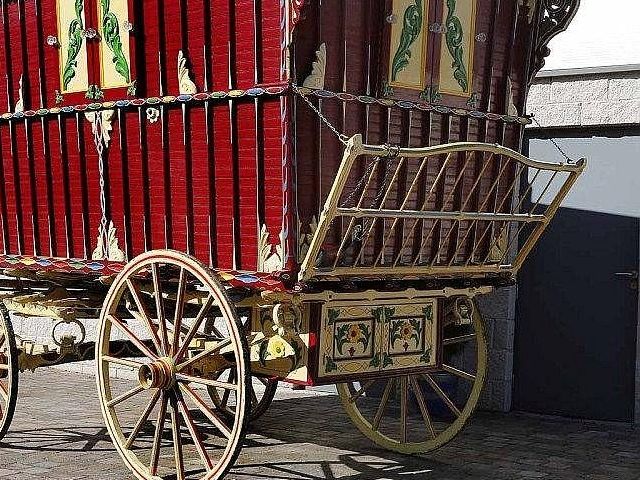
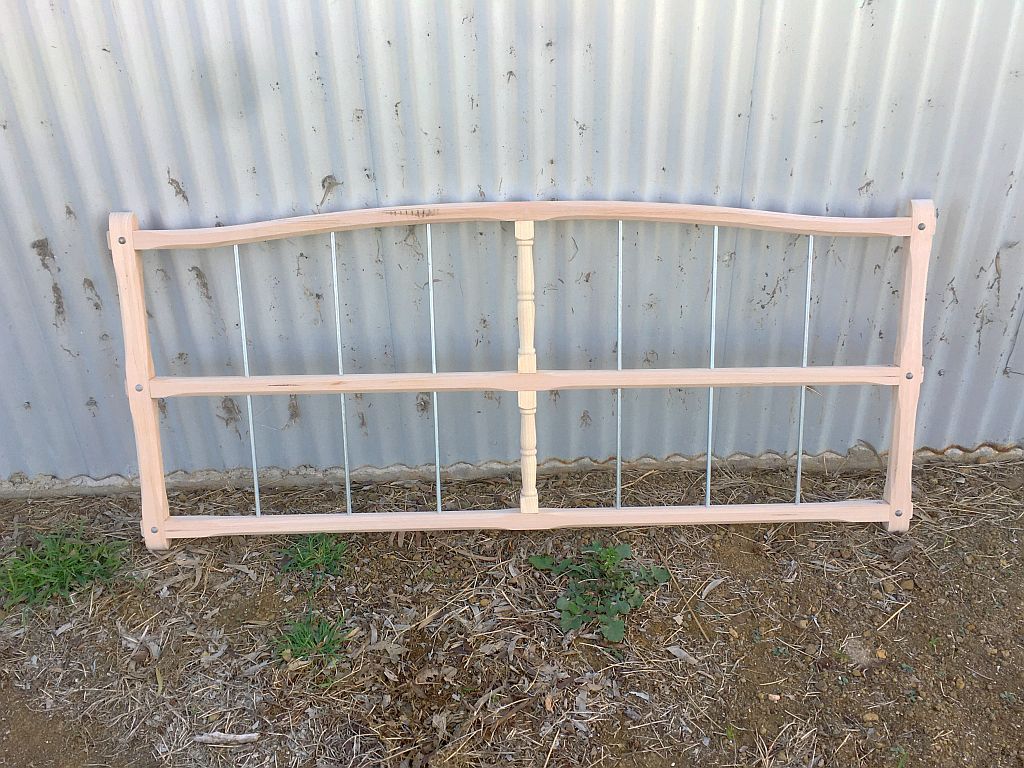
After that, I was idle once again, so I built the cratch (the adjustable table/harness storage/luggage rack that attaches to the back of the vardo (figures 2 & 3).

Fig 2. Cratch capacity is adjustable with chains.

Fig. 3. Messmate cratch in-the-white.

The custom leaf springs I ordered in April 2020 were nowhere to be seen due to COVID-19 and a resultant shortage of raw materials. Believing the springs would indeed appear one day, I continued the hunt for a set of original ‘globe’ spring hangers (figure 4).

Fig. 4. Old, cast globe spring hanger.

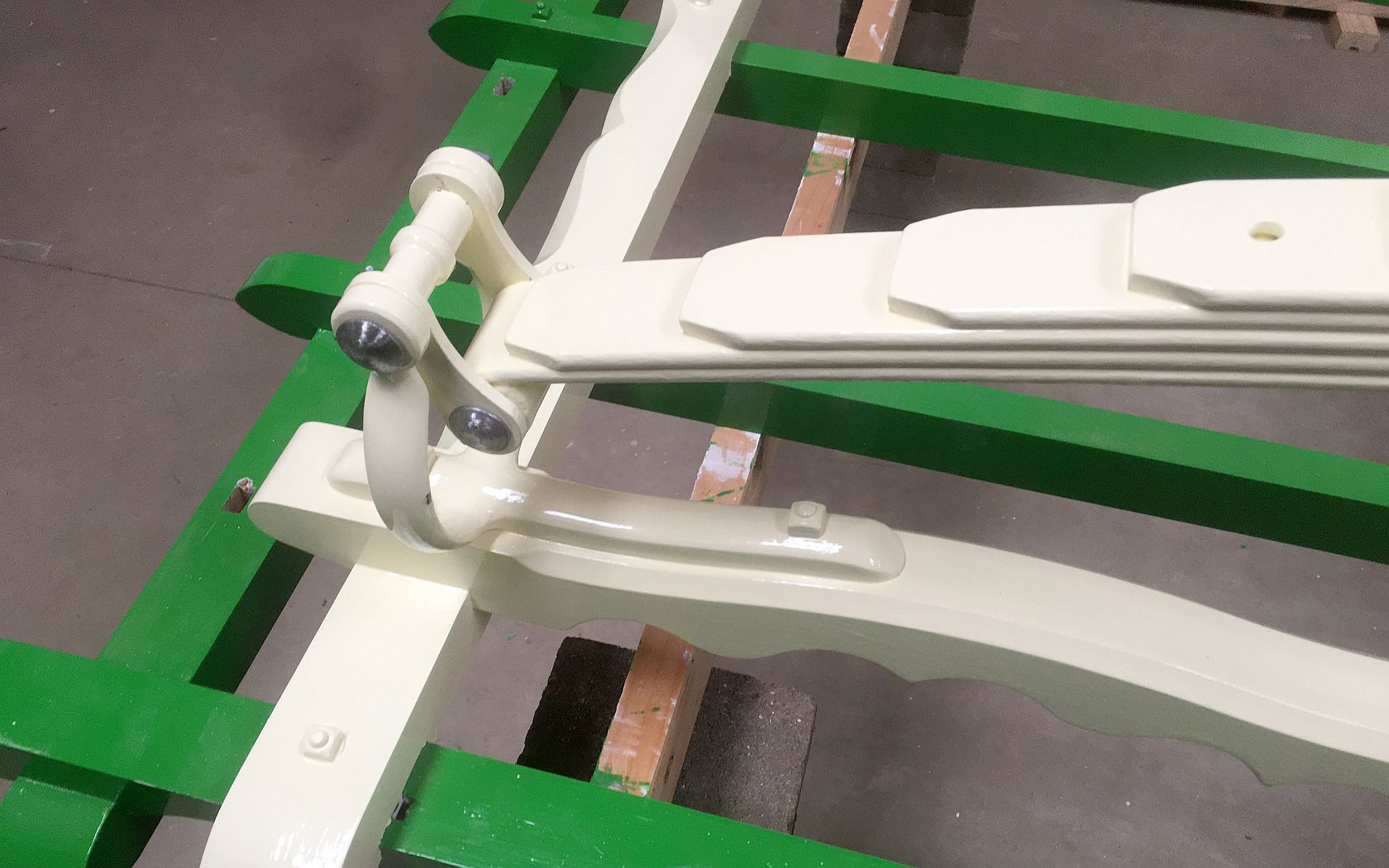
None were available locally and several contacts in the U.K. also drew blanks. The only solution was fabricated spring hangers. The welds were carefully linished so the whole resembled original castings as closely as possible. The straps of the four hangers for the cradle were additionally bent to the same curvature of the spring beds (figure 5).

Fig. 5. Test fit of a rear spring hanger.

Once I was satisfied with the fit of the hangers, they were removed and underwent two coats of oil-based IRP (Irish racing pink), two oil-based undercoats and three top coats of oil-based gloss.

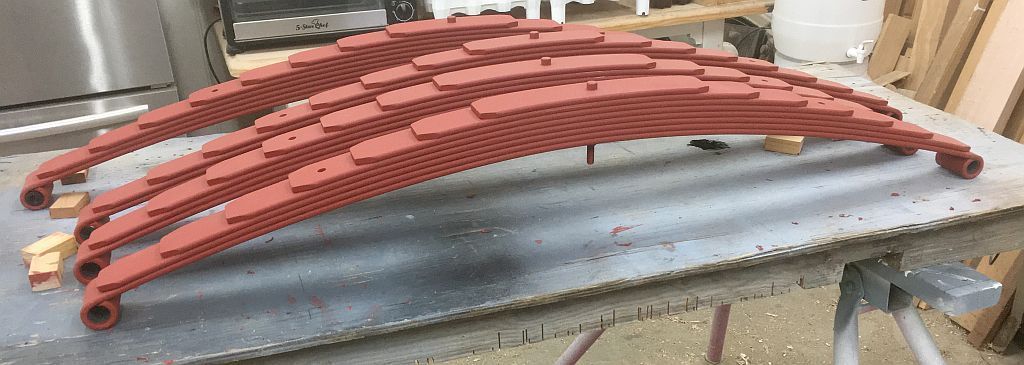
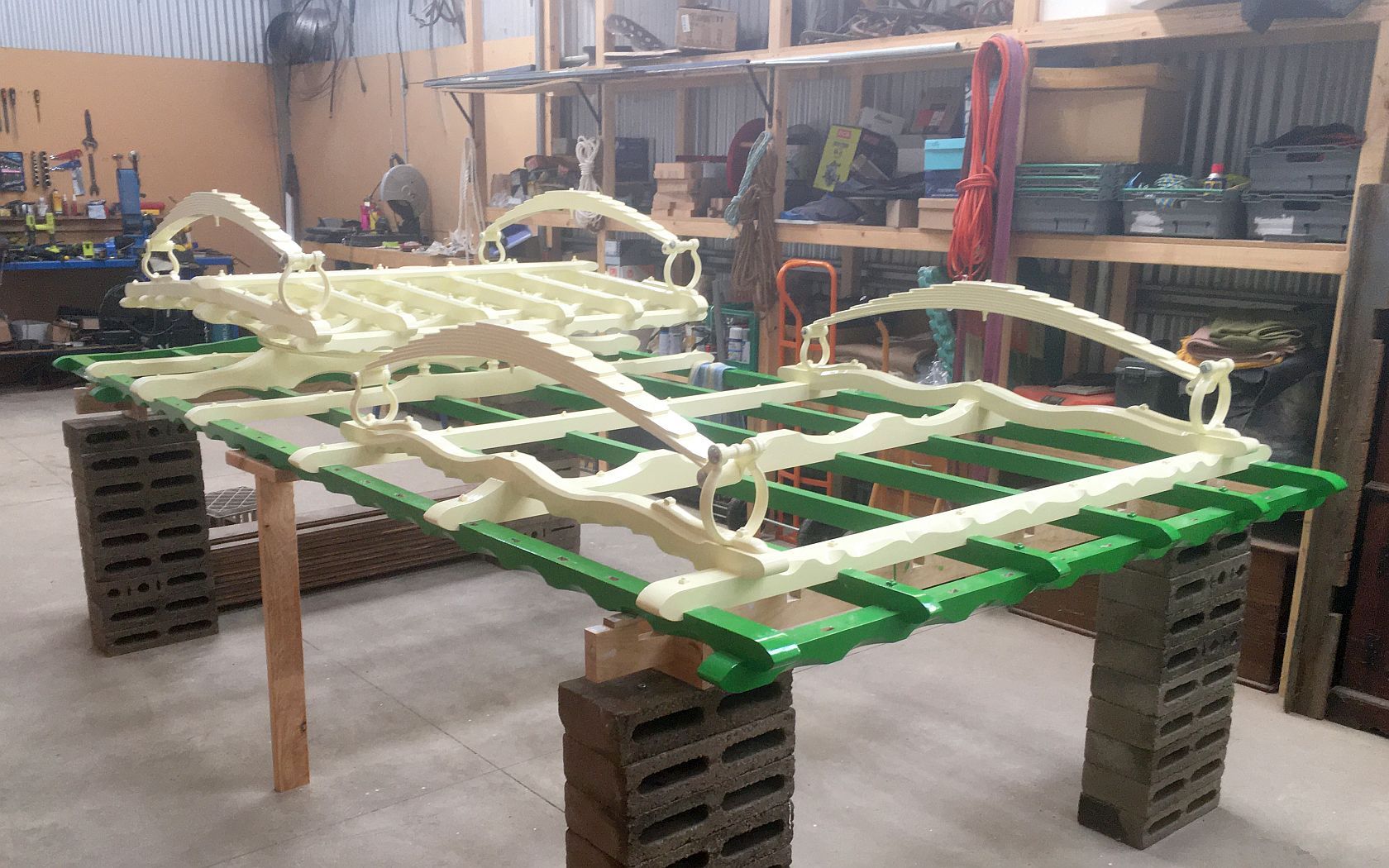
HUZZAH! The leaf springs arrived! I dismantled the spring packs and cleaned each leaf to remove the oil from the tempering process. Before reassembling the leaves, I took a small artist’s paintbrush and applied a narrow stripe of high-pressure grease between each one. More primer, undercoat and gloss!

Fig. 6. Leaf springs resplendent in IRP.

With everything painted, I enlisted the help of half a dozen able-bodied blokes and put the undercarriage – such as it is – together (figures 7,8 & 9).

Fig. 7. Front cradle spring hanger.

Fig. 8. Rear cradle spring hanger and shackles.

Fig. 9. The weight is mounting!

Not too much paint was chipped whilst installing the heavy springs, but all will be rectified in the final touch-up.

The hours involved in the work in this post come to 268.25.
The total hours involved to-date come to 537.5.

Orson

orsoncartatlarge
http://orsoncartatlarge.wordpress.com/?p=386
Extensions