durf:
Boston Dynamics steals Japanese kawaii tech for its latest robot:

https://nonhumanagency.tumblr.com/post/122232966882
Part of tumblr.com
This is the research blog for the Nonhuman Autonomous Space Agency, an investigation into the potential deployment of networks of nonhumans to colonize the solar system. The Nonhuman Autonomous Space Agency launches in late summer 2014. N.A.S.A. Is a project of the Working Group on Adaptive Systems.
durf:
Boston Dynamics steals Japanese kawaii tech for its latest robot:
(via Worms in Space | Worm Culture)
“There was an accident aboard the station and the worm astronauts have to navigate to the escape capsule to return to Earth.”


‘Siri Dolphin’ by Thai Yashar and Yotam Ben Hur
Note: This contribution to the Nonhuman Autonomous Space Agency is one of a series of projects created in a workshop with the students of Claire Donato’s Zoopolis class at the Pratt Institute. The class asks freshman architecture students to engage with writing in parallel with their design work at Pratt. This workshop asked them to work in teams to speculate about scenarios arising from combinations of robots, animals, spacecraft, and flowers as they colonize the solar system.
What if the world has stopped being a visual world and would instead be based on sound? Or rather, what If sound was the only thing that was visual, what kind of space would that create?
Dolphins might know the answer, or at least in a partial way because Dolphins are not only communicating and recognizing individual sounds under water but they are also navigating and can know the exact location and size of an object through sound.
Humans also have a sound system that can navigate and locate different things and they communicate with this system through sound only and not visually. This is a virtual machine called Siri. So how would a space would look if we took dolphins and Siri and built a planet based on their need? First this space will be under water where dolphins can move but it also has to have air because dolphins, just like humans, are mammals and need fresh air in order to breathe. For this purpose they will have bubbles moving around under water from which they consume air. This water space will probably be similar to an empty black space, because visual things are no longer important and only sound counts. Siri, which is a virtual voice, will be presented in this world through sound that navigates between the dolphins through the same bubbles. A dolphin in this space will constantly release and receive air bubbles that will contain Siri’s voice in it, and this will be its way to communicate and navigate in this space

‘Venus Fly Trap’ by Juhi Goenka and Veronica Bedoya
Note: This contribution to the Nonhuman Autonomous Space Agency is one of a series of projects created in a workshop with the students of Claire Donato’s Zoopolis class at the Pratt Institute. The class asks freshman architecture students to engage with writing in parallel with their design work at Pratt. This workshop asked them to work in teams to speculate about scenarios arising from combinations of robots, animals, spacecraft, and flowers as they colonize the solar system.
Our space agency is an ecosystem held inside a giant Venus flytrap floating in space. It maintains a delicate balance between the carnivorous flower and the non-human lives housed inside of it. Interestingly, the flowers of the Venus flytraps have two ‘jaws’ that meet at a central axis. In comparison to other flowers, the center of the flower is not the middle but the spine. In our system the gravity is towards this vertebra. A complex network of delicate bubbles rests within the mouth of the flower bobbing in place due to the gravitational pull.
The occupants of this bubble cluster within the colossal predatory flower is paradoxically a business of flies. This juxtaposition creates a rather sinister atmosphere where the flies are almost always at peril of the bubbles popping and being the flowers meal. The flies will always be attracted to the scent of the flower, however once the thin film of boundary is broken they are in danger. But the flower also allows the functioning of the ecosystem by providing a shell, as well a surface for sunlight to bounce off of, allowing the flies to be able to see. There is a constant battle between desire and survival, where the flies are protected, and at risk at the same time, creating a sense of anxiety.
In order to ensure that this balance is maintained there is an introduction of quadcopters. These RCS powered flying drones are the perfect monitoring robots. They will be able to create a stable environment where the flies can always be under surveillance and stay alive. Our project is a sanctuary for flies inside a universe of bubbles which is inside the mouth of a Venus flytrap in space.

‘Chipmunk Habitat’ by John Walter
Note: This contribution to the Nonhuman Autonomous Space Agency is one of a series of projects created in a workshop with the students of Claire Donato’s Zoopolis class at the Pratt Institute. The class asks freshman architecture students to engage with writing in parallel with their design work at Pratt. This workshop asked them to work in teams to speculate about scenarios arising from combinations of robots, animals, spacecraft, and flowers as they colonize the solar system.
This is a megalithic pinus-conus habitat for chipmunks. This would be a sustainable
habitat for the chipmunks, the bits of the pine cone can just spread outward and grow
more and more. The chipmunks could use the habitat for food as well. A waterfall runs through it so the chipmunks have something to drink. The structure of the pinecone is
convenient as well because as one goes further inward there is more and more shelter to be found.
The way the pine cone is built makes for plenty of platforms with which any of the chipmunks
could use to circulate upwards unless they get too fat from all the free food and can’t climb. The
pine cone is not unlike a parametric system. The only way this system would fail would be if the
chipmunks were to eat through all the habitat that is left to utilize as shelter and then they would
have no where left to lift. A solution for that would be for them to bury a chunk of it in
the ground which would function as a seed and would then grow to form new shelter, and on the
cycle would go.

‘Elephants in Space’ by Catherine Chang and Gina Nikbin
Note: This contribution to the Nonhuman Autonomous Space Agency is one of a series of projects created in a workshop with the students of Claire Donato’s Zoopolis class at the Pratt Institute. The class asks freshman architecture students to engage with writing in parallel with their design work at Pratt. This workshop asked them to work in teams to speculate about scenarios arising from combinations of robots, animals, spacecraft, and flowers as they colonize the solar system.
Imagine an elephant sanctuary, not on Earth. Instead,
inside of a large bubble created in space. In the main bubble, roses grow in
the center due to the Goldilocks Zone of the sun. The Greenhouse effect allows
for a forest of roses to flourish at the core. The heat from the proximity of
the sun allows for the core of flowers to bloom and collect water droplets. The
atmosphere is maintained habitable within the main bubble due to the viscosity
of the material, protecting all within from the intensity of the sun. From the
water droplets, elephants use their trunks to create personal bubbles in which
they are enveloped within, releasing them of the heavy burden of being weighed
down by gravity. The elephants travel the world via bubble along with a
personal robot navigator that traffics the floating spheres through the air.
Each robot buddy is synchronized with a central operating system located within
the core of roses to link all elephants together. Throughout the air, elephants
weightlessly own the atmosphere, never colliding thanks to the robot navigation
buddy. When ready to return to the core, the thorns of the roses gently release
the elephant from its carrier. The robot buddies accompany the elephants at all
times, but because of the elephant’s excellent memory, the robot navigation
buddy is rarely needed at the core. Among the forest of roses and throughout
the air, elephants experience a duality of weightlessness and a gravitational
burden.

‘Present Exodus’ by Andy Kim
Note: This contribution to the Nonhuman Autonomous Space Agency is one of a series of projects created in a workshop with the students of Claire Donato’s Zoopolis class at the Pratt Institute. The class asks freshman architecture students to engage with writing in parallel with their design work at Pratt. This workshop asked them to work in teams to speculate about scenarios arising from combinations of robots, animals, spacecraft, and flowers as they colonize the solar system.
The Cities dominate the world’s lands; Animals have no place to stand. Their only hope is to adapt the environment. The human population explodes and space becomes valuable. Animals who belong in the wilderness receive an advantage to enter the utopia without fees. However, humans are different. Humans no longer have the characteristics of animals; Humans become significantly remote from wilderness and nature. As for humans, they are chosen and selected with the city’s rules. In New York City, fifteen thousand people line up each day to enter the city. They are to be physically and mentally examined before entering the City. Robots // artificial intelligence determine the authenticity of human beings and only allow the good few. In NYC adults with over 6.2 ft, under 200 lb are allowed, all of the humans must possess an IQ over 150.


‘Cuttlefish’ by Andy Seidman
Note: This contribution to the Nonhuman Autonomous Space Agency is one of a series of projects created in a workshop with the students of Claire Donato’s Zoopolis class at the Pratt Institute. The class asks freshman architecture students to engage with writing in parallel with their design work at Pratt. This workshop asked them to work in teams to speculate about scenarios arising from combinations of robots, animals, spacecraft, and flowers as they colonize the solar system.
First, the original pod lands. It scans the surface of the asteroid, measuring its dimensions and scale. It begins to circumnavigate the asteroid and takes the shortest path around the asteroid. Water is injected into that asteroid around this ring and cuttlefish are added. The cuttlefish begin circulating the water ring and the asteroid begins to spin. Algae in the water also begins to create a sustainable environment. The pod begins spreading outwards because of the centripetal force. Now a polar grid array of solar panels project in a ring around the asteroid. Now prairie dogs are sent into the asteroid. They begin to burrow into the asteroid and create a internal void. Oxygen spreads out from the water stream and sustain the prairie dogs. They slowly carve out holes at each pole of the space. Later, the ships will come with seeds, and lions, and soon a prairie will exist within the asteroid.
“Non-humans are sentient beings. That is the central difference between Pixar’s universe and our current reality.”

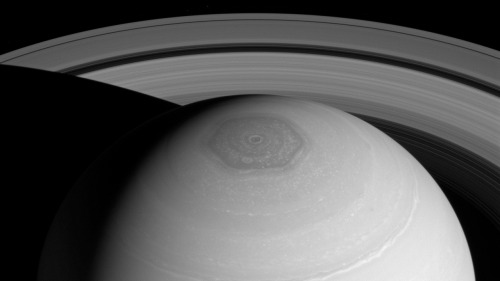

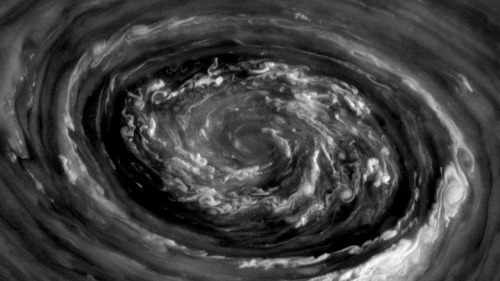
There’s a giant, stable hexagon on the north pole of Saturn with a huge hurricane at its center (and we don’t know exactly why).
Happy Saturnalia!
Images: NASA

The Lazy River, part of the Nonhuman Autonomous Space Agency


Fred Scharmen (previously) has a beautiful new project up and running:
The Nonhuman Autonomous Space Agency is a network of robotic and biological systems, tied together by exchanges in the material and attention economies. One set of probes searches the asteroid belt for resources drifting in the solar wind like giant flowers. Another set, made from modified classic spacecraft, uses its manufacturing and fabrication capacity to shape those resources. Together they build and nurture the habitats for animals and robots, while the whole process can be followed on social media from Earth, all mediated by servers on the Moon.
Read more at the Nonhuman Autonomous Space Agency website. Submissions are encouraged:
The Nonhuman Autonomous Space Agency is an open world project. If you have an idea for an image, story, comic book, toy, scenario, or any other media, narrative or not that explores the interaction between nonhuman Earthlings in space exploration and colonization, please get in touch and share it at sevensixfive ~at~ gmail ~dot~ com
“The Nonhuman Autonomous Space Agency is a research project from the Working-Group on Adaptive Systems.”
“Incredibly, FIDO works as a wearable computing device to help assistance dogs communicate more directly with their handlers. It allows them to send messages via devices like Google Glass.”
Oh, but space exploration is positive-sum. I’m going to try not to mention sports here; you can do the comparisons in your own head if you want.There is an idea, often couched in mock petulance, that we were promised Mars colonies. That’s not what happened. We were *offered* Mars colonies, and we turned them down. We needed the money for other things, we said.The things we used as examples of higher priorities never did seem to get much, though. Instead we got faster and cooler fighter jets. In 1999, a fellow figured out how to mod his decrepit Soviet-surplus radar to pick up F-117 Nighthawks, which were supposed to be quite invisible. He shot one down with a rocket that cost about 1/200 as much as the airplane. [He is now a baker.](http://en.wikipedia.org/wiki/Zoltán_Dani) Our public funding decisions do not make sense. Therefore, space advocates have resorted to trickery. This has many costs.Think of the Space Shuttle. Its basic technical design was silly. Both its fatal accidents were caused by problems that came from its byzantine liftoff configuration. If there were a problem at a certain point in the ascent, the plan was to [reverse through its own exhaust plume](http://en.wikipedia.org/wiki/Space_Shuttle_abort_modes#Return_To_Launch_Site_.28RTLS.29). It was late, overbudget, and missed its turnaround time promise by a factor of five.But its advocates knew it was the Shuttle or nothing. Their predecessors had sustained the Apollo program for more than a decade upon the firm assurance that getting white men to the moon, *the moooon*, should be budgeted under the heading of defending freedom. Of course, Congress eventually crunched the numbers and worked out that it wasn’t actually killing any Viet Cong whatsoever. The Shuttle people used a cleverer ruse: they spread its construction, and thus federal money, throughout the country. It had parts made in every state. I have no idea what’s in North Dakota or Maine that gets people into orbit, but they found something. And so Congress never wanted to cancel it, even when it was clearly the wrong idea. The Shuttle’s *political* engineering was a model of simplicity and reliability.(Also, I would bet you a pound of fine medium-roasted Sidamo coffee beans, with notes of wine, marmelade, and blueberry, that defense and intelligence people were quietly pulling hard for the Shuttle well into the ’90s.)So people see space exploration as part of the military-industrial complex. And it is. Kind of.Power wants what it doesn’t have, and it can’t have art. Art needs power’s materials and protection, but fears its responsibilities. Even when they come to terms, power never owns art, only a contract, and art is never safe, only sheltered. High on the cathedrals, the stonecarvers make satirical gargoyles. Space exploration is art, but we have to keep this secret. We must not say in public that it’s how humanity in a technological age reaches outside itself, how we find a mirror distant enough to see to our edges, how we face the void. Shhh.We have grown some of the great monumental art of our time right on the institutions of fear and violence, like a bromeliad on the saggital crest of a rogue ape. We made a lot of awful compromises to do it. But we did it.So I’m not convinced that we’re quite as stalled as some of my pro-space companions think. Low earth orbit is not something to be ashamed of (and highlighting the “low” is silly; it’s by far the most useful orbit for almost every purpose for which it’s used). The Mars rovers are pretty great.We may yet have lunar hydrogen mines, a space elevator, Venus rovers, submarines for Titan, and an optical interferometry array spread across Lagrange points. We may have crews and robots both. We may have a one-way Alpha Centauri probe. I certainly hope so. Maybe I will be alive when the first toddler is learning to walk in 0.376 g.These things will come later and uncooler than we deserve. Maybe their lead scientists will sing Shonen Knife while skating around the office, but for press conferences will don the beigest slacks and jowliest drawls. That might be the cost. I hope not, but it would be worth it.
The latest Tweets from Space Sushi (@SpaceSushiPic). Sushi is the universe. space

