Pre-Order Mosul Eye: A Scholar’s Clandestine War Against ISIS A Clandestine History of Mosul Under the Islamic State When ISIS overran Mosul in June 2014, a young historian…
A Clandestine History of Mosul Under the Islamic State
When ISIS overran Mosul in June 2014, a young historian expected to spend his life in archives, not hiding from a death sentence. His ambition had been quiet: to write history, teach students, and preserve his city’s past. But within days, Mosul was sealed off from the world—its streets patrolled, its memory suffocating under propaganda—and he found himself forced into a role he had never imagined.
From a small room no one ever saw, under a name no one knew, he created Mosul Eye. What began as a personal attempt to record the first days of the occupation became, without his knowing it, the only reliable source from inside the terror state. Every detail he wrote—checkpoints, executions, heritage destruction, forbidden rumors—was a risk. Every sentence could have exposed him. ISIS hunted him relentlessly, promising to kill him in a manner “humanity had not yet discovered.”
But he survived. And the archive he built survived with him.
Only years later would he discover that his secret reports, written by generator light to the sound of drones overhead, were being read not only by his neighbors and the world’s newspapers—but by governments, analysts, and intelligence agencies, including the CIA, which relied on his work as one of the finest inside sources produced during the occupation.
Mosul Eye: A Scholar’s Clandestine War Against ISIS is the story of how a quiet scholar became the most elusive witness to one of the darkest chapters of the 21st century, and how knowledge, discipline, and truth outlasted a terror state.
Foreword by His Holiness Pope Francis, written by hand in Spanish. Introduction by General David H. Petraeus, former Director of the CIA and former Commander of U.S. and Coalition Forces in Iraq.
Season’s Greetings — and a Personal Update from Mosul Eye As the year draws to a close, I would like to extend my warmest wishes to everyone, across…
Show full content
Season’s Greetings — and a Personal Update from Mosul Eye
As the year draws to a close, I would like to extend my warmest wishes to everyone, across all traditions and celebrations, for a peaceful end of the year and a hopeful New Year ahead.
For many years, Mosul Eye was written under the pressure of urgency — to document, to bear witness, and to ensure that what was happening in Mosul under ISIS rule would not disappear into silence. During that time, there was little space to step back and tell the full story behind the reporting itself.
I am grateful to finally share that I have now found the time and distance needed to write that story.
In the coming year, my book, Mosul Eye, will be published, telling the full account of how the project began, what it meant to document life under occupation, and how history, memory, and resistance intersected during one of the darkest periods of Mosul’s modern history.
The book will be released next year, and it is now available for pre-order.
“Beati pacifici, quoniam filii Dei vocabuntur.” Some leaders change policies and a few change hearts. Rarely does one change both and leave behind a legacy that, even in…
Show full content
“Beati pacifici, quoniam filii Dei vocabuntur.”
Some leaders change policies and a few change hearts. Rarely does one change both and leave behind a legacy that, even in death, challenges us to think: Have we done enough to carry the torch forward?
Pope Francis was such a man.
Throughout his life, he defied expectations: a Pope who refused palaces, who chose simplicity over grandeur, who brought the Church back, time and again, to its fundamental values — mercy, justice, humility. His papacy was not about the preservation of appearances but about engaging with a wounded, complicated, often broken world.
Perhaps no episode captures this better than his historic visit to Iraq in March 2021.
It was a visit that many advised against. It was risky, both physically and symbolically. Mosul — my city — was, at the time, still emerging from the devastation wrought by ISIS. Many of its churches were in ruins; its people were exhausted; hope itself felt fragile. It would have been easier, even understandable, for the world’s leaders to overlook Mosul — to categorize it as another tragedy too complicated to heal.
But Pope Francis did not overlook Mosul.
He walked through its shattered streets. He stood in the Hosh al-Bieaa, surrounded by the broken skeletons of churches once vibrant with life and prayer. And he prayed, not in grandiosity, but in sorrow and solidarity. He honored the memory of Christians, Muslims, Yazidis, and others who had perished, affirming — to a global audience — that Mosul was not a footnote in history. It was a beating heart in the story of human resilience.
His message was simple but radical: hope is stronger than hatred.
And then, there was an even more personal moment, one that revealed the true depth of his character.
In October 2021, months after his visit to Iraq, I was in Rome. Unexpectedly, I received a missed call from an unknown number. Moments later, the same number called again. I missed it again, not suspecting anything unusual. Then an email arrived—humble, direct, human. And then, incredibly, a voice message.
The Pope himself was reaching out to me.
Not through assistants. Not through formal channels. Directly. Persistently.
When I finally responded, he invited me to meet him at his residence, Casa Santa Marta—the modest guesthouse where he chose to live rather than move into the grand Apostolic Palace. There was no protocol, no lavish ceremony, no layers of formality—just a simple, profound encounter between two people who shared a love for a city wounded but not defeated.
What struck me most was not the fact that he was the Pope, the leader of 1.3 billion Catholics.
It was his humility.
He listened—truly listened—with attention and compassion rarely found among the powerful. He asked about Mosul not as a distant observer but as someone emotionally invested in its future. There was no sense of hierarchy between us. He was not showing empathy for the audience. He was living it.
In that meeting, I understood something essential about Pope Francis: for him, the marginalized, the forgotten, the wounded — they were not abstractions. They were the center of his mission.
When he visited Mosul, he brought with him not just global attention but a profound moral statement: that even the most devastated places deserve to be seen, heard, loved, and rebuilt. That faith must walk alongside suffering, not above it.
Skeptics will ask, and rightly so: Was one visit enough?Did it change realities on the ground?Did it rebuild homes, restore jobs, and end displacement?
The honest answer is no — not immediately.
Pope Francis was not naïve. He knew the deep wounds of Iraq could not be healed by a single prayer or a symbolic moment. But he understood something more profound: that healing begins when people believe they are not alone in their suffering. His visit, prayers, and presence planted seeds — seeds of hope and dignity — that continue to grow.
Today, after his passing, we are left with his example and a heavy responsibility.
He showed the path, but he did not complete the journey. That task remains ours.
In the ruins of Mosul, amidst the songs of rebuilding and the echoes of pain, the memory of Pope Francis stands as a quiet but unyielding reminder that humanity is not measured by how high we build walls or how loudly we proclaim victories, but by how deeply we accompany each other through suffering, and how courageously we rebuild trust after devastation.
For Mosul, Iraq, and a wounded world desperately in need of moral courage, Pope Francis was—and will remain—a light that reached even the darkest places.
May his memory be a blessing — and a challenge.
Papa Franciscus, servus servorum Dei, in pace Christi obdormivit.
Vatican City, Saint Peter’s Basilica April 25, 2025
Call for Contribution: We are in the planning phase to establish a documentation center to record the history of Mosul, its environs, and diverse communities. This effort is…
Show full content
Call for Contribution:
We are in the planning phase to establish a documentation center to record the history of Mosul, its environs, and diverse communities. This effort is open thematically and chronologically and aims to develop a database of Oral Histories. The first comprehensive project of its kind for this area. It will be a place of exchange for local and international expertise in this field.
The archives (which include the recorded testimonies as well as the data we’ve been collecting from residents, which provides for private collections of videos, photos, documents, and other archival materials spanning over a century) will be accessible to scholars from diverse fields of study, including but not limited to cultural heritage, space, time, and people.
We’ve secured an agreement with the Mosul University Central Library to host and store the recordings in accordance with international academic codes of ethics.
As we develop this project, we’d like to reach out to potential individuals, as well as public and private entities, that might be able to support the creation, development, and sustainability of the documentation center – its audiovisual recording studio – in Old Mosul. It is important to note that Mosul has never had such a center before, nor has anyone worked on its Oral History. Ours is the first such project. This centre will also create a new field for young professionals in Iraq to develop their capacities for the future.
We have recently finished documenting the oral history of the Jewish community of Mosul and now we’ll start full-scale efforts to document all of Mosul’s communities, urban, rural, Nineveh Plains, Sinjar, and other areas of Nineveh. Testimonies will be given in the dialects of the native languages of the regions of interest including Arabic, Kurdish, Turkmen, Hebrew, Syriac, Aramaic, and other languages.
The support can include human capital, equipment, training programs and digital resources, as well as direct funding.
Should you, a scholar or an institute you know be interested, please do contact me directly.
Omar at mosul-eye dot org
About Mosul Eye: An organization registered in France and Iraq. Mosul Eye Association is made up of civil activists from the city and its surrounding towns—students, recent graduates and young professionals who have taken it as their aim to support the holistic recovery of their war-ravaged city in concrete ways as well as the healing of its communities. The association’s members, eager young men and women, have organized concerts, heritage events, exhibitions, workshops, and now climate action events. The association is especially keen to develop new kinds of international collaboration and innovations in development and humanitarian programming that are inclusive and sustainable. The Mosul Eye Association is also focused on building institutional and academic partnerships for scholarly work on issues of identity, memory, history, migration and more pertaining to Mosul and beyond.
Donate Here After years of conflict, Mosul Eye has finally become an establishment in Old Mosul, opening a house of culture, documentation and recovery. An association that is…
After years of conflict, Mosul Eye has finally become an establishment in Old Mosul, opening a house of culture, documentation and recovery. An association that is completely independent and relies on your generous donations. We have also successfully finished the Green Mosul Project, and we are now preparing for the largest Oral History Documentation in Mosul. And our most important project Reviving The Jewish Memory of Mosul, which is the first of its kind to bring back the Jewish Memory of Mosul to life.
I’m hoping you’ll consider supporting the good work Mosul Eye Association does by donating or sharing with others who’d like to help. Donate Here “Don’t give up on Mosul and our people. We will not always be just a stronghold of ISIS. I want to change the headlines of my city.” Your donations will help us maintain Mosul Eye House active and independent to document and protect the history of people and to help make Mosul active again.
It has been eight years since Mosul Eye was established, and since then, it has remained active in telling the truth about Mosul. We recovered the library of Mosul.We…
Show full content
It has been eight years since Mosul Eye was established, and since then, it has remained active in telling the truth about Mosul. We recovered the library of Mosul. We planted trees and still working on the recovery of Mosul and telling the world the story of its resilience. And now want to establish the Museum of Mosul Cultures in Mosul Eye House to show the world the diversity and inclusion of the cultural heritage of Mosul and its people.
With your donations, Mosul Eye can continue its mission:
A message from Mosul Eye Historian to Ukrainian Historians: Protect your History Now, Not Tomorrow. Dear Ukrainians who are covering the war, from inside Ukraine and outside, here…
Show full content
A message from Mosul Eye Historian to Ukrainian Historians: Protect your History Now, Not Tomorrow.
Dear Ukrainians who are covering the war, from inside Ukraine and outside, here are some suggestions from someone who lived the war and cares about history and its importance in such moments:
While journalist reports are essential; the civil voice has a greater value in the long term; it protects your future. Do not get stuck in just reporting the current moment; pay attention to what comes next.
2- Document everything daily and explain your country’s social, economic, cultural, and political fabric to the world. It is essential to document the social impact collect testimonies and first-hand accounts from the people there. You will need this soon.
3- Sadly, the world pays more attention to individual stories than collective ones. Therefore, you need to add personal stories to get the right impact to help your country by keeping the world focused on your situation. 4- You should give yourself the chance to think more clearly in such terrifying times; your safety and security should come first. Do not overexpose yourself. Today’s friend can be tomorrow’s enemy. 5- If you decide to work collectively, do it decentralized. 6- Record as much as you can videos, audio and any possible visual material you can collect. You can’t imagine how useful this will be in the coming days. War will end, but it will only end for governments; the people will keep suffering unless you have collected enough material to pursue justice. 7- Do not forget your cultural heritage; keep a close eye and document everything. 8- I know it is a terrible time for all of you, and it is meaningless to ask you not to be emotional, but remember, if you decide to document your history, you must accept the price, that is to put your emotions aside for a while. 9- No matter how excited you get when you see a video, an image, a document, etc., that you can use against your enemy, you MUST be careful not to use it if it is not verified. Your enemy will be happy to discredit you. Your credibility is everything. 10- Do not say I will document this event tomorrow! No, do it immediately, and write it the moment it happens. The value of real-time documentation is fundamental, but you can only do it if you think about the future and get yourself out of the current moment.
11- Remember, he who controls the narrative of your history will control your future. 12- Your voice is more powerful than any journalist around the world, you are conveying not only the history to the people, but you are pouring your real feelings into its heart. 13- Assad and pro-Putin pundits are using the racist comments of some western journalists. While such terrible statements should have never happened, Ukrainian journalists should condemn them to deprive the enemy of using it to distract people. 14- As the conflict goes, there will be massive pressure on you, the young and future leaders of Ukraine. You will find yourself not only fighting Putin but also the propaganda and counter-narrative. Please do not ignore it, and treat it wisely as it happens. 15- You will realize that your enemy will use every available tool to discredit you. Keep your eyes open, debunk the claims and propaganda, stick to the truth. Oppressors and dictators fear the truth.
16- You will also see those who will use you for their purposes, they are not nearly supporting Putin, but the conflict provides them with the chance to prove their nonsense.
17- You will also see those who will use you for their purposes, they are not nearly supporting Putin, but the conflict provides them with the chance to prove their nonsense. Debunk and expose them immediately.
18- Should you receive a request to write an article for a media outlet or newspaper, pause and do not accept immediately; think before you do it. Significantly if it will be edited, if you accept, read the final edition before it goes online.
19- Do not allow the journalists and media outlets to use you or refer to you as a “fixer” or “source”. Establish your platform, let them come to your platform to read the news.
MOSUL EYE ASSOCIATION Mosul, on 17/02/2022 Invitation to: Simplified Negotiated Procedure Tender reference: 1/2022 Subject: Final Evaluation, Urban Greening Project Mosul, Iraq To the location of: Mosul, Iraq. Dear Madam/ Sir, As part…
Show full content
MOSUL EYE ASSOCIATION
Mosul, on 17/02/2022
Invitation to: Simplified Negotiated Procedure
Tender reference: 1/2022
Subject: Final Evaluation, Urban Greening Project Mosul, Iraq
To the location of: Mosul, Iraq.
Dear Madam/ Sir,
As part of Mosul Eye Association activities inNinewa Governoratein the frame of its project Funded by CDCS (French Foreign Affairs ministry), the contracting authority, Mosul Eye Association (MEA) intends to award a service contract for the above-mentioned Subject. Therefore, MEA invites your company to participate to a Simplified Negotiated Procedure concerning the Final Evaluation of the project ‘’Urban Greening Project Mosul, Iraq’’
Duration of the contract:The duration of the contract will be 20 man-days(estimation) from the date of the signature. It will be terminated only after the full completion and validation of the required services
If you are interested in participating in this procedure, your answer should include:The present invitation letter (signed and stamped).An up-to-date CV and 3 references.An example of writing production in English and in Arabic.A maximum of 15 pages of the proposed methodology and approach for the consultancy, based on the Terms of Reference (Annex 3).A financial offer in USD/EUR.Signed and stamped ethics clauses and exclusion criteria (Annex 1 and Annex 2).Tender starts at the date of 17/02/2022Your offer must be submitted before 5 pm (Iraq time) the 10/03/2022. Bids will be opened for the examination of the tenders on the 14/03/2022.Your offer must be submitted through the Linkedin Platform no later than 10/03/2022.For further information, it is possible to contact MEA through the following email address: mosuleys07@gmail.com
Please note that MEA will only consider offers received until the 10/03/2022, before 5 pm, Iraq time.
Submitted offers will be analysed on the 14/03/2022, based on the evaluation grid in annex 4, and consultants will be contacted the following day for answers.
The selection of the winning bidder, will be made based on the following criteria, ranked by decreasing importance:
Technical Quality, including proposed consultant experiences
To The Dignified Child, On this day of every year, the heart of humanity awakes from its slumber with a new passion, and prepared to receive a glorious…
Show full content
To The Dignified Child,
On this day of every year, the heart of humanity awakes from its slumber with a new passion, and prepared to receive a glorious parade
2021 years have passed by, and every year, just like this morning, the Christian world shivers with spirit and joy, while it halts and stops to face towards Palestine
Palestine, the cradle of Prophecy and curators, the tomb of the greatest and the mighty, the land where Armia stood, crying and sprinkling tears of Sorrow, and where David erected singing and chanting the songs of victory and triumph on his harp.
The humanity stares at Bethlehem in this parade, as their hearts are filled with passion and their gaze preceded them, seeking that lonely grotto, asking the shepherds and the guardians of the fields, guided by the most glowing star in the sky, as a sign of Heavens sharing this world its celebration.
At that lonely and quiet grotto, where nothing is heard but the groans of winds, the creeks of bushes, bleating of sheep, and stirr of livestock .. twenty centuries ago, a newborn named Jesus came to this world, next to a weak and exhausted mother.
That was all that was found there, but the greater world, with all its intelligent minds and greatest hearts, continued to praise this child and repeat “This is the greatest any woman has a beard and gave birth to!” .. People rushed in floks to this new child’s stage, carrying their precious gifts, and the kings and the greatest of this world came to him l, carrying gold and rosemary, to celebrate with the new mother her child. Yet, this child never cared for all those precious gifts, not because he did not recognize their value, but he consoled himself “That my Kingdom is not of this world”.
What is this latent secret of this child? Mankind is known for celebrating the wealthy and glorifying the Noble and the might, and baby Jesus was born humble and unknown. Yet, we find humanity in its entirety, glorifying, honoring and welcoming Him as they do to God’s!
That is because Jesus came with Sam’s principle; He came to this world with a new spirit and started to bring life amongst people’s ranks. He paid close attention to the weak and the poor. He came to wipe off their suffering and tears, and to solace the sadness at times where the thrones of kings and caesars were collapsing, and rocked edifices of the greatest and the powerful and toppled the idols made by the humble idol worshippers.
All those thrones were only based upon the heads of the oppressed, and those edifices would only be built upon the corpses of the miserable and those idols were set for foreign gods.
Very few are those who fathomed the secret of this dignified child’s life, and fewer are those who learned his glory that was revealed to the children of this land and these indigenous instruments.
The newborn of Bethlehem brought to this world something more valuable than all gemstones and all treasures … He arrived in this world with freedom on his right, the love of all people and the enemy of all kings. He gave it and resurrected them into a thriving life filled with good deeds.
Jesus only lived one life on this land and left it, but the principles He planted on this land has prospered and grown and bear fruit to the people, and when people tasted its sweetness, and enjoyed its pleasantness, they hailed to their holiness and greatness.
This dignified child lived a life different from the lives of the wised legists. He never spoke to the world of mysteries and secrets that no one can solve but the great philosophers, but He spoke of simple tongue because He did not only speak to the people of His time but to the nations coming after his time.
He did not flattered the humanity with sweet words, and never said what satisfies them and gain their love, but rather His words were spears into the hearts and souls of those who surrendered to slavery and subservience, and their eyes were blurred with curtains of blind customs … Those words that lifted the chains of serfdom and darkness, stormed and shredded the corrupt society that once was crippled with heavy subjugation imposed by the corrupt kings.
And you, the Dignified Child,
If you were ignored through eras, you were known through greater other ages, and if the people do not repeat your name, and surrendered to the customs that time framed them around your name, you are the the immortal for your principles live forever, and the humanity you guided and resurrected from indolence and despotism, and will forever be in debt to you for its freedom and peace as long as the heavens recite in this day of every year “Glory be to God in the highest and on earth peace and in good pleasure people”.
Mosul and the Islamic State: The Road Ahead On September 21 at 10AM EST, The Program on Extremism at George Washington University will host a special event to launch…
Show full content
Mosul and the Islamic State: The Road Ahead
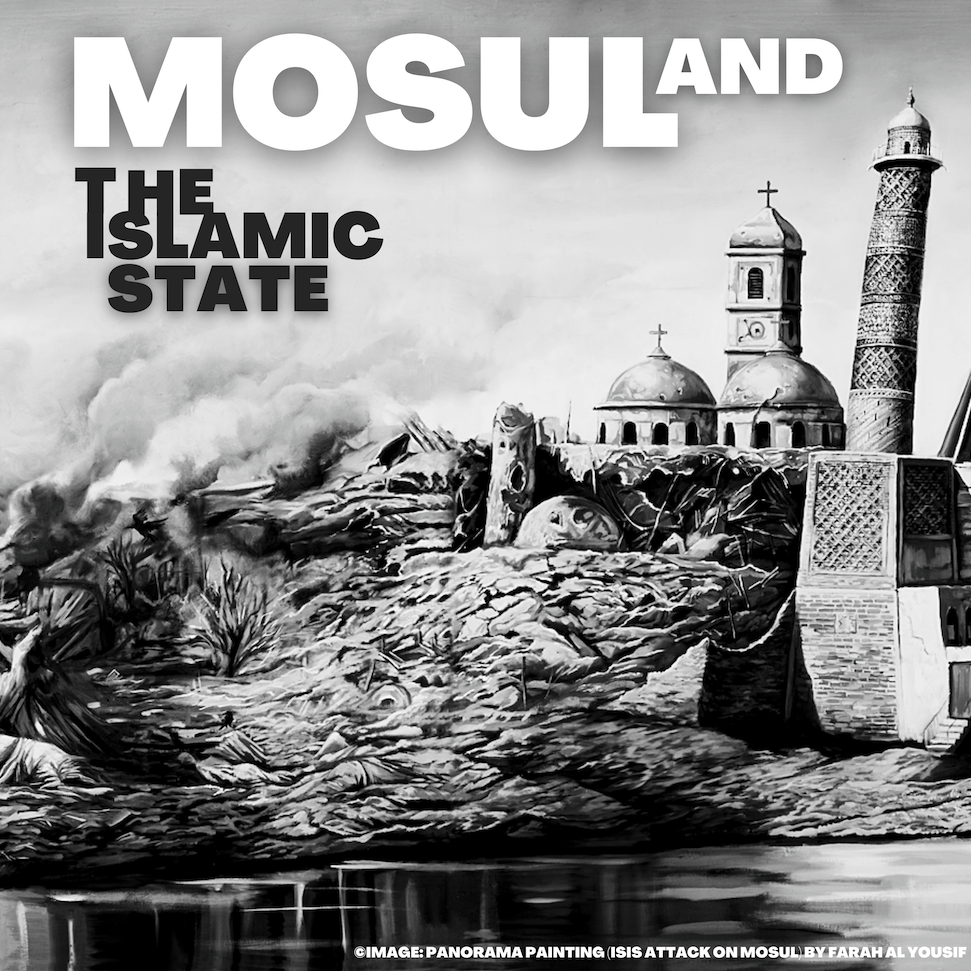
On September 21 at 10AM EST, The Program on Extremism at George Washington University will host a special event to launch the final episode of the Mosul and the Islamic Statepodcast, featuring a line-up of keynote speakers from Iraq. The opening session will focus on the opportunities and challenges associated with the pursuit of justice for victims of Daesh crimes, the experiences of Mosuli women before and after Daesh occupation, and the role of the arts in rehabilitating the city and its people. The session will be chaired by Program on Extremism senior research fellow Haroro Ingram, with keynote speakers featuring: -Murad Ismael, Co-Founder and President, Sinjar Academy -Natia Navrouzov, Legal Advocacy Directory, Yazda -Ameen Mokdad, Mosuli musician -Asma Khalid, Mosuli entrepreneur
-Ahmad Al Basheer, Iraqi comedian, journalist, and host of the Albasheer Show A moderated discussion featuring Program on Extremism research fellow Omar Mohammed will follow to formally launch both the final episode of the podcast and to release the research paper that informed the series, The Long Jihad. This four-part podcast series tells the untold stories from the Islamic State’s reign of terror over the city of Mosul, the pursuit of justice in its aftermath, and the enduring struggle of its people for a better future.