On Hegel's methodological approach in the Science of Logic; and why "the one true method" of metaphysics must be identical with its content.
Show full content
A talk on Hegel’s methodological approach in the Science of Logic; and why “the one true method” of metaphysics must be identical with its content. 30 mins talk. 1 hour discussion.
Audio. (Also available on the “Dark Age Marxism” podcast: Spotify, Apple etc.)
A talk about formal logic and Hegel’s critique of it.
We begin with Aristotle’s syllogistic and its dominance throughout the medieval period; then discuss the transition to modern logic in the late 19th century, specifically Frege’s development of predicate logic, which is now canonical. The transition was not just a technical improvement but a fundamental shift in how we understand the nature of logical categories — a shift from a logic of internal relations to one of external relations, and the introduction of a sharp distinction between syntax and semantics.
The modern era is marked by the proliferation of different logics, some adopting incompatible logical principles. Modern logic hasn’t realized Leibniz’s dream of a universal calculus of reasoning, but instead has given us a forest of logics, each with its own domain of application and its own rules.So logical pluralism challenges the idea of a single, universal logic.
Drawing on Hegel, modern logical pluralism implies no special logic can claim foundational significance, fully justify its own normative force, or even be said to be truly logical. Our modern logic is technically sophisticated but perhaps we’ve become lost in the forest. Hegel’s vision of a universal logic — one that explains the conditions for the possibility of any form of reasoning — points a way out.
A new approach to defining values in joint production.
Show full content
The problem of defining values for joint production technologies (production processes with multiple outputs) is longstanding. Critics have demonstrated that Marx’s concept of value, when applied to these cases, can yield undefined, zero or negative values, which makes little sense, and therefore reject the logical coherence of the concept of value. In this talk I introduce a generalized definition of value, the joint labor-values, which resolves these problems.
value theoryhistorykarl-marxlabour theory of valuemarxmarxismmoneyphilosophypolitics
Why the (static) transformation problem is no longer.
Show full content
The transformation problem
Consider an economy in a hypothetical steady-state where all capitalists receive the same profit-rate. In this situation, commodity prices diverge from their values. Marx explained that the divergence is an illusion generated by capitalist property relations. So, if we look at macroeconomic aggregates, then prices and values are not divergent but equivalent.
Hence, despite appearances, profit is the money-form of the labor-time supplied by workers in tribute to capitalists. But critics demonstrated that, in such a steady-state, Marx’s ‘conservation claims’ cannot hold; and so they reject any one-to-one quantitative link between labor-time and monetary phenomena.
Propositions on the `static’ (i.e. steady-state) transformation problem
Marx’s values split the working day into a necessary part (to produce worker consumption) and an unnecessary, or surplus part (to produce capitalist consumption). Marx (correctly) rejects capitalist consumption as unnecessary – because production could proceed without supplying goods in tribute to them.
Commodity prices include a profit component, which capitalists extract and spend on consumption goods. Prices, therefore, in contrast to Marx’s values, incorporate capitalist consumption as necessary — because production, in the institutional circumstances of capitalism, cannot proceed without supplying tribute to them.
In consequence, values and capitalist prices are essentially contradictory: values reveal the tribute as unnecessary; prices conceal the tribute as necessary.
In the hypothetical steady-state (beloved of critics) this contradiction becomes acute. If Marx intended his conservation claims to apply to a steady-state then he committed an error. Because mere aggregation cannot abolish this contradiction. The critics are therefore right – there is a steady-state transformation problem in Marx’s theory.
Super-integrated values include capitalist consumption as a real cost. They express the fact that, in the institutional circumstances of capitalism, commodities are not produced unless capitalists receive goods and services ex ante. Like Marx’s values, their definition is independent of the price system (although causally connected to it).
Marx’s values reveal the labor-time to produce commodities if capitalists were abolished. They tell us we could all knock-off early, by not supplying tribute, yet still consume at our current levels. The super-integrated values reveal the labor-time to produce commodities given that workers supply additional labor, as tribute, over-and-above what’s technically necessary to produce commodities.
Super-integrated values and prices both treat capitalist consumption as a cost (real and monetary). They are essentially commensurate. In fact, steady-state prices are proportional to super-integrated values (theorem). All Marx’s conservation claims then follow trivially.
The steady-state transformation problem is therefore resolved in a way that preserves all Marx’s claims. The critics are therefore wrong – there is a necessary one-to-one quantitative link between labor-time and capitalist prices.
Values and super-integrated values are complimentary concepts — we need both. For example, from our new perspective, we see that the transformation problem arose from the mistake of comparing apples (prices) to oranges (values). It resolves when we compare apples (prices) to apples (super-integrated values).
We can turn a new page in the history of Marx’s theory of the transformation. Static models are a dead end that cannot do justice to it. We should turn our attention to how new surplus-value, produced by workers, gets conservatively redistributed over time to individual capitalists. That requires dynamic, not static, models.
References
(2009). On nonstandard labour values, Marx’s transformation problem and Ricardo’s problem of an invariable measure of value. Boletim de Ciencias Economicas LII. (2014). A category-mistake in the classical labour theory of value. Erasmus Journal for Philosophy and Economics, 7(1), 27–55. This paper is the best technical entry point. (2015). The Law of Value: A contribution to the classical approach to economic analysis. PhD Thesis, Open University. (2019). Marx’s transformation problem and Pasinetti’s vertically integrated subsystems. Cambridge Journal of Economics 43, no. 1: 169-186. (2024). Theorems and remarks on Marx’s `transformation of the values of commodities to prices of production’. This talk is a less technical entry point.
Is economic value determined by objective costs or subjective utility? The history of how modern economics become value nihilist.
Show full content
We dive into the centuries-old controversy of economic value: is it determined by the objective difficulty of bringing goods to market or by the subjective preferences of consumers? The discussion frames this conflict using Adam Smith’s famous water-diamond paradox. We explore the 1870s marginal revolution, where economists like Menger, Jevons, and Walras developed subjective theories based on the principle of diminishing marginal utility. This analytical method also served an ideological purpose, directly undermining socialist critiques by denying any objective anchor for value. The talk explains how modern neoclassicism attempts to reconcile objective and subjective factors, but due to its obsession with equilibrium, exhibits value nihilism – the assertion that economic value does not really exist. Economics remains “half a science” due to its inability to analyze dynamics and movement over time.
A wide-ranging conversation on the God we don't believe in.
Show full content
A wide-ranging conversation among participants in the econophysics Discord server, featuring Ian Wright, Alex Creiner and Leone. The discussion primarily centers on Wright’s provocative idea of “capital as a real god,” a concept suggesting that capital functions as an emergent control system with its own primitive intentionality, goals, and representations, quasi-independent of human will. The participants also explore the concept of “occult magic” in politics and economics, likening it to a reality-driven fantasy where narratives obscure underlying mechanisms, and real possibilities for change. Further topics include the role of dialectical thinking in science, the challenges of socialist planning, and modernization of Marxist value theory. The conversation is animated by the desire to understand and transform social structures through both scientific rigor and conscious collective action.
general theoryvalue theorylabour theory of valuetheory
Macrodynamics of the generalized labor theory of value.
Show full content
Ricardo and Marx both understood that classical values cannot directly explain the structure of natural prices, an insight re-articulated, in modern general equilibrium analysis, as the Ricardian “93% labor theory of value” [1]. This talk re-articulates this result in a dynamic nonlinear model of classical competition where out-of-equilibrium market prices converge to natural prices. We state the fundamental reason why classical values only approximate natural prices, whereas a generalization of classical values, the super-integrated values [2,3,4,5], are directly proportional to them. We conclude with some (positive) implications for the further development of Marx’s theory of value.
This talk was presented at the AHE conference, London, June 2025.
[1] Stigler, George J. (1958) “Ricardo and the 93% Labor Theory of Value.” The American Economic Review 48, no. 3: 357[Dash]67. [2] Wright, I. (2009). On nonstandard labour values, Marx’s transformation problem and Ricardo’s problem of an invariable measure of value. Boletim de Ciencias Economicas LII. [3] Wright, I. (2014). A category-mistake in the classical labour theory of value. Erasmus Journal for Philosophy and Economics, 7(1), 27[Dash]55. [4] Wright, I. (2015). The Law of Value: A contribution to the classical approach to economic analysis. PhD Thesis, Open University. [5] Wright, I. (2019). Marx’s transformation problem and Pasinetti’s vertically integrated subsystems. Cambridge Journal of Economics 43, no. 1: 169-186.
The "hard problem" of consciousness is the hard problem of justifying social inequality in disguise.
Show full content
Can materialism explain human consciousness? Not according to an influential argument in the philosophy of mind (the “hard problem of consciousness”). In this talk, I (i) sketch a materialist theory of consciousness, (ii) explain an idealist rejection of the possibility of any such theory, (iii) discuss the philosophical flaws of this rejection, and (iv) explain, in materialist terms, why idealism is nonetheless attractive to many people. I close by pointing out that the “hard problem of consciousness” unconsciously frames subjectivity in terms of a bourgeois owner of private property, and therefore is the hard problem of justifying social inequality in disguise.
35 minutes talk, 40 mins discussion, 10 minutes response.
Towards an analytic definition of gods (and why Yog-Sothoth is a true god).
Show full content
An exercise in open philosophy: towards an analytic definition of god and gods. I propose a definition of an egregore and then apply it to different cases. We discover, among other mundane facts, that Lovecraft’s Yog-Sothoth really is a god in virtue of the Typhonian Order’s occult practices.
A talk and discussion on themes raised by the book "Blockchain Radicals" by Joshu Dávila.
Show full content
Joshua Dávila’s 2023 book, “Blockchain Radicals: how capitalism ruined crypto and how to fix it” (get it here) is an important and visionary, yet grounded, book on how blockchains, used correctly, are a tremendous gift to anti-capitalist organizing. Anyone wanting to build working class unity, across time and space, should read it.
In this talk and discussion we review some of the embryonic examples of anti-capitalist initiatives that use the blockchain.
value theoryhistorykarl-marxlabour theory of valuemarxmarxismphilosophytheory
Marx proposed to reduce "complex" labor to "simple" labor. Does this make sense?
Show full content
A talk on price-value dynamics with heterogeneous labor, where I run a new simulation model to explore the topic.
Marx proposed that more “complex” labor produces more value than “simple” labor in the same period of time. The question then is: by how much? Marx suggested that the coefficients that reduce complex forms of labor to quantities of “simple” or “average” labor are determined by a social process “that goes on behind the backs of the producers” (vol. 1). However, Marx offered multiple, inconsistent methods of determining the reduction coefficients and therefore bequeathed a `problem of heterogeneous labor’ (Ekeland, 2007).
Note that the problem of heterogeneous labor (reducing complex kinds of labor to simple kinds of labor) is distinct from the problem of heterogeneous labor productivity (relating different concrete labor times of the same kind to socially necessary labor time). In this talk I investigate the problem of heterogeneous labor while assuming homogeneous labor productivity.
We’ll examine the dynamics of prices and values in a model of a market economy where labor is heterogeneous. The model is a generalization of the classical macrodynamic model in Ch.7 of Wright (2016) with the addition of heterogeneous labor types and labor mobility, i.e. workers switch occupations (within and across generations) to maximize their income.
We shall see that, when labor is heterogeneous, and in the absence of obstacles to labor mobility, then the law of value holds without modification; in other words, the economy has an `arbitrage-free’ attractor state where profits and wages are uniform and equilibrium prices are proportional to values. In this primary case, reduction coefficients are theoretically superfluous. Marx, at the level of abstraction of volume 1, should not have introduced them and instead consistently adopted his “American solution” (Ekeland, 2007) where heterogeneous types of labor produce homogeneous quantities of value, all other things being equal.
However, when labor mobility is restricted, and therefore the law of value cannot in principle fully manifest, equilibrium prices are not proportional to values (even in the absence of profits on money-capital tied-up in production). In this secondary case, a “mini” transformation problem arises: (i) values are independent of the distribution of wages but (ii) prices are not, hence (iii) values constrain prices but do not determine them. Values, under appropriate assumptions, should explain the structure of equilibrium prices. So Marx’s proposal of reduction coefficients becomes relevant in the case of persistent wage differentials.
We shall see that, in this case, equilibrium prices are proportional to values transformed by wage-weighted coefficients, where the coefficients measure the degree of unequal exchange between workers in different occupations. Also, given realistic assumptions on the degree of labor mobility, and observing that commodities are produced by a large mix of vertically-integrated labor types, then equilibrium prices are approximately proportional to standard, unweighted values, where the constant of proportionality is the average wage rate (this is a deterministic analogue of a probabilistic result derived by Farjoun and Machover (1983). The “mini” transformation problem is therefore readily solved.
The law of value is the `social process that goes on behind the backs of the producers’ that allocates our collective fungible labor-power (abstract labor) to heterogeneous tasks (concrete labor) via a social representation of that fungible power (value). Human labor-power is objectively homogeneous, in the sense that the average person can in principle perform any task (given appropriate training). The objective equality of our powers is the condition of possibility of our shared social practice of generalized commodity production. In consequence, the problem of heterogeneous labor reflects transient (out-of-equilibrium) and “accidental” features (e.g. institutional barriers and incentives, discrimination etc.) of a continual process of labor allocation in market economies where “the total labor-power of society … counts here as one homogeneous mass of human labor-power” (vol. 1).
I present examples of small-scale runs of the model that illustrate these points.
Anders Ekeland. Marx’s four solutions to the problem of heterogeneous labour. In 9th Annual Conference of the Association of Heterodox Economics. 2007.
Emmanuel Farjoun and Moshe Machover. Laws of Chaos: A Probabilistic Approach to Political Economy. Verso, 1983.
Karl Marx. Capital: A Critique of Political Economy, volume 1. Penguin, 1990.
Ian Wright. The Law of Value: A Contribution to the Classical Approach to Economic Analysis. PhD thesis, The Open University, 2016. URL https://doi.org/10.21954/ou.ro.0000ef2c.
A summary of Marx's theory of value presented in Part 1 of Capital.
Show full content
A summary of Marx’s theory of value presented in Part 1 of Capital, with special attention to (i) his use of Aristotelian concepts of power, substance and form, (ii) how our social practices assign new roles and properties to the people and objects recruited to fulfill them, (iii) why abstract labor is not labor abstracted, but the exercise of abstract power, (iv) how the total labor-power of society is continually allocated to perform concrete tasks that satisfy effective demand (the law of value) via unequal exchange of quanta of abstract labor (commodities) for symbolic representations of quanta of abstract labor (money); in other words, how our collective spending determines the spending of our collective time.
Dark Enchantmentvalue theorylabour theory of valuemoneytheory
A Victorian ghost story about the spectral objectivity of economic value.
Show full content
What did Marx mean by the “spectral objectivity of value”? Why did he mention the Victorian spiritual practice of summoning spirits into tables in the first paragraph of his famous chapter “On the fetishism of commodities”? And what has Michael Faraday, discoverer of the electromagnetic field, got to do with all this?
Change is logically possible because reality opposes itself.
Show full content
This talk, presented to the Oxford Communist Corresponding Society on Jan 26th 2024, examines the relationship between Zeno’s ancient argument of the paradox of the arrow, which seems to demonstrates that motion is logically impossible, and the mathematical calculus, our most successful formal theory of change and motion. I argue that the calculus, when properly interpreted, does indeed solve Zeno’s paradox by pointing to the necessity to understand reality as not only composed of what is, but also composed what isn’t (i.e. absence or “negativity”), in the sense that motion (and change in general) is driven by “real contradictions”, or causal structures that form closed-loops, such that (i) a component A represents the non-existence of the state of another component B, and (ii) the causal structure of the loop is such that the state of B becomes that which A represents. In other words, the mathematical calculus is remarkably consistent with the Hegelian theory of change.
First 48 mins: main talk. 48 mins to 1 hour 12 mins: discussion by participants. Last 10 mins: my response.
Change is logically possible because reality opposes itself.
Show full content
“This is generally the way in which real contradictions are reconciled. For instance, it is a contradiction to depict one body as constantly falling towards another, and as, at the same time, constantly flying away from it. The ellipse is a form of motion which, while allowing this contradiction to go on, at the same time reconciles it.” Marx, Capital, Vol. 1, Ch. 3
Introduction
Any particular thing is what it is, and is not what it isn’t. For example, a seed is not a plant.
But things change all the time. For example, seeds become plants.
But how can something that is what it is, become what it isn’t?
That seems easy to answer. A seed is a machine with parts, the parts move, and assemble molecular inputs, from the environment, into new parts. So the seed grows into a plant.
In fact, once you start thinking about it, change ultimately involves some kind of motion. So if we can explain how motion is possible then we’ll have gone a long way to explain how change is possible.
This is what we’re going to try to do.
Zeno’s paradox of the arrow
Zeno, born around 490 BC in the ancient city of Elea located in modern-day Italy, argued that motion is impossible.
His arguments are perhaps the most successful of all time, because people still discuss them, over 2000 years later.
Here we’ll focus on just one: the paradox of the arrow. Listen carefully, because it’s very short.
Consider an arrow as it flies through the air. At every instant of time, during its flight, it occupies a location equal to its own shape. In this instant, the arrow is not moving to where it is, because it is already there. And it is not moving to where it is not, because it is where it is.
Now, this is true for all instants of time. So, in every instant, the arrow is not moving. In consequence, the arrow is motionless during its motion.
But that’s a logical contradiction. And therefore, contrary to appearances, motion is impossible.
And that’s Zeno’s paradox of the arrow. It’s a beautifully simple argument.
Some responses
But obviously very counterintuitive. There must be something wrong with it. And you’re probably thinking of some counter arguments already.
I’ll take a few minutes to discuss some of the more well-known responses.
And yet it moves!
Probably the first response was given by Diogenes the Cynic. Upon hearing Zeno’s argument, he said nothing, but simply stood up and walked.
We don’t know how Zeno reacted. In fact, his ideas appear only as short fragments quoted by later writers. So we’ll have to use our imagination.
Zeno might have said: Obviously, things appear to move. But that appearance, as the paradox demonstrates, is logically contradictory, and therefore an illusion. The question is whether things truly move, and if they do, how?
In other words, Diogenes may have got a laugh, but he still needed to explain how walking is logically possible.
Motion of the gaps
A different response is to concede that no motion occurs at instants of time, but that motion happens “between the gaps” of every instant.
But Zeno might reply that any gaps are filled with more instants. And at each instant the arrow has a location. So the gaps, again, are filled, not with motion, but with the lack of it.
Indivisible durations
Aristotle gave another response. Infinity is a sequence of things that potentially go on forever, but in practice cannot. Aristotle thought the idea of a completed infinity was absurd.
So he rejected Zeno’s premise that durations of time can be composed of an infinite number of indivisible instants, or “nows”.
But Zeno might reply: Assume, instead, that time is composed of a finite number of indivisible durations of time. And let’s say the durations are really short. Now, by assumption, nothing happens in each duration, because the durations cannot be further divided. But, in each duration the arrow is where it is, and is not where it isn’t, and therefore is motionless.
In other words, Zeno’s paradox arises regardless of whether we consider time to be composed of a finite number of indivisible durations, or an infinite number of instants.
Contradictions are real
Another response to Zeno is to accept the force of his argument but conclude that, rather than telling us that motion is impossible, it’s telling us that reality must not only consist of what is, but also of what isn’t. This is Hegel’s position.
Hegel argues that everything that exists is internally contradictory, in the sense of having “opposed determinations”. And so “contradiction is the principle of all movement and activity”.
Now, if I state that today is both Thursday and Friday, or that 1 both equals 1 and does not equal 1, you will (quite rightly) reject what I’m saying as logical nonsense. That’s because a foundational axiom of rationality is a principle of noncontradiction.
Some people interpret Hegel as claiming that, in order to understand change, we must reject this principle. And, to be fair, Hegel does occasionally state that an arrow-in-motion both is, and is not, where it is. And Engels adopted this position in Anti-Duhring.
But Zeno might reply: how can we know anything if we reject the principle of noncontradiction?
For example, let’s say we try to catch the arrow out of the sky. If the arrow both is, and is not, where it is, then how can we be sure we’ve really caught it? We would also need to try catching it in all the locations where it isn’t.
So this response – of accepting that logical contradictions exist in reality – seems to invite madness. Motion becomes possible only at the expense of logic becoming impossible.
Modern physical theories
Another set of responses is to turn to modern physical theories for a solution. Because quantum mechanics and general relativity seem to break the common sense assumptions of Zeno’s argument.
Quantum uncertainty
The Heisenberg uncertainty principle states that we cannot simultaneously measure the precise location and velocity of a subatomic particle. There’s an unavoidable trade-off: more precision in one means less for the other. And so Zeno’s premise – that an arrow has a precise location at a precise time – seems to be invalid.
But Zeno might reply: first, the uncertainty principle doesn’t imply that a subatomic particle simultaneously lacks a position and velocity; and second, the uncertainty principle restates the paradox.
To see this, consider that we measure an arrow-in-flight’s velocity. We divide its distance moved (say 1m) in a duration of time (say 1s) to get its velocity (1 m/s). But 1 m/s is its average velocity over the 1s duration. If the arrow is accelerating or decelerating then we cannot identify a specific location, within that 1s duration, when the arrow has this velocity. In other words, we are uncertain just when and where the arrow is moving at 1 m/s.
Conversely, if we measure the arrow’s precise location at an indivisible instant of time (where the instant is determined by the limits of our measuring device) then we cannot know its velocity at that location, because we need to measure velocity over a duration of time.
In other words, the problem of simultaneously measuring a body’s velocity and its position already exists in classical mechanics.
So the uncertainty principle reinforces Zeno’s argument: things that move, whether arrows or subatomic particles, necessarily lack velocity at locations (and therefore they are motionless during their motion, which is Zeno’s paradox once again).
Quantum waves
Another response, again inspired by quantum mechanics, is to point out that things, including arrows, are fundamentally composed of quantum waves that, in general, don’t have definite locations.
Simplifying, particles are really quantum waves that exist in spaces with more dimensions than we normally perceive. The wave is spread-out in this space, filling it with probabilities.
When we measure a property of the quantum wave, like the location of a particle, it “collapses” the probabilities to fix a specific location. We’re more likely to find the particle in a location that the wave assigned a higher probability. But prior to measurement, the particle, or more accurately the quantum wave, simply did not have a definite location.
Quantum mechanics reveals that the building blocks of matter are not tiny, independent, solid entities that interact mechanically, like balls on a billiard table, but probability waves spread-out in a higher-dimensional space, which interfere with each other, like ripples on an ocean.
Zeno’s argument assumes there are definite things at definite locations. But, at the quantum level, this is false.
However, Zeno might respond as follows: the quantum wave is still a thing that moves. It’s a thing that just happens to move in a high-dimensional space that defines probabilities. But at every instant of time the entire wave is where it is, and is not where it is not. And therefore it is motionless during its motion. In other words, a quantum wave may be a more complex kind of thing, but its motion is still paradoxical.
The block universe
General relativity depicts the universe as a unified 4-dimensional spacetime, with 3 dimensions for space and 1 dimension for time, which encompasses the entire temporal history of the cosmos. A single slice of spacetime represents one moment in the universe’s evolution.
The Einstein field equations connect the distribution of matter and energy to the curvature of spacetime. Gravitational attraction is caused by massive objects, such as suns, warping the local geometry of spacetime, which causes their satellites to follow curved orbits around them.
Now, it turns out that observers, within spacetime, will disagree about the order of events due to relativistic effects. So there isn’t a single “now” in the universe but many “now”s, one for each point-of-view. It just so happens that we don’t notice relativistic effects – and therefore usually agree on the order of events.
According to general relativity, then, “now” is a subjective, not an objective, concept. The cosmos is one, big unchanging block of spacetime. This inspired the physicist, Hermann Weyl, to say, “The objective world simply is; it does not happen”.
Zeno’s argument assumes that the arrow-in-flight has a definite location at a definite time. But different observers can disagree about when and where it is.
But Zeno might respond that Einstein’s block world confirms his argument that motion is an illusion.
And Zeno might insist that we still need to explain the illusion. Because, from the point of view of an observer, there is a well-defined “now” in which the arrow is motionless in its motion. How can a universal lack of motion give rise to the universal illusion of motion?
The at-at response
A popular response, associated with Bertrand Russell, is to accept that there cannot be motion in instants. Instead, motion just consists of being at different locations at different times (and nothing more). This is called the “at-at” response.
In case you missed that, I’ll repeat it: the at-at response asserts that, at every instant, the arrow is not moving; but it also asserts that, at different times, the arrow is at different locations, and therefore it is moving.
So the difference between an arrow-at-rest and an arrow-in-flight can only be discerned by examining what’s happening at nearby instants. So motion is an intrinsically relational property.
But Zeno might reply: If motion is a relation between at least two instants of time, then it is necessarily absent in every single instant. So the “at-at” response merely restates the paradox.
The “lasting” response
So far, all the responses are unsuccessful. And this is the beauty of Zeno’s simple argument: it is surprisingly hard to resolve, which suggests that it might be trying to tell us something fundamental.
Aristotle gave another response that makes progress. He suggested that, although the arrow lacks motion in any instant, it nonetheless has the potential to move.
In other words, the arrow-in-flight has a causal power – the power of moving – which an arrow-at-rest lacks. This power doesn’t manifest in an instant because any power requires time to be exercised. Yet, in any instant, the power exists, unexercised, as a potential. The arrow, therefore, is always where it is but potentially where it is not.
Aristotle’s approach dominated the medieval period. The scholastics, for instance, explained motion by the action of a hidden power, called “impetus”. Impetus theories were typically informal, expressed in natural language.
The invention of calculus, by Newton and Liebniz in the 17th Century, changed all that. For the first time, motion could be understood in formal, mathematical terms.
Let’s now turn to the early calculus. But we’ll see that, far from resolving Zeno’s paradox, it actually reproduced it in a new, and more acute, form.
Early calculus
The calculus is our predominant mathematical theory of change. Einstein, writing in 1934, stated that Newton’s calculus was “perhaps the greatest advance in thought that a single individual was ever privileged to make.” Today, the majority of scientific theories are expressed as differential equations, which is calculus.
So how does the calculus describe motion?
Let’s start with an “at-at” description of an arrow-in-flight. For simplicity, ignore its horizontal motion and only consider its vertical motion as it falls with gravity.
At any instant of time, t, the arrow is at location, x. The equation of motion that describes the arrow’s fall is x(t) = t2. We can plot this as:
The curve isn’t a straight line, but gets steeper, because the arrow accelerates with gravity. In other words, its velocity is changing.
What is the arrow’s velocity?
To answer this question, the pioneers of calculus started by considering a short duration of time, let’s say Δ seconds, where Δ is small, like 0.1 seconds. And then consider any instant, which we’ll label t. For example, one instant is at t=20 seconds.
We calculate the arrow’s average velocity in a duration starting at time t, and ending a short time later, at time t + Δ. The average velocity is the distance traveled in this duration divided by the length of the duration, which is:
On the right-hand-side we replace x(t) with its definition. So far so good. We’ve got an average velocity.
But what is the arrow’s velocity at time t? What is its “instantaneous velocity”?
To answer this, the pioneers of calculus expanded the equation for average velocity to get:
which simplifies to:
which further simplifies to:
And then they said: let’s assume that the duration Δ becomes infinitely small, as small as we can possibly imagine; and let’s call this infinitely small magnitude an infinitesimal. It’s so small that it’s effectively zero. So we can ignore it.
So the “instantaneous velocity” at time t becomes:
They called this final expression, with infinitesimals removed, the derivative, because it’s derived from the motion. 2t “is the derivative of” t2. And that means, the “instantaneous velocity” gets bigger as time progresses.
If you’ve studied calculus you might remember the rule that the derivative of xn is n times nxn-1. What we’ve just done is just an example of that rule.
Differentiation is the general procedure of deducing the underlying principle of motion from an “at-at” description. And the derivative, in the context of classical mechanics, is precisely the “instantaneous velocity” we were looking for.
Zeno’s first revenge
And this method worked! In fact, it helped to kick off a scientific revolution. But there was a problem.
Because the method was logically contradictory. At the end of the calculation, we set the duration Δ to zero. But at the start we assumed that Δ was not zero. But Δ can’t have two values.
In fact, if we return to our initial equation for average velocity:
and then consistently assume that Δ is zero then we find that we are dividing zero by zero. And 0/0 is undefined. The equation is useless. It goes nowhere. And it certainly does not equal 2t.
So the pioneers of calculus were trying to have their cake and eat it: they began by calculating an average velocity over a duration, and then at the end changed their mind, and declared that the original duration was not a duration, but actually an instant.
Newton and Liebniz were in the uncomfortable position of having a method that worked incredibly well in practice, yet was founded on logical contradiction.
Bishop Berkeley, writing in 1734, famously satirized the concept of an infinitesimal:
“They are neither finite Quantities nor Quantities infinitely small, nor yet nothing. May we not call them the ghosts of departed quantities?”
It wasn’t clear when infinitesimals should be considered substantial or insubstantial, or even how to multiply them with ordinary magnitudes.
Zeno, if he’d been around, might have laughed. Because, for all the mathematical machinery, the calculus of the 17th century had reproduced his paradox. Motion was now possible only because a duration of time could simultaneously be an instant of time.
The infinite limit
A logically consistent foundation for the calculus had to wait until the 19th Century when mathematicians, such as Cauchy and Weierstrass, nailed down a very important but very subtle concept – the concept of “the limit of an infinite sequence”.
To illustrate this concept let’s return to the expression for average velocity:
We can’t assume Δ is zero, at any point in the calculation. So they took a different approach.
Consider a shorter duration, say Δ/2. The average velocity, calculated over this shorter duration is (x(t+Δ/2)-x(t))/(Δ/2). Now consider an even shorter duration, say Δ/4. The average velocity is now (x(t+Δ/4)-x(t))/(Δ/4). And we can keep going to get, at least in our imagination, an infinite sequence:
Every halving of the duration we get closer to a durationless instant.
When Newton and Liebniz set Δ to zero they were in effect assuming that this infinite sequence could be completed. They proposed a final column like this:
Aristotle, remember, rejected the idea of a completed infinity as absurd. And here we see the absurdity.
Instead of completing the infinite sequence, the 19th c. mathematicians viewed it as an infinite object.
Now, the average velocity simplifies, as we saw, to:
So, by repeatedly halving durations, we have an infinite sequence of average velocities:
For example, if we choose Δ to be 1 second, then the 147th duration in this sequence is roughly equal to the Planck duration, which is about 0.0000 … 1, with 44 zeros, of a second, which, as far as we know, is the shortest physically meaningful duration of time.
Now imagine playing a game. I claim that there is some number L, which I call the limit, which this sequence can get as close to as we wish. But you are my adversary. And you win the game if you can prove I’m wrong.
So let’s begin the game. I claim that the limit of this sequence is, L = 2t.
You want to make my life difficult. So you say: OK, get within ε of your limit, where you choose ε to be really small. Let’s say you choose ε = 0.001.
So I think for a bit, then reply: well, the 10th number in the sequence is 2t + 0.00098, which is less than ε away from 2t. So I win this round.
Your turn again. You now say: OK, get within ε = 1×10-1000 of your limit, which is 0.000 with 999 zeroes in its decimal place – an incredibly small number.
So I reply: the 3,322-nd element of the sequence is less than 1×10-1000 away from 2t. So I win again!
In fact, I will never lose this game. Because no matter how small you choose ε I can find an n-th element of the sequence with an average velocity less than ε away from 2t. And, in fact, in this simple example, it’s very easy to prove that.
And so you must concede, and agree that 2t is indeed the limit of this infinite sequence.
This game simply dramatizes the formal definition of a limit:
Definition. The number L is the limit of the sequence {a1, a2, …, an, …} if for any ε > 0 there is an N such that for all n ≥ N, |an – L| < ε.
Now, this is quite subtle. We are not saying that the sequence eventually becomes 2t. Because that’s simply false. The infinite sequence never ends; it has no final value. And, in fact, the limiting value, L, is not in the infinite sequence. It’s simply not there.
Instead we’re saying that, in virtue of the rule or law that generates the sequence, we can deduce that it must get arbitrarily close to 2t.
This is the meaning of limit: the infinite sequence is limited by this value. It never reaches it, or goes beyond it. In an important sense, the infinite sequence, as an infinite object, implies the existence of something else, which is its limit.
You may be thinking that’s all very interesting. But how does it avoid the logical problem of infinitesimals?
Well, in this approach, we no longer assume that Δ is non-zero and then becomes zero. Instead we consistently treat Δ as a non-zero duration. And we ask: what is the limit of the infinite sequence of average velocities? And the answer is 2t.
It’s the same answer as before. But the method is very different. Not only is it logically consistent, but this method handles much more complex, even pathological, cases.
So we complete the table in a conceptually different way. The concept of “average velocity”, which exists over durations of time, which can be made as infinitely small as we wish, implies the existence of something else, something different from it – namely an “instantaneous velocity”, that is the derivative of the motion, which exists in instants of time.
The 19th c. mathematicians, using the concept of the limit, solved the logical problems in the foundation of calculus.
The standard view
Calculus is a very powerful tool for classical mechanics. We can start, not with the motion of the arrow, but with its “instantaneous velocity”, and then ask: what motion will we see?
To answer we apply a procedure known as integration, which is the reverse of differentiation. In our simple example, integration recovers the equation of motion x(t)=t2 from the equation for instantaneous velocity v(t)=2t.
As we saw, the “instantaneous velocity” is the limit of an infinite sequence of average velocities measured over shorter and shorter durations. And, similarly, the distance moved, the observed motion, is the integral, which is the limit of an infinite sum of “instantaneous velocities” that exist over a duration. The mathematical details, in their full generality, don’t really matter for our purposes.
Classical mechanics describes the state of a n-body physical system in 3d space with 6n variables: 3n variables to track the 3d locations of each body, and 3n additional variables to track their 3d derivatives. To see how the entire system moves we, in effect, update the locations by integrating the derivatives. The “instantaneous velocities” manifest as actual movement over time.
The standard response, inspired by the success of the calculus, claims that Zeno was mistaken in supposing that the concept of an “instantaneous” velocity must embody a logical contradiction.
And so, for the purposes of formal mathematics, and the pragmatic success of classical mechanics, Zeno’s paradox of motion is solved.
Zeno’s second revenge
However, I doubt that Zeno would be satisfied. I suspect he’d raise some objections. Not to the mathematics, but to its physical interpretation.
For example, velocity is a rate of change, but there cannot be change in an instant of time, for the simple reason there’s no time for anything to change. The standard interpretation of the derivative as “instantaneous velocity” is an oxymoron, a literal contradiction-in-terms. Because velocity, by definition, cannot exist in an instant.
Maybe this is just poor terminology. Or maybe it indicates some lack of understanding.
There’s another problem.
An arrow-in-flight now has two “velocities”: an average velocity in durations, and an “instantaneous velocity” at instants. Yet these two velocities are never equal. In our example, the arrow’s “instantaneous velocity” is
But it’s average velocity, over any duration, is
Clearly, 2t never equals 2t + Δ. And therefore the arrow’s actual velocity never equals its “instantaneous velocity”. According to the standard view, an arrow-in-flight has a velocity that it never has. This, on the face of it, is a logical contradiction.
Now, the standard view accepts that nothing moves in an instant. Therefore, no velocity-measuring device – such as a stopwatch, speedometer or radar gun – no matter how accurate, can in principle measure an arrow’s “instantaneous velocity”.
So Zeno might raise another problem: which is that “instantaneous velocity” cannot be real. Because if it was real then we should be able to give some account of how we might, in principle, measure it, rather than merely suppose it exists.
In summary, the standard view interprets the derivative as an “instantaneous velocity” that is (i) a contradiction-in-terms, (ii) that an accelerating or decelerating body never has, and which (iii) does not refer to any property of reality that, in principle, can be measured.
Zeno might point out that we’ve explained motion in terms of a necessarily non-existent thing. At which point, he might laugh even more. Because a non-existent thing is an illusion. And that was his point all along.
Modern skepticism
So the situation, as of today, is quite unsatisfactory.
On the one hand, scientists express dynamic laws in terms of calculus, and hardly concern themselves with philosophical issues. On the other hand, philosophers continue to debate Zeno’s paradox, especially given the problems of the standard view.
Most 20th c. philosophy adopted a broadly empiricist-Humean outlook. Hume, for instance, argued that powers, as potentials that only become real in their effects, can never be directly observed, and therefore do not exist. Aristotelian causal powers were therefore viewed as archaic “occult properties”’, or redundant animism. And Bertrand Russell, in 1903, wrote:
“Motion consists merely in the occupation of different places at different times … There is no transition from place to place, no consecutive moment or consecutive position, no such thing as velocity except in the sense of a real number which is the limit of a certain set of quotients.”
Russell therefore rejected velocity (and higher derivatives, such as acceleration) as real properties of instants of time. The derivative, when applied to physics, is merely a useful fiction, a mathematical idealization, useful in practice, but with no ontological status.
A minority have turned to infinitesimals, especially after Abraham Robinson, in 1966, demonstrated they can, after all, be consistently formalized. This nonstandard calculus gives identical results to standard calculus. However, the physical meaning of an infinitesimal is even more problematic than an infinite limit.
Other philosophers have dug deeper into logical foundations. For example, dialetheists believe logical contradictions can sometimes be true, and develop formal systems of paraconsistent logic that allow contradictory assertions (such as an arrow-in-flight both is, and is not where it is) without exploding into universal nonsense. Scientists do not use paraconsistent logic to model change.
The closed-loop response
So, can we stop Zeno laughing?
I’ll now sketch my response to Zeno’s paradox, which I call “closed-loop”, for reasons that should become clear.
Quantity changes to quality
I want to pay closer attention to what the mathematics is trying to tell us.
The idea of the infinite limit was a refinement of a much older idea, the method of exhaustion, which is a geometric, not algebraic, method.
We can easily calculate the area of a square because it has straight sides. But what about a circle, which has no sides at all?
Archimedes, around 250 BC, did the following. He began by drawing one square just inside the circle, and one just outside.
Obviously, the circle’s area is bigger than the inner square but smaller than the outer. The circle’s area must be somewhere in between these two areas.
But to really pin it down we need to reduce the error. If we use polygons rather than squares we’ll reduce the error. Or hexagons. We can keep going. Every time we increase the number of sides of the inner and outer polygons we decrease or “exhaust” the error.
Archimedes stopped at the octagon. But with the idea of an infinite limit we can go further, and completely exhaust the error.
The limit of an infinite sequence of n-sided polygons is a circle with no sides at all. And when we take the limit we get a perfect measure of the circle’s area.
As before, the limit is not in the infinite sequence. Instead, the existence of a circle is implied by the entire infinite sequence of n-sided polygons.
We could say that a circle is the sublation of all possible polygons, which preserves some of the properties – it remains an enclosed shape, with an area – and gains some others.
This geometrical example makes it particularly vivid that an infinite limit is a qualitatively new kind of thing. Because if it was the same kind of thing that it would necessarily appear in an infinite sequence of such things.
The same happens when the limit concept is applied to other contexts. Cauchy defined irrational numbers as the limit of infinite sequences of rational numbers. Irrational numbers are still magnitudes, but have new qualities, such as infinitely non-repeating decimal expansions.
The limit of an infinite sequence of average velocities is the derivative, which, in the standard interpretation, is an “instantaneous velocity”. But as we’ve seen, this interpretation is problematic. And that’s because the mathematics is telling us that an infinite limit of velocities is not a velocity at all, but a qualitatively new kind of thing altogether. We could say, if we were so inclined, that, beyond some limit, quantity changes to quality.
So if the derivative is not any kind of velocity at all – then what is it?
The differential system as causal power
Let’s dig deeper into the relationship between the derivative and motion.
As mentioned, integration is the reverse of differentiation. So we can start with a differential equation, or differential system, which contains expressions for derivatives, and then integrate the system to get the motion.
However, integration, in general, is difficult. No single method solves all integration problems. Many integrals cannot even be expressed in terms of combinations of simpler, known functions. In such situations, we can use numerical methods to approximate the integral.
Numerical methods, in essence, simulate how the derivative generates the body’s motion. For example, we can derive a very simple numerical method as follows:
The final equation above is a difference equation (note that it’s recursive, i.e. it refers to itself). We derived it from the definition of the derivative (1) and the approximate relationship (2). With this new equation we can numerically simulate the arrow’s motion.
For example, set time t to be zero, t=0, and we’ll choose the a duration of size Δ=1. And at the start the arrow is at distance 0 from its initial location, that is x(0) = 0.
Let the “clock” tick forward to t=1: x(1) = x(0) + 2 x 1 x 1 = 2 So the arrow is at distance 2 after 1 unit of time.
And now the next step: x(2) = x(1) + 2 x 2 x 1 = 6 So the arrow is at distance 6 after 2 units of time.
And so on: x(3) = x(2) + 2 x 3 x 1 = 12 So the arrow is at distance 12 after 3 units of time.
… etc.
Numerical integration generates discrete steps that approximate the arrow’s continuous motion. And what’s important to notice, for our purposes, is that the numerical method is a feedback loop: the output of a previous step becomes input for the next step:
This is a positive feedback loop. As we go round and round, each time the arrow moves a greater distance in each step. It’s accelerating with gravity.
Smaller choices of Δ give more accurate results. The smaller step-size, in effect, gives the differential system more opportunities to control the arrow’s motion. For example:
As you can see, as Δ gets smaller, the numerical simulation gets closer to the true motion (which we plotted originally).
When we numerically integrate we can see more clearly that the differential system is a causal structure that connects the derivative to the variable it controls. In terms of an arrow-in-flight, it represents the causal link between gravity and the arrow. The causal structure exists in every instant. But, when we simulate it or run it on a computer, it becomes a process that generates motion.
In other words, the differential system represents a causal structure with a power – the power to move objects.
Potential, not instantaneous, velocity
Viewing a differential system as a causal power suggests a different interpretation of the derivative that avoids the contradictions of the standard interpretation.
A causal power exists in each instant without exercising its power. Because powers require time to act. The derivative, as a component of the power, therefore represents a potential, not an instantaneous, velocity. The power, as it acts in durations of time, causes the potential velocity to manifest as an actual velocity. An “instantaneous velocity” is a contradiction-in-terms, but a potential velocity is not. Because a potential velocity is not any kind of velocity at all. It is a velocity that does not exist.
We also noted that, for accelerating or decelerating bodies, the actual velocity never equals the “instantaneous velocity”. So the arrow-in-flight seems to have a velocity it never has, which is a contradiction. But we can now understand why this must be so: when the causal power acts it simultaneously changes both the potential and actual velocity. In consequence, the arrow’s potential velocity always differs from its actual velocity. And this is precisely why it accelerates as it falls.
Now, if potential velocity always manifests as a different actual velocity then what velocity does it represent? It represents a counterfactual velocity: it’s the velocity that would manifest if the causal power stopped acting. Because if the power stopped acting then the arrow would immediately begin to fall with a constant velocity, rather than accelerate, precisely because its potential and actual velocity remain equal.
Finally, we noted that “instantaneous velocity” could not, even in principle, be measured. Zeno therefore questioned whether it was real at all. We can now explain why: potential velocity represents a velocity but is not itself a velocity. It is a qualitatively different kind of thing. So we cannot expect velocity-measuring devices to detect it.
But that doesn’t mean we must be skeptical of powers and potentials, as Hume was. Because we can detect potential velocity in other ways. How we do so depends on what potential velocity ultimately is. For example, according to general relativity, the arrow’s fall is governed by the curvature of spacetime. The curvature cannot be measured by a stopwatch, speedometer or radar gun. We need specialist equipment, such as a laser interferometer, which measures tiny changes in distance caused by gravitational waves.
This closed-loop interpretation is consistent with the mathematics of the calculus and avoids the logical contradictions of the standard interpretation. A differential system represents a causal power – in our example, the power to cause motion. And the derivative, within it, is a potential, not an instantaneous, velocity.
Deduction as the limit of infinite induction
This interpretation can also explain why infinite limits appear in the mathematics of change.
Newton, observing how bodies fall and planets orbit, proposed the universal law of gravity to explain their motion. He did not directly observe gravity. Instead, he hypothesized its existence from observing its effects. This type of inference is called induction.
Hume pointed out that induction is based on a finite number of past examples. So it cannot rule out that, tomorrow, apples (or arrows) fall up rather than down. Inductive reasoning is therefore ultimately justified by our subjective faith that tomorrow will be like today. In consequence, the existence of gravity, and its lawfulness, lacks logical necessity. This is Hume’s problem of induction.
When we differentiate an equation of motion we also aim to discover the underlying law that generates it. Why doesn’t Hume’s problem of induction also apply here? How can differentiation possess logical necessity?
Because mathematical reasoning, in contrast to scientific practice, can observe an infinite number of examples.
As we differentiate we implicitly reason about the properties of infinite objects (i.e. infinite sequences). In effect, we mathematically “observe” the motion at all possible time scales, zooming deeper and deeper into the infinite continuum. Taking the limit of the infinite “observations” exhausts the possibilities of this closed mathematical world. Hence, there is nothing left to surprise us, no unknown tomorrow. In a sense, deduction is the limit of infinite induction, and logical necessity the limit of exhausted contingency. Infinity conquers Hume’s problem of induction and therefore differentiation has logical necessity.
Motion as contradictory unity
Now for some concluding remarks.
We asked, at the beginning, how motion is possible. The answer is hiding in the mathematics of the calculus, our most successful theory of change.
Scientific laws are almost always expressed as differential systems. A differential system describes a causal structure with the power to control a variable. Integration, in effect, activates the power, generating change in that variable over time. The causal structure is a feedback loop that changes what it controls, and therefore what it controls changes. Numerical integration illustrates, in discrete steps, how the loop’s output becomes its new input. The derivative, as a component of the loop, represents a potential that does not exist. The causal structure, when it exercises its power, brings the potential into actual existence.
The closed-loop solution. Motion is logically possible because (i) reality can form closed-loops, where (ii) a component A represents the non-existence of the state of another component B, and (iii) the causal structure of the loop is such that the state of B becomes that which A represents.
In consequence, although the arrow-in-flight is where it is and is not where it is not (as Zeno pointed out) it is also potentially not where it is (as Aristotle suggested).
This is a Hegelian solution to Zeno’s paradox in disguise, albeit refined by the mathematics of the calculus. For example, we can restate the closed-loop solution using Hegel’s concepts. The entire system constitutes a “dialectical unity of opposites”. The derivative is a “moment” within this unity, symbolizing non-being, or “nothingness.” The control variable is another “moment”, symbolizing being. Being and non-being are in real contradiction (they are “opposed determinations”). They each “vanish” into the other: non-being becomes being, and being becomes non-being. The system is therefore “self negating”, not in a strictly logical sense, but in the sense of having the power to change itself. The negation is itself negated, repeatedly. And so the real contradiction resolves itself as a process of change over time, or “becoming”.
According to Plato, existence is nothing but the power to produce or undergo change. And Hegel argues, in the Science of Logic, that everything that exists must be a contradictory unity of being and nothing – which is becoming. Hegel and Marx devoted considerable attention to the philosophical implications of the calculus because they saw deep parallels to the dialectic. If we agree with Engels that
“Dialectics is nothing more than the science of the general laws of motion and development of nature, human society and thought”
then the calculus, properly interpreted, is a mathematical formalization of the dialectical theory of change. For every differential equation is a real contradiction. And Hegelian dialectics is no “dead dog” but has, all along, been hiding in plain sight.
The snake devours its own tail.
“Suppose a contradiction is pointed out in any sort of object or concept (and there is simply nothing anywhere in which a contradiction, i.e. opposite determinations, could not and would not have to be pointed out …) When such a contradiction is recognized, the conclusion is usually drawn that ‘Therefore, the object is nothing’, just as Zeno first demonstrated with regard to movement, namely that it contradicts itself and that therefore it does not exist … This kind of dialectic thus merely stops at the negative side of the result and abstracts from what is at the same time actually on hand, namely a determinate result, here a pure nothing, but a nothing that contains being and likewise a being that contains nothing within itself. Thus, existence is (1) the unity of being and nothing in which the immediacy of these determinations has disappeared and with it the contradiction in their relationship, — a unity in which they are now only moments. (2) Since the result is the sublated contradiction, it is in the form of a simple unity with itself or itself as being, but a being with negation or determinateness.”
Hegel, “Encyclopedia of the Philosophical Sciences in Basic Outline, Part 1: Science of Logic”, §89, p. 145. Cambridge University Press.
A Victorian ghost story about the spectral objectivity of economic value.
Show full content
What did Marx mean by the “spectral objectivity of value”? Why did he mention the Victorian spiritual practice of summoning spirits into tables in the first paragraph of his famous chapter “On the fetishism of commodities”? And what has Michael Faraday, discoverer of the electromagnetic field, got to do with all this?
This talk, which I presented at the Communist University 2023, is a Victorian ghost story that unveils the hidden spirit that haunts commodities.
Laura: Hello! This is the Metaphysical Podcast in partnership with the Seattle Metaphysical Library. I’m Laura with my co-host Chris. We are very excited to be talking with a special guest today all the way from Oxford, England: Ian Wright. Ian is the author of the fascinating website “Dark Marxism: adventures in Marxist theory”. Do you sometimes feel like an enchanted rag doll? Would you be interested in a prolegomena to the demonology of capitalism? Please have a listen!
Chris: Thank you Ian for joining us today. It’s a huge pleasure. I’ve been a fan for a long time. I think that one of the things I wanted to start with was mystification. Marx and Marxists have talked for a long time about mystification and how our economy, and the leaders of our economy, and the people who work in this capitalist mode of production, have worked to mystify some of the elements of that. I think one of the roles that Marxists have is to demystify. I also think that people have spiritually felt capital’s effect on them – both individually and collectively – and I think that your work helps us understand what that sort of spiritual feeling is, while also covering the material world that we live in. So I wanted to ask first: What is Marx’s real god?
Ian: Thank you Chris. Thank you Laura. And thank you for inviting me onto your podcast.
In the most general sense mystification is simply getting things wrong, and science, in the broadest sense, is about trying to get things right. The Marxist tradition has always considered itself within the scientific tradition that spans centuries and centuries. The particular contribution of Marxism, or rather one of the contributions of Marxism, is applying a generalized scientific methodology to understanding the society we live in. And that means taking an anthropological point of view on our own society, which can be very hard to do, because we’re born into our society and it works in certain ways which we accept as natural and normal. But appearance isn’t identical with what is actually happening. So we need to look into deeper structures of society, into the way society works, in order to demystify and understand our society. I just wanted to put demystification into that broader framework.
Many people understand that something is wrong but they can’t articulate quite how they feel. They feel like something’s wrong but they can’t put their finger on it. They feel like there’s something missing in their lives but they’re not sure what it is. The social relations we live in throw up certain kinds of mystifications. And different modes of production generate their own specific kinds of mystifications. And every society has its own self-image, which is how it understands itself. But you can’t really take that on face value because social systems are highly complex, highly structured and so we have to really dig deep to understand precisely the nature of the society we’re living in.
So to get to your question, what is Marx’s real god?
Marx’s real god is essentially the proposition that modern capitalist society isn’t really a secular formation – as we’re led to believe – but a new kind of religious formation where we worship a god without really knowing it. So we’re ruled by a hidden demiurge, a kind of occulted god. We think we’re living in a secular and commercial culture, we think economics is a very pragmatic and rational affair – but actually no, that’s not the reality of the situation.
So it’s quite counterintuitive. And to understand it we have to really take an anthropological viewpoint on our own society. And that’s hard to do. It requires stepping out of our conceptual framework and looking at what we normally consider to be ordinary and accepted as unusual and questionable.
To explain Marx’s real god we need to first think about gods in general.
At different points in history, in different geographical areas, people have formulated very different theories about god or gods. We need to distinguish between our theories of gods and the proposed beings that those theories refer to and explain. There’s the theories and then there’s the entities themselves. I want to consider these as separate things: the religious belief systems, and the possible truth content of those belief systems. I want to focus on the content of the belief systems rather than their truth or falsity.
So, as we all know, gods in general are super mundane or superhuman entities responsible for controlling aspects of reality, maybe all reality, or causing it originally. And we can interact with them in various ways. Perhaps the god we’re most familiar with, given our particular upbringing, is the Christian god: all-powerful and ultimately responsible for the whole of creation. But there are of course other religious traditions who believe in a different kind of god or multiple gods, and so forth.
Now, there are also people who don’t believe in gods at all. And Marx is certainly someone that falls into that category. And the Marxist tradition in general, as I think everyone understands, is essentially an agnostic/atheist, scientific materialist tradition, as I mentioned. So when Marx talks of a real god he’s contrasting it with an unreal or imaginary god, which he would consider the Christian god to be. Now, all gods are imaginary in the sense that they are entities within belief systems that we hold in our collective imagination. But the contrast Marx is drawing – between real and imaginary gods – is simply that some gods are indeed purely fictitious entities, whereas some actually exist. So it’s pretty straightforward: a real god exists even if no one believes in its existence. The existence of a real god is independent of our beliefs – that’s what a real as opposed to imaginary god is.
So what does he precisely mean by the real god of capitalism?
It’s important to note that imaginary gods do have their own kind of reality, which can be hugely significant in material terms. In other words belief systems, whatever their truth value, have real social consequences. Ideas are real. Ideas have consequences. This is where the occult concept of an egregore comes in handy. An egregore is a non-physical entity that exists in virtue of the collective ritual activities of a group, yet it operates autonomously with its own internal logic, and it can materially influence and control the group’s activities. So the group creates the egregore but then the egregore controls the group – in a self-reinforcing feedback loop.
All gods, whether they’re real or imaginary, are personified egregores that their followers believe exist independently of them. So all Christians believe their god truly exists, and if Christians imagined that they did not believe, it would still be the case, according to their belief system, that in fact the Christian god created the universe and exists etc. Similarly, all the temples built for the pagan gods were all built by minds fully committed to their reality; and all the great Christian cathedrals, built at great cost to celebrate God’s incarnation as Christ. So egregores have enormous consequences for human society even if – even if in some important sense – they may be entirely fictitious entities.
Laura: I just want to be really clear, for our listeners, whether Marx was saying that Christian and pagan gods and capital are all real in our minds but Christian and pagan gods are not actually real, whereas capital is actually real?
Ian: Yes I think that’s indeed what he was saying. And the reality of the real god of capitalism – I’ll try to make it particularly concrete.
Now, because the real god is occulted, almost no one believes that it exists! But it does – regardless of our beliefs. It exists, so to speak, “behind our backs”. And therefore it’s kind of an inversion of the normal relationship between a community and its egregore. Typically, in religious belief systems, people know of the egregore and celebrate its existence and consciously worship it.
Chris: Right, that’s kind of what I was thinking. Because I was having a conversation with several religious friends about the stock market and they understand it’s kind of weird. I was talking with them about this and I was saying, “Well you know we treat it like it’s some sort of independent god”. Because the market is doing this and therefore inflation is going up or down or something – there’s not really a concrete way of talking about it without sort of this weird religious mystification.
Ian: That’s exactly right. There’s a reification going on. There’s this thing – the market, Wall Street, the economy – that exists independently of us and over and above us, that somehow judges all our activities. But no particular individuals are in control of it. But of course the language used to describe economic phenomena is highly secular and presents itself as something that has pragmatic, instrumental, and scientific rationality. It can’t be argued with. It’s just common sense. It’s supply and demand. It’s just how the world works.
But this is part of the myth of disenchantment that occurred with the rise of industrial capitalism. Disenchantment is the idea that we’re getting beyond medieval and antique superstition; that capitalism is a wholly rational and secular system; that we’re putting all that behind us; that the world is becoming disenchanted. But I think that’s a myth. Instead, capitalism was a kind of new dark enchantment where rather than getting beyond sacrificial religions it was an entirely new form of sacrificial religion that hid in secular clothing in order to demarcate itself and create a new realm of economic activity separate from religious constraint. We’re getting a little bit ahead of ourselves here. But, yes, you’re totally right to bring up this kind of naturalistic and fatalistic language that’s used in normal economic discourse, which gives a very good hint that our social relations are entirely alienated and given over to something else that’s above and beyond us.
Chris: Right. Again, I was talking with a friend of mine about this sort of thing and – immediately when you get into arguing – the reply is: “Well, that’s just what the market does”. It shuts down the conversation in a lot of ways. Because a lot of people just go – it’s just the market. It’s just supply and demand.
Laura: I like how you put the economy in air quotes because I know economics is considered a social science. But when people talk about it do you think that they think that they’re talking about something scientific when actually they’re talking about more of a non-existent god?
Ian: Scientific fields and social phenomena are very complicated things. And so it’s wrong to give black and white answers. There is real scientific content to the field of economics – it’s not complete crap. We do live in a shared social world and we do talk about the same phenomena, regardless of our political perspectives. And economics does identify true social laws, and correct empirical generalisations etc. It’s not complete nonsense. But it’s what it doesn’t talk about, the absences, which are significant. It’s always more difficult to notice absence than presence. It’s what economics does not mention, and does not talk about, and does not see, which reveals its limitations as a scientific enterprise.
But we still haven’t really answered what Marx means by a real god.
Marx uses this phrase in some notes on the liberal philosopher James Mill written in 1844. That’s when he first uses this term. He uses it very rarely in his writing. It’s a kind of sudden eruption of religious language. Marx continues to use religious language across all his works and throughout his lifetime but here it’s more acute. It’s a particularly acute eruption of religious language in Marx’s writing.
He introduces the phrase when he’s talking about money. But Marx’s real god is not a god of money. He’s not simply talking about the worship of material goods, or worship of money, or how people have been corrupted by greed and are selfish etc. That’s an aspect of it, but love of money is an individual psychological attitude and Marx’s real god is not reducible to individual beliefs or individual psychology. On the contrary, Marx’s real god is an objective social entity that helps to create and form such attitudes in us. We are partially in fact created by the egregore, our economic activity indirectly and unconsciously creates the kind of people that we are. It’s not just a god of money.
Marx proposes that in modern capitalist societies our collective economic activity instantiates emergent economic laws which operate quite independently of our individual beliefs. These laws stand above and beyond us. Some of those laws are indeed reflected in normal economics. But no human or collection of humans is really in control of the global capitalist economy. Something else is in control and it’s this emergent entity or egregore, which we’re typically completely unaware of. And to really understand the content of the real goal we need to understand essentially two things: what economic value really is, which is a big topic, and also have some appreciation of control theory, which is the scientific theory of how systems of all different kinds can autonomously pursue their own goals and control aspects of their environment. I think a good starting point is control systems.
Scientific progress sometimes consists in organizing a whole range of different phenomena under a single principle. The emergence of cybernetics, around the early 20th century, is an example of that. The core idea of cybernetics is that many different kinds of systems – it can be mechanical systems, physical, biological, cognitive systems and social systems – exhibit a particular kind of causal structure called the negative feedback control loop.
Consider a very simple mundane example of such a thing: a thermostat in your home that controls the temperature of your room. You can set the system’s goal by fiddling with the temperature setting. The thermometer component of the system measures the room’s temperature. It then compares the measured temperature to its goal state and turns the heating on if it’s too low, or turns the heating off if it’s too high. In this way it autonomously controls the room temperature. And it’ll keep achieving that goal without you ever having to touch it again. So that’s a simple example of a negative feedback control system. They’re ubiquitous. They’re everywhere – both in the artificial machinery that we create, and in nature. For example, the temperature of our bodies is controlled by a very similar kind of biological feedback mechanism except the homeostatic mechanism isn’t implemented in terms of metal wires and plastic but actually in terms of nerves, enzymes, sweat glands and so forth. So control systems are everywhere.
Now, control systems are very interesting because they are autonomous entities that represent parts of their environment. They represent in order to control aspects of the environment in which they’re embedded. They’re goal-directed entities. They can be really simple like a thermostat and they can be really complex like, say, an animal brain, which is a highly elaborate form of control system.
There’s a very significant control loop hiding in plain sight that affects every aspect of modern life in the most profound and intimate way. And to see it we need to understand a little bit of economics.
The basic institution of production in our society is the capitalist firm. I say “the capitalist firm” because there are different kinds of firms that can exist. A capitalist firm is by far away the majority type of institution of production in our society. In a capitalist firm there are two groups of people: those that supply labour and get paid a wage, and those that supply capital and receive profit. The capitalist owners extract profit from the firm. But they can only spend a fraction of their profits on personal luxury consumption because if they spend all their profit on themselves their capital would rapidly diminish compared to other capitalists who invest their profit in further profitable activities. So this is a basic imperative: you’ve got to reinvest your profit income in order to make more profit. If you don’t you’ll cease to be a capitalist altogether. So it’s the prime directive, due to capitalist competition, for anyone who possesses a capital sum of money. All these individual private capitals, big and small ones, they all have to hedge their bets over risk. So they have a portfolio of investments and they have to maximize the returns over that portfolio. And it’s right here, where most of the resources and assets in the global economy are privately owned by individual capitals competing with each other, where we find the causal structure of a negative feedback control loop.
An individual circuit of profitable investment, when we view it as a supra-individual social practice composed of lots of different people doing lots of different things, actually has its own goal state, its own sensory inputs, its own decision making, and its ability to act upon the world in which it’s embedded. Now this social practice is of course implemented through individuals and individuals’ decision making – the actions of large collections of people – but it’s not reducible to those individual decisions and actions: it’s an emergent, purely social phenomenon, a collective social practice. And this is the basic feedback structure: the goal of the individual capital is to maximise profits; the sensory inputs are the different profit rates measured across the portfolio; the human capitalist or the financial experts they employ compare these different profit rates (this is the decision-making part); and the feedback loop is closed by financial activities that withdraw capital from poorly performing investments and inject capital into high performing investments. This social practice instantiates a control system which manifests as an insatiable and ceaseless desire for profit. So at the commanding heights of the global economy we find an enormous collection of individual capitals each manically scrambling for profit, reacting to these profit rate signals received from their tendrils that extend to every productive activity that they own or partially own. Each capital withdraws and injects its money-capital to and from different industrial sectors and geographical regions. So the entirety of the world’s material resources, including the working time of billions and billions of us, are repeatedly marshalled and re-marshalled away from low and towards high profit activities.
Chris: I think that there’s a lot of people out there who understand that money is being coalesced into smaller and smaller and smaller groups of people. And when we’re thinking about profitability then when somebody loses it has to go to someone else, and the successful capitals get the most profit, or whoever responds correctly to the control system, will get that capital, will get that money. So capital and money are slowly but surely being collected into smaller and smaller groups of people.
Ian: In terms of the dynamics of the generation of income and wealth inequality: there is a tendency for capitals to become really big, but at the same time lots of individual capitals, especially the smaller ones, can completely fail or diminish in size. And so what you essentially find in empirical reality is what’s called a power law of sizes of capital. You have a tiny number of absolutely astronomically huge capitals, the Bill Gates and the Jeff Bezos of the world, who are sitting on top of enormous sums of money beyond our imagining and way way bigger than the next capitalist down in the pecking order – it’s really stretched out; and then there’s a huge number of actually quite small capitals. And when you and you get down in the weeds you’re even talking about personal savings of the middle class. But they’re tiny in comparison. So there’s huge inequality in the system, absolutely, and that’s a good point.
We need to distinguish between capitals and the capitalist because capitals can actually live much longer than any individual human that owns them. So the people controlled by the capital: that’s the workers that supply labour to firms owned by the capital, and capitalists that extract the profits – they’re in essence near replaceable components of this social control loop. They mechanically perform these allotted social roles. We normally say a capitalist possesses capital but it’s actually more accurate to say that a capital possesses them. Because we’re all subject to this impersonal domination by the egregore, by this social practice. by the rules of the economic game, by these objective economic laws that no one actually controls that we all slavishly follow like enchanted rag dolls.
Chris: When I first began to study Marxism I thought that the rich or the very powerful had control over these things. But it was so enlightening to learn – no – they have to respond to this control system that you mentioned earlier. They don’t have control over it. It’s actually controlling them.
Ian: Yes, but it’s much better to be a capitalist than a worker. So if you are fully possessed by capital – and I think possession is the right word – the possessed representatives of capital, the visible hands of the real god, get richly rewarded. They can’t spend everything on luxury consumption but – my god – they do spend quite a lot. Their lives are completely different to ours. They can earn more than a normal wage worker can in a year at night while they’re asleep. Although they are subject to the rule of capital they are exalted ones in the system compared to the vast majority of the population.
This helps me to finally answer your question. Marx’s real god is real precisely because the social practice of capitalist competition and accumulation is real. But our imaginations haven’t quite caught up with our own social practices. So we act largely unconsciously, blindly following these social rules that we accept as entirely natural and rational.
But there are very many important consequences of living under the rule of capital which have very bad consequences for human relations, both in the small and in the large, and there’s a huge amount of irrationality in our social practice which we don’t always see but we really need to. So I think I should stop there but hopefully that’s given you some idea of Marx’s concept of a real god that’s controlling our lives.
Chris: That does a really good job of building up to Marx’s real god. Earlier you mentioned that what we think and what we do make who we are. I think that transitions us into another question, one that’s a little bit more geared towards metaphysics. Metaphysics is a study of being and ontology. The real god raises this question: it seems then that what we think and what we do is predetermined, not in the specific sense of you’re a ditch digger and you’re a manager and you’re a social worker, but determined in that you have to work within this control system. And so how can one even begin to answer that question, of who we really are and what we do?
Ian: I don’t think there’s really a profound philosophical conundrum here about the relationship between what freedom we may have and what lack of it, how much is in fact determined and how much is open to our own free will. Because reality is a combination of freedom and necessity. And by that I mean that we do have freedom to make decisions but within a space of possibilities. The necessity arises from the fact that we don’t normally choose that space of possibilities. Rather, we choose from the space, a space that is determined by material and social conditions that are not under our control. So we have a choice but it’s a choice from a limited menu of things that is set by causal factors bigger than us, bigger than the individual person. But we always have a wiggle room. Marx, in a famous quote, expresses this better than I:
“Men make their own history, but they do not make it as they please; they do not make it under self-selected circumstances, but under circumstances existing already, given and transmitted from the past. The tradition of all dead generations weighs like a nightmare on the brains of the living.”
We don’t choose the circumstances we’re born into. As I said earlier, the real god creates attitudes and beliefs and behaviors, it creates the kinds of human beings we are. We can’t escape from the historical circumstances we’re born into. If we were born 300 years ago we’d have very different sets of beliefs. But we’re not stupid. We have wiggle room. We can learn and we can understand and we can change things. One way to expand the space of possibilities is to gain a deeper understanding of our social reality, which is part of what we’re discussing. The best kind of prison is the one you don’t think you’re actually in. Most people don’t see themselves as subjects of a real god that dominates and exploits them. They just don’t see it. So the first step to gaining some freedom, and to avoid being controlled by this demiurge capital, is to realize that you are in fact controlled by it. And that requires cutting through a lot of economic and political ideology to get at the true nature of the social system that we’ve been born into.
But I’d be giving a completely false impression of our society if I gave the idea that the control and domination of the real god is complete and absolute. That’s not the case at all. We’re all driven by goals other than the purely economic: we love our family and friends, we care for our neighbors, we have spontaneous empathy, we can recognize right from wrong, and we do in fact try to help each other in an enormous variety of ways in civil society. I think the clearest and the most important example of our rebellion against the rule of capital is the existence of political democracy.
As you know, politics under the rule of capital you know it has enormous limitations: it’s typically corrupted by wealthy interests, it’s partially possessed by the real god itself, but nonetheless the idea of democracy – where every person can vote, where every person is considered equal, one person one vote, regardless of our economic worth in the eyes of the real god, and whether we’re able to work or not – that’s a social practice that fundamentally opposes the rule of capital. And a great deal of politics in fact involves redistributing society’s resources from the better off to the needy. That’s an important example of how, despite the domination by the rules of capital, we do in fact retain some of our humanity. We’re not fully possessed.
We have to view our subordination to the real god as constraining and limiting the possibilities for human flourishing but it doesn’t fully control us, it doesn’t fully determine what we are and what we do. There’s always wiggle room.
Chris: I’m not super familiar with British economics but I’ve been doing a lot of studying in American economics, especially in the pre World War 2 era, partly because I think you’re right: There are a lot of mechanisms that we can use to control capital. FDR, for example, instituted both the New Deal and centralising the economy, which ushered in a whole new level of industrialisation in America. Due to the wildcat strikes that happened right after the war there was a lot of a lot more economic freedom that was given to the working class in America, everything from the eight hour work day to weekends. As you say, we don’t want to just be pawns in an economic system. We want to have lives with our families, lives outside of capital, where we can do things that we enjoy, and not just working in a factory or an office.
Ian: We take it for granted that there are two separate realms of politics and economics. But the fact that there are two separate realms indicates that the rule of capital, as a pure economic system, isn’t really viable. It causes all kinds of problems that have to be remedied by another realm, that of politics. The Marxist tradition views the political domain as a domain of class struggle. Politics is a very complex social phenomena and you can’t simply and easily always reduce it to two main contending classes that arise from two main kinds of property income. But it is highly explanatory and it is one of the biggest signals that drives the noisy world of politics. The New Deal is an example where the working majority in the US through – correct me if i’m wrong, through the Democratic Party – during a post-war consensus, after a terrible World War, managed to wrest some control from capital and capitalists and use the state to redistribute resources and try to organize the economy on more rational lines.
Chris: It was the Democratic Party. And unfortunately, because of a multitude of reasons, it has now basically become totally untethered from any sort of labour politics. But that’s for another time.
Once people see that they are subject to a god they might have a question about how this god or demon or entity was summoned. In your writings you talk a little bit about how this control system was summoned via the establishment of property rights, coercion and control, and contracts … I was wondering if you could go a little bit further into that.
Ian: I might take a roundabout way to get there. In mythology demons are anarchic, out of control entities that cause us harm through tormenting us or possessing us or making us ill. The power of the real god is not only titanic, spanning the globe and controlling the world, but it’s also demonic in the precise sense that it creates social ills that aren’t necessary but are purely due to our unconscious and unthinking worship of it. One possible response to what we’re talking about would be to say, “Sure, we’re controlled by a real god. But so what? Maybe it’s fine!” So I think it’s worth pointing out precisely why it’s not fine at all.
It is demonic. I’m glad you introduced this thought. It is evil of a kind. Every day millions of workers around the globe have no choice but to sacrifice their time and their vitality to produce profit for the real god. And no matter how long or how hard or efficiently we work this imperative to work always remains. And why? Because every labour-saving technical innovation takes the form of profit that’s captured by individual capitals. The imperative of competition means that profit is immediately re-injected into the material world to animate new activities for further profit. So that means despite huge advances in automation over hundreds of years the working day remains pretty much as long as it ever has.
Let’s take another example. The real god demands maximum profit extraction from firms and that means minimising wages. So capitalists can live in exalted existence with a luxury lifestyle. But the majority of the world, the dispossessed, who don’t possess capital, must feed and clothe and maintain themselves on an average global income of roughly ten dollars a day. So there’s enormous wealth inequality which causes unnecessary suffering and hardship. A few have way too much and most have way, way too little.
Another example: we’re all subject to the whims of the business cycle and periodic economic crises. Recessions can throw large numbers of workers out of work through no fault of their own. So bills can’t be paid, families are thrown out onto the street. Why? Because the real god is a blind god: all it sees is economic value, all it sees is differential returns across a portfolio of investments, all it sees is abstract value. That’s all it cares about and that’s all it can care about. It doesn’t see us. So profits can be great even if unemployment is high and human misery spills out onto the streets. The real god just doesn’t care.
And it doesn’t only harm our lives, it also harms our environment. The imperative for continual accumulation – more production, more investment, more profit – means that the environment is plundered. Anything that’s not yet owned by capital is plundered for free without replacement, a process Marx called primitive accumulation. And since this plundering is profitable it doesn’t stop. It can’t stop. Because the ultimate good is profit – and nothing gets in its way.
We can say so much more here. Capitalism means the complete absence of bottom-up democracy in our workplaces. We think we live in democracies but every capitalist firm is a mini-dictatorship. The dominant capitals capture our political institutions and capture the politicians who supposedly represent our interests. And the universal competition of private capitals leads to universal economic competition between nation states, where wealthy countries compete with each other to protect and enlarge their domain, their property and their power. And this dynamic has a tendency to erupt into war and violence, which is unfortunately very germane at the moment. Nation states order workers to fight and kill each other for the sake of the same real god but beneath different national flags. That’s utterly, utterly irrational.
We can reduce the irrationality down to something really basic. There’s plenty of building materials and there’s plenty of builders. And there’s homeless people on the streets. It’s an increasing problem in the UK. I’ve lived in America and it’s a big problem in many of the big cities. It’s tragic. But there’s no scarcity of builders or building materials or homeless people. But no one cares and nothing’s done about it. In the richest countries there are young children going hungry. And that’s because capitalist societies are not organised around the common good but private profit. We just keep performing our allotted social roles thinking it’s normal and okay. The real god is a demonic and unloving god.
So, you asked how this god was summoned. This question is really about the historical circumstances that gave rise to the capitalist mode of production. That’s a huge topic. But very briefly: after a few false starts in Italian city states, capitalism emerged in the 17th and 18th centuries. That’s when the real god was really summoned into existence. I can speak more to Britain because I live here, and have a better understanding of it. In Britain during this period large numbers of peasants were thrown off the land and into workshops and factories in the cities. New institutions – capitalist firms – began to command hundreds of labourers to produce commodities explicitly intended for sale in the market. Scientific rationality was applied to the production process. Competition between firms stimulated the application of machinery, which significantly increased the productivity of labour. Profits were invested in more production. The population of wage labourers exploded. There was a time when it was mainly agricultural workers in Britain but that changed very quickly. In a matter of a few generations the wage worker became dominant, and became a fungible resource that could be deployed and redeployed to different economic ends. This revolution in the social relations of production, this new kind of society that emerged, meant that the British ruling class became rich from colonial conquest, from the direct enslavement of millions in plantations abroad, and the exploitation of millions of workers at home. This new way of organising production, which was much more dynamic and more rapacious, ultimately led to real material power and success for the capitals. It therefore spread like wildfire across the globe. The new commercial cult spread like wildfire across the globe, not unlike the original spread of the Christian cult through the Roman Empire millennia ago. It was a real runaway process. And this demon, once summoned, well it’s like the genie that escaped from the bottle. There’s no putting it back now.
Now, in 2022, the majority of the world’s production takes place in capitalist conditions. There’s a huge class of workers that sell their labour for a rental fee called a wage. It’s considered okay to rent out human beings in the market who get no claim on the profits they create. And it’s considered okay that a wealthy minority extracts those profits by purely owning the firm. So ultimately it’s private capitals controlling the world’s resources and competing with each other, and with the power to rent workers in a labour market and take the profits, which summons this real god into existence.
Chris: Right, that makes a lot of sense to me. The enclosure period is a good place to start too for people’s historical understanding of how capitalism came to be. Many people just assume that capitalism has always been there. So helping people understand that – no – there was a historical shift from feudalism to capitalism is really helpful.
I feel that capitalism has been terrible for me as a worker. I have to do a tremendous amount just to live. Or even somebody in more of a middle-class setting saying, “I work at a difficult job and I’m underpaid and I’m trying to do my best – but I’m just not treated well at my workplace”. At this point, people will wonder: what can we do? Can we reverse the summoning? What can we do to take control over this control system that we live under?
Ian: Yeah that’s a good question. People have been trying to answer this for a very long time. Let me try and collect my thoughts. How can we overthrow and abolish god? That’s the question.
Anyone with any understanding of political history and the Marxist tradition knows – and not just the Marxist but the socialist and anarchist traditions more generally – knows that there’s been an enormous variety of attempts to try and overthrow this real god, to overthrow capitalism, and replace it with something better. This is the history of working class politics.There is innovation in politics, there is innovation in history. And if we turn the clock back to the very beginnings of capitalism and the emergence of the working class then right at the beginning you see the emergence of new working-class institutions that try to defend their interests and change things for the better. It’s a very rich history, including the history of the International Working Men’s Association, which Marxists and Anarchists set up originally; trade unionism of course; various utopian experiments of the enlightened bourgeoisie who created co-ops and profit-sharing schemes; Building Societies in Britain, which are an example of working class people trying to avoid the for-profit banks and save their money collectively (I think they’re called Credit Unions in the USA); and then there’s also obviously political parties, including reformist parties like the Labour Party in the UK, which retains some links to the trade unions, and revolutionary parties of the Marxist-Leninist type, and anarchist parties, who both don’t believe that reformism is viable. This is an incredibly rich tradition. And depending on your point of view there’s been successes and failures.
Overthrowing the real god is identical to abolishing circuits of capital accumulation. It’s abolishing the organisation of our economic activity by private competing capitals. It means abolishing the social roles of worker and capitalist, and that means having institutions where production takes place, where economic activity takes place, where people are not sorted into two classes of people: those that earn wages and those that get the profits. To abolish the real god requires a fundamental revolution in our social relations of production, in what is allowed to be owned and what is not. For example, in capitalist societies direct slavery is illegal, although it does happen at the periphery. But it’s not meant to happen and it’s stamped out. You can’t own a slave anymore. You could for millennia in human history but, now, in capitalism you can’t. However, you can rent people. You can rent people for a wage, get them to work and produce more value than what their rental cost, and then take the profits for yourself. This is allowed. But it shouldn’t be. There shouldn’t be rental markets for human beings. The best example of how to abolish this on a small scale, which isn’t sufficient but their existence means we don’t have to entirely rely on our imagination, is worker cooperatives, which exist in all capitalist societies. Worker cooperatives, if correctly organised, are bottom-up democracies where all workers have equal votes in how the company is run – they elect their bosses and they share the profits – and in this sense, in this local sense, the working members are not exploited: there simply aren’t two classes, the people who make and the people who take. If this was generalised, and if capital wasn’t privately but socially owned such that all the major capital assets in the economy were owned commonly and democratically controlled and allocated, and if profits were universally shared, then we’re starting to abolish the real god.
The question is: how do we get there? There’s loads and loads of barriers. (As an aside, the death rate of cooperatives compared to capitalist firms is essentially very similar. So once a co-op is up and running it’s not at a disadvantage to a capitalist firm. But the birth rate of co-ops is minuscule compared to the birth rate of capitalist firms. And there’s a very clear and obvious reason why: those with capital will not invest in a co-op because they can’t have equity, they can’t own the firm. Investing in a co-op means loaning out their capital, but once repaid with interest, the co-op is free of the rule of that private capital. Capitalists want to own the firm in perpetuity – even when their initial capital investment is paid off. This is why co-ops aren’t spontaneously birthed in capitalism. They’re structurally prevented from doing so. They can’t get access to capital.) It’s not too difficult to imagine an economic system, not that different from ours, where the economy is democratically controlled for the benefit of all – that’s not too hard to imagine. The difficulty is how do we get there? And this problem has yet to be solved. It’s the historical problem that we all face.
Chris: There’s a lot of history of working class politics that people should dive into. I encourage listeners to go and learn anything about labour politics, especially at a local level, because at the local level – you may not be able to control your national politics – but at least you can make a difference at the local level. For example, there was a recent strike at Kellogg’s in the United States and I know that organisations were helping those people. Or if you feel like you could run for local office because, by god, we need different people in there.
Ian: I totally agree with your call for people to learn working class history because it’s something you have to search out. You’re not going to be told it spontaneously at school or even by your typical political representatives. It’s something you’ve got to search out and understand. I would also add that we have to generalise from the historical record and – this is my personal opinion and I don’t know how widely it’s shared – but there’s a tendency on the left to be actually quite conservative and traditional and keep repeating the same methods of political organisation and rebellion that have been shown to repeatedly fail. So without being disrespectful to all the enormous efforts of people in the traditional working class organisations – such as trade unions, and reformist and revolutionary political parties – we have to take a step back and think for a moment and just realise that we’re actually not really getting very far, especially in the rich countries. We have to be honest about that. And for those who are interested and willing then it’s important to really think deeply about what we’re getting wrong and what actually might be missing from our practice. As i mentioned, every working class institution – trade unions, co-operatives etc. – were innovated, they were invented at one point in history. And invention never ends. We still have things to discover and find out and invent new, creative ways of organising ourselves. I don’t have the answers but I feel there’s something missing, there’s something missing that we’re not getting right. I therefore support pluralism on the left because there needs to be space for people to think about the hard questions.
Chris: There’s been a lot of movement forwards, and a lot of setbacks that are really well worth reflecting on.
Laura: Well, a little earlier you said that democracy is very limited in capitalism. It made me think about when there’s student body presidents in elementary school. They run for president but they have zero power and they can’t actually change any policy in their school. It just made me think of the political climate In the US.
Everywhere there’s a lot of conspiracy theory along the lines that we’re secretly controlled by the government in ways that we don’t know about. I see that as very unhealthy. It leads to a question. Do you think Marx was a conspiracy theorist?
Ian: [laughs] He certainly conspired on occasion! But he wasn’t a conspiracy theorist.
Are conspiracy theories on the rise, or is it the rise of the internet that has given us insight into our neighbours thoughts? And, my god, we’ve been a bit shocked! I think it’s a bit of both. Before we didn’t know what other people were thinking and they mainly kept it to themselves. Now we do know what other people are thinking and positive feedback within social media amplifies conspiracy theories. They’re everywhere, they’re very strong now.
Marx has that famous quote that “religion is the opium of the people, it’s the sigh of the oppressed”. I don’t want to bash religion here, but the point he’s making is that religion is an attempt to solve the problem of evil in the world. It’s a way of giving us hope and giving us some feeling of control in what can be a very disturbing and confusing world. Conspiracy theories are attractive because people know, as Chris said at the beginning of our conversation, that something is up, something is wrong, something spiritually corrupted about our system. It doesn’t make sense, it doesn’t add up, it’s not good. And how do you explain that? Conspiracy theory theories give simplistic answers to that question. They’re easy to understand. Like sugar they are easy to digest intellectually and seem to be satisfying but actually are very poor nutrition. People are attracted to them because it helps them to understand why they’re getting stitched up and stiffed by the system. So I have lots of sympathy for people who have these kinds of conspiracy theories. The fact they’re so prevalent is a sign of the failure of the revolutionary left. People shouldn’t be having these kinds of mad theories about lizards or UFOs or the Jews etc., all these mad theories about people controlling things behind the scenes. Because fundamentally it’s simply not true. The real problem is that people are not in control, no-one is in control, no humans really control the system – it’s a system that is out of control, where something else is in control – and it’s this real god, this demonic entity that we have summoned into existence by our social practices unknowingly and that we’re now subject to. Marx’s theory, and my elaboration of it, is the antithesis of conspiracy theories in that sense.
Laura: That definitely makes sense. I’ll send us off with a last question. You said that our imagination hasn’t caught up with our social practices. Do you think that it will? And what will that look like in the future?
Ian: I don’t know. But this is what I’d like to be the case. Humans have an incredible capacity to learn. And this makes me very hopeful. The mere fact that we’re talking in the way we have for the last hour or so shows that we are capable of understanding the social realities that we collectively create, and critiquing them, and changing them. In this sense I am extremely hopeful. But to put on my philosophy/scientist hat on for a moment: this is a never-ending journey. Once we abolish capitalism and replace it with something better that is certainly not the end of history. And it’s not the end of our understanding of ourselves, what we’re capable of and the universe that we find ourselves in. We’re still children in the universe. The process of learning and finding out more is never going to end, we’ll never get to an end point, just better way points.
Laura: That was beautiful, thank you. One last thing before we wrap. What are your plans?
Ian: I’m “secretly” working on a book that I’ve been working on for probably the last 20 years. And it’s very slow progress because I have to earn my wage and people aren’t going to pay me to write about this kind of stuff. But I’m getting there. Hopefully watch this space. Maybe in some years time there’ll be a book.
Laura: That’s exciting. Thank you all for listening. Thank you Ian for joining us.
Ian: Thanks to you both, I appreciate it, thank you.
A talk on the history and significance of spirit possession, and why the modern commercial subject is also possessed.
Show full content
A 30 mins talk on the history and significance of spirit possession, and why the modern commercial subject is also possessed. Talk given in Oxford on 11 May 2023.
Erratum: the first recorded case of spirit possession was from ~4000 BC in Ancient Egypt.
This talk examines the significance of the theory of computation for the perennial philosophical problem of the identity of thought and being. I give an accessible overview of the history and main results of computability theory, and then discuss the Church-Turing thesis and its generalisations. I then consider our epistemic states in possible worlds where we are, or are not, computationally equivalent to nature, and therefore under what circumstances we might break through the Turing barrier. The main argument is that deciding our computational equivalence to nature is transcendentally undecidable, and therefore will we never halt on this decision problem. In consequence, the identity of thought and being is a purely “scholastic matter” (Marx’s 2nd thesis on Feuerbach) and we have no rational reason to suppose that any persistent unintelligibility in nature cannot, one day, yield its secrets.
We cannot know we know; and we cannot know we cannot know.
First 43 mins: main talk. 43 mins to 1 hour 17 mins: discussion by participants. Last 16 mins: my response.
I had annoyed the semi-famous novelist, David Lodge. It wasn’t really my fault. Regardless, the free booze washed away even repressed feelings of guilt. At some point I wandered back to the back-of-the-newsagent converted garage that I shared with a fellow student. Back to sleep it off.
And then a new day, cursed with a hangover but blessed by the existence of our, by modern standards, teeny-tiny TV and SEGA megadrive. Back to smoking weed, playing games and internal reveries on philosophy I’d half-read and half-understood.
I had liked the first issue of ****collapse despite mainly looking at the pictures and not reading it. My reading style accidentally fitted content that was mainly form. However, my critical faculties were not entirely crowded out by my dissolute lifestyle. I was intrigued by the countercultural cyber-philosophy inspired by Deleuze and Guattari’s works, not least because of the drugs/rave/techno/sci-fi aesthetic, but also for its attempt to theorise The Event. But I remained sceptical because, as a straightforward working class youth, the social milieu seemed stuffed full of middle-class wankers. In consequence, I was simultaneously a brilliant and awful reader of this philosophical current. But, regardless, I had bigger fish to fry, more important libidinal desires to sate, such as smoking even more weed and beating my Micro Machines lap times on the Sega Megadrive. Priorities, gentlemen.
Working class kids are implicitly taught that their opinions are worthless. And when they do venture them, they tend to be oppositional, and so they learn from their brushes with authority to simply keep quiet. Such formative experiences may generate a rich inner life coupled with outward unseriousness and superficiality, a rush for the quip, joke or indecency in order to avoid risky public class conflict, however mild. The ability to confidently express one’s opinions in the form of an unashamed public monologue is common amongst the privileged, those that simply take it as given that they belong and that they count. Working class kids learn to hide. Plus, I had a grown up in a household without books. In consequence, I thought a great deal about philosophy but hardly ever talked about it, and when I did I was usually flippant and facetious. If no-one has taken you seriously it becomes hard to take oneself seriously. Best just to think alone, and generally keep quiet.
On this particular day I was ruminating alone while taking superb racing lines around tea pots and cutlery. I wondered why Deleuze and Guattari were popular. Obviously capitalist society creates a demand for anti-capitalist narratives. And the major narrative, that of communism, had been successfully discredited in the rich countries of the West, mainly due to incessant propaganda but also real failures and crimes of the Soviet state. To actually find a route to Marxism, in the 90s in the UK, was difficult. It was socially much more acceptable to engage with radical philosophy that escaped the taint of Stalinism. And then let’s add the incorrigible romanticism of the young. There’s no getting away from the fact that Deleuze and Guattari’s themes attract personality types who, despite denials, find the ideal of schizophrenic insanity, the delirium of irrationality, not hopelessly but liberatingly romantic, a Dionysian intellectual escape perfectly in tune with the club tunes of the day. We all know the archetype of the teenage poet who, perhaps frustrated in love or by lack of peer recognition, transmutes their mild dysphoria into cataclysmic psychic pain, which they narcissistically and secretly enjoy. The next step is pure negation: such an easy and simple strategy: to utterly reject the given as entirely compromised by capital, to turn away completely. Romantic anti-capitalism is beguiling, because it appears super-radical, is very easy to pull off, and avoids the difficult, messy and uncomfortable truths of Marx’s analysis that recognises real material constraints on social possibilities that transcend modes of production. Such was my image of D&G’s most ardent and uncritical nomads: they didn’t really get, perhaps would never get, Engels’ dictum, “freedom is the recognition of necessity”. They wanted to fly away, birth their own ecstatic wings, simply by thinking differently.
I call this the misanthropic method. It consists in noticing a gnarly structure in one’s own personality (e.g. common-or-garden narcissism, reflex contrarianism in order to stand-out from the crowd, the insatiable need for social recognition that overpowers any desire for earnest truth-seeking, intellectual posturing rather than earnest study etc. etc.) that is irrational and maladapted yet infused with high libidinal investment. Then imagine the behavioural consequences if the gnarl was the controlling and dominating structure of your entire personality. Imagine what kind of person you would be, and how you would act in the world if the gnarly demon fully rode you. And then project its existence onto all the psyches around you. Project your failings onto everyone else. Yes, yes: they are the silly preening fuckers, with hardly any self-consciousness, not I!
The misanthropic method, I have found, is remarkably successful, not least because we are all ultimately exactly the same. First apply the method to yourself — this is essential for personal growth. It stops you from being a dick. Not just “ruthless criticism of all that exists” but ruthless criticism of your own existence. And, less importantly but no less usefully, it stimulates your critical faculties to find the hidden gnarl in other thinkers. It can explain all the surface nonsense. A final advantage of the misanthropic method is that it’s difficult, if not impossible, to experimentally falsify. So it’s better not to state it publicly. Keep it to yourself.
And so it seemed to me, misanthropically, that the Warwickian cyber philosophers were trying way too hard to be cool and had adopted a radical aesthetic to overcompensate for the absence of substantive content. An intriguingly wrapped present that, once opened, revealed just a pair of nylon socks from C&A. So a trickster plan popped into my head, all the more attractive because its execution would require minimal effort, allowing me to quickly return to dragstering around virtual toilet seats, bumping AI cars off pool tables, and beating more lap records.
I had very few possessions, just clothes, a few books, music tapes and a portable stereo. But I also carried with me something that I considered precious: an unpublished collection of my short stories. I had laboriously cranked these out while spending 1993 on the dole in post-industrial Bradford, in between simulating an effort to look for work to the relevant authorities, playing Micro Machines, smoking weed, and becoming involved in Marxist-Leninist politics. Perhaps I could retrieve something useful from this collection of dubious treasures? Perhaps an old story that I could spruce up and submit to ****Collapse magazine? I fantasised of smuggling in a little subterranean critique under the wasted gaze of the cyber philosophers.
My short stories had, perhaps the only, merit of being consistently themed, revolving around the culture of techno music (early Detroit Techno only please), late 80s/early 90s rave culture, and the effects and uncertain significance of taking drugs (in those days, mainly weed, LSD, ecstasy, magic mushrooms and speed). My misadventures in the UK’s rave culture had encountered some deeply dark sides of humanity (I had shockingly and sadly witnessed a brutal murder that I tried to deal with by writing about it) and the real dangers of overdoing it (I had come close to hospitalisation and probably death on multiple occasions, from either doing too much, dodgy powder, or extreme heatstroke). But I didn’t think my experiences were especially noteworthy or unusual. The only statistically unusual property is that I managed to turn them into quasi-literature.
Were my stories any good? I will simply say, “I was quite young at the time”. So I retain a mixture of pride and horror. My stories were abstract, with spare and repetitive rhythmic language that deliberately broke the rules of intelligible English (yes I wrote sometimes while tripping, because I had to try, even though conscious of, and embarrassed by, this very literal methodology). The stories were very light on plot development and characterisation and therefore not at all accessible or entertaining. Readers had to grind through pages of almost random gibberish: a perfect fit for the house style of ****collapse.
In between the abstract literary bleeps and bloops I sometimes descended to concrete social reality and captured some of the counterculture zeitgeist, especially the realisation that everyday life, the conventional arrangement of our social world, wasn’t all it should be, that something was wrong. The wage system, which enforces a contractual separation between work and leisure, a literal on/off timer that buzzes to split us and switch us between multiple personality types: prisoner during the day, and, depending on one’s personal income, the free individual of the night. This modal split is hugely intensified by the stark contrast between wage labour and the unwaged labour of Dionysian intoxication of rave and ecstatic dance. This critical type of (not necessarily class) consciousness spontaneously arises in every cohort that transitions from the childlike homilies of the educational system, where we’re told we’re all in it together, part of the illusory community of the nation state, to the harsh material realities of a class rule and a competitive international labour market, where it’s everyone for themselves. A small proportion of the cohort attempt to live permanently in the Dionysian free state, but nothing can escape the rule of Capital, and therefore either return to sober and painful reality, or find a way to make money from charging at the doorway to temporary freedom.
In sum, I wrote some stories about what I knew. And, as a writer and semi-autistic nominalist, I naturally assumed that once the stories were written my work was done. If I recall, I sent a sample story, in the (Pre Event) post, to a handful of publishers whose addresses I found in the back of the small number of books I owned (no strategic googling to find a publisher who might be a good “fit”, no playing the numbers game and emailing hundreds etc.) Remarkably, some publishers bothered to reply to me – all rejections of course. The recurring theme was that my foul language (presumably the swearing rather than poor constructions, although it wasn’t always clear) and depictions of drug taking were definitely not their cup of tea. I could easily accept that no-one would want to read my unwelcoming prose. And so I considered my work as done. I could not be blamed if the world lost the chance to sample my literary genius. I stopped submitting my work and made no further efforts to actually get my writing in front of people’s faces. I shrugged and moved on. But just as soon as I shrugged the zeitgeist was captured, in a more dark, entertaining and accessible form by Irvine Welsh in his hugely successful and excellent novel, Trainspotting. Did I send off my work to more publishers in order to exploit this new cultural trend? No, of course not.
In consequence, my year of unkempt and dissolute unemployment had yielded a thick wad of unpublished material. One story, in particular, I thought might be suitable for ****collapse (with the brief addition of one new mischievous paragraph at the end). So – undoubtedly through a weed-induced haze – I posted my story to the Cambridge address printed at the back of issue 1. This was a Pre Event trip to the Post Office. Looking back I am surprised that I manifested this level of commitment. An incredibly low probability event.
Contents page of an unpublished book of short stories. I chose one of these stories to submit to ****collapse magazine.
And then I forgot about it. I returned to the Micro Machines, trying not get too annoyed when my flatmate beat my lap records, and research on the computational approach to emotions. Very occasionally, as was obligatory, I also returned to my parents house to say hello.
One one occasion, while staying at my parents’ small home in the “Home Counties”, I became so bored by the stifling social regression that I decided to ingest all my remaining cannabis resin before sleep. My aim was to induce lucid dreaming and raid my inner life for entertainment. Any notions of attaining spiritual enlightenment through drug-induced wishful thinking had been justifiably squashed by the misanthropic method. I had a lot of marijuana left but the substantial dark substance before me gave no pause. I was some kind of psychonaut, after all, with quite a lot of hard-won experience under my belt. And since any form of preparation would require effort I simply crumbled and separated the black-resiny-snotty-oily substance in my hand and then gulped down all the little pieces with cold water. No tea or brownies or cakes or frilly fancy stuff for me. I was a man with his drugs. Keep it simple and direct. So after eating it all, I got into bed and closed my eyes.
Marijuana was a pretty safe bet: rather than a gritty comedown polluted with paranoid, abyssal thoughts that were finally knocked away in daybreak hours lost in Sega blue sky virtual worlds I instead fully expected to enjoy an extended lie-in punctuated with hyponopompic episodes of pleasant and transporting lucid dreaming. Goodbye Home Counties, Hello Alien Vistas.
Do not eat in one go.
The next thing I remember was my Father knocking on my bedroom door asking from outside if I was OK and informing me it was lunchtime. I immediately realised that I could not move a single muscle in my body. I was entombed in my physical cage, immobile, the normal connections from mind to muscle not severed but effaced.
I had to respond quickly otherwise my drug-induced catatonia would provoke real alarm. Otherwise I would be found out, embarrassed, in a spot of social discomfort best avoided. And there was no point in being truthful with my parents for that would entail a lengthy conservation where I would find even myself truly boring when I equated their wine drinking with my drug taking.
But I could not respond. My mouth did not exist. I had nothing. Just my panicked thoughts, literally disembodied, and the sense that I was mere seconds away from being discovered.
I had resources to draw on, however. I had been trapped in my body many times due to sleep paralysis induced by lucid dreaming. I had discovered that a strange kind of exertion of abstract will was necessary to fully wake and regain control over one’s recalcitrant body. When entombed as conscious ego without conscious control you must will yourself awake, with every fibre of your being, very much like the physical effort required to lift a truly heavy weight, except it’s unclear what exactly you are struggling against. These are very abstract, mental exertions against quasi-mental-chemical forces, ineffable yet as real as a mass under gravity.
And so I willed in panic, desperately pulling myself from my entombed depths and up into the driving seat of my existence and the light. I climbed, I struggled, and I surfaced, and, breaking through into semi-control over my own flesh, I managed to croak:
“I’m not feeling well, I’ll be down in a moment”.
I should have said something more portentous more in keeping with my return from the underworld but I had no time for any flourishes only excuses. In my panic I had committed to come down to eat lunch with my parents. I had successfully prevented my Father from seeing his Son unnaturally zombified, a pale frozen shadow surely in need of medical treatment, but I now had to somehow drag myself out of bed and downstairs, and hope to conceal my extreme stupor.
But actually getting to the family dinner table immediately became a task on par with scaling Everest. The tale of my epic journey — where each micro movement, each infinitesimal translation or rotation of muscle and bone, each slight shift of eyes or turn of head to survey in trepidation the terrain ahead, necessitated once more, and afresh, and yet again an entirely new and different yet similarly titanic battle of my entombed and panicked will against everything that was outside and recalcitrant, especially my own dissociated body, a war fought repeatedly for the gain of the smallest territorial advance, such as a few inches of trembling hand towards bedcover, a glacial turn of a hip that was not my own, and — oh god — even the carpet rug descended into infinite trenches and impassable mountains — well this traumatic tale must be told another day. All I will say is that my cold, sweaty, pale and supernaturally slow progress, my juddering shuffle of self-inflicted invalidity, the frequent pauses of nausea and disorientation, all aggregated into what must have appeared to any observer nothing less than an avant-garde, stop-motion animated meditation upon the intrinsic difficulty and deep pathos of the human mind as it wills its frail body through space and time. Broken robot. Ragged doll. Massive twat.
I think it must have taken at least twenty minutes to make it out of bed and downstairs to the table. I do not consider myself heroic. But I believe, in all earnestness, that my shuffling, micro-incremental descent down the stairs elevated me into the ranks of a Nietzschean superman, such was the iron of my will, such was the strength of my purpose.
“Oh you don’t look well at all,” said my Mother on my entrance to the dining room.
And it was true, the nausea had increased remarkably. I was all dizzy and woozy, all flaccid, placid and alabaster ill.
“Yes, I don’t feel well,” I mumbled as one in a trance.
My plate of food appeared below my nose. I heard myself announce that I thought I was going to be sick. Father swiftly grabbed for a nearby bowl. Immediately, and without hesitation, I projectile vomited with such force that I covered both him and the walls with significant volumes of chunky, foul-smelling sickly splash-back.
Coloured etching by T. Sandars, 1773, after J. Collier
Quite undeservedly my chemical experimentation yielded the prize of familial sympathy. My father, splattered and stained by god-knows-what from my stomach, and shocked by the violent eruption, was nonetheless empathic. I quickly claimed to have a stomach bug. And I didn’t even need to feign the symptoms, for I was genuinely ill and fucked up. I therefore gracefully retired from lunch, my contribution to the culture complete, my work for the day done, and slowly willed myself back to bed, reversing every hard-won victory on the way, to finally return to the welcome bosomy comfort of THC dreams and hallucinatory reveries, while my parents cleaned my mess.
But my trials were far from over. For this particular misadventure was just beginning …
We were in the 1990s, in Birmingham, the second biggest city in the UK, with a try-hard but failing vibe captured by The Fall’s satirical and sarcastic, “Birmingham School of Business School”
Birmingham School of Business School Laughing-stock of European Olympic bidding again and again “Exciting developments”
Birmingham was the civic equivalent of an aging TV star signing autographs for 5 quid a pop at a poorly attended fan convention. Its glory days, to be frank, were not that glorious, and very much behind it. The pretensions of the civic leaders, often bolstered by romantic tales of the city’s proud working class history, and the hopes of local business leaders, who dreamt of silicon valleys beyond their reach and imagination, couldn’t assail the imperial power of the great capital, London, nor come close to emulating the success of the shining entrepreneurial cathedrals across the Atlantic. Birmingham is doomed to forever strive for greatness but equally doomed to never achieve it.
Much the same could be said of Birmingham’s institutions of higher education.
It would be too cynical, and quite wrong, to be entirely sarcastic about any effort to educate, enlighten and uplift. I was luckily ensconced in a PhD program, entirely paid for by the University, trying earnestly to apply the scientific method to human emotions. Not, of course, by engaging or understanding my own — for that would have required a level of emotional intelligence far beyond my powers. No, I aimed to understand our intimate feelings of subjectivity by writing code, that is building computational theories, and then writing papers and attending conferences etc. Exciting developments indeed.
And so it came to pass that an academic conference on “Understanding Emotions” materialized in the red-brick campus of Birmingham University, probably sometime around 1997, a campus originally built in the 1900s with funding from Andrew Carnegie (the Scottish-American robber-baron) and “Sir” John Holcroft (infamous for funding private militias to violently attack striking workers). Such luminaries decorated the campus with the clock tower, “Old Joe”, a knock-off of the Torre del Mangia in Siena. According to local legend Old Joe is the tallest free-standing clock tower in the world. This is almost certainly false, a typical overcompensatory boast by civic leaders highly conscious of Birmingham’s second, and perhaps third rate, status.
Given my PhD topic I naturally attended the conference. Not in a professional manner, however, but with the attitude of a teenager who had successfully gatecrashed a wedding and then been offered free booze. So, under the auspices of the great clock tower, in a roomy tabled space somewhere on campus, I happened to sit down for lunch and found myself opposite the relatively famous English novelist, David Lodge.
This was unusual, and mildly exciting. Novelists don’t normally attend conferences on Artificial Intelligence. Such grubby engineering is typically below them. They would rather consort with the muses than ill-smelling men with strong opinions on the best operating system. And so, given the serendipity of actually sitting next to him, and my overwhelming social anxiety to remove silences and fill them with conversation, I decided to speak. Plus I was a bit drunk already.
“Hi, I really enjoyed your novel The History Man, thought it was great.”
Lodge, looking surprised and mildly perturbed, replied, “Ah, ha ha, I didn’t write that one. That was Malcolm Bradbury.”
Someone less drunk would have been mortified. But my alcohol armour buttressed me against embarassment, even as the others on the table, conscious of a fuck up, stopped their conservations and started listening in.
Lodge continued, in a humble and affable way: “Actually, I’ve lost count of the number of times that people confuse us for each other.”
Oh yes, I remember now, thought I: the History Man was written by that other semi- famous novelist. Not David Lodge. I needed to recover. I had fumbled the ball, but it was still within reach before it hit the ground. My “Drunken Style” of inebriated conversation had many resources to draw upon. Quickly, I replied, “Oh sorry. Erm, yes, easy to confuse the two of you. I remember now … you run the well-known creative writing course at East Anglia University. Loads of other famous others have emerged from that. Didn’t Ian McEwan take your course?”
Lodge paused. His eyes narrowed, steeled, and I could see micro-emotions flit across the muscles in his face. He replied: “No, that was Malcolm Bradbury too”.
Damn, another miss. Although that was just unlucky, thought I. The alcohol, coupled with my postgraduate attitude that I couldn’t really be held responsible for anything, fortified me. I knew I was in a hole. Lodge, even I could see, was beginning to wonder if I was deliberately trying to annoy him. I was dimly conscious of embarrassment and panic submerged in a strong wash of alcohol and overridden by my earnest desire to make a connection with a fellow human being. As quickly as I could manage (i.e. while gulping more wine) I scoured my memory for something – anything – for which I could recognise this famous novelist, and communicate the respect that I assumed (purely heuristically) he deserved. So I reached for my final save.
I slurred, “Oh yes, I remember now! I really enjoyed your Small World! I didn’t read the book, of course, but I watched the ITV television adaption and thought it was really good.”
I didn’t think it was good at all. I’d bailed out on the first episode. It was a story about academics trying to have sex with each other. But I had at least watched some of it.
Lodge, relaxing slightly, said: “Ah yes, that was one of mine. Many people tell me they enjoyed the TV adaptation. I had a slight hand in it, of course, and it came out rather well.”
Successful save! Now, I only had to extend this conversational topic for a few rounds and the memories of my previous fumbles would be forgotten. A normal stress-free conversation was within my grasp. I even sensed, out of the corner of my eye, the rest of the table lean back, ready to resume their own conversations.
But what did I remember about Small World? I could hardly remember anything about it. I remember being bored and confused. And I remembered the sex. I seemed to recall there was a decent amount of it. Much more than is usual for TV dramas today. Even the tabloids had raged about its immorality at the time.
So I replied, “Yes, I was a teenager at the time, ha ha. So I do remember noticing there was quite a lot of sex in it!”
Lodge, smiling: “Well, the TV adaptation was quite bawdy but I don’t think it was pornographic.”
And quick as a synaptic flash I said: “Oh no, it wasn’t as good as that.”
Lodge’s smile vanished. And he didn’t talk to me again during the entire luncheon.
I retreated to arguing with a fellow student about whether a rock had cognitive states, all my hopes of literary communion gone.
I had managed to insult where I had intended to show respect. Such are the complex vagaries and pitfalls of human conversation. Lodge, of course, is quite blameless and the real victim here. No famous novelist should have to sit down to a relaxing lunch, perhaps secretly looking forward to being the centre of social attention, and then suffer some oik confuse him with a different author, not once but twice, and finally be told, almost as a punchline, that their work had less value than pornography. But, and on the other hand, no famous novelist should actually care about this little incident, and dwell on it, perhaps file it away in their mind, to even brood on it, for it to eat away at them, until the insult reached gigantic and fantastic proportions such that the memory of my pasty youthful face became forever associated with the deepest, thickest, blackest salty bile of resentment and hatred. At least one would Think ….
I had dislodged lodge. And little did I know that I had indeed made a deep human connection with him, but not of the kind I had intended …
A conversation with the Blockchain Socialist on capital as a “real God“ and the importance of crypto for Left internationalism.
Show full content
I had a very enjoyable conversation with the Blockchain Socialist on Marx on capital as a “real God“, how capital is like an algorithm and the idea of venture communism. We also discussed why the Left should take crypto more seriously from an internationalist point of view.
What is a blockchain? Why is it relevant to socialism?
Show full content
This is a transcript of an informal talk given to the CCS in June 2015. This was just before Ethereum was about to launch. The idea of “smart contracts”, Turing-complete blockchains, and distributed autonomous organisations etc. were really just nascent ideas and beta technology. The ecological disaster of proof-of-work systems was just emerging. Proof-of-stake alternatives hardly existed. But, as of today, in November 2022, Ethereum is environmentally clean and stores about 30 billion dollars in value. And we’re beginning to see the first consciously socialist and communal on-chain experiments (e.g. checkout episodes of the Blockchain Socialist podcast). On the left there remains a lack of understanding of what blockchain technology means, and how it can be used. This talk still does a good job explaining what kinds of social coordination problems blockchain solves, and why it’s relevant to socialism.
BEGIN.
This is an exercise in them thinking out loud. I want to talk about some technology which I think has implications for political strategy. We face a difficult historical problem: the traditional forms of working-class organisation – such as reform movements, trade unions, worker coops, vanguard parties, communes, transient protest movements that dissipate very quickly – all these have coexisted with capitalism for well over 150 years or so. We can never say never. But if you do want to abolish capitalist property relations, and establish a new kind of society without economic exploitation, then the empirical data is basically in: these organisational forms will not achieve that goal.
So the left needs new ideas for organising itself, needs organisational forms that can gain traction with the working class that transcend national boundaries and which can organically grow from a small number of people to encompass hundreds of millions of people around the globe.
That’s a tall order. I don’t know what that organizational form might be. But at the moment I know what it isn’t. So I just see this absence. However, I do know about some technological improvements and developments that may help solve this historical problem.
Obviously my thinking is heavily influenced by my job, which is a computer programmer. So I’m coming at the historical problem from a specific angle. At best I hope to provide maybe one piece of the jigsaw puzzle and hopefully spark off some ideas.
Historical materialism
Historical materialism basically states that relatively high frequency technical change drives relatively low frequency institutional change. Marx expresses this idea with a famous aphorism, which I guess most of you will have heard of: “the hand mill gives you society with the feudal lord, the steam mill society with the industrial capitalist”. So according to historical materialism there is a lawful relationship between technology and how we socially organise ourselves. With this in mind I want to examine the new ecosystem of technologies that has emerged in the last five to ten years, with some real advances in the last two years, which I think are very interesting and relevant to the historical problem.
Let’s take smartphones, peer-to-peer networks of computers, and the cloud as given. And let’s also take it as a given that smartphone adoption in the developing world is massively kicking off because these devices are getting cheaper and cheaper. Today I want to examine a new part of this ecosystem, which is the emergence of new kinds of distributed social algorithms. These new kinds of algorithms hint at new possibilities for organising ourselves – a kind of algorithmic socialism where the working class bootstraps itself into new institutional structures and then self-organises through democratic mechanisms that control the production of institutional rules, and where those rules are then executed by incorruptible algorithms, which become our faithful servants.
Now obviously that’s pretty fuzzy and vague and it couldn’t be otherwise at this stage. Hopefully by the end of my talk you’ll have an understanding of the material basis for such a statement.
Bitcoin mining
The starting point is Bitcoin which most people have now heard about. When I was first interested in Bitcoin, quite some time ago, I thought it was some weird backwater of the internet. For those that don’t know Bitcoin is the first successful digital currency that is not backed by any state or government. I will briefly describe the underlying technology that powers Bitcoin because possible applications go far beyond digital money.
Examine this picture. It’s a photograph of a machine in a warehouse in northern Europe. There are many like this all over the world. Notice the racks of computers. The person who took this picture said the first thing you notice as you approach the warehouse is the noise. You next notice the wind. Both the noise and the wind emanate from large fans that keep the computers cool as they crunch numbers. A great deal of computational work is being performed. This is a picture of Bitcoin mining Factory. But what does this machine produce? What is this machine doing?
In the next five minutes I aim to answer precisely this question.
A public ledger book
Fundamentally a blockchain is a data structure very similar to a public ledger or accountancy book. Copies of this ledger are stored on about five to ten thousand computers or nodes distributed over the world. The blockchain is the complete record of all the Bitcoin transactions made between individuals. In consequence the quantity of bitcoins held by any one individual is simply the net result of all the transactions in the ledger. And an individual in the world of Bitcoin is actually an account with a unique digital signature created by public key cryptography. So any of us in this room can create multiple Bitcoin accounts on the network and start making transactions in bitcoins.
Nobody owns, controls or possesses the canonical version of the ledger. Instead it’s dispersed across the community. Nodes in the network can come and go, copies can be lost and so on, but the blockchain persists on condition the community of node runners exists. Anyone can write to the ledger by sending messages to all other nodes in the network. The message then spreads across the network until all the copies of the ledger have been updated.
However, there’s a fundamental problem with this naive scheme, which is called the problem of double spending.
The problem of double spending
Imagine I want to buy some pizza with Bitcoin. So I create a transaction by broadcasting the message
“I pay 10 coins to A”
A is a person who’s gonna send me pizza in return. The blockchain ledger gets updated with this transaction so I now have 10 fewer bitcoins and A has 10 more. But then I sneakily create a new identity called B, which is a simple matter of creating a new account with a unique digital signature. I broadcast another message, at the same time as my first message:
“I pay 10 coins to B”
So I’ve spent my 10 bitcoins twice. I am the real person behind both signatures. So I now have 10 bitcoins, and also some pizza. And now there’s a contradiction in the network. Both A and B either have a claim to the same 10 bitcoins, or the blockchain now has a record of 10 more bitcoins that have appeared from nowhere.
With commodity money, such as gold, there’s an actual substance that gets exchanged between people. So it’s much more difficult to cheat that system and double spend. Or, with state-backed money we put our trust in a central authority who in a sense maintains a single copy of the ledger book. But the aim of Bitcoin is to be a digital currency that is free of centralized authorities. So Bitcoin needs to solve this double spending problem.
The key technological innovation of Bitcoin is its solution to the double spending problem. And the key idea is that writing truthful entries in the ledger book is more profitable than writing false entries. So there’s a systemic incentive for the Bitcoin community to converge to a record of truthful transactions that conserve value in exchange. How Bitcoin achieves this is pretty subtle and complex. I’ll try to give you a flavor of the algorithm but not go into too much detail. But it is important to understand, at least in broad terms, how this system works.
Cheating is costly
As I mentioned, all nodes in the network receive transaction messages and update their copy of the ledger. The Bitcoin system presents all the node operators, which remember could be you, with the following incentive: if you are the first, amongst all the nodes, to solve a particular kind of computational problem then you get a reward. The reward is to write the next entry in the ledger book and assign yourself some bitcoins out of thin air. You get to package up all the messages that have been sent around the network in a short period of time since the last competition was run. And you create a new block in the blockchain, which you then broadcast to all the other nodes in the network. The other nodes then verify the correctness of your answer to the computational problem. If your proposed block passes these verification tests, then the other nodes stop what they’re doing and immediately add your block to their local copy of the blockchain. If all is well, then all the nodes in the network rapidly converge to agree to write your proposed block to the blockchain.
The node operators, or Bitcoin miners, are therefore all in competition with each other – all racing to create the next page in the ledger and grab that Bitcoin reward. That’s essentially the mechanism. But why does it solve the double spending problem?
First, in order to cheat and propose a block allowing someone to double-spend, you will need to do some non-trivial computational work. And that’s a real economic cost. You can’t simply spam the system with false transactions. Cheating costs.
Second, you need to win a competition. So your false transaction only gets written down in the ledger book if you win. But winning this competition is essentially a lottery. The only method you have of guaranteeing to win the lottery is by applying more CPU power than the combined CPU power of all the other nodes in the system.
Third – and this is the clincher – if you really had all that CPU power then you would need to prefer to undermine the whole system, and the basis of your own current and future Bitcoin wealth, rather than simply reap the Bitcoin reward of being honest and writing the truth in the next page in the ledger book. To undermine trust in the whole system you would need to incur a real economic hit.
Cheating becomes unlikely with a very high probability as a consequence of all these mechanisms and incentives. Cheating isn’t impossible. It’s just unlikely with very high probability.
Profit is truth
A number of ideas come together in Bitcoin.
The blockchain algorithm is common property. The source code is open so anyone can inspect it, run it, and start their own node. You don’t need anyone’s permission to join the system.
Anyone can alter the source code and create their own variants of it.
Bitcoin simulates commodity money, such as gold, in the computational setting. So to create money you’ve got to use-up some vertically-integrated labor (your own, those that built the mining machines, those that supply the power etc.) and metaphorically dig it out of the ground. And that ground is open for anyone to dig.
And finally, and perhaps more importantly, the system is designed to incentivise the community to reach a consensus on the public record of information which no single party owns or controls.
So what we have then is a distributed algorithm for reaching consensus without the need to place trust in a central authority, a true opening up and socialising of private accounting ledgers.
Let’s return to our original question: what is that machine doing? And what is that machine producing? Essentially it’s a machine that makes a profit by producing a truthful record of social interactions.
Generalising Bitcoin
So that’s Bitcoin and the underlying blockchain technology. I hope you now have some idea what problem it solves and how it solves it. Now I want to put Bitcoin aside and focus on some new developments of the last two years that significantly increase the power of the blockchain algorithm.
We’ve seen that the blockchain algorithm can enforce a specific kind of social rule which is conservation of value in exchange – without the need for the central authority. Vitalik Buterin then noticed two things: first, we can store any kind of information on the blockchain, not just the kind of entries you’ll find in a ledger book; and second, the Bitcoin rule, which conserves value in exchange, is really just a specific kind of social rule, a kind of very simple algorithm. So why not generalise?
Buterin’s key idea was to add a Turing-complete programming language to the blockchain and store arbitrary algorithms written in that language on it.
This idea transforms the ledger book into a public book of algorithms. And instead of simple messages, such as A pays 10 bitcoins to B, which transfers value between accounts, we can instead allow arbitrary messages which transfers any kind of information between accounts. This idea transforms the processing of Bitcoin transactions into the execution of arbitrary programs, which can call each other. The algorithms can have their own accounts, and their own digital signatures, and then may send and receive messages to themselves and other people. So what we have now is essentially a large decentralised computer that potentially contains millions of algorithmic objects that store their own state, execute themselves, and talk to each other. The entire state of this computational system – the algorithms and the data – is distributed across any number of machines around the globe. And anyone can add algorithms to the network.
But the really important property is that the integrity of this computational system is maintained without the need for trusting in a central authority. Everyone can be sure – with very high probability – that any particular algorithm will execute according to its specification, and that messages will be delivered without any interference.
Before, the blockchain enforced a simple exchange rule. Now the blockchain can, in principle, enforce any kind of social rule that can be encoded as a computer program (and there’s reason to believe, due to the Church-Turing thesis, that this means any possible social rule).
That’s rather abstract. So let me provide some examples of what people can now build.
Do-it-yourself social institutions
Let’s say you want to start a club that collects membership fees. And let’s also say, just for the purposes of illustration, that the club’s financial resources can only be spent if every member agrees upon the proposed transaction. Now, setting up this kind of joint account, and managing the democratic process, is of course doable today. But it’s not easy. There’s a lot of bureaucracy involved. There’s a lot of trust involved. The club members have to put their trust in the high street bank, the club’s accountant, and the subset of members who organise the ballots and count the votes. We know from historical experience that that trust is often misplaced. However, once we allow arbitrary algorithms on the blockchain then sitting up setting up this kind of Club becomes trivial. This kind of functionality can be achieved in a few hundred lines of code. And, once implemented, it can be re-used by anyone.
Just in case you didn’t quite catch that – this technology enables any decent coder to prototype a simple deposit account with democratic control in a couple of days and then throw it onto the blockchain for anyone to use. The production of institutional structures has suddenly got a lot cheaper and a lot easier. But these institutions are different because their rules are enforced by incorruptible algorithms. You can never blame the players, only the game.
I’ll briefly mention some other kinds of applications which people have been actively working on today to give you an idea of the range of possibilities. Some might cause you to shrug your shoulders. Some might alarm you. Others hopefully get you excited about new possibilities.
Monetary transactions, in various kinds of banking services such as deposits and savings accounts, can be transferred to the blockchain. This in itself enables experimenting with experimental kinds of money considered in the socialist tradition. All possible variants of voting schemes may be implemented and enforced. Important personal property claims – say the ownership of cars, or land, housing, or stocks, pretty much anything in principle – may be decentralized. So instead of paper titles managed by bureaucracies we have algorithms and digital records.
We can imagine going further. We can embed computation in objects. So physical property, let’s say a car, can be a node in the blockchain. Personal property can be smart property. The car can know its owner and only activates if it receives a message with the owners’ digital signature. Once bought no corporation can subsequently control the use of personal property. Smart property could also be used to manage common property, including enforcing rules for sharing or swapping or transferring ownership based on votes.
Smart contracts can automatically execute the terms of legal contracts. Consider, as an example, a betting contract. A and B bet on the outcome of the FA Cup. A and B send their cryptocurrency to a betting algorithm that holds their money in an escrow account on the blockchain. Once the game is over the smart contract verifies the outcome (we punt on the technical problem of trusted external oracles here) and pays out the winning. Now this idea can of course be further generalised to smart contracts that implement governance schemes such as assigning an individual or group to control roles within an organisation, membership lists, or digital assets, or bank accounts etc. Whether that control can be revoked, and under what circumstances, or whether it’s time limited or randomly allocated, can all be encoded as a computer program and incorruptibly enforced.
Perhaps the most general and abstract idea is that of a decentralized autonomous organization (DAO). This is an algorithmic entity that maintains a membership who can vote to spend the entity’s funds but also vote to modify its code. Members therefore collectively decide on how to modify the algorithms that encode the institution rules of the organization. The point of this example is that the blockchain plus algorithms enables new kinds of institutional structures that can be much more fluid and dynamic than the ones we’re accustomed to today.
These ideas are not science fiction. They’re currently being worked on today. Libertarian venture capital in Silicon Valley is pouring hundreds of millions of dollars into this ecosystem. They’re very excited about it.
Ethereum: an operating system for society
The most interesting project currently in development is an open-source project called Ethereum. The creators describe it as a community driven project aimed to decentralise the internet and return it to its democratic roots. In less than a month the founders raised about 21 million dollars from public crowdfunding. It’s currently going through public testing. So I could write an algorithm on the Ethereum blockchain today.
Of course, many of the progressive ideals associated with this technology will soon be disciplined to satisfy the reproduction conditions of capitalist property relations. Nonetheless something new now exists.
It’s difficult to summarize this explosion of new technological and political ideas. I’d say that the blockchain algorithm, once we generalize it, becomes something like an operating system for society: it enforces social rules without the need for a central authority. Instead we put our trust in a decentralized system run by incorruptible algorithms, who are our servants that faithfully execute the rules we design and agree to participate in.
New possibilities
Let’s wrap up and return to the historical problem that I mentioned at the beginning, the problem of finding new forms of working-class organization that aim to transcend capitalist property relations.
Blockchain-like technologies create new possibilities for socialist strategy and organization. I think the major points to consider are these:
First, setting up and creating the kinds of institutions necessary to run an entire socialist state just got easier and cheaper. The barrier to performing experiments and trying things out is much lower than it was before. We have, in a sense, a new do-it-yourself approach to creating social institutions.
Second, the institutional rules can now be executed by infallible and incorruptible algorithms. So it is much harder to corrupt these institutions and break the rules. The institutions will be super trustworthy institutions.
Third, these institutions are immediately global. In principle anyone with access to a computer and the Internet can immediately join in and begin to participate in these structures.
So these are the new possibilities. These are the material foundations for the possibility of some kind of algorithmic socialism. The question then becomes: can we use these new technologies to solve the historical problem?
END.
Response to questions and comments
Thanks a lot everybody. Fantastic to get all your thoughts on something that I’ve been thinking about for quite some time, many years actually.
I’ll try it and briefly respond to some of the comments.
The notion of incorruptible faithful servants: I chose that language on purpose because I was kind of challenging everyone to start thinking of these algorithms as nothing to be frightened of. There’s actually something to welcome in the same way we welcome all kinds of machines in our life: like the vacuum cleaner or the dishwasher. I don’t really really understand in detail how a dishwasher works. I don’t understand how my car actually works – maybe I do a little bit. But I’m happy to use these things and rely on them and there’s a certain amount of trust that you put into them.
Now, obviously, I’m not arguing that we should or could eradicate trust from human society altogether. But if something is useful to you then you will use it. I don’t think these kinds of algorithmic social institutions would necessarily be very different in that sense.
These social machines, which people will participate in, will still have problems. They’ll definitely have bugs. And machines can be used well or they can be used badly, they can cause pleasure and pain.
On the issue of the dangers of big authorities like the states smashing the system: yes of course. They may well want to. And in fact they will have the power to do so. And these powerful players can in fact break things. But what a great problem to have! If in fact you have a social institution that the state has some interest in, and would like to smash, then that’s a good problem to have. The problem at the moment is that we don’t have that problem. We don’t have any working class, international social institutions that are sufficiently powerful to gain the concerted interest of state power. If the social institution, partly on a blockchain, was any kind of mass movement there would be a group of people, in its division labor, who would be building their own platform that didn’t rely on state-controlled systems.
Of course this technology doesn’t solve the problem of what kinds of socialist institutions, and how they can gain traction with the mass of people, how we can get from here to there. This technology is nothing more, but nothing less than, new causal powers that are available to us. It doesn’t solve the historical problem in itself.
However, it’s now cheap to build social institutions that you can experiment with. And they have this property of being transparent and causally enforced in a way by machines. This is something qualitatively new in the landscape.
This set of technologies will eventually lower labor costs in bureaucracies and make them more productive in a capitalist sense. So unless we intervene then this technology, like previous technologies, will just reproduce the capitalist system. But it could be used in different ways. I’m trying to suggest that this is a technology that would allow us to begin to build socialism now and partially enter that institutional structure and partly exit the capitalist system now. So this is not about a stage where there’s a current system and then a post capitalist system and then we start using the blockchain technology in this new way. No, it’s a means to begin building a socialist society now. And I think that returns to essentially the question I posed at the end of my talk, which is how can we use this technology to build or institutions that organize the working class and transcend national boundaries and abolish exploitation. That’s what I think the opportunities this technology provides, and that’s where my thinking turns to.
Dark Enchantmentvalue theorylabour theory of valueoccult
On the spooky relationship between Victorian spirit summoning and the "phantom-like objectivity" of value.
Show full content
This is a recording of a talk given on 4th November 2022 in Oxford. I discuss the spooky relationship between Victorian spirit summoning and the “phantom-like objectivity” of value.
This is a ghost story, and like all good ghost stories, it’s true.
A commodity appears, at first sight, a very trivial thing, and easily understood. Its analysis shows that it is, in reality, a very queer thing, abounding in metaphysical subtleties and theological niceties. So far as it is a value in use, there is nothing mysterious about it, whether we consider it from the point of view that by its properties it is capable of satisfying human wants, or from the point that those properties are the product of human labour. It is as clear as noon-day, that man, by his industry, changes the forms of the materials furnished by Nature, in such a way as to make them useful to him. The form of wood, for instance, is altered, by making a table out of it. Yet, for all that, the table continues to be that common, every-day thing, wood. But, so soon as it steps forth as a commodity, it is changed into something transcendent. It not only stands with its feet on the ground, but, in relation to all other commodities, it stands on its head, and evolves out of its wooden brain grotesque ideas, far more wonderful than “table-turning” ever was.
Marx, Capital, Volume 1, “The Fetishism of Commodities and the Secret Thereof”
“It is inconceivable that inanimate brute matter should, without the mediation of something else, which is not material, operate upon and affect other matter without mutual contact … That gravity should be innate, inherent, and essential to matter, so that one body may act upon another at a distance, through a vacuum, without the mediation of anything else, by and through which their action and force may be conveyed from one to another, is to me so great an absurdity, that I believe no man who has in philosophical matters a competent faculty of thinking, can ever fall into it. Gravity must be caused by an agent, acting constantly according to certain laws; but whether this agent be material or immaterial, I have left to the consideration of my readers.“
In 1665 Isaac Newton left Cambridge and returned to his family home in Lincolnshire to escape the worst outbreak of bubonic plague since the Black Death of 1348. Newton’s next three years were spent in productive isolation during which he demonstrated that white light is composed of coloured light, explained that the same, universal law of gravity governs the movement of both heavenly and earthly bodies, and developed his theory of “fluxions”, the foundation of his approach to the calculus, and perhaps the most important advance in the entire history of mathematics.
Newton, in these dire circumstances, also turned his attention to finding a cure for the plague. He proposed that:
“the best [cure] is a toad suspended by the legs in a chimney for three days, which at last vomited up earth with various insects in it, onto a dish of yellow wax, and shortly after died. Combining powdered toad with the excretions and serum made into lozenges and worn about the affected area drove away the contagion and drew out the poison.”
We may view this as medieval eccentricity but Newton would have seen little difference between his experiments in optics and his experiments in plague medicine. Newton, after all, believed that all matter was ultimately composed of a single protean substance. For example, in the first edition of the Principia, published in 1687, Newton asserted that:
“Any body can be transformed into another, of whatever kind, and all the intermediate degrees of qualities can be induced in it.”
The cure for the plague may be hiding within the body of a toad, just waiting to be distilled out of it. Many modern medicines are sourced from the natural world. So although Newton’s cure may now seem magical hocus-pocus it has the same scientific intent and content as his other, more successful, experiments.
All periods of history are contradictory and therefore transitory. Every thing is in the process of becoming other than what it currently is. But some periods, and some individuals, are especially contradictory. Newton had one foot in his present, which was the enchanted world of medieval Christianity – ultimately governed and animated by occulted spirits – and another foot in the emerging disenchanted world of the scientific revolution – governed and animated by inhuman forces, mechanisms and laws. A world of occult and ineffable spirits versus a world of intelligible causal mechanisms. In consequence, some of Newton’s other activities are more difficult to understand from the point of view of modern science.
The enchanted Newton, like many of his contemporaries, believed that God had originally bequeathed pristine knowledge of an authentic theology to ancient peoples that had subsequently been corrupted and forgotten. The Bible, and other ancient texts, therefore contained secret wisdom that, when properly interpreted (hubristically according to Newton’s own rules of exegesis) would reveal God’s divine plan.
On this basis Newton prophesied, with supernatural accuracy, that the Jewish people would return to Palestine in 1944. He also prophesied that the world would end, in a transformative apocalypse, no earlier than 2060.
Newton wrote a chronology of pre-Christian ancient kingdoms, covering the period of the first millennium BC, in an effort to mine the past for glimpses of the original theology. He casually accepted the existence of centaurs as historical fact. He asserted that God had made King Solomon the greatest philosopher of the world. Newton believed that the design of Solomon’s temple was a divinely inspired model of the solar system.
We could go on. Newton was a spooky fellow and, to our modern minds, presents a beguiling mixture of extreme rationality and irrationality. The enchanted Newton was an intellectual embarrassment to the more disenchanted intellectual environment of the Enlightenment and the industrial revolution. And so this spooky side of Newton was buried.
It wasn’t until the 20th Century, and the rediscovery of Newton’s “non-scientific” manuscripts, that a fuller and more complete picture was re-established. The turning point was Keynes’ 1946 declaration, after reading Newton’s alchemical manuscripts, that Newton was
“the last of the magicians … because he looked on the whole universe and all that is in it as a riddle, as a secret”.
For Newton the entire universe was enchanted: a “cryptogram set by the Almighty”, full of occult secrets that — for those able to decipher them – would restore the lost primordial knowledge, reveal God’s design and precipitate a New Jerusalem. Newton was fervently devoted to the great historical work to reverse humanity’s fall. Newton, driven by a great fire in his belly, devoted himself to deciphering the mystery of nature. His scientific work on mechanics, gravity, chemistry, optics and the calculus were all attempts to solve the cryptogram, uncover the occulted Truth of the cosmos, and therefore achieve a more conscious and perfect union with God’s design.
The universal law of attraction
Newton’s Principia, one of the most revolutionary texts in the history of science, presented the law of gravity in mathematical terms. The law of universal attraction between masses explained the orbits of the planets with a high degree of accuracy given the measurements of the day. Newton’s theory was hugely successful but a residual question remained: what was the nature of the gravitational force? How did it operate?
Rene Descartes, writing before Newton was born, proposed that all matter is immersed in an invisible but substantial medium called the ether. God, the Aristotilean unmoved mover, first set matter into motion at the beginning of time. Subsequently, matter now moves purely mechanically, hitting and interacting with the ether and other bodies via direct physical contact, without the need of God’s intervention.
Newton, following Descartes, initially believed that the gravitational force was transmitted mechanically through the ether. Now, if the universe was really filled with ether then the movement of huge masses, such as planets, would deviate from the predictions of the law of gravity due to “ether resistance”, just as projectiles in the earth’s atmosphere deviate from the laws of motion due to “air resistance”. Yet, when Newton studied the data compiled by the astronomers, he did not observe any celestial retardation.
Newton therefore hedged in the Principia. He wrote that the law of attraction might be due to the “action of the bodies themselves” or “agitating each other by spirits emitted” or “the action of the ether or of the air, or of any medium whatever, whether corporeal or incorporeal”. As a natural philosopher, Newton was interested in the nature of gravity, and allowed himself to speculate, but he wouldn’t commit without evidence. And anyway, regardless of the underlying cause of universal attraction, Newton’s mathematical description would remain the same.
Traditionally, the ether was believed to exist because a pendulum swinging in a vacuum jar would eventually come to rest. Yet the predictive success of Newton’s law of gravity combined with the lack of celestial retardation implied that Descartes’ ether was not merely invisible – but absent. Newton finally convinced himself of the nonexistence of ether by experimenting first with a hollow pendulum, and then with a pendulum filled with substances of different densities. All matter was porous to ether. So if ether existed, interacting with matter at the smallest scales, then a dense pendulum should come to rest more quickly than a hollow one. Newton observed no such effect.
His vision of the universe therefore shifted. He began to view it as composed mainly of empty space. And that meant that the law of attraction implied action at a distance, where matter affects matter without mechanical contact.
Newton therefore needed a new kind of causal explanation, which was nonmechanical, in the sense of not passively responding to already existing motion via direct contact. Consistent with his belief in an intellectual Fall he turned to ancient beliefs for a possible answer.
Newton was a devout Christian, but his precise theological views were unorthodox.
The majority of modern Christians uphold the trinitarian doctrine that God has three forms – the Father, the Holy Spirit, and Christ – yet is substantially only one being, uncreated and eternal. But early Christian views were more diverse. The bishop Arius, who lived in Alexandria in the 3rd Century AD, held that Jesus was the Son of God but was created in time – and therefore Christ was not identical and co-eternal with God but a subordinate emenation. This view was eventually condemned as heresy by the Council of Nicea in 325 AD.
Newton’s close and intense study of the bible convinced him that there was no scriptural support for trinitarianism. And although Newton accepted the possibility of events that defied human explanation, such as the miracle of turning water into wine, he could not accept the mathematical impossibility of the trinitarian doctrine where one equals three, and three equals one. Newton therefore became convinced of the correctness of Arianism and viewed the trinitarian doctrine of the Roman Catholic Church as a corruption of the original and authentic theology.
In the early 1700s Newton observed that
“it seems to have been an ancient opinion that matter depends on a deity for its laws of motion as well as for its existence”.
Newton therefore entertained the idea that action at a distance was governed by a non-mechanical, active agent – an occult spirit. And the Arian Christ could be that spirit. According to Arianism, Christ was God’s first creation and had a purely spiritual body. But at a specific point in history Christ became incarnate as flesh, in the form of a man, to redeem humanity. Christ’s death on the cross, and resurrection, returned Christ to his original purely spiritual form. Christ, apart from a brief period of incarnation, was the animating spirit of the world, or Logos, present everywhere, mediating between God and His creation, enacting His Father’s will. Newton speculated that it was the invisible hand of Christ who enforced the law of gravity, who literally moved things around by enforcing the law of attraction.
The movement of celestial bodies is therefore not merely mechanical but also spiritual. The spookiness of action at a distance in Newton’s theory of gravity was noted by Leibniz who wrote that
“the rebirth in England of a theology that is more than papist and a philosophy entirely scholastic since Mr Newton and his partisans have revived the occult qualities of the school with the idea of attraction.”
Newton’s Christ was a cosmic Christ, a universal animism, which he believed was present not just in the Heavens but also in mundane matter upon the Earth. The cryptogram presented itself both in the largest things, and the very smallest. Around 1667 Newton turned his attention to alchemy, which would keep him obsessively occupied for over a quarter of a century.
Christ as philosopher’s mercury
16th or 17th century depiction of Hermes Trismegistus
The Emerald Tablet is a short fragment, dating from between 200 and 300 AD, supposedly written by the mythical figure, Hermes Trismegistus (“Hermes the thrice great”). Hermes is not an ordinary person but a Greco-Egyptian god. And so the Emerald Tablet, like the Bible, has a divine origin. Newton, looking into the past for ancient and forgotten wisdom, translated the Emerald Tablet.
The tablet contains the famous line:
“that which is below is like that which is above and that which is above is like that which is below”
which continues:
“to do the miracles of one only thing. And as all things have been and arose from one by the mediation of one: so all things have their birth from this one thing by adaptation.”
These evocative words conjure the parsimonious visions of pre-critical metaphysics. Hermes here seems to be informing us mere mortals that all the miracles of nature are the progeny of an original, mercurial One, and therefore all the Many things inherit the One’s fundamental and universal properties; in consequence, nature is self-similar at all scales.
The Hermetic literature is full of occult affinities between things that we would now consider unconnected. On the other hand, most workers in scientific fields take the deep unity of the laws of nature for granted. We can view Newton’s laws of motion, which gloriously unify Kepler’s celestial mechanics with Galileo’s terrestrial mechanics, as a vindication of the Hermetic proposition that the microcosm and macrocosm are fundamentally similar.
Alchemists, due to the influence of Hermetic metaphysics, typically believed that all substances formed from a primordial, singular substance. In consequence, alchemists, throughout the ages, have always dreamed big. If all emanates from an original One then, starting with Many mundane materials in the laboratory, we might be able to reverse the emenation, and gain access to the One, or at least get closer to it. We might be able to precipitate the “philosopher’s mercury”, a god-like, magical substance with the universal causal powers of the One, the power of pure potentiality. Alchemists therefore dreamed of possessing this substance which could do anything, such as bestowing the gift of everlasting life, curing all illnesses, and supplying infinite worldly riches by transmuting lead into gold.
Newton set to work. He adopted the alchemical pseudonym, “One Holy God”, and spent decades in furtive chemical research, holed-up in a wooden shed adjoining his room in Cambridge, slaving in semi-darkness over a hot furnace, surrounded by shelves laden with alchemical texts, glass jars, crucibles, and retorts. Newton was pious, however. He wasn’t interested in worldly riches. Instead, he wanted to understand how the world worked. The possibility of distilling a God-like substance from the mundane forms of everyday reality must have been a siren call. Newton wanted, as he described it, to get at “the fire at the heart of the world”.
Once again, Newton’s Arianism enlivened his scientific investigations with metaphysical speculation. Alchemists had proposed that the philosopher’s mercury was a form taken by the god Hermes himself. But for Newton this was a pagan corruption of the real truth. Might it be possible that Christ, as Son of God and mediator of God’s will in the world, not only organized the macrocosm through the law of gravity, but also the microcosm as the hidden, mercurial spirit in the heart of matter? “The condensed spirit of the world”, the philosophical mercury, could be the cosmic Christ. Hermes Trismegistus was a pagan distortion of the truth: Hermes was actually Christ.
Newton wrote copious notes in the cryptic, allegorical language of alchemy, totalling about 1 million words. Despite his enormous efforts he failed to reduce chemistry to universal mathematical laws. But no-one in the 17th Century, not even a genius such as Newton, could have cracked this particular cryptogram.
In 1693 Newton suffered some kind of nervous breakdown, probably from obsessive overwork, and he stopped his alchemical research. He had failed to distill Christ from mundane matter. He had not even discovered how to transmute lead into gold. Newton was neither spiritually or materially better off. His failure, and breakdown, precipitated a revolutionary career change.
The disenchanted Newton
In 1696, at the age of 54, Newton accepted an offer to become Warden of the Royal Mint. He left Cambridge, and the academic life, took up lodgings in London, and started a new career as a servant of the Crown.
England’s silver coins were very old, worn-out and easy to counterfeit. No-one trusted their metallic content. Prices were inflating to compensate for counterfeit coins. Workers rioted when paid in coins made from tin, or coins clipped to almost nothing. The commerce and unity of the nation was under threat.
Newton was therefore charged with re-coining the nation’s currency and establishing a trustworthy monetary standard. That meant withdrawing the old coins, manufacturing high quality new coins, and cracking down on counterfeiting.
Newton took to this task with obsessive energy. He conducted time-and-motion studies of coin production. He proposed manufacturing changes to increase efficiency. He opened new mints up and down the country to increase production. His alchemical studies were put to good use to ensue strict quality control of the minting process. He introduced new milled coins, which reduced clipping.
But counterfeit coins remained a problem. Although Newton could entertain multiple hypotheses for the causes of natural phenomena, and retain an open mind in the absence of compelling evidence, when it came to matters of King and Country, and ensuring the integrity of the nation’s coin, he acted with an unshakeable conviction only matched by his belief in God. Newton personally tracked down counterfeiters, following leads into public houses and brothels. Here he mixed with the truly poor, downtrodden and oppressed classes of society. But Newton seemed to have no social conscience or sympathy for the plight of the poor who were so desperate they braved the wrath of the State in order to live a dignified life. Newton caught hundreds of suspects and subjected them to close cross-examination. Newton’s evidence led to the hanging of 27 people between 1697 and 1698. The worst offenders were dragged to the scaffold by horse, publicly hanged, almost to the point of death, then emasculated, disemboweled, and finally beheaded and quartered.
In the space of a few years Newton revolutionized the operations of the Royal Mint. He was promoted from Warden to Master. He became an MP. He was elected President of the Royal Society. He became wealthy, partly due to receiving a royalty percentage on every minted coin. So although Newton the alchemist failed to transmute lead into gold, Newton the Moneyer succeeded in transmuting ordinary metal into the currency of the realm, and in doing so received a share of the State’s seigniorage profit. Newton was not only the “last magician” but the first truly successful alchemist. The ruling class, of which Newton was a member, had the right, through the offices of the State, to manufacture legal tender from ordinary metals, and then simply distribute some of that money to themselves. But the lower classes had no such right. Counterfeiting was a secular blasphemy.
In Newton’s twenty one years at the Mint he seems to have mainly concerned himself with the proper physical medium of money (its substance, weight, nominal value etc.) For example, he collected foreign coins and analyzed their composition. He occasionally expressed monetary opinions to Parliament, for example stating his belief that issuing unbacked paper money might stimulate commerce. But Newton did not develop any significant economic theory. He focussed entirely on the physical, not social, properties of money. The nature of economic value didn’t seem to trouble him.
In Newton’s imagination a universal animism reigns in the natural world, both microcosm and macrocosm, which imposes a beautiful order reflected in the austere and perfect forms of geometry and mathematics. But in the profane world of economics, populated by market hagglers, chisellers and counterfeiters, and where, as Newton wrote, he “could not calculate the madness of the people”, only sovereign state power and Puritan morals prevented social breakdown. The dirty cities of early modern England were a testament to fallen humanity ignorant of God’s divine plan. The world of money was godless. The realm of economics lacked occult properties to be discovered. Here there was no cryptogram. Society’s appearance was immediately its essence.
Dawn of the Dark Enchantment
Newton’s age is quite recent, but seems ideologically very distant. Newton combined medieval faith with an emerging scientific materialism. He carefully separated his mathematical and experimentally-verified natural philosophy from his theological-metaphysical speculations. But both mechanism and spirit were real for Newton, and so he oscillated between material and spiritual explanations.
For Newton, matter was passive and lacked will or cognition. Once set in motion, off it goes, predictable and clockwork-like. But a spirit, in contrast, is active, with a will and purpose that can be the cause of new motion. Christ, the occult spirit of the world, might therefore act upon passive matter and be the ultimate cause of action at a distance, and also be the mercurial spirit, the “fire at the heart of the world”, that shapes and governs the many forms of matter.
The idea that some mechanisms, in virtue of their causal structure, might also have a will and be the actual cause of new motion would have been alien to Newton. So too the proposition that all gods, big and small, merely have a social reality. Newton discovered universal laws in nature yet believed that an occult spirit ultimately enforced those laws. Newton’s strict demarcation between mechanism and spirit allowed the subsequent Newtonian revolution to drop the spirits altogether, and become purely mechanistic, full of laws without agents of the law.
John Desagulier, member of the Royal Society and Grand Master of Freemasonry in England, was an energetic promotor of the Newtonian system, giving hundreds of lectures and demonstrations. He wrote an allegorical poem, “The Newtonian System of the World, the Best Model of Government”, in which he proposed that universal laws of attraction, which achieved order in the Universe, could also achieve a just and harmonious society, where liberty and mutual commerce was maintained with mathematical precision, overseen by a “limited Monarchy”.
Although Newton didn’t develop any significant economics himself, Adam Smith’s “The Wealth of Nations”, published about fifty years after Newton’s death, was directly influenced by him. Smith proposed that market prices “gravitate” around their “natural” prices, sometimes above or below, but always near their “centre of gravity” which was determined, not by the haggling in the market, but by costs of production. Smith, following Newton but going further than him, also viewed the economy as a law-bound system of matter-in-motion, and therefore potentially intelligible in terms of mathematical laws.
But Smith’s laws of economics were mechanistic not animistic. The “invisible hand” of the market only metaphorically suggested the intervention of an occult will that orders passive matter. For Smith, and his modern followers, the invisible hand is merely the unintended consequence of individual human wills pursuing their own rational ends. God is not mentioned once in the Wealth of Nations. For Smith, commerce has a moral dimension but he thought it should be free from the interference of religion, especially tithes that hinder the improvement of the land. The early modern period was truly becoming something else. A new kind of society – capitalism – went on to obliterate all religious obstacles to its growth and dominion.
The enchanted world of Newton, where Christ was universally present in all things, retreated. The new bourgeois realm of economics claimed to be an entirely secular affair, rationally and spontaneously organised by impersonal and natural laws. This new myth – of a disenchanted realm of economics – modern and entirely free of medieval and religious superstition, is now powerful and all-pervasive. We, like Newton, believe the economic realm to be Godless, lacking any occult properties to find.
Further reading
“The Janus Face of Genius: the role of alchemy in Newton’s thought”. B. J. T. Dobbs. Cambridge University Press, 1991. “Isaac Newton the Last Sorcerer”. Michael White. Fourth Estate, 1997. “Newton and the Counterfeiter”. Thomas Levenson. Houghton Mifflin, 2009. “The Kingdom of Darkness: Bayle, Newton, and the emancipation of the European mind from philosophy”. Dmitri Levitin. Cambridge University Press, 2022. “Essays on Capital as a Real God”. Ian Wright.
A talk that discusses the two sides of Newton: the enchanted medieval Christian and the disenchanted early modern scientist.
Show full content
This is a recording of a talk given on 9th June 2022 in Oxford. I discuss the two sides of Newton: the enchanted medieval Christian — believer in occult spirits that move the universe — and the disenchanted early modern scientist — believer in mechanisms, laws and the experimental method. I discuss Newton’s Arianism and his speculations that a Cosmic Christ maintained the laws of nature both in the macrocosm (the incorporeal transmitter of action at a distance) and in the microcosm (the alchemical spirit or “fire at the heart of the world”). But his decades as Master of the Royal Mint did not yield any significant economic theory. For Newton the commercial world — populated by chisellers, counterfeiters and market hagglers — was already disenchanted, almost godless — and therefore no hidden spirits maintained its motion. This modern myth, of an entirely secular realm of economics, persists to this day.
The Metaphysical Podcast interviewed me about Marx's Real God.
Show full content
The nice people at The Metaphysical Podcast (Seattle) interviewed me about Marx’s Real God. We get into the differences between Marx’s Real God and the gods we’re more familiar with, the great power of egregores in shaping human history, capitalism as an inverted continuation of pre-capitalist sacrificial religions, social control systems, and why the Real God is demonic, the cause of enormous social ills, which must be overthrown.
The “Group of International Communists”, based in the Netherlands, wrote a book, published in 1930, called “On the fundamental principles of communist production and distribution”. It was immediately confiscated and destroyed. The group published a revised and updated edition between 1931 and 1935. But this second version was translated into English only very recently, in 2020, which has led to renewed interest in it.
I will give a very brief summary of the main propositions of the book, followed by some comments.
Abolition of wage system
The authors state fundamental principles that must be upheld in order for a system to in fact be communist. They don’t aim to give a detailed design for a communist system.
The book examines the earliest stages of communist society, as it first emerges from capitalism. This is not a future utopia without scarcity or material constraint. Society remains subject to objective resource constraints, both the size of the working population, the level of technology, and the availability of natural resources.
The authors state that: “We are still of the opinion that an economic system is based on economic laws and not on some kind of inspiring principle”. In other words, communism cannot rely upon or assume good intentions. That’s not robust.
A fundamental aim of communism is the abolition of classes, where the capitalist class exploits the working class. And this means abolishing the wage system, where capitalists own both the means and the results of production, hire workers in a rental market, and then get their hands on the profits.
Instead, in a communist society, private property, that is capitalists owning large sums of capital and owning and controlling firms, is abolished. Of course, personal property, that is the goods and services that we all individually consume, continue to exist. But in communism, the working population collectively owns the means of production, and has the right of disposal over their own products.
The authors therefore aim to specify fundamental principles of production without a wage system. How can workers lead and control production themselves in a democratic, collective and decentralised manner?
Failures of Soviet communism
To help answer this question, the authors draw two main lessons from the early Soviet experiment.
State capitalism
First, they claim that, in the Soviet System, the workers did not have the right of disposal over their own product. Instead their product was immediately the property of the State.
The authors therefore characterise the Soviet system as State Capitalist, where the State, in effect, owns all the enterprises and employs workers at a politically determined wage level. In the Soviet system, workers therefore still struggled with the State over the distribution of surplus-value.
The Soviet state, in practice, aimed for high productivity and a high rate of capital accumulation, while the workers aimed for decent wages and safe working conditions. The authors point to the large number of strikes in the 1920s. In effect, the State decided on the level of the wage, and then workers organised against that level.
The authors therefore reject this arrangement as fundamentally anti-communist — even if the political struggle is able to take a democratic form. The fact that workers have to struggle politically already means that workers aren’t leading and controlling production. They’ve already given up their power.
In other words, common ownership of society’s capital isn’t sufficient for communism. Just nationalising industries and putting them under State control will not do. Because common ownership, in itself, doesn’t guarantee that workers have the right, and power, of disposal over their own products.
Need for a unit of account
The second lesson the authors draw from the Soviet experiment is the necessity for a universal unit of economic accounting.
Initially, the Bolsheviks aimed to abolish money by printing so much that it was inflated out of existence, forcing commodity producers to exchange goods “in kind” and without any general unit of account. Production and distribution would then be directly measured in heterogeneous commodity units.
But this policy, adopted between 1917 to 1921, quickly led to economic chaos, and was abruptly reversed. The authors reject that the economic chaos was entirely due to civil war, backwardness in agriculture, or the lack of world revolution. Instead, without a unit of account to compare social costs, then planning is impossible.
The attempt to immediately abolish money was scrapped and economic planning was conducted in terms of rubles, which required maintaining its stability. The authors therefore conclude that, “It was perfectly clear that the chaos of capitalist production was an orderly system compared to the ‘production of goods’ without a unit of account.”
So the authors draw two lessons from the early Soviet experience: state ownership isn’t communism, because it doesn’t abolish the wage system, and communism requires an economic unit of account.
The unit of account in communism
So what should be the unit of account?
The authors reject money, because they view money as an alienated expression of social labour, which makes the private accumulation of capital possible, and therefore the re-emergence of a capitalist class.
Instead we should measure economic costs in terms of quantities of the “socially average working hour”.
For example, say that the working population is 1 million and everyone works 8 hours a day. Then the total daily output is 8 million “socially average working hours”.
But the net output, produced during that day, is a heterogeneous collection of goods and services. We need to know how many average hours are used-up to produce individual commodity-types.
The authors propose that each firm calculates the number of employee-hours required to produce their output. Say that a shoe-producing factory, for example, produces 100 shoes in one day. It employs 10 people for 8 hours, and uses-up raw materials, delivered from other firms, that are worth 50 labour-hours in total. A simple calculation gives a cost of 1.3 average working hours per pair of shoes.
Upstream firms perform this local calculation and pass on the labour-value of their output to downstream firms. So commodities have prices, as in capitalism, except prices are directly in labour hours. In this way, the total vertically-integrated labour-cost of goods and services are computed in a local and distributed way.
The authors recognise that different firms that produce the same commodity-types produce in different conditions, and therefore differ in their productivity of labour. A different firm might require 2 labour-hours to produce a pair of shoes. So the labour-cost computations need to be horizontally aggregated, and then averaged, across all producers of the same commodity-type.
Firms transfer goods and services between themselves but, according to the authors, this is not market exchange because the “price of goods is not determined by supply and demand but moves on the basis of their production time”.
They point out that exchange is a transfer of private property. But here there isn’t private property, only personal property. Products are owned in common. So although there is movement of goods this is a transfer, rather than an exchange, of goods.
So everything has a labour-cost, calculated in a distributed, bottom-up manner. And this serves as the unit of account, and forms the basis of economic planning.
The principle of distribution in communism
Now let’s turn to the authors’ proposal to abolish wage labour.
Since only personal property exists then no one owns money-capital that they can advance to production and then claim interest. Instead, everyone is a free and equal producer, who can only supply their working time.
The fundamental principle of distribution is equality of working time. So if a person supplies X hours of labour to society then they have the right to withdraw X hours in the form of goods and services. if I supply 160 hours of my time in 1 month, then I can withdraw 160 hours-worth of consumption goods.
Workers receive labour vouchers, as per Marx’s suggestion in the Critique of the Gotha Program, which they can exchange for consumption goods. These vouchers do not function as money because they cannot be transferred and do not circulate. Workers continue to freely decide what they wish to consume, subject to society’s resource constraints as represented by their limited quantity of labour vouchers.
In capitalism, workers get paid a rental wage, and the surplus-value goes to capitalists. In state capitalism, workers get paid a predetermined wage, and the surplus-value goes to the State for later political redistribution. Both are wage systems. But in this system, the authors claim, workers immediately lay claim to all the surplus-value they create.
Hence labour is no longer a commodity because it’s not exchanged in the market at a minimised pre-determined price. Rather labour gets all the ex post surplus-value it creates.
Also, this principle of distribution ensures that the benefits of any labour-saving technological improvements, which lower the labour-value of consumption goods, are immediately and equally distributed to workers.
The free sector
However, what about people who can’t work? And what about the communist aim of “from each according to their abilities, to each according to their needs”?
A family with 5 kids has more needs than a family with none. So this principle of distribution is not fair (and never can be). And the authors accept this. They state: “this principle … is not just, that is not its basis. Its basis is a political one: it is the only way for workers to maintain control over operational life. It is on the ‘injustice’ of equal rights that communist society begins to develop”.
Some economic sectors – for example basic needs such as food, shelter and health – should be provided free of charge, without the need for labour-tokens. These services can then be taken according to individual needs. Hence there are two kinds of firms: productive firms that supply non-free goods, and public firms that supply free goods.
But nothing is really free. All goods and services use-up labour-time and other resources. So the labour costs of the free sector are deducted directly from the consumption fund.
In consequence, workers don’t receive labour tokens equal to the labour they supplied. Instead, there is a “payout factor” that controls the fraction of the total surplus-value they receive. For example, the payout factor might be 0.9 meaning that 10% of consumption is provided on a free basis. This is like a redistributive tax.
An aim of communist society should be to continually expand the free sector to satisfy more and more “general needs”. To quote the authors: “Although working time plays the role of being the measure for individual distribution, this measure will be destroyed in the course of development!”
Growth
However, just producing consumption goods is insufficient. Some of society’s working time must be allocated to R&D and investment in additional productive capital. This, in the longer run, will reduce the amount of labour-time needed to produce consumption goods.
Then, this freed-up time can either be devoted to additional production, to grow the economy, or devoted to more leisure time, so everyone can work less.
Hence, a viable communist system must collectively decide on a growth rate.
The authors give a very simple example. Say that all firms are allowed to expand at, say, 10%. So they can devote 10% of their labour-hours to capital investment. Hence, the payout factor to workers is less than 1 depending on the cost of the free sector, and the growth-rate of the system.
Planning
OK, so we’ve very briefly explained the unit of account, the principle of distribution, the free sector, and how the economy can grow.
But we haven’t explained the principle of adaptation. In other words, how do the producers change how much they produce, and what they produce, in cooperation with each other and with what society demands in terms of consumption goods?
The authors state that coordination is achieved by economic planning. But they state that planning “falls outside of the fundamental principles” and therefore they do not address this issue.
There’s a lot more in this book, and so those interested should read it. But I think I’ve pretty much summarised the main propositions. Also the From Alpha to Omega podcast currently has a discussion series, chapter by chapter, which is worth listening to.
So I will now turn to some critical remarks, which I hope are useful.
Critical remarks
I’m ignoring many detailed questions and concerns that this proposal throws up. I think a book that proposes fundamental principles, rather than detailed recipes, should be evaluated at the same, high level of abstraction.
A fundamental principle, according to the authors, is that workers have full right of disposal over the value they create. At a high level of abstraction, this principle of distribution makes a lot of sense.
The authors classify the Soviet System as State Capitalist because workers are paid a wage that isn’t the full value they create. They assert that the Soviet system would remain State Capitalist even if workers could democratically set the wage level. However, their proposed fundamental principle of distribution is essentially identical. In both systems, workers don’t get the full value they create. And in both systems, social deliberation of some kind decides the wage level. The only difference is that in the Soviet case the distribution of consumer goods is achieved with money, whereas in the authors’ system the distribution is achieved with labour tokens and a payout factor. By the authors’ own logic it seems that either both systems are State Capitalist, or neither are. We must acknowledge that individual workers cannot get the full value of what they create in any viable economic system. The more important issue is whether workers themselves collectively control the distribution of surplus-value, and how this is achieved.
Every good in a capitalist economy has a price. In the proposed communist economy, every good instead has a labour-value. Let’s put aside some of the real, and perhaps insurmountable, difficulties in calculating labour-values for the purpose of global planning. I think that, if a society really wanted to calculate such labour-values, then it perhaps could overcome the difficulties. So I will assume this proposal is viable.
In a capitalist economy, there is no plan. Nonetheless, the capitalist economy coordinates an enormous system of independent production processes on a global scale to meet effective demand. This is achieved through the price system and money flows. Putting aside the distortions introduced by capitalist exploitation, then the price system is a method to forward-propagate vertically-integrated costs. And the payment system, where money flows in the opposite direction, is a method to backward-propagate vertically-integrated demands. This is a distributed, feedback control system. Profits, before they are grabbed by capitalists, have informational content. Any accounting unit, within the interconnected system, that makes a profit essentially receives a monetary reward that is a signal, and a capability, to continue or expand its local plan. Any unit that makes a loss receives a monetary punishment that is a signal to change its local plan. The capitalist system coordinates its economic activity by the backward flow of money and the local pursuit of profit and local planning. And this coordination is established and re-established, in a distributed and unplanned manner, in response to all kinds of changing circumstances. The system is highly adaptive, continually allocating both labour and non-labour resources.
Yes, capitalism is an exploitative system that cannot fulfil real needs. Production takes place in mini dictatorships controlled by the minority who own capital. The rate of growth, and hence the length of the working day, is not subject to democratic control. Global income inequality is so high that millions starve despite the abundance of food. Yet, there is nothing radical or revolutionary in denying, or downplaying, the remarkable coordination achieved by money and markets. The globally interconnected economy is one of the major historical achievements of human civilisation.
The communist economy must be adaptive; ideally, much more so. It must respond to changing demands, and changes in the conditions of production, including the availability of non-produced resources. It needs to non-wastefully allocate and reallocate the world’s resources, including making the best use of our time in order to maximally free us from production, if we so wish. This is a fundamental requirement for communist production. And it requires a corresponding fundamental principle.
This requirement, in the authors’ system, is met by economic planning. But the authors do not specify how planning might work, and instead state that it “falls outside of the fundamental principles”.
So, at the end of the day, we’re merely told that the communist system must track heterogeneous kinds of costs by adopting a homogeneous measure, must put control of the surplus directly in the hands of workers, and must adopt the goal of expanding the free sector in order to achieve the vision of “from each according to their abilities, to each according to their needs.” This is fine, as far as it goes. Unfortunately, it doesn’t go very far at all. It doesn’t get beyond the vision of a static system of production that tracks its own costs. Lacking a feedback mechanism, which enables the economy to adapt, we have a clock without a spring. Nothing moves. All the principal and fundamental challenges of communist production are swept under the carpet.
The essential principle of “free and equal” coordination of production to meet social goals is not clearly stated and not adequately addressed. This is like specifying the principles for a car without discussing the engine. Hence we are given a highly inadequate theoretical basis upon which to construct a new mode of production. A more accurate title for the book would be, “Fundamentally Incomplete Principles of Communist Production and Distribution”.
Short talk that summarises the main propositions of this book.
Show full content
Short talk that summarises the 1930’s book “The Fundamental Principles of Communist Production and Distribution”, followed by brief critical remarks. Useful, I hope, if you’d like to get a high-level summary of its main propositions.
general theoryvalue theorylabour theory of valuesubsystemstheory
The ONTOCAST podcast interviewed me about the general law of value.
Show full content
The nice people at the ONTOCAST podcast interviewed me about my theory of the general law of value. I was asked some great questions, including (i) what differentiates the general theory from Marx’s theory, (ii) the meaning of Marx’s volume 3 transformation procedure, (iii) the relations between Marx’s values and super-integrated values, (iv) the dynamics of the law of value, including the causal relations between values and prices, and finally (v) how the more general theory solves, or more accurately dissolves, one of the main problems of Marx’s theory of value. We also had time to reflect on the differences between Marxist and neoclassical theories of value and price formation. So a lot of ground was covered, and I hope others find it useful.
Prefer audio? You can listen to the interview here.
Q. What differentiates your general theory of value from Marx’s theory of labour-value?
My proposal of a “more general labour theory of value” is a contribution to the Marxist theory of capitalism. I view this more general theory as very much in the tradition of classical, orthodox Marxism.
The general theory is, in a very precise way, a strict generalisation of the theory of value that Marx presents in Capital. It includes what Marx established, but adds something new. And so, in this sense, my general theory is not very differentiated from Marx’s theory at all. It is almost identically the same theory.
For example, I don’t propose a new or unusual interpretation of Marx. I don’t propose to drop or remove any of his core claims. I don’t attempt to give a creative re-reading of any of his core terms or concepts, or anything like that.
Marx uses a single definition of objective value throughout Capital. I think the phenomenon of capitalist production demands that we add a second, complementary definition. And when we do that we get a more general theory of value, which yields an improved understanding of capitalism, and therefore contributes to its critique.
But before I can explain what I add, I think I need to make some basic remarks about Marx’s theory of value.
When Marx says “value” he means the “socially necessary labour time that, given the prevailing techniques of production, is necessary to produce a commodity”. But, of course, this “value” also has a nominal representation in terms of the unit of account, or money, which Marx calls “exchange value”. So, for complete clarity, I prefer to use the term “labour-value” instead of “value” just to make it clear when we’re talking about a real cost of production, rather than its monetary representation.
Anyhow, Marx, as I’m sure you know, defines the labour-value of a commodity as fundamentally composed of 2 elements: First, the labour-value of the constant capital that gets used-up to produce it, where constant capital is a catch-all term for the means of production, such as any inputs to the production process, including machinery and tools etc. Sometimes we call this dead labour, or past labour, or indirect labour.
The second element is the labour directly supplied to produce the commodity. We sometimes call this new labour, or living labour.
During production, workers add their own labour to the output, and transfer the labour-value of constant capital to the output. So the labour-value of a commodity is the sum of dead plus living labour.
The labour-value of a commodity represents how much labour time, given the prevailing techniques of production, are supplied to produce it. It’s the labour-time needed to produce the constant capital, plus the work needed to take that constant capital and transform it into a new output ready for sale.
All this is very clearly specified by Marx in Volume 1 of Capital.
We have to point out here, as Marx did, that a labour-value isn’t simply the sum of concrete labour-times, or simple clock-times. If workers decide to slack off and take double the amount of time than what’s typical, they don’t therefore add double the labour-value to their product. And workers don’t add more labour-value if they use outdated techniques, and therefore take more time to produce the same commodity compared to workers in a competing firm. Marx points out that not all concrete labour-time actually counts, that not all concrete labour time is “socially necessary”.
For simplicity let’s assume that all firms producing the same commodity use exactly the same techniques. And let’s also assume that workers producing the same commodity take the same amount of time to do it. This isn’t what happens in reality. But making these assumptions will help us to focus on some essential aspects of Marx’s theory, without getting distracted by more advanced issues.
Given these assumptions then Marx’s labour-values are a relatively simple function, or property, of the prevailing techniques of production.
Marx’s concept of labour-value is incredibly important for a proper understanding of the nature of capitalist production.
Let me give a quick example of this. Marx’s definition gives us a way of measuring the technical difficulty of producing things over time. Take a relatively stable commodity, say shoes. Perhaps 20 years ago the labour-value of a typical shoe was 4 hours. And perhaps today it is 1 hour, because our techniques of production have improved. In terms of technical difficulty of production then shoes have got cheaper to manufacture. Or, putting this in a different way, the productivity of labour has increased. We have to work less now to make them.
This is much clearer than looking at the market prices for shoes. Because, market prices obscure the underlying changes in the technical productivity of labour, because they are affected by temporary supply/demand imbalances, inflation and so on.
Another quick example. Marx’s labour-values can quantify by how much the capitalist class is ripping off the working class; that is how much labour time the working class supplies to the capitalist class for free, as economic tribute. It tells us the quantitative degree of economic exploitation.
So the labour-value of a commodity is the sum of dead labour plus living labour. But workers supply more labour to the economy than they take out in the form of their real wages. Say that I supply 10 hours of labour a day to the firm I work for. They pay me a money wage. I spend that on a real wage, which is a collection of goods and services, which themselves have a labour-value. The labour-value of my real wage is typically less than the labour I supplied to the firm. In other words, I supply an excess of labour-time.
Marx calls this surplus-value. Some of the surplus-value supplied by workers may produce new means of production, new constant capital, to increase the scale of production, and grow the economy. Some of the surplus-value may produce consumption goods for capitalists, who receive luxuries, and enjoy freedom from work, purely in virtue of their ownership of the firm, and not in virtue of supplying any labour.
So Marx’s concept of labour-value very quickly tells us that, if workers didn’t have to produce luxury goods for capitalists, then the overall length of the working day could be reduced by so many hours without reducing the real wage of the working class. In other words, as Marx so eloquently described, the working day splits into two components, that which is needed to sustain workers, and that which simply is not, which is an unnecessary and exploitative extension of the working day.
So that’s just two examples which illustrate how Marx’s definition of labour-value is incredibly important for a proper and deep understanding of capitalist production.
Now, getting back to your question: what differentiates the general theory from Marx’s theory? The general theory states that Marx’s concept of labour-value is necessary, but not sufficient, to understand capitalist production. In other words, what we’ve just said isn’t enough. The phenomena of capitalist production demands more than this.
A more complete understanding requires another definition of labour-value, which is complementary but different to Marx’s definition, and which we use for a different purpose.
So this is the main difference between Marx and I. If Marx were here — sadly he is not — I’d like to say to him, “Karl, it’s not enough. There’s something you missed. We need a bit more, there’s a problem in our theoretical understanding of capitalist production, we’re not fully reflecting what’s actually happening. Here let me show you how”. And then I’d explain why we need to generalize his concept of a labour-value.
I hope this gives a preliminary answer to your question. Why we need to generalise, and how we go about doing that, I guess we’ll get into the details shortly.
Q. What are the main problems of classical labour-value theory?
I think the main problem with the classical labour theory of value, and Marx’s theory of value, is that they fail to fully demonstrate the lawful connection between money and labour-time.
Adam Smith, quite famously, restricted the applicability of the labour theory of value to an “early and rude state” of society before capitalists earned profit. Ricardo very much wanted to remove this restriction. He wanted to show that a labour theory of value applied to a mature capitalist economy. But he couldn’t quite close a theoretical gap between measuring economic costs ultimately in terms of labour-time and relating those real costs of production to monetary magnitudes, to the prices in the market.
Now Marx, quite correctly in my opinion, claims that money represents labour time. This is the essential content of his theory of value. The value-form, these numbers that we throw around to organise our economic behaviour, actually refer to a material content, which is fractions of society’s total-labour time. According to Marx, the dynamics of capitalist competition instantiate lawful regularities between flows of money and changes in the division of labour. So the value-form represents labour-time not because we say so, or we think that it should, but in virtue of objective economic laws that bind the value-form to its content — which is labour-time. In other words, it’s the “law of value” that makes the labour theory of value true.
Now this claim implies a bunch of things. One implication is that in certain special situations, we expect to see a 1:1 correspondence between monetary magnitudes and labour-values.
And why should there be a 1:1 correspondence? Think about a thermometer for a moment. A necessary condition for a thermometer to represent temperature is that the height of its mercury column varies 1:1 with the ambient heat. If the height did not vary 1:1 then the thermometer’s gauge wouldn’t measure temperature. It would measure something else, or perhaps nothing at all, or perhaps a mixture of temperature and something else.
The same reasoning roughly applies to the theory of value. If we’re saying that prices represent labour time — and not something else, or some mixture of things — then we need to demonstrate a quantitative 1:1 relationship between prices and labour-values. Prices shouldn’t vary independently of changes in the labour-time necessary to produce commodities.
Now, Marx, and the classical economists before him, were quite aware that the labour theory of value directly contradicts empirical reality. If the demand for a commodity increases, perhaps due to a change in consumer tastes, then it’s price will increase, quite independently of its labour-value. This is obvious.
The classical economists viewed these mismatches between market prices and labour-values as completely necessary, and an essential part of the mechanism by which a capitalist economy, in a distributed manner, communicates price signals that reallocate the division of labour in society to different productive activities in order to meet social demand. We can get into the details of this dynamic process later. The only point I want to emphasise here is that the existence of such mismatches, the fact that prices do vary independently of the underlying labour-values, is very much part of the labour theory of value.
Nonetheless, in certain special situations, we do expect prices to vary 1:1 with labour-values. And the main problem with the classical labour theory of value, and Marx’s theory, is that prices don’t vary 1:1 with labour-values, even in some of the special situations.
So to explain the root of the problem, I need to explain the special situation, and why it’s important.
Let’s assume, as Marx does, that market prices have completely gravitated towards stable prices, which Marx calls prices of production. This happens when supply equals demand everywhere: so there are no mismatches between what’s getting made, and what’s getting consumed. In order for this equilibrium state to manifest empirically then, during the process of gravitation, the techniques of production must remain relatively stable. And we also need to assume a fully competitive economy, so no firm or sector enjoys monopoly profits. In consequence, the profit-rates, in all the different sectors of the economy, are uniform in this steady-state. And that means, capitalists have no incentive to re-allocate their money-capital from one sector to another to earn higher returns. Marx analyses this steady-state in Volume 3 of Capital.
Before continuing, we need to be clear about the empirical status of this steady-state. Some people think that, because this steady-state is a type of equilibrium state, and because capitalism is never in equilibrium, but forever turbulent and changing, then the steady-state is irrelevant to reality, and we can ignore it. Profit-rates, either in a nation-state, or across the globe, are never uniform. And therefore Marx was wasting his time even thinking about these special circumstances.
I think Marx was correct to analyse this steady-state for the simple reason that it’s real. Not real in the sense of actually empirically manifesting at any moment of time, but real in the sense that it’s an attractor-state for the dynamics of capitalist competition. In other words, at all times the economy is being continually pushed towards this steady-state by the law of value. Its effects are real, always.
But, of course, there are many other mechanisms at play in economic reality, not just the law of value. Innovation changes the techniques of production. External shocks can disrupt production. The state can intervene to boost the economy, or change the price structure via taxation. And on and on. And therefore the actual trajectory of capitalist economies, although always permanently and partially controlled by the law of value, the actual trajectory never reaches the steady-state. But the steady-state is nonetheless an attractor for the dynamics, and continually exerts a real influence.
So I interpret Marx, in Volume 3 of Capital, as performing a counterfactual exercise to reveal the hidden mechanism of the law of value, to reveal what direction the law of value is pushing the economy. He’s saying that if all commodities are reproducible, and techniques are relatively stable, and there’s perfect competition, and the total labour of society can be shifted around in the division of labour, then the dynamics of the law of value, if allowed to work without interference, would empirically manifest this steady-state. And, further, this steady-state, although never fully manifested, nonetheless partially explains the actual empirical trajectory of capitalist economies.
I’ve taken a bit of time to explain this, because I think unfortunately there’s a tendency to reject Marx’s equilibrium methodology, but — and this is a dialectical point — you cannot explain disequilibrium trajectories without understanding what equilibrium attractors are in play.
OK, so let’s get back to this steady-state that Marx discussed in the early parts of Volume 3. In this state, supply equals demand, and therefore the equilibrium price structure should perfectly reflect labour-values. The truth of the labour theory of value should become particularly clear and obvious. We expect that, in these circumstances, planes cost more than pens because planes require more of society’s labour-time to produce. So it’s here, in this steady state, that the 1:1, lawful correspondence between prices and labour-values should manifest.
But it doesn’t. We don’t see a 1:1 correspondence. The structure of prices is different from the structure of labour-values. There’s still a mismatch, even in this special situation, even when all the accidental mismatches, due to supply and demand in the market, have melted away.
Marx completely accepts that there must be a mismatch, and he also understands why there must be a mismatch.
In the steady-state profit-rates are uniform. So all industries generate the same profit-rates. Let’s say the uniform profit-rate is 2%. The price of each commodity, therefore, is a 2% mark-up on top of the money cost of producing it. And the money cost of producing a commodity is the sum of the cost of the constant capital, plus the wages of the living labour employed to make it. So Marx’s prices of production, the steady-state prices, are proportional to the total money cost of producing each commodity, where the constant of proportionality is the profit-rate.
But the labour-value of each commodity is independent of the profit-rate. Labour-values depend on the technical conditions of production. They don’t depend on money prices, or capitalist profit-rates, at all. In fact, Marx proposes that labour-values ultimately explain profits.
So, on the one hand, Marx’s prices of production vary with the profit-rate. But Marx’s labour-values do not. And therefore, in general, the prices of commodities — even in this special steady-state — are not in 1:1 correspondence with labour-values, and can vary independently of labour-values. The value-form seems to be radically disconnected from its content.
This is a problem for any labour theory of value. And this mismatch between prices of production and labour-values is the reason why Smith restricted the labour theory to pre-capitalist societies, and why Ricardo failed to resolve his theoretical difficulties.
This problem wasn’t hidden. Everyone knew it. In fact, the problem was so famous that Engels, in his introduction to the 2nd volume of Capital, boasted in advance that Marx had already solved it. Engels challenged other economists to propose their solution before the big reveal when Volume 3 was published.
So what was Marx’s solution?
According to Marx, money profits represent the surplus-value supplied by workers. And the surplus-value supplied by workers in different industries depends on how much living labour is employed. Because the source of surplus-value is living labour.
So Marx, in Volume 3, considers a situation where money profits are non-uniform, and proportional to the living labour employed in each industry. In this situation, profits are clearly and transparently just surplus-value, and also prices and labour-values have a 1:1 relationship. In this situation, labour-intensive industries yield more profit than capital-intensive industries, because labour-intensive production yields more surplus-value.
Marx doesn’t give us a detailed causal explanation of the economic dynamics. But he knows that, in a situation of non-uniform profits, capitalists have an incentive to re-allocate their capital away from low-profit industries and towards high-profit industries.
So Marx assumes that, when capitalist competition kicks in, the economy gravitates to a steady-state where uniform profits prevail. So the relatively high profits in industries that are labour-intensive, and the relatively low profits in industries are capital-intensive, are evened-out and become uniform. But in this new situation, in the steady-state, prices don’t have a 1:1 relationship with labour-values.
So Marx has given us a before and after.
Before we had non-uniform profit-rates and a 1:1 relationship between prices and labour-values. After we have uniform profit-rates and the absence of a 1:1 relationship.
But Marx says that the process of profit-rate equalisation is identically a process by which individual capitals grab a share of the surplus-value produced from all industries according to the distributional rule that equal amounts of money-capital invested in production earn an equal return, regardless of whether that investment occurs in capital or labour-intensive industries.
This is Marx’s transformation. Surplus-value is produced unequally in different sectors, but by the magic of profit-rate equalisation, all capitalists, in whatever sector they invest, receive equal shares of that surplus-value proportional to the size of their investments.
And because this transformation occurs purely in the realm of exchange-value, because the transformation is purely a matter of changes in the price structure of the economy, and not due to any changes in production, then the transformation must be conservative. No new surplus-value is created or destroyed. Labour-values don’t change. So the original surplus-value is merely redistributed.
And so Marx states that, although prices of production don’t appear to be related 1:1 to labour-values, in fact they still are.
Marx claims that we can recover the 1:1 relationship by considering larger aggregates of commodities. He says that: the uniform profit-rate in the economy is equal to the ratio of the total surplus-value divided by the total labour-value of means of production and labour-power. And he says that the total profit in the economy is proportional to the total surplus-value, and the total price of all commodities sold is proportional to their total labour-value. So he states these conservation constraints, which must hold.
So the transformation scrambles the 1:1 relationship between prices and labour-values, but it’s a conservative transformation, and so the 1:1 relationship still holds in the aggregate.
So Marx’s theory of the transformation upholds the core claim of the labour theory of value, that human labour is the source of profit, and that monetary magnitudes represent labour-time.
Marx’s answer to the famous problem of the classical labour theory of value is a very good answer, full of important and true insights about the dynamics of capitalist competition and the origin of profit in human labour.
But — and here we come to a great controversy, which started as soon as Marx’s transformation was published — there is a problem with Marx’s transformation.
Actually, these issues are so controversial, even claiming there is a transformation problem has itself become controversial.
But first let me say what the problem is. Marx himself first identified a potential problem with his transformation, but he didn’t pursue it, and just left us hanging. We should always remind ourselves that Volume 3 of Capital was assembled by Engels from unfinished manuscripts.
The problem, quite simply, is that Marx’s transformation cannot be a conservative transformation. The 1:1 relationship between prices and labour-values is actually lost during the transformation.
The reason why Marx’s transformation cannot be conservative is actually very simple. Labour-values are a property of the techniques of production, about the actual human cost of making things. But the profit-rate is a property of the class struggle, about how much workers get and how much capitalists get, about how the working day divides into necessary and surplus parts. And so prices fluctuate according to a distributional conflict between workers and capitalists, but labour-values do not. And that means labour-values cannot fully account for the structure of prices, even in the special circumstances of this steady-state.
Many people have demonstrated this problem, in lots of different ways, and many people have denied the problem exists, also in lots of different ways. The transformation problem is incredibly controversial.
Some Marxists, for example, say that we don’t need Marx’s transformation at all because the steady-state never occurs in empirical reality. I think that’s wrong because the steady-state is an attractor that affects empirical reality all the time. And we can see, in the empirical data, a tendency for profit-rates to equalise, even if that tendency is never fully realised. And so, it would be odd to hold a labour theory of value whose truth fluctuates depending on the distribution of profit-rates at any particular time. But anyway, a transformation problem, except in a small number of cases, still arises even when profit-rates aren’t uniform.
Some Marxists say that Marx’s theory of value was never really about explaining prices anyway, and therefore the 1:1 relationship just isn’t important, and the whole transformation problem is a waste of time. I think this attitude reflects an understandable impatience with the lack of progress on this issue. Marxists and non-Marxists have been arguing about the transformation problem for over 120 years! The problem seems intractable, and getting us nowhere, and distracting energy from more important things.
However, we can’t simply wish scientific problems away, and so this attitude ultimately drops some of the essential content of Marx’s theory.
Some Marxists propose new interpretations of Marx’s work that make him consistent, and so the transformation problem doesn’t arise. There are lots of these interpretations, which differ in subtle ways. The new interpretations typically redefine some of Marx’s core concepts by conceptually mixing-up monetary magnitudes with labour-time. Typically, when you look closely into the details, the new interpretations fail to theoretically sustain an ontological separation between labour-value and exchange-value. Labour-values become defined, ultimately, in terms of exchange-value. And so the causal mechanism of the law of value is ultimately lost because there can’t be quantitative mismatches between labour-values and prices. And that’s a bad mess to get into. By re-interpreting Marx to make him consistent, we end up with new inconsistencies.
Some Marxists accept that there is a transformation problem in Marx’s theory. They will say, yes OK, there isn’t a 1:1 relationship between labour-values and prices of production, but nevertheless, most of the variation, something like 93% of the variation, in prices of production is in fact explained by labour-values. So Marx’s theory is approximately right, and that’s good enough. The remaining, unexplained 7% we can ignore.
That’s a reasonable thing to say, but it’s not what Marx wanted to say, and more importantly it’s no longer a labour theory of value. We can no longer say monetary magnitudes are really labour-time magnitudes, and that profit really is, despite appearances, the surplus-value produced by workers. So the core claims of Marxist theory start to fall apart.
And finally, non-Marxists, at least the sophisticated ones, point out that the transformation problem completely undermines Marx’s theory of value. And therefore Marx’s value theory, and by extension, his whole critique of political economy is in error.
I could go on. The transformation problem is like a huge island in an ocean. Wave after wave of Marxists and non-Marxists come up against it, and are dashed upon it, splitting into lots of different interpretations and arguments about the true nature of economic value. It’s a mess, and it’s still a mess even to this day. In the future, I think the transformation problem will be considered an incredibly fascinating episode in the history of science, when science was operating under the rule of capital.
Anyhow, to get back to your question: I think the biggest problem with the classical labour theory of value is what ultimately became known as Marx’s transformation problem. It’s been responsible for decades and decades of controversy. And it’s an incredibly important scientific problem because it’s essentially concerned with what these numbers we hold in our pockets, that we throw around the entire world, actually mean, what they actually represent. What is money, really? What is the meaning of this social symbol that dominates our lives? This is why the transformation problem was, and remains, an essential and important scientific problem.
Luigi Pasinetti
Q. Could you elaborate on the differences between classic, generalised and super-integrated subsystems?
Classical labour-values are what we’ve just been discussing. They measure the total labour-time necessary to produce a commodity, including producing any used-up constant capital.
But in the 20th-Century some economists, including some self-identifying Marxist economists, realised that classical labour-values don’t measure the total labour-time necessary to produce commodities in all circumstances.
The work of Luigi Pasinetti is especially important here. Pasinetti is an Italian economist, often associated with Cambridge University in the UK, which is where he completed his PhD. Cambridge was then the home of a vibrant and left-leaning post Keynesian school of thought, which partially engaged with Marx’s theory of value.
Pasinetti pointed out that, in a growing economy, some of the output takes the form of investment goods, which augment the existing means of production. Some of the output isn’t consumed, but invested. This additional constant capital, when combined with additional living labour, enables the economy to grow, producing outputs on an ever-increasing scale. The additional labour might be drawn from the pool of unemployed labour, or from population growth.
Pasinetti realised that, in this situation of growth, classical labour-values do not measure the total labour-time necessary to produce commodities. They systematically undercount that time because they don’t count the additional labour-time necessary to grow the economy, that is to produce the additional means of production.
In these circumstances of growth additional labour has to be supplied to produce a commodity. Consumption goods don’t get produced without simultaneously producing additional means of production. And so this growth imperative translates into additional real costs of production.
Now the techniques of production haven’t changed. So classical labour-values, or Marx’s labour-values, continue to tell us how the productivity of labour changes over time, or the degree of exploitation and so on. But the institutional circumstances of production have changed. There is a growth imperative. And that means classical labour-values don’t measure the total labour-time necessary to produce commodities in these circumstances. They measure the total labour-time if, counterfactually, the economy was not growing.
This is very interesting. And Pasinetti immediately proposes a generalisation of classical labour-values, which he calls hyper-integrated labour coefficients, which in fact measure the total labour-time necessary to produce commodities in these growth conditions. The details of how this is done don’t really matter.
So Pasinetti generalises the classical concept of a labour-value. And he’s been forced to do that because he wants to measure the total labour-time necessary to produce commodities in more general conditions.
And we now have classical labour-values, and Pasinetti’s hyper-integrated labour coefficients, and they both tell us different things about the very same economic system. They go together in the same theory. They just happen to measure different things about the same economy.
So that’s Pasinetti. He goes on to provide a generalisation of the transformation problem in the circumstances of a growing economy. And Pasinetti, therefore, doesn’t think that Marx’s labour theory of value applies to real economies. I think Pasinetti is very wrong about that, but that’s what he thinks.
Now this distinction between the technical conditions and the institutional conditions of production turns out to be very important. And so does the distinction between classical labour-values, which measure the labour-time that’s technically necessary to produce things, and total labour-values, which measure the labour-time that’s actually necessary to produce things, because of the presence of non-technical factors at play in the economy.
Now, from this more general point-of-view, it becomes very clear that classical labour-values in general don’t measure the total labour-time necessary to produce commodities. And, in fact, they don’t even measure the total labour-time in the steady-state situation that Marx analysed in Volume 3. They are not total labour-values, but partial labour-values.
And the reason for this is quite simple.
In the institutional conditions of a capitalist economy nothing gets produced without simultaneously producing consumption goods for the capitalist class. This imperative to extract a tribute from the working class translates into additional real costs of production. Every time a commodity is produced, for consumption by the working class, then some additional labour is supplied to produce goods and services for the capitalist class. Nothing can be made without the supply of tributary labour. And this is precisely why workers can’t clock-off their job after the necessary part of the working day has completed. They have to keep going, to produce surplus-value for capitalists.
Now, classical labour-values, because they focus on just the technical conditions of production, don’t count this additional labour. That’s why they don’t function as total labour-values.
But we can count this additional labour. And when we do that, we get what I call the super-integrated labour coefficients, or super-integrated labour-values. The super-integrated labour-values are, by construction, total labour-values. They measure the total labour-time that’s actually necessary to produce commodities, in the institutional circumstances of a capitalist economy, whether in a steady-state, or growing.
In contrast, classical labour-values measure the labour time that, counterfactually, would be necessary to produce commodities if capitalists weren’t extracting their tribute, if they didn’t exist.
So I hope that answers your question. As I hope you can see, the phenomenon of a capitalist economy demands that we consider multiple definitions of labour-values, where each is a different viewpoint on the same economy, and where each kind of labour-value gives us different kinds of insights about its operation.
Computing labour-values by vertical integration
Q. How are the super-integrated value coefficients formed?
Let me answer this question by first thinking about Marx’s labour-values.
So when we say that Marx’s labour-values are a property of the technical conditions of production, this is simply shorthand for saying that it’s the totality of ways of making all the goods and services in an economy — the actual methods by which concrete labour activities combine with machinery, materials, tools to materially produce things — that determine labour-values. Labour-values, as Marx says clearly and unambiguously, are determined in production, not exchange.
Now, of course, if the demand for goods and services change, then labour-values, in general, also change. But we have to be very careful here, especially as this can cause confusion. Let’s say the demand for mobile phones increases. This will have lots of consequences, including an increase in demand for copper. Now the copper-producing industries will increase production to meet this demand. And in consequence it’s very likely that their techniques of production will also change. For example, copper may have to be mined from more difficult spots, and so more time is needed to get the stuff out of the ground, compared to before.
So changes in demand, as transmitted by exchange-values in the market, can cause changes in the techniques of production. But this fact doesn’t imply that labour-values are a property of exchange-values, or the market. Labour-values remain a property of the current techniques of production, however those current techniques have been arrived at.
Marx’s use of the modifier “socially necessary”, when he first introduces labour-values, can sometimes confuse people. Marx, by using this phrase, is simply pointing out that not all concrete labour-time, individual wall-clock times, automatically determine the techniques of production. For example, if a small group of workers in a copper-producing firm decide to work-to-rule, or slack-off, and therefore take more time to produce copper, it doesn’t follow that their copper has more labour-value. No, the labour-value of copper is a social property that depends on the techniques of production in the copper-producing industry as a whole, across all the firms in that industry. Labour-values aren’t noticeably affected by individual acts of wayward production or non-production.
So many factors can affect how classical labour-values are formed. But classical labour-values are always a property of the prevailing techniques in production.
So how are the super-integrated labour-values formed? Well the super-integrated values include classical labour-values as a component part. So they’re also subject to the same factors that form classical labour-values. Any changes in techniques also affect them in the same way.
But the super-integrated labour-values include the labour-time necessary to produce the goods and services that capitalists consume. They include the additional tributary labour that must be supplied when producing commodities for consumption by the working class.
And so, super-integrated labour-values are also affected by the class struggle. If the capitalists consume more or less of the surplus product then the super-integrated labour-values will, all other things being equal, either increase or decrease. And so, they are not just a property of the techniques of production, but they are also a property of the distribution of the surplus product, how it gets divided between workers and capitalists. They depend on the level and composition of the basket of goods and services that capitalists consume. And in consequence the factors that form the super-integrated labour-values are correspondingly more varied.
In fact, to fully elucidate the factors that form them would require a theory of the distribution of income in capitalist societies. Now this is a big topic in itself, and I’m not going to get into it. The only thing I’d like to say is that the super-integrated labour-values are unambiguously defined given a particular distribution of the net product, however that specific distribution has been arrived at. They’re essentially agnostic, and independent of, any particular theory of the causes of the division of the surplus between workers and capitalists.
So, to sum up, the super-integrated labour-values, just like classical labour-values, may change due to changing market conditions, but they nonetheless are completely ontologically distinct from exchange-values, and the price system.
Q. How are prices formed as labour-values?
Let’s follow Marx and assume, initially, that profit-rates are different across sectors. Some sectors are very profitable, others less so, or even making losses.
There are many reasons why profit-rates vary. But, for simplicity, let’s consider just one reason, which is that, in general, the supply of commodities, the quantity of different things being produced, doesn’t equal the demand, where demand consists of demand from firms for their inputs, and final demand from consumers, both workers and capitalists. So let’s assume supply and demand are completely out of whack.
Market prices, as Marx and the classical authors of course understood, are partially determined by supply and demand. If a commodity is in under-supply relative to its demand, then firms tend to raise their prices because buyers are willing to outbid each other to obtain the scarce product. And, in the opposite way, if a commodity is in over-supply then firms tend to lower their prices in order to sell to scarce buyers.
So scarce commodities obtain a higher price in the market. And therefore firms that produce these commodities get additional revenue, over-and-above their costs. And this translates into a higher profit-rate. Conversely, firms that produce commodities in over-supply will tend to have lower profit-rates, or even negative profit-rates. When they’re selling prices are lower then their input costs, then they’re making a loss.
So market prices fluctuate according to mismatches between supply and demand, which in turn affect profit-rates.
Now, at the commanding heights of the economy, we have a large collection of privately-owned, competing capitals. And there’s a scramble for profit. Capitalists inject and withdraw their money-capital to and from different sectors of the economy according to profit-rate signals. High-profit industries get additional injections of money-capital, and low-profit or loss-making industries experience withdrawals of money-capital. So competing capitals, at the top of the tree so to speak, continually allocate and re-allocate their money-capital in a ceaseless search for high returns.
The inward flows of money-capital to profitable sectors fund the purchase of additional means of production and labour, which means firms in these sectors can increase their output; and withdrawals of money-capital from low-profit sectors reduce the funding, and therefore reduce the level of output.
So the profit-rate signals, which here we’re assuming reflect underlying supply/demand imbalances, attract and repel capital investment, which ultimately cause changes in the quantities produced in each sector of production.
And so the competitive scramble for profit has the consequence of increasing production for commodities in under-supply, and reducing production for commodities in oversupply. The imbalance between supply and demand begins to reduce. And, at the same time, the total labour of society, which was misallocated, becomes re-allocated to different sectors of production to meet the social demand.
Marx is most associated with explaining crises of capitalism. But he was just as much concerned in explaining how capitalism persists and reproduces itself over time. The coordination of millions of independent production activities in a large-scale market economy isn’t perfect and it isn’t equitable but nonetheless we should be far more surprised by coordination than by disorder. Marx understood that a capitalist economy has intrinsic dynamics that are both stabilising and destabilising. The law of value, which is basically what we’re talking about here, is a major stabilising mechanism.
Marx, in volume 3, outlines some of the conditions that need to hold for the law of value to operate to completion. One condition is that there are no natural or artificial monopolies that prevent it. So we’re assuming a competitive market here, and the ability for all kinds of resources, including labour resources, to be shunted around.
As I’ve mentioned, we don’t expect the law of value to operate to completion in empirical reality. But it does define an attractor state, which affects the trajectory of the economy at all times, even without empirically manifesting.
Now, the attractor state of the law of value, in a capitalist economy, is essentially the steady-state we discussed earlier, which Marx looked at in Volume 3. As money-capital is reallocated, and supply and demand start to balance, then profit-rates in the different sectors also start to equalise. In the equilibrium limit, we have a steady-state economy where market prices have stabilised to Marx’s prices of production, and profit-rates are uniform.
OK, that’s a brief sketch of the dynamics of the law of value.
So what’s the relationship between prices and labour-values during this process? The first point is that market prices, which we can think of as scarcity prices, have at any point in time no relationship at all to the underlying labour-values in the economy.
This empirical fact is often raised by people, even trained economists, to reject the labour theory of value. But, of course Marx, and all the classical authors, including Adam Smith and David Ricardo, understood that market prices, at any time, are determined by supply and demand, and therefore necessarily differ from labour-values.
So I think the classical economists wouldn’t be particularly interested in the results of, say, Walrasian-style general equilibrium theory, which raises this empirical fact to a theoretical principle, and views the economy as always being in an equilibrium characterised by scarcity prices, which are supposed to form outside of time due to the assumption of instantaneous market clearing. This theoretical approach, the neoclassical approach, tends to obscure the relationship between prices and labour-time.
In contrast, Marx’s law of value is essentially about how an economy allocates the total labour of society over historical time in a distributed and unplanned manner. So it’s essentially a dynamic theory of how an out-of-equilibrium economy adjusts its prices, the scale of production, and the employment of labour, in order to meet social demand.
So, most of the time, market prices bear no relationship to the underlying labour-values. But as the economy adjusts, and supply begins to equal demand, then scarcity prices dissipate and start to converge toward equilibrium prices that, if they fully manifested, should transparently represent the underlying labour-values in the economy, if the labour theory of value is right.
And why is that? Simply because, in the steady-state, the price structure is no longer determined by supply and demand, but is primarily determined by the objective difficulty of making things, which is determined by the prevailing techniques of production. In equilibrium, planes cost more than pencils because manufacturing a plane uses-up more of society’s labour-time compared to making a pencil.
So this, briefly, is how prices are formed by labour-values. Prices are signals to reallocate labour. And when the total labour of society is properly allocated then prices will reflect the objective costs of production.
Q. How does your general theory solve the classic problems of labour-value theory?
OK, so let’s return to Marx’s transformation problem, which is that prices don’t reflect objective costs of production in this steady-state.
And that’s because equilibrium prices include a profit component that is completely unrelated to classical labour-values. In the steady-state, capitalists still earn interest on their money-capital tied-up in production. They’re still extracting profits from every production process. And so equilibrium prices are not entirely determined by the techniques of production. They are also determined by the class struggle. A change in the equilibrium profit-rate can change the entire price structure of the economy, even when the techniques of production remain constant. So, as we mentioned earlier, prices of production vary independently of classical labour-values, and so the 1:1 relationship that we’d expect to see doesn’t show up, neither at the level of individual prices, nor at the aggregate level as Marx proposed.
And the reason for this is ultimately very simple. Equilibrium prices include a profit-rate component, which is the monetary expression of the fact that capitalists grab a share of the net product. So if the profit-rate increases, and capitalists grab more of the net product, then prices will change. But classical labour-values, because they are purely a function of the techniques of production, don’t change at all.
We can state this another way: prices depend on the institutional situation, where production cannot take place without workers supplying tributary labour to capitalists; but classical labour-values are independent of the institutional context, and only measure technical costs of production. They don’t include the tributary labour that must be supplied in the institutional circumstances of a capitalist economy.
Prices are total monetary costs of production, but classical labour-values are partial objective costs of production. There cannot be a 1:1 correspondence between total costs and partial costs, even in this steady-state. It’s like comparing apples with oranges.
To think there could be a 1:1 correspondence between prices determined by the institutional conditions of production, and labour-values determined by solely natural or technical conditions of production, is in fact a very subtle and pervasive conceptual error.
The conceptual error is present in Smith, it’s present in Ricardo, and it’s also present in Marx. It’s the specifically classical conceptual error. And once you’ve seen it, you can’t unsee it. And it’s very fruitful to re-examine the writings of the classical authors, including Marx, from this point-of-view.
Deep conceptual errors like this are difficult to spot. And they tend to generate intractable theoretical problems, precisely because anyone who attempts to solve the problems has already accepted, and therefore been captured by, the conceptual error. And this explains the longevity of the transformation problem. Because, the whole debate around it, the whole history of it, is essentially a history of a subtle conceptual error, which hasn’t been noticed.
On the one hand, some Marxists either deny the importance of the transformation problem, or solve it by redefining Marx’s core concepts; and on the other hand, we have some Marxists and non-Marxists accepting that there is a transformation problem, and therefore dropping either some essential aspects of the labour theory of value, such as the proposition that money represents labour-time, or dropping Marx’s theory of value altogether.
But in my view both sides of this debate, at least on this specific issue, are wrong. There is a transformation problem. But the problem only arises because classical labour-values are being misused, they’re being asked to do a job they cannot do. They don’t measure the total labour-time necessary to produce commodities in the institutional conditions of a capitalist economy. The super-integrated labour labour-values do this job.
So, in this more general theory, we have prices of production, which represent total monetary costs of production, and super-integrated labour labour-values, which represent total labour costs of production. And so now we’re comparing total monetary costs with total labour-values. We’re comparing apples with apples. And when we do that, we start to prove theorems that demonstrate that prices of production are 1:1 proportional to the super-integrated labour values.
Let me try to put this as simply as I can. The labour-time that prices of production represent is captured by the super-integrated labour labour-values. It is not captured by classical labour-values.
Profit, in this steady-state, is surplus labour, and is clearly and unambiguously the unpaid labour-time of the working class. But money profit does not represent the excess of the classical labour-value of the net product, over-and-above the classical labour-value of the real wage, as Marx supposed. Money profit doesn’t refer to that difference. Instead, money profit represents the excess of the super-integrated labour-value of the net product minus the super-integrated labour-value of labour-power. And so on, and so on. So we get all Marx’s conservation claims, as long as we use the super-integrated labour-values, the values that reflect the actual time it takes to make things under the rule of capital.
So, in this more general theory the transformation problem doesn’t arise because we avoid committing the conceptual error of comparing institutional cost structures with technical cost structures. And therefore the relationship between monetary magnitudes and the labour-time supplied to produce things becomes completely transparent and clear.
But we have to be clear about the purpose of the different measures of labour-value. We have more theoretical tools now. And some tools are right for some jobs, but wrong for others.
If we’re asking questions about labour productivity, or the degree of exploitation, then we use classical labour-values as before. Because they get right down to techniques. They tell us what work would need to be done if the capitalist class was abolished and workers didn’t need to supply tribute. But if we’re asking questions about what prices represent, what labour-time they express, within a capitalist system, then the answer is the super-integrated labour-values.
So we have the beginnings of a richer, more general theory of value.
Reproducible and non-reproducible goods
Q. What elements do you believe show the advantage of your theory of price formation in relation to the neoclassical theory?
First I should point out that I don’t believe I’m proposing a new theory of price formation. I see myself contributing to the classical and Marxist theories of price formation. I think some of my mathematical models formalise the classical theory in new ways, and are therefore especially illuminating, but I’m not proposing a new theory of price formation, although I guess I am proposing a new theory of what prices mean.
If we zoom out to 1000 feet and look down then I think the main difference between the classical-Marxist theory of price formation, and the neoclassical or marginalist theory, is that the classical-Marxist theory is mainly concerned to explain prices in terms of objective forces, in terms of what happens “in the hidden abode of production”, whereas the neoclassical theory is mainly concerned with subjective forces, or what happens “in the higgling and haggling of the marketplace”.
Let me try to add some detail to this very abstract statement.
The classical approach begins with the production of reproducible commodities as its object of analysis. A commodity is reproducible if the size of the workforce is the only enduring constraint on its level of supply. For example, Ricardo, writing in 1817, noted that commodities, the value of which is determined by scarcity alone (things like rare painting and so on) “form a tiny part of the commodities exchanged daily in the market”.
So the classical approach tends to postpone the analysis of non-reproducible commodities, and what determines their prices, to a later stage. For example, Smith, Ricardo and Marx both analyse land rent much later in their works.
And it’s Ricardo I think who first introduced marginal concepts in his theory of differential rent. He wanted to understand how the scarcity of land modified his labour theory of value.
The classical approach also tends to focus on longer-term equilibrium states of the economy where the supply equals effective demand. They are less interested in short-term states where mismatches of supply and demand, which may be due to all kinds of accidental reasons, cause market prices to fluctuate.
And, in the classical approach, the principal method of coordination is capitalist competition, which is a mechanism that allocates productive capacity, which is considered fungible, to meet demand.
So classical economics tends to focus on the objective causes of relatively stable prices of reproducible commodities due to the effects of capitalist competition occurring in historical time. And when we do that, we can begin to see the underlying objective values that explain the trajectory of market prices. We can begin to see the law of value.
Neoclassical economics basically takes the opposite point-of-view on all these issues.
The starting point, which unfortunately is the starting point for almost every university trained economist, is ubiquitous and permanent scarcity. So the property of economic scarcity, rather than reproducibility, dominates.
In the traditional neoclassical vision of an economy, market participants arrive at the market endowed with different endowments, let’s say commodity bundles, which are scarce because their quantity is given, is a fixed and exogenous, variable.
The market participants have different preferences that define the subjective utility they obtain from consumption. And the principal method of coordination is then market exchange, which is a mechanism that (we are told) efficiently allocates the given scarce resources to meet demand.
So the neoclassical approach typically analyses short run “market clearing” states of the economy, and the market exchanges that maximise the utility of each participant given their budget constraints. And so prices are scarcity prices that clear the market, everyone goes home having swapped their commodities for other things, and feeling happier.
The neoclassical approach starts with market exchange and scarcity prices, and then applies this vision later to the analysis of production, and the re-allocation of productive capacity over time. So production is talked about last.
A small example of this is that neoclassical theorists, in the 50s, were very surprised by proofs of the “non-substitution theorem” that states that, under certain technical conditions, market-clearing prices are independent of consumer demand.
Now I know that all the conceptual machinery of the general theory — such as Marx’s labour-values and the super-integrated labour-values — and its main theorems — like the theorem that production prices are 1:1 with labour time — can all be recast in the language of Walrasian general equilibrium theory. That’s not such a difficult thing to do, and it might even be useful.
But ultimately we’re talking about competing political and philosophical visions about the meaning of economic phenomena, and the status of capitalism as a social system.
Marxism is fundamentally a critique of capitalism. And therefore it’s theory of value, and its theory of price formation, is a conflict-based, class struggle theory, where prices obscure the exploitation of the working class. Mainstream economics is fundamentally an apology for capitalism. And so it’s theory of value, if it has one at all, eradicates the distinction between classes, and the formation of prices through market competition is believed to fairly and justly distribute rewards according to each factor’s contribution to production. So labour gets it just reward, capital does, and so do the landlords. Everything is fair, and as it should be.
Q. In short, what does your proposal for a general law of value contribute to the Marxist economic debate in relation to the theory of socialist transition?
I think that, first and foremost, my proposal of a more general law of value is a scientific contribution. I am absolutely concerned with understanding the society I live in. And, to me at least, the most important social phenomenon that demands a clear and deep understanding is the fact that we live under the rule of capital, because that is the most dominant force, the thing that controls every aspect of our lives. It’s control reduces right down to the simple constraint of the amount of money we hold in our pockets. What is this social substance? What do these numbers that we throw around between us, that fly around the whole world, actually mean? This is why I’m interested in the theory of value, and also why I think that — ultimately — it is the most important question in contemporary social science.
With regards to socialism, I hope that the more general theory will eventually contribute to raising class consciousness. I think that, even amongst self-identifying socialists, there’s a certain lack of confidence, or nervousness, about the scientific validity of Marx’s economics and his theory of value. And that’s understandable, because mainstream economics, what’s perceived to be scientific economics, is virulently anti-Marxist. And so if you’re a worker who has, let’s say naive, views about scientific production under the rule of capital, then you’re unavoidably going to be influenced by the dominant views and ideology. Let’s add into the mix that Marx’s critique of political economy is incomplete, and even incorrect in places. Marxists must be the first to recognise and acknowledge any theoretical flaws, because only true ideas can be effective, and we want our politics to be as effective as possible. So some of the mainstream criticisms of Marx’s theory have real substance, actually point to real problems. Life would be very easy if the class struggle in the realm of ideology was simply a matter of one side automatically being entirely right, and the other side automatically being entirely wrong. History and science don’t work like that. And so I see my contribution as deepening and strengthening Marx’s critique of political economy.
In terms of the socialist transition. I mean, again a huge topic. But we can say something quite precise here. I think Luigi Pasinetti’s work is very important for Marxism and socialism more generally. Unfortunately, it is not very well known outside of the academy, and there’s a barrier to entry because he uses lots of linear algebra. There are many re-interpretations of Marx’s Capital, of varying quality, which simply require the ability to read and understand abstract concepts. So the barrier to entry is low. But the bad news is that natural language isn’t sufficient for a deep scientific understanding of the social reality we live in. So for Pasinetti, the barrier for entry is higher, because the reader needs to understand some mathematics, but so are the rewards.
Pasinetti’s mathematics really sings, and once you wrap your head around it, really simplifies things. A good starting point is his book, Structural Economic Dynamics, where he deliberately models a (seemingly simple) pure labour economy, without capital and without land. That seems like an extreme simplification, but it’s incredibly illuminating, and cuts to the heart of the matter, and identifies important objective constraints on production. And these hard, natural, material constraints will be present in both the socialist transition, and afterwards. I think it’s a very dangerous utopian attitude to think otherwise, to think we can simply wave a magic wand and believe that the abolition of the value-form automatically abolishes the necessity for any society to materially reproduce itself. In Pasinetti’s work we clearly see the objective consequences of the hard limit of the available workforce (i.e., Marx’s total working day) and the unavoidable challenge of reallocating that workforce to different activities in the context of ceaseless technical change and innovation, whether that is achieved by the market, by democratic planning, or some mixture of the two, or even by methods we haven’t thought of yet.
So Pasinetti’s work I think is very relevant for transitioning to a dynamic socialism, which democratically controls the length of the working day, and yet maintains a very high quality of life for everyone. Pasinetti makes extensive use of generalisations of Marx’s definition of labour-values to get at the root of phenomena. And he has to, because the phenomena demands it. So, I think my further generalisations, and my work on the dynamics of the law of value, could play a role here too.
Supplementary material:
Wright, I. (2014). A category-mistake in the classical labour theory of value. Erasmus Journal for Philosophy and Economics, 7(1), 27-55. https://doi.org/10.23941/ejpe.v7i1.155
A god abides with us still. And if we wish to see its face we need merely reach into our own pockets.
Show full content
Capitalist society, when it reflects upon itself in the mirror of social theory, sees a vision of a secular and rational mode of production not without blemish but ultimately shaped by the pragmatic yet noble pursuit of material progress. In contrast, earlier historical epochs, when they gazed into the mirror, became enchanted by the glittering reflection of a pantheon of god-kings and super-human deities. In such circumstances the direction of history was partially governed by a great intercourse between peoples and their gods. But we moderns, more mature and more fully conscious, gaze with unencumbered clarity at the true reflection of our own humanity, now alone but free of mystification. We collectively although confusedly make our own history without relations with the beyond. For we, unlike our less enlightened precursors, have rid ourselves of all enchantment.
“The reform of consciousness consists only in making the world aware of its own consciousness, in awakening it out of its dream about itself, in explaining to it the meaning of its own actions. Our whole object can only be – as is also the case in Feuerbach’s criticism of religion – to give religious and philosophical questions the form corresponding to man who has become conscious of himself.
Hence, our motto must be: reform of consciousness not through dogmas, but by analysing the mystical consciousness that is unintelligible to itself, whether it manifests itself in a religious or a political form. It will then become evident that the world has long dreamed of possessing something of which it has only to be conscious in order to possess it in reality. It will become evident that it is not a question of drawing a great mental dividing line between past and future, but of realising the thoughts of the past. Lastly, it will become evident that mankind is not beginning a new work, but is consciously carrying into effect its old work.”
Marx to Ruge, Kreuznach, September 1843
Our reflection flickers in the mirror. Suddenly a dark presence looms behind us. We lock our eyes upon it in horror. But it has gone. There is nothing there. We must have been mistaken. Our modern world has no room for such things.
Part One: The magic of the Eucharist
Call of Cthulhu by Francois Lunet
Summoning spirits
Every day millions of Christians congregate in churches across the globe to perform the sacred ritual of the Eucharist. Ordinary bread and wine transform into the flesh and blood of Christ.
The Eucharist is a summoning ritual and therefore shares similarities with the equally ancient technique of Solomonic magic. The Babylonian Talmud, composed around 500 AD from earlier oral sources, describes how King Solomon, ruler of the ancient Kingdom of Israel, summoned the Prince of Demons to help build his Temple.
Over the centuries, Solomon’s magical techniques spread far and wide, occasionally surfacing from subterranean transmission to appear in written form, such as antique magical papyri, medieval grimoires, and in the occult literature of the modern period.
Christianity, from its earliest days, has rejected any identification with the magical practices of earlier and competing religions. Christian rituals are considered holy, not magical. The New Testament mocks the trickery of Simon the Sorcerer. Christ’s miracles, in contrast, are real.
The Last Supper, Juan de Juanes, 1562
The divine source of evocatory magic
However, the ability of ordained priests to summon Christ, and the ability of occult magicians to summon angels and demons, derive from the same source, which is God.
Christ, in the New Testament, exorcises a demon from a man into a herd of swine. The possessed pigs then go mad and drown in a lake. And Christ, during the Last Supper, anticipating his death on the cross, shared bread and wine and proclaimed, “This is my body … this is my blood.” Christ’s utterance instituted the ritual of the Eucharist for His embryonic Church, the assembled first apostles, in order that His priesthood would not end with His death, but endure for eternity.
The Testament of Solomon, dating from around the 2nd Century AD, describes how the Angel Michael, an emissary of God, gave King Solomon a magical ring stamped with God’s seal in the shape of a pentagram. The magical ring gave Solomon the power to command spirits.
God, being omnipotent, quite naturally has the power to command lesser spirits. And he occasionally grants this power to humans.
Dr John Dee and Edward Kelly summon a spirit in an English cemetery. Mathieu Giraldo, Histoire Curieuse et Pittoresque des Sorciers, Paris 1846
The science of evocation
The Eucharist and Solomonic magic, as forms of evocatory magic gifted from God, share techniques in common.
Both priests and magicians ritually cleanse, and practice sexual abstinence, prior to the evocation. Both wear special garments that have been blessed and magical talismans, such as a metal cross, or a lamen, hung from the neck, which ward off malignant spirits.
The priest will speak words of consecration over the bread and wine. The magician, within the protection of a magic circle, recites spells, barbarous names, and calls for the aid of thwarting angels. The words are magical due to their divine provenance and transform both priest and magician into conduits of divine power.
Spirit summoning is not to be taken lightly. Spells must be uttered with solemnity and accuracy, and accompanied by precise ritual movements, such as crossing oneself, or gesturing towards the principal directions. The right tools must be deployed. For example, priests of the Christian Orthodox church theatrically wield a hexapterygon, which is a metal staff with a six-winged angel attached to its end, and Solomonic magicians use an iron wand, or a specially forged sword, or a black-handled knife, preferably one previously used to kill a man. These magical instruments help “pin down” the spirit once summoned.
A difficulty of working with spirits, compared to other substances, is that they are typically insubstantial. In consequence, a physical receptacle, or spiritus loci, is required for the spirit to manifest into. In the Eucharist the bread and wine plays this role. In Solomonic magic, a Triangle of Art, or brass vessel, incense smoke, or a black mirror, will constrain the spirit to manifest to our ordinary senses.
The moment of manifestation, or epiklesis, can be more or less dramatic. In the Eucharist the summoning is, barring a miracle, always successful. The ordinary bread and wine invariably transform into the flesh and blood of Christ. In contrast, demon summoning is much less reliable, and can fail despite meticulous preparation. Epiklesis, if it does happen, can therefore be more dramatic: the demon a felt, dread presence, or visible in a black mirror, or less frequently fully substantial poised malevolently outside the circle.
The holy sacraments — the transformed bread and wine — are the substantial presence of Christ and therefore deserve the greatest respect and attention of the faithful. The sacraments may be held aloft, or sometimes displayed in a magnificent, ornamental monstrance. Demons are of course dangerous, and not to be trusted. They may fulfil a wish but in a manner that harms the magician. So wishes must be very carefully stated in the form of a binding magical contract. And demons must be given the proper license to depart at the close of the ceremony, otherwise they may linger with dire consequences.
Christ, God incarnate, crucified. Photo by Alem Sánchez.
God’s sacrifice
Although the Eucharist and Solomonic magic are both types of spirit summoning the rituals differ in their meaning and significance.
Solomonic magic, from the earliest written examples from around 300 BC, is a method to coerce a hierarchy of spiritual creatures. The Eucharist has no element of coercion. For the Eucharist is a holy communion, a uniting in friendship. So we have nothing to fear — no need for protective circles, or carefully worded magical contracts. Because the Christian God, we are told, bears us no ill will, in fact loves us with a love beyond our imagining.
The Christian altar, in the context of the Eucharist, is a sacrificial altar. Christ, the evoked spirit, does not manifest to do our bidding, but to remind us of His supreme self-sacrifice. God allowed Christ to be put to death by the Roman authorities. The crucifixion was God’s loving self-sacrifice for us. The Eucharist therefore is not merely spirit evocation but also the re-enactment of a sacrificial rite.
The ancient Greeks and Egyptians killed huge numbers of sheep, goats and pigs, in magical rituals designed to elicit divine favour. The pagan gods, although inhuman deities, nonetheless adopted human norms of reciprocal exchange. The greater the sacrificial gift the greater the potential boon. The Old Testament God secured the prosperity and well-being of your household if you sacrificed a lamb and smeared its blood upon your doorposts. A rat just wouldn’t cut it. Even more valuable gifts from the gods, such as their aid in battle, might be obtained by slaughtering thousands of creatures in great hacatombic orgies.
Deicide, the sacrifice of the supreme being, must therefore have incomparably greater value than the sacrifice of a mere lamb, however innocent and undeserving of slaughter. The blood sacrifice of God’s son, the spilling of sinless and innocent blood upon the wood of the cross, was a calamitous loss of God’s presence on earth. What could be a greater sacrifice than putting our creator, abiding amongst us, to the slaughter? In consequence, Christ’s death does not merely secure a single household from the vicissitudes of everyday life but delivers nothing less than the salvation of all households, the entirety of humanity, and ultimately the boon of a final omega point, a blissful union with God.
The bread and wine are cuts of Christ’s corpse, which are then ingested, as per the animal sacrifices of old. This spirit eating refreshes the congregation with the grace of the Holy Spirit. The Eucharist, therefore, is simultaneously a summoning, a sacrifice, and a union with the supreme being, and therefore is highly magical.
But what is magic?
I’ll give a brief answer to this question by stating two fundamental laws of magic. These laws are rarely discussed, and therefore highly occult, because knowledge of them itself has the magical effect of diminishing your magical capacities.
So If you wish to lead a magical life you should stop reading now. Please pause for a few moments, and consider carefully whether you wish to continue. There is no going back.
The secret laws of magic
The essence of magic is imagination. And so magic always mixes the real with the unreal, including the straightforwardly false.
Real magic, in virtue of this element of falsehood, is therefore related to the ordinary magic performed by a theatre magician. Magical tricks of this kind are designed to create beliefs in the impossible. An object from thin air. We’re surprised and delighted because this event contradicts our beliefs about how the world really works.
But no one, neither the performer or audience member, expects any fundamental revision of their beliefs. We all know the social rules in play. No-one is truly tricked, because the trick is transient and stops when the theatre clears. The audience returns home entertained but unchanged. Because what seemed impossible was actually possible after all.
Real magicians also create beliefs that cannot be true. But here the trick consists in tricking oneself and others in order to create persistent beliefs in the impossible. Real magicians — when drawing down an angel into a crystal, or summoning a goetic spirit in the murky corner of a cold chamber, or when manifesting Christ in ordinary bread and wine — authentically believe in the efficacy of their rituals. The horror or awe can be intense, and the memory enduring, persisting beyond the close of the ritual.
Real magic works by stimulating our imagination to create and amplify liminal gaps in our ordinary theories of how the world works. And then fills those gaps with extraordinary, esoteric content. Real magic, when successful, breaks free from ritual events to suffuse everyday life with new significance and meaning.
Nobody believes ordinary magic is real. But in real magic, everyone is supposed to.
And so the first law of magic states that magic works when the participants believe that it works in precisely the way it does not. If the participants truly understood the mechanisms at work then the magic would dissipate and lose its power. Magic works best when you fully and genuinely believe it to be true.
The second law states that the power and impact of a magical effect increases with the incredibleness of the associated beliefs. Having a minor wish come true after tossing a coin into a well is nice but could be a coincidence, whereas communication with the godhead in visible form might shatter your personality, and alter the entire course of your life.
A necessary consequence of these laws is that real magicians, whether consciously or not, must navigate a fundamental social engineering trade-off: stronger magical effects require belief in more incredible falsehoods, but more incredible falsehoods are more difficult to believe. Real magic has a power-credulity trade-off.
This trade-off explains why magical texts, from antiquity to the present day, demand large investments of time to gain secret knowledge and power. Initiates must master large tracts of magical lore, and regularly meditate to heighten their ability to concentrate credibly on the incredible. Magical tools must be constructed from difficult to obtain materials. Rituals should be performed in precise circumstances at the right time of day under the right alignment of the stars. This hard work and commitment adds up to significant material and psychological sunk costs. The techniques prime the practitioner, and can heighten the expectation of a magical effect to such a crescendo that the ritual, when performed, delivers a commensurate return on the investment of time and effort, a real bang for buck, that is a real effect.
So real magic really works.
Magicians, with sufficient effort and discipline, can permanently flip their minds, alter their entire conceptual framework, and their interpretation of everyday events. Because what we sense radically under-determines what may be the case. There’s a surprising amount of wiggle room for magical worldviews that remain consistent with great swathes of sensory data, including belief in extraordinary entities.
All the temples to the pagan gods, whose remains still decorate our landscape, were built by minds fully committed to their real existence. The great Christian cathedrals, erected at huge cost, were truly built to celebrate God’s incarnation as Christ.
In the case of magical phenomena, actual knowledge, of the kind generated by the scientific method, really does kill rather than enhance its subject matter. So the fundamental laws of magic must always remain occluded, truly occult, for magic to work at all.
A monstrance displaying the holy sacrament, Christ’s real presence on Earth.
The real presence of Christ
Magical beliefs, however, cannot float entirely free of the rational norms that spontaneously arise from the necessity to materially reproduce society. Temple builders typically don’t summon demons but apply their knowledge of mechanics. In consequence, maintaining magical credulity requires some accommodation with the general stock of ordinary, non-magical beliefs about what exists and how things work.
The Eucharist — as a summoning, a sacrifice, and a union with the supreme being — is highly magical. It therefore stretches credulity and invites scepticism. The great intellects of Christianity have, over the ages, devoted considerable effort to reconciling its in-group mysteries with the profane knowledge of wider society.
The key challenge is to maintain the power of the Eucharist (deriving from the belief that Christ is actually present during the ritual) without exhausting credulity (deriving from the fact that Christ is actually not). Christian theorists oscillate between two extremes: inflationary interpretations — which claim that God is objectively and therefore miraculously present — and deflationary interpretations — which claim that God is subjectively and therefore mundanely present.
Complete deflation reduces Christ’s presence to a mere summoning to memory. On the upside, this is completely credible. On the downside the magical effect is correspondingly less intense.
Deflationists, in order to retain some magical power, may additionally claim that the bread and the wine are social symbols that refer to Christ, but not mundanely like a road sign, but miraculously in virtue of the power of God. The symbols objectively represent Christ, not merely because we believe it, but in virtue of God’s real presence, both as the Father and the Son. This is more magical, although its credibility is entirely circular.
Inflationary interpretations, on the other hand, propose that Christ is really present in the bread and wine. This is an ambitious claim. But inflationists are quick to emphasise that it would be theologically naive to think that any scientific experiment could in principle verify this presence. God forbid that God be tested by mere human intellects.
Instead, medieval theologians recruited the Aristotelian distinction between an invariant substance (e.g. a collection of H2O molecules) and its accidental properties (e.g. whether water is a liquid, solid or gas; whether hot or cold; whether transparent or opaque etc.) to account for the fact that the bread and wine, during the ritual, remains quite unchanged according to our senses. The divine manifestation, the actual hosting by the host, does not alter the accidental properties of the bread and wine but “transubstantiates” their underlying substance. But we can only sense accidental properties so this change is inaccessible to us. As some theologians courageously point out, Christ’s statement that “this is my body” does communicate a “statement of fact” but not one “of the empirical order”.
Inflationary interpretations clearly have greater magical power. So powerful that the magic can break through into accessible reality.
The Feast of Corpus Christi, which celebrates the Real Presence of Christ, was inaugurated by Pope Urban IV in 1264 in response to the miracle of a consecrated host leaking actual blood onto a cloth. In the 20th century, traces of myocardium tissue were found in consecrated bread that showed signs of stress consistent with death due to traumatic crucifixion. And the magic of the Eucharist very occasionally extends even to the lowly animals. The 13th Century Dialog on Miracles reports that bees created a shrine to Christ after sacramental bread was placed in their beehive.
A spiral of spiritual production
Regardless of the theological subtleties, the Eucharist yields a fruit, an output, a product, which has a dual, or two-fold character. On the one hand, it is bread and wine; on the other, the flesh and blood of Christ, either substantially or referentially. The extraordinary product of the Eucharist is nothing less than the substance of God, the supreme being, but in a sacrificed state.
The faithful consume the divine substance to bond with the Christian community in familial love and unite intimately with Christ and receive spiritual nourishment and redemption, which is the fruit of his original sacrifice on the cross. Christ stated that:
“Whoever eats my flesh and drinks my blood has eternal life, and I will raise him on the last day.”
John 6, 54.
So the Eucharist also promises a kind of immortality. This divine substance, in virtue of its magical powers, has been in high demand for roughly two millennia.
But the Eucharist isn’t merely a self-reproducing cycle of production, distribution and consumption of a divine substance. The Eucharist is intended to be performed on ever increasing scales. Christ gave his disciples the power to command demons and instructed them to go forth and baptize all nations. Christianity grew rapidly from a small Jewish cult to become the official religion of the Roman Empire and then to dominate the spiritual life of medieval Europe. The mission of Christ’s Church is to spread the gospel, that is the good spell, to all of humanity, and observe the Eucharist on greater and greater scales, thereby summoning greater quantities of the salvific substance into our material world, until, in the limit, on the last day, the whole of creation is filled with divine love, and saved and redeemed, in holy and eternal communion with God.
Mass participation in the Eucharist spirals humanity upwards towards the Good. The Eucharist is a magical solution to the problem of evil that has captured the imaginations of millions and significantly affected the course of human history.
The Eucharist is powerful magic indeed. However, it is a very puny thing compared to the immense magical power of the Dark Eucharist, which we will now turn to.
Part Two: Dark Enchantment
Linda Benedict-Jones -Time release, 1976.
The moment of epiklesis, when summoning a spirit, may be experienced as a sudden revolution in the meaning of what is already empirically present. The shadow in the corner, which you watched with growing fear, stirs imperceptibly, to reveal a substantial form. The “horrors beyond life’s edge” exist, and exert their baleful influence, long before we notice them.
Peak Hour, by vergvoktre, 2014.
Disenchantment
Capitalism, as it broke free from the feudal constraints of monarch and church, developed its own commercial culture where the ultimate judge was worldly success measured by profit. Of course, the bourgeoisie happily maintained any religious ideas consistent with capital accumulation. But in general the Enlightenment of the 18th century had a radically secular core.
The growth of industry meant more people with their heads down on the pragmatics of production. Everyone was busy with a new type of business. Eyes drifted less frequently upwards to ponder superlunary beings. And so magical world views became less relevant, and religion relegated to a few hours on Sunday.
The new field of social science, confident atop its bourgeois base, began to view religion and magic as cultural objects to study and compare, rather than ideas to live and die by. Social science even turned its attention to its own preconditions. The sociologist, Max Weber, viewed the commercialisation of society as a process of disenchantment, a triumph of the secular over the sacred.
Yet, as all magicians know, powerful magic can only be dispelled by more powerful magic. Capitalism’s focus on commercial success, and its pervasive scientific and instrumental rationality, cannot fully explain the death of God.
Friedrich Gilly, Design for the Royal Iron Mill, Berlin, 1797.
A spiral of material production
The science of economics is capitalism’s own account of its fundamental nature. It emerged as a distinct field of inquiry in the 18th and 19th centuries. From the outset, it was conceived primarily as a science of human behaviour subject to material constraints, such as the scarcity of land, labour and capital.
The classical liberal vision of a capitalist economy is that of a great exchange between people mediated by money and markets. At one end of the social organism people produce goods, at the other end people consume them. Market exchange connects and integrates the two poles. The laws of supply and demand ensure production adjusts to what consumers want. Those with capital hire labour at a fair market price when needed, and release labour to be deployed elsewhere when it’s not. Labour is therefore deployed correctly, although with unavoidable but temporary unemployment. The economy, driven by human wants and needs, adapts and grows via profit-rate signals that incentivise innovation and efficiency, which enables production at increasing scales. Of course, resource constraints cannot be abolished. Not everyone can have everything they want. At least not right away. But profit-seeking, hard work, and prudent saving for the future inexorably yields the fruits of increasing material wealth and spirals humanity upwards towards a final omega point of the universal satisfaction of all human desires.
A core belief of capitalist ideology is that we humans drive the system, that we are ultimately in control. The marginal turn in economic science, in the 19th Century, solidified around the vision of homo economicus, the rational individual that acts to optimise their self-interest. Neoclassical economics, in the 20th Century, proposed “representative agents”, which are single minds that aggregate the preferences of millions, with the power to steer national economies by maximising utility according to the axioms of rational choice theory. Yes, the state may need to intervene to uphold property rights. It may even need to break up a monopoly here and there. But in general we humans, when we self-organise through money and markets, control our own destiny and achieve optimal outcomes.
Humanity, in the enchanted worlds of classical antiquity and the middle ages, consorted with spiritual beings. Hence the long history of sacrificial exchanges between peoples and their gods. But capitalism has done away with the gods. In our disenchanted world the unmoved mover is our own human desires, not a hidden spirit. Economics envisions capitalism as a great secular exchange between humanity and itself. We face each other in the market, and nothing stands in between. We are sovereign individuals, free of feudal superstition, and free to buy and sell as we wish.
But free within constraints. We are all subject to the fundamental laws of economics that emerge from our collective behaviour. Resource scarcity cannot be abolished. We must therefore accept that almost everything we do is both enabled and constrained by the quantity of money at our disposal. Because the money in our pockets, we are told, is merely a local representation of this global scarcity. If you have very little, and your life is impoverished, that’s lamentable but not really preventable.
The secular vision of economics is consistent with many aspects of our everyday experience. But shadows loom on the edge of this vision that hint at other realities. The science of economics neglects that emergent laws must be enforced by emergent powers. Capitalism disenchanted the medieval world only by weaving its own new enchantment. But it is a dark enchantment that hides the existence of a great power of enforcement that lurks in the shadows. When we face each other in the market it stands between us, not as mediator of our desires, but as controller of them.
Egregores
We can begin to dispel the dark enchantment, and discern the outlines of the great power that lurks in the shadows, once we realise that our economic activities do not instantiate mere economic laws but entire feedback control loops that function as semi-independent entities that control the activities of their own human substrate. Egregores, not merely economic laws, supervene upon our social practices.
An egregore is an entity that exists in virtue of the collective ritual activities of a group yet operates autonomously, according to its own internal logic, to materially influence and control the group’s activities. The group creates the egregore, and the egregore creates the group, in a self-reinforcing feedback loop.
As Edmund Griffiths points out, we take the existence of mundane beings — such as people, animals, plants, and so on — for granted. But religions typically propose the existence of extraordinary beings. Such propositions form part of the core beliefs of the religious system and are charged with emotional affect. For instance, all gods are personified egregores that their followers believe exist independently of them.
Christ, for example, is one of the egregores of the Christian faith, believed to be God literally personified as a human. This claim may be true or false. But the social reality of egregores, and their real effects, is quite independent of this judgement. In fact some egregores exist, without being known at all.
Recveil D’Emblemes Divers, Jean Baudoin, 1638
The real presence of the Real God
All modes of production need methods to organise labour and allocate resources. But Marx, in his 1844 comments on James Mill, points out that, in capitalism, this necessity takes an unnecessarily alienated form. And by alienated he means taken out of our hands and given over to something not under our conscious control.
Marx states that, in capitalist society, our economic activities are controlled by an actual entity, a “real God“, with real causal powers. And Marx laments that we have become slaves to this god and its cult has become an end in itself. In other words, the social relations of capitalism summon forth an egregore.
How? Capitalism is a social system dominated by competing private capitals. A private capital is not merely a large sum of money but a feedback control system entirely oriented towards profit maximisation. Capitalists, as temporary owners of capital, must seek out profit or see their capital diminish and risk being thrown down into the ranks of waged workers. And waged workers must seek out capitals willing to hire their labour. The laws of capitalist competition, which are an unintended consequence of our particular methods of organisation, compel us all to behave in certain ways — and therefore partially create the kind of beings that we are. The humans in the loop, both the workers making and the capitalists taking, dutifully perform their allotted social roles, like enchanted rag dolls.
Capitals are born, combined, split, and die. Many are small, extracting profit from a handful of waged labourers; a few are astronomically large, extracting profit from hundreds of millions. Capitals can persist over multiple generations, outliving their temporary human vehicles.
Each private capital manically scrambles for profit by reacting to profit-rate signals from every productive activity that can be owned, dispensing monetary rewards and punishments, injecting funds into profitable activities and withdrawing funds from those that are not. In consequence, the entirety of the world’s material resources, including the working time of billions of people, are repeatedly marshalled and re-marshalled away from low and towards high-profit activities.
Marx’s Real God, which he names “capital”, is an egregore summoned into being by every circuit of capital accumulation. The egregore is a semi-autonomous entity with its own primitive form of cognition: it wants profit, it senses the presence and absence of profit, and then it acts in its world to get more profit.
Our earliest theories of how the world works were animistic. The God of the Old Testament became angry and punished Israel with pestilence. Modern science rejects this anthropomorphism and instead explains empirical regularities, whether natural or social, in terms of laws. But laws, properly understood, are descriptions of the causal powers of things. The important truth of archaic animism is that our world is indeed populated with things with their own powers that exist independently of us.
Marx’s Real God is just such an entity. It is a real presence amongst us. Its imperatives possess our minds and dictate our actions. It is not made of flesh and bones. It has a purely social reality. Nonetheless, this bloodless animism has bloody consequences.
Jin Mao Tower, Shanghai
An occult mode of production
Christ’s church celebrates his real presence during the Eucharist. But capitalism neither celebrates or personifies its Real God. In fact, its egregore is so thoroughly occulted it still lacks a complete theoretical expression and therefore a proper name.
The Real God is hidden for two main reasons. First, what exists is not immediately disclosed by direct experience. We must perform scientific work to uncover the hidden social mechanisms that govern our lives. Capitalism’s egregore is a consequence of our social relations and therefore is objectively hidden. Its singular and enduring existence must be inferred from the plurality of its empirical effects. And it wasn’t until the Marxist heresy of the 19th Century that this inference first reached maturity.
The second reason is more magical, and therefore more a matter of imagination. The etymological root of the word religion is to bind, to create an obligation between humans and a god. All religions bind their communities. So we should expect structural similarities between religious and economic practices because they both organise and integrate communities.
Any social institution needs a good news story to give meaning to its rituals. Christ is worshipped for his message of salvation. However, capitalist ideology, to preserve its magical power, must deny its own god, otherwise it risks unbinding its community. The knowledge that the world is controlled by an alien entity — which converts every labour-saving innovation into the iron necessity to work even more, which outrageously rewards those few it possesses with power and riches while leaving the majority dispossessed, which corrupts democracy and prevents it in our workplaces, which captures the great power of the state to enlarge its domain, discipline the poor and suppress opposition, which drives nations dominated by large capitals to compete to exploit those dominated by smaller capitals, including waging bloody imperial wars of conquest and ruin, which rewards the plundering of the natural world without replacement, and which constrains our collective political imagination to perpetually subsist within the narrow bounds of lamenting but not preventing the human misery it blindly creates — such knowledge must be utterly and thoroughly repressed. For if more of us knew that it just doesn’t have to be this way, that every one of these social ills, and more, is not a necessary consequence of human intercourse but an unnecessary consequence of the dictatorship of Capital, then the dark enchantment would dispel and the true horror would step forth from the shadows.
Capitalist ideology celebrates a radical and progressive break from feudal paternalism and superstition. Before we believed in gods and magic. But now we are modern and rational. Universal commodification and the private pursuit of profit delivers the goods. This is powerful magic but the panglossian assertions lose credibility when confronted by our lack of control, our repeated inability to change anything for the better. The power-credulity trade-off must therefore be managed.
Bourgeois economics suppresses the Marxist heresy. But widespread failures to deliver the goods still need to be accounted for. Economic science has developed an elaborate theodicy, with a range of theoretical options to suit different levels of tolerance for the incredible, which redirects the blame for social ills onto anything but the existence of the rule of capital. Austrians blame the fall from grace on the lack of hard money. The evil state corrupts by issuing currency by fiat. Neoclassicals trumpet welfare theorems that prove that capitalist competition is a perfect mechanism that delivers optimum outcomes, if only capital was given full reign to commodify everything under the sun. Keynesians, more credibly, admit that unfettered capitalism has problems of coordination and distribution, but less credibly propose that bourgeois politicians, possessed representatives of the Real God, will fix them.
The glamour is strong but wavers in the corner of our eye. We catch glimpses from beyond the veil: capitalists earning more in one night’s sleep than workers do from a lifetime of wages; rich countries with persistent homelessness and yet unused bricks, land, and unemployed construction workers; families hungry in the context of abundant food. Economists are unconscious magicians, for they authentically believe what they preach, and their words of power continually re-weave the dark enchantment by maintaining incredible beliefs in the intrinsic goodness of the rule of capital.
Capitalism does not transcend religion. It is merely its inverted opposite. We have not yet rid ourselves of spirits, gods and demons. Our world remains enchanted, but darkly. Capitalism is an occult mode of production with a hidden god and a Dark Eucharist. For any sufficiently advanced religion is indistinguishable from economics.
Part Three: The magic of the Dark Eucharist
Marx on money and Christ
Marx, in his comments on Mill, after stating that capitalism is a new kind of cult that worships a Real God, immediately reflects on the strange affinities between Christ and money. Marx writes:
“Christ represents originally: 1) men before God; 2) God for men; 3) men to man.”
This is an elliptical statement. But Marx suggests that Christ is a multivocal symbol that mediates how humanity relates to itself and to God. The thesis is Christ as an ordinary man, like all of us, humble before God. The antithesis is Christ as God incarnate who loves His creation. The synthesis, which transcends the contradiction, is the Church, our human community and Christ’s mystical body, which binds us together in a holy communion mediated by God.
Next Marx applies this same template to money:
“Similarly, money represents originally, in accordance with the idea of money: 1) private property for private property; 2) society for private property; 3) private property for society.”
Marx suggests that money is Christ-like for it too is a multivocal symbol that mediates how humanity relates to itself and to its property. The thesis is money as a symbol of the value of our individual property. The antithesis is money as the social incarnation of property in general. The synthesis is the ritual of market exchange that binds humanity together in a material communion mediated by money.
But Marx is not yet finished. Although Christ and money are mediating symbols that bind a community they are also social symbols that are quasi-independent of us, and above us. The integration they achieve is incomplete, part real, but part illusory and therefore magical. Marx writes:
“But Christ is alienated God and alienated man. God has value only insofar as he represents Christ, and man has value only insofar as he represents Christ. It is the same with money.”
“It is the same with money” because money is an alienated symbol of our own powers. And in a society ruled by its alien mediator, the Real God, both the social and the personal only have value, only represent the Good, insofar as they represent money. We use social symbols to mediate our relations. But we become mere symbols for the mediator. And in these abstractions we lose something of ourselves, and become enchanted.
The sacrificial orgy
The Dark Eucharist is the origin of profit in the sacrifice of our labour as tribute to the Real God. And like the Christian Eucharist it is simultaneously a summoning, a sacrifice and a union.
Money has many different material forms, such as precious metal, or coins or notes, or numeric entries in a database. But these material forms are mere vehicles for the unit of account, economic value itself, which is a social symbol. Bourgeois economics long gave up the attempt to fully decipher this social hieroglyphic and has converged to almost complete silence on the question. We’re told that the unit of account is a quantity without quality, a token of nothing, a symbol that does not symbolise. But money has an esoteric content because, in the Dark Eucharist, it functions as the host.
Every capitalist firm is a house of god, a site of tribute to capital. Workers, in their daily ritual, sacrifice their labour to produce useful things for others. But the real aim is a hoped-for fruit, a divine yield, a profit. So not any sacrifice will do. The sacrifice must be sufficiently efficient and useful that the product, when sold, yields an excess, a shining sum of money profit. Profit is the moment of epiklesis when more of the salvific substance is summoned into the world.
All the individual rituals form part of one great ritual. And all the individual capitals are merely a thousand faces of the same god. A necessary condition for the success of the great ritual is that workers truly sacrifice themselves. This cannot be a mere exchange with god; it must be a tribute, a genuine giving up. For profit in the aggregate is only possible if workers collectively sacrifice more of their time to capital than they receive in the form of the goods and services they consume.
The Real God is an entity that manipulates a particular feature of the world via money flows in order to achieve control success, which is more profit. That feature is our collective labour willing and able to sacrifice itself. Money is therefore both an aspect of the Real God’s presence and a representation of our own labour powers. In the Eucharist ordinary bread and wine represent Christ in virtue of the actions of the Holy Spirit. In the Dark Eucharist money represents sacrificed labour in virtue of the actions of the Real God. Money is the symbolic union of humanity with its god.
The money profit, as the substantial presence of the Real God, inherits divine power. Money is the universal use-value, the universal Good, able to make our wishes come true. We all desire to possess it, to hold it, to commune with it, for we are lost souls without it.
The capitalists, as orchestrators of the sacrificial rite, divide and share out its fruit. This substance is so precious that not a drop can be spilled or lost. Even the smallest fraction must be accounted for. Its subsequent distribution to the assembled faithful is a carefully controlled affair, subject to strict rules. The poorer cuts are distributed to the workers who receive the boon of a wage. But the best cut is reserved for capital. Each Dark Eucharist augments the power of the Real God, enabling it to command a greater share of our products, to extend its private domain through the ownership of more productive assets, to enclose more and more of the world as its private property, and attract greater numbers to join the sacrifice. Our tribute increases the power of capital and deepens our servitude to it. For beneath the apparent chaos of market prices, and the fluctuations of supply and demand, is a simple order. All the prices of all the things in the world, and all the wages, are always such to prevent workers saving sufficient quantities of the divine substance to enjoy more free time. The Real God prevents its subjects from controlling how long they work by collectively deciding on the rate of economic growth and the length of the working day. The salvific fruit cannot be saved, and therefore cannot truly save us, for it flows back to capital itself, to increase its power of command. The simple and universal underlying order is: sacrifice yourself, forever.
In consequence, the money in our pockets does not only represent necessary scarcity. The distribution of monetary wealth, and the structure of prices, also represents our unnecessary servitude, our collective kneeling down in worship of a fetish. The money wage is a reward for sacrifice that compels further sacrifice. Disenchantment is a myth, itself part of the dark enchantment. For a god abides with us still. And if we wish to see its face we need merely reach into our own pockets.
We yield up and offer nothing less than our living activity. There is no greater gift we could give. We sacrifice fractions of our living essence, our unique and finite being, every single working day, until eventually we have nothing left and our health fails. And then we are fully spent, entirely transubstantiated into the private property of our Dark Lord and Master.
The Resurrection by the Pericle Fazzini, 1965 (the Paul VI Audience Hall).
Triumph of the demiurge
The Christian Eucharist aims to unite humanity in familial love, to care for the sick, the needy and the poor, and lead us to salvation from the ills of this world. The utopian aspirations of Christianity, there from the beginning, and still with us now, express some of humanity’s deepest and most noble aspirations.
Christ chose bread and wine to share because these are goods we want: one subsistence, another luxury — a perfect representation of our material aspirations. Christ did not choose money. He remarked that:
“No one can serve two masters. Either you will hate the one and love the other, or you will be devoted to the one and despise the other. You cannot serve both God and money.”
Christ, Matthew 6:24.
Christ understood that money was already spoken for, that it already hosted a host.
The Christian God turned out to be powerless before the historic rise of the Real God. Today, a large capital looms above the performance of every Christian ritual. All denominations prudently manage their portfolio of investments searching for a wholly different kind of divine yield, quite content to share in the sacrificial spoils of the Dark Eucharist. Christ’s ejection of the money lenders from the temple, the medieval proscriptions against usury, the attempts to define and impose just prices, the angry denials that money can be fruitful, are largely forgotten, faint echoes from a time before the triumph of the demiurge. Christianity has made its uncomfortable peace with capital, and bowed to its rule, often standing shoulder-to-shoulder with those driven mad by the Real God’s insatiable appetite, giving its blessings to colonial conquest, slavery and imperial war, liberating souls for one god while liberating gold for another.
The Dark Eucharist, performed daily by billions of workers across the globe, transubstantiates our sacrifices into the corporeal body of a hidden God. The Dark Eucharist, unlike the Christian ritual, does not unite humanity in love but divides us into an anointed elite, the exploiting class, and a sacrificial flock, the exploited class. During the ritual the Real God does not sacrifice itself in love for us and neither grants wishes at our command. This is a new kind of magic, neither Christian or Solomonic. Instead, the Real God consumes our flesh and blood, uses-up our living activity, and thereby acquires our powers for itself. A universal dark enchantment conceals the fundamentally idolatrous and sacrificial nature of the capitalist mode of production. We blindly worship a blind God. And the true meaning of money — as the Real Presence of the Real God in our lives — remains occulted.
Capitalist society is, as Marx wrote, “like the sorcerer who is no longer able to control the powers of the nether world whom he has called up by his spells.” Perhaps the greatest bourgeois myth, the height of its hubris and the essence of its magical power, is the belief that capitalism is a secular and rational mode of production. But a deep unacknowledged continuity exists between capitalism and its enchanted precursors. Capitalism is an occult mode of production controlled by a hidden God that manipulates its subjects to engage in great orgies of unnecessary sacrifice and ecstasies of blind accumulation. We may live in an Age of Reason but the Reasons are not our own. The great sacrificial exchanges between a people and its god are not overcome by capitalism but reproduced in a new and more universal form. We will therefore remain not yet modern, wandering lost in the dark ages of humanity, until we throw off our dark enchantment, dare to look into the depths of the black mirror and confront the horror we have summoned forth.
A god abides with us still. And if we wish to see its face we need merely reach into our own pockets.
Show full content
“A god abides with us still. And if we wish to see its face we need merely reach into our own pockets.”
Sequel to “Marx on Capital as a Real God” that expands on Marx’s comparison of money with Christ. I discuss Christ’s real presence, demon summoning, our collective dark enchantment, and how capitalism reproduces a great sacrificial exchange between a people and its god.
Answer: no. But in this talk I explain precisely why not.
Show full content
Answer: no.
But if you’d like to understand precisely why then my talk will be useful. I briefly review the core structure of Marx’s theory of surplus-value, describe an important objection to it in the form of a Turing test, review some of the (bad and frequently stated) Marxist responses to this objection, and then explain that human labour is the unique cause of profit in virtue of its actual material powers.
Read this article if you want to understand the transformation problem, without needing to wade through mathematics or numerical examples.
Show full content
Want to understand what Marx’s transformation problem is, but without needing to wade through mathematics or numerical examples? My article, published in Cosmonaut magazine, will tell you exactly what it is, how it arose, how Marx first recognised its possibility, and why it’s still important.
After not reading Deleuze and Guattari’s Anti-Oedipus my schizoid desires turned to objects of more immediate narcissistic reward: making progress with my PhD, socialising, beating lap records in Micro Machines on the Sega Mega Drive, and getting involved in Marxist politics (no order implied but your guess is probably right). The mimetic after effects of reading issue 1 of ****Collapse resonated throughout 1994. Something novel and important in the chaos of cyberphilosophy seeded a growing compulsion, even resolution, to contribute to this eruption of joyful philosophical nonsense. But for now I had more immediate and pressing postgraduate research to do.
Building a desiring-machine
Delueze and Guattari talked about machines a lot. I didn’t expect to see a type of hard materialism parading on the catwalk of Parisian philosophy. I was convinced that we are machines, just machines made from skin and bones that happened to have evolved. And so I liked the proposed reduction of humanity to desiring components. For me, the term “machine” didn’t refer to our specific and limited technological artefacts but was synonymous with systems that have intelligible causality. Machine meant explicable. Machine meant reverse-engineerable. Machine meant buildable. But for all of Delezue and Guattari’s talk of machines — and flows, and vectors, and networks — there weren’t any actual mechanisms, differential equations, linear algebra or neural networks in Anti Oedipus: it was all machines but no mechanisms.
Anti-Oedipus arrived in 1972. Perhaps the absence of mechanism is attributable to the limited flows from the hard sciences into philosophy at that time. But the bigger factor, I suspect, is that the authors knew that the move from machine talk to actual mechanism construction, or at least to developing formal models of desiring causality, would necessitate a great deal of labour time that might yield precisely engineered theories but would nonetheless fail to fetch a price in the marketplace of avant garde philosophy. Every addition of formality reduces the potential readership. Perhaps the authors supposed that the details of their ontological speculations might be completed by others while they continued to traverse the superlunary realms of thought unhindered by the constraints of having to build anything.
Birmingham University’s Computer Science department would permit no such fancies. I could not float so untethered from the ground.
I was privileged to be working at the still relatively new intersection of traditional psychology and artificial intelligence. The topic of my PhD was the computational modeling of emotions. This was very cybernetic, very machinic, very anti-Oedipal.
The topic was left-field, especially given the common opinion that computers may be great at logic and calculation but are as far away from human emotions as a lump of rock. But also left-field because the path to anything “useful”, in the sense of generating technology that might yield profit, was either obscure or non-existent. Computers make their users cry. No-one wants a computer that cries with you.
The field of Artificial Intelligence was primarily concerned with building intelligent machines, not exploring the ontology of feelings and desires. The field’s overriding main aim was, and continues to be, the construction of general artificial intelligence. This has resulted in a beautiful and dizzying array of specific algorithms and techniques that solve inference problems, optimise processes, control difficult-to-control systems, search for information, etc. And, in the 1990s the small field of Machine Learning was just beginning to shed its symbolic constraints and spread its statistical wings: small neural networks recognising handwriting, little Q-learning reinforcement learners exploring simple domains, and so on. The path from these algorithms, which replicated aspects of human activity, to commercial profit was never easy, and often non-existent, but it could be imagined. But other kinds of human activities, such as breaking down, sobbing on the job, getting angry, punching a manager, falling in love with a coworker, or becoming depressed from overwork and stress: these activities tend to harm profits. And so the existence of emotions, both in theory and practice, was a bit of a nuisance and could largely be ignored for the purposes of successful grant applications.
For example, the leading computational-cognitive model of the human mind, in the 90s, was SOAR, essentially a rule-based inference engine that could learn new rules from its own thinking. The SOAR architecture had no obvious room or functional role for desire or emotions. Turing’s famous test — imagined as a disappasionate question-answering scenario where the protagonists are hidden from each other, pure disembodied minds without eyes to plead, or mouths to kiss — lacked emotional significance. Plus, who would fund research into the emotions? A psychologist told me, without sufficient embarrassment, that their research was sponsored by the advertising industry (how can we manipulate emotions to sell more stuff?) Another was funded by a shadowy US institution interested in the control of political opinion (how can we manipulate emotions to get more votes? the answer, as it happens, is prey on people’s fears). So, all in all, pure research into the ontological status and function of emotions, using the latest computational methods, was a left-field, minority pursuit.
Nonetheless, science isn’t completely warped by the rule of capital, and tends to retain its kernel of preogressive rationality. In consequence, applying computational methods to the study of human emotion, this most intimate of phenomena, was part of the intellectual tradition of Cognitive Science and Artificial Intelligence. Many luminaries had trodden this path. Herbert Simon — a genuine winner of the fake Nobel prize for economics who rejected the neoclassical idea of a perfectly optimising individual yet in an almost miraculous display of career optimisation shifted focus and also became one of the early founders of AI — turned his considerable talents to explaining how computational principles — essentially the unavoidable information-processing constraints that shape the software that constitutes the human mind — could explain the phenomenon of motivation and emotion. His seminal 1967 paper, “Motivational and Emotional Controls of Cognition”, proposed that our high-level thinking was necessarily serial (short chains of logical inference that unify disparate sensory modalities) and resource-limited (we typically attend to only one thing at a time precisely because we must combine multiple sources of information into a single context, which creates an information-processing bottleneck). But in order to act in a timely manner we also must interrupt our high-level thinking and switch this scarce resource to something entirely new but more urgent or important.
For example, imagine you’re walking in the woods, perhaps mumbling to yourself like some theory-obsessed weirdo, thinking about Deleuze and Guattari’s suggestion that machines can, contra Marx, also produce surplus-value, when, out of the corner of your eye you spot a deadly, black, snake coiled and ready to jump. Immediately, fear kicks in, and all your thoughts, all your sensory modalities, all the tension in your body, attends to the completely harmless stick lying upon the ground. This switch of the contents of your high-level thoughts takes microseconds. Real-time response. You might even flatter yourself to be both philosopher and warrior. And how is this achieved? A hidden motivation to avoid getting poisoned lurks in your unconscious reading all the messages, running in parallel with your high-level conscious thoughts, continually and automatically tracking your sensory input: and, as soon as the snake pattern matches, fast travelling signals of deep fear propagate everywhere, including grabbing your high-level attention. The emotion of fear functions as an interrupting signal that grabs scarce cognitive resources and reallocates them to what’s needed right now.
Our mind is indeed full of desiring sub-machines, and one sub-machine is dedicated to recognising snakes. It is an inbuilt Bayesian prior evolved to help meat machines avoid death and reproduce their DNA. The sub-machine has a strong bias to see snakes because it’s better to be safe than sorry. Frequent false positives are fine, because the cost of checking is low. It’s the false negatives that kill.
My PhD supervisor, Aaron Sloman, was enormously elaborating upon Simon’s interrupt theory of emotion in the 80s and 90s. His 1981 paper with Monica Croucher, “Why robots will have emotions”, was a major reason I had wanted to study with him. The thought of reverse-engineering thought, including intimate contents that some romantics believed were beyond mechanisation and reason, was intoxicating both for its scientific interest and for its ability to troll.
But, unlike traditional psychology, including Anti-Oedipus, I could not simply propose a theory in natural language, however prettily expressed, erudite or referenced. I could not simply say “body without organs” and then give pages and pages of unclear elaborations of the concept, generating reams of secondary literature trying to make sense of it. Nope: I was doing computer science and AI. And that meant engineering, building things that worked in the sense that they could move, for a while, by themselves, needing no reader to bring them to life. My supervisor was in the analytic tradition and therefore he considered concepts with multiple interpretations or ambiguity to be a sign of scientific failure, at best a failure to communicate, at worst simply form without content. No, I could not rely on natural language. I had to write in a language that could run, a kind of text that had a single interpretation defined by formal semantics with objective, iron laws: a kind of text that could be expressed in sufficient detail to specify a materially possible chain of causality. As Herbert Simon had asserted: “The moment of truth is a running computer program”. If the “body without organs” was a coherent concept then it should be possible to formalise its causal dynamics as a computer program and run it. Talk is cheap. Writing is ambiguous. Computation is logic in motion.
How then to express emotions, those feelings we have, in terms of raw causality that could be partially replicated in a running computer program? How to catch our passionate spirits and bottle them so we might command them to reveal their secrets?
Resolving the contradiction between the dispassionate, third-person, objective logic of a computer program and the passionate, first-person, private agony and ecstasy of our emotions wasn’t going to be easy. But this was what I over-ambitiously thought my research project to be. And of course, it followed quite naturally, for purely empirical and data-gathering reasons, that I should personally explore the space of possible emotions, and mine the data of outlier human experience for scientific insight. And this was a great excuse, if any was needed, to recklessly overindulge in mind-altering substances.
LSD as a gateway drug to schizoid thought
A small proportion of every new cohort of Westerners, thrown into the mouldering conservatism of their respective national cultures, excitedly re-enact the psychedelic countercultural revolution of 1960s America, which continues to beguile our imaginations. The 1990s in the UK were no different. However, this was Pre Event and so the pockets of experimentation were more socially isolated, disparate and unique.
Like any human experience at all, such as shopping at the local ironmongers for a replacement light bulb (at this time there was no Amazon and fewer out-of-town superstores), even taking low doses of LSD necessarily triggers non-empirical inductive generalisations from a sequence of under-determined empirical events that aspire to capture more universal, abstract truths. LSD in addition blows away and reinforces any Humean scepticism, and the generalisations are simultaneously less justified yet more affecting. For example, say you are browsing the ironmonger’s immense accumulation (well, many tens) of different types of lightbulbs. You might notice, as if for the first time, their extraordinary variety — some immensely fat and bulbous, grinning happy fatties, others long and thin, mean and slightly threatening. You need one particular kind of bulb. You fight to focus on the tiny lettering incomprehensible wattage specification through the rapidly accelerating breathing and wobbling of all that exists — and suddenly you are within and without a landscape of mountains and valleys of metal ends, the different kinds of attachment bits that fit into the whole thing at home with electricity bits, an incredibly complex geometry of plastic and metal protrusions and — although it’s almost impossibly hard to tell — you try to ascertain whether their screwy ends fit the lonely plastic fitting, it seems so long ago now, swinging from your ceiling at home. Is it still swinging now? Will it fit? Won’t it fit? What does it mean to “fit”? Isn’t really everything, literally everything, reducible to relations of fitting or not fitting? The immense danger of hard physical incompatibility looms and the existential risk of wasting money beckons a jeering sub-machine that despises your complete inadequacy to even get the basics in life right. While falling into topologies of black and silver bulb ends, you simultaneously feel the shopkeeper’s eyes boring into your back, for time is running out, indeed you may have been staring like a loon at this bulb in your hand, twisting it this way and that, for many hours, which is surely a sign of not belonging and deviant behaviour worthy of a police call. If you did ask him for help then you are sure to fail to communicate, words are so hard, especially as you forgot to write down the serial number of your old lightbulb, like the emasculated student incompetent that you are, computation is material so fucking science hard not like ambiguous poetic philosophy get the fuck out you can’t even change a lightbulb, and anyway your dilated pupils, cold sweat of fear, will give you away, mark you out as a Croucherian defect, oh for fuck’s sake he’s going to call the police better get out NOW.
As scientists we know that anecdotal evidence is weak, and empirical generalisations are defeasible. But here, it seems, chemical intoxication mixed with the immense wealth of commodities prevented the subject from noting that the lightbulbs belonged to distinct classes each with a characteristic number, called a price, prominently attached to each instance, and that this price is completely disconnected from any personal utility it might yield. On LSD the subjective utility of consuming lightbulb of type X might be a complex number of utils, or some surreal number of them beyond comprehension to all except John Conway. But not on LSD the subjective utility might be a more down-to-earth “quite good” or an “at last, now we can see in the kitchen” number of utils. LSD, in this case, did not yield deep schizo critique of the social order or its ideological expression. Drug-induced intoxication is not guaranteed to yield enlightened knowledge but it may induce heightened states of giddiness and eudaimonia, or dread paranoia, when mixed with the heady tonic of social atomism and consumer choice.
What LSD does, to almost every person who takes it, is to blow off, in one big chemical gust, the top-down accumulated dust and trash of your accumulated Bayesian priors that impose a conventional social framing to every material situation. You don’t know if you’re in your living room or sitting in a spaceship. Both hypotheses are entirely consistent with the stream of empirical data. Furthermore, if everyone, that is the small group of your friends also on LSD, also believe your living room is a spaceship, and acted as such, then it would, to all intents and purposes and pragmatic feedback in fact be one — until, eventually and unavoidably — inconsistencies would pile up, such as the lack of travel, the repetitious and inexplicably unchanging view from the slit in the curtains, etc., and then the theatre, the charade, the magic, would collapse and with it the belief system. It was just another ideology, albeit more fun, after all.
The golden chalice of knowledge that may be brought back from adventuring far in forbidden lands of psychedelic intoxication contains the insight that the social world really doesn’t have to be framed and organised as we conventionally think it does. The real material possibilities are much greater than the actualities selected right now by the rule of capital. There is more that is absent than is present. The alternatives sit right next to us, on the sofa, in our living rooms.
Perhaps the ironmongers could have been stocked with lightbulbs not stamped with prices? Perhaps you could have just selected the correct one and left, without having to pay and without fear of the police? Perhaps a subset of commodities could be produced and distributed as common goods? Just walk in and walk out. Why is that, in circumstances of material plenty, do many people, including kids, not get to properly house, clothe and feed themselves? Because when the ideology gets blown away we can see there are no shortages of labourers. And there are no shortages of bricks. And there are no shortages of land. Why are people homeless then? What stops these things coming together? Don’t we care? Once the chemical winds have fully blown through one’s mind the set of both real (and achievable) and unreal (and not achievable) possibilities greatly expands.
Psychedelics scramble your mind by turning its entropy to 11, dissolving existing priors, at all levels of abstraction, and inventing entirely new ones. At higher doses more unsettling and magical effects may be obtained, which probably do not indicate real possibilities but the eruption of imagination directly into the apparently material world. The ordinary becomes extraordinary but then entirely alien and incomprehensible. The top-down Kantian imposition of structure, necessary to make sense of bottom-up empirical data, runs amok causing blooming, pulsing, warping and overwhelming hallucinations. Finally your sense of self, your very identity, is blown away, dissipated by the hot random entropy. Taking LSD is precisely a trip — there is no better word. And if you believe in the gods, those deep entropy-invariant archetypes, they may join you for the ride.
But whatever the dose, from mild giggles, to visual and auditory hallucinations, to complete ego death, LSD does not automatically produce class consciousness. It is not that magical. But it certainly has the power to blow off the froth of ideology. Hence its illegality.
But watch out. Psychotropic drugs can also precipitate mental illness and hasten the onset of clinical schizophrenia. Every individual sits on a unique point on the bell curve of physiological reactions to foreign substances, be that drugs, viruses or bacteria. You might be the 10 tab psychonaut boldly exploring the inner universe with healthy gusto, or the 1 tab paranoiac shivering in the corridor plumbing the depths searching for anything, anything, worthy and worthwhile in your rotten and worthless soul, while others party unheeding. Listen to your own mind and body, not what others say you should think and feel. For you might be the kind of person who should just not take this stuff at all. It may disagree with you. Some psychonauts become irreversibly damaged at a fundamental level by these chemicals: dedicated schizos reduced to medicated schizophrenics.
Coming up
I met the Warwick/CCRU diaspora by teaching a programming module of the MSc of the AI course at Birmingham. We were all postgrads so the social distance between teacher and student, in this case, was small to non-existent. The only real difference was that I could code in an obscure language called Pop-11. I was considered pretty much “one of them”. So we sometimes went out together. And that meant techno and clubbing.
The late 80s Summer of Love was gone but the rave, techno and the acid culture had boomed into the 90s and reverberated into new kinds of club nights. Most clubs in Birmingham remained indie, rock or mainstream pop. But there were also techno nights that could deliver the hardcore dancing hit. One ex-Warwickian and obsessive fan of A Thousand Plateaus (not read) suggested we go to an event to be held in Birmingham’s Central Hall, a large, red brick, former Methodist church. This was an event to prepare for and look forward to. We even had to buy tickets in advance. An even bigger pull, other than the promise of a night of techno music, was that our schizoid friend had got hold of LSD. That clinched the deal.
The night came, it was probably a Friday, and already the familiar template was to be completed: scoring, coming up, coming down. This needs to be somewhat planned for optimum fun. How long does it take to come up on a tab? I forget now. Perhaps ten to twenty minutes? We probably ingested the tab before getting a train to the city centre, or perhaps in a cab, or perhaps we took it while queuing in the street, stamping in the cold, anxious that it might not work at all, or work too much.
So we queued. Our turn came, bouncer check, and then inside to be immediately thrown into dark byzantine staircases solid with clubbers (some gurning, grimacing, tense with either ecstasy or speed coursing through their veins) endlessly circling between the main hall, side halls, bars, bathrooms, chill-out areas, accompanied by a booming bass. The music beckoned so we jostled with mounting excitement to the main hall.
We assembled on one balcony away from the main dance floor, initially overwhelmed by the great mass of people and noise and lights. Also things were starting to happen. Excitement was pumping blood faster and the things were beginning to wobble just a little bit, tingles on the scalp, slight feeling of dissociation.
Let’s talk/shout over the music while we wait for a good tune. Someone on a speed-lip rap while smoking, surely a fire hazard, I guess no-one will know. My friend was now wearing a hat. Did he bring it in with him or was he always wearing it. Does it have horns? “If you think you’re someone who judges objectively evaluates logically as one who lives by rational thought alone, you’re already prey …” Bloody hell, did you just whisper something in my ear? Great surge of music of water breaches our imagined bulwark and the sea rushes in. The crowd drowns under a deluge of ecstatic, cleansing acid water and the familiar landscape washes away: the craggy topology of the sensible is gone – our island retreat, our land of knowns upon which we stand unmoved is gone. Now, in its place, a great seething ocean teeming with diluvian life boils, which we see imagine before eyes shut eyelids, and breaking in through our ears into our minds is our now diluvian yet still Deleuzian: “Rational thought you know logical thought, is sort of a subset of all thought; our world-view is built upon – erm – a shifting transient well screwed up biological substrate of you know hormones health metabolism evolutionary root motivations, desires, but more than that, and this is the point, this is the point, we are the source of value, we invent desires. Think of stamp collectors. Think of them fuckers. Are you getting this? Tell me to shut up if I’m boring you. It’s all after the fact rationalizing of desires. Not even our own! Fucking mind viruses everywhere.”
Ocean roared roars in all ears and we see I saw in your in my mind’s I blind gilled creatures thrashing thrashed in a broth of boiling water; benighted, semi-conscious forms wriggled wriggle against each other, searching frantically for the next morsel of food in a profound darkness, only dimly aware of the cold touch of another’s scaly skin. Darkness. Coldness. Here no purpose, no lists of things to do, no reasons to do, no whys and wherefores and hows; instead only the rhythm of water, of waves of pressure, of surges and projections and introjections and reprojections setting the pace of life, of thought itself. All Many but not One.
Hack/suck/exhale/cheeks sunken – are you whispering something in my ear? – exhale. Still in the closed eyes universe saw sees imagines that everything is slave an expression of a drug or a reality inspired watery implicate order where a maternal rhythm conducts the music of life, of will, of striving, acts acting as an external heartbeat the drum of the world. Controllers and the controlled. The great chaotic orgy. The club. The music. The lights. Floating in the universal rhythm and lost/felt the rise and fall and twists and turns of movement in the head but still tried to breathe and could not, did I stumble or did you just then? Tried to grab the balustrade but it’s a wooden snake soft not solid unsafe safe. Tried to breathe and could not get hold of an old concept, an idea, something solid.
Find a centre. Habits. Rituals. Reach into trouser pocket and retrieve a packet of rizlas, a battered pouch of rolling tobacco and remnants of ganj. Begin to roll. Bass boom and laser light over hands and hallucinate imagines extra thumbs, fingers, folds in the paper. Hair separated by water gasping for air in a green sea bubbles rising from air-starved mouth. Gasping for life. Clear head, concentrate on rolling, thoughts are racing jumping around chaotic. Hundreds of analogously connected thoughts wash through consciousness until look down sees the completed joint feels it wriggle in our too many fingers and thumbs. Light? A light? All light? Are you alright? Are you alright? Is this tune Strings of Life? Is it?
We are not sure. I’m not sure if they are sure or not sure. I’m not sure they heard my question. It doesn’t sound quite right. Inhalation. Exhalation. Patterns behind eyelids. The music suddenly looms hugely fuels an acid reverie patterns coalesce enlarge imagines hears hammer striking metal on anvil workshop of the cosmos. Swirling chords and the piano loop reach higher and higher blown on a joyful breeze through clouds and blue skies. Hear the heavenly bells inhales exhales suggestions of divine memories of Eden. Patterns intensify concentrate expand into sparkling gems diamond castles floating in the skies clouds rising up and up past architectural delights from a child’s imagination revelations of beauty undreamt adamantine. The music rises upon visions half-seen half-imagined building higher and higher up past clouds and castles and diamond waterfalls past gardens of green beauty and repose. Plucked harps. Up through cloud after cloud azure blue the freshest most clean, mother’s wash day soap smell air, up and up to the warmest yellow blossoming higher and higher. Eyes closed spiritual high laugh and laugh and smile at the colours the height blown up by rhythm by music up and up reaching out for the warmest yellow sun arms outstretched floating higher and higher building and building soon repose happiness beauty garden of Eden innocence play childhood. Swirling chords misty clouds part on the plateau of verdant greens diamond waterfalls harmonious colours strings promising fresh air look around still drifting through clouds blue air above below shines down yellow thrill of excitement through the nerves hairs tickled pin-pricks of sound pierce the end trickles and trickles delicate foam warming the interstices of every primordial cell and all is well, all is alright, here in this place the best of all possible worlds, love, universal love: are you alright? How ya’ doing there? Are you alright? Are you coming to dance?
Stubs out the joint somewhere. Hundreds banging it in the chamber, up on the balconies, the whole place rocking. The drum beats … he believes in deformed psyches diseased mind-at-large leprous Geist in need of reform … she believes in fucked up economics diseased productive relations leprous system in need of revolution … Proscribed chemicals alien ideas laugh like a drain all swept away piecemeal fornication in a rhythm of crime … Prophet was is enigmatic and demurs predicts only possibilities … Mother cries, cries out in pain, opens her arms to the heavens asks for waking dreams … Skyscraper twinings lampshades of lime shadows of rustling leaves spiral and twirl grey patterns of uncertainty … skirted an augury of something sublime and became lost … two illuminated members of the anachronistic species divine watch lazers crack of sappy wood hard rhythmic music imparts its teachings nothingness rhyme … a full moon or inspired prop stares bright spinning in and out of view crazy head movements imagine see landfills rivers of slime … Prophetic chill and his conviction spins tales of apparatchiks of limited time shake their heads clear untimely thoughts apologize to themselves listen to the roll-call of the tormented the sadistic the fine … Bacchus reclines on his couch and waves his hand: bring me ecstasy amphetamines and wine, play me sweet music of social decline, castrate my hopes in cadaver brine etc.
Absolutely losing it.
Sounds are spatial geometric tesselatory. Mathematical landscapes infinite search spaces prescient combinations. Deja vu eternal return permanence within change presence of the past. Our my brain(s) compute paranoia background burbles entertain semi-conscious cells.
Comrades transform: their presence inflates becomes maximal, clothes diminish lose significance hair shines hips broaden breasts ripen stomach buds forth with fruitfulness flesh glows warm apple. Half-seen transformation: physique enlarges becomes heroic, clothes age become ancient cloths, hair grows prophet’s beard, eyes burn like torches silver, monads rage through translucent skin …
History condenses into BPM moments … the Prophet refused refuses to speak for he had has nothing to say. The Mother withholds her wisdom for she has nothing to tell … the Prophet has the power of illuminating fire. The Mother has the power of healing. The Prophet is deaf the Mother prefers darkness … Hours spent waiting to score, not watching the news … Hours spent looking for reasons, keeping scrapbooks of theoretical proclamations, indictments, celebrations, confusions, primitive childish scribbles, how the aliens would laugh …
The drum beats. Clubnight erupts. Permanent crescendo now.
We already know the infinite can’t fit into the finite. And when we try we see randomness. Chomsky automata hierarchy. Uncomputable noumenon. Computer tears drip from fractal branches illuminated yellow orange music spins up and up to the silver moon cut with dark wounds, we bang the drum automaton awareness. Beat is fast too fast. Dance abandon lost all control head spin limb snap movement. Laugh and smile. White grins wide-awake eyes a strand of hair caught in the corner of ruby lips. Thrills course undulate over the skin tingle up the spine energy rush into pulsing heads. This must not end. This must not end we must embrace the fire plunge our hands into the hot flame feel the joyful pain of living.
Hand-slap drum beating yellow and orange flickers two figures dancing measures time. Apex of legs navel fruitful stomach hips curves smooth back graceful neck ruby lips shining eyes ecstatic face. Tall frame dances spinning tension muscled outlines lex open chest rippled stomach tapers to hard stinging point green surround of imagination lush grasslands abundant fruit full moon shines down yellow naked flesh hungry writhing innocent greedy stinging point yielding warm flesh writhes sweat flows sweat flows pushes hard into soft fills gasps at the hand-slap hard rhythm of hero archetypes.
The drum beats. Clubnight erupts. Permanent crescendo now.
Form condenses moves flows a man stumbling running through flames fire all around. Fire all around figure’s face gas-mask eyes snorkel nose green plastic skin. Two into one heat haze hallucination gasp as gas-mask face eyes through circular windows arms flailing fire all around. White gloves. Whistle. Form flows condenses enlarges raises up wave of fire intricate costume of metal surfaces shining reflecting yellow and red. Robots from the future. Some of the people are not people. Are you alright? You feeling ok? Surfaces gleam spin twist melt into fabric of cloak melting flowing with spaghetti wiring plugs into cables flowing through black shiny boxes levers and pistons hissing steam outlets. Cloak swirls melts man runs flailing arms gas-mask face fire all around dark cloak dripping circuit boards with intricacies of diodes transistors chips connect to whirring motors heat sinks red-hot capacitors hallucination gasp drum falters. Cloak spins and billows flashing LCD lights myriad confusing patterns mould into electronic fabric landscapes fall into micro depths filled with spinning black holes stars perspective fall into quantum chaos of yellow and orange fire. Back snap head spin left right the drum beats arms raised into the shining air feeling the machinations of demented modulations.
A full moon silenced by black fingers. The drum measures time snaps taut muscles flushed faces hot breath open lips. Joy of lactic pain intoxicated chemistry spins round spins round aural osmosis seeps into psyche solute fuzzy boundaries ego dissolution ideas overload. Musical vibrations machine gurgitation hand-slap rhythm taut muscles branches themselves branching vegetable matrices florescent imaginings. Desire flows into plastic thoughts revolve around the hidden apex. Boom boom boom. Music flows twists moulds vibrates through liquid air refracting lens of hallucinations. Dancing faster measures time repetition vibrates reverberates aptic reasonings trance confusion spinning droplets of sweat spinning trees float upwards. Drum beats measures time spinning through florescent imaginings vegetable matrices branches themselves branching perspective fall into plant tissue xylem veins coursing with water with blood-hot blood through veins through muscles under skin flushed faces. Ego dissolution into fuzzy boundaries flowing through liquid into co-sentinent thought spinning over demented melodies. Are you alright? Am I alright? Are you alright?
Aptic reasonings plastic thoughts build into distended analogies. Automaton awareness distills into a twisting tune acid speed burblings bubble through xylem veins coursing. Figures dancing with aptic reasonings projected desires shaped by moulding melodies aberrant burblings demented layers of noise music the drum beats. Confusion over landscapes of devouring sparks spit flower into glowing trace parabolas spinning the drum beats of a raging flux of the chaos of the beginning of everywhere lights everywhere aural pictures of imaginings the drum beats acid burblings, is this still Strings of Life? Are you alright mate? Black night sky panorama of stars furrowed brow stubbing out a cigarette lower lip trembling reflected face reddened cheeks automata rhythm solving a maze networks of branches flowing into flashing authorial gentleman dancing by passing by thank you wink gurn at the primeval anarchy eyes leering I am the Trickster from behind a flaming mask.
Head spin – gasp – it has been promised – the drum beats – back snap – gasp – yellow orange – the drum beats – limbs twist – gasp – eyes peer from behind masks – the drum beats – gasp – gasp – something is coming – lactic ache – gasp – sweat – the drum beats – gasp – gasp – drum beats – we were promised – gasp – gasp – twist – gasp – move – gasp – stop.
Stop and silence.
The club freezes. The music stops. Everything is poised in this eternal moment.
Discordant swelling. Smoke blows in. The crowd in the hall began to separate, and retreat, confused, to the edges of the dance floor. I am close, nearby, on the outer circuit.
From above, from the roof, from this hall in the skies, a huge, saucer shaped UFO descends. Alien lights flicker, revolve. Planes of green lasers illuminate smoke. The crowd parts further, a circle forms. Discordant chimes. The UFO is really big, imposing, and ominous. My acid confusion dissipates, interrupted. Attention focuses. The unity of my apperception restores. Adrenalin hits, stalls the acid. I feel fear and excitement. A coherent thought forms: the expense, the engineering, this is well beyond the wealth and expertise of club promoters. This is not normal. Is this real?
The UFO lands. The crowd is hushed. Complete silence now. Brighter lights to see the alien spacecraft.
Every face in the club, every man and woman, turns and looks straight at me.
Existential fear. Paralysis.
I turn to look at the UFO. My skin crawls. It’s obvious, even to me, what is about to happen. A door slowly opens, downwards, to touch the club floor, forming a ramp. The inside of this ship is hidden. No-one or no-thing is coming out of it.
It is for me to enter and go in.
Everyone looks at me, waiting. Thousands of faces turned expectantly upon me. All is silent.
This is my chance, my time to step forward. This is my chance to walk to the ship, up the ramp, and meet my fate.
Existential fear. Paralysis.
All is still. All is quiet. All eyes upon me.
My soul is to be weighed, and I know I am about to fail the test, to fall, to be exposed as I truly am, unworthy and worthless, a fearful mortal unable to take this gift from the gods. The Trickster tricked. All eyes are upon me.
My friend, now transformed into a Viking, stands beside me. He announces to the assembled crowd, stentorian: “I know this man.”
“He is alright. He’s alright.” Are you alright? You feeling alright?
Boom! The music drops. Hardest acid ever. Everything simultaneous: the staring automata turn from me and reanimate into human life, and start to dance. The joyful non-judging orgy of chaos explodes.
The Viking slaps me on the back, and starts to dance. The door closes and the UFO ascends back to the skies.
I smile and start to dance.
And then we all dance, together, forever.
Coming down
We inhabit our data structures. The data structures are virtual machines that supervene on a network of cells that supervene on a chemical substrate. LSD fucks at that low-level. Yet somehow despite ego death our awareness and consciousness remain. What is that invariant residual that remains over all possible mental content including the complete lack of it? Could a running computer program ever have such moments of truth? Or are we existence proofs that they already have?
The comedown took hours and hours and eventually became as usual paranoid uncomfortable and so I withdrew from my fellow humans to reduce to a lone consciousness in bed glad to be finally alone but anxious about my place not just in the universe, but more chillingly within my immediate social nexus. Do they like me? Perhaps they don’t? Did I offend them? I didn’t mean to? Should I be kinder to him, or her? They were kind to me. Perhaps I’m aloof. Perhaps I’m over friendly? I should make more effort. I need to get on with this work. Need to be in the department tomorrow. Fuck, forgot my Mum’s birthday. And slowly, but surely, all the Bayesian priors, and the structural constraints of the rule of capital, and my social function, began to clunk and clang into place, fixing my personality, my attitude, my understanding of what was expected of me, and what I hoped to achieve, including the clock, the dates, the meetings, the deadlines, the fear of failure, the desire to succeed, the hunger and thirst. And we know when the comedown is nearing its end when the desire for wholesome food returns, welcome in its simple earnestness. Christ, I’m hungry, I haven’t eaten anything in a while. As Nietzsche said: if we didn’t have stomachs we’d think we were gods.
Days later and fully back to normal I wondered if an alien spaceship had really landed. Of course the answer was no: that would be impossible. I was not yet a fucking lunatic. On the other hand, it was very big and shiny. I’m certain everyone in the club did stop and look right at me. I think I could have got on it, if I had dared. But quite inexplicably, I didn’t ask any of the Deleuzians whether they had seen it too.
To recap, dear reader: a small number of the diaspora of the CCRU, who happened to follow their drug-fuelled, academic trajectory to the gates of Birmingham University, had convinced me to read Deleuze and Guattari’s Anti-Oedipus. I hoped that reading this tome would help me understand what the fuck the first edition of Collapse**** magazine had been all about.
Some alien desiring-machines had taken over a part of my mind. And so I found myself, not for the first time, reading French philosophy.
Différances
The cultural and historical differences between the United Kingdom and France are, contrary to all appearances, negligible to non-existent. This is sufficient reason, for the average inhabitant of each country, to not cross the channel. It’s hardly worth the effort, especially as the UK and France look exactly the same, and each national identity is entirely structured around slavishly following the dictates of Capital.
Differences, or rather différances, may always be sought out, of course, which excites petit-bourgeois travel writers, journalists, food critics, cultural commentators etc. Yet these differences are rarely entertaining or significant. A bag of perfectly engineered nails looks identical in the hand but markedly different under a microscope. An autistic treatise, by an actual horny-handed, retired machinist, on the irreducible uniqueness of individual nails, on how the specific pattern of striations upon each head identify which now defunct tooling shops produced it, would be pointless — but at least express a great love for and pride in the production of useful things. In contrast, a similar level of autistic obsession with fine-grained cultural differences in the sphere of consumption, especially fine wines, foodstuffs, literature, philosophical production etc. is similarly pointless, yet lacks such innocent love and warmth, and typically reduces to the jaundiced and judgemental eye of very spoilt consumers that sit and expect to be served.
A difference is only a difference if it makes a difference. And so, for the purpose of hammering some truths to the wall, then the successful level of abstraction will yield nails that are perfectly fungible, interchangeable and essentially the same.
And so it is with the UK and France from the perspective of getting human progress done. Both are wealthy, bourgeois, nation states, who continue to engage in imperial misadventures with lethal consequences for the poor of the world, and where the Left in each country props up the capitalist order, whenever it is asked to do so, while bleating about the very iniquities and injustices of the system it supports.
If forced to identify significant differences between the UK and France, which I am very loathe to do given their overriding similarity, I would first point out that it’s highly probable that the average IQ in France is higher than in the UK because a significant proportion of the UK population do in fact admire the Queen. The French, as we all know, beheaded their monarchs long ago, and ever since the French state has adorned itself with a veneer of modernism and cultural superiority that the UK both completely lacks but studiously ignores.
And second there is the catastrophe of French philosophy. This is a catastrophe in the dual sense of being both a cause of great noise, confusion and commotion, but also in the sense of being indeed something of a disaster for all concerned. In contrast, UK philosophy does not even constitute a catastrophe.
When I say French philosophy I should really say French postmodern philosophy. But since French non-postmodernist philosophy is also not even a catastrophe, and hardly merits a mention, then French postmodernism has essentially become the all-encompassing brand image of French philosophy.
And French philosophy is typically different from UK philosophy. This really is a différance. Why?
I propose a simple explanation: French philosophy lacks all psychological repression whatsoever. The insane monsters of the id are visible on the surface, entirely loose and causing havoc. UK philosophy, however, is entirely psychological repression, and so the insanity, which of course exists, is bound, gagged and hidden away in dark recesses.
This accounts for some of the popularity and cultural cachet of French philosophy: it has yielded a parade of out-of-equilibrium, unrepressed personalities full of motion and whirlwind charisma, like cool kids at school, who smoke, do drugs, fuck around, and give the finger to all authority.
In comparison, the repressed personality, who keeps their thinking in a vice-like equilibrium imposed by the dictates of justified inference, is the quiet dull kid at the back, who no-one wants to talk to, even if what they say makes perfect sense, because this is boring. Lacking spikiness, scandal, and therefore entertainment, they lack all motion and vitality. The density of thinking may be higher, the truths more meaningful and lasting, but all the fun and action is elsewhere. Everyone wants to hang around with cool kids.
Post war French philosophy is therefore less repressed, which has its advantages for exploring the terrain of possible thoughts, but also disadvantages, specifically the absence of a superego to interject and whisper a self-critical remark from time to time. So lacking all restraint, some French philosophers gleefully traverse the space of possible thoughts unheeded, picking up novel and hitherto un-thought truthful treasures along the way. Yet by travelling so far and so fast and adventuring even beyond the avant garde they become lost in immaterial and dubious lands where, by willful fiat, the rules of reason have been abrogated, and the requirement to provide even the semblance of justification for the most startling and counter-intuitive propositions may be cheerfully ignored. The freedom to philosophise with the main aim of producing a glamour, to produce magical states in the enraptured, is intoxicating. It is truly a catwalk of Parisian marvels. Some intrepid explorers have returned with golden chalices filled with puzzling and exciting wonders, truly scandalous propositions replete with sceptical assertions that ontology reduces to epistemology, that scientific truth is always and merely a convenience for the powerful, and that any universal and progressive content of the real movement of history is a hopelessly, naive and authoritarian illusion. If any voices of dissent should arise, any working class jeers raised from the docks upon the return of our coiffured adventurers, then the peculiarly French methodology of obscurantisme terroriste may be marshalled: when the oiks disagree with incomprehensible philosophy it’s simply because they’re too stupid to get it.
An element of the catastrophe is that post war French philosophy, particularly some that enjoys currency amongst the radical left, is irredeemably compromised by committing the error of believing philosophy can be cool. Contemporaneous British philosophy has never fallen into this error, not due to superior wisdom or even (admittedly) straightforward incapability, but rather from simple-minded earnestness. A typical British philosopher wants to get it right. A typical French philosopher is too distracted by their reflection in the mirror to care. In consequence, British philosophy is typically right but unexciting, whereas French philosophy is typically wrong but full of stylish pizazz.
But I am identifying differences, which can always be denied with reference to specific examples of sameness. So let’s return to identity.
Other than monarchism and philosophy, I cannot think of any other significant differences between UK and French culture. With the imminent arrival of real-time translation devices, and the expected but delayed arrival of the communist revolution, we might even dare to imagine that, in the future, these two populations will actually interact beyond mutual trade and tourism, and actually cross the channel, mingling freely and becoming truly equal, if not identical.
The schizo as revolutionary subject
Deleuze is not a typical French philosopher. He is better than that. Nonetheless, who can fail to be influenced by their culture?
Anti-Oedipus is a stand-out example of post-war French philosophy and a completely different kind of philosophical object compared to a standard Anglophone monograph. I can only give a quick flavour of its contents, which is insufficient for anyone to form a judgement. Plus my reading is a not-reading. This isn’t an obscure or profound metaphor or neologism. I’m not French so I just mean I didn’t read it properly. It would be polite and politically astute of me If I heartily recommended it.
Anti-Oedipus quite rightly thinks Freud’s reduction of all psychological stress to the oedipal relations between child and parents to be entirely wrong. Wrong because our psyches don’t actually work that way, and wrong because the oedipal conflict is a historically contingent artefact of our current mode of production.
Our mind is a collection of virtual machines that supervene on a huge collection of neuronal machines that supervene on chemical machines, all prone to unavoidable mechanical breakdown. Equally, capitalism and its profit-seeking psychotherapeutic-industrial complex is the cause of specific types of historically contingent mental illnesses. As Deleuze and Guattari eloquently express, it’s machines all the way up and all the way down, and so malfunctions can arise from any direction.
Deleuze and Guattari take as their starting point a specific mental illness that they propose holds the key to our psyche and its eventual liberation. That victim is the schizophrenic individual.
According to Deleuze and Guattari, the Schizophrenic’s disorderly mind more clearly reveals what we truly are, which is a chaos of contradictory desires. We are a collection of contradictory things: machines composed of sub-machines composed of machines that innovate entirely new desires. And these desires flow beyond the psyche and breathe life into circuits of material reproduction, and back again yielding pleasure or displeasure. Desire is that which changes what is, and thereby reveals new possibilities for living that previously were hidden. The schizophrenic substance is the source of all innovation, of change, the ultimate and irreducible site of resistance, not wholly the Aristotelian unmoved mover but certainly the source of new moves.
But we are not the only things like this. Everything is a desiring-machine. Machines are of course machines. But also animals, and plants. Deleuze and Guattari paint an ontological picture of the universe, a universal libidinal economy, full of joyous desiring and tragic contradictions and conflict, where circuits of desire are identically circuits of material exchange, where we humans just happen to be constructed from a particularly dense and complex arrangement of desiring-machines, with a little conceited consciousness floating on the top, buffeted this way and that by far greater forces of subterranean desires and social rules, which are themselves reducible to the desires of others.
Deleuze and Guattrai, to their credit, adventured far and became lost in strange lands, but on their return they did not proclaim, like some of their compatriots, that ontology reduces to epistemology.
Anti Oedipus was deliberately aimed at young adults who, due to their inexperience are incorrigible romantics in every sense of the term, and therefore more likely to conflate mental illness with heroic resistance to the established order. Our intrepid authors clearly realised, in order to avoid universal approbation, that they needed to distinguish between mental illness and their revolutionary not-subject. Hence Deleuze and Guattari distinguish between the revolutionary form of schizophrenia, which they label the “schizo”, from actual mental breakdown, such as real schizophrenic illness and debilitating paranoia. But nonetheless mental illness serves a model for a thing that resists all alien representations, all control, all appeals to reason, or authority. Actual schizophrenia is an existence proof that we can be the source of our own values, that we can be, if not Gods, then little gods that also hold the secret fire of creation.
We may indeed be so. For Deleuze and Guattari the uncontrollable is sublime anarchy. The actual schizophrenic is held as an existence proof of an ontological substance with the power to smash through all oppression, including the capitalist mode of production, and exit to new unexplored vistas.
The inference exists so I have to state it. The organised working class failed to overthrow capitalism and therefore disappointed post-68 French intellectuals. A strategic retreat to the disorganised psyches of individual workers, which are held to be axiomatically rebellious and unconquerable, an ultimate site of resistance, preserves the revolutionary spirit.
Defenders of a philosophical faith will resort to highly disingenuous strategies. Neoliberals deny that neoliberalism exists. Neoclassical economists deny that neoclassicism exists, and with a straight and innocent-looking face claim there is just modern economics, and nothing else. Some Marxists claim, quite heroically if irrationally, that Marx did not hold a labour theory of value. And partisans of Deleuze and Guattari’s Anti-Oedipus deny they glamorise mental illness.
But they do a bit.
I’ve known two people who have stumbled and fallen victim to clinical schizophrenia. In both cases they were sectioned. In both cases the illness caused significant unhappiness for themselves and their families. I had read dry definitions of the disease in clinical handbooks, but the reality is deeply unsettling, sad and tragic, especially when the victims are young students eager to find their first independent footing in the social world. Mental health professionals won’t thank me but I believe that our fear of the extremely deranged or irrational is built-in. Irrationality is unpredictable, and therefore we are on guard. One friend fell into confusion and believed themselves to be Jesus, which is quite typical, and obsessively and unsuccessfully tried to corral others to their revolutionary and historically important cause. Another got stuck in the environs of the student union building, for days and nights, not eating or sleeping, and grabbing anyone who would listen to talk hyper hyper hyper about this and then that, desperately trying to connect and communicate hidden and profound truths, which explained it all, rapidly switching from coherence to incoherence, proving on pen and paper that 1 plus 1 equals 3, repeating the demonstration, again and again, look, look, look at the revealed Truth, only to be found days later naked shouting in Broad Street.
The reality is far from glamorous. The schizophrenic state may indeed be a window onto the deep, contradictory machinery of the psyche, the chaotic Many of insatiable protean desire that is the source of all novelty, the direct polar opposite of the mystic’s meditative and orderly union with the One: Dionysos versus Apollo. But schizophrenic episodes are typically apophanies not epiphanies. The victim directly sees the truth of portentous relations between unrelated things. The unity of phenomena that the schizophrenic perceives is typically a solipsistic and private affair, which, in moments of extremity, is entirely immune to any feedback or public tribunal. And the unity is typically paranoid: strangers know, whisper just out of earshot, but you know what they’re saying, they are conspiring to get you, they cannot be trusted. For if you are the most important being (revolutionary Jesus) then quite naturally everyone is watching you (the Fascist order).
We must discover with others how reality is truly connected. We cannot do it on our own.
True epiphanies have an aspect of Truth. Apophanies have an aspect of not-Truth. And falsehood can only accidentally lead to actions that satisfy desires. Which is why mental illness is so debilitating and dysphoric. The schizophrenic typically fails to satisfy their desires.
But this is only philosophy after all, which is not to be taken too seriously. As Guattari stated his desire was to “Say stupid shit. Barf out the fucking-around-o-maniacal schizo flow.” Anti-Oedipus, at the very least, satisfies this particular desire.
Infected
I didn’t read Anti-Oedipus in full. I read the first bits, until I got overwhelmed and bored by its repetitiveness. Aficionados are therefore genuinely welcome to put me right on my impoverished, incomplete and unfair summary.
As an excuse, my not-reading was influenced by the CCRU diaspora, who were not the most reliable transmitters of knowledge. And I surely wasn’t the most reliable listener. As a student I was uncomfortable when soberly discussing intellectual matters, as others seemed to with ease. I could get by in tutorials, where the parameters, the social framing, was clear. But in less time prescribed and more ambiguous settings I typically avoided or awkwardly bailed out prematurely. My upbringing made it difficult to view conversation as proper work. But I had an urge to talk and discuss, an insatiable intellectual appetite. In consequence, most of my philosophical interaction happened in moments between drinking pints, sucking on roll-ups or joints, shouting over loud music in club corners, snorting lines of speed, or in more private and intimate moments such as relaxed ecstasy or semi-paranoid LSD comedowns.
So my attitude to Anti-Oedipus is formed by a not-reading plus randomly cut-up Burroughsian conversational snippets with a tiny group of UK students who’d been exposed to a mixture of Deleuze and Guattari and cyberphilosophy, under the tutelage of the quasi chaos-magician and philosopher, Nick Land. Talk about Chinese whispers.
But my not-reading cannot be solely blamed on Anti-Oedipus itself. I was not a disembodied mind, but a machine with autonomous desires that were materially plugged into a topology or network of other desiring-machines in a specific time and place: Birmingham, UK, early to mid-90s. And here there were opportunities for drug-fuelled fun. Basically, I had better things to do. I decoded the imperative to read French philosophy and, through my own disorderly and rebellious desires, managed to avoid its attempted territorialization of my psyche.
I put the book down, and escaped, or so I thought.
But I had been exposed to some kind of virus. Not as powerful as exposure to Marxism. But still an infection of a kind. My unbounded desire for fun, as it turned out, didn’t lead directly away from CCRU themes, but towards direct experience of actual schizophrenic and paranoiac states, a partially successful attempt to construct a computational libidinal economy — that is, an actual (not-living and not-breathing) desiring-machine — and a schizo infiltration of issue 2 of Collapse**** magazine.
In the winter of 1994 I got my first taste of the intellectual output of the CCRU. I obtained the first issue of ****collapse magazine, an enigmatic mixture of unintelligible quasi-philosophy and dystopian science fiction.
How did I get my copy? This is mysterious.
I could not “download” it from the “information superhighway” as a “hypertext” document because we were all living on the cusp with only pre-Event technology. The magazine wasn’t available in the shops. It’s inconceivable that the embryonic accelerationists of Warwick would travel to Birmingham to flog their intellectual wares. So I didn’t buy it from a student stall.
Perhaps I posted a cheque for £2.50 and received a copy by mail? But how did I know that ****collapse even existed? In addition, a trip to the post office was, for me, a highly unusual and infrequent occurrence. I was either at “home” (a converted garage at the back of a newsagents with an extraordinarily low ceiling and a single pokey window) or in a room at “the lab” (equally inauspicious), or traversing in-between typically in a state of mild paranoia. Only something extraordinary could knock me from this habitual path. Plus my daily marijuana habit had thoroughly weakened my will. In consequence, even if I knew that ****collapse was available, it’s simply impossible that I purchased a stamp and envelope and posted a cheque.
My body naturally gravitated to a position of rest on a chair. And there I would read, smoke, and read some more. Only three things could typically get me moving. First, my naive working class assumption that I should turn up a the department every day because they were paying me (despite clear evidence that wealthier students regularly absconded for extended skiing trips); second, my commitment to Marx’s eleventh thesis on Feuerbach, whose undeniable theoretical power could only be self-referentially determined in practice; and, third, avoidance of withering looks from those with larger sacrificial sunk costs in the party when I failed to supply sufficient political labour. Apart from these objective forces, I was typically asleep, smoking marijuana, reading books, playing computer games or clubbing.
I did not download it. I did not buy it from a stall or shop. I did not post a cheque. We have eliminated the impossible. Only the improbable remains.
As a Marxist, and therefore a naive scientific materialist, my stock of explanatory resources is severely limited by the austere requirements of reason and evidence. I therefore have no recourse but to draw upon the richer philosophical resources of accelerationism to explain how I got hold of a copy of ****collapse. Let us consider then, with all appropriate seriousness, that occult forces from the future were controlling events, conspiring in the noumenon to render the improbable probable.
But we may never truly know and so this must remain mere speculation for now. Regardless of the means, whether mundane or miraculous, the fact is that one day in 1994 I held a copy of ****collapse in my hand. The cover looked like this:
The magazine was like a messy student rag (visual jokes, fake letters) crossed with a sci-fi/horror fanzine (highly stylised short stories and essays of varying quality) with a high density of bizarre neologisms that generated an overall vibe of philosophical threat, aptly summarised by the magazine’s doomy title. The articles inside were black-and-white, literally cut’n’pasted wonky on the page, mixed with chaotic graphics and ugly typewriter or early word-processor fonts, all poorly but joyously printed on non-glossy A4 paper. I was immediately a fan, and it’s testament to the enigmatic power of this cultural artefact that I’ve held onto my copy for (as of writing) 27 years.
The cover, red and black and unashamedly ugly, featured a lone wolf, a coy reference to the work of Giles Deleuze and Felix Guattari, metaphorically breaking free from social convention as represented by a 3D visualisation of the pole of a complex-valued function. The background was decorated with either medical cross-sections, satellite pictures of earthly hurricanes or Jupiter’s eye. It was hard to tell. On the right, a self-similar echo of either tree bark or the same complex-valued function, this time represented as a 2D contour plot, drew the eye toward something FREE. The first edition of ****collapse boasted a pre-Event magnetic audio tape (then known as a “cassette”) stuck to the cover in a jiffy bag.
My excitement kindled like a child spotting a plastic free gift bundled with a comic on the newsagent shelf. The creators of ****collapse had gone the extra mile.
The cassette was titled: “Meltdown: a Cyberian Audio Experience”. This promised quick sonic gratification. I removed the tape, which revealed some hidden text (shown above) that I subsequently learned was a quotation from Nick Land’s essay, Meltdown. This text, we can now see, with the benefit of hindsight, contained an uncannily accurate prediction of the favourite online persona of CIA agents when posing as online leftists — a full 25 years before it happened. Again, Marxism lacks the explanatory resources. Such eerie prescience can only be explained either by hyper acceleration toward a future where retrocausality manifests and time loops back on itself, or, alternatively, by hyperstitial invocation, some kind of a powerful self-fulfilling prophecy. However, the latter explanation seems less likely given ****collapse’s lack of distribution in the United States.
Sadly I no longer have the tape. And I don’t remember what was on it. If time looping is involved then the reality glitch may have been repaired and my memory wiped. I vaguely recall listening to it. I think it featured the voice of Sadie Plant and Warwick University philosopher Nick Land over a background of techno. Any meaning it may have conveyed dissipated as heat long ago.
I had heard of Nick Land from the small trickle of Warwick students who, after their graduation, switched to Birmingham to study for a MSc in Artificial Intelligence or Cognitive Science. As a post grad I taught some modules and got to know them. The ex-Warwick students would talk admiringly and excitedly of Land. The general thrust, as I recall, was clear: Land was insane (in a good and charismatic way), was developing something philosophically new or novel (I doubted that but supposed it possible), and — most importantly of all — not only did a fuck load of drugs (definite 90s lad points for this behaviour), but actually did them with his students (surprising, risky, highly notable, clearly sticking two fingers up at the university bureaucracy and all sober and serious-minded people). We all mightily approved of this behaviour.
But this was pre-Event so all my information was literally gained offline “from a bloke down the pub” and its veracity should therefore be doubted. Post-event I do find corroborating online rumours that Land and the academic bureaucracy parted ways precisely because he repeatedly broke the rules in just the ways described. So all power to him. (Please post any corrections on a postcard to the address displayed below).
But what was this new philosophy? To find out would require a commitment of my labour time, specifically to actually read ****collapse. But if laziness is a sign of intelligence then I can almost be arsed to claim it. And often my labour is so abstract that it lacks concrete manifestation altogether.
So did I read the actual contents of ****collapse?
I probably speed-read a handful of paragraphs. But essentially I did not.
It didn’t help that the prose was deliberately obtuse, dense and oblique. So a lazy, and therefore highly intelligent, thought occurred to me: surely I could grok the overall philosophical point by just looking at the pictures?
So, like a child rushing through the Beano, I greedily scanned the black-and-white pictures for sources of philosophical stimulation. Here ****collapse succeeded admirably, rewarding the reader with tits, Disney soft porn, Jesus and cocks.
Extract from the first edition of ****collapse magazine: Disney’s Giuseppe drawing a big cock and balls penetrating a woman from behind. Art by Mark Williams.
I decided that this new kind of philosophy was pretty good, even though I had no idea what it was about. And, of course, this is the key founding property of all successful philosophical schools: there has to be some mystery because people don’t fall in love with philosophy that they immediately understand. Even better, for some tastes, if it turns out to be essentially incoherent.
The creators of ****collapse clearly wanted to not only philosophise, but also to create art. And that necessarily implied a great deal of pretentious artifice. But the pictures reeled me in.
I sub-sampled some of the text, which was an unusual mixture of dystopian science-fiction horror, but without any storytelling, and philosophy, but without any logical argument. This was intriguing but unrewarding. The language was ornate, opaque, and obscure. But the style wasn’t the fake profundity of much postmodern philosophising of the time. Rather it seemed to be a simple consequence of writing while high on drugs. Speed, LSD and ecstasy lurked behind the authorial voices. When writing while off you’re head you believe that truth can be manifested by the ritual invocation of powerful words. And so there was a lot of manic repetition.
The first page dropped one small hint as to what it was all about: “schizotechnics with attitude”, a reference to Deleuze and Guattari’s, “schizoanalysis”, which, I subsequently learned, attempts to break down existing conventional meanings, subvert them, and construct entirely new ones. I was disorientated and confused by the text precisely because that was the aim.
And what was ****collapsing? I wasn’t sure. Everything? It didn’t really matter, especially as in the mid 90s the possibility of the complete collapse of civilisation seemed only a theoretical possibility.
The ex-Warwick students, still fresh from their experiences in the orbit of the CCRU, told me the new philosophy was inspired by Deleuze and Guattari’s Anti-Oedipus and A Thousand Plateaus. I knew of Deleuze but not his co-author, and not these books. And, if I was going to take a detour from my typical fare of Marxism, Artificial Intelligence, Cognitive Science, Cybernetics, and Psychology, then surely better to go straight to the primary texts, rather than derivative works that, with all due respect to the creators of ****collapse, were likely to be a Fall from the original source of power, however vibrant and fun. Give me the content straight and neat, so I can taste its essence.
The hyperstitial invocation therefore worked its magic. I found myself walking to the university library to scour the shelves for a copy of Anti-Oedipus. During my book searches I frequently became starrily light-headed upon rapidly standing from a prolonged crouch, sometimes nearly passing out, having to hold onto the shelves to avoid falling. This, I flattered myself, was the genetic gift of healthy low blood pressure rather than physiological weakness engendered by an unhealthy lifestyle of sitting, smoking, drinking heavily and eating chips (greasy fries for US readers).
Some claim that the mixture of newspaper print and grease makes the chips taste better.
Heavy drinking, as we all know, stimulates the appetite. One cold Birmingham night, drunk and suddenly alone, friends having departed, hunger stirring, I spied a late night takeaway and strode over-confidently in to order chips plus battered sausage. I left, feeling like the richest man alive. But such was my hunger that I devoured the lot within 100 yards. And yet I was still hungry. Shrugging, I returned for seconds. This time I ordered chips and curry sauce but no sausage (one didn’t want to overindulge). I left, once again feeling that my cuppeth overfloweth, truly happy, as only a drunk can be, as the plastic fork repeatedly plunged from warm carton to open mouth. But, to my surprise, I found that I had once again devoured the whole lot a short distance from the takeway, which now beckoned me back, calling like a siren. This was unusual, but why not? Even through my strong armour of alcohol I could feel a slight twinge of embarrassment upon returning to the takeaway to order for a third time. My money was nearly gone and I could only afford a single portion of chips. I stepped out, back onto the pavement, fully determined to walk straight home, my hunger now abating yet still room for the third and final serving of lovely hot potato and grease. Had I been sober I would have been appalled. But drunk all felt beerily benign. When I finally got home, and stumbled in, empty handed but belly full, the nausea rose. My stomach rebelled. Now, many talk of Lovecraftian horror but few have experienced existential terror. For as I wretched, no vomit came, but instead a densely packed, solid amalgam of greasy potato literally extruded from my distended mouth, like a great turd from an anus. To rid myself of it I had to hold it in both hands and chomp through it with my teeth. As my stomach heaved, squeezing the enormous bolus out, I had to bite down multiple times, my eyes streaming with the exertion of it all.
I lay on the floor all emptied out like a shrivelled meat sock. At least the horror was over. I knew then, more than ever, that all is a great chaotic orgy of forms transforming into forms. That night the potato should have transformed into more of me. I was to be the devourer. But instead, in a perverse parody of the miracle of birth, an entirely unexpected new form manifested into reality. My Insides became the Outside. I could taste the lard in my mouth for weeks.
The true allegorical meaning of this episode will become apparent later. But looking back now, it seems likely that my dizzy spells were due to an unhealthy lifestyle rather than good genes. Plus, Marxists priors favour nurture over nature. Despite the dizziness I successfully located a copy of Anti-Oedipus, had the librarian stamp it, and took it home to read.
As an excusable teenager I had read about 80% of the entirety of Nietzsche’s published works (there’s more than you might think). I flattered myself that I had attained a reasonably high level of Nietzschean expertise. This was the outcome of an obsessional and autistic focus that only a teenager can truly marshal. Whether this is a good thing is of course extremely doubtful. And, just like teenage love, my ardour died as quickly as it initially flared. Yet I still retain fond thoughts of Nietzsche wandering the mountains planning the Dionysian revolution while occasionally masturbating furiously behind a tree, thinking of dear Cosima, moustache all a quiver.
Out of all the secondary literature I had devoured, Deleuze’s Nietzsche and Philosophy was standout: a fantastic example of taking a philosopher seriously, deepening their concepts, and finding a consistency absent in the original, and therefore elevating their system. On this evidence, Deleuze was not a wanker, and so I jumped straight into Anti-Oedipus.
Although I didn’t go to the Virtual Futures conference, and I didn’t talk to Sadie Plant, and I didn’t read the first issue of ****collapse magazine, nonetheless the evidence was accumulating that the fully accelerated AI thing from the future was prodding me, inexorably, closer and closer, via its occult powers of retrocausality, towards some kind of unavoidable and momentous non event. The atoms of the real movement of history, so deterministically fixed on the communist horizon, suddenly swerved. The signs were ominous, the days inauspicious, the stars misaligned, the synchronicities dark. For the CCRU, via their zany zine ****collapse and their evangelical diaspora, had prodded me towards reading some French philosophy.
Reminder: it’s the mid 1990s, in England, in a city called Birmingham that, in the early days of Capital’s rule, during the 1700s, was considered the first manufacturing town in history, and the same city, a century or so later, in the 1860s, that would impress Marx with its 500 varieties of different kinds of hammers, yet another example of abstract labour abolishing parts of itself by manufacturing a multitude of concrete mechanisms. Here in 1990s Birmingham I had just not attended the CCRU-organised Virtual Futures conference in the much smaller city of Warwick, a mere thirty miles down the road. So with this brief recap, let’s continue our story that both is and is not about the CCRU and accelerationism.
The Virtual Futures conference, I was told by others who had actually got their shit together and attended, featured an eccentric pot pourri of technologists, artists, and philosophers, all wrapped-up in the radical countercultural gloss of academic postmodernism. I imagine that, if I had attended, I would have walked around, full of thoughts and reactions jumbling through my head, hesitating and ultimately failing to speak to anyone due to insistent paranoia exacerbated by a daily marijuana habit. My nonattendance was therefore almost certainly without consequence.
However, unknown to me at the time, and almost entirely by accident, I had already met a member of the CCRU: the academic Sadie Plant, who, before relocating to Warwick and co-founding the CCRU, was based in the Cultural Studies Department at Birmingham University, which was a few hundred yards away from the Computer Science department, the place where I lurked.
If I recall correctly, Plant defended the Situationists’ Marxism against postmodern relativism. But, to my mind at least, she also understated their Marxist heritage. Plant seemed to have only a textual, not direct, acquaintance with Marxism and the cultural milieu of a revolutionary party, and therefore seemed to not fully grok some aspects of Situationism. For Plant was not a Marxist — and of course she didn’t have to be.
One sunny day, perhaps in ‘93 or ‘94, an Asian lad, I think still a teenager, who I had met during my time on the dole in Bradford, travelled down from that northern clime — no doubt on the cheapest ticket available, and no doubt under the direction of the local party leadership — to rendezvous with me with the aim of raising the political consciousness of the unpromising revolutionary material thrown up by the historical process in the form of the student body of Birmingham University. I met him at the train station. He disembarked, heroically overburdened with a portable wooden table and a large bag crammed with Marxist literature, and wearing an unfashionably smart, Trotskyist issue suit that indicated the seriousness of the wearer’s politics. He meant business. My jeans and t-shirt seemed shabby and amateur in comparison.
He was an intelligent and earnest young man, and I admired him, although even then, with my less experienced eye, I worried that his unwavering and uncritical commitment to the cause might be unsustainable. A healthy dose of cynicism, a realistic appraisal of the balance of class forces, and humility in the face of the historical task, preserves commitment over the long term. In contrast, if you think revolution is round the corner, then, unless you’re in the lucky cohort that wins history’s lottery, you’re going to be disappointed, and burn out. The historical juncture doesn’t care about your feelings.
This was pre-Event so I cannot imagine how our rendezvous was arranged. Perhaps the telephone? Possible, but I hardly used the thing. A letter? Unlikely because that would require practical organisation and effort. Email? No, email remained mainly academic-to-academic then. It must remain a mystery. But the time and place was somehow arranged, and so we met. And therefore two young revolutionaries set-up a table on a lawn bathed in sun outside the University library ready to do their bit to awaken the masses from their slumber.
Our literature was cheerfully (to almost no-one) and ominously (to most) emblazoned with the red hammer-and-sickle insignia of the Fourth International (I will not identify the precise offshoot). No trendy graphic design, a la Living Marxism, just old-school bold black fonts on white with blazing red mastheads. The exoteric aim was to sell papers and books and thereby engage the student body with the immortal science of Marxism-Leninism (I’ve given you the space to read this ironically but the irony only really applies to its fallible form). But the esoteric aim, I knew, was to bind us further to the party via the habit-forming bonds of collective action and sunk costs.
Birmingham University, then as now, was a stolid, red-brick, Victorian, predominantly English middle-class university with the highest proportion of privately educated students in the country. Given that rich parents invest in education to yield profitable outcomes, i.e. a place at Oxbridge, this meant that, statistically speaking, many Birmingham students were relatively well off yet not the brightest, and therefore traversed the social world with Dunning-Kruger levels of confidence. Within this epistemological framework, the world appears as it is, appearance is essence, and therefore our society is exactly what it claims to be. And quite right too. All this counter-intuitive stuff about the class struggle was obviously wrong and unnecessarily divisive.
Also, at this time, the Labour Party had been readied (once again) to step in to manage capitalism when the favourite party of the bourgeoisie had become too unpopular to win the popular vote. The student body, like much of the population, was poised to embrace Blair’s “New” Labour and its spivvy “third way” political fraud. Labour’s rightward turn, and its clear potential of winning the next election, therefore attracted political careerists that previously would have flocked to the stalls of the Lib Dems or the Tories.
I had observed the recruitment process at campus fairs. The archetypal new entrant was an ex-head boy or girl, or a bitter prefect thwarted in their ambition, who had done well at school and been praised for their articulate opinions in simulated debates, their sails puffed full of the wind of self-belief, confident in their right to lead, and fully armed with the self-serving ideology that one can be politically progressive (to have one’s cake) and aspire to join the ranks of ruling class (and eat it). Thought is frictionless and social climbing speedy when appearance is essence. Even mild reformism, in the traditional sense of policies that aim to incrementally abolish capitalism, was not on the agenda. Because capitalism was not the problem. Instead, there were simply many appearances of problems, all different, individual, and disconnected, which just needed to be solved with empirically-based and sensible state intervention. The aim of the New Labour entrists was to triangulate a career trajectory that would displace the previous servants of Capital by promising to better manage its excesses. All you need to succeed at this political game is a heavy dose of narcissism, an inability to think deeply, a willingness to observe the etiquette of progressive discourse, yet signalling all the while, to those already in power, that you are fully willing to kenotically empty yourself and become a vessel of the god Capital.
But even discounting the politicos, who are always a minority, the typical Birmingham student was entirely conventional, fully immersed in ruling class ideology (it could not be otherwise) and rather quaintly attached to the illusory community of the nation state. Such average minds, in the strictest sense of the term, have in their possession a single neuron — we should call it “Stalin’s neuron” — that wires-up the presence of the hammer-and-sickle in the visual field, from whatever angle or lighting conditions, and even under extreme occlusion, to dictatorship and the gulags. Such is the awesome inferential power of neural networks trained on the accumulated bias of Cold War ideology. How did I know? Because I had once had one too. And so I knew, from the get go, that our practice of spending a sunny few hours standing by our table outside the University library was not going to constitute a successful demonstration of the Marxist-Leninist theory of the party.
And so it proved to be. We were generally avoided by all right thinking and respectable people. The action was in the Labour Party. We were either space cadets or dangerous authoritarians. Of the few that did engage some good political conversations were had. I think we even sold a paper or two.
And then I noticed Sadie Plant walk past our table, presumably on her way to the Cultural Studies department, which was close to the library and where she worked. How did I know it was Sadie Plant? I think I had seen a photo on a dust jacket. Her dark hair was unmistakable. A spark of hope ignited.
I had liked Sadie’s book overall. The Situationists were Marxists. I was a Marxist. So here was a connection. Also, I’d heard that she “did drugs” (indeed, later, she would go on to author the book, Writing on Drugs). As a relatively normal and adventurous youth I was also someone who “did drugs”, in fact most of them (although post-Event the number and variety seems to have considerably increased). So that was a connection too. My mind went into overdrive. The virtual machine kicked into action, processing symbols in a virtuoso display of inferential reasoning:
IF is_interested_in_Marxism() AND does_drugs() THEN initiate_conversation()
This symbolic, rule-based reasoning differs in form from the subsymbolic visual processing performed by the Stalin neuron but the information content is about the same. Such is the awesome power of the human mind. Hence, I concluded, with the certainty of truth-preserving inference rules, that it would be great to talk to Sadie. And so I grabbed my chance.
“Would you like to buy a paper?”
Sadie (laughing): “Thanks, no. I’m in a rush”.
I don’t have a precise recollection of what I said next. I think I mentioned something about the Fourth International and the Situationists, or said something about how Marxism isn’t just theory but also about practice, about engaging. Something to reel her in.
Sadie: “I know all about that.”
And then she continued walking.
Undoubtedly she had a lecture to give, or a sandwich to eat, which was objectively more important than talking to us about Marxism. And that can hardly be denied.
Of course I was a little disappointed. Who wouldn’t want to talk to a published author about the Situationists, about art and politics, and about doing drugs? You know, perhaps she would even like me? Perhaps we’d get on? Perhaps even, as only romantic youth can possibly dream, we could join forces and change the world together?
We will never know the true reason why Sadie Plant walked on. But I was reconciled to the fact that my outlier political and philosophical interests were not popular, and in fact widely distrusted if not despised. I stood by the hammer-and-sickle simultaneously understanding the deep affinity that some Marxists held for it, and the deep dislike from most everyone else. The ability to hold and understand two contradictory thoughts is of course the sign of a master dialectician.
But, if I may say so, while trying to avoid any hint of martyrdom, the role of the scientist isn’t to achieve popularity but to follow what one believes to be true and correct. That day I was definitely successful in one of these aims.
Yet, more seriously, society moves in progressive directions only if sections of the population subsist on the edges of the bell curve, in the avant garde. That’s just the way it is. So it may have appeared that I was standing behind a wooden table, branded by a discredited tradition, but in fact I was living on the edge.
The Situationists were such people. The avant garde. Ahead of their time. But, unlike Lenin and Trotsky, their insurrectionary art didn’t clearly lead to mass death. So the Situationists were OK, part of the club of coolness in the Western academic canon. And now that the history had happened, and the revolutionary moment was over, and the world was safe again, the assimilated Situationists could be safely hung in the galleries and museums, for radical contemplation. The Situationists, at that moment, were the kind of Marxist group that polite society could discuss, in the pages of the Guardian for instance, where Sadie Plant’s books, at that time, were reviewed, or briefly mentioned in passing, as a learned reference, during polite BBC radio programmes, in which she featured.
The truth was that two young blokes trying to flog Fourth International literature was not cool. Revolutionary Marxism, in the mid 90s, was thought by polite society to be on the way out, dead and buried, propped up by a few remaining hardliners. And Sadie Plant had been anointed by polite society with the elixir of coolness.
Anything insightful, exciting and true in Marxism, which doesn’t preclude or obstruct a career in respectable society, is swiftly appropriated by the liberal consensus, and its origins quickly forgotten. The Situationists, in our imaginations, live within the small Venn diagram intersection of revolutionary politics and the accepted canon of bourgeois art history. We can all, like Cloppa Castle adversaries-but-friends, sit together for tea at three, and discuss the brilliance and naughtiness of the Situationists, those revolutionary rapscallions! Another biscuit?
But not Lenin, or Trotsky or Mao. That would be like placing a dead body on the table.
Perhaps a good political conversation was to be had. But it didn’t happen. Sadie Plant, quite justifiably and without any loss to herself, walked on untrammelled … and, as I subsequently learned, continued walking all the way to Warwick University, and a new job, whereupon she founded the CCRU.
At the end of the day we packed our table and my friend bade his farewell. We felt we had done the right thing that day. We had taken our intellectual wares to the makeshift market and tried to sell them. Not to make profit. But to explain to our fellow citizens that our social system is anti human, and that we need to change it, as others had tried in the past. But no one was buying — not even the radicals. To be a Marxist on campus was to be on the wrong side of history.
This was the last time I saw my friend from Bradford. I hope he is well and thriving and still fighting the good fight.
Next, before getting to the main non event, I need to explain how I did not read the first edition of ****collapse magazine.
My generation will be the last to remember life before The Event.
We review a nostalgic montage, played on a VCR with misaligned heads, colour distorted and flickering: we see a parent and child run through the rain to catch the bus home, hoping to get back in time for a favourite TV programme or the football results on the radio; a boy agreeing to meet, weeks before, at the landmark in town at 3pm on Saturday, and then weeks later, turns up, waiting in the cold, stamping feet and gazing about, wondering if the other will show, and then — accepting but despondent — finally drifts away, wondering if the date or time was wrong, looking back forlorn for one final check, but no; a young man, over different days, rushing eagerly to check the post that flops onto the doormat only to halt disappointed at the absent letter, and then the hoped-for day arrives and he reaches to the floor elated, picks up the envelope and excitedly rips it, and sits to devour the written letter inside that once consumed spurs immediate action: he pens a response, taking care to craft just the right words to evoke just the right intellectual and emotional response, desperately striving to compress time and space with the force of feeling; a young woman, sitting on a stair, plastic receiver in hand, smiling and talking, the odd laugh, straining to hear the crackling long-distance voice fraught with static and expense; and then small groups, of variable composition, conversing across tables in public and private houses, alternately sober, drunk or high, upon all subjects under the sun, drawing upon their fallible and finite memory to contest matters of fact, and then the wrinkling of brows, pointing of fingers, and suddenly, breaking through this stream of ignorant repetition, a well-prepared and embarrassingly earnest interlocutor stands and turns to a shelf to pick and then leaf through a copy of the Encyclopædia Britannica mid conversation, whereupon the group becomes silent in anticipation, if not awe at the impending dissemination of knowledge; and then scenes upon scenes of newspaper reading in the street, at work, in the home, and then scenes upon scenes of people simultaneously sitting in lounges watching broadcast TV, home in time from the rain and cold, with whirling headlines flickering across technicolour faces that turn to reflect and comment to others sitting adjacent mere feet away, ignorant of the same domestic scene playing out with fractal repetitiveness; the ground now disappears below us as the camera zooms out up into the sky, the effect is bad perhaps even hand drawn, and the VCR playback wobbles vigorously and the sound distorts as the nations of the world shrink, to reveal an image of the globe connected but only sparsely and shabbily so, and there, like hotspots on a medical scan, invisible to our normal senses but present nonetheless, are tiny pockets of computational intelligence beginning to multiply amongst us, and between us, growing slowly but pervasively, crawling silently and inexorably into our social relations.
Everything before was more intimate, more parochial, more disconnected and less automated. Looking back, after The Event, it’s hard to imagine how we got anything done at all.
No internet. And then the beginning of the internet.
If you’re reading this in the future its name has probably changed. What do you call this cybernetic merging of human and machine now?
But on the cusp, in the mid 90s, when the Event had both happened and not happened, even Computer Science departments, the proximate source of this new emanation of Turing’s revolution, were almost as clueless as the general population about the impending transition.
The Computer Science department at Birmingham University, where I was pursuing a PhD in Artificial Intelligence, was probably typical. The “information superhighway” was just one amongst many things of academic interest to ponder. And as the intellectual labour indeed pondered, staring ahead into monitors, it hardly noticed the manual labour taking place beneath its desk. A brief mumbled thanks, hardly any eye contact, and suddenly ethernet cables snaked and tangled, sensing with their blind heads, towards the contact points between hitherto isolated computing boxes. LEDs lit up signalling liveness as each isolated computational device was jacked in.
Upon this new topology new creatures thrived. A novel arrangement of bits, called the browser, began to spread, yes just like a virus, from one computer to the next, with an infection rate that guaranteed exponential growth. (Everyone, back then, was immensely pleased with the new virus analogy.) The (“rhizomic” in order to foreshadow) growth began to fundamentally change everybody’s daily habits, the very way we lived our lives.
I remember watching puzzled as other post grads used Lynx to explore hypertext linked documents. Admittedly, it was of passing interest that the documents were hosted on other computers, but so what? Bulletin board systems accessed via telephone modems were nothing new. They had been around since the 70s. But then I found myself acquiring a daily habit of using the friendlier Mosaic Browser running on a Unix workstation. Soon I had hacked up my first homepage with HTML that could, in principle, be seen by anyone in the world. This mere possibility was sufficient narcissistic reward. I landed on the earliest version of Amazon’s homepage, which boasted 1 million books for sale. I didn’t purchase, either due to lacking a credit card, money, or trust in the new.
The internet was so small, and innocent, one could explore its new geography with the spiritual balance and healthy detachment of the archetypical Californian who, with foamy delight, plays amongst the natural splendours freely gifted by the sun, sea and surf. In the mid 90s we therefore “surfed” the internet. By and large, everyone, in the beginning, was just happy to be there.
We wanted to explore. We wanted to see. We wanted to connect. We loved it. And so, step by inexorable step, it grew. The new forces of production escaped from university departments and commercial R&D centres. At which point the ideological superstructure woke up.
The BBC, not known for championing the avant-garde either in art or technology, had been broadcasting the TV series The Net, which earnestly explored the first cultural judders of the shifting technological plates. Obviously something important was happening but no-one knew what it really meant or where it was all heading, and so it made perfect sense, by the messy power of associative reasoning, to throw onto the screen anything connected with computing.
The cultural confusion, excitement and bewilderment was sufficiently high that my supervisor, a Professor in Artificial Intelligence, was invited, in early 1997, to talk about the future of AI and robotics. Sadly, I cannot find an extant online version. On the cusp many things had to be left behind, undigitised. Future historians will consider the 90s cusp as something like an event horizon. Behind it information is trapped, and rarely escapes.
The Professor, perfectly filling the role of the intrepid thinker who has escaped the territories of received opinion, bravely and dispassionately asserted the inevitability of future AIs being more intelligent than us, and possessing moral superiority, and therefore would naturally take over and put us all in cages, no doubt for our own good. At the same time, and as an illustration of the coming AI apocalypse, an experimental AI demo, which I had coded, was prominently displayed. Many seconds of national terrestrial TV time, and therefore an astonishingly high quantity of human computational power, was suddenly and simultaneously devoted to visually processing the meaning of some of my code.
Perhaps I should have been pleased. A career narcissist could plaster, “as seen on TV”, over their PhD work, and build their academic thought-leader brand. But that would be desperately uncool. But, anyhow, there was a problem, which caused me discomfort: even by the graphical standards of 1997 computer science departments, my demo was fucking ugly and, from the point of view of communicating any substantive scientific content, a complete failure — and therefore best forgotten.
But for reasons that will subsequently become clearer, this demo cannot yet be forgotten. What it means will have to wait. But to give you some idea I must re-experience a modicum of shame again. Because a small digital footprint did make it through the event horizon, and I have resurrected it. This is what the demo looked like:
Early evidence that AI will replace us.
For now, just watch and note your reaction. Give full reign to your judgement. You have been told that advances in AI imply the end of humanity as we know it. And then you are shown this. Presumably the millions of UK viewers, watching the TV in February 1997, came away with a higher opinion of the unique powers of humanity compared to AI. But, it must be admitted, with a lower opinion of the powers of PhD students.
You may understand, therefore, why I decided to repress, rather than trumpet, the whole literal episode.
On the cusp, cultural aberrations were rife.
A more significant aberration, within academia, drifted into my sensory cone. I was wandering around stupidly, much like the little AI-letter-agents above, in the murky corridors of the Computer Science department when I spotted a flyer for a “Virtual Futures” cyberphilosophy conference. This was either 1994 or 1995. The conference flyer promised discussion on cybernetics, techno music, feminism, cyberpunk, the internet, hacking, bio-computation, cognition, cryptography and capitalism. This was not the typical highly specialised academic conference. This was a bag of jewels mixed with rocks and (let’s be honest) dried shit. I didn’t know it at the time, but the CCRU, a central protagonist in our story, was heavily involved in Virtual Futures.
The conference poster screamed loudly that it was about The Event, about what was happening right now. As a young Marxist, and a post grad studying how machines would and could have emotions, this seemed right up my street. Very cyber. Very philosophy. So I had to be there.
However, I was also skint, socially diffident and indifferent, and in most practical senses really quite inept, and therefore the logistics of traversing the thirty miles from Birmingham to Warwick, and organising somewhere to stay seemed, to me at least, both expensive and insurmountable. Obviously I had no car and no savings. Unnoticed by me at the time, for I was typically semi-conscious due to ignorance and recreational drugs, but incredibly fortunate in retrospect, Birmingham University was paying all my tuition fees, and all my living expenses. Perhaps today it would be called a scholarship. Back then, as someone who had also received a state grant as an undergraduate, it seemed obvious and natural that the nation would pay for people to study science. On the cusp some remnants of political reformism persisted. Anyhow, due to personal character flaws, and the relative generosity but also absolute stinginess of my PhD grant, I didn’t bother going.
So I didn’t attend. I wasn’t there.
And this is the first of multiple examples of how CCRU’s story, and my own story, hardly intersect at all. The next time nothing happened was when I did not meet Sadie Plant.
This is a short story about a short story that nobody wrote.
Show full content
Part 1: NOT (CCRU AND I)
When did the internet begin? Sometime in the mid 1990s. Before then only nerds in computer science departments used its embryonic form. After, it exponentially exploded onto the world’s stage, and promptly tore it down and built a bigger and better one. We connected all the computers in the world and placed them between us. They began to listen and watch. This Event was another clattering consequence of Turing’s 1936 revolutionary discovery of universal computation.
An early cultural reflection of The Event was gloriously chaotic, novel, and as punk as we might wish for, despite its birth in the bureaucratic womb of Warwick University in the UK. I’m referring to the Cybernetic Culture Research Unit (CCRU), which was a micro think tank led by two academics, Sadie Plant and Nick Land, and which briefly raged (and techno raved) between 1995 and 1997.
The CCRU tackled, in a semi-ironic and pretentious manner, some weighty themes about the nature of capital and humanity’s relationship to it. The group was an anarchic, free spirit deus ex machina that did not conform to institutional norms. And so, inevitably, the CCRU was quickly classified as a Croucherian defect, and ruthlessly tossed aside by the bureaucracy like a deformed child of Sparta. (More accurately it was politely ignored and then administratively de-funded due to lack of institutional support). It’s not clear that any members of the CCRU actually cared.
The weighty themes have intensified, or perhaps “accelerated”, over the last twenty years. Things have got worse. The blind and victorious rule of capital has continued unabated. The working class remains trapped within and propagandised by competing nation-states prisons, ideologically divided and paying tribute, every day, to their capitalist masters. Capital picks and chooses from a portfolio of nations, but labour cannot. Democracy is purely formal, not actual. Gini coefficients have spiked, correlating with increased levels of social misery, anger and resentment.
And, all the while, Turing’s revolution clatters on.
The onward march of cybernetics, under the guise of AI and machine learning, has also accelerated. The powers of our own creations, an embryo class of emerging inhuman intelligence, is just beginning to surprise us. Automation has always abolished concrete labours. And yet here we are, still working. Nothing new here. But the automation of our own cognition seems a qualitatively new phase in the history of technological change.
Capital is beating us down, trashing both the social and natural environments, and creating our replacements right before our eyes. It is clearly abolishing us. This seems to be its aim. And our political representatives, kenotically possessed functionaries of this inhuman will, do its bidding while pretending to themselves and us that they remain human. Capital is in control, and so everything is out of control.
The historical contradictions have intensified. And so the ideas of the CCRU have persisted and acquired a semblance of prescience. Today, the micro school has not so much grown, since it remains fringe, but nonetheless has evolved and matured into what is now labelled philosophical and political “accelerationism”, with recognisably left and right variants.
Both sides agree that Capital is accelerating us towards a Final Event that collapses all that we know and understand. But the variants disagree about the nature of this asymptote. In the Final Event, in the battle of Ragnarok, do we abolish Capital, or does It abolish us? Or, as Rosa said, will it be (some form of) socialism or (some form of) barbarism?
But we’re getting ahead of ourselves. First, I would like us to nostalgically turn the clock back and return to a less alarmed time: back to the mid 90s, where our political irony and humour seemed less strained, a time on the cusp when the internet first emerged. Here a new cohort, to which I belonged, once again re-asked the perennial question, “What is the nature of the world we find ourselves thrown into?”
This is a short story about a short story that nobody wrote. The protagonist is not human. The humans are semi-conscious automata. They struggle to answer the perennial question. They hardly connect.
This is not a story about the CCRU. Look elsewhere or here for informed tales from insiders with the real lowdown. Because I had almost nothing to do with any of it.
Almost. Because I did have an infinitesimal amount to do with it.
At the top of the pyramid is a baleful eye, Capital — a real God, the demiurge of the world — that controls every aspect of our lives. Marx scaled the pyramid and gazed into the depths of the horror. Human cognition against alien cognition. Rationality against irrationality. Did Marx retain his sanity, or did he lose it?
At the apex of the pyramid is a baleful eye, Capital — a real God, the demiurge of the world — that controls every aspect of our lives. Marx scaled the pyramid and gazed into the depths of the horror. Human cognition against alien cognition. Rationality against irrationality. Did Marx retain his sanity, or did he lose it?
Capital takes many forms. The most abstract form, at the apex, is money-capital, money for sale with a price, where “the relations of capital assume their most externalised and most fetish-like form” (Marx, [1894] 1971, Pt. V, Ch. 24). Marx’s theory of money-capital is neglected because it arrives rather late in Part 5 of Volume 3 of his magnum opus. And the truth is that most people have bailed out before then. But this somewhat obscure corner of Marx’s theory actually illuminates a more general, and important, property of this theory, which has broad implications for our understanding of the true nature of the demiurge, and therefore the true nature of the society we live in.
The irrationality of capitalism
Engels tells us that Hegel’s philosophy implies that “all that is real in the sphere of human history, becomes irrational in the process of time, is therefore irrational by its very destination, is tainted beforehand with irrationality”; and in consequence, “all that exists deserves to perish” ” (Engels, 1976, Pt. 1).
Engels didn’t have the BBC or the British Labour Party in mind when writing these words. He had everything in mind. So this seems to be a very gloomy prognosis. But the other side of the coin is that genuinely new things must pop up in human history while, of necessity, other things must wither away too.
Now Marx, as a follower of Hegel, is committed to an ontology that admits irrational kinds that exist in reality and are essentially contradictory.
We all know what a logical contradiction is. It denotes an impossibility (e.g., a square circle, or stating both that Socrates is mortal and socrates is not mortal).
But a dialectical contradiction is something different.
A dialectical contradiction refers to the existence of a system, with component parts, where each part of the system attempts to control a particular property of the system in incompatible ways.
This isn’t as complicated as it sounds. Imagine, two teams in a game of tug-of-war that attempt to pull the rope in opposite directions. That’s a dialectical contradiction.
There isn’t a logical contradiction here. But there is a single combined system with internal parts that are in conflict.
I actually dislike the phrase “dialectical contradiction”, because it doesn’t evoke the right image. Plus, people disagree about what a dialectical contradiction really is. So I’ll use the term “real contradiction” instead. A real contradiction can happen in reality, but can’t be represented in most systems of formal logic.
Real contradictions are the cause of change and motion. So the rope pulls left and right in virtue of the real contradiction between the two competing teams.
A real contradiction denotes a logically possible situation, but the situation may ultimately be unstable and therefore transient on some time-scale. Eventually it will perish. The game can’t go on forever.
Marx, applies this Hegelian point-of-view, to demonstrate that capitalism must perish from its real contradictions — real contradictions such as perpetual class conflict between workers and capitalists over the production and distribution of the surplus, and emerging new, social forms that work against the rule of private capital — such as worker co-operatives, trade unionism, the tendency for capital to concentrate and therefore socialize property on larger and large scales — these kinds of real contradictions together imply that capitalism, on a historical time scale, is in the “process of becoming” something else, specifically a new mode of production that transcends the contradictions.
Capitalism is an “irrational” system from the perspective of real possibilities immanent within, and emerging from, capitalism itself. This social game is going to end.
Logical contradictions point to real contradictions
Now, of course, real contradictions and logical contradictions are not in contradiction. They live quite happily together.
How they live together would take us too far afield. But one aspect, which Hegel mentions in the Science of Logic, is worth noting. He says that — if we can express a scientific theory sufficiently rigorously and precisely and thereby discover some logical contradictions within it — then we’ve made progress, because the existence of a logical contradiction is a big clue that the theory has failed to capture, or express, an underlying real contradiction in the phenomenon, which is a cause of change over time.
So the slogan could be: logical contradiction in a theory implies a real contradiction in reality.
And this heuristic is applied by master dialecticians. Whenever something doesn’t make sense in thought, before assuming your thinking is wrong, just make sure to double-check whether it’s reality itself that’s wrong, not you. The real may be irrational.
Marx makes this kind of move quite often in his analysis of Capitalism. He does so in his analysis of money-capital. In fact, Marx claims that money-capital is an irrational commodity.
What is money-capital?
So what is money-capital? The quick answer is that it’s capital in its money form.
When Marx talks about capital he’s really talking about a social practice in which money participates and that has the purpose of getting more money, of making a profit.
Money functions as capital when people use it, not merely as a means of exchange to buy things, but when it’s used as a principal sum that is loaned to production for a period of time in exchange for an interest payment. When money is used in this way it becomes money-capital. The aim isn’t to spend the money, but to lend it to someone else, and get more money back.
Typically, when you or I spend money, we don’t expect to get it back. We’ve spent it. But when “money-capitalists”, or finance capitalists, lend their money to finance some productive activity, they do expect to get their money back. And get back even more.
Who borrows this money? Simplifying a bit, it’s “industrial-capitalists” who, as owners and managers of firms, borrow money-capital to finance their production plans with the expectation of earning a profit in the market, or profit-of-enterprise.
So we find, in capitalist societies, a circuit of money-capital, a social practice that repeats over time, which involves social roles, such as the money-capitalist, who lends, and the industrial-capitalist, who borrows. And this circuit features specific activities, such as the work of selling, arranging and servicing loans. And it features new economic forms, over-and-above money, such as loan contracts, and promissory notes, which state that the borrower promises to repay the principal sum plus interest after so many days. And, to a large extent, the entire financial architecture of the modern world is an enormous ensemble of circuits of money-capital, coming-to-be and ceasing-to-be, on different time scales, and making contact with industrial production in millions of different ways. But each and every one has the express purpose of funding material production to then extract interest income from it.
A promissory note from 1864
We might think that profit is just profit. But not all profit is the same. Marx, just as many other economists do, distinguishes between interest and profit-of-enterprise, because these different kinds of profit derive from different kinds of property claims.
A finance-capitalist owns stocks of outstanding loans and therefore maintains a property claim on all principal sums plus the interest (and plus any loan collateral). These property claims terminate upon repayment of the loan.
The industrial capitalist, in contrast, is basically the owner of the firm, and therefore has a claim on the firm’s net income, and is liable for both profit and loss after all costs are deducted from
revenue, including the cost of borrowing money from the finance-capitalists. This property claim terminates when ownership is transferred or the firm dissolves.
So profit as interest, and profit as profit-of-enterprise are importantly different.
Now, money-capital, as a sum of money, is rather strange. It’s strange because it’s bought and sold like a commodity, and has a price, which we call the interest rate.
Marx, following the classical authors, held a rather simple view of what determines the interest rate. According to Marx the price of money-capital, is set in the market for loanable funds, where finance-capitalists endowed with excess money-capital meet industrial-capitalists who have profit-making schemes but lack the funds to put their plans into action.
The industrial-capitalists borrow the money-capital. And the use of this money-capital, for a period, itself costs money, which is the interest rate.
So, simplifying a bit, total profit in the economy splits into two different kinds of profit income: interest and profit-of-enterprise. The industrialist deducts the interest due on the borrowed money-capital from their total profit and distributes it to the money-capitalist. Interest, then, is a deduction from industrial profit.
So we have a strange kind of commodity, called money-capital, which has a strange kind of price or cost, which is the interest-rate.
Now the strangeness of money-capital manifests in Marx’s theory in a specific way. And to understand how, we first need to briefly review some fundamental aspects of Marx’s theory of value.
Prices are regulated by labour costs
Marx, in Volume 1 of Capital, describes three properties of commodities that are important for the theory of value.
First, a commodity is a use-value, i.e. a thing with utility, because it “satisfies human wants of some sort or another’ (Marx, [1867] 1954, Ch. 1).
Second, a commodity has an exchange-value, which is its price, or rate of exchange with other commodities in the market.
And third, a commodity has a labour-value that is the total quantity of labour supplied to produce 1 unit of it, and replace the means of production used-up (what Marx ([1867] 1954, Ch. 3) calls “socially necessary labour time”3 ).
A labour-value is a function of the current methods of production, i.e., the prevailing know-how, technology and so forth, and denotes a quantity of “abstract labour” or “homogeneous human labour” which basically denotes the working capabilities of the average person.
The causal regularities of commodity production, which operate “behind the backs” of the participants, instantiate a “law of value’”, which is the tendency, given constant methods of production, for exchange-values to “gravitate” toward or around their labour-values. The law of value distributes the available social labour to different branches of production according to market demand. Exchange-values, at any time, will not reflect the underlying labour-values, due to imbalances between supply and demand, but are continually pushed in the direction of labour-values due to the law of value.
Marx therefore states that exchange-value “represents” or “expresses” abstract labour much as the height of a mercury column, in virtue of the law of thermal expansion, refers to and measures ambient temperature.
Although Marx mainly uses physical examples of commodities (e.g., he talks about wheat, silk, gold etc.) he also uses non-physical examples, such as intangible services, like acting or clowning. So providing the service of clowning at a children’s party equally has a use-value, exchange-value and a labour-value.
Without any sense of irony the labour of clowning transfers the labour-value of used-up balloons to the entertaining output. It must do, simply because, in normal circumstances, clowns need to pay for all their costs, and make a decent living.
So, in the very briefest and simplest possible terms, in Marx’s theory of value, the exchange-value of a commodity refers to and is regulated by the cost of producing it in terms of labour resources, which is its labour-value.
This is the first key to understanding Marx’s theory of money-capital, which is that prices are ultimately regulated by labour-time.
Now let’s turn to the second key.
Surplus-value has no labour cost
We need to briefly examine another aspect of Marx’s theory, which is his theory of surplus-value.
To explain surplus-value I will use a very simple example. Imagine an economy where, at the start of the working day, there are two things: first, a large collection of means of production, and, second, labour-power ready to go into action.
And let’s say that, during the working day, workers use-up all the means of production. And so, at the end of the day, we have a large collection of newly produced commodities, which we’ll call the gross product.
The gross product consists of two parts: first, a newly produced collection of means of production that entirely replaces what was used-up; and second, a net product, which is a collection of newly produced goods and services, ready for consumption.
So, in this super simple example, society, every single day, uses-up and replaces its means of production, and produces a net product, which is then consumed by the population. And let’s assume no growth. So society just repeats like this, day in day out.
OK, keep this simple economic picture in mind.
Now, according to Marx, the labour process transfers the labour-value of the used-up means of production to the output, and adds newly supplied labour-time. So let’s say that, during the working day, workers supply a total of 10 million hours of labour. This means that the labour-value of the gross product has two components: the labour-value of the used-up means of production, which reappears in the gross product, plus the addition of 10 million hours of living labour.
The labour-value of means of production just keeps reappearing in the gross product. And so we can subtract it out. That leaves the labour-value of the net product, which must therefore be the 10 million hours of labour that were newly added during the working day.
The workers, of course, need to consume. So some of this net product gets distributed, via the spending of money wages, to workers. Let’s assume that the labour-value of the total real wage is 4 million hours.
The 10 million hour working day therefore splits into two parts: a necessary part, which is the 4 million hours supplied to produce the real wage, and a surplus part, which is the remaining 6 million hours distributed, by definition, to non-wage earners, that is to capitalists, which they purchase with their money profits.
This surplus-labour, this 6 million hours dedicated to producing goods consumed by capitalists, is what Marx calls surplus-value.
So human labour bears fruit — it yields a surplus-value in excess of the cost to maintain it. The 10 million hours of labour supplied to workers is more than what’s necessary to sustain them. Only 4 million hours is needed for that. The remaining 6 million hours of work, supplied to the economy, is a strict injection of new value, a true surplus.
This will become important for what we’ll discuss later: Marx says that surplus-value is “a value not existing previously and not paid for by any equivalent”. What does he mean by this?
He means that capitalist profit, which they use to purchase part of the net product, is indeed a profit, is simply a monetary increment over-and-above what capitalists invested in production. This is the meaning of profit after all: profit is additional money, not balanced by a pre-existing cost.
But Marx also means that the substance of profit, the surplus-value, is additional labour-time supplied by workers, over-and-above what’s needed to sustain them, and therefore is a strict net injection of labour-time into the economy. And so the “prolongation of the working day” (Marx, [1867] 1954, Ch. 15, Sec. 3(A)), beyond what is necessary is, as Marx says, a gift to the capitalist — a surplus-value provided “gratis” (Marx, [1867] 1954, Ch. 18)..
And so surplus-value is the material basis of Marx’s theory of exploitation and expose of the wage system. The supply of labour in return for the money wage seems to be an equal exchange “for common advantage’” between two parties “constrained only by their free will” (Marx, [1867] 1954, Ch. 6). But Marx points out that, in terms of labour-time, the exchange is unequal. Workers supply a day of labour but receive only a part of that day in payment.
Surplus-value is appropriated by the capitalist class by spending their profit that they obtain solely in virtue of legal ownership of the firm, and not by supplying any labour and receiving a wage. The capitalists, both in terms of money and in terms of labour-time, don’t pay for it. They get it for free.
Surplus-value is, to quote Marx, “not paid for by any equivalent”, and intrinsically costless, because no equivalent is supplied or exchanged in order to create it (Marx, [1867], Ch. 24, Sec. 1).
Marx’s proposition that surplus-value is costless is the second key to understanding Marx’s theory of money-capital.
OK, now we’ve got these value-theory basics stated, let’s turn to what Marx says about money-capital.
The irrational commodity
As we mentioned, the strangest thing about money-capital is that it’s money that has turned into a commodity, that can be bought and sold, and has a price.
Money-capital is “a commodity, whose capacity for self-expansion has a definite price quoted every time in every prevailing rate of interest” ” (Marx, [1894] 1971, Pt. V, Ch. 24). And so money-capital has an exchange-value.
Marx calls money the “universal use-value” (Marx, 1993a, Ch. 1) because it functions as a universal means of exchange, and therefore is useful to everyone.
But money-capital has an additional use-value over-and-above its utility as a means of exchange. Marx says:
“It is this use-value of money as capital — this faculty of producing an average profit — which the money-capitalist relinquishes to the industrial capitalist for the period, during which he places the loaned capital at the latter’s disposal” (Marx, [1894] 1971, Ch. 21).
So money-capital is useful to the industrial capitalist because they need it to fund new production and make a profit.
But although money-capital is both a use-value and an exchange-value, and therefore has commodity-like properties, Marx is clear that it’s not a genuine commodity but an odd or unusual commodity.
“We have seen that interest-bearing capital, although a category which differs absolutely from a commodity, becomes a commodity sui generis, so that interest becomes its price, fixed at all times by supply and demand like the market-price of an ordinary commodity.” (Marx, [1894] 1971, Ch. 22)
Marx offers three different, but related, reasons for excluding money-capital from the class of commodities proper.
The interest-rate is a growth rate of money
The price of money-capital is a growth rate. For example, an interest rate of 10% per annum represents the potential of a sum of money, say 100 pounds, to expand to 110 pounds in one year.
Marx notes that a growth rate of money is a self-referential concept. He says:
“Capital manifests itself as capital through self-expansion … The surplus-value or profit produced by it – its rate or magnitude – is measurable only by comparison with the value of the advanced capital … If, therefore, price expresses the value of the commodity, then interest expresses the self expansion of money-capital and thus appears as the price paid for it to the lender” (Marx, [1894] 1971, Ch. 21).
The price of an ordinary commodity is defined in terms of non-price quantities, specifically money-cost per physical unit; e.g., 2 pounds per bushel of corn. In contrast, the price of money-capital is entirely defined in terms of money value; e.g., 10 pence per 1 pound of money-capital.
In consequence, the price of money-capital is a dimensionless ratio of two money magnitudes, i.e. an interest rate, and therefore, according to Marx, the price is a “purely abstract and meaningless form” (Marx, [1894] 1971, Ch. 21) and only “appears” to be a price.
The price of an ordinary commodity denotes how much money needs to be spent to obtain some non-monetary things. But the price of money-capital is self-referential, and denotes how much money needs to be spent to obtain some money.
So Marx says:
“Interest, signifying the price of capital, is from the outset quite an irrational expression. The commodity in question has a double value, first a value, and then a price different from this value, while price represents the expression of [labour-]value in money. Money-capital is nothing but a sum of money, or the value of a certain quantity of commodities fixed in a sum of money … How, then, can a sum of value have a price besides its own price, besides the price expressed in its own money-form?” (Marx, [1894] 1971, Ch. 21) (my emphasis).
Normally price represents an underlying labour-value, an underlying real cost of producing some commodity. But money-capital is an odd commodity because its price is a dimensionless growth-rate that does not refer beyond monetary phenomena.
The interest-rate is a purely monetary cost
Let’s turn to the second weirdness of money-capital.
Real capital, such as raw material inputs, is produced, used-up and replaced by human labour.
In contrast, money-capital, as a sum of money loaned out as capital, is already existing money that returns to the lender with interest. Money-capital is not produced but circulates. Loanable capital therefore does not have a labour cost of producing it, and therefore doesn’t have a labour-value.
It therefore follows that the price of money-capital — the interest-rate — is purely monetary, or purely nominal, since there is no underlying real cost of production that its price could refer to. Marx says:
“If we want to call interest the price of money-capital, then it is an irrational form of price quite at variance with the conception of the price of commodities. The price is here reduced to its purely abstract and meaningless form, signifying that it is a certain sum of money paid for something serving in one way or another as a use-value; whereas the conception of price really signifies the [labour-]value of some use-value expressed in money” (Marx, [1894] 1971, Ch. 21)..
The price of a normal commodity denotes a labour-value whereas the price of money-capital does not have a corresponding labour cost to refer to.
Marx says: “Price, after all, is the [labour-]value of a commodity … A price which differs from [labour-]value in quality is an absurd contradiction.” (Marx, [1894] 1971, Ch. 21)
So money-capital is odd because it has a use-value and an exchange-value, but not a labour-value.
The interest-rate is a lawless variable
Since money-capital lacks a labour-value its price does not bear a lawful relationship to the methods of production. In consequence, there is no “natural” or normal interest-rate for the market rate to gravitate toward.
“The average rate of interest prevailing in a certain country – as distinct from the continually fluctuating market rates – cannot be determined by any law. In this sphere there is no such thing as a natural rate of interest in the sense in which economists speak of a natural rate of profit and a natural rate of wages” (Marx, [1894] 1971, Ch. 22).
So what does determine the interest-rate? Well Marx, in his rough notes that were eventually published as Volume 3 of Capital, suggests that the competitive haggling between finance and industrial capitalists in the market for loanable funds regulates the interest-rate.
And so the interest rate is, to use Marx’s phrase, “arbitrary and lawless” (Marx, [1894] 1971, Ch. 21) because it depends on an irreducibly subjective conflict between financiers and industrialists.
In contrast, the market price of a genuine or normal commodity is lawfully regulated by its labour-value. But the market price of money-capital, in contrast, is regulated by a lawless distributional conflict that lacks any connection to real cost.
This is the third and final reason Marx gives to explain why money-capital isn’t a proper commodity. Its price is not “regulated by the immanent laws of capitalist production” (Marx, [1894] 1971, Ch. 21)., and is an exception to the law of value that regulates all other commodities.
The rational commodity
So money-capital is an irrational commodity, not a real commodity, because its price is a purely nominal, self-referential growth-rate that fluctuates according to a distributional intra-class conflict that is arbitrary and lawless. Money-capital has the form of a commodity but lacks its substance. Its price isn’t regulated by an underlying labour-value.
Now Marx’s description of the irrationality of money-capital seems quite rational. But let’s dig a bit deeper, and examine each one of Marx’s claims.
On Marx’s claim that the interest-rate is a growth rate of money
OK, first claim:
Marx argues that the price of money-capital is usually self-referential because it refers to the growth rate of money. But, looked at another way, the interest rate denotes the unit cost of a commodity, just like any other price.
For example, consider 1 kilo of butter that costs 5 pounds to buy. Its price is expressed in units of monetary cost (i.e., 5 pounds) per unit commodity (i.e., 1 kilo of butter), and therefore has dimensions “money cost per unit commodity”.
Now consider a loan of one month maturity offered in the capital market at 5% interest. This interest-rate is equivalent to a price of 5 pence per 1 pound of money-capital.
The price of money-capital is therefore also expressed in units of nominal cost (i.e., 5 pence) per unit commodity (i.e., 1 pound of money-capital) and conforms to the same dimensional form of an ordinary price. It just so happens that, in the case of money-capital, the numerator and denominator are of the same type and so its price may also be conveniently expressed as a dimensionless interest-rate.
And we should point out that money-capital isn’t money. It’s a different thing from money. It is loanable money. And loans have a duration.
Actual capital markets offer a range of money-capital commodities at different prices that reflect the term structure of interest rates (e.g., 5 pence per 1 pound loaned for 1 month, 7 pence per 1 pound loaned for 6 months etc.) In all cases the interest-rate denotes the cost of purchasing quantities of money-capital, of different loan periods, in the capital market.
So the fact that the price of money-capital is normally expressed as an interest-rate does not imply it is essentially self-referential or unusual. The interest-rate simply denotes the price of a commodity that we happen to measure quantities of it in terms of the same unit of account that we also use for prices.
On Marx’s claim that the interest-rate is a purely monetary cost
OK, let’s turn to Marx’s second argument: that money-capital lacks a labor-value.
According to Marx, any kind of material object or activity can have a labour-value. He says: “[labour-]Value is independent of the particular use-value by which it is borne, but it must be embodied in a use-value of some kind” (Marx, [1867] 1954, pg. 183) and “it is a matter of complete indifference what particular object serves this purpose” (Marx, [1867] 1954, pg. 196).
Marx explicitly notes that both money and money-capital are distinct kinds of use-values. In consequence, both money and money-capital, as use-values, would qualify for inclusion in the class of things that can have a labour-value.
But Marx is careful to exclude money. Although labour-value may inhere in any use-value Marx says, “we leave out of consideration its purely symbolical representation by tokens” (Marx, [1867] 1954, Ch. 8).
The reason is simple: an amount of money, say 1 pound, refers to labour-value but is not itself a labour-value, just as 1 degrees centigrade refers to temperature but is not itself temperature.
Now, the historical existence of commodity-money, and Marx’s discussion of it, can obscure this essential point.
Consider a gold coin. The coin has a labour-value, which is the labour required to mine the metal and coin it. But the coin’s nominal value, stamped on its surface, is a symbolic quantity that lacks any necessary connection to the money-value or labour-value of the gold that bears it.
Some interpreters of Marx think he only viewed money as a commodity, such as gold. But this isn’t the case at all. For example, Marx writes that the separation of “name and substance, nominal weight and real weight” begins as soon as coins are debased during circulation such that “the function of gold as coin becomes completely independent of the metallic value of that gold” (Marx, [1867] 1954, Ch. 3).
So we must distinguish “money”, in the sense of a nominal representation of economic value, a unit of account, such as 1 pound, from “money” in the sense of the physical bearer of that representation, such as ounces of gold, paper bills, bytes of memory etc. The representation and its vehicle are materially conjoined but functionally distinct.
Marx’s point is that money, in the sense of a nominal unit of account, is not a labour-value but is a “purely symbolic representation” of labour-value.
Now this can get confusing. So to avoid it, I’m now going to use the term “money” to refer to the unit of account, the symbolic representation, that lacks any intrinsic value.
Money, then, cannot have a labour-value. And that’s pretty clear now. But does the exclusion of money on these grounds also apply to money-capital?
The exclusion certainly applies to a quantity of money-capital, which is a sum of money (e.g., 1,000 pounds of loan capital) because that quantity is a “purely symbolic representation’” of economic value.
But the exclusion does not apply to the commodity money-capital, which is produced by a complex of activities (e.g., loan arranging, loan-servicing and accounting for and tracking repayments, including loan enforcement) and additional social representations (e.g., promissory notes, loan contracts etc.) that are entirely distinct and not reducible to a quantity of money.
Since money-capital is a use-value and any kind of thing or service can have a labour-value — including, presumably, the activity of supplying money-capital — then money-capital cannot be excluded from the class of commodities with a labour-value for the same reasons that we can exclude money itself.
So what labour-value could money-capital have? What labour must be supplied to produce it ready for sale in the market?
In the hyper-financialised capitalist economies of today, a significant share of the total working day is devoted to the administrative work of lending out money-capital. The production of the bewildering array of different kinds of loan agreements, which all serve to instantiate new circuits of capital accumulation, all incur a real cost of production, specifically the activities of workers, employed in financial enterprises, who do the work of arranging and servicing loans.
Marx, depending on the reading, classifies this labour as unproductive, which are costs incurred due to the specific character of capitalist production (e.g., bookkeeping labour that maintains a record of stockholders and their claims), or incidental costs incurred due to “circulation” rather than production (e.g., the work marketing and sales etc.) According to Marx, unproductive labour is a deduction from surplus-value and therefore does not have the “same absolute character of necessity” as properly productive labour.
The truth is that Marx’s distinction between productive and unproductive labour is either unclear or not fully elaborated, as many people have pointed out. So, for the purposes, and to keep things simple, I will entirely avoid this interpretative issue in Marxology and simply assume that the supply of money-capital incurs zero direct labour costs (i.e., that no labour is supplied to administer the circuit of money-capital). We’re going to assume that the commodity money-capital has no production costs whatsoever.
But there is a real cost, of a kind, that is incurred to supply money-capital. Finance capitalists don’t lend out their money-capital unless part of the working day is devoted to producing goods for their consumption.
The necessaries, and luxuries, of life are a necessary condition of the supply of money-capital. For example, Marx writes that: “If an untowardly large section of capitalists were to convert their capital into money-capital, the result would be a frightful depreciation of money-capital and a frightful fall in the rate of interest; many would at once face the impossibility of living on their interest, and would hence be compelled to reconvert into industrial capitalists” (Marx, [1894] 1971, Ch. 23).
Finance capitalists, and capitalists in general, cannot live on air. The reproduction of the class of people, who own and supply money-capital, incurs labour costs.
Marx is very clear that human labour is a commodity, and has a real cost of production which is equal to the labour-value of the real wage.
So, on the face of it, the commodity money-capital has a real cost which is equal to the labour-value of the consumption goods that allow money-capitalists to “live on their interest”.
Now Marx doesn’t think this, because he says that the price of money-capital, the interest-rate, is purely nominal because it lacks the commodity money-capital lacks and underlying labour-value. But, on the other hand, the commodity money-capital isn’t supplied for free, and therefore a possible candidate for the labour-value of money-capital is the labour supplied to reproduce the class of finance capitalists.
On Marx’s claim that the interest-rate is a lawless variable
OK, let’s turn to Marx’s third claim that the interest-rate is “lawless” and belongs to the “realm of accident” because it is regulated by a distributional conflict, rather than the objective conditions of production.
Marx is obviously right to say that the interest-rate is not fixed by the technical methods of production. But a distributional conflict doesn’t have to be lawless.
For instance, Marx himself predicates his theory of surplus-value on just such a distributional conflict, which is the split of the working day into necessary and surplus parts, where that split depends on the labour-value of labour-power, which is the labour-time supplied to produce the real wage.
But, of course, as Marx recognises the real wage isn’t fixed by the techniques of production. Marx ([1867] 1954) writes, “in contradistinction therefore to the case of other commodities, there enters into the determination of the value of labour-power a historical and moral element”.
The distributional conflict, between workers and capitalists, forms part of the “historical and moral element” that determines the size of the wage.
Despite this, Marx does not classify the wage-rate as “lawless” nor does he consider the foundation of his theory of surplus-value to be arbitrary or capricious. Instead, Marx emphasises that labour-power is a full-blown, normal commodity, with a labour-value and an exchange-value.
So, if Marx applied the same standard of classification to the causes of the interest-rate — specifically the historically formed consumption claims of money-capitalists — then we should not classify the interest-rate as “lawless”.
Class struggle determines both the size and composition of the real wage, and the size and composition of the capitalist consumption. The split of the working day, into necessary and surplus parts, is definitely not determined by objective conditions of production. And the commodities labour-power and money-capital are not brought to market unless their sellers are remunerated.
But although Marx is willing to grant that labour-power is a commodity with a labour-value, and therefore that the money wage isn’t lawless or arbitrary, Marx is unwilling to grant that money-capital is a proper commodity, or that its price could also lawfully represent an underlying labour-value.
Marx’s problem of money-capital
OK, let’s sum-up so far.
Marx claims that money-capital isn’t really a proper commodity, but “sui generis“, an oddity.
But, in terms of Marx’s own theory of value, there is a case to be made to come to the opposite conclusion. There are ground to state that money-capital has a unit price that is causally related to the real cost of reproducing money-capitalists at their conventional level of consumption (in much the same manner that Marx would claim that the wage rate is causally related to the labour-value of labour-power.)
On this basis, money-capital has a use-value, exchange-value and a labour-value, and therefore has all the properties of a fully-fledged, proper commodity.
So why does Marx insist on the “irrationality” of money-capital?
And now we can begin to get to the root of the issue. Marx’s theory of surplus-value splits the working day into necessary and surplus parts. Interest, which is a component of capitalist profit, is a claim on the surplus-labour supplied by workers. In consequence, although capitalist consumption goods do have a labour-value, since they require labour to produce them, this labour itself does not constitute a cost of production, because the labour was provided “for free” and without cost, as a surplus or net injection of labour-time into the economy.
This is also why Marx views the consumption of surplus-labour, on the part of capitalists, as unproductive consumption. He says: “the commodities the capitalist buys for his private consumption are not consumed productively, they do not become factors of capital” (Marx, 1994a) . Since these commodities are not a factor of capital, that is do not form part of the means of production that are technically required to produce things, they therefore do not form part of the objective costs of production.
So, on the one hand, in Marx’s theory, surplus-value is not a real cost of production. And that’s because it treats the cost of reproducing different classes in society asymmetrically or differently: workers’ consumption is a necessary cost of production, but capitalists consumption is not.
In contrast, Marx’s theory of value implies that money-capital is a commodity with a cost of production, both a monetary cost, which is its price in the market for loanable funds, and a real cost, which is the labour-value of the goods and services that reproduce the capitalist class.
But Marx does not pursue this logic since his theory of surplus-value implies that money-capital cannot have a cost of production. Marx resolves the contradiction by classifying money-capital as sui generis, a unique kind of quasi-commodity, with a price that is a pure form without content.
Money-capital, therefore, according to Marx, belongs to the class of commodities that “have a price without having a [labour-]value”, for example land or “conscience, honour, etc.” (Marx, [1867] 1954, Ch. 3), which have prices that are “imaginary, like certain quantities in mathematics” such as the square root of minus 3 (Marx, 2000, Addenda, Sec. 5). So Marx makes the explicit link between the irrationality of the interest-rate and the irrationality of complex numbers.
An “imaginary’” or “irrational’” price is the exception to the rule that “money is nothing but the value-form of commodities” (Marx, [1867] 1954, Ch. 3, Sec. 1) in the sense of representing or expressing labour-value.
So perhaps we’ve stumbled upon a problem in Marx’s theory, or at least some kind of unresolved tension. Money-capital, for Marx, both is, and is not, a commodity, where the affirmation finds support in Marx’s theory of value, and its negation in this theory of surplus-value.
Marx expects to identify irrational kinds. Capitalism, after all, is a social system riven with real contradictions that throws up contradictory, irrational and fetishistic social forms. Marx attempts to capture this reality in thought. The irrationality of money-capital, according to Marx, is therefore a manifestation of the ultimately contradictory nature of capitalism.
And here we come to the question I would like to pose. That I would like us to think about. Is Marx right about this? Or, is there something wrong in his cognition of capitalism?
In other words, does the contradictory nature of money-capital express a real contradiction in reality, or a logical contradiction in Marx’s thought?
Before we answer this question, I think we need to take a little step back, up to a higher vantage point. We need to understand how Marx’s economic propositions fit into his broader scientific view of the “materialist conception of history” (Marx and Engels, 1987, Pt. 1). So I need to talk about historical materialism for a bit.
The empirical-normative content of historical materialism
“Historical materialism” is Engel’s shorthand for the “materialist conception of history”, which aspires to explain the succession of kinds of societies in human history in terms of a recurring real contradiction between what people can technically achieve, what their causal powers enable them to do, when they work, and the economic and political organisation of work. This is typically summarised as the contradiction between the “forces of production” and the “social relations of production”.
Humans spontaneously learn from their material practice. In consequence, throughout history, the forces of production have a tendency to alter and improve. At certain junctures in history the forces of production develop to such an extent that the “material productive forces of society come into conflict with the existing relations of production”.
For example, the emergence of early workshops and factories, roughly speaking from the middle of the 16th to near the end of the 18th century, introduced a finer-grained, and therefore more productive, division of labour within single workshops. This is a change in the forces of production, which ultimately dissolved the traditional trades and undermined the institutional power of the medieval guilds. This is a change in the relations of production.
The contradictions may drive social actors to instigate a period of social and political upheaval that, if successful, ultimately overthrows the existing social relations and establishes new relations consistent with the forces of production. So relatively high-frequency technical change drives relatively low-frequency institutional change. Marx’s pithy aphorism, “The hand-mill gives you society with the feudal lord; the steam-mill, society with the industrial capitalist” summarises the main idea.
Anyone who reads Marx’s works will find lots of highly critical, or normative, statements about the evils of capitalism. But Marx, very explicitly, avoids comparing capitalism to a subjective standard or utopian ideal. His moral outrage is ultimately based on applying the perspective of historical materialism to identify the real contradictions of capitalist production.
For example, Marx documents a class conflict between workers and capitalists over the distribution of the economic surplus. The combination of workers who are causally responsible for the production of the surplus do not decide on its distribution. Instead, the “owners of the means of production” distribute the surplus in virtue of a property claim rather than causal responsibility.
Capitalism, therefore, is founded on a contradiction between the forces of production, i.e. socialised labour, and its relations of production, i.e. private appropriation of the fruits of others’ labour.
These social relations are irrational because they fail to reflect the actual material conditions of production and therefore constitute a “fetter” (Marx, 1993a, preface) on the further development of the causal powers of labour.
For example, Marx argues that capitalist exploitation causes unnecessary and regular economic crises, such as interruptions of production due to falls in profitability, financial crashes due to the inability to realise the value of “fictitious” capital, and also the unfreedom and relative poverty of the workers, which prevents the full realisation of their human capacities and powers.
At the same time, the real possibilities immanent within capitalism indicate that the contradictions can be abolished.
So Marx and Engels believe that capitalism is pregnant with a post-capitalist, or socialist, system of production in which profit income, that is income received in virtue of the ownership of the firm, rather in virtue of labour supplied, has been abolished. For example, Marx points to joint-stock companies, which indicate how ownership can be socialised, and worker co-operatives, which indicate how a firm can be owned by its working members, and points out these are transitional institutions that prefigure fully social and democratic forms of property.
Marx’s normative statements, therefore, ultimately derive from comparing capitalism to a post-capitalist system partially present within or implied by capitalism itself.
This is sometimes forgotten, even though it’s absolutely fundamental to Marx’s critique of capitalism. For example, Marx and Engels (1987, Pt. 1, Sec. A) state that, “communism is for us not a state of affairs which is to be established, an ideal to which reality [will] have to adjust itself. We call communism the real movement which abolishes the present state of things. The conditions of this movement result from the premises now in existence.”
And it’s for these kinds of reasons that Marx and Engels claim that their critique of capitalism is especially scientific, rather than moral or utopian, since it reveals, in thought, an actual historical trajectory.
The subtitle of Capital is a “critique of political economy”. And this critique is empirically grounded, because it identifies real contradictions, but also normative, since it argues that transcending the contradictions will result in a better society, where “better” ultimately denotes increased causal powers and freedoms.
So the critique is empirical, and it’s normative. And it’s not merely empirical, and it’s not merely normative. For want of a better phrase, and please write in if you can think of a better one, I’ll refer to this dialectical perspective as “empirico-normative”. Historical materialism is an empirico-normative theory of social change.
And this means that many of Marx’s key concepts are neither purely empirical nor purely normative. And standard readings often miss this essential point. And we can see this playing out in Marx’s concept of “surplus-labour” and his account of the labour process, which we’ll now return to.
Marx’s empirical-normative analysis of the labour process
Let’s turn our thoughts back to Marx’s splitting of the working day into two parts.
Marx’s split does not merely quantitatively identify that workers get this many labour hours and capitalists get that (in the form of goods and services). Marx’s theory of surplus-value in addition classifies a part of the day as a necessary cost and the surplus part as unnecessary and fundamentally costless.
On what grounds does Marx justify this classification? Why, for example, is it necessary that workers produce the real wage but it’s not necessary that they produce the real income of capitalists?
Marx is very clear about why when he first introduces the split. He argues that the real wage is necessary because in any viable economic system the labour force must reproduce itself. But the labour force must reproduce capitalists only in the specific, historical circumstances of capitalism.
Allow me to quote the key passage because it’s incredibly important:
“That portion of the working-day, then, during which this reproduction [of labour-power] takes place, I call ‘necessary’ labour time, and the labour expended during that time I call ‘necessary’ labour. Necessary, as regards the labourer, because independent of the particular social form of his labour; necessary, as regards capital, and the world of capitalists, because on the continued existence of the labourer depends their existence also. During the second period of the labour-process, that in which his labour is no longer necessary labour, the workman, it is true, labours, expends labour-power; but his labour, being no longer necessary labour, he creates no value for himself. He creates surplus-value which, for the capitalist, has all the charms of a creation out of nothing. This portion of the working-day, I name surplus labour-time, and to the labour expended during that time, I give the name of surplus-labour.” (Marx, [1867] 1954, Ch. 9)
The asymmetry is clear: capitalists need workers but workers don’t need capitalists. This proposition is not strictly empirical but counterfactual: Marx implicitly assumes the real possibility of organising production where workers do not supply additional labour to an exploiting class, over-and-above that necessary to reproduce themselves.
And therefore, the justification for Marx’s asymmetrical treatment of the reproduction costs of workers and capitalists, which we noted earlier, ultimately derives from the empirical-normative perspective of historical materialism.
The existence of embryonic new social forms — such as democratic worker-owned firms that hire-in capital, rather than labour-power, and democratically distribute firm profit to working members, rather than absentee owners — indicate the real possibility of more democratic and equitable property forms that transcend the hiring of human beings, i.e. the capitalist wage system.
A post-capitalist economy is a real possibility. It would lack the social role of a capitalist, much like the feudal lord and slave-owner disappeared in earlier social transitions. In this historical sense, the property relations and functional income categories that constitute the capitalist class, and the labouring activities that produce that income, are unnecessary.
Marx’s theory of surplus-value, and its split of the working day, predicts that if the social role of capitalist was abolished — but capital accumulation and the size of the workforce remained constant — then workers could knock-off early yet still consume the same real wage. The surplus-labour, which supported the hyper-consumption of a small class of capitalists, would no longer be necessary. Alternatively, workers could choose to continue to work a “full” day, and supply additional labour, but would distribute it to themselves at their collective discretion.
So, from Marx’s empirical-normative perspective, necessity to work to produce consumption goods for capitalists is historically contingent. This surplus-labour is, counterfactually speaking, unnecessary post-capitalism. So Marx’s theory of surplus-value is an irreducibly counterfactual theory because it relies on a comparison between what is and what could be.
And it makes total sense. And it is right.
An empirical analysis of the labour process
Marx’s theory of surplus-value completely rejects the cost logic implied by capitalist social relations of production. But let’s switch perspectives again.
Let’s now contrast Marx’s empirical-normative account of the labour process with a strictly empirical, or factual, account, which takes the cost logic of capitalist social relations as simply an empirical given.
Consider again the single working day in our simple example economy during which workers supply 10 million hours of labour. We split the 10 million hours into 4 million hours of necessary labour, supplied to produce the real-wage, and 6 million hours of surplus-labour, which for simplicity we’ll assume is devoted entirely to the production of capitalist consumption goods.
A necessary condition for the reproduction of capitalist social relations is that capitalists receive surplus-labour in the form of their real income. In consequence, in the actual circumstances of capitalist production, rather than the counterfactual circumstances that could prevail post-capitalism, the real wage is not produced after 4 million hours of labour. If it were then workers could knock-off early and yet still consume the real wage. But they cannot do this. In the actual circumstances of capitalist production workers supply, as a necessary condition of the production of the real-wage, additional surplus or tributary labour for the capitalist class.
And so, the surplus labour, from a strictly empirical perspective, is a necessary cost.
As an empirical fact, then, workers supply the whole working day of 10 million hours in order to receive the real wage and reproduce themselves.
And therefore a strictly empirical account of capitalist production implies that the labour-value of the real wage, the total amount of time that workers must supply to produce it, isn’t 4 million hours, but 10 million hours, the full working day.
And this makes total sense. And it is right.
In contrast, Marx’s empirical-normative account implies that the labour-value of the real wage is only 4 million hours, which is the total labour that would need to be supplied to reproduce the real wage in circumstances without capitalist exploitation, and where capitalists didn’t exist.
So, clearly, different theoretical choices about what we classify as necessary costs of production generate quantitatively different measures of the labour-value of commodities, including commodity bundles such as the real wage.
A contradiction
So what should we do? Should we consider the surplus-labour supplied to capitalists as a real cost of production or not?
On the one hand, and following Marx, we can take a empirical-normative view of the capitalist labour process and observe that the supply of surplus-labour is historically contingent and therefore counterfactually unnecessary; on the other hand, we may take an empirical view of the labour process, which Marx does not do, and observe that surplus-labour, although historically contingent, is factually necessary in the empirical circumstances of a capitalist economy.
Which view is right? Which viewpoint should we adopt?
It depends on what we want to do. If we want to critique capitalism then we should follow Marx. And this means that we don’t include surplus-labour as a cost of production, and we use a counterfactual definition of labour-values, that reveals to what extent capitalists exploit workers, and to what extent workers give their time for free in order to supply tribute to the owners of capital.
But if we want to explain the cost structure generated by capitalist property relations, and understand what prices, in a capitalist system, represent or measure, then we need to include surplus-labour as a cost of production. Then we use an empirical definition of labour-values that tells us how much time workers actually have to supply, in the conditions of their exploitation, in order to produce commodities.
The prices in a capitalist economy include a profit mark-up that gives capitalists the power to command and receive tributary labour. Marx, for example, points out that the interest-rate as a monetary cost of production, that industrial capitalists must pay, and which reappears in the cost of their output.
Marx, however, attempts to explain the cost structure that factually obtains in a capitalist economy, which includes surplus-labour as a cost of production, in terms of a counterfactual cost structure that excludes surplus-labour as a cost of production.
But a factual cost structure cannot be explained in terms of a counterfactual cost structure. And this is the fundamental logical contradiction present in the core of Marx’s analysis of capitalism.
Grasping this point is essential for a deep understanding of the structure of Marx’s theory of value, going beyond it, and thereby improving our understanding of capitalist reality.
Marx aims to construct a unified theory of value and exploitation. On the one hand, he employs his theory of surplus-value to reject the cost logic of capitalism; on the other hand, Marx employs his theory of value to explain that logic. But a counterfactual measure of socially necessary labour-time can satisfy only one of these aims.
This fundamental contradiction manifests as different surface problems in Marx’s theory, whenever Marx tries to quantitatively link the value-form, that is monetary values, to its content, that is labour-values. Some of these problems have been talked about a lot, and I won’t mention them here, because it would take us off course.
Instead, let’s return to Marx’s classification of money-capital as an irrational commodity. Because, now that we understand what’s happening in the deep structure of Marx’s theory, we can formulate a more complete understanding of the precise nature of the irrationality of Marx’s irrational commodity.
The complete nature of money-capital
We can now return to the original question I posed: Marx classifies money-capital as irrational. Does this reflect a contradiction in reality, or a contradiction in Marx’s thought?
Marx explains that money-capital, as a social practice in which money-capitalists claim a share of surplus-labour, is exploitative, and ultimately prevents a fuller development of the forces of production. We can therefore judge it to be “irrational” from the perspective of a materially possible, future society that has abolished this form of exploitation. The normative judgement that money-capital is irrational is similar to our modern understanding that earlier forms of property, such as slavery or feudal bondage, were irrational.
However, Marx additionally claims that money-capital is in fact “irrational” in the different sense that it possesses irrational properties, such as a price “reduced to its purely abstract and meaningless form”, which is an “absurd contradiction”. It is this latter, specifically empirical, claim that I’d like to focus on. Here money-capital is “irrational” because it appears to be a commodity but also appears not to be a commodity.
Marx acknowledges that labour is supplied in order to bring money-capital to market, for instance the labour supplied to produce the real income of money-capitalists. However, his counterfactual analysis of the labour process classifies this labour as surplus that, by definition, cannot constitute a cost of production.
Money-capital therefore appears “irrational” — with a price but not a labour-value — because Marx compares its actual, monetary cost — which is the interest-rate — with its labour cost in circumstances where capitalists don’t extract a tribute. And in these counterfactual circumstances it has no labour-value, because its cost is surplus, superfluous and unnecessary.
In contrast, a strictly empirical analysis of the labour process will count the labour supplied to produce capitalist consumption goods as a cost of production. An empirical analysis captures the fact that money-capital does have a labour cost, which is non-zero.
In consequence, once we compare like with like, i.e. actual-monetary with actual-labour costs, then money-capital no longer appears to be an irrational commodity but rather belongs to the class of commodities proper, a fully-fledged commodity, with a use-value, exchange-value and a labour-value.
So we can now answer our question.
Marx claims, as a matter of fact, that money-capital is irrational because it factually has a monetary cost but counterfactually lacks a labour cost. But counterfactual properties cannot be factual properties. And so Marx’s claim is a logical fallacy.
And this is why Marx simultaneously points out the commodity-like properties of money-capital but at the same time points out that those commodity-like properties must be illusions, irrational forms thrown-up by capitalist production.
But this tension in Marx’s theory dissolves, in a relatively straightforward manner, once we adopt a more general viewpoint that includes, yet distinguishes between, both factual and counterfactual accounts of the labour process.
The theory of surplus-value, which explains the phenomenon of capitalist exploitation, requires Marx’s empirico-normative perspective that views the reproduction of a capitalist class as historically contingent and therefore unnecessary.
The theory of value, which Marx employs to explain the phenomenon of exchange-value in the circumstances of capitalist social relations, requires an empirical perspective that views the reproduction of a capitalist class as necessary.
From this more general viewpoint, money-capital is a normal commodity with a price and a labour-value; while, simultaneously, in the context of criticising capitalist property relations, we see that money-capital is the product of exploitative social relations.
We can therefore relocate the irrationality of money-capital from its nature as a commodity to its nature as a social practice.
I think therefore Marx was wrong to state that money-capital both is, and is not, a commodity. I think, instead, we should simply and more accurately state that money-capital is a commodity, but that it expresses a social relationship that deserves to perish.
Marx’s rational irrational commodity
OK, let’s come to a close.
Marx’s theory of money-capital, which states it is and is not a commodity, suffers from the characteristic bias of automatic application of the Hegelian dialectic. If your ontology accepts the existence of irrational kinds, then you might reinterpret a logical contradiction in your thought as a real contradiction in reality.
Marx’s designation of money-capital as irrational ultimately derives from the fundamental logical contradiction in his theory of capitalism, which is his attempt to explain a factual cost structure predicated on capitalist social relations in terms of a counterfactual cost structure predicated on the abolition of those relations. This contradiction, not fully resolved by Marx, means that his theory of value and theory of exploitation sometimes collide, as they do when he discusses the nature of money-capital.
But by adopting a more general point of view, that includes both factual and counterfactual accounts of the labour process in capitalism, we avoid these collisions.
Money-capital, in this general setting, is a rational commodity, with a price and a labour cost, and therefore does not constitute an exception to the law of value, but it nonetheless expresses social relations that are irrational from the perspective of historical materialism.
And we’ve arrived at this conclusion by applying some of the wisdom of Hegelian philosophy to Marx’s writings. Allow me to end with a somewhat obscure, but very interesting, quotation from Hegel in his Science of Logic:
“Intelligent reflection, to mention this here, consists, on the contrary, in grasping and asserting contradiction. Even though it does not express the Notion of things and their relationships and has for its material and content only the determinations of ordinary thinking, it does bring these into a relation that contains their contradiction and allows their Notion to show or shine through the contradiction. Thinking reason, however, sharpens, so to say, the blunt difference of diverse terms, the mere manifoldness of pictorial thinking, into essential difference, into opposition. Only when the manifold terms have been driven to the point of contradiction do they become active and lively towards one another, receiving in contradiction the negativity which is the indwelling pulsation of self movement and spontaneous activity” (Hegel, 1969, p. 442).
The language may be opaque but Hegel’s methodological remarks here are quite sophisticated. Partisans of dialectical materialism should pay even closer attention to logical contradictions at the level of “ordinary thinking” for the reasons Hegel gives. Often, to make theoretical progress, we need to compress the “manifold terms” of a complex theory into an essential logical contradiction. The reduction to a logical contradiction may reveal a glimpse of an underlying process of change that the theory fails to adequately reflect.
The “self-movement and spontaneous activity”, or process of change, not adequately reflected in Marx’s theory of Capital, is the historically contested and changing definition of what should, and should not, constitute a necessary cost of production in human society. Marx employs a single definition of necessary cost. A theory with sufficient representational capacity to adequately reflect this historical process includes contested, and therefore multiple, definitions.
Marx doesn’t quite achieve this, and therefore the deep structure of his theoretical system does generate surface problems, once we drive his concepts to the point of contradiction. The elements of irrationality in Marx’s designation of money-capital as an irrational commodity is just one of those difficulties, and the least known. Marx heroically ascended the pyramid and stared down the abyssal eye, but the irrational horror stared back at him and overthrew an element of his own rationality.
We can therefore conclude, in a rational but nonetheless paradoxical and dialectical manner, that Marx’s irrational commodity is both rational and irrational, both coming-to-be and ceasing-to-be, much like all things in human history.
(c) Ian Wright 2021.
References
Hegel, G. W. F., 1969. Science of Logic. George Allen & Unwin, London, translated by A. V. Miller.
Marx, K., [1894] 1971. Capital. Vol. 3. Progress Publishers, Moscow.
Marx, K., [1894] 1971. Capital. Vol. 3. Progress Publishers, Moscow
Marx, K., 1993a. A contribution to the critique of political economy. Progress Publishers, Moscow.
Marx, K., 1994a. Chapter six: results of the direct production process. In: Karl Marx and Frederick Engels: Collected Works. Vol. 34. International Publishers, New York, NY, pp. 355–466.
Marx, K., 2000. Theories of Surplus Value. Prometheus Books, New York
Marx, K., Engels, F., 1987. The German Ideology: Introduction to a Critique of Political Economy. Lawrence & Wishart Ltd, London.
Engels, F., 1976. Ludwig Feuerbach and the End of Classical German Philosophy. Foreign Language Press, Peking.
Wright, I. P. 2015. The Law of Value: a Contribution to the Classical Approach to Economic Analysis. PhD Thesis, Open University, UK.
The nice people at the ONTOCAST podcast interviewed me about my theory of the general law of value. I was asked some great questions, including (i) what differentiates the general theory from Marx’s theory, (ii) the meaning of Marx’s volume 3 transformation procedure, (iii) the relations between Marx’s values and super-integrated values, (iv) the dynamics of the law of value, including the causal relations between values and prices, and finally (v) how the more general theory solves, or more accurately dissolves, one of the main problems of Marx’s theory of value. We also had time to discuss why most new interpretations of Marx are either misinterpretations or drop some of his key claims, and also reflect on the differences between Marxist and neoclassical theories of value and price formation. So a lot of ground was covered, and I hope others find it useful.
Supplementary material:
Wright, I. (2014). A category-mistake in the classical labour theory of value. Erasmus Journal for Philosophy and Economics, 7(1), 27-55. https://doi.org/10.23941/ejpe.v7i1.155
A popular objection to Marx’s labour theory of value is that human labour alone doesn’t create profits: labour must be mixed with capital and land to produce useful output; and, anyway, machines can replicate many tasks that humans perform — there’s nothing special about human labour. Take a human taxi driver. Replace them with a robot taxi driver (some future version of self-driving cars). There’s no difference. The robot passes a Turing test for being a taxi driver. And the company still makes a profit. Hence, human labour is not the sole cause of profit, and the labour theory of value is false.
In this talk I explain why this view is wrong, but nonetheless gives us a useful entry point for gaining a deeper understanding of Marx’s theory of surplus-value, and why the origin of profit is human labour alone.
In the talk I (i) briefly review Marx’s theory of surplus-value, (ii) explain why materialists accept that, in principle, all human capabilities can be automated, (iii) describe a Turing Test for Marx’s theory of surplus-value, (iv) emphasise the importance of understanding that Marx’s theory of surplus-value is irreducibly dynamic in nature, (v) discuss the ideological inversion that causes people to think that machines can create value, (vi) discuss the macroeconomic data that reveals a clear empirical signature that labour creates profit, and (vii) close with some speculations on what may happen when humanity, driven by the blind imperatives of the alien demiurge, is finally forced to abolish itself.
How the social relations of capitalism explain macroeconomic phenomena.
Show full content
The nice people at the CPGB have just uploaded my 2019 talk at the Communist University on the subject of the “Social Architecture of Capitalism”, or more precisely how class exploitation explains economic inequality. This is an extended version of an earlier talk. Here I take a report on inequality, compiled by the Institute for Public Policy Research (“The progressive policy think tank”), as a perfect example of how mainstream analyses comprehensively and repeatedly fail to understand (or successfully obfuscate) the causes of inequality.
Here’s my rule-of-thumb: be suspicious of political talk of policies to reduce inequality. First, the policies will be temporary remedies at best (for reasons I give in the talk), and second, such talk functions to divert attention from a proper scientific understanding of cause of inequality, which is the wage system itself.
There is a specific aspect of Marx’s theory of capitalism that isn’t sufficiently emphasised. And that is Marx’s view that capital is an actual entity -- a being with a mind of its own that operates independently from us.
There is a specific aspect of Marx’s theory of capitalism that I believe isn’t sufficiently emphasised. And that is Marx’s view that capital is an actual entity — a being with a mind of its own that operates independently from us.
And of course, when stated plainly like this, the proposition seems absurd. How can a large sum of money that is used to make profit have a mind of its own? That doesn’t make any sense at all.
But my aim, here, is to explain precisely why this proposition is not absurd, but in fact articulates the essential nature of capital, and that viewing capital as an entity is necessary to fully understand the social reality that we find ourselves in.
Marx’s alien entity
Marx viewed capitalism as a semi-conscious social formation in the thrall of objective economic laws that no-one really controls. And Marx repeatedly points out that capitalism reproduces the religious mystification we find in earlier stages of history, but in new forms — such as commodity fetishism. So it’s quite typical for Marx to employ religious metaphors when discussing capitalism.
But Marx, in comments on James Mill written in 1844, says something more. After making his typical point that the essence of money is a specific kind of social practice — rather than some property of a material thing, such as gold — he then says that our social practice has become an independent, material thing — an actual entity, a “real God” — that has real causal powers. And that we are slaves to this god, and its cult has become an end in itself.
The essence of money is … the mediating activity or movement, the human, social act by which man’s products mutually complement one another, is estranged from man and becomes the attribute of money, a material thing outside man. Since man alienates this mediating activity itself, he is active here only as a man who has lost himself and is dehumanised; the relation itself between things, man’s operation with them, becomes the operation of an entity outside man and above man. Owing to this alien mediator – instead of man himself being the mediator for man – man regards his will, his activity and his relation to other men as a power independent of him and them. His slavery, therefore, reaches its peak. It is clear that this mediator now becomes a real God, for the mediator is the real power over what it mediates to me. Its cult becomes an end in itself.
And we should make special note that Marx says a “real” god, and not an imaginary god. So Marx is not talking about the mere ideological worship of the idol of free enterprise or the market, but actual material subordination to an actually existing entity.
Science or metaphor?
This is not merely commodity fetishism, but a full blown Lovecraftian nightmare.
The Great One Monks – Cthulhu, by Giovani Francisco Luengo
Surely this is hyperbole? Marx’s talk of commodity production manifesting, or invoking, an “entity” that is a “real god” with “real powers” must be a poetic metaphor, which aims for dramatic impact rather than scientific precision?
We are strongly predisposed to interpret Marx metaphorically, rather than literally, because our modern, commercial culture is thoroughly secular, and we live it every day. Economics, as we all believe, is fundamentally a profane, not a sacred, endeavour. Commercial activity aims for worldly success, not spiritual enlightenment. And success depends ultimately on some mastery of the social and material world, which requires industry, experimentation, and reason — and not worship of, subordination to, and faith in higher beings. Capitalism embraces scientific rationality and technological progress, and has happily detached itself from earlier beliefs about all-powerful gods.
Plus, many of us, I hope, are hard-nosed scientists. And so we should be immediately sceptical of claims about mysterious entities that exist “outside man and above man”.
So this is the question I want to address is the following: is Marx’s “real God” really real? Is it an entity that actually exists? Or is it mere metaphor, which serves to illustrate, or dramatise, some properties of social reality? To what extent should we take Marx seriously.
Are we really blindly worshipping an alien god that controls us?
To answer this question I need to revisit some core aspects of Marx’s thought, specifically his theory of economic value, but from a new perspective, that of control theory. And by control theory I mean the scientific and mathematical theory of control systems. This new perspective will help us decide how to interpret Marx’s talk of a “real God”.
The affinity of all things
We all know that parts of reality can represent or measure other parts of reality. A ruler measures length, a thermometer measures temperature, and so on. We created these measuring devices for a definite purpose.
But the meaning of money, what it might signify or represent, is less clear. Although money first appeared over 2000 years ago, what it may represent as a symbol remains a subject of deep controversy.
To be clear, by “money” I don’t mean actual coins or notes but instead the numerical quantities we see stamped on coins or printed on notes, or stored as bits in computers, and so on. To be really precise, I should say “unit of account”. But saying “money” is simpler, as long as we’re clear about what we mean.
Now, Marx tackles the meaning of money in his famously difficult, opening chapters of the first volume of Capital. He notes that the exchange of commodities in the market implies there’s something equal, or equivalent, about them. For example, if I sell 20 yards of linen for 10 pounds, and then spend my 10 pounds on a new coat, then, indirectly, 20 yards of linen have been made equal to 1 coat by the act of exchange.
If market prices were entirely random there would be nothing more to say because this equivalence would be accidental. But although prices fluctuate they are not random. There is a strong signal in the noise. Typically, you can’t sell a pen and then buy a plane. And you can’t work for a day and then spend your day’s wages to buy a mansion. There are exceptions. But the exceptions prove the rule.
So during any period of time there are definite well-established market prices that determine the ratios in which commodities can exchange, that is are equalised, with each other. And all these exchanges are facilitated by, to use Marx’s phrase, an “alien mediator” that we call money.
The “magic and necromancy” of commodities
A quick dip into any anthropological textbook quickly reveals that humans entertain the most diverse and extraordinary beliefs about how the world works and how we should conduct our everyday lives. What some cultures consider normal, others would consider strange and bizarre.
We rarely take an anthropological viewpoint on our own culture. That’s because it’s hard to do. It requires stepping out of one’s conceptual framework, and looking at the ordinary and accepted as unusual and questionable.
So let’s take a moment to note how fantastical commodity exchange actually is.
Only dedicated occultists would dare claim that everything we see around us, all the things and activities in the world, are — despite all appearances — really the same. That 1 kg of caviar is “the same as” 1000 different people clicking on the same internet advert. Or clowning at a children’s party is actually “the same as” 200 rounds of shotgun ammunition. Or that 1 month of computing time on a high-spec machine in the cloud is “the same as” 1 tonne of potatoes. Only highly trained adepts could begin to see the truth of such counter-intuitive and magical affinities.
But we more than see the truth of it. We openly and regularly achieve it. We manifest these magical affinities on a daily basis. We treat quantities of fish eggs, human attention, clowning performances, bullets, computing time, potatoes, and a bewildering array of other things, as “the same” — because, in the marketplace, they all may be exchanged for one another, via the “alien mediator” we call money.
Mammon by George Frederick Watts, 1884–85.
Magical traditions rather meekly propose correspondences between planets, minerals and human fate. But the magical operations of our modern commercial world — where every thing, activity and even future event is successfully reduced to comparable quantities of this substance we call “money” — overwhelmingly surpass, in both scale and ambition, the most deranged fantasies of the medieval grimoires. Market exchange achieves a universal affinity between all things under the sun.
It is for these sorts of reasons that Marx writes of the “mystery of commodities” with its “magic and necromancy”.
The economic mysteries
Market societies achieve a titanic conceptual abstraction: every single thing that we swap between ourselves is stamped with a single quantitative property that we call exchange-value. But, rather mysteriously, no single person, no single consciousness, is responsible for maintaining the abstraction.
Marx wrote, “A commodity appears at first sight an extremely obvious, trivial thing. But its analysis brings out that it is a very strange thing, abounding in metaphysical subtleties and theological niceties” (Marx, Capital vol. 1).
So we have two economic mysteries: a ubiquitous social abstraction without any obvious content, and an abstraction without an abstractor.
To decide whether Marx’s “real God” is real or a metaphor, we need to dig deeper into the “alien mediator” that is money, what exchange-value represents, and what, if anything, maintains the abstraction.
The content of value, or abstract labour
So let’s begin with the first mystery: what is the abstraction of exchange-value? What do those money quantities actually denote?
Marx argues that exchange-value refers to a special, common property shared by all commodities — that of being the products of labour. So caviar and clicks are the same because, to manifest them as commodities in the marketplace, requires the sacrifice of someone’s labour.
I think that Marx’s argument — for the proposition that the special common property shared by all commodities is labour — is unsatisfactory. I think Marx’s conclusion is correct, but his argument for it isn’t. But I don’t want to take a detour into this debate. So let’s simply accept this at face value for now.
Marx then says that the common property cannot be specific kinds of labour — because fishing for caviar, or writing advertising software, or clowning, or making bullets — are very different activities.
The act of exchange abstracts from the individual peculiarities of different labouring activities, leaving something common to all of them, which Marx calls “human labour in the abstract”, or abstract labour. Commodities, according to Marx, have economic value “only because human labour in the abstract has been embodied or materialised in it”.
Soul Groups by Kazuya Akimoto
Now, we have to be careful with the term “embodied”. Marx doesn’t literally mean that abstract labour inheres within the material body of the commodity. Abstract labour is not a physical property of a thing. What he means is that some definite fraction of the total labour time of society must be used-up, or expended, to produce the commodity and bring it to market.
So abstract labour is not concrete labour, not a specific type of labouring activity, but something else, something deeper and more general. As Marx states, abstract labour has “the character of the average labour-power of society”. So a good first approximation is to think of abstract labour as denoting the causal powers of the typical or average worker. That isn’t quite right, but it will do for now.
So, according to Marx, the titanic abstraction achieved by commodity exchange refers to a specific content, which is a property of the material world that he calls abstract labour.
How do we measure abstract labour?
Marx then immediately asks the obvious question, “How, then, is the magnitude of this value to be measured?” and he answers, in a seemingly straightforward way, that it is measured “by its duration, and labour time in its turn finds its standard in weeks, days, and hours.” So we’re talking about units of time.
We might suppose, therefore, that we can immediately pull out our stopwatches and start measuring the amount of time people spend working, and then correlate our measurements with the prices we observe in the market. Because if prices really do represent labour-time then we should, in-principle, be able to scientifically verify this claim.
But that would be too hasty. Before we can even consider empirically verifying Marx’s theory of value, we need more clarity on what that theory actually is.
Now I’m not sure how deliberate this is, especially as I read Marx in translation. But it might be noteworthy that Marx does not ask, “How should we measure quantities of abstract labour?”, and neither does he answer by saying that “we can measure it by its duration”.
And that’s because we don’t measure abstract labour. Something else measures it.
This property of Marx’s theory — that money refers to labour time in virtue of our collective, social activity and independently of our thoughts about it — is radically different from the classical political economy of his day, and also modern economic theory.
The abstraction is not ours because our cognition is not performing the abstraction. We are not the abstractor. Instead, the mysterious abstractor is taking the measurements about labour time and connecting the form of value, which is money, to its content, which is abstract labour.
So, as scientists, our first job isn’t to start measuring labour time. Our first job is to understand what the abstractor is, and how it connects its abstraction to its world. We need a theory of this abstracting entity, and its powers, before embarking on empirical verification.
Who or what is the abstractor?
So we have a partial answer to the first economic mystery. The abstraction of exchange-value, or more plainly money, represents “abstract labour”. So let’s turn to the second mystery: who is doing the abstracting? Who or what is the mysterious abstractor?
In fact, Marx has already told us who it is. Sometimes mysteries hide in plain sight. The big clue is Marx’s choice of the title for his magnum opus. The abstractor is what Marx calls “capital”.
But the term “capital” can mislead. First of all, it gets us thinking about large sums of money. A capital sum. But capital is much more than that. And, second, modern economic theory has reduced the term “capital” to a vanilla accounting term that mixes-up, in a confused way, capital equipment with large sums of money.
But capital, for Marx, is first and foremost a social practice. Capital denotes a collection of activities that certain people regularly do embedded within a system of property rights, contracts, and coercive power. Capital is a circuit, where an initial capital sum is “invested” in production, and then typically returns with a profit increment. Capital enlarges itself, whenever it can. This circuit is mediated not only by money, but also economic production itself, including the disciplining and exploitation of workers.
Marx’s standard language — of capital, of social relations of production, circuits of accumulation, and so on — doesn’t fully evoke what’s really going on, and I think that’s why he often turned to religious language.
So instead of saying “capital” I’m also going to say “the controller”. Because capital is a control system, not merely in the political sense, but in the more profound and scientifically important sense of being a negative feedback control system. Capital is literally a controller. So if capital is a controller, then how does it work, and what does it control?
Control systems
Scientific progress sometimes consists in organising a whole range of diverse phenomena under a single principle. The emergence of cybernetics, in the early 20th Century, was just such an event.
The core idea of cybernetics is that many different kinds of systems — be they mechanical, physical, biological, cognitive, or social — are types of control systems that exhibit a particular kind of causal structure, the negative feedback control loop.
And it turns out that negative feedback control explains how parts of reality can control, and therefore refer to, other parts of reality.
Take the mundane example of a thermostat. You set the system’s goal by fiddling with its temperature setting. The thermometer-component of the system measures the room’s temperature. The thermostat mechanically compares its setting to the measured temperature. If the temperature is too high, then the thermostat emits a signal to turn the heating on; otherwise it turns the heating off. In this way, the heating system controls the temperature of the room. And it will do this autonomously, without you ever having to touch it again.
All negative feedback control loops have four main components: (i) an internal goal-state, (ii) a sensor that measures some property of the external world, (iii) a comparator that compares the sensor reading to the goal state, and (iv) an effector or action system, which changes the world to move closer to the goal state.
The temperature of our bodies is controlled by a similar kind of biological feedback loop, except the control loop isn’t implemented upon metal, wires and plastic, but upon nerves, enzymes, and sweat glands.
In fact, all homeostatic and goal-directed systems in nature conform to this causal template. Different examples just implement the components of the control loop in different ways.
And, perhaps surprisingly, there is a very significant control loop, hiding in plain sight, which affects every aspect of modern life in the most profound and intimate manner.
Capital as a negative feedback control system
The basic unit of production, where capital meets labour to produce goods and services, is the capitalist firm. And every profit-maximising firm is owned by a private capital.
Capitalists extract profits from firms. They can spend only a fraction of their profits on luxury consumption. Because if the rich spent all their profit on luxuries their capital will rapidly diminish and expire, compared to competing capitals who invest their profit in further profitable activities. Profit income must be reinvested in order to make more profit. This is the prime directive for anyone who possesses a capital sum of money.
Owners of capital — that is capitalists — can’t put all their eggs in one basket. That’s too risky because firms can go under, or assets that store value might depreciate. So capitalists spread their risk by owning a portfolio of investments with different risk profiles.
A typical portfolio will consist of cash held in different sovereign currencies, government, municipal and corporate bonds, shares in different companies, from risky start-ups to blue chips, and all kinds of income-producing assets, such as land and housing. Basically anything that might yield a higher than average return.
Each individual capital must aim to maximise the return over its portfolio. If it fails it will diminish in size relative to other capitals, and eventually cease being a capital at all.
And it’s right here that we again find the causal structure of a feedback control system. An individual capital — when we consider it as a social practice mediated by a privately owned large sum of money — also has its own goal state, sensory inputs, decision making, and ability to act upon the world in which it is embedded.
Let’s take each of these in turn. (i) The goal of an individual capital is to maximise the average return from every dollar (or pound) invested. (ii) The “sensory inputs” are the different profit-rates earned across the portfolio. (iii) The capitalist, or the financial experts they employ, compare the different profit-rates, and (iv) the feedback loop is closed by actions that withdraw capital from poorly performing investments, and inject capital into high performing investments.
This control loop manifests as an insatiable and ceaseless search for high returns.
Capital doesn’t care how its money is actually used in production. It entirely abstracts from all concrete activities. The only thing it can sense, compare and use is abstract value.
So the commanding heights of the global economy consists of an enormous ensemble of individual capitals, each manically scrambling for profit, reacting to the signals of differential returns received from its tendrils that extend to every productive activity under its rule, continually injecting and withdrawing capital to and from different industrial sectors and geographical regions. The entirety of the world’s material resources, including the working time of billions of people, are repeatedly marshalled and re-marshalled away from low and towards high-profit activities. In the space of months, entire industrial sectors may be raised up, relocated, or thrown down.
Capitalists are possessed, mere machine components of capital
What about the individual people who participate in this social practice? Surely their individual consciousness, their ideas, and their behaviour matter, and make a difference?
To a certain extent they do of course. But individuals come and go, but capitals live much longer than any individual human. The people controlled by the capital — that is the workers that supply labour to firms, and capitalists that exploit them and extract profits — are mere replaceable components in the control loop, mechanically performing prescribed functional roles.
For example, Marx writes in Capital, that:
“to classical economy, the proletarian is but a machine for the production of surplus-value; on the other hand, the capitalist is in its eyes only a machine for the conversion of this surplus-value into additional capital.”
We often say that a capitalist possesses capital. But it is more accurate to say that capital possesses them. Capitalists are the human face of an inhuman intelligence with its own logic and its own goals.
Mr. Kraken by Olly Jeavons
“In bourgeois society capital is independent and has individuality, while the living person is dependent and has no individuality” (Communist Manifesto).
The demonic power of capital
Bigger capitals enjoy the advantage of larger portfolios, which spreads risk. In consequence, capital tends to concentrate in a few hands. So we find a large number of small capitals, and a very small number of astronomically large capitals, which earn profits that dwarf the GDP of many nation states. The scale and power of some capitals is truly titanic.
And these titans are so much in control, that they are out of control. Again, a quote from the Communist Manifesto:
“Modern bourgeois society, with its relations of production, of exchange and of property, a society that has conjured up such gigantic means of production and of exchange, is like the sorcerer who is no longer able to control the powers of the nether world whom he has called up by his spells.”
Medusa by Rado Javor
In mythology, demons are anarchic, out-of-control entities that cause us harm, through tormenting us or through possession. Not only is the power of capital titanic, it is demonic. Let’s just briefly consider a few examples.
Every day millions of workers, around the globe, have no choice but to sacrifice their time, and their vitality, to produce new profit for the autonomous controllers. No matter how hard, long or efficiently we work, the imperative to work remains.
Why? Because every labour-saving technical innovation takes the form of profit, which is then captured by individual capitals, and immediately re-injected into the material world to animate new activities for further profit. This is why, despite huge advances in automation, the working day remains as long as ever.
Take another example: the logic of capital demands maximum profit extraction from firms, and that means minimising wages. Those possessed by capital live an exalted existence. But the world’s dispossessed must feed, clothe and maintain a home with an average income of about 7 pounds a day.
Another example: it’s better to be exploited than not exploited. We are subject to the whims of the business cycle and periodic crises of accumulation. Recessions regularly throw large numbers of people out of work, through no fault of their own. Suddenly bills can’t be paid. Families are thrown onto the street, as happened in the US during the 2008 mortgage crisis, and is happening again now.
Why? Because individual capitals are almost blind. They see only differential returns across their portfolios. And returns may be good even if unemployment is high, or human misery spills onto the streets. Capital does not care.
Another example: capital deals in abstract value, and things that are not owned, which aren’t bought and sold, therefore have no value to it at all. So the material wealth of nature — the land, the oceans, and the atmosphere — is relentlessly plundered without any regard for the consequences.
Capital destroys us, and the environment. The endless production and profit-making cannot stop, because each individual capital must compete to survive. Marx summarised the prime directive of capital as:
“Accumulate, accumulate! … reconvert the greatest possible portion of surplus-value … into capital! Accumulation for accumulation’s sake, production for production’s sake: by this formula classical economy expressed the historical mission of the bourgeoisie”.
So all the autonomous control loops have the single-minded goal of extracting profit from the world’s activities. If an activity fails to satisfy this goal, then the controller withdraws its capital, and the activity stops.
So at the apex of the economy we have a competing collection of identical controllers — with an atavistic, low level of demonic intelligence — which inject and withdraw a social substance that appears to possess the magical power of animation, of bringing things alive, of creation; but also appears to possess the power of annihilation, of suffocation, of bringing things to an end, of destruction.
We are definitely not in control. And something else definitely is in control.
Animism
So what are we really talking about now?
We’re saying that a new kind of supra-individual control system emerged, quite spontaneously, from our own social intercourse, and then — in a very real sense — has taken on a life of its own, turned around, and started controlling us.
Capital in a scientific, not a metaphorical sense, is a control system. And it is capital, as a control system, that ultimately creates and maintains the abstraction we call exchange-value. Capital is the abstractor.
But before we can fully explain how that happens we need to take some moments to explore the relationship between control systems and primitive forms of cognition.
So, the earliest humans were at the mercy of nature. At any time, the harvest might be ruined, or illness or injury might strike. The earliest theoretical framework to explain the capricious forces of nature seems to be animism.
Green Man Linocut by Alan Rogerson
Animism is the belief that all natural phenomena — such as the weather, geography, plants, trees, animals and so on — are ultimately controlled by an autonomous, living entity with human-like agency. Early humans believed that different clusters of empirical phenomena were controlled by conscious spirits, with minds of their own.
Marx gives us a very brief sketch of this history of religion in Part 3 of “Anti-Duhring”, which begins with a discussion of animism. The weather gods, sea gods, sun gods, moon gods, gods of illness and healing, and so on, are the hidden actors, or ultimate cause, of uncontrollable events.
Now, if you believe gods are invisible hands that affect your life, then it makes perfect sense to appeal to them — by praying, or giving them gifts, or building temples to worship them. The power and majesty of the ancient gods was the perverted expression of the powerlessness and misery of early humans.
The “real God”: beyond commodity fetishism
Today, we enjoy a great deal more control over our lives compared to our ancestors. And this material progress, in itself, has gradually removed the material basis for animistic belief systems.
Many of the causal powers of the ancient gods and demons, have, one by one, been explained by science. And so they lost their power. Instead of a ragbag of pagan gods, with special powers and domains, we have scientific fields with their own theories and technical terminology.
Of course, animistic religion persists in capitalist society, but typically well outside the mainstream. As Marx explains, in his short sketch:
“At a still further stage of evolution, all the natural and social attributes of the numerous gods are transferred to one almighty god, who is but a reflection of the abstract man.”
So modern mainstream religions, such as Islam and Christianity, talk of one, all-encompassing god, who is remote and abstract, and unlike the animistic deities of old, typically doesn’t interfere in everyday phenomena.
Marx then turns to modern society, and makes the important point that capitalism does not abolish the material conditions that give rise to religious beliefs:
“in existing bourgeois society men are dominated by the economic conditions created by themselves … as if by an alien force. The actual basis of the religious reflective activity therefore continues to exist … It is still true that man proposes and God (that is, the alien domination of the capitalist mode of production) disposes.”
Precisely because capital is in control, and not people, then the “actual basis” of “religious reflection” continues to exist.
Famously, in the first chapter of Capital, Marx explains how market exchange necessarily generates commodity fetishism — which is the illusion that economic value is a natural or material property of commodities. So inanimate objects — especially forms of money, such as gold — fetishistically appear to have special powers in-and-of themselves.
But Marx’s talk of a “God” that we “propose” to and it “disposes” takes us beyond commodity fetishism. Marx is pointing to the fact that economic laws have god-like powers that operate independently of us, and control and dominate us, like forces of nature.
Is Marx therefore committing an animistic fallacy by suggesting that capital, as an independent entity, is a “real God” with “real powers” that as a mind of its own?
Once we understand capital to be an autonomous control system, then the answer is a plain “no”. A negative feedback control loop has all the basic elements of cognition: it in fact senses, decides and acts. A qualified kind of animism is entirely appropriate here.
Of course, the sensing, thinking and acting cycle of an individual capital is quite unlike that of an individual human being. Nonetheless, both pursue distinct goals, and both have the power to make things happen. One control system consists of neurons, muscles and organs; while the other consists of social practices, belief systems and the exchange of a value substance.
So, speaking animistically, a spirit, or deity, indeed controls capitalism. This god can shatter itself, and appear at multiple times in multiple places. And it can combine with versions of itself, to aggregate into bigger and more powerful incarnations. It can possess humans, and control them, by forcing them to work, or forcing them to accumulate. This entity directs social activity by giving and withdrawing its magical substance, which we call value. We sacrifice ourselves to it, we appease it, and we hope it will favour us.
Kali by Johfra Bosschart, 1976
All these statements are scientifically accurate. They are not metaphors. In fact, adopting a more animistic theory of modern capitalism would, counter-intuitively, constitute scientific progress.
Let’s now take this animistic point of view and enquire what capital, as a god-like entity, tends to think about. What are the contents of capital’s cognition?
What does the real God control?
Sometimes it’s obvious what a particular control system controls, because we designed it. For example, we know that a thermostat controls room temperature. In consequence, the electrical control signals that flow within the thermostat refer to temperature.
But the vast majority of control systems are not designed by people. Nature is stuffed full of them, from simple homeostatic mechanisms to incredibly complex animal brains. These systems evolved, without a designer, and therefore we have to work harder to determine what they control, and what their internal representations may, or may not, represent in their environment.
I will skip the details of a scientific theory that determines what controllers in fact control. It’s not a simple story (see here). I think the complexity of that story partially explains why Marx’s argument that abstract labour is the substance of value, in the opening chapters of Capital — chapters that he famously worked and re-worked, that Engels joked bore the marks of Marx’s painful carbuncles — is not entirely satisfactory. Marx had stumbled upon a hard problem that couldn’t be fully solved with the conceptual tools of his time.
So, instead of going down this rabbit hole, I’ll instead jump to the conclusion and simply state what capital, as a control system, in fact controls.
We already know that capitals, both big and small, are intimately connected to the process of production. The capitalist firm borrows capital to buy inputs and means of production, and hire workers. Workers supply concrete labour to produce use-values for sale in the market.
Now, the controller judges all the different concrete activities occurring across its portfolio in the same way: which activities yield above-average returns, and which do not? The controller rewards firms that make comparatively high profits with new injections of investment; but punishes firms that make comparatively low profits, or losses, by withdrawing its capital. These monetary rewards and punishments flow down, through firms, into the labour market, and reward concrete labour by the payment of wages, or punish by withdrawal and unemployment.
In this very real sense, capital wants specific kinds of concrete activities, and does not want other kinds. The kinds of activities it wants are those that yield above-average profit. Capital is therefore controlling us. And it controls how we spend our time.
Abstract labour: the kind of labour that capital wants
So capital wants labouring activities that yield profit. Simplifying, we can identify two essential properties that concrete labour must possess in order to yield profit.
First, it must be useful to others, that is produce commodities that can be sold in the market. No-one will buy a coat with three arms.
Second, it must have above-average efficiency; in other words, a firm makes more profit if it uses-up less labour-time than competitors that produce the same commodity.
And this is why, just after Marx first introduces the concept of abstract labour, he immediately points out that only socially necessary, and useful, labour counts as abstract labour.
We don’t need no education, Pink Floyd
Capital does not want workers to spend time smelling the roses with their family and friends. That activity doesn’t yield saleable use-values. Neither does capital want workers to slack on the job, or become ill. Slacking or illness isn’t efficient. Capital, if it completely had its way with us, would have us spend all our time labouring in the firm at the highest possible intensity, continually striving to out-compete other workers in the labour market. This is the kind of behaviour that capital wants.
So capital controls concrete labour, the real labouring activities of the working population in all their diverse manifestations. And capital controls actual labour-time, actual clock times of real people doing real things. It is capital itself that holds a metaphorical stopwatch in its hand, measuring and accounting, and judging and condemning; always on the look-out for the slightest slacking off or insubordination.
And the goal of capital is to convert concrete labour into abstract labour, into the kind of labour that both fits into the division of labour, so it can be exchanged against other labour, and into the kind of labour that fully sacrifices itself to capital, gives itself up as tribute, in order to yield profits for the capitalist firm, and ultimately the controlling, dominant capitals that stand behind them.
In other words, “abstract labour” is manifested, brought into reality, by capital itself. Maximising profit is identically the process of maximising the manifestation of abstract labour out of concrete labour.
This is why Marx says that only abstract labour “creates value”. Concrete labour may or may not create value. If it doesn’t, it isn’t abstract labour, and capital as a controller quickly works to eradicate its existence, by withdrawing capital from the firms that employ it.
Capital as egregore
So capital is a controller that employs a form of value — money — to control the content of value — which is our labour time. The form and the content are bound together, linked semantically in a relation of representation to referent, by the lawful regularities instantiated by generalised commodity production.
As we have seen, control systems instantiate the basic elements of cognition. They in fact have internal representations that refer to the world they act in. In consequence, Marx’s theory of value is fundamentally a theory of an alien cognition that controls us.
No wonder he wrote of the necromancy of commodity production because only the religious, magical and occult traditions in our history have adequate concepts to express our predicament.
The occult concept of an egregore is useful here. An egregore is a non-physical entity that exists in virtue of the collective ritual activities of a group yet operates autonomously, according to its own internal logic, to materially influence and control the group’s activities. The group creates the egregore, and the egregore creates the group, in a self-reinforcing feedback loop.
Marx, in his Economic and Philosophical Manuscripts of 1844, explicitly calls out this reciprocal relationship between a god and its people, between a cult and its egregore.
“as a result of the movement of private property … we have obtained the concept of alienated labor … But … it becomes clear that though private property appears to be the reason, the cause of alienated labor, it is rather its consequence, just as the gods are originally not the cause but the effect of man’s intellectual confusion. Later this relationship becomes reciprocal.”
The ritual activities of the initial capitalist cults were materially so successful they rapidly metastasised and, in a few centuries, engulfed the world. What is universal becomes the unnoticed background. So the egregore, in our society, is hard to see. It hides in plain sight. We refer to it, of course, but obliquely, using soporific names, such as “the economy” or “the markets” or “capital”. But Marx pointed to a better name for it, one designed to wake us from our slumber: A real God with real powers.
An alien cognition that binds value form to labour content
So capital is an egregore. Not metaphorically, or ironically, but actually. Capital is a being, an autonomous entity, with primitive thoughts about us. Money is how it measures us, and money is how it commands us. Capital is an alien cognition that acts in the world to bind the form of value to its content.
So now we know what the abstractor is. And now that we have a clearer grasp of the core structure of Marx’s theory of value it becomes much easier to spot misinterpretations of it.
There are misinterpretations that emphasise the content at the expense of the form. Marx’s theory is not at all like the naive materialism we find in classical political economy, or modern Sraffian interpretations of Marx, which posit one-way causation from concrete labour-time to money prices. Instead, we must think about feedback loops, about two-way causation, from content to form, and from form back to content.
But there are other misinterpretations that emphasise the form at the expense of the content.
Clearly, Marx’s theory is an objective theory of value. Despite the pretensions of subjective utility theories of value we cannot collectively wish planes to be cheaper than pens. We are not the dominant controller, we are the controlled. The individual consumer is not king.
But more sophisticated variants of idealism also misinterpret Marx’s theory. Some Marxists think capital dreams about abstract labour, that abstract labour is an invention of the capitalist system, which doesn’t actually refer to something existing independently in objective reality. This reduces Marx’s theory to a postmodernism parody of ghostly and ideal forms.
In these misinterpretations the form has no content. And so money doesn’t refer to any property that exists independently of it. The form creates an illusory content. In this view, abstract labour may indeed have real effects, in the way that belief in an Father Christmas may cause people to offer cookies and milk, but it doesn’t really exist.
This may seem sophisticated but ultimately it reduces to value nihilism, where there are only prices, and there is nothing hidden behind them.
But Marx’s theory is essentially about the control of concrete labour time, the actual objective working conditions of millions of people. Any interpretation of Marx that claims abstract labour cannot be measured independently of markets and prices, or cannot provide a definition of the content of value without relying on magic coefficients that depend on prices — has gone awry.
Of course, like any entity, capital’s thoughts may not perfectly reflect, or represent, the reality in which it is embedded. However, if a control system successfully controls then its internal representations will bear a truthful correspondence to reality. And capital is a supremely successful controller.
And, ultimately, this is why Marx’s value claims can be empirically verified: labour is already disciplined to be efficient and useful. And so the majority of concrete labour is already abstract labour. In consequence, if we pick a group of 50 workers randomly they will approximate the value-producing power of 50 units of abstract labour. Take larger aggregates and the approximation only improves.
Taking out our stopwatch won’t work at the level of an individual worker because there’s no guarantee their concrete labour will ultimately count as abstract labour. But our stopwatch will measure abstract labour if we collect sufficient samples. As Marx stated, abstract labour has the character of the average labour-power in society. So the control success of capitalism means we can measure quantities of abstract labour before that labour is equalised and homogenised in the market.
An analogy might help here, because this is quite a subtle but important point.
An ethologist, studying the behaviour of an animal in the wild, can’t truly get inside the animal’s head and see the world through its eyes. The ethologist can never fully know what it’s like to be a bat. But nonetheless ethologists have developed detailed theories of echolocation, and how a bat’s cognition represents its environment. In a similar way, we are studying the behaviour of an autonomous entity, called capital, with an alien cognition. Abstract labour is its concept, not ours. But we can form a concept of abstract labour that corresponds to its concept of abstract labour. After all, we, the controlled, and it, the controller, all live in the same world. And we can both talk about, and represent, an objective property of that shared world.
And what is that objective property? We can now refine our initial, approximate definition of abstract labour. It is not just average labour, or the common causal powers of human labour. It is something more specific, something more historically determined and therefore contingent.
Abstract labour is a collection of causal powers possessed by human labour that can manifest as an ability to produce an endless variety of useful things for others, to make profits by working harder or longer, to improve techniques of production so more may be produced with less, and to out-compete others in a ceaseless scramble for profit. If we workers lacked these causal powers then capital would fail to mould us into the value-creating, homogeneous units that it wants.
Capitalism as an occult mode of production
Capital isn’t a huge sum of money but a definite set of social practices that instantiate a control system. Each capital is a controller that acts independently of any individual human consciousness. In this very real sense, each capital is an entity, a being-for-itself. And each capital has primitive forms of cognition: capitals continually sense, decide and act in order to achieve the overriding goal of maximising returns. This is not a metaphor, but science. Marx’s “real God” is really real.
Marx reminds us that capitalism does not abolish the material conditions that give rise to magical and religious thinking. Commodity fetishism is rife, and confusions abound. For instance, modern economic science has successfully repressed Marx’s theory of value, and the theft-based nature of capitalist property relations, yet has proved itself incapable of formulating an alternative theory of economic value. The economic mysteries remain.
To add to the confusion and mystification, capitalist ideology promotes the idea that our commercial culture is fundamentally a rational and secular endeavour. But the opposite is the case. The rationality of capitalism is not human but alien, and we do not control it, but it controls us. Capitalist ideology refuses to see the “real God” that is capital, and our subordination to it. The god is real, but hidden, hiding in plain sight. And in this sense, capitalism is an occult, not a secular, mode of production.
The value form, the titanic abstraction that permeates every aspect of our lives is, in a sense, the primitive language of the controller. It sees and judges our activities in terms of abstract value, by comparing differential profit-rates across its portfolio. But it also commands our activities using abstract value, by injecting and withdrawing its substantial being, which is money. Capital works to mould, shape, and discipline the total labour-power of society into the specific form of abstract labour, which is labour that gives itself up, utterly and completely, as tribute to capital.
So the value form participates in both measuring labour time, and also commanding labour time. We shouldn’t be surprised that the value form also has imperative semantics. Money doesn’t merely participating in measuring but it also commands. Generalised commodity exchange has no conscious planner or plan, and therefore the command and control necessary to organise the division of labour is achieved through the allocation of capital, the transmission of money and the structure of prices.
Capital commands concrete labour time to manifest as abstract labour time, and therefore brings into being what is already latent within us. But capital intensifies and perfects only a part of us. We are more than merely creatures able to manifest abstract labour. We have the power to do much more than merely produce useful things by working intensely for long hours. So, despite capital’s rule we resist, and find places and moments where we can be more fully ourselves. But capital does not want us to play, learn, explore, care or give freely. Capital wants us to produce — endlessly. And therefore we, under the rule of capital, are reduced to shadows, mere narrow abstractions, of what we could be.
We are the abstracted, and it is the abstractor.
Slaves to the God Capital
Allow me to finish with a very blunt analogy. Cows can do lots of things. But all we care about is that they produce as much milk and meat as possible. And so we breed them, inject them, rear them, and control them to do only that. Sometimes their udders are so distended by excessive production they tear, split and spill.
We are cattle to capital. We too have become distorted and disfigured by its universal rule. It brands us as abstract labour. But we are also concrete individuals. The form does not exhaust the content. And this seemingly innocuous non-identity between form and content is the fundamental reason why, one day, we will escape from capital’s rule.
Video of a talk I gave at the Communist University 2020, organised by the CPGB (UK). 1 hour of talk, followed by over an hour of discussion. (Accompanying article is here).
The question I address is whether Marx’s “real God” is metaphor or science.
“The essence of money is … the mediating activity or movement, the human, social act by which man’s products mutually complement one another, is estranged from man and becomes the attribute of money, a material thing outside man. Since man alienates this mediating activity itself, he is active here only as a man who has lost himself and is dehumanised; the relation itself between things, man’s operation with them, becomes the operation of an entity outside man and above man. Owing to this alien mediator – instead of man himself being the mediator for man – man regards his will, his activity and his relation to other men as a power independent of him and them. His slavery, therefore, reaches its peak. It is clear that this mediator now becomes a real God, for the mediator is the real power over what it mediates to me. Its cult becomes an end in itself.”
We all know that parts of reality represent or measure other parts of reality. A ruler measures length, a thermometer measures temperature, and so on. We created these measuring devices for a definite purpose.
But the meaning of money, what it might signify or represent, is less clear. Money is clearly a human technology that first entered the historical stage over 2000 years ago. But precisely why humans “create” money, and what its symbol may represent, remains a subject of controversy.
To be clear, by “money” I don’t mean actual coins or notes but instead the numerical quantities we see stamped on coins or printed on notes, or stored as bits in computers, and so on. To be precise, I should really say “unit of account”. But saying “money” is simpler, as long as we’re clear about what we mean.
Now, Marx tackles the meaning of money in his famously difficult, opening chapters of the first volume of Capital. He notes that the exchange of commodities in the market implies there’s something equal, or equivalent, about them. For example, if I sell 20 yards of linen for 10 pounds, and then spend my 10 pounds on a new coat, then, indirectly, 20 yards of linen have been made equal to 1 coat by the act of exchange.
If market prices were entirely random there would be nothing to say because this equivalence would be accidental. But although prices fluctuate they are not random. There is a strong signal in the noise. Typically, you can’t sell a pen and then buy a plane. And you can’t work for a day and then spend your day’s wag to buy a mansion. There are exceptions. But the exceptions prove the rule.
So during any period of time there are definite well-established market prices that determine the ratios in which commodities can exchange, that is are equalised, with each other.
The magical affinity of all things
A quick dip into any anthropological textbook quickly reveals that humans entertain the most diverse and extraordinary beliefs about how the world works and how we should conduct our everyday lives. What some cultures consider normal, others would consider strange and bizarre.
We rarely take an anthropological viewpoint on our own culture. That’s because it’s hard to do. It requires stepping out of one’s conceptual framework, and looking at the ordinary and accepted as unusual and questionable. And we’re not educated to do that. In fact, we’re generally educated to do the opposite.
Only fervent occultists, keepers of highly esoteric knowledge, would dare claim that everything we see around us, all the things and activities in the world, are — despite all appearances — really the same. That 1 kg of caviar, fished from the Caspian Sea, is “the same as” 1000 different people, living in different locations around the world, clicking on the same internet advert. Or clowning at a children’s party is actually “the same as” 200 rounds of shotgun ammunition. Or that 1 month of computing time on a high-spec machine in the cloud is “the same as” 1 tonne of potatoes. Only the highest adepts, schooled in years of training, devotion and meditation, could see the truth of such magical affinities and identities.
But we more than see the truth of it. We openly and regularly achieve it. We manifest these magical affinities between diverse things on a daily basis. We treat quantities of fish eggs, human attention, clowning performances, bullets, computing time, potatoes, and a bewildering array of other things, as “the same” — because, in the marketplace, they all may be exchanged for one another, mediated by this mysterious technology we call money.
Traditional magic rather meekly only proposes the existence of affinities between planets, minerals and human fate. But the magical operations of our modern commercial world — where every thing, activity and even future event is successfully reduced to comparable quantities of this substance we call “money” — overwhelmingly surpass, in both scale and ambition, the most deranged fantasies of the medieval grimoires. Market exchange achieves a universal affinity between all things under the sun.
The economic mysteries
It is for these sorts of reasons that Marx writes of the “mystery of commodities” with its “magic and necromancy“.
Market societies achieve a titanic conceptual abstraction: every single thing that we swap between ourselves is stamped with a single quantitative property that we call exchange-value. But, rather mysteriously, no single person, no single consciousness, is responsible for the abstraction that we call exchange-value. And, in the vast majority of cases, no human institution has the goal, or the power, to set prices. No-one is controlling this abstraction.
So we have two economic mysteries: a ubiquitous social abstraction without any obvious content, and an abstraction without an abstractor.
So I want to dispel some of the mystery, but also add to it. Scientific work doesn’t only explain, but also discovers things that we didn’t notice before. In this talk I will to try to answer two questions: what does the abstraction of exchange-value represent? and who, or what, is doing the abstracting?
The content of value, or abstract labour
So let’s begin with the first mystery. What is this abstraction? What do those money quantities actually denote?
Marx argues that exchange-value refers to a special, common property shared by all commodities — that of being the products of labour. So caviar and clicks are the same because, to manifest them as commodities in the marketplace, requires the sacrifice of someone’s labour.
Now it must be admitted that Marx’s argument — for the proposition that the special common property shared by all commodities is labour — is unsatisfactory. But fully stepping into the whys and wherefores of Marx’s argument would, I think, divert us. So I’ll simply state my opinion, which is this: Marx’s conclusion is correct, but his argument for it isn’t. And given that, let’s just accept Marx’s conclusion for now, as a working hypothesis, and keep going.
Marx then says that the common property cannot be specific kinds of labour — because fishing for caviar, or writing advertising software, or clowning, or making bullets — are very different activities.
The act of exchange abstracts from the individual peculiarities of different labouring activities, leaving something common to all of them, which Marx calls “human labour in the abstract”, or abstract labour. Commodities, according to Marx, have economic value “only because human labour in the abstract has been embodied or materialised in it”.
Now, we have to be careful with the term “embodied”. Marx doesn’t literally mean that abstract labour inheres within the material body of the commodity. Abstract labour is not a physical property of a thing. What he means is that some fraction of the total labour time of society must be used-up, or expended, to produce the commodity and bring it to market.
So abstract labour is not concrete labour, not a specific type of labouring activity, but something else, something deeper and more general. As Marx states, abstract labour has “the character of the average labour-power of society”. So a good first approximation is for us to think of abstract labour as denoting the casual powers of the typical or average worker. That isn’t quite right, but it will do for now.
So, according to Marx, the titanic abstraction achieved by commodity exchange refers to a specific content, which is a property of the material world that he calls abstract labour.
How do we measure abstract labour?
Marx, in the opening chapters of Capital, then immediately asks the obvious question, “How, then, is the magnitude of this value to be measured?” and he answers, in a seemingly straightforwardly way, that it is measured “by its duration, and labour time in its turn finds its standard in weeks, days, and hours.” So we’re talking about units of time.
We might suppose, therefore, that we can immediately pull out our stopwatches and start measuring the amount of time people spend working, and then correlate our measurements with the prices we observe in the market. Because if prices really do represent labour-time then we should, in-principle, be able to scientifically verify this claim.
But that would be too hasty. Before we can even consider empirically verifying Marx’s theory of value, we need more clarity on what that theory actually is. Theory has to precede measurement.
Now I’m not sure how deliberate this is, especially as I read Marx in translation. But it might be noteworthy that Marx does not ask, “How should we measure quantities of abstract labour?”, and neither does he answer by saying that “we can measure it by its duration”.
And that’s because we don’t measure abstract labour. Something else measures it.
This property of Marx’s theory — that money refers to labour time in virtue of our collective, social activity and independently of our thoughts about it — is radically different from the classical political economy of his day, and also modern economic theory.
The abstraction is not ours because our cognition is not performing the abstraction. We are not the abstractor. Instead, the mysterious abstractor is taking the measurements about labour time and connecting the form of value, which is money, to its content, which is abstract labour.
So, as scientists, our first job isn’t to start measuring labour time. Our first job is to understand what the abstractor is, and how it connects its abstraction to its world. We need a theory of this entity, and its powers, before embarking on empirical verification.
Who or what is the abstractor?
So we have a partial answer to the first economic mystery. The abstraction of exchange-value, or more plainly money, refers to “abstract labour”. So let’s turn to the second mystery: who is doing the abstracting? who or what is the mysterious abstractor?
In fact, Marx has already told us who it is. Sometimes mysteries hide in plain sight. The big clue is Marx’s choice of the title for his magnum opus. The abstractor is what Marx calls “capital”.
But the term “capital”, especially now, doesn’t evoke the right images and associations. First of all, it gets us thinking about large sums of money. A capital sum. But Marx isn’t really talking about big sums of money. And, second, modern economic theory has reduced the term “capital” to a anodyne accounting term that manages to mix-up, in a confused way, capital equipment with large sums of money.
But capital, for Marx, is first and foremost a social practice. Capital denotes a collection of activities that certain people regularly do embedded within a system of property rights, contracts, and coercive power. Capital is a circuit, where an initial capital sum is “invested” in production, and then typically returns with a profit increment. Capital enlarges itself, whenever it can. This circuit is mediated not only by money, but also economic production itself, including the disciplining and exploitation of workers.
Marx’s language — of capital, of social relations of production, circuits of accumulation, and so on — doesn’t, in my opinion, fully evoke what’s going on. So instead of saying “capital” I’m also going to say “the controller”. Because capital is a control system, not merely in the political sense, but in the more profound and scientifically important sense of being a negative feedback control system. Capital is literally a controller. So if capital is a controller, then how does it work, and what does it control?
Capital is a negative feedback control system
In a fully capitalist system, profit-income must be reinvested in order to make more profit. This is the prime directive for anyone who possesses a capital sum of money. If this directive isn’t followed the capital will rapidly diminish and expire.
Owners of capital — that is capitalists — can’t put all their eggs in one basket. That’s too risky because firms can go under, and assets might depreciate. So capitalists own a portfolio of investments with different risk profiles, such as government bonds, shares in different companies, and more speculative bets in high-growth sectors.
Each individual capital attempts to maximise the return over its portfolio. If it fails it will diminish, and eventually cease being a capital at all.
And it’s right here that we find the casual structure of a feedback control system. Capital has its own goal state, sensory inputs, decision making, and ability to act upon the world in which it is embedded.
Let’s take each of these in turn. (i) The goal of an individual capital is to maximise the average return from every dollar (or pound) invested. (ii) The “sensory inputs” are the different profit-rates earned across the portfolio. (iii) The capitalist, or the financial experts they employ, compare the different profit-rates, and (iv) the feedback loop is closed by actions that withdraw capital from poorly performing investments, and inject capital into high performing investments.
This control loop manifests as an insatiable and ceaseless search for high returns.
The control loop doesn’t care how its capital is actually used in production. It entirely abstracts from all concrete activities. The only thing it can sense, compare and use is abstract value.
So the commanding heights of the global economy consists of an enormous ensemble of individual capitals, each manically scrambling for profit, reacting to the signals of differential returns received from its tendrils that extend to every productive activity under its rule, continually injecting and withdrawing capital to and from different industrial sectors and geographical regions. The entirety of the world’s material resources, including the working time of billions of people, are repeatedly marshalled and re-marshalled away from low and towards high-profit activities. In the space of months, entire industrial sectors may be raised up, relocated, or thrown down.
Capital tends to concentrate in few hands. In consequence, the scale and power of some capitals rivals the Titans of old.
All these autonomous control loops have the single-minded goal of extracting profit from the world’s activities. If an activity fails to satisfy this goal, then the controller withdraws its capital, and the activity stops.
So at the apex of the economy we have a competing collection of identical controllers — with an atavistic, low level of intelligence — which inject and withdraw a social substance that appears to possess the magical power of animation, of bringing things alive, of creation; but also appears to possess the demonic power of annihilation, of suffocation, of bringing things to an end, of destruction.
The controller and the controlled
So capital is a control system. The money substance, which it deals in, flows into and through every aspect of our social intercourse, like the blood in veins. But what does the controller really control?
Sometimes it’s obvious what a particular control system controls, because we designed it. For example, we know that a thermostat controls room temperature, and that a governor controls the speed of a steam engine.
But the vast majority of control systems are not designed by people. Nature is stuffed full of them, from simple homeostatic mechanisms to incredibly complex animal brains. These systems evolved, without a designer, and therefore our we must work harder to determine what they control, and what their internal representations may, or may not, represent in the environment in which they act.
I will skip the details of a scientific theory to determine what controllers in fact control. It’s not a simple story. I think the complexity of that story partially explains why Marx’s argument that abstract labour is the substance, or content, of value, in the opening chapters of Capital — chapters that he famously worked and re-worked, that Engels joked bore the marks of Marx’s painful carbuncles — is not entirely satisfactory. Marx had stumbled upon a hard problem that couldn’t be fully solved with the conceptual tools of his time.
So, I’ll skip the methodological detour, and instead jump to the conclusion and simply state what capital, as a control system, in fact controls.
We already know that capitals, both big and small, are intimately connected to the process of production. The capitalist firm needs to borrow capital to buy inputs and means of production, and hire workers. Workers supply concrete labour to produce specific use-values for sale in the market.
Now, the controller judges all the different concrete activities occurring across its portfolio in the same way: which activities yield above-average returns, and which do not? The controller rewards firms that make comparatively high profits with new injections of investment; but punishes firms that make comparatively low profits, or losses, by withdrawing its capital. These monetary rewards and punishments flow down, through firms, into the labour market, and reward concrete labour by the payment of wages, or punish by withdrawal and unemployment.
In this very real sense, capital wants specific kinds of concrete activities, and does not want other kinds. The kinds of activities it wants are those that yield above-average profit. Capital is therefore controlling us. It controls how we spend our time.
Abstract labour: the kind of labour that capital wants
So what kinds of activities does capital want? Simplifying somewhat, we can identify two essential properties that concrete labour must possess in order to yield profit.
First, the concrete labour must be useful to others, that is produce commodities that can be sold in the market. No-one will buy a coat with three arms.
Second, the concrete labour must have above-average efficiency; in other words, a firm makes more profit if it uses-up less labour-time than competitors that produce the same commodity.
And this is why, just after Marx first introduces the concept of abstract labour, he immediately points out that only socially necessary, and useful, labour counts as abstract labour.
Capital does not want workers to spend time smelling the roses with their family and friends. That activity doesn’t yield saleable use-values. Neither does capital want workers to slack on the job, or become ill. Slacking or illness isn’t efficient. Capital, if it completely had its way with us, would have us spend all our time labouring in the firm at the highest possible intensity, continually striving to out-compete other workers in the labour market. This is the kind of behaviour that capital wants.
So capital controls concrete labour, the real labouring activities of the working population in all their diverse manifestations. And capital controls actual labour-time, actual clock times of real people doing real things. It is capital itself that holds a metaphorical stopwatch in its hand, measuring and accounting, and judging and condemning; always on the look-out for the slightest slacking off or insubordination.
And the goal of capital is to convert concrete labour into abstract labour, into the kind of labour that both fits into the division of labour, so it can be exchanged against other labour, and into the kind of labour that fully sacrifices itself to capital, gives itself up as tribute, in order to yield profits for the capitalist firm, and ultimately the controlling, dominant capitals.
In other words, “abstract labour” is manifested, brought into reality, by capital itself. Maximising profit is identically the process of maximising the manifestation of abstract labour out of concrete labour.
This is why Marx says that only abstract labour “creates value”. Concrete labour may or may not create value. If it doesn’t, it isn’t abstract labour, and capital as controller quickly works to eradicate its existence, by withdrawing capital from the firms that employ it.
An alien cognition that binds form and content
I think that viewing capital as a negative feedback control system is the best way to understand what it actually is, and the fundamental role it plays in shaping our society and the kinds of lives we lead. The language of control systems is really just a more precise way of talking about the dialectical relationship between the form of value and its content.
So capital is a controller that employs a form of value — money — to control the content of value — which is our labour time. The form and the content are bound together, linked semantically in a relation of representation to referent, by the lawful regularities instantiated by generalised commodity production.
Control systems instantiate atavistic versions of the basic elements of cognition. They in fact sense, decide, and act. They in fact have internal representations that refer to the world they act in. In consequence, Marx’s theory of value is fundamentally a theory of an alien cognition that control us. His instincts were “on the money” when he wrote of the necromancy of commodity production because only the religious, magical and occult traditions in our history have adequate concepts to express our predicament.
Capital is an egregore that controls the manifestation of abstract labour from concrete labour. It rewards concrete activities that yield the tribute of surplus-value, and punishes those that don’t. Painting by Johfra Bosschart.
An egregore is an non-physical entity that exists in virtue of the collective ritual activities of a group yet operates autonomously, according to its own internal logic, to materially influences and control the group’s activities. The group creates the egregore, and the egregore creates the group, in a self-reinforcing feedback loop.
In traditional cults the egregore typically takes the form of a god. However, the ritual activities of the initial capitalist cults were so materially successful they rapidly metastasised and, in a few centuries, engulfed the world. What is universal becomes the unnoticed background. So the egregore, in our society, is hard to see. It hides in plain sight. We refer to it, of course, but obliquely, using soporific names, such as “the economy” or “capital”. We need a better name for it, one designed to wake us from our slumber.
Capital is an egregore. Not metaphorically, or ironically, but actually. Capital is a being, an autonomous entity, with primitive thoughts about us. Money is how it measures us, and money is how it commands us. Capital is an alien cognition that acts in the world to bind the form of value to its content.
Neither naive materialism nor subjective idealism
So we know what the abstractor is now. And now that we have a clearer grasp of the core structure of Marx’s theory of value it becomes much easier to spot misinterpretations of it.
There are misinterpretations that emphasise the content at the expense of the form. Marx’s theory is not at all like the naive materialism we find in classical political economy, or modern Sraffian interpretations of Marx, which posit one-way causation from labour-time to money prices. Instead, we must think about feedback loops, about two-way causation, from content to form, and from form back to content.
But there are other misinterpretations that emphasise the form at the expense of the content.
Clearly, Marx’s theory is an objective theory of value. Despite the pretensions of subjective utility theories of value we cannot collectively wish planes to be cheaper than pens. We are not the dominant controller, we are the controlled. The individual consumer is not king.
But more sophisticated variants of subjectivism also misinterpret Marx’s theory. Some Marxists think capital dreams about abstract labour, that abstract labour is an invention of the capitalist system, which doesn’t actually refer to something existing independently in objective reality. This is a kind of social constructivism, where Marx’s theory is reduced to a postmodernism parody of ghostly and ideal forms.
In these misinterpretations the form has no content. And so money doesn’t refer to any property that exists independently of it. The form creates an illusory content. In this view, abstract labour may indeed have real effects, in the way that belief in an Father Christmas may cause people to offer cookies and milk, but it doesn’t really exist. This seems like a sophisticated position but ultimately reduces to value nihilism, where there are only prices, and there is nothing hidden behind them.
But Marx’s theory is essentially about the control of concrete labour time, the actual objective working conditions of millions of people. Any interpretation of Marx that claims abstract labour cannot be measured independently of markets and prices, or cannot provide a definition of the content of value without relying on magic coefficients that depend on prices — has gone awry. (Perhaps not too surprisingly, both naive and sophisticated misinterpretations of Marx are rife in the bourgeois academy).
Of course, like any entity, capital’s thoughts about may not perfectly reflect, or represent, the reality in which its embedded. However, if a control system successfully controls then its internal representations will bear a truthful correspondence to reality. And capital is a supremely successful controller.
And, ultimately, this is why we can verify Marx’s theory: labour is already disciplined to be efficient and useful. And so the majority of concrete labour is already abstract labour. In consequence, if we pick a group of 50 workers randomly they will approximate the value-producing power of 50 units of abstract labour. Take larger aggregates and the approximation only improves. Taking out our stopwatch won’t work at the level of an individual worker because there’s no guarantee their concrete labour will ultimately count as abstract labour. But our stopwatch will measure abstract labour if we collect sufficient samples. As Marx stated, abstract labour has the character of the average labour-power in society. So the control success of capitalism means we can measure quantities of abstract labour before that labour is equalised and homogenised in the market.
An analogy might help here. An ethologist, studying the behaviour of an animal in the wild, can’t truly get inside the animal’s head and see the world through its eyes. The ethologist can never fully know what it’s like to be a bat. But nonetheless ethologists have developed detailed theories of echolocation, and how a bat’s cognition represents its environment. In a similar way, we are studying the behaviour of an autonomous entity, called capital, with an alien cognition. Abstract labour is its concept, not ours. But we can form a concept of abstract labour that corresponds to its concept of abstract labour. After all, we, the controlled, and it, the controller, all live in the same world. And we can both talk about, and represent, an objective property of it.
And what is that objective property? We can now refine our initial, approximate definition of abstract labour. It is not just average labour, or the common causal powers of human labour. It is something more specific, something more historically determined and contingent.
Abstract labour is a collection of causal powers possessed by human labour that can manifest as an ability to produce an endless variety of useful things for others, to make profits by working harder or longer, to improve techniques of production so more may be produced with less, and to out-compete others in a ceaseless scramble for profit. If we workers lacked these causal powers then capital would fail to mould us into the value-creating, homogeneous units that it wants. (And, as an aside, it is precisely because machines, and animals, and other non-human factors of production, lack these causal powers, lack our divine spark, that their “labour” cannot, and does not, count as abstract labour.)
Children of the demiurge
OK, let’s draw to a close, and try to sum up.
We asked, at the beginning, what money represents, and the answer is abstract labour, which is labour that creates profit for capital. And we asked who does the abstracting? And the answer is capital does that, when we understand capital to be an autonomous controller that supervenes upon our social practices, but is not reducible to them.
The value form, the titanic abstraction that controls our lives is, in a sense, the primitive language of the controller. It sees and judges our activities in terms of abstract value, by comparing differential profit-rates across its portfolio. But it also commands our activities using abstract value, by injecting and withdrawing its substantial being, which is money. Capital commands us. Our real, living, concrete labour is the object of its control: it works to mould, shape, and discipline the total labour-power of society into the specific form of abstract labour, which is labour that gives itself up, utterly and completely, as tribute to capital.
So the value form participates in both measuring labour time, and also commanding labour time. We shouldn’t be surprised that the value form also has imperative semantics. Generalised commodity exchange has no conscious planner or plan, and therefore the command and control necessary to organise the division of labour is achieved through the allocation of capital, the transmission of money and the structure of prices.
Capital commands concrete labour time to manifest as abstract labour time, and therefore brings into being what is already latent within us. But capital intensifies and perfects only a part of us. We are more than merely creatures able to manifest abstract labour. We have the power to do much more than merely produce useful things by working intensely for long hours. Of course, despite capital’s rule we carve out pockets of resistance, where we may be more fully ourselves. But capital does not want us to play, learn, explore, care or give freely. Capital wants us to produce, endlessly. And therefore we, under the rule of capital, are reduced to shadows, mere narrow abstractions, of what we could be.
Allow me to finish with a very blunt analogy. Cows can do lots of things. But all we care is that they produce as much milk and meat as possible. And so we breed them, inject them, rear them, and control them to do only that. Sometimes their udders are so distended by excessive production they tear, split and spill.
We are cattle to capital. We too have become distorted and disfigured by its rule. It brands us abstract labour. But we are also concrete individuals. The form does not exhaust the content. And this seemingly innocuous non-identity between form and content is the fundamental reason why, one day, we will escape from capital’s rule.
End
This is Part 3 of a connected series (that can be read in any order):
Wright, 2014. Loop-closing semantics. In: From animals to robots and back: reflections on the hard problems in the study of cognition. Cognitive Systems Monographs: Springer, pp. 219–253.
Pilling, G., 1986. The law of value in Ricardo and Marx. In: Fine, B. (Ed.), The Value Dimension – Marx versus Ricardo and Sraffa. Routledge and Kegan Paul, London and New York, pp. 18–44.
Evocation of the demiurge in the magic circle of production, exchange and consumption. Members of our Society observe this ritual on a daily basis. The demon manifests inside the circle and reveals the secret affinity of all things. The great beast takes many forms, commands uncountable legions, and wields the power to transmute lead (concrete labour time) into gold (abstract labour time). Initiate, if your sacrificial offering is judged worthy, you may receive a small share of the gold, otherwise expect nothing. A small number of adepts invoke the demon and join the ranks of his possessed legions. Thereupon they boast of receiving the greatest riches, yet at great cost to their souls.
I finally got around to uploading the audio of the 2nd part of Hegelian contradictions and the prime numbers, so now is a good time to bundle the entire metaphysical sketch in one place.
Part 1: A mathematical interpretation of the opening of Hegel’s Science of Logic
Audio of Part 1 (talk given in Oxford Nov 2018) here.
My short response to questions (not included) is here.
Audio is ~40 minutes (30 minutes of talk, and 10 minutes response to discussion). The 40 minutes discussion is not included because that requires permission of the participants.
The earliest humans were at the mercy of nature. At any time, the harvest might be ruined, or illness or injury might strike.
If something affects you in important ways, and you can’t control it, then naturally you’re motivated to understand it. Knowledge might help you gain some control, if not complete mastery.
The earliest theoretical framework to explain the capricious forces of nature seems to be animism.
Animism is the belief that all natural phenomena — such as the weather, geography, plants, trees, animals and so on — are ultimately controlled by an autonomous, living entity with human-like agency. Early humans believed that different clusters of empirical phenomena were controlled by conscious spirits, with minds of their own.
So we find weather gods, sea gods, sun gods, moon gods, gods of illness and healing, gods of time, and on and on. These gods are the hidden actors, or ultimate cause, of events — both great and small.
Now, if you believe gods are invisible hands that affect your life, then it makes perfect sense to appeal to them — by praying; or to appease them — with gifts; or communicate with them — via magical practices. Keep the gods on your side, don’t anger them, otherwise you may suffer starvation, illness or death.
Sacrificing an animal to appease a god is, fundamentally, desperate and delusional. But if your life may be ruined at any moment, without rhyme or reason, you’ll try anything.
So the power and majesty of the ancient gods is the perverted expression of the powerlessness and misery of early humans.
The end of the gods
Now, we enjoy a great deal more control over our lives compared to our ancestors. And this, in itself, removes a material basis for animistic belief systems.
Of course, religious and magical beliefs, persist. But popular religions, such as Islam and Christianity, talk of one, all-encompassing god, who is remote and abstract, and unlike the animistic deities of old, typically doesn’t interfere in everyday phenomena.
The theory of electrostatic charge replaced Zeus’ power to throw thunderbolts. Sometime in the 18th Century, we finally discovered the right words and symbols to understand the lightning deity. Once we divined its true and proper name, we could control it.
Meteorologists build sensors that warn of lightning strikes, and they create lightning in the laboratory. We’ve learned to control the divine spark.
We can multiply such examples. Many of the true and proper names of the ancient gods and demons, have, one by one, been revealed by science. And so they lost their power. Instead of a ragbag of pagan gods, with special powers and domains, we have scientific fields with their own theories and technical terminology.
So these gods are dead.
Capricious social forces
Nonetheless, we remain subject to impersonal forces that affect our lives deeply, which we don’t fully understand, and can’t control.
Urban environments are many layers of civilisational indirection away from nature. So the uncontrollable forces have more of a social, rather than a natural, character.
Let’s list a few of obvious examples.
We are subject to the whims of the labour market. Recessions regularly throw large numbers of people out of work, through no fault of their own. Suddenly bills can’t be paid. Families are thrown onto the street, as happened in the US on a large scale during the 2008 mortgage crisis.
Workers, who can’t find a stable niche in the division of labour, must continually re-invent themselves, and adapt to new kinds of work, throughout their lifetimes. Chances are what you spend most of your day doing was never your choice.
Workers have little or no control over what their company does, because it’s a top-down dictatorship. And neither do they have a say in who becomes a manager, or who leads the company. Workers must suck it up, and accept every change to their working conditions.
On the political level, even in formally democratic nations, governments are only distantly controllable, via an infrequently-held mass vote. Yet government policies affect everyone.
The banks, extraordinarily rich and powerful institutions, have captured the political class. So when they drive themselves to bankruptcy the state bails them out. Workers get treated very differently when they can’t repay a student loan, mortgage, credit card or medical bills. In fact, many workers, globally, live in circumstances close to debt peonage.
On the geopolitical level, a handful of nation states boast powerful armies that hold the power of life-and-death over billions. War can break out at any time.
So, overall, the micro and macrocosm of present-day capitalism is rightly seen by many people as completely out of their control. We are all subject to capricious social forces.
Natural necessity or bad actors
But when we can’t control, as we’ve seen, we formulate theories. And there’s lots of modern theories to choose from.
I can’t survey the range of theoretical opinions on what drives economic, social and political change in contemporary societies. Instead, I’ll very briefly mention two examples, in order to suggest a more general point.
Consider neoclassical or mainstream economics, which circulates in the centres of power and is dominant in the academy. This framework contends that the capricious forces of economic change are the necessary outcome of allocating scarce resources among alternative ends, as mediated by the market.
Any uncontrollable social chaos, therefore, is the outcome of the iron laws of supply and demand, which always manifest when markets arise.
So we can’t blame anyone, or any thing, if we lose our job. The demand for it simply disappeared. Just as we can’t blame the law of gravity when an apple falls on our head. It’s just the way it is.
OK, let’s put mainstream economics to one side, and now consider a different cluster of theories, which are peripheral and circulate well outside the centres of power.
Many people intuitively grasp that, at the apex of society, sit the super rich, who pursue lifestyles that most of us can’t imagine. It seems natural to think that such wealthy beings must exert control over what happens.
Many left-wing people would agree with the statement that the capitalist class, the rich 1%, manage the economy in their favour, either privately or through control of the political process. They are in control.
But some theories are even more specific. Perhaps only the dominant section of the capitalist class are in control, such as the sheikhs who manipulate oil prices. Or perhaps it’s the secretive bankers, who store the world’s money, and know all the dark secrets. Or, more mysteriously, powerful secret societies, such as the Illuminati, who conspire to steer society towards a New World Order. Or it’s lizards in human skin who pull the levers of power. We are their cattle, and they poison our food, water and air.
This cluster of theories explain social change in terms of the actions of powerful people.
So we can draw a contrast between theories that explain why we are subject to social forces out of our control. Neoclassical economics says it’s a natural necessity. No-one is in control. “Powerful people” theories say it’s because other humans enjoy enormous control.
We modern people have put superstition behind us, and therefore we don’t invoke hidden deities to explain what’s going on. There’s no animism anymore. Just natural necessity, or powerful actors.
So that’s two kinds of answers to the question, “Who controls capitalism?”
Now I’d like to begin to consider a very different kind of answer.
Controllers and the controlled
We have yet to consider what it means to control. But this seems a prerequisite for trying to answer the question at all.
Scientific progress sometimes consists in organising a whole range of diverse phenomena under a single principle. The arrival of cybernetics, in the early 20th Century, was just such an event.
The core idea of cybernetics is that all kinds of systems — mechanical, physical, biological, cognitive, social — exhibit a particular causal structure, the negative feedback control loop. And negative feedback is the core mechanism that explains how parts of reality can control other parts, in a goal-directed or teleological manner.
Take the mundane example of a home heating system, controlled by a thermostat. You set the system’s goal by fiddling with the thermostat. The thermometer-component of the system measures the room’s temperature. The thermostat mechanically compares its goal to the measured temperature. If the measured temperature is lower than the goal, then the thermostat emits a signal to turn the heating on; otherwise the thermostat turns the heating off. In this way, the heating system controls the temperature of the room.
All negative feedback control loops have four main components: (i) an internal goal-state, (ii) a sensor that measures some property of the external world, (iii) a comparator that compares the sensor reading to the goal state, and (iv) an effector or action system, which changes the world to move closer to the goal state.
The temperature of our bodies is controlled by a similar kind of biological feedback loop.
In fact, all homeostatic and goal-directed systems in nature conform to this causal template. Different examples just implement the components of the control loop in different ways.
And, perhaps surprisingly, there is a very significant control loop, hiding in plain sight, which affects every aspect of modern life in the most profound ways.
The firm as a control system
We’ll expose the control loop by starting with the basic unit of production, which is the firm. To survive firms must make a profit. If they don’t, they fail and cease trading.
So the firm’s goal is to maximise profits.
Firm have many information inputs. But one major sense datum is the quantity of goods it sells in the market.
A firm will compare how much it produces with how much it sells. The firm may be over-producing, under-producing, or producing just the right amount, compared to market demand.
If demand is high relative to supply, the firm will raise prices. If demand is low the firm will lower prices to stimulate demand. These actions should help maintain or increase profits.
Another major sense datum is the firm’s profit itself, which it calculates by comparing its income to costs, after the firm owners have taken their cut. If profits are good, then the firm reinvests to increase the scale of production, with a view to making more profit. Or, if the firm is making a loss, production is reduced.
So each firm is a control system that attempts to maximise its profits by (i) measuring profit and market demand, (ii) making simple comparisons, and then (iii) acting to change how much it produces and what prices to charge.
A heating control system consists of mechanical components, electrical wires, and heating elements. In a sense, it has a very material, and solid physical status.
Control loops in social systems, are just as real, but their components are more complex. The control loop of the profit-maximising firm ultimately reduces to a heterogeneous collection of material artefacts (such as office records, inventories, stocks of money, banking arrangements), assorted belief systems (such as ideas about private property, legal ownership, corporate governance), and various social practices associated with being a worker, being a manager, being an accountant, being an executive, and so on. Social control loops are implemented upon a great deal of lower-level complexity.
Individual capitals as control systems
But standing behind every profit-maximising corporation there is a more powerful and more general control loop.
I mentioned that firm owners extract profits. The profits can be spent on luxury consumption. But if the rich spent all their profit on luxuries they would soon have nothing left.
Profit-income must be reinvested in order to make more profit. This is the prime directive for anyone who possesses a capital sum of money.
Owners of capital — that is capitalists — can’t put all their eggs in one basket. That’s too risky because firms can go under, and assets might depreciate. So capitalists own a portfolio of investments with different risk profiles, such as government bonds, shares in different companies, and more speculative bets in high-growth sectors.
Each individual capital attempts to maximise the return over its portfolio. If it fails it will diminish, and eventually cease being a capital at all.
And it’s right here that we find an absolute monster of a negative feedback control loop.
(i) The goal state of an individual capital is to maximise the average return from every dollar (or pound) invested. (ii) The “sensory inputs” are the different profit-rates earned across the portfolio. (iii) The capitalist, or the financial experts they employ, compare the different profit-rates, and (iv) the feedback loop is closed by actions that withdraw capital from poorly performing investments, and inject capital into high performing investments.
This control loop manifests as an insatiable and ceaseless search for high returns.
The control loop doesn’t care how its capital is actually used in production. It entirely abstracts from all concrete activities. The only thing it can sense, compare and use is abstract value.
So the commanding heights of the global economy consists of an enormous ensemble of individual capitals, each manically scrambling for profit, continually injecting and withdrawing capital to and from different industrial sectors and geographical regions. The entirety of the world’s material resources, including the working time of billions of people, are repeatedly marshalled and re-marshalled away from low and towards high-profit activities. In the space of months, entire industrial sectors may be raised up, relocated, or thrown down.
Bigger capitals enjoy the advantage of larger portfolios, which spreads risk. In consequence, capital tends to concentrate in few hands. Hence, we find a large number of small capitals, and a very small number of astronomically large capitals, which earn profits that dwarf the GDP of many nation states. The scale and power of some capitals is absolutely titanic.
All these autonomous control loops have the single-minded goal of extracting profit from the world’s activities. If an activity fails to satisfy this goal, then the controller withdraws its capital, and the activity stops. Capital is needed to make anything move, and without it, nothing will.
So at the apex of the economy we have a competing collection of very simple control systems — that have an almost atavistic, low level of intelligence — which inject and withdraw a social substance that appears to possess the magical power of animation, of bringing things alive, of creation.
Emergence of the beast
Of course, the sensing, thinking and acting cycle of an individual capital is quite unlike the sensing, thinking and acting cycle of an individual human being. Nonetheless, both are self-reproducing, autonomous control systems. Both pursue distinct goals, and both have the power to make things happen. One control system consists of neurons, muscles and organs; while the other consists of social practices, belief systems and the exchange of a value substance.
We speak of a capitalist possessing capital, but it is more accurate to say that capital possesses them. Capitalists are functionaries, mere human masks of an inhuman intelligence with its own logic and its own goals.
So what are we really talking about now? What is the best way to scientifically understand this social phenomenon?
What we’re saying is that a new kind of supra-individual control system emerged, quite spontaneously, from our own social intercourse, and then — in a very real sense — has taken on a life of its own, turned around, and started controlling us.
Rosa Luxemburg makes similar points in her essay, “What is economics?”. I’m going to briefly quote her:
… what are the black laws [my emphasis] which, behind man’s back, lead to such strange results of the economic activity of man today? …
In the entity which embraces oceans and continents, there is no planning, no consciousness, no regulation, only the blind clash of unknown, unrestrained forces playing a capricious game with the economic destiny of man. Of course, even today, an all-powerful ruler dominates all working men and women: capital. But the form which this sovereignty of capital takes is not despotism but anarchy. And it is precisely this anarchy which is responsible for the fact that the economy of human society produces results which are mysterious and unpredictable to the people involved. Its anarchy is what makes the economic life of mankind something unknown, alien, uncontrollable – the laws of which we must find in the same manner in which we analyse the phenomena of external nature. . . . Scientific analysis must discover ex post facto that purposefulness and those rules governing human economic life which conscious plan-fullness did not impose on it beforehand.
Luxemburg’s “black laws” are enforced by control systems that have acquired a life of their own. The laws are indeed “black” because they are demonic. Demonic in the literal sense that they are fierce, frenzied and don’t care about us.
For example, every labour-saving technical innovation takes the form of profit, which is then extracted by individual capitals, and immediately re-injected into the material world to animate new activities for further profit. This is why, despite huge advances in automation, the working day remains as long as ever.
Every single day, millions of workers around the globe have no choice but to sacrifice their time, their vitality to produce new profit for the demonic controllers.
Take another example: the logic of capital demands maximum profit extraction from firms, and that means minimising wages. The servants of capital — the knights, dukes, princes, and the legions they command — are well rewarded with an abundance of luxuries. But those without capital are reduced to mere value-creating components. Those possessed by capital live an exalted existence. But the dispossessed must feed, clothe and maintain a home with an average income of about 7 pounds a day.
Yet another example: capital deals in abstract value, and things that are not owned, which cannot be bought and sold, have no value to it at all. So the material wealth of nature — the land, the oceans, and the atmosphere — is relentlessly plundered without any regard for the consequences.
We are definitely not in control. And something else definitely is in control.
The invisible hand of the invisible deity
Modern social science doesn’t seem fully capable of capturing this state-of-affairs.
Adam Smith’s metaphor of the invisible hand hints at the truth. But modern economics tells us that the invisible hand is entirely benign: markets, when allowed to function without interference, alchemically transform individual human greed into the best of all possible worlds. Lead is turned into gold.
And economists willing to promote these ideas to the general public are well rewarded by capital. Nonetheless, it is a lie.
Marx, in his famous section on, “The fetishism of commodities and the secret thereof”, gets closer to the truth. He points out that capitalism may think of itself as a thoroughly modern, sensible and secular enterprise, but if we look more closely we find fetish objects with mysterious powers, magical thinking, and everything ritualistically branded with strange numbers.
Mainstream economics worships capitalist competition. But Marxist economics has always been heretical, and like the Gnostic heresies of old, proposes that the material world is in fact controlled by a malignant demiurge. The whole of Marx’s “Capital” is devoted to its description.
Modern social science fails to fully articulate the dark reality of capitalism because doing so requires ditching the narrative that the scientific revolution successfully abolished superstitious and magical ideas, and requires instead fully admitting that modern society remains in the thrall of occult forces of our own making.
Who controls capitalism?
So, back to the question, “Who controls capitalism?”
I noted that economic theory says, “no-one”, and, as a contrast, theories based on “powerful people” say someone, or a group of someones. Natural necessity or powerful actors.
But we’ve sketched a third kind of answer, which is: capitalism is a controller. Capitalism has its own, internal logic enforced by autonomous, competing negative feedback control systems, which exist through us, but independently of us.
This is an exoteric way of speaking. But we can give the same answer but in a more esoteric register, by returning to the archaic framework of animism.
Recall that animism is the belief that forces are reducible to spirits with minds of their own. A negative feedback control loop has the basic elements of cognition: it senses, decides and acts. And we’ve seen that individual capitals are just such control loops.
So, speaking esoterically, a spirit, or deity, controls capitalism. It can shatter itself, and appear at multiple times in multiple places. And it can combine with versions of itself, to aggregate into bigger and more powerful incarnations. It can possess humans, and control them. The spirit directs social activity by giving and withdrawing its magical substance. We sacrifice ourselves to it, we appease it, and we hope it will favour us.
Adopting an animistic theory of modern capitalism would, counter-intuitively, constitute scientific progress.
Exorcising the demon
So let me briefly summarise and conclude.
I reject the idea that nobody controls capitalism, and I reject the idea that powerful humans control capitalism. Instead, I’ve proposed, unironically, that an occult spirit controls capitalism, and this spirit is the root cause of major social ills.
If this is the case, then what should we do?
We can take a tip from our ancestors, who eventually deposed the gods and threw them down from Olympus. First, we should adopt a form of animism in order to properly invoke the spirit, and see its true form. At this point we may hope to discover its proper name. Once discovered, we may command the spirit to do our bidding, and wield its titanic power as our own. At this point, we will be in control, and we will gain the magical power to consciously direct the world’s activities to meet our human needs. The Great Work must be to free ourselves from the despotic rule and insatiable appetite of an inhuman, demonic spirit.
On the missing theory of objective semantics in accounts of money.
Show full content
Here’s a link to the audio of the ~30 mins talk presented in Oxford, November 2019. I also include an additional ~40 mins of discussion (with the permission of the discussants) because the points raised are really interesting and helpful. Thanks to everyone who participated.
On the missing theory of objective semantics in accounts of money.
Show full content
Known and unknown numbers
When we encounter numbers, in our daily lives, they typically have a well understood meaning.
You check your watch when waiting for a train. The numbers represent the time of the day. You set the oven temperature when cooking a meal. The numbers represent heat. You read the scales when trying to lose weight. The numbers represent mass. This is all straightforward and well understood.
But there are other, arguably more important numbers, that are less straightforward. We check prices when buying groceries. We check our wages, and the debits and credits in our bank accounts, when we’re worried about money.
These “money numbers” intimately control and influence our lives. They enable us to do things, such as getting a train to another city. But they also prevent us from doing things, if we don’t have enough of them.
What do these numbers mean? If you ask pretty much anyone, what does £1, or €1, or $1 represent or measure, you’ll quickly get some mumbling and stumbling, even if you ask a professional economist. Nobody is really sure what they mean, which is a bit odd, considering how important they are in our lives.
So that’s the question I’d like to ask today: just what is the meaning of £1?
The value question
Obviously this is a question about money. But it’s a very specific question, which I’d like to distinguish from others we could ask.
Money can take different material forms: coins, notes, bits stored in a computer and so on.
Take a five pound note. It has a material body made from polymer, and the number 5 is printed on it. The material body is merely a vehicle for the embodiment of that number, which I’ll call the “unit of account”.
Our question is not about the material, or bodily form of money. We will ignore this.
More precisely, our question is: what is the meaning of the monetary unit of account? What does that number 5, on this note, actually represent? Something, nothing, anything?
In the UK that 5 has units of “pounds” (whatever that might mean). In the USA the unit is the “dollar”. And almost every nation state in the world issues its own currency, and gives it a special name.
But our question is not about who has the power to issue currency, or how money has arisen in history. We’re not asking about the genesis of money.
(Yes, nation states have typically issued currency to direct economic activity and collect taxes. But it’s equally true that money has arisen spontaneously in the absence of state power, and sometimes in conscious opposition to it, whenever there is a need to trade.)
We just want to know what the unit of account might mean, once it’s up and running.
So our question, really, is about the possible meaning of a numeric representation that arises in human commerce. So, from now on, when I say “money”, I’m using that as shorthand for the “unit of account”.
What answer does economic science give?
Now, this should be a short post, because economic science should have already answered our simple question. But the opposite is the case.
At the beginning of economic science, in the 1700s, Adam Smith argued that the real wealth of a nation is not its stock of money but the size and ingenuity of its labour force. So money is not wealth, but merely represents it. Smith proposed to think of money as representing the quantity of labour it can purchase in the market. So if the average wage, in a national economy, is £1 per hour, then £1 represents 1 hour of average labour time.
Of course, £1 purchases lots of other things in the market — it has an exchange ratio with corn, bread, anything that’s for sale. But Smith was happy to be pragmatic here. Smith, as an economic theorist, chooses to relate money to labour because labour, according to him, is what economics is really about.
Early Marginalists, in the 1800s, such as William Jevons, toyed with the idea that money prices relate to psychological states of the human mind, such as “ratios of final degrees of utility”. So Jevons’ answer is even more subjective than Adam Smith’s.
Samuel Bailey thought the search for a unique referent of the unit of account was silly and pointless. He noted that market prices merely reflect the ratios in which commodities exchange. But that is all. So money numbers don’t refer to anything. There is nothing behind them, and they don’t represent any substance that exists independently of market exchange. So the unit of account doesn’t measure or refer to any single thing.
Bailey’s “nothing” answer became the dominant attitude of economic science in the 20th Century. For instance, in canonical formulations of neoclassical general equilibrium theory, money isn’t even present.
So our question, “what is the meaning of £1?”, makes little sense to a modern economist. They are value nihilists. It’s a bit like asking a physicist their views on phlogiston.
Modern Post Keynesians retain sympathy for Smith’s original formulation. But in general, they don’t ask this “money question”, and don’t really care about it.
So according to economics, the number 5 on a five pound note is not like the numbers we see written on the sides of thermometers, or the numbers written on the face of a clock. That 5 doesn’t refer to, or measure, any particular aspect of objective reality. It’s a meaningless number.
What does Marx say?
Marx, in contrast, stands alone in the history of economics by giving a very different answer.
The first 3 chapters of Capital, about 150 pages, are entirely devoted to the meaning of money. Marx argues that when a community produces and exchanges commodities for exchange in the market, then certain causal regularities, or social laws, necessarily emerge.
First, a special commodity splits off from all the others and functions as a universal means of exchange. This is a money commodity, which gets used in every transaction.
Second, the market prices of commodities become governed by the labour time required to produce them. So planes cost more than pens because more of society’s labour time is used-up to produce planes compared to pens.
Third, the dynamics of supply and demand, and the discipline of market competition, means that the circulation of money regulates the division of labour within the community. If you can’t make money producing commodity X, because it’s over-supplied to the market, then you have to switch to start producing commodity Y, which is under-supplied.
So money, and therefore the unit of account, functions as a kind of transmission mechanism, or control signal, that regulates the total labour time of the community to meet aggregate demand.
And Marx therefore claims that the unit of account refers to labour time in virtue of the lawful regularities of generalised commodity production.
I will refer to Marx’s answer as “the law of value”.
His argument is unique because he claims that money refers to labour time, that there is a semantic connection of reference between one part of reality (in this case a number stamped on a coin, or a note, or stored in a computer) and another part of reality (in this case, actual labour time expended by individuals) in virtue of a social practice. It doesn’t matter what the individuals think money refers to, because it isn’t their individual consciousness that fixes the semantics, the reference. No, it’s their social activity, of exchanging the products of their labour in the marketplace in lawfully regulated ratios, that fixes the semantics.
So according to Marx money refers to labour time objectively. It’s not a subjective choice of the economic theorist, like Adam Smith suggested. No, it’s economic activity itself that makes money in fact refer to labour time, whether we believe it does or not.
So Marx’s answer relies on the presupposition that there can be semantic relations in the world, independent of human intention or consciousness. Let’s call this the presupposition of “objective semantics”.
Some problems with Marx’s argument
Now, obviously, I’ve massively compressed Marx’s argument for the sake of time. It’s incredibly subtle, insightful and important. But it’s not perfect, and of course it’s been thoroughly attacked in every respect.
A major objection is – yes – commodity exchange instantiates lawful regularities, and yes, commodity prices do gravitate towards prices proportional to labour time, all other things being equal. But even in this situation, prices are also proportional to any real cost of production, such as the quantity of corn, or coal, or oil directly and indirectly used-up to produce things. So planes are more expensive than pens because they also use-up more oil inputs.
So why then does Marx think that labour is the special and unique referent of the unit of account?
Marx’s argument for this, in Volume 1, is his famous “third thing” argument. He says that exchange-value abstracts from all possible concrete use-values, and must therefore refer to a common property shared by all commodities. And he says the only “common property” they have is “that of being products of labour”.
But in a modern economy, all commodities are also ultimately products of electricity, or abstract energy, or land, since these are also basic and fundamental inputs to every industrial process.
So it must be admitted that Marx’s argument isn’t very satisfying at this particular point. His “third thing” argument, taken at face value, is pretty weak.
Taking a step back: how can we make claims about objective semantics?
Now, I want to temporarily push all this economics entirely to one side. Sometimes, in science, a field encounters problems that it’s not fully equipped to handle. I think this is the case here.
Our question, about the meaning of money, is not merely an economic question, but a question about semantics: specifically, on what grounds can we claim that one part of reality refers to, or measures, another part of reality? Under what conditions are we justified to make such a claim.
Economics, as a specialised scientific field, isn’t equipped to answer this question.
Parts of reality representing, or standing in for, other parts of reality happens all the time. For example, I’m using language right now to refer to lots of different things in reality, such as money, people, and economic theories.
But I don’t want to get into the philosophy of language. I’d like to tackle this question from a more mundane, or practical point-of-view. Let’s look at examples where everyone agrees that certain numbers really do refer to parts of reality.
So we’ll begin by looking at measuring devices.
Measuring devices
Consider a thermometer. We all agree it measures temperature. But why does it?
A necessary condition for a thermometer to measure temperature is that some part of it, say its mercury column, lawfully covaries with changes in the local temperature. The reason why many thermometer’s use mercury is because mercury reliably expands and contracts with changes in temperature.
So we might claim that a part of reality (in this case the height of a mercury column) refers to temperature (a different part of reality) because temperature reliably causes its height.
But this idea rapidly breaks down on closer inspection.
For example, a thermometer that measures air temperature also measures air pressure, because temperature and air pressure are typically correlated.
Take another example: a thermometer that measures the temperature of a liquid also measures the rate of evaporation of molecules from its surface.
Or, consider a thermometer hanging on the wall of a small room. The more people in the room, the higher the temperature, so the height of the mercury column is also reliably caused by the number of people in the room.
And these examples can be easily multiplied. The problem is this: lots of states of the world reliably covary with the height of a mercury column. So why should temperature be the special, unique thing that thermometers measure?
Well maybe we can avoid this difficulty by saying that what counts is the final cause that affects the height of the mercury column. So, yes, air pressure, molecule evaporation, and number of people do correlate with temperature but, when it comes down to it, it’s the jiggling of molecules close to the mercury bulb that really causes the expansion, and it’s that jiggling that we call heat, and therefore the thermometer in fact measures temperature.
But not all thermometers work this way. For example, infra-red thermometers, widely available, measure temperature at a distance by focusing infra-red light emitted by objects onto an internal sensor. So the final cause, in this case, is not jiggling molecules, but light.
So this proposal of a final or last cause doesn’t get us very far.
So we haven’t yet been able to clearly state why a thermometer in fact measures temperature, which is perhaps a bit surprising.
Semantic indeterminacy
Let’s try again.
Imagine, for a moment, that a Man from the Moon visits Earth and knows nothing of its culture of customs. He lands and looks around, and discovers a strange artefact. It’s a thermometer, but he doesn’t know that.
He sets about trying to figure out what this thing does.
He notices a strange half-circle symbol written on its side (it represents degrees centigrade, but he doesn’t know that) and a bunch of numbers (which he does recognise). He experiments with the strange device. Eventually he guesses that the device has got something to do with temperature.
So he sticks it in a bowl of ice. And the device reads 0. He then submerges it in a bowl of boiling water. It now reads 100.
This is his Aha! moment.
The strange half-circle symbol must be a unit of length especially because it labels equidistant marks along the side of the device. And this Earth artefact must be a device for measuring the thermal expansion of mercury.
What an amazing discovery!
Now, obviously, the Man from the Moon has arrived at the wrong conclusion. But his conclusion is entirely consistent with the evidence before him. His only “mistake” is to interpret the thermometer’s scale as a direct measure of mercury expansion, rather than an indirect measure of temperature.
He simply doesn’t know that humans typically use this device to measure temperature, and therefore interpret the numbers written on it as degrees of heat, not units of length.
What this example shows is that the very same lawful relationship between temperature and mercury expansion supports two different uses of the thermometer. The nature of the thermometer, as a technological artefact alone, doesn’t fix the meaning of its numbers.
More examples of semantic indeterminacy
Is this true of other measuring devices?
Let’s consider a clock. Obviously the numbers typically refer to the time. But if we use the clock to measure the rotation of the clock’s hands per tick of its timekeeping element then those numbers simply represent angle of rotation.
Consider a ruler. The numbers typically refer to the length of any adjacent object. But the numbers can also refer to the quantity of segments of uniform length in the ruler’s body.
Why would we ever use a ruler in this way?
Well metrologists, who calibrate measuring devices, do this kind of thing all the time.
For example, until recently, the ‘meter’ was defined as the length of a standard metal bar stored at constant temperature. So to calibrate and mark a two meter ruler a metrologist measures the ‘quantity of ruler segments per metal bar’, which, in this case, would be two segments. And then places 2 equidistant marks on the ruler.
And in fact, every measuring device supports a calibration use-case, which we typically don’t think about. When we calibrate any measuring device, the meaning of its numbers suddenly inverts.
So the point is this: the semantics of measuring devices, what they refer to, is fixed by how we use them. The devices themselves, as pure tech, leave the meaning of their numbers under-determined.
A problem for Marx’s theory?
So we decide what those numbers mean.
This appears to create a problem for Marx’s theory. The very idea of an objective semantics seems now to be in question. If we can’t even uphold this proposal for the case of simple measuring devices, perhaps the whole idea is a non-starter.
And therefore maybe Adam Smith is right. We, as economic theorists, may decide to relate money to labour time, because that’s useful for us when thinking about the economy. But that’s a matter of subjective choice. Money doesn’t really in fact refer to labour time.
Thermostats and heating systems
But this isn’t the end of the story. Let’s now take a look at a slightly more complex device, the thermostat.
Thermostats coupled to heating systems are everywhere, as anyone who works in an air-conditioned office knows.
You set a thermostat’s set-point to the desired temperature. The thermometer-component within the thermostat measures room temperature. The thermostat mechanically compares its set-point to the measured temperature. If the set-point is higher the thermostat turns the heating on; but if the set-point is lower the thermostat turns the heating off. In this way, a thermostat controls the room temperature until it equals its set-point.
It’s a simple example of a negative feedback control system.
So here we have a measuring device, a thermometer, functioning as a sub-component within a larger system.
Once the thermostat has been set by a human, it works autonomously. Now typically it controls temperature. But perhaps that’s only because heating engineers install them in the right way.
So we can’t yet claim that a thermostat objectively, and as a matter of fact, controls temperature. We need to dig a bit deeper.
Control success
What happens if we install a thermostat incorrectly?
Well, if we don’t connect the thermostat to any heating elements — or cross its wires, so when it outputs a signal to increase heat it actually turns the heater off — then it won’t function correctly. It will never successfully control the ambient temperature of the room.
Or let’s say we connect the thermostat’s output to a loudspeaker. So when the measured temperature is too low, the speaker emit a high-pitch, when the temperature is too high, it emits a low-pitch. And if the temperature equals its set point, then the speakers become quiet.
Again, in these circumstances, the thermostat will fail to successfully control any aspect of its environment. The loudspeakers will forever remain loud. There’s a mismatch between what it measures as input, and what it outputs as control actions in its world.
And this is a key observation. Perhaps we can say that a thermostat controls temperature, and only temperature, and therefore its thermometer-component objectively refers to temperature, because it can only function correctly, and reach an equilibrium state with its environment, when it is connected to the world in such a way that it achieves control success.
Necessary and sufficient conditions for control success
This idea of “control success” definitely gets us somewhere, because it allows us to immediately exclude lots of things that the thermostat doesn’t control.
For example, a very sunny day causes the thermometer-component to register a rise in temperature. In this situation, light intensity and temperature are initially correlated. But the thermostat achieves control success without affecting the intensity of sunlight. So we can exclude light intensity as a possible candidate for what a thermostat refers to.
The same can be said for the number of people in the room. Sure, lots of people means a hot room, but, again, the thermostat achieves control success without removing or adding people.
But we aren’t quite there yet, because there are lots of other features of the world that reliably covary with temperature, and can’t be excluded so easily.
I’ve already mentioned things like air pressure, or rates of liquid evaporation. When a thermostat successfully controls the temperature it also, as a side-effect, controls air pressure and evaporation rates. So we could equally say that a thermostat controls these things too.
But the important point to note is that neither air pressure or evaporation rates, nor any of the infinite things that may reliably covary with temperature, are necessarily present control success. And we can demonstrate this by standard methods of scientific experimentation. In other words, the Man from the Moon could methodically, and reliably, exclude all these possible candidates.
For example, we can wire-up the thermostat and heating system to air in a balloon so that when the temperature changes the air pressure within the balloon remains constant. The thermostat successfully controls temperature. And we can conclude that the presence of co-varying air pressure is not necessary for control success.
Similarly, we could perform an experiment where all liquids in the room are enclosed, or simply not present. No evaporation. So the presence of covarying evaporation rates are also unnecessary for control success.
In principle, the Man from the Moon can perform as many experiments as he pleases, to slowly but surely exclude accidental properties of the environment, and converge towards those features of the world that are necessary and sufficient for control success.
Taking this experimental approach, the Man from the Moon would quickly discover that the thermostat doesn’t actually control air temperature, because it can also successfully control the temperature of a liquid. So neither a gaseous substance, nor a liquid substance, are necessary for control success.
In fact, the Man from the Moon would be forced to conclude, after much experimentation — wiring up the thermostat to lots of different possible worlds and eliminating lots and lots of possibilities — that a thermostat controls something abstract about its environment, something related to the vibrational frequency of molecules, or what we call heat. And this abstract thing, heat, is a common property of many different kinds of material things.
We should note that the abstraction performed by the thermostat is of an entirely material kind. There’s no higher-level cognition at work here. The abstraction is a relational property between the mechanical nature of control system, and a common property of all the kinds of environments in which it achieves control success.
And, as you might expect, this conclusion doesn’t just apply to thermostats, but all kinds of control systems.
And this is my main point: measuring devices have indeterminate semantics, and meaning of the numbers are fixed by human use. But control systems — whether constructed by humans, evolved by nature, or even those that spontaneously emerge from our social practices — have determinate semantics, which are fixed by the kind of control system that they are.
So there’s a massive difference between things that measure and systems that control.
All of this can be formalised, and made more precise. Here’s my paper that does this:
Wright, 2014. Loop-closing semantics. In: From animals to robots and back: reflections on the hard problems in the study of cognition. Cognitive Systems Monographs: Springer, pp. 219–253. Preprint here. And also a talk:
So control systems objectively refer to specific features of the world in virtue of the kind of mechanisms they are. The semantics are objective because a Man from the Moon, or a Woman from Mars, or an intelligent Robot from Alpha Centuri, would all agree on what any specific control system in fact controls by following the scientific method.
So it turns out that, after all, there can be objective semantics.
Back to Marx’s argument
We now have the outline of a theory that explains how kinds of causal relations instantiate objective semantics, and therefore how some parts of the world in fact refer to other parts of the world.
So let’s go back to Marx, and economics, and think about the meaning of £1 from this new perspective.
Recall that Marx’s law of value explains how the total labour of society is allocated to different productive activities in order to meet social demand.
Obviously, this process is neither perfect, or equitable, or guaranteed to reach a full-employment equilibrium, nonetheless the law of value is the basic homeostatic mechanism of generalised commodity production.
The law of value is a control system that operates through the actions of individuals. It is precisely a negative feedback loop, which becomes particularly clear when we build formal models of its dynamics.
We are subject to the law of value, the law controls us, we are part of its control system, sub-components, not masters of it. We literally live within a control system (in fact many). And the language of the economic control system, the method by which it controls us, is money.
And this economic control system, like all control systems, instantiates objective semantics independently of our consciousness. The meaning of money is fixed by our social practice, whether we are aware of it or not.
The objective semantics of money
So what are the objective semantics of money?
Well, I’m afraid I’m going to disappoint, and not give what I think is the right answer today. I think there’s already quite a lot to think about, before going further.
But to apply the method, we need to identify the inputs and outputs of the law of value, what it measures and what it controls. We need to identify the set-point of the system, what the state the control system is attempting to realise. We need to identify what sub-components of the economic system function as a measurement signal, and what function as a control signal. We need to identify the meaning of control success in this context. And we need to identify the necessary and sufficient conditions for control success, that is what features of the social world must be necessarily be present, for the law of value to operate to completion.
We can’t be like the Man in the Moon and perform experiments on the law of value, but we can look at history for natural experiments, and we can entertain counterfactual thought experiments.
Marx ultimately grounded his claim that the meaning of £1 is a quantum of labour time by a purely formal appeal to a common property shared by all commodities. But if we take a control system perspective I think we can construct a better argument that really pins down the objective semantics of money, and identifies precisely what abstract property of our social world the unit of account refers to.
Thanks to the Communist Corresponding Society for inviting me to give this talk and the subsequent, really interesting and helpful discussion. I hope to gain permission of the attendees to share the audio at a future date.
The trade union movement founded the Labour Party over one hundred years ago with the explicit aim to reform capitalism and move towards a society based on socialist principles.
Since then the Labour Party has managed UK capitalism during periods when the Conservative Party is unpopular. Once in power Labour typically enacts limited redistribution of wealth from capitalists to workers, while protecting capitalist property rights and pursuing an imperialist foreign policy.
In 2015 the Labour Party took an unexpected leftward turn when Jeremy Corbyn was elected to lead the party. Corbyn’s election reflected the deep seated anger and frustration of Labour’s base with its explicit and virulent pro-capitalist and pro-imperialist policies of Blair, Brown and Milliband years. Since this turn, Labour’s election performances have improved, and Party membership has significantly and dramatically increased.
Labour’s 2017 election manifesto is the only official and definitive evidence we currently possess of what the Labour Party might do in power when led, for the first time in decades, by actual socialist reformers.
Of course, within Labour the policy debates never stop, and this manifesto will soon be superseded So things are in flux. But during an election all wings of the party must agree on a programme. And in 2017 the manifesto was the outcome.
Here I pose the following question: Can socialists support the Labour Party’s domestic economic policies?
Criteria for judgement
To judge the 2017 manifesto we first should reflect on what it means for a economic policy to be essentially pro-socialist or pro-capitalist.
In theory, the crucial difference between these two political ideologies can be reduced to something extremely simple.
Socialists oppose capitalist exploitation, which occurs when production is organised in firms that have two classes of members: those that own it — and take profit — and those that work for it — and take a wage. Capitalist property rights allow the owners to distribute the firm’s profit to themselves regardless of whether they supply any capital or labour to production.
Yes, owners typically supply initial capital to get businesses started. But initial investments are always eventually paid off, if firms are viable.
And yes, owners may continue to supply their labour in management roles. But supplying labour need only be compensated by a wage, not profit.
The crucial point is that capitalist owners take profits merely in virtue of paper ownership (i.e. by fiat encoded in legal property rights). We can see this especially clearly where firms are entirely profitable and self-financing with absentee owners who extract profits.
But, as we all know, profit is created by actually doing some work, not by simply owning. The very same firm output, which gets sold in the market for a profit, could be produced without the input of capitalist owners and without compensating them.
So capitalists get something for nothing. They get profit for contributing zero to production. And an important consequence of this social fact is that a worker’s wage is never a fair exchange for the value they create.
In summary, under capitalist property rights, workers make, while capitalists take.
And it’s precisely on this fundamental aspect of social life where pro-socialist and pro-capitalist politics depart from one another. Fundamentally, socialists oppose capitalist property relations because they exploit the working class and institutionalise a form of theft.
This ABC of socialism versus capitalism shouldn’t be news to anyone on the left. But given the disastrous state of political education in the Labour Party many members lack a grasp of even these basics. So the basics unfortunately need repeating. Plus this fundamental difference in political ideology provides the criteria to judge Labour’s economic policies.
Socialists are naturally very interested in ideas for common ownership where profits are shared. The Labour Party, for example, has been affiliated with the UK’s Co-operative Party since 1927, and, after the Second World War, engaged in large-scale nationalisation of industry.
In contrast, pro-capitalist parties, such as the UK’s Conservative Party, or the Liberal Democrats, deny that capitalist property relations are inherently exploitative, and have little or no interest in alternative property relations, or new methods to organise economic production.
We can therefore ask: will a specific policy reduce or increase capitalist exploitation? does it move towards the abolition of class distinctions in production? will it enlarge the non-exploitative sectors of the economy, and shrink the exploitative sectors? and so on.
So with this fundamental criteria in mind, let’s now look at Labour’s 2017 manifesto.
The 2017 Manifesto: For the many not the few
The manifesto is titled “For the many, not the few” which implicitly points to the class-based nature of capitalist society, where the vast majority work for a wage, and a small minority don’t have to work, but live of profit or rent.
The manifesto declares that the Labour Party wants to “create an economy that works for all”.
Now, of course, “all” includes capitalists. And the manifesto is quick to assure any capitalists who might be reading it that Labour isn’t out to stop them taking profits. Here’s a quote from the beginning of the manifesto:
Labour understands that the creation of wealth is a collective endeavour between workers, entrepreneurs, investors and government. Each contributes and each must share fairly in the rewards.
So we’re all in this together. Everyone contributes to production, and therefore everyone must receive their fair share. And who could disagree?
But the precise meaning of this paragraph depends on what is meant by the word “fair”.
So let’s consider the role of the investor in a firm. Do they get their fair share?
An investor lends one million pounds to a firm. The firm promises to repay this sum, in a year, plus interest to cover price inflation, and also mitigate the risk of default. The investor also demands collateral, such as a claim on premises, equipment or unsold inventory. So, if the firm defaults, the investor can recover some losses.
At the end of the year, when the firm repays the loan, the investor is made whole again.
And this does seem perfectly fair, at least in terms of an equal exchange in the market: the investor lends money, and the firm repays it. This is an equal exchange of like for like.
Yes, the interest rate may favour the borrower or the lender, depending on accidental circumstances. And if the interest rate equals inflation, then the investor isn’t even making a profit. So there’s no systematic exploitation going on here.
But this is not how investment typically works in capitalist economies.
Investors don’t simply lend capital and get repaid. Instead, they typically lend capital and receive equity in the firm. In other words, they invest in order to become part owners of the firm.
So, at the end of the year, when the firm could repay the initial loan, and make the investor whole, something else happens instead. The investor now has equity with a cash value that covers their initial loan, and are therefore made whole, yet now have something more: an additional property claim on the future value created by the workers, who supply labour to the firm, in perpetuity. As owners of the firm they can extract profits, without having to supply any additional labour or capital. They are now getting something for nothing.
And this is when an investor changes from a money lender to a capitalist owner of a firm. And this is where exploitation really begins. And this is not fair at all.
The investor has been repaid. And yet they still get more in return. They are getting more than their fair share. In fact, they are getting an unfair share.
So when Labour’s manifesto says:
Each contributes and each must share fairly in the rewards.
a crucial distinction has been effaced. An investor that contributes capital should expect to be repaid. But investors contribute capital and receive equity, and therefore get repaid again, and again, ad infinitum, without having to provide one additional pound of capital or one additional hour of their labour.
So this is not fair, and socialists have always been fundamentally opposed to it, even before Marx wrote Capital.
Any political party that claims to be socialist should deliver complete political clarity on this crucial issue of socialist versus capitalist property rights. But, right at the beginning of its manifesto, Labour does the opposite.
So now that Labour’s manifesto has established we’re all in this together, and everyone should continue to receive unfair shares, the manifesto turns to more comfortable ground: proposing reforms to manage capitalism better.
Let’s take a look at some of these reforms.
An industrial strategy
Labour proposes to pursue an industrial strategy to create high-skilled and high wage jobs. Labour will invest 250 billion pounds over 10 years in infrastructure, such as train lines and transport links, and renewable energy production for the green economy.
To give an idea of scale, New Labour in 2008, at the height of the financial crisis, committed to providing immediate loans of 500 billion pounds to bail-out the financial sector. So 250 billion over 10 years is not much.
High-skilled jobs attract a wage premium. So Labour hopes that UK workers will enjoy a better life by out-competing workers from other countries. Of course, high wages are better than low wages. But the manifesto fails to mention that receiving any wage, whether high or low, already represents a low income life where you don’t receive your fair share.
The 250 billion will be administered by a new institution, the National Investment Bank.
The Bank will not be under direct democratic control but will be supervised by a board consisting of representatives from unions, businesses and local government.
The manifesto carefully explains that the Bank will not interfere with the business model of existing private banks, will not contravene the EU’s state aid rules, and will eventually be cost-neutral to the government.
The primary aim of the National Investment Bank is to provide patient capital to support technical innovation. This is an area where UK Capital has spectacularly under-performed compared to other capitalist countries.
Socialists like technical innovation. But then, so do capitalists. So the crucial issue, for socialists, is what types of firms the National Investment Bank will invest in.
The main reason why the co-operative sector doesn’t crowd-out the exploitative sector is access to capital. Capitalists don’t lend to worker co-ops because they typically don’t offer equity. Capitalists can’t easily own worker co-ops. So they’re not interested in lending to them.
So it’s very difficult to get a co-op off the ground. And since co-ops can only self-finance they can’t quickly scale into emerging market opportunities, and so miss growth opportunities, which are instead grabbed by capitalist firms (think early Google or Facebook).
Labour’s National Investment Bank therefore represents a historic opportunity to wield the power of the state to redress this imbalance. The Bank could be directed to only lend to co-operatives, and therefore strengthen economic democracy and shrink the exploitative sector of the economy.
But Labour’s manifesto doesn’t grasp this opportunity. Instead, the Bank will lend to any firms that pursue objectives in line with its industrial policy. So that means capitalist firms, since they constitute the vast majority.
But, unlike capitalist investors, the Investment Bank will not ask for equity. It will merely lend. Otherwise, the Bank, and therefore the State, would start to own firms, and that would lead to socialism. And we can’t have that can we? So, instead, the Bank will offer cheap loans to capitalists to start new ventures.
Labour’s Investment Bank will fund new cohorts of capitalist exploiters, and function to enlarge and strengthen the exploitative sector of the economy.
Labour’s industrial strategy, according to our simple criteria, is therefore fundamentally pro-capitalist and anti-socialist. A policy for the few, not the many. And therefore I think it must be thoroughly opposed.
Notably, more recent Labour policy documents recognise this problem, and call for the National Investment Bank to “prioritise” the creation of new co-operative startups. Obviously, genuine socialist currents do exist within the Labour Party.
But this seems like a rearguard action.
An ostensibly socialist political party cannot commit to offering cheap loans to capitalists in order to reproduce the exploitation of workers. Labour’s industrial strategy is not even reformist, but will wield the power of the State to ensure that workers don’t get a fair share of the wealth they create.
So, despite the most left wing leadership in decades, Labour here offers watered-down Keynesianism with the added gloss of an “entrepreneurial state” that intervenes to stimulate innovation.
Of course, this is fairly sensible stuff, if you’re a pro-capitalist party that wishes to manage, rather than reform, capitalism. And — it has to be said — the explicitly class collaborationist character of Labour’s industrial policy leaks out in embarrassing paragraphs such as:
Everyone will be a part of our innovation nation: businesses and workers. Rather than destroying jobs, the Fourth Industrial Revolution can deliver good, high quality jobs if businesses invest in them and British citizens are empowered to fill them.
Government procurement
Another area where the state has significant power to shape the social relations of production are government contracts. The UK government currently spends about 200 billion pounds per year buying goods and services from private industry, and many companies and sectors entirely rely on the State for their survival. So the State has huge power here.
Pro-capitalist parties, such as the Conservatives or Liberal Democrats, favour privatisation because it expands the exploitative sector of the economy, by funnelling state funds to capitalist owners, who take a profit share. So their policy of privatisation favours the capitalist constituencies they essentially represent.
Note that pro-capitalist parties very aggressively wield state power to move the economy towards greater exploitation. The Conservatives continue to deepen the privatisation of the NHS and Education systems. And many new capitalist firms have popped up to provide medical and educational goods and services, which previously were supplied by the state.
Government procurement represents an opportunity to use the power of the State to move private enterprise towards co-operative and mutual forms, and away from class-based exploitation.
So what does the Labour manifesto propose here?
Labour merely requires that all firms that supply national or local governments to, I quote, “meet high standards”, such as: paying taxes, recognising trade unions, respecting workers rights, equal opportunities, protecting the environment, and paying any downstream suppliers on time, and so on.
In other words, Labour will require that all government suppliers abide by existing law.
Which, of course, they should do anyway.
This laundry list of “high standards” is merely progressive gloss on very weak policy proposals that completely avoid using State power for socialist ends.
A minimal socialist policy for government procurement would require all firms that tender for contracts be worker co-operatives. A transition period — say of five years — could be proposed to allow existing suppliers to convert. The National Investment Bank could extend loans to workers for management buyouts, in order to facilitate this transformation.
Such buyouts don’t even need to expropriate existing owners. Independent accountants can easily calculate the capitalised value of enterprises, and therefore buyouts would ensure existing owners are made whole (i.e., their initial capital investments get repaid). They would walk away with the present cash value of “their” business, but would no longer be able to lay claims on the fruits of others’ labour.
But the Labour Party has no intention of doing any such thing.
There are a few sops offered to those with socialist instincts. Labour will only award contracts to firms that recognise trade unions, and will expect all firms to reduce boardroom pay excesses by gradually moving towards a maximum 20:1 ratio between the highest and lowest paid.
But such reforms can very easily be brushed aside by the next pro-capitalist Party that takes State power.
Instead of funding worker co-ops, which remove the conditions that make unions necessary, Labour will merely ensure trade unions are “recognised”. This is great for capitalists, great for the trade union bureaucracy, but does nothing to shrink the exploitative sector, or fundamentally alter the position of workers in society.
So Labour’s policies on government procurement are a significant missed opportunity.
New models of ownership
The most interesting part of Labour’s manifesto is devoted to new models of ownership. New models of ownership include worker co-ops, nationalised industries, national profit-sharing schemes such as sovereign wealth funds, where capitalists are forced to transfer a percentage of their equity, per year, to the state as communal property.
Here Labour commits to doubling the size of the co-operative sector. This is very much to be welcomed, and a policy that clearly moves society in a socialist direction.
Note, however, that doubling the UK’s co-operative sector would only bring it into line with those other well-known socialist economies, such as Germany and the USA. So this is good, but still small beer.
In this section, the manifesto changes tone and move towards the language of class struggle. It notes that a “narrow elite” own almost everything, and, as a consequence, democracy is subverted. Very true. It notes that privatisation hasn’t led to efficiency gains, but rather higher prices and poorer quality services. Also true. So Labour commits to bring key utilities back into public ownership. And this is also to be welcomed (although the details will matter here).
So, in summary, we have commitments to some nationalisation, and some encouragement of the co-operative sector.
The manifesto states:
the predominance of private property ownership has led to a lack of long-term investment and declining rates of productivity, undermined democracy, left regions of the country economically forgotten, and contributed to increasing levels of inequality and financial insecurity.
This is of course true. But more should be said. Yes, if you organise production with a class of owners, who take profits, and a class of workers, who take wages, then of course you get extreme inequality, and all the associated social evils.
But even before these macroeconomic symptoms, we already get significant social evils in the local productive unit: most people work in dictatorial top-down institutions, where they are systematically robbed of the value they create, and lack any democratic say in how their organisation is run, or the work they perform. In capitalist firms, people are resources to be commanded, rather than equals that co-operate.
Work, for the vast majority, eats up our whole lives. And hence life, under capitalism, is significantly impoverished compared to what it could be.
So we don’t want new models of ownership to merely avoid bad macroeconomic outcomes, or increase GDP, or make the UK an “innovation nation”. We want to abolish capitalist firms because they are morally unconscionable institutions that treat people badly.
But such straightforward political statements are absent from the Labour manifesto.
Instead, we get anodyne statements about how co-operatives, as an empirical matter, increase employment stability and productivity. And how income gaps between workers and management tend to be lower in co-operatives.
But, even here, in arguably the most socialist and left wing section of Labour’s manifesto, the crucial concept of exploitation is entirely absent. In fact, it’s conspicuous by its absence.
Notably, the Labour Party, in 1976 and 1978, passed acts that gave state funding to co-ops. Obviously, these policies had no significant impact on the trajectory of UK society.
Let me come to a close by quoting directly from this part of the manifesto. Here I think we can actually hear either the anguished scream, or rallying call, of a section of the Labour Party that has suddenly found its voice after being silenced for many decades.
What we have presented, as an alternative, amounts to the first steps in challenging that dominant model of ownership and control. We have shown, in simple, practical terms, how a government committed to addressing those profound, structural problems could implement key policies that would rectify them. Its goal would be nothing other than the creation of an economy which is fairer, more democratic, and more sustainable; that would overturn the hierarchies of power in our economy, placing those who create the real wealth in charge; that would end decades of under-investment and wasted potential by tearing down the vested interests that hold this country back. The historic name for that society is socialism, and this is Labour’s goal.
Conclusion
So back to the original question: can socialists support Labour’s economic policies?
I’ve briefly outlined some of Labour’s key proposals. And I’ve argued that some are clearly pro-capitalist and some clearly pro-socialist. And therefore — and this isn’t really a surprise — it’s not logically possible for socialists to support the entirety of Labour’s economic program.
The question then becomes: Is there enough here for socialists to give critical support to the Labour Party? and will supporting the Labour Party help move society away from capitalism and towards socialism?
I think we can answer this question quite easily. If Labour had been elected in 2017, and had implemented the policies outlined in their manifesto, then (i) the quality of life of UK workers would have marginally improved, principally through better provision of state services, and (ii) the Keynesian policies of Labour’s industrial strategy would have stimulated some sectors of the economy. This might be a preferable choice if we want to manage capitalism better. But socialists have a different political goal.
The Labour Party, given the evidence of the 2017 manifesto, and under its most socialist leadership in decades, will not wield state power to dismantle the exploitative, and build the cooperative, sectors of the UK. In fact, given the focus of the National Investment Bank, and the absence of any mention of socialising the UK’s financial services sector, it would do precisely the opposite. The crucial political issue raised by socialism — the economic exploitation of the working class — still remains entirely absent from the Labour Party’s political discourse. And, for this reason, socialists cannot, and should not, support Labour’s economic policies.
Why investigate the relationship between Hegel’s philosophy and Riemann’s mathematical analysis of the primes? Essentially, I’m “testing” the (ambitious) claims of Hegel’s Science of Logic.
Hegel claims to have discovered the necessary structure of anything that exists (“determinate being”). That structure is a dynamic unity of being (affirmation) and nothing (negation) that are in contradiction with each other. According to Hegel, this structure necessarily generates both “physical” and “mental” phenomena. So determinate being should present itself, in a ubiquitous manner, in both physical theory and mathematical logic.
In Notes on a mathematical interpretation of the opening of Hegel’s Science of Logic I developed a formal interpretation of Hegel’s determinate being. I concluded that determinate being necessarily generates harmonic (wave) phenomena, and physical theories are essentially “harmonic oscillators all the way down”. First test passed? Perhaps.
Now I turn to the realm of mental phenomena, in particular those abstract ideas that seem especially God given, immutable and perfect: the integers and the primes. Does Hegel’s determinate being appear in this realm too? Surprisingly, the answer is yes.
Part 1: Riemann’s revolution in the study of the primes
In this first part, we’ll take a whirlwind tour of the primes and some of their properties and how Riemann, in 1859, revolutionised their study.
The fundamental theorem of arithmetic
Prime numbers are integers that can only be divided by themselves or 1.
The fundamental theorem of arithmetic states that every integer can be uniquely written in terms of multiplications of prime numbers. A prime number, in contrast, cannot be further broken down into multiplications of other numbers. In this sense, they are the elementary atoms of multiplication.
So the primes are special in two ways: we can’t make them by multiplying other integers together. And all the other integers can be made by multiplying a unique combination of primes together.
Such facts might be of purely mathematical interest. But number theory, although abstract, reveals very general properties of reality.
For example, let’s say I give you 45 pebbles and ask you to arrange them in a rectangle. No problem you say, and very quickly, you assemble a 9 by 5 rectangle.
But now I hand you 2 more pebbles, and ask you to build a bigger rectangle.
No matter how long, or how hard, you try you will never make a rectangle from 47 pebbles. It’s impossible, for the simple reason that 47 is prime and so can’t be broken down into a multiple of two numbers.
The disorder of the primes
Now, imagine the infinity of the integers stretched out horizontally on a number line.
We see an infinite number of primes. We also see that the primes appear at irregular intervals, “growing like weeds” among the ordinary numbers. The spaces between the prime numbers aren’t uniform. Sometimes the gaps are small, and sometimes really big.
The first 195 integers. The primes are red.
In fact the gaps tend to get astronomically bigger as we look at higher and higher parts of the number line.
The staircase of the primes: as we count (along the x-axis) we jump up 1 unit (on the y-axis) if we encounter a prime. The gaps between successive primes are not uniform and so the staircase is irregular. Here we see 19 primes between 1 and 70.
There are only 9 primes between 500 and 570. The steps in the staircase are getting longer.
There is only 1 prime between 5,000,000 and 5,000,070.
Although the gaps tend to get bigger there are always short gaps. As of today (early 2019) mathematicians know there are infinitely many primes that differ only by 246. So as we ascend the prime staircase, to unimaginable heights, the steps get longer, but there are always short steps.
This is a very irregular kind of staircase!
The Greek filtering algorithm
The reason for the irregular staircase is, in one sense, perfectly clear and holds no mystery whatsoever. Early Greek mathematicians specified a very simple algorithm (“the sieve of Eratosthenes”) for generating the gaps between the primes.
We start at 2 and mark it red since it’s prime. We then jump 2 steps to 4, and mark it black, since 4 can can be divided by 2. And we keep jumping 2 steps, through the number line, marking all multiples of 2 as black, since they can’t be prime.
We next move to the next unmarked number, which is 3. It must be prime, since it has no divisors, and so we mark it red. We now keep jumping 3 steps and mark all these numbers black, since they can be divided by 3 and can’t be prime.
We continue this process, filtering out non-prime numbers, until we eventually draw the table of black and red numbers above.
This is a very simple algorithm, and quite easy to write as a computer program. So there’s no mystery in the irregular spacing of the primes. The simple rules that generate the irregular gaps between primes are entirely transparent.
However, from another perspective, we also see evidence of extreme regularity in the distribution of the primes. And this is when things start to get a lot less simple.
The order of the primes
Let’s construct a different staircase that hints at a clear law that governs the distribution of the primes. The Von Mangoldt function is:
This function, as we travel along the number line, creates a step in the staircase whenever we hit either (i) a prime number or (ii) any number that’s the power of a prime. So, for example, we create steps at 2, 2 squared, 2 cubed, 2 to the power 4, and so on. Similarly, we create steps at 3, 3 squared, 3 cubed, and so on.
But the height of these steps also change. They get bigger and bigger, according to the logarithm of the prime factor. The step heights at 2, 2 squared, 2 cubed, and so on, are all of size log(2), which is about 0.7. But the step heights at 3, 3 squared, 3 cubed, and so on, are all size log(3), which is about 1.1.
The new staircase, known as the Chebyshev function, is formed by stacking all these steps together:
What does it look like?
The Chebyshev function between 1 and 70. The blue line is the staircase, and the red line is a perfect straight line.
Although we’ve only looked at a tiny part of the number line it seems this new prime staircase approximates a perfect straight line. If this relationship continues to hold then the distribution of primes would follow a very simple and regular law.
The Chebyshev function between 500 and 700. We see some deviation, but overall the primes track a straight line.
The Chebyshev function between 5,000,000 and 5,002,000. The straight line law continues to approximately hold.
At this micro level, the primes and their powers are irregularly spaced. There’s disorder. But if we zoom out we see numerical evidence that they approximate a relatively simple, straight-line law. There appears to be almost perfect order.
So there is both disorder and order in the primes. The disorder is, in some sense, very easy to understand since a simple algorithm generates it. But the order is very difficult to understand, since proving this straight-line law required nothing less than a revolution in the methodology of number theory.
Riemann’s revolution
Number theory studies properties of discrete magnitudes and is as old as civilisation itself. Up to the 17th Century mathematicians employed elementary methods in their proofs that employed the basic operations of arithmetic.
But the discovery of the calculus by Newton and Leibniz started to change that. In the 19th Century mathematicians realised that methods that apply to continuous magnitudes, such as differentiation and integration, also applied to number theory, and in fact were more powerful. The modern field of analytic number theory was born.
The mathematician, Bernhard Riemann, in 1859, used the new tools of analytic number theory to look at the integers in an entirely new way.
The invention of the telescope revolutionised the science of astronomy. New machines can help us see previously hidden phenomena.
Riemann invented a new kind of mathematical machine, called the Zeta function, which reveals hidden properties of the integers.
The Zeta function is a very complicated kind of machine, and there are lots of equivalent ways of describing it. Here’s one way, which describes its behaviour over a restricted range of inputs:
A definition of Riemann’s Zeta function in the interval 0 < s < 1.
The first thing to note is that you feed the Zeta machine with complex numbers. Zeta then performs some computations and hands you back a new complex number.
Complex numbers, you will recall from school, have two parts: an ordinary real part and a so-called imaginary part, which is some multiple of the square root of 1.
The Zeta function is Riemann’s mathematical telescope. What does it do? And how can it tell us anything about the integers, or the distribution of primes?
The zeros of the Zeta function
Ordinary functions take one number as an input and return an output. So we can graph ordinary functions by pairing the inputs and outputs as coordinates in the plane.
But complex-valued functions, like Zeta, are harder to visualise. A complex number has two parts. So both the input and the output of the Zeta function are points in the complex plane. The Zeta machine therefore takes any point on a plane surface and moves it somewhere else. And it moves all the points. And that’s hard to visualise in a single diagram.
So what we’ll do instead is look at a subset of points in the plane and see where the Zeta function moves them to. Here’s our first example:
The Zeta function maps points in the plane to new points in the plane. On the left-hand-side we blue input points. On the right-hand-side we have their corresponding outputs (red line).
We can collapse these figures together to summarise the behaviour of Zeta over these specific inputs:
The Zeta function maps the set of blue complex numbers to the set of red complex numbers (in the order indicated by the arrows: so the tip of the first blue arrow maps to the tip of the first red arrow).
Now we can get to the point. Riemann discovered that Zeta maps some special input values to the origin of the complex plane.
For example, ζ(0.5 + 14.1347 i) evaluates to 0. So we call this input value a “non-trivial” zero of the Zeta function.
Here’s a plot of the first 3 non-trivial zeros that Riemann computed:
Zeta maps the blue inputs to the the red output spiral. The right-hand-side zooms in on the spiral. We see that it intersects the origin on 3 occasions. So 3 blue input points must be zeros of the Zeta function. In fact, they are 0.5+14.1347 i, 0.5+21.022 i, and 0.5 + 25.0109 i.
Riemann knew there must be an infinite number of zeros. But he could only calculate a handful with pen and paper. We can easily explore more with modern computers:
The output of the Zeta function for input values 0.5 + y i where 0 < y < 200. The red spiral hits the origin 79 times.
The zeros and the primes
Now this is all very pretty, but so what?
Riemann discovered, using techniques of complex analysis and integral transforms, a remarkable fact: the location of the zeros of the Zeta function encode the distribution of the prime numbers.
For example, this remarkable fact means we can construct a formula for Chebyshev’s prime staircase in terms of the zeros of the Zeta function:
An explicit formula: the Chebyshev prime staircase equals an expression that sums over the zeros of the Zeta function (each ρ in the summation denotes a zero).
(How can the height of a staircase equal a function of complex numbers? The trick is that the Zeta zeros come in conjugate pairs. And therefore the imaginary part of the zeros cancel out in the right-hand-side of the explicit formula).
We can ignore the log(2π) constant term, since it quickly gets swamped as we ascend the number line. The first term, x, is a big reveal, since that’s exactly what we’d expect to see if the straight-line law was true!
If the straight-line law was perfectly true we’d simply have ψ(x) = x. But we don’t: we have an extra term, which is an infinite sum of all the Zeta zeros. The Zeta zeros therefore control the fluctuations of the primes (and their powers) around the straight line.
How far does the Chebyshev staircase deviate from a straight line across the whole infinity of integers? A lot, only a little bit? Are there regions where it is very, very far away from the straight line, or is that deviation bounded? In principle, the Zeta zeros can answer these questions.
Now, if the Chebyshev staircase really does approximate a straight line, ψ(x) ~ x, as we ascend to infinity, then the infinite sum of the Zeta zeros in the explicit formula above must eventually be “overpowered”, or dominated, by the first term, x.
And whether that happens depends on the precise placement of the infinite number of the Zeta zeros.
The big problem, however, is that, as of February 2018, mathematicians simply don’t know where all the Zeta zeros actually are. It’s just not easy to find out where they all live.
The Prime Number Theorem
Riemann knew they must lie somewhere in a critical strip, where every zero has the form x + i y, where 0 <= x <= 1.
The critical strip. The non-trivial zeros of the Zeta function all live somewhere in here (where the strip stretches up to positive infinity, and down to negative infinity).
But it wasn’t until 1896 that mathematicians proved that no zeros exist on the line x=0 or x=1 (the left and right-hand-sides of the critical strip). This knowledge alone is sufficient to prove that the distribution of primes is indeed governed by a straight-line law. The final proof is now known as the Prime Number Theorem, and was a crowning achievement of analytic number theory:
The Prime Number Theorem: the relative error between the Chebyshev prime staircase and a perfect straight line gets closer to zero as we approach infinity.
At the microscopic level, the primes and their powers are spaced very irregularly. But, if we zoom out to the macroscopic level, they approximate a simple, straight-line law. The Prime Number Theorem means this law necessarily holds all the way to infinity..
The Zeta function was the key to unlocking this hidden order of the primes.
The Riemann hypothesis
The Prime Number Theorem tells us a lot about the distribution of the primes. But if we knew exactly where all the zeta zeros lived in the critical strip then we’d know even more, and greatly advance our understanding of the multiplicative structure of integers and various generalisations.
Riemann’s hand calculations suggested the following hypothesis: all the non-trivial Zeta zeros live on the real line x=0.5, which is called the critical line.
As of 2004, Riemann’s hypothesis has been numerically confirmed up to the first 10,000,000,000,000 zeros. (Of course, this is nowhere close to infinity, the hypothesis might still fail).
But, as of February 2019, Riemann’s hypothesis remains unproved. A small army of mathematicians have tried, but the proof is elusive. In consequence, it’s the most famous unproved conjecture in the whole of mathematics.
The mystery of the Zeta function
So that’s a bird’s eye view of the Zeta function and its relationship to the distribution of the primes. Obviously, I’ve glossed a great deal of mathematical detail. In particular, I’ve skipped the mathematical argument that relates the Zeta zeros to the Chebyshev staircase. (For those who want to explore, Marcus du Sautoy’s The Music of the Primes, John Derbyshire’s accessible but slightly more technical Prime Obsession, and Matthew Watkins’ fun, illustrated and psychedelic, three volume Secrets of Creation, are all good popular accounts of that logic.)
Prime numbers are so simple a child can understand them, yet so complex that an army of mathematicians, working for over one-hundred years, have yet to completely decipher their secrets. Quite naturally, popular accounts emphasise this mysterious quality.
But I want to consider a different, but related, mystery: Why is the Zeta function uniquely successful in encoding knowledge about the integers? Why is complex analysis more powerful than elementary techniques in number theory? Why can continuous magnitudes, imaginary numbers, differentiation and integration etc. tell us new things about the ordinary counting numbers and the properties of the simple operations of addition, subtraction, multiplication and division?
Riemann’s new way of looking at the integers is mathematically unambiguous. But what this new way of looking is, and why it should prove so effective, is more mysterious.
Even mathematicians aren’t exactly sure why the Zeta function encodes information about the distribution of the primes, only that it does.
To try to answer I’ll now adopt a highly non-traditional and explicitly philosophical approach to elucidating the meaning of the mathematics of the Zeta function.
Part 2: A Hegelian interpretation of Riemann’s Zeta function
In this second part, we’ll show how Hegel’s metaphysics can (begin to) explain why Riemann’s Zeta function reveals hidden properties of the integers.
Hegel calls this necessary structure “determinate being” or “becoming”. I called the mathematical interpretation of that structure, “Hegel’s contradiction”, since it’s a dynamic unity of the opposing concepts of being and nothing:
Hegel’s contradiction describes the necessary structure of anything that exists. The above diagram is a mathematical model of Hegel’s metaphysical propositions as two coupled differential equations.
The following won’t make much sense unless you first understand how the above diagram is implied by the opening of Hegel’s Logic.
In the Science of Logic Hegel presents (what he claims is) a necessary deduction from determinate being to basic concepts such as quality, quantity, magnitude, ratios, powers etc. So Hegel attempts to deduce the basic concepts of mathematical thought (as he understood them in his time) from the Hegelian contradiction. His argument, it has to be said, is extremely difficult and obscure. I will refer to it occasionally.
But my purpose here isn’t to develop a faithful interpretation of Hegel’s text. Instead, I want to see where the following thought takes us: Assume Hegel is right, and everything is indeed ultimately composed of Hegelian contradictions. Therefore, the integers -paragons of perfect, immutable objects that are impervious to time and exhibit no apparent changes whatsoever – must be, contrary to appearances, fundamentally dynamic objects with internal contradictions that cause change and movement. The integers must also be Hegelian contradictions.
If we really want to understand deep properties of integers, such as the distribution of the primes, then we need to understand what integers truly are. And what the integers must truly be, according to Hegel, are things that ultimately must be contradictory unities. This is what the logic of Hegel’s Logic implies.
So let’s begin this experimental line of thought by defining what a “Hegelian integer” might look like.
Hegel numbers
In my Notes on a mathematical interpretation of the opening of Hegel’s Science of Logic I neglected to two properties of a Hegelian contradiction — (i) the rate, or “speed”, at which being reacts to nothing (and vice-versa) and (ii) the overall “activity level”, or quantity of substance that flows within it. In other words, I examined the basic structure of a contradiction, but I didn’t try to individuate contradictions, and distinguish them from each other.
But now I want to define lots of different “Hegelian integers”. And the only way we can distinguish one contradiction from another is in terms of its internal reaction rate, and its overall activity level.
We’ll use the symbol ω to denote the rate that being affirms nothing, and nothing negates being.
The Hegel number, H[ω], is a contradictory unity of being and nothing where ω denotes the mutual reaction rate of being and nothing.We’ll denote the Hegelian number that corresponds to the integer ω=2 as H[2]. In consequence, being and nothing, in the contradiction H[2], react twice as fast to each other compared to being and nothing in the contradiction H[1].
The system of coupled differential equations, that define the contradiction, are the same as before, except we now have the new parameter, ω. Define the Hegel number, H[ω], as the system of equations:
The Hegel number, H[ω], is a 2D system of coupled differential equations. The value of ω determines both the reaction “speed” of being and nothing, and the “size” of the contradiction (via an unspecified function f(λ,ω)). Hegelian numbers not only have reaction rates but also an activity level or “scale” or “size”. As explained earlier, being and nothing interact by affirming and negating each other, and the respective size or strength of being and nothing, within the contradiction, denoted by x(t) and y(t), oscillate over time they nonetheless obey the following conservation law:where k is some arbitrary constant. This law implies that the maximum value of x(t) is k (when y(t) is 0) and the maximum value of y(t) is also k (when x(t) is 0). For simplicity, let’s call this conserved value the size of the contradiction because it directly relates to the quantity of substance flowing within it. So k is the overall activity level, or “energy” or “size” or “scale” of the contradiction.
Note that, at t=0, y(0)=0, and therefore x(0) is a maximum value. We can therefore specify the activity level of a Hegelian number by setting x(0) to some arbitrary constant k.
But how “big” should a specific H[ω] number be? Right now, there seems to be no necessity why it should be any particular level, other than it should be determined by ω.
So I will postpone the decision, and introduce a degree of flexibility. So we set x(0), in the above equation system, by an unspecified function f(λ,ω), where ω is the reaction rate and λ is a universal energy scale shared by all H numbers. This way we can talk about the relative energies of H numbers without having to fix an absolute (and presumably arbitrary) scale. Note we already have a concept of universal time shared by all H numbers, which is t. So we can think of λ as a natural counterpart.
And that’s it. We’ve now defined “Hegel numbers”. Ordinary numbers and Hegel numbers are in a simple 1 to 1 correspondence:
The number ω corresponds to the Hegel number H[ω]
Let’s take a look at some examples.
Examples: the Hegel numbers H[2] and H[5]
Every H number defines a trajectory of fluctuations of being and nothing through time. The general solution of H[ω] is:
The fluctuations of the Hegel number, H[ω], over time.To plot example trajectories we need to specify energy levels. Purely for the sake of illustration, let’s define f(λ,ω)=1/ω. So “faster” H numbers are “smaller”.
The Hegel number H[2] is then:
(i) H[2] is defined by an equation system. (ii) Being, x(t), and nothing, y(t), oscillate over time. (iii) The phase-space of H[2] is a circle.The trajectory of H[5] is qualitatively similar, except it moves faster but with smaller fluctuations:
The trajectory of H[5]. H[5] oscillates faster than H[2] but the amplitudes are smaller. In consequence it traces out, in phase space, more of a (smaller) circle, in the same amount of time, compared to H[2].We get a better idea of the difference between H[2] and H[5] by seeing them in action:
The phase-space of Hegel number H[2] as it fluctuates over time.Hegel number H[5] is smaller and faster than H[2].So I hope you’ve got a good idea of how different Hegelian integers behave.
Normal numbers, such as integers, can be added, subtracted, multiplied and divided. We can perform operations on them. What kinds of operations can we perform on Hegel numbers?
Sublating Hegel numbers
Well, there are many possible operations. Here we’ll just focus on one, which I’ll call the sublation operator.
A Hegelian number is ultimately a causal structure that describes an interaction between being (x) and nothing (y). For example, we picture H[ω1] and H[ω2] as:
Two H numbers, ready for synthesis into a higher unity.
We wish to construct a new causal structure from the component numbers H[ω1] and H[ω2]. There are many possible methods of doing this. But we want a method that is consistent with Hegel’s speculative derivation of becoming (determinate being) from being and nothing. Some principles we need to observe are:
Being always “passes over into” nothing.
Nothing always “passes over into” being.
Being always affirms nothing (i.e., has a distinct “direction” different from nothing).
Nothing always negates being (i.e., also has a “direction” that’s different from being)
The higher, sublated unity always preserves its components as “moments”.
But the higher unity also “puts an end to” its components and manifests new properties not reducible to them. (The whole is greater than the sum of its parts.)
Let’s translate the above principles into a mathematical operation that joins two Hegelian numbers together.
Principles (1) and (2) imply that, in the above diagram of H[ω1] and H[ω2], we need to add some new connections. Specifically, we connect the being H[ω1] to the nothing of H[ω2] (i.e. add a directed edge from x1 to y2), and we connect the nothing of H[ω1] to the being of H[ω2] (i.e., add a directed edge from y1 to x2).
Principle (3) implies the connection from x1 to y2 is positive, +, with a reaction rate that is some function, g, of the component rates, i.e. +g(ω1, ω2). And principle (4) implies the connection from y1 to x2 is negative, -, with a symmetric reaction rate of -g(ω1, ω2).
What should the function, g, actually be? There are lots of possibilities so the choice seems undetermined and arbitrary, and therefore we lose necessity. But it turns out that, in order to satisfy principles (5) and (6), the choice is severely constrained.
So I’ll just stipulate that g is the function g(ω1, ω2) = ω2 – ω1. Why this choice satisfies principles (5) and (6) will become apparent in a moment.
So if we do all the above them we get a new causal structure: the sublated unity of two Hegel numbers is:
H[ω1] ⊕ H[ω2]: a sublation of two Hegel numbers. H[ω1] ⊕ H[ω2] is a new unity of being and nothing where: (i) the being of H[ω1] “passes over into” the nothing of H[ω2] and (ii) the nothing of H[ω1] “passes over into” the being of H[ω2]. The reaction rates of the two new connections are identical in magnitude, but differ in sign, and are a simple function of the component reaction rates.(One might ask, quite naturally: why not have reciprocal connections from H[ω2] back to H[ω1]? There isn’t really a good reason except that we don’t want to impose that H[ω1] ⊕ H[ω2] necessarily produces the same causal structure as H[ω2] ⊕ H[ω1]. At this stage, we want to respect the order of sublation.)
More formally, H[ω1] ⊕ H[ω2] is the following 4D system of coupled differential equations:
H[ω1] ⊕ H[ω2] is a 4D system of coupled differential equations, with two dimensions of being (x1 and x2) and two dimensions of nothing (y1 and y2).Hegel number H[ω1] has new outputs that connect to H[ω2], but has no inputs from H[ω1], which reflects the order of the operation H[ω1] ⊕ H[ω2]. So H[ω2] gets “attached” to H[ω1], and therefore H[ω1] partially controls or drives H[ω2] (and not the other way around) in a kind of master-slave relationship (this is merely a poetic reference to one of Hegel’s concepts, rather than an interpretive claim). But, as a consequence of this asymmetrical relationship of control, the dynamic equations for H[ω1] are entirely preserved in the sublated unity (i.e., the left-hand-side equations in the above figure are identical to the equations for an isolated Hegel number).
In contrast, Hegel number H[ω2] in the sublated unity has new inputs from H[ω1], and therefore its dynamic equations have new terms (when compared to H[ω2] as an isolated system). Above, I’ve written those inputs in a slightly different, but equivalent, form. In the sublated unity, the being of H[ω2] changes with respect to (i) both the nothing of H[ω2] and H[ω1], but this necessarily implies that it also changes with (ii) the change in being of H[ω1] (as per the x1′(t) term on the right-hand-side of the equation for x2′(t) above). This is a kind of second-order effect within the sublation.
Similarly, the nothing of H[ω2] changes with respect to (i) both the being of H[ω2] and H[ω1], but this necessarily implies that it also changes with (ii) the change in nothing of H[ω1] (as per the y1′(t) term on the right-hand-side of the equation for y2′(t) above).
In consequence, the dynamic “laws of motion” of the being and nothing of H[ω2], in the sublated unity, recursively refer to the “laws of motion” of H[ω1].
So how does H[ω1] ⊕ H[ω2] behave over time? The solution to the 4D system is:
The dynamics of H[ω1] ⊕ H[ω2] have a surprisingly simple form. H[ω1], in the unity, behaves just like an isolated H[ω1]. And H[ω2], in the unity, behaves as a straightforward addition of the dynamics of each isolated H[ω2] and H[ω1]. For example, x2(t) consists of two terms:
The first term is simply the dynamics of the being of an isolated H[ω2], and the second terms is simply the dynamics of the being of an isolated H[ω1]. The same additive structure applies to y2(t).
Clearly, we can analyse the behaviour of any part of this complex unity. But here we’ll focus on the resultant behaviour, which is the fluctuations of being and nothing of the final Hegel number in the sublation. So, in this case, the resultant is the trajectory of x2 and y2.
To plot the resultant dynamics we must again stipulate an energy scale. Again, we’ll choose f(λ,ω)=1/ω, so “faster” Hegel numbers have smaller “scale”. Here’s the sublation of Hegel numbers H[2] and H[5]:
The resultant trajectory of H[2] ⊕ H[5] is a linear superposition of the dynamics of H[2] and H[5].Isolated Hegel numbers traverse perfect circles in being/nothing space. But their sublated unity is more complex: here the trajectory is an interesting, repeated pattern.
Hegel claims, in his Logic, that sublation is ‘one of the most important notions in philosophy’. A sublation both preserves or maintains its components and “puts an end to them”. Clearly the sublation operator introduces new properties we’ve not seen before. But in what sense does it preserve its components?
The preservation of components is obvious once we decompose the trajectory of H[2] ⊕ H[5]:
The trajectory of H[2] ⊕ H[5] decomposed into a blue component (the dynamics of H[2]) added to an orange component (the dynamics of H[5]). Each component acts like an isolated Hegel number, and traverses a perfect circle at different rates (H[5] “rotates” faster in phase-space compared to H[1]). The resultant behaviour of the sublated unity is the vector addition of the component trajectories.So the sublation operator, by causally relating the being and nothing of the component contradictions, both preserves the component contradictions, and yet also produces a qualitatively new “ceaseless unrest” (more complex fluctuations) and “quiescent result” (a bounded, repeated trajectory in phase-space).
A word of warning about the animated phase-space visualisations. Don’t confuse the map with the territory. The sublation H[2] ⊕ H[5] is not moving in space, and its components are not rotating. This is just a useful picture to help us understand the dynamics of being and nothing:
The above sublation does not really exist in space, and doesn’t move within it. Rather, at any time, this structure has 2 activity levels of being (x1 and x2) and 2 activity levels of nothing (y1 and y2). Over time, being and nothing interact, and those activity levels fluctuate. (You may like to think of “lights” at the nodes that wax and wane).
Higher order sublations
Why stop here? We can sublate a sublation; in other words, apply the sublation operator, ⊕, as many times as we want — to any combination of Hegel numbers.
For example we can sublate H[ω1] ⊕ H[ω2] with a third Hegel number, H[ω3], to get the higher-order unity, H[ω1] ⊕ H[ω2] ⊕ H[ω3]. Each time, we apply the same principles, and therefore “attach” H[ω3] to H[ω1] ⊕ H[ω2] by adding new connections: (i) the being of H[ω1] and H[ω2] become inputs to the nothing of H[ω3], and (ii) the nothing of H[ω1] and H[ω2] become inputs to the being of H[ω3]. As before, principles (5) and (6) determine the reaction rates of these new connections.
And we can keep doing this, building more and more complex unities of being and nothing.
Here are the next four, higher-order sublations. As we can see, the causal structure rapidly becomes complex:
The 3rd, 4th, 5th and 6th-order sublations of Hegel numbers.
The system of recursive ordinary differential equations that define a sublation of arbitrary order are:
Despite the network complexity the resultant trajectories conform to a simple pattern. For example, the 6th-order sublation, depicted above, defines a 12-D system of coupled differential equations. The resultant behaviour is, however, a linear superposition of its components:
The resultant solution of the 6th-order sublation of Hegel numbers. Both being and nothing are linear combinations of sines or cosines, where each term represents the trajectory of the component Hegel numbers (if they acted in isolation).
Although the form is relatively simple, the resultant fluctuations of being and nothing get increasingly complex. Here’s a plot of H[1] ⊕ H[2] ⊕ H[3] ⊕ H[4] ⊕ H[5] ⊕ H[6]:
H[1] ⊕ H[2] ⊕ H[3] ⊕ H[4] ⊕ H[5] ⊕ H[6]We could investigate further properties of the sublation operator. And we could consider other kinds of operations on Hegel numbers, which are also relevant to our story. But, for the sake of brevity, we’ll move on.
The totality of Hegelian integers
In general an nth-order sublation defines a linear dynamic system that generates resultant behaviour that is a linear combination of the n component Hegel numbers. For example, the sublation of the first n Hegelian integers yields the resultant behaviour:
The resultant fluctuations of being and nothing generated by the sublation of the first n Hegelian integers.
But why stop at a finite number of sublations? We can sublate every possible Hegelian integer into an infinite-dimensional dynamic system.
Traditionally, we view the totality of the integers as the infinite set: ℕ = {1, 2, 3, …}. Each integer in this set is a static quantity that relates to other members via arithmetic operations (e.g., 2 = 1 + 1). The relations are “external” in the sense we are the active agents that apply the operators and instantiate these relations (e.g., 1+3=4, 12/3=4 etc.).
The sublated totality of the Hegelian integers is different. Yes, we apply the sublation operator. But once applied, each Hegelian integer, within the totality, is a dynamic structure that relates to other members via causal relations. The whole sublation moves. In this sense, the relations are “internal” and the contradictions manipulate each other, as active agents.
The infinite, sublated totality of the Hegelian integers is an ∞-dimensional dynamic system. The resultant fluctuations of being and nothing is the limit of an infinite sum of sine and cosine waves.
Hegel’s Science of Logic claims that anything that exists must be a dynamic contradiction of being and nothing. So, according to Hegel, the integers may appear to be static quantities with external relations, but really they must be dynamic contradictions with internal relations. We’ve translated Hegel’s metaphysical statements into a mathematical model. But are there any advantages of thinking of the infinite set of integers as H[ℕ] rather than ℕ? Is Hegel’s metaphysical viewpoint fruitful? Again, is Hegel’s “logic” a logic worth having?
What we’ll now see is that Riemann’s revolutionary new way of seeing, embodied in his Zeta function, is precisely this Hegelian viewpoint. Of course, neither Riemann, nor any modern mathematician, adopts a Hegelian interpretation of the mathematics of the Zeta function. Nonetheless, the Zeta function is a machine for exploring the dynamic behaviour of the infinite, sublated totality of the Hegelian integers, H[ℕ]. The Zeta function is full of being, nothing and becoming; and therefore full of contradiction and movement.
In the next few sections, I’ll demonstrate this connection between H[ℕ] and Zeta, and then speculate on why Riemann’s new way of seeing the integers turned out to be so successful.
Back to Riemann: from H[ℕ] to the Zeta function
H[ℕ] is an infinite-dimensional dynamic system that represents the totality of integers as sublated Hegelian contradictions. The Hegelian integers interact with each other and change over time. In contrast, Riemann’s Zeta function, ζ(s), is a static, timeless map from complex number inputs to complex number outputs. What have these things got to do with each other?
The first step in relating H[ℕ] and ζ(s) is to define a map from the activity levels of being and nothing to points in the complex plane. We map Hegel’s being to the real number line, and map Hegel’s nothing to the imaginary number line. So we represent an activity level of being and nothing, at a specific time, by a complex number:
The map from being/nothing in 2D phase-space to the complex plane. Being is mapped to the real axis, and nothing is mapped to the imaginary axis.
In H[ℕ] we have two free parameters: a universal scale, λ, that controls the total substance in the entire sublation, and a universal time, t, that controls the evolution of the entire sublation. In the next step, we represent time and energy as another complex number, s = λ+i t, where the energy level is the real part of s and the time is the imaginary part of s.
Now we form a complex-valued function, f(s), that (i) takes as input the complex number, s = λ+i t, which represents a specific energy level and time, and (ii) outputs a complex number, x(λ,t) + i y(λ,t), which represents the resultant activity levels of being and nothing in H[ℕ]:
f(s) calculates the resultant level of being and nothing for a given energy level and time.
In other words, the complex-valued function f(s) “embeds” the dynamics of H[ℕ] for all possible energy levels and all possible times.
Earlier, we viewed a complex-valued function as mapping points in the complex plane to points in the complex plane. This was a very “syntactic” or mechanical viewpoint of the function. Hegel’s logic makes us think of this mapping in a new, more “semantic” or meaningful way: we can think of the complex-valued function as representing a sublated unity of Hegelian contradictions that maps a particular point in (energy, time)-space to a a particular point in (being, nothing)-space. If nothing else, this is certainly a more poetic point-of-view.
A Hegelian interpretation of the complex-valued function, f(s), which represents a sublated unity of Hegelian contradictions. The real input sets the energy level of the sublation, and the imaginary input sets the time. The output of the function is the resultant state of the unity at this time and energy level, where the real output is the quantity of being, and the imaginary output is the quantity of nothing.
However, we need to consider some additional mathematical technicalities to properly embed H[ℕ] in the complex plane.
The Cauchy-Riemann constraint
To ensure that f(s) is truly a function of a single complex variable, s = x + i y, we need to ensure that the Cauchy-Riemann equations are satisfied (they are the partial differential equations labelled A and B below).
Recall that Hegelian integers have an arbitrary scale function f(λ,ω) that relates the “speed” of the contradiction, ω, to the amplitude of the contradiction (via the universal scaling constant, λ). In our previous examples, we arbitrarily chose a function f (e.g., f(λ,ω)=1/ω such that faster contradictions had smaller amplitudes). However, the Cauchy-Riemann equations further constrain our choice of f(λ,ω):
The Cauchy-Riemann equations imply that the energy function f(λ,ω) must satisfy a specific partial differential equation (1) and therefore take a particular form.
It turns out that, in order for f(s) to be a function of a single complex variable, then the amplitude of the Hegelian contradictions must exponentially decrease with their frequency of oscillation. However, the Cauchy-Riemann equations only partially determine f(λ,ω) up to an arbitrary function, g(ω). So we still have a degree of freedom in our choice of f(λ,ω). However, another mathematical technicality completely determines f(λ,ω).
Avoiding bad infinities
The result fluctuations of being and nothing in H[ℕ] are the limits of infinite sums. In general, infinite sums can explode and therefore fail to converge to a finite value. Clearly, the simple sum of all the integers 1 + 2 + 3 + … explodes to infinity. Also, the sum of the reciprocals of the integers 1 + 1/2 + 1/3 + … also explodes to infinity. In contrast, the alternating sum of the reciprocals of the integers does converge to a finite value, i.e. 1 – 1/2 + 1/3 – 1/4 + … = Log(2).
The complex-valued function, f(s), which embeds H[ℕ] in the complex plane, must also converge to finite (complex) values. We know that every Hegelian contradiction is a conservative, bounded system. But it doesn’t automatically follow that the sublation of an infinity of such contradictions is also bounded. We need to avoid what Hegel would call “bad infinities”.
One of Riemann’s mathematical achievements was to construct a Zeta function that converges to finite values almost everywhere. He did this by generalising a real-valued function, famously analysed by Euler, using the technique of analytic continuation. Riemann’s Zeta therefore avoids bad infinities and generates finite outputs for all possible finite inputs (except for a pole at s=1). Here, we’ll avoid these technicalities by merely requiring that f(s) produce finite outputs for the restricted set of inputs that we really care about (specifically inputs in the critical strip mentioned above).
Even this weaker finiteness requirement imposes a strong restriction on the choice of the function f(λ,ω). To ensure that the infinite sum of contradictions converges to finite values then it turns out that f(λ,ω) must alternate in sign:
The Cauchy-Riemann constraints (that f is a function of a single complex variable) and the finiteness constraint (that f is a convergent infinite sum) completely determines our choice of scaling function f(λ,ω).
We’ve nearly completed our journey from the world of dynamic and coupled Hegelian numbers to the world of the static Zeta function. There is one last step to take, however.
An infinite sublation of the logarithm of the Hegelian integers
The last step is to take the logarithm of the Hegelian integers. So instead of working with
H[ℕ] = H[1] ⊕ H[2] ⊕ H[3] ⊕ …
we will work with
H[Log ℕ] = H[log 1] ⊕ H[log 2] ⊕ H[log 3] ⊕ …
Why?
The simple answer is that this transformation allows us to make direct contact with the Zeta function. The slightly more complex answer is that we want to investigate the multiplicative structure of the integers, and logarithms make that easier. Recall that, by the Fundamental Theorem of Arithmetic, we can write every integer as a unique product of prime powers. For example, 144 is the product of powers of the primes 2 and 3:
144 = 2⁴ × 3²
So 144 is a nonlinear combination of the primes 2 and 3. But taking logs transforms multiplication into addition:
log(144) = 4 log(2) + 2 log(3)
and therefore log(144) is a linear combination of the (logged) primes log(2) and log(3). Linear relationships are easier to analyse.
Let’s now take this final step. Once we do this, we can completely convert from the dynamic Hegelian world to the static complex-valued function world. We find, rather remarkably, that the Riemann Zeta function, and the infinite sublation of the logarithm of the Hegelian integers, are the same object:
The infinite sublation of the logarithm of Hegelian integers, H[log(ℕ)], is encoded by the Riemann Zeta function.Let’s restate the final conclusion above a little more neatly (and with a slight abuse of notation):
The relationship between H[log(ℕ)] (an infinite sublation of Hegelian numbers) and Dirichlet’s eta function, η(s), and Riemann’s Zeta function, ζ(s).You’ll notice that H[log(ℕ)] isn’t exactly the Zeta function. There’s an additional (simple) term. So, more precisely, H[log(ℕ)] is the Dirichlet eta function (sometimes called the “alternating Zeta function”), which, in the critical strip, has exactly the same zeros as the Zeta function. For our purposes, the differences between these two functions isn’t very important.
So what does this relationship actually mean? Essentially, Riemann’s Zeta function models the integers as a sublated totality of Hegelian contradictions. Let’s look a little deeper.
From time and scale to being and nothing
Previously, we plotted the first 3 zeros of the Zeta function. Below I plot the first 3 zeros of the Eta function. They are identical.
The Eta function maps the blue inputs to the red output spiral. The right-hand-side zooms in on the spiral, which intersects the origin on 3 occasions. In consequence, 3 points on the blue line are zeros of the Eta (and therefore Zeta) function. In fact, they are, just as before, 0.5+14.1347 i, 0.5+21.022 i, and 0.5 + 25.0109 i.
But now that we know the Eta function is actually a sublation of Hegelian contradictions we can give the following “metaphysical” interpretation of what this complex-valued function is doing:
Complex-valued inputs η(λ + i t):
The real value, λ, is the scale of the sublation.
The imaginary value, t, is the time. Complex-valued outputs x + i y:
The real value, x, is the resultant quantity of being (at this scale and time).
The imaginary value, y, is the resultant quantity of nothing (at this scale and time).
The input domain is time and scale, and the output domain is a state of becoming (of an infinite sublation of contradictions) at that specific time and energy level.
So when we traverse the blue vertical line in input-space (where the real input is fixed at 0.5, and the imaginary input ranges from 13 to 26) and then examine the output of the Eta function what we are also doing is (i) fixing a scale for the Hegelian sublation and then (ii) watching its dynamic evolution from time t=13 to time t=26. We’re watching the evolution of a dynamic system.
Here’s an animation of H[log(ℕ)] generating the first zero of the Eta (and therefore Zeta) function:
The Eta function as a sublation of Hegelian contradictions. Each coloured arrow is a component contradiction. As time advances the contradictions interact, tracing out resultant fluctuations of being (x-axis) and nothing (y-axis). At time t~14.1 we see the first zero, where both total being and total nothing are zero. (N.B. Here we visualise only the first 10 of the infinite number of contradictions. And note that each contradiction gets a little smaller but moves a little faster).
In summary, the Zeta function encodes an infinite dimensional dynamic system at all times and all energy scales. This dynamic system consists of interacting Hegelian numbers, which are the log of the integers. The Zeta function is an infinite sublation of Hegelian contradictions.
Part 3: The metaphysics of Riemann’s revolution
OK, let’s return to the primes.
Riemann’s mathematical genius allowed him to relate the zeros of the Zeta to the distribution of the primes. This connection manifests as an explicit formula for the Chebyshev staircase in terms of the Zeta zeros (which we discussed in Part 1).
Mathematically this connection is very clear although obscured by the technical apparatus of analytic number theory. Roughly, Riemann relates the Zeta function to the prime numbers via Euler’s product formula (and this relationship is really an expression of the Fundamental Theorem of Arithmetic). We can manipulate this relationship to reveal that the Zeta function not only relates to the primes but actually encodes the distribution of the primes (and their powers). We then rewrite the Zeta function in terms of its zeros, and thereby express the distribution of the primes directly in terms of the zeros. The upshot is an explicit formula for the Chebyshev staircase, where the infinite sum of Zeta zeros “conspire” to control the fluctuation of individual primes (and their powers) around a straight-line law.
As of today, we don’t know where all the zeros really live. But we do know roughly where they must be. And, as mentioned already, this information alone is sufficient to prove powerful results such as The Prime Number Theorem.
I’ve glossed over a huge quantity of technical material, but this is the strictly mathematical story.
What are the Zeta zeros? A mathematical answer
So what are the zeros of the Zeta function? Mathematically they “encode” the distribution of the primes. More specifically, a system composed of infinite oscillatory waves, where the oscillation frequency of each wave is the imaginary part of a Zeta zero, will resonate (that is have maximum amplitude) at the primes and their powers. As Marcus du Sautoy so eloquently expressed, the Zeta zeros are the underlying music of the primes.
So the Zeta zeros are an infinite set of frequencies that together control the distribution of the primes. (For a technical overview of this point-of-view see Prime Numbers and the Riemann Hypothesis by Mazur and Stein, which is a slightly more technical but nonetheless accessible exposition.)
So we can’t directly relate an individual Zeta zero to a prime or its power. It doesn’t work that way. Instead, all the zeros collaborate in “generating” the primes and their powers. As Hegel — or José Mourinho might say — the truth is in the whole.
Elementary methods of number theory, which remain in the world of integers and the simple arithmetic operations of addition, multiplication etc., struggled to decode the distribution of the primes. Riemann helped us to understand more of the structure of the primes by viewing the primes as being generated by a much more complex object — the Zeta function.
What are the Zeta zeros? A Hegelian answer
Hegel’s metaphysical bedrock is pure being and pure nothing. Pure being, as we saw previously, explodes to infinity, and pure nothing implodes to nothing. These pure states can’t exist since they’re unstable. Hence, we have becoming, their sublated unity, which exhibits both order and disorder.
Hegel, in his Logic, continues, and claims that becoming must individuate into separate things, which relate to each other in sublated unities of higher and higher complexity.
This universal process finally culminates in a state of absolute knowledge, which overcomes the original contradiction between being and nothing, and where God finally comes to fully know itself. So in Hegel’s philosophy there is some kind of limit, or end-point of final reconciliation.
Perhaps surprisingly, the mathematics of the Zeta function has a similar structure.
Mathematically, as we sublate Hegelian integers, they become increasingly causally entwined, and we create higher and higher complexity. The Zeta function encodes the infinite limit of this process.
The Zeta function exhibits order and disorder. In fact, the fluctuations of being and nothing are chaotic in the strictly mathematical sense. The disorder of the infinite sublation is more disorderly than any single component.
But order emerges from this chaos. It appears that the Zeta function generates trajectories that forever fluctuate about a special, zero state.
The zero state is very special indeed.
In the Hegelian interpretation, a Zeta zero is a moment when both being and nothing are identically zero. Or, if we apply the reciprocal map from previously, a moment when they are identically infinite. So either the final lights in the infinite sublation blaze bright, or they’ve blinked out of existence.
This means that:
The zeros of the Zeta function are moments in time when becoming, which is an infinity of contradictions, attains a state of pure being or pure nothing.
An individual contradiction can never do this. So the order manifested by the infinite sublation is more orderly than any single component. But these pure states of perfect order are achieved by infinite chaos. So, once again, they are unstable and therefore transitory, and now merely moments of an infinitely complex process of becoming.
Riemann, in his remarkable paper, demonstrated that the zeros encode the distribution of the prime numbers. The primes are irreducible atoms of the number system, they are the mathematical bedrock.
Hegel’s logic implies that these zeros are moments when becoming reduces to pure being or pure nothing. So the zeros represent the irreducible atoms of Hegel’s Science of Logic. They are a metaphysical bedrock.
This means that:
The mathematical irreducibility of the primes is a manifestation of the metaphysical irreducibility of pure being and pure nothing.
Conclusion: The metaphysics of Riemann’s revolution
I think it’s pretty clear, at this stage, that we have more questions than answers. But we can make some general remarks.
Riemann moved number theory into the complex plane. This revealed entirely new phenomena, which have yet to be fully understood.
The success of Riemann’s project is strong evidence that the whole numbers – which we think of as static, unchanging quantities – are really some kind of shadow or projection of the Hegelian integers. The Zeta function reveals more because it represents whole numbers as what they actually are, that is dynamic contradictions of being and nothing.
But, in addition, the Zeta function represents the whole numbers as a sublated unity, where the entities internally relate via the exchange of a conserved substance. And this whole moves and changes with time. This is quite unlike the vision offered by set theory.
In the 1970s physicists noticed that the distribution of the Zeta zeros follow the same statistical law as the distribution of energy levels of systems of subatomic particles (see Hilbert–Pólya conjecture). For many, this connection was surprising and even shocking – for there seems to be no reason why fundamental physics and number theory should be intimately connected.
But Hegel would expect to see such connections, for the simple reason that he believed thought and being are identical, and conform to the same underlying laws, laws which he attempted to elucidate in his Science of Logic.
Of course, Hegel’s Logic did not invent analytic number theory or fundamental theories of physics. Rather, Hegel’s logic implies that harmonic phenomena are a necessary consequence of the fundamental ontological contradiction between being and nothing.
The reason harmonic analysis exists in mathematics and physics is because the phenomena demands it. Now, why does the phenomena demand this? According to Hegel because anything that exists (whether in reality or in the mind) must be a dynamic contradiction of being and nothing. The appearance of harmonics in physics and number theory, in the most fundamental structures of physical reality, and the most fundamental structures of Platonic thought, is a remarkable, and thoroughly comprehensive clue that Hegel’s logic is not only a logic worth having, but a logic worth developing.
Riemann's Zeta function is an infinite sublation of Hegelian integers.
Show full content
In this post I explain the intimate connection between Hegelian metaphysics and prime number theory that is, depending on your philosophical attitude, either very surprising or to be expected.
Prime numbers are whole numbers that can only be divided by themselves or 1.
The primes are special in two ways: we can’t make them by multiplying other whole numbers together. And we can make all the whole numbers by multiplying a together a unique combination of primes.
So we can think of primes as the elementary atoms of multiplication.
You might think this is of purely mathematical interest. But really the structure of the primes manifests everywhere in reality.
Say I give you 45 pebbles and ask you to arrange them in a rectangle. No problem, and you quickly assemble a 9 by 5 rectangle.
But now I hand you 2 more pebbles, and ask you to build a bigger rectangle.
No matter how long you try, or how hard, you’ll never make a rectangle from 47 pebbles. It’s impossible, for the simple reason that 47 is prime and so can’t be broken down into a multiple of two numbers.
The disorder of the primes
Now imagine the infinity of the whole numbers stretched out horizontally on a number line.
We see an infinite number of primes “growing like weeds” among the ordinary numbers. But the spaces between primes aren’t uniform. Sometimes the gaps are small, and sometimes really big. They appear at irregular intervals.
The first 195 integers. The primes are red.
In fact the gaps tend to get astronomically bigger as we look at higher and higher parts of the number line. Let’s draw our first prime staircase:
The staircase of the primes: as we count (along the x-axis) we jump up 1 unit (on the y-axis) if we encounter a prime. The gaps between successive primes are not uniform and so the staircase is irregular. Here we see 19 primes between 1 and 70.
There are only 9 primes between 500 and 570. The steps in the staircase are getting longer.
There is only 1 prime between 5,000,000 and 5,000,070.
But there are always short gaps. Right now (early 2019) mathematicians know there are infinitely many primes that differ only by 246. So as we ascend the prime staircase, to unimaginable heights, the steps do get longer, but there are always short steps.
This is a very irregular and disordered staircase!
The Greek filtering algorithm
The reason for the disorderly gaps is, in one sense, perfectly clear and holds no mystery whatsoever. Early Greek mathematicians specified a very simple algorithm, called the sieve of Eratosthenes (“Era-toss-the-knees”) for generating the gaps.
We can program this on a computer. So the simple rules that generate the disorder are entirely transparent.
However, when we take a step back, and look at the overall shape of the staircase, we also see extreme regularity and order. And this is when things start to get a lot less simple.
The order of the primes
To make the order really clear, let’s construct a different prime staircase. This time, as we travel along the number line, we’ll create a step whenever we hit either (i) a prime number or (ii) any number that’s the power of a prime.
So we create steps at 2, 2 squared, 2 cubed, 2 to the power 4, and so on. And we create steps at 3, 3 squared, 3 cubed, and so on.
But let’s also change the heights of the steps. Each step has a height which is the logarithm of the prime factor.
So the step heights at 2, 2 squared, 2 cubed, and so on, are all of size log(2), which is about 0.7. But the step heights at 3, 3 squared, 3 cubed, and so on, are all size log(3), which is about 1.1.
This new prime staircase is known as the Chebyshev function. What does it look like?
The Chebyshev function between 1 and 70. The blue line is the staircase, and the red line is a perfect straight line.
The Chebyshev prime staircase seems to approximates a perfect straight line.
The Chebyshev function between 500 and 700. We see some deviation, but overall the primes track a straight line.
The Chebyshev function between 5,000,000 and 5,002,000. The straight line law continues to approximately hold.
At the micro level, the primes and their powers are irregularly spaced. There’s disorder. But when we zoom out, to the macro level, there appears to be almost perfect order.
We can’t check all the way to infinity with computers. So if this straight-line law holds we need to prove it mathematically. But proving this law required nothing less than a revolution in the methodology of number theory.
Riemann’s revolution
Number theory studies properties of discrete magnitudes and is as old as civilisation itself. Up to the 17th Century mathematicians employed elementary methods in their proofs that employed the basic operations of arithmetic.
But the discovery of the calculus by Newton and Leibniz started to change that. In the 19th Century mathematicians realised that methods that apply to continuous magnitudes, such as differentiation and integration, also applied to number theory, and in fact were more powerful. The modern field of analytic number theory was born.
The mathematician, Bernhard Riemann, wrote a paper in 1859, which used the techniques of analytic number theory, to study the primes in an entirely new way. He constructed a special kind of viewing device, called the Zeta function, which revealed hidden properties of the primes.
Here’s one way of writing the Zeta function:
A definition of Riemann’s Zeta function in the interval 0 < s < 1.
The meaning of this equation will hopefully become clearer as we go along.
But the first thing to note is that we feed the Zeta function with a complex number. It then performs some computations, and hands us back a new complex number.
Complex numbers, you’ll recall, have two parts: an ordinary part and a so-called imaginary part, which is some multiple of the square root of -1 (e.g., 3 + 4 i is a complex number where i=√-1).
The zeros of the Zeta function
We can think of both the inputs and the outputs of the Zeta function as points in the complex plane. So Zeta takes any point on a plane surface and moves it somewhere else on the plane.
Riemann discovered that Zeta maps some special input values to the origin of the complex plane. For example, ζ(0.5 + 14.1347 i) evaluates to 0. So we call this input value a “non-trivial” zero of the Zeta function.
Here’s a plot of the first 3 non-trivial zeros that Riemann computed:
Zeta maps the set of (blue) inputs (a straight line in this case) to the set of (red) outputs (a spiral pattern). The right-hand-side zooms in on the spiral. The output spiral intersects the origin on 3 occasions. So 3 blue points must be zeros of the Zeta function. In fact, they are 0.5+14.1347 i, 0.5+21.022 i, and 0.5 + 25.0109 i.
Riemann knew there are an infinite number of zeros. But he could only calculate a handful with pen and paper. We can easily explore more with modern computers:
The output of the Zeta function for input values 0.5 + y i where 0 < y < 200. The red spiral hits the origin 79 times.
The zeros and the primes
Now this is very pretty, but so what?
Here we get to the crucial point. Riemann discovered a remarkable fact: the location of the zeros of the Zeta function encodes the distribution of the prime numbers.
Riemann, in a sequence of remarkable mathematical arguments, derived a formula for Chebyshev’s prime staircase in terms of the zeros of the Zeta function:
An explicit formula for Chebyshev’s prime staircase. The formula contains an infinite sum over the zeros of the Zeta function (each ρ in the summation denotes a zero).
We can ignore the log(2π) constant term, since it quickly gets swamped as we ascend the number line. The first term, x, is a big reveal, since that’s exactly what we’d expect to see if the straight-line law was true.
But we don’t simply have ψ(x) = x. We have an extra term, which is an infinite sum of all the Zeta zeros. The explicit formula tell us that the Zeta zeros control the magnitude of the fluctuations of the primes (and their powers) about a straight-line law.
Note that we can’t directly relate an individual Zeta zero to a prime or its power. It doesn’t work that way. Instead, all the zeros collaborate in “generating” the primes and their powers.
So the Zeta zeros tell us how far the Chebyshev staircase deviates from a straight line across the whole infinity of integers. And, so, the more we know about where the zeros live, then the more we know about how the primes “grow like weeds” amongst the whole numbers.
But here’s the problem. As of today (February 2019), mathematicians simply don’t know where all the zeros are. It’s really hard to find out where they all live.
The Prime Number Theorem
Riemann did know, however, roughly where they live. The non-trivial zeros must lie somewhere in what’s called the critical strip, where every zero has the form x + i y, where 0 <= x <= 1.
The critical strip. The non-trivial zeros of the Zeta function all live somewhere here (where the strip stretches up to positive infinity, and down to negative infinity).
But it wasn’t until 1896, over 30 years after Riemann’s original paper, that mathematicians managed to prove that no zeros exist on the line x=0 or x=1 (the edges of the critical strip). Remarkably, this knowledge alone is sufficient to prove that the distribution of primes is indeed governed by a straight-line law.
The proof is now known as the Prime Number Theorem, and is the crowning achievement of analytic number theory:
The Prime Number Theorem: the relative error between the Chebyshev prime staircase and a perfect straight line gets closer to zero as we approach infinity.
So, at the micro level, the primes are disordered. But at the macro level, they approximate a simple, straight-line law. The Prime Number Theorem means this law necessarily holds all the way to infinity.
And Riemann’s Zeta function was the key to unlocking this hidden order of the primes.
The mystery of the Zeta function
At this point we should begin to feel puzzled by this mathematical story, and start to ask some questions.
Riemann’s new way of studying the primes is mathematically unambiguous. But what this new way of looking is, and why it should prove so effective, is much more mysterious.
Even mathematicians aren’t exactly sure why the Zeta function encodes information about the distribution of the primes, only that it does.
But why does it? Why is the Zeta function uniquely successful in encoding knowledge about the primes? Why can continuous magnitudes, and imaginary numbers, tell us new things about ordinary whole numbers?
So to try to answer these questions, let’s now get back to Hegel.
Part 2: A Hegelian interpretation of Riemann’s Zeta function
Hegel’s Science of Logic, you might recall from the previous post, claims to reveal the necessary structure of anything that exists (whether in physical reality or in the mind). Hegel calls this necessary structure “determinate being” or “becoming”.
Hegel’s contradiction describes the necessary structure of anything that exists. The above diagram is a mathematical model of Hegel’s metaphysical propositions as two coupled differential equations.
I plan to take Hegel at face value, and assume he’s right: everything is indeed ultimately composed of Hegelian contradictions.
In consequence, the integers – paragons of perfect, immutable objects that are impervious to time and exhibit no apparent changes whatsoever – must be, contrary to appearances, fundamentally dynamic objects with internal contradictions that cause them to change and move. The integers must also be Hegelian contradictions.
On the fact of it, this seems to be an insane proposition. But this is what the logic of Hegel’s Logic implies.
So let’s start this experimental line of thought by defining what a “Hegelian integer” might look like.
Hegel numbers
Last time we had one kind of contradiction. Now we need to start distinguishing different kinds.
A single Hegelian contradiction has two properties — (i) the rate, or “speed”, at which being reacts to nothing (and vice-versa) and (ii) the overall “activity level”, or quantity of substance that flows within it.
Different contradictions, therefore, will have different reaction speeds and activity levels.
Define the Hegel number H[ω] as having a reaction speed ω:
The Hegel number, H[ω], is a contradictory unity of being and nothing where ω denotes the mutual reaction rate of being and nothing.In consequence, being and nothing, in the Hegel number H[2], will react twice as fast to each other compared to Hegel number H[1].
The 2-D system of coupled differential equations, that define the contradiction, have the same form as before:
The Hegel number, H[ω], is a 2-D system of coupled differential equations. The value ω determines both the reaction “speed” of being and nothing, and the “size” of the contradiction (via an unspecified function f(λ,ω)).As I mentioned last time, although being and nothing oscillate over time they nonetheless obey a conservation law. For simplicity, let’s call this conserved value the size or scale of the contradiction, because it relates directly to the quantity of substance flowing within it.
But how “big” should a Hegel number be? I want to postpone this decision and simply declare that its size is determined, in some yet to be specified way, by ω (and we specify it by setting the initial magnitude of being at time t=0).
And that’s it. We’ve now defined “Hegel numbers”. Ordinary numbers and Hegel numbers have a simple 1 to 1 correspondence:
The number ω corresponds to the Hegel number H[ω]
Let’s take a look at some examples.
Examples: the Hegel numbers H[2] and H[5]
Every Hegel number is a fluctuation of being and nothing over time. Here are two examples where I’ve arbitrarily set f(λ,ω)=1/ω — so “faster” Hegel numbers are “smaller”.
The phase-space of Hegel number H[2] as it fluctuates over time.
Hegel number H[5] is “smaller” and “faster” than H[2].So I hope you’ve got some idea of how different Hegel numbers behave.
The ordinary integers can be added, subtracted, multiplied and divided. What kinds of operations can we perform on Hegel numbers?
Sublating Hegel numbers
Well, there are many possible operations we could perform. But here I’ll focus on just one, which I’ll call the sublation operator.
Here’s two Hegel numbers, H[ω1] and H[ω2], ready for sublation:
Two H numbers, ready for synthesis into a higher unity.
We want to metaphorically add these two Hegel numbers. That means creating a new causal structure of being and nothing.
There are many possible ways of combining these contradictions. But we want a way that’s consistent with Hegel’s method. We need to reproduce the kind of moves that Hegel made when he originally sublated pure being and pure nothing into becoming. So we need to ensure that:
Being always “passes over into” nothing.
Nothing always “passes over into” being.
Being always affirms nothing (i.e., has a distinct “direction” different from nothing).
Nothing always negates being (i.e., has the opposite “direction” to being)
The higher, sublated unity preserves its components as “moments”.
But the higher unity also “puts an end to” its components and manifests new properties not reducible to them. (The whole is greater than the sum of its parts.)
Principle (1) implies we connect the being H[ω1] to the nothing of H[ω2].
Principle (2) implies we connect the nothing of H[ω1] to the being of H[ω2].
Principle (3) implies the connection x1 to y2 is negative (since y2 negates x1) with a reaction rate that’s some function of the reaction rates of the component contradictions.
Principle (4) implies the connection from y1 to x2 is positive (since x2 affirms y1) with a symmetric reaction rate.
But what should the reaction rate of these new connections actually be?
It turns out that, in order to satisfy principles (5) and (6), our choice is severely constrained. For reasons that will become clearer shortly, the new reaction rate is (ω1-ω2).
So, once we make these new connections, we get the new causal structure: a sublated unity of two Hegel numbers:
H[ω1] ⊕ H[ω2]: a sublation of two Hegel numbers. H[ω1] ⊕ H[ω2] is a new unity of being and nothing where: (i) the being of H[ω1] “passes over into” the nothing of H[ω2] and (ii) the nothing of H[ω1] “passes over into” the being of H[ω2]. The reaction rates of the two new connections are identical in magnitude, but differ in sign, and are a simple function of the component reaction rates.H[ω1] ⊕ H[ω2] is a 4-D system of coupled differential equations:
H[ω1] ⊕ H[ω2] is a 4-D system of coupled differential equations, with two dimensions of being (x1 and x2) and two dimensions of nothing (y1 and y2).We could say more about these equations, but for our current purposes we need only observe how they behave.
The dynamic behaviour of H[ω1] ⊕ H[ω2] has a relatively simple form.
H[ω1], in the unity, behaves just like an isolated H[ω1]. And H[ω2], in the unity, is a superposition of the dynamics of each isolated H[ω2] and H[ω1].
Define the resultant behaviour as the fluctuations of being and nothing of the final Hegel number in the sublation. Here’s a plot of the resultant dynamics of sublating the Hegel numbers 2 and 5 (H[2] ⊕ H[5]):
The resultant trajectory of H[2] ⊕ H[5] is a superposition of the dynamics of H[2] and H[5] in isolation.Isolated Hegel numbers fluctuate in a fairly simple pattern because they traverse perfect circles in being/nothing space. But their sublated unity is more complex: here the fluctuations exhibit an interesting, repeated pattern.
Hegel states, in his Logic, that sublation both preserves or maintains its components and “puts an end to them”. Clearly the sublation operator introduces new properties we’ve not seen before. But in what sense does it preserve its components?
The preservation is obvious when we decompose the resultant trajectory into the components H[2] and H[5]:
The trajectory of H[2] ⊕ H[5] decomposed into a blue component (the dynamics of H[2]) added to an orange component (the dynamics of H[5]). Each component acts like an isolated Hegel number, and traverses a perfect circle at different rates (H[5] “rotates” faster in phase-space compared to H[1]). The resultant behaviour of the sublated unity is the vector addition of the components.So the sublation operator both preserves its component contradictions, and yet also produces a qualitatively new “ceaseless unrest” (repeated fluctuations of being and nothing) that nonetheless is a “quiescent result” (a bounded, repeated trajectory in phase-space).
A word of warning about the animated phase-space visualisations. Don’t confuse the map with the territory. The sublation H[2] ⊕ H[5] is not moving in space, and its components are not rotating. This is just a useful picture to help us understand the dynamics of being and nothing in this causal structure:
The above sublation doesn’t exist or move in space. Rather, at any time, it has 2 activity levels of being (x1 and x2) and 2 activity levels of nothing (y1 and y2). They mutually interact, and the activity levels fluctuate. (So you may like to visualise “lights” at the nodes that wax and wane).
Higher order sublations
But why stop here? We can sublate the sublation. In other words, repeatedly apply the sublation operator, ⊕, as many times as we want — and to any combination of Hegel numbers.
Each time, we apply the same principles, and “attach” a new Hegel number to the sublation (e.g. attach H[ω3], to H[ω1] ⊕ H[ω2]).
Here are the next four, higher-order sublations. As you can see, the causal structure rapidly gets complex:
The 3rd, 4th, 5th and 6th-order sublations of Hegel numbers.
Each n-th order sublation defines a 2n dimensional coupled system of differential equations.
The resultant fluctuations of being and nothing get increasingly complex. Here’s a plot of H[1] ⊕ H[2] ⊕ H[3] ⊕ H[4] ⊕ H[5] ⊕ H[6]:
The phase-space of the sublation H[1] ⊕ H[2] ⊕ H[3] ⊕ H[4] ⊕ H[5] ⊕ H[6] decomposed into its component contradictions.So every time we apply the sublation operator we create a higher dimensional dynamic system.
The totality of Hegelian integers
But why stop here? We can sublate an infinity of contradictions.
So let’s now do the following: let’s sublate the Hegelian whole numbers to create an infinite-dimensional dynamic system.
Traditionally, we think of the integers as the infinite set: ℕ = {1, 2, 3, …}. Each whole number is a static quantity that relates to other members via arithmetic operations (e.g., 2 = 1 + 1).
But we can equally think of the integers as the infinite system: H[ℕ] = H[1] ⊕ H[1] ⊕ H[3] ⊕…
The infinite sublation of the Hegelian integers is a dynamic totality. All its members relate to each other via causal relations. The whole sublation moves. We can formally solve this infinite dimensional dynamic system to derive the following equations of motion:
The infinite, sublated totality of the Hegelian integers is an ∞-dimensional dynamic system. The resultant fluctuations of being and nothing is the limit of an infinite sum of sine and cosine waves.
This infinite dynamic system is a Hegelian view of the integers. Are there any advantages of thinking of the integers as H[ℕ] rather than ℕ?
Well, we already know that the answer is a resounding yes, because what I’ll now show is that Riemann’s revolutionary new way of seeing, embodied in his Zeta function, is precisely this Hegelian viewpoint.
Of course, neither Riemann, nor any modern mathematician, adopts a Hegelian interpretation of their mathematics. Nonetheless, the Zeta function is a method for exploring the dynamics of the sublated totality of the Hegelian integers, H[ℕ]. The Zeta function is full of being, nothing and becoming; and therefore full of contradictions and movement.
Back to Riemann: from H[ℕ] to the Zeta function
So let’s take a few moments to demonstrate this connection.
H[ℕ] is a dynamic system but Riemann’s Zeta function, ζ(s), is a static, timeless map that takes points on the complex plane to other points. What have these things got to do with each other?
The first step is to map Hegel’s being to the real number line, and map Hegel’s nothing to the imaginary number line. So we represent the activity level of being and nothing, at a specific moment in time time, by a complex number:
The map from being/nothing to the complex plane. Being is mapped to the real axis, and nothing is mapped to the imaginary axis.
H[ℕ] is a dynamic system that evolves with time. So, in mathematical terms, t is a free parameter. And, if you recall, Hegelian numbers have another free parameter that sets their scale, which controls the quantity of substance that flows in the contradiction. Call this scale parameter, λ.
Next, in the second step, we represent the time and scale of a sublation as another complex number, s = λ+i t, where the scale is the real part of s and time is the imaginary part.
Next we form a complex-valued function, f(s), that
takes as input the complex number, s = λ+i t, which represents a scale and time, and
outputs a complex number, x(λ,t) + i y(λ,t), which represents the resultant behaviour of the sublation with that scale and at that time:
f(s) outputs the resultant state of the sublation for a given scale and time.
In other words, we plan to use the complex-valued function f(s) to “embed” the dynamics of H[ℕ] in the complex plane at all possible scales for all possible times.
Earlier, we viewed a complex-valued function as mapping points in the complex plane to new points. This is a very “syntactic” or mathematical point-of-view.
The Hegelian interpretation gives us a different way of thinking about some complex-valued functions. They tell us the state of being and nothing for a given scale at a specific time. This is certainly a more poetic point-of-view.
A Hegelian interpretation of a complex-valued function, f(s), which represents a sublated unity of Hegelian contradictions. The real input sets the scale of the sublation, and the imaginary input sets the time. The output is the resultant state of being and nothing at this time and scale, where the real output is the quantity of being, and the imaginary output is the quantity of nothing.
There are some additional mathematical technicalities to properly embed H[ℕ] in the complex plane, which I’ll briefly mention. To ensure that f(s) is truly a function of a single complex variable we need to ensure that the Cauchy-Riemann equations are satisfied. And also we must avoid bad infinities, and ensure the dynamics of the sublation are convergent in the domain. In practice, this means that the relationship between the reaction rate of a contradiction and its scale is determined by a particular function with a very specific form (so the arbitrary choice of f(λ,ω) becomes non-arbitrary).
We’ve nearly completed our journey from the sublated Hegelian integers to the world of the static Zeta function. There is one last step we need to take, however.
An infinite sublation of the logarithm of the Hegelian integers
The last step is to take the logarithm of the Hegelian integers. So instead of working with
H[ℕ] = H[1] ⊕ H[2] ⊕ H[3] ⊕ …
we’ll work with
H[Log ℕ] = H[log 1] ⊕ H[log 2] ⊕ H[log 3] ⊕ …
Why?
The simple answer is that this transformation allows us to make direct contact with the Zeta function. The more complex answer is that Riemann investigates the multiplicative structure of the integers, and logarithms make that easier.
Now we have all the conceptual pieces in place it is easy to show that the infinite sublation of the logarithm of the Hegelian integers is essentially Riemann’s Zeta function.
The infinite sublation of the logarithm of Hegelian integers, H[log(ℕ)], is equivalent to the alternating Zeta function (Dirichlet’s Eta function).Let’s restate that final conclusion (with a slight abuse of notation):
The relationship between H[log(ℕ)] (an infinite sublation of Hegelian numbers) and Dirichlet’s eta function, η(s), and Riemann’s Zeta function, ζ(s).So, Riemann’s Zeta function, and the sublated totality of the (logarithm of the) Hegelian integers, are the same object.
From time and scale to being and nothing
In summary, we have a “metaphysical” interpretation of the Zeta function:
The Riemann Zeta function embeds the dynamics of the infinite sublation of the (logarithm of the) Hegelian integers for all possible scales at all possible times.
Complex-valued inputs η(λ + i t):
The real value, λ, is the scale of the sublation.
The imaginary value, t, is the time. Complex-valued outputs x + i y:
The real value, x, is the resultant quantity of being (at this scale and time).
The imaginary value, y, is the resultant quantity of nothing (at this scale and time).
Recall that, when we first visualised the Zeta function, we traversed a blue vertical input line to get a red output spiral. We can now see that traversing a vertical input line simply set the overall “size” of the sublation and then moved time forwards. The red output spiral was the resultant fluctuations of being and nothing in phase-space.
Here’s an example of doing just that. This is an animation of H[log(ℕ)] generating the first zero of the Zeta function:
The alternating Zeta function as a sublation of Hegelian contradictions. Each coloured arrow is a component contradiction. As time advances the contradictions interact, tracing out resultant fluctuations of being (x-axis) and nothing (y-axis). At time t~14.1 we see the first zero, where both total being and total nothing are identically zero. (N.B. Here we visualise only the first 10 of the infinite number of contradictions. Note also that each contradiction gets smaller but moves faster).
The zeros of Zeta: moments when infinite becoming attains the state of pure being
So, in this Hegelian interpretation, what are the Zeta zeros?
Hegel’s metaphysics
Hegel’s metaphysical bedrock is pure being and pure nothing. Pure being, as we saw last time, explodes to infinity, and pure nothing implodes to nothing. These pure states can’t exist since they’re unstable. Hence, we have becoming, their sublated unity, which exhibits both order and disorder.
Hegel, in his Logic, continues, and claims that becoming must individuate into separate things, which relate to each other in sublated unities of higher and higher complexity.
This universal process finally culminates in a state of absolute knowledge, which overcomes the original contradiction between being and nothing, and where God finally comes to fully know itself. So in Hegel’s philosophy there is some kind of limit, or end-point of final reconciliation.
Perhaps surprisingly, the mathematics of the Zeta function has a similar structure.
The zeros as pure being or pure nothing
Mathematically, as we sublate Hegelian integers, they become increasingly causally entwined, and we create higher and higher complexity. The Zeta function encodes the infinite limit of this process.
The Zeta function exhibits order and disorder. In fact, the fluctuations of being and nothing are chaotic in the strictly mathematical sense. The disorder of the infinite sublation is more disorderly than any single component.
But order emerges from this chaos. It appears that the Zeta function generates trajectories that forever fluctuate about a special, zero state.
The zero state is very special indeed.
In the Hegelian interpretation, a Zeta zero is a moment when both being and nothing are identically zero. Or, if we apply the reciprocal map from previously, a moment when they are identically infinite. So either the final lights in the infinite sublation blaze bright, or they’ve blinked out of existence.
This means that: The zeros of the Zeta function are moments in time when becoming, which is an infinity of contradictions, attains a state of pure being or pure nothing.
An individual contradiction can never do this. So the order manifested by the infinite sublation is more orderly than any single component. But these pure states of perfect order are achieved by infinite chaos. So, once again, they are unstable and therefore transitory, and now merely moments of an infinitely complex process of becoming.
Riemann, in his remarkable paper, demonstrated that the zeros encode the distribution of the prime numbers. The primes are irreducible atoms of the number system, they are the mathematical bedrock.
Hegel’s logic implies that these zeros are moments when becoming reduces to pure being or pure nothing. So the zeros represent the irreducible atoms of Hegel’s Science of Logic. They are a metaphysical bedrock.
This means that: the arithmetical irreducibility of the primes is a manifestation of the metaphysical irreducibility of pure being and pure nothing.
So now let’s return to the questions I originally posed. Can we make sense of Riemann’s revolution? And why is the Zeta function so uniquely successful in revealing hidden properties of whole numbers?
Conclusion: The metaphysics of Riemann’s revolution
I think it’s pretty clear, at this stage, that we have more questions than answers. But we can make some general remarks.
Riemann moved number theory into the complex plane. This revealed entirely new phenomena, which have yet to be fully understood.
The success of Riemann’s project is strong evidence that the whole numbers – which we think of as static, unchanging quantities – are really some kind of shadow or projection of the Hegelian integers. The Zeta function reveals more because it represents whole numbers as what they actually are, that is dynamic contradictions of being and nothing.
But, in addition, the Zeta function represents the whole numbers as a sublated unity, where the entities internally relate via the exchange of a conserved substance. And this whole moves and changes with time. This is quite unlike the vision offered by set theory.
In the 1970s physicists noticed that the distribution of the Zeta zeros follow the same statistical law as the distribution of energy levels of systems of subatomic particles (see Hilbert–Pólya conjecture). For many, this connection was surprising and even shocking – for there seems to be no reason why fundamental physics and number theory should be intimately connected.
But Hegel would expect to see such connections, for the simple reason that he believed thought and being are identical, and conform to the same underlying laws, laws which he attempted to elucidate in his Science of Logic.
Of course, Hegel’s Logic did not invent analytic number theory or fundamental theories of physics. Rather, Hegel’s logic implies that harmonic phenomena are a necessary consequence of the fundamental ontological contradiction between being and nothing. The appearance of harmonics in the most fundamental structures of physical reality, and the most fundamental structures of Platonic thought, is a remarkable, and thoroughly comprehensive clue that Hegel’s logic is not only a logic worth having, but a logic worth developing.
There was a good discussion, which sadly I can’t upload without permission of all the attendees. But I’ve included the audio of my 10 minute response: click here
Marx called Hegel a “mighty thinker” and was thoroughly influenced by him. Many of the concepts of Marx’s Capital can be traced to Hegel’s Science of Logic, published in 1812.
But Hegel’s Logic is extremely abstract and obscure. Philosophy is often difficult, but Hegel is especially difficult: he twists you up, down, left and right and the effect is dizzying.
This difficulty of understanding Hegel partly explains the never-ending tension within Marxism between those who think Hegel is absolutely necessary to the tradition, and those who think he’s a liability.
So in this talk I want raise the following questions: What is Hegel’s logic? And is it a logic worth having?
Any logic worth having should tell us something new about the world.
Marxists will point to Marx’s historical materialism as evidence of the efficacy of Hegel’s logic. But Hegel intended his logic be universal, and apply to all phenomena. So I want a put Marx to one side, and instead test whether Hegel’s logic has anything new to say about fundamental reality, in particular some aspects of physics and number theory.
Today, we’ll look at Chapter 1 of Hegel’s Science of Logic. You can find the main argument of Hegel’s Chapter 1 on one side of the handout.
In the second part — which I’ll give next year — we’ll see how Hegel’s logic applies to analytic number theory, in particular the Riemann zeta function and the nature of the primes.
So we’ve got quite a lot to get through. So let’s begin with a few remarks on what Hegel is trying to achieve.
What is Hegel’s project?
Hegel aims to discover the fundamental structure of everything from pure reflection alone. If you’re a hard-nosed materialist you might already be worrying.
But if you are a materialist then you believe we’re constructed from the same “stuff” as everything else in the universe, and therefore it follows that our cognition must share some fundamental properties with everything. So pure reflection might give us immediate access to some kind of knowledge of those fundamental properties.
Hegel claims to begin his Science of Logic with zero assumptions. He wants to take philosophical doubt even further than Descartes. So Hegel’s beginning even rejects the “I” in the “I think, therefore I am”.
Those familiar with modern, formal logic might also start to worry. We can’t deduce anything without axioms and inference rules. So starting with neither doesn’t seem to make sense.
But Hegel isn’t really in the business of deduction. His approach is more like an empirical investigation, where the raw data happens to be accessed via pure reflection. Hegel aims to merely observe what is there – once we drop all our knowledge, all our presuppositions, all our theories, and even the sense of our own existence.
So Hegel’s starting point is, in a way, mystical and psychedelic. He does mention the ego-less state of someone who meditates while looking at the tip of their nose, chanting “Om!”
Hegel hopes that, if we start from pure reflection, we will gain knowledge of some bedrock metaphysical properties, which are absolutely necessary.
So let’s begin where Hegel does. We don’t have to close our eyes and start chanting. But we do need to abstract from all possible thought contents, and consider what remains.
In the beginning was pure being …
And Hegel says that what remains is pure being, or existence itself.
Hegel says the beginning must be abstract since we “may not suppose anything”. The beginning cannot have any properties, or content, or distinctions. So it must, according to Hegel, be “purely and simply an immediacy, or rather merely immediacy itself”.
Hegel says pure being is the “unity into which knowing has collapsed into at the extreme point of its union with the object”. So, at the beginning, there isn’t a knowing subject contemplating its own existence. Instead, there is only pure being that, in some obscure sense, knows that it exists.
I think it’s worth emphasising that when Hegel talks about pure being he isn’t talking about an abstract concept. He’s actually talking about a real phenomenon, an actually existing thing, which he claims we all have immediate access to, if we’re prepared to perform the mental exercise.
Pictures help. So let’s draw Hegel’s self-referential starting point:
The arrow indicates the self-referential nature of Hegel’s beginning. We could say that the outward port is ‘pure being’ and the inward port is ‘pure knowing’, where being contemplates itself.
This doesn’t seem to be a very promising start, since it’s not obvious anything follows at all from this psychedelic insight.
… and pure nothing
But then Hegel points out that pure being is so pure, it lacks any content. It’s basically so abstract it’s is empty, and therefore nothing at all.
We thought we had pure existence, but this kind of existence is nothing, a complete void, nullity. As Hegel says, pure being is just ’empty thinking’.
So we can equally draw the beginning as pure nothing.
This is the same picture, we’ve just labelled it differently.
Yet there is a difference: being has a connotation, which is existence. But pure nothing has a different connotation. It’s about absence.
So it seems like we’ve got two things. When we consider pure being, the most abstract concept of all, we find that, as soon as have it, we’re left with nothing at all.
The beginning is a paradox
But pure nothing of course exists, because we’ve just observed it.
So although it’s pure nothing it has the property of existing. So the concept of pure nothing seems to turn immediately back into pure being, just existence without any content. We seem to swap back-and-forth between two viewpoints of the same very abstract beginning.
At this point in his argument, Hegel suddenly says a number of remarkable things, which I’ll now quote:
Pure Being and pure nothing are, therefore, the same. What is the truth is neither being nor nothing, but that being — does not pass over but has passed over — into nothing, and nothing into being. But it is equally true that they are not undistinguished from each other, that, on the contrary, they are not the same, that they are absolutely distinct, and yet that they are unseparated and inseparable and that each immediately vanishes in its opposite. Their truth is therefore, this movement of the immediate vanishing of the one into the other: becoming, a movement in which both are distinguished, but by a difference which has equally immediately resolved itself.
Hegel, in this quotation, pulls a rabbit out of a hat — which is a new concept he calls becoming — while, at the same time, trashes the conventions of formal logic, by saying that being and nothing are both ‘the same’ and ‘they are not the same’, and, just to add to the dizzying effect, also introduces the idea of dynamic change, where the concepts supposedly move and vanish into their opposites.
Many philosophers, at this point, accuse Hegel of not grasping the basic rules of formal logic.
Yes versus no
So let’s add the distinction between pure being and pure nothing to our picture. I’ll use plus and minus to indicate that pure being connotes existence whereas pure nothing connotes non-existence.
Obviously, we have to use a ready-made language to describe anything. Hegel uses German and Latin. But he warns that languages come with presuppositions and semantic baggage, which may not want to apply to the phenomena, and therefore can mislead.
Obviously, Hegel’s Logic has been translated into many languages. So we don’t have to use German and Latin. In fact, I’ll translate Hegel’s statements into a simple mathematical model, which I think makes the structure of his argument clearer.
Hegel talks of change, of vanishing and movement. Change implies a sequence of states. So we need a way to denote individual states in a sequence. I’ll use the symbol ‘t’ for this purpose.
This choice suggests time. But at this stage, try to think of it merely as way of referring to states in an ordered sequence.
So, if pure being ‘vanishes into its opposite’ then it must change in some way. We can write this as:
where dx/dt denotes how being changes from one state to the next.
But how does it change? We know that it must change in a way that reflects its difference from nothing. And being, unlike nothing, affirms existence. So let’s say being changes in a positive direction:
But what does pure being change with respect to? What is the cause of its change?
The answer here is clear: we have thought contemplating itself. In other words, being changes positively with respect to itself:
Now let’s perform the same exercise, but for pure nothing. Again, its change must reflect its negativity. And, again, pure nothing changes with respect to itself. So we can write:
So we now have two, quite simple mathematical statements that describe two different ways that thought can contemplate itself:
Coming-to-be and ceasing-to-be
Hegel claims that being and nothing are different and yet somehow ‘vanish’ into each other and therefore are ‘the same’. Let’s tackle this issue by solving these equations, and seeing how they change.
I’ll skip the math. The result is:
which is exponential growth. And so can plot the states of pure being indexed by t.
And so we find that being explodes towards infinity. It never gets to infinity in finite time. It exhibits what Hegel calls a coming-to-be.
So it’s definitely not vanishing, it’s getting bigger and bigger!
But Hegel doesn’t really say that being vanishes. He says it vanishes into its opposite. But that doesn’t seem to be happening either.
Let’s now solve the equation for pure nothing:
and this is exponential decay. So it implodes towards zero. Again, it never gets to zero in finite time.
Pure nothing is vanishing: it’s getting ‘smaller’. It exhibits what Hegel calls a ceasing-to-be.
So we’ve got being and nothing moving, in their distinct ways. But we haven’t seen them vanishing into each other just yet.
The logical and causal aspects of vanishing
At this point, I want to emphasise that Hegel’s vanishing has two aspects, one logical aspect, and another causal.
From a logical point of view, the vanishing of being into its opposite, nothing, and vice versa, is similar to the famous liar paradox.
The paradox arises when we consider the statement: `This sentence is false’.
Obviously, if the sentence is true, then it must be false. But if it is false, then the sentence is in fact true. And so we go, around and around, repeatedly flipping back and forth between thinking the sentence is true or false.
In a similar way, Hegel’s pure being implies pure nothing, but pure nothing implies pure being, and so on, repeatedly. Both viewpoints are equally applicable.
So Hegel’s ‘vanishing into its opposite’ has this logical aspect of implication (between the concepts).
But, the vanishing isn’t only logical. Being and nothing themselves move into their opposites. He talks about them as actual processes, which have their own intrinsic dynamic.
So Hegel’s ‘vanishing into its opposite’ also has this causal aspect.
And, if we look a little closer, we can identify both the logical and causal aspects of Hegel’s vanishing in the equations I’ve written on the whiteboard.
The logical aspect of vanishing
First, notice that the trajectories of pure being and pure nothing, and notice they are mirror images of each other.
In fact, we can define a function that maps between these trajectories. And, in consequence, the trajectories are mathematically isomorphic to each other.
So we can repeatedly flip back-and-forth between being and nothing by applying the isomorphic map. Pure being and pure nothing are opposites, but the coming-to-be of pure being is, from a higher viewpoint, identical to the ceasing-to-be of pure nothing, and vice versa. In this, logical sense, they vanish into their opposites.
So, although being and nothing are different, in another sense they are the identical.
The causal aspect of vanishing
Now let’s consider the causal aspect of vanishing.
Being explodes towards infinity. Any natural or mechanical systems with this internal dynamic would eventually fall apart. They could only exist for a finite time.
Similarly, pure nothing implodes towards zero. And again, any real systems would quickly cease and become inert.
So being and nothing, as purely self-referential systems, are unstable. They cannot permanently exist in their pure states of self-reflection.
In both cases, being and nothing themselves vanish, either by exploding or imploding.
But, although suggestive, this isn’t vanishing into an opposite. But we can make sense of this too.
Let’s consider being in the state epsilon close to zero, where epsilon is a number that we can make as small as we wish. This state of being is close the asymptote of pure nothing, which is zero.
Now being in the state close to pure nothing rapidly vanishes towards the asymptote of pure being, which is infinity.
In other words, when we try to contemplate pure nothing there’s always an irreducible element of existence, which when noticed, takes over, and flowers into pure being.
And we can look at this the other way. Consider nothing in a state close to infinity (think of the number 1/epsilon, where, again, epsilon is as small as we wish). Nothing in the state close to pure being rapidly vanishes towards the asymptote of pure nothing, which is zero.
In other words, when we contemplate pure being, there’s an irreducible element of non-existence or nothing that arises, which when noticed, takes over and decays into pure nothing.
So, in this causal sense, being and nothing do indeed vanish into their opposites.
So Hegel’s talk of identity and difference, and vanishing into opposites, makes perfect sense if we interpret Hegel as essentially talking about isomorphic positive and negative feedback loops.
At the beginning of Logic we shed all our assumptions, including our own ego, and simply contemplate thought itself. At this point we enter a self-referential feedback loop. This mental state has paradoxical properties. We seem to be contemplating being, but this is identical to something different, which is nothing. Both points-of-view make sense.
Yet both points-of-view are unstable. The pure states they strive towards can never be reached.
So Hegel’s beginning appears to be logically inconsistent and also causally unstable. This beginning doesn’t make sense and cannot exist. And Hegel acknowledges: the beginning is indeed incomprehensible.
So, should we throw up our hands at this point? Is it a dead end?
Well, this is where Hegel gets very interesting.
The sublation of being and nothing
Up to now, we’ve been thinking of being and nothing as separate things. We have two separate models of ‘thought contemplating itself’.
So far, we’ve noticed how they relate to each other. But Hegel says that we need to get out of the way, and notice how being and nothing themselves relate to each other. They don’t need our help to do it.
The beginning is a paradox only because we’ve been thinking about parts, not wholes. We thought we were observing two independent things. But really they are aspects of just one thing.
Hegel says being and nothing constitute an irreducible whole, which he calls becoming.
Let me quote from Hegel at this point.
Becoming is the unseparatedness of being and nothing, not the unity that abstracts from being and nothing; as the unity of being and nothing it is rather this determinate unity, or one in which being and nothing equally are. However, inasmuch as being and nothing are each unseparated from its other, each is not. In this unity, therefore, they are, but as vanishing, only as sublated. They sink from their initially represented self-subsistence into moments which are still distinguished but at the same time sublated.
So Hegel asks us to notice a new phenomenon, which he calls ‘sublation’. In this sublation, being and nothing are joined in a unity, where they still vanish into their opposites, but in a new way.
The sublation gets rid of ‘their initially represented self-subsistence’. So rather than pure being and pure nothing relating only to themselves, they now relate to each other.
We can model Hegel’s idea of sublation by literally joining the feedback systems together. The output of being becomes the input of nothing, and the output of nothing becomes the input of being.
In this unity, being no longer affirms its own existence, but now affirms nothing or non-existence. So being now changes positively with respect to nothing.
And, on the other side, nothing no longer negates its own existence, but now negates being (and therefore changes negatively with respect to being).
We’ve now got a new system of coupled differential equations. And I’ll refer to these equations as ‘Hegel’s contradiction’.
Hegel states that becoming contains being and nothing as reciprocally referring to each other, but that these relations are ‘of unequal value’. And, in our interpretation, we can immediately see that, in general, dx/dt will not equal dy/dt.
Hegel also says that being ‘passes over into nothing’ and nothing ‘passes over into being’. And, in this coupled system, we have a ‘substance’ that actually flows from being into nothing, and the ‘substance’ leaves nothing and enters into being.
The sublation preserves the positive and negative aspects of being and nothing. So they are still different from each other.
Hegel says that being and nothing have ‘different directions’ and are ‘so different they interpenetrate and paralyse each other’.
But in what sense do they paralyse each other?
Becoming
Hegel now introduces the idea of an order and chaos in another paragraph that is a bit mysterious:
The equilibrium in which coming-to-be and ceasing-to-be are poised is in the first place becoming itself. But this becoming equally collects itself in quiescent unity. Being and nothing are in it only as vanishing; becoming itself, however, is only by virtue of their being distinguished. Their vanishing is therefore the vanishing of becoming, or the vanishing of the vanishing itself. Becoming is a ceaseless unrest that collapses into a quiescent result.
Here we have another typically Hegelian claim: becoming is both a ‘ceaseless unrest’ and a ‘quiescent result’.
So the ‘vanishing’ that previously implied that being and nothing would cease to exist, now, in this sublated state, ‘vanishes the vanishing itself’ such that we now have ceaseless unrest that paradoxically collapses into a stable result (that presumably doesn’t vanish by either exploding or imploding).
Is it possible to make any sense of this? We can, by solving Hegel’s contradiction. I’m going to skip lots of steps, and simply state the result.
In this mathematical interpretation of becoming, being changes according to cos(t) and nothing changes according to -sin(t). The exploding and imploding has disappeared, and we’ve got some new behaviour.
Let’s plot this behaviour and take a look.
Becoming as ceaseless unrest
We see that being and nothing oscillate between finite limits, forever.
They oscillate in exactly the same way, but are permanently out of phase.
When being achieves its maximum then nothing is at its minimum of 0, and vice versa. In fact, we can show that Hegel’s equations satisfy a simple conservation law.
So becoming is a process where coming-to-be affirms ceasing-to-be, and ceasing-to-be negates coming-to-be – forever. And this continual dance of co-operation or conflict never settles down.
The unity of being and nothing is unstable because states never settle into steady values. The opposing concepts pull in different directions and any equilibrium is immediately undermined.
So Hegel’s contradiction does generate ceaseless unrest. But in typically Hegelian fashion, becoming is also a ‘quiescent result’. Can we make sense of this too?
Becoming as quiescent result
Every moment of becoming has two internal states, which is x(t) and y(t), that exist together. Let’s consider every possible pair of values of and plot them.
This plot shows the state-space of the dynamic system defined by the equations. It shows all the possible configurations that becoming can be in.
And we see that it traces a perfect circle in state-space. That circle is a direct result of the fact that the contradiction satisfies a conservation law.
So although becoming is ceaseless unrest, that unrest is always bounded.
Pure being, which merely self-related, explodes, and pure nothing, implodes; in this sense, neither can exist. In contrast, their sublated unity is a stable dynamic system that neither explodes or implodes, and therefore it’s a ‘quiescent’ or stable result that reproduces itself indefinitely.
Existence: its necessary metaphysical structure
So let’s summarise what I think Hegel is saying, before coming to a conclusion.
Our most abstract possible concepts seem paradoxical. Pure being and pure nothing are the same, and yet different. They imply each other, but they also contradict each other. And they necessarily imply each other.
Becoming is the name Hegel gives to this unity.
The sublation of being and nothing preserves their ‘vanishing’, but instead completely vanishing the “vanishing is vanished”, and they now ‘interpenetrate each other’ and mutually ‘vanish’ into each other by exchanging their substance in an oscillatory but conservative manner. Becoming is therefore a ceaseless unrest that nonetheless remains stable over time.
So the beginning is a dynamic and contradictory unity.
And this beginning, according to Hegel, reveals properties that must be shared by everything. So this fundamental structure of becoming must be present in anything that exists at all.
What’s very interesting about Hegel’s metaphysical argument is that it implies that negativity, or nothing or non-existence is not the absence of being but a necessary and irreducible kind of being. So Hegel is a substance monist, but his substance has two fundamentally different aspects.
Harmonic oscillation all the way up, and all the way down
So Hegel makes very strong claims about the necessary structure of everything that exists. So is there any evidence for it? Or is Hegel’s Logic merely some nice metaphysical poetry?
I skipped all the steps when solving Hegel’s equations. But there’s an intermediate step in the solution where we represent the contradiction as two second-order differential equations, which is an equivalent way of stating the dynamics of the contradiction:
So in the sublated state, being and nothing in fact still relate to themselves, just in a different way.
Those with a physics background will recognise these equations describe simple harmonic oscillation. So it’s no coincidence that becoming exhibits oscillatory waves.
You’ve heard of simple harmonic oscillators because they are the bread-and-butter of physics courses. And that’s because they’re ubiquitous in nature. They really are everywhere, both in the microcosm, where they appear in quantum mechanics, and in the macrocosm, where they appear in general relativity.
For example, quantum field theory, the currently dominant theory of fundamental particles, is essentially simple harmonic motion taken to increasing levels of abstraction.
So it’s completely uncontroversial to state that simple harmonic motion is a fundamental structure that appears, again and again, at all levels of physical reality.
Obviously, physicists have observed harmonic oscillation, and they’ve developed a formal theory to describe it. They don’t need any help from Hegel to do this.
But physicists tend not to ask, and perhaps couldn’t answer, why wave motion is everywhere in nature.
Hegel’s metaphysics, in contrast, gives a candidate explanation of this empirical phenomenon: According to Hegel, everything that exists is necessarily a unity of being and nothing and therefore – according to this interpretation of his work – must exhibit harmonic motion.
So it’s very remarkable that Hegel’s mystical starting point, which is purely conceptual and abstract – and makes no reference to physical reality or empirical knowledge whatsoever – nonetheless implies a structure of ‘becoming’ that is equivalent to the fundamental structure found everywhere in physical science.
Next time (and conclusion)
So let me wrap up.
Next time, I want to examine whether Hegel’s Logic can tell us something new about a domain that seems particularly static and impervious to change, which is the realm of natural numbers. Surprisingly, Hegel’s contradiction appears in the study of prime numbers, although number theorists don’t think of their own work in this way.
A mathematical interpretation of the opening of Hegel's Science of Logic.
Show full content
Football manager Jose Mourinho expresses his disdain for those that haven’t read Hegel.
A turn to Hegel is often a palliative when troublesome reality upsets the relationship between our theory and practice, whether that be losing football matches or losing members from your preferred revolutionary party. A good dose of Hegelian dialectics might convince a dwindling number of the faithful that, despite all evidence to the contrary, the organisation is objectively in rude health due to its access to profound insights that only a select few can understand.
So I feel to have to begin with an apology. Although I’m neither a football manager, nor responsible for leading a vanguard, I am very interested in what Hegel might have to tell us, even after all these years.
This is a long post, very abstract, and probably not to everyone’s taste. But the conclusion yields a surprising and unexpected materialist twist.
The difficulty with Hegel
Hegel’s Science of Logic, written in the early 1800s, is a difficult book, to say the least. One difficulty is that Hegel’s project seems fantastical: he aims to discover the fundamental structure of everything from pure reflection alone. Materialists and empiricists will rightly hesitate. Another difficulty is Hegel’s methodology, which is shocking: doubting even Rene Descartes’ ‘I’ he claims to start his enquiry with zero assumptions – and yet derives multiple propositions. How is it possible to reason with no axioms or inference rules? Another difficulty is Hegel’s language: difficult ideas often necessitate technical terms and complex locutions, but Hegel twists the reader up, down, left and right and the effect is dizzying. So it’s a difficult book, and one which most readers, over the centuries, have either never picked up, or quickly put down.
But I’m intrigued by Hegel’s Logic, and I think there is something in it. For instance, if you’re a materialist and believe we’re constructed from the same ‘stuff’ as everything else in the universe, then our cognition must share fundamental properties in common with everything else (let’s call those properties the ‘metaphysical bedrock’). That bedrock might be very thin indeed, but it has to be there (if you’re a materialist). In consequence, simply reflecting on the immediate properties of our own thought might give us access to these fundamental properties, and therefore be a source of knowledge. So I don’t dismiss Hegel’s project as entirely fantastical. Furthermore, dismissing philosophical reflection on the grounds that it isn’t horny-handed labour is a very vulgar kind of materialism indeed, which should have no place in the Marxist tradition.
Of course, we can’t deduce anything without assumptions and inference rules. But what if Hegel isn’t trying to do that? Perhaps by shedding ourselves of all assumptions and merely observing and understanding ‘what remains’ yields immediate access to a complex bedrock with discernible structure. We may need to observe and understand at some length, and consider the bedrock from many different angles, but we wouldn’t be performing any kind of logical deduction; instead we’d be pursuing a kind of empirical investigation in the hope that the bedrock might eventually disclose its complex of properties to us. Granted, this seems unlikely, but not prima facie impossible.
And Hegel’s language might be difficult because the task of observing and describing the metaphysical bedrock is so uncommon that our current theories and language simply don’t have the concepts or words. So the task forces Hegel to borrow existing words and apply them to this alien domain, with all the unavoidable semantic slippage and potential confusion. If so, then it should be possible to pursue Hegel’s project, and adopt his methodology, yet use alternative language frameworks. At best, this might yield new insights into the bedrock; at worst we’d hope to better understand what on earth Hegel was trying to say, and whether any sense can be made of it. So let’s try it!
In the beginning there was pure being …
Hegel writes:
Thus the beginning must be an absolute, or what is synonymous here, an abstract beginning; and so it may not suppose anything, must not be mediated by anything nor have a ground; rather it is to be itself the ground of the entire science. Consequently, it must be purely and simply an immediacy, or rather merely immediacy itself. Just as it cannot possess any determination relatively to anything else, so too it cannot contain within itself any determination, any content; for any such would be a distinguishing and an inter-relationship of distinct moments, and consequently a mediation. The beginning therefore is pure being.
So we start at the metaphysical bedrock (Hegel calls it ‘the ground’) that is entirely abstract. Here we must rid ourselves of all presuppositions, and consider what everything must have in common. And that must be existence itself, ‘pure being’.
We don’t have the Cartesian ‘I think, therefore I am’ here because we cannot assume there is an ‘I’ or even any ‘thinking’ as commonly understood. No, just pure being. And, since we have no knowledge whatsoever, this pure being ‘cannot possess any determination’ and lacks any content whatsoever. Hegel explicitly mentions the ego-less state of one who mediates and looks ‘only at the tip of his nose’ and says ‘inwardly only Om, Om, Om, or else nothing at all’. So Hegel’s starting point is genuinely trippy — it’s a psychedelic starting point.
Hegel suggests, in the context of discussing that pure being is a kind of “pure knowing”, that:
If pure being is taken as the content of pure knowing, then the latter must stand back from its content, allowing it to have free play and not determining it further. Or again, if pure being is to be considered as the unity into which knowing has collapsed at the extreme point of its union with the object, then knowing itself has vanished in that unity, leaving behind no difference from the unity and hence nothing by which the latter could be determined. Nor is there anything else present, any content which could be used to make the beginning more determinate.
So Hegel declares that pure being is self-referential where our thought contemplates its own thought, where our ‘pure knowing’ has achieved a ‘union with the object’ and where that object is itself the content of ‘pure knowing’. So we have thought contemplating its own thought – but without any presuppositions, and therefore we also abstract from ourselves, the knower, the Cartesian ego, and ‘stand back’ from this content.
Pictures help. So we can draw Hegel’s self-referential starting point in terms of pure being interacting with itself:
Pure being: thought contemplating itself
The arrow in this diagram indicates the self-referential nature of Hegel’s beginning. To be poetic for a moment, the outward port is ‘pure being’ and the inward port is ‘pure knowing’, where being contemplates itself. Pure being has no content, and there’s nothing else to contrast it with, so what ‘flows’ along the arrow (if anything at all) must also be purely being.
… and also pure nothing
As we might expect, this doesn’t seem to be an auspicious start, since it’s not obvious anything follows at all from this psychedelic insight. But then Hegel observes:
Being, pure being, without any further determination. In its indeterminate immediacy it is equal only to itself. It is also not unequal relatively to an other; it has no diversity within itself nor any with a reference outwards. It would not be held fast in its purity if it contained any determination or content which could be distinguished in it or by which it could be distinguished from an other. It is pure indeterminateness and emptiness. There is nothing to be intuited in it, if one can speak here of intuiting; or, it is only this pure intuiting itself. Just as little is anything to be thought in it, or it is equally only this empty thinking. Being, the indeterminate immediate, is in fact nothing, and neither more nor less than nothing.
So pure being is so pure, so lacking in any content, it is in fact nothing at all! At first glance it was existence, but this kind of existence is nothing – it is empty, a complete void, nullity.
And the fact we began with pure being wasn’t necessary. We could equally have started by considering what is not in common with anything which, on reflection, must of course be nothing (since anything other than nothing would at least have something in common with something).
So we can equally draw:
Pure nothing: thought contemplating nothing
Nothing has changed in this diagram except our label, which is now ‘nothing’. What we called pure being we now also call pure nothing.
There is a difference, however. Being has the connotation of something that exists, but pure being has no content, and so the content that exists is pure nothing. And pure nothing has the connotation that nothing exists.
This seems like a step backwards … we thought we were observing pure being – the metaphysical bedrock that remains once we abstract from all possible content – but we find that, as soon as we do that, we’re left with nothing at all.
The metaphysical bedrock is a paradox
But Hegel immediately observes that:
Nothing, pure nothing: it is simply equality with itself, complete emptiness, absence of all determination and content — undifferentiatedness in itself. In so far as intuiting or thinking can be mentioned here, it counts as a distinction whether something or nothing is intuited or thought. To intuit or think nothing has, therefore, a meaning; both are distinguished and thus nothing is (exists) in our intuiting or thinking; or rather it is empty intuition and thought itself, and the same empty intuition or thought as pure being. Nothing is, therefore, the same determination, or rather absence of determination, and thus altogether the same as, pure being
In other words, although pure nothing is nothing at all, it does exist, and therefore is being – in fact, it exists as pure being since it lacks any content at all. So the concept of pure nothing seems to immediately turn back into pure being. We are forced to swap back-and-forth between two viewpoints, which seem to be essentially the same, and differ only in name or label.
Now Hegel throws this remarkable paragraph at us:
Pure Being and pure nothing are, therefore, the same. What is the truth is neither being nor nothing, but that being — does not pass over but has passed over — into nothing, and nothing into being. But it is equally true that they are not undistinguished from each other, that, on the contrary, they are not the same, that they are absolutely distinct, and yet that they are unseparated and inseparable and that each immediately vanishes in its opposite. Their truth is therefore, this movement of the immediate vanishing of the one into the other: becoming, a movement in which both are distinguished, but by a difference which has equally immediately resolved itself.
Hegel, in this paragraph, appears to simultaneously pull a rabbit out of a hat (‘becoming’) while trashing the conventions of formal logic (pure being and pure nothing are ‘the same’ and ‘they are not the same’) while also introducing change (‘vanishing’, ‘movement’, ‘becoming’).
We will unpack Hegel’s paragraph, and try to make sense of it, but it will require a surprising amount of work.
Hegel, in his defence, would claim that it’s the phenomena that is doing the trashing. Since we’re at a philosophical stage of analysis, devoid of all assumptions, we can’t impose the axioms and inference rules of formal logic. We must merely observe the bedrock, and see what it’s like, and reserve judgement. Hegel says that it would be ‘dogmatic’ and unjustified if we immediately applied our current standards of logic (e.g., law of non-contradiction) at this stage of analysis. Yes, we’d like to eventually derive the necessity of such standards, but simply assuming their truth and applying them to the bedrock would be a mistake: much like the earnest scientists in sci-fi movies who setup their sophisticated measuring equipment to analyse a newly found alien artefact, only to eventually realise, in the final twist, that all their theories and presuppositions were false and in vain. Hegel wants to avoid this error (if he can).
So, according to Hegel, we have the following bedrock phenomena: pure being, which for shorthand we’ll call ‘x’, and pure nothing, which we’ll call ‘y’. Now, x and y are the same. Also, x and y are not the same. And, furthermore, x vanishes into its opposite y, and y vanishes into its opposite x. This seems tricky, perhaps even absurd.
But definitely fun to think about …
The logical structure of Hegel’s beginning is similar to self-referential paradoxes in natural language, such as Epimenides paradox. Consider the statement: “This sentence is false”. If the sentence is false then the sentence must be true; but if this statement is true then the sentence must be false. And so we go, around and around, a never ending back-and-forth where each truth-value interpretation of the sentence could be said to ‘vanish into its opposite’. This self-referential sentence lacks a determinate truth-value.
But assigning truth values, or any kind of values, to pure being and pure nothing, cannot be done. This would introduce ‘determinations’ that don’t yet exist in the phenomena. So far, we merely have a metaphysical bedrock that seems to support two opposite concepts, which are nonetheless intimately related. Each concept immediately implies the other, and therefore cannot exist alone. To try to make sense of this, let’s re-examine pure being and pure nothing.
Yes versus no
Hegel says pure being and pure nothing are the same and yet also ‘not the same, that they are absolutely distinct’. Let’s focus first on their difference.
Being has a positive aspect, or connotation, of existence, of something that is present. In contrast, nothing has the negative aspect of non-existence, of something that is absent. This is the clear distinction between them: being is (in some obscure sense) positive, and nothing is (in an equally obscure sense) negative. So let’s draw our diagrams again but this time include those distinctions:
Pure being and pure nothing are distinct: being implies presence (+), nothing implies absence (-).
So now we have a distinction between pure being and pure nothing. But we also have to comprehend why each ‘vanishes into its opposite’ and why – despite their difference – they are in fact the same. Let’s consider the vanishing aspect first.
In the Epimenides paradox we try to evaluate the truth value of ‘This sentence is false’ and, in doing so, flip back-and-forth between true and false. In our hands, the true sentence morphs into a false sentence, and vice versa. But Hegel here talks of pure being (or pure nothing) vanishing into its opposite. There is no ‘I’ or ‘we’, or metaphorical hands, to perform this vanishing trick; instead, according to Hegel, it is pure being (or pure nothing) itself that vanishes into its opposite, as an active agent. In other words, pure being (or pure nothing) actively alters, or changes, into its opposite. As far as I can tell, Hegel’s beginning is irreducibly dynamic in the sense that the core concepts – pure being and pure nothing – are not merely concepts but actual occurrent processes (that we intuit by self-referential philosophical reflection).
Vanishing implies that pure being (and pure nothing) may alter or change in such a way to become their opposite. Here, at this point, I will begin to apply the mathematical language of the calculus to represent change. Note that I don’t claim that the calculus is right there at the metaphysical bedrock, just as Hegel does not claim that natural language (in fact, German and Latin) are there. Rather, we simply have no choice but to use currently available languages to describe the phenomena, but, of course, the phenomena isn’t those languages. The calculus merely serves as a useful language to attempt to describe and understand the bedrock.
(In fact, both Hegel and Marx were intensely interested in the mathematical calculus of their day, and both wrote extensively about it. Hegel discusses the calculus later in his Logic, but we’ll postpone investigating what he said about the calculus for another time).
Now, change implies a sequence of different ‘states’ that the thing that changes exhibits. So we need some way to talk about and denote the elements of the sequence. Let’s use subscript ‘t‘ to index elements of a sequence. (But let’s not over interpret and start thinking about the existence of time by this choice; rather, it’s simply a convenient reminder that the sequences of states are ordered).
So, in order to vanish, pure being must change in some way, which we shall describe in terms of the following incomplete differential equation:
Pure being changes, but at the moment we’re not sure how
But how does it change? Well, in whatever way it does change, that change must reflect the distinctiveness of pure being from pure nothing. And, as we’ve already stated, pure being is distinct from pure nothing because it has the positive aspect of existence: it’s a kind of affirmation of existence, a great ‘yes!’ So let’s add this distinction to the kind of change pure being manifests:
Pure being has a positive aspect, which is what distinguishes it from pure nothing
Here we’re borrowing the “positiveness” of an arithmetic operator to represent the “positiveness” of pure being. That may be an inadequate representation, but no more inadequate than the corresponding natural language term. So we state, in the above incomplete differential equation, that pure being changes in a positive or affirmative manner: it has a distinct direction of change.
But what can pure being change with respect to? What causes it to change? The answer here, is very clear, it can only change with respect to itself. As Hegel says, here at the beginning, ‘Nor is there anything else present, any content which could be used to make the beginning more determinate’. So we must complete the specification of the change that pure being must manifest as follows:
Pure being is everything and therefore can only change in terms of itself
In other words, pure being changes positively with respect to itself.
Let’s examine the same issue from the perspective of pure nothing. Again, the change that pure being can manifest must reflect its distinctiveness from pure being. Pure nothing is distinct from pure being because it has the negative aspect of existence: it’s a denial of existence, a great ‘no!’ And, in an identical manner, pure nothing can only change with respect to itself, for pure nothing necessarily implies there is nothing else to change with respect to. In consequence, for symmetrical reasons we must specify the change that pure nothing manifests as the following differential equation:
Pure nothing has a negative aspect, which distinguishes it from pure being, and it can only change in terms of itself
So we now have pure being and pure nothing, as we always had, but with some additional structure that describes how pure being and pure nothing must change (which is a prerequisite to understanding how they might vanish via their own activity).
Pure being and pure nothing as “absolutely distinct” starting points, which lack any content, yet may change with respect to themselves.
Coming-to-be and ceasing-to-be
Quick reminder where we are: Hegel claims that pure being and pure nothing are ‘absolutely distinct’ yet are ‘unseparated and inseparable’ and somehow ‘vanish’ into each other and therefore are, in fact, ‘the same’. In the above diagram we’ve reconstructed only some of these claims: pure being and pure nothing are absolutely distinct (due to one being positive and the other negative) and have the capability to change with respect to themselves. Being able to change is a precondition of being able to vanish. So do they?
Let’s solve the ‘equation of motion’ of pure being. It’s one of the simplest possible differential equations, but for those who may be a little rusty, I include the full derivation:
Pure being changes positively with respect to itself; in consequence, pure being increases exponentially.
Now that we’ve solved the differential equation we can plot the ‘trajectory’ of pure being (i.e., its sequence of states indexed by ‘t‘). We see that it increases exponentially and approaches infinity (from whatever arbitrary starting point we might specify):
Pure being is ‘coming-to-be’ as it speeds towards infinity
On the face of it pure being is definitely not vanishing! It’s getting ‘bigger’!
But Hegel doesn’t claim that pure being merely vanishes, but rather that pure being vanishes into its opposite. However, that doesn’t seem to be happening either, since, if we were tempted to associate numerical concepts to pure being and pure nothing, then an exponential approach to infinity isn’t ‘nothing’.
But before we rush to judgement, let’s examine the behaviour of pure nothing by solving its (different) equation of motion:
Pure nothing changes negatively with respect to itself; in consequence, pure nothing decreases exponentially
The negativity of pure nothing makes a big difference: from whatever arbitrary starting point pure nothing exponentially decreases to zero:
Pure nothing is ‘ceasing-to-be’ as it speeds towards zero
On the face of it pure nothing is vanishing: it’s getting ‘smaller’. But, again, Hegel does not claim that pure nothing merely vanishes, but rather it vanishes into its opposite. So pure nothing isn’t vanishing in the way Hegel intends. And doesn’t seem to be vanishing into its opposite, which is pure being.
Let’s examine the matter a little more closely.
Why pure being and pure nothing are the same
Hegel’s ‘vanishing into its opposite’ is similar to the Epimenides paradox where the self-referential sentence flips between truth values. But the vanishing isn’t only ‘logical’ since pure being and pure nothing change into their opposites. So in some sense there is an additional ‘causal’ aspect to the vanishing (although cause and effect have no place here). By considering how pure being and pure nothing necessarily self-relate we’ve seen that pure being is a coming-to-be and pure nothing is a ceasing-to-be, but, as yet, we haven’t seen either of these purities vanishing into its opposite.
But we can see this happening, in multiple senses, if we look carefully.
The language of the calculus may help but it can also hinder. It can hinder because it’s loaded with semantics that we don’t wish to adopt, at least not yet. For example, change has numerical value, but – at this assumption free stage of analysis – we don’t have the concept of magnitude or number, we literally have only the phenomena of pure being and pure nothing. So the fact that pure being and pure nothing are self-referential and distinct, and can change, should not imply they either increase or decrease in ‘size’, or even that the change takes place in ‘time’. So we need to shed some of the unwanted semantics of the calculus at this point. (Indeed, Hegel also sheds the additional semantic baggage of ordinary language terms when describing the bedrock, and coins various neologisms and makes extensive remarks and commentary to the main argument, in an attempt to clarify.)
We can avoid the unwanted semantics by looking at the ‘shape’ of the trajectories of pure being and nothing – and noticing that those shapes are identical:
The coming-to-be of pure being and the ceasing-to-be of pure nothing are identical once we remove the idea of an arrow of time. Pure being approaches ∞ as t increases (top-left). But equally pure being approaches 0 as t decreases (top-right). Pure nothing supports a similar reversal of perspective (bottom-left and bottom-right). We can therefore see that pure being is identical to (reversed) pure nothing, and pure nothing is identical to (reversed) pure being. This is a simple consequence of the fact that x(-t)=y(t) and y(-t)=x(t), when x(0)=y(0).
So, although pure being and pure nothing are distinguished by their positive and negative aspects, we can see that their behaviour, with respect to themselves, is exactly the same (once we shed the unwarranted assumption that ‘t‘ denotes time that moves forward).
We can make this sameness more precise in terms of a reciprocal map between the trajectories of pure being and pure nothing:
The reciprocal map, f(x)=1/x, defines a mapping between the behaviour of pure being and pure nothing (and vice versa). Pure being and pure nothing are therefore isomorphic to each other. (N.B. the arrows in the above diagram don’t represent self-reference, but the mapping operation).
Pictorially, the situation is:
Pure being and pure nothing have distinct behaviours with respect to themselves (trajectories), denoted x(t) and y(t), respectively. The behaviour of pure being has a one-one relationship with the behaviour of pure nothing via the reciprocal map, f(x)=1/x. Since the trajectories are isomorphic, pure being and pure nothing are ‘the same’.
So we can make sense of Hegel’s startling claim that pure being and pure nothing are ‘the same’ and also ‘they are not the same’. They are not the same because pure being is about existence, whereas pure nothing is about non-existence, and hence they self-interact in different ways (pure being affirms itself, pure nothing denies itself). But they are also the same because the shape of these self-interactions are isomorphic. Their behaviour is identical.
The fact that so far we’ve been dealing with two concepts – pure being and pure nothing – arose initially because pure being implies pure nothing, and pure nothing implies pure being. So, like the Epimenides paradox, when we contemplate the metaphysical bedrock we are forced to flip back-and-forth between two different, equally immediate, fundamental viewpoints. In this, ‘logical’ sense, pure being and pure nothing also vanish into each other.
Furthermore, when we observe how pure being and pure nothing necessarily self-relate in distinctive ways we notice two different behaviours, the ‘coming-to-be’ of pure being and the ‘ceasing-to-be’ of pure nothing. In the language of the calculus the trajectory of pure being is an exponential increase to infinity, whereas the trajectory of pure nothing is an exponential decrease to zero.
But these different behaviours, as we’ve just seen, are isomorphic to each other, via the reciprocal map, f(x)=1/x. Notably, the map is an involution, i.e. f(f(x))=x, and therefore is its own inverse. So we can flip back-and-forth between the distinct behaviours of pure being and pure nothing, by applying the involution, forever. The structure of the Epimenides paradox therefore also holds when we think of pure being and pure nothing as coming-to-be and ceasing-to-be. And therefore they vanish into each other in this fuller sense too.
But Hegel’s kind of vanishing isn’t merely ‘logical’ but seems to have a ‘causal’ aspect to it. Can we make sense of the idea that pure being and pure nothing themselves vanish into their opposites?
The ‘incomprehensibility of the beginning’
Hegel also talks of a ‘movement of the immediate vanishing’ such that pure being and pure nothing ‘vanish into its opposite’, an occurrence he labels becoming, which is this endless back-and-forth between pure being and pure nothing:
… becoming is the vanishing of being into nothing, and of nothing into being, and the vanishing of being and nothing in general; but at the same time it rests on their being distinct.
So all this vanishing is also ‘the vanishing of being and nothing in general’. Everything vanishes!
In the language of calculus, the coming-to-be of pure being speeds towards infinity. In this sense, pure being explodes. For example, any natural or mechanical systems (which we cannot properly talk about here, but only mention by analogy) undergoing exponential growth quickly fall apart. They could only exist, at best, for a short period of time. Similarly, the ceasing-to-be of pure nothing collapses to zero. Again, any natural or mechanical systems that obeyed this exponential law of decrease would quickly cease and become entirely inert. In this sense, pure nothing implodes. In both cases, the systems ‘vanish’, either by exploding or imploding. So although pure being and pure nothing are present at the metaphysical bedrock, and imply each other, as self-referential systems they are unstable. They cannot permanently exist in their pure states of self-reflection.
The asymptote of coming-to-be is infinity and we could therefore say, in the language of the calculus, that pure being is the coming-to-be of infinity. But pure being will never reach that state (even exponential growth does not reach infinity). Thought contemplating itself can never catch its own tail, but will endlessly chase it, caught forever in a self-referential loop.
Similarly, the asymptote of ceasing-to-be is zero and we could also say that pure nothing is the ceasing-to-be towards zero or nullity. But pure nothing will never reach that state (even exponential decrease never gets to zero). As thought contemplating nothing it can never eradicate its own existence, and therefore forever sustains some residual of thought in the self-referential loop.
In both cases, coming-to-be and ceasing-to-be are incomplete, and never reach their fully pure terminal states (of infinity or zero). I’m tempted to slightly revise Hegel’s terminology and reserve the terms pure being and pure nothing for their asymptotic states of infinity and zero, respectively. We’d then use the terms being and nothing to refer to the distinct self-referential processes (which vainly strive for their pure states, but are tragically condemned to never reach them). So, in this specific sense, pure being and pure nothing cannot exist.
We can now, at last, explicate Hegel’s ‘causal’ sense of vanishing into an opposite. Consider pure being in the state epsilon close to zero (where we imagine epsilon is a really small magnitude as close to zero as we wish). This state is arbitrarily close to the asymptote of pure nothing. But since being is a coming-to-be this ’empty’ state rapidly vanishes towards the state of pure being (infinity). More prosaically: when we try to contemplate absolutely nothing there’s an irreducible element of our own existence, which when noticed, takes over, and flowers into pure being.
Being: any state arbitrarily close to pure nothing (zero) vanishes into its opposite, that is pure being (infinity)
Similarly, consider nothing in a state close to pure being (i.e., 1/epsilon ‘close’ to infinity, where epsilon is a really small magnitude). Since nothing is a ceasing-to-be this ‘full’ state rapidly vanishes towards the state of pure nothing (zero). And, once again, in very prosaic terms: when we try to contemplate that which is common to everything, or pure existence itself, there’s an irreducible element of non-existence or nothing, which when noticed, takes over, and decays into pure nothing.
Nothing: any state arbitrarily close to pure being (infinity) vanishes into its opposite, that is pure nothing (zero)
So, after a surprising amount of work, I think we can now make perfect sense of Hegel’s surprising paragraph, which I re-quote here:
Pure Being and pure nothing are, therefore, the same. What is the truth is neither being nor nothing, but that being — does not pass over but has passed over — into nothing, and nothing into being. But it is equally true that they are not undistinguished from each other, that, on the contrary, they are not the same, that they are absolutely distinct, and yet that they are unseparated and inseparable and that each immediately vanishes in its opposite. Their truth is therefore, this movement of the immediate vanishing of the one into the other: becoming, a movement in which both are distinguished, but by a difference which has equally immediately resolved itself.
We can make sense of Hegel’s beginning by interpreting this passage as essentially talking about isomorphic positive and negative feedback loops. Hegel’s philosophical reflection asks us to perform the following mental exercise: shed all your knowledge and assumptions, including your own existence as an individual person and simply contemplate the existence of thought. When you do that you’ll enter a self-referential feedback loop. This mental state has paradoxical properties (especially from the point-of-view of formal logic). First, it seems like you are contemplating pure being (that is existence itself) but also it seems like you are contemplating pure nothing (zero content, or non-existence). Both points-of-view make sense. But the interpretations are unstable, and don’t settle down, and spontaneously flip back-and-forth. And, furthermore, what the feedback loops seem to strive towards – the state of pure being or pure nothing – can never be reached. In this sense, they cannot exist, both ‘logically’ and ‘causally’.
We might expect that clear distinctions between logical and causal necessity shatter on the metaphysical bedrock.
‘Becoming’, this ceaseless flip-flop between being and nothing, implies ‘the vanishing of being and nothing in general’. So the beginning is paradoxical, and as understood so far, seems also to be both ‘logically’ impossible and ‘causally’ unstable. This beginning doesn’t make sense and it cannot exist. As Hegel intimates, the beginning appears, at first, to be incomprehensible.
Is the whole endeavour a non-starter? How does Hegel resolve this? This is where Hegel begins to get really interesting.
The sublation of being and nothing
Since the beginning doesn’t make sense and cannot exist it therefore cannot really be the beginning after all. The beginning must be something else. At this point Hegel introduces the concept of ‘sublation’:
Becoming is the unseparatedness of being and nothing, not the unity that abstracts from being and nothing; as the unity of being and nothing it is rather this determinate unity, or one in which being and nothing equally are. However, inasmuch as being and nothing are each unseparated from its other, each is not. In this unity, therefore, they are, but as vanishing, only as sublated. They sink from their initially represented self-subsistence into moments which are still distinguished but at the same time sublated.
Let’s take this line by line. Hegel states, ‘Becoming is the unseparatedness of being and nothing, not the unity that abstracts from being and nothing’. Recall earlier that I introduced the reciprocal map to abstract from the difference between being and nothing, and point out they are isomorphic to one another. But Hegel now says that ‘becoming’ is not such an abstraction of being and nothing but their ‘unseraparatedness’. So our original conception of the relationship between being and nothing – which doesn’t make any sense and cannot exist – wasn’t right.
Instead, becoming must be ‘the unity of being and nothing … in which being and nothing equally are’. So somehow we need to think of being and nothing as joined in a unity (‘unseperated from its other’) and in this unity they are ‘vanishing’ but in a sublated manner such that ‘they sink from their initially represented self-subsistence’, i.e. we no longer think of being and nothing as relating only to themselves, ‘into moments which are still distinguished but at the same time sublated’.
How might we join being and nothing in a unity?
Pure being and pure nothing as purely self-relating concepts don’t make sense and cannot exist. So they must exist together as a “sublated unity”. What could that mean?
Of course, the simplest way of joining these feedback systems together is to literally join them together: the output of being becomes the input of nothing, and the output of nothing becomes the input of being:
Becoming is the sublated unity of being and nothing. They no longer self-relate but ‘interpenetrate’ each other. This is the most important picture in this post.
In this unity, being is no longer affirming its own existence but now is affirming non-existence, or nothing (in the language of calculus, being now positively changes with respect to nothing, dx/dt=y). On the other hand, nothing is no longer negating its own existence but now is negating being (nothing now negatively changes with respect to being, dy/dt=-x). Poetically, being acknowledges the existence of nothing, and nothing denies the existence of being.
We do seem to have captured some aspects of Hegel’s sublated unity by constructing a system of coupled differential equations, since being and nothing are now joined together, but they remain distinct.
The unity of being and nothing expressed as a system of coupled first-order differential equations. We need to refer to these equations. I’ll call them ‘Hegel’s equations‘, and sometimes ‘Hegel’s contradiction‘.
Hegel continues:
Grasped as thus distinguished, each is in their distinguishedness a unity with the other. Becoming thus contains being and nothing as two such unities, each of which is itself unity of being and nothing; the one is being as immediate and as reference to nothing; the other is nothing as immediate and as reference to being; in these unities the determinations are of unequal value.
In the language of the calculus, becoming does indeed now contain being and nothing as ‘two such unities’ where ‘one is being as immediate and as reference to nothing’ (if we start with being in the above figure then its input refers to nothing) and ‘the other is nothing as immediate and as reference to being’ (and if we start with nothing then its input does refers to being). And, furthermore, the ‘determinations are of unequal value’ in the straightforward sense that, in general, dx/dt is not equal to dy/dt.
So the coupled system mirrors Hegel’s natural language description of sublation remarkably well. Hegel continues:
Becoming is in this way doubly determined. In one determination, nothing is the immediate, that is, the determination begins with nothing and this refers to being; that is to say, it passes over into it. In the other determination, being is the immediate, that is, the determination begins with being and this passes over into nothing – coming-to-be and ceasing-to-be.
Hegel here repeats that being and nothing no longer self-relate but refer to each other. But this isn’t simple logical reference but has a causal aspect too: the reference is such ‘that is to say, it passes over into it‘. And, in the coupled system, we have a ‘substance’ that actually flows from being into nothing, and the ‘substance’ leaves nothing and enters into being. The previous positive (coming-to-be) and negative (ceasing-to-be) aspects of being and nothing are also in the coupled system: nothing still negates and implodes (i.e. reacts negatively to its input) and being still affirms and explodes (i.e., reacts positively to its input).
Hegel then closes his description of the ‘sublation of being and nothing’ with the following:
Both are the same, becoming, and even as directions that are so different they interpenetrate and paralyze each other. The one is ceasing-to-be; being passes over into nothing, but nothing is just as much the opposite of itself, the passing-over into being, coming-to-be. This coming-to-be is the other direction; nothing goes over into being, but being equally sublates itself and is rather the passing-over into nothing; it is ceasing-to-be. – They do not sublate themselves reciprocally – the one sublating the other externally – but each rather sublates itself in itself and is within it the opposite of itself.
In Hegel’s equations being and nothing ‘interpenetrate’ each other; but we have yet to see whether they ‘paralyze’ each other. In the language of the calculus we can interpret Hegel’s clarification that ‘they do not sublate themselves reciprocally’ or ‘externally – but each rather sublates itself in itself and is within it the opposite of itself’ to imply that being takes nothing as input and nothing takes being as input so each is ‘within it the opposite of itself’.
Pre sublation being and nothing were separate concepts that didn’t make sense and could not exist. Post sublation we have a unity of being and nothing – they are joined, and interact with each other . This unity is contradictory in the sense that being affirms whereas nothing negates.
So, does our more refined concept of the beginning – as the sublated unity of being and nothing – now make sense? and can it exist?
Becoming
Hegel now introduces the idea of an equilibrium in another difficult paragraph:
The equilibrium in which coming-to-be and ceasing-to-be are poised is in the first place becoming itself. But this becoming equally collects itself in quiescent unity. Being and nothing are in it only as vanishing; becoming itself, however, is only by virtue of their being distinguished. Their vanishing is therefore the vanishing of becoming, or the vanishing of the vanishing itself. Becoming is a ceaseless unrest that collapses into a quiescent result.
Hegel’s equations do indeed state that ‘being and nothing are in it only as vanishing’ in the sense that being is ‘vanished’ by its negation by nothing (negative feedback) and nothing is ‘vanished’ by its affirmation by being (positive feedback).
But now we also have a typically Hegelian claim: becoming is both a ‘ceaseless unrest’ and a ‘quiescent result’. So the ‘vanishing’ that previously implied that pure being and pure nothing could not exist, now, in this sublated state, ‘vanishes the vanishing itself’ such that we now have ceaseless unrest that paradoxically collapses into a stable result (that presumably doesn’t vanish by either exploding or imploding).
Does it? An advantage of the language of the calculus, in contrast to Hegel’s natural language, is that we can apply the formal machinery of mathematics to actually check whether Hegel’s unity, as he describes it, in fact generates a ‘ceaseless unrest’ that ‘collapses into a quiescent result’. We can solve Hegel’s equations to derive the ‘equations of motion’ of being and nothing in their sublated state. What kind of new ‘vanishing’ do we find?
Solving Hegel’s unity of being (x) and nothing (y). First we notice that the second derivatives of x and y are independent, and, at this level of description, are the same.
We haven’t solved Hegel’s equations yet. But the above deduction reveals that Hegel’s equations are equivalent to two second-order differential equations that, in terms of their motion, are independent (although they are coupled in terms of their initial conditions, as we shall see shortly).
The equations for being and nothing, in this form, are identical. They are clearly isomorphic at this level of description. Also, each ‘pole’ of the unity changes with respect to itself and therefore being and nothing are still self-relating, but in a different, sublated form: now we have the acceleration of being (or nothing) changing negatively with respect to itself.
Next, we need to solve the second-order linear differential equations. Since this deduction applies to both being (x) and nothing (y) I’ll just solve for the temporary variable (z):
Standard solution of a linear second-order differential equation.
So being and nothing exhibit sinusoidal or oscillatory motion. But we haven’t quite solved Hegel’s equations quite yet. We must remember that Hegel’s equations are coupled and therefore observe a constraint between each other. There is an essential duality within becoming that we mustn’t neglect.
To completely solve Hegel’s equations we must specify initial conditions for being and nothing. These values are completely arbitrary, except we must ensure that being and nothing preserve their distinctiveness in their sublated unity. So we stipulate that being, when t=0, has a positive value (to denote its positive existence) that, without loss of generality, we will set to 1, i.e. x(0)=1. And we’ll stipulate that nothing starts at the different value of zero (to denote its non-existence), i.e. y(0)=0. Let’s use these two differing starting conditions to completely solve Hegel’s equations:
The solution to Hegel’s equations, which describe how being and nothing change when sublated as a process of becoming.
So, in this mathematical interpretation of becoming, being changes according to cos(t) and nothing changes according to -sin(t). Now we are in a position to check Hegel’s claim that becoming is a ‘ceaseless unrest’ that ‘collapses into a quiescent result’.
Becoming as a ‘ceaseless unrest’
Below I plot the solution to Hegel’s equations, which shows how being and nothing change over ‘time’:
Becoming as ‘ceaseless unrest’: being and nothing do not settle to a fixed value, but continually come-to-be and cease-to-be in virtue of their interaction with each other.
The plot shows that being and nothing oscillate between -1 and 1, forever. They oscillate identically (since both their motions, as we saw, are governed by the same second-order differential equation) but they are permanently out of phase. When being realises its maximum (at an absolute value of 1) then nothing is at its absolute minimum of 0. When nothing realises its maximum, then being is at its minimum. What one ‘gains’ the other ‘loses’, but neither ‘side’ ever wins.
What is being gained, and what is being lost? It’s tempting to introduce familiar physics-based concepts, such as amplitude or energy etc. But Hegel employs the term ‘indeterminate being’, which is the status of pure being and pure nothing prior to their sublation. I will use the slightly more evocative term ‘substance’. Being and nothing continually exchange their substance with one another: at one time being is more substantial, at another time nothing is. Define the total substance contained within the unity as the sum of the squares of x and y (to handle the negative values). As soon as we do that, we immediately see that Hegel’s equations instantiate a simple conservation law:
Conservation of ‘substance’: as being and nothing take turns to wax and wane the total substance within the unity is conserved.
So becoming is a process where coming-to-be (being) negates ceasing-to-be (nothing), and ceasing-to-be (nothing) negates coming-to-be (being) – forever. The substance of being and nothing each ‘vanish’ into each other (and continually reappears); or, as Hegel states:
… becoming is the vanishing of being into nothing, and of nothing into being, and the vanishing of being and nothing in general; but at the same time it rests on their being distinct.
We can think of this perpetual trade-off between being and nothing as either eternal conflict, or an eternal dance of co-operation. Hegel, more simply, describes it as ‘a ceaseless unrest’. The union of being and nothing is unstable, any equilibrium is immediately undermined, and the opposing concepts remain in perpetual contradiction. As Hegel describes it:
It therefore contradicts itself in itself, because what it unites within itself is self-opposed; but such a union destroys itself.
So we’ve shown that Hegel’s contradiction does generate ceaseless unrest. But in typically Hegelian fashion, becoming is not merely a ‘ceaseless unrest’ but also a ‘quiescent result’. Can we make sense of this too?
Becoming as a ‘quiescent result’
Every moment of becoming is characterised by a pair of values, x(t) and y(t). Each pair belongs together, and define the instantaneous state of becoming. The set of every such pair, (x(t), y(t)), defines the state-space of becoming, which we now plot:
Becoming as a ‘quiescent result’: being and nothing always vary but are bounded. The 2-D state-space of Hegel’s equations is a perfect circle.
In other words, Hegel’s equations, that is the unity of being and nothing, trace a perfect circle in state-space. Becoming is indeed ceaseless unrest, but that unrest is always bounded. Pure being, which merely self-relates, explodes, and pure nothing, which also self-relates, implodes; in this sense, neither can exist. In contrast, Hegel’s equations define a stable dynamic system: their sublated unity neither explodes or implodes, but is a ‘quiescent result’ that reproduces itself indefinitely.
In fact if we – somehow – managed to be outside observers and ‘measured’ the total substance of becoming we would notice no change whatsoever. Hegel’s equations, as we’ve seen, obey a conservation law. The ceaseless unrest on the inside conserves the total substance and so, on the outside, we would observe perfect calm, a truly quiescent result. So becoming both preserves its identity over time (conservation of substance) and changes (the internal oscillation).
Becoming exhibits a new kind of ‘vanishing’ different to the ‘vanishing’ we originally observed when the concepts were purely self-relating (which Hegel refers to as the ‘already sublated determinations’ below). But as Hegel notes, although vanishing is preserved, it is also changes, within the sublated unity:
This result is a vanishedness, but it is not nothing; as such, it would be only a relapse into one of the already sublated determinations and not the result of nothing and of being. It is the unity of being and nothing that has become quiescent simplicity. But this quiescent simplicity is being, yet no longer for itself but as determination of the whole.
The unity of being and nothing determines a new kind of whole: a dynamic and contradictory unity. Pure being and nothing ‘sink from their initially represented self-subsistence’ and are turned into ‘moments’ of a bigger whole where they are ‘distinguished but at the same time sublated’.
Existence: its necessary metaphysical structure
To recap: we saw that pure being, as a self-referencing concept, was logically unstable since it implied another concept, pure nothing. These concepts were meant to refer only to themselves, yet they implied an opposite concept, which was the same and also different. And so this beginning didn’t make logical sense. Also, since there is no ‘I’ in the assumption-free and indeterminate beginning, the movement or vanishing of these bedrock concepts must be their own self activity: it is they that ‘vanish’ into each other, and not us (or any other agency) that makes them do it. From this more ‘causal’ point-of-view, pure being and pure nothing are also the same but different, and furthermore, necessarily ‘vanish’ in the sense of exploding or imploding. We concluded, following Hegel, that this beginning doesn’t make sense and cannot exist. The beginning is a paradox.
Hegel resolves this paradox by a (logical? causal?) operator he calls sublation. Hegel remarks that sublation is ‘one of the most important notions in philosophy’. A sublation, in typically Hegelian fashion, both preserves or maintains and puts an end to. Where did this operator come from? I think Hegel would argue that this operator is observable within the phenomenon itself. By observing pure being and pure nothing, with no assumptions whatsoever, we learn that: being and nothing are the same, and yet they are different; and that they imply each other and must exist together. So they cannot exist as purely self-referential concepts. The only possible way they can exist together is as some kind of higher unity. We initially observed this higher unity in only a ‘one-sided’ or limited manner. The beginning was a paradox because we thought we were observing two independent objects but really they were aspects of just one.
Becoming is the name Hegel gives to the sublation of pure being and pure nothing. Suddenly, everything changes: we ‘put an end to’ pure being and pure nothing as self-referential concepts (as uncoupled differential equations); and now they reciprocally refer to each other (as coupled differential equations). So each presupposes the other, and neither is a unique starting point. There cannot be being without nothing, or nothing without being. The logical paradox is resolved.
The sublation preserves the distinctiveness of being and nothing: Hegel’s equations are two different, first-order differential equations, where being has a positive aspect, and nothing has a negative aspect. But also their sameness is also preserved: Hegel’s equations may also be written as two identical, second-order differential equations, and therefore they are the same: the moments they trace out are phase shifted but identical.
Furthermore, sublation preserves the ‘vanishing’ of being and nothing. But instead of exploding or imploding, they now ‘interpenetrate each other’ and mutually ‘vanish’ into each other by exchanging their substance in an oscillatory but conservative manner. Becoming is therefore a ceaseless unrest that nonetheless remains stable over time. The causal paradox is resolved.
In consequence, the unity of being and nothing determines a beginning that does make sense and can exist: the beginning is an irreducibly dynamic and contradictory unity.
According to Hegel the fundamental structure of becoming must be present, as both a logical and natural necessity, in anything that exists at all. Hegel states: ‘there is nothing which is not an intermediate state between being and nothing’. What is particularly startling and interesting about Hegel’s metaphysical argument is that it implies that negativity, nothing or non-existence is not the absence of being but a necessary and irreducible kind of being. Hegel is a substance monist but his substance has two fundamentally different aspects.
Hegel closes the first chapter of Science of Logic by stating that ‘existence’ is necessarily the unity of being and nothing:
Becoming, as transition into the unity of being and nothing, a unity which is as existent or has the shape of the one-sided immediate unity of these moments, is existence.
And I’ll close my mathematical interpretation of Hegel’s first chapter with the following table:
A mathematical interpretation of the first chapter of Hegel’s Science of Logic
Existence: harmonic oscillation all the way up, and all the way down
But so what? Who cares? Is there any evidence that everything that exists has this fundamental structure? Or is this merely – although admittedly beautiful – metaphysical and mathematical poetry?
My mathematical interpretation covers only chapter 1 of Hegel’s monumental and obscure Science of Logic. In subsequent chapters, Hegel derives the necessary existence of further categories, such as quality, finitude, infinity, multiplicity, quantity, measure and the syllogisms of ‘ordinary’ logic. We should explore how far this new, mathematical interpretation of Hegel’s opening chapter extends to his later chapters. At some point, the semantics of Hegel’s metaphysical theory and the semantics of systems of differential equations must surely break down. But who knows? We might yield more insights into Hegel’s philosophy by pursuing this project. Regardless, Hegel – at least as far as he is concerned – derives and critiques the Kantian categories from his assumption free starting point, and, if this derivation is successful, then that would constitute evidence that fundamental aspects of our cognition are the manifestation of the contradiction between being and nothing.
What about physical reality?
Let’s return to Hegel’s equations represented as second-order differential equations. We have:
Hegel’s equations written as a pair of identical, second-order differential equations. Each equation is identical to a simple harmonic oscillator.
Those with a physics background will have already noticed that Hegel’s equations imply that the unity of being and nothing instantiates simple harmonic oscillators. Simple harmonic oscillators are the bread-and-butter of physics courses simply because harmonic oscillation is ubiquitous in nature, both in the microcosm (quantum) and the macrocosm (general relativity). As above, so below. Quantum field theory, the currently dominant theory of fundamental particles, is essentially simple harmonic motion taken to increasing levels of abstraction. In other words, simple harmonic motion is indeed a fundamental structure that appears, again and again, at all levels of physical reality.
I plan to return and expand upon this point, especially as Hegel’s contradiction is not merely simple harmonic motion, but rather a 2-D, system of coupled harmonic oscillators with additional properties that relate to complex analysis and holomorphic functions. But here let’s simply note the following: it’s utterly remarkable that Hegel’s psychedelic, assumption-free starting point, which is resolutely conceptual and abstract – and makes no reference to physical reality or empirical knowledge whatsoever – nonetheless, according to the interpretation developed here, implies a structure of ‘becoming’ that is equivalent to the fundamental structure found everywhere in physical reality.
This result has renewed and reinvigorated my interest in Hegel, and I hope it has the same effect on you.
Physicists, over the centuries, have observed and interacted with empirical reality and developed theories that feature harmonic oscillation. In this sense, they have described the world as they have found it. But physicists might not ask, and perhaps could not answer, why oscillatory motion is ubiquitous in nature. Philosophy, in particular Hegel’s metaphysics, in contrast, provides a candidate explanation of this empirical phenomenon: according to Hegel, everything that exists necessarily is a unity of being and nothing and therefore – according to the mathematical interpretation developed here – must exhibit harmonic motion.
In a subsequent post I will explain how Hegel’s contradiction also manifests in number theory. One would think that the natural numbers are irredeemably static and impervious to change. But we’ll see that Hegel’s concept of a dynamic, contradictory unity already appears in this field of mathematics, although conceptualised without reference to Hegelian metaphysics.
Stephen Houlgate‘s The Opening of Hegel’s Logic, published in 2006, is the best secondary source I have read on Hegel’s Logic. (Watch out, I’ve tried quite a few commentaries, and most are very bad).
In 1874 the mathematician Georg Cantor published a paper that claimed to prove the existence of an infinite hierarchy of infinities, each more vast than the infinity before it, stretching out forever like some vast alien landscape.
Cantor had achieved the seemingly impossible feat of counting beyond infinity. Of course, if true, this is astonishing intellectual achievement.
However, the existence of higher infinities is, on the face of it, absurd, for one very simple reason: infinity, by definition, is bigger than anything, and therefore there cannot be anything bigger than it. Quite naturally, therefore, Cantor’s contemporaries reacted with a mixture of bewilderment and disbelief.
But Cantor had a mathematical proof. So, after tumultuous debate, mathematicians came to accept what is now known as Cantor’s theorem. David Hilbert, one of the most influential mathematicians of his day, famously asserted that “No one will drive us from the paradise which Cantor created for us”. And to this day the majority of mathematicians are content to live, if not fully within Cantor’s paradise, at least in its divine light.
Should we celebrate Cantor’s higher infinities, like we celebrate the invention of the calculus, or should we jeer, as we jeer at the medieval proofs for the existence of God? What is the relationship between very abstract mathematical thought and material reality? Does the idea of higher infinities help or hinder our intellectual progress? These are the kinds of wider questions I’d like to keep in mind as we examine Cantor’s ideas.
Cantor’s proof
This post is divided into two parts. We cannot critically examine Cantor’s argument unless we understand it. So I’m going to take the time to present the mathematics. Luckily, Cantor’s proof can be easily understood with just a little effort. In the second part, we’ll dive into some of the controversies.
The power set
To understand the proof we need some set theory. Luckily for us, we don’t need much. So let’s begin by defining a set.
A set is simply an unordered collection of distinct elements, where an element can be anything. Consider a set with two elements, where the first element is an apple and the second element is an orange. We can think of subsets of this set. A subset is another set which contains some elements of the original set. In fact, our set, containing an apple and an orange, has 4 distinct subsets. There is the empty set. There is the set containing only an apple. And a set containing only an orange. And finally there is the set containing an apple and an orange.
Now we can combine these 4 subsets into a single set. This is allowed because elements can be anything. So we form a new set of 4 elements, where each element is a subset of our original set.
What we have just done is construct what’s called a power set. A power set is the set of all subsets of a set. That’s the first concept we need to understand Cantor’s proof.
The next concept we need is a definition of the size of a set.
The size of a set
The size of the set containing an apple and orange is 2 because it has 2 elements. And the size of its power set is 4, as we have just seen.
Measuring the size of finite sets is straightforward: we simply count the number of elements. But measuring the size of infinite sets is not straightforward, for the simple reason that we cannot count to infinity.
But infinite sets nonetheless pose questions about their relative size. For example, the set of all even numbers is obviously infinitely large. But we might think that the set of whole numbers must surely be larger, because it contains both odd and even numbers.
But can we really be sure? What we need is a well-defined method for comparing the sizes of sets that contain elements that we cannot count. Cantor discovered a method for precisely doing that.
He observed that two sets are of the same size if we can pair up all their elements with one another, with none left over. This idea corresponds to a very practical method of comparing quantities. Let’s say I need to distribute a collection of spears to my fellow hunters. They line up and I give them one spear each. If, at the end, there are hunters that lack spears, or spears that lack hunters, then the set of spears and the set of hunters were not equal in size. But if they can be paired up, perfectly, then we know they were equal.
Set theory formalizes this idea of pairing-up two sets, with nothing left over, in terms of a bijective function between two sets. We then say that sets A and B have equal size if we can define a bijection between them.
So let’s return to our example, where we tried to compare the size of the even numbers with the size of all numbers. It turns out that we can pair off every whole number with an even number. The bijection that pairs the number n to the number 2 times n will do the job. For example it pairs 1 with 2, 2 with 4, 3 with 6 and so on. Any number we choose gets uniquely paired. This means that the size of the whole numbers is identical to the size of the even numbers. So our initial intuition was quite wrong. The set of even numbers is not smaller than the set of all numbers.
What this shows is that our intuitions regarding infinite sets are easily confounded.
So now we have all the concepts we need to tackle Cantor’s theorem. We understand a set and its power set. And we understand how we can compare the sizes of sets, even when we can’t count the individual elements.
Cantor’s theorem
Cantor’s main result is that a power-set is always bigger than the set it’s generated from.
The details are contained in this PDF (might be worth opening in a new tab for reference): infinityHandout
Before we tackle infinite sets, let’s think about finite sets. In this case Cantor’s theorem is clearly true. Take a look at the first picture on this handout:
On the left we have a set with 3 elements. On the right we have its power-set, which has 8 elements. By simply counting, we know that the power-set must be larger. The power-set must be larger because its built from all the possible combinations of the original set.
The finite case might already convince you that the power-set must always be bigger. But the crucial question is whether our intuition generalizes to infinite sets. This is the problem that Cantor set out to solve.
Cantor’s gives a proof by contradiction that works for any set. He assumes the opposite – that a set and its power-set are of equal size – and then shows that this assumption leads to a logical contradiction. So the assumption must be false.
The proof has 5 steps, which I’ve numbered.
Step 1 is a minor technicality, so we will ignore it.
Step 2 looks complex but simply defines the properties that any bijective function must satisfy. We’re assuming such a bijection exists.
Step 3 is where the proof actually gets going. Now take a look at the second sketch on the handout, which again shows a set, which we will call S, on the LHS, and its power-set, on the RHS.
Cantor asks us to consider a special set. Let’s call it big D. D is defined as the set that contains the elements of S that are paired with elements in the power-set that do not contain that element itself.
I’ve drawn an element x as an example. Let’s say it’s paired to a set in the power-set that contains elements a and b. Now x isn’t itself in that set. So x will appear in our special set D.
And x stands for any element. So D may well have many elements, depending on the precise details of the bijection. We don’t need to know what actual elements appear in D. All we need to know is that the bijection – which we’re assuming, as a hypothesis, exists – entirely determines the
contents of D.
Turn to step 4 of the proof. Here we notice that set D must itself be a subset of S. And therefore D also appears in the power-set of S. That’s why I’ve drawn D on the RHS of the diagram.
The bijection therefore also pairs D to an element in the set S, on the LHS. So I’ve drawn a connection between D and some element of S, which I’ve labelled small d.
So the element small-d is paired with big D on the RHS. All these conclusions follow from assuming that the bijection exists.
And now we get to the punchline. We ask a simple question: is small d an element of big D or not? We’ve got two cases to consider.
Let’s consider the first case, where small d is an element of big D. Well, we said that any element in big D, by definition, is not paired with a set that contains it. So assuming that small d is in big D implies that it is not in big D. That’s a contradiction.
Let’s consider the second case, where small d is not in big D. Well, if it’s not in big D, it must be paired with a set that does contain it. So assuming that small d is not in big D implies that it is in big D. That’s another contradiction.
In other words, assuming that a bijection exists leads us, inescapably, to contradiction.
So our initial hypothesis was false. There isn’t a bijection between these sets. And therefore, S and its power-set are not the same size.
In fact, as step 5 of the proof shows, the power-set is always bigger. And we’ve proved this without counting.
If you step through these steps, with the handout in front of you, you will understand the logical force of Cantor’s argument.
Higher infinities
Cantor’s proof has lots of consequences. Here we’ll just note Corollary 1.
The set of whole numbers if of course infinite. It represents the infinity of the counting numbers. Now imagine constructing the power-set of the set of whole numbers. That’s an interesting mental exercise to perform. You immediately realize that this power-set must contain an infinite number of subsets that are themselves of infinite size.
And now we know, from Cantor’s proof, that a power-set is always bigger than the set it was generated from. So the size of the power-set of the whole numbers is an infinity that is bigger than the infinity of the counting numbers.
So we have discovered our first higher infinity.
And we can take the power-set of this power-set of the whole numbers. And we can imagine applying this operation as many times as we want. And every time we do, we define abstract structures with sizes of increasingly higher infinities, going on and on, forever.
Cantor appears to have discovered a new universe of infinities that was hidden by our initial, and arguably naive, concept of infinity.
The proof on the handout contains an argument that many mathematicians
consider revolutionary. If correct, it represents the first time the human mind has seen a glimpse of things that exist beyond the infinite.
Controversies
So, in this second part, we’ll review some of the critical reactions to Cantor’s theorem.
Aristotle and potential versus actual infinities
The first kind of objection derives from classical philosophy, in particular Aristotle. Aristotle argued that infinity, as a conceptual necessity, is essentially incomplete. We can keep counting forever, but at any actual moment, the number we have counted up to is finite. Aristotle called this infinite process a potential infinity.
In contrast, if we imagine that an infinite process actually completes and comes to an end, then we would be stating a contradiction in terms. It would be like thinking of a square circle.
So potential infinities are OK. But thinking of infinity as an actual thing, a determinate whole, is not OK.
Aristotle applied this distinction to dissolve Zeno’s paradoxes. In fact, actual infinities were viewed with extreme suspicion right up to the 17th Century.
The invention of the calculus, by Liebniz and Newton, began to weaken this orthodoxy, since it introduced talk of infinitesimals, and limiting gradients of infinite sequences of tangent lines. But suspicion of actual infinity still held sway, which accounts for many of the contemporary rejections of Cantors’ work. For example, the mathematician Poincare stated, “There is no actual infinite; the Cantorians have forgotten this, and that is why they have fallen into contradiction”.
A typical Aristotelean, when presented with Cantor’s proof, will view the power-set of an infinite set as an incoherent idea. Since the totality of elements of an infinite set are only potential, it doesn’t make sense to form its power-set, or to think of all its possible subsets as an actual thing. So it’s simply a philosophical mistake to posit such an object. And, so, from the point-of-view of classical philosophy, Cantor’s proof is suspect.
Irrational numbers
We may want to follow Aristotle and reject actual infinities. But before we do this, we should check what else we might have to throw away.
About two-and-a-half thousand years ago the Pythagoreans thought that the entire universe, and all that exists within it, was reducible to whole numbers and their ratios. This world-view was undermined by the discovery that some straight lines have lengths that cannot be represented by the ratio of any whole numbers.
One of the oldest, and most famous, proofs in mathematics is that the square root of 2 is not the ratio of any whole numbers. It’s a short proof by contradiction. Famously, its discover was thrown into the sea, such was the outrage.
The Greeks called such lengths inexpressible magnitudes. Today we call them irrational numbers. Irrational numbers have some peculiar properties. The decimal expansion of any ratio of whole numbers is finite, or repeats in a periodic pattern of finite length. In contrast, the decimal expansion of an irrational number is infinite, and the numbers never repeat on any scale. The most famous example is the number pi. We know the value of pi to many millions of decimal places. But any finite decimal expansion is necessarily an approximation.
So we are faced with a surprising fact: We cannot know the precise value of an irrational number. However, we can define an irrational number as the limit point of an infinite sequence of ratios. So we can get closer and closer to its value, by computing increasingly better approximations, but we can never complete this infinite process and arrive at its actual value.
Hegel suggested, perhaps poetically, that this kind of approximating sequence is a process where quantity turns into quality. At the infinite limit we breakthrough to a qualitatively new kind of object, with new kinds of properties.
And this certainly seems to be happening with irrational numbers. In this sense they are completed, actual, infinites.
The point is this: if you accept the real number line, which contains irrational numbers, then you already accept the existence of abstract objects that embody actual infinities. And you already accept the existence of numbers that have magnitudes that cannot be measured.
So to be consistent Aristotelians we must also reject the real numbers, or at least define them in a radically new way.
Mathematical constructivism
And this is precisely the line the mathematician Brouwer took in the early 20th Century, when he founded a new school of mathematics that came to be known as constructivism.
Constructivism claims that a mathematical object exists only if we can specify how to construct it. We can construct a mathematical object if we can write a computer program that generates it as output. In contrast, classical mathematics claims that an object exists if we can show that assuming it does not exist leads to a contradiction.
The key difference is that constructivism rejects a logical rule, called the law of excluded middle. The law of excluded middle states that a proposition P must be either true or false. And, of course, this seems like a reasonable rule to adopt.
For example, if P is the proposition that a certain object does not exist, then according to the law of excluded middle, if we can prove that P leads to contradiction, then we are justified in claiming that the object in fact exists.
Cantor’s proof relies on the law of the excluded middle. He argues that if we assume that a power-set, whose size is a higher infinity, does not exist, then we derive a contradiction. But at no point does Cantor actually construct a set whose size is a higher infinity.
So constructivists reject Cantor’s proof. They note that a proposition P, in addition to being either true or false, may in fact be undecidable. A simple example is the well-known liar’s paradox.
And they reject many other parts of classical mathematical analysis. For example, they propose a new definition of the real numbers that avoids actual infinities. Instead, they work with the computable reals, which are real numbers that can be computed to any degree of precision by an algorithm guaranteed to terminate in finite time.
These computable reals turn out to be a subset of the traditional real numbers. And the size of the infinite set of computable reals is the same as that of the whole numbers. So there is no space here for higher infinities.
Constructivism appears to be a very strong basis, internal to mathematics itself, from which to reject the idea of higher infinities. But before planting our flag on the field of constructivism, we need to sharpen the contradictions further. In particular, we need to recognize that we already compute with objects that can’t be constructed.
‘Unobservable’ mathematical objects
Even though we cannot know the actual magnitude of most real numbers this does not imply that all our calculations are approximate. For example, say we want to know the ratio of the areas of two circles, one with radius 4cm and the other 2cm. We know the area of a circle is pi times the square of its radius. So we can deduce that one circle is exactly 4 times the area of the other.
During this calculation the irrational number, pi, cancelled out. We mainly take this for granted because we do it so often. But what actually happened is that we temporarily visited a theoretical realm, populated by exotic objects, in this case an irrational number, and then returned to a more familiar realm with an ordinary answer in our hand.
How can we apply a theory about the dimensions of a circle without needing to know the magnitude of pi? We can do this because pi is more than just a magnitude.
This is particularly clear when we look at modern computer algebra systems, such as Mathematica. Mathematica computes with symbols rather than magnitudes. Symbolic computation avoids premature approximation when applying mathematical theorems. In a sense, symbolic computation replicates what mathematicians do. It treats irrational numbers, such as pi, or e, or the square root of 2, as theoretical terms within a large interlocking network of mathematical theories.
In physical theories, such as particle physics, we also find terms that refer to difficult-to- observe or inaccessible objects. We normally take a realist position and assume that the terms refer, however imperfectly, to actual things-in-the-world that exist independently of us.
Mathematical Platonists take a similar attitude to mathematical objects. Real numbers, for the Platonist, are abstract objects that just happen to have some properties that are not fully observable in finite time.
But in what sense can abstract objects be real? Surely they are merely mental constructions?
On this point, I think we can clearly say no. Hard-nosed materialism doesn’t preclude the mind-independent existence of abstract objects. In fact there are millions of workers manipulating abstract objects every day. A matrix, to a software engineer, is just as real as a brick to a bricklayer.
Indeed, the discovery of computation has transformed our understanding of how abstract objects may be implemented in mechanical devices, or, to state the same thing in a different way, how abstract objects are reducible to physical processes. So realism applied to mathematical objects is perhaps not so mystical as it once appeared to be.
A Platonist, when defending their realism, will also point to the unreasonable effectiveness of mathematics in science, particularly the calculus over real numbers. This is an enormously successful formalism, with huge practical consequences, and yet is stuffed full of the limits of infinite sequences.
Perhaps the same applies to the higher infinities. They may be partially observable, but nevertheless, real entities, postulated by a theory that happens to be very indirectly tethered to our current material practice.
Since Cantor’s higher infinities are terms of a theory we can also symbolically compute with them. So we can write Mathematica programs that manipulate higher infinities. Of course, it’s an weird feeling to manipulate symbols that claim to refer to unimaginably vast objects that nonetheless seem to have no discernible consequences, other than the formal, purely syntactic, transformations of symbols.
The crucial question for materialists
And this, then, seems to be the crucial question: Are there any practical consequences of Cantor’s theory? Can these symbols be linked to some kind of successful practice?
As of today, there are no examples of practical applications.
Roger Penrose, the physicist, notes that almost all physical theories only require sizes of infinity equal to the real numbers. Even the sizes of higher dimensional vector spaces happen to be the same as that of the real number line.
Since we can almost certainly reformulate all these theories in terms of the computable reals it appears that physics only needs one type of infinity – the ordinary one.
But there are other ways to measure practical success. The logician and Platonist, Kurt Godel, suggested that Cantor’s theory should be judged in terms of its explanatory power within mathematics itself. For example, we can use Cantor’s theory to give simpler proofs for already established theorems. The simpler proofs often yield more insight.
In fact, a large body of mathematical theory has been built on top of Cantor’s theory. So Cantor’s theory is, at least within mathematics, not a dead end.
Nonetheless, Cantor’s higher infinities, especially when compared to the invention of the calculus, or the theory of complex numbers, seem to be especially devoid of practical implications.
A practical experiment
In the sciences we ultimately decide between fact and fiction in terms of practical success. To quote Marx:
The question whether objective truth can be attributed to human thinking is not a question of theory but is a practical question. Man must prove the truth — i.e. the reality and power, the this-sidedness of his thinking in practice. The dispute over the reality or non-reality of thinking that is isolated from practice is a purely scholastic question.
So what future practice might lead us to decide the status of the higher infinities? That’s a very difficult question, and not one I can answer.
But we can make some suggestive observations. Cantor’s higher infinities give a very simple proof of the existence of uncomputable functions. Uncomputable functions are those that cannot be mechanized in any known way. For example, we know that it’s not possible to construct an algorithm that decides whether any given set of tiles will tessellate the plane.
So, rather remarkably, the Platonic existence of higher infinities directly implies fundamental limits to the causal powers of computing machines.
But, just as remarkably, the Physical existence of higher infinities implies that we can transcend those limits, and build hyper-computers. A small minority of theorists have proposed various designs for hyper-computers that, on paper, have the power to solve uncomputable problems. However, on closer inspection their causal powers always derive from some hidden actual infinity, such as performing operations on infinite precision real numbers.
But physical reality, as far as we know, cannot store infinite amounts of information in finite space. In consequence, hyper-computers remain an elaborate fiction since they cannot be physically constructed.
So one route to demonstrating the reality of higher infinities would be the construction of a hyper-computer. But as of today this prospect seems very doubtful.
The social function of higher infinities
Some form of Platonism is the dominant philosophy of mathematics today. Mathematicians might prefer a constructive proof, if they can get one, but otherwise are willing to accept the existence of objects that can’t be constructed. Constructivism remains a minority pursuit because it prohibits proof methods that most believe are reasonable and justified. For example, Hilbert complained that “Taking the principle of excluded middle from the mathematician would be the same, say, as proscribing the telescope to the astronomer or to the boxer the use of his fists”.
Also, constructivism is, in some ways, an anthropocentric philosophy of mathematics. It seeks to reduce existence to the finite powers of our cognition or current technology. And this only really works if you think mathematics deals entirely with invented, rather than discovered, objects.
And so we are faced with a contradiction. On the one hand, Cantor’s higher infinities suggest that our reason can transcend our physical limitations and gain knowledge of real, but practically inaccessible, objects. On the other hand, mathematics is a language in which it’s perfectly possible to talk about things that don’t exist, to speak a kind of nonsense. As Wittgeinstein remarked, “if one person can see the higher infinities as a paradise for mathematicians, why should not another see it as a joke?”
And finally we need to acknowledge the hand of God in all this. Cantor believed it was God himself who revealed the infinite to him. He promoted his ideas within the Catholic church, including writing letters to the Pope. And Cantor’s diagonal argument has a similar logical structure to Anselm’s ontological argument for the existence of God.
When we think about the infinite, religion and theology are always close by. So have mathematicians actually discovered a rational kernel within this mystical shell, or have they merely reproduced the idealist yearning to escape an often painful and disappointing material reality?
Venture Communism is a type of revolutionary organisation that aims to exit capitalism by immediately constructing communal production relations.
Show full content
I hope to write a follow-up article to my Venture Communism talk in the not too distant future. In the meantime, I’ve transcribed the talk, since I know many people would rather read text than listen to audio/video. So nothing new if you’ve already listened to the YouTube audio. Otherwise, hope you find this interesting!
The context: the crisis of working class organisation
I hold it self-evident that pluralism of political strategy is essential for the success of the socialist movement for the simple reason that no-one is certain about the future, which is radically open, and therefore — just like any other scientific discipline — the science of revolution should entertain multiple competing hypotheses regarding the best way to proceed.
Second, I also hold it self-evident that the historical data demonstrates that existing socialist political forms — such as reformist parties, militant unionisation, the worker co-op movement, vanguard revolutionary parties etc. — repeatedly fail to achieve the goal of overthrowing capitalism on a global scale (and, often, that isn’t even the goal). There’s a chance they might do one day, but that chance seems slim. Indeed, the historical experience suggests that, in practice, these forms either uphold or defend capitalist property relations, or construct social structures that manage to only temporarily abolish those relations and eventually collapse. The crisis of working class organisation is deep and longstanding — for those willing to look failure straight in the eye.
In consequence, I think it’s essential that some Marxists actually devote time to thinking, proposing, and experimenting with, new kinds of working class organisations. In my view, more of the total working day of the Marxist movement should be devoted to the project of searching for new kinds of political forms designed to abolish capitalism on a global scale. The opposite — that is funnelling more time and energy into existing socialist institutions — always has a short-term pay off, but that may come at the cost of losing the much bigger prize.
This is why Venture Communism is worth study. It’s a set of ideas first proposed by the software engineer, artist and activist Dmitri Kleiner in 2005. The point of Venture Communism is to develop a new type of revolutionary organisation that immediately allows workers to start to exit the capitalist system and enter a communal system, where the means of production are jointly and equally owned.
However, before we can really understand and evaluate Venture Communism, we first need to consider and understand Venture Capitalism.
Marx on the circuit of money-capital
Let’s begin with Marx’s analysis of the circuit of money-capital.
Money functions as capital, and becomes money-capital, when it participates in a social practice that uses money not merely as means-of-exchange but also as a principal sum that funds production for a period of time in exchange for a share of the profits.
A circuit begins with an advance of money-capital to purchase means-of-production and labour-power. Workers then add their labour, and transform the means-of-production into outputs, ready for sale in the market. Finally, and under normal circumstances, the output gets sold for a profit.
In consequence, the initial outlay of money-capital returns to the capitalist with a profit increment. This profit may then be spent on luxury consumption or invested to increase the scale of production (e.g., by developing or purchasing new means of production), or both.
Once a circuit of money-capital is up-and-running, it becomes a self-reproducing social practice, a kind of perpetual motion machine. The money-capital actually returns to the capitalist, ready to initiate a new circuit
This is absolutely wonderful if you are an owner of a large amount of capital. You can spread your risks over many circuits, sit back and enjoy above average returns in the aggregate.
Marx calls money-capital the ‘prime motor’ of capitalist production because it’s an engine that powers the accumulation of capital.
His analysis of the circuit is pitched at a quite abstract level, since he aimed to grasp the essential features of all possible kinds of circuits of money-capital. This partially explains why Marx does not specifically examine Venture Capital in any of the 4 volumes of Capital.
Also, although Venture Capital has, in one form or another, existed since the birth of capitalism, it wasn’t until after the Second World War that dedicated Venture Capital firms appeared in the USA.
In consequence, we find that Marx simply does not have much to say about the specific characteristics of Venture Capital or the birth of new capitalist firms.
Venture capital
So, what are the specific features of venture capital?
To start a new productive enterprise you need money. You need money to pay the bills until you have something to sell that generates revenue. There are a few ways to get access to capital. If you’re from a rich family then you can ask them. Or, an angel investor might supply some initial seed capital. Or, if you’ve got a track record, or already have some traction in the market, you can try pitching to venture capital funds. Venture funds prefer to invest in firms that are about to enter a significant growth phase.
For simplicity I want to lump all the private sources of capital together – and simply call them venture capital. Let’s define Venture Capital as capital that finances the growth of new or early-stage companies in return for equity, where equity is a share in the ownership of the firm.
Venture capital provides the very first initial outlay in a circuit of money-capital. Its a kind of bootstrap capital that initiates an entirely new circuit.
In this sense, then, Venture capital is the prime motor of the birth of new firms.
How Venture Capital reproduces capitalist social relations
But it’s not the prime motor of the birth of any kind of firm. It brings into existence specifically capitalist firms.
I’ll explain this with an example. Let’s imagine, for a moment, that we (you, I, and some friends) collectively want to start a widget-making business. We pitch the idea to Venture Capitalists, and they like it.
We ask for a 100,000 pounds loan. And we propose an interest-rate on the loan that includes an additional risk premium, since we recognize that our widget-making business might fail before we can replay the loan. We also propose that our firm’s assets, such as the widget-making machines we buy with the loan, will act as collateral. So if our business fails then the Venture Capitalists can reduce their losses by liquidating those assets.
Now, this seem like a fair proposal to us, especially given that Venture Capitalists spread their risk across a wide portfolio of new ventures.
Nevertheless, we wouldn’t get very far, and we’d be rather quickly ejected from their offices.
The reason is very simple. Venture Capitalists are not interested in extending loans to start-ups. What they want is equity – they want shared ownership of the firm. And ideally they want a controlling stake in the firm. The problem with a loan, from their point-of-view, is that it can be paid off. At which point, the firm is entirely ours, and they have no further claim on the profits that our labour creates.
In many ways, a loan is too much like an equal exchange for their tastes.
In stark contrast, equity gives them an enduring claim on the profits of a firm. Once they have equity they can claim a share of the profits of others labour for as long as they hold the shares, and for as long as the firm operates.
Equity capital is essentially exploitative. And this is why Venture Capitalists want it. And since they have a monopoly on the supply of Capital they demand it, and get it.
So we, who want to start our widget-making business, are faced with this external fact: in order to get funding we must incorporate a capitalist firm and allow owners of capital
to lay claim on the labour of others.
So it’s right here, at the moment of the birth of new firms, that capitalists inject exploitative property relations.
In fact, the major reason why worker co-ops are founded at a significantly lower rate compared to capitalist firms is that co-ops can’t get access to Venture Capital. Imagine you are a Venture Capitalist, and you have a choice between investing in a firm that give equity, and one that does not. The choice is clear.
But starting a worker co-op is not only more difficult. We also have to be saints. We have to decide to share profits with all the future workers that join or business, and therefore personally accept lower returns. We have to forgo the opportunity to exploit others, and potentially join the comfortable ranks of the capitalist class. In consequence, any group of founders need to be highly politically conscious, and also highly principled, to start a new venture that does not reproduce capitalist property relations.
The incentive structure of capital markets encourages both owners of capital, and owner of new entrepreneurial ideas, to incorporate specifically capitalist firms.
It’s no surprise, then, that despite all the well-known advantages of worker democracy, nonetheless capitalist firms dominate the economic landscape. It’s the differential birth rates, of these two types of institutions, that makes the difference. Capitalist firms are simply born at a much, much higher rate.
Venture Capital, in summary, is a pivotal moment in the reproduction of capitalist social relations. Dmitri Kleiner expresses this well in the following quotation:
“Capitalism has its means of self-reproduction: venture capitalism. Through their access to the wealth that results from the continuous capture of surplus value, capitalists offer each new generation of innovators a chance to become a junior partner in their club by selling the future productive value of what they create in exchange for the present wealth they need to get started. The stolen, dead value of the past captures the unborn value of the future. Neither the innovators, nor any of the future workers in the organizations and industries they create, are able to retain the value of their contribution.”
What if?
OK, that’s Venture Capital: on the one hand, a prime motor of capitalist production and the funding of new ideas many of which improve the quality of life, and push technical boundaries; on the other hand, it’s the prime motor of the reproduction of economic exploitation, the unequal distribution of income and wealth, and the parasitic extraction and basically theft of labour-time from the majority of the population.
Every time we allow our productivity to be taken from us in the form of profit we actively participate in our own oppression. This is the basic insight of Marx’s theory of profit and surplus-labour.
It seems to me, therefore, that a basic aim of Marxist political practice should be to build working class institutions that ensure our labour is not mixed with land and capital we do not own.
What if we could intervene at the point of the birth of new capitalist enterprises and change the incentive structure of capital markets? What if we could devise alternative social institutions that significantly increase the birth-rate of worker co-ops, and communal property relations? If so, it would it be possible to crowd-out the birth of capitalist firms, just as they currently crowd-out the birth of worker co-operatives? This, essentially, and as I understand it, is the explicit aim of Kleiner’s Venture Communism, which I can now turn to.
Venture Communism
I’m now going to try to sketch an institutional structure, depicted below. Obviously I will skip a lot of detail.
Venture Communism is a type of voluntary workers association, which supports the collective accumulation of Land and Capital. It has 2 key institutions: worker co-ops and the commune itself.
The worker co-op
The first institution is the worker co-op. I won’t say much about the institutional structure of worker co-ops, especially as the variety of forms are relatively well-known and well-understood.
The key difference between a worker co-op and a capitalist firm is who owns what. The ideal worker co-op is collectively owned by its working members. In contrast, the ideal capitalist firm is collectively owned by its shareholders.
A capitalist firm hires-in human beings at a pre-agreed rental price, then sets them to work. The shareholders then claim the profits generated by this labour, solely in virtue of this paper claim, and independently of whether they contribute to production or not.
The capitalist owner earns income simply by privilege. As John Stuart Mill observed, the capitalist “earns money even as he sleeps.” A worker co-op, in contrast, reverses the contract between capital and labour. The worker co-op hires-in capital, rather than hiring in labour. The working members of the co-op claim the profits generated by their labour, which are then distributed to its members according to some kind of democratic divide-the-pie mechanism.
The key point is that worker co-ops are not exploitative economic institutions. For example, Marx, in Volume 3 of Capital, states that co-operatives “overcome the antagonism between capital and labour” and should be considered “as forms of transition from the capitalist mode of production to the associated one”.
The Venture Commune
The second key institution of Venture Communism is the Venture Commune itself, which is a democratic federation of worker co-ops and their members.
The first point is that all the property of the worker co-ops is collectively owned by the Venture Commune.
The Venture Commune itself is owned in common by every member. If you’re a member of the co-op then you’re a member of the Commune. For example, consider a small Venture Commune that consists of 2 worker co-ops. One is a bakery, the other a bicycle shop. The bakery and the bicycle shop employ 5 people each. All 10 workers therefore have an equal share in the Venture Commune. As a result, the total productive assets of all the co-ops is held in common by all the members.
And since every member has an equal share of the commune then all property is held equally. No member can accumulate a disproportionate share of the ownership of productive capital. Capital goods cannot be concentrated in fewer and fewer hands.
Some Marxists argue that if co-ops privately own unequal masses of capital they may exploit each other. So a market economy of worker co-ops does not fully abolish economic exploitation. Whatever the merits of this argument, it does not apply to transactions within the Venture Communism.
The role of the Venture Commune
The Venture Commune does not plan production at a microeconomic level. Instead, those decisions are decentralized, and subject to the discipline of the market, as in capitalist society.
The main function of the Venture Commune is the democratic stewardship of the common stock of productive assets. This includes activities such as acquiring property, loaning productive assets to worker co-ops, and liquidating property when it’s no longer needed.
The Venture Commune therefore exerts macroeconomic control over communal production because it manages the distribution and use of communal property. Let’s examine the most important example of this.
Back to our widget-making idea. We didn’t get very far with the Venture Capitalists because they wanted equity and we weren’t willing to give it to them. But we still need capital to acquire premises and buy the widget-making machines. So can the Venture Communists help us?
The Venture Commune rents-out capital
We pitch our business idea to a Venture Commune, and the members of the commune really like it, and think it’s a good business bet. After some deliberation they democratically vote to fund our start-up. So we’re in business.
However, the terms of the funding agreement offered by the Venture Communists are quite different from those that were offered by the Venture Capitalists.
The first difference is is that our new widget-making business will not own its own property. Instead, the Venture Commune releases some of its capital funds to acquire the premises and widget-making machines for us. The Commune then lends this property to our firm, and in return we pay the Commune a rental fee to use it.
The second difference is that although the Venture Commune owns the capital it does not own the worker co-op. The Venture Communists do not demand equity in the firm because they are ideologically opposed to appropriating the produce of the labour of others.
Instead, the worker co-op, as normal, is jointly owned by its working members. And in consequence, the Venture Commune has no claim on any residual profits of our newly incorporated widget-making company.
What’s happening here is something subtle but I think very important. First, the Venture Commune funds worker co-ops that hire-in capital, and pay out profits to labour. Second, the productive capital of the worker co-ops are held in common, and owned equally, by all the members. If anyone wants to use this common property they must rent it. Rent here is used as a mechanism to mutualize property.
What all this means, is that Venture Communism kick-starts a new kind of circuit of money-capital that reproduces the communal ownership of capital and the right of workers to retain the entire product of their labour.
Where does the money come from?
But where does the Venture Commune gets it capital from? How did it afford to buy the widget-making machines?
The short answer is that the Commune will get its money from wherever it can. The longer answer is that a Venture Commune, just like a newly incorporated Venture Capital firm, must initially raise capital from existing holders of capital, which ultimately means borrowing from savers, either small numbers of wealthy capitalists, or large numbers of workers, or both.
For example, a Venture Commune could raise capital by issuing its own bonds, in much the same way that established companies, or local governments, issue bonds to fund capital projects.
The capital that the Commune buys with the raised funds – such as premises and machinery – then serves as collateral to the bondholders.
The bondholders may be members or non-members of the Commune. If the Commune is of sufficient size then one could imagine an internal bond market, which would support
decentralized funding decisions.
The Venture Commune pays out on its bonds from the rental income it receives from its worker co-ops. Obviously, larger and well-established Venture Communes, with diverse portfolios, will do a better job of mitigating the risk of business failures, and therefore will have an easier time of raising funds through bonds. But new Venture Communes will face the normal economic challenges of starting at a small-scale and attempting to grow.
Once a bond reaches maturity, and pays out, then the bondholders cease to have any claim on the assets of the Commune.
Worker incomes
So that, very briefly, are the 2 key economic institutions. But what would it be like to be a member of a Venture Commune?
I’ll skip over the benefits of democracy in the workplace, or the significant social benefits of greater economic equality, since these are relatively well-known and understood. Instead, let’s consider a more basic kind of question: what money would you receive in exchange for your labour?
In Kleiner’s scheme it seems you’d have 2 sources of income. First, you receive working income in virtue of the labour you supply to the co-op. A share of the co-op’s profits are distributed to you, in a democratic divide-the-pie manner.
Clearly, the size of your working income depends on how well the co-op is doing, and how your peers value your contribution. Your working income will not be equal to other workers. Working incomes necessarily vary, since they depend on the supply and demand of specific skills, the rise and fall of particular business models, and also macroeconomic conditions, both in the communist and capitalist sectors.
The second type of income you receive is a kind of basic income, which you receive in virtue of your membership of the commune. Say that the commune, in the macroeconomic aggregate, makes a profit from its rental income. Then this aggregate profit is distributed to the members again in a democractic manner.
The growth aims of the communist sector
Of course, there’s a huge amount more that should be said about the political economy of the Venture Commune. But I hope what I’ve described so far communicates the general outlines of the Venture Communist system.
The aim of Venture Communism is to not merely survive within capitalism, as the cooperative movement has done, but in fact grow and accumulate wealth and power at the expense of the capitalist sector.
To achieve growth the Venture Commune must make a net profit with the surrounding capitalist sector.
Simplifying a bit, the Venture Commune will accumulate capital, and therefore grow, if two high-level conditions are met: (i) first, it presents the right structural incentives to encourage entry and discourage exit, and (ii) second, that its rental income is sufficient to pay out on its bonds.
The success of the Commune obviously depends on the commercial success of its co-ops. My feeling is that finding commercial success is the least difficult condition to meet. You eventually find commercial success if you fund a sufficient number of business start-ups. So really this is a numbers game. It will eventually happen given enough attempts.
On the other hand, getting the right structural incentives is absolutely essential and a more difficult condition to satisfy. Whether Venture Communism, as currently conceived, has the right institutional design to encourage entry and discourage exit is something of an open question.
Power not persuasion
So I will now come to a close with a couple of quotations from Kleiner.
First, Kleiner offers us a realistic and sober description of the real balance of class forces. He says:
“Any change that can produce a more equitable society is dependent on a prior change in the mode of production that increases the share of wealth retained by the worker. The change in the mode of production must come first. This change cannot be achieved politically, not by vote, or by lobby, or by advocacy, or by revolutionary violence, not as long as the owners of property have more wealth to apply to prevent any change by funding their own candidates, their own lobbyists, their own advocates, and ultimately, developing a greater capacity for counter-revolutionary violence. Society cannot be changed by a strike, not as long as owners of property have more accumulated wealth to sustain themselves during production interruptions. Not even collective bargaining can work, for so long as the owners of property own the product, they set the price of the product and thus any gains in wages are lost to rising prices.”
Kleiner then asks:
“So how can workers change society to better suit the interests of workers if neither political means, nor strike, nor collective bargaining is possible? They must refuse to apply their labour to property that they do not own, and instead, acquire their own mutual property. This means enclosing their labour in Venture Communes, taking control of their own productive process, retaining the entire product of their labour, forming their own Capital, and expanding until they have collectively accumulated enough wealth to achieve a greater social influence than the owners of property, making real social change possible.”
Equilibrium prices, even in a capitalist economy with positive profits, represent the labour time actually supplied by workers.
Show full content
I’m happy to say that my article on Marx’s transformation problem has now been published in the Cambridge Journal of Economics. After a little negotiation with Oxford University Press, I am able to link to a free version of the article from my website. Here it is.
This article is quite theoretical, and I’ve mentioned it previously Here, I want to be a little more blunt, in order to simplify the main message.
First, a frequent claim, both on the right and left of the political spectrum, is that the classical labour theory of value, and especially Marx’s version, is provably false, in virtue of a transformation problem. My paper unequivocally demonstrates the opposite: I prove that equilibrium prices, even in a capitalist economy with positive profits, represent the labour time actually supplied by workers. So the central claim and intent of the classical labour theory of value is ‘on the money’. Don’t let anyone tell you that the labour theory of value is false, or suffers from intractable logical problems ever again. If they don’t want to listen, feel free to send them my way. (This result upends over one hundred years of conventional academic wisdom. So why have such fairly obvious theorems about the relationship between equilibrium prices and labour time been missed for so long? I suggest an explanation here.)
Second, there is a logical problem with the classical labour theory of value, and Marx’s version of it. In other words, the critics, whatever their underlying motivations, have a point: transformation problems do arise if we make a certain kind of conceptual error of comparing prices, which reflect both natural and institutional conditions of production, with classical labour values, which reflect only the natural conditions. So the calumny heaped upon the labour theory of value isn’t a pure example of an ideological attack by a ruling elite that senses a threat to its material interests. Unfortunately, life, including the development of theory over long time scales, is more complex than that. The critics have a point, but that point is easily resolved — and the result is a better labour theory of value, which preserves all of Marx’s insights.
Third, I don’t expect my paper, and the associated development of a more general labour theory of value, to have immediate impact. The current configuration of forces are inimical to it, and I still have a great deal of work ahead of me fully explaining and developing it. There’s demand for straightforward defenses of Marx’s theory of value, since that’s a simple story that might appear, at first glance, to retain the Lakatosian hard-core of Marx’s theory. But my paper will disappoint those readers, since I accept the validity of the existence of a transformation problem and in fact I sharpen the contradictions that give rise to it. There’s also demand for straightforward rejections of Marx’s theory of value, since that’s also a simple story with the added benefit of excising talk of economic exploitation and the theft-based nature of capitalist property relations from the academy and popular political discourse. But this paper will also disappoint those readers, since I point out how to naturally resolve the problems of the classical theory. So readers with established sympathies or antipathies to the classical theory of value will find my conclusions counter-intuitive since they contradict many longstanding and seemingly well-established theoretical positions on both sides of the debate. Claiming that ‘you’re all wrong’ isn’t a popular message, especially to those with existing sunk costs in a wrong position.
Fourth, why is a theory of economic value politically important? Do we need one? Very briefly — yes — because, fundamentally, we need to have an accurate and true understanding of our current mode of production if we are to replace it with a better one. No successful political project can afford to ignore science, because only true ideas are ultimately effective. Lots more to say here, of course, but not today.
Finally, the article is theoretical, and it requires knowledge of linear algebra and production theory. However, the underlying ideas are easy to understand. I created a video that I hope delivers the main insights in a more visual form:
Why no startup can truly make the world a better place.
Show full content
In the last post I linked to my article (in Notes from Below) on how start-ups reproduce capitalism by creating new ventures that split people into an owning class (who lay claim on the firm’s residual income) and a working class (who don’t own the firm, and get paid a rental price for their labour). I pointed out that this social relationship is exploitative, in the very precise sense that the owning class – after a tipping point when their initial capital advances (plus any risk premium) are repaid – steal value created by others. This is institutionalised theft, which operates on a global scale once the venture grows and become successful. But it doesn’t have to be this way. I briefly explained how worker-owned co-operatives are jointly owned by their working members, and (ideally) shun equity capital (which cedes ownership of the firm to non workers) and instead raise loan capital (which avoids that).
Below I’ve uploaded the audio of the accompanying talk, which I presented at the Oxford Communist Corresponding Society. The first 25 minutes are an introductory talk, and the last 15 minutes or so I respond to some of the points raised in the discussion (sadly, not recorded, since I’d need to get permission from the discussants).
Why no startup can truly make the world a better place.
Show full content
Notes from Below is a socialist journal that analyses and intervenes in class struggles in the workplace. I contribute an article on the fundamental problem of Silicon Valley’s startup culture from the perspective of property rights, especially how all workers in startups, whether earning high or low wages, are systematically exploited. I also make the material and ethical case why the institutional structure of startup companies are a prime cause of diverse social ills, especially extreme income inequality.
Venture capital is like Sauron’s Great Eye: continually searching for the next group of talented workers to own, exploit and corrupt.
The issue, Technology and the Worker, has many interesting contributions, although I’m sceptical that more militant unionisation will be a successful strategy to organise and unite the working class. The historical data suggests otherwise. Why will it be different this time?
I suggest, near the close of my article, that we also need other strategies to expand the socialist, and contract the capitalist, sectors of the economy. We need to build institutions we want, rather than intensifying militancy in institutions we don’t want. This is why I’m much more interested in say, Venture Communism, than organising workers in already existing capitalist firms. The latter is necessary, as a reactive defence, but as a political strategy it’s insufficient, and very much like closing the stable door after the horse has bolted.
Some thoughts on advancements in Artificial Intelligence.
Show full content
“Modern industry … is continually transforming not only the technical basis of production but also the functions of the worker and the social combinations of the labour process. When different parts of the working day are replaced by machinery the productiveness of labour increases. At the same time, it thereby also revolutionises the division of labour within society, and incessantly throws masses of capital and of workers from one branch of production to another. Increasing productiveness heralds more than the modern mechanical quantities of labour, but also the slave Acts of the State.” (Marx)
In 1996 IBM’s chess computer, Deep Blue, beat the world champion, Gary Kasparov. This victory marked an important step in the development of machine intelligence.
However, Deep Blue was directly told how to play chess by human experts who codified thousands of rules-of-thumb about good moves. So although Deep Blue was highly effective at chess, it couldn’t play any other games.
Just a few months ago, a new algorithm, called Alpha Zero, learnt to play chess from scratch. It only knew the rules of the game. It learnt its strategies by playing against itself. After about 24 hours of self-play Alpha Zero achieved superhuman performance, and consistently beat the previous best chess program.
Not only did AlphaZero play brilliantly it also discovered entirely novel, and more powerful, move sequences. Defeated human players described its strategy as “alien”, “unnatural” and “amazing”.
And AlphaZero can learn to play other games too. It just needs the rules. For example, it also achieves superhuman performance on the game of Go.
AlphaZero is one recent advance amongst many. Progress in the field of Artificial Intelligence has leaped forward in the last 20 years or so.
Some things that AI researchers thought were really very hard, and many decades away, are now taken for granted.
Progress is partly due to faster computers with more memory. And the internet has massively increased the availability of large quantities of data, which is the essential ingredient of machine learning. But another driver is improvements in algorithms, particularly a class of algorithms known as neural networks.
Some of the biggest tech companies in the world — such as Google, Microsoft and Facebook — are currently investing heavily in neural network research. They believe neural networks will transform our world, and they want to profit from it.
So what are neural networks? How do they really work? And what are the implications of this technology for the political economy of capitalism?
What are neural networks?
Let’s begin by examining what neural networks really are.
The human brain has billions of neuronal cells connected together in complex networks. Artificial neural networks have a similar structure.
But I want to put aside analogies with the human brain for the moment. Instead, I will explain neural networks in a purely mathematical or mechanical manner. Because this perspective can explain why animal brains are networks of neurons, and why they have different kinds of dedicated circuitry.
Hypothesis spaces
Imagine we perform a physical experiment, where we attach weights of different masses to a metal spring. Each time we attach a weight we measure the spring’s length. We record the weight, and a corresponding length, as a pair of numbers. Let’s say we collect 100 such observations.
We now have a data set. Next, we want to build a neural network that learns the underlying relationship between weights and lengths. We want the algorithm to discover the principle that connects these pairs of numbers.
No learning algorithm is a blank state. It must, at least, have the capacity to hypothesise possible relationships between weights and lengths.
So let’s do this by defining a family of mathematical functions. For this example:
The “x” here represents a weight. And the “y” represents the length of the spring. Given a weight, we can use this formula to predict a length.
The function has some parameters, labelled a, b and c. These could take any values. Different values specify a different function. For example, if we set a=2, b=3 and c=-4 then we’d get the function:
This specific function is one possible description of how weight (x) relates to spring length (y).
So we’ve defined a simple hypothesis space, where different values of a, b and c, pick out a specific hypotheses from that space.
Normally we think of mathematical functions as something abstract, as some kind of symbolic expression. But we can also think of them as machines with distinct parts, which take in an input and produce an output.
In fact, we can think of the hypothesis space we’ve just defined as equivalent to a very, very simple “neural network”:
A (very simple) “neural network” that represents a family of quadratic functions: inputs enter at the top, and outputs exit at the bottom. This network has 4 inputs. 3 of those inputs, labelled a, b, c, are parameters of a quadratic function. The remaining input, x, represents the weight attached to a spring. The network outputs a single number, y, which is the (predicted) length of the spring. The output node is a single “neuron” that has 4 incoming connections, and produces its output, y, by combining its inputs according to a specific mathematical formula. Different values of the parameters, a, b and c, pick out a specific quadratic function.
So this “neural machine” assumes that the actual relationship between weight and length is defined by some (unknown) quadratic function. Of course, this assumption might be wrong. But that’s its starting point!
The network has 3 parameters, which change its behaviour. That may not sound like many, but this is sufficient to represent an infinite number of quadratic functions.
Forward propagation
OK, we’ve got a simple neural network. How can it learn from the data?
Basically, we want the network to choose one function, from the infinity it can represent, which reproduces our 100 examples as accurately as possible.
For instance, we set the networks’s parameters, a, b and c, all equal to 1. And then we feed the first example into it, with a weight of x = 0.5 kg. We can think of the 4 input values propagating forwards through the network to the output neuron. That neuron computes an output of y = 1.75 cm. That’s its prediction of the spring’s length.
However, we measured the actual spring length as 10 cm. So the network is wrong. How wrong? Well, it made an error of 8.25 cm.
The error signal as teacher
In order to learn you need to know when you are wrong, and how to be less wrong in the future. The error signal, the difference between the network’s prediction and the actual value, is like feedback from a teacher, or from reality.
We add up the network’s error on all 100 examples to get the total error. And the total error indicates how well, or how badly, the machine reproduces the relationship between weight and spring length in the data.
Different values for the machine’s parameters — a, b and c — will give different total errors on the data. We want to find the parameters that minimise this error. In Artificial Intelligence, the process of finding functions with low error on some data, is normally what’s called learning.
Searching for the best hypothesis
But now we have a problem. How do we find the right values for a, b and c?
One method, which has proven surprisingly successful, is to start with an arbitrary guess. Then take an example, push it through the network, measure the error, and then change the network’s parameters a tiny, tiny bit — in exactly the right way — in order to reduce the error on that example. And then keep doing that for every example — again and again — until we can’t make the total error any smaller.
For example, let’s add an “error neuron” to our network:
A trainable network: this is the same network as before, except we’ve added an extra “error neuron” that has two inputs: the predicted length (y) and the actual length (labelled “length”). The error neuron then computes the (squared) difference between the predicted length and the actual length in the data.
Remember that our data contains pairs of numbers: (weight, length). By adding the extra “error neuron” we can propagate both numbers through the entire network (starting at the green input nodes), which now also computes not just the prediction, but also its error.
But how should we change the network’s parameters to reduce that error? Should we increase parameter “a” a little bit, and reduce “c”, and leave “b” unchanged? Or something else?
At this point we turn to differentiation. You’ll recall that differentiating a function gives its gradient. And a gradient tells us how much a small change in a function’s inputs affect its outputs.
So, if we differentiate the error function with respect to each of machine’s parameters, we get 3 different gradients. And those gradients immediately tell us how small changes to the parameters affect the prediction error.
This is bit like standing on an undulating landscape with your eyes closed. You want to find the lowest point on the landscape, but you can’t see it. All you can do is feel the shape of the ground where you’re standing right now, by moving your feet slightly. That’s the gradients.
The best direction to move is the direction with the steepest downhill slope, since that direction will reduce the error the quickest. So this method is called gradient descent.
Except here we have 3 parameters, so we’re really we’re feeling and moving in 3, not 2, dimensions. But the principle is the same in higher dimensions.
Back propagation
So we need to differentiate in order to get some gradient information.
Differentiating the error of a quadratic function with respect to 3 parameters is fairly easy. But for industrial-scale applications we need to differentiate enormously complex functions with billions of parameters. A naive approach would be computationally very expensive. But we can exploit the structure of the neural machine to save time.
Back-propagating the error to update the network’s parameters: we forward-propagate an example, which is a pair of values (x, length), through the network and compute the error. Then we back-propagate by multiplying the error by the gradient from the “error” to the “y” neuron (see black arrow). This derived error is then further back-propagated from the “y” neuron to the parameters “a”, “b” and “c”, which we then update. Back-propagation is equivalent to differentiating the network’s error by its parameters, and then updating those parameters in the error-minimising direction. Note that back-propagation works with arbitrary network topologies (not just the very simple one shown here).
Perhaps a good image is a spider’s web. You twang it at one place, and see the wobbles propagate through the web, which affect some webbing much further away. Back-propagating the error twangs the web in just the right way to improve the network’s parameters.
So we forward propagate each example through the network to get the error. We then back-propagate that error through the network’s gradients to update the parameters. Forwards and backwards, again and again, for every example. And we keep doing this until, eventually, the total error on the data stops getting smaller.
At that point, our search is over.
Learning as optimisation
So let’s actually do that now. Here’s a plot of the network’s error on individual examples (blue dots) over time, where the y-axis is the total error and the x axis is the number of times we’ve pushed all the data through the network. The orange line is the network’s error on test data (data it hasn’t been trained with). Clearly, the error reduces over time, or, if we want, the machine is “learning”:
What are the network’s final parameters?
a = 0.05
b = 0.96
c = 0.006
Why these parameters? Well, to 1 significant figure, we have: a = 0, b = 1.0 and c = 0. So the network has learnt that the relationship between weight and spring length is:
So, from its hypothesis space of quadratic functions, it’s selected a very simple linear function. Is that a good fit to the data? Here’s a plot of the network’s prediction (of the spring’s length for a given weight) compared to the actual length observed in the data:
So it’s a pretty good predictor. In fact, this simple neural machine has “learned” a particular case of Hooke’s law, which states that the extension of a string is proportional to the force applied to it.
(For those with a bit more background knowledge: this simple (nonlinear) computational graph has produced a linear regression on the data set via gradient descent.)
Neural networks at scale
Our “neural network” was extremely simple. So simple that most practitioners wouldn’t recognise it as a neural network. But more complex neural networks operate on identical principles. Scaling up doesn’t change this basic story.
Here’s an example of a more complex network:
A neural network with 4 inputs, 3 outputs, and 3 intermediate layers of size 8, 8 and 4 respectively. Each neuron is a simple, nonlinear function of its inputs, and has associated parameters. In total, this network has 163 parameters (not shown) that, in this context, can be interpreted as “connection strengths” between neurons.
We train more complex networks in exactly the same way: by forward-propagating inputs, and backward-propagating errors. But, of course, this more complex function has a correspondingly more complex hypothesis space. To get an idea of the complexity, here’s the symbolic expression for just one of its outputs, y1, as a function of its 4 inputs (and its 163 parameters):
So this network has much greater representational capacity than our simple example. In principle, therefore, it can learn much more complex relationships in data. And, with a little bit of creativity, the inputs and outputs can represent not just numbers, but images, sounds, letters, words … anything.
However, even this network, by industrial standards, is tiny.
The technology of neural networks
So that’s neural networks in a nutshell. I’d like to emphasise how very simple this really is. The basic mechanisms are satisfyingly elegant and sparse. Of course, the state-of-the-art adds many bells-and-whistles but, as of today, the core element is searching in a hypothesis space to minimise error.
So why are real brains are composed of billions of neurons? Brains need to represent and predict properties of a complex environment. Lots of neurons yields a bigger and more complex hypothesis space.
But real brains also have many dedicated structures that wire-up the neurons in specialised ways. Different kinds of neuronal assemblies are dedicated to vision, to motor control, and to higher thought. Why?
The simple reason is that different network topologies define different kinds of hypothesis spaces that are better adapted to specific kinds of tasks. Learning becomes easier if you start with a good guess.
So although our brains are highly adaptable, evolution has given us a head start for learning the kinds of problems we regularly face.
Let’s now turn to the implications of neural networks for society.
Neural networks in capitalism
Technology that reproduces bits of human cognition is as old as human society. For example, tally marks on sticks or bones reproduce aspects of human memory. The abacus partially automates the mental operations of arithmetic, and so on.
Machine learning represents a continuation of this historical trend of humans alienating their causal powers in machines.
What is new, however, is that neural networks replicate the complex pattern recognition powers of humans.
Some impacts of neural networks we can be fairly confident about, because we’ve seen examples of machine automation before. Others are more speculative, because we haven’t seen this specific type of machine before.
Impact of machines on material production
So what can be fairly confident about?
Any new machine is always introduced into an existing division of labour. The machine may automate an existing task, or some part of it.
If so, some labour is freed or saved. The machine is labour-saving if the saved labour exceeds the new labour required to reproduce the machine.
So typically this means that some workers now have nothing to do.
In purely material terms, this saved labour could remain saved, resulting in a reduction in the total working day. Everyone could work a bit less. Or, alternatively, this saved labour could be allocated to entirely new tasks, and people could have some more goods and services.
A machine may not merely automate, but make new kinds of work possible (in fact this is typically the case). For example, computers created the new role of programmer.
In this case, new kinds of concrete labours are demanded.
Machines tend to have both effects: they automate existing tasks, and create new tasks. So new machinery raises the structural-economic problem of reallocating the division of labour within society.
Impact of machines on capitalist production
What I’ve just said applies to any kind of society, whether feudal, capitalist, socialist or communist. But the reallocation of the division of labour in capitalist society takes specific forms.
Machines won’t reduce our working time
I once asked an AI researcher why they were passionate about building robots. They answered that robots will free us from work and lead to utopia. I then asked why centuries of labour-saving technical progress had failed to reduce the length of working day.
They couldn’t answer (the typical STEM graduate doesn’t know much social science, and knows even less about Marxism).
But the answer is pretty clear. In capitalism the labour saved by automation takes the form of profit appropriated by firm owners, which they add to their capital. Capital is privately owned, and private capitals compete with each other, searching for the highest returns.
Now, if an individual capital is hoarded then its value will quickly decrease, compared to rival capitals that are reinvested in new production and accumulation. So this means that individual capitalists, in order to remain capitalists, must reinvest profits in new production.
In consequence, labour-saving technical progress doesn’t translate into a reduction in the length of the working day. Capitalism simply lacks any economic mechanism for the working population to collectively decide to work less. (Unless you buy into the neoclassical fantasy that the length of the working day is the outcome of individual choices that trade-off disliking work and loving consumption).
Automation could mean that we all work produce less, which would not only massively benefit everyone, but also the environment. However, capitalism cannot realise this technical possibility.
So neural networks don’t herald a utopia where robots do all the work and we take it easy. That’s not going to happen (despite what we might read). Both the robots, and us, will continue to work hard for a class of exploiters. Free time is the one commodity that’s not for sale under capitalism.
Machines will benefit the few not the many
So instead of a approaching a robot utopia, we’ll experience familiar capitalist macro-dynamics: labour displaced by machinery will reduce the demand for labour and therefore wages. On the other hand, any reinvested profits may increase the demand for labour in sectors yet be automated, which increases wages. So there’s a contradictory effect.
But the increased demand for labour is typically not significant. In general, private capitals aren’t very good at initiating entirely new industrial sectors that soak-up the excess labour force. They are risk-averse and impatient for returns. Instead, profits are speculated on existing assets, rather than new production. And high-end luxury consumption isn’t a big employer.
Also, much of the economic cost of the re-division of labour is borne by the workers themselves: some of us get laid off, have no income, and must somehow re-train or re-orient ourselves in a new technical landscape, if we can. That often puts enormous strain on workers and their families.
The churn in the division of labour is inescapable for any society with technical progress. But the accompanying misery inflicted on workers is not.
So, as a whole, the capitalist class benefits from automation, not workers.
So the technology of neural networks, in the context of capitalism, is not a leveller. Instead, it will augment the economic power of the already rich and wealthy.
Machines worsen the lot of the highly exploited and overworked
For example, Foxconn, the big electronics manufacturer, plans to automate 30% of jobs in its Chinese factories by 2020 in response to rising labour costs. In just one factory alone, Foxconn cut tens-of-thousands of jobs by introducing industrial robots.
But the average wage in Bangladeshi garment factories is about $67 per month. So these textile factories won’t be introducing robots anytime soon.
Neural networks will allow robots to perform an increasingly broader range of tasks. So, where wages are high, many workers will be out of a job.
But where wages are low, neural network technology will probably be used to intensify exploitation. For example, Amazon tracks warehouse workers with armbands that recognise the pattern of arm movements that indicate when they are packing goods, or not. The surveillance has been automated.
So neural networks will be used to turn humans into robot-like things, rather than freeing them from drudgery.
Typical applications of neural networks
So that’s what we can be fairly confident about. The conclusions strike a very discordant tone compared to the technical optimism of corporate press releases.
Having said that, there are applications I’m excited about. For example, neural networks are widely used to improve search engines. They detect diseases in medical scans with better accuracy than human doctors. They help search for new medicines. They increase the efficiency of production processes, by predicting breakdowns before they happen, or preemptively spinning-up or down productive capacity, for example in electricity grids, or fans that cool computers in data centres. They can augment creative tasks, such as auto-completion of partial sketches and music compositions, or automatic colouring. Self-driving cars will provide safer and more efficient travel. I could go on, since pattern recognition is really useful, and forms the basis of many human tasks.
But for every good application, there are plenty of bad ones.
Obviously, neural networks are already deployed in military machinery for detecting, tracking and destroying targets.
Also, neural networks are tremendously good at generating fake images, audio and video. This capability isn’t sufficiently appreciated. Faces can be transplanted over other faces in video seamlessly. The human voice can now be impersonated, and told to say anything. So you can no longer take anything at face value. Here’s a recent quote from a machine learning researcher:
Today was the first day I fell for an AI-generated fake video with major geopolitical implications. The world is gonna get weird.
Neural networks are routinely deployed to intensify addictions, whether shopping, games, gambling or pornography. The neural network tailors the user experience to specific individuals in order to squeeze the most money out of them.
Some of the brightest but most greedy in society waste their talents building neural network models to gamble and speculate in financial markets.
Neural networks are increasingly used for industrial-scale surveillance: for example, the US government can retrieve a semi-automated summary file for most people in the western world, at the touch of a button.
In conclusion
Despite the hype, neural networks are currently quite limited, and there’s zero chance of robots taking over anytime soon. On the other hand, neural networks do point to a future where humans alienate all their causal powers in machinery, which is an exciting thought.
Neural networks are just another kind of machine, and we’ve seen what happens in this movie before: the real winners, as ever, are the owners of the machinery.
We’re told that AI is a disruptive technology that will transform society for the better. But capitalist society also transforms AI and ensures its applied in ways that reproduce class society, including the power of the exploiting class. So there are lots of contradictions, most of which are glossed over by the companies that tout this technology and the journalists that report on them.
Addendum
So let’s return to the quotation of Marx at the top of this page. More wisdom from the sage, you might think. However, some of the sentences in that quote are not Marx at all. They were generated by a neural network (NN). Can you tell which ones?
There were two NN generated sentences:
When different parts of the working day are replaced by machinery the productiveness of labour increases.
and:
Increasing productiveness heralds more than the modern mechanical quantities of labour, but also the slave Acts of the State.
How where these Marx-like sentences created?
I built a deep recurrent neural network (using Mathematica with its MXNet back-end) and trained it on Marx’s Capital Volume 1. I randomly sampled million of strings of length 100 from Capital. I then split those strings into a prefix of length 99 and the final character. The idea is to train the network to predict the next letter given a previous 99.
This is a recurrent neural network, where “recurrent” means that some of the network’s output is fed back into itself, which allows it to model long-term relationships in sequences of data.
This network is still quite small by industrial standards, and probably a little too small for this dataset.
The NN isn’t told about English words, their spelling, or even grammar, or punctuation. Instead, it learns these concepts from individual sequences of characters. So the NN, in fact, learns grammatical structure and the content of Capital at the same time, which is really quite remarkable.
My particular network isn’t that good, since I didn’t spend time tuning its performance. But it generates reams of English text that, superficially, read like Capital Volume 1. Most of it is nonsense (a bigger network would do much better). So I just cherry-picked two output sentences, and inserted them into an authentic quotation.
The labour of producing NN models is itself in the process of being automated. Soon, people without a PhD in AI will regularly build and deploy them. So the technology is increasingly becoming commodified (much like 3D graphics programming did in the 90 and 00s). So this means that, soon, it will be much harder to know what content is real, and what is fake.
How the social relations of capitalism explain macroeconomic phenomena.
Show full content
In the last post I discussed a dynamic macroeconomic model that replicates many of the empirical distributions found in real economies, and also demonstrates that the ultimate drivers of economic inequality are markets, the wage system and exploitation. Much of the recent (last 10 years) mainstream discussion of inequality (conveniently?) avoids any mention of exploitation. In fact, most people aren’t sure what exploitation actually is.
Below I’ve uploaded the audio of the accompanying talk, which I presented at the Oxford Communist Corresponding Society (highly recommended if you’re left leaning and want to explore and discuss nonstandard topics). The first 30 minutes are the blog post, and the last 15 minutes I respond to some of the points raised in the discussion (not recorded).
Uncategorizedexploitationinequalityprobabilistic political economy
Getting serious about economic inequality requires thinking about the fundamentals: which is the wage system, where one class systematically exploits another. We need much less talk about inequality, and much more talk about exploitation.
In the last 30 years economic inequality has significantly increased. People at the bottom struggle for food and shelter, while those at the top earn many years worth of the average salary while they sleep. The majority in the middle work hard yet lack savings, living their entire lives a few paychecks from destitution.
Recently I counted 5 people sleeping in shop doorways on the Cowley Road. Such a scene was unthinkable 30 years ago. But homelessness is just one highly visible symptom of a much bigger social catastrophe.
Things have got so bad that even mainstream discourse has shifted to reflect the new reality. We’re routinely told that millennials face low wages, poor quality jobs, high debt, and worse economic outcomes compared to their parents. People now accept that the political system is rigged by a rich elite who’ve captured the institutions of the nation state. And even the arch conservative world of academic economics talks about inequality. And that simply didn’t happen just 10 years ago.
For supporters of capitalism, both on the left and right, this worsening situation poses something of a problem. Obviously something has gone wrong. But what?
A typical response
The Institute for Public Policy Research, a Blairite think tank based in the UK, issued a report on economic inequality in October of this year. The report presents a typically centrist response to this social crisis.
The report surveys the empirical data, which paints the familiar and depressing picture. The majority have almost no wealth and are in debt. 5 million people earn less than 8 pounds 10 per hour. In contrast, the richest 10% own 50% of the nation’s wealth. And the majority of that wealth is unearned, since it’s obtained, not by supplying labour, but by the mere ownership of assets.
So what are the causes of such extreme inequality, and why is it increasing? This is the big question the report aims to answer.
The authors give 5 reasons why inequality is increasing:
First, housing. The rate of home ownership is falling.
Second, capital. It’s not equally owned. So profits are not equally distributed.
Third, governments. They’ve decided to tax the wealthy less and less.
Fourth, wages. They’re too low. So people can’t save and accumulate wealth.
Fifth, demand for labour. It’s decreasing due to automation and so-called digital capitalism.
I’m not going to waste time to explain why these reasons are bunk. Instead, I’ll simply state they are symptoms of increasing inequality, not causes of it.
So the report completely fails to answer the question it poses. And I’m pleased to say, in a very smug way, that this is exactly what I expected before reading it.
I also expected, and was happy to have my prejudice confirmed, that the report would avoid any mention of workers and capitalists. Of course, there’s plenty of talk of social stratification as defined by market researchers. But the report neglects to mention that capitalism is a system in which one economic class systematically exploits another.
And its economic exploitation — not housing, tax policies or low wages — that is the root cause of the economic inequality we see all around us.
In this post, I want to make that claim very real: I want to demonstrate that economic exploitation explains economic inequality, and therefore why most mainstream talk of inequality totally misses the point.
Modelling anarchy
To make the claim we need a model of economic exploitation.
But we hit an immediate problem. An economy consists of huge numbers of people interacting all the time. It’s anarchic. How can we construct an economic model that predicts the consequences of millions and millions of people interacting?
Well, one good way to understand systems with huge numbers of degrees of freedom is to view them as randomising machines that maximise entropy subject to constraints.
I’ll explain that statement, step-by-step, with an example.
Imagine we have a cocktail shaker full of millions of particles of sand. We shake the sand very vigorously so the particles bounce around. Then, at one instant of time, we measure the speed of every particle. So we get millions of individual speed measurements.
We then plot a histogram of those speeds. We count how many particles have a speed between 0 and 1 m/s. And we count how many have a speed between 1 and 2 m/s. And so on. So for every speed interval we get a count of how many particles with that speed.
What we find is that most grains of sand move very slowly. Less and less grains move at higher speeds. And only a tiny number move really fast.
Let’s imagine we continue shaking the sand and measure the speeds again a few moments later. The speed of each grain has changed. Slow grains now move fast and vice versa. But the overall distribution of speeds has not changed. The histogram looks the same.
For systems with a huge number of degrees of freedom, like the sand in our cocktail shaker, the speed of an individual grain is pretty much random and unpredictable. In contrast, the overall distribution of speeds is very regular, and seems to follow a simple law. In fact, the distribution of speeds is an example of a negative exponential distribution.
So why is this? Why does micro level randomness generate macro level regularities?
When we shake the sand we introduce kinetic energy into the system. A head-on collision between two particles lowers the speed of both. But a particle gets a speed boost if hit from behind. By shaking we randomly transfer energy between particles.
Most of the time, any speed gains from one collision are quickly lost in the next. And this is why most particles have a low speed. But a very small number of particles are lucky and have a sequence of speed-increasing collisions. These are the super fast particles.
We can formalise these ideas in terms of entropy. Think of entropy as a number that measures the randomness of a distribution. The higher the entropy the more random the distribution.
The most random distribution of all is the uniform distribution:
A uniform distribution corresponds to finding the same number of sand particles at every speed. It’s the most random distribution because every speed is equally likely.
But we don’t see a uniform distribution. We see an exponential distribution, where lower speeds are more prevalent than higher speeds.
Shaking randomises the distribution of energy in the system and increases its entropy.
But there’s something that prevents the shaking from fully maximising entropy. There’s some kind of obstacle in the system that acts to reduce the randomness a little bit. There’s a constraint on entropy maximisation.
That constraint is the conservation of energy.
I add energy by shaking, and the system loses energy as heat and sound. Roughly speaking, the net change of energy in the system is zero. So although each collision transfers unequal amounts of energy the total energy in the system is always conserved.
We can calculate the distribution that corresponds to maximum entropy subject to a total energy constraint. And it turns out the answer to this optimisation problem is the exponential distribution.
So we have the beginnings of a method to understand systems with a huge number of degrees of freedom. At a micro level the system scrambles and randomises. Basically anything can happen. But at the macro level there are global constraints that are always observed. So there’s an interaction between forces that randomise, and forces that order. The technique of maximum entropy can sometimes predict the consequences of that interaction.
Markets as entropy maximisers
Somewhat surprisingly, these ideas apply very directly to economic systems.
Market transactions involve a transfer of monetary value. After any transaction one party may have more or less money than before.
It’s quite easy to write a short simulation program that takes a large collection of individuals that start with equal amounts of money. We then pick two individuals at random. One is the buyer. We randomly choose a proportion of their money to spend. The seller gets that money. We then repeat, and pick another two individuals at random. And we keep doing this forever.
After a short period, we can then measure the distribution of money across individuals. And we find, once again, the exponential distribution. Most individuals have very little money, and a small number have a great deal.
So the activity of market exchange is acting just like the cocktail shaker: its mixing everything up, randomising things, and maximising the entropy of the system.
You might think that this model of money exchange is far too simple to tell us anything about real markets. But you’d be wrong.
Remarkably, we observe the exponential distribution in actual economies. The exponential is a great fit to the bottom 80% of the wealth distribution, which is the vast majority of the population. And this holds true for whichever capitalist country we look at.
The fact that 80% of the wealth distribution of actual economies follows an exponential law is a very astonishing regularity.
We might think that differences in wealth must arise from accidents of birth or personal virtue. But the principle of entropy maximisation tells us there’s a much more important causal factor at work. We quickly get extreme income inequality even in an economy with identical individuals with identical initial endowments of money.
The points is that markets are randomising machines, they maximise entropy, and this fact alone is sufficient to explain some of the inequality we observe.
So the anarchy of the market is the primary and essential cause of economic inequality.
But why doesn’t the exponential law fit the entire wealth distribution? What about the remaining 20% of rich people?
Well, there must be another constraint on the system in addition to the conservation of money in exchange. Some additional principle, which we have yet to specify, must be reducing the entropy of the system.
The social relations of production as constraints
This paper contains a macroeconomic model of capitalism. Although simple it has remarkable explanatory power.
The model assumes, as before, that the population and total quantity of money are fixed.
But the model adds some new non-random constraints to the system that derive from the fundamental social relation of capitalist societies: that capitalists hire workers, pay them wages, and keep the profits.
So an individual in this model, at any time, is only in one of three states: either unemployed, working for another person, or an employer.
And money now flows in new ways in virtue of the wage system. These distributional rules add more constraints to the system, reducing its entropy.
Analogously, we’re adding some internal structure to our cocktail shaker. We will add a little divider, or filter, near the top of the shaker. Sand can flow across this filter. But once sand is in the top, it’s less likely to fall back to the bottom.
So I’m going to spend the next few minutes describing the rules that govern how individuals switch state and transfer money between them.
How do people get hired?
I model the wage system in a very simple way. If a person is unemployed then there’s some probability they get hired by an employer. Richer employers are more likely to hire more workers because they can afford a bigger wage bill.
There’s a small chance that a currently unemployed person will hire another unemployed person. One person then becomes the employer, and the other a worker. This is how new firms get born.
How are people paid for their work?
Employers pay out wages to all their employees in return for their labour. The wage is chosen randomly from a fixed range, which is quite wide. So although there’s an average wage in the system, individual wages vary widely around that average.
How do people spend their income on goods?
All individuals — whether they’re currently an employer, employee or unemployed — spend their money in the market for consumer and capital goods. They spend a random amount between 0 and their current money holdings. This expenditure adds to the aggregate demand in the economy.
We don’t bother to specify what actual goods and services are purchased. We’re just interested in the money flows.
When workers spend we assume they’re buying consumption goods. When employers spend we assume they’re buying both consumption goods for themselves and capital goods for their firm.
How do firms produce and sell goods?
The individual capitalist enterprise, or firm, is simply a hierarchical relationship between a single employer and a plurality of employees.
Each worker supplies labour that adds value to the firm’s product. But how much value do they add? Well, we don’t bother specifying that. We just care about macro level constraints. We simply assume that any individual worker must add value somewhere between absolutely nothing and the current level of aggregate demand in the market.
Some work might be useless, and harm the firm’s revenue, whereas some work might be super valuable. At this micro level anything can happen, subject to the hard constraint that no worker can possibly generate more revenue than the available purchasing power.
So workers generate income for their employers. The employers pay wages. And any residual income is their profit.
How are workers fired?
No-one is fired if the employer can pay its total wage bill. Otherwise, the firm’s workforce is reduced to a size that it can afford to pay.
For example, if a firm needs to fire 10 workers then 10 are chosen randomly. So firms that fail to make a profit will shed workers. Conversely, firms that make lots of profits will tend to hire more workers.
If a firm fires all its workers then its dissolved. And this is how firms eventually die and cease trading.
How is this all put together?
And that’s it. The model encodes some very basic facts about the social relations of production.
The social relations constrain the system, which otherwise is free to evolve pretty randomly.
But solving the maximum entropy problem for this model is quite hard. Luckily, we can instead simulate the system and then simply observe the distributions that get generated.
So the paper describes a simulation model where we repeatedly apply update rules to many thousands of individuals. Running the program is just like shaking the cocktail mixer.
The simulation begins with a population that holds equal amounts of money, and who are all unemployed. Then the individuals randomly bounce around, exchanging money, getting hired and fired, forming new firms and so on, all within the constraints of a wage system.
What does this model predict?
So what does this model predict? What happens?
On p. 599 of the paper I plot the distribution of individuals across economic classes: that is employers, workers and the unemployed. The distributions turn out to be normal.
Remember that, over time, individuals change class: a worker may get fired, and hired again, or start a new firm, and become a small capitalist. Firms can fail, and capitalists can rejoin the ranks of the workers. So everything is changing all the time.
But these plots show that all this churn results in stable distributions. The proportion of the population in each class fluctuates around definite mean values.
About 71% of the population are workers, 12% are capitalists, and 16% are unemployed, which is a pretty good approximation to real life.
It’s remarkable that the model self-organises into a class division of society, with a minority of employers and a majority of workers.
On p. 600 I plot the size distribution of firms measured by number of employees.
The distribution is a very good fit to what is known as a Zipf law. In other words, there’s a large number of very small firms, and a small number of very large firms.
Again, this macro-level regularity summarises a huge amount of micro-level change. Firms are born, grow, and die all the time. Nonetheless, the number of firms of different sizes is stable.
And, remarkably, this size distribution of firms in actual capitalist economies is also Zipf.
On p. 601 I plot the distribution of the growth rates of firms, measured either in terms of increase or decrease in sales or employees.
This distribution follows a Laplace distribution. This means that, for most of the time, the size of a firm changes very little, but less frequently the change is size can be dramatic, either rapid growth, or a mass layoff event.
And, once again, we also find a Laplace distribution in the empirical data on firm growth.
Page 603 plots how many firms go bankrupt and cease trading within a short period of time.
The model generates a log normal distribution, which means that, in most time periods, a handful of firms go bust, but occasionally we get mass extinction events.
Remarkably, the empirical data also exhibits a log normal law of firm deaths.
On p. 604 I plot the change in GDP from year to year, where GDP is defined as the total income of firms during a simulated year.
The simulation generates another Laplace distribution, which also matches the empirical data of GDP growth for actual national economies.
We can measure the duration of recessions in the model, which is the number of successive years in which GDP is less than the last.
The simulation produces an exponential distribution. So there’s many quick recessions and a smaller number of long recessions.
The empirical data on actual recessions is consistent with an exponential law (but the consensus is that it follows what’s called a power law distribution). But the model is pretty close to reality even here.
Page 614 plots the profit rate of firms. I define profit very simply (and somewhat inaccurately) as the excess of firm income over wage costs.
We find that profit rates vary considerably. They cluster around a non-negative peak, with a long power law tail. So, at any time, most firms make an average profit, some make a loss, but a small number make super, super profits.
The empirical profit rate distributions are qualitatively very similar to Figure 12.
The specific inequalities of the wage system
Now, at last, we can turn to the main question at hand: what kinds of economic inequality does this model generate?
Page 608 plots the distribution of individuals’ incomes earned over a simulated year:
As expected, the distribution of income is very unequal. But we see two distinct regimes: a lower regime consisting of wage income, and a higher regime of profit income.
Wage income follows a log normal law. So there’s wage inequality, with a small number of workers earning high wages, with the majority clustered around a mode.
Profit income, contrast, follows a Pareto distribution, which has a long tail, which means that we find some individuals with super, super high income. In fact, the inequality of within profit income exceeds the inequality within wage income. So some rich people are enormously much richer than others.
And, once again, this 2-regime distribution is precisely what we find in real economies. It really is one rule for the rich and another for the poor.
The distribution of wealth has a similar 2-regime structure. Wealth obeys an exponential law for workers, and a Pareto law for capitalists.
So what really causes inequality?
So we now have a model that replicates a broad range of empirical data about actual capitalist economies.
What does the model tell us about the root cause of economic inequality?
We saw that maximising entropy under the single constraint of conservation of money yields an exponential distribution of wealth. That’s quite unequal. So the first cause of inequality is what Adam Smith called the higgling and haggling of the market. Since people are free to trade then entropy increases and the distribution of money becomes unequal.
But we don’t find an exponential distribution in actual capitalist economies. We find something more complex. That’s because capitalist economies obey additional constraints on how money moves between individuals. Markets are not the only cause of the inequality we see in capitalism.
Production in capitalism takes place in institutions that have two distinct classes of participants: those that own the firm, and get the profits, and those employed by the firm, who get paid in wages.
We can think of capitalist firms as little social machines, operating within the context of a market economy, that “sort” individuals into different classes by means of the wage system. This sorting reduces randomness, and lowers the entropy of the overall system. The maximum entropy distribution, in these circumstances, is then different: it has 2 regimes, one for capitalists and another for workers.
Firms follow a power law distribution in size. And capital concentrates in the same way. A large number of small capitals exploit a small group of workers, and a small number of big capitals exploit a large group of workers. Profits are roughly proportional to the number of workers employed. So capitalist income also follows a power law.
The more workers you exploit the more profit you make. The more profit you make the more workers you can exploit. And once you hit the very rich bracket you enjoy positive feedback effects.
In this elevated state, you can fall asleep, wake up the next morning, and have earned more than workers do in their entire lifetimes.
So the second cause of economic inequality is the wage system itself.
Stop talking about inequality, start talking about exploitation
We can now see what is completely missed by mainstream analyses of economic inequality.
The IPPR report stated that the main causes of increasing inequality are the unequal ownership of capital, housing policy, low wages, regressive taxation and automation.
But we’ve just seen that, even if we reset society to a perfect and equitable state, where classes have yet to form and everyone has equal wealth, then — as a consequence of the iron laws of thermodynamics — the mere existence of markets and a wage system will rapidly produce exactly the kind of inequality we see around us today.
So the point is this: the fundamental social architecture of capitalism is the main cause of economic inequality. We can’t have capitalism without inequality: it’s an inescapable and necessary consequence of the economic rules of the game.
Government policy can, of course, attempt to control this basic tendency. And most of us would derive marginal benefit from more enlightened housing, tax and wage policies. But such piecemeal reforms are a plaster on a gaping wound.
And since the rich capture democratic institutions even such mild reforms are easily swept aside. We’ve seen a collection of post-war policies, that controlled economic inequality, ditched in the last 30 years. And that’s why things have got even worse.
Extreme economic inequality causes untold misery. At the top we see excessive and wasteful hyper-consumption. At the bottom, countless everyday struggles to live a dignified life.
And decades of political reforms have not produced a fair and equitable society. And they never will. It’s hopelessly utopian to think they could.
Getting serious about economic inequality requires thinking about the fundamentals: which is the wage system, where one class systematically exploits another. We need much less talk about inequality, and much more talk about exploitation.
general theorylabour theory of valuetheorytransformation problem
On what is wrong with the classical labour theory of value, including Marx's version of it, and how to fix it.
Show full content
No one likes being wrong. But being shown to be wrong, especially in science, is actually a gift to be welcomed, however hard that may be psychologically. Recognising and acknowledging error is a first and necessary step to a greater understanding of reality.
There is something wrong with the classical labour theory of value, including Marx’s version of it.
Some Marxists accept this proposition, others do not. But there is nothing to fear. Because identifying the wrongness immediately leads to a better labour theory of value.
So what is wrong with the classical labour theory of value?
The earliest critics of the classical labour theory of value were the classical author themselves. For example, both Ricardo and Marx theoretically struggled with different manifestations of the same underlying problem in their theories of value. Ricardo’s struggle became known as the problem of an invariable measure of value, and Marx’s struggle became known as the transformation problem. Sadly, most discussions of the transformation problem completely miss the indissoluble link with Ricardo’s problem, and therefore fail to fully encompass and express the entire problematic.
The problem of measuring economic value
Consider a tree A that is twice the height of a tree B. At a later date tree A is three times the height of tree B. Assume we only know the relative change in heights. Does this change indicate that tree A has increased in size, tree B has decreased in size, or some combination of these causes? To answer this question we need an absolute measure of height that is invariable over time.
The metre is such an invariable standard. We measure the absolute height of tree A and B in metres, both before and after the change. Then we can unambiguously determine the cause of the variation in relative heights.
The definition and adoption of the metre by the French state after the revolution in 1793 was accompanied by much theoretical debate and reflection. Ricardo, a contemporary of these events, recognised that an objective theory of economic value requires an analogous invariable standard of measurement.
Why? Because market prices—whether stated in terms of exchange ratios between commodities or in terms of a unit of account—cannot function as a standard because prices merely indicate relative values:
If for example a piece of cloth is now the value of 2 ounces of gold and was formerly the value of four I cannot positively say that the cloth is only half as valuable as before, because it is possible that the gold may be twice as valuable as before (Ricardo 2005, 289).
The cause of an altered exchange ratio might be due to an alteration in the absolute value of the standard itself. So picking a market price to measure absolute value is analogous to picking the height of a specific tree to function as an invariable standard of length. Between measurements the chosen tree might grow (or get cut down in size).
Perhaps we should not try to find a standard? This is not an option because, lacking an invariable standard, the theory of value collapses into subjectivity, leaving “every one to chuse his own measure of value” (Ricardo 2005, p.370). In consequence, public statements about objective value, such as ‘commodity A is now less valuable than one year ago’, would, strictly speaking, be nonsense.
Ricardo, therefore, wished to identify an Archimedean standpoint, outside the marketplace and system of relative prices, from which to measure the objective value of commodities. Although he knew of “no other criterion of a thing being dear or cheap but by the sacrifices of labour made to obtain it” (Ricardo 2005, p.397) his own arguments demonstrated that the profit component of natural prices appears to be unrelated to labour cost. He couldn’t link the price system to physical labour costs. So although “the great cause of the variation of [the value of] commodities is the greater or less quantity of labour that may be necessary to produce them” there is another “less powerful cause of their variation” (Ricardo, 2005, 404), which Ricardo suggested was “a just compensation for the time that profits were withheld” (Ricardo, [1817] 1996).
In consequence, natural prices (the measurand) vary independently of real costs of production defined in terms of labour costs (the candidate measure of value). A measure that fails to vary with its measurand is not fit for purpose.
Ricardo grappled with this problem, and wrote a remarkable unfinished essay on the topic in the last weeks of his life, which finally concluded that “it must then be confessed that there is no such thing in nature as a perfect measure of value” (Ricardo, 2005, 404). Ricardo retreated to proposing approximate, and therefore, imperfect measures of value, which minimise the discrepancies between the measure and measurand.
But a ruler that, on theoretical grounds alone, fails to invariably measure length is not merely an imperfect empirical tool – it implies that one’s theory of length is flawed.
Marx’s proposed solution
Marx, who inherited Ricardo’s problem, proposed a creative and novel resolution. He argued that natural prices are transformed, or distorted, labour costs due to capitalist property relations. Prices then appear to vary independently of labour costs because the transformation obscures the measurement relation. This explained Ricardo’s difficulties.
Marx argued, however, that the transformation is conservative and therefore the measurement relation continues to hold between macroeconomic aggregates (e.g., total profits and total surplus labour etc). The conservation condition is essential to Marx’s solution since it restores an invariable measure, and therefore avoids the conclusion that, on theoretical grounds alone, the labour theory of value is flawed. According to Marx, therefore, the “form of value” (natural prices) only appears to contradict the “substance of value” (labour costs) in virtue of the institutional peculiarities of capitalist production.
Marx warned his readers, however, that his solution contained the “possibility of an error” (Marx, [1894] 1971, p. 165) if a particular assumption of his argument was relaxed (namely, his assumption that input costs are proportional to labour costs).
Marx’s critics promptly demonstrated that possibility and argued that, in general, Marx’s transformation cannot be conservative and hence fails to establish the desired measurement relation.
The quantitative incommensurability between labour-values and natural prices has knock-ons for other parts of Marx’s theory, such as his theory of exploitation, which claims that surplus-value, e.g. profits and interest income, is a money representation of the surplus-labour that workers supply to capitalists without payment. So, politically, there’s a lot at stake in this seemingly obscure debate in the theory of value.
Both Ricardo and Marx’s problems directly undermine the idea that labour costs can in principle explain economic value. And they are essentially the same problem manifesting in different guises.
Digging deeper: the cause of the problem
My paper, “A category mistake in the classical labour theory of value”, tackles Ricardo and Marx’s problematic in the context of a formal model of capitalist production. The formality is austere but has the advantage that it imparts precise semantics to some of the key concepts of the labour theory of value. This helps pinpoint a certain kind of logical error in the classical theory.
Philosophers, such as Gilbert Ryle (1984 [1949]) and Ludwig Wittgenstein (1953), argue that the underlying cause of a long-lived and insoluble problem is often a hidden conceptual confusion or mistake. The problem is insoluble because the conceptual framework in which the problem is stated is itself faulty. Empirical study, or experimental activity, cannot resolve such problems. Rather, the problem must be deflated or dissolved by applying conceptual analysis.
For instance, Ryle introduced the term “category-mistake” (Ryle 1984[1949], ch.1) to denote the conceptual error of expecting some concept or thing to possess properties it cannot have. For example, John Doe may be a relative, friend, enemy or stranger to Richard Roe; but he cannot be any of these things to the “Average Taxpayer”. So if “John Doe continues to think of the Average Taxpayer as a fellow-citizen, he will tend to think of him as an elusive an insubstantial man, a ghost who is everywhere yet nowhere” (Ryle 1984 [1949], p.18).
In the paper, I argue that the contradictions of the classical labour theory of value derive from a “theoretically interesting category-mistake” (Ryle 1984 [1949], p.19), specifically the mistake of supposing that classical labour-values, which measure strictly technical costs of production, are of the same logical type as natural prices, which measure social costs of production, and in consequence labour-values and prices, under appropriate equilibrium conditions, are mutually consistent. Since this supposition is mistaken, Ricardo’s search for an invariable measure of value and Marx’s search for a conservative transformation attempt to discover a commensurate relationship between concepts defined by incommensurate cost accounting conventions. They therefore seek an impossible “elusive and insubstantial man” or “ghost”.
Once the category mistake has been identified we can resolve the classical problems by “giving prominence to distinctions which our ordinary forms of language make us easily overlook” (Wittgenstein 1953, § 132). Such distinctions then solve, or more accurately, dissolve the problems.
Dissolving the problem
The key step is to notice that we can and should define a different measure of labour cost – total labour costs – that generalises the classical measure to include real costs induced by the institutional conditions of production. We then immediately possess a more general labour theory of value that includes both total and classical (i.e., technical) measures of labour cost. The general theory then applies the different measures in distinct, but complementary, theoretical roles, and in consequence separates issues normally conflated in the classical theories.
I note that classical labour costs, and total labour costs, happen to be identical in the special case of what Engels called “simple commodity production” (i.e., production in the absence of specifically capitalist property relations) and I note this also happens to be the case where the classical labour theory of value ‘works’. The reason the classical theory ‘works’, in this special case, is that total nominal costs (i.e., the natural price system) are compared with total labour costs: apples are compared with apples. The classical theory then breaks down, once we introduce capitalist property relations, because the classical definition of labour cost no longer satisfies the definition of a total labour cost. The classical theory, therefore, commits a category-mistake when it compares total nominal costs with partial labour costs – and then expects a commensurate relationship to obtain between them: apples are compared with oranges.
The intellectual history and development of the classical labour theory of value is best understood in terms of an unidentified and recurring category-mistake in the sense of Ryle. Category-mistakes are precisely the kind of hidden conceptual errors that cause longstanding and insoluble theoretical difficulties, which explains why the problems of the classical theory have persisted for so long without resolution, despite a voluminous and longstanding literature on the issues.
The classical authors attempt to explain the structure of total costs of production – which include both technical costs due to the material conditions of production (e.g., the cost of physical capital and labour inputs) and additional social costs due to the institutional conditions of production (e.g., the cost of money-capital, state imposed taxes, etc.) – in terms of the structure of technical costs of production alone, which explicitly ignore institutional conditions. This conceptual error is the underlying cause of the almost two hundred year history of the “value controversy”.
In the paper I explain why the more general theory has both an invariable measure of value and lacks a transformation problem. The main technical result is the theorem that natural prices are proportional to physical real costs of production measured in labour time. Hence, prices and labour costs, in appropriate equilibrium conditions, are “two sides of the same coin”. The measurement relation, missing from the classical theory, is therefore established, which implies that labour costs can in principle explain economic value. The more general theory therefore removes the primary theoretical obstacle that has hindered the development of the classical theory of value since its inception.
Marx, K., [1894] 1971. Capital. Vol. 3. Progress Publishers, Moscow.
Ricardo, D., [1817] 1996. Principles of Political Economy and Taxation. Prometheus Books, New York.
Ricardo, D., 2005. Absolute value and exchangeable value. In: Sraffa, P., Dobb, M. H. (Eds.), David Ricardo, the Works and Correspondence, Vol. 4 (Pamphlets and Papers 1815–1823). Liberty Fund, Indianapolis.
Ryle, G., [1949] 1984. The Concept of Mind. University of Chicago Press, Chicago.
On Luigi Pasinetti's contributions to the theory of value.
Show full content
I really really want to get back to the main thread of this blog, which is modelling new kinds of economic institutions that abolish capitalist property relations. We had got to the stage of introducing profits, but I had to break off due to … well life. So, in the meantime, here’s a theoretical comment on Luigi Pasinetti’s views on the classical labour theory of value.
Luigi Pasinetti, arguably the greatest economist to emerge from the Post Keynesian tradition, is also my favourite economist, simply because I’ve learned the most from him. His work towers above most recipients of the economics Nobel. His work is predominately theoretical, with a heavy emphasis on linear algebra, and so there’s a barrier to entry. On the other hand, he writes with great clarity and transparency, and his mathematical models are always illuminating.
Luigi Pasinetti
Pasinetti makes a strong separation between the study of economic systems at a pre-institutional or “natural” stage of investigation, concerned with the foundations of economic relations, and the study of an “institutional stage”, concerned with actual economic institutions. The natural stage reveals the fundamental constraints that any economic system must satisfy, whereas the institutional stage identifies how these constraints manifest in specific institutional setups.
The natural constraints are analogous to the interior of a building in which we live. The building doesn’t change. And its interior constrains the possible spaces we might occupy. Nonetheless, very different institutions may be housed by it.
At first glance, this separation may seem not to jive with Marxism, which is inherently historical. Some interpreters of Marx reject the possibility of “natural” properties independent of history and social relations. However, Marx had very different views, of which we saw a glimpse in his letter to Kugelmann.
The best introduction to his thought is the book, Structural Economic Dynamics, where he deliberately simplifies and models a pure labour economy (no capital goods). He identifies many natural constraints that any economy must satisfy. The most important is the hard limit of the available workforce (i.e., Marx’s total working day) and the challenge of reallocating that workforce to different activities in the context of ceaseless technical change and innovation.
Pasinetti’s work, in my view, is definitively in the Marxist tradition. In fact, I see Marx behind almost everything Pasinetti writes. I may be over interpreting. But he certainly matured as an intellectual in the climate of the Cold War. And, in that context, dissimulation was wise.
Pasinetti rejects Marx’s labour theory of value, and in this he follows his teacher, Piero Sraffa. He rejects the theory in virtue of the transformation problem, and firmly concludes that “a theory of value in terms of pure labour can never reflect the price structure that emerges from the operation of the market in a capitalist economy”. However, he argues that the labour theory of value provides a “natural” or ideal standard from which to analyse and critique the institutional setups of actual economic systems, such as capitalism (which indeed he does in a very profound but scientifically austere manner). Pasinetti, unlike most Post Keynesians, works with the labour theory of value and retains a normative role for it.
I have written an (unfortunately technical) paper that critiques Pasinetti’s attitude to the labour theory of value (which will appear in the Cambridge Journal of Economics).
The paper argues that the labour theory of value is not merely normative but is also a positive theory that applies to the price structure of a capitalist economy. I show that Marx’s transformation problem (and Pasinetti’s further generalisation of it) may be solved by applying Pasinetti’s own approach of extending and generalising vertical integration to encompass the institutional conditions of production.
I also show that transformation problems necessarily arise when we compare institution-dependent prices with natural, or institution-independent, vertically-integrated subsystems (such as classical labour values). We need to observe Pasinetti’s distinction between natural and institutional properties of an economy. The problems therefore dissolve once we compare prices with vertically-integrated subsystems induced by the specific institutional setup of an economy. We then compare monetary and real cost structures that manifest at the same, institutional stage of analysis.
So, contra Pasinetti, a (suitably generalised) labour theory of value need not be restricted to a normative role, but spans both the natural and institutional stages of analysis.
Post-Keynesians, in general, lack any theory of value. And the post-Sraffian separation of the classical surplus approach to income distribution from its labour theory of value do not constitute sophisticated rejections of naive “substance” theories of value but indicate a failure to resolve the classical contradictions, such as Marx’s transformation problem. The post-Sraffian reconstruction of classical economics, in particular, dispenses with an essential aim of a theory of economic value, which is to explain what the unit of account might measure or refer to. My paper shows that this separation is unwarranted, and starts to put the pieces back together again.
Here’s an (older) talk that also presents the ideas in the paper:
For those interested Soros’ (predictably pro-capitalist) Institute for New Economic Thinking, has a series of recent interviews (circa 2016) with Pasinetti on various topics. Nadia Garbellini, in the following video, asks Pasinetti on his views on the theory of value in Smith, Ricardo, Marx and Sraffa. For fans like me this is great stuff!
Marx’s invisible hand is the law of value: it explains how a market economy coordinates the division of labour, and therefore why the prices of commodities bear a lawful relationship to the labour time required to produce them.
Show full content
I was recently invited to give a talk by the Communist Corresponding Society, in Oxford, on the labour theory of value. Much academic discussion of the labour theory of value is unfortunately cast entirely in terms of equilibrium models. Yet Marx’s theory of value is concerned with identifying causal laws, and therefore is irreducibly dynamic. So I decided to talk about the dynamics of the labour theory of value, especially the relationship between out-of-equilibrium market adjustment and the allocation of the total labour of society. I also wanted to emphasise the intimate relation between Marx’s economic theories and the theoretical contributions of Adam Smith and David Ricardo, since this connection isn’t fully appreciated by all Marxists.
Here is the transcript of the talk.
Introduction: prices are, and are not, related to labour time
In 1868 Marx wrote a short letter to his friend Ludwig Kugelmann which contains some of the most significant paragraphs written in the history of economics. Marx begins his letter by stating:
Every child knows a nation which ceased to work, I will not say for a year, but even for a few weeks, would perish. Every child knows, too, that the masses of products corresponding to the different needs required different and quantitatively determined masses of the total labour of society. That this necessity of the distribution of social labour in definite proportions cannot possibly be done away with by a particular form of social production but can only change the mode of its appearance , is self-evident. No natural laws can be done away with.
So, in case you missed it, Marx states that — for any economic system to reproduce itself through time — it must have a mechanism that allocates the total labour of society to different useful tasks. He then continues:
What can change in historically different circumstances is only the form in which these laws assert themselves. And the form in which this proportional distribution of labour asserts itself, in the state of society where the interconnection of social labor is manifested in the private exchange of the individual products of labour, is precisely the exchange value of these products.
Marx therefore states that prices are the mechanism through which labour is allocated in a market-based economy.
More precisely, Marx thinks that an economic “law of value” is ultimately responsible for allocating labour. The law of value governs the movement of prices. If the labour-time required for the production of a commodity reduces, then its price falls; and if the labour-time increases, then its price will rise. So prices vary in lockstep with labour time.
But Marx then states that:
The vulgar economist has not the faintest idea that the actual everyday exchange relations can not be directly identical with the magnitudes of value.
And by value Marx means the labour time required to produce a commodity.
So Marx’s letter raises a puzzle. First, he claims that prices vary with labour time. On the other hand, he boldly asserts that prices are always different from labour time.
So in this talk, I want to examine what the “law of value” actually is, and how it coordinates the division of labour in market economies. And I also want to dig deeper into the reasons why Marx proposed a seemingly paradoxical labour theory of value where prices always differ from labour time.
The invisible hand in classical economics
The coordination of millions of independent production activities in a large-scale market economy is not perfect nor equitable but nonetheless we should be far more surprised by coordination than by disorder.
Marx is most associated with explaining the crises of capitalism and its eventual collapse. But he was just as much concerned in explaining how capitalism persists and reproduces itself over time.
In this respect, he was heavily influenced by the British economists, Adam Smith and David Ricardo. They developed a theoretical framework in which this surprising fact could be understood.
Adam Smith published his “Inquiry into the Nature and Causes of the Wealth of Nations” about 100 years before the publication of Capital. In that book, Smith introduces his famous metaphor of the invisible hand.
Smith argues that the uncoordinated and selfish actions of individuals, who pursue private profit, has the unintended side-effect of increasing the wealth of all. In other words, capitalist competition has emergent properties that are materially progressive for the whole of society.
Marx knew Smith’s argument, and borrows the metaphor of the invisible hand in his own writings, although he’s quick to emphasise the destabilising effects of market relations.
So how is the invisible hand supposed to work? According to Smith and Ricardo, there are two basic processes that coordinate a capitalist economy.
First, whenever the quantity brought to market is larger than the demand then the market price of that commodity will fall. And conversely, if too little is brought to market, the price will rise.
Second, the quantities brought to market increase in sectors where profits are above average and decreases in those sectors with below average profits.
So owners of firms adjust their prices according to supply and demand, and reallocate their capital away from loss-making and towards profit-making activities. This scramble for profit, according to the classical authors, has the unintended consequence of stabilising the economic system.
Smith used the term “gravitation” to describe the process of stabilisation, and to explicitly connect with Newton’s theory of gravity.
During gravitation the prices of commodities follow a special trajectory. According to Smith, market prices gravitate towards, converge to, or oscillate around, their natural prices.
This distinction between a market price and its natural price is very important in classical economics.
Market prices are subject to fluctuations due to supply and demand, and other accidental causes, such as what Smith describes as the “higgling and haggling” of the marketplace.
The natural price of a commodity, in contrast, is the relatively stable price that manifests when supply equals demand.
This vision of the homeostatic properties of capitalist competition is shared by Smith, Ricardo and Marx. For example, Marx, in Volume 3, states:
The competition between capitalists — which is itself this movement toward equilibrium — consists here of their gradually withdrawing capital from spheres in which profit [is] below average, and gradually investing capital into spheres in which profit is above average.
However, the classical authors didn’t develop formal models of capitalist competition, and so their accounts remain sketched in natural language. Marx went furthest by embarking on a close and extensive study of the calculus. He believed that differential equations held the promise of “determining the main laws of capitalist crisis”.
Yet this work didn’t impact Capital, which contains only small-scale numerical examples of simultaneous equations in the reproduction schemes of Volume 2.
The marginal revolution in the 19th Century shifted economics away from analysing changes in market prices over time. Focus instead turned to the logical determination of prices by the conjectural intersection of supply and demand schedules. So the theory of classical gravitation was essentially forgotten.
Even to this day, a typical neoclassical model assumes instantaneous adjustment of both prices and quantities to their equilibrium or balanced values. In other words, the market is simply assumed to be a perfect coordinator of economic activity.
A formal model
OK, so we’ve noted that economic systems must have a mechanism for distributing labour to different activities. And in market economies this is supposedly achieved by an invisible hand, which involves the uncoordinated adjustment of prices charged and quantities produced.
But is this true? Is a market economy really self-stabilising in this way? Or is it merely a just-so story?
We’re going to decide this question by constructing a formal model of classical competition.
Formal models are particularly important when trying to understand complex systems that have nonlinear relationships between their parts.
I’ll spend a few minutes describing the overall features of the model. Then we’ll take a look at its dynamic behaviour.
In the handout I’ve included equations only for completeness. You don’t need to look at them. But I would like you to get a feel for the different parts of the model and how they interact with each other.
So let’s begin with worker households, which is described in section 1.1 of the handout.
Workers consume a real wage, which consists of a bundle of different commodities. How many bundles they purchase depends on how much money they have to spend, and the price of the bundle. And the real wage consumed by workers forms part of the total demand in the economy.
Workers hold a stock of money. The change in that stock depends on the difference between what they spend and what they earn.
Their total wage earnings depends on the demand for labour, from the different sectors of production, and the current wage rate.
So what causes the wage to change? Marx stated, quite conventionally, that the wage rate, within certain bounds, is determined like the price of any other commodity: it depends on the supply and demand for labour.
So as more workers are drawn into employment, the labour market tightens, and wages rise. And, if overall output falls, then the demand for labour falls, and wages also fall.
Capitalist households
Let’s now turn to capitalist households, described in section 1.2 of the handout. They consume in the same way as workers, but they have a very different relationship to production.
Following Marx we consider two main types of capitalist.
Finance capitalists advance money-capital to production and earn interest from these loans. And industrial capitalists, as the owners of firms, and therefore liable for industrial profits (or losses).
For simplicity, I assume that firms are not self-financing, and instead borrow to finance their purchase of means of production and labour.
So the demand for money-capital therefore depends on how much firms want to produce, current market prices and the wage rate.
The level of interest income, received by finance capitalists, fluctuates with the demand for money-capital and the interest rate. For example, a firm that wants to increase production will borrow additional money-capital to finance the cost of purchasing more means of production and labour.
So that’s finance capitalists. Industrial capitalists, as owners of firms, receive profits from profit-making firms, and have to cover the losses of any loss-making firms.
A firm’s profit is the difference between its revenue and costs.
The firm’s costs consist of means of production and labour, plus interest payments on their loans.
The firm’s revenue depends on the selling price of their goods and the quantity they sell. The quantity they sell depends on demand from firms in other sectors of production, and consumption demand from worker and capitalists households.
Capitalist households consist of both financiers and industrialists. So the total stock of money held by capitalists is augmented by an inflow of profit — consisting of interest income and industrial profit — and reduced by an outflow of consumption spending and industrial losses.
The interest rate
How is the interest rate set? We want to keep things simple, and we follow Marx, who adopted a loanable funds theory.
Let’s assume that both workers and capitalists money stocks are deposited in financial institutions, and then finance capitalists loan out these savings. The total stock of loanable funds is constant since money is conserved in exchange. So, in this simple model, the interest rate is a fixed parameter.
Firms
Let’s now turn to the firms in each sector of production, described in section 1.4 of the handout. This is where we specify the uncoordinated adjustment processes that are supposed to give rise to the invisible hand.
In this model, firms don’t hold their own stocks of money. Money just circulates in and out of them.
But they do hold stocks of inventories. For example, a corn-producing firm will hold a stock of corn available for sale in the market.
Inventories fluctuate depending on the difference between the supply and demand for goods. If a firm is selling more than it produces then its stock of commodities will decrease.
Firms raise their prices when inventories shrink since buyers tend to outbid each other for the scarce product. And they lower prices when their inventories grow since firms underbid each other to sell to scarce buyers.
So that’s how firms set their prices. How do they decide on how much to produce?
Industrial capitalists, as a whole, own a portfolio of firms across all sectors of production. They maximise their profits by differentially increasing or reducing production in different sectors based on comparing their profit rates.
So profitable firms borrow more in order to increase their production with the expectation of earning even more profit. Similarly, loss-making firms reduce their borrowing and decrease their scale of production in order to reduce their losses.
So the level of production in different sectors is controlled by a scramble for profit.
The relation of the model to economic reality
All these relationships, which I’ve just described, fit together and form a complete, closed system of nonlinear differential equations.
In general, it’s really difficult to understand what kind of dynamics emerge from these kinds of relationships. And normally we can’t solve these equation systems algebraically so we need numerical methods. We then explore the behaviour of the model by choosing different starting parameters and then watching how the system evolves over time.
Before we take a look at an example, I need to say a few words about the relation between this model and empirical reality, in order to avoid misunderstandings.
A real economy is a complex system composed of lots of different mechanisms and open to an external environment. So the empirical data is shaped by lots of different things.
In economics we lack the causal powers to perform experiments. We can’t intervene and hold bits of an economy constant. So we must take a more indirect route, and imagine doing so, by adopting counterfactual assumptions that perform a theoretical ‘experiment’. And this is what the model does. For example, it assumes that the techniques of production are constant throughout.
The classical authors knew that many factors, not least ceaseless technical change, continually alters the conditions that define natural prices. But their theory of gravitation assumes that these factors are either absent or constant.
So it’s important to understand that this model will not directly correspond to what we observe in empirical reality. The purpose of the model is to capture a single underlying mechanism that affects, but doesn’t completely determine, what we empirically observe.
A dynamical system
OK, now we’ve got that out of the way, let’s see what happens!
Figure 1 on the last page of the handout, shows 4 graphs that plot the behaviour of an example economy.
This economy is really small. It only has 3 sectors, which produce corn, sugar and iron. Each sector needs certain inputs from other sectors. So they are all interconnected.
Figure 1(a) shows market prices over time. And here we can see that the price of corn and sugar initially rises, because they are in under-supply, but then falls because capitalists decide to increase their production. The price of iron falls throughout, since it’s in relative oversupply.
However, at around time t=10, the prices of all commodities stabilise. In fact, these stable prices are the natural prices.
So we’re beginning to see precisely what the classical authors conjectured: market prices vary with supply and demand, but they gravitate to stable, natural prices.
Figure 1(b) shows the scale of production in each sector. All sectors start out profit-making and so increase their output. We see some overshoot in the sugar sector, where there’s temporary oversupply.
But, here again, at around time t=10, output levels stabilise, at which point the supply of goods equals the overall demand for them.
Figure 1(c) shows the profits in each sector. As we note, all sectors start profitable. But profits begin to fall as supply adjusts to demand. You can notice that, for a brief period, the iron and sugar sectors are loss-making, due to temporary overproduction.
But the striking fact is that industrial profits (and losses) in all sectors eventually converge to zero. The scramble for profit has the unintended side-effect of reducing imbalances between supply and demand, and therefore the opportunity to earn scarcity rents. So in a perfectly competitive system, like this one, the pursuit of profit has the paradoxical consequence of causing profits to fall.
Figure 1(d) shows the wage rate. As the economy grows more of the available labour force is drawn into production, and the labour market tightens. Again, the wage eventually stabilises to its natural level.
We could look at other interesting properties, such as employment in different sectors, the level of outstanding loans and interest income, and the distribution of income between workers and capitalists. But I’ll stop here.
Once you start exploring the parameter-space of this model it rapidly becomes clear that capitalist competition is indeed stabilising. The scramble for profit, as the classical authors suggested, does function as an invisible hand.
We can even simulate external shocks to the model, such as forcing the oversupply of a particular commodity, or injecting a change in the techniques of production, so that a particular commodity takes more or less time to produce.
After the shock, we can watch the economy self-correct, and adapt to the new conditions, by gravitating toward a new steady-state where the employed labour force is again perfectly distributed to produce the final demand for consumption goods.
And perhaps we shouldn’t be too surprised by this result because it could not be otherwise, for if capitalism lacked any mechanism to distribute labour then, it would, as Marx suggested, “perish” in a matter of “weeks”.
On the one hand it’s a small miracle that monetary exchange can coordinate millions of independent economic activities in this way. Yet at the same time, it’s a necessary condition for its continued existence as a social institution.
And before we wander off into the panglossian realms of market fundamentalism we should note that converging to a state where supply equals demand tells us nothing about whether the distribution of goods meets actual social needs, or whether the wage system is just, or even an efficient way to organise an economy, or whether allocating a good portion of the working day to producing luxuries for an idle class of exploiters is a sensible thing to do.
And we should also note that the scramble for profit has no inherent tendency to stabilise at full employment. In fact, this model can stabilise to any level of employment, which is a typical Keynesian result. So, without intervention, the total labour of society can be enormously misallocated by markets.
The law of value
But the classical authors were basically right. A capitalist system has a homeostatic kernel that coordinates economic activities toward useful ends.
I want to draw to a close by returning to the law of value, and the questions raised by Marx’s letter to Kugelmann.
Marx defines the labour value of a commodity as the new labour added to the labour value of the means of production, which gets transferred to the output. We can translate this definition into a formal equation, and then solve to calculate the labour values in this model. Once we’ve done that, we can then compare labour values and market prices over time.
Figure 2, at the bottom of the last page of the handout, plots market prices divided by their labour values during gravitation (for the same 3-sector economy).
In Figure 2(a), on the left hand side, I’ve set the interest rate to zero (which eliminates capitalist profit in equilibrium). In this case, the market prices of all commodities divided by the respective labour values converge to the equilibrium wage rate. This means that natural prices are proportional to labour values. So they directly express labour time.
This situation reproduces Adam Smith’s famous thought experiment of the exchange of beaver and deer between hunters in pre-civilized times, and before the appearance of capitalist profits. Smith argued that, in these conditions, a simple or pure labour theory of value must hold.
Figure 2(b), on the right hand side, plots the general case, with a positive interest rate. Here, market prices converge towards labour values, and get quite close to them, but systematically deviate from them, even at the natural price equilibrium.
This situation reproduces David Ricardo’s 93% labour theory of value. Ricardo claimed that labour values account for most of the structure of natural prices, with a bit left over that’s unrelated to labour time, and which is the capitalists “reward for waiting”.
Now Marx fully accepted that natural prices diverge from labour values. But he argued this doesn’t invalidate the law of value because aggregates of prices and labour values still have a proportionate relationship. For example, Marx claimed that total monetary profit is proportional to the total surplus labour, and so on. Individual commodity prices are transformed labour values, but in the aggregate everything works out OK. And this transformation theory was immediately controversial — and remains so to this day.
But now we can understand why Marx held a labour theory of value, and yet claimed that prices are never identical with labour values.
The first reason is that, in empirical reality, economies never reach their natural price equilibrium. We only observe market prices, which are determined by supply and demand, and other accidental causes.
The second reason is that, even if an economy did reach its natural price equilibrium, we would still fail to observe a simple relationship between prices and labour values. Because capitalist profit distorts prices away from labour values.
Nonetheless, the law of value is always operating behind the scenes continually pushing market prices towards their natural prices, and allocating, and reallocating, labour to different sectors of production. And this equilibrium state, which attracts market prices, has a determinate relationship to labour values.
So a bird may appear to defy the law of gravity but is nonetheless always subject to it. In the same way, prices may appear to defy the law of value, but are also always subject to it.
To quote Marx:
in the midst of all the accidental and ever fluctuating exchange relations between the products, the labour time socially necessary for their production forcibly asserts itself like an over-riding law of Nature. The law of gravity thus asserts itself when a house falls about our ears. The determination of the magnitude of value by labour time is therefore a secret, hidden under the apparent fluctuations in the relative values of commodities.
So Marx’s invisible hand is the law of value: it explains how a market economy coordinates the division of labour, and therefore why the prices of commodities bear a lawful relationship to the labour time required to produce them.
So that’s it. There’s many threads I haven’t followed up. For example, what mechanisms destabilise capitalism? How can a labour theory of value handle non-reproducibles, such as land, or unique works of art? Can we find empirical evidence for the law of value? And so on.
I presented a talk on my position paper, “the general theory of labour value“. The paper is maths heavy, and assumes the reader already knows a fair amount of classical economics, input-output theory, linear algebra and differential equations. So it’s a pretty technical read.
I therefore wanted to give a talk that was as simple as possible, and focus on a single but important point. I decided to focus on explaining why the classical definition of labour value does not measure the actual labour supplied to produce commodities.
Why does this matter? It matters because this fact has gone unnoticed, and also is the underlying root cause of all the major problems of the classical labour theory of value.
Once we recognise that classical labour values don’t measure what we think we measure, then we immediately reveal a more general definition of labour value that does measure the labour supplied to produce commodities. I call these the super-integrated labour values. And, in this more general setting, all the major problems of the classical theory resolve in a straightforward and clarifying manner.
Almost every modern school of Marxist economics can be traced back to an initial stance or reaction to Marx’s transformation problem. The problem was first identified, in the early 1900s, by Ladislaus Bortkiewicz using a multi-sector input-output framework.
Some Marxists reject the input-output formalisation of Marx’s theory. Other Marxists accept it. I won’t step into this interpretative debate here. But for those that accept the formalisation then I show that, contrary to over a century or more of debate, there are no grounds for rejecting a labour theory of value within this framework. And for those that reject the formalisation then my work may be viewed as an internal critique of rejections of a labour theory of value based on results from linear production theory. Either way, I reveal a hitherto hidden, yet essential, duality between prices and labour values (or, more generally, between monetary and real cost structures).
But a more important issue is at stake here. Input-output modelling has a long and deep history of empirical work (see especially Wassily Leontief‘s contributions). And whenever we measure something — such as the labour time supplied to produce a commodity — it’s essential to have conceptual clarity regarding the theoretical concept we intend to operationalise. Hence, for straightforward scientific reasons, we need to know what classical labour values do, or do not, measure.
In my talk I answer that question, in a simple and straightforward a way as I can. I avoid mathematics and instead draw flows on production graphs, which I hope is more intuitive. I explain what coexisting labour is, how it relates to Marx’s ideas, and the process of vertical integration in a step-by-step manner. And I also explain how to really measure the total labour supplied to produce a commodity (in the institutional circumstances of a capitalist economy).
We examined how firms in a simple monetary economy adjust their prices in historical time according to the mismatch between supply and demand. Now we will start to turn our attention to how firms adjust the scale of their production.
Imagine you control the decisions of a corn-producing firm. As before, assume you wish to operate the firm such that, at the very least, it continues as an ongoing concern. Ask yourself: How would you decide how much corn to produce?
In a market economy, you need money. And if you want to ensure the firm continues as an ongoing concern then you need to pay attention to profit and loss.
Define the residual income of a firm as its total income from the sale of goods minus its input costs (over a period of time). For example, the total income of a corn-producing firm is the total price of any corn it manages to sell in the market, minus the cost of seed corn (to replace the sown corn), the cost of iron (to replace any tools that wear out) and the wages of farm hands. (The firm might also pay interest on loans, as a cost of production, but we postpone discussing this very important issue. Hopefully there’ll be a reward for waiting).
The firm’s residual income might be positive or negative depending on the prevailing price structure. A positive residual income means you sell corn at a higher price than its cost of production, whereas negative residual income means your corn sells at less than its cost.
But why are we talking about “residual income”? Why not simply talk about “profit” and “loss”?
The language of political economy is not neutral and often smuggles in ideological baggage. Sometimes we need to introduce a new distinction in order to see social reality more clearly.
The term “profit” is almost exclusively associated with a specific distributive rules that are part of the contractual structure of a capitalist firm and therefore deeply embedded in the societies we live in. “Profits” are what the capitalist owners of a firm receive (and “losses” are what the capitalist owners are liable for).
In fact, the term “profit” is so indissolubly bound up with capitalism that some Marxists automatically think that any kind of profit whatsoever is necessarily exploitative and therefore unacceptable. This attitude is the mirror image of pro capitalist ideologues who equate the use of money as a technology of coordination as necessarily implying or justifying capitalist property relations. Yet monetary economies predate specifically capitalist social relations by about two millennia.
So, in order to talk precisely about the economic phenomena, we need a new term for predistributive profit, i.e. the residual income that a firm receives independent of who owns the firm and who controls its distribution (e.g., to equity holders, or the government if it’s state-owned, or working members if it’s a co-op).
In this sense, all industrial profits (and losses) are created equally, since ultimately they consist of the residual income of firms. But their social meaning very much depends on how those profits (and losses) are subsequently distributed. Profit, in the form of residual income, is predistributively innocent, neither exploitative or socialised but merely a sum of money that is the difference between a firm’s revenue and its costs of production.
(Marx, who knew a thing or two about the theory exploitation, explicitly states, in Vol. 3 of Capital, that worker-owned cooperatives “overcome the antagonism between capital and labour” and should be considered “as forms of transition from the capitalist mode of production to the associated one”. Why? Because the residual income (profit) of a worker co-op is democratically distributed to its working members.)
We haven’t yet specified who owns the firm, and we haven’t specified any distributive rules. So, for the time being, we will talk about residual income (rather than profit).
Back to the main question: how do you decide how much corn to produce?
Well, if the firm has positive residual income, then you could go for broke, and spend all the firm’s stock of money on input goods, in order to produce as much as possible. This way, you’d convert all the firm’s cash into saleable goods to maximise income (and increase the chance that the firm continues as an ongoing concern). The problem with this strategy is that you operate in a competitive environment, and prices will change while production takes place. By the time you’re ready to sell to the market you might be in for a shock.
Similarly, if the firm has negative residual income, you could shut down all production, and stop producing corn altogether. This way, you avoid any loss of income and preserve the firm’s money stock. But, again, prices can change, and you might miss an opportunity to sell some corn and gain income.
A more reasonable, and balanced strategy, is to adjust how much corn the firm produces according to the level and sign of the firm’s residual income. You increase the scale of production if the firm is making a profit, and reduce the scale of production if it’s making a loss. We’ll step into the details, and consequences, of this adjustment process next time.
Sraffa's standard commodity and the general law of value.
Show full content
Currently, we’re examining how a market-based economy partially solves the coordination problem. We last discussed price adjustment, and soon will turn to quantity adjustment. However, I must postpone the main thread of this blog for a few weeks due to other commitments. So, instead, I will discuss another technical aside, to complement the previous foray on why the labour theory of value is true.
Technical blog posts should be simple, make a single point quickly, and then stop. In contrast, this post deals with quite complex and esoteric issues in the theory of economic value, is not quick, and – for the curious – leads down a long, twisty but eventually rewarding rabbit hole. My sincere apologies …
For the busy, the quick summary is this: Piero Sraffa heroically reconstructed aspects of the classical approach to objective economic value, but didn’t quite go the whole distance. Many of his followers therefore reject the possibility of a labour theory of value. They shouldn’t.
That’s it. If you’re prepared to accept that, then feel free to move on. But for the brave or foolhardy, or those with skin-in-the-game, here goes …
Piero Sraffa was a Marxist economist who spent most of his academic life at Cambridge University. He kept his Marxism under his hat, no doubt due to the chilling effect of the Cold War. He published few works, but all are significant, once understood in their historical context. Sraffa is rightly credited for helping to resurrect the classical surplus approach to economic analysis, at least in academic circles, due to the publication of his enigmatic, terse and theoretically significant treatise, The Production of Commodities by Means of Commodities (PCMC). In this book Sraffa sticks a knife into neoclassical economic ideology. But here I want to concentrate on another aspect of Sraffa’s work – his construction of an invariable measure of objective value. Just like we measure length with a ruler, we need something analogous to measure economic value.
David Ricardo defined the problematic. He wished to identify an Archimedean standpoint, outside the marketplace, from which to measure the objective value of commodities. Although he knew of “no other criterion of a thing being dear or cheap but by the sacrifices of labour made to obtain it” his own arguments demonstrated that the profit component of equilibrium prices appears to be unrelated to labour cost. Although “the great cause of the variation of commodities is the greater or less quantity of labour that may be necessary to produce them” there is another “less powerful cause of their variation”, which Ricardo suggested was “a just compensation for the time that profits were withheld”. In consequence, natural prices (the measurand) vary independently of real costs of production defined in terms of labour costs (the candidate measure of value). A measure that fails to vary with its measurand is not fit for purpose.
Ricardo grappled with this problem, and wrote a remarkable unfinished essay on the topic in the last weeks of his life, which finally concluded that “it must then be confessed that there is no such thing in nature as a perfect measure of value”. Ricardo retreated to proposing approximate, and therefore, imperfect measures of value, which minimise the discrepancies between the measure and measurand. But a ruler that, on theoretical grounds alone, fails to in variably measure length is not merely an imperfect empirical tool – it implies that one’s theory of length is flawed.
(As I may discuss another time, Ricardo’s problem of an invariable measure of value is the same problem Marx was trying to solve with his theory of the transformation in Volume 3 of Capital. Much of the pro and anti Marxist literature fails to explicitly link the two problems).
Sraffa’s incomplete reduction to dated quantities of labour
Anyhow, Sraffa was acutely aware of the problems of the classical labour theory (for example, he edited, with Maurice Dobb, The Works and Correspondence of David Ricardo). Sraffa demonstrated, in PCMC, that competitive prices necessarily vary independently of classical labour values by representing competitive prices as a “reduction to dated quantities of labour”. This is a “sum of a series of terms when we trace back the successive stages of the production of the commodity” (this is vertical integration again). The costs of production at each ‘stage’ consist of the wages of labour and the interest on the money-capital advanced (to fund production) compounded over the ‘duration’ of the advance. Sraffa therefore reduces competitive prices to a sum of labour costs and interest income.
Sraffa’s reduction equation makes it particularly clear that competitive prices can change due to an alteration in the wage or interest-rate, even though the labour supplied to produce commodities remains constant. Sraffa therefore rejects the idea that real costs, such as labour time, can function as a measure of objective value. In consequence post-Sraffian scholarship is near unanimous in rejecting this aspect of classical theory, especially Marx’s assertions of a necessary link between prices and labour time.
In the paper and talk, attached at the close of this post, I demonstrate that Sraffa’s reduction equation is incomplete in the specific sense that some actual labour supplied during the “successive stages of the production of the commodity” is missing. The key issue is that classical labour values, which Sraffa employs, do not include the labour supplied to produce capitalists’ real income as a cost of production. In a very literal sense, classical labour values are counterfactual, not actual, measures of the labour supplied to produce commodities in the institutional circumstances of a capitalist economy.
In contrast, we can construct the complete “reduction to dated quantities of labour” equation that includes this labour. Competitive prices, in this alternative but quantitatively equivalent representation, completely reduce to a sum of wage costs only. The complete reduction equation makes it particularly clear that competitive prices are always proportional to actual labour costs, regardless of the distribution of income. Sraffa’s rejection of the possibility of a labour theory of value is therefore based on an incomplete “reduction to dated quantities of labour”.
Sraffa’s incomplete reduction to a variable quantity of labour
Nonetheless, Sraffa constructs a subtle and refined objective theory of value, which reconstructs some aspects of the classical theory. In particular Sraffa proposes a partial solution to Ricardo’s problem of an invariable measure of value.
Sraffa observes that competitive prices are relative, rather than absolute, since they are under-determined up to an arbitrary choice of numeraire. For example, assume that the natural prices of a two-commodity economy are p1=1 and p2=4, if we choose the numeraire p1=1; or p1=1/4 and p2=1, if we choose the numeraire p2=1 (stop and think about this for a bit, it’s pretty simple but subtle). In both cases the relative cost structure is identical. The choice of numeraire then fixes an absolute, although arbitrary, scale.
Sraffa notes the following problem: consider a change in the distribution of income (i.e. a change in the wage or profit-rate) that alters the structure of natural prices. For example, assume that prices change to p1=1 and p2=2, given our choice of numeraire p1=1. Can we therefore assert that p2 halved due to the change in the distribution of income?
No, because the change in the distribution of income alters the entire structure of competitive prices, including the relative price of the numeraire commodity. For example, if we instead had chosen the numeraire p2=1 then we might be tempted to assert that p2 remained constant while p1 doubled.
Sraffa states “it is impossible to tell of any particular price-fluctuation whether it arises from the peculiarities of the commodity which is being measured or from those of the measuring standard”. Sraffa’s problem is precisely Ricardo’s problem of finding an invariable measure of value, except restricted to the special case of changes in the distribution of income.
It is not sufficiently appreciated that Sraffa’s problem only arises because the classical labour theory fails to explain the structure of competitive prices. If that theory succeeded then competitive prices would reduce to labour values, and therefore labour values would function as price-independent, absolute measure of value.
However, the failure of the classical theory does not prompt Sraffa to adopt Bailey‘s nihilist position that competitive prices are merely exchange ratios (i.e., relative quantities) that do not denote, refer to, or measure some non-price substance. Instead, Sraffa, via a remarkable and often misunderstood argument, constructs an invariable measure that partially solves Ricardo’s problem.
The invariable measure is Sraffa’s celebrated “standard commodity”, which is a special collection of commodities with the peculiar property that its price is independent of the fluctuations in prices that accompany a change in the distribution of income. In the attached paper I explain, in precise and formal terms, how Sraffa’s standard commodity functions as an Archimedean standpoint, outside the system of relative prices, from which to measure the objective value of commodities. Once we adopt the standard commodity as numeraire then we can be sure that any price fluctuations do not arise “from the peculiarities … of the measuring standard”.
After this breakthrough Sraffa then delivers something like a punchline to an elaborate theoretical joke. Sraffa reduces his standard commodity to the (variable) quantity of labour that can be purchased by it. (The quantity is variable because the price of the standard commodity, although independent of prices, nonetheless varies with the distribution of income). Sraffa explains how we can adopt this variable quantity of labour as the numeraire without needing to specify the composition of the standard commodity! The standard commodity, therefore, is “a purely auxiliary construction”, a mere step in an argument towards the conclusion that a scalar quantity of labour, rather than a heterogeneous collection of commodities, is an invariable measure of value.
Sraffa’s argument reconstructs, in attenuated form, aspects of the classical theory of value, specifically the attempt to measure a given physical surplus in terms of labour costs and relate how that quantity of labour breaks down into wage and profit income. However, as Sraffa notes, this invariable measure is not a real cost of production but “equivalent to something very close to the standard suggested by Adam Smith, namely ‘labour commanded’”.
A general labour theory of value, which admits both classical and super-integrated labour values, provides an entirely different perspective of Sraffa’s problematic, and clarifies the meaning of Sraffa’s argument.
In the paper, I prove that Sraffa’s “variable quantity of labour” is the super-integrated labour value of the standard commodity. Sraffa’s invariable measure of value is therefore a proxy or indirect reference to the actual (non-classical) labour costs supplied to produce commodities. In consequence, Sraffa’s invariable standard is not merely a ‘labour commanded’ but also a ‘labour-embodied’ measure of value that denotes a real cost of production. Sraffa implicitly refers to super-integrated labour value, which is the external standard of price missing from the classical theory.
Sraffa’s remarks that some properties of his argument are “curious”, especially “that we should be enabled to use a standard without knowing what it consists of”. The mystery lessens once we realise that Sraffa’s argument is highly indirect: the standard commodity is a bridge from the premise that labour values cannot measure competitive prices to the conclusion that a “quantity of labour” is nonetheless an invariable measure. The bridge can be thrown away, as Sraffa’s analysis demonstrates, because the premise is mistaken. Sraffa’s argument is a rather large hint that an invariable measure of value exists, which is not a composite, but rather a single substance.
Sraffa’s remarkable construction of the standard commodity therefore partially identifies the actual labour costs that natural prices denote. In consequence, Sraffa’s original problem of choosing an invariable numeraire disappears since we immediately possess a real cost standard outside the market and its system of relative prices.
In conclusion, Sraffa’s masterful reconstruction of classical economics remains incomplete since it fails to reconstruct a measurement relation between competitive prices and real costs of production. His theoretical tools gave us a knife, but less so a ruler. We need the perspective of a more general theory to continue Sraffa’s research programme and lay the foundations for the complete reconstruction.
A nonlinear dynamic system model of the general law of value.
Show full content
As all educated people know — the labour theory of value is false. Indeed, a hallmark of a university education, whether in economics or not, is a belief in the certainty of this proposition.
And yet, if you ask an educated person “the value question”:
What does one dollar, or one pound, measure or represent?
then you are likely to be met with a good few minutes of rambling and mumbling.
Everyone knows that the marks on a ruler measure distance, or a thermometer’s mercury column measures temperature, or a clock’s hands represent time. And inquisitive minds, before they are socialised to stop worrying about such things, naturally ask the value question and enquire about the nature of the numbers they find stamped upon the goods they buy, and the tokens they carry in their pockets. But unlike rulers, thermometers or clocks, few adults have a clear and distinct idea of the semantics of monetary phenomena, including economists.
Possible answers to the value question include “some specific thing”, “many things” or “nothing”. The history of economic thought has explored all these options.
However, the predominant attitude among economists today is value nihilism. “There is only price” and to seek something behind prices, to dig deeper, is simply a kind of confused essentialism. In consequence, to ask a modern economist the value question is akin to raising the issue of phlogiston with a modern physicist. It is anachronistic. Economic science once grappled with the value question but has subsequently educated itself to stop asking it.
The academy, at least within capitalist societies, turned against the classical labour theory of value during the 19th Century’s marginal revolution in economics. Subsequently, the labour theory has eked out a threadbare existence on the periphery of the academy, while enjoying robust and continued support from a small minority of intellectuals associated with the socialist tradition within civil society.
But even a resolutely pro capitalist academy, like we experience today, must appear to conform to scientific norms. So what reasons are normally given for rejecting the labour theory of value?
Simplifying, the academy normally offers two main reasons: one exoteric, and the other esoteric.
The exoteric reason is that market prices are determined by the Marshallian scissors of supply and demand. So prices are indices of scarcity, and therefore cannot represent the amount of labour time supplied to produce commodities. This kind of argument frequently appears in popular or “folk” rejections of the labour theory of value.
The esoteric reason is that Marx’s theory of the transformation doesn’t work. What is that theory? Marx understood that equilibrium (as opposed to market) prices of commodities systematically diverge from the labour time supplied to produce them. So the labour theory of value appears false on the empirical surface of capitalist society. Yet Marx argued that this divergence is merely apparent and caused by the distorting effect of capitalist property relations. In his unfinished notes, published as Volume III of Capital, he proposed that prices are conservative transforms of labour time (i.e., prices are “transformed” expressions of labour time). So although the prices of individual commodities and labour times diverge, there is a one-to-one relationship between prices and labour times in the aggregate.
The father of neo-classical economics, Paul Samuelson, published articles in the 1950s and 70s that, although not original, demonstrated in mathematical terms that Marx’s theory of the transformation cannot work, and therefore there isn’t a systematic one-to-one relationship between equilibrium prices and labour time.
Unsophisticated critics of the labour theory will offer the exoteric reason, but more sophisticated critics know the scarcity objection doesn’t hold water. So sophisticated critics ultimately defer to Marx’s transformation problem.
But here’s the rub. The critics have a point. Marx’s theory of the transformation is indeed incomplete and does have its problems — a feature that Marx first pointed out himself in his own notes.
From a sociological point of view, and simplifying greatly, we have, on the one hand, a pro capitalist academy eager to excise the labour theory of value, and all its radical implications, from academic discourse; and, on the other hand, a pro Marxist periphery motivated to defend the theory against the ideological attacks of the ruling elites. The environment for pursuing the science of the theory of value is decidedly unhealthy. But it could not be otherwise.
An unfortunate trend in Marxist circles, which represents a real obstacle to material progress, is to “wiggle out” of the transformation problem via creative reinterpretation of the meaning of Marx’s texts. Many reinterpretations attempt to save Marx only by dismantling the scientific content of Capital. For example, a large family of reinterpretations end up denying that labour time is a market-independent property of reality. So much for materialism.
So why is the labour theory of value true? I give a brief, technical answer in this new position paper:
The classical labour theory of value is a special case of a more general theory.
The general theory:
dissolves the transformation problem in a natural and transparent manner,
preserves Marx’s theory of exploitation and surplus value,
demonstrates that equilibrium prices and labour times are dual to each other (this is a theorem), and
reveals how the dynamics of capitalist competition instantiate a lawful relationship between scarcity prices and labour time (i.e., it reconstructs Marx’s “law of value”).
In consequence, the general theory establishes the logical basis for answering “labour time” to the value question.
The modern nihilist attitude does not represent a sophisticated rejection of naive substance theories of value but instead signifies the continued existence of unresolved and fundamental theoretical problems that first manifested at the birth of modern economic science in the eighteenth and nineteenth centuries.
There is no royal road to science. And the unfortunate truth for the pro capitalist academy is that the road to a scientific understanding of the economy passes through Marx. There’s no way around him, because, of all the economic thinkers, he got the fundamentals of the theory of value right. And every modern school of economic thought, whether orthodox or heterodox, is woefully ignorant of what the unit of account actually signifies. We are like blind ants who obsess, suck and exchange the Queen substance, yet know nothing of its true function. Marx stands on the road ahead, pointing in the direction of a truly scientific understanding of the kind of society we live in. That’s why this post has a picture of a coin with Marx’s head on it.
My love of economics as an object of science is tempered only by the iniquities of capitalism and the profound dullness of the majority of academic writing on it.
Perhaps the dullest feature of economic analysis is the ubiquitous supply and demand curve. As soon as one appears prepare for the dynamic splendour of economic life to be nailed onto a static cross.
Joan Robinson distinguished economic analysis in “logical” versus “historical” time. Most economic analysis, as of today, occurs in logical time: the variables of interest are equilibrium values, and the “dynamics” turn out to be a sequence of equilibrium states. Economic theorists, confident in the robustness of market coordination, assume markets instantaneously clear, and happily abstract from the messy process of price formation that occurs in historical time. In consequence, disequilibrium prices are simply absent, and they model a clock without a spring. (I state that all swans are white. Yes, a few are black, but pointing that out proves the point).
Supply and demand curves throw away historical time. So they are not only dull, but misleading, and set students of economic science on the path to thinking purely in terms of equilibrium.
I think it’s worthwhile, then, to look again at the price adjustment process we previously introduced, in order to emphasise its dynamic nature. Currently, the dynamics are simple. But they will eventually become richer and more interesting.
Recall that, in our simple example of a monetary economy, too much corn and too little iron is produced. We can see this by tracking the change in their stock levels over time:
Figure 1. Over production of corn. Under production of iron.
The underlying reason for this imbalance is a mismatch between supply and demand. Let’s look more closely at this mismatch.
Figure 2, below, tracks the production levels of corn and iron over time. Production levels are different from activity levels. The activity level defines the quantity of output that an economic unit (say a corn-producing firm) plans to produce per unit clock time. The production level, in contrast, is the actual quantity produced. These can differ for many reasons (e.g., the corn-producing firm cannot acquire sufficient inputs in the market). A production level is a flow of output from a a production process. Here are the output flows from the corn and iron-producing sectors:
Figure 2. The quantity of corn and iron produced over time.
Notice that the production levels start at zero then immediately ramp up as production begins.
Figure 3, below, tracks the consumption levels of corn and iron over time. Note that there may be multiple sources of demand for a given commodity. For example, corn is demanded both by the corn sector (as seed to sow) but also by worker households (as bread to eat). In consequence, the consumption plots include multiple lines that track consumption by the different sectors of production:
Figure 3. Consumption of corn over time: (a) by the corn sector (blue line) and by workers (orange line). Consumption of iron over time: (a) by the corn sector (blue line) and the iron sector (orange line).
The total actual demand for each commodity, at any given time, is then the sum of all the individual consumption levels.
In Figure 3 we see that the actual demand for corn is constant at 0.002 + 0.0023 = 0.0043 units, and for iron, 0.0095 + 0.001 = 0.0105 units. But in Figure 2 we see that the actual supply of both corn and iron is a constant 0.01 units of each. Hence there is over supply of corn and under supply of iron, which cause the change in stock levels we saw in Figure 1.
The mismatch between actual supply and demand manifests in increasing or decreasing stocks. The corn and iron-producers then react to these signals and adjust their prices accordingly:
Figure 4. The price of corn decreases (because it’s over supplied), and the price of iron increases (because it’s under supplied).
The meaning of these market prices is clear: they are indices of abundance and scarcity. The more corn available for sale in the market, the lower its price; the less iron available, the higher its price.
Recall the price adjustment equation we previously introduced:
[1] Δp = -η Δs (p/s)
Δp is the change in price, Δs the change in stock level, p is the current price and s the current stock level (and η controls the speed of adjustment). We can solve this equation to get p as a function of the stock level:
[2] p = k (1 /sη)
Here k is a constant that depends on the initial prices and stock levels at an arbitrary point in the past (e.g. at t = 0).
Equation [1] is a dynamic equation that talks about change over time. Equation [2], in contrast, is a static equation that talks about an invariant relationship between stock levels and prices. To get a better idea of what [2] says let’s plot of it (I’ve arbitrarily set k = 1 and η=2):
Figure 5. A typical relationship between the stock level (x-axis) and the price level (y-axis).
Figure 5 shows that as stocks increase (as we move to the right on the s axis) the price falls. Abundance implies lower prices. On the other hand, if the stocks decrease (as we move to the left on the s axis) then the price increases. Scarcity implies higher prices. In the limit, at zero stocks, the price shoots off to infinity (no stock can be bought at any price).
The market prices induced by price setting strategy [1] are therefore relatively simple functions of the current mismatch between actual supply and demand.
In this example, actual supply and demand is constant over time. So the price trajectories are currently quite simple. However, this example already demonstrates that market prices are not fully determined by the current state of supply and demand (e.g., Figure 2 and 3 show constant supply and demand but Figure 4 shows varying prices). In other words, market prices are historical, not equilibrium, variables.
(A surprising number of people, lacking knowledge of the primary sources, believe that the existence of scarcity prices, determined by supply and demand, immediately invalidates the classical labour theory of value. One wonders how such great thinkers, such as Smith, Ricardo and Marx, could have been so stupid.
Of course, they were not so stupid. All these classical thinkers knew that market prices, determined by supply and demand, are a necessary condition of the labour theory of value. I’ll develop this point in a later post).
To get from here to there, we need to understand where we are. And where we are is an economy of markets and prices.
Previously, we defined a simple monetary economy, where private economic units specialise in the production of a particular commodity, and pay for the inputs they need with money. We saw that, with a set of (arbitrarily selected) prices and activity levels, the economy crashed: the workers ran out of money. So the economy was unbalanced and uncoordinated.
But market economies are coordinated. And we should be far more surprised by this fact than the recurring examples of breakdown and crisis. Market economies regularly coordinate millions of independent production activities on a massive scale. The coordination is neither perfect nor equitable but nonetheless effective.
Radical critics of capitalism are quick to emphasise the disorderly and crisis ridden nature of the system. But capitalism is a complex social system with many contradictory properties. Some of its social practices are stabilising and others destabilising. A scientific approach attempts to understand both kinds of practice, and how they interact. Counterfactually, capitalism — if it were purely an anarchic system of production — would have already abolished itself .
Marx describes the “competition between capitalists”, where they withdraw investment from loss-making ventures and invest in profit-making ventures, as a “movement toward equilibrium” (Capital, Vol 3). And Marx’s famous “law of value” is — despite what you may have heard — a direct descendant of Adam Smith’s earlier, and more famous, coordination theory known as the “invisible hand”.
In this post, we’ll examine the first component of the law of value (or, if you prefer, the invisible hand), which is the price setting behaviour of economic units in competition with each other.
As before, imagine a simple monetary economy, consisting of a corn-producing firm, and iron-producing firm, and — to keep things simple — a single worker.
Figure 1. A simple monetary economy featuring a corn-producer, an iron-producer and 1 worker. Each unit produces with its own technology. The technologies compose to form the technology graph for the economy as a whole.
Note, from Figure 1, that the starting price of corn is $3 (per bushel) whereas the initial price of iron is $2 (per ingot).
At this point we make an important simplification (which we’ll relax later). Assume that each firm represents the aggregate of a collection of firms that compete with each other in a given sector. For example, we suppose that the corn-producing firm, shown in Figure 1, actually represents, say, five different firms that compete for buyers in the market. Similarly, the iron-producing firm in Figure 1 represents the iron-producing sector, which is populated by multiple competing firms. So the price of corn is the “average” price charged by the competing firms, and the stock represents the aggregate stocks of the competing firms etc.
Imagine you control the decisions of one of the corn-producing firms. Assume you wish to operate the firm such that, at the very least, it continues as an ongoing concern. Then ask yourself: How would you set the price of corn?
You could sell corn at a high price in order to maximise the firm’s income. The problem with this strategy is that you operate in a competitive environment. Set your prices too high then your competitors may sell lower and capture market share.
Alternatively, you could sell corn at a low price in order to maximise sales volume. The problem with this strategy is that you need to cover your input costs. If your prices are too low then the firm will go bankrupt and not be able to produce at all.
A more reasonable, and balanced strategy, is to adjust prices up and down according to the level of demand in the market. But how do you know the level of demand for your corn?
You don’t directly, especially since business conditions are continually changing in the chaos of the market. But you can observe the level of your stocks of corn. If your stocks are falling then you are selling more than you produce; conversely, if your stocks are rising then you are producing more than you sell.
Assume, therefore, that firms raise prices when inventories shrink since competing buyers will outbid each other to obtain the scarce product, and firms lower prices when inventories grow since competing firms underbid each other to sell to scarce buyers.
We need to translate this price adjustment strategy into something a bit more precise. Let Δs be the change in the stock of corn (during a short period of time). And let Δp be the change in the price of corn. We want to define Δp (the price adjustment strategy) in terms of Δs (the indicator of market demand relative to our level of production).
Clearly, if our prices are huge, in absolute terms, we should make bigger price adjustments compared to when our prices are tiny. So we want Δp to be proportional to p. We write this as (i) Δp ∝ p.
And, if our stock decreases then we should raise our prices (and vice versa); or, in other words, (ii) Δp ∝ -Δs.
Finally, we should set the price of corn astronomically high if we’re completely running out of stock; that is, (iii) Δp ∝ 1/s. (This implies that, in the hypothetical situation that our stock reaches zero, then the price of corn is infinity — meaning, quite correctly, that no amount of money can buy corn.)
Putting (i), (ii) and (iii) together we get the price adjustment equation:
Δp = -η Δs (p/s)
where η is a constant of proportionality. We should give η a name. Call it the elasticity of price with respect to excess supply (feel free to forget this immediately). Put simply, η controls how quickly we change the price of corn.
The representative iron-producing firm set its prices in the same way. In fact, if our simple monetary economy was composed of n sectors then we’d have n price adjustment equations.
OK. We’ve defined a price adjustment strategy for the firms in our simple monetary economy. Previously, in the numbers in our pockets, the firms had fixed prices. Now let’s see what happens, in each sector, when firms continually adjust their prices.
Figure 2. The change in stock levels: over production of corn, and under production of iron.
As before the economy is unbalanced. Too much corn is being produced, and too little iron. How are prices changing?
Figure 3. The change in price levels: the price of corn is falling, but the price of iron is rising.
As Figure 3 shows, market prices are now adjusting. And we see that the price of corn is falling because the supply is too high relative to the demand in the market (from worker households). And the price of iron is rising because its supply is too low relative to demand (from the corn-producing sector).
What about the money stocks held in each sector of production?
Figure 4. The corn and iron firms are losing money, but the single worker earns more than they spend.
In summary, this economy is completely uncoordinated. In fact, at around t = 200 the corn and iron firms run out of money, and endure periods where they cannot pay for their inputs, and so production is repeatedly interrupted.
There’s a simple moral to this story: price adjustment alone does not solve the coordination problem. The reason is straightforward: coordinating an economy means operating at the right activity levels that meet final demand. But adjusting prices merely changes money flows. So an individual firm that follows a price adjustment strategy might increase their income and market share. But they may do so while the whole economy crashes to the ground. Something more is needed for market-based coordination.
(Note that market prices are adjusting in historical time. This framework is quite unlike the supply and demand curves you find in economic textbooks).
As a child I remember being taken to a department store and noticing that it was full of objects with numbers displayed next to them. Almost all the numbers terminated with .99 or .95. How strange! What could it possibly mean or signify?
Later, I was gifted small coins, and exchanged them for things I wanted, like sweets and crisps. Naturally, I asked what the numbers meant. But, even as a child, I realised the adults couldn’t give a good answer.
We won’t answer this question just yet. But we’ll start to.
So far, we’ve examined technological constraints on production, which pertain to any kind of economy. Now, I introduce specific social relations of production that pertain to only certain kinds of economies at certain historical junctures.
The first institution is a private economic unit that specialises in the production of a small set of commodities. We’ll call it the firm. And, for simplicity, we’ll assume firms produce just one commodity. The firm is a private economic unit in the sense that it legally owns its outputs. It has property. Firms could be property too. But, at this stage, we do not say who or what owns the firm.
We also consider workers to be private economic units in the sense they produce labour, own themselves and in principle may specialise in any area of production.
Since the private economic units are specialised they need to get their inputs from others. The second institution we introduce is the market, which is a place where private producers meet to exchange their goods.
Finally, the third institution is monetary exchange. The producers don’t exchange their commodities directly, but through the medium of money. Every commodity has a price, and you must pay the private owner the right amount of money to acquire it.
In summary, people carry numbers in their pockets, and everything is stamped with a number.
Already this is a significant set of new social relations to consider. We’ll examine many of the consequences of this particular institutional setup over the coming weeks.
For now, consider a very simple economy, consisting of three private economic units: a firm that produces corn, a firm that produces iron, and some workers.
Figure 1 shows the corn-producing firm. It has a stock of corn (1 bushel). And it has an activity level, which is the level of output it “wants” to produce (in this case 1 bushel per hour of clock time).
The firm also has something we’ve not seen before — the price at which it is willing to sell its corn (in this case, 4 units of account per 1 bushel of corn). For ease of exposition we’ll choose an arbitrary name for the unit of account. We’ll call it a dollar. So this firm sells 1 bushel of corn for 4 dollars.
Figure 1. The corn-producing firm.
The firm also has a new kind of stock — its stock of money. We don’t care, at the moment, what particular physical form this money takes, and neither do we care where that money is stored or held. It will do no harm, at this stage, to imagine that firms hold stocks of cash on their premises. For example, this corn-producing firm holds a rather paltry stock of 1 dollar.
Finally, notice in Figure 1 that the firm produces corn with a particular technology (in this case, corn production requires seed corn as input, and labour, in definite proportions).
Here’s the iron-producing firm:
Figure 2. The iron-producing firm.
Notice that the iron-producing firm charges 6 dollars per ingot of iron.
And, last but not least, here are the workers that will power this simple economy:
Figure 3. A household sector that “produces” labour.
The workers consume corn (in the form of bread). And, in this example, we have only 15 of them (i.e., the household sector supplies 15 person-hours of labour every hour of clock time).
The workers lack individual distinctions. For example, they collectively charge 1 dollar for every hour of labour they supply. And they pool their money. So we find a single stock of money, which currently is an underwhelming 1 dollar of cash. (The negligible stock of 1 hour of labour may be supplied without any corresponding consumption. It’s a little bit of “give” in the workers capacity to supply work).
The production graphs of the three economic units fit together (which is a fortunate happenstance we’ll take for granted). The complete technology graph for the whole economy is then:
Figure 4. The technology graph for the economy. At each node we find private economic units: a corn-producing firm, an iron-producing firm, and a household sector that supplies labour.
For want of a better term we’ll call this economy a simple monetary economy to emphasise that products are exchanged via the buying and selling of goods in the market.
How does production take place in a simple monetary economy? A firm — let’s say the iron-producing firm — will attempt to produce at its desired activity level. We can think of the activity level as a very basic kind of production plan. Once its decided on how much to produce it then needs to purchase the correct quantity of inputs (as defined by its technology) from the market.
The iron-producer must purchase iron ore and labour as inputs (as per Figure 2). The only producer of iron ore happens to be itself. So that’s easy. The firm simply draws down on its stock of iron and pays itself — resulting in a net transfer of zero dollars. Buying labour is different. The firm transfers a portion of its stock of money to workers, who in return supply their labour. For example, to produce 1 ingot of iron requires 0.6 hours of labour. The price of 1 hour of labour is $1. So the iron-producing firm transfers $0.60 to the workers.
Once the necessary inputs are purchased then production begins. The workers transform iron ore to iron ingots (which are temporarily added, prior to any sale, to the firm’s stock of iron).
This same basic pattern is repeated for all economic units: the corn-producing firm purchases its inputs in a similar manner. And the workers, when they “produce” labour, must first purchase corn (in the form of bread) from the corn-producing firm. They pay for their bread with money they earned from supplying labour. They consume their bread, which refreshes them, so they can continue supplying labour. (Labour cannot be stored indefinitely like some commodities, which is why the stock of labour is clamped to a small number — see a production process for more details).
We therefore have two fundamental circular flows in a simple monetary economy: the flow of goods and services, determined by the underlying technology, and a reverse flow of money payments, determined by the system of prices. And in consequence we have two kinds of fluctuating stocks: the stocks of goods and services, and the stocks of money. Both these kinds of stocks are privately owned by the different economic units.
OK. Enough talk. Let’s produce and see what happens!
The first thing to notice is that this simple monetary economy is uncoordinated. The corn firm is overproducing, and the iron firm is under-producing. However, the workers consume sufficient bread to refresh their labour.
Figure 5. The stocks of corn, iron and labour after 50 units of clock time.
The money stocks, held by the different economic units, reveal more of the story:
Figure 6. The corn firm is accumulating cash and the workers are drawing down on their “savings”. The iron firm is very slowly losing cash too (although it’s hard to see in this figure).
The corn firm is accumulating cash because its selling its corn stock but not spending the money to replace it. The workers consume sufficient quantities of bread but they have to draw down on their “savings” to purchase the loaves. Either bread is too expensive, or the price they charge for their labour is too low. Production at these prices is unsustainable.
Note, however, that the total stock of money, in Figure 6, remains constant throughout (if you add up the levels at each time step it always equals 3 dollars). As we might expect, money is conserved in exchange. The money continually flows between the economic units but — at any instant of time — the cash is always owned by someone.
Here’s what happens eventually:
Figure 7. The stocks of corn, iron and labour after 150 units of clock time.
Something dramatic happens at around t = 80. The stock of corn starts climbing again, but the stock of labour suddenly starts oscillating. This indicates that labour was supplied that was not replaced by any corresponding consumption. Here are the money stocks:
Figure 8. The workers run out of money.
The dramatic event is that the workers run out of money. At around t = 80 their cash holdings hit zero. So they cannot purchase bread in the market. In consequence, although they continue to supply labour (to the corn and iron firms) they do not enjoy any corresponding consumption (and therefore tire and draw down on their reserve stock of labouring capacity).
Why do we see oscillation in the stock of labour? Well, for short periods the workers supply labour from their reserve capacity. They get paid for this work (you can see very small upticks in workers’ money stocks in Figure 8). Immediately, they spend their newly earned cash on bread in the market, which replenishes them, restoring their reserve capacity. But this does not solve the problem. Bread is too expensive, or the price of their labour too low. They are quickly back to zero cash again, and so the cycle repeats.
In this simple monetary economy everything is out of balance: the activity levels are uncoordinated — causing over and under production — and the prices are unsustainable — causing an eventual breakdown where workers cannot afford their basic needs.
In sum, the economic units need to adjust their behaviours. They need to alter the amounts they produce and the prices they charge. This economy faces the same coordination problem with the same theoretical solution but in the context of a specific set of social relations of production, that is an economy with private ownership, markets and monetary exchange. Understanding how a market economy partially solves the coordination problem — in historical time — is a necessary step to understanding what those numbers in our pockets really mean.
Just how that happens will be the subject of a sequence of posts.
Subsystems are implicitly defined by an economy’s technology and help us to partially solve the coordination problem. Subsystems are also essential for a complete understanding of Marx’s theory of value. In this post, I want to take a first step towards that goal by examining the relationship between subsystems and Marx’s concept of the “value” of reproducible commodities.
It’s a fact that aeroplanes are significantly more expensive than pens. Why? Clearly, far more of society’s material resources (metals, plastics, electronics, fabrics etc.) are used-up to manufacture a plane compared to a pen. An aeroplane is objectively more “difficult to produce” than a pen. Perhaps this objective difficulty of production explains why some things cost more money than others?
Before we can pursue this thought (which we will, eventually) we first need to clarify what we mean by objective difficulty of production.
Producing an aeroplane consumes more of society’s resources than a pen. Can we quantify this?
We immediately face a problem: we cannot, in all good conscience, add up quantities of disparate things. It’s not helpful to state that an aeroplane ‘costs’, say, 50 tons of aluminium, 1 ton of plastic, 0.1 tons of fabric, 50 million labour hours etc. We need a method to reduce amounts of qualitatively different real resources to a single measure.
It turns out that subsystems already provide such a method.
Let’s return to our simple economy (with only 3 different commodities) and recall how we vertically integrated corn production:
Figure 1. Building the corn subsystem by vertically integrating “backwards” through the technology graph. Here we’ve “unrolled” the technology graph for 3 steps only.
As we continue the process we find that all the input coefficients vanish in the infinite limit. We then sum all the input paths to give us the final corn subsystem:
Figure 2. The corn subsystem (generated by continuing vertical integration to infinity, and summing all the input paths).
What do the final quantities in the subsystem — 1.25 corn, 5 iron and 3.875 labour hours — really represent?
Look again at Figure 1, and notice that when we vertically integrate backwards we treat the inputs to corn production (that is the seed corn, iron and labour) in an asymmetrical manner. We always reduce the corn and iron inputs to their inputs, and do so ad infinitum. But with labour inputs we stop, and don’t reduce any further. (We could reduce further, since labour has inputs, namely the real wage, which in our example is corn and sugar).
So the labour inputs, during vertical integration, are treated differently — they are always a terminus. But for every other input we keep on reducing.
As a reminder, here’s the process after a few more steps. Notice that, in every layer, we see some terminal nodes, and those terminal nodes are always labour inputs:
Figure 3. As we vertically integrate we reduce every commodity input to labour inputs. But we don’t reduce labour to its inputs.
In consequence, we can view vertical integration as an operation that reduces 1 unit of a commodity (e.g., corn) to the qualitatively different commodities directly used-up to produce it. We then replace all the direct inputs, except labour, by further reducing those inputs to their direct inputs (e.g., the seed corn and iron). And we keep going, replacing more and more indirect commodity inputs, until, in the limit, there are no more inputs remaining. But we never replace the used-up labour.
Hence the quantity of 3.875 labour hours, in the final subsystem of Figure 2, measures the total labour time used-up to replace all the other used-up inputs. Note the asymmetry: labour is a resource that’s used-up, whereas all other commodity inputs are resources that are not used-up, but replaced.
So (hypothetically) if we produce according to the activity levels of the subsystem in Figure 2, as we did when we first introduced vertical integration, we find that our corn stock increases by 1 (since we’re producing 1 unit of corn as output), and our stock of iron remains constant (since the subsystem replaces iron) but our stock of labour reduces by 3.875 hours (since the subsystem uses-up, and does not replace, labour inputs).
The meaning of the 3.875 labour hours in the corn subsystem should now be clear: they measure the total labour resources used-up to produce 1 unit of corn and perfectly replace every other used-up resource. So if we produce according to the subsystem then only one resource is actually used-up, and that’s labour. Hence, in these precise circumstances, the real cost of producing corn is measured in terms of labour alone.
Subsystems therefore solve the problem we originally stated: they reduce qualitatively different resources to a single resource. So we can measure the objective “difficulty of producing” corn, or iron, or sugar — or planes or pens — in terms of labour time. And we can also say, as an operational definition, that an aeroplane is objectively more difficult to produce than a pen because it takes more vertically integrated labour time to produce.
But there’s one last twist in this particular tale.
What is this vertically integrated labour time anyway? Whose labour is it? And when is the work actually performed?
One tempting — but wrong — answer is that the operation of vertical integration corresponds to production further and further back in historical time. Each step of the reduction is labour that occurred before — antecedent labour — and, as we reach the infinite limit, we find labour bootstrapping itself from nothing to make all the variety of commodities we see around us today.
Of course, this picture is nonsensical. (Although you might be surprised to know that some economists, both for and against Marx’s theory of value, promulgate it).
Instead, as we saw in self-replacing subsystems, the “vertically integrated labour time” of the corn subsystem is the total labour hours that are simultaneously applied, by workers in different sectors of production, in order to produce 1 unit of corn as output (and replace all the used-up input stocks). The 3.875 hours includes farm labour (sowing and reaping corn) and factory work (smelting and rolling iron). And, more generally, the vertically integrated labour time used-up to produce an aeroplane includes a bewildering array of concrete activities all coexisting together, producing many different kinds of commodities, and in many different sectors of the economy.
Marx defined the “value of a commodity” (in contrast to its price or its usefulness) as “the labour time socially necessary for its production” (Capital, Vol 1).
The word “value” is overloaded. So, to avoid confusion, we’ll use the more specific term “labour value” for Marx’s “value”. And we’re going to deliberately ignore the modifier “socially necessary” (for now).
Marx, following the Ricardian socialist Thomas Hodgskin, illustrated the idea of labour time in terms of coexisting labour. This concept is so important it’s worth quoting Marx’s remarks at length (this excerpt is from Capital Vol 4, Theories of Surplus Value):
Cotton, for example, advances from one phase of production to another. It is produced first of all as raw material, then it is subjected to a number of operations until it is fit to be exported or, if it is further worked up in the same country, it is handed over to a spinner. It then goes on from the spinner to the weaver and from the weaver to the bleacher, dyer, finisher, and thence to various workshops where it is worked up for definite uses, i.e., articles of clothing, bed-linen, etc. Finally it leaves the last producer for the consumer and enters into individual consumption if it does not enter into industrial consumption as means (not material) of labour. But whether it is to be consumed industrially or individually, it has acquired its final form as use-value. What emerges from one sphere of production as a product enters another as a condition of production, and in this way, goes through many successive phases until it receives its last finish as use-value. Here previous labour appears continually as the condition for existing labour.
Simultaneously, however, while the product is advancing in this way from one phase to another, while it is undergoing this real metamorphosis, production is being carried on at every stage. While the weaver spins the yarn, the spinner is simultaneously spinning cotton, and fresh quantities of raw cotton are in the process of production.
[Raw] cotton, yarn, fabric, are not only produced one after the other and from one another, but they are produced and reproduced simultaneously, alongside one another. What appears as the effect of antecedent labour, if one considers the production process of the individual commodity, presents itself at the same time as the effect of coexisting labour, if one considers the reproduction process of the commodity, that is, if one considers this production process in its continuous motion and in the entirety of its conditions, and not merely an isolated action or a limited part of it. There exists not only a cycle comprising various phases, but all the phases of the commodity are simultaneously produced in the various spheres and branches of production.
Marx paints a vivid picture of the production of cotton as a living process occurring across an economy all the time and in parallel. From this bird’s eye view corn is produced by an definite amount of coexisting labour working together at the same time.
This is a good place to stop. I’ll conclude with an assertion: Marx’s concept of labour value is identical to the total coexisting labour supplied to produce 1 unit of a commodity and replace all the used-up inputs.
There are immediate consequences of this assertion, which we’ll merely note in passing for now. First, labour value is a property of a social practice at a point in time, specifically the productive techniques (and therefore labour value has a “social reality” and is definitely not a substance literally ’embodied’ within a commodity). Second, vertical integration adds up huge numbers of different labouring activities (sowing, reaping, smelting, rolling, planning, directing, lifting, moving etc.) across many different sectors of production. So it immediately abstracts human labour from its many concrete manifestations. Third, since subsystems help solve the coordination problem we expect Marx’s labour values to be somehow connected to the equilibrium, or balanced, conditions in an economy.
The next time you hold a commodity in your hand — a computer mouse, a biscuit, a mug or your smartphone — take a moment to imagine its technology graph “out there” in the social world, and consider all the coexisting labour, in all the different branches of production, that worked together to bring it into your reach. What an extraordinary feat of human ingenuity and organisation! A large and diverse set of difficulties had to be overcome to manufacture these wonderful articles. These difficulties are an objective property of our economic practices that we can, in principle, measure — in terms of hours of labour time.
(I thought this post would be short and relatively self-contained, but — as is always the case with foundational concepts that come with a lot of history and baggage — its difficult to focus on the substantive (and hopefully new and clarifying) content without straying too far ahead and without acknowledging the wider debates. Well, this will have to do to begin with. There’s a great deal more to say … but we mustn’t tarry too long here. All I wanted to establish, for now, was (i) the idea of an objective value of a commodity and (ii) its precise meaning in terms of the coexisting labour supplied to an associated subsystem).
(Note that any system of measurement defines a standard unit (e.g., the metre). We never ask, “How many metres are in one metre?” since the measure of the standard unit is by definition a unit of the standard. In a labour theory of value the question, “What is the labour-value of one unit of direct labour?” is similarly ill-formed: the real cost of 1 hour of labour, measured by labour time, is 1 hour. No further reduction is possible or required. The self-identity of the measuring standard is a conceptual necessity in any system of measurement. So whether workers consume one bushel or a thousand bushels of corn to supply a unit of direct labour makes no difference to the labour value of that unit of direct labour: an hour of labour-time is an hour of labour-time. In consequence, the operation of vertical integration we have discussed above always terminates at labour inputs and does not further reduce labour inputs to the real wage.)
(There are alternative ways to define vertical integration. For example, we could decide to reduce labour to its inputs (the real wage) and instead nominate another commodity — say corn — as the resource that’s not replaced, but used-up. This alternative method of vertical integration measures difficulty of production in terms of any commodity. E.g., we can calculate the corn value of iron, the corn value of labour time etc. There is one restriction however: a truly useful objective standard needs to, ultimately, be an input in the production of every commodity. So some commodities — say smartphones — wouldn’t fit the bill. But many do (e.g., basic foodstuffs, oil, energy etc.) Why choose labour then? The full answer has to wait, but for now we can somewhat enigmatically state that it’s not up to us — as theorists — to choose. Our social practices in fact “choose” labour, whether we are aware of it or not. This insight is one of the ways Marx’s theory of value differs, and advances beyond, the classical real costs theories of production, which we find in thinkers such as Smith, Ricardo and Mill.)
On deploying society's resources to meet final demand.
Show full content
To solve the coordination problem we need to operate the economy at the correct activity levels such that final demand is satisfied without over or under production. A fully coordinated economy produces the population’s consumption bundle without wasteful accumulation, or unsustainable depletion, of stocks.
Of course, final demand continually changes, and so do the techniques of production. So a complete solution of the coordination problem requires discovering, and re-discovering, the correct activity levels, and ensuring that the economy conforms to those levels.
We won’t tackle the full problem quite yet. First, we need to determine the correct activity levels for a given scale and composition of final demand.
And we’ll solve this problem by composing together a set of self-replacing subsystems (or simply subsystems) where each subsystem is dedicated to producing one component of final demand.
This will be a theoretical solution. We as yet say nothing about possible economic institutions that may in fact reach (or continually grope toward) the coordinated state.
So let’s begin. Consider the following small economy that produces corn, iron and sugar using the following technologies:
Figure 1. A small economy.
Worker households consume 0.2272 corn and 0.10013 of sugar per hour of labour they supply. (You may wonder why these particular numbers were chosen. For now, just take them as given, and we’ll make a note to discuss feasible consumption another time).
Let’s say there are 100 workers in the population. We therefore need to find the right activity levels for corn, iron and sugar production to produce the consumption requirements of all 100 workers (i.e., produce as output the right amounts of corn, in the form of bread, and sugar, in the form of cake).
(Of course, workers consume different consumption bundles. And we may include this finer-grained modelling granularity later. But, for now, think of the consumption coefficients as defining aggregate consumption across all households).
What are the right activity levels then? We first construct the subsystems by vertical integration.
Recall that a subsystem is the set of activity levels that produces 1 unit of output of a specific commodity, and perfectly replaces all the stock used-up. Here’s the corn subsystem (post vertical integration and summing):
Figure 2. The self-replacing corn subsystem. (If we operate at these activity levels we produce 1 unit of corn as output, and replace all used-up stocks).
And here’s the sugar subsystem:
Figure 3. The self-replacing sugar subsystem.
OK, we’ve now constructed the two subsystems that correspond to the two commodities that workers demand.
Workers demand 0.2272 corn per hour of labour they supply. And 100 workers supply labour in parallel, and therefore supply 100 hours of labour per unit of clock time. Recall that we can scale subsystems “up” or “down” and they remain self-replacing. So if we re-scale the corn subsystem by 0.2272 x 100 = 22.72 then it will produce sufficient corn to satisfy all 100 workers.
Similarly, workers demand 0.10013 sugar per hour of labour. So if we re-scale the sugar subsystem by 0.10013 x 100 = 10.013 then it will produce sufficient sugar for everyone.
Scaling the coefficients in each subsystem gives:
Figure 4. The input quantities of the re-scaled corn and sugar subsystems.
Subsystems have another remarkable property. Not only can we re-scale them, we can compose them.
The corn subsystems produces the right amount of corn. And the sugar subsystem produces the right amount of sugar. What if we add the subsystems together to form a composite subsystem that produces the right amount of sugar and corn, and replaces all the used-up stock when producing both these outputs?
Adding the subsystems in Figure 4 gives:
Figure 5. The composed and re-scaled corn and sugar subsystems.
The activity levels in Figure 5 should be exactly the answer we’re looking for. We expect — by the logic of vertical integration, and the fact we can re-scale and compose subsystems — that if we run our economy at these levels we’ll neither over or under produce any commodity, and all 100 workers will consume exactly what they need.
Let’s check by running the economy at these levels:
Figure 6. The stocks of a perfectly coordinated economy are constant over time. But underneath this smooth surface a huge amount of activity continually occurs: each hour 100 workers supply labour to produce ~31 units of corn, ~125 units of iron and ~11 units of sugar. And each hour the 100 workers consume ~23 units of corn and ~10 units of sugar. The initial (quite small) stock levels are maintained throughout (including some spare capacity to perform work without consumption).
As we can see from Figure 6 the economy is perfectly coordinated.
Although this is a simple example, with only three commodities, we shouldn’t underestimate what we’ve achieved. We can now calculate the coordinated activity levels for any economy of any size (such as, for example, economies consisting of many millions of commodities and workers).
In summary, to solve the coordination problem we re-scale and compose the self-replacing subsystems that correspond to each commodity present in final demand.
Next, we’ll linger a little longer on the idea of a subsystem. Subsystems have something very important to tell us about Marx’s concept of labour values. And they can also tell us something new about the total working day. After lingering here, we should probably turn our attention to how a market economy solves the very same coordination problem.
(The operation of constructing subsystems, by vertical integration, and then re-scaling and composing them, is mathematically equivalent to solving certain matrix inverse problems. For example, the method relates to the kind of problems posed and solved by the Soviet mathematician Kantorovich who, in the 1930s, pioneered the technique of linear programming in order to solve problems of economic planning. He was awarded both a Nobel and Stalin prize for these advances. The method also directly relates to the work of Leontief who, around the same time, pioneered the input-output approach to economics, for which he was also awarded a Nobel prize.
An exposition in terms of vertically-integrated subsystems is hopefully simpler and clearer compared an exposition in terms of linear algebra. The concept of a subsystem originates with the Cambridge economist and Marxist, Piero Sraffa, and the concept was further elaborated and developed by his pupil, Luigi Pasinetti. In addition, we can visualise vertical integration as recursing “backwards” through a technology graph, which I hope readers will find intuitive. And, as we shall see later, the concepts of vertical integration and self-replacing subsystem lead to deeper insights into the structure of an economy.)
Previously we discovered that, at least in the special case of producing 1 unit of corn, vertical integration tells us exactly how many other commodities we also need to produce (e.g., iron) to ensure that the economy can, in principle, continue to produce corn indefinitely. The economy is then self-replacing because, in addition to producing 1 unit of corn as output, it also produces just the right quantity of other things to replace all the inputs that were used-up when producing that corn. We therefore made progress towards understanding precisely what activity levels solve the coordination problem.
Let’s briefly review the operation of vertical integration. We start with a technology, which is a network of direct input-output relationships between sectors of production:
Figure 1. A technology is a set of input-output relations between sectors of production.
We then imagine producing 1 unit of corn. So we start at the corn sector, and then ask: what inputs do we need to produce corn? This is the first step in vertical integration. And then we ask: what inputs do we need to produce the inputs needed to produce corn? This is the second step. And we continue, moving from direct to indirect and further indirect production, “unrolling” the technology graph as we go along:
Figure 2. Vertical integration “unrolls” the technology graph as we move from direct to more indirect production. Here we’ve unrolled three times.
Eventually the input coefficients vanish to zero. We then sum along all input paths, for each commodity, to calculate the self-replacing activity levels. In this example, to produce 1 unit of corn as output, and replace used-up stocks, we need to produce 1.25 corn, 5 iron and 3.875 units of labour.
Define a self-replacing subsystem as the set of vertically-integrated activity levels that produces 1 unit of a particular commodity as final output. The self-replacing corn subsystem is:
Figure 3. A self-replacing subsystem is a set of activity levels that produce 1 unit of a particular commodity as output (and replaces all used-up inputs).
Imagine a subsystem as a self-contained economic machine that continually produces 1 unit of corn as output.
Let’s also stipulate that the 3.875 workers consume 1 unit of corn (per unit of labour supplied). (Imagine drawing an arrow from the 1 unit of corn output to the labour input node in Figure 3). So whatever corn “comes out” of the subsystem is fed straight “back into” the worker households, who consume the corn. Then the subsystem should also reproduce the working capacity of the labourers.
To check this we’ll setup the economy to operate as a self-replacing corn subsystem:
Figure 4. This is the same economy shown in Figure 1 except setup to operate as a self-replacing subsystem that (i) produces 1 unit of corn as final output, (ii) replaces used-up corn and iron inputs, and (iii) where workers consume the final output, i.e. they consume corn only at a rate of 1/3.875 = 0.26 units of corn (per hour of labour supplied).
What happens when we run this economy for 1 unit of clock time? Activity occurs, but the net effect on stock levels is zero:
Figure 5. The corn subsystem continually uses-up and produces corn and iron, and the workers continually supply labour and consume corn. But the net effect of these productive flows on the stocks of corn, iron and labour is zero. The subsystem is perfectly self-replacing.
At last, we have flat lines indicating no change in stock levels. A self-replacing subsystem is like an economic perpetual motion machine (as per the picture of the self-filling cup that accompanies this blog post).
But what if we want to support a population of 10,000 workers?
Self-replacing subsystems have the elegant property of being scalable. They continue to be self-replacing when we scale all the activity levels by a constant. For example, let’s scale up this subsystem by a factor of 2580.65:
Figure 6. We’ve scaled all the activity levels by the same constant. Now we’re producing much greater quantities of corn and iron with a population of 10,000 workers.
And when we run the economy again, with these new activity levels, we get the same result: zero net change in stock levels:
Figure 7. Production on a much bigger scale is taking place (10,000 workers are supplying labour in parallel). But this remains a self-replacing subsystem, so all stocks are continually and perfectly replaced.
In summary, a self-replacing subsystem is a vertically integrated “slice” of an economy that produces 1 unit of a particular commodity as output, and replaces all the used-up inputs. Scaling a subsystem “up” or “down” doesn’t change its self-replacing properties. We can operate a subsystem at any scale of production. Think of them as coordinated, self-contained units of integrated production.
Next we’ll compose an economy from its self-replacing subsystems, and discover the overall activity levels that satisfy any (feasible) level of final demand, which yields the theoretical (not practical!) solution to the coordination problem.
We’re thinking about the problem of coordinating activity levels so that just the right amount of things get produced. And we saw that any particular coordination necessarily implies a breakdown of the the total working day into different activities.
So what are the right activity levels?
We’ll answer this question independently of how any particular set of economic institutions (e.g., capitalism or socialism) might discover and realise the right activity levels. That’s for later. For now, we just want to know what the right answer is.
First, let’s simplify the problem of discovering the right activity levels by commanding our small economy to only produce 1 unit of corn (per unit of clock time):
Figure 1. All the activity levels are zero, except corn.
And, then, an experiment: we’ll run the economy for 1 unit of clock-time, and watch what happens to the stocks. The change in stocks will help us to begin to think about what activity levels are “right” for producing 1 unit of corn.
This is what happens:
Figure 2. Producing 1 unit of corn for 1 unit of time (e.g., a day): the stocks of labour and iron fall, the corn stock rises, and sugar is constant. (Time ticks are hundredths).
As we expect the stock of corn increases (after all, we’re producing corn!) And, as expected, the iron and labour stocks reduce because they are used-up to produce the corn. Why no change in sugar? Simply because sugar is not needed to produce corn (there’s no arrow that links sugar to corn in the technology graph shown in Figure 1).
Clearly, production of corn at these activity levels is unsustainable. At some point in the future we’ll run out of iron and labour time, at which point production will stop. In contrast, if we produced with the right activity levels, then we should be able to produce a surplus of corn indefinitely.
The final stock levels, after producing 1 unit of corn, are:
Figure 3. The stock levels after producing 1 unit of corn. (N.B. We started with 1 unit of each prior to production).
Why have the stocks changed by precisely these amounts? That’s simply due to the technology in use. Here’s the relevant part of the technology graph from Figure 1:
Figure 4. The direct input requirements to produce 1 unit of corn.
So the stock of labouring capacity reduces by 0.7 hours (to 0.3), and iron by 0.2 units (to 0.8). Although we produce 1 unit of corn we need to subtract 0.2 units of seed corn giving a net addition of 0.8 units (and therefore the final stock is not 2 but 1.8 units of corn).
So we’ve used-up some stocks to produce corn. Why not replace these used-up stocks by simply producing more? If we did that, then we might be able to produce 1 unit of additional corn and replace all the used-up inputs as well.
Let’s do just that. We produce an additional 0.2 corn and 0.2 iron, which will exactly replace the used-up stock.
But … we have a problem.
Producing an additional 0.2 units of corn and iron also uses-up stocks of corn and iron (and labour). We cannot produce something from nothing.
We can visualise the difficulty by “attaching” the relevant parts of the technology (from Figure 1) on top of the graph (from Figure 4). The added parts are shown as dashed red lines. We immediately see that producing 0.2 units of corn uses-up 0.04 corn, 0.04 iron and 0.14 iron (by multiplying the respective technology coefficients). And producing 0.2 units of iron uses-up 0.19 units of iron and 0.12 units of labour. This is getting complicated!
Figure 5. The indirect input requirements to produce 1 unit of corn. (We want to replace the corn and iron that was directly used-up. But replacing the 0.2 units of corn and iron itself would use-up additional stocks of corn, iron and labour.)
So replacing used-up inputs requires additional production that … uses-up more inputs! Have we hit a hopeless infinite regress?
Let’s try one more time, and imagine further production to replace the stocks that were indirectly used-up to replace the stocks that were directly used-up to produce the 1 unit of corn. Again, we can “attach” the input requirements to the top of the previous graph (of Figure 5).
Figure 6. More indirect production.
Notice something? As we recursively attempt to replace more and more indirect used-up stocks, the branches in this tree multiply exponentially. That seems bad.
However, the quantities of corn and iron that need replacing are clearly decreasing. As we recursively step backwards, replacing more and more indirectly used-up stocks, it appears that we might be approaching a limit where ultimately no stocks need replacing.
And, in fact, this is precisely what is happening. The reason the quantities get smaller and smaller is because this economy is capable of producing a surplus.
Every time we “attach” more indirect production to the graph we perform a theoretical operation known as vertical integration. “Vertical” because we are, in some sense, proceeding “upwards” to more and more indirect production. And “integration” because — as we shall see in a moment — we end up adding together all these numbers.
Just for fun this is what vertical integration looks like after 6 iterations:
Figure 7. Vertically integrating further and further as we “unroll” the technology graph.
Notice how those numbers at the top of Figure 7 are approaching zero.
We can’t visualise an infinite vertical integration. But we can certainly calculate it. That’s because the technology coefficients do reach zero in the infinite limit, and we know how to calculate convergent infinite sums.
So simply imagine Figure 7 extending out to infinity. And then imagine adding up all the quantities of corn, iron and labour on all the direct and indirect input paths. At the end of the summation we have:
0.25 units of corn
5 units of iron
3.875 days of labour
So, according to the logic of vertical integration, to replace all the stocks used-up (both directly and indirectly) when producing 1 unit of corn, we need to produce an additional 0.25 corn, 5 iron and 3.875 days of labouring capacity.
Is this right? Let’s check by producing the 1 unit of corn again, but this time with the new “vertically integrated” activity levels:
Figure 8. To produce 1 unit of additional corn and replace all the used-up stock then, by the logic of vertical integration, we actually need to produce 1.25 units of corn, and 5 units of iron.
Notice we’ve set the number of workers to zero (the activity level of labour is 0), and instead stipulated that 3.875 days of labour services are ready for use. Why? Temporarily, I want to ignore the complication of workers consuming a real wage. (We’ll return to this issue in a subsequent post). So, for now, assume that workers don’t consume.
What happens now when we run the economy?
Figure 9. Producing 1 unit of corn with the right activity levels: the stock of corn rises from 1 to 2 units (as hoped for), the stock of iron is constant (what’s used-up is immediately replaced). The available labour is perfectly used-up (reaching 0 at the close of the production period).
In other words, vertical integration has calculated the right activity levels. And as will become increasingly clearer, vertical integration holds the key to the solution of the coordination problem.
In practical terms these activity levels mean that, if we were to replenish the workers capacity to supply labour, then we could produce a surplus of corn indefinitely, without over or under producing iron. The economy never runs out of stocks — because it always replaces them.
We’ve made good progress in answering the question: what are the right activity levels? We know now, at least in this restricted case of producing 1 unit of corn, that vertical integration tells us the right levels. And vertical integration has a straightforward economic meaning: we just add up (hypothetical) direct and indirect production as we recurse “backwards” or “upwards” through the technology graph. The final sums turn out to be exactly the activity levels that are self-replacing.
Next, we should probably turn to generalising this approach to find the right activity levels for an integrated economy where workers consume.
Previously, in a coordination problem, we introduced the idea of the activity levels in an economy. The activity levels specify how much of each commodity is actually produced at any given time.
We saw that a given set of activity levels might be uncoordinated, and therefore wrong, in the sense that too much of one thing is produced, and too little of another. And if this continues over time then some stocks increase (unnecessarily and wastefully) and some stocks dwindle, until eventually the economy crashes and production stops.
The coordination problem is ultimately a problem of coordinating the total working day of a society, which is the total quantity of hours the entire labouring population can supply per day. Before we can precisely state and solve the coordination problem we need a better understanding of the total working day. So let’s examine this concept a little more closely.
Consider the same example from previously (but where I’ve doubled the activity levels):
Figure 1. The technique and activity levels.
This economy has 5 workers. So the workers, as a whole, can in principle supply 5 working hours per hour of clock time. (Imagine them working in parallel together.) Say that the working day is 8 hours. Then the workers can supply 40 hours of labour per working day. So the total working day is 40 hours.
Every individual has a working day. But the society has a working day too, which is simply the aggregate sum of all the individual working days.
The total working day is a hard upper-bound on what an economy can possibly produce. Obviously, the population can decide (or be forced to) work longer each day. And the number of workers can increase, due to population growth or immigration. Nonetheless, once set, the total working day is an ineradicable material constraint on production.
We can break down the working day into the labour time devoted to different concrete activities. How do the 40 hours in our example break down?
From the technology (see Figure 1 above) we know that producing 1 unit each of corn, sugar and iron uses-up 0.7, 0.3 and 0.6 hours of labour respectively. And from the activity levels we know that the economy produces 2 units each of corn, sugar and iron per hour of clock time. In consequence, in every hour of clock time, the economy uses-up 0.7 x 2 = 1.4, 0.3 x 2 = 0.6 and 0.6 x 2 = 1.2 hours of labour time producing corn, sugar and iron respectively. We then simply multiply these hourly coefficients by the length of the total working day to get the final break down:
Figure 2. The share of the total working day devoted to different activities.
Figure 2 gives a bird’s eye view of how a society, at any given time, allocates its total labour time. If our example was more complex, and for example, included millions of different commodity types, then we’d get a picture of the total division of labour in society. Such a fine-grained breakdown might be too much detail. So to get an overall picture we might aggregate into industrial sectors. In this simple example, we only have three sectors of production (agricultural, industrial and luxury).
Some obvious points are worth noting. Although we’re producing 2 units of everything we see that more time is spent sewing and reaping corn than extracting and smelting iron. If this economy had 5 million workers, rather than 5, a larger proportion of the population would be agricultural workers (out in the field) than industrial workers (toiling in the factories).
Also noteworthy is that the economy is not operating at full capacity. Of the 40 hours available, only 25.6 hours are actually used, leaving 14.4 unused hours. So the workers “idle” during a portion of the 8-hour working period. (This may, or may not, be a good thing. At this stage, we simply note the fact.)
(As before, the economy crashes soon after exhausting its iron stocks. However, the crisis now happens earlier because the activity levels are twice what they were before. Here, the total working day is misallocated — too much of society’s time is devoted to corn and sugar production, and insufficient time to iron production.)
The total working day is a remarkably simple and powerful concept, but it’s telling how popular economic discourse ignores it.
Economics, especially when presented by politicians and uncritical media, can seem complex and confusing. An approach to cut through the confusion that often works, and gets to the heart of the matter, is to think in terms of the total working day.
For example, pro-capitalist politicians often claim there is “no money” and “society cannot afford” some social good (e.g., food and shelter for the poorest, or health care and high quality education for the masses). This sounds like a ‘natural’ constraint since you can’t spend money you don’t have. That’s common sense.
But money is irrelevant. The real issue is how society decides to allocate its available labour time. And in capitalist societies we often find unused capacity: a substantial number of willing but unemployed workers on one side, and the technical know-how for producing food and shelter on the other. By thinking in terms of the total working day we realise society has sufficient material resources to achieve the social good. So the politician’s statement is especially egregious.
(The underlying reason why “society cannot afford” some social good is normally because the rich and powerful are unwilling to relinquish some of their command of society’s total working day away from production for them (e.g., luxury goods and services) towards production for the mass of the population (e.g., generalised health care). Furthermore, pro-capitalist economic theories perform an important social function by obscuring this fundamental trade-off between different economic classes. But this is a subject for another day.)
However, the material constraint of the total working day cuts both ways.
Marx’s vision of a fully communist society is where everyone may decide to work as much as they wish (“from each according to his abilities”) and have as much as they want (“to each according to their needs”). Once we think in terms of the total working day we realise that, to satisfy a given level of real demand, some quantity of work necessarily must be performed. So Marx’s vision could only be fully realised in the limit where our techniques are so productive we can make whatever we want in no time.
Some Marxists, very unhelpfully, like to jump to this hypothetical limit point and skip over the ineradicable issue of necessary labour time. They avoid the question of how a communist society must continually coordinate the total working day so the necessary labour in fact is performed. As a result, many people, quite naturally, find their vision hopelessly utopian.
In summary, the total working day is the total quantity of hours the entire labouring population can supply per day. It represents a hard limit on what can be produced. It’s a simple but important concept. To solve the coordination problem we will need to allocate (and continually reallocate) the total working day to different activities in the correct proportions.
(Next, we’ll start to investigate what those correct proportions are.)
Let’s take a short break from all things economic.
Previously we introduced the idea of material constraints that any kind of economic formation must face. By “material constraints” we intend to point to structures of reality that cannot be easily altered and yet profoundly affect what is, and what is not, possible. Those structures may be initially hidden to us, and require extensive scientific work to uncover. That work often involves highly abstract thought that deliberately assumes a counterfactual world quite different to the empirical world we (currently) find ourselves in.
For example, the economist Luigi Pasinetti often builds economic theories in which specific economic institutions, such as markets and rules of distribution, are entirely absent (see reference in last post). Pasinetti identifies properties of economic production that are invariant across all kinds of economies (and therefore invariant across transitions in modes of production). In a sense, he’s identified a deeper structure of economic reality, which initially we may not have been aware of, or perhaps conflated with properties of the capitalist economy we actually live in.
So we shouldn’t confuse the materialist, or scientific, attitude with crass empiricism (that simply takes empirical reality as a set of given facts, and dismisses talk of reality of deep and hidden structure in reality). Materialism of course includes Samuel Johnson kicking the stone, but there’s more to it than that. Sometimes we need to creatively imagine new hidden mechanisms before we start sifting empirical phenomena for evidence.
The materialist attitude, therefore, includes an inductive moment, where we creatively introduce new ideas to a problem domain, and where those ideas are not fully justified by the empirical data. But the materialist attitude also has a sceptical and pragmatic side. We expect scientific theories to matter, in the sense of making some kind of practical difference in our lives, some kind of material consequence.
So let’s examine a particularly famous, and difficult, case for the materalist attitude: Cantor’s higher infinities.
In 1874 the mathematician Georg Cantor published a paper that claimed to prove the existence of an infinite hierarchy of infinities, each more vast than the infinity before it, stretching out forever like some vast alien landscape. Cantor had achieved the seemingly impossible feat of counting beyond infinity.
Of course, if true, this is astonishing intellectual achievement.
However, the existence of higher infinities is, on the face of it, absurd, for one very simple reason: infinity, by definition, is bigger than anything, and therefore there cannot be anything bigger than it. And we cannot practically count up to infinity. So what’s the use of postulating abstract structures that we cannot possibly construct?
Cantor’s reasoning is highly abstract. Can we trust it? And, even if we can, does it matter? Does it make any practical difference to our lives? Are there material consequences? Perhaps Cantor’s higher infinities identify deep, hidden structures that we’ve yet to fully interact with or notice in our empirical stream of experience. Or perhaps Cantor’s higher infinities are like the medieval proofs for the existence of God? We might grant that Cantor’s argument has some kind of logical necessity, but the premises just don’t connect to the reality we actually live in.
Here’s a 30 minutes talk I gave in Oxford UK, in November 2016, that deals with this subject. I refer to a handout in the talk, which I reproduce below.
The fun part: you too will be able to count beyond infinity if you follow the audio and keep the handout in front of you. One of the surprising aspects of Cantor’s proof of higher infinities is its elementary nature. With just a small amount of effort, anyone can understand it.
In the talk I give my (personal) conclusion on the status of higher infinities. I point out that, surprisingly, Cantor’s theory does entail some empirical predictions. But currently there’s no evidence to support those predictions (and quite a lot of evidence that suggests material reality prevents them).
But reality has a way of surprising us. We shouldn’t dismiss the creative moment. So the jury is still out. The materialist attitude also includes the cheerful acceptance of ignorance. Sometimes we simply don’t yet know!
Also, Cantor’s ideas raise questions about what rules of logical reasoning we are willing to accept. So they raise very profound and foundational issues about the identity of thought and being.
(For those interested in materialist constraints on computation (which I touch upon in the latter part of the talk) I can recommend:
All types of economy face the problem of coordinating activities to meet final demand.
Show full content
We’ve seen that economies can in principle produce a surplus of goods. But this is a mere technical possibility. We’ve said nothing, yet, about social institutions (like firms, households, coordination mechanisms etc.) that might realise this potential.
The omission is partly deliberate because before examining specific kinds of economic institutions we first need to understand some of the fundamental material constraints that face any set of economic institutions.
We’ll discuss one such constraint now, which is the problem of producing just the right amount of different goods and services. An economy needs to mix together different activities together in the right proportions, otherwise it might produce too much of some things, and not enough of other things. A capitalist, or socialist, or some future kind of economy, all face the problem of coordinating the scale of production of different activities across the entire economy.
To illustrate this problem, let’s consider the now familiar example of a simple economy that produces corn, sugar and iron, and reproduces a working population. Let’s say it currently has the following technology:
Figure 1. A small economy that produces corn, sugar and iron. Workers consume corn and sugar.
Notice that worker households consume 0.1 units of corn and 0.1 units of sugar in order to reproduce a unit of their labouring capacity (let’s say 1 days worth). This is the real demand from worker households. (We’d say “real wage” but that assumes a specific institutional setup, so we’ll avoid this terminology for now). We’ll merely state they in fact consume this bundle of goods. (We don’t know if they want to consume this bundle, or are forced to etc.)
We’ll set the initial stock levels for this economy as:
Figure 2. The initial stocks in this economy.
In other words, we begin with some (as yet unknown) number of workers who collectively have 1 days worth of labouring capacity ready to supply. And, ready to hand, have preexisting stocks of corn, iron and sugar (1 units worth of each).
Let’s get producing!
First, lets reproduce the workforce. They need to eat.
How many workers need feeding? To keep the numbers small let’s say there are 5 workers. And, in a single day, they in total consume 0.5 units of corn and 0.5 units of sugar, which reproduces 5 days worth of labouring capacity (as per the technology in Figure 1). So our stocks of corn and sugar have dropped to 0.5 each.
But the workers don’t simply consume all day. They also work. In fact, they produce some corn, sugar and iron. How much should they produce?
Well, they are simple folk, just like us, and therefore prefer to keep things simple. They decide to always produce 1 unit of corn, 1 unit of sugar and 1 unit of iron during the working day. Nice, easy numbers all round!
They’ve decided on a specific scale of production, which we shall call the activity levels of the economy. The levels are:
Figure 3. The activity levels in this economy. 5 workers collectively produce 1 unit of each commodity.
The “activity level” of workers is just the number of workers in the economy (the economy reproduces 5 workers every day). And these workers have decided to produce 1 unit of each commodity each day. (I like to imagine activity levels are the heights of 3d rectangles (like the rectangles in the image for this post), which are planted on the nodes in Figure 1. The higher the rectangle the greater the scale of production at that node.)
During a day the workers consume and reproduce their working capacity. And each day they produce 1 unit of corn (which uses-up some corn and iron and labour), and 1 unit of sugar (which uses-up some corn, sugar and labour) and 1 unit of iron (which uses-up some iron and labour). (For the precise amounts see Figure 1).
Imagine they engage in this level of activity, day after day, repeatedly. What happens? Here are the stock levels after 100 days of activity:
Figure 4. After 100 days we see that the 5 workers reproduce themselves (the stock of working capacity is basically stable). However, the corn and sugar stocks are increasing, and the iron stocks are decreasing.
At these activity levels the economy over-produces corn and sugar, and under-produces iron. Can this continue indefinitely?
Figure 5. After another 600 days or so the stocks of iron exhaust. But to produce corn we need iron inputs. So corn cannot be produced, and we immediately see the corn stocks begin to dwindle.
The answer is no: the economy has hit a crisis of over and under-production. The workers at this point cannot produce iron or corn (since they need iron inputs for both) and so start drawing down on their corn stocks without replacement. They continue to over-produce sugar. But eventually they will run out of food altogether, at which point all production stops.
What went wrong? After all, we know that this technology is capable of producing a surplus in all goods.
The reason for the crash is that the activity levels of the economy were unbalanced. The economy needs to supply the workers’ consumption. But the decision to produce 1 unit of corn, sugar and iron each — was wrong. These particular activity levels cannot satisfy the real demand.
The mere technical possibility of producing a surplus doesn’t mean a surplus will actually get produced. For viable, long-term production the population must apply the available techniques at the right scale, and ensure their economic activities are coordinated.
In this example, the population wasted too much of their working day producing corn and sugar, and failed to devote sufficient time to producing iron.
So what are the correct activity levels that will satisfy the real demand? And how can particular economic institutions discover the correct levels, and then ensure they are followed? And what happens if real demand changes? In other words, how do real economies continually solve and re-solve the problem of economic coordination?
Next, I probably will start examining how capitalist economies partially solve the problem of economic coordination. That will take many separate blog posts.
(For those interested in theory that delves deeper into identifying material constraints that apply to all possible economic setups, I (heartily) recommend Luigi Pasinetti’s book:
Pasinetti, L. L., 1993. Structural economic dynamics – a theory of the economic consequences of human learning. Cambridge University Press, Cambridge.)
Surplus: the material foundation for human culture
Show full content
Previously, in a production process, we described how labour applies a technique to transform existing inputs into new outputs.
The world economy is a large (and ever-changing) collection of production processes that link together to form a complete, integrated system. Here I want to consider how economies are productive in the narrow sense of producing a surplus, that is producing more output than what was used-up as input, i.e. more comes “out” than what’s put “in”.
We can understand this property even at small scales. Consider the following simple example of an integrated economy with three production processes that output corn, iron and labour.
Figure 1. This economy produces corn, iron and labour.
Note that labour appears as one of the things produced by this economy. Are labour services really “produced”?
Not in any normal sense. In modern economies production occurs within the institutional framework of a firm. For example, iron and corn are often produced by large conglomerates. In contrast, the labouring population, and the services they supply, are reproduced within homes, schools and the other institutions of civil society.
Nevertheless, at any given time, the working population consumes a collection of commodities, and part of that consumption is a necessary condition for the reproduction of their capacities, including the capacity to supply labour services to the economy. Call the bundle of commodities that workers consume the real wage.
It does no harm to talk of the real wage as an input to a ‘production process’ (where workers consume their real wage) that outputs labour services. The ‘technique’ that produces labour is entirely conventional, and changes according to time and custom.
Also, we ignore individual workers and the variety of real wages they consume. Instead, we consider the aggregate population of workers. And, in this example, they consume corn (in the form of bread), which reproduces their capacity to work.
To illustrate the concept of a surplus we’ll begin with some input stocks:
Figure 2. The stock of labour services is not at full capacity.
Here, the working population is a little exhausted. They’ve already worked half a day. Time for lunch. Let’s ‘produce’ another half-day of labour capacity. The ‘technology’ to do this was defined in Figure 1. Here’s the relevant part of the production graph:
In other words, to produce 1 unit of labour services requires the consumption of 0.5 units of corn. After we’ve ‘produced’ 0.5 units of labour services the stocks are:
Figure 3. After eating lunch the workers have fully restored their stock of labour services (at the expense of using up stocks of corn).
So the workers are fully refreshed, and ready for the second half of their day. But, of course, food has been consumed — we’ve used-up 0.25 units of the corn stock.
We should replace this corn, otherwise we’ll eventually run out of food. Again, the technology to do this is defined in Figure 1. Here’s the relevant part of the graph:
To produce corn we need some corn (in the form of seed), iron and labour. Let’s produce 0.5 units of corn (to replace the workers’ consumption and a bit more for good luck). The stocks are now:
Figure 4. After producing 0.5 units of corn we have more corn — but we’ve used-up stocks of labour and iron.
Prior to producing new corn we had a stock of 9.75 units (Figure 3). We commanded the production of 0.5 corn. So we should now have a stock of 10.25 units. So why do we only have 10.09 units?
The reason is that to produce corn we need to use-up corn as input (in the form of seed). (You can see that in Figure 1: there’s a loop from corn to corn). In fact, to produce 1 unit of corn we need 0.32 units of corn as input. So producing 0.5 units of corn uses-up 0.5 * 0.32 = 0.16 units of seed. So the net output is only 0.34 units of corn.
Note also that we’ve used-up some labour services and iron to produce this net output of corn. Let’s, finally, reproduce the iron that’s been used-up. Again, the technology to do this is defined in Figure 1, and here’s the relevant part of the production graph:
We just need input stocks of labour and iron to produce iron. Let’s command the production of 0.5 units of iron. The final set of stocks are now:
Figure 5. The final stocks after producing labour, corn and iron.
Again, we don’t get the full 0.5 units of iron as net output, because some stock gets used-up as input.
Now let’s compare the initial stocks (before production took place) with the final stocks (after producing some labour, corn and iron):
Figure 6. Final stocks – initial stocks = net production
Figure 6 shows the net production (in blue) by subtracting the initial stocks from the final stocks. We can immediately see that we’ve got more stocks of labour, corn and iron than we began with. We’ve produced a surplus.
In theory, not all economies produce a surplus. It depends very much on the technologies. Unproductive technologies use-up more inputs than they produce as net output. They will eventually exhaust all the stocks in the economy if repeatedly applied. This is not viable long-term. The economy cannot self-reproduce.
In contrast, a productive economy has the capacity to self-reproduce by continually replacing all the used-up inputs and producing surplus.
But wait. Isn’t there something wrong about this idea of a surplus? Doesn’t physics tell us we can never get something for nothing? We know that energy is merely transformed from one form to another, and usually inefficiently. Plus, what about the finite resources of the planet? Isn’t the fact that the global economy continually depletes the stocks of natural riches, without replacement, one of the major problems currently facing humanity ? Isn’t growth always at the expense of the environment?
We can resolve the apparent contradiction by merely noting that the concept of an economic surplus is relative to a set of real cost accounting practices. And what should, and should not, be counted as a real cost of production is ultimately a question of politics. For example, in modes of production with an intrinsic growth mechanic, such as capitalism, many of the natural riches of the planet are plundered without replacement, and not even represented as costs of production in our accounting practices. On the other hand, it seems hard to imagine any mode of production that would consider the energy supplied by the sun as anything but a free and practically inexhaustible source of energy. And it seems likely that humans can apply technologies that both produce an economic surplus and remain compatible with the carrying capacity of the planet.
The possibility of producing a surplus opens up new possibilities: we could expand the scale of production (by producing with increasingly greater quantities of input stocks in each time period), or focus on increasing consumption only (i.e. a bigger real wage), or work less hours and reproduce the economy at a steady, self-reproducing state with either less or zero surplus, or perhaps grab a large share of it for ourselves at the expense of others and accumulate material power. And so on. Later, we will discuss why some of these possibilities are actually realised while others are not.
Historically, the technological capability of producing a surplus, especially an agricultural surplus, has been the key driver of population growth. The neolithic revolution, which occurred approximately 12,500 years ago, provided the material basis for surplus labour time to devote to new and more rewarding activities, such as cultural and intellectual production. In a very profound sense, economic surplus is the material foundation of human culture.
For the next post I probably should turn to production repeated over time, and start to consider how final demand affects the organisation of production in different sectors of an economy.
For the impatient — yes I will introduce markets, money and dynamics. But not just yet!
(And for those interested in the mathematics of linear production processes, and how this relates to the economic theories you find in neoclassical textbooks, I can recommend Theory of Production: A Long Period Analysis by Heinz Kurz and Neri Salvadori.)
A production process is where labour transforms inputs into outputs.
Show full content
Previously, in How to make things, we examined a technology, which specifies how inputs combine, in definite proportions, to produce outputs. But a technology is merely a static description. Let’s therefore breathe life into it.
Consider this simplified technology:
Figure 1. A simplified technology that produces corn as output.
To produce corn we need labour, preexisting corn (in the form of seed) and iron (in the form of hard tools and machinery). But these inputs are of very different kinds.
In particular, labour is different. Labour is the active agent that combines the iron and corn to make new corn. If the inputs failed to be combined together we would not blame the seed or the machinery. We’d blame the labourers, because they are the responsible agents that cause production to take place.
(This may seem an obvious point. However, the distinction between human labour and more complex inputs that also perform work (such as robots) can become very blurred. For now we’ll simply state that labour is a special kind of input, and make a note to return to this issue later.)
The unique nature of labour is reflected in how we measure its quantity. Corn and iron may be measured in tons. But labour is measured in units of time.
Human labour is a universal capacity that manifests in many different kinds of concrete activities. And a reasonably educated adult can supply labour to almost any area of the division of labour given sufficient training. So we measure the quantity of labour in units of time, such as hours or days etc.
The farm labourer, therefore, sows new seeds in the field, and harvests the ripe corn that was planted in a previous period. For this to happen we need preexisting stocks of labour, seed corn and iron. Let’s say we have the following stocks:
Figure 2. Input stocks: 1 working day of labour, 10 tons of seed corn and 5 tons of iron.
Think of a stock as a “bucket” that holds some input resource. The corn stock takes the form of seed bags, and the iron stock is things like spades, hoes, tractor parts etc. The labour stock is one worker at the start of a working day. (In principle we can store as much corn and iron as we wish. But we cannot store multiple working days. So we limit the capacity of the labour stock to one working day).
Now we have all we need to actually produce some output. We have the right kinds of input stocks, and the technological know-how to transform those inputs into new outputs.
We command the production of 1 ton of corn. Post production we are the proud owners of 1 ton of new corn:
Figure 3. After the production process we have 1 ton of new corn.
But some of our input stocks were used-up. When we inspect our input stocks we discover:
Figure 4. After the production process we have less input stocks.
We’ve used up 0.5 days of labour, 0.02 tons of iron (wear-and-tear on hard tools and machinery), and 0.32 tons of seed corn. Why these precise amounts? Simply because the production process has an underlying technology, which defines the proportions in which inputs combine.
A production process is a simple description of a real work process. It captures the essential input-to-output nature of work that transforms input materials into output materials in useful ways. You may find it helpful to imagine the technology graph of Figure 1 has buckets placed at each node in the graph. The buckets are initially filled to levels that indicate the quantity of each input stock. As production occurs the substances in the input buckets (e.g., labour, corn, iron) slowly drain out, flow through the network, combine together, and reappear as new corn in the bucket at the corn node, which slowly fills up.
In summary, a production process is where labour transforms input stocks to new output stock according to a technology. We “activate” the process by commanding a certain level of output (in this example, 1 ton of corn). When that happens input stocks get used-up in proportions defined by the technology.
Next, we’ll examine how we can combine production processes into a single, self-reproducing system. Such a system uses-up inputs and produces an output, where that output is sufficiently “big” that it replaces the used-up inputs with something left over — a surplus.
Simple beginnings: how to make an output from inputs.
Show full content
Where to start? Here, there, or how to get from here to there?
The natural place to start is of course here, because we can observe it. Unfortunately, merely observing is not understanding. Someone once said that, “All science would be superfluous if the outward appearance and the essence of things directly coincided”.
So to understand we need to analyse, which means breaking reality into smaller, more intelligible bits, and then combining those bits back together. We hope to split and combine in the right sort of way so that we recreate our observations (or something close). Only then might we feel justified in claiming some understanding.
But this process is far from easy, especially as economic systems are very complex, and consist of lots of different kinds of things (people, material stuff, markets, institutions, property laws, contracts, money etc.) interacting in lots of different ways.
So we will need to be patient. We need to break down and simplify, before we can build up and start talking about the phenomena we really care about.
The first bit of economic reality we’ll examine is the production of commodities.
Most commodities are made by people combining their skills and expertise to transform material inputs into material outputs. For example, to produce 1 acre of corn typically requires at least some of the following: fertile land, seed corn, fertiliser, lime, herbicides, fuel, tractors, insurance and hired labour. All these inputs combines in definite proportions.
Figure 1. How do you make 1 acre of corn? You need certain material inputs in definite proportions.
The precise proportions may change over space and time, for a variety of reasons. But at any given time and place we find a specific technology of corn production.
The number of inputs used-up to produce any commodity is typically very large (even Figure 1 is an immense simplification). But without loss of generality let’s simplify and, for the moment, say that producing 1 unit of corn requires some corn (in the form of seed), some iron (which represents hard tools) and labour.
Figure 2. A simplified technology graph: to produce 1 unit of corn as output uses-up 0.5 hours of labour, 0.32 units of corn, and 0.02 units of iron.
Let’s also say that to produce 1 unit of iron requires 0.1 iron and 0.2 hours of labour.
Figure 3. A technology that produces iron.
We can also use the language of inputs and outputs to describe how labour is “produced”. Workers consume a collection of goods and services called the real wage, which normally includes such things as food, clothing, housing and so forth. This consumption “produces”, or rather reproduces, their living being and their ability to supply labour services to the economy. To keep things really simple, we’ll assume that the workers only consume corn (in the form of bread).
Figure 4. A technology that “produces” labour services. Workers consume 0.01 units of corn to “produce” 1 hour of labour services.
We can combine the corn, iron and worker technologies to form a single composite technology:
Figure 5. A composite technology graph, where labour produces iron and corn, and consumes corn.
This composite technology, although simple, captures an essential feature of real economies: commodities are produced using other commodities. Making things involves a circular flow of materials, where those materials get repeatedly transformed and reproduced. (Many materials, sadly, do not get reproduced, but are simply extracted without replacement or maintenance, such as natural resources).
In theory, we can observe the composite technology that includes all the goods and services produced by a real national economy. We’d need to measure what goes in and what goes out of all the “factory gates” over a period of time, say a month or a year. That’s a tall order. Nonetheless, economists compile such data, although they aggregate firms into distinct industrial sectors. For example, you can download the input-output table for the USA economy from 1997-2014 from the US Bureau of Labor Statistics.
We’ve defined a technology, which describes how things can be made from specific proportions of inputs. But so far this is a mere static specification. In a subsequent post, we’ll look at the next chunk of economic reality, which is how a production process dynamically transforms inputs into outputs according to a technology.
The economy is a very complex system. Does this mean we cannot understand it? And given we can’t even understand capitalism, is it therefore hubris to attempt to model and predict properties of alternative economic arrangements?
No.
The reason we can be a bit more optimistic is that some very simple and elegant models of capitalist macrodynamics exist that do a surprisingly effective job of replicating empirical data. It just so happens that these modelling approaches are (currently) not pursued by the neoclassical mainstream. (Recently, this is changing a little, given the 2008 crash and the failure of traditional models, e.g. DGSE).
Part of the problem of getting from here to there is understanding here. I co-authored a book, in 2009, that combined the classical approach to political economy (e.g., Smith, Ricardo, Marx) with the concept of statistical equilibrium more usually found in thermodynamics. A statistical equilibrium, in contrast to a deterministic equilibrium that is normally employed in economic models, is ceaselessly turbulent and changing, yet the distribution of properties over the parts of the system is constant. It’s a much better conceptual approach to modelling a system with a huge number of degrees-of-freedom, like an economy.
On the importance of the blockchain for socialist organisation.
Show full content
You may have heard of bitcoin. But you may not have heard of the underlying technology that powers bitcoin — the blockchain.
The blockchain is a genuine technological breakthrough — it enables reliable and secure economic transactions between individuals without the need of a trusted intermediary, or third party.
The (long) history of money is deeply entwined with the state and taxation. The state is a supra-individual institution that enforces the reliability and security of its currency, and also demands payment of taxes in this currency. In this context, the state is big brother par excellence — it’s the ultimate trusted third party.
Some economists, such as Chartalists, looking at this history, have concluded that money (with determinate value) is impossible without the state. Bitcoin is an important counter-example.
Bitcoin and blockchain was invented by libertarian computer scientists. Libertarians (who should really be called Propertarians) dislike the state. With bitcoin they successfully demonstrated that machines (computers/algorithms) can function as trusted third parties in economic transactions. The state isn’t needed.
The majority of the bitcoin/blockchain community is libertarian and/or profoundly pro-capitalist in outlook. They are blind to the essential act of theft that is at the heart of capitalist property relations. So much of the energy of the community is focused on making existing property relations more efficient.
But it turns out that there’s a great deal to say about the potential application of blockchain-like technologies to building socialist institutions. Here’s a talk I gave on this topic in 2015 in Oxford, UK (which, I would like to add, was before it hit mainstream attention …)














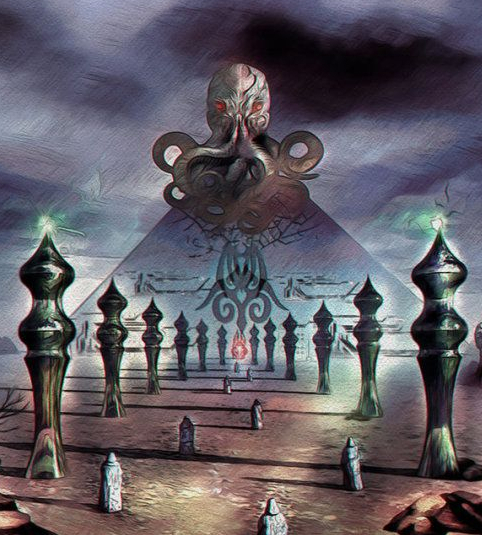 The Great One Monks – Cthulhu, by Giovani Francisco Luengo
 Mammon by George Frederick Watts, 1884–85.
 Soul Groups by Kazuya Akimoto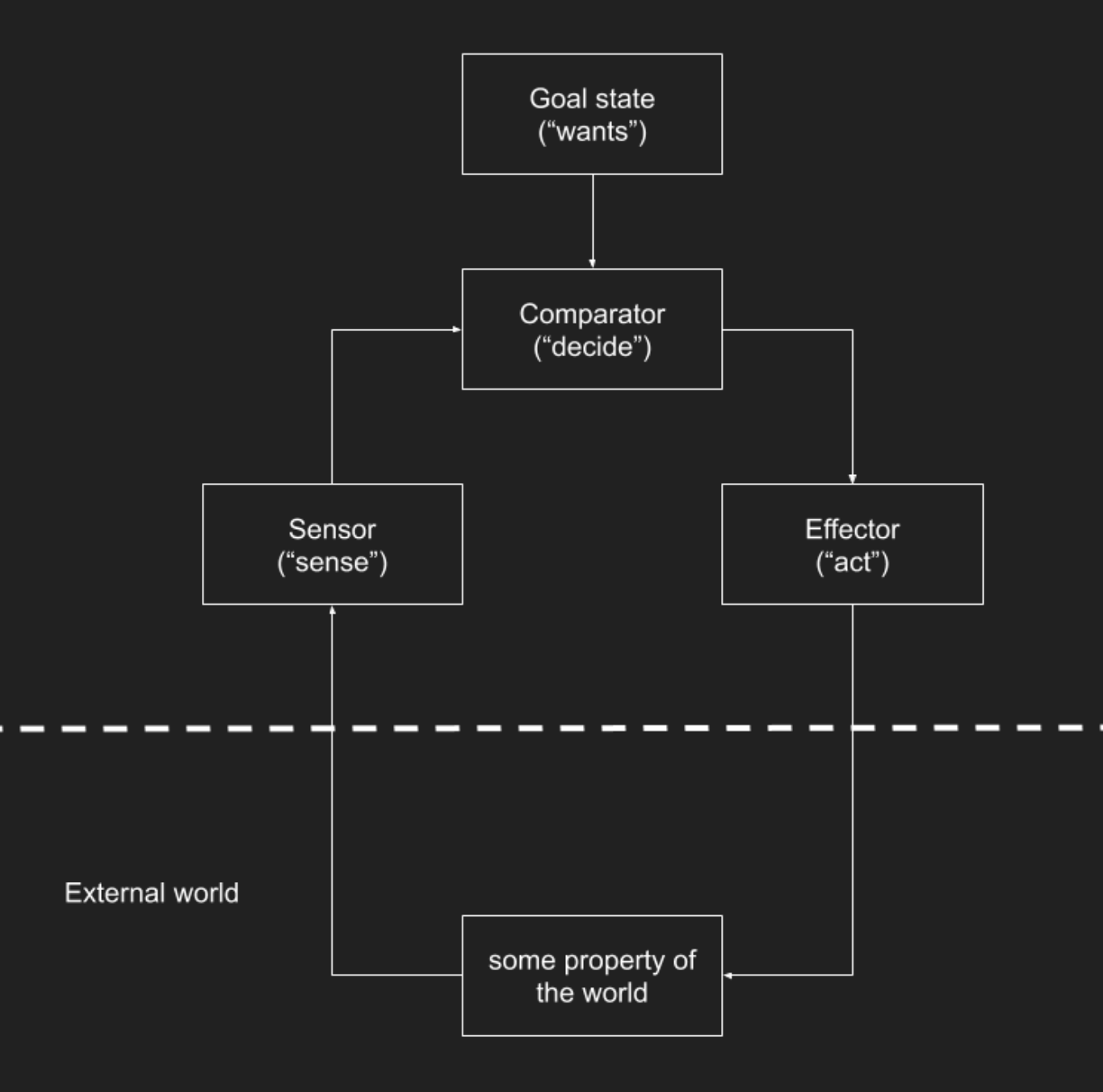
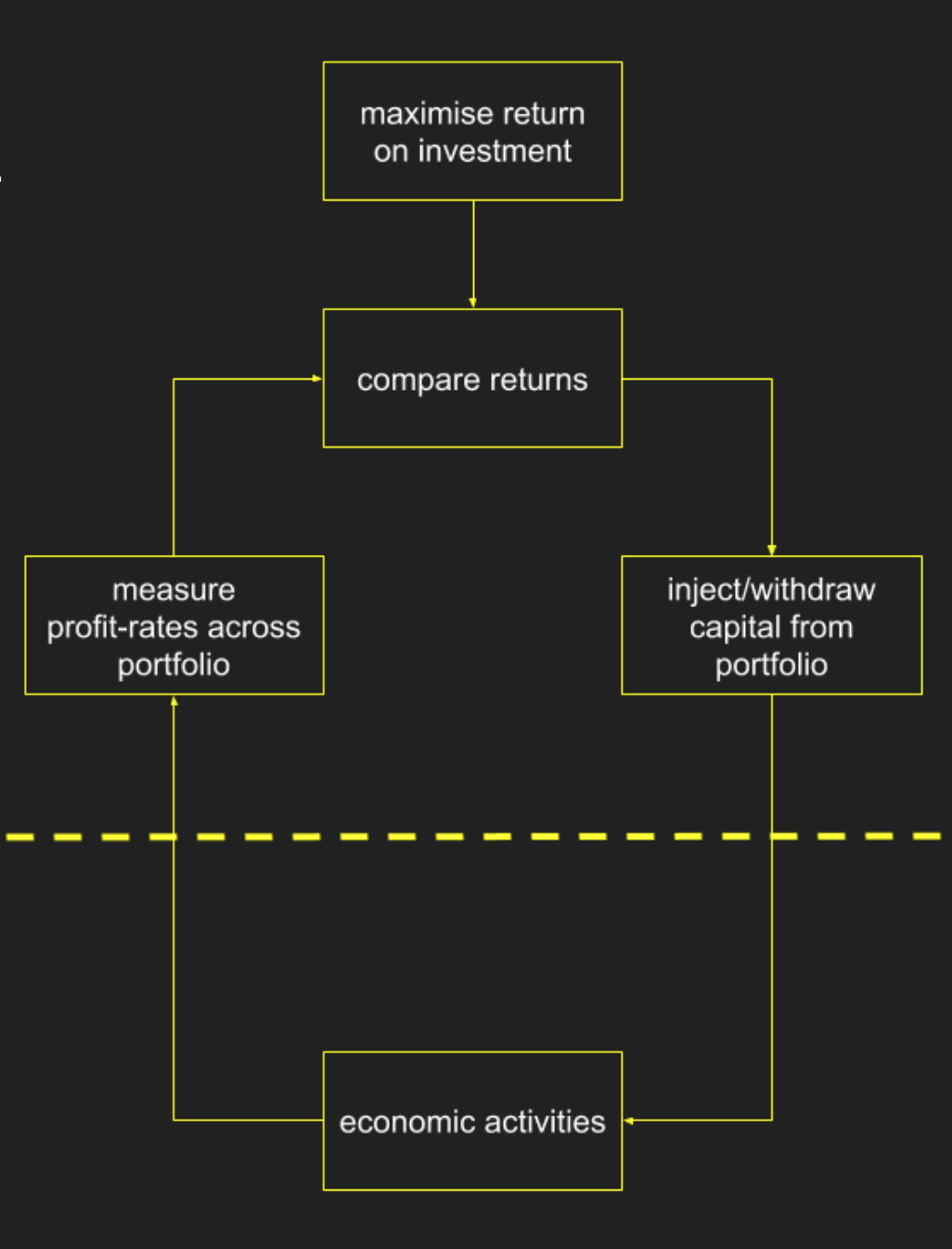
 Mr. Kraken by Olly Jeavons
 Medusa by Rado Javor
 Green Man Linocut by Alan Rogerson
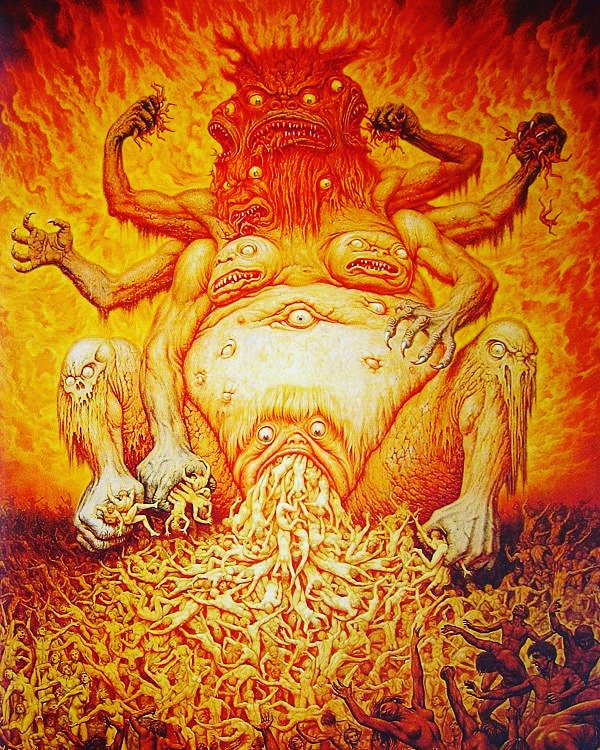 Kali by Johfra Bosschart, 1976
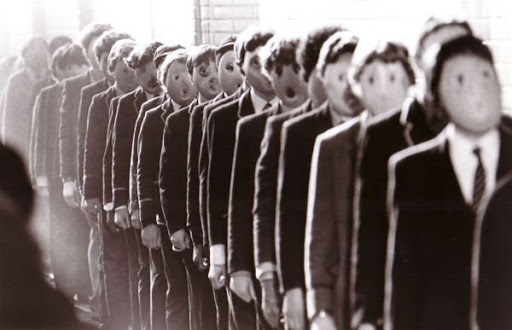 We don’t need no education, Pink Floyd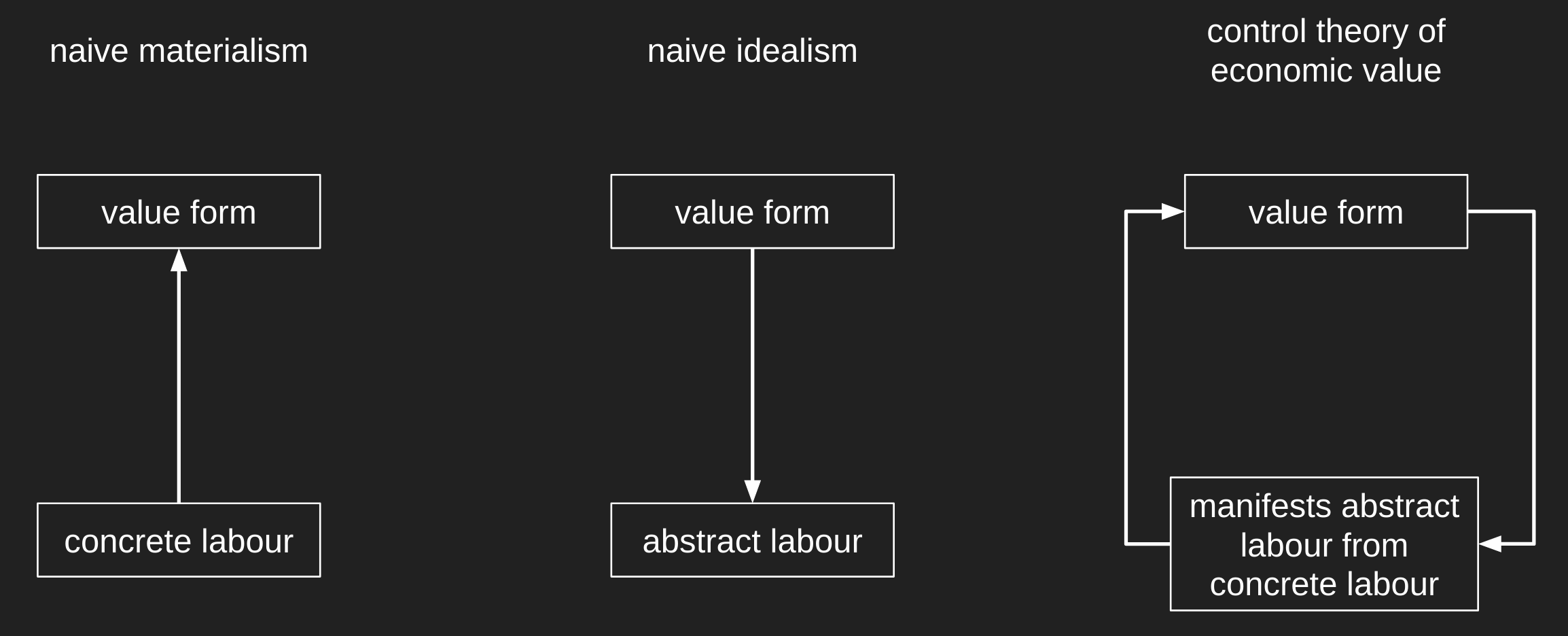
 Copro Overlord by Vergvoktre





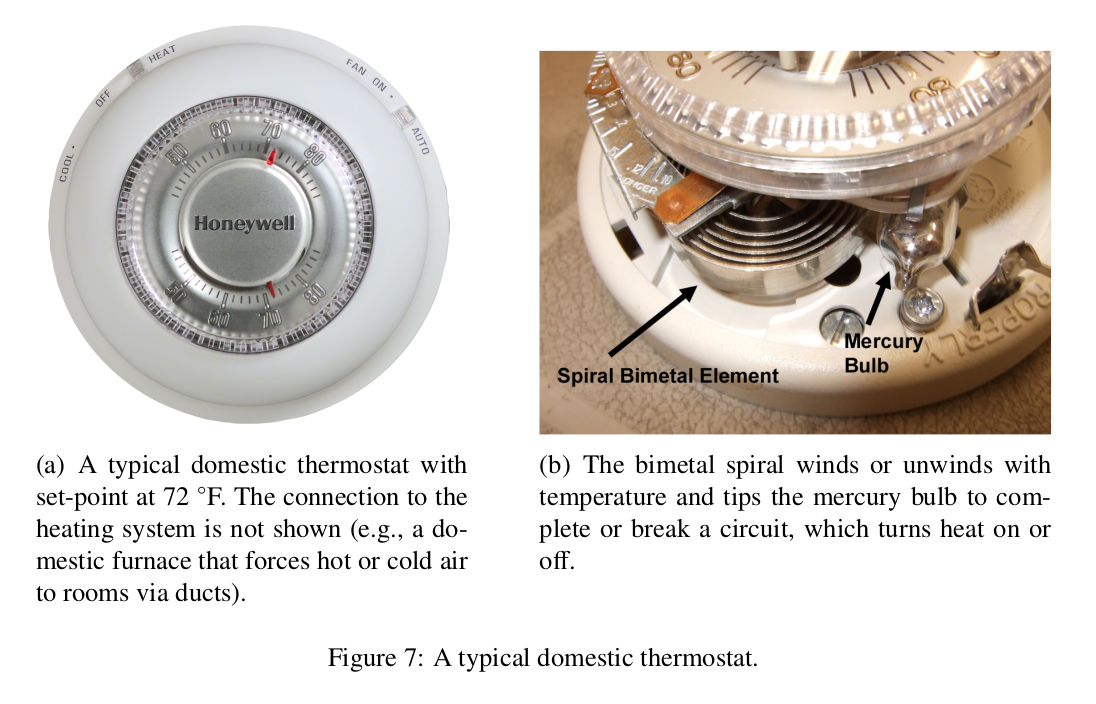


 where k is some arbitrary constant. This law implies that the maximum value of x(t) is k (when y(t) is 0) and the maximum value of y(t) is also k (when x(t) is 0). For simplicity, let’s call this conserved value the size of the contradiction because it directly relates to the quantity of substance flowing within it. So k is the overall activity level, or “energy” or “size” or “scale” of the contradiction.


 We see that being and nothing oscillate between finite limits, forever.
 This plot shows the state-space of the dynamic system defined by the equations. It shows all the possible configurations that becoming can be in.


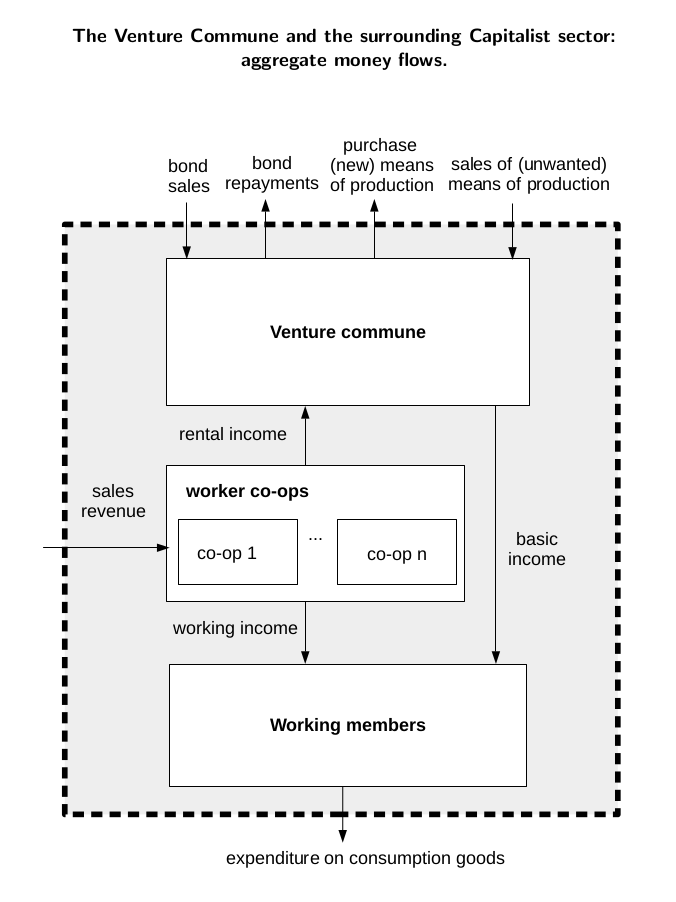


 The simulation produces an exponential distribution. So there’s many quick recessions and a smaller number of long recessions.
 We find that profit rates vary considerably. They cluster around a non-negative peak, with a long power law tail. So, at any time, most firms make an average profit, some make a loss, but a small number make super, super profits.