GeistHaus
log in · sign up

Hannah's web log

Part of neocities.org

Posts from Hannah's web log

stories
Simulacra and Citation
The Pope, Baudrillard, and finding myself inside the hypertext
Show full content
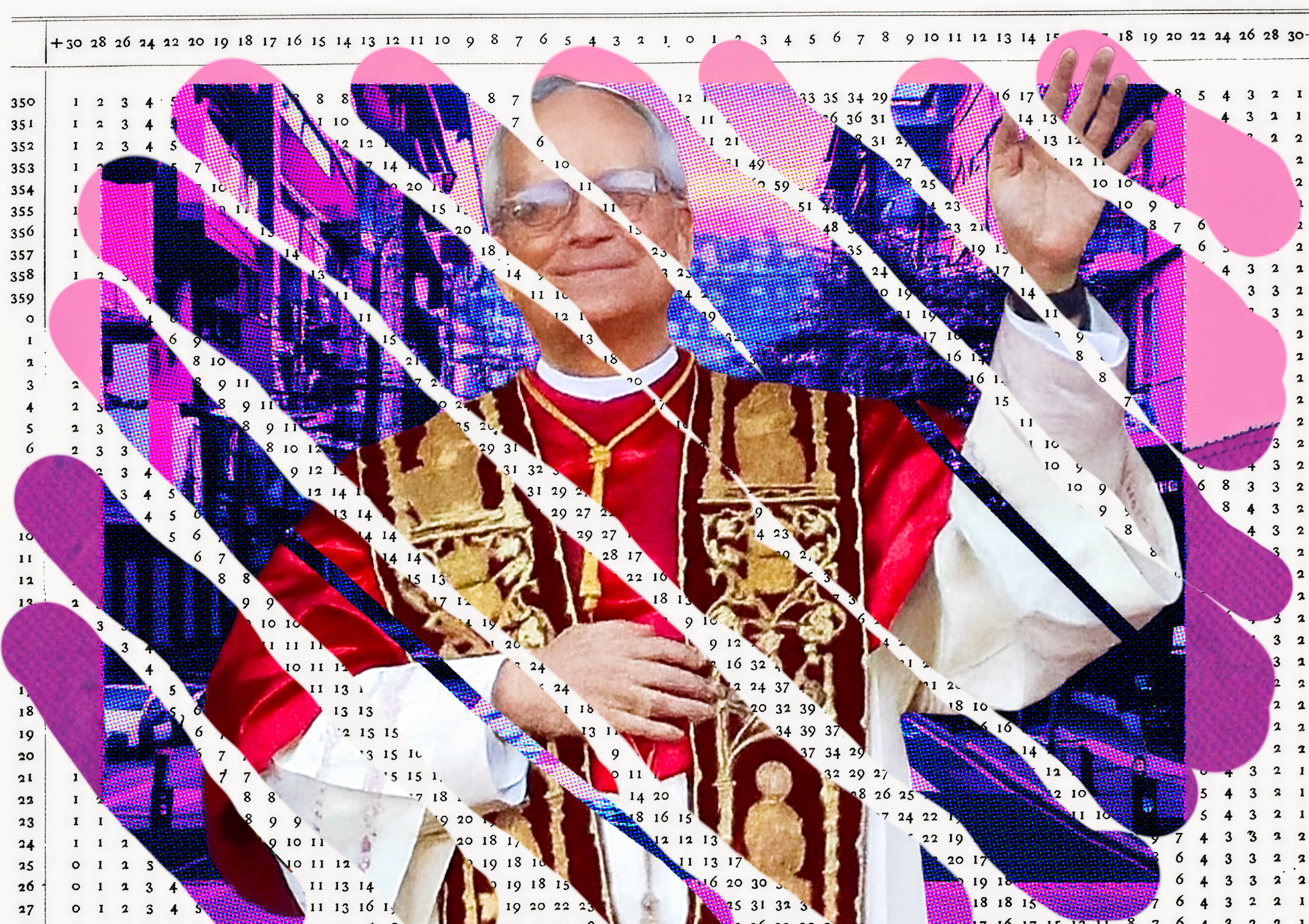
A collage depicting Pope Leo XIV in ornate red and gold vestments, arms raised in greeting, partially obscured by diagonal bands filled with neon pink and blue glitch textures. The background resembles a printed archival or data sheet covered in rows of numbers, creating a layered effect that evokes fragmentation and digital abstraction.

(Image: Hannah Shelley. Licensed under CC BY-SA 4.0. This work incorporates: Pope Leo XIV on the loggia after his election, Edgar Beltrán / The Pillar, CC BY-SA 4.0 | Is This Even Real II, Elise Racine, CC BY 4.0 | Seeing More — Seeing Less, Anna Riepe, CC BY 4.0 )


A few weeks ago I enjoyed this Bluesky post by Eryk Salvaggio.

Is Pope Leo reading Baudrillard

[image or embed]

— Eryk Salvaggio (@eryk.bsky.social) April 22, 2026 at 10:11 AM

The short and boring answer is: Yes, the Pope has almost certainly read Baudrillard. Any theologian seriously engaged with questions of media and culture would very likely have encountered Baudrillard, indirectly at the absolute least. But the language of this tweet, using Baudrillardian keywords like "simulation", and basically offering an enyclopedia definition of Baudrillard's concept of hyperreality, he actually seems to have absorbed his ideas quite closely. Of course there are fundamental differences between Baudrillard's secular, postmodern scepticism toward absolute truth, and the Pope's deeply traditional Christian worldview where truth is understood as objective, transcendent, and ultimately grounded in God. The tension is funny, but Baudrillard's ideas still remain extremely useful for critiquing communication in the contemporary world, even to the Pope, it would seem.

I'm actually less interested in tracing the intellectual connections between Postmodernism and Catholicism, though I have no doubt there is plenty there to explore if I wanted to.
My interest is to answer the question more literally, more bibliographically. I wanted to exercise my librarian skills and create something of a citation chain between the two men. Like 6 degrees of Kevin Bacon but with footnotes.

As a typical librarian about to embark on a reference quest in some specialised area, I have a lot of general knowledge but I'm not a true subject matter expert. I studied Baudrillard in high school, even did an assignment on him. I read at least most of Simulacra and Simulation, and still have a copy somewhere. The general ideas stuck with me enough that I am reminded of them often. I don't know much philosophy, and Baudrillard is probably the philosopher I know best. So whenever his name comes up, I think: there's my homeboy.
I am also quite interested in theology, but tragically, I am Protestant. Still, I'm quite ecumenically minded, and I work for a Catholic university, so I do have a genuine interest in what the Pope says.

Pope Leo XIV, born Robert Prevost, chose his papal name in part because of his desire to address what he has called the next "industrial revolution" - developments in AI that "pose new challenges for the defense of human dignity, justice and labor." This suggests to me an interest in the theological dimensions of technology and culture. The Pope has been very vocal about social media, AI, and their impacts on human spirituality (see above tweet). So I wondered if he's written on any of this stuff before.

One of my first questions was does Pope Leo have an ORCID? Disappointingly, he doesn't (yes, I checked). But as an author who has published under 2 names, he should get one! Especially when you also consider there are no less than 13 other scholars in history sharing the name Pope Leo. Name disambiguation is important! I even found a researchgate profile for another Robert Prevost, who, to my delight, is a scholar of both philosophy and religion. It's not him though.

Pope Leo's publication history is small. His thesis is about canon law in the Augustinian order, and his handful of book chapters and journal articles are all along the same lines. This is not my wheelhouse and I don't think Baudrillard's either.

A better place to get some in-roads might be recent Vatican statements, as that's where his recent outputs are. The Vatican archive is pretty good to search - full text indexed, hyperlinked references, unfortunately it isn't indexed in tools that can help with citation mapping like Semantic Scholar or Lens, which deal mostly with DOI-assigned papers. Theology documents are a bit more esoteric. I did a search of their archive for "Baudrillard" - 0 results of course. That was always going to be a bit of a hail Mary (sorry).

But then the next best thing happened. I also did a search for "simulation" and THE ORIGINAL CONTEXT OF THE TWEET appeared. The paragraph in the tweet was part of an address to university students and professors at the Catholic University of Central Africa. I hadn't expected that. I thought the Pope's tweets were just tweets, not excerpts from his official addresses. So did he cite Baudrillard? (Or even another philosopher close to Baudrillard?) Technically, no. He cited other Popes, he cited the Bible, he cited 19th century theologian John Henry Newman in The Idea of a University.

But I was fascinated by the idea that this document, an address to Catholic university students and academics was, institutionally speaking, indirectly aimed at me. The Catholic intellectual tradition of the pursuit of truth and knowledge, the thing that genuinely inspires my work, and the thing I was engaged in doing right now just for fun. Trying to uncover the empirical truth of the matter.

I realised nothing short of a direct written reference could ever "prove" Pope Leo had read Baudrillard. And that smoking gun probably didn't exist. The undocumented hint of semantic resemblance, the self-referential loops I got stuck in looking for the answer were the closest thing to an answer I was going to get.
As Simulacra and Simulation argues, we inhabit systems of signs that refer mainly to one another rather than an underlying reality. And as the Pope elaborates, this weakens our capacity for discernment. That's where I was. In a simulation. Looking at systems of references that point to other references - tweet screenshots, hyperlinks, PIDs, search results - unable to discern a deeper reality. So I can't help but insert myself into this citation chain, if you can call it that. A teenager half-reading Simulacra and Simulation for a high school assignment eventually becomes a librarian searching Vatican archives for traces of postmodern philosophy in papal statements, after seeing a joke on Bluesky, referencing a tweet referencing something else. Baudrillard would probably say the distinction between "real" intellectual influence and the "appearance of" intellectual influence has, by this point, collapsed entirely.
And now that I've written a blog post citing both Baudrillard and Pope Leo, I've closed my own loop.

https://hannahshelley.neocities.org/blog/2026_05_15_Simulacra.html
Open Access and Colour Theory
What's in a name? And other questions you were too confused to ask
Show full content

Open access means making research and academic content freely available online for anyone to read, download, and share. The Budapest Open Access Initiative Declaration (2002), which solidified the movement in its relatively early days, described the 2 options to achieve open access:

  1. "Self-archiving": scholars depositing their own works in electronic archives
  2. "Open access journals": journals that don't operate on traditional access fees, instead releasing all published content for free.

To help authors navigate this space, a colour-coding system emerged as a shorthand for this distinction. "Green" for self-archiving and "Gold" for open access journal publishing became widely adopted terms.

Colour theory

Green and gold are analogous on the colour wheel. This implies they are in harmony. Side by side options that each work towards the common goal of making scientific and scholarly literature free and accessible to anyone worldwide.
As an Australian I have a very subjective but strong association of "Green and Gold" as our national colours. Using the specific phrase "green and gold" to an Australian audience has the same "wait, what?" energy as saying "who you gonna call?" and not answering "Ghostbusters." Australia's Department of the Prime Minister's website boasts that "the national colours have strong environmental connections. Gold conjures images of Australia's beaches, mineral wealth, grain harvests and the fleece of Australian wool. Green evokes the forests, eucalyptus trees and pastures of the Australian landscape." I quote this to highlight that colours naturally carry emotive and evocative associations, especially with the natural environment. These associations can have origins that exist outside the intended context they're being used.

"Gold" is a type of yellow, but it is also a precious metal associated with wealth, value, and prestige. Also a sense of the ideal. The "gold standard", the "gold medal".
In contrast, "Green" carries an association with being the eco-friendly or budget option. The reason for this colour choice was never fully clear to me. Perhaps an association with being a "grass roots" movement, but it's not really. It's actually quite an individualistic approach, reliant on each researcher to tend to their own outputs (maybe a gardening metaphor, then?). It was only in my background reading for this post that I learnt in the 2004 article by Harnard et al coining these terms, "green" was meant to evoke the "green light", or permission from publishers, given to authors to self-archive.

Green vs Gold. Who won?

In the decades that have transpired, "gold" open access has flourished, particularly the "pay to publish" APC (article processing charge) model which is highly profitable for publishers, who once upon a time may have seemed like the theoretical losers in a scenario where research publications are made free.
Meanwhile "green" has not enjoyed substantial uptake.

Unlike the publisher-driven gold option, green requires both effort and savviness on the part of the researcher (even though there are expert librarians curating every institution's research repository who are happy to handle the nuts and bolts – just email them your PDFs!). Harnard outlined these failings in a recent interview. He was a bit more scathing, saying "researchers are lazy and short-sighted", which I don't think is fair. Unless it happens to be a passion of theirs, academics are usually too busy thinking about their field of research to be thinking about open access, and I can't blame them for that.
The other reason Harnard gave for green's failure is librarians, who "have been timid and confused about what they're allowed to do" and "worry endlessly about copyright and publisher permissions". I appreciate a good calling out of my own profession more than most, but "timid" is a slur, your honour (why not go all the way and call us "mousy")! The criticism does ring true though, and I hope this is changing because librarians are the people most likely to help researchers navigate all this. The same caution that leads to over-restriction, at its best, is a commitment to getting it right.

Author-accepted-manuscripts feel like a lesser version of an output. Citation culture favours an official version of record. In many repositories they don't have their own DOI - they're treated as a kind of supplementary material to the published version. AAMs are also a word document rather than an authoritative journal article. If you found the PDF directly through a search engine, you might not even be sure what you're looking at. Indeed this happened to me just today. The published version of the 2004 Harnard et al article is not OA. But I had a feeling there would be a green version. Google sent me to this pdf which looks like the AAM until you notice it contains references from after that date, and if you look carefully at the reference it says it's an updated version. I decided to link to this repository item from further down the search results, which I hope is right.

Funder mandates requiring immediate open access of outputs also undermine green options which are usually subject to publisher embargo periods – and asserting author rights to overcome these is possible but is a layer of bureaucracy a researcher may not know about or feel equipped to do. Even the thematic reference to a "green light" betrays the fact that this is a practice where you need to sit and wait for permission to proceed.

Obviously the colour label alone didn't doom green OA. There are the more practical reasons outlined above. But language shapes perception, and if researchers were already inclined to do the bare minimum, being pointed toward the option that sounds like the budget DIY tier surely can't help.

Collecting more minerals

In the AMC drama, Breaking Bad, one of the main characters, Hank Schrader, at one point acquires a physical injury that forces him to take time off from his job as a DEA agent. During this time he turns his attention to obsessively collecting and cataloging minerals (not rocks, as he often reminds his wife Marie). Open access discourse can feel a bit like this. Meticulously categorising different types of minerals while the bigger problem sits unresolved.

"Diamond" open access was coined to describe journals that are free for both readers and authors. The name is intentionally competitive, positioning itself as more valuable than "gold." It also reflects a shift in how "gold" is understood. Originally, gold simply meant publisher-provided open access, regardless of funding model. Over time, it became synonymous with APCs.
Diamond reframes the conversation around equity. If open access just shifts the paywall from readers to authors, it excludes those without significant institutional backing or grant funding. Diamond aims to be more genuinely open, but it relies on volunteer academic labour and limited institutional support.
Diamonds are valuable, but rare. However, advocates want to see investment in infrastructure that scales up diamond publishing and makes it more sustainable. You don't make foundations out of diamonds.

The Gold spin-offs don't end with diamond. There's bronze, which was coined by Piwowar et al pointing out the volume of open access articles that aren't truly gold due to a lack of Creative Commons license. There's hybrid, implying open and closed can co-exist like Schrodinger's cat. Some old-school pirates have even returned to colour-coding by suggesting piracy of journal articles is a form of "black" open access.

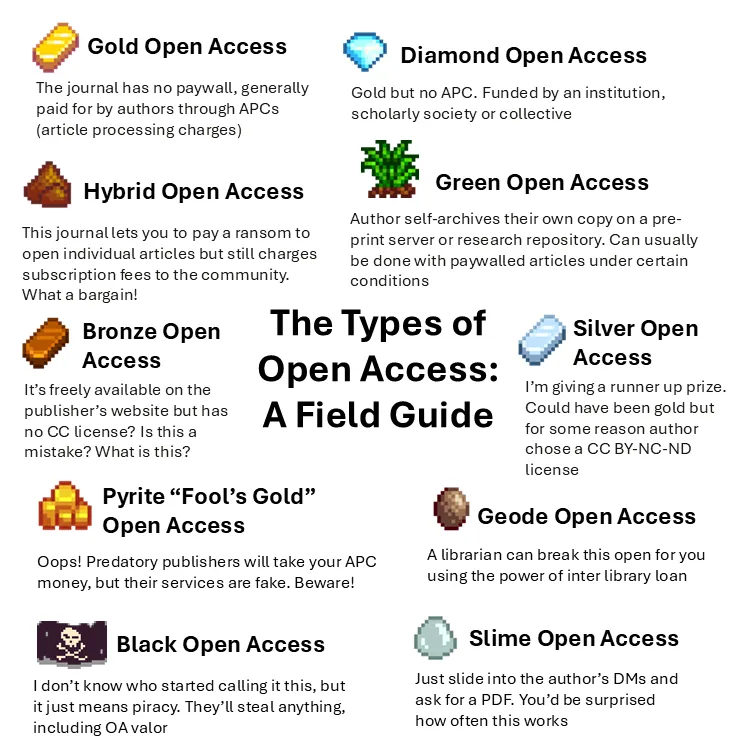
I made fun of this obsession with accumulating mineral-based metaphors with this meme, comparing it to collecting items in the game Stardew Valley. I didn't think anyone would appreciate it (relevant to my particular combination of interests), but many did, because the system really does feel like a resource classification game.

An infographic titled 'The Types of Open Access: A Field Guide,' styled with Stardew Valley pixel art icons representing different materials. Ten types are listed: Gold Open Access (gold ingot icon): The journal has no paywall, generally paid for by authors through APCs (article processing charges). Diamond Open Access (blue diamond icon): Gold but no APC. Funded by an institution, scholarly society or collective. Hybrid Open Access (brown lump icon): This journal lets you pay a ransom to open individual articles but still charges subscription fees to the community. What a bargain! Green Open Access (grass icon): Author self-archives their own copy on a preprint server or research repository. Can usually be done with paywalled articles under certain conditions. Bronze Open Access (bronze ingot icon): It's freely available on the publisher's website but has no CC license. Is this a mistake? What is this? Silver Open Access (silver ingot icon): I'm giving a runner up prize. Could have been gold but for some reason the author chose a CC BY-NC-ND license. Pyrite 'Fool's Gold' Open Access (pyrite nuggets icon): Oops! Predatory publishers will take your APC money, but their services are fake. Beware! Geode Open Access (geode icon): A librarian can break this open for you using the power of interlibrary loan. Black Open Access (skull and crossbones icon): I don't know who started calling it this, but it just means piracy. They'll steal anything, including OA valor. Slime Open Access (grey slime icon): Just slide into the author's DMs and ask for a PDF. You'd be surprised how often this works.

I daresay that adding more and more labels reflects the default compulsion of scholars - acknowledging more and more nuance - rather than providing clarity. The terminology that was meant to help researchers navigate their options ended up becoming the vocabulary through which we offer industry critique.
If we continue to use this language to explain the many "pathways to open access" it doesn't feel inviting - it feels like a warning to authors that there's a long and treacherous road ahead, quite unlike the 1990s promise of the "Information super highway" in its simplicity and freedom. Instead we've got traffic lights, obstacles, conflicting lanes, high tolls, and it's unclear where we’re even meant to be going.
Language shapes perception. And perception shapes behaviour. Open access is difficult to navigate, at least in part, because it is described that way.

https://hannahshelley.neocities.org/blog/2026_04_27_Openaccess.html
I am underwhelmed by AI search
I wanted AI to replace me. So why hasn't it?
Show full content
A black keyboard at the bottom of the picture has an open book on it, with red words in labels floating on top, with a letter A balanced on top of them. The perspective makes the composition form a kind of triangle from the keyboard to the capital A. The AI filter makes it look like a messy, with a kind of cartoon style.
Teresa Berndtsson / Letter Word Text Taxonomy / Licenced by CC-BY 4.0 / via Better Images of AI

A student requests a meeting and emails me their research topic. Twenty minutes before our appointment, I prepare by building a search and test running it in some databases. By the time we meet, I can present them with a search strategy that does a good job of finding as many relevant articles as possible, while largely filtering out irrelevant ones. They usually can't believe what they hadn't found.

What I'm doing in those twenty minutes is using skills that I've honed over years, especially in health and medical research. Database searching is as precise as writing code. You need correct syntax, boolean operators in the right place, correctly nesting brackets, truncation and wildcards to catch word variations. Sometimes librarians focus on these mechanics, the "tips and tricks" when teaching students how to search effectively. But really it's more nuanced than that, and requires some sophisticated judgement skills. You need to know how to deconstruct a research question into its component concepts, assess whether these concepts are broad and expansive vs narrow and focused, identify synonyms and related terms that expand your search in the right directions, understand how a database indexes terms vs how authors typically write. Subject thesauri like MeSH headings exist to bridge the gap between natural language and database indexing, otherwise a lot of literature would be undiscoverable. Most students and academics never fully develop these skills, and reasonably so, because they've got other things to focus on. This is why librarians exist to offer this expertise.

A few years ago, when ChatGPT exploded into the public, we all (I mean, some people) started speculating if our jobs were going to be replaced by generative AI - or at least, parts of our jobs. I thought for sure that structured searching was on the chopping block. "Vibe searching" seemed like the kind of task large language models were primed for. The semantic nature of LLMs means that instead of simple keyword matching, the tool predicts related words. Just ask it a research question and it finds the best literature for you. No more breaking it down into concepts, thinking about keyword terms and arranging them in a boolean string, sifting through results and reflecting on the false hits and misses. An LLM-based search should be able to process your query in a way that transcends keyword-style algorithms to give you highly relevant results based on the meaning and emphasis of your research question, not just the words. Not only is this easier for users - this could lead to new discoveries that might be hidden otherwise. I was kind of excited about this to be honest. Sure, it meant those skills I'd developed over the years would be functionally obsolete and I'd need to adapt, but it also meant that the previously obstacle-laden terrain of academic search would become clear as glass. That's an exciting prospect for academia in general.

Many users, especially students, are likely to use popular AI chatbots like ChatGPT and Claude to "search". These use RAG (retrieval-augmented generation) so they can provide answers based on sources and provide the links. But in my experience, rather than feeling like a superpower (the way a great boolean search does), it feels like picking the easy fruit, offering the same kind of results as a low-effort Google Scholar search. A few articles that are ok, probably fit for purpose - nothing that was hard to find anyway. That's assuming you're savvy enough to check if the articles are even real! Of course, a quick search is actually fine a lot of the time. Not all use cases need systematic review levels of retrieval. A student may just want one supporting reference, or something just to get their ideas flowing. Sometimes "good enough" is better than perfect - there's no need to over-engineer.

The real problem is the added noise of generative text when understanding the literature is the goal. ChatGPT might confidently inform me that there are no studies related to the thing the student is writing about, but offer similar ones - when I know it's not the case, it just missed something. That's epistemically corrupting in a way that a naive search isn't. A simple search in Google Scholar or PubMed might not get the student comprehensive results, and they'll realise this - and either settle for what they found or try a different approach. But an AI tool returns a handful of results and creates a confident narrative around them, potentially ignoring or conflating some works, teaching the student false beliefs about the field. The gap between what students think they need and what they actually need is only widened by AI tools that make inadequate searches feel satisfying.

Of course, I'm aware that ChatGPT is a bit of a joke these days among serious AI users. I should be prompting better and/or using more fit-for-purpose tools, one might tell me. But "prompt engineering" is not guaranteed to overcome the tool's failings. And if we're going to be learning advanced skills just for searching, we might as well take the guaranteed route and learn to use the features of an advanced search screen. We're trying to make things easier here! I take the point about tools though, because there are many products like Perplexity, Elicit, Consensus and Undermind that are geared toward academic research and source retrieval. I've tried these tools a little bit but I was put off when I was with a researcher from a niche area, and they did a search in Elicit, which retrieved an article they already knew very well and the generated summary claimed that the article argued the opposite of what the authors actually said. I know that's just one anecdote, but it's not a rare one, and it betrays a key failing: if outputs designed to convey information are not reliable, responsible use requires you to fact-check them yourself. The process is then about unlearning misunderstandings that should have never been introduced to you in the first place. That's frustrating, mentally distracting, and puts the "responsible user" in the position of working against the tool that is meant to be helping them. Or else, using the features as they are designed, the user is encouraged to take shortcuts and potentially get led astray.

The more valuable offering of these tools is the semantic/vector search component, which can surface conceptually related work that a keyword search would miss. But in my experience the results aren't markedly different - they don't often find anything a good old boolean search can't. They simply aren't worth the new failure modes that the generative layer introduces. I concede that my experience is primarily in fields where specialist databases with structured indexing are the best places to search. In fields that rely more on grey literature or sources scattered across the web, semantic/vector search may offer more genuine gains.

However, a lot of "AI powered search" features being promoted by popular platforms are not using the semantic search capabilities I described. They just take a natural-language prompt and construct a boolean query out of it, then proceed to search the old fashioned way. That's a pretty weak feature. Aaron Tay described this design as "the Horseless Carriage of AI Search".

Productive friction is part of the learning process. I don't mean a bad kind of friction, like struggling with clunky tools that distract you from your goals. I mean the good kind - where you learn things you didn't know you were looking for, where you make mistakes you can learn from. AI removes the second while pretending to remove the first.

In practice, the whole paradigm of "ask a question, get answers instantly" skips the conceptual work and iterative search processes that allow a scholar to really deepen their understanding of the literature. And the problem scales with inexperience. An expert who already knows the field can likely cut through unwanted noise and knows how to ask the right questions already. A novice has no such calibration ability, and they're the one who really needs it. So AI search, as currently implemented, is most dangerous precisely where good searching matters most. My hope is for a truly enabling tool that makes retrieval easier and more powerful, without encroaching on your autonomy to interpret things for yourself.


https://hannahshelley.neocities.org/blog/2026_04_08_AIsearch.html
The Quiet Revival
Thinking about the retracted church attendance report and why an imaginary wave made such a splash.
Show full content

Last year, the Bible Society published a report with a striking claim: the number of young people attending church in England and Wales had quadrupled in just six years. In 2018, just 4% of 18-24 year olds surveyed said they were Christian and attended church at least monthly. By 2024, that figure had risen to 16%. The researchers called it a "Quiet Revival."

Press coverage was extensive. The findings were raised in Parliament in the UK. Churches all around the anglosphere pointed to the numbers as confirmation of their dearest hopes - that young people were turning back to faith. There was skepticism too, and questions about its methodology, as the findings seemed wildly out of step with every other available measure - the long-running British Social Attitudes Survey, the Church of England's own figures, decades of consistent data pointing in the opposite direction.

This week, the report was finally retracted. YouGov, which conducted the research, confirmed that an internal review had found that the data had been skewed by fraudulent respondents (people who had signed up to the online survey purely to claim the cash rewards on offer and not given genuine answers). Quality control measures designed to catch this problem had not been properly applied.

Generally, you'd think that a profound change like a figure quadrupling in just six years would attract some scrutiny - and probably flag a potential mistake. But this story gained traction because something about it felt true to many people before anyone checked the numbers. There is observable interest among some young people in traditional and religious lifestyles and attitudes. There's a reactionary desire to "RETVRN" to some nostalgic vision of the past, often paired with Roman Catholic aesthetics. I've blogged before on the growth of patriarchal thinking among Gen Z men, but it's not just men. There's the "tradwife" trend, in which women perform and celebrate a return to domestic submissiveness, which has attracted mainstream coverage. It makes sense that this might translate to growth in church attendance, doesn't it?

Well, no. This "quiet revival" was quiet because it wasn't happening. Maybe some young people are attracted to the aesthetic of certain expressions of Christianity: the sense of traditionalism, the way Christianity is often encountered today as a political identity before a religious one. It's hard to tell how much of this social change is real and how much is inflated by the distorted reflection of social media, where outrageous content flourishes, where highly engaged minorities get overrepresented, bots flood comment sections, and people hide behind anonymity to experiment with ideas that don't actually match their lived reality. But if there really is something significant and tangible happening, there's not yet any evidence that it comes from church. There's a significant difference between symbolic affiliation (larping online about the idea of tradition, hierarchy, order, and ritual) and embodied practice (giving up some of your Sunday and possibly other things to attend gatherings, accepting obligations to serve others, etc). What are people really hungry for when they reach for the signifiers of tradition without the substance?

Here is what I think is true. Individualism has been the dominant ideology of our time, and it creates isolation. Online communities do not fill that gap, whatever they promise. People are lonely in ways that are making them unwell, and making them susceptible to whoever offers the most compelling account of why. Churches, and other traditional institutions have been in decline. In some cases, that decline is a reckoning they brought on themselves, through the abuse of the power people entrusted to them - and I don't say that from a distance. I still find myself believing that institutional belonging is a salve for modern loneliness. At some point you have to show up somewhere, in person, among people you did not choose, and learn to be part of something larger than yourself.

Sometimes a retraction comes too late. People have already had their biases confirmed. To reach for an infamous example, when Wakefield's fraudulent article linking MMR vaccines and autism was retracted 12 years later, it wasn't enough to extinguish the anti-vax movement's convictions. The claims had already been naturalised by a movement that is not evidence-based anyway, and was always bigger than that one article.

In this much smaller case, I'm not sure "Christian Gen Z" had soaked into cultural assumptions just yet. But it's worth thinking about the culture it's speaking into, because it resonated for a reason.

https://hannahshelley.neocities.org/blog/2026_03_29_QuietRevival.html
What is a librarian?
Exploring the surprisingly contentious question of what it means to be a librarian.
Show full content

The question of who gets to call themselves a librarian is far more contentious than it has any right to be.

Matthew Murray's fun librarian alignment chart has lived rent-free in my head since I saw it a few years ago.

A table titled 'The Librarian Alignment Chart (Inspired by The Sandwich Alignment Chart).' It is a 3×3 grid with row headers defining Certification level and column headers defining Location level.
Column headers: Location Purist (A librarian must work in a library.) | Location Neutral (A librarian must work with information.) | Location Rebel (A librarian can do any sort of job.)
Row headers: Certification Purist (A librarian needs a master's degree from an ALA accredited program.) | Certification Neutral (A librarian needs a combination of training, experience, and knowledge, but not a master's.) | Certification Rebel (A librarian doesn't need any sort of training.)
Cell contents:
Certification Purist / Location Purist: An MLS holder who works as a reference librarian in a public library is a librarian.
Certification Purist / Location Neutral: An MLS holder who works as a records manager is a librarian.
Certification Purist / Location Rebel: A manager of a sex toy store with an MLS is a librarian.*
Certification Neutral / Location Purist: A person who has worked in various roles in the library for 20 years but doesnt have any official certification is a librarian.
Certification Neutral / Location Neutral: A person who has a library technician diploma and works as a cataloguer for a distributor is a librarian.
Certification Neutral / Location Rebel: A person who received a B.A. in Information Science, but now works as a veterinarian is a librarian.
Certification Rebel / Location Purist: A teen shelver in a school library is a librarian.
Certification Rebel / Location Neutral: A self-taught database programmer is a librarian.
Certification Rebel / Location Rebel: A cat** is a librarian.
Footer note: (Not included on this chart are payment (A librarian must be paid/A librarian can be a volunteer), humanity (A librarian must be human/A librarian must not be a human/A librarian can be a lizard person), sentience/sapience/awareness (A librarian must be aware that it is a librarian/A tree can be a librarian), aliveness (A librarian must be alive/A corpse can be a librarian), and something about artificial intelligence and fictionality.)
http://www.liscareer.com/mcguire_alternativecareers.htm
** This cat is not one of the cats that live in libraries. Those fall within the Location Purist/Certification Rebel section.

There's a lot of baggage around defining a librarian: questions about qualifications, anxieties that the public doesn't understand what we actually do, and competing identity narratives. So let's dive into 3 frameworks for defining a librarian.

1. The organisational title

I'm a librarian who hires and supervises librarians and library workers. So allow me to put on my HR/management hat here. Job titles are organisational tools. They signal scope of responsibility, required qualifications, and remuneration.

In Australia, there are three broad categories of library workers. Library assistants, library technicians, and librarians.

Library assistants do things like customer service, book shelving, and processing and admin work. These roles usually need no formal qualifications.

Library technicians need a diploma accredited by the Australian Library and Information Association (ALIA), usually through TAFE (Technical And Further Education). They are involved in specialised tasks like cataloguing, inter-library loans, maintaining operational systems, and generally holding more responsibility within a library team.

Librarians need a university degree recognised by ALIA. Unlike the US, it does not need to be an MLS/MLIS - there are undergraduate and graduate diploma courses that are ALIA-accredited. A lot of librarians do have a Masters though, often because they already have an undergraduate degree in something else and it's quicker to top it off with a Masters.

There are rare exceptions to the rule. You might find a systems librarian with a degree in systems administration rather than information studies, for example. There are also cases where an experienced library technician would be suitable for a librarian role. These are questions for hiring panels to weigh case by case.

Librarian jobs vary enormously - across specialisations, across different libraries and information services, and within any given role from day to day. At its core, it involves managing information and enabling people to find, access and use it. Some of that is back-end systems work, some is direct service and instruction, some is management and planning. Just don't confuse them with archivists, or they'll both get mad.

2. The social label

I suspect that to 90% of people, a librarian is a person who works in a library. Some people don't like this. While technically not true from the organisational perspective, it makes sense in context and is simple and elegant in its own way. We can have some flexibility here without launching into a "well ACKtually" defense about how librarians need Master degrees and are talented and underrated. People who use this definition are not wrong and they're not trying to undermine anyone's expertise. They're just talking about something different. Though they may express innocent surprise that librarianship is something you can even study at a Masters level.

The gap between perceptions of librarians and professional reality are a frequent area of study in the library studies literature. It's been observed in several reviews that "librarianship is perceived as a low-status semi-profession, focusing on managing books and performing repetitive tasks." This self-diagnosed image problem holds that the public doesn't understand what librarians actually do, and this misperception undersells a sophisticated professional field.

The thing is, this description actually does describe a lot of jobs in libraries. Library assistants and technicians often undertake the majority of front counter customer service and are probably the most visible to clients. As I've written before, librarians cringe at this for some reason, but books are still our core business! If someone's definition of a librarian is "someone who works at the library and helps me borrow books" - I don't really see the problem. The reality is we're a workforce with differentiated roles, all of which are important. It's possibly kind of classist and gatekeeping to fret about being mistaken for your lesser-paid colleagues? Just something to think about?

That said, it wouldn't be fair to say the profession's image anxiety is just about vanity or professional ego. It has practical stakes. If funders, administrators, and politicians don't understand what qualified librarians do, if they don't realise the value of the work - the information literacy education, the collection development expertise, the research support, the systems work - they may make resourcing decisions that hollow out those functions. But this is an area where we need strong advocacy happening at a high level, not to be worried about casual use of language.

3. The identity

There is also a third meaning, which I've kind of woven through my discussions of the previous 2 frames but it's worth addressing directly: "librarian" as more than a job title but as a professional or even personal identity. It's a set of values, a sense of mission around information access and intellectual freedom. Which perhaps explains why the discussion on defining the profession gets so intense.

Often, this professional pride can take on an almost mythological quality. Fobazi Ettarh [1] referred to this as "vocational awe" - "the set of ideas, values, and assumptions librarians have about themselves and the profession that result in notions that libraries as institutions are inherently good, sacred notions, and therefore beyond critique".

Having a sense of meaning and purpose in your work is a good thing. It will give you job satisfaction and a rewarding intellectual community with your colleagues. You could also make the argument that you need to care about these things or you probably won't be effective at the advocacy work that's so often required. But what happens when a librarian takes a job that doesn't serve those values? For example, does working for a private library with restrictive information policies make you less of a "real librarian"? Tying professional skills too closely to a specific mission can get messy.

Furthermore, librarianship wasn't always tied to ideals of intellectual freedom and open access - librarians were literal gatekeepers, restricting who could access what. Historically, libraries were exclusive repositories for scribes, priests, and the elite. The professional identity we've built around empowering people with access to information is a relatively modern construction, emerging alongside movements for universal education and democratic reform, further enabled by technological change in the 20th and 21st centuries - not something timelessly inherent to librarianship.

In conclusion

A librarian is whoever or whatever the context calls for. Organisations need titles to function, the public uses words to mean things, and people are entitled to carry their professional identities around like a little trinket that gives them inspiration and purpose. Trouble arises when we conflate these meanings. None of this is actually that complicated - except that it is, apparently, because we keep writing about it. Myself included.


[1] I was very saddened to hear of Fobazi Ettarh's passing on 28 January 2026. She was my age. Her work continues to have a profound influence on librarians around the world to be more reflective and critical about our practice, myself included. I've referenced her "vocational awe" essay on this blog twice now, and it's unlikely to be the last time. May she rest in peace.

https://hannahshelley.neocities.org/blog/2026_02_18_Whatisalibrarian.html
Important Thoughts about Hot Cross Buns
...And an indictment of the culture that mistakes scarcity for meaning!
Show full content

Every year, like clockwork, someone sees hot cross buns in the supermarket in early January and loses their mind. "It's nowhere near Easter!" they shriek into the void of social media. "What's next, Easter eggs in November? Pavlova in winter? Dogs and cats living together?"

Yes, I know it's already February. I should have written this a month ago when the outrage was fresh. But I've been too busy eating hot cross buns to blog about them, and that seems appropriate.

The outrage feels familiar to the sight of Christmas decorations in shopping malls in October - an actual psychic assault. It’s valid to sneer at those. They’re cynical and manipulative. They're a reminder of all the upcoming stress and obligations of buying gifts and preparing food, designed to get you spending asap.

Hot cross buns are just bread. Delicious, spiced, sweet bread with little dried fruit jewels and a perfect cross of icing. They're not asking anything of you, other than "hey, would you like some cinnamon?"

The "but they're seasonal!" argument falls apart under the slightest scrutiny. We don't get mad when strawberries show up in winter, shipped from the other side of the planet in a refrigerated container that's probably contributing to the heat death of the universe. But a hot cross bun in January? Sacrilege. A betrayal of our cultural values. An erosion of What Makes Easter Special. I am, famously, the most Christian person alive, and my sense of the sacred is not remotely offended by an early bun. If anything, this fixation on surface-level trimmings reveals how hollow our version of Easter already is.

You know what actually diminishes Easter? Not being able to get hot cross buns when you want them. Forced scarcity doesn't create meaning - it creates frustration and a black market of people hoarding them in their freezers like doomsday preppers.

Hot cross buns should be available year round. They should be in every bakery, every supermarket, every day. We live in a society where you can get a Big Mac at 3am but not a hot cross bun in December? What are we even doing here?

The early-bun complainers can continue their crusade against joy and convenience. Meanwhile, I’m buttering my tenth hot cross bun of the year so far, wishing I’d had even more.

https://hannahshelley.neocities.org/blog/2026_02_04_HotCrossBuns.html
Toy Story is Ontological Body Horror
Pixar created one of the darkest fictional universes ever, and I can prove it!
Show full content

I have been thinking too much about Toy Story again. Never a good sign.

The following is the outcome of me watching the Toy Story films with my child way too many times, combined with my inability to enjoy things without devising a system through which I can come up with some kind of unifying theory behind its fictional universe.

It always struck me as strange that Buzz Lightyear is the only toy that is so deep into his own lore that he doesn't realise he's a toy, and outright rejects the idea even when told.

We learn in Toy Story 2 that this wasn't unique to the specific Buzz we met in Toy Story 1. It is hard wired into all of them, implied to be an outcome of the way they are manufactured. This is confirmed in Toy Story 3, where resetting Buzz to his factory setting reverts him to this delusional state.

The spectrum of ontological alignment

There seems to be a spectrum of how closely the toys' personalities align with their design. At one extreme is complete alignment, where what a toy represents overrides its inner self entirely. Buzz sits here initially. When confronted with the truth of his toyhood, his sense of self collapses.

At the other extreme are toys whose personalities have nothing to do with their form. Hamm, a piggy bank, has the personality of a cynical middle-aged man. He does not act like a pig despite looking like one. His body appears entirely incidental to his inner life. Likewise, in Bonnie's room, there's a hedgehog named Mr Pricklepants who considers himself a serious theatre actor, suggesting he has developed his own interests and identity completely independent of his design.

Just below Buzz are toys like the army men, who clearly embody their toy persona with a degree of seriousness that is not necessarily called for. Toys like this are semi delusional but are still able to function in toy society, albeit with a strong role playing approach to life. This is mostly tolerated as a "quirk" by other toys. In the case of warrior/military themed toys, it can even be useful. The little green aliens also fall into this category, to an extent that mildly irritates other toys that aren't part of their worldview, but they are nonetheless tolerated.

Then we reach the healthier middle ground: toys like Woody, whose personality clearly reflects the character he's based on, but recontextualised to toy life. He is not a sheriff, but he retains the leadership qualities, moral framework, and sense of responsibility associated with one. This appears to be the optimal outcome. Discovering his origins is a key part of Woody's arc in Toy Story 2, and it's presented as a positive thing, and he becomes more well-rounded as a result.

The cruelty of randomness

It's not clear if where a toy lands on the ontological alignment spectrum is a matter of luck, design, or some ineffable factor in the manufacturing process.

But the randomness is especially uncomfortable if you look at toys that are made to resemble animals. Some of them can talk, and act human, like Slinky Dog and Rex. Others are more aligned with their animal self, like Bullseye, who can't speak and seems to have the intellectual capacity of an animal. He's permanently limited compared to Woody, his companion, through no fault of his own. The arbitrary nature of who gets full personhood is deeply unfair.

Big Baby is literally a big baby, and always will be, with all the intellectual, emotional and social limitations that implies. Other baby dolls seem to be much more savvy and clearly have the minds of adults, like Toy Story 4's Gabby, who even uses her innocent appearance as a cover for more calculated schemes.

Impact on relationships

The toys' lore creates a determinism that impacts not just their sense of identity but their relationships with each other too. Mr and Mrs Potato Head seem programmed to be in love, which is conveniently fortunate I suppose, as there seems to be no concept of both parties consenting to the marriage.

It's the same with Barbie and Ken, where they are overcome by a "love at first sight" upon meeting - their neurology (or whatever the toy equivalent is) simply activates in each other's presence, recognising they were "made for each other" - which in their world, is literally true. The whole situation is played for laughs, including the speed at which their relationship progresses, but when you consider the question of how much autonomy these toys actually have, even over their own feelings, it becomes a bit disturbing. Only toys with no scripted love interest seem free to explore their own romantic options.

Toy bodies are interfaces

I note that toys' ability to express themselves and experience life are also limited by their physical design. This is fine for humanoid type toys. And some even get technologically advanced perks, like the Potato Heads's detachable eyes and ears being like spy equipment, and Slinky being able to stretch long distances. But the phone toy can only speak when someone picks up the receiver. RC can only communicate by revving his engine, a language that only certain toys are able to interpret. The Magic 8 Ball is constrained to a small set of cryptic responses, triggered by being shaken.

Which opens up a truly disturbing idea that is not only possible but entirely probable given the logic we're presented with: that even simply-shaped toys like balls and blocks are also alive and conscious, but are experiencing a kind of minimal, sensory-deprived awareness. If toys are alive because they are toys, not because they resemble living things, then these objects are sentient beings trapped forever in bodies that cannot see (no eyes), speak (no mouth), move (no limbs), or signal distress about their situation. They probably aren't even acknowledged as alive by the other toys. Their consciousness is trapped in an inanimate object for all eternity (toys are immortal, remember)!

Even the lucky are trapped

In fact, all toys, even the lucky ones, are trapped by the severe limitations of being a toy. The "freeze" response they do the moment a human enters their presence is not a learned behaviour. Even Buzz at the height of his delusion does it instinctively. The toy's entire civilisation happens in the margins, the moments when no one is looking. Despite possessing consciousness, and the yearnings for a full life, they are mere objects, and their very bodies enforce this reality.

I didn't introduce this level of darkness. This isn't me trying to do some edgy ruin-a-children's-movie creepypasta thing. It was there in the text. Ever since Jessie sang the heartbreaking ballad "When She Loved Me" halfway through Toy Story 2, the implications were impossible to ignore: the children that toys love can never really know them, they grow up and move on, while toys remain immortal but trapped in a marginalised and unfulfilling existence. That song changed the tone of the series from then on, introducing a quiet sense of tragedy underpinning Toy Story's emotional core.

I know I'm overthinking this. But my framework holds up. I challenge you to watch the Toy Story movies with this in mind and place every toy character, major and minor, somewhere on this spectrum. If this ruins anything for you, blame Pixar - they're the ones who built a universe with these implications manufactured in.

https://hannahshelley.neocities.org/blog/2026_01_15_ToyStoryHorror.html
Year of the Blog
Reflecting on one year of reclaiming my own voice online.
Show full content
Through signals from communication towers, people exchange ideas via digital transmission across different locations, accomplishing their work and building a digital community.
Yutong Liu & Digit / Digital Nomads: Digital-Based Connection / Licenced by CC-BY 4.0

This time last year I started blogging, for pretty much the first time.

I say "pretty much" because around 2015-2016 I did a few variations of the professional development program 23 Things, and set up a small WordPress blog to write up the activities. It was functional, earnest, and very much "early-career librarian doing the right things". When the program ended, the blog quietly went dormant.

Today I surfaced an old Bluesky post from this time last year:

Is it new year fever getting to me? I just performed NECROMANCY on an old blog I mostly used for professional development in 2016 and plan to start BLOGGING AGAIN

— Hannah Shelley, MLIS (Metadata, Lattes & Impostor Syndrome) (@hannahshelley.site) January 4, 2025 at 9:40 AM

This was a decision that aged well - though not in the way I expected.

The resurrected Wordpress blog didn't last long. In the decade since I'd last used it, the platform had changed substantially. In trying to make things easier, it had become less intuitive - at least to me. And the whole experience had always carried a strong freemium vibe: banner ads on my site, most of the good templates and customisation features locked behind a paywall, a constant sense that I was using a provisional version of my own space.

There were other obvious options. Substack. Medium. But those platforms feel geared towards serious writers building audiences, not tinkerers or personal bloggers. I also don't like how you're meant to say "my Substack" rather than "my blog", because that's a proprietary platform asserting dominance over you and your creative output (as Anil Dash has persuasively written). And Substack also suffers from the whole "we willingly platform Nazis" problem, which is a dealbreaker for me.

So instead, I started blogging here on a self-designed website hosted on Neocities dot org, a platform best known for encouraging people to make slightly unhinged websites on purpose, and which lacks drafts, comments, analytics, or even the concept of a "post".

*Record scratch.* *Freeze frame.* Yep. That's me. I suppose you're wondering how I got into this situation.

For that, we need to talk about Twitter.

In 2015 my work paid for me to attend the VALA - Libraries / Technology and the Future conference in Melbourne. It was my first professional conference, and I absolutely loved it. For one thing I like Melbourne. It all felt like a holiday - flying interstate, staying in a hotel, getting free lunches - and the sessions themselves were genuinely fascinating and useful to me as a new professional. What really stood out, though, was Twitter. Each session had its own hashtag, there were tons of people posting, and the live online conversation added an extra layer of meaning and connection to the in-person experience. I really saw the value.

After that conference I got into Library Twitter. It was lively and intellectually stimulating. But because I was young, insecure, and not yet fully employed, I thought I should be "professional". I avoided politics, strong opinions, and even making jokes. I mostly posted links to library-related articles without commentary (the absolute most boring way to post, don't try it at home). I logged on to enjoy other people's jokes, opinions, and slices of life - but I didn't add my own voice.

What was I afraid of? That my employer would discover I had a personality and fire me? It's not as though I was about to post anything wrong or inappropriate - not out of restraint, but because I wouldn't want to anyway! I was way too cautious, and I paid the price in not building much of a network there.

Over time, Twitter lost its shine. There was the gradual enshittification. There was the Musk of it all. There was also an unseen algorithm that punished my lack of engagement with even less engagement. I became a lurker, then an occasional visitor, then someone who occasionally opened the app almost by mistake, only to find fewer and fewer accounts I followed still posting - and more and more trash, hatred, misinformation, and general nastiness.

But - for whatever reason, I was still a believer in the internet.

When I signed up to Bluesky in early 2024, it was extremely quiet and a bit twee. I didn't really get into it until November, when it surged in popularity, attracting a critical mass of people, all of whom were excited to be there.

I liked the communities of librarians and academics who'd moved over. I liked that it felt like "old Twitter" - which makes sense, given its origins. I liked the chronological feed that didn't algorithmically punish me unless I chased engagement. I liked the high level of customisation, the general positivity, and the fact that people were nice. It felt like a second chance at library Twitter after failing to really participate the first time. So this time, I leaned in.

The idea to start blogging again was also tied to this. It felt like an opportunity to engage with librarianship - and with the web - in a more expansive, personal way. I also learned about Neocities through Bluesky and immediately loved the concept.

I learned HTML as a kid because I wanted to customise my Neopets shop. I made hobby websites on Geocities. Making scrappy HTML sites was a recurring feature of my schooling and also my personal time. So I signed up for Neocities thinking it would be fun (and yes I know "Neocities" is not a combination of Neopets and Geocities, by the way - but it is in my heart).

Initially I envisaged it would just be a landing page or resume with links to my socials. But it became clear to me that I should actually use this as my blogging platform.

A year on, I'm glad I chose tools that match how I actually like to think in public. This is a hobby, not a side hustle. I want to experiment, to write about whatever I feel like, and to let things be uneven, and a bit self-indulgent, because ultimately I'm doing it for myself.

I'm surprised that I've gotten as much traction as I have. Neocities doesn't offer detailed analytics, which turns out to be a gift, so I don't know exactly where the traffic is coming from or why. But according to my site stats, I'm consistently getting hundreds of unique visits a day. The Neocities counter crept up to numbers I never imagined when I started - nearly 120,000 views now. I think a lot of it is due to one post that did the Bluesky equivalent of going viral. Even though I'm not chasing reach, that 100k milestone (achieved in less than a year!) was very validating for someone who's boring tweets used to get 6 impressions and 0 engagements.

So no - it probably wasn't New Year fever compelling me to start this blog one year ago. It was me believing that the social web can still be fun, personal, creative, stimulating, and under your own control.

And that's aged very well indeed.

https://hannahshelley.neocities.org/blog/2026_01_03_YearoftheBlog.html
Searching for God in the heat of Christmas
Grappling with the spiritual and cultural dissonance of Christmas in the great southern land.
Show full content

I'm a summer person. I love the warmth, the light, and wearing lightweight clothes. I love barbecues, the beach, holidays, and the relaxed pace of life. And, because I am Australian, I also associate this time of summer frivolity with Christmas.

Australian holidays are based on the Christian liturgical year, but being in the southern hemisphere, they are all celebrated upside down. Department stores play Bing Crosby crooning about a White Christmas, we view reindeer decorations and snowmen, then we step outside into the 39 degree heat. We attend outdoor "carols by candlelight" events, which finish before the visible light of the day goes away.

We've imported all the aesthetic trappings of a Northern Hemisphere yuletide winter celebration and plonked them down in the middle of our summer, despite the fact that it makes absolutely no sense.

Australia's overpowered summer

Australian summer is overpowered. Not just climate-wise, with its scorching temps, deadly sun, and dry wind, but culturally too. We cram end-of-year parties, Christmas, New Year's Eve, school holidays, summer barbecues, and peak beach season into one concentrated burst in December–January.

It is worth highlighting that unique Australian Christmas traditions have developed around our summer celebrations - lunch on the verandah, prawns, pavlova, cherries, and mango. Backyard cricket with the cousins, the post-lunch swim, etc. The sound of Christmas beetles and cicadas are the natural bells of our festive season.

It can be wonderful, but it can also become too much - too busy, too heavy with expectations. And what about people who struggle during this period - dealing with grief, loneliness, or financial stress? The commercialism and social pressure problems that come with Christmas are only amplified when also tied to the expectation to take holidays, travel, and make the most out of summer.

Our actual winter - June, July, August - is this long, grey midyear slump with nothing to break it up. No festivals. No celebrations. Cold and rain dominate, and the year seems to stall. I've often thought if there was something to distract me, like Christmas, it might make the season more bearable. As it stands, it feels like C.S. Lewis's Narnia under the White Witch's curse - always winter, but never Christmas.

The Wrong Metaphor

There's a reason Narnia's curse was one of deep winter. There's profound meaning in celebrating Christ's birth in winter - the darkest time of year, just before the light begins to return. Early Christians interpreted the incarnation as the "Light of the World" entering darkness, with the winter solstice symbolically showing how Christ brings spiritual illumination into a dark world. But I'm celebrating this on the longest, brightest day of the year.

Easter carries a similar seasonal metaphor. There's a connection between Easter and the spring equinox - historically linked to the Jewish passover and the barley harvest. This time when plants are in abundance provides fitting imagery for the Resurrection, for new life conquering death. Meanwhile Christians in Australia are celebrating as the weather cools, as leaves fall, as things in nature begin to die back for winter. The natural cycle that's supposed to reinforce the spiritual message is running in reverse. The theological metaphors are lost.

There's something about that disconnect that keeps faith at arm's length. When the symbolic language of your religion consistently contradicts your physical experience, it remains abstract, imported, secondhand.

Authentic Australian Spirituality

It's ironic, or maybe rather telling, that I'm talking about how the European Christian calendar loses spiritual significance here because it fundamentally works against the physical reality of this land. Meanwhile, Indigenous Australians have maintained deep spiritual relationships with country for tens of thousands of years, with seasonal calendars attuned to these cycles. These aren't my systems to adopt or appropriate. They belong to First Nations peoples. But it seems remiss to discuss spirituality and Australian seasons without acknowledging that sophisticated, place-based spiritual frameworks already exist here - frameworks that colonising Europeans have dismissed while importing a calendar designed for a completely different hemisphere, and failing to learn from First Peoples.

Non-Indigenous Australians have rarely engaged spiritually with the landscape we live in. The Christmas dissonance reminds me that we are still, in many ways, following someone else's cultural template.

Of course there's value in being part of a global Church, in marking holy days together with Christians worldwide, even if our seasons don't align. And it can be especially meaningful for Australians who also identify with another heritage or homeland. But there's value in seeking spiritual meaning from the soil under our feet, the sky above us, and the people and living things that surround us.

Perhaps there are distinct Australian strengths we can lean into. Instead of the solemness of a winter-based Christmas, we are better primed to focus on celebration and community. I was disparaging earlier of carols by "candlelight", but those warm, bright nights that go on forever are an opportunity for gatherings and connection with each other.

You don't necessarily need darkness to celebrate light. You can bask in the sheer power of it. Christmas here is not celebrated in "the bleak midwinter" but at high summer, "as the sun in our skies reaches its height in praise and worship of the new-born Sun of Justice". Such language deliberately links biblical titles for Christ (Sun of Justice) with the lived experience of blazing December days, like a resonant song in an Australian key.

I'll finish with the words of Wakka Wakka woman and Christian leader Brooke Prentis in a Christmas morning reflection, where watching a sunrise can be a prayer and a mediation:

"I'm watching at first light, as the darkness is interrupted with the mixture of those first glows of deep orange and the light pinky purple in the sky, a beautiful gift, lighting the way before dawn... I'm sitting, watching, waiting, with eager anticipation for what artwork God will choose to paint on God's canvas for this new day. So, here I am, today, a new day is dawning, and as our brightest morning star raises its head above the horizon, I remember Jesus was born on this earth, I reflect that Jesus is with us, and I realise I, and you, indeed we, are here, listening, learning, and loving, as we say Come, Lord Jesus! Amen."

https://hannahshelley.neocities.org/blog/2025_12_06_AussieXmas.html
Ikigai for people with no calling
Some personal reflections on work and purpose.
Show full content

Ikigai is a Japanese concept around the "meaning of life" that you've possibly seen represented in popular culture as a diagram of four overlapping circles. What you love, what you're good at, what you can be paid for, and what the world needs. The ideal is all of these align into a sense of purpose.

Humorous Ikigai diagram with four overlapping circles: what you love, what you're good at, what you can be paid for, and what the world needs. Labels include 'guilty pleasures', 'well-practiced chores', 'will work for food', 'stuff you think you should do', and intersections like 'capitalist cog', 'emotional labour', 'charmed life', and 'reluctant expertise'. A pink circle off to the side reads 'In hell'.

My snarky additions to this diagram by Eugenio Hansen, OFS. This image is shared under a CC BY-SA 4.0 license.

My dad once told me to "just do what you enjoy and what you find easy." I doubt he was thinking of Ikigai, he was just giving some practical anti-advice against the high-pressure rhetoric teenagers get subjected to about choosing careers. But it fits. I actually think the Venn diagram between enjoy and good at is almost a circle. You enjoy things because you excel at them - or you've become good at them because you enjoy doing them. Or both, in a kind of chicken-and-egg loop.

I never had much clear direction towards "what I want to be when I grow up". I found a school workbook from when I was 7 or 8 years old where I had written "when I grow up I want to work with computers". It's possible I wrote that because it's what my dad did. The teacher had written "I'm sure you will be very good at it, Hannah!". Less of a teacher's marking note and more of a prophecy. I also remember wanting to be an author/illustrator because I liked writing stories and drawing pictures. Kids don't dream of impact. They dream of what sounds fun.

In Australia, going to uni when you finish school is the default path if your grades allow it. I remember some external organisation came to our school in year 11 to run a vocational aptitude test, followed by an interview with our teachers to discuss the results. Frustratingly, I scored fairly high in every area, which meant I could do "whatever I wanted". This was framed as excellent news - a blessing - but honestly it felt like being handed a blank map and told, "You could go anywhere!" Thanks, that's really helpful.

So I picked a degree that sounded interesting. A Bachelor of Arts in communication studies, majoring in information and media. It seemed to unite several of my interests: a bit of theory and cultural studies, a bit of web design, a bit of IT through a humanities lens. At open days, when career counsellors asked why it appealed to me, I confidently parroted the word "multidisciplinary" without fully knowing what it meant - only that it sounded like something that wouldn't trap me. Early on in the degree, the course coordinator announced that this degree would "prepare us for jobs that don't exist yet," which I found strangely reassuring. Maybe the reason I didn't have a dream job was because my dream job hadn't been invented. The course also happened to qualify graduates as librarians under ALIA's accreditation standards, though I barely registered that detail.

And so, somewhat accidentally, I became a librarian. I didn't pursue librarianship with purpose - it just turned out to be the next right thing. After graduating, I ended up in a minimum-wage admin job that I hated. Not because it was boring (it was), but because it was emotionally draining. The workload was heavy, the environment was stressful, and I was constantly one small mistake away from disaster. After being an excellent student, for the first time I actually felt like I was bad at what I did. I didn't let this rock my self-esteem, I just knew I was not where I was meant to be. So I started applying for librarian roles because it was the only professional niche I was technically qualified for.

My old boss was very supportive about this, I must give credit. I was given the flexibility to attend interviews, and when I landed a part-time librarian role, I was allowed to go part time so I could maintain a full-time income between the two jobs. It created a gentle exit ramp, and when the library eventually offered me more hours, I was able to transition out without financial panic.

Once I got my foot in the door as a librarian, I discovered I liked it and was good at it, and the sense of meaning developed on its own as I grew into my career and learned more about the wider context of my role. I didn't identify a burning need in the world, then reverse-engineer a career to fill it. Instead, I picked something that sounded interesting enough to not trap me, discovered enjoyment and competence, and the other ikigai elements gradually overlapped on their own.

"What the world needs" is the hardest quadrant if you want your ikigai in your full-time job. I love library work and genuinely believe it contributes to the common good. Supporting those who are studying for their future feels meaningful. And I'm proud to be part of an institution engaged in socially conscious research, even in a supporting role. But to be honest, I'm aware that librarianship also sustains the business models of exploitative publishing and tech monopolies that profit off publicly funded research, even while trying to work against those systems. Much like there's "no ethical consumption under capitalism", there's no ethical work either. In the context of current structures, "what the world needs" cannot realistically mean "Am I doing something that is completely untainted by any form of greed, corruption or exploitation?" It's about identifying where my effort can matter. What can I responsibly offer to the world I actually live in, not the world I wish existed? How can I make positive change in small ways that are within my control and sphere of influence?

Finding too much meaning in your work can be a trap too. If your work is your calling, then struggling is noble. It's a neat ideological trick, and it's particularly insidious in fields like librarianship, social work, teaching, where the work genuinely matters but the people doing it are often exhausted and undervalued. Fobazi Ettarh's seminal article in the field of critical librarianship, Vocational awe and librarianship, goes into this, and some of the particular features of librarianship that foster this belief that the profession is inherently noble and morally good, all while creating burnout and limiting salaries.

I care deeply about librarianship, which is probably obvious from this blog. I avoid the vocational awe trap by taking pride in my job without worshipping it. I am critically engaged, but I can enjoy the positive impacts I am creating, without elevating it to the level of some sacred mission.

My deeper sense of purpose comes from my Christian faith. Any place I interact with people, including my job, is an opportunity to live out my actual "sacred mission" - which is just practicising kindness, care, honesty, patience, integrity. Any job can become part of one's worship in this way, and will therefore always be meaningful. The money earned from work is to sustain yourself, and also to have something to give to those in need. A passage from the bible that touches on all of this is Ephesians 4:25–32, which urges truthfulness, honest labour, generosity, gracious speech, forgiveness, and compassion, all as fulfilment of the Christian's identity, which is found in Jesus.

Solomon also wrote about the meaninglessness of achievement in light of mortality: "For there is a man whose labor is with wisdom, with knowledge, and with skillfulness; yet he shall leave it... to a man who has not labored for it." (Ecclesiastes 2:21). His conclusion is that satisfaction comes from enjoying the fruits of one's labour. There is "nothing better for a man than that he should eat and drink, and make his soul enjoy good in his labor." (v.24)

So I don't worry too much about finding the centre of the Ikigai diagram, or achieving some perfectly balanced sense of destiny. Real life is lopsided. We move between circles depending on the day, the workload, the rent cycle, or whether the printers are working. If there are small points of alignment - enjoyment, ease, usefulness, a salary, that's already a pretty good life.

https://hannahshelley.neocities.org/blog/2025_11_26_Ikigai.html
My 2026 New Year’s Resolution: Become Someone Who Reads for Fun
Not to be well read, not for self-improvement, but just to bring more pleasure into my life.
Show full content

My 2026 new year's resolution (and I'm starting early) is to become someone who reads for fun.

Studies show reading is good for your brain and many other benefits. Better focus, reduced stress, increased empathy, etc. These all sound pretty good to me.

It is to my shame that I never got into the habit of reading. My mind wanders too much. Probably my brain is fried from too much screen time. Reaching the end of a page and realising I didn't take in a single thing is very common unless the book is really immersive. But I really enjoy that feeling of betting absorbed when it happens! So my goal is really to increase the sources of pleasure in my life rather than self-improvement per se, though they kind of go hand-in-hand.


Q&A Wait, you don't read? Aren't you a librarian?

YES, I KNOW. SHUT UP SHUT UP SHUT UP


What kind of books do you want to read?

Anything that grabs me so hard I'm fully engrossed and my mind doesn't wander. I want to look forward to reading, to think about books even when I'm not reading them, etc, the same way I do with shows and movies that I like.

I will probably not be reading high-brow stuff because the aim is not to become "well read". I am trying to separate the feeling of shame and duty from the feeling of actually reading for fun.

In terms of genre, I don't know. I am open to many options but I am probably going for things that have a reputation for being easy or propulsive reads. I will probably like stuff that is weird, darkly funny, exciting, or generally known as a "you won't put this down" kind of book. I probably want to read a mix of fiction and non-fiction.


What steps will you take to achieve this?

Find my library card, and pop into my local branch to make sure it still works.

Start actively searching for books I might like and even buying them if I can't borrow them.

I will not be investing in an e-reader at this time because I don't believe in purchasing products in the hope that it changes my behaviour. I may buy one in the future if I know I will use it.


What are your rules?

I hate rules. My things are more like principles:

Try reading paperbacks before bed

Try reading audiobooks on the go instead of podcasts

The main rule I'm trying out: If a book doesn't hook me by the end of chapter 2 - mark it DID NOT FINISH and move on. Or at any point really, even if I was enjoying it earlier. The goal is to enjoy reading- and the more reading I do without enjoying it, the further I get from my goal.

Definitely no quotas or targets.


Will you be tracking your progress?

Yes and no. I feel like gamifying and tracking are things you do when activities are not inherently fun. They make it feel like chores, homework, or something you're enduring for self improvement. I want the reading itself to be the motivator, not stats, maintaining streaks etc.

But I will be putting books I finish and do not finish into Storygraph, for my own records and for improving my recommendations.


How will you know when you've reached your goal?

A good sign is if by the end of 2026 I've got some new books I consider favourites. An observable increase in reading activity is another indicator.

But these things alone don't guarantee anything. Most importantly I'll know based on how I feel about reading.

Not by how many books I finish, or how many minutes I read per day, or any other metric that turns reading into a chore. I'll know I've made progress when reading feels like something I naturally want to do.

https://hannahshelley.neocities.org/blog/2025_11_21_Reading.html
2 ways to miss "The Substance"
Respecting the balance between 2 equally wrong reviews.
https://hannahshelley.neocities.org/blog/2025_10_30_thesubstance.html
Libraries are NOT "more than books"!
"More than books" is the most worthless cliché in the professional world, and I'm tired of pretending it's not.
https://hannahshelley.neocities.org/blog/2025_09_26_Morethanbooks.html
I Survived Beauty TikTok
The algorithm, for once in its cursed existence, worked for someone.
https://hannahshelley.neocities.org/blog/2025_08_29_Skintok.html
Google Scholar Is Doomed
Academia built entire careers on a free Google service with zero guarantees. What could go wrong?
https://hannahshelley.neocities.org/blog/2025_08_13_GoogleScholar
Recent updates to my blog
Boolean searching in neocities? she's crazy your honour
https://hannahshelley.neocities.org/blog/2025_07_30_BlogUpdate
I Hate Toy Story 4
An angry breakdown of how Toy Story 4 turned Bo Peep into an impostor, assassinated Woody's character, and betrayed the entire franchise's core values.
https://hannahshelley.neocities.org/blog/2025_07_27_ToyStory4
The Time I Used AI to Cheat
Spoiler: it wasn't great.
https://hannahshelley.neocities.org/blog/2025_05_28_AI_presentation
New post: Gen Z Men and Gender Relations Across Generations
According to a recent Australian study, new data shows Gen Z men are more likely to hold traditional gender beliefs than older men - and far more so than their female peers. The results show a clear trend: on average, beliefs in traditional gender roles have been declining across generations. But Gen Z men are emerging as an exception
https://hannahshelley.neocities.org/blog/2025_04_23_GenZ
New post: Rethinking PICO as a librarian
I've been reflecting lately on how we teach search strategies - particularly the ubiquitous PICO framework that has become the foundation of evidence-based medicine education.
https://hannahshelley.neocities.org/blog/2025_03_12_PICO
New post: Yes, AI "Art" is Art.
Because what speaks to our cultural moment better than surreal, algorithmic slop?
https://hannahshelley.neocities.org/blog/2025_03_01_AI_Art
New post: The Class Politics of Ben and Holly's Little Kingdom
Despite its whimsical surface, Ben and Holly’s Little Kingdom offers a sharp satire of British class hierarchies, using fairy tale tropes to expose contradictions in aristocratic power, labour structures, and social mobility.
https://hannahshelley.neocities.org/blog/2025_02_04_BenAndHolly
New post: Black Mirror's Meta Evolution (season 6)
Season 6 of Black Mirror isn't just meta – it's a Russian doll of reality, where characters watch themselves through layers of fiction. And maybe that's exactly where we are too.
https://hannahshelley.neocities.org/blog/2025_01_05_Blackmirror