GeistHaus
log in · sign up

Habitual Mood

Part of habitualmood.com

Hi, I'm Tim. Read my blog. It's occasionally updated! I track my movie viewing and occasionally write short reviews at Letterboxd. You can also find me...

stories primary
Books Read February 2026
books
Show full content

Screenshot 2026-05-18 at 11

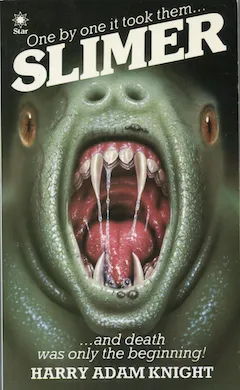
Slimer by Harry Adam Knight. In my teens I read several novels and books about SF by the Australian-born John Brosnan. His bios would mention that he also published horror under the name Harry Adam Knight, mostly in collaboration with the UK writer Leroy Kettle. I've picked up a couple of Knight paperbacks in recent years, mainly because of their pleasingly disgusting cover art, and I thought it was high time to actually read one.

Naturally, Slimer is dreadful. Just the hackiest, splatteriest, rapiest shit that makes James Herbert look like M. R. James. But it's hacky shit written by professionals, so there's a certain level of craft evident. It flies along at great speed and there are some impressively gross moments. And while I can in no way recommend it, I am probably going to watch the (probably equally terrible) film adaptation.

Super-Infinite by Katherine Rundell. A multi-faceted look at the multi-faceted John Donne that coasts on sheer enthusiasm but can't overcome the essential unknowability of its subject. I mean that literally: Donne's life is known to us via a scattering of documents and a lot of speculation and inference, which rather counts against this book's project. It's well written, and I like when Rundell delves into Donne's poetry and other writing, but the man himself remains elusive, the book unsatisfying.

Vertigo by W. G. Sebald, translated by Michael Hulse [reread]. The first of Sebald's novels, although they're not really novels in any traditional sense. I almost always enjoy Sebald, even if nothing ever quite matches his third book, Rings of Saturn.

https://habitualmood.com/books-read-february-2026/
Books Read January 2026
books
Show full content

i688489-138953185

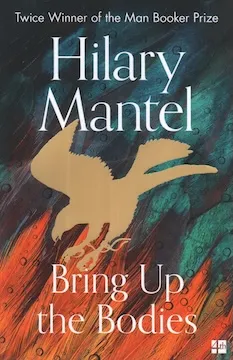
Bring Up the Bodies by Hilary Mantel. I finished this in the first week of the year, and at four month's distance it has been partially occluded by the mammoth bulk of The Mirror and the Light, which I finished a couple of weeks ago. Bring Up the Bodies is Thomas Cromwell in his imperial phase, this man of many talents busy accruing power and privilege, and generally working things out to his - and, it must be said, king and country's - advantage. The through-line here is the downfall of Anne Boleyn and her coterie of gentlemen admirers, and the concomitant rise of the demure future queen Jane Seymour. I love Wolf Hall and honestly this is just as good: sophisticated, funny, alive. Mantel was such a unique talent. What a mind.

Neuromancer [reread] and Count Zero by William Gibson. As an act of imagination and (yergh) world-building, Neuromancer remains a startling, appropriately immersive piece of work. I think I've come to better appreciate Gibson's prose and enjoy its Beat-esque rhythms. Count Zero is, perhaps inevitably, a step down - more conventional, less thrilling - but still very enjoyable.

The Loved One by Evelyn Waugh. I haven't read Waugh in years, so I'm not sure if it's that this book isn't up to his best or I'm no longer receptive to his satire but I didn't warm to The Loved One. I'm the last person to object to making fun of Americans (#notallamericans) but Waugh's gripes with the place are typically elitist, obnoxious, and superficial. Still, it's very short, and Waugh can write a sentence.

Screenshot 2026-05-09 at 15

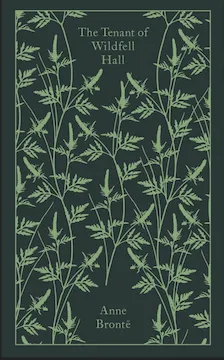
The Tenant of Wildfell Hall by Anne Brontë. If you google "the forgotten Brontë" you get dozens of articles and posts about Anne "the forgotten Brontë" who is now so thoroughly forgotten that people can't get enough of hearing about how forgotten she is. But it's true that she is a lesser light in the Brontë extended universe, the Green Lantern to Charlotte and Emily's Superman and Batman. (Branwell = Two-Face.) The bulk of Tenant is a first-person account of a loveless Victorian marriage, replete with coercive control, mental and verbal abuse, and neglect. It's completely horrifying and incredibly attuned to the complexities of interpersonal power, and the abject position of women in a society that grants them little if any agency. Gripping stuff, let down only by the obligatory turgid frame narrative in the voice of a massive drip of a man.

The Trouble With Harry by Jack Trevor Story. The trouble is that it's not very funny. Good film, though.

The Setting Sun by Osamu Dazai, translated by Donald Keene. Found this frustratingly obtuse and quite tedious. Willing to accept that this is entirely my fault.

https://habitualmood.com/books-read-january-2026/
Some books I read in 2025
books
Show full content

2025 wasn't my most enthusiastic year of reading but I finished 83 books, and a lot of them were pretty good!

Highlights:

  • Gwendolyn Brooks's Maud Martha, a poet's novel (complimentary) that tells a whole complicated life in under 200 pages.
  • Finally managed to read the whole of The Lord of the Rings trilogy, and the first Earthsea trilogy, too. Turns out there's a bunch of stuff at the end of LOTR - "The Scouring of the Shire" - that I never knew about. War-hardened hobbits cleaning house, shit yeah.
  • Two continuations of classic dystopias: Margaret Atwood's The Testaments was enjoyable but inessential. More vital was Sandra Newman's Julia, a telling of Orwell's Nineteen Eighty-Four from the perspective of Winston Smith's lover and co-conspirator. It's a bold and subversive book, one that I'm still thinking about six months later. (No spoilers, but I cackled with delight at the audacious closing paragraph.)
  • Speaking of Orwell, I loved Dorian Lynskey's The Ministry of Truth, which examines Orwell's life and writing through the lens of his most famous work. The same author's Everything Must Go, a cultural history of humanity's preoccupation with the end of the world, was another standout.
  • Two short, enigmatic books: White Chappell, Scarlet Tracings by Iain Sinclair and Pedro Paramo by Juan Rulfo, translated by Margaret Sayers Peden. Please don't ask me to explain what happens in them.
  • Two very good and very different satires on race and racism, both from the US: Percival Everett's savage The Trees and William Melvin Kelley's wry, pointed 1962 novel A Different Drummer.
  • Sarah Waters's The Little Stranger, which takes as its foundation the country house ghost story and builds an intimate epic that is insightful, especially on class and gender, and compulsively readable. The ghost stuff is pretty scary, too.
  • Ben Macintyre's books about WW2 and Cold War espionage, beautifully written (and beautifully read by the author on audiobook) yarns that "read like thrillers", as the cliche has it, but in this case it's true. Three recommendations: The Spy and the Traitor, about Soviet double agent Oleg Gordievsky; Agent Zigzag, about professional reprobate and British agent Eddie Chapman; and The Siege, a slight change of pace, about the 1980 hostage crisis at the Iranian embassy in London.
  • Dana Stevens's excellent, expansive look at Buster Keaton's life and times, Camera Man.
  • A couple of big books about WAR, namely Antony Beevor's Stalingrad and Downfall: Berlin 1945. On a cultural tip, but still WAR-related, I enjoyed Philipp Blom's The Vertigo Years, which examines the ways in which the times were a-changin' in Europe in the immediate pre-WW1 period. Didn't really tell me anything new, but it's an enjoyable synthesis.
  • A couple of books about how fucked everything is - or is it?? (Yes.) Doppelganger by Naomi Klein, which everyone and their dog has probably already told you to read; and Wild Faith by Tal Lavin, an informed, witty and impassioned look at the rise and political consolidation of Christian Nationalism in the US, and indeed elsewhere.
  • Favourite rereads: Wolf Hall (Mantel); Doctor Faustus (Mann); Operation Shylock (Roth); The Handmaid's Tale (Atwood); Northanger Abbey (Austen); various Chekhov stories.

Of course it's not all sunshine and lollipops.

  • The worst book I finished out of devotion to its author was Angela Carter's debut novel, Shadow Dance. A terrible chore.
  • The worst book I couldn't finish despite my devotion to its author was Vladimir Nabokov's Ada or Ardor. I don't even know if it's a bad book, but I've been trying to read it for twenty years and I'm not sure I'll ever crack it. It's charmless and off-putting and long.
  • From the "Why don't I like this? Seems like something I should like!" Department, I'm afraid the appeal of Patrick O'Brian's Aubrey-Maturin books continues to elude me. I don't dislike them, but I'm not captivated. In theory they ought to be my ideal sort of comfort read, but in practice I can't get on board. (Seafaring joke there folks.) Perhaps I'm simply not middle-aged enough yet.
  • Most disappointing old book was Ghost Story by Peter Straub which I've been planning to read for thirty years. I hated it. Drab and derivative. For the record, I read 187 of its 522 pages.
  • Most disappointing new book was Shadow Ticket, the unexpected ninth novel from Thomas Pynchon. I'm happy for those who enjoyed it - which is a lot of people, going by my Bluesky feed - but I thought it was dreadful. Again, I read 117 of its 192 pages and it really didn't seem like it was going to improve.

2026 resolutions? Much the same as always: Read more! Read better! Maybe even do some posting on here. Who knows.

https://habitualmood.com/some-books-i-read-in-2025/
Forthcoming Netflix Limited Series #368
tv
Show full content

From the storytelling genius behind that thing you vaguely remember watching at least a few episodes of a couple of years ago.

Episode 1

Strap in for a setup that while not winning any awards for originality is still quite promising, especially with those two actors you like in the main roles. Oh and there’s a bit of a twist at the end of the episode, just to wrong-foot your expectations, but nothing too extreme. We don’t want you switching off.

Episode 2

We’ve got the pot boiling now, so it’s time to relax a bit and make sure you know who everyone is. There are only six characters, but we’re assuming a fluctuating maximum 60-70% audience attention.

Episode 3

A quiet, more contemplative episode. Great opportunity to get your phone out and look up what else the cast has been in.

Episode 4

Starting to feel a bit padded out isn’t it? Like, they could have done this whole story in a 90 minute movie! Should you bother to continue watching? But hang on: at the end of the episode we’re gonna sock you with a twisty cliffhanger that will shake you to your core and have you getting on your socials saying “OMG what did I just watch?” and other things our market research shows people like you say. Who’s got better things to do with their one wild and precious life now?

Episode 5

Cliffhanger resolved unsatisfactorily and with minimum palpable effect on the plot or characters. Padding resumed.

Episode 6

Weird nothingy episode that for some reason is 20 minutes shorter than the others.

Episode 7

You know how we've been carefully building momentum over the preceding half dozen episodes? Allow us to destroy utterly it with an episode-length flashback that will clumsily fill in the backstory we couldn’t work out how to organically weave into the show. Wanna know why that one character has an enigmatic scar on her jawline or why the bad guy is always eating radishes and crying? You will fucking plotz when you find out.

Episode 8

Ok we’re back in the “present” and we’ve only got 50 minutes to wrap things up so here is literally everything we could remember we had to tie up thrown in the general direction of your eyeballs. Exciting twists? Not really! In fact, more or less everything you expected to happen does happen. Rather daringly, however, we end the show with a measure of ambiguity, leaving a few minor questions left unanswered. This is because we respect you, the audience of our quality, prestige-adjacent tv show, an audience that doesn’t want to be spoon-fed a happy ending. Also it was easier because we spent too much time figuring out the radishes thing to come up with anything more satisfying.

https://habitualmood.com/forthcoming-netflix-limited-series-368/
Books Acquired #2
booksbooks acquired
Show full content

fourbooks

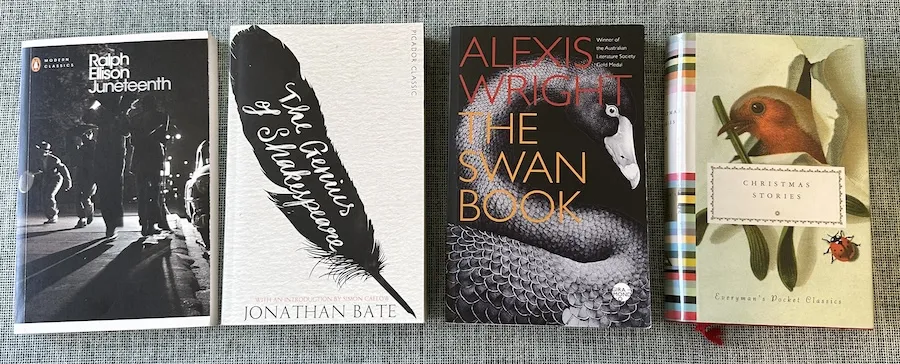
  • Juneteenth by Ralph Ellison. One of the two posthumously cobbled together versions of Ellison's unfinished second novel.
  • The Genius of Shakespeare by Jonathan Bate. Not, as the title suggests, a critical analysis of Shakespeare's work, but a broader look at Shakespeare as historical figure, writer, and international cultural phenomenon.
  • The Swan Book by Alexis Wright. This has been on my radar since it was published to acclaim in 2013. I've heard that the audiobook is fantastic, too, and potentially a more approachable way into what is reputed to be a challenging novel.
  • Christmas Stories edited by Diana Secker Tesdell. I have a bunch of Christmas anthologies but they're all ghost/weird stories. Christmas Stories is at the more "literary" end, with stories by Gogol, Willa Cather, Elizabeth Bowen, Truman Capote, and so on.
https://habitualmood.com/books-acquired-2/
Books Acquired #1
booksbooks acquired
Show full content

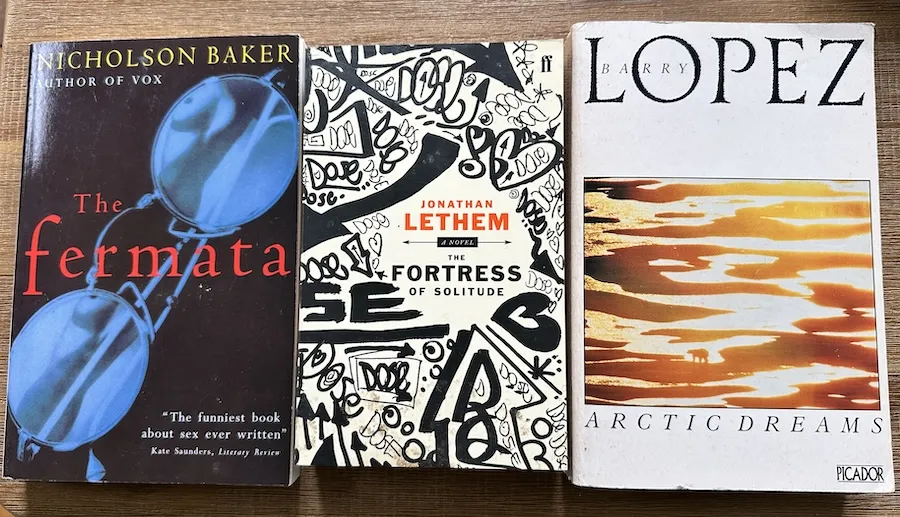
bakerlethemlopez

  • The Fermata by Nicholson Baker. I read this stop-time sex fantasia in 2007, which is somehow almost nineteen years ago. Indeed it's twelve years since Baker's last novel.
  • The Fortress of Solitude by Jonathan Lethem. The subject of an incredible screed of a Goodreads review by someone who only made it to page 50. I don't think I've been that angry about anything, and I was permanently angry for the entire 1990s.
  • Arctic Dreams by Barry Lopez. Like some kind of antipodean literary squirrel, I'm laying up stores of cold climate books for the coming summer.
https://habitualmood.com/books-acquired-1/
Some books I read in 2024
books
Show full content

I read 87 books in 2024. There are reviews of sixteen of them on this blog, including four books about books and eleven popular classics of wildly varying quality. Of the latter, my favourite new-to-me books were Ethan Frome by Edith Wharton; Hotel du Lac by Anita Brookner; The Quiet American by Graham Greene; The Bell Jar by Sylvia Plath; and My Ántonia by Willa Cather. (My least favourite was H. Rider Haggard's She) Just before New Year I posted a review of Ray Newman's excellent story collection Intervals of Darkness.

My major 2024 reading project was a little book called the Bible, which I read over several months in various translations, in particular the King James, NRSV, and Robert Alter. In typical fashion, I hadn't intended to read the whole thing when I blithely sat down one night to poke about in Genesis, but it's a very moreish book. Actually, that's not at all true - a lot of it is unbearably dull, not to mention morally repulsive, and I only got through it by sticking to a schedule. On the plus side, it's often very weird, and of course it's one of the foundational texts of world civilisation, so, you know, worth looking into.

I read six books by Ursula K. Le Guin, plus her "version" of the Tao Te Ching. The early trilogy of Hainish saga books - Rocannon's World, Planet of Exile, and City of Illusions - are entertaining and worth reading, but it was The Left Hand of Darkness and particularly The Dispossessed that converted me into a major Le Guinian. I also enjoyed her lighter, funnier, PKD-inspired novel The Lathe of Heaven.

I read several books by Junji Ito, the best of which was the classic spiral nightmare Uzumaki. Tomie and Gyo were also fun, but repetitive. Ito's talent is clearly better suited to short, sharp shocks: The Enigma of Amigara Fault, which is included as an extra in the Viz edition of Gyo, is considerably better, and scarier, than the main story. I didn't read as many comics as I would have liked, but I did finally get to Alan Moore's Miracleman and I started Kazuo Koike and Goseki Kojima's Lone Wolf and Cub saga.

Other fiction I enjoyed: Tayeb Salih's novel of post-colonial Sudan Season of Migration to the North (translated by Denys Johnson-Davies); Horace McCoy's bleak noir classic They Shoot Horses, Don't They?; and Percival Everett's highly unusual campus comedy/grief study/sort-of-thriller Telephone. I also reread Middlemarch and realised that I could probably spend the remainder of my life reading Middlemarch, on a continuous loop, and always find new things to delight in.

Non-fiction highlights include Midnight’s Furies by Nisid Haraji, a pacy and broad-strokes account of the 1947 partition of India; Lawrence Rees' concise The Holocaust; Nicholas Goodrick-Clarke's somewhat dry but informative The Occult Roots of Nazism; and a reread of Lawrence Wright's The Looming Tower, which remains a masterful, gut-punch of a book. I also enjoyed brain surgeon Henry Marsh's curmudgeonly memoir Do No Harm, while Gut by Giulia Enders (translated by David Shaw) was an unexpectedly fascinating exploration of that complex and troublesome organ.

Finally, two related books that held me entranced. Nan Shepherd's The Living Mountain - written in the 1940s, published in the 1970s, and recently "rediscovered" - is a slim yet brimful book, a meditation on the Scottish Cairngorms written in ravishing, at times ecstatic prose. I immediately bought everything Shepherd published, which turns out to be precious little. The Old Ways by Robert Macfarlane explicitly follows in Shepherd's footsteps, tracing various natural and man-made pathways across land, sea and sky. I have read Macfarlane's cultural history of mountaineering twice, and I'm not sure why it's taken me so long to explore more of his work, but I finally got there. There are plenty of writers doing this kind of hybridised, essayistic, post-Sebaldian writing, but few have Macfarlane's intelligence, learning, and grace, not to mention his way with a sentence.

https://habitualmood.com/some-books-i-read-in-2024/
Intervals of Darkness (Ray Newman)
books
Show full content

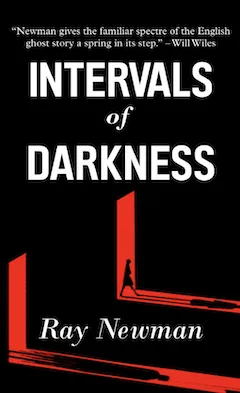
newman

Ray Newman’s 2022 collection of weird tales, Municipal Gothic, was one of the best things I read last year; his new collection, Intervals of Darkness, is perhaps even better. I tore through it in a couple of evenings, eager to see what horrors and/or delights the next story would bring.

Newman peppers his work with playful nods to classic weird writers and cultural artefacts. “The Horns in the Earth” riffs on M.R. James’s “Oh, Whistle and I’ll Come to You, My Lad”, while “Night of the Fox” feels like cult 70s telemovie Robin Redbreast as filtered through Robert Aickman’s “The Visiting Star”. You get the impression that Newman has thought deeply about the tropes of his genre, and how they might be transposed into different temporal or socio-economic surroundings. Similarly, he engages with contemporary trends - the folk horror boom, pseudo-intellectual psychogeographical urbanism - in pointed and interesting ways.

Many of the stories are set in contemporary Britain's marginal edgelands, a landscape haunted by living ghosts: shift workers, the homeless, people living pay cheque to pay cheque, or without a pay cheque at all. Supernatural horror often stems from, or is adjacent to, the dehumanising horrors of grinding labour, poverty, and deprivation. "Industrial Byproducts", for example, takes a mundane fact - the toll a lifetime of underpaid physical graft takes on a body - and literalises the metaphor, resulting in a kind of social-(sur)realist body horror.

Formally, Newman continues to range widely, variously employing television transcript, oral history, and epistolary forms, alongside more traditional narrative. Some of my favourite stories are the tragicomic "Father Paul" (think The Exorcist but swap out the angsty Catholic priests for a hippyish Anglican vicar); "While You Were Out", which follows an overworked courier on a particularly unpleasant job; and "Winter Wonderland", the darkly funny tale of a Christmas outing gone very wrong. Then there's "The Pallbearers", a five page fable that is among the most chilling and memorable in the book.

For all the darkness (and intervals thereof), this is an often drily witty book, and not without moments of genuine, albeit grotesque, beauty. This is the opening of the first story, "Poor Ned's Head":

My skull sat in the silt of Mount’s Bay, amid the broken ribs of the Faerie, for more than three hundred years. There too, in that pan of brown bone, like a hermit crab haunted I.

Philosophers have long supposed the soul to repose in the heart or lungs, if indeed it can be said to exist anywhere. The brain is to them so much wet cheese. Why, then, do we fear the human skull? Because when the flesh has gone, eaten by tiddler fish or washed away in a hundred tides, the skull is the caretaker of the essence. It looks back at us.

Who could resist reading on?

Intervals of Darkness is available worldwide from Amazon, as is Municipal Gothic. Ray is on Bluesky, and he also has a blog.

https://habitualmood.com/intervals-of-darkness-ray-newman/
She (H. Rider Haggard)
bookscommonplace classics
Show full content

This post is part of Commonplace Classics, wherein I read the books we all know and sometimes love.
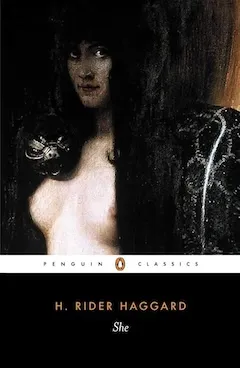
She

H. Rider Haggard's 1887 novel She is the tenth best-selling individual book of all time, outstripping modern blockbusters like The Da Vinci Code, The Bridges of Madison County, and all but one of the Harry Potter books. Popularity isn't the only domain in which She remains competitive: Haggard's opus is at least as bad as anything Dan Brown, J.K. Rowling, and whoever wrote The Bridges of Madison County have expelled from their cloacae.

It starts promisingly enough. Self-identified misogynist and Cambridge fellow Horace Holly - a man whose visage, in the course of the book, is likened to both a gorilla and a baboon - becomes the adoptive parent of a dead friend's young son, and the guardian of a mysterious locked box which is to be opened on the boy's twenty-fifth birthday. The boy, Leo, grows to be as hunky as Holly is hideous, and the pair duly open the box at the appointed time. Inside is an ancient potsherd, which instructs them to travel to Africa. Holly recounts all this with grave sobriety, and Haggard provides mocked up illustrations of the potsherd and explanatory footnotes that will continue through the book. It's an outlandish but (by the standards of adventure fiction) plausible set-up, and Haggard evidently thought well of himself for conceiving it. "It scarcely seemed likely that such a story could have been invented by anybody," says Holly. "It was too original."

Holly and Leo and their pious servant Job head off to Africa where they begin the important work of shooting at everything that flies, scurries, or so much as blinks. Eventually they are rescued/taken prisoner by a local tribe, the Amahagger, who cart them off to their troglodyte city where She-who-must-be-obeyed - usually shortened to She, respectfully italicised - awaits. She turns out to be a two thousand-year-old immortal white woman named Ayesha, a woman so white and so beautiful that mortal man cannot look upon her unveiled face without going insane with desire. Ayesha has been hanging around in the caves, occasionally smiting unruly Amahagger, waiting for her long-lost love to be reborn; Leo, of course, is the dead spit of the guy. Adventure ensues. Kinda.

Actually, mostly what ensues is talking. Considering Ayesha's been cooped up with her "savage" minions for millennia, it's only natural that she take the opportunity to hold forth to men of good breeding like Holly and Leo. And the good news is that even though she's out of touch with the main currents of human affairs, in some ways she is pure 19th century Brit. By which I mean she's quite racist1. Ayesha communicates using an archaic dialect of Arabic, which Holly and the others are also obliged to use, and which Haggard renders as, well, as this:

“For I do hope for an immortality to which the little span that perchance thou canst confer will be but as a finger’s length laid against the measure of the great world; and, mark this! the immortality to which I look, and which my faith doth promise me, shall be free from the bonds that here must tie my spirit down. For, while the flesh endures, sorrow and evil and the scorpion whips of sin must endure also; but when the flesh hath fallen from us, then shall the spirit shine forth clad in the brightness of eternal good, and for its common air shall breathe so rare an ether of most noble thoughts that the highest aspiration of our manhood, or the purest incense of a maiden’s prayer, would prove too earthly gross to float therein.”

If you can stomach page after page of that you're made of sterner stuff than I.

Some of the horror elements are fun. There's a pyramid of human skeletons, and a memorable scene in which the Amahagger use mummified corpses as portable bonfires. Ayesha's ultimate fate is appropriately grotesque, presaging the "He chose... poorly" scene from Indiana Jones. But mostly the book is either Holly's interminable musings on various subjects - including at one point an extended, vaguely erotic paean to an embalmed foot - and conversations with, or about, Ayesha, which, you'll recall, sound like this: “As yet thou hast no cause to fear me. If thou hast cause, thou shalt not fear for long, for I shall slay thee. Therefore let thy heart be light.” Smiting is too good for this lot.

Holly's declared misogyny sets up a potentially interesting dynamic with the all-powerful, ultra-feminine Ayesha. The Amahagger seem at first to have a surprisingly liberal matriarchal social structure, in which women "do what they please... because without them the world could not go on; they are the source of life". Holly is intrigued, "the matter never having struck me quite in that light before" - the birds and the bees not being part of a Cambridge education. But this enlightened approach is followed only "up to a certain point", after which the men rise up and "kill the old ones as an example to the young ones, and to show them that we are the strongest." Women might be "the source of life" but they are also the fathomless source of great evil. And that's just regular women! She, with her immortality and super powers and tortured rhetoric, is horror incarnate. Holly, contemplating She's designs on Leo, sums it up with a nineteenth century "take my wife" gag: "when had such a chance ever come to a man before as that which now lay in Leo’s hand? True, in uniting himself to this dread woman, he would place his life under the influence of a mysterious creature of evil tendencies, but then that would be likely enough to happen to him in any ordinary marriage.”

She has a lot in common with Dracula, published a decade later. Both novels centre an exotic, immortal villain, whose cunning plan is to infiltrate and ultimately dominate England. They share a paranoia about "the other" (foreigners, women, foreign women), and infection (vampirism, obviously, in Dracula; mesmeric, uncontrollable lust in She). Then there's the undercurrent of homoeroticism between the male leads: in Dracula, Lucy Westenra's three suitors, each more manly than the last, co-mingling their manly blood via transfusion; Holly and Leo, his "more than son", in She.) But Dracula, for all its structural flaws and utter humourlessness, retains its dreadful atmosphere and page-turning verve2. Dracula is fun! She, by contrast, is dramatically inert, tediously written, and a chore to read.

*

Next up, John Cheever's 1957 novel, The Wapshot Chronicle.

  1. Haggard's racism towards black Africans and Arabs is hardly unexpected, but awful as it is there doesn't seem to be much rancour behind it. He really dislikes Jews, though, and thus Ayesha does too, which is impressive given she's been stuck in her cave for most of the Jewish people's recorded history.

  2. Dracula also gains appeal through its frequent lurches into camp. The audiobook version with Tim Curry, Alan Cumming and others gets the tone just right.

https://habitualmood.com/she-h-rider-haggard/
Heart of Darkness (Joseph Conrad)
bookscommonplace classics
Show full content

This post is part of Commonplace Classics, wherein I read the books we all know and sometimes love.

conrad

I studied Heart of Darkness in high school and it was extremely hard going. It was without question the most sophisticated book I had encountered to that point, the narrative essentially a monologue with very little dialogue and infrequent paragraph breaks, the language ambiguous and difficult to parse. Doubtless this is why we were studying it in the first place: although short, Heart of Darkness is a dense book, with plenty of big themes and symbolism to tease out in class.

Adding to the difficulty was my - and I assume most of my classmates' - almost complete ignorance of Africa generally and the Belgian Congo specifically, not to mention the complexities of European imperialism, fin de siècle racism, Kipling's "white man's burden", and so on. Watching Richard Attenborough's Gandhi over four consecutive Year 10 history periods was about all the education I'd had about such things - hardly the intellectual foundation for appreciating Conrad's complicated legacy.

And boy is it complicated. Heart of Darkness must be one of the most contested works of the modern era. The issue of whether the book is racist, and if so how much, and in what ways, has been argued over for decades. It's a text that can support, or at least provoke, multiple, often contradictory, interpretations. As Camus said of Kafka's The Trial, "It is the fate and perhaps the greatness of that work that it offers everything and confirms nothing."

That said, in some respects Heart of Darkness isn't ambiguous at all. Whether or not Conrad was a "thoroughgoing racist", in Chinua Achebe's phrase, he obviously felt profound moral disgust at the crimes of European imperialism. As Sven Lindqvist points out, Conrad wrote Heart of Darkness in the aftermath of the so-called Battle of Omdurman between the British and a Sudanese Mahdist army, which saw at least 12 000 Sudanese killed and as many grievously wounded by British rifles and machine guns1. (Fewer than fifty British were killed and it is said that no Sudanese made it to within fifty metres of the British lines.) Earlier, he had spent time in the Congo Free State, an experience that inspired the pointed 1896 short story, "An Outpost of Progress", which tells of two ivory traders who descend into avarice and violence.

As for Heart of Darkness, it is hardly a ringing endorsement of the racist-imperialist project. Conrad's protagonist Charles Marlow has barely arrived in Africa before he is confronted by a mass of dead and dying slaves:

They were dying slowly - it was very clear. They were not enemies, they were not criminals, they were nothing earthly now - nothing but black shadows of disease and starvation, lying confusedly in the greenish gloom. Brought from all the recesses of the coast in all the legality of time contracts, lost in uncongenial surroundings, fed on unfamiliar food, they sickened, became inefficient, and were then allowed to crawl away and rest. These moribund shapes were free as air - and nearly as thin. I began to distinguish the gleam of the eyes under the trees. Then, glancing down, I saw a face near my hand. The black bones reclined at full length with one shoulder against the tree, and slowly the eyelids rose and the sunken eyes looked up at me, enormous and vacant, a kind of blind, white flicker in the depths of the orbs, which died out slowly. The man seemed young - almost a boy - but you know with them it's hard to tell. I found nothing else to do but to offer him one of my good Swede's ship's biscuits I had in my pocket. The fingers closed slowly on it and held - there was no other movement and no other glance. He had tied a bit of white worsted round his neck - Why? Where did he get it? Was it a badge - an ornament - a charm - a propitiatory act? Was there any idea at all connected with it? It looked startling round his black neck, this bit of white thread from beyond the seas.

Marlow's seen some things in his time, but already he foresees that "in the blinding sunshine of that land I would become acquainted with a flabby, pretending, weak-eyed devil of a rapacious and pitiless folly."

Personifying these qualities is the ivory agent Kurtz, "an emissary of pity, and science, and progress", who "had come out [to Africa] with moral ideas of some sort." But Kurtz has gone rogue, not to mention insane. When Marlow eventually arrives at Kurtz's trading station, he finds the man dying. Oh, and his hut is surrounded by severed heads on pikes.

I want you clearly to understand that there was nothing exactly profitable in these heads being there. They only showed that Mr Kurtz lacked restraint in the gratification of his various lusts, that there was something wanting in him - some small matter which, when the pressing need arose, could not be found under his magnificent eloquence. Whether he knew of this deficiency himself I can't say. I think the knowledge came to him at last - only at the very last. But the wilderness had found him out early, and had taken on him a terrible vengeance for the fantastic invasion. I think it had whispered to him things about himself which he did not know, things of which he had no conception till he took counsel with this great solitude - and the whisper had proved irresistibly fascinating. It echoed loudly within him because he was hollow at the core.

Heart of Darkness might have been written in response to specific, late-nineteenth century events, but it is remarkably prescient about the horrors to come. Genocidal Kurtz is the archetype of the twentieth century demagogue, a poster boy for the Age of Extermination. Another European informs Marlow that "Kurtz's proper sphere ought to have been politics 'on the popular side'."

...Kurtz really couldn't write a bit - 'but heavens! how that man could talk. He electrified large meetings. He had faith - don't you see? - he had the faith. He could get himself to believe anything - anything. He would have been a splendid leader of an extreme party.' 'What party?' I asked. 'Any party,' answered the other. 'He was an - an - extremist.' Did I not think so? I assented.

I think this is the fourth time I've read Heart of Darkness, if we include that initial baffled trudge in high school, and it's the first time I have felt more or less equal to the task. It's a dense and dark book - the clue's in the title - but worth the effort. I ought to read more Conrad! The only other novel of his I've read is The Secret Agent, later adapted by Hitchcock2; of Typhoon and Lord Jim and the novel with the extremely unfortunate title I know nothing. But before I start on any of those books, I had better finish my next Commonplace Classic, which is (heavy sigh) another tale of colonial Africa, and a pretty dubious-sounding one at that: She by H. Rider Haggard. Honestly, who picks these books.

  1. Lindqvist, 'Exterminate All the Brutes', p. 68 Lindqvist's uncatagorisable book is the ideal companion to Conrad's novel.

  2. As Sabotage, which came out in 1936, the same year in which Hitchcock made another, unrelated, film called... The Secret Agent.

https://habitualmood.com/heart-of-darkness-joseph-conrad/
My Ántonia (Willa Cather)
bookscommonplace classics
Show full content

This post is part of Commonplace Classics, wherein I read the books we all know and sometimes love.

cather

The word "prairie" evokes powerful mental images, even for those whose relationship with the United States is entirely pop cultural. One pictures vast expanses of fertile grassland, teeming with elk and bison and the giant squirrels known as prairie dogs. Pioneers work the land: rugged, salt of the earth types, often impoverished immigrants from central and northern Europe, enduring the cruel whims of nature as they attempt to carve out a life on the howling plains. For all its beauty, the prairie is a place of great hardship: Pa gets bit by a rattler; little Mary puts a pitchfork through her thigh; Granny almost freezes to death assisting the birth of a two-headed calf during a blizzard, a calf that Bobby, only twelve years old, has to put out of its misery, Pa being laid up with yet another rattler bite, except there's only one round left for the rifle, and as mentioned the calf has two heads, so how that's going to turn out is anyone's guess.

Willa Cather1 spent much of her childhood on the Nebraska prairie, an experience that found expression in several of her novels, sans two-headed calves, as far as I know. My Ántonia is the recollections of Jim Burden, an orphan taken in by his grandparents on their Nebraska farm. Jim's arrival coincides with that of the Shimerdas, a somewhat hapless family of Czech immigrants. Jim immediately falls in with the family's eldest daughter, Ántonia, and the story follows them through their adolescence and into adulthood.

My Ántonia is written with a seemingly effortless grace, full of appreciation for the natural world and admiration for "the strange, uprooted people" who are settling the plains. (The prairie's original inhabitants are merely gestured to in passing.) Here Jim recalls the farm's hired men:

I can see them now, exactly as they looked, working about the table in the lamplight; Jake with his heavy features, so rudely moulded that his face seemed, somehow, unfinished; Otto with his half-ear and the savage scar that made his upper lip curl so ferociously under his twisted mustache. As I remember them, what unprotected faces they were; their very roughness and violence made them defenseless. These boys had no practiced manner behind which they could retreat and hold people at a distance. They had only their hard fists to batter at the world with. Otto was already one of those drifting, case-hardened laborers who never marry or have children of their own. Yet he was so fond of children!

Hard times abound, and there is plenty of death and discouragement. Life becomes less overtly dramatic, yet more socially fraught, when Jim and his grandparents leave the farm and take up residence in town. Soon, Ántonia and other immigrant girls follow, taking employment as servants in the houses of more well-heeled citizens, where they face the duel prejudices of xenophobia and classism. Then there is the constant, not always welcome, attention from local men. "The country girls were considered a menace to the social order", but really it is they who are in peril: "in every frontier settlement there are men who have come there to escape restraint."

Cather is painfully alert to the ruptures and anxieties of adolescence: "When boys and girls are growing up, life can't stand still, not even in the quietest of country towns; and they have to grow up, whether they will or no.” Jim sees the town's "guarded mode of living" as "being like living under a tyranny". A not uncommon opinion in one's teens, wherever you find yourself. But in Jim's case it also reflects an idealisation of country life, farm life, that only increases as he grows up, achieves academic and professional success, and becomes more and more removed from this rustic sphere.

The oddest thing about My Ántonia is the enigmatic character of Ántonia herself. Or rather, the enigma of what it is about her character that so transfixes Jim Burden, to the extent that she becomes, in his conception, something more than the ordinary, unassuming young woman she appears to the reader. In the novel's final section, the middle-aged Jim visits Ántonia at the farm she shares with her husband and their absurd number of children. Jim tells her:

"I’d have liked to have you for a sweetheart, or a wife, or my mother or my sister- anything that a woman can be to a man. The idea of you is a part of my mind; you influence my likes and my dislikes, all my tastes, hundreds of time when I don’t realize it. You really are a part of me."

At first glance, this seems like a touching encomium. But praising "the idea" of someone in such general terms, with scant regard for their actual, specific person, is dehumanising, or at the very least shockingly self-absorbed. Ántonia seems fine with it, although we're only getting Jim's version of the meeting. I'm not sure what this rather puzzling coda is intended to achieve. I think it's supposed to be a moving statement of Jim's pure and Platonic love for Ántonia and by extension the prairie. For me, though, it highlights the fact that the Ántonia we see is very much Jim's Ántonia, not a figment, but also not quite a real person.

*

The next Commonplace Classic is everybody's favourite high school English text, Heart of Darkness by Joseph Conrad.

  1. The correct pronunciation of "Cather" is difficult to pin down. I have been saying "Cath-uh", which is almost certainly wrong. Some sites assert that "Cat-ter" (rhymes with "hatter") is accurate, but allegedly Truman Capote - who knew Cather - pronounced it "Cay-ther" (rhymes with "bather"). This is complicated by Google's claim that "People also ask: why did Truman Capote talk like that?" As for "Ántonia", it is pronounced with the accent on the first syllable: An-ton-ee-ah.

https://habitualmood.com/my-antonia-willa-cather/