Boris < May 2008 – † 26 November 2019 I do not know his hatchdate or year even, but I know that Boris joined the flock after recovering from an accident that left him maimed. I always wondered if he “remembered” what happened. I always wondered if he ever suffered from phantom limb syndrome. I […]
Show full content
Boris
< May 2008 – † 26 November 2019
I do not know his hatchdate or year even, but I know that Boris joined the flock after recovering from an accident that left him maimed. I always wondered if he “remembered” what happened. I always wondered if he ever suffered from phantom limb syndrome. I later wondered if surviving such a harrowing experience that physically disabled him was precisely what enabled him to be such a patient and energetic partner, father, and participant in life.
And Boris’s song always soothed me especially after Bulbulicious perished. He had a deeper, fuller timbre. Confident and deliberate. Though it is the end of an era, I’ll shall not forget the songs and wingbeats and company of Bulbuls in my home.
Boris procured the protein for the youth and also enjoyed some himself. [28 June 2010]
Boris as the the dutiful father [28 June 2010]
Boris was often seen by Bulbulicious’s side and fluttered on Bulbulicious’s whim. Even D.Z. once remarked “He follows her wherever she goes!” [11 October 2011]
The celebratory convalescent cake baked by M.R. and enjoyed with C.Ch. was indeed vetted by Bulbuls and Bulbul-approved! [1 April 2012] Let them eat cake together in some Bulbul heaven.
Borjomi “Bulbulicious” † April 2007 – 16 December 2016 She was the closest to a daughter that I shall have in this lifetime, and indeed I proudly state that she was undeniably a daughter of mine. She liked to stay up at night and sleep late. She was into everything. She dabbled in mischief but […]
Show full content
Borjomi “Bulbulicious”
† April 2007 – 16 December 2016
She was the closest to a daughter that I shall have in this lifetime, and indeed I proudly state that she was undeniably a daughter of mine. She liked to stay up at night and sleep late. She was into everything. She dabbled in mischief but always stayed safe. She was a trooper who commanded the royal treatment of a princess. I learned so much about Bulbuls and enjoyed an intimate and privileged peek at avian life with her. I also learned to be my own person from that little feathered person. Her lifespan shall exceed her wingspan for all who knew her; she’ll forever have nest in my heart.
I spent the Thanksgiving holiday with relatives in Saint Louis, Missouri. We went to the local zoopark, and I enjoyed the opportunity for some backyard and urban bird-watching. As nice as it was to see the Cardinals of Saint Louis (of course, I mean the birds not the baseball team), the ornithological highlight of the […]
Show full content
I spent the Thanksgiving holiday with relatives in Saint Louis, Missouri. We went to the local zoopark, and I enjoyed the opportunity for some backyard and urban bird-watching. As nice as it was to see the Cardinals of Saint Louis (of course, I mean the birds not the baseball team), the ornithological highlight of the trip had to be the sighting of the Eurasian Tree Sparrow (Passer montanus).
We started out by driving around in the Dogtown community which includes the Clayton-Tamm neighborhood. After we spotted suspected Eurasian Tree Sparrows (not to be confused with American Tree Sparrows, who are not true sparrows but buntings) perched on a wire, we decided to park somewhere and walk around. Near our parking spot, songbirds could be heard, and a possible predator was lurking on a lamppost.
We headed back on foot toward the site of the drive-by sighting of suspicious silhouettes on a wire, and I had already trained my eye to scan for all of the feeding stations dutifully maintained by the residents of the neighborhood, even after a rainstorm. While walking eastward on Lloyd Avenue, just past Graham Street, I spotted a little black cheek spot like the pupil of an eye gazing out at us from the center of a shrub. This was our first confirmed sighting of the Eurasian Tree Sparrow in Saint Louis!
This is nearly the very instant of our first confirmed sighting of the Eurasian Tree Sparrow in the States on 27 November 2011 at 12:53 CST. Indeed, they were exactly where they were supposed to be!
During our sparrow stalking, Roman was snap-shooting, and I was filming:
There is no audio on this clip (anyway, the track consists only of heavy breathing of exhilarated bird-watching tourists), and it is clear that image stabilization features fail to correct for my exuberance in those moments.
I tried to keep my distance, but as I slowly walked around the shrubbery near the alleyway, the host of sparrows fled. One of them flew to a more elevated vantage point on the wire.
Why would we join the ranks of sparrow paparazzi, loitering in the quiet Irish neighborhood in 39 °F weather armed with photo and film recording devices? Eurasian Tree Sparrows are living, breathing, breeding artifacts of St. Louis history. European settlers were nostalgic and practical; they missed the songbirds of their homeland, and they had hoped that the feathered mementos would assist with insect control in the area. Among other birds including Bullfinches, Chaffinches, Goldfinches, Greenfinches, and Siskins, Eurasian Tree Sparrows were part of a shipment procured by Carl Daenzer and a bird broker by the name of Kleinschmidt for the purpose of introduction into the New World. The birds, including the original twenty (or else twelve pairs, depending on the sourcePhillips, 1928) Eurasian Tree Sparrows, were liberated at Lafayette Park on 25 April 1870.Wideman, 1909 Of that lot, only the “German Sparrows,” as they were called to distinguish them from the more vigorous “English” House Sparrows who had been first released in number fivefold larger in Brooklyn, New York in the early 1850s, survived and thrived, but their naturalization process was relatively slow.
According to the sighting map, Eurasian Tree Sparrows have not ventured far from their point of introduction. They are rather shy invaders.
The species is common and widespread in the Old World, but in the United States, Eurasian Tree Sparrows, now numbering in the tens of thousands or more, remained localized to Saint Louis, Missouri for nearly a century after their Stateside introduction before eventually spreading into adjacent territory in southwestern Illinois* and southeastern Iowa.Ehrlich et al., 1988 Meanwhile, the “English Sparrows” reached numbers in hundreds of millions and had already pioneered westward toward the Rocky Mountains.
Even if the chestnut cap and the black cheek spot were not visible, the bird perched on the awning would be obviously distinguishable from the more aggressive introduced sparrow species by personality; the House Sparrow would not patiently wait his turn at the feeder! And these personality traits are speculated to be relevant in competition for nest site acquisition as well.Barlow, 1973
Here is a sample of feeder footage. The Eurasian Tree Sparrows tolerate mixed flocks, even with brilliantly colored house finches. Vocalizations of the Eurasian Tree Sparrows can be heard at the beginning of the clip.
As far as I am concerned, Eurasian Tree Sparrows should have a brass star and bronze plaque on the St. Louis Walk of Fame. I am not only a paparazza; I am also a loyal fan. Therefore, I had my photo taken with these feathered celebrities. For such an evidently synanthropic species, they were skittish and flighty; my photographic souvenir had to be recorded with two focal planes.
Unlike in the Great Sparrow Campaign in China, in 1958, when the people overestimated granivory and grossly underestimated insectivory of the Eurasian Tree Sparrow, in the case of the North American introduction, the people moderately underestimated the Eurasian Tree Sparrows’ granivory. The birds thrived in the vicinity of the local breweries.Wideman, 1909, Lever, 2010 As a matter of fact, our Passer montanus sighting site was only a five minute drive away from the Schlafly Tap Room, and that is whither we went to drink to the Eurasian Tree Sparrows!
*I have mentioned this species before in a previous post, as a case of cryptic (since Eurasian Tree Sparrows are sexually monomorphic gynandromorphism was discovered in 1986 in a Eurasian Tree Sparrow found deceased on the roadside just southwest of Springfield, Illinois.H.David Bohlen, 2006
These photos seem to be all over the internet, but the story is not. In 2010, French customs officers at the Rochambeau airport in Cayenne, French Guiana after noticing some suspicious bulges, conducted an intimate pat-down of a Dutch tourist and found some tiny parcels in some very personal space. The images are both precious […]
In 2010, French customs officers at the Rochambeau airport in Cayenne, French Guiana after noticing some suspicious bulges, conducted an intimate pat-down of a Dutch tourist and found some tiny parcels in some very personal space.
The images are both precious and disturbing. To see these minuscule, iridescent feathered jewels bound so neatly in little cloth envelopes and housed in an array of pockets sewn into the front panel of someone’s shorts is somehow impressive and even slightly cute at first glance. And then a sinister realization creeps in: the smuggling offence aside, that is not a very nice thing to do hummingbirds. One of the birds in the photos appears to be noticeably unwell; many of the cloth wrappings are soiled, and they had at least another fifteen hours to go in that condition and right next to that “certain part of the male body.” In addition to wildlife trafficking, this should be prosecuted also as 16 counts of an “indecent act with a minor” bird!
I do not know the solution to the problem(s) of the wild bird trade. Typically, I am opposed to prohibitionism and tend to support decriminalization if not outright legalization. However, while birds are clearly my drug of choice, for various reasons, I cannot treat the bird trade and wild bird trapping as I do the narcotics or weapons trades or voluntary sex industry. In any case, regardless of whether or not wild bird trade should be banned, it does not and will not work: thedemandistoohighforthesupply.
I do know, and I think that we all should by now, that embargo on goods and services makes for very lucrative black market business. Furthermore, if the punishment is not commensurate with the violation, then the enterprise becomes a low risk investment. The guy with his shorts full of hummingbirds was reported to be a repeat offender; he was allegedly intercepted at the same airport with an accomplice and a cargo of 53 hummingbirds two years prior to this photographed encounter. I was unable to find record of the convict’s previous offence, but in the 2010 incident, he was fined €6000. The value of his catch was estimated to be between €10,400 and €13,200. Considering that smugglers count on a 50% fatality rate during travel, it was rather too generous of the prosecutors to factor in the courier’s projected losses. The punishment was not much of a deterrent, and I would not be surprised to see more photos of this guy’s “junk” on the internet.
I wonder why these images have surfaced now. If I had a penchant for conspiracy theories, I would claim that the U.S. Department of Homeland Security leaked them. Evidently, the intrusive and unconstitutional TSA pat-downs are good for at least one thing.
Avian ScienceHistoirePolitics and Nationalityovaquailsspace exploration
In the previous account of poultry in space, I related the story of how chicken embryos were launched aboard Discovery STS-29, but I did not make it to the story of birds (ex ova) in space. Despite claims to the contrary, someone did indeed try to launch birds into space, and the attempt was not […]
Show full content
In the previous account of poultry in space, I related the story of how chicken embryos were launched aboard Discovery STS-29, but I did not make it to the story of birds (ex ova) in space. Despite claims to the contrary, someone did indeed try to launch birds into space, and the attempt was not a total failure.
A few small and clumsy flaps for quails, quite a giant and sturdy flap for quail-kind and space aviculture!
Japanese Quails (Coturnix japonica) have ventured to the final frontier; they have even hatched on Mir. These are the same species of quails about whom I wrote before, but do not worry: reproductive foam was not the subject of these investigations.
Again, the eggs went first.* Japanese Quails were chosen as a candidate for a sustainable food source in space. Compared to other game fowl, the meat and the eggs are small in mass but potently nutritive. It seems that in nearly all Russian media that I consulted, the fact that quail eggs contain lysozyme, associated with immune system benefits, is rarely omitted, and quail eggs do boast a high protein ratio compared to the eggs of other edible game hens. Miguel et al.
The first avian embryos in space were quail eggs taken aboard Soyuz 32 by Commander Vladimir Lyakhov and Flight Engineer Valery Ryumin in 25 February 1979. They allegedly requested construction of a portable incubator on Salyut 6.D.M. Harland Development of the quail embryos on Salyut 6 progressed more slowly than terrestial embryological development, and it was reported that the embryos were acephalous.R. Zimmerman Apparently, instrumentation failures could not be ruled out.
Inkubator-1 aboard Kosmos 1129/Bion 5 launched in 1979
The next batch of quail eggs, to go eggstra-terrestrial were launched in Bion 5/Kosmos 1129 on 25 September 1979, along with some rats and carrots, in an effort to study the effects of space flight in biological systems. The rings holding the eggs could be rotated in order to simulate egg rotation of natural brooding during preflight as well as in the synchronous terrestrial incubation.
The effort to study quails in microgravity, after the attempt by Lyakhov and Ryumin on Salyut 6, was a collaboration involving the Soviet or Russian space program, researchers of the Institute for Biomedical Problems (IMBP) in Moscow and scientists from multiple (Czecho-)Slovakian institutes and universities. Furthermore, the incubation chambers and hardware were designed by Slovakian technicians with supervision of Prof. MVDr. Koloman Bod’a and others.Sabo et al., 1995
Most of the sixty eggs aboard Kosmos-1129 were damaged upon descent, and because the humidity control system malfunctioned, most of the embryos were dehydrated. Nevertheless, dissection of the one viable embryo revealed that weightlessness of space travel did not preclude normal development.
On 6 December 1989, the Kvant-2 module docked onto Mir with a plethora of experimental equipment, including quail cages and Inkubator-1M.** On 11 February 1990, Soyuz TM-9 launched with a crew of two: Commander Anatoly Solovyov and Aleksandr Balandin, flight engineer.
Inkubator-2 arrives to Mir via the Kvant-2 module in 1989.
Quail eggs were delivered to Mir later, on 3 March 1990 when Progress M-3, an unmanned Soviet cargo spacecraft docked. Commander Solovyov reported that he heard “писк” (equivalent of squeak sound). On 22 March 1990, day 17 of incubation (therefore, right on schedule), the first quail chick hatched in space. V.N. Sychev et al. And then another and another; in total, 8 of 33 quail chicks hatched. Contrary to the conflicting reports of Japanese Killfish being the first vertebrates born in space (they do get credit for being the first successful chordate breeders in space), Japanese Quails were, in fact, the first vertebrates to be born or rather hatched into the weightlessness of space. Meanwhile, back on Earth, one from the terrestrial synchronous control group hatched as well. T. Gur’eva et al.
Commander Solovyov, in addition to holding the world record for spacewalk time, is distinguished as the first ever comsmo-aviculturist along with Balandin. In the film Belka, Strelka and others (Белка, Стрелка и другие, 2009), the famed spacewalking cosomonauts speak of helplessness and fragility of life just as would anyone who has ever faced the task of hand-feeding a songbird chick prematurely jettisoned from a nest. The chicks had to be fed every two hours, and their custodians were not prepared for the feeding schedule. The chicks, sadly, being so obviously unprepared for conditions of microgravity, were unable to feed themselves. Those who did not perish were euthanized, and all were preserved for study upon return to Earth.K. Bod’a et al.
In the same year, four adult quails, one male and three females, were taken to Mir by Flight Engineer Genandy Strekalov aboard Soyuz TM-10. On that journey, one of the quails laid an egg during the shuttle ride to the the station which was sent back to Earth aboard Soyuz TM-9, and it turned out to be fertile; a chick hatched from it after incubation on Earth.K. Bod’a et al. In order to address the problem of mechanical fixation and leverage identified in the previous experiments, researchers designed “jackets” or “hammocks” in which quails could be harnessed in proximity to a feeder enabling them to feed independently.Košťál et al. Upon return to Earth, however, the quails exhibited general weakness and imbalance as well as a signature posture in which the head hung low and the spine arched upward.
During the 7-day tour of weightlessness on Mir, though they could feed themselves, the quails seemed not to have an appetite for the spice of life. Researchers observed arrest of ovulation in the hens and a mutual “absolute apathy” to mating.K. Bod’a et al. Upon descent, researchers reported decreased testosterone levels, and dissection of two of the avian cosmonauts revealed dystrophy of the testes and ovaries. One of the hens of the flight covey was salvaged for reintroduction into the breeding flock. Within a week of the return flight, she laid eggs from which viable chicks hatched, proving that the adverse effects on reproductive organ morphology were reversible.
More quail eggs were delivered to Mir aboard Progress M-15 on 29 October 1992.D.M. Harland Embryos were intercepted and fixed for study at critical intervals. Under the care of Commander Solovyov, veteran space avictulurist by then, six chicks hatched, but I could find no sources describing the condition of those chicks. They, or presumably their bodies, were returned to Earth as study material.
In the race to send quails to space, Americans were not the victors, although they had dabbled with comso-embryogenesis of chickens in 1989. NASA did begin to participate in the quails in space effort in 1995 during Mir 18 and 19. Dr. Norm Thagard of the Mir 18 crew was the first American astronaut to handle quail eggs in space. NASA designed a fixative kit in order to facilitate onboard preservation of the emrbyos at different stages of development. By rupturing the shell, a 4% paraformaldehyde solution would diffuse into the egg thus fixing the contents for study. Post-flight analysis upon return via Atlantis STS-71 revealed that most of the embryos perished after the fifth day of incubation. The next “clutch” of space eggs were delivered via Atlantis STS-74 later in 1995. Under the gentle and care of Commander Solovyov of the Mir 19 crew and improved temperature and humidity control, more viable embryos were procured. The experiment was repeated a third time under the supervision of Dr. Shannon Lucid, biochemist turned cosmo-oologist and embryologist of the Mir 21 crew in 1996. NASA eventually developed their own incubation hardware, the “Avian Development Facility” which incorporated a programmable and automated fixiative function, launched aboard Endeavor STS-108.
These images were taken from Prof. V. Sychev’s presentation (.ppt, 3MB) at a workshop on the role of dormancy in space exploration.
The results of the quail embryogenesis experiments from 1990 to 1998 were confounding. Despite having demonstrated successful hatching of quails in weightlessness suggesting that gravity is not an essential force in the development of embryos, mortality rates were high.V.N. Sychev et al. Dr. Shannon Lucid scored the highest survival rate at about 60% in 1996, while in the other experiments during that time, the mortality rate was nearly 50% or more. The abnormalities associated with those fatalities included microphthalmia/anophthalmia, limb and beak deformation, displaced organogenesis, but these are the same complications that can be observed in terrestrially incubated eggs. Researchers posited that microgravity conditions perhaps exacerbated sensitivity to mechanical perturbation or temperature and humidity effects.
At the left, quail eggs are displayed in a foam-lined transport case; in the center, a quail chick emerges from the incubation chamber, and at the right, there is a super-cute cosmo-quail. These are screenshots (via Boris Kovalenko, administrator of perepel.com) from Belka, Strelka and others (Белка, Стрелка и другие, 2009). The quail-relevant footage is viewable from 40:47 to 45:17.
The next milestone of the quail space odyssey began in 1999 in a collaboration between Slovak Air Force and Slovakian academic institutes and Roscosmos and again IMBP led by Dr. Tamara Gur’eva. The research objectives of Experiment “Quail SK-6,” where SK is an acronym for “Slovak Cosmonaut” (Slovenský Kozmonaut), included embryogenesis and immediate ex ova development under microgravity conditions and post-embryological development under conditions of artificial gravity in Japanese Quails.V. Istomin Experiment “Quail” (Эксперимент «Перепел»/SK-6 Prepelica) was one of four experiments of a mission called “Štefánik” after Milan Rastislav Štefánik, Slovak astronomer, meterologist, and solar spectrographer (as well as diplomat and politican).
5-star Cosmo-quail Egg Carriage
With consideration of the setbacks related to humidity and temperature control experienced in previous missions, a new incubation system was designed. Sabo et al, 2001 The Transport Incubator SK-6-01 was a 7.5 kg thermally insulated container capable of hosting up to 60 eggs with such amenities as a ventilator, heater, and humidifier. After completing ⅔ of the incubation process on Earth, quail embryos completed the final trimester in space. From 17 to 22 Feb 1999, the inner temperature was maintained strictly at a cozy 37.3 ± 0.2 °C. Furthermore, the air flow also served to rotate the eggs mimicking egg-turning movement of the brooding hen during natural incubation. And that precision worked; on 22 February 1999, the crew heard a peep from the unhatched eggs. Using the newly developed space incubator, 12 of 56 eggs were dead-in-shell and 8 of 56 embryo fatally suffered from fractured shell. Therefore, the 64.29% hatchability in those five-star accommodations was eggsellent. In one source, it was mentioned that a chick hatched with four legs; therefore, this experiment did not serve to disclaim the high deformity rate observed in previous experiments.
Col. Ivan Bella, first Slovak cosmonaut and first Slovak cosmo-aviculturist
Ivan Bella was the research cosmonaut charged with aviculture duties on Mir, among other experiments. He was, by the way, the first (and thus far, listed as the only) Slovak cosmonaut.*** He could not have imagined that the most stressful moments of his experience in space would be in the diligent care of 36 quail chicks.
The cosmo quails, young and old, were fed a paste-like suspension of dry meal in water; therefore, dehydration by inability to swallow water in microgravity was preempted. For hand-feeding the chicks, the members of the crew responsible for space aviculture duties used a squeezable tube from which to dispense the meal paste into or onto the tiny beaks.
The quail chicks were again dependent on the crew for feeding.
In this experiment, the chicks were subjected to artificial gravity in a centrifuge operating in the range of 0.3 g to 0.8 g, but it did not help. The centrifuge broke down only one day after the first hatch. Anyway, it was cool and dark, and the chicks raised therein seemed to suffer, as they were unable to access the food dispensers in their enclosures. As in the previous case of quail hatchlings in space, the traditionally precocial birds were rendered altricial by weightlessness. And sadly, some perished to undernourishment, despite handfeeding efforts of the crew.
Chilly chambers for descent on Soyuz TM-28
Ten surviving quail chicks were salvaged for return to Earth, but at only 10-11 °C in the transport chamber, seven perished likely to hypothermia. Col. Bella and Commander Padalka returned, via Soyuz TM-28, with three live quail chicks hatched in the cosmos. In private correspondence, Prof. V.N. Sychev wrote of those three quails who made it back to Earth that they eventually grew weak and died. So I surmise that there was no time for them to beget chicks to be presented as gifts to world leaders.
I created a timeline highlighting the events leading up to this sensational return flight of Col. Ivan Bella and Commander Padalka with the trio that remained of the numerous cosmic quail covey. Considering that Slovakia participated as SSR, ČSSR, and ČSFR and that there was a time when cosmonauts were launched as citizens of one nation and descended as citizens of a another, 1,2,3 I chose to include in the timeline some notes on the status of nations. Somehow, it never before occurred to me that someone was taking care of birds in outer space during the fall of socialism in Czechoslovakia.
On the top, space exploration progress relevant to cosmo-quails (or other poultry) and those who participated in the project are denoted. The events on the bottom half of the timeline reflect changes in structure of the participating formerly Soviet or Eastern Bloc nations.
This is one from Col. Bella's covey.
And that is the story of how Japanese Quails go down in history as the first ever feathered cosmonauts!
Footnotes:
*First, there was quail meat which technically counts as “ex ova” bird. In late 1988, quail meat was served on Mir by Commander Vladimir Titov and Flight Engineer Musa Manarov of Mir EO-3 in order to receive the crew of Soyuz TM-7. This feast perhaps set the menu precedent for dining with the French while in space.
** As I understand, the Slovakian collaborators referred to the incubation hardware aboard Kvant-2 as “Inkubator-1M”Sabo et al., 1995 (and this is even written on the logo of the device) while the Soviet and Russian collaborators referred to the experiment as Inkubator 2. There was reference made to another device called “NEST” that was used for housing post-hatch quails on Mir, but I was unable to find a complete description of the set up.K. Bod’a et al.
***While Col. Ivan Bella is recognized as the first Slovak citizen in space, Col. Vladimír Remek was, as part of the InterKosmos program, the first Czechoslovak cosmonaut. Although he was born in South Bohemia, he is half Slovakian by heritage and therefore entitled to Slovakian citizenship under Slovakia’s application of jus sanguinis. Anyway, that was in 1978, before the fun with quails in the cosmos began.
Avian ScienceHistoirePolitics and Nationalityovaspace exploration
This is a story of how an eighth grade imagination and Kentucky Fried Chicken launched chickens eggs into the the final frontier.
Show full content
Over a year ago, I had the privilege of attending a talk on directions in space biology given by Dr. Antonio J. Ricco, and having had so recently seen the image of the “moulting swan,” I just had to ask about birds in space. He mentioned the case of launched avian embryos referring to the work of Dr. J. David Dickman, but he and his associates did not know with certainty whether there were really birds (ex ova) in space. Since then, I confess that I have eggshausted, intermittently, an eggsorbitant number of hours reading and writing about Galliformes and their embryos in space.
Mission patch for SE 83-9 or "Chix in Space" on which Col. Sanders is acknowledged
Vellinger claimed distinction at the district level for three consecutive years, and in 1983, he won at the national level.
The kid proved to be upwardly mobile from there and with all of the right connections. He got a little help from “The Colonel,” and I do not mean an Air Force colonel. After his first year at Purdue University in 1985, NASA arranged for mentorship by Mark Deuser, an engineer who was working for Kentucky Fried Chicken, the corporation that sponsored the $50,000 incubation project and not only in the interest of becoming the “‘first fast-food restaurant in space.’“
Originally, the experiment was to be monitored in-flight by S. Christa McAuliffe, who would have been the first schoolteacher in space and the first participant in President Ronald Reagan’s Teacher in Space Project (TISP). In preparation for her duties on mission STS-51-L, she and her alternate, Barbara Morgan, were briefed on the operation of the flight-ready incubator. Tragically, the mission failed. The shuttle disintegrated in the troposphere on 28 January 1986. All aboard was lost in what we solemnly remember as the Challenger Disaster and what we have retrospectively reviewed as the case of O-ring malfunction in many an “Ethics 101” lecture.
After the accident, Vellinger and Deuser carried on with NASA on development of the hardware and integration for Student Experiment (SE) 83-9 Chicken Embryo Development in Space a.k.a. “Chix in Space.” They apparently worked well together and still do so; they jointly co-founded Techshot, formerly Space Hardware Optimization Technology (SHOT) Inc., an engineering and technology design firm, in 1988, and continued to develop payload instrumentation for NASA until the funding dried up, motivating them to pick up defence contracts rather.
Three years after the fatal Challenger catastrophe, “Chix in Space” finally made it into space aboard Discovery STS-29 launched on 13 March 1989. A wide-eyed Vellinger watched remotely from the Johnson Space Center Mission Control Center, while crew members aboard Discovery STS-29 operated the incubator that he and Deuser had designed.
A total of 32 fertilized eggs from broiler hens (Gallus gallus domesticus) were launched into space for a five-day tour of weightlessness. They were divided into two groups: younger embryos, having first undergone two days of terrestrial incubation, followed by the five-day exposure to microgravity and a set of more mature embryos, having first undergone nine days of incubation on Earth, followed by the five days in the onboard incubator. Half in number of each group were allowed a full term (approximately 21 days) of incubation upon return to Earth, while the other half were dissected upon landing for histological, morphological, and in the case of mineralized tissues, elemental analysis.
Of those incubated for the full term, in the young embryo group, not a single egg hatched, while all of the eight more mature eggs, subjected to the nine-day pre-incubation on Earth, hatched and proved to be viable.R.L. Hullinger Dissection revealed that in the younger embryos, development ceased at varied stages during exposure to microgravity conditions aboard Discovery STS-29.
Preliminary analysis of the viable, more mature embryos indicated that microgravity conditions did not significantly affect development. The mineral content and histo-morphoplogy of long bones of the sacrificed mature embryos did not differ from that of the bones sampled from embryos of the synchronous control group incubated on Earth, suggesting that bone modelling and osteoblastic activity in ovo were not affected by microgravity.M.F. Holick et al. Eggshell mineralization studies revealed that in those younger embryos that failed to hatch, the shell was substantially thicker and contained more magnesium, while the eggshell sampled from the more mature embryos that hatched did not differ from the that of the control set.P.Y. Hester et al. Morphology of otoconia from sacrificed embryos subjected to weightlessness, examined by Scanning Electron Microscopy (SEM), did not exhibit any deformity or systematic size difference compared to otoconia of embryos subjected to Earthly incubation. R.V. Kenyon et al. Generally, microgravity had adverse effects only on the younger embryos, while the more mature embryos of chickens seemed not to be vulnerable. This result implicated a possible threshold after which the gravity field factor becomes irrelevant to the microenvironment of embryogenesis.
Furthermore, post-hatch behavior of the chicks and chickens from those embryos that survived the flight evaluated in terms of feeding, growth, perching, sexual maturation, ovulation, and various reproductive parameters did not differ from the assessments of terrestrially incubated control group.P.Y. Hester et al. Vestibular reflex behavior of the chicks hatched from embryos incubated inflight was not significantly distinguishable from that of chicks subjected to terrestrial incubation.R.V. Kenyon et al. Scientists even tried to test for second generation effects. They artificially inseminated the hens who had endured space flight as embryos with sperm of the males who had endured the same and reported no effects.P.Y. Hester et al.
After this pilot experiment, NASA scientists launched chicken embryos again in late 1992 aboard Endeavor STS-47 for collaborative study with Japan, and the research of chicken embryos in space is ongoing worldwide, evidently. For NASA, the “Chix in Space” hardware served as the prototype of the “Avian Development Facility” in projects led by J.D. Dickman and S.B. Doty to study vestibular and musculoskeletal development of Japanese Quail embryos in microgravity, but Americans were certainly not the first in the poultry space race . . .
Via Birdchick, I first learned that a gynandromorphic Northern Cardinal (Cardinalis cardinalis) had been spotted by a retired school biology teacher in Rock Island, Illinois in 2009. Minnesota Birdnerd has posted additional photos of this sighting. It was then that I decided to start up a collage of songbird gynandromorphs . . . and very […]
It was then that I decided to start up a collage of songbird gynandromorphs . . . and very shortly after that, when I realized that I was rather too busy for the undertaking. Fortunately, I was reminded of the project by recent news (and controversy) of a similar backyard sighting at the beginning of this year reported by another academic, Prof. Larry P. Ammann, who when not teaching statistics at UT Dallas, takes time to appreciate a genetic anomaly.
Before that, a curator at the Illinois State Museum, published his accounts (with photos!)H.D. Bohlen, 2006 of a bilateral gynandromorphic Northern Cardinal exhibiting male phenotype on the right side and female coloration on the left. This is actually the more common arrangementKumerloeve, 1954 than the inverse which has been reported in the most recent gynandromorphic Northern Cardinal sightings.1,2 Typically, female birds retain (post-embryologically) only the left ovary. In these cases of cardinal mis-direction, one might expect to find a testis on the left side, but as observed in other species (see below), the left seems to be reserved for ovaries only no matter what colors are on the outside.
The first image of a gynandromorph that I came to recognize was that of the Zebra Finch (Taeniopygia guttata). “He” was discovered in the flock of Professor Fernando Nottebohm and was gifted to Agate et al., who began their study circa 2000. When housed with a female, “he” courted her with song, and she engaged in copulation and incubated several clutches of infertile eggs with him. When housed with males, they chased and attacked “him.” The testis on his right side was found to be “dysmorphic” although sperm production was evident. On the left side, there was an ovary but apparently without an oviduct. Researchers found that neural song network even on the left side of “his” brain was more masculine than that of a typical female, and the right side was substantially more masculine than the left. This gynandromorphic Zebra Finch presented evidence that sexual differentiation of the neural song circuitry is not only rooted in gonadal hormones but also endogenously in the brain cells. Later researchZhao et al., 2010 in gynandromorphic chickens suggested that somatic cells in birds are inheritently gendered (see also the review at Not Exactly Rocket Science).
Gynandromorphy in color mutations of captive Gouldians have been photographed as well.1,2 By the way, “half-sider” is a term typically used among aviculturists who participate in color breeding. As far as I understand, this is not necessarily gynandromophy, as it could be a case of bilateral somatic mosaicism in which genotype might be different, but allosomes on either side of the bird are (generally) common so that the specimen is uniformly male (ZZ) or female (ZW).
There was a taleJ.C. Abella, 2002 of two probably gynandromorphic House Sparrows (Passer domesticus) in two cities in Catalonia, Spain encountered during banding surveys in the late 90s. These again, exemplify the relatively more rare case of male markings on the left and female phenotype on the right.
A gynandromorphic Black-throated Blue Warbler (Dendroica caerulescens) was spotted (and photographed) by banders in Spring 2007 at Braddock Bay Bird Observatory in Rochester, New York. A bilaterally gynandromorphic Black-throated Blue Warbler had been reported previouslyPatten, 1993 in Death Valley National Park in Inyo County, California. There was a report (albeit without photos) of one at Sunset Beach in Virginia in 2004 and another (with quite a nice Flickr set) of one encountered in Blue Mountains, Jamaica in 2010. Gynandromorphs of this species exhibit noticeable overflow of somewhat diffused male plumage beyond the bilateral line onto what appears to be the female side.
In 2005, also at the Powdermill bird banding station, a Rose-breasted Grosbeak (Pheucticus ludovicianus) exhibiting male phenotype in both size and plumage on the right and female traits on the left was spotted and measured. There was a reported sighting of a gynandromorphic Rosebreasted Grosbeak in breeding plumage (on the half, at least) in Presqu’ile Provincial Park, Ontario, Canada in 2007, but I was not able to find the photographic evidence.
A gynandromorphic Double-Collared Seedeater, (Sporophila caerulescens) was observedB.G. Tosa, 2004 in Serra Negra, São Paulo, Brazil. Despite having a double collar only on the right side, he sang in courtship ritual and was reported to be hostile with the male suitors of his left side.
A not so neatly bilateral gynandromorph of a White-ruffed Manakin (Corapipo altera) was collected in Santa Fé, Panamá in 2004. This was the first caseDaCosta et al., 2007 of gynandromorphy reported for a suboscine passerine, as well as in Pipridae, though the authors conceded that distinguishing the gynandromorph from the immature male in the field is difficult. Remarkably, in this case, while the ovary and oviduct were found on the left and the testis was found on the right side, the bilateral plumage features were reversed relative to anatomical features.
At the Smithsonian Institute National Museum of Natural History there is a skin specimen of a gynandromorphic Evening Grosbeak (Coccothraustes vespertinus) whose toe tags tell “his” story.1,2 “He” was collected in Arlington, Virginia in 1962 when members of his species were still classified under the monotypic genus, Hesperiphona. As in the case of the White-ruffed Manakin, the ovary was on the left side and the testis on the right while the plumage traits were reversed.R.C. Laybourne, 1967
This is not meant to be a comprehensive list rather at least a collection of those cases for which photographic evidence could be found, so please do alert me of any gynandromorphic passerines that I have missed (and I am especially missing Old World examples). Furthermore, I should mention that we might be missing a lot. During a routine skin preparation of a road-killed Eurasian Tree Sparrow (Passer montanus), it was discoveredH.D. Bohlen, 2006 that the deceased had a testis on the right and an ovary on the left; therefore, in sexually monomorphic species, the gynandromorphs are cryptic, to us at least.
Last May, I spent a day in Fallbrook at Emerald Forest Bird Gardens, the very source of our Toucan beak and feather specimens (NB: No birds are harmed in this research!). The special occasion was a NOVA filming event for the “Making Stuff” series, the first part of which aired last week. I was very […]
Show full content
Last May, I spent a day in Fallbrook at Emerald Forest Bird Gardens, the very source of our Toucan beak and feather specimens (NB: No birds are harmed in this research!). The special occasion was a NOVA filming event for the “Making Stuff” series, the first part of which aired last week. I was very pleased to see that our Toucans had their moment in spotlight!
Me, Tocos, and David Pogue on 13 May 2010 at Emerald Forest Bird Gardens. I took many, many more photos.
I met David Pogue in person! In addition to “Arrrr, they were all out of parrots,” he made other silly jokes such as “Just put it on my bill.” When he was holding the detached Toco Toucan bill, the live Toucans became obviously distressed about this, so he said to them “Don’t worry! It was no one you know.” At some point, he moved the beak to match his words as he said, “I filled out my donor card.”
Also, I had the privileged opportunity to see my ex-advisor being coached by the director: “Marc, don’t look at the camera. Marc, you’re looking at the camera. Marc! Marc, stop.” It was awesome (in a vindictive sort of way).
The polished final product is available here. The Toco Toucans are featured in Chapter 6 with some cameo appearances in the introduction.
And here is some awkward and random behind the scenes footage:
I have to confess my profound consternation over the fact that one of the top search engine terms leading to my blog includes the word “panties” And it serves as no consolation that the number one (by grand margin) search term on the list reveals what lies beneath the panties. It has been suggested that […]
Show full content
I have to confess my profound consternation over the fact that one of the top search engine terms leading to my blog includes the word “panties” And it serves as no consolation that the number one (by grand margin) search term on the list reveals what lies beneath the panties. It has been suggested that I should capitalize on that interest somehow, and that suggestion grows more appealing with every blog hit . . .
Anyway, I cannot coerce anyone into appreciating the beauty and science of birds, for that is all too apparent to me and so much so that it is even difficult for me to objectify. So at this moment I lay to rest any efforts for carefully chosen words, elucidating images, and technical minutia. Here I choose rather to provide the restless web-surfers with just what they are asking for:
Boris shares a secret with Victoria. Don’t you wish that you could too? 28 July 2010
On Saturday morning, I was roused from slumber before 7:00 AM by the unnerving machine gun style alarm calls of the Bulbuls (of which there are now four free-flying in my living room). I stumbled off of the sofa, peered out of the window, and looked for a cat. I did not see one, and […]
Show full content
On Saturday morning, I was roused from slumber before 7:00 AM by the unnerving machine gun style alarm calls of the Bulbuls (of which there are now four free-flying in my living room). I stumbled off of the sofa, peered out of the window, and looked for a cat. I did not see one, and yet I heard a panicked rush of aviary birds, and Bulbuls were still firing away in a relentless, distressing ensemble. So I crouched down and tried to find their line of sight, and then I saw the threat. It was a juvenile Cooper’s Hawk (Accipiter cooperii) perched on the fence. By Sunday morning, I knew to grab my camera when I heard the Bulbuls’ call to arms. He had returned, and even with an accomplice, I noticed as they fled.
The beam on which I hang laundry to dry doubles as a perch for a young Cooper’s Hawk. The yellow irides and breast plumage striations indicate that this visitor is a juvenile, and I surmised from body shape that he is not a Sharp-shinned Hawk. 29 August 2010
If my new morning guest returned yesterday, I managed to sleep through it, but this morning, I was awakened dutifully by the Bulbul sentry team in order to receive our young Cooper’s Hawk. This time, he was perched out on the blackberry bush trellis. I watched him move to the nearby compost pile and waited to see if he was only basking in the early morning sunshine or trying to hunt for the resident rodents. Within a few minutes, I watched him lunge at something in the bulk of the pile. After some clumsy floundering in the tangle of weeds, he managed to catch some breakfast. I hope that he will learn that his interest in the nonvolant prey in my yard is more rewarding. Anyway, that meaty mouse is more nutritive than finch hors d’œuvre.
In the video, the rounded white-tipped tail feathers, another distinguishing (especially from the Sharp-shinned Hawk) characteristic of the Cooper’s Hawk, is visible. Without knowing the field marks of a juvenile Cooper’s Hawk, anyone could guess that this little novice hunter is not an adult; this behavior is unmistakably the inexperience of youth in action.
This shot delivered me from some of the May Gray/June Gloom doldrums. Lesser Goldfinches (Carduelis psaltria) at Balboa Park, 22 May 2010 (spotted when I went to see the “All that Glitters” exhibit)
Show full content
This shot delivered me from some of the May Gray/June Gloom doldrums.
Lesser Goldfinches (Carduelis psaltria) at Balboa Park, 22 May 2010 (spotted when I went to see the “All that Glitters” exhibit)
When I was last in Florida, I enjoyed a few marvelous moments of unexpected urban birding. As I was heading back at the end of the day, I spotted a Great Egret (Ardea alba) just outside of the hotel where I stayed. This would make a fine advertisement for the hotel. 15 December 2009, at […]
Show full content
When I was last in Florida, I enjoyed a few marvelous moments of unexpected urban birding. As I was heading back at the end of the day, I spotted a Great Egret (Ardea alba) just outside of the hotel where I stayed.
I was concerned about scaring him away, but then he started slinking hither rather than whither.
And then it became obvious that he was not at all concerned with me and my camera.
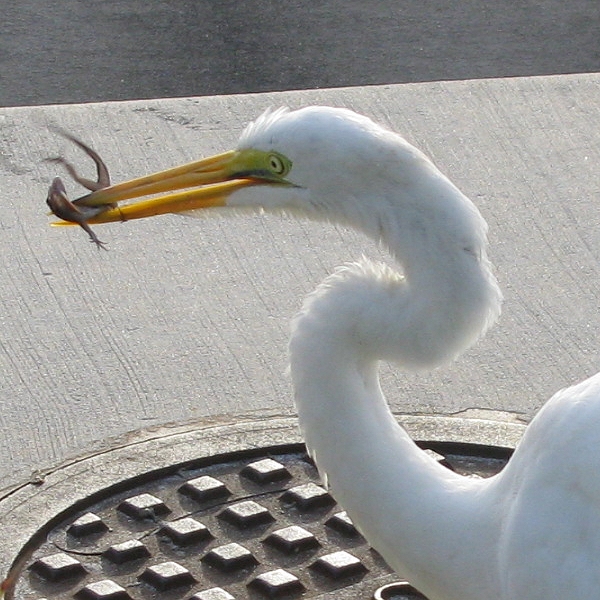
I had been spotting those little lizards all over Clearwater Beach. I considered trying to photograph them but gave up; they were too speedy. The Egret provided me with an opportunity for a secondary capture.
The Egret did not seem to mind passers-by (some of whom also photographed him) or the auto traffic of the busy S. Gulfview Blvd.
This is urban birding. The Egret makes a grand leap over the hedge. In the background, there is the gas station at the very conveniently located convenience store where Bayway Dr. meets S. Gulfview Blvd (and love those petrol prices).
The terrestrial hunting technique of the Egret involves slow and patient pacing along the foliage. Just prior to a bill stab motion, side-to-side oscillation of the neck and, to a lesser degree, the head occurs. This has been reported in the literature as neck swaying and head swaying.Willard, 1977 It has been suggested that the purpose of this swaying may be to perturb prey, as well as to adjust for the slight parallax, helping the Egret to visually localize the prey.
In this case, perturbation was achieved, but the meal was not.
And in this case, the perturbation was quite a clumsy success.
Compared to five other species of Herons and Egrets, the Great Egret was reported to have the lowest ratio of success to bill stab attempts at about 13% while other head and/or neck swayers demonstrated a success rate of at least 50%.Rodgers, 1983
The Egret strikes and misses.
Nevertheless, the performance of this Great Egret was great and excellent among his species. On my watch, his success rate was near 50%. The Egret shows us how it is done.
While his name is Tiresias, I do not expect him, after being transformed into a woman for a finite time, to report that the female Zebra Finches enjoy sex 10x more than the males. Tiresias is not only blind; he hatched without fully developed eyes. This is a case of congenital unilateral anophthalmia or perhaps […]
Show full content
While his name is Tiresias, I do not expect him, after being transformed into a woman for a finite time, to report that the female Zebra Finches enjoy sex 10x more than the males. Tiresias is not only blind; he hatched without fully developed eyes. This is a case of congenital unilateral anophthalmia or perhaps more accurately, sesquilateral anophthalmia.
It is not that he is “searching with his good eye closed“, 23 October 2009
On the left, Tiresias exhibits primary anophthalmia, as there seems to be no ocular tissue at all. One of Tiresias’s sisters and clutch-mate was born with bilateral primary anophthalmia, and she lived for less than one month, before passing away of what I suspected was an unrelated or else only secondarily related condition. Tiresias’s other four siblings do not exhibit any signs of ophthalmic abnormality.
On the right, Tiresias exhibits secondary anopthalmia. Ocular globe tissue is observable and deeply set in the orbit, and there is even a functional eyelid, as can be observed in the video posted below.
I have not yet concluded whether or not this development is a semi-eye or a quasi-eye. At first, I was convinced that he could detect light to some extent, but lately, I am not so sure. I think that he is aware of me when I approach his cage, but not by sight (and probably not by clairevoyance of his namesake), rather by alarm calls of his relatives.
Tiresias is currently in good health, otherwise. He is active and capable of finding food and water as soon as I serve it. He also demonstrates a good appetite for the moistened pellets that I feed to Bulbuls (Zupreem AvianMaintenance Cockatiel pellets). He does not fly, though he is mechanically capable. And he is quite vocal now that he is mature.
I have read of such cases before, and I had the suspicion that this is the sort of thing that only occurs in the flocks of careless finch keepers who allow excessive consanguinity. Typically, I do not even allow pairing of cousins, even though John Stossel and the National Society of Genetic Counselors say that it is OK. I have been keeping Zebra Finches (in very large numbers) for more than five years now, and I never witnessed such a case, until recently. And strangely, a few months prior to Tiresias’s hatching, there was a different ophthalmic complication with chicks sired by another male Zebra Finch, the one whom I acquired at the same time and from the same breeder as Tiresias’s father.
First and foremost, Vitamin A deficiency or imbalance comes to mind. In retrospect, I did not feed greens as frequently as I used to, but I did still serve boiled egg yolk occasionally before, during, and after incubation time. The other possibility is toxicosis. Anophthalmia and microphthalmia were reported in birds, especially marine birds, as a result of teratogenic Selenium, but I do hope that there is not an excess of Selenium leaching from my plumbing fixtures. While genetic factors cannot be ruled out at this point, I think that I will keep more cilantro on hand for the birds.
+++Update (15 January 2010 – 14:36): Roy Beckham of eFinch.com has written about genetic proclivity to ophthalmic conditions in the Fawn Cheek mutation.
Himalayan Greenfinch (Carduelis spinoides) Saffron’s day out, 25 October 2009 His name is Saffron (and to avoid confusion, at least in my mind, I refer to the Saffron Finches as the “Flaveolas.”) He was purchased at Bird Crazy about 4 years ago, at a significant discount owing to his flightless condition, after a broken wing. […]
Show full content
Himalayan Greenfinch (Carduelis spinoides)
Saffron’s day out, 25 October 2009
His name is Saffron (and to avoid confusion, at least in my mind, I refer to the Saffron Finches as the “Flaveolas.”) He was purchased at Bird Crazy about 4 years ago, at a significant discount owing to his flightless condition, after a broken wing. That does not mean that he cannot appreciate some free-roaming in the bird room.
Free-time is play-time.
Tomáš wants to know who lurks there!
A DC Bird Blogger wrote: “It is important to look up to see birds, but some interesting sights are at your feet, too.” He was referring to ice crystallization patterns, and unless he was trying to back out temperature and humidity from ice microstructure, I do not know for what such curiosity can be considered […]
Spotted in the backyard of my Grandparents’ winter house in Pagosa Springs, CO, 2 January 2010
The wingspan, or at the least the imprinted wingspan, seems too small for a bird of prey (a reference scale would have been helpful; I estimated that it was about 50 ± 5 cm.). Regretfully, I know nothing of characteristic gait or rather hop lengths of birds. On one side, there is evidence of at least 6 primaries, but that is not particularly elucidating. I guessed, rather uneducatedly, that this was an impression left by a Crow or possibly a Black-billed Magpie, if she held her tail upright, or maybe even a Jay or . . . I really do not have any leads in this case. Is there a forensic ornithologist out there who knows better?
The first* (and second) positively identified bird of the New Year for me was a Black-billed Magpie (Pica hudsonia), spotted alongside Hwy 160 on the way to Wolf Creek ski area. And that was the first time, to my conscious memory, to see them! This was not the first sighting. This shot was taken on […]
Show full content
The first* (and second) positively identified bird of the New Year for me was a Black-billed Magpie (Pica hudsonia), spotted alongside Hwy 160 on the way to Wolf Creek ski area. And that was the first time, to my conscious memory, to see them!
Last week, I was at the 3rd ICMOBT in Clearwater Beach, FL. There, I finally met Professor Julian Vincent, whom I knew until then only from his text. He is a biologist among mechanical and materials engineers who, after having spent quite some time studying insects, has crossed into biomimetic design. Though he did not […]
Show full content
Last week, I was at the 3rd ICMOBT in Clearwater Beach, FL. There, I finally met Professor Julian Vincent, whom I knew until then only from his text. He is a biologist among mechanical and materials engineers who, after having spent quite some time studying insects, has crossed into biomimetic design. Though he did not include any avian inspirations in his plenary lecture, he did bring to my attention his mechanical analysis of the Woodpecker’s hammering.
When we had some leisure time, I could not resist the magnificent rope tower that I spotted on the playground outside the hotel. Centered on a truncated octahedron, it was like a commemoration of cellular solids.
As I climbed, I imagined that the ropes were trabeculae of the foam interior of the Toucan’s beak; I hope never to be too old for a playground. 14 December 2009, Clearwater Beach, FL
The conference was fine. And after my talk was done and over, I was in the state of mind to appreciate that the locality and the weather were fine as well as the bird-watching!
On Pier 60, admission to which costs 50¢, I saw some Floridian birds.
15 December 2009
December is off-season for the resort town and for some of the birds too. Here the Laughing Gull (Leucophaeus atricilla) looks quite serious in non-breeding plumage, and interestingly, this one features white spots at the distal ends of the primaries like those of the Franklin’s Gull. According to The Cornell Lab of Ornithology All About Bird Guide, they “may have small white spots at the tips of the primaries” (italic emphasis is mine). I later saw either one of these or else a Ring-billed Gull dive-bomb a pensioner for his ice-cream cone, and from my perspective, it was quite laughable indeed.
15 December 2009
On the left, a Florida Double-crested Cormorant (Phalacrocorax auritus floridanus) defends a signpost against a vocal assualt by an obnoxious Crow. But this is not just any obnoxious Crow, it seems. You will not likely see what I mean, but you can hear it.
I suspect that the strange timbre and higher frequency consistutes what is described as the “more nasal” caw of the Fish Crow (Corvus ossifragus).
The Fish Crow vocally surveys the pier.
On the next day, I had a chance to stray further from the conference hotel. I walked along a bridge connecting to a more southern finger of land. Cormorants and Brown Pelicans (Pelecanus occidentalis), whose role in the ban of DDT shall never be forgotten, bask on the piers below. Actually, Brown Pelicans were removed from the Endangered Species List only about a month ago!
Westward view, facing the Gulf shore, 16 December 2009
Eastward view, facing the Clearwater Harbor, 16 December 2009
Having discovered that my mother’s cockatiel, Tookie, is a choreographic prodigy, we contacted Dr. Aniruddh Patel, who led the study of Snowball’s moves. He and Dr. John Iversen of the Neurosciences Institute took an interest in Tookie’s stylistic and selective interpretation of “Teknochek Collision.” Drs. Ani Patel and John Iversen even came to my mother’s […]
Drs. Ani Patel and John Iversen even came to my mother’s studio Tookie’s territory.
Pictured from left to right: Dr. John Iversen, Tookie, the dance divo, and Dr. Ani Patel; between the three of them, I would guess that mean Social IQ of this research trio is above average. 16 October 2009
Tookie snacked on cookies with us, while we chatted about experimental details and logistics. He did not hesitate to really get to know the people he would be working with.
No white shirts were harmed in the making of this moment!
Tookie looks over Dr. Patel’s notes making clear that he is not only a test subject; he is he is an active participant aiming to be a co-author.
Tookie seemed to have developed an instantaneous, good rapport with the researchers. Team Tookie is motivated and inspirational! Further investigation (e.g. more recordings, to start) of Tookie’s dance magic shall ensue after the holidays. More to come, hopefully . . .
A few weekends ago, my friends Dave (who was, by the way, the photographer of the wild Cut-throat Finch I posted before) and Misha (who watches girls rather than birds) invited me to go climbing with them in San Bernardino National Forest. Dave had asked me, “Have you climbed before?” to which I replied “I’ve […]
Show full content
A few weekends ago, my friends Dave (who was, by the way, the photographer of the wild Cut-throat Finch I posted before) and Misha (who watches girls rather than birds) invited me to go climbing with them in San Bernardino National Forest. Dave had asked me, “Have you climbed before?” to which I replied “I’ve climbed trees.”
After some instructions on strapping and buckling and knotting and forcing my feet into strange, toe-curling kletterschuhe, I climbed.
Dave took these. I’d say that this is a pretty good look for me, especially in the photo on the left.
Upon descending, I found a warm rock, the surface of which was conveniently complimentary to the curvature of my spine, on which to lie. I watched the other climbers and gazed at the sky, and I could have fallen asleep if it were not for a suspicion that piercing through the wind bursts, I was hearing birdsong. Finally, I turned around and cocked my neck, and my suspicions were confirmed by a slight, flapping silhouette emitting the “scolding chick-a-dee call.”
I had first spotted a Mountain Chickadee when I was at Joshua Tree National Park. Nevertheless, having already seen one did not stop me this time from running off with someone’s down jacket, scaling rocks, and crouching in shrubs in order to harass this feathered one who had practically invited me to follow him.
By the time I returned to the climbing rock, the sky had been transformed. We decided to leave promptly, but not before Dave had a chance to shed some blood on the rock.
The wind-driven San Bernardino forest fire was apparent and somewhat alarming, considering the high speed winds, 3 October 2009.
On the way out, from the roadside, I spotted Western Bluebirds (Sialia Mexicana)! I begged Misha to stop the car. If we were to be seared or smoked, I wanted at least to see the Bluebirds!
The risky delay was worth it, especially since it was not really so risky. We learned later that the fire was on the other side of the I-15, anyway.


 © Action Press/Rex Features/Stern via
 ![[info]](https://finchwench.wordpress.com/wp-content/uploads/2010/07/lj-user.gif?w=15&h=15)
 vs.
vs.
 © Roman
© unknown Photoshopping artist [
© Roman
© unknown Photoshopping artist [

![[info]](https://finchwench.wordpress.com/wp-content/uploads/2010/07/lj-user.gif)




 On the left, Tiresias exhibits primary anophthalmia, as there seems to be no ocular tissue at all. One of Tiresias’s sisters and clutch-mate was born with bilateral primary anophthalmia, and she lived for less than one month, before passing away of what I suspected was an unrelated or else only secondarily related condition. Tiresias’s other four siblings do not exhibit any signs of ophthalmic abnormality.
 Cockatiel pellets). He does not fly, though he is mechanically capable. And he is quite vocal now that he is mature.


 A woodpecker’s tree which I did not climb at


