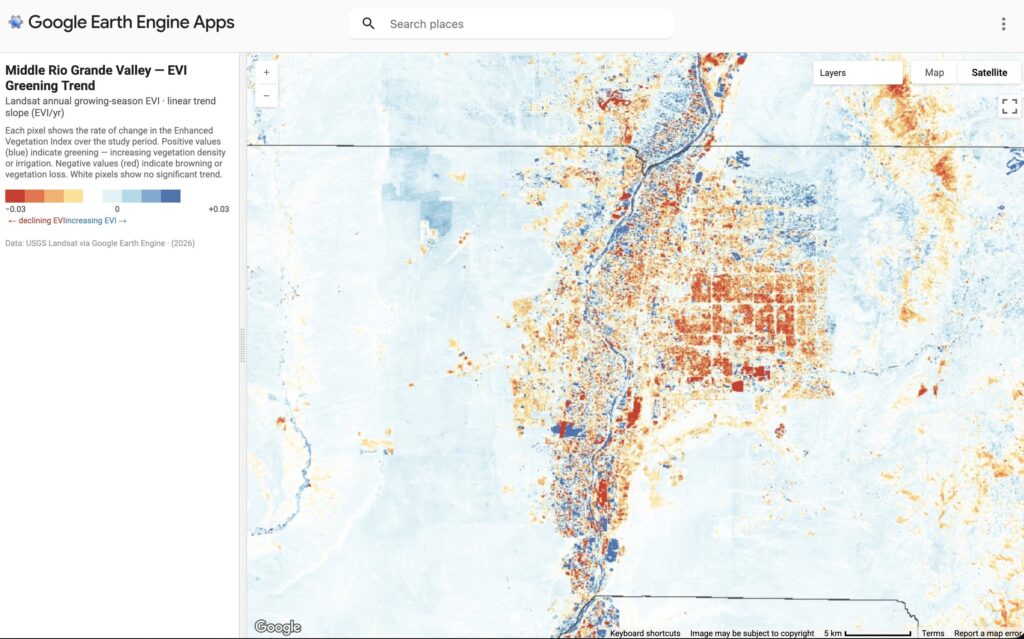
Show full content

City Well #3, monitoring groundwater in Los Ranchos de Albuquerque.
I’ve been riding the last few weeks down around the Rio Grande and Central Avenue in Albuquerque. I’m trying to make sense of Albuquerque’s relationship with a drying Rio Grande.
One of the rides followed some twisting single-track trail between the river and Tingley Beach, a city park built in the 1930s. Tingley Beach replaced the old swimming holes lost when Albuquerque first built the levees and drains that today line the river through the city.
I walked the trails’ twistiest parts, to better enjoy the cool of the woods and not alarm the dog walkers and bird walkers. Collective action at the scale of community requires owning the differences among the relationships we all have with these public spaces. Our values sometimes compete and conflict, and an old man zooming on a gravel bike didn’t really mix with the others’ peaceful pace.
The bosque is green, with the sounds of birds I could not name. (One of the walkers, a birder, humored me when I asked by naming the bird making each call, but her demeanor suggested she would prefer I let her bird in peace).
When I cut through thickets on the little footpaths out to the river, mostly made by the unhoused seeking shelter, I saw a Rio Grande nearly dry. Flow through Albuquerque right now is the driest at this point in the year since 1972.
institutions and community valuesWe, as a community, have done a remarkable job of preserving the riparian corridor between the levees as a public, quasi-natural, widely accessible urban park. It has a paved multi-use trail the length of the city, 15 miles of grade-separated loveliness, with access points to the woods and the river along most of that length. A little zigging and zagging adds another 10 miles to that. It’s glorious. Levee riding is the best.
Motivated by my co-author Bob Berrens’ thinking about the nature and role of institutions, with our lodestars Elinor Ostrom and Daniel Bromley as methodological guides, we tried in Ribbons of Green to piece together the evolution of the institutions by which we have managed Albuquerque’s relationship with the Rio Grande, in the process enabling the very existence of the thing today we know as “Albuquerque.” Lots of chicken-and-egg going on in this book.
The result is a historical narrative that gives me the breathing room to make sense of the contradiction at the heart of last week’s bike ride – a beloved, well tended bosque, and a river in its heart going dry. How can such a contradiction exist?
the Oxbow and the creation of Rio Grande state parkOur chapter on the evolution of Albuquerque’s rising environmental consciousness is anchored on the 1970s political fight over an old stranded river meander known today as “the Oxbow,” located on the west side of the river at the base of the bluffs just upstream from St. Pius High School.
Pinned between levees built in the 1930s to eliminate the river’s “menace,” the Rio Grande was largely forgotten by the community save those occasions when the river rose up and breached the levees.
By the 1970s, a rising environmental consciousness, a shift in community values, began to change the relationship. There were calls for park-like river access, and efforts to treat the emerging riverside bosque as a thing of value to the people who lived around it and of value for its own sake. The storytelling political crisis, the moment we use in our narrative, is a battle over the Oxbow, as water managers tried to drain an “inefficient” use of scarce water and community members called for a more expansive value that included the birds and the fish and the frogs and the cattails dependent on that water as an efficiency of a different sort.
By 1983, the politics had crystallized around state legislation designating the land between the levees as Rio Grande state park. The process through which the institution emerged is crucial to understand. Shifting community values were codified in legislative actions involving state and local governments.
Local values, reified through local institutions.
The resulting structure of governance we created has become a framework for the management of the bosque. We have delightfully engaged public conversations about trails and tree thinning and fire prevention, with roles under the legal institutional structure for the city and the county and the Middle Rio Grande Conservancy District and more. It’s not that the framework compels answers. We argue, and disagree! It’s that it provides a structure for our arguments over competing and conflicting values and desired future conditions. It is ours.
the Endangered Species Act and the Rio Grande silvery minnowCompare that framework with the framework for flows in the river itself. There, the institutional framework is the Endangered Species Act, a federal law passed in 1973.
In August 1994, the federal government declared the Rio Grande silvery minnow “endangered,” triggering a process that continues today to guide management decisions about keeping water in the river to keep this specific species of fish alive. This is the institutional framework that governs flows in the Rio Grande through Albuquerque – not a product of local values and deliberation, but instead those values offloaded onto a federal law for their pursuit and protection. From our book:
The legal and policy framework around the Endangered Species Act meant that community values were not the issue. It didn’t matter whether the people of New Mexico’s Middle Rio Grande Valley cared about the minnow. Unlike saving the Oxbow or creating Rio Grande State Park, preserving the minnow did not require building public support and political coalitions. Once the Endangered Species Act listing elevated the minnow into the public consciousness, scholars looking for it found evidence that the public valued the minnow and a flowing river to keep it alive. Still, it was not public support that drove the resulting management process; instead, the legal ins and outs of the Endangered Species Act and the web of federal funding and authorities became the arena of action.
The footnote behind that “scholars looking for it found evidence” is a link to an amazing body of work by Robert P. Berrens, my Ribbons of Green co-author. His research showed clear evidence that community values did, in fact, support efforts to save the minnow and maintain a flowing river. The problem was that the arena of action was the bizarrely bureaucratic and litigious Endangered Species Act process rather than the sort of robust community discussion that led the creation of Rio Grande State Park.
That difference echoes today, with a lovely maintained bosque for my bike ride, and a main river channel going dry because the Endangered Species Act by itself has proven insufficient to keep water in the river’s main channel.
the time shift of ushering a book into the worldThe time shift imposed by the gap between writing a book and the book’s emergence into the world is weird. Bob Berrens and I crept into the decision to write what became Ribbons of Green nearly six years ago, sitting on Bob’s porch, and my porch, and walking our neighborhood during those awful pandemic months of 2020. (Walking and yakking is central to our practice.) We did the bulk of the writing in 2023, with significant rewriting/polishing in 2024 and ’25, though the underlying research and conversation is an ongoing process.
With the book about to emerge into the world (June 2 at Bookworks in Albuquerque, y’all, come join us!), I’ve been thinking with a sharp new focus on Albuquerque and its relationship with the Rio Grande. The river is raising very different questions in 2026 than it did in 2023, when we did the bulk of the writing. It was a wet year. We wrote about overbanking and “flood ops”. But the central questions are unchanged: what is the institutional mix we’ve inherited, why does it have the shape it has, and is it sufficient to meet the challenges of the future?
Watching as the river again goes dry through the New Mexico’s largest city while the communities that flank it continue to pull water out of the river to maintain the green spaces that many of us so clearly value puts a sharp focus on those questions.
That’s the tradeoff that I’m focused on these days. We have less water, there will be less green – less water diverted into irrigation ditches, pumped from the poorly counted and completely unquantified domestic wells on the valley floor, hoovered up from Albuquerque’s deep aquifer and piped to my house to keep the little larkspur meadow beside my driveway green (tiny, it’s tiny!). Do we have the right institutional mix to make good choices not simply about which agency uses less water, but what we value, what we would like to keep, and what we must give up?


 Figure 2. Options for Protecting the Elevation of Lake Powell. Under the minimum probable hydrologic condition from the April 24-month study, the orange line shows combinations of contributions from Upper Initial Units (UIUs) and Water Year 2026 releases from Lake Powell to maintain 3,500 ft elevation. The blue line shows the resulting minimum elevation of Lake Mead during Water Year 2026 on the right axis.