The Artist’s Notebook is my studio journal containing notes on my ongoing artwork and related research, giving an insight into my creative process and artistic practice.
Where we explore the paths less taken, the forgotten stairwells of history and the unanswered questions of art, science and magic.
EDGEWAYS Saturday Night Gatherings were originally organised for a few friends to come together to dispel loneliness and promote a sense of community over lockdown, inspired by the words of a dear friend to many of us, David Southwell - We should strive to be engines of kindness and community…
We have now grown into a fantastically diverse group.
A new free talk is scheduled every week via Zoom, followed by much needed social time and discussion. An engine of kindness and community indeed.
Where we explore the paths less taken, the forgotten stairwells of history and the unanswered questions of art, science and magic.
EDGEWAYS Saturday Night Gatherings were originally organised for a few friends to come together to dispel loneliness and promote a sense of community over lockdown, inspired by the words of a dear friend to many of us, David Southwell - We should strive to be engines of kindness and community…
We have now grown into a fantastically diverse group.
A new free talk is scheduled every week via Zoom, followed by much needed social time and discussion. An engine of kindness and community indeed.
Jack was duly slain after 4pm and and his leaves distributed by the Bogies to the crowd - and I now have a new leaf to replace the leaf from 2026. If this last sentence is a little confusing then hopefully the links in the paragraph above will help explain it!
My mask and costume made it impossible to take any photographs of the event, but you can find plenty on the official Hastings Jack in the Green Instagram account or just look at the #HastingsJackInTheGreen2026 or #HastingsJackInTheGreen hashtags on your social media platform of choice.
Jack was duly slain after 4pm and and his leaves distributed by the Bogies to the crowd - and I now have a new leaf to replace the leaf from 2026. If this last sentence is a little confusing then hopefully the links in the paragraph above will help explain it!
My mask and costume made it impossible to take any photographs of the event, but you can find plenty on the official Hastings Jack in the Green Instagram account or just look at the #HastingsJackInTheGreen2026 or #HastingsJackInTheGreen hashtags on your social media platform of choice.
This is my monthly link dump, a regular monthly series containing a mix of links to interesting blog posts I’ve read from the past month covering arts & culture, myth, folklore, landscape punk, hauntology, anarchism, utopianism, the gothic, neo-fabulism, and the Weird - all discovered through my RSS feed reader (another reason why you should get a feed reader too).
We have spent years treating incel culture as a fringe, a punchline, occurring in dark corners of the internet where the rest of us never go. The caricature created has caused us to completely fail to notice that incel vocabulary, worldview, and ideological DNA have spread into the mainstream, shaping how an entire generation of young people understand bodies, relationships, and themselves.
Most people think the absence of hierarchy (anarchy) requires faith in humanity’s goodness or a utopian vision of the future. They’ve got it backwards. Anarchism is like atheism: it’s not a belief, it’s the absence of belief in the necessity of others ruling over us. Anarchy literally means ‘without rulers’ just as atheism means ‘without god’.
I have often said in conversations with people around me that on some level voting is a game voters play. When faced with the consequence of a government diametrically opposed to their beliefs, voters lose the luxury of nitpicking arguments from a party that stands a chance to win but holds views slightly at odds with them. In other words, compromise is key: with it battles may be won, without it battles will certainly be lost, eg, the left-wing Workers’ Party of Hungary did not align with Mr Magyar, likely fielded no candidate and won nothing.
Before the railway, noon in Bristol happened roughly ten minutes after noon in London, and nobody much gave a damn - they had no reason to. Time was...time. After the railway, people had to care - because a train leaving Paddington at 12 couldn’t mean one thing in London and another thing in Reading, or the passengers would miss it, or the signalmen would have no ability to coordinate, and the whole apparatus would fall apart.
It continues to surprise me just how relevant and prescient the work of Mark Fisher remains within the context of the political climate in the UK. Not that you’d think that by the passing dismissals that continue to circulate occasionally across social media… But there are many essays that Mark wrote in the 2010s that have never been read widely. Perhaps that is because they are, in many ways, “parochial”.
I don’t know what the future holds for the big AI companies, but I think there will be a profitability reckoning soon. The products will need to get worse, more expensive, or both if VCs are to get their money back. But even then, I’m not sure the math adds up. Will everyone keep paying more? Will people unsubscribe if chat sessions start including crappy ads? Will more people start running LLMs on commodity hardware? Whatever happens next, it doesn’t seem ideal that so much investment money is tied to an underpants gnome scheme.
This is the fourth in a series on risk-maxxing. The first piece defined the phenomenon and its drivers. The second examined what it means for everyone caught in the blast radius. The third looked at risk from a Gen Z point of view. This one maps the structure that connects them — three tiers of actors reaching the same conclusion by different routes, and the motor that runs underneath.
In case it still needs explaining, the whole point of René Magritte’s 1929 painting La Trahison des images is that the apparently inaccurate caption in fact tells the truth. It is not a pipe. It is merely a picture of a pipe.
But I think rather than “people are too emotional or angry about AI”, the more salient point to arrive at is something else. Love it or hate it, a lot of the tech under the AI umbrella have well-documented trade-offs and outright harms. It’s fairly reasonable, then, to accept that most folks insist upon “solutions that don’t knowingly create new problems”, especially given that the world looks *gestures wildly at everything* like this, these days.
Much like Celine Nguyen’s mission to “expand the market for literature (and literary criticism)”, I am interested in expanding the market for philosophy. Why? Because I believe that it gives us the knowledge and tools to critically examine our lives. “The unexamined life is not worth living”, but also more importantly the unexamined life is much more difficult to live and cope with, in my opinion. If we are to understand what the good life is and how to live it, I think that philosophy is the best place to find it.
The attempt to create a “Mr Rules” personality as the antithesis to rightwing populism produces the sorts of process arguments in which British politics is stuck; politicians debating whether Starmer has broken his own rules. There is no Judge to make that decision – only Parliament can – but if Labour wins that’s because it has a majority not because it was right. As a question of law, the issue never gets resolved – each further day without a resolution makes our Prime Minister looks smaller and nastier. If he wasn’t such a stickler for the law, he wouldn’t be so doomed now.
Hastings Traditional Jack in the Green takes place every early May Day weekend and sees a seven foot tall conical tower of leaves - The Jack - being processed through the old fishing quarters of the town before being led up to a steep hill overlooking the sea where it is slain to release the spirit of summer as the gathered, fervent, crowds take home leaves from him as symbols of luck and fertility. I have been one of the bogies - green men who carry and look after the Jack in his journey through the streets of the old fishing quarter, for more than 30 years.
Spread Hope by Absurd Pirate at Absurd Pirate's Internet Blog
It's getting dark out there. Fascism is wanting to rear its ugly head, people are getting propagandized to hate each other, we're more stressed and neurotic than ever, shit is getting more expensive, and people are struggling to make ends meet. Instead of despair, I ask you to be a beacon of light in the dark. I want you to help spread hope.
There is a feeling I’ve been carrying, and I know a lot of us have been carrying, without a name for it. It’s this deep well of sadness and paralyzing grief that takes over when you watch someone do something genuinely cruel, mock a disabled person, use a slur on a livestream, celebrate wiping out an entire civilization, and instead of being met with consequence, they are met with an audience. A big one.
This is my monthly link dump, a regular monthly series containing a mix of links to interesting blog posts I’ve read from the past month covering arts & culture, myth, folklore, landscape punk, hauntology, anarchism, utopianism, the gothic, neo-fabulism, and the Weird - all discovered through my RSS feed reader (another reason why you should get a feed reader too).
We have spent years treating incel culture as a fringe, a punchline, occurring in dark corners of the internet where the rest of us never go. The caricature created has caused us to completely fail to notice that incel vocabulary, worldview, and ideological DNA have spread into the mainstream, shaping how an entire generation of young people understand bodies, relationships, and themselves.
Most people think the absence of hierarchy (anarchy) requires faith in humanity’s goodness or a utopian vision of the future. They’ve got it backwards. Anarchism is like atheism: it’s not a belief, it’s the absence of belief in the necessity of others ruling over us. Anarchy literally means ‘without rulers’ just as atheism means ‘without god’.
I have often said in conversations with people around me that on some level voting is a game voters play. When faced with the consequence of a government diametrically opposed to their beliefs, voters lose the luxury of nitpicking arguments from a party that stands a chance to win but holds views slightly at odds with them. In other words, compromise is key: with it battles may be won, without it battles will certainly be lost, eg, the left-wing Workers’ Party of Hungary did not align with Mr Magyar, likely fielded no candidate and won nothing.
Before the railway, noon in Bristol happened roughly ten minutes after noon in London, and nobody much gave a damn - they had no reason to. Time was...time. After the railway, people had to care - because a train leaving Paddington at 12 couldn’t mean one thing in London and another thing in Reading, or the passengers would miss it, or the signalmen would have no ability to coordinate, and the whole apparatus would fall apart.
It continues to surprise me just how relevant and prescient the work of Mark Fisher remains within the context of the political climate in the UK. Not that you’d think that by the passing dismissals that continue to circulate occasionally across social media… But there are many essays that Mark wrote in the 2010s that have never been read widely. Perhaps that is because they are, in many ways, “parochial”.
I don’t know what the future holds for the big AI companies, but I think there will be a profitability reckoning soon. The products will need to get worse, more expensive, or both if VCs are to get their money back. But even then, I’m not sure the math adds up. Will everyone keep paying more? Will people unsubscribe if chat sessions start including crappy ads? Will more people start running LLMs on commodity hardware? Whatever happens next, it doesn’t seem ideal that so much investment money is tied to an underpants gnome scheme.
This is the fourth in a series on risk-maxxing. The first piece defined the phenomenon and its drivers. The second examined what it means for everyone caught in the blast radius. The third looked at risk from a Gen Z point of view. This one maps the structure that connects them — three tiers of actors reaching the same conclusion by different routes, and the motor that runs underneath.
In case it still needs explaining, the whole point of René Magritte’s 1929 painting La Trahison des images is that the apparently inaccurate caption in fact tells the truth. It is not a pipe. It is merely a picture of a pipe.
But I think rather than “people are too emotional or angry about AI”, the more salient point to arrive at is something else. Love it or hate it, a lot of the tech under the AI umbrella have well-documented trade-offs and outright harms. It’s fairly reasonable, then, to accept that most folks insist upon “solutions that don’t knowingly create new problems”, especially given that the world looks *gestures wildly at everything* like this, these days.
Much like Celine Nguyen’s mission to “expand the market for literature (and literary criticism)”, I am interested in expanding the market for philosophy. Why? Because I believe that it gives us the knowledge and tools to critically examine our lives. “The unexamined life is not worth living”, but also more importantly the unexamined life is much more difficult to live and cope with, in my opinion. If we are to understand what the good life is and how to live it, I think that philosophy is the best place to find it.
The attempt to create a “Mr Rules” personality as the antithesis to rightwing populism produces the sorts of process arguments in which British politics is stuck; politicians debating whether Starmer has broken his own rules. There is no Judge to make that decision – only Parliament can – but if Labour wins that’s because it has a majority not because it was right. As a question of law, the issue never gets resolved – each further day without a resolution makes our Prime Minister looks smaller and nastier. If he wasn’t such a stickler for the law, he wouldn’t be so doomed now.
Hastings Traditional Jack in the Green takes place every early May Day weekend and sees a seven foot tall conical tower of leaves - The Jack - being processed through the old fishing quarters of the town before being led up to a steep hill overlooking the sea where it is slain to release the spirit of summer as the gathered, fervent, crowds take home leaves from him as symbols of luck and fertility. I have been one of the bogies - green men who carry and look after the Jack in his journey through the streets of the old fishing quarter, for more than 30 years.
Spread Hope by Absurd Pirate at Absurd Pirate's Internet Blog
It's getting dark out there. Fascism is wanting to rear its ugly head, people are getting propagandized to hate each other, we're more stressed and neurotic than ever, shit is getting more expensive, and people are struggling to make ends meet. Instead of despair, I ask you to be a beacon of light in the dark. I want you to help spread hope.
There is a feeling I’ve been carrying, and I know a lot of us have been carrying, without a name for it. It’s this deep well of sadness and paralyzing grief that takes over when you watch someone do something genuinely cruel, mock a disabled person, use a slur on a livestream, celebrate wiping out an entire civilization, and instead of being met with consequence, they are met with an audience. A big one.
Last weekend I worked with a model to produce a set of photographs based around the concept of the siren, a mythological character from Homer’s Odyssey.
The subject matter had been suggested by the model when she was life-modelling for me some months earlier - actually the character was initially suggested as a mermaid, a cryptid often mixed up with sirens in the medieval period, but I wanted to steer closer to the original Ancient Greek myth.
I did consider taking the photographs on a local naturist beach, but the lighting I wanted to achieve would have been impossible, so instead they were taken in my studio as normal. This did result in the backdrop being clearly a backdrop—the folds and wrinkles in the cloth clearly visible—rather than a dusky sky, but I liked the exposure of the artifice.
The first Siren photograph - click image for gallery page
I’ve published one of the photographs from the shoot on this website (click the image above to view the gallery page), and I might publish a second one in the near future.
Last weekend I worked with a model to produce a set of photographs based around the concept of the siren, a mythological character from Homer’s Odyssey.
The subject matter had been suggested by the model when she was life-modelling for me some months earlier - actually the character was initially suggested as a mermaid, a cryptid often mixed up with sirens in the medieval period, but I wanted to steer closer to the original Ancient Greek myth.
I did consider taking the photographs on a local naturist beach, but the lighting I wanted to achieve would have been impossible, so instead they were taken in my studio as normal. This did result in the backdrop being clearly a backdrop—the folds and wrinkles in the cloth clearly visible—rather than a dusky sky, but I liked the exposure of the artifice.
The first Siren photograph - click image for gallery page
I’ve published one of the photographs from the shoot on this website (click the image above to view the gallery page), and I might publish a second one in the near future.
It’s been a strangely busy past few weeks, to the point where I’m not entirely sure where all my time disappeared to.
Well, I guess first there’s the fact that three friends and I have formed a band, and we’ve been starting to put some songs together with a sort of post-punk/alternative sound: tribal drums, driving bass, and two guitars.
We’re all too old and cynical to harbour any heady dreams of rock stardom: this is a group of friends playing loud music together for the joy of it in a small rehearsal room in Hastings Old Town, and it is indeed fun. We’ll probably play some local pubs or small venues when we’ve got enough songs in a decent shape, but don’t expect to see us at Wembley Arena!
I also did another short DJ slot last week at 1200 Postcards, my favourite local bar/micro-pub that is frequented by many Hastings artists, musicians, writers, poets, and the like.
And then there was a trip to the Electric Palace, Hastings’ independent 48-seat cinema deep in the Old Town, to watch Greener Grass, the latest offering from the cinema’s Strange Frames film club. Strange Frames is a monthly film club, curated by Katie Spooner, that is:
a film strand that celebrates the offbeat, grotesque or arcane films and concepts that lurk in the shadowy recesses of cinema; with a focus on viewing cinema through the lens of history, folklore and fairytale.
Since October, when I started going to the Strange Frames screenings, I’ve also seen The Company of Wolves (an old favourite of mine), The Snow Woman, and Daughters of Darkness. I think I’m a regular now!
As for my artistic practice: well I haven’t done much over the past few weeks. The exhibition I was in at Hastings Arts Forum has ended, but yet again I need to start booking more life-models.
I’ve booked the last three Thursdays of April off work because I needed to use up my annual leave allowance before the end of this month (or lose it), giving me three four-day weekends (I don’t work Fridays), so hopefully I’ll be able to find some life-models who are available for those slots.
It’s been a strangely busy past few weeks, to the point where I’m not entirely sure where all my time disappeared to.
Well, I guess first there’s the fact that three friends and I have formed a band, and we’ve been starting to put some songs together with a sort of post-punk/alternative sound: tribal drums, driving bass, and two guitars.
We’re all too old and cynical to harbour any heady dreams of rock stardom: this is a group of friends playing loud music together for the joy of it in a small rehearsal room in Hastings Old Town, and it is indeed fun. We’ll probably play some local pubs or small venues when we’ve got enough songs in a decent shape, but don’t expect to see us at Wembley Arena!
I also did another short DJ slot last week at 1200 Postcards, my favourite local bar/micro-pub that is frequented by many Hastings artists, musicians, writers, poets, and the like.
And then there was a trip to the Electric Palace, Hastings’ independent 48-seat cinema deep in the Old Town, to watch Greener Grass, the latest offering from the cinema’s Strange Frames film club. Strange Frames is a monthly film club, curated by Katie Spooner, that is:
a film strand that celebrates the offbeat, grotesque or arcane films and concepts that lurk in the shadowy recesses of cinema; with a focus on viewing cinema through the lens of history, folklore and fairytale.
Since October, when I started going to the Strange Frames screenings, I’ve also seen The Company of Wolves (an old favourite of mine), The Snow Woman, and Daughters of Darkness. I think I’m a regular now!
As for my artistic practice: well I haven’t done much over the past few weeks. The exhibition I was in at Hastings Arts Forum has ended, but yet again I need to start booking more life-models.
I’ve booked the last three Thursdays of April off work because I needed to use up my annual leave allowance before the end of this month (or lose it), giving me three four-day weekends (I don’t work Fridays), so hopefully I’ll be able to find some life-models who are available for those slots.
I have discovered that the Sussex Dialect word for a sea mist is a roke.
This is my monthly link dump, a regular monthly series containing a mix of links to interesting blog posts I’ve read from the past month covering arts & culture, myth, folklore, landscape punk, hauntology, anarchism, utopianism, the gothic, neo-fabulism, and the Weird - all discovered through my RSS feed reader (another reason why you should get a feed reader too).
In essence, aura online grows out of scalability instead of uniqueness — out of what can spread the farthest, the fastest. “Engagement value” trumps “evidence value.” Audiences believe that the algorithm reflects and refines the wisdom of the crowd — that we can trust the algorithmic filter and feedback loop of engagement and reach to surface the best content for us. We trust the machine to know us better than we know ourselves.
Have you ever noticed how some people will defend their country’s actions no matter what evidence you show them its evils? How they’ll excuse behaviour from their political leader that they’d never tolerate from a partner or friend? How questioning the system gets you labelled a traitor, whilst blind loyalty gets you called a patriot You’re not seeing tribalism. You’re watching a cult in action.
One of the mysteries of the current British Labour government has been its obsession with the party group known as Blue Labour, which espouses a form of social democracy that marries social conservatism with progressive economic policies. This isn’t just a parochial issue: it seems to be a feature of many struggling social democratic parties at the moment.
Maybe you’re not cut out for greatness; so few of us are, but that doesn’t mean you can’t seek out the gold. In this new era of AI slop and computer hallucinations, they’re no longer even trying to produce very good. They’re now satisfied with good enough. If it looks and sounds more or less correct, and they didn’t have to do anything other than use up enough power and water to supply a small village, they’ll do it. They are happy to pass off good enough, especially if it looks like it was difficult. To the untrained eye, it might even be good enough. But it would never pass muster with someone who understood the nuance of craft and seeks originality and true quality.
The Amsterdam-based artist has spent years filing dispatches from a mysterious place whose existence remains unconfirmed, a vast kingdom obscurely bordering our own, wrought of shadows and secrets, its towering cliffs and dark caves and veiled inhabitants glimpsed only in the grain and blur her analogue techniques produce. Her photographs arrive like transmissions from memory or dream, specific and sourceless; impossible to recount and equally impossible to forget.
The corporate-speak that calls a sandwich "the product" reveals the horror in the distance between the executive class and the things they sell. The distance between them and the people who eat them. Corporate CEOs cannot help but lose their humanity.. No longer knowing the burger as a thing you shove in your mouth. The burger is market share and net promoter score. The timid bite a symptom of pathology.
Sometimes, late at night, I’ll put music on that is a time machine to my youth. Sometimes that time machine will take me back to being 16 years old and sat drawing comics at the kitchen table. Mum with her back turned to me, and me listening to Suzanne Vega, or Tracy Chapman, or Kate Bush.
More than half a century later, his lucid and luminous insight renders Camus a timeless seer of truth, one who ennobles and enlarges the human spirit in the very act of seeing it — the kind of attentiveness that calls to mind his compatriot Simone Weil, whom he admired more than he did any other thinker and who memorably asserted that “attention is the rarest and purest form of generosity.”
My aim for writing in 2026 was to set up a flow of work. Most of February was spent finishing the Mycelium Parish News and preparing a piece for the spoken word night. That piece, The Haunting of Wuthering Heights was fun but I’m not sure how effective a use of time it was – I don’t think I’ll use it again anywhere.
Human beings have manic episodes; when it happens to an entire nation we call it empire. The affliction is the same. You prance around town with your tits practically pouring out your top, demanding drinks from strangers, snatching cigarettes out their hands. Isn’t it funny how I can do absolutely anything I want? And everybody loves me? You know you have a special destiny in the world.
Time is suspended marionette-like, away from multiple challenges and distractions. The ghosts of the tin-mining industry are ever-present here, looming monoliths amongst burial chambers and imposing coastal stacks. The jutting cliff edge looks like serrated teeth, or a Dimetrodon spine teetering down into the sea. Opposite the house the Brison rocks rise from the ocean, locally nicknamed “General De Gaulle Having A Bath” — a sharp profile and belly rounded like Homer Simpson. Instead of De Gaulle, I see a bulky sea creature on its haunches jealously guarding the cove, or a pregnant woman in exhausted repose at the end of the world.
Lush prehistory by Dr Kenneth Brophy at The Urban Prehistorian
There is something weirdly occult about the ways that these prehistoric symbols are used in this rite, sorry, treatment. This is a “Unique stone consultation, inspired by tarot readings to reconnect and restore inner wellbeing”. Which sort of fits in with one strand of New Age practice where prehistoric and ‘Celtic’ and Gaelic stuff are entangled and millennia squashed together. Prehistory and linguistics set in stone. One reviewer noted that the experience ‘Spiritually Connected Me to My Celtic Roots’ and there is a general sense that the symbols stone selection process is one that has a spiritual, even religious dimension.
The month of March really should have been called January, after the double-faced Janus, looking both backward and forward. March looks back to winter, giving us frequent reminders of its cold and gloom, and forward to spring, offering tantalising glimpses of what is to come. It is the true hinge of the year, a threshold – to use a popular five-dollar word, it is 'liminal'.
Regular readers of this blog will know our position that Universal Basic Income (UBI) is (a) a likely solution for societies who want to abolish Wage Slavery and (b) an illustration of what happens when you let people be free instead of forcing them into undignified jobs that waste everyone’s time and energy.
If I’ve been quiet for a long time, it’s because Scary as Folk and I have been hard at work behind the scenes on Crossroads: Folk Horror in the United States. We’re both folk horror obsessives who love the vibrant UK scene of folk horror- and folk culture-inspired zines, such as Hellebore, Weird Walk, Hwaet!, Shuck, Occulture, and Myth & Lore (just to name a few). But we often wondered why the US didn’t have a corresponding scene, considering not just the passionate folk horror fans on this side of the pond but also the wealth of folklores rubbing up against each other in this diverse nation.
I have discovered that the Sussex Dialect word for a sea mist is a roke.
This is my monthly link dump, a regular monthly series containing a mix of links to interesting blog posts I’ve read from the past month covering arts & culture, myth, folklore, landscape punk, hauntology, anarchism, utopianism, the gothic, neo-fabulism, and the Weird - all discovered through my RSS feed reader (another reason why you should get a feed reader too).
In essence, aura online grows out of scalability instead of uniqueness — out of what can spread the farthest, the fastest. “Engagement value” trumps “evidence value.” Audiences believe that the algorithm reflects and refines the wisdom of the crowd — that we can trust the algorithmic filter and feedback loop of engagement and reach to surface the best content for us. We trust the machine to know us better than we know ourselves.
Have you ever noticed how some people will defend their country’s actions no matter what evidence you show them its evils? How they’ll excuse behaviour from their political leader that they’d never tolerate from a partner or friend? How questioning the system gets you labelled a traitor, whilst blind loyalty gets you called a patriot You’re not seeing tribalism. You’re watching a cult in action.
One of the mysteries of the current British Labour government has been its obsession with the party group known as Blue Labour, which espouses a form of social democracy that marries social conservatism with progressive economic policies. This isn’t just a parochial issue: it seems to be a feature of many struggling social democratic parties at the moment.
Maybe you’re not cut out for greatness; so few of us are, but that doesn’t mean you can’t seek out the gold. In this new era of AI slop and computer hallucinations, they’re no longer even trying to produce very good. They’re now satisfied with good enough. If it looks and sounds more or less correct, and they didn’t have to do anything other than use up enough power and water to supply a small village, they’ll do it. They are happy to pass off good enough, especially if it looks like it was difficult. To the untrained eye, it might even be good enough. But it would never pass muster with someone who understood the nuance of craft and seeks originality and true quality.
The Amsterdam-based artist has spent years filing dispatches from a mysterious place whose existence remains unconfirmed, a vast kingdom obscurely bordering our own, wrought of shadows and secrets, its towering cliffs and dark caves and veiled inhabitants glimpsed only in the grain and blur her analogue techniques produce. Her photographs arrive like transmissions from memory or dream, specific and sourceless; impossible to recount and equally impossible to forget.
The corporate-speak that calls a sandwich "the product" reveals the horror in the distance between the executive class and the things they sell. The distance between them and the people who eat them. Corporate CEOs cannot help but lose their humanity.. No longer knowing the burger as a thing you shove in your mouth. The burger is market share and net promoter score. The timid bite a symptom of pathology.
Sometimes, late at night, I’ll put music on that is a time machine to my youth. Sometimes that time machine will take me back to being 16 years old and sat drawing comics at the kitchen table. Mum with her back turned to me, and me listening to Suzanne Vega, or Tracy Chapman, or Kate Bush.
More than half a century later, his lucid and luminous insight renders Camus a timeless seer of truth, one who ennobles and enlarges the human spirit in the very act of seeing it — the kind of attentiveness that calls to mind his compatriot Simone Weil, whom he admired more than he did any other thinker and who memorably asserted that “attention is the rarest and purest form of generosity.”
My aim for writing in 2026 was to set up a flow of work. Most of February was spent finishing the Mycelium Parish News and preparing a piece for the spoken word night. That piece, The Haunting of Wuthering Heights was fun but I’m not sure how effective a use of time it was – I don’t think I’ll use it again anywhere.
Human beings have manic episodes; when it happens to an entire nation we call it empire. The affliction is the same. You prance around town with your tits practically pouring out your top, demanding drinks from strangers, snatching cigarettes out their hands. Isn’t it funny how I can do absolutely anything I want? And everybody loves me? You know you have a special destiny in the world.
Time is suspended marionette-like, away from multiple challenges and distractions. The ghosts of the tin-mining industry are ever-present here, looming monoliths amongst burial chambers and imposing coastal stacks. The jutting cliff edge looks like serrated teeth, or a Dimetrodon spine teetering down into the sea. Opposite the house the Brison rocks rise from the ocean, locally nicknamed “General De Gaulle Having A Bath” — a sharp profile and belly rounded like Homer Simpson. Instead of De Gaulle, I see a bulky sea creature on its haunches jealously guarding the cove, or a pregnant woman in exhausted repose at the end of the world.
Lush prehistory by Dr Kenneth Brophy at The Urban Prehistorian
There is something weirdly occult about the ways that these prehistoric symbols are used in this rite, sorry, treatment. This is a “Unique stone consultation, inspired by tarot readings to reconnect and restore inner wellbeing”. Which sort of fits in with one strand of New Age practice where prehistoric and ‘Celtic’ and Gaelic stuff are entangled and millennia squashed together. Prehistory and linguistics set in stone. One reviewer noted that the experience ‘Spiritually Connected Me to My Celtic Roots’ and there is a general sense that the symbols stone selection process is one that has a spiritual, even religious dimension.
The month of March really should have been called January, after the double-faced Janus, looking both backward and forward. March looks back to winter, giving us frequent reminders of its cold and gloom, and forward to spring, offering tantalising glimpses of what is to come. It is the true hinge of the year, a threshold – to use a popular five-dollar word, it is 'liminal'.
Regular readers of this blog will know our position that Universal Basic Income (UBI) is (a) a likely solution for societies who want to abolish Wage Slavery and (b) an illustration of what happens when you let people be free instead of forcing them into undignified jobs that waste everyone’s time and energy.
If I’ve been quiet for a long time, it’s because Scary as Folk and I have been hard at work behind the scenes on Crossroads: Folk Horror in the United States. We’re both folk horror obsessives who love the vibrant UK scene of folk horror- and folk culture-inspired zines, such as Hellebore, Weird Walk, Hwaet!, Shuck, Occulture, and Myth & Lore (just to name a few). But we often wondered why the US didn’t have a corresponding scene, considering not just the passionate folk horror fans on this side of the pond but also the wealth of folklores rubbing up against each other in this diverse nation.
The new issue of Mycelium Parish News (copies are still available on Etsy - details in that last link) arrived on my doormat this morning, full of the interesting things that James Burt and Dan Sumption have seen or heard about during 2025.
It is, as always, a delight to read, and in the interests of transparency and full disclosure I should mention that they kindly include in it my email newsletter (which I really must kick some fresh life into) and the Hastings Weird regular meetup that Scott Wood and I are attempting to run, and which I wrote about on the first day of this year.
Mycelium Parish News is also a great example of community-building just when we need it - when we are all increasingly feeling isolated and adrift. As James and Dan say in their introduction to this issue:
The current times are not conducive to making things. Darkness and intolerance are growing. And even if you do make something, it’s harder than ever to get the word out. Social media took over the world then broke the connections between people, becoming more interested in making money than bringing groups together. It’s easier to sell ads to scared, isolated people who stay indoors to doomscroll than to people who feel good about themselves. It’s easy to sound conspiratorial when you talk about the effects of social media, but algorithmic tools make deliberate choices about which connections they encourage or suppress.
And this got me thinking back to—what, for me at least, was—the glorious summer of Twitter that lasted from around 2012 to 2020. Don’t get me wrong, it’s never been an absolutely delightful place full of universal good intentions, but it did feel like community for a time (once you’d weeded out the idiots and blocked them).
In those days it also helped me get the word out about the artwork I was making, and get some good feedback about it. It definitely helped me publicise my books of artwork and my Rituals & Declarations zine. They wouldn’t have garnered a fraction of the attention and sales that they did without that community.
The current zine explosion came directly from that community. While Northern Earth probably predates some of the antiquities that it documents, I think Weird Walk emerged from that social media community and maybe Fiddler’s Green Peculiar Parish Magazine did as well, followed by my own Rituals & Declarations and Maria J. Pérez Cuervo’s Hellebore. And then suddenly there was glorious abundance: Undefined Boundary; Cunning Folk; Wyrd; Myth & Lore; Lost Futures; Wort; Grimoire Silvanus; Hwaet! and many more. At least something good came out of it!
Of course we all know what happened to Twitter, and about its descent into the hate-amplifying mess that it is now, that caused many people—myself included—to shut up shop there and join the social media platform diaspora, ending up scattered and out-of-touch with so many others. As Joan Westenberg recently wrote:
The internet has run this experiment dozens of times now, and the results are consistent. When a platform dies or degrades, its community does not simply migrate to the next platform, it fragments, and the ones who do arrive at the new place find that the social dynamics are different, the norms have shifted, and a substantial number of the people who made the old place feel like home are gone. LiveJournal's Russian acquisition scattered its English-speaking community across Dreamwidth and eventually Twitter. Each successor captured a fraction of the original user base and none of them captured the culture. The community that existed on LiveJournal in 2006 is extinct and cannot be reassembled. The specific conditions that created it, a particular moment in internet history when blogging was new and social media hadn't yet been colonised by algorithmic feeds and engagement optimisation, no longer exist.
The current reality is that the members of that community that I was part of have split mainly between Bluesky and Instagram, with a smaller faction having set up on Mastodon, and some disappearing back into the hellscape that is Facebook. Some have set up Substacks, and I guess some have probably stayed active over on Twitter/X. A handful are only using their blogs—mainly those who already had blogs beforehand.
And on that subject, if you want to set up a website or a blog as a home base then drop me a line (my email address should be somewhere below this post) and I’ll provide whatever technical guidance I can. You still get to have outposts on the social media platforms of your choice, but your website/blog—your home—is protected from the whims of tech-bro billionaires and their disastrous platform choices.
The new issue of Mycelium Parish News (copies are still available on Etsy - details in that last link) arrived on my doormat this morning, full of the interesting things that James Burt and Dan Sumption have seen or heard about during 2025.
It is, as always, a delight to read, and in the interests of transparency and full disclosure I should mention that they kindly include in it my email newsletter (which I really must kick some fresh life into) and the Hastings Weird regular meetup that Scott Wood and I are attempting to run, and which I wrote about on the first day of this year.
Mycelium Parish News is also a great example of community-building just when we need it - when we are all increasingly feeling isolated and adrift. As James and Dan say in their introduction to this issue:
The current times are not conducive to making things. Darkness and intolerance are growing. And even if you do make something, it’s harder than ever to get the word out. Social media took over the world then broke the connections between people, becoming more interested in making money than bringing groups together. It’s easier to sell ads to scared, isolated people who stay indoors to doomscroll than to people who feel good about themselves. It’s easy to sound conspiratorial when you talk about the effects of social media, but algorithmic tools make deliberate choices about which connections they encourage or suppress.
And this got me thinking back to—what, for me at least, was—the glorious summer of Twitter that lasted from around 2012 to 2020. Don’t get me wrong, it’s never been an absolutely delightful place full of universal good intentions, but it did feel like community for a time (once you’d weeded out the idiots and blocked them).
In those days it also helped me get the word out about the artwork I was making, and get some good feedback about it. It definitely helped me publicise my books of artwork and my Rituals & Declarations zine. They wouldn’t have garnered a fraction of the attention and sales that they did without that community.
The current zine explosion came directly from that community. While Northern Earth probably predates some of the antiquities that it documents, I think Weird Walk emerged from that social media community and maybe Fiddler’s Green Peculiar Parish Magazine did as well, followed by my own Rituals & Declarations and Maria J. Pérez Cuervo’s Hellebore. And then suddenly there was glorious abundance: Undefined Boundary; Cunning Folk; Wyrd; Myth & Lore; Lost Futures; Wort; Grimoire Silvanus; Hwaet! and many more. At least something good came out of it!
Of course we all know what happened to Twitter, and about its descent into the hate-amplifying mess that it is now, that caused many people—myself included—to shut up shop there and join the social media platform diaspora, ending up scattered and out-of-touch with so many others. As Joan Westenberg recently wrote:
The internet has run this experiment dozens of times now, and the results are consistent. When a platform dies or degrades, its community does not simply migrate to the next platform, it fragments, and the ones who do arrive at the new place find that the social dynamics are different, the norms have shifted, and a substantial number of the people who made the old place feel like home are gone. LiveJournal's Russian acquisition scattered its English-speaking community across Dreamwidth and eventually Twitter. Each successor captured a fraction of the original user base and none of them captured the culture. The community that existed on LiveJournal in 2006 is extinct and cannot be reassembled. The specific conditions that created it, a particular moment in internet history when blogging was new and social media hadn't yet been colonised by algorithmic feeds and engagement optimisation, no longer exist.
The current reality is that the members of that community that I was part of have split mainly between Bluesky and Instagram, with a smaller faction having set up on Mastodon, and some disappearing back into the hellscape that is Facebook. Some have set up Substacks, and I guess some have probably stayed active over on Twitter/X. A handful are only using their blogs—mainly those who already had blogs beforehand.
And on that subject, if you want to set up a website or a blog as a home base then drop me a line (my email address should be somewhere below this post) and I’ll provide whatever technical guidance I can. You still get to have outposts on the social media platforms of your choice, but your website/blog—your home—is protected from the whims of tech-bro billionaires and their disastrous platform choices.
I’ve been quite good at maintaining the life-drawing aspect of my artistic practice so far this year - yesterday was the fourth session of 2026 so far.
I continued using a combination of 4B and 6B graphite pencils on smooth A2 Hahnemühle Nostalgie paper as this combination seems to be working for me.
I messed up the proportions in the first and third drawings of the session—I need to be more careful with that next time—but got them right in the second drawing (pictured above).
I’ve been quite good at maintaining the life-drawing aspect of my artistic practice so far this year - yesterday was the fourth session of 2026 so far.
I continued using a combination of 4B and 6B graphite pencils on smooth A2 Hahnemühle Nostalgie paper as this combination seems to be working for me.
I messed up the proportions in the first and third drawings of the session—I need to be more careful with that next time—but got them right in the second drawing (pictured above).
The exhibition runs from 18th to 29th March 2026 at the Hastings Arts Forum gallery at 20 Marine Court, St Leonards on Sea, TN38 0DX. The Open Evening will be held 6–8pm on Friday 20th March.
We are really pleased to present an exhibition of new members’ artwork, which has now become a regular fixture in the gallery calendar. HAF is pleased to have welcomed 54 new members in 2025 and to celebrate we have organised a showcase of their work. We hope this will provide an opportunity to welcome new artists to HAF, expand networks and enjoy a diverse range of new artwork ranging from: textiles, ceramics, sculpture, prints, photography, drawings and paintings.
Exhibiting Artists:
Caroline Anderson-Jones, Lesley Bellenger, Lisa Chester-Linskey, Vicki Cooke, Kataryna Dickinson, Kate Dyer, Suan Elliot, Richard Fawcett, Geraldine Franklin, Jeff Grice, Gvantsa Gvinianidze, Mike Hatchard, Christine Hatchard, Dan Jacobs, John Mitchell, Simon Stafford, Sarah Taylor, Helena Tett, Reanna Valentine, Joanna Vesanen, Paul Watson, Sophie Welsh, David White, Jonathan Whitely, Stephen Williams, Dot Young, Melissa Hall, Krystyna Wood and Christian Smith.
The gallery is open 11am–5pm Wednesday to Sunday. I hope those of you in striking distance of Hastings will be able to pop by!
The exhibition runs from 18th to 29th March 2026 at the Hastings Arts Forum gallery at 20 Marine Court, St Leonards on Sea, TN38 0DX. The Open Evening will be held 6–8pm on Friday 20th March.
We are really pleased to present an exhibition of new members’ artwork, which has now become a regular fixture in the gallery calendar. HAF is pleased to have welcomed 54 new members in 2025 and to celebrate we have organised a showcase of their work. We hope this will provide an opportunity to welcome new artists to HAF, expand networks and enjoy a diverse range of new artwork ranging from: textiles, ceramics, sculpture, prints, photography, drawings and paintings.
Exhibiting Artists:
Caroline Anderson-Jones, Lesley Bellenger, Lisa Chester-Linskey, Vicki Cooke, Kataryna Dickinson, Kate Dyer, Suan Elliot, Richard Fawcett, Geraldine Franklin, Jeff Grice, Gvantsa Gvinianidze, Mike Hatchard, Christine Hatchard, Dan Jacobs, John Mitchell, Simon Stafford, Sarah Taylor, Helena Tett, Reanna Valentine, Joanna Vesanen, Paul Watson, Sophie Welsh, David White, Jonathan Whitely, Stephen Williams, Dot Young, Melissa Hall, Krystyna Wood and Christian Smith.
The gallery is open 11am–5pm Wednesday to Sunday. I hope those of you in striking distance of Hastings will be able to pop by!
This is my monthly link dump, a regular monthly series containing a mix of links to interesting blog posts I’ve read from the past month covering arts & culture, myth, folklore, landscape punk, hauntology, anarchism, utopianism, the gothic, neo-fabulism, and the Weird - all discovered through my RSS feed reader (another reason why you should get a feed reader too).
Sitting on my commuter train this morning. There’s not a single person in my carriage visibly reading a book. Phones, laptops, and sleepers. No one stares aimlessly out the window. No books. Granted, digital books complicate this observation. Someone staring at their screen might be reading Proust. Might be.
But it is also in no small part thanks to the cryptocurrency industry — and the rest of the technoligarchs — that we find ourselves with this administration, and with members of Congress who either wholeheartedly support its abuses or are too craven to do anything meaningful to stop them.
To be an artist is to live suspended above the abyss between recognition and artistic value, never quite knowing whether your art will land on either bank, or straddle both, or be swallowed by the fathomless pit of obscurity. We never know how our work stirs another mind or touches another heart, how it tenons into the mortise of the world.
Pasieka puts her finger on the core dynamic. There are two sides to the whole thing: first of all, the sense of belonging, of “community”, is as much a function of a constructed Other as it is of a shared Us; secondly, an individual’s sustained belonging in the “community” is only secured by successive surrenders of autonomy and individual identity to the group. To simplify, we might sum these up as distinction and conformity, respectively.
You’d be disappointed if I sold you a box set of folk horror films that turned out to contain Dawn of the Dead and The Texas Chain Saw Massacre, right? Even if it wouldn’t be that difficult to construct a clever argument for their inclusion.
The whys of this are fascinating and complex and well beyond my expertise, so I won’t speculate as to them. What I’m interested in here are those cases where the relevant transformations seem not to represent an improvement but the opposite. Certainly, there are those who suffer from a kind of nostalgism, according to which everything new is bad and everything old is great, but far more people are prone to a variety of novelty bias, where the new is always better, and the old is always worse.
If complaining worked, we would have won the culture war already. We’d have a reformed Elon and the White House wouldn’t be committing crimes against humanity. But that’s not the world we live in. The one we live in is much worse. If you hate the here and now, write about what would be a better future. Write about what’s good and why more of that good would be good.
As the enshittification of the internet hits its apex and begins to collapse under the weight of a tsunami of AI slop, humanity may very well find itself back where it started, rediscovering the genuine world of books, art, music, travel, entertainment, food, and nature. Authentic experiences that have the ability to connect us emotionally and communally, leaving lasting impressions that stay with us long after the experience has ended. It’s how we evolved as a species, and probably does a lot to explain the cognitive dissonance we feel when faced with our current state of affairs.
There’s a default assumption baked into how Silicon Valley builds products, and it tracks against how urban planners redesign neighbourhoods: that communities are interchangeable, and if you “lose” one, you can manufacture a replacement; that the value of a group of people who share space and history can be captured in a metric and deployed at scale.
On a cold winter day, twilight enhances the coziness of my space, my routine, the comforts of my home and children and friends and hobbies. I can make a pot of stew and dance in the kitchen and get lost in a book and there are no emotions to navigate but my own. This is a peace I do not take lightly.
But Orwell continues to be relevant, not just because there are actual dictators — as oppose to merely aspiring ones — that are going about their authoritarianism in a much more artful manner, but because the crude and stupid version currently being attempted in the US will fail in spectacular fashion, and the brighter lights of of the movement will have to switch to more effective tactics. It also has taken on a new significance that Orwell could never have imagined in the social-media age, in which a truly astonishing percentage of ordinary, common discourse falls under the debased and disfigured description that Orwell ascribes to language in totalitarian states.
Like many of the roads criss-crossing the Somerset hills, this one appears to have started out as a holloway. Layers of flinty sediment rise up from the road before they ever meet a dry-stone wall. On both sides, rows of trees that may once have been hedges now grow so densely that even without leaves they blot out the sun. It is dark by mid-afternoon. I brake sharply so as not to miss the narrow parking space.
Don Moynihan dubs this a “clicktatorship,” a cursed word if there ever was one, no less for being accurate. André Gorz, writing more than half a century earlier, terms this “pseudo-culture,” a counterfeit culture that does not arise out of ways of living but seeks to impose itself upon it.
Look, it’s absolutely true that the act of writing can truly, deeply, aggravatingly, dysregulatingly suck but there is simply no substitute for turning your reporting notes and experiences into a single, structured thing that helps other people know something about their world. That’s something that you have to do, and doing so not only is an intrinsic value but literally is part of how you get better, over time, at many (if not all) of the other steps involved in reporting.
In regards to the relationship the present has with the future we can consider it as twofold. It can be hauntological due to the reliance on the past, or we can deem it nostalgic due to its absence, specifically the idea of it being meaningfully different is what has disappeared. This is not a binary distinction as it can be convolutedly both, nostalgic and hauntological.
This is my monthly link dump, a regular monthly series containing a mix of links to interesting blog posts I’ve read from the past month covering arts & culture, myth, folklore, landscape punk, hauntology, anarchism, utopianism, the gothic, neo-fabulism, and the Weird - all discovered through my RSS feed reader (another reason why you should get a feed reader too).
Sitting on my commuter train this morning. There’s not a single person in my carriage visibly reading a book. Phones, laptops, and sleepers. No one stares aimlessly out the window. No books. Granted, digital books complicate this observation. Someone staring at their screen might be reading Proust. Might be.
But it is also in no small part thanks to the cryptocurrency industry — and the rest of the technoligarchs — that we find ourselves with this administration, and with members of Congress who either wholeheartedly support its abuses or are too craven to do anything meaningful to stop them.
To be an artist is to live suspended above the abyss between recognition and artistic value, never quite knowing whether your art will land on either bank, or straddle both, or be swallowed by the fathomless pit of obscurity. We never know how our work stirs another mind or touches another heart, how it tenons into the mortise of the world.
Pasieka puts her finger on the core dynamic. There are two sides to the whole thing: first of all, the sense of belonging, of “community”, is as much a function of a constructed Other as it is of a shared Us; secondly, an individual’s sustained belonging in the “community” is only secured by successive surrenders of autonomy and individual identity to the group. To simplify, we might sum these up as distinction and conformity, respectively.
You’d be disappointed if I sold you a box set of folk horror films that turned out to contain Dawn of the Dead and The Texas Chain Saw Massacre, right? Even if it wouldn’t be that difficult to construct a clever argument for their inclusion.
The whys of this are fascinating and complex and well beyond my expertise, so I won’t speculate as to them. What I’m interested in here are those cases where the relevant transformations seem not to represent an improvement but the opposite. Certainly, there are those who suffer from a kind of nostalgism, according to which everything new is bad and everything old is great, but far more people are prone to a variety of novelty bias, where the new is always better, and the old is always worse.
If complaining worked, we would have won the culture war already. We’d have a reformed Elon and the White House wouldn’t be committing crimes against humanity. But that’s not the world we live in. The one we live in is much worse. If you hate the here and now, write about what would be a better future. Write about what’s good and why more of that good would be good.
As the enshittification of the internet hits its apex and begins to collapse under the weight of a tsunami of AI slop, humanity may very well find itself back where it started, rediscovering the genuine world of books, art, music, travel, entertainment, food, and nature. Authentic experiences that have the ability to connect us emotionally and communally, leaving lasting impressions that stay with us long after the experience has ended. It’s how we evolved as a species, and probably does a lot to explain the cognitive dissonance we feel when faced with our current state of affairs.
There’s a default assumption baked into how Silicon Valley builds products, and it tracks against how urban planners redesign neighbourhoods: that communities are interchangeable, and if you “lose” one, you can manufacture a replacement; that the value of a group of people who share space and history can be captured in a metric and deployed at scale.
On a cold winter day, twilight enhances the coziness of my space, my routine, the comforts of my home and children and friends and hobbies. I can make a pot of stew and dance in the kitchen and get lost in a book and there are no emotions to navigate but my own. This is a peace I do not take lightly.
But Orwell continues to be relevant, not just because there are actual dictators — as oppose to merely aspiring ones — that are going about their authoritarianism in a much more artful manner, but because the crude and stupid version currently being attempted in the US will fail in spectacular fashion, and the brighter lights of of the movement will have to switch to more effective tactics. It also has taken on a new significance that Orwell could never have imagined in the social-media age, in which a truly astonishing percentage of ordinary, common discourse falls under the debased and disfigured description that Orwell ascribes to language in totalitarian states.
Like many of the roads criss-crossing the Somerset hills, this one appears to have started out as a holloway. Layers of flinty sediment rise up from the road before they ever meet a dry-stone wall. On both sides, rows of trees that may once have been hedges now grow so densely that even without leaves they blot out the sun. It is dark by mid-afternoon. I brake sharply so as not to miss the narrow parking space.
Don Moynihan dubs this a “clicktatorship,” a cursed word if there ever was one, no less for being accurate. André Gorz, writing more than half a century earlier, terms this “pseudo-culture,” a counterfeit culture that does not arise out of ways of living but seeks to impose itself upon it.
Look, it’s absolutely true that the act of writing can truly, deeply, aggravatingly, dysregulatingly suck but there is simply no substitute for turning your reporting notes and experiences into a single, structured thing that helps other people know something about their world. That’s something that you have to do, and doing so not only is an intrinsic value but literally is part of how you get better, over time, at many (if not all) of the other steps involved in reporting.
In regards to the relationship the present has with the future we can consider it as twofold. It can be hauntological due to the reliance on the past, or we can deem it nostalgic due to its absence, specifically the idea of it being meaningfully different is what has disappeared. This is not a binary distinction as it can be convolutedly both, nostalgic and hauntological.
In my last post at the end of January about the life-drawing aspect of my artistic practice I wrote about using the second of the two drawings as a starting point for February’s work, with a broad idea to:
get the figure drawn out first, then build up the shading gradually to a more precise level without losing the dynamism of the drawing.
Yesterday was the only life-drawing session I have managed to schedule during February, but I did manage to work on this plan, and I’m fairly happy with the results shown at the top of this post.
As with January’s work I used a sharp 4B graphite pencil on smooth A2 Hahnemühle Nostalgie paper, with a 6B pencil for some of the darker areas. Building on my plan I drew quickly and blocked out the major areas of shadow, while keeping the line work as clean as I could.
On the second drawing of the session—the standing pose shown on the left of the header image—I added a bit more graduation to the shading, and I think this works well, but I am tempted to tidy it up a bit when I do some more life-drawing next month.
As before, I’d like to get another one or possibly two life-drawing sessions scheduled for March, but I also do have an idea for photography that may consume one of my free weekends.
In my last post at the end of January about the life-drawing aspect of my artistic practice I wrote about using the second of the two drawings as a starting point for February’s work, with a broad idea to:
get the figure drawn out first, then build up the shading gradually to a more precise level without losing the dynamism of the drawing.
Yesterday was the only life-drawing session I have managed to schedule during February, but I did manage to work on this plan, and I’m fairly happy with the results shown at the top of this post.
As with January’s work I used a sharp 4B graphite pencil on smooth A2 Hahnemühle Nostalgie paper, with a 6B pencil for some of the darker areas. Building on my plan I drew quickly and blocked out the major areas of shadow, while keeping the line work as clean as I could.
On the second drawing of the session—the standing pose shown on the left of the header image—I added a bit more graduation to the shading, and I think this works well, but I am tempted to tidy it up a bit when I do some more life-drawing next month.
As before, I’d like to get another one or possibly two life-drawing sessions scheduled for March, but I also do have an idea for photography that may consume one of my free weekends.
For this month's carnival, write about where your interests intersect. That might be a single unexpected overlap, a whole ecosystem, or the thread that ties parts of your life together.
Well, where do I start? This entire site—a portfolio of my visual artwork created with lines of my code—is an intersection of interests.
Back in December I wrote about the way the early internet service providers such as Demon Internet gave their customers a small plot of web space:
I seem to remember it was about 5 or 10 MB of web space where you could host images and static HTML (there may have been a cgi-bin directory as well) so creating a minimal web presence just involved uploading a hand-crafted index.html file to your subdomain.
…and that’s where this site was first hosted from 1996 to 2000. But let me tell you a story about how I got there.
I graduated with an art degree back in 1992 and after graduation, unsurprisingly, I found that an art degree did not pay my rent—and it still doesn’t.
A few months later I got a temporary job doing some general clerical/office work that ended up lasting for about three years, and it was just at the time when typing pools were disappearing and all the middle-aged middle-managers were confronted with a big beige PC running DOS (and later Windows 3.1) appearing on their desk, which they could barely use - most of them could barely type, let alone find their way around a computer.
Now I’d had a Sinclair ZX80 followed by a Sinclair ZX Spectrum+ as a teenager, and while I could write some basic BASIC scripts I was certainly not a programmer—I spent most of my time playing Elite on it—but I did still have a curiosity about computers (which I still have) and the youthful ability to pick things up quickly (which I sadly don’t), and so within a year-or-so I was the go-to young temp worker for any questions about these beige boxes and the magic they could do.
A couple of years later I was introduced to the internet—emails, usenet, and the web—by some friends and in about 1995 I got my own 28.8KBps dial-up modem, internet connection, and the aforementioned small plot of web space, courtesy of an account with Demon Internet.
I knew then—and here’s the intersection of interests—that I wanted a website for my artwork, and since I already had the webspace from my Demon Internet account there was nothing stopping me from uploading an initial index.html file which probably featured the words “under construction”. Over the years I taught myself HTML, DHTML, PHP, SQL, CSS, and much more: the logic and science of web development seemingly at odds with the art of … well, making art with a pencil on paper.
In the decades following the first version of this website I’ve worked as a web developer, then as a manager for a team of web and software developers. Nowadays I work as a solution architect so I’m not writing as much code or HTML or CSS as I used to, but I’m still earning a living from doing techie stuff for the web. I’m still not earning a living from making artwork, but the techie job at least pays for it.
For this month's carnival, write about where your interests intersect. That might be a single unexpected overlap, a whole ecosystem, or the thread that ties parts of your life together.
Well, where do I start? This entire site—a portfolio of my visual artwork created with lines of my code—is an intersection of interests.
Back in December I wrote about the way the early internet service providers such as Demon Internet gave their customers a small plot of web space:
I seem to remember it was about 5 or 10 MB of web space where you could host images and static HTML (there may have been a cgi-bin directory as well) so creating a minimal web presence just involved uploading a hand-crafted index.html file to your subdomain.
…and that’s where this site was first hosted from 1996 to 2000. But let me tell you a story about how I got there.
I graduated with an art degree back in 1992 and after graduation, unsurprisingly, I found that an art degree did not pay my rent—and it still doesn’t.
A few months later I got a temporary job doing some general clerical/office work that ended up lasting for about three years, and it was just at the time when typing pools were disappearing and all the middle-aged middle-managers were confronted with a big beige PC running DOS (and later Windows 3.1) appearing on their desk, which they could barely use - most of them could barely type, let alone find their way around a computer.
Now I’d had a Sinclair ZX80 followed by a Sinclair ZX Spectrum+ as a teenager, and while I could write some basic BASIC scripts I was certainly not a programmer—I spent most of my time playing Elite on it—but I did still have a curiosity about computers (which I still have) and the youthful ability to pick things up quickly (which I sadly don’t), and so within a year-or-so I was the go-to young temp worker for any questions about these beige boxes and the magic they could do.
A couple of years later I was introduced to the internet—emails, usenet, and the web—by some friends and in about 1995 I got my own 28.8KBps dial-up modem, internet connection, and the aforementioned small plot of web space, courtesy of an account with Demon Internet.
I knew then—and here’s the intersection of interests—that I wanted a website for my artwork, and since I already had the webspace from my Demon Internet account there was nothing stopping me from uploading an initial index.html file which probably featured the words “under construction”. Over the years I taught myself HTML, DHTML, PHP, SQL, CSS, and much more: the logic and science of web development seemingly at odds with the art of … well, making art with a pencil on paper.
In the decades following the first version of this website I’ve worked as a web developer, then as a manager for a team of web and software developers. Nowadays I work as a solution architect so I’m not writing as much code or HTML or CSS as I used to, but I’m still earning a living from doing techie stuff for the web. I’m still not earning a living from making artwork, but the techie job at least pays for it.
I finished off the last day of January with a second session of life-drawing, following on from the session earlier this month.
The first drawing (detail at the top of this post) took two forty-minute sessions. As per my notes-to-self after the life-drawing session on the 11th January I used a sharp 4B graphite pencil on smooth A2 Hahnemühle Nostalgie paper, with a 6B pencil for some of the darker areas.
It’s a reasonable likeness of the life-model, but some of the proportions were slightly out, and the shading was not to the standard I wanted.
For the second drawing (below) I used the same 4B pencil and Hahnemühle paper, but worked much faster for a single thirty minute session. Whilst the shading is much rougher than the first drawing I was far more pleased with it — and the proportions of the figure are much better.
Thirty minute drawing with 4B graphite pencil
I’d like to get another one or two life-drawing sessions done over February, and use the second drawing from this session as a starting point: get the figure drawn out first, then build up the shading gradually to a more precise level without losing the dynamism of the drawing.
I’ve also got a slowly-fermenting idea for some photography which might be coming in March.
I finished off the last day of January with a second session of life-drawing, following on from the session earlier this month.
The first drawing (detail at the top of this post) took two forty-minute sessions. As per my notes-to-self after the life-drawing session on the 11th January I used a sharp 4B graphite pencil on smooth A2 Hahnemühle Nostalgie paper, with a 6B pencil for some of the darker areas.
It’s a reasonable likeness of the life-model, but some of the proportions were slightly out, and the shading was not to the standard I wanted.
For the second drawing (below) I used the same 4B pencil and Hahnemühle paper, but worked much faster for a single thirty minute session. Whilst the shading is much rougher than the first drawing I was far more pleased with it — and the proportions of the figure are much better.
Thirty minute drawing with 4B graphite pencil
I’d like to get another one or two life-drawing sessions done over February, and use the second drawing from this session as a starting point: get the figure drawn out first, then build up the shading gradually to a more precise level without losing the dynamism of the drawing.
I’ve also got a slowly-fermenting idea for some photography which might be coming in March.
This is my monthly link dump, a regular monthly series containing a mix of links to interesting blog posts I’ve read from the past month covering arts & culture, myth, folklore, landscape punk, hauntology, anarchism, utopianism, the gothic, neo-fabulism, and the Weird - all discovered through my RSS feed reader (another reason why you should get a feed reader too).
Dutch historian Rutger Bregman’s fine Reith lectures boil down to a core argument: the world is in a mess; we need drastic change; small groups of committed people can make that change happen; it takes time for their ideas to make the change happen; we need to start now. He quotes in his second lecture Margaret Mead’s famous quote: “Never doubt that a small group of thoughtful, committed citizens can change the world. Indeed, it’s the only thing that ever has.”
Then go start your own, and stop turning all your thoughts over to extractive industries. Get a notebook and a pencil, and write what you’re thinking there. Start a blog. Write it there
In a sense, Nikhil is describing Truth channeled through the artist. The art object electrified a connection between artist and viewer, transmitting the artist’s experience of truth across time. To express aura, art must be authentic to its sublime, whatever that might be.
Always Coming Home is a collection of texts from the Kesh, a society in far future Northern California which is also, I guess, a utopian new Bronze Age I suppose? A beautiful book.
In some sense and to some degree, this is why the television adaptation of Station Eleven speaks to me as deeply as it does. It’s undeniably dystopic for the world to endure a decimating global pandemic. Yet the entire premise of the show is that both community and art allow that dystopic era to become, slowly and with work, something else. That whataver happens, there is the capacity for and possibiltiy of renewal, but only if we confront the trauma and only if we do it together.
A few days ago, I was thinking about how, while many people have a very specific and set idea of what societal breakdown will look like—chaos, death, roving gangs fighting over dwindling resources—no one actually knows if that is true. It is all, like so many things these days, based on what we have seen in movies and TV shows (and increasingly, video games).
Ten years ago today Bowie left this life to return to the stars. It has become something of a meme to say that the world went to shit after Bowie died but I do believe that there is a level of literal truth to these things. Bowie was somehow able to conjure the future into being; he could see a world that was beyond the technical possibilities of the present and he was able to draw a picture of it that enabled it to unfold.
Because maybe 2016 really did start roughly on schedule. Lots of people died (Pierre Boulez, Alan Rickman, Terry Wogan in the same month) but I don’t think it was until April (Prince, Victoria Wood) that the whole Death Year thing was apparent. And then Brexit happened and then Trump happened and here we all are a decade later.
We in Western Europe have enjoyed a remarkably long period of peace, but now we begin to recognise that we could be at war soon. Quite how or when a war will start we don’t know, but we have to recognise that war is moving from a possibility to a probability. We wonder how we will feel when war begins and what will happen to us during the war? And, will it be a war that will end or a war that will annihilate us, perhaps in parts of a second?
The Renaissance workshops were serious places of serious craft, and they were also full of people trying bizarre experiments. Vasari’s Lives of the Artists describes painters mixing strange pigments, attempting techniques no one had tried, taking on subjects everyone said were impossible. Leonardo's notebooks are crammed with wild speculations, most of which went nowhere. He was playing at the edge of what was possible, and occasionally something stuck.
The most menacing word of the three is the smallest, for fear really is something we live inside, not with — a cage, a tomb, a small dark room that comes to eclipse the world as the hand quivers outside the pocket in which the key is kept. The best key I know to the prison of fear is curiosity, and the most generous form of curiosity I know is poetry.
The kinds of posts and projects you’ll find are creative, personal, experimental, and sometimes so intimate you feel like you’re intruding. However, they’re not the kind of content that usually goes viral on TikTok. That’s beside the point. The focus isn’t on personal branding, growth or monetization, or “content” creation, but on freedom from those things. Instead of polished, 10-second snippets optimized for mass-appeal, engagement, and profit, these are largely slow-cooked projects made just for fun.
This is my monthly link dump, a regular monthly series containing a mix of links to interesting blog posts I’ve read from the past month covering arts & culture, myth, folklore, landscape punk, hauntology, anarchism, utopianism, the gothic, neo-fabulism, and the Weird - all discovered through my RSS feed reader (another reason why you should get a feed reader too).
Dutch historian Rutger Bregman’s fine Reith lectures boil down to a core argument: the world is in a mess; we need drastic change; small groups of committed people can make that change happen; it takes time for their ideas to make the change happen; we need to start now. He quotes in his second lecture Margaret Mead’s famous quote: “Never doubt that a small group of thoughtful, committed citizens can change the world. Indeed, it’s the only thing that ever has.”
Then go start your own, and stop turning all your thoughts over to extractive industries. Get a notebook and a pencil, and write what you’re thinking there. Start a blog. Write it there
In a sense, Nikhil is describing Truth channeled through the artist. The art object electrified a connection between artist and viewer, transmitting the artist’s experience of truth across time. To express aura, art must be authentic to its sublime, whatever that might be.
Always Coming Home is a collection of texts from the Kesh, a society in far future Northern California which is also, I guess, a utopian new Bronze Age I suppose? A beautiful book.
In some sense and to some degree, this is why the television adaptation of Station Eleven speaks to me as deeply as it does. It’s undeniably dystopic for the world to endure a decimating global pandemic. Yet the entire premise of the show is that both community and art allow that dystopic era to become, slowly and with work, something else. That whataver happens, there is the capacity for and possibiltiy of renewal, but only if we confront the trauma and only if we do it together.
A few days ago, I was thinking about how, while many people have a very specific and set idea of what societal breakdown will look like—chaos, death, roving gangs fighting over dwindling resources—no one actually knows if that is true. It is all, like so many things these days, based on what we have seen in movies and TV shows (and increasingly, video games).
Ten years ago today Bowie left this life to return to the stars. It has become something of a meme to say that the world went to shit after Bowie died but I do believe that there is a level of literal truth to these things. Bowie was somehow able to conjure the future into being; he could see a world that was beyond the technical possibilities of the present and he was able to draw a picture of it that enabled it to unfold.
Because maybe 2016 really did start roughly on schedule. Lots of people died (Pierre Boulez, Alan Rickman, Terry Wogan in the same month) but I don’t think it was until April (Prince, Victoria Wood) that the whole Death Year thing was apparent. And then Brexit happened and then Trump happened and here we all are a decade later.
We in Western Europe have enjoyed a remarkably long period of peace, but now we begin to recognise that we could be at war soon. Quite how or when a war will start we don’t know, but we have to recognise that war is moving from a possibility to a probability. We wonder how we will feel when war begins and what will happen to us during the war? And, will it be a war that will end or a war that will annihilate us, perhaps in parts of a second?
The Renaissance workshops were serious places of serious craft, and they were also full of people trying bizarre experiments. Vasari’s Lives of the Artists describes painters mixing strange pigments, attempting techniques no one had tried, taking on subjects everyone said were impossible. Leonardo's notebooks are crammed with wild speculations, most of which went nowhere. He was playing at the edge of what was possible, and occasionally something stuck.
The most menacing word of the three is the smallest, for fear really is something we live inside, not with — a cage, a tomb, a small dark room that comes to eclipse the world as the hand quivers outside the pocket in which the key is kept. The best key I know to the prison of fear is curiosity, and the most generous form of curiosity I know is poetry.
The kinds of posts and projects you’ll find are creative, personal, experimental, and sometimes so intimate you feel like you’re intruding. However, they’re not the kind of content that usually goes viral on TikTok. That’s beside the point. The focus isn’t on personal branding, growth or monetization, or “content” creation, but on freedom from those things. Instead of polished, 10-second snippets optimized for mass-appeal, engagement, and profit, these are largely slow-cooked projects made just for fun.
In that article there was a brief comparison of Blake’s 7 with Andor, a show that I’ve written about here before, and while superficially I guess there is—the main characters of both series are involved in a rebellion against an authoritarian galactic regime—I think the comparisons really stop there.
This isn’t the first time a Blake’s 7 reboot has been announced, and the late Paul Darrow, who played Avon in the series, tried in vain to get it rebooted (or rather: a new series set 25 years after the events of the final episode of the original series) in the early 2000s, and there have been announcements of other production companies obtaining the necessary rights every few years since then, but nothing has ever materialised.
I suspect this latest reboot attempt will meet the same fate, unless the TV executives have spotted an increased demand for shows about small groups of rebels attempting to overthrow despotic regimes because of … *gestures broadly at everything*.
In one of those earlier pieces about Andor I did write that the stories we tell ourselves about the world are important, because somehow they must offer us some hope for a better future, so maybe that demand is growing?
In that article there was a brief comparison of Blake’s 7 with Andor, a show that I’ve written about here before, and while superficially I guess there is—the main characters of both series are involved in a rebellion against an authoritarian galactic regime—I think the comparisons really stop there.
This isn’t the first time a Blake’s 7 reboot has been announced, and the late Paul Darrow, who played Avon in the series, tried in vain to get it rebooted (or rather: a new series set 25 years after the events of the final episode of the original series) in the early 2000s, and there have been announcements of other production companies obtaining the necessary rights every few years since then, but nothing has ever materialised.
I suspect this latest reboot attempt will meet the same fate, unless the TV executives have spotted an increased demand for shows about small groups of rebels attempting to overthrow despotic regimes because of … *gestures broadly at everything*.
In one of those earlier pieces about Andor I did write that the stories we tell ourselves about the world are important, because somehow they must offer us some hope for a better future, so maybe that demand is growing?
I managed to get my first 2026 session of life-drawing done this past weekend. I was trying to find a particular style of pencil work that achieved the result I wanted, which I didn’t manage to do although I feel I’m closer to it.
To further characterise his drawing, I would say that his figures are very inward. In charcoal, their bodies are pale or grimy, never warm or especially inviting. Whereas classical life drawing conveys a sense of anatomical fidelity, Watson seems to dispense with flesh in favour of bone. His men are stony or grave rather than vigorous; his women perhaps dented rather than curvaceous.
…and of some of my sanguine pencil Acid Renaissance drawings:
Sanguine pencils, rather than charcoal, give his figures renaissance pedigree, quite at odds with the mood of fin de siècle Viennese expressionism.
And this new mode I’m trying to pin down is similarly a juxtaposition of opposites: a touch of renaissance or classical life-drawing, a dash of fin de siècle Viennese expressionism, a bit of William Blake, and something else as well. I’m working on it.
The first drawing (detail displayed above) was probably the closest to my goals. I used a 4B graphite pencil on A2 190gsm Hahnemühle Nostalgie paper to lightly sketch in the features, using some basic rough cross-hatching for shading.
After the session I realised I had positioned my easel too far away from the model for me to be able to see their features in enough detail for the scale of the drawing (a rookie error - I should know better by now!).
I tried a second drawing from the same distance, this time displaying the entire seated figure. I switched to a 6B graphite pencil on the same Hahnemühle paper. This was better in terms of distance between the easel and the model, but the end results were less well-defined and looky scrappy due to the softness of the pencil. It might have worked in 4B, but I didn’t have time to test that.
For my final final drawing of the session I swapped back to a 4B pencil but changed the paper to 280gsm Somerset Velvet Antique (56cm × 76cm). I used cross-hatching that better followed the contours of the body, and that was an improvement. The larger sized paper was also probably an improvement, but it was far too soft compared to the smooth fine grain Hahnemühle paper.
So my notes-to-self for next time are:
Stick to a smooth fine grain paper such as the A2 Hahnemühle Nostalgie,
Position the easel closer to the model so that I’m close enough to be able to clearly see details,
Use a sharp 4B pencil (save the 6B only for very dark areas), and use contoured cross-hatching for shading to add volume.
I’m hoping to fit one more life-drawing session in at the end of January.
I managed to get my first 2026 session of life-drawing done this past weekend. I was trying to find a particular style of pencil work that achieved the result I wanted, which I didn’t manage to do although I feel I’m closer to it.
To further characterise his drawing, I would say that his figures are very inward. In charcoal, their bodies are pale or grimy, never warm or especially inviting. Whereas classical life drawing conveys a sense of anatomical fidelity, Watson seems to dispense with flesh in favour of bone. His men are stony or grave rather than vigorous; his women perhaps dented rather than curvaceous.
…and of some of my sanguine pencil Acid Renaissance drawings:
Sanguine pencils, rather than charcoal, give his figures renaissance pedigree, quite at odds with the mood of fin de siècle Viennese expressionism.
And this new mode I’m trying to pin down is similarly a juxtaposition of opposites: a touch of renaissance or classical life-drawing, a dash of fin de siècle Viennese expressionism, a bit of William Blake, and something else as well. I’m working on it.
The first drawing (detail displayed above) was probably the closest to my goals. I used a 4B graphite pencil on A2 190gsm Hahnemühle Nostalgie paper to lightly sketch in the features, using some basic rough cross-hatching for shading.
After the session I realised I had positioned my easel too far away from the model for me to be able to see their features in enough detail for the scale of the drawing (a rookie error - I should know better by now!).
I tried a second drawing from the same distance, this time displaying the entire seated figure. I switched to a 6B graphite pencil on the same Hahnemühle paper. This was better in terms of distance between the easel and the model, but the end results were less well-defined and looky scrappy due to the softness of the pencil. It might have worked in 4B, but I didn’t have time to test that.
For my final final drawing of the session I swapped back to a 4B pencil but changed the paper to 280gsm Somerset Velvet Antique (56cm × 76cm). I used cross-hatching that better followed the contours of the body, and that was an improvement. The larger sized paper was also probably an improvement, but it was far too soft compared to the smooth fine grain Hahnemühle paper.
So my notes-to-self for next time are:
Stick to a smooth fine grain paper such as the A2 Hahnemühle Nostalgie,
Position the easel closer to the model so that I’m close enough to be able to clearly see details,
Use a sharp 4B pencil (save the 6B only for very dark areas), and use contoured cross-hatching for shading to add volume.
I’m hoping to fit one more life-drawing session in at the end of January.
This is my first post of 2026, the 300th post since I added this blog to my website back in August 2008, and we have just entered the 30th year of existence for this website (which was originally launched back in 1996). As a consequence I feel like I have earned a little latitude from you, my imaginary reader, to ramble a bit.
My artistic practice and publishing an Acid Renaissance book
This year is going to be busy for me artistically - that’s not a threat, but a promise to myself. Or maybe a bit of a threat to myself. Last year was not very productive in terms of my artistic practice. I feel like the cause of most of that was personal: tiredness, a lack of inspiration, a lack of planning.
So this year I’m going to force myself to get a lot of artwork done: this will constitute regular life-drawing (two to four sessions a month) and also finishing off my Acid Renaissance series of artwork.
I’ve also set myself a deadline of the end of 2026 to publish a book of my Acid Renaissance artwork, which will be the third book of my artwork following Myth and Masks (2016) and England’s Dark Dreaming (2018).
Back when I published those first two books the landscape was very different: I could use a reasonable following on Twitter to let people know about the books, and shipping them outside the UK was relatively simple (although still a bit expensive).
Unless things change dramatically by the end of 2026 then publishing and selling the new Acid Renaissance book will be very different: social media has fragmented (which is probably a good thing overall, but makes this task tricky); increased costs caused by Brexit and the UK cost of living crisis have pushed up base prices for paper and printing; and a combination of Brexit and Trump’s tariffs have made shipping books to people outside of the UK a lot more expensive.
The upshot of all of this is that, while the new Acid Renaissance book will be available internationally, I’m going to have to:
Concentrate on selling it in the UK as international shipping prices are now overwhelming, and particularly so for US people who have to pay tariffs on anything they order from outside the US to pay for Trump’s gold ballroom, and
Spend a lot more time getting it into a lot more UK shops because contemporary social media can’t get the word out so well, so I’ll need to rely on more ‘passing sales’ from people seeing it in a shop (and that means I get less money for each book, as each shop needs to take their cut).
I’m going to look into ways to make the book more affordable in the US, whether that’s having a separate US printing (printed in the US itself, so it doesn’t cross the border - not sure if this is either feasible or legal) and/or having a single US distributor.
I’ve been thinking about finding a freelance administrator who I can pay for occasional admin work to help all this: it will make everything easier for me, but on the downside it obviously adds to the costs.
Community building & involvement
I’ve now been in Hastings for a year-and-a-half, and I’ve started to get to know people (not one of my fortés, it must be said), which is good.
There are some existing loose local networks/communities that I’d like to get involved with or am already getting involved with—both for the joy of being part of a community and with an eye towards Prefiguration—and there is also a gap that Scott Wood (of Reweirding, the London Fortean Society, and the Londonist) and I have identified for a practitioner-led “Hastings (and nearby areas) Weird” community, for which we’re planning on setting up informal meet-ups every couple of months over the course of 2026 - drop me a line if you’re in this geographical area and want me to send you the details when we have finalised them.
I’m also going to continue to be involved with some non-local communities, including the IndieWeb and the related online Homebrew Website Club meetups, and by extension I’m going to continue to blog here and to read other people’s blogs through the RSS feeds they provide.
And yeah, some social media as well, but still much-reduced from the heyday of 2014–2020.
This is my first post of 2026, the 300th post since I added this blog to my website back in August 2008, and we have just entered the 30th year of existence for this website (which was originally launched back in 1996). As a consequence I feel like I have earned a little latitude from you, my imaginary reader, to ramble a bit.
My artistic practice and publishing an Acid Renaissance book
This year is going to be busy for me artistically - that’s not a threat, but a promise to myself. Or maybe a bit of a threat to myself. Last year was not very productive in terms of my artistic practice. I feel like the cause of most of that was personal: tiredness, a lack of inspiration, a lack of planning.
So this year I’m going to force myself to get a lot of artwork done: this will constitute regular life-drawing (two to four sessions a month) and also finishing off my Acid Renaissance series of artwork.
I’ve also set myself a deadline of the end of 2026 to publish a book of my Acid Renaissance artwork, which will be the third book of my artwork following Myth and Masks (2016) and England’s Dark Dreaming (2018).
Back when I published those first two books the landscape was very different: I could use a reasonable following on Twitter to let people know about the books, and shipping them outside the UK was relatively simple (although still a bit expensive).
Unless things change dramatically by the end of 2026 then publishing and selling the new Acid Renaissance book will be very different: social media has fragmented (which is probably a good thing overall, but makes this task tricky); increased costs caused by Brexit and the UK cost of living crisis have pushed up base prices for paper and printing; and a combination of Brexit and Trump’s tariffs have made shipping books to people outside of the UK a lot more expensive.
The upshot of all of this is that, while the new Acid Renaissance book will be available internationally, I’m going to have to:
Concentrate on selling it in the UK as international shipping prices are now overwhelming, and particularly so for US people who have to pay tariffs on anything they order from outside the US to pay for Trump’s gold ballroom, and
Spend a lot more time getting it into a lot more UK shops because contemporary social media can’t get the word out so well, so I’ll need to rely on more ‘passing sales’ from people seeing it in a shop (and that means I get less money for each book, as each shop needs to take their cut).
I’m going to look into ways to make the book more affordable in the US, whether that’s having a separate US printing (printed in the US itself, so it doesn’t cross the border - not sure if this is either feasible or legal) and/or having a single US distributor.
I’ve been thinking about finding a freelance administrator who I can pay for occasional admin work to help all this: it will make everything easier for me, but on the downside it obviously adds to the costs.
Community building & involvement
I’ve now been in Hastings for a year-and-a-half, and I’ve started to get to know people (not one of my fortés, it must be said), which is good.
There are some existing loose local networks/communities that I’d like to get involved with or am already getting involved with—both for the joy of being part of a community and with an eye towards Prefiguration—and there is also a gap that Scott Wood (of Reweirding, the London Fortean Society, and the Londonist) and I have identified for a practitioner-led “Hastings (and nearby areas) Weird” community, for which we’re planning on setting up informal meet-ups every couple of months over the course of 2026 - drop me a line if you’re in this geographical area and want me to send you the details when we have finalised them.
I’m also going to continue to be involved with some non-local communities, including the IndieWeb and the related online Homebrew Website Club meetups, and by extension I’m going to continue to blog here and to read other people’s blogs through the RSS feeds they provide.
And yeah, some social media as well, but still much-reduced from the heyday of 2014–2020.
This is my monthly link dump, a regular monthly series containing a mix of links to interesting blog posts I’ve read from the past month covering arts & culture, myth, folklore, landscape punk, hauntology, anarchism, utopianism, the gothic, neo-fabulism, and the Weird - all discovered through my RSS feed reader (another reason why you should get a feed reader too).
Written, directed and produced by Ian F.H. Lloyd, it's a slow and strange little film with an almost lysergic atmosphere. With it's lethargic pacing, odd camera angles - so very many close-ups - and arthouse sensibilities it's not going to be for everyone, but revolving around a suitably eldritch performance from Allister as the undead heathen it's an intriguing entry in the annals of wyrd British film.
This is the second blog in the history series connected to the rather unsavoury past of the Fonthill estate in south-west Wiltshire, from guest writer David Aneurin Morgan. It’s a reminder that despite the beauty of a place such as Fonthill, there is always a chunk of dark history to be found.
Prefiguration is about building the future you want within the shell of existing structures. It’s generally not going to replace an existing system—at least, not in any sort of immediate or rapid time scale. But it does provide models people can look at to imagine something different. Prefiguration serves as a lighthouse for a possible future. A direction you can head in. It provides little experiments that you can try and learn from.
That invisibility has created a misconception, in some quarters, that RSS is a relic. But the opposite is true: we’ve never relied on it more. And as the social web fractures, as platforms wall off content, and as AI agents begin remixing everything they can ingest, our dependence on neutral, open standards for distributing information is about to become existential.
There are not one-cool-trick fixes to big stuff like this. It is hard, slow, incremental work, and that work has to be built from the ground level upwards from millions of human connections and local changes.
Since Brexit, the UK Government has been engaged in lengthy reforms of farm payments – moving from the old EU Common Agricultural Policy to a new system of Environmental Land Management Schemes (ELMS). Under ELMS, there are three tiers of schemes, the highest tier being Landscape Recovery (LSR). The point of all of these schemes is to pay ‘public money for public goods’ – in particular, to pay farmers and landowners to restore damaged habitats and ailing wildlife.
There are places in England and other places where encounters with strange beings occur now and then. Such places have a liminal quality existing betwixt and between what we know – the familiar and the unfamiliar – the homely and the unhomely. At times, in such places, the borders can be passed, and a flow between two worlds exists and intertwines briefly in some strange, inexplicable way. In places like this, we have strange experiences and encounters that are unfathomable, and we find ourselves face-to-face with beings that do not belong in our world.
Perhaps this is why, having spent a chunk of time recently researching numerous other Substacks, it shouldn’t come as a surprise to discover that the majority are dormant, or abandoned. In many cases, the premise or niche is compelling, and it’s a great disappointment to discover the project has been abandoned. Within those moribund Substacks lurks genuinely excellent wordsmithery that, in most cases, will now be ignored; after all, who wants to subscribe to a writer who no longer writes? The landscape of creative endeavour – of which Substack is a part – is mainly populated by ruins, an occasional modest homestead, and one or two gleaming towers.
Personhood, in this legal context, is not an ontological distinction, but a cultural one. For that reason, it is more or less arbitrary. That’s why human beings could recognize personhood, and hence rights, of fictional entities like corporations and limited liability companies, trusts and estates, sovereign political entities and even ships, while at the same time denying rights to women, people of color, and LGBT folk.
Magickal thinking is something of a prophylactic here, I reckon. I recall someone decrying us skeptics as falling back on an essentially demonological model of thinking with regard to LLMs, and thinking “well, yes, exactly“. After all, demons, somewhat like LLMs, simply mirror us back at ourselves. But in the case of LLMs, the mirrored unconscious—both individual and collective—is warped and remediated by the priorities and agendas of the corporate forms that have productised them: profit, and behavioural stickiness as a means to that end.
As autumn turns to winter it’s time for me to summarise what I’ve read and thought about fungi this season. I started off from the current trend for fungal fiction. I found myself asking whether fungi are being used to think about better ways of being, and this made me wonder about the relationship between fungi and utopia. This led me to think about the fungi appearing in contemporary utopian fiction, and to ask what work authors are putting fungi to in their literary utopias. Here’s what I found when exploring these questions.
The Age of Deference, that strange Victorian hangover that had such a curious effect on British social, political, and even cultural life, was finally killed off in two London courtrooms in the early 1960s.
The most assuring thing about life is that we can change, that things can change, that they are always changing. The most maddening is that despite living in a universe that is one constant transmutation of energy and matter, despite living in bodies and minds whose cells and ideas are constantly being replaced, we so vehemently resist change, too afraid to unsettle the structure of our lives — even when it doesn’t serve us.
It’s my birthday today. I am 34 years old. As is tradition, I’ll be making the same lame observation I do every year. Following the dissolution of the Soviet Union on 26th December 1991, it is also 34 years since the end of history.
Talking of which, the question of how colossal a shitbag the teenage Nigel Farage might have been rumbles on. I don’t know, as I wasn’t there. But I do come from a roughly similar vintage, being four years younger than him, and am an alumnus of a similar school (selective, single-sex, sporty, cadet corps, faded grandeur, a strange blend of academic rigour and macho philistinism). And racism was bloody everywhere and as the only Jew among the student body, I was on the receiving end and I’m pretty sure that the handful of non-white kids got it even worse.
To temper the severity of the climate crisis we need plans and action. There will have to be change at every level, from the global to the personal. Without dramatic political change we will not succeed, but nor will we succeed without substantial personal change in how we live, what we eat, and how we move.
This is my monthly link dump, a regular monthly series containing a mix of links to interesting blog posts I’ve read from the past month covering arts & culture, myth, folklore, landscape punk, hauntology, anarchism, utopianism, the gothic, neo-fabulism, and the Weird - all discovered through my RSS feed reader (another reason why you should get a feed reader too).
Written, directed and produced by Ian F.H. Lloyd, it's a slow and strange little film with an almost lysergic atmosphere. With it's lethargic pacing, odd camera angles - so very many close-ups - and arthouse sensibilities it's not going to be for everyone, but revolving around a suitably eldritch performance from Allister as the undead heathen it's an intriguing entry in the annals of wyrd British film.
This is the second blog in the history series connected to the rather unsavoury past of the Fonthill estate in south-west Wiltshire, from guest writer David Aneurin Morgan. It’s a reminder that despite the beauty of a place such as Fonthill, there is always a chunk of dark history to be found.
Prefiguration is about building the future you want within the shell of existing structures. It’s generally not going to replace an existing system—at least, not in any sort of immediate or rapid time scale. But it does provide models people can look at to imagine something different. Prefiguration serves as a lighthouse for a possible future. A direction you can head in. It provides little experiments that you can try and learn from.
That invisibility has created a misconception, in some quarters, that RSS is a relic. But the opposite is true: we’ve never relied on it more. And as the social web fractures, as platforms wall off content, and as AI agents begin remixing everything they can ingest, our dependence on neutral, open standards for distributing information is about to become existential.
There are not one-cool-trick fixes to big stuff like this. It is hard, slow, incremental work, and that work has to be built from the ground level upwards from millions of human connections and local changes.
Since Brexit, the UK Government has been engaged in lengthy reforms of farm payments – moving from the old EU Common Agricultural Policy to a new system of Environmental Land Management Schemes (ELMS). Under ELMS, there are three tiers of schemes, the highest tier being Landscape Recovery (LSR). The point of all of these schemes is to pay ‘public money for public goods’ – in particular, to pay farmers and landowners to restore damaged habitats and ailing wildlife.
There are places in England and other places where encounters with strange beings occur now and then. Such places have a liminal quality existing betwixt and between what we know – the familiar and the unfamiliar – the homely and the unhomely. At times, in such places, the borders can be passed, and a flow between two worlds exists and intertwines briefly in some strange, inexplicable way. In places like this, we have strange experiences and encounters that are unfathomable, and we find ourselves face-to-face with beings that do not belong in our world.
Perhaps this is why, having spent a chunk of time recently researching numerous other Substacks, it shouldn’t come as a surprise to discover that the majority are dormant, or abandoned. In many cases, the premise or niche is compelling, and it’s a great disappointment to discover the project has been abandoned. Within those moribund Substacks lurks genuinely excellent wordsmithery that, in most cases, will now be ignored; after all, who wants to subscribe to a writer who no longer writes? The landscape of creative endeavour – of which Substack is a part – is mainly populated by ruins, an occasional modest homestead, and one or two gleaming towers.
Personhood, in this legal context, is not an ontological distinction, but a cultural one. For that reason, it is more or less arbitrary. That’s why human beings could recognize personhood, and hence rights, of fictional entities like corporations and limited liability companies, trusts and estates, sovereign political entities and even ships, while at the same time denying rights to women, people of color, and LGBT folk.
Magickal thinking is something of a prophylactic here, I reckon. I recall someone decrying us skeptics as falling back on an essentially demonological model of thinking with regard to LLMs, and thinking “well, yes, exactly“. After all, demons, somewhat like LLMs, simply mirror us back at ourselves. But in the case of LLMs, the mirrored unconscious—both individual and collective—is warped and remediated by the priorities and agendas of the corporate forms that have productised them: profit, and behavioural stickiness as a means to that end.
As autumn turns to winter it’s time for me to summarise what I’ve read and thought about fungi this season. I started off from the current trend for fungal fiction. I found myself asking whether fungi are being used to think about better ways of being, and this made me wonder about the relationship between fungi and utopia. This led me to think about the fungi appearing in contemporary utopian fiction, and to ask what work authors are putting fungi to in their literary utopias. Here’s what I found when exploring these questions.
The Age of Deference, that strange Victorian hangover that had such a curious effect on British social, political, and even cultural life, was finally killed off in two London courtrooms in the early 1960s.
The most assuring thing about life is that we can change, that things can change, that they are always changing. The most maddening is that despite living in a universe that is one constant transmutation of energy and matter, despite living in bodies and minds whose cells and ideas are constantly being replaced, we so vehemently resist change, too afraid to unsettle the structure of our lives — even when it doesn’t serve us.
It’s my birthday today. I am 34 years old. As is tradition, I’ll be making the same lame observation I do every year. Following the dissolution of the Soviet Union on 26th December 1991, it is also 34 years since the end of history.
Talking of which, the question of how colossal a shitbag the teenage Nigel Farage might have been rumbles on. I don’t know, as I wasn’t there. But I do come from a roughly similar vintage, being four years younger than him, and am an alumnus of a similar school (selective, single-sex, sporty, cadet corps, faded grandeur, a strange blend of academic rigour and macho philistinism). And racism was bloody everywhere and as the only Jew among the student body, I was on the receiving end and I’m pretty sure that the handful of non-white kids got it even worse.
To temper the severity of the climate crisis we need plans and action. There will have to be change at every level, from the global to the personal. Without dramatic political change we will not succeed, but nor will we succeed without substantial personal change in how we live, what we eat, and how we move.
And my answer is that it’ll probably be pretty much the same as it is now.
Back in the late 1990s when a huge number of personal websites (like this one) were being created the whole landscape of the web was very different.
Obviously there were no real social networks back then that made it easy to have some sort of web presence, but I believe that one of the main reasons that people started building their own personal websites was that—in the UK at least—the early internet service providers such as Demon Internet gave their users their own webspace in the form of a subdomain of demon.co.uk - and that’s where this site was first hosted from 1996 to 2000.
I seem to remember it was about 5 or 10 MB of web space where you could host images and static HTML (there may have been a cgi-bin directory as well) so creating a minimal web presence just involved uploading a hand-crafted index.html file to your subdomain.
I think about this often when I read blog posts about how to encourage people to create their own website, frequently pointing at the perplexing number of hosting options that beginners are now faced with. While professional web-hosting services certainly existed back in the 1990s, the paradox of choice was effectively neutralised by the fact that you got your beginner’s web hosting space as part of the package from your internet provider.
Now, if today’s big providers started including some basic web space with their broadband packages then I think the IndieWeb/personal web could really take off again.
And my answer is that it’ll probably be pretty much the same as it is now.
Back in the late 1990s when a huge number of personal websites (like this one) were being created the whole landscape of the web was very different.
Obviously there were no real social networks back then that made it easy to have some sort of web presence, but I believe that one of the main reasons that people started building their own personal websites was that—in the UK at least—the early internet service providers such as Demon Internet gave their users their own webspace in the form of a subdomain of demon.co.uk - and that’s where this site was first hosted from 1996 to 2000.
I seem to remember it was about 5 or 10 MB of web space where you could host images and static HTML (there may have been a cgi-bin directory as well) so creating a minimal web presence just involved uploading a hand-crafted index.html file to your subdomain.
I think about this often when I read blog posts about how to encourage people to create their own website, frequently pointing at the perplexing number of hosting options that beginners are now faced with. While professional web-hosting services certainly existed back in the 1990s, the paradox of choice was effectively neutralised by the fact that you got your beginner’s web hosting space as part of the package from your internet provider.
Now, if today’s big providers started including some basic web space with their broadband packages then I think the IndieWeb/personal web could really take off again.
This is my monthly link dump, a regular monthly series containing a mix of links to interesting blog posts I’ve read from the past month covering arts & culture, myth, folklore, landscape punk, hauntology, anarchism, utopianism, the gothic, neo-fabulism, and the Weird - all discovered through my RSS feed reader (another reason why you should get a feed reader too).
I made a zine the other day so that I could have a physical copy of Nemik’s Manifesto from the Star Wars TV show: Andor. You can read it, print a copy, and share with others if you’d like.
I have an instinctive fondness for the notion of a culture war, but inevitably it turns out to be less fun than it sounds, being shorthand for dim bigotry.
Across social justice and digital rights movements, urgency is growing: Big Tech platforms have come to shape nearly every aspect of our digital lives, often through surveillance, exploitation, and monopolistic control that deepens divides, erodes trust and isolates communities. Breaking that dependence is not simply about switching software; it is a cultural and strategic shift that demands shared values, collective action, and long-term planning.
As 2025 draws to a close, the “inevitable” hype around AI hasn’t slowed so it remains important to maintain an informed, healthy skepticism because the shills are everywhere — writing articles for industry publications, appearing on industry podcasts, and speaking at industry conferences, often with opaque disclosures and bold claims typically going unchallenged.
In November 2021, myself and M. D. Penman released our adaptation of Sir Gawain and the Green Knight at the Thought Bubble comics convention. When we were working on the book, one of the things we always intended to do but never got around to was to visit Lud’s Church together. Now it’s November again, and Mark and I are getting ready to take part in a panel at Thought Bubble all about adapting medieval sources into comics. So, better late than never, on the 2nd of November 2025, we finally made the trip Staffordshire together.
How many times must a series of events repeat before it may be recognised as a cycle? Once. At least as far as history is concerned, waiting for more examples without learning from the few we do have borders on idiocy. As a historian of science I do not often deal with social and political histories, but if you are doing a good enough job it becomes impossible to avoid them entirely. So I have here a few ideas I want to expand upon that identify some semblance of cycles in fascism. Alas, it appears that those open to learning lessons from these histories rarely need them, and those who need them refuse to learn at all.
It was 2015 when I first sketched out my ‘Map Of Britain After The Great 2029 Technology Crash’. Much more recently, I gave the sketch to my dad, Mick, and he came up with the infinitely more attractive and detailed version you can see above. 2029 seemed exotically, brain-meltingly far away in 2015 but now it’s no further in the future than the pandemic is in the past.
It’s not really about selling the excess: it’s about combating energy poverty and increasing energy democracy, while actually and actively changing the energy mix, and building community. It’s a nascent political form within the transition, and it’s #actuallyexistingsolarpunk: not just technology, but a shift in how we live. We can redistribute power.
But this library is a little different. I think it’s got to do with the stake people have in it. Our volunteer librarians can shape how the library is run. Our bookshelf-owners alter the experience of the library every time they remove or add a book or a note to their shelf. We’re playing and creating together in real-time. Not only that, we have to work, and it’s this effortful, again, can’t-quite-put-your-finger-to-it thing of having to give of yourself, that creates a strong community.
The final chapter of Gillian Rose’s Love’s Work (1995) is its most fragmentary. After several chapters in the confessional mode, Rose diverts from the discussion of her life to a series of short reflections on reason, religion, and the life of the mind, as though to make explicit at the last moment what would otherwise be hidden in the philosopher’s memoir. The first of these fragments in a retelling of King Arthur’s tragedy as a parable for the fate of sovereign law. Four figures make up this parable: King Arthur, his Queen Guinevere, his knight Launcelot, and the court they compose, Camelot.
A century after Descartes severed the body from the mind, Linnaeus severed the organism from the ecosystem, dividing nature into discrete categories, dismembering the interdependence that makes this rocky planet a living world.
For the last few months, the sound of whistles has become a regular occurrence in Chicago. They act as an instant alert system that ICE is on the streets, as a call to action to neighbors to come out, and as a rapid warning for those that need to take cover. Parents, whistles around their necks, have stood outside of schools on patrol. Businesses across the city and suburbs have bowls of whistles available.
This means that I’m more interested in Zohran Mamdani’s Mayoralty election win in New York, and the by-election win in Wales by Plaid Cymru (over Reform UK) in what was a safe Labour seat, for what they tell us about politics more broadly.
I was born in 1968, so my childhood was spent in the 1970s. My parents had recently moved from Queens to Long Island, where I would be raised in a leafy suburb, and as they’d only emigrated to the United States ten years earlier, they were almost as new to the place as I was.
Winter feels like a very personal season, a season for introspection. For me Winter is a time of thought, rest, planning, a season to recharge your batteries. Spring is the time to put some of those plans into action, a time for renewal, progress, gradual change. You cannot change yourself, your season, overnight. Especially not in January. January and February are odd months, they don’t feel real, the year ends, a new one begins, but Winter goes on. It feels unbalanced.
This is my monthly link dump, a regular monthly series containing a mix of links to interesting blog posts I’ve read from the past month covering arts & culture, myth, folklore, landscape punk, hauntology, anarchism, utopianism, the gothic, neo-fabulism, and the Weird - all discovered through my RSS feed reader (another reason why you should get a feed reader too).
I made a zine the other day so that I could have a physical copy of Nemik’s Manifesto from the Star Wars TV show: Andor. You can read it, print a copy, and share with others if you’d like.
I have an instinctive fondness for the notion of a culture war, but inevitably it turns out to be less fun than it sounds, being shorthand for dim bigotry.
Across social justice and digital rights movements, urgency is growing: Big Tech platforms have come to shape nearly every aspect of our digital lives, often through surveillance, exploitation, and monopolistic control that deepens divides, erodes trust and isolates communities. Breaking that dependence is not simply about switching software; it is a cultural and strategic shift that demands shared values, collective action, and long-term planning.
As 2025 draws to a close, the “inevitable” hype around AI hasn’t slowed so it remains important to maintain an informed, healthy skepticism because the shills are everywhere — writing articles for industry publications, appearing on industry podcasts, and speaking at industry conferences, often with opaque disclosures and bold claims typically going unchallenged.
In November 2021, myself and M. D. Penman released our adaptation of Sir Gawain and the Green Knight at the Thought Bubble comics convention. When we were working on the book, one of the things we always intended to do but never got around to was to visit Lud’s Church together. Now it’s November again, and Mark and I are getting ready to take part in a panel at Thought Bubble all about adapting medieval sources into comics. So, better late than never, on the 2nd of November 2025, we finally made the trip Staffordshire together.
How many times must a series of events repeat before it may be recognised as a cycle? Once. At least as far as history is concerned, waiting for more examples without learning from the few we do have borders on idiocy. As a historian of science I do not often deal with social and political histories, but if you are doing a good enough job it becomes impossible to avoid them entirely. So I have here a few ideas I want to expand upon that identify some semblance of cycles in fascism. Alas, it appears that those open to learning lessons from these histories rarely need them, and those who need them refuse to learn at all.
It was 2015 when I first sketched out my ‘Map Of Britain After The Great 2029 Technology Crash’. Much more recently, I gave the sketch to my dad, Mick, and he came up with the infinitely more attractive and detailed version you can see above. 2029 seemed exotically, brain-meltingly far away in 2015 but now it’s no further in the future than the pandemic is in the past.
It’s not really about selling the excess: it’s about combating energy poverty and increasing energy democracy, while actually and actively changing the energy mix, and building community. It’s a nascent political form within the transition, and it’s #actuallyexistingsolarpunk: not just technology, but a shift in how we live. We can redistribute power.
But this library is a little different. I think it’s got to do with the stake people have in it. Our volunteer librarians can shape how the library is run. Our bookshelf-owners alter the experience of the library every time they remove or add a book or a note to their shelf. We’re playing and creating together in real-time. Not only that, we have to work, and it’s this effortful, again, can’t-quite-put-your-finger-to-it thing of having to give of yourself, that creates a strong community.
The final chapter of Gillian Rose’s Love’s Work (1995) is its most fragmentary. After several chapters in the confessional mode, Rose diverts from the discussion of her life to a series of short reflections on reason, religion, and the life of the mind, as though to make explicit at the last moment what would otherwise be hidden in the philosopher’s memoir. The first of these fragments in a retelling of King Arthur’s tragedy as a parable for the fate of sovereign law. Four figures make up this parable: King Arthur, his Queen Guinevere, his knight Launcelot, and the court they compose, Camelot.
A century after Descartes severed the body from the mind, Linnaeus severed the organism from the ecosystem, dividing nature into discrete categories, dismembering the interdependence that makes this rocky planet a living world.
For the last few months, the sound of whistles has become a regular occurrence in Chicago. They act as an instant alert system that ICE is on the streets, as a call to action to neighbors to come out, and as a rapid warning for those that need to take cover. Parents, whistles around their necks, have stood outside of schools on patrol. Businesses across the city and suburbs have bowls of whistles available.
This means that I’m more interested in Zohran Mamdani’s Mayoralty election win in New York, and the by-election win in Wales by Plaid Cymru (over Reform UK) in what was a safe Labour seat, for what they tell us about politics more broadly.
I was born in 1968, so my childhood was spent in the 1970s. My parents had recently moved from Queens to Long Island, where I would be raised in a leafy suburb, and as they’d only emigrated to the United States ten years earlier, they were almost as new to the place as I was.
Winter feels like a very personal season, a season for introspection. For me Winter is a time of thought, rest, planning, a season to recharge your batteries. Spring is the time to put some of those plans into action, a time for renewal, progress, gradual change. You cannot change yourself, your season, overnight. Especially not in January. January and February are odd months, they don’t feel real, the year ends, a new one begins, but Winter goes on. It feels unbalanced.
The fabric of reality is fraying in England: the old queen is dead, a disgraced prince has been ousted by the new king, his older brother: Gormenghast is changing, and Gormenghast both relies on and demands nothing ever changing.
The upstart forces of far-right authoritarianism, led by the rich and powerful, for the rich and powerful—millionaire commodities traders and property developers instead of the aristocracy, this time around—are ascendant among the populace, but slowly starting to rise to challenge them are the voices of an equally upstart—but opposite—progressivism, and both are leaving the older established political parties in their wake, potentially foreshadowing a different sort of wake for those older, failing, and increasingly irrelevant, parties.
English Civil War pamphlets have been replaced by online articles and social media posts. The world—or at least England—is being turned upside down again, while le Roi Soleil ushers in a new Age of Absolutism from his gilded palace, but this time he’s on the other side of the Atlantic Ocean.
Plus ça change, plus c’est la même chose - the eternally repeating patterns of mythic time are being imposed on our familiar temporality, and while we as individuals have free will, the story arc taking shape around us seems inescapable.
The fabric of reality is fraying in England: the old queen is dead, a disgraced prince has been ousted by the new king, his older brother: Gormenghast is changing, and Gormenghast both relies on and demands nothing ever changing.
The upstart forces of far-right authoritarianism, led by the rich and powerful, for the rich and powerful—millionaire commodities traders and property developers instead of the aristocracy, this time around—are ascendant among the populace, but slowly starting to rise to challenge them are the voices of an equally upstart—but opposite—progressivism, and both are leaving the older established political parties in their wake, potentially foreshadowing a different sort of wake for those older, failing, and increasingly irrelevant, parties.
English Civil War pamphlets have been replaced by online articles and social media posts. The world—or at least England—is being turned upside down again, while le Roi Soleil ushers in a new Age of Absolutism from his gilded palace, but this time he’s on the other side of the Atlantic Ocean.
Plus ça change, plus c’est la même chose - the eternally repeating patterns of mythic time are being imposed on our familiar temporality, and while we as individuals have free will, the story arc taking shape around us seems inescapable.
Despite the clumsiness of info-dumps and/or other literary faults, fiction—or any other artform—is far better at describing, and igniting the imagination about, different potential futures than any dry political tract (or indeed blogpost) filled with jargon, references, and footnotes. That’s why even frothing right-wing libertarians spend more time trying to get people to read Ayn Rand’s terrible novels rather than pushing people to read a formal socio-economic treatise on the subject.
In fact this was related to something I’d touched on a couple of years before that in a blog post called Deep England, where I concluded the post by talking about the collective auto-stereotype of the social myth—our collective vision of who we are—which is intrinsically bound up with, perhaps even controlled by, culture and the arts:
This is why such minor-sounding changes send the far-right into rabid rage. A muslim woman winning the Great British Bake Off; a female actor playing Doctor Who - why would these tiny things provoke such a huge response from the far right? Why do they immediately trigger numerous dog-whistle articles in the Daily Mail?
It’s because they incrementally reshape the social myth. Each change is a precedent, a small alteration in the shared social myth that both controls us and that we control. These aren’t shouts of rage from the far right, they’re howls of fear and loss, wounds from yet another irrevocable progressive change in the myth they thought that they owned and which served them.
Tim Footman, over at Cultural Snow, wrote a great post entitled About cultural (in)coherence, in which he sums up the latest shots fired by the far-right in the ongoing culture wars, starting with Katie Lam MP (who has recently been tipped as a future Tory leader, since she has been lurching as far to the right as is possible without coming out of the other end of Reform/BNP/NF’s collective alimentary canal):
I have an instinctive fondness for the notion of a culture war, but inevitably it turns out to be less fun than it sounds, being shorthand for dim bigotry. First up, the Tory MP Katie Lam, who argues that the scorched-earth repatriation policy she’s floating will leave a population that’s “culturally coherent”, whatever that might mean. Do we all need to believe in God? Support the monarchy? Declare that Del Boy falling through the bar is the funniest thing that ever happened? And if we are an incoherent people, with differing cultural assumptions and aspirations (a “nation of strangers” as another politician put it), might that not be something to do with private and/or selective education, gated communities and all the other manifestations of class and income inequality? Nah, let’s just point at the brown people, it’s easier.
There is, of course, no difference between “culturally coherent” and “white ethnostate” - the former is just a flimsy synonym of the latter that allows the media to reprint it without challenge or shame (at least for the parts of the media who have given up all pretence at journalistic integrity, which is sadly most of them).
And that’s without even mentioning the relentless attacks on Trans people from Reform, the Conservatives, and Labour.
In its current culture wars the far-right is obviously trying to spread—and normalise—far-right political opinion - that’s the primary aim. But one of the big problems it’s come up against is that to normalise these opinions they need to have them reflected and repeated constantly in daily culture.
And that’s why having these far-right opinions contradicted in mainstream culture irks the far-right so much: whether that be Reform’s Sarah Pochin recent complaint about seeing non-white faces in TV adverts (which Tim also mentions in his post, linked above), or as I mentioned in my Deep England post, a muslim woman winning the Great British Bake Off or a female actor playing Doctor Who (and, since I write that post back in 2018, Ncuti Gatwa playing the same character).
The thing with the far-right’s constant attempt at policing mainstream culture is that it needs their constant and relentless effort because it goes against the way that, generally, people will interact and live if left to their own devices. Or, if you’d like a pop-culture version, to quote from Nemik's manifesto from the TV series Andor:
And then remember this. The Imperial need for control is so desperate because it is so unnatural. Tyranny requires constant effort. It breaks, it leaks. Authority is brittle. Oppression is the mask of fear.
[And here I should mention that Benji created a free printable & foldable zine version of that manifesto “The Trail of Political Consciousness” - if you’re in UK/Europe you’ll need to fiddle with your printer margins/scaling—and chop off a couple of centimeters of the short side of the paper—to get it all on one A4 page and to get it to fold and cut correctly because it was designed for US Letter sized paper.]
Anyway I deliberately used an Andor reference here because it’s leads to my next point: as Tim points out in his blog post cited above when he talks about that Reform MP’s complaints about ‘woke advertising’:
Which is rather to misunderstand the dynamics of advertising; it’s not the woke liberati that actually call the shots, rather the clients trying to sell energy drinks and funeral plans and sanitary towels and if they think black faces won’t shift enough units, they won’t use black faces. It’s capitalism, Sarah. I thought your people liked that sort of thing.
The left-wing political thread running through Andor is there because (I assume) writer Tony Gilroy wanted to promote that political viewpoint.
Some people have made the point that the series can’t be taken seriously as a left-wing or revolutionary narrative because it’s produced by Disney, a capitalist mega-corporation. This is a valid point worth raising, but in my opinion I don’t think that Disney particularly cares about the politics in the series so long as the series shifts enough units - which it certainly did. Or, as I quoted the words apocryphally attributed to Lenin in my first post about Andor, the capitalist will sell you the rope you’ll use to hang him. I think they rest assured that it is easier to imagine an end to the world than an end to capitalism (attrib. Fredric Jameson and/or Slavoj Žižek) and keep watching the bottom line.
But the time and effort that the far-right need to put into policing mainstream culture fascinates me - it seems to need to be a constant and relentless task. And here, I think, is the essential difference between neoliberalism and the far-right (don’t get me wrong, I hate them both).
The neoliberals—in the UK this would be every Tory government from Thatcher onwards, with the exception of Liz Truss’ 49 days of premiership which lurched into the far-right’s politics, and also the Labour governments of Blair/Brown and Starmer—let a lot of cultural stuff just ride because they were confident that the current “neoliberal consensus” would continue.
And yes, sure, Blair and Brown (and perhaps even Starmer, but his government is far more to the right than Blair ever was) have been a tiny bit nicer to the 99% than the Tories, but they (rightly) believed that nothing would really threaten the deep-seated inequalities, and, because of this, they and their ministers would all be on the nice profitable gravy train after they left office. And that’s what stops a lot of people from engaging with politics.
For example we all kinda suspect that Peter Kyle, the current Secretary of State for Business and Trade, will end up with a nice cosy job with one of the billionaire-owned AI companies when his political career ends, completely unrelated to his selling out the UK creative industries to having their works hoovered up and consumed by the AI industries, of course. And Wes Streeting, the current Secretary of State for Health and Social Care, will probably end up with a cushy consultancy at a private health company. That’s just how the government has operated in neoliberal times.
But the far-right are different from the neoliberals. They can’t rely on the neoliberal trap that it is easier to imagine an end to the world than an end to capitalism because it is easier to imagine an end to fascism than the end of the world because, within the last hundred years, we’ve seen fascist regimes beaten and defeated. And I think that’s why the far-right are so desperate to control culture: because fascism is brittle and it requires constant effort, whereas neoliberalists could just lean back and relax because no one could imagine anything changing.
Now, I’m aware at this point that I might be seeming to be pushing a left-accelerationist agenda: i.e. we can beat the fascists, but not the neoliberals, so let’s cheer for the neoliberals lurching to the right to fascism so that we can win. But that’s not my agenda at all. Any far-right government will cause so much more misery and suffering than even a neoliberal government because that is their prime directive. And I stress that this is not meant to belittle the misery and suffering that neoliberalism inflicts.
The huge lead the far-right Reform party currently have in the opinion polls (at time of writing) is obviously extremely worrying as an indicator of the UK’s impending descent into fascism. It is tempting to think that any future far-right Reform government would spend all of its parliamentary time policing culture and legislating that the BBC must broadcast repeats of It Ain’t Half Hot Mum and The Black and White Minstrel Show every evening, but I think this is naïve as we have seen from the far-right Trump administration in the US.
Of course, a lot can happen between now and August 2029 (the latest possible date for the next UK general election). I’m not making any predictions here, but I do want to examine one potential scenario based on multiple current polls that show Reform out in front, Labour and the Conservatives continuously losing percentage points, the LibDems fairly stagnant, and the Green Party seemingly only a few polls away from overtaking everyone apart from Reform. In other words the next election could primarily be a contest between Reform and the Greens, with the LibDems again taking the role of kingmaker in a coalition government.
Opinion Polls—especially this far out from any general election—are based on who you would ideally want as the next government. The actual way people vote under a First Past the Post system is very different, and frequently involves a lot of tactical voting at constituency level as we saw in the 2024 general election where there was widespread tactical voting to unseat the deeply unpopular Tory government.
As such, in this hypothetical Reform vs. Green vs. LibDem scenario, I’d expect to see a lot of tactical voting against Reform, and also some against the Greens by the right-wing given the anti-Polanski attack pieces that are starting to pepper the right-wing press, and which I suspect will rise in intensity going beyond those aimed at Corbyn in the run up to the 2019 general election. I’d also expect, in this scenario, for it effectively to be the end of both the Conservative and Labour parties. Is this how neoliberalism dies, replaced by either fascism or some sort of left-green progressivism?
There are, of course, four long years still to go until the next general election and a million-and-one things can—and will—happen between now and then that will affect how people vote and will probably change the hypothetical situation I’ve described above.
But over these next four years we’re going to see an even greater escalation of the culture wars from the far-right, because they need to normalise and sanitise ideas such as building a white ethnostate, sorry I mean a “culturally coherent country”, in the minds of the electorate. According to opinion polls they’ve already convinced about 30% of the UK to support fascism so the fightback needs to be rapid.
Despite the clumsiness of info-dumps and/or other literary faults, fiction—or any other artform—is far better at describing, and igniting the imagination about, different potential futures than any dry political tract (or indeed blogpost) filled with jargon, references, and footnotes. That’s why even frothing right-wing libertarians spend more time trying to get people to read Ayn Rand’s terrible novels rather than pushing people to read a formal socio-economic treatise on the subject.
In fact this was related to something I’d touched on a couple of years before that in a blog post called Deep England, where I concluded the post by talking about the collective auto-stereotype of the social myth—our collective vision of who we are—which is intrinsically bound up with, perhaps even controlled by, culture and the arts:
This is why such minor-sounding changes send the far-right into rabid rage. A muslim woman winning the Great British Bake Off; a female actor playing Doctor Who - why would these tiny things provoke such a huge response from the far right? Why do they immediately trigger numerous dog-whistle articles in the Daily Mail?
It’s because they incrementally reshape the social myth. Each change is a precedent, a small alteration in the shared social myth that both controls us and that we control. These aren’t shouts of rage from the far right, they’re howls of fear and loss, wounds from yet another irrevocable progressive change in the myth they thought that they owned and which served them.
Tim Footman, over at Cultural Snow, wrote a great post entitled About cultural (in)coherence, in which he sums up the latest shots fired by the far-right in the ongoing culture wars, starting with Katie Lam MP (who has recently been tipped as a future Tory leader, since she has been lurching as far to the right as is possible without coming out of the other end of Reform/BNP/NF’s collective alimentary canal):
I have an instinctive fondness for the notion of a culture war, but inevitably it turns out to be less fun than it sounds, being shorthand for dim bigotry. First up, the Tory MP Katie Lam, who argues that the scorched-earth repatriation policy she’s floating will leave a population that’s “culturally coherent”, whatever that might mean. Do we all need to believe in God? Support the monarchy? Declare that Del Boy falling through the bar is the funniest thing that ever happened? And if we are an incoherent people, with differing cultural assumptions and aspirations (a “nation of strangers” as another politician put it), might that not be something to do with private and/or selective education, gated communities and all the other manifestations of class and income inequality? Nah, let’s just point at the brown people, it’s easier.
There is, of course, no difference between “culturally coherent” and “white ethnostate” - the former is just a flimsy synonym of the latter that allows the media to reprint it without challenge or shame (at least for the parts of the media who have given up all pretence at journalistic integrity, which is sadly most of them).
And that’s without even mentioning the relentless attacks on Trans people from Reform, the Conservatives, and Labour.
In its current culture wars the far-right is obviously trying to spread—and normalise—far-right political opinion - that’s the primary aim. But one of the big problems it’s come up against is that to normalise these opinions they need to have them reflected and repeated constantly in daily culture.
And that’s why having these far-right opinions contradicted in mainstream culture irks the far-right so much: whether that be Reform’s Sarah Pochin recent complaint about seeing non-white faces in TV adverts (which Tim also mentions in his post, linked above), or as I mentioned in my Deep England post, a muslim woman winning the Great British Bake Off or a female actor playing Doctor Who (and, since I write that post back in 2018, Ncuti Gatwa playing the same character).
The thing with the far-right’s constant attempt at policing mainstream culture is that it needs their constant and relentless effort because it goes against the way that, generally, people will interact and live if left to their own devices. Or, if you’d like a pop-culture version, to quote from Nemik's manifesto from the TV series Andor:
And then remember this. The Imperial need for control is so desperate because it is so unnatural. Tyranny requires constant effort. It breaks, it leaks. Authority is brittle. Oppression is the mask of fear.
[And here I should mention that Benji created a free printable & foldable zine version of that manifesto “The Trail of Political Consciousness” - if you’re in UK/Europe you’ll need to fiddle with your printer margins/scaling—and chop off a couple of centimeters of the short side of the paper—to get it all on one A4 page and to get it to fold and cut correctly because it was designed for US Letter sized paper.]
Anyway I deliberately used an Andor reference here because it’s leads to my next point: as Tim points out in his blog post cited above when he talks about that Reform MP’s complaints about ‘woke advertising’:
Which is rather to misunderstand the dynamics of advertising; it’s not the woke liberati that actually call the shots, rather the clients trying to sell energy drinks and funeral plans and sanitary towels and if they think black faces won’t shift enough units, they won’t use black faces. It’s capitalism, Sarah. I thought your people liked that sort of thing.
The left-wing political thread running through Andor is there because (I assume) writer Tony Gilroy wanted to promote that political viewpoint.
Some people have made the point that the series can’t be taken seriously as a left-wing or revolutionary narrative because it’s produced by Disney, a capitalist mega-corporation. This is a valid point worth raising, but in my opinion I don’t think that Disney particularly cares about the politics in the series so long as the series shifts enough units - which it certainly did. Or, as I quoted the words apocryphally attributed to Lenin in my first post about Andor, the capitalist will sell you the rope you’ll use to hang him. I think they rest assured that it is easier to imagine an end to the world than an end to capitalism (attrib. Fredric Jameson and/or Slavoj Žižek) and keep watching the bottom line.
But the time and effort that the far-right need to put into policing mainstream culture fascinates me - it seems to need to be a constant and relentless task. And here, I think, is the essential difference between neoliberalism and the far-right (don’t get me wrong, I hate them both).
The neoliberals—in the UK this would be every Tory government from Thatcher onwards, with the exception of Liz Truss’ 49 days of premiership which lurched into the far-right’s politics, and also the Labour governments of Blair/Brown and Starmer—let a lot of cultural stuff just ride because they were confident that the current “neoliberal consensus” would continue.
And yes, sure, Blair and Brown (and perhaps even Starmer, but his government is far more to the right than Blair ever was) have been a tiny bit nicer to the 99% than the Tories, but they (rightly) believed that nothing would really threaten the deep-seated inequalities, and, because of this, they and their ministers would all be on the nice profitable gravy train after they left office. And that’s what stops a lot of people from engaging with politics.
For example we all kinda suspect that Peter Kyle, the current Secretary of State for Business and Trade, will end up with a nice cosy job with one of the billionaire-owned AI companies when his political career ends, completely unrelated to his selling out the UK creative industries to having their works hoovered up and consumed by the AI industries, of course. And Wes Streeting, the current Secretary of State for Health and Social Care, will probably end up with a cushy consultancy at a private health company. That’s just how the government has operated in neoliberal times.
But the far-right are different from the neoliberals. They can’t rely on the neoliberal trap that it is easier to imagine an end to the world than an end to capitalism because it is easier to imagine an end to fascism than the end of the world because, within the last hundred years, we’ve seen fascist regimes beaten and defeated. And I think that’s why the far-right are so desperate to control culture: because fascism is brittle and it requires constant effort, whereas neoliberalists could just lean back and relax because no one could imagine anything changing.
Now, I’m aware at this point that I might be seeming to be pushing a left-accelerationist agenda: i.e. we can beat the fascists, but not the neoliberals, so let’s cheer for the neoliberals lurching to the right to fascism so that we can win. But that’s not my agenda at all. Any far-right government will cause so much more misery and suffering than even a neoliberal government because that is their prime directive. And I stress that this is not meant to belittle the misery and suffering that neoliberalism inflicts.
The huge lead the far-right Reform party currently have in the opinion polls (at time of writing) is obviously extremely worrying as an indicator of the UK’s impending descent into fascism. It is tempting to think that any future far-right Reform government would spend all of its parliamentary time policing culture and legislating that the BBC must broadcast repeats of It Ain’t Half Hot Mum and The Black and White Minstrel Show every evening, but I think this is naïve as we have seen from the far-right Trump administration in the US.
Of course, a lot can happen between now and August 2029 (the latest possible date for the next UK general election). I’m not making any predictions here, but I do want to examine one potential scenario based on multiple current polls that show Reform out in front, Labour and the Conservatives continuously losing percentage points, the LibDems fairly stagnant, and the Green Party seemingly only a few polls away from overtaking everyone apart from Reform. In other words the next election could primarily be a contest between Reform and the Greens, with the LibDems again taking the role of kingmaker in a coalition government.
Opinion Polls—especially this far out from any general election—are based on who you would ideally want as the next government. The actual way people vote under a First Past the Post system is very different, and frequently involves a lot of tactical voting at constituency level as we saw in the 2024 general election where there was widespread tactical voting to unseat the deeply unpopular Tory government.
As such, in this hypothetical Reform vs. Green vs. LibDem scenario, I’d expect to see a lot of tactical voting against Reform, and also some against the Greens by the right-wing given the anti-Polanski attack pieces that are starting to pepper the right-wing press, and which I suspect will rise in intensity going beyond those aimed at Corbyn in the run up to the 2019 general election. I’d also expect, in this scenario, for it effectively to be the end of both the Conservative and Labour parties. Is this how neoliberalism dies, replaced by either fascism or some sort of left-green progressivism?
There are, of course, four long years still to go until the next general election and a million-and-one things can—and will—happen between now and then that will affect how people vote and will probably change the hypothetical situation I’ve described above.
But over these next four years we’re going to see an even greater escalation of the culture wars from the far-right, because they need to normalise and sanitise ideas such as building a white ethnostate, sorry I mean a “culturally coherent country”, in the minds of the electorate. According to opinion polls they’ve already convinced about 30% of the UK to support fascism so the fightback needs to be rapid.
This is my monthly link dump, a regular monthly series containing a mix of links to interesting blog posts I’ve read from the past month covering arts & culture, myth, folklore, landscape punk, hauntology, anarchism, utopianism, the gothic, neo-fabulism, and the Weird - all discovered through my RSS feed reader (another reason why you should get a feed reader too).
The gist of it is that calls for civility in the public sphere are a means of control by the people in power. I think that is right; those in power want to be able to be able to say and do whatever they want without consequences or criticism, and they want to preserve that privilege for themselves. These calls are a display of dominance, a public subjugation of anyone who disagrees with them or whom they dislike.
Across the British Isles and beyond, ordinary people are quietly building extraordinary alternatives to the world of bosses, rent, and wage labour. From worker cooperatives in the industrial North to intentional communities in the Welsh hills, from radical social centres in major cities to transition towns in rural England, a network of communities is demonstrating that another way of organising society isn't just possible, it's already happening.
Artist, author, and occultist Ithell Colquhoun, having established her own Parisian studio in the early 1930s, met many of the key artists and became a devotee of the Surrealist Movement later, briefly, joining the British Surrealist Group before leaving due to it's restrictions on her occult research.
These prehistoric ritual or ceremonial landscapes are utterly enigmatic and inscrutable to us. Elemental and atavistic, they appear to be hewn from the very earth upon which they are sited, brought forth by minds with worldviews and cosmologies we can never know. Yet they are accessible to us. And the residual, persistent power they possess, from potentially thousands of years of magicko-religious activity, hint at the potential for a forgotten, primal and deep gnosis.
Politics controls the spectacle by making itself the spectacle. We vote not for the winner, but for the tournament, the psychodrama of the struggle to win played out & analysed move by move in public.
I read somewhere -- long enough ago that I've forgotten the source and certainly never checked if it was true -- that variations of "Little Red Riding Hood" were collected most densely by folklorists in the same regions in France that had the highest level of reported werewolf attacks.
Over the years here, I’ve referenced Alan Jacobs a fair number of times. Sometimes it’s to agree with something fairly anodyne and innocuous (like for blogs to really be a thing they require not just writers but readers), but often to talk about how his lamentations over so-called cancel culture and the like are horseshit.
Presented by Nigel Planer - who also did the Prog and Metal episodes of this series - Psychedelic Britannia tells the story of the years 1965 to 1970 as a group of bohemians led the charge to slowly psychedelicise Britain.
The need for data storage and application services that can handle sensitive information beyond the reach of America’s jurisdiction has been spoken about quite a bit, but it’s interesting to see politicians begin to talk more about social networks and social media.
The saying is, if you want something done, ask a busy person. And I have been so very busy. It seems as if I work better when there’s little margin for error. I’ve been making time to rest, wasting hours when I need to, and I feel better than usual for it. But most of the time I’ve been working towards a series of deadlines.
What we are lacking is an inspiring vision of our lives, collective futures, and spiritual reality in a world in which we cannot keep growing forever. As much as we need policy wonks, scientists, and campaigners, Richard Douglas argues in this blog, now is the time for philosophers, religious thinkers and writers to apply themselves to social change.
I think here of Le Guin’s The Dispossessed, where in the language of the people of Anarres there is but one word for both work and play: in a society without capitalism, all work is the work of the imagination, soul-work, the work of art and creativity that is an effort as well as a kind of joy. This is work not labor, not something to be exploited or that can be expected to deliver; it is the work of living, of making change, of being present to the world.
In July 2024, I spoke with Maxim Velli for an episode of the Solarpunk Manifesto podcast, and it has just gone live. We talk about blogging, the work of Mark Fisher, and how hauntology and accelerationism still have lots to offer to those thinking about our post-capitalist futures.
Maria Farrell and Robin Berjon use the word Waldsterben, meaning “forest death,” to describe the state of the internet today.
Just like a forest that has been clear-cut and replanted with a single species, the internet is quickly depleting itself of life and vitality. The walled gardens of Facebook, Twitter, and Google each act to isolate users, starving them of interaction across the global network.
Reading is, for most, synonymous with existing in the modern world. Whether you are aware of it or not, this subtle and perpetual decoding of signs structures your environment and the place you occupy within it, compelling certain actions whilst discouraging others.
Eight years later and I have another fake trailer to share; a follow-up to the previous Ballardian effort in the form of a period Thames Television adaptation to Crash. However, before writing about how this short little effort came about, a change between the first of these and this one really struck home.
Acting and magick are acknowledged as strange but intimate bedfellows. Indeed, it has been argued that, historically, magick and spirituality gave birth to ritual and ceremony, and thence to de-sacralised theatre and drama. Theatrical works conjure the imaginal; actors channel their performances. Similarly, magicians re-enact cosmic dramas in ritual, and assume godforms to evoke the same deities. Crowley et al regularly used theatrical metaphors to describe his praxis. The inextricable bonds between acting and magick are fascinating and expansive.
Just about the most hauntological thing I have ever seen, and it was made in 1962! This BBC program, titled The Lonely Shore and produced under the aegis of the program Monitor, imagines a team of researchers visiting the deserted wasteland of the British Isles centuries after an undetermined and civilization-ending devastation, and trying to reconstruct a sense of this lost culture from archeological fragments - furniture, plastic artifacts, appliances, vehicles - to which are often attributed religious significance.
I could draw attention to the later editions but I’ll single out the work of Alberto Martini (1876–1954), an Italian artist whose work I find especially attractive for the way it provides a bridge between Decadence and Surrealism. His Poe illustrations appear now and then in books or articles about horror fiction but you seldom see all of them together.
This is my monthly link dump, a regular monthly series containing a mix of links to interesting blog posts I’ve read from the past month covering arts & culture, myth, folklore, landscape punk, hauntology, anarchism, utopianism, the gothic, neo-fabulism, and the Weird - all discovered through my RSS feed reader (another reason why you should get a feed reader too).
The gist of it is that calls for civility in the public sphere are a means of control by the people in power. I think that is right; those in power want to be able to be able to say and do whatever they want without consequences or criticism, and they want to preserve that privilege for themselves. These calls are a display of dominance, a public subjugation of anyone who disagrees with them or whom they dislike.
Across the British Isles and beyond, ordinary people are quietly building extraordinary alternatives to the world of bosses, rent, and wage labour. From worker cooperatives in the industrial North to intentional communities in the Welsh hills, from radical social centres in major cities to transition towns in rural England, a network of communities is demonstrating that another way of organising society isn't just possible, it's already happening.
Artist, author, and occultist Ithell Colquhoun, having established her own Parisian studio in the early 1930s, met many of the key artists and became a devotee of the Surrealist Movement later, briefly, joining the British Surrealist Group before leaving due to it's restrictions on her occult research.
These prehistoric ritual or ceremonial landscapes are utterly enigmatic and inscrutable to us. Elemental and atavistic, they appear to be hewn from the very earth upon which they are sited, brought forth by minds with worldviews and cosmologies we can never know. Yet they are accessible to us. And the residual, persistent power they possess, from potentially thousands of years of magicko-religious activity, hint at the potential for a forgotten, primal and deep gnosis.
Politics controls the spectacle by making itself the spectacle. We vote not for the winner, but for the tournament, the psychodrama of the struggle to win played out & analysed move by move in public.
I read somewhere -- long enough ago that I've forgotten the source and certainly never checked if it was true -- that variations of "Little Red Riding Hood" were collected most densely by folklorists in the same regions in France that had the highest level of reported werewolf attacks.
Over the years here, I’ve referenced Alan Jacobs a fair number of times. Sometimes it’s to agree with something fairly anodyne and innocuous (like for blogs to really be a thing they require not just writers but readers), but often to talk about how his lamentations over so-called cancel culture and the like are horseshit.
Presented by Nigel Planer - who also did the Prog and Metal episodes of this series - Psychedelic Britannia tells the story of the years 1965 to 1970 as a group of bohemians led the charge to slowly psychedelicise Britain.
The need for data storage and application services that can handle sensitive information beyond the reach of America’s jurisdiction has been spoken about quite a bit, but it’s interesting to see politicians begin to talk more about social networks and social media.
The saying is, if you want something done, ask a busy person. And I have been so very busy. It seems as if I work better when there’s little margin for error. I’ve been making time to rest, wasting hours when I need to, and I feel better than usual for it. But most of the time I’ve been working towards a series of deadlines.
What we are lacking is an inspiring vision of our lives, collective futures, and spiritual reality in a world in which we cannot keep growing forever. As much as we need policy wonks, scientists, and campaigners, Richard Douglas argues in this blog, now is the time for philosophers, religious thinkers and writers to apply themselves to social change.
I think here of Le Guin’s The Dispossessed, where in the language of the people of Anarres there is but one word for both work and play: in a society without capitalism, all work is the work of the imagination, soul-work, the work of art and creativity that is an effort as well as a kind of joy. This is work not labor, not something to be exploited or that can be expected to deliver; it is the work of living, of making change, of being present to the world.
In July 2024, I spoke with Maxim Velli for an episode of the Solarpunk Manifesto podcast, and it has just gone live. We talk about blogging, the work of Mark Fisher, and how hauntology and accelerationism still have lots to offer to those thinking about our post-capitalist futures.
Maria Farrell and Robin Berjon use the word Waldsterben, meaning “forest death,” to describe the state of the internet today.
Just like a forest that has been clear-cut and replanted with a single species, the internet is quickly depleting itself of life and vitality. The walled gardens of Facebook, Twitter, and Google each act to isolate users, starving them of interaction across the global network.
Reading is, for most, synonymous with existing in the modern world. Whether you are aware of it or not, this subtle and perpetual decoding of signs structures your environment and the place you occupy within it, compelling certain actions whilst discouraging others.
Eight years later and I have another fake trailer to share; a follow-up to the previous Ballardian effort in the form of a period Thames Television adaptation to Crash. However, before writing about how this short little effort came about, a change between the first of these and this one really struck home.
Acting and magick are acknowledged as strange but intimate bedfellows. Indeed, it has been argued that, historically, magick and spirituality gave birth to ritual and ceremony, and thence to de-sacralised theatre and drama. Theatrical works conjure the imaginal; actors channel their performances. Similarly, magicians re-enact cosmic dramas in ritual, and assume godforms to evoke the same deities. Crowley et al regularly used theatrical metaphors to describe his praxis. The inextricable bonds between acting and magick are fascinating and expansive.
Just about the most hauntological thing I have ever seen, and it was made in 1962! This BBC program, titled The Lonely Shore and produced under the aegis of the program Monitor, imagines a team of researchers visiting the deserted wasteland of the British Isles centuries after an undetermined and civilization-ending devastation, and trying to reconstruct a sense of this lost culture from archeological fragments - furniture, plastic artifacts, appliances, vehicles - to which are often attributed religious significance.
I could draw attention to the later editions but I’ll single out the work of Alberto Martini (1876–1954), an Italian artist whose work I find especially attractive for the way it provides a bridge between Decadence and Surrealism. His Poe illustrations appear now and then in books or articles about horror fiction but you seldom see all of them together.
Earlier this month I went along to the Electric Palace Cinema—a 48–seat independent community cinema in Hastings’ Old Town—for a screening of the 1984 film The Company of Wolves, adapted from a short story by Angela Carter.
I’ve seen this great film many times, but never at a cinema, so this was a treat. It was screened as part of the cinema’s Strange Frames Film Club series (also on Instagram) that:
…celebrates the offbeat, grotesque or arcane films and concepts that lurk in the shadowy recesses of cinema; with a focus on viewing cinema through the lens of history, folklore and fairytale.
Yes, as you can guess, I’ll probably be a regular at these screenings - I’ve already booked my ticket for Strange Frames’ November offering which is the 1968 Japanese film The Snow Woman.
Radical Antiquity takes you on a unique journey in search of anarchy, statelessness, and social experimentation in the Graeco-Roman world. Sweeping across the Mediterranean from the time of the first Olympic Games in 776 BCE until the emergence of Islam in 610 CE, Christopher B. Zeichmann introduces the reader to communities of escaped slaves, pirates, and religious sects—all of whom sought a more egalitarian way of life that avoided the coercion, hierarchy, and exploitation of the state.
…so it’s fairly obvious that this was a must-buy for me. It even has an endorsement from Alan Moore:
Despite humanity’s egalitarian origins, hierarchical societies must depict anarchism as chaotic and unworkable. Unearthing the ancient world’s anarchist cultures, Zeichmann presents a compelling argument that authority may itself have always been the real aberration. Highly recommended.
And so as the grey wet autumnal weather darkens my mood, in some sort of reverse pathetic fallacy, I’m still finding enough to keep myself occupied enough to be at least partially distracted from the gloom.
Earlier this month I went along to the Electric Palace Cinema—a 48–seat independent community cinema in Hastings’ Old Town—for a screening of the 1984 film The Company of Wolves, adapted from a short story by Angela Carter.
I’ve seen this great film many times, but never at a cinema, so this was a treat. It was screened as part of the cinema’s Strange Frames Film Club series (also on Instagram) that:
…celebrates the offbeat, grotesque or arcane films and concepts that lurk in the shadowy recesses of cinema; with a focus on viewing cinema through the lens of history, folklore and fairytale.
Yes, as you can guess, I’ll probably be a regular at these screenings - I’ve already booked my ticket for Strange Frames’ November offering which is the 1968 Japanese film The Snow Woman.
Radical Antiquity takes you on a unique journey in search of anarchy, statelessness, and social experimentation in the Graeco-Roman world. Sweeping across the Mediterranean from the time of the first Olympic Games in 776 BCE until the emergence of Islam in 610 CE, Christopher B. Zeichmann introduces the reader to communities of escaped slaves, pirates, and religious sects—all of whom sought a more egalitarian way of life that avoided the coercion, hierarchy, and exploitation of the state.
…so it’s fairly obvious that this was a must-buy for me. It even has an endorsement from Alan Moore:
Despite humanity’s egalitarian origins, hierarchical societies must depict anarchism as chaotic and unworkable. Unearthing the ancient world’s anarchist cultures, Zeichmann presents a compelling argument that authority may itself have always been the real aberration. Highly recommended.
And so as the grey wet autumnal weather darkens my mood, in some sort of reverse pathetic fallacy, I’m still finding enough to keep myself occupied enough to be at least partially distracted from the gloom.
I’ve spent a lot of time thinking about how I can make it easier for people to follow this blog.
I usually post a link to any new blog post on my social media accounts, but it’s very easy for people to miss a single social media message amongst the torrent of a typical timeline.
Subscribe via RSS (and other) feeds
Obviously I have my RSS and Atom (and even JSON) feeds set up, and while I don’t know exactly how many subscribers I have (or indeed who they are) the feed readers bots that declare the number of subscribers in their user agent string seems to suggest I have somewhere between 100–200 subscribers to my feeds for this blog (although there are many feed bots that don’t provide this information).
Recently I “borrowed” (read: “stole shamelessly”) some ideas from James’ latest invention Subscribe Openly which will show buttons for all the common feed readers, enabling users to just click a button and—in some cases with just that single click—add my RSS feed to their feed reader.
Subscribe via email
Some time ago I also set up the ability to subscribe to my blog via email - or ‘Just like Substack, but without the Nazis’ as I branded it.
This currently uses an out-of-the-box MailChimp integration that polls my RSS feed every day—if it finds a new blog post—at 11pm UK time it generates an email version of the entire post and emails it out to everyone who has subscribed.
This is currently used by far fewer people than the number who follow this blog with a feed reader (somewhere around 20 people at the moment), but I do appreciate that some people prefer email, so I wanted to make it easy for them.
Since I’m already using MailChimp for my email newsletter it didn’t cost anything extra to set this up. At some point I might drop the MailChimp version and implement it natively in my website, but it’s not at the top of my list of priorities.
And now subscribe via … ActivityPub, e.g. through Mastodon
My latest enhancement—and it’s very much in a beta version, but it’s open to anyone to use—is the ability to follow this blog from within an ActivityPub site or app, such as Mastodon.
To follow via Mastodon etc you just need to search for @artists-notebook@www.lazaruscorporation.co.uk on your app and follow the account with that name.
It’s very much a basic implementation: I’m not receiving any comments on it, or receiving any incoming notifications of likes or boosts (I think ActivityPub users can still comment, like, and boost, but only they and their followers can see that).
Nor can I follow other ActivityPub accounts, post comments, or like/boost other people’s posts from the implementation. Even as basic as this sounds, it took me a long time to put together and I’m sure there are still many bugs to fix.
I don’t expect that a massive number of people will follow my blog via Mastodon etc, but I thought it was a worthwhile exercise to provide another option for people who prefer it. If the number of ActivityPub subscribers to my blog does grow more than I suspect it will then I might look into implementing ActivityPub comments and like/boost counts etc.
There now follows a bunch of slightly more technical ActivityPub musings for those so inclined:
I’m not using any bridging service that forwards the posts from my site to an existing third-party ActivityPub server, but instead I’ve implemented basic ActivityPub functionality on my site, along with a few extras such as signed incoming/outgoing requests that make it play nicely with Mastodon.
As such it’s not really the IndieWeb definition of POSSE—“Publish (on your) Own Site, Syndicate Elsewhere”—but rather POSIE—“Publish (on your) Own Site, Implement Endpoints”.
It’s more akin to syndication in the style of RSS, where the actual content stays on your own site, but people can read it via a different application (rather than posting it out to a silo): with RSS the content stays on your site in the RSS XML file, and people can use feed readers to subscribe to it and read it; with this ActivityPub implementation the content stays on my site in the form of ActivityPub JSON files and and people can use ActivityPub applications to subscribe to it and read it.
Except it took a lot longer for me to set up my ActivityPub implementation than it did to set up my RSS and Atom feeds!
Each flavour of ActivityPub application can decide to display these articles differently. Mastodon, for example, displays the title, a short description (which is included as part of the article), the hashtags, and then a link to the full article (which renders on Mastodon as a typical link preview with a pretty picture from my blog). This seems like a good design decision by Mastodon - far better than suddenly inserting a huge long multi-paragraphed blog post into a timeline of short-form notes.
Bookwyrm (an ActivityPub app that focuses on books, like a non-Amazon alternative to Goodreads) doesn’t seem to be displaying my blog posts at all (but does seem to allow users to follow my blog). This could be a bug on my side, or it could be that Bookwyrm simply doesn’t accept ActivityPub “article” object types.
I don’t have any other ActivityPub accounts, but I’d be interested in any feedback and screenshots on how my blog posts display (or don’t) from people who do!
I’ve spent a lot of time thinking about how I can make it easier for people to follow this blog.
I usually post a link to any new blog post on my social media accounts, but it’s very easy for people to miss a single social media message amongst the torrent of a typical timeline.
Subscribe via RSS (and other) feeds
Obviously I have my RSS and Atom (and even JSON) feeds set up, and while I don’t know exactly how many subscribers I have (or indeed who they are) the feed readers bots that declare the number of subscribers in their user agent string seems to suggest I have somewhere between 100–200 subscribers to my feeds for this blog (although there are many feed bots that don’t provide this information).
Recently I “borrowed” (read: “stole shamelessly”) some ideas from James’ latest invention Subscribe Openly which will show buttons for all the common feed readers, enabling users to just click a button and—in some cases with just that single click—add my RSS feed to their feed reader.
Subscribe via email
Some time ago I also set up the ability to subscribe to my blog via email - or ‘Just like Substack, but without the Nazis’ as I branded it.
This currently uses an out-of-the-box MailChimp integration that polls my RSS feed every day—if it finds a new blog post—at 11pm UK time it generates an email version of the entire post and emails it out to everyone who has subscribed.
This is currently used by far fewer people than the number who follow this blog with a feed reader (somewhere around 20 people at the moment), but I do appreciate that some people prefer email, so I wanted to make it easy for them.
Since I’m already using MailChimp for my email newsletter it didn’t cost anything extra to set this up. At some point I might drop the MailChimp version and implement it natively in my website, but it’s not at the top of my list of priorities.
And now subscribe via … ActivityPub, e.g. through Mastodon
My latest enhancement—and it’s very much in a beta version, but it’s open to anyone to use—is the ability to follow this blog from within an ActivityPub site or app, such as Mastodon.
To follow via Mastodon etc you just need to search for @artists-notebook@www.lazaruscorporation.co.uk on your app and follow the account with that name.
It’s very much a basic implementation: I’m not receiving any comments on it, or receiving any incoming notifications of likes or boosts (I think ActivityPub users can still comment, like, and boost, but only they and their followers can see that).
Nor can I follow other ActivityPub accounts, post comments, or like/boost other people’s posts from the implementation. Even as basic as this sounds, it took me a long time to put together and I’m sure there are still many bugs to fix.
I don’t expect that a massive number of people will follow my blog via Mastodon etc, but I thought it was a worthwhile exercise to provide another option for people who prefer it. If the number of ActivityPub subscribers to my blog does grow more than I suspect it will then I might look into implementing ActivityPub comments and like/boost counts etc.
There now follows a bunch of slightly more technical ActivityPub musings for those so inclined:
I’m not using any bridging service that forwards the posts from my site to an existing third-party ActivityPub server, but instead I’ve implemented basic ActivityPub functionality on my site, along with a few extras such as signed incoming/outgoing requests that make it play nicely with Mastodon.
As such it’s not really the IndieWeb definition of POSSE—“Publish (on your) Own Site, Syndicate Elsewhere”—but rather POSIE—“Publish (on your) Own Site, Implement Endpoints”.
It’s more akin to syndication in the style of RSS, where the actual content stays on your own site, but people can read it via a different application (rather than posting it out to a silo): with RSS the content stays on your site in the RSS XML file, and people can use feed readers to subscribe to it and read it; with this ActivityPub implementation the content stays on my site in the form of ActivityPub JSON files and and people can use ActivityPub applications to subscribe to it and read it.
Except it took a lot longer for me to set up my ActivityPub implementation than it did to set up my RSS and Atom feeds!
Each flavour of ActivityPub application can decide to display these articles differently. Mastodon, for example, displays the title, a short description (which is included as part of the article), the hashtags, and then a link to the full article (which renders on Mastodon as a typical link preview with a pretty picture from my blog). This seems like a good design decision by Mastodon - far better than suddenly inserting a huge long multi-paragraphed blog post into a timeline of short-form notes.
Bookwyrm (an ActivityPub app that focuses on books, like a non-Amazon alternative to Goodreads) doesn’t seem to be displaying my blog posts at all (but does seem to allow users to follow my blog). This could be a bug on my side, or it could be that Bookwyrm simply doesn’t accept ActivityPub “article” object types.
I don’t have any other ActivityPub accounts, but I’d be interested in any feedback and screenshots on how my blog posts display (or don’t) from people who do!
Now that the evenings are getting dark earlier I feel more inclined to put some of my time aside to make a few changes to this website.
I’m thinking of adding search functionality for this blog, as well as some ActivityPub functionality that would allow people to follow the blog through sites/apps such as Mastodon. And perhaps also a way to browse through all the artwork on this site with a series of filters to allow people to find artwork by medium etc.
All of this geekery, of course, could just be me procrastinating and not actually getting on with planning—and making—any artwork, but inspiration has been sparse of late. I think I need to venture out into the woods again to try to trigger that.
Now that the evenings are getting dark earlier I feel more inclined to put some of my time aside to make a few changes to this website.
I’m thinking of adding search functionality for this blog, as well as some ActivityPub functionality that would allow people to follow the blog through sites/apps such as Mastodon. And perhaps also a way to browse through all the artwork on this site with a series of filters to allow people to find artwork by medium etc.
All of this geekery, of course, could just be me procrastinating and not actually getting on with planning—and making—any artwork, but inspiration has been sparse of late. I think I need to venture out into the woods again to try to trigger that.
Back in 2020 I was discussing the out-of-print novel Albion by Brenda Vale and musing on what I’d taken from it, and I wrote:
The problem with modern democracy is that it has thoroughly convinced everyone that you only get one chance to improve society every five years.
Didn’t succeed this time? You’ll have to wait another five years before you can try again - that’s the rules.
The way to start to change society is to just do it, not to wait for an election (or revolution), nor to wait for someone else to do it. There’ll be no Big Event that signals your permission to start making the world better, and even if there was you wouldn’t be able to afford a ticket anyway, as most of them would have been given to VIPs via corporate hospitality before they went on general sale.
…
The concept of starting to build a new potential future outside of the current social structures (while using the resources available) intrigues me. The idea of creating networks, communities (by which I mean strong social links between people rather than actual physical communities), sharing ideas and skills and expertise, setting up lines of communication (online, zines, real-life meet-ups) is a necessity for any better potential future unless you’re happy with how things are now. It is, if nothing else, a starting point for doing something worthwhile.
And only a few days ago—a bit late, because I don’t tend to read much anarchist theory—I finally learnt what this process was called: prefiguration.
Across the British Isles and beyond, ordinary people are quietly building extraordinary alternatives to the world of bosses, rent, and wage labour. From worker cooperatives in the industrial North to intentional communities in the Welsh hills, from radical social centres in major cities to transition towns in rural England, a network of communities is demonstrating that another way of organising society isn't just possible, it's already happening. Likewise inspiring American alternatives are showing a better way is possible, even in the midst of rising housing costs, precarious employment, and fraying social safety nets.
These communities aren't waiting for permission to create change. Instead, they're constructing what theorists call ‘prefiguration’ or ‘dual power’, building new institutions alongside existing ones, gradually absorbing their functions whilst proving that people can govern themselves without hierarchy or exploitation.
…and goes on to list many real-world examples, which form a very useful resource for all of us.
Back in 2020 I was discussing the out-of-print novel Albion by Brenda Vale and musing on what I’d taken from it, and I wrote:
The problem with modern democracy is that it has thoroughly convinced everyone that you only get one chance to improve society every five years.
Didn’t succeed this time? You’ll have to wait another five years before you can try again - that’s the rules.
The way to start to change society is to just do it, not to wait for an election (or revolution), nor to wait for someone else to do it. There’ll be no Big Event that signals your permission to start making the world better, and even if there was you wouldn’t be able to afford a ticket anyway, as most of them would have been given to VIPs via corporate hospitality before they went on general sale.
…
The concept of starting to build a new potential future outside of the current social structures (while using the resources available) intrigues me. The idea of creating networks, communities (by which I mean strong social links between people rather than actual physical communities), sharing ideas and skills and expertise, setting up lines of communication (online, zines, real-life meet-ups) is a necessity for any better potential future unless you’re happy with how things are now. It is, if nothing else, a starting point for doing something worthwhile.
And only a few days ago—a bit late, because I don’t tend to read much anarchist theory—I finally learnt what this process was called: prefiguration.
Across the British Isles and beyond, ordinary people are quietly building extraordinary alternatives to the world of bosses, rent, and wage labour. From worker cooperatives in the industrial North to intentional communities in the Welsh hills, from radical social centres in major cities to transition towns in rural England, a network of communities is demonstrating that another way of organising society isn't just possible, it's already happening. Likewise inspiring American alternatives are showing a better way is possible, even in the midst of rising housing costs, precarious employment, and fraying social safety nets.
These communities aren't waiting for permission to create change. Instead, they're constructing what theorists call ‘prefiguration’ or ‘dual power’, building new institutions alongside existing ones, gradually absorbing their functions whilst proving that people can govern themselves without hierarchy or exploitation.
…and goes on to list many real-world examples, which form a very useful resource for all of us.
This is my monthly link dump, a regular monthly series containing a mix of links to interesting blog posts I’ve read from the past month covering arts & culture, myth, folklore, landscape punk, hauntology, anarchism, utopianism, the gothic, neo-fabulism, and the Weird - all discovered through my RSS feed reader (another reason why you should get a feed reader too).
Set in 1973 on an island off the coast of Cornwall, the film revolves around an older woman (played by Mary Woodvine) who appears to be alone and monitoring the state of a rare flower that grows on a cliff overlooking the sea. Initially structured to the point of being repetitious, the film’s fictional bubble starts to degrade as the woman (billed only as “the volunteer”) begins experiencing visions that collapse the boundaries between past, future, and present as well as those between external reality and the internal features of her mind. The effect is less narrative than erosion. Something begins to wear through.
Life is irony. Choice without effort is meaningless just as freedom without restriction is senseless. Today we harbour an expectation of infinite choice and effortless accomplishment. These simply do not go together, which is why we have more thoughts on productivity than arguably any generation that preceeded us and yet remain unproductive on most days. We overwhelmed ourselves with so much choice it cripples us on a daily basis. We no longer have a dozen annual mixtapes that can mostly agree with one another but a thousand playlists with many sharing nothing in common with others.
The tipping point seems to be around 1.5 metres, which sounds fine in theory since the base case IPCC projections are for around a one metre increase by 2100, but that doesn’t allow for subsidence (often caused by water extraction), or the possibility of cascading climate change.
The Great When is the first of five books in the Long London series which is an excavation of some of the more marginal and little known points of London's history that is all stirred up into a very very baroque fantasy. And there's been a lot of books that have actually very much played into the writing of The Great When.
The shared collective cultural experiences of those times, of whose keynotes usually make up a very generic vision of each period, is often the first step in experiencing previous eras when growing up. Their music, clothes, films and television all feed into it, and enjoyably so, even if overly simple as a way of understanding each era (I often think the first half of any given decade has more in common with the previous decade’s latter half than its own).
Little Red Riding Hood has been interpreted in a number of different ways, some of which suggest that it is variously a warning about the contrast between the safe, civilised world represented by the village and the dangers of the forest; the dangers of not obeying one’s parents; or the sometimes possibly predatory nature of men. It has also been suggested that it is a rite-of-passage story in which a girl leaves home, enters a transitional state and by going through the events in the tale becomes a woman.
We signal belonging — and status — within our taste world by following its aesthetic preferences, be those the clothes we wear, the products we buy, the media we consume, the terms we use. Signals can be tangible, like wearing a fitness band, or intangible, like posting a link to an article. Social media amplifies the signaling power of aesthetics, extending the reach of our physical signals and expanding the realm of intangible signals.
In a world that screams, that demands, that sells, that commodifies every waking second of your attention, the public library is a quiet and profound act of rebellion. It is one of the last true sanctuaries, a temple dedicated to a god that the market has tried very hard to kill: the god of the freely shared idea.
The UK’s Online Safety Act was sold as a “world-leading” child-protection law, one that would establish the UK tech sector as a global safety-tech powerhouse. Instead, it has normalized the idea that governments can bolt identity checks and surveillance layers onto the internet. Now that blueprint is crossing the Atlantic, where authoritarian-minded politicians see it as ready-made kit for censorship and control.
A few days ago while hanging out with some comrades I encountered what seems to be a not-that-uncommon position among some leftists, at least in non-western countries: a certain dislike of vegans and veganism in general. I will briefly sum up what I understand to be their critique and why i think it’s misguided.
Much of the progress the hard-right have made in recent times have been played down by those on the political left. Not enough seems to be said about it and whatever is said often amounts to some form of conflict avoidance. The latest spin following the 110,000-strong march in London seems to be that the hard-right has an infighting problem.
What I’ve found over the last few years, particularly as I’ve engaged with the lives of environmental activists through the now concluding OHEM project is that the continuing arch of the twenty-first century’s history will be inseparable from the politics of energy; in the broadest sense of the word. How we power our homes, workplaces, tech, infrastructures, cities, our lives, has always shaped – and is shaped by – how we ‘power’ our politics.
All the same, the announcement of the demolition plan used language that is quite surprising for a government department, perhaps because Angela Rayner was at the time the relevant Secretary of State (and, given her own unprivileged upbringing, perhaps has more empathy for those killed through the neglect of social housing). She has since had to resign from office because of an unrelated issue.
The turn, here, is to note that what’s burned up is both the individual worker and the collective they might have belonged to. That is, when the worker absorbs the management ethos and becomes their own manager—when they see themselves as a project to be designed, branded, and marketed—they lose all sense of solidarity with other workers. Other workers become competitors instead of comrades. And everyone loses.
The conclusions are perhaps no less troubling. While I’m not particularly moved by people worrying about what they call the “far left” — the so-called far left in America would be considered reasonably centrist in parts of Europe, with views that basically just relate to universal healthcare availability and not letting poor people die — we’re also living amidst a political climate that is increasingly reminiscent of 1930s Germany.
Once speculative, artificial intelligence now haunts contemporary society, with public discourse around its application and scope ranging from the utopian to the apocalyptic. The Gothic’s fascination with doubles, simulacra, uncanny agency, and other forms of otherness offers rich tools for examining the anxieties and crucial ethical dilemmas provoked by AI. The Gothic has long been preoccupied with the unstable boundaries between the natural and the artificial, as well as between individual subjectivity and the sublime terror of being subsumed into larger networks of terrible knowledge. From Shelley’s Frankenstein and Hoffmann’s Olympia in ‘The Sandman’, through Freud’s notion of the uncanny and the development of posthumanist thinking, the concept of artificial beings has raised profound anxieties about what it means to be human. Today, these concerns have become newly urgent in the age of generative AI, where the promise of creativity and connection is shadowed by questions of exploitation, environmental cost, and the erosion of individuality.
This is my monthly link dump, a regular monthly series containing a mix of links to interesting blog posts I’ve read from the past month covering arts & culture, myth, folklore, landscape punk, hauntology, anarchism, utopianism, the gothic, neo-fabulism, and the Weird - all discovered through my RSS feed reader (another reason why you should get a feed reader too).
Set in 1973 on an island off the coast of Cornwall, the film revolves around an older woman (played by Mary Woodvine) who appears to be alone and monitoring the state of a rare flower that grows on a cliff overlooking the sea. Initially structured to the point of being repetitious, the film’s fictional bubble starts to degrade as the woman (billed only as “the volunteer”) begins experiencing visions that collapse the boundaries between past, future, and present as well as those between external reality and the internal features of her mind. The effect is less narrative than erosion. Something begins to wear through.
Life is irony. Choice without effort is meaningless just as freedom without restriction is senseless. Today we harbour an expectation of infinite choice and effortless accomplishment. These simply do not go together, which is why we have more thoughts on productivity than arguably any generation that preceeded us and yet remain unproductive on most days. We overwhelmed ourselves with so much choice it cripples us on a daily basis. We no longer have a dozen annual mixtapes that can mostly agree with one another but a thousand playlists with many sharing nothing in common with others.
The tipping point seems to be around 1.5 metres, which sounds fine in theory since the base case IPCC projections are for around a one metre increase by 2100, but that doesn’t allow for subsidence (often caused by water extraction), or the possibility of cascading climate change.
The Great When is the first of five books in the Long London series which is an excavation of some of the more marginal and little known points of London's history that is all stirred up into a very very baroque fantasy. And there's been a lot of books that have actually very much played into the writing of The Great When.
The shared collective cultural experiences of those times, of whose keynotes usually make up a very generic vision of each period, is often the first step in experiencing previous eras when growing up. Their music, clothes, films and television all feed into it, and enjoyably so, even if overly simple as a way of understanding each era (I often think the first half of any given decade has more in common with the previous decade’s latter half than its own).
Little Red Riding Hood has been interpreted in a number of different ways, some of which suggest that it is variously a warning about the contrast between the safe, civilised world represented by the village and the dangers of the forest; the dangers of not obeying one’s parents; or the sometimes possibly predatory nature of men. It has also been suggested that it is a rite-of-passage story in which a girl leaves home, enters a transitional state and by going through the events in the tale becomes a woman.
We signal belonging — and status — within our taste world by following its aesthetic preferences, be those the clothes we wear, the products we buy, the media we consume, the terms we use. Signals can be tangible, like wearing a fitness band, or intangible, like posting a link to an article. Social media amplifies the signaling power of aesthetics, extending the reach of our physical signals and expanding the realm of intangible signals.
In a world that screams, that demands, that sells, that commodifies every waking second of your attention, the public library is a quiet and profound act of rebellion. It is one of the last true sanctuaries, a temple dedicated to a god that the market has tried very hard to kill: the god of the freely shared idea.
The UK’s Online Safety Act was sold as a “world-leading” child-protection law, one that would establish the UK tech sector as a global safety-tech powerhouse. Instead, it has normalized the idea that governments can bolt identity checks and surveillance layers onto the internet. Now that blueprint is crossing the Atlantic, where authoritarian-minded politicians see it as ready-made kit for censorship and control.
A few days ago while hanging out with some comrades I encountered what seems to be a not-that-uncommon position among some leftists, at least in non-western countries: a certain dislike of vegans and veganism in general. I will briefly sum up what I understand to be their critique and why i think it’s misguided.
Much of the progress the hard-right have made in recent times have been played down by those on the political left. Not enough seems to be said about it and whatever is said often amounts to some form of conflict avoidance. The latest spin following the 110,000-strong march in London seems to be that the hard-right has an infighting problem.
What I’ve found over the last few years, particularly as I’ve engaged with the lives of environmental activists through the now concluding OHEM project is that the continuing arch of the twenty-first century’s history will be inseparable from the politics of energy; in the broadest sense of the word. How we power our homes, workplaces, tech, infrastructures, cities, our lives, has always shaped – and is shaped by – how we ‘power’ our politics.
All the same, the announcement of the demolition plan used language that is quite surprising for a government department, perhaps because Angela Rayner was at the time the relevant Secretary of State (and, given her own unprivileged upbringing, perhaps has more empathy for those killed through the neglect of social housing). She has since had to resign from office because of an unrelated issue.
The turn, here, is to note that what’s burned up is both the individual worker and the collective they might have belonged to. That is, when the worker absorbs the management ethos and becomes their own manager—when they see themselves as a project to be designed, branded, and marketed—they lose all sense of solidarity with other workers. Other workers become competitors instead of comrades. And everyone loses.
The conclusions are perhaps no less troubling. While I’m not particularly moved by people worrying about what they call the “far left” — the so-called far left in America would be considered reasonably centrist in parts of Europe, with views that basically just relate to universal healthcare availability and not letting poor people die — we’re also living amidst a political climate that is increasingly reminiscent of 1930s Germany.
Once speculative, artificial intelligence now haunts contemporary society, with public discourse around its application and scope ranging from the utopian to the apocalyptic. The Gothic’s fascination with doubles, simulacra, uncanny agency, and other forms of otherness offers rich tools for examining the anxieties and crucial ethical dilemmas provoked by AI. The Gothic has long been preoccupied with the unstable boundaries between the natural and the artificial, as well as between individual subjectivity and the sublime terror of being subsumed into larger networks of terrible knowledge. From Shelley’s Frankenstein and Hoffmann’s Olympia in ‘The Sandman’, through Freud’s notion of the uncanny and the development of posthumanist thinking, the concept of artificial beings has raised profound anxieties about what it means to be human. Today, these concerns have become newly urgent in the age of generative AI, where the promise of creativity and connection is shadowed by questions of exploitation, environmental cost, and the erosion of individuality.
View out from Agios Georgios Beach on Naxos. Photograph by the author.
I’ve just returned from a fortnight-long holiday in Greece—a long weekend in Athens, followed by ten days on the island of Naxos—and I’m feeling fully relaxed for the first time in as long as I can remember.
Reading the interminably terrible news while I was away I thought of several blog posts I could write, but every new event that transpired rendered the previous blog post idea stale and pointless.
I was going to write something here about the political situation in the UK, and the even worse one in the US, but honestly—whether it’s Trump & co. or Farage & Yaxley-Lennon (AKA Tommy Robinson)—it’s the standard fascist playbook, and you’ve probably read enough commentary on it already over the past couple of weeks, and I got nothing to say I ain’t said before.
I’ve got a couple of ideas for minor acts of community-building over the last few months of this year, one of which, together with Scott Wood of the London Fortean Society and Reweirding, is to set up a quarterly “Weird Hastings” (encompassing Hastings, St Leonards, Bexhill, Eastbourne, and sundry nearby towns) meet-up in a nearby pub.
Initially this will be for artists, writers, musicians, etc in the areas from Hastings to Eastbourne as a mutual support/interest group for “The Weird”, especially as a tool to resist the far right within the arts, but it will probably eventually open up to all those interested in “The Weird”, rather than just practitioners. I’ll post more about this in the future.
I also scribbled down a few new ideas for artwork while I was lazing around in Greek beach-side tavernas, along with the perennial resolution to try to put more of my time aside for artwork rather than succumbing to post-day-job exhaustion.
View out from Agios Georgios Beach on Naxos. Photograph by the author.
I’ve just returned from a fortnight-long holiday in Greece—a long weekend in Athens, followed by ten days on the island of Naxos—and I’m feeling fully relaxed for the first time in as long as I can remember.
Reading the interminably terrible news while I was away I thought of several blog posts I could write, but every new event that transpired rendered the previous blog post idea stale and pointless.
I was going to write something here about the political situation in the UK, and the even worse one in the US, but honestly—whether it’s Trump & co. or Farage & Yaxley-Lennon (AKA Tommy Robinson)—it’s the standard fascist playbook, and you’ve probably read enough commentary on it already over the past couple of weeks, and I got nothing to say I ain’t said before.
I’ve got a couple of ideas for minor acts of community-building over the last few months of this year, one of which, together with Scott Wood of the London Fortean Society and Reweirding, is to set up a quarterly “Weird Hastings” (encompassing Hastings, St Leonards, Bexhill, Eastbourne, and sundry nearby towns) meet-up in a nearby pub.
Initially this will be for artists, writers, musicians, etc in the areas from Hastings to Eastbourne as a mutual support/interest group for “The Weird”, especially as a tool to resist the far right within the arts, but it will probably eventually open up to all those interested in “The Weird”, rather than just practitioners. I’ll post more about this in the future.
I also scribbled down a few new ideas for artwork while I was lazing around in Greek beach-side tavernas, along with the perennial resolution to try to put more of my time aside for artwork rather than succumbing to post-day-job exhaustion.
And this ties in with much I’ve written on the subject over the past few years, from Deep England to various pieces about why we are forced by (Mark Fisher’s concept of) capitalist realism to hide in nostalgia because imagining a better (non-neoliberal) world is rendered seemingly-impossible by that concept.
In the context of environmental, social and economic crises, Levitas urges sociologists to engage with imagined futures and desires for better ways of living. At a local level, facilitating collective visions of desired futures is a vital component of democratic sustainable regeneration. Imagining positive future visions is often challenging, however, for residents of post-industrial cities where good work and future prospects are lacking, infrastructure has declined, and once close-knit communities are increasingly divided. This article explores how emergent narratives of a future good life may be pieced together from nostalgic discussions of the past and critiques of the present. While there is a resurgence of literature considering how forms of nostalgia shape perceptions of the present, reconceptualising it as potentially positive and future-facing, there has been little empirical exploration of how nostalgia might inform utopian imagination of a future good life in post-industrial settings. Drawing on focus groups with white residents of Stoke-on-Trent we show how the past, and conditions of the present, shaped imagined futures in three ways: invoking a nostalgic longing for recreation of an idealised industrial past; rejecting the past to create an entirely different future; and critically engaging with the past to identify valued elements of a better future. We suggest that facilitating discussion of present and past local life can provide the basis for engaging residents in constructing collective, historically grounded utopian visions for their city, a crucial step in moves towards a future which might enable living well within environmental limits.
Drawing on the work of Ruth Levitas they’re using nostalgia, not as a backwards-facing surrender to the status quo, but rather as a way to bypass capitalist realism’s trap and let people imagine a future good life in post-industrial settings - and to me a future good life comes after the end of capitalism.
Which struck a chord with me because basically that’s what I’m doing with my Acid Renaissance series of artwork. Strictly speaking I’m using the mythic past rather than a remembered past (but it’s very easy to argue that any nostalgic vision of the past is at least semi-mythic anyway) - As I noted elsewhere I’m using elements of myth, folklore, and fantasy to take a somewhat metaphorical approach to re-imagining the future.
I have made sure that I’m left a few clues in my artwork that I’m imagining a future rather than simply illustrating a mythic past: the wind turbines in Bacchanalia beneath the Wind Turbines (also pictured at the top of this past), a glimpse of a laptop and a modern wheelchair (model’s own) in The Oracle, and so on. Maybe I should have made this part of the work more obvious?
And this ties in with much I’ve written on the subject over the past few years, from Deep England to various pieces about why we are forced by (Mark Fisher’s concept of) capitalist realism to hide in nostalgia because imagining a better (non-neoliberal) world is rendered seemingly-impossible by that concept.
In the context of environmental, social and economic crises, Levitas urges sociologists to engage with imagined futures and desires for better ways of living. At a local level, facilitating collective visions of desired futures is a vital component of democratic sustainable regeneration. Imagining positive future visions is often challenging, however, for residents of post-industrial cities where good work and future prospects are lacking, infrastructure has declined, and once close-knit communities are increasingly divided. This article explores how emergent narratives of a future good life may be pieced together from nostalgic discussions of the past and critiques of the present. While there is a resurgence of literature considering how forms of nostalgia shape perceptions of the present, reconceptualising it as potentially positive and future-facing, there has been little empirical exploration of how nostalgia might inform utopian imagination of a future good life in post-industrial settings. Drawing on focus groups with white residents of Stoke-on-Trent we show how the past, and conditions of the present, shaped imagined futures in three ways: invoking a nostalgic longing for recreation of an idealised industrial past; rejecting the past to create an entirely different future; and critically engaging with the past to identify valued elements of a better future. We suggest that facilitating discussion of present and past local life can provide the basis for engaging residents in constructing collective, historically grounded utopian visions for their city, a crucial step in moves towards a future which might enable living well within environmental limits.
Drawing on the work of Ruth Levitas they’re using nostalgia, not as a backwards-facing surrender to the status quo, but rather as a way to bypass capitalist realism’s trap and let people imagine a future good life in post-industrial settings - and to me a future good life comes after the end of capitalism.
Which struck a chord with me because basically that’s what I’m doing with my Acid Renaissance series of artwork. Strictly speaking I’m using the mythic past rather than a remembered past (but it’s very easy to argue that any nostalgic vision of the past is at least semi-mythic anyway) - As I noted elsewhere I’m using elements of myth, folklore, and fantasy to take a somewhat metaphorical approach to re-imagining the future.
I have made sure that I’m left a few clues in my artwork that I’m imagining a future rather than simply illustrating a mythic past: the wind turbines in Bacchanalia beneath the Wind Turbines (also pictured at the top of this past), a glimpse of a laptop and a modern wheelchair (model’s own) in The Oracle, and so on. Maybe I should have made this part of the work more obvious?


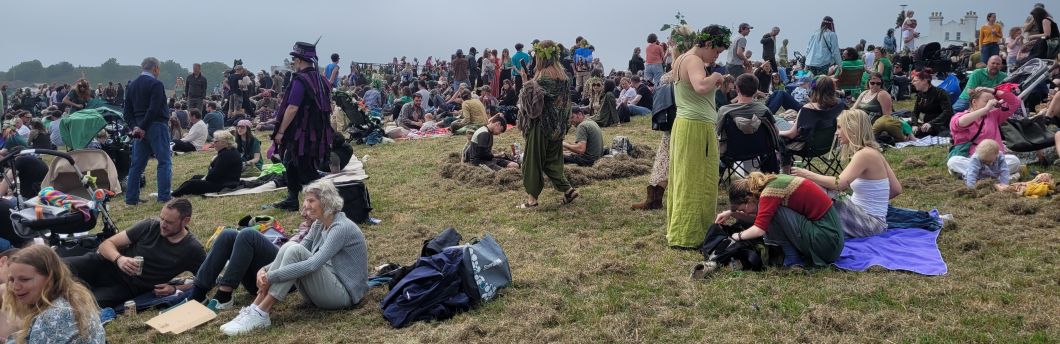
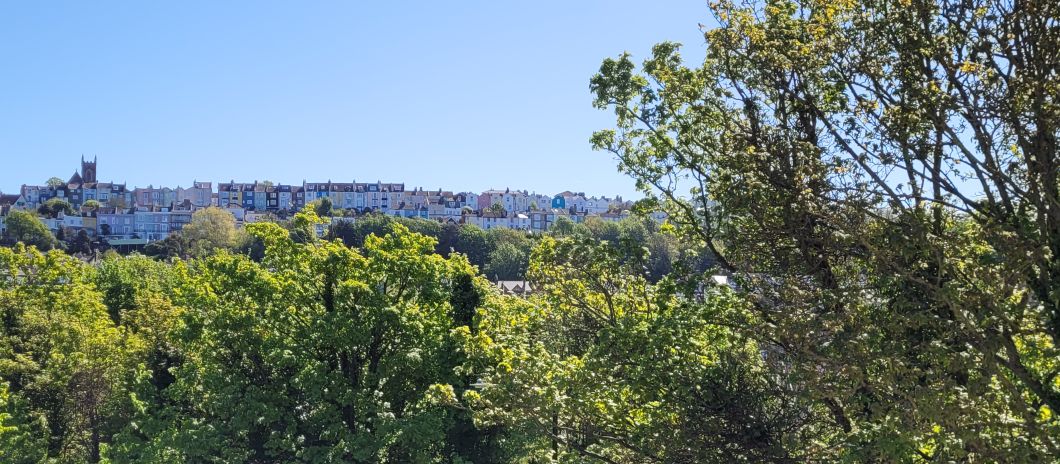


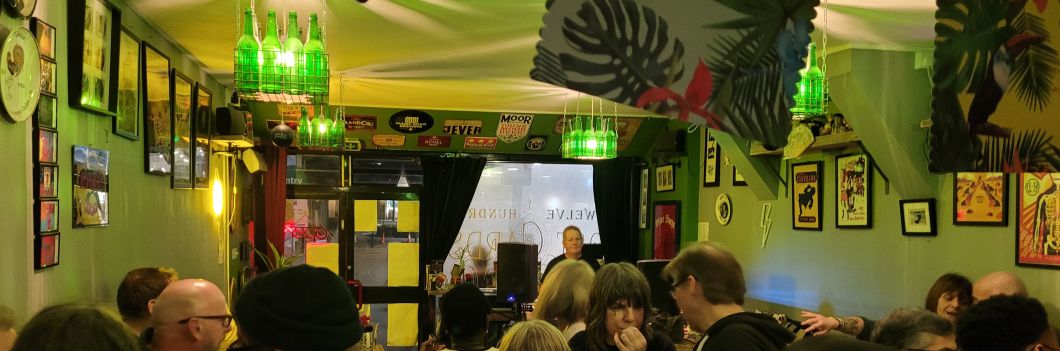
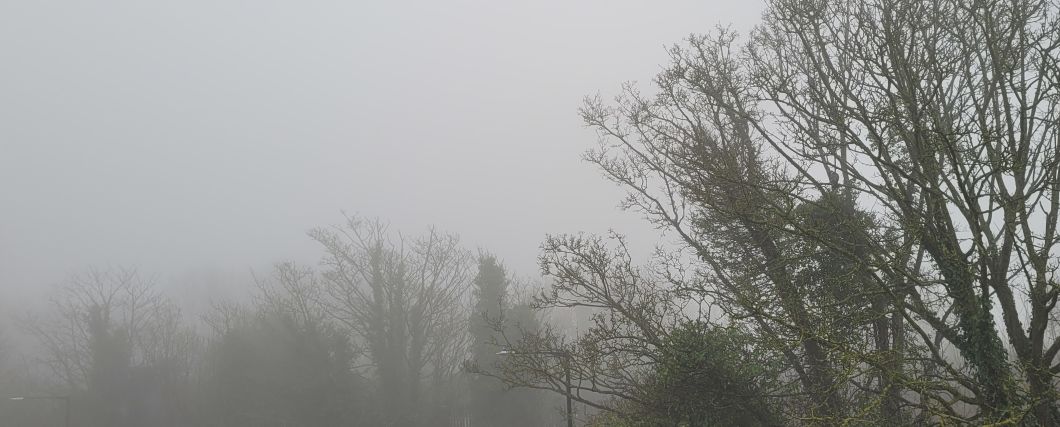
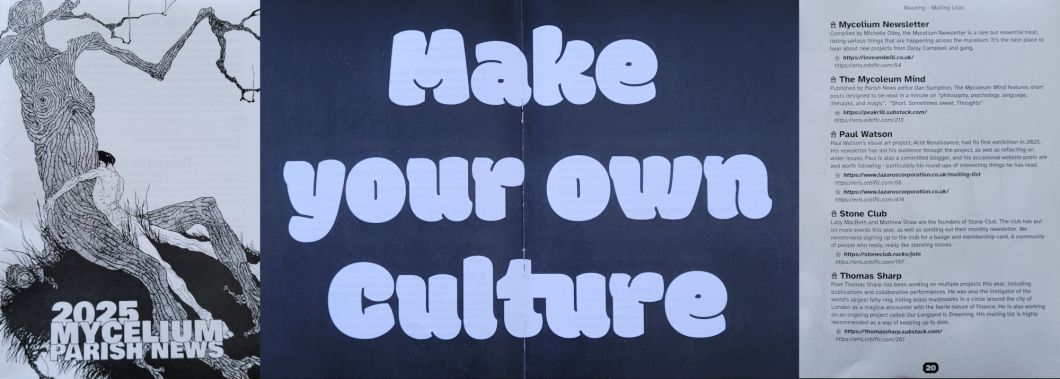
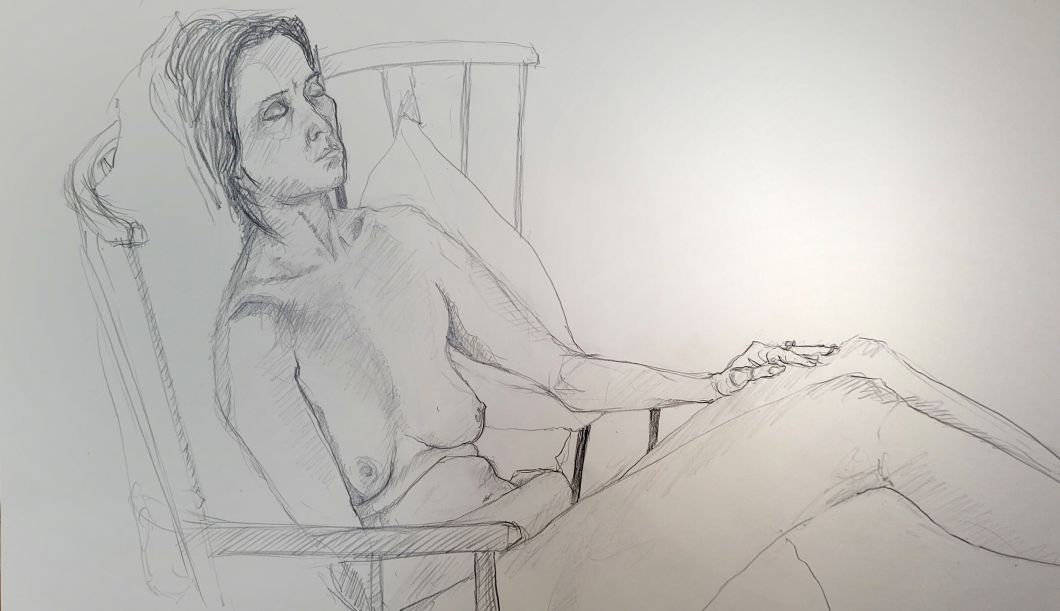


.svg)