GeistHaus
log in · sign up

\\...........//

Part of ellaguro.blogspot.com

stories primary
i played some games for Steam Next Fest
free gamesgame designindie gamesnintendosteam
Show full content

note: you can also read this post for free on my Patreon. plz consider subbing though, if you don't!


chart of Steam demos launched during the window of each Steam Next fest for the past five years posted by Chris Hanney on bluesky   

it feels like every other month in these troubled days new info makes it way out onto social media about how the amount of new game releases on Steam has again increased at astronomical rates. the past few years it's not too hard to find numerous proclamations on social media about why this means the game space of a few years ago - perhaps even a few months ago! - was fundamentally different from the one of now, and we must adjust accordingly. invariably, this always portends ominous signs for the future financial viability of the game industry. most pressing of all, this means the endless torrent of talks that litter conferences like GDC about how to best market your game are all now obsolete. which means it's time to get on it again, folks. time to pump out more of those marketing talks so can we fill that void quickly again! the forever industry of self-appointed market gurus advice-mongering to anxious and insecure game developers hoping to get any kind of edge must continue. the advice must flow!! in a further narrowing market space of possibility, this is what we're left with: the gold supply may be rapidly running out, but there is always better business in selling shovels than there is digging. and Valve is perhaps the ultimate shovel-seller of all, to echo what critic Jackson Tyler said on bluesky recently.

games are strange, though, in that they still retain this image of being a major exception. it's an era where all art, especially in the digital realm, is being devalued into sloppified interchangeable content at alarming rates thanks to AI and rapidly decreasing interest from creative industries in actually supporting their workers. but people still actually broadly do seem to pay for games, for whatever reason - even if the games they pay for are overwhelmingly just a handful of the biggest and most well-known releases. other games than that still do sell pretty well, though, even if it feels less clear than ever to whom exactly they're selling to, or for what reasons. games as an industry still have this image of a golden jewel, a supposed endless money well that figures in other creative industries are boiling with envy about in a world that otherwise shows apocalyptic hostility to art. perhaps this only continues to feed the endless torrent of aspiring creatives jumping into the space to try their hand at commercial game development, as every other space is even less viable.

but even when they do sell, it sometimes feels like an overwhelming percentage of games on digital platforms like Steam have taken on this strange role of "library filler" - i.e. games users will accumulate cheaply from various bundles and sales, but never really play. my own Steam collection right now feels kind of like the equivalent of what many people's mp3 collections used to be like in the 2000's - a huge mess of hypothetical things i could play somewhere down the line, if only i had the time or energy to. i've tried to counteract that somewhat and more aggressively engage with my frighteningly large digital library in recent years, but that engagement is a drop in the bucket - and easily wears me down. and even when these games are being played, there is often precious little (if any) actual broader critical discourse about them outside of consumer guide-like recommendations due to both the sheer amount of stuff on the marketplace and the hollowing out of game criticism and journalism.

honestly, reaching enough people like me who will take a chance on some niche thing if it's cheap enough that we might not play at all is one of the better scenarios for most developers. most of the time, they're just playing the lottery by slapping down the requisite hundred dollar platform fee on the table to Valve in the hope that it will attract enough organic attention to launch some kind of game career - whatever that may look like. if it wasn't already, at this point it really feels like a total necessity to play this lottery, especially as most other venues like festivals and game incubators don't seem to promise much materially as they might have in the past. itch.io of course still exists, but the average normie game designer doesn't seem too interested in using it for that long to build a community making small games before jumping onto the imagined 'big leagues' of Steam. but hey - in the case of some games by people i know (and some of the below games i'm talking about) jumping onto Steam with little prior experience seems to be working out for them okay thus far. doing so is certainly not a model i'd want most inexperienced developers to follow if they want to stick around, but it's not like some people can't get lucky!

browsing through demos on the main Steam Next Fest page for June 2025 this past week or so i noticed way more games that felt like first time student projects, cheap clones, or even the dreaded boogeyman - "asset flips" - than i had for previous rounds. at first i wondered if what i was seeing was the result of the floundering fates of all the game industry layoffs of the last few years finally materially affecting the space. maybe videogames are finally, truly, entering their flop era. but the above release chart clarifies that it's more likely that just about everything anyone is making is getting thrown up on Steam now - and, as a user, i'm just seeing it all more or less unfiltered. and for each of these developers with their demos on the platform, that's another hundred dollar platform fee: thus reinforcing the hegemony of Steam as the unquestioned ruler of the entire PC game marketplace.

there was a point in time not too long ago where the prospect of a full scale independent developed game existing at all was exciting, and worth celebrating. that was the (metaphorical) selling point for a full-featured free game like Cave Story back when it hit the internet in the mid-2000's. but now, it feels as every developer is punching their ticket into this monopolized universe of Steam just to get a chance for any kind of larger audience. perhaps the curation tools have gotten better than they used to, but in general - this arrangement is definitely not about benefiting developers. Steam and other platforms like it (like the Nintendo Switch store) are obviously aimed towards the general consumer. but even for consumers, they can be pretty unwieldy and overwhelming to navigate due to the sheer amount of stuff on there, and a lack of coherent organization. even as the dominant monopolized digital platform for PC games currently, your average normie adult who is only casually into videogames probably does not use Steam much if at all, and may not even have heard of it. it certainly favors a hardcore audience who is more deeply engaged. but perhaps most of all, it benefits online video content creators who have an endless assortment of games to draw from to make content around. online video on the internet of the moment is far more accessible than anything else out there, after all - far more than games themselves can be.

and i swear - each new game i seek out for Next Fest, regardless of the quality - a large majority of them seem to be the first game by that particular developer up on Steam. i find this quite disturbing! and it's not because i don't want new developers in the space or whatever. like perhaps this is just because some of these developers worked on other projects that are not on Steam, or are under a different name. but there are absolutely a significant number of developers to where this is their first real project of any kind. Steam is the default digital platform du jour now, and to any eager developers looking to jump into commercial game development, it is basically a requirement. why not just jump in right away to where the most people are? 

and will these new people ever stick around and make another game after? or will they jump aboard this train briefly, like so many others before them, and then, like so many others before them, realize it's not worth it and quit? imagine if every eight or so out of ten musical artists you discovered, you were always encountering their first and only album? wouldn't you start to get a really eerie feeling about that after all? like, where did the other people go?? it really just adds to the feeling of disposability of the entire process and undermines the supposed sanctity of a platform like Steam as the "big leagues". as a developer, if you fall by the wayside - there are always endless new faces to replace you. even developers who reach a decent amount of success and visibility have a good chance of not finding the grind of making and marketing a commercial game really worth it to continue. 

i've seen so many people come and go from the game space since i started being involved about fifteen years ago and it's absolutely dizzying. it's easier than ever to get into game development - although it never seems to stop anyone from thinking they're the first to come up with ideas that have been done several times before. no broad awareness of anything but the most mainstream game history means the past is continually erased and rewritten, and the old becomes new again. everyone seems believe they're the exception. and then, once they realize they're very likely not, they leave embittered. or they deal with a gaming audience overwhelmingly either disinterested our outright hostile to their kind of work. but we never see those people, for the most part. and i dunno about you, but it feels like there's been this ongoing psychic backlash from our beloved gamer hordes ever since any of them had to experience the indignity, the shame, the horror, of having to HEAR the name of someone like Phil Fish. wait a second... this guy... sounds... PRETENTIOUS?? how... DARE you not center the Gamer AT ALL TIMES! our most blessed of creatures, our precious child. our sweet special gamer must always be king. it is the job of a developer to meekly bow in submission and be the true anonymous code monkey they are. for, you see, they can be replaced any time.

another strange thing to grapple with re: Steam as a platform is how it is far more global than anything one could have ever conceived of in previous eras. as a developer, it is genuinely extremely hard to know what kind of audience will stumble upon your work and expose it to broader daylight. i certainly never anticipated that anyone from Brazil or Latin America in general would have any engagement with my work at all, and yet i've noticed a lot of interest from there in my work over the years. and as a consumer, you rarely have any idea who made the game you're playing or where they came from. different ideas come and go rapidly, and some important context is often missing. this is how most people in the West played Japanese games (and how people in the the rest of the world played Western games), so it's just an inherent baked-in part of people's personal histories with videogames. as someone who is fervently anti-nationalist, i think this is one of the great aspects of games and online culture in general. we should not be restricted by borders - concepts and styles should intermix freely. the idea that i could encounter some work from someone of wildly different background and experience to me without it really even occurring to me as strange at all is really cool to me. it's one of the utopian promises of the internet. it's part of why i keep pushing work like the Doom wad A.L.T. even when they might have one or two questionable aspects about them. 

but the flipside here is this is also incredibly flattening - it potentially pushes towards a global homogenization of art. it risks applying a universal standard that crushes chances to build more unique indigenous styles. because within videogame culture, it's invariably the blessed Gamer, our special treat enjoyer who must always be centered - regardless of where you might be coming from as a creator. this is also why the "keep your politics out of my gaming" crowd has had ammo to be so loud for so long. they've traditionally been centered, regardless of the context a game they played has come from or how actually 'political' any of the games are. there's traditionally little tolerance for stepping outside established bounds and genres. as the African developers of the anti-imperialist themed heist game Relooted no doubt encountered after being on this month's Summer Game Fest stream, for one example, your game might not be represented very well in western media - and is far more likely to receive the ire of the typical highly mobilized racist and sexist western gamer audiences as a result.

this all is maybe why i'm so annoyed by Steam being categorized by at least one usually pretty on-point vocal tech critic who i'd rather not name as one of the few tech platforms that (to paraphrase) "just works" and is an unequivocal good. to say that Steam "just works" is grading on a really intense curve, and ignores the monopolization, the platform fees and less fair revshare vs. comparable platforms, the DRM, the absolute joke content moderation, the bizarre and troubling work environment at Valve, etcetera. 

tech platforms that provide basic services in a somewhat competent way that somewhat center the user instead of the shareholder are rare these days. especially ones that actually seem to have any kind of even passing interest in the creative space they exist to make money off of. and there's no doubt to me that leadership at Valve care more about games as a medium than leadership at Spotify care about recorded music as a medium, for example. partially because they're still actively (theoretically) trying to develop games. and that does mean something!

but still, that's such an immensely low bar! this means it's really easy to over-praise a platform for doing something that really shouldn't be that hard to do - mostly just because they were there first, and haven't horribly fucked it up yet. Patreon as a platform has managed to make a widely valuable space for creative people online like me, in spite of basically doing little to nothing but collect money from users while continually raising rates, and even fucking up its payment processing numerous times. they're one of the more basic useful services on the internet and they've almost completely fucked it up anyway. it shouldn't be this hard! so Steam is here, and it's what we've got. but please, my god: Valve doesn't deserve any of your glazing. these platforms are not our friends! especially not when they're basically unaccountable monopolies.

however, the one very small way i will praise Valve is: i find Steam Next Fest one of the few unequivocal good things they've done. i am a person who would like to experience a lot of different things without spending a huge amount of time or money doing so. it is a very nice feeling when i get to do this. it makes me feel special. and it is something i already get to do a little bit of when judging for festivals, or curating for the Experimental Game Showcase. it was and is one of my favorite things about playing free games. so getting a relaxed free glimpse into a bunch of these bigger and more ambitious commercial projects is very cool to me. i don't stream on twitch very often, but i started streaming a handful of demos around each Next Fest three years ago in June 2022 because i liked the idea so much. perhaps above all of those other things, it brings me back to encountering shareware compilations of games i grew up with on the PC in the 90's - another space where you could have a lot of fun even if you didn't actually own that many games.

perhaps it's me riding the high on both this year's Experimental Game Showcase (which you should watch) that i hosted and helped curate, or the recent Unearthed Treasure Room stream of recent overlooked games (which you should also watch) i co-hosted with esteemed game developer, musician, and critic Melos Han-Tani. or perhaps it's just morbid curiosity about the increasingly confusing and impenetrable game space where we're all disposable pawns in the hands of uncaring platform owners, obnoxious content creators, and special little treaty treat lover gamers. or perhaps it's my general existential dread about the state of the world and if, among war and fascism and many many other horrible things, trans people like me are going to continue to lose access to basic healthcare in my country of residence. BUT.... this time around, i went overboard, and played around twenty demos for Next Fest. many of these were games i had already thrown onto my Steam wishlist at some point, and many had demos that came out within the past year that i hadn't seen until now. 

i'm going to limit this post to the five (okay, six) game demos that i played were most interesting to me personally. as much as i'd love to include a write-up of every one i played, i am not going to do that. partially because it's a lot of work, and partially because i'm still too traumatized by the Blog Wars of the early/mid 2010's and i don't want to start a discourse about if i'm punching down or not on some smaller game i don't like. i mean, i personally don't think there should be a mandate towards bland positivity in criticism, especially with how little respect a lot of hugely popular content creators with far bigger platforms than someone like me have shown to developers who are still forced to prostrate themselves to them for exposure in the past. but i also don't want to be a scapegoat in that fight or start unnecessary drama. so sorry - we can table that discussion for now.

also - i don't mention them below, but in this round i played the narrative-heavy, LucasArts-esque coming of age point and click adventure Perfect Tides: Station to Station and the new big Bennett Foddy joint Baby Steps: i'd recommend them both. you should also play this year's IGF Grand Prize winner Consume Me's demo if you haven't.

but otherwise, here we go:

========================================================

Danchi Days by Sandy Power, Melos Han-Tani, and mogmu

20250613232546_1

okay, i already tricked you. i was going to save this one for last as a little surprise, because i felt like i might be showing too much bias if i included a game co-made by Melos Han-Tani (my Unearthed Treasure Room co-host) on here. but there are interesting things to talk about here that are maybe tangential to the experience of playing the game itself - or, at least, are something the game's larger themes introduce.

to just quickly summarize what you do in the game - it's a narrative game with light action, puzzle, and exploration elements. it features top-down, colorful but simple 2D graphics and a concept that was apparently inspired by a Japanese-only Gameboy Advance game called Sakura Momoko no Ukiuki Carnival from 2002. you play as a little girl named Hoshino who lives with her dad, grandma, and brother. at the very beginning of the game, your grandma trains you and your brother how to "look" around the world of the game in order to read signs and other environmental details. the system for “looking” in this game is distinct from just standing next to objects and hitting a use button - you have to aim at things to “look” at them at wait for a cursor to move over them. the advantage here is you can also "look" at things that are farther than one unit away from you. as far as i can tell, there's no real challenge to doing this. the game generally doesn't emphasize reflexes too much. but i think it's interesting how very simple actions like even just looking at an object are recontextualized in ways that maybe don't necessarily add a lot of difficulty or challenge, but do make the action feel like a distinct thing vs. other videogames of the same type. what purpose doing this serves in overall shape of the game is basically up to you to determine - but maybe it will be made more clearer in the full game.

once you're successfully able to "look" at objects, your grandmother teaches you that you can, when moving around specific objects, kick up magical dust out of the environment. if enough magical dust is kicked up at once, Hoshino can summon it into her body and enter into these simple top-down grid-based movement minigames. usually these amount to collecting enough specific objects themed around the environment where the dust came from. you have a certain number of moves to do this before you run out of energy. these are generally very simple, and not particularly difficult to complete. again, it's interesting how this game introduces some surprisingly complex systems while appearing so simple, but does not make them difficult or challenging at all. later on you'll find out that by optimizing your movement in these minigames and using less of your energy, you can either achieve a bronze, silver, or gold medal in them. a higher medal rank means more points which you can use to unlock secret areas. higher ranks offer a little more challenge, but aren't too hard to achieve. the dust theme and the top-down minigames are also perhaps a reference to the Anodyne series by Melos (and Marina Kittaka's) Analgesic Productions, and certainly bring on similar themes to other games Melos has worked on.

after you, as Hoshino, demonstrate your ability to complete these minigames - your grandma congratulates you and says you'll be an expert in no time. the game then abruptly fast forwards several years into the future. right when this was happening in the game, i had the thought in my head of "gee i have a strange feeling this game is setting me up for some kind of Mother 3-esque tragedy." but instead of setting up foreshadowing for some later point in the game, you're matter-of-factly thrown right into it in the next scene. Hoshino's grandma now is completely incapacitated in a wheelchair with dementia. she is basically unresponsive. your brother, who has now grown into a surly teenager, tells you to let go and that grandma is gone. but you are still obsessed with the idea that you can cure your grandmother’s dementia. 

the transition here from a very light tutorial to the much darker central theme of dementia is pretty jarring for something with such an otherwise cheery and upbeat presentation, especially which doesn't outwardly present that aspect in its advertisement. this moment honestly left me pretty emotional throughout the rest of the game. while you might not be doing anything else outwardly fucked up during the game and the tone is pretty happy throughout, the dementia colors the whole experience in a much more interesting way than it would without that as the central element of the story. 

one of the Steam reviews for the demo said "finally, a cozy game that is actually about something" which stuck with me. it's well-trod territory of discussion at this point, but one of my many issues with the genre of 'cozy' or 'wholesome' games is how many of them default towards this general cheery pastoral escapist aesthetic almost unthinkingly. there's an implication that all of these games are supposed to be approachable but trivial, so as to not alienate audiences. but many of them do this by also presenting as being diverse, egalitarian and "for all", even while having all these very ideologically weighted themes like escaping the city to the country and managing a small business that are totally unaddressed. in spite of some of the progressive imagery, these are generally not spaces for deep explorations of feelings or ideas at all. there's an inherent conservativeness to these games, and this label overall that clashes with the diverse and open-minded image they're trying to portray. 

Danchi Days, by comparison, feels genuinely subversive. it just throws the dementia in there right at the beginning as the central theme of the game and it doesn't feel the need to either equivocate about it or over-dramatize. which begs the other question: is this game for kids? it's surprisingly complex in terms of its ideas in a way that you wouldn't expect from something with this kind of simple gameboy advance-like presentation. but in terms of the gameplay it's pretty basic, and certainly could be played by kids. Melos said recently on bluesky

"One curious (minority) opinion on Danchi Days is that it is contradictory because 1. 'the gameplay is for kids' and 2. 'it can't be for kids' because it centers dementia, as if children aren't exposed - and perceptive - to death and destruction on a daily basis! re: 1 - why do people believe it's 'for kids'? Reasons include 'the gameplay is simple to understand'. Simple, versus... what? something where you manage numbers or cities or do 1000 quests? if a game needs to emulate work to be for adults, I will stick to kid games then. I think stuff for kids should engage with them as perceptive humans capable of thought and recognizing the complexity of the world. the sooner the better, look outside! 2 kinda relates to how Miyazaki/Ghibli stuff gets flattened all the time into an idyllic aesthetic. a good game should be some distillation of the complexity and imagination within our living reality." 

what Melos says here echoes some of my feeling about how this kind of twee idyllic pastoralism flattens more complex and multi-faceted media into another flavor of Thomas Kinkade-esque mawkish escapism. the ambiguity here of who this game is for is also clearly intentional, and is something you can feel playing it. while a lot of games Melos has worked on have been relatively accessible and simple challenge-wise, that's not necessarily the case for the most recent Analgesic Productions game Angeline Era, which is much more of a reflex-based action game. so clearly, the simpler and less intensely challenging design is an active and intentional choice. it's meant to draw out other parts of the experience, or perhaps suggest an alternative approach for design for these types of games.

all of this does also make me think of a much larger question - how much does the outward presentation really define everything about how we see what a game is supposed to be in this day and age? how much have appearances become the entire selling point and define all the assumptions we make about the relative function of games, to the detriment of everything else? and as a designer or artist - why has giving the audience exactly what it expects based on outward presentation been turned into almost an unending virtue, instead of something to be subverted or avoided? in spite of all the struggles to claim games as a consequential artistic territory over the last half-century, we're still looking at games primarily from the lens of product design. all attempts to do otherwise are seen as pie-in-the-sky and unrealistic to developers trying to make commercial games, and therefore must be cast off. doesn't that hobble our abilities tremendously as a creative medium? 

i think its fair to say that providing elements of an experience that cut against typical audience and genre expectations and aren't immediately apparent from marketing materials is still one of the major taboos around the game space - and perhaps all art in general right now in online spaces. in this way i think Danchi Days is challenging its audience more than a post-apocalyptic horror RPG like LISA: The Painful is challenging its audience - because you fully know what you're getting with the latter from the outset. the way games continually become siloed into rigid genre mandates is disturbing to me and i think does them no favors. the feeling of surprise is rarer than it should be, even with the amount of games that exist out there. and it's a shame that the way games are increasingly marketed online, and the reflexive fear of alienating angry audiences keeps people from exploring this realm very much.

i guess it's funny to say all of this too because outside of the main theme, this game isn't doing anything substantial to challenge and alienate its audience. in an attempt to awaken her grandmother more, Hoshino decides to resurrect these yearly things called Danchi festivals her grandmother used to run before she got dementia. in doing so, Hoshino discovers some imaginary (or maybe not?) monster companion long buried inside a tower who decides to join her on her mission and help her along. later, Hoshnio's dad helps her set up a website and make invitations to other people in the community, and post updates about the Danchi festival planning via her little pocket PC device. as Hoshino, you spend the rest of the time wandering around the facility your grandma lives in and connecting with the various older people who live there and inviting them to the festival as your monster friend follows you around. in between, you do those little action puzzle minigames occasionally that correspond to different parts of the environment. connection to the environment is clearly a large part of this game's themes as well, and central to the purpose of the Danchi festivals. the other major element of the game is a Hypnospace Outlaw-esque virtual world where all of the principal characters have their own little web 1.0-esque personal websites that reflect their very specific interests that you can use to help make connections with them.

so yeah - thematically, there are a strangely large number of elements to the game even though it has a very simple appearance, and nothing you do is particularly challenging. i managed to basically talk to all the neighbors and reach the end of the demo, so i'm curious to see where the story goes. it’s hard to know how much further the game will go into exploring the psychological storytelling and how much in the story is metaphorical, or if the dementia is really just the setup for an otherwise fairly light adventure. the almost infantilized dialogue with the characters and their fairly oversimplified special traits (like the above pictured local housewife Chathie who cannot stop talking for even a second) point at a more simple and childlike sort of narrative. but there's no reason to believe the writing couldn't shift tone at some point too. in fact, abrupt tonal shifts have been one of the principal elements of Analgesic/Melos's work. so i do really enjoy the ambiguities and surprising complexities of an experience like this where you would not normally expect to see it based on first glimpse. in some ways, it also feels more surprising to see it here than it does in something like Anodyne 2: Return to Dust, which is also a very unique and surprising game - though i personally prefer Anodyne 2's more obviously 'arty' approach.

but yeah, overall this game brought up some complex thoughts for me about the nature of our expectations for games from assumptions we make based on appearances. i in fact saw this game on one of the Summer Game Fest streams but passed over it completely at first because its appearance made it blend in so much with other games around it. the mostly child-like tone and relative lack of challenge means it won’t be for everyone, and as a player i tend to prefer a bit more outright surreality, a little more challenge to my puzzles, or a slightly more overtly darker tone. but it manages to be pretty engaging throughout regardless. and it definitely feels unique and not quite like anything else i’ve played because of that (other than other games by Melos/Analgesic). so - check it out!


Eclipsium by Housefire

ss_a2422e9e6263d60e5d1a72c097ec0bf1b451c708

okay, now here's one i actually have surprisingly little to say about. i saw this trailer pop up on youtube labeled as part of the PC Gaming Show around Summer Games Fest but i don’t know if it was actually part of the stream or not. as an aside, maybe it's just residual nostalgia from subscribing to PC Gamer starting around age ten or eleven - but the PC Gaming Show is the sole one of the bigger Summer Game Fest streams i find actually somewhat pleasant to put on in the background. 

anyway, Eclipsium is a walking sim that seems perhaps slightly ashamed to to admit that it is walking sim. there's no shame here, buddy! the visuals are obviously the most notable part of the whole experience - they have a very specific kind of pixelly dithered lo-res look that’s very striking and adds to the uncanniness of everything in every environment in the game. they're a bit like you’re looking at old interlaced video on a 90's interactive FMV CD-Rom game, or through some sort of foggy pixel window. this lo-fi dithered look really helps every environment you encounter feel very much specific to this game, and not generic or stock engine assets like a lot of first person walking sims can have a tendency to do. this highly specific uncanniness also extends to the color palette, which is intentionally limited in a way that older PC games are - causing some interesting sort of color bleed effects where colors normally far outside the range of what you would normally see in a higher color count are substituted because of the limited number of colors available in the palette. this creates some interesting artifacting that gives this game its unique look. and it's a neat trick overall, and i haven't seen tons of contemporary games do as an intentional aesthetic! 

of course, even though the visuals signal 90's, the game itself feels like a very modern experience to me. the navigation is pretty smooth- there's little of the choppiness of 90's FMV outside of the lower framerate on the hand animations. which, by the way - it's of course also impossible to talk about this game without mentioning your avatar's giant photographed hand that you see throughout your journey, which helps you navigate basic environmental puzzles. with each little environmental puzzle where you have to manipulate some object, there's a little hand animation that goes with it - which could either be seen as cute and charming quirk of the experience or maybe a bit chintzy and precious depending on who you are. i don’t know if any of these developers were ever part of the Haunted PS1 community or not, but it especially looks similar to games called RIVP-1 and RIVP-2 in one of the Madvent Calender compilations that involve tearing apart things in the environment with your giant rendered, low-framerate photographed hand like this one does. though perhaps overall this is not the most uncommon idea.

the experience of playing one is a bit hard to summarize? if you've played any sort of surreal walking sim from the past ten or fifteen years, you probably will get the drift. you start out outside on a camp in a mountaintop on an island outside of a very funky warped looking cabin. sometimes it's hard to tell how much details in the environment have an outright surreal/reality bending design vs. if that effect is being heavily enhanced by the grainy low-res visuals. there's no text instruction or dialogue in the game, but your goal you can pretty quickly surmise is to move towards a giant Oblivion/Sauron-esque glowing red eye in a tower across the water in the distance. this leads you to eventually descend into some slightly evil looking red caves. throughout the demo, implied horror elements are certainly present but only ever there with a kind of light touch. there are no monsters chasing you or giant piles of corpses, or anything like that. subtlety can be rare when it comes to these kinds of horror-adjacent games, so you have to treasure it when it's there. 

you wander around the evil caves for awhile and light various torches in the correct configuration to open up some gates. and then you reach a sort of industrial warehouse area filled with giant metal shipping containers, and solve various puzzles to lower the water that is blocking your path. there’s a cool bit of non-euclidean navigation throughout where you continually loop back around to old places and the environment has changed a little. the path forward ends up being in a different shipping container each time - as if these shipping containers all contain portals to other places. also if you die by falling into a pit or spending more than a few seconds in the water, the game puts you in a clone of what looks like your character's bedroom and makes the room's exit by some nearby area where you died - which is a cool effect.

if Danchi Days is a game where the experience of the playing is not entirely what you'd expect based on the surface appearance, this is a game where you can more or less anticipate exactly what it is by looking at the screenshots (beyond it being slightly less horror than you might guess). perhaps this is why this game has benefited from some attention - according to the developer as of February 5nd of this year it was one of the top 1000 wishlisted games on Steam. for an (apparent) first time developer, they seem to be doing pretty well for themselves! i guess that's what striking visuals get you in this day and age. one of the great mind tricks the Haunted PS1 community has pulled on a lot of gaming public is that as long as there's a vague suggestion of some horror elements, or possibly some implied lore elements, the public will basically tolerate any sort of "art game" type of experience without really any misgivings. i have to thank the zoomers for being the primary engine of this innovation. i notice a lot less active hostility towards a lot of "art" games than i used to, even when the audiences for the game aren't super large. an audience has been silently inculcated against aversion to walking sims, and i'm grateful for this mind trick.

after i got through the warehouse, there was a section with some sailing on a boat to a different island and a surreal horror setpiece involving twisting around a parallel underwater version of the world. that is where the demo ended. it's a beefy demo experience overall, though it certainly left me wanting more. while this is walking sim with light puzzle solving at its core, and it’s probably not going to show you anything you haven’t seen before - it’s also engaging throughout, and feels high effort enough to be unique the realm of surreal walking simulators. the subtle magical realism that doesn’t go for outright horror as much as just general atmosphere is really the biggest success of this game, for me. it's definitely one of those games where it doesn’t spell anything out at all and you can read into it however much or little you want. it's also blessedly free of Lore, which i appreciate given how many of these games aren't.

that said, it's probably the least deep or interesting game to talk about of the six here. it's more like a particularly well designed theme park ride with some nice sights and sounds. as far as i could tell, the story isn't really "about" anything and doesn't try to make any particular points about anything in any kind of explicit way. that might change outside the demo, but honestly that kind of experience is perfectly fine with me for a game like this. there are times i'm looking for a little more than a theme park ride - but in lieu of that, i'll certainly take what's given here. it's a low-key well crafted experience overall. the arc of the demo was a self-contained experience. even if the entire thing is very linear, the atmosphere and setpieces were cool, and all the non-euclidean stuff when it popped up really added a lot to the whole thing. given that i played this in the midst of around twenty different games for Next Fest, several of which experimented with various kinds of frustration and difficulty: a smoother experience like this was much appreciated.


Funi Raccoon Game by Crayon

ss_4133c8a96bbe6cfd9670d0f72e1ec5494992af3a

a noble furry anarchist game embiggens the smallest man. the spirit of Glorious Trainwrecks is alive and well. not that i'm assuming the developer Crayon has familiarity with that community or most of the works it has produced, but this definitely feels like a higher effort/more polished version of a Glorious Trainwrecks game. you know what i'm talking about if you've ever seen one of Blake Andrews's games, or Revenge of the Sunfish before. and maybe the word “polish” seems silly to say about this game if you look at the screenshot above, but if you've played Glorious Trainwrecks games you know what i mean. Funi Racoon Game is a version of the kind of crude but spiritually bounteous Klik N' Play symphony that is a bit more commercially accessible, for better or for worse. it marries the cartoonish, dumpster-dived aesthetic of one of those kinds of games with open-ended, 3D, Katamari Damacy-style sanbox chaos. 

in many ways, Funi Raccoon Game establishes its own world and feels like an unfiltered free-associative look into the mind of its creator. in each area you have have these small chaotic 3D planes usually modeled after some kind of silly facsimile of real places - like office complexes and train stations. each place you go to are kind of small 3D islands floating in a void with tiled background skyboxes reminiscent of Mario 64. as your raccoon character, you jump and climb the various buildings and building-like structures that use low-res photo-sourced textures and simple geometry on these planes. throughout your time in the game, there are objects you can pick up and interact with that will sometimes do different things. picking up objects is especially important to your existence as a raccoon, for whatever reason, and any time you pick up a new one a "yippee!" sound will play and it'll count towards a larger total of collected items. there are also different entrances to other side areas you can find - either hidden, or out in the open through glowing yellow doors. the game will tell you on select menus when you enter into a given area how many sub-areas you've unlocked.

some areas involve little environmental puzzles you have to solve or animals/people/objects you can talk to. some just involve platforming and navigating the slightly jank jumping physics to get to the right place. there was one main area in this demo as far as i could tell - Norwich - and most things were based around it. there are other areas - like an office complex, or the waiting room where it instructs you to wait for a new version of the game that i missed when i streamed the demo initially, though. the music in Norwich plays this kind of silly filtered 90's-style hip-hop beat that sounds like you'd be likely to hear in some sort of skating game from the period. my favorite background track is in a secret area of a train station by a pool of water where a placid synth drone plays and a distorted voice you can only sort of hear mumbles a story about water sports in a childish tone, only to break out and say "get the fuck out of here, we straight up do not want you" in a louder, angrier tone and then return to the excited water sports talk. the track also ends abruptly and does not loop, leading to an eerie silence if you linger in the area afterward.

throughout the stages sometimes there are also comic-panel like billboards that will remind you of some feature in the game or instruct you on what you need to do. other areas will have secrets where it feels like you're clipping in between the building structures. and throughout there’s very clearly an anarchic internetty sensibility to the humor in the game, with lots of random explosions and janky 3D physics objects ala Goat Simulator or something similar. in one area you can steal a gun from a cop and then a massive array of cop cars immediately mob you everywhere you go in the level - maybe the most realistic part of the game. the design similarly feels very improvisational, intentionally throwing into ridiculous situations or exaggerating moments that happen for comedic effect. but the world also feels much more specific to the game, and there's less 'lol random' humor going on here than in a lot of other internet meme-style games. not to mention that it feels more consciously designed in several ways - all of the little secrets and different ways to navigate each environment make it fun to explore and pick up objects just to see what will happen. the ways the game doesn't try to be logical at all or justify what it is while still having its own kind of very specific logic makes it feel like a more sandboxy and commercially accessible version of something like my own game Problem Attic.

in the setup of the game, there is a fake OS that looks like a combo of C64-era of computers and a 90's-style web browser. the screen resolution is appropriately squashed like a 90's PC game would be as well - one of the many games i played in this round of demos to actually do that. perhaps more and more of us are trying to escape the hegemony of HD and widescreen resolutions. you have a central dumpster server room that's kind of connected to everything in the game, though you can only access one or two primary areas and its off-shoot secondary areas in the demo. at the beginning of the game, the character select screen of smaller raccoons moving around and carrying giant 80's or 90's style beige CRT computer monitors reminds me both a little of Katamari Damacy's character select, and also Super Mario Bros 3's title screen. and this actually gets me to something related to this that i wanted to talk about a little more...

i've said before that one of my favorite games of all-time is Super Mario Bros 3. as a small child it was probably the most formative game for me, but it's worth articulating why, specifically because so few accounts of childhood nostalgia for popular games like this ever seem to. i think i saw something in SMB3 that i also saw with my favorite Looney Tunes shorts as a kid - a kind of expressive squashing and stretching and playing with the medium it's working within. there's the famous silent title screen cutscene where the title of "Super Mario Bros. 3" drops down with shaky thud on the screen and a markedly more intentionally cartoony looking font than previous SMB games. and then you see Mario and Luigi there like these little puppets on a stage, jumping on each other and bumping into various hazards and powerups you encounter through the game. this doubles as a quick little intro tutorial on some of the ways you can interact in the game as Mario or Luigi (and also implicitly references the battle mode you can enter in two player), and it tells you to expect some goofy chaos throughout the game. 

but there's another element being set up here. the root of Nintendo's appeal as a game company was always in animation, because it was Miyamoto's background. and the theatrical elements are intentionally played up in SMB3. in 1988 upon the original Japanese release of SMB3 Nintendo was only at the very beginning of being the forever entertainment behemoth it's become: a company with a surprise generational-defining hit console in a still fledgling medium. throughout the second half of the 80's and the 90's they were still trying to find their footing on what videogames, and specifically their games, could look like the future. SMB3 feels like a conscious commentary on the sudden popularity of Mario as a consequential symbol of entertainment media. it attempts subvert the formula SMB1 and 2 (what we might know as The Lost Levels in the west) that had become kind of staid by stretching it in as many directions as possible. SMB3's levels move in all kinds of different directions and dimensions. most have one or two distinct ideas to them and then just end, sort of like they're some kind of 1-minute punk song. there is just something kind of silly and loose feeling about a lot of SMB3 (or the SMB2 we got in the West, Doki Doki Panic, for that matter) like a goofy little playground of rule-breaking that wasn't present in the more tight platforming of the first game. this kind of sensibility is more Bob Clampett or Tex Avery or Chuck Jones rather than Walt Disney. if Disney tried to imagine an idealized and happy world you'd wish to escape into, those Looney Tunes guys wanted to play with the artifice of the medium and have you look behind the curtain, to see how it all works. they wanted to show you why it's all a show.

this is where the imagery of the red theatrical curtain comes in for SMB3, and why you exit every level by walking into the black void of backstage. it's there in the diorama-like structure of each of the individual worlds, or how you can even walk behind stage decorations at times to access secrets (which is hinted at by the title screen itself). this is all interesting to me specifically Nintendo is much more often a Disney analogue, where pastoral elements of an older era are romanticized. The Legend of Zelda is meant to capture a sort of natural world that didn't exist in Japan anymore by the time it was made thanks to rapid industrialization, but still could exist in the popular imagination. in that way, it's much more similar to how Walt Disney went to great lengths to push those who worked for him to recreate idealized versions of his own Kansas childhood in his movies and in Disney Land/Disney World. 

for Nintendo, playing with the tools of medium expressively has always been important. and the wild more anarchic side of this does still exist in the niche outings like Warioware or Rhythm Tengoku games, but it's generally far more constrained and restricted in the mainstream games. sometimes it's not clear if the experimentations are more stiff and conservative than they did before when the medium was still fresher, or it's just that Nintendo never really changed or evolved past what they set into motion with SMB3. but even arguably by Super Mario World with its sprawling overworld and extensive secrets, Nintendo were starting to codify what Mario was and it was beginning to lose a little bit of the still formless energy of Super Mario Bros 3 or Doki Doki Panic. certainly, even after the Switch era infused a little bit more lifeblood into it, the Mario series has been the most rote and safe of their franchises for a pretty long time. 

Nintendo right now seems to exist firstly as a guardian of IP, a hegemonic cultural force who exists to embody some vague notion of "play" in a diminishing monoculture. they harshly discipline any copyright violators out there who might try and do anything with their work or stretch it beyond their rigidly defined bounds. with every big release Nintendo ordains to reassert its own dominance over the idea of childhood "magic" and "play" in the games realm with their mainline franchise games, all so tearful adults and their children can rake over some money to re-experience some lost past. and to be fair, many times these mainline Nintendo games are still broadly more creative than what other mainstream games will offer, if only because Nintendo has been grandfathered into this role culturally. but the parameters that they're working within are still very limited due to their role as the hegemonic family-friendly company. even when they are wilder, the experiments in these games can feel just as much like they're stiffly holding the medium back from exploring its true potential than they are expanding it. especially when you go beyond their specialty realm of playful mechanics and into content that challenges audiences in any kind of ideological way. the recent surreal creepypasta Mario 64 romhack B3313 has really stuck with me specifically because it's the kind of experience Nintendo never could, or would, provide. and it recontextualizes that in a very haunting, if sometimes slightly juvenile, way.

all of this is to say, i think Funi Raccoon Game has far more in common with SMB3 to me than the products that Nintendo makes now. the feeling of genuine surprise is something Nintendo tries to snuff out as much, if not more, than it tries to create in their products now. the sketchy looseness of Funi Raccoon rhymes with a lot of games people love like SMB3 or Katamari, but in a homemade and distinctly personal way that feels deeply unique. it sets into motion the potential of those games and moves beyond all the ways they're restricted by trying to be fully polished, mainstream commercial products. those who now declare that videogames are gradually losing their "weirdness" would best look at games like this. there is a huge necessity to supporting these kinds of games not just from some kind of symbolic "it makes me feel good about myself" angle - but more because the more visible and broadly celebrated the weirder niche stuff is, the more acceptable it becomes for mainstream games to adapt those ideas too. we have to reclaim the spirit of games like Super Mario Bros 3 by taking it further than it could ever go itself. that's the next step - the spirit that lives beyond the hegemonic IPs. 

and honestly part of the reason for my Glorious Trainwrecks comparison for Funi Raccoon Game is it goes back to what i liked about so many particularly free indie games circa the late 00’s/early 2010’s. at that point in time, there was this idea that games had become staid and solidified into a kind of forever mediocrity. as smaller scale designers, we had to re-evaluate what function game served at some level and offer something different. that was a time as a free indie game maker to invent some kind of new form, because you had no idea what would take off and take root. many people (including me!) were trying to do very novel or unusual takes on games in a sort of anarchic way as a result. that felt like the time where the door was open to be doing it. and some audiences were very hostile to this - but others supported it and helped some games become bigger.

sadly, that spirit just got gradually absorbed into commercial game making that has attempted to smooth a lot of these elements out and professionalize the process of making indie games. i often worry about academic game programs like the one i teach at NYU are contributing to this in some way. for all the current talk about "deprofessionalization" in the current game industry, the amount of amateurs acting like professionals in the hope that it will secure them acceptance and a career in the space has skyrocketed to absurd proportions. perhaps less people are material "professionals" (whatever that really means tbh), but everyone seems to want to act like a professional. and tbh what i liked the most about this demo is how much this game was its own thing - and not trying to obviously model itself after other games, in the same way some of those earlier free indie games were. it feels like it’s bringing back that sort of lineage of anarchic and loose experiences that aren't concerned with looking "professional", whether consciously or not. and in an era of so much obvious nostalgia aping of particular games from twenty or thirty years ago, i couldn’t be happier to see some of that spirit come back.

so yeah - fully recommended! AND - if you like it, you should support the currently still active Kickstarter so the developer can finish the game.


Am I Nima by HO! Games

ss_421ede65180f6728166618da297b13aad9ea8fa4

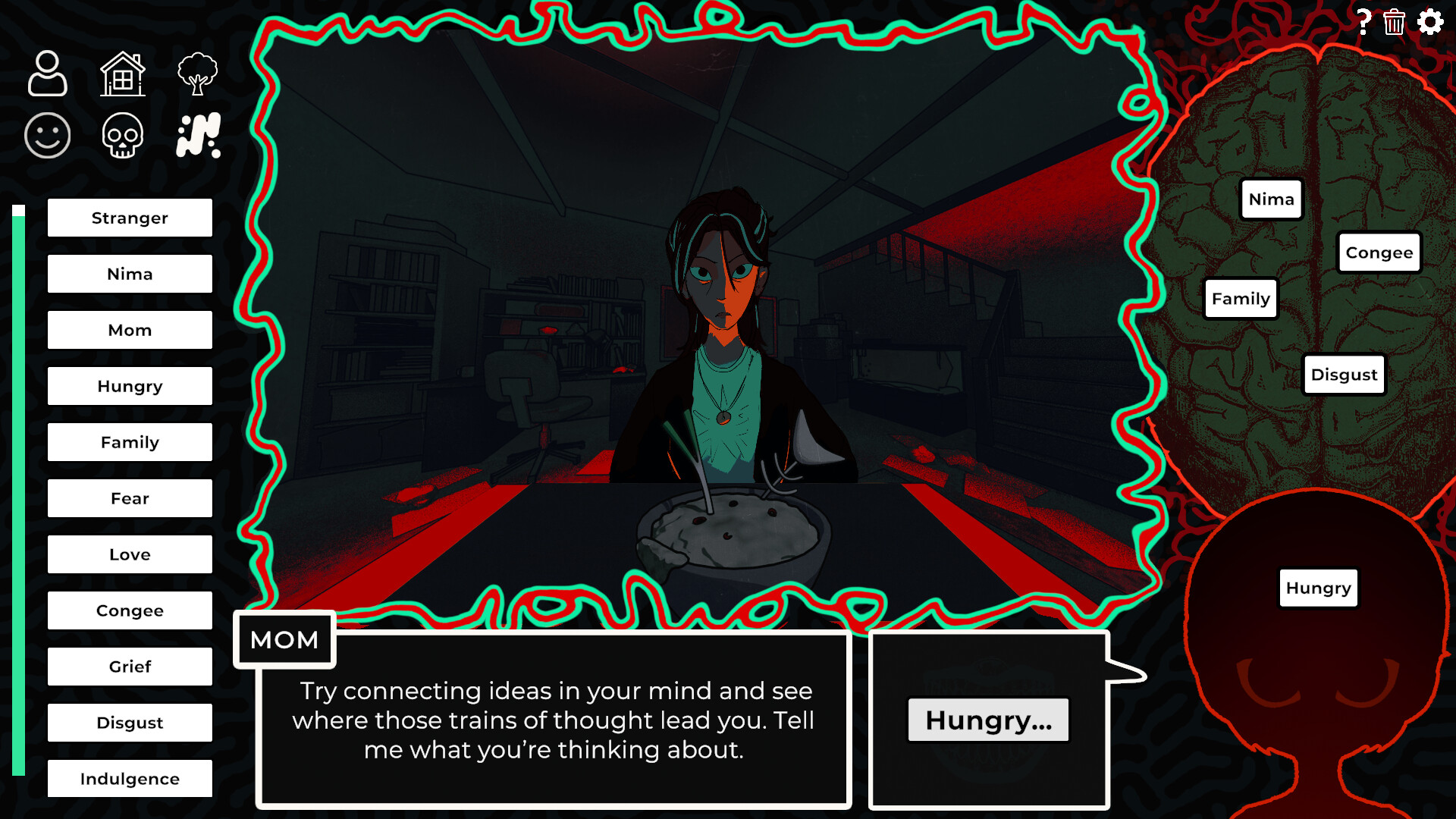
another game i don't have tons to say about, mostly because the demo i experienced was short. HOWEVER, i did not realize until just now looking it up that there are in fact multiple endings to this demo, so more on that in a second. but the premise is you’re like a pre-teen girl who is actively being tied up and held hostage by her mother for some kind of reason involving a scientific experiment. there’s an implication that you have been violent and/or have behavioral issues in the past, and that’s why you're being held hostage. though it’s hard to know if that’s the actual reason, or that's simply the justification your mom makes for treating you the way she does. you keep losing your memory, so you have this system where you can talk to your mom to help regain memories. and for each thing you talk about, or for each object you will interact with in the environment, it brings up different conversational subjects that come up inside your head that you can then use in conversation.

the game is heavily dialogue based, and mostly unfolds as interactive fiction with occasional sections where you can sometimes explore or examine objects the environment around you. the illustrations have a warped, fish-eye like quality to their perspective which clearly enhance the feeling of fear and unfamiliarity your protagonist is dealing with. the colors in the game also heavily emphasize bright neon greens and reds, sort of like an uncomfortable bright florescent light shining directly onto your face in an otherwise dark room. it makes you feel like, as Nima, you're some kind of test subject... so this is appropriate. almost as if you're an experiment, and in the same way the dialogue options are there to help you remember, they are training you to remember what your mom wants you to remember. based on the fact that this demo does in fact have multiple endings and is labeled "Choose Your Own Adventure" on Steam, it seems at least to some extent to be “choices matter” kind of game in the conversational system, and what topics you bring up from your head in specific moments will affect what happens in the story. a lot of this connects back to how much you're willing to call out your mom.

i had a couple conversations with the mom, and a section in between where i looked around at numerous trinkets in my bedroom to remember more about myself so that i had more topics to bring up in the subsequent conversation. you find out over the course of these conversations that you had a good relationship with your dad but he died awhile back, and also that your mom is some kind of archaeologist. your mom claims you lost your memory from hitting your head while swimming, but you are clearly aware that she regularly lies about this sort of thing and you have no reason to trust her whatsoever. much of the conversations involve you trying to remember while also performing what you think she wants so as not to anger or further inflame her, as she gaslights you by trying to reassure you that she knows what's best and only cares about your well-being.

i should mention that i saw this game in the Southeast Asian Games Showcase stream for Summer Game Fest. what attracted me to this game in the first place was the disturbing rattling sound design and fish eye visuals in the trailer. i'm definitely glad i stuck around to check the game out, because you never know what kind of experience you're in for from just watching a brief trailer. and clearly i'm not the only one who felt that way - i found out from looking it up, that as of writing it's the 595th most wishlisted game on Steam. so i would go so far as to call this game Actually Popular as far as these types of games go. but because it was in the Southeast Asian Games Showcase, i imagine some of the cultural experiences bought up in the game are perhaps a little specific to Southeast Asia - particularly the weirdly gritty, nasty bowl of congee (rice porridge) pictured above with twigs and shit sticking out of it that your mother hands you as food. i mostly say that because some of the ideas or imagery might resonate more strongly with you, depending on your own background. but i will say, the emotions captured do feel pretty universal regardless - more on that later, though.

on my run through i got the "bad" ending and figured that was it, so didn't push further. but i guess this demo was popular enough that i just now found from one of those numerous youtube lore channels named GamerSault which attempts to "explain" the story of the demo of the game that there are multiple endings. from this i also learned you realize more about what specifically is happening with your mother the more endings you explore, and a potential way out of escaping this cycle. this is about all i got out of that video unfortunately: because i always find these sorts of lore channels a really mind-numbing and clickbaity way to analyze any kind of fiction. i know as a player i'm much less interested in the specific lore of the plot elements and more what the story is supposed to capture or represent in a broader sense. to me, in stories like this, supernatural or sci-fi elements are really there to exist or dramatize existing dynamics that exist in real life rather than be something that you follow to the letter of the law as entertainment but will never apply to your own life. but again, this is the same old problem with the product-oriented way so many people look at fiction in general, but especially games. they're abstract puzzles to be solved and pore over, they're not fiction to analyze and apply to your own life.

but yeah, independent of the more exaggerated sci-fi or horror elements of the plot, this is an abusive mom simulator. and i identified a great deal with this protagonist and her relationship with her mom in many ways. particularly the way the conversation system kind of has this element of “things you can’t say”, like doing the correct performance in order to avoid violence or confrontation with an oversensitive parent who cannot face up to reality. the way her mom uses shame (“i’m just trying my best”) and the hollow performance of being a supportive parent to gaslight about other abusive stuff that clearly did happen (but as a child you tend to lack the words and are not in any kind of position of power to assert that) is something i know i could relate to far too much!! of course you could relate it back to the dreaded Lore of the character to explain this - but perhaps the fact that you keep losing your memory is about the cycles of abuse, and how dealing with that does mean actively confronting buried memories that are incredibly hard to access in traumatic situations. 

i think with Lore-based analysis in general my fear is always that the way these sorts of games are talked about ignores the attempts to engage with larger themes and ideas and just substitutes a sort of morbid gawking. in other words, it's the true crime-obsessed mom way of looking at the world. everything is always an isolated episode of violence that you fixate on but you cannot apply it to larger life. and i think it’s actually rare you see this kind of abusive dynamic effectively captured in game form, even in a supernatural permutation like this - so i really liked that about it. oftentimes games or other media will go way more over-the-top about real life elements and undercut the internal realism of the story. but this one centers the abusive parent-child dynamic in a way that feels emotionally realistic, even if the literal circumstances aren't. so i hope this one continues on in that direction as the plot moves on, and doesn't squander the premise with anything too out of left-field.

i honestly wish there was more to this demo, though that’s a good problem to have. it's definitely something i’m going to be checking out more of, though i do have a hard time knowing where exactly the game is going to go. anytime anything with a very sensitive emotional narrative gets a degree of attention placed on it i get a little frightened that the fandom is going to try and unduly influence the game and twist it in weird directions. so we'll just have to put a pin in this and see where it ends up later on. but i am glad i saw this pop up on the on one of the showcase streams at Summer Game Fest this year, because encountering an experience that does a really good job exploring real life psychological conflict that you don’t see too much of in games is exactly the reason to brave the mind-numbing task of watching a Summer Game Fest stream.


Hark The Ghoul by Deep Denizens

ss_006f2fcd036be3e7aa979e97a6220aef1bd16ff0.1920x1080

i'll just throw this out there right now - discourse around what qualifies as "good level design" in the game sphere never fails to fill me with dread. a lot of different parties have tried to define exactly what "good level design" means over the years, and inevitably the most infuriating 101-style interpretations are the ones that take over in the popular consciousness. like all things, it turns out every aspect of making games is very contextual - who knew! even level designer extraordinaire and former collaborator of mine Robert Yang recently disowned his previous "whiteboard test" meme image that had been widely spread around on social media for years for being overly reductive. he describes the image in a recent talk as: "...like some sort of secret imaginary invisible line that's mind controlling us, misleading and misguiding us along the wrong corridor

but these reductive interpretations never fail to take over regardless. so what is it exactly about this that makes it so effectively mind control us? i know personally that when a lot of people will reference "good level design" casually, independent of anything else, i just genuinely just have no idea what exactly they're even talking about half the time. is good level design something that "teaches the player how to play the game" as the old cliche about Mario Bros 1-1 goes? is it something that is tightly choreographed and controlled, or is it something that is expressive and open-ended? whatever it is, there always seems to be an implied objective standard there on the part of the observer, or at least some sort of cliche that evinces a reaction. once again, in reality it turns out you can't reduce a game to "oh the level design is good" without describing what it actually is and what function it serves in the game itself. but that doesn't work in casual conversation, or on most youtube videos, or perhaps in the board rooms of big game companies. so, again, the tendency is to reduce and turn it back to a sort of bland one-size-fits all product design approach instead of something more holistic. 

and i guess i can extend this thought to "best practices" in general, which always feel to me (if i'm being very generous) more about an expression of compassion and an intuitive understanding designers have for the kind of experience players are going to have, or the experience designers are going to have while making the game itself. so many games rotely implement "best practices" without any interest in context or feeling the game is trying to create. and in spite of the constant presence of these "best practices", it doesn't stop many games from feeling cold and soulless. Shigeru Miyamoto (to go back to the Mario well again) intuitively understood early on in his career that a lot of people would like to move a little likeable cartoon guy around - and that when they do, they want him to feel fun and responsive like a cartoon guy, and not like a stiff tank or a spaceship. this was part of the appeal of stuff like Pac-Man, after all - it felt fun and relatable instead of cold and mechanistic. seeing this cartoon character move around in an abstract space brings to life a natural feeling that makes a strange kind of sense for the tools you're given, even if it's not "logical" or whatever. the job of Nintendo has always been to find the versions of that they feel works within the worlds they've created - with varying degrees of success.

so maybe this is less about "good game design" and more about skillfully and effectively employing artistry in a way that has some sort of unconscious effect on players. as a someone who is considered by some people to be an "art game" person, i don't think people realize how fine the line is for me between an "art game" and a really gamey-ass game that really effectively captures a certain type of experience. there are plenty of gamey-ass games i really like (like Super Mario Bros 3 or Resident Evil 4), and many of them are only one or two major changes away from really being something that could be considered an "art game". it's a very fine line - and the more you can recognize, the blurrier it gets.

but anyway, Hark The Ghoul brought up this feeling in me a bit. it is a King's Field style game with PS1 style graphics, and i never managed to get on board the FromSoft or Soulsborne train personally. but i saw it on another one of the many Summer Game Fest streams (this time the Future Game Show stream... i'm not sure what exactly is futuristic about it). something about how the game looked immediately struck me in a positive way, so i decided to try out. right from the outset, i could tell that Hark The Ghoul was one of those gamey-ass games that i nonetheless contains a lot of artful design. the combat, though slow, is immediately engaging and feels consequential even when you're fighting with the lowest level Ghoul Grub monsters. you also get that little dopamine rush from constantly bust little pods littering the environment open and sometimes getting loot like you're in Diablo. the bug-like enemy design is clearly taking on a Hollow Knight inspiration, but not in a way that is fan-fictiony, and there seems to be a decent amount of variation in types of monsters. the game also has kind of a perfect color palette, with these like dark muted browns, oranges and blue-greens that are atmospheric but pleasant on the eyes. the ambient music also adds to the feeling of the visuals, particularly one of the dark ambient tracks in the main city area.

the level design in particular really stuck out to me as someone who has played tons of DOOM wads. it contains tons of interconnected pathways, and even at the beginning of the experience there are multiple secrets you can find with just a little bit of exploring. these reward attentive players with refills on health, magic, or upgrades that you can make whenever you find the save point fruit tress scattered throughout the game. perhaps most importantly of all, YOU CAN KICK THINGS!!! you can kick enemies into pits just like Dark Messiah of Might and Magic (though it's not as ragdoll-y and seems less easy to do in this game), and you can more usefully kick around boxes to help you reach secret areas. the box kicking ends up becoming important pretty early on, as verticality and jumping features heavily in the game - especially in the city area of the demo. i think this is one way the game really distinguished itself vs. my expectations for it as a first person dungeon-crawler, because the added vertical dimension to the levels really opens up so many avenues for secrets and exploration that wouldn't be there otherwise.

but like i was getting into earlier, a lot of parts of the game kind of embody some kind of idea that you could define as "good game design" or "best practices": the combat was well balanced and challenging in spots without being too difficult. the upgrades and save points felt incredibly well placed to where they were infrequent enough to not be everywhere, but frequent to where you didn't have to go very far if you died and need to start over, or save to refill your health. the levels are multifaceted and twist and turn around without being too confusing, and the two main areas that i saw were substantially different in mood and feeling in a positive way. in general, all the systems in the game felt well considered and not just like they were aping something just to ape something. and i think this has less to do with any kind of "best practices" and more to do with the designers being smart and compassionate towards their audience. the iterations of the Soulsborne/King's Field formula feel very specific to the game itself, and not just like they're carrying some kind of past genre cliche over for nostalgia or fandom reasons. 

i should mention that i especially really loved the atmosphere of the city area where the game moves out of some caverns and transitions from just a straight dungeon crawler to a bit more of a melancholy narrative mood piece. here in the city, you have some friendlies you can talk to from various species, and also some new enemies to encounter - like xenophobic villagers who try and attack you with shovels (this might have been because of the "outsider" class i selected for my character at the beginning though), or tough guys carrying guns you need to be quick on your feet with. in the city there are also more environmental details like streetlights you can sometimes knock over, or giant animals dying in the street which imply some kind of greater gothic horror story (is there a plague going on?). in general, the level design and environmental detail add a lot of subtle touches of implied narrative that don't really overtake the main experience of the combat, but color out what you're doing in a compelling way. this is what compelled me the most of anything in the game, perhaps, and i'd be interested in seeing much more of where this aspect goes when the game is finished.

and, once again: big surprise, i must not be the only person who feels this way because this game is somewhere in the 700-range of most wishlisted games on Steam. i don't claim to always have particularly original thoughts or anything - but there are also a lot of broadly popular and critically beloved games i don't actually enjoy playing much at all. my experience with games like last year's Mouthwashing that happened to hit the zeitgeist and i play because they looked interesting enough to me just led to disappointment. sometimes this overly colors my experience towards expressing negativity about any stuff that is popular. popularity is not at all correlated with quality in my mind because of just having so many personal experiences to the contrary. but i guess the converse is just as true: just because something is popular, doesn't mean it isn't good. and that's very much the case with Hark The Ghoul. and the world of this demo is already fully and effectively realized, so there's no reason to believe it won't continue on in that direction. 

maybe it's not a great cultural victory or reinventing the wheel to make another good Kings Field type of game. but, really, making any kind of compelling and unique experience that also happens to be a well balanced and fun game is not easy to do, regardless of what you're doing. so congratulations, Deep Denizens: you've got a good one on your hands. i really don’t have enough good things to say about it. it may not be totally reconfiguring how i look at games, but it's exactly the kind of thing i want to find on Steam, or off some stream out of the blue and play. 

so you can safely ignore the rant about "best practices"/"good design" if you want. just please play the demo, and buy it whenever the full version comes out (supposedly sometime in 2026) - because i'm pretty confident that this is going to be a gem that a lot of people will like!


Complex 629 by Lillexstudios

20250615155833_1

okay, i saved the strangest and most interesting game for last. this is really the platonic ideal of something just totally weird and inexplicable you find from digging through the depths of Steam pages or itch.io. it's certainly not ever the sort of thing you'd find getting bucket-loads of wishlists, or placed on some prominent stream like several of the others mentioned in this post. finding games like this is like what our dearly departed friend David Lynch described as "catching the big fish" to me. purely a random entry in my final browse through of the long list of Steam demos that looked strange enough that i just said “uh sure, might as well add this to the pile” as a bit of an afterthought that i played towards the end of my time with these demos. and i'm glad i did!

i’m not sure i want to describe what this is like to play too much, because it is absolutely something people should check out. it's a top-down 2D game that looks a bit like RPG Maker horror, or perhaps some kind of Game Maker game from the 2000's (and it is, unsurprisingly, made in Game Maker). you’re a blobby blue humanoid guy with two giant hands that are your principal ways with interacting with the world. you can move the snow that litters the entire environment around with these hands using your two mouse buttons, or hold other objects in them to carry around, or talk to people by hitting them with one of your hands. in the main(?) area the game you need to move the snow around to clear a path for yourself through these strange uncanny Yume Nikki-like hallways and avoid a giant crawling monster who eats you if you get too close called “The Grandfather”. this creature is presumably called that because they make a sound like a grandfather clock and have a giant clock on their head. when you get too close to "The Grandfather" you will hear the ominous ticking get louder and a little stopwatch icon will appear over your head. if you succumb to "The Grandfather" you have to go to the afterlife, a floating void where an agitated bunny figure tells you that you're dead and you have to pay a toll to resurrect. 

and you get that toll money from the other primary thing you do in this game - constantly vacuuming up giant coins littered all over the environment. this money can help you buy various items that make some of moving around slightly easier (though not by much). a great deal of the game is either spent vacuuming coins or feverishly moving snow around with the two mouse buttons in the hope that you can avoid imminent monster death and reach the next area. in between, you can go to various places like a giant market or a gym and talk to people who say cryptic things, though they sometimes are more cogent. the environment is just littered with stuff everywhere, mostly furniture, including in the hallways for seemingly unknown reasons. i know i use this word a lot, but it is truly uncanny the amount of furniture that litters the various rooms in this game. you also come upon these floating hearts that, when picked up, a stabbing animation will display through the heart, and it will disappear. this will unlock a new somewhat lurid and flowery journal entry in the quite fascinatingly graphic designed main menu that is read in a kind of pitched old Macintosh robovoice circa Radiohead's "Fitter Happier".

the whole experience feels like a fever dream. the grandfather monster really captures a creeping feeling of anxiety so well, and some of the cryptic and strange dialogue seem to show something of a personal psychological state of paranoia. it does feel like a world where everything has gone deeply wrong and everyone has given up on taking care of basic needs to go down various esoteric self-absorbed rabbitholes. maybe a bit something like... our own world currently, to be extremely heavy-handed about it. it does very much feel like you’re living in someone else’s head in the most visceral sense. i think the creator is from Iceland, and that would explain how sometimes the dialogue does not feel like it could be written by someone who has English as their first language. but i've never seen any other games by them, so i don't know if this is their first foray in the field. but it’s the closest anything recent has come to reminding me of like a Yume Nikki type abstract inexplicable nightmare experience for a long while.  

the one let's play i found on youtube of the demo may or may not be from an earlier version, because the map is different. but towards the beginning of the video, in between rattling on about various modern game engines, the let's player "LiveLick" makes an observation about how the game reminded him of something from the flash era. he then begins to wax rhapsodically about how the flash era introduced a lot of experimentation that we don't see anymore, and was a "renaissance of art" for games. clearly LiveLick is nostalgic - and perhaps this is a sign. last year's UFO 50's re-litigating of the prime Tigsource era already pulled me back into it a bit. but every time i revisit La La Land 1-5 i feel the promise of games that are so simple, so personal, but so thematically complex. La La Land 1-5 is a short series of small snippets that suggests at a way greater world somehow, and has stuck with me vastly more all these years than so many larger scale and larger budget games have. Complex 629 brings up similar feelings that i thought were long buried.

the same goes with many increpare games from the late 2000's and early 2010's. but by and large, while these games might have been influential they were never respectable or profitable enough to be a big industry unto themselves, and there was a perception they needed to be shed for more commercially accessible fare. but if you've read my California Problem post you probably already know about that. these were not products, they were open-ended experiences that expanded my ideas of what was possible for the artform - far more than mainstream entries like Braid or Journey that openly purported to push the boundaries did. and that's partially because these less respectable smaller free games felt accessible - they felt doable, but that didn't take away from their magic. it's similar to how a lo-fi Guided By Voices song also feels doable to write for yourself. and maybe you won't be able recreate the magic of that, but at least it can get you to try - and that in itself is a very special thing, because it helps you unlock a creative space within yourself. 

of course i don't want to pretend like there aren't the real heads on itch.io making this sort of work in the ensuing years. games by Sylvie or Hubol continue to conjure up their own personal version of this sort of era. but the community that drives them is really small and there's less a sense of discovery of the unknown and more a sense of just preserving something that's necessary to exist. perhaps a desire to revisit the sort of anarchic character of that era is changing as people become more alienated from games as a commercial marketplace of bland mandates that must be met to appease gamer audiences, but we'll have to see where it goes.

but yeah, anyway - Complex 629 definitely brought back all of those feelings of an earlier era of loose experimentation very powerfully. it put me right back in that space that i thought might be dead and gone. so if anything about Complex 629 sounds interesting to you, just play this demo. it's such a visceral and gritty portrait of a kind of bad dream world that defies easy explanation or logic. i'm going to revisit the demo at some point, and i’m going to be thinking about what i already saw for awhile. as long as you don't mind shoveling around a bunch of snow in a feverish effort to avoiding the big bad monster, you'll have a very memorable time.

----------------------------------------------

so there you have it! i already far exceeded the amount of words i intended for this post, so i won't hang around much longer. watch the Unearthed Treasure Room stream from earlier this month that i co-hosted if you haven't. and if you don't already, please and consider subbing to my Patreon

as far as these games go, i recommend all mentioned above in this post. but i was most drawn to Funi Raccoon Game, Hark The Ghoul, and Complex 629 if you want to keep score. Raccoon Game and Complex 629 resurrected that earlier era of anarchic free game experimentation buried deep within my body that i hope to see come back in more full force in the future, and Hark The Ghoul is just a really excellent game-ass game. wishlist them all on Steam!! and support Funi Raccoon Game on kickstarter! bye!

- liz

tag:blogger.com,1999:blog-6178178746146487446.post-6883271392146326096
Extensions
Let's Play Life
art stuff in generalgender stuffmephilosophyvideogamesyoutube
Show full content
hello - this post of mine i've been working on for the past few months! it's a sequel of sorts to last year's California Problem post and it's about let's plays, youtube, and internet culture. it is book-length, so i have divided it into three parts. i could not write something this ambitious without my supporters on Patreon. money is particularly tight for me right now, so if you enjoy this post and you're able to throw me some support - i would really appreciate it! if you can't support me - please share this post with your friends!
my 2000's indie music podcast Kitschfork is currently somewhat on hiatus, but i am working on an album of original songs i'm planning to release before the end of 2024 titled "Saint Elizabeth". you can check out my first released song "Terrible Town" here, and hit the "follow" button on my Bandcamp page for more updates here!
also: yes, you can read the whole post over on my Patreon for free here as well. and no, i will not answer messages on social media that complain about the orange background of this blog or my lack of capitalization in this post. you guys should have learned by now - i will not waver in my convictions.
- liz

          ==================================================================

 "...how long can a culture persist without the new? What happens if the young are no longer capable of producing surprises?"- Mark Fisher in Capitalist Realism  Part 1: The Memory Office
 

You've heard the usual sob stories recounted endlessly in increasingly public fashion. each one comes on weepier and more uncomfortable than the last. long ago you lost count of the amount of tearful testimonies you've witnessed. by now you've started to feel progressively more alarmed by how the relatively simple memories shared in these stories seem to overtake virtually anything else out there in the world in their passion and fervor.

and yet you could not know that, later in your life, these sorts of stories would be repeatedly invoked by you too as a pivotal moment in your life. or that the feelings brought up by these memories would rarely fail to make even the most hardened of grown men, steeped in the many long days and nights of their brutal everyday work grind, start welling up wistfully in solidarity. even the most grizzled among us can agree: these times, they were so significant, so consequential. they simply cannot be matched.

without even really knowing it, you yourself have spent your entire life silently training to be ready to conjure up story after story of past wistful yearning as well. maybe you won't need them, but: remember that you can drop these tearful treasured memories like a bomb on others the second anyone doubts for a single second that you are, or at least were, passionate. you could even bring them up if you ever run for public office and your authenticity is ever called into question. this path is a crucial part of you - it's your birthright. you've continually demonstrated that you’re a good, normal, media-consuming individual from birth - no one can question that. it’s important to think about that. don't let others dilute your mindset.

and yet your rapidly growing confidence somehow doesn't push away the also rapidly growing dread you feel that these stories have started sounding indistinguishable from each other in their millionth retelling. you wonder, in the back of your mind, if all the trips you've taken to the memory office inside your head haven't left your inner world increasingly stripped of any kind of imagination. sometimes you worry that you have no real distance. can you ever grow past these stories? do others want you to grow past these stories? hasn't the strange ritual of sharing them simply begun to make less sense every time you do it? isn't it all just scattered jigsaw pieces of aimless cultural waste, invoked by you in an increasingly disjointed manner? are we all just performing this elaborate, impassioned ceremony in an attempt to prove to ourselves, or to others... are these memories actually real at all?

the life of sharing these stories sends you hurtling through the endless tunnels and neural pathways of the collective consciousness. you're now on a perilous journey into the elaborate puzzle worlds of others' minds - always searching for a kind of treasure that may or may not have ever really existed. these memories are like the Green Hill Zone of life - they're Level One, full of shimmering fields of possibility... before it all really started happening. before we lost ourselves somewhere out there in the bigger, meaner, more confusing world. 

but also: somewhere out there is a new 'natural' world, one made to compensate for all the vanishing possibility and diminishing sense of mystery in the real one. and somewhere in this new natural world you can actually find a real heaven, a real floating city, a real mysterious gold palace, a real sexy neon futurescape, a real life on Mars. a real sun-soaked land with waterfalls and canyons and birds singing.

anything and everything you've dreamed of is there. and we all can experience it - we can really have it all... through media. 

CRT monitor photo of lost Sonic 2 concept art from Frank Cifaldi https://twitter.com/frankcifaldi/status/1734802109516886056

and so, in one of these many childhood memories you've ritualistically shared too many times to count now, a young version of you is over as at your best friend's house. this could be one of many friends. but, in this case, it is your friend whose family had way more money than yours. this friend's parents also didn't appear to care to watch their kids very much, for reasons you did not understand. you seem to recall that a few years later, this friend maybe moved out of town, or maybe decided you were too much of a loser to be friends with anymore. maybe you didn't really have much in common with each other to begin with. maybe you were never really friends at all?

the details are unimportant. on this evening, you both sit inhaling some cans of Sprite and half-watching cartoons that ambiently hum at a low volume in the background on a TV in your friend's family's living room. suddenly, you both make the very consequential decision to stay up all night playing some videogames. tonight it's gonna be just you and your friend (who you're pretty sure was definitely your friend), all night, alone. it's time to sit up with your faces pressed perilously close to the screen. everyone else is gone, for some reason: it doesn't matter why. that is outside the bounds of this particular story. it's time for both of you slam your fingers onto small plastic buttons in order to shuffle your little pixelated guys around in those wonderful virtual worlds.

in the midst of sharing your story, you seem to recall that this memory looked a lot like those kitschy Thomas Kinkade style tableaus of consumer childhood nostalgia done by artist Rachid Lotf. yes, these memories bring up confusing emotions that are hard to put in a particular place or give a particular name to - but these pieces seem pretty close! suddenly you've hit all of the markers of a bygone era that you haven't seen for a long time, and you're flooded with old feelings. once you learn how to channel these feelings, others will materialize to show you their love for what you've done. soon enough, they too will begin to share their own stories.

but, as it turns out, this is all really an elaborate political performance. any sense of memory displacement you experience invariably gets gobbled up and puked out by many esteemed cultural commentators out there. these guardians of the thought realm want to assure you that, regardless of how you might feel, there are powers that be who want to take all these precious moments away from you. posts like the screencaps above and below from twitter account "Wokal Distance" are there to urgently remind you any time you unearth long-dead feelings that you can't really put into words, that what you really feel is the ache of the call home. you feel Pokémon cards, and mom's spaghetti. seeing these makes you feel the late 1990's consumer culture iteration of paintings of the British countryside. but here's the problem: the powers that be don't want kids of today to experience what you experienced. they want to piss all over your memories, and the memories of future generations. and they're doing it every day, in broad daylight. they're pissing in broad daylight, and no one cares! it's actually fucked up.

and so: how to fight back? good question. the time is well upon us now to reassert that we are vigilant consumers. we must violently grapple (for there is simply no other option at this late stage) with the ongoing efforts to exterminate traditional values, whatever those may be at the current moment. we must remember to be guided by the glowing light of these precious memories. our brothers in battle may be marble statue avatar accounts on social media. or they may be failed actors who grew a sizeable online audience by antagonizing blue-haired college students on behalf of good media-consuming people like you, in an act of great self-sacrifice. maybe they're anonymous folks with avatars of characters from some Japanese anime who seem to frequently share vaguely racist images that feature somewhat incoherent elaborate taxonomies of different types of human beings that you don't really understand. maybe we're all strange bedfellows here, but that's what makes it exciting! a brand new universe has opened up to you, and a whole new lexicon of ideas is now there for you to experience and study. 

and now that you have entered into this world, it is time for you to know the true nature of your mission: you must start by extolling the dangers of modern architecture. they have corrupted the beauty of traditional Western values (represented by ornate details and columns on buildings) into the meaningless decadence of the modern world. it was good enough for past civilizations, so why isn't it good enough for us? it's the question that has haunted many generations. and you must fight to achieve a total victory here. you must do this to show your appreciation to those failed actors and obsessive anime avatar souls who sacrificed so much for you.

by now you're pretty far down the rabbit hole - way too far to ask any questions about what gothic architecture or marble statues have to do remotely with childhood memories of engaging with kitschy consumer products of the late 20th century. and the further we go down, the deeper we dive into conspiracies like "Cultural Marxism" and the idea of the Frankfurt School of the early to mid-twentieth century that are built on a foundation of antisemitism (though our culture of the moment is certainly doing everything in its power to obscure what that term even means). the world you're in has become even loopier and more fantastical - these are magical feelings you can no longer feel in your regular life anymore. your family is getting very worried. you can no longer connect to the real world: you've started to look like Robbie Coltrane in the video for the Kate Bush song "Deeper Understanding". the further down you spiral, the more it reads to anyone on the outside that you've become lost in an increasingly incoherent jumble of random grievances on the culture war bingo card linked together by violent bigotry and vibes. the more you dig in, the more you risk permanently alienating your loved ones around you. it's a sad but inevitable sacrifice you must make to live in a true and right world.

and that's invariably where the fixation with nostalgia and returning to some kind of lost past that may or may not have ever existed ends up. any given dive into childhood memories of playing videogames with your friend gets used to fuel right-wing RETVRN-style fantasies on the hyper-politicized internet of today. our memories are all just raw fuel used to send people down one kind of radicalization pipeline or another - leaving broken lives and families in its wake. there's always a Thomas Kinkade-style mind palace somewhere that should be forever fought for and upheld, and there's always a scapegoat to blame for the current rot in society. and it will always leave many more victims in its wake. even when the picture of this memory, the one manifested into a fever dreamy fantasia of consumerist signifiers, probably didn't even really happen. 

where did it all go wrong? those garishly hyper-real re-digested versions of TV or magazine ads of the time are rarely what anyone actually experienced: they're what you hoped you could have had back then. maybe that's the point of their existence to begin with, and maybe that's not so harmful in some ways. because so much culture is so ephemeral, it can be very valuable to further reflect on what's been left behind. from the 17th to 19th century, nostalgia was originally considered a medical sickness so severe that, if left untreated, could lead to death. this was particularly pronounced in the case of soldiers who experienced homesickness serving terms of duty far away from home: the only known cure was to return home. the meaning of the word "nostalgia" eventually changed in the 20th century to mean what it does today: a strong emotional experience of sentimentality. but perhaps something of these homesick afflictions still come out when we observe the victims of today's culture. images you haven't seen in a long time that might conjure up long repressed memories of what was forgotten in your life. the pace of culture moves faster than ever, and it leaves so much waste behind it. perhaps trying to resolve these feelings on a deeper level is essential to help you function and offer a clearer path forward into the future.

and also: you should know, at some level, that the real picture never feels like an ad you'd see somewhere. the real picture is always so much more complex and so context-specific. the true nature of these memories is often elusive and ambiguous. you can't really summarize it in a way that doesn't lead the to you talking about the circumstances of your life in general. and you should know that. you have to know that. right?

and yet, shockingly little of substance ever seems to worm its way out from the sharing of such anecdotes. because, in the social sphere, they're memories that can be shaped into anything you want to shape them into, and used for any sort of purposes you'd like to use them for. they could be the right-wing mass culture war campaign grievance of the hour, or they could look like the consoomer meme, or they could come from ultra-woke fanfic authors and primp Disney adults. so these memories get metabolized by mass media industries into another corny cultural cliché. any horizons beyond the blanket fortresses you created from consuming a trash heap of media inside your giant suburban castle fades into the background. all major sides are invariably fighting for slightly different variations on the same formula. the thought of joining a community not built entirely on unquestioned brand loyalty presented in slightly varying flavors never even enters the picture. it's about stamping your ticket into a theme park of increasingly nonsensical cultural sludge. and it's all reinforced by the culture of the internet, where we can celebrate as some kind of victory for the masses. it's epic bacon all the way down, folks. we all win, even when we're losing!


Mortal Kombat arcade ad
 

and yet, the promise of your old stories has yet to be fulfilled. you are still afflicted with a severe case of nostalgia that has yet to be cured. clearly there is still so much unresolved business lying dormant here. in your old memory, you're still sitting there with your childhood friend late one evening. the controller is still in your hands. where will it take you?

will your friend swipe the controller from your clammy grasp and commence mocking you mercilessly once it becomes apparent you don't really know how to play this game? will your friend see that you are so obviously, visibly frustrated about your lack of ability to execute the correct inputs and try to prod you even further into unleashing a temper tantrum? will you later sit stewing by yourself for hours about your inability to adequately game in this moment, never quite letting it go? will these failures to successfully perform weigh on you heavily later in life, to the point where decisions you make will be (perhaps too) informed by them? 

what if you were, oh my god, a girl? will your basic capacity to show interest in games be constantly called into question? will it always be assumed that your passion for playing any sort of game is a put-on to attract others, and that any knowledge you might have gained towards these ends is not real? will you face unending hostility for wrongly asserting or expressing enjoyment of a type of media others have determined is not made for you?

maybe your defining experience is like mine with my second cousin. i swear, he only seemed to exist to lord things over anyone immediately around him. the summer of 1997, at his house, was the first place i saw a real life Nintendo 64 in action outside of a department store. owning a Nintendo 64 in 1997 was a very big deal to many children of the time. this cousin bragged about how long his mom waited in line before Christmas 1996 to get it, a ritual any child at the time was apparently required to proudly recite if they owned an N64. the stars had aligned for him, after all: he got to be the N64 kid that Christmas, and we didn't. and isn't that really all that matters, in life?

at the time, my second cousin lived in a large three-story house that was mostly empty. his mom was friendly, but somewhat clueless and she wasn't around most of the time anyway. after about five or ten minutes of showing off the overworld castle area of Mario 64, never once handing off the controller, he started to look visibly agitated. it was as if we (me, my older brother, my other second cousin) - or, let's be real, maybe just i - were getting too enamored by the game and not by whatever crushing insights he was delivering about some unrelated thing at that particular moment. perhaps he was giving all of us a brutally profound take on some song that had recently played on MTV that i simply did not appreciate the depth of at the time. his growing agitation meant he promptly got up and turned off the TV, and i felt the joy inside me die as we went outside to a nearby playground. here he could feel free to commence making fun of me for one reason or another. i was the youngest, after all, and the most easily made fun of. 

his mom ended up selling that house not too long after. they only had it for a bit. it was never really theirs, it was just in the extended family. that's why it was mostly empty - they didn't really live there. his life actually wasn't that great, from what i later found out about it. i have no idea what he's doing now. but i still think about that house. it seemed so impossibly big to me. until then, i didn't know houses outside the one in Home Alone could go up to three stories. somewhere, somehow that house still contains all the secrets of Mario 64 i never got a chance to see.

but let's just say, instead, that your friend is more like my teenage friend. for the sake of this post, we'll just call him "Martin." i promise that i'm calling him by a pseudonym not for any sordid reason. i met him on the swim team for the local YMCA where i grew up in rural Central Ohio. he lived on the other side of town, and actually went to another school district for the first several years we knew each other. we didn't get to see each other too much outside of swim practice (and, later: karate) until he transferred to my school district for high school. us hanging out was a bit of a special occasion for those first few years.

i started hanging out with Martin when i was twelve years old. it was a particularly dark time in my life. the middle school i attended was, and i don't know how else to put this: a factory of human misery and sadness. the reasonably charming old middle school building right next to the town's also reasonably charming local library had several building code violations. and so, the current building had recently been built as a replacement, right behind the already existing high school. it was an area surrounded by some nondescript fields, a water treatment plant, and the local evangelical university. this complex only had two entrances, which ensured that there was always major traffic congestion right before and after school. and god forbid if you wanted to walk home, or to anything else after school: that ain't happening. 

the structure of the school was bent twice at forty-five degrees in the middle, and had random wings branching at different angles. it was like some kind of uncanny valley construction spit out by algorithmic generation. the building's facade was built of lite puke-red bricks that had a sort of weird plasticky sheen on them. that was paired with an even more puzzling vomit-inducing mint-colored roof that jutted in all directions and angles. the contrast made the roof seemed as if it was made of play-doh.

pictured: hell on earth
 

on the inside was a joyless maze of oppressively drab drop-ceilings, spirit-crushing fluorescent lights, and bland walls made of concrete blocks painted white. one of the school's two giant windows that, from the front entrance, looked maybe a little flashy... looked into the shabbiest cafeteria you've ever seen. the color combinations gave hospital cafeteria mixed with corporate nursery. everything was made of plastic and felt like it wasn't really meant to be used. it looked more like a model render of a cafeteria than a real space anyone was reasonably expected to occupy. it was as if the green Formica table The Man From Another Place talks about menacingly in a famous Twin Peaks: Fire Walk With Me scene was sentient. all the evil sins of America's various crimes came out at once to possess us while we were eating re-heated frozen chicken nuggets. the other giant window looked into our very bleak school library that i'm not sure i ever saw anyone sincerely using for more than a few minutes. it was filled with books that may or may not have just been props to make the library appear like it was a functioning space. it was more the idea of a library that could theoretically exist, than a real one.

giant LCD clocks hung from the ceilings of the halls, perhaps intentionally borrowed straight from your favorite piece of dystopian science fiction. they were prepared to crush any wayward joy in the spirit of students had still yet remaining. they somehow appeared to tick faster in between class periods, whenever teachers would threaten us with the idea that we'd be tardy and could be risking getting in trouble at any moment. many teachers seemed to take extra pleasure in being assholes to us awkward tweens about how we were being unappreciative and might fuck up this great state-of-the-art new building. have you kids ever thought, for a single solitary moment, about our responsibilities to our employers??? we couldn't take our coats or backpacks in to any classes with us either - they had to immediately go into those lockers. the Columbine school shooting in Colorado had recently happened and the school administration was terrified of kids carrying concealed weapons. and so, we had to carry piles of books around with us in our hands the whole day.

the architects of the school were actually invited to my math class for the gifted program (which was called "The Challenge Program") one day in sixth grade. we had an assignment to draw our own building plans for a new school, and these architects would pick a winner. my design was completely fantastical - a tangled assortment of diagonal rooms linking up oddly to each other with no connecting hallways in between them. when others pointed out the basic design flaw of having no connecting hallways, i declared that these rooms utilized a new invention called "sideways elevators" in order to transport students. when i saw our middle school's architects pick a design that definitely had normal hallways, i realized they were not actually looking for "sideways elevators" and felt like an idiot. but in hindsight, my fantastical design was no less of an incoherent jumble than the actual building we were forced to occupy every day. my design was certainly a lot less boring. and i definitely would have picked a better color scheme.

i was eventually kicked out of "The Challenge Program" between seventh and eighth grade. i was never given a concrete reason for this, but i assumed it was for having one too many angry outbursts about the nonsensical curriculum for our seventh grade "reading" class that seemed to be guided mostly by vibes. we spent the first month or two of the class talking about Lyme Disease for some reason. i wanted to talk about literature, and i couldn't. i could have also been kicked out for writing a short story that heavily borrowed lyrics i misquoted from Radiohead's "Climbing Up The Walls", which seemed to make the teacher very alarmed i was a potential future criminal. i was devastated upon learning i had been kicked out of the program at the beginning of eighth grade. this incident turned out to make absolutely no difference whatsoever in the overall trajectory of my life other than being a funny story.

in spite of being a public school, i.e. not a religious school, the only time we had school-wide assemblies were to listen to some motivational speaker launder barely veiled evangelical christian talking points. usually this meant proselytizing about how we shouldn't have sex until marriage. i even bought into that idea for a day or so before talking to my friends about it and immediately realizing i was a sucker. my eighth grade homeroom and science teacher essentially taught creationism in class and had a huge amount of community support for it. he was only later removed after a years long battle, in an incredibly public case which received tons of press coverage (there's a long wikipedia article about it). the only reason he eventually got kicked out was for him doing incredibly brazen stuff, like allegedly burning a cross into a kid's arm with a Tesla coil. 

you might not be very surprised to learn that he had a lot of other kooky beliefs too. i still recall one instance of him pridefully declaring "i make my own toilet paper!" with a smirk to the class, almost mystifyingly out of context. i still puzzle over what exactly he meant by that to this very day. later on in high school, when me and others on the swim team would enter the locker room at the YMCA before practice, we'd always see him standing alone in the shower. our practices happened immediately after open lap swimming for adults, but he seemed to be the only adult who was ever there. his purpose was a mystery. and even with all of that, even though his classes frequently diverged into Mr. Freshwater's Bizarre World of Quackery with him holding court about some idiosyncratic new belief he had developed, even though class felt at times more like a weird carnival side-show than it did a real science class... i still remember thinking he was one of the better teachers.

my point with all of this is: if some rogue state were to drop a bomb specifically on that middle school, i would have been happy to be vaporized along with everyone else in it. until i attended this middle school, i'm not sure i fully grasped why school shootings seemed to happen so often in America. after that, i began to wonder why they didn't happen more often. maybe that's why the administrators were so nutty about students carrying their coats and backpacks around. maybe they knew that being forced to be in that environment for too long would surely plant imminent thoughts of mass violence in the minds of us kids.  it's weird how little adults seem to consider how the design of buildings like these add to the existential terrors experienced by children every day. the half-formed dreams of adults that are never fully reconciled into coherent spaces just end up being another way to psychically torture the kids who are forced to occupy them. and the turn of the millennium, far from being this period of kooky techno-optimism it's framed as by many nostalgia cycles of the moment, felt more at the time like an era of hollow, mean-spirited excess. the popular culture of boy bands and nu-metal was a gaudy monument to the stupidity and conformism of American consumer culture: one that didn't even really make sense half the time. it all felt like a pointless, incoherent, and mean-spirited waste of money.  any good art and culture that did come out in this window of time probably meant a lot more to the people it did specifically because it directly placed itself in opposition to those oppressive norms. it was the last time it felt like we had a true monoculture to push back against. every discovery i made about art and culture as a middle school tween was a personal demonstration of my spite for everything that plasticky computer render of a building represented. i get that Millennial culture has now retconned songs like the Backstreet Boys's "I Want It That Way" into consequentially important cultural events, and one-in-four queer twenty-somethings now seem to want to emulate nu-metal for some reason. but really: come the fuck on. i had taped versions of Kid A or Black Foliage by Olivia Tremor Control on my walkman. i didn't even know what a hipster was at the time: it was just a higher-tier of what you can experience from music, to me. listening to those on the bus ride home from school was the biggest "fuck you" i could manage to all of that culture. my soul was not going to be crushed by these miserable ordeals.
 Danny McBride as Taekwando instructor Fred Simmons in The Foot Fist Way (2006)
 this was the reality i occupied when i started going over to Martin's house. Martin's dad was a doctor who made a lot of money by Ohio standards, so the family happened to have a large assortment of games and consoles in their possession. this videogame ownership was not why i was friends with him - i actually did find him pleasant to be around as a human being - but it certainly helped. the first time i stayed overnight at his house, he had to leave for sparring class in the morning and i chose to stay there at his house playing Goldeneye by myself. while his mom told me that doing this was okay, i ended up feeling really guilty about this decision. i felt i had overstepped my goodwill in what was then a brand new friendship. i was afraid he'd think i was just using him for his videogames.  after deciding to visit him at sparring class on a different weekend, i actually ended up joining that karate studio and participating in his sparring class not too long after. the studio taught American Kenpo, a type of hybrid martial art founded by Ed Parker (and famously studied by Elvis, who Parker was buddies with). it used to be on the second story of an older building off of the town's dinky downtown square, above the gloriously named "Hottie Body Tan" shop, which is inexplicably still there after all these years. eventually it moved to the outskirts of town in a strip mall near the DMV to a much more spacious, but much more generic location. i did karate for years. but i never quite got to a black belt level before heading off to college and transitioning, forever sealing myself off from the world of the normals. this studio was still open up until 2020, when it sadly closed forever due to the pandemic.

Martin's dad was a big karate guy. he had a black belt - and he was involved in helping assist with the instruction in a few of the classes. i suppose his pedigree as a family doctor (and - i forgot to mention - our local county's coroner) helped him get away with more suspect behavior in that class than anyone else would. he was painfully neglectful in a few dangerous situations Martin got put into while fighting a much older adult man in our sparring class as teens, which resulted in at least one concussion for Martin. while the studio's main instructor was a soft-spoken man who was a model of patience, restraint and respect and wouldn't allow this sort of thing to happen... Martin's dad was a cocky tube of machismo wrapped in a portly middle-aged frame in the mold of Danny McBride's Foot Fist Way protagonist. in other words... he was a true American asshole. the depths of his assholish nature would reveal itself in vivid, sordid detail further down the line. but that is beyond the scope of this post.

sorry if i'm embarrassing you here, "Martin", by the way, if you happen to read this post.

anyway - part of the childhood prestige about the Nintendo 64, for anyone who did not come of age during that period, is that the games were especially famous for not being cheap. they usually launched at around sixty bucks in late '90s dollars (around 110-120 USD today), and could sometimes be even more expensive than that. this was in contrast to Playstation games, which were usually forty to fifty dollars new. and if these Playstation games happened to be RPG epics spanning multiple disks (like, say, Final Fantasy VII), the scope/value disparity between those multi disc PS1 games and the singular cartridge N64 games that could not exceed sixty-four megabytes became even larger. unless you had a substantial investment in the games of Nintendo, a PS1 (known as a PSX at the time) just seemed like a better value.

Nintendo really fucked itself in a lot of ways with the release of the N64. much has been reported on how Nintendo burned Sony on a potential deal for a disc add-on for the Super Nintendo (which later re-emerged as a prototype that made the rounds at various game conventions) and led to the creation of the Playstation. but it also had to do with Nintendo sticking with the cartridge format, instead of riding with disc-based media like Sony, in an attempt to stave off piracy and keep control over their own console's ecosystem. Nintendo has always been obsessed with maintaining a closed ecosystem on everything they own. this approach gave them control over the console market in the '80s and early '90s, but inevitably ended up costing them a lot when the winds shifted to CD-ROM. to this day, many games on the Playstation (and the PS2, to some extent) can still feel like a gateway into the new promise of a multimedia CD-ROM era. dreams of rotating 3D objects and '90s Warp Records beats still dance in our minds whenever we play those satisfyingly crunchy early 3D games. because of all the experimentation going on in its diverse library of games, the Playstation felt like it was as open an experience as a home console could reasonably be. but the N64 was closed, as always.

regardless, the significant difference in price also afforded the N64 a special social power. the damn thing shipped with four controller ports - four! the controllers came with an analog stick too - you could rotate it to fling Bowser around! it was the perfect consumer object for that asshole rich kid at your school who managed to inexplicably get ten games for Christmas and bragged about it to the entire class. you could just imagine all the fun he was having playing Mario Kart 64 with his family, with those four controller ports. so long, gay Bowser!! your second cousin wouldn't even let you look at the game for more than a few minutes, but this guy got to experience it all. he got to play Mario in the third dimension, with his probably freakishly picturesque happy family around him, to his heart's content. once again, he won at life, proving you and your own family's ultimate failures to adequately consume.

Martin's family went even further - they were one of those high rollers who had both a Playstation and a Nintendo 64. but their Playstation was upstairs in the family room, so i saw a bit less of it (though i will always thank him for introducing me to Silent Hill back when the first game came out). the N64 was the console that sat in the basement - an area pretty remote from the rest of the house. you could only access it from some stairs near the garage entrance of the house, and at the rear entrance in the backyard. down there, it almost felt like a separate apartment. it was quiet. the carpet was extremely soft and the whole area was climate controlled. i grew up in old house without any heating upstairs, so that was a big deal to me.

in this area, there was hallway off in the distance to the left of the main living room area. off to the side there was a nook with a desk and a computer i remember playing The Incredible Machine with him at. there were also several rooms - a bathroom, a bedroom that i think his older half-sister sometimes used to crash in, and another room with a sewing machine and a bunch of plastic storage containers where she worked on craft projects. one of the first times i visited Martin’s house, he walked me through the actual, “basement” room of the basement floor on the farthest end of the hallway behind a door. other than the usual cement floor, boiler, and fuse box, that room alone seemed totally massive to me. it was so oddly clean, and they had so many different kinds of soda and snacks stored there! walking in spaces like that felt like living in such an entirely different reality than ones i'd experienced before. it was like an alternate universe of a life i could have been experiencing. it was my closest real-life analog to being inside one of those kitschy Rachid Lotf '90s nostalgia tableaus.

the whole downstairs was also filled with the constant lingering smell of mothballs that emanated out of a nearby closet filled with toys and board games. there's a building in my current neighborhood in Brooklyn i happen to walk by frequently now that reeks strongly of mothballs. the smell conjures up weirdly positive memories for me - in the same way i associate cigarette smoke with the arcade of my local childhood pizza place. it feels appropriate to have the most nostalgia conjured up by the smells of two things that were probably also slowly poisoning me. these are smells you just don't smell as much anymore, so they feel connected to a very specific time and place. it's those good old memories of mom's spaghetti again, but of the poison variety. mom's poison spaghetti.

in the main living room area of the basement floor, there was a glass door which was to the right of the couch and the TV. it led outside to the backyard rear entrance, and usually had those constantly clacking plastic vertical blinds slid over it. through the blinds, you could see that the door looked out into a little bricked-off ground-level pit. there was a hammock hanging off the bottom of an overhang from the wood balcony from the upstairs entrance. beyond that, the large empty lawn of his backyard eventually sloped downward and led to thick, black woods. those woods seemed to stretch far off into the distance. Martin lived pretty far out into the country. we used to have to drive around the local county fairgrounds that friends of mine would gossip was "owned by members of the KKK" (which i'm not sure was actually true, but vendors at the fair sure hawked a lot of confederate flag merchandise) to get to his house.

i remember staring out into the black woods in Martin's backyard while trying to go to sleep with my head propped on his overstuffed couch. i felt unnerved by the way the back porch lights shined into them. sometimes Martin and his family would illegally burn trash in a clearing far back out there in the woods, for reasons i'm not sure i ever understood. another time i stayed at his house for a few days, his dad tried to awkwardly force me to help with woodworking projects they had started in the woods that i had absolutely no interest in participating in. Martin and his family were originally from West Virginia and seemed comforted by those sorts of things. in spite of having a lot more money than my family, their tastes often veered away from the more yuppie WASP-y tastes of my family. they loved stuff like The Blue Collar Comedy Tour. i remember weakly feigning laughter while listening to the elevated humor of Larry the Cable Guy for the first time in their company. now that's funny, right there.


retro game youtuber MetalJesusRocks standing over his Nintendo 64 game collection featuring custom cartridge labels.
 

in a cabinet underneath his TV, there was a huge pile of loose cartridges all individually labeled and stored in a couple giant plastic containers. N64 cartridges famously have no labels or identifying information on their top end, which makes them hard to tell apart from each other at first glance. it meant that people were often forced to apply their own custom labels. these containers of assorted gray cartridges felt like a sacred treasure trove to me. digging through the pile and seeing mysterious names like "Buck Bumble" and "Mischief Makers", and getting him to shove those cartridges into the cartridge slot on the top of the console gave me a window into a world i could not otherwise experience. the blue glow of that downstairs TV on "Input" mode, in between us slotting in cartridges, also still sticks with me to this day. to me it represented a blank slate - a window into the world of the unknown. who knew what forbidden images and sounds were about to be conjured up by this magic technology? it was all on the table now, man! this was my reality... at least for the evening.

i didn't even really insist on being the actual person playing the games a lot of the time. i just wanted to see them in action. Martin could at times be a little standoffish and we diverged on some of our interests (we liked basically none of the same music and rarely talked about that), but he was generally very nice and accommodating about these sorts of things. he seemed to want friends, and wasn't too interested in proving he was better than me like many other 'friends' i had known - which was a relief. i was really easily flustered, and i'd often get too frustrated or angry about losing at games anyway. it was not an enjoyable experience for me to try to be too competitive with my friends most of the time. i didn't like being reminded that i was bad at things, especially when it involved getting killed in first person shooters. so we'd generally only play on co-op modes, or competitive multiplayer mini-games with low consequences (i.e. Bomberman 64 and Kirby 64).

but my most intense memories were from singleplayer games - the strangely melancholic feelings i couldn't put into words that were conjured up by the smooth jazz ambience of the Hang Glider and Birdman stages of Pilotwings 64's challenges. there was a replay mode that let you see your vehicle's most disastrous crashes into these strange low-res island model towns. somehow that only seemed to add to this weird feeling of melancholy when it was 1AM and everything around was dark and dead quiet. i also remember the quick surreal episodic mishmash of Mischief Makers, which featured this whole world full of characters that operated entirely by their own rules. the design of these levels also felt weirdly formless. any given level you played could be a completely different thing, almost like a different episode of a TV show. or i remember watching him navigate the weird pulsating multi-dimensional dungeons of Ocarina of Time, particularly playing the famously unsettling Forest Temple. this stuck with me as an entirely new kind of experience i hadn't seen before.

so many N64 games had a particular sort of naive, blurry innocence to them, even when they were kinda surreal and felt "off". even when you knew many of them were missing what a lot of other, much more serious games increasingly had. i knew about PC games (at that point i subscribed to PC Gamer magazine during the era of peak late '90s grotesque game ads). i knew that many of those PC games at the time went further than these Nintendo games did in terms of detail and scope. and, of course, by that point Final Fantasy VII had been out... and that's all anyone in the world of a twelve year old seemed to want to talk about. but it didn't really matter. because playing the N64 at Martin's house represented a feeling that this was a gateway to the future. something brand new and, as yet, still un-formed was on its way.

but this feeling was short-lived. i never felt the same after i picked up a used N64 with my dad at an incredibly cursed looking pawn shop that vanished within the year. the shop was buried beneath a cartoonishly sketchy empty parking lot on the industrial side of town, and one of the controllers was a half-working third party controller. i played many N64 games by myself at home (including Goldeneye, a major object of my obsession), but often felt a kind of lingering emptiness i didn't feel when i played over at Martin's house. the games somehow felt dinkier and more frustrating at home, even though they were the same games. clutching my awkwardly designed third-party controller while playing on the tiny old TV in the upstairs hall of my house probably didn't help my feelings of immersion.

i didn't have a good childhood, so home often felt like a not particularly safe or trusting environment. but i was at home a lot of the time because there wasn't a lot to do in the middle of Ohio. i didn't really trust other people very easily, or find that i was interested in what other people were interested in, or feel remotely comfortable with myself anyway. i certainly wasn't going to spend lots of time around the evangelical Christian kids in my school. any time i was with a friend who i actually was having a good time with, in an environment where there wasn't immense pressure to conform to the will of the group, it was special and rare. and i definitely didn't want to leave. the feeling of sadness of leaving was so palpable.

it got a bit better in my teenage years when my parents moved their bedroom downstairs and our family computer upstairs - next to my bedroom - granting me a kind of independence that i had never had before. i got to help repaint the room after my parents removed its old wallpaper, which completely changed the room's association in my mind. we moved a larger '80s dial TV we bought at a silent auction at my elementary school that we hadn't really been using into the room, and hooked it up to the cable box. the first thing i did was there play Jet Force Gemini on my N64. it felt like a new beginning - a much more positive memory than those earlier memories i had of playing Goldeneye on the tiny TV. now i could zone out to TV (usually Comedy Central stand-up specials and Adult Swim) in freedom while posting on online forums later at night. very rarely would other people come in - my dad mostly worked at the computer in his office, and my mom didn't really use the computer at all. my brother was usually either off with his friends or gone to college. that period in high school is when i met most of my online friends and started making my own creative projects on the computer.

so it wasn't really about the N64, as much as the N64 was just the background to larger forces playing out in my life. the most positive memories i had with games or media i liked at the time came out of contexts where i had freedom to discover some new part of myself in relative comfort. sometimes they were times i could share something with someone else without judgment. sometimes they were me experiencing something that felt transgressive and like an escape far from the bleakly stupid and nonsensical world around me. sometimes they simply were times that felt untethered from the usual awkward bullying dynamics and pressures to conform that i was used to. those meant a lot, because they were hard to get. they felt precious.

it should sound obvious at some level to say this - that the art and culture i experienced was a background to other things going on in my life. but the wires frequently get crossed in our world when talking about experiencing media of the past. many people always want to be given a shortcut: they want the media itself to be the cure for something. they want the more you consume to reflect on your character in some way as a person. of course there is a lot to the media we experience that we perceive but can't articulate - it does often hit deeper than we're able to express. it's not simply subjective, and there is a tangiable, important material form there. hearing Kid A upon release at a relatively young age certainly had a profound effect on me that carries over to this day. and i don't want to diminish the magic of this kind of experience at all.

but most media isn't Kid A. and even when it is, the greatest pieces of media still absorb all the emotions we experience around us but don't know how to articulate or identify. and as a teenager i, of course, was not equipped with the emotional vocabulary to identify the nature of my true feelings. everything felt very fuzzy and confusing. my knotted jumble of feelings got offloaded onto specific objects of media i experienced at the time, and those stuck with me. when i grew a little older and learned how to better identify and articulate my feelings, a clearer picture begun to form. but maybe something was lost after a certain point too - when the art and culture became less of an active escape from other things, it also became less of an enigmatic monolith of power to me.

but little did i know that if i were born fifteen years later, maybe those early moments at Martin's house might have felt less vanishingly rare. i wouldn't have to endure the terror i felt of boys at the lunch table in our plastic corporate nursery of a middle school cafeteria mocking me for not knowing what "69"ing meant. i wouldn't have to listen to my elementary school friend miming wrestler Shawn Michaels shouting "Suck It!" while thrusting his pelvis and double karate chopping around his nuts for the seventeenth time. i wouldn't have to be forced to watch all of Little Nicky and pretend to find Adam Sandler funny just so me and my D&D buddies could play some more fucking Mario Tennis.

if only i'd known: the internet could be here for me. and not just me: anyone else with the time and willingness to engage, but lacking the friends and/or money to do so. anyone who doesn't want to be subjected to the endless new opportunities for humiliation and degradation that real life encounters always seemed to introduce. it could be our permanent escape from public shame. we could watch other people, people who we actually like, play videogames and experience media. and we could do it by ourselves, in peace... from the comfort of our own electronic devices.

===============================

Part 2: The Dream of 2008

 "okay. welcome... to an epic."

...a voice says nervously while cracking open a DVD case and shuffling some plastic wrapping in front of the mic. this is the voice of Something Awful forum poster Pokecapn. it is the year 2008. this young man, this self-appointed captain of Pokémon, and his posse of friends are about to undergo a unique expedition: to play through all of Sonic The Hedgehog 2006 in one sitting. 

as he utters "...and you are about to witness: Sonic 2006" Pokecapn is joined by the voices in the room of his posse: fellow Something Awful forum posters KungFuJesus, Medibot, IlluminatusVespucci, and NoTimeForSocks. i'm sure these people all have real life names and i could find them with slightly more digging, but the real names are also unimportant here. NoTimeForSocks does use the name "Condit", before Pokecapn insists "you have a username, it's important for something later on" to which Socks acts surprised and reluctantly reveals his username, interjecting with "i don't really post, it's okay." his attempt to awkwardly make a joke out of being out of sync with the rest of the group falls a bit flat. perhaps that's telling: he would leave shortly on into the experiment. only true travelers into the unknown can cross the threshold.

Sonic The Hedgehog (now widely known as Sonic 2006 to distinguish it from the original Sonic The Hedgehog) was a notorious fiasco of a game released for the Playstation 3 and the Xbox 360 in the year 2006. Sonic The Hedgehog's influence is vast, and casts a long shadow over both mainstream pop culture and internet meme culture. but by the time the fifth generation of game consoles hit in the latter half of the '90s, Sonic's reputation as a relevant mainstream videogame series was starting to falter. things briefly went back on course with the Sonic Adventure series - but that turned out to be short-lived. by the mid 2000s, the Dreamcast was now years gone, and Sega appeared to be moving fully off course with mainline 3D titles like the emo teen Solid Snake rip-off vehicle Shadow the Hedgehog. Sonic 06 promised an epic, Hollywood-scale return to what made the series great: one that would fully take advantage of the increased processing power of the brand new seventh console generation.

Sonic 06 rode a wave of early press hype about its scope and new physics engine into catastrophically poor review scores when it hit stores in the holiday season of 2006. it's development cycle was famously fraught, not appropriately scoped for the amount of time that was given to complete a game of that scale (a thing no AAA game production would dare to do these days, of course). at the end of it all was an experience filled with ill-advised, incoherent creative decisions, poor optimization, game-breaking bugs, and a totally baffling story. 

but many gamers had not actually managed to see the game in action themselves. it came out right at the start of a new console era, after all: the Playstation 3 had literally only just come out in the North American market two months before that particular version's release. and it was hard to see most games in action, in general, if you didn't own them. online video was still relatively new, and it wasn't exactly easy to upload long sections of game footage in reasonable quality. youtube used to have a fifteen minute upload time restriction. and even when it didn't, youtube's compression was still notably bad: more suited to short form web content and vlogs than longform videos where the quality of the image is particularly important. this meant relying on a variety of other somewhat sketchy video upload services (this Sonic 06 let's play used one called "Viddler", for example). these videos would sometimes take much longer to load than what we're used to now. this also meant consistently mirroring videos as those services folded. as some of these playthroughs eventually just ended up on youtube, others disappeared off the internet forever, or are only preserved now on places like the Internet Archive - if at all.

any given internet user freely uploading globs of gameplay footage to be witnessed by people who didn't own these games on the internet also introduced a potentially thorny copyright issue: one that seemed to grow into the laissez-faire attitude of "you can probably just do whatever, except when Nintendo gets mad" of today. so Sonic 2006 was a recent high-profile failure of a game - a widely known monument to excess and stupidity at a particularly excessive and stupid time for the game industry. some even went so far as to call it one of the worst games of all time. so it was a perfect spectacle for any potential rubberneckers who wanted to witness the damage up close. what happened here? whatever it was, we now got to see all of it fully on display, with commentary, in the Pokecapn posse's Let's Play.  

Pokecapn's Let's Play would become famous on some corners of the internet for many reasons: the bizarre, silly banter of its hosts was a major part of appeal. they're not really speaking in an affected way - they just sound like they could be your real-life friends... except probably more clever than your real-life friends. these were internet characters who had absorbed the more esoteric sensibilities of forum posting, but also had the means and willingness to go along with their own unhinged ideas without flaking out. perhaps this is far from the universe of your real life friends who might quickly lose interest in undertaking a project like this or force you to sit through all of Joe Dirt, among other humiliating rituals, instead. 

Pokecapn's crew is not trying to milk every second for memeable Content either - these videos are much more of a fly-on-the-wall, Cinéma vérité style document. this more slow burn pace just makes our hosts' eventual descent into full-blown madness while fighting mightily with this game that much more cathartic. this Let's Play is often described in terms like "an epic struggle" or a "journey into the abyss", and i don't think it's unreasonable. it went beyond the usual bounds of internet videos about games, especially at the time. it feels like an emotional odyssey, even if at some level it's just another Let's Play.

this is how i learned of the series back in 2010. i ended up back in my childhood home after college, working part-time at a cafe. the Great Recession had just hit, and my parents were not particularly sympathetic. and i had recently started transitioning, which made everything that much more tense. my mind was as far away from my home town as it could possibly be. i was right back into my high school zone of dissociating to Adult Swim while posting on online forums. i was plotting my eventual escape.

i had recently reconnected via IRC with a lot of people i used to talk to during that period. the edgy, combative tone of online posting high school had given way to something else: people had a bit more life experience and were a bit more contemplative now. we were trying to put some distance between our high school selves and the adults we had only just become. the directionlessness of being in your early 20s out in the world had set in, and many of us seemed to realize that the rules had suddenly changed due to the recession. we needed to do something real with our life, and it wasn't going to come by following in our parents' footsteps. one of my friends insisted i talk more to this person named John who would often show up to her IRC channel. he used to post on the forums back in the day of the early/mid aughts, and his posts were always fairly edgy and provocative. he frequently appended the below graphic to his posts (which i now call "the smiling apple"):

pictured: the smiling apple

at that time, John largely was viewed as a minor instigating troll trying to make a name for himself (and not even one of the more clever ones). when i encountered him again in 2010, he seemed to be much more reflective. he'd talk about staging interventions with random people he ran into in various online multiplayer games. he wanted to have a heartfelt conversation with them about their lives. and he seemed particularly interested in a certain type of surreal, long-form, navel-gazing internet content. i knew what Let's Plays were by then, but i didn't really engage much with that side of the internet at that time. this was still the era of people performatively raging about games in the mold of the Angry Video Game Nerd (i.e. The Irate Gamer, Game Dude, etc). i liked the AVGN, but i couldn't stand most of his imitators at all. but John was adamant that i should watch this Let's Play series - that the whole thing was almost a spiritual experience for him.

perhaps my first experience watching anything like a Let's Play might have been the video by Toronto-based writer and new media artist Jim Munroe called "My Trip To Liberty City". my film professor in my Cinema Studies 101 class in college was also from Toronto, so that's perhaps why she screened Munroe's video in the class. i was pretty taken aback to see a video like this come up in a basic film course, but it made me excited by the creative possibilities this kind of new work introduced. the way Munroe's deadpan frames his bumbling journey through Grand Theft Auto III like he's just going through family photos is really funny. the passive, oblivious tone of the commentary contrasted bizarrely with the absurdly violent tone of the game. it made it into a sort of Being There style comedy of errors, and a commentary on the stiffness of larger videogame tropes as a whole. i actually recorded my own, Doom wad-based tribute to "My Trip To Liberty City" for a Let's Play-themed event held in Chicago by Kentucky Route Zero designer Jake Elliott in 2013. it's still my most viewed video on youtube, for whatever that's worth.

but you could say "Liberty City" was more in the machinima lineage at the time, specifically in how it made a new narrative out of default videogame characters and locations. machinimas are videos that use videogames as the basis for original animation or cinematic experiences (their name is a combination of "machine" and "cinema"). they originate from 80's and 90's hobbyist demoscene culture, although Machinima, Inc. was also the name of a company that started back in the original web 1.0 tech boom era due to the popularity of Quake-based animations. eventually it became a youtube channel that ran its own original content, though the company went out of business and shut down in 2019. when online video became more viable, the machinima style eventually produced longer series like the bafflingly large and now recently defunct internet media empire Rooster Teeth's Red Vs. Blue series based around Halo or Ross Scott's Freeman's Mind series based around the first Half-Life game. of course, machinima does continue on to this day with many Minecraft-based youtube channels with complex character lore, or with currently popular memes for toddlers like Skibidi toilet, also derived from the modding culture of Half-Life and Garry's Mod. i also think the popularity of videogame sprite webcomics in the '00s and fan flash animations of popular game characters in absurd situations as part of this trend.

but the Let's Play coalesced into its own thing a bit later. Something Awful poster "slowbeef" popularized the idea, but it really started in the mid-00's as an attempt to add a humorous spin on the act of playing through a game by way of sharing screenshots on forum posts with humorous commentary. some claim the first official Let's Play was a screenshot thread about The Oregon Trail from 2005, but no one really seems sure about the exact origins. after the popularity of these threads, some other posters from SA decided to make the jump to video. slowbeef also started the channel Retsuprae around the same time, which is a sort of Mystery Science Theater 3000 style parody show with commentary intended to mock or poke fun at particularly poorly done or clumsy Let's Plays. Retsuprae is responsible for the one thing i primarily know them for: a parody video dunking on notoriously bad game-player DarkSydePhil. to this day i still often quote "FOUR WORDS?" and "Why is there a BOAT here??" to no one in particular. the jokes in this video feel somehow extra timeless because Phil and his exploits still are known by many savvy internet users to this very day. perhaps this is just due to him being a constant subject mined by various internet lore channels (but we'll get to those later), or maybe it's that no one ever forgot about the famous instance of him supposedly accidentally masturbating on his stream in 2016. 

the Let's Play archive, which chronicles this early era of Let's Plays from the Something Awful forums, is still up and provides a more comprehensive history of Let's Play origins than i could. unfortunately, a lot of its video links broke when a lot of the older video hosting sites went down permanently. 

this new glut of people suddenly offering their commentary over videogame footage came from a lot of different places. some of the more culturally literate online folks at the time might have known about the popular Japanese show GameCenter CX, where comedian Shinya Arino attempts to, with the help of his staff, play through and complete a bunch of very difficult old games within a certain time limit. the pressures of the show's conceit and Arino's generally mediocre gaming ability really add to the tension in the series. it is especially fun to witness Arino's consistent failure to handle basic obstacles in the games that those of us who are more videogame-savvy never would struggle much with. there are various places online now where you can download many of the episodes online with English fansubs, if you're curious.

but i also view this kind of commentary as a product of the same era that produced the New Games Journalism, a term coined in 2004 by then-videogame journalist, now-comic book writer Kieron Gillen. one major example for me is in some of the aughts-era work of Insert Credit, and especially in the early writing of Tim Rogers. there's a heavy emphasis on firsthand encounters around playing games, and what that says about the author's life and relationship to larger culture. this was the first generation of people who really came of age with videogames. these were not hobbyists or tech enthusiasts - these were childhood fans. 

children generally grow up with games without any real context - as if they were just all strange interchangeable consumer objects. knowledge of the overall social and historical context of a work is difficult to achieve, and many kids (or even their parents) never really knew much about where videogames came from. games in the '80s and '90s especially often felt like a virtual zone of mystery where you could become hopelessly confused, frustrated, or terrified at the drop of a hat. and so many things about these games, especially for Western players of Japanese games, were lost in translation. you just didn't quite know what you were getting into with any given encounter. so that subjective experience was fundamental to how people of this new generation experienced and thought about games.

sharing anecdotes of formative game-playing memories and how they affected you as a person was a way to communicate to other like-minded gamers on the internet the value of a sort of experience that's hard to put into words. this is what the internet was made for - hobbyists for things considered 'niche' and outside of the mainstream culture. videogame culture and the internet have been inseparable since the beginning: partially because games were what helped sell and popularize at-home computer use, especially in Europe. and games were too new to have really permeated into the dominant culture as any kind of serious cultural entity, but far too popular to not attract a lot of interest around them. so outlets for discussion on videogames have always been some of the most active and far-reaching spaces on the internet. and these more personal and ambitious stories embodied by New Games Journalism were a veiled way to advocate a common talking point of the era that "Video Games Matter" as form of culture. to this day, any time some legacy media publication trots out another mind-numbing "Videogames have come a long way since Pac-Man" style observation, we can rest easy knowing that videogames have maintained their subcultural status and some things never really seem to change.

personal writing about games was a way to relate to others outside the bland corporate trade show language of official games media. this is starkly obvious if you ever try to watch your typical industry press conference from the '90s or '00s now. many of us wanted games to be more cool: a desire for games to embody more personality that echoes the visceral emotional places games can often take us to. we longed for games to be considered equal to other parts of culture, instead of merely treated as an escape outside of culture. and the game industry was seemingly not interested in allowing for that. it felt like, especially in the West, game developers had to be high-tech smart guys who mostly stayed out of public view (with a handful of notable exceptions). but the idea of the game developers as socially-maladjusted male D&D nerds and megalomaniacal techno-libertarians pounding Diet Coke and Domino's in desolate office buildings is not a particularly romantic image for some of us. perhaps that's part of what has led to the Western fascination with figures like Hideo Kojima, Suda51, or Keita Takahashi who seem to embody more of that kind of personal flair or artist-for-arts sake of a big name movie director that we don't have many equivalent big-name game industry figures in the West to.

but there's a big problem with fans taking up the mantle of creating and preserving the existing videogame culture. when guided primarily by the way fans approach media, that culture is often built on foundational misunderstandings or mischaracterizations of the game development process. the centering of fan experience above all else leads to an influx of ignorant/harmful views on games being blasted everywhere without much pushback. the ignorance was all-encompassing during the peak "What were they thinking??" Angry Video Game Nerd-imitator era of the late 00s, and is arguably even more of a concern now as traditional games media outlets are crumbling and as the space becomes more dominated by youtuber personalities.  

the fan experience being paramount means game developers usually face the brunt of this angry fan culture any time something goes wrong, which the people at the top of the industry are perpetually protected from. and those forces at the top are certainly not interested in changing this status quo. the more you let employees be individuals and put any further scrutiny on the various horrific business practices and labor atrocities you're complicit in committing as a person who runs your average videogame studio, the worse it is for you. so this dominant sensibility in games becomes a self-reinforcing status quo that ultimately serves those in power.

Let's Plays helped open the door for this pivot to the dominance of youtuber and personality-based media, for better or for worse. and i think, in some ways, this just has more to do with contemporary internet culture in general than the specific landscape around videogames: which Something Awful very much helped define. Let's Plays are only one of many things its forum users helped manufacture and spread into larger internet consciousness. i'm sure many readers of this essay are aware of the tale of Groverhaus by now, given how many times it seems to pop back up in all corners on the internet. i'm not even going to bother to summarize this story here, so please just click the embed link if you really want to know more.

but i never messed with Something Awful back in the aughts, mostly because i thought the infamous ten dollar entry fee required to post on that forum was ridiculous. even when i was assured more than once by other people that it was "worth it", i didn't have any interest. there is part of me that is always somewhat skeptical of incredibly long-winded, self-indulgent historical narratives that center Something Awful as the originator of one internet trend or another. the very core of me wants to dispute that idea that cultural products that come from a forum behind a paywall are inherently more cool or more meaningful than ones that come from elsewhere. a lot of aspects specific to online forum culture never translate outside the context of their communities, but Something Awful users seemed fanatically devoted to the idea that theirs was the more important and worthwhile culture worth preserving. they were and are famous for being loud on the internet in a somewhat self-interested manner. perhaps they're only taking after their disgraced (and now deceased) founder. but i do wonder how many micro-histories of smaller, less influential forums are being lost to time because of this. that's part of what led me to do a podcast episode in 2020 about an at the time big online community i was active in during high school.

but i guess it's also hard to argue that Something Awful doesn't have a way better cultural legacy than 4chan, another place a lot of wayward teens like me started to flock to on the internet in the 2000's.

be prepared to see a lot of this loading screen in Sonic 2006
 

so why do i really care about some Let's Play of some SA goons in 2008 losing their minds to a famously bad videogame? aren't i just buying into the usual self-serving SA narratives by doing so? 

in general, i'd say that much of the appeal of this Let's Play is of the "you had to be there" FOMO variety. this was arguably even the case at the time, because it was directed internally towards SA forum users: many episodes feature a moment of Pokecapn doling out a Sonic-related trivia question directed at members of the forum, who were awarded points based on how quickly they answered. obviously anyone viewing outside the context of those forums at that very specific point in time cannot participate in this aspect of the videos. there are also other markers that only further establish the specific time and place these videos come from: our hosts sometimes apply a liberal use of the “r” word to their banter, among other terms, which were more common at the time but are definitely considered more unacceptable now.

but to me personally, it's hard to think about this series without thinking of the game's comically long loading times, especially in the main city hub sections between stages. the Let's Play archive page even calculates the exact amount of time on their playthrough our crew sat watching the game's loading screens: it's two hours and 24 minutes, or a little under twelve percent of the total play time. steering one of many main characters in the Sonic universe's rapidly ballooning main cast, our player is forced to wander around an empty and confusing maze of a large overworld city. this hub is filled with fairly indistinguishable gesticulating humans who are noticeably smaller than our characters, and never really seem to offer much helpful advice. the designs of these humans contrast somewhat grotesquely with the anthropomorphic Sonic cast: especially when it comes to Sonic's main love interest in the story, Princess Elise. it just makes you wonder - who on the development team thought this was a good idea? as our friend James Rolfe would say: what were they thinking??

each time the player enters any sort of side quest that gives them items required to move to the next main stage, they (especially on the PS3 version, which the Pokecapn posse are playing) have to wait an interminably long amount of time on the loading screen. this is all do the most insipid little required side missions you could think of, filled with totally inconsequential time-wasting tasks. sometimes they require you literally to just jump through a few hoops, or run to another part of the stage, and that's it. the length of the loading screens compared to how short the side missions are starts out as an ongoing absurd joke early on in the videos. it stops being funny pretty quickly after, though, and becomes more a symbol of the cruel universe of this game. each long loading screen doles out more and more psychic damage to our poor unsuspecting players. they stop even consciously realizing the torturous effect it's having on their souls after a certain point. like the Dilbert of the famous CBoyardee videos, you must completely lose your mind and dehumanize yourself and face to bloodshed to finish this game.

another strangely memorable moment of the Let's Play comes early on in the series when the posse orders Chinese food. every single one of them decides on General Tso's Chicken because, as Medibot puts it, it "gives you ideas". the reasons for this are never expounded upon further. our group also seemingly has no utensils where they are - they have to make sure to tell the restaurant to send them some. are they in a college dorm room, and just lack utensils? i always assumed so, because you hear Medibot and IlluminatusVespucci at one point in a later video talk about exams they have during that semester. i remember hearing that they went to school somewhere in Maryland or DC, but i can't recall anymore if this comes from one of the videos, or if it was something i read elsewhere (though the title of episode 8 is a reference to Baltimore legend Dan Deacon). so i initially assumed they were just in a dorm,  but then KungFuJesus later references having to stop a video at one point because "the cleaning people" had to come through the room. so perhaps they are in a hotel room for the weekend? the ambiguity of their surrounding environment becomes one of the interesting mysteries of this series.

another very crucial moment happens early on when we witness a discovery slowly dawn upon our group. the true extent of the game's unforgiving buggy hostility doesn't take long to reveal itself when we first reach one of Sonic's horrific Mach Speed segments. the movement on the PS3 controller's analog stick appears to be hypersensitive here - flinging Sonic violently with only a simple tap in one direction or another. Sonic's deaths in these segments feels strange and arbitrary - he wriggles his body around wildly and clips through walls off into the distance. this happens once Sonic loses all of the power rings he's collected and is stopped by any sort of obstacle. the posse alternately describe these bizarre deaths as "breakdancing into infinity" or "breakdancing in the void" - terms i now think about any time i now see deaths that occur in games that defy rational description. there's a feeling of body horror to this sort of unintended reality-breaking. it's like the famous Simpsons joke of the cartoon character Poochy suddenly proclaiming in a different voice "I have to go now, my planet needs me" and sliding up out of frame un-animated. that these deaths are simply presented to us without comment in a big-budget tentpole game from a major franchise release is truly vexing.

Pokecapn dies quickly upon reaching these Mach Speed stages for the first time, leading to an unexpected restart of the whole game from the beginning. it turns out he forgot to save his game. this inauspicious start ends up being a harbinger for the madness to come. when he finally returns to this section, there are many stomach-churning moments where it's not clear if he can even proceed further in the game at all. and a few videos later, the first Radical Train segment establishes that, even after facing down the horrifying specter of timed failure, the despair has only just really begun. this convoluted stage featuring terrifyingly confusing conveyor belts and enemies you must very quickly blast through in order to stop an oncoming train or otherwise fail is enough of a hassle. but we are only just the beginning: here we have yet another sphincter-clinching Mach Speed section. 

after many quick rounds of predictable deaths where Sonic flings around the screen and off into the void wildly, Pokecapn finally loses it: screaming in exasperation, "NO!!! this is UNCONTROLLABLE! the game cannot be controlled by human reflexes alone!!" hugely distorting the audio. the other members of his group laugh and mimic Sonic saying "YOU'RE TOO SLOW!" in the background in response. i used to think of Pokecapn's angry outbursts in these videos as overly exaggerated, playing up the badness of this game for Content like an AVGN imitator would. but now i understand it as Pokecapn's increasing exhaustion and desperation upon realizing that he, a seasoned Sonic player, might not even be able to complete this game at all. things have gone off the rails by this point.

Pokecapn's manner is generally matter of fact: but he gradually grows into more and more of a blind rage at the game's incompetence. however, he occasionally is able to momentarily break out of his cloud of fury to join in with the rest of the group's riffing. while this group is primarily playing this game to make fun of its numerous flaws, you can tell there is a part of Pokecapn who is a hardcore Sonic fan and is secretly still trying (and failing miserably) to enjoy this game. KungFuJesus's style is dry and quick-witted, and he often seems to fill the role of the experience's director and facilitator. he increasingly helps the stages move along and looks up online walkthroughs as Pokecapn gets more and more exasperated. but he also very much has the sense of humor of an edgy stand up comedian circa 2008. he throws out many jokes, and several of them are the things in the videos which age the most poorly. at one point he makes a transphobic comment about Rouge The Bat, as one of many examples. these aren't lingered on for too long, but are worth mentioning for anyone trying to watch the series now.

probably the fan favorite of these videos is Medibot, whose sense of humor is more surreal and whimsical - sometimes outright nonsensical. Medibot's unexplained comment about General Tso's giving you "ideas" is the core of their humor - strange, imaginative, but also very much borne out of 00s "lol random" style internet wackiness. this combo of free-associative humor with out of context older internet memery is more in touch with the surreal sensibilities of a lot of internet posting humor of this current era.  the fourth member (not counting NoTimeForSocks, who leaves early) IlluminatusVespucci's entertainment value comes from him being a bit of a know-it-all nerd. he positions himself above the fray of the rest of the group's goofy exploits... only for him to quickly descend into madness too. he reads as a bit of a STEM-brained guy who thinks he can do it better than everyone else, only to realize he is just as out of his element as the rest of them.

the audio during the Let's Play is sort of its own character too. at many points, (like Pokecapn's many breakdowns over the game's piss-poor controls) it distorts to levels that would definitely be considered unacceptable to any current streamer of note now. it was of course more common for recordings of Let's Players or streamers at the time to feature shrieking over-reactions that distorted their audio in response to whatever moment just happened in a game. eventually, it felt as if this was a quick and easy note these players could abuse for maximum virality. this was such an overused trope for let's players of horror games in particular that it's become a bit of a cliche now.

but that's not exactly what is going on here - the playthrough doesn't feel deliberately engineered for viral moments, per se. it's just our group using the recorder they have. and it gives the sound of the recording a specific timbre of older technology that might be a bit uncanny to experience for newer audiences now. this becomes even more apparent at one point later on in the videos when the posse's recorder seemingly craps out entirely and they have to overdub themselves from the future over the video footage, trying to remember what they said. a sort of haunting quality of the overall experience is enhanced, as more chipper disembodied versions of themselves from the future comment on things that happened in the past, before returning to their much more ornery past selves in later videos. 

Sonic 2006, while obviously not a widely regarded game, does have a generally pretty well-regarded soundtrack. this makes for occasional oddly poignant moments as parts of the soundtrack bleed through their distorted ramblings, giving a sort of melancholic feeling to parts of the recording. it's these kind of moments that bring me back to my twelve year old self staying up late with my friend 'Martin' playing Pilotwings 64 and feeling a strange sort of wistful sadness. this feeling is particularly strong to me in the section where Pokecapn's posse plays Silver The Hedgehog's jungle stage, where they seemingly break the progression of the level entirely and become hopelessly lost. as they're searching for where to go, haunting tribal music pokes through in the background. the contrast between the mystical environment in the game and their increasingly flustered and incoherent state of confusion has that sort of "Hot Couch Guy" (a term coined by Felix Biederman of the podcast Chapo Trap House) poetic grotesqueness to it. it makes you question if there's actually something deeper inside of the strange jankiness of this game. perhaps this sort of moment is part of the foundation for some of the game's defenses now.

but the total breakdown of our posse fully sets in on a timed billiards puzzle utilizing Silver's floppy physics powers. they must manipulate the billiard balls to move past a series of holes, or else restart the puzzle - but the ball has a timed number on it that gradually ticks down, and ticks down faster each time it is hit. when the ball runs out of time, the ball explodes. here's a video of someone successfully completing the puzzle in 48 seconds for reference. however, perhaps because of the level of fatigue every member of the group is operating on at this point, this puzle eludes our posse completely. and pretty soon we're witnessing a Getting Over It-style five stages of grief at their collective inability to navigate janky physics puzzles. every person in the room has tried multiple times to help Pokecapn and take over game-playing duties at this point, and they all have failed in their duties. they all have been thoroughly humiliated by now - there is no real recovery from this. the only option now is survival. 

the fact that they eventually pull it together just makes this bit hit harder. their ultimate perseverance in finally completing the game a dozen or so episodes later becomes a true testament to the strength of their collective friendship.

the horrible billiards puzzle from Silver's story in Sonic 2006

watching chunks of the Sonic 2006 let's play in the year 2010, after my work shifts at the local cafe, felt like meeting a long lost group of friends. and i think that's why my internet acquaintance John was so adamant about me watching it. this group's dynamic teaches you something about what the internet was in 2008, and shows you how an online-poisoned young person talked back then (for better or for worse). its primary appeal was definitely parasocial, but in a way that felt more personal and directed towards valuing a specific sensibility and less of a celebrity worship. Pokecapn and his posse were not really talking to an audience outside of themselves and the forum thread they posted in. they did have lives outside the internet - as is apparent in their comments about classes they're taking. they seemed mostly to just treat the internet as a space to do something fun in. and in doing so, were creating a newer kind of experience that spoke specifically to people who grew up on online forums.

in many ways, our posse's approach represents an era where there was still this sense of larger uncertainty about what online culture could really be or do. this meant strangely poetic moments could waft in and out of this kind of media in a way that was completely free of cynicism. this means that while this playthrough did become codified in certain circles of internet lore (for reasons that are not always particularly well articulated), Let's Play Sonic 2006 exists far outside the universe of online media now. the world where everyone who puts content online seems to secretly want to pivot to a career of 'content creation' with the hopes that it will save them from the outside world's increasing dysfunction did not yet exist. there was simply not the idea that you could turn something like this into a real career at this point. at best, these spaces were a facilitator to real life - something to point you in the direction of greater friendships and connections you could make outside of the internet. that, to me, felt like the real benefit of internet culture of the 00s and early 2010s - it was a way into the outside world that might be scary or alienating otherwise. certainly it's how i was hoping to use them at the time. 

in a post-2008 world, the millennial generation was hit hard with the fallout from the excesses of previous generations, and it feels like most of us never really recovered (in spite of what some reports say). many people (including myself) have had to face a permanent downward economic mobility from our parents' generations. these online communities were where people sought refuge from what was happening. it was a way to get away from older authority figures who seemed flummoxed that you couldn't just show up to a job and get hired, and assumed it was all just a generational lack of gumption. they were places for escape for people like me enduring my dad screaming "you're going to fuck up you life!!" at me because i deigned to be stuck at home for a year after college. at their best, these online spaces could be supportive zones for online friends who understood your situation better than anyone else to offer emotional aid and help you get out of a bad situation.

i feel similar about Let's Play Sonic 2006 as i do with other pieces of ephemera from that era, such as Tim Rogers's "Get Bonus" documentary. in it, Tim and his friend Bob (a subject of much sordid internet lore himself) film each other guerilla-style while wearing tracksuits at the Electrionic Entertainment Expo in 2010. everything about the documentary screams 2010: from the casual misogyny represented by the constant presence of booth babes at E3 and what i'm assuming are Bob's random camera zoom ins on butts and boobs, to the edgelordy but sometimes transgressive jokes they make about the stupidity of the event, to the extremely stilted corporate press conferences (okay, maybe that part hasn't changed so much). in an era where the culture around videogames... and really, just about all culture had seemingly become more bloated, more corporate, and more soulless... you at least had the internet to provide entertainment that was closer to the ground. these people helped you process where the world was going.

this was also the peak era of cynical gaming personalities like Yahtzee Crowshaw who gave you a more jaded-but-informed look into the world of games you wouldn't necessarily get from official gaming magazines or websites at the time. it was the early era of pranky videogame forum guy jokesters like Mega64. it was also the era of incredibly of-their-time parodies like this cover version of "How To Save A Life" by The Fray where the lyrics were rewritten to be about the shitty Playstation 3 launch and performed by a personality known as the Sarcastic Gamer (aka Doc Adams). sure, this industry, and this culture at large was going crazy with producing a lot of shit you didn't like. but you at least had your friends and figures you liked online there to make light of the spectacle. people like these were windows into the larger culture that made it feel more bearable, like you had some point of connection to it. these people hinted that the plates might be shifting in a new and better direction, somehow, and you were closer to the ground in having its answers than other people. because it didn't feel like this status quo could hold for very much longer. so there was a growing oasis in the desert - at least if you fit into the target demographic of these groups.

eventually, internet personalities like the GameGrumps were able to take the parasocial appeal of some goofy jokester guys (they are almost always guys) riffing over themselves playing videogames and made it into a very successful business. it turned out that a snappier, less insular version of this kind of quirky internet humor directed less towards jaded forumgoers and more towards younger audiences scaled quite well. crucial to YouTube's history now is in how it's biggest, earliest ultra-celebs like PewDiePie and Markiplier all built audiences on playing and reacting to weirder niche games for an audience of mostly children. even in the dedicated games media, Giant Bomb managed to take the more parasocial personality-based sensibility of the podcasty "quirky guys who could be your friends" model and apply it towards being a full fledged games media outlet (even if it now exists as kind of a shell of its old self.) the McElroy brothers, of whom Griffin was a founding member of the game website Polygon, turned the parasocial popularity of kooky online figures into a whole family affair that they spun into a media empire that went beyond the world of games as well. and the surreal and insular Something Awful style of humor especially embodied by Medibot in Let's Play Sonic 2006 dovetailed into Weird Twitter (with its now one remaining famous holdout Dril) and somewhat of the post-2016 lefty alternative media universe (especially, to me, in things like the Episode One podcast).

so there is no question that the style of Let's Play Sonic 2006 has clearly been absorbed into so many different facets of internet culture. why, then, does watching it now feel almost like doing cultural anthropology? why is it in this awkward period of being just old enough to feel utterly alien to our current landscape, but not new enough to have hit a nostalgia cycle that's codified into anything concrete?

it feels as if we have become awash now in a certain generic 'content creator' voice that emerged in most facets of internet video in the 2010s. it's the sort of reassuring, yet weirdly coddling tone we know from many big YouTubers and TikTokers of this moment. that seemed to solidify in part out of a fallout to the hostility of online discourse created by ultra mobilized fan communities targeting figures they don't like for various reasons, and part because of platforms like YouTube demonetizing discussions of controversial topics (from all sides of the political spectrum). the default tone of online video now is so often conciliatory, a perpetual 101 explainer to bring new people into the fold that never moves beyond the 101 level. channels feel increasingly carefully designed not to offend, to be inclusive to its audience, and to stave off any criticism that might inevitably come from mobilized fan communities. the insular weirdness of online communities has been squeezed out into alternative spaces like the aforementioned post-2016 lefty media space as online 'content creation' is, to summarize, now a much more tightly controlled affair... far from the weird formlessness of Let's Play Sonic 2006

i don't want to sound like i'm overly romanticizing this older era of the internet either. these forum users were completely unequipped for what came after. many people of my generation who grew up on forums probably thought the internet would continue provide a shield from larger culture's money-hungry smashing and grabbing. i don't ever think there was a broad belief that the insularity of online communities would ever translate to mass culture. i certainly never saw virtual real estate as being the same type of commodity as real real estate at the time. the internet was built from a bunch of insular in-groups, and a lot of people in these communities foolishly believed it would always stay that way. many of us thought we could police the purity of these communities. this meant constant drama and flamewars as people struggled to maintain their idea of what they thought any given online community they were a part of should be. these conflicts were inevitable but usually did far more damage than they helped. they helped give a lot of communities an expiration date. it was, in the end, a losing battle - there was no way to keep up that internal cohesion in most smaller spaces when the big money really started flowing into the online content industry.

which gets to the point that this culture was also predicated on the idea of exclusion. the trauma of an adolescence being mercilessly bullied and shunted through humiliating environments like my middle school gets taken out on other targets outside the sphere. and videogames in particular have heavily targeted themselves towards disillusioned young men. the language of older internet culture in general is often dated partially because it's coming from groups of mostly male nerds who communicate with a sort of dark humor of frustration and isolation from the larger culture. there was an encouragement towards pushing boundaries to see what you could get away with online in relative anonymity, outside the bounds of polite society. specific communities might have rules about harassment or hateful language, but you could always find plenty of other communities that didn't enforce this to run to. the internet was still an escapist refuge from real life, after all, and built to enable that. once internet culture officially became increasingly indistinguishable from 'real life' and began to absorb everything else around it, getting away with this kind of behavior became a lot more difficult.

the idea that suddenly now something done on some obscure corner of the internet you never pay attention to could, in an instant, be everyone else's problem, whether we like that or not... was just not something people considered.

pictured: me wearing a Giygas-themed t-shirt i accidentally lifted from a friend at MAGFest 2011

i had just arrived at the eighth annual MAGFest (alternatively known as the Music And Gaming Festival and the Mid-Atlantic Gaming Festival) in Alexandria, Virginia when the clock struck midnight to begin the 2010's. i was talked into making the trip only just a couple months before, after reconnecting with some people from an online community i was a part of during high school. it was the first time i ever met people i had substantial relationships with online, and the first time i ever went to any sort of convention. i had basically no money at the time (and not much has changed on that front!), so i was heavily dependent on the charity of some of those online friends i had just met in the flesh to let me crash for free and cover most of my meals. being there for the first time felt a bit like going Disney World. some stuff i made in high school that i thought had no real significance or value apparently had a lot more significance and value to some people than i thought. it was way more real, and way more intense than i expected. it was like a strange dream suddenly come true. i cried a lot, the two years i went.

i had felt so disconnected, so hopelessly uncool in college. various community dramas involving the unceremonious exits of one or two people i was friends with had left me feeling like my days were numbered in that particular community. i had begun to tune out of most aspects of my former online presence by that point anyway. i wanted to become a sentient adult who had an existence outside of the internet. i was a 00's Pitchfork-era indie kid who followed that kind of music pretty significantly, and also got into studying film towards the end of my time at school. both were big parts of my identity, and i took them seriously. college gave me the opportunity to further explore culture i wouldn't have been exposed to when just left to my own devices, which i was grateful for. but the whole experience ended with me feeling a lot less secure (both emotionally and financially) and unsure about who i was or what i wanted than i had ever been. i never felt like i could get on the same page as other people in college. it was like we were speaking a different language most of the time. there was this invisible impassable gulf i simply could never seem to cross with most people. and by the time i had started transitioning and tried to confront some of my own emotional traumas, college was over. it was time to go back to my family, the source of most of the trauma.

then, suddenly, online people who i didn't know i'd even think about ever again just showed up. and they were all coming from a community formed around videogames, the most escapist of things. this space was something that felt too irredeemably dorky to me that i was absolutely ashamed to tell people i knew in the flesh i had been involved with it at all. being a persistent forumgoer at the time felt like the sign of a socially maladjusted dork, and i was trying to shed any sign of that from my existence. it actually weirdly made it worse that i had made music for that community, because it showed i was deeply invested in being a part of something very uncool. it seemed like kind of a joke, like a black mark. i was easy prey for being judged for by anyone who was actually cool, and there was nothing i could do in response to prove otherwise. it didn't matter that my tastes and sensibilities were a lot different from a lot of people in the community, or that it was one of the major things that led to my initial exit. i was not rocking with shit like Dream Theater whatsoever, and life didn't begin and end with videogame nostalgia for me. didn't matter: i was forever stamped with the label of Internet Nerd.

at the same time, i felt like those of us who spent serious time online in that community all shared something concrete that no one else did. anyone who spent serious time in the trenches dealing with various intense dramas that upended that community had been through something real and lived to tell the tale. and there really was something increasingly so pre-fab and so manufactured feeling about the kind of "cool" Pitchfork indie music that blew up in the 00's that i was desperately trying to attach myself to in college. it was always selling the idea of authenticity, but a sort of upscale boutique shopping mall version. the whole hipster lifestyle, the whole idea of art as a personal aesthetic fashion statement really struck the wrong chord with me and caught me off-guard. it all felt like chic nu-urbanist crap that someone in a boardroom came up with to sell iPods. i couldn't envision this, or how it seemed to infiltrate everywhere. i used to joke that my college campus was sponsored by Apple. i no longer had the same kind of personal relationship to indie music i had growing up when it offered an escape from my culturally destitute surroundings. 

in spite of their escapist origins, my former online forum experiences felt really tangible, and way less imaginary in how they went down. even when they were filled with drama, and even when everyone was relatively anonymous and using a pseudonym... they were real. these spaces were almost all teens and young adults figuring out everything for themselves, more or less without older adult knowledge or supervision. and a lot of people involved had very grandiose ideas about what these communities could or should be, even if they expressed that in ways that exposed their own cluelessness and lack of real life experience. in hindsight it was sort of like the experience of being a part of a punk scene, but for a generation of kids who grew up on the internet and lacked access to decent in-person spaces. even if the sensibilities of the music were generally softer and way more wedded to sounding polished than punk, the space could be even nastier and more unstable than they were even in punk scenes. the anonymity that gave people freedom to express themselves however they wanted also gave them license to get away with safely saying or doing things that were particularly fucked up. this made it a place of contradiction: in some ways, quite horrible, but in other ways absolutely special and unique. while the forum had a bad problem with gender imbalance and harassment towards female users, it also was surprisingly racially and culturally diverse. while not exactly featuring the same sort of dynamics, the documentary Earthbound, USA about the Starmen.net community is one of the only pieces of media i've since seen to accurately capture this kind of experience of youth growing up on online forums.

at the end of that first MAGFest in January 2010, there was a huge snowstorm where me and my friends ended up holing up with someone from the community in his huge apartment nearby in Baltimore. we were there for days on end, mostly farting around playing games on a modded Xbox one person had brought, or working on an incredibly bad joke track for some online competition. i didn’t tell my parents where i was during that time, and they never asked. when i finally got a ride home back to Ohio, it was in the middle of the night in the midst of a still ongoing blizzard. that moment was like being in the midst of a wonderful dream that you could sense is about to end. the intersection of online friends into the yard i grew up in, however briefly, was surreal. we took a couple photos in the driveway of my parents' house before parting. even if we took no photos, that moment will be forever burned into my memory. 

afterwards, i was quite depressed for many months. but there was still a glimmer of hope that existed there that it could all come to pass again. i kept in touch with the friends every day and kept them updated about my situation. the indie game space had blown up, and people from that community had seen success from it. it promised potential new outlet for finding work making music again, when i felt otherwise utterly useless and hopeless. i truly felt like i had been ground under the gears of "the real world" and i could not survive before that point. in college i had been around people from more wealthy backgrounds who seemed to have a much easier time functioning and being rewarded for it, and it really cracked the image of meritocratic success i had built up in my head before that point. i felt like i was not made to exist in this world -  i felt that i could never operate in any kind of space where you had to know people and say the right things to make your way into creative industries. but suddenly it might not matter anymore.

the summer of 2010 i watched Let's Play Sonic 2006 thanks to John was a part of that. his belief in these new forms of expression born of the internet as a way into some kind of more liberated cyber-future was definitely infectious. that the Pokecapn crew appeared to be from the same DC/Maryland area where MAGFest was held just added to the feeling that they were somehow all part of the same magic sphere of possibility. the idea of making a career online where the rules were far less set in stone seemed liberating, like a swerve you wouldn't ever expect to ever happen... until it suddenly did. now you could make your way online, and make your own rules doing it.

but my dream of post-Recession possibility ended up being relatively short lived. the feeling of internal cohesion to the community that had recently just meant so much to me drifted apart over the next several years. i felt like i had grown far apart from my place in that world since high school, and i always needed to move into another space. besides, a lot of other people had real lives and careers to get to, and things became so much more complicated as an increasing professionalism at the promise of real money entered into everything. and in the end, i did get to live out some aspects of my dream... even if that dream ended up feeling like a nightmare a lot of the time.

millennials like me grew into our twenties deeply internalizing the lesson of "this is just what you have to do now" which, initially, this seemed like a positive sentiment. saying i was going to focus on making a career on the internet was, at least for me, a big way to stick it to people like my parents who thought the whole space was imaginary. i could show them that the rules had changed forever. but the uneasy anxiety that possibilities were still rapidly being foreclosed on sat underneath all of this. as i moved further into the space, it felt as if there was a simmering cynicism undergirding so many things of the era that was rarely explicitly stated outright. i felt like i wasn't really allowed to express myself in a lot of different ways, that there was immense pressure to conform to the moment in a way i simply could not fit into. but stating it out loud in public often just seemed to make things worse. it was like any time you did, someone else who was never going to complain or be difficult like you could just come along and easily replace you. and it just wouldn't matter - no one would remember you, and they'd be happier to have you gone so you didn't have to make them feel bad about themselves. and by 2014, the sheen had really fully started to come off it for me. 

perhaps the explosion of media that developed around the political panic of the Trump era just helped mask the rot underneath various 2010's media ecosystems for longer than it would have otherwise. a lot of things were on fire, but Trump was the easiest and most effective scapegoat there could possibly be. the 2010's was a decade filled with mass protest in numbers never before seen in human history. people were grappling with the power of decentralized organizing tools that new forms of mass social media provided us with, and using it as a way to try to fight our increasingly contradictory and morally bankrupt reality. and yet, as we know, it all had startlingly little impact on changing the existing order. this is something journalist Vincent Bevins extensively covered in his recent, very timely book If We Burn. while i am by no means qualified to speak on the totality of the failures of various global protest movements, i did write about this issue from my own personal perspective about during 2020

what i could not have known then is that once the extent of the impacts of the pandemic truly sunk in around 2021, it was impossible to ignore all that we had lost anymore. we never really moved out from underneath the shadow of the recession or recovered from it. a lot of culture, and a lot of lives have been destroyed in the process. and now in the 2020s we seem to be experiencing a massive cultural malaise as a result. we're now in the blackpilled decade, where any collective gains (if they were ever really won at all) seem to be getting totally rolled back by the powers that be, and all-encompassing cynicism rules the day.

the incredibly dumb Avicii logo tattoo from the "Wake Me Up" music video
 

somehow the music video for the Aviici/Aloe Blacc song "Wake Me Up" that, at the time of writing, has 2.3 billion views on youtube was like the perfect document of 2010s dreams for me. it's so painfully corny. the way our young single mom protagonist rides her horse around the rolling hills of California and into the streets of LA would be even a bit too on-the-nose for a car commercial now. the visual motif of those ridiculous Avicii logo tattoos that serve as her connection point to other friends unfortunately only conjures up the image of the brandings left by the NXVIM cult in hindsight. the depiction of an EDM concert being this liberatory joyful grassroots collection of outcasts, instead of the music now commissioned for corporate retreats, increasingly soundtracking the various forces hollowing out our current culture is very funny. and the idea of music festivals being these real community spaces for collective joy instead of a corporate wasteland of toxic bros, influencers, and clout chasers couldn’t possibly feel more out of step. also the random ad for a Sony smartphone thrown in the middle of the concert is incredibly brazen too (featuring a selfie, because it's 2013).

and yet, somehow, something about this video still works. it hits you on the most base emotional level. you might be a young single mom who emigrated from another country, judged and misunderstood by the villagers in your immediate area. those cartoonishly small-minded villagers you encounter that look like they come from some kind of cursed Southern Gothic-style fairy tale might be like my dad, screaming at me that i'm going to fuck up my life because i don't immediately have a job lined up at twenty-two. but an outlet for escape still exists: you can ride your horse of imagination and find a new land of opportunity a lot of other people can't, or won't see. and if you're open to it, you can find your true buddies there, and you can join together. you come join our commercial new cult  - it’s great! and now your world isn’t so small at all  - now we’re a big business. and we can all share a part of that! 

it's strange how the events of the "Wake Me Up" video are just this bizarre mirror world version of all the experiences i went through with my online friends at MAGFest. there really was something going on at that particular post-recession moment that added to the intensity of people's need to connect in this specific way, in those specific places.  the desire to just feel optimistic about something, to just feel like you belonged somewhere in a sincere way that wasn't draped in five layers of irony was so all-encompassing. even when it meant lopping off many things about who you were or what you value that might alienate people, that was just what you have to do now. fan communities ostensibly existing for one purpose had taken on such an outsized social role. scenes invariably became so big and important that they couldn't contain their one initial purpose anymore. you were no longer presenting yourself to an insular like-minded community as an escape from outside culture. you were part of a political movement, even if what that "movement" was was completely incoherent. even if it was just you all being the fan of some random EDM artist (or, say, videogame music).

the burgeoning chiptune scene was experiencing its own flirtation with the mainstream around the exact same time as the Avicii video with the release of Anamanaguchi's album "Endless Fantasy", as one example. my friend and chiptune artist Space Town has covered the dynamics around this moment extensively and has tried pinpoint what happened to the chiptune community during this time on his recent "What Happened To Chiptune?" podcast. and of course Skrillex had, by 2013, fully popularized dubstep to a massive new audience of American fans, much to the chagrin of most of the genre's British originators who derided it as "brostep" and felt it as an incredibly gaudy perversion of the much more rich and nuanced underground subculture they originated. 2010s poptimism was now the unquestioned order of the day partly because every other kind of space was increasingly now too niche to be truly viable anymore. but it made a lot of things the culture produced feel very shallow and cutthroat, like a series of weird jokes on the whole idea of culture manufactured for maximum virality instead of any kind of grassroots cultural space.

perhaps i fell out with my own online community after high school because i realized that there were a lot of parts of myself i could just never reconcile with how it functioned. there was one member of that community i grew up with, in particular: let's call him "Jacob" for the sake of this post. Jacob was an early supporter of my music, and an accomplished musician himself. he was generally one of the most beloved artists on the website, and was heavily involved in shaping the direction of the community for a few very crucial years. some decisions he made were good and added a lot to the site, while others were ill-advised and left a cloud of negativity in its wake. he was also a notorious internet troll - and a far more persistent and ambitious one than John's petty Smiling Apple jpegs. someone else i had become even better friends with at the time via AIM, who was also involved with helping the site's operations, partnered up with him and they both ended up forming an online troll duo. some of the things they did were genuinely funny, but most of them were stupid and mean-spirited. i happened to agree with them on many things they had problems with in terms of how the larger community functioned, but i thought their methods of expressing that were often really over the top. eventually their various shenanigans made them fall out with the community and get banned from the forums. that put me in an awkward position as someone who was still active on the website, which i never really recovered from. but i was sort of over the whole space by that point anyway.

when MAGFest rolled around in 2010, Jacob was also one of the first people i reconnected to, thanks mostly to his partner (who was also from the community). she seemed to be really trying to make good with all the people he had pissed off by going back to MAGFest. i was there to witness and take part in this whole cathartic experience of people finally unburdening themselves of years-long old wounds in person. it gave me faith that there was a chance for people on there to really grow beyond seamy online dramas. it was also clear to me that Jacob had been scapegoated for far bigger structural problems in that community, just because he was one of the most identifiable trolls people could point to to blame whatever problem on. i ended up spending a lot of time around Jacob and especially his partner. she helped provide me with support and helped me get through my various financial and emotional problems in the fallout of me dealing with my parents. we even lived in the same area for several months in 2013 after i moved to the SF Bay Area, though that ended up being short-lived.

but by mid-2014 i had fully lost touch with most of the people from that community. and around 2017, Jacob went off the deep end. suddenly all he'd talk about online was how Sandy Hook was a hoax. i talked to his partner on the phone on and off around the time, but she kind of waved it off as him just doing his own thing. soon enough he would message many of the people he had been friends with incredibly venomous, often racist messages about the various ways he always hated them and regretted ever being friends. perhaps there were other events that precipitated these messages that happened in the several MAGFests i didn't go to after the two i went to in 2010 and 2011, but i'll never really know. Jacob fully going off the deep end totally unchecked was enough for me, as a trans woman in the Trump era, to be eventually scared away from trying to talk to either him or his partner anymore.

this experience with 'Jacob' going down the rabbit hole was crushing to me, as someone who wanted to defend him and believe he had gotten better. Jacob did not make it out of the decade okay, and i'm not sure if he ever will recover from that. he was, by no means, the only talented and accomplished person who i had been friendly with who ended up like this. something the intensity of the culture in the hyper-connected 2010's and the stress of online clout and promotion and just upended some people's lives completely. we all were not prepared for it. the fact that a handful out there from the space were suddenly making really successful careers, and that fact was always in your face... really destroyed some people. Jacob and his partner were friends with at least a few people who achieved freak amounts of success, which i'm sure only made him more paranoid. and the hysterical hyper-politicized age of Trump had obviously pushed everything over the edge.

to me, this just underlined what i had always believed about this community: that many of the people who became the most successful were often not the most beloved or talented. they were often just the ones who were best positioned from a combo of inherited wealth, lucky circumstances, and just having the right personality for networking. i had often felt thrown under the bus and underappreciated in that community, and i only felt like i had witnessed the same thing happening over and over again to many people i knew in the indie games community. while some people prospered, others were sent spiraling into the abyss and i'm not sure if they will ever be able to crawl out of that hole again. these experiences showed to me how much many of these scenes have a body count. a lot of people simply did not make it out okay.

another person who didn't make it out okay was Avicii: he died in 2018 at the age of 28 as a result of the alcoholism he developed coping with his criminally intense touring schedule. his death is one of an alarmingly high number of popular musicians that died really young in the late 2010's (Lil Peep, Juice WRLD, Mac Miller, and Pop Smoke are other notable examples). maybe if more of these guys had the vocabulary to identify what was going wrong in their lives, or the ability to hit the breaks on their careers, more of them would still be here. but so many people, especially younger people, never felt like they had been granted any space or ability to do that. when the machine is fully set into motion, you're supposed to just keep going. so many people depend on you to keep going. so this is just what you have to do now. and you've won a game that is increasingly hard for anyone to win. i'm sure that weighed heavily on some - i know it weighed a lot on Lil Peep from watching his documentary. something about getting literally worked to your grave while trying to convince yourself that you still won is so 2010's. 

it's everyone's favorite genre of annoying contemporary internet meme, the iceberg. from this vid btw.

all of these various casualties of our culture just further open up the portal to the dark side. these occurrences get digested in and puked out by the internet content machine as a brand new sort of morbid gawking media ecosystem that's native to the internet. the space of lolcows that has driven so much internet culture from the beginning, from the Star Wars kid to ChrisChan, serves as an endless trough of content for bottom-feeding grifters. from the beginning, many online spaces were overrun with merciless bullying from people whose power went unchecked due to their relative anonymity. this helped enable harassment machines to exist and thrive at many different scales. and now it serves to fuel numerous youtube channels that are just glorified glossaries of KnowYourMeme and Encyclopedia Dramatica articles spit back out as consumable entertainment. i often call the many dark internet lore channels on youtube that specialize in examining the decline of various internet figures "snuff channels": to me it's this generation's own versions of snuff films.

it's so painfully obvious the way so many of these channels purport to objectively educate viewers on internet history, but extremely quickly veer towards rubbernecking, harassment, or (especially when we get to cases like the unsavory Sonic-obsessed internet figure known as ChrisChan) outright obsessive and criminal stalking. of course it's not actually about educating people, at least not most of the time: it's about reveling in other people's misfortune. the sordid details of decline and death underneath the often coddling and inoffensive surface of brutal online hustle-and-grind culture makes us feel better about our own lives. the morbid lurid ephemera that must be held onto, catalogued and redigested. internet figures like the previously mentioned DarkSydePhil or Bob Peloni of Bob's Game (or particularly Lowtax) become new monuments to the dark excesses of internet culture. they're sources to squeeze easy content out of that makes us feel like we're equipped for the dark sinister side of existing online. it's our own Hollywood Babylon for famous internet figures. it doesn't matter how accurate any of these stories are, because we don't ever have to view our targets as real people. we can gawk at their failures safely from behind the shield of our screens.

i have a friend of mine who has been a subject for one of these widely-viewed videos and i simply could not hope to convey just how much a) these channels misrepresented who this friend is as a person and b) how the fallout of these videos further damaged and isolated this friend emotionally. it reminds me of the sordid rubbernecking fascination that drove vulturous tabloid media to cheering on the extremely public 2008 emotional breakdown of Britney Spears or the decline and death of Amy Winehouse. those are things that invoke tearful apologies now from parties involved, of course. but now that we're doing this all to random people on the internet, and it's coming from a bunch of totally unaccountable sources who don't have to answer to anything... many people suddenly don't seem to notice or care again. 

i would like to think that if many of the people running these channels truly knew the damage they were doing, they'd stop. maybe we'll eventually get an apology like some former tabloid figures did with Britney Spears. but the point of this culture, so much of the time, is explicitly to punish and harass. this comes from a rich history of people leveraging a litany of psychological manipulations to gain a following in internet spaces. this is about the creation of a full-blown cult of personality. delighting in the misfortune of rich and famous people for clicks is, in comparison, just a trifle.

in a recent piece in The London Review about what the culture of Silicon Valley has wrought on the city of San Francisco, author Rebecca Solnit observes: "The internet has helped people withdraw from diverse communities and shared experiences to huddle in like-minded groups, including groups focused on hating those they see as unlike them, while encouraging the disinhibition of anonymity." this behavior has existed in many spaces, but became particularly notorious on MRA messageboards or places like the the /pol/ board on 4chan. these spaces fed off the various grievances of their users and allowed them to openly direct their own feelings of failure towards specific groups in society they thought were keeping them from living the life they should be living. these created pathways which are now very effectively employed to build larger audiences and careers for bullies and reactionary fascists. the recent cancerous polyp on the anus of humanity known as LibsOfTikTok, run by a woman who now holds political office in Oklahoma named Chaya Raichik, is only one of many such examples.

in a recent, probably ill-advised (for both parties involved) interview with trendy online media journalist Taylor Lorenz, Chaya Raichik appears to struggle to answer even the most basic softball questions about what she believes in. perhaps the main contribution Raichik makes to the interview is wearing a shirt of Lorenz making an awkward expression. this is her primary contribution to the culture in the form LibsOfTikTok: bullying people for looking weird from atop the perch of a massive platform. the interview exposes that her ideological side appears nowhere near as coherent as many figures of the alt-right were 'platformed' and interviewed in 2016 and 2017. it's closer to us reliving the era of the Star Wars kid all over again, except this time explicitly directed as a political weapon against marginalized groups. having this flimsy of a basis for a massive platform doesn't matter, because it's all propped up by a totally decimated cultural and media ecosystem that rewards exploitative grifting. regardless of how much of an idiot she makes herself look like, Raichik has enough of a cult following and has built a big enough brand to where she'll probably be secure regardless. she can just declare victory and move on.

the implications of a bullying culture that delights in the death and misfortune of others is also completely impossible to ignore when you watch all the current images of Israeli Zionists actively celebrating the destruction and murder of Palestinian lives in the most grotesque and strange ways possible. this is a year where we could witness the historical Holocaust drama The Zone of Interest beat us over the head with our own brutal complicity as oblivious citizens of colonial regimes that systematically torture and murder. yet many people still seem to utterly fail to notice this. the desire to subjugate and punish anyone who appears to prevent you from reaching your birthright of bourgeois middle class thriving could simply not be more luridly blunt at this moment in time. and i think that's the direct result of the post-2008 downward mobility many of us have never recovered from.

of course, this trend extends beyond weaponized political harassment. as many younger people become increasingly tuned out of political discourse, it surfaces in places which are far more ambiguous and less lurid. it's in the demented obsession the current generation of children have with liminal spaces, Skibidi toilet memes, and horror games like the 90's lo-fi educational game gone-bad of Baldi's Basics or the gaudy and astroturfed merchandise-palooza of Poppy Playtime. it's in the speedruns of the virtual tour in the now-gone Redfin realty listing of the terrifying nightmare hoarding warehouse of 8000 Blue Lick Road in Louisville, Kentucky. this house is, to paraphrase Slavoj Zizek: the other side of capitalist dynamics - tremendous amounts of waste. this feeling is also in the "disturbing games*" (*note: content warning) iceberg memes that place some of my favorite games, along with games by friends and acquaintances of mine, far down on some kind of vague but sordid fictional radicalization pathway towards media made by pedophiles and white supremacists.

we seemingly lack the collective ability to put words to the complex emotions our cultural moment produces. we appear to lack the collective capacity to approach with empathy or appreciate nuance. there is always a pressure to go broader, and more conspiratorial - otherwise it won't reach virality. the further we tread down this path, the more we become travelers so well versed of the dark underbelly of internet culture that nothing else matters. we're sharers steeped in secret lore of grotesquely public emotional decline. we're wielders of dark cursed objects which can serve as the next Rotten Dot Com for a new generation of aspiring school shooters and neo-Nazi cult leaders. everyone out there's a new potential R. Budd Dwyer waiting to blow their brains out live on camera. and we're here to squeeze it for all it's worth, and lap up all those blown out bits of brain up like jello. every little ounce of pain and suffering that oozes out of the consciousness (perhaps manfiested the form of creamed corn i.e. garmonbozia) is just a brand new flavor of lifestyle right there for you to be radicalized by and make money off of. we cannot acknowledge that things the culture has produced scream to be taken more seriously, or to be treated with any sort of humanity. it's not as if this space is made up of individuals who had hopes and dreams that might exist contrary to your desires. ultimately, these are just NPCs. they don't matter.

the internet has produced many things, but its driving force is cowardice. it's there in the collective failure to conceptualize how the things one does online manifest themselves in the larger world. it's there in the lionization of an almost spiritual level of intellectual laziness in the need to endlessly double down on whatever your personal brand becomes. it's there in the desire to tear down anyone who might attempt to shine a light on your own personal failures and limitations, in either your work or your larger perspective on the world. the internet is a refuge for the bad faith. it's a place to endlessly to celebrate your own fragility and inflexibility. it's a zone where we can magically reframe and hold up all our own failures of imagination as actually pretty fucking epic. to paraphrase something Matt Christman has often said: whatever happens, just say you've won. ultimately your own fantasy conception about what you're doing matters more than anything that might actually come out of it, especially if you've managed to successfully sell the importance of it to enough other people. we're all just performing elaborate shell games on each other in an attempt to feel better about ourselves.

there's a phenomenon i call "poster's narcissism": the desire to feel that you deserve credit for being attached to some part of internet culture that has affected the broader world in all kinds of ways, but an intense hyper-sensitivity to any further outside scrutiny or dialogue being applied to you. it's about wanting to have ownership from behind a perch of anonymity. a thing you have some personal stake in must be legendary in some way, but that legendaryness must remained unquestioned. the internet has sold us a fantasy of being a wildly successful person who also ultimately doesn't have to be accountable to anyone, doesn't have to show up anywhere, doesn't have be a part of any institution. it doesn't matter that very few get to really ever achieve that, and the ones who do mostly have a net negative impact on the world as a whole. 

we all know that we don't really live in a democratic world: everything is controlled by the rich and powerful. and they don't ever have to be accountable to anyone, seemingly. so it's better to view yourself as some kind of insurgent posting revolutionary and create elaborate romanticized fantasies of things you throw out into the world behind the screen. they could be anything, after all. once you have to witness these real things manifest themselves in a more material way and deal with the potential consequences of that, you can easily wither away in the shadows. it immediately becomes someone else's problem, and they must have to be the one to face the consequences of your actions. you're merely just imitating what our most powerful and influential figures in society are doing on a smaller scale. and if you're making good money doing this, all the better.

in a recent, massively viral video essay covering the glut of plagiarized content on YouTube, popular game criticism and lefty politics youtuber Harry Brewis (aka Hbomberguy) concludes his video with: 

"in current discourse, youtubers simultaneously present as the forefront of a new medium: creative voices that need to be taken seriously as part of the next generation of media... and also uwu smol beans little babies who shouldn't be taken seriously when they rip someone off and make tens of thousands of dollars doing it."

this dynamic is by no means restricted to youtube. frankly, we should all be so lucky to be part of the great grift in the sky. the internet consumes all: it cares for no one. and i for one, welcome our new overlords.

perhaps it's increasingly impossible to not be complicit in this dynamic. the bizarre mind-palacey world of online media is the only reason i have any kind of platform at all. i've had many people, especially since my "California Problem" piece from last year, ask why i don't put out a book. and it simply comes down to having no idea where to start broaching the subject of how to get published. it's the same reason i couldn't seem to find a decent record label to put out my music, or haven't performed music live. i grew up online and have no idea how to translate myself to those sorts of contexts. and i'm way too anxious about the core or impact of what i'm doing being substantially reduced in any other context where i don't have as much control. the internet gives me a path, so this is the best you're going to get right now. and perhaps this is all only a justification for my own laziness and inflexibility. i would like it to not be that way, but i'm not saying that i haven't benefited from it.

but it doesn't have to be this way. works like Let's Play Sonic 2006 exhibit moments of poetry behind the veil, whether intentionally or not, that hint to something deeper and murkier. the kind of world my recovered online troll friend John envisioned, the one of therapeutic interventions in unexpected online places, is still in there somewhere. these fleeting moments can serve as a path forward to a far more interesting and enlightened cultural space than the dead husk of one we currently have right now. and a big failure of post-Great Recession culture was in the inability to recognize this latent possibility.

this brings me to the video of this emotional breakdown of a Something Awful goon about his general lack of life direction. this happens during a bygone Let's Play video, preserved by twitter user Jae Bearhat, where the friend of this goon who is playing collects a bunch of colored balls in a particularly bland PS2 Harry Potter minigame. this morbid mental health spiraling is clearly not something the other people on the Let's Play want to hear at that particular moment. the player of the game says "well, i'm sorry that your moral fiber is so lacking" as a joke, but it lands flat and his friend keeps spiraling. one of the other commenters giggles exasperatedly at this goon's morbid rambling before they, in an exhausted tone, say "at least you got a job!" and the host adds "yeah, you're not living in your parent's basement!" when the spiraling friend says "i literally have not progressed at all in the past year" the host eventually changes his strategy to making nonsensical word puns in an attempt to get his friend to laugh and stop the spiraling. this appears to work for the moment: his friend laughs, and the clip ends.

this is the kind of moment of true cinema the phenomenon of Let's Plays introduced to the world - the times when genuine humanity seeps out behind the facade of the usual production of media consumption, before being beaten back into line. the internet was built for you to search for and create communities around shared interests with other people, but they often could not really hold up their initial purpose for too long. that's why i'm glad this specific moment was captured and preserved, even if the surrounding Let's Play seems to be gone from the internet now. seeing behind the veil in this way can be excruciatingly uncomfortable, and always has been a subject for mockery on the machinery of the internet. but it reveals a lot of uncomfortable truths about the larger world. the surreal sense of humor of posting on the internet was a way to avoid dealing with this, but the real world always seeps out regardless.

we cannot stop it from seeping out. the failed dreams of a bygone era now much more overtly fuel the despair machines of the present. perhaps this apparent death of culture, this death of accountability, this death of conscience is just the pit we'll be stuck wallowing in for a long time to come. it may be an exceptionally bleak future. but hey, at the end of the day, if you're still functioning: at least you've got a job.

===============================  

Part 3: The Waste Land

Nathan Fielder leers at some teenage boys from a parody video about him running a TikTok house

only about six months before my consequential MAGFest 2010 trip, i visited my college friend at his mom's cavernous McMansion in the suburbs. my friend couldn't drive, so at one point we caught a ride with his younger teenage cousin to go see a movie. the entire drive there, she couldn't seem to settle on a particular track to listen to on her iPod. she seemed agitated, flipping through new songs and never staying on one for, i swear, more than ten or fifteen seconds. she did this the entire car ride - which at least felt like a half-hour. towards the end of the ride i had begun to feel sick and disoriented, like i was losing my mind. i was so flummoxed by the idea that she would keep doing this, with seemingly just no consciousness of anyone around her. i thought at the time that perhaps she was just trying to prove to us, or to herself, how big her music library was. but she didn't seem to be enjoying this activity at all. the longer it went on, the more the process of selecting a song only seemed to conjure up greater anxiety and discomfort inside her. i couldn't understand why a person would put themselves through that kind of torture for no apparent reason.

a widely-shared article from Harpers in 2021 by author and college professor Barrett Swanson captures a very similar sort of moment. for this piece, Swanson stayed at a content house for prospective young male TikTok influencers. his document of the time he spent in this house paints a very bizarre and troubling picture. on one instance, he describes the members of the house dishing out massive shit-talking towards each other in the build-up to a pick-up basketball game that they'd been hyping up playing. but just as they were about to play the game: 

"...after we pick teams, something strange happens. For reasons I cannot identify, most of the boys scatter and disperse, wandering in the direction of the jacuzzi and pool, looking like left fielders distracted by butterflies. Only Baron and I remain on the court. “What happened?” I ask. Shirtless, dribbling at the top of the key, Baron sighs and says, “Honestly, man, this happens all the time. They all have ADHD. They haven’t been in school in like four years, and they haven’t had responsibilities, so their brains are fucking mush, bro. . . . It’s just like we pick teams for fun all the time.” 

clearly something about the attention economy has short-circuited many brains in a profound way, especially younger people coming out of pandemic lockdowns. TikTok is especially saturated with cutesy armchair diagnosing and prognosticating of various illnesses, especially for disorders like ADHD that feel like a direct result of this phenomenon. as an app based around short-form video content, TikTok depends on delivering constant quick pleasure hits to keep users engaged with their platform. and this sort of distracted behavior feels more and more common to existing in our current experience of reality in general, in whatever fragmented form it takes. it's truly alarming the many new and innovative tricks that have been employed to draw eyes on and squeeze that next hit of attention from users, or how markedly it's had a malignant effect on people's attention spans in the last decade or two. it's even more alarming how commonly these hyper-connected tools are now utilized as surveillance technology - like, say, by unhinged helicopter parents seeking to control all aspects of their child's existence. it's become harder to feel as if the normalization of siphoning attention into various walled content gardens isn't a parasitic squandering of human potential and a gross invasion of the concept of personal privacy. and all of this terror is inflicted on us mostly for the sake of extracting another buck.

but there's always a built in sense of self-justification to this disturbing universe, a sense that being distracted feels almost necessary to navigate to be able to parse a fragmented social and cultural landscape. in a world of narrowing possibility, the dream of still hitting upon massive virality and influencing the public in new and unpredictable ways means tons of people are willing to brave this space for the small hope of large visibility. if you are a serious creator on an online platform, you must be constantly aware of hundreds of different threads, ready to abandon your current place and jump to a new one at a moment's notice. it's a principle my friend David Kanaga called "a speedily transmogrifying entrepreneur of the self" in a video we did together in 2015. it's our duty to be distracted, and to consume distractedly. this has become even more important as platforms like TikTok and youtube appear to constantly change how their algorithms work. and this feeds whole industry of advice-mongers selling you five easy ways to tweak your creative output for more visibility, preying upon people's larger insecurities about finding an audience for their work. the result is a landscape of content creators who are constantly hedging their bets by gathering multiple revenue streams, especially from selling their own merch. this is not a choice most of the time, but an obligation to engage with this landscape. all of this is simply just what you have to do now: there is no other way.

this kind of race to the bottom has, unsurprisingly, started to garner really significant pushback from creators who don't want to have to constantly navigate impenetrable online ecosystems to stay afloat. TikTok has provided cover for the major labels at the center of the music industry to offload all the actual work they might have used towards talent development in the past to the magical whims of the algorithm. many high profile musicians have spoken out about how demoralizing doing musical promotion and waiting for a viral hit on these platforms are. the more labels engage in this process, the more users feel suspicious that any videos or songs that do go viral do so not for any reason of inherent quality, but because they have been paid for in some way or another. this is part of what fed an obsession with users unearthing so-called industry plants as labels flocked to TikTok in the wake of the viral success of artists like Lil Nas X in 2019. not to mention the explosive social impact of TikTok in the past five years may now be waning even outside the threats of a US ban both due to the platform's public feud with Universal Music Group over song royalties, and also the sudden explosion of DIY micro-ads from creators hawking various products that are now clogging up the platform (which New York Times music journalist Jon Caramanica calls "QVC in your pocket").

later in his Harpers piece, Swanson gets to the heart of why these online creator platforms inevitably fail to offer real freedom to their users. after one the young male members of the house, Brandon, claims that the increasing political influence of TikTokers was making people in power afraid, Swanson observes:

I can’t help thinking of Walter Benjamin’s “The Work of Art in the Age of Mechanical Reproduction.” Benjamin suggests that fascistic governments aim to maintain the status quo by providing citizens with the means to express themselves aesthetically without reforming their lives materially. Thus the aforementioned government that Brandon thinks TikTokers have scared shitless actually, as Benjamin writes, “sees its salvation in granting expression to the masses—but on no account granting them rights.”

perhaps Brandon's opinion appears to have been granted a bit more legitimacy at this particular point in history. in the past six months, so much legacy media here in the US and Europe has steadfastly towed the line in their commitment towards providing cover to the Israeli government's endless atrocities against the Palestinian people. in contrast, it's hard to avoid the brutal and obvious cavalcade of endless Israeli war crimes plainly out there on social media for anyone with eyes and ears to witness. the wide userbase of platforms like TikTok or Twitter have actually created a paradigm shift in how images of these sorts of conflicts reach the public - something that people in power clearly still do not know how to account for. this has no doubt fueled the escalating panic of the US political class and their rapid rush towards attempting to ban TikTok altogether, but this odious drive towards mass-censorship resoundingly fails to comprehend what has already taken place. we now have a much greater understanding of how those on the ground experience being the target of a genocide firsthand, in real time. this is a fundamentally new way to experience human events, enabled by social media... even when all of this just increases a feeling of powerless to actually affect change and stop what's happening.

but while that is unfolding, the creator economy has also helped provide an excuse for people in power to decimate other industries. online news media is collapsing due to flagging views and bad management decisions. the music industry that depends so much on TikTok virality is struggling to break new artists, as musicians across the board are struggling to receive fair pay from digital ecosystems and make ends meet in a landscape that feels increasingly hostile to artistic expression. even the videogame industry that boomed resoundingly in the early pandemic years has now been backsliding at an alarming rate with massive layoffs in the past year or so. much of this is due to the era of low interest rates that fed the 2010s tech startup boom ending, but there is no doubt that the online content economy and the rapid increase in funding towards the development and application of AI and machine learning tools are helping provide cover for doing this.

and while whole industries are being decimated in real time, the social impact of youtube alone has grown ever larger. in an increasingly atomized world where loneliness is an epidemic, and parasocial relationships have replaced in-person relationships as a default mode of social connection, it only makes sense that these online creators play an outsized role in culture right now. that online video platforms like youtube and TikTok now dominate the cultural landscape feels quite surreal, and like it hasn't really sunk in. many of these older youtubers especially were once outsider fans, and yet now hold monumental power and leverage over many artists and creators. with regards to how this affects the videogame industry, game journalist Jonathan Holmes recently put it this way: "It used to be that the (game) devs wanted to create, the critics wanted to review their creationrs (sic), and advertisers wanted to get their ads on sites with critics with credibility. But now the lets players are making the content people want and the devs need them to advertize their games"

any and all culture that comes about on the internet serves as potential raw fuel for this new personality-based content creator class to exploit and make money off of. artists are often castigated for their lack of hustle in failing to channel virality in their work, while content creators who need the work of others to exist to continue to supply content to fans are celebrated as populists. and, to me, any ecosystem that celebrates the person who reacts to and comments on culture as a brave truth-teller, while subjugating the person who actually brings culture into being as whiny and entitled, is an ecosystem of parasites. the many creative people who struggle to fold themselves and their work around this reality, who increasingly feel like sell-outs who lack the opportunities to establish real integrity in their work, have good reason to feel tremendously resentful. 

you can bet your ass i'm resentful too! i could get far more visibility from repackaging my own critical work in the form of a youtube video essay right now that ever hope to get from writing right now. it's certainly not as if i hadn't considered the thought of doing video essays for this reason, especially given that they seem to be the one place now where videogame criticism (or whatever you could call the bastardized youtube video essay iteration of this anyway) appears to be actually broadly celebrated. but i also have no interest in spending years of my life grinding inside an ecosystem with the hope i'll eventually win the lottery and it'll pay off. for every successful 500k+ subscriber channel there are many other people laboring over multi-hour epic video essays in complete obscurity. does this mean their essays are necessarily worse than the ones that net millions of views? no, not necessarily at all. like on TikTok, virality does not coorelate with quality. even independent of these massive disparities, i just have real fundamental problems with the idea that presenting my work in the form of a four hour youtube essay is more culturally valuable or important than presenting it here on my blog. maybe some of us don't want to play the lottery and subjugate ourselves to an ecosystem that feels totally arbitrary, and that no one knows how long it'll stick around anyway. maybe it's more valuable to not further feed this beast if we're able to.

it's easy to forget that photography was invented only about two hundred years ago. cultural archetypes like the pop star and the movie star that feel codified to humanity at this point are products of 20th century rapid technological expansion. even relatively small 20th century events like David Bowie's performance of his song "Starman" on the Top of the Pops program in the UK in 1972 could be a watershed moment for an entire country's culture because of their profound newness. suddenly any young burgeoning queer outcasts and freaks that never saw anything of themselves represented on national TV before had an icon to connect to - feeding the massive cult around the idea of celebrity entertainers. subcultures that developed in isolation now all having the means to explode into everyone's view at any moment was and is still a very new concept for humanity. and a lot of events in recent history have spawned out as a result of that, both good and bad.

the social media influencer is just another iteration of the same phenomena. the personality-based content creator ecosystem thrives off of being a space where people appear to be allowed to embody ideas and expression that have not normally been allowed to be expressed by other aspects of our culture. many young people are experiencing their own Bowie in 1972-style moments online as we speak. but there's always a paradox in how this historically unprecedented freedom of expression offered by new technology masks the larger mechanisms of social control undergirding them, as Swanson observed in his Harpers piece.

    The Nostalgia Critic challenges the Angry Video Game Nerd

perhaps there is no better way to illustrate the inherent limitations of current online platforms than by taking another trip back to 2008. as we officially slid into the Great Recession, internet video started to turn from vlogs and insular parody videos to something much more mainstream and consequential. this year, Barack Obama was elected president thanks in part to campaign strategies that relied on mobilizing young people like me online to cast votes for him. it's the year the independent game market blew up with the surprise success of games like Braid and World of Goo, no doubt helped by the popularity of online flash games and hobbyist development communities like TIGSource, permanently altering the videogame landscape. it's the year the up-and-coming musical agent Scooter Braun signed the 13-year old Justin Bieber and made him a massive star based on his youtube performances.

it's also the year two popular internet video personalities took their fake online beef to a videogame store in Clifton, New Jersey. "The Event", as one could call it now. you all, of course, know what i'm talking about: it's when popular online movie reviewer personality The Nostalgia Critic (aka Doug Walker) confronted even more popular online videogame reviewer personality The Angry Video Game Nerd (James Rolfe) in the flesh and challenged him to a fake duel. the resulting fight in the parking lot of the Clifton, New Jersey game store is an awkwardly mimed slow motion battle. neither party seems to know quite how far they're supposed to be taking the bit. this event was clearly done for the sake of their respective fanbases, and embodies all the goofy nerd tropes of the time that fed their popularity. as much of a bizarre non-event the actual "fight" was, it may have also been the Big Bang for the current youtube-based reality we now find ourselves in. so many worlds spun off from the intersection of these two men.

Doug Walker was a pioneer in many ways, most of them accidental. as The Nostalgia Critic he boldly offered plot summaries on top of clips of various old blockbuster movies while offering minimal sarcastic commentary in between the footage. this approach certainly signaled something new about the internet generation's cavalier attitude towards copyright. this kind of commentary served, along with James Rolfe's even more popular and influential AVGN series, at the time as a blueprint of entertaining personality-based media criticism in video form. it's what formed the basis for the current video essay industrial complex of youtube today, along with popular web series that dunk on old bad media like RedLetterMedia's Best Of The Worst. that all of this emerged from two average-looking guys just fed the growing myth of the internet as a new great equalizer for culture.

also in 2008, Walker's videos became the online media production company Channel Awesome's flagship series under the name "That Guy with the Glasses." unsurprisingly, the inevitable copyright claims netted by his work pushed him off of youtube and onto a service called Blip.tv that eventually shut down in 2015. Channel Awesome introduced several figures into the greater online consciousness that went onto have significant youtube careers, like the former "Nostalgia Chick" Lindsay Ellis (who now only makes videos for the service Nebula.tv) and pop music reviewer Todd In The Shadows.

Channel Awesome produced a series of hastily done movies from 2010 to 2012: Kickassia, Suburban Knights, and To Boldly Flee. all of the various personalities in the Channel Awesome roster (who include later morbid subjects of the online rubbernecking ecosystem JewWario and Spoony) gathered in suburban Illinois to act out barely coherent plots strung together by their various channel personas. most of the action throughout happens in a series of nondescript empty fields and poorly lit rooms. competent cinematography was clearly not the focus of these movies. i presume they still did their job and were nonetheless entertaining to watch for young fans deeply invested in the That Guy With The Glasses extended universe in the early 2010's. but, and i know this might be a shock to hear, they're a bit hard to parse for anyone outside of those spaces today. 

these movies have now become far more infamous for their inexplicably brutal working conditions involving various allegations of heinous abuse and mistreatment endured by cast members from Channel Awesome company leadership. the contrast between their brutal, abusive working conditions and their shoddy, tossed-off nature feels a bit absurd. why were so many people willing to suffer so much for such shitty art? this experience has inspired an idea i've half-seriously decided to define as "The Nostalgia Critic Principle", a philosophy that i believe is central to art in the social media age: you must sacrifice yourself under the worst possible working conditions in order to make the shittiest possible art. the art must be entirely constructed around what your frothing fanbase demands and nothing else. the art must therefore be the most insular, the most ephemeral, the most dated to its very specific moment in time. as long as you still have a career, you will be forced to make it forever.

shortly after the last of these films in 2012, Doug Walker decided to quit performing as the Nostalgia Critic to focus on his new foray into more serious filmmaking called Demo Reel. fans of the Critic hated this series, and by early 2013 Walker un-retired The Nostalgia Critic in his video "The Review Must Go On". he continues to perform the character to this day. Walker's failure to pivot to legitimate artistic filmmaking serves as an illustration of The Nostalgia Critic Principle: it's a warning sign to any successful youtubers hoping for a real career pivot outside that ecosystem. the curse of the internet content creator is being forever bound to making work in whatever realm and platform you initially became popular for doing so, even when your moment of relevance passed long ago. in a predictable twist of fate, the content creator ecosystem often feels like a cruel and indifferent machine that even its most notable successes appear in some way victimized by. James Rolfe also fell down a similar path of having to continue to perform the same character in videos of dwindling quality, even when he was a bit more successful than Walker in realizing his movie-directing dreams

but The Nostalgia Critic's 2019 review of the film adaptation of Pink Floyd's The Wall from 1982 (beautifully unpacked by Dan Olson of the Folding Ideas youtube channel) is really the true crystalized monument to The Nostalgia Critic Principle for me. the Critic's review is a so-called "comical" critical reading of The Wall whose main stance is weirdly bullying, but done from a completely confused and incoherent perspective. the review is cynical way for Doug leech off of a famous piece of culture (certainly not a new concept to his work, or online video in general) while spouting a bunch of half-conceived bad faith readings. it's outsider art where you can witness none of the joy of expression of most outsider art. it's interchangeable internet content: but it is way too labored over and weirdly off-putting to actually adequately work as pure content. and yet somehow, in spite of everything, the entire project is disingenuously packaged as a fan labor of love. the soundtrack to this video version was even sold on bandcamp, before it was taken down. (if you want to experience an actually funny The Wall parody, i recommend the Scharpling and Wurster bit "The Newbridge Wall" from The Best Show, by the way.)

something is illuminated when one makes a piece of work that shows such a profound, cruel laziness in all the important places, but such a high amount of effort in all the wrong places. Doug Walker somehow found a way to synthesize and embody all of the sins of internet culture so deeply in Nostalgia Critic’s The Wall. it, and his work in general, is what happens when Content is forced to endlessly perpetuate itself. it's the McMansionization of the mind, of quickly slabbing various ill-fitting pieces and parts together and trying to hold it all up on the power of your personality alone. it's about hitting the notes you've already hit a billion times in ways that nonetheless smacks of lots of effort to your fanbase. there's a sort of beautiful trainwreck quality to how well it distills to an entire generation of online creators of what paths not to take. this is no doubt why the failures of Doug Walker have also now been mined to death by the gawking, drama-hungry internet content creator ecosystem. 

at some level, nothing about Doug Walker is actually that interesting at all - at least not beyond his early power and influence in the online video space. but his work is a reflection of the culture of the internet in its most grotesque and ill-conceived form. it's the bottoming out of cultural expression for the sake of always having perpetual slop ready for a niche audience with narrow and hyper-specific expectations. it's another iteration of what subcultures like the dubstep community, which long ago was built up by the creative flourishing of online spaces, has now become: a rigidly derivative zone that habitually snuffs all the life and energy out of itself in order to continue to be a viable commercial enterprise. even without the direct influence of the market, i watched the same trend happen in the music of my online community in high school as it gradually pulled itself towards settling into an implicit - but nonetheless rigidly defined - sensibility. 

and so i wonder: is part of why so much current media feels like it lacks surprise or mystery due to the boundaries between real life and fantasy becoming so porous on social media platforms that rigid boundaries are almost an escape from that now? is part of why so much cultural output feels like it's aggressively what it purports to be on the surface due to the feeling of mystery and ambiguity now being too close to the discomfort evoked by endless scrolling that it must be instantly cognitive dissonanced away? have we become so afraid of what might be lurking under the surface from the darkest reaches of the web that shutting off the unknown immediately becomes a priority? is this why there's almost an entire industry devoted to harassing and mocking any bit of culture that might deliver unexpected or unexplained moments as a weakness? (now that's a Cinema Sin *ding*!)

now we have yet another cultural space that perpetuates a model of celebrity that never allows its subjects to grow or change, either as people or as artists. too many resources are invested in them existing exactly in the form we know them as, and there is very little any of them can do to escape that. audiences retreat into idealizing the media they've formed emotional bonds to in various fantastical and absurd ways to deal with diminishing feelings of possibility in the outside world. the fantasy worlds need to be almost too coherent to make up for a reality that is increasingly hostile and lacks coherence. and of course, this is not exactly a new problem: these are dynamics inherent to capitalist economic models. the need to form a more tangible personal connection to culture you've enjoyed is what has traditionally driven the business of so many creative industries. but it does feel undeniably cruel how these online spaces that were sold as a way out of the demands of an oppressive monoculture feel, by contrast, almost designed to snuff out creativity in favor of conformity.

is it the greatest transgression, then, to simply defy expectations in whatever way possible? is that the greatest insult to this landscape? in many ways, the internet of Doug Walker and James Rolfe is a one of unfulfilled promise and broken dreams. it's a space where everything is flattened and you can reach far greater numbers of people than you could ever dream of. but what you do for that massive audience will likely be ephemeral by nature, unable to be parsed outside of its specific time and place, and ultimately disposable. 

is there no alternative? surely the internet can produce culture that goes far beyond formulaic reactions to media designed to pander to fanbases. surely the dream of unlocking fundamentally new modes of human expression still is alive in venues that the internet has enabled to exist. like in... say... the Let's Play.

shot of Paul's avatar attemping to capture Care from Petscop

Petscop is a web series by Tony Domenico in the vein of a Let's Play, but for a game that is entirely fictional. Paul, the host of the series (who is played by Domenico), found a disc of an incomplete PS1 game from the late '90s that had been passed around within his family for years. upon playing it, the game appears to be a sort of top-down 2.5D puzzle game where the sensibility is colorful, playful and a bit off-beat - perhaps in the experimental vein of something made by Love-De-Lic. in the first episode, Paul explores what's there in the overworld of the game. the main stage is an area called "the Gift Plane": a street block surrounded by a blindingly white void that only leads to one enterable area - a building complex with a garden at the entrance that's called "Even Care". once in Even Care, readable signs placed in the room happily greet the player by suggesting different pets they could adopt. the various colorful rooms inside of a house resemble a sort of nursery, except they contain a lot of strange shapes in hidden within the textures of the room and in the background of the world. there are also abstract 3D collectable pieces the player can pick up in each room, though what they do is unclear. most rooms in Even Care contain discrete puzzles that the player can manipulate to capture these "pets", sort of like how you'd capture Pokemon. 

Paul initially walks us through all of the areas in Even Care he can reach, and completes all the puzzles that he's able to in the first Petscop episode. after this, he follows the instructions he discovered included with the disc and inputs a secret code while in a particular room of Even Care. once the code is entered, a strange noise is heard and the music suddenly stops playing. upon exiting Even Care he finds that he's entered a mysterious dark realm underneath the default world in the game (later known as the "Newmaker Plane"). the Newmaker Plane is a dark expanse of grass, and looks as if something from the unnerving abstract looping overworlds of Yume Nikki. at first, this world appears to just be an infinite expanse of nothing, but eventually he finds a door leading into a basement somewhere far out in the plane. sometime later during the recording, the door opens by itself - setting the events of the series proper into motion.

i first saw Petscop when Patricia Hernandez did a write-up for Kotaku in 2017 when the initial videos came out. the (at the time) mystery of the creator, and the exact nature of what the story was trying to tell (and if the project was intended as an ARG or not), received a ton of speculation and is responsible for its initial surge in popularity. many popular youtube channels such as Pyrocynical and The Game Theorists poked into the deeper meaning of the series after the release of the first several videos, no doubt exposing it to a much greater audience than it would have reached normally. many of these videos analyzing lore and unpacking the hidden meanings of Petscop also have an unnervingly far greater viewership than the actual Petscop videos themselves, and are no doubt responsible for some of the misreadings and misunderstandings of the larger series' narrative.

that such a large dedicated audience for a series like Petscop exists right from the outset is clearly a product of specific aspects of internet culture. much of it comes from the popularity of another long-standing internet trend called a Creepypasta. the term "Creepypasta" comes from "copypasta", a term for viral copy and pasted strings of text. Creepypastas are kind of a modern version of old wives tales made to spread virally over the internet, often with the intent of fooling the reader into believing the events of the story were true and frightening them. a common trope of Creepypasta stories involve dark secrets buried deep within a piece of technology that could spring out and haunt the reader at any moment. movies like popular Japanese horror film Ringu and the also popular Hollywood remake The Ring capture the early iterations of this viral phenomenon effectively.

a famous earlier Creepypasta that utilized videogames was Ben Drowned, which involved the popular fictional notion of the narrator character receiving a personalized copy of The Legend of Zelda: Majora's Mask where various creepy glitches and unsettling moments happen. most of this story unfolded through long strings of text and not gameplay footage, however. the story grows more elaborate from there, involving an ARG that spans a bunch of different locations and forms of media. eventually a large amount of lore about some sort of cult called "The Moon Children" is revealed. unless you were deeply invested in the Ben Drowned lore, it's not something you'd necessarily be enough into to understand all the twists and turns. so if you're like me, you'll probably look up a youtube explainer video like this one to get the gist of where the series goes. this makes channels that can effecitvely explain insular internet phenomena to a large audience a really powerful force for internet culture.

the appeal to me with Petscop is that it's much more simple in its form than Ben Drowned - it is, at the end of the day, just a Let's Play series with a finite length. there are no secret ARG elements that require a complex series of tasks where, if you completed, you can better unlock the true nature of the narrative. all of the fan projects based off of it like Giftscop, while very nice, are unofficial. while the tone of Petscop is deeply unsettling in a way that can easily get under your skin and give you nightmares, there are no jumpscares or easy tricks used to get cheap reactions from viewers. the sensibility is charming and unique throughout, even when it's deeply unsettling. while the series goes many places, it does so in a way that's very economical and tasteful. the story is not overexplained and remains ambiguous to the end, even when much story is revealed further into the series. the entire series is also consumable in about the time it would take to binge a season of a streaming TV show. this all makes Petscop into a definitive piece of Let's Play cinema to me - and one of the great works of the internet age in general. Petscop is a bit like an Eraserhead of internet video: a DIY work from an unexpected place that impressively synthesizes a lot of ambient fears in the collective unconscious of culture into something wholly unique and memorable.

this was not apparent, of course, in the two years while the series was still ongoing. to me, the narrative proper doesn't really kick into gear until Petscop episode eleven. and many people in its early surge of popularity were looking for pieces of the puzzle to connect, especially when the series took a six month hiatus between the release of Petscop episodes ten and eleven. the most unfortunate part is the story's connection to the deeply disturbing real life events of Candace Newmaker, a child who was murdered by an adopted parent who forced her through some kind of extreme alternative medicine "rebirthing" therapy. many at the time speculated that the series was simply retelling the events of this story. it only later emerged that this was simply a reference, one that Domenico ended up feeling ashamed about and apologizing for, as the story later grew into something else. only once it becomes apparent that Petscop is its own universe and doesn't simply exist to re-tell horrific real life events can we truly appreciate all that the series is trying to do.

Domenico was actually an indie developer, and had made some under the radar projects in the TIGSource era of indie games (where he was a poster) since at least 2007. most of them were cryptic puzzle games that involved utilizing strange unexpected leaps of logic in some way to solve puzzles. all of these share an off-beat cartoonish visual sensibility like Petscop, and some involved some of the behind-the-scenes metafiction used by Petscop like the fake game company Garalina (though they're not considered canon to the Petscop universe). i'd compare these early games a bit to something like the late '00s increpare games, the La La Land series or SuteF (my game Problem Attic came a little later but is in a similar sort of mold of cryptic puzzle solving). you can view a playthrough explaining Domenico's game Nifty from 2013 here, and his old website containing his early games is still up here. the Let's Player of Nifty coincidentally saw the game from a thread from Something Awful in 2013, bringing the Petscop universe back full circle into the universe of original Something Awful Let's Plays.

other than some positive comments on TIGSource on his work and an interview from the time (which i promise does exist but i can no longer find), none of these games were particularly known at all. i certainly hadn't heard of them, as someone who was somewhat around and paying attention to indie games at the time. presumably at some point Domenico decided that pursuing professional indie game dev was not for him, and that he was most interested in using what he had learned of game development towards making a video series. Petscop is clearly made by a creator who understands how to use game design at a fundamental level to convey feelings, but it has a much more substantial and human story at the heart of it. of course, it's not a fully functioning game - we only see what we're shown in the videos. but what we do see is very fleshed out and multi-faceted world: one that goes to places and suggests things that either commercial games or online videos rarely, if ever, go.

eventually, as the events of the series get stranger and more inexplicable, Paul becomes more unreliable. it's not really clear who the videos are actually intended for, and if they are being posted with his full permission. he becomes less of a narrator to what's going on and starts to become singularly obsessed with unlocking all of the secrets of the game he feels must be there behind the surface. he is increasingly trying really strange and elaborate strategies that sometimes can confound the viewer. eventually he starts being mysteriously absent from videos altogether, as they appear to break chronology and veer off into their own strange new kind of storytelling between the characters that seem to play out by themselves. we're introduced to new areas we've seen before without Paul's direct guidance - like the deeply unsettling school which we see straight-on from a sort of third person/first person hybrid view instead of from a top down perspective like the rest of the game. the hallways of school are a dissociative white void shrouded by dark reddish fog and contain deeply unsettling droney music. we can feel quite profoundly that this is a place where bad things happen - a bit like a nightmare version of my own middle school. and it's almost as if Paul has become lost in the story, in the same way Laura Dern's character Nikki Grace becomes lost inside the universe of the film she's acting in in David Lynch's Inland Empire. the boundaries between fantasy and reality have forever blurred.

it's never clear exactly what Paul's role in this game is, or how exactly it captures the events of his own life. but by the ending, we're left with the overwhelming impression that this is a series about the effects of cycles of family abuse and trauma, and the role videogames and nostalgia often play in the commodification of childhood. the current moral panic over child exploitation by shadowy elite cabals that has fueled QAnon and its various offshoots says something about our culture's bizarre fixation with  the purity of childhood. this usually comes at the expense of the children, a shield for abuse and trauma that happens within families every day, in every city, in every country. Petscop brings that sort of abuse to light in a way that is deeply strange and ambiguous, but still deeply real.

i spoke more in detail about the series with the overseer of one of the best lore-based youtube channels who analyzed Petscop and other works like it, David Stockdale of the youtube channel Nightmare Masterclass, on my old podcast in early 2020 if you're interested. yes: you, the person reading this. a more recent, still in progress video series called Valle Verde also explores its own fictional videogame universe and directly comes out of the lineage of Petscop and its unearthing of a deeper darker stories that exist beneath a colorful, unassuming surface. a recent work like the Doom wad "My House" (which became a bit of an internet phenomenon last year) takes this idea of an unnerving fractured narrative of family trauma unfolding underneath a more banal and unassuming surface, and brings it into the design of an actually playable level of an existing game.

works like Petscop are in the strange situation of being very popular and beloved, but not necessarily taken seriously as a form of art that exists outside of the lurid internet content machine. this might seem like no big deal to many online natives, because this lurid machine has allowed this kind of work to exist and proliferate in the first place, after all. Petscop was lucky enough to get a write-up in the New Yorker around its first set of episodes as well, so it's not exactly escaping attention from legacy media. but a lot of art made by outsiders in the internet age doesn't have the benefit of stumbling upon virality and reaching that large of an audience. part of what inspired a piece i wrote for Vice (RIP) about the 2012 Doom wad A.L.T. was a realization that a work of art that is so imaginative and multi-faceted, that effortlessly explores so many different ideas, could literally come from any corner of the internet. but just because the internet gave it the freedom to exist doesn't mean it will be received for what it is doing at all. if anything, unique work will often be castigated for its failures to fit into whatever dominant aesthetic or modes of expression exist in the space it's from. this makes this kind of work hard to find unless you're invested in one particular online community or another.

online communities can often feel threatened and confused by work that achieves what it sets out to do in an unexpected way. the collective identity of being a member of these communities means certain kinds of work is more often than not overwhelmingly highlighted and broadcasted, while other kinds of work is not. this doesn't necessarily have any bearing on the inherent quality of a given piece of work, either, especially to people who might want to experience work outside the expectations of those communities. spaces built from fan appreciation and run by volunteer efforts (or even more profoundly by those who have a vested economic interest in their community operating in a specific way) are often simply not adequately equipped to pull apart the threads of more complex work that might come about within them. 

i felt this in my online community in high school, where many of the best artists on the site to me were also some of the most obscure. with unique artistic vision often comes an unwillingness or inability to engage with more popular categories and genres in a way that easily tracks. the internet is so vast that so much new and unique work constantly risks being thrown in the digital trash-heap and languishing in utter obscurity. and there are not necessarily the dedicated audiences to dig in and find the work that is deeper and more worthwhile in the longer term. you might think popular youtubers are positioned better than anyone else to break this trend and highlight obscure works born from insular internet communities. but the complete unreliability of algorithmic engagement means the biggest youtubers usually tend towards safer topics, which further reinforces whatever dominant discourse already exists. even when youtubers with big audiences do engage with more obscure works, these youtubers are often just fans who are not exactly the most informed or in-the-know people capable of educating a large audience about a particularly dense or challenging experience. to me, A.L.T. became a personal symbol of these greater problems - the same problems the enable the internet to pump out endless Doug Walkers while ensuring the culture is constantly creating new Van Goghs or Nick Drakes who only achieve any sort of broad recognition or acclaim after death.

to me there is a fundamental paradox at the heart of internet culture. if you grew up in online communities pre-social media - particularly in places where you could post creative work - the default aspiration was always to prove that what you were doing was more "real" and legitimate than just some fan thing. your work was merely a stepping stone to greater things that could unfold elsewhere, if your work was anything at all. a lot of online forums had very idiosyncratic sensibilities, of course. but it's almost like this weirdness was unintentional a lot of the time, or at least embarrassing to a lot of people involved. while a kind of deeply weird amorphousness is inherent to internet culture, it also was a liability for anyone who wanted to shed this baggage and prove they were above the fray of internet cringiness - if there was any possible way for them to do so. prove that you're better than just some loser poster, prove you're serious and good enough to be doing something real outside the context of whatever community you're in, and you've crossed the rubicon into a more elevated form of posting.

shots of SOD, an experimental 1999 Wolfenstein 3D mod by the net art collective JODI. image from a slide presentation by Molleindustria
 

while any given online community required you to understand its dynamics and implicit rules to exist within its walls, if you took any community too seriously you could easily risk being deeply embarrassing. these were ultimately spaces for fun, not venues where it was appropriate to challenge the existing order. the best thing you could be is someone who is a bit stand-offish, who spends time around there for fun and amusement, but has one foot out the door: ready to abandon post at any moment for a more fulfilling real life. i think that is part of where the lolcow culture comes from, and what a lot of people might not understand when they idealize the wacky aesthetics or the quaintness of the pre-Web 2.0 internet. in these spaces, anything that reminded people of being a loser online, anything that was too weird or out there or didn't read as respectable IRL had a tendency to be mocked or mercilessly bullied. the last thing you wanted to be was someone who had to take refuge in this space because you had no other option, even though that's exactly who you were and exactly what you were doing most of the time. you simply couldn't really acknowledge your current place in this ecosystem. it always has to just be a temporary stepping stone, the temporarily embarrassed millionaire of online forums. deep down you know that you're not really crying, you're actually just laughing about it all.

even on the hyper-monetized web of today, the dominant form of art and culture is mind palacey and messy. everything is "outsider art" at one level or another, placed outside of any real social context once it reaches a large enough audience. random out-of-context things frequently achieve visibility that are quickly forgotten (especially on a platform like TikTok which emphasizes quick attention hits), their creators still altogether anonymous. most cultural output we experience online gets sucked under the umbrella of larger internet lore, even if it was never intended to be such. the internet liquefies all this work down into one powerful potion and pours it into a big beaker that, when consumed, makes us believe basically whatever we want to. we can say the author is now dead. we can say that the internet has revolutionized art, and thus made old modes no longer relevant. we can claim that technology holds the key to unlocking all the secrets of human consciousness, and that online culture is inherently better or more magical than other kinds of culture. we can delude ourselves into thinking what we're doing is outside the context of time and history - that this is the new forever future.

this romanticization of internet culture also allows for us to now sanctify an age that existed once, when the internet was still fun - before the tech CEOs came along and ruined it all. we can extol the virtues of a now lost era of weirdness generated by the internet of the late '90s and '00s, when real life possibilities were being rapidly foreclosed on but the possibilities of virtual spaces were still brand new. 

and yet at some level it's all bullshit: because these virtual spaces were always, always hamstrung by this sort of self-imposed conformity. they were rarely very radical, and certainly not positioned to take on the dominant cultural order. even when movements like net art (represented by work like the above abstract Wolfenstein 3D mod SOD by JODI) flirted with radicalism, they either were quickly absorbed into the establishment or they just disappeared into the ether. and that always, always made it extremely difficult to be more self-aware and, from the bottom up, collectively ask the bigger questions.

in the second episode of The Shock of The New, a BBC series from 1980 about the development of modern art, host Robert Hughes opines on how the sense of new cultural and political horizons in art was lost by the end of the 20th Century:

“It seems obvious, looking back, that the artists of Weimar Germany and Leninist Russia lived in a much more attenuated landscape of media than ours, and their reward was that they could still believe... that art could morally influence the world. Today, the idea has largely been dismissed, as it must in a mass media society where art's principal social role is to be investment capital... We still have political art, but we have no effective political art. An artist must be famous to be heard, but as he acquires fame, so his work accumulates 'value' and becomes, ipso-facto, harmless. As far as today's politics is concerned, most art aspires to the condition of Muzak. It provides the background hum for power.” 

this is not a new critique - the idea of mass media society reducing art into a passive commodity has been a cornerstone of discourse around art in the past hundred years. it's something German philosopher Walter Benjamin observed in 1935 in the passage quoted earlier in the piece by Barrett Swanson of Harpers with regards to TikTok. railing against the passive spectacle and the professionalization of mass media is the core premise the Situationist Manifesto from 1960, which proposed a new decentralized form of art where everyone could now be an artist. British philosopher and fellow blogger Mark Fisher went much further in his influential 2009 book Capitalist Realism, observing how the inescapability of capitalism creates an "invisible barrier constraining thought and action" over all venues of life, not just art. capitalism can easily contain anti-capitalist ideas and practices so long as they are internal expressions of belief and morality that are never truly externalized by larger outward action. this phenomenon occurring in art is just one symptom of a much broader problem.

the question of whether art can challenge the existing order in some fundamental way appears to have been settled long before many of our lifetimes. it's become a secondary concern. it's merely an accepted fact: art ultimately serves as a personal, inward expression that can be used to sell towards whatever audience it reaches, in whatever context it comes from. but lately it feels like a lot of art even fails to clear that bar. since the onset of the Trump era in 2016, some artists i knew appeared to disavow art in general as a kind of complicit bourgeois indulgence far secondary to the urgency of broader activism. even as late-2010s mass activism failed to change the existing order and plenty of worthwhile art was made in the time since 2016, the belief in art as a powerful transformative force in society has been extremely diminished. 

it's hard to question the premise that art hasn't served the purpose of mostly reinforcing power for most of the last hundred years, or that personal expression is an acceptable and adequate substitute for broader mass action. but perhaps the fact that we so resoundingly take this fact as a given explains why it now seems so much like there are no real horizons in culture. forces in power seem uniquely unequipped to meet the current moment in every way, and uniquely devoid of imagination. but we've no longer allowed ourselves the luxury to entertain the imaginary as anything but passive entertainment created for consumption. art is no longer permitted or accepted as a real space to fight back against this, even as many will still defend the importance of free expression. films like The Zone of Interest are made to address our current moment in incredibly explicit fashion, but so many people are so numbed to the idea of something like it having any substantial impact that its effect is muted.

i often think of Luis Buñuel's 1930 grotesque surrealist satire L'Âge D'or, a film that scandalized bourgeois audiences at the time and mobilized far-right groups to throw ink at the screen and to shut down screenings, eventually leading to the film being banned altogether. this film came out of the context of post-World War I avant-garde movements which attempted to fundamentally reimagine art for the modern age. how does new technology fundamentally change human consciousness, and help us deal with the true horrors of the modern age? T.S. Eliot's modernist poem The Waste Land from 1922 (which only recently had its one-hundred birthday) is a very famous work that attempts to synthesize the increasingly fragmentary nature of modern life into an apocalyptic nightmare vision of worlds to come. this intuitive forecasting of the collective unconscious that connects various historical threads together came out of a time where there was still a broad belief that art could be a vital window into the future of humanity. art's power had not been fully subsumed by capital, so its role felt more ambiguous and potentially revolutionary: a way into unlocking totally new states of being. less of a clear deliniation existed between the arts and sciences, as well. perhaps these works of art offered a vital new view of human consciousness that helped unlock further discoveries about the universe at large? these questions were still very much up in the air.

from the perspective of your average citizen of the zombie neoliberal capitalist world of the early 21st century, one could say that, in hindsight, this one hundred year old optimism about art's revolutionary role was predicated on some amount of magical thinking. in the wake of World War I's meaningless horrors there had been violent shifts in society and technology most people just didn't know how to process, and there wasn't a clear answer to how to understand them. but perhaps our dismissal of their creative impulses is also predicated on its own sort of magical thinking. a belief in the absolute unimpeachability of a settled material and social science as we know it at this precise moment in time says more about the current hegemonic power of our institutions than anything about the inherent capabilities of human consciousness, or the complexities of the universe. there is simply far too much we don't know as a species, and probably will never know. and far too many institutions exist right now primarily for reasons that have nothing to do with any good faith attempts to attain further knowledge or insight. obsessive jockeying for power and influence creates a thick cloud of dust over this whole process, and opens the door for a massive medley of conspiracy theory grifters who sell easy answers to those unable to cope with the contradictions of their current reality.

maybe this is always what made me bristle about Mark Fisher's observations on the lack of new cultural horizons. it's not simply that new modes of culture aren't springing up - it's that they have existed deep on the margins. they have not been allowed to become a larger cultural force outside the context of spaces that are designed to beat them back down into conformity. there is always some latent utopian grassroots energy ambiently existing in an unmanifested form. capital is simply nowhere near powerful enough of a force to completely destroy any latent resonance that exists in human artistic expression. to believe that it is grants it far too much power it simply doesn't have. capital skates over top and tries everything it can to obscure the possibility of other realities. but there are always nuggets of something else underneath - existing in the sorts of work Mark Fisher spent more time with in his posthumously released book The Weird and the Eerie. and beyond the context of 20th century art, i believe there is still something more revolutionary that is latent within aspects of internet culture. new forms of art like Petscop only uneasily sit within our current order, but haven't really been successfully absorbed beyond the context they exist in. the all-encompassing order held by neoliberal capital that could normally digest these works into mainstream consciousness and co-opt them simply no longer can do it like they used to, as that order has started to break down into a sort of reactionary neo-feudalism.

established institutions increasingly feel like a cosplay of class and career aspirations meant primarily to maintain order. as class mobility worsens, institutions are increasingly defined by all the elements of existing culture they have to exclude in order to still maintain a notion of hegemonic cultural authority. even when that idea is more about outwardly performing based more on what a past idea of the job was supposed to look like than trying to come up with any kind of new archetype. it is simply too bothersome and might step on too many powerful toes to make any sort of good faith attempt to actually synthesize the complex cultural landscape of today in an honest way, which is why so few are capable of doing it effectively.

the tech world offered a solution to this by marketing itself as an alternative world of infinite imagination and creativity. but as we know - the internet real estate has been bought up, and is now filled with aspirational grifting. the many lifestyle influencers of today look eerily like Sandra Hüller's Hedwig Höss from The Zone of Interest: wowing her guests with the majestic world she's created to escape into in her backyard garden while she actively ignores the shrieking people being exterminated just over the fence. in an increasingly online universe, Hollywood and other industry structures might still exist, but they only appear to be possibilities afforded by the richest and the luckiest. art is something only done by old guys like Martin Scorsese and Quentin Tarantino. perhaps art is something for academics insulated deeply in their class bubbles - safe and protected from ever having to have a real interaction with or influence on larger culture. everyone else out there is just making Content.

so, for those of us not just interested in futher posturing: is Let's Play cinema? should a work like Petscop be screened within the context and history of film, and be considered as such? or is this sort of work a separate category, forever bound to the culture of the internet? many existing institutions feel uniquely unequipped to tackle these kinds of questions adequately. it's easy to dismiss something like the Channel Awesome movies as disposable prouducts of time and place. but what of works born out of internet culture that actually take substantial artistic risks? are these tensions between old and newer forms of media simply incompatible and unresolvable, and we must break with history? is the internet too fully mired in being a direct product of consumer culture to ever really compete with works from the past that came out of a far less fragmentary landscape? it often feels as if there is a concerted effort to keep cognitive dissonancing these issues all away.

from the Mystic Cave Zone episode of Let's Play Sonic 2: Special Edition
 

Marjorie Perloff, author of The Futurist Movement: Avant-Garde, Avant-Guerre, and the Language of Rupture, has said that the reason many avant-garde movements fail is their lack of ability to engage with history or understand that many of the things they're doing are not fundamentally new. internet culture often finds itself relitigating basic debates in art against the forces that wish to destroy art as a whole in a of battle of diminishing returns. the idea of reaching far back seems far too grandiose and, dare i say, pretentious. but something about internet art really does channel the avant-garde in its embrace of new forms of expression enabled by the ecosystem of the internet. we can see it in work of many popular short-form animation youtubers like PilotRedSun. so can the avant-garde hope to still truly exercise power today in our current landscape? 

a series which i consider the best pure Let's Play of all-time is also a great work of (perhaps accidental) avant-garde art. as an extended internet troll designed to languish somewhere on a forum, it nontheless stumbles into more profound points about cultural memory and the nature of waste. the work's appeal far transcends its original context (and low bitrate quality), but it never tries to resolve any of the greater issues it introduces. it is ultimately yet another product of late '00s Something Awful forum culture that produced the Pokecapn posse's Sonic 2006 Let's Play from 2008, even as it moves far beyond that. it is docfuture (aka Topher Florence)'s Let's Play Sonic 2: Special Edition from 2007.

Let's Play Sonic 2: Special Edition, much like Let's Play Sonic 2006, originated as a thread on the Something Awful forums. the idea behind the thread was to show off a supposedly unreleased game for the Sega CD 32X (a combination of the Sega Genesis, Sega CD, and Sega 32X, of which there were a few games actually released for) called Sonic 2: Special Edition. this game was supposedly an unfinished remake of Sonic 2 meant to take advantage of the increased processing power brought about by the utilizing of that unholy combination of consoles together. docfuture supposedly obtained this game because of his "uncle that works for Nintendo" - cuing you as a viewer in that the premise of the series is mostly a joke not meant to be taken seriously. for the first few moments, effort is made to make you believe that some kind of alternate version of Sonic that was never really released could exist, at least if you ignore docfuture's obviously trolling "uncle who works for Nintendo" comments. but things are already a bit strange: docfuture starts out each episode with a colorful prayer asking for help to proceed through this next stage of the game. the prayer almost functions as a sort of collective act that is helping to conjure the stages we're about to see into existence. 

there is a reason why Sonic has become such an important focus point of chaotic internet culture. Sonic is simultaneously a symbol of '90s cool alternative and hip-hop culture while in many ways also being an embodiment of cringey, embarrassing furry culture. the Sonic games span some of the most beloved high points in videogame history, as well as some of the videogame industry's worst, most pandering excesses. these contradictions are important. while Mario's image of bland affability and his games' general consistent quality is tightly controlled by Nintendo to the point of suffocation, Sonic's inherent messiness is open-ended and multifaceted. Sonic exists in a bizarre extended universe that rarely makes much sense. and so Sonic wields a powerful influence on the weirdest internet ephemera, from the endless supply of bizarre Sonic fanart you can find online, to many cursed trophies of internet cringe such as the Top 10 Hottest Female Sonic Characters video, to direct attempts to comment on this culture like the Sonic Dreams collection (tho i personally prefer Bubsy 3D Visits The James Turrell Retrospective) and far beyond.  

the announcement of one of the most bizarre games in the Sonic pantheon, the Nintendo DS roleplaying spin-off game by Bioware based in the Sonic universe from 2008 called Sonic Chronicles: The Dark Brotherhood, is directly what initiated docfuture's Sonic 2 Special Edition. Sonic's deep weirdness is an important foundation to the existence of this series. the videos serve as almost like a shaggy dog story where Sonic is our central point of navigation into the wastes of old pop culture. it's like strange psychedelic journey into cultural trash pile. regardless of what craziness we're going to see throughout, docfuture is always there to comment on it in a deadpan voice. it's as if  he's conveying to us that this is all simply just a normal part of the Sonic universe - and that Sonic is an interesting and bizarre artifact of '90s culture.

by the second proper episode - the Aquatic Ruins, the pretense of watching a plausible Let's Play of a real game quickly goes out the window. after docfuture plays an aquatic-themed stage from what is obviously Sonic Advance for the Gameboy Advance and not anything that looks like a Sonic game from the '90s, we experience the first interlude of a surreal mishmash of different old TV ads - many of them involving retrograde and sometimes problematic depictions of black culture. soon enough we'll see footage from random Sonic fan games, bizarre moments from old TV shows and commercials, and long forgotten internet memes mashed up in a more profound way. and conveying the exact nature of this experience becomes increasingly difficult, in part because i honestly would have to be a walking encyclopedia to recognize all the different threads of pop culture sampled in the work of docfuture. it's almost a recursive level of complexity applied towards what pieces and parts of waste are used that it's really overwhelming to try to and pull apart the various threads. 

but the overwhelming effect somehow feels like it brings you into a strange new way of experiencing culture. it's something implicit: a sort of ambient sailing on unconcious vapors buried deep within culture. it also comes from a different universe of DIY internet content: it's only available in an extremely crunchy lo-res, standard definition quality with often quite poor audio. this is before the age of youtube really defined the bounds of what you could and couldn't do online. but this only really enhances the experience. these videos bring me back to my childhood in the '90s in a more profound way than anything else i've ever watched. perhaps that's because it does so in a way that is truly in tune with the era's sometimes deeply off-putting weirdness. it manages to make some kind of ambiguous but deeper implicit statement about culture as a whole: one that says the past was always a lot weirder and more complex than you remember. all from a series obviously meant to troll and piss off your average internet forum user in 2007.

my favorite episode is The Hilltop Zone - the fourth proper episode. it starts with an extended psychedelic opening sequence where we travel through various galaxies inside the eye of a man, and eventually see the scene of Jim and Pam from The Office kissing (who docfuture confusingly calls "Tim and Dawn", the couple from the original UK Office). at some point during this extended intro the higher pitched voice of a strange British man - who identifies himself as none other than Sonic's buddy Miles "Tails" Prower - suddenly pops in on the commentary over top of docfuture and ominously declares that "something big went off". after this, we enter a scan of a brain, which serves as the overlay for some sort of new script of Knuckles and Doctor Robotnik threatening each other that takes place as their static sprites sit on the screen. eventually the sprite of Knuckles dies in a nuclear explosion and we see that this was all a nightmare, as a teenager wakes up from bed in a state of panic. but an old couple appears to be watching this all unfold on a TV (at this point docfuture's narration says "for some reason they wanted to be big on meta-commentary here"). 

eventually the TV changes to a series of color bars and we see the actual Hilltop Zone "level" - it's some kind of kind of darkened, blurred out Sonic-themed sidescrolling beat 'em up game that's running at about two frames per second. docfuture's voice is weirdly distant here, and the mic hiss that is present throughout the series is more pronounced here. his audio throughout the video is overlapping into two different tracks he recorded which say variations on the same thing. over top of this, the increasingly distorted voice of Tails keeps butting in on the audio and overpowering it with strange, unhelpful advice that gradually grows more luridly obsessed with the superiority of Metal Sonic, the level's boss. docfuture ocassionally comments on this unsettling advice, but seems generally pretty nonplussed by it. throughout this segment, random occurances also happen in the background - like an animation of a woman in a polka-dot dress dancing with a guitar, or the old Snoop Dogg "Drop It Like It's Hot" animated gif pop up in the background. later, the colors of the stage suddenly become brighter, but the screen blurs and there's an overlay of some old TV show on top. this is all just presented as part of the game and largely goes without much comment from docfuture. 

the stage appears to wrap up with a battle between Knuckles and Metal Sonic - but not before a confusing Game Over fakeout at what initially looks like a successful completion of the boss that confuses docfuture. this leads to a quick run back through the extended intro sequence, this time fast-forwarded and with more random out of context old pop cultural clips added in for good measure. by the end of the video, the audio has become even more incoherent, as two different iterations of both docfuture and the strange British Tails voice comment on what's happening on top of each other in impossible to understand ways. watching this whole ten minute episode is a bit of an exercise in patience because of how hard it is to understand what we're exactly supposed to follow here. eventually there's a nuclear explosion in the background upon the second completion of the Metal Sonic battle and text comes on the screen that says "Thread Over?" the joke here is, perhaps, that this series has reached its total breaking point? how much farther can docfuture really take this joke without it becoming totally unrecognizeable and unwatchable?

on the next proper episode featuring the Mystic Cave Zone, Sonic moves through what appears to be Sonic 2's default Mystic Cave Zone stage except the background is an empty white image with "insert background here" scrawled on in black MS Paint text. the character sprite of Sonic seems to be replaced with to various bad MS Paint drawings of characters from the Sonic extended universe that take up a significant portion of the screen and randomly switch up for no real reason. during this whole section, the music appears to be a home-made acapella arrangement of the Mystic Cave Zone theme made by docfuture himself (something he has revisited in later videos) with the game's sound fx also imitated by the voice of docfuture. at the end of this segment, docfuture declares that "this game runs on a belief based engine, and apparently not enough of you watching this video actually believe this game could exist" and we see a segment from an old live-action TV adaptation of Peter Pan where the actor playing Peter asks the audiences to please believe so that Tinkerbell can be saved from death. docfuture then asks the audience to clap to see a custom character from the Sega 32X game Knuckles Chaotix, while footage of a man speaking to an audience and holding a toy microphone that measures loudness level plays. 

as a way to get the audience to clap, we now hear a very mid-'00s sounding hip-hop track performed by docfuture (something he'd return to in future videos as well) about the universe of Sonic 2: Special Edition, with all the curse words replaced with very creative substitutes in the rap's onscreen subtitles. this rap's verses serve as docfuture's metacommentary on the whole series. once the necessary loudness level is reached and we see footage of various audiences clapping uproariously, we're rewarded with default Mystic Cave Zone featuring Espio the Chameleon from Knuckles Chaotix but with the music replaced by Journey's "Any Way You Want It." the stage's eventual boss fight appears to be a M.U.G.E.N. battle between an anime maid character named "Yve" and docfuture's Espio character. he loses to Yve easily and we're shown footage of young blonde Japanese woman eating a cake played backwards before re-entering the Mystic Cave Zone. this time around, the default background of the stage appears now to be poorly keyed out and replaced by an episode of '90s sitcom Family Matters where Urkel and Carl Winslow watch in horror as awkward puppet versions of themselves perform in front of them. presumably this is a reference to Urkel's actor Jaleel White famously voicing Sonic in many different Sonic cartoons.

even conveying the density of the strange mishmash of sources Topher Florence borrows from feels like a lost cause. while it's clear throughout that this whole series is an escalatingly bizarre joke on the audience, the overwhelming sensory experience has a strange sort of power on the viewer. this is a video series where all belief is real. anything and everything you could imagine of this fictional Sonic game could happen, and it does happen. while nothing he's done since quite reaches the lightning-in-a-bottle mania of Sonic 2: Special Edition, Topher Florence would continue in this vein in future Let's Play videos such as his joint playthrough (on an alternate youtube channel) of cute chibi-style 2D platformers Tryrush Deppy and Super Tempo for the Sega Saturn where each episode's commentary has a different gimmick to it. the first is narrated quite admirably in the style of Maya Angelou. yet another alternate channel of his themed around the character Skeeter from the TV show Doug features Florence anxiously unloading to a therapist over footage of a Game Boy Color adapation Disney's Doug as if the events of this game are the contents of his disturbed dreams he's trying in vain to unpack.

Sonic 2: Special Edition, and the early Let's Play work of docfuture in general, exists in an alternate timeline where Let's Plays became a legitimate venue for artistic expression. they suggest to us that, from mainstream culture to niche internet culture, the boundaries between different forms of media are far more porous than we'd like to think they are. we're confronted face-to-face with how the old media that so often fuels the "gold old days" nostalgia industry of today embodied by the kitschy Rachid Lotf art is far more weird and grotesque than many would ever like to remember it as. there is a profound connection between culture from vastly different places and contexts that reveals weird undercurrents about the dream worlds we construct as a society. unfortunately much of Florence's work (outside of his very funny video "ASMR Role Play - Caring and Supportive Funky Kong Gives You A Ride Home From The Airport") is still not widely known on the internet today. we are still not living in the docfuture world. and, i'd argue, we're much worse off for it. i also interviewed Florence back in 2016 (though the audio quality is maybe fittingly a bit poor), if you wish to hear it.

snapshot from Hbomberguy's Donkey Kong 64 fundraiser twitch stream from 2018

perhaps the days of Let's Plays as a relevant phenomenon might have been numbered regardless. they popped up in the small window of time before live streaming became fully viable and embraced, but video on the internet was nonetheless easily accessible - in the late 2000s and early 2010s, basically. by 2007, the streaming service Justin.tv (which later became Twitch) had recently launched. but streaming video was still not widely done outside of specific situations: and the quality of video most could watch livestreamed wasn't comparable to pre-recorded videos. once the promise of interacting with a game's player in real time became more acceptable and viable for most people, it changed the entire dynamics of how games are collectively experienced and marketed. 

the impact of Twitch streamers helped break Fortnite as a global phenomenon in 2018 and the popularity of "live service" games that offer perpetual content updates in general. this streaming culture has unleashed bizarre hyper-capitalist enterprises like the 100 Thieves Cash App Compound forever into the public consciousness, many of these empires built around streaming these live service games. live service games, especially of the free-to-play variety, now very contentiously exist at the forefront of the game industry, often criticized as being filled with exploitative transactions that prey upon vulnerable users. Ross Scott, creator of the machinima series Freeman's Mind and my favorite youtube game review series Ross's Game Dungeon, is one of many who has declared war on games as a service as a result. 

but in the first two years of the pandemic, there were moments when it seemed like Twitch could become the future of culture. we saw the ascension of VTubers as a venue for more creative expressive characters utilized by livestreamers, and virtual concerts which could offer way out for struggling musicians due to Twitch's incredible surge in userbase. concerts were held in Fortnite for major pop stars like Ariana Grande and Travis Scott during this period, taking advantage of this potential new venue. but only a few years later, this promise has appeared short-lived as massive company layoffs and streamer burnout have led to what Patricia Hernandez has called "the natural progression of an unsustainable system."

perhaps the peak moment for Twitch happened in December 2018. popular lefty videogame/politics youtuber Hbomberguy (Harry Brewis) had announced a Twitch fundraiser stream for Mermaids, a UK trans charity. this was partially as a way to strike back against the unhinged public career shifts towards vehement transphobia of comedy writer Graham Linehan and, of course, JK Rowling. these celebrities were beginning to have a really tangiable negative effect on the lives of trans people, particular in Brewis's home country of the UK. Brewis's fundraiser featured himself playing through all of Donkey Kong 64, a notoriously long 3D platforming game filled with a lot of tedious item collection released for the N64 in 1999, to full completion. 

the stream channeled the sort of exhausted gradual descent into madness of Let's Play Sonic 2006, due in part to the myriad frustrating and time consuming mini-games featured in Donkey Kong 64. but the difference is that this was all happening live in a high profile charity stream. as news of the stream spread, an odd confluence of online personalities and celebrities were rolled up into its orbit and materialized on stream as well-wishing guests. these included various game makers like Night in the Woods developer Scott Benson, fellow "breadtuber" lefty personalities like Dan Olson, Donkey Kong 64 composer Grant Kirkhope, recently-elected US Congresswoman Alexandria Ocasio-Cortez, and Chelsea Manning. something profound had happened between 2008 and 2018. this was not a bunch of self-deprecating forum goons spouting insular nerd jokes into a mediocre mic in a room conspicuously lacking silverware. this was not even The Nostalgia Critic challenging the Angry Video Game Nerd to a fake duel in the parking lot of some game store in New Jersey. this was a consequential real life cultural event, happening in real time, on some guy's goofy videogame stream.

i remember watching parts of the stream at the time and feeling a strange sense of FOMO as a few different people i knew online showed up as guests. there seemed to be a concerted effort on the part of the stream's organizers to get notable trans people to appear, and i kept feeling like maybe i could have gotten in on the action if i tried a little harder. i'm a vaguely clouty online lefty trans person in videogames - surely i could have pulled the right strings! i'm somewhat nonplussed to admit that this kind of online posturing is how i managed to interview Contrapoints that previous year. but the more i thought about doing this, the more i became annoyed at myself for just wanting to attach myself to something just because it was popular. i already felt really burned by how the mechanisms of online clout had been used and abused by many in the trans community at that point. and the online left had grown so big so fast in the wake of the Bernie campaign in 2016 in a way that was really beginning to grate on me. i ended up turning off the stream and left for a friend's Christmas party, hoping to put the whole thing out of my mind for good.

it's now difficult for me to think about this stream as anything but a very short-lived moment where the victory of young left-wing optimism in the US and UK felt inevitable - before the failed election campaigns of Jeremy Corbyn in late 2019 and Bernie Sanders in early 2020 crushed everyone's spirits soon after. the massive show of support on Hbomberguy's stream against the hateful agendas of Linehan and Rowling certainly couldn't have forecasted the many way cultural forces have decided to collectively declare war on trans people and drive up anti-trans sentiment in the west in the past several years. perhaps this is only appropriate: trans people expose the ambiguity and arbitrariness of a lot of modern life - one that only became more prominent once the pandemic hit. part of coming out as queer or trans is a realization that categories of being are not so discrete, that there are many forces invested in keeping up the illusion that they are that way. stepping through the looking glass into the unknown is tremendously frightening, even when it is often necessary. this opens the door for the targeting of the people who most outwardly expose this fear in the public consciousness.

perhaps the biggest reason that 2008 will forever be a pivotal year for me is it's when i started transitioning. and it became apparent to me very quickly after what becomes apparent to many trans people once they come out: you can feel that you are the same person you always were beneath the exterior, but your role in society changes violently. you suddenly have a completely new set of social expectations thrown onto you, and are pressured to quickly throw away the old ones you carried with you. this is all very necessary to adequately function in normal society. this introduces a bunch of internal contractions that some trans folks can navigate and pass into the role they are expected to perform, but many are not able to do to a degree deemed respectable by much of society. and a critical mass of people occupying ambiguous roles with ambiguous interests means a crisis for the market - our ultimate arbiter of power. these kind of rapidly changing roles challenges the power of pre-existing categories of identity. a person who transgresses is a person in between states - unable to be tracked or understood in an easy way, and thus unable to be seen as a human being in the same way. this will perhaps change as the social categories for trans people become more codified and established. but these sorts of ambiguities hitting a critical mass will always risk a crisis in the existing power structures that create a violent backlash.

arabs and muslim people expose the international order's ongoing moral hypocrisy in a different but related way. in the past six months, the US has sacrificed any claim to be an arbiter of moral authority in its ongoing support of Israel's genocidal campaign against the Palestinian population. the Biden administration's Middle East policies are not particularly different from Trump in spite of Biden's theoretical revoking in 2021 of Trump's "muslim ban" which attracted mass protest in 2017. and Biden is now considering a similar "asylum ban" against immigrants entering the US using the same statute Trump used as the basis for the muslim ban. you also can't be a country that has military bases in at least 80 countries across the world and drops an average of 46 bombs a day and still claim that your ultimate goal is to maintain peace and democracy. even many of the people most previously patriotically indoctrinated by empire rarely seem to believe this anymore, so many in power have given up even trying to pretend it is so. whatever combination of lies, half-truths and cognitive dissonances defined the idea of post-World War II 20th century liberal democracy are not functioning anymore.

the hyper-nationalism that existed at the turn of the 20th century that fed various transformative political and cultural movements does still exist, though, but more as a weapon of personal expression to obsessively wield against the people you hate. nationalism is ultimately just another signifier, another veil, one that feels like a deeply abstract idea in a world so globally connected. we now have the freedom to decide which camps we hate in a way that far transcends old ideas of nationalism. these categories can constantly be changing. 

in these new modes of reactionary thought, behind every new reality revealed there's always another secret reality. at some point so many subsequent realities are revealed behind the veil of other realities and the whole fabric of reality starts to break down. entire worldviews are formed out of images in two mirrors reflecting off each other endlessly, and refracting light off into a hazy imperceptible darkness. it often feels as if we all are being pushed further into that darkness. the ability to perceive something as it is completely breaks down and billions of unique mind palaces dot the landscape. basic media literacy breaks down and reality is defined by a retreat into micro-categories of every type and size imaginable. everything is a projection, but the projection is now everything. massive earthquakes are happening in society, and yet reality outside appears to still function semi-normally. the laws of physics still work, and people still get sick and die. but very few can pretend things of consequence haven't happened, even while at some level it feels like nothing has really changed. the facade of normalcy must be maintained even though no one really believes in it. in other words: it's hypernormalization.

creative output gets refracted off into the void of differing images of reality. these differing realities cannot fundamentally sustain themselves if they accept the legitimacy of other realities. so whenever they intersect, chaos ensues. and chaos is always ensuing. the internet content machine runs off of people saying "get a load of this guy" about each other from all kinds of different angles. the energy emitted by the constant chaos created from intersecting realities fuels everything. it's what keeps the content engines running. this is the end result of an ecosystem that tried to offer escape from an oppressive meatspace into various siloed niche interests. you can't say "keep your politics out of my gaming" because gaming *is* politics... and everything that means, or doesn't mean.  

so if this is the reality that some people envisioned, why does no one seem to understand how to navigate it? if the tech industry has successfully remade the world in its image, why do so many tech CEOs seem so unhappy? was it really anyone's idea for culture to be in such a diminished state right now? the algorithmic nonsensical shiny slop, filled with random cruelty and constantly changing rules can't be what was really envisioned even in the most anti-democratic "dark enlightment" corners. those types of thinkers are just fantasy nerd cosplayers oversimplifying for the sake of another elaborate mind palace creation - another micro-market to capture for their work. a philosophy predicated on Rotten Dot Com and iceberg memes. the only adequately comparable vision to our reality exists in the ambiguous hysteria of dystopian fiction like The Waste Land.

our culture is the newer, shinier, more confusing, and crappier middle school. that old middle school in the center of the town by the public library that appeared to function just fine - that, in actuality, had to be torn down because it contained asbestos... could not continue to exist. there was an unresolvable, unlivable poison at the heart of it. it had to go. and now as a replacement, we get something bigger and more colorful, but less centralized and far harder to navigate or understand. a real life space that appears more as a concept rendered by a computer than something made for humans. the nightmarish plastic kindergarten hospital of nonsensical rules we must now occupy, whether we like it or not. a red fog descends over the halls of the school and we move around in a dissociated daze like Paul's avatar in Petscop, unsure of what exact horrors lie ahead. there will be no Kid A to listen to on the bus ride home from school this time: no attempts to synthesize the alienation, dehumanization, and sense of diminished possibilities of the present. no escape from the further fracturing into micro-markets and forever becoming lost inside that hazy abyss. no escape from the total commodification of all aspects of life.


screenshot from the Wolfenstein 3D mod The Untold Story, based on the Hong Kong category III film of the same name

in a world made entirely of our own image - where everything is content - is there any inherent distinction between art and everything else? if we are now using our technology to primarily exist as creatures of social media, could we just as easily use our newfound abilities to become creatures of something else? if the technology simply is a reflection of our own existing desire to extract and hoard resources with seemingly no end goal or larger vision other than seeking short term profit, can we really pretend it's the technology? in a world where the system must be maintained, but no one's really sure why... at what point do we boot ourselves out of this collective projection of reality? how can we, how should we see the world? perhaps nothing can be taken for granted - perhaps we must re-enter spaces that remained unmanifested hundreds or thousands of years ago. perhaps we walk the paths that many walked before, and our questions grow as art and science become re-mystified. maybe it's never over, maybe it never ends - we never really answered what we thought we knew. and regardless of what we think we know, we always will need an uncomfortable, indefinable window into another reality that can unlock further discoveries about the nature of humanity and the larger universe.

it's far too useless to blame meaningless escapist media as the primary symptom of the current rot. if you're so focused on the signifiers - the culture war elements, the "wokeness" or lack thereof: you're going to get a space entirely defined by that. the fact is: much media still contains a dangerous, transgressive aura - a snake lying in wait in the midst of the fluffy blankets of consumer kitsch. a new route that, once unlocked, cannot be paved over.

the fact is that there is something else captured to me in the kitsch art of Rachid Lotf that goes beyond cliché nostalgia. as a kid, a memory of playing a game takes on extra weight when you and your friend are both alone, in a separate room and everyone else has gone to bed. you're awake much later than you're supposed to be and everything else around you is quiet. the normal routines of life have broken down. time starts to work differently, and the rules of life could be anything now. you're deep down into some kind of rabbit hole. your actions expose how flimsy the social structures are that keep you afloat. the games are your window into another world through a screen. and while this screen is one of the things you're permitted to experience by the adults in your life, a thing encouraged by an economy drowning in products but with a rapidly diminishing investment in outside infrastructure: there's always a lingering feeling that if those adults fully knew about what was in the games you were playing, they might think twice about letting you play them. they're not just idle trinkets to be consumed and disposed of - there's something greater there than that. perhaps that's why so many adults with children are now so fully insistent towards overbearingly imposing themselves in the private spaces of kids today. there is something that is kind of dangerous, and weirdly undefinable there. there is a path into something potentially profound, but as-yet completely undefined.

we struggle to define these moments in any kind of logical way. the closet industries of interpreting and re-interpreting art have become so suffocating as a result: art as a masterclass and/or grindset lesson that can be brained to death. art becomes a content vessel for reinforcing dominant biases and keeping a cycle of diminishing returns going. but it never keeps going forever - it always collapses and is replaced by something else, sometimes in a frighteningly fast way. the digestion becomes more important than the thing itself, because there's something ambiguous and scary about just engaging with the thing itself without any kind of filter applied to it. the endless race to absorb risks completely painting over the truths that exist underneath.

Susan Sontag wrote "Against Interpretation" in 1964 as a protest against this tendency to rush to impose outside frameworks on art like we're slapping together bunch of jigsaw puzzle pieces of ideology together instead of attempting to engaging with the object itself. the popular form of the youtube video essay is perhaps the most guilty of this tendency to over-interpret. the many ambguities of a Petscop or Sonic 2: Special Edition are far overtaken by endless 101 Vox-style explainers translated to us by personalities that disengenously exist in their work as a supposed good faith attempt to educate the audience. and it's easy to say these glorified explainers brought to us by frustrated theater kids are necessary due to a rampant lack of context on the internet. it's easy to say we need this when arts and cultural infrastructure around us appears to be rapdily crumbling. but eventually people will grow tired of this desire to over-reduce and over-explain, and we'll be right back to where we started. perhaps that's why nothing feels really resolved at all since the age of The Waste Land or L’Âge d’Or.

in the late 1990s, a feeling of intense alienation and ennui had set in in much of the western world. this ambient feeling of unrest ended up being effectively captured in a lot of popular media at the time, from OK Computer to The Matrix to Deus Ex. these dystopian worlds clearly struck a chord in how they imagined a world that many felt existed under the surface but could not consciously express coherently when the surface scholarship suggested we were at "the end of history". a disenchantment with reality led to an obsession with the strange and esoteric. the digital world was at the forefront of the attempts to selling that kind of strange and esoteric escape into a new cyber world of possibility. but thirty years later, the digital world no more offers an escape, but a space you have to perform another version of your work self in. and in the real world, rents and food prices are skyrocketing while wages are stagnating without much sign of change of the existing order in sight. even when the virtual realm of the fantasy has been squeezed out and had of much the resources extracted from it, we still heavily depend on it to communicate it because we lack other equally effective and accessible venues of community.

all of this only further helps youtube, a space of immense cultural impact, be one of the several platforms that is helping hollow out the internet. right now youtube has been absorbed by all ages and used for any purpose you can imagine. eventually all these hopes and dreams will become absorbed into a mush and there will be nothing left to hollow out. eventually we'll be caught in an infinite spiral of diminishing returns. and people will get bored. kids who grew up aspiring to be youtubers and content creators will find a landscape much more hostile to what they want to do than they expected. the promise of virality never seemed to rearrange the powers that be, even when it created careers for people. for those of us who are young enough to have grown up on the internet but old enough to see the internet we grew up with be completely gone, it's a strange feeling. 

and yet the amount of waste we've created, even our virtual waste, at this point is simply too great to ever be rid of. even when you can easily wipe digital files, once entities like youtube became enough of a cultural force, they cannot ever be fully wiped from the collective memory. the social impact of large platforms cannot be banned away from public consciousness, regardless of what panicked US politicians want to try with TikTok to wildly flail around and protect their own interests. we live in a post-Let's Play, post-video essay, post social media world. we cannot go back. we're going to be living with the space that made figures like Jake and Logan Paul celebrities forever. it's everyday, bro.

all the culture born from the internet needs to be saved by the internet's endless eating of itself. this is something that must be done, but there is no easy way to do it. right now, most media that isn't directly a part of this problem is either too dedicated to ignoring it as a full-time job, or are too busy declaring its own time of death. people are afraid, horizons have narrowed, and much is being lost in the process. the internet is providing a venue for endless methods of further alienating and isolating people. shit is crazy, and it's so hot in here. this is what makes right now a pivotal moment in so many different ways - one that we must find a way meet precisely because the powers that be have failed so spectacularly to do so. at some point, unlike in my '90s childhood, we will need to find a way to reconcile the many things the internet introduced into public consciousness with the rest of human history. and one day - maybe not too long from now, we might need to escape the internet and start taking refuge outside once again.

- END


tag:blogger.com,1999:blog-6178178746146487446.post-7547843810212910431
Extensions
The California Problem
experimental gameplay workshopGDCIGFindie gamesIndiecadesocial justicetrans/glbt issuesvideogame bullshitvideogames
Show full content

greetings! this is a very long post about video games and capitalism. feel free to take breaks if you need them. make sure to stick around till the end, if you can. plz enjoy. and support me on patreon if you like (and read this post on patreon here for free if you don't like orange). i have a new indie music-related podcast, by the way, in case you're interested in checking it out. anyway......

- liz

"If silicon is prone to make your dreams come true
You could probably say the same thing about nightmares too"

- from 'The Future of History' by Tropical Fuck Storm 


the 0th Indie Game Jam
almost exactly 10 years ago, i made an account on Twitter to promote a fake game called "Gloomp!" at the risk of over-explaining a not particularly deep joke, the idea was a spoof on a lot of games that were getting attention at the time, particularly mobile games. it seemed like there was an industry-wide belief that the growth of mobile and casual games could lead to a profound shift in how the public experienced and thought about games, especially among many influential game academics and industry figures. the surprise success of mobile games like Canabalt or Spelltower by new independent developers came along in this wave of games that were reaching increasingly larger audiences, breaking out of the usual demographics of console and PC gamers.  this ran concurrently to a lot of growth happening in the tech industry at the time (i.e. the arrival of the iPhone, iTunes and digital downloads), as video games often do. many people around the industry saw this new direction as a way out of the current depressing path much of the video game industry had been on. (this optimism, of course, ended up being short lived due to large mobile companies quickly consolidating and pushing the quirky indies out of the space and the sad state of preservation of software on mobile platforms.)

whenever any space experiences a new wave of financial success and public scrutiny unlike anything else that came before it, it leads to a lot of industry hype and speculation. the shift from 2D to 3D development as the norm in the mid-90's was a massive sea change that transformed the video game industry in profound ways. the onset of the internet and its increasingly large role in society and culture of the last thirty years is one of the most consequential events to happen in the past century. drastic shifts in technology that alter modes of being are not new. the endless supply of new products that dramatically change how we construct ourselves around them is one of the primary features of capitalism.

all of this is to say, i wasn't particularly sold on this new wave of excitement towards mobile and casual games at the time. to me what felt particularly strange was the intensity of the rhetoric around a certain subset of games, especially when placed in tandem with how tiny and narrowly focused the insights it felt like you could glean from each of these things as experiences was. mobile games like Canabalt were fun byte-sized little action stories that brought back some of the artistry of vintage coin-op arcade games. 

social games that involved more human interaction like JS Joust could get crowds of people interacting with each other in ways often lacking in a space that mostly involves being sedentary for long periods of time (though the critique re: JS Joust was often that you could easily win if you were bigger/had longer arms). there are events focused on physical play like Come Out And Play that still attract a lot of attention and i can imagine will continue to do so as more people lack real-life communal spaces to gather together in. though the kinds of games they feature have never escaped being performed in very specific events and settings. some of which, like in school gym class or mandated corporate team-building exercises, feel pretty far from some of the grandiose theorizing about transforming society through play.

the main point was that these weren't new things at all. they were heavily informed by a fascination with the often underappreciated artistry of mechanically simple 80's video games and the hippie-infused New Games movement of the 70's. twenty- and thirty-year nostalgia cycles dominate so much cultural movement and are not a new phenomenon, of course. but this movement was deeply infused with an increasingly powerful streak of hyper-individualism pushed by the tech industry, which gave all of the rhetoric a special intensity. ever since the 90's, an increasing amount of power and money was being offloaded from other parts of society and onto tech industry entrepreneurs drowning in piles of cash. this only became more prevalent in wake of the Great Recession, which the tech industry seemed almost unscathed by. if you were in any space even vaguely tangential to technology at the time (which game development certainly was), it was completely impossible to escape the overwhelming predominance and full-throated embrace of this rhetoric. the tech industry had been fully empowered by the world to enact its beliefs on a massive scale.

allow me here to quote at length from a very influential (and prescient) critical piece about the tech industry by Richard Barbrook and Andy Cameron from 1995 called "The Californian Ideology" (emphasis in bold is mine):

"the Californian ideology has emerged from this unexpected collision of right-wing neo-liberalism, counter- culture radicalism and technological determinism - a hybrid ideology with all its ambiguities and contradictions intact. These contradictions are most pronounced in the opposing visions of the future which it holds simultaneously.

On the one side, the anti-corporate purity of the New Left has been preserved by the advocates of the 'virtual community'... Community activists will increasingly use hypermedia to replace corporate capitalism and big government with a hi-tech 'gift economy' in which information is freely exchanged between participants.... Despite the frenzied commercial and political involvement in building the 'information superhighway', direct democracy within the electronic agora will inevitably triumph over its corporate and bureaucratic enemies.

On the other hand, other West Coast ideologues have embraced the laissez faire ideology of their erstwhile conservative enemy...

In this version of the Californian Ideology, each member of the 'virtual class' is promised the opportunity to become a successful hi-tech entrepreneur. Information technologies, so the argument goes, empower the individual, enhance personal freedom, and radically reduce the power of the nation-state. Existing social, political and legal power structures will wither away to be replaced by unfettered interactions between autonomous individuals and their software.... The free market is the sole mechanism capable of building the future and ensuring a full flowering of individual liberty within the electronic circuits of Jeffersonian cyberspace."

the piece then goes on to talk about how much Californian ideology came out of a massive amount of public money and government influence spent towards developing the internet. these tools were, of course, greatly dependent on labor exploitation and the suffering of others to build and maintain the technology necessary for this. but it set the stage for the all-encompassing fantasy of a new virtual frontier; a frontier that goes back to the original American founding myth of the frontier settlers of the west.

and that rhetoric of "the new frontier" and "the wild west" was inescapable at the time in the indie game development sphere. these were not the type of people who were particularly happy or even very conscious of being implicated in critiques of Californian Ideology. in a podcast episode i did in 2021 about this period of time in the space with games researcher (and friend) Alex Ross, he mentioned the influence of famous counter-culture huckster Stewart Brand, his Whole Earth Catalog, and the idea of the "cowboy nomad" on thoughts expressed by prominent indie game figures like Jason Rohrer or Jenova Chen at the time. they often spoke in romantic ways which conflated the idea of personal success with larger social success. these were developers envisioning themselves as wandering empowered tool-users, or anarchist squatters roaming the countryside and creating a space for everyone around to inhabit through their own personal achievement and self-belief. they were, to be fair, by far not the only people in the game industry who bought into these sorts of notions. this tweet from last year by game industry legend John Carmack is a perfect embodiment of this way of thinking for me:


so anyway, if you played Braid for the first time in 2009 thanks to a friend's recommendation and your interest was piqued by its novel use of time-manipulation, you might start looking for conference talks on game design to follow during this time period. and you might quickly notice that there was a lot of talk on short experimental games like Rod Humble's The Marriage or Jason Rohrer's Passage at the time. the dominant discourse around these works often revolved around their ability to demonstrate how you, as a designer, can Do Things With Video Games. their key insights were how they stripped games to their bare essential dynamics and expressed something deeper underneath. 

both of the above games were often tearfully presented by other developers at conferences as making meaningful and profound statements that changed the way they thought about video games at a fundamental level. they appeared like lightning rods for many game industry people that sent them into a tizzy about how they constructed their larger life and work. these games signaled that video games had arrived, that they mattered now, and that they were shedding themselves of their sordid past as violent shooter games and mere objects of "fun".

longtime game designer and Game Developers Conference founder Chris Crawford, while talking to Rohrer for the documentary Us and the Game Industry (which my aforementioned game researcher friend Alex Ross likened to "a Scientology recruitment video for the indie games industry" and you can currently watch for free on Roku afaik), said something related to this that i think about a lot:  

"game developers are very defensive about the sordid reputation they have. ...one reason is that games should form character, and build your body, and so forth - or, at least, they should be mentally like Chess: that's a respectable game! and video games don't have any of those traits. they're just fun, and nothing else. and there is a puritanical streak in American culture that says fun without any redeeming value is sordid"

i can only imagine this desire to escape the sordid reputation of games fed the aura of excitement that hovered around influential industry people so visibly buzzing about an extremely spare prototype involving growing and shrinking squares, or a tiny 8-bit walking simulator. i can't imagine this happening at any other point in the short history of video games. the mainstream industry was awash in the time with gritty military-themed first person shooters and bloated open-world games. development cycles of AAA games had become increasingly more expensive, high stakes, and stifling of innovation. 

the late 00's was also when i checked out of video games in general as a casual consumer, because it just felt to me like so many games were becoming more samey and bland in their design and going in the wrong direction. unbeknownst to me at the time, a growing crowd of influential people in the video game industry were vocally advocating for new forms of innovation to break the industry out of its stupor of derivativity. and parallel to that, the idea of the self-styled entrepreneur was growing in power in larger culture. so the tech industry was increasingly in an excellent place to help empower some new individuals to "disrupt" the space with innovation.

in general, in broader culture it felt like games wanted more and more to be taken seriously as consequential art, but also didn't want to have the same scrutiny level applied to them as other art.

all of this applied even more to the indie space, which was growing in prominence and influence thanks to the breakout success of games like Braid and the sudden monumental juggernaut of Minecraft. to anyone who gleefully espoused the value of some formative indie works, you likely never were allowed to stop for very long to interrogate what questions the themes of games like Passage or The Marriage presented, and what they may say about troubling dynamics in gendered relationships. they were more just signifiers that represented that the possibility of deeper expression was there, and should be taken seriously and given more scrutiny. but the moment you applied more scrutiny and started to ask questions about the themes in the work, that was often handwoven off as irrelevant to the point at hand (which was, again, that Videogames Have Arrived). 

this always begged the question for me (a question which remains unanswered): why is the vessel for this new wave of serious important experimental art games that are poised to transform the industry seemingly all about failing or dysfunctional marriages? the unintentionally funny jankfest Façade from around the same period, co-authored by future military contractor Andrew Stern, was another notable example. and what's the deal with the oddly large number of games featuring dead wives, for that matter?

basically - even if you were willing to ignore how much this space was soaked thru with romanticized hyper-libertarian beliefs about cowboy nomads empowered by the tech industry, it was hard to ignore the implications of the themes that kept popping up within a lot of creative works. Rohrer's game The Castle Doctrine (based of a famous right-wing ideology about 'standing your ground'/property defense) was a particularly notorious example that Rohrer doubled down on in a bizarre post about self-defense and that defense was backed up by many in the space - which felt especially egregious coming in the wake of public outcry around the Trayvon Martin murder. and, much less egregiously, other notable indie games like Dear Esther, embodied the dead wife/death of marriage trope so common to art games at that point in a commercially-facing, mainstream accessible way. my favorite response to this whole odd phenomenon is the satirical game "The Virtual Museum of Dead-Wifery" by Lilith and Zoë Sparks, by the way.

but, for me, this underlined the point that these games perhaps weren't, in a sense, actually about what they were about. they were containers signifying the capability of larger meaning that could theoretically exist. they were meaning machines capable of eliciting empathy (a rhetoric that got even more intense later on in the 2010's around VR), but exactly how that empathy manifested itself was a placeholder. if games were to have a greater purpose in society, they simply must be able to do this. that capability of evoking empathy and containing larger meaning mattered far more than what specifically was being expressed.

so in that case, even though i don't think most people either got the joke or thought it was as funny as me (shout-out to Kepa from Rocketcat Games for getting on the train though), my fake game Gloomp! was a stand-in, for me, which represented the ideal form of art within the commercial indie game space of the time: an entity that is both transformative but also empty, without any particular meaning assigned to it. a squishy container for the over-romanticized ideal of transformative or meaningful 'play' that was poised to take over the space around it, but didn't correspond to anything in particular or make a statement about anything in particular. an object that signified importance in some kind of vague, market-friendly way, by virtue of simply being in the space at that particular time and place. a response to games like flOw that were so focused on the act of expression without having much of any interest in what, exactly, was being expressed. a perfect commodity, basically.

like most things, "Gloomp!" was an inconsequential one-off joke that was quickly abandoned. the era of games it's meant to skewer is, more or less, over by now. the joke's not very funny anymore, if it ever was. Ian Bogost's "Cow Clicker" sort of did another version of that anyway. 

networks of wealthy indie and ex-industry figures who popped up in the wake of the indie games boom i.e. The Indie Fund which chose projects and entrepreneurial new personalities to elevate based via whispery connections of private mailing lists and secret forums and reflected the interests of influential people in the space, were once incredibly important. the tech industry broadly never really got behind funding the game industry outside of whenever it needed to drum up a wave of hype around some new tech i.e. in the big VR push of the mid to late 2010's or the great NFT and AI debacles of the past couple years. so the funding was usually left towards other sources.

so now things in the space have given way to one increasingly dominated by indie publishers and acquisitions by larger companies, which are both basically replicating what happened to the game industry in the 90's. the same sort of creativity-stifling forces all those early indies were fighting against in the 00's are back in a different form. and there has been an increasing amount of discontent with the shoddy deals many of indie publishers are reportedly giving indie developers as well. so this totalizing fantasy of transforming a space forever thru 'Meaningful Play' may still exist in places like games academia, but in the commercial industry they have mostly given away to the hardened faux-wisdom of what i often semi-disparagingly call "The Industry Realist" (a term which i think i borrowed from Emilie Reed).


 =========================


from Uin by Matt Aldridge (aka biggt)

in some ways it would be easy to believe you could wash away the depressing legacy of this bygone era and try and attempt to hit the reset button, as many who are uncomfortable with the deeper questions its legacy introduces seem to want to do. especially as many notable figures from the era are mired in complaints about workplace abuses (or sexual abuse) or get sucked into more and more arcane, openly eugenicist, and far-right belief systems i.e. longtermism. even for how filled with odd, fevered egomania and weird intensity as the space could feel at times during that era, i never could have anticipated events taking some of the strange and dramatic turns they have in the past ten to fifteen years. nor could i conceive of the heroes and villains (seemingly many more villains than heroes) who have emerged from them. at some level video games are this seemingly inconsequential thing, yet they always seem to somehow perfectly encompass so many different things happening in larger culture and society at once.

but it's important to remember that the utopian "communal, hippie-infused 'gift economy'" side of the tech industry outlined in the Californian ideology piece was and is a driver that has fueled a lot of the indie space, especially in its early days. The Marriage and Passage are both free games presented mostly as experiments directed towards a smaller niche audience, after all. there's a comprehensive tome to be written at some point about the history of influential free games and web games, particularly of the 2000's and early 2010's, and how the commercial indie game boom of the late 00's and 2010's directly came out of that. i would love to see a Our Band Could Be Your Life-style retrospective (i'm an indie rock kid, sue me) on a group of free game makers to finally set the record straight on some of these games and make sure there's broader awareness of them. 

doing so would have to adequately grapple with the thorny legacy of many figures from this space, of course. but games like Matt Aldrige's Uin (pictured above) are genuinely hard to find much info on now and seem fairly forgotten, in spite of being only a bit over a decade old. i do appreciate indie game developer Zaratustra cataloging some of these games recently in some posts over on the new social media platform cohost, though.


this is important to me partially because: had i not seen the above screencap of Space Funeral by thecatamites (aka Stephen Murphy) from this post on indie game community hub Tigsource by inimitable community figure Paul Eres in 2010 and been instantly compelled, or had i not stumbled upon a handful of memorably strange and unsettling narrative games by increpare (aka Stephen Lavelle) i probably wouldn't have stuck around in this space at all. knowing that there was work that seemed more on my level, both in terms of scope/technical ability and in terms of artistic risk, meant there was something more going on here that i could attach myself to spiritually. 

i came back to following games (a space i had previously occupied via various online forums in my youth) after realizing how narrow any potential i had to make it as a filmmaker or musician and needing to find work elsewhere. i was not interested in doing some fuckin' apps, i was interested in art! and you'll put up with a lot of bullshit in order to get to the thing you think you really want.

if you're a young person entering any space like this naively looking for new opportunity, and you're not an Ivy League dropout looking to be the next big entrepreneur, it was extremely hard to articulate or understand all the contradictions that existed there - or why, exactly, you couldn't fit into the space. i just knew that i didn't fit in. when you jump right into the epicenter of a space as it's exploding, of course all the people with dollar signs in their eyes didn't want to talk about some weird free web games you played. why would they? that stuff didn't even exist in the same universe, to them. 

but i didn't fully understand that. so clearly it seemed obvious that none of this was meant for me. i used to feel like a person out of time. i just was not very interested in what most people were talking about at all, and felt like i constantly had to speak a different language to be heard. i had unending fantasies about moving to Europe (a thing i had absolutely no means to do), a place where i thought people really would understand the true value of art, rather than being forever stuck in the hyper-capitalistic hellscape of America.

but that wasn't possible, and anyway: you always kind of have to ride on the wave that other people set into motion decades before you showed up in order to get anywhere, regardless of where you are. you have to piece together what you can and hope to find your own way into the world. there is no other real option. sometimes that requires some suspension of disbelief. without it, i'm not sure i could have operated at all. and in spite of feeling very much on my own island in those early years, i later ran into a lot more people who felt the way i did, and struggled in the same way i did. 

and it's at some point after meeting about ten different big industry people who inexplicably seemed to want to talk to me when i realized that, rather than being fundamentally at odds with the hyper-libertarian entrepreneurial side, the communal utopian spirit of indie games was constantly in dialogue with that side. one simply could not function without the other. people needed genuine creativity and communal support, but they also needed to pay the bills and get visibility. 

i'm not saying this balance was a healthy or stable one at all, though. it was, in fact, always tipped far towards the side of wherever the money and power was at that moment. but the idea of indie games being a romanticized DIY thing was crucial as a selling point for so many of these games at the time, to people with money. the resulting landscape was one that seemed to constantly see-saw between this incredibly utopian communal spirit of expression on one hand and weird cutthroat hyper-individualism with this intense religious devotion to technology on the other hand - in a way where it was often hard to easily pull one apart from the other. there wasn't any real way to escape this constant tension, because it was built so deeply into the framework of the online spaces all of us existed in.

i've often described the whole space to friends who don't follow games as "harboring both absolute genuine eccentric outsider freaks who cannot exist in another space due to being very marginalized and needing it as a form of expression... and also very conservative people who find other forms of culture too free-wheeling and open-minded for them and use games as a way to escape from a world that freaks them out." although distinctions between those two groups aren't always so easily made, and they would often be (and still are) incorrectly lumped together. and within this dynamic, you had socially maladjusted people making bizarre highly personal experiences about depression and identity constantly intermingling with extremely competitive "type A" professional corporate grindset sorts of people. and, of course, incessant thinly-veiled hostility simmering between different groups at all times.


from Kero Blaster

Cave Story, to me, perfectly embodies this tension between utopian charity-ware forged of passion and personal expression and cold, and cutthroat business entrepreneurship. if you know much about video games, you might have heard of this game. so many things about the image of the solo indie developer started from Daisuke "Pixel" Amaya, its creator: a disillusioned salary-man from Japan who had absolutely no experience in the game industry, yet somehow pulled together everything from his toolbox in his spare time to make his loving tribute to video games: one which inexplicably turned out to be a masterpiece of a scale and scope people hadn't broadly seen before from a game distributed freely. this captured the hearts and minds of people across the world.

 and from this springs the myth of the indie game developer (who is probably a guy) who imagines himself as a white collar Mario breaking his corporate chains and reclaiming his humanity by rescuing the princess, sending the rest of the world hurtling towards the future. these outsiders were poised to change the fate of the industry. (the design of Cave Story, while not a pure Metroidvania, squares pretty nicely with the forever-obsession with Metroidvania-influenced 2D platformers in indie space, from Seiklus to Hollow Knight, by the way.)

however, in the midst of this feel-good story arrives a villain. there have long been rumors of notable indie game publisher Nicalis (Tyrone Rodriguez) stealing the rights for Cave Story away from Pixel - and that Pixel's next game Kero Blaster was informed by his experiences working with the notorious publisher. the actual nature of the business arrangement between Pixel and Nicalis is not public, though. what is known is Nicalis is reportedly not a very pleasant publisher to work with and has DMCA'ed freeware versions and fan mods of the original Cave Story in the past (though the original freeware version is still available). youtuber TectonicImprov attempted to summarize what is publicly known about this whole story in a video from three years ago and didn't find much concrete info to verify things, so i won't go into it any more here.

Nicalis is also notable for commercially publishing work from many well known freeware developers of this era - from Knytt Stories creator Nifflas (Nicklas Nygren) to VVVVVV creator Terry Cavanagh, to Edmund McMillen of Super Meat Boy/Binding of Isaac fame, and of course, to Pixel. the struggles of these freeware developers, and many like them, popularized and legitimized the free game space. this made it easy for the big companies like Microsoft and Sony to show interest in digitally distributing, and new publishers to spring up and start making serious money off these games. but also, many hit commercial games themselves were made out of free games. Minecraft was famously originally inspired by the idea of being a clone Zach Barth's free game Infiniminer, which he later made open-source after Minecraft came out (the story behind which the youtube channel People Make Games did an excellent video on).

Undertale arrived partially from the online fandom around the wildly popular free web comic series Homestuck, which its developer Toby Fox had provided music for. Undertale and many games of its ilk also very likely could not exist without the long-lasting and intense fandom around Yume Nikki, the mysterious freeware RPG Maker game from 2004 by the equally mysterious Kikiyama, easily one of the most influential free games of all-time. even indie hits of the time like Dear Esther or The Stanley Parable were commercial game adaptations by creators of popular existing fan mods they had made in the Source engine. none of this was secret information - these markets sprung out of spaces centered around free or fan-supported art that were broadly already attracting a lot of attention.

which, of course, is just another reflection of a larger trend in Silicon Valley: an industry absolutely built on top of the free labor of open source developers

the point i'm making here is that it's not so easy to cleave the utopian, communal side of games that celebrate the passion of creative expression from the cutthroat business landscape filled with whisper networks and rampant exploitation of developers. it's not so easy to cleave the very radical new works in this space that empowered new groups of people to re-imagine how art could be experienced/distributed from the fascist eugenicists who were using their works and status to help remake the entire world into a fully privately-owned self-regulating space governed by technology companies either. any attempt to create a portrait of this space that ignores or reduces any of these complicated tensions is very much papering over the reality, of which there always seems to be a concerted effort in the game industry to do. and that's what makes it so fucking difficult to talk about any of this!


====================================


 from Cruelty Squad by Consumer Softproducts 

last year i met up with a successful AAA video game industry person i've always looked up to who has been supportive of me and my work over the years. at some point during the conversation, he said (and i'm paraphrasing) "i enjoy a lot of your observations, but i just don't get where your whole thing for experimental art games comes from. i don't get what's so interesting about that stuff." i fumbled a bit trying to respond to this, mostly because we didn't have a lot of time to talk. but i've thought about it a lot since, particularly in light of some recent developments that i'll talk about at the end of this post.

and i mean, look: i can't tell anyone what to care about at some level. i got into games primarily through some extremely mainstream stuff, probably like everybody else. my favorite game might be an extremely obscure title known as Super Mario Bros 3. i have spent an inordinate amount of time making videos about levels from Doom wads. i'm not going to turn this whole post into advocating for the overall value of promoting art others might find too boring, caustic, or objectionable either. unless you want to re-litigate the entire modern history of art and the constant presence of this debate, which i somehow don't think we're going to be able to resolve here. it sure never fails to be an exhausting conversation to have, though!

but if we do want to make an argument for video games as a serious form of art, or culture, or whatever else... then this conversation still has to be had. particularly when it comes to games made on the margins, which often receive negative attention and very little support, if they receive any at all. especially in the climate of an increasingly intense devaluation of artists and art that is happening across all creative industries lately. video games' proximity to tech, in particular, adds extra intensity to the STEM-addled tech folks who are not exactly literate in art history setting the terms of everything else culturally (and i mean everything). there's a reason why Martin Scorsese is going out there a bunch these days talking about the value of artistic curation over "content" and whatever else. it turns out tech industry people are, broadly, not very friendly to art!

there's just always that classic anti-intellectual standby propagating around that says that people who make art for art's sake must be elitist snobs with trust funds obscuring their not particularly deep insights behind a wall of artsy posturing and tricking people into thinking they're a genius, or one of the many endless variations on this. it's a series of un-evaluated assumptions many people carry with them. and i think those sentiments continue to circulate in the public because: they're easy to believe! it would be so much easier for me to believe it's all this way. it would make things so much simpler! lord knows, there are people who fit most of these categories out there soaking up undeserved acclaim. the indie game scene certainly elevated at least a few. 

but my experience around various artistic communities has overwhelmingly shown me that a lot of people who make niche artsy games are very much on the margins of larger culture and have chosen to focus on what they do because it's one of the only ways they have to distinguish themselves as artists. a lot of these games generally don't make any money at all, far from the idea that they some kind of secret shadow funding source. i don't think it's very different in a lot of other spaces outside games, either.

there are some signs that these more unconventional works being fated to ultra niche status is changing somewhat. when the unexpected cult indie hit Cruelty Squad (by Finnish multimedia artist-turned game designer Ville Kallio) caused game industry vet David Jaffe to announce on twitter that he refunded the game and that the positive reviewers on Steam must have been trolling, fans pushed back - inadvertently causing a spike in the game's popularity. and that made me smile a little bit. Jaffe's not exactly a well-liked personality, and Cruelty Squad uses mechanics from popular commercial games in several ways (notably the Thief and Rainbow Six series) but it at least shows that there is an audience out there for broadly very different kinds of work that a lot of game industry vets don't understand.

which, to be more generous here, gets at the expression i've seen other games industry people (who are not David Jaffe) make about this stuff: that people who make artsy niche games are intentionally kneecapping themselves by making inaccessible art that a lot of people won't want to actually experience. inaccessible to whom exactly (vs. AAA games) is always a question that should be asked here. especially when it comes to some of these games like Yume Nikki that have garnered huge audiences. but to many of these industry people, this means the artsy game creators could very likely burn out and give up, instead of sustaining their careers in the space longer-term or helping change the industry for the better... whatever those industry people think that means.

what i really want to express in response to this (and the aforementioned industry person i know's) sentiment, but have struggled to, is that: how do you know that the industry of now is going to look even remotely like what it will twenty or thirty years from now? how many times are people told "this is just the way it is now" about their space of work only to have it completely transform to something almost unrecognizable in a few decades, and then be forced to adjust to that new normal? 

professor David Harvey defines neoliberalism as "a theory of political economic practices that proposes that human well-being can best be advanced by liberating individual entrepreneurial freedoms and skills within an institutional framework characterized by strong private property rights, free markets and free trade." the nature of neoliberal capitalism is that any stability or safety net a centralized body might provide is replaced by an unceasing need for creative destruction via 'innovation'. staying afloat and just existing in a space where an increasing social burden is being left to the free market via private platforms with interests that broadly don't align with their users means the default expectation placed on basically everyone is to be (to borrow a phrase i like from David Kanaga from a video presentation we did on neoliberalism) a speedily transmogrifying entrepreneur of the self. of course the people at the top will probably never change. but everyone else is expendable.

what i'm saying is: how do you know people making some random ass weird art games at little to no cost are always going to be engaging in commercial suicide when compared to the the frankly unsustainable production costs and labor practices behind so many AAA games now? how are the economics behind any of this remotely stable? games analyst Liam Deane in a Game Developer post from only a few months ago said: "almost every trend we see in the games industry today—from the frenzy of studio acquisitions, to the constant search for new revenue streams, to the proliferation of startups offering games tech solutions—can be traced back to the cracks that are growing ever clearer in gaming’s traditional economic model." well-known game industry labor reporter Jason Schrier seemed to echo this evaluation in a piece for Kotaku in 2017, stating that because of the financial volatility of so many game companies: "observers like me worry that the video game industry’s current path is not sustainable."

and in the 'indie' space, there is no way to study the tea leaves of the market and reverse engineer a new world-changing hit like Minecraft, as the endless number of marketing talks about games seem to want to do, either: because an unprecedented freak hit like Minecraft could not reasonably have started out trying to turn into what Minecraft turned into. anyone who thinks they were blessed with the secret to navigating a way thru the seemingly random winds of the market (beyond having lots of money) are profoundly deluding themselves - and, more importantly: deluding others too. i don't want to even go into the sorts of results you find when you google the phrase "indie game marketing", but there are a massive number of sources you can find there claiming to provide advice and consultation on how to market your indie game that either are common sense, or just pure scams. 

i continue to operate in a space around things that are seen as hopelessly niche and uncommercial because - that's what i do right now, and what the hell else am i going to do? besides: what the market says (or what metacritic says/doesn't say for that matter) about a given work at any given moment in time has little worth to me in determining the overall lasting artistic value of that work. and that's, to me, what a lot of game industry people who are stuck in a certain framework of thinking about how to operate making games are unable to understand. sure, we all have to survive: but what does survival really mean when what you need to do to achieve it (unless you're one of the lucky ones) is constantly changing?

some might believe that my postulation about a reality where weird art games grow into a mainstream force is overly optimistic. however, i would say that it's in many ways actually the opposite. in some way, a hypothetical industry where everything is infused with the essence of a cryptic art game with quirky visuals and weird mechanics is the opposite of what i want. when everything is up to the winds of the free market, creative destruction of an existing order is the law of the land. radical niches either wither away and die or get absorbed into the mainstream. in the supposed best case of these niches breaking out, broad audiences will eventually get exhausted by them and the cycle will continue on to something else. this happened to grunge and "alternative" music in the 90's, something i am just old enough to have lived through, along with so many other things. even if the absence of that, there's the issue of rapidly changing technology and consumer demands that might enable more creative and interesting work to happen at one point suddenly changing. and then everyone is forced to find cheaper ways of production, and the old methods get left behind (like with what happened to the animation industry from the 90's into the 00's). 

both of these things happen constantly at all levels of culture, you just don't always hear about them. it's, again, the nature of capitalism to do this to all art and culture. and all of this just lends an air of disposability and a feeling of trend-riding to potential deeper expression that could spring forth on a longer term basis from these waves. if you want to make a case for the real artistic and historic value of a particular work or group of works, being seen as just another market trend is not a great way to do that. if you want them to be just seen as novel toys or tools to help sell products that cause people escape into an increasingly privatized world of technocracy, then maybe it does.

but i also just recognize my larger powerlessness when it comes to the ability to change any of these forces. there's not a whole lot you can really do, short of changing the entire economic order that we all exist under. and we all know how that's been going lately. but that doesn't mean that just impotently whinging about how it's all hopeless and there's no ethical consumption under capitalism so you should just do whatever the hell you were going to do in the first place is helpful either. i find doomerism fairly useless (while understandable), and as much of a trendy wave of sentiment right now as any other trend. 

i'm a queer trans woman and a lot of the people i know working in this space are trans and queer as well. people with power and influence increasingly are declaring a war on all trans and queer people right now in the US and the UK - in addition to the immense struggles trans and queer people face globally. a censorship movement to ban books in schools and libraries, and ban certain kinds of public performances is growing right now as well here in the US. we are firmly within the next wave of Satanic Panic, and the rapid pace that it still is growing in spite of a lack of apparent overall public support is frightening. and that's not to mention anyone who is affected by the overwhelming climate of mass incarceration in this country and the cutting of public funding towards libraries and the arts, or people left permanently ill from the COVID-19 pandemic, or anyone in the space stuck in the middle of a massive global conflict in Ukraine - or many other things.

there is so much at stake here that this space is a part of that go far beyond the cultural status of the medium of video games (what this post is mostly about). even if i don't believe in the current economic system we all are forced to operate under at all, or find it to be sustainable for human life - there is still a great deal of urgency needed here put towards finding a way to help protect and preserve these things somehow.

============================================


the constant tension between video games being seen as a serious form of culture demanding larger celebration and preservation vs. their existence as pieces of creative technology which are there to help kickstart the new fully-privatized technocracy led me, somewhat randomly, to a post by Ernest Adams on Gamasutra (now Game Developer) from 2001. in it, he proposed an idea to adapt the Dogme 95 film-making manifesto into video games, which he called "Dogma 2001." the proposal was based around his own mini manifesto of: "Technology stifles creativity" and the idea was to force designers to focus far less on technology than on design, with the intent of producing less derivative works.
 

i can't help but laugh a little at this proposal in hindsight, even though i agree with the spirit in which it was started. Dogme 95 seems to mostly exist now as an anecdote to be brought up by curious film students looking for ways to buck the system, yet very little attention is often paid to the work that came out of it (Thomas Vinterberg's Festen is good though). it was also notably abandoned by its creators after several years. this isn't unusual for most manifestos, which can be fun to engage with as a creative challenge or call to action, especially for outsiders (i wrote one in 2015 after all). and there have been some notable ones in video games that deserve historical recognition. but the lasting impact of most manifestos beyond as just an exercise in creative writing on the part of the writer can be hard to measure.

the other reason i can't help but laugh at this attempt to make "Dogme 95, but for games" is the amount of movie envy that perpetually exists in the game industry. there is this desperation of so many who work in the industry to be a part of a consequentially serious form of art, like film, that has this romantic social purchase and the weight of history tied to it. as Chris Crawford said, game developers are very defensive about the sordid reputation of the field they work in. 'Content Creators' fondly reminiscing about a part of Zelda game they played in their youth on their youtube channel for 800k subscribers doesn't have quite the same ring to it as Martin Scorsese writing about how attending Fellini premieres in his youth profoundly changed him as a person. the environment that produced filmmakers like Fellini was shaped by huge upheavals of the social and political order that profoundly changed how film was viewed in broader society. and the fact is: so many of these game industry people who want video games to be a serious, consequential art form are unwilling to commit to what that actually means.

anyway, a year after Adams's attempt to propose Dogma 2001, a bunch of game designer/programmers got together in a barn in Oakland, California for four days in March 2002 and commenced the '0th Indie Game Jam'. the "jam" in "game jam" comes from "jam session", as in a place where jazz musicians riff on a single melody for an extended period of time. the film envy of the Dogma 2001 proposal seems to not be present in what sparked the game jam: instead, it was inspired by a technological puzzle (how many sprites can you reasonably fit on a screen?) which caused designer/programmer Chris Hecker and ex-Looking Glass programmer Sean Barrett to start recruiting others for the game jam. but Hecker later talked to Adams and expressed very similar desires for the need for more innovation in the video game industry. these were both people fighting against the sameyness that increasing technological demands, corporate consolidation, and the unfriendly treatment of devs by game publishers produced by the changes at the end of the 90's.

i do think the use of the word "jam" in "game jam" (a term coined by Chris Hecker) is an interesting choice given the parallels to culture jamming, an anti-consumerist practice meant to disrupt mainstream media culture through various forms of creative protest. especially given that one of the most notable figures in the culture jamming movement is Jacques Servin of the prankster activist duo The Yes Men. Servin was a former employee of (formerly) Bay Area-based Maxis Entertainment, the same company Chris Hecker later worked for as a designer/programmer on Spore. Servin was famously fired for secretly adding a code in the game SimCopter that revealed kissing bikini-clad men on certain dates. this was reportedly done in response to the poor working conditions he dealt with at Maxis. 

if any of the designers who started the 0th Indie Game Jam had more radical motives towards culture jamming beyond just increasing experimentation and innovation in the games industry, or they were driven by film envy to emulate the radically stripped down work of Dogme 95, they certainly didn't express it publicly. but the coincidences here are just interesting, and outline how many of these threads continue to exist in parallel to each other.


Jon Blow hosting the 2009 Experimental Gameplay Sessions (also known as the Experimental Gameplay or Experimental Game Workshop) from Us and the Game Industry
 

anyway, the results of the 0th Indie Game Jam were shown at a new session called the "Experimental Gameplay Workshop" at the Game Developer's Conference in San Francisco the next week. with Hecker and another participant from the 0th Jam (another ex-Looking Glass programmer Doug Church), along with later EGW host Robin Hunicke... this workshop was co-founded by a guy named Jonathan Blow, who ended up hosting the session for many more years. you may have heard of this guy before. Blow was a programmer who did contracting work around the industry at the time and wrote a tech column for Game Developer Magazine called The Inner Product. he later described his intentions for this column as: 

"I set out to write about technical subjects at the edges of professional game developers' understanding (or at least my own personal understanding), and to perform experiments that may be useful to professional programmers but also out-of-the-ordinary enough that people would not have explored those directions themselves" 

Blow clearly shared the interest in pushing the boundaries of creativity in the game industry that motivated the 0th Jam (which he participated in). he was clearly using his studies of advanced programming, his industry experience, and his (and his co-founder's) platforms at the EGW to help propagate these ideas.

while it's hard to exactly measure the overall impact of the workshop (sometimes alternately called "The Experimental Gameplay Sessions" or "The Experimental Game Workshop"), it's clear from looking at the games presented in its 2009 iteration (which included big indie names Flower and Spelunky, among others) that it was profoundly tied into the movement of the time happening around indie games. 

from his host podium during the 2009 session, Blow actually expresses something about the shift happening in industry at the time that a lot of people in the room are probably thinking, as captured in the documentary Us And The Game Industry:

"this year was a drastic discontinuous change from previous years, and we were kind of hit unexpected. many people have observed that somehow, maybe it's the rise of downloadable games or the easy availability of development tools on the internet. but somehow there's been a little bit of an explosion in creativity the past couple of years. but this is, i think, the most consistent collection of designs that are doing what i'd describe as 'pushing the boundaries' in the most consistently thoughtful ways."

he had a good personal reason to be optimistic about this explosion in creativity he described: his game Braid had just come out in the US for the Xbox 360 the previous year to rapturous reviews, and was just about to be released worldwide for PC a mere month after this session. the large success of Braid would catapault Blow to a mainstream figure in the world of video games, and as someone who received fawning profiles from mainstream publications as a savior of games in larger culture (which exasperated his many detractors around the world of video games). 

his talks about game design  - like this one on puzzle design done at Indiecade (an indie game-focused festival started in 2005 in LA by many industry figures connected to those who did the 0th Jam, with the idea of it being a Sundance Festival for games) in 2011, are a big impetus for what got me interested in the world of video games in my early twenties. i'd go back and forth with a friend i met on the Tigsource irc channel about game design and about Blow's insights. the same friend actually later sent me money for a new laptop when i was in dire financial straits, a thing that helped me tremendously in this period. a few years later, i spoke at Indiecade... and then GDC. i felt a great deal of goodwill coming from all of this world.

==============================================


from Reventure by Pixelatto

the new ecosystem produced by the commercial success of indie games like Braid (enabled by digital distribution and new development tools, as Blow mentioned), new festivals like Indiecade, and industry platforms like the EGW eventually coalesced into a very specific trend i call the "One Clever Mechanic (1CM)" school of design. these are games constructed around one central novel design idea, or gimmick. 1CM games usually exist in some kind of fairly normal concept or genre, except provided with a twist. the idea here is depth instead of breadth.  

Braid's time manipulation mechanic was the classic example (or Fez's rotational 3D four-way sidescrolling platformer worlds), but there was a far greater amount of those games out there. games like The Unfinished Swan, which was based on revealing aspects of a first-person 3D world via painting them out, or the 2D puzzle platformer Recursed which was structured around recursive worlds, are two random examples of a very large number of these sorts of games. but the example screenshot above is a later game from 2019 called Reventure: a 2D platformer where your objective is to die in as many different ways as possible. i'm putting it here specifically because i like Reventure, for the record... but it also arrived by the time this wave had almost entirely died out, so its audience appears to be a mostly different one from the industry insider crowd of the late 00's.

if i had to pinpoint why so many of these games were produced, i think it goes all the way back to the impetus behind the 0th Indie Game Jam: a surplus of new specialized production techniques which led to a focus on novel, memorable, funny concepts. easily presentable mechanical gimmicks had potential to become an excellent selling point for indies looking to readily distinguish themselves and stand out from the bloated AAA games of the time and also show off their design prowess to the industry at large. of course, many indie games during this period didn't necessarily have an 1CM-style approach. but the 1CM formula became an easy shorthand pitch especially for developers moving from the industry space and into indie (especially unproven ones who didn't have the longstanding reputation of flash game developers like Edmund McMillen) to stand out and attract interest. 

so 1CM's tended to proliferate in the commercial indie space, where attracting the interest of platform holders and industry folks was the key to getting in. and once you were in, you could lay claim to a small subset of the space that no one had explored in as much depth as you. you were doing something one-of-a-kind. you were planting your flag on a new piece of fertile ground. you were the empowered wandering nomad exploring the digital frontier, unlocking new possibility for the rest of the world to prosper from.

the rest who were not able to break through to taste the fruits of this new supposed wild west of game design were probably in the free indie game space - the one which produced games like Uin or Space Funeral that i mentioned above. this space was far more chaotic and hard to summarize, but often included games that didn't look as respectable or professional to industry platform holders or didn't as easily communicate what was unique or interesting about them design-wise to outside observers. the lack of ex-AAA professional industry people (who were attracted to commercial indie in large numbers) is part of why there was a bias against this less respectable-seeming space. many older industry people had not grown up in internet communities, so didn't understand these new online natives. because of this bias, the split between commercial and free indies became more pronounced in the early 2010's, and it was embodied by websites like the short-lived but influential Free Indie Games and then the also short-lived but influential "altgames" movement which proudly stood in opposition to the big commercial indies.

this is where i (and this blog) entered the picture. there was a real ideological divide forming, which i would describe at the time as the professional hyper-capitalist boys club vs. the unprofessional freaky outsiders. the first camp attracted a lot of people coming from industry contexts, and the second camp tended to be online community natives with less resources who generally skewed younger. i ended up very much in the latter camp. my game Problem Attic from 2013 came partly out of a desire to explode the tropes of the 1CM-type game into absolute absurdity and terror. if you were in the latter camp like me, this meant an increasing suspicion with anything to do with "indie" or the industry at large and with the way so many of these figures in this scene pulled up the ladder behind them once they became financially successful, far from the utopian promise of community many had espoused earlier. 

as the differing visions of what games could be in the freaky outsider camp mostly failed to materialize in any kind of mainstream way, and as the reactionary movement of gamergate grew like a cancer onto the scene... it led to a huge fracturing of groups. later on, itch.io arrived and Steam became a semi-open platform, officially killing the free vs. commercial divide as a matter of unprofessional vs. professional. but the mainstream indie space (which i'd also heard referred to as "the Indiestry" or "AA" games) was already becoming increasingly formulaic.

the same year at the Experimental Gameplay Workshop that Jon Blow announced: "this is... the most consistent collection of designs that are doing what i'd describe as 'pushing the boundaries' in the most consistently thoughtful ways", former EGW alum Keita Takahashi, whose well-known game Katamari Damacy had been shown in 2004 at this session, which helped popularize the game towards getting a release in the west, seemed to feel that something was amiss. 

in this translated 2009 interview, he expressed dissatisfaction with the EGW and the direction this part of the industry was moving in:

"GDC has grown too big to be what it once was. I honestly cannot stand those sessions that are all about the keys to sales success, the keys to not making a game that fails in the marketplace. I haven't attended all of them, so I might be wrong about this, but I presented on Katamari for the Experimental Game Workshop, and it seems to me that every year the games in that booth just get worse and worse. It is called 'experimental' but the content is just not creative at all. It limits itself to a single gimmick. The presentations are aimed at getting people to laugh and that is pretty much all there is to it. This year it was particularly painful. I didn't think it was experimental at all."

what Takahashi views as truly experimental is anybody's guess. but i privately heard variations of the same critique he made expressed by several other established indie game designers in the ensuing decade after he made them. i expressed them, myself, on this very blog

the way the indie space was prepping itself for primetime meant shaving off its own edges in an increasingly merciless manner in order to achieve correct respectability and palatability to the mainstream. if this sounds really at odds with the often highly personal source of inspiration Blow described games from the indie space as coming from, that's because it was. but it felt that whenever this crowd was hit with anything too weird and freaky for them that took this personal game mantra too seriously, they instantly would launch into "finish your game please" mode and hit people with treatises on the importance of polish. 

your apparent lack of respectability as an outsider game developer was treated as a threat which endangered their long-term investment in this space - like a father lashing out at his children. you were looked down upon as an unserious joke for not following more conventional industry approaches and modes of presentation. but hey, if you play by the rules maybe one day you'll be called the great new auteur of the space by some journalist from The Atlantic who is hopelessly clueless to the world of games.


Chip's Challenge by Epyx


all of this made you wonder what, exactly, of substance was left behind the bombast about personal game-making a lot of the time. what was this all even about in the first place (beyond an exercise in egomania on the part of some people)? what great dreams were lurking at the heart of all these respectably rounded-out quirky little mechanics?

i can't see what's inside other people's hearts. but i tend think 1CM exists, at least implicitly, in response to an older design trend i'll call "Anarchic Maximalism (ⒶM)", which was dominant in many 90's and late 80's games i played as a child. 

i would describe ⒶM games as great big pile of ideas that, at times, seemingly subvert or contradict each other. novelty and constant surprise is the main appeal here. Super Mario Bros 3, from 1988 (released in 1990 in the US and 1991 in Europe) seems to embody the idea of Mario as the ur-2D platformer, while also subverting the tropes Nintendo had established in previous Mario games. the idea of Mario is turned on its head in many different creative and absurd ways. SMB3 assaults you with novelty and silly ideas from the very beginning, and never lets up. 

a lot of games followed which featured designers attempting to show off their chops in a similar fashion to SMB3's huge weird pile of levels, to varying degrees of success. Wolfenstein 3D, a personal obsession of mine (if you've read this blog before), contains so many different ideas and approaches to the designs of its levels in its six episodes that are seemingly scrapped entirely or subverted throughout its short development time. so much so that it can be actually hard to figure out where the real core of the game is at.  Myst has a far more focused story, but contains a world which requires constant huge jumps between different forms of puzzle-solving that all must be correctly completed in order to proceed and understand bits of larger story about the world you're stuck in. there's an almost collage-like quality to trying to engage with Myst, and the genre of interactive puzzle games it inspired followed that often less successfully. (this style was derived from older PC adventure games and would, of course, eventually coalesce into the escape room).

maybe my favorite example of ⒶM-style design i recently discovered is the classic Windows 3.x (originally Atari Lynx) game Chip's Challenge, a simple top-down 2D puzzle game. each stage in Chip's Challenge tends to feature new combinations of rules, items, and environments... and the dynamics and difficulty of each stage can vary pretty dramatically from one to another. 

i had a lot of fun playing Chip's Challenge for the first time a few years ago, personally, because of how much it reminded me of a type of puzzle game that doesn't get made so much anymore. this outlines my point that this design style has little to do with the hugely scoped maximalism of contemporary AAA, and more to do with this completely feverish devotion to a variety of ideas explored in a scattershot manner. it sometimes leaves these games feeling like a wacky carnival of novelty and game tropes that has no real core, rather than variations on themes that were given more time to develop. video games hadn't become fully sentient and capable of interrogating themselves at this point. 

i actually talked about this in my piece on Thief: The Dark Project from 2018, a classic game which i think both really subverts and embodies these tropes and games of the era in general in interesting ways. this all comes full-circle here, too, given the direct Looking Glass lineage into indie game jams and the EGW.

i can imagine this wacky carnival ⒶM approach felt painfully arbitrary and embarrassing to many people who entered into the game industry in the 90's and early 00's. especially as this sort of approach still seemed to keep rolling on into big floppy mainstream games of the 00's like Half-Life 2 or Resident Evil 4, both games with troubled developments that feel like wacky carnival rides that are barely holding together at the seams. but this trend was also starting to die out. 

in the earlier days, the process was less focused in a specific direction and more filled with developers who were just quickly trying a bunch of different ideas out. as technological demands and budgets increased, it became harder for game developers to pull together games by the seat of their pants like this without those games becoming giant disasters. more focus was required in all aspects of production. 

the production of AAA games had to become more standardized and hyper-specialized, a sort of video game Fordism. this is the approach that defines a modern open-world Bethesda or Rockstar game. they are small wonders of the world, worked on by many different tiny hyper-specialized hands. but that joy of these earlier anarchic games often feels seeped out of them. but, alas, the ⒶM era was basically dead. this psuedo-Fordist mode has become the dominant mode of AAA game production ever since (even as cracks have been developing). which opened the door for programmers like Jon Blow to sell themselves as specialists as in the increasingly specialized assembly line.

and so to me this hyper-specialization means a stark change happened between the ⒶM era and the 1CM era of design. this particularly can be observed in the realm of puzzle games, one of the most purely designery genres. games like Jon Blow's The Witness or Stephen Lavelle's Stephen's Sausage Roll (a personal favorite), two extra chunky commercial puzzle games from 2016, take 1CM-style design and explore every single possible iteration that idea introduces in extreme depth. the wacky carnival ride is gone and replaced by a different kind of straight-faced absurdity that asks you to patiently commit your time to this particular space. these are games about applying a Zen-like focus onto one very specific practice. 

this meditative approach, while not necessarily broadly mainstream, seems to have mostly continued on in puzzle design spaces like the "Thinky Games" community.


Yume Nikki by Kikiyama
  

so if ⒶM design is a product of a different era, the pseudo-Fordist model is dominant in AAA, and 1CM design is mostly dead in the indie space... what has now replaced it? 

in comes what i'll call "Vibes-Based (VB)" design. V✨B design tends to focus more on the visuals, story, and music and have a lighter sprinkling (hence the ✨) of game mechanics throughout. the innovation here is not necessarily in any particularly traceable part of the design, but in the novelty of the aesthetics and general vibe of the experience. games tend to be focused more on the exploration of space or a story. they might occupy a variety of different genres or look quite different from each other, but the focus on the aesthetic presentation and the mechanic of exploration is a crucial part. 

the free indie games Space Funeral and Uin i mentioned above are examples of this in some ways. but the premiere V✨B game to me is the cult classic exploration game Yume Nikki, which has sustained a massive fan community around it. although this trend originates further back to oddities like famous Japanese-only PSX exploration game LSD: Dream Emulator or the very obscure Go To Hell for the ZX Spectrum. 

most of those examples are surreal, strange games with counter-cultural connotations to them. but the V✨B approach has spread all over the map to games of much different moods, goals, and budgets. contemporary indie titles like A Short Hike, Umurangi Generation, and Sable are all games i'd put here in spite of all being quite different from each other in intention. same with the large variety of the twee colorful indie games with often with flat-shaded, low-poly colorful aesthetics or many of the PSX-inspired lo-fi horror games. 

not all games with those modes of presentation fit into this trend and many might have different mechanics or tones from each other. they might be more explicitly attempts at remakes of games in older genres, also. but the exploration of space and the vibe of their aesthetic presentation has become a primary focus to distinguish them from the games of old. rather than industry vets or game academics, youtubers like ThorHighHeels are the personalities i associate most with a V✨B lens on game design - which focuses more on specific feelings and details of an experience over a deeper analysis of systems.

i feel the influx of games of this type have sprung out more from dedicated online fandoms than the longing of hyper-specialized professionals of before. the indie explosion led to digital platforms offloading their curation onto the whims of their userbases. this is consistent with the libertarian approach of the tech industry - leaving curatorial duties to the actions of mysterious algorithms. the role of streamers and youtubers has become increasingly important as well. this group, as such, is far less focused on breaking thru industry centers by catching the ear of a professional about your great new game concept and far more focused on establishing audiences you might attain through various means online. often this means spending a lot of time trying to figure out how to 'game the algorithm' in various ways to squeeze any bit of visibility out of it you can. how well the value of your a game translates in a screenshot and short video to a potential new audience is crucial in all of this. 

the pushback against some industry figures like Jon Blow means it's clear that a lot of audiences are less interested now in being introduced to obscure mechanics and clever gimmicks that they feel condescended to by the high and mighty game designer. unless you're existing within a well-established genre, which have maintained a steady appeal (i.e. Metroidvanias, deck building games, visual novels, roguelites, etc) it's better to not rock the boat too much and risk alienating people who don't get what they expect. as a result, there is more of an ambient interest in just occupying worlds that are going to provide a reasonably pleasant experience that doesn't demand too much from its players.

the ambient expectations placed on developers for the amount of visual polish for any given commercial indie game is supposed to have is now also much, much higher than they were in the early indie boom. instead of ex-industry programmers who were inspired by the simplicity of 80's games, i now see more comic artists and animators influenced by the art of 90's and early 00's games leading these projects.

a greater amount of manpower is demanded to make many of these games, which means an increase in new developers starting small 'indie' studios or providing various forms of contracting work to those indie studios. many of these new developers, instead of ex-industry vets, are young graduates of an increasing number of game design programs that have sprung up. some of the bigger-name programs were even started in the past decade or so by the same figures from the first indie wave that produced the 0th Jam and Indiecade. all of these young people coming into the space are increasingly looking towards publishers to fund their new small studios.

the look has become so important in the commercial indie space that it has arguably overtaken everything else. some aspects of the presentation have a tendency to be given far greater consideration than many mechanical aspects of a game, depending on what kind of game it is. the look, after all, is what you're selling your game on. this means that games in this style can sometimes lack coherence, just feel underdeveloped - or, at worst, totally frictionless and paper-thin and like an uninspired clone - beyond their attractive aesthetics. you could also say that the long-time consumer fixation on a game's graphics is still here, just in a more trendy #aesthetic image blog form (which, hey, i had one of those so no hate there) rather than an obsession with graphical fidelity.

the unprofessional vs. professional indie developer divide still exists here too. instead of non-commercial vs. commercial (because digital platforms now make selling games far easier for anyone), a related divide has formed. developers made up of one, two, or three people are often more likely to be making games in an idiosyncratic and personal mode, more akin to older indie programmer-designers. however, unlike those older indies who often espoused the virtue of polishing yourself up for primetime, these developers actually are taking the idea of personal game-making to its logical conclusion - continuing on from the altgame and Free Indie Games era. 

but these developers are in tension with the developers who are trying to start small indie studios in order to make higher production value games so they can procure funding from publishers. at their highest levels (which most of these studios do not reach), these indie studios are more akin to older mid-level development studios who mostly all died out or were bought out and merged into bigger companies by the 2010's - and were certainly not considered "indie" by any means. the focus for these studios on a certain kind of industry status and respectability, and the way many of these games subscribe to a more traditional industry school of polish and marketing is more akin to the older commercial indies, however. 


from 10 Beautiful Postcards by thecatamites & crew


Toronto media scholar/associate professor Felan Parker examines this new type of mid-level studio that derived from the indie scene in a chapter titled "Boutique Indie: Annapurna Interactive and Contemporary Independent Game Development" available to read here from his book Independent Videogames: Cultures, Networks, Techniques and Politics. at end of the chapter, he offers a warning about the dangers of the prominence of these indie studios pushing out smaller developers:

 "This growing middle category... takes up considerable cultural space. Even as it expands mainstream conceptions of what is possible in games, it simultaneously pushes less well-financed and/or more radically experimental game-makers and game-making practices that lack the backing of powerful intermediaries further to the margins"

this side of the indie market, to the degree that it exists in contrast to anything else at this point, is looking more and more just like something out of the game industry of the 90's. increasing professionalization happening in the space around these small indie studios has led to my own use of terms like "portfolio-core" and "prestige-'em up" to describe the more awkward and less successful versions of these games (along with the old standbys of "AA", "Triple-I", and "Indiestry" which get used for the bigger visibility ones). 

i adopted some of these terms from some posts made couple of years ago on a private forum about this trend of game by Stephen Murphy aka thecatamites. Stephen developed the classic free game Space Funeral, the game which inspired me from its screenshot in my early days, and the above 10 Beautiful Postcards among many other games. i still think about what he said here a lot (reposted with permission):

"kind of fascinated with the distinct look of a lot of those prestige things. in my head i think of them as representing 'portfolioisation' where the job of artists is just to create individual portfolio entries for aspiring content monopolists to use for leverage in the baroque hypothetical struggle to become the new netflix. in the same way that a portfolio piece is maybe less meant to act as a work in itself than to indicate a more general sense of potential still to be embodied. and that same sense of potential is maybe more appealing to people who already have more money than god than any specific set of aesthetic qualities or sales figures.

what are the aesthetics of potential? clean lines, soft colours, 'warmth', cosiness mixed with purpose, kind of like those mocked up images of new development sites with little nondescript and welcoming people strolling in the sun in the proposed new shopping district or what have you."

because of the influx of these kinds of games, it's not hard to find many that appear to have a large amount of work or visual polish put into them that nonetheless seem to lack that much of engagement or interest from audiences, given all the effort. this was sometimes true in the earlier days of commercial indie, of course. but the number of games being sold wasn't so large, and the modes of production of these games hadn't become so standardized. 

after a reasonable amount of attention and press hype put towards the trend of Wholesome Games in 2020 and 2021, for example, a look at the organization's youtube channel at the time of writing shows that only a small handful of game trailers on their channel have cracked 10k views, with many below even 1k. while many of these are likely to be reposts of trailers uploaded elsewhere (as is what often happens with games at this level)... it's still not a great testament to the overall visibility that many of these games which are trying to reach a bigger market have.

recent commercial retro FPS-styled "boomer shooter" games (another new wave that has received tons of hype) seem to be faring a little better due to fitting in better with more traditional AAA game audiences. but, as someone who was interested in early entries in the genre like DUSK and AMID EVIL, increasing numbers of new games in the genre have a look and feel to them that i would characterize as being a bit formulaic and hard to tell apart from each other - in the same way a lot of those colorful Wholesome Games do for me. in addition, many fan lists you can find online of these games tend to blend them in with very well-known older (and some recent) big-name FPS and FPS-adjacent games that inspired the recent wave. perhaps this is for consumers who are new to all of these games, (or creators trying to put themselves in the lineage of those works). but this kind of blending together in the public consciousness of those games with much different contexts and amount of resources behind them is a bit confusing. it could potentially end up really hurting the visibility of the new games in this genre made by smaller developers with less resources in the long run.

later in the aforementioned forum thread, Stephen added thoughts on his frustrations for the increasing pressures for 'non-professional' and freeware game developers like him to join waves of indies like the ones described above and commercialize their work:

"small gamedev discords full of people urging others to commercialise their work by framing that as essentially an act of self care (value yourself <3 you’re worth it! you deserve it!). what could pawsibly go wrong

like ofc goodwill towards anyone trying to get money for their art but it’s weird to me how verboten it feels sometimes to even acknowledge that doing so can be unpleasant. like, it’s a grind! it’s extra work. being productive and hitting a schedule and self promoting and doing all the little babyproofing features implicit in making work for a paying customer rather than just for a curious human being. but it somehow feels base and churlish to complain about this stuff when it gives you access to money (not actual money, just ‘access’, sorry). and i guess a lot of it has already been invisiblised as neutral best practice to the extent that even freeware developers are supposed to feel obliged to do this stuff on its own accord...

...also it turns out it’s the hardest thing in the world to convince aspiring commercial indie devs that freeware is not some kind of monstrous class enemy stealing money directly from their pockets. are you really gonna send a bill to kikiyama for potentially distracting people from your kickstarter for Kingdoms Of Azaluth: Chapter 1?? motherfucker??? it’s like watching graffiti artists use that as a launchpad for a gallery career and then turn around and complain that all these people drawing on walls are devaluing their labour."

and on the point about commercializing your work for self-care, he later clarified (bold emphasis mine):

"i remember when the initial framing of 'valuing yourself' enough to charge money came from people near homelessness so it’s been weird watching it get generalised into almost a secular prosperity gospel about casting out the devil of doubt within to pursue god’s dream of making lots of money...

i think the specific reason i’ve felt more conscious about the dynamic between free and paid stuff since then is just getting to see who actually made money vs who got left behind - like for most people outside an industry pipeline it honestly seemed like freeware was MORE useful than commercial stuff, in that it was more open and required less connections/capital and could at least hypothetically be traded in at some point for an academic post or a kickstarter or a patreon. which still sucks but like the dismantling of freeware structures that came with a shift to commercial work (less time, less community resources, different expectations) seemed to make things even worse, since there’s not even that little window.

it does drive me nuts that the framing is always precarious indie devs having their livelihoods stolen by debauched leisure-class hobbyists when it feels like half the people making stuff for free have already been pushed out of 'the real economy' by abuse or illness or whatever else, or even just a justified suspicion that they’ve little to gain from participating in this stuff beyond more stress and alienation in their one remaining outlet. which just seems like inscrutable self-inflicted negativism to people who are already in the pipeline for potential success but like, how confident do you have to be that you’ll get your time or energy back before you feel comfortable gambling it?"

the energy he describes as being directed against free developers in an increasing push to commercialize work calls back to the tensions of the first wave of commercial vs. free indie game developers. one side feels that too many free games can devalue the work in the eyes of the larger industry and will ruin opportunities of new developers trying to achieve success. another side feels that commercial game dev is throwing huge amounts of free and fan game development under the bus and overly wedded to industry-centered ideas of respectability and polish that are the heart problem in the first place... not to mention unsustainable.

there is a danger here where a handful of successful indie developers who can leap over this invisible standard of respectability are able to make the jump into the broader industry and a lot of others are expected not to commercialize their work that looks less 'expensive' or else face hostility and disinterest. this would in a way replicate the situation that the commercial indie boom came out of in the 2000's. 

however there is also an (i'd argue) even bigger danger here: in a landscape where so many niche indie developers are making moves to sell their work, the kind of audience of children and teenagers that flocked to the flash games and free web games that drove the earlier indie boom will not be able to engage with this culture at large anymore because of its price tag. as such, they'll be instead sucked into the ecosystem of free-to-play games and 'UGC' platforms like Roblox owned by very large corporate entities. this could effectively destroy the influence and social power that games like Yume Nikki have acquired that have driven organic fan communities and hobbyist development, and replace them with a handful of different online ecosystems that are basically 'company towns' for the corporations who own them. and that's not a good recipe if you want to create a space that broadly advocates for the preservation and celebration of art as a whole.

in a way, i'd say, both of those situations right now are happening in parallel. which means, while the current trend of retro genre-inspired and V✨B-style games may seem like they're here to stay, i'm not sure how much longer that will be the case. sure, the mechanisms which so many indie devs depend on to promote themselves and get visibility don't seem to be changing any time soon.  but there's ample reason to believe that the current landscape of indie publishers will eventually consolidate into just a handful of bigger names, given the instability of the industry. 

to me this wave of aesthetic-forward, often exploration-focused games that seemed designed around not trying to surprise or alienate their audiences too much could be on its way to just becoming as much of a flash-in-the-pan trend: one that audiences end up feeling as iffy about as many feel about the often extremely gimmicky 1CM games now. the proliferation of so many commercial indie games out there means audiences will be increasingly attracted to a handful of big names that are sure bets at the expense of everything else. 

and that's the problem when so much of what holds cultural value is left up to shifts in the market. the new normal can very quickly transform into something else, leaving lots of people forever chasing a vanishing zeitgeist. there's always a new situation, always a new context, always a new explanation for how people entering the space are where they are. that's what these massive shifts in the market creates. but without a doubt, the people with the most money and power (i.e. the publishers, platform owners and CEOs) will be the ones who get out and move on just fine. and then a bunch of other people are the ones left holding the bag.

i'm not saying that anyone is wrong for having the creative approach that they do by outlining any of these trends. what i'm doing is just imploring more people to look at some of the unexamined assumptions they make when approaching their own creative work, and how they present their work. rapaciously clung-to inter-generational squabbles that often happen around ideas of respectability and marketability are pretty fucking useless when compared to the broader picture of how these cycles constantly repeat under our noses. 

it's important to realize how much so many trends that happen that many people seem to assume are fully organic expressions that will last forevermore crop up because of random shifts in the market. and they can easily become a kind of derivative self-parody the more social purchase they have, and the longer they go on... until they're killed mercilessly. the palatable becomes unpalatable, and vice versa. very few are spared. and then you're left old, tired and bitter - and without a place to call home. 

==================================


the tensions between professional and unprofessional game dev and the vanishing opportunities many are feeling always seem to perpetually unravel into various side conversations. the most personally irritating of all of these to me is the discourse in games on "auteurs" - and, more specifically, the auteur theory. i'm not sure if something is in the air lately, because i feel like i'm increasingly seeing arguments that the auteur theory is a myth that doesn't apply to games and needs to die, or similar variations. 

some of this seems to come out of the proliferation of conversations about 'auteurs' around the time of the indie game boom ten to fifteen years ago, no doubt out of more of that classic film envy, and how it was particularly ascribed to a lot of figures of the era who have left a lot of people subsequently feeling burned. after so many stories about abuse of power and exploitation of workers by bigger name industry figures have come out in the last five years, it's easy to ask how the rewarding of specific names enables abusive situations towards the people working under them.

but as someone who is concerned about celebrating artistry outside the bounds of the market, the way this conversation ends up going always absolutely maddening to me. partially because the idea that auteurism was ever a dominant force in games is, quite frankly, ridiculous to me. 

here is one completely anecdotal example i think of a lot: i am often asked why i didn't care very much about engaging with Doom 3 or Doom 2016 as such an outward fan of the original Doom 1 and 2. after all, they're both by the same company - id software - right? but to me the answer is well, no, actually. because by this time 3 or 2016 came out all of the designers i liked from id - Tom Hall, John Romero, Sandy Petersen, American McGee - who are the people who attracted me to the studio's games in the first place, were long gone. why do i know that? because the contributions by each of those designers' to Doom is very well-documented, and provided a reason for why things i liked there were not present in later games. 

this is often not the case - with studios with far more guarded corporate cultures it can be hard to know the influence of a specific person or group of people who worked on the project had overall. but, for me, as a fan of the works of those people on the original Doom, why wouldn't i spend more energy following what they're doing after id software, as a fan of the original game? instead of whatever Doom has turned into? to me, that feels more fair to the people who made the work i loved in the first place. but i feel that when i tried to make this point to people, i would often get puzzled looks in response. 

to me this just encapsulates a larger problem with the industry that has affected me ever since i grew up. Tom Hall, a designer who i've loved the work of since i was a little child (and whose Wolfenstein 3D levels i've analyzed on this blog), doesn't have the rights to make a game in either the Commander Keen or Anachronox universes he created. he's someone who was blessed with the opportunity to make several  games a lot of people love, some that meant a lot to me when i was younger. i've even seen somewhere (that i can't verify) him even saying he offered to be paid no money to work on these projects, and his proposals were still declined by the holding companies of these games. how can someone who has worked on so many successful games still hold so little power and sway? 

it turns out this is extremely common! the trail of respected industry vets who were in the 2010's working on mobile or social games that weren't exactly bastions of artistry because they either burned out of AAA production or they simply can't get jobs doing what they used to do is long and sad. the industry has left a lot of people behind, either through overwork, through skills and specializations changing, or through older people simply being declared redundant and being replaced by younger folks. having some empathy for these older industry folks keeps me feeling like i'm being true to the stuff i love and protecting their legacy from the attempts of ownership to leverage the franchises they created in cynical new ways.

even in this day of supposed indie 'auteurs', i often see audiences broadly considering a game published by Annapurna or Devolver as part of a greater body of work of publishers with very little interest in following or even being aware of the larger body of work of the creators. those companies didn't exist in the early indie boom, and couldn't exist without indie developers in the first place. yet certainly the names of the developers are far lower on the totem pole than the names of these more recognizable boutique publishers have become now. becoming consumer-facing brand names means that they start to take on a greater meaning as some sort of nebulous "seal of quality" than the work they're putting out do. 

to which - an Annapurna might give off the image that it's offering some much-needed respectability to the video game world (via its proximity to its film publishing arm appealing to the film envy of game industry people). but it electing itself as a new gatekeeper of quality in the space is done at the expense of the power of developers. which makes the leverage of any developers who can't establish a name outside of this ecosystem of publishers less good. and could mean another situation where developers are dealing with what Tom Hall is dealing with now, if they're even lucky to get anywhere near that far along. and it means that anyone outside that ecosystem of gatekeepers has to fight even harder to be seen and respected. and isn't that just the same old story?

to me - if anything, prestige publishers stamping their names on games they didn't develop but funded at some level is more reminiscent of big time producers like David O. Selznick stamping their name in big bold letters at the beginning of movies in the first half-century of Hollywood. or old Hollywood studios heavily advertising their movies on the basis that this is "A PARAMOUNT PICTURE" (pictured above) or the giant "20TH CENTURY FOX" logo or the iconic image of the roaring MGM lion. all of these things immensely defined how the movies they released were received in the public imagination. and they were ways to get audiences to identify more with the money men than the artists themselves. which, of course, decreased the leverage of said artists and made their careers more precarious.


from Diary of a Country Priest (dir. Robert Bresson)

the French critics who came up with the auteur theory had a tendency to absolutely love Hollywood, and hate cinema proliferating in their home country that saw itself as more "elevated" or "serious". the famous "A Certain Tendency of the French Cinema" article by François Truffaut printed in Cahiers du Cinéma in 1954 was, if anything, a screed against the middlebrow. in contrast to the understated poetry of Hollywood studio director like Howard Hawks who was able to effectively use tools that reflected a personal style to work within the system, they saw much of this French cinema (outside of certain directors they loved like Bresson and Renoir) as a bland, smug bourgeois effort meant to make liberal audiences feel better about themselves that wasn't properly engaging with the tools of the medium.

an equivalent here might be talking about how Shinji Mikami wielded his directorial style in Resident Evil 4 masterfully in a way that is deeply idiosyncratic and expresses his personal compulsions. and this expression through direction is far more implicitly profound than the dilettante-level faux-artistry many Annapurna published games have. this is a position some might criticize as being somewhat of a reactionary gamer opinion now. but i think there is also a reasonable amount of truth there to it, as well.

which gets to my point: "auteur"did not generally describe directors who controlled all aspects of their production in an obsessive manner, i.e. your Stanley Kubricks. directors with that amount of power largely didn't exist yet, because directors were just considered another expendable part of the studio system. that's why these critics lionized the idea of directors who were able to achieve a distinctive style working within the system. sure, you had notable figures like Alfred Hitchcock, Charlie Chaplin, or Orson Welles who functioned as celebrities while also being directors at the time (they were the Kojimas or Miyamotos of their day). but they were the exception to the rule, and still usually subject to the greater control of producers and production studios (unless they created their own, like Chaplin). Welles's work, in particular, was undermined and sabotaged throughout his life by the demands of studios he worked under.

so these French critics needed a way examine cinema outside the language of films as products - something to use as a tool to break out of this hegemony of producers and production companies that dominated public perception. introducing an idea of personal authorship (auteur literally just means "author" in French) to mainstream movies helped them advocate for these works of many directors on a deeper artistic level. it was a way for them to talk about continuous themes present of the work of various directors working within the system that you often didn't know about, or took for granted. who would otherwise care about the work of directors like Edgar G Ulmer, someone mostly known for working in low budget B-movies? 

additionally, the stories of these directors' careers reflected larger truths about the nature of the movie industry: a snapshot of how creative people adjusted to changes to technology and personal fortune. this facet, in particular, really interests me, the older i get. it's what a motivated a guest lecture presentation i did for an NYU class on famously bad "kusoge" games.

the intentions of these French critics were self-motivated as well. in order to start their own careers in the film industry as directors whose work was worthy of being seen as serious art, they were positioning themselves as new heirs to the great complex psychological worlds the auteur directors they loved created. they were also positioning themselves as people who wanted to push out the sort of self-congratulatory posturing of the French directors they didn't like. so no one really called themselves an auteur - but they were hoping that they would reach the level these artists had reached in their own works. they were trying to make a place for themselves and the kind of work they endorsed in the larger history of film.

as you might guess, Hollywood was very cagey about this idea of the director as primary artist. many in the industry, including many famous directors who were called auteurs by the French critics, saw this lens on the work as a romantic projection imposed by a lot of weird self-interested Hollywood-obsessed European nerds. but a younger group of hungry American filmmakers trying to break into Hollywood was very influenced by these ideas. the New Hollywood of the late 60's and 70's more explicitly put these ideas into practice in the US. 

they had help from the film critic Andrew Sarris - the person most responsible for where many in America's conception of the auteur theory comes from. in an obituary for Sarris in 2012 in The New Yorker by film critic Richard Brody, he talks about the constant misconceptions with the auteur theory: 

"From the time the idea of the auteur crossed the ocean, in the early sixties, to this day—thanks mainly to Sarris—it has been consistently misunderstood by its detractors, in part because of Sarris’s linguistic peccadillo. He referred to the “auteur theory,” as if it was something that could be proved. The phrase that the French critics used for their idea was la politique des auteurs. It was a “policy,” not a rule, and a “politics,” because it was aimed at power...

these critics—notably, Godard, François Truffaut, Jacques Rivette, Claude Chabrol, and their 'godfather' at the magazine, Eric Rohmer, about ten years their senior—did make a place for themselves in the industry and in the ongoing history of cinema. Their own films are the evidence that has confirmed, even canonized, their critical ideas. They were the first to consistently conceive of directors’ work psychologically—to identify themselves with directors and to pass from a consumerist guide to an inside view of the cinema. And this is where the most basic misinterpretation arises."

the power of the auteur theory comes not from anything scientific or concrete, but in the way it opens the door for cinema to other artists to do the same. it's a way to see more of yourself in the work of someone else, rather than to approach it as a passive consumer. and, of course, it's a way to look at art as a product of artists working in the larger continuity of artists and art history, and not the whims of the market.

but we also now live in a world where the auteur theory already exists. clearly the process of making video games tends to be incredibly collaborative, as filmmaking is. while in the first half of the 20th century, movies were made at all levels, from massive big-budget epics to exploitation movies... the idea we have now of an 'indie' creative person didn't exist then either. partially because of the success of the idea of the wandering nomad 'indie' creator in the popular consciousness, we have certain creative individuals elevated on the basis of being seen as the primary architects of their work and given special treatment as well. if they're lucky, they even get to be part of the management class, or just retire. many people who work at game studios have to live under the shadow of these figures. and this has created a lot of trauma and heartache.

what i would say here, though is: this is not in any way unique to people who ascribe themselves as being auteurs. labor struggles between employees and management have defined Hollywood in the same way they define the game industry. abusive bosses exist at all levels, roles, and job titles. and the thing that provides real leverage against abusive bosses (whether they have an 'auteur' moniker assigned to them or not) is better labor protections

this is, which i'm sure many of you know, something the game industry has struggled immensely with providing, though some small progress is being made very recently. which, to me, seems like the most profound shift that needs to happen in order to provide stability to miserable workers subjected to the whims of their bosses. the elimination of a lens of critical analysis mostly meant to help people better see themselves in the work of others, to me, doesn't do much of anything to provide leverage against abusive bosses. it only serves to continue the idea of games primarily as products of studios existing in a larger marketplace.

and all of this even ignores the worst part of the whole conversation about auteurism in games. which is: the implicit idea that games made by one or two people, which you can easily trace to concretely having principal authors, aren't really worthy of discussion. the way we construct authorship of games like Cave Story or Yume Nikki now means they're special categories of games that can't be analyzed in the same way we look at the rest of the game industry. they're now weird liminal objects that exist in their own space outside of the medium of games in some way. it doesn't matter that many games in the 80's in particular were made by a small number of authors as well. they now apparently belong to some kind of different world from games made in collaborative ways by larger companies with more resources. 

except how and where one would to make this distinction or draw the line between these things feels, in fact, extremely arbitrary and useless. it venerates the worship of the production process over the end result. and i can't help but see it as an almost deliberate attempt to erase games made by primarily one or two people as a serious or worthy part of the conversation. or to understand that these games do, in fact, exist in the same ecosystem as games made by much larger studios. i'm sure many large studios would like you to not think that is the case, though.

as an example, that the primary lens i talk about Doom levels from fan "pwads" is by examining the other work by the author. to me it is downright insulting to say these works made by people who have no money to gain from their work exist in a special lesser category from larger commercial productions. but i guess the way we think and construct a medium is all subject to being subjugated by internalizing too much industry mindset. which - doing so means an inability to see how much the market defines so much of the bounds of what is considered acceptable and unacceptable to do in an facets of culture - and how that changes over time. 

games developed by one or two people, especially from more recent years, often challenge the hegemony of industry norms and practices in much greater and more profound ways than commercial games made by larger numbers do. i have long argued that many game design 'rules' now read like the old "180 degree rule" in Hollywood used to read: perhaps there's some practical utility to those rules when putting together a work that a large number of people will experience. but they are also rules imposing a specific mode of artistic creation by companies underestimating the capacity of audiences, and unwilling to take larger risks. that means that many people who work in the industry and internalize these rules, if only out of sheer self-preservation for the sake of their jobs if nothing else, are often unable to see outside of them. 

to me, if you are not interrogating more deeply how norms created by the markets that produce these rules, you are just giving the game industry a complete license to define what kind of experience is valid and what isn't. this has much more serious implications when it comes to the ability for experiences to exist that would never be able to be made by large studios. 

games like He Fucked The Girl Out Of Me by Taylor McCue, or Robert Yang's Rinse and Repeat & Cobra Club are some queer-themed games that are banned from Twitch because of their sexual content. this ban has been criticized for disproportionately impacting games from marginalized developers, while giving special treatment to certain popular AAA games (i.e. The Witcher 3). in a climate of increasing hostility and danger for trans and queer people, along with plenty of other oppressed groups, and censorship of works deemed too critical of the founding myths of America - whose side do you think all the private actors in the game industry are taking here? who do you think is going to be the first to be considered expendable?

it's true that the near-hysteria in some industry circles behind some products of the indie scene of the late 00's and early 2010's had a profound effect on me. it makes me feel like buying into any new status quo as if it's the end of history forevermore is planting a flag in quicksand. i do not want to get whipped up into the frenzy of the market anymore. i am much more skeptical of games that receive a great deal of hype in these circles now because of this. 

but my point here is that constructing a larger idea of authorship should be something personal. it should be a way to apply a deeper psychological lens onto a game in order to find your own way into it as a work of art that says something larger about the world. a video game is not a machine that gives you x outputs of fun or y outputs of graphical detail - it's a work of art that a human being made. escaping this language of the market can help redeem the creative value of the entire medium as something both personal and culturally valuable rather than mere commodities and products of a time and place. we owe it to ourselves to do this.

because, the fact is: even in the midst of all of the many waves and trends that have hit the video game industry in its fifty years, there were always creators working within or breaking the boundaries of the tools they were given in interesting and highly personal ways. rapid shifts in technology don't devalue this work, or change the human hands and hearts that have shaped these things at all levels of the process. and that's something that is often forgotten when the focus is placed so much on new technologies.

at some point, a larger movement is going to develop to push for the broad recognition of games as objects of personal authorship and cultural significance. it will exist outside of product-oriented language, outside of a mere industry context of a time and place, and outside of "fun". and it's probably not going to look pretty, it's probably not going to be respectable, and it's probably going to be a struggle. it might come from weird obsessive self-interested nerds like the French critics who went on to start the French New Wave. but one thing i can guarantee it won't be is fixated on pure 'innovation' for the sake of innovation, or the religious belief in creative destruction of prior spaces by new technologies. if video games are to be saved, it will happen by redeeming their past.

=================================


from The Virtual Museum of Dead-Wifery by Lilith and Zoë Sparks


maybe this is why i still feel a strange affinity for games like The Marriage or Passage, in spite of (or maybe even because of) the questionable themes they introduce that both the crowd advocating for them and the creators themselves seemed largely blind to at the time. they invite you into the minds of their creators in some strange and uncomfortable ways, and i find that weirdly charming. in a way i'd like to imagine responses like The Virtual Museum of Dead-Wifery as a tribute to the legacy of games like Passage, in the same way my game Problem Attic is a tribute to Braid, in the same way Braid is a tribute to Mario games.  

Dead-Wifery understands that era's larger value as cultural event and takes it seriously as the expression of the psychology of its creators. i feel that doing this sort of reclamation is an act of generosity in a way, even if  (especially if) it pokes holes in all of the obvious anxieties of its creators that were left unstated. it imagines a history of these things as objects that are worth talking about, and worth redeeming. this larger continuity between artists who may not necessarily like each or even respect other to me is compelling, and provides a deeper understanding of what motivates them. in summary, Dead-Wifery takes what that group it is poking fun at started and moves forward in the spirit, if not always the intention, of their work. and that's what feels so powerful about it and works like it, to me.

and so the struggle continues. i'd like to imagine we can still get excited at crudely sketched out small scale work without the massive machinery of the game industry production process behind it. not because there is no value in specialized skills and tools in game development, but because we recognize that the machinery is simply a means to an end. the expectations placed on games by consumer demands don't inherently have value or meaning by themselves. the nature of the machinery can be reshaped, and fan expectations can be reshaped. in an unstable industry where production practices and technology are constantly changing, whatever we can find that does offer stability is extremely important. 

putting more respect on the form of highly idiosyncratic and personal games on the fringes by small-scale creators, to me, redeems the world of video games. because we recognize what those games can achieve things that the big production process, hamstrung by a million different demands, can't. and i mean, imagine how cool it would be if all of that machinery was used towards the extremely personal and idiosyncratic. imagine a AAA-scoped Yume Nikki-like experience that retains all of the strangeness and personality that defines that original game. it could be astounding. 

which - that may not be possible right now within the current market or production process of AAA. it may never be possible, for all we know. but no one says a game like that, of that scope, can't ever exist. it's worth expanding our imagination to allow for the possibility of these sorts of things happening. because the fates of the creative people behind these niche games, and the fates of creative people working at bigger studios are still, at some fundamental level, tied together.


↓↓↓↓↓↓↓↓↓↓↓↓↓↓↓↓↓↓↓↓↓↓↓↓↓↓↓↓↓↓↓↓↓↓↓↓↓↓↓↓↓↓↓↓↓↓↓↓↓↓↓↓↓↓↓↓↓↓↓↓↓↓everything leads to the self-interested part of this post:

and so - for the first time, i'm now co-hosting the Experimental Game Workshop next month at the Game Developer's Conference that Jon Blow (and Robin Hunicke) used to host. i could have never envisioned being in this situation, and it is actually very weird for me to reflect on. the reason why is - i've always existed in niche spaces, and i was lucky to be able to turn that into Patreon and occasional part-time work. i'm not exactly a big established or successful force financially, especially compared with the types of people who usually host these things. 

i never really considered myself an "industry" person or even a professional, to some degree, either. if anything, i always saw myself as like some kind of DIY insurgent in opposition to a lot of that work. and so taking on this role is partially what has sent me back to the huge wormhole of research on this whole era again. and, you guessed it: it's what initiated this blog post.

any time someone expects me to speak with any degree of authority on the world of video games i feel uncomfortable. and i really don't think it's the old bugbear of impostor syndrome or me having less experience in a lot of game development spaces (though that doesn't help). it's more that: so much of what this industry is is built on sand. this is true of any creative industry in a capitalist economy, especially in a climate of rapid corporate consolidation and enforced austerity. but the role of video games as objects of culture in greater society are still especially loose and not fully defined. 

the video game industry is only about fifty years old. this means that the rules about what games are (and aren't) are constantly being rewritten. because the space is especially unstable, any attempt i have to make a definitive statement about how things will operate might be invalid in twenty years. broader perceptions about the future of the industry have the tendency to be unduly influenced by waves of hype (and funding) around new technology that come and go constantly, anyway. and i don't think it helps anyone to pretend there is some great force of compassion coming to save this industry out on the other end. while the fact that games still feel so undefined in larger culture is exciting (in some ways), that's also what makes all of this so difficult.


from We Love Katamari REROLL


re: the EGW, i personally feel that the critiques about the One Clever Mechanic school of design from Keita and many others is what led us to remove the word "gameplay" from the session and re-write the description on the website about looking for a broader range of work, though i can't speak for others involved. but the website was redesigned and we received a ton of submissions that we managed to pull through in a short period of time because of the collective effort of everyone involved. i'm really happy with what we're presenting this year, though obviously there's still much to do, and a long way to go. i don't know how long i'll be involved with this session in the future, so i'm just trying to go with the flow right now.

but this might also be the same reason i've stuck around after being given the opportunity to jury for the Independent Game Festival's "Nuovo" (experimental/art game) award for the past five years even after saying "Fuck Festivals" on here in 2013. a lot of people have plenty of extremely well-reasoned misgivings about these events and festivals that lead them to not wanting to (or being able to) participate. i am lucky to be in an odd place where i at least have some small power to influence things in a positive direction, so i'm trying to use it when i can. 

especially because i've just been experiencing an overwhelming feeling of... there has to be something else. there has to be something beyond the market that matters. the market is what destroyed the readership of blogs like this one. the market is what makes people broadly forget about the sorts of earlier free indie games that got me into this space to begin with. the market is what left so many people i know in the space feeling used, worn out, and without a support network of people who they trust. the market may bless some people with extreme luck, but it can easily take that away too. the market will always rewrite history in favor of the winners and erase the recent past, and people will always be struggling to catch up, and to stay afloat.

doing mostly pandemic-era jurying in years where less people paid attention to the festival due to no in-person event, and doing it especially for the category focused on niche experimental "art" games most people broadly don't pay much attention to or care about... gave me some more time to reflect on what the value of these things even is. like Jon Blow said on stage re: the games in the 2009 Experimental Gameplay Session, last year i felt that we had had our best slate of nominees ever for the Nuovo award. but because of the pandemic, not very many people were there to see it. the IGF booths were very empty, a lot of the people nominated either got sick or were not able to travel. there was no big fanfare, and no sense that this is going to escalate into a new wave of prosperity - just a kind of emptiness. 

this was sad, to me - but probably natural. the crowd behind these games is far more dispersed and far less mobilized in the way the crowd around the burgeoning indie games of 2009 were. all of this just shows how much more of an uphill battle there is at getting the culture at large to understand the value of some of these things, and for developers to join forces with each other to advocate for themselves.  this year a big chunk of the nominees for Nuovo were from either trans or queer developers. which, to me, just outlines the point that so much of this space is occupied by people who are developing something on the margins of culture, who desperately need larger support and recognition for what they're doing.

but also, i don't really believe in the validation market anyway outside its ability to help people survive and sustain a career in the space (if that's what they want to do). because then, down the line, maybe this momentum will help start a new wave that will learn from the failures of the previous waves and, instead of pulling the ladder up behind them, will fight to establish longer-lasting change.

i can't speak for anyone else involved in any of these things i've been a part of. but i sense that a lot of people feel like they're being left to clean up the messes of what other people of the previous generation left behind them (like a giant Katamari ball), in many different contexts and spaces. in this post and in my other work in general i want to be able to grapple with the legacy of some of these things that happened in the game space accurately and fairly, while also being honest about their impacts (which were often pretty bad!)

the way the utopian naivete gave way to a depressing, dark landscape that so easily that exposes a lot of deep fault lines at the heart of the spaces we occupy will always haunt me. it's why i feel so much more of a responsibility now to not be one of those people who leaves of a bunch of messes behind me for other people to clean up, and not look down on the sorts of people a younger version of me was that i felt like the original indie crowd looked down upon. if only so i don't go down the sort of dark paths some of those people have gone down. there is, simply, too much at stake here.

watching the recent Double Fine Psychonauts documentary lately has shown me how completely volatile the production of games even in the supposed 'best' case of a successful game from a beloved studio can be. a lot of people and things get left behind in this process in ways that don't usually get considered, and are often papered over. those rifts expose larger fault lines. those fault lines, at some point, can crack. and everyone had better be prepared for when they do.

as Gareth Liddiard of the Australian band Tropical Fuck Storm, who i quoted at the beginning of this post, says in the song 'Rubber Bullies': "the walls are made of plywood when they should be armor plate." 

...

...so yes, Ernest Adams. technology does stifle creativity. i would even go much further here: we make the tools, they do not make us. and we need to show those tools who made them... before they remake us. how does that sound to you? do you like it?

(also i have a small bone to pick with you, Ernest. that notoriously anti-union International Game Developer's Association thing you started awhile back is doing a lot of people dirty and would work a whole lot better if it was a real union. but that's a story for another time...)


- liz


tag:blogger.com,1999:blog-6178178746146487446.post-6396205904485743720
Extensions
Getting High Off Your Own Supply
art stuff in generalessayindie gamesmephilosophysocial justicetrans/glbt issuesvideogames
Show full content
hello, friends. today is my 33rd birthday. coincidentally, i have also just finished this big post about the 2010's. plz enjoy. and support me on patreon if you like (and read this post on my patreon here if you don't like orange). i also have a website, in case you didn't know. anyway......

- liz

---------------------

Part 1: Trauma Porn


There is one little incident I experienced circa 2012 that really encapsulates my whole experience of the past decade... one that culminates in the present moment.

Around then I was introduced via a music forum to a podcast called Entitled Opinions hosted by an aging boomer Stanford literature professor named Robert Harrison. The podcast started in 2005 and is still going strong as of 2020, though there have been several hiatuses. Most guests are either other Stanford professors, or visiting authors and thinkers. Each episode is focused on talking about the interviewee's particular area of expertise, i.e. the historical Jesus, or the early 20th century European avant-garde, or the ideological rift between Mahatma Gandhi and B. R. Ambedkar, or Freud, or Emily Dickinson, etc.

Harrison opens most episodes with drippingly self-indulgent little soliloquies romanticizing the many noble attempts by various humans to grapple with the great existential problems that plague humanity. The show's current webpage (which was formerly an extremely charming bare-bones Web 1.0 artifact until more recently) offers this quote from Harrison about the show, lifted from one of these opening monologues: "This show offers the narcotic of intelligent conversation. ... There's plenty of room at the table, and everyone is welcome, but be warned: the bread of angels is not your ordinary snack. It may set your head spinning and give you a high."

Many of these intros end with a clip of Harrison himself ripping into a guitar solo in a section taken from one of his own band's original songs. Yes, he also plays guitar. This guy loves talking about Jimi Hendrix and Pink Floyd as much as he loves talking about Heidegger or Dante's Divine Comedy. He also likes to be at times a little overly verbose and interject remarks on how he is deeply troubled and/or confused by what is popular with the kids these days. A lot of the episodes also focus on the eternally-discussed (to the point where it's really a tired cliché to point this out) output of dead white men. On its surface, the show can really feel like a perfect kind of upper-crusty, highly educated Boomer catnip... just pushing the further immortalization of already deeply canonized individuals. It's the kind of thing that seems like kryptonite to current popular sensibilities of online content directed at younger people, where both the hosts and the audiences are striving for absolute moral clarity and certitude.

But in many ways that's also the show's asset. Harrison is definitely a liberal in a general sense and seems to be skeptical of more militant lefty thinkers. But the show is generally "apolitical" especially when we're comparing it to the current wave of lefty-tinged podcasts. Harrison is generally very respectful to his guests and open to various ideas and positions that conflict with his own. His guests are also all generally well spoken and well-prepared. The level of the conversation is high and doesn't try to talk down to listeners or give them an oversimplified "101" type summary. But it is also reasonably accessible to follow for people like me who don't know much at all about the subjects being spoken about.

To put it plainly: the whole intent of the show is to give people a window into the world of intellectual discourse - to suggest that our image of reality is never concrete, but made up of a multitude of ideas and constructs that have long been fought over for eons. It's an attempt to spark curiosity and to open listeners up to a deeper level of questioning about the world around them. This might all seem a bit corny to spell out, but it is very much a goal that the show consciously aims to achieve. While this discourse is all being generated from career academics, it's at least being presented to listeners for free online in a digestible chunk. It's not all locked away in some JSTOR vault. And listeners have an affable host in the form of Harrison to guide them reasonably well through all these intellectual excursions.

For me this podcast was a big thing. It was a relatively accessible way into thinking about various philosophers, artists, composers, etc I'd heard of but never really engaged with because they felt inaccessible to me. I went to one of those brand-name expensive US private liberal arts schools where you're supposed to learn about this stuff, but the few classes I did take that might have been relevant I didn't retain much at all. I was in the mode that public middle-school and high-school had trained me into, just plowing through without internalizing much and doing a good enough job so I could get onto the next thing... a next thing that, it turns out, never really materialized.

By the beginning of the 2010's I was out of college and in an extremely downwardly mobile period of my life. Almost all of what I had grown up with that I had still held onto was crumbling in various ways and I felt I needed to escape whatever was left as quickly as possible in order to survive. It was a tremendously emotionally intense and confusing time. I often was really isolated and without support. Facing a totally unprecedented situation that felt impossible to wrap my brain around, I was extremely open to absorbing anything new that I could grab onto that might help me build some spiritual armor to get through all of it.

My circumstances were worse than they had ever been up to that point. But it was also 2010 and I was 23. I had just came out as trans a year or two before. We had Obama, who still seemed like a decent guy at that point to me. Lady Gaga was on the pop charts, which marked the first time I ever cared about mainstream pop music. The world seemed (at least at the time) like it was changing for the better. As 2010 turned into 2011 I sat glued to my computer screen and watched the Arab Spring and the London Riots unfold via twitter. It was the very beginning of a long decade filled with the now extremely frequent bizarre theater of timelines filled with endless updates about currently unfolding protests. It had far less of the constant dread and feelings of "what terrible thing will happen next" of today and far more optimism that the world could legitimately be changing for the better. It felt like a veil was lifting, and there was a new light shining through.

I wrote a piece for the now-defunct publication Offworld in 2015 which paints so much of this period of my life as being shrouded in darkness, depression, and poverty. I am honestly pretty upset at myself for writing that piece, and it really bothers me that it's still my only piece of writing to ever have been featured in a book. 2015 was towards the beginning of many people realizing that the optimism of the early decade was failing to create a better reality and the world, in fact, just seemed to be getting worse. In 2015 I was also starting to develop chronic stomach issues that I still have now. I kept thinking that through my writing, I'd exorcise some demons of the past and somehow cure myself. The effect was often the opposite. Some parts of that piece feel like a kind of trauma porn that I felt increasingly pressured to engage in. Writing like that was gaining traction at the time and I bought into the idea that it might be empowering for me too. The pain may have been real, but I was entrenched in some high-levels of magical thinking buying into the idea that it could be cured by taking a big public trauma dump over everyone. Now that that kind of trauma porn has become an indisputable part of culture via popular works like Hannah Gadsby's Netflix "comedy" special Nanette, it feels like even more of an empty, brow-beaty gimmick masquerading as emotional authenticity.

Besides, I was being dishonest with myself. In 2010 I was not just crying in the corner every day about how sad my life was. The bottom may have dropped out, but for the first time in my life I also felt a kind of optimism that anything was possible and the future was bright. Maybe you could say that optimism wasn't fully founded in anything rational. I might have been naively invested in a lot of things that turned out bad like the Obama presidency or The Arab Spring (or Lady Gaga for that matter). But this kind of investment isn't a super uncommon experience for a 23 year old who felt recently unchained from any expectation and authority.

So now it's 2012 and I've moved to California. I've been crashing at a friend's apartment in Oakland for awhile but the situation is in no way stable. I'm listening to another episode of Entitled Opinions - this one on the friendship (and falling out) between Wagner and Nietzsche. In that episode, the interviewee professor Stephen Hinton shares a hilarious anecdote about the incident that solidified their falling out. Nietzsche had apparently suffered from chronic migraines that plagued him his entire life. Wagner, being one of those 19th century freaks who believed in stuff like the Graham diet, was in active communication with Nietzsche's personal doctor in a rather blatant breach of patient-doctor confidentiality. Eventually he said that he suspected that Nietzsche suffered from "onanism" (i.e. masturbation) and that in order to solve it, Nietzsche must marry. When Nietzsche found out from his doctor what Wagner prescribed to solve his problems, he was totally furious. Their friendship ended at that point.

When I heard this anecdote, I thought it was the funniest thing ever. What little I knew about Wagner or Nietzsche at the time (namely that the Nazis claimed/co-opted various things about them) I didn't like at all, so this just fueled my morbid curiosity towards them more. I immediately pulled off my headphones and tried to very poorly explain to the friends I was staying with who were currently sitting in the same room as me this story. I'm not sure what I expected to hear from them, but what I got was stone-cold silence. They both looked at me like I was an alien. I don't remember them saying anything but "what?". I don't think the conversation got any further than that before I put my headphones back on and continued listening to the episode, and we never spoke of it again.

Maybe this was just a relatively mundane awkward interaction. Maybe it seems ridiculous that I even brought this up at all. But it was also one of the first moments when it really hit me that this was really not my scene. I had increasingly become both personally and professionally affiliated with a group of people that I felt existed on a different plane of reality from me. With that affiliation came a feeling of immense pressure from them to conform to a specific idea of who and what I was supposed to be in order to be considered part of their group. And talking about Wagner and Nietzsche wasn't exactly putting me in their good graces. In more normal circumstances, you can more easily exit out of situation like this and move on to something else. Things are far more difficult when you're leaning on those people not just for like professional connections and finding an audience for your own work, but also for housing and emotional support. Maybe if I was a little less young and foolish I wouldn't have been in that situation to begin with, but it's easy to say that in hindsight.

I was a queer trans woman who was increasingly only hanging out with other trans women and queer people for the first time in my life. Identity was increasingly becoming the focus in every aspect of how this group I was a part of was living and presenting themselves. The kind of consciousness that brought about wasn't really something I had engaged in or thought about much before, and it was perhaps valuable to learn from in some ways. Moving to a very diverse, very queer-friendly city was certainly not a bad idea for me. Like a lot of people who ran away from their old life to California, I was just looking for some place to belong. That, of course, sounds painfully naive when I spell it out here now. Because in reality that belonging was mediated through a tangled web of so many layers of performative friendships, alliances, and professional power dynamics that were constantly warping and shifting. So many people were constantly throwing around a lot of big important words like community, sustainability, and solidarity and joking about a "trans hivemind" or whatever, but these were really just empty signifiers. There was no "there" there.

The group I was a part of was a group of queer and trans videogame developers. In hindsight I can say we were all part of this ongoing push to change a sphere that has been traditionally very conservative and masculine - both artistically and also materially. It was also part of an ongoing movement pushing for more expressive, non-professional, often non-commercial approaches to making a videogame. These both felt like good causes that I supported. I had more aspirations for my music and I was a film major in college, but the videogame world seemed to be where the interesting and new things were happening at that point. These were peak "can a videogame make you cry?" years, where many in game industry seemed to be experiencing an existential crisis and were really starting to thirst for games could be pieces of art rather than just cynical product pumped out of a bloated, hyper-corporate industry. There was still a lot of idealism floating around the scene in general about what the future of games, and by extension, what the future of technology could be. Many people still saw new technology as potentially benevolent democratizing force on the world. The little micro-scene I found myself inside was a part of that, in one way or another.

But there were severe limitations on the collective imagination of this scene in many ways. We were in the SF Bay Area so we had extreme proximity to the source of new money that was flowing into the newly booming indie game development scene, often via the tech industry. Tech companies were becoming the history-defining forces of nature they are now, and so tech startup culture positioned itself as a bastion for high-minded idealists ready to change the world. In independent game development, this meant that the genuine idealists hoping for some kind of more enlightened future and the businessmen just looking for new markets to exploit often resembled each other. In my heavily queer and trans immediate social sphere, this also led to a weird seeming contradiction of desires of a lot of people wanting to be socially validated by and get money from that space while also not wanting to be seen as aligned with a bunch of uncultured tech bros. We were often heavily antagonizing a lot of people we also really depended on validation from in order to exist in the space at all.

This blurring together of different groups of people with different intentions was aided by this whole twee nerdy "we're all friends" image that defined the indie game developer scene of the past decade; one that often just was a cover for a lot of abuse and exploitation. What was often praised in that scene as "brilliant" or the next big thing was unique in only way and totally forgettable in every other way, echoing startup culture's interest in empty "next big thing" ideas, the most extreme embodiment of which was Theranos. The vacuousness of what was being celebrated as brilliant ended up being a lot of what I started writing about on this blog and elsewhere. Eventually everything just fractured as the good time vibes curdled over into people declaring that the "indiepocalypse" had come, and the idea of the indie developer as it was defined before lost a lot of its meaning.

While many of those trans and queer people I was around saw themselves as an antidote to the more artistically lame, hyper-commercial, and unenlightened white cis bro parts of the scene... it often wasn't any better in terms of the actual work that was produced. Our little micro-scene at times felt totally dour, overly prescriptive and lacking in much imagination. Replacing a fetishization of empty technological gimmickry was an all-encompassing focus on a (supposedly) new kind of identity, which was at the center of everything. Everything started to become focused on validation of your experiences as a trans or queer person, and making other people see your personal trauma. Everything was also extremely rooted to the moment. This addiction to speed, quantity of output, of feeding off the dramas and events of the immediate moment feels like it was a crucial part of the scene's dynamics. Interjecting your little takes in in order to stay on top of whatever was happening was important, and very much in harmony with the pace of social media. And it's what made some people able to ride those waves successfully for a little bit, but it's also what helped sink a lot of things very quickly.

The incident when I got looked at cock-eyed by my friends for talking about Nietzsche and Wagner didn't just stick with me because I was mad at them for not caring about who these guys were. I felt broadly aligned with my friends' stated goals even when sometimes I was totally confused by their motivations. It was that, to me, it embodied the complete and utter lack of curiosity or openness towards, if not outright active hostility to, anything that seemed old or received or outside their sphere of immediate experience. It was a lack of continuity and ability to see themselves as in any kind of real dialogue with the rest of history. It was also the lack of a larger collective consciousness or purpose. And that point really revealed the hollowness under the surface of what so many of us were doing. So much collective energy that was purportedly being spent fighting the sexist, racist transphobes who were standing in the way of a more enlightened future was being used far more towards laying the groundwork to myth-build for individuals in the scene who were starting to get really high off their own supply. Any one individual in the scene's ability to effectively present themselves as an important voice of moral clarity and throw around terms like "community" or "sustainability" or "accountability", terms that seem like they really mean something concrete if you're naively assuming the best of intentions from their speaker... meant basically nothing most of the time. That total lack of interest in self-interrogation meant it was just another mask on top of a lot of people's self-valorization and endless, merciless drama. Nothing really meant anything. It felt like a bad dream.

----------


Part 2: Magical Thinking


A few years ago I was upset to learn that an acquaintance was a big fan of "intellectual dark web" grifter Jordan Peterson because Peterson was apparently his only venue into hearing about philosophers like Heidegger. I told him that he should listen to Entitled Opinions instead. I didn't want to engage him in a long debate, so it seemed like the best thing for the both of us. I found this instance pretty troubling though. Because - in the same way that suspicion was being cast on me by my friends for having any interest in learning about Nietzsche and Wagner because it wasn't relevant to my identity or immediate circumstance - it felt like every sign out there in this dude's environment was pushing him into thinking that his cultural moment as a cis white man has passed and he needs to atone. The majority of popular discourse around race and gender these days seems to focus squarely on this idea of an intense personal psychological transformation undertaken by the subject of a dominant group as the only real way out of being complicit in perpetuating more oppression... including diversity consultant Robin Diangelo's incredibly popular recent bestselling book "White Fragility".

The problem in these arguments is there is often little that clarifies what that psychological transformation really means in a broader social sense and what ideal form it would actually take. The perpetuation of a kind of invented "common sense" wisdom in the mainstream tends to mask all the more invisible aspects of racism, sexism, etc that are forbidden from being talked about in an open way in the mainstream: like how our current institutions by their very design perpetuate inequality and oppression. So many of the people like Diangelo who stand to benefit off of pushing corporate diversity initiatives certainly have a direct interest in doing all they can to make sure that looking at root material causes that might implicate employers or structures they benefit off of don't reach mainstream public consciousness. So I think there's also an inherent deep cynicism to this "personal psychological transformation is the only way" argument. And that's both because it pushes aside any acknowledgement that we should be focusing our energy on the root causes, and also that it often implies we can never really find true solidarity across racial or cultural or gendered lines because of the inherent evil in the hearts of men... something that might double as an argument for more segregation, if taken one step further.

When presented with the mainstream manifestations of this argument, my Jordan Peterson-loving acquaintance can either decide to marinate in his white cis male guilt and wrestle with his psychological demons ... or he can take refuge in an invented idea of the past. I know in this case he's going to do the latter. And I can yell at him and say he's a bad person for doing that, but it doesn't really matter at the end of the day. Grifters like Jordan Peterson are there to scoop up many of these men by taking the implied "maybe we can't all ever really get along" parts of mainstream liberal identity politics discourse and taking them to their logical extreme. He's there to capitalize off a fairy-tale idea of magical continuity across tradition upholding a cosmic hierarchy that's echoed by all the great figures and stories we know throughout history. Disney, Heidegger, and Jung are all connected via some kind of magical, eternal logic. Anything that that challenges this eternal hegemony is an unnatural, grotesque affront to the inevitability of history. Basically Jordan Peterson is there to tell these guys that by the nature of them being alive they're tapped into this magic hierarchical wisdom that has existed throughout history. Things were always meant to be this way, and anything that might challenge that notion is simply wrong.

The rise of figures like Jordan Peterson typifies a larger trend of the past decade for me: that the 2010's were a decade dominated by magical thinking across the board. Some people might attribute this to the rise of Trump, but I think it really started when Obama bailed out the banks after the housing bubble burst in 2008. This didn't mesh with the sunny image of hope and change many associated him with. Many people in the 2010's felt increasingly powerless and unable to effect change due to the societal instability the economy collapsing had created, so a lot of that instability was channeled into a huge number of new systems and ideas those people thought might bring them prosperity and spiritual fulfillment.

The feeling that there was very little opportunity out there in the world was certainly driven into my skull after I graduated college in 2009. My fixation on the idea that I could break into this indie game development scene and be financially successful there only further intensified as a result. I did a lot of things I potentially wouldn't do otherwise, because I thought it was my one real hope to merge my creative interests with something that could make money. Across the internet many people did the same, as they tried to find new and different ways to monetize their hobbies and profit off of the growing shifting of all culture onto the internet. As mainstream culture increasingly seemed to embody by a kind of dangerous, vampiric hyper-wealth and become distanced from the reality of most people's lives, a lot of people on the internet were able to take advantage of this gap. But as with all gold rushes: some lucky people profited, most were never close to striking anything, and the people who were by far the most were successful were the platform holders (in this case: the tech industry).

An article by Hannah Gais in The Baffler last year explores the glut of magic healers and other conspiracy theorists in the Soviet Union in the last few years before its collapse in attempt to draw obvious connections to the US culture of today. My favorite of the Soviet conspiracy theories is a particularly bizarre theory called New Chronology, a system which claimed to prove that chronological history as we know it is false... and has been endorsed by Chess champion Gary Kasparov. BBC documentarian Adam Curtis also invokes the last couple of decades of the Soviet Union in his 2016 documentary HyperNormalisation. He describes how in the presence of a system that almost everyone in the Soviet Union seemed to sense was failing, the fake pretense of reality became reality and people maintained the image of a functioning society. HyperNormalisation was released just before Trump was elected in 2016, but it really effectively seem to predict almost everything about the popular delusions that have become mainstream in the Trump era: from Russiagate, to the widespread belief that the Trump presidency is a historical anomaly... to the increasing popularity of conspiracy theories like the flat earth theory and the growth anti-vaccination movements, to the booming wellness industry, to even the increased popularity of astrology. We now live in a feeling of constant unreality: where chaos, confusion, misinformation, and random violence seem to be everywhere. I also wrote about this unreality in my piece for Vice in 2018 on the masterful Russian/Ukranian Doom mod A.L.T., perhaps the one piece of art that captures that sense of unreality more than anything else to me.

Perhaps all the unreality partially explains the lack of interest in any historical continuity from the friends I was around in the SF Bay Area trans and queer game dev scene. Everyone involved, in their own way, might have been trying to fix the problems of the past by creating the idea of a new history that seemed to be unburdened by it. The tech industry gave the genuine promise of immortality to many people, so the idea that we could all engineer our way into the future was something that many people had in their heads as a real possibility. Perhaps this also explains the addiction to speed of output and the sense that there is no history, because the present always contains a profound importance as a moment to end all moments. With the push to narrativize our own life stories and repackage them as content on social media in order to gain traction and visibility, we become cast as Harry Potter figures in our own fantasy realities: a "chosen one" protagonist who will, through our own sheer prowess, be important warriors on the battlefield of good vs. evil. Everyone is an activist, no matter what they actually believe, and activism and social change are narrativized through a Hollywood lens. Activists act like brands in order to attract attention, and brands act like activists in order to stay in people's good graces.

As economic austerity leads to increasing privatization of the public sector, various corporate entities are rushing to profit off of all this and redirect it back to the properties they own. This leads into feeding an ever-growing beast: another defining force of 2010's culture known as fandom. To me a lot of the tensions around fandom are embodied by the backlash to last year's Martin Scorsese New York Times op-ed where he made the apparently controversial (to some) statement that Marvel and other comic book franchise films are, in fact, crappy mass entertainment that are more theme park rides than works of art with anything to say. Throughout the 2010's, comic book franchise films completely and utterly dominated the landscape of movie theaters. The massive profits of these films at the expense of almost anything else has led to more corporate consolidation, and Disney in particular has solidified as an all-powerful entity with an iron grip on all of culture.

Total corporate control over mass culture means these companies have sought to enter themselves into the ongoing activist struggles and sell themselves as important pillars of contemporary feminist and anti-racist movements. The 2016 all-female Ghostbusters reboot that caused a massive amount of backlash from many hyper-male nerd outposts on the internet, then caused a backlash to the backlash from pop feminist writers who treated buying tickets to the movie as some kind of moral duty women had to undertake to strike back against all the misogynist nerd bros embodies this. But things really solidified with 2017's Wonder Woman and 2018's Black Panther: both were broadly successful, critically well-received big comic book movies that took advantage of the ongoing discourse about race and gender to position themselves as idealized pillars that embodied certain kind of liberal feminism and anti-racism. In the age of Trump, when actual political power in the US (and worldwide) is moving farther and farther to the right, it became our civic duty to support these films and others like them in order to strike back against that.

It's no real secret to say that by now, fandom has become a dominant force across all kinds of media. Which means that mass entertainment has been burdened with the task of finding ways to design itself around the increasingly crucial goal of making sure that it can keep these growing fandoms happy. This dynamic has been celebrated by many voices across the media as just more evidence that online fandoms they're a part of have wielded collective power effectively and exercised agency over what these corporations produce. And because so many of the pop feminists and anti-racists really are just glorified fans, they're in a perfect position to feel ownership over these mass-produced products and defend corporations like Disney for the basic 101 way their movies might address racial or gendered conflicts. To them, these movies show clear evidence that they're winning the culture war. They feel smugly powerful, as if they're the real protagonists of these movies and they're using their powers of the pen to strike back against the forces of darkness, represented by Trump's grotesqueries.

But this also means any visions that don't feel like they're generated out of some kind of collective desire for empowerment that comes out of "grassroots" fandom are viewed with increasing suspicion. Art that is potentially morally ambiguous or that might upset or challenge audiences, if it can even exist in the mainstream at all in the current moment, is far more liable to get framed as the product of morally dubious, if not outright evil, individuals. A fallout from the #MeToo movement in particular seems to be many critics who are suddenly totally incapable of distinguishing a difference between what's depicted onscreen and what a filmmaker personally endorses or believes in, because of a fear that these filmmakers are using it to show the secrets of who they are behind the scenes and provide moral cover to themselves. It all calls back to the conservative Satanic Panic of the 1980's that created mass fear among conservatives that metal music and horror movies would lead to mass murder and devil worship among the youth of America. This got resurrected in its own bizarre way in the completely baffling liberal moral panic over 2019's Joker movie starring Joaquin Phoenix. Many in the mainstream media went into a blind panic after seeing the film's trailer, declaring that this film would be some kind of "incel" manifesto that would inspire hordes of disillusioned women-hating young men to do mass shootings at the film's screenings. That obviously didn't happen, and the film turned out to have almost nothing to do with what those people thought they saw in the trailer (it's actually more about class and mental health).

This current propensity for moral panic about art because of the perpetual fear of a Trumpian takeover of all culture has kind of collapsed all nuance and desire to talk about "art for art's sake" that's not touched by the dynamics of fandom. The haters get framed by fans as not adequately understanding the urgency of the moment and wanting to preserve old, toxic, outdated culture. In the realm of film, Scorsese's assertion that Marvel films fly in the face of all that he loves or cares about cinema translates to the media pundit fans that he doesn't like the diversity and anti-elitism of those new Disney films that they have an imagined stock of collective ownership in. It means that he wants to emphasize the artistic decisions of individuals who might have their own whims that a collective fandom can't exert control over vs. mass produced films that a fandom can (in theory) exert control over. He wants to be a gatekeeper who preserves the old guard of individualistic filmmakers like him or Quentin Tarantino who like to make dark, gritty, violent movies featuring toxic masculinity and aren't always nice to their audience. He wants to preserve indulgent art. And the expression of this somehow, to them, is Trumpian.

To put it in clear terms: the idea of collective struggle has been successfully co-opted and commodified by various corporations, and so many people still don't even know it yet. We've become so focused on the moment-to-moment when the big picture of where these things are heading is a far murkier, darker story. In my SF Bay area trans and queer game dev scene, voices around me parroted the idea that any past that doesn't portray some kind of glorified, idealized image of marginalized struggle in the most morally transparent terms is forever tainted and needs to be scrapped completely. The idea here was that "we" had ownership of how our struggle played out in the moment, but "they" owned all the hegemonic culture of the past. That a corporation could actually be in some way exerting control over and profiting off our struggle in the present moment, but have an active interest in disappearing a great deal of culture of the past just never seemed to occur to anyone.

When I first started getting involved in that scene I think I kinda just knew if I was ever a part of any movement or group that was genuinely trying to do something new and different, I needed to find any kind of anchor I could to keep me grounded. I was scared it all could blow away with the drop of a hat otherwise, and things could end up worse than they were before. History works in strange ways, and the past is filled with moments where people are able to do something for a brief window of time that they, in no way, could do now. I recently watched the late 1960's films Easy Rider and the original Wicker Man and they both seem to inextricably bear the mark of the era they come from, particularly Easy Rider. Some may call the filmmaking techniques (lots of zooms, quick/disorienting editing) they use and the subject material focused on at time as dated. But "datedness" is an idea that doesn't hold much water to me. The late 1960's and 1970's were era where certain ideas of what a popular film could be, how it could look and how it could feel were blown wide open. Creative works that could never have been able to be made at any other time could be made during that window of time, before culture shifted in another direction. Our present possibilities (and/or lack thereof) can be just as hamstrung by the demands/expectations of the time (therefore "dated') as the past. History does not move in a straight line, and there are many ways that elements of the past can be far more open and forward-looking than the present. The only way to really wrap your brain around this is to have a broader awareness of the history.

But a lot of the the awareness of the strange progression of time I had at that point fell by the wayside for me, as much as it probably did for anyone else, as I got swept up in the constant frenzy of the moment. Any sense of curiosity applied towards trying to unlock all the seemingly arbitrary historical circumstances and characters that produced both our most celebrated works of culture and our most oppressive, evil institutions faded into the background. Any idea of a past that can't either be beacon of total moral clarity that you can idealize and look up to is reframed as a hollow pillar of an establishment that needs to be completely and utterly destroyed on one side, or they're framed as carriers of an eternal conservative wisdom thwarted by the indulgences of cancel culture on another. We lose access to culture on its own terms as something that can be shared and appreciated across boundaries, and what remains just becomes content fodder completely ripped from its context and used towards an ongoing, never-ceasing culture war.

The tech companies and the brand empires like Disney get to have their cake and eat it too. That corporate behemoths are historically hugely responsible for censoring, suppressing, and destroying various forms of culture that has reflected broadly marginalized perspectives before they could ever become any kind of mainstream part of culture throughout the literal entirety of modern history doesn't matter. The actual history doesn't matter. Movie studios like Disney get to erase history by making an increasing number of old movies they own that don't mesh with their current brand image unavailable (and therefore invisible) on various streaming services, while also getting to frame themselves as at the forefront of contemporary debates about identity that the old dinosaurs like Scorsese or Tarantino are supposedly in opposition to having happen in the first place. Tech companies get to employ their algorithms towards funneling money back into their top content creators and demonetizing/making hard to locate work that challenges its audience or talks about difficult subjects in a frank way. They also get to destroy the past through the planned obsolescence of their physical products and breaking (or outright destroying) old software (i.e. Flash) and causing everything that depended on that software to be lost to the sands of time. But these companies are branded onto our consciousness. None of this matters because the average person's total paralysis about the political realities and existential problems of today means the Disney's of the world are there to jump in and hold us in their long arms and comfort us like surrogate parents. In the absence of any control over reality there is only fantasy: and fantasy is what Disney is all about.

------------------------


Part 3: A Symbolic Victory


As one of those high-minded snobs who is sometimes guilty of caring about capital A "Art" above all else, I often feel self-conscious about the creative paths I've gone down. A big reason for me getting deeply entangled in a space so utterly soaked through to the bone with rabid lowest common-denominator pandering as game development was a hope that the blossoming independent game dev scenes were opening up the possibility that videogames could occupy a similar kind of artistic realm as so many the great films I studied in school. And not even just echo great films of the past, but push past them: because filmmaking felt stagnant and increasingly impossible to break into as an outsider, whereas games felt totally exciting and new. At the time I started following the indie game dev scene, people would say things like "it feels like the Wild West!" with absolutely no irony (there's a reason people are constantly getting murdered in Westerns). But that total lack of irony seemed to radiate through everything. My hope was that we would not just drag the medium forward into a venue of substantive artistic expression, but challenge audiences with something totally new different they could never ever even think of seeing before. I think in some ways that happened with some stuff. Games from the 2010's like Cart Life, Oikospiel Book I, Anodyne 2Kentucky Route Zero, or even the aforementioned Doom wad A.L.T., will (I hope) end up having a much longer tail of influence in the future. But those mostly seem to be produced by individuals with distinct perspectives rather than something created in the heat of the moment as a result of a coherent movement or a scene.

In the little queer and trans scene I got sucked into, it was hard to say how much that desire for a new, challenging kind of art was echoed by a lot of the people I was around. There was definitely a collective interest in obscure, trashy, and strange things made by eccentric outsiders. But the goals that motivated people's work seemed to be constantly shifting and it was hard to trace a coherent position among different people involved, especially when it came to anything that wasn't immediately relevant to the identity issues that came to define everything. But whatever genuine desire for some kind of new radical experimental outsider art that might have been radiating around the scene I was in was still far, far too out-there for most people in videogames world. When Anita Sarkeesian's Tropes vs. Women videos were first announced in 2013, and the backlash came from a massive number of gamers who targeted and harassed her in large numbers, we were off to the races. The conversation became fully solidified into the mainstream as one about better representation and depiction of women in prestige AAA videogames, rather than about whether you should care about some experimental queer artists or not. And it was probably always going to go that way. The public at large as of this moment still has little-to-no real awareness that experimental art-games are even a thing that exists, and there was no coherent push behind advocating for weird, often non-commercial stuff that was totally fragmented across various corners of the internet. Because many reactionary gamers saw the invasion of feminist critique of the prestige AAA games in their space as something that shot straight at the heart of all they loved and held dear, that issue became the center of the universe. The battlefield around depiction in AAA games was solidified.

"The Events of 2014" don't need to be revisited yet again, but they felt like a little preview of the election of Trump in 2016 in how they seemed to permanently destroy the possibility for a larger kind of nuance in the mainstream conversation and break some people's brains forever. When every part of what's happening is now about how you feel about how a particular group of people is represented inside mass media, it's kind of a real problem when you're trying to make a case for something that is still broadly unknown, unpopular, and largely has nothing to do with that. But also it meant that any of the arguments people like me might have made in the service of trying to make these kinds of unique experimental work by outsiders a more viable part of culture were eventually co-opted and reshaped to be about better depiction of more diverse groups in mainstream games. With my involvement in the space at all came the implicit assumption that I must care about the stakes of those depiction wars above all else - or why else would I even be there? That was something that the industry actually knew how to work with, after all.

The pressure that was being generated on social media from this meant that large companies that didn't want to just outright ignore these issues started responding in their own ways. While the mainstream game industry is certainly still a more culturally conservative space than Hollywood, the industry has always been natively online in a way other creative industries have been far slower to grasp onto. This meant that these battles that were happening online became the defining image of the industry. Companies that wanted to improve their image started hiring people from the discourse sphere of writers and fans that had coalesced around social media who were eager to find any work. This started to undercut the "us vs. them" feeling that existed for many critics of the industry prior to that. But the fact that the game industry is so decentralized meant that other companies could take advantage of the waves of highly-mobilized reactionary gamers too. Characters in games became more diverse and less stereotyped than they were before, and more women and bipoc were put in spokesperson positions for various companies. We were supposed to celebrate this as a victory, I presume, though it never felt that way. But other parts of the game industry just doubled down on their hostile reactionary fandoms because they had no real financial incentive not to (that's where their fans and staff came from). The people who were hired as part of a diversity push, whether they knew it or not, were often just placed in positions to provide the companies they worked for with cover to improve their image, while the overall culture didn't really change.

To this one can say: well maybe this push for more workplace diversity was at least an improvement from before! And yeah, the mainstream game industry is a culturally pretty conservative space and I think that sucks. But it's kind of an easy fallacy to buy into the idea the results of this diversity push was much of a clear victory at all. These companies want to make money. Expanding to new audiences is a no-brainer for a lot of these companies who are always looking for new ways to grow. That does not mean companies are broadly interested in their employees' empowerment, and it's kind of silly that anyone would believe in that in the first place. But unlike in Hollywood, there aren't many labor unions to speak of so issues of power dynamics tend to not be very much at the forefront. The game industry often benefits from having a feeling of more grassroots decentralization away from the big cultural monoliths. Game companies tend to position themselves as a safe space for introverted geeks away from the grandiose glamour of something like Hollywood, and tend to push the tech industry-style "we're all friends here" fake non-hierarchical work culture, especially in the case of Valve's famously toxic "flat" work culture. In that way it feels like the push was just feeding some new especially vulnerable faces into the grinder of immensely gaslightning work cultures that cause a lot of people to burn out and leave the industry by the time they hit their 30's. It also may just make those diverse hires feel largely unsafe and underprotected: when they're not being used as a kind of labor wedge against other workers who might actively resent or and be hostile to these new hires. This is all compounded by something writer J.C. Pan points in a recent article for The New Republic, namely that a growing number of studies suggest that the workplace anti-bias training mandated by most companies that is supposed to create a less hostile workplace doesn't actually work:
A recent study by sociologists Frank Dobbin at Harvard University and Alexandra Kalev at Tel Aviv University, surveying more than 30 years of data collected from over 800 firms, found that diversity programs not only failed to increase workplace diversity, but in many cases even reduced diversity or exacerbated participants’ biases. A 2016 meta-analysis of nearly 500 studies on implicit bias interventions similarly found that while such sessions sometimes briefly and slightly diminished participants’ implicit biases, they had no significant long-term effects on people’s behavior or attitudes. And in 2019, another study of diversity training programs by a team of behavioral scientists further confirmed that onetime interventions designed to reduce implicit bias—the type used by the vast majority of employers and institutions—tend not to change very many minds at all.
All of this makes me feel very uneasy, because I don't want my primary legacy as someone who is a queer trans woman who has written about videogames a lot to have just been providing fodder for people in positions of power to prop up their own kinds of diversity initiatives that don't even work. It always brings me back to the question: why should I care about what happens within these game companies when I have an issue with the whole enterprise of how they operate to begin with? I find a large chunk of mainstream games to have no real substantive artistic value and be totally transfixed with fetishizing sheer scale and spectacle over everything else. Not to mention many companies depend on business models that are, to put it very nicely, not particularly ethical. When Martin Scorsese says that Marvel franchise movies employ a ton of skill and craft in their making but they have no real artistry to them, he just as easily could be talking about so many big-budget videogames. So why should I care? I have no real passion for that kind of product.

Trying to muster the energy to care at all is a big struggle for me in general, as someone who cares about art actually being good and impactful, and finds most mainstream entertainment to be totally lacking in those qualities. At the same time, I begrudgingly realize that most of the product these industries squirt out is still, in some way, connected to the work people in the same field who are on the fringes are making. One depends on the other, whether or not that's often apparent to either party involved. I really want to believe these two sides can interact more effectively and that larger scale, bigger budget work can be artistically ambitious and say something of substance, like I'm sure most people do. The more people are directly exposed to better art, the likelier it is to have a positive impact on their own imagination and curiosity. The only way I envision this happening, however, is through a combination of large-scale worker organizing, rigorous anti-trust laws limiting the power of many large corporations (or potentially just turning them over into public utilities), and a high-level government investment into the arts, particularly directed towards local centers and the fringes. With the right actions we would have an extremely good shot at being able to create a more healthy arts culture and vastly improve the quality of what's made, and the quality of life of the people who make it.

Labor issues have been the forefront of a lot of what I've thought about in the last ten years because we are living in an age of extremely absurd inequality. Class issues, up until very recently, have also been very taboo to talk about at all, particularly within US culture. I've also seen so many times how identity discourse get used as a wedge against efforts to build a broader class-based solidarity. The mainstream "identity vs. class" conversation always happens in the most gratingly aggressive way to me. It always seems to derail everything around it. The idea that being part of a particular marginalized identity gives you inherent magical wisdom and a permanent position of moral superiority over other people is my whole problem with identity-centric discourse to begin with. But I often see the same thing echoed in discussions of class too.

As the Bernie Sanders presidential runs of 2016 and 2020 massively popularized a focus on class and labor issues among young people in the US, many more people in my sphere who were not at all interested in talking about those things before suddenly started to position themselves as capitalism-smashing radicals all across the internet. That evolution feels nice on the surface, but it's hard to know how much is really behind it. It also means that those people just as often apply the same kind of extremely dour moralistic discourse that's used to talk about identity towards talking about class issues as well. The idea that we can unite around the idea of worker solidarity, while a great start, doesn't in itself just magically transform people's consciousness and cause a mass revolution against social inequality. The magical thinking and focus on symbolic consciousness-raising above other stuff is the problem. We're all using the same corporate platforms and finding ourselves through this mode of public performance. There are definite economic stakes involved to how well one performs to a particular audience, and how effectively one tells one's audience what they want to hear. And what an audience of people want to believe about themselves vs. how an extremely complicated reality is playing out often don't have much to do with each other. So reductionist moralism that isn't open or flexible to debate can get twisted around to look like it's serving an ultimate empowering moral good.

My experience being a co-founder of Game Workers Unite in 2018 kinda confirmed a lot of my fears about the shallowness of some of these mass actions, even when many involved have the purest of intentions. My initial, not particularly ambitious plan for GWU was just that the group that initially formed via twitter, facebook groups, and word of mouth were going to collectively show up to a roundtable discussion about unionization at the annual Game Developer's Conference in San Francisco hosted by the head of the notoriously anti-union Independent Game Developer's Association and tell her she's full of shit. As more and more people got involved, this expanded into making and distributing materials like buttons, stickers, and zines that we could hand out to people at the event as if we were handing out business cards, zines, or some advertising crap.

The action seemed modest to me, but because of the large presence of press at that event and the nature of that moment's newfound focus on labor issues (several games press publications were undergoing active pushes towards unionization), GWU immediately blew up the internet in the first few days of the conference. Having some experience being around stuff that had blown up before, I was not particularly surprised and expected it to some degree. But many people involved had never had that experience before. So I had the strange experience of witnessing people who just a week prior had been stonewalling these efforts with worries about infiltration and questioning the moral purity of our actions immediately started basking in the glory of this victory we had all achieved before anything really happened. People who presented themselves as totally hardened Marxists who antagonized all aspects of the mainstream press suddenly seemed very occupied with all the press our thing that had just been cobbled together the week before was getting. Many were already glorifying their own personal versions of the narrative of how this story went down in their heads while it was still going on. And people all over the internet thought it was a legitimate large-scale organization because of how much we got written up in the press. Some people even thought that the existence of GWU meant that the game industry had a union now and the battle was over. The lack of a basic literacy didn't matter, because GWU had brand recognition. And the contradiction of an activist organization meant to organize workers existing primarily as a venue for brand recognition is one that says a lot about the moment.

I suppose I should see the whole action and what followed as a major victory towards the battle of breaking through the idea of unionizing into the mainstream of the game industry, a space that's notoriously hostile to the idea of any unions. I wish I could feel happy about that, but I don't really feel that way. The chaos generated from all the press towards that action meant there was a lot of stuff happening behind the scenes that I couldn't keep up with, so that fell on the hands of a few people who were willing to do all the work. A few were in a good position to climb themselves to the top of the organization because they were privy to a bunch of secret knowledge no one else knew. The chaos was being leveraged as a power grab, basically. And while that was happening, people's egos were inflating fifteen times the size of where they had been previously in the span of a few days, so they weren't about to buy into that the idea that this train should be at all slowed down for any reason. I had absolutely no control over anything, and it didn't feel like most people wanted to listen to any idea that wasn't about growing, and growing, and growing towards the biggest goal possible of unionizing the mainstream game industry. It didn't matter that most of the people involved were young and total outsiders with no real in-roads into the culture of the biggest game companies. All the press had massively inflated so many's ideas of what was actually possible. The whole thing became very weird and very intense and seemingly no one wanted to take a step back and reflect on what we actually had the power and resources to effectively do next.

Long story short: I stopped being involved shortly after, and haven't been involved since the first few weeks of its existence. I didn't regret it, but sometimes I still feel like I didn't try hard enough to push it into a different direction. Last month there was a lot of twitter drama unfolding about racism within GWU and I guess I felt both unsurprised and annoyed. Unsurprised because this clearly seemed to be the priority of "we need to focus our resources on mainstream game industry workers ('mainstream' being code for mostly cis white guys with resources)" playing out in real time. My hopes that the organization could provide a decent non-predatory safe space for a lot of the young and vulnerable people getting involved with the industry for their first time seemed to clearly not be a priority to a lot of people in leadership positions. Annoyed because of how a public accusation can quickly derail the focus on the big picture goals of what an entire organization is supposedly aiming for. In my mind GWU was never really supposed to exist as anything more than a stopgap idea to get people to think about unionization in games as a possibility. To me it had no real use beyond that. Especially when that organization mostly exists as a bunch of different dispersed groups that don't have much to do with each other. I welcome the idea of those groups breaking off and doing their own things. I think that is healthy. But on the internet of today that simply cannot be done. If you have any positive brand recognition, you must drive that into the fucking ground.

My fear with any organization like GWU is that people who are new join up because they want to do a good thing and meet more people, only to have a truckload of thankless labor thrown at them. Activist organizations that explicitly are there to advocate against abusive labor conditions within company workplace cultures often have absolutely no self-reflection on the ways that they're echoing those labor conditions within their own organizations. The intense moral pressure of "don't you care about doing the right thing?" can easily be held over people's heads and push them into doing a lot of work that might be worthless or counter-productive and just make them burn out. Especially when the organization is either not what a lot of the people who joined up thought it was (because that was never clearly communicated), or it wasn't focusing its goals enough in a particular direction to achieve any real change in the first place. And those who burn out aren't necessarily people who will ever come back, or be replaced. They have a reason to be mistrustful and feel suspicious that their labor was used to prop up the image of a brand name that doesn't represent them, and may have been just used increase the amount of public adulation directed towards big name members who are using the whole thing as a career-building exercise. So then when the backlash to something like GWU ends up happening further down the line, the lower level people who signed up face getting shunned for even having the gall to try and be involved in the first place, when they had absolutely nothing to do with the focus of the backlash.

Activist work is still work, and all work isn't created equal. Spur of the moment actions can ride a big wave of support but the longer lasting work needs to be planned and directed much more deliberately to bear fruit. On social media, where activists act like brands and brands act like activists, there are major hurdles to overcome. Ones that many activists seem reluctant to acknowledge at all, and might hand-wave away by saying things like "twitter isn't real life". The idea that there is any such thing as a 'real' or 'normal' person, that those people are inherently different from the people who spend a lot of time online, and that only the non-real online people really care about what happens online is a complete fantasy. Media literacy is more important than ever, because the work of activists has become such a dominant media spectacle. But discussions of media literacy are something many of the big figures of the "new left" tend to be broadly resistant to, because they're liable to dismiss it as a squiggly postmodern indulgence and a distraction. It's not comforting to people who want to steep themselves in a romanticized view of the struggle of the underclasses that's based more in historical fanfiction than any kind of reality.

A recent episode of the (apparently) always contentious Chapo Trap House podcast featured co-host Matt Christman bringing up an insightful point on the fixation by many protesters in the currently still-ongoing protests against police violence across the US towards toppling statues of racist historical figures as an act of symbolic protest. Christman said that many involved are trying to imagine this vision of a future where everything those statues represent is gone, which would necessitate the toppling of those statues in an act of celebration. Through the popular lens that we've come to view and understand much of history (often through historical documentaries that focus on particular iconic images of past struggle), the toppling of a statue is a shorthand for a regime or way of life that has fallen. But no such regime is anywhere close to falling, and we're very far from the actual mechanisms needed to reach that reality. So protesters become focused on the symbolic act of removing the statue as a pursuit unto itself, as a way of magically trying to shortcut the process and will that reality into existence. The symbolic becomes such an important focal point because our culture is so saturated in images, and they define how we understand everything. So the sharing and propagating these images on social media defines a lot about how we see the present moment. And it also can lead to a whole lot of people getting really high off their supply about what's happening before anything has really happened. So when we see the statue toppling shared across social media, we know it represents victory over a past regime so we might respond with those feelings of victory even though no such reality has taken place. Present reality is building itself up into becoming an iconic image of the future before it even has taken place. "Where were you?" we ask to ourselves in the future, before it's clear where there is to be in the present. We're trapped in a state where we're simultaneously in the late stages of a revolution and where the revolution hasn't happened yet at all, and it's all in our heads. Reality becomes defined by the collective fantasy, but it also isn't.

And it isn't particularly because, with all of our relentless focus on a need for absolute moral clarity and accountability, so many people who are completely morally bankrupt, who are existing in a time and place that should totally flay them alive for their total lack of any basic decency, are coming out better than ever. Riding the controversy has in fact entrenched them into the popular consciousness even deeper. They seem to just get more and more invincible, the harder we push. We have no idea how to hold those people accountable, or what actual accountability would even mean. We become absorbed by an overarching paranoia that manifests itself in us increasingly targeting and policing the people directly around us in order to just feel in any sort of control over the situation. And action becomes far less about a means to push towards any concrete goal because our focus is so frazzled by the chaos, and far more just an expression of frustration that makes us feel some kind of catharsis. Struggles of the present offer us a possible hope that we might be having some kind surrogate magical effect on the world stage, in a positive or even a negative way. Everything that's happening is always the most consequential or worst thing to happen, until it's escalated and one-upped by something else. We all have an increasing collective investment in the feeling that that has to be true in order to continue to feel like any of this is going anywhere. Everything becomes about trying to will that truth into existence, because the alternative is far too difficult to comprehend.

Is there anything virtuous or, more to the point, useful at all about action undertaken for the sake of action, in an age where everyone seems too frazzled and exhausted to put that action in a coherent direction? The existential threats of climate change, growing authoritarianism and hyper-nationalism, and the now-current reality of mass death via pandemics seem to be holding us hostage. We know that we have to do something, but every time that something feels like it may be moving in a semi-coherent direction, that gets thrown out the window and we're back to the chaos and confusion.

The 2010's were a decade where corporations were able to profit off our diminishing material possibilities and increasing distrust of authority and sell it back to us as empowerment. The 2010's were a decade where people in power were able to stir up constant chaos and panic as a way to make the public feel like their actions didn't matter to a degree that we'd never experienced before. The 2010's were a decade where the idea of collective struggle, even at the most grassroots level, became a commodity from its very inception because so much public life shifted onto to privately-owned platforms. The 2010's were a decade where activism and popular culture became inextricably tangled up inside each other, and all culture became defined by a search for absolute moral clarity in the midst of a reality that had none.

I come back to a quote from this review of Hannah Gadsby's (of Nanette fame) show "Douglas" from last year in the New Yorker by Hilton Als:

Blanche DuBois, that expert on the human heart, has told audiences for generations that the complications of being human preclude “straight” or uncontradictory behavior: there is a great deal of truth in nuance and ambiguity. And yet we are living at a time when nuance and all the confused intentions, desires, and beliefs that go along with it are considered less a way of understanding human frailty than a failure of “accountability.”
Anyone who is good enough at manipulating people can leverage this collective thirst for accountability to gain the moral upper hand and find people who will follow them fervently and loyally. Patrick Bateman mastered the art of having the moral upper hand when he spouted out a bunch of nonsense liberal platitudes and it didn't make him any less of a psychopath. It actually just solidified how much of a psychopath he is. The current landscape is defined by the powers of its best faith healers and con-men. Too many parties with no real insight or imagination to speak of stand far too much to benefit off of the current ecosystem for it to be a place that inspires much real hope for the future. I can only hope that the people with some actual insight and imagination will find better ways to claw their way to the surface of the endless waves of mind-numbing chaos we're all caught up in now.

As a decade, I hated the 2010's. Let's hope we can wrap our brains a bit better around the next one.
tag:blogger.com,1999:blog-6178178746146487446.post-6224165598653236117
Extensions
Beyond Gamergate
social justicevideogame bullshitvideogames
Show full content
note: you can also read this post over on my Patreon here: https://www.patreon.com/posts/37840892

Back in late 2014 when gamergate was in full force, there was a lot I or others couldn't predict about what would come out of it. It seemed curious that it had achieved national media attention at all, especially given that it was happening in tandem with the Ferguson Black Lives Matter protests that were rippling across the US. But the videogame world has been notoriously insular - the idea of any of it filtering into the public consciousness in a more sustained way seemed hard to fathom. That's probably why in some venues of popular media, the thing was almost treated like a joke, like a "can you believe this actually exists?" sort of gawking at the idea that it might be worth covering or recognizing.
A couple years later of course we saw it morph from the "lol, can you believe this?" incredulity to it being the prototype version of the young alt-right Trump voter, who now suddenly became a political force mainstream media had to acknowledge and pay attention to instead of roll their eyes at. But now we're a few years removed from that and the issues of conflicts in videogame spaces seem far from the biggest concern on a lot of people's minds, I think we have arrived at the lasting cultural image gamergate as a cultural phenomenon has provided to the mainstream media establishment: an easy scapegoat.

Something about the gamer as furiously unkempt, downwardly mobile, pathetic, entitled, basement-dwelling white man is deeply terrifying to the average blue checkmark twitter media pundit. These are the men who are at the center of trying to single-handedly prevent a more enlightened world from happening out of fear and pettiness from losing his own status in society, they claim. And there is, of course, some degree of reality to these claims. The image of this man is particularly invoked with even more ease now, when it's extremely easy (and lazy) to make the analogue between it to our current US president himself: a truly disgusting, unhinged human being who only inherited his fortune, fails to educate himself about basic concepts, and only seems to use his platform to engage in bullying when he's not just being totally incoherent, and angrily tweet from the White House instead of doing his real job (which somehow, to the people who make these sorts of statements, is better than the alternative?).

We could say why it's not the greatest idea to make the connection between angry disconnected basement-dwelling white men who may or may not share a lot of beliefs with Trump but are not in a particular position to do much of anything to act on it aside from harass people lower on the totem pole than them socially to Trump for many reasons as well; Trump has existed in our pop cultural consciousness for many years, he's been good friends and associated with famous people both liberal and conservative including the Clintons, he's a creature created out of the very same media ecosystem who wants to frame him as an anomaly. In spite of Trump's garishness and his perpetual frauds (which has never stopped other more supposedly legitimate rich people) he's managed to be quite successful too. He's not exactly an isolated, disconnected, downwardly-mobile basement dweller.

At the beginning of this era you could perhaps assume that these endless pontifications on the disgusting deviance of our Desiccated Despot or Mango Mussolini or whatever were done more out of a naive need to vent on a mainstream stage than provide any serious political or cultural analysis. Maybe we just all needed a collective moment to say "what the fuck, world??" and admit that we had no idea what was happening instead of putting our serious caps on and trying to find an explanation. Perhaps these were just the idle opinions of unenlightened pundits spouting off in much the same way Trump does, anyway, and should have been taken with a grain of salt.

But as time rolls on and those takes only persist with ever-increasing intensity, it's become so much more obvious now that they're less about catharsis and more a tactic purposefully employed to redirect all anger towards an easy target. And it shouldn't be underestimated how much those media pundits who serve to direct all anger to Trump and Trump-like figures have had a power to shape how everyone talks and thinks about these issues in the popular consciousness. Bad things are happening because of white male entitlement, and that's all that needs to be said, we say, as we wash our hands of the whole situation. And that seems to satisfy many people. But what does that even mean?

Language and terminology that might have served a much more complex purpose in the past become buzzwords, and buzzwords become a shortcut substitute for having to address larger problems. Once we have the right buzzword, we've found a magic key which we can now explain everything through and suggest a requisite fix to the program. Suddenly the curtains open up and the whole world makes sense. Except, invariably, it still doesn't. So all the cognitive dissonance we have about still not understanding why the world is exactly how it is via this magic key we've been provided just lingers around and fuels more anger and confusion. And that confusion is invariably just used to reinforce the belief that actually, it does explain everything even better than we'd ever thought before. The failure to fit the bad guys fully into this model actually means we're even more right than we ever thought before, because it shows they've become shockingly resilient and all-powerful.

In short, the failure of a model of thinking justifies why that model is actually even more good and better than you will ever know. We've descended very deep into the realm of cult groupthink and conspiracy theory than any attempt to provide a clear coherent picture of reality. This is deliberately the point. All of the people who have spent years of blood and sweat giving us a complex articulation of how to identify the nature and form of white supremacy, American capitalism, imperialism, neoliberalism, etc that could help us move outside of this reductive buzzwordy way of thinking and provide a more holistic model are done a tremendous injustice. Sadly, more holistic conversations don't track or spread the same way on social media and beyond; and besides, pundits intentionally butchering the concepts others fought tooth-and-nail to articulate while pretending they are educating the masses on these concepts is part of our great liberal cultural tradition of co-opting and defanging radical movements in order to strip them of their power and erase them of their radical origins.

In the case of the world of videogames, where the menace of gamergate made an actual impact, time showed the actions of alt right-adjacent figures, doxxers, serial harassers, sockpuppet accounts etc to be a extremely annoying and PTSD-inducing to those who have ever had to face the other end of them. Yet they clearly turned out to be a far less potent and crushing boogeyman than the game industry itself, which largely turned a blind eye to confronting the problems that led to a right-wing nationalist surge in its own space and continued to treat people who existed inside its landscape as an extremely disposable resource. Even now when there are more structures in place inside various vectors of the videogame world to deal with harassment and lack of access that didn't exist before: good luck being remembered or cared about long enough for anyone to stand up for you! Because someone new who complains less than you do is going to be there to replace you at any moment anyway. The truth is: this was always far more about nature of the status quo these self-elected right wing nationalistic enforcers of "videogame ethics" were trying to protect and maintain, than who any of them actually were or what they were doing as individual people.

I've said before that "the game industry created gamergate" and it's a topic a lot of people won't even bat an eye at at this point. Many media pundits who waded into the Gamergate Discourse framed the world of a gamergater as a pure fantasy fabrication somehow borne from thin air, something that was bound to disappear and become irrelevant in an increasingly more enlightened industry and world (except, oh wait, it never did). It's easy to see how ridiculous this idea became once 2016 rolled around, but let's take the argument on its own terms here. One could ask the question - if these white male basement dwellers were living in invented fantasies inside their head, then where did their fantasies come from?

No clear or coherent explanation ever is really ever provided from those sorts of media pundits who say things like that. They might admit that these problems came from somewhere, but that things are better now and we can't dwell too much on the past. But of course that's on purpose, because again the idea that it's all a fantasy reality of a pathetic entitled loser that is in no way connected to actual reality is a way to obscure deeper inquiry and pathologize bad behavior from an outsider who simply won't understand and accept the established way of doing things instead of something that existed inside the system from the beginning and still exists to this day.

Because really, for anyone actually paying attention, it doesn't take longer than two seconds to find out where those fantasies come from (both in the past and present). Many Western marketing departments in the game industry collectively realized that after a certain point of growth for the industry in the 1980's, reaching the kind of universal audience of Hollywood with their products were not going to be broadly possible because they just weren't selling in that sort of volume, especially after Atari overloaded the market and spurred on what is referred to as The Great Videogame Crash of 1983 (game critic LeeRoy Lewin has some great thoughts about why conventional thinking about this moment is probably bullshit by the way). So many forces in the industry doubled down on hyper-specialized marketing towards particular demographics (white, male, middle class) that reinforced existing hierarchies. This ensured that access to these spaces from people outside those groups would always be harder in multiple ways: materially (you can't access these spaces if you or your parents don't have the money to invest in them), and socially (i.e. finding support and solidarity and a way into game development in the West was way harder if you're a non white male). Not being able to access the fruits of an industry due to lack of material or social resources is not exactly a problem unique to the videogame industry, and it's not exactly something that has gone a way in a time of extreme economic precarity for many.

Our grand old USA has also pumped an insane amount of money and resources into feeding our bloated, world-destroying military-industrial complex, so it's not hard to see how arms manufacturers would come around towards working with a popular medium like videogames via Call of Duty-esque games as a recruitment and propaganda tool. The desire to use a popular medium to increase attitude of military jingoism in our culture that justifies aggressive interventionism as patriotism is shared in much Hollywood military propaganda as well, not just through your American Snipers or Blackhawk Downs but in recent superhero blockbusters like Captain America: Civil War or Wonder Woman. So, not exactly a problem unique to videogames.

Hardware that's manufactured from minerals mined in countries mired in corruption and ravaged by civil war becomes a way for various industries to cheaply supply electronics to the world in the first place, and a testament to who is able to see the most benefit of these consumer goods (the richer countries) and who isn't able to (the places these minerals are mined). Like many other things, this doesn't really distinguish the videogame industry from the tech industry at large, or many other industries that depend on a surplus of cheap electronics.

If I'm being charitable, one thing could say that the world of videogames lacks that others have is access to videogame creation and distribution has yet to have broadly established political movements attached to it like there have been with film or music or the art world, though they've begun to at least pick up a little momentum in the past decade or so. This is merely because games as a medium have had less time to develop a serious, powerful alternative to their own status quo because games have been developed in a time where neoliberalism has been in full force, worker's movements have been substantially weakened, and any sort of ideological political alternative to the status quo has been quashed aggressively. Perhaps this might partially explain why the videogame industry has less of a baseline "enlightened liberal" surface image like Hollywood or the music industry does. The cycle of co-option is not nearly as far along.

But really, there is nothing surprising or unique in a space (i.e. "gamers") that was intentionally created to play off already existing hierarchies (i.e. misogyny and white supremacy) leading to the beliefs that lie at the core of those hierarchies to be fully articulated and acted upon in that space later down the road. The signs were always there, and they continue to be there. The idea of the gamer was invented to sell products in the first place, and it still serves that purpose. But something about the specter of this gamer as lone, depressed, downwardly mobile white male adult living in their parents basement is now the ultimate boogeyman. Maybe just because this represents a new cultural archetype that is far and away much bleaker than previous ones. American culture has produced many monsters, but somehow a white male who isn't working in a conventionally "productive" way and can't find a way to integrate himself into established institutions of power and dress himself in a more civilized outfit of liberal platitudes American Psycho-style is just a bridge too far.

These white male basement-dwellers become a really great scapegoat in other parts of culture as well. According to several blue checkmark pundits (who are definitely friends of the struggle for racial justice in America and not intentionally obscuring facts here or anything), the people who are supposedly destroying property and tarring the grassroots social movement of Black Lives Matter are really, in effect, the shadowy Antifa. No matter that Antifa, who are often considered a terrorist organization in the media, aren't even an organization at all. No matter that in spite of somehow being compared to white supremacists, their existence comes from resistance to white supremacists. Their unhinged menace for the established authority is now a sign of white entitlement and is singlehandedly what has prevented the struggle for racial justice from receiving a better outcome. Somehow as outsiders with little support they have the power and organization to destroy and undermine a movement that is not about them and make it about them. Therefore: sorry, but the protests are invalid now. No more rights for you.

That's not to say actual white supremacists haven't shown up to destroy shit and cause problems, as Charlottesville or many chaotic Berkeley protests showed a few years ago. But many who have attended protests where both the shadowy Antifa (which, by the way, wearing a mask is just a good idea for protests in general) and actual white supremacists have attended before can tell you that the first thing everyone suspects when property gets damaged or a situation escalates suddenly is that it came from undercover cops. The phenomenon of undercover cops coming in to destroy property or otherwise instigate things and create a more dangerous situation for protesters and make them look bad is provably a real thing that happens across the board. Many have recognized and recorded undercover cops doing this. Even when white supremacists show up to protests on their own accord to create problems, they invariably have some police support and backing. And that's because they're almost always in a big minority and could not function at all without police protection.

These undercover cops or white supremacists who have full support from cops give blue checkmark  media the perfect feed to work with to try and invalidate a protest movement. Because, really, imagine some media blue checkmark who makes a career off of spouting condescending platitudes to black people like "I hear your pain" or "I will grant space to you" ever admitting to this being a thing. Imagine them acknowledging that police intentionally and purposefully (not accidentally) protect white supremacists, or that undercover police instigate situations in order to make protesters look bad in the media and potentially turn protesters on each other. That would be a bridge too far. That would also make them look terribly bad and like they're in on the racket (which, you know, maybe they are!) The blame invariably has to fall on some outsider with their own agenda instead of the police themselves, who somehow are also treated as victims here in spite of their existence and their continued antagonism of black people being the thing that is being protested in the first place. It's always the shadowy boogeyman on the outside, not our precious cops.

That's because these pundits aren't concerned. They are intentionally obscuring facts for a purpose. And they are, whether they know it or not (I think most of them do) trying to create infighting within protest movements and shift the public sentiment away from protesters. They are trying to make them look like whiny kids who don't want to get a real job out of one side of their mouth while still doing all the condescending liberal platitudes about how they're on the side of struggle on the other.


=============================


To go back to videogames for a second: perhaps another way to look at gamergate is it was pushback against games going from a large but still somewhat controlled, tightly-knit space that echoed the industry's tactics of heavily marketing towards middle class white men in the West... to a more mainstream part of culture, like film or music. This was bound to happen from the getgo, as consumer habits are always changing over time as culture and technology changes, and much of regular life now is all digital anyway. Videogames are now irrefutably mainstream in spite of what some older voices might still say or believe. The battle against that becoming a reality was always a losing one, because the people who made up gamergate had no control over that to begin with. The spaces that stoked and coddled them still exist anyway, and still define a lot about videogames - they're just not the only dominant mainstream voice anymore.

But this is the problem. Games becoming a mainstream industry is not a good thing in itself because the status quo of all of these industries is bad for a vast majority of people. And that's obviously not because it means marketing to broader demographics or making more diverse hires or whatever, but because it just opens up more vectors of exploitation and inequality. While the game industry is going to come out of the COVID-19 pandemic better than ever thanks to quarantine leading to a huge surge in people who wouldn't normally have the time to do so obsessively playing videogames like the new Animal Crossing, creative industries like music or theater that are the lifeblood of cities like NYC (where I live now) are in an extremely precarious, very dire place. And now they're being forced to clumsily adapt to platforms built primarily for videogames, like Twitch, or like broadcasting a concert from within the ingame worlds of major games like Minecraft or Fortnite. The tables, seemingly, have turned.

Except they really haven't. Videogames are headed in the same direction all of these older creative industries have ended up in now - where working in the space at all is considered a privilege, where you're extremely lucky to have any visibility or interest behind your work, where all the money and hyper-visibility that exists in the industry filters up to a small number of people who get massively rich while the vast majority of people who work within it can't even sustain a living doing it and have to get other jobs, where you have no right to complain about your lack of success because the space is a meritocracy and you must have just not worked hard enough, where there are very little protections or rights offered to you and employment is always precarious even in the best of times. There was no chance for most people working in the music industry or theater to get more stability or support before the pandemic, so there's certainly no chance now.

I'm circling around this point, but: what years of watching as the collective memory of what gamergate was and wasn't seemingly morph in various confusing and troubling ways has solidified to me is really dire need to move beyond invoking the boogeyman of the scary white male loner in the parents' basement. The only purpose that serves is for people with power and platforms who clearly don't have an interest in actually empowering you as a marginalized person to force your eye to continually focus on that as a sole target of ire. Whether or not that type of person really deserves that much of your empathy, depending on who you are and what you've dealt with, is really irrelevant. Because it's enough of a deftly employed distraction to absorb all your fears and force you to search for comfort in the arms of a lot of people who are carrying a knife behind their back.

Over the years I've become disillusioned with how social media reinforces this need to monitor your friends. All I've ever seen it do break a sense of solidarity that might exist before in a space where people communicate more easily and equally, and foster burnout among people who are struggling for something better but feel the mountain is just too high to climb without paying a massive price for their mental health. I've lost friendships and support due to stuff like this. We're all on edge having nightmares about the demons that might be unleashed out of the mouths of friends or acquaintances at any moment that might prove they were toxic and using us all along than find a way to get on the same page, even when we are all clearly at different levels of need and desire.

The mechanisms of social media make us feel like a newer, bigger monster is always around the corner that we have to stay vigilant against. This feeling is exhilarating, and that's why it sticks around so insidiously, like a parasite. It's also extremely paralyzing and debilitating, like a parasite. This outcome of this isn't a mistake: it's very intentional. And I'm tired of playing into it, and I'm exhausted from trying to justify to myself that anything good is coming out of it.

tag:blogger.com,1999:blog-6178178746146487446.post-7173000728482808230
Extensions
Top 25 tracks of the 2010's: #22 Dragging an Ox through Water - Sparrow Command
musictop 25 of 2010's
Show full content
read #23 here: https://ellaguro.blogspot.com/2019/12/top-25-tracks-of-2010s-23-angel-olsen.html

if you don't like orange, you can also read this piece on my patreon here: https://www.patreon.com/posts/32941504

#22: Dragging an Ox through Water - Sparrow Command


"freak folk" music may be something that seemed like another blip in time for other people who followed indie music in the mid-2000's, one that produced a handful of artists that became much bigger names (Animal Collective, Joanna Newsom) before promptly disappearing. but the hype train around that music happened to hit just around the time i turned 18 and went off to college and it spoke to me way more as a kid who grew up in the rural Midwest than anything else happening at that particular moment did. like all over-hyped things, it all came and went and descended into self-parody pretty fast... but my favorite album of that time was the self-titled album by the band Akron/Family (unfortunately produced by noted rapist Michael Gira). that album was cobbled together from various little experiments and songs done in FL Studio by the band members and combined electronic textures with folk songs in ways that seemed really adventurous, strange, and unexpected to me at the time. it felt like music of the future to me. it was heavy, deep music that seemed to come from of a lot of pain and felt like the total opposite of the sort of accusations that this kind of music was all just a quirky affectation of rich hipsters slumming as folkies that plagued artists like Devandra Banhart. unfortunately Akron/Family seemed to very suddenly lose a lot of that heartbreaking existential angst and became a fairly mediocre hippie jam-band, a transformation i will never truly understand. and that seems to be what most people know them for now! that honestly hurt me a lot, because that first album still stands to me as a really important album in my life, and a great pieces of work from that era that isn't well-remembered.

but maybe we'll all resigned to our own sort of irrelevance at this point. i discovered Dragging an Ox through Water (aka Brian Mumford) through the song "Snowbank Treatment" on a mix a now-deceased music writer friend gave to me. the backbeat of the song is a lo-fi drum machine thump and very dry, squelchy synths that almost sound like they coat everything in a sort of sticky syrup. it's still basically a folk song, largely because the electronic parts sound just as weathered as the acoustic guitar and the singing, like they're all coming from one source. Brian Mumford sings in a warbly, croony tremolo that sounds almost half-whispered and just adds to this feeling of the music being stuck some sort of liminal space without really resolving anywhere fully. it's direct music from the heart, but it's also tense music with some kind of world-weary irony attached to it. indie superstar Bon Iver is also well-known for doing this sort of folk/electronic mix of styles and trying to mix that kind of folksy sincerity with sonic experimentation, but his experiments are so much more slick. compared to Brian Mumford he sounds like a confidence man, a Christian prosperity gospel cult leader, drenched in so many layers of reverb and bombast that i really truly have a hard time believing in anything he's singing. Dragging an Ox's version is so much more restrained, maybe rickety and lo-fi but very cutting and ironic. i believe what this guy is saying what he feels because there's no reason he wouldn't be.

"Snowbank Treatment" is somewhat of an outlier on the (still good, but not as good) album The Tropics of Phenomenon that came out on in 2008, and it doesn't qualify for this list anyway. but Mumford's follow-up 2014 album Panic Sentry is pretty similar, admittedly without the sort of banger that fused all parts of his sound together as successfully as "Snowbank Treatment".

but - "Sparrow Command", the third track, has slowly gained a lot of resonance for me. and that's because it feels so much like a statement of intent in so many different ways. it's a low-key country-folk song with acoustic strumming and a peddle steel guitar with a little pulsing synth textures in the background. the synths blinks like little lights, filling out the void of space that the other instruments leave, showing what still makes his sound unique even when it's more muted. the melody is simple series of phrases, restated almost like a very bitter mantra. in some ways it sounds like a fight Mumford is waging against the abyss. he's trying to revisit the same point from as many angles as possible, so that you really understand why exactly he's saying what he's saying, constantly pushing back at you or anyone who might be hostile or misunderstanding of what he's doing.

a lot of indie music often has the "undergraduate literature degree" syndrome and uses lots of cutesy, flowery abstraction and literary allusions that either don't have a particularly coherent sentiment behind them... or if they do, they have a regressive and boring one. that really isn't the case here. all the nature imagery is very vivid here, and somewhat ironic by how it illustrates a larger dynamic that's going on here. it pushes you closer and closer each time to getting at the heart of the matter, but before pulling back and never really giving you any kind of easy catharsis.

"Sparrow Command" is, to me, an ode to stubbornness. it's about someone who is so painfully aware that he doesn't particularly fit in with any particular space or have any power in this world in any real substantive sense. So imagines himself as having command of nature in a real way...only to later acknowledge that that's a projection too, but one that serves a purpose. because the fact is that you don't really know anymore than he does what's going on. it's about recognizing the fundamental absurdity of the reality you're presented with as an outsider who is trying to blaze their own path and not even accepting the framing you've been given at all... because that framing is meaningless and irrelevant.

in a decade where indie artists take up less and less of the cultural landscape, and command an increasingly less interest, discourse, and resources, i see it as a sort of rallying cry for forging your own path in spite of the hostility and disinterest of the world. the first two verses repeat the lines "you ain't never seen me and i don't know who you're trying to be". when i was thinking about the repetition of this line, i suddenly remembered the lines "you never really understood me. you never really tried" from Kate Bush's song "The Big Sky". in that case she clearly calling out the press for all the ways they ignored and belittled what she was trying to do with her music and treating her as a joke. in Mumford's case he's not even in an ecosystem that would focus on his existence long enough to really be misunderstood. he lives entirely outside that landscape - not even really seen that much as an artist at all, so far from any kind of larger zeitgeist or relevance that being that way would be totally alien to him.

even if you're some sort of outsidery indie musician, it's really hard to ignore how the sort of bastardized mix of mainstream pop culture and capitalism haven't infiltrated into everything. no matter what space you are in, it's likely that there's someone with much greater stature out there, with much greater commercial potential that you're always supposed to compare yourself to. and there's some great big corporate force to align yourself with that wants you to put on every mask possible, and align yourself with power as much as possible. and this ends up filtering down to person to person relationships, and how we construct and love one another... creating false desires and expectations for how things are supposed to happen in our lives. which then making rifts between us and tear us away from our natural environment while substituting a heavily constructed and fabricated one in its place that will never serve most people.

in the forth verse, Mumford sings:

I don't command nothing
but I imagine myself with the rats and the weeds
a one way alliance
go stepping through the lots in the night with me
I'm a wolf with a mask and I can't hear anything
over my rubber hide and a penchant
for bumping high amplitude low frequencies

he shows some candidness here. he knows his alignment with nature might be a one-way projection, he's not one who thinks that all nature is his best friend. but he knows that it protects him, and he's going to do what he's going to do anyway to protect himself. he's going to make his silly electronic folk because it's clear that that the world outside doesn't seem to particularly know what it wants from him anyway.

in the fifth verse he sings:

out in the twilight
there's a spine in the heart of the weeds
a coward between worlds
making salve from names of the stories getting cleaved
you ain't never seen me and I don't know what you are
Do you know how the names got rigged? tell me
baby won't you whisper like a man for me?

the way i read this line is he's talking about people and artists who have been destroyed and forgotten by the establishment, and their work is often later butchered and used to fuel whatever movement that is in vogue of the rich and the powerful farther down the line (i.e. "freak folk"). someone is always there taking your work and shaping it into something with more commercial potential. there's always a man in a suit there hiding behind all your high-minded outsidery romanticism.

underneath the midnight moon
got the names rigged up in the seams
a crack beneath the midnight moon
run a line thru the light for demands you can mean
I can see what you mean when you mourn for the nameless
charging up all your stones with the moon
taking sides with invisible war machines

i read this as the futility of inventing narratives and investing yourself into something that at the end of the day, isn't going to matter because it'll be rolled over by something new. you're putting your identity deeply into a construction of something that is unstable, and putting you on the side with powers who contain all sorts of invisible, unseen harms beneath them. i think about this when i think about twitter, and how people are quick to jump behind defending companies like Disney for doing what is supposedly in their interest as a feminist, or anti-racist, or whatever - but masks all kinds of invisible harms behind it.

there's a line in this song: "I can move the cursor, but I can't remove the curse all alone." in the universe of Dragging an Ox through Water, digital and analog spaces seem very much connected to each other.

the last line is of the song is the phrase "when the night comes burning down thru the breeze" repeated a few times, as what's left of the song seems swept away like a wind by the blinking synths in the background.

today the music publication Tiny Mix Tapes tweeted out that it was going on indefinite hiatus. while i found the tone of their writing at times both maddeningly insular and also somewhat reactionary, and can't say i often like to read their reviews... it is not a good sign to see so many outlets that actually covered some sort of independent music, with their own unique character disappearing, or at least receding into the background.

it's a particularly dark time for music, and it's hard to exist as any kind of outsider without being forced to turn your art into some kind of entrepreneurial monetization scheme. if you want something better, you have to put more active support behind who are actually trying to envision something better - not just climbing the ladder and aligning themselves with power. that's why i find the great stubbornness of "Sparrow Command" so cutting, and so resonant at this point in time... far beyond the usual folsky "back to nature" stuff, plugged-in and with irony and gristle and wit... but still very much understanding the need for something deeper and more fundamental. which is where we need to be.
tag:blogger.com,1999:blog-6178178746146487446.post-570882643419008323
Extensions
Top 25 tracks of the 2010's: #23 Angel Olsen - Lark
musicmusic videostop 25 of 2010's
Show full content
read #24 here: http://ellaguro.blogspot.com/2019/12/top-25-tracks-of-2010s-24-vessel-paplu.html

if you don't like orange, you can also read this piece on my patreon here: https://www.patreon.com/posts/32559481

#23: Angel Olsen - Lark


this is probably not the only time i'll mention this, but the 2010's were the decade where i lost almost all interest in the critical darling American indie rock/folk scene i used to put a lot of mental effort and energy into trying to follow in the previous decade. i honestly didn't feel like there was anything more there for me. most of this past decade, i would frequently revisit an ongoing internal fight with myself over trying to find something that still spoke to me at all within the what's left of the whole ecosystem of indie rock music. Angel Olsen was one of the few new indie songwriters who broke in the 2010's that i actually felt a genuine spark of something from. there is an urgency and distress to her voice that reached me when a lot of stuff didn't... even when a lot of her song structures and arrangements didn't really rock the boat in any particular way.

Angel Olsen's breakout album was 2014's Burn Your Fire For No Witness, which opens with a cute little lo-fi track that i like named "Unfucktheworld" before bouncing around a few different styles and eventually settling on a bunch of slower songs at the end. But the first one i heard was the slightly less adventurous/more full band-oriented My Woman from 2016. on that album in particular, Olsen is a very solid songwriter and a great performer and the songs are very well-arranged... but there's very little that feels new or exciting there outside of her voice. the reference points for her first three solo albums come very much from rock, folk, and country music of the 60's and 70's... very old, well-worn musical tropes by this point (to put it lightly). she definitely works from within a particular framework for her songs without jumping too far outside of that. and she does a good job with it. My Woman is a very polished album... but it's really, really not anything you haven't heard before. and that's really the story of so much indie rock in the 2010's for me.

that's why something felt genuinely amiss when i watched the video premiere for her track "Lark" this year. "Lark" is the opening track of her album from this year's All Mirrors and feels like a pretty strong statement of intent. the track, at its core, is still recognizably an Angel Olsen song. the same straightforward guitar chords are there, and the lyrics are a pretty simple, if gutting, story of a romantic relationship completely gone awry. but everything else is far more ambitious and strange - more like something you'd hear on a Radiohead album, especially in how seems to musically wear all of its themes on the surface in a more fully-realized way. i'm sure her songwriting/arrangement collaboration with electronic producer/multi-instrumentalist Ben Babbitt for this entire album is part of that (hi Ben! i know you're probably reading this). also Jherek Bischoff's string arrangement on "Lark" is like a thick layer of fog on top of what in someone else's hands might be a far more conventional song, obscuring and drastically heightening all of the uncertainty and anxiety you can feel from her voice. when the song drops into a thunderous refrain for the first time around 80 seconds in, a wash of reverb envelops her voice and she sounds like she's belting her lyrics from the mountaintops (which she literally is in the video). within the first two minutes, we're in a far more alien and intense place than anything on any of her previous albums.

speaking of Angel Olsen's voice: what separates Angel Olsen from a lot of other critically-hyped mid-tier success indie songwriters for me is she really feels like she absolutely believes every single word that she's singing. she is very much a "what you see is what you get" type of performer. she's not the type to easily or adeptly put on another kind of mask. and that's why it's all pretty funny to me, because she often seems to go for various different high-concept approaches and concepts in her music videos. the 2010's is the decade of the pop performer as all-encompassing media figure who lives many different lives, and i have no doubts that indie songwriters who want to have any place in that ecosystem have to find their own ways to keep up within the limited amount of budget and resources they have. and i imagine some of her videos have attracted more fans to her (her widely-viewed video for "Shut Up Kiss Me" is how i discovered her music). but most of her videos tend to fall pretty flat for me because a) they generally feel like they consist of one idea that isn't expounded upon much, and b) i don't think she knows how to a put on a mask long enough to convincingly sell a role. that's not really unusual for the less budgeted world of indie music, but it's hard to come away thinking she's anyone but Angel Olsen.

and that's alright to me. in a decade where a lot of performers, and really just the music industry in general, were at an all-time high with bullshitting their audiences (a trend which in no way excluded indie music), her directness is still refreshing. she does feel like she's hinging on your every breath as a listener. her voice can often be powerful like in "Shut Up Kiss Me", but more often it's strained and upset, and confused... and sometimes more gentle. and you feel her channeling all those emotions from very deeply within herself. and that's honestly why i've always thought her packaging as a Prestige Artist in the often more quirky and tongue-in-cheek world of indie rock is a bit odd at times. there is all this deep angst that trembles throughout her voice that often doesn't match with the way she's presented. Angel Olsen is not Mitski: she's not a super clever performer. sometimes i also feel like doesn't ever exactly know how to package herself as a performer, but somehow that kind of adds to the tension that makes her music feel more urgent and unstable and exciting. she's a lot of raw nerves and frayed, jagged ends just waiting to surface but never really able to. she carries the vibe of an everyday person who is just about to enter middle age and already has several broken dreams she's carrying with her - not of a hyper-composed, finely curated, ultra-savvy artist.

and yet what wasn't really able to surface before seems to come out far more within "Lark", and all at once. the song musically climbs and falls into different fragments of melody that alternate between tenderness, righteous anger, and pure horror throughout its over six minute length. they never seem to really resolve or coalesce around a particular structure. the music video begins with her immediately walking out of a clearly violent argument with her boyfriend, and you can see bruises and scratches on her chest. the presence of mountains (i'm imagining this was filmed in Asheville, North Carolina where she lives) feel intensely isolating as she wanders out alone into the night, bruised and battered. at various points in the video she seems to emerge triumphant among the thick woods, but it's short lived and nothing actually gets resolved. while the video still suffers like a lot of her others from not being particularly coherent, the imagery and mood of it is very clear. there's a brief image towards the end of a seeming flashback of her with her head and her hands at home, totally exhausted as a seemingly supportive arm reaches out to her, only for her to jerk her arm away abruptly in fear and anger. the point is there's no comfort here - it's all bullshit and lies.

if i can make an incredibly heavy-handed comparison: this track feels very much like America in 2019 - there's so much tension that never really goes anywhere but kind of just builds and builds into a gradually unfolding, slowly escalating nightmare. and there's really no escape from it - everything joins from a bunch of disparate threads and comes to the surface all at once in a disorienting and deeply disturbing jumble. there are no more new dreams to dream anymore, just the complete dissolution and destruction of all of our existing ones. and that echoes a lot of what she carries through her voice when she screams "what about my dreams?" in the final spike of intensity lined by electric guitar towards the end of the track, just as everything in the song seems like it has run out of steam... as if she's having one final flare-up of anger that she had to get in before collapsing into total exhaustion. she has all the internal dilemmas of a millennial who was raised expecting to come into a very different world than the one she ended up in. it's what Slavoj Zizek might call "wrong dreams" - the inability to recognize that what she thought she wanted was always going to end in disaster. and so she's in the midst having a desperate hysterical breakdown as she realizes just how deeply she was invested in something that was actually always a nightmare. after this, the track actually ends far more discordant and frayed than it began. this song is very much about a relationship that's gone extremely sour, but the fact that so much is left unsaid and the music carries the mood so heavily leaves it open to a lot of other kinds of interpretations.

"Lark" is a truly fucking exhausting song. there's nothing particularly fun or clever here. it's like slogging uphill through the mud in an intense rainstorm as hard as you can. but it's also extremely cathartic in a way a lot of music of the last decade wasn't. maybe it's a relief that the rest of All Mirrors is mostly not like that, but the rest of All Mirrors also doesn't hit quite as hard as "Lark" because of that.

i have to admit i haven't revisited All Mirrors much since it came out, but i also don't think i really ever absorbed it that much the first place. it's funny, because this album is only from a handful of months ago... and i saw it get a brief time in the sun with lots of praise before quickly fading into the background. that's not uncommon for any album these days, where things have to be immediate and grab your attention right away. but i didn't see it appear on too many best of the year lists this year in spite of all the praise either. a lot of critics seemed to forget about it pretty quickly.

and maybe part of that reason is i do think there is something a little more quietly disruptive about this album. it's a very musically ambiguous album - it doesn't resolve in a clear or easy way, and it's musically dense and full of parallels to other things, and it doesn't fall back on as many cutesy references to old music of the 60's and 70's as her previous work did. i think it can be hard for a lot of critics to make something out of that, because it seemingly came from left-field for an artist who seemed pretty set on staying in on a typical indie folk/rock path (an increasingly conservative and restrictive genre). but as usual, critics are being unimaginative and wrong.


to me, "Lark" points out a future direction for indie music - defined by more open ambiguity, anxiety, and ambition. it feels like it's trying to drag indie rock, with all its baggage and increasingly conservative and regressive tendencies, kicking and screaming into a newer and more interesting place. whether indie rock really follows behind that is maybe not the interesting question. how will artists who come from that ecosystem, possibly realizing it's a broken and regressive place, take more of a leap into the unknown and experiment far more in order to stay alive and relevant? that's the interesting question to me. and i'm happy to see Angel Olsen, of all people, doing that here and on All Mirrors in general. maybe this will be a one-off, or maybe it'll be a longer-term shift for her - but i definitely don't think this mood will be a dead end for indie music in general in the next 10 years.
tag:blogger.com,1999:blog-6178178746146487446.post-440927292968613689
Extensions
Top 25 tracks of the 2010's: #24 Vessel - Paplu (Love That Moves The Sun)
musictop 25 of 2010's
Show full content
read #25 here: https://ellaguro.blogspot.com/2019/12/top-25-tracks-of-2010s-25-kanye-west.html

if you don't like orange, you can also read this piece on my patreon here: https://www.patreon.com/posts/32500345

#24: Vessel - Paplu (Love That Moves The Sun)


as someone originally from the Midwestern United States of America, where much of modern electronic dance music is originally from, i always find Europe and especially the UK's monopoly on so much electronic music culture kind of infuriating. so many of the prestige, ultra-hyped artists that led me to embracing and finally wanting to explore that space a lot more as an artist (Aphex Twin, Burial, Boards of Canada) all come from some part of the UK. i grew up having more of an affinity to experimental music from the start without really knowing that, but i came from the rock music-loving state of Ohio, where being a producer of beats and sounds was extremely niche and unpopular. (i'm sure that's changed somewhat, but anyway...) most of my favorite stuff back then all came from the more experimental moments of artsy indie rock albums, or prestige artists like Radiohead, but i never thought of electronic music as its own space worth exploring until later. for whatever reason the culture in the US doesn't seem to produce nearly as much electronic music i have any affinity towards compared to the UK, and i really couldn't say exactly why that is! if anything, the last decade revealed to me how much rock music has failed to go anywhere or do anything particularly new and other genres (hip-hop, pop, r&b, and electronica) are all taking the exciting leaps forward.

that's not saying that electronica is always this great birthing ground of exciting new sonic innovations or whatever. it has plenty of its own stiff, tired cliches that artists like to endlessly trot out because those ideas feel comfy or familiar. it's common to look to the past for inspiration, but the it's same past as everyone else: some sort of retro-futurist dreams of the early to mid 20th century, or the future sci-fi Blade Runner dystopia that literally already so oversaturated in media that it's a copy of a copy now. it's easy for artists working with that same set of references to just do a worse and less interesting job of what someone else did before them, because why wouldn't they? hard to say anything new there.

as far as i care to interpret it, dubstep was an attempt to fuse some kind of virtuosity with sonic experimentation and have it be danceable that gained widespread popularity in the late 00's. by now dubstep is all but dead and a lot of artists who came from it have shifted their sounds and approaches in interesting ways. Sebastian Gainsborough's (great name btw) first album as Vessel, 2012's Order of Noise definitely sounds dubsteppy to me, if not on the weirder and quirkier end of that style of music. it's definitely sonic experimentation that exists from within a very particular palette of sounds and framework of genre that probably seems much less clever and more dated to someone like me who is not coming from that scene. i'm more familiar with Vessel's second album Punish, Honey which sounds more like some kind of dark industrial music that's started to fester and grow worms and bacteria out of it. my favorite track from that is called "Red Sex" with its perversely gyrating buzzsaw synths. they're very simple - they're like low-level organic lifeforms. but they've grown legs, and now all they've learned to do is how to have sex and it's kind of bizarre and kind of terrifying, but also kind of funny. i like how silly the pitch shifting in that track is. but most of the album is not so silly but dirty, rusty music that is pretty fun sonic adventure into the coal mines but not something that's necessarily going to take you on a ambitious journey to some place you've never been. to be honest, i mostly forgot about Punish, Honey other than "Red Sex" several years after.

Queen of Golden Dogs from 2018 is far more virtuostic in its instrumentation - the chamber strings and voice, and the cover art seemingly inspired by famous female surrealist artist Remedios Varo obviously point to that. this is a more stereotypically "female" album i guess you could say (a generalization i hate using, especially in the age of heavy mainstream TERFdom). most obviously the album is interspersed with several tracks tend to very slow, languid meditations that are filled with mostly strings and female-sounding choirs not speaking in English. in the more ambitious electronic tracks, the lead synths sound far more lacy and intricate than anything in his previous work... but they also have an unmistakable edge to them. they're more highly developed than the low-level lifeforms of the previous album. they don't just stay in one place - they're quick. but they can still shock you if you touch them. these tracks are actually really fun and energizing to listen to.

"Paplu (Love That Moves The Sun)" contains many of the strains of the most forward-looking sonic experimentation of the last decade in electronic music. but it's also being more ambitious and tightly structured than most of that stuff, and feels like it'll end up coming off far less dated in the future. in spite of Sebastian Gainsborough's dubstep origins, this isn't the work of a "scenius", and it's not really something you need to be well-researched in a specific scene or have a lot context to understand. it's music you feel first and it's universal, in the way the Romantics might have envisioned it.

"Paplu (Love That Moves The Sun)" comes towards the end of the album and it's the longest and best distilled of any of Vessel's music. it also just summarizes a lot of the best ideas put forward by the biggest sonic experimenters of the decade in an extremely tight music package. It starts a little slow: the melody mostly jogs in place energetically for the first 3 minutes as its warming up its different component parts as much as it possibly can before peeling out. as a side note, i generally find this album mostly to be sonically perfect (however you want to interpret that), EXCEPT FOR the damn handclaps he uses which feel a bit too obvious and clumsy on top of everything else for me. but that's a nitpick: because this is all about polyrhythms and juxtapositions and layers upon layers of instrumentation that warp and change dimensions in strange ways. it's a kind of surrealism, but a very old (almost ancient kind of surrealism)

we're far beyond the point of just sitting inside a vibe or a framework and appreciating the little innovations that might exist there. this album isn't commenting on or reacting to any contemporary scene or movement as far as i can tell. if i were a more uncharitable person, i might ascribe some strains of "cultural appropriation" to the sound of Queen of Golden Dogs because some of its instrumental timbres are obviously non-Western and the intent to marry classical music with is very reminiscent of other recent sonic experimenters like Ash Koosha. you could also definitely hit it with some accusations of Orientalism in the overall sound and approach. but i think the problem with using that critique here is that the package isn't distinctly either Western or Non-western, but a smashing together of different ideas or sounds. i don't really look at it as appropriating a particular sound, but more an abstract idea. the base it's building off of is an old, strict, deeply formalist kind of spirituality that seems fairly universal to a lot of different cultures. that's something that seems very much out of time, very much not fashion-forward in a way that a lot of the sexy dystopian, warping electronica of the 2010's sounds. at least not until it starts getting amped up.

Eventually all the warm-ups for the first 3 minutes bring us to a squawking, angelic melodic voice that forms the baseline of the rest of the track. the voice sounds vaguely still feminine, but it's distorted and warped now: the cut-and-dry femininity of the chamber music voices is being messed with and interrogated. the amped up, super hyper poly-rhythms are pushing it much farther and in a much different direction than it was ever meant to go, and it's trying to keep up with it in vain. it feels almost as if it's being crushed. there's something that feels a bit wrong and deeply grotesque about it - which of course, makes it feel more disarming, and more exciting.

the track, like much of the album, coasts on a subversion of expectations: you don't expect all this manic energy to be coming from such old and stiff, formalist book of sounds. things are amped up to a degree of intensity that feels almost inappropriate. its initial surface of stiff formalism give way to an increasingly complex and interlocking series of shapes and patterns. a portal to the future that exists from within some sort of imagined past reconstructed from old, fading books and pieces of art. it's a new feeling, but a sort of newness that still feels like it could only come straight from the distant past, something that we just collectively forgot.

and so you're coming from a place and a direction you didn't expect to be coming from at all. there is also a really strong positivity about the track that is disarming, even when compared to the rest of the album. i think in abstract "Paplu (Love That Moves The Sun)" is about the inevitable evolution and complication of time. the simple squawking voice is unchanging, like a heartbeat - like it's from a much more primitive era and was never built to be transposed in the midst of all this industrial machinery that threatens to bury it or underwrite it. and yet the voice continues to stay afloat, and all these other processes are being lead behind it - they only underscore it or comment in reaction to it. something about the speed of the pace of technological change of the past several centuries is deeply frightening and alienating when you think about how new it is. everything moves so fast, maybe too fast. but the fundamentals of life stay the same. and we forget so much so quickly.

i've been thinking a lot lately of artists like the Iranian-born Ash Koosha who is translating textures and ideas from traditional and classic music (in his case, Iranian classic music) to something more plugged-in, contemporary, and exciting. it reminds me of (famous Hungarian composer) Béla Bartók and his attempts to study Eastern European folk music and translate it to something more ambitious and contemporary. it's allowing a lot of ideas that weren't given the chance to live outside a particular context to grow and evolve - and to also complicate them. as a socialist this concept obviously appeals to me. in the case of Ash Koosha it's also a way to non-Westernize music in a way that's attempting to be both respectful to the traditional music he grew up with and while also still trying to push the envelope as sonic experimentation.

Vessel has no such concrete goals to unearth one particular tradition, and yet the need to translate the old into something new and complicate it feels very deeply a part of this music. considering the original dubstep context of Vessel it's easy to just expect that it'll just be music that's "good for the scene it comes from" but doesn't stand as much outside of that. but that's why it's truly exciting for me to see these kinds of artistic leaps being taken by artists i didn't have much of an expectation for before that happened. who really knows where the artists who are going to push us into a new, more adventurous future of music are? i can only hope those artists are given the resources and encouragement and ability to move in that direction and this doesn't just become the province of artists from London on very hip, gatekeepery record labels owned by rich art kids though (this is a call-out post about Tri Angle Records, i'm sorry). anyway - i can only hope!
tag:blogger.com,1999:blog-6178178746146487446.post-8006198827915522597
Extensions
Top 25 tracks of the 2010's: #25 Kanye West - All of the Lights
musicmusic videostop 25 of 2010's
Show full content
hi folks! this is the beginning of my writing a list of my top 25 musical tracks of the 2010's. this is the first of the list. more will be coming, bit-by-bit, as i write them. think of this as sort of a longer term writing project. i hope you enjoy it!

if you don't like orange, you can also read this piece on my patreon here: https://www.patreon.com/posts/32405138

#25: Kanye West (featuring Rihanna, Kid Cudi, Elton John, Fergie, Alicia Keys, Drake, and a small army of arrangers and producers) - All Of The Lights


it's pretty much impossible to say anything new or interesting about Kanye West or his album My Beautiful Dark Twisted Fantasy, but i'll give it a shot. MBDTF is a maximalist pop spectacle of strings and horns and endless features and tracks that go well over 5 minutes. it launched a decade of enshrining pop stars as larger than life, all-encompassing cultural figures who garnered increasing critical attention and adulation. in other words, it's one of the prime crown jewels of the age of everyone's favorite term: poptimism.

it's also the sign that mainstream rap music was starting to take on the high-concept ideas that had traditionally been the realm of rock music for many decades. by the end of the 00's mainstream rock had been puttering out for awhile as it failed to evolve or transform in interesting ways and continued to recede into the background of pop culture. "indie music" had had a big moment in the mid to late 00's but quickly withered away in popularity and broader cultural attention due to the platforms that empowered those artists dying or artists themselves burning out. enter artists like Kanye West, ready to scoop up some of those ideas and bring it into his own work. i remember many users on the rock music forums i frequented seeing MBDTF and, specifically, Kanye's sampling of King Crimson's "21st Century Schizoid Man" as half-hearted attempt to steal clout and cultural signifiers from rock culture. they were angry! it seems like a silly and kind of bigoted response in retrospect (which it kinda is, yeah), but also: maybe there's truth there too! but that's one of the many complicated questions about Kanye West: is he empowering black artists and other rappers through re-contextualizing music and traditions that originally stole from black artists and then mostly kept them out of its history as part of Kanye's ongoing narrative of struggle as a black artist, or his complete absorption of various kinds of other culture into the Kanye West Brand a mostly self-serving enterprise? the answer to both questions is yes.

anyway, if there's such a thing as a "prog rap" album, My Beautiful Dark Twisted Fantasy would be its poster child. instead of endless guitar noodling we have endless high-profile features and production techniques, enshrining various characters in the ongoing self-immortalizing narratives of famous people as part of their own storybook. Kanye West was a "producer" by a much more traditional definition at one point, but that definition shifted to mean "the guy who brings everyone together into one room". tracks on MBDTF include a massive list of different artist, arrangement, production, and engineering credits in ways that can only draw comparisons to the pipeline of production around Hollywood movies. and really: this is Hollywood maximalism in it's most straightforward and real sense. everything is too big, too long, too much. there's nothing subtle about this album, and that lack of subtlety is as American as... not paying taxes.

Though Kanye West is one of our biggest cultural characters, it's always hard to know with his work how much he  wants you to really like him or identify with him or not. in many ways the character of Kanye in MBDTF plays the Jordan Belfort-like role of someone who thrives in absolute excess and is totally unlikable but exhilarating to be in the orbit of. but also Kanye never really fully commits to the bit - in other ways you might feel sorry with him and the way he's treated by the industry as a black artist... that is until his relationships flames out and he goes on about being the most persecuted human alive, or that he brags about the various ways he's abused women throughout the album. this part sadly is probably way more true to life than anyone wants to believe, and the Gil Scott Heron sampling in "Who Will Survive In America" weakly and abruptly concludes the whole album without really shedding more light on any of these things.

However, most great concept albums never really held together as narratives anyway. Besides: "All of the Lights" is a glorious success as a piece of music. it captures the only Kanye we know as fans: the Kanye as a spectacle, a part of a larger romanticized narrative that we tell ourselves about celebrity and the people who occupy that space. it's an existence that is always under the microscope of popular culture but can never exist outside of it. it's always blown out, coked up, and beautifully burning in the most colorful fashion for everyone to see. even the ugliest and pettiest moments captured by the lyrics are always soundtracked by beautiful blazing horns and luxurious strings that are drawn out in the most romantic, Wagnerian way possible. the beats aggressively skitter ahead like strobing lights. multiple different voices (including Rihanna) interject with the line "turn up the lights in here baby, extra bright - i want y'all to see this". Kid Cudi (Ohio pride!) also appears as a guiding angel and tells Kanye to get his life on track and let stuff go. the video cuts out a verse featuring Fergie as another character who is spinning out of control due to excess. Elton John is also on this song (!!), and is there to futilely attempt to warn Kanye to take a step back from killing himself and his career. there's no half-assing in this life.

celebrity here is a collective unconscious, something universal we need because we need a deeply sensory experience to keep us alive: something overwhelming and awe-inspiring to break us out of our own broken dreams and mundanity. the strobing, seizure-inducing video with its glorious neon text definitely also """''"'reminds""'''"" me of the Gaspar Noé film Enter The Void's famous intro. it's music that *sounds* expensive, and that's because it literally is extremely expensive.

and yet as this full surround-sound Hollywood bliss doesn't seem to reach the Kanye of this song, who appears to be in drugged out haze and paranoid that his girlfriend, who he went to prison for beating up, is sleeping with another guy (which she was, so he beats the guy up). he's weighted down by both money struggles and this child custody battle and his masculinity is humiliated by fighting for custody and having to meet at mundane shopping mall stores like Borders. this is an issue that comes back at multiple points in his lyrics, where he frames family court struggles seem like an ultimate form of oppression on his freedom and masculinity (and is unsurprising given his reactionary affiliations). but also, charitably, he's trying to make a case for the cycle to not repeat itself over again and for his child to not grow up in the conditions he did and make the same mistakes. so is the Kanye West character of this song actually Kanye or just an exaggerated archetype meant to capture the attitudes and struggles of rappers like him as celebrities? that dissonance clearly fuels the album, but is also a question that became more depressing to ask as the decade wore on.

the thing i can't stop thinking about with "All of The Lights" is how sexy and glorious it makes a total flame-out look. Kanye's lines do little to damper the extreme gloss and momentum of the song's arrangement. this kind of celebrity disaster is not something we can ever look away from as a culture. especially not as our favs like Rihanna and Elton John wade into the mess.

but it has to be said that as much as this song captures some sort of deep romanticized collective cultural desire, it's still built on a lie: even the biggest celebrity coke-fueled manias end at some point, and those people have to face the cold light of reality (if they don't die first). of course there's always genuine heartbreak there, and real passion and feelings and real pain that fuels the art and fuels the figures we see. many different generations of artists who came from struggle ultimately become victims of their own success in various different ways that fascinate and disturb us.... and also break our hearts. but also: the music industry loves to romanticize this process, thereby enshrining it as a permanent and unchangeable institution that's woven into the fabric of popular culture. it makes a whole lot of bank off it. and so we end up believing there's nothing else, because there can't be anything else.

years later, the glossy self-destruction of high-concept Kanye West would be embraced by a younger audience of Soundcloud artists with far less irony and self-awareness behind it. and now the gloss seems faded out and all that's left is starker, more nihilistic, and far more brutal to the artists themselves and those around them. there's no Elton John or Rihanna or Kid Cudi guardian angels here to guest feature and tell us that everything's going to be okay. it's just a trail of abused girlfriends and drugs, and young artists who failed to even be close to reaching their full potential before dying in their early 20's.

there's no one more American than Kanye West: an aspirational egotist with big dreams, big talent, a big persecution complex, and a need to have everything all of the time even when it's clearly a danger to himself and everyone around him. and all of us are working for (and living in the shadow of) artists like Kanye West, whether we really want to be or not.
tag:blogger.com,1999:blog-6178178746146487446.post-5813024930632731489
Extensions
make stuff and be free! (to vanish without a trace)
art stuff in generalsocial justicevideogame bullshit
Show full content
note: if you don't like orange (what's wrong with you?), you can also read this post on my patreon here: https://www.patreon.com/posts/28896472

from: https://www.wired.com/2014/10/video-game-literacy/ in a Discord channel i started recently to talk about art games, someone brought up Eric Zimmerman's "The Ludic Century" and it made me re-read the manifesto published on Kotaku that so aroused my ire in 2013.

someone in the chat pointed out the similarities in the manifesto between the Italian Futurists, and other people criticized it for being exclusionary of various peoples. but really, from re-reading it now: it was hard to find anything to respond to in the manifesto at all, because it seemed so bereft of new or interesting, or even mildly controversial ideas. it's a re-statement of conventional wisdom from the last couple decades of Gamification and Games for Change-ish bland neoliberal rhetoric about using the market to teach people more empathy. at the end of the day it seems to be more about affirming career choices of game designers or academics with the general sense that "videogames are actually really important, you guys!"
and you know what: they are important! let's be like Nancy Pelosi and clap back at the hypothetical gatekeepery middlebrow Roger Ebert man-demons of the world who were probably never going to listen or care anyway.

stuff like The Ludic Century manifesto is just empty affirmations of the importance of digital culture for the sake of digital culture. except for whatever digital frontiers we may be able to explore and colonize in the future, it's the end of history! it all just has to happen the way we said it does because it has to happen: it's an inevitability, and imagining anything else is an impossibility. just make stuff and be free!

i'm sure you've seen the headlines if you're reading this. videogames and game culture have become an increasingly mainstream aspect of pop culture. Twitch consistently draws in more viewers than Netflix and many of the biggest youtube stars (many of whom got their start doing Let's Plays of videogames) have consistently more views than the highest Nielsen rated shows on tv. because the audience often skews younger and there's an impenetrability and unreliability to the metrics used by companies like Google or Amazon, it's often still ignored or dismissed as not as relevant to culture by more established voices. but it's hard to ignore the impact the culture for and around consuming games has had on especially younger generations.

but, you might say: What Does This New Youth Culture Stand For? are the kids really all right?? or are they being programmed to destroy all culture, nay, the fabric of space and time itself by the Pewdiepies, the Minecrafts, the Fortnites, and God willing, the MEMES??!!!

in the past year i've started teaching game design part-time (as an effort to have something that slightly resembles more of a "real job"). and after a few semesters of teaching, it's become very clear to me that basically all game programs, even the ones that aren't explicitly in the mold of manufacturing kids to be good game industry workers, are all extremely practice-oriented. there are obvious reasons for this: there's no real agreed-upon language to use, nor is there a large body of criticism or existing artistic movements to draw upon in videogames. (but there sure are a lot of random essays on blogs like this one that no one remembers a years after they come out). plus there's a cageyness for many who work in the games industry to having their work be described or theorized about in a broader way... because of how many important cultural critics of the past have punched themselves in the dick ridiculously mischaracterizing, downplaying, or just downright insulting the medium of videogames.

so what does exist are sort of vague statements designed not to offend anyone or really take any particular stance on anything beyond saying "yay games!". and that's stuff like The Ludic Century, or also intentionally vague and overly broadly defined concepts like "Game Feel" that game designers often treat like a bible and create a religion around the Great Gods of Polish and Accessibility. we all must serve the God of the market: and he thirsts for more blood. any counter-narratives that try and bring in material or political realities to the theorizing of games, when they do exist, basically have to be created entirely by the teacher and are no doubt promptly forgotten by students once they leave the class. the end result is a bunch of university programs that are pumping out students who are filling Steam and itch.io with their games without much of a sense of cultural participation or continuity or like... sense of exploring concepts in general in their work.

digital spaces and technology, more broadly, often extol the virtues of "maker culture". we feel greater than ever impulses to just make stuff for the sake of making stuff in order to serve the Content Gods. being a craftsman is seen as better than all those pretentious highfalutin' types who are out for themselves and don't understand what you're doing. but maker/craftsman/practice-oriented culture leads to digital platforms that are filled to the brim with stuff that's made with barely any context, or continuity, or exploring larger concepts in general... with virtually no one who knows how to talk about any of it in an interesting way. and we all know who the first people disappeared and resigned to permanent irrelevance are on these platforms (hint: it's not the people who have lots of money and connections).

it may sound funny to say this as a critic, but i do think i'm more practice-oriented than theory-oriented at the end of the day. i think creating a work of art can be much more powerful and impactful than just theorizing about it. and i think theory has increasingly become weak and ineffectual at addressing broader societal issues and more concerned with justifying the career of whoever is spouting it at the moment. the post-modern academic tendency to over-theorize that took over in the latter half of the 20th century is part of what has slowly led to artistic communities that are in love with the concept of having a concept and so choked out of any life or inspiration to them.

the arts have become very bifurcated between the children of rich who live "the art life" to feel more relevant and less alienated from the rest of the world because of their privileged existences, and everyone else who does it to exist and compete with other artists in a brutal battle royale in the good old sphere of commerce. undoubtedly, public investment of resources away from the arts has been the biggest factor in making art communities increasingly just a space for the children of the wealthy and powerful. and it also contributed to this internalized guilt towards the idea of making art at all, and the need for the artists to find new ways for justifying the idea of "meritocracy" as it applies to singing the praises of of the free hand of the market. that general uncritical affection towards mass-manufactured commercial culture is probably something you've gotten used to seeing now if you're around people who need to make a living in that space at all. if you're rich you get to think about concepts (at least to the extent that those concepts don't implicate you), but if you're poor you only ever get to think about the market. anything else is a ridiculous indulgence.

but when The Arts become merely a copy of a copy of a copy, a lifestyle accessory for the rich, and a hyper-effective venue for gentrification, the sense of overall context or struggle gets sucked out of the work. apoliticization of art and artists also leads to this myth of the isolated genius laboring over their masterwork. there's a sense that if your work does manage to jump out of this commercial battle royale while still being unique and having lots of resonance with people, it must be a product of your mind being acutely sensitive, or more attuned to the cosmic powers of the universe. if you are around my age (early 30's) and grew up following indie rock music, i'm sure you'll recall the obsessive cults of personality around people like Jeff Mangum or Kevin Shields: the lone isolated eccentric genius. who knows to what extent they intentionally cultivated that view of themselves vs. if it was just an accident, but those myths are invariably destructive to the people who live inside them.

the thing is, we should be so lucky now. for anyone coming into this new media landscape to get that sort of treatment is a laughable fantasy. there's no space to be cool now. a vast majority of people who are making art now and don't have access/resources to larger structures will never get to live inside those kind of myths, no matter how "genius" their work is or how quirky their personality is. it's of course always true that myth-building around these things, if they become popular, tend to serve a purpose for people in power in one way or another. and it's not a healthy sort of way to approach someone's work beyond a certain point of getting larger recognition to it. but the landscape around art has become so unimaginably unequal that the ability to reach a larger consciousness to the point where anyone would even react or respond to your work EXISTING AT ALL without some kind of weird viral fluke is basically impossible.

and, even more darkly: we're not even close to having a basic foothold on how to talk about the deluge of stuff that's put out on digital platforms from this culture that values endless production for the sake of production of more stuff. we can frame this sea of stuff as a new explosion of creativity: maybe it is, at least in some limited ways. but if we can't find an interesting/enlightening way to sift through stuff, most of this wave will disappear without so much as a peep. it'll go up in smoke without most people knowing, just as a significant chunk of recorded music history did in 2008. except with not a bang, but a whimper.

Paolo Pedercini has said several times that if you're any kind of outsider or pushing for some kind of substantive change in your field, you have to actively label and contextualize yourself and the work you're doing, otherwise someone will do it for you. i think this comment was partly in reaction to how the queer games scene i was semi-a part of that got framed as "The Queer Games Scene" against pretty much everyone involved's will. that label ended up defining the scene in ways which probably contributed to it falling apart faster and more violently than it might have otherwise.

i agree in part with what Paolo says there. but the reality i see now is far more dark than that. i don't think anyone in this day and age can depend on anyone talking about or contextualizing their work at all. i think being viewed as irrelevant and vanishing without a trace is the far more inevitable reality for most people than being framed in a negative light (let alone any kind of light at all). one of the strange ironies to me about GamerGate in 2019 is imagining the idea of anyone getting that mad about a Twine game getting written up on a few videogame websites now. when people are mad at you en masse to the point where it leads to harassment it at least tells you that you're having an impact on the culture in some way. now there's just too much stuff for anyone to care or notice for more than two seconds. unless you're The Last Jedi or Ghostbusters.

i think we need to start to view criticism far less as an exercise in pontificating about the nuances of a work or as a venue to place personal narratives onto a work, and much more as just a form of preservation of culture. especially in the context where giant corporate conglomerates like Disney are doing everything in their power to keep audiences and entire critical industries fixated on them. if you can create curiosity towards an artist or cultural object that might have not existed at all before, people are way more likely to remember that and have it impact them later on in the future. really, the biggest obstacle is just getting people to care at all.

do i know how to do this? absolutely not! but i think there has to be a point where we all step down from our high horses and our "no ethical consumption under capitalism"s and "i need to do this to pay rent"s and acknowledge that the preservation of all culture that doesn't flow out from big corporate giants like Disney is what's at stake here. someone, somewhere needs to decide to go against the flow of the hand of the market that's pushing us all helplessly downstream. we're all, in effect, the servants of oligarchy at the end of the day if we don't do this.... even if we don't feel we have any choice, or just have to pay rent.

and if you're an artist: and you don't want to risk your work or the work of the vast majority of us who don't have the Big Buxxx behind us lining the dustbin of history, you have to find some way to contextualize what you're doing, where you're coming from, and why you're doing it. otherwise you're free, like the rest of us, to vanish without a trace.
tag:blogger.com,1999:blog-6178178746146487446.post-1615424687019407100
Extensions
Here's A List of Some Videogame Youtubers Who Aren't Terrible
videogame bullshitvideogamesyoutube
Show full content


It shouldn't be too crazy to say that videogames have a lot of problems right now. For a variety of different reasons and factors, a lot of shitty people with shitty opinions have taken refuge in the videogame space, and have become very popular doing so. And as youtube establishes itself as the premiere land of video punditry for far-right reactionaries and more and more popular game youtubers to air their sexist/racist/homo/transphobic/etc opinions and help people harass anyone who gets on their shitlist (including game devs), it can be hard to want to go anywhere near the world of videogame youtube. But I think this is precisely what is to be avoided, as our favorite problematic Marxist troll Slavoj Zizek says! I think there's still a lot of potential for really interesting video content about games. And part of the reason my opinion about this subject has changed over time is I have spent some time immersing myself in the youtube trenches and found a handful of channels I actually legitimately like. This is a post to share these channels with you all! Please note that these are by no means the only interesting or non-shitty channels on youtube - they're just personal favorites. I also wouldn't say any of these channels are exactly perfect. Both online video content and especially video content about videogames are things that haven't really been figured out. It's a new format. And even the good stuff you're liable to find tends to still stick to some tropes or cliches to survive in the current landscape. So maybe it's instead better to look at them as the beginning of something rather than the end-all-be-all of video content about games. And maybe it will spur more of you all to action to get involved, and do something new and interesting in this space that is often so dominated by reactionary ideologues, clickbait, and the same old boring and toxic conventional "gamer" wisdom. It's definitely a toxic space that's hard to exist on, especially if you're trying to do something new and different. But maybe it can still be done, and maybe - like a few of these channels do - it can reach a bigger audience than you might think. So go forth and embrace the new flesh, fellow comrade! Without further ado... the list:
Classics of Game https://www.youtube.com/user/ClassicsOfGame Classics of Game is basically like a well-curated little digital art gallery. Out of context snapshots of particularly strange or alienating or funny moments from mostly obscure older games come in and out of focus before quickly moving onto the next strange snippet. It functions kind of as a document of some of the silliest, most alienating, and most unique elements of games that are often forgotten about. And because it's highly curated, it's potentially more accessible to people who are outside game culture and just want to be exposed to some quick concentrated weirdness. I do wish it credited individual games, but there are other people who have taken up the work of sourcing where the footage is from (which I can't find right now... will update when I do). Regardless, ClassicsOfGame is still a highly surreal and essential encapsulation of game history and very worth tuning into. Twitter: https://twitter.com/ClassicsOfGame
Retropals https://www.youtube.com/channel/UCqvgC_MKv4CM0clToGfACvw I discovered Retropals, formerly Adventure Pals, originally via their Playstation Year One series. There are a lot of "game historian" type youtubers out there, especially on Nintendo-related subjects and 90's era console wars, but this one struck me as a very highly specific and interesting subject to pick for an entire series. And indeed, longtime games journalist/writer Danny Cowan goes all in on covering all aspects of the PSOne's launch in a way that is well-written and informative, if sometimes a tiny bit dry. Still, PS Year One is absent a lot of the usual gamer platitudes and conventional wisdom echoed by a lot of game historian youtubers. It seems to include original research and has its own unique tone. It's also still an ongoing series, so definitely keep an eye on this series as it develops. But honestly the biggest reason I love this channel is because Danny and his partner Alex are perhaps my favorite game streamers out there. Streams are generally laid back but entertaining and they generally pick interesting and highly unique things to play. Danny has a lot of knowledge about a wide variety of obscure games and oddities, especially a lot of FMV games and mid-90's era games that are fun to watch them fail gloriously at. Danny also generally does his research and has interesting things to say about the games they pick to play. Lightly edited highlights are available on their youtube channel and are just as much, if not even more, worth watching than the PS Year One series overall. Here are a few recommended videos of theirs: Double Switch 1 Credit playthrough: https://www.youtube.com/watch?v=kXF9xFKB5-w Jurassic Park Sega CD playthrough: https://www.youtube.com/watch?v=-VlX9bUunxw XBLIG Silver Dollar Games Postmortem: https://www.youtube.com/watch?v=KeeDWzdkRl8 They do have a small but spirited fan following, but I am really sad they don't have a larger audience. So please support them on atreon here: https://www.patreon.com/retropals and subscribe to their channel on youtube! They deserve a much larger audience! Twitch: http://twitch.tv/retropals Twitter: http://twitter.com/retropalshq
Accursed Farms/Ross's Game Dungeon https://www.youtube.com/channel/UCJ6KZTTnkE-s2XFJJmoTAkw Ross Scott is best known as the creator of the well-known humorous Machinima series Freeman's Mind, a narrated playthrough of Half-Life 1 where he gives voice to the game's voiceless protagonist Gordon Freeman. Freeman's Mind is very... of its time. The humor, while certainly not poorly written by any means, is very of the internet of when it started in 2007. But if nothing else, Freeman's Mind seems to have been a launching off point into a more recent project of his - Ross's Game Dungeon. I discovered the Game Dungeon because it kept showing up on youtube search results when I kept searching for different obscure PC games. I have to admit was really baffled how a series that picked games that were so obscure seemed to have as many views as it did. I admit I also assumed it must have been the usual youtuber shouting over how these old games all suck. But I was totally surprised to find that it it wasn't really that at all! Ross, while he doesn't shy away from complaining about a games's flaws, usually manages to be respectful and have something interesting to say about every one of the games he reviews - even the obviously bad ones. Ross's Game Dungeon grew on me a lot, especially after seeing his Deus Ex video which actually seriously analyses the way the game takes on issues of inequality and government corruption in a sincere and accurate way. That's a lot more than you'd expect for a videogame reviewer on youtube. Over time Ross's Game Dungeon has become easily my favorite edited youtube series about games. The fact that he is able to talk about games that are highly obscure in a way that is interesting and weigh the good with the bad to a pretty large audience is kind of a miracle. It's thrown a lot of my own cynicism and conventional wisdom about what is or isn't able to get traction on youtube on its head. Maybe doing something different and new on youtube is actually possible! Maybe we shouldn't be so cynical! No doubt many of the views to his videos come because of the popularity of Freeman's Mind. But the fact that Ross's Game Dungeon does exist in its own universe at all is kind of a miracle, and I'd like to hopefully think of it as a model for future things to come. Other videos especially worth checking out are his overview of the existential Tetris horror of Nyet 3: https://www.youtube.com/watch?v=KG0ANGRwSl8, the disturbingly bizarre and highly cursed 90's adventure game world of Armed and Delirious: https://www.youtube.com/watch?v=3qRCzIj9QEo&t=12s, and his take on lost classic and GTA precursor Quarantine: https://www.youtube.com/watch?v=abrKxAHJ7qU. Website: http://www.accursedfarms.com
docfuture https://www.youtube.com/channel/UCeY9LCpPs50BdCNLhKaV_xw Here I have to talk about one of my favorite video artists of all-time, videogame-related or not. The work of Docfuture, aka Topher Florence, is really hard to describe. Generally, he does a lot of bizarre and strange mashups of pop culture and videogames. Recently he's known for strange and funny videos like "ASMR Roleplay: Caring And Supporting Funky Kong Picks You Up From The Airport". But he got his start on the Something Awful forums in the mid-2000's. This spawned what would be my favorite work of his, and what I still to this day, easily consider to be the best Let's Play of all time. Sonic 2: Special Edition (which is also up here) is a fake version of Sonic 2 docfuture was trying to convince other forumgoers on Something Awful that existed, so he made a Let's Play of it. Initially he starts out trying to present the game matter-of-factly as some kind of version of Sonic 2 with extra bonus cutscenes and other content that he has access to because he has an uncle who works for Sega (which perhaps the Twine game The Uncle Who Works For Nintendo might be a reference to?). The game initially looks like Sonic 2, albeit with a lot of strange jokes added in, but over time it slowly dissolves into a surreal mashup that encompasses so many bizarre and obscure pop-culture references and surreal video editing techniques. At times, it feels like a very strange comedy sketch. At others, it feels like a video art piece from another universe. Docfuture has perfected the art of Let's Play as performance. The fact that this was done so early on in the history of Let's Plays, and that these ideas have basically never caught on just shows how much of a singular achievement it is. It's also, honestly, really sad because it makes you reflect on the potential of what that medium could be vs. what it largely is now. There's a sense of anarchic wonder and possibility here that is missing from the unwaveringly stiff and sad format of current game content on youtube. I find that incredibly depressing, and very much desire to see this kind of work come back. And maybe it will some day. Less of an artistic statement, but still wonderful and surreal are his narrated Sonic 1 Easy Mode playthrough featuring a nice jazz fusion soundtrack, his playthroughs of Sega Saturn platformers Super Tempo and Thrybrush Deppy that include things like a fake interview with Super Tempo's star and a Maya Angelou narration of the game's action, and a couple bizarre video skits he did over a gameboy color game based on the cartoon Doug. Sadly because of their age, the versions that exist online of most of these are pretty low-quality. They also aren't on docfuture's own channel, making them harder to find. BUT - they are still uploaded by other people on youtube, at least. so I've linked them below. And in spite of the low-quality these are still essential viewing. If you want to know more about docfuture and his interest in preserving a sense of mystery online, I would really recommend checking out the interview I did with him last year on my podcast Beyond The Filter: https://archive.org/details/beyondthefilter07nostalgiaandstrangeness_topherflorence Twitter: http://www.twitter.com/topherflorence
SiIvaGunner https://www.youtube.com/channel/UC9ecwl3FTG66jIKA9JRDtmg Explaining SiIvaGunner is like trying to unravel a giant ball of yarn of in-jokes and internet lore. According to TVTropes, apparently its inspiration was a channel named SilvaGunner (with an "L" and not an "I"), which uploaded Soundtrack rips from videogames that was taken down several years ago due to copyright violations. It then eventually got resurrected as an account named GilvaSunner, which also uploaded OST rips until it eventually also stopped due to fears of more copyright takedowns. In response, the parody account GiIvaSunner was launched. The joke being that the uppercase I made it appear to look exactly like the real GilvaSunner account, making it look like just an extension of that well-known and respected OST ripping account. Uploads are also presented in the format of typical game music uploads, also making them indistinguishable from the usual GilvaSunner uploads. And then when you clicked on the track it would usually play a bait-and-switch with some kind of humorous musical mashup - either referencing pop songs or other game music. The channel is the most famous for the recurring joke of the Flintstones theme which is a reference to some pirate version of Flinstones for the NES named 7 Grand Dad that appeared on a popular Vinesauce stream. The funny thing about the channel, though, is because of its popularity, if you want to search for the actual OST or track from a game it is very likely that you could get the joke GiIvaSunner version instead. It confuses and complicates the format of youtube to bring you something different. In an era where a lot of mystery is gone from the internet and corporation tends to have consolidated control over the distribution of content, this kind of thing doesn't happen too much anymore. The other part of the background to this joke is that a lot of modern software that is either able to emulate (i.e. Famitracker for the NES) or accurately extract samples from old games has made doing seamless rearrangements of the game in their natural sounds possible. This can be a trip to hear if you're used to the original game audio, and adds to the feeling of traveling into an alternate universe with these tracks. However, the channel is obviously full of all kinds of musical in-jokes and references in ways that can make it alienating to anyone but a particular audience of people, so you sort of have to pick and choose. GiIvaSunner eventually turned into SiIvaGunner after being deleted, and attempted to end the channel at the end of 2016, but it came back not too long after that. I'm not sure how many people run the account, but it's still extremely active. And like I said - while the quality can also be inconsistent (and it's worth searching some "best SiIvaGunner rips" playlist or something) - this channel is still an essential and fascinating part of the videogame landscape on YouTube. I enjoy this Earthbound song that quickly turns into a Beatles song (fitting, given how much the Beatles inspired the Earthbound OST): https://www.youtube.com/watch?v=liU-hxGbUAg this mashup of the Super Mario World Star Road music from and David Bowie's "Star Man": https://www.youtube.com/watch?v=ibM-zGTK_5w and this Silver Surfer/Jet Set Radio mashup: https://www.youtube.com/watch?v=h-TxnK5z__M Twitter: https://twitter.com/GiIvaSunner
Hbomberguy https://www.youtube.com/channel/UClt01z1wHHT7c5lKcU8pxRQ Probably the most well-known traditional youtuber on this list is Harry Brewis aka Harris Bomberguy or Hbomberguy. And while he makes many game analysis videos, he is perhaps more well-known for his funny takedowns of hateful, racist and anti-feminist, alt-right youtubers, as well as his analysis of TV and film. I'd say his political takedowns are probably his best videos, to be honest, because he's one of only a handful of people operating in that space successfully from a left-wing perspective who still manages to be funny and entertaining. More than anyone else on this list (barring one..) I could imagine him pulling off his own tv show because of how he's able to cover a broad range of topics deeply and in an interesting way. His production values, editing, and comedic timing are very impressive for being all presumably done by one person as well. So that alone is enough to recommend his channel.   That said, I don't think he's brought as much to the field of videogames as he has with some of his other videos. Long analyses of popular AAA and indie games are kind of their own subgenre on youtube, but most tend to be fairly surface repetitions of gamer conventional wisdom or else far too dry and detail-oriented to be terribly engaging outside of a particular niche. He kind of joins in on that tradition and doesn't completely break the mold, but in spite of that his videos are definitely still very entertaining. I particularly like his feature-length videos on why Fallout 3 sucks https://www.youtube.com/watch?v=mLJ1gyIzg78 and his defense of Dark Souls 2 https://www.youtube.com/watch?v=SRTfcMeqhig. In spite of all that I've said, these are both really good videos and the fact that he's able to keep them both interesting and engaging over an 1+ hour of run time is pretty impressive. Twitter: http://www.twitter.com/Hbomberguy Patreon: https://www.patreon.com/Hbomb
PushingUpRoses https://www.youtube.com/channel/UCCTNXqhWPba9Xh8gx0EKOtQ Because of the hostility that women face online - both women youtubers AND women gamers, making your living primarily as a female videogame youtuber who puts her image out there has to be super difficult. So I have a lot of respect for a woman like PushingUpRoses who are able to pull that off successfully. And she's certainly not the only visible female videogame youtuber out there by any means (and maybe this is my apology for not including more women on this list... I'm sorry... but there's always potential for a sequel to this list), but she's just a favorite in general so I had to include her. Her niche is primarily older PC adventure games, and she generally comes from the perspective of a fan of the genre. She also talks about a lot of her personal experiences and history with games, and some of her past problems with depression and eating disorders. While her videos fit into standard game youtuber tropes in some ways, they're still definitely consistently high-quality and worth checking out - especially because they often cover territory lesser explored in the game space and genres like the often highly mocked graphic adventure games. She also does LPs that you can find on her channel as well (and streams on her twitch channel). A couple of her favorites are her review of the Harlan Ellison-penned game I Have No Mouth, And I Must Scream: https://www.youtube.com/watch?v=Nzr64-ESJ1A ...and her video on the infamous controversial 90's game Harvester: https://www.youtube.com/watch?v=51LFXWlmFMg Patreon: http://patreon.com/PushingUpRoses Twitter: http://twitter.com/PushinUpRoses Twitch: https://www.twitch.tv/pushinguproses
videoGaiden/Consolevania https://www.youtube.com/playlist?list=PL6OvausCVNuenV6PpWdgDbAAVFl1OQxtv https://www.youtube.com/watch?v=ecVDzKzLrhk - videoGaiden season 4 episode 1 I can't mention gaming youtube channels without mentioning Consolevania, an important part of the history of internet videogame shows. Former comedy writer Rab Florence and Ryan Macleod (later joined by others) filmed their own series back in 2004 which they distributed on BitTorrent and other filesharing networks. Eventually due to its popularity, it got picked up by BBC Scotland as the show videoGaiden, which ran for three series until ending in 2008. It was also resurrected a year or two ago for a final, fourth series which you can watch on youtube. Most of the old episodes of Consolevania and videoGaiden are available on youtube too (and note that Consolevania doesn't just talk about game consoles in spite of the name). Both Consolvevania and videoGaiden are notable because they're written by professional comedy writers. There are sketches, there's commentary on game culture, there are in depth personal narratives about experiences around games. They film on location and, in the case of videoGaiden, actually have a budget! That's right - it's actually a legitimate tv show. Admittedly it might be a bit impenetrable for American audiences who might have a hard time navigating their thick Scottish accents or don't know so much about British staples like the BBC Micro or ZX Spectrum computers. And some of the old episodes are no doubt dated because of being 10+ years old. But I think this honestly just helps give the show more of a fresh feel, again especially compared to a vast majority of contemporary content about videogames. Both Consolevania and videoGaiden help remind us what a show about games can actually be. Maybe as an effort to keep that flame alive, Consolevania has recently resurrected, and you can support them on Patreon here: https://www.patreon.com/consolevania and they have a youtube channel here: https://www.youtube.com/channel/UCb5dkmeyjJ9kHbDoWGUATVg
---------------------------------------------------------
So... that's the end of my main list. However, I wanted to include some quick extras that I thought were worth mentioning. Buckle up for the conclusion of this list, my partners in crime!
Sonic 2006 LP: https://www.youtube.com/watch?v=XO1klBtIzn8&list=PLPZd8MPtv0viNz7Ua2QpFQK1-TKi9HVc_ I have to give this a mention because, circa 2011, it's the first Let's Play a friend of mine who professed his love for "surreal let's plays" sent to me and said I absolutely had to watch. This let's play, like Sonic 2 Special Edition, has its own TV Tropes article and is one of the most famous let's plays out there. Basically, a handful of friends in 2007 decided to rent Sonic 2006 for 48 hours and record themselves beating the entire game uninterrupted. As you might expect, they gradually descend into madness over the course of that time. Also like docfuture's Sonic 2 Special Edition let's play, this was released in installments on a forum thread on the Something Awful forums (which I missed out on at the time because of not wanting to pay the 5 dollars for membership). It's also on the not-as-active anymore LP Archive that was also driven by Something Awful. This was in the era before Youtube let you upload high-quality videos. LPs like Sonic 2006 were uploaded on a separate service and I remember waiting forever to watch each chapter. But I eventually made it all the way through this let's play, and it was definitely a formative experience for me seeing a Let's Play as some kind of potential for deeper entertainment. Thankfully this LP has made its way to youtube in more recent years without any quality loss. Unlike Sonic 2 Special Edition, though, I'm... not entirely sure it holds up. While their gradual descent into madness makes for an entertaining arc, it's very drawn out and not as dramatic as some accounts make it out to be. And there are the occasional sexist or transphobic joke you might expect from internet forum humor circa 10 years ago but still weren't fun to be reminded of. While the group certainly is more articulate and less obnoxious than a lot of more recent let's players, they're still very much young dudes. But there is something to be said for how the LP captures a whole progression of time, and also captures a little snapshot of their night - like them ordering Chinese food, the abrupt departure of NoTimesForSocks sometime during the night, or the famous billiard ball puzzle that causes them to lose their minds. That kind of outside ambiance is something you miss in more edited, sealed-off experiences. The generally surreal, broken quality of Sonic 2006, it's incredibly overwrought and stupid plot, and the insane amount of repetitions of stages it forces on players only adds to this. So this is definitely a worthwhile watch for those who are interested, even if I definitely recommend it with reservations. And hey, if you like that they did plenty of other Let's plays you can find on pokecapn's channel. They don't have the mythic quality of the Sonic 2006 one though. https://www.youtube.com/user/pokecapnLP
Errant Signal https://www.youtube.com/channel/UCm4JnxTxtvItQecKUc4zRhQ I want to at least mention Chris Franklin's youtube channel Errant Signal before I forget. He does a sober and articulate analysis of games in a way that is generally more well-considered and lacking in the usual gamer platitudes. He will also sometimes cover smaller indie games that don't get a lot of coverage otherwise from a critical perspective, which is much appreciated. Definitely check his stuff out if you like more serious analysis. Twitter: https://twitter.com/Campster
Play Different https://www.youtube.com/channel/UCGKs6yhZo9gBwP3ZXpwISsw/videos I wanted to also give a shout-out to my friend Andrew's videos. He focuses a lot on basically documenting a lot of highly obscure Mac games which you can't really find anywhere else on youtube. He also provides commentary for each video which gives a little personal background or background into creators of the works. It's generally a low-key channel and good to put on and chill to. It's also updated very often. Patreon: https://www.patreon.com/playdifferent Twitter: https://twitter.com/Boogadrew
This also leads me to a handful of channels that also document obscure games and curiosities and are worth checking that out if you like that sort of thing (though usually don't include commentary like Andrew's channel)...
Quarantinesim https://www.youtube.com/channel/UCjsfRIVCFB7Z9ODi2ntH1qw Super obscure and strange mostly fps games with a unique character all of their own. This channel sort of feels like it's own weird little universe and is definitely worth a look. I'm sad it hasn't been updated at all recently though.
MarphitimusBlackimus https://www.youtube.com/channel/UCVgZw2hguslwhERp-BRYFAg The obscure FPS series is definitely worth looking at, among other things
Retro Pixel Lizard https://www.youtube.com/channel/UCIRucQk0cOaZsKCwzJeYKNg More obscure DOS/Windows games that aren't documented anywhere else and other assorted curiosities.
Curly Brace https://www.youtube.com/channel/UCRcLI-JPNerzN4fiqZlbIlw/videos Curly appears to just be getting started on her channel, but I really enjoyed her one upload so far about Ape Escape and look forward to more! .................................................................................................... That's the list! I'm sure there are a lot of things I left off, but these should at least get you started - and maybe will be a launching off point into something new. I think quality videos about videogames are totally possible and are something more people are willing to explore. Enjoy and spread your newfound knowledge out into the world, my comrades! AND if you like this list, please consider supporting me on patreon at http://www.patreon.com/ellaguro and follow me on twitter at http://www.twitter.com/ellaguro as usual. Thank you! - liz ryerson
tag:blogger.com,1999:blog-6178178746146487446.post-5824477732430889933
Extensions
do the right thing
Show full content

i wish i could say the recent revelations of (now ex-)Polygon video producer Nick Robinson sexually harassing several women over an extended period of time was any surprise or event where i'd be hopeful for any kind of productive dialogue to happen in the videogame space. but it feels long past the point where that kind of dialogue is possible. for me, it's just another item of the exhausting list of examples where men in the game industry have gotten away with harassing and abusing vulnerable people around them and have maintained good standing as long as they appear to display the bare minimum of decency and self-awareness about those issues in public (and oftentimes even have maintained careers by not even pretending to do the latter). and indeed, it has been suggested that several men in the game industry who acted disgusted at the Nick Robinson revelations are still actively harassing other women in the industry in private. i've also personally heard allegations stories about men who have abused other women in the industry and still continue to have careers in good standing, many even branding themselves as "SJWs" and showing solidarity to marginalized folks.

post-gamergate mainstream game discourse has encouraged basic performances of solidarity for marginalized people from most game industry folks out of a basic awareness and understanding of all the horrible things that have happened and continue to happen around games. this seems like this would have been an improvement over before - where these events were largely ignored in the mainstream consciousness. but that's all it ever is for many - a performance. it doesn't mean that people performing solidarity have any real actual desire to undertake concrete actions to make women or other marginalized people feel safer or make workplaces around the game space more equitable in general, and certainly doesn't mean that they have to show solidarity in ways that can't be seen and recorded by social media. those are the lowered expectations that exist, and are often even encouraged by other women in the industry because it seems like the best that can be hoped for in an already very regressive and fucked up space.

for me it's becoming more and more clear that we should not argue, as many men and women have tried to in the last several years, that women and people of color are an untapped market that just needs to be found and marketed to - and that's what will create a more open and accepting videogame space that isn't filled with fascist reactionaries. the fact is the primary reason women have been excluded from game industry marketing in the first place was that as the game industry grew, it was decided that it took more money and resources to market to people outside of its narrowing demographic of mostly white men so marketers and publishers narrowed their focus accordingly.

if the market has historically excluded women and other marginalized people, we shouldn't hope for the market to correct itself. just because highly popular games like Overwatch have successfully implemented a diverse cast of characters doesn't mean that the tide can't turn on a dime after a few unsuccessful attempts and the game industry moves back to marketing to its core demographic of mostly white men. i don't believe the game industry can hope for its Get Out because the audience it historically has sold to is inherently reactionary. and even if it could, people who want a more inclusive (and frankly, less awful) space should stop putting their hopes into the fickleness of the market - one the major reasons that non-white men have been ignored as long as they have in the first place.

besides, the game industry isn't exactly worth saving in its current form. it's well documented how big game companies exploit workers with long hours and crunch, in environments with low morale where individual workers are made to feel disposable. bigger budget games are increasingly factory-assembled experiences by hyper-specialized workers and every part of projects are micro-managed by producers and marketers to make sure they hit the bottom line. big game experiences feed on consumers' social isolation and disillusionment and often lazily echo deeply-encoded biases of society (i.e. the Call of Duty series' persistent depictions of Muslims) because making a challenging and coherent piece of art requires a sort of coordination that would take more effort and potentially lose money. even most indies often have the same problems with needing to rely on crunch and burning out their workers, if they even manage to stay in business for very long. tech and videogame companies don't neglect to hire women or people of color in anywhere near equal numbers just because they're inherently racist or sexist (though they often are), it's that it costs more to do so and it's harder to maintain them because of already existing workplace culture.

the fact is that it costs more to spend more time on your games, to treat your workers better, and to create more fair and equitable environments for everyone. and often, that doesn't pay off at the end of the day.

and so we can't confront the argument that fairer/more equitable treatment of workers and consumers isn't favored by the market by trying to argue that it somehow, in some way, does pay off. the market itself is the problem. we have to stop any form of argument for inclusion of things are morally right because of the potential value they might have on the market entirely. if a game is good and it was made by a workplace that treated its diverse group of workers fairly - that's a universally good thing, whether or not the market agrees. if a group of people make a piece of genuinely challenging and interesting media that actually values people's time, doesn't vacuum their money and feed off their disillusionment that's a good thing, whether or not the market agrees. we should argue for things that are morally right because they're the right things to do, market be damned. it's as simple as that. anything else is just condoning more exploitation and ceding space to regressive reactionaries.

if that sounds too idealistic or out of the realm of possibility for you, maybe it's time to seriously reconsider your positions and change your picture of reality.

=========

i've written about games since late 2010 or so on this blog, and been very critical about the inequalities and hypocrisies in indie game spaces that presented themselves at the time as egalitarian and meritocratic. but i gave up on engaging honestly with the videogame space at some point because i just felt kind of defeated. to put it simply, it felt like the creators who were doing the best work - game designers, writers, artists, musicians, etc - were being ignored. i felt a rigid cynicism take hold. little of which was aired openly, but able to be witnessed just under the surface. the divide between what was expressed publicly and privately seemed to widen vastly because of conflicts that had happened in the past. people either started to leave the game space because of its hostility and instability, become full-time social media Personalities who were good at getting attention on themselves and staying on top of the current discourse, or get professional gigs which limited their ability to speak openly. blogs stopped being updated, smaller outlets either folded or only subsisted on a small number of readers. the landscape fractured even more and corporate-owned platforms took over the sphere. maybe some of those platforms absorbed some better and more progressive writers and commentary than before, but at the end of the day safe fan-friendly commentary about more mainstream games took over again. but even those corporate platforms are really unstable and could topple and go the way of MTV News or Grantland at a moment's notice.

at a personal level, i felt like i could only see some new writer or youtuber with an exponentially bigger platform than me make a point i'd seen made many times by other writers as if they're the first person to make it so many times. i could try and reach out, but what incentive to they have to listen to me or anything anyone like me does? i'm a nobody to them - i don't have a huge following. does it matter that i've been writing about these things in detail for many years? nah, because their bigger following means that they're right. this can only happen so many times before you start to feel like you're in a time hole. it makes you wonder if there's really any point to spending your life on of this, or if everything is just going to continually be sucked into the void and the only thing left that will float to the top are corporate platforms and social media celebrities. the internet 1%, basically.

and the more i've been exposed to it, in my recent attempts to connect more to the music world as an artist and critic, the more i'm aware that this is the case there as well. music blogs that used to expose a wider audience to new/obscure music have gone under or made themselves into another version of Pitchfork and talk about the same handful of artists. celebrity dominates the landscape and people are afraid of losing dwindling opportunities so conversations don't happen in the open. so this is in no way a problem unique to videogames.

yet somehow the specter of Trump, the alt-right, gamergate, any of that shit seems so greater we don't see the ties back to how we treat each other and how we all seem willing to throw ourselves into a cycle of diminishing returns out of the hope for career aspirations for micro-fame that seem increasingly tenuous and unable to influence the larger horror show that our society is becoming. it's a blinding cloud of shit that keeps us unable to have these discussions, and it's fucking ridiculous.

let's be real, here: there's something about this complacency and bland unwillingness to see past supposed status quo practicalities that is both bullying and intimidating and also extra-vulnerable for being taken over by some kind of much more violently reactionary force. it's an extra weak stance against an enemy that is much more vulnerable than many of us might think they are.

we can't fuck around any more in this cloud of misery and despair. the only defense against increasing war on the marginalized and poor is to take a moral stance - not stand up because something is popular or marketable, but again, because it's the right thing to do. back into videogame world, the fact of the matter is there are plenty of games out there that work against the same cynical systems of exploitation and try and offer a radically new perspective on the world which we can support. i've seen them appear on sites like Freeindiegames and Warpdoor, and in the corners of itch.io and Steam. talking about these games, and talking about labor issues in the game industry in all the depth and detail they deserve might not be a popular thing to do. doing so might endanger career opportunities and/or reduce the amount of clicks your work gets.

but fuck it - it's the right thing to do. not just for forwarding the artistic possibility of games themselves, but for keeping reactionaries out of the space, for creating a fairer and more just space for those who work in the industry, and for including voices that have been traditionally left out. none of these are mutually exclusive, and all of these can be achievable goals for people committed to doing the right thing.

besides, what the fuck else is there to do anyway?
tag:blogger.com,1999:blog-6178178746146487446.post-5501716909850039208
Extensions
The Beginner's Guide and Videogame Criticism's Awkward Baby Steps
games journalismGDCindie gamesproblem attic
Show full content
(obvious spoiler warning)
i didn't want to write about The Beginner's Guide, at least not publicly. while i don't know its creator Davey Wreden extremely well, i have talked to him a bit over the past several years about various life things and generally appreciate his openness with the struggles of being thrust into the realm of indie game celebrity from the success of his previous game The Stanley Parable when he was not at all psychologically prepared for it. in a scene which often privileges social currency above all else, and is filled with many friendships based mostly on utility, it was refreshing to see someone who's in the center of all of this open up about it, at least to some degree. i intended to email him my thoughts on this game because i talked to him about it at GDC last year and i thought that might be better to show my appreciation privately than posting something which may or may not be interpreted as scoring points off him or his work (like pretty much all criticism in the game world these days is or could be misinterpreted by people out there as doing). but then i also think about how i'm maybe affording him a lot of empathy i'm not affording myself enough of, especially now that the game is out there and launched much critical discussion.

while observing the game criticism sphere blow up with thinkpieces on the game a few months ago, i was pretty content to not join, even to respond to Ben Gabriel's piece which referenced many of those pieces while bringing up a parallel between Problem Attic and The Beginner's Guide i hadn't considered while playing it. Gabriel says:

The most obvious connection between Problem Attic and The Beginner's Guide is that the former is "a game about prisons, both real and imaginary" (the creator's description) while The Beginner's Guide is a game about a designer who makes games about prisons (at least some of the time) that are aggressively interpreted at the player as both real and imaginary.

i'm not interested in simply parroting an argument which states my game (Problem Attic) did a better job of conveying certain ideas than Davey's did, but i have to admit this parallel was amusing to me. when our fictionalized narrator version of Davey in The Beginner's Guide says he completely lost track of his fictionalized game-developer friend coda, in coda's very last game Davey presents to us towards the end of Beginner's Guide - an impenetrable, cold, dark, gigantic geometric structure - i thought for the first time that this was something that i might actually want to make. while the Davey of the narration said he felt more alienated than ever, i started to feel for the first time like i got a sense of who coda actually was. for me it hinted at a deeper truth not really observed in the game itself, acknowledging something that Davey was very afraid of. while Davey said he never understood why coda liked to make games about prisons, that topic is something i'm very fascinated with. this allowed me to easily put myself into coda's place.

but it's important here to note that both characters in The Beginner's Guide are easy to project yourself onto (as many out there have done). i also saw myself as much in Davey at times as i did in coda. i have both felt largely misunderstood by a lot of well-meaning but ultimately self-serving people as i have tried so hard to advocate for others' work that i've made it so much more about myself than anything they ever might have wanted me to do for them. both coda and Davey are archetypes -  Davey might be seen to embody a privileged white cis male who is used to seeing his perspective echoed in everything and coda a person without much of this privilege who is trying to challenge the notions Davey builds his foundations on - just as much as they might represent actual people. and so many out there seem to have missed this very basic point.

The Beginner's Guide is a deeply personal game, and the kind of personal distress it captures makes it also seem disinterested in having easy conclusions be made about it. Laura Hudson calls it "a game that doesn't want to be written about". Both Heather Alexandra and Chris Franklin talk in their videos about their difficulty plunging into the nuances of The Beginner's Guide's narrative. carrying on nuanced conversations about a piece of work has been a thorn in the paw of game criticism for years and its extremely rare for something so multi-faceted to have the visibility The Beginner's Guide has had. perhaps this might also explain why one prominent game writer sincerely suggested coda was literally a real person Davey was stealing work from and selling - this writer is part of a larger group of games writers who have not ever been forced to read or consider art beyond its stated intentions before. The Beginner's Guide forces this process on its audience, many of whom are dealing with it for the first time, and for that i appreciate it.

the obvious mistake the Davey of the Beginner's Guide makes, in the game's fated twist, is to try to read a human being's life into a work when he's much better served reading what that work might be trying to communicate more abstractly. in a larger sense, it's also about his failure to see outside his own perspective and bubble of privilege. it's important to note that this doesn't make the kind of analysis he's trying to embark upon completely useless, however, just grossly misinformed in the way he's embarking upon it. Heather Alexandra, in her video, suggests that coda's mod of a Counterstrike map Davey presents to us at the very beginning of the game has no significance as a space and that narrator Davey is stretching by trying to find meaning in it when there's obviously nothing there to comment on. this, i think, is also misinformed - you can look at the space and see the subtle changes made to its Counterstrike shell as an attempt to de-familiarize one with an environment so overly familiar to its audience it's taken for granted. that is the point of public art installations, for example. art still needs interpreters - to disseminate it, to help it be recognized - but not nearly as much as the interpreters need art - often to legitimize themselves as people, their identities, their practice, and their careers. still, Davey's impulse to interpret and explain coda's work is probably a sincere one, even if it's coming from a bad place. while his obsession with the person behind the work dramatizes the grotesque elevation of the individual practiced by Western culture, as celebrity or mystical object or scapegoat - one that is especially relevant in videogames post-Indie Game: The Movie, it's still not altogether completely useless. while critics like Chris Franklin self-deprecatingly acknowledge this is something they've also done before, we can still at least see this impulse to understand the work as some kind of genuine one (even if misinformed).


======


this brings me back to Ben Gabriel's assertion: "Everything worth attending to in The Beginner's Guide is handled better in Problem Attic". Gabriel argues that while it's true that you can say the nature of Problem Attic's design pushes its player towards understanding its central narrative themes, it also doesn't matter to say this for anything outside conversations where that kind of approach to game design is seen as a valuable marker of quality (embodied by conversations of the past several years around various kinds of "empathy games").

i think it's a good point to ask - is an experience a game provides interesting enough, in itself, outside of it being 'about' something? videogames, more than any other media, are slippery beasts that seem to perpetually confound and subvert the wills of their interpreters. the more that we fuss on what a work is 'about', the more each nuance of the actual experience tends to slip through our fingertips. but that's also not to discount that it's not possible to talk of what a work may be 'about' or represent in some way - it certainly is. but that conversation should happen in a way that's open to a multitude of different interpretations and lenses, and different experiences and perspectives - which discussion around art so rarely is. we must allow ourselves to be open to all potentially contradictory details of an experience if we can really hope to understand the deeper truths that piece of work might represent - not to try to be the carrier of the One True Reading of a work which comes from a place and context we can never hope to know fully. this is what Susan Sontag's essay "Against Interpretation", which Gabriel invokes, rails against. the One True Realities privileged Davey might need to invent in coda's work to feel good about himself break apart to a level of subjectivity and complexity Davey's not capable of making sense of from his position.

The Beginner's Guide, then, maybe represents the discourse around videogames' first awkward baby steps into the realm of taking on complexities in art. it also could represent the more mainstream videogame culture's first foray in trying to actually make sense of their position of privilege.

while this central theme - of a piece of work confounding and subverting the will of its hapless interpreter - is explored in The Beginner's Guide, there's still something missing here that we don't see. the matter-of-fact presentation of coda's Source engine games hide unsettling realities creeping under the surface. coda's games may or may not purport to be struggling with issues of communication and loneliness, but they only do so mostly via surface signifiers. you wander around hazy islands - the islands represent scattered thoughts and lack of confidence according to Davey. you're on the stage of a crowded theater talking to someone who is too anxious to act - then the game bars you away from that theater, Davey says representing social anxiety. you're on a ship that is about to crash and you have to perform the correct series of actions to not die - representing trying to come down from a panic attack, according to Davey.

we might leave all the misunderstanding and misreading up to Davey's narration - but then if we turn off all the narration, as Gabriel suggests, we can see more clearly that these works are mostly one-dimensional and present their ideas in a fairly conventional and marketable package - through slick, professional-feeling 3D structures and textures with little bits of quirk thrown in and standard WASD first-person movement. these games definitely don't seem like the first experiments of a new game designer, but someone who's been hardened by the craft of a particular sort of design practice attempting to branch out a little bit. these works might be a bit novel but largely don't subvert their package very much, merely embody them as confused and contradictory pieces of art that can never completely escape their Source mod shell. in the end they're maybe not bad but also not terribly unique as experiments in themselves, outside of Davey's framing of them.

and then it becomes important to say - not only might coda not represent a real person, but coda might just be a reflection of Davey himself. specifically the aspect of himself that he may not understand - his own pain that he's crudely trying and failing to represent to the best of abilities. his imagining of coda's Source engine constructs seem to reflect the kind of game culture commentary on games that the real Davey addressed in The Stanley Parable, and the culture of the Source engine mods he came out of, much more than decisions made purely for artistic reasons. even the real Davey seemingly can't escape his own perspective. while all of coda's games are presented in a fairly conventionally-polished package, games like those featured in the catamites' 50 Short Games compilation are much more sketchy, hand-drawn, cartoony, abstract, hard to pin down explicit meaning or intent in. the catamites's games, or increpare's games (which i find the most similar to the kinds of games coda is making) challenge players not just with novel approaches to narrative but also in their presentations and framing. the fact that they work on more dimensions makes them harder to talk about than the works in The Beginner's Guide - they often problematize the centering of the mainstream white cis male voice in games much more explicitly, for example - which just adds to the feeling that we're only seeing a more one-dimensional, neutered, still fundamentally unenlightened presentation of those kind of games here.

a friend suggested to me that is possibly why the game is called The Beginner's Guide - it's a more palatable window into taking on the more difficult (but ultimately more rewarding work) of game designers like increpare. but, if so, the game actively contradicts itself by calling into question its own method of analysis by the end, leaving the player to question how effective any of this really was.


The Beginner's Guide says - i tried to make this thing for you and instead i just used it as an excuse to hurt myself. the Davey in the game recognizes this is all really about him in the end and panics, in much the same way real Davey might have upon receiving the criticism that the fictional works of coda seem to have a lot more to do with him than anyone else he might be advocating for. it shows a level of self-awareness that is unusual and maybe admirable, at least for this sort of game - but still leaves us behind feeling unsatisfied, like we don't really know where we've ended up after all of this. while narrator Davey's analysis is self-serving and one-dimensional, his self-destructive freak out at the end of the game is equally as self-serving and one-dimensional. he's still centering himself in coda's story, assuming coda has come to hate him in a way that may or may not be true but probably doesn't represent the full reality of what's really going on behind the surface. so we're left feeling like there's a story there that's never really told, and we're only ever seeing Davey's side. he freaks out when it comes time to acknowledge his position of privilege and lack of perspective without ever taking us away from his world. his freak out feels like just that - a freak out, one that we're left to do the work pick up the pieces from. it's like we still have to comfort Davey, in a way. the wordless ending after all of this is over maybe suggests a possible escape or transcendence outside the bounds of the level - and Davey's own perspective, perhaps into the realms explored in games like Problem Attic or Corrypt, but it's left only as a fleeting thought for those games to address. Davey is not capable of doing that work himself.

i admire The Beginner's Guide in some ways for existing in the context it does - for inspiring the discussion it has - for implicating (at least in some ways) one-dimensional, self-centered criticism of videogames and art in general - and for being a deeply personal work which honestly exposes the anxieties of its creator. but i have to feel like in the end, Davey's freak out leaves him no closer to understanding what's truly wrong about his perspective - or truth of his privilege - or that real answers Davey seeks are contained much more in the other, more radical works i've mentioned - the increpares, catamites, Nathalie Lawheads, the altgames - the ones the ending perhaps points to, the ones that challenge game culture in the way this game fundamentally doesn't. the ones that most game critics are afraid of taking on and trying to make sense of because in the end they might just dismiss the authors, as Davey does so often with coda, as being "depressed". The Beginner's Guide, like most critics, needs those kinds of games much more than it will ever acknowledge - and far more than those kind of games will ever need it.


(as always, this post was made possible by your support on my Patreon. thank you!)

tag:blogger.com,1999:blog-6178178746146487446.post-8338380674678312368
Extensions
an itemized end of the year list
Show full content

1. i don't care about Undertale. i don't like talking about things just because they're popular.

2. i have accepted that most people don't know, care, or understand how much effort or thought i put into my work. i have accepted my obscurity as an inevitable result of following my own path. in some ways, i'm fine with this. but i'm tired of being walked over and stepped on because i'm so afraid of being an unkind person to anyone. ever since i got into videogames, it feels like everyone wants to step on me, use me, take advantage of me and then throw me away when i'm not useful to them anymore. i don't care if everyone out there hates me, just so long as they know i do what i do for me, because i care about myself and having a positive impact on the world, not them or their expectations. i work harder, am more talented, and care more than almost anyone i know. i'm sorry if that hurts your feelings, but it's true. if you don't like it, prove me wrong.

EDIT: an addendum to this. i said this to someone who was upset by the above statement & this article in general. i hope, if you're interested in reading my work, you will consider trying to take what i said for what it is and not take it as a personal attack on you or other people but enter it in for a little longer and think about what i might be trying to say beyond that. i think that policy is generally a good one when entering into any kind of field of criticism. you'll have to take my word for this, but - i'm not generally interested in making personal attacks on people. there are much broader things at stake here. and if you wanna make me look stupid by me saying the above, then please do.

3. i think i finally know how Kanye feels now.

4. early this year i ended up in a bar in Baltimore after a show my brother took me to. a friend of his partner's, after learning i did videogame-related stuff, repeatedly started drunkenly exclaiming to me: "the indie games... these indie games aren't good enough.... they're not good enough!". i know more and more what she means every day.

5. this was as good of a year for videogames as i can remember

6. it still doesn't matter - videogames ARE not good enough. then i think about the most popular/talked about games of 2015 - A Japanese RPG fan-game with slightly cuter dialogue and slightly less annoying battle system (Undertale), self-indulgent 'games about games' that might be kind of neat in parts but are extremely reflexively insular to game development culture (The Beginner's Guide, The Magic Circle), a tool that may be super accessible but locked away and corporately controlled on hardware most people don't own and at risk of disappearing in a few years (Super Mario Maker), more Metroidvanias (Axiom Verge, Environmental Station Alpha) a slightly better iteration of the same bloated open-world soulless wander-fest that's dominated the industry of the past many years (Fallout 4), PG-rated lesbians in a bottom-tier Netflix miniseries-worthy story about the Pacific Northwest by people who've never been to the Pacific Northwest (Life Is Strange), a 3rd person multiplayer gun shooting game branded to look slightly cuter (Splatoon), a kind of cool FMV game with a daytime soap-level story (Her Story), soccer-but-with cars? (Rocket League). and then --- a game with actually socially relevant themes that everyone in their mother shit-talked because the developer has said mean stuff about videogames (Sunset), and a bunch of experimental games no one played or talked about (Rooftop Cop, Anatomically Incorrect Dinosaurs, ENOUGH, Strawberry Cubes, etc etc).

7. at first i thought people in games were just ignorant, or that it was just the cis white dudes who did this - but more and more, i think people in games (regardless of who they are) delight in only being interested in talking about games-about-games, they delight in feeling like they're experts and part of a culture, no matter how insular, and they delight in not talking about or exposing themselves to anything that might ever challenge that idea to its core. they delight in "comfort food" to the exclusion of everything else. this blog post, which exclaims "...but sometimes you don’t want The Seventh Seal or Citizen Kane. Sometimes you want to huddle up with a bowl of popcorn and watch, I don’t know, Buffy." as if it's some kind of revelatory statement to make about videogames. but there is no Seventh Seal or Citizen Kane in videogame culture. it's ALL Buffy - all of it.

8. the whole "wolf vs. the vampire" dynamic i was talking about in my 21st Century Digital Art Manifesto holds more true than ever. the old world (i.e. traditional labels, publishers, galleries) has to rely on predatorily sucking the blood of new artists, scenes, movements, and technological developments to stay alive and stay relevant. the new world (i.e. social media, internet content-o-sphere) is chaotic and cutthroat and relies on luck & ultra-conformity to survive. what's popular becomes so ultra popular it becomes a cultural meme (i.e. Undertale). what's unpopular (most else) becomes ultra-obscure. virality is the only thing that really matters. the old world has some of this problem too, but it also supports a lot more nuance in its discussion and has a much more well-developed dialogue that exists over multiple centuries - but it is extremely inaccessible to most & filled w/soul-crushing hoops to jump through to get your work seen as worthy of a deeper, broader look (that has about 1% to do with the quality of work itself). the new world is accessible to anyone with a computer is always buzzing w/activity but contains many glass ceilings - it cultivates a cutthroat atmosphere of ultra-conformity based on social codes and friendships and virality where most fall beneath the cracks. and even more than in the old world, they possibly fall through the cracks forever.

9. the theme here is - the world is becoming more and more unequal, and it's becoming easier to see how that affects everyday life. people are increasingly retreating into their own spheres and not listening to dialogue, not considering outside views, increasingly insulating their lives with click-baity junk food, are increasingly trying to be objectively "correct" instead of listening to each other, increasingly projecting their outward biases and anger as the objective truth.

10. as much as i love music, i think the music criticism sphere is worse than the videogames sphere, because at least many people in the videogame world will admit that most videogame writing is consumer-based and has never really escaped that. music critics have much more interesting art to write about and hide behind a thin veneer of cultural legitimacy as a place to hide their unchecked, poorly thought out theses and conclusions that almost always come from a place of weird jealousy and outright ignorance. or they write clickbait about pop spectacles that read exactly the same as clickbait about AAA videogames except with some college freshman level terms to go with it. people there understand that they have to like things other than just mass media spectacle, or other than what confirms their own sense of self and identity, but they still don't really want to.

11. this M.I.A. video pretty much sums up 2015: https://www.youtube.com/watch?v=NpttHOHEKMo\

12. social media has made me intensely distrust and be more paranoid of people than anything else i have experienced in this world.

13. here's for a world filled with complex people and not brands in 2016. here's for a more just, less destructive system for all people 2016. here's for a world where nuance is recognized and celebrated 2016. here's for no more escaping into "comfort food" 2016. here's for going outside your comfort zone and actually talking to people who differ from you 2016. here's for a death of "correctness" and a life for broader empathy and understanding 2016. here's for breaking down social media and corporate hegemony over our daily lives 2016. here's for no more externalizing your ignorance and emotional weaknesses as objective truth 2016. here's for no more escaping into the false legitimacy of old institutions 2016. here's for death to neo-liberalism and austerity 2016.

here's for a land of no memes 2016.

=======

p.s.

14. here's a starter youtube playlist of songs i like from 2015: https://www.youtube.com/watch?v=r5GCn1BKkxg&index=1&list=PLEdRlER1F5rF6stTG7L_IFnvsiy8OR_VB

15. here is an experimental video presentation about the political theory of Neo-Liberalism and how it intersects into the digital realm/the realm of videogames i did with David Kanaga for this year's Indiecade Conference in LA (download to see the whole thing): https://www.dropbox.com/s/rsmvid0f2n4ac7v/LR%20DK%20IC%20FINAL%20%28%3F%29.mov?dl=0

16. here is the playlist of all of the Doom Mixtape (playthroughs of individual levels from Doom fan mods i find interesting w/commentary) videos i did this year: https://www.youtube.com/playlist?list=PLEdRlER1F5rF1YMwLG66KPmMuv0h2OWiU

17. i have uploaded a few of my full albums to youtube for streaming. feel free to share them around, and also please consider purchasing them if you haven't & you like them: https://www.youtube.com/playlist?list=PLEdRlER1F5rF0BnlIG9FlOFAH6CYtLjOB

18. if you like, you can continue to support me on my patreon. thank you.
tag:blogger.com,1999:blog-6178178746146487446.post-1666692525750177437
Extensions
healing from past wounds
Show full content
i didn't want to talk about this in a public setting because part of me wanted to protect the people involved. i was trying to pretend it didn't really happen like i thought it did - that everything was okay, and that i could deal with it. that it was my responsibility. it was personal business after all and i didn't want to bring it public, because of all the other drama in the past that had been made public in the "queer game scene". it felt like it would just be petty, and i should just take the hit and move on. i didn't want other people to see it as just "more drama".

i also didn't want to make a post about this for years because all of the conflict that happened very messily and very publicly in that group of people a couple years ago and onward. i wanted to be a good person and let these things be as they are. but i finally decided that i need to do this for me. this is because i still have nightmares, and suffer from low self esteem and depression. i still feel really upset, and hurt about everything, and like i let myself go out of fear. i really can't seem to move on from all of this or escape it, and everything i do in the games sphere seems pretty tainted by it in one way or another. i want to gather the pieces back together from the wreckage of my life right and to escape with some sense of dignity and self-respect.

...

when i first moved to the SF Bay Area in 2011 from Ohio, it felt a little bit like a dream. it felt like i was stepping out of reality and into fantasy. it felt like i finally escaped a life of mediocrity in the midwest and had started doing something with my life. i was gonna set out on my own and make a career out of doing music for games. i was around other queer people, other weirdos and artists for the first real time in my life. it was so huge. and Anna Anthropy and her ex, Daphny, were a huge part of that.

but right from the beginning, things also didn't feel quite right. i wasn't the biggest fan of Anna's work or ideas about game design, but i was also curious to meet her. the first couple times i hung out with her and her ex, we had a lot of fun. maybe the second or third time i came over to their apartment, Anna said to me "we bought a present for you" and handed me a pair of black thong underwear. i honestly didn't know how to respond, because i had not expressed a desire to be sexually involved with them, and it didn't feel like it was a joke at all. but how often had i got to hang out with other queer people who were kinda famous for doing the things i wanted to do with my life? besides, Anna after awhile appeared to have a sensitive side which made me feel kind of sorry for her. so i kinda just laughed about it and thought that's what meeting new friends with alternative lifestyles was about (they were in dom/sub BDSM relationship and Anna was the domme). but i feel like those kind of interactions defined my relationship with them.

i felt super boxed in, not knowing the ways which it was acceptable to respond without starting a fight and losing friends, so i just shut down. i was amused but also creeped out that Anna had created a fictional character named Star Wench, a skinny blonde girl who was always being bound up or tortured in many different scenarios. there was a poster of her tied up and screaming in their living room that i kept staring at, over and over. and i have to admit, i like weird and disturbing shit and am not adverse to BDSM, so a part of me was intrigued. but i felt kinda like i was being seen as the analogue of that character, as a skinny blonde girl. like i had no real agency, or space to assert my boundaries within it. i wanted to have a distance, but i felt like that's the way i was being seen. and it seemed like much more an idealized fantasy and much less a reality. i felt objectified.

i always thought Anna was good at consent because of how much she made an enormous deal about it, both online and offline. it was her brand, her identity. i initially respected her for that. but i started to see that, outside of very particular contexts, she had no real boundaries. i felt uncomfortably sexualized around her all the time, and i know i wasn't the only one. i felt like the way she treated women she was attracted to was disrespectful and objectifying, like she was entitled to them and she knew what was best for them - better than anyone else. but it was also like she had to be superior to them, like she couldn't let herself be vulnerable to them at all. like they were wax figures or something, not real people. i guess that's part of what the fantasy of being dominant is about, but there was no dividing line between fantasy and reality here. it was completely how she saw herself.

she got a lot of pleasure out of acting like the rules didn't apply to her. she constantly bullied people with her ex on twitter and laughed about, and used her status as a plus-sized queer transwoman to her advantage as much as possible - both for favors and for money. granted, she had some tough times getting by, though i also think she had a lot of opportunities she crapped out on and often made excuses whenever it was convenient, and looked for ways to make her vision of reality appear to be true even if it wasn't. she also used it to take advantage of other people, like transwomen with far less of a following and support network than her. when she spoke on behalf of other queer transwomen, most of the time she was really just speaking about herself.

i felt like i was made to feel shitty about my body because i wasn't sexual enough for her liking, and i had no space to assert my boundaries within it. and i felt like i couldn't say anything because i was depending upon her for support - emotional, and even a space to live for a little bit. i lived with her and her ex for awhile when i didn't have another place to go, and i was extremely grateful to just have a place to stay. but it was in a weird kind of limbo, and i feel weird about it, even still. i wanted a friend and supporter and she wanted someone to flirt with from afar, someone to use to make her feel better about herself. she treated me really coldly and nastily and acted totally suspicious towards me as a result, like i was trying to take advantage of her. she would make reference to me having no real sense of humor and would make me feel like it was bad to like the things i did. like i was weak and a sad, unfortunate person she wanted to have nothing to do with. i felt like all of these were imagined projections she had of me, but i was scared of being homeless so a lot of her fears got to me. she and her ex made me feel like i had to follow their tastes and their friends, and my friends were bad, ignorant people who wanted to hurt me didn't really understand me like she did. i felt no space to be myself, and felt i had to maintain that act to other people i met through them.

for the longest time i thought she was really right - that she knew what was best. that she was trying to protect me in some way. and that i took advantage of her financially. that she didn't have to take me in at all and i should be thankful about being a huge burden on her. having guilt about needing to stay with her for several months because i would have otherwise been homeless made me feel like i couldn't say anything about my issues with her publicly without being a hypocrite, or very selfish. i thought she always had a trump card on me ever calling her out for anything. and it made me forget about promises she had made for financial opportunities that were broken and never talked to me about or apologized for. when i was still in a dire financial situation and really needed the money. it made me feel like i needed to be her friend, and support her even in tough times after she broke up with that ex. it made me believe it was really her ex's fault that things were messed up and that Anna was misunderstood.

but the worst thing is that is i feel like i couldn't even be her friend. i felt like there were so few contexts for me to express genuine concern or care because they'd be turned around on me to "why are you so awful?" if i wanted to say something about feeling sexually uncomfortable around her or that she might make other people uncomfortable, i was kink shaming.  if i wanted to say something being concerned about her health and diet, i was fat shaming. if i wanted to express a disagreement about something she liked that i didn't, i was a negative person. if i didn't find something funny or was uncomfortable with something she did at someone else's expense, then i had no sense of humor. if i liked something she found questionable, she'd find a way to turn it around and imply that i was a racist. she had a lot of her identity invested in being an ally, in a way that felt objectifying of the people she was supposed to be supporting. i couldn't be a friend - she didn't want a friend. she didn't know how to have real friends. i had to be a follower. i had to listen to her lecture me. i had to subscribe to her views and support her ego and let her insult me to even get support. only recently have i been able to recognize the pattern of so many of the things she did as classic abusive behavior.

it really laid a mindfuck on me after awhile - i started feeling like she was morphing me into another kind of person. i felt like i lost a lot of strength and became totally weak and submissive in her eyes. i felt like it was the only way to avoid all the conflict that had been happening with her and her ex and others and be on people's good side. i felt entirely changing myself and personality would be the only way to reach her. and then i would have to be closer to her weird conceptual model fetishized ideal what a girlfriend should be - someone who was good at looking pretty and being objectified and maybe "important" to her but was ultimately there to be subservient to her and make her feel better about herself. but even that didn't work to reach her, and just made me hurt myself more and more by how much i tried to change myself. she wasn't comfortable dealing with real emotions.

even after i lived with her and her ex, i always felt that she was judging everything i said online and in public in the games sphere. i felt like she was always testing me, evaluating me, waiting for me to say something incorrect so she could dismiss me. whenever i did something i felt good about, i felt this sense of guilt wash over me. every time i wrote my opinion online i was afraid it would cross her, and she'd decide she hated me, that i was "gross" and that she was done with me like she did with so many mutual friends of ours. she took everything so personally and she burned through friends so quickly. but she had a lot of power, both in the trans and game communities, so it felt really dangerous to cross her. honestly i feel like the only reason she never quite burned through me was that i shut so much of myself off in order to stay friends with her, and she lost a lot of her power. but even then, i still felt a need to defend her position. i felt like this was a necessary sacrifice at the time because she was the only real family in the Bay Area i had.

i honestly think she felt jealous of me (and many other people as well) - that i had talent in a lot of different areas and i was open to meeting lots of different kinds of people. and i feel like she used that jealousy to keep me feeling bad about myself so i wouldn't ever challenge her ideas, because she felt deeply insecure about her own. so that i'd always be secondary to her, and accept that she was right and i wasn't, because she had so much of herself invested in being right, and i couldn't care one way or the other. and i felt like a total sucker for doing this, but still i basically just ceded it to her and let her feel that way, because i didn't want to create more drama or fight more about it. and it worked, and i began to accept her vision of reality even though i knew it was wrong. i really needed that support, because i never felt like my parents or family ever understood me or were there for me. she was also the one with all the experience, who'd met all the people and done all the interviews, and i was a naive, sad little girl who didn't know anything. so i felt like she must really know in the end.

and yet she was one of the saddest and most unhappy people i ever met. and i never really figured out why, but so much of my sadness came from trying to understand her's. she had so much invested in being "important" on the surface that obviously became less and less effective at masking all the pain underneath. i knew this from the beginning. but i felt so sorry for her as she begun to lose so many friends. i begun to feel like the only person i could trust with my emotions was her. i sacrificed a lot of myself because of that, and i sacrificed saying how i really felt about anything because i wanted to help.

and when i'd go to events, and people responded positively to her work and came up to her and hugged her and said how much it meant to them, i eventually accepted her view of the world as the correct one. that she really was as important and valuable as she made herself out to be. i felt scared to be anywhere around that was not around her, because it didn't feel safe. i didn't want to bring cognitive dissonance onto myself. she knew a lot of other people who were actually good people, and it made me feel like i must be wrong in feeling bad about her behavior, because they didn't seem to have any problem with it. so after protesting a lot, i felt like i was being a jerk and i shut myself off again, trying to support her and her work - especially, again, as she started losing support. she still had so much social capital in that group of people with so many people i respected that i felt like i had to keep supporting her, to support what was left of the queer community i had. but all those people all knew her on the outside - they didn't really know what she was like. and so i felt like i took on the burden of dealing with her despite disagreeing with her because it felt like no one else was.

i really thought i was better than this. that i could deal with it all and move on. that it was mostly all in my head, it was all just from past stuff i couldn't get over. that i was being judgmental because of my past trauma and growing up in the middle of nowhere. that this is just what you had to do to be real friends with someone, and to be a caring and kind person. i had a lot invested in being caring and kind, because of the way my parents treated me - like i was selfish and self-absorbed. so even though i resisted at first, i eventually became the easiest target. i became totally submissive and lost pride in myself and what i was doing.

...

it's still hard for me to come down emotionally from this. to accept that i wasted a lot of time and energy into something that was really hurting me. i have trouble having any respect for Anna's work because of what she did, the way she made me feel horrible about myself and way she treated other people. i like to pretend it didn't affect me sometimes but it really did, very deeply wound me. i think she is still a deeply mean-spirited, entitled person who believed she was always above the rules. when i did see sensitive sides to her it made me feel like i needed to keep supporting her, and that i could help her heal. and it's my fault for being so naive and thinking i could help change a person.

but i don't care about trying to reach her at this point - i already tried to several times, and i finally gave up after several years. i felt like she kept playing the victim, and blaming everything on her exes and people in the scene - really everyone around her but her. she had a startling lack of self-awareness. and i knew it, and i was deeply bored by it - but i stuck around because i felt sorry for her. and i feel a lot of shame at myself for doing that, knowing nothing would come of it.

i guess i just want other people to know to be careful who they support, and to educate themselves more on the dynamics of these communities. just because someone is big in a community and appears to be doing great work doesn't mean they won't use it to their advantage to hurt other people. if someone uses abusive language a lot of the time to make their points, that's probably not a good sign. just because someone purports to care about a lot of people and be an activist doesn't make them really capable of it, or capable of doing anything but being nasty and hurting other people.

i have plenty of anger at cisgendered white men for hurting me over the years, not to mention disrespecting my personhood and identity. but i also understand that i have to work with cis white men sometimes to achieve a positive shared goal. some cis white men have been really great supporters of me. and of course i often feel anxious around them. but to make something really cool - to show genuine empathy for everyone, you need a lot of different kind of people's help, and you don't always get to pick where it comes from. there's so much good out there, but the internet in this day and age has become so divisive, with so many people willingly retreating and pulling themselves back into their own groups. the amount of groupthink has grown so much, and the ability to escape it has become harder and harder. you end up only seeing the bad, and only getting people who reinforce your own biases.

i feel sick to my stomach being on twitter now. i only feel like the divisiveness is getting stronger. and i don't trust that people who are popular on there aren't just taking advantage of their status to use other people. no matter who they are. the more that i try to censor myself in order to support other people, the more i feel like those people just get angrier and angrier and i'm just hurting myself more and more. i don't feel like i can be myself online anymore. i don't feel like i have that space anymore, but it's so hard to find in the flesh too. and my feelings about this are coming out in ways that are really bad and self-destructive. my health has declined a lot in the past year or so, for one.

the language these days seems to become more and more violent, more and more favoring abusive behavior to get attention and exposure. i think this is no secret - i think social media, and our world, favors this sort of behavior to get ahead and get noticed. and it sucks. i know we live in scary and confusing times in many ways, and that a lot of people have pain. but think we need to be both smarter and kinder to ourselves and others. speaking out is important - being angry is even important too sometimes. but we need to find a way to speak out that actually allows us to grow, and be angry in a way that makes us realize and heal from the source of it. we need art, and compassion. we need to be able to acknowledge and face the reality of our lives, and be able to find a way to move on from it and still be human. that's why i'm in a creative community, and make music, and write, and do stuff with games. it helps me heal. we need to not let the angry monster inside us always do the talking. those who can't find a way to move on from hurt, just hurt themselves the most. it creates a toxic atmosphere for all of us. we need to all find a way to live with each other - and it is totally possible, and i've seen it happen many times.

right now i am more scared of some fellow transwomen than basically anyone else in my life. and that's a weird place to be - isolated from and distrusting of a community i wanted to be part of. and i don't really think that's internalized transmisogyny on my part - that's my self-preservation. that's recognizing those people i was around in my community turned out to be kind of dangerous and bad to be around. does that mean most transwomen are this way? of course not. there are so many different kinds of transwomen, and queer people, and women, and people of color, and cis white dudes even. and there are so many who also want to make a genuine difference in their life and make something positive from pain. i have met some of these people. and there is plenty of reason to be optimistic about these people. but oftentimes the people with the biggest platforms and power - the ones you're most likely to see from the outside on places like twitter, tend to be the ones who use it to their advantage, and at the expense of others. oftentimes you see the pain ahead of everything else, and the healing gets ignored. you see the negative stories make headlines, but all the positive work being done day to day is erased.

i just want to clarify - this isn't a thinkpiece. i'm not interested in trying to join the twitter debates about abuse or "callout culture" or whatever else. all of those are super abstract ideas that have no real resonance to me and take away from the reality of the individual situation. this is something that happened in my life. this is an intense personal thing that's hard to talk about. i still feel afraid to talk about it. it feels like everyone is either pissed off or checked out on these issues and doesn't want to have anything to do with it. it feels like i'm reaching hardly anyone with anything i'm saying anymore. but maybe that's ok, because i'm doing it for myself and not anyone else.

i'm not a perfect person by any means, and i have a lot of regrets. one of the biggest one is spending so much time invested in understanding other people's feelings and not exploring my own. one is letting other people's negative views of the world get the best of me, and not focusing on the positive. another is being afraid of confrontation and hurting people's feelings so much to where i hide my own. i'm still naive in a lot of ways. but it's something i'm working on. i've moved on from a lot of really bad shit in my life, and i plan to move on from this one too. i hope this situation is another opportunity to start being true to myself again. in the deepest despair there is always the best opportunity for positive change. and because of that, even though i really feel like i'm in the hole right now, i'm still genuinely optimistic about the possibilities. and i think other people should do it too. try it out - it might make you feel better.

these have been rough times, and i'd appreciate any and all support you can give. thanks so much. and thanks for your continued support online, in person, and on my patreon - it's what's keeping me going.

<3's

- liz


tag:blogger.com,1999:blog-6178178746146487446.post-5918873297736845925
Extensions
i'm leaving games
GDCMagfestmevideogames
Show full content
i tweeted this out about a week ago, but basically: after this next month's QGCon and Indiecade (where i'll be doing a talk with David Kanaga about art and politics), i'll be leaving games. this has been a long time coming, and something i need to do for many reasons. the biggest one is that music has always been the most important thing in my life, but i never seriously thought i'd be able to make any kind of real career out of it for a long time. i have terrible performance anxiety and never really thought i had what it took to be a good producer either. there were other reasons, but a lot of why got into working on games stuff because i thought they'd make money. and of course i took an interest in game design, because it's something i've always been interested in. but over that time, my relationship with music evolved in a much healthier way. and i feel like i put had to put that and a lot else about myself aside when i moved here because i thought that's what i needed to be to be liked and successful in an industry like this. and also becomes videogame spheres really do demand of people involved in them to be forever pledged to them for eternity. and that has been extremely destructive to me.

the time i've spent in games has certainly been an interesting one. a lot has happened - it would obviously be impossible to summarize. i have been given some space to explore myself, for sure, and some people have been incredibly supportive and are what have kept me going over the years (and i'm eternally thankful to them). but outside these wonderful people, most of my experiences have been pretty awful and done a lot of damage to my emotional and physical health. needless to say, it's way past time for me to find a place for some healing from past hurt, and to be direct myself back on the right course - where i've always really wanted to go, in the end. a lot about my games career has screamed feelings of unhappiness and unfulfillment to me from the getgo, and i think that's just because i was doing something i've never been fully happy with. but i'm done with that now. now's a time to have more space to think about things without trying to be successful or be a brand, or spend all my time on the constantly anxiety-producing twitter. now's a time for me.

i'll also being moving out of the bay area to portland at the end of this month. there are many reasons for this, some of them personal. but basically, things weren't what i thought they'd be like here at all. it's expensive, it's full of tensions i knew basically nothing about and feel terrible about shoving myself into. i've had tremendous problems with the dynamics of social groups i've been a part of. i've felt a lot of selfishness here, the place is becoming unlivable in multiple ways. i have learned a lot and become a lot less ignorant about a lot of things, of course. i've connected to so many people in ways that would have blown my mind before. but a lot of it's been learned the hard way. i still go through a lot of stress and frustration about how everything went, and feel like a lot of my efforts have been wasted - especially emotional efforts i invested in people i probably shouldn't have been investing in in the first place. i will probably struggle with that for a long time. it's hard to let stuff go. i moved here with next to nothing and a lot of optimism and i'm leaving with much more than that and a lot of pessimism. hopefully these are things that can be shed over time, in a safer space. we'll see, i suppose. i still have some hope for the future, even if it's a very guarded hope.
--- SO HEY, since i haven't posted on here in forever, i figured it would be good to update this here blog on the happenings of the past year. the biggest thing, of course, is my Patreon - which is still my primary source of income. i still very much plan to do more with in it the coming months. i am eternally thankful to many people's generous support on here. without it there's no way i could have survived like i have. it's been a hard time, but i'm glad people have been there to get me through it. i hope you can continue to support me in the future ---
now, for more catching up:
~~~ first and foremost, i released some music this past June: "EP Year Zero". it's mostly older stuff, but i wanted to put it together in a nice place.
~~~ i did a talk at this past GDC called "The Power of the Abstract" which you can watch the video to (free!) there. it was a fairly big undertaking but a lot of people came and i was happy with the end result. the comments were, however, less than stellar. i also spoke with Isaac Schankler at this year's Different Games conference about unconventional approaches to composing game audio - the link to the video is there.
~~~ i was also on the jury for this past IGF Nuovo award which the fabulous Tetregeddon Games by the fabulous Nathalie Lawhead won. 
~~~ i did a series of videos on selected levels i like from Doom mods with commentary called "Doom Mixtape". the link to the full playlist is there.
~~~ in other youtube news, i did a few commentated playthroughs of increpare games and streamed myself playing through all six episode of Wolfenstein 3D (warning: audio is a little lo-fi) on twitch.
~~~ i wrote a couple articles you might have missed. the first is from last month - a piece i put up on Medium about FKA Twigs and the double-standards of online pop feminism. the second was for Offworld - a very personal piece about my getting into making games, my relationship with Braid and the inception of Problem Attic.
~~~ i did the sound library for Anna Anthropy's neat game tool Emotica Online and sound fx for Brandon Sheffield's ill-fated last Playstation Mobile game Oh, Deer!
~~~ i made a few Mario Maker levels you can find the codes and screenshots to them here.
~~~ as always, you can always find updates to the most important stuff i've done on my tumblr (like art, and any other things), in lieu of anywhere else. especially if i'm trying to spend less time on twitter!
---------------------------------------------------------------------
post script:
i've recently been fixated on watching a lot of retro game collecting shows on youtube. one is called "The Game Chasers", which involves a couple of men from Texas and their cohorts driving around to flea markets and game stores trying to get deals and catch each other 'slipping', as the catch phrase of the show goes. the show also features lots of farting and references to each other as "chodes", for those wondering about the quality of the programming here. another is called "Flea Market Madness" by PatTheNESPunk, who shows up to flea markets early in the morning to hunt for good deals on games with his friend Frank (my favorite part of the show), an older eccentric completely disinterested in games. Pat, by the way, is also known for employing a "but it's about ethics in game journalism" argument on youtube in the early days of GamerGate. so yeah, that's kind of what you should expect.
as strange as it sounds, i've become weirdly absorbed into both of these. part of it might be that their kind of game collecting is something actually very familiar to me. me and my brother collected NES games and followed the much smaller online NES community back in the late 90's/early 2000's (tsr's NES archive, anyone?) when he first got a job as a teenager. at one point we had close to 150 NES games, several boxed. it was, of course, easier to find stuff then than it is now, with a market much more interested in retro and the idea of owning the actual, real deal. and i was always more interested in playing the games than he was - which is probably why he sold most of them off not too long after.
a lot of this stuff is still swimming around in my head, but it permeates around Magfest, where several Game Chasers episodes were filmed. Magfest was my first game event of any kind - it was the place to meet up with people i knew from back from my time as a remixer/community member on OCRemix, which was a very formative (and often frustrating) website for me in my teens. i have fond memories of the two Magfests i went to - Magfest 8 & 9 (January 2010 and 2011), even if i had already basically moved away from that community several years back and my reunion was relatively short-lived. i still have a very awkward and complicated feelings about that phase of my life. but part of it was really meaningful and important to me, even if i seemed to grow out of it all very quickly.
i still think back and i try to visit that kind of unpretentious enjoyment of games and game music - before i knew much of anything about indie games. before i went to GDC. before i did any talks at any conferences. before i somehow became part of a "queer games scene". before anyone saw me as being "important". i look back with sadness, because it was still really fun and important time to me. but there was also such a sadness and emptiness at its core i've never been able to get over.
IRC channels i regularly spent my waking hours in my damaged state after college in were constantly filled with people talking about how awesome last years Magfest was, and how they got so drunk, and how next year will be even more epic. people structured their entire lives around it. so many didn't really have an existence or sense of purpose outside of it. i felt very much a part of this because of that. i still never understood why, if it was that important to them, they couldn't spend more time trying to make these things happen outside of Magfest. but i don't know how capable of it they really were. these were people living for an event that only lasted three or four days out of each year. just one little burst to bring them out of the monotony of their otherwise boring existence. post-Magfest depression was always such an immense thing for everyone for a reason. you came back, usually with a horrible flu, back to your normal existence. and it sucked. it's hard to have such a high and have to wait a year again for anything approaching that meaning in your life. i escaped all of this by going on my own path, maybe, but i still think i lost a lot in the process.
the fact is: i cried hysterically at the end of my second Magfest. it was meaningful to me as much as anyone else. i felt like my life was nothing at the time, and i didn't want to go back to it anymore. so i ran away from that life and into games. and found that land of internet fun and games was not at all what i thought it was.
i guess this also just goes back to the whole culture of retro gaming. these discarded bits of consumer culture become people's church, their mecca. they become such an important and fundamental part of their lives. they become holy in every sense of the world. and the culture becomes much more about how this reflects on them and their identity, and what happened in the past, and endlessly trying to re-own and relieve every event of your childhood, than generating new culture or engaging with stuff critically or seeing clearly. of course it is a clouded, manic kind of excitement that's very infectious and extremely unpretentious. and that manic energy is a far cry from the businesslike seriousness of GDC or all the cutthroat competition and social dynamics and pretensions of indie game/tech spheres, for sure, but there is no moving on in the world of videogame fandom. the love becomes a weird fetishism that can never be escaped from. everything is put on a pedestal forever, never to be removed or changed.
watching a video by Pat the NES Punk on the Flintstones: Return To Dinosaur Peak (one of the rarest NES games), i see the emptiness of this dynamic exposed in its rawest form. Pat's videos are filled with weird "why am i wasting my life" jokes and asides, but this video takes it to another level, into an absolutely excruciating level of pathos. at the end he makes a plea to his audience to consider why any of this is even important or valuable. at first, it seems to be a joke. but then the video just ends and never goes anywhere after that. and in that moment it seems, very clearly, to not be a joke. 
Pat poses a really good question to his audience that he obviously has no way of answering. in the end, if you're one of the lucky ones like him and you're a straight white guy from America with lots of disposable income - you can try and own everything. you can collect them all. you can search far and wide to try and save all these old cartridges from less loved fates. but you can never own what you really desire - to gain back your childhood. you can never really get back that feeling that you lost. it won't ever be like it was before. and you really never have space to discover yourself or move on from it healthily, because that's not what the culture is about. so instead of dealing with this trauma, we try to create bigger and bigger illusions and fantasies onto ourselves. we make it part of our world, hoping it will seep into our sense of being. but it can never bring us onto a path of awareness or clarity or fulfillment, where we can see these things for what they are and move on from them, happily. they will always be ghosts of the past stuck inside of us.
the thing i love about game culture is so many people try and preserve what creations were left behind by a ruthless, brutal market and bringing it back to the forefront in a passionate, sincere way. that's the best of what something like Magfest has to offer the world to me - an unaffected, infectious, incredibly excited exploration into the world of games (and especially the music, which i've always connected to so much). the thing i hate about game culture is there's no real creation, no challenging, no constructive criticism, no moving forward, no healing. the fundamental truths of games can never really be questioned unless you want to greatly offend people's entire basis for being. even as the industry moves on coldly and the world of indie games moves on just as coldly. and so it just seems, in the end, like the church for a lot of very damaged, lost people. and nothing i've ever experienced in games - even after several years of being involved in the "social justice warrior" side of games, has really challenged this fundamental truth for me.
so yes, maybe one day i will return back to making games. who knows? i still believe in the potential of the medium - there's so many directions you can go and that people are going in. there will continue to be the exceptions - the increpares or Tetrageddons. and i don't think my work in this sphere can ever really be done, for sure. but videogame culture - from the fans to indie games, to alt and queer games spaces, to game jams, up into the highest level of the industry, is and probably will forever remain very insular and closed off to outsiders. because of that, and many other reasons, i'm fine to have nothing really to do with it - or anything surrounding it - its conceptions, its critics, its creators, teachers, preachers and practicers - anymore.
tag:blogger.com,1999:blog-6178178746146487446.post-4166017357769801166
Extensions
A Passive-Aggressive Internet Commenter, Translated
Show full content

this is a comment someone wrote in response to this recent article about gamers vs. Art and Tale of Tales closing its doors. I found it quite amusing, and would like to present to you a translation: 

“Actually, I believe my straight white maleness affords me some clarity and nuance to this issue that you may have missed in your article. (I mean, obviously you have missed it. I'm just trying to pretend to be nice).
1. Some people have an idea that videogames should only be one particular thing. Obviously you are not aware of this. When things differ from the norm, it makes some people uncomfortable. You must not be aware of this. I am very upset when you imply that a shitty Twine game is built upon the same building blocks as Skyrim, because that makes me feel weird about myself. It's one thing to say that an escapist world with shiny weapons and flying dragons that makes me feel good about myself is a game, it's another to say something with stories from the real world that make me feel bad is.
2. I think somebody once said that shorter is better, which obviously means this principle that I am abstractly invoking out of context is universally better. Especially because some people don't like things that are long.
3. Another part is when people have an attitude that places themselves up against other attitudes. This is wrong. When people are passionate about something, they ruin everything. EVERYTHING! Both sides are clearly wrong!!
Have you also considered my new take on non straight white male characters? Obviously you have not, I'm just being nice again. Once again, my straight white maleness affords me much more nuance to this issue. So let me spell this out for you as well:
1. There's a difference between calling any sort of attention to yourself, which is bad, and making me vaguely aware that you exist as a non straight white male in some kind of nonexistent postracial/postsexist/etc fantasy universe somewhere far in the background, which is probably okay. The first is obviously bad, because it makes me uncomfortable by calling attention to real world cultural issues that upset and/or implicate me and that I use videogames to escape from dealing with. The second is fine because you don't implicate my straight white maleness in any way with any of your feelings or background stories, nor do you acknowledge that they exist in any way (thereby also potentially implicating me).
2. Other people perceive that you are pushing an agenda of inclusiveness, and that makes them feel bad. When they feel bad, they lash out. I’m not saying I do this, though I do. But I will say that when a character becomes not straight white and male anymore, they more easily become a commodity - but they are not a commodity otherwise. That is how Capitalism works, according to Marx.
Then there's the people who are very unhappy with the state of the videogame industry. Or "baddies", as I call them (flippantly, of course =P). Sometimes the "baddies" like to suggest that there's something wrong with me if I don't believe the videogame industry should change. Obviously they are wrong about this, and uppity. This is an act of aggression on their part, which they obviously need therapy for.
...Ok, so I'm not saying internet commenters aren't bad. But maybe you deserve it?”
tag:blogger.com,1999:blog-6178178746146487446.post-128731958662130499
Extensions
A 21st Century Digital Art Manifesto
Indiecade Eastphilosophysocial justicetwinevideogames
Show full content
note: this is an edited/updated version of a talk i gave at Indiecade East in 2015 i have to admit that lately i kind of dread the prospect of speaking at videogame conferences.

the events we gather in and the communities we work in, no matter how much we stretch and pull at their boundaries, are still all built around this ideal of games as some kind of super-medium, a kind of Eden or great pyramid that once we find the sacred formula to or reach the top of we'll solve the problems of all culture.

which is why we need diversity and new voices speaking out, right? it's about bringing all new ideas under the umbrella of this - the latest and greatest medium - the medium of the 21st century.

forget about us as individuals, we're all sacrifices on this great altar of "improving games".

this is the same kind of religious devotion to an idealized vision, by the way, that gamergaters will regularly employ to explain the motivation for their own actions.

and we know that, despite how much we try and push and pull at it, an event like Indiecade East is built around this ideal because that's what keeps games culture running, and the money and interest flowing. events like this predicated on preserving some kind of status quo by keeping us all under the umbrella of game culture - something that is profitable.

and that's not to say that an event like this doesn't provide us with a kind of community and a structure, and an audience to engage with that we might not have otherwise. that's what there being money around games does. but it's also self-destructive at the same time, because it breeds a very insular, closed-off way of talking and thinking about what we make - and it ensures we won't reach an outside audience.

which is why i'm taking this invitation to just say fuck all of this and try and broaden the conversation outside of games. maybe it's not worth trying to embark on this from inside the umbrella of a game conference - a place i'm assured will not reach an audience outside of games. but it's worth doing anyway, i think.

++++++++++++++

Coltan let's talk about the Playstation 2

one of the big minerals used in the PS2 and other electronics is called Coltan. a vast majority of which was mined in the Democratic Republic of the Congo. from: https://conflictmineral.wordpress.com/the-playstation-war/:

Tantalum—mined as coltan and an integral part of cell phones and Playstations–found itself in short demand, and the price skyrocketed ten-fold overnight.  The “coltan rush” in DRC lead to a vicious fight for control over the mines, and the “black gold” they held.  Farmers near coltan regions were forcibly driven from their lands, villages were brutally attacked, women raped, and thousands displaced. Those not forced to mine by the militia were expected to handover part or all of their payload coltan as a form of payment.

It’s estimated that as much as $20 million a month went to rebel groups to finance war efforts.

...Both the forced production of coltan, and the military power created through its production, would wreak havoc on the Congolese people.

;;;;

it's not too hard to trace the demand for cheap consumer products to civil war and environmental devastation. but in the case of computers and other consumer electronics, it speaks to intense contradictions many of us are living out right now - where easy access to all kinds of tools thanks to ever-present digital media is allowing many groups of people who were voiceless before outlets to engage and be heard publicly. but it comes at the expense of submitting ourselves to these commodities (in the form of consumer electronics) that we get to have no engagement with how they're made or where they come from.

...and these are built from the blood of people who don't get to have the level of engagement with these products that we have (if they have any at all).


from: https://conflictmineral.wordpress.com/the-playstation-war/
but also, we look at images like this. how do we even look at images like this anymore? there might have been a point when these sort of images held an enormous amount of power to change minds, but now no one seems to know what to feel.

for one, it's a very clear testament the everyday human reality that comes from war. it's abundantly clear just from looking at it what kind of sadness this woman is experiencing. how exhausting and endless this kind of devastation is on people who have to live it. how hopeless it is.

in itself, that should be powerful enough to get us to start understanding and empathizing with the end result of our demand for cheap consumer products. but the problem is we've already seen so many images like these, de-contextualized, just in everyday life.

instead of looking at its face we just see an abstract idea when we look at it, or look at it defensively as if it is directly accusing us. a deep truth falls apart into a fragmented world of subjectivity and relativity. we come up with our own justifications for why this has to happen, or throw up our hands and say "well, what can we really do?"

and so even an image as powerful of this falls under the weight of a culture filled with feelings of confusion and disempowerment, inundated with other horrible images of suffering and destruction. and these are endlessly warped, repurposed, remixed, rearranged, reassembled to fit an incredible amount of purposes and ideologies. and they can become a meme and then lose a lot of their original context.

i think this speaks to a sort of failure of film in the 20th century - we thought that if we captured the image, straight, as it is (like in this image), then it would change people's minds: that a kind of documentary realness could strip everything away so that people would see behind the mask into the ugliness, and all its complexities.

there's a famous quote from Jean-Luc Godard, from his film La Petite Soldat: “To photograph a face is to photograph the soul behind it. Photography is the truth. And the cinema is the truth 24 times a second.” it's a hopeful, idealistic sentiment that captures much of the strivings of social realist art in the 20th century; that a thing like a soul is inherently captured in the technological medium. through this act of capturing reality as, we can see the truth.

what maybe speaks more to truth is in Michael Haneke's quote "film is 24 lies per second at the service of truth". because technology is a filter. it only presents us with one machine snapshot of a moment, not the entirety of it. and so what we think of as the actual, documentary truth as depicted by the camera might actually be much less fundamentally real than a subjectively depicted one that incorporates what is silently omitted from a "realistic" depiction.


Credit: Jesse Kanda
it might seem terrifying that, through technology, we can never approach capturing the real truth of a moment. we fear that technology always makes truths wither away into relativity. but i think this ability to warp, and rearrange, and reassemble endlessly, instead of being a terrifying new distortion of the human psyche, can actually help us delve into much greater and deeper truths and realities than straight photographic depiction ever could. that layer of abstraction affords us a freedom we are often afraid to embrace. but i think, through embracing it, we find much more creative and expressive outlets to describe the truth of our situations.

digital media is inherently good at capturing the fragmented nature of our reality and spitting it back out as something we might not have ever considered before.


/////////////////////


in the San Francisco Bay Area, the arts are not infrastructurally supported. one of the reasons why is that the wealth is mostly comes towards young people employed by the tech industry, who don't feel the same sort of obligation to fund or support the arts as people in other sectors of business do. old wealth in places like NYC often carries material goods or creative treasures as a status symbol. being a patron and supporting the arts is part of that culture. but in the Bay Area, that patronage is much less present. investing is seen as an entrepreneurial. everything's worth is gauged by how much measurable gain it can bring its investor.

this is from a piece titled "The Bacon-Wrapped Economy" by Ellen Cushing:

if the old conception of art and philanthropy was about, essentially, building a civilization — about funding institutions without expecting anything in return, simply because they present an inherent, sometimes ineffable, sometimes free market-defying value to society, present and future, because they help us understand ourselves and our world in a way that can occasionally transcend popular opinion— the new one is, for better or for worse, about voting with your dollars.

even through sites that try a patronage model like Patreon - which basically pays my rent and paid my ability to come talk at Indiecade East, by the way - you're not really investing to improve an institution or for social good, but you're investing a little bit in someone's work to see some material gain in the work they produce. even if the material is not swag-like bonus items but simply allowing the artist produce more work, the way the service feels more like a marketplace and a kickstarter-style consumer investment model than any kind of institution or community-building one. it's no surprise that many of the most successful users on Patreon have rewards systems for their supporters very similar to kickstarter. there are still implicit rules in place that come from the default mode of operation of a tech business model like this being within consumer culture.

i think this is because the language of consumer culture is what my generation feels most comfortable within. it's easier to sell the idea of patronage when it follows an already-established model. but i also think it's in part because tech believes they're already doing the work of providing the masses with powerful tools free of charge. it's only a matter of finding the ideal system, to make good aggregaters and provide tools where the best and most interesting things will rise to the top. everyone is theoretically on a level playing field, so there's no need for individuals to mediate.

but of course this is built from the great faith that tech places on "meritocracy". because art in these systems is seen only from the angle of how much measurable gain it can bring its investors, from audience numbers, to advertisers, to dollars. instead of some kind of higher-minded ideal of societal good, what comes is a massive reinforcement of the status quo throughout all channels. and so anyone who participates in a site like Patreon is expected to follow the model of its most successful users in order to find funding; the ones who tend to offer more consumer-friendly, middle of the road, unchallenging product. there is no institutional interest in users who might make bring less money to Patreon through more challenging or hard-to-sell work but might affect a vastly greater social good. artists hoping to challenge their audiences are simply not supported in this model.

this is frustrating partly because there is a history within consumer tech companies providing more holistic and powerful tools to artists - tools which often have now been laid dormant or actively suppressed because they don't fit in with the current "closed box"-style tech business philosophy.

i think the killing of Hypercard illustrates a lot of the hypocrisy about art at the heart of tech culture.


Hypercard was a programming tool for Apple computers in the late 80's and 90's. it was a bit like Twine in how it made programming accessible, except it was more visual and intuitive.

it was also, to be honest, much more powerful than Twine. Hypercard was well integrated with the Mac, it was full-featured, and its interface was much less piecemeal and clunky than something like Twine. it was as if Apple actively had an interest in making it as simple as possible for its users to look inside the computer and learn something new about how they work. some games you might have played - like Myst, were made with the backbone of Hypercard. yet nothing like it has been well-supported or embraced since then.

from an essay called "Why Hypercard Had to Die":

HyperCard is an echo of a different world. One where the distinction between the “use” and “programming” of a computer has been weakened and awaits near-total erasure.  A world where the personal computer is a mind-amplifier, and not merely an expensive video telephone.  A world in which Apple’s walled garden aesthetic has no place.

...(When Steve Jobs came back to Apple)...He returned the company to its original vision: the personal computer as a consumer appliance, a black box enforcing a very traditional relationship between the vendor and the purchaser.


((((((((((((()))))))))))))

Black Mirror S1E2: Fifty Million Merits i have seen many people spill their guts on-line, and i did so myself until... i began to see that i had commodified myself. ... i created my interior thoughts as a means of production for the corporation that owned the board i was posting to, and that commodity was being sold to other commodity/consumer entities as entertainment.  - humdog http://folksonomy.co/?permalink=2299

in the 90's and earlier, the internet was often a place to practice your own identity how you saw fit and define yourself away from the confines of society (though admittedly only to those who could afford it and fit within active subcultures). even with all the changes that have happened to the internet over the years, in a way this has never completely gone away - but it's been increasingly colonized by advertising and business interests.

twitter you're leasing your personality, your brand out to other people to consume. and a lot of communities not traditionally supported within technology's culture have had a much greater influence on cultural discussions in recent years because of it. still, in every part of those discussions with friends and foes, you're being aggregated, and mediated by advertisers. these are super powerful tool for letting you get products that you like the fastest. and it's a super powerful tool of tracing popular trends and then finding ways to monetize them.

there's a lot of emphasis on networks like twitter or tumblr, at least in less professional spheres, about you being yourself and expressing yourself.

on facebook, you and your friends and your personal info become commodities and spaces that can be leveraged and leased by corporate interests looking to get in on your personal space. that's the way huge business interests are able to support and sustain it. most people are aware of this and will accept this for the benefit it provides you with connecting a vast network of active users, but the design of these networks also bring with them less apparent downsides to how that connection takes place.

these spaces are made to feel equal, and egalitarian, and usable - but they're not equal. there are many barriers put into place under the bland surface.

for one, we don't really get to define how interactions happen on these networks. on facebook, we're pushed to use our "real name" or else face deletion, and we're socially pressured into to using it as a space to have fairly shallow interactions with friends and co-workers. on twitter we can only have discussions split in 140 character bursts, and there are few effective tools for dealing with harassment. on tumblr, we can only reblog a post to comment on it, ensuring that substantial continued discussion gets bogged down and lost in the clunkiness of its reply system.

and marginalized people trying to connect with people or build communities are at huge risk being overtaken by toxicity. where there is little regulation, the loudest and most aggressive voices tend to take over and make spaces unsafe. people looking to use this chaos as a convenient platform to throw other members of those communities under the bus and spring themselves forwards are empowered. we've seen time and time again how much communities reinforce oppressive ideas within themselves, the question is how do we change it?

of course solidarity is important, but not everyone is coming into it with equal footing. there's been a lot of talk about intersectionality, but more than ever we see how crucial it is to have a more universal and flexible framework for empowering people that doesn't lie in our own individual biases. of course, the current way of connecting and organizing has its advantages but it doesn't leave any systems in place to lay down more longer term; or more abstract, less directly confrontational ways of addressing issues.

this is why reclaiming these spaces, and redefining the structures built into social media is more of an art than a science. because we are not equal footing, it necessitates creativity and different strategies. and it necessitates being acutely aware of their shortcomings.

honestly, it's a huge testament to the human spirit that we find new ways to relate each other and organize in the midst of these frameworks that are almost certainly not designed for it. movements like the Arab Spring, or Occupy, or the recent Black Lives Matter protests would have never taken off if not for twitter's ability to spread decentralized information very quickly to a huge amount of users.

i seriously doubt this was intention on the part of twitter. right now the digital realm is kind of a wild fight between the efforts to control and regulate the amount of power we are able to exert as users online on these networks vs. corporate powers tightly being able to mediate our interactions. and i think this speaks to the disingenuous way the tech industry uses the image and philosophy of its libertarian, open technology roots while also engaging in an active an effort to close the box and make online spaces into walled gardens.

the recent heartbleed bug was such massive problem because the openSSL framework that google and other companies depend upon is open-source and maintained for free. google doesn't use their resources to pay people to maintain it - they depend on free labor for people to do it for them. had they paid their own people, maybe there wouldn't be such a massive security hole.


[[[[[[[[[[[[[[[[[[]]]]]]]]]]]]]]]]]


i wanna talk about something else that's been on my mind.

i have a tumblr where i post screenshots of odd videogame worlds (which is not very active anymore, sadly) and through that i discovered some people who were more committed to and better at finding and curating strange cultural ephemera than me: ulan-bator and fm towns marty (among others). the games they post from are often not in English and on computers that are not widely used or supported anymore. these are ephemera that might not be preserved on the internet otherwise.

a couple of years ago a video (NSFW) by a fairly well-known video artist named John Rafman came out for a Oneohtrix Point Never track used a lot of images from fm towns marty's blog without any credit.

this is the response from fellow videogame curator ulan-bator (bold mine):

fmtownsmarty has been doing what he does for years — finding games that most people don’t give a second thought, playing through them despite of obscure outdated technology and language barriers, and presenting them in an original way, with intelligence, integrity and humour. ...

Then comes this fucker “artist” and cherrypicks his tumblr, juxtaposes it with stock internet shock imagery, presenting it on 4chan since I guess maybe he subconsciously realizes that’s about the level he’s working on. Of course 4chan thinks it’s really deep, cementing the impression of most people who don’t know where the actual effort involved comes from. Jon Rafman presents his work as gathering imagery from various fetish and videogame-sites on the internet, at first not mentioning any names. Noticably, the bits giving his video any structure, the final shot of the video which leaves the watcher thinking maybe some thought went into this video, and which in turn tumblr users have screencapped to yet again make gifs of, all come from fmtownsmarty.tumblr.com.

When fmtownsmarty gives Jon Rafman a hint that maybe what’s happened here isn’t all as it should be, he gets a nondescript link in the description on vimeo to his imgur account, neglecting to link to his tumblr where he’s been exposed for ripping off fmtownsmarty’s work, neglecting to say anything about the extent of his “work” that actually comes from fmtownsmarty. Of course Jon Rafman gets seen as a pioneering artist for his slumming in internet culture, much like artists in the past have been “pioneering” for slumming in street art culture or “primitive” culture.

of course some tumblr image blogs are not equivalent to grassroots cultures, but the same dynamic is there. it's important to emphasize that re-appropriation which comes from the top down is not the same as what comes from the bottom up.

so i feel like there's this sort of dichotomy: of new media sprung up from this libertarian promise of freedom on digital spheres, where more people than ever before have access to tools and methods of distribution than they ever would have. but it's also where the spaces are largely unregulated by a larger ideal, and where work that tries escape the bounds mediated by consumer culture that forms the basis of this generation's way of thinking about creative work tends to be intensely marginalized.

and then there's the institutionally-sponsored art world, where art made outside the bounds of consumer culture is supported and there is a kind of civility and sense of mutual respect that comes from interacting in person with people. but it's a world that's crumbling. the kind of breadth or class involvement that these new forms of art might be integrating aren't respected, nor are they seen as relevant. this world must rely on sucking ideas out of these new media and new communities to keep their blood running - and often only do so in a surface, disdainful - classist and racist way.

this dynamic is nothing new, of course, but the form it takes now is a bit different this time. i call this dynamic "the wolf vs. the vampire".

these days, when you're making art in the digital realm, especially new or less-explored kinds of media, it often feels like there's no way to win. institutions will only support your work if you speak to their language or culture. and sub-communities on the internet are designed so that you have to shape yourself to fit into whatever the values of whatever subcultures that exist for them to accept or understand it.

i think a lot of work made today, especially in games, is defined by that dilemma.

the problem is often we expect these systems to mediate and solve problems for us, when in fact there is no easy way out - because it was never built into the system. if we want to envision a way out of this binary, we have to find ways to very intentionally go against the structure of our usual support systems to create one. but when we are provided with a basic level of support, it's hard to want to go against the source of that support and risk your livelihood, audience, and social sphere..

but then, of course, there are people who have nothing.


;;;;;;;;;;;;;;;;;;;;;;;;;;;;;;;;

South Bronx in the 1970's hip-hop culture originated in the Bronx in the 70's, where it was an escape from gang violence and barely habitable living situations in the projects that were built there.

breakdancing and turn-tabling are kind of seen as media cliches now, but they came out of this culture. when we see them now, we see the image of them decontextualized, as if they are and were always media fabrications. we forgot that these are things that came out of people trying to create something positive from intense limitations from the environment they were in. we forget they come out of poverty, violence, and racism. we see the product that comes out of the struggle, but not the struggle itself. the act of extracting a product from oppression and then selling it back to people is what capitalism is intensely good at doing.

so, several steps down the line we have the abstract philosophy of empty materialism often espoused by popular rappers; one that is universal and aspirational for young black kids wanting to escape the same old cycles of poverty and violence, but also has a bizarre cartoon grandiosity that takes power away from communities. when these kids are inundated with images of rappers who've made it, the idea of making the best of what you have seems like nothing in comparison the prospect of larger fame, however small. this, in turn opens it's way for homogeneity and an inability to evolve outside the same toxic ideas. Questlove talks some about this in his series "How Hip-Hop Failed Black America"

but in making this critique, however apt, we risk missing out of the positive outcomes of this culture. how it addressed poverty, brutality, and racism in new and clever ways. in a way, i think the full context frees us by allowing us to move past seeing only the failures of a particular culture. if we look at the past as an opportunity for renewal rather than a static gravestone, we can use it to help us in the present.

hip-hop was intensely resourceful. in lieu of nothing else to power their sound systems, d.j.'s for outdoor block parties in the 70's would power their shows by tapping into the power from street lamps.

but the biggest moment is during the NYC blackout in 1977.

NYC blackout this is from wikipedia:

During the blackout, a number of looters stole DJ equipment from electronics stores. As a result, the hip hop genre, barely known outside of the Bronx at the time, grew at an astounding rate from 1977 onward.

"It was like Christmas for black people... The next day there were a thousand new D.J.'s." - Curtis Fisher aka Grandmaster Caz

in systems built around absolute unfairness, it makes sense that a thing like piracy becomes the great equalizer.

i think it's more obvious than ever now that things that are put out there in the world are going to be re-appropriated, re-purposed and remixed. in the age of easy access to tools and easy distribution, it's something we can do readily and with ease. regardless of whatever judgment you'd like to put on that, it's something that happens and will continue to happen.

where all barriers have been broken down between discrete forms of media - where games become novels become visual art become films become music, and back again, the rules are different than they were before. and making any sense of these new rules might be difficult, but it's also tremendously exciting. because the technology any user has is so powerful, there is literally no way to control and mediate what comes out of it. the realm of the digital is a virtual playground for anyone who can harvest its power.

but as we've seen, cultural change doesn't come from the top down. it doesn't come from venture capital, or non-profits, or particularly insightful talks at conferences. it doesn't come from a particularly well-built systems (which inevitably reinforce existing power structures). it comes from community. it comes from organization. it comes from reappropriation. it comes from chaos, strife, and struggle. it comes from changing the context, and the way that we think about and communicate with each other, and how we have discussions. it comes from the bottom up.

....☀❁★_★❁☀....
tag:blogger.com,1999:blog-6178178746146487446.post-1013353063043720961
Extensions
On Being A Marginalized Content Creator On The Internet
social justicevideogames
Show full content
The house Notch just bought for seventy million dollars It's that time of year again, when I scramble to follow the tacit assumption that I need to sum up my work of the past year. But my problem is my sense of individual years as disparate units inherently separable from each other has all but disintegrated. I don't think we're necessarily any closer to answering the questions that have been posed around the games or social justice twitter debates of the past few years. More voices are popping up to the surface than ever before - people of color in particular, and while some issues (like harassment) may have finally broken into the mainstream consciousness - most big videogame press outlets like Polygon or Kotaku or Giant Bomb have consistently shown that they're not really interested in engaging with or even trying to have a real understanding of discussions that are happening in these communities. Videogame culture, whether it stands for or against a thing like Gamergate, is still not a welcoming place for, or particularly interested in hearing the expression of most marginalized people.
So marginalized people who exist in the game world are put in an awkward place. You're supposed to stick around making stuff, and perform that action of being an important voice of outrage whose existence offers comfort to other people - and you might receive some kind of material or social support for that. You might even be asked to speak at conferences. But never is your voice seriously entered into any kind of lasting or larger debate. The reality is that Polygon or Giant Bomb or Kotaku aren't particularly interested in hearing your voice. And don't hope, by the way, that your work will seep out into other, potentially more welcoming, spheres of the internet - because the reality is that they're not particularly open to or interested in any of the work being done in games, let alone yours.
That's not to forget that, of course, Patreon is a lovely thing that has allowed people like me to survive and be able to overcome issues like homelessness. That has been a major positive development of the past year. But sometimes it's hard to decipher whether someone is funding my Patreon because they want me to keep talking, or if it's that they think the money will finally satisfy me enough to shut me up from being challenging to my audience, or talking about issues that make them uncomfortable.
There are these unwritten rules if you want to be a successful content creator on the internet: Making scheduled announcements & holding to them, always keeping your following organized and up to date on whatever you're doing next, being present on all forms of social media, playing to your fanbase - these things are expected of you to be successful. But what this really means, in this day and age, is - be safe and reliable. Don't rock the boat. Follow pre-approved methods of distribution and dissemination of your work. Don't challenge your audience. 
Mainstream press outlets act as if someone as popular as PewDiePie has done a great and amazing new thing by finding the following he has, but the reason he's been so successful is exactly because of how much he plays to his audience and does exactly what they expect of him. Success on the internet is, without a doubt, inherently tied into endlessly stoking a certain kind of predictability and formulaicness to your audience. No one who really wants to foster new and interesting expression could truly argue for this. This is not any kind of admirable model for an artist who cares about the uniqueness of their work to follow. We are always, always destined to fail when put up against someone like PewDiePie.
So we must fight for whatever scraps we can get. We must write our articles to be viral, frame something else we want to talk about around whatever is the latest hot-button issues on our social network, if need be. Just get noticed. And when we do, don't expect that it's anyone's real obligation to follow or engage with our work beyond the week or so that we put it out into the world in. If we don't consistently and predictably do it completely for other people and play 100% into their biases, then we can't expect or feel obligated to their attention.
But it's okay. You can do it for yourself. Keep making stuff, keep being present, and maybe some people will be into your work! But don't feel that anyone is obligated to engage with your work, or respect what you have to say. You have the freedom to do whatever you want! You have the freedom to do whatever you want -- as long as you understand that you're disposable, and if you don't walk exactly in between the lines painted for you, someone else will. And he might be the next Notch or PewDiePie.
------
The world we live in is unstable. I guess there's nothing new about that. The difference is that we're beginning to see that more and more clearly now. 2014 was a particularly intense and upsetting year for a lot of people in many ways. Maybe there was nothing new, but the fact that the world was watching was new. Ferguson is not new, but the twitter discussion and protests around it are. And that's comforting. Things move forward and change because they should move forward and change. There is still plenty of time ahead for us. And thank God for that, because we've only just begun. And we will find our voices. Wherever and whenever and however that might be, however, still remains a mystery.
tag:blogger.com,1999:blog-6178178746146487446.post-7785760150077254175
Extensions
On "Comprehensive Game Criticism" and Plastic Ghosts of the Past
adventures in level designgame designgames journalismGoldeneyeperfect dark
Show full content

"we need more comprehensive game criticism" is something i remember seeing a lot of people say on the twittersphere a couple years ago, partly in response to me writing some of my Wolfenstein 3D level design posts. mostly this call seemed to come from dudes who were really into first person shooters. as such, i was already skeptical that they even really understood what i was trying to get at in the first place. this was not about looking like a "serious critic" or raising videogames' cultural clout, just offering some new ways of looking at something strange from the past that interested me. Brendan Keogh's Killing is Harmless seemed to embody the exact opposite of the kind of criticism that i wanted to do - something that fetishized details in the story or game world while willfully ignoring admitting to the bigger picture. the point was to be acutely aware of all the shortcomings while still giving respect to the stranger and more resilient parts of a game, not to pick for little details until i've created an interpretation that i can disregard the overall experience with completely.

ok, i admit that i generally feel anxiety about writing nuts and bolts criticism of things like level design because it never really seems to appeal to anyone outside of a niche audience - namely, people who are fans who are already intimately familiar with the source material, or other game designers. and videogame insularity has become increasingly tired and boring to me.

not to mention writing this kind of stuff gets you immediately lumped in with all other writing of this kind done of the past, even if it's only vaguely related. the biggest problem with many of the level design critiques i've read online is how undiscerning they generally are, and how unwilling they are at interrogating decisions made in the games as anything other than examples of "good design" or "realism" or "atmosphere" or any other vague concept that usually never gets articulated. there's generally no real point of view in the analysis beyond a bunch prescriptive, cliched assumptions you've heard a million times before. detailed game analysis usually just serves the purpose of reaffirming the status quo, through the old traditional (and highly stale) modes of thinking about games.

fact is, videogames have that ineffable "magic" thing for its players, that thing that makes its faithful start to tear up when they think about those grand old game campaigns they took part of. that thing that makes them think they are greater. that make us think we can fix everything. well okay, only if we're the type who hasn't had very many experiences outside of them. but nevermind the outside world, it's about the games, man. it's about the technology. that's the magic key that'll fix everything. we say this as people on the outside watch as we continue to stare endlessly fascinated into these unchanging flat computer-generated approximations of crystals on the TV screen, wondering what's so hypnotizing about it all. and when we can't come up with any new or more decent argument about why we keep staring so intently, it sure doesn't make us look like we know what we're talking about.

the presence of things like level design pieces all end up just feeding back into the same kind of nostalgia tourism - it's a curiosity. it's not the kind of writing we're doing regularly these days. it's boring, it's "necessary", it's a chore, but it's not something that feels altogether very relevant. broad generalizing statements about game culture are in, nuts and bolts are out. maybe a big reason for that is because people doing nuts and bolts writing don't know how to make it feel relevant to the current cultural climate. or maybe it's because most people still just don't really respect games that much. maybe they still have a good reason for that.

===========


i never really expected that i'd be writing anything about Perfect Dark. Goldeneye is much more memorable to me now - it's more streamlined, and much better evokes the feeling of freedom that comes from old smeary lo-res 3d geometry and elegant compromises that arise from awkward technological limitations. on the contrary, it's hard for me to even think about Perfect Dark without thinking of slow framerate and awkward aiming with the N64 controller; or the bizarrely long insta-fail missions with equally bizarre and cryptic mission objectives. strange that so many resources got poured into making something on a system that seemed to be fighting it every step of the way.

the first word that comes to mind when i think of Perfect Dark: "bloated". it wants everything, it awkwardly grasps at achieving more robust and serious and weighty storytelling than its predecessors, yet its still unhappily caged within its smeary, lo-res plastic shell. it's also highly hypocritical, game design-wise. you have detailed mission objectives to follow, you have voice acted cutscenes, it seems like you should understand how to proceed intuitively but things are still not really clearly communicated. often it seems like the game is punishing you for no real reason, just MISSION FAILED because you didn't insert an item correctly into the right slot. and this might be interesting if it felt in any real way intentional. it mostly just feels stressful and tense, and like the game wants you to conform to its arbitrary and quite frankly poorly-conceived design to proceed. the Goldeneye-esque no save point missions make even less sense here, as they are much longer and harder and full of bizarre details you must keep track of. it just seems like that format was imported unthinkingly, without much attention paid to how it affected the game.

yet if you look past the game constantly hitting you over the head for not meeting its largely un-telegraphed expectations, there are still some moments of beauty in there. i guess that's what Zolani Stewart senses in his "Let's Crit" videos of Perfect Dark. there are spaces in between the bloat that manage a kind of levity, that feel very intentionally constructed.

Zolani eschews some of the usual prescriptive analysis and mostly tries to focus on the game's strangeness. he talks about how Perfect Dark oscillates between being disorienting in its design in an interesting way, and just being obscure in a bad way. he also asserts that Perfect Dark isn't really a shooter, or really best looked at as a shooter anyway, but instead is more interesting as a place to explore strange spaces. i would be less generous, as a lot of the spaces often aren't really strange in an interesting way, just awkward series of hallways that add nothing to the missions at hand other than adding a more "realistic" or robust feel, and as such feel antiquated in a way that something like Mario 64 with more overtly abstracted spaces don't. i will say they do feel much more alive with detail and colorful than Goldeneye, though. their range certainly isn't something i've seen attempted in similar kinds of titles.

it generally feels like he's letting some nostalgia tint the game in a softer light. i mostly can't agree with him on Perfect Dark not being a shooter either, for example, as the game does try to reassure you pretty consistently that it is a shooter, often throwing an absurd amount of guards to shoot as meatwalls to your progress. i will agree with him in part, however - the variety and construction of environments, particularly some of the Area 51 levels, or the final Skedar level, does achieve a sort of abstract but highly detailed sense of place you definitely don't see in games these days. and the juxtaposition of these environments with all the bizarre requirements thrust upon you give Perfect Dark a feeling unlike other games, for better or for worse.

=============


but let's compare and contrast. my favorite Goldeneye mission is called "Surface 2". a snowfield thoroughly shrouded in a disturbing red fog. it's like a bad omen swept over Surface 1 (an earlier level)'s bright snowy fields. there are more security cameras planted on buildings that and lots of enemies will wander in and out from your view, but both the fog and the N64 limitations make it difficult to make either of these things out until you're really close to them. even the indoors are shrouded in this dark fog. inside a big satellite building (still seemingly shrouded in the same red fog) where you previously had to shut down a satellite dish in Surface 1, you now have to blow it up. hitting B will just cause you to activate it, failing the mission. no remorse. just a big feeling of evil.

or Statue - a graveyard of abstract geometry filled with smudgy greys and brownish greens, and shapes you only half-make out, and sometimes unwittingly get stuck on. the actual design of the map is linear and feels too long for what it is, especially when there are plenty of places to get lost in which becomes especially infuriating as you have to run back through with a time limit and shotgun guards are flooding in. it's like a disturbing train ride into a deep and dark part of James Bond's past. looking back there's something bizarrely beautiful and singular about it.

both of these missions precede your character getting captured and held prisoner in the next mission. it's as if these missions exist as a dark omen clouding over the rest of your story.

the closest parallel in Perfect Dark is the "Chicago" mission (Zolani also acknowledges this as well in his video on the level). you're in a Blade Runner-esque perpetually raining neon cityscape at night, except it's only a block of a cityscape. and you can't even enter any of the buildings (except as an Easter egg), they're just a weird-looking backdrop. as a piece of grand ambitious realism this mission fails. but somehow the little world in it also feels a lot more robust and dangerous than other missions in PD. FBI spies that will report you that look nearly identical to civilians you're not supposed to kill, which almost seem to outnumber the actual guards in the level. also there's a security drone wandering up and down the block that somehow knows who you and you alone are and will start shooting with lasers and shout "STOP WHERE YOU ARE" in a scary robot voice when it sees you. when trying to remember details of mission, the robot felt like such a strange part that i thought i must have made it up completely.

the mission objectives also don't seem to make much sense and force you in uncomfortable and awkward positions, like a taxi you have to scan for several seconds to create a diversion that happens to be right in the street where the robot patrols. but because of all the elements at play there, there's a palpable feeling of tension to the mission. because the environment is small you can visualize it and develop strategies for how to deal with it. the feeling of anxiety and lack of control you experience feels very intentional and fitting for a futuristic dystopia, not arbitrary like other missions.

and i mean, i can still think to the aforementioned hallways of Area 51 which kind of have a lost, forlorn feel to them even as they're populated by guards or annoying drone guns. or the aforementioned final Skedar mission, which is highly linear but has a much stronger and more unique sense of place clearly constructed to work within the limitations of N64 hardware than anything else in the game - and also features very tense fights with the Skedar aliens. their different anatomy and behavior make for a much more entertaining enemy to fight than the same old meatwall guards. these environments work when they work in tandem with, and not against, other elements of the game.

contrast that with a mission like Air Force One, which is filled with awkward hallways, triggered story events and empty dead-end rooms. the level certainly looks a lot more like the actual Air Force One might look like, but not really to its benefit. or the Pelagic II, which is just a series of pretty but boring hallways. or the even more generic green alien hallways of Deep Sea. or even the Carrington Villa, which might be a fun place to explore if the game ever let you and meaningfully interact with anything else in the environment aside from shooting guards. the game often seems afraid of its abstraction, desperately grabbing for more detail and gravitas to lift it out of its abstract, formless shell. it has to be a shooter, it has to try and justify itself to you, it has to be taken seriously. it's an awkward adolescent, trying to do so much more without understanding what made it work in the first place.

mostly (and rather unsurprisingly) Perfect Dark just feels like a combination of half-realized ideas with mixed levels of execution made within the genre limitations of a FPS game made in the late 90's. it's sad, but beyond that, i don't know if there's really anything else to say about it

=============


Goldeneye was regarded by its development team as a crappy licensed game until its surprise success. by contrast, Perfect Dark was hyper-ambitious, hyper-resourced, hyper-followed by eager fans.

around 2007 i remember sadly peering through the glass case in a corner at my local videogame store that contained the N64 cartridges. there was something sterile and empty feeling about all of them. all the life and possibility that sparked within me from seeing N64 games when they were new seemed all but left behind, only their husks remaining, like little ghosts. still, i remember seeing Mario 64 sitting gleaming at the top of the pile, or an occasional copy of the original Super Smash Bros that would usually quickly disappear. and then there were the multiple copies of Perfect Dark sitting at the bottom, all labeled for 5 dollars. it was almost eerie.

i spent a whole summer with Perfect Dark back in 2000 when i was young, and a whole year prior to its release on Perfect Dark forums feverishly checking for any new info about the game that i could. it seemed like something i could get really lost in. it was the newest, greatest, biggest experience. but now all that content, all that time and energy, all that had built up to the release, was now sitting at the bottom of the shelf in its plastic grey shell for 5 dollars. the newest and greatest never seems to be as new or great the second time around. that bloated, awkward monster of compromises made just for us - the fans, now looks like nothing more than a little glimmer of the past. but now the fans are elsewhere. they've moved far, far beyond it. and meanwhile those grey shells are still somewhere at the bottom of the pile, collecting dust, sitting next to Madden 98, or Ridge Racer, or Turok: Dinosaur Hunter, or any number of other husks of disposable grey plastic that look just like it - all neatly sealed-off and lined up in a row, as if they were gravestones.


===============

(note: you can support my work on Patreon here: http://www.patreon.com/ellaguro)
tag:blogger.com,1999:blog-6178178746146487446.post-20022978888230165
Extensions
Embracing the New Flesh
indie gamesIndiecadephilosophyvideogame bullshit
Show full content
(this is a heavily revised version of a talk given in the "Influences" session at Indiecade 2014. spoiler alert for the plot of Videodrome)

there's a tendency that i keep sensing popping its head up indie games that i call the "boy genius syndrome". it's about being the first to carve out and colonize a new idea space in the digital world. it often takes the form of being really hung up on a particular type of easy-to-convey technological innovation. it's about willingly reducing your ideas to one easily-sellable hook in order to get further and brand yourself as an innovator. it's, of course, an extension of larger patriarchal values - but in this case specifically tech culture's values.

i think this works particularly well because the standards are still so collectively low as far as interesting or unconventional approaches go towards games, that anything that stands out as at all strong in the field gets amplified by those participating on the more progressive end of the culture as this new great thing - BUT ONLY as long as it's relatively easy to communicate what it's all about. then, simply knowing about it and being associated with it becomes a form cultural currency that also increases your status in the culture. the boy genius projects an image of power and knowledge that makes him attractive to be around.

maybe not so surprisingly, this means a harder path for a lot of games that are aiming for more nuanced, or harder to interpret, or convey experiences. this expression, and these fights people in the progressive game sphere are waging against a dominant culture defined by intense conservatism become seen as a novelty, almost a sideshow. work is made to embody one idea only. our expression is always being re-framed by outside cultural forces that are trying to make sense of our work and file it into an easily understandable category. articles about games, in the end, still garner much less traffic and general interest than other cultural phenomena. serious discussion that happens in the videogame sphere is largely disregarded as niche and unimportant in broader cultural conversations - much to the frustration, by the way, of those of us who do see games' ubiquity and value. and so, in the absence of larger serious cultural attention, the boy genius rules as king.

the boy genius thrives from identification (either feigned or genuine) with the norm of videogames as lower culture and sees himself as selling back the most beautiful parts of it to his new, tech-savvy world. the boy genius does not challenge the idea that games are overwhelmingly a culture built from corporate ideology that has manufactured and heavily pushed this idea of "gamer" and "game culture" as active ways of entrenching themselves in the market. the boy genius merely tries to carve out a space in this market, to get another piece of that pie. the boy genius may try to resurrect what are now considered anomalies of the medium's past that don't fit this gamer culture, particularly old PC games or physical games, but only in order to "rediscover" and rebrand them for the present culture. this, in itself, is not bad - except that in the end, the boy genius does not seek to challenge, but merely seeks ways to repeat to us what we already know in different, newer forms.


in the movie Videodrome, an eyeglass corporation that serves as a front for an arms manufacturer for NATO creates a weapon which takes the form of video of an extreme BDSM porn - dubbed "videodrome". the extreme sexualized violence depicted in the film causes deep bodily effects on the person exposed to it, like a brain tumor, and also heavy delusions and hallucinations - eventually re-wiring their body by forcing it, quite literally, to take out their will, and then killing them. the subject in the film they expose it to, under the guise of a pirate transmission, is Max Renn (played by James Woods), the owner of a seedy tv channel, who the corporation is targeting to get him to show it on his network and broadcast it to the kind of seedy people who watch his channel and get them all to carry out their bidding.

Brian O'Blivion, a prominent academic researcher, fought to create a counter-attack to videodrome before succumbing to the tumor he gained from being exposed to it. his counter-attack was to embrace the form of videos and reframe it as a new extension of our own flesh, as a way of communicating the dangers of videodrome, in making thousands of videos, oftentimes many a day. towards the end of the movie, when Max finds out that he has been exposed to videodrome, he is ordered by Barry Convex, the president of the arms manufacturer that makes videodrome, with taking out Brian's daughter Bianca. Barry orders Max to do this by quite literally inserting a fleshy videotape into a slit that has formed in Max's stomach. Max also is given a flesh gun from inside his stomach that fuses permanently with his hand. he uses this to, not under his own control, kill the heads of his network. Max then tries to kill Bianca but she understands deeply how videodrome works and manages to catch him before he does and reprogram him, again by pulling out the old videotape from his stomach and inserting a new one. he repeats this new phrase dictated by her: "I am the video word made flesh. death to videodrome. long live the new flesh."

this "new flesh" is as another way of looking at digital devices as extension of our bodies - and embracing them as body parts we exercise full autonomy over. because if we don't, we can easily fall under the order of strong, powerful cultural programming that favors the aims of corporate ideology and the military-industrial complex.


this is a very real and very intense battleground happening right now, in 2014, and i think it might be most easily illustrated by gamergate.

just compare the extreme violence of videodrome's BDSM porn to a hyper-violent FPS - the violence serves as particularly strong and powerful physical current for ideological indoctrination from larger forces to enlist their ultimately disposable subjects. and so we have disillusioned, small-time males pushed into carrying out acts of violence against counter-contingents which represent the most serious opposition against all this ideology - in the case of games, usually women.

i don't think we understand just how powerful videogames are- but the military does. the military and arms manufactures relationship with the triple-A industry has been increasingly documented. the tactile bodily effects and feedback of games make them a particularly effective indoctrination tool. even in tech, Facebook understands the power of a new technology like VR when they bought Oculus Rift and that it benefits them to be in control of technology so powerful.

the problem with fighting back against the tide of all this powerful cultural programming is we're often bad at envisioning and embracing this new flesh as a tool of progress amidst these vast corporate structures colonizing the internet. in his movie A Pervert's Guide to Ideology, Slavoj Zizek looks at the many apocalypse scenarios increasingly saturating popular media of the last ten years and asks: why is it so much easier for us to envision in the cultural consciousness a total apocalyptic collapse of society than it is to imagine a fairly minor-shift in our ways of understanding and constructing the reality of our situation?

the answer is that is the logical endpoint of the ideological path we're following now. and there is something intensely painful about, in the midst of this, realizing our own bodily autonomy, and our ability to make even a subtle a shift in our understanding and construction of reality. it's a struggle, and it involves experiencing a lot of pain.


i'll do another one for you. i used to hate Stanley Kubrick's movies. i hated The Shining. i thought it was really cold, and alien, and manipulative. it all seemed like to come from this really cynical masculine perspective. i felt upset and used after watching the movie, and i didn't know why. it was very painful for me.

then after reading some deeper analysis, i started to see a voice come out of that movie. the things i had originally observed, instead of misreadings that went against against the surface narrative of the film like i had originally assumed, were actually intended readings. that source of pain became a window into something deeper. it lingered much more than any other films which went for shock value that i saw. and then i saw that it has a philosophy, it functions as a critique of ideology - just like Videodrome. Jack, the father, is never ever meant to be anything less than terrifying in the film, in contrast to the book. the film is a punishing critique of, among other things, the nuclear family structure, and white male imperialism. i think i understood this at some intuitive level, but wouldn't have been able to conceptualize that a horror film like this has that level of depth, because it usually never does.

this way of looking at media - with a deeply critical eye, against the grain of the surface narrative, is one that takes most people tremendous effort to learn and recognize as valid. corporate ideology implanted into media forces us to want to identify with our characters as a way of building a strong (but pre-defined) relationship with them in order to help us feel better about ourselves. getting past the role of media to help you feel better about yourself, and understanding that a piece of media is much more effective when looked at with an intensely critical eye, is tremendously painful to do. we see our natural state as one without ideology, and thus stuff that upends our natural state is seen as ideological. misogynistic gamers see feminism or LGBT rights as an ideology being enforced on them, rather than a critique of an ideology they implicitly, unthinkingly accept as valid.

once you are able to see the ideology underlying the need for escape and comfort, it opens you up to everything else. once, as Zizek in The Pervert's Guide To Ideology says of the movie They Live, you put on the sunglasses and see the true ideology underlying everything, you're not able to go back to normal life again. once i really looked at The Shining, the gears started turn in my brain. and i felt my capacity to understand increasing. but this involved confronting and dealing with pain - that involved willingly putting on the sunglasses, unafraid of what i might see through them.

game culture is so thoroughly built around identification with your character avatar that seriously challenging surface reading comes off as a direct antithesis to the conventional wisdom that exists within it. and that's not to say that big budget games haven't tried (and failed) to muddy these waters ala Bioshock Infinite or Spec Ops: The Line. but they failed in part because of a large part of the ideology of corporate game design is that players are never allowed to feel serious pain for more than the shortest period of time. and i don't mean pain to your character avatar, but pain to you, through design ideas which challenge your assumptions or your patience or your perspectives. often people approach games as some sort of sacred escape space defined by a complete lack of ideology. the almost spiritual, religious fervor that gamers approach games with makes it an excellent breeding ground for intense ideological indoctrination. this isn't rigidly and aggressively applied, but one that is seen as natural and normal state of games to occupy. but that level of deep, almost spiritual comfort games provide make it even easier to actively ignore how strongly constructed that idea of 'enjoyment' is in the first place. it also makes that much harder to wage any kind of serious, sustained counter-current against it.

while most media tends to flatten and flop on the ground upon further analysis, films like Videodrome or The Shining continue to just unfold like an infinitely-layered flower and have a life far after their making. and that's because The Shining or Videodrome embrace their form. they embrace the plasticity of it. they love their images, and their symbols. they love every detail and shot composition. they know their experiences are transparently not real in the pure factual sense (whatever that means, really), that therefore makes them much more real than equally-constructed depictions of "realism" in media, particularly in serious television of the last ten years. they instead, embrace the ideology of media. they embrace the new flesh. "death to videodrome!" they knowingly assert.


so does David Lynch. this simple but effective image is from his film Inland Empire. both the color red and lamps are continually used throughout his work - in this case the red lamp stands like an oracle that shines light into a violent memory. broken down into a series of fundamental symbols and constructions, his work re-examines deeply troubled psychological landscapes; and the deeper, more fundamental forces that flow through all things and communicate much more about who we and how we operate are at a much deeper and more intuitive level. his films, like Kubrick's and Cronenberg's, embrace a highly fabricated world as a channel to something deeper.

the point being that this realm of innovation for innovations sake, of the boy genius, ultimately aims for further entrenchment into existing ideologies. if we hope to win this war, we need to jump out of that realm and into the one of a spiritual healer or oracle. we need to jump out of the brain and into the body, to the larger picture. we need to not be afraid to feel pain. we need to look at media with a more critical, but also empathetic eye. we need to put on the sunglasses and not be afraid of what we might see through them.

because when we don't - not only is the end result co-option and re-entrenchment, but the end result is violence against those who openly resist this ideology, both in the metaphorical and literal sense - because the end result of adopting patriarchal and colonialist worldviews is always violence acted out on the bodies of the marginalized and powerless.
tag:blogger.com,1999:blog-6178178746146487446.post-5411935898617087974
Extensions
On 'Gamers' And Identity
games journalismvideogame bullshit
Show full content
(this is, in part, a continuation of my "on right-wing videogame extremism" post from a couple weeks ago)

when i was in sixth grade, shortly after the Columbine shooting happened, i remember having a strange conversation with my mom. after seeing a report on TV, i said something like "i just don't understand why these school shootings...." before awkwardly trailing off, unsure what i was trying to say. she asked, completing my thought "you don't understand why they happen so often?" i paused briefly, thinking, and then replied "no, i don't understand why they don't happen all the time."

disillusionment was an everyday reality in rural Ohio, where i grew up. i felt it as a tremendously overwhelming truth, a constant feeling of being trapped in an infinite sea of identical houses, churches, fast food. this sea was constantly breeding fear and paranoia, and the communities that did exist here all seemed to be religious and usually relied on making members of their community feel terrible as possible. i didn't want to have anything to do with them. but there was a thing for someone like me, who wasn't very into Christianity and didn't feel very connected to her body and didn't want to damage it through drug use. you could easily find some connection to other people in the area through media and, in particular, videogames. i remember my deep, knowing nod when a friend's coworker at a bar in Ohio simply responded with "Mario 3" after i told him i liked videogames. it was this great universal truth i immediately understood. even in the biggest cultural wastelands, geek culture seems to flourish somewhere - through Magic: The Gathering tournaments or local game stores, even sometimes at places like Walmart. when there is nothing else to base your identity on or invest creative energy in, things like videogames easily become your life. they're a drug, the thing that keeps you going, feeling free, feeling connected to people, and feeling like you're someone.

being a "gamer" becomes your identity.

"'gamers' are over" is a sentiment i've seen circulated around a lot in the past week or so in response to the horrible misogyny and threats that have come out of this whole #gamergate thing, but i think it might just be talking around the heart of this issue. i don't blame anyone in the press or game devs for feeling unsafe, feeling angry and losing their patience, even quitting games. but the constant harping on gamers as 'entitled manbabies' (while perhaps true in one way) is just using the same old lazy language employed against games in popular culture and misses out a lot of the dynamics that are actually going on here. (not to mention calling them insane or deluded or deranged uses the same sort of tactics the harassers use on women). the disillusionment people on the gamergate hashtag people feel is real - one borne out of the industry's bloat and creative stagnancy, the sudden turns towards social consciousness in the media, a loss of a feeling of greater 'consensus' in game culture because of the splintering of media and, especially, feelings of inaccessibility into spaces that are now influencing game culture at large.

Cameron Kunzelman's frustrated conclusion after engaging with a #gamergate tweeter is telling: "It seems to me that the participants in #gamergate are all there for different reasons and that it is mostly an accidental coalition that has formed out of a sense of being wronged." the aforementioned long, rambling conversation between him and #gamergate tweeter Adam Haux which was mostly about game reviews, ended in this exchange:

many of us connected to games see many details #gamergaters have espoused about the connections between game journalists and game devs as comical (because of how little they understand how much everyone is actually connected), random, or arbitrary. this well-circulated graphic linked by Gameranx editor Ian Miles Cheong (supposedly from 4chan), for example, lists SJW (social justice warrior) game journalists to boycott. the reasoning behind this list seems arbitrary and to only have a surface awareness of what's happening, as there are women writers who have written socially-themed articles for those websites that are not included, whereas some other people on there might have never written any socially-themed articles for said websites at all, or have poor reputations for it (ala Ben Kuchera).

in this one (via Leigh Alexander, apparently taken from a #gamergate tweeter though i can't find the original source), people in the games press are linked together, often with barely tangential, small threads. some of the information on here is probably not true. i, for one, do not fund Jenn Frank on Patreon (but i might start!).


at heart of this mapping, however arbitrary, there is the idea that a group of people they have no real access to or influence with is changing videogame culture. this is, in fact, exactly what is happening. they may be ignoring the obvious, ever-present problems that continue to plague videogame culture and culture at large, like (male) friends hiring or awarding (other male) friends. or the persistent problems of inaccessibility and exclusion in indie game circles i've talked about in previous articles. or, even more present, the game industry's buying out of the press which has been a documented controversy for years (which Lana Polansky talks about in her recent piece on payola), most notably embodied in the Kane And Lynch review scandal from 2007, or how way the "Doritogate" controversy brought to light the "tragic, vuglar image" of game journalist's relationship with game companies of two years ago. these are real issues that have been affecting the industry for a long time, but they're not ones that this group seems to pay much attention to or care about.

instead, they're choosing to focus on deeply misogynistic conspiracy narratives of lone manipulative women or queer people using their sexual prowess to manipulate and define who gets recognition or awards. and these narratives are made even more bizarre with their intersections to much deeper and more pervasive conflicts of interest that veer hard right, seemingly for no logical reason, towards deep misogyny. many of these people, like the guy who made the above video, might be frustrated gamers rushing to take advantage of this whole controversy while it's still in the cultural consciousness and find an audience for themselves. women and LGBT people are the already strongly established outside interlopers to their culture, and slut-shaming and victim blaming are deeply ingrained past-times in the language of pop culture. so the sudden presence in the media is taken as the most obvious explanation.

however, as writer Daniel Joseph suggests in a tumblr post from over a year ago, there are other, more basic social tensions happening in all of this conflict:
"...videogames have become one of those 'spheres' that was supposed to separated from 'real life', which explains, once again, why 'gam3rz' are so virulent in their defense of sexism, separate spheres, border patrolling, racism etc. It’s that 'private sphere' that they shared with others which was conceived as their private garden, their summer cottage...
...The bourgeois class created the private because it had the resources to manufacture a world distinct from the aristocracy and the monarchy while the previous classes, farmers and serfs had no concept of the private. Think about how brands are supposed to be private - they are families you bring into your kingdom because they are lifestyles and ideas and whatnot embodied as subjects - even if those subjects are just commodities. Brands, rather than products, become citizens of sorts and are represented by their various manifestations in your private kingdom. 
...Remember, this separate sphere is all we have outside of work itself. It’s this private sphere that is supposed to lend true meaning to our lives - not our shitty job that we grudgingly wake up for every day. This is where shit matters and as it happens when things are under your care you give a lot of damns when something appears to attack them.
So what comes out isn’t so much entirely about a hatred of women (though much of it is) but also about the reaction against the drive of a more communal impulse to challenge that hegemony of the private sphere. To move against bourgeois values means to attack, in one sense, that autonomous sphere of production and reproduction of the monarchy of the home. It means to rip that tiny sphere of sovereignty that so many people, robbed of any other space of control in their lives through rampant capital accumulation, have. It also shows how the economic movements of our world come around and viciously react against things they seem so far away from."
in other words, #gamergaters are afraid that new progressive communal challenges to the one small private sphere of the home they've been socially permitted to exercise control over and feel freedom within will cause them to be erased. as such, "'gamers' are over" may sound more like a declaration of war to them than anything else. 
let's be honest - the industry has failed "gamers" because our culture has failed them. for me, being in a place like rural Ohio was so tremendously unempowering, and made me feel so much like i was so far from being able to ever influence the larger culture that i felt like i at least deserved the videogames everyone else i grew up around seemed to get to cope with all of it. that feeling, like you're "owed" media, is the default response of our culture to not being able to exercise any kind of other real autonomy or control over any other aspects of your life. critical personalities who cynically evaluate media from entitled perspectives like Yahtzee Croshaw or TotalBiscuit or JonTron, therefore, speak tremendously to these sense of values and shared culture. other popular media constantly reinforces and echoes these ideas until they become a phenomenon, a consensus, a way of looking at your existence, and when pushed, a venue of life and death.

i'm worried, as always, venturing into writing about this subject again. the problem is that those private gardens of videogames are no longer merely private gardens, but real, tangible territory with real causalities - where real harassment, doxxing, hacking, and violence happens. fantasizing about committing acts of violence on the people who you perceive to be the architects of your misery is one of our grotesque cultural pastimes, one that the culture of aggressively-masculine marketing around videogames has certainly only just added fuel of the fire of - one that's constantly enacted on the beings of the weak and marginalized.

and yes, i remember how ridiculous the rhetoric about violence in videogames around an event like Columbine was to me as a sixth grader, how they don't understand how abstracted and silly the violence in a game like Doom was, how it was all simulated, how little of a basic understanding they had of how games work. but as those debates have largely dissipated over the years, videogames have only become more violent, have only ventured much further into simulated realism meant to more convincingly substitute for a disappointing and dis-empowering reality, have only catered much more deeply and pervasively to the entitlements of their users, and have only become more ingrained and ever-present in culture. where we stand now, videogames have deeply entrenched themselves as the primary venue for dis-empowered people to elect themselves as servants and act out the sociopathic fantasies of the ruling class. videogames literally train soldiers. if you feel disillusioned, if you feel not particularly smart or skilled, videogames are there. no surprise, then, that this learned rhetoric is further blurring the lines between fantasy and reality and creating a battleground in such a seemingly arbitrary part of popular media. no surprise that this battleground is very real.

the problem is these violent impulses are self-destructive at their core. they're not actions of autonomous actors, they're culturally programmed. they're the impulses of a suicide bomber throwing himself into a crowd of people. they're deeply emotional, deeply disconnected, and deeply afraid of what's happening in the world - and that's what makes them scary, and very real. and that's why we need to see them for what they are - fear, and understand how and why they're deeply intertwined with our culture.

if we want this stuff to go away and stop being a problem, in whatever form it takes, then we need to be able to map the source of it, to provide context, and to understand that at some fundamental level we're all in this together.
tag:blogger.com,1999:blog-6178178746146487446.post-4765220164421896587
Extensions
On Right-Wing Videogame Extremism
games journalismindie gamesvideogame bullshit
Show full content
exhausted by hearing reports from people i'm acquaintances with of being harassed, their accounts hacked, personal info spread, phone numbers called, front doors showed up at (in one case) by random MRAs (Men's Rights Activists), 4channers, Redditors or whoever the fuck it is, i decided yesterday to finally look on 4chan for more insight what is actually going on. i share the fear with a lot of other women who work in the realm of games but have less exposure of what will inevitably happen from getting more exposure. a lot of us look to someone like Zoe Quinn or Anita Sarkeesian and the image of more cultural visibility is not exactly very appealing. living with no privacy is not appealing. living in fear for your personal safety all the time for doing what you want to do is not appealing. i have my whole life ahead of me. i'm still working through tons of issues with depression and anxiety. i don't want that to be ruined by a few people who can't get a fucking life and leave me alone. these couple tweets by game writers Lana Polansky and Patricia Hernandez pretty much sum it up:


just this evening, one or numerous people who presumably were going after Zoe have begun to target several indies who are her friends or acquaintances. and now several indies and anyone tangentially involved in the scene are are scrambling to two-factor authenticate their accounts, change passwords, and lock their twitters. there's a feeling that there's been a war declared on indies, especially social-justice focused ones, and a lot of people are afraid. at the time of writing, a twitter hashtag - #welovegamedevs, has recently just showed up in response to all of this. 
in a recent 4chan thread on /v/ (which was deleted), a picture of Phil Fish's homepage claiming to have been hacked by "a leader of Anonymous and head moderator of /v/" posted his bank account info and phone number and, among other things, said he was targeting other SJW (Social Justice Warrirors) and indie devs. the thread was filled with commenters proclaiming that Phil Fish must have been so desperate that he had faked it all himself, and that it could never be anyone from /v/ because there's no such thing as a head moderator there. i guess the possibility of someone intentionally writing inaccuracies as an inside joke and/or to convince more people on 4chan that it was faked didn't occur to them. the level of victim-blaming was pretty astounding to me to see - ESPECIALLY given that his personal bank account info was shared on the page. many posters seem desperate to take the blame away from 4chan and their complicity, all while still seeing no irony in their readily sharing of doxxed info. i guess even they didn't want to believe that people among their ranks were actually doing these things, because they knew it would only hurt what they see as their "cause".
so what exactly is their cause? from reading through several of the threads, it's not entirely easy to tell. 4chan is an intensely attention-deficit subworld that is known mostly for chaos with little accountability or sustained serious discussion. that's presumably its primary draw for a lot of people in the community. nonetheless, the best summary i got was from these two posts (click to enlarge):


the source of this latest, greatest internet shitstorm seems to all stem from a bitter, narcissistic, hyper-detailed tumblr post from an ex, Eron Gjoni, of Zoe's (search for "the Zoe post" if you really want to know, but you probably don't) which lays out in minute detail their relationship and posits that she slept with several different game journalists and game festival people for favorable coverage while in a relationship with him. regardless of what whether Zoe did was ethical or not, the post indifferently shares a frightening level of private details about their relationship and private IM and facebook conversations between him and Zoe, presenting it as "evidence". 
this post spawned several youtube videos invoking her sleeping around for favorable coverage as some kind of indie game/game journalism conspiracy, like this one (which to this date has 500,000+ views on youtube and a very good likes to dislikes ratio). John Brindle breaks down the twisted methodology of this video and others like it far better than i could in detail here (click to enlarge):

the full storify of his tweets is here. the most striking thing to me, beyond the bizarre level of arbitrary detail their relationship is documented in Gjoni's post (e.g. "I had my first panic attack Apr. 29th"), is that he uses the language of games and rules sets to intensely analyze the potential outcomes of situations he felt he was put in in their relationship. as John Brindle observed, the talk of puzzle pieces and investigation seem like some perverted version of the protagonist in the popular game Braid. they also recall the kind of universal strategies and "truths" about the opposite sex developed and disseminated by pick-up artists, but in a way they originate in game language - and game culture, in how games disembody and dehumanize subjects. 
unsurprising, then, that these gamers seem to have no problem taking the side of a bitter ex that seems, in no uncertain terms, set out to destroy her and bring as much harassment her way as possible (as it is now doing).
----------
so i'll admit - when i first heard about Depression Quest, i had a pretty mixed reaction. i was glad to see a more visible game examining serious issues that come with a thing like depression, and i knew enough about Zoe to know that she'd been sincerely and openly struggling with it. she has, in fact, claimed that making the game saved her life. but i was also skeptical because i felt like it was taking some of the more abstract themes of lots of personal Twine games that were being made around the time and branding them in a more universal, surface, mainstream way. "depression" is such a broad cultural concept that originates from any number of sources - the idea that it remains this inherently abstract, alien idea that must be navigated through and corrected doesn't let us deeper into the very real sources it usually stems from. the fact is, depression is unfortunately a pretty normalized way of life. we live in a world that heavily encourages people towards developing intense anxiety and mental illness. and so i felt like other games had looked more into the source of these issues from more interesting angles, but weren't being recognized by the culture because they weren't so aggressively marketed.
regardless of my misgivings, any situations that have since developed around this game have digressed so far beyond any of the game's original intentions and shortcomings and into a strange, terrifying sort of cultural battleground. something about Zoe in particular - maybe that her game was all of a sudden ubiquitous, maybe that she was a woman who openly and unapologetically shared her image online, maybe that she seemed to be everywhere, triggered the killswitch in the greater consciousness of this reactionary gamer contingent. and as such, Zoe has become the scapegoat for every bit of internalized misogyny and misdirected rage these people felt. she appears to them an amorphous assemblage of everything that is viewed as wrong with women - manipulativeness, sluttiness, being an 'attention-whore'. the idea of trusting the word of a frighteningly narcissistic ex who's out to ruin her reputation is fine with them, because it meshes with their worldview. suddenly they have a convenient situation that explains away all their disillusionment and misgivings with themselves and game culture. suddenly it's about all game culture at large and ethics in game journalism, as in this post:

that's not to say that there aren't some grains of truth in these criticisms. the indie scene is often cliquish and entitled. it does benefit you tremendously to know the right people, and there is a lot of incestuousness and possible conflicts of interest that come into play with game spaces, so it's not a huge stretch to make that criticism. but focusing on a boogeyman of this seemingly formless, evil master manipulator woman who uses any tools to her advantage to gain positive press and reviews (which, btw, never materialized in at least one case - Nathan Grayson, a Kotaku writer she allegedly slept with, never wrote a review of Depression Quest) says a whole lot more about fear of women than it does say anything about any of the (numerous) problems in game journalism and the indie scene. nevermind that so much industry coverage, even from their beloved youtubers, functions as glorified PR. the fact is, most game journalism is already tremendously confused and broken, and at a much bigger and more fundamental level that these people think this Zoe Quinn "scandal" is.
for one, my big criticism of this new indie culture - that it's an extension of tech culture and is ultimately product-driven despite it often grasping for another image, that it's not nearly as open to new people or new ideas as it wants to believe it is, that a lot of the interesting things that are going on in independent games (like a lot of free games by people like increpare and stuff on gamejolt or warpdoor or forest ambassador, for example) are not really recognized as part of the "scene" or given much of any coverage from mainstream outlets, that writers who do focus on devoting their time to looking at more interesting aspects are constantly marginalized and ignored inside and outside the scene, that a lot of what comes out of the visible indie scene just reflects the same triple-A, game industry values despite people purporting to be more progressive/feminist/whatever, is totally absent from these criticisms. these people don't really care about lack of recognition or coverage for interesting new games made by outsiders. they care about getting back this abstract, indefinable feeling of a shared culture created and fostered by corporate media that seems to have been lost to them. they are tremendously scared and frightened people. ironically given what they say about their targets as whiny and overemotional, they are far more irrational and overly emotional in their responses. they care only about acting out on their numerous emotional triggers in whatever way possible, and using whatever tools they can. they are tremendously paranoid.

one of the biggest sources of paranoia i took from reading through my first 4chan thread about this issue is that social justice activism will inevitably destroy communities like 4chan. these people feel so disempowered in their lives that they head to communities like 4chan or reddit to be able to feel some sort of empowerment, to act out on something, to feel part of something bigger. this is where the whole mythos of Anonymous comes from. that a lone person with a computer has a tremendous power to take down the shadowy elite. but in that act, there's no accountability, and no moral code. anyone with the resources can mobilize people to target anyone they see fit. sometimes it attacks against the interests of power, but just as often it's a conservative, reactionary anger that comes out of disillusionment and fear, and gets constantly externalized onto marginalized people, especially women and queer people. 
they struggle to understand and adjust to a rapidly shifting cultural landscape, in and out of games, that's moving away from traditionally catering to them and their empathy-deficient values into something more culturally sensitive and aware. and so they find simple explanations for these complex phenomena that fit within their bigoted worldviews - boogeymans of evil, manipulative and misleading women like Zoe Quinn or Anita Sarskeesian. they view themselves as anti-authority and anti-power, even as their actions are tremendously conservative and tremendously serving of the interests of power. they view social justice activism (and indie games) as a product of the rich, elitist, and entitled who is using their agenda to infiltrate into major media outlets and ignore the common gamer market as an audience. they look to "normal guy" personalities like JonTron or Totalbiscuit, or Penny Arcade - who don't serve any kind of larger journalistic ethics aside from "being funny" - to reflect their perceived values and lifestyles. they employ the same logic that you see applied against LGBT and marginalized people that leaders in power in places like Iran or Russia do - social justice is a realm of Western entitlement and indulgences that are actively destroying the ways of lives of average, common people. they continually assert that these social justice issues don't matter compared to large political or global conflicts, and use it to justify their behavior. because social justice is the not a "real" realm, but one of the entitled babies who don't care about global issues, their bullying is justified and will come to no real consequence in the end. the internet is, then, a playground for them to angrily act out their own paranoia and insecurities onto.
-----
traditionally they've been right on that last point. i think what we are seeing now, though, is that the actions of this conservative extremist contingent finally is coming to a larger consequence. social justice issues certainly aren't going away in game or media spaces, and the amount of hateful material received by industry people all across the board are getting more and more attention in the larger media sphere. this event, in its extremity, might be crucial in bringing it into an even larger consciousness. 
this all seems, in a way, to be a last gasp of desperation from the weak and empathy-deficient against the inevitable turns towards progress. it's an intensely self destructive act - it's as if they know they've lost in the end, so they're trying to take down anyone they can with them. and all i can really do, in the end, is just feel sorry for them.
tag:blogger.com,1999:blog-6178178746146487446.post-7266397544444596229
Extensions
status update
Show full content
so i'll be better about this - i'm trying to work on an album this and next month. i have this idea i want my voice to sound like (namely a lot better/stronger than my own), but i might just have to accept what i have in the short term... at least until i can get vocal lessons or something. i really don't like it, and have intense dysphoria about it. i feel like a gross guy most of the time. i might just have to accept it though.

i'm a huge perfectionist, and have been using that as an excuse to not doing anything for years. i have a lot of little incomplete demos and i feel like i immensely over-intellectualize the process of making each of them, to the point where it's no fun to actually get into them. they probably sound 1/8 as good or interesting as they should be. i think i'm going to bypass this by just making a bunch of new project files and not even messing with the old ones. i might try and use a different program from Reason (what i usually use) but i don't know.

i'm thinking this album might turn into an EP of about 20 minutes long, because i need to be more realistic about what my plans are and what i want to do.

i have problems with feeling like everything i do naturally is not interesting, not challenging enough. that there's some kind of scary level of conservativeness embedded within it that i have to constantly fight. i'm not sure where i got this from. i guess when you make a big production about things you do it's easier for you to convince yourself everything is going alright. it's also easy to challenge when you're firmly entrenched on the outside, not in a weird liminal space in between. now i feel like that's all wrong, but i can't find motivators to just do small things. i just feel immensely inadequate in the face of things i really like. i feel like there's no way i'll reach that level. i feel like the people who make that stuff are just better people. more in tune to things, less angry all the time. less unstable, more respectful of themselves and other people than i am.

i've been feeling trapped the past few months, and for no good reason. i'm able to pay rent, and i feel immensely shitty that i've been unable to get myself to do anything but art. i guess i need to get over that feeling of guilt. i'm almost thinking of suspending my patreon just as a way to motivate myself to do my own thing instead of 700 dollars of what i think other people want, but i need to pay rent. i'm trying to challenge myself, but it's gotten into an unhealthy level of me taking stuff out on myself. i feel like i'm fading away, or receding into mental illness, and i have to fight that. i'm really scared for myself. it might sound like i'm being overdramatic, but it's been so tremendously hard for me to keep myself motivated. i feel really stupid and privileged for being in the situation i am and not able to take advantage of it. it feels like it's all my fault. i've been in a very bad place and it's hard for me to see a way out. i guess when things feel like they're stacked against me, it's a motivator to try harder. when there's a normalcy to it, it becomes really scary to me.

i'm also scared that doing what i want to do isn't going to get me any further. i think the response to Problem Attic, both positive and negative, kind of encouraged this. my motivation to do a lot was the idea i'd eventually get famous for it, but now i'm seeing how unhealthy that is. i can't get over myself, and i feel so stupid for that. i can't depend on getting famous, especially as a queer transwoman. i can't depend on more than 10 or 20 people caring about what i do. maybe i just have to give up the idea of being popular at all, but it's scary. my feed is filled with people who ostensibly are supportive, but i don't really know a vast majority of people on there at all. they're really all acquaintances and i don't trust most of them because of that. i hate how interacting with someone on twitter convinces a lot of people that they're entitled to friendship from you. i'm actually a really private person, and it takes a tremendous amount of strength from me to be open about myself in the ways that i do. honestly i feel like being open has been more self-destructive than anything else.

maybe most of the people around me just aren't going to understand me or they'll think of me as a "freak" or inhuman and i'm just going to have to deal with that. i don't like that - i want to be seen as normal. it hurts me immensely. but that's always how people have treated me, so i can't imagine it happening any different.

the more introverted i feel, the more it makes me feel like i'm escaping into the image others have of me, rather than the image i want to have. i hate it. i feel like everything i do is met with an expectation in other people, and they're going to filter it the way they want to - and filter it so it's about my own "weirdness" and not about actually listening to what i have to say. i don't like not having control, but i feel like it's a fight with people every time to not fall into that image they've created and then they act like you're being unappreciative and uppity. it's always a fight, and you always end up looking like the one who's being an ungrateful prick to your fans/supporters.

even making a post like this - people won't read it and see the human being. they're coming in with a preconception, if they're coming in at all. there's only interested in you and how far as you can take them. at least that's been my experience. the videogame world is not a healthy world to be in. the power dynamics are weird, and the barriers between friend and networking point is non-existent. it's gross and i don't care about so much of it at all, but i'm stuck on that treadmill regardless of whether i want to be or not, every time i'm in a social group around it. and for outsiders i'm always going to be seen as part of the "videogame" world, even though i don't want to be part of it at all. i hate it.

i'm not sure what to do with all these feelings right now. i feel really intense hatred for a lot of things, but i'm unable to articulate it in a way that makes sense or other people understand. i feel like i'm always about to burst and have no outlet for it. i'm tired of other people, and want them to leave me alone - but then i want to be open about everything to so many people. i don't know.
tag:blogger.com,1999:blog-6178178746146487446.post-4850393027702818635
Extensions
my GaymerX talk - "Why You Should Think Differently About Games"
game designindie gamestrans/glbt issuesvideogames
Show full content
GaymerX was a great time - it was great to see a lot of friendly faces, and i was really proud of Toni Rocca and co. for organizing a fan conference specifically catered towards making a safe space for LGBTQ gamers, a thing the industry normally gives next to no shits about. the video of my talk should be going online in the future. in the meantime, though, enjoy the text. 
also if you like my work, support me on Patreon! as part of my Patreon i have an exciting music-related development planned in the next month that should be forthcoming, so stay tuned. thank you all so much!

This is from an excellent article by James Bridle from the Guardian last week:

The first electronic general-purpose computer, the ENIAC (Electronic Numerical Integrator And Computer), was built at the University of Pennsylvania between 1941 and 1946. It was designed to calculate the range of heavy artillery for the US army. The size of a couple of rooms, it had thousands of components and millions of hand-soldered connections. The computer scientist Harry Reed, who worked on it, recalled that the ENIAC was "strangely, a very personal computer. Now we think of a personal computer as one which you carry around with you. The ENIAC was actually one that you kind of lived inside. So instead of you holding a computer, the computer held you.

Reed's observation is more apt, and more persistent, than he lets on. The computers haven't really got smaller; they've got much, much larger, from the satellite relays we consult every time we get GPS directions to the vast server farms in windowless sheds on ring roads which we have chosen to call "the cloud". That this computation is less visible than it was in Reed's day, when an observer could follow the progress of a calculation in blinking lights across the room, doesn't make it less pervasive. The digital is both the infrastructure and the mode of our daily communication, and shapes our culture at every level. In the majority of the developed world, it is the foundation on which our personal lives are built, and multinational corporations operate; it underpins global communications and global wars. It is, in essence, in everything.

Given this, it seems crucial that it is also accessible to all; not merely engineers, scientists, politicians and policy-makers, but also artists, commentators and the general public. There has never been a greater need for critical engagement with the role technology plays in society, but there's a corresponding problem with that engagement, as severe now as it was when CP Snow diagnosed it in 1959: the lack of understanding between the sciences and the humanities.

If anything, digital technologies have rendered this problem even more acute, as the vast and smoking industrial architectures of the 20th century give way to the invisible, intangible digital architectures of the 21st. If technological literacy is going to rise, it's going to need the help of artists to enlarge its vocabulary, and the leadership and guidance of cultural institutions to frame the discussion.

i know this is a videogame conference, but i really wanna stress that this talk is not just about videogames. this is about the way that we interact with the world, through these digital architectures. this is about finding ways to use and reclaim expressive tools to empower ourselves, and to speak out against injustices in the world, and to escape oppressive ideology. this is about being scientists as well as artists. this is about human struggles of the 21st century, and games are sitting in the middle of it all.

so where do we start?

i'm choosing to do this talk at a fan conference, and not at an industry, or a professional, or an academic one, because I think there are serious issues of accessibility in game spaces - both in the past and in the present. it's there in what is and isn't talked about, and who was there to see it, and who was speaking. and i'm not just talking about mainstream 'gamer; culture spaces, but also indie game culture and academia that studies videogames, and digital art spaces, even in queer and marginalized game spaces. there's not only issues of racism and sexism and transphobia and homophobia and ableism, but things like classism and regionalism that play in who is there to enjoy and experience what, and who it speaks to.

that's not to say that there isn't a lot of progress being made towards inclusivity in a very short period of time, and a lot of voices are at least given some support and allowed to speak openly when they weren't before - queer people, trans people, people of color, women. and we have some events like this one here springing up, that focus on particular marginalized groups or ideas.

but these voices speaking at these conferences also are speaking to a much smaller number of people, because they're not given the kind of mouthpieces that industry figures are. or when they are, the few who are, they face an immense amount of harassment, and put themselves in great personal danger every time they speak up. it's not a safe place to be. and because of that, these worlds outside the mainstream - indie games, queer games, etc. can seem insular and overly inward-directed to outsiders - or more like social groups than movements. it can seem like knowledge of them is used as a currency, or like they're "pretentious", or like everyone is giving themselves a pat on the back for making a cool new thing. a lot of games are made, a lot things are written about, and without relevant signposts it's hard to tell who is aligned with whom, who is talking to whom, and where this is all going.

i will say right now in these progressive game spaces there seems to be a spirit of collective exhaustion. events like Independent Games Festival have more-or-less fully calcified into a groups of haves and have-nots, with the vast majority of recognition and financial success still being dominated by white males. this is especially, by the way, true in areas of expertise not immediately related to "gender equality" or activism - if you look at the Experimental Gameplay Workshop at GDC from this past year, for example, there was 1 woman on a panel of over 20 speakers. even those very the small number of games that do aim towards a mass-market receive immense amounts of backlash from gamers who charge them with ruining videogames with their social justice activism. for an example, check out many of the Steam reviews for Gone Home.

it's true that more women and queer people and people of color are being invited to conferences - but they often don't have the positions of financial security to where they can afford to actually speak at them, especially because a lot of conferences won't pay their speakers air fare or lodging costs. Mattie Brice, for example, wrote this year about how she spoke at 14 different conferences but was still struggling to make any kind of living because of taking out loans for school and living in SF. we think of someone with that level of ubiquity as having "made it", right? but the usual providers of that security - the game industry, and the games press, - salary jobs with benefits, essentially - have continually shown a lack of commitment to promoting actual equality or job security in their fields, and a lack of interest in hiring people that may in any way actively challenge the status quo.

this is from an industry survey, originally from Game Developer Magazine,  featured in an article on the game industry last year in Jacobin, which i will quote from heavily later:

The job with the most female representation, producer, clocked in at just 23 percent and an average salary $7,000 less than males’. Female programmers stand at 4 percent; QA, the front door to a career in the industry, at a woeful 7 percent.

the games press is currently undergoing the same issues.

a month or so ago the site Giant Bomb announced they were hiring. there were several visible female journalists that seemed very qualified and likely to join a crew that's historically been guys - including people like Cara Ellison, Mattie Brice, Kris Ligman, Maddy Myers, but they chose to go with another guy - Dan Ryckert from Game Informer. this ended up igniting an already running controversy on the twitterverse about how marginalized game writers - ones, especially, who are putting a lot of effort into listening and writing about less-covered voices and games - can't seem to find sustainable salaries, but are expected to keep working while struggling to make any kind of living off what they're doing.

this is a quote from a post by Samantha Allen on tumblr:

I have to ask myself every time I write a piece if I’m emotionally prepared for the comments and if that toll is worth a freelancer’s pay. My orbit might be more stable but I’m still one comments section away from giving up. One day, I’ll ask myself that question, “Is it worth it?” and the answer will be “No.”

Patreons—imperfect stopgaps that they are—keep popping up while the jobs keep going to the boys. There’s only so many times we can hear “next time” before we know they’re lying.

Something’s changing in us, I think. We’re through living in between “next times.” Those of us, like me, who have financial support elsewhere and are doing this out of passion are starting to wonder whether our passion is misplaced or, worse, dangerous. Those of us who have tried to secure support within the system are realizing we probably won’t find it.

but this problem is not just a matter affecting marginalized writers. the structure of the industry actively inhibits this kind of growth from happening in the larger culture, both in the ethical problems with the way the game industry operates and the way it uses the signposts of a shared geek culture to manipulate people's desires.

from the aforementioned article on Jacobin, which is called "You can Sleep Here All Night"

There’s a dearth of rigorous coverage of the industry. The video game press, such as it is, remains mired in a culture of payola and ad revenue addiction, outside of a few outlets. The one television station devoted to industry news, G4 (which has moved away from covering only video games), seemed committed to proving every gamer stereotype true, with an endless parade of uncritical corporate press releases punctuated only by sophomoric oral sex jokes.

All of which is a shame, because something in the industry is wrong. Here, as in few other places, we see the kind of exploitation normally associated with the industrial sector in creative work. Already subject to lower wages when compared to the broader tech sector, video game studios’ management maintain the status quo by consciously manipulating the desires of writers, artists, and coders hoping to break into a creative field. The profit vacuumed up goes to ever more bloated management salaries and the unremittingly glitzy, tacky spectacles churned out by gaming’s PR departments.

The exploitation in the video game industry provides a glimpse at how the rest of us may be working in years to come.

he goes onto talk about his coworkers past experiences when he joined the industry as a QA Engineer at Funcom in 2007:

Most of my coworkers viewed their gigs at Funcom as having “arrived.” Almost all of them had come through Red Storm, one of the most respected studios in the country and an industry linchpin in North Carolina. The stories they told were galling: gross underpayment, severe overworking, and middle management treating the cubicle farm as a little fiefdom all their own.

Red Storm at the time employed the bulk of their QAs as temps. Lured in by promises of working their way up the ladder, scores of college kids and young workers would come in, ready to make it in the new Hollywood of the video game industry. The pay was minimum wage. The hours were long, with one of my immediate supervisors casually stating that he regularly worked at least 60 hours a week during his time there. Being temps, there were no benefits.

This would go on for the duration of a project, usually the final four months or so. When the temps weren’t needed anymore, it was common for groups of them to be rounded up, summarily let go without notice, and told that a call would be forthcoming if their services were needed again."

this, by the way, is a common scenario on the industry. there's an article on Kotaku recently that covers a lot of the recent big layoffs in the industry and how its affected employees. i recommend checking out. anyway:

"There were other stories – strange and mean ones, like the producer who waltzed into the QA office and asked if anyone was heading for the dumpster. When no one answered, she dropped a big bag of garbage in the middle of the floor, snarled, “I guess I’ll just leave this here, then,” and stalked off; the QA lead chewed them out since the woman was a producer, a project manager.

Everyone who came through related the same story of QA’s complete sequestration from the development team; nobody was allowed to speak to a “dev” directly, only through intermediaries, nor to enter the dev side of the building. The QA temps were a clear underclass on one floor, while full-time “real” video game workers occupied the other.

At the time, I didn’t understand why someone wouldn’t leave such a situation. The pay was awful, the hours too long, and it sounded like a rotten place to work if even a fraction of the stories I’d hear over lunch breaks were true.

But everyone kept returning to some variation of the same theme: it was their dream to work in the video game industry.

you might not be so surprised to find out that this sentiment is echoed throughout the industry:

paraphrased from the article: in a 2008 panel at the International Game Developers Association, while serving on the board, then president of Epic Games Mike Capps...

...stated bluntly that Epic would not hire people willing to work for less than 60 hours a week; that this was not a quality of life issue but a matter of Epic’s corporate culture, and that it was patently absurd that anyone getting into the industry shouldn't expect the same.

this caused a firestorm at the time, but then when you look in the much more recent industry figures reported by Game Developer Magazine:

A whopping 84 percent of respondents work “crunch time,” those notorious 41+ hour work weeks which line up with the end of big projects. Of those, 32 percent worked 61-80 hours week (and usually goes on for months).

indie games also are not much of a viable alternative to many:

Indie games, the only currently viable ticket to breaking the stranglehold of the big studios, are a ticket to poverty. The average indie worker made $23,000 a year.

the article talks about how these things are commonly justified because through the idea of passion, and having passion for games

Again and again, when you read interviews or watch industry trade shows like E3, “passion” is used as a word to describe the ideal employee. Translated, “passion” means someone willing to buy into the dream of becoming a video game developer so much that sane hours and adequate compensation are willingly turned away. Constant harping on video game workers’ passion becomes the means by which management implicitly justifies extreme worker abuse.

And it works because that sense of passion is very real. The first time that you walk through the door at an industry job, you’re taken with it. You enter knowing that every single person in the building shares a common interest with you and an appreciation for the art of crafting a game. Friendships can be built immediately – to this day, many of my best friends arose from that immediate commonality we all had on the job.

...

Geek culture takes such strongly held commonalities of interest and consumption far more seriously than most other subcultures. I recently wrote a piece for this publication which was, in part, about the replacement of traditional class, gender, and racial solidarity with a culture of consumption. Here, in the video game creation business, is the way capital harnesses geek culture to actively harm workers. The exchange is simple: you will work 60-hour weeks for a quarter less than other software fields; in exchange, you have a seat at the table of your primary identifying culture’s ruling class.


this 'passion' is not only used to justify industry abuse towards workers and general bad industry practices, but it's used to create and maintain an idea of a culture that benefits those in power. it's used to exclude minorities and women. it's used to define the lines of people's behavior, and their preferences, and how they see and construct themselves and their identities. videogame culture is an extension of this larger fan or geek culture, most of which comes from large media empires that come from large fictional fantasy universes like Star Wars or D&D - their vagueness and openness lets their fans project themselves onto the world pretty much in any way they can imagine. and these worlds can be really powerful and useful imaginative outlets to lots of people. but the really insidious thing is that they're so much at the control of corporate entity to change and exploit the means with which they can do that at a moment's notice.

Katherine Cross yesterday was talking about she essentially transitioned through WoW - that it was one of the few outlets that let her express her identity. but when Blizzard decided to make take away the anonymity it made that no longer possible for others to do that and be stealth. the control of one of the few places that allowed the safe expression of queer or alternate identities was now eliminated. out of a supposed effort to clean up the community make people more accountable online abuse, they erased an entire population who was using it for refuge.

to go back to "passion" and videogames - the first time i saw Mario 3, when i was 3, it seemed so real and tangible. yet there was something unreachable about it - and videogames in general. it was a luxury object for the richer kids. my parents would never buy me current generation systems, so i had to desire them from afar. and that felt really shitty. i felt like i was missing out. they felt like this real culture i wasn't experiencing in the isolated place i grew up in. full of fun and colorful worlds constantly played up by advertising on all the cartoons i'd watch. desires were, more and more, being implanted into me as a vulnerable child by the world around me. and they were desires defined by genuine creative impulses, but they were being exploited.

i felt owed videogames - because they felt so real, because they felt like they'd compensate for other bad things in my life. they were taking part in that shared culture i never got to experience otherwise. years later i'd tried to collect old games, and download a bunch of rom-sets and enjoy what i wasn't able to in the past, but the feeling was never the same. the idealized image i had of them was gone.

at a certain point down the pipeline, the desire that was created in me by the culture around me became way more about preying on my emotional insecurities than about any inherent, genuine creative spark or passion. i felt entitled to more, but after awhile everything seemed boring - not immediate enough. not cool enough. the desires created a deep, untenable sense of entitlement. an entitlement that we see manifesting itself all over videogame culture in many different forms. it's one that the companies that helped tremendously to foster it into existence are having an increasingly difficult time maintaining with any degree of stability.

the fact is, videogame companies - and Nintendo in particular, took advantage of the fact that they were using an exciting new technology, the genuine creative impulse that exists people have to explore outside their world (in a culture that can be pretty oppressive as far as creative outlets are concerned), and the youngness and impressionability of its target demographic, to create this sense of entitlement.

and then, when you try to challenge them. when you try to interrogate them, you find out that they don't actually give you a way into them. a game like Mario 3 may let you look at it from 100 different angles, when most games will only let you look at them from a few, but it will still never let you inside. it will never let you look into the machine and break apart the game into its component parts. it's tremendously enjoyable. it's an alluring and complex object, much moreso than other games, but it's still a closed one. and that's no secret. it's how it's designed - it's a product. it's a toy.

companies like Nintendo and Apple are very good at marketing towards the technical anxieties of their users. they make closed boxes, and they make those closed boxes tremendously sexy. they make them into a larger idea, a lifestyle. they make it fun, and they make it a toy, or a fashion accessory - but you have to actively subvert the will of the company to actually get inside it.

-------------------

contrary to Nintendo and console games, i have more lasting memories about the PC games i'd play when i was young. these are the ones that, at the time, i felt like i was stuck with, and that it was hard to find people who'd heard of. the weird knock-offs of more successful titles. Commander Keen and Jill of the Jungle and shareware games. that world, if only because it was less ubiquitous in culture, ended up becoming my world, and the one i come back to much more often.

the PC has a long history of being a subversive box. when i saw Doom, in particular, for the first time on a friend's computer, it felt like something incredibly new - not just in the violence and in the game's darkness, but in the depth. it was upsetting and scary for someone my age - but i had a traumatic childhood, and this felt more real than anything else. it wasn't just about "fun" or challenge - they were trying to get inside your head. but it was not only this, but in the fact that there was an active modding community. the fact that you could play multiplayer. you could play it different ways. they willingly opened up the box and let you change things around inside. they encouraged it. and maybe it took away from some of the enclosedness of it, but in exchange you got an active community of creators and modders doing whatever they wanted with it.

as it turns out, Doom's spirit of letting the user in didn't originate with id software, or DOS. the 80's was a boom for personal computers like the Commodore 64 or ZX Spectrum or Apple II. while none of them had the mass appeal of the NES, they featured tools that let you program your own games. magazines would print out code you could compile to your own program. it gave you a power - one that was limited to people who could afford it, of course, but one that was there. it was from this that the developers of Doom, and many of the people who changed the industry, came from. maybe those C64 or ZX Spectrum games weren't so smooth or as complete a package as Mario, they were looser, much different - and as such maybe more exciting when you look back at them.

that's not to say that a lot of these games didn't have serious problems. or that there hasn't been a huge strain of libertarian white dudes ideology dominating the spaces around these games. but our gaze is different in 2014 than it was in the 80's - and looking those older games can help us escape from the, quite frankly, suffocating ideology behind what is a "game" and what isn't that we're stuck with in the present.

On Summer Games Done Quick - a speedrunning stream, the speedrunner Cosmo did a run of ZZT a game by Tim Sweeny from 1991 (the founder of Epic Games). on the couch, one of the other runners and volunteers at the event spent the entire run laughing at the game's ANSI art style and saying stuff like "is this even real?" and "did you make this up?" and "this is not even a videogame". no one on the stream really seemed to bat an eye. in 1991, ZZT was most definitely a game. in 2014, it's no longer a game. sorry. these games existed in smaller worlds, where a pretty big breadth of things things co-existed, and where people didn't really care too much if there were other people who wanted to do something different from them.

i think we've let the winners write the history for us, and use its machinery to devalue and erase most of the threads of the past. which is why we need to pay extra close attention to the past, and use what we can from anything we can find to our advantage. we can use that genuine passion from playing a Nintendo game as a kid to our advantage too, instead of just using as a way to conform in the same ways to what is essentially corporate ideology. we can look deep at the design of it and what makes it tick - and interrogate it, and challenge it, and appropriate it, and apply it to a more free and open space.

even something like modding an old game can be a revolutionary act in today's culture depending on how we use it. for those of you who follow me on twitter - i've mentioned this many times, but there's a Doom mod named A.L.T. that i'm particularly fond of because of the way it uses a very unconventional and challenging style of design to tell a story. the story, in itself, isn't anything too amazing, but playing through is levels almost has the feeling of experiencing a manifesto for what can even be achieved in a simple framework like Doom's gameplay. there's a sense urgency to it. it both speaks to the experience of playing a game like Doom and something much deeper and more intangiable. its instability and restlessness is exciting.

i feel that same sense of urgency when i look at some more recent demoscene art. particularly of PWP, also known as viznut, who has written on his website about aiming to use demoscene art - which has been traditionally a way of showing off technical prowess - to make social or cultural statements. in a video like this one you see old videogame styles and iconography gleefully co-opted to make an anti-authoritarian message. it's powerful and its direct, but it doesn't come off as pretentious. it's something more strange and intangiable. and exciting.

that sense of urgency is also something i see when i look back at some old net art from the 90's like is mentioned in the Guardian article i quoted from at the beginning..

My Boyfriend Came Back From The War by Olia Lialina was a piece of art in 1996 that pretty much in every way resembles a Twine game from authors you see today.

or there's http://wwwwwwwww.jodi.org/, not assigned a specific name beyond the strange URL and serious of cryptic symbols and navigation on the pages. but then, if you use the browser's option to view the source code, you see what sits behind the system - a detailed schematic of a nuclear bomb. the idea of this very sinister undercurrent hidden behind the seemingly unparseable surface presentation that defines our way of life, of sinister oppression beneath layers of obscurity and legalese. that there is an immediate and obvious truth, but it is hidden in the intentionally obfuscating nuts and bolts of the system.

these are art of their time, defined by the technology of their time, in the particular scenes of their time - and you know, fine art spaces do have a way of keeping a lot of people outside those worlds from getting into them. but also much more prescient and ageless, and speak a lot more to videogames than most "gamey" games do. they are oddly also seem to be more relevant now than they were at the time.

that sense of urgency, that kind of aggressive adventurousness, that willingness to use any means possible to break out escape oppressive ideology needs to permeate into our art and into our games now. the fact is, the lines have been drawn. digital architectures run the world now. stuff like social media is a game, and one that, built into deep into their structure, is being played against us. and if we hope to change the way the game is played, we have to look straight into the machine and make sense of how it works, and use whatever tools at our disposal. we need to think very very consciously be thinking about the means we make it in, how we disseminate it. how we advertise it. or what tools we use. because those are the kind of things that have a deep, and powerful effect on other people - and ultimately what will hollow out these oppressive ideologies that have held such a strong grip on people's consciousness - and make the world a more empowered, more compassionate, more exciting, and more livable place.
tag:blogger.com,1999:blog-6178178746146487446.post-1424010777712804862
Extensions