The entrepreneur shifts economic resources out of an area of lower and into an area of higher productivity and greater yield.
Jean-Baptiste Say
Welcome to part 10 of the series on “How to be a game changer”. You can find the previous posts here 1, 2, 3, 4, 5, 6, 7, 8, 9.
Mountains, rivers, borders, gatekeepers, regulations, fees - obstacles are a part of life. Obstacles create a border and games converge towards different equilibria on each side. For example, jewelry and alcohol are cheaper in Andorra than in neighboring France and Spain due to taxes. Grocery in Alaska can be more expensive, as they need to be imported over a long distance.
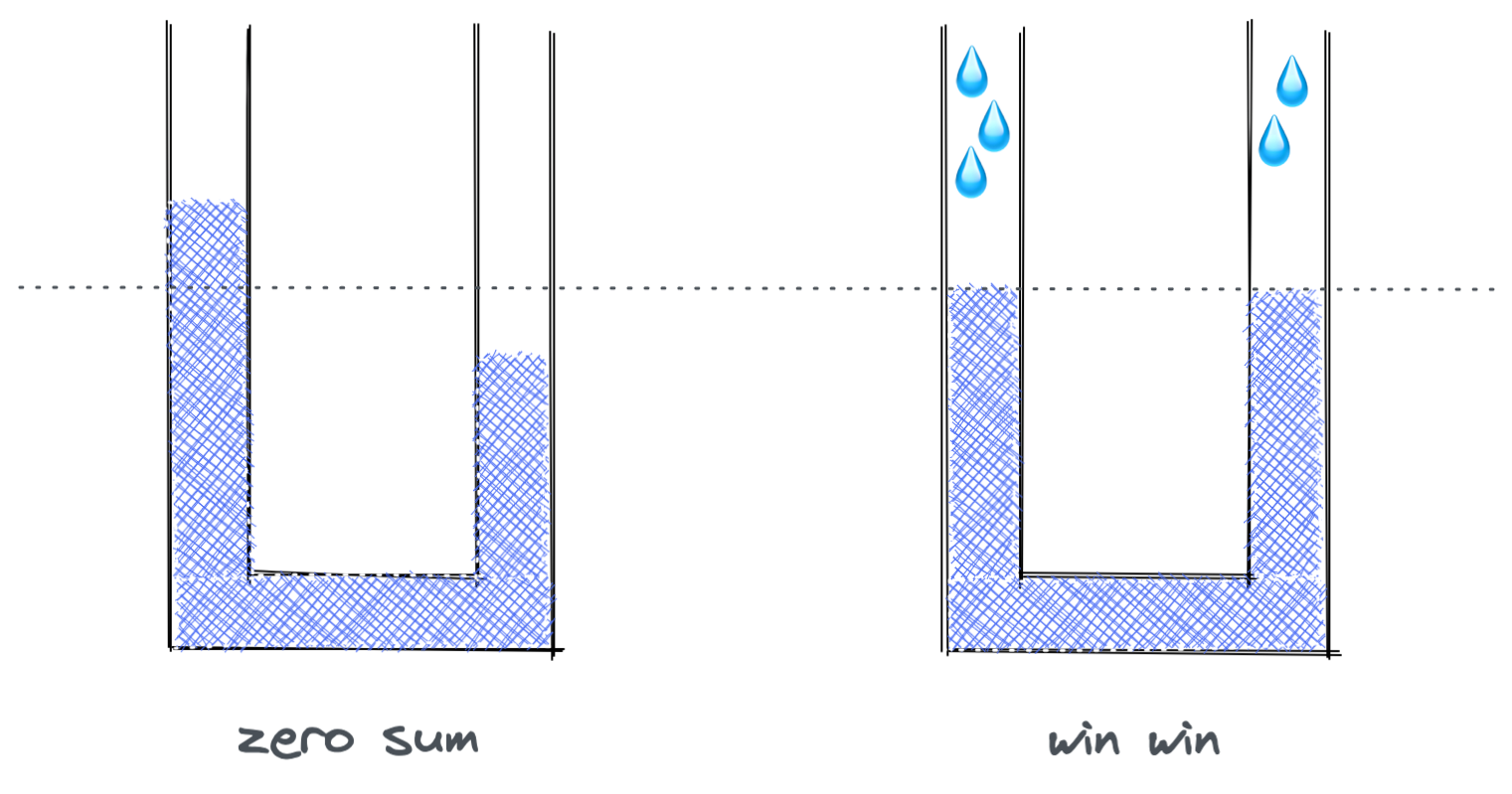
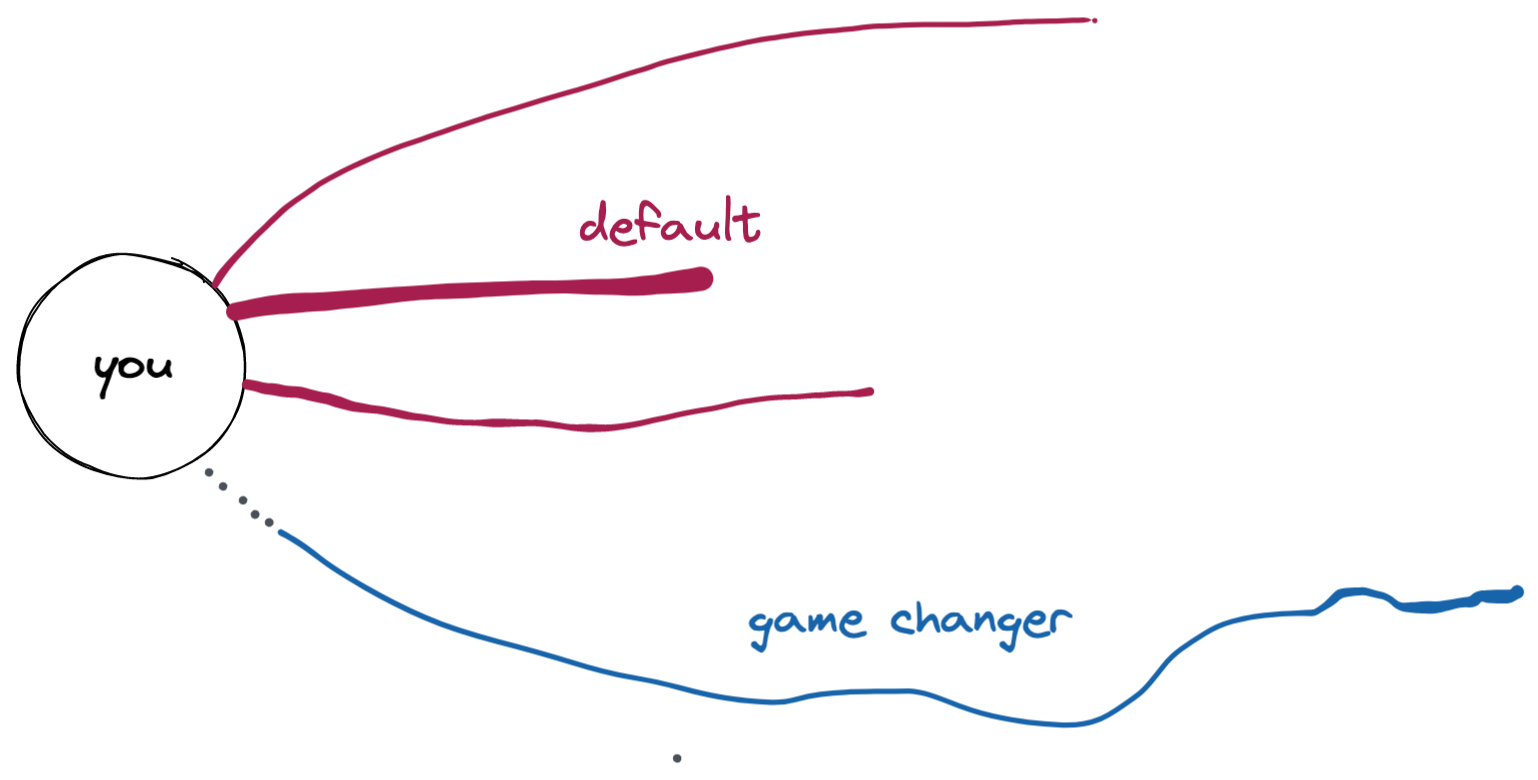
When we find ourselves in a game with obstacles, one way to change that game is to look for an arbitrage. The word arbitrage might have a negative connotation in your mind, as the person doing the arbitrage might not be creating a genuine value, but just taking advantage of the situation. In my opinion, how we look at arbitrage depends on whether the arbitrage is against a natural or artificial obstacle. When the obstacles are outside the game, arbitrage often creates a win-win scenario.
One of my favorite examples of arbitrage is when on April 20, 2020, during the covid pandemic, demand for oil decreased to the point where oil prices became negative, at minus $37 a barrel. The world needed somewhere to keep all the extra oil that was in the supply chain, which wasn’t bought by consumers, so people were paying others to take their oil. Speculators then ordered space on tankers, and due to the negative prices got paid to take the oil, chilled for a bit, and sold the oil when the market price was positive again.
These speculators saw a natural obstacle - the pandemic, and that the oil supply chain will act different before and after. With quick thinking, they created a win-win. Consumers didn’t run out of space, and suppliers and distributors gained time to adjust their capacity. In electrical engineering terms - speculators created a temporary capacitor for the oil supply chain. If they hadn’t, the situation might have been much worse. If the governments had to figure out where to put the oil, they would’ve most likely failed to find such a good solution so quickly. They may neither have the knowledge of how to arbitrage, nor the connections to negotiate with the varied participants. A centralized government doesn’t have the “human computation” resources that the whole population as a whole has. In that case, the ability to do arbitrage provides another win for everyone else - they live in a society where problems actually get solved, and the system improves.
When speaking of arbitrage, I think it is important to contrast it with regulatory capture. Regulatory capture is when artificial obstacles, such as regulation and barriers to entry protect an exiting business that was already established. Such obstacles are not external to the game - they were added by the players - and they make it harder for anyone else to compete. As a result customers get less value for their money. Regulatory capture is not arbitrage, it is actually what prevents others from doing arbitrage.
Another favorite example of arbitrage comes from my backyard. Last summer, birds stole cherries from my cherry tree, and at first I felt disappointed, as there were less cherries for me. But then I realized that the cherry tree is supporting my local fauna, which I enjoy at other times. If the birds had nothing to eat, they would not hang around, and may also not contribute to the local ecosystem. I still had plenty of cherries to eat, and the cherries the birds ate were better spent on them. The birds created a happiness arbitrage by eating these last cherries - they created more enjoyment for me, as I was able to enjoy observing them.
Right now I’m sitting by a sunny window, enjoying the brightness, and wrapping myself with a throw blanket to stay warm. Few days ago I got covid, and I’ve been trying to rest more than usual. Fingers crossed, my case is not too bad, but I definitely feel my energies reduced. It definitely feels suboptimal, but I found some silver linings and things I can arbitrage. First, I realized that video meetings make me feel more tired - so I pushed all non-essential video meetings one week back. Having a nearly free schedule is giving me some space to think and reflect. Time to detach and reflect is normally at a premium, and I’m rewarded with a lot of it these days, and even though my head tires more easily, I see the benefits. Second, for the duration of covid, I’m pausing my keto diet, and I’m allowing myself to eat more carbs, to give easy energy to my body. Hello blueberry cake, pumpkin pie and popcorn - now I can hang out with you, like in the good old days.
…distraction is just another way our brains attempt to deal with pain.
Nir Eyal, Indistractable
Welcome to part 9 of the series on “How to be a game changer”. You can find the previous posts here 1, 2, 3, 4, 5, 6, 7, 8.
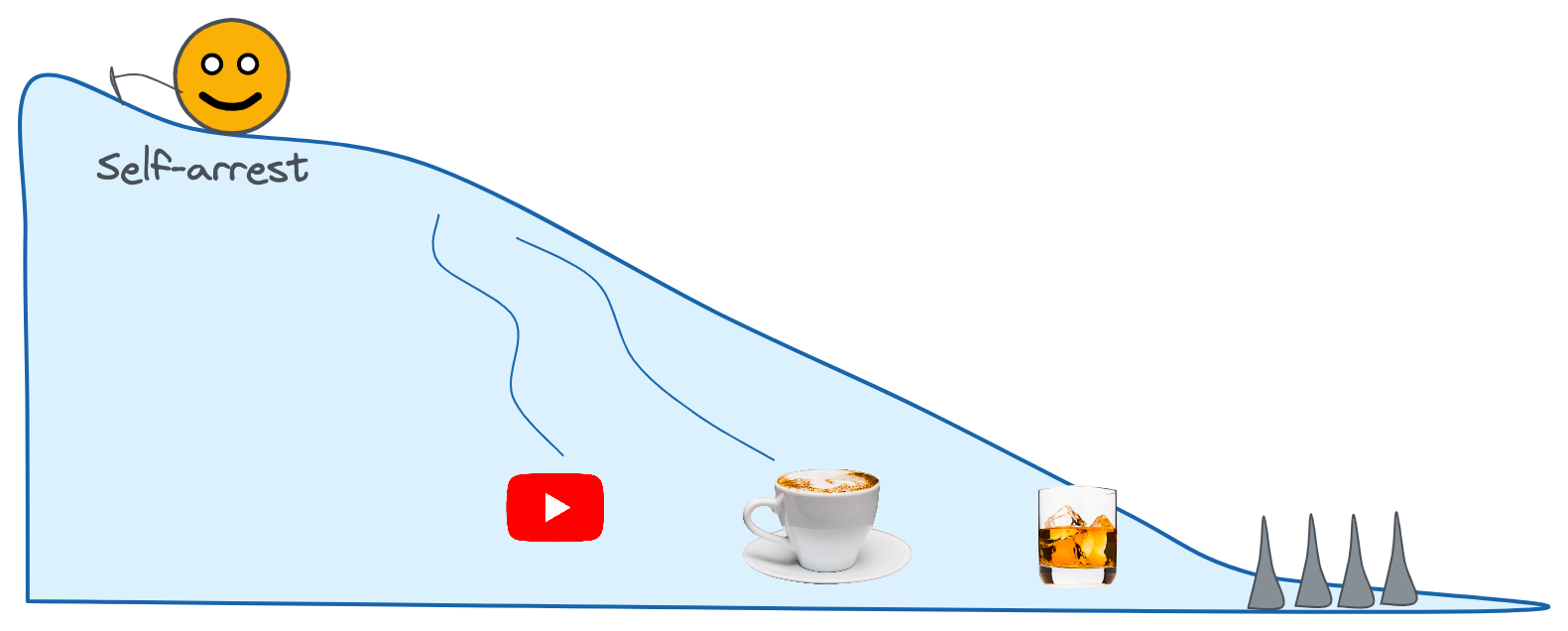
There are games which can be win-win when played a limited amount, but become overall negative if you play them excessively. For example, unhealthy addictions can feel like a slippery slope - starting with a little bit, and then becoming a regular user, who is more and more attracted to the game. With such slippery slope games, one way to opt out is to define and maintain a stopping point - a.k.a. Shelling - a point beyond which we don’t venture, as the slope is too slippery for us, and we’re going to slide away. I highly recommend reading this article from Less Wrong, as my article largely applies its ideas, and illustrates them with stories from my life. I will share two stories of slippery slope games - substances and entertainment.
Defining the point a-priori allows us to self-arrest the way a mountaineer would be able to stop themselves from falling on an actual icy slippery slope.
Addictive Substances
I used to drink a lot, but today I don’t. Here’s what happened. I think Alcohol can be a very effective way to quickly relax after a stressful day, and in the right social environment, can help people who drink it to open up to social connections, be more empathetic, and foster relationships. I used to drink regularly, and I found it hard to control how much I drank. When I was buzzed, I wanted to drink more and more.
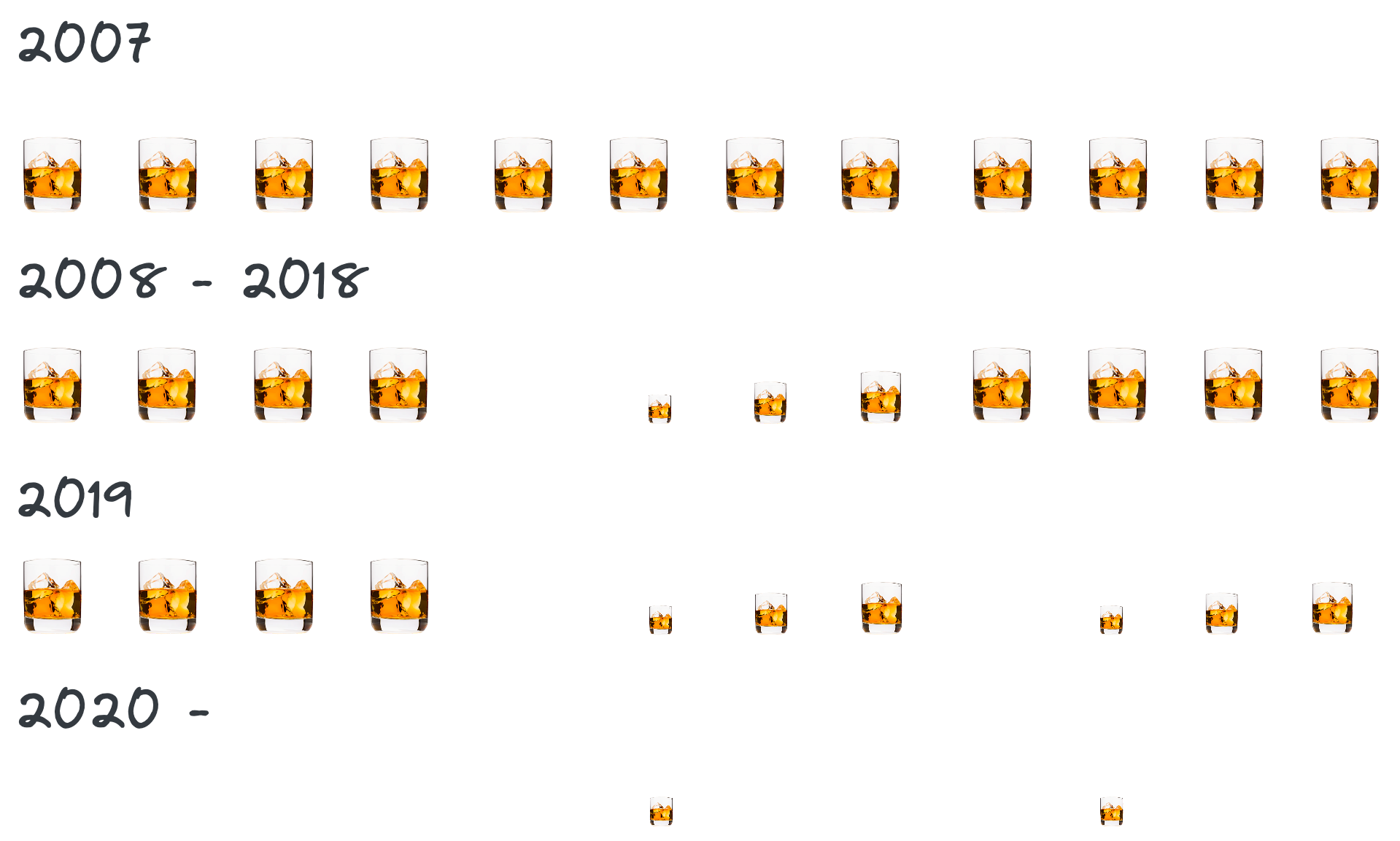
Fifteen years ago, when I was in college I used to drink a lot. I enjoyed and craved drinking. But one day, someone close called me an alcoholic. I didn’t identify as alcoholic and this criticism made me feel painful, and in doubt of myself. After another binge, and a really bad hangover the next day, I decided to take a break from alcohol, and didn’t drink for a month. I wrote more about the story here. I kept the practice of no-alcohol month every year for 12 years, and I gradually started noticing that after an alcohol fast, I would start back drinking slowly, one drink a week or so, but gradually the volume would increase. It’s a slippery slope! Few years ago I started adding a second month of no alcohol, which lead to adding a third month the year after, which easily transformed to my current relationship to alcohol. Today, I’d only have a drink on a special occasion, and I’m in a near permanent alcohol fast.
For me, the Shelling point of alcohol has moved very close to the no-alcohol zone, and I think of my relationship to alcohol as healthy at that level. Some people can maintain a personal restriction of never going more than 1-2 drinks per night, and that can also be a sustainable relationship to it. People who are past alcoholics, or others who just went cold turkey are staying at completely zero alcohol in their life. That’s where they put their boundary and it’s OK. They stay in self-arrest all of the time, as they wouldn’t be able to stop if they slide even a little bit. If I didn’t take 10 years to gradually wean off it my boundary would be different. I think I can self-arrest if I notice myself sliding, so I allow myself a drink on special occasions.
Other substances may be more addictive than alcohol. I’ve never had heroin, which is known to be extremely addictive, and I cannot speak about it. But I’ve had another extremely addictive drug, which 90% of US population is currently addicted to - caffeine. It started with black tea, and in college I upgraded to coffee. Caffeine is a reasonably healthy drug, unlike alcohol which is toxic. Caffeine can also boost mental focus for brief periods, and a lot of our economy runs on coffee and tea, perhaps as much as it runs on gasoline.
For me, caffeine’s addiction slope was less slippery than alcohol - I could easily maintain a certain amount of coffee per day for a long time, without needing to increase - it felt more like a staircase, than slope. The reason I decided to opt-out of caffeine is that I thought was abusing it to force myself to do work I didn’t actually want to do. I also had the hypothesis that the human body should be fine without it, as we’ve had most of our biological evolution without it. A wolf doesn’t drink an espresso before chasing a deer, after all. I didn’t find good long term research on caffeine addiction - it is hard to find subjects for a control study when nearly everyone uses, and who the hell wants to give up coffee and suffer. Whatever research I found seemed to only focus on short term, and I was curious about the long term effects of caffeine.
So, on March 14th 2018 (pi day!), after weaning out caffeine for a few weeks, I quit it. The self-arrest shook me up, and caffeine withdrawal felt much worse than alcohol withdrawal. For a few weeks, I had headaches, exhaustion and other withdrawal symptoms. I was between jobs, and I had the privilege to afford the space for the withdrawal, and to realize that I can be productive without caffeine, perhaps even more productive over the long term. Since then, I’ve learned to recognize how music, exercise, cold showers and pomodoro timers can induce the same level of focus. And I’ve learned to appreciate how I can be more motivated by having skin in the game.
Today, I will only have caffeine in “emergency” or if I am climbing a high elevation. I also occasionally have small amounts of dark chocolate, which has caffeine too. My Shelling point is very close to zero, and honestly, caffeine doesn’t feel that good to me any more, after the first few minutes of focus. I feel grateful for having reduced my dependency on it.
Information slipping into entertainment
YouTube contains a lot of useful videos. It has helped me do a few minor repairs, and taught about a bunch of technologies through instructional videos. But the YouTube’s video recommendations can cause me to stick around for much longer. I come for the information, but stay for the entertainment. The information is valuable, it makes my life objectively better if I learn how to repair a light fixture. And some entertainment is also valuable as helps me relax. But as I get entertained I want more, more, more. I find excessive entertainment is not only not helpful - it is not that enjoyable either! Excessive use of such media is mostly a lose-lose game. We, as users waste our time, and society loses our potentially valuable contributions. And even YouTube may lose in the long term, as its users churn cold turkey when they realize it is a problem. The only people who win in the short term are advertisers, which buy our time for pennies per hour.
Other media outlets like TV(CNN, Fox News, etc.), Facebook, Instagram, Twitter, and so on, can be just as slippery. They may seem valuable, but beyond providing some basic information, these media outlets optimize for sheepish behavior, and turn their consumers into sheep. They add more and more addictive entertainment to their content. Even if that entertainment takes the form of making us angry or scared. Such entertainment is empty and it doesn’t make our lives better.
I also strongly suspect it affects our body chemistry - we get a dopamine boost from every funny video we watch. Opting out of this game is hard, as our bodies will literally go into withdrawal, and we’ll try to replace our dose of dopamine with something else. We may think that what happens in our minds stays in our mind, but it doesn’t. It has physical effects on us, and we’re literally poisoning ourselves with our screens. As of writing this, I still have an excessive scrolling habit. I have not yet been able to redefine my relationship to it.
And I’m still experimenting with ways to self-arrest and opt out of it.
Thanks to Sylvain Kieffer for spotting grammar typos in this post.
A cynic is a man who knows the price of everything, and the value of nothing.
Oscar Wilde
Welcome to part 8 of the series on “How to be a game changer”. You can find the previous posts here 1, 2, 3, 4, 5, 6, 7.
Growing up in post-socialist-turned-cowboy-capitalist Bulgaria, I grew up around a lot of cynical behavior and absorbed it deep into me. It was the water I was swimming in, and I knew no better. There was always this feeling that attempts at improvements are futile. If anyone tried to improve the system in any way, they will face a great opposition, and any value they bring forward will be immediately vultured away. This made it obvious for me to see how any changes will be abused and rendred futile. I also became good at rationalizing the existing status quo. There’s this example which stuck with me, that if someone created a coin operated parking meter, another one will quickly figure out how to steal the coins out of it. Thus, the attempt to bring order will fail, and the rationalization is that we are a motivated but backstabbing people which get in our own interest.
And today, I still don’t know much better, and sometimes view the world through cynical eyes. A cynicism frame and mindset that turns a lot of my life into a zero-sum game. When I recently realized that I’ve been carrying this cynical mindset for a long time, my legs felt soft, and my body started shaking. I was reckoning all the mistakes I’ve made with this mindset.
But what do I mean by being cynical? When you’re conversing with someone, it is often easy to detect the frame through which they view the world and the interaction with you. Cynics think that the world is never changing on a fundamental level, but it only changes cosmetically, and superficially. Cynics may look at some new trend and call it “lipstick on a pig”. According to cynics, the world operates in a certain way, the elites are always the same, and will always be the same. The cynics think we are always playing the same game that has always been played. For example, a cynic may think that media’s only purpose is to sell your attention to advertisers - like I did here. And often they might be right.
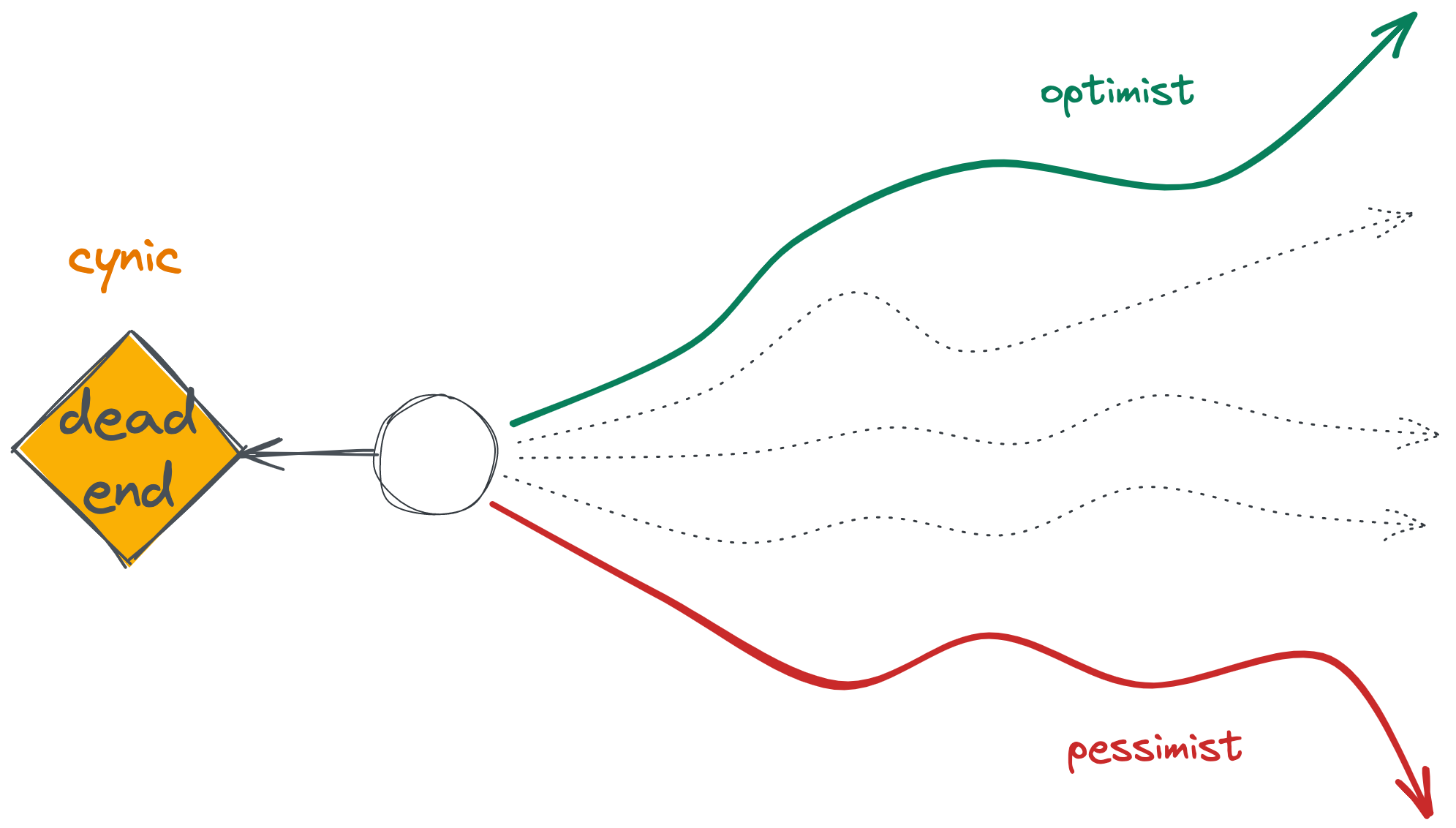
We never try to be cynical. At least not consciously. Instead, we try to make models of the world. And we often simplify those models by ignoring the fact that the world today is different than the world ten years ago, and alien to the world a hundred years ago. We take a mental shortcut, but we end up in a dead end.
Optimists, and even sometimes pessimists, see the world changing, for better or worse, and with it, the games we play change as well. They’re also both right to some degree. Cynics have fixed mindset, whereas optimists have growth mindset. The opposite of an optimist isn’t a pessimist, as they both realize that the world is changing and time moves forward. A pessimist also has a growth mindset, except they have a negative sign in front of it. The opposite of an optimist is the cynic.
We are more likely to detect cynicism in others than in ourselves. For example if you approach a friend suggesting you both bake a pie together, they start talking about dividing the pie - they have the cynical fixed mindset. Or if a friend complains a lot, that’s also a cynical mindset - they don’t see a way to change the world, or their environment, and all they have left is complaining.
When we detect in others, we’ll be more likely to detect in ourselves as well, and not only filter cynics out of our lives, but sometimes re-align them to a growth mindset, and attract other partners with growth mindset. Growth mindset says “yes and…” instead of “yes, but…”, or “no, but…”. And we may even re-align ourselves, to start recognizing all the ways the world may change - for better or worse.
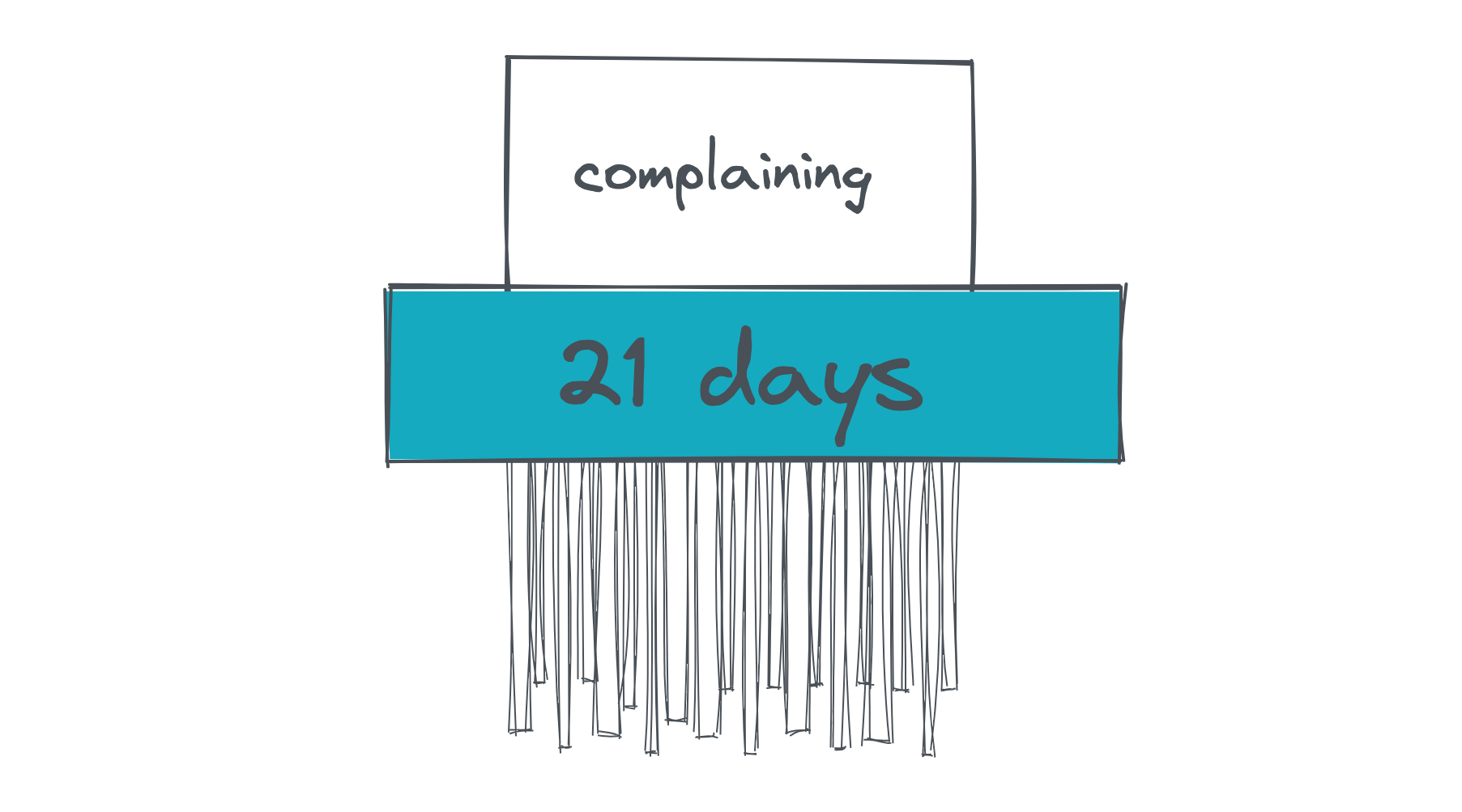
One of the strongest medicines against cynical mindset which I’ve tried is to do a “no-complain challenge”. I find its effects to be enormous and durable for years. In this challenge, you move a bracelet from one wrist to the other when you catch yourself complaining. The goal is to make it 21 days without having move the wrist. I did it years ago, and by the end of it, it felt as if I am in a different universe. With the years, some of its effect has rubbed off, and I am due a refresher.
By realizing that the world is always changing, and by stopping to complain, we opt out of seeing the world through cynical glasses, and become part of the change. When we realize that our life can change, we can change it.
Thanks to Sylvain Kieffer for spotting grammar typos in this post.
Welcome to part 7 of the series on “How to be a game changer”. You can find the previous posts here 1, 2, 3, 4, 5, 6.
As an engineer, I’ve had an aversion to sales for a long time. It seemed like something which doesn’t add value in the grand scheme of things, but instead it just shuffles it around. I had this view of sales being adversarial, and zero-sum. I win, you lose, or vice versa. It seemed to me that when a salesperson makes a deal, they are somehow tricking the other person into getting something bad for them. It felt like it does a lot of persuasion to twist someone’s arm into a bad deal for them. Over time, my mindset about sales changed, and I started seeing salesmanship as a service to the customer.
I started to look at sales not through the prism of how much do you close, but through the prism of how much you and your counterpart LEARN about whether what you’re selling fits for them. If as a salesperson you uncover whether and how your product will best help the customer, you are actually providing a service to that customer in the form of education. If you focus on maximizing the amount of education service you provide, and uncovering situations where the product is a natural fit, then you are no longer playing a zero-sum adversarial game, and instead you are now playing a win-win game.
You opt out of thinking of your customer as an adversary.
This becomes harder to do in a competitive market. You may be selling a product, or an idea, or an action or a philosophy, or your own personal brand. The general “selling” is the act of getting a customer to choose to “buy your product”. For this, they not only have to pick your product among many others, but they also need to have enough conviction to buy any product at all! There are two steps - the first is “buy”, and the second is “yours”. By focusing on providing education and uncovering the natural “buy” and solving for the benefit of the customer, it becomes much easier to transition to the “yours” step afterwards. The customer can be annoyed to hear reasons why product A is better than product B if they don’t want either one!
It is also a valid thing to recommend to “not buy”. Some people may think this is a reverse psychology trick. But another way to look at why this reverse psychology works at all, is that this is exactly what a you as a salesperson focused on the “buy” problem will do if you think it is not the right fit - recommend a no-buy and let everyone move on. By doing that you have already provided a win to the customer, by saving them from a bad decision, and you’ve added a win for yourself, by improving that relationship with the customer. That same customer may not be buying this time, but their circumstances may change, or they may have friends who are better fit, and spread the word. Furthermore, there is an extra win there. That extra win is turning the market away from being a “lemon market” where everyone is selling shit, and one step closer to a useful market where both customers and sellers profit. This extra win can help grow the market itself.
By helping the customer, you put on your sorting-hat hat. You help the customer find their best outcome, and sometimes they end up buying from you. Over time, you also learn from them, about which types of customers are the best fit, and how you can change your product to address the ones for whom it is not.
Today, as an entrepreneur I may need to pitch my company to customers, investors, or potential employees. There can be an explicit “ask” in customer interviews (buy my product), elevator pitches (give me money) or job interviews (come work for me). By trying to opt out of fixating on the ask, and turning towards communicating and conversing, I can help potential employees find their happiness better, and potential investors see more clearly if this would be a great fit. The “buyer” might not volunteer any information explicitly, but there are always cues, and those turn a pre-determined pitch to a dynamic conversation. If both of us are open and listening, we often reach a much more amicable solution which we didn’t even anticipate. I believe that being systematically focusing on improving their outcomes will also improve my outcome over time.
Thanks to Sylvain Kieffer for spotting grammar typos in this post.
The credit belongs to the man who is actually in the arena, whose face is marred by dust and sweat and blood; who strives valiantly; … and who at the worst, if he fails, at least fails while daring greatly, so that his place shall never be with those cold and timid souls who neither know victory nor defeat.
Teddy Roosevelt
Welcome to part 6 of the series on “How to be a game changer”. You can find the previous posts here 1, 2, 3, 4, 5.
Driving a new Land Rover is a flex in most parts of the world. By having, and showing a luxury car to others, its owner signals that they are affluent enough to be able to afford it. It can be a Veblen good which separates its owner from the rest, and increases their status. Until it doesn’t. I was fortunate enough to go on a vacation recently in Los Angeles, and booked a modest studio in a nice neighborhood. There I saw the highest concentration of Land Rovers and Range Rovers in my life. One out of every 5 houses seemed to have this status symbol parked in front of it. Which made me think - is it still a status symbol for these neighbors? Or does it merely become a luxury trinket? How many people can have Land Rovers and still claim the status boost? In the luxury car dimension, there are only a limited number of people who can flex. This makes fighting for the status of the owner of the nicest car in the neighborhood a game with limited resources. And you already know my opinion, that we should want to opt out of such games.
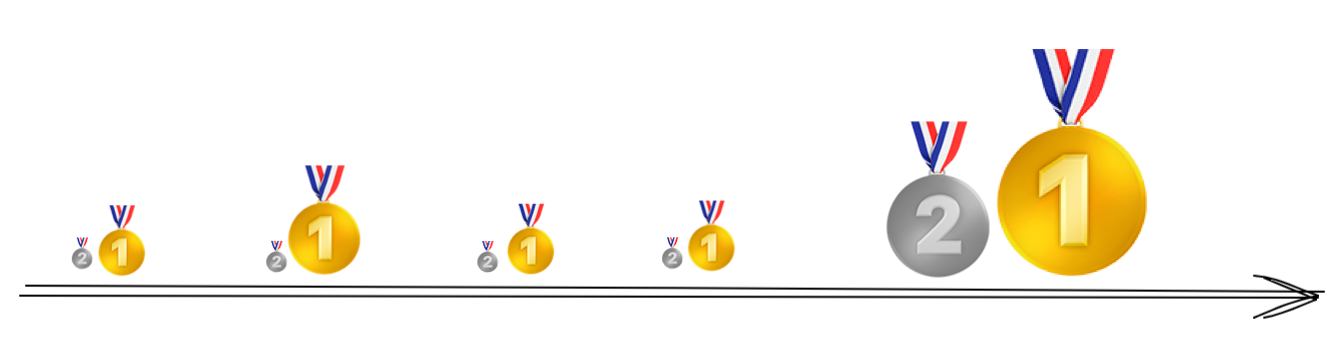
However, fighting for status seem similar to fighting over a limited resource, as status may seem limited, but it doesn’t have to be. Status is more abundant than we think. Let’s look one of the most clear cases of status - winning an olympics gold medal, and let’s consider running. It seems like a zero sum - there is a winner, and losers, and only one winner at a time. At least on the surface, the winner gets the majority of the status, while everyone else gets the much lesser status of being a finalist. The other runners are not really worse-off than they would’ve been if they didn’t participate in the running game. They are still getting paid, and they gain fame. Their loss is only relative, and running is a win-win game. The amount of fame and happiness from a single race might seem limited but it is not - it varies with the quality of the performance. For example at the 400m hurdles race at the 2021 Olympics, Karsten Warholm destroyed his previous world record of 46.70s by running it in 45.94s. This is 760 milliseconds faster, three quarters of a second. Beating a world record by so much is wild! But what made the race even more amazing, and Warholm’s win even more impressive is that his main challenger Rai Benjamin also destroyed the previous world record by running 46.17. In order for Warholm to win, he had no choice but to break the world record by a lot. The top two runners each got more glory, fame and status by pushing each other. They both become heroes worthy of praise and both win status, as runners who broke the world record, and creating an unforgettable experience for everyone watching.
Let’s now look at a different type of race - the race to be the first person to make a scientific contribution, and the first company to get a certain innovation to the market. Someone might say, with a dose of cynicism, that the scientists in the forefront are engaging in a zero-sum race with each other and that this scientific discovery was going to get made anyway. Yet it will be a boon for society if that discovery happens 10% faster and brought to market 10% faster. New discoveries build up on top of old and over ten years, this gradual speedup will amount to a whole year of advancement. Over 60 years, that’s whole 6 years of advancement. For healthcare, that may be the difference between having the treatment to a cancer or Alzheimer disease before or after someone you love catches it. Even if we look at a much shorter time frame - the race to create and deploy a COVID vaccine saved millions of lives. The outcome of any seemingly trivial science and innovation race can be a matter of life and death eventually. In the meantime, the race resets every time there’s a new discovery, all the scientists can build up on top of it, and win status. The faster the discoveries happen, the faster new status is “mined”. Some scientists become giants, and that allows other to stand on their shoulders.
In a given dimension, there may be only so much status - one best runner/scientist, one employee promoted to the next level, one president elected. But if we look for more dimensions, we realize that there are more untapped opportunities for gaining status. For example, if two employees are fighting for the same promotion, they might instead build up their areas of ownership to the level that they are providing so much value, and they both get promoted to expand their work. Or, if people want the clout associated with being a president, they can instead focus on achieving what a president would achieve and improving other social and environmental issues such as poverty, pollution, healthcare, etc. If they have a major success there, they might be remembered by the future generations even more than whomever was the president at the time. Martin Luther King Jr was not a president, but has a more important place in history than LBJ, who was president at a time, and even has an official holiday dedicated to him.
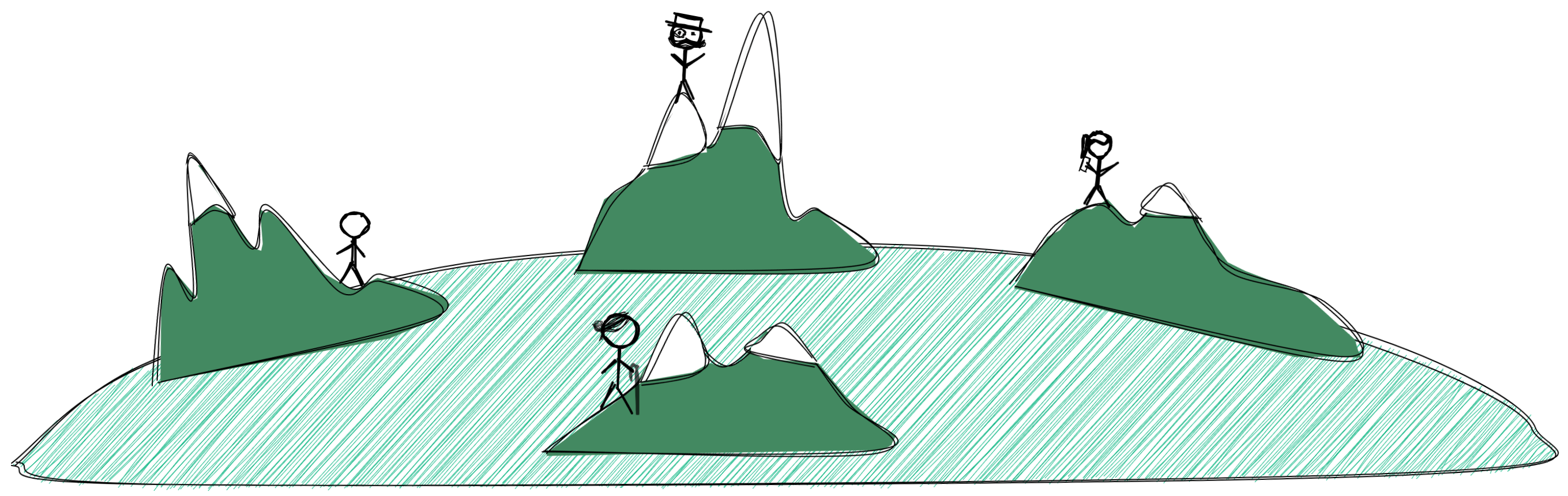
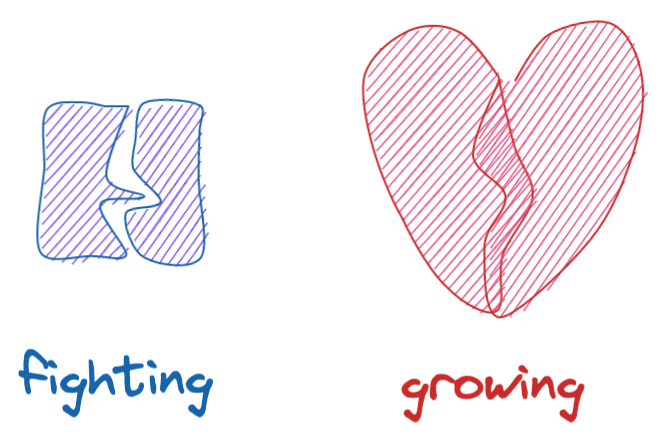
In my opinion, the highest status is achievable by each of us, simultaneously, and without detracting from anyone else’s status. That’s the status and confidence of being in internal harmony, and in harmony with Nature. In such state, my internal angels and demons will be dancing together instead of fighting, and my being will be dancing with others instead of fighting them. This is my goal in life, and I wouldn’t feel any less accomplished if others also achieve it - in fact it will make me happier. We are all different, and each of us has a different Everest to climb.
Thanks to Sylvain Kieffer for spotting grammar typos in this post.
This is part 5 of the series on “How to be a game changer”. You can find the last four here: 1, 2, 3, 4. Today we continue with examples of negative games you don’t want to play - and we’ll discuss artificial scarcity.
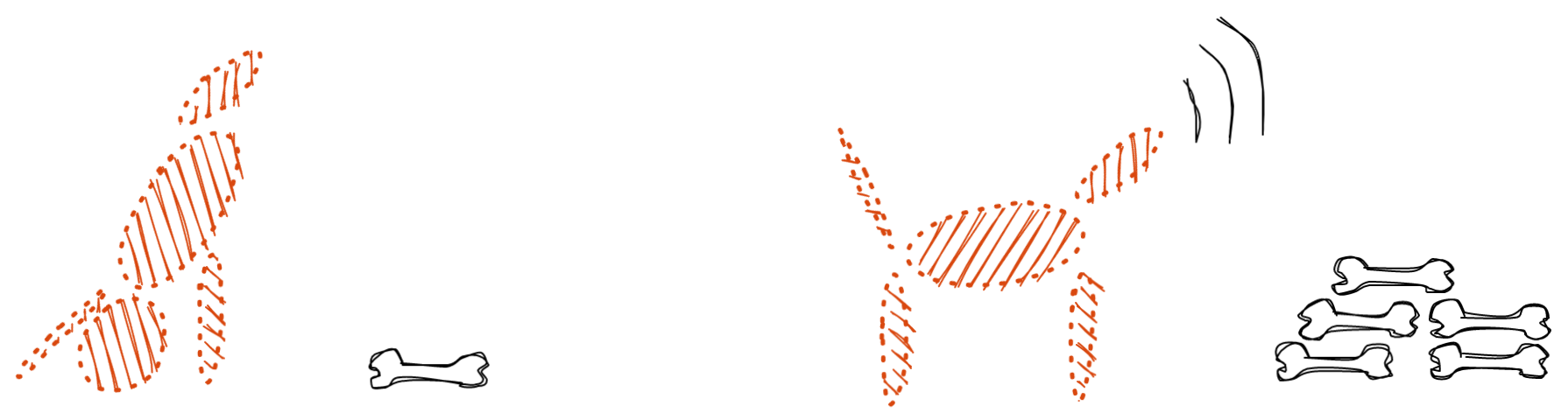
Let’s start with my dog, Euler. Originally he didn’t always want to eat his dog food kibble. So me and my partner started mixing in pieces of meat, or sauce - something to add more real flavor. Euler would then devour it. He wasn’t sick - he was just a picky eater. We were glad we could help him get the nutrition he needs, and enjoy the flavor, but then we realized we were having a hard time attracting his attention, he became bratty, and treats lost their persuasion power. What happened was that Euler expected something better than the treats - meat in his dog food - for granted. We then stopped flavoring his kibble, and at first he didn’t eat much again. But a stomach is a powerful motivator and he of course got back to eating. Not only that, but now he was a lot more interested in treats in other situations, which helped us teach him other behaviors and distract him when others are around.
We definitely could afford to put a little bit of meat in his food every meal, heated on the microwave so the juices flavor the dogfood. But we introduced an artificial scarcity for him, and as a result his behavior improved. We didn’t even use the words artificial scarcity when discussing this policy - we just reasoned about the behavior he would exhibit with or without the extra meat in his food.
So what really is scarcity, and when is it artificial? And how do you escape the artificial scarcity? Scarcity has a simple meaning - some resource is only available in small quantities - fewer than people want. Gold is somewhat scarce on Earth, as we tend to want a lot more gold than we have on Earth, but on a lot of asteroids it may be abundant. When we can mine these asteroids, gold will no longer be scarce for us.
When something is scarce and people want it, it becomes valuable. And this is the dynamic which causes artificial scarcity - when someone wants an item to be valuable, if they can make this item appear scarce, it will be valuable. They can then sell that item for a large profit, and incentivize behavior in others who want that item. For example, seeing a picture of Mona Lisa is not scarce, as you can just google it, but seeing the original in the Louvre in Paris is scarce.
Ultimately, artificial scarcity is about control. There is no need for a conspiracy here, as those with the means to control scarcity will simply do so to maximize their wellbeing, profitability, and power.
The way to exit scarcity is being truthful to yourself what you truly want inside, and not what other people have made you to believe you want. One way to exit scarcity is to not be swung by hype. There was no scarcity of smart phones in 1920, as nobody wanted them, but there was scarcity in 2007 because more people wanted one than there were smartphones. For the first few years Apple made the new model of iPhone scarce by adding some feature which wasn’t available on the old phones. But today they haven’t innovated as much and people are not as hyped up on getting the newest iPhone.
Another way is to not buy what is artificially scarce, and adopt a mindset of abundance. Realize that FOMO is just visibility bias, the things that we crave, we crave not because we really need them and they are scarce, but because we see them more often. Monkey see, monkey want. But we can notice that monkey in our mind and kindly tell it about all the other things it doesn’t see. See, the monkey’s got the steering wheel, but we can influence it ourselves, similar to how our environment influence it. We can tell the monkey about the actual abundance available around us. Materially, humanity is the most advanced it has ever been, but we still often look at the world through artificial scarcity glasses.
Today California, and especially the Bay Area has artificial scarcity of housing, which creates high real estate and rent prices, and exacerbates homelessness. Buying overpriced housing would mean giving in to the artificial scarcity narrative. We have the technological and economic power to make this area a lot more welcoming and affordable, but that means people who recently bought houses would experience a big loss in paper value. One way to exit is to not buy, because if you buy, one day the artificial scarcity will meet reality, one way or another, and someone will be the “biggest fool”, who bought an ultra expensive house, but lost all paper value. And that reality check might be sooner than you expect - Silicon Valley is no longer the only hub for high tech development, and a lot of the demand for its scarce housing may be redirected to other locations. If you have to be there - rent. That way you’re still playing an artificial scarcity game, but at least the stakes are much lower.
In a sense, Bay Area homeownership is a proxy for status today. And status is another type of artificial scarcity, but it is so important that it deserves its own article. We’ll discuss status in the next week’s essay.
He who has learned to disagree without being disagreeable has discovered the most valuable secret of negotiation.
Chris Voss, Never Split the Difference
This is the fourth post in a series. You can find the last three here: 1, 2, 3. There we set the basics of opting out of negative games, and now we can start diving into examples.
A classic example of a negative game is the adversarial distribution of limited resources. In such situations, you might be fighting with others over the same set of stuff, whether it is the proverbial pie, or that promotion which only one person will get, the custody of a child, or even who gets to speak in a conversation.
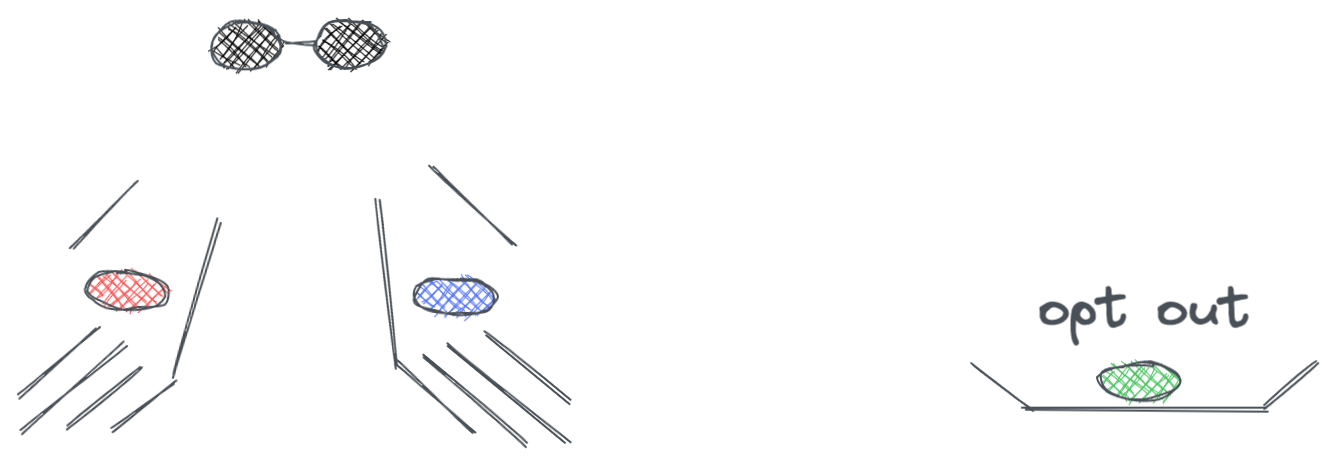
One way to exit such game, is to change the vibe from competition to cooperation, to increase these limited resources.
For example, if we consider a divorcing couple which fights over the custody of their child, we can see that what they’re really fighting for is the satisfaction of their own egos, and not the best outcome for the child. By treating that child as a limited resource to fight over, instead of a person, which both want to support, and instead of discussing how to make the transition less traumatizing for the kid, they end up creating more trauma for the child, as the child will lose one parent. However, if the parents care more about their children’s future than about their own egos, they might find an arrangement where the kids experience more love from both parents, and grow up to be more fulfilled. The parents can opt out of bickering by realizing they still have a shared vested interest in their kid’s wellbeing, and change the “vibe” of the conversation.
More generally, in any conversation you may try to convince the others of something, and think that the way to do it is to spend more time talking. You might see the time during the conversation as a limited resource and try to capture most of that time by speaking more, and speaking louder than others. And doing so, you might make it harder for others to express themselves, creating a competitive argument. A shouting match of loudly saying “Me, me, me!” As a result, you’re not going to be effective at convincing, and will not even contribute to information transfer. When you’re trying to talk, you’re not trying to listen. If you instead try to play the game of increasing information transfer, regardless of the direction, you stand a better chance of persuading others, and you are also allowing yourself to have your worldview improved.
In the last example today, we look at the Red Queen’s race. A company entering a crowded market may be fighting for market share with other companies, selling to the same customers. That company may even be successful if the incumbent are not providing a good service. And if these companies are fighting over the same market share, they end up both cutting costs and price, and undermining each other’s profit. A way out for a company is to figure out how to grow the market and capture that new growth, by serving an underserved population or use case which wasn’t in the market previously. Focusing on beating the competition is zero-sum thinking, but focusing on the customer is a win-win thinking.
Next week, we will discuss artificial scarcity.
Thanks to Sylvain Kieffer for spotting grammar typos in this post.
This is the third post in a series of 13 posts about how to be a game changer. In the previous two posts, we defined the concept and started looking at which games to change. Today we’ll look at the main way to be a game changer - to opt out.
According to Merriam-Webster dictionary a game changer is “a newly introduced element or factor that changes an existing situation or activity in a significant way”. While this definition is aligned with how some people use the phrase, it is superficial, and it doesn’t define what it means for a person to be a game changer.
One way this definition gets wrong is that it considers games mutable. By that logic any minuscule change in the parameters of the game is technically a game changer. Yet, I don’t want to be the type of person that starts a sentence with “Technically… ☝️”. I think what really matters is when the game is changed so much that the behavior of the players changes and they have to pick a new way to play. That’s when it gets really interesting and worth talking about.
We can think of changed games being an instance of a distinct new game. This distinction may seem contrived at this point, as what it means to be a new game is still ambiguous to separate out, but it will become clearer in a bit. By thinking of the changed game as a new game, we realize that the person who changed it decided not to play the old game. That person walked out, or opted out of the old game. They exited the old game. Which leads to the most common method people change games:
You become a game changer by opting out of bad games.
Opting out
Opting out starts as a seed in their mind. It might be as explicit as deciding - “I’m not going to participate,” but it can also be subconscious, or the person may decide to “hack” the existing game rules for their advantage. For example, a boxer may decide not to become good at knocking out their opponents but instead always win through a minimal point difference by having a new type of defense which doesn’t let others score points against them. They may keep their hands up protecting themselves all the time, and patiently wait for an opening. Their style may be described as “ugly” by traditional fans and called “not real boxing” by gatekeepers, but they will be effective nonetheless, and as a result other boxers may adapt the same “ugly” style. That boxer decided not to fight according to everyone else’s expectations - they opted out of the boxing narrative.
Other types of game-changing are more subtle and a lot of us do them every day. A busy person may find a way to meal-prep ahead their food for the week, thus discovering a new freedom in how they spend their time through the day. A student may drop a class they realized is not helpful or interesting, and go on a path towards a different major and career.
The ethics of opting out.
Opting out of negative-sum games is opting out of something unethical, and therefore it can be ethical, if replaced with something better. There might be a question of loyalty and trustworthiness about the person opting out. But expecting a loyalty from someone who is persistently on the losing side is itself unethical. If we want to live in a kind, ethical and rich world, at some point we have to opt out of unethical games.
Types of opting out
Opting out is a bit of an abstract concept, and by itself is not super actionable, as it begs the follow up question “What does opting out look like in a specific situation?” And the answers to this question may be manyfold - you may opt out by physically walking out, by focusing on a different objective than you’re expected to, by becoming less adversarial, by turning one-off situations into repeated situations, and even by reframing how you see and approach interactions.
Four years ago I started thinking about how everything we consume affects our thinking, and I started gradually opting out of alcohol, caffeine, social media. I wanted to play the game of life as myself, rather than be swayed by substances and narratives. I’ve also started opting out of certain types of food such eating too much sugar, or vegetable oils with polyunsaturated fats. And I also stopped using commercial shampoo and instead try to use a more wholesome soap. Recently I started opting out of hot showers and replacing them with cold showers in the morning. I’ve opted out of jobs and partnerships that looked promising.
Neo opted out of the Matrix.
Next up
The ways you can opt-out depend on which negative game you find yourself in, but the first step is always to detect the game. In the next posts, we’ll cover specific types of games and opting out in detail.
Show me a gambler and I’ll show you a loser, show me a hero, and I’ll show you a corpse.
Mario Puzo, author of The Godfather
Last week we began the “How to be a game changer” series. Today, we’ll start answering the question - “Which games to change”, by defining the two main types of games we don’t want to play - zero-sum games and win-lose games.
Zero sum games
One way to simplify looking at games, is to look at the possible outcomes. There is a whole branch of Economics called Game Theory which goes into detail about categorizing and analyzing games based on these outcomes. In game theory, a game is simply an interaction between multiple parties, where they can choose a behavior, and after the interaction any participant in a game may end up winning something or losing something else, resulting in a combination of wins and losses. Game Theory often simplifies that to a simple number representing how much value, or utility, or money you could win or lose depending on the outcome, and while it is a limiting way to look at it, it is still a helpful way get started.
One of the most obvious games which I assert everyone should try to change are the so called “zero-sum” games. Here zero-sum refers to the sum of outcomes of all players after the game, compared to the situation before the game. These are the games where as much as some players win, the other players collectively lose. For example if you and I bet $5 on the result of a coin toss, one of us will have slightly more money, but together our overall money has changed by zero. In zero-sum games the total amount of value and utility across all participants does not increase as a result of the game. Some people individually may be better off, but the group as a whole is not better off.
If we go back to our traffic example from the previous post, driving on a road with congestion, which has two lanes merging together into a single lane (for example, due to construction) may be thought of as a zero sum game, where only certain number of vehicles can go through a bottleneck at a time. If one car goes through, no other car is going through. There is a limit of total utility, is proportional to the maximum safe and allowed speed with which cars merge in. Often, cars will alternate from each lane as a way to coordinate, but some drivers might feel competitive, or in a hurry, and try to cut in front of others. And they may succeed, and save seconds for themselves. But by disrupting the natural rhythm, they create confusion, congestion, and waste time for everyone behind them. Other drivers may have to hit the breaks, or press their horn and reach out for verbal insults. It’s a pity. More cars will get piled further behind. The driver who cut might think they’re winning this time, but they probably suffered a time loss behind someone else earlier who cut as well, but they only observed it indirectly.
Furthermore, with zero-sum games we’re only creating more conflict among ourselves. In my opinion, all zero-sum games negatively affect the participants as a whole. Therefore they are in practice even worse, they are “negative-sum games” and the community as a whole is worse off after playing them.
There’s no good reason to play these games.
Win-lose games
Win-lose games are similar to zero-sum games as in some people will benefit, and others will lose as an outcome of the game, but they differ as in the win may sometimes seem to be larger than the loss. But in practice, if a game ends up generating any positive value in the process, it is likely that this value is redistributed, and nobody is losing and the game becomes win-win?
As a result, a win-lose game in real life will usually be a negative-sum game, as some more savvy players may figure out how to “rig” the game, and exploit others. The possibility to lose something from the game is a big red flag ⛳️. If you encounter any interaction where you may lose something - think why the interaction is that way. Is it rigged to transfer value out of you to others?
Some win-lose games with uncertain outcomes are more tempting to play than games which obviously are zero-sum as we hope that we may win, and we may win big. For example, if we participate in a pyramid scheme, we will likely come up ahead as long as we’re not the last ones. If we knowingly participate in a such a scheme - shame on us. But even with good intentions, we often can get tricked into participating into pyramid-like scheme, where at the end the “biggest fools” will lose something. Some pyramids can have a really elaborate disguise, and subtle giveaways.
But one giveaway which we can always use to detect games we don’t want to play is the ability for anyone in the game to “lose” in some way. Games which genuinely create value tend to have a way to redistribute this value over time, if people play them again and again, and they also incentivize people to keep creating value. And that presents another way to tell these games apart - if a game is played long term, repeatedly, it is more likely to be genuinely creating value for all participants, even if that value gets distributed unevenly. There are some exceptions such as the “scapegoat” game, which we’ll discuss in a future post.
By opting out of short term games, or win-lose games, we will not only do better for ourselves, we will make it less likely others get exploited.
Next up
Next week we’ll start discussing the tools we have available to change these games. In the meantime, don’t believe anything I wrote above, and ask yourself - “When anyone want to play a zero-sum or win-lose game?”. You may also ask yourself, “Which of my interactions are win-lose?”
Thanks to Sylvain Kieffer for spotting grammar typos in this post.
In battle, do not think you have to win. Think rather that you do not have to lose.
Ginchin Funakoshi, founder of Shotokan karate-do
We may be rarely if at all involved in battles today, but “games” are all around us, and every interaction we participate in can be thought of as a game, with its own rules, frameworks, and expectations about the participants. Such games exist in negotiations, relationships, and other interactions.
For example, imagine we are driving in a city, and we follow all the signs and rules of motion. In a sense, we’re playing the “traffic game”. It is a game which allows people in vehicles to move safely from point A to point B. We have options on how to play this game. We may actively change lanes in order to try to move faster through the road and arrive sooner. Alternatively, we may decide to stay in our lane, and take longer to reach the destination, but avoid the complexity and risk of switching lanes, resulting in a more relaxed, safer drive.
Or we may look at the whole vehicular traffic, and ask ourselves “Why should we play this game at all?” and come up with contrarian answers. We might decide not to play the traffic game with a car, but with a motorcycle, to be even faster and more flexible, trading off safety. We might consider a bicycle, e-bike, scooter, skateboard, public transit, or even walking. We are already starting to think like a game changer.
To go a step further, we may even decide we do not like any of these options and move to another city, or a town, or even a cabin in the woods. We are now a game changer, as we’ve changed the game that at least some people in society play - ourselves. Yet by opting out, we affect not just us, but the whole urban vehicular traffic for everyone else.
We may ask, what makes anyone a game-changer? How can I become one? Should I be a game changer? Which games should I change?
Let’s figure it out together. This is the first post from a sequence of 13 posts which will explore the topic in more detail, and plenty of examples. I will be posting one short post every week, and we’ll cover examples such as situations with limited resources, artificial scarcity, status, sales, cynicism, slippery slopes, obstacles, arbitraje, repeated games, the scapegoat game, no-exit environments and others.
If you’d like to follow along, subscribe to receive these posts over email, follow me on Twitter, where I’ll mention each post, or simply check back here once a week.
Thanks to Sylvain Kieffer for spotting grammar typos in this post.
I think I finally understand how multiplayer creation works.
My college dorm had a music room in the basement, and while I couldn’t play any instruments I loved hanging out with friends when they organized jam-sessions. Friends would invite their musician friends over to jam, and I would have the best time seeing how they pick up a tune, and the room filled with sound until my bones were resonating with it, and I was singing along, and inhabited a parallel universe where p-sets, projects or papers didn’t exist. Only sound, rhythm and vibes existed. One of those musicians devoted himself to music and made a great impression on me. Let’s call him Dave the Metal, as was a fan of Dave Mustaine, the leader of Megadeth. Our Dave had to work long hours at a pizza place, but he dedicated nearly all his extra time to music - playing it, writing it, listening to it and geeking about gear.
One day Dave showed us a song he wrote, where he recorded the vocals, the guitar, the bass and the drums separately and he put them together into a song. He was a one-man orchestra, and I felt amazed that he was able to pull it off, as I imagined it was arduous, tricky and rare to do all the parts alone. The song was good and I sometimes still remember it, but the jam sessions had an extra magical element, of multiple people adjusting to each other in real time. Naturally, there’s a limit to how good you can get by yourself. A genius goes far but it only goes so far alone. But an actual “orchestra” of geniuses which resonate and amplify each other and whose domains fit each other - that orchestra can produce music that moves the listeners stronger and deeper.
Even if we look at domains where individuals can seemingly do it all, we realize nobody creates anything massively impactful by themselves. A famous author like J.K. Rowling or George R.R. Martin may be a master storyteller, who can weave characters and emotions in an intricate basket of a story. Yet, they have editors, and publishers which help them productize the stories, tucking the loose straws in. Artists paint beautiful illustrations for the book cover. When the story is later turned into a movie or a show the costume designers jam in a whole new dimension to the universe, and they contribute so much we can’t imagine Game of Thrones or Harry potter without their signature costumes look. Creating something large is a group effort, and though the authors appear to be the key players, it takes an orchestra of geniuses jamming and creating together to make this happen.
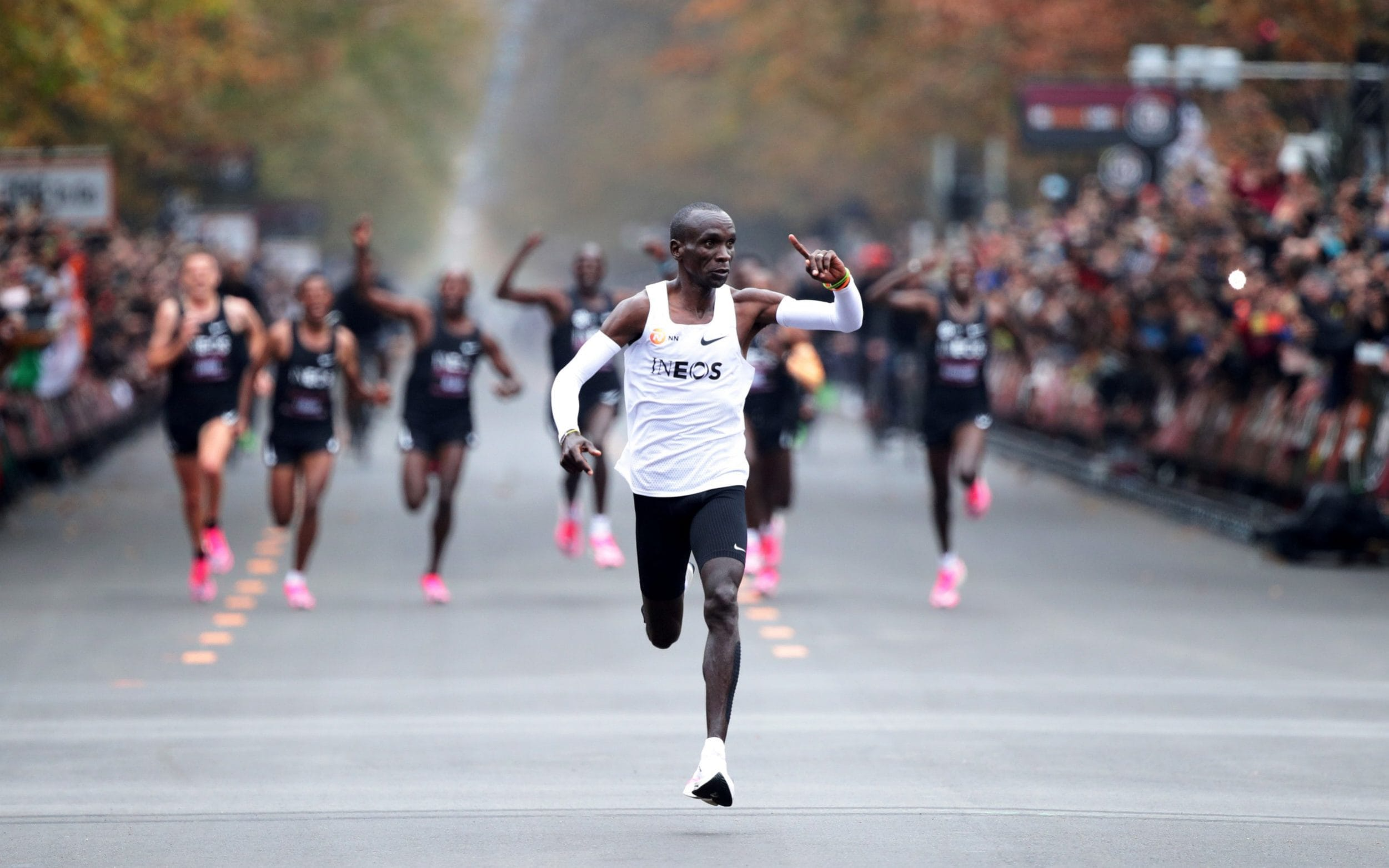
Similarly, in ball related sports such as soccer, football, volleyball and basketball, for a team to score, they almost always have to pass the ball between themselves. Passing the proverbial “ball” is what musicians jamming together seem to be doing as well, as they give each other the creative space to express themselves. Leo Messi, Lebron James or Tom Brady may occasionally do a hero-run and score by themselves, but that’s the exception, not the rule. When Leo Messi scores, he needs to coordinate with his teammates so they pass him the ball at the right position where he has that sliver of advantage that he can convert to a goal. Even Eliud Kipchoge, the first person to run a marathon under 2 hours, had a team of pacemakers helping to reduce the wind resistance in front of him for his record marathon run.
Knowlege work is multiplayer
And yet, if we look at software engineers, or any other knowledge based or creative work, we often assume that they work in isolation. Knowledge work such as programming may feel different, as a lot of it can happen in a “single-player” mode, and it may seem at a time that it is closer to a single player sport such as sprinting or high jumping, but the most successful knowledge workers engage in multiplayer knowledge soccer instead. John Carmack is famous for his heroic coding, but even he didn’t build Doom alone - he worked with other people, and even if he had the most important role to play, he had to “pass the ball” to others.
To further understand what “passing the ball” means, imagine a modified version of soccer - called “No-pass soccer”. Whenever a team is on the attack, each of their players a ball, they’re not allowed to pass it to anyone, and as soon as they lose possession of “their” ball, their attacking turn is over. Since they cannot send or receive passes, they become useless. It might be counter-intuitive at first, but in no-pass soccer, the attacking team actually has much lower chance of scoring a goal per attack, than a normal team. And why is that? How can I be so certain about the outcome of a made up sport? Well, my simple reasoning goes to argue that once the defending team has started eliminating people, by splitting them from their balls, they have ever increasing advantage and easily pick off the remaining attackers. It is no surprise that some of the most dominant soccer clubs such as Barcelona use a lot of passing.
The metaphor is applicable to other domains, whenever a team of people try to achieve some abstract goal together. If they have one common goal, they can pass the initiative around, like a ball depending on each other’s skills. This doesn’t guarantee success, but it definitely increases the chances, as different members of the group may have the ability to overcome different challenges.
At the same time, everybody on the team has a knowledge of the basics - running, positioning, dribbling, passing, and shooting, but they also have some specialized skills - goalie, attacker, wing, playmaker, defender. They can single handedly, or leggedly take care of most situations, but when the situation gets trickier, they ask a specialist for help, by passing the initiative and getting them to help.
The vibe and rhythm of a team
A lot of knowledge works teams do not operate as a “genius orchestra” - instead they often produce cacophony, or at best a “solo”. And why is that? I’d like to explore the question of how to convert such teams into a source of creative wonder. I’ll look through the prisms of two concepts - vibe and rhythm. I am not a musician, so bear with me as I transplant these concepts into a new domain.
Vibe as agreement
For the purpose of this essay, let’s say that a team having a shared Vibe means that the team is in high agreement of what they are doing, and what the end result it is. For a music orchestra to have a Vibe, they’ll be in agreement of whether they are creating Jazz, or are they creating Metal, or are they creating Hip Hop, or something else. They will also agree on what emotional effect they want to create in the listener. That shared Vibe becomes the Vibe of the song.
For a knowledge work team, shared Vibe means having a crisp agreement of who their customers are, and how the product is helping them, and how is that affecting the world. In corporate-speak, people use word “vision” to mean something related. The difference between vision and Vibe is that vision is something that is stated from a leader, and the Vibe is something that is felt by everybody. A Vibe is more primal.
Rhythm as teamwork
While Vibe is about the abstract and the future, Rhythm is all about the concrete and the present. Rhythm is about being in sync. When the orchestra is in the same rhythm, the drummer is hitting the drums at the right tempo, which matches the tempo the guitarist is pulling the strings, and the tempo of the vocals. For a knowledge work team, Rhythm is the shared processes, mechanisms and standard operating procedures which make the team effective.
Rhythm affects Vibe, and Vibe affects Rhythm. If you are hoping that this essay will provide a reductionist distinction between the two - it won’t. Instead I will try to still shine enough light on Rhythm and Vibe so that the image of them becomes crisp and memorable, feeding back into our everyday knowledge work, and giving us a bit more grip.
Both Rhythm and Vibe are examples of shared information.
Mutual information
Mutual information helps to grease the gears of a team, and turn the cacophony into harmony, so how do we get more of it? Well… let’s understand a bit what is and what isn’t mutual information.
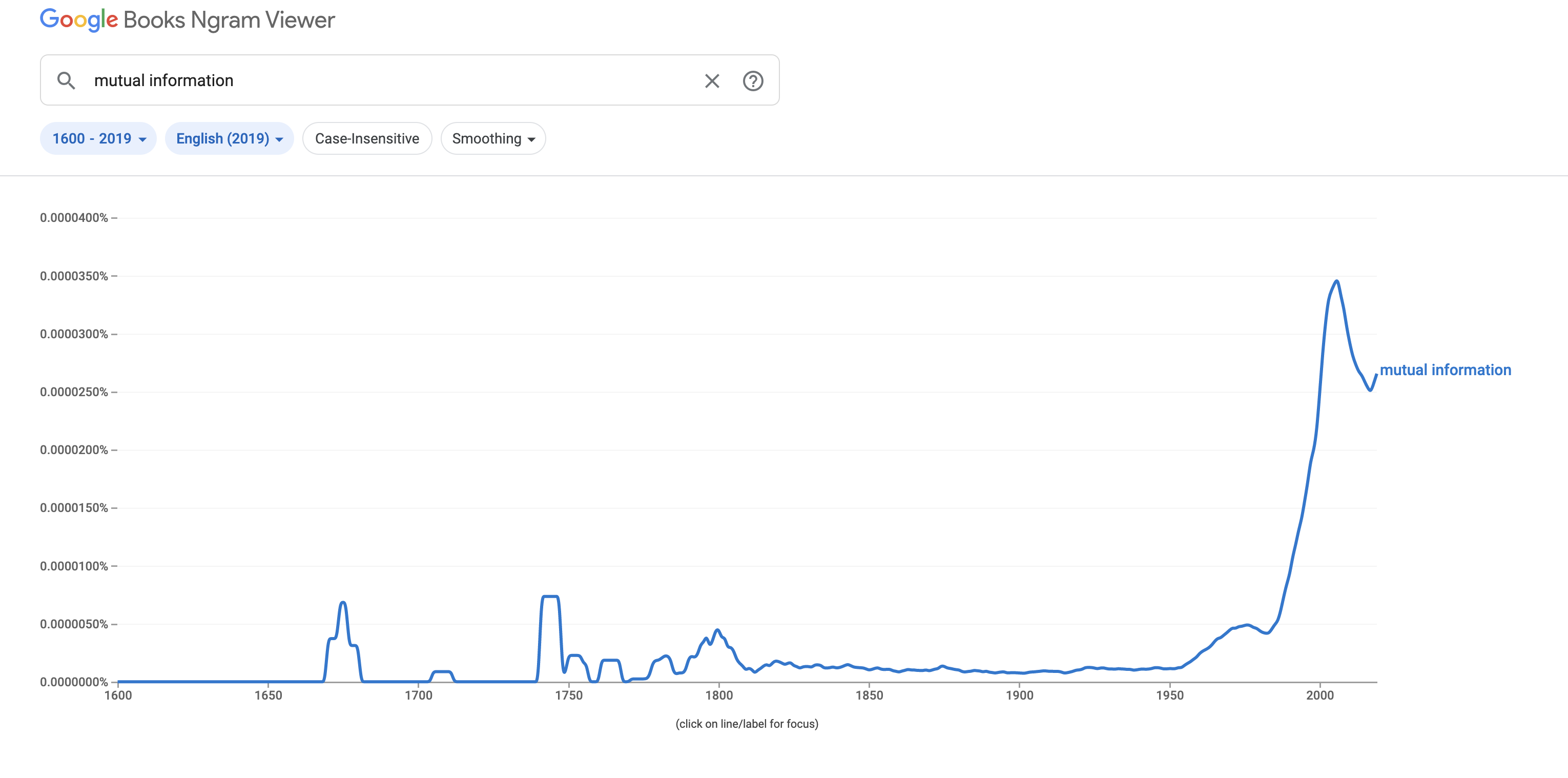
As a term it began its life when the computer science pioneer Claude Shannon coined it in 1948 for his famous Noisy Channel Theorem. The gist of that theorem is that the more “mutual information” two people share, the faster they can exchange other information. The more mutual information team members share, the easier it is for them to “pass the ball” and “jam” with each other. Shared Rhythm allows team members to know when and where to pass, how to receive, and how to keep on keeping on. Shared Vibe allows team members to feel where they’re headed and to trust the motivations of the rest of the team. Mutual information, Rhythm and Vibe become the base for building trust, as the team members would learn that passing the initiative works and is effective.
Start small and grow mutual information
Mutual information builds upon shared beliefs. For example, if I read a book, and you read the same book, this doesn’t mean we have any mutual information. We might have had different beliefs to begin with and have gotten disjoint and even opposite conclusions. If we are members of two opposing political parties, we might have learned nothing in common from the same book. We might even end up more aggravated at each other. If we don’t have any mutual information, any mutual Vibe before we read the book, we would not end with more after we read it. If you don’t believe me about the book, just see how people sympathizing to different political party react to the same news. Any news!
In another, more timid example, if we are both programmers on the same team and our documentation says “code should be indented consistently”, we might come up with two different reasons why that is. I might think it is because the code needs to be easier to review, whereas you might think that the goal is for the code to be more easily maintained in the future, or even processed with an automated tool. Even though we might share the same Rhythm of consistent indentation, we might have two different Vibes about the purpose of the code. Furthermore, I might even think that we should indent code with tabs, and you might think that we should indent code with spaces. Those are two different Rhythms. If we can’t agree on the Rhythm, we won’t get started building at all. In that case we would share no mutual information really, no Vibe and no Rhythm.
Mutual information can only grow out of existing mutual information. That’s why in the movies when aliens are trying to talk to us, they use mathematics. Because we know that mathematics and physics are the only shared beliefs we have with aliens. In order to reliably pass information both sides need to know what they both know and agree on. In the case of aliens, mathematics may be the common meeting point (a.k.a. Shelling point) out of where we start the conversation.
One caveat about mutual information is that hidden mutual information doesn’t count. If a team member hasn’t proven to the other team members that they agree about seeing the world the same way, then they cannot lean on that as a way to add new mutual information.
When team members have been together for a while, they will have shared documentations, processes, SOPs, OKRs, metrics and a shared vision. They build these processes one conversation at a time, and the mortar that holds the bricks together is honest listening. When two people are having a conversation, and one of them is listening with an open mind, they are absorbing the Vibe and Rhythm from the other. They are receiving information and incorporating that into their own view of shared information. Of mutual information.
Resonate to increase mutual inromation
A common pitfall of teamwork might be when a team operates with a lot of shared rhythm but loses the shared vibe. You know who else does that? Robots. But we are humans and a part of us will always revolt when treated like robots. There are simple things to do which can create and grow back the shared vibe - and the main one is to be listening, giving our full attention to the other person, and then respond in an authentic and engaged manner.
Listen so you can absorb.
We are horrible at absorbing information other people are telling us. I once saw a video where a teacher was lambasting a student, because the student had their hands up while another student was still presenting. The teacher was telling the student - “when your hand is up, you’re thinking about what you’ll say next, not what the other person is saying now”. I think about that video often, as I am often prone of anticipating what would I say next.
In the movie “Fight Club” when The Narrator talks to Marla about the groups they visit, they realize they both go there because people actually listen, instead of waiting for their own turn to speak.
If we are in a conversation and you say stuff, and I say stuff, we are not engaged in communication unless we’re actively listening, processing and internalizing what each other is saying. Otherwise, we might as well be speaking different languages or shouting at each other. If I am waiting to say stuff I am not listening
Mutual information requires listening. In Shannon’s theorem, the typical examples are sound over radio, or bits over a wire, where the receiving side is absorbing and processing the received information. In a sense, the other side is listening. If we’re not listening, we’re not increasing our mutual information and we’re not getting better at “passing the ball”. We’re not more likely to score.
Case study: vibe-setters.
Some people can be amazing at setting the vibe. This is similar to charisma, but charisma is a bit more about the individual than the collective. A master negotiator such as Chris Voss would try to get under the skin of their counterpart and build a rapport before making demands. When the two parties of negotiation start vibing together a win-win resolution is often much closer. For the negotiator to build rapport they have to be actively listening. In the book “Never split the difference”, active listening is one of the central concepts early on.
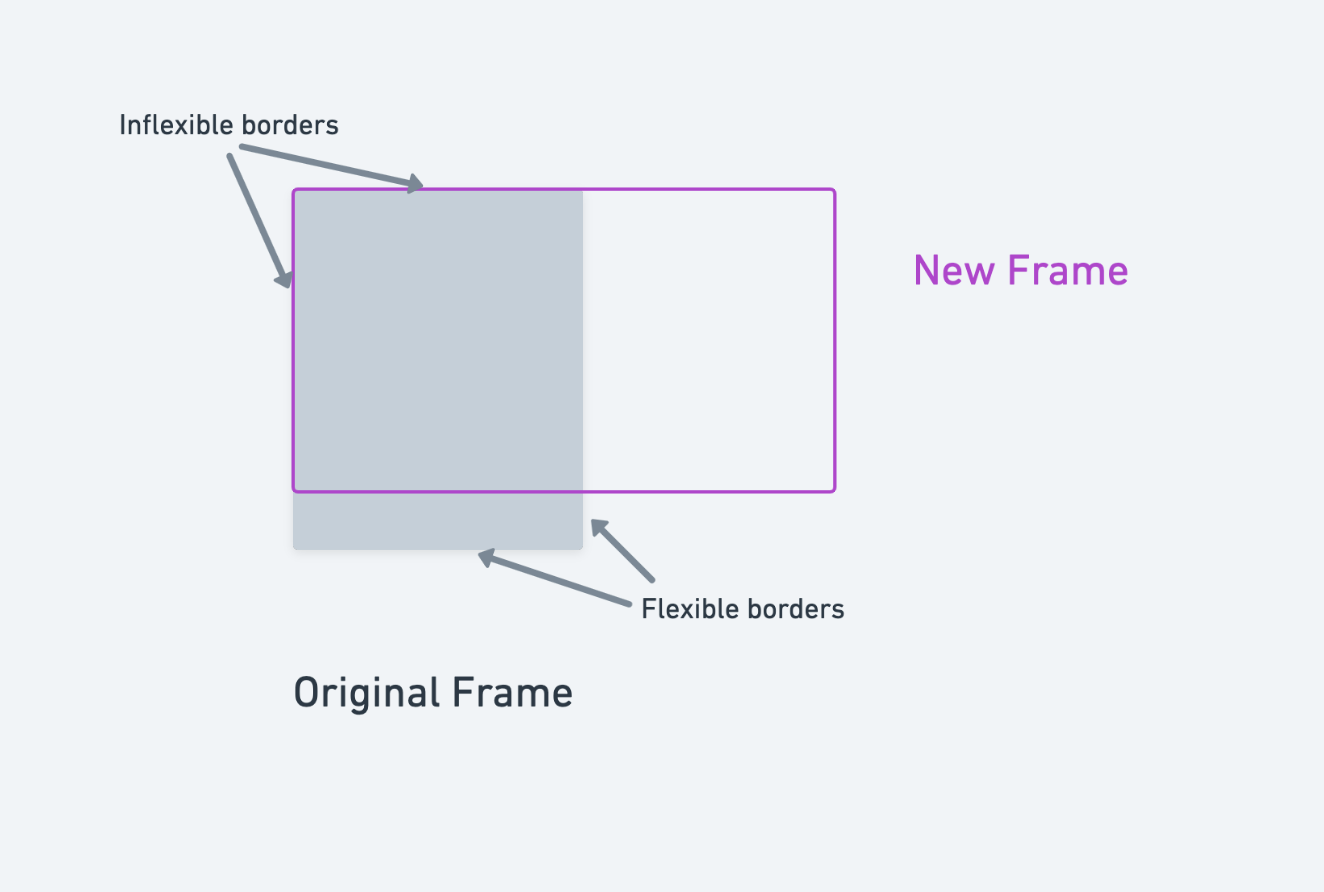
Other people can be amazing at “re-framing” - they will influence the other people to see the world from a given waypoint, thus creating a shared vibe in the process. But to do that successfully, they first need to listen to others and absorb the other people’s frames. The new frame has to match the other person’s frame on the in-flexible borders, and be different on the flexible borders. The new frame can have a different Vibe or Rhythm from the old frame.
Vibrate back.
Once you’ve absorbed the message from the other person, you can respond back. Feeling the vibe of the message can help you respond in a way that is more present and engaged with the other person. Having responded authentically, that shows a “proof of work” to the other person, that you are engaging in the conversation. As a result, they’ll likely reciprocate and engage as well. It might take some time to converge on a shared vibe, but then the conversation might go faster.
The vibe of a “single” person
Another aspect of the one-man-orchestra myth is that even a single person is a cohesive, unified and consistent unit. A person changes from day to day, from year to year, and within each person there’s often internal conflict between the parts of the personality. And having parts of a personality is not a unique perk reserved only for those with schizophrenia or bi-polar disorder. Each us experiences this on a daily, even hourly basis. Every time we experience a dilemma, we are experiencing such internal conflict. For example, one part of us, lets roughly call it the mouth, wants to eat another cookie because it is tasty and excites the mouth neurons. Another part of us, the stomach, is feeling full and doesn’t want any more. “Three cookies is plenty already. Basta!!!” it says and thus the internal scandal rages inside our minds. Sometimes the stomach is silenced, other times, it’s heeded.
If we start to look on a person not as a monolith, but more like a team (see “Society of Mind”, “Internal Family Systems”), then we can un-generalize the concepts of a shared Vibe and Rhythm back to the same person. When that internal team plays music together we have what Carl Jung calls individuation - a cohesive self. A lot of my challenges, regrets and problems in life happened because different parts of me were in conflict with each other which got stuck in an unresolved state. So now I’m working towards a different version of a “one-man orchestra” - where the orchestra is within me, and plays in harmony.
When you sigh, where all that extra air come from? Have you ever realized you’re holding your breath unconsciously only for it to end with a deep exhale? Happened to me a couple weeks ago. I was driving and I noticed that from time to time I would be thinking about the other cars and the more I thought the shallower I breathed. Then, the driving situation would simplify and I would switch to “autopilot” cruising and release a single sigh and feel a little bit more relaxed.
It is not that the situation on the road was stressful, or dangerous. It was normal evening, and traffic was not heavy. It wasn’t stressing me. In fact, I was relaxing after a day of work and packing and excited to go on a short backpacking trip. Yet, the mere act of thinking was enough to make me hold my breath a bit.
And this isn’t the first time I noticed that pattern. During meditation, I’ve noticed a slight buildup of held up breath when my mind is wandering, and then I’ve noticed myself releasing that breath when I remember I am actually meditating and focus on the object of my meditation. By releasing the held up breath I was releasing the wandering thoughts. Or vice versa. I don’t know which causes which to happen, but the correlation is clear. Thinking correlates with holding breath and relaxing my mind correlates with relaxation of my breathing.
It is natural to hold breath in situations which are stressful, our bodies do that subconsciously through the sympathetic nervous system. That the “fight or flight” response. So for me, if thinking correlates holding breath, and holding breath correlates with the “fight or flight” response, then by the transitive property thinking correlates with the fight or flight mode. This is not the mode we’re supposed to be for a long time, as it wears us out much faster. Intense sympathetic stress happens when chased by a wild animal (favorite pastime), or experiencing a stressful situation at work or in our relationships. The mere act of thinking does not create as intense response, sometimes it results in a mild sympathetic response.
Which brings me to the topic of “parasympathetic thinking” (PST) - which I call the type of thinking which doesn’t result is such breath holding or engaging of the sympathetic system. Parasympathetic thinking is hard to maintain and is fleeting. In moments after a deep exhale or minutes of meditation, our minds still think but without being forced by our conscious mind to go in a certain direction. In such moments, when we’ve relaxed our bodies and our minds, we can experience ideas and emotions which couldn’t get to the front stage before, when we forced our minds to write code, or do taxes, or take care of a baby.
Parasympathetic thinking is allowing the suppressed thoughts to come up forward in our consciousness.
Parasympathetic thinking (PST) is more creative, because during PST we allow our brain to present to us the ideas which it came up with. PST is thinking out of the box. When you’re trying to be creative, try relaxing and exhaling, and see if it helps.
Paradoxically, PST is effortless, as in we can’t force ourselves to be in PST. Sometimes we have a lot of other stress, and a handful of deep exhales won’t help us detach. I once went on a vacation for a week, hiking though beautiful national parks, and during a lot of the hiking my mind was preoccupied with some issues at work. PST is not a switch that we easily flip, but when we do succeed in engaging PST, we do so by canceling our effort. QED the paradox.
I called it a switch to flip, but PST is not clear cut ON/OFF, it is rather a spectrum between, on one hand having focused and directed attention, where we don’t allow anything to bubble up, and on the other hand having a diffused and “bubbly” consciousness.
What I’ve also noticed that some important personal topics of my life are often bubbly. I experience them stronger when I’m further along the PST spectrum. Accessing PST via meditation or other forms of relaxation often helps me connect with these topics and find a happier path in life. I should note thought, that not all bubbly thoughts are important - most are just random. Sometimes I can make my mind more bubbly, but I cannot force the important topics to bubble up.
Parasympathetic thinking is not a scientific concept. There are other, more precise scientific concepts such as “vagus nerve” and “shadow work”, which cover aspects of PST with much more rigor than this blog post. The parasympathetic system can be triggered by slow abdominal breathing, via the vagus nerve, but the state of relaxation is not exactly the bubbly thinking I mean by PST. Yet, PST is definitely a useful enough concept for me to get a better understanding of my thinking, to be more creative and to better balance my stress levels.
I can use it without knowing exactly how it works.
According to a famous study, the most common regret of old people on their deathbed was “I wish I’d had the courage to live a life true to myself, not the life others expected of me”.
Well, I’d like to dissect a little bit what “true to self” might mean. How do we know which of our thoughts are coming from our true self, and which of them are coming from outside. I am not going to claim that someone is trying to plant certain thoughts in your head. Instead I assert that most of our thoughts are not genuine.
They are mind tricks played on us by our environment. Every tweet, post, article that we read, every ad that we see, every movie or show that we watch occupies a part of our consciousness. It doesn’t go away when the event is over, but instead it lingers and decays. And then the environment re-enforces it.
This dynamic is hard to see from an individual level. We all are able to think critically about our environment and seemingly make each decision for ourselves. Yet, if we switch the vantage point and look in aggregate it becomes crystal clear.
Consider a parallel universe far far away where exists an imaginary company called JarJar which produces and sells jars. They create a new type of jar called “meesan jarjar”. In terms of quality and price the meesan jarjars are the same as mason jars in our universe. Over time JarJar the company does all kinds of marketing, from traditional ads to hidden ads, to reverse psychology PR. They do packaging experiments, promotions, and discounts. They pay the “customer acquisition cost” and they capture a part of the market.
Each individual customer may have their own reasons for going with a meesan jarjar instead of mason jars, which may seem rational. Asking each of them might reveal a story about how their reasons, or lack of reasons. The reason might be clear to them or it might be subtle enough that it evades reasoning. The most effective reasons are strong enough to affect behavior, yet subtle enough that the subject doesn’t realize they’re being controlled.
When you look in aggregate - the fact is there - a significant number customers have changed their behavior as a result of JarJar’s growth efforts. In other words - JarJar has pulled a mind trick on us.
A company, a movement, a religion, an influencer doesn’t care what we think, as long as we do what they want us to do - to buy their product, to pray to their god, to shout their slogans, or to like and subscribe to their channel. They just try convincing us to bid their will in various ways, until something works. They don’t necessarily realize the mind tricks they’re playing on us - they’re just doing whatever works for them.
…
Back to our individual point of view.
Next time that we think we need to buy a certain item - where did that thought come from? What does buying that item achieve for us? If I buy meesan jarjars, do they make my cooking more enjoyable?
These questions are hard to answer when we identify with our thoughts. Especially since all mind tricks worth their dinero are subtler than thoughts. Instead, we can observe our thoughts, but try not to identify with them. For example, if you think “I need to call Jar Jar”, instead reframe it as “There is a thought that I need to call Jar Jar”. Then go one step further and ask “Where is that thought coming from?” Is it coming from an inner need to spend time with a friend, or is it coming from a social obligation.
Going through that exercise even a couple times reveals that we cannot trust our thoughts to have our best interest in mind. This is a deeply unsettling conclusion. For a while I didn’t know what to do with it.
I still don’t know, but I’ve been taking steps to try and re-align my thoughts with my happiness and prosperity.
Making space for my thoughts to develop without external influence. I often place my phone and laptop and other electronics outside the room at night, and I only keep a notebook to write stuff down. After a few minutes my mind stops itching for my phone.
Meditating and trying to get in touch with my feelings, to evaluate stuff in my life through a clearer perception of my feelings. Meditation calms the waves of my emotions and makes it easy to see what’s beneath them. I’m still a beginner.
Trying to get my information from more primary sources and randomized controlled experiments. While I still consume a lot of “clickbait” high glycemic index information, I’ve been appreciating more the process of making my own conclusions from the facts.
I’ve also eliminated caffeine and greatly reduced the amount of alcohol I consume. These are ways to escape from what’s actually happening in my head. Caffeine suppresses my feelings, and alcohol suppresses my thinking.
I opened this story with the study of the regrets of the dying. And this study has had a bunch of criticism. To be honest, today I don’t care about minimizing my regret when I get old and feeble. What I care is about is living in a manner true to myself, because I’ve thought about it and I’ve searched my feelings, and I’ve found that I suffer when the independence of my thinking is impaired.
I recently learned about the concept of a “shadow” that Carl Jung defined. According to it, each of us has a psychological shadow - the part of us that we suppress unconsciously. It’s usually a darker side which society makes us hide, such as a side of violence, but it doesn’t have to be negative. It can be different sexuality, or creativity. It is there, even if we aren’t aware if.
For me personally, on the surface level I’ve struggled with some addictions, anger and procrastination, so I was curious whether these might result from something I’m suppressing in my shadow. So I started probing.
One thing I realized I was suppressing is that I was thinking of most things I spent my time as things I “have to” do. Not the things I “want to” do. Even for genuinely fun things. I realized also I wasn’t as productive in the “have to” tasks, as the “want to” part of my brain would keep pushing me towards procrastination.
So I decided to not fight that voice and start thinking about what I “want to” do and spend more time doing it. And to lean towards whatever seems to generate the most genuine fun - do that.
I realized I want to be active and healthy and tackle physical challenges in the outdoors, to solve math problems and to discover through doing, whether it’s writing an essay, or an app. To spend more time with favorite people, to party, to dance and to travel. To learn new things, to satisfy my curiosity, and to see the product of my work flourish. To help others and to see them succeed.
The phrase “To do list” started having a different feel, as it was more “want to do list” than “have to do list”.
The result - my perceived stress decreased, and I am enjoying what I’m doing now a lot more. What is a bit unexpected is that having decided to be a bit more selfish and be more driven by “want” than “have to”, the things I “have to” do haven’t suffered and in fact seem improved, as I struggle less with procrastination.
A year ago, I wanted to do more experiments with my writing. After a change of occupation, I was looking for a change in writing too. I didn’t feel much like writing in the old format I’ve been using - pondering on interesting phenomena. A lot of it didn’t have a direct impact on my life and I felt bored of writing.
I turned to cooking for inspiration.
Those who know me on a personal level know that I enjoy cooking and like to experiment and cook meals stretching my skills with every meal, and learning something new. Cooking never got boring to me, as there are different foods and techniques to perfect. My plan therefore was to try different writing formats and learn to express myself through each format.
So far so good. However, I neglected other sides of cooking which made it fun. Cooking also brought instant gratification when the result was success, and an instant learning otherwise. And cooking often had a social element - it felt satisfying to share the food I made with friends and family. One rewarding moment was when I brought a home made Easter bread, Kozunak, to my friends house and their two toddlers really enjoyed it. I didn’t think too highly of the result before I shared, but the nice surprise of seeing the kids’ unfiltered enjoyment made me feel proud as a cook, and more connected to my friends.
For writing, I decided to try long form essays. One of my early inspiration was the topic of Universal Basic Income and the fungibility of money and value. That was when Andrew Yang still had a chance for 2020. I wanted to write a definitive way to think about it that is well researched and thorough. I thought it can become a good starting point of discussion of the merits and drawbacks of UBI. And what is even more, I was genuinely curious to figure out the details and form a strong opinion. I wrote a good volume of words, but wasn’t happy enough to publish it, and the more I was looking the more gaps I was finding.
Then COVID hit and I put writing on the further back burner. As things settled into their new grooves, I developed interest in a new topic to dive in - accountability for COVID and disaster prevention. Long story short, this turned out the same as with the UBI topic - I didn’t really get to the point where can publish it..
Part of the reason why I failed twice to write a long form essay is that I didn’t spent much time writing. It’s a body of work. An absolute unit. But another reason is that I didn’t feel instant gratification from writing and was missing a social aspect - thus I failed to ignite the excitement. I felt stuck, and I missed writing regularly.
So I decided - less is more. Instead of trying to too smart for my own good, which would be the cooking equivalent of running a production kitchen, I decided to focus on short personal stories, with only a sprinkle of abstract thought. Those are easier for me to write, as the volume is less, and I am ultimately the arbiter of my own experience and emotions. This would give me more instant gratification, as writing has been a great way for me to clarify my thoughts. Now I can direct it to clarify my emotions and share more of my life, hopefully connecting more with others in the process.
I’m looking forward to the uphill, one short story at a time.
Having written a year in review last year, I found the practice of reflection rewarding. So I decided to do another one this year. 2018 felt like play. 2019 felt like playful work.
I learned a bunch of lessons about doing startups. I’m sharing some of them here, in writing, but I cannot fully share how they feel. And I think unless felt and internalized deeply, these lessons are hard or impossible to apply. Each of them took me months, and by writing this review my main goal is to capture them for my future self. They might resonate with you, if you’re building a startup or something comparable, and we might have a swell time diving into a discussion.
Let’s begin.
Startup lessons from Sleek and Swift
I started the year building a startup called Sleek, which later got renamed Swift. The goal was to eliminate waiting in line, by providing a super fast and convenient way to order through a phone. Within months, myself and a cofounder were able to build and iterate on the idea, pivoting away from our initial plan to use a chatbot. We found a pilot customer (Bonito Poke - their fish is fresh AF), and every few days I’ll go there, deploy our system, see what didn’t work well, and go back home and build a solution around it. Over a couple months, the system become decent - it was able to move people off the line faster than the kitchen can handle it and processed thousands of dollars of orders.
But ultimately, me and my cofounder split ways. Which lead me to one of the main learnings from this year:
“Unless you’re certain there’s a great fit between cofounders, don’t start a startup”
The focus is on the words “great fit”, and I find it relevant to most important decisions in life. Armed with “great fit” as a decision boundary, I was able to find a path through the rest of the year, and ended up joining another team, which I think is a great fit. But more on that later.
I also found saying “I don’t think it’s a great fit”, plus some specific reasons, to be an honest and less stressful way to reject opportunities and people. In the months after splitting with my cofounder, I talked to a whole lot of people about building a company. Most of them were amazing and great and are now doing awesome stuff. If someone is not a “great fit” to my situation doesn’t mean they aren’t great things in their own right.
I do not know of a great litmus test for a great cofounder fit, but I know it needs to include at least:
trust
teamwork
complimentary skills.
Another corollary of the “great fit” criterion, is that there has to be a great fit between the founder and the startup. I realized that while I cared about Swift’s mission - to save people time, and eliminate waiting in line, it wasn’t that important to me that I would jeopardize my health by staying regularly up until 5am coding/preparing for the next day. Yes, time is one of the things I care about most, and I’ll chose inferior product with less wait. And my blood boils quickly when someone wastes my time. But saving time ordering lunch from food trucks didn’t feel like it would be that powerful in reclaiming valuable time. I wasn’t willing to dedicate my time to it. Which leads me to my other startup takeaway from 2019.
“To start a company, find a problem in the world that is a great fit for you - that you are able to suffer for.”
And because I didn’t find a cofounder to share the load, I considered putting Swift on hold and considered joining another team. I talked to multiple excellent startups, and interviewed. My intent was to only join startups that I feel are great fit.
Slapdash
I felt that joining Slapdash as the first non-founder would be a great fit to further my journey to build a company. I also really clicked with the team. Ivan, the CEO, gained my respect from the first email he sent me. In it, he asked a direct question which set the tone for a candid, high signal conversation. Soon I met the rest and my intuition told me we’d make a cohesive team. The mission also appealed to me. At the time I interviewed, I understood it as the ability to quickly search across all your cloud applications, saving time. My vision with Swift was to save people time, and on that front Slapdash resonated - and it even felt like it might be saving a more valuable piece of time than food ordering.
After I joined Slapdash, our vision crystalized to “Work at the speed of thought” - and I think that’s something I can put more skin behind. I’ve experienced how hard it sometimes to get in a state of flow, and how easy it is to get disrupted. When I was an engineer at Twitter, I wrote a simple script to notify me when my unit tests finish running so that I can interrupt whatever distraction lodged itself in my head while I was waiting for the tests to pass, all in order to keep my state of flow.
At Slapdash, I had the privilege to join early. So early, that the we-have-always-done-it-this-way fallacy does not apply. What do I mean? It can be common when joining an already established company to accept its ways as the way it works. Even if you think there’s a better way, it’s a conflict of one person versus the machine with its massive inertia. But in a small startup, the machine is small, and is furthermore actively looking to improve itself. There’s no “this is the way” at startups. Which brings me to the third learning about startups from 2019:
“In a startup, if you think there’s a better way to do something, then you’re almost certainly right, and it behooves you to make it happen.”
To put it another way - in a startup most things are up for grabs - trust your intuition on what could be better, and do it. You will be wrong at times, but the times you are right will more than make for it.
I’m glad to say we were able to launch Slapdash.com so y’all can try it out - and if you think anything can be better - rest assured you’re right! And let us know :)
Self improvement in 2019
The rest of this post is not about startups but rather about how 2019 affected me personally.
During the first half of 2019 I had gained some fat around the abdomen, and was feeling stressed, so I decided to make changes. So in September, I set my New Years resolution and started working on it. That’s a resolution from Sep 2019 until Dec 2020, as I realized that important changes take time. I set some measurable goals for 2020 and my plan of achieving them is to have one thing each month that I’m working on, and build on top of it. So far, I’ve worked on the following:
Sep’19 - track all my food calories through a custom made Glide app. Succeeded.
Oct’19 - increase meditation from ~100 to 210 minutes per week. Succeeded.
Nov’19 - try to decrease calories from 16K to 14K per week. Failed.
Dec’19 - try to sleep 56 hours a week. Succeeded. Key adjustments which helped were blackout mask and drinking less water at night.
Jan’20 - try to get rid of at least one item per day. If I get something new, I have to get rid of at least two other things.
I also maintained no caffeine throughout 2019 and did 3 continuous months of no alcohol (first one month, then two months). In 2020 I plan to at least match these.
Creativity
I wrote and published less in 2019 than in 2018. But it wasn’t bad. A post of mine, Giving a name to my sales anxiety, made it to front page of Hacker News. In 2020, I aim to publish more than in 2019.
I also made my own limited edition hot sauce - with labels, shrink wrap, etc.
Books
I was sad and disappointed by how HBO’s producers botched Season 8 of Game of Thrones. I really loved the show’s previous seasons, and had read the books, was reading analyses online and had really high expectations. For me, SHTF with season 8 and after it I didn’t want to see much about GoT/ASoIaF. I felt really dejected from the whole story after that. I wanted something to help me restore my appreciation for fiction and story. Then I found a recommendation about Joe Abercromie’s series “The First Law” and once I picked the first book “The Blade Itself” I was hooked. These books have characters as interesting, or even more interesting than GoT, and they’re a pleasure to read. I’ve since recommended these to friends.
Other notable books I enjoyed and remember are Michael Pollan’s “You can change your mind” which discussed psychedelics. I also enjoyed the first half of “The Dream Machine” which talked about the history of how computers developed. “Bad Blood” and “Born A Crime” were also worth listening to.
Travels
I’m grateful for all the travel I was able to afford through the year.
In the beginning, I participated in a Ski house in north Tahoe, ride snowboard in the morning for ~2 hours, and work in the afternoon/evening. I had a total of 13 days such riding. In terms of productivity it was surprizingly good as I was able to find a good focus in the afternoons.
I also fulfilled a dream to visited Patagonia and hike. While in Argentina I also saw Iguazu falls - amazing places. One of the days in Patagonia, we spent nearly 10 hours to go between two huts, with a lot of ups and downs, only to arrive at the modest Refugio Laguna Negra around sunset and find it fully packed. Regardless, the hosts found a spot for us on the table and fed us a tasty lentil & sausage soup. Hospitality I’ll never forget. Later, that dining room turned into a bedroom and all extra guests found some spots on the floor to put their sleeping bags & mats. In Patagonia, I also got to go on a glacier for the first time - woot! Patagonia was super beautiful - I’m happy I went there. Yet, as amazed as I was, I realized “a mountain is a mountain” and there are a lot of similarities between it and other mountains of similar height around the world. Today, I am looking forward to doing more hiking and backpacking in the amazing mountains that are close by the Bay Area - the Sierras!
I was able to feast in the beauty of California. I did short trips to Lost Coast, Mount Shasta, Yosemite and Big Sur. And this year I started backpacking overnight. I am also glad that I had the chance to spend time with friends and family in Bulgaria, China and Morocco.
Relationships
Last but not least. I started new friendships and kept some older ones.
And I loved and felt loved - the most meaningful parts of life.
Yesterday, me and my partner went cycling. At some point the path was going by a rural road.
I was in playful mood so I joked with her how a road sign looked like a penguin. Doesn’t it really?
Well, our mood soon turned to horror. Just a mile further I heard an animal in the bushes. I turned my head and saw a deer, hiding in the ditch by the side of the road.
“Look, a deer,” I stopped and waved at my partner gingerly. As she saw the deer, I was getting ready to pedal again when I heard her distressed voice.
“It’s stuck 😧! It’s gonna die 😥”
That startled me, and made me get off the bike, and walk a little closer to the deer, to look. The road was on a moderate hill slope, which meant that to the right of us the land was descending, like a ditch. Beside the ditch there was a wall of bushes, and beyond it, there seemed to be a farmland property. However right at the start of the bushes, there was a metal wire fence made of squares, each square about 5 inches or so. Just enough for the head of the deer to go through, and get stuck. As we approached, the deer obviously got even more scared, and started thrashing against the fence. Its body was uphill of the fence, towards the dangerous road, and its instinct was to run away from the road and even more into the fence. Getting more and more stuck.
The deer was stuck not just in the fence, it was stuck in an infinite loop. Being stuck made it further scared, and being scared it tried to run, getting more stuck. At moments, her head and the whole of its long neck was through the fence. As I approached closer, I saw how horrible it had suffered. It’s whole neck was damaged from the fence. All the hair behind its head all the way down through the shoulders was gone, shaved off, and skin was scraped and bleeding. I felt a sinking feeling realizing it had been stuck there for a long time. I felt incredibly sad for it as I realized how much it had suffered already, and it hit me hard that it would suffer a lot more and die if we don’t do something.
Unfortunately we didn’t have wire cutters to cut the fence.
So after discussing with my partner, and going over my fear of being kicked by the deer’s rear hooves, we resolved to help the deer now. I approached the deer and grabbed it by the side, trying to immobilize it. I was still a bit concerned and cautious as it’s a wild animal after all. Thanks to some rudimentary knowledge of BJJ, I was able to grab the deer by the side, pressing my hip against its chest to reduce it’s movement. The deer kept trying to escape my hold which made it hard for us, but for the most part I was able to hold it back. Then, my partner started helping with getting the deer’s ears unstuck, so we can drag its head out of the fence.
Even then, the deer was still stuck in the infinite loop in its mind. It didn’t realize we were freeing it, and it kept trying to get more stuck. It didn’t have the benefit of detachment and perspective. Eventually, we pulled its head out of the fence. Relieved, we were looking forward to letting it run away, but when we released it, we found out it is still stuck in the infinite loop in its head. It ran back towards the fence and pushed headfirst into it. The poor fucker was in so much shock that it didn’t realize it was now free, and it didn’t even re-asses it’s situation. If I were to bet on what was going on in its mind, I’d put my money on “Road bad, field good, run towards field.”.
Lucky for it, and for us, it didn’t manage to get stuck right away, giving us enough time to lift the fence a bit, so it can sneak under it, and run to the field. We finally felt happy and relieved that we’ve prevented a miserable death. So we hugged and smiled and kissed and jumped. And with lifted spirits got back on the bikes.
And then, as I was biking, I was thinking what makes us different than the deer? And the thought that came to me is our ability to detach from the stress of the situation, and use our rational mind to find the solution. If you or I get stuck, in the same fence, we’d actually try to vary our position in more ways to get unstuck. We’d realize that getting unstuck is the first step. Perhaps that makes us more intelligent than deers?
But as I kept thinking, I wasn’t so certain any more. Just hours later I got stuck myself in an infinite loop watching “epic rap battles” on Youtube. Yes, I was fatigued from a day of biking and it was understandable. But still, after watching a couple of them I had relaxed, yet I couldn’t unglue myself from watching. I was stuck just like the deer, except that my fence was more abstract.
We’re stuck on many infinite loops in our minds, and sometimes we need a break (pun intended).
Can you imagine if Karma was real? You do good, and you get rewarded. Someone does you bad, and they get punished. Oh, life would be a dream…
I’m sad to admit that, but Karma is not a practical concept today. It implies that good deeds result in good karma, and good consequences for the individual, and bad deeds result in bad consequences.
It’s way too abstract.
Us skeptics would wonder what ensures that bad actions receive bad
consequences. Isn’t it naive to believe in Karma? Just look at the
people in power across the world. Would you say they have good karma?
Would you say they’re wholesome? I bet not.
There are a lot of assholes and psychopaths out there who seem to suffer no consequences. And at the same time there are a lot of well-meaning, and well-doing people who don’t get rewarded by society.
If karma were a person, they’d say our systems are broken. Society optimizes for money and overall GDP. While this is generally correlated with Karma, there are gaps. People bully others and suffer no consequence. People rob, and kill, and lie and suffer no consequences. People destroy the good that others have worked so hard to create. Justice and Karma aren’t universal.
And yet, I feel optimistic. I think there are good reasons to think that Karma is coming.
How? Through the internet. Today we live in a well connected world. Gossip travels fast. And Gossip brings karma with it. And evil is finding it harder and harder to hide. Information wants to be free, and gossip about evil deeds most of all. The internet facilitates that, and punishes bad actors. Even for deeds done way in the past. The Harvey Weinsteins and the Kevin Spaceys of the world might have done horrible things decades ago, and yet, today karma has caught up to them.
And Karma is catching up to all of us. It might be slow, but is getting closer. And now we have time for choice. In everything we do. In the moments we feel weak and tired and want to take the shortcut. Do we take these shortcuts, even if they hurt others? And can we get away with it? None of us is perfect. We all have wholesome moments, and yet, we all have evil moments.
And now… realizing and remembering that Karma is catching up to us, we have one more thing to lean on during those trying moments.
That was the result of my first pilot run. The launch of my company. After spending few months building an “order on your phone” solution and closing a customer, we had our big day, of getting the product in front of customers. On the first day where our product would be in front users, we got a grand total of zero orders.
When the day was over, I had this sinking feeling, of a big failure. What am I doing, am I wasting my time with this? I’m definitely doing it wrong.
“Well, did you talk to the users in the line?” the questions came. “Uh, no”, I replied. Guilty. See… I’ve observed the users to learn from them, but didn’t bother to ASK them.
I’ve been a nerd. A math nerd and computer programmer, and approaching people was scary for me. It made me feel awkward. And this awkwardness is a problem if I’m trying to “sell” the product I’m building.
I realized I have “sales anxiety” - it’s like social anxiety, but for approaching strangers with a request - in this case, it’s a request to try our product. I myself have been suspicious of people approaching me with deals or promotions or offers. Most of the time it’s not worth it. Sometimes there is a catch. Sometimes I feel slightly annoyed when someone disrupts me, and try to “sell” me something.
So having found myself on the other side, as the approacher, I felt guilt. I didn’t want to see myself as someone who disrupts others for their shitty promotion. Even though, on the other hand, I felt that my product is beneficial and relevant, and it is OK to approach people with relevant recommendations, I couldn’t disentangle the two feelings. Hence the anxiety.
But once it become so clear that I’m failing at talking to customers, I realized I have a problem. I named the problem “sales anxiety”. Thus, by naming it I had built a tool to overcome it. On our next pilot runs I again felt that uneasiness when approaching users. But then I thought “Hey, it’s the sales anxiety, it’s OK, relax.” And I felt braver. And that allowed me to go on talk to them, understand what they liked and what they didn’t like about the product, and change it.
Giving my feeling a name didn’t make it less scary, yet it made it more approachable.
And while I still feel sales anxiety, as it would take a long time to rewire the inner workings of my mind, I can now soothe myself by pointing to it, and distancing myself from it - hey, it’s just the sales anxiety, it’s OK, now go talk to that customer.
“It’s like being able to write Scala in Javascript, but faster to
compile.” That’s the first description of TypeScript that really
piqued my interest, by a friend, with whom we used to write a lot of
Scala at Twitter. I enjoyed the ergonomics of Scala collections, case
classes, Options and Futures, and types and generics. Later, after I
left Twitter, I was building another project and chose Python and
Django for the backend. That project turned out OK, but coming back to
Python after years of Scala, it felt ugly and less direct. When I
first started using Python, I was enchanted by the simplicity and
readability. But now it isn’t enough. One of Python’s slogan’s is
“batteries included,” meaning that it can get you up and running
quickly. If programming language were a remote controlled toy, I’d
appreciate the batteries included, but now I needed not just the
batteries, but also the ability to maneuver precisely and with
confidence. And I feel that Typescript provides that ability for
precision.
So when a couple of months ago, I was starting to build Sleek and was
wondering what language to use for it, I chose TypeScript.
Here are some of my reasons.
Moving fast on a shallow learning curve
I can’t say I’m proficient in TypeScript. At all. I’m really just
beginning to learn it. Still, Sleek is a startup and I want to be able
to move fast and dirty if needed. I don’t have to specify precisely
the type of every variable of every function signature. Every valid
Javascript is also valid TypeScript which means I can use types only
as needed. This gave me confidence that I wouldn’t get stuck trying to
specify the types - I could just ignore it if necessary, and even let
it be wrong or broken for parts which don’t matter.
I could ease my way into learning the type system, and apply only when
helpful. Still a couple months in… and many of my functions and
classes have some type of typing constraints on them.
Another reason that the learning curve is even shallower, is I can use
TypeScript for both the frontend and the backend. This means that
instead of having two learning curves, I only have one, which
ultimately results in moving faster.
With startups, I feel that technical debt is not as big of an evil as
with a more established a company. The reason is that in a startup,
there is a big chance that what we’re building might turn out not to
be needed, if customer feedback invalidates it. So we might just write
off that technical debt and not have to pay it back, if we decide to
scrape up the project.
Moving fast with good tooling
TypeScript is portable and works out of the box. What do I mean by
that? The TypeScript team and community is really focused on providing
good tools. Everything pretty much works out of the box with Visual
Studio Code and all the configuration I need is in a single
tsconfig.json file. This means that I can check that code into the
repo and resume working the same way even if I switch computers in the
future, and when another person joins the team they don’t have to
configure too many things.
Visual Studio can then analyze my code and tell me when a function is
not returning the right type or in general things are mismatched or
missing. The great thing is that this works even when the code doesn’t
have type annotations at all. The IDE can also do auto-complete which
is not only helping my avoid typos, but also it is really comforting
as it helps me know that I’m actually doing the right thing. That
tooling also allows me to understand how other third party
dependencies are structured, and jump right into their code in order
to understand them.
This saves time and contributes to a overall shallower learning curve
as well. All that tooling might not save too much time in typing
itself in the long run, but it saves few seconds here and there which
has the much more important benefit of allowing me to “stay in the
flow”. When I don’t need to context switch in order to remember
whether I a method is called “getAndInitializeSession” or
“getOrInitializeSession”, I can keep the working memory of my brain
focused on the task at hand.
That makes it really really fun to code!
Promise for the Future
One thing I enjoyed from the way we used Scala at Twitter was the use
of the Future monad. That allowed us to be declarative about
computation that takes a long time and to have a way to express what
follows what. I missed that clarity and precision when writing Python,
but with Javascript Promises bring the joy back. They go even one step
further with async/await built in, which not only lets me be
declarative and clear about the intent, but also to be concise and
readable.
There’s also another “promise for the future” aspect of Typescript
that I’m stoked about it, and that’s the community and the core
development team’s progress and enthusiasm. All that fuels my hope
that TypeScript will continue to improve. That’s a
secret weapon for my startup. I’m
long TypeScript. And by saying that I’m long, I do put my money where
my mouth is, by investing my time and therefore money into it.
Culture fit
It’s hard to put my finger to exactly what it is, but I feel a good
culture fit between myself and TypeScript. It allows me to be careful
about the things that matter to me and not worry about things
which do not. It allows me to be a craftsman and be able to produce
with quality.
I expect TypeScript to help me set the engineering culture along those
lines. The use of types, promises and functional programming enables a
more declarative code, and easier access to monads to set the right
abstractions. When doing the right thing is within reach, it will be
much more likely to be done, than when it is too hard, and requires an
“ad-hoc half-way bug ridden re-implementation of common lisp” to set
it up. Ben Horowitz said that “all decisions were objective until the first line of code was written; after that, all decisions were emotional.”
In a startup we can make a difference not only by making something
people want and satisfying a market need, but also by putting soul in
our craft. Steve Jobs would force engineers at Apple and NeXT to
create products with beautiful insides. This might seem like a waste
of engineering and design effort into an area that the customer will
never see. And especially in light of my comment above about tech debt
being OK-ish at startups, it might seem that I agree that it’s a waste
to have neat internals.
This couldn’t be further from the truth. When it is affordable to have
neat internals, it is absolutely worth it. Even though I wasn’t there
at Apple and NeXT to witness how things worked behind the scenes, I am
willing to bet that the consumer facing part of the product was as
polished and sensible precisely because the internals were neat as
well. I am firmly convinced that patterns repeat and that nature of
our world is fractal. One such pattern is that “the
way you do one thing is the way you do everything”. If
you’re half-assing some things, you’ll be half-assing others.
I don’t want to be half-assing Sleek, but I want to approach with care
and attention both for the detail and for the big picture. If that
kind of attitude resonates with you, please let me know!
Do you remember the last time you saw a before-and-after photo of a an
overweight person losing more than a hundred pounds? On the left, they
look bloated, and their facial expression often betrays sadness. On
the right, they’ve slimmed down, posing with their old clothes for
comparison. And inevitably their face glows and they radiate
confidence and positive outlook.
I’m really fascinated and in awe when I hear about a person who had
serious problems, and their life was going from bad to worse, but yet,
somehow, they made changes, they took a different path, and they
adapted their behavior and mindset, and started rebuilding their
life. Just like this pitbull.
But I keep wondering… how does that work? Is it like a lightbulb
epiphany moment - sudden, strong, and clear? Or is it like a sea
change - gradual, gentle, and subtle? Does it originate from within,
or is it driven by other people who care?
For a while, these questions have been simmering in my
subconscious. They motivated me to read self-help books, listen to
podcasts and watch videos on Youtube. And after all this research - I
don’t have a good answer. I don’t have a scientific proof. But I have
some thoughts I’d like to share.
I think I find these stories fascinating is, in part, because I’m
hardwired to. All of them are examples of the archetypal “hero’s
journey” narrative. To begin, the person in them is either overweight,
or excessively alcoholic, or they were dealt a really tough hand in
life. They might have lost limbs, or get paralyzed, or survived
cancer, or fought in a war. The could have experienced PTSD. They were
in a tough spot, with their whole life going from bad to worse, and
seemingly no way to turn it around. They were at the bottom.
Then, there is always this critical moment, which Pitbull calls
“turned my life from negative to the positive”, and which the “hero
journey” calls revelation, and which I’ll call “inflection point”
where something happens in their mind. Their outlook on life
changes. And they start on a new trajectory. It is similar to an
inflection point at a graph. It isn’t necessarily the lowest point,
but it is the point at which the trajectory changes.
They decide they want to quit alcohol, or they decide they want to
commit to a plan to lose 200lbs, or they decide to seek help, or they
decide to run a marathon, or to climb mount Everest. Or they simply
decide that they don’t want their life to be like this anymore, even
if they don’t know what else it would be. Anything else - but this!
The inflection point is the point where they decide. It is a change within, only perceivable from within the mind of the protagonist. After that change takes effect, they slowly start taking actions, building habits and organizing systems to help them move them towards their new dream, and away from their nightmare. Over time, habits and system have compounding effects and with the absence of bad luck, some people make it through and turn their life around.
They come full circle and complete the hero’s journey.
Or do they….
For every motivational example we see, there are more which we do not
see, and who never turn their life around. Most people don’t ever
experience such reflection point. Their lives spin out of control like
a whirlpool and they get sucked into the abyss. No happy end, and no
silver lining. Fuck. They get sucked into a whirlpool all the way
through the bottom. And they can never make it back.
If only we can give them a rope. If only we know what a rope would
look like in this scenario - we can save many people from the vicious
cycles of the whirlpool of death.
Here is my thesis - inflection points exist. Inflection point is the
moment a person decides they want to live better. The decision does
not need to be conscious. It could be as subtle and indirect as not
enjoying alcohol as much, or even being extremely embarrassed about an
action they’ve made. It is an epiphany, but the epiphany does not need
to be a grand one. It could be a very mundane one - such as “this
alcohol tastes like a nasty medicine”, or “I can’t see my feet any
more”. But the decision and the trajectory change will be durable.
To define it mathematically - inflection points are when the balance
of our underlying emotions change - simple as that.
What do I mean by that? Underneath our conscious logic, we have
unconscious emotions. And emotions are what drives us. When an emotion
is strong, it can override our logic, and we can see ourselves doing
things we don’t want to do. It takes a lot of effort, to manage our
emotions.
We like to refer to that effort as willpower. But, from the point of
view of looking at emotions fighting for dominance inside our brains,
willpower is simply the strength and effort of the constructive
emotions. The emotions which lead to long term happiness and comfort,
even at the expense of short term pleasure. Logical, sober thought is
one such constructive emotion, and we call it willpower whenever we
are able to make our actions agree with the constructive emotions.
Yet… there is such a thing as “destructive” willpower. You might have
seen it under the name of “rationalization”. It is what destructive
emotions use to take over our action. If people say and think “I’m
gonna be OK to drive with one drink,” that’s their drink addiction
emotion convincing them to drink. That’s destructive willpower. It’s
not the absence of willpower, but the redirection of willpower towards
a destructive emotion.
And why do we sometimes have constructive, and yet… sometimes
destructive willpower? What changes from one moment to another? In my
theory - what changes is our dominant emotion. Our emotions are not
static, and fixed, they change in intensity and power through the
day. And whichever emotion is on top, gets to decide where to spend
willpower. If it is a constructive emotion, the willpower is
constructive. It builds to a better life. If it is a destructive
emotion, the willpower is destructive. It rationalizes short term
pleasure at the expense of long term survival. Destructive willpower
could lead us to take revenge, or to get high.
We have little control over which emotion is dominant for us. It takes
a LOT of energy to change which emotion is in control. Over time, we
can train constructive emotions with meditation, discipline, and
habits. Yet, over a course of a single day, we are driven by what
happens to us, and what is in our schedule. It is only over the long
term that we can cultivate a mind of constructive emotions.
Which brings me back to the idea of inflection points. Inflection
point is the moment our constructive emotions start increasing their
share of the willpower. Mathematically, inflection point is the when
the second derivative of our well-being becomes positive. Jargon
aside, inflection point is when we start hurting ourselves less. Its a
directional change, but compounded over the long term, it leads to
building a life.
If we create such inflection points in others, when they’re in the
whirlpool, we can help pull them out.
Looking back at 2018, I’m stunned how much it had to offer. I spent most of it on a sabbatical, and working on startup projects. Here are some highlights.
This might seem like bragging. I realize it’s rare to have it so good, and for many people it’s not the case. I’d like to look at everything I got and experienced this year through the lens of gratefulness.
I’ve worked a lot in the preceding years to be able to afford this, yet, I am incredibly lucky. So many things could have gone wrong and prevented me from enjoying one of the best years of my life. I’m grateful they didn’t.
First highlight, I learned a lot.
Some of the technical skills I learned are hands-on deep learning, web development with React/Django/Graphql, serverless computing with Lambda and Typescript.
I got better in some “soft skills” - public speaking, nonverbal communication, negotiation, persuasion, active listening.
I learned that the most important and most effective soft skills are to care about the other person, and to be open an honest. To take the long term view. Win-win!
I learned a few things just for fun. I dove into various aspects of blockchains and mechanism design such as Arrow’s impossibility theorem. I fulfilled a long time desire to learn about quantum computing and mechanics and to understand Shor’s factoring algorithm.
I baked bread and experimented a lot. Some of it turned out so amazing, I was told it was Tartine-level quality. That made me feel proud.
Second, I worked on my personal development.
I published 19 blog post and wrote one short fiction story I haven’t published. Writing is a way for me to process life. I’m looking forward to do more writing every year.
I quit caffeine on March 14 - it was one of the hardest things I accomplished and I felt a significant boost of energy after that. The withdrawal was a bitch.
I made exercising an almost daily habit. I was active before, but not daily. I started slow, just ten push ups a day, and every month I added more - squats, stretches, bends and twists. Later on I got back to lifting weights.
I kept training Brazilian Jiu Jitsu. Martial arts have given me so much. The more I train, the more interesting and fun it gets.
I took a nearly two month break from alcohol. I have done one month break for the previous ten years, but this year I increased the duration. I’m proud of my current relationship with alcohol.
I meditated. I clocked more than 2000 minutes on Headspace, and more untracked.
I did a 30 day no complaint fast. I couldn’t complain about something without suggesting how it would be fixed. It’s amazing how this rewired my brain.
I’m currently working towards a 30 day no excuse - where I have to say what I would change to succeed. This has been even more powerful rewiring.
I started FINALLY breathing through the nose. It’s surprisingly simple to achieve. I used SomniFix mouth tape at night, and after about a month of that I’m breathing through the nose nearly 100% of the time.
Third, I got to travel plenty and do fun things :D
I went to Rwanda, Tanzania, Morocco again, Northern Spain and the Pyrinees, Colorado, Bulgaria, and I got to go around California a bit - from Mount Shasta to LA.
I also got to race a Ferrari and ride a Jetski. Can’t complain.
I went home and got to hug my parents and brothers. ❤️
Fourth, I got to spend time with close friends and make new ones
I went to my friend’s wedding. I hosted friends for Fourth of July, Friendsgiving, and Christmas, and enjoyed cooking for them.
I met, brainstormed, collaborated and worked with amazing and inspiring people. If you were one of them - thank you ❤️.
I got to meet in person many of my closest friends, and with others I did video calls. That makes me happy looking back.
I also got to interact with several dogs and occasionally take care of them, and they brought me a lot of joy. ❤️
Fifth, I read books and listened to audio books.
I counted ~16 books I read and 6 audio books. I didn’t count how many podcasts I listened to, but many of them discussed books as well. I read a partial draft of a book that I enjoyed.
To highlight my favorite books - “Never split the difference” and “Without you, there is no us”. I was also moved by “Flowers for Algernon” and “Essays after Eighty”.
Sixth, I worked on a variety of projects.
I started a company, called AskAround, which would unlock the world’s information and failed. I was naive and impatient and that caused me and my cofounder to split.
I pivoted to building a crowdsourced research assistant, renamed to ImmerseMe and build a working service. I eventually pivoted out of it again.
I consulted one company in the NLP and voice space for a month, but ultimately found another cofounder and started working on a new startup.
Meanwhile my wife started build an airplane so I also started helping with that from time to time.
My workout habit turned out contagious, and several friends started joining me in lifting weights three times a week. I enjoy leading the group, designing the program, and it keeps me accountable in my own training. Gainz!
Last but not least, I got to spend a lot of quality time with my wife.
She’s my closest person and I cherish how our relationship has grown through the years, and how we share our path in life. ❤️ ❤️ ❤️ ❤️
It was not all butterflies and rainbows in 2018
I struggled with a bunch of things. Among them addiction to social media and youtube, procrastination, and building a sense of personal motivation.
Without external structure to impose deadlines and incentives on me, felt lost and often devolved into hours of binge watching Youtube. One of my main 2018 takeaways is the intrinsic motivation and discipline that I’ve been slowly building.
Still a long way to go. I didn’t know what to do with my life. I still don’t. At least I have a direction. And I feel a strong desire to live and see everything life has to offer. I’m thankful for 2018.
When I was a student in MIT, I took a walk on Massachusetts Avenue,
across the Harvard bridge. It’s a long bridge which separates Boston
from Cambridge, Massachusetts. As I crossed into Boston and I walked
about a mile further, I noticed the Christian Science Plaza. It was
beautiful. A large ornate church next to reflection pool. A little
pocket of spaciousness in crowded Boston. It looked splendid.
I didn’t like getting inside churches, and thought of myself as an
atheist. I fit well in Boston - a sciency city hosting MIT,
Harvard, BU, Tufts and other top universities. In my ignorance, I
assumed that the Christian Science Plaza is some kind of tribute of
sort to all these scientists who were also believing and professing
Christians. How naive of me.
Only years later, after reading a random thread on the internets, I
learned that Christian Science is something entirely different than
what I thought it was. Apparently, it is a sect that preaches
alternative medicine and quackery. It’s followers believe that if
you’re sick, the best way to heal is not to go to the doctor, but to
pray.
This is far… far from science, and at the same time far
from mainstream Christianity, as I understood it. Yet, for a while
Christian Science flew under my bullshit radar, masked by its name.
And Christian science is not the only low flying crap. There are
others. Another example is the phrase “Conscious Capitalism”. On the
surface, it seems like it’s fixing some of the problems of
capitalism. Corporations are often accused, and rightly so, of
externalizing the cost,
by dumping their negative byproducts on groups of people who don’t
have choice, or by destroying the ecosystems of the planet.
Conscious capitalism pretends that it’s a different way to do
business, that helps the planet, and aligns incentives. And while to
some degree this might be true, it’s a classic marketing
technique. These businesses, touted at the forefront of
conscious capitalism make their profits not by necessarily finding the
better and cheaper and sustainable products and delivering them at a
competitive price.
Most of conscious capitalism rely on virtue signaling - whether it is social status, or for intrinsic motivation. People want to feel good about where they spend their money - even if that means spending a lot more of the money. That’s the real business model.
What conscious capitalism really sells vanity, and luxury.
You might say I’m cynical, yet, if you see the bottom line, realize
that conscious capitalism only works for selling high end items to
affluent customers who want to feel better about their impact on the
planet. The really funny, and rather ironic thing is that this kind of
decision is often made at the subconscious level. A fully conscious
consumer knows that most of the time a more expensive product is
harder on the environment. And then they realize they don’t need to
spend 12.99 for a small bag of dark chocolate almonds, and that the
waste created by it more than negates the good created by getting
their organic avocados cheap.
A fully conscious customer would be frank to themselves that they are
buying the organic eggplant and the heirloom tomatoes because they
taste better. Not because they are more sustainable. When you draw the
bottom line, conscious capitalism is really a subliminal luxury.
Phrases like “conscious capitalism” and “christian science” - designed
to mislead us, are much more common than we imagine. They can be extra
vicious, because they are not a contradictory oxymorons. It is
possible to be both a Christian and a scientist, and to approach
science with religiousness and theology scientifically. And it is
possible to be a conscious capitalist - see the blog of Mr Money
Mustache (https://www.mrmoneymustache.com/)
Such phrases are double misnomers. They twist our brains away from the
true meaning. We approximate meaning of a phrase by each word’s
individual meaning. We are hard wired for associations. Logic is
secondary, and we regularly ignore it. And when things are different
than what their names imply - that’s doublespeak, and forces us on
actively engaging our slower, logical machinery.
We have to exert mental discipline, and a lot of effort, only to avoid
getting tricked.
Such doublespeaks are Orwelianisms - forcing us to keep two different
interpretations in our heads. One for what things sound like, and
another for what they really are. When we are dealing with double
misnomers, the number of interpretations becomes four. The more
misnomers we have, the number of versions we have to consider grows
exponentially. Meanwhile, our brains have limited power. Like… super
limited. Our working memory, our RAM, can only keep 5-7 things at the
same time, so having even four misnomers can really mess us up.
For double speak to sneak in, we don’t need a double misnomer. Even
a single misnomer is enough to force us into doublespeak, and
doublethink.
Misleading misnomers are everywhere. All around us, they trick us in
all kinds of ways. They are the basis of all misinformation - from
deceptive persuasion, to fake news, to propaganda. By weeding them out
of our lives, and staying vigilant, we learn to recognize the bigger
threats and avoid them.
When we hear the word negotiation, we often think of haggling. A series of one-upping offers.
“This couch costs $300”
“I’ll pay $50 for it”
“No way, that’s too low”
“OK, I’ll go to $70”,
“Nah, at least 250”,
“100”, “200” “120”
“200”,
“127 is my final offer”
“…”
“….”
“Okay”, sighing.
It looks like a battle. It feels like two people arm wresting, comparing who has the largest biceps and shoulders. Who is more stubborn.
It’s bruteforce and it’s brute.
But who really “won” the negotiation. Was it the person who kept their position better, or the person who found better compromises. What if the person who compromised more only did it in order to make the other person “feel” they won the negotiation. Meanwhile, they were up already at a big win from the beginning and used the negotiation to stretch it out. Or… what if their goal altogether was to make a deal, any deal, in order to get benefits much larger than the deal itself?
For example, when you take a loan with interest, no matter what the amount of the loan, the agency will make money on it, as long as you sign on to it. For them, not giving you a loan is the losing scenario. They win by making any deal, regardless of the price. Any deal is good deal for them.
That is on the next level arm wrestling here. It’s like Brazilian Jiu Jitsu, BJJ for short. If two people have to resolve a dispute by physical force, someone with 5 years of BJJ will have no trouble overpowering THE BEST arm-wrestler in the world, assuming they don’t know martial arts. And that is regardless of the size. Jiu jitsu is a better system, as it uses the whole body, and not just the arm.
Likewise, in negotiation, a person who approaches it as a haggling competition, will get defeated by anyone more advanced, who can understand positions, interests and emotions and can yield them to outmaneuver the haggler and put them haggling against themselves. The haggler wouldn’t even realize what happened to them.
What good is arm wrestling when you’re getting rear-necked chocked?
But we don’t go around figuratively choking out every person that we have a disagreement with. We don’t have have to make them tap out in submission. Especially when there is any kind of relationship on the line- love, friendship, business relationship, or even parent-child relationship. Because if we choke them at all, we stand to lose relationship.
And because, really, they don’t have to lose, for us to win. It’s not a zero-sum game. In most relationships, there is way to have a win-win.
With relationships, it’s more like a dance than a fight. Each person adapts to the other. One person might lead, and another might follow. Then the roles might switch. The speed and the energy vary and are constantly adjusted. It’s a whole body and whole mind experience. We adapt to them in our posture, position, eye contact, tone of voice, thoughts, emotions, incentives and logic. It takes our whole being to do that dance. If the feet are not moving, we lose the rhythm, and the dance falls apart. We engage our feet, we spin and shake and adapt to the other person. We create the dance together, using our whole beings.
They adapt likewise. Both sides want to keep the dance going. Nobody wants to be choked, or arm wrestled when they’re dancing.
The same year I was born, the president of USA, Ronald Reagan, was
giving a speech in Germany. I learned about it 31 years later when I
saw it on Reddit. As he keeps talking “presidentially,” we can all
hear a bang. Unfazed, Reagan comments “Missed me” and tries to
continue with the speech. Indeed, it missed him. It wasn’t a gun shot
at all, it was a balloon popping. Reagan was shot with a gun six years
earlier and still felt the consequences.
What impressed me was the reaction of the crowd. They roared loudly. I
couldn’t help but wonder, why would they react to the response, and
not to the speech. After all they were there for the
speech. Presumably… it was important. But the actions speak louder
than words, and the audience showed they value remaining calm in the
sense of danger much more than giving a speech. They showed they value
the show, the performance. The high stakes.
What is it about the performance that makes it so important as to
eclipse the rest of the speech? Can we create that importance and
reaction at will? What would a speech be if it has multiple such
performances? Would it be as momentous as MLK’s “I have a dream”?
The performance is real. Even though Reagan was a Hollywood actor, in
that situation the reaction time was instantaneous. He had a split
second to decide if that sound was a source of danger and whether to
react. It was all about the timing. If he had taken the time to look
around, to get update from Secret Service, if he had paused in any way
before remarking “missed me” he wouldn’t have gotten loud ovations. Be
reacting instantaneously, he gave the audience a Proof of
Authenticity. If the timing was longer, he would appear less
confident, and less authentic. It has to be quick enough to be
authentic, to be Kahneman-and-Tversky-System-1 reaction, to be a
Malcolm-Gladwell-Blink reaction. The quickness of the reaction proves
to us, that there is no other though other than the one expressed.
It’s the same as the proof of work principle for cryptocurrencies,
looked from a different angle. Proof of work helps us trust that the
bits of a bitcoin are real, because the algorithm to compute them is
so hard, nobody else would be able to invent them in our lifetime,
unless they had access to the massive amounts of compute that the
Bitcoin network has. In an oversimplified way - proof of work means
that the result takes too long to fake. Proof of authenticy works the
same way except that it pushes the amount of time down low, to the
atomic limit of human abilities, where we can’t apply filters to mask
their authenticity.
We seek that proof of authenticity and regard it highly in the rare
chance we notice it.
Did you know that it is mathematically impossible to predict the weather 30 days in the future. Not just “its really hard and we don’t know how to do it yet”, but rather “nobody will ever, EVER, be able to do this no matter how advanced they are”. Chaos theory proves it.
Even if we know physics laws perfectly, even if they are completely deterministic, and we have nearly perfect knowledge of where every single atom is on earth, we will still not be able to know whether it will rain or not in thirty days.
In a chaotic system, by definition, small changes get amplified exponentially over time, and unless we make corrective measurements as we go, we will deviate a lot. Chaotic doesn’t mean anarchic - there are still precise laws that govern that system, but these laws make small changes diverge over time. Chaotic doesn’t even mean probabilistic, or stochastic. It is perfectly possible, and easy at that, to have a deterministic chaotic system.
Weather is determined by the laws of physics, and is still chaotic. And most systems we encounter in life are. Society as a whole is chaotic. The stock market as well. And my main point today - building a company is a very chaotic experience, no matter how organized and diligent you are.
…
When building a company, things invariably will deviate from plan. Projects take longer. We discover new opportunities. Things happen to people. Personalities change. Morale changes. Problems and opportunities alike emerge from places we would have never expected initially.
There is a drift. A wind of change. Sometimes it’s quiet, sometimes it’s gusty.
Over time, this wind of change causes expectations to deviate from reality. What was our plan, and our vision will not happen that way. The problem that we are solving will turn out to be way bigger, or way smaller than we expected, and we’ll adjust to something more appropriate.
Some people, such as VCs and investors, might think they can predict early on if a company will be successful. And many may have a good track record, having had successful exits and gained a lot of money. Yet, if you ask them what do the look for as indication of success, they have varied and different opinions. They all profess different leading indicators. They might look at the the founder’s experience, or potential, or attitude, or whether the business model matches the new hotness, or whether the vision is compelling. Those things all matter. Yet they matter far less than everyone gives them credit.
All of these indicators can change. The founder’s attitude and abilities can change, the trends can change, and the vision will almost certainly change. None of these are absolute. None of them are static. When we hear the phrase “vision” in corporate context, many of us roll our eyes, and consider it yet another instance of corporate bullshit. It’s meaningless, because it will be blown away by the winds of change.
What is there to do? Is it all luck? Not all. Definitely some. Quite a bit. They say luck favors the prepared mind. In my opinion, the prepared mind is agile and humble.
The prepared mind knows that everything will change. The value delivered might change as the customers change their behaviors. The team’s morale can change at the smallest wins or loses. Partnerships and deals change. The competition changes. The technology changes. Even some of the values and principles which guide the team can change.
We don’t know what the future will bring. But at least we know that.
Success goes hand in hand with confidence. But which causes which?
Does success cause confidence, or is it the other way around?
One way to look at it is to say that successful people gain confidence
through their “wins” and display it. We observe their confidence and
associate it with success.
Another way is to note, that when we see someone confident, we assume
they are successful, they are “doing it right”. We treat them with
increased respect and deference, and that might contribute to them
becoming successful.
Those two processes are not mutually exclusive. It is possible for
both of them to happen at the same time. They both uh… cause each
other to happen. There is no chicken and no egg. It is a
self-fulfilling prophecy.
But this argument sounds like circular reasoning. If anything, we are
always thought that circular reasoning is wrong and fallacious. We
might think that in the case that someone is successful and confident,
there has to be another phenomenon, which causes both of them to
co-occur. According to our understanding, every little action, every
movement has consequences, and those consequences trigger other
actions after them on so on. Atoms bounce, connect into molecules,
move between cells, affect organism and their actions. Aren’t we
intricate biological robots? We might think that there has to be a
confidence and success atom, or molecule, or cell, or action which is
the real reason for the correlation. There must be a reason for the
correlation of these two phenomena.
But there ain’t got to be one.
Because quantum physics said so
That’s not how our universe works, even at the most basic level.
Even if we go down to the building blocks of our universe, atoms and
photons, we see confidence and success entangled. You either get both,
or neither. Not one without the other.
The smallest particles in the universe have quantum behavior. And
both-or-neither is the norm there, not the exception.
Part of the reason why is because particles can be in multiple states
at the same time. The cat can be both dead and alive at the same time.
If a particle can take states A and B, it can also be in combination
state of 50% A and 50% B. Or 30% vs 70%. Or any other mix. Physicists
use a fancypants word for it - superposition. It means being in
multiple states at the same time.
The other part of the reason is that some particles can be entangled
with others creating both or neither situations. That same particle we
were just talking about can get entangled with another particle which
also can be in states A and B. A twisted entanglement. It’s not the
case that each particle exists by itself and can be determined
independently. The system can only be a combination AA and BB, but not
AB or BA. The state can be 50% AA and 50% BB. Which means that the two
particles are simultaneously in both states and uncertain, and yet,
determining one of them determines the other completely.
This is our universe. This is how it works. There is no hidden magic,
hidden state behind it. I’m not making this shit up.
Entanglement is everywhere
If elementary particles exhibit such entanglement, why are we looking
for causality in complex social systems?
Developing mutual trust is just like quantum physics. You and I either
both trust each other or we both don’t trust each other. We might be
uncertain which way things will end up, but they do tend to end up in
a situation where both of us trust or mistrust each other. In the long
term, it is very unlikely for you to trust me if I don’t trust you.
It’s the prisoner’s dilemma. We either manage to find a way to
coordinate our trust, or we don’t. If I don’t trust you, then I’ll
take a selfish action, which might cause you to trust me less.
If I show trust towards you, would you trust me more? Would that make
either of us more successful and confident?
I was talking to someone who used to work in finance in New York. They
told me they left to write fiction. I thought it’s their dream to be a
writer. Then they also told me they don’t enjoy writing that much,
with all the editing and revising. Yet, they feel a strong compulsion
to write, to discover the characters.
I thought I know what they were talking about. Years ago, I had became
a compulsive math solver. At the sight of an interesting math problem
I’m was a bull that sees the red cape and has to charge. I still
am. Few weeks ago I saw a thumbnail of a Youtube video which described
a problem, with the caption “You should be able solve this”. I
charged.
I have other compulsions too. I like to write, and to code. Both are
similar to math. When it has been too long without one or the
other. I get restless.
I cook compulsively. Over the last year I’ve gradually been perfecting
a whole wheat seeded sourdough.
And exercising. I am now addicted to it. I lift weights, train
Brazilian Jui Jitstu, bike long distances and occasionally try
surfing.
These are all excellent compulsions. I call them compulsions as they
are stronger than a mere habit.
But there is a dark side. I have disruptive compulsions. Wasting a lot of time on the internet. A lot. And procrastinating. Clicking on another youtube video, I become passenger in my body, which is running on autopilot. It feels restraining, as I realize I it is doing something I don’t want to be doing, and yet I do not stop it. I can’t. I’m caught in the whitewater of a mighty breaker.
These days most of my time is spend on my compulsions.
I believe that to live a happy and rewarding life, I need to develop
the positive habits, and enhance my appreciation and
productivity. I’ve spent a lot of time trying to get myself to develop
beneficial habits, with moderate success. Developing habits is
hard. It takes mountainfuls of energy and effort. Listening to
motivational podcasts. Struggling and fighting with myself.
But developing compulsions is easier. All I need is to get hooked…
just get hooked and give in to it. With time, it becomes a habit too,
but it is stronger.
Getting hooked is like catching a wave. It takes initial effort to get into it, then it becomes really exciting, as the wave picks up. For a little while nothing else exists. And then, it’s all about keeping the balance and going with it.
Not that know much about surfing.
A rogue wave of compulsion would pick me up and point me towards the
rocks, where it might smash me. When I find myself on it, try to
remember and look for any other waves that I could catch. They don’t
have to be the best waves. They just have to take me away from the
rocks, so I have a chance to catch an even better ones, to take me
where I want to go, and bring me closer to the people I love.
If we meet an alien, from a different planet, and are able to talk
with them, how relate-able would they be?
Would they feel pride for their nation, town or sports team?
Would they feel ambition, after being rewarded for achievements?
Would they keep playing video games once they start it, or binge-watch
TV shows?
Would they be content to sit down and do nothing?
We might imagine them similar to us in many ways, being driven by the
same incentives to live well. An alien, transported to earth and given
a human skin could try to blend in. They would likely want to maximize
their own prosperity by earning more money and resources, getting in a
safe position for themselves and their close ones, and affecting the
community wellbeing. Those are all common sense incentives, and in
these regards, an alien would blend in.
But I bet, most likely, no alien would ever like to play video
games. It’s because video games reflect not a common sense incentive,
but a very human one.
Games are designed to be addictive… for us. We have chemical systems
in our brains and body -
endorphins, dopamine, serotonin, oxytocin, cortisol. When
we play a video game we get rewarded with dopamine, which makes us
feel good, but is also highly addictive. And we keep on playing, not
because it is good for us in some abstract sense, but because it gives
us pleasurable chemicals in our brain.
Our reward circuits have been hijacked by the video game. The game is
optimized for stimulating our chemical circuits. And so are optimized
the binge watchable TV series. And so is optimized social media. And
so is optimized our To-Do list. All of these act similar to drugs, in
that they rely on the quirks of our chemical systems in order to get a
hold of our habits.
Drugs and alcohol deserve a special mention though, as they even go
and mess up with our chemistry directly, instead of merely adapting to
it. And our chemistry matters a lot. It determines our actions far
more than any rational arguments. I experienced this firsthand when I
became a compulsive problem-solver. I
also experienced it when
dealing with alcohol
What is rationality?
I’d like to compare chemical decision making with “rational” decision
making to drive the point further. There are at least two different
definitions of rationality. Both definitions are compelling, and
neither one takes into account our chemical undercurrents.
One of the most commonly used definitions of rationality, is the
Von Neumann & Morgenstern
utility maximization, which I would refer to as “classical”
rationality. According to it, we assign a utility function to outcomes
and assume the superposition of outcomes has a weighted average of the
utilities, then we come up with some predictions that we can
empirically test. Classical rationality a really neat theory. Just
four common sense axioms and ta-da! From these four axioms we can
derive how people should behave in any situation.
Just like with classical mechanics, classically rationality is a good
approximation to behavior. When economists talk about rational actors,
that’s exactly what they mean by “rational,” and they often tie it to
maximizing money. For example, we would look for discounts or buy the
same item from a cheaper place because we want to maximize the utility
of money. In some situations, we will choose the more expensive, more
convenient option because we also value our time. If we assign a price
for the value our time, we can derive that price based on the
tradeoffs we make. Some economists point to those cases, and claim
“see, humans can be rational”. Yet others, such as Dan Ariely in
Predictably Irrational point at examples
and studies which show that people are indeed not rational. And he’s
not the only one finding holes in classical rationality. Nassim Taleb
in Skin in the game defines as rational the
actions which maximize long term survival. He then goes and spends
time, showing examples of people and institutions which, in the
absence of any threat, start acting in corrupt and selfish way. Skin
in the game rationality can be useful when analyzing the incentives of
public figures to serve the common good.
Skin in the game rationality is a novel concept but nonetheless
effective in some situations that classical rationality fails to
explain behavior, especially in building systems of actors with
diverging interests. When a system doesn’t involve skin in the game,
it can promote people who can talk a lot but not get stuff done. When
a system involves skin in the game, it promotes people who realize
that in order for them to remain at a position of authority, they need
to deliver results. When they don’t deliver, they lose their skin.
Chemical rationality is who we are
Would these two definitions of rationality apply to aliens? My opinion
is emphatic yes! Both the classical, and the skin in the game
rationality are math, and math transcends not only solar systems and
galaxies, but also multiverses and living-inside-a-simulation. In the
beginning there was math. Math is abstract, and not rooted in reality,
and thus universal.
Aliens would be willing to both maximize profit according to classical
rationality, and also survival according to skin-in-the-game
rationality. Yet, these rationalities might apply to a different
degree. Classical rationality is motivated by the emotion of greed,
and skin in the game rationality is motivated by the emotion
fear. Depending on how much greed and fear aliens have, their actions
would be more or less classically rational, or skin in the game
rational. We can not expect their society or lack thereof to resemble
ours in any way. Hell no. Aliens would have different inclinations for
social bonding, for addictive behavior, for pride in achievement, for
pain tolerance.
And for video games. What defines us as humans are our erratic habits
and tendencies. Hormones and chemicals are what provides the rewards
for our actions, and these rewards are a basis for our rationality.
Yes… I know. A lot can happen during a hundred years. Take a look the
twentieth century with the two world wars, and the growth of computers
and the Internet and the enormous leaps in biology.
And the twentieth century is not the only one with drastic
changes. Major changes have been happening every century all
throughout the last few thousand years. And that’s my point.
The total amount of changes is so high, that even talking to someone
from the beginning of the twentieth century would be much more comfortable
to us than anyone who lived five hundred or two thousand years ago.
That’s what a roman toilets look like. The did number two and
socialized at the same time. Today, most people around the world
prefer to poop in solace.
Somewhere along the time we went through a lifestyle bottleneck and
decided that we don’t feel comfortable with simultaneously hanging out
with people and relieving ourselves.
People back in the day were weird. Not to say people today aren’t
weird, but the magnitude of weariness is a lot smaller than looking
historically.
Taking time into perspective, all human beings alive today are
brothers and sisters. We’re siblings, Millennials and Baby Boomers.
We’re pretty much the same. We are much closer than we realize, should
we only step back and see how far along we’ve come.
We ARE closer than ever, and yet, still diving ourselves and
in-fighting.
The human mind is relative. We will find minor differences to fight
about no matter how similar we are.
(credit XKCD 1095)
Only by looking in perspective we unite… against a common enemy.
You and I might support different football teams and get in a fight. And yet, we would unite in our love for football against Tiffany who just doesn’t get it. And we might argue with Tiffany person about whether football is a worthwhile way to spend your time, but we might unite with her against Ronald and Marcia who’d vote for the opposite party. And yet, no matter how hard we debate, we’d unite if a natural disaster occurs, and help each other.
Because when the bigger enemy arrives, they take us by surprise. The show us how petty most of our quarrels are.
Would they matter a thousand years from now? Or even hundred years from now?
Einstein’s had a lot of witty and profound sayings, but “The definition of insanity is doing the same thing over and over again and expecting a different result” is not one of them. And yet, these words had often been misattributed to him. It is not exactly clear who came up with the phrase, but it is a fact that a lot of people got convinced that originated behind the famous mustache of Einstein.
He was one of the giants of science in the 20th century, (Einstein, not the ’stache) which means that the phrase has the sound, the ring of something smart. It sounds like something a physics genius might say. The phrase sounds sciencey.
And it had me believing it. Einstein, Meinstein or whoever said it, I subscribed to it. Until my work experience proved it otherwise.
Back when I worked for Twitter, I was running A/B tests. A properly conducted A/B test is one of the closest things you get to science when building a product. It lets you sift the noise and luck out so you can arrive at a piece of knowledge. If I change the product from A to B, I will get X% of my customers better by Y% with statistical significance. That’s the type of sentence you can confidently claim and bet a lot of money on after an A/B test.
And yet, A/B tests lack one crucial property of science. They are not reproducible. If you run an A/B test today, and run the same A/B test six months from now, you might get a different result. Allowing for a different result is emphatically not insanity. I get it, running the same experiment is likely to result in the same effect. But likely ain’t certain.
I saw the same experiment get run twice, the two runs being about a year apart. The results were different. The first time around, the experiment didn’t show any improvement. And yet, half a year later, it did work. The circumstances had changed. What we were trying to test worked better, even though the idea was the same. One year later, it showed positive improvement. It was green.
Same idea. Different result.
This is counterintuitive AF. It was surprising after the fact, but even harder to imagine a priori.
Because we tend to overgeneralize from limited experiences and discard ideas that failed once before. Once an idea has been tried unsuccessfully, we tend to give it a black stamp in the passport and ban it from entering our heads again. We want knowledge that we can trust, and it sometimes takes a single foul for us to discredit an idea. One strike. Out.
Unscientific. Because science is all about reproducibility. The definition of science is doing the same thing over and over and knowing that you’ll get the same result. You can prove scientifically that if you drop an apple, in the absence of interference from other forces, it will fall down. It would be incredibly stupid and yes… insane to believe that the apple may not fall down. It will be non-scientific, which means that it is not the way the universe we live in works.
In our universe, gravity force always tries to pull objects down. And science is the way of determining the rules of the universe. But there are limits to science even in a deterministic system.
For example, take magnets. It is reasonable to expect that the North Pole of a compass will always be pointing at the North Pole of the Earth. It has always been pointing the same way. People have used it to navigate around the globe, for centuries, even millennia. And yet, it might flip around. It hasn’t always been that way. The magnetic field of Earth has reversed its direction multiple times, at random intervals
The magnetic reversal of the poles is due to being part of a chaotic dynamic system. Molten metals and whatnot are spinning and twirling and splashing and splashing inside the Earth’s core. If they spin mostly in circles, their electric charge generates a powerful magnetic field. It’s like a cup of coffee spinning after adding milk or sugar, but it is possible to spin it the other way rather quickly by changing the direction in which we stir it with a spoon.
In a chaotic system like that, the further you go out in the future, the lower your ability to predict what would happen. And the catch is that anything could happen. When dealing with chaotic systems, like the weather or politics, “expecting the unexpected” is not insanity. It’s common sense for the long run.
And we are often part of the systems. We adapt, learn new skills, and forget things such as what we had for lunch yesterday. Which means that if we’ve tried to do something before, and it didn’t work, but we’ve changed and we are trying it again… well, we might not be trying exactly the same idea. Not in the scientific sense of it being the same. Of course, if there are a lot of similarities, then we might have a strong prior expectation that the result will be the same. But there always are small differences, and often they matter a lot.
“Try harder” is a phrase many of us have heard, whether from a coach or a boss or a parent. The idea is that the reason for not succeeding before is our level of effort. Some tasks require a lot of strength, concentration and force us to muster our entire self. To “try harder.”
And sometimes the change in the chaotic system is imperceptible to us. We might be in a negotiation and keep on asking our counterpart to agree on something. They might be using our persistence to evaluate how much we care about the topic, and the amount we care might be a factor in them deciding whether to acquiesce to our demands, and by persisting on a topic, we might be more convincing. Such persistence only works sometimes though, as it can be interpreted as badgering, or bullying and could alienate the other side. Even if it gives us a win, it might be a pyrrhic win, dragging us down in the long term.
So… what’s the whole point. Was Meinstein right to point at insanity, where others might see persistence?
I think not. I believe unless scientifically proven wrong, we shouldn’t give up easily. To paraphrase another big physicist, David Deutsch “Everything that’s not forbidden by the laws of physics is possible.”
To overgeneralize failure is a logical fallacy. To tell ourselves stories, claiming that things are impossible. These stories are lies.
There I was some library in DC, checking out binder folders of
reference material about hydrants. That’s where I felt lost in
precisely the same way. Browsing through and not finding anything to
bite on.
Why was I searching? I was convicted by the judge, who was a friend of
mine because I used a fire extinguisher to extinguish a fire even
though there was a hydrant nearby. The law apparently said that a
hydrant must be used if nearby. There were precedents aplenty of other
people convicted, and the judge couldn’t give me a pass. I was not
angry at him. I was mad at the hydrant lobby creating such a stupid
law.
Mindlessly I continued to look at different binders of law and
precedents, searching for a way to fight that damn hydrant lobby. It
didn’t feel like I was making any progress. Lost. Helpless. Mindless.
Let’s pause here. If this doesn’t make sense, it’s because it should
not. It was a dream I had several days ago, and like any dream, the
story is not supposed to make sense. It is just a bunch of thoughts
and emotions associated. That there is a little bit of story is quite
surprising itself.
As with fiction stories, it is not the funny details that matter- it
is the emotion of the characters. The situation is made up, but the
emotions are real. Even outside the dream, I was experiencing a sense
of confusion of having lost my path. The story was made up, but the
emotions are real.
We all live our life on a path. By definition, it is the path of
conformity. It often leads to a boring life and death. Some call it
nine-to-five, some call it the rat race. The path of conformity is
wide, beaten and solid. It is ancient, like a road from the Roman
Empire. It has been there for a long time, and it will be around for
much longer. It prescribes our action, from the major decisions of
religion, diet, holidays, to seemingly minor everyday choices as to
drinking coffee or tea in the morning.
It takes courage to stray off the path. It also takes awareness and
awakening. Sleepwalking through life is when you don’t question your
own decision making. You can be very awake on the fact that Priuses
are better for the environment than trucks, and condemning anyone who
uses a gas guzzler. And yet, at the very same time, you might be
asleep about all the other ways we humans are changing the earth and
the ecosystem. And you might be extremely asleep about why you’re
caring about the environment. You might be thinking that it’s for the
betterment of the “environment” or “nature” itself, and miss the point
that it is only for the betterment and survival of humans. Because the
Earth and Nature and Life are extremely resilient, but the human
species is not so much.
And yet being able to see through the
lies if the Jedi,
one starts seeing schemes within schemes within schemes, as they say
in Dune. For every motivation and incentive that we feel there’s ofta strategically larger scheme, which motivates it. And our
actions. Even though I like to pretend that I’m and independent
thinker, I realize, that even “independent thinking” is a conformist
thing, and expected part of society, bound to cover a spectrum of
opinions.
Why am I talking about this meta bullshit, Bene Gesserit, and “saving
the world”? How is it related to the title of this essay about being
lost? Let’s discuss.
In my life, I tried to escape the beaten roman road, the hamster
wheel, but starting to veer off, I am feeling like I might be getting
lost.
Up until nine months ago, I was marching along, stomping my boots on
the paved shiny stones. All roads lead to Rome. I had graduated from
university, got a good job, and had recently gotten a promotion. I was
pretty good at marching, and I had a good speed.
Then I decided to take a side path, a fork in the road. In one of my
favorite coffee shop “Crossroads Cafe” in San Francisco, the personal
all wear t-shirts with the saying “When you come to a fork in the
road, take it”. I had seen that phrase many times and yet heeded it
only a few. Eight months ago, I took what it looked like a very
promising fork. I quit my job.
The new path was and still is, exciting. Instead of staying in the
valley, it started going up in the forest, metaphorically
speaking. And in this forest is where I’m starting to feel lost. To go
through the woods and up the mountains, it is sometimes possible to
use an existing path and follow the signs. But is not necessary- one
can take a different route making way through the thick vegetation.
Yes! It is possible to get lost and miss the path. But this is not the
type of confusion that I’m talking about. The reason for my feeling
lost is not for the lack of paths and the forest thickness. It is for
having too many directions to choose from, and not deciding which one
to go through.
Some paths lead right back to the Roman road. Others offer arduous and
perilous shortcuts ahead. And others go further into the wild. I am
still far from the genuinely unexplored wilderness and doubtfully
equipped to handle it. But even that path is still there, in
consideration. What that path promises, is not getting far, but
getting high.
A few days ago, hiking in the Pyrenees, I got off the main
path. Coming down, I was following the markings- small stone pyramids,
when I realized that up ahead was a snow section I was not equipped to
cross. It turned out that this was an alternative, harder path. I had
to backtrack up to the main route.
It that case, you can say I got lost. But being lost is subjective. In
the same situation, I could have decided to continue on the
alternative path and explore. Then I would NOT have been lost. I would
have been wandering and exploring.
The change of perspective is all it takes to stop being lost. I
realize that I was worried and anxious and feeling lost, in life,
because I had the attitude that I must stay on the path. Even if it is
the new path I am creating.
Instead of getting stressed over it, I can embrace the wandering. I am
in a new territory for me, and I am only going to find my way by doing
enough exploration. By discovering the dead ends and the passages to
the hidden lakes and vista points. Deciding how high, and how far I
want to go, and my skills and capabilities would take me.
Richard Feynman once got so
burned out
by the BS of academia, that decided to stop doing “serious” physics,
and instead played with “silly” things such as the wobbliness of
plates spinning in the air. The equations he discovered on that silly
playtime, eventually blazed the trail for him to get a Nobel Prize,
and more importantly, rekindled his love for doing “serious”
physics. The moral I take from that story is that a little silliness
doesn’t always hurt.
I no longer feel lost and anxious. I am starting to find joy in the
discomfort of being out there, in the open. I am going to look at the
maps, I am going to lighten up my load, and I am going to level up by
doing side quests. I give myself a permission to be silly.
And then I will continue walking and my path will take me somewhere.
Ten years ago, the iPhone 3G was just announced, the second version of the iPhone ever. A lot has changed since in tech to the point where it is hard even to imagine how we lived before. Ten years into the future… who knows where tech would be? I don’t know for sure, but this doesn’t stop me from making educated guesses.
It is also hard to know “exactly” ten years in the future where technology will be in its trajectory, but what is easier is to guess some technologies which will be developed any time before then.
I am going to state all my verifiable predictions in italics and marked with a lollipop emoji. For example like this:
🍭 In 10 years the year will be 2028.
On the high level, I expect a lot of things to be very similar to our current lifestyle. The houses for example - it just takes a lot of time to build housing. And houses last a long time, so why not keep using the existing ones. Inequality around the world and within countries will remain similar, and globalization will continue. Hardware, materials and sensors will keep improving as well.
I’ll leave the discussion on the topics above for a later day.
Today, let’s talk about the future of deep learning.
Where can deep learning go in ten years? Lets first see how it got here. Deep learning started picking up just five years ago. Merely half of the period that I’m predicting.
In that period we’ve seen techniques such as Variational Auto Encoders and Generative Adversarial Networks, which everyone calls GANs. We’ve seen computer vision get to the point where you can create fake videos of the president saying whatever you want them to say.
🍭 We will think of deep learning as a novel type of programming, and not call it deep learning anymore. Instead, we might use other phrases such as “differential programming”, “natural programming”, etc.
Deep learning has terrific potential but is still a toddler and requires a lot of supervision, and tuning by an engineer. That process of tweaking acts as a way of “programming” without writing code. When a deep learning engineer tries multiple models and picks the one which is most promising as the base of the next set of iterations, that’s programming. It is not coding, as that decision is not explicitly embedded in the code, but it is programming nonetheless, as the software ends up being different because of that.
All that deep learning, or any machine learning does is to allows us to write code that models data in a way that would have been intractable for us if we were to use primitives such as for-loops or if-statements, object-oriented or functional programming.
Some people have started calling Deep Learning with the new phrase “Differentiable programming”
I like this a little bit, as it reminds us that it is programming after all. But is very limiting. It is based on using gradient-based optimization techniques to come up with the neural network program. The “differentiable” part comes from using gradient. However, this is not the only way to arrive at the neural network, and in many cases, there is no need to use a neural network at all.
I think a more apt phrase would be “Natural programming” - it doesn’t matter what exact technique you used to come up with the final machine learned program, whether it was deep learning or simple decision trees. What matters is that the final model represents the input data’s relationships.
And the input data is often coming from the real world, hence the “natural” qualifier. I expect a lot more use cases to center around humans and how we interact with nature and communities, and “natural” should come naturally, the way it is for “natural language processing”.
As much as I like “natural programming” as a phrase, only time will tell which buzzword we will use.
🍭 3 new different paradigms will emerge for deep learning, on the significance level of GANs.
Generative adversarial networks (GAN) is a training algorithm which allows algorithms to be trained by trying to outsmart other deep learning algorithms, simultaneously improving in the process. It’s kind of like how counterfeit money evolves to be very close to the real money, while the real money keeps getting harder to counterfeit. GANs have a ton of cool applications, including, but not limited to fill-in-the-cat.
It is hard to know exactly how these would work, as only through sweat and tears and raw compute power will these be proven to work. But here are some wild guesses about what might happen.
🍭 The Newton prediction. “Physical Laws” - Deep learning will be able to extract the physical or dynamics laws of a system just by observations.
This can be as simple as extracting the equation of the speed fall of an apple falling from a tree, which accelerates with the gravity constant g = 9.8 m /s^2 decreased slightly by the air viscosity proportional to the velocity.
Learning algorithms can already detect statistical correlations in the data, which help it predict where an apple would be if there are a lot of examples of apples falling in the data. I’m not talking about statistical relationships. I am talking about being able to explicitly create a model about the acceleration an object would feel. This model will be used internally within the algorithm to make predictions about the intermediate steps of the model and would allow models to train with a lot less data.
Right now, if you want to program a robot to juggle balls (photo below), you need to know about physics law and incorporate them in the code as a physical model. Learning directly from observations could take a very long time, but with the ability to extract logical rules about the physics of balls, it would require a lot less training from scratch.
Such technology could be used to determine rules about animal behavior in the wild or users’ behavior on a social network. If crossed with GANs, this could provide new and improved ways to play all kinds of adversarial games, from Hold Em Poker to leading an actual war.
🍭 Human level language and emotion models.
Deep learning will be able to incorporate things like body language and intonation into its models.
The software will understand when we are depressed, or elated. It will allow for a lot of applications, from Tamagotchi 2.0 which observes your emotional state and adjusts accordingly to help you. This could mean that a personalized health app could determine which of your actions caused you to gain weight, or to get sick.
When computers “understand” us, we will increasingly anthropomorphize our electronics and the services we use. Kind of like this lil robot dude on the left, with the red cup hat (Pintsize from Questionble Content)
.. or C-3PO from star wars
These algorithms, coupled with realistic and fast speech generation will be able to pass the Turing test. Surveillance devices such a- Google Home, Alexa, or closed-circuit cameras will be able to utilize these for even deeper tracking of humans
🍭 Einstein from fifth graders. Massively parallel optimization and Deep merging
Today, deep learning parallelizes the work it does by using GPU. GPU allows it to run through the pixels of each image much faster. But still optimization is a sequential process and requires you to go in each photo in the dataset in sequence. If you have a giant dataset, you’re stuck going through each example. It is still workable to a degree, but there can be datasets that require a cluster of hundreds or even thousands of computers just to store. To get to the massively parallel state, this would require merging the results of two or more independently trained network into a single network of roughly the same size.
Such merging wouldn’t be combining the two network in an ensemble and calling it a day. It would be close to the result you would obtain if train separately. If we think of each parallel training as getting to the knowledge of a fifth grader, then with the combined intelligence of them, they can invent general relativity. After all, is Einstein really smarter than a fifth grader?
To achieve this, there will need to be a way to merge the fifth-grader networks into a single network of roughly the same size. After all, a fifth grader ‘s brain is close in size to Einstein’s.
Such merging can only work well for certain neural network architectures. I can’t tell you now how these architectures will look but I might be able to do so in ten years.
Such merging might also need to require different specializations of the different fifth grader networks- one of them might be good at understanding physical intuition, other might be good at mathematics, and another might be good at imagining though experiments and yet another might be good at coordinating between them.
Such process might be called something like decentralized collaborative learning. Or fifth grader learning 😂👌.
Conclusion
I expect deep learning to advance in ways which make it better at things that humans are good at such as modeling nature, modeling humans and working well in communities. It will also have a different name ten years from now, and I am rooting for ‘natural programming’.
Do you buy my arguments? Do you have alternative predictions? I’d love to hear at comments@dimitarsimeonov.com or on Twitter at @themitak
It’s quite a challenge to climb Mount Shasta. It’s an active volcano and as a result, it’s high and steep. At 14180 feet it is the fifth highest peak in California. With 3000 meters of vertical prominence over the nearby town of the same name, it stands like an Eiffel Tower over the surrounding area, except that the Shasta tower is ten times higher. According to Wikipedia, it is one of the one hundred most prominent peaks in the world
https://en.m.wikipedia.org/wiki/List_of_peaks_by_prominence
Most people attempt to climb it over two days, via the Avalanche Gulch route. I like going light and knew it is possible to climb it in a day so I searched the internet for tips but didn’t find many good results, so I decided to write about my attempt.
Physical conditioning
Climbing mount Shasta involves climbing 7,200 feet, from the Bunny Flat trailhead at 6,950 feet, all they way up to the summit at 14,180 feet, while carrying heavy boots, crampons, lots of water, ice axe, trekking poles and extra clothes. It requires a lot of endurance and conditioning.
I consider myself in a pretty good shape but not anywhere near a competitive level. I’m not especially fast when running or cycling, but I have above average endurance. I’ve ran marathons (slowly) in the past, and I’ve done many cycling day trips on the order of 7-8 hours, as well as couple of multi day trips along the California coast.
Two weeks before the climb, me and my partner did an 12 mile hike in about 4.5 hours, and the Monday before the hike we biked about 50 miles in about 5.5 hours. Both of these trips involved some decent elevation gain and we were aiming to do them at an “eager” pace.
The week before
The days leading to the climb I took it easy in terms of exercise. I skipped my usual Brazilian Jui Jitsu and only did my morning routine of calisthenics and stretches that I do every day, which takes about 10-15 minutes. That rest, combined with sufficient sleep throughout the week really paid off when going up the elevation.
I was also checking the weather forecast at this website https://www.wrh.noaa.gov/mfr/TextProduct.php?wfo=mfr&pil=REC&sid=MFR&version=0
The weather looked with great with 32F at the peak and only 6mph wind.
Driving in
We opted to arrive Thursday night and work remotely for a day. This helped us recover from the drive with a decent night of sleep. I find long drives tiring and had I driven the night before the climb I would have made my experience a lot more miserable.
On Friday, June 1st I went to the trailhead to fill up the self-issued permits and did a short 30-40 minute minute hike around the trailhead to help with acclimatization. Went to sleep early night, around 9pm.
Bunny Flat to Lake Helen
On Saturday morning my alarm rang at 2:40am which gave me some time for a quick breakfast (almond butter, nuttela, sourdough toast) and light stretching which primed my body for the climb.
I was very excited to start climbing.
At 4:12am we started marching from the Bunny Flat trailhead. That’s a bit of a late start, and if I were to do it again, I’d aim to start at 3am. That first part of the hike was completely dry until we reached Horse Camp, about 45 minutes in. We did a quick stop drink water and fill up some more bottles and were passed by another hiker, who had started shortly after us.
We got slightly lost there, and instead of going on the causeway (big stones) we continued through the campground and slightly to the south of main path for half a mile or so until we rejoined the main tracks. For a while, it was dark enough that we can see trails of people climbing up towards the Red Banks with their headlights on.
It soon became bright enough that we didn’t need the headlights any more.
Around that time we reached the beginning of the snow, and brought out the trekking poles.
Soon, the slope became steeper. We kept on chugging along, initially with a good pace. We met some other people. Some of them were climbing with skis and others were descending. An elderly gentleman that was coming down told us that there are pretty good snowsteps until Lake Helen and we don’t need crampons until then.
After another hour or so, my partner started slowing down, and yawning. She hadn’t been able to get good rest and sleep in the upcoming week. At 7:15 we stopped, soon before Lake Helen for rest and breakfast. It felt very cold very fast. Up until then we had been climbing with very light clothing - just a t-shirt and a long sleeve thermal underwear. Within a couple of minutes of stopping I had to put on my down jacket on. I also put the helmet on at this time.
Around 8am we reached Lake Helen and that’s where my partner decided to call it, and we split. She decided to rest for a bit at lake Helen and then return. We had reach lake Helen a couple years before, so I felt she’ll be safe going down.
I had heard that it takes about 5 hours from here to the top and I was worried that I’m among the last climbers going up. I had read that 12-1pm a good aim for a turnaround time. So I had only borderline enough time. But I was feeling good physically, and the weather that day was amazingly calm, according to the forecast and my observations, so I decided to go ahead and try for the summit.
I was among the last people but I could see plenty of people going down, so I figured, that as long as I see other people on the mountain, I’d be safe.
Lake Helen to the top of Red Banks, Thumb rock
After lake Helen the path became steeper. It was still quite cold and the snow was hard. I was able to use the existing steps in the snow and to to avoid using crampons for a while. This is where I also started feeling the altitude, and had to really pace myself. Anytime I went with an eager step for a while, I started feeling my heartbeat at the top of my head. To adjust, I adopted the “pole pole” method of slow but steady climbing, deep breathing, preferably inhaling through the nose, and frequent water, as needed.
I had heard that this is a dangerous area, due to ice and rock fall, but it was still quite scary when I experienced it myself. About an hour after Helen, I started noticing occasional pieces of ice rolling down the hill, like bouncing balls. There were a bunch of them, and I didn’t want to get hit. Not only I had to be careful where I step, I also had to constantly keep looking up to anticipate the rockfall.
These rocks can gather up quite a speed and they bounce off the icy slopes in random, unpredictable directions. Furthermore, they come from all directions. This is what the section looked like - a bowl. Coming up and to the right of the bowl, I had rocks coming down from all sides of the ball. Some of them were as big as a football. If you ask whether I mean an American football, or a soccer ball, I’d like to hear what’s the difference if you get hit by one going down about 50-60mph or more. It won’t be a pretty sight, and I had to avoid getting hit, even if it meant jumping to the side and losing balance.
Luckily, I didn’t get hit, though I had to deflect a small piece of ice with my trekking pole.
Two thirds of the way up, I was told “Put your crampons on, buddy” by a helpful gentleman, and I decided to heed the advice. I was past the worst rockfall area, so it seemed OK to stop there. In hindsight, I probably should’ve put the crampons on right after Helen. It would’ve been safer, and they don’t really weigh that much.
Around 10:45 I reached Thumb rock at about 12,800 feet, above the main rockfall area and decided it’s a good time to get a well deserved break and have some food, while savoring the vierw. I also had a small amount of caffeine (25mg) which I usually avoid, and that gave me a bit of encouragement and energy.
The views were already amazing and I was basking in them!
Red banks to the summit
After red banks there is a small hill, and then the famous “Misery hill”. Whether from the excitement that I have a good chance of making it to the top, or from the rest and food, or from the caffeine, I didn’t feel any misery. I felt great. I was using my ice axe as a support and still going slowly due to altitude, but my pace was pretty consistent and steady, and I was really enjoying it. It was also sunny and warm day which also helped lift my spirits.
Once I got to the top of Misery Hill, I could see the summit, and there was a bit of flatish section. That gave me an extra confidence boost. I also happened to meet up with the dude that passed me on Horse Camp, who was already coming down from the summit. He made it to the top in seven hours and ten minutes. That’s an excellent time. He had a smaller backpack but was older and had a potbelly. Respect!
There were still plenty of people there and I felt safe. Many of them were encouraging me on my way up, which made me extra excited.
Right before the summit, a ranger was coming down on ski, and asked me for my permit. Seeing that I don’t have it super handy, he instead asked me for the price and the color of the paper and waved me off.
I reached the top at 12:47 and was very ecstatic. There are still many people on the summit. I asked some of them for photos and I signed the book. I also took photos of some of them and some panoramas for myself.
Going down and Glissading
Going down was much easier as it required a lot less energy. Coming down Misery Hill, I tried glissading, a.k.a. sliding down on my butt. This required me to remove my crampons, as I read that having crampons while sliding might easily result in ankle injuries. When glissading though, I really had to use my ice axe to self arrest due to the snow softness. Occasionally, I had to alternate glissading with walking down whenever it seemed more prudent.
The snow was getting quite soft at that time and just walking I was sinking in quite a bit. Without crampons, it often felt quite slippery on the slopes.
By the time I reached the top of the Red Banks, I had gained some more confidence in glissading. I also got better at self arresting with the ice axe. I’ve watched some videos on how to do it, and it required pressing down the head of the ice axe with the shoulder while trying to also put a lot of the weight behind it. I had fun practicing that as it reminded me of some techniques in Brazilian Jiu Jitsu, when it’s necessary to put the weight on the opponent.
From nearly the top of the Red Banks I glissaded down, in a single run, almost all the way down to lake Helen. That was so much fun, I felt like a little kid again :D
At Helen around 2:15, I called my partner and estimated that I’d be back to the trailhead around 4:30.
By now the snow was getting really soft, and even butt-sliding was quite hard, especially given that the slope is less steep below Helen. There were also a lot of people going down or up there. It was super crowded.
I was also wet from the sliding, as melted snow had gotten into my boots, and had soaked parts of my down jacket. But was really warm, so this only amounted to small discomfort.
Getting back to Horse Camp around 3:45 I was finishing the last of my water. I had used 4L up until that point today. I filled up a Nalgene bottle, changed my socks with dry ones, and packed some more clothes away and continued back to the trailhead, which I reached at 4:38pm.
Total time on the mountain - 12 hours and a half. I felt proud, and tired. We celebrated with a nice dinner and went to sleep early.
What would I do different if/when I climb it again
That day, the mountain allowed me to climb it, with the nice weather and conditions, but I didn’t do my best. Here are a few things I would do differently next time:
I would start earlier - around 3am.
I might carry slightly less extra clothes, especially if the forecast is as good as that day.
I would put a lot more sunscreen - I got burned on my face and my lips got broken.
I would put my crampons on at Lake Helen. This way I wouldn’t be forced to put them on under a heavy bombardment of falling rocks.
This is one of my favorite hikes that I’ve ever done, and the highest so far. I would really recommend it, and be happy to attempt it again.
P.S. Two years later (Aug 2020)
I did go again the next year 2019, but I wasn’t in as good condition and slowed down with the elevation. I did reach a few hundred feet from the peak, and that time my partner was able to summit instead. Mountains are never to be underestimated :P
This post is about a mental leap. I might not be an experienced and
successful entrepreneur, but I am humbly trying to figure it out, to
make a positive improvement in the world. I’ve been a critical thinker
throughout my life and I am trying to combine sharp mathematical
thinking with the humility of realizing I am a beginner at entrepreneurship.
Most of my life I’ve been given problems to solve. Eventually, I got
good at solving them. I became a compulsive problem solver and that
was good for my career. I optimized so much for solving problems
defined by others that I was able to make use of any kind of
information given in the problem statement, or mock the problem author
if they happened to include extra information, that was not necessary to
solve the problem.
I was thinking inside the box - using only the properties and
resources I was given. Only in the last couple years am I making the
leap to consider all resources in the world, and all the problems, and
to decide which of them I want to solve.
Life is not reinforcement learning, and I am breaking out of the old
robot mindset into the mindset of the entrepreneur, realizing that I
can define my objective, unconstrained by the resources I have, and
find a way, or rather find a lever, or make a lever to achieve it.
One of the definitions of an entrepreneur is “a person who moves
resources from a lower yield to a higher yield”. That definition is
somewhat unrelated to the common image of entrepreneur - a person who
starts a company or business. It doesn’t say anything about how
business savvy they are or whether they take a risk or whether they
are well connected. It instead focuses on the success criteria -
higher yield of resources. Optimization of the world we live in.
That definition doesn’t even say anything about who these resources
belong to. We might naively consider them to belong to the
entrepreneur themselves. This might be the case for a trader who’s
bought goods cheaply and is trying to sell them more expensively, or
someone who is already rich by other means. But it need not be.
Some of the most successful entrepreneurs would move resources that
belong to others. They create a lever, and convince all these people
who own the resources to use that lever. That’s the Archimedes’
lever - “Give me a place to stand and I will move the
Earth”. Archimedes, the Greek mathematician, discovered that a long
enough lever, if propped appropriately, could transform the feeble
force of a human being into a tool that can raise boulders and planets.
The entrepreneur’s lever can be a company they run, or a service they
provide, but could also be their words and actions. The most powerful
levers can move mountains.
Entrepreneurs do not necessarily need to capture the extra yield they
are creating. Tim Berners-Lee, the inventor of the World Wide Web,
moved the resource of documents from a lower yield of isolation, to
a higher yield of being in a network. When connected through
hyperlinks, they become more valuable, the information in them
has more context for interpretation. Jimmy Wales, the co-founder
of Wikipedia, took information that was in people’s heads and created a
way to organize that into curated articles. Richard Stallman, the
founder of the Free Software Foundation, created a way for software to be
free-as-in-freedom, moving it from the low yield for society of
private usage and ownership, to the higher yield of public ownership
and development.
These people have had an enormous impact on our lives, and on the
world economy. But they, and others like them, did not get rich from
that. Still, they did find resources which can be improved and
improved them. They worked with infinite resources - not just things
they own and control, but the resources everyone has. They embodied the
entrepreneur definition given above. They looked globally, at all the
resources of humanity, and found a way to improve them.
They built the levers and then gave them away, for free, so all of us
can be like Archimedes. I think it is also great when people make
reasonable profit from the levers they create. It’s a powerful
incentive for the creation of new levers and the improvement of our lives.
Many entrepreneurs go that route and make profit. But I chose the
people above, who didn’t make profit, to illustrate the idea of moving
resources, regardless of anything else.
For an entrepreneur to be resourceful, and to think in terms of
unlimited resources is the same thing. All the resources of the world
exist, and can be moved and employed. And that’s the labor of the
entrepreneur. It’s meta-labor. It still takes a lot of energy, time,
and hard work. But the purpose of that labor is to find and push the
right lever. CEOs, scientists, investors - anyone could be the person
who pushed it.
The mental leap, at least for me, is to be looking for the lever,
rather than just producing the resource.
In my time at as a software engineer I’ve seen teams and groups
succeed and fail, grow or be re-organized. One of the things that team
durable and stable over time, and helped them execute and deliver was
have a clear set of metrics to optimize.
Optimizing metrics is easy. No, really, it is. I believe that having
clear, well defined metrics is the single largest driver of progress
within a company. When a team owns their metrics, they can make those
metrics go “up-and-to-the-right”. The metrics bring clarity like
nothing else. It’s a lot easier for us humans to think about ways to
do the specific tasks of increase certain types of engagements or
decrease negative events, than to think about the abstract goal of
“making it all better”. Without a way of measuring what’s better, we
are lost. This is not something I figured out, it is all well
generally understood, and there is plenty of literature and resources
on the topic.
Over a long period of time, a team with metrics will make a sizable
progress towards those metrics. Rigorous analytics and experimentation
can ensure that the product moves in the direction that metrics M
imply.
However, there is a failure mode of this kind of optimization. It is
the “vanity metric” paradox.
“Any metric sufficiently optimized becomes a vanity metric”
I’ll explain why this is generally true, and I will use the concept of
“skin in the game” as defined by Nassim Taleb to further illustrate
it. The concept of skin in the game is about exposing yourself to the
downside of what you’re responsible for. Not just the positive reward
if you get it done, but also negative if you fail. For example you’re
a software engineer, you are liable to get fired if you don’t deliver
quality code. If you’re in a leadership situation you are responsible
if your team fails.
The premise is that the lack of skin in the game corrupts, as it
incentivizes taking too many risks, because “red- I win, black- you
lose”, especially in situations where the black is subtle and rare. In that case “you lose” is big and ruinous.
I’m also going to refer to the statement by Edward Tufte - “people and
institutions cannot keep their own score accurately”. The way I
understand this statement is that when there is a well defined score -
say water pollution level, the people measuring the water should not be
the one responsible, because they will fudge it.
These two concepts have interesting interplay especially as referring
to software companies. In a software company, through time, when a
bunch of smart engineers, product managers, designers, VPs and CEOs
look at a product and think about the important ways to measure
success, they look at how people use the product and how they extract
value, and determine metrics which align with users extracting value
and the company succeeding. The reasoning being that if more users
extract value, then there’s more business to be done, and subsequently
there will be more profits.
For simplicity lets assume we are talking about internal metrics -
without an incentive to fudge this metric externally to get more
funding or increase of the share price.
The company has skin in those metrics. If the company regresses on
these metrics, it might go bankrupt. At this time, each team in the
company which owns a metric, also has skin in that metric. If the team
lets that metric deteriorate, it will be in trouble. At this early
stage, there is alignment between the company as a whole, and the
individual teams within it. Their skin is in the same metrics. Lets
see how this alignment might break over time.
In a hypothetical scenario, lets imagine Unscrew Inc, a company which
specializes in corkscrew openers. Geraldine, the CEO, might insist
that the company measures how many corkscrews the company sells, and
Preston, the CTO might insist on a metric of how long it takes for
someone to open a bottle.
For months the engineering team is hard at work, and collaborating
with the sales team, on a new version of the corkscrew. Instead of
having two handles on the side, they would simplify the design,
creating a corkscrew which is T shaped that provides more leverage the
person opening the bottle. Let’s imagine a customer, called Ricardo,
who likes to drink wine a couple times a week with his family. He’d
like a simple, cheap and easy to use corkscrew. The new T shaped
corkscrew fits all of these parameters, and is cheaper than the
complicated dual-handle corkscrew he used before, and he buys one.
Unscrew Inc sees the sale, and that helps its metric of sales grow,
and the engineering team is happy because they’ve tested the T-shaped
corkscrew and it took subjects about 8 seconds to open a bottle
compared to 13 with the dual-handle screw. Great success! Preston is
proud and gives a tech talk on their technology innovation at
ScrewConf. Geraldine is glad, as the simpler design works well for
sales which are slightly up. She gives Preston and herself bonuses for
job well done.
Let’s pause here. So far Unscrew Inc has been optimizing two
metrics. Sales and ease of use. These two metrics make sense as the
align customer value with success for the company. You can say that
Unscrew Inc has skin in the game with these metrics, that is if these
metrics drop, this is likely to hurt the company. So far, the bonuses
seem justified. Good job Geraldine and Preston!
Now lets skip forward one year ahead. Preston’s team has started using
a new type of plastic for the handle. The new plastic is more pliable
which allows for finger indents and makes it easier for customers to
hold the corkscrew. This means that now users take 7.5 seconds on
average instead of 8. Preston publishes a blog post describing the 3D
printing they used, twirls his vintage mustache and high fives his
team-mates. The new corkscrew is cheaper due to the plastic, so for
the first quarter after the introduction, sales are up too. Geraldine
gives a company wide presentation, describing the bright future for
the company, ensuring everyone that the grass will only get
greener. More bonuses, corporate parties and balloons.
Some quarters later, the trend of sales seems to be going up until it
eventually flat-lines. It turns out that the new plastic corkscrews are
not robust and would break more often. Loyal customers came back to
buy Unscrew’s corkscrews the first couple of times, but they no longer
trust the brand. Meanwhile Preston’s team has been heads down in R&D
and developed a hollow screw, which is cheaper and lighter, and takes 7
seconds to open a bottle of wine with it. The new screw is even more
likely break often than the previous, but this is rarely seen in the
lab, as the lab doesn’t test longevity, just ease of opening.
At this time, the customers such as Ricardo don’t care if they’ll save
another half second every time they open a bottle. They are frustrated
that the damn screw keeps on breaking and are going with the
competitor brand for their future corkscrew needs.
It takes some time for other customers to come to the same
conclusion. Meanwhile they’ve been buying more and more of the flimsy
corkscrews, increasing sales. But eventually they are fed up as well
and don’t care any more about Unscrew. They feel screwed, having
wasted too much time and money on corkscrews which break too
often.
The customers feel betrayed. The gossip spreads and suddenly no one
wants to buy these corkscrews any more. Unscrew’s sales and stock
price plummet, and Geraldine has to lay-off 40% of the staff after
pressure from the board. Preston is fired too, and he goes to work for
a screwdriver company as a VP of handle ergonomics, capitalizing on
his expertise developed during the last year. Geraldine is under a lot
of pressure and worried that she might be replaced by another CEO.
So… what happened. The metrics got over optimized, and some other
necessary metrics were missing. The ease of opening was important to
improve when they were building the clumsy dual-handle product. But
later on, after switching to the sleek T-shaped one, ease of opening
wasn’t as important. It turned from a metric that the company has skin
in, to a vanity metric.
Let’s forget for Unscrew Inc for a bit, and get back to the general
case. In the general case, a given set of metrics M is only important
and vital, as long a certain assumptions A are true. We can say that M
(ease of use) contains skin dependent on A (dual handle design is
clumsy). M correlates with success and providing value as long as the
assumptions A are true.
Assumptions tend change over time. Market conditions, customer habits,
product evolution, etc. The team optimizing M usually isn’t privy to
the assumptions A. And even if it is, they don’t care. Because it’s
not in the OKRs or acknowledged during promotion cycles. Each employee
on that team, whether high or low ranked has little incentive to
understand and preserve A. So the team goes and optimizes M, to the
point where the product has changed so much that the original
assumptions A are no longer true. Once A are no longer true, then
optimizing M would likely make the product worse. The company and the
product no longer have skin in M.
But the teams keep on improving M, because it is in their roadmaps,
and OKRs. For each team working on M, their skin is still in M. The
manager and the employees are rewarded on how much they improve M and
how many things they ship that will help improve M in the future. They
don’t want M to change, because they would need to adapt, scrap
project, increase their uncertainty, lose momentum, and risk getting
fired or reorganized into different teams.
They’d rather keep running faster and faster in the wrong direction
than take time and look at map, and convince their herd to re-orient
and run away from the river full of crocodiles.
Building products is not science. What makes a good product is usually
dependent on so many factors that are subject to change and evolve. On
the other hand science is durable. A certain level of E.coli in water
would be as toxic today for a human than it would have been hundred
years ago, or it will be hundred years in the future.
That’s why product and company metrics need to evolve and be
re-thought on a regular basis. I think every six months might be good.
Another example is financial performance. There are generally accepted
accounting practices - GAAP. These have evolved over time, as
corporate executives have figured out ways to game these metrics in
order to make the companies appear better to investors, to increase
the price, to get larger bonuses. If you see the evolution of GAAP you
would see that the rate of change is increasing. This is inline with
Edward Tufte’s claim that people and institutions can’t keep their
own score. It is also inline with the vanity metric
paradox. Financial instruments and investment opportunities are always
changing, so GAAP need to evolve to keep pace.
Any type of performance needs to be adjusted over time. Any score is
game-able, or at least prone to getting outdated. Any metrics
sufficiently optimized becomes a vanity metric.
Even with best intentions, people and institutions need to recognize
that their metrics can go bad. Metrics are still the best organizing
force in a company, but then need to be regularly re-thought and
updated.
When a team of engineers has 50% female members but they speak 10% of
the time during meetings, or during lunch breaks, is that team
diverse? What is the gender diversity score - 50% or 10%? Is this
better or worse than a team that has 20% women who speak 20% of the
time?
I’m going to share how I think about some these issues.
Before I dive deeper, here are some of my assumptions. I assume that a
well-functioning diverse team is more effective and resilient than a
well-functioning non-diverse team of the same size. I also assume that
diversity and inclusion are desirable because without them, people
feel excluded and marginalized, and not given the same opportunities
as others. We don’t want to live in a dickhead society with artificial
barriers to certain groups.
We want to live in a society where everyone feels empowered to do what
they are interested in and capable of.
(image credit Tengger Cavalry)
In software, where I’ve worked for my short career so far, a lot of
companies are not diverse, because new hires are similar to old
hires. They are a “culture fit”. Culture fit means that it is easy for
the current employees to build camaraderie with the new employees. And
that the new employees are not jerks. That camaraderie is built on top
of shared traits of the identity. These traits include but are not
limited to common alma matter, hobbies, opinion of Pokemon, opinion of
Haskell, and bro-ism or preexisting friendships.
The inconvenient truth about diversity, is that it is harder to build
that trust and camaraderie with someone who’s different than
you. It is hard to even build it with people who are slightly
different. There is that extra uncertainty, which makes us scared.
Can you easily build a camaraderie with a Japanese who enjoys reading
manga. Can you easily build a camaraderie with person from Boston from
Irish origin without having to drink 17 beers together? Can you easily
build camaraderie with a drag queen from San Francisco? Can you easily
build camaraderie with an introvert who’s hobby is to play classical
music on the piano? What about a cursing Eastern European with a
golden tooth?
If you’ve answered yes to all all of the above -
congratulations. You’re an excellent human being and you have gift of
being able to easily create rapport with everyone. I admire you and
envy you. I sincerely want to know how you do it and I’m pretty sure
you’re not just using Dale Carnegie’s “How to win friends and
influence people”.
You’re also not universal. You are rare. Most people have hard time
connecting and building relationship with people that are too
different. It takes effort, and knowledge, and humility, and
courage.
I married a person from a very different country and culture. And
while I have a lot of common interests with her, we’ve had arguments
based on simple missunderstanding of what mean by different
phrases. It takes a lot of effort and patience to iron out
missunderstandings, and internalize that we were not being mean to each
other, but were using phrases which didn’t sound kind when translated.
Making a big deal out of tiny misunderstandings is natural. It’s the
fundamental attribution error. It’s
a common cognitive bias for humans. And we extend it more easily to
people “not-like-us”. To counter it, we need to proactively extend
trust to them.
If we want to live in an inclusive and effective society we need to
solve for both diversity and camaraderie. If we introduce only one of
them, but neglect the other we end up with a team that’s either too
homogenous and narrow-minded, or with a “diverse” team that’s not
cohesive, and contains a smaller, narrow-minded team within it.
Diversity without camaraderie is decoration. And nobody wants to be
decoration. Decoration doesn’t belong. We need to ensure diversity,
but also optimize for the camaraderie and cohesiveness.
It is each company’s responsibility to hire diversely, but it behooves
on each of us to welcome people that are not-like-us openly into the
our teams. We need to develop sincere trust with them. And to do it,
we don’t only have to teach them about our culture, belief or favorite
text editor. We also have to learn about theirs and suspend our ego,
and let them transform our culture and beliefs. And be open to
listening to them when they suggest that VIM is better than Emacs,
even though we really really don’t think so. And by listening, by
showing humility and openness, we finally can feel the benefits of
diversity, empower, and be empowered.
Perhaps if I’m wrong about some or all of the points above. If so, I
humbly ask for your forgiveness and perspective.
I’ve heard the phrase “hungry artist”. It describes people, who’s goal
in life is to produce art, but don’t make enough money out of selling
their art to sustain comfortable lifestyle.
Now, there are a spectrum of reasons why someone would make art. I’d
bet most artists, deep down want to be commercially successful. They
want their art to be number one on the charts, to be in museum
exhibits, and to bring them millions of dollars. They want to be
Beyonce, and Michael Jackson, and Miley Cyrus. They want to Van Gogh
and Frank Lloyd Wright. They want to be J.K. Rowling, Hemingway and
Tolkien.
And yet, not everyone covets fame and fortune. On the other side of
the spectrum might be people who genuinely enjoy producing the art. To
them, the thrill of creating art is a reward they treasure more than
the hypes of moneys they might get as a result.
They are the pure “hungry artists”. Even though they might not be
hungry at all - they might have additional income from their job, or
savings or inheritance to draw from, or they might be commercially
successful artists even without aiming to be one.
They are blessed to have something they enjoy doing so much. And for
that reason, they’ll not be complaining about the hunger. Food and
comfort is secondary and non-important to them. They don’t seek
money. And they really mean it. It’s not a pose. Vincent van Gogh was
an artist who worked hard at his art, for years, with a genuine
conviction. He didn’t sell his art, but was lucky to have a brother
who supported him. And even when mental illness stroke, he kept on
making art. Those paintings are now worth millions of dollars, yet he
didn’t paint them for the money.
Contrasting this purity, there are people today who want to make
living out of making art. Too many of them. Commercially, we don’t
need too many artists or musicians. Most art has no commercial value.
Art expresses and effects emotions, feelings, and thoughts. It creates
comfort, or brings you out of your comfort zone. It’s commercial value
might be to help improve the mental state of the consumers, to inspire
them, to make them happy or relaxed. To change their actions, creating
value for them, or for an enterprise that’s using the art.
Art’s commercial value is to be a Jedi mind trick.
There are markets for that mind tricks. And some artist sell
them. Eminem is a jedi. Most artist who complain they are not making
money of their art are not even padawans.
The chances of being paid are small. It’s a super competitive
environment and it favors connections and privilege, with occasional
exceptional talent making it through. And art is sometimes easy to
copy, leading to winner-takes-all payout, leaving all the inferior
artists with nada.
Yet, if a person enjoys making art for its sake, there is nothing
stopping them. They need no permission. They just need to cover their
living expenses otherwise. But having their lunch and dinner covered,
their art is free - as in freedom. It can go in any direction,
because the artist is not relying on it to make money. It’s as pure as
Van Gogh’s paintings.
And that freedom and purity is what I think the artist community
fetishises about the “hungry artists”. About people who don’t “sell
out”. Because that freedom might result in a better art. A powerful
and deep mind trick. “The force” for art comes from freedom - not
from hunger. Hunger is just the cheapest way to find that freedom.
Cell phone addiction. Sugar addiction. Alcohol addiction. Social
media. Cigarettes. Marijuana. Email. Drugs. Social media. Caffeine.
I think these are bad when taken to the excessive.
But when consumed in reasonable amounts all of the above can be
beneficial. Hospitals use morphine as a pain killer in extreme
situations. Alcohol, with all its toxic effects on the body, can still
serve as a “social lubricant”, and a fast way to relax from stress.
Online media can help you connect with people and ideas you care about
and even the proverbial cat and dogs photo can make you smile and
might have some psychological benefits. Caffeine is a great
productivity booster in the moment you need it.
How much to have? Just enough to get the benefit. And then stop.
But that’s easier said than done. All of these activities are slippery
slopes. It’s easy to do them a little bit, get the benefit, and get
hooked. It’s easy to develop a taste for them. It’s hard not to
build tolerance. It becomes a habit. It gets hard wired in brains. It
gets soldered in our brains. Then it gets heavy duty welded in.
Once it’s welded in there, we can’t forget about it and expect it will
go away. We have to angle grind it out.
But should we? For ourselves? For society?
I think society doesn’t want that. It runs on addictions. If I ask in
the abstract a single person if I should stop any of the above
addictions for myself, they’ll answer yes. Stop it. It’s bad for ya,
buddy. But the habits formed by all our addictions are the fuel that
keeps the engine of the economy running. And we, the people, are the
engine.
For example, the “Gear Acquisition Syndrome”. Wanting to get one more
guitar to the set, a more ergonomic backpack for hiking, a fancy new
cardio machine, newer iPhone than the one I already have. Each of
those would have a very small positive effect on guitar playing,
hiking, fitness or phone utility. Very small. Miniscule.
Even though the optimal approach for each of is to play the existing
guitar more, or to go hiking more, or to use the existing fitness
equipment or run, or to use the existing iPhone until the battery
starts dying and Apple slows it down too much.
But our brains get immediate reward by browsing and shopping and
dreaming about all this gear. We get that sweet hit of dopamine.
Appreciating what we have is harder, and requires upfront effort, and
has hard time competing against the low glycemic index of the browsing
for new gear. We love the idea of hiking and playing guitar, more
than actually doing those.
We go and spend any of the money we earn and we think we can afford to
spend on things that feed our addictions. And some of those money goes
to pay the people who build these addictions, and they spend it on
their addictions, and it comes back to us. Because many of us might be
are working on a product which takes advantage of some of these
addictions. Even if we don’t realize it. We might think we are solving
a real problem for people, and providing value, yet most of our
customers are buying what we sell because of their addiction to
something, and not because they truly derive value and make their
lives better.
And while we do provide some value in some cases, a significant amount
of work goes toward satisfying the cravings of addiction for
others. With one hand we are building houses, developing systems,
growing food, inventing medicine, and so on, and with the other hand
we are masturbating others whom we’ve tricked to believe that this is
what they can’t live without. And they masturbate us back. That’s how
the engine works, and how the sausage is made.
This is my perspective on addiction’s role in society. There is a lot
of waste, but the engine is working. The engine is solid, with all the
welding, and tough like a squat rack. We can imagine replacing or at
least reducing addiction as a driving and structural force, but thats
a long and complex topic and I have to stop somewhere today.
America runs on Dunkins. I wrote this post with the help of caffeine.
Damn. This was pretty spot on. A colleague jokingly told me this me
after I’ve announced that I’m leaving my job. But the phrase really
itched in my mind. It’s because I intuitively understood it was true,
but have never verbalized it before.
Why do we have to put an act to save face, instead of being free to
discuss our plans and intentions. There are “good” reasons to so
as we stand to lose a lot.
But it doesn’t have to be this way. A company culture is a Nash
equilibrium for collaborative and competitive game we all play at
work. Our actions converge acting in a certain way and saying only
things that we feel are safe to say. And those proverbial “good”
reasons, are only good in the context of the current equilibrium.
But it is not the only equilibrium. There is a better equilibrium,
where we are free to share opinions, criticism, aspirations and
feedback without fear of retaliation. In that equilibrium, colleagues
and managers act as comrades, and trust each other. In this
equilibrium we are not trying to save face by wearing a mask. In this
equilibrium we have an honest face and can express our thoughts and
emotions without consequence, and work together happily and
effectively. Arguably, even more effectively than in the save-face
equilibrium.
But why is save-face a lot more common than “fearless-face”? Because
its easy! Eaaaaasy. It takes a lot of effort to maintain
fearless-face. Because a fearless-face environment is a lot more
turbulent. The temperature is higher, everybody is speaking, everybody
is contributing, and everybody has an opinion.
And does everybody agree? No. They don’t! So issues get discussed and
frustration can build up. And it is hard not to cross the line from
expressing disagreement kindly to doing it in a mean way and
hurting others.
In a fearless-face culture, we’re fearless because of the freedom to
expression is high, but freedom of retaliation is low. Fearless-face
aligns power with freedom of expression. Fearless-face culture relies
on relationships and trust. Fearless-face culture does not tolerate
abusive behavior or other ways to control through fear.
To transition from save-face to fearless-face, you need to start from
the top. You need to start from the people with power who have the
options to retaliate in subtle ways, and those people need to commit
to not retaliate. By showing examples of such non-retaliation and
listening to things slightly outside the comfort zone of their
subordinates, they start to gradually disperse the fear. They
encourage a culture of candor. Because you cannot be candid if you
know that anything you say will be used against you. Miranda warnings
are not a way to build trust.
When subordinates start dipping their toes into being candid, and
notice the people of power actually listen and reward that, they’ll be
braver and braver in the future and share more, providing more useful
information, and increasing the overall collaboration. They will break
the ice over time and get closer to the fearless face. They will feel
at more even ground.
Fearless-face exists in the real world. It happens in situations where
all involved are friends or have built trust in a different way. It’s
a shortcut. Fearless-face in real world almost never starts as save
face. A small company with fearless-face culture would start as a
close group of people, before starting the company. Fearless-face can
morph into save-face as the company grows, but I’m not sure if the
reverse ever happened at all. Fearless-face is intrinsically hard to
scale due to cost associated with building the trust.
And we currently lack the tools or skills or incentives to transition
from save-face. But I’m optimist. I believe that a fearless-face at
scale is more productive. It’s just really, really hard to arrive at
it and even harder to maintain. But once someone figures out how to
catalyze the transition… they get a great competitive advantage. And
over time others will follow.
And even though we might be more productive at work, the biggest gain
would be non-material. It would be the increase in happiness and
feeling of belonging. Imagine!
Oh that would be swell :) But it might take many generations to build.
Meanwhile, we can take tiny steps, by recognizing when people are
honest with us or in society and reward and reinforce those moments of
bravery. When someone tells us how they feel, we can listen to them
and try to help. When someone shares publicly, and expose themselves
to attack we can support them. It might be hard to see, but I believe
it will gradually weave more and more fearlessness into our culture.
We know how to learn, but we don’t know how to un-learn, and how to
forget. If you’ve seen the movie Borat, and seen him wrestle with
Azhamat Bagatov, it becomes an image that you’d rather not
remember. You might have forgotten, but simply reading about it might
bring back the grotesque images in your mind. You’re welcome. If you
haven’t seen this, and I don’t recommend seeing it, be forewarned that
it is NSFW in an ugly way.
When we’re exposed to something disgusting, we have no way of
cleansing our minds of it. Even though we might have pushed the
memory away from conscious thoughts, and leave it to slowly decay
away, the simple mention of it might invokes it back. It wasn’t
something we’ve forgotten, it’s something that you swept aside, and
let decay like a radioactive element.
Our brains don’t have a “Recycle Bin” to empty the way a computer
can dispose of unwanted files. Deep neural networks, whether made of
fat in our heads, or made of silicon and abstractions on computers,
are not good at forgetting information they’ve seen.
Let me talk a bit more about the “artificial” ones first, and I’ll
revisit the biological neurons later.
When deep learning network sees data, it adjusts its model weights to
incorporate the new data into a probability distribution, representing
all data seen so far. And that process is only additive. As the
network keeps on seeing more and more data it incorporates more and
more things into the distribution of the data. Deep learning, like
other Machine Learning, works by transforming the statistical
distribution of the data, and not by having a semantic understanding
of what’s happening. When deep learning model can differentiate
between images of cat’s and dogs, it just has learned that the pixels
of the image are more likely to come from the distribution of the
cats’ images, than the one of the dogs’ images. It has no idea that
these are animals.
But also, if we trick the model by telling it that bunch of images of
red flowers are images of cats, it will take long until it can
un-learn that anything reddish, or flower-like is not a cat..
To understand why we’d need to go a little bit deeper
into how deep learning models work. The way deep learning works
specifically represent that distribution of cats images is to take the
multi dimensional space of the image - one dimension for each pixel
and color channel per pixel, and to do a series of transformations on
it. The transformations are a series of linear transformations,
followed by some nonlinearity.
It’s like if you have a piece of paper, and you can iteratively rotate
it around(linear), move it around(again linear), and fold
it(non-linear). The linear transformations don’t necessarily change
the paper, but the folding does, because now suddenly, points on that
paper which were far from each other are close to each other.
And the paper is thick - not just two dimensional, but many, many
dimentional.
When the model learns it right
Sometimes it looks like a beautiful origami.
Sometimes it looks like messy ball.
If you’ve got a ball, and you want to make it pretty, how do you do
it? It’s not clear.
The paper has deformation memory. Many of the creases cannot be
ironed out. It the brain, creases are created by trauma, learning the
wrong things, or brainwashing. You could be a mathematician trying to
understand concepts you thought impossible, like a point connected to
every other point. You could be a person who moved to a different
country or town, where suddenly people are a lot more direct in
expressing disagreement. You could be someone who’s always been
dependent on institutions to provide, and be now trying to make it on
your own. You could have biases and superstitions. You might have gaps
in the understanding of basis, and struggling to understand the higher
level concepts.
It’s always hard, and you can never adapt 100%. And the creases are
like structural fractures, they tend to spread in other related areas.
It’s a struggle, but I’m an optimist, because I’ve heard stories about
people turning their life around from negative to the positive.
The change can be gradual and gentle, or more disruptive. Disruptive
change would iron out the whole paper, lay it out flat, and then start
over, trying to re-learn everything from scratch, the right way. It is
quite hard to do in practice, on a large scale. We’d have to forget
everything. Everything. We just won’t be able to operate, if it wasn’t
for the all the things we’ve learned. I think the disruptive approach
doesn’t really work, unless you’re in extreme situation to begin with.
A more gradual change would be to iron out parts at a time, and
re-fold them. Take each small part from negative to positive. When
done correctly creates a non disruptive adaptation, and gradually
improves your shape. It might be easy to make progress initially, but
this strategy only scales so far. That is, because it is hard to fold
segments of the paper in isolation, when they connect to other parts
of the paper. In the limit case you’ll end up with a Frankenstein of
an origami which is half bird, half messy ball. You can have some
really sharp and polished skills and knowledge, but be very inept in
some other situation.
Some people can be really good with computers, and bad with people. Or
vice versa. Some really smart people are extremely dumb. As someone
who’s been associated with smart-sounding things like mathematics and
computer science and who’s had a good career in both, yet made plenty
of dumb actions outside of those, I implore you:
Don’t underestimate the capacity of “smart” people, and experts, to be
dumb, even as related to their areas of expertise.
Each smart person has parts of their origami neat and clear, but other parts messy. It’s the natural place where we all end up, because we specialize in certain areas, and accumulate gaps and ignorance in others.
Improving the Frankenstein origami is a hill-climbing optimization,
that will get stuck in some local optimum, and yet and it has plenty
of value for us.
When we get stuck we cannot re-fold any area without disrupting
others. That’s where I think we can apply a separate approach. I think
the approach is to define values and principles which guide our
decisions and thinking and start applying them to situations we’ve
learned and internalized, but are in disagreement.
In other words, create our own creases in the paper and start
propagating them. When we apply them in all our experiences, they
become a blueprint, for our lives and minds, the way origami has a
blueprint.
We start enforcing the creases one at a time. To develop a principle
or value, it’s like temporary unfolding the whole paper, and then
creating the fold in it at the right time, then putting it back into
the shape that it was. Except that we can’t afford to unfold the
paper, and need to start applying the crease from the side, and
propagate it locally. Over time, as we start adjusting our actions
towards the new principle, we’re slightly altering, or disrupting
activities and skills which depended on the previous, wrong
setup. Even though it’s uncomfortable, we are getting closer to the
right shape.
The discomfort comes from our conditioning. We spend our lives in
Skinner boxes
conditioning us to chase after American dream, money, social status,
likes on social media, sugar in our food, the enjoyment of watching
fun shows, pictures of cats and dogs. Alcohol addiction, cigarettes
addiction, drugs addiction, porn addiction, even exercise addiction.
And to run away from things based on fear from cancer, fear from
“other” people, fear from people who have different cultures, or
beliefs, or political party. Fear of rejection.
Fears and rewards, fears and rewards, they shape our brains into messy
paper balls, full of prejudices and bad habits. Like stupid rats, we
are conditioned to respond to certain foods, messages, and sounds, and
build maze-running habits.
They leave precious little space for appreciation and love.
Our way out is to bring out the pitbull and chase and chase the rats
in our brains until they run far away and evolve. We need the strong
conviction of the pitbull, and the humility of the rats.
As the year is almost over, more and more people start reflecting on
everything that happened through the year, and start making plans for
the new year.
But the last day of the calendar year is just an arbitrary day. There
is nothing special about it. It’s all in our heads. We assign that day
importance, but it’s arbitrary. The earth rotates around the sun, and
there is nothing special about its position on this date. It just
happens to be somewhere within the winter season in Europe. The
Chinese New Year is in mid February. What gives.
The calendar is a convenience. It makes it possible to refer to a
point in time in a clear, unambiguous way.
But nature doesn’t give a fuck about new years eve. Animals are
minding their own hunting and hiding. Rains, storms and earthquakes
don’t check the calendar to see if it is a good day to wreak
havoc. Our bodies’ growth, health and aging don’t change in discrete
steps, once per year. They keep coming at us all the time!
So, what’s the point of end of year summaries and new year
resolutions? It’s as if at the end of the year someone comes and
shakes us “Wake up, wake up!”. “Huh. What’s happening. What
happened”… “Ah, OK, this year I learned how to cook pot roast, next
year I should loose my belly fat.” By end of January, its sweet dreams
again. We’ve forgotten all about new years resolutions. We keep
dreaming, and December comes, and we are again surprised, and not
ready for it. We didn’t lose the belly fat.
It’s because new years resolutions are bullshit. They are lousy and
lazy. If you want to make something happen, you make a resolution. Not
a new years resolution, but emotional fortitude and commitment. Not
just setting the label on the 365 days as “belly-fat-be-gone”, but
actually deciding to go for it, as long as it takes, until you
accomplish it, or consciously resolve not to do it.
And, in my opinion, that emotional attachment makes the
difference. Not everything needs a whole year. It might take three
months, or two years. It might take ten years or even a lifetime.
The end of the calendar year is really dumb exit strategy for a
goal.
Instead, emotional attachment to our resolution is an effective exit
strategy. That is, we are emotionally committed to our resolution,
which means that we don’t abandon it, unless another, stronger emotion
comes against it, or we achieve it, or we re-assess our emotion and
decide it is not that strong.
Emotions work because they’re more real, than the calendar year’s
beginning and end. Our emotions affect our hormones, and biochemistry,
and even if it is placebo, placebo sometimes works.
My current resolutions are to write a lot and to figure out a long
term career path. Deciding on vocation whether it’s a software
engineer, or running my own business, or something else. These
resolutions are not new years resolutions. They took a long time of
deliberation and thinking to arrive at. It took a bunch of effort to
commit to them. My emotional resolve built up over that time, and are
what drives me to make sustainable progress towards these goals.
These goals are active. I have to do something to achieve them. They
are not avoidance goals. An avoidance goal is “Stop drinking” or “Stop
smoking” or “Don’t be distracted by the Internet”. Those are lousy
goals. They are just as much bullshit as the new years resolution. The
underlying objectives are good and commendable, and something to
strive towards, but the way of measuring success is lousy. They can never be achieved in the abstract.
I’ve had a little bit of a success with the drinking aspect so let me
elaborate. If your goal is the absolute “Never drink again” then
that’s destined to fail. It is just easy to slip up sometimes and
forget about the resolution not to drink, and out of habit have a sip
whiskey sour at a birthday party, until you realize “Oh shit!”.
In that case, it’s an immediate failure. The statement “Never drink
again” is false. You can reset the timer on it, but that’s a slippery
slope. Every time it happens, it chips away from the emotional
resolve. It’s almost impossible to muster so much emotional resolve to
last forever. But I think it is possible to muster enough resolve to
last for some period of time.
I think a better resolution in this case is to set a period such as
thirty or ninety days and resolve to accomplish one or multiple such
“dry” periods. With no end date for completing them. If you’re not
done by the end of the year, why, keep going. You’ve presumably made
some progress, so you haven’t failed. Personally, I’ve done a 30 day
no drinking every year for ten years in a row and over time it really
decreased my overall alcohol consumption to a point where I rarely
drink.
I have a much more healthy relationship with alcohol now. I don’t
think I’ll ever fully eliminate it from my life, but I have very
little thirst for it now.
My first such period happened when I was hungover. It started in May,
and not as a new year resolution. I was disgusted with myself for
drinking too much the night before, and decided to avoid drinking for
month and a half, until my birthday. I only made it twenty six days
then, but I still regarded it as a success. My personal record. If I
had the lousy goal of never drinking, I would’ve relapsed much sooner
and the goal would have felt much more like a failure. My emotion
would’ve been :(, instead of the :) that I got from accomplishing
twenty six days without drinking!
Taking a defensive goal of “never drink again” and turning it into the
offensive “accomplish 30 days of no drinking” made the difference
emotion-wise. It embedded the exit strategy within the goal. I had
enough emotional fortitude for achieving that goal, at creation
time. I didn’t, and still don’t have enough emotional fortitude to
give up alcohol completely.
Goals and resolutions without exit strategy are lousy goals.
Diving deeper and deeper into machine learning and neural networks I
can’t help but notice how some of the techniques there are metaphors
for what happens in our brains. After all, our brains a just a lot
more sophisticated and larger versions of the deep computer networks
that do computer vision, or predict clicks on ads.
When I first grokked backpropagation, I was in awe about how elegant
it is. An iterative approach to computing the partial derivative of
multi-dimensional, complex probability density function. Beauty, in
the mathematical sense of the word. Then, as I learned about the more
practical aspects of it, I learned about the less intuitive concept of
“batch_size”.
Every round of backpropagation makes the neural network slightly
better at its task, by updating the individual neurons based on the
errors they make. The batch size comes from the algorighm known as SGD
which will only look at small amount of examples before updating. It
makes sense to look at the data one example at a time, because humans
can learn from single examples. Yet, things tend to work better in,
when the network updates by average amount over a batch of examples.
The computer will look at multiple examples, then it will update its
brain to be better at its task. A human will have a day full of work
and conversations, and then they will go to sleep. Almost as if… the
human is updating their brain connections during that time. Doing a
backpropagation over the batch of experiences during the day.
Here’s how I imagine the human brain. As we go with our days, our
neurons collect feedback signals about all the things they did
wrong. Those signals manifest themselves as “error chemicals” at each
neuron, which temporary update its function. If a neuron gathers too
much error chemicals, it gets tired. When too many neurons get tired,
we need to sleep. Sleep will remove the error chemicals, and update
the underlying neurons in the direction the error chemicals
suggest. We can help this process of learning by getting enough sleep,
but also by taking naps when needed and meditating.
Even if you think this “error chemical” model is nuts, I don’t
disagree with you. But I think that the model is still more useful
than nothing. At the least, I’ve prioritized getting good sleep
recently, as I’m trying to learn a whole bunch of things, and I think
sleep becomes necessary to “save” the current learnings before
starting into others. I’ve also been pacing my learning through the
day, realizing that taking breaks of mental rest but physical activity
do help to recharge me for more learning.
And I’ve heard and read other things to suggest that “the error
chemical” model is not too different from reality. For example, the
amount of sleep necessary increases with age. Babies need more sleep
and more often because their brains have so much to adapt to. And old
people don’t need too much sleep. Furthermore, at end of every day, it
often happens that our dreams reference things that happened to us,
such as eating spaghetti, or playing with a dog.
And sometimes we have nightmares about trauma. PTSD is at least
partially about having learned about a version of reality that doesn’t
fit our normality assumptions.
Additionally, cramming for exams doesn’t work. Not if you want to get
a deep and lasting understanding. Instead, by engaging in deliberate
and consistent practice, it is possible to master a skill over a long
time.
And not just for advanced skills. Sleep is universal among
animals. Even fish sleep. Which means that sleep must have a universal
and simple purpose. And updating the error chemicals makes sense even
if you’re a dumb fish.
But even if you’re not a dumb fish. If you a smart human. There’s a
bunch of research on the hippocampus. It’s where the hippopotamumi go
to college :P. It’s the area of brain responsible for memories. And it
can get full of hippos during a day of learning.
A good night of sleep helps those hippos graduate and go around the
brain, looking for a place to settle down. Not getting enough sleep is
like failing all the hippos, so they remain in the hippocampus for
longer. They can’t graduate, but they’ve filled the hippocampus. So no
new hippos can arrive. No new memories can be made until the old
hippos graduate, or drop out.
Getting a good sleep later on won’t fully reverse the trouble of lost
sleep. The error chemicals will saturate and the neurons will stop
adapting to the new information, or they’ll start forgetting the old
information.
Again, this model is approximation at best, and reflects only a small
amount of the things sleep is for. But I’ll use it for my reasoning
base.
A month ago I left a job as a software engineer and data scientist at
Twitter.
I was there 4.4 years and I learned a great deal out of it. I not only
got significantly better at the job-description part of my job -
contributing to code and data analysis - but I also picked up a few
bits about what makes larger efforts and collaboration successful.
So… without pretense of completeness or correctness, and without
further ado, here is a sample of things I learned.
It’s better to get a relatively smaller win now, than a larger one
later.
Shipping a successful feature brings more resources and people towards
your project and will actually accelerate the larger, future win. Work
is like a Hydra. Kill one head “successfully” and three more will grow
out of it. You’ll have more work to do. When a project is done
successfully, that usually opens up other possibilities, on top if
it. It also brings momentum to that work stream. Exciting people like
to join exciting projects, and successful projects are more exciting.
I was on the Timelines team when we were moving from reverse-chron
timeline to a ranked one. This project was successful and helped our
team grow, and attracted awesome people to join the team. Shipping a
win made the team better and able to ship further wins faster. If we
were to wait until we’ve done some of the follow up work, it would
have taken a lot longer to get it done without the new team
members. MVPs rule.
Working together is not a zero-sum game.
We mutually help each other, but it’s counter-productive to keep score
of how much each person has contributed. Keep helping and supporting
others and it will pay back, in unpredictable ways.
Most times I’ve taken time to help with other’s brainstorm, or work
through some issue with them, or pay extra effort in code reviews and
design reviews, I’ve felt an increase in comradeship from the other
person, and I’ve received more unsolicited help and advice from them
in the future. Not only this helped us do better work, it made it more
of a pleasure. Teamwork matters. Can’t do it alone. Teams will beat
geniuses about 99.99% of the time in the short term, and 100% in the
long term. What we’ve been able to accomplish as a team is a lot more
than what each of us can do by themselves.
In a typical project there are just too many details to get right for
a single person. Even for the smallest code changes, we do code
reviews and having a different person with a detached perspective on
the problem take a look often finds ways to improve it. This is even
more apparent when there’s a larger project which requires different
roles. No matter how smart I may think I am, it is pretty clear that
some aspects I’d never think about, even if given unlimited time.
Collaboration amplifies. Or if you like TPS reports, you might want to
call it synergy :)
Doing a lot of code reviews for others the fastest ways to learn
It helps to keep up with what all the teammates are doing, builds up
karma, and is the best way to discover the code patterns to use. It
also gets a lot easier to do with time - economies of scale.
As a relatively junior engineer to begin with, there were a lot of
systems and patterns that I didn’t know and understand. Doing a lot of
code reviews for my more senior teammates showed me the way they write
code, the considerations they make and helped me learn about the
different systems we were using as a team. There were times during
which I tried to review almost all code by teammates. This really
helped me keep up with what each of them is doing, and gave me enough
context so I can provide more adequate and specific suggestions. It
also made it easier to write my code which interacted, or built upon
their code, which increased my productivity - at least measured
quantitatively. I believe there was a qualitative increase as well, as
code reviews enhance collaboration, and not merely cooperation.
If you are a junior engineer, or new to a team or company - doing a
lot of code reviews is the hands down best way to get better. It’s
also my favorite example of collaboration done right.
Make BigData small.
When analyzing large amounts of data, it’s important to aggregate and
summarize as much as possible. As much as we don’t like to admit it,
we as humans are not good at pattern recognition. We can recognize
straight lines, and some high level features, but that’s about it.
Often, I had to analyze terabytes of data. I had Scalding, Hadoop and
MapReduce as tools, but still, I had to find ways to summarize that
data to only a handfull of dimensions and metrics and create plots for
those, that make sense for humans. For data-mining it was a two-stage
process. First, create a small dimensions and metrics dataset that
would fit in memory or in database. Then, it’s a lot easier to mine
this smaller dataset for insights, than having to go back to
Hadoop. Each iteration and new idea takes seconds, not hours to
investigate.
I really like the way Tableau approaches it, by explicitly calling out
“Dimensions” and “Metrics” for the small data table. Dimensions are
how you can slice and dice the data, and metrics are statistics for
each possible slice. To anyone new to data mining, this would be my
first advice.
Visualization matters.
How we communicate our findings is as important, and as hard to get
right as deriving the findings in first place. The most common bias,
myself included, is to overestimate the importance of the findings,
and underestimate the importance of the communication.
I took a one-day course by Edward Tufte on how to present quantitative
data and it was well worth it. It taught me how it is important to
show comparisons, causality, proper documentation, and not to
underestimate the communicative power of text labels. Text labels
rule. I’ve learned the hard way that it takes just as much work to
communicate a finding effectively, than to do the work for the
finding. Sometimes even many times more.
If something it isn’t tested, it WILL break.
If it’s tested, it might still break. This so far has been true 100%
of the time.
Unit tests have saved my butt many times. I don’t know if anyone can
write bug-free code, but almost every time I’ve written unit tests
I’ve caught bugs and code design issues. I learned to associate
writing tests with finding bugs so much that I do it all the time, and
avoid giving a “Shipit!” to other people’s code if they don’t have
tests.
One vivid example is from the day of launching the ranked timeline. We
had to make some last day changes the day before, which came from high
level. It was also impossible to push the launch date further until
we’ve done more testing, due to press commitments. We had added new
code, and added a whole bunch of unit tests for it. But we forgot to
unit test one case and that did break during the launch. I felt
embarrassed. Exceptions in production, and delaying the launch by a
few hours. At time though, we were not panicked and calmly proceeded
to write some more unit tests to reproduce the issue, as to be certain
when it’s fixed. Our manager read the situation correctly and tried to
give us the calm and isolation so we can focus on the issue. He
offered to bring us coffee.
Clean data models are worth the investment.
It’s worth the time to make sure data model and structs are right for
the case, and have clear semantics. If you are clobbering and reusing
fields that will cost you more in the future.
Me and my teammates were working with a result structure representing
tweets. A field in the structure was used for multiple purposes, which
were most likely mutually exclusive at the time the data structure was
designed. Or maybe it was designed with only one case in mind and the
other one sneaked in there, in the same field, as it is a PITA to
update data format once live. Anyhow, all was rainbow and sunshines,
except not. There was a bunch of work required to parse out the
different cases into a less ambiguous format, and everything broke
when we were migrating, rebuilding one of the services and a different
person had to re-do the parsing in a different language, and the
quirks of the fields were only documented in some old JIRA tickets.
We spent much more time working around a clumsy data format that would
have been necessary to do it right the first time. We also had tricky
to fix production bugs that remained undiagnosed for a while. This
kind of tech debt comes with a steep interest rate and unpleasant
payment schedule.
Names stick.
My professor in college used to say that naming is very powerful. He’s
so right. So when coming up with a name for some feature or behavior,
find a good one. Chances are, that everyone will start using the name
and it will be impossible to change later.
I’ve had my fun of observing that process in vivo, when I started
using the term “headless reply” for one of my project, and in the
following months I started hearing it in other contexts and other
projects. Perhaps I didn’t coin that term, but sure enough I hadn’t
heard it before. I’ve seen other suboptimal terms start to get used so
much that it just becomes impossible to start calling them something
else.
Except in very rare cases, names don’t change. Once they’re in
people’s minds you can’t press Fn+F6 and do a “Refactor -> Rename” on
them in IntelliJ.
Every metric will become a vanity metric.
Monthly active users, User active minutes, etc. These usually are
great to optimize in some cases, but will stop being what correlates
well with user satisfaction and product health in the medium-long
term.
Of course, it’s a lot easier to see when other teams are over
optimizing a given metric. It’s a lot harder to be self-critical. Over
the long term, the product built is the best fit to the targeted
metrics. Oh. Key. Ars. If these metrics don’t evolve, the product will
overfit.
Estimate time generously. And then pad it some more.
Work will always take longer than you thought, even when you adjust
for that. Nobody will complain if you get it done sooner,
instead. There’s a very asymmetrical cost reward to any engineer to
whether their estimate is too long, or too short.
When I’ve been asked to estimate how long it will take me to do a
certain work, I’ve always had the inclination to imagine the steps of
the work and imagine how long they’ll take. But this doesn’t account
for meetings, off-sites, missed edge cases, time spent helping other
team-mates, and other delays beyond my control. And also…
After the first 90% of each project, it’s time for the other 90%.
For example, if building product, no matter how hard you think about
it there will always be edge cases which users are doing, that are
broken and need further work.
We’ve always, always found issues when dogfooding new features, and
many times we’ve had to iterated in A/B tests. Every rare, or weird,
use pattern will happen in very small percentage of the time. But
that’s still too many times when the product is used by hundreds of
millions of users every day. The question I learned to ask myself is
not whether any unexpected behaviour would happen, the question is
what will the code do when it inevitably happens.
Volunteer for more projects than you can do.
It’s better to drop a less important, and less exciting project than
to be stuck on it as the only project.
I think this tends to work because more important projects are usually
more exciting. It becomes possible to communicate the benefits of the
more important and exciting project to the manager and convince them
that you should focus more on it, and not the less important one.
Imagine doing a lot of fun things, a lot of travel, and a lot of
pleasure. Imagine laying down on the beach, sipping a Margarita. The
salty rim of the glass. A feeling of being refreshed and
cheered. Getting up from a beach bed and laying down on a massage
table, relaxing and drifting off to sleep. Later on, a tasty dinner
with the partner, dancing the calories away in the night club, and
having sex.
We imagine ourselves in the above situation. And we think - “ah, this
is good life”. Well, it’s good, but it is not deep. We are indulging
our primal senses. Our neuron receptors. Our input layer.
That’s called vacation. That’s not living. Vacation is necessary for
our low-level pleasure senses to recover from the numbness that
surrounds them in the everyday grind. We work hard to make money to
give ourselves pleasure, and as we work, we start to forget what
pleasure is. That’s why we need vacation. That’s why we need
weekends. To remind us. To strengthen and realign our understanding of
pleasure. To develop our input layer.
And on top of the pleasure layer, we have our reason. Reason is the
next layer in the deep neural network in our brain. Reason builds on
top of pleasure and pain. We rely on it in everyday tasks, such as
deciding what to eat, and how warm to dress. It lets us figure out how
to maximize pleasure. It helps us deduce that we can increase the
thermostat when we feel cold, or eat a pizza when we are
hungry. Without reason, we’ll be worse off than most
animals. Especially those damn raccoons. They’ll take our pizza.
But them raccoons get smarter and smarter, and we need to keep
updating our reasoning if want pizza. That’s why we develop strategies
as a layer on top of reason. We get a dog and teach it recognize
racoon smell, so we’re alert next time they come to steal our pizza.
On top of strategies, we have principles and values. We value pizza,
and we value not being cheated. Our principle is that we don’t let
raccoons steal our pizza. We’re getting into emotion territory
now. Our principles and values derive from our emotions. Our emotions
dictate whether we feel sympathy or annoyance at those less strong and
less smart, and whether we feel admiration or fear towards the
stronger and smarter.
Emotions are at the opposite end of the chain of neural layers, and
every swing of our emotions results in a swing in the layers after
it - strategy, reasons, and pleasure. Emotions are another input
layer. From top.
As we get exposed to physical and emotional pleasures and pain, the
whole neural network shakes like a battle rope. But this rope of
neurons is our identity. This is how we make decisions. We take the
whole rope into account when deciding to eat a pizza, get a dog, or
shoot a raccoon.
The more this rope shakes, the more confused we are, and less
consistent in our decisions. When we change our strategy and
principles, we get dumber, and eviler. It doesn’t matter that we may
think of ourselves as good. Our actions define us, not our intentions.
When we act with our emotions and senses, we become losers. Because we
let them attack and disrupt our decisions and actions and make them
inconsistent with the principles and strategies we have. So these principles and strategies no longer work.
We are our decisions and actions, not our thoughts. Not our
intentions. Our actions.
And here finally I can deliver my thesis. To live life fully, truly,
madly, deeply, like winners, we need to pin down our reasoning,
strategies and principles, we need to cut them out of granite so that
emotions and senses can’t sway or bend them easily, and our decisions
derive from a strong fixed point.
It’s not an easy thing to do. It’s not pleasure. Pleasure is input
layer, and fear is the mind killer. We need to insulate our decision
making from pleasure and emotions. Not to fully separate, because then
we become robots, but to at least prevent minor swings in pleasure and
emotion to shake us out of our path in life.
Living deeply, it’s a struggle. Struggle to stay focused and our
paths, struggle to keep eating healthy, struggle to treat others
kindly even when they don’t treat us kindly. Struggle to not be lazy
and procrastinate. Struggle to not act stupid. To keep refining and
improving our principles and strategies in a conscious way.
Living deeply doesn’t feel easy. Because we’re making hard decisions, putting
effort in when we don’t feel like it, and abstaining from bad habits
when they are tempting. It’s sacrificing our time in order to help
others, or ignoring others in order to focus on the top
priorities. The choice might go either way depending on our principles
and the situation, but it will be hard, from emotional, and from
comfort viewpoint.
Living deeply doesn’t feel exciting. It requires hard work which can
often get boring, repetitive, and ungrateful. It involves hours and
days of preparation and planning for a handful of interesting minutes
of high impact.
Living deeply is mentally stressful. It requires us to ask the hard questions,
to be humble and to examine our values. It requires us to have
difficult conversations, and to do a lot of uncomfortable preventive
actions.
And yet, living deeply feels like living. It feels like a breath of
fresh cold air. Because we know we are on our own path.
How informative is media really. The incentives on any media
organization are like the incentives on any other company - to make
profits. Media also aims to make people informed on
important facts. That’s how people perceive the value of
media. That, and entertainment. All media wants people to consume it,
in order to get revenue from subscriptions, or from advertisement.
Let’s temporary make a distinction between media as a business, and
media as an informer. Every media outlet has a bipolar disorder
between these two. The decision makers in each media sometimes decide
with their business hat, and sometimes they do it with their informant
hat.
It makes sense to balance the two. If the media spends too much
resources on developing the content, the final product will be of
higher quality, but more expensive. But the slight increase in
quality, would not justify a steep increase in price, for the
customers. Most of them would stop using it, and that would make it
not viable financially. Instead, if the media spends too little
resources, then the quality of the content will go down, and customers
will flee for the opposite reason.
Each media business needs to find a sweet spot in terms of price and
quality. And that sweet spot derives from the current market
conditions and the ability of the management and employees.
Internet affects the sweet spots in a profound way. Some might say
“disruptive”. On the Internet, the distribution cost of media is a lot
lower than before. They can move over to low-precision low cost land
for their facts supply. I think it is great to have such choice.
It improves market efficiency, but by adding a new lowest sweet spot, it
triggers a gradual reconfiguration of all existing sweets spots before.
As some people flock to the low precision land for their supply of
“facts”, this changes the demographics of those who remain willing to
pay for high precision media. With fewer and fewer customers, there
are more biases in their overall views. And each media, consciously or
subconsciously will start tending more and more to the tastes of this
population. And thus, each media becomes more and more biased.
But it’s not purely the media’s fault. It’s ours as well. We all tend
to believe more the facts which agree with our opinions, and ignore
the facts which disagree. And media feeds us only what we like to
digest. The tasty facts. By forcing media to adapt to our tastes, we
increasingly fake-ify it. Media had objectivity and coverage issues
before, but now these are exacerbated, and much more fundamental to
media’s existence.
It’s not clear how the media landscape will develop, and whether there
will be a high precision, high recall media in the future. This
depends on market conditions, and technology improvements. What we can
do meanwhile is to apply pressure on media to be more objective, but
not merely by complaining to the media about facts we don’t like.
No, each of us needs to be a little bit more critical of facts that
seem too good or too bad to be true, and to more often look at facts
we disagree with, with a little bit of benefit of the doubt. Just
like we all know that a single unrecycld cardboard box trash won’t
damage the environment, but if everyone recycles then we are much
better off, we will all be better off if we are more critical about
our media’s objectivity.
I was talking to a friend of mine, catching up on what each of us has
been doing, and we had an interesting observation about the role of
crossroads in life.
My friend went on a multi-day hike, but as luck would have it, his
tent broke after three days. This restricted his mobility and ability
to go to more remote places, so instead, he went to a somewhat
centrally located hut. The idea there was that from the hut, he can do
day-hikes in multiple directions, and remain flexible in case the
weather changes and he needs to change the planned route for the day.
The hut, being centrally located, and a popular destination of itself,
is in a somewhat of a crossroad. There are several nice peaks next to
it, a lake, and paths which go in all directions. It’s also really
cozy inside, and it’s a favorite place for many to stay, with it’s
warm carpet and traditional furnishings. It’s a place that invites you
to stay longer.
It has a small capacity, and all the guests tend to meet each
other. My friend met a traveling engineer, and she told him that she
can fix his tent with duct tape. But neither of them had a duct tape
with them. But as luck would have it, on the next day another tourist
was passing by who did have duct tape. And so my friend got his tent
fixed, and based on the new weather forecast picked a new route for
the remainder of his trek.
My friend was lucky, that’s for sure, but he would’ve been less likely
to be lucky if he wasn’t staying in a hut that was a crossroads
hut. Crossroads provide more freedom, and tend to attract more people,
resources and opportunities. In times of uncertainty, reflection or
planning, it’s good to be at the crossroads, to be able to take
advantage of these crossroads properties.
I think that trekking through the mountain is an interesting metaphor
for life. Everyone’s going in different directions, and intends to
climb different peaks or chill by different lakes. We go in groups, or
by ourselves on our paths, and we all can experience good or bad luck
at times. We start from different places and see the mountain and its
beauty and ugliness from different angles. And each of us walks on
their own pace.
As much as a mountain is a reasonable metaphor for life, we can
transplant the idea of crossroads to our own personal journeys. A
personal crossroad has ample freedom and opportunities. It’s a
beneficial place to be, whenever we have uncertainty about our path,
or we are missing some of the resources we need for our next goal and
mission.
For a person who just graduated high school, an university can be that
crossroad. There, the person can gather the “education” resource, and
also meet people who have ventured in different directions, and hear
from them about the possible goals in life. Other examples of
abstract crossroads can be local and interest-based communities,
conferences, and even physical cities - a less-abstract example of
crossroads.
I think one common logical fallacy that some us may commit is to avoid
these “crossroads”, because we’re so much in a hurry to climb a peak,
that we go and suffer when our tent breaks and we get stuck in a
thunderstorm when the weather forecast changes. Of course, the reverse
fallacy of never venturing out is also common, but as a person, who’s
interested in getting to different peaks, I’m less worried about it
for myself, and therefore less interested in discussing it.
Creativity and entrepreneurship are about finding a good path to go,
and abound with uncertainty. That uncertainty makes it beneficial to
spend time at crossroads, when starting new creative projects, or
pivoting a business idea.
Every day we wake up from sleep, but we aren’t really awake. We are
only awake enough to drive our cars, do our work and cook our food.
And when we take a break, and we’re awake, we’re still asleep. We
blink, but we don’t think. And time tic-tocs away. Coffee doesn’t wake
us up. It helps up sleep walk. Yet, it can help us think, and mindful
thought is the only thing that wakes us up.
I’m talking about a meaning of the word “awake” that is not a common
one. Strategic awakening. To be strategically awake is to know where
you are in life and where you want to go.
Even for the common meaning of awakening, there is a gradation. As
I’ve written before, in “100% awake”, there are multiple stages
between opening the eyes and being able to do basic motor skills, and
getting to the point where I can operate on a much higher level -
solving problems and fixing things.
But that high level is still.. kinda low. I maintain that there’s and
even higher level of operation. And no, you don’t get there by smoking
joints :P. But seriously, no drugs will get you there on their own,
even if they enhance you like in the movie “Limitless”. We can go
there when we distance ourselves from our current situation, and
consider our life as a whole. Out of body experience, if you will.
In those moments we reconsider our basic assumptions. ven if I am
really good at writing code, or welding metal pieces together or
painting portraits, is this what I should be doing? Is this the right
thing that is best for me, and for society. Is this the thing that I
enjoy doing, or that it will get me towards doing what I enjoy? Is
this the right strategic thing to do?
Well first of all, the right strategic thing for every different
person is determined differently. People are in different stages in
their lives, caught up in different circumstances. People all want
different things. We all see success differently. What means success
for you might seem like a failure to me and vice versa. It’s because
it’s all up to us to define what success means for each of us. It’s
not what someone else tells us. “The American Dream” is not everyone’s
dream. It’s just a an inception, which displaces our own desires. It’s
real name is “The American Sleep”. Everyone’s dream is different.
We can only see our dream, when we are strategically awake, and not
when we are mindlessly doing stuff. We step back and look around, and
look at a map, and see the winding path around the mountain, and know
that there is a peak. And the view… oh the view from the top, and
the views along long the way are beautiful. At least in our own eyes.
I have some thoughts about regret in life, which might be
counterintuitive.
You might have heard of Jeff Bezos making the decision to start Amazon
as a part of regret-minimization decision making. For him, there
would’ve been a certain regret of not attempting Amazon, but there
wouldn’t be as much regret if he tried and it didn’t work out. From
his point of view, minimizing the regret is to minimize the difference
between the best he could be and what he actually achieved. If the
best is not that high, but he achieved it, then that’s cool. But if he
achieved a lot of success, but there was still a lot of success he
missed on, he would have regretted it.
This is somewhat similar with Reinforcement learning, where the notion
of “regret” has a strict mathematical definition - the sum of
differences over time between the reward the agent or robot receives,
and the maximum possible reward it could receive. Ideally, when
solving reinforcement learning problem, we want the robot to reach the
maximum reward, and we want the robot to do it fast. A robot which
takes long time to learn kind of sucks at reinforcement learning, as
it has a high reward. Another robot might take even longer to find the
most optimal solution, but might get close to quickly, and have a
lower overall regret.
As I’ve written before, in “Life is not a reinforcement learning
problem”, we can’t directly apply the robot’s algorithms to our lives,
because we are the ones who define the reward. Part of the problem is
to even understand which things in life reward us, and which cause us
regret. Only then we can get optimize our lives. Jeff Bezos understood
that for himself not trying would have caused more regret, than
not succeeding. But for another person, not succeeding might have
caused more regret than not trying. Each of us gets to define their
own rewards and regrets in life.
Here comes my counter-intuitive observation. If you try to minimize
reward, in the long run you will maximize it.
What the fuck! Really? Should we then go and start doing random things
in life, and surrender our free will? I don’t think so. I think
minimizing the regret can actually provide us with long periods in
life without any experienced regret. Let me elaborate.
Let’s say that you think hard about what you value in life and decide
to go do it. You’ll start approaching this goal, whether it is about
financial, personal, or community project. You might fail, you might
succeed, or you might get closer. If you fail - tough luck, but you’ll
probably try again anyway. If you start getting closer and/or
ultimately succeed at the goal, whether it is to build a boat by
woodworking, or to raise a family, or to build a company, or to clean
and declutter your apartment, or to get in the physical shape you
want, then congratulations - you’ve reduced, and maybe even eliminated
your regret. In those cases, you’re on a roll, and getting to have the
life that you want. Your regret is super low, and maybe even zero.
You do this for some time. And you’re fucking enjoying it. This is the
best time of your life so far. You set out to do something and you did
it. You’ve been building boats with your bare hands, or you’ve got
great relationship with your spouse and kids, or your really enjoying
your career and the company you’ve built.
But it’s not gonna last. The feeling. Unless you’re some Zen monk or
whatever. At some point you’ll develop knowledge and appetite for
something else. If you’ve been building wooden boats, now you might
want to start building, or to architect houses or larger
buildings.
Months and years at the top of your game have exposed you to a new
network of people and ideas previously unbeknownst to you. You start
to soak up the new knowledge, slowly at first, but it builds up. It
gradually changes your outlook, and your understanding of life. You
realize, that building the wooden boats is not the maximum you can do
and that you actually have the ability to build these damn houses and
buildings. Your regret function changes.
And then you start another wild ride, reducing your new reward
function and building houses. It takes time, but you eventually get so
good at it, that you think you’re building the best houses that you
can. Your reward function drops to zero again, and you enjoy a couple
of years doing that. You’re truly happy, and you have no regrets in
life.
But again, a couple of years later, your outlook changes, and now you
want to build skyscrapers, or to raise a family or whatever. Damn it!
You have newfound regrets in life again. All right, you go after them,
and so on.
You have those cycles in life during which you reduce regret, you
flat-line it at zero for some time, and then eventually you change
your regret perception and start another cycle.
So that’s the gist of it. We as humans will change our priorities and
objectives throughout our lives. I guess Jeff Bezos is still in the
years of his life, that he’s optimizing for the success of his Amazon
empire. Bill Gates, however, has enjoyed multiple years at the top of
Microsoft, making it one of the most successful companies at the time,
and has now redefined his personal goals and objectives towards
philanthropy.
I’ve had time in my life, when my main objective was math
competitions. Later on I’ve had objectives of getting really good at
computer science and AI, and experiencing love to the
fullest. Currently, I’m getting increasingly exciting about writing,
communication, leadership, and fitness. I’m a gradually transforming
human being, and my present self is a different person from my self
ten years ago.
That’s OK. I’ll keep on finding new priorities, and I’m cool with
it. I’ll probably never be fully satisfied with life for too long. But
I hope to have some of those periods in between that I’ve reduced my
previous regrets, and haven’t formed new ones.
The really awesome book don’t go bad if you know what happens. That’s
because they are intricate enough that there is still a lot to be
experienced on a second, third and fourth read.
Just like poetry, great prose keeps on giving the more you read
it. And great movies keep on giving the more you watch them.
I recently re-read Hemingway’s “The old man and the sea.” I already
knew what happens. Let me “spoil” it for you. An old fisherman from
Havana goes out into the sea to fish, following twelve weeks of bad
luck. He catches an enormous swordfish, and spends a lot of time until
he can pull the fish out. Ultimately, the fish is too big for the
boat, and sharks eat it before he can reach the shore. Life goes on.
If you’re interested in the sequence of events, I just saved you hours
of reading of the book. But if you read the book, and read it again
some time later, you start noticing other things.
For example, Santiago, the old man, refers to things as if they are
to people. Most fish are “him”, and the sea is “her”. This shows
enormous humility towards nature. He goes on to say he loves the
swordfish he caught, and that the fish is his brother, but he needs to
kill the fish. He does the killing without anger or hate. He realizes
that’s the way of nature, even if the way of nature involves the boat,
the fishing line, and the harpoon.
And also, while he has this great reverence for nature, he realizes
his role as a human. He can control his pain and thus overcome the
fish. He also is reflective of his own thought process and the dangers
of going insane from the strain and lack of sleep. He’s rational.
But all these observations don’t jump out on the first read. On the
first read, the story takes the central stage. The fight with the fish
and the perseverance, and the remoteness of the sea, are what grabs
our attention. We are rooting for Santiago, and also feel the fear and
adrenalin of the adventure.
On subsequent reads we are a bit more detached and can see some of the
subtler things. As we uncover more and more details, we peel another
layer of understanding and we start to add personal reflections to our
interpretation. The perseverance of Santiago becomes a metaphor for
our own attempts at that long run or bike ride, the humanization of
animals becomes something we start doing to pets and other animals and
it cause us to be more relaxed in their presence.
Further re-reads will further shift our focus from the story towards
ourselves. Reading again and again becomes more and more an
experience, and less and less an acquisition of information. That’s
why you can’t spoil and experience with knowing what happens.
By trying to winning the things that don’t matter.
You’re playing a poker game, but you’re not really good, and you can
really get tricked by the sharks. They’ll give you a few bites, and
whet your appetite. You come rushing and eager into their trap and
lose the skin off your back.
You’re in a relationship, and inevitably end up arguing about
how you treat each other. You stand your ground and don’t
compromise. You hurt your partner and damage the trust, respect and
affection between you. It’s over.
You see systemic problems with society and government. You become a
dissident and give hour-long speeches and interviews in which you
dissect the corruption. You can really explain the mechanism. But
you’re not a great communicator. Many people praise you and your
stance, yet your words don’t translate to action, and the status quo
persists.
You’re smart and want to advance in your career. You find a good job
and start climbing the ladder. You keep on climbing. And then some
more. You reach the glass ceiling. You’re stuck and it’s too late to
start on a different path. Even though you kept improving at a rate
that seemed fast to you, your peers have leap-frogged you by working
for themselves all these years.
You’re competitive, and focus, and dedicated, and hard-working, and
smart, and persistent and really, really won. You achieved. You’re
revered. Your drive to win got you here. It was so strong that you
always looked for the next challenge to defeat. You never took a break
to appreciate all your achievements. You die, wondering what did you
miss.
Would you say that you think in emoji? No. You think in words, in
English. At least consciously that is. Whenever you’re conscious,
words show up in your brain and travel the neural pathways to the
hands. The fingers are typing on the keyboard and a characters are
appearing on the screen. The characters on the screen are each one of
the small set we call alphabet.
Every thought we want to convey in writing, we have to pipe through
this alphabet. Even if the thought was momentary, it might take
multiple sentences to convey in text. The text unfolds and unfolds
like a string of proteins, a ball of wool. It is a labyrinth, which we
need to navigate every time we try to express that thought.
We need to not only get ourselves through the labyrinth, we need to
drag with us our audience. When the labyrinth is large and complex, we
might lose our audience due to fatigue. They are only willing to
follow us up to a degree.
They will also abandon us if we lead them the wrong way. When we reach
a dead end, a lot of our credibility evaporates, and our audience will
give us the finger.
We will also fail on getting them across if go too close to a
Minotaur. The monster will catch them and kill them, and they will
never get to exit.
We only have one chance to get them across.
And we need emoji. Bear with me.
Whenever we can take a shortcut and break through a wall of the
labyrinth, we increase our chance of getting our followers
through. Because we can then find a faster and simpler path, and avoid
dangerous Minotaurs which will lead our audience to a different
conclusion.
Whenever we can convey an idea, an emotion, or a feeling in a more
compact way, we arm ourselves with a sledgehammer that can bulldoze
though the walls of the labyrinth. And whenever we use emoji right, we
can get our ideas more compactly.
As we are piercing though the walls of the labyrinth’s of complexity
and emotion, we develop a new, more direct way to traverse it. A new
way of thinking. The way of thinking in emoji, is the way babies
think. Natural and unburdened by artificial constructs.
As emoji are becoming more and more prominent everywhere our brains
become more and more 🔥
Do you think of yourself as a self-inflicted masochist? I doubt it.
Yet, I bet you are quite often acting as a such. Give me a few
minutes and I’ll find a few things that hurt you, but you keep on
doing. You might be drinking alcohol or caffeine, or taking other
drugs, mindlessly shopping, getting really stressed about things you
can’t change, or smearing hot sauce all over your take-out food which
you don’t like.
We all do such things. But they are not natural. Have you heard of a
teenager who, when they first tried alcohol liked the taste?
Nope. That’s because it is an acquired taste. It actually tastes bad,
but our minds play tricks on us and convince us over time that it is a
precursor to fun times, and we keep on having it.
It’s quite easy to get addicted to such masochistic habits. Take
Sriracha, or other hot sauces for example. Even if you claim that
alcohol might have some delayed pleasure, hot sauce does
not. Capsaicin, the active ingredient in chilli peppers, just burns
our mouths and cause pain. Yet, people use it all the time.
It’s an acquired taste. It might only give pain, but that pain is
able, even for a moment, to disconnect you the rest of your life, and
the other unhappy things in it. That’s why. It’s not the amount of
pain, it’s the variety in pain. A little bit of variety in pain makes
it easier to bear. So our minds learn to associate that chilli with
feeling better, but after a while it doesn’t actually help us feel
better. It just becomes a normalized part of our other pain.
That’s how we get tricked into acquiring new tastes. We experience
some benefit, and get addicted. But then the benefit goes away, and
the addiction remains. We are so fucking gullible.
Of course, society doesn’t mind our gullibility. Why should it. As
others take advantage of our naivete, they get to profit. That drives
society and keeps money around. Advertising and promotion play a large
role in planting those new acquired tastes in our minds, and it’s just
so easy. Have you ever seen an advertisement of a tasty sandwitch on
the TV, or nice picture of Tiramisu in the restaurant menu and thought
“Dang, I could take a bite of this now, even though I’m full”. Then
you know what I’m talking about.
Once we acquire a taste, it is harder to not act as a baloon, swayed
easily by the lightest of winds. If your willpower and self-confidence
are lighter than air, then you become a pawn to the rest of
society. The rest of society will use you for their own benefit, and
it’s all your fault. Because you’re the baloon.
The opposite of a baloon is the air-bender. A good air-bender will
shape their environment in a way that doesn’t push them in an unwanted
direction. That can get them protected from society’s craze, but could
also get them isolated in the long run. A really powerful air-bender
will be able to shift the direction of society, and cause a wind of
change.
The amount of value we assign to our time could be a self-fulfilling
prophecy. If we value our time at $1000, then it is actually possible
to achieve a payoff in the future, which when prorated for number our
hours spent working towards it and adjusted for inflation and so on,
will amount to $1000 for that very next hour.
If I had a low value on my time, I would be more likely to waste it. I
could be watching TV excessively, beyond the point of relaxation, I
could be getting stuck in traffic or doing errands in slow and
inefficient way.
But if I knew, that spending this time working on a project, or
developing a skill, or starting a business would pay off large in the
future, and I could trace this back to this hour now, and attribute a
thousand dollars to it, I would be much less likely to waste it. What
if I can attribute even more. Then, suddenly, it doesn’t make sense to
take to do wasteful activities, but to spend the time on the activity
that would pay off.
Lets imagine for a minute that I realize I have the raw talent to
become a big painter. Lets assume it would take me ten years and ten
thousand hours over these ten years, to become really good. This is
about twenty hours per week for ten years - not too bad. Lets also
assume, that when I get really good, I will be able to earn ten
million dollars, inflation adjusted, for the paintings I’ve made and
sold. This averages about a thousand dollar per each hour spent!
Lets also realize that these are not wild assumptions! They are
perfectly reasonable for a lot of people, except that they would need
to replace painting with some other way to make ten million
dollars. There are ways. One can start a business, or find a way to
produce a service to others at scale. Or they can get distinguished
artist and earn a lot from their art.
The financing is trickier. The payout of this endeavor is likely to
come after some time in the future. But meanwhile, the person needs to
support the effort both in terms of money and in terms of
emotions.
The money part is obvious. If a person strive to be an artist, they
need to buy enough canvas, paint, brushes and other supplies so you
can practice effectively. They need also somehow to cover the basic
living expenses. It will cost a lot less than the eventual payoff will
bring, but it needs to be covered in the present moment. This could
be covered by savings, job on the side, or by selling the art as they
go. Or any combination of these, adjusted according to the situation.
The emotional part is hard. What if I have the talent to be painter,
but I am not excited about painting and art, and would rather do
something else? Can I still go through the ten years and develop into
a top earning artist? If I’m not excited about it, then I would find
it harder to devote the time, even if I have the money to
support myself through that. And even if I eventually develop
excitement and passion for art, in the present moment I will be
unhappy to work on it.
If I had a passion for painting, I would be more resourceful and find
ways to paint and develop and will be willing to spend more time on
it. Then, even if I find the money part hard, I would not be
discouraged, because I would be getting immediate emotional payoff.
That emotional payoff is a necessary fuel in the feedback loop, which
will propel the talent to success. Without it, that talent just won’t
get developed. And rightfully so! Developing a talent that I am not
excited about would not necessarily benefit me. It might benefit the
society. But if I am unhappy doing it, why do it? I myself am one part
of society. If something else makes me happier, my goal would be to
maximize that, no matter if it brings any profit at all. It might
still make sense to develop another talent, to the point of providing
enough money to sustain life.
The emotional payoff though… is all in the head. It is perfectly
subjective. Yes, there is some body-based hedonism involved, but that
only goes so far. Much of the emotional payoff is acquired taste. And
we can trick ourself to perceive the future emotional payoff, even if
it doesn’t pan out, and motivate ourself in the present moment.
Just like there are many techniques to finance the money, there are
techniques to finance the emotional motivation. I don’t want to go in
the details yet, but I’d like to take a moment and appreciate that it
is possible and realistic to assign a high value on our time.
It is easy to define physical strength. It is the ability to move the
body to produce force. When that force is in a certain direction you
can measure it. Statements like “I squat 200lbs” or “I deadlift
300lbs” measure the physical strength of a person.
But how about mental strength? Not so easy to define. My definition
is to be able to make the right decision in a complex scenario. To
untie a clusterfuck. The more complex the task and the knot, the
higher the mental strength.
Whether it’s finding Waldo, designing a complex system, solving math
olympiad problems, playing challenging video games, playing chess,
flirting, handling relationships, showing leadership, writing an essay
like this one, or dealing with a loss, we are trying to find order in
complexity. We need to connect multiple different pieces of knowledge
and uncertainty in order to come with the best possible solution or
behavior.
I define mental strength to be about the complexity of the
situation. Computational complexity fits nicely to define mental
strength. If we need to find Waldo in a painting with 100 characters,
it takes 100 units of mental strength as we need to consider each
character. If we are playing chess, and we end up in a situation where
we only have two possible moves, such as when the opponent attacks our
king, the mental strength is not just two units. Because in order to
evaluate each option we need to imagine what could happen several
steps ahead. If we consider 20 possible scenarios to follow each
possible move, then we have 40 total units of mental work.
When I was growing up by reading lots of books and competing in math
olympiads, I prided myself on being clever, on having that ability to
go into complex math problem and find the solution. My math biceps was
strong, and on a good day I’d “lift” multiple math problems.
But I wasn’t every day at the same mental conditioning level. Some
days my mind was quick and I could see the connection between the
different parts of the problem. And I could go and solve multiple
problems without getting exhausted. Those were the great days. I felt
really motivated and calm, and present in the moment. I wasn’t
anticipating the way the results would affect me - I was just enjoying
solving the problems, having fun, and dedicating my fullest attention
to it.
But there were also days when I could just not see the steps towards
the solution, even though I could have. It wasn’t that the solution
required an obscure unknown theorem. Instead, it required a slightly
ingenious way of combining the elements of the problem statement. In
those days my mental biceps would fail to lift 10 pounds, even though
I had previously lifted 20 pounds easily.
Such variability continues to this day. But why? Why are some days
better than the other and some days worse? How can I know and prevent
it, so I am at my best when I need it?
I’ll attempt answering this by drawing more parallels to physical
strength. And my answer is that this is due to fatigue and
injury. Mental fatigue and mental injury. And I define mental
resiliency as the ability to muster mental strength even when
fatigued or injured.
Mental fatigue, is when we don’t have the full capacity on our
disposal. For me it means thinking so hard and so often about a
problem that the brain runs out of energy and needs a break. The brain
needs energy to run, just like actual muscles and the energy reserve
can get depleted and take a while to replenish. Glucose-heavy food
and caffeine might do the trick in the short term, but their effects
wont last.
Mental injury, from my point of view, is having emotions which
wouldn’t let go. This emotion would distract us and redirect part of
our energy and strength towards it. And the emotion could be either
positive or negative, and either one can decrease the mental
strength. And those could be internal and caused by us, or external
and caused by other people and events. We could have a crush on
someone and not be able to forget them for the duration of the mental
task. We could have anticipation for the results of the task,
amplifying our perception of what’s at stake and getting stressed
about it.
We could have lost someone. When I was nineteen and one of my best
friends died in a motorcycle crash. We had flown to USA on the same
flight and we lived door to door in college. After he died I was
stressed and had trouble falling asleep for months. I tried to keep up
with school and social life, and I did OK, except that I also got into
drinking a lot. I did show some mental resiliency, though it came at a
dear long term cost. And that is taking me a while to pay off, but at
least now I feel confident to say I’m not dependent on alcohol for my
happiness. Life went on and time healed me.
Last Friday was the ten year anniversary of my friend’s death and I
didn’t even remember. I’m not proud of that. Actually I’m ashamed I
didn’t remember. But I find comfort in knowing that the ripples from
his death cannot cause a drowning tsunami for me, the way they did
initially. And I got practice swimming in the high water and didn’t
drown. And I now remember the good times we shared and all I learned
from him.
Two days ago another wave hit. My grandpa. And while I’m still ducking
under that wave, I already know that it will pass through and I’ll get
a gulp of fresh air and look at the sun. And I’ll remember the good
times. I’ll remember how my grandpa taught me to play chess, and how
he joked and he tried hard to recover for eighteen years after he had
a stroke and had his right side paralyzed. I’ll remember how he learned to do everything with half of his body, and how he learned to walk again and go for a walk every day the weather allowed. I’ll remember him for the
progress that he made and for his desire to live.
For me, the answer to the complex mental problem of dealing with the
loss, is to have grattitude for the good things that did happen, and
to move on. I’m grateful for the time I had with my grandpa and with
my late friend. I feel their loss, but I am growing my appreciation
for having them in my life. I am also feeling gratefulness for my own
life, and a desire to live. And I want to develop mental and physical
strength and resilience to be living as fully as I can while
alive.
Under normal situations, the usefulness of money doesn’t scale
linearly. The more dollars you have, the less each additional dollar
is worth it for you. If you initially have $100K and then you suddenly
gain another $100K, for a total of $200K, this is a BIG DEAL. Doubling
your money will really enhance your quality of life. But if instead
you had $1M before that, then the additional $100K would bump you to
$1.1M which is likely a much less significant change in quality of
life.
That idea is often circulated in economics textbooks and popular
literature. According to them the utility function of money is
concave, meaning that each additional dollar provides less and less
utility, fun or gusto.
While this makes sense, it is a simplification of the
reality. Simplifications are great, because they allow us to reason
about “what-if” situation, ignoring most of the details.
But with utility of money, this simplification is misleading. Assuming
that for every person, in every situation, money has concave utility,
will lead to wrong predictions about what these people will do. Not
only that, but it will lead to wrong advice, which can be dangerous
and reckless.
In real life, each of us has options. Money enables options. There are
certain actions that are impossible to do unless you have a certain
amount of money. And each option has certain utility. If there was
only one option available, then your utility function of money would
be a step function. You either have the money to afford the option, or
not.
Therefore, the utility function for money for every person is
step-wise function. Yes, it is true that looked from a far, it might
look concave. But if you look closely, you will notice that it has
sections of flatness and then sudden jumps. Like a stairway to
heaven…
Lets revisit the example from the previous essay. A medical operation
which is likely to cure you from a deadly disease might cost $200K. If
you are unlucky enough to have that disease, then this option has a
great utility to you.
In such case, if you had $100K and gambling was legal, then you can
gamble your money on roulette, and potentially win a chance to undergo
that operation. In this case, gambling will give you approximately 43%
chance of survival, so in reality your expected utility is positive.
This provides a little bit of detail about why it might make sense to
gamble in this case… that is if you buy my arguments about the step
function and if you buy into the concept of utility.
Now, here is the twist. I actually don’t agree that there is a single
scalar utility function to desribe our preferences in life. It is a
neat mathematical concept but deriving its existence requires us to
make assumptions about human nature which are not true. The stairway
to heaven metaphor is nice for our imagination, and thinking, and is
strictly more accurate than the smooth concave model of utility.
Eventually, as we dig deeper, it will be imprecise and we’ll switch to
a more accurate, but less neat model of preference.
But lets leave that discussion for the future essays. I am first going
to discuss the stairway model in some practical examples.
I’m starting a series on essays on gambling and taking risks. The
premise of the essays is that there are cases where it is
optimal to take risks, and even to gamble, even if the odds are bad,
and maybe even if the system is rigged.
I’ll start with a simple example, maybe even too simple, and
progressively introduce mathematical concepts, and talk about the
optimal betting strategies, depending on the odds and the goals.
Lets first consider an extreme scenario. Imagine that you have
$100,000 in your bank account. Sounds pretty good, right? Now imagine
that you have a terminal but curable disease, like skin cancer for
example. To cure your disease, you can undergo an operation, with 90%
guaranteed success, which costs $200,000. And for sake of the example,
lets assume it is not possible to borrow or crowd-raise the remaining
$100,000 for your operation.
Lets consider two options. This might be too trivial, but bear with me
for a while. The first option is that you do nothing. In this case,
you’ll live for some short time, until the disease wins. The
alternative is for you to go to a casino, and bet all $100,000 on
roulette, on red. This will result in you doubling your money with
about 47% chance, or losing them with about 53% chance. But if you
double your money you can afford the operation. In that case you have
a total chance of 47% * 90% = 42.3% of coming out alive.
Now it is clear, that among these two options, the better one is to
gamble, as it provides some chance to survive the disease. Of course,
if we want to make this example more realistic, you might think of
other ways to raise money for the operation, but then I’ll devise some
other constraint which sounds realistic and leave only the options of
gambling or not gambling, and still make gambling the better option.
My main point so far is to show that there exist situations in life
where it really makes sense to gamble. Furthermore, I’ll show you that
there are many of those situations, in all parts of life, when
gambling is better than not gambling. I’ll go beyond gambling and into
taking risks in general.
It is conventional wisdom that habits are the fundamentals of
successful life. Having consistent habits of making your bed,
exercising, eating healthy, meditating, and not spending more than
you make are what some popular self help bloggers and authors are
preaching.
Habits work. Once I have a positive habit formed, it is a great force
in my improving my days. Recently I’ve been developing the habit of
exercising. I started by doing a lot of exercise almost every day,
and felt a large increase in strength and conditioning. Simple,
everyday tasks became much easier. My stamina increased. Now I’ve
decreased the amount of exercise as my body needs enough time to
recover, but I still feel benefits and improvement.
Exercising is a habit now, and if I don’t do exercise in a given day,
I feel that I’m missing out. I crave the exercise. You might say I’m
addicted to getting my dose of exercise every day or two. And you’ll
have a point. For exercise has gathered up such a momentum that it is
hard for me to stop.
I can rely on this momentum. I’m happy for it, because the direction
of the momentum is positive. That’s why habits work. Because of the
momentum. The momentum gives me speed. In any individual day I can
add a small force and small acceleration to my personal momentum.
When my efforts every day are aligned with my efforts the day before,
I will add a bunch of momentum in that direction over time.
But I don’t find it easy to keep pushing every day in the same
direction. Some days I’m just lazy and I want to watch funny gif
videos, and read random articles. Every time I profligate my waking
hours with junk, that’s not only removing from my positive momentum,
that’s also adding to my negative momentum.
Here come decisions.
In order to build the maximum amount of positive momentum, I need to
fully, and wholehearthedly know and decide that only things I’ll do
are the ones which increase my positive momentum. THAT I WILL NOT
PROCRASTINATE. Zero. Null.
If I were a piece of computer code, I can just set the variable
procrastination=0and be done. In terms of real life mindset, I think
it is possible to do that, but I think it isn’t that simple. I’ve had
situations where I’ve been extremely motivated for long periods. I’ve
also heard many stories of people who based on a certain traumatizing,
or ephiphanizing experience, make a decision to reform their life and
turn it around.
I’ve not had such strong moments, but I’ve had other moments which
made a great impact on me. Some of these moments changed my mindset,
not necessarily in the negative-to-positive way, but I ended up being
changed nonetheless. When a moment like this happens, I know that the
world has changed irreversibly. My mindset does not immediately adapt
to it in all situations, but my perception of the new reality
gradually sinks in.
Graduating from college was one such moment. After graduating, I had a
new identity. I was no longer the student that I was before. I was a
graduate, with a degree. I could no longer justify certain stupid
actions, that a student would do. I was no longer a student. Not me. I
am now a different person, me. Gradually, every action that didn’t fit
with the new me got weeded out.
I had this discrete event in my life - the graduation. After that
moment, my mindset changed, and gradually so did my momentum in
life. A single ceremony had a profound effect in redirecting me.
I want to engineer such a ceremony to kill all my procrastination. I
don’t know how to do it yet, but I believe it is possible. I’ll now go
and work on that.
Drinks and deserts bring me a kick of happiness. I like the rush and
excitement I get after a good Old Fashioned, and I like the content
that I feel after eating a Tiramisu. For a while, I feel happier. I
smile, and I forgive, and I relax.
Yet, whenever I have a drink or a desert - it takes from my
health. Just like the damage an avatar would sustain in a 3D shooter
game, I lose a few precious percent of health. And I’m not speaking
about my eventual health condition after twenty years. Within a day or
two of boozing and eating sweets I can already notice that I have a
headache and a little bit more fat on my belly. Even if feel good, the
damage has been done, and I’m running at a lower percent. Over time, a
lot of small invisible damages will accumulate to a more serious
damage.
Another way to think about it is that I’ve taken on some health
debt. Not a monetary debt, where I owe money, but health and fitness
debt where I’m at a lower percentage. I’ve done something a little bit
bad and damaging to my body. And the full payment is due on the next
day. I can pay by getting in worse shape, with a small portion of my
health, but instead, I’d like to pay it differently.
I’d like to pay it by reversing the damage. I pay it with exercise.
Here is the idea. By doing enough push ups and sit ups on the next
day, I keep my body in good shape and I provide a feedback loop to
prevent me from abusing alcohol and sugar too much.
I think an important task is to determine how many push ups are
enough. If I had to do ten push ups to repair the damage from a
cocktail, this means that I can drink five drinks and only do fifty
push ups on the next day. This is not enough. If I were to
do a thousand push ups per drink, that would’ve been too many. A
hundred push ups, on the other hand, are not too many, just like a
single drink is not too bad for the health.
So I’ll settle for about a 100 push ups per normal sized drink. I
don’t care if that’s an accurate number, I care mainly care about the
feedback signal and about approximately compensating my health. While
the push ups won’t reverse all damage, they can still address most of
it.
I’ve got a little bit more involved and made up numbers for a variety
of damaging activities.
A morsel sized desert - 10 push ups. A small desert is as a block
from a bar of chocolate, or a single small biscotti from a
pack. Something that’s morsel-sized, that I can eat in a single bite
without straining.
A single serving of desert - 100 push ups. This is the most
general case and it involves an ice-cream cone, a slice of cake, a
bowl of creme brule.
Juices - 100 push ups. A glass of fruit juice, even if it is
fresh squeezed has a bunch of sugar and no fiber to balance it.
Fruits - no push ups! Fruits usually pack their fiber, to balance
out the sugar, and are a great alternative.
A large desert - 200 push ups. Examples contain a cheesecake from
the Cheesecake Factory, or a huge-ass ice cream.
A large drink - 200 push ups. For example a long island ice tea.
Have been doing this for a week and the numbers above are easy to keep
track of during the day.
Since it would be obnoxious and not fun to do push ups in a cafe or
bakery or a night club, I give myself twenty four hours to pay up. To
keep things simple, I have a tad tougher rule, which is easier to
justify. The rule is that within twenty four hours of gathering any
push up debt I need to pay all push up debt. Kind of saying that I
need to get to zero push up debt every day. So if I eat an ice-cream
by lunch and then two more ice creams at dinner, I need to complete
300 push ups by noon the next day. This kind of rule is similar to
saying that all push ups are due in twenty four hours, but is easier
to enforce and keep track of.
And since I am not a masochist, I give myself a little break. If I am
due more than a hundred push ups, I can substitute them for sit
ups. For example, yesterday I did two hundred push ups and three
hundred sit ups by this rule.
Again, as a reminder, the “Pay it with exercise” (PIE) system is not
meant to be perfect. It just automates some thinking about health, in
order to keep me in a slightly better shape on average, and make me
more mindful of consuming the sweets and booze. I’ve been at it for a
week and it has been easy to keep it up. I just complete all due push
ups and sit ups in the morning. This gets my day started and while
five hundred push ups sounds scary, it is not really thaaat bad. These
drills become easier with time.
I’m excited to see the longer term effects and to report back!
I’m talking to myself but you can join the conversation. It goes
like this…
How much is your time worth? Ten dollars per hour? Fifty dollars per
hour? Thousand dollars per hour? If you pick a number that you like,
can you use it to justify your spending habits, to justify buying
expensive clothes and car?
How much is your time worth? When you wake up with a hangover, is your
time worth as much as when you’ve slept well and drank a coffee? If
the economy crashes tomorrow, would your time still be worth as much?
How much is your time worth? If you need a million dollars, can you
sell enough time to get them? Conversely, you have a million dollars
to spend, how much time can you buy?
… these are not easy questions, and yet I’ll discuss them.
The economics of Time are different than the economics of Money. Time
is heterogeneous and scarce, as contrasted to money which are a
commodity. Money and Time also have different decay rates over the
years.
Heterogeneous
First, all time is not made the same. Not all time has the same
usefulness, even for the same person, while all money has the same
usefulness. When I go to a restaurant and need to pay, it doesn’t
matter which twenty dollar bill I use. They are all the same. But it
does matter which hour of the day I use for my work, for my exercise,
and for my relationships. When I wake up in the morning, I am neither
adequate, nor focused. I can only achieve some basic tasks. On the
other hand, after I’ve been awake for a couple hours, and gotten some
basic movement, and groomed myself, I feel more powerful. This is my
prime time. My mind is working at full speed, my body is comfortable,
quick and agile, my dexterity is higher and I make fewer mistakes.
Society values our prime time, and pays for it by hiring us to do
jobs. Society doesn’t care about our sleeping and relaxing time. This
time results in no benefit for society. When we do our job, and get
paid, we get money. Money don’t feed us and don’t provide shelter or
warmth. But the society produces food and house and heat, which we can
buy for money. Money is society contract, and is all the same. Its
only characteristic is quantity.
Time is personal. In each hour of ours, we have different abilities,
and different desires. We might desire to sleep, to shower, to eat, to
be warm, to watch the sunset, to walk around, to be creative, or even
to do nothing. It is up to us to set our own value systems. Each of us
values time in different ways. Some care about having a relaxing
morning, others about relaxing evening. Some want to solve problems,
others want to create art, others want to their body to enjoy
hedonistic pleasures.
Society adapts to our desires, and provides the things we value, for
money. It is up to us to evaluate whether it is worth it for us to
give away some of our time, to get money, in order to fulfill our
other time.
Scarce
Every person gets the same amount of time per day, yet some people
have orders of magnitude more money than others. If some people were
to be able to speed up their existence, by making their brain run
faster and body move faster, then from their perspective they would
have more than 24 hours in a day. But I’m not aware of anyone who has
been able to do so yet. Relativity theory and the twins paradox says
that it is possible to slow time if you travel close to the speed of
light. But since that almost never happens, and even the fastest
moving humans - the ones in the International Space Station - do not
experience noticeable delay, I think it is fair to say that we all get
twenty four hours on the day.
Scarcity of time creates skewed exchange rate between money and
time. Time can be exchanged for money at an unbound rate. As long as
there is anyone willing to pay the money on the other side, I could be
making a million dollars per hour. Yet, at best, money can free its
owner from time obligations, giving them twenty four hours on the day
to spend. Money can also augment these twenty four hours to a certain
degree, making them better. But no matter how good money makes these
hours, it won’t make them more than twenty four per day.
Decay rate
Just like present money are worth more than future money
with the same nomination, present time is more valuable that future
time with the same duration. But while money’s decay rate is due to inflation, time’s decay rate is personal, and it depends our health and condition as we develop, age, and die.
We prefer to have a good time this year, than to have it next year,
because by waiting until the new year we may change our preference
about what good time means, or we might not be able to get good time
in the same way, or we might die.
During our turbulent years, in college, and soon after that, our lives
can change a lot just in a single year. Our outlook of the world may
change we may develop taste for new things. And we won’t even know
which those things are. During those years, the personal value of time
decays a lot. The high decay rate of time causes massive preference
for the present over the future. This causes us to do seek more
pleasure and make more drastic decisions. New relationships, new jobs,
new hobbies and interests.
Later on, people tend to settle down as they create families. They
don’t expect much change year to year, which causes a relatively lower
decay rate for time. I actually don’t know if this is true, as I
haven’t fully reached that point in life yet. But lets assume I am
right. These years cause next year to be worth almost as much as the
current year. As a result, decisions in this period would be focusing
more on the longer term, and people would be more ready to delay their
pleasure for later. It is even possible for a negative decay rate to
occur, as people might expect a next year to be better when they have
fewer obligations.
I’m not going to presume to have any idea about how people think about
their time after that age.
Corollaries
I don’t know what’s an optimal strategy for spending time. It is
likely that such strategy doesn’t exist, as everybody has different time preferences.
I think that for me, it is important to determine better the things
which make my time better. I might have an idea about what I like to
do, but I am still exploring.
Why is it so hard to think about something that I’ve been deprived
of? Maybe because unless I’ve experienced the new perspective, I don’t
realize I’ve been missing it? What have I been missing?
Well, for one part - I was not exposed to much education about how to
be successful in life and how to negotiate. I’ve been living with the
impression that I simply need to do a good job. The way I’ve always
imagined achieving success is to work harder, do better job, and get
paid more. And that has worked so far. By the book. I’ve done a good
job of solving math problems in high school and qualified to
participate in IMO. I’ve done good job applying to universities and
entered MIT. I’ve done good job studying computer science and gotten a
well-paying job. I’ve eventually improved on the job and gotten a
raise. I’ve noted the pattern - I improve my skill and get rewarded
for it.
But is this how most successful people came to be? No. This is how
highly paid professionals came to be, but not how world leaders came
to be. Not to say that they didn’t develop mastery in their
fields. They did. But they went beyond that and figured out how to
best extract value from this mastery. How to sell their skills. They
didn’t fully rely that there will be a market for their outstanding
skills. Nope. By definition, if their skill is rare and extraordinary,
it will be unique and there wouldn’t be a market for it.
Mavericks will develop amazing mastery in something just to see that
nobody will reward them for it. Nobody rewarded Van Gogh during his
life about pushing the state of the art. Only after his death, his
relatives figured out how to present his work in a way that it
attracts attention. If it wasn’t for them, we wouldn’t know of his
genius.
For me, as get better and better at my professional job, I eventually
will reach a ceiling if don’t learn how to present my work in a
appealing way. Achieving mastery is a prerequisite but it is not
enough. Mastery multiplies by salesmanship. This has been a truth
that I had lived without knowing. All my life I’ve proceeded happily
about my business, without feeling that I’m missing out.
To put it in nerdy terms - I’ve been descending only along one
dimension of the success gradient.
Sometimes privilege is about knowing certain truths and strategies
about life, which you can only learn from other privileged
people. They might be hard to discover for ourselves by chance. We as
humans are pretty bad at imagining things we haven’t experienced
before. New cuisine tastes, the feeling of bunjee jumping, the freedom
of not needing to work. We are born without knowing how these taste,
and unless we experience them, we never learn them.
Oh, wouldn’t it be wonderful if everybody could taste all experiences
and decide for themselves what kind of life they want to have! And
then have to knowledge and skills to achieve it. And achieve it in
the best way that doesn’t stop others from having their best life?
Yes, it would be wonderful, but it’s a dream. There are powerful
forces working against it.
These are not necessarily explicit forces such as a conspiracy
organization, trying to control the people. I think these forces stem
from unavoidable mathematical and economical limitations to the
availability of tasting variety in life. I think that these
mathematical necessities induce the creation of control schemes such
as government, education system and religion. These, explicit and
overt systems set a frame for the society in which to distribute the
goods and the experiences. When the society is weak and poor, these
systems form its backbone and keep it from collapsing. Without these
systems the society will devolve into anarchy, violence, and
disorder. Until a strong force comes and takes over - either from within or from outside.
In the happy case, these systems work well and make the society
stronger and richer. However, these systems like to preserve
themselves even after they’ve solved the problem they were designed to
solve and are no longer needed. The reason for this is that these
systems always favor a certain group of people over the
others. Patricians and plebians, academics vs uneducated people, men
vs women, citizen of one country versus another. When a system fixes a
problem and creates surplus of experiences, the group of people who
were benefiting so far stands to lose their advantage. If the system
is replaced by a more fair system, these people may lose some of their
exclusivity and surplus. In the long run, they might benefit from a
system change, but in the short term they stand to lose their
privilege. They fight back and try to preserve the current system in
which they reap the benefits.
If the suppressed group can see the benefits that are available but
not given, it will fight. Socially, legally, even violently. Either
side may win so there is a risk for the dominating group.
The dominating group doesn’t want this risk, so they naturally keep
the benefits hidden. If the suppressed group doesn’t realize they are
missing out, they will not fight. Thus, the dominating group often
wins the fight before it even happens.
Certain benefits are harder to hide. In those cases, the dominating
group can provide some other small unrelated benefit to the other
group making the other group more comfortable and complacent, without
sacrificing its dominant position.
It is the game of classes. Similar to the game of thrones, but
involving entire groups of populations and a lot more time. And this
game can be played without necessarily involving much of ill will
between the classes. Everybody works for their interests and the
interests of the dominating groups are to stay dominating.
What is creativity? How to be more creative? I don’t know. Do you
know? I have some ideas about it, based on my observations of creative
people and my efforts to write.
My hypothesis is that everybody can train and develop their
creativity, through regular delivery of good enough art and craft,
and ongoing increase in the quality and the frequency.
Lets me first talk about what I mean by creativity? For me, it is
about making something new. First of all, making. If you only think
about what you want to create, and not make anything out of it, then
there will be no result of this creativity and it is pointless. It is
not creativity, it is thinking. The result of the creativity needs to
be in a medium different than your brain. This medium could be
anything. It could be a piece of paper, a rock, or even the minds of
other people. If you gather up your friends and give a speech or a
toast, even if this speech is not recorded in a video or audio, your
friends remember it.
The second condition is that the creation must be novel. Otherwise
it is just copying. For example, if you take two ideas from two other
creations and you combine them into a new creation - then it still
counts as creativity! If you see an impressionist painter using dots
to construct an image and you think it is a cool idea, and you make a
different painting with the same technique, then this is not
copying. The total combination is something new. But if you take a
part of their painting and reproduce it exactly, then you are copying,
and not being creative.
By my definition of creativity, the making of new things, I claim that
you can train yourself to be creative.
Some people equate creativity with the generation of new concepts,
styles, genres, etc. With having some major great idea that nobody
else has had before. They would argue that we cannot create ideas at
will but need to catch them when they come near us. They would argue
that great ideas decide on their own when to come and in what form and
we cannot manufacture them. Since they equate ideas and creativity,
they might argue that we cannot manufacture creativity - it is
something that we get externally, and cannot develop ourselves. Even
though I don’t disagree that ideas are elusive beasts, and we cannot
have a process for comming up with great ideas, I claim that we can
get excellent at catching those beasts, setting traps for them, and
hunting them down once we spot their shadows in the woods. And once
we’ve caught some of them, we can domesticate and breed them.
But, as I said, ideas are not creativity. Making new things is
creativity. Ideas facilitate creativity but it is not necessary to get
a new idea every time you create. It is fine to reuse old ideas, in
new combinations. Seriously. Look for example at the paintings. The
idea that you’ll put a bunch of paints on canvas has been reused over
and over. Each style in painting is an idea which combines with the
idea of putting paint on canvas. Each individual painting is just a
combination of previous ideas. And sometimes the painter is lucky and
that combination in itself reveals a new idea.
You don’t need a new idea in order to create. Just gather up a bag of
ideas, pick a combination that nobody has picked before and do the
mechanics of setting this idea into reality. The mechanics are just
mechanics and we can get more adept at them as we practice.
But how do you find a new combination of ideas? Aren’t they all taken
already? Nope. There are so many possible combinations. If you have N
basic ideas, wild or domesticated beasts, then you have 2^N possible
combinations. That’s a lot. Of course, it gets harder to combine more
than a small number of ideas together, so a more realistic number can
be N to the power of K for some small fixed K. Given that there are
thousands, if not millions of already known ideas, it becomes obvious
that the number of viable combinations is too large to be fully
exhausted.
And, I will go one step further to personalize creativity. Even if
anyone else has done the same combination of ideas before, but you
didn’t know about it, and you make it on your own - then I would still
count it as creativity. So creativity is making things that are novel
to the maker.
But hey, I said that you can train to be more creative, but I’ve been
talking about combinations of ideas and copying. I’ve shown that you
can be creative even if you aren’t good at catching wild ideas, but
I’ve also not given any practical ideas about how to train to be more
creative.
I think it is simple. I don’t think it is easy. My answer is - pushing
yourself to create stuff with quality and quantity, over a long
time. And I think that both quality and quantity are important and
they help each other.
For example, I want to write one hundred decent
essays in one year to achieve this. This is focus on quantity. I am
not trying to write the best essays possible. I’m trying to write a
lot. My plan is that if I force myself to write a lot, and I try to
keep my writing improving, I will improve my ability to express myself
eloquently in English and will improve my ability to think in detail
about complex topics and to construct complex arguments on the fly. I
believe that this focus on quantity will also improve the quality of
my writing.
And so far, as long as I keep writing, I find it easier to come up
with new topics to write about. When I’m getting one essay done every
three to five days, and I encounter an idea, or a combination of ideas
that I feel is worth trying to write about, I catch it and I remember
it. I tend to notice more of those ideas soon after I’ve written as
well. I then keep the catch in a priority list of one or two future
ideas to write about. I’ve noticed that it doesn’t make sense for me
to switch away from the current topic until I’ve finished it or have
explicitly decided to abandon it.
I’m focusing on quantity, but I also avoid working on more than one
thing at a time.
When I bite down on an idea I don’t let go even if I notice a juicier
one around. I just make sure to finish eating every single piece of
meat from it until I set my eyes on the new target. If it were that
juicy and tender, I’ll still remember about it and go after it. To me
it is important to finish what I’ve started, because I get easily
distracted. Before committing to this simple rule of thumb, I’ve
struggled for a while to start writing regularly.
I think that it is worth noting that focusing on quality can also
improve the quantity, by increasing efficiency of certain tasks. But
my intuition is that quantity improves quality a lot more than the
other way around. And that’s why I focus on quantity first.
In summary, my recipe for becoming creative is to focus on quantity
first, then quality, and moving to new projects only after completing
the old ones. I think it is possible for anyone to be creative. It
is not so much a matter of intrinsic talent, as much as being able to
pay the price in effort.
If you really want a high end electric car, and you have the money,
then you can buy a Tesla. You’ll end up paying through the nose
though. It is super expensive, and that is not just because it takes a
lot of work and resources to make. It is expensive, because Tesla
wants the profit, in order to reinvest it into energy projects.
No way you can get a similar car cheaper. Unique products like Tesla
cars have no alternatives, so the people who really want their
functionality will end up paying up, even if the price is much higher
than the fair price.
Rice and potatoes are commodities, because they are easy to find
everywhere for about the same price. If I am trying to sell you rice
for a hundred dollars per kilo, you will not buy it. I cannot make
much profit from any commodity, unless I sell a lot of it.
Tourist attractions and museum tickets are not commodities as each
attraction is unique by definition. Some people really care about that
specific attraction, so the owners increase the seller profit as
much as possible. It traps the stupid tourists the way a sticky band
traps flies in the summer. Attracted by the shine, the tourists get
stuck there and part with a sliver of their wealth and their
spine. When the time comes to make a big decision, their softness
makes them vulnerable to the hardened tourist trappers.
Tourist traps are almost always wealth traps, rice and beans are
almost never wealth traps, and Tesla cars are often wealth traps. When
we fall for wealth traps, total cost of our decisions can be as much as
the useful need because we give a lot of profit to the seller. Or
even more! When the two sides are equal, we are just spinning our
wheels to build wealth for the trappers.
Why the fuck do we ever do that? Are we that stupid? No. We aren’t
that stupid, but we see things the wrong way and make errors. We are
happy to fall for wealth traps and oblivious to the exploitation,
because we are perceiving our need as very high, and think that paying
up will fix it. We don’t immediately realize that the money we are
spending were worth our hard working time. Yes, we aren’t that stupid,
we know that we can spend time and work to get money. But we don’t
fully get that it is a two way street and that we can spend money
back to get time. Instead we spend our money on bullshit.
Ugh, this sounds horrible. Are such trappy products and experiences
bad for society as a whole? Not necessarily. They just shuffle wealth
around but do not immediately destroy it. A tourist trapper might be
better at managing money than the trapped tourist. Tesla invests in
research which could potentially pay off a lot. Sometimes the useful
need for the buyer is even higher than the price. If a very
productive and highly paid person buys a Tesla, the time and energy
saved when the car runs on autopilot might be worth more than the cost
of the car. It is a win-win, but it might be more like
win-WIN. Free-markets encourages producers to seek advancements in
technology in order to get an edge on other sellers and get more
profit.
All-right, this doesn’t sound so horrible any more. Individual persons
can lose a bunch of their wealth in order to improve overall society
well-being and the entrepreneurs who invent new awesome products and
gather up seller profit. Yet, the small person still seems
fucked. Rich get richer as they get equity in the new enterprises, and
consumers are constantly getting fleeced from any wealth they
accumulate. Seems like a vicious cycle which promotes wealth
inequality and slow rise of the standard of living for the
poor. Capitalism, yo.
Can the small guy escape? Yes. Is it easy? I don’t think so. But it is
probably not too complicated. To better dissect the topic I’m actually
going to go back and revise my wealth equation. I’ve been talking
about useful need, but really, what I’ve been meaning is
productivity. And the productivity can be split as need plus
convenience. Needs are hard and non-negotiable. Shelter and
food. Clothes and water and health. Conveniences are things we prefer
to have, but will survive without them just fine. Lets look back at
the revised wealth equation:
wealth increase =
  + need
  + convenience
  - natural resources fair prices
  - total seller profit
  - hidden environment cost
When we are in a tight situation, against the wall, and we’ve made
commitments, we increase our need becomes higher. This comes at the
cost of convenience by the same amount. Smart sellers know that we
cannot back out of our commitments and our need has increased and can
ask for the higher price, knowing that we will pay. If another seller
tries to compete with them and offer a cheaper, less convenient
product, that product would not satisfy the new need.
The way out for the poor guy is to gradually gather up wealth, which
means to make decisions, to buy products and experiences, to engage in
activities which increase wealth. If we are in the position of the
poor guy, there are multiple viable ways to do escape. We can work or
be entrepreneurial, which directly adds to our wealth. We can purchase
commodities, where a seller cannot increase the price, so we satisfy
our needs without parting away with wealth. And we can sacrifice some
convenience, when it comes too expensive, in order to get the better
deal, the one which adds to our wealth.
The first two are pretty obvious. Earn more and spend less. But the
convenience trick sounds counterintuitive. Inconvenience invokes the
image of austerity measures. When I was growing up, I often heard the
phrase “the economizing is the mother of the misery”. Scary… Do we
need to live in misery and in order to save up? No. We should feel
free to spend a reasonable price for shelter, decent food, warmth and
health care. And we should get convenience when we can get it cheaply.
Convenience is almost always overrated. Inconvenience sounds like a
loss of time and effort, and we are very loss averse, so we try to
avoid it. But the truth is that once we’ve experienced the
inconvenience, our mind starts thinking about how to overcome
it. While there is the obvious way - pay up to the trapper - there are
alternative creative solutions as well. The more we need to deal with
the inconvenience, the more economies of scale kick in and we become
more efficient. Which makes the inconvenience lower. We also adjust
our baseline perception of convenience through hedonic
adaptation. More power to us, as we get to save more of our wealth.
We have a choice. Whether to get expensive convenience now, or wealth
later. We will always pick at least some convenience in the present
tense.
Internet is an example of something that is very convenient and
cheap. It is cheap because it is a commodity at a price similar to the
fair price to build the infrastructure for it. And it can provide a
lot of free information, services and connections. A cheap convenience
like the Internet makes the society more wealthy and prosperous. Other
cheap conveniences are bicycles, home cooked meals and to some
degree - airplane transportation.
My current opinion is that learning to recognize the cheap
conveniences will make us wealthy and won’t hurt the economy and
prosperity of the society.
I have been traveling for about 40-something days now, and I don’t
feel the way I expected. I hadn’t traveled around the northwest USA
nor much of Europe before so I expected that I’d want to spend every
day exploring around, to see the local history and culture. On
previous, short vacations, I had spent most of the time going from one
attraction to another.
And I did explore for a while. I drove around between cities and
national parks, I took a plane across the Atlantic and I then I took
public transport and trains. I saw lakes in volcanic craters, hiked up
in snow, and in sauna-worthy heat, and then in snow again. I drank beer from
local breweries and had a dinner on a revolving restaurant. I had a
close encounter with a black bear and saw Mormons getting wed. I saw
how bike-friendly Amsterdam is and how cosmopolitan Berlin is. I saw
that German trains work until they don’t. I saw people who are nice in
your face and remain nice when the incentive is gone, and I saw people
who change their skin as soon their business interest is done. And
most people are of the kind type.
And yet, while I was gorging on exploration, in my mind, I gradually
started feeling malnourished. Traveling was a feast, but the meals
were all sweet. I had a cookie for appetizer, pie for a main meal and
a tiramisu for dessert. All the exploration I’ve done was stimulating
like sugar, but I was lacking the salt.
I needed to take some “salty” time. Time during which I process all
the excitement from the sweet times in order to assimilate it and
preserve it. Time to write down my thoughts, and time to reflect. Time
to be creative. Time to learn, and time to code.
From the beginning of my travel, I started writing essays more
actively. This scratched my creativity “itch” and provided a dash of
salt to balance the sweet high of travel. Yet, it wasn’t enough. Three
weeks in, I felt excitement for coding. Few days later, in Amsterdam,
me and my wife made our own hackaton. We spent a day coding and
playing. I learned about TensorFlow, coded up convolutional neural
networks to recognize digits and learning more about recurrent neural
networks and LSTMs. I hadn’t tasted computer science and math for a
month and its saltiness was delicious, like a home cooked meal I
hadn’t eaten for a while.
The hackaton brought creativity and learning and made my day. The day
before, the Van Gogh museum brought exploration and learning which
also made my day. I needed both of them to balance my information
diet. When I was at work, I had a lot of coding and a little bit of
creativity and exploration. Now, during travel, I get plenty of
exploration, and more creativity at the expense of coding. Coding and
writing make my day exciting.
I like the mental travel of writing and coding. Writing helps me
develop and clarify my thoughts and coding means going to they gym for
the mind. Removing them from my life temporary made me realize how I
miss them and need them. In the search to maximize travel and
exploration, which I appreciate, I also learned to appreciate
creativity, thoughtfullness and problem solving.
Travel has been an experiment about my lifestyle diet. It proved that
I need exploration, and reading, and writing, and coding, and
relationships. Currently, I have more travel time and I can experiment
with different proportions and see which combination I want the
most. I’m excited to learn about my preferences, so I can organize my
life to meet them, when I get back to working full time.
While visiting Amsterdam I explored the Van Gogh Museum. Seeing his
paintings and listening to the audio guide, I learned about his effort
to become a better painter and about his personal story.
What amazed me the most was how he made himself a “genius” through
hard, dedicated work.
(if I got any of the things below factually wrong, please let me
know!)
Vincent Van Gogh was prolific. He “shipped” a lot of paintings, and
did a lot of exercises to improve his technique. His time went into
painting. Subsidized by his brother Theo, Vincent Van Gogh didn’t have
a day job and could fully focus on creating art.
He improved his craft beyond his personal limits and beyond the
contemporary limits. He practices to paint mundane things like a
forearm, in order to get the details right. He practices different
types of strokes - short, long, dots, curved, straight. He tries out
different color combinations. The strength of his technique allowed
him to do novel things - wet-on-wet painting, and using sparse heavy
brush strokes.
While he cared about the “craft”, he cared even more about the actual
result and product of the painting. Van Gogh really cared about the
target of his painting. He was fond of the rural life and people and
really cared about portraying them and their life in his canvas. He
wanted to portray things in their essence. His paintings send emotions
to me, and I know nothing about painting technique. And generally
don’t care. People don’t care about how hard it was for the painter to
make the painting, the care about how it makes them feel.
Van Gogh was resourceful! When he didn’t have subjects available, he
painted self portraits, instead of despairing or procrastinating. I
don’t really know history of Art, but I wouldn’t be surprised, if Van
Gogh was the person who took the highest number of selfies up until
his time.
He started painting in his late twenties and there has been only a
decade from his beginning to paint, to reaching world class level. His
prolificness, mastery of the craft, resourcefulness and caring about
the product made him reach such a high level so quickly.
Van Gogh was great despite his mental illness. He didn’t get “lucky”
to become more creative from his illness. He got unluckly to lose his
wits when he was doing state of the art work. After the begining of
his illness, he was using his art to fight insanity. He put a lot of
deliberate effort into becoming a great painter, and just when he was
innovative, an unknown mental illness brought him down, as he painted
on average a masterpiece per day.
To me, his fight with insanity is his biggest masterpiece.
Prompted by thinking about hidden environment costs I had the
intuition that a carbon tax could fix it. The premise was that, if we
make carbon-producing activities more expensive, the market will
regulate these down, giving a fair chance to “greener” options to
replace them.
Then I started reading about what carbon tax is and I am no longer so
sure. I haven’t turned against it, but I’m realizing that the issue is
a lot more complicated than I thought. Intuitively, I still feel that
carbon tax is beneficial, but have less conviction as I’m realizing
that the devil is in the details.
In this post, I’ll try to lay down my intuitions and assumptions and
cross-reference them with public information I found.
How did I imagine carbon tax? Well, when an activity creates hidden
environment cost part of which can be measured in carbon emissions,
the activity is taxed at a certain rate per amount of emissions. The
tax revenue can then fund carbon-cleaning activities such as planting
forests, which can reduce the carbon in the atmosphere to remove the
excess.
Such strategy depends on the following assumptions:
We can accurately measure the carbon impact of an activity.
This is arguably possible for certain activities, and in other
cases there could be an upper bound, which might be reasonable. I
am not worried much about this assumption, as even if we
underestimate the emissions, having at least some carbon tax will
help to a degree. I’d assume that the cost of carbon emissions
increases as the overall emissions increase so removing 50% of the
carbon might reduce the burden by 80+%
The government will direct the tax revenue towards carbon cleaning.
I think this is extremely risky assumptions and I do not think that
the government would want to do it. Any government might say “Hey,
these money that you paid me for dumping carbon - I have a better
use of them, to build hospitals and schools, for example.” The
government might be right about it, but letting them slide will
open the door to them cheating in the future. Governments change
every once in a while, and a benevolent government might give way
to another which doesn’t care about the environment.
We can accurately measure carbon cleaning activities.
I am not certain if that’s the case but I’m willing to give it the
benefit of the doubt. Currently, there are markets for carbon
offsets, with third party evaluations. Even if the carbon offsets
are not perfectly measured now, the measurement can improve in the
future as awareness grows.
Removing carbon for place A will be effective in cleaning the mess
created at place B.
The supporting argument for this assumption is that CO2 goes up in
the atmosphere, where it can commingle with other carbon. I feel
that this assumption might be partially true, and that even it
isn’t exactly true, the whole premise of removing carbon makes
sense. Eventually as carbon gets depleted, the carbon offset market
will address place B.
Looking at the assumptions above - I think that dedicating resources
to cleaning up carbon emissions is a viable strategy to removing the
carbon damage to the environment - I’m just not convinced that a
carbon tax would be effective way to implement it. The main reason is
that I believe that governments would redirect the money.
If we assume that the government is looking after the public good, and
might find ways to spend the carbon-tax income on other social needs,
shoudn’t we be OK with that? I’m not sure. Social good is great as a
single objective to aim for, but in the case of multiple dependent
commodities such as social good and environment damage, the relative
conversion rates between the two might differ through time. As
environment damage increases, so does its marginal cost. This kind of
optimization will converge to a situation with a lot of environment
damage, balanced by a productive society.
But the natural environment is the base on top of which humanity has
built its civilization. I believe there will be a lot of secondary
negative effects on humanity’s wealth from high environment damage. I
also think that environment damage will undermine the meaning of
wealth and devalue it.
My preference would be to close the loop from carbon emissions to
carbon offsets as quickly as possible. I would not endorse spending
carbon tax money on non-carbon social needs. I just don’t think this
works in the long term. Going through government to create carbon tax
might work but creates a longer solution cycle, requiring the money to
go through the government, where they are at risk of being redirected.
What are the alternatives? One is that the government might require
certain heavy carbon creators to become carbon neutral, by them buying
carbon offsets. This will raise their price and hurt wealth a bit in
the short term, but might actually decrease emissions. The government
can serve as the watchdog, and has fewer chances to redirect the
money. In the long term this will also stimulate the carbon offset
market, making it cheaper to offset carbon. The hard part about such
approach is that it may have a lot of logistic difficulties and it
might undermine the government.
Another alternative is for consumers to start choosing carbon neutral
products. This will also stimulate the carbon offset market and might
cause producers to find ways to eliminate emissions rather than
offsetting them. This focuses the effort on a small percent of the
population, and will unlikely be effective, other than raise awareness
of the issue. Still, this might be a good first step, in order to get
people prepared about the extra cost of offsetting the carbon
emissions.
Yet another alternative is for the government to encourage
frugality. This will reduce environment impact immediately through
reduction of consumption, and it will open up resources for supporting
the extra cost of carbon offsets.
If we remember the “reduce, reuse, recycle”, then “carbon tax” is
“recycle” while frugality is “reduce”.
TLDR: Hi WOW Air. Stop not providing free safe drinking water in
airplanes. This is a cruel practice, driven by greed. You are
endangering your passengers. I endorse your frugal policies to charge
for extra baggage and food, but not providing safe water is a crime in
my opinion.
Right now I am in an airplane of WOW Air. I’ve had a pleasant flight
up until 20 minutes ago when I woke up from a nap. I get dehydrated
quickly, so I finished the 24oz bottle of water that I brought with
me, from the airport. This is at three and a half hour within an eight
hour flight.
I went to the crew in the back of the airplane to request water. The
stewardess told me they only have water for sale. If I want free
water, she said, there is only airplane water from the toilets which
is not safe to drink. A single half-liter bottle sells for $3.
They said that they would only give free water if someone desperately
needs water. I told them I feel dehydrated, but they said they won’t
give me water, because I am obviously not in a desperate need.
It is not acceptable for airlines to not provide a free drinking
water. Nope. It is dangerous, and cruel.
I admire how cheap airlines reduce the cost by optimizing their cabin
to be lighter and to have smaller seats. I even fully endorse them
imposing strict limits to carry-on sizes and charging for checked
luggage. I also agree that they charge for food. I think these
decisions come from frugality, and they encourage passengers to be
more frugal. Frugality helps those people and it helps the
environment.
In flight entertainment, food, large seat cushions, and free checked
luggage are not absolute human needs. We can all survive without them
and purchase these extra comfort on our own, or bring our own
solutions in the flight.
But water is a basic human need. Dehydration creeps in before
“desperate” symptoms are visible. The air inside airplanes is dryer
than average to reduce corrosion. Passengers have no other option to
get water. It is not acceptable to starve passengers into dehydration.
Stop it, WOW. Stop it now. I bought my water because I could afford it
and wanted clear mind to write this. I will dispute the transaction
because it is illegal in my opinion. But another person might decide
to wait it out and get dehydrated and die. If that happens, you’ll be
a murderer.
I’m surprized that there is no regulation requiring free water. Or
maybe there is one and you are breaking it.
I think there is an interesting correlation between being frugal and
caring for and improving the natural environment. Thinking about this
correlation led me to describe the wealth equation in my previous post
Lets be clear. The wealth equation is not an absolute or accurate
truth. It is simply a model of the consequences of our actions. I made
up this model to give me a framework to think about which actions
would improve my well-being in the future. In that framework, I need
consider all included variables, but there could be more, hidden
variables that I haven’t figured out yet.
With that disclaimer, lets jump in.
A frugal person is a person who tries to minimize the monetary cost
of their actions, and still trying to keep it lower than their useful
need. For example, they might decide that they need nutrition, and
buy rice and beans and eggs in bulk in order to keep the cost per meal
miniscule.
A frugal person might go further and when comparing their options for
which brand of rice and which brand of beans to buy, they might simply
go with the cheapest option. There could be multiple explanations of
why a given brand is cheaper than another.
First, the seller profit might be different. By buying the brand with
less seller profit, the frugal person helps reinforce market dynamics
and to make the product more of a commodity.
Then, there could be different fair prices for the natural
resources. Imagine one brand claims that their product is of higher
quality than the other. In that case, the frugal person determines the
difference in useful need satisfied by both products and will select
the cheaper product, unless the more expensive one really satisfies a
lot more useful need.
Or, there could be a case where two competing of the same quality
with the same seller profit cost differently, because in the
production of the cheaper one, the manufacturer cut corners and dumped
their dirty water without filtering it out, or used itself a supplier
who cut corners. As a result the end product’s price will be lower,
and it will be almost impossible for the consumer to determine the
reason. In this case, a frugal consumer would buy the monetarily
cheaper option but might incur some hidden environment cost.
In the last case, a well-meaning frugal person might get tricked into
harming the environment.
Does that mean that being frugal hurts the environment? Not
necessarily. I will argue that actually, being frugal correlates with
being nicer to the environment.
My first argument is that the level of consumption of a frugal person
is significantly lower than that a typical consumer. This generally
means fewer chances to incur hidden environment cost. Even if the
actions of a frugal person are on average more harmful, they under the
upper bound of the useful need of that person. Heavy consumers on the
other hand would buy a lot of items that they barely use, thus
spending a lot more than their useful need, and being much more likely
to have a higher environment impact.
Another argument is that as the frugal person focuses on reducing the
monetary cost, they constantly re-evaluate and reduce their perception
of useful need. They realize they can easily go without certain
comforts and still have a life that is as good as before. So the total
perceived need for them is much lower than the perceived need of the
consumer. This further strengthens the previous argument.
Yet another supporting argument is that everything has at least some
hidden environment cost, so more consumption always means more
environment effect. I will consider a piece of fruit’s fair price to
be at a fair price, if the cost covers all the resources required to
produce the fruit, and then all the resources required to return the
land to wilderness. Of course, most farmers don’t actually return
their land to the wild. The piece of fruit will contain at least some
hidden environment cost.
My conclusion is that frugality generally harms the environment less
than spending does. It is not necessarily beneficial, and it can
reduce overall wealth when frugal people buy products which harm the
environment. Still, it is a small thing to ask of people - to minimize
their spending. People cannot be thinking about all possible
environment impacts when buying toilet paper. Looking at the price and
quality is what all of us do when we buy stuff. The hidden
environment cost is something to be dealt with separately. Just like
we currently have “certified organic” and “certified fair trade” we
can have “certified carbon neutral” or “certified wilderness
neutral”.
Right now the closest we have is the “local” label. But that is
bullshit. It means that less fuel was used to transporting this
good. But we need to add up all environment cost, not just the
gasoline cost. It is a Luddite fallacy.
As consumers we can push for products which reduce the hidden cost. It
won’t be the most frugal thing to do, as the early producers will be
able to gather up more of seller profit. But eventually, the
production level will increase and the environmentally friendlier
products will become a commodity, meaning that the seller profit will
decrease.
So here is a dilemma. Do we opt for being frugal, or do we opt for
getting the most environment friendly product? I don’t have a clear
answer, but my preference would be optimizing for being frugal. It is
the steady state situation if we ever eliminate the hidden
environment cost. It is also self-serving, so we don’t always need to
face internal conflict of whether to buy the cost effective option or
the “certified pure nature” one. And I believe that frugality
generally induces warmer feeling towards nature. So with the extra
wealth we can gain from frugality, we can spend it on what we feel
like - and we can spend more on improving the environment.
I think that humans, and humanity in general are hard-wired to
optimize our decisions for wealth. This has effect on the environment and our relations with each other.
Here are a couple of equations I came up with, to help me analyze specific situations in life:
This term refers to how much a given transaction, action, investment,
or generally decision would affect the overall well-being of a person,
or institution.
Useful need
This is synonymous to value derived by the person from
the action. If I am hungry and I buy a sandwich, the sandwich
immediately fulfills a need - nutrition. In normal situation, the value
is not very high as we don’t immediately need to eat, though if we are
very hungry, the value increases quite a lot. Being very hungry
affects other parts of our well-being and decision making so handling
the hunger we would avoid losing a lot of value on other actions.
On the other hand, if I had just eaten and am not hungry, then the
need is zero, or even negative.
Natural resources needed
In the sandwich example, the resources include the bread, the
vegetables, the cheese, the meat, the wrapping, or the partial cost of
the plate, the cost of washing the plate, the proportional cost
required to furnish the restaurant, the proportional cost of the
utilities for the restaurant, etc. I want to measure this cost in
terms of the base cost of the natural resources required for
this. This cost is easy to determine, as generally natural resources
are commodities with very well defined cost.
I do not want to measure this by the monetary cost of all of these, as
it may vary wildly from place to place, and the person buying the
sandwich has no control over any of it. When they buy the sandwich,
they buy the whole package, or nothing.
Total seller profit
This includes all profit to the seller from all transactions required
to produce the good, in the example case the sandwich. The restaurant
bought the bread and the ingredients from producers, who made some
profit. The restaurant also pays rent to a landlord, this is whole
other action, in which the landlord makes profit.
The restaurant also pays certain utilities which are also actions of
their own, sending some seller profit towards the providers of these
utilities.
Hidden environment cost
By hidden environment cost, I mean the cost of all consequences of the
use of the raw ingredients which is unavoidable to pay in the
future. For example, some the sandwich ingredients were transported to
the restaurant using vehicles which burn gasoline. Burning gasoline
very likely has a hidden environment cost, global warming. If burning
so much gasoline results in environment damage which causes 5 trillion
dollars cost in 20 years, then the hidden cost of the action is the
proportion of these 5 trillion attributed to the amount of gasoline
burned for the transaction, at present value. Producing the
ingredients might have other hidden cost, by creating water pollution,
or disrupting fragile ecosystems. For example, for a ten dollar
sandwich, the total hidden cost might be 40 cents.
The caveat, is that this hidden cost is not payed by the people making
the sandwich transaction. This hidden cost is payed in the future, by
everybody.
Corollaries
Having defined this basic equation, I will go on in the next few posts
and discuss several important corollaries, not necessarily in the
order below:
Carbon tax and other hidden cost neutralizers. Environmental debt,
and the interest we pay for it.
Being frugal, when does it help the environment, and when it hurts.
Does giving tips benefit society?
Using commodities verses using designer products.
Investments which generate seller profit for us. How to find opportunity.
This essay contains SPOILERS for Game of Thrones, season 6 episode
9x.
In this episode we see Jon Snow, the “good guy”, meet Ramsey Bolton,
the horrible monster character in battle. The good guy’s army wins by
last minute support by the knights of the Vale, and the bad guy is given a gruesome death at the mouths of his hounds, starved for seven days.
Viewers get giddy at the death of Ramsay, as Sansa, the girl he had
raped and tortured gets her revenge. Finally the bad guy gets what he
deserved…
Lets zoom in here. To call Ramsay “bad guy” is quite an understatement
as he enjoys torturing and humiliating people for its sake. The books
set him up as a terrible person, and the show goes much further,
making him one of the main hated characters. He is cunning, clever,
merciless and tortuous. All of this builds up towards the final scene
where he is defeated.
So it seems like the audience has won. The people they root for got
victorious and the bad guy got served. But not really.
The viewers got served. Of course Ramsay will eventually lose. This is
the story which sells best. It is just entertainment. GRRM figured out
that it is quite entertaining for people when they don’t know what
will happen, so he engineered a plot in which the expected champion of
the “good side” does not win (i.e. red wedding), and we are gradually
let to simpatize with characters we hated before and to dislike
characters we were rooting for.
That’s in the books. In the show,… it is business as usual. The show
entertains by sticking to a plot. The story development is
entertaining. The keyword is story. The show and the books are
entertaining because they follow a story. And this constrains
them. For there to be a story, there need to be a conflict,
development and resolution. If they only include one or two of these
parts, it wouldn’t be a complete story. And stories are what sell the
books and get people to watch the show. Stories are entertainment.
I noticed a different type of “entertainment” in Hemingway’s
stories. I was reading one of them, from his book “In our time”. In
the story, based in a small Italian village after WWI, a German couple
visits is recruited by a drunk old vet to go fishing out of season. As
they get near the river, the couple gradually bails out. As a story,
it is quite a shitty and boring story.
But what makes the story entertaining, is the emotional dynamic
between the subjects. The couple had some quarrel during lunch which
affects the tone with which they talk to each other. The old drunkard
has different motivations - to live off of their generosity as a
guide, instead of doing hard labor. There is a back-story which is only
hinted about with clues. Reading the story again and again creates a
fuller picture of the situation, and changes our interpretation.
Hemingway’s tale is entertaining because it is like a puzzle. What
appears initially to be the story, is not the actual story by rather a
camouflage of the sub-story. Getting to the sub-story is
requires a bit of work from the reader, and could be quite strenuous,
but then the view and the feeling is powerful and moving.
I still love watching “Game of Thrones”, even though Ramsay’s death
didn’t have much of a sub-story. The quality of execution in the show
is world-class. The acting is often phenomenal, and the story is
captivating. I’m looking forward to the season finale this Sunday. I
also love reading the books. They actually contain quite a bit of
sub-story.
Looking for the sub-stories makes “Game of Thrones” and the whole
ASOIAF series not just entertaining, but also transformative.
I was in an Uber taxi, discussing the economics of driving for Uber
and ideas about how to learn coding with the driver. A car cut in
front of ours and forced my driver to slow down.
I switched the topic “… he didn’t have the right of way”. I was
purposefully trying not to react negatively and to not get angry. I
though I was doing pretty good. But then the driver actually went even
further “It doesn’t bother me. If I got bothered by stuff like that
I’d come back home exhausted and nervous by the end of the day.”
This driver gave a lesson in being calm and composed that I wouldn’t
be able to receive from a Buddhist monk who had been meditating for a
month. The driver had figured out that he should not minimize
annoyances by others, he must stop getting annoyed himself.
As a side effect, he was able to save his precious sanity and energy
by decided not to get annoyed and affected by the actions of others.
To simply accept that unfortunate things will happen, and react by
staying calm not just externally, but also internally.
We are a lesser version of ourselves when we get annoyed or angry. But
we have the power to choose not to be angry and not to be
annoyed. Especially when losing our time and money, or facing danger
or a hard situation. We just gotta stay chill no matter what.
About a week ago I was near crater lake and went hiking on a portion
of the pacific crest trail (PCT). I expected that the snow will have melted
by June. Instead, the forest floor was covered by nearly a meter of
snow and we had to walk through snow, and follow small markers posted
on the trees in order to keep on the trail.
We went about four or five miles into the trail. At every step we
needed to keep looking up on the trunks for the blue diamond-shaped
signs which marked the PCT. Instead of looking down at our feet, we
had to look up and observe every obstacle.
For six hours we were fully immersed on the trail. It felt
infinite. At every step we had to pay our fullest attention to the
forest, because if we didn’t, we would have ended up lost. This was
not a heavy season, in fact at some parts of the trail, the only
footsteps in the snow were ours.
I wondered what would it feel like to be hiking on this trail for
days. Day after day, everything around is forest. No other people to
worry about and no Internet. I’d wake up in the forest, walk all day
in the forest, camp in the forest. I’ll repeat and repeat and
repeat. I would forget about the rest of the civilization.
A trail head by the road would become just another marker on the
way. There might be cities, campgrounds, rivers close by, but they are
not part of the trail. They wouldn’t exist for me, and I wouldn’t
even be aware of what I’m missing.
And maybe that’s the point. A trail like the PCT, more than two
thousand miles long, would take multiple months to finish. This seems
physically painful, but even more devastating mentally. I watched the
movie “Wild”, based on a true story, and the heroine started on the
PCT without any training or wilderness knowledge. And yet, she was
able to complete it, while other more experienced hikers gave up. She
had a strong emotional decision to continue. It was a hard moment in
her life and that trail was the way forward. Physically it was not a
life-and-death, but mentally, it was.
An extreme situation tests the limits of our emotional decision. I ran
a marathon, but I was not fully prepared physically. At mile 22 I was
done. I couldn’t move any more. I hit the wall. But I had determined
to finish because I wanted to know how does it feel to be able to
finish a marathon. So I kept going, often walking, but I still
finished. I finished because I made a strong emotional decision to
finish, not because I was in a great shape.
People who finish the PCT, would cover a marathon-sized distance every
day, for months. Their emotional decision is a lot stronger.
On an endless trail, it is not possible to half ass the way
through. If anyone does, you they’d get lost, or slip and die.
I think that the never ending trail is a good metaphor for life. I
might be just following the marking signs, or might have an idea of
where the trail will go but don’t know the exact route. Or I might
decide to step away from the path. Either case, might as well enjoy
every step and not rush through it.
To fully go through it requires a strong mental dedication. In the
absence of grave personal shocks, where is the motivation source? I
don’t know for sure, but I’m guessing that I can find motivation in
life itself. Remembering that every trail has an end eventually, and
making the most of the way.
What does it mean to half-ass something? It means to do less than
you’re able to do. To cut corners. To be mediocre. To sacrifice “being
effective” for “being efficient”.
I have a hunch that half-assing any task is not worth it. That it is
better to just drop, abort and cancel tasks and obligations which we
cannot do at maximum quality.
Lets look at an example. A young professional usually has a demanding
job and personal relationships, but may also have other hobbies and
obligations. They might enjoy doing sports, following up with TV
shows, cooking, taking care of a pet, traveling. When you add up all
of these, it is a lot. If they try to do all of these to the greatest
extent possible, they simply would not have enough hours in the day.
If they drop one of the these projects, then suddenly they have more
freedom and capacity to dedicate to their other activities others.
I believe that it is more rewarding to spend our effort in making
things that are already good to be great, instead of getting mediocre
things to be better.
If the same yuppie has multiple projects at work, are they more
productive than if they have a single project? No. They may be more
busy, but having to split their attention causes a lot of
overhead. Every time the yuppie switches their main focus, they are
not productive until they get to remember all the details.
They are half-assing both projects.
Instead of having 8 or 10 productive hours, they only have 6 or 8. And
that’s a generous estimate. Furthermore, since they only spend less
than half the time and effort on each project, they don’t get far. It
would take at least double the time to complete each project.
From the employer’s view point, this slowness is bad. Widgets and
features take longer to reach customers, and time is money. The
manager might delegate one of the projects to another employee, or to
ask the yuppie to do their projects in serial, and not in parallel.
Doing the two projects in serial is more efficient and will result in
earlier completion date for both projects. All features and all
widgets will reach the customer sooner if the yuppie does them in
serial.
Here is the caveat. Both the yuppie, and their employer need to be
chill. If they worry about the next project, they will not focus on
the current project and will make things slower.
To know the second project is there but to not worry about it requires
discipline. This is hard. I am often a bit ADHD, so it is easy for me
to get distracted. And when I get distracted, I essentially forfeit my
time. Of course, I take breaks. But I like it best when the break I took
helps me return invigorated to my activity, instead of getting me to
switch my focus away from the task.
Trying to do too many different things at once and half-assing is not
practical. But even more against it, I think it is a bad way to
live. I get satisfaction of doing things well. And that’s the best
reason for me to simplify and to do fewer things better.
One of the moments I remember fondly, is when I finished writing
my master thesis. It is an OK thesis, it is not the most amazing one
in the world, and it doesn’t even stand out among the other theses
written in the same year. But to get it done, I worked harder than I
ever had worked before and getting it done was the largest, most
sophisticated achievement in my life until then.
I did not half-ass it. Not according to my abilities then. I worked as
hard and as thoughtful as I could, and then more. If I need to do
something similar now, I can half-ass it and get a better overall
result. But I like to grade myself against the limit of my
abilities. If I am not reaching it, life is dull.
What I yearn for is life that’s full of moments where I reach beyond
what I thought was 100%. The full-ass life.
I am beginner. I am grateful to have good beginnning so far. Just be
glad to be here.
I am beginner. I am grateful to have bad beginnings so far. Don’t take
myself too seriously.
I am human and make errors. Be systematic and rigorous to protect
myself from making errors, but be honest about them. Have Japanese
attention to detail.
Focus on correctness and throughput. Don’t give in to the rush.
Enhance positive expectations and bound negative consequences. Be
antifragile.
Allways strive to do the best. No right for excuses.
I used to repeat this in my mind every day during my morning meditation. I’m not sure why I stopped. Those were great days.
Even this morning, remembering it and repeating it has made me calmer, happier and more focused.
In karate practice we train by performing a predefined sequences of
actions, called “kata”. These include blocks, strikes, stances and
jumps in a strictly defined sequence.
Throughout the kata, every body part has an exact purpose. The legs do
stances and kicks. The arms and forearms - blocks an punches. Even the
smallest parts of the body have a part. The eyes need to look in the
direction of the technique, the feet need to “grab” the floor, the
fingers need to be tight in a fist, or in a specific open position.
Katas are tiring, because they require intensity, and perfection. And
perfection is impossible. No matter how well you’re doing it, unless
you are the world champion, there is someone whose kata is closer to
perfection. And if you are the world champion, you’re aware of all the
little imperfections.
Kata are fun for two reasons.
The first is purely physical. Kata stimulates every muscle and joint
in the body, and develops strength, flexibility, speed and energy. And
as you do it better, it feels better, less tiring and more
enjoyable. Kata makes every muscle and joint in the body feel better.
The second reason is mental. It is impossible to think about anything
else during kata. Perfection requires it. If your mind is not focused,
you’re not getting close to perfection. Furthermore, eventually it
becomes impossible to even think. At least not with words. The mind is
still focused on the execution, but since it requires perfect timing,
any conscious though is an impediment.
The thoughts during kata have no words. They are just an invocation of
our internal image of the kata. Executing the kata is a replay of the
movements, the breathing, and the timing of the kata as we imagine it.
Like a movie. When a beginner does kata, the movie is low resolution,
it has time lag, missing scenes, wrong scenes. As the person improves,
the movie timing becomes more accurate, the scenes become more
complete, and resolution improves. Yet, there is always room for
improvement. The resolution can improve, the details in each scene can
improve, the soundtrack can improve, you can add 3D, you can add
virtual reality.
Kata done well never disappoints. Because it is new and better every
time.
When we face choice and say “Yes, I will do that. I am that kind of
person,” we use our identity to justify our choice of action. The
choice might not be the most convenient, but it matches our
preconception of who we are.
When we decide whether to make our bed in the morning, whether to
drive above the speed limit, whether to drink coffee or take a nap
when tired, our identity has a say in the decision. If we consider
ourselves tidy, we’d make our bed. If we value getting to our
destination ten minutes earlier, more than we worry about the
increased risk of a speeding ticket or an accident, then we’d speed
up. If we value performance right now, vs performance over longer
period of time, we’d drink the coffee.
We are free to decide which side we value more. This is how we define
our identity. By making the decision, or abstaining from one, we pick
one side over the others.
Whether we pick our own identity by free will, or whether others give
it to us is another topic. It is a discussion worthy of its own essay.
Defying our own identity is the least convenient thing for us in the
whole world. Some people prefer to die that to betray their
cause. They’ve got their identity so attached to their cause, that
they are ready to lose their lives, but not their identity. The
perception of identity influences the choices. This is not restricted
to life-and-death situations. The individual perception of identity
affects all choices, regardless of scale.
Identity influences actions, but it works the other way around too. We
know that when we are happy and entertained this causes laughter. But
it is also true that if we smile and laugh we feel happier and more
entertained. It’s the same with actions and identity. When we take
certain actions, even at random, they influence our identity.
Whenever we are facing a choice, and we don’t have a confident opinion
on which side to take, we don’t have identity at stake. It doesn’t
exist in the context of this decision.
The decision that we make is random. We make that decision based on
random factors at the time, not based on our perceived identity. We
decide based on temporary convenience.
Subjectively, though, we try to justify. And that’s a fallacy. The
random environment factors had put us in a position where option X was
better that option Y. We ended up action X, but then we thought of
ourselves as X-type of person. Not Y-type.
But then, when we execute the action, we bind our identity to that
decision. We seek to justify the action, and random is not good
enough justification for a rational human being. It is a lame
reason. But it is the true, objective reason.
We mutated our identity. We were not an X-type person at the time of
making the decision. But after we did X, we became more of an X
person. When the time comes again, we’d be much more likely to chose
X.
But there is no good reason to prefer X or Y. They are both valid
options. I’m not talking about what’s “rational” here. The definition
of being rational is to take the action which maximizes value. But in
the absence of a value system, rationality is nonsense. Choosing X vs
choosing Y would lead to a different parallel universe.
But can we know which parallel universe is better? We can’t, unless we
have a value system.
But how do we know which is the best universe to be in? We don’t,
unless we have value system.
A value system only makes sense in the context of making actual
decision. So “value system” is not the important concept. Identity is.
Coming back to the moment of choosing X vs. Y, we couple the outcome,
the decision, with the inputs, the situation and our identity. We
choose based on the situation, but then we change our identity towards
what we chose.
As a result, we end up identifying ourselves by the situation’s
convenience. The next time, we will make decision based on the new
situation and our identity, which got influenced by the previous
situation. Thus, the old situation ends up having a disproportionately
larger effect on our lives. Therein lies the fallacy.
This is a powerful way to manipulate people.
Others, or “the system” can exploit this by putting us in situations
in which we repeatedly chose X. Over time, we’ll end up doing X out
habit even when we could do Y. When that is the case, it is certain to
say that whoever defined the environment, manipulated our identity.
To reduce the fallacy’s effect, we need to explore doing both X and Y,
and admit to ourselves that those were fully random actions.
If we want to discover our true identity we need to let go of our past
actions. To forgive ourselves for our mistakes and not take ourselves
seriously for successes. To be good and bad. To be lazy and
hard-working. To be respectful and to be rude. To see how it feels.
In high school I did well in math competitions and even qualified for
the national team.
Part of the reason was that I spend a bunch of time on my own solving
math problems. It didn’t feel like a compulsory work. Instead, it was
often a compulsive behavior for me. I was often unable to un-glue
myself from the math problem at hand.
When I saw a good problem, I attempted to solve it. The easier ones I
could solve quickly. But some of them only gave in after hours of
trying different approaches and strategies. It felt fantastic to solve
a hard math problem. It was a puzzle, and I enjoyed solving it.
In the typical math problem, there were several facts given. An
example problem might be:
Problem 1. Let a, b and c be non-negative. Suppose
a^2 + b^2 = c^2
and
2b >= c
Prove that
3c^2 <= a^2 + (b+c)^2 <= 4c^2
I just made that problem up. But I know it is true, so I’ll let you
try to solve it.
When solving a problem like that, I am trying to connect the
dots. Here, the dots are, on one side, the two given input conditions,
and on the other side, the output requirement. Solving the math
problem is a sequence of manipulations, trying to bring both sides
them closer to each other. One approach would be to start manipulating
the inputs into a different form, that is closer to the output. Or
manipulate the output bring it closer to the inputs. Or do a
transformation on the problem space into another, more comfortable
space to work in.
Each of those steps translates the problem into a different problem,
which may be easier, or harder. It may take hours of trying different
transformations until I get on the path to solution, and bring the two
sides of the problem together.
It is like playing a video game where I’m walking around a maze,
trying to find the right combination of items to unlock the exit
door. I may walk around for hours, without success, but the feeling of
progress fuels me. Every time I collect a new item, every time I think
of a transformation of the problem, I feel that I’m making
progress. Even if that transformation itself is not useful at the end
of the day, I still get the excitement. I’ve discovered a new corridor
in the maze. It is thrilling, what might be inside it. Each of those
thrills helps me sustain my excitement in solving the problem.
Every new problem is a new maze, a new puzzle to figure out. In the
beginning, the act of exploration was what was thrilling. But after
solving a large number of problems, just the existence of the maze
was a reason for excitement. Even without having actually tried any
problem solving approaches, I knew that I could try them. I knew that
I could explore, and that I’d discover interesting paths to the
solution.
Just knowing that this adventure awaits was the reason for me to jump
on it. I had trained myself through repetitive exposure to the
enjoyments of the process of problem solving, to love it.
The act of fully connecting the dots was the most rewarding part of
the problem solving, but it wasn’t the most accessible. In the long
run, reaching solution was the high octane fuel which fueled my desire
to become better at problem solving and to do more of it.
But I needed a kindling, a tinder, a fire-starter to get to it. The
fun of the process was part of it, but also the environment I was in
provided additional boost. I was among people who considered math
cool. I liked the competitive feeling of the math olympiads. I liked
traveling to different cities for math competitions, and meeting other
students who enjoyed solving math problems.
All this encouragement was the catalyst which got me to love solving
math problems so much. It became a self-sustaining habit, to enjoy the
pleasure of math. It became a compulsive behavior, to attempt to solve
a problem whenever I saw an interesting one. This helped me become
good at it.
Now, I’m looking to become good at writing. Writing helps to clarify
and express my thoughts. I have the intuition that it a great exercise
for my mind. And it feels awesome to complete a nice essay. And it
helps me grow.
Still, it is not a solid habit yet. I am still adding fire-starters to
it. I have a nice emacs-based writing environment. I reward myself
with coffee when I’m writing. It is trivial for me to post a new essay
to my online collection.
All these niceties help me reinforce this new habit until it is strong
enough on its own.
I was just getting in my terminal when I noticed that the cursor was
not blinking.
C’moon! I can work with a non-blinking cursor. When a
cursor blinks it sets up the pace. I keep moving as the cursor blinks.
It is hypnotizing. I can leave my thoughts behind and operate in a
state of flow.
The blinking cursor is easy to see. I don’t need to look for the white
rectangle. I can spot it much easier even when I’m not focused on the
screen. It is the only thing moving and changing.
But most of all, I’m used to it. It doesn’t matter that much that it
is easier to notice and that it sets the pace. Those are nice features
of the cursor, but they are not essential. The essential thing about
the blinking cursor is that it puts me in a familiar
environment. There, I don’t spend extra effort trying to find my
bearings. I can then think about the purpose at hand.
The familiar blinking cursor is comforting. When I am trying to
develop a new habit, having that extra familiarity and comfort
counts.
Developing new habits is one of the hardest problems I’ve seen. It is
harder than solving math problems, or constructing proofs. It is
harder than writing code and doing data science. Because there is no
single solution and no way to know if a solution will work. The only
thing I can do is to try different strategies for habit formation. The
Internet is full of advice but most of it doesn’t generalize well.
When I first start a new habit, I have motivation. I stick to the
habit for a while, until I forget about motivation. Then, the real
test for my approach begins. If I have picked an exciting habit, or a
habit which makes me feel better, I’ll be more likely to stick to
it. If I’ve picked an easy habit, which doesn’t take much time to do,
I’ll be more likely to stick to it. But if I’ve attempted a harder
habit, I’m more likely to abandon it.
Having discomfort is a hindrance to the habit formation. But having
additional comfort, or reward can foster the new habit. The blinking
cursor is calming and provides mental comfort, but it hardly gives any
reward. As I am trying to build my writing habit, it helps to have the
comfort but it is not enough. Completing an essay is super fun and
rewarding, but I don’t complete a new essay every time I write.
Recently, I developed the habit of shaving every morning. I gave my
self a “pleasure boost” as a part of the shaving. The pleasure came
from a hot towel, which I used to clean my face and soften my facial
hair. I’m sleepy in the morning, and the hot towel is refreshing and
wakes me up. It feels amazingly good! And I feel awake and energized
after that. This sends a strong reinforcement signal to shave
every morning. It was one of the easiest habits I’ve developed.
I want to write a lot more essays. I feel pumped and pround after I
finish an essay. But if I write a half-essay, I don’t feel
half-pumped. I feel at base level. I have a comforting environment,
with blinking cursors, spell check, weasel word check and other nice
tools which point out complicated sentences.
In the finance world, it is well defined which investments are assets
and which are liabilities. If an investment brings a net positive
income over time, it is an asset. Otherwise, it is a liability,
something to pay for every month - an outgoing cost.
Why would you ever have a liability? It is a bad idea. Every month you
are losing money on it.
One reason is that there might be something non monetary that you are
getting out of it. For example, a house can be a warm and dry place to
rest.
Another reason is to have committed to liability in the past. Lets say
you sign up a car lease. Usually these require minimum number of 2 or
3 years. So during that time you have to keep paying the monthly
fee. It is a liability.
So it isn’t necessarily that a liability is always bad. It is bad,
when the non monetary value it provides is too low. The liability
becomes a burden and drags its owner. Leased car provides a means for
transportation. So if the transportation is really valuable for you,
and that remains true for the duration of the lease, then it is
actually a net asset.
If we could put a money value on having a roof and
transportation, then evaluating such investments would be a
simple balance sheet exercise.
But not everything has an exact price tag. There are other dimensions
besides money.
One of those is time. We all have the same amount of time income per
day - twenty four hours.
We have sleep time-liability. Usually this amounts to about 8 hours per
day. Sleep has high interest rate. When we under-sleep for a
couple of days in a row, all our mental and physical abilities
diminish. We pay the interest as decreased performance, and we still
need to catch up on the sleep.
Then, we have nutrition liability. We usually satisfy this by eating
food. Food also has large effect on our ability to use our
time. When we over-eat we can enter food coma. When we under-eat, we
get distracted by hunger and it is easier for us to make impulsive
decisions. One of my rules of thumb in life is to never go shopping
hungry. I’ll write about it some other time.
Then… there is nothing else. Every other time commitment is
something that we optionally fall into. Sleep and nutrition are the
only requirement for survival.
Social obligations, career, education, exercise, leisure - these are
all ways we choose to spend our time. We can skip any of the above,
or vary the amount that we do in our lives.
Often, we get other stuff in return. Like money. Or knowledge. Or
opportunities.
The most common trade we do with our time is to trade it for money. We
go into our career and perform the requested work, and get paid in
money. Then, we can use these money to trade it for some other
things. This is often how we get nutrition. Of course, it is possible
to grow your own nutrition in your garden, but almost all of
food people eat in the world they buy with money.
Money is a currency - we can exchange it for other things. We can
exchange time for money, if we have a marketable skill. But we can
also obtain money from other money. When money buys capital, this
capital can generate more money.
Capital is a “money-asset”. Capital can generate money on a regular
basis.
I’d like to talk about time-assets. Generally, the concept of time
asset doesn’t make sense. We all have a fixed twenty four hours a
day. The only way to get less, is to be traveling at the speed of
light. See “Twin Paradox” to see how. But this doesn’t often happen to
us. We have generally all have the same twenty four hours, every day.
We can’t earn more, or remove time. Whether we want more or less, we
get twenty four hours. Deal. Done.
So when I talk about time assets I will make distinction between
different types of time. Lets start with a simple example. We can have
“focused time” and “unfocused time”. Focused time is the time during
which we can operate well and achieve what we need to achieve.
So when we say stuff like “My time is worth $20/hour,” we actually
mean that our focused time is worth that much. Unfocused time is worth
zero. Nobody would pay us money to sit there and do nothing. Or even
worse, to do a detrimental job.
If focused time is good, how do we get more of it? And aren’t we
limited by the same twenty four hours limit? We are, but there are
different levels of focus and ability that we could achieve. As we
fill up a given level, to the most of our time, we can start leveling
up our focused time. And we can repeat this process multiple times
over.
So lets consider some focus-time-investments.
First, coffee. I love coffee. It is delicious and it helps me
focus and do a lot. But it is a zero-sum game. I can get some focused
time at the moment, at the expense of laziness later on. It is only
helpful in the short term. And the same applies to all forms of
caffeine.
Next, meditation. I find that meditation clears my mind, reduces my
anxiety and improves my ability to focus for hours. Meditation is more
powerful than coffee because for the twenty minutes spent meditating I
can get multiple hours of focus. It usually amounts to a little bit
more than coffee. YMMV.
Then exercise. Having enough exercise provides enough energy to the
body, but having too much might incapacitate you for a while. Usually
I feel exhausted after a long bike ride and unable to focus much. The
benefits of exercise are definitely present, but only further in the
future. Only after the physical recovery it is possible to get the
increased focus. The body then works better and you have more energy.
TV, and media in general are a focus liability. Getting useless
information is not just neutral, it is damaging. We have to do extra
work to clean up this information for our mind. Sometimes we get
tricked by advertisement in media to make bad decisions. Some of them
reduce our ability to focus. Others require a lot of our
time to maintain. Having less available time means less focused time.
I’d like to talk more in detail about the different types of focus
assets and liabilities, but this post is getting too long. Next
time, more.
First of all, disclaimer. I am a math geek. I’ve always enjoyed
solving math problems. I even got compare my “math biceps” with other
math geeks on the International Math Olympiad. But I wasn’t a
wunderkind. I always had better grades than average, but still
mediocre for a long time. This is the story of how I improved from
mediocre to the national team.
In the spring of ninth grade I qualified to go to the national round
of the Bulgarian Math Olympiad. This round had about a hundred or so
contestants from high schools all over the country.
My performance was kind of average. I didn’t rank especially high,
even compared to the other nine graders. I wanted to compete for the
National team, the top six, but it I was far from it.
Four of us from my high school made it to the national round. One of
them, Doby, was in twelfth grade and already on the national team. He
got a gold medal on IMO that July. There was one more twelve grader,
who was on the informatics national team, and won a gold medal
there. Plus me and one of my classmates.
The four of us hang out together at night, playing card games. We
talked about a variety of topics, from which I don’t remember
anything. What I remember though, is that at some point we asked Doby
can do we need to get on the national team.
“Read ten math books this summer.”
I was expecting a much more involved answer. Reading ten books sounded
too simple, though not easy. I hadn’t heard have much other advice on
how to prepare to the top level, and I heeded it. That summer, I went
to the public city library and read several of the mathematics
books. Number theory, geometry, combinatorics, etc. I didn’t know what
books to look for, but they have a corner with mathematic books, some
of them decades old. I started reading whatever was the most
interesting to me.
I read fewer than 10 books that summer, but I learned a lot. I also
got to solve a bunch of math problems, for fun! This increased my
appetite for problem solving and learning, and I continued practicing
through the fall term. When the winter math competition came, the
problems seemed easy to me. Exhilarated, I solved everything an hour
early. I was super excited to see the results.
Then I realized I messed up one of the easier problems. I lost almost
all the points for it. I got dishearthened and disappointed of my
rushed approach. Still, when the results came out I got third place
for tenth grade. I was happy. This was the first time I had placed
among the top. That night I got drunk and threw up for the first time
in my life.
The success gave me confidence, though I still believed that I have a
long way to go until I have a chance to be in the national team. At
the national round, I advanced to the top twelve. Surprising even for
myself, after a few qualifier rounds, I got the last, sixth spot in the
national team. That July, I earned a silver medal at the International
Math Olympiad that July.
I had momentum.
The previous summer I had started looking beyond being thought by
others, and decided that I can try to learn anything that I can wrap
my mind around.
The 10 books I read showed me that I don’t need to wait for others to
tell me what to learn. I could go and find the resources myself. That
there are a lot of awesome opportunities to learn that are already
available. The books were available in the library, but without the
advice I wouldn’t have reached for them on my own.
This was my edge. I do not have higher IQ than the other students I
often beat at the competitions. I befriended them and admired their
wits and skills. I think we were all lucky enough to have enough IQ to
be able to solve the hard math competition problems. And I believe
that there are plenty others, even smarter, who didn’t even compete at
all.
Beyond a given IQ, the determining factor for success became the
preparation. I believe that a very large proportion of people could be
great at problem solving, given enough motivation and access to
resources. We can compare the average student today with the best
students hundred years ago. Students hundred years ago had less
resources to prepare from, and had lower math skills.
I was much luckier than most. I went to math high schools where I got
more math preparation. And I was lucky to get advice which caused me
to seek further knowledge and develop skills on my own. To go beyond
what I was supposed to learn, and discover on my own.
Reading ten books in the summer of 2004 changed my trajectory and has
positive effect on me even today.
Starting tonight I’ll start a small personal experiment.
I will restart my laptop every night about an hour before I go to bed.
The first reason is to create a trigger for me to stop staring at the
screen and close the day properly. Staying at my computer keeps my
mind active and doesn’t let it relax.
The second reason is to improve performance by closing apps that
aren’t needed. My work laptop is a beast, but it still quite
noticeable when only a few programs are running.
The third reason is to be more stateless in my approach to computing
and general operating. For example, I don’t want to keep things in my
brain’s working memory so I try to write everything down. I assume my
memory is going to fail which prompts me to persist my thoughts in my
notes. I don’t try to remember it all. I know I won’t so I have an
alternative which works.
Similarly, I don’t want to rely on stuff that has loaded in browser
tabs. I don’t want to rely on my documents or spreadsheet app not
crashing. I can choose to save my work and file it appropriately, or I
can choose to discard it. I would know how to find it if I need it.
I wouldn’t need to keep “tabs” open, just in case.
I’ve already tried to be quite proactive in saving notes, assuming
that my laptop could crash and restart at any minute, but with the
restart habit I’m hoping to take this a step further.
It might be good to feel bored. The bored mind is
seeking. Now, there is a difference between bored and distracted. The
distracted mind feels overwhelmed.
When I am distracted, there are too many stimuli. I might get
distracted by my phone or think about the movie I watched last
night. Being distracted means that I’ve surrendered control of my
thoughts to external prompts. I might have decided to dedicate my time
to certain activity, but my mind is not there. I feel anxious. I might
be thinking about the meeting I need to hurry for. Or about getting a
certain project done. Or about news. I can never detach from the
parasite thought, it distracts me from whatever I do. I’m neither
effective, not efficient at what I’m doing.
When I feel bored, my mind is free of stimuli. There is nothing
interesting, so I need to make my own interesting stuff. Often this
isn’t hard. I might perceive beautiful nature, or I might be pondering
on existential questions. Pondering prompts creativity. What I do to
keep me entertained might not be the greatest invention, but I’m
certain that it will be dear to me. Good or bad, it will be my
own. And that’s an end of itself.
Unfortunately, I haven’t gotten bored for a while. I’ve been busy. It
feels impossible to get bored when I’m busy. I’ve fallen in a trap,
called “always-busy”. I’ve got work, I’ve got personal life, I have
hobbies and chores to tend to.
I’ve been curbing distractions. I haven’t made enough free time to get
bored. Yet. I’m still in a withdrawal from distractions. And looking
forward to getting bored again.
Reinforcement learning(RL) is an effective way to program robots and
intelligent agents to discover their environment and adapt to it. In
RL, the agent receives rewards based on the the action they did and
the state of the world and resulting outcome, and learn to understand
which of their actions will result in a higher reward.
Who describes the reward? The programmer. For the robot, the
programmer is God almighty. The programmer is the dictator. The programmer giveth the carot and the programmer giveth the stick.
As when we live our human lives we are also adjusting to the perceived
rewards for our actions. We are very good at it. Optimizing for grades
at school, social influence to our peers, love and relationships,
money earned, personal growth, mastery of a hobby. We are great at
chasing the reward, maybe even better than a military drone chasing
its target. I’m not actually sure about the drones capabilities, but I
know for fact that humans are really good at playing the well described reinforcement learning games of life.
But who defines what is rewarding and what is misery? Is it our
dopamine receptors? Is it Hollywood and The American Dream TM? Is it
sex? Is it religion? Is it the internet?
It is up to each of us to decide how to define their own reward. If we
don’t do it for ourselves, and we very rarely do, someone else will
define it for us. But then, even if we are amazingly good at getting
the reward, we will still live our LIFE as robots programmed by
the person who described the reward system.
To me, this doesn’t mean living. It merely means executing along as
long as our biological machinery works. It is passive existence, even
if we are prolific contributors to society.
But what does it mean to define your own reward? To be honest, I
don’t think it is mathematically possible to define this well. The
reason is that you always need to base your definition onto some prior
assumptions. But how do we make our own rewards if we always have to
base them on something. There are infinitely many valid choices. We
can’t decide…
Here is my opinion. To make your rewards your own, you need to at
least understand why you are making them. So lets keep asking about
our actions such as “Why am I brushing my teeth?” “Why don’t I punch
people?” and we will get a chance to unmask the proverbial programmer
who defined our reward system.
Each of us might come up to a different answer, but at least
each of them is one step closer to the unattainable answer of “Where
does the reward come from?”.
As we dig in with the “Why” questions, we wouldn’t be able to answer
the “Why” but we can at least reveal our presumptions. At least they
can be our own.
Some concepts are very complex and need a long explanation. But we
might decide to take a shortcut and simplify the concept when
describing it.
That short explanation is misleading.
Lets see why… For example, we might be trying to explain
electro-magnetism. A full explanation will include Maxwell’s
equations, definitions of electric and magnetic fields a discussion of
ferromagnets, and more. A shortcut explanation might be that magnets
attract like rubber bands.
The shortcut might suffice for a while. It gets the rough idea of
“attraction” across, but cannot be trusted as a base for further
inference. Rubber bands break if they are stretched too much, but
magnets still work over very far distances - albeit weakly. Coldness
increases the power of magnets, but decreases the flexibility of a
rubber band.
To refine our understanding of magnets, we need to start imagining
rubber bands that behave differently with temperature, knowing that
they get weaker with heath. This is an exception to our common sense,
and it requires a bunch of effort to remember it and apply it
properly.
Pretty soon we start keeping all these exceptions to the rule in our
heads. This is wasteful, and defeats the point of the short
explanation. We could have redirected that extra effort to towards
learning Maxwell’s equations properly. A person which blindly follows
the rubber band model might save effort for a little bit, but over
time they will spend more mental energy to keep their mental model in
sync with reality. They will have larger error and disappointment
when the model fails…
The cautious thing would be to realize when the model works and when
it doesn’t work and to only use it, when it works, for a while, and
not depend too much on it. Misleading models are a shaky foundation
for reasoning.
But which models are not misleading? Even the laws of physics get
disputed by other physicists.
The answer is that there are no perfect models. Every model is an
abstraction over reality, and all abstractions are leaky. That’s the
law of leaky abstractions, defined by Joel Spolsky. All models that
we use in the daily life are imprecise in some way.
But lets not despair. Some models are more precise and trustworthy
than others. They can go a very, very long way towards practicality.
Physics models, for example, a.k.a. the laws of physics, are usually
so precise that the scientists in CERN can use them to take single
particles and hit them with really high speed, and measure very tiny
deviations from their expectations.
Other models, usually the non-scientific ones, are much less reliable.
Many economic models are only approximate, and they have been derived
in situations, that are no longer applicable as the markets and
regulations evolve. Lets just remember this every time there is a market
crash.
To be fair, even leak-free abstractions might not be able to fully
predict everything. For example, many deterministic mathematical
models of dynamic systems can exhibit chaotic behavior - which means
that even the slightest error in measurement of the truth can lead to
enormous deviations over time. This is why you can’t predict the
weather. The world changes deterministically according to the law of
physics, but similar starting conditions can lead to very different
outcomes over time. This is what people refer to as the butterfly
effect. A change as small as the flap of the wings of a butterfly
might cause a hurricane in to future to happen, or not. If the
butterfly is at the right place at the right time.
Getting back to the situation in which we need to provide a short
explanation for something too complex, we have several options.
One option is to provide a metaphorical explanation, a shortcut, but
make it clear that it isn’t what actually happens. This way they at
least are aware that we aren’t giving them the full story. This can be
the quickest approach, as long as our audience doesn’t keep on asking
“Why?”
Another option is to ask our audience to bear with us while we develop
the idea. This works well in college classes and other situations,
but is not always available. Neither our audience, nor us have time
for it, for everything. A benefit of this approach is that we’ll get
to actually understand the concept better if we have to fully teach
it.
Yet another option is is to find some middle ground in which we
gradually build up the concept, and progressively close each leak in
understanding. We can make the practical parts rock solid, and
hand-wave around the non-important parts. It may be really hard to
know which parts are important though.
There is no single right approach that works all the time. Read the
situation.
No matter how good we are at explaining, we cannot directly ground
all concepts for everybody.
In a video interview, Richard Feynman explained how he thinks about
physics. One question asked him to explain how electro-magnetic
forces work. He explained that they exist in the form they do. There
is no simpler explanation to the electro-magnetic forces than that,
he said.
Can we say electro-magnetic forces worked like an everyday object? He
gives a counter example. Both magnetic forces and rubber bands can
attract things together. He argues that such explanation is more
confusing than helpful. That rubber bands depend on electro-magnetic
forces to stay together and attract. But these forces are exactly the
things we were trying to understand in the first place. We are back
where we started from. We have created a vicious circle of reasoning,
and we trying to step on top of our head.
A circular explanation never reaches solid ground, and is
ineffective in explaining the purpose.
If we want to help the other person understand we can take a
detour. Instead of giving a direct answer, we can teach them solid
physics and mathematics first. Once they have understood the basics,
we can introduce the concept.
Without science foundation, the other side has no common ground
with the nature of magnetism. Any explanation would be futile, or
even worse - misleading and backfiring in the future. It is up to us
to find out what they know or don’t know already that can relate to
the idea and use it to explain it. We need to adjust our message, and
in the case when there is no common ground… we have to build it.
We can only keep a handful of things in our working memory at a time.
This limits which things we can explain without the other side losing
interest. Still, keeping them interested along the way, makes our job
of explaining so much more interesting. We still need to use clear and
non-misleading examples and logic. But we also need to provide
incentives for other person to put the effort.
For concepts like this, taking shortcuts in explanation will make them
appear magical. There will always be a hole their comprehension. It is
inevitable that we will need to cover this hole with a
trust-me-this-is-how-it-works. We can gradually fill parts of the hole
with clear, grounded explanation. But we need to be careful not to
create a lot of small and hard to fill holes.
In the previous part I talked about how I encountered grounding for
the first time, as it relates to a robot, connecting the abstract to
the specific. Here, I’ll look more into how it relates to humans, and
how it helps with understanding.
Grounding, the act of connecting the abstract to the specific, isn’t
a novel technique about how to transmit information, like for example
encoding morse-code in blinking. Even if we talked to each other by blinking dots and dashes, instead of pronouncing sounds
with our mouths, we would still attempt to convey different ideas,
symbols and concepts.
Grounding, actually, is a step in the communication process which is
about transferring not just information, but also understanding. To
ground your message means to encode it in terms that the other party
understands and can relate to. To make these concepts
understandable we need to ground them in the others’
previous knowledge of the world, by using their own language, and
giving examples that they can understand and relate to.
Grounding is about the semantics of the communication, and not about
the mechanics. When the person who hears us, or reads our words, or
perceives our art, when they not only register our words in their
ears, but also understands the essence and meaning of what we are
trying to say, only then we’ve actually reached them effectively, and
made them understand the point we were trying to convey.
After college, I joined the software industry and started getting a
pretty decent salary. I was suddenly in a deep sea of complexity,
bombarded by acronyms such as OPT, PTO, HSA, H1B, 401k, IRS, USCIS and
other “fun” things. Previously, I was living in a somewhat blissful
ignorance of the real-life financial problems and decisions by living
in a constrained and organized academic environment, but as a newly
employed I had to take care of a lot of those nuisances.
At some point I needed to understand what is 401k. I had heard that
it is about retirement savings, but didn’t have much motivation and
incentive to learn about it and to contribute. It seemed like
something I don’t need to worry about yet, and I could take care of it
later. The “helping” materials from my first job targeted people who
understand the concept, probably through a previous job, and didn’t
include explanations of the simple definitions, leaving out the
“why”’s. All the information about it was reaching me but I did not
understand what it meant. The materials directly jumped to
recommendations and strategies, and I found myself utterly confused
and not sure where to start from. Without grokking the basics, I felt
helpless with the more advanced terminology.
Unable to connect any of the abstract terms from the materials to my
practical reality, I looked around for other explanations and started
watching Khan Academy videos on finance. Each video lecture only took
about 10 minutes, and contained a specific imaginary example of a
person adding money to their 401k over time, and considering possible
withdrawal options, based on specific situations. Example situations
included emergencies, switching between different types of IRAs,
investment outcomes and discussed the differences between the types of
retirement investing account - traditional, Roth and 401k. The
specific examples in each lecture made the terms much more clear,
because it built this imaginary world, similar to the one I live in.
Furthermore, the examples avoided legal jargon, and used words I could
understand. Maybe they were a little bit less precise and complete
than reading the actual law, but communicated better, at least to a
novice mind like mine. Watching these video lectures I gained a bunch
of confidence about these saving techniques which opened the
possibility for me to seek more information on the subject. The
specific examples built a bridge of understanding that I could cross,
starting from the world I knew, to the abstract world of definitions.
In the information channel above, the grounding is the step after
having transferred the data, and involves decoding the meaning. It
happens on the receiver’s side, but if we as communicators don’t
present our data in a format that is easily understandable by the
other side, then even if we successfully say our words and they
register the sounds correctly in their ears, they will still be
oblivious about the meaning that we are trying to convey.
Effectively, all our speech would be equivalent to a bumbling noise in
their ears. On the other hand, if we tailor our message to them, we
can help with their understanding.
Thats also why grounding depends on who we are trying to communicate
to. There isn’t a single way to explain a concept which would make it
understood by everyone. To communicate effectively we have to use
explanation and examples that both sides know and understand, and
that really depends on who other side is. Formulas and definitions
apt to explain basic physics laws to graduate students would not be
clear to preschoolers, and vise versa. The preschoolers wouldn’t
understand the differential equations, while the graduate students
wouldn’t find the hand-wavy simplistic explanations clear enough to be
practical.
For the geeks of us, part of the theory of why grounding works this
way is due to Snannon’s noisy channel theorem, which says that
the amount of communication in the channel in the best case is
proportional to the mutual information between the two sides. Using
that mutual information would make the other side understand better
the message.
An interesting corollary is to avoid adding any information that they
don’t know. Using fancy words when speaking to a person who doesn’t
know them would not help them understand the meaning better. Instead,
it will only stroke the speaker’s ego about how smart and
knowledgeable they are to use these words. Any information that is
unknown to the other side will end up wasted as noise, until they can
understand it.
In the next parts, I will dive in into more examples of using
grounding in tricky situations.
This is the first part of several essays on the principle of grounding. I feel that this principle helps me communicate
and think better. I’ll try to keep each essay short
A few years ago I was doing my masters, with the goal of using
language to command robots. I was very excited because the research
was very interesting to me - I needed to understand how to write
software for robots, how the robot works as a system, and various
fascinating aspects of human-robot interaction and linguistics. It
felt super futuristic to be at the meeting point of so many
disciplines.
Specifically, I was trying to teach a robot to follow some simple
commands such as Pick up the cup. I was working with a robot which
had two hands, and a 3D scanning sensor for eyes, and was usually
facing a table with a bunch of standard household objects on top of
it. If the robot was facing a specific table with specific object
configuration, it is possible to program and hard-code the robot arm
to move towards the cup, grab the cup, and then lift it. However, as
soon as something tiny changes in the configuration, the position of
the cup the robot, or the command, then the hard-coded solution would
no longer work, instead making the robot wave its hands in air
clumsily. Programming the robot in a single situation may be fun, but
doing the same thing over and over will get boring and annoying quite
fast, and on top of it wouldn’t be effective.
My task was to make the robot succeed when the cup looks differently,
or is at a different location, or even if the command asked for a
different item. In each new environment, the robot needed to connect
the abstract symbol for cup, bowl, bottle from the command to the
sensory information from the environment, figure out the right motions
and execute them.
Luckily, I didn’t have to start from scratch. I stepped on the
shoulders of giants, my professor and the senior graduate students,
who had already invented algorithms for this meeting point of
disciplines. They created techniques for connecting the symbolic
command to the physical reality, albeit for a very different robot, in
a different setting. My task was to port the algorithm to this new
robot and make sure it works, helping justify the algorithm’s ability
to adapt to new situations.
The algorithm connected the text of the command and the sensory
perceptions of the robot and its imaginary motions. This is
grounding, as I came to know it. Grounding is the connecting
between something completely abstract and symbolic, such as the
symbols for the action pick up and the object cup and on the other
hand the specific sets of 3D pixels and specific hand trajectories and
motor settings. The latter ones exist in the reality, they are very
exact - they are solid ground. The former are just the names of items
or motions and could resolve differently depending on the situation.
In this project, grounding is the same as name resolution. Finding the
best object which corresponds to the meaning of the cup, given the
whole context of the command gets to be named the cup. Finding the
best trajectory of the robot hand that corresponds to the action of
pick up, again gets to be named pick up.
This connection, the grounding, bridged the gap between the abstract,
clean and imaginary part of the robot’s understanding, the name of
each object and trajectory, and the concrete, noisy and complicated
physical world. Without crossing this divide somehow, the robot
can’t to do anything of physical importance correctly. These physical
actions are what made the robot a ROBOT, instead of just a normal
computer. The algorithm built a bridge for the robot between the
abstract and the concrete, so that the robot can cross it every time
it needs to do something of physical importance.
The specific algorithm may have been clever, but what I found to be
the really wise part, was the step of connecting the abstract to the
specific. Every time I was trying explain something and provided
specific examples of my abstract ideas I noticed that not only I was
able to communicate these ideas more clearly, I also understood my
ideas better. Grounding became a tool for better communicating and a
tool for clearer thinking.
The next several essays will dive more deeply into the various aspects
and applications of this tool.
As humans, we pride ourselves of being able to pass information and culture to the future generations. We think, that since we invented written words, the printing press, and the internet, we have invented information. We haven’t. Many other animals successfully transfer information in their communities, over multiple generations. Take the example of a young leopard learning to hunt from his mother. Initially, the hunting skill and information exists in the mother’s head, in form of neuron connections and electrical impulses. Part of it exists in the shape of the leopard’s body, its agility and strength. Later, the mother is hunting, photons reflect from her body, and hit the eye of the son, exciting receptors in the eye, and then creating neural impulses to the son’s brain. He attempts hunting on his own, getting more photons from missed targets, taste particles from successful ones and ends up with a modified version of the original information, encoded by the particles in his brain, and the shape of his body.
All the steps in the process of information transfer are physical and happen in our physical reality, and not in some imaginary world. Information, at any part of the process, not only can be represented as positions and states of various physical particles, it is the positions and states of the physical particles.
Information wasn’t always physical. At least from my point of view. I grew up as math and computers nerd, thinking abstractly about many things, including information. Information was even more special to me as it was so universal, able to represent virtually anything. I regarded it as something transcendental, even divine. But considering the hunting leopards example, made me consider information as something less transcendental. I started imagining more examples, and in all of them information was fully physical. When we talk, the sound waves travel physically by moving air particles. Sound doesn’t exist in vacuum because there is no physical matter in it to carry the sound. Information in computers is the physical state of the electrons in the RAM or the hard disk. The story about Bilbo the hobbit began as a set of neural impulses in JRR Tolkien’s head, then developed itself into ink on paper in a specific shape to become a famous book. Later, it became electrically encoded into the head of a script-writer, who created a movie script, typing on a computer, change memory as electric impulses, which pushed other electric impulses and travelled as an optic signal to a remote computer where it got transformed again as physical computer memory and then photons emitted from the displays of the actors and staff in the movie. The actors then acted, creating photons, which affected the physical state of the atoms in the camera’s receptors. Then after another computer-screen-eye cycle, the information got in our eyes as we watched the movie.
The visceral realization that information is very physical and tangible changed two beliefs in my head. The first major change, is to remove information from its imaginary pedestal. Realizing that I can fully represent all information as something physical made me address information less as something imaginary and pristine and more as something that is a part of our dirty, messy and imperfect physical world. The second major change, reversely, emancipated the physical reality. Considering information at the same level as the tangible reality, gives a lot of meaning to all kinds of physical objects, as carriers of rich information.
I look at a chair in front of me. Its shape, color and materials encode a lot of information about the person and company who made it. The chair is made of hollow metal tubes, some larger and others smaller. The larger ones are used to create structural support, while the smaller ones are used to provide comfort for the reclining back, at a lower price. The seating area is cushioned. It is the area that is most often in use of the chair so most resources have gone into increasing its quality than in the rest of the chair. The chair has four legs. Each front leg is connected with the corresponding back leg via metal pipe to increase structural strength. This allows the person seating on the chair to bring their legs back under the chair if they want to… There is so much information encoded in the mundane objects around us, in a non-obvious way.
Few days ago, I landed in Paris. My original flight was delayed, and I missed my connecting flight. The next flight was in 12 hours, so I had to figure out what to do in the mean time. I could stay at the airport during the whole day. But that would have been lame, I would have missed out on exploring Paris. I am lucky to not need visa for France, and I had no real excuse not to go out. Yet, several times I gave up on going out and several times I convinced myself again to un-give-up.
First, I had to find the transfer desk. Paris’s airport Charles de Gaul isn’t optimized at all for the case of missing a connecting flight. I had to navigate to the a separate terminal that had transit desk not by following signs, but by following conflicting instructions from the various people I asked, who worked at the airport. Eventually, I found it and I got my new boarding pass, then I needed to find my bearings. I just found a comfy spot to try to get online and figure out if the weather outside is bad, what transportation options are there, etc. I kept hitting hurdles such as being confused about which ticket to buy, being confused about whether I’ll be able to see good stuff, being cautious about my luggage and documents, not having much euro exchanged due to bad rate, considering to stay inside and to work on a few personal errands, etc. These weren’t major hurdles, but they were giving me excuses not to go out in the city.
On the other hand, for positive motivation, I didn’t have much of a specific reason to go out except “to explore Paris”, possibly seeing the Eiffel Tower and the Louvre and trying the French cuisine locally. These were remote possibilities, not very tangible a priori, so their fun-ness was underestimated by me. I knew that it would be fun to see the Eiffel tower, or climb its stairs, or stroll around the Louvre, but I there was a lot of uncertainty about how exactly would it feel. I imagine this is similar to the “unknown unknowns” problem where we don’t know some of the things that we don’t know. We don’t know what we would have been missing out until we don’t miss it.
There I was, in Paris’s airport, wondering whether to go out or not. That was the question.
Every day, I tell myself to enhance my positive expectations and to bound the negative consequences. To be anti-fragile, and take advantage of new opportunities, seeking positive surprise. It is great when I have a positive surprise, but if I avoid taking decisions that are exposing me to the chance of a positive surprise, then I am way less likely to encounter such serendipities. Going into an unknown place, or trying a new game or a new challenge is always at least a little bit scary because I don’t really know how it would feel. This is especially true when I am doing something completely new, where the goal is to have a new feeling. Beforehand, I have nothing to compare the feeling to, so I will most certainly be completely wrong in my estimate of how I would feel when doing it. I wouldn’t know if it is just “meh” or if it is truly life-chantingly amazing. So if I am too conservative in my expectations, I might decide to miss out on an experience that can be life changing.
While there are a lot of things that slowly and gradually improve life, I firmly believe that there are experiences, knowledges skills and mindset that are way out on positive side. Having such outstanding experience, or skill would improve the life in qualitatively new way by a lot. For example, just to illustrate these life-changing skills, lets consider learning a new language. Learning a new language might allow you to immerse yourself into a completely new country and environment, with different culture and outlook to life. The positive implications of it are too large to accurately know and estimate beforehand. While learning a new language can often significantly affect one’s life in a very positive matter, and there is not much risk in learning a language, the question of which language to learn is more complicated as learning the different languages would expose that person to different culture and would affect the life differently. For example, if I French I might also learn a lot about art, or cuisine or whatever the French culture is, but if I learn Japanese, I might learn about attention to detail, about being respectful and strong, about raw fish and whatever else the Japanese culture brings.
Which one is better? I believe neither one is better in the abstract, yet each of them is better depending on the person. Figuring out which of these to explore is a very personal question.
So, assuming that there are many amazing things to do, see, or experience in life, how do I decide what to miss out and what not to miss out? Coming back to the Paris airport example, I had a few options. Going out to explore Paris is an obvious option, yet there are other options that aren’t obvious and require me to ask myself “Why don’t I do X?” Some other interesting options would be to read a book for most of the day, or to learn something about programming, or to prepare for my upcoming vacation by researching the things I could do, or to use the 12 hours to catch up on administrative errands thus freeing time in the future, to spend the time online talking to friends and reconnecting.
I didn’t ask myself about all of these options. I got so distracted by the idea that exploring Paris is an “exploding offer” that I mostly thought whether to do it or not. I evaluated it in the absolute sense and not in the relative. I took my decision to go out by deciding that overall, it is nice and fun to go out and explore. I didn’t really fully ask myself - is this the best I could do with my time. I bet there are other options that would have been even better. For example, I could have tried to book a sightseeing tour - this could have given me a larger coverage of the city, and I could have learned more. I could have spent more time asking my good friends who had lived in Paris about recommendations and or connections - I didn’t think of that.
I didn’t optimize for getting the most out my time in Paris. Instead, I wanted to go wandering, and it seemed like a nice thing to do, so I roamed the streets of Paris for a few hours. I followed the path of least resistance that day when I was deciding which street in Paris to walk, but also when deciding what to do that day. I don’t regret it because I think it is often necessary to just relax and do whatever I feel like in the moment. But I also think that if occasionally I ideate better about what options I have and ask myself “Why don’t I do X? Or Y? Or Z?” I would make my life much more interesting, because I would have a higher chance of stumbling on a serendipitous life-changing experiences.
Taking decisions solely based on FOMO, the fear of missing out, is how we get stuck in a situation, profession, relationship or obligation that isn’t the best for us. We think that if we don’t strive for this promotion, or don’t develop our hobby or don’t go snowboarding this weekend we will be missing out on something fun. And we are correct. We will be missing out on something fun, but just because this fun activity is made visible to us doesn’t mean we should prefer it. This is visibility bias, that given everything else equal about two alternatives, we tend to prefer the one we have seen more often.
FOMO is just visibility bias. Suppose we are given an option, asking us if we want to do activity X, such as going out for a walk in Paris. This option could be given to us by somebody else such as marketer or campaigner trying to promote X as the best option, but could also be given to us by our own brains, if it is the most obvious option. If I am climbing a staircase, the most obvious option for me is to climb the next step, and I do it even without thinking. But there are other options - see if there is an elevator, or maybe just decide to stay at the bottom or go to a different staircase, that goes down. Why do I have to climb the stupid staircase? I climbed a couple of steps and it felt good, so I just kept doing it, but is this really the place I want to reach, the top of this staircase? Maybe I should be climbing the staircase in a different building, or go to the escalator. Or even better, the elevator. Or maybe even better, I can get lifter by a balloon, or an airplane.
If I have a fear of missing out on climbing onto the next step, then I have bullshit. I should really be thinking about how do I get in an airplane, not how do I push myself up with my muscles. Similarly, in the other aspects of life, I shouldn’t only think about what I have immediately in front of me and how to best achieve it. I should occasionally think about what is the best thing I could be doing. Keep asking myself “Why don’t I do X?”, “Why I do Y?”, “Why don’t I do Z?”.
Really, I’m not asking myself enough, why ain’t I? Because it takes effort, and is often hard to remember. Even knowing how beneficial it is I still forget to ask myself “What else could I do?” I still don’t know how to solve this problem, but at least I am aware of it now.
I was relaxing and looking a tree whose leaves had become red-brown and this song came to my mind. I like it. I’ve heard it several times before, and repeated the main parts a few times internally. But then I was a bit bothered by the “as the leaves turned brown”. Why is it there? What good does it serve? It didn’t really mean much but was one of the two most memorable parts of the song, at least for me. The other one being “met you in the summer”. These two parts were the most catchy for me. And “the leaves turned brown” didn’t really mean anything for the main story, or so it seemed at first.
Then I thought, wait a minute, it actually means a bunch of things. It invokes a feeling of being outside, in the air, among nature. It is romantic. It explains which time of the year it happened - the part of autumn during which the trees start pigmenting and shedding their leaves. It explains the time granularity. The falling in love didn’t happen overnight, but developed over the course of weeks. It probably happened in a temperate climate area, as these are the ones which have such summer and autumn seasons. It probably happened during the day, that’s when the leaves are visible.
Wow, that’s a lot of information packed in just four words, and I’m sure more things could be inferred. The compression rate is enormous. Calvin Harris, or whomever wrote the text, is able to communicate with us at a really really high rate. Shannon’s law of communication channels states that the maximum information transfer rate is the capacity of the communication channel times the mutual information. In this case, the capacity of the communication channel is four words. But because both we and the author share the same background information about what is romantic and how seasons work and about how long it takes the leaves to turn brown, we can get so much interesting knowledge out of these four words.
But there is more. The text of the song makes most sense when the listener is part of a certain social environment. Certain songs only make sense in a certain country. Similar to how many jokes are really hard to translate in a different language, if a person comes from a different background than you, then your joke would probably not be funny to them, and they might not understand why you like the text of a certain song. When a song is only understandable within a certain community, at a certain time, the song embeds something unique about that community. The song is an embedding of that community in that point in time. The song, and it lyrics is a very compact way of representing the “culture” of this environment.
Song lyrics and poetry are amazing in their ability to convey huge amount of information when the listener has shared background with the author. But they can also serve the opposite purpose - to define the environment, the feelings of the author, the emotions, the culture, the lesson and the cause. For when we understand the words and the feelings we could learn something about the environment if we know the author’s feelings.
feelings, culture ---> lyrics
Of course, we won’t learn everything about the culture from a single song or a poem. But we will learn at least something. Chances are, that if we have a lot of songs, poems, movies, paintings or any kind of art from a given environment, we will learn a lot about it. All of these art forms preserve a given culture, moment or feeling by embedding it into some kind of physical material. In some cases this material can outlast the original environment. Homer’s “Iliad” has captured a lot of hystory and culture about ancient Greece. The original environment about the Troy war disappeared to the point where nobody believed it existed any more, until in the 19th century archaeologists inspired by the text of the Iliad looked for Troy and found its ruins ([1]).
Given how much one could learn about Troy’s war from Iliad, and about any other environment from the art originating in it, I would say that art is a pretty badass form of compression. In just a few artifacts such as text, notes, or paint on canvas, it can capture an environment and save it for posterity. Growing up fascinated with math, and later with computers, I’ve been enjoying art but also underestimating it a lot. Always thinking that it is mostly a form of entertainment, I’ve had fun, but didn’t take it very seriously. I guess I was wrong about it. Which is actually pretty exciting, because now I have the chance to learn so much about the different environments and the different lives and emotions in them, just from music, books, and paintings.
I want to empty my life and then refill it again. Why? Because it is similar to the stuff I do when I am cleaning up and organizing my possessions. Say, for example, I am cleaning up a closet. I will remove everything, and then put everything back in order. This way I am certain to go through everything and address it. It is a simple algorithm but is very effective. Organizing my items serves not only hygienic or inventory purposes, but also helps to clear my mind by knowing what is where.
There will be a few types of things in the closet. First, there would be items that I use often and which need to be readily accessible, these would be organized for quick access. Then, there are tools that I only need on rare occasions but when need them, I remember them, and they prove very useful and they save me from a lot of trouble. These items need to be organized in a way that I can easily find them when I am searching for them. Having a container, like a tool box, helps with finding tools. In order to find a given tool, I only need to be able to know in which toolbox it is. So I will group the rarely useful tools in toolboxes and containers.
Next, as I am going through the items in the closet, I will discover some old and forgotten items. Some of them will have sentimental value, and I will decide to keep them just for the memory, as they might be irreplaceable. Other items would be obviously for throw away and I will put them aside to be discarded. The pile of items to be discarded would grow to a nice size over time, which would give me a very tangible progress indicator. It also feels really good to look at the the set of thing that are going to trash or donation and to think “Yeah, no more of this crap!”
Finally, in the closet, there will be some items that I needed recently but didn’t use because I didn’t remember where they were. At first, it might seem tricky to decide what to do with them. Maybe I will need them again in the near future, therefore I should keep them around and organize them in toolboxes. But the more likely case is that even if I need them again, I wouldn’t remember to use them. Last time I needed them, I didn’t use them, and instead I found another way to solve, or to ignore the problem. The problem wasn’t so grave that it prompted me to remember that I have these items. So after a second thought, the correct solution is always to get rid of them. They go to the discard pile. They wouldn’t be useful in the future, simply because I wouldn’t be using them. Going through this logic requires effort, but once I’ve the decision for one forgotten item, it is easier to extend to others, and to make my discard pile bigger.
If I could use the same techniques to organize my life things would be easier, right?
But organizing life is so much more complex than organizing a closet. Or is it? Looking at a closet, it is quite easy to say whether it is organized or messy, whether it is full or empty, whether it has nice stuff or rubbish inside. A closet has constant, unchangeable amount of volume - you can only put so many things in there. All closets are comparable. Whereas different people live different lives. Some people are dealing with so many different things in their life that it seems like they have infinite capacity for action. Well… whether they have infinite capacity or not, all of them, and all the rest of us have the same amount of time per day, twenty four hours.
We can instantly tell how filled somebody’s life is based on how much empty time they have, where empty time is defined by the time they can afford to do whatever they want, even do nothing. It is a pretty crude and lousy metaphor, but it is useful, at least for me, when thinking about how filled my own life is. In my opinion, there is a correlation between emptier life and a more flexible life. The higher proportion of the time one is free, higher opportunity they have for trying different things. And for procrastinating…
Going back to the closet metaphor, not all space in the closet is equal as well. The space closer to the door provides quickest access to items put there, and the space further back often requires that we move aside the front-facing items aside before we can access the stuff in the back. Unless we sacrifice a bunch of the prime front space and leave it empty, in order to make access to the back easier. Space, which is close to the floor of the closet allows for items to be placed directly there. If nothing can be placed on top of these items, then the space above is wasted. Thus, a lot of closets might seem pretty full but they actually have plenty of free volume that can be used if one can figure out how to make use of vertical space.
Back to life-time as a metaphor for closet-volume, we can note that all time is equal. Time during which we are well rested, nourished, strong and focused is prime. During this time we can perform our best and enjoy life maximally. Both in personal as well as in professional aspect. Whether we will actually do perform is a different matter that depends on environment and motivation, but nonetheless we are at the maximum of our abilities. Unfortunately, we are not rested, nourished and focused all the time. We need to sleep, eat, exercise and relax in order to get the best out of our bodies and minds. We have to spend time to do so. While in a closet, prime space is the most easily accessible, in life, prime time is harder to access. Prime time is further deep in the closet of our life and in order to reach it, we need to dedicate other time that is easier to access. We have to make time for sleep, food, exercise and rest in order to have time to do fun things or to be productive.
When we are productive, and dedicate certain amount of time, we can transform our time into artifacts, experiences and possessions. We can replace our current life closet with a different, future one that has other items in it. Or one with the items rearranged. This is what happens when we make decisions and put our time towards a certain goal, cause or entertainment. We actively manage and organize our lives.
Evaluating whether a someone else’s life is organized or messy seem actually quite easy, based on our observations of them, but it actually is very error prone. People who look messy, might be following a system that is obvious only to them, and people who seem perfectly in control may actually get into a lot of trouble when things get derailed a little bit. Even a homeless person might have a very organized life, and a big company CEO might have messiness in their life. Nevertheless, we can define messiness and organizedness in the abstract, saying that a life is organized if all of it can be described compactly and messy if it cannot.
Whether a life is filled with nice stuff or rubbish is very subjective. It comes down to personal choice and taste. Or lack thereof.
I prefer doing certain things in my time. Other people prefer other things. This can only be evaluated by the person living the life’s liver, and the quality of the contents is arguably more important than whether the life is organized and than how full or empty the life is. Prisoners have very orderly life, but I doubt they enjoy it.
Imagine the life of one of the great historic figures that you admire, a ruler, a writer, a philosopher, an activist, etc. In order to do something worthy of your admiration, they must have done something admirable during their life. Whether it is Nelson Mandela who fought apartheid, and then found power to reconcile with his oppressors, or Alexander or Caesar who conquered and united vast areas, or Jesus or Buddha who created religions that affected billions of people, the admired person had something really good in their life. If you think of their life as their own closet, each of them had a diamond in it. A diamond is an item that other people would envy and admire, but the owner of the diamond my get very little usefulness off it. Maria Currie is revered for her work on radiation, but it ultimately costed her her life. Users who create diamonds really value them, but might not always enjoy them.
Diamonds require a certain degree of luck, but striving for them and putting the effort in is an achievable goal. We aren’t guaranteed to succeed in making something amazing and eternal, a dent in the universe, and a model to be followed. But we can sure give our best effort to make the most of our lives. I want to organize my life because if I do, I will be able to put more effort in. If we don’t put the effort, we have no chance of finding a diamond.
We come into life in a body. We have to take care of our body whether we like it or not. If we don’t take care, we are out of life. Simple.
Our bodies are liabilities to us. They demand payment of food, excercise, shower, sex, warmth.
If we don’t pay our due in time they enforce-collect it. They control of our mind and drive us crazy until they get their payment.
Their demands aren’t the same to every person. Athletes’ body demands much more exercise than the body of a couch potato.
But then, athlete’s body can handle more stress and load than the body of the couch potato. As a result, the athlete has higher freedom,
they can afford running to a given destination to save time, they can afford carrying a heavy load for longer without breaking a sweat,
they can reach more remote locations and they can climb out of a hole. Depending on the situation, the greater body performance
might be the difference between low and high price, between catching and missing an important train, between life and death.
Everything else being equal, a better maintained body should theoretically last longer. If I had to bet between two twins, with identical genes,
but different behavior who would have longer life, I’d bet on the one that smokes and drinks less, the one that eats more vegetables, but
less food overall, the one that regularly exercises and stretches.
I might lose my bet. The “healthier” twin might get into an accident and die, or they might just get unlucky and get cancer, or a virus. There are
many different things that affect our lifespan and how we treat our bodies is just one small part of it. I care to live longer but I don’t want to obsess
over each detail about how my body works. If I do it, then I might reach longer living existence, but I wouldn’t really enjoy my time better, or
achieve more.
Our body is a liability, but it isn’t what makes us what we are. While I enjoy pushing my body’s endurance limits by doing long runs and bike rides, I want
to measure myself not by the size of my biceps or by how long I have pedaled in a single day, but by mental challenges I’ve overcome and
by things I’ve created. In such psychological challenges the body plays a supporting role. It is necessary to have my body in a condition that
doesn’t distract me from my mental challenge, but it plays very little role in achieving the challenge. Its main role is that it gets out of the way.
The support from the body might come not only in lack of complaint and distraction. The body can take some long term damage in order to
support short term boost for the brain.
Caffeine. It is a drug. It provides mental boost. It is legal. It comes in tasty package. Cappucino, latte, green or black tea can bring me to life when I feel like a zombie.
Caffeine probably also has some long term damaging effect. But I doubt it is anywhere as bad as alcohol. I haven’t done the research. But I’ve decided that at least for a while it will be a vice I indulge in. Because I’ve voluntarily lived without it for a while, about a month, and I felt lower mental power. I wasn’t as good at thinking, focusing and doing work without it. I was OK but wasn’t at my best.
If caffeine shortens my life expectation a little bit, but allows me to have much better life meanwhile, then why, I’ll keep doing it. This is my cost benefit
analysis.
At the end of the day, it is rocket science. Literally. My body is the fuel that propels me forward. If I use it wisely it will last a long time. But if I don’t burn ([1]) it when I need to, I would never reach escape velocity.
[1] - no BurningMan pun intended. I haven’t been there but it sounds fun. I want to do it some day but it is not the point of the essay.
When I was 18 years old, I started taking driving lessons. I practiced on an old Opel Astra, that was running on propane instead of normal gas, to save money. On my first lesson, we spent a large portion of the time going over the different tools and instruments available in the car. We covered many things at once. How to turn the signals, which pedal is the throttle, the break, and the clutch, how to use them to switch gears, how to turn lights on/off, how to see the amount of gas available, how to turn the radio on/off.
The first few lessons I spent by thinking mostly about how to switch gears so that the car would go smoothly and not choke up. I didn’t pay full attention to all the traffic signs and all the pedestrians crossing in front of me. I had an instructor next to me who made sure I don’t crash into objects or people. Because of that I was able to devote more time to learning how to operate the controls of the car, how to switch gear smoothly, accelerate and decelerate.
I became OK with controlling the car, but I wasn’t great. I was also far from great on my situational awareness - I hadn’t practiced enough looking in perspective, with foresight about the traffic conditions, so I ended up being very reactive to the world around me, instead of being proactive about avoiding collisions, avoiding slowness and observing the traffic rules.
Later, after I got my driver’s license, I learned to be better on these aspects of driving, I learned to look further away in distance, to anticipate cars switching lanes and to precisely control which path I took among the different lanes in order to get to my destination faster. It took a lot of practice. As I was starting to my driving career I was bad at all of these and I was probably a pretty bad and dangerous driver. I should have learned these essential skills better before I got my license. Luckily, I avoided traffic accidents, but I’ve been thinking about how much better of a driver I would have been if I had learned to drive on automatic car.
If I were to learn on an automatic car, I would have one less task in front of me. I would have focused more on how the car behaves in relation to the other cars on the road, to pedestrians, and traffic signs. Once capable enough to decide and execute on the right behavior for the car, I could optionally start learning how to control the manual aspect of shifting gears, and how to keep a smooth ride, accelerating and decelerating.
An year ago, I was in Italy, and the rental car I had rented stopped working. I had to call the representative of the company, who barely spoke English, and my Italian was even way worse, and I had to explain that I have already rented a car from a different city, the car doesn’t work, I need a new car and so on. The connection wasn’t always great so I had to call multiple times, and I had to start my explanation from scratch. If I tried to say my situation and all my problems at once, the person on the other side of the phone got really confused. So, I started saying one thing at a time, wait for the acknowledgement from that person, that have understood. They often repeated their understanding which made it easier to move the conversation.
Breaking up the any communication would simplify the process and focus on what is really important. Not only that, it would lead to a more solid transfer of information. For example, I’ve seen how breaking up teaching into few small lessons makes it easier for the teacher and the student to follow along. As humans we can only keep so many things in our minds, so anything unnecessary is a distraction. When teaching somebody a piece of information, break it down into small, possibly independent pieces. This way limit the number of unknowns at any moment to only one, because if the other person isn’t paying full attention or simply didn’t understand then you can repeat or clarify. By breaking down the lesson into smaller bite-sized learnings the recipient of the information has better chance of “getting it”.
The order of the pieces of information is also important. If you jump into a middle of a conversation, then so many things don’t make sense because they were introduced and described earlier in the conversation and now they are assumed for known and taken for granted.
There are many situations in life where you might be explaining something complex and you might think that certain parts of it are obvious but they wouldn’t really be obvious to the other person. The problem that you don’t know whether the other side understands you and what they understand. Even if they say “Yes, I understand”, chances are that their understanding differs from yours. While many times the differences wouldn’t matter for the task at hand, when they actually do happen to matter the situation turns into arguing and negotiating. By keeping an active dialogue with the other side about what they understand you get much better feedback on what you need to clarify and because of this feedback you can move the conversation forward. One step at a time, but at least you know it is in the right direction.
One piece of information at a time is the speed limit of human communication. Here “at a time” means one loop of a conversation. If communication happens in person, then loops are short and communication can go back and forth fast. Pieces of information can build up on top of previously communicated pieces of information, as long as the previous piece of information is shared by both parties. The “one step at a time” becomes really important in this case, as without it failures of understanding are harder to pinpoint.
When I first arrived to USA and took a driver exam I got failed. I didn’t fail because the exam was harder than the exam I had previously passed in Bulgaria. It was actually easier and shorter. I failed because I hadn’t really learned to control the car to the point where control comes naturally and viscerally. It took me a fair bit of driving with my Bulgarian license to become precise and foresightful about driving.
My driving skills got developed to the level of not having to think at all about “how do I make the car accomplish this”. Instead, I only think about “what” I want to accomplish and my subconsciousness takes care of it.
But I still had room to improve.
Last year I was driving through the mountains, on a curvy road, and my friend said I was shaking the car too much, by doing very sudden turns. He said that while such turns might be necessary for racing drivers, they are completely unnecessary when driving a normal car. Driving smooth wasn’t a skill to learn before following traffic and before getting a good control over the car. But because I had these skills then, learning to drive smoothly become the next step of learning for me. And I improved on it. I have more steps to learn, and plan to learn them one step at a time.
Currently the user interfaces are getting advanced to the point of where they could treat us better than other human beings would, at least in some cases. For example, take the GPS navigation in your phone. Suppose your GPS gives you a route but you miss a turn. The GPS doesn’t get angry at you, the way a human navigator might. “Are you blind or stupid, didn’t you see the street sign?” This is something you’d never hear from voice turn-by-turn navigation. Instead, the GPS would figure out the correct way to continue from the new location and continue navigating.
Alternatively, imagine the GPS is wrong - it tells you to turn where you aren’t allowed to turn or gets you into a traffic jam, or doesn’t know about changing road conditions. “Stupid GPS!”, you shout. “I’m not stupid, you’re stupid!”… is something you’d never hear back from it. You’ll also never see the GPS getting pissed off at you and stopping to navigate. It will continue with the same voice, as if it didn’t hear you.
There is no unnecessary conflict. In these moments where something goes wrong, caused by either side, or completely extraneous, the GPS is the one that acts more humanely. It doesn’t go calling names or chasing blame, but instead works on fixing the situation. It treats the other party with respect and doesn’t let its ego gets in the way.
When things are working well, everybody is happy and friendly. When things go wrong is when we really learn how others really are. The best people, in my opinion, would try be supportive of others and to overcome the problem. I think it is a worthwhile exercise, next time something goes wrong to think “What would GPS do?”
It adds up… just like the way compound interest snowballs over time, small differences in affordable freedoms add up to big advantages and disadvantages. A person with more freedoms has better and better chance of having a good and successful life than a person with less freedoms.
We live in a world where some birth characteristics such as skin color cannot be used legally for discrimination. But other birth characteristics such as nationality can be used, and are used every day for discrimination. Fighting this discrimination everyday takes a lot of effort. Effort that could otherwise be spent on improving quality of life, education, or taking advantage of opportunities. Over time the extra effort adds up.
A foreigner needs to be ten times better than the locals in order to succeed. One time to be competent, and nine times to keep on proving themselves over and over and over, to keep on jumping over beurocratic and societal hurdles.
Often the local citizens treat foreigners with the same humanity and compassion that they treat other citizens. However, the legal and beaurocratic system is often designed only with local citizens in mind. The hurdles it presents to foreigners decimate the foreigners output. Often, it takes a lot of extra time, money and effort just to do basic things.
Additionally a foreigner must be ten times more careful not to make a mistake, as mistakes are more costly. Every mistake can jeopardize the foreigner’s status. Such mistakes could be for example minor legal violations, but also errors stemming from the complicatedness of the legal system.
Some would say that this discrimination is due to lower trust towards foreigners. Foreigners and immigrants might have different objectives at hearth than the local citizens. Therefore, they should be trusted less because they simply want to take advantage of the honest hardworking people in country. But… really? Nationality is just a signal that we emit to others, so that they can decide how much to trust us. But such signals are also education, achievement, monetary worth, health, age, languages spoken, sexual orientation, clothing, deeds, emotions etc.
Currently there are regulations how these signals can and can’t be used to discriminate. For example, education and skills can be used to discriminate on hiring for a given position but cannot be used to discriminate the voting power of an individual. Age be used to discriminate voting power, or eligibility to drive a car, or to run for certain government offices, but on the other hand could provide certain protections as well. At their best intentions, such regulations and discriminations aim to provide a more productive, robust and organized society.
Nationality is a discriminator mostly for historical reasons. There are wars around the world now, and there were even more wars in the past. And wars are usually one country fighting against another. There are no wars of old vs young, of people who wear clean clothes versus the dirty people, of the ones who can drive vs the ones who cannot drive. However, there were other conflicts, of rich vs poor, of educated versus uneducated, of old versus new generation. Often times, the stronger the conflict, the stronger the resulting discrimination, as conflicts and lack of trust add to each other, and lack of trust adds to discrimination.
Nationality is the most fierce discriminator. While race has justly been removed from the legal discriminators, nationality still remains. When you are an alien, the presumption of being innocent until proven otherwise doesn’t hold any more. The things that are one is allowed to do are prescribed, and it is unlawful to do stuff beyond what you’re prescribed.
As a foreigner I am paying hostility debt. The depth is accumulated over decades of unfriendly diplomacy, before I was born. Hostility debt is accumulated pretty similar to they way technical debt in software engineering, or pretty much any debt is accumulated. By deciding “Hey, I’m gonna do this thing now because it serves my short term interestes even though it is bad diplomacy/creates unmaintainable code/costs more money than I have in the bank.” To pay it off we have to put money asside, refactor code, or show good will.
The daily payments are tough, but I hope to be able to pay off enough of this debt, at least to the point where my personal balance is zero. But I hope I also have the opportunity to pay forward some of the debt for others. Foreigners can pay historical debt through contributions and through diplomacy and negotiation. Locals can help by supporting legal changes that reduce the handicaps imposed on the foreigners.
Every morning right when I get out of my bed I am 20% awake, I am 20% myself. There is not
much in my thoughts about the people I love, about my job, about my goals as a
person. All my thoughts are about the very basic needs - drink water,
clean myself, read some stuff.
Next, I grab a phone, a tablet or a laptop and read random stuff for a few minutes - email, comics, social networks, news websites. I get around 40% awake. I slowly start remembering where I am and what entertains me.
Next, I take a shower. 60% awake. I start feeling fresh and clean.
Next, I sit down for a few minutes without moving, and just thinking about whatever my mind decides to think. 80% awake. I remember the things that were on my mind
the day before and decide which of them are most important.
Next I get some caffeine - either tea or coffee. 100% awake. It helps me
focus on whatever is in front of me and execute with speed, precision and
foresight.
On good mornings I also try to eat breakfast, exercise, stretch. All of these
steps help me have a good day. But it is OK if I skip a step. I’m still
operational, I can react to all the stuff happening around me, I can write code,
I can participate in conversations with other people.
But I feel there is a little piece missing. For example, if I don’t get close to
eight hours of sleep I get tired easier during the day. If I don’t read through
all my news sources I have the urge to pop in Hacker News or r/asoiaf during the
day, and I end up wasting way more time on it later on. Until I shower I feel as if I’m
still lying in bed. If I don’t give myself a few minutes to sit down and clear my mind I have
all these half-started thoughts in the back of the head that keep popping up and
try to distract me from whatever I’m doing. Without caffeine I’m slower.
If I compare my mind to a smartphone, sleeping would be similar to plugging the
charger, checking news would be similar to updating all the apps, showering to
running a system check and verifying that all the different parts still work,
meditating to organizing the apps. Drinking caffeine would mean to connect to
17G, and use the full capabilities of the processor, memory, motion tracking,
music and camera.
Happily, I’m not a smartphone, I’m more complex. Smartphones don’t have long term
goals and they don’t feel emotions. They don’t have much of an identity. What
they are is shaped by their owner. As a human I have various needs, desires,
obligations and skills. I make choices.
And when I feel 100% awake, it is easier make better choices and execute on them,
both regarding my identity, and my obligations to others. It is easier to connect to other
people, to spot injustice, to be grateful.
Conversely, the more asleep I am the easier it is for my actions to be influenced by my
basic physical needs, by media manipulation, by physical limitations, by
distractions and by mental limitations. I’m more of a zombie controlled by
external factors, and less of an autonomous human.
The more awake, the more alive I feel. I’d rather be awake now [1].
I’ve also been taking a Karate class for the last two years, and recently it helped me reflect not just on my phisical strength and flexibility but also on my mental strengths and weaknesses.
Practice usually consists of three parts. First part “kihon” covers basic movemets such as stances, blocks, punches and kicks. They might look simple to do from the side but require mastering of a lot of details. The second part “kata” - forms, consists of learning combinations of these basic elements. For example turnining into front stance with low block, followed by reverse punch followed by twenty other stances amd movements. Kata usually needs to performed really precisely - everybody performs exactly the same motions. The last part “kumite” - free sparring, has no rules about which specific techniques to use, in what stance, and at what speed. Sparring is real-time. While doing the forms follows a certain, rather slow pace, in sparring there could be several blocks, punches and kicks in a single second. In sparring one wins over their opponent by being smarter and faster and having a better control over technique. Sparring requires really quick decision of what techniques to execute. If you don’t move away or block the opponent’s attack you get hit, lose a point and it hurts. If you don’t adjust the distance to the opponent the technique you through would be ineffective.
My karate sensei (instructor) was giving me criticism about my sparring “Dimitar, use your head when sparring. Outsmart your opponents. You went to MIT, you should be able to figure out how to react to the opponent.” To which I replied “Well, I’m good at slow deep thinking but not that good about thinking in the moment. If I try to think too much I am really slow and get hit.” “Well, this is something I can do pretty well - make decisions in the moment,” replied Sensei. So I learned that Sensei is smarter than me on making decisions in the moment. Not just with respect to sparring, but in general - any decision that has tobe made in a very short time frame.
Assuming that I am better than sensei on thinking mathematically, and he is better at thinking quickly, then who is smarter? Well this is not a clear comparison. We each are better at some type of thinking than the other. And it doesn’t help to ask the question “Who is smarter?” because it isn’t well defined question. Being smart isn’t an objectively measurable thing like being tall. The only way we perceive smartness is by the actions that result from it. Whether those actions are solving a math problem, defeating an opponent in hand combat, or deciding to support a certain cause vs other.
I grew up being praised for my smarts - I had pretty good performance on math questions, so people labeled me “smart” about everything else in life. And that’s been a bit weird for me because I actually quite suck at many mental things. The fact that I am supposedly good at math and coding doesn’t mean I’m good in everything. There are many different types of smarts, and I’m lucky to appear as if I have one of them - analytical thinking. But don’t have the ability to make quick strategic decisions. My brain often can’t keep up with demands for reacting in real-time. I don’t understand music. I’m not that great at communicating. I’m not good at creating art. I like games like chess or card games, which are turn-based and don’t involve real-time decison making or being faster than the opponent. I’m pretty bad at real-time strategy games.
It felt relief when I realized about how many mental things I suck. I don’t have to feel self-confident about things I’m not actually good at, and instead be realistic. There is way less pressure. I can be more honest to myself - “Hey, you aren’t good at this thing, it would take more effort than expected.” I can actually start working on my weaknesses and suck less.
For example I’m taking an Improv class right now. Improv means script-free theater based on improvisation. While there are no specific lines to say, or predefined direction in which the story will go, there are a few guidelines that help drive the story forward. In the improv class we learn how to apply those rules. The rules are very general and not specific to theater arts, one can even say they could be applied in any area of life. Some of the guidelines are to accept every offer, to make your partner look good, to be present in the moment, to deliver with confidence and to be obvious. These all help develop my real-time skills.
I feel that both improv and karate are helping me be more present in the moment, more focused and more engaged with other people. Progress is slow and gradual, but that’s OK for me.
On a Saturday night, i got out to party. After a few hours of dancing, and a few drinks I we got of the club to take a taxi home. I got hit by the delicious smell of bacon grilling around juicy hot dogs. Next to the dogs, onions and peppers added extra savory smell and ggot my mouth watering as I imagined biting into the juicy, crunchy hot dog. I wanted the hot dog so bad. I was determined to eat the hot dog, and nobody could convince me otherwise. So, I got the hot dog, and I ate it. It felt good.
This story has has happened many many times. Probably at least 20 times in the last couple of years. Even though I know that hot dog isn’t good healthy food. I know it may have suspicious ingredients, and is prepared with suspicious hygiene. It doesn’t make my muscles bigger, it makes my belly bigger. On the morning I feel heavier from the junk food. It is even not that tasty. And I don’t eat hot dog under normal sitations. But out of the club I still do it, and fall for it most of the time.
Because in the moment I go out of the club, my body is the one taking the action, and not my mind, my thinking self. My longer term decision making, conscious self gives way to the short term greedy self. It is really amazing how even though I am fully aware that the hot dog is not healthy, and I don’t normally like to eat it, I still do. I cant stop myself from eating it, and at the moment don’t even want to stop myself. Late at night, if you ask me I will tell you all the bad things about the hot dog and I will still eat it.
At this moment, all the logic and reason isn’t enough to convince my body to obey. It is not impossible for the mind the overrule the body though. But it requires willpower. Willpower would allow me to be conscious and to act in favor of my long term interests even when I have a primal urge not to do so. Willpower drives me to achieve larger goals, by powering through a bunch of uncomfortable inconveniences.
I think we can define willpower as the ability to take actions based off of longer term interests when the actions based on shorter term interests seem more attractive. In the short term I feel really happy by eating the hot dog, but in the longer term I might feel regret forfeeling heavy and out of shape. Willpower would mean that I decide to not eat the hot dog because it is not healthy. I would feel regret immediately and that’s the cost of excercising the willpower. Multiple studies and articles mention that willpower is a limited resource but to me this feels like a very crude model. Why? Because there are many people who are really driven and get to make themselves do a lot of things that seem to require a lot of willpower. I think these people have really strong long-term interests and thus they more often take decisions to serve these long term interests. From the outside they appear as if they have super strong willpower.
When we “eat a hot dog”, or simply do something for the current moment there is reward that we feel. “Mmm, yeah, that feels goood”. We need certain amount of it from time to time. If we deny ourselves the “oh yeah” then we feel regret. Doing something, that favors long term interests like abstaining from eating a hot dog can be really hard if one regrets it and very if easy if one doesnt care, or is commited to a longer term goal in advance.
I don’t think there is a simple model like “willpower is a limited resources that we spend like we spend money”, or “there is a certain amount of short term primal fun that we need on a regular basis”, or “we switch between long term and short term decision making through the day”, that describes accurately our decision making. But still, I think there is value in being thoughtful about how we make our decisions.
Each person has multiple talents but only gets to develop few of them in their lifetime, based on the environment and the situation they are in. For example, I bet there were many people in the past who would have been great programmers, but since computers didn’t exist, and the theory wasn’t developed, they never got to see how good they were. Some of them possessed a mind that would come up with genius ideas in computer science, but instead they never were in an environment where they could shine, so they focused on their other tallents, in fighting wars, or agriculture or construction, or whatever their society rewarded that they were good at.
So far, as far as my talents go, I’ve discovered that I’m good in Math. In high school there was an opportunity for participating in competitions, so i competed and I did well. Later, in university, I got interested in Artificial Intelligence and Computer Science, and had some success there as well, graduating with a Masters degree. Studying and applying computer science is a lot of fun, but besides the fun of doing it, I honestly think I’ve decided to work in this area because it is novel and developing and therefore provides great opportunities. This is not bad, but makes me wonder - what if I were born in different times, with different incentives? Would I have become a farmer, an artist, a builder if I were born in the past, or in country where these seemed like the best opportunities. Could I select my vocation intrinsically, rather than chasing the best opportunities.
I’d like be mindful about my own life, rather than selling away my mindfullness and letting my life go on on auto-pilot. I’d like to discover myself through selecting my challenges, and not just responding to the environment.
Has anyone been fully free to pursue their own intrinsic desires? I guess that people born into rich families with a lot of opportunities had some say in what they could spend their time on. And even they are still limited in many ways - they may not have access to the environment to do the things that they might be interested, might not have the know-how, the education and training for it, and might be influenced by the needs of their time and environment.
I hope to be freer in the future and do more self experiments, where I try to develop into directions of my choosing. Realistically, I think I will never be fully free from reacting to my environment - sometimes good opportunities come and they are too good to pass on, as they may open the doors to many other great opportunities.
Also I might decide that a cause is more importsnt than my own intrinsic desires, and decide to devote a lot of my conscous effort towards it. There are many famous and infamous people such as Mandela, Che Guevara and Snowden who devote most of their developement, effort and life on a give cause. Additionally, and this is where I’m geeking out, I’m not convinced that intrinsic desire is mathematically well defined concept. It is hard to imagine a hipothetical situation where there are no restrictions and yet the environment remains neutral to the individuals.
I am grateful to be lucky, that I’ve had some great opportunities in my life, that I’ve taken advantage of, such as the math competitions in high school and the good jobs out of college. I’m also grateful for people I’ve met that have influenced me to develop in directions that I didn’t originally plan to develop myself into, such as running, and cooking, and writing.
I am trying to stay humble and realize that I’m no special, in different times I probably would have had much more misserable life, and that even though I’ve walked a path that’s brought me to a pretty comfortable, better than the average on the planet, very little bit of the credit comes to me. I’ve simply taken advantages of the cards that I was dealt so far.
In two TED talks that I watched ([1] and [2] below) the narrators had experienced some kind of a personal handicap. One author was a blind girl and she was talking how she was taking advantage of being blind by imagining everybody she meets as the most beautiful person the world and the other author was this guy who is paralized and can’t move but with the help of robots he is able to do things most of healthy people can’t or don’t normally do. In both cases, once the handicap was obvious, the author used it as a direction for improvement, and achieved abilities beyond what what normal people can do. The authors’ limitations weren’t boundaries, but rather trampolines and launch pads, increasing their freedom. Learning about these people made me think about the limitations and that we all have but don’t notice all the time.
First, there are limitations that are common to all or most human beings. None of us can run 100m in less than 9 seconds. Neither can we fly on our own, nor can we think about more than 20, 30 or a 100 things at the same time. Most of us can’t listen to two different people at the same time, or write with both our hands simultaneously, or swim without floatation for 5 days without a break.
Next, there are also other limitations which only a certain group of people was able to overcome. For example being able to solve quadratic equations, being able to run a marathon, being able to deliver a good speech or being able to eat 1kg of ice cream. These are abilities that we attain as we go through life, or we happen to have a talent for them.
Additionally, then there limitations which affect only a very small group of people such as being blind or paralyzed like the TED talk authors. We normally refer to such rare limitations as handicaps, to the more common ones as skills, and to the universal ones… well we usually don’t even think of them that often.
But there is nothing inherently different about all the three types of limitations, besides the proportion of humans who are unable to do them currently. At their core all of these limitations are just something a given person can’t do. True, some of them are more tragic and emotional, and the lack or presence of some limitations affects our society status, emotions and thoughts. But besides the proportion of affected people, these are all aspects that we attach to the limitations. They are more part of how we see the limitations and not something fundamental about the limitation.
And thise proportions are always changing with time. Sometimes a new invention will help handicapped people feel less isolated, sometimes it would help more people learn more skills, and sometimes it would enable all humans to do something new. Inventions like the airplane, the computer and the printing press have enabled all humanity to overcome certain limitations to the point where a having such limitation feels like a handicap.
And handicaps they all are. I think it helps to refer to all kinds of limitations as handicaps, even the very broad ones. So in the rest of this essay when I say handicaps I will refer to all kinds of limitation. Can’t fly - handicap. Can’t draw like Picasso - handicap, can’t walk - handicap. Naming all kinds of limitations as handicaps makes some handicaps stand out. It makes the ones that are actually important and feasible to overcome really apparent. I want to reduce my handicaps because I think it leads to a more fun life. Without calling handicaps out I probably wouldn’t work to overcome them and these handicaps may become a defining characteristic of who I am.
As a first step, I decided to define some of my handicaps so that I know what I am improving on. I made a text note and started writing down handicaps whenever i could think of any. I didnt focus only on things that i am bad at but others are good, i also included things that are universal human limitations. And of course the list doesn’t capture many limitations of mine.
So here is a list of handicaps, along with possible strategies to overcome them
Handicap 1. I am limited by not remembering stuff I don’t write down. Example would be a conversation in a meeting in which i wouldnt take notes- by the end of it it would be hard for me to recall much but the most important things. And sometimes i would forget stuff that i commited to doing.
Possible solution is to take copious notes.
Handicap 2. When I don’t have much assigned stuff to do I procrastinate.
Possible solution could be to schedule myself tasks to do for most of the time but also budget some downtime during which I can be procrastinating and resting without feeling guilty about it.
Handicap 3. I dont have a long term personal mission. Yeah, really, what do I want to do with my life?
This is a hard question and this requires both a lot of thinking and experience. I’m hoping that writing essays like this one will actually help me think more clearly, and make it easier for me - but I dont have a clear path to solving this yet.
Handicap 4. Thinking and dreaming about a potential reward or status can distract me from actually doing my best. And as a result I don’t achieve the reward or the status. Ironic.
Possible solution is to catch myself daydreaming and remember that it doesnt help me progress. Daydreaming is OK if I am resting and relaxing, but needs to be stopped if I am actually trying to achieve something that requires mental focus.
Handicap 5. If I dont see a clear path to my goal, I meander and procrastinate.
Possible solutions are to break down problems into smaller parts, solve blockers early on and ask for help when possible.
Hancicap 6. I postpone things I want to do or important decisions about my life until after I have achieved certain awards and status - and thus I can miss the chance to actually do those things/decisions. Things do happen and decisions get made but I am more passive than I’d rather be. I shouldn’t wait for freedom event but start living towards my dreams today.
I can start doing more of the things that I would have done “one day” at the present. I should probably write about this to understand it better. It is related to number 3 - personal mission.
Handicap 7. I sometimes panic or get overwhelmed when multiple things start breaking apart. Too much chaos gets me out of my comfort zone where I can’t make very sober decisions.
Possible solution would be to take a break and find a way out. Think about what could have prevented this and be more systematic next time and don’t allow too many things to break at once. It would still happen from time to time so be more stoic about it - accept that sometimes bad things will happen outside of my control.
[1] Caroline Casey: Looking past limits, TED,
http://www.ted.com/talks/caroline_casey_looking_past_limits.html
[2] Henry Evans and Chad Jenkins: Meet the robots for humanity, TED,
http://www.ted.com/talks/henry_evans_and_chad_jenkins_meet_the_robots_for_humanity.html