GeistHaus
log in · sign up

Chaitanya's Random Pages

Part of wordpress.com

Just another WordPress.com site

stories
Record maximum temperatures in Australia in January 2026
climate and weather
January 2026 saw a large number of weather stations achieve record maximum temperatures in Australia, particularly in New South Wales, South Australia and Victoria between Jan 26 and 31. The map below shows the large region of Australia with an average maximum in excess of 45°C during the last week of January (map under Creative […]
Show full content

January 2026 saw a large number of weather stations achieve record maximum temperatures in Australia, particularly in New South Wales, South Australia and Victoria between Jan 26 and 31.

The map below shows the large region of Australia with an average maximum in excess of 45°C during the last week of January (map under Creative Commons Attribution 4.0 International Licence).

Below is a list of weather stations (with at least 20 years of records) achieving their highest recorded maximum temperature, followed by a map showing these locations. Australia had its 7th and 8th recorded instance of at least 50°C. Data comes via statewide climate summaries in the Bureau of Meteorology website here.

Station State New record (°C) Date in Jan ’26 Previous record (°C) Date of previous record Years of record Andamooka SA 50 29th 48.1 24 Jan 2019 56 Port Augusta Aero SA 50 30th 49.5 24 Jan 2019 25 Marree Aero SA 49.8 29th 48.5 25 Jan 2024 28 Pooncarie Mail Agency NSW 49.7 27th 48.2 16 Jan 2019 24 Tarcoola Aero SA 49.7 30th 49.1 24 Jan 2019 28 Woomera Aerodrome SA 49.6 30th 48.2 20 Dec 2019 77 Renmark Aero SA 49.6 27th 48.6 20 Dec 2019 31 Roxby Downs (Olympic Dam Aerodrome) SA 49.6 29th 48.5 25 Jan 2011 29 Ceduna AMO SA 49.5 26th 48.9 19 Dec 2019 84 Fowlers Gap AWS NSW 49.1 27th 47.5 25 Jan 2019 22 Wanaaring Post Office NSW 49 27th 48.6 12 Jan 2013 34 Walpeup Research VIC 48.9 27th 48.1 7 Feb 2009 62 Hopetoun Airport VIC 48.9 27th 48.8 7 Feb 2009 22 White Cliffs AWS NSW 48.9 31st 48.2 16 Jan 2019 21 Tibooburra Airport NSW 48.7 28th 48.4 02 Jan 2014 29 Wilcannia Aerodrome AWS NSW 48.7 27th 48.5 25 Jan 2019 27 Mildura Airport VIC 48.6 27th 46.9 03 Jan 1990 80 Wudinna Aero SA 48.6 26th 48.4 19 Dec 2019 27 Balranald (RSL) NSW 48.4 27th 47.7 18 Jan 1908 118 Ivanhoe Aerodrome AWS NSW 48.4 27th 47.9 16 Jan 2019 26 Coober Pedy Airport SA 48.3 30th 48.3 20 Dec 2019 32 Leigh Creek Airport SA 48.2 29th 46.9 24 Jan 2019 44 Loxton Research Centre SA 48.2 27th 47.3 20 Dec 2019 42 Longerenong VIC 48.1 27th 47.6 7 Feb 2009 62 Ballera Gas Field QLD 48.1 29th 47.8 02 Jan 2014 24 Broken Hill Airport AWS NSW 47.8 27th 46.3 16 Jan 2019 39 Swan Hill Aerodrome VIC 47.7 27th 47.5 25 Jan 2019 30 Cobar MO NSW 47.6 31st 47 15 Jan 2001 64 Cobar Airport AWS NSW 47.6 31st 47.3 11 Feb 2017 33 Ouyen (Post Office) VIC 47.5 8th 47.3 20 Dec 2019 69 Nyngan Airport NSW 47.5 27th 47.4 11 Feb 2017 95 Streaky Bay SA 47.5 26th 47.2 23 Jan 1982 70 Charlton VIC 47.4 27th 46.6 7 Feb 2009 22 Trangie Research Station AWS NSW 47.3 26th 47 11 Feb 2017 58 Yunta Airstrip SA 47.1 27th 46 15 Jan 2019 28 Corowa Airport NSW 47 28th 46 7 Feb 2009 and 31 Jan 2020 56 Condobolin Airport AWS NSW 46.9 31st 46.9 11 Feb 2017 33 Hawker SA 46.8 30th 46.1 19 Dec 2019 54 Yanco Agricultural Institute NSW 46.6 28th 46.1 10 Feb 2017 27 Mortlake Racecourse VIC 46.3 27th 46 7 Feb 2009 36 Cleve SA 46.2 26th 46 24 Jan 2019 70 Dubbo Airport AWS NSW 46.1 26th 46.1 11 Feb 2017 34 Yarrawonga VIC 46 28th 46 7 Feb 2009 and 31 Jan 2020 33 Elliston SA 45.9 26th 44.3 23 Jan 2019 65 Arkaroola SA 45.9 30th 45.5 31 Dec 1981 49 Westmere VIC 45.8 27th 45.2 20 Dec 2019 20 Hamilton Airport VIC 45 27th 45 20 Dec 2019 43 Warrnambool Airport NDB VIC 45 27th 44.8 7 Feb 2009 28 Yongala SA 45 30th 44 7 Feb 2009 69 Casterton VIC 44.7 27th 44.5 29 Jan 2009 and 20 Dec 2019 21 Khancoban AWS NSW 43.6 28th 43.3 07 Feb 2009 and 31 Jan 2020 30 Tuggeranong (Isabella Plains) AWS ACT 43.5 28th 43.3 04 Jan 2020 30 Tumbarumba Post Office NSW 43 28th 42 04 Jan 2020 59 Omeo VIC 40.5 27th 40.4 30 Jan 2009 and 7 Feb 2009 22 Hunters Hill VIC 39.3 28th 38.8 04 Jan 2020 33 Stanthorpe Leslie Parade QLD 38.2 26th 38 24 Dec 1972 64 Grampians (Mount William) VIC 37.2 27th 36.6 30 Jan 2009 and 7 Feb 2009 20 Guyra Hospital NSW 35.3 26th 35.1 11 Feb 2017 43 Falls Creek VIC 30.5 28th 29.7 16 Jan 2014 36

Marree, SA probably had the hottest stretch of 8 days from 24-31 January:

DateMaximum temp (°C)24 Jan46.125 Jan47.426 Jan46.827 Jan48.228 Jan48.329 Jan49.830 Jan49.531 Jan48.7Mean48.1

Five consecutive days of 48°C were recorded both in Marree and Smithville AWS (NSW). According to the BOM summary here, this is an Australian record. Marree back in 1973 had 13 consecutive days of at least 45°C, so that Australian record stands. The summary also mentions that a daily maximum temperature of 49.0 °C or more was observed in Australia 19 times this January; the most in any previous month was 6 in January 2019.

ckrao
http://ckrao.wordpress.com/?p=6840
Extensions
Counting rectangles in a staircase polyomino
mathematics
In this post we consider the problem of how many rectangles (including squares) there are in a staircase grid of size , made by stacking rows of unit squares as shown in the figure below for . Place coordinates on the grid so that the bottom left is at . Then we shall add up […]
Show full content

In this post we consider the problem of how many rectangles (including squares) there are in a staircase grid of size n, made by stacking rows of n, n-1, n-2, ..., 1 unit squares as shown in the figure below for n=5.

Place coordinates on the grid so that the bottom left is at (0,0). Then we shall add up the number of rectangles with top-right corner at (i,j) (i, j \geq 1, i+j \leq n+1). This number is given by the number of places we can choose the bottom-left corner since these two points uniquely determine the rectangle. The bottom-left corner can be at any x coordinate between 0 and i-1 inclusive. Similarly it can be at any y coordinate between 0 and j-1 inclusive, yielding ij rectangles in total. This is illustrated for i=3, j=2 where the bottom left corner of each rectangle’s corner is labelled from 1 to 6.

Summing ij over all valid i and j gives our desired quantity

\displaystyle \begin{aligned} \sum_{\substack{i+j \leq n\\1 \leq i,j \leq n}} ij &= \sum_{i=1}^n i \sum_{j=1}^{n+1-i} j\\&= \sum_{i=1} i \frac{(n+1-i)(n+2-i)}{2} \\&= \frac{1}{2} \sum_{i=1}^n i \left( (n+1)(n+2) - (2n+3)i + i^2\right)\\&= \frac{1}{2} \left( (n+1)(n+2) \frac{n(n+1)}{2} - (2n+3) \frac{n(n+1)(2n+1)}{6} + \frac{n^2(n+1)^2}{4} \right)\\&=\frac{n(n+1)}{4} \left((n+1)(n+2) - \frac{(2n+1)(2n+3)}{3} + \frac{n(n+1)}{2} \right)\\ &= \frac{n(n+1)}{24} \left(6(n+1)(n+2) - 2(2n+1)(2n+3) + 3n(n+1) \right)\\ &= \frac{n(n+1)}{24} \left( 6n^2 + 18n + 12 - (8n^2 + 16n + 6) + 3n^2 + 3n\right) \\ &= \frac{n(n+1)}{24} \left( n^2 + 5n + 6 \right) \\ &= \frac{n(n+1)(n+2)(n+3)}{24}\\ &= \binom{n+3}{4}.\end{aligned}

This is sequence A000332 in the Online Encyclopedia of Integer Sequences.

In the above we used the following identities:

\displaystyle \begin{aligned} \sum_{i=1}^n i &= \frac{n(n+1)}{2}\\ \sum_{i=1}^n i^2 &= \frac{n(n+1)(2n+1)}{6}\\ \sum_{i=1}^n i^3 &= \frac{n^2(n+1)^2}{4} \end{aligned}

There is a simpler way of evaluating the sum by noting that terms along the diagonals where (i+j) is constant sum to binomial coefficients of the form \binom{m}{3}.

The sum \sum_{i=1}^{k-1} i(k-i) is equal to \binom{k+1}{3} since we may choose 3 items from (k+1) by first selecting the middle item in position i+1 (in place 2 up to k), then having i places (from 1 to i) to choose the first item and (k-i) remaining places (from i+2 to k+1) to choose the third item. Hence summing over diagonals where i+j = k gives

\displaystyle \begin{aligned} \sum_{\substack{i+j \leq n\\1 \leq i,j \leq n}} ij &= \sum_{k=2}^{n+1} \sum_{i=1}^{k-1} i(k-i)\\ &= \sum_{k=2}^{n+1} \binom{k+1}{3}\\ &= \sum_{k=3}^{n+2} \binom{k}{3}\\ &= \binom{n+3}{4},\end{aligned}

where the last step follows from the hockey-stick identity.

Finally we show a more direct combinatorial proof. The bottom left and top right corners of any rectangle in the staircase grid have coordinates (x_1, x_2) and (x_1 + a, x_2 + b) respectively where x_1, x_3 \geq 0, a,b > 0 and x_1 + a + x_3 + b \leq n+1. Hence we are looking for the number of integer solutions to

\displaystyle x_1 + a + x_3 + b \leq n+1,\quad x_1, x_3 \geq 0, \quad a, b > 0.

Letting a = x_2 + 1, b = x_4 + 1 and after subtracting 2 from both sides, this becomes

\displaystyle x_1 + x_2 + x_3 + x_4 \leq n-1, \quad x_1, x_2, x_3, x_4 \geq 0.

We adopt the stars and bars approach to finding the number of integer solutions. Imagine 4 bars separating n-1 stars where x_i represents the number of stars between bar i-1 and bar i for i=1, 2, 3, 4 (treat bar 0 as before any stars; stars after bar 4 are allowed since we have an inequality). Such a placement of bars is a 1-1 correspondence to a solution to the above equation. There are \binom{n-1+4}{4} = \binom{n+3}{4} ways of placing such bars, giving us our desired result.

I enjoyed solving this problem the first way, then progressively refining it to arrive at a combinatorial solution after seeing the patterns in the numbers.

ckrao
http://ckrao.wordpress.com/?p=6793
Extensions
Abnormally warm spots in 2024
climate and weather
Since this post in 2016, Earth has continued to warm, with 2023 and now 2024 set to exceed 2016 as our hottest years on record. The table below shows that every month now has a maximum anomaly at least 1.5°C above the 1850-1900 baseline (data from here). Month Maximum anomaly relative to 1850-1900 baseline (°C) […]
Show full content

Since this post in 2016, Earth has continued to warm, with 2023 and now 2024 set to exceed 2016 as our hottest years on record.

The table below shows that every month now has a maximum anomaly at least 1.5°C above the 1850-1900 baseline (data from here).

MonthMaximum anomaly relative to 1850-1900 baseline (°C)Year of recordJanuary1.662024February1.772024March1.682024April1.582024May1.522024June1.52024July1.522023August1.512023 & 2024September1.742023October1.72023November1.742023December1.782023

Below we highlight a few locations with highly abnormal conditions.

Longyearbyen, Svalbard had an August with a mean temperature of 11C. From meteorologist Dan van den Broek’s site, this was easily the warmest month on record, even warmer than any July (typically the warmest month). Data below is from infoclimat.fr.

SvalbardAug 2024 (1991-2020 normal)mean minimum (°C)8.9 (4.5)mean maximum (°C)13.8 (7.8)

The graph below shows that for much of the month even the minimum temperature was well above the long-term average maximum (2024 temperatures from Meteomanz.com with average temperatures from AccuWeather).

Next we turn our attention to east Asia, where China and Japan had extreme summers extending into September. Osaka was one of Japan’s warmest cities with minimum temperatures still above 25°C and maximum temperatures close to 35° into late September (data from Infoclimat.fr with daily average temperatures from Weather Spark).

Osaka
2024 (1991-2020)July AugustSeptembermean minimum (°C)26.8 (24.9)27.2 (26.1)25.7 (22.4)mean maximum (°C)33.5 (31.8)35.4 (33.8)32.9 (29.9)

Chongqing in China experienced a very hot late summer with its second hottest August on record (behind 2022) and hottest September with a maximum temperature almost 10°C above normal (data from Infoclimat.fr and daily averages from AccuWeather).

Chongqing
2024 (1991-2020)JulyAugustSeptembermean minimum (°C)26.8 (25.8)28.6 (25.6)27 (21.7)mean maximum (°C)36.0 (34.0)39.3 (33.9)38.1 (28.4)

Tropical waters have been abnormally high globally for a sustained period and this has reflected in many records being set in tropical coastal locations in the past year. Noteworthy is San Juan, Puerto Rico which has set many highest daily minimum temperature records (data from weather.gov, records go back to 1898):

MonthJun 2023Jul 2023Aug 2023Sep 2023Oct 2023Nov 2023Dec 2023Jan 2024Feb 2024Mar 2024Apr 2024May 2024Jun 2024Jul 2024Aug 2024Sep 2024Oct 2024Number of daily minimum temperature records set75891793124131115161511136*

Finally, let’s mention Phoenix which for 20 days in a row from 24 September to 14 October set a record for the hottest or equal hottest maximum temperature for the calendar day. This far exceeds the previous streak of 14 days set in 1936 in Burlington, Iowa. Data to create the graph below is from weather.gov with black dots representing monthly records. The 117F (47.2 °C) temperature on September 28 (after the equinox!) beat the previous daily record by 9F and is even equal to the August monthly record!

Phoenix had also set a record for the most consecutive days (113) of triple digit maximums (previous record 76) and had its warmest June on record by average maximum temperature. It also had a record 70 days reaching at least 110F, beating the previous record of 55 days from last year. Prior to 2020 that record was 33 days (2011) with a long-term average of 12 days and as recently as 1999 it reached 110F only 4 times!

Further reading

[1] Global climate summary for August 2024 | NOAA Climate.gov
[2] Assessing the Global Climate in August 2024 | News | National Centers for Environmental Information (NCEI)

ckrao
http://ckrao.wordpress.com/?p=6709
Extensions
Estimating the distance and speed of a receding vehicle
mathematics
Imagine a car or truck speeding away in front of you on the road. Here is a rough method to estimate its distance and speed using your outstretched hand (try this as a passenger, not a driver!). At any given time its distance away is approximately We use the figure below to estimate angles based […]
Show full content

Imagine a car or truck speeding away in front of you on the road. Here is a rough method to estimate its distance and speed using your outstretched hand (try this as a passenger, not a driver!).

At any given time its distance away is approximately

\displaystyle \frac{57\times \text{width of vehicle}}{\text{angle in degrees}}.\quad\quad(1)

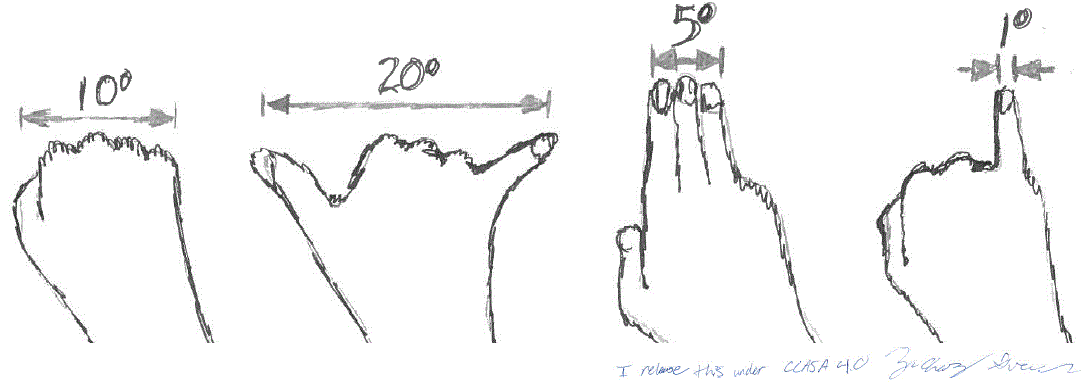
We use the figure below to estimate angles based on our outstretched hand at arm’s length:

Hence a vehicle that is 2m wide subtending an angle of 5 degrees (3 fingers at arm’s length) is about 23m away. At 1 degree (1 little finger at arm’s length) it is about 115m away.

Then measure the time T (in seconds) it takes to go from 3 fingers width (5 degrees) to 1 little finger width (1 degree) at arm’s length. Its relative speed in km/h is approximately given by

\displaystyle \frac{165\times \text{width of vehicle in metres}}{\text{T}}.\quad\quad(2)

For example, if a 2m-wide car takes 33 seconds to go from 3 fingers to 1 little finger width at arm’s length (115-23=92 m in distance), it is going 10km/h faster than I am.

To justify these formulas, the figure below shows segment BC of width w at distance d from A, subtending an angle of \theta. Using trigonometry we find d = (w/2)\cot (\theta/2). For small angles, \cot (\theta/2) \approx 2/\theta_r where \theta_r is measured in radians, an approximation that is only around 1% inaccurate even when \theta is as large as 20 degrees.

Formula (1) then follows from d = (w/2) \cot (\theta/2) \approx (w/2)\times (2/\theta_r) = w/\theta_r and the fact that angles \theta_r in radians are \pi/180 \approx 1/57 times angles \theta_d in degrees.

Formula (2) is true since we are covering a distance (w/2) \left( \cot \frac{1}{2}^{\circ} - \cot \frac{5}{2}^{\circ} \right) \approx (w/2)\frac{180}{\pi} \left( \frac{2}{1} - \frac{2}{5}\right) in time T. Multiplying this by 3.6 to convert from m/s to km/h gives us the approximate scale factor of 165.

The table below shows some sample values for a car with width 2m and truck with width 3m.

Angle subtended by object (degrees)Width of vehicle (m)Distance of object (m)Approximate distance using (1)2025.75.71021111522323121151140.022573057002038.58.61031717533434131721710.02386008550
Distance estimates based on the angle and width of an object.

The smallest angle of 0.02° (~1 minute) approximately corresponds to the smallest object we can resolve with the naked eye.

The next table shows estimates of receding speeds based on going from 5° to 1° of angular diameter.

Width of vehicle (m)Time (s) to go from 5° to 1°Estimated speed (km/h)231102566210332331035993105033315
Speed estimates based on the width and time taken to go from 5° down to 1°.

Reference:

https://en.wikipedia.org/wiki/Angular_diameter

ckrao
http://ckrao.wordpress.com/?p=6633
Extensions
Some cricket stats by test series
cricketsport
Below is a list of some statistics related to performances across test series. They are current up to 15 February 2022 31 December 2024. Data is from ESPNcricinfo. Most series playing 5 or more tests: AR Border (AUS) 15 RB Kanhai (WI) 14 IVA Richards (WI) 14 AJ Stewart (ENG) 13 GS Sobers (WI) 13 […]
Show full content

Below is a list of some statistics related to performances across test series. They are current up to 15 February 2022 31 December 2024. Data is from ESPNcricinfo.

Most series playing 5 or more tests:
AR Border (AUS)15RB Kanhai (WI)14IVA Richards (WI)14AJ Stewart (ENG)13GS Sobers (WI)13MA Atherton (ENG)13CA Walsh (WI)13DI Gower (ENG)12RN Harvey (AUS)12CG Greenidge (WI)12GA Gooch (ENG)12
Most series playing 3 or more tests:
SR Tendulkar (INDIA)44RT Ponting (AUS)39SR Waugh (AUS)39JM Anderson (ENG)39SK Warne (AUS)38AR Border (AUS)37R Dravid (INDIA)36AN Cook (ENG)35JE Root (ENG)34Javed Miandad (PAK)33ME Waugh (AUS)33JH Kallis (SA)32SCJ Broad (ENG)32N Kapil Dev (INDIA)31DPMD Jayawardene (SL)31
Most series played:
SR Tendulkar (INDIA)74JM Anderson (ENG)66S Chanderpaul (WI)60DPMD Jayawardene (SL)60M Muralitharan (SL)60JH Kallis (SA)60RT Ponting (AUS)59R Dravid (INDIA)59SCJ Broad (ENG)59TG Southee (NZ)57KC Sangakkara (SL)56SR Waugh (AUS)54ST Jayasuriya (SL)53Mushfiqur Rahim (BAN)53MV Boucher (SA)52LRPL Taylor (NZ)52A Kumble (INDIA)51Inzamam-ul-Haq (PAK)51DL Vettori (NZ)51KS Williamson (NZ)51
Most series scoring at least r runs:

(Click on the image to change r in Tableau.)

Most series taking at least w wickets:

(Click on the image to change w in Tableau.)

Most series scoring at least r runs and taking at least w wickets:

(Click on the image to change r and w in Tableau.)

Never batting having played in 3+ tests in a series:
CF Root (ENG)The Ashes (Australia in England), 1926GD McGrath (AUS)Sri Lanka in Australia Test Series, 1995/96PR Adams (SA)South Africa in New Zealand Test Series, 1998/99SL Malinga (SL)Bangladesh in Sri Lanka Test Series, 2007M Muralitharan (SL)Bangladesh in Sri Lanka Test Series, 2007JR Hazlewood (AUS)The Frank Worrell Trophy (West Indies in Australia), 2015/16NM Lyon (AUS)The Frank Worrell Trophy (West Indies in Australia), 2015/16JL Pattinson (AUS)The Frank Worrell Trophy (West Indies in Australia), 2015/16

All the above played 3 tests in the series – note that 3 players did not bat in the 2015/16 series.

Most consecutive series scoring at least 400 runs:
DG Bradman (AUS)6SM Gavaskar (INDIA)6AD Nourse (SA)5ED Weekes (WI)4RB Kanhai (WI)4CL Walcott (WI)3ED Weekes (WI)3GA Gooch (ENG)3GS Sobers (WI)3H Sutcliffe (ENG)3DCS Compton (ENG)3ER Dexter (ENG)3SJ McCabe (AUS)3B Mitchell (SA)3IR Redpath (AUS)3IVA Richards (WI)3
Most consecutive series taking at least 20 wickets:
MD Marshall (WI)7FS Trueman (ENG)6WJ O’Reilly (AUS)5WA Johnston (AUS)5EAS Prasanna (INDIA)4CV Grimmett (AUS)4FS Trueman (ENG)4AK Davidson (AUS)4DK Lillee (AUS)4
Most 50+ scores in a test series:
Player50+SeriesMatchesInnsNORunsHS100G Boycott (ENG)7The Ashes (England in Australia), 1970/715103657142*2RN Harvey (AUS)7South Africa in Australia Test Series, 1952/535908342054AD Nourse (SA)7South Africa in England Test Series, 19475906211492SM Gavaskar (INDIA)7India in West Indies Test Series, 1970/714837742204GS Chappell (AUS)7The Ashes (England in Australia), 1974/7561106081442EH Hendren (ENG)7England in West Indies Test Series, 1929/30482693205*2CL Walcott (WI)7Australia in West Indies Test Series, 195551008271555GA Faulkner (SA)7South Africa in Australia Test Series, 1910/1151007322042MA Taylor (AUS)7The Ashes (Australia in England), 198961118392192
Most 5-wicket hauls in a series:
Player5+SeriesMatchesInnsWktsBBIBBMAveEconSR10SF Barnes (ENG)7England in South Africa Test Series, 1913/1448499/10317/15910.932.3727.63TM Alderman (AUS)6The Ashes (Australia in England), 1989611416/12810/15117.362.6439.41CV Grimmett (AUS)5Australia in South Africa Test Series, 1935/36510447/4013/17314.591.8547.23Sir RJ Hadlee (NZ)5Trans-Tasman Trophy (New Zealand in Australia), 1985/8636339/5215/12312.152.3630.82SF Barnes (ENG)5South Africa in England Test Series, 191236348/2913/578.292.2022.53AV Bedser (ENG)5The Ashes (Australia in England), 1953510397/4414/9917.482.5740.71RM Hogg (AUS)5The Ashes (England in Australia), 1978/79611416/7410/6612.851.8142.42MW Tate (ENG)5The Ashes (England in Australia), 1924/25510386/9911/22823.182.0966.51AK Davidson (AUS)5The Frank Worrell Trophy (West Indies in Australia), 1960/6148336/5311/22218.542.6342.11
Most runs in a series without scoring 50:
PlayerRunsSeriesMatchesInnsNOHSVS Ransford (AUS)252The Ashes (England in Australia), 1911/12510243GM Ritchie (AUS)244The Ashes (England in Australia), 1986/8748246*JM Bairstow (ENG)238Anthony de Mello Trophy (England in India), 2023/24510039LC Braund (ENG)233The Ashes (England in Australia), 1907/08510149AE Relf (ENG)229England in South Africa Test Series, 1905/06510037JM Gregory (AUS)224The Ashes (England in Australia), 1924/25510145HA Gomes (WI)223West Indies in India Test Series, 1983/84610338Majid Khan (PAK)222India in Pakistan Test Series, 1978/7936047MHN Walker (AUS)221The Ashes (England in Australia), 1974/7568341*JH Edrich (ENG)218The Ashes (Australia in England), 1972510049
Most runs in a series without scoring a century:
PlayerRunsSeriesMatchesInnsNOHSAve500MA Atherton (ENG)553The Ashes (Australia in England), 199361209946.0860CC Hunte (WI)550The Frank Worrell Trophy (Australia in West Indies), 1964/6551018961.1160C Hill (AUS)521The Ashes (England in Australia), 1901/0251009952.1041GP Thorpe (ENG)506The Wisden Trophy (West Indies in England), 199561209442.1652RB Kanhai (WI)497The Wisden Trophy (West Indies in England), 19635909255.2240ER Dexter (ENG)481The Ashes (England in Australia), 1962/6351009948.1050GR Viswanath (INDIA)473India in Australia Test Series, 1977/785908952.5550HH Gibbs (SA)464Sir Vivian Richards Trophy (South Africa in West Indies), 2000/0151018751.5540TL Goddard (SA)454South Africa in Australia Test Series, 1963/6451039364.8540SL Campbell (WI)454The Wisden Trophy (West Indies in England), 199561009345.4040
Most wickets in a series without 5 in an innings:
PlayerWktsSeriesMatchesInnsBBIBBMAveEconSRPJ Cummins (AUS)29The Ashes (Australia in England), 20195104/327/10319.622.6943.6WM Clark (AUS)28India in Australia Test Series, 1977/78594/468/14725.032.6556.6J Garner (WI)27The Wisden Trophy (England in West Indies), 1985/865104/437/5816.142.7934.7MD Marshall (WI)27The Wisden Trophy (England in West Indies), 1985/865104/388/13217.852.8437.6SR Clark (AUS)26The Ashes (England in Australia), 2006/075104/727/9317.032.2744.8J Garner (WI)26The Wisden Trophy (West Indies in England), 19805104/307/7414.261.7449.0DK Lillee (AUS)25The Ashes (England in Australia), 1974/756114/498/11823.842.4458.4J Garner (WI)25Pakistan in West Indies Test Series, 1976/775104/488/14827.523.1352.6M Ntini (SA)25Basil D’Oliveira Trophy (England in South Africa), 2004/055104/507/17325.082.8353.1
Most wickets in a series without 10 in a match:
PlayerWktsSeriesMatchesInnsBBIBBM5-ferAveEconSRTM Alderman (AUS)42The Ashes (Australia in England), 19816126/1359/130421.262.7446.4MG Johnson (AUS)37The Ashes (England in Australia), 2013/145107/409/103313.972.7430.5WJ Whitty (AUS)37South Africa in Australia Test Series, 1910/115106/179/98217.082.7137.7GD McGrath (AUS)36The Ashes (Australia in England), 19976128/389/103219.472.8041.6BS Chandrasekhar (INDIA)35England in India Test Series, 1972/73598/799/107418.912.2749.9SF Barnes (ENG)34The Ashes (England in Australia), 1911/125105/448/140322.882.6152.4SK Warne (AUS)34The Ashes (Australia in England), 19936125/828/137125.791.9977.6SP Gupte (INDIA)34New Zealand in India Test Series, 1955/565107/1289/145419.671.8762.9G Giffen (AUS)34The Ashes (England in Australia), 1894/95596/1558/40324.112.3162.5
Most runs scored in a player’s lowest-scoring series:
PlayerRuns#SeriesBA Richards (SA)5081PGV van der Bijl (SA)4601DG Bradman (AUS)39611BL Irvine (SA)3531J Hardstaff snr (ENG)3111DS Steele (ENG)3082
Most wickets in lowest wicket-taking series:
Player Wkts#SeriesAS Kennedy (ENG)311GB Lawrence (SA)281WS Lees (ENG)261GF Bissett (SA)251GHT Simpson-Hayward (ENG)231
Most balls bowled in a series without taking a wicket:
PlayerBallsSeriesMatchesRunsEconJE Emburey (ENG)642Pakistan in England Test Series, 198742222.07RDB Croft (ENG)522South Africa in England Test Series, 199832112.42Arshad Ayub (INDIA)516India in Pakistan Test Series, 1989/9023003.48Harbhajan Singh (INDIA)486India in Pakistan Test Series, 2005/0623554.38JL Hopwood (ENG)462The Ashes (Australia in England), 193421552.01DB Pithey (SA)440South Africa in Australia Test Series, 1963/6432393.25WPUJC Vaas (SL)426Pakistan in Sri Lanka Test Series, 200031542.16MN Hart (NZ)426West Indies in New Zealand Test Series, 1994/9522563.60WER Somerville (NZ)414New Zealand in India Test Series, 2021/2222373.43R Illingworth (ENG)408New Zealand in England Test Series, 197331392.04
Most times the leading run-scorer in a series (both teams):
KC Sangakkara (SL)14SR Tendulkar (IND)11KS Williamson (NZ)11JE Root (ENG)11JH Kallis (SA)10BC Lara (WI)9RT Ponting (AUS)9Javed Miandad (PAK)8GC Smith (SA)8GA Gooch (ENG)8SM Gavaskar (IND)8FDM Karunaratne (SL)8DPMD Jayawardene (SL)8
Most times the leading run-scorer in a series (for their team):
SR Tendulkar (IND)20KC Sangakkara (SL)19JE Root (ENG)18BC Lara (WI)17R Dravid (INDIA)16JH Kallis (SA)15KS Williamson (NZ)15LRPL Taylor (NZ)14SM Gavaskar (IND)13Tamim Iqbal (BAN)12S Chanderpaul (WI)12DPMD Jayawardene (SL)12SP Fleming (NZ)12Javed Miandad (PAK)12Younis Khan (PAK)12
Most times the leading wicket taker in a series (for both teams):
M Muralitharan (SL)30A Kumble (IND)23R Ashwin (IND)20Sir RJ Hadlee (NZ)18DW Steyn (SA)16SK Warne (AUS)16HMRKB Herath (SL)13JM Anderson (ENG)12M Ntini (SA)10GD McGrath (AUS)10K Rabada (SA)10SCJ Broad (ENG)10
Most times the leading wicket taker in a series (for their team):
M Muralitharan (SL)41A Kumble (IND)27Sir RJ Hadlee (NZ)25R Ashwin (IND)24DW Steyn (SA)21SCJ Broad (ENG)20SK Warne (AUS)19HMRKB Herath (SL)19JM Anderson (ENG)19
Most series playing in at least 3 tests and averaging at least 100 with the bat:
RT Ponting (AUS)6Javed Miandad (PAK)5SPD Smith (AUS)5DG Bradman (AUS)4SR Waugh (AUS)4GS Sobers (WI)4SR Tendulkar (INDIA)4AB de Villiers (SA)3R Dravid (INDIA)3V Kohli (INDIA)3S Chanderpaul (WI)3KC Sangakkara (SL)3
Most series playing at least 3 tests and averaging at most 20 with the ball (minimum 5 wickets):
GD McGrath (AUS) 12JM Anderson (ENG)10CEL Ambrose (WI)9Imran Khan (PAK)9Sir RJ Hadlee (NZ)9MD Marshall (WI)8SK Warne (AUS)8M Muralitharan (SL)8Wasim Akram (PAK)7AA Donald (SA)7CA Walsh (WI)7
Lowest bowling strike rate in a series (minimum 10 wickets):
PlayerSRSeriesMatchesInnsWktsAveBBIBBM5 10 ND Hirwani (INDIA)12.6West Indies in India Test Series, 1987/8812168.508/6116/13621FE Woolley (ENG)14.0The Ashes (Australia in England), 191233105.505/2010/4921Danish Kaneria (PAK)14.0Asian Test Championship (Bangladesh, Pakistan, Sri Lanka in Pakistan/Sri Lanka), 2001/0212127.836/4212/9421GA Lohmann (ENG)14.8England in South Africa Test Series, 1895/9636355.809/2815/4542MN Samuels (WI)15.0Clive Lloyd Trophy (Zimbabwe in West Indies), 2012/1323106.304/136/5000JO Holder (WI)16.0Bangladesh in West Indies Test Series, 201824168.936/5911/10321SR Watson (AUS)16.2MCC Spirit of Cricket Test Series (Australia, Pakistan in England), 2010241110.636/336/5120DW Steyn (SA)16.8New Zealand in South Africa Test Series, 2007/0824209.206/4910/9132R Peel (ENG)18.4The Ashes (Australia in England), 188836247.547/3111/6811FR Spofforth (AUS)18.4England in Australia Test Match, 1878/7912138.467/6213/11021FR Spofforth (AUS)18.5Australia in England Test Match, 188212146.427/4414/9021IK Pathan (INDIA)18.6India in Zimbabwe Test Series, 2005242111.287/5912/12631J Briggs (ENG)18.6England in South Africa Test Series, 1888/8924214.808/1115/2821
Lowest bowling average in a series (minimum 10 wickets):
PlayerAveSeriesMatchesInnsWktsSRBBIBBM510J Briggs (ENG)4.80England in South Africa Test Series, 1888/89242118.68/1115/2821FE Woolley (ENG)5.50The Ashes (Australia in England), 1912331014.05/2010/4921WPUJC Vaas (SL)5.53West Indies in Sri Lanka Test Series, 2005231322.96/227/5010GA Lohmann (ENG)5.80England in South Africa Test Series, 1895/96363514.89/2815/4542MN Samuels (WI)6.30Clive Lloyd Trophy (Zimbabwe in West Indies), 2012/13231015.04/136/5000FR Spofforth (AUS)6.42Australia in England Test Match, 1882121418.57/4414/9021JJ Ferris (ENG)7.00England in South Africa Test Match, 1891/92121320.97/3713/9121Shoaib Akhtar (PAK)7.09Pakistan in New Zealand Test Series, 2003/04121121.06/3011/7821CTB Turner (AUS)7.25The Ashes (England in Australia), 1887/88121229.37/4312/8721CV Grimmett (AUS)7.45The Ashes (England in Australia), 1924/25121122.86/3711/8221GAR Lock (ENG)7.47New Zealand in England Test Series, 19585103431.07/3511/6531R Peel (ENG)7.54The Ashes (Australia in England), 1888362418.47/3111/6811
Most runs without being dismissed:
PlayerRunsSeriesMatchesInnsNOHS10050JH Kallis (SA)388South Africa in Zimbabwe Test Series, 2001/02233189*20AC Voges (AUS)375The Frank Worrell Trophy (West Indies in Australia), 2015/16322269*20LRPL Taylor (NZ)364New Zealand in Zimbabwe Test Series, 2016233173*21JH Edrich (ENG)310New Zealand in England Test Series, 1965111310*10S Chanderpaul (WI)270Bangladesh in West Indies Test Series, 2014233101*12SR Waugh (AUS)256Bangladesh in Australia Test Series, 2003222156*20IR Bell (ENG)227Bangladesh in England Test Series, 2005222162*11AG Prince (SA)221Bangladesh in South Africa Test Series, 2008/09222162*11JH Kallis (SA)214Bangladesh in South Africa Test Series, 2002/03222139*11Mushfiqur Rahim (BAN)203Zimbabwe in Bangladesh Test Match, 2019/20111203*10DSBP Kuruppu (SL)201New Zealand in Sri Lanka Test Series, 1987111201*10
Highest finite batting average:
PlayerAveSeriesMatchesInnsNOHS10050WR Hammond (ENG)563.0England in New Zealand Test Series, 1932/33221336*20HM Amla (SA)490.0South Africa in India Test Series, 2009/10232253*30DA Warner (AUS)489.0Pakistan in Australia Test Series, 2019/20221335*20R Dravid (INDIA)432.0Zimbabwe in India Test Series, 2000/01232200*21KC Sangakkara (SL)428.0Bangladesh in Sri Lanka Test Series, 2007332222*20DJ Cullinan (SA)427.0South Africa in New Zealand Test Series, 1998/99332275*20HP Tillakaratne (SL)403.0West Indies in Sri Lanka Test Series, 2001/02343204*21SR Waugh (AUS)362.0Sri Lanka in Australia Test Series, 1995/9623217021S Chanderpaul (WI)354.0West Indies in Bangladesh Test Series, 2012/13232203*20IR Bell (ENG)331.0Sri Lanka in England Test Series, 2011343119*22Inzamam-ul-Haq (PAK)329.0New Zealand in Pakistan Test Series, 200211032910Younis Khan (PAK)313.0Sri Lanka in Pakistan Test Series, 2008/0921031310RR Sarwan (WI)301.0Bangladesh in West Indies Test Series, 2004221261*10
Five or more innings in a series scoring 50+ each time:
PlayerInnsSeriesMatchesNORunsHSAve10050KD Walters (AUS)6The Frank Worrell Trophy (West Indies in Australia), 1968/6940699242116.5042GS Sobers (WI)5West Indies in India Test Series, 1966/673234295114.0005S Chanderpaul (WI)5The Wisden Trophy (West Indies in England), 200732446136*148.6623MA Taylor (AUS)5Pakistan in Australia Test Series, 1989/9031390101*97.5023Mohammad Yousuf (PAK)5West Indies in Pakistan Test Series, 2006/0730665192133.0041CH Lloyd (WI)5The Wisden Trophy (England in West Indies), 1980/814038310076.6014Inzamam-ul-Haq (PAK)5England in Pakistan Test Series, 2005/0631431109107.7523
Taking 5+ wickets each time in 3 or more innings of a series:
PlayerInnsSeriesMatchesWktsAveSRBBIBBM510CTB Turner (AUS)4The Ashes (Australia in England), 188832112.4231.26/11210/6341Saqlain Mushtaq (PAK)4Pakistan in India Test Series, 1998/9922020.1544.95/9310/18742
Averaging at least 50 with the bat and at most 20 with the ball (min 100 runs, 15 wickets):
PlayerSeriesMatchesBatInnsRunsBatAveBowlInnsWktsBowlAveImran Khan (PAK)India in Pakistan Test Series, 1982/836524761.75104013.95SCJ Broad (ENG)Pataudi Trophy (India in England), 20114418260.6682513.84H Verity (ENG)England in India Test Series, 1933/343312160.5062316.82Imran Khan (PAK)Pakistan in England Test Series, 19823521253.0062118.57W Barnes (ENG)The Ashes (England in Australia), 1884/855836952.7171915.36IT Botham (ENG)England in New Zealand Test Series, 1977/783521253.0061718.29JH Kallis (SA)West Indies in South Africa Test Series, 1998/9951048569.28101717.58CL Cairns (NZ)West Indies in New Zealand Test Series, 1999/002210351.504179.94TT Bresnan (ENG)Pataudi Trophy (India in England), 20113315477.0061616.31JM Gregory (AUS)Australia in South Africa Test Series, 1921/223420551.2561518.93MG Bevan (AUS)The Frank Worrell Trophy (West Indies in Australia), 1996/974727555.0061517.66

ckrao
http://ckrao.wordpress.com/?p=6491
Extensions
Calculating the locations of stars in the sky
geographymathematicsscience
We present here a calculation of the location of a star as a function of its declination, the observer’s latitude and time after it is at its highest position in the sky. We use the fact that stars trace out circular paths about a fixed point in the sky. The image below shows a celestial […]
Show full content

We present here a calculation of the location of a star as a function of its declination, the observer’s latitude and time after it is at its highest position in the sky. We use the fact that stars trace out circular paths about a fixed point in the sky.

Photo by Patrick McManaman on Unsplash

The image below shows a celestial sphere centred on an observer at the location O. Assume the observer is in the northern hemisphere and the point A represents the north celestial pole about which the stars appear to rotate anti-clockwise as the earth rotates on its axis (in the southern hemisphere stars rotate clockwise about the south celestial pole). The red ellipse illustrates the circular path of a star over a 24-hour period – point B is its highest location while point C is where it will be after a quarter of a day. Also shown in the diagram are axes OA (pointing east), OY (pointing north), OZ (pointing directly overhead) and corresponding unit basis vectors \mathbf{i}, \mathbf{j} and \mathbf{k}.

A celestial sphere centred on an observer at the location O

Our aim is to find the location of the star (in 3-dimensional coordinates) on the red circle given:

  • t – the time (as a proportion of a day) after the star has reached its highest point
  • \delta – the angle of declination of the star (-90° to 90°) – the angle between the star and the celestial equator (which is the earth’s equator projected skyward)
  • \phi – the latitude of the observer (-90° to 90°)

The point A is fixed as the earth rotates and in the north direction with an angle of elevation equal to the location’s latitude. Hence we may write

\displaystyle \vec{OA} = 0\ \mathbf{i} + \cos \phi\  \mathbf{j} + \sin \phi\  \mathbf{k}.\quad\quad ...(1)

Next consider the angle between OA and OB. If \delta = 90^{\circ}, we would have a northern pole star and \angle AOB = 0^{\circ}. If \delta = 0^{\circ} we would have a star on the celestial equator and \angle AOB = 90^{\circ}. More generally,

\displaystyle \angle AOB = 90^{\circ}-\delta. \quad\quad ...(2)

The point B has an angle of elevation of \phi + 90^{\circ}-\delta, hence we have

\displaystyle \begin{aligned}\vec{OB} &= 0\ \mathbf{i} + \cos (\phi + 90^{\circ}-\delta )  \mathbf{j} + \sin (\phi + 90^{\circ}-\delta ) \mathbf{k}\\ &= \sin (\delta - \phi ) \mathbf{j} + \cos (\delta - \phi ) \mathbf{k}. \quad \quad ...(3)\end{aligned}

The circular path of the star can be regarded as a point traced around by a line having fixed angle (90^{\circ}-\delta) from the fixed line OA. This circle has its centre at the point A^{'} which is the projection of OB onto the segment OA. Note that A^{'} does not lie on the sphere but A, B and C do. We have

\displaystyle \vec{OA^{'}} = \cos (90^{\circ}-\delta) \vec{OA} = \sin \delta  \quad\quad ...(4)

and

\displaystyle |\vec{A^{'}B}| = \cos \delta.\quad\quad ...(5)

We parameterise any point on this circular path by expressing it in terms of the basis vectors \vec{A^{'}B} and \vec{A^{'}C}. For any point P on the path we can write

\displaystyle \vec{A^{'}P} = \cos  2\pi t\ \vec{A^{'}B} + \sin  2 \pi t\ \vec{A^{'}C}, \quad t \in [0, 1].\quad\quad ...(6)

For example,

  • if t = 0, \vec{A^{'}P} = \vec{A^{'}B}
  • if t = 0.25, \vec{A^{'}P} = \vec{A^{'}C}
  • if t = 0.5, \vec{A^{'}P} = -\vec{A^{'}B}
  • if t = 0.75, \vec{A^{'}P} = -\vec{A^{'}C}

Since A^{'}C has the same length as |\vec{A^{'}B}| and is pointing directly west (i.e. perpendicular to both \vec{OA} and \vec{OB}), we have from (5):

\vec{A^{'}C} = -\cos \delta\ \mathbf{i}.\quad\quad ...(7)

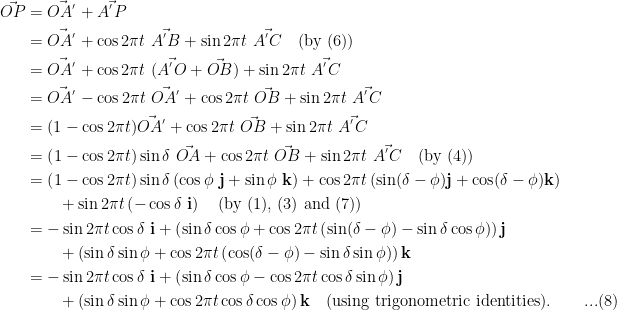
We now have all the ingredients we need to find \vec{OP}:

\displaystyle\begin{aligned}\vec{OP} &= \vec{OA^{'}} + \vec{A^{'}P}\\&= \vec{OA^{'}} + \cos  2\pi t\ \vec{A^{'}B} + \sin  2 \pi t\ \vec{A^{'}C}\quad \text{(by (6))}\\&=\vec{OA^{'}} + \cos  2\pi t\ (\vec{A^{'}O} + \vec{OB}) + \sin  2 \pi t\ \vec{A^{'}C}\\&= \vec{OA^{'}} - \cos  2\pi t\ \vec{OA^{'}} + \cos  2\pi t\ \vec{OB} + \sin  2 \pi t\ \vec{A^{'}C}\\&= (1- \cos  2\pi t) \vec{OA^{'}} + \cos  2\pi t\ \vec{OB} + \sin  2 \pi t\ \vec{A^{'}C}\\&=\left(1 - \cos  2\pi t \right)\sin \delta\ \vec{OA} + \cos  2\pi t\ \vec{OB} + \sin  2 \pi t\ \vec{A^{'}C}\quad\text{(by (4))}\\&=\left(1 - \cos  2\pi t \right)\sin \delta \left(\cos \phi\  \mathbf{j} + \sin \phi\  \mathbf{k}\right) + \cos  2\pi t \left(\sin (\delta - \phi) \mathbf{j} + \cos (\delta - \phi) \mathbf{k} \right)\\&\quad\quad +  \sin  2 \pi t \left(-\cos \delta\ \mathbf{i} \right)\quad\text{(by (1), (3) and (7))}\\&=-\sin 2\pi t \cos \delta\ \mathbf{i} + \left(\sin \delta \cos \phi + \cos 2\pi t \left( \sin (\delta - \phi ) - \sin \delta \cos \phi \right) \right) \mathbf{j}\\&\quad\quad + \left( \sin \delta \sin \phi + \cos 2 \pi t \left( \cos (\delta - \phi ) - \sin \delta \sin \phi \right) \right) \mathbf{k}\\&=-\sin 2\pi t \cos \delta\ \mathbf{i} + \left( \sin \delta \cos \phi - \cos 2\pi t \cos \delta \sin \phi \right) \mathbf{j}\\&\quad\quad + \left(\sin \delta \sin \phi + \cos 2 \pi t \cos \delta \cos \phi  \right) \mathbf{k}\quad\text{(using trigonometric identities).}\quad\quad ...(8)\end{aligned}

In this formula, the angle of elevation \theta is found by setting \sin \theta equal to the \mathbf{k}-component, or

\displaystyle \theta = \arcsin \left(\sin \delta \sin \phi + \cos 2 \pi t \cos \delta \cos \phi \right).\quad \quad ...(9)

Let us test out formula (8) in some special cases:

  • If \delta = 90^{\circ} we recover the formula \vec{OP} = \cos \phi\ \mathbf{j} + \sin \phi\ \mathbf{k} = \vec{OA}, the fixed location of the pole star.
  • If \delta = 0^{\circ} we recover the formula \vec{OP} = -\sin 2 \pi t\ \mathbf{i} - \cos 2\pi t \left(\sin \phi\ \mathbf{j} - \cos \phi\ \mathbf{k} \right). This traces a circle with diameter joining -\sin \phi \ \mathbf{j} + \cos \phi\ \mathbf{k} and \sin \phi \ \mathbf{j} - \cos \phi\ \mathbf{k} (two antipodal points), hence it is a great circle on the celestial sphere.

  • If \phi = 0^{\circ} (observer on the equator) we obtain \vec{OP} = -\sin 2\pi t \cos \delta\ \mathbf{i} + \sin \delta   \mathbf{j} +  \cos 2 \pi t \cos \delta\ \mathbf{k}, hence the \mathbf{j}-component remains fixed and a circular path is traced.
  • If \phi = 90^{\circ} (observer at the north pole) we obtain \vec{OP} = -\sin 2\pi t \cos \delta\ \mathbf{i} - \cos 2\pi t \cos \delta\ \mathbf{j} + \sin \delta\ \mathbf{k}, hence the star traces out a circle with constant angle of elevation.

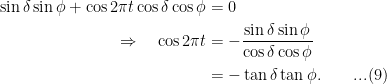
We can also determine the times at which a star rises or sets by setting the \mathbf{k}-component of position in (8) to 0:

\displaystyle \begin{aligned} \sin \delta \sin \phi + \cos 2 \pi t \cos \delta \cos \phi &= 0\\ \Rightarrow \quad \cos 2 \pi t &= -\frac{\sin \delta \sin \phi }{\cos \delta \cos \phi }\\&= -\tan \delta \tan \phi.\quad \quad ...(9)\end{aligned}

This is the so-called sunrise equation and was derived differently in an earlier blog post in [1].

Next let us look at the case when the star is our sun. The declination changes during the year between -23.4° and +23.4° (earth’s axial tilt) between the winter and summer soltice (for the northern hemisphere) as the earth revolves around the sun. Assume that the centre of the sun is at the origin and that earth’s orbit is the x-y plane having the form r = R(\cos 2 \pi s\ \mathbf{i} + \sin 2\pi s\ \mathbf{j}) (assuming a circular orbit with radius R starting at R\ \mathbf{i} at s=0). The parameter s here represents the fraction of year after the winter solstice. Earth’s axis of rotation points in the direction a = \sin 22.4^{\circ}\ \mathbf{i} + \cos 22.4^{\circ}\ \mathbf{k}, being tilted away from the sun in the north when s = 0.

From the earth’s point of view the sun is in the direction -\hat{r} = -(\cos 2 \pi s\ \mathbf{i} + \sin 2\pi s\ \mathbf{j}). Then the angle (90 - \delta) between the sun’s position and the earth’s axis satisfies

\displaystyle \begin{aligned}\sin \delta = \cos (90 - \delta) &= -\hat{r} . a\\&= -(\cos 2 \pi s\ \mathbf{i} + \sin 2\pi s\ \mathbf{j}).(\sin 22.4^{\circ}\ \mathbf{i} + \cos 22.4^{\circ}\ \mathbf{k})\\&=  -\sin 22.4^{\circ}\cos 2 \pi s\\ \Rightarrow \delta &= \arcsin (-\sin 22.4^{\circ}\cos 2 \pi s)\\ &\approx \arcsin(-0.398 \cos 2 \pi s).\quad\quad ...(10) \end{aligned}

For example if s = 0, we have \delta = -22.4^{\circ}. If s = 0.25, 0.75, we have the equinoxes and \delta = 0^{\circ}. Finally if s = 0.5 then \delta = 22.4^{\circ}.

Substituting (10) into (8) gives the location of the sun given the time of year and time relative to when it’s at its highest point in the sky (solar noon). Note that the equation is not perfect since it does not take into account atmospheric refraction or the fact that the earth’s orbit is not perfectly circular and therefore the earth is not uniform in speed. For more exercises on the length of days based on latitude and the sun’s angle of declination refer to [2].

Finally, we can determine the bearing of a star when it rises or sets in the following manner. The position P of the sun is in the x-y plane and so has the form

\displaystyle \vec{OP} = x\ \mathbf{i} + y\ \mathbf{j}.\quad\quad ...(11)

Secondly \angle POA = 90^{\circ} - \delta and hence

\displaystyle \begin{aligned}\sin \delta &= \cos (90^{\circ} - \delta)\\ &= \vec{OP}.\vec{OA}\quad \text{(the dot product of two unit vectors is cosine of the angle between them)}\\ &= (x\ \mathbf{i} + y\ \mathbf{j}).(\cos \phi\  \mathbf{j} + \sin \phi\  \mathbf{k})\quad\quad\text{(from (1) and (11))}\\&=y \cos \phi.\quad\quad ...(12)\end{aligned}

Hence y = \sin \delta/\cos \phi. For example taking the sun on the summer solstice at Melbourne, Australia we have \delta = -22.4^{\circ}, \phi = -38^{\circ} and so y = \sin (-22.4^{\circ})/\cos(-38^{\circ})  \approx -0.484. This corresponds to a bearing of \arcsin(0.484) + 90^{\circ} \approx 119^{\circ}, around 20 degrees south of east. The answer given in timeanddate.com is 121^{\circ}, slightly more perhaps because it takes into account refraction and the fact that the sun is not pointlike.

Reference

[1] The Shortest Day of the Year, Chaitanya’s Random Pages – https://ckrao.wordpress.com/2012/06/23/the-shortest-day-of-the-year/

[2] Alan Champneys, The Length of Dayshttps://www.bristol.ac.uk/media-library/sites/engineering/engineering-mathematics/documents/modelling/teacher/daylength_t.pdf

ckrao
http://ckrao.wordpress.com/?p=6416
Extensions
International men’s cricket match streaks
Uncategorizedcricketsport
I have created a few interactive charts with Tableau on winning/losing/drawing international men’s cricket streaks using data from ESPNcricinfo.com’s Statsguru. You can click on any of the links or graphs to interact with it in a new page. 1. Most consecutive tests played with N matches of a given result (won/lost/drawn) 2. Fewest consecutive tests […]
Show full content

I have created a few interactive charts with Tableau on winning/losing/drawing international men’s cricket streaks using data from ESPNcricinfo.com’s Statsguru. You can click on any of the links or graphs to interact with it in a new page.

1. Most consecutive tests played with N matches of a given result (won/lost/drawn)

2. Fewest consecutive tests played with N matches of a given result (won/lost/drawn)

3. Most consecutive one-day internationals played with N matches of a given result (won/lost/drawn)

4. Fewest consecutive one-day internationals played with N matches of a given result (won/lost/drawn)

5. Most consecutive T20 internationals played with N matches of a given result (won/lost/drawn)

6. Fewest consecutive T20 internationals played with N matches of a given result (won/lost/drawn)

Here are a few observations.

Tests:

  • Largely due to timeless tests in Australia up to World War II, Australia had 0 drawn tests at home Australia for 87 consecutive tests until 1946. For similar reasons England had 0 drawn tests away from home for 66 consecutive tests up to 1914 when they drew in South Africa.
  • The top streaks without a loss for any team anywhere are 27, 26 and 25 by West Indies (1982-84), England (1968-71) and Australia (1946-51) respectively.
  • England amazingly lost only 1 test away from home in 40 matches between 1963 and 1972.
  • At home Pakistan lost only 1 test out of 40 from 1969 to 1986 while India only lost once in a span of 35 tests between 2012 and 2019.
  • West Indies lost only 2 out of 53 tests between 1980 and 1986 and just 10 out of 100 from 1976 to 1988.
  • Australia won 12 consecutive tests at home between 1999 and 2001 and 49 out of 61 home tests between 1998 and 2008. India is not far behind with 40 out of 53 home test wins from 2010 to 2021.
  • In any ground Australia won 76 out of 100 tests between 1999 and 2008.
  • South Africa has played 32 consecutive matches (anywhere) without a draw from 2017, an active streak. The next best is 26 by Zimbabwe from 2005 to 2017.
  • New Zealand has an impressive active streak of 17 matches without a loss dating back to 2017 with 8 of their 13 wins by an innings.

One-day Internationals:

  • Australia lost just 2 matches out of 32 anywhere between 2002 and 2003.
  • India lost only 1 match out of 16 away from home between 2016 and 2018.
  • West Indies lost only 7 matches out of 50 in away or neutral grounds between 1981 and 1985.
  • Four teams have won 16 consecutive ODIs at home – Australia (2014-16), South Africa (2016-17), Sri Lanka (1996-98) and West Indies (1986-90). The best is 18 by Australia and Sri Lanka.
  • Australia (1999-2004), Sri Lanka (1994-2004) and South Africa (1994-2001) all won 53/65 matches at home.

T20 Internationals:

  • Afghanistan and Romania share the record of consecutive wins (12).
  • Zimbabwe had 16 consecutive losses (2010-13).
  • Afghanistan (2016-19) and Pakistan (2017-18) have both won 23 out of 26 consecutive games.
  • Afghanistan won 40 out of 50 matches (2014-19).
ckrao
http://ckrao.wordpress.com/?p=6392
Extensions
An identity involving the product of reciprocals
mathematics
In this post I would like to prove the following identity, motivated by this tweet. The first of these equalities is straightforward by the definition of binomial coefficients. To prove the second, we make use of partial fractions. We write the expansion where the coefficients are to be determined. Multiplying both sides by for some […]
Show full content

In this post I would like to prove the following identity, motivated by this tweet.

\displaystyle n! \prod_{k=0}^n \frac{1}{x+k} = \frac{1}{x\binom{x+n}{n}} = \sum_{k=0}^n \frac{(-1)^k \binom{n}{k}}{x+k}

The first of these equalities is straightforward by the definition of binomial coefficients. To prove the second, we make use of partial fractions. We write the expansion

\displaystyle \prod_{k=0}^n \frac{1}{x+k} = \sum_{k=0}^n \frac{A_k}{x+k},

where the coefficients A_k are to be determined. Multiplying both sides by (x+k') for some k' \in \{0, 1, \ldots, n\},

\displaystyle \begin{aligned} (x+k') \prod_{k=0}^n \frac{1}{x+k} &= \sum_{k=0}^n \frac{A_k(x+k')}{x+k}\\\hbox{i.e.}\quad \prod_{\substack{k=0\\k \neq k'}}^n \frac{1}{x+k} &= A_{k'} + \sum_{\substack{k=0\\k \neq k'}}^n \frac{A_k(x+k')}{x+k}.\end{aligned}

Then setting x = -k in both sides gives

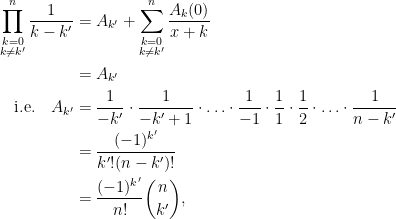
\displaystyle \begin{aligned} \prod_{\substack{k=0\\k \neq k'}}^n \frac{1}{k-k'} &= A_{k'} + \sum_{\substack{k=0\\k \neq k'}}^n \frac{A_k(0)}{x+k}\\&= A_{k'}\\\hbox{i.e.}\quad A_{k'} &= \frac{1}{-k'} \cdot \frac{1}{-k'+1}\cdot \ldots \cdot \frac{1}{-1} \cdot \frac{1}{1}\cdot \frac{1}{2}\cdot \ldots \cdot \frac{1}{n-k'}\\&= \frac{(-1)^{k'}}{k'! (n-k')!}\\&= \frac{(-1)^{k'}}{n!} \binom{n}{k'},\end{aligned}

leading to the desired result.

As a few examples of this identity we have:

\displaystyle \begin{aligned}n=1&:& \frac{1}{x(x+1)} &= \frac{1}{x} - \frac{1}{x+1}\\n = 2&:& \frac{1}{x(x+1)(x+2)} &= \frac{1}{2} \left[  \frac{1}{x} - \frac{2}{x+1} + \frac{1}{x+2} \right]\\n=3&:& \frac{1}{x(x+1)(x+2)(x+3)} &= \frac{1}{6} \left[ \frac{1}{x} - \frac{3}{x+1} + \frac{3}{x+2} - \frac{1}{x+3}\right] \end{aligned}

I had previously posted an identity with similar, but trickier derivation here.

ckrao
http://ckrao.wordpress.com/?p=6332
Extensions
Charting Test and ODI cricket performances over consecutive innings
cricketsport
Adding to my earlier blog post about the highest proportion of test scores above m after n innings, I have created some new interactive charts for best streaks early and mid-career in both bowling and batting in tests and ODIs. The data is mostly from https://data.world/cclayford/cricinfo-statsguru-data. 1. Test batting Most runs in at most n consecutive […]
Show full content

Adding to my earlier blog post about the highest proportion of test scores above m after n innings, I have created some new interactive charts for best streaks early and mid-career in both bowling and batting in tests and ODIs. The data is mostly from https://data.world/cclayford/cricinfo-statsguru-data.

1. Test batting 2. Test bowling 3. ODI batting 4. ODI bowling

Below are shown a few sample charts. Clicking on the chart will take you to a new page where you can interact further.

Test batting:

Two players had a batting average over 100 after 10 test innings
A player’s stats can be viewed by opposition.

Test bowling:

Jason Holder has had an all-time great low bowling average over 20 consecutive innings, Steve Waugh also features here.
Early players dominate the list of fastest to 5 6-wicket hauls in tests.

ODI batting:

Kohli averaged almost 70 per innings over 50 consecutive innings, Warner also has also done very well from 2016-2019.
Shahid Afridi’s maintained this high a batting strike rate over 50 innings between 2004 and 2007.

ODI bowling:

Rashid Khan took 11 more wickets than the next best over 30 consecutive innings.
Over 100 ODI innings, Muralitharan averaged more than 2 better than the next best.
ckrao
http://ckrao.wordpress.com/?p=6287
Extensions
The largest parallelogram in a triangle
mathematics
In this post we find the largest parallelogram, rhombus, rectangle and square that can be contained in a given triangle. We will see that in the first three cases we can achieve half the area of the triangle but no more, while it is generally less than this for a square. 1. The largest parallelogram […]
Show full content

In this post we find the largest parallelogram, rhombus, rectangle and square that can be contained in a given triangle. We will see that in the first three cases we can achieve half the area of the triangle but no more, while it is generally less than this for a square.

Inscribing a parallelogram, rhombus, rectangle and square of maximum area in a triangle
1. The largest parallelogram inside a triangle

It can be readily seen that one can obtain a parallelogram having half the area of a triangle by connecting a vertex with the three midpoints of the sides. (This has half the base length of the triangle and half its height.)

Is it possible to obtain a larger parallelogram? As outlined in [1], if two or fewer vertices of the parallelogram are on sides of the triangle, a smaller similar triangle can be created by drawing a line parallel to the triangle’s side through a vertex of the parallelogram that is interior triangle. (This is done three times in the figure below.) This reduces the problem to the next case.

A smaller similar triangle containing the parallelogram can be created by lines through its vertices parallel to the sides of the triangle

We are left to consider the case where three or more vertices of the parallelogram on the triangle. We can draw a line from a vertex to the opposite side parallel to a pair of sides (in the figure below AH is drawn parallel to DG), thus dissecting the triangle into two. Each of the smaller triangles then has an inscribed parallelogram where two of the vertices are on a side of each triangle. Then by drawing lines parallel to sides if required, we create two sub-problems each having four vertices of the parallelogram on the sides of the triangle.

Dissecting a triangle so that each smaller triangle has a parallelogram with two vertices on a side. The right parallelogram is contained in a larger one HIEJ formed by lines parallel to the sides.

Finally, if all four vertices of the parallelogram are on sides of the triangle, by the pigeonhole principle, two of them are on a side (say BC as shown in the figure below). In this figure, if we let AD/AB = k and the height of ABC from BC be h_a, then by the similarity of triangles ADE and ABC, DE = k.BC and \triangle ADE has height kh_a. Then the area of the parallelogram DEFG is DE \times (1-k)h_a = k(1-k) DE.h_a which is 2k(1-k) times the area of \triangle ABC. This quantity has maximum value 1/2 when k=1/2 so we conclude that the parallelogram does not exceed half the triangle’s area.

A parallelogram with all four vertices on sides of a triangle must have two of them on one side.
2. The largest rhombus in a triangle

Constraining sides of the parallelogram to be equal (forming a rhombus), we claim that the largest rhombus that can be inscribed in a triangle is also half its area. This can be formed with two of the vertices on the second longest side of the triangle. Suppose a \geq b \geq c are the sides of the triangle with b=AC the second longest side length. Then let the segment MN joining the midpoints of AB and BC form one side of the rhombus of length b/2. It remains to be shown that there exist parallel segments of this same length from M, N to AC. The longest possible such segment has length NC = a/2 and the shortest has length h_b/2, half the length of the altitude of \triangle ABC from B. We wish to show that h_b/2 \leq b/2 \leq a/2. This follows from

\displaystyle h_b = c \sin A \leq c \leq b \leq a.

Inscribing a rhombus of maximal area in a triangle

The area of this rhombus is clearly half the area of the triangle as it has half the length of its base and half the height.

3. The largest rectangle in a triangle

Here if BC is the longest side of the triangle we form the rectangle from midpoints D, E of AB and AC respectively, dropping perpendiculars onto BC forming rectangle DEFG:

The largest rectangle inscribed in a triangle, where D and E are midpoints

The area of this rectangle is half the area of the triangle as it has half the length of its base and half the height.

Interestingly the reflections of the vertices of the triangle in the sides of the rectangle coincide, showing a paper folding interpretation of this result [2].

Reflecting A, B and C in DE, DG and EF respectively yields the same image, yielding a paper folding interpretation

Since rhombuses and rectangles are special cases of parallelograms and we found that inscribed parallelograms in a triangle occupy no more than half its area, the rhombus and rectangle constructions here are optimal.

4. The largest square in a triangle

Here we shall see that the best we can do may not be half the area of the triangle. As before, if two or fewer vertices of the square are not on the sides of the triangle it is possible to scale up the square (or scale down the triangle) so that three of the square’s vertices are on the sides. We claim that the largest square must have two of its vertices on a side of the triangle. Suppose this is not the case and we have the figure below.

Squares with a vertex on each side of \triangle ABC pivot about the point P

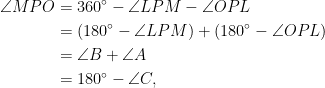
Consider squares LMNO inscribed in \triangle ABC so that one vertex L is on AB, M is on BC and O is on CA. We claim that the largest such square is either DEFG (two vertices on BC) or HIJK (two vertices on AC). Suppose on the contrary that neither of these squares is the largest. Then we make use of the fact that all 90-45-45 triangles LMO inscribed in \triangle ABC have a common pivot point P. This is the point at the intersection of the circumcircles of triangles OAL, LBM and MCO. To show these circles intersect at a single point, we can prove that if the circumcircles of triangles OAL and LBM intersect at P then the points O,P,M,C are cyclic by the following equality:

\displaystyle \begin{aligned} \angle MPO &= 360^{\circ} - \angle LPM - \angle OPL\\ &= (180^{\circ} - \angle LPM) + (180^{\circ} - \angle OPL)\\ &= \angle B + \angle A \\ &= 180^{\circ} - \angle C,\end{aligned}

where the second last equality makes use of quadrilaterals BMPL, ALPO being cyclic.

Additionally we have

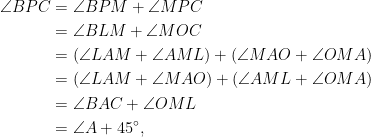
\displaystyle \begin{aligned}\angle BPC &= \angle BPM + \angle MPC\\ &= \angle BLM + \angle MOC\\ &= (\angle LAM + \angle AML) + (\angle MAO + \angle OMA)\\&=(\angle LAM + \angle MAO ) + (\angle AML + \angle OMA )\\&= \angle BAC + \angle OML\\&=\angle A + 45^{\circ}, \end{aligned}

with similar relations for \angle APB and \angle CPA. Hence P is the unique point satisfying

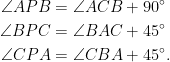
\displaystyle \begin{aligned}\angle APB &= \angle ACB + 90^{\circ}\\\angle BPC &= \angle BAC + 45^{\circ}\\\angle CPA &= \angle CBA +45^{\circ}.\end{aligned}

(Each equation defines a circular arc, they intersect at a single point. Note that P may be outside triangle ABC.) This point is the centre of spiral similarity of 90-45-45 triangles LMO with L, M, O respectively on the sides AB, BC, CA of the triangle. Consider the locus of the points of the square as L, M, O vary on straight line segments pivoting about P. It follows that the fourth point of the square N also traces a line segment, between the points F and J so as to be contained within the triangle.

As the side length of the square is proportional to the distance of a vertex to its pivot point, the largest square will be where NP is maximised. We have seen that the point N varies along a line segment, so NP will be maximised at one of the extreme points – either when N=F or N=J. We therefore conclude that the largest square inside a triangle will have two points on a side.

If the triangle is acute-angled, by calculating double the area of the triangle in two ways, the side length x of a square on the side of length a with altitude h_a is derived as

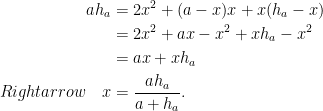
\displaystyle \begin{aligned}ah_a &= 2x^2 + (a-x)x + x(h_a-x)\\&=2x^2 + ax - x^2 + xh_a - x^2\\&= ax + xh_a\\Rightarrow \quad x &=  \frac{ah_a}{a + h_a}.\end{aligned}

If the triangle is obtuse-angled, the square erected on a side may not touch both of the other two sides. In the figure below the side length of square BDEF is the same as if A were moved to G, where \triangle GBC is right-angled. In this case the square’s side length is BC.BG/(BC + BG).

The square erected on side AC when \angle ABC is obtuse

The largest square erected on a side may be constructed using the following beautiful construction [2]: simply erect a square CBDE external to the side BC and find the intersection points F = AD \cap BC, G = AE \cap BC.

These points define the base of the square to be inscribed since by similar triangles

\displaystyle \frac{IF}{BD} = \frac{AF}{AD} = \frac{FG}{DE} = h_a/(a + h_a)

so that

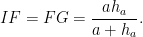
\displaystyle IF = FG = \frac{ah_a}{a + h_a}.

One can use this interactive demo to view the largest square in any given triangle. One needs to find the largest of the three possibilities of the largest square erected on each side. In the acute-angled-triangle case, the largest square is on the side that minimises the sum of that side length and its corresponding perpendicular height – as their product is fixed as twice the triangle’s area, this will occur when the side and height have minimal difference. For a right-angled triangle with legs a, b and hypotenuse c, we wish to compare the quantities (a+b) and (c+h), the two possible sums of the base and height of the triangle. We always have a + b - c = 2(s-c) = 2r < h because the diameter of the incircle of the triangle is shorter than the altitude from the hypotenuse (i.e. the incircle is inside the triangle). We conclude that the largest square in a right-angled triangle is constructed on its two legs rather than its hypotenuse.

References

[1] I. Niven, Maxima and Minima without Calculus, The Mathematical Association of America, 1981.

[2] M. Gardner, Some Surprising Theorems About Rectangles in Triangles, Math Horizons, Vol. 5, No. 1 (September 1997), pp. 18-22.

[3] Jaime Rangel-Mondragon “Largest Square inside a Triangle” http://demonstrations.wolfram.com/LargestSquareInsideATriangle/ Wolfram Demonstrations Project Published: March 7 2011

ckrao
http://ckrao.wordpress.com/?p=6198
Extensions