GeistHaus
log in · sign up

Digging Cincinnati History

Part of feedburner.com

stories
https://diggingcincinnati.com/2026/05/to-digging-cincinnati-history-if-you.html
Show full content

 Welcome to Digging Cincinnati History!

If you are looking for information on a history report for your home or building, you can check out my Reports page.


For more information about me, click here and check out some local news stories about my work.


My book, Finding Your Home's Ancestors, is available through Amazon, and at many Cincinnati & Hamilton County Public Library locations.


If you have a local history mystery, feel free to email me at info@diggingcincinnati.com


Check out some of my stories below, and be sure to follow me on Facebook, Instagram, and YouTube.


Thanks for stopping by! 


tag:blogger.com,1999:blog-2756157783370608109.post-4546887126567243974
Extensions
Cincinnati - The City Closest to America?
Show full content

 Recently I asked my Facebook followers for Cincinnati history questions that they would like to have answered. The response has been great but this one had me stumped for a bit...


Peggy shared this image and asked, "Any idea what this means?"

At first I did a Google Lens search, which brought up this listing:

https://www.hippostcard.com/listing/cincinnati-ohio-1900-10s-the-city-closest-to-america/37590113

It made me chuckle to think the seller thought this was Cincinnati in the 1900s-1910s. Carew Tower, standing tall in the middle, was built in the 1930s, so they are a bit off on the time frame.

So off I went to the Cincinnati Enquirer archives, where I found the following article:

A Progressive Program.
    As an example of industrial progressiveness and community self-interest the nationwide advertising campaign of the Cincinnati Gas & Electric Co. to "sell Cincinnati" is indeed outstanding. Beginning with the February 23 issue of Time, the C. G. & E. will advertise extensively the desirability of Cincinnati as a site of industry. "The city closest to America" will be a theme in the ads stressing Cincinnati's "greatest asset - the character of its people."    This adverting will be done in conjunction with research program to determine the needs of new industries and correlate them with the advantages to be found in Cincinnati. In explaining the program to a large group of civic and business leaders of the city, Walter J. Beckjord, President of the company, explained that the research activity follows the principle that it is unwise to attract a new industry which could not operate successfully under local conditions, or which might result in disastrous competition with similar industries already situated here.    Mr. Beckjord said that his company's drive to advertise Cincinnati and attract new industries here was being staged in cooperation with the other agencies which have a stake in the city's prosperity.    The value to Cincinnati of such a program in incalculable. As a matter of fact, many cities, states and regions appropriate hundreds of thousands of dollars for just such purposes. It costs money to advertise on a national scale, and the research facilities which back up the advertising are not inexpensively maintained. Yet, as experience has proved elsewhere, this sort of thing pays golden dividends.    The question may occur to the casual reader why the gas company, which is held to a rate card far below the national average, would devote part of its earning to a project which is more the city's business than its own. As we just explained, it would cost the city a good deal of money to do what the company is doing without charge.    The answer, of course, lies in the company's enlightened appreciation of mutual interest. C. G. & E.'s management has found it good business to help local industry, through research and all other possible ways. And it evidently realizes that we need more industry here to support the ambitious plans city progress under the Master Plan.    Each new industry that locates here is another customer for the company. That is the element of self-interest. But each new industry that locates here also is a customer for all Cincinnati, from the corner grocery where the workers buy their bread to the city bank where it handles its revenue.The Cincinnati Enquirer; 02/18/1948; p. 4


The first ad above ran in the Cincinnati Enquirer on February 22, 1948. This campaign continued through until 1950, but the slogan stuck around in mentions up to 1965. 
"The City Closest to America" was meant to highlight, at the time, that 40% of the United States population lived within 400 miles of the city, and that the city's central location, rail lines, and highways reduced shipping costs and other costs to attract new businesses. But most of all, that it was the people of Cincinnati and the "American way of life" - from being welcoming, to efficient government, to community support that made Cincinnati the city "closest to America"!

See some of the more examples below and check out even more ads and articles about the tag line here.


tag:blogger.com,1999:blog-2756157783370608109.post-4144507401546323521
Extensions
Schrimper's Linwood House and Cafe
Show full content

This beautiful building on Eastern Avenue, near the Beechmont Viaduct, is now home to BrewRiver Creole Kitchen, but it has a long history of serving those travelling along Eastern Avenue.


It is actually two buildings, which you can see in the second photo. The rear portion of the building is the oldest part, likely built around 1867, when it was purchased by John William Schrimper, a German immigrant, who after serving in the Mexican War in 1846, settled in Reading, and then Oakley, where he ran a hotel. As the story is told, he traded his Oakley location for this one along the Cincinnati, Columbus, and Wooster Turnpike. He ran the hotel and saloon, the Linwood House, with his wife Anna Maria, and their children George, William, Andrew, John, Anna Barbara, and Ann Mary. After his death in 1872, his wife ran the Linwood House until her death in 1887.1904 Sanborn Map showing the original building and livery stable
The sons then took over the business, with Andy becoming the primary owner. The Linwood House was known for never turning away a guest in search of food and lodging, with one notable event around 1900, when they hosted 150 farmers at one time! Check out the included article about the tragic death of their cook in 1903! Cincinnati Commercial Tribune; January 3, 1903; Page 11
The Linwood House, before the addition was added in 1911.
Andy was also very active in the local baseball scene, managing the Linwood ball club, and owned a ballpark that was on the site of present-day Lunken Airport. Andrew and his wife, Ada, had four children - Mabel, George, Louis, and John. Louis played baseball for the North Carolina state team and for the Brooklyn Trolley Dodgers. John was an attorney and also served as a state representative.1917 Sanborn Map showing the four-story additionIn 1911, Andy added a brick four-story flat building to the front of the Linwood House, and while the restaurant remained, the hotel rooms were turned into apartments. Ada managed the restaurant until her later years, turning over the business to their son, George. Ada died in 1938, and Andy in 1940, and George continued the business, passing along to his daughter Ada Schrimper Cushman, who ran the business , Schrimper's Cafe, until her death 1964, keeping the buildings and business in the family for almost 100 years!1930 and 1950 Sanborn Maps
Now when you go to BrewRiver, you can think about how many other travelers stopped off at this same location over the years, and had a bite to eat and a place to rest after a long trip on the way to Cincinnati.


tag:blogger.com,1999:blog-2756157783370608109.post-7785166542981264653
Extensions
The Confusing Streets of Forest Park and Fairfield
Show full content

 After reading my post about the old farmhouse in Winton Woods, a follower asked about why Winton Road changes to South Gilmore above I-275, and why Mill Road changes to Winton Road. For anyone (including me as a lost teenager driver in the 1980s), this can be very confusing! The simple answer - the county line between Hamilton and Butler Counties. But there just had to be a bit more reasoning...

This image is part of Springfield Township, Hamilton County, in 1917. The blue line is the original path of Winton Road, pink is Mill Road, and orange is Hall Road.

This map is part of Fairfield Township, Butler County in 1958, which shows where Mill/Winton Road (also once called Mt. Pleasant-Hamilton Road) continues north (pink), and Hall Road did the same, although, it shows no road name (orange). Also on this map is Gilmore Road, which at that time ran from Butler-Warren Road to just south of Route 4.
1956 - historicaerials.com
The blue line is the original path of Winton Road, pink is Mill Road, and orange is Hall Road.

All that changed when I-275 came through, and an exit was planned at Hall Road. In 1967, it was decided to extend Winton Road north to connect to Hall. The former part of Winton Road that extended to Mill Road was renamed to Lincolnshire, which no longer connects to Winton. The north end of Winton Road became part of Kemper, originally named Bank Lick.
1968 - historicaerials.com
The blue line is the original path of Winton Road, pink is Mill Road, and orange is Hall Road. The purple line is the extension of Winton-Hall Road to connect with I-275.
In Butler County, they continued with calling Mill/Winton Road, just Winton, and in the mid 1980s, Gilmore Road was extended to meet Hall-Winton Road. Yep, that what the exit was called in many articles I came across. I guess people didn't know what name should be used! Eventually, it just became Winton Road, except once you cross that county line, when it becomes South Gilmore!
1996 - CAGIS AerialMoral of the story - streets are named lots of names over time, and pay attention when you cross county lines!2024 Mapquest


tag:blogger.com,1999:blog-2756157783370608109.post-2084695575678058675
Extensions
Farmhouse in Winton Woods?
Show full content

I am a big fan of Great Parks of Hamilton County, and my family tries to camp at Winton Woods at least once a year, ever since I was little. We also enjoy their hiking trails, walking/biking trail, and their many picnic areas. Parky's Farm is a great experience for all ages, and I even remember a school field trip to the old Parkour Trail (does that still exist?)! 

2019; Google Street View

But I have often wondered about the old farmhouse, on the park road, just west of the Winton Road entrance, behind Winton Center. So of course, I just had to dig more into it! Who owned the house before the park was created?

Early deed records show transfers from John Cleves Symmes to Andrew Wilson to Abraham Roll (who also owned a very large parcel just to the north) to Roll's son-in-law, Robert Preston in 1825. In 1839, Preston sold to Ogden Ross, whose house appears on the 1847 map. Ross sold just 10 years later to Johann Heinrich Ferdinand Oberheu, who is listed in the 1850 Census as living in Cincinnati with no occupation, but worth over $5,000 in real estate. His sons, Ernst, Frederick, and Louis were successful grocers. 

1847 Map showing the house of Ogden Ross

1856 Map showing the 84.75 acres owned J. H. F. Oberhue

There are no records showing the Oberheus ever living at this location in Springfield Township. In 1867, they added an additional 25 acres to their property, making it over 109 acres. Johann died in 1859, leaving the estate to his children, and in 1899, a court case was brought forward to settle the estate for the grandchildren. John Hammel. husband of Sophia Oberheu Hammel, who was Johann's granddaughter, purchased the entire parcel for $5,300, keeping the land in the family.

It appears from a post on the Greenhills Historical Society Facebook page, that the Oberheu family rented their property to Heinrich Reinke. Known as Henry, he is listed as a farmer in this area in the 1870 and 1880 Census, but is not an owner of the land. Check out the full story of one of the Reinke descendants of the story of his grandmother living here on their page.

Courtesy of Greenhills Historical Society

1869 Map showing the initials of brothers Ernst, Louis, and Frederick Oberhue

1884 Map

1914 Map showing John Hammel as the owner

In 1936, John Hammel, sold over 103 acres for $26,250 to the United States, as part of the huge development that became the Village of Greenhills, a federal-developed "greenbelt" city. The US bought over 6,000 acres, with about 800 acres being used for the village. The rest was planned as green space to surround the village and for farms to be leased by the government.

Cincinnati Enquirer; Oct 25, 1948; p. 14

In 1939, the Hamilton County Park Board leased over 900 acres from the federal government, to be used as a park. However, plans were put on hold due to levy failures and World War II. Finally, a levy was passed in 1948, and a few developments occurred in the park, like an archery range and golf course, first opened in 1951.  However, the Army Engineers wanted to use the West Fork of the Mill Creek as a reservoir and for flood control to protect the Millcreek Valley. The reservoir became Winton Lake, finally finished in 1953.

Cincinnati Enquirer; May 22, 1949; p. 147

Cincinnati Enquirer; Jan 2, 1949; p. 56


1932 - www.historicaerials.com
The house is just left of the center.

1960 - www.historicaerials.com
1984 - www.historicaerials.com

1996 - CAGIS
2010 - CAGIS
2023 - CAGIS
tag:blogger.com,1999:blog-2756157783370608109.post-4791261690206921724
Extensions
Brews and History in Mt. Healthy
Show full content

Our continuing tour of local breweries took us this week to Fibonacci Brewing Company, on Compton Road in Mt. Healthy. When a brewery features amazing beers AND an old house, it’s a perfect match for me! So of course, I had to do a bit of digging on the history…


Turns out this home could date from the 1850s, as I found a mention of the house being completed as part of a lease agreement from 1851. An 8.75-acre parcel of land was purchased from the Hoffner family in 1848 by Jacob Packer, who divided it in two. Packer sold 4.25 acres to Frederic Rapp in 1849, and Rapp had a lease with Owen Garretson, which required him to lath and plaster the house with two coats and skim, to finish the carpenter’s work, paint the woodwork inside, build a kitchen on the south side of the house 12 feet wide, 1.5 stories, and the same length of the house. Other details were that Rapp provided the flooring for one of the floors, Garretson provided windows and doors for the addition, and that he also would build a cistern on the lot to hold 30 barrels of water.

Rapp sold the entire property to John Roth in 1854, but I could not locate him or his family in this area in the 1860 Census. In 1861, it was sold again to Leonard Fisher, who was a broom maker. His family included his wife Catherine, daughters Catherine, Angeline, and Mary, and son Daniel. Leonard was born about 1815 in Alsace, France, and Catherine was born in 1823 in Germany. They married in Cincinnati in 1855. Leonard died in 1896, and Catherine in 1895, and the property was left to their children. Their daughter Mary, born in 1860, had married August Dittman in 1897, and they purchased the property from the remaining siblings in 1901.

The Dittman family was close to the Fishers, with August’s parents Christian and Christiana being the witnesses for Leonard’s will. August worked in various positions according to the census records, including a landscape gardener, and a laborer in a veneer works. In 1912, the property was divided into two parcels, and the south 2.8-acres was sold off, while the Dittmans kept the north 1.46 acres. Mary and August did not have children, so after August’s death in 1937, Mary sold the property to George Felss, who unfortunately died at 38 years old in 1941, leaving his wife Caroline with three children.

Caroline became a successful real estate agent to provide for the family, and their son Charles began a florist business at their home in the 1980s. Caroline died in 1991, and the following year, Charles added a small reception hall to the property, which was also used for the floral business, Felss the Florist. Charles died in 2013, and the property went into foreclosure. In 2015, Fibonnaci Brewing founders and Mt. Healthy residents, Bob and Betty Bollas, purchased the property for their business. 

Known as a nanobrewery and urban farm, Fibonnaci focuses on brewing beers using local ingredients, and they also offer a selection of wines. They value equity and inclusion within our business and community, and intentionally welcome all. They offer a farmers’ market on the 1st Sunday of each month from Noon-3:00 May through November. The house has two Airbnb units available, so you can spend the night in this historic location. Stop on over to Mt. Healthy and enjoy a drink with a side of history!


tag:blogger.com,1999:blog-2756157783370608109.post-8669277761008679793
Extensions
A Reprint of Bald Knob History, as told in 1929
Show full content

Cincinnati Times-Star; Aug 16, 1929; p. 24


Bald Knob, Picturesque Hill, Playground of Thousands, Is Being Pulled Asunder

By Charles Ludwig

Picturesque playground of thousands, beautiful, romantic Bald Knob, that thrusts its craggy head like a bleak promontory into the city’s northwestern skyline, is being torn down! Its lovers’ lane has been destroyed – men with scythes have cut down the charming sheltered bower. Workmen have laid axes to the magnificent English elms and buckeyes. The breezy rendezvous on the very summit – 800 feet above sea level – to which men in the old days lugged kegs of beer for their parties and where the anti-slavery picnics were held before the Civil War – will soon be no more.

The lovely hawthorns that bedecked the hillside with their jolly red haw-apples have been laid low. The last apple and pear trees, remains of a once famous orchard, will soon be felled. The Indian cave and the delightful, cool spring on the hillside will be ripped up by the steam shovel. The baseball diamond there will be torn asunder. The wild-flower gardens on the lovely slopes, where many a girl picked bouquets; the outlook point, offering a great panoramic view of the city, where mothers and their families held basket picnics – all will be dumped into Millcreek to make a fill for the new union depot.

Old Beer Cellars

Only two historic old beer cellars – that of the Herancourt Company and of another brewery, built into the foot of the hill over three-quarters of a century ago – will escape.

Rare Beauty of Scene

Beautiful indeed was this hill and its surroundings, particularly in the old days when Millcreek flowed by in its pristine purity and bathed the foot of the little mountainside with its sparkling, crystal-clear water that abounded with fish.

It was to this hillside that the Cincinnati pioneer, Emery Brown, removed from Mt. Auburn in the early history of the city, for he deemed it the most beautiful spot in the county. It was along this hill that the Orange family, noted in the pioneer annals of Cincinnati, built their fine and quaint old mansion that housed a memorable collection of art, including works of Joshua Reynolds!

It was on this hillside that the famous pioneer horticulturalist, Ernst, an early president of the Ohio State Horticultural Society, built his home and cultivated his noted orchards and gardens, the vestiges of which still remain.

Climbing the Hill

The Times-Star scribe and photographer visited Bald Knob Wednesday, and found the first group of men that started to clear away the underbrush preparatory to tearing down the hill. Huge shovels and modern machinery will be installed to remove the 6,000,000 cubic yards of earth into Millcreek, where they will make a fill for the relocation of tracks in connection with the new depot project.

A crowd of neighbors gathered and it was almost with tears in their eyes that they saw their beloved hill with its trees being ruthlessly attached to make way for “modern progress.” A number of men, with their children, together with a crowd of boys who love the hill with the devotion that youths give to their playground, formed a part and let the Times-Star delegation to the top.


Trees of Great Beauty

It was like climbing a mountain while it lasted – for Bald Knob has a steep-slope, and at the top presents a very jagged side. The path began at the foot of the fill between two glorious elm trees – one of these trees is no doubt among the finest specimens of its kind in the county. Through the hawthorn bushes, filled with ripening red fruit, the path led up the hill. One of the workmen had just killed a harmless snake near the path, and the boys said there were many still rabbits, squirrels and many birds in the thicket.

Along the path were found many pears – they were the booty of previous expeditions from the pear trees on the hill. All but the boys were puffing hard when the top of Bald Knob was reached – and from the high vantage point a beautiful new of the city was offered, a view looking miles to the basin in the East, as well as toward the valley in the West.

Among the climbers were J. B. Neider, Harry Ismael, and his little son Paul, Joe Staehling, August Brinkman, George Baxter, and Charles Meyer and the boys, John Baumer, Ed Disken, Charles Tungeat, Bob Bunner and Russell Wolfer. Some of the men told how they played on Bald Knob forty years ago, and in the old days would carry kegs of beer to the top for a party. The little boys said that life would no longer be the same after their Happy Hunting Ground, the hill, was removed.

“Pancake Hill”

“There won’t be any fun left,” they sighed. They pointed out their ballfield on the plateau half way up, to the rear, the site of the Indian Cave, the old spring, the pasture where the old Herancourt brewery horses were farmed out for a happy old age, and the places where the boys from Goosetown, Brighton and Lick Run used to do battle for possession of Bald Knob.

The lads pointed out that there are really two Bald Knobs, separated by the declivity, and that the name they always gave the Knob was Pancake Hill. And there are two Pancakes – two bald, craggy hills, with flat, pancake tops.

Steep Cliffs

The lads pointed out the steepest cliffs and showed the steps they had cut in the stone so as to negotiate the most difficult parts of the climb. They showed where the old “Ludebei Quarry” used to be, half century or more ago, and where they flew kites in the stiff wind at the summit. The remains of the old vineyards were still visible. Below was Ernst street, named after the famous Bald Knob horticulturalist of long ago. There too, was the old home of Attorney Sanford Brown – a pioneer dwelling – in which four generations of the Brown family lived. But the home, together with other property in the vicinity, was sold in connection with the depot project.

At the top of the hill the lads pointed out where they sometimes built playhouses and had the thrill of being “Indians.” Miss Harriet Brown recalled how the late Mrs. H. C. Robinson told her that before the Civil War the hill was the scene of the anti-slavery picnics. It was also related that years ago two business men tried to remove part of the hill with cables and buckets and that this accounted for the cut between the two Bald Knobs.

Many Memories

The Bald Knobs are among Cincinnati’s most outstanding landmarks, and juts high into the skyline. They are located at Harrison and State avenues, Brighton, and the knobs are immediately opposite the Harrison avenue viaduct. They are visible from the City Hall windows and from any high vantage point in the basin of the city and are south of the well-known Schuetzenbuckel hill.

Many are the memories that will be aroused by the cutting down of Bald Knob. A tear almost came to the eyes of Phil Pfalzgraff, Thursday morning, as he saw what was happening at the hill he has passed so often, “Just think, they were putting the ax to that magnificent elm tree as I passed this morning,”  he said.


tag:blogger.com,1999:blog-2756157783370608109.post-4651139358822352823
Extensions
Bald Knob and Connections to Cincinnati's Abolitionists and Horticulture
Show full content

You may have heard of Bald Knob, and how it was used as infill for the development of Union Terminal, but did you know there is also a connection to the abolition movement and early Cincinnati horticulture?

A friend recently posted this image of Bald Knob, which is the hill at the southwest end of the Western Hills Viaduct in South Fairmount. I ended up down a rabbit hole and discovered so much more local history in this one location.It all starts with Andrew H. Ernst, who was born in Germany in 1796, and arrived in Cincinnati around 1806, along with his parents Zachariah and Dorothy, and brothers Henry and Jacob. His father was a brewer and tavern owner who moved to America to escape the Napoleonic Wars. Andrew married first wife, Elizabeth in 1818. Before the Panic of 1819, Andrew ran a bakery and porter-house on 2nd Street, near Broadway. Andrew made ends meet during the Panic by chopping wood in the country and bartering it for goods.1847 Map of Hamilton County
Andrew became a confectioner and then a grocer until 1837, when he decided to devote his time and treasures to his plant nursery and gardens called Spring Garden. It was developed on the 80+ acres he purchased in 1829 in the area now known as Bald Knob. A train station was built on part of his land along State Street, and it was known as Ernst’s Station.Advertisement in Cincinnati in 1841Unfortunately, Elizabeth died in 1840, leaving Andrew with six children, four of which were under 18 years old. The next year, Andrew went to Massachusetts to marry Sarah Otis, introduced by a mutual friend in the Unitarian Church. Sarah was part of the anti-slavery movement founded by William Garrison. Andrew was also known abolitionist, having been included on a list in 1842 in a Cincinnati publication.They were friends with Levi Coffin, and Sarah and other women organized an anti-slavery sewing society, to provide clothing to those escaping slavery through Cincinnati that often met at the Coffin's home. In 1850, noted orator, writer, and reformer Frederick Douglass came to Cincinnati. The Ernsts hosted a gathering at their home at Spring Garden that included Douglass along with other abolitionists such as William Brisbane, Levi Coffin, John Gaines, and William Casey. Inspired by Douglass’ visit, Sarah’s sewing society held an annual bazaars to finance an annual Anti-Slavery conference, with speakers such as Brisbane, William Lloyd Garrison, John Rankin among many others.Cincinnati Daily Gazette; September 8, 1851; Page 5Douglass described their Spring Garden home as being "situated on a fine sloping hill, covered with magnificent trees of the finest foliage,” and “it overlooks the whole city and valley of Cincinnati. We have never seen, in this country, a garden so large and tastefully laid out, and abounding with so great a variety of fruits and flowers…It was a little surprising to meet with an abolitionist in such a place as that. Sympathy for despised and enslaved humanity does not often appear envisioned by wealth and luxury; yet we know that many a fugitive’s heart had been made glad by the benevolence of the excellent friends in question.” (“Our Western Anti-Slavery Tour,” North Star, date unknown; repr. Salem (Ohio) Anti-Slavery Bugle, 24 August 1850.)1856 Map of Hamilton CountyAs one of the first nurserymen in Cincinnati, Andrew joined with other horticulturalists to form the Cincinnati Horticultural Society in 1843, and was initially appointed 2nd-vice president, and served on the committee for fruits. His contributions to the development and propagation of various fruits from the Eastern States and Europe allowed for more diverse and hearty varieties to thrive in Cincinnati. In 1844, he joined the directors who founded Spring Grove Cemetery and served as one of the landscape architects.In 1851, Andrew began subdividing his land as more industrial businesses were built along Mill Creek. Another subdivision was created in 1857 included the homestead and gardens. After an illness in late 1858, Andrew assigned his property and debts to his son-in-law, attorney Seth Foster, to help settle his estate and debts. Unfortunately, Andrew died in February 1860, leaving Sarah with five children from their marriage, the youngest only three years old. With the onset of the Civil War, Sarah decided to return to Massachusetts with the youngest of her children. Three of Andrew's sons served in the War: Franklin, William, and Oswald, who attended the Military Academy and achieved the rank of Major General by the end of his career.1869 Titus MapThe land continued to be subdivided and sold, but they were no major developments on this hillside, which is somewhat surprising, given its view over the Mill Creek valley towards downtown, and the advantage of sitting above the smog of the creek valley. The homestead and gardens were also divided and sold, and the home was demolished between 1891 and 1904 to allow for Chicago, Cincinnati & Louisville Railroad line to pass around the hill. The only thing that remains is the small street named after the family off of State Street.1883-1884 Atlas of Cincinnati
Green outline is the homestead of Andrew H. Ernst.

1904 Sanborn Map showing the rail line through the homestead locationMore to come soon about Bald Knob and its connection to Cincinnati's brewing history and what is now there.
tag:blogger.com,1999:blog-2756157783370608109.post-8382751457133180774
Extensions
Ivorydale Cemetery?
Show full content
What do Music Hall and the former P&G Ivorydale Plant have in common? They were both partially built on former burial grounds!

Falling down rabbit holes of research is just about an everyday occurrence for me. While I was researching more about the development of Ivorydale as a planned community, I discovered more about the land where the plant was built. This land was purchased by an early sheriff of Cincinnati, John Ludlow, who was the half-brother of Israel Ludlow, one of the co-founders of Cincinnati and the surveyor of the Miami Purchase. John arrived in the city in 1789 from New York and became sheriff the next year.1847
1856
When a road and bridge were constructed in 1871, the burial ground was rediscovered, however, as you can read in the Cincinnati Enquirer article below, not all the remains were not reinterred with respect.

Cincinnati Enquirer; April 3, 1871
When the Ivorydale plant was constructed from 1884 to 1886, more remains were found as noted in the Enquirer article below, however, this time, more respect was given, and the remains were taken to Spring Grove Cemetery for reburial.
Cincinnati Enquirer; August 22, 1885
Could the former soap and candle factory be as haunted as Music Hall?

tag:blogger.com,1999:blog-2756157783370608109.post-1562361858514743979
Extensions
Procter and Gamble's Original West End Location
Show full content
While researching in the West End today, I got curious about where the original Procter & Gamble factory stood. Many Cincinnatians are familiar with Ivorydale, the huge 50+ acre complex near St. Bernard. However, the original factory was built in the mid 1840s and was located on eastside of Central Avenue (then called Western Row) between York and Dayton Streets. It backed to up the canal, which made receiving and delivering goods easy.1875
1884
As business improved, the company purchased the Ohio Candle Company, also located on Central Avenue across from Poplar Street. This proved fortunate when a disastrous fire struck the main plant on January 7, 1884, causing nearly all the buildings to be destroyed or damaged. It was a bitter cold day, and the John Hauck Brewing Company, across the Central Avenue from the P&G, provided shelter for the firefighters to warm themselves. Mr. Gamble provided sandwiches and coffee to sustain them as well.
The company was well-insured for such an event, and operations continued at the Ohio Candle Company facility, along with the buildings unscathed from the fire. This event led the company to search for a new area for their factory, where they had room to expand and also adding housing for employees. Over 50 acres were purchased near St. Bernard, with easy access to rail lines to create Ivorydale.1891
1930
After the move to Ivorydale, a few of the original buildings remained on Central Avenue, marked in "very poor conditions" and "ruins" on the 1891 Sanborn Map. In 1909 one of the final buildings came tumbling down. Today, the location is near the Family Dollar store at Charlotte Street and Central Avenue. The Sentinel Police Association building at 1889 Central Parkway sits in the middle of the old plant location.2023
October 2016
tag:blogger.com,1999:blog-2756157783370608109.post-1333584850965462105
Extensions
Not Theda Bara's House?
Show full content
Often identified with the Cincinnati girl turned silent film star Theda Bara, this house stood at the corner of Ledgewood Drive and Victory Parkway from 1924 until 2011. But did you know there is no evidence that she ever owned or resided here?

Deed records show the lot was purchased by May Droesch in 1923, and plans for the Spanish-style home were made shortly after. Droesch was a real estate investor, but also had a connection to the film industry, as she owned a chain of theaters in the area along with Ignatz and Julius Frankel. Her parents, Joseph and Mary Droesch also lived in the home. Mary died at this home in 1929, and May left to live in Atlanta, Georgia in 1932. Her father continued to live here until the following year, moving to Atlanta as well, until his death in 1945. May died in Atlanta in 1949.Cincinnati Commercial Tribune January 20, 1924 p6
Owners between 1933 and 1968 include Raymond and Lorene Frankel (1933-1942), Coleman Harris (1942-1949), Lillie Goldsmith (1949-1953) Lillian and John Lutz (1953-1956), and Ida and Clifford Schaten (1956-1961) and Edythe Slack (1961-1968).Cincinnati Enquirer; July 28, 1968; p. 2K
In 1968, Xavier University professor, Dr. Joseph Link, purchased the home. He also had previously purchased a Tudor-style house next door in 1955, and had built additional buildings in this area including Manor House Apartments, University Apartments, and the present-day Jesuit Residence. In 1979, Dr. Link agreed to sell all the buildings to Xavier University in 1989. Once acquired by the university, the Droesch house was used as housing for religious sisters, and later as a residence for honor students. At the time of demolition, it was said the stucco was falling from the house. Xavier stated that they had removed historically significant parts for preservation.
So there is really no connection to Theda Bara. I dug through city directories and newspaper articles to see if it was ever mentioned that she stayed here on her visits to or through Cincinnati, but nothing was ever mentioned until it was sold in 1968. So perhaps she did visit May Droesch or Raymond Frankel between 1924 and 1942, but this was not her Cincinnati home.
tag:blogger.com,1999:blog-2756157783370608109.post-6089118628477665128
Extensions
Cincinnati Deaconess Hospital
Show full content

Do you remember the Deaconess Hospital, that was at the corner of Clifton Avenue and Straight Street? Did you know the hospital was actually started in Liberty Street (now Liberty Hill) in the Over-the-Rhine/Prospect Hill neighborhood?

Google Street View; July 2022
Founded in 1888, the hospital was located in one half of a two-sided single family home. The home was built in the late 1850s for the Nulsen and Wagner families (Anton Nulsen and Philippina Nulsen Wager were siblings.). As the hospital expanded, they purchased both portions of the house. It was so successful, that plans were made in 1899 to build a new structure in Clifton Heights. It was completed in 1903, and the Liberty Hill houses were converted into the Ohio Maternity Hospital until it was sold in 1914 to a private owner.
Sketch of the hospital to be built at Clifton Avenue and Straight Street.
Cincinnati Enquirer; March 17, 1902; p. 5
The Liberty Hill houses were converted in apartments, conveniently called "The Liberty". Plans were made to convert the homes into condos in the 1980s, but funding fell through. It recently sold, and the new owner ordered a history report so they could learn the stories behind the hospital rumors.

The Deaconess Hospital buildings at Clifton Avenue and Straight Street were demolished in 2019 to make way for a mixed-use facility, with student and community-based housing planned. However, the lot currently remains undeveloped.
Clifton Avenue and Straight Street; Google Street View July 2022

tag:blogger.com,1999:blog-2756157783370608109.post-8451696587889937380
Extensions
Auto Laundry? Maybe not what you think...
Show full content

 A follower recently reached about a curious-looking building on Court Street, seemingly out of place as compared to the surrounding buildings.

Google Street View Nov. 2020

It clearly is different from the typical Italianate style that is more common in downtown and Over-the-Rhine. I took a look at the Sanborn Insurance Maps from 1891 and 1930, and discovered some significant changes:

1891 Map
Address prior to 114-116 West Court
Three-story in front, two story in back, brick building

1930 Map
Address covers 16 to 20 West Court Street
One-story brick building.

The  1887 and 1891 maps show that the building standing at that time was a three-story brick building. A look through the city directories showed it was used for commercial purposes, with businesses such as a china, glass and queensware dealer, a commission merchant, a wholesale confectioner (mmm, candy!), the American Toilet Supply Company, and the Troy Laundry Company.

In 1919, the building was sold, and renovation plans were made:

Cincinnati Enquirer;
Nov. 30, 1919; p. 15
Cincinnati Enquirer;
Dec. 2, 1919; p. 10

Harry Hake is a noted Cincinnati architect, who also designed many buildings on the campus of the University of Cincinnati, and other notable works.

So this building was originally designed to be a car wash, and not an automatic laundry for clothes! I was unable to locate any images of what the interior of this building looked like, however I did discover this image:


In this era, a car wash was based on the assembly line, where a conveyor, often manual, would pull the car down the line, where workers would perform a task in stations as it went down the line.

Cincinnati Enquirer
Jun 20, 1920; p. 4
The Quick Service Auto Laundry & Garage sign is visible above the delivery truck in this photo from 1928.1968 Hamilton County Auditor

By the mid-1930s, the car wash had closed, and the building became a service garage. and by the 1950s, it was used as a parking garage. As of today, it appears to still be used as a private parking garage.

tag:blogger.com,1999:blog-2756157783370608109.post-7287012973202795128
Extensions
You Never Know What Lies Beneath
Show full content

Local Facebook history groups are talking about this building at 616-628 Race Street, slowly revealing it's hidden history.

Photo courtesy of Scott Beseler
I had the pleasure of the inside scoop on these buildings (yes, actually two buildings, bricked together), when Sara Bedinghaus, of 3CDC, reached out to me last summer to help solve a mystery. The front of the building looked very 1940s-1950s, but the back revealed a different story.
Google Street View 2018
Sara also sent me interior photos of beautiful iron posts and windows that didn't align to the outside.


So clearly more was going on here. So I went off to do some digging, and history began revealing itself.
The deed records show that in 1871 Russell, Morgan & Company, who were in the printing business, bought 2+ lots on the east side of Race Street between 6th and 7th Streets for a new building. There was an existing brick building standing in the way, so in 1872, it was advertised for it to be removed.
Cincinnati Enquirer; March 19, 1872; p. 5
Present day 624-628 Race Street. The streets in Cincinnati were renumbered in 1895-1896.
The building was completed in late 1872, and the Russell, Morgan & Co. moved in as of January 1, 1873, according to their city directory listing:
RIJSSELL, MORGAN & CO., (A. O. R., R. J. M., J. F. Robinson. jr . & J. M. Armstrong) Mercantile and Show Printing House, 20 College; January 1, 1873, will Remove to 258 and 260 Race

By 1883, the business was so successful that they decided to move to another, bigger location on Lock Street, and the Race Street location was listed for rent.
Cincinnati Enquirer; September 19, 1883; p. 8
By 1885, Peter Thomson, manufacturer of toys, toy books, games and also color printing was here along with Cottrell & Sons, who built printing presses. Thomson, along with business partners C. V. VanHamm and Absalom Mattox printed a satirical newspaper entitled "Sam the Scaramouch" between 1885 and 1886.

1887 Sanborn Insurance Company
As you can see, the Peter G. Thompson building is on the map in 1887, but the south building doesn't match up with today's buildings. Let's explore a bit of history on that one.
In 1863 and 1864 August. W. Frank, whose wholesale and retail grocery business was located at the northwest corner of Race and Sixth Street, purchased 2+ lots on Race Street. In 1866, his home was listed at 256 Race Street and can be seen still standing there on the 1887 map. Unfortunately, August died the next year, however, his wife Margaret kept the business running. In 1887, the estate of A. W. Frank, led by Margaret, had the architect firm of Samuel Hannaford design a six-story building of iron and stone to be constructed on these lots. The deed records show that the Russell, Morgan & Co. had to be consulted, as the buildings shared a common wall. 
1891 Sanborn Insurance Map
In 1888, H. Rosenbaum & Company, manufacturers and importers of cloaks, were located in the Frank building on the upper floors (as seen on the 1891 map above) along with Synder & Kolhberg, who sold carpets.
By 1895, the Frank building was leased to Albert G. Erkenbrecher, while in 1892, the A. E. Burkhardt Company, leased space in the former Russel & Morgan building for their clothing and accessories business. A G. Erkenbrecher was the brother-in-law of A. E. Burkhardt.
The streets in Cincinnati were renumbered in 1895-1896 and in 1900, the Robert Mitchell Furniture Company moved their retail to 624-630 Race Street and expanded to 616-622 Race in 1903.
Cincinnati Enquirer; September 7, 1903; p. 5


September 29, 1907; p. 12
By 1910, the furniture company had moved to just the south building (616-622 Race) and the H. S. Hamberger (yep, that's really it's name) was located at 624-628 Race. They were "importers of fancy groceries", but moved to Main Street in 1914. That year, the Miller Brothers took up their dry goods business here and remained until 1927. It was that year that the J J Newberry Company "a 5, 10 and 25 cent business" opened, from 624-628 Race Street, and in 1936 expanded to 616-622, combining both buildings for their retail operation.
1923 by Rombach & Groene Collection - Cincinnati History Library 
Miller Bros. and Mitchells Furniture
1930 Sanborn Insurance Company

1949 by Lawrence Brand
Newberry's with a combined storefront
In January 1951, a fire occurred in the elevator shaft, filling the upper floors with smoke. This fire, along with modernism being all the rage in the post-World War II era, prompted a decision to be made to "update" this building after a lease was made with Butler Brothers of Chicago to open a retail location here. Cincinnati Enquirer, January 20, 1951; p. 14
Cincinnati Enquirer, January12, 1951; p. 1

Cincinnati Enquirer; October 8, 1951; p. 28
Cincinnati Enquirer; September 30, 1951; p. 68
Then in 1955, the store was leased to the Schottenstein brothers of Columbus, Ohio, and the Schott's Department Store was here until 1957, when Friedman Furniture arrived, only lasting until the fall of 1960, when the location became part of the Kroger chain of grocery stores.
October 19, 1960; p. 27
1968 Hamilton County Auditor
Note the building to the right of Kroger also was cut down from seven stories to just two.
Kroger closed this location in late 1969, and in the following years, many stores and businesses have come and gone.Top Value Stamps (continued since it was part of Kroger) until 1971 (?)Singer Sewing Shop - 1970-1977Levitation Clothing - 1977-1978Wurlitzer Organs and Music Shop 1978-1981Queen Optical - 1982Citizens Federal - 1983-1984Willis Music - ? - 1985
In 1993, Chong Nung Kim and Kil Jin Kim purchased the building, having opened their clothing store here in the 1980s. They closed their business to retire in May 2020 and now 3CDC is slowly revealing the beautiful details of these buildings, brick by brick.
Photo courtesy of Scott Beseler
I can't wait to see what the future holds, as they uncover the past to bring it into the present.


tag:blogger.com,1999:blog-2756157783370608109.post-5909956686406891918
Extensions
Evolution of a City Corner
Show full content
I recently was working on a project for a client and while I was digging through old photos, I came across these two in the digital library at the University of Cincinnati.


This was the Citizens' National Bank building that stood on the southeast corner of Fourth and Main Streets. Of course I had to know more!

Before this building was constructed, this corner was occupied by four brick buildings as noted on this map from 1891.
1891 Sanborn Insurance Map
The Cincinnati Enquirer; Sat, March 8, 1905; p.16 Those buildings were demolished for the construction of the bank between 1905 and 1906. It was designed by Cincinnati's own Samuel Hannaford. During construction, a few mishaps occurred. Two men almost lost their lives when four floors collapsed into the cellar. One survived by being under a stairwell, while the other hung onto a ledge in the wall until rescued.


The Cincinnati Enquirer; Thu, June 15, 1905; p.12 But the issues didn't stop there! The discovery of old, shoddy workmanship reared its head once foundation work began. The foundation of the neighboring building encroached by 28 or more inches because rocks were just piled up to support the walls. The building had to be lifted and the foundation rebuilt, adding a few extra thousands of dollars and putting the bank project behind schedule and .


The Cincinnati Enquirer; Fri, Sep 8, 1905; p.5 Work continued for over a year, until the bank finally opened in October of 1906. Over the years, Citizens National Bank became the Bank of Commerce, which was sold to Provident Bank in 1930.
From the Lawrence Brand Collection at the Kenton County Library In 1960, the building went through a major renovation that preserved the exterior, but the inside was modernized.
The Cincinnati Enquirer; Fri, Nov 18, 1960; p.34 1968 Hamilton County Auditor However, by 1979, downtown was going through a rebuilding phase which brought many of the highrise buildings we have today. This bank building was an unfortunate victim of the times. In its place, the Atrium I Building, designed by Skidmore, Owings & Merrill, was constructed in 1981. It is now known as the Omnicare Center.


Google Streetview April 2019


tag:blogger.com,1999:blog-2756157783370608109.post-8982601746653981483
Extensions
Thanks for visiting my website!
Show full content
For more information about building history reports, please click on History Reports above or use the form to the right to send me a message.

Find out more About Me or read about Digging Cincinnati History In The News.

To see more recent research, follow me on Facebook and Instagram!

Older blog posts can be found in the Blog Archive on the right.
tag:blogger.com,1999:blog-2756157783370608109.post-3640804394360691415
Extensions
Price Hill Brick Beauty
Show full content
This beautiful home recently hit the market and I was happy to provide the house history to the listing agent, Bill Draznik.

This home was built in 1885 for George H. Grimmelsman, and designed by architect Theodore Richter. Early in his career, Richter worked with other well-known Cincinnati architects such as James McLaughlin, Edwin Anderson and George Rapp. By the time this house was constructed, Richter has his own firm. He is known for many residential buildings in Over-the-Rhine, Clifton, and for the Church of the Holy Family in Price Hill.

1904 Sanborn Map Grimmelsman was born October 28, 1858 in Cincinnati. He married Frances Elizabeth Romelbaum in 1881 and this home was soon filled with their eight children by the time of the 1900 Census.

1900 Census George worked as a banking clerk for The Safe Deposit Company and became Secretary by 1895. The Central Trust Company merged with The Safe Deposit Company and George was the superintendent of safe deposits and was a company director. His wife Frances passed away in 1910 and George died in 1916. The house was passed down to the adult children remaining at home, Henrietta, John and Joseph.
1920 Census The 1920 Census shows that they began renting rooms as a source of income. Ads from the Cincinnati Enquirer show updates were made to entice renters.


In 1944, the Grimmelsman family sold the home and between then and 2005 it was transferred to different owners 19 times! The present owners have greatly updated the home but still keeping many of the original details. There are views of downtown Cincinnati from every level and amazing roof top deck.


This amazing home deserves owners who can appreciate its history. To arrange a showing, contact Bill Draznik with Coldwell Banker West Shell at bill.draznik@cbws.com.
tag:blogger.com,1999:blog-2756157783370608109.post-6590865306298617951
Extensions
A Swiss Chalet in East Walnut Hills
Show full content
This amazing home just came on the market! It hasn't been for sale for over 55 years. What a rare opportunity to own a historic and amazing home.
Be sure the check the interior photos by clicking here. Cincinnati Enquirer, Tuesday, August 11, 1891; p. 5
This home was completed in 1892 and designed by Lucian F. Plympton for Albert Day Fisher. Fisher was a very successful grain merchant who was born in Indiana. According to a 1979 Cincinnati Enquirer article, there are two legends as to why it was built in the Swiss-style. One is that Fisher and his wife spent their honeymoon in Switzerland and wanted their home to be in the same style, although they were married for over 10 years when the home was built. The other story is that Plympton's wife came from Switzerland and she inspired this home. However, census records show she was from Verona, Italy.
Once constructed, the home was featured in two issues of the Inland Architect magazine in 1896 and 1897. Inland Architect Vol XXVIII No 6
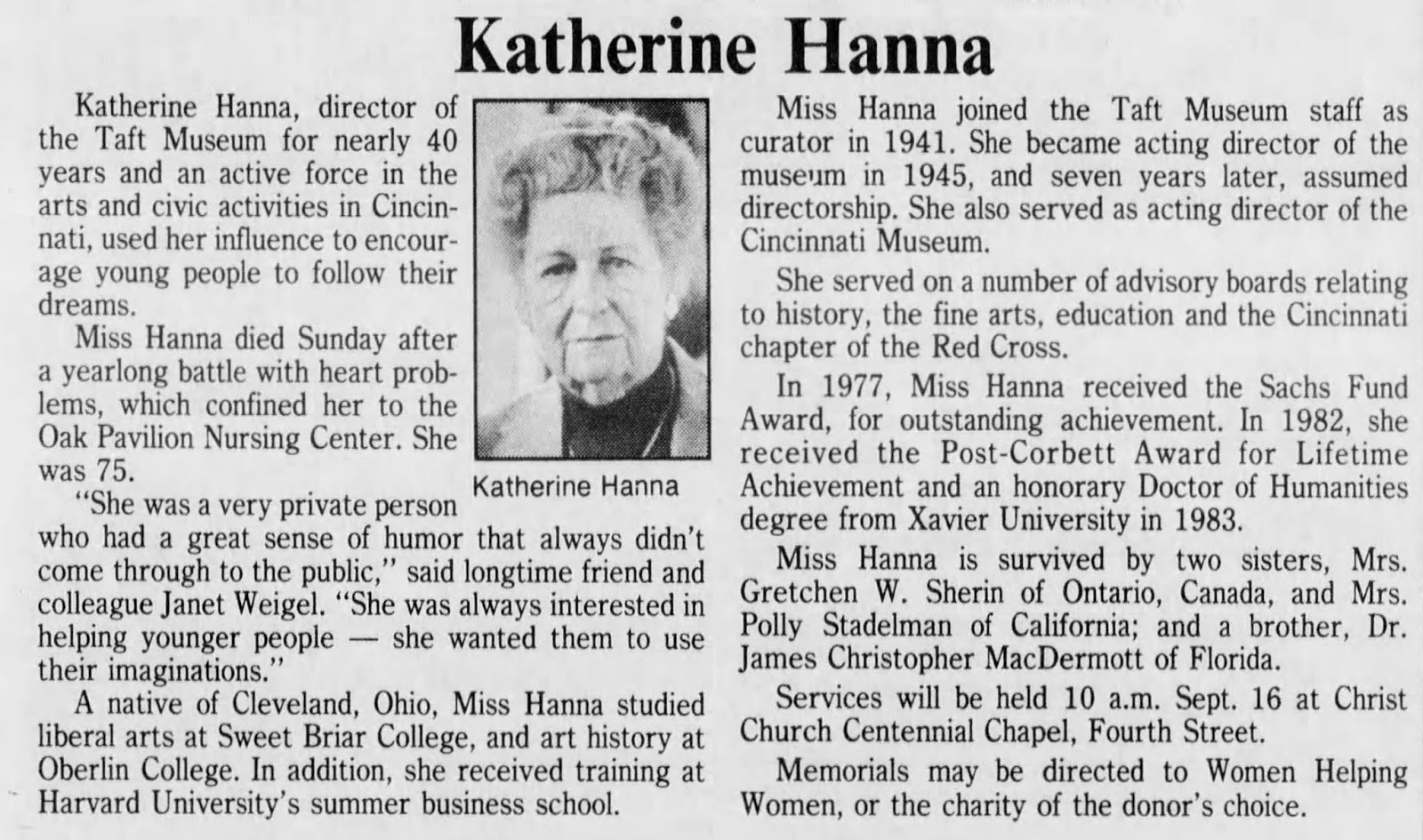
Inland Architect Vol XXX No 5 The Fisher family only lived here until 1907, when it was sold to Mark Davis, a business man in the insurance field. After his death in 1931, his wife and children owned the home until 1944. The home was sold in 1949 and again in 1959 to Katherine Hanna, who was the director of the Taft Museum. 
Hanna shared the home with her longtime friend, Janet Weigel and they dedicated time and money to keeping up the home. Multiple articles featured the unique style and story of the chalet. Cincinnati Enquirer; Sunday, January 15, 1961 - Click here to see all four pages. Cincinnati Enquirer; Sunday, May 27, 1979 - Click here to read full article. Cincinnati Enquirer; Wednesday, September 7, 1988 After Hanna's death in 1988, ownership transferred to her friend and companion, Janet Weigel until her death in 2017. The following photos were taken in the late 1990s and are courtesy of the University of Cincinnati's Architecture and Urban Planning Collection.


Now the home is ready for new owners to love it as much as Katherine and Janet did for nearly 60 years. Contact the listing agent for more information.
tag:blogger.com,1999:blog-2756157783370608109.post-4847278601725970160
Extensions
The Stites House - Columbia/Tusculum
Show full content
This photo on Instagram from cincinnati_revealed inspired me to dig a bit into the history of this home.

cincinnati_revealed on Instagram While the Hamilton County Auditor has the year built as 1865, it turns out that part of this home are much older (1830s) and built by one of the founding families of Hamilton County. As I started my digging, I found a wonderful article in the Cincinnati Enquirer that had explored the history of this home in 1970, so please enjoy this look back into the history of this home!


This article was retrieved from Newspapers.com from the Cincinnati Enquirer, Sunday, August 16, 1970, The Enquirer Magazine; pages 26-32.
tag:blogger.com,1999:blog-2756157783370608109.post-7566083741679894598
Extensions
Krass House in Colerain Township Since 1831
Show full content
Thanks to my Facebook followers for helping to choose a house for my presentation to the Coleraine Historical Society. This home is one of the oldest in Colerain Township according to a search with the Hamilton County Auditor.

Hamilton County Auditor The Auditor's site has the build date as 1831 and I wanted to confirm whether this date was accurate, so I first took a look at some old maps. I always compare them to the CAGIS map of today so I can line up the property.
2017 CAGIS - The blue "i" is the location of the house today. This is located in Section 20 Township 2 Entire Range 1 in Hamilton County, Ohio.


1847 Map of Hamilton County, Ohio by attorney William D Emerson, C. S. Williams and Sons publisher (No. 5 W. 4th St.), includes property owner names, inset maps and detailed legend http://sandmancincinnati.com/cincinnati-maps

1856 Hamilton County by A.W. Gilbert http://www.historicmapworks.com/

1869 Titus Map http://www.davidrumsey.com/

1884 Map of Hamilton County, Ohio, by Geo. Moessinger & Fred. Bertsch http://virtuallibrary.cincinnatilibrary.org/virtuallibrary/vl_oldrare.aspx?ResID=2967

1914, Hamilton County atlas: containing plats of townships, incorporated towns and villages, and map of greater Cincinnati http://digital.cincinnatilibrary.org/cdm/compoundobject/collection/p16998coll9/id/4418 So it appears that Michael and Edmund Grass/Krass (their last name is spelled multiple ways over the years) owned it from at least 1869 and a structure is on the map in the approximate location of the house today. I decided to complete a deed and mortgage index search on the Hamilton County Recorder's website to explore further into the past.
Index to 1st Series (1789-1859)
John and Michael Grass purchased 10 acres from Samuel Harden and an additional 8.77 acres from Mary Hardin.  I also found a mortgage record for John and Michael Krass and the FamilySearch.org website has some of the actual mortgages to examine.
Index to 1st Series (1789-1859)
John and Michael Krosz/Krafs had multiple mortgages with the Hardins. Mortgage Book 160 Page 371 describing the 10 acres. This mortgage was written in 1851. While this mortgage seems to state the Krass family purchased the land in 1851, evidence from the census records show they lived here the previous year. It could be that the previous land owners, Truman Allen and Samuel Hardin used tenant farmers to help cultivate their land. This house may have been built in 1831 for these tenants, but there is no proof of this in the records found. Samuel Hardin lived on Springdale Road near Colerain Avenue and in 1856 owned well-over 300 acres in the township. He also served as an early Trustee.

1850 United States Census 1850 United States Productions of Agriculture Census 1860 United States Census 1870 United States Census 1870 United States Products of Industry Census
Michael Grass is listed as producing lard kegs. 1870 United States Productions of Agriculture Census 1880 United States Census 1900 United States Census 1910 United States Census 1920 United States Census 1930 United States Census The census records show that the Krass family lived in the home until the 1920s. John Krass, born in 1806 in Germany, died in 1871 and is buried along with his wife Margaretha (1803-1878) in Saint James Cemetery in White Oak. Michael, their son, married Eva Peter in 1849 and they had five children: Elizabeth, Margaret, Catherine, Caroline and Edmund. Michael remained with his son after the death of Eva around 1900 and he died in 1915. Ownership of the farm transferred to Edmund until he sold it in 1925 to Anthony and Annie Roth. The Roths are listed on the 1930 Census with their eight children.

Index to 6th Series (1918-1927) Ownership Card - Hamilton County Auditor This ownership card above shows that the Roths sold the farm to Margaret Herrmann in 1941. Her family still owns the farm today, having added two more homes in the 1950s. The property also has at least two barns.

Summary of the owners:
  1. United States
  2. John Cleves Symmes
  3. William Henry Harrison
  4. Truman Allen
  5. Samuel Harden (Hardin)
  6. John, Michael & Edmund Grass/Krass (1851)
  7. Anthony & Anna Roth (1925)
  8. Margaret & Charles Herrmann (1941)
  9. Walter C. & Marilyn Herrmann (1983)
House and two barns on the property. Photo by author on February 15, 2017
tag:blogger.com,1999:blog-2756157783370608109.post-1962156336784531652
Extensions
The James Keys House - A Mount Auburn Original
Show full content
I have had my eye on this property for years to really dig into its history. Now I see the property is being sold as land, which tells me the house may not be standing for too much longer. So now it is time to tell its story before it is gone.
Cincinnati, a Guide to the Queen City and Its Neighbors; Writers' Program; 1943 The quote above caught my eye over three years ago. I thought surely other local historians knew about this house but I couldn't find any mentions of it and whether it still was around. So I did more digging.
The Mount Auburn Presbyterian Church, 1868-1943 : an historical ... Cochran, Mary Rudd. Having already researched the Worth home, I took a drive to the end of Bigelow Street. There stands the stone pillars and a very over-grown driveway.
Google Streetview June 2011 A quick look at the Hamilton County Auditor's website told me their year built date was 1865, but time has proven these dates aren't always accurate. That date more likely came from when the land was divided into a subdivision by John Bigelow, who was James Keys' brother-in-law. The auditor site also showed that the same family mentioned in the article from the Mount Auburn Presbyterian Church in 1943 still owned the home. Photos from the auditor's site were really no help in getting a better look at the property.
1993 - Hamilton County Auditor 2005 - Hamilton County Auditor
I have still been unable to get a good look at this house, since I am not one to trespass on private property. However, inspired with all this information, I wanted to see if I could verify the history mentioned in the two articles.

I decided a deed search would be helpful. The land was originally part of the Symmes Purchase and sold to Israel Ludlow who sold to Christoper Cary who sold to William Cary who sold to Arthur Henrie who sold to William Barr and James Keys. Barr was James Keys' father-in-law and shortly after their joint purchase, Barr sold his half to Keys, leaving Keys the sole owner of 30 acres. Pieces of the original plot were sold over time and after Keys' death, the property went to his sister-in-law, Maria Barr Bigelow, her second husband being John Bigelow. John died in 1858 and Maria in 1860, and shortly after, the property was divided into Bigelow's Subdivision.
Plat Map - Hamilton County Recorder After the subdivision was made, lots 14 to 17 were sold to Bigelow's other brother-in-law, Frederick Andress. He in turn sold to John M. Reid (also listed as Reed). Reed sold to Mary F. Wood, who sold to John Gano and his wife Laura. The Gano's sold to Frederick Hassaurek, half brother to Leopold Markbreit and both Hassaurek and Markbreit were prominent Cincinnatians. 

The property's current elderly owner, Carolyn Schoenle, is the wife of Walter Markbriet Schoenle, a direct descendant of the Hassaurek/Markbriet family. This property has been in her family since 1882, over 130 years!

Maps are always helpful in locating property and see changes over time. So let's go back in time to see. 
1856 Hamilton County by A.W. Gilbert. Red outline is the original John Bigelow Estate that was subdivided. 1869 Titus Map - Red outline is the approximate size of the land today. 1884; Atlas of the city of Cincinnati, Ohio : from official records, private plans & actual surveys;
Robinson, Elisha & Pidgeon, Roger H.
Yellow indicates a frame structure. Pink indicates a brick structure. Red outline is the approximate size of the land today. The original square wooden structure is in lot 14. 1891 Sanborn Insurance Map
Red outline is the approximate size of the land today. Additions can be seen on the sides on the original square building. 1922 Sanborn Insurance Map
Red outline is the approximate size of the land today. 1904-1930 Sanborn Insurance Map Yellow indicates a frame structure. Pink indicates a brick structure. Blue indicates a stone structure. Red outline is the approximate size of the land today.  1950 Sanborn Insurance Map Red outline is the approximate size of the land today.  A large addition had been added to the south portion of the original square and a portion removed from the east side. A Facebook follower reminded me that the Auditor does have Pictometry Aerial Imagery which gives a bird's eye view. These help clarify the changes to the original square wooden house that has now been stuccoed.
Hamilton County Auditor; facing north. Hamilton County Auditor; facing east. Hamilton County Auditor; facing south. Hamilton County Auditor; facing west. Newspaper articles are also a great way to document the history of a property. Here are some I found regarding the changes made to the house in the 1920s. Walter Schoenle was the father of Walter Markbreit Schoenle, the current owner's deceased husband.
Cincinnati Enquirer; March 12, 1922 Cincinnati Enquirer; August 15, 1924 Cincinnati Enquirer; August 17, 1924 Cincinnati Enquirer; March 21, 1926 The current owner had fought in the 1980s to prevent portions of Mount Auburn to be included in historic districts without owners' permission.
Cincinnati Enquirer; September 19, 1980 Since that time, it appears the property has been rented and sometimes used for business purposes. But in all this time, the history remained hidden on this perch of Mount Auburn. Stay tuned for updates, as I have reached out to the Cincinnati Preservation Association and the listing agent for more information!


tag:blogger.com,1999:blog-2756157783370608109.post-5090934382081415956
Extensions
Before Ruth Lyons Moved In
Show full content
This is a long overdue blog post! I hope you enjoy reading the history of this house, mostly known for being the home of Ruth Lyons and her husband Herman Newman. When this house went on the market earlier this year, I was surprised to see the year built is listed as 1865! So I had to dig more into the history of this home.
5205 Colerain Avenue - Photo from Motz Real Estate Let's go back in time to some historic maps. This is often the easiest way to trace back ownership of land and to see if a building on the old maps matches up with a present day map. I used the CAGIS maps to determine the property's Township, Range and Section (original divisons of the Symmes Purchase) so I could use the same information on the old maps. CAGIS Map  - Blue dot is location of the property today. The oldest map for Hamilton County that I have been able to locate is from 1847. This map shows a house in approximately the same location owned by H. Kendall. 1847 Map of Hamilton County, Ohio by attorney William D Emerson, C. S. Williams and Sons publisher (No. 5 W. 4th St.), includes property owner names, inset maps and detailed legend http://sandmancincinnati.com/cincinnati-maps To verify this information, I went to the Recorder's deed and mortgage files. The first series of the deed and mortgage index books from 1789 to 1859 are shown below. Hamilton County Recorder This shows the transfers from the original Symmes Purchase down to Henry Kendall, the same name on the 1847 map. The structure on the map could be the house standing today, but there is no concrete proof of this from the records I found. The map below from 1856 shows H. Kendall as the owner, but there are no markings for structures. 1856 Hamilton County by A.W. Gilbert http://www.historicmapworks.com/ Hamilton County Recorder 1869 Titus Map http://www.davidrumsey.com/ The second series of deeds also matches the 1869 Titus Map, which now shows that Michael and Mary Cahill own the property and the small black square in front the 5.15 (acres) could be the house still standing today.
Hamilton County Recorder 1884 Map of Hamilton County, Ohio, by Geo. Moessinger & Fred. Bertsch http://virtuallibrary.cincinnatilibrary.org/virtuallibrary/vl_oldrare.aspx?ResID=2967 The third series has quite a few transfers and leases, so by the time of the 1884 map, Joseph H. Wolf owned the land but had rented it to Allen Haisley in 1883 and sold it to him in 1886.
Hamilton County Recorder  In 1888, Allen Haisley purchase the lot to the north of his property from Martha Riddle, bringing his land to almost 15 acres.
Hamilton County Recorder  Allen died in April of 1922 and the property transferred to his daughter, Nettie Eckoff. Nettie had married Joseph Eckhoff and their family lived in the house until they sold to Alice Taylor in 1946.
1920 Census 1930 Census 1940 Census Hamilton County Recorder Alice Taylor sold the property to Herman Newman and Ruth Lyons just two years later in May of 1948. The following article describes their home:
Cincinnati Enquirer; October 8, 1950 Ruth and her husband updated the property and their decor was featured in the April 1958 issue of American Home Magazine.  Photo from Motz Real Estate Photo from Motz Real Estate Cincinnati Enquirer; September 21, 1968 The current owners purchased the property in 1968 and after 48 years, are ready for the home to have a new owner. In a recent interview for WCPO, they hope the home can find a new family to love and appreciate the home's history. More photos from the listing real estate company can be seen below.


tag:blogger.com,1999:blog-2756157783370608109.post-2773483008523456522
Extensions
John Mears Home - Mount Washington
Show full content
My photographer friend, Tim Jeffries, took this picture a few weeks ago and I just had to learn more about this home.
Heis Avenue, Mt. Washington by Tim Jeffries I found this home was mentioned as being recently restored in the Mount Washington Comprehensive Plan. They also called it the "Mears House" so this gave me some information to start with. The Hamilton County Auditor lists the year built as 1833! So I went to check my maps to see what I could find.
1847 Map of Hamilton County, Ohio by attorney William D Emerson, C. S. Williams and Sons publisher (No. 5 W. 4th St.), includes property owner names, inset maps and detailed legend http://sandmancincinnati.com/cincinnati-maps The 1847 Map of Hamilton County shows the land and quite possibly the house were owned by J. Gallagher. A little searching in the deed records revealed that James Gallagher purchased this land circa 1830 and then sold it to John Mears in 1854.
1856 Hamilton County by A.W. Gilbert http://www.historicmapworks.com/ This map had not caught up with the sale of the property to John Mears in 1854.
1869 Titus Map - Anderson Township http://www.davidrumsey.com/
1884 Map of Hamilton County, Ohio, by Geo. Moessinger & Fred. Bertsch http://virtuallibrary.cincinnatilibrary.org/virtuallibrary/vl_oldrare.aspx?ResID=2967
John Mears was a well-known farmer and renowned for his strawberries as mentioned in this article from the Farmers’ Home Journal, Sept. 25, 1879.
The average yield of strawberries will run from fifty to sixty bushels per acre, but in many instances over 100 bushels are obtained in field culture. During the years 1860 to 1865, Mr. John Mears, of Mount Washington, was the most extensive grower of strawberries in the State, having about twenty-five acres under cultivation. These were the years of highest prices, and Mr. Mears realized from six to ten dollars per bushel for his crop, his berries being exceptionally fine and salable. During the year 1864, Mr. Mears gathered 316 bushels from a patch a trifle less than two and a half acres. Mr. Mears may be justly termed the strawberry king.
John passed away at the age of 87 on April 15, 1904. He had married once at the age of 67 to Marie who was 22 years younger than he, but they had no children. After his death, the property was sold to John Weld Peck, who became a federal judge and the namesake of the Federal Building in Cincinnati.

The Cincinnati Enquirer; Thursday, May 23, 1912; p. 13 http://www.newspapers.com/ 1914, Hamilton County atlas: containing plats of townships, incorporated towns and villages, and map of greater Cincinnati http://digital.cincinnatilibrary.org/cdm/compoundobject/collection/p16998coll9/id/4418

Judge Peck sold the property in 1921 to Frank G. Menke and it was sold again in the 1940s to the Clarabeth Heis. The Heis family created the Heis Realty Company and subdivided the land. The home became a multi-family property over the years. Between 2003 and 2007, the home underwent a conversion back to a single family home. The Mount Washington Community Council approved this decision in the following article from the Comprehensive Plan for Mount Washington in 2007:
Residential Zoning Changes: Numerous areas of the neighborhood currently zoned for multi-family use should be rezoned to single family zoning designations to reflect the current use of the property and to reduce the potential for future multi-family expansion. These areas include properties around the intersection of Oxford Avenue and Crestview Place, around the intersection of Heis Terrace and Beth Lane, and along the north side of Corbly Street west of Oxford Avenue. These areas contain mostly single-family homes. The properties in the Heis Terrace/Beth Lane area do contain existing multi-family buildings but should be rezoned to a single-family district to encourage this area to revert back to a single-family area over time. The recently renovated Mears house on Heis Terrace, which had been broken into multiple units and was restored to a single family home, should be preserved as a single residence and the properties immediately surrounding it should be encourage to be redeveloped with single-family homes. http://www.plancincinnati.org/sites/default/files/Comm_Plans/2007_mt_washington_comprehensive_plan.pdf
2015 CAGIS Property Map, identifying the Heis Realty Company subdivisions. The location of the Mears Home is outlined in red.
http://cagisonline.hamilton-co.org/cagisonline/index.html The current owners attempted to sell the home in 2013. The property was described as:
Rare 3600+ square feet plus lower level, 12 ft ceilings, wood floors, elaborate moldings, updated mechanics, stainless appliance, granite counters and more. Historic John Mears Mansion. 
It seems to be a small miracle that this house has survived since the 1830s and was not demolished in the 1940s-1950s when the other neighborhood houses were built. Thanks to the Heis family, we get to enjoy a surprise piece of history.
tag:blogger.com,1999:blog-2756157783370608109.post-5981527621986382645
Extensions
How To - Find Pictures
Show full content
Finding old pictures of your property can be quite difficult, unless your property is located near a landmark, owned by a famous Cincinnatian or located in a prominent neighborhood. There are a few websites worth searching just in case.
If you do not find any success, try locating living family members of former owners. Perhaps photos were taken of the home and are hiding in someone’s attic. Using the information collected from your research, try an internet people search and make contact with the relatives. It cannot hurt to ask!


Cincinnati History Library and Archives 
http://library.cincymuseum.org/
The Cincinnati History Library is located in the Cincinnati Museum Center. Their website offers access to some pictures that have been scanned and indexed, but many more are available at the Museum Center. They also offer many books in their library of local interest and also have archives of materials related to Cincinnati history and Cincinnati families. It is worth the trip to their library to see what information they may have to offer.

CincinnatiViews
http://www.cincinnativiews.net/
This is a large collection (over 12,000) of postcards and photographs of Cincinnati. A search page is offered and images are nicely categorized. The author of this site has also provided a lot of research of buildings which is extremely helpful.

Greater Cincinnati Memory Project
http://cincinnatimemory.org/ This site is a continuing effort being made by the Greater Cincinnati Library Consortium to make available to the public the large collection of images that these libraries hold in their collections. Initially, almost 6,000 pre-1940 images were scanned to preserve and share. More from post-1940 are being added and more institutions are joining the Project, making this a wonderful resource even better.

University of Cincinnati Digital Resource Commons; UC Libraries – Historical Records
https://drc.libraries.uc.edu/handle/2374.UC/702759 The University of Cincinnati’s Libraries has a variety of historical records on-line, including many photographs of streets that were repaired from 1920 to 1956. These were obtained from the archives of the City of Cincinnati’s Engineer Office. Homes along these streets are often also photographed. Within this collection are photographs of the construction of the rapid transit system, commonly called the subway, which was never completed.
Other Photograph Resources
Library of Congress: http://www.loc.gov/pictures/ New York Public Library: http://digitalgallery.nypl.org/nypldigital/index.cfm Old Photos of Cincinnati Facebook Group: http://www.facebook.com/groups/Old.Cincinnati/
tag:blogger.com,1999:blog-2756157783370608109.post-6336341364080798452
Extensions
The Apotheke Building - 1833 Vine Street
Show full content
Another repeat client recently adopted this building from OTR A.D.O.P.T. He wanted to know more about the history of the building that has stood at this corner of Vine, Findlay and McMicken for more than 160 years.
Google Streetview, August 2014 Source Commonly known as the Apotheke Building, because of the sign that was saved on its south facing facade, it appears from my research that it was built in 1851 for George Wurth. He leased it that same year to William Boettger, the first apothecary (Apotheke in German) to live and work in this building. William remained in business here until his death in 1878.
Cincinnati Enquirer (1872-1922); Jan 16, 1878; p. 8; ProQuest Historical Newspapers 1891 Sanborn Insurance Map - Source The apothecary business carried on with Julius Greyer, who was in business here until 1900. He was well known in the pharmacy business and as a chemist, created some products of his own.
1899 William City Directory - Source The Cincinnati Enquirer; Sunday, May 30, 1897; p. 3; Newspapers.com From 1900 until 1914, William Scheidt took over the pharmacy business. In 1915, however, the storefront changed business entirely to a billiard and pool parlor. The upstairs apartments continued to be rented to various families through these years. The pool business did not remain for long. By 1920, Arthur Ehrmantraut and other fellow optometrists and opticians took up shop here. In 1925, Edwin Enz had his doctor's office here as well, delivering over 5,000 babies during his 48 years of practice. In 1930, a dentist was also added to the mix, although part of the storefront at 1835 Vine Street became a shop for Howard Cleaners.
1904-1930 Sanborn Insurance Map - Source Circa 1925 - Source Because Ehrmantraut had his business here for so long and purchased it from the Wurth family in 1924, it was called the Ehrmantraut Building in city directories. By 1959, 1833 Vine Street was vacant and 1835 Vine Street had the Westendorf Men's Shop. Otherwise, the rest of the building no longer had tenants of any sort, either residents or offices.
Hamilton County Auditor; 1999-2003 In 1999, the building to the south was demolished, revealing the Apotheke sign. When this building was repainted, Don Heinrich Tolzmann, a local German history expert, encouraged the painters to keep the sign because:
“It's important we don't destroy the evidence and material culture that's here,” he says. “It's an integral part of the community identity. If you erase that, you succumb to historical amnesia.”… - Source
Now with a new owner, the building will return to active use, with commercial space on the first floor and two two-bedroom apartments on the upper floors. With close access to Findlay Market and the famous Schwartz Point Jazz Club just across the street, this old building will soon get a new life and more history to add onto this story.
tag:blogger.com,1999:blog-2756157783370608109.post-1092413712669088884
Extensions