The more I speak with people both in the political world and in what I’ve called the legal academic-judicial nexus,...
Show full content
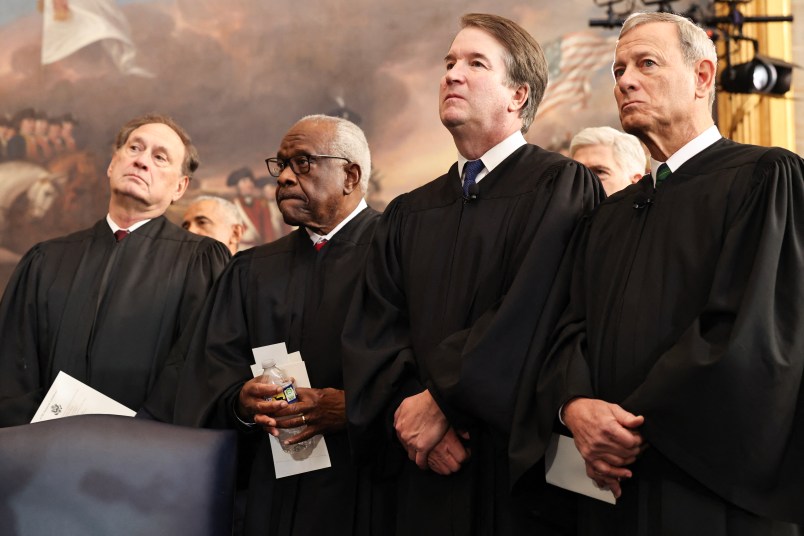
The more I speak with people both in the political world and in what I’ve called the legal academic-judicial nexus, the more I see just what a sea change is underway about Court reform. It’s come in successive waves: Dobbs, the immunity decision, Callais. There are various models of reform. But I don’t know anyone who has seriously considered the matter who thinks that you can have serious reform without expanding the Court. In these conversations, a few people have raised the question: what if the Court rules that a Court expansion law is itself unconstitutional? To put it slightly differently, what if the Court decides that the limits on its authority the Constitution creates, the paths for accountability it creates, are themselves unconstitutional.
This is question that is once absurd but also in a certain specific way important to prepare for.
The key, overriding and singular point is that the Court has zero jurisdiction over the number of judges who serve on it. The Court might as well decided that going forward it will appoint members of the Court itself. The Constitution clearly and explicitly gives Congress the power to choose the number of Justices who will serve on the Supreme Court. Congress first chose that there would be six. It then expanded it to 7, 9 and finally ten before changing it back to 9. The very existence of the Court as currently constituted, that it is nine Justices rather than three or one hundred, is the product of the Congress’s power which this scenario would have the Court questioning. That’s the simple answer. The Court lacks any jurisdiction.
That’s where I left the question the first few times it was raised to me. But of course this Supreme Court is steeped in the deepest anti-constitutional corruption and abuses of power imaginable. We couldn’t be surprised if this Court did manufacture new text in the Constitution that allowed its current members to appoint their own successors. And it would be folly to assume they might not try to review such a law, despite lacking any power to do so. For this Court the fact that it’s laughable, admittedly, doesn’t mean much.
The answer is to make clear in advance that the law is fully un-reviewable and not even entertain the discussion. As I said, if the Court decided it could appoint its own members no one should entertain that as a serious claim. This is identical. The Constitution gives Congress this power clearly and explicitly. The Court can’t review the legitimacy of the basis of its own existence. That is simply a matter of logical principles.
The answer is to pass the law (with a trifecta), nominate and confirm the justices (with the same trifecta) and send them over to the building. If Roberts and Alito want to barricade themselves in the building, sure, why not. They’re coming. Get used to it. Congress and everyone involved would have to make clear in advance that the whole question will not be entertained and that the matter will be settled solely and entirely with the legitimate power of Congress, in concert with the assent of the president. The new justices will show up up at the building. Pull up new chairs at the table or they’ll bring their own. Either way, end of story.
If anything the whole episode would be a salutary demonstration of the Court’s illegal conduct. The attempt would be illegal, unconstitutional and illegitimate and thus a good illustration of the Court’s corruption. It doesn’t count. Don’t engage with it. Pass the law and nominate the judges and send them over.
Sen. Bill Cassidy (R-LA) was defeated in a three-way primary against two Trump-aligned challengers tonight. Emine Yücel has our story....
Show full content
Sen. Bill Cassidy (R-LA) was defeated in a three-way primary against two Trump-aligned challengers tonight. Emine Yücel has our story.
Rep. Julie Letlow (R-LA), endorsed by Trump, and Louisiana’s state treasurer, former congressman John Fleming, will proceed to a runoff next month. Cassidy, with about 25 percent of the vote, will not.
A couple days ago I found myself in a brief online (social media) argument with a Court-reformer member of the...
Show full content
A couple days ago I found myself in a brief online (social media) argument with a Court-reformer member of the legal academy insisting that, contrary to my claims, it’s totally false that there are no reformers in the academy. Of course I never said there were no reformers in the academy. What I said, what I think is undeniable, is that the legal academy as a group or a community, and especially its most powerful voices, have been deep in the SCOTUS-reverencing camp. And for more clarity here we’re talking really about the liberal+mainstream academic legal community. It goes without saying that this applies, on a contingent basis certainly, to the conservative legal movement which not only participates in the corruption of the Roberts Court but is in effect its deep root structure, from which the Roberts Court is simply the degenerate, swaggering oak dominating the canopy and blocking out the sun which civic democracy needs to flourish.
TPM has a new Youtube channel. It’s right here. Can you click that link and just hit the subscribe button?...
Show full content
TPM has a new Youtube channel. It’s right here. Can you click that link and just hit the subscribe button? That’s it. Takes like five seconds. And it helps us A LOT build out our new channel.
I want to share with you a letter from fellow TPM Reader DA. He makes a point I fully agree...
Show full content
I want to share with you a letter from fellow TPM Reader DA. He makes a point I fully agree with but didn’t make clear enough in yesterday’s post. I fully agree there is such a thing as legal expertise. I’ve made that clear in my actions over a couple decades by paying for some of the very best (and priciest) legal counsel — mostly though not exclusively on 1st Amendment and libel law. It of course goes beyond this. Law, in its largest scope, is a complex set of rules and practices that we as a society have agreed on — sometimes explicitly, usually implicitly — to govern ourselves by and through which we resolve the countless range of disputes — civil and criminal — that arise among us. But it is in the nature of any specialized and professionalized craft to cast a penumbra of authority beyond its actual area of expertise.
From an Anonymous TPM Reader … Apologies for the extremely lengthy response, but your post today hit upon a perennial...
Show full content
From an Anonymous TPM Reader …
Apologies for the extremely lengthy response, but your post today hit upon a perennial hobby horse of mine!
It strikes me that in addition to their own self-image, law professors (and elite lawyers generally) aren’t able to be honest brokers in discussions about court reform because of the enormous quid pro quo and tight knit social ties created by judicial clerkships. The number of students that obtain clerkships plays a big role in law school rankings. Partly as a result of this, having clerked at least for a circuit clerk is now seen as a de facto requirement to be hired as a law professor, barring a PhD in another field (and even then, most still clerk). Professors who clerk help place students with their judges and so on and so forth. There is an *enormous* professional taboo against quitting a clerkship or criticizing the judge that you worked for no matter how bad the experience. It’s viewed as professional suicide, some law schools will effectively ice you out of their career services as you do it, and certain firms will effectively be closed to you for the entirety of your career. Conversely, stay close with your judge and you can expect them to be a letter of rec and introduction-maker for life. All of this adds up to elite law school faculty and elite lawyers having a sizeable material professional and social stake in revering judges, in addition to their psychological investment in feeling learned.
If you’re not a regular listener to our podcast, I hope you’ll listen to the episode that will come out...
Show full content
If you’re not a regular listener to our podcast, I hope you’ll listen to the episode that will come out later this afternoon. It was, I think, a particularly good episode, in large part because we had such critical issues to discuss: Callais, the wave of emergency redistrictings across the southern tier of the old Confederacy and what seems to be a sea-change moment on Supreme Court reform among establishment Democrats. I want to expand today on some points about Supreme Court reform, offering some of the historical background for this present moment.
Every current member of the Supreme Court comes out of what we might call the elite academic-judicial nexus, which is to say they’ve been law professors at elite universities and judges in the federal judiciary. I believe this applies to all the current justices. It didn’t used to be this way. It used to be relatively common to have justices who had never served as judges before and had never been law professors. Frequently they were ex-politicians. Famously, William Howard Taft was an ex-president when he became chief justice. Earl Warren was a popular Republican governor of California who had never served as a judge until president Eisenhower nominated him as chief justice. If you go further back, many justices never even went to law school, though this was more a matter of the evolution of legal education. The last non-law school justice was James F. Byrnes. (In earlier history, you generally learned the law as a kind of apprentice and then passed the bar to practice.) There was a brief boomlet of chatter when Bill Clinton was elected that he should or would try to re-inject this “politician on the Court” tradition back into the system. Of course that didn’t happen. The idea has scarcely been entertained since.
In the Southeast right now, we are seeing a no-holds-barred push to obliterate Black electoral power following the decimation of...
Show full content
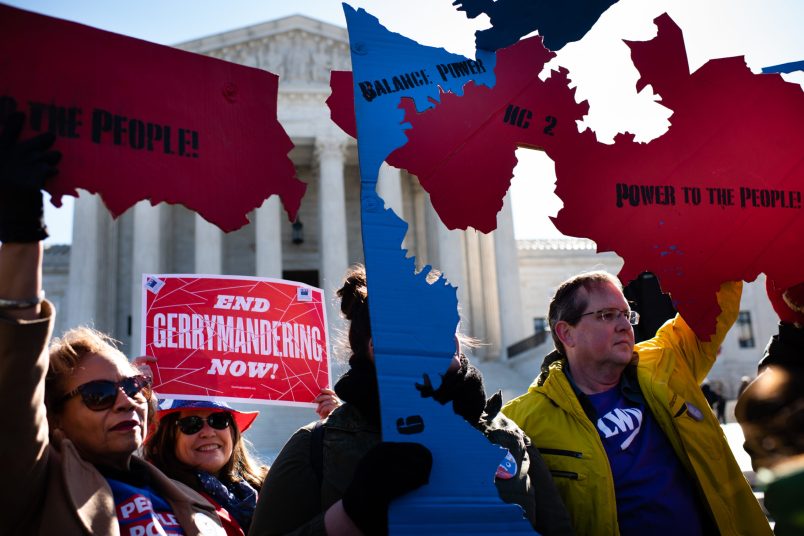
In the Southeast right now, we are seeing a no-holds-barred push to obliterate Black electoral power following the decimation of a law for which generations of activists marched and sometimes died. In service of this goal, state officials are going so far as to cancel elections in which voters have already cast ballots.
Yet many news outlets are talking about what’s happening using terms like “political gamesmanship,” noting white Republicans “looking for every advantage.” These terms were already a stretch for describing the mid-decade gerrymandering blitz pre-Callais. They are wildly inapplicable now.
There’s a frog-in-boiling-water quality to it. Its a mode of coverage unmoored from national and global history, which we ignore at our peril.
A bright spot for Democrats, as Republicans’ scramble to gerrymander the old confederacy plows forward: Over in Nebraska, the path...
Show full content
A bright spot for Democrats, as Republicans’ scramble to gerrymander the old confederacy plows forward: Over in Nebraska, the path is cleared for an independent who supports things like strengthening the social safety net and taking on corporate power.
“We are the most gerrymandered Republican state in the country already,” said South Carolina Sen. Majority Leader Shane Massey (R),...
Show full content
“We are the most gerrymandered Republican state in the country already,” said South Carolina Sen. Majority Leader Shane Massey (R), announcing his opposition to a new post-Callais redistricting effort which went down to defeat, for now, a short time later. Massey made both political and moral arguments against the move. We shouldn’t underestimate the political motivation. Democrat Joe Cunningham won the 1st district in the wave election of 2018. Nancy Mace defeated him by less than a single percentage point two years later. Her district then had to be significantly fortified with Republican voters to help her keep her seat. Point being, there are a lot of Democratic voters in Jim Clyburn’s 6th district. Spread them out into neighboring districts and you’ve spread the gerrymander so tight it can just snap. And those snaps happen in wave elections.
Some of the most consequential and trust-shattering Supreme Court decisions of late have been ones that could have been predicted...
Show full content
Some of the most consequential and trust-shattering Supreme Court decisions of late have been ones that could have been predicted decades ago. Certainly that’s the case with the Dobbs decision. Callais doesn’t have quite as long a history, in terms of attempts to overturn the precedent. But certainly it’s been in the cards for at least a decade. Still, it’s some of the smaller decisions that tell us just who and what this corrupt court is. Kate Riga notes one of them here: Conservatives on the Supreme Court have previously invoked the “Purcell principle” to rule that a change couldn’t be made to districts on the “eve” of an election. Now it’s fine to do so in states like Louisiana and Alabama where primary elections are actually already underway and tens of thousands of cast ballots must be invalidated.
The message is simple: there are no rules. Only power. It reminds me of my hand tool woodworking shop. There are a big selection of tools. And it’s just a matter of what helps the GOP and the Court in that particular moment. In a way it’s clarifying. Even helpful.
Independent media can feel like an isolating place. Most of us operate as individuals or in small newsrooms with limited...
Show full content
Independent media can feel like an isolating place. Most of us operate as individuals or in small newsrooms with limited resources, throwing spaghetti at the wall to try to reach new audiences and get our stories in front of people in an ever-more-consolidated media environment.
But we’re in this together, as celebrated historian and writer Heather Cox Richardson reminded us in a generous live interview with TPM’s Kate Riga and Josh Marshall this afternoon.
HCR had Josh and Kate on to talk about what it’s like to report on today’s frenetic politics; the founding and future of TPM; and what independent media will look like in the years to come.
Kate Riga has a good summary of the stakes Democrats currently face in Virginia. There’s a way to reverse the...
Show full content
Kate Riga has a good summary of the stakes Democrats currently face in Virginia. There’s a way to reverse the state Supreme Court’s decision tossing out the majority statewide vote supporting the new Dem-friendly districts. It involves intense political hardball. But it’s the same kind of political hardball Democrats will need to embrace at the national level in 2028-29 with a trifecta if there’s any hope on turning the tide against Trumpism. So Virginia will give us some view into what kinds of fights Democrats are ready for.
Again we see that, contrary to numerous press reports, the U.S. and Iran remain lightyears apart in their on-again, off-again...
Show full content
Again we see that, contrary to numerous press reports, the U.S. and Iran remain lightyears apart in their on-again, off-again negotiations to end their war. Iran’s demands, its response to Trump’s latest proposal, amount to a maximal package of winnings for a war Iran won: an end to the decades-long sanctions regime, sovereignty over the Strait of Hormuz, reparations. It is true that antagonists can sometimes seem very, very far apart and then suddenly arrive at an agreement. But these two sides seem really, really far apart.
TPM’s own Hunter Walker has won a 2026 New York Press Club award for his seven-part investigative series delving into...
Show full content
TPM’s own Hunter Walker has won a 2026 New York Press Club award for his seven-part investigative series delving into the impact of President Trump’s mass deportation agenda in New York, the U.S. city with the greatest population of immigrants, and which has seen the highest number of violent courthouse detentions.
Over two months in New York City’s federal courts, churches, and safe houses, Hunter spoke to more than 50 migrants, organizers, ICE agents and lawmakers, including then-mayor-elect Zohran Mamdani and Reps. Dan Goldman and Nydia Velasquez (D-NY). At the heart of the series are the New Yorkers, many of them volunteers, operating in secret to protect and serve their immigrant neighbors.
The Supreme Court’s decision in Louisiana v. Callais probably closes the book on the use of the Voting Rights Act...
Show full content
The Supreme Court’s decision in Louisiana v. Callais probably closes the book on the use of the Voting Rights Act to ensure Black voting rights in the South. The decision is being taken as a blow to Black voting rights — and even as indicative of the court’s racist leanings — but I wouldn’t jump to those conclusions. The redistricting effort that Callais ends may not have been of unequivocal benefit to the Southern Blacks it was designed to aid. And while it could damage Democratic prospects in 2026, it might help them in the longer run.
Callais, combined with today’s court ruling in Virginia, has jolted Democrats and sent commentators into bemoaning an accelerating “race to...
Show full content
Callais, combined with today’s court ruling in Virginia, has jolted Democrats and sent commentators into bemoaning an accelerating “race to the bottom” and, to paraphrase Jeff Zeleny on CNN this afternoon, the end to norms that have organized American politics and redistricting for generations.
I’d like to offer a significantly different view of the situation. What we have seen over recent months is that Democrats have largely abandoned the mode of the last decade plus in which with one hand they fought the partisan battles of the day and with the other assume the mantle of defending the political norms Republicans have already destroyed. In other words, it was the responsibility of Democrats both to be contestants and referees. Republicans violated norms; Democrats tried to uphold them. That of course meant no partisan battle was ever on equal terms and Republicans almost always won them.
With the big news out of Virginia this morning, in addition to the fallout from the Callais decision, we decided...
Show full content
With the big news out of Virginia this morning, in addition to the fallout from the Callais decision, we decided that an insta-pod edition of the podcast was important to bring you up to date with what all this means. Kate and I recorded one about an hour ago and it should be in your podcast feeds this afternoon. So if you’re eager to unpack this barrage of news, Kate and I will be answering those questions in this emergency edition of the podcast.
Yesterday, Lauren Egan — who authors The Bulwark’s newsletter about Democrats — sent out a newsletter edition entitled “Get Ready...
Show full content
Yesterday, Lauren Egan — who authors The Bulwark’s newsletter about Democrats — sent out a newsletter edition entitled “Get Ready for the Dem Court-Expansion Litmus Test.” (Egan tends to be fairly dismissive of Democrats’ intentions, with a kind of mainstream media vibe.) Today Chief Justice John Roberts is complaining that the public is misinformed thinking that the Supreme Court is made up of corrupt political actors. As I’ve written repeatedly, there are deep inertia pools of opposition to Supreme Court reform. It’s a much heavier, though just as critical, lift than contesting the gerrymandering wars or abolishing the filibuster. But these and other hints show that a movement and a coherent push are beginning to take shape.
Yesterday I wrote a post basically arguing for a broad resistance to allowing the avalanche of corrupt and criminal conduct...
Show full content
Yesterday I wrote a post basically arguing for a broad resistance to allowing the avalanche of corrupt and criminal conduct under the second Trump administration to take on the color of normality and acceptability. The answer to that is broad criminal accountability. The post was entitled, “The Law is Coming.” This was partly a reference to a phrase I used frequently during the first Trump administration, after which the cause of accountability was at best uneven and ultimately a failure, a story we all know well and from bitter experience.
I’m hoping to bring you some news on the DOJ-in-Exile front in the not-too-distant future. It was probably simply too...
Show full content
I’m hoping to bring you some news on the DOJ-in-Exile front in the not-too-distant future. It was probably simply too early in the spring and summer of 2025. It’s not too early now. But the DOJ-in-Exile idea was and is part of a more general ambition and agenda — to create a baseline record, a predicate and an expectation of future accountability for the Trump administration’s criminal conduct. Some of that effort is a kind of opposition therapy, resisting the authoritarian aim of convincing the public that the law, the ecosystem of criminal accountability has disappeared. It heartens people. It provides a framework of expectation: the law hasn’t disappeared. We’re in an interregnum. It will return, as will accountability. The battle over expectations about the future is a central battle in any authoritarian takeover.
But it’s not solely a matter of heartening, strengthening the morale of the opposition. It is also very directly and literally laying the groundwork for criminal accountability for a renegade executive and all the corrupt actors and criminals who now populate the executive branch.