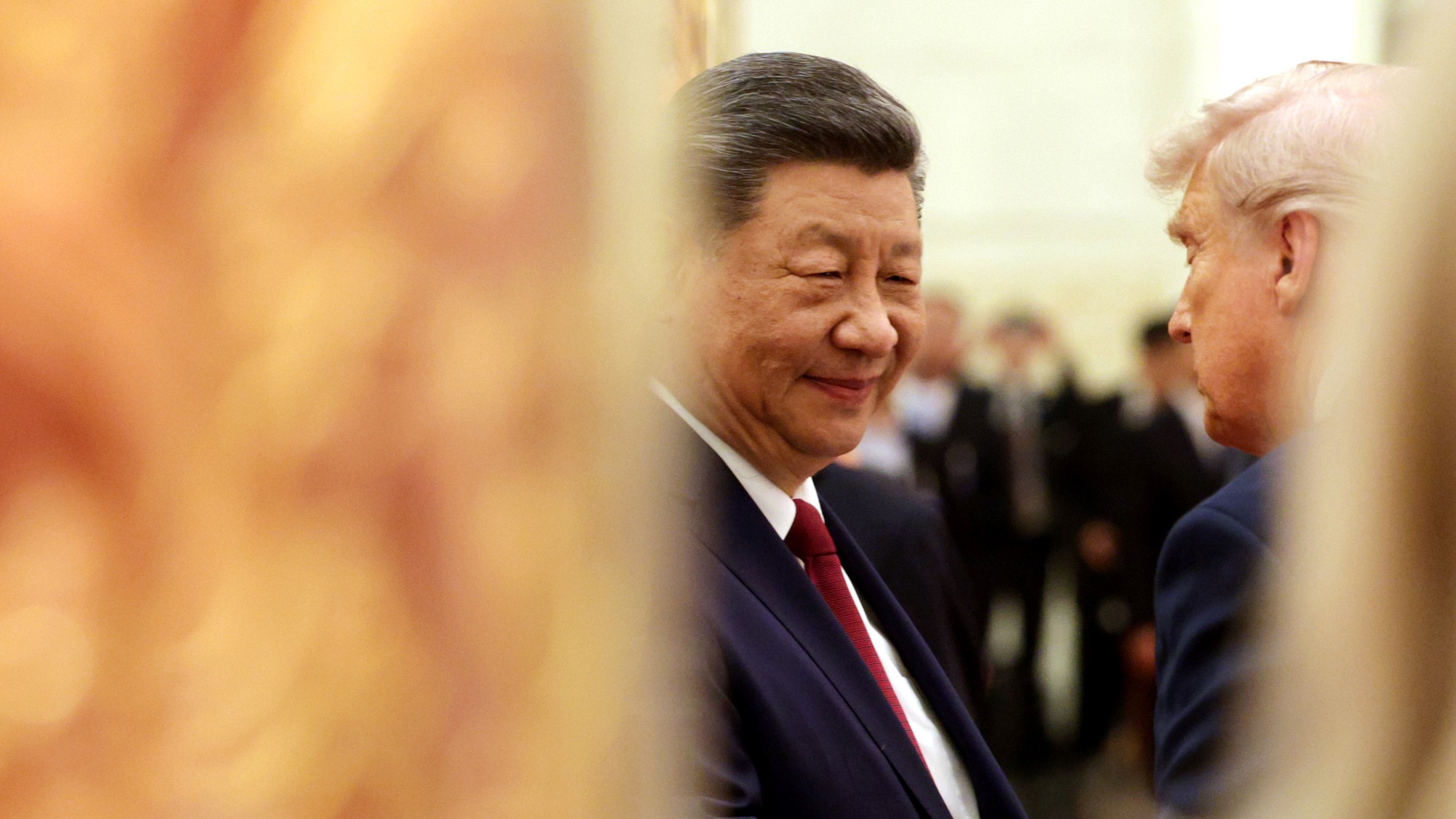
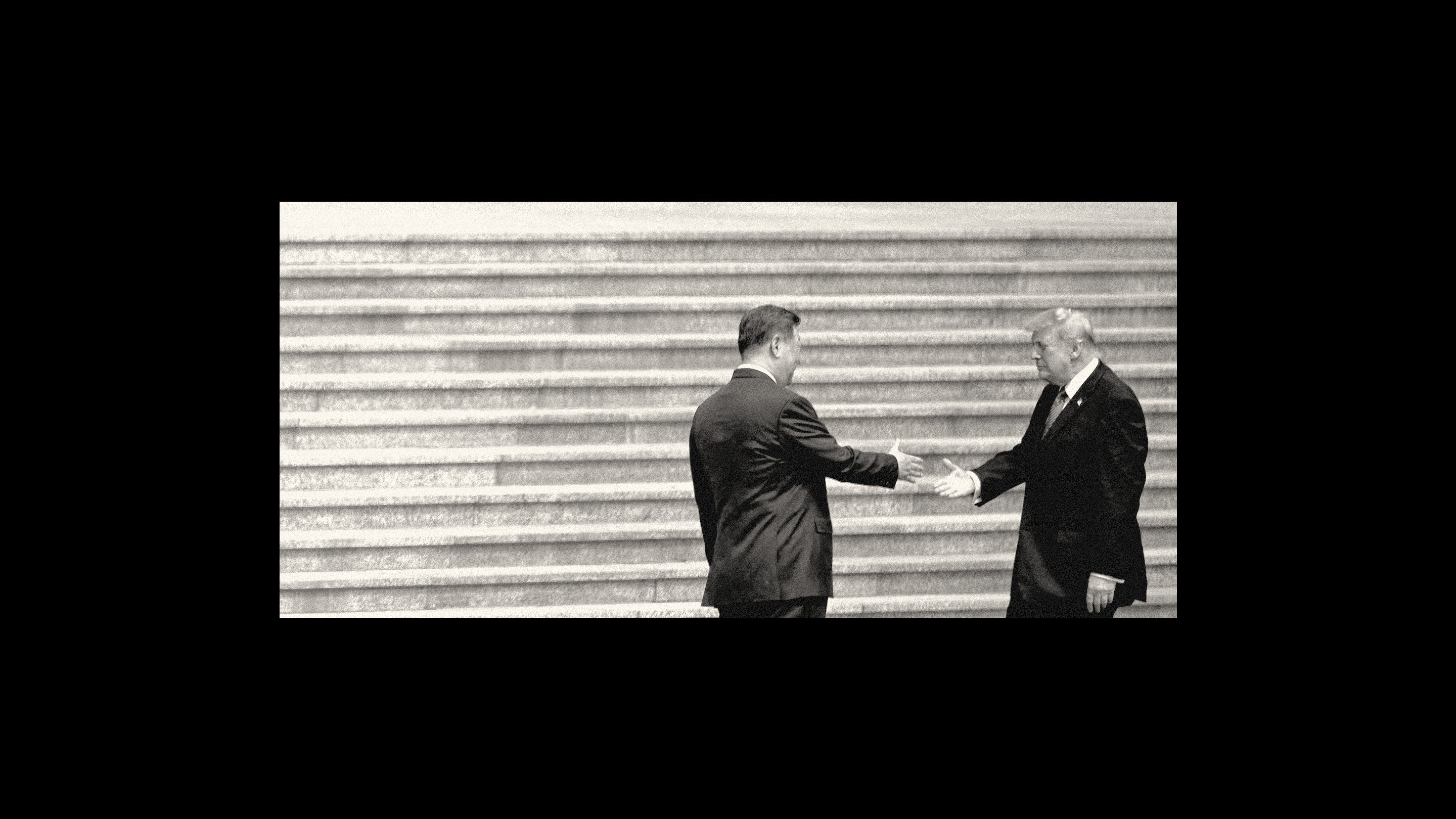
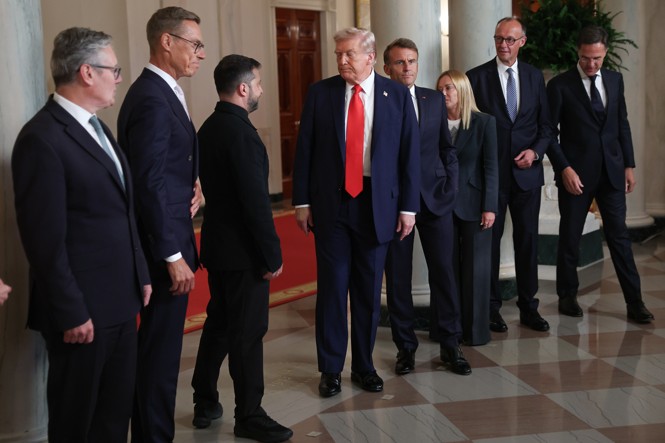
In Beijing, the president scrapped hardheaded diplomacy in favor of an imagined personal bond.
Show full content
In 1971, Richard Nixon announced his plan to visit Beijing—marking a geopolitical turning point, as the trip would be the first for a U.S. president in 25 years. Senate Majority Leader Mike Mansfield offered an observation that has since become a Washington commonplace. “Only a Republican, perhaps only a Nixon,” he toldU.S. News & World Report, “could have made this break and gotten away with it.”
This notion entered the political lexicon to denote a particular kind of calculation: that on certain issues, only a hard-liner has the credibility to pursue a softer line and survive politically.
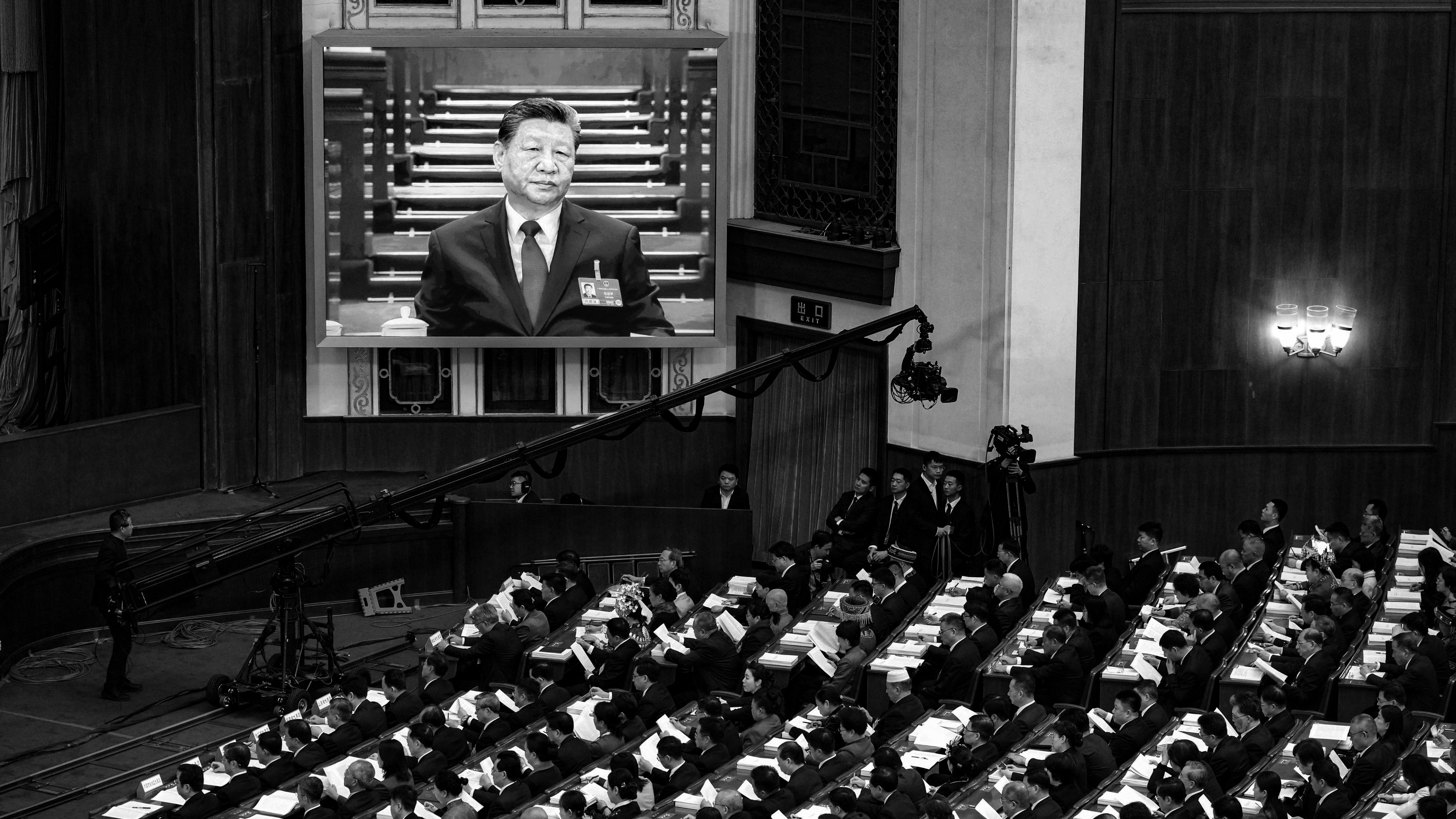
Last week in Beijing, Donald Trump had his Nixon moment. He scrapped a policy that combined hardheaded diplomacy with action to protect U.S. interests and check Chinese power. In its place, he embraced the notion that a personal bond with Chinese leader Xi Jinping can ensure stability.
Trump is getting away with this move politically. Geopolitically, he will not. His new stance imperils Americans and emboldens China, which makes a future crisis likelier than ever.
In recent decades, Republicans and Democrats have largely agreed to treat China as a strategic competitor. The United States has tightened export controls on advanced technology, reduced its economic exposure to China, and thickened its web of alliances across the Indo-Pacific. That shift began during the first Trump administration; the Biden administration intensified it.
Trump has long been a vocal critic of China. He began his second term with a trade war that pushed tariffs on Chinese goods to 145 percent. He reversed course after China retaliated and demonstrated, through its grip on rare earth processing, that it could inflict real pain in return. Then he began speaking of his great personal relationship with Xi and of the advent of a U.S.-China G2.
In Beijing last week, he praised Xi in terms he seldom uses for America’s democratic allies: “a great leader,” straight out of “central casting.” Trump took with him an extraordinary delegation of American CEOs, including Apple’s Tim Cook, Tesla’s Elon Musk, and Nvidia’s Jensen Huang, whose company has spent the past year lobbying to keep its most advanced chips flowing to the Chinese market.
China announced that the two countries had agreed to establish a “constructive China-U.S. relationship of strategic stability.” Wang Yi, China’s foreign minister, framed the new concept as one of “respecting each other’s core interests and major concerns.” Beijing is almost certainly suggesting, with this language, that it expects the U.S. to limit its competitive measures. Trump, for his part, announced modest trade deals on aircraft and agriculture.
Were a Democratic president doing any of this, Republican hawks would be unsparing in their criticism. Cowed by Trump, they are largely silent. Trump’s shift raises deceptively simple questions that may define the coming China debate and even reshape American policy: Why are we competing with China at all? What’s wrong with a little peace and quiet?
Some experts see an opportunity to persuade Democrats to soften their position on China. Jessica Chen Weiss, a former Biden State Department official who broke with that administration over what she viewed as excessive hawkishness, used the occasion of the summit to write in the Financial Times that Trump had “created real breathing room in U.S.-China relations,” and to argue for a posture that embraces interdependence and cooperation and abandons strategic competition altogether. Hers will not be the last such argument.
The trouble with this posture is that it fails to account for the Chinese actions that threaten the livelihood and security of the United States and its allies. Consider trade. Beijing uses the full weight of the Chinese state—subsidies, financing, regulatory protection, industrial policy at a scale that no Western country can match—to dominate the high-end industries of the future. It has reduced its imports to make itself less dependent on other states, and increased its exports to gain leverage over them. China’s trade surplus in manufacturing goods is now more than $2 trillion. As Robin Harding of the Financial Times has put it, Beijing is “making trade impossible.” It has effectively given Western countries a choice between deindustrialization and protectionism.
Trump’s tariffs reduced China’s surplus with the United States, but the excess goods simply rerouted to Europe, Southeast Asia, and Latin America, where they are now hollowing out the manufacturing bases of America’s allies. A serious U.S. response would involve coordinating with Europe, Japan, and Korea on common tariffs and pressing Beijing on the underlying imbalance. Trump is doing the opposite. He treats the European Union, which is on the brink of a trade war with China, as a rival rather than a partner, and he has signaled that he sees America’s economic relationship with allies as no more privileged than its relationship with its rivals.
The most striking signal of last week, though, was on cybersecurity. For several years, a Chinese state-affiliated group that U.S. intelligence calls Volt Typhoon has been pre-positioning itself inside the IT networks of American water utilities, transportation systems, electric grids, and the like. Should the U.S. and China come into conflict—say, over Taiwan—Volt Typhoon could unleash destructive attacks on American infrastructure. China has similar capabilities in states allied with the U.S. in the Indo-Pacific.
Asked aboard Air Force One whether he had raised China’s cyber campaign with Xi, Trump offered something close to a shrug. “What they do, we do too,” he said. “We spy like hell on them too. I told him, ‘We do a lot of stuff to you that you don’t know about.’” Pressed on the specific question of pre-positioning for attacks on civilian infrastructure, he allowed: “Well, you don’t know that. I mean, I’d like to see it, but it’s very possible that they do, and we’re doing things to them.”
Espionage—intrusions for the purpose of intelligence collection—is ubiquitous and, within limits, accepted. The pre-positioning of cyber weapons inside the civilian infrastructure of a country with which one is not at war is something else entirely. To conflate the two in public, alongside Xi, is to tell Beijing that one of the most aggressive components of its peacetime posture against the United States carries no political price.
The cyber-penetration also signals a larger problem: China is building the military capability to make a war over Taiwan winnable. John Culver, a former CIA analyst of China’s military, recently toldThe Washington Post that “it’s hard to point to an area other than submarines and undersea warfare and say the United States still has an advantage,” and that China is leading in “air-to-air missiles, surface-to-air missiles, counter-space capabilities and electronic warfare.”
China’s engagement with U.S. companies has helped it build the industrial and technological base that underwrites these military advances. In his book, Apple in China, the journalist Patrick McGee notes that Apple’s annual investment in China’s technology sector exceeded the Biden administration’s once-in-a-generation investment in domestic chips manufacturing. The high-tech China of today, he writes, would not be what it is without Apple. This “transfer of technology and know-how” was “so consequential as to constitute a geopolitical event, like the fall of the Berlin Wall.” Apple’s CEO was, of course, on the plane to Beijing last week.
China needs advanced U.S. chips to power artificial intelligence. Restricting Beijing’s access to these has been one way for the U.S. to interfere with China’s growing military capability in recent years. But Trump has systematically relaxed those controls over the past year, for example by approving sales of Nvidia’s H200 to several major Chinese tech firms.
With regard to Taiwan, Trump said, rightly, that the United States just seeks to maintain the status quo. But he also needlessly raised doubts about the U.S. commitment to helping Taiwan defend against a Chinese attack, and he seems to have bought into Xi’s narrative that the problem is that Taiwan is seeking independence.
In the past, the U.S. has sought to deter a Chinese assault on Taiwan by strengthening the island’s defenses. Since 1982, the U.S. has made an explicit policy of selling arms to Taiwan without consulting Beijing on the timing or content of the shipments. But last week’s meeting suggested a weakening of this American posture: Trump dismissed America’s long-standing assurances to Taiwan in this regard as something from “a very long time ago” and accused Taiwan of stealing America’s chip industry. He acknowledged that Taiwan had been Xi’s most important issue and said that an American arms package authorized in December and not yet delivered was “a significant bargaining chip” with Beijing.
To watch some of the coverage of Trump’s visit to China, or to listen to the administration, one could be forgiven for thinking that he inherited a relationship on the brink of war. He did not. The Biden administration, in which I served, had a strategy of managed competition. That blended close and frank diplomatic contact among senior officials with “competitive actions” to strengthen America’s strategic advantage over China.
Relaxing the competitive policies toward China in favor of warmer leader-to-leader engagement reflects a fundamental misreading of Xi’s intentions. Xi’s preferred strategy toward the United States is exactly the one on offer in Beijing last week: engage Washington to buy a period of stability, then use that time to pursue longer-term objectives in relative comfort. China hopes to emerge with decisive advantages that will allow it to finish its harder business at a moment of its choosing.
Jon Czin, a former CIA analyst of Xi and now my colleague at the Brookings Institution, said in a podcast interview that the key thing to know about the Chinese leader is that “he is not a dealmaker”; nor is he “sentimental about his personal relationships.” He’s “a jack-in-the-box,” Czin said, “who will wind up for years, sometimes for decades, and then pop when he thinks the moment is right, startling everyone around him.”
The Beijing summit was the first of as many as four meetings between the two leaders set to take place this year. Xi is scheduled to visit the United States on September 24, and the leaders may meet again at conferences scheduled for November and December. That frequency gives Trump every incentive to seek to maintain good terms with Xi, even if it means suppressing impulses inside his own administration toward a more competitive approach to China.
Nixon went to China because he understood that relations with Beijing would help the United States in the Cold War against the Soviet Union. Trump went there to abandon the strategy of managed competition and replace it with a leader-to-leader bond. His new posture is one that strengthens America’s top rival, leaves its vulnerabilities unaddressed, and makes a U.S.-China crisis more likely rather than less.
Trump’s summit with Xi Jinping demonstrated the perils of shortsightedness when playing a long game.
Show full content
In the centuries when dynasties ruled China, kings and chieftains across Asia sent “tribute missions” to the imperial court to pay homage to the emperor in exchange for access to the empire’s riches and favors. Donald Trump’s trip to Beijing this week recalled those missions. The United States president arrived hat in hand, seeking money and promises from China’s latter-day emperor, Xi Jinping. The visit, meant to establish stability after a decade of trade wars and acrimonious one-upmanship, instead highlighted how the balance of power is tipping away from Washington. Despite America’s economic, military, and diplomatic heft, Trump’s missteps have put him and the country on the back foot in dealings with the far more disciplined Xi.
Trump opened the proceedings with his usual kowtowing. “You’re a great leader. I say it to everybody,” Trump told Xi at a welcoming ceremony yesterday at the Great Hall of the People. “Sometimes people don’t like me saying it. But I say it anyway because it’s true.” The fawning didn’t get him very far. In the meeting that followed, Xi promptly issued a stern warning about Taiwan, which Beijing claims as its own. Stressing that the “Taiwan question is the most important issue in China-U.S. relations,” Xi warned the U.S. to handle the matter with “extra caution,” according to a summary of his comments from China’s Ministry of Foreign Affairs. If not, Xi said, “the two countries will have clashes and even conflicts.”
Secretary of State Marco Rubio later told NBC News that the administration’s policy on Taiwan has not changed, but Trump himself—who still needs to sign off on plans to sell $14 billion in weapons to Taiwan—seems less committed. Trump said today that when Xi asked him whether he would send troops to defend Taiwan, he did not offer an answer. Washington’s position on defending Taiwan has long been ambiguous, but Trump added to reporters that “The last thing we need right now is a war that's 9,500 miles away.”
Trump’s sycophancy didn’t change Xi’s mind on Iran either. Trump had delayed his trip to China by six weeks for fear that the Iran war would overshadow what he hoped would be a big diplomatic win. But the unresolved conflict still intruded on the dealmaking. The U.S. has been troubled by China’s support for Iran through supplies of weapon components and as the top buyer of the country’s oil. Shortly before the summit, Trump’s team turned up the pressure on Xi to curtail this aid by sanctioning refiners and companies in China and Hong Kong involved in these deals. Yet Xi ordered the refiners to ignore Trump’s edicts, uncowed by a president who often folds under pressure.
In a Fox News interview yesterday, Trump crowed that Xi had promised not to arm Iran. But Trump had said in April that Xi had already assured him that Beijing wasn’t sending arms to Iran, yet the findings of U.S. intelligence officials suggest otherwise. Instead of pressing Xi on Beijing’s arms sales or oil purchases, Trump said that he was considering lifting sanctions on the Chinese oil companies in question. He even seemed to defend Xi’s position. “Look, he’s not coming in with guns. He’s not coming in with rifles. They are not coming in shooting,” Trump said. “He’s been very good.”
Perhaps Trump has merely recognized that expecting Xi to help solve his Middle East mess is a nonstarter. Tuvia Gering, a fellow at the Atlantic Council who tracks China in the Middle East from Jerusalem, told me that Xi’s geopolitical vision “imposes a definitive ceiling on China’s willingness to facilitate Trump’s objectives in Iran.” China’s goal seems to be to weaken U.S. power in the region, so helping “to secure a decisive U.S. victory would be strategically self-defeating.”
Trump made only slightly more progress on trade. He came to Beijing as a traveling salesman, hawking American products in pursuit of his long-running goal of closing the U.S. trade deficit with China. Though he didn’t get the firm purchase commitments he wanted, he did not leave empty-handed. Trump said that Xi pledged to purchase about 400 General Electric jet engines and 200 “big” Boeing airliners, though the details remain hazy and no formal agreement seems to have been set. This is far less than the deal for 500 737 Max jets that Trump had been touting, but if the orders do come through, they’d be Boeing’s first major order from China in about a decade.
These pledges have allowed Trump to spin this summit as a success, but Xi has an emperor’s appreciation of the role a few choice gifts can play in securing leverage over a foreign power. What Xi offers, he can threaten to take away. Xi has already exploited American dependence on Chinese rare earths and supply-chain components to keep Trump in line. Last year, he halted purchases of soybeans from American farmers, a key Trump voting bloc, to pressure the president to stand down from his trade war. Getting more American businesses and constituents hooked on Chinese cash promises to be yet another way to assert China’s power over the U.S.
These tough tactics seem to have taught Trump that China has become too powerful to push around. “The U.S. has realized that China has achieved mutually assured deterrence status,” Wang Huiyao, the president of the Center for China and Globalization, a Beijing-based think tank, told me. He argues that this has brought about “a big paradigm shift” in Washington’s approach to China, and has curbed the hawkishness of Trump’s messaging. Wang suggests that a new pragmatism may now prevail between the U.S. and China, one in which U.S. leaders no longer try to get China to adopt Western values but “respect the differences and find a way to work together.”
Trump seems to have embraced this change of heart. “Having a good relationship is a good thing, not a bad thing,” Trump told Fox yesterday. “It’s great when you have good relationships with very powerful countries.”
The disputes over Taiwan, Iran, and trade suggest that a more stable U.S.-China relationship rests mainly on Trump’s reluctance to press Xi too hard. Trump has duly brushed aside a number of contentious issues that have soured relations, such as China’s continued support for Russia’s war in Ukraine and its export-heavy economic policies that threaten U.S. industry. This could prove politically risky. China hawks in Washington still advocate for a tougher line on Beijing to protect American interests, and the midterms could usher in a more hawkish Congress. But watching Trump swan around Beijing with an entourage of prominent American CEOs, including Elon Musk and Nvidia’s Jensen Huang, left the impression that the American president sees China as a business opportunity rather than as a security threat.
Despite being at war with a China partner, Trump seems content to simply sell some Boeings and beans. The Trump administration doesn’t have “any great ambition for this relationship,” Bonnie Glaser, the managing director of the Indo-Pacific program at the German Marshall Fund, told me. Trump has set his priorities to merely “keeping the relationship from going off the rails” and “ensuring that America’s needs are met,” at least when it comes to trade.
Xi, however, has great ambitions. Trump may now see China as a mutually beneficial economic partner, but Xi’s policies are designed to change the world order at America’s expense. Beijing is working to engineer China’s technological and industrial dominance, backing Russia in a destabilizing war in Europe, and generally setting the stage to achieve global supremacy when the United States flames out. Trump, with his disdain for global alliances and liberal values, doesn’t seem interested in contesting Xi on these fronts. “Xi Jinping has the long plan, about dominating the world and putting the United States in its right place,” Joerg Wuttke, a partner at the consulting firm Albright Stonebridge Group, told me. “Donald Trump doesn’t look that far.”
A couple of trade deals have apparently made Trump happy enough to step aside and let Xi pursue his global agenda. Like the Chinese emperors of old, Xi has used the lure of Chinese wealth to reinforce China’s power. Beijing has sought to find “the minimum price point to keep Trump invested in the process,” Jonathan Czin, a foreign-policy fellow at the Brookings Institution, told me. This is how a U.S. president who has long insisted on American strength and a tough line on China consigns the country to a weaker future.
How did $65 million of allegedly stolen antiquities wind up in two of the world’s greatest museums?
Show full content
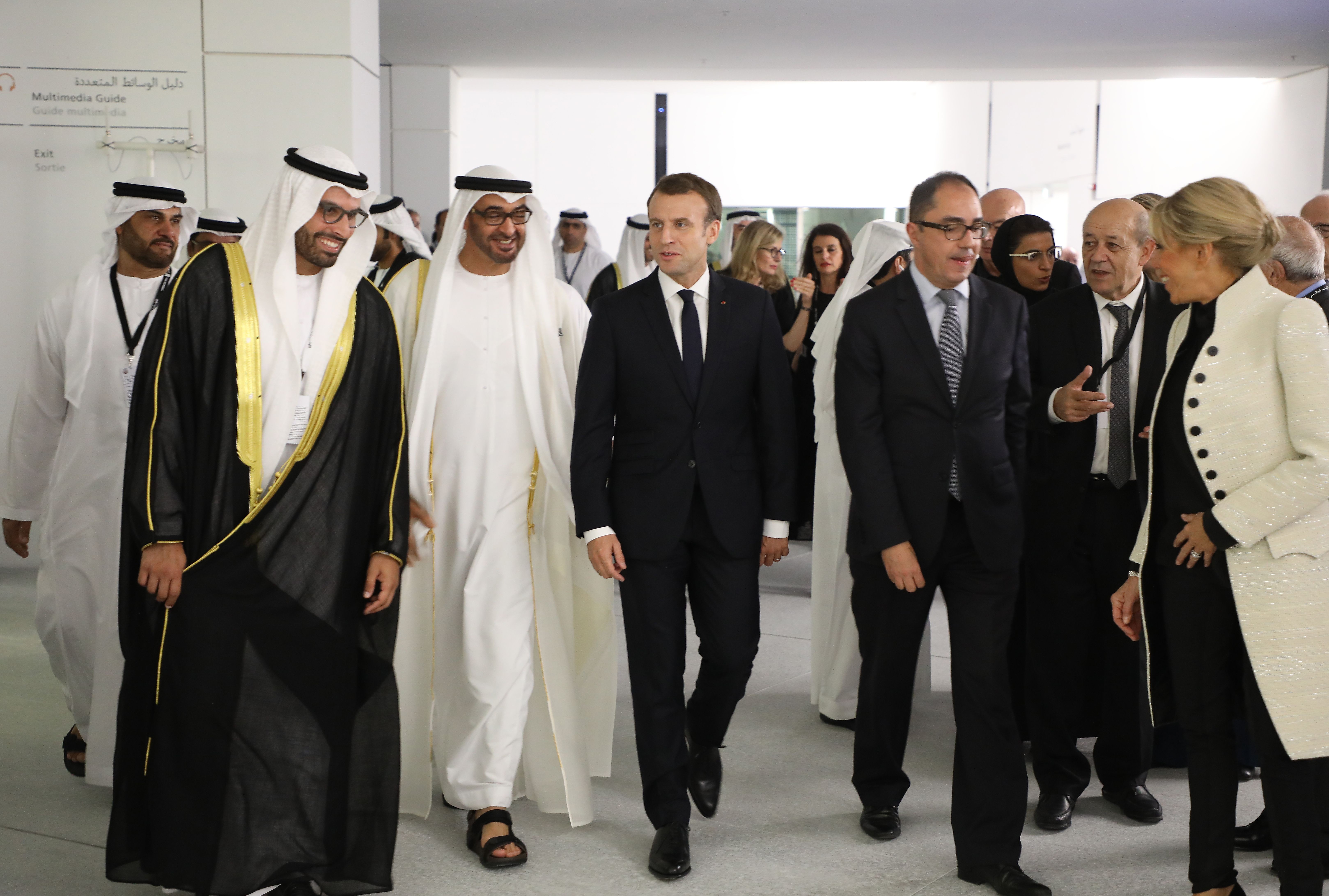
In November 2017, French President Emmanuel Macron traveled to the United Arab Emirates to inaugurate a new museum—and a new relationship between East and West. The Louvre Abu Dhabi was to become the Arab world’s first “universal” museum, filled with art from around the globe that spanned thousands of years of history. The Emiratis were paying the French $1 billion for the rights to the Louvre name, guidance on what art to buy, and loans of masterworks by Da Vinci, Matisse, and Van Gogh. The kings of Morocco and Bahrain joined Emirati royals at the celebrations, which included a spectacle of costumed dancers and pyrotechnics worthy of an Olympics opening ceremony. In his speech, Macron pitched the museum as an antidote to global conflict and the legacies of imperialism. Instead of taking the greatest works of art from the lands it conquered—as Napoleon’s armies had—France was now bringing its treasures east.
“Beauty,” Macron declared, “will save the world.”
Two days after the museum opened, one of its beautiful objects began drawing attention from scholars, but not in the way that Macron might have hoped. It was an immaculately preserved rose-granite slab, or stele, inscribed with a royal decree from the pharaoh Tutankhamun. The stele dated to about 1318 B.C.E., closer to the boy-king’s death than any other surviving monument. It stood at five and a half feet, and the engravings—Tut offers wine to the god Osiris on one side of the slab, and accepts bouquets from a priest on the other—were unlike anything scholars had previously seen.
What puzzled experts was that a Tut stele this astonishing could emerge, as if from nowhere, a century after the British archaeologist Howard Carter discovered the pharaoh’s tomb. “Does anyone know ANYTHING about this?” a Giza-based Egyptologist tweeted. The museum’s label for the stele, she added, was “a masterclass in saying almost nothing.”
Marc Gabolde, an acclaimed Tut scholar at France’s Paul Valéry University, in Montpellier, pressed the museum’s French advisers for an explanation. They told him that a German merchant-navy officer named Johannes Behrens had bought the stele from a little-known Egyptian dealer, Habib Tawadros, in 1933. It had remained in Behrens’s family until shortly before the museum acquired it, in 2016, for more than $9 million.
AFP / Getty
Dignitaries at the inauguration of the Louvre Abu Dhabi in November 2017 included French President Emmanuel Macron (center); Abu Dhabi Crown Prince Mohamed bin Zayed Al Nahyan (left of Macron); and Jean-Luc Martinez, the president and director of the Paris Louvre (right of Macron).
Gabolde received the museum’s permission to write the first scholarly paper on the stele, but something about its provenance continued to bother him. Germany’s economy was in shambles in 1933. Gabolde wondered how a merchant-navy man could have afforded a monument of Egypt’s most celebrated pharaoh. He searched historical records but found no evidence of Behrens’s existence.
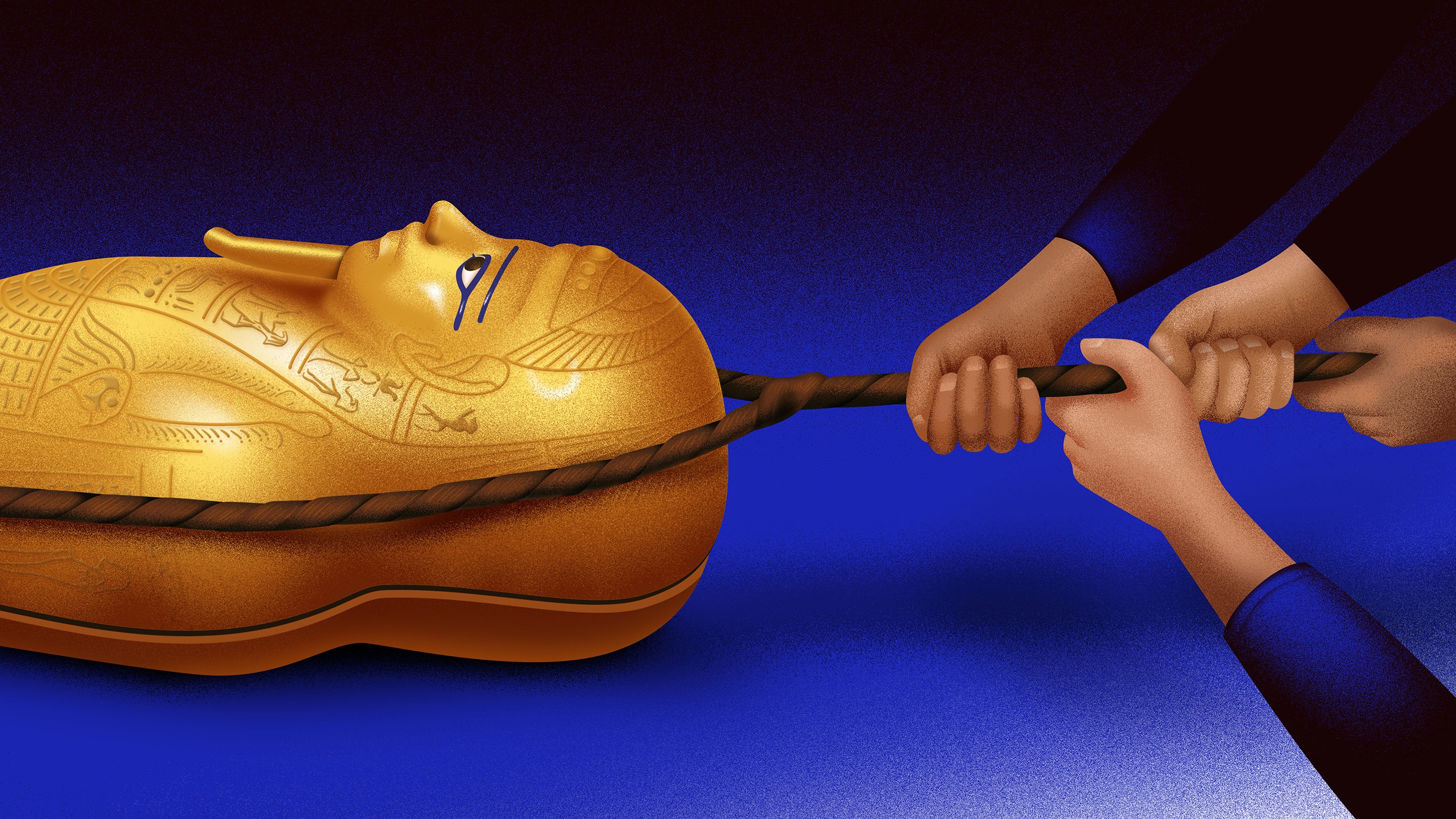
Events in America soon deepened his concerns. In February 2019, a Manhattan prosecutor seized a golden mummy coffin from the Metropolitan Museum of Art, concluding that it had been looted in Egypt in 2011, during the Arab Spring—and that papers documenting its provenance had been forged. Gabolde noticed that the coffin’s sales history partly resembled that of the stele: Habib Tawadros was again listed as the original owner. If Tawadros had never actually owned the coffin, might the stele’s history also be a lie? Gabolde came to a disturbing conclusion. “Whole stories,” he wrote in his research notes, “seem to have been made up to hide the exact provenance of the artefacts.”
In their billion-dollar agreement with the Emiratis, the French had pledged to “pay careful attention to the ethical rules regarding acquisitions, in particular regarding provenance.” Helping guide those acquisitions was the most powerful museum official in Europe: Jean-Luc Martinez, the president and director of the Paris Louvre. The year before the stele’s purchase, Martinez, an archaeologist, had written a 50-point plan for protecting antiquities in conflict zones, and he’d warned of traffickers who “invent a story” for looted objects to disguise their illicit origins. They could “claim it was found by a great-grandfather who was a diplomat, fabricate fake notary documents to lend credibility to the lie,” Martinez wrote.
Could a bogus story about the Tut stele have duped him just months later?
Alamy
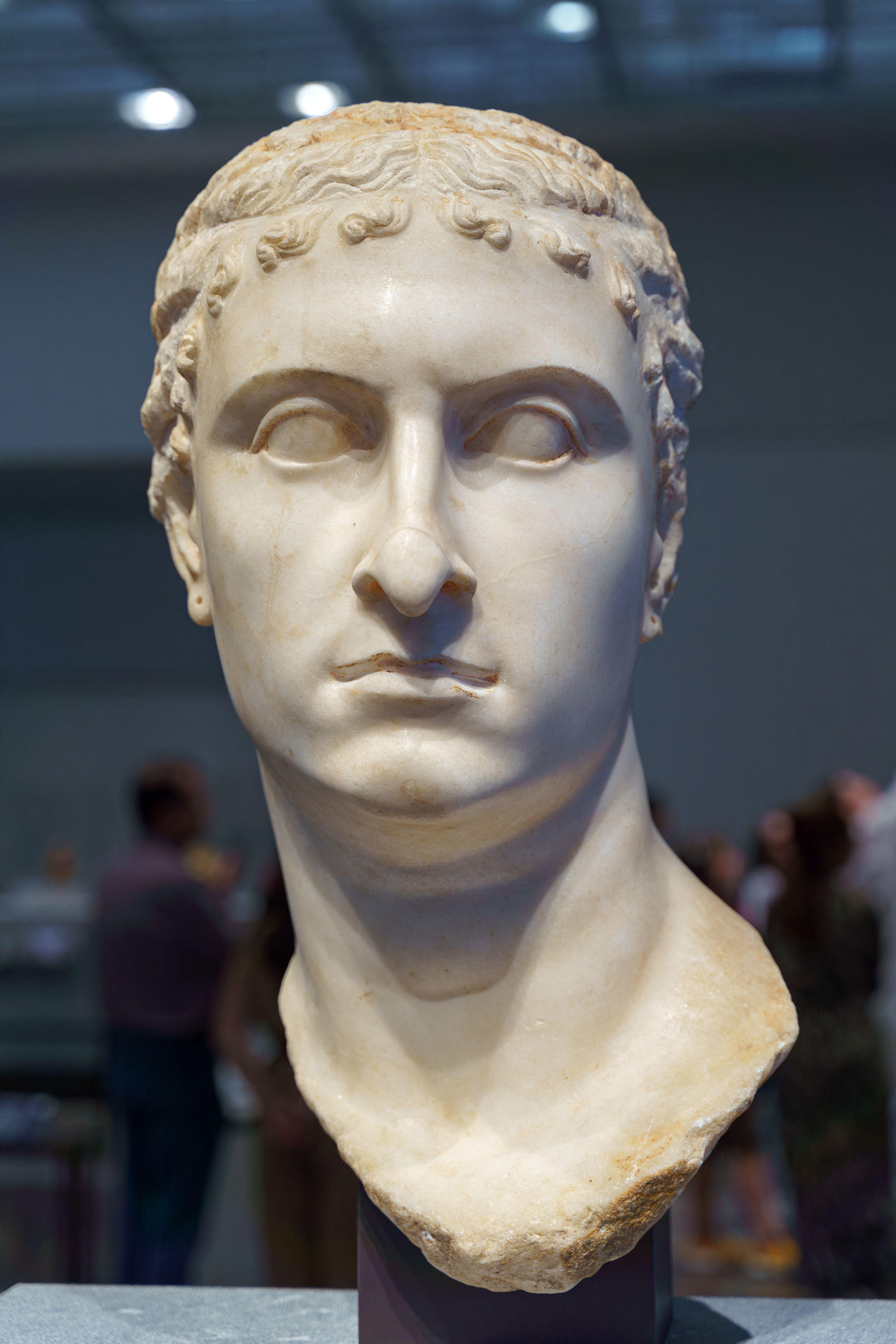
The Louvre Abu Dhabi bought a marble head of Cleopatra for about $40 million, the highest known price a museum has ever paid for a single antiquity.
In 2021, Gabolde stepped off an airplane in Paris to find the national police waiting for him. They took him to their headquarters in Nanterre, where officers interrogated him for hours about his research into the stele’s origins. “They told me it was a huge affair,” Gabolde recalled, “something far beyond my understanding.” The police had begun to unravel a criminal network stretching from the deserts of Egypt to the largest museums in the world. From 2013 to 2018, traffickers had sold the Met and the Louvre Abu Dhabi some $65 million worth of allegedly looted artifacts. Among them was the Tut stele, the golden coffin, and a colossal marble head of a Ptolemaic queen, purported to be Cleopatra, purchased for about $40 million—the highest known price a museum has ever paid for a single antiquity.
At the center of the deals, mostly hidden from sight, was a family with warehouses full of magnificent artifacts and a knack for outrunning the law.
One day in the 1960s, a little boy entered a jewelry shop in Cairo and held out an ancient scarab amulet. “You want to buy it?” he asked the proprietor.
Simon Simonian, who ran the shop with his brother Hagop, dealt in modern jewelry but was intrigued enough by the ornament to accept the boy’s offer. “My father purchased it for little and he sold it for a big profit,” Simon’s son Kevork told me. Sensing a financial opportunity, Simon called one of his younger brothers, Serop, who was studying business at a university in Germany.
Study Egyptology instead, Simon told him.
Serop was one of Simon’s five siblings, a bookish middle child who collected stamps and lived in the shadow of his eldest brother. Their father, Ohan, had fled Turkey on foot as a boy, after his parents were murdered in the Armenian genocide. When he arrived in Egypt, a relative told me, he begged for food and slept in trash bins before getting a job as a busboy, buying a truck, and eventually founding his own transportation business. Losing his parents at such a young age caused him lifelong anguish. But Ohan gave his children chances he’d never had, and they learned to seize them.
When Serop got Simon’s call, he did as he was told. He switched to Egyptology, wrote a dissertation on coffin design, and received his doctorate from the University of Göttingen in 1974.
Gibson Moss / Alamy
Jackie Kennedy inaugurated the first major tour of Tutankhamun artifacts, in the early 1960s, helping fuel a popular fascination with ancient Egypt.
It was an ideal time to be in the Egyptian-antiquities business. In the early 1960s, Jackie Kennedy, as first lady, had inaugurated the first major tour of Tutankhamun artifacts, a small collection that attracted giant crowds. It was soon followed by a far bigger exhibition, “Treasures of Tutankhamun,” which showcased the pharaoh’s gold death mask and fueled a craze that critics called “Egyptomania.” The show’s nine-year world tour, which began in 1972, would draw about 7 million people in the U.S. alone. During its four months at the Met, museum goers poured $500 million, in today’s dollars, into hotels, restaurants, and other New York businesses. Steve Martin’s 1978 single, “King Tut,” which parodied the era’s obsession with the pharaoh, sold more than 1 million copies.
Serop Simonian wasn’t an extraordinary Egyptology student, a teacher in his program recalled, but it didn’t much matter: He was now Herr DoktorSimonian, and had a network of influential scholars and museum directors. He hadn’t even finished his degree when, in 1970, through a Paris broker, he sold the Louvre a 4,000-year-old acacia statue of the Egyptian high priest Hapdjefai.
In 1976, he opened a shop called Galerie Antiker Kunst in a wealthy district of Hamburg, and began loaning antiquities to German universities. He knew that professors would relish the chance to publish papers on previously unknown artifacts. Their articles, in turn, increased the value of his objects. An Egyptologist named Jürgen Horn described a papyrus bearing verses from the Book of Isaiah as “breathtaking,” writing to Simonian that he hoped “this information will help you in your difficult negotiations.” Another German professor called the papyrus “a sensation.” These endorsements, an American scholar of early Christianity wrote to a colleague, “explain why the price doubled.”
Serop had become precisely what his older brothers had hoped: a respectable figure, with the ties and training to sell the family’s artifacts, at staggering prices, to insatiable Western markets.
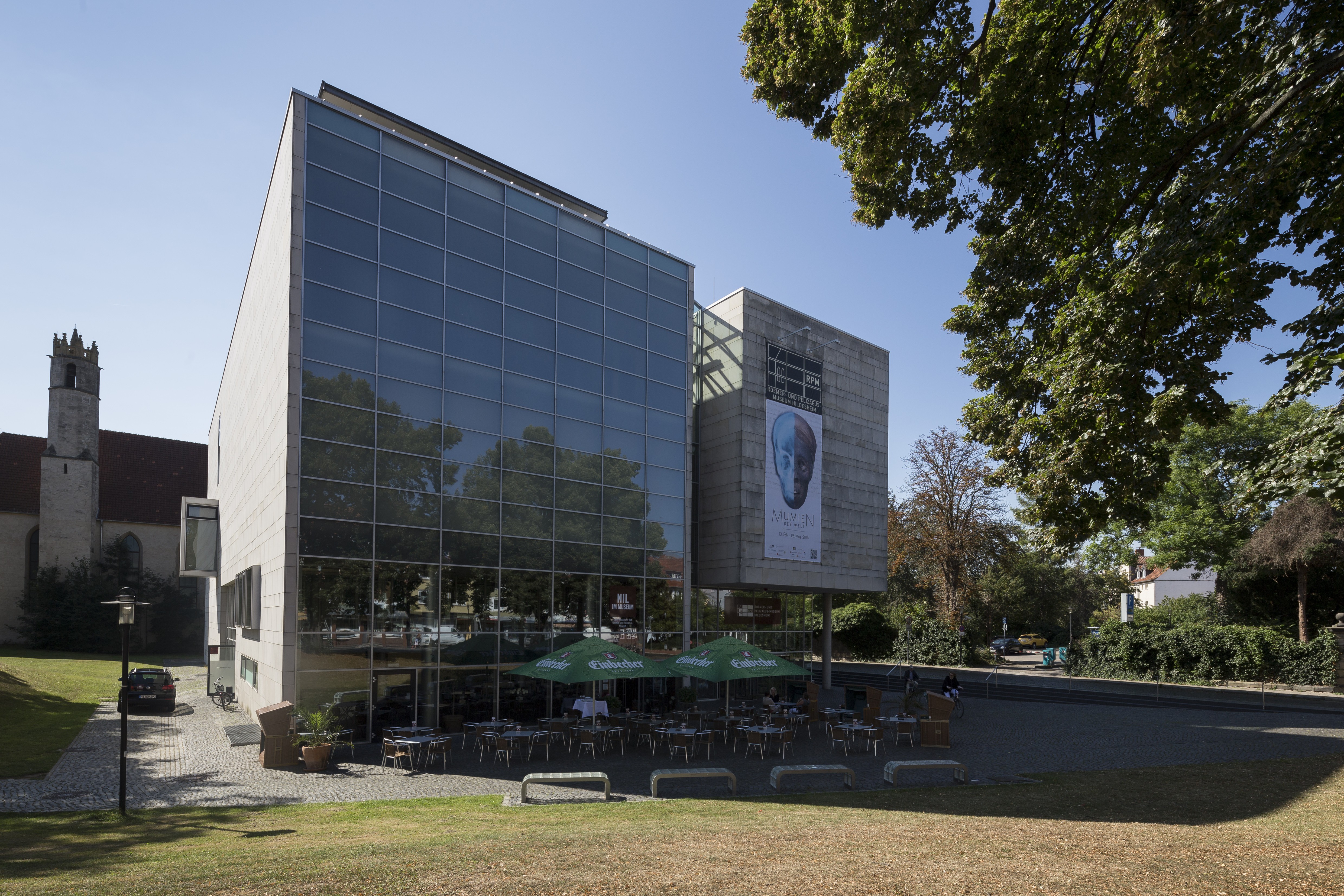
One of the first people to notice anything amiss was an American art historian named Eleni Vassilika. It was the summer of 2000, and Vassilika—who’d spent a decade as an antiquities curator at the University of Cambridge—had just started a new job as the director of the Roemer and Pelizaeus Museum, in the provincial German city of Hildesheim. She quickly discovered that dozens of Egyptian relics the museum presented to the public as its own were in fact the merchandise of a dealer named Serop Simonian. Two of his artifacts—a 4,000-year-old model boat and a 2,300-year-old coffin—had even appeared on the covers of exhibition catalogs for the museum’s traveling shows.
It wasn’t uncommon for museums to display objects from collectors, with labels identifying the pieces as loans. But to exhibit the stock of a dealer—and to do so without disclosure—struck Vassilika as a form of laundering. It allowed a dealer to hide his ownership of potentially dubious antiquities from the public and law enforcement, yet quietly present them to buyers as museum-worthy. (Lara Weiss, the Roemer and Pelizaeus’s director since 2023, told me the museum would not approve such a relationship today and “would consider it laundering.”)
The state of some of Simonian’s wares made the arrangement all the more bizarre. An ancient statue of Osiris “had been restored from head to toe,” with “large parts” added that “did not correspond to its original condition,” a conservator at the museum later told investigators. Coffins, meanwhile, appeared to have been reassembled from modular pieces; the conservator suspected that they’d been sawed apart in Egypt so that government inspectors wouldn’t recognize them as protected artifacts.
Jamie Salmon for The Atlantic
As a museum director in Germany and Italy, Eleni Vassilika, pictured here in her London home, was among the first people to question Serop Simonian’s antiquities.
By then, the West’s fascination with ancient Egypt had fueled waves of looting. In just the first three months of 1973, as the giant Tutankhamun tour got under way, Egyptian tombs were robbed of millions of dollars’ worth of antiquities. Egypt had so many buried artifacts and so few guards, the Associated Press reported, that “99 percent of all lootings go undiscovered.” To fight the trafficking of cultural property, UNESCO had adopted a major treaty in 1970. Then, in 1983, Egyptian lawmakers fully criminalized the antiquities trade, barring all sales and exports.
Yet there had been no discernible interruption in the Simonians’ business. The brothers had a ready explanation: They’d acquired their antiquities in the ’60s and early ’70s, they said, from the heirs of Habib Tawadros and another Egyptian dealer, Sayed Pasha Khashaba. “Everything,” Serop later told investigators, had been shipped to Switzerland by 1973, a full decade before Egypt outlawed the trade. A family member described this cache to me as an “infinite supply.”
Simonian’s relationship with the Roemer and Pelizaeus Museum, which began no later than 1990, was off the books: There was no contract, no insurance, no notification to the city, which owned the museum. When city officials finally learned of the arrangement, in 1999, they grew alarmed. But Vassilika’s predecessor, who was a friend of Simonian’s, talked them down. He told them that the dealer was best seen as a quiet benefactor whose antiquities were drawing visitors and helping fund the museum’s new building. The city’s leaders seemed appeased, and soon agreed to Simonian’s demand that the museum buy some of his artifacts, in return for his loans to the traveling shows. When city administrators questioned Simonian’s prices, the museum director again allayed their concerns—by obtaining appraisals from Ursula Rössler-Köhler, a former classmate of Simonian’s who’d become head of the Egyptology institute at the University of Bonn. Of the help that she gave Simonian, Rössler-Köhler later told investigators, “We were happy to do this and were then able to keep some of these pieces on loan for our own small exhibition.”
Vassilika was appalled by the city’s naivete. She ordered the removal of Simonian’s objects—about 100 of them—from the museum’s warehouse and tried, in vain, to halt the purchases.
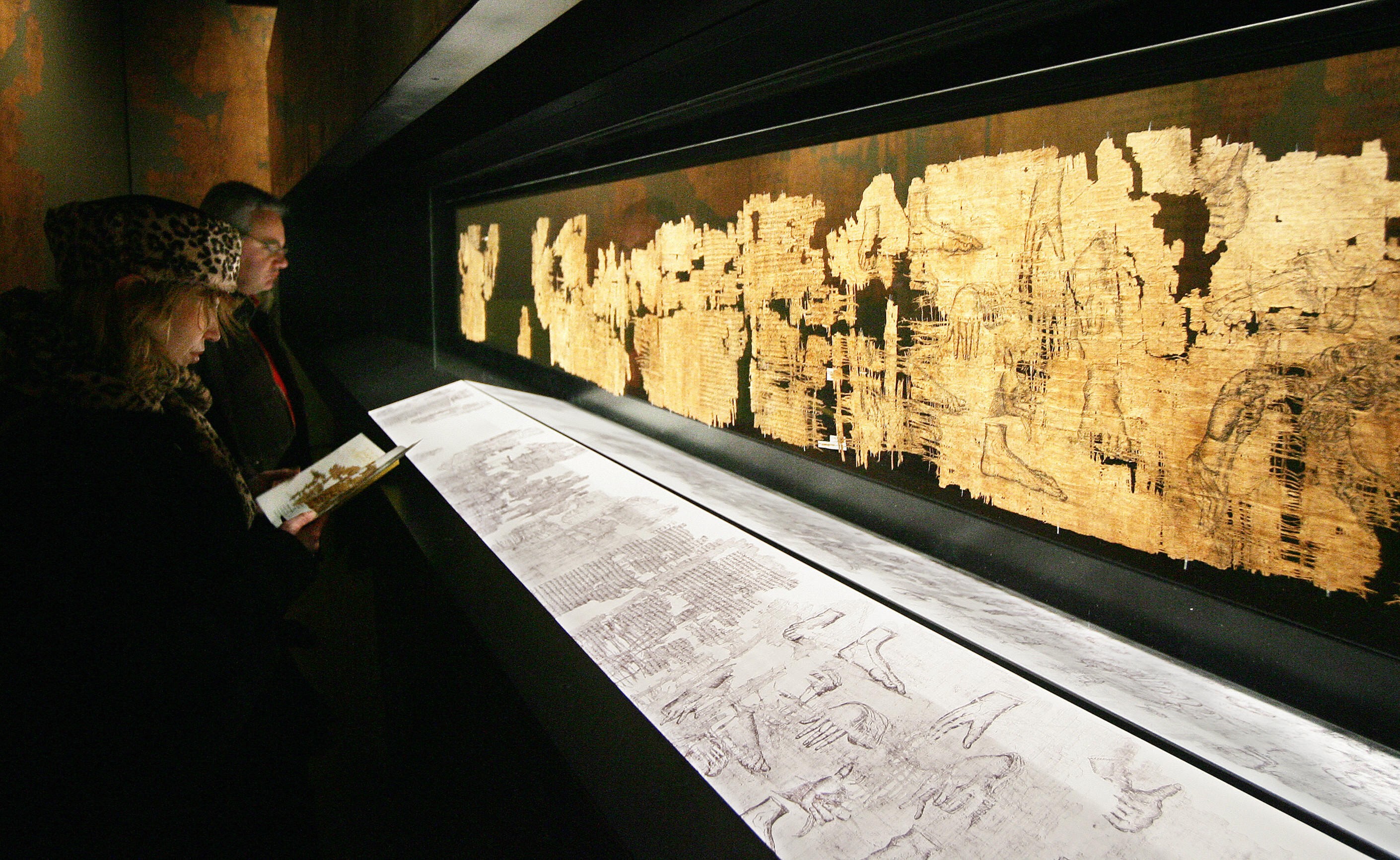
When she left the museum in 2005, at the end of her five-year contract, Vassilika hoped never to think about Simonian again. She’d been offered a job as the director of the Egyptian Museum in Turin, Italy, whose 40,000-piece collection was regarded as the most important outside Egypt. The city was preparing to host the 2006 Winter Olympics, and a local banking foundation, the Compagnia di San Paolo, had pledged about $30 million for the museum’s renovation. With the encouragement of Italy’s culture minister, the Compagnia had also acquired an eight-foot papyrus roll from the first century B.C.E. It appeared to contain the only known copy of a work by the Greek geographer Artemidorus and the oldest surviving map from the Greco-Roman world. The foundation planned to exhibit the Artemidorus at a nobleman’s palazzo during the Olympics, then donate it to the Egyptian Museum.
Paco Serinelli / AFP / Getty
An Italian foundation paid Serop Simonian about $3 million for a papyrus that appeared to contain a lost work by the ancient Greek geographer Artemidorus.
Vassilika was fascinated by the papyrus, which she’d never heard of. Who was the seller? she asked her boss.
Her boss called the Compagnia and handed the phone to Vassilika.
“This piece was legally exported from Egypt by an Armenian family in the 1970s,” she recalled a foundation official telling her.
She felt her ears ring and the blood drain from her face. “You don’t mean Serop Simonian?”
He did. The Compagnia had acquired it from the Hamburg dealer for $3 million—the highest known price ever paid for a papyrus.
By the 2000s, the Simonians had amassed tens of thousands of artifacts in warehouses across Europe and North America. So numerous and varied were the objects that the family could serve nearly every market, from multimillion-dollar deals with museums to two-figure bargains on eBay. Most elite dealers shunned cheap objects, but for the Simonians, a sale was a sale. The range of price points was “unprecedented for a single network,” an American law-enforcement official told me.
The only bar to still greater profits, it seemed, was Serop himself. With his degree and connections, he’d supplanted his brothers as the de facto head of the family business. But he had little in the way of glamour or charm. Plump, shabbily dressed, and unshaven, he lived in what another dealer described to me as “kind of your grandmother’s apartment in the 1950s.” He was so loath to spend money that he stayed in budget hotels and had a habit, according to a business associate, of “re-toasting old bread so as not to waste it.” He was still haunted by the poverty of his first years in Germany, when he’d lived in a building with shared bathrooms and had little to eat. “He didn’t want to go back to the same place,” Simon’s son Ohan told me.
The one time Vassilika met him, to discuss his antiquities, Serop showed up at her museum office disheveled, slouching, and smelling of cigarettes—a manner wholly unlike that of the urbane, well-groomed men who dominated the trade. “He just looked shaggy,” Vassilika recalled. “He didn’t look like an art dealer, you know, an upmarket art dealer.”
Of his reputation as a salesman, Gabriele Pieke, a German Egyptologist and museum official, recalled, “Tricks and tricks, like someone who wants to get more money out of you.” She likened him to sellers in a souk or bazaar. “If it’s not in your character to bargain, then it’s really annoying.”
Simonian was prickly and easily aggrieved, which made dealing with him even more challenging. “He didn’t really feel people respected him enough,” Noele Mele, a Connecticut dealer who brokered pieces for him, told me. Buyers would sometimes agree to Simonian’s asking price, only for him to suddenly raise it, out of spite for some perceived insult. “He’d say, ‘It’s your fault; you should have gotten it in writing,’” Mele recalled. “The next time, we did get it in writing. He said, ‘So what?’ and tore it up.” He eventually grew estranged from his wife and children, while forming what the business associate said were emotional attachments to the antiquities in his storerooms. “My babies,” he called them.
In 2011, Simonian reached an agreement with the Reiss Engelhorn Museum, in Mannheim, Germany, to display thousands of his artifacts, apparently including the Cleopatra bust, for up to 30 years. But by 2013, the museum had backed out, citing Simonian’s failure to supply provenance paperwork and his refusal to allow laboratory testing to determine the age of his objects. “No one wanted to deal with him,” Mele told me.
To sell to the world’s greatest museums, Simonian needed help. In the early 2000s, a pair of Lebanese antiquities dealers introduced him to their son Roben Dib, who was studying biomedical engineering at the University of Hamburg. Dib was in his 20s—nearly four decades Simonian’s junior—but he’d collected coins since he was a boy and had a natural savoir faire. Several years later, Simonian offered him a job, and Dib accepted, thrilled by the idea of turning his hobby into a career.
In 2011, Dib traveled to the Paris auction house Pierre Bergé and introduced himself to its archaeological expert Christophe Kunicki, one of France’s foremost authorities on Egyptian art. Kunicki moved among museum-world Brahmin. “When he’s not organizing sales,” the French newspaper Libération wrote, “he scours major international fairs and rubs shoulders with the elite of the art market, between Paris, New York, London, and Geneva. Always at his side, his husband and collaborator, Richard Semper, perfectly bilingual in English.” The couple regularly hosted dinners for Louvre and Met curators, who were “always delighted to be the first to discover new treasures.” Dib brought small artifacts to Kunicki, gaining his trust, before offering him larger and more legally questionable ones.
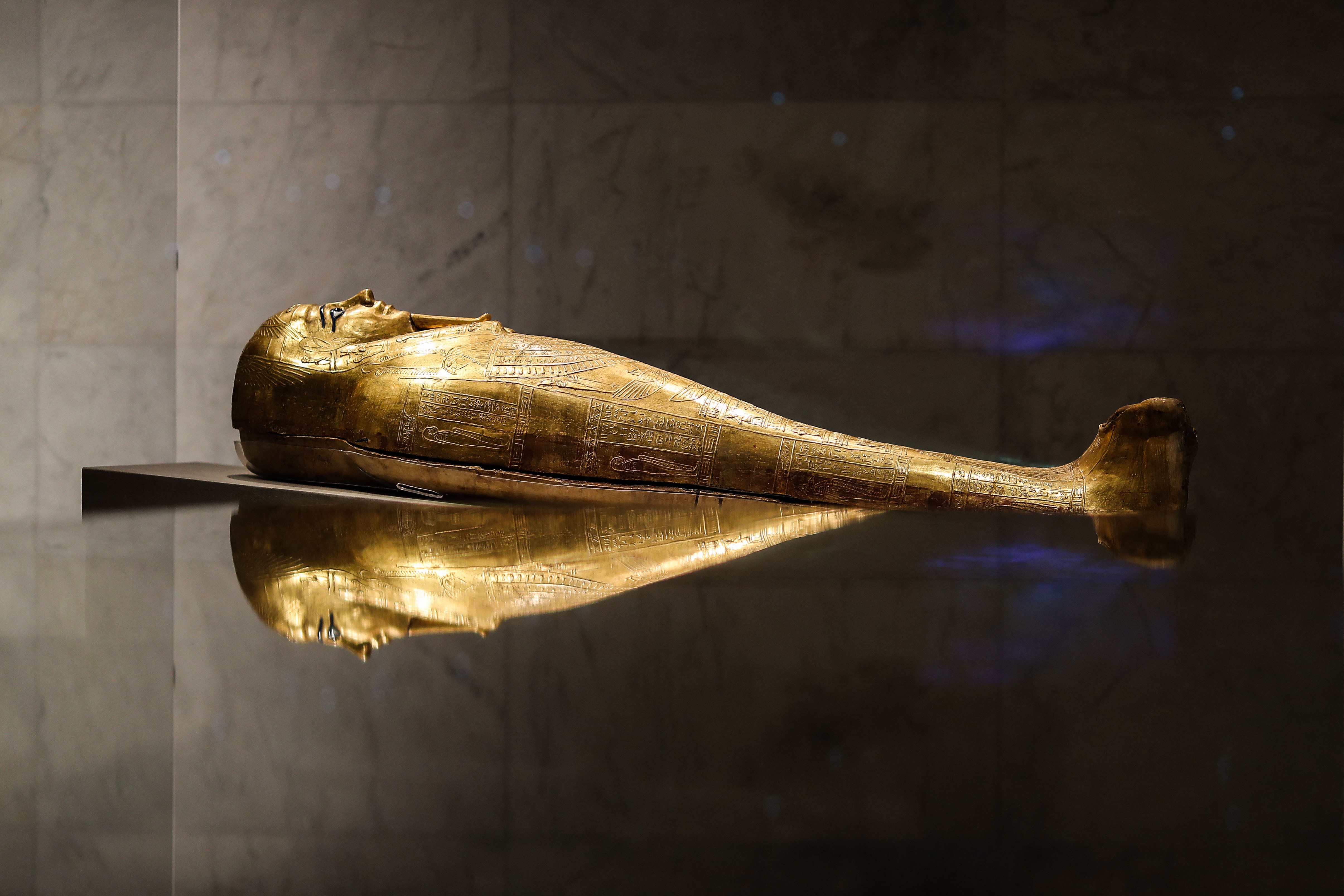
In 2015, Kunicki grew smitten with a spectacular coffin Dib showed him in a warehouse in Cologne. Sheathed in gold and covered in hieroglyphs, it had once contained the mummified corpse of Nedjemankh, a first-century-B.C.E. priest of the ram-headed fertility god Heryshef. Kunicki had the coffin professionally photographed, and in May 2016 he emailed the pictures to Diana Patch, the chief curator of Egyptian art at the Met. Might the museum be interested?
Mahmoud Khaled / AFP / Getty
The Metropolitan Museum of Art acquired the gilded coffin of Nedjemankh in 2017. The Manhattan District Attorney’s Office alleged that it had been looted in Egypt in 2011, during the Arab Spring.
When Patch asked for provenance documents, Kunicki sent a scan of what he said was an Egyptian export license, issued to Simon Simonian in 1971. Janice Kamrin, a curator on Patch’s staff, emailed the Egyptian government that the license had “all the proper stamps” and “looks right to us” but that the museum wanted to confirm its authenticity “as part of our due diligence.” When an Egyptian official requested “all the data and pics,” Kamrin asked if sending just the license number and year would suffice. It didn’t: The Egyptians wanted a copy of the license that Kamrin had claimed looked right. According to an official summary of a Manhattan grand-jury investigation, Kamrin puzzlingly replied that she didn’t have copies, “electronic or otherwise”—despite the fact that Kunicki had emailed Patch a scan of the license months earlier.
Patch, meanwhile, pressed the dealers. She insisted in an email that for the sale to proceed, “we of course will require the original export license.” But Patch never got the original—the dealers made a series of baffling excuses—and Egyptian officials stopped answering Kamrin’s emails. Still, in May 2017, Patch and Kamrin recommended the coffin’s purchase to the Met’s director. When senior Egyptian officials learned of the museum’s plans to go through with the acquisition, they again requested a copy of the export license. The dealers had sent Patch two copies of it—one in which Simon Simonian’s name was visible, and another in which it was blacked out. Kunicki asked Patch to send Egypt “the copy without the names.” According to the summary of the grand-jury investigation, Patch complied—depriving Egypt of a key detail about the coffin’s origins. Soon after, in July 2017, the Met acquired the coffin, for about $4 million.
The gilded coffin of Nedjemankh became a sensation. Kim Kardashian, in a gold Versace gown, posed for photos beside it at the 2018 Met Gala. Two months later, the museum made the coffin the centerpiece of an exhibition that drew nearly half a million visitors.
If museum directors had wanted the truth about the Simonians, they could have gotten it from Egyptian officials—or done some basic research. On microfilm at the Library of Congress, I found a series of disquieting articles in Egypt’s Al-Ahram, one of the Arab world’s oldest and most influential newspapers. The first, from January 1975, was headlined “Armenian Jeweler Killed on the Bank of a Canal in Saqqara.”
The dead jeweler was Serop’s younger brother, Abraham Simonian. His bloodied, half-naked body had been found with bullet wounds near a hut where he’d parked his Mercedes. The newspaper reported that although Simon, Hagop, and Abraham were nominally in the jewelry business, their primary activity was “buying stolen artifacts and selling and smuggling them abroad.” Abraham, who was 28, “had frequented numerous archaeological sites throughout the republic,” seeking “antiquities wherever they might be found.”
A colleague of the Simonians told me that Serop, wanting more business for himself, had Abraham make deals behind their older brothers’ backs. At one point, Abraham gave Serop a photo of a Book of the Dead, a collection of spells for the afterlife, which Serop showed to a professor in Germany. “The professor told him, ‘It’s important—go and buy,’” the colleague said. The Simonians paid the Egyptians who had dug it up the rough equivalent of $7,000. Then, according to Al-Ahram,the Simonians sold the book in Germany for more than 30 times that amount. After the diggers learned of this profit—and of how little of it they’d gotten—a fight erupted, and they shot Abraham with his own gun.
By then, Egyptian law enforcement had known of the Simonians for perhaps a decade. In the 1960s, a relative told me, Simon spent two years in prison for alleged antiquities crimes, and lost teeth in an attack by fellow inmates. In 1971, he was stripped of his antiquities license after registering in his own name the shop of Habib Tawadros, the dealer the Simonians would later claim owned both the Met’s gilded coffin and the Louvre Abu Dhabi’s Tut stele.
Simon and Hagop left Egypt for Los Angeles and Montreal, respectively, in the early-to-mid-’80s, around the time the country abolished its antiquities trade. In 1989, Canadian authorities seized about 60 illicit antiquities from Hagop—some “taken” from excavations, according to Al-Ahram. Six years later, an Egyptian court sentenced Simon in absentia to five years of hard labor for trying to smuggle at least 100 antiquities out of the country with forged government documents.
In 2005, a Berlin judge halted a shipment of Simonian artifacts to a buyer in the United States, after Egyptian authorities linked the objects to dealers who’d bribed a senior official in Egypt’s antiquities ministry. But the judge’s decision was soon reversed, and the artifacts—funerary relics exhibited at the Roemer and Pelizaeus Museum in the 1990s—were sold, for more than $2 million, to the Nelson-Atkins Museum of Art, in Kansas City, where they remain today. (The Nelson-Atkins declined to comment on Egypt’s allegations.)
For eight years, Eleni Vassilika had kept the Artemidorus papyrus out of Turin’s Egyptian Museum, her intransigence infuriating her superiors. In 2018, four years after her departure, Italian prosecutors declared both the papyrus and a key provenance document fake. Serop Simonian, they alleged, had committed aggravated fraud, a crime made easier by the carelessness of the Compagnia and of the scholars who’d facilitated the purchase. But it was too late to charge Simonian, they said: The statute of limitations had lapsed. (The Compagnia did not respond to requests for comment.)
The Artemidorus remains the only known Simonian relic deemed a forgery. Some others were crudely restored, with slapdash handiwork or ill-fitting parts cannibalized from other antiquities. But by and large, the family’s objects are seen as genuine. The problem is not their authenticity, but their origins.
Behrouz Mehri / AFP / Getty
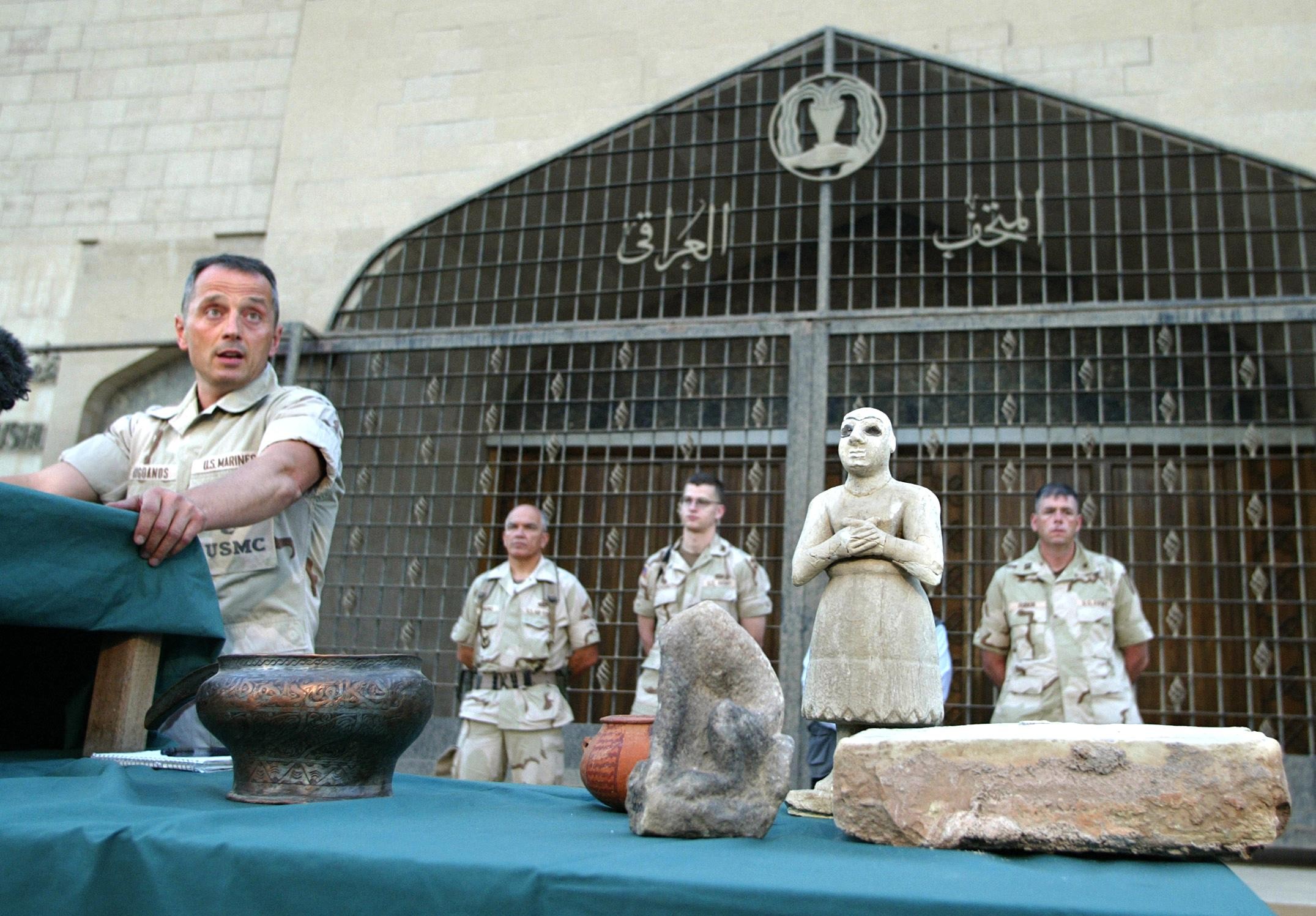
Matthew Bogdanos, the chief of the Manhattan District Attorney’s Antiquities Trafficking Unit, served as a Marine colonel in the Iraq War, when he led a team that recovered artifacts looted from the Iraq Museum.
In the fall of 2017, a Lebanese collector named Georges Lotfi was strolling through the Met’s Egyptian galleries when he noticed a new acquisition: the gilded coffin of Nedjemankh. The more closely he examined it, the surer he became that he’d seen it before. About five years earlier, Lotfi told me, a Jordanian trafficker named Mohammed “Abu Said” Jaradat had offered it to him for $50,000. Lotfi had passed. But after his visit to the Met, he called Jaradat and asked what had become of the coffin. Jaradat said he’d sent it to a German dealer named Roben Dib, who had promised to split the proceeds of any sale. Jaradat had heard nothing since.
“Abu Said,” Lotfi responded, “it’s in the Metropolitan Museum.”
Jaradat was livid. The Met had paid $4 million, and Jaradat hadn’t gotten a penny. “He wanted to take revenge,” Lotfi told me.
In March 2018, Lotfi tipped off Matthew Bogdanos, a prosecutor who leads the Manhattan District Attorney’s Antiquities Trafficking Unit. Bogdanos recognized the names Dib and Jaradat. About five years earlier, he had come across emails from them in the inboxes of several New York collectors and museum officials he was investigating in a different case. The emails contained what Bogdanos called “dirty photos”: images of dirt-encrusted antiquities, the sort that thieves send to buyers to prove that a relic is fresh from the ground and thus not a fake; the mindset, as Bogdanos describes it, is If it’s looted, it’s real. To investigate further, Bogdanos’s team served search warrants in 2013 on Dib’s and Jaradat’s email accounts, obtaining thousands of messages. But he couldn’t seize the antiquities in their “dirty photos” without knowing where the objects were.
Not until Lotfi’s tip, five years later, did Bogdanos get a break. Lotfi introduced Bogdanos to Jaradat, and the prosecutor found corroboration for Jaradat’s golden-coffin story in the seized email accounts: In late 2011 and early 2012, a looter had sent six dirty images of the coffin to Jaradat, who forwarded them to Dib. Metadata showed that the photos were taken in Egypt’s Minya region in autumn 2011, just months after a rash of antiquities looting during the Arab Spring. A photo emailed to Jaradat appeared to depict one of the traffickers: a man in a hoodie, crouched on a sand dune, with an assault rifle across his chest.
“When is the big yellow one going to get here?” Simonian asked Dib in a September 2012 Gmail chat, using their code name for the golden coffin, according to the summary of the grand-jury investigation.
“Early October it will be ready for the EU,” Dib replied. The coffin was smuggled from Egypt to Dubai, then sent by FedEx to an old friend of Simonian’s, a shipping agent who lived near the Cologne warehouse where the relic would be stored. The FedEx label, found in Dib’s email, described the multimillion-dollar Egyptian coffin as a “gypsum Wooden Box and lid” from Turkey, with a value of 5,000 euros.
From speaking with Simonian’s associates and reading court papers and other legal documents, I got the sense that Simonian had a system. He put almost nothing in writing. He used intermediaries and an offshore shell company to obscure his role in sales. He had artifacts shipped to friends, freight forwarders, and small museums such as the Roemer and Pelizaeus, where—a museum official there told investigators—he had her go into a customs office to complete paperwork on his behalf, while he stayed in the car and smoked. He once bragged to a colleague of his near invisibility: “I run beside my shadow.”
When Bogdanos reviewed the Met’s internal communications, he was dumbfounded. By the time Diana Patch, the Met’s chief curator of Egyptian art, recommended the purchase, the Paris dealers had given the museum no fewer than three provenance stories: one in which the current owner was a “Mme Chatz” of Switzerland, another in which it was an “M.D.” of Germany, and a third in which the owner was Serop Simonian. Still more suspicious, one date on the license suggested that it had been issued in May 1961, while another suggested May 1971. Neither could be reconciled with a government stamp that said Arab Republic of Egypt, a name Egypt didn’t adopt until September 1971.
Manhattan prosecutors didn’t charge anyone at the Met, but in February 2019, Bogdanos’s team convinced a judge that the museum likely possessed stolen property in the first degree. Agents seized the coffin with a search warrant and, with the Met’s cooperation, returned it to Egypt. Then they found and repatriated five other antiquities that the Met had recently acquired, for more than $3 million, from the same network. Two had bogus Khashaba or Behrens provenance; another was described as having been sold by a Dutch gallery nine years before the gallery opened. A fourth piece—a Roman-era portrait of a woman—was looted from Egypt in the 1990s, according to Manhattan prosecutors, but the sellers evidently needed another story. “Hehe, it should come from you, the Simonian family,” Dib allegedly wrote in a Gmail chat. “No,” Simonian replied. So they attributed it to a friend, who they claimed purchased it in 1968 from a Munich gallery.
A Met spokesperson told me that the museum was “the victim of a fraud” and had “filed a complaint in the criminal legal proceedings in Paris.” Asked about the conduct of Patch and Kamrin, the spokesperson described the coffin’s acquisition in 2017 as a “museum decision, supported by a multi-step institutional process in place at the time.” After the coffin’s repatriation, in 2019, the Met “undertook a thorough review of its process for verifying documentation and approving acquisitions, and then strengthened requirements for acquiring antiquities.” The spokesperson declined to answer more detailed questions, citing the “ongoing, strictly confidential proceedings in France.”
This was hardly the Met’s first provenance scandal. The museum returned a cache of relics to Turkey in 1993 and a stunning Greek vase to Italy in 2008—each of which it had purchased, for at least $1 million, months after they’d been excavated by tomb robbers. The Manhattan D.A.’s office says that it has seized more than 200 antiquities, valued at more than $54 million, from the museum since 2023. In 2024, the Met hired its first-ever head of provenance research, who oversees a team of 12 analysts that in partnership with outside experts, including the D.A.’s office, is reviewing objects in the museum’s collection from problematic dealers.
So would the Met continue to buy antiquities—as it had the gilded coffin—without original export licenses and without the country of origin’s confirmation that relics were legal? The museum spokesperson told me that the guidelines the Met follows do not include those “conditions” but that it would make every effort to verify documents, including by contacting people connected to them. Diana Patch and Janice Kamrin did not respond to requests for comment.
The Louvre Abu Dhabi had made an even more enticing target for Simonian’s network than the Met. The Emiratis had allotted hundreds of millions of dollars to building a world-class collection within a decade. Antiquities worthy of their ambitions had proved difficult to find, according to internal documents seen by Libération, because of “heightened sensitivity” about provenance. This tougher environment didn’t deter traffickers so much as inspire them: If they fakedlegal provenance, they could command astronomical prices—precisely because of how few legal objects were on the market. From 2014 to 2018, Simonian’s network sold the Louvre Abu Dhabi at least seven Egyptian antiquities for more than $50 million, among them the Tut stele, the Cleopatra head, and a hippopotamus figurine originally displayed by the Roemer and Pelizaeus. (The Louvre Abu Dhabi declined to comment, citing the ongoing investigations.)
European police discovered that Simonian and his associates had allegedly fabricated early-20th-century sales records with an old typewriter—the same one Simonian used to write his dissertation—and blank invoices from long-dead dealers such as Tawadros. The traffickers then paid friends and other “witnesses” to claim, in notarized letters, that they’d inherited the objects from ancestors such as Behrens, the supposed merchant-navy officer. Simonian’s two adult children, meanwhile, had their own provenance story: that they owned the Cleopatra head and the Tut stele, and had gotten the artifacts from their grandmother. Their story, which appears in certain back-end sales paperwork, made it possible for 30 million euros in sales proceeds to flow directly into their accounts, bypassing their elderly father and effecting a massive, intergenerational transfer of wealth.
Kunicki and Semper, the Paris middlemen who’d brokered the sale of Simonian objects to the Met and the Louvre Abu Dhabi, were charged in 2020 with fraud, money laundering, and forgery. French journalists, quoting confidential police files, reported that Kunicki admitted to using forged paperwork to fill in “missing links” in ownership. In the antiquities world, Semper suggested, due diligence was a kind of knowing pantomime in which “everyone is putting a bag over their head.” He alluded to a French schoolyard game in which children stare into each other’s eyes and try not to be the first to laugh. (Kunicki and Semper deny wrongdoing, their lawyer told me.)
To determine how high the conspiracy went, French police scrutinized the conduct of the Louvre Abu Dhabi’s advisers. Among them was France’s most prominent critic of archaeological looting: Jean-Luc Martinez, whom French president François Hollande had appointed in 2013 to lead the Paris Louvre. In his 2015 report on safeguarding antiquities in conflict zones—commissioned by Hollande and submitted to UNESCO—Martinez urged museums “to systematically refuse any proposal to acquire works whose provenance is not certain.” He described nearly all the “laundering techniques” that traffickers used: fake ownership histories, middlemen, attempts to exhibit looted objects in prestigious museums “to enhance the artwork’s reputation and reassure potential buyers,” long waits before stolen relics appear on the market to give “dealers time to fabricate provenance.” Yet in helping the Louvre Abu Dhabi acquire antiquities, Martinez, along with other French advisers, apparently missed, or ignored, these very problems.
The police concluded that the Agence France-Muséums—the body that France created to advise the Emirati museum—had become “a formidable tool at the disposal of traffickers.” Though Martinez isn’t thought to have personally profited from the deals, the Emiratis’ payments to France helped fund major renovations at the Paris Louvre, including a roughly $60 million project to improve the flow of visitors through the reception areas beneath the glass pyramid. Martinez was charged in 2022 with complicity in fraud and money laundering. (Martinez’s lawyer, François Artuphel, told me that Martinez was one of six members of the Louvre Abu Dhabi’s acquisitions committee, which made decisions collectively and was not expected to verify the provenance documents provided by sellers. Artuphel called Martinez a victim of “alleged counterfeiters,” and believes his client will be “fully exonerated.”)
Roben Dib was charged in France in 2022 with criminal conspiracy, organized fraud, and money laundering. His attorneys didn’t respond to a list of questions, but Dib has previously professed his innocence. A French defense lawyer associated with the trafficking cases told me that the dealers were being asked to prove legal ownership from the day an object was unearthed through the present, an almost impossible standard, particularly for discoveries that precede modern record-keeping practices.
Serop Simonian was 81 years old in September 2023 when he was extradited from Germany to France and charged there with criminal association, money laundering, and organized fraud. Detained in Paris’s La Santé prison, he made statements to investigators that were by turns boastful, contemptuous, and self-pitying. Simonian hinted that his family had sold a statue to John Lennon. He called Bogdanos “the greatest art thief of all time,” mocking the prosecutor’s seizures from dealers and museums. He suggested that missing sales paperwork simply reflected an earlier era’s looser standards of documentation. He denied possessing illicit antiquities, then taunted his inquisitors: If they really cared about illegal provenance, he said, “I could empty half the Louvre.” Finally, he asserted that he was suffering from dementia and that Dib had become the decision maker: “I trusted him more than I trusted my children.”
Simonian’s French attorney, Chloé Arnoux, visited her client in prison in late 2024. She told me that he struggled to speak without losing his breath, used a walker, and slept in a cell with two young inmates, “who were not really that sympathetic to him.” That December, after more than a year in detention, he was released by a judge, who cited the octogenarian’s declining health. Prosecutors successfully appealed, calling Simonian a flight risk. But he had already left France, by bus, and checked into an assisted-living center in Hamburg. He’s unlikely to be re-extradited to France until his trial, lawyers close to the case told me. (For their roles in antiquities sales, Simonian’s son, Abraham, is being prosecuted in Germany on charges of fraud and receiving stolen goods, and Simonian’s daughter, Alice, on a charge of money laundering. Their lawyers deny the charges, saying their clients had no awareness that the provenance provided to buyers was allegedly false.)
In many months of trying to speak with Serop Simonian, I received just two responses: a completely blank message from his email address, and a WhatsApp call from a number associated with him in which someone breathed heavily for a few seconds before hanging up. Days spent looking for him in Hamburg yielded only dead ends. His lawyers didn’t respond to detailed lists of questions.
Serop’s brother Simon died in 2020, and Hagop didn’t respond to interview requests, but I found Simon’s son Ohan, who is in his early 50s, in California. We spent part of an afternoon together in the Coachella Valley. His arms were sleeved in tattoos: an Egyptian ankh, an Eye of God inside a pyramid, the face of Jesus over the words In God We Trust. Growing up in Egypt in the 1980s, he told me, he’d been teased by the Armenian kids he played basketball with. “You guys robbed a pyramid,” they’d say. “You stole half of Egypt.” In truth, Ohan insisted, his father was not a thief but a rescuer, saving the marvels of his homeland “for the world to see.”
Unlike his brother Serop, Simon openly enjoyed his money, frittering it away on parties, vacations, trips to Las Vegas. Where Serop wanted to be “the elite behind the curtain,” Ohan told me, “my dad was, Look at me! I’m Simon!” Ohan and his brother, Kevork, both went through bankruptcy in recent years and have driven for Uber to support their families. They’ve spent years seeking the $11 million they say Serop still owes them for their late father’s share of the $40 million Cleopatra head. Simon once flew all the way to Hamburg to collect his cut, refusing to believe that his own brother would steal from him. But Serop pretended to be out of town, and Simon died soon after.
Talking about this debt made Ohan so furious that he began loudly cursing his uncle. Death, Ohan fears, will be Serop’s final escape. “If I had the choice to be a god,” Ohan told me, “I’d be the god of the afterlife, so I could go after him.”
In December 2020, Eleni Vassilika was weathering the pandemic in her London home when she received an email fromGermany’s federal police. “We are sorry you had to wait so long before being contacted by us,” the agent wrote. Vassilika was thankful for their interest in Simonian. But what about the Egyptologists who had blithely endorsed his objects? What about the museums that had rushed to buy them? Germany, France, and the United States were among the nearly 150 countries who signed the 1970 UNESCO treaty to fight the illicit antiquities trade. Museums had promised reforms and hired provenance sleuths. Scholars had adopted ethics codes to constrain their contacts with dealers. Yet tens of millions of dollars in loot were still making their way into the world’s most illustrious museums.
“The story is the enablers—it’s us,” Vassilika told me. “Museums and scholars are the moral compass of art history and the art world. We should be, at least.”
Ralf Brunner / laif / Redux
The Roemer and Pelizaeus Museum, in Hildesheim, Germany, allowed Serop Simonian to store about 100 of his antiquities in its warehouse, and displayed dozens of them—without attribution—in exhibitions around the world.
After Simonian’s arrest, I asked, did she and her staff discuss whether to continue exhibiting his objects? “Of course,” Weiss said. But the museum was in such financial trouble, she said, that it nearly closed in 2022, and “the important thing” was to survive. The museum had no plans to identify Simonian as the objects’ prior owner. The new galleries, she said, were designed for families and children, and “in this context, there is not really room for long labels about provenance, because we want easy texts, few texts, and not long and difficult academic narratives.
“I mean, I see this can be criticized,” she continued, as if suddenly realizing how this might sound. “But this is the decision we have taken at the moment because we really need more visitors.”
Beijing’s geopolitical restraint is all part of a long game.
Show full content
Now that the United States is riven by internal politics, alienating allies, and once again consumed by a war in the Persian Gulf, this seems like an opportune moment for China to wrest the mantle of global leadership. Yet Beijing has avoided capitalizing on these conflicts with a strong public position. Instead of confronting the United States by defending Iran, a longtime strategic partner in the region, China has provided only indirect support and has largely stayed on the sidelines.
China’s restraint should not be seen as a sign of weakness. Instead, the country is biding its time, positioning itself as the ready choice to fill a leadership vacuum when the United States flames out. China’s leaders are working to shape a world in which their dominance emerges not as a climactic victory over Western interests but as a fact on the ground.
In private conversations and public writings, China’s leaders and their advisers often describe America as “declining but dangerous”—a late-stage power prone to bursts of aggression in the hopes of arresting its slide. As early as the 1990s, the height of the United States’ unipolar power, Chinese thinkers were already theorizing about America’s decline. Wang Huning, then a little-known academic, was moved by his travels through the U.S. to write the book America Against America, in which he described a nation beset by social fragmentation, inequality, and political dysfunction. Shocked by the country’s problems of homelessness, drug addiction, racial violence, social divisions, and low education standards, Wang concluded that America contained the seeds of its own destruction.
Wang is now a member of the seven-person Politburo Standing Committee, the pinnacle of power in the Chinese Communist Party. He is also a close adviser to Chinese President Xi Jinping and a key architect of the country’s strategic plans. The themes that Wang identified decades ago—America’s social decay, economic inequality, and political paralysis—are essential to China’s official narrative about the United States.
This is why China believes that the surest path to international power is not through a direct confrontation but through patience. Why should Beijing risk entering a hot war or challenging American leadership in the Middle East or elsewhere when the United States is plainly wearing itself down, militarily, fiscally, and politically? China’s mission, then, is not to seize the moment but to lay the groundwork for its preferred future.
That means fortifying the Communist Party by reducing the country’s vulnerability to outside pressure. Self-reliance is the clear through line of the party’s latest five-year plan. China is working to ensure that it depends less on the world—and that the world depends more on China. Thanks to heavy state investment and subsidies, Chinese firms are duly climbing the industrial value chain in various sectors, including electric vehicles, clean energy, and telecommunications infrastructure. The state is also bolstering domestic alternatives to foreign technologies, such as semiconductors, software, and airplanes. The ambition is not merely to gain market share but to thwart foreign efforts to hobble China’s rise by curbing access to crucial resources and materials.
China is quietly preparing for a time when its economic weight and technological prowess make it the center of gravity in global affairs. China’s leaders are working to engineer a world that runs largely on Chinese artificial intelligence, is powered by Chinese clean-energy technologies, and in which Chinese computer applications improve medical, educational, vocational, and governance outcomes across the globe.
This economic strategy is all part of a grand geopolitical vision. Instead of overthrowing the post–World War II international order outright, Beijing is trying to nudge it to better reflect Chinese preferences. Chinese leaders have long argued that the existing international order narrowly reflects Western priorities—that the rest of the world is far more interested in economic growth than so-called universal values and individual liberties. As both a major power and a country that still identifies with the developing world, China plainly sees itself as well placed to lead a new global order.
Similarly, Beijing chafes at America’s network of security alliances, seeing them as coming at China’s expense. China’s leaders have instead been arguing that security alliances are Cold War relics that do more to divide and inflame tensions than to solve security challenges. Instead of navigating a world in which Washington sits at the center of a web of alliances in Asia and elsewhere, Beijing is keen for countries to prioritize material interests over ideological affinities. This, Chinese leaders believe, would allow China to displace the U.S. at the center of a new map of practical partnerships.
China has heeded this strategy with impressive discipline. Yet the plans rest on assumptions that could easily prove incorrect. China is betting that America’s decline will continue. But the United States has rebounded from dire periods of division and self-doubt before (such as after the Watergate scandal and the Vietnam War) and could very well do so again.
Beijing’s export-driven economic agenda may also run up against its limits. As Chinese firms displace competitors across a growing range of industries, foreign governments are responding by raising barriers to shield their domestic producers—in the U.S., the European Union, India, Indonesia, and Mexico, among other places. Instead of acting as a magnet to pull other countries closer, China’s export juggernaut could end up destroying industries across the developed world and fueling resentments and anger toward China in the process.
Beijing’s assumption that neighbors will grow more deferential as they become more economically dependent on China also merits scrutiny. Despite Beijing’s bristling military capacity and growing economic weight, Tokyo and Taipei remain resistant to China’s vision for controlling Taiwan, the Senkaku/Diaoyu Islands, and surrounding waters. If other Asian countries similarly defy Beijing’s demands for deference, China’s patience strategy starts to look a little less sound.
Meanwhile, much of China’s domestic economy is floundering. Beijing’s aggressive investments in manufacturing and technology have enabled dominance in these industries but have also created a deflationary spiral in which the supply of goods well outpaces demand. Growth is slowing. Domestic debt is mounting. The transition to a more advanced, technology-intensive economy is producing social strains, including a record-high youth-unemployment rate. The country’s longevity gains and declining fertility rate also promise a demographic crisis in which fewer working-age adults will be supporting ever more pensioners. These trends complicate China’s plans for economic growth and national security.
Yet China’s leaders remain confident that America’s challenges are more severe than their own. They are making a long-term bet that the United States is hastening a decline that will necessitate a more central and powerful role for China in a new world order. Whether this gamble pays off rests in no small part on what the United States does next.
Washington can’t reverse or control the consequences of losing this war.
Show full content
It’s hard to think of a time when the United States suffered a total defeat in a conflict, a setback so decisive that the strategic loss could be neither repaired nor ignored. The calamitous losses suffered at Pearl Harbor, the Philippines, and throughout the Western Pacific in the first months of World War II were eventually reversed. The defeats in Vietnam and Afghanistan were costly but did not do lasting damage to America’s overall position in the world, because they were far from the main theaters of global competition. The initial failure in Iraq was mitigated by a shift in strategy that ultimately left Iraq relatively stable and unthreatening to its neighbors and kept the United States dominant in the region.
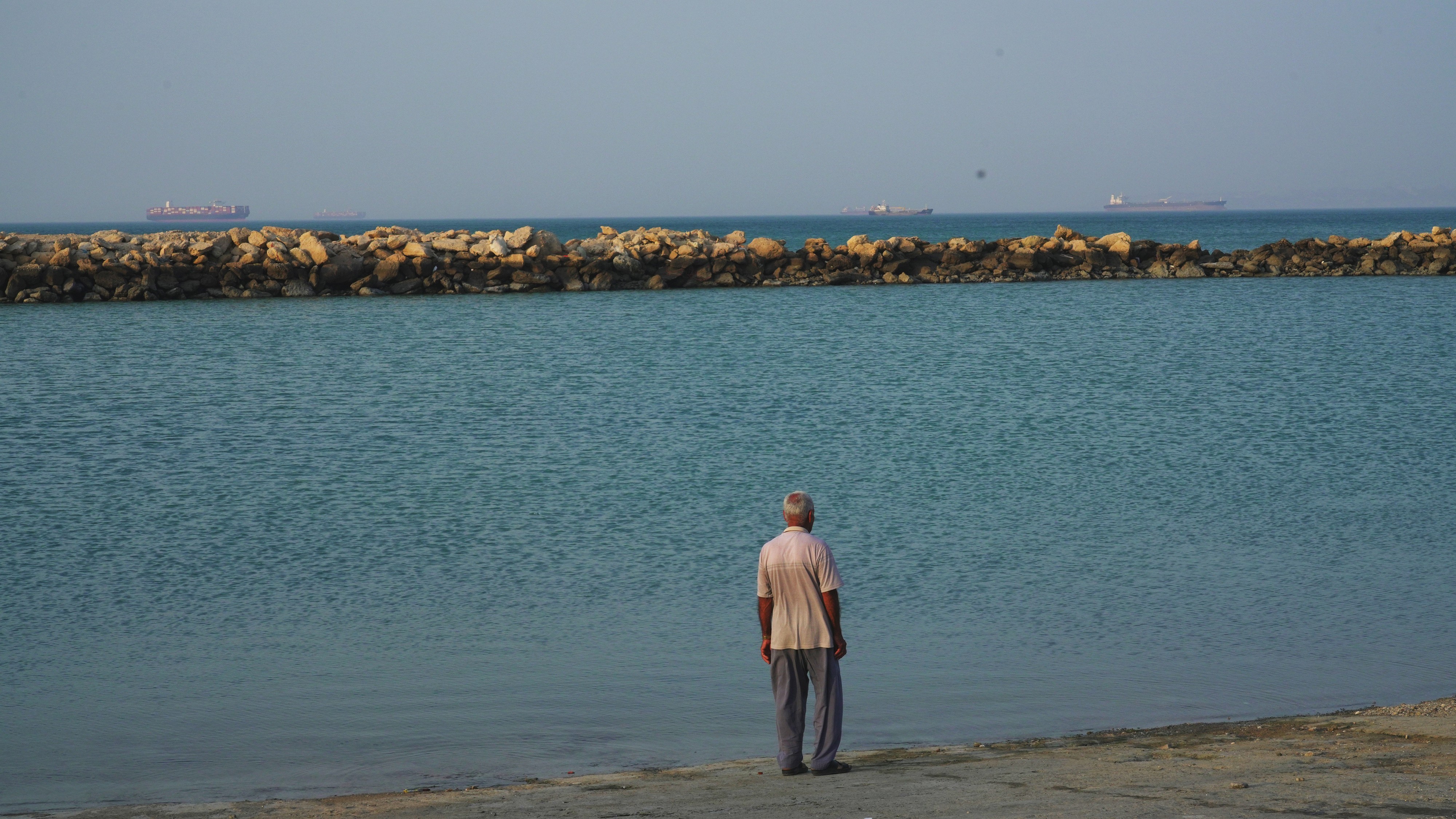
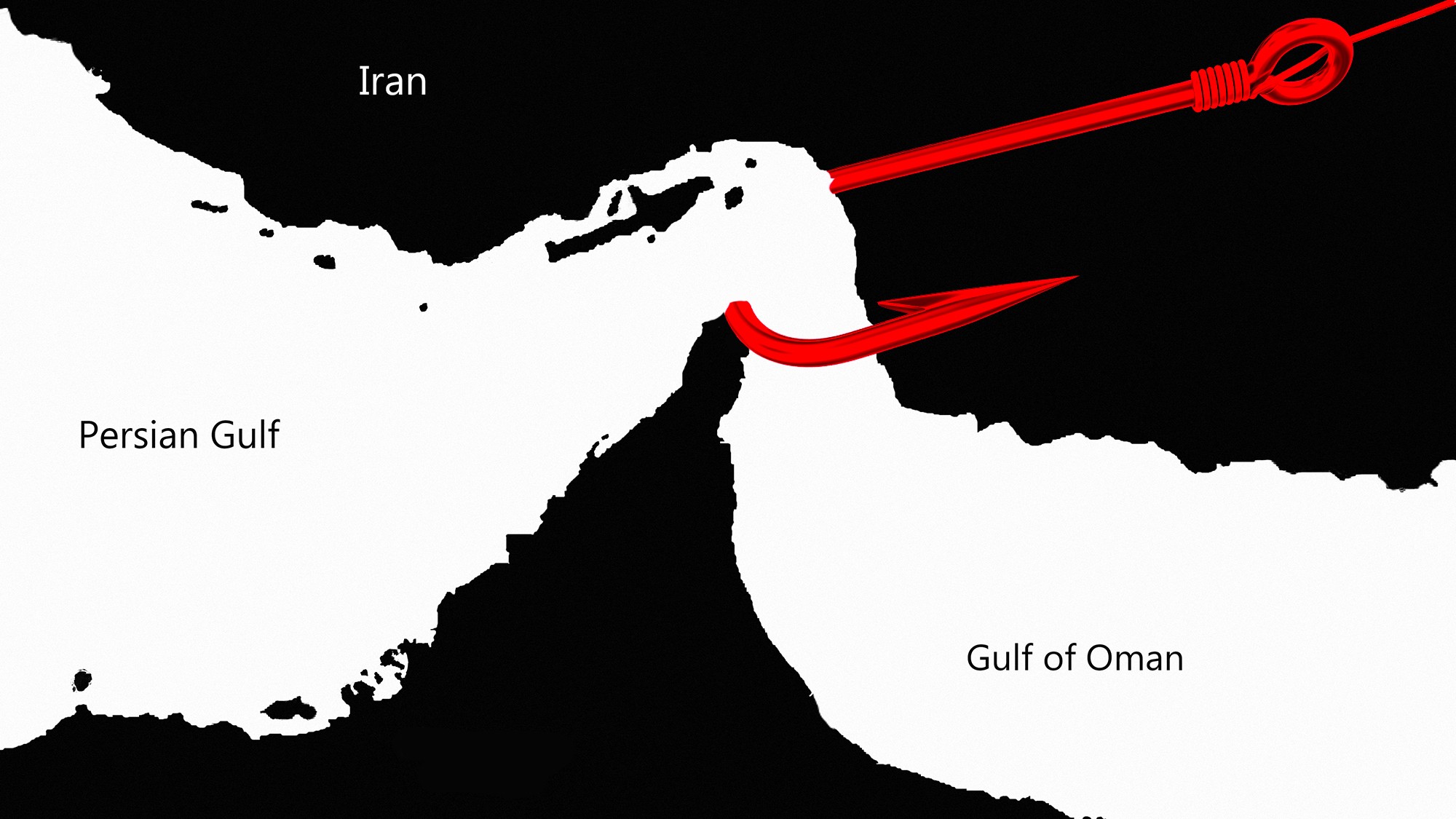
Defeat in the present confrontation with Iran will be of an entirely different character. It can neither be repaired nor ignored. There will be no return to the status quo ante, no ultimate American triumph that will undo or overcome the harm done. The Strait of Hormuz will not be “open,” as it once was. With control of the strait, Iran emerges as the key player in the region and one of the key players in the world. The roles of China and Russia, as Iran’s allies, are strengthened; the role of the United States, substantially diminished. Far from demonstrating American prowess, as supporters of the war have repeatedly claimed, the conflict has revealed an America that is unreliable and incapable of finishing what it started. That is going to set off a chain reaction around the world as friends and foes adjust to America’s failure.
President Trump likes to talk about who has “the cards,” but whether he has any good ones left to play is not clear. The United States and Israel pounded Iran with devastating effectiveness for 37 days, killing much of the country’s leadership and destroying the bulk of its military, yet couldn’t collapse the regime or exact even the smallest concession from it. Now the Trump administration hopes that blockading Iran’s ports will accomplish what massive force could not. It’s possible, of course, but a regime that could not be brought to its knees by five weeks of unrelenting military attack is unlikely to buckle in response to economic pressure alone. Nor does it fear the anger of its populace. As the Iran scholar Suzanne Maloney noted recently, “A regime that slaughtered its own citizens to silence protests in January is fully prepared to impose economic hardships on them now.”
Some supporters of the war are therefore calling for the resumption of military strikes, but they cannot explain how another round of bombing will accomplish what 37 days of bombing did not. More military action will inevitably lead Iran to retaliate against neighboring Gulf States; the war’s advocates have no response to that, either. Trump halted attacks on Iran not because he was bored but because Iran was striking the region’s vital oil and gas facilities. The turning point came on March 18, when Israel bombed Iran’s South Pars gas field and Iran retaliated by attacking Qatar’s Ras Laffan Industrial City, the world’s largest natural-gas-export plant, causing damage to production capacity that will take years to repair. Trump responded by declaring a moratorium on further strikes against Iran’s energy facilities and then declaring a cease-fire, despite Iran’s not having made a single concession.
The risk calculus that forced Trump to back down a month ago still holds. Even if Trump were to carry out his threat to destroy Iran’s “civilization” through more bombing, Iran would still be able to launch many missiles and drones before its regime went down—assuming it did go down. Just a few successful strikes could cripple the region’s oil and gas infrastructure for years if not decades, throwing the world, and the United States, into a prolonged economic crisis. Even if Trump wanted to bomb Iran as part of an exit strategy—looking tough as a way of masking his retreat—he can’t do that without risking this catastrophe.
If this isn’t checkmate, it’s close. In recent days, Trump has reportedly asked the U.S. intelligence community to assess the consequences of simply declaring victory and walking away. You can’t blame him. Hoping for regime collapse is not much of a strategy, especially when the regime has already survived repeated military and economic pummeling. It could fall tomorrow, or six months from now, or not at all. Trump doesn’t have that much time to wait, as oil climbs toward $150 or even $200 a barrel, inflation rises, and global food and other commodity shortages kick in. He needs a faster resolution.
But any resolution other than America’s effective surrender holds enormous risks that Trump has not so far been willing to take. Those who glibly call on Trump to “finish the job” rarely acknowledge the costs. Unless the U.S. is prepared to engage in a full-scale ground and naval war to remove the current Iranian regime, and then to occupy Iran until a new government can take hold; unless it is prepared to risk the loss of warships convoying tankers through a contested strait; unless it is prepared to accept the devastating long-term damage to the region’s productive capacities likely to result from Iranian retaliation—walking away now could seem like the least bad option. As a political matter, Trump may well feel he has a better chance of riding out defeat than of surviving a much larger, longer, and more expensive war that could still end in failure.
Defeat for the United States, therefore, is not only possible but likely. Here is what defeat looks like.
Iran remains in control of the Strait of Hormuz. The common assumption that, one way or another, the strait will reopen when the crisis ends is unfounded. Iran has no interest in returning to the status quo ante. People talk of a split between hard-liners and moderates in Tehran, but even moderates must understand that Iran cannot afford to let the strait go, no matter how good a deal it thought it could get. For one thing, how reliable is any deal with Trump? He all but boasted of replicating the Japanese surprise attack on Pearl Harbor by approving the killing of Iran’s leadership amid negotiations. The Iranians cannot be sure that Trump won’t decide to attack again within a few months of striking a deal. They also know that the Israelis may attack again, as they never feel constrained from acting when they perceive their interests to be threatened.
And Israel’s interests will be threatened. As many Iran experts have noted, the regime in Tehran currently stands to emerge from the crisis much stronger than it was before the war, having not only retained its potential nuclear capacity but also gained control of an even more effective weapon: the ability to hold the global energy market hostage. When the Iranians talk of “reopening” the strait, they still mean to keep the strait under their control. Iran will be able not only to demand tolls for passage, but to limit transit to those nations with which it has good relations. If a nation behaves in a way that Iran’s rulers don’t like, they will be able to exact punishment merely by slowing, or even threatening to slow, the flow of that nation’s cargo ships in and out of the strait.
The power to close or control the flow of ships through the strait is greater and more immediate than the theoretical power of Iran’s nuclear program. This leverage will allow the leaders in Tehran to force nations to lift sanctions and normalize relations or face penalties. Israel will find itself more isolated than ever, as Iran grows richer, rearms, and preserves its options to go nuclear in the future. It may even find itself unable to go after Iran’s proxies: In a world where Iran wields influence over the energy supply of so many nations, Israel could face enormous international pressure not to provoke Tehran in Lebanon, Gaza, or anywhere else.
The new status quo in the strait will also occasion a substantial shift in relative power and influence both regionally and globally. In the region, the United States will have proved itself a paper tiger, forcing the Gulf and other Arab states to accommodate Iran. As the Iran scholars Reuel Gerecht and Ray Takeyh wrote recently, “The Gulf Arab economies were built under the umbrella of American hegemony. Take that away—and the freedom of navigation that goes with it—and the Gulf states will ineluctably go begging to Tehran.”
They will not be the only ones. All nations that depend on energy from the Gulf will have to work out their own arrangements with Iran. What choice will they have? If the United States with its mighty Navy can’t or won’t open the strait, no coalition of forces with just a fraction of the Americans’ capability will be able to, either. The Anglo-French initiative to police the strait after a cease-fire is a bit of a joke. French President Emmanuel Macron has made it clear that this “coalition” will operate only under peaceful conditions in the strait: It will escort ships, but only if they don’t need an escort. Yet with Iran in control, the strait is not going to be safe again for a long time. China presumably has some influence over Tehran, but even China cannot force open the strait by itself.
One effect of this transformation may be an expanding great-power naval race. In the past, most of the world’s nations, including China, counted on the United States to both prevent and address such emergencies. Now the nations in Europe and Asia that depend on access to the Persian Gulf’s resources are helpless against the loss of energy supplies that are vital to their economic and political stability. How long can they tolerate this before they start building their own fleets, as a means of wielding influence in an every-nation-for-itself world where order and predictability have broken down?
The American defeat in the Gulf will have broader global ramifications as well. The whole world can see that just a few weeks of war with a second-rank power have reduced American weapons stocks to perilously low levels, with no quick remedy in sight. The questions this raises about America’s readiness for another major conflict may or may not prompt Xi Jinping to launch an attack on Taiwan, or Vladimir Putin to step up his aggression against Europe. But at the very least America’s allies in East Asia and Europe must wonder about American staying power in the event of future conflicts.
The global adjustment to a post-American world is accelerating. America’s once-dominant position in the Gulf is just the first of many casualties.
The American drawdown is a cultural divorce as well as a military one.
Show full content
While the high-security corridors of Washington and Berlin are occupied with a frantic, transactional debate over NATO burden sharing and the fallout of the Iran blockade, a far more profound rupture is occurring in the quiet streets of the Rhineland-Palatinate.
President Trump announced last week that the United States will remove 5,000 troops from Germany, possibly as the beginning of a larger drawdown. Pentagon planners anticipate a phased reduction over the next 12 months that could see the total U.S. presence in Germany drop significantly. Some analysts believe that the administration ultimately favors rotating troops in and out of Europe rather than permanently basing them there.
Americans have been stationed in Germany by the tens of thousands since the end of World War II. Some 50,000 Americans—including military personnel, civilian employees, and their families—populate the Kaiserslautern Military Community, which includes Ramstein Air Base. The remainder of the U.S. presence is concentrated in strategic hubs such as Wiesbaden, the headquarters of the U.S. Army Europe and Africa, and the training grounds of Grafenwoehr and Vilseck in Bavaria, where thousands of soldiers maintain a rotational readiness. The initial 5,000-troop reduction will likely be drawn primarily from forces stationed around Vilseck and Grafenwoehr.
Pundits in the United States are framing the move as a strategic rightsizing or a punitive diplomatic strike. But to view the exodus from Ramstein and Landstuhl through the narrow lens of defense budgets is to miss that it portends the tragic collapse of an 80-year-old social contract. The withdrawal from Germany is a step toward the liquidation of the shared West—a cultural and human project that was never written into a treaty and, once lost, can never be reacquired.
For eight decades, the American presence in Germany was the bedrock of Western stability, not only because of the nuclear warheads or the C-130 transport planes, but also because of the bakeries, the playgrounds, and the cross-cultural marriages that formed a “Little America” in the heart of Europe. As the first 5,000 troops depart over the next few months, the conversation between two cultures will fade into silence.
The dominant media narrative suggests that Germany is ready—or at least being forced—to finally embrace strategic autonomy. This is a polite fiction. When a stabilizing power withdraws, it rarely leaves behind a robust local alternative. It leaves a vacuum that is filled less often by autonomy than by resentment and predatory external influences.
In the towns surrounding Ramstein Air Base, the “divorce” is a visceral economic and social shock. These bases were never just logistical hubs; they were also among the largest employers in rural regions that have known no other reality since 1945. Thousands of German nationals work directly for the U.S. military in this corridor, and many more jobs are indirectly tethered to the American consumer. When Washington pulls the plug on a brigade combat team, it will eviscerate a middle-class ecosystem. The local German Bäckerei (“bakery”) that tailored its recipes to American tastes for three generations isn’t going to pivot to a new European security architecture. It is simply going to close. The tragedy of the Ramstein withdrawal is that it kills the most important conversation of all: the one between neighbors.
The “Little Americas” of Kaiserslautern, a bustling hub known as K-Town that serves as the gateway to Ramstein, and Wiesbaden, the sophisticated Hessian capital that hosts the Army’s continental command center, provided the U.S. with something that trillions of dollars in diplomacy could never buy: ground-level affinity. For 80 years, a young German growing up in the Rhineland didn’t view America as a distant superpower on a screen; they viewed it as the family next door that shared its Thanksgiving turkey. This human integration was the soul of the alliance.
The U.S. administration has suggested that the troop withdrawal was meant to punish German Chancellor Friedrich Merz for criticizing Washington’s Iran policy. But in fact it punishes the pro-American German middle class. In 10 years, a generation of German leaders will have grown up without an American neighbor. They will view the United States as a distant, volatile landlord: transactional, unreliable, and, ultimately, foreign.
Washington claims, not for the first time, that it is pivoting to the Indo-Pacific. But gutting the European garrison in this pursuit is counterproductive. As the U.S. seeks to build new “latticework” alliances in the Philippines, Vietnam, and across the South Asian rim, it is simultaneously destroying the only successful blueprint it has for long-term influence.
Influence is not a commodity that can be switched on like a light bulb when a crisis erupts in the South China Sea. It is a slow-growing crop. The Ramstein model is one of deep, messy social and economic integration, and it is exactly what the U.S. will need if it hopes to stay relevant in an Asian century. By discarding it in a fit of pique, Washington is signaling to every Asian ally that American commitment is now a seasonal product, subject to the vagaries of the current election cycle.
Over the next year, departing troops will leave behind ghost towns that will stand as monuments to a lost era of American leadership. Washington is trading hard-won cultural capital for a momentary win in a diplomatic spat. The silence in the Rhineland won’t just be the absence of jet engines; it will be the sound of the American century drawing its final, lonely breath.
In early February, while much of the world was focused on a looming war in the Persian Gulf, an outspoken Iranian exile named Masood Masjoody disappeared in Canada. Days later, 10 other well-known diaspora figures were tagged in a menacing anonymous message on X: “Soon you’ll have to find the corpses of many.”
But when Masjoody’s body was found in March, the investigation did not point toward the Islamic Republic. Instead, the Canadian police brought murder charges against two followers of Reza Pahlavi, the 65-year-old son of Iran’s last shah and the most prominent leader in the Iranian opposition. Masjoody, a fierce critic of Pahlavi’s, had been denouncing the prince’s movement for months and had singled out the two suspects by name, saying that they were plotting to silence him.
The murder, in other words, appears to have been part of a war within the Iranian opposition—one that pits Pahlavi against a growing host of critics who see him and his movement as dangerously autocratic.
This rift has revolved in part around Pahlavi’s decision to hitch his movement to Donald Trump and Israeli Prime Minister Benjamin Netanyahu. In late February, well before the American and Israeli military campaign against Iran began, Pahlavi and his supporters telegraphed their eagerness for war, claiming that more than 100,000 defectors were waiting to help the former crown prince usher in a new era. Pahlavi seemed almost to expect the kind of welcome granted to Ayatollah Ruhollah Khomeini, who flew back from exile to Tehran in 1979 and was greeted by millions of adoring people and the banner headline, “He Has Returned.”
Pahlavi has not returned. More than two months into the war, the Strait of Hormuz is still blocked, and the Iranian regime is still firmly in place. Pahlavi and many of his supporters have made clear that they feel betrayed by the peace talks now under way and are hungry for more air strikes.
“The war didn’t go according to my liking,” one prominent Pahlavi supporter who is on the board of the prince’s nonprofit posted on X, adding that the regime’s people were “animals” and that Tehran “should have been bombed with 5,000 targets daily.”
The prince’s critics, meanwhile, have lashed out more angrily than ever, calling him an Israeli stooge, a fascist, a dullard presiding over a noxious, warlike cult. “A man with inherited privilege, no serious achievement, a talent for drifting with the wind, and a remarkable ability to keep millions emotionally invested while delivering little beyond contradiction, illusion, and disappointment,” Nik Kowsar, a well-known journalist and cartoonist who was once close to Pahlavi, wrote in April.
These bitter judgments are the expression of a split that has been widening for years. Some say that Pahlavi stands out from a feckless opposition movement as the only viable alternative to the Islamic Republic. In the past decade, Pahlavi has employed young advisers who have adopted MAGA-style tactics and openly embraced Israel. The prince’s acolytes credit this approach with elevating him from a quixotic royal aspirant to a real contender for leadership in a future Iran. And it does seem to have made a difference: Thousands of protesters inside Iran chanted Pahlavi’s name during the enormous protests that began in late December.
But Pahlavi’s campaign, like the populist movements it emulates, has a thuggish edge that is alienating many potential supporters even as it energizes his base. Although Pahlavi continues to say that he favors a diverse and democratic opposition, his advisers and followers, many of them committed monarchists, routinely threaten and insult anyone who is not entirely loyal to the man they see as a future king. “You are either with Prince Reza Pahlavi or with the Islamic Republic,” Saeed Ghasseminejad, the prince’s economic adviser, posted on X earlier this year.
“They’ve been inciting hatred against Pahlavi’s critics for years now, and they’ve been warned this would result in something bad,” Alireza Nader, a policy analyst who was once close to the prince, told me. Masjoody’s killing appears to have vindicated those warnings.
It has also sharpened the contradiction at the heart of Pahlavi’s movement: The former crown prince says that he wants a democratic future for Iran, but his aides and supporters treat him like a monarch whose word cannot be questioned. One prominent Iranian American in the tech industry who, like several others, asked not to be named because of the climate of online harassment, told me of a stark division in the wealthy networks in which Pahlavi has tried to raise money: “Some say Pahlavi’s the only one. Others say, ‘Why replace one dictator with another?’”
Demonstrators in Washington, D.C., wave American and pre-1979 Iranian flags in March, 2026. (Amid Farahi/ AFP / Getty)
Some of Pahlavi’s older associates told me that they are baffled by the belligerent rhetoric of his aides and supporters. They speak of Pahlavi as a kind and decent man whose political brand was always rooted in nonviolent resistance. He was a devotee of Gene Sharp, an American theorist of nonviolence whose work helped guide democracy movements around the world. Pahlavi’s motto for decades was “Today, only unity,” signaling his belief in a cohesive opposition front against the regime.
The makeover appears to have begun about 10 years ago, when Pahlavi brought on two new deputies—Ghasseminejad and another young adviser named Amir Etemadi—who were openly aligned with autocratic movements in the United States and abroad. Ghasseminejad spent eight years as an economic analyst at the Foundation for the Defense of Democracies, a right-wing think bank based in Washington, D.C., that has for years been closely allied with Netanyahu and his government.
The younger men had a flattering message for their new boss. They grew up in Iran under the Islamic Republic; Pahlavi, by contrast, has not set foot in his native country since 1978, before the revolution that overthrew his father. They knew firsthand that Pahlavi’s brand was changing inside Iran. The hatred of the Pahlavi dynasty that fueled the 1979 revolution had faded, and a nostalgia for prerevolutionary Iran began to spread. The London-based satellite-television channel Manoto, founded in 2010, broadcast gauzy images and documentaries about the zaman-e shah—“the era of the shah”—featuring carefree Iranians at parties and on beaches, with rarely any mention of SAVAK, the shah’s brutal secret-police agency.
Pahlavi’s new advisers believed that the prince was poised to capitalize on this nostalgia, and on a newly revolutionary mood that came alongside it. Ghasseminejad declined to meet with me, but in emailed responses to my questions he told me that Iran has gone through a “fundamental political transformation” over the past decade because Iranians have lost faith in the idea that the regime could be reformed. A movement to overthrow the ruling clerics has spread, he wrote, and Pahlavi has “actively represented and cultivated” those insurgent forces, using a patriotic language rooted in “Iran’s glorious heritage.”
Some former members of Pahlavi’s circle seemed to endorse Ghasseminejad’s comments. “Saeed is a smart guy, and he understood the dynamic of what motivates Iranians, at least the Persian majority,” one person who knows Pahlavi and the advisers well told me. He asked not to be named, saying that he did not want to become a target of the prince’s supporters.
But Pahlavi’s advisers also appeared to be anointing him as a king—the heir to Iran’s “glorious heritage” of a 2,500-year-old monarchy. And that seems to have entailed going to war against anyone who did not acknowledge his primacy. One person who has worked with Ghasseminejad and Etemadi told me that these advisers to Pahlavi believe that “crushing the opposition is as important as fighting the regime. They really believe Pahlavi can’t be effective unless he’s the only voice.”
Ghasseminejad and Etemadi did not take long to start making enemies. In 2018, Kowsar, who was close to Pahlavi at the time, clashed with the two new advisers. They were behaving like “Rottweilers”—obsequious to Pahlavi, and hostile and rude to everyone else—he told me. “I fled Iran to save my life and spare myself further harm, but the conduct of your associates has only brought back memories of the Islamic Republic,” Kowsar wrote in an email to Pahlavi in July of that year. Soon afterward, Pahlavi’s associates began attacking him online, Kowsar told me, calling him corrupt and a lackey of the Iranian regime, and demanding that he “shut up.” When Kowsar’s elderly father died in Iran, in 2024, some of the same people posted insults about the dead man, even though he had suffered for years at the hands of the regime.
Another opposition figure who fell afoul of Pahlavi’s young advisers was Masjoody, a mathematician and an activist based in Canada. He, too, started off as an admirer of the prince. He belonged to an Iranian exile network called Iran Revival, together with Ghasseminejad and Etemadi. But Masjoody soon became disillusioned, and before long, he was one of the Pahlavi movement’s most forceful and outspoken critics, frequently posting and relaying scornful comments about the prince and his entourage. (One sample, translated roughly from Farsi: “With the genitalia of Trump and Netanyahu, you cannot become the nation’s bride in politics, and even if you did, you wouldn’t make it to the end of the honeymoon.”) Eventually, Masjoody became convinced that Pahlavi’s two young advisers were secretly working for the Islamic Revolutionary Guard Corps. He filed dozens of lawsuits and made some claims that could seem unhinged—among them, that two Pahlavi supporters, Mehdi Ahmadzadeh Razavi and Arezou Soltani, were plotting to kill him.
Masjoody’s body was found on March 6, and the Canadian police charged Razavi and Soltani with first-degree murder soon after. One of the affidavits in the case suggests that the accused pair met with a naturopath in Vancouver in an effort to procure a deadly substance to “get rid of” Masjoody.
Masjoody was last seen alive on February 2. On February 5, the X post menacing diaspora figures with a reference to “corpses” went out. One of the recipients was Kowsar, who had been in touch with Masjoody in the weeks before his murder. “It wasn’t like those online attacks I’ve received all these years,” Kowsar said. “This one was scary.”
There is no reason to think that Pahlavi or his advisers are linked to Masjoody’s murder, and I could not find any evidence for Masjoody’s claims that the IRGC is secretly supporting the prince. But the killing has left a legacy of fear and bolstered the sense that Pahlavi’s movement includes its own share of fanatics.
Reza Pahlavi (right), meets with Israeli Minister of Intelligence Gila Gamliel and Prime Minister Benjamin Netanyahu in West Jerusalem in 2023. (Israeli Ministry of Intelligence / Anadolu Agency / Getty)
Pahlavi’s new advisers appear to have pushed him to a decision that would further set him apart from the rest of the Iranian opposition. In April 2023, he went to Israel, where he was received warmly by government officials, including Netanyahu and the intelligence minister, Gila Gamliel. Pahlavi conducted himself like a prospective head of state, vowing that a post–Islamic Republic Iran would instantly recognize Israel.
“That put him on the map,” Mehrdad Marty Youssefiani, a political consultant who worked with Pahlavi until 2015, told me. “It broke a taboo, and it did a lot to propel him to a different stage.” Many Iranians seem to have assumed that Pahlavi’s aspirations now had the backroom blessing of the world’s power brokers.
The visit was also intensely divisive. The Iranian opposition was asking itself hard questions because the regime had just successfully quelled some of the largest demonstrations in the country’s history, in late 2022. Pahlavi’s message was clear: He now seemed to believe that he spoke for the opposition, and he was firmly allied with Netanyahu, despite the fact that in 2023, much of the Israeli population was protesting Netanyahu’s autocratic agenda, in the largest demonstrations in that country’s history.
One result of Pahlavi’s Israel trip became apparent within months. In mid-2023, an expert on social-media manipulation named Geoff Golberg published a report for the National Iranian American Council documenting a widespread, coordinated social-media campaign that involved inauthentic accounts praising Pahlavi and demeaning people and organizations (including NIAC) that favored American diplomacy with the Islamic Republic. The report identified 4,765 accounts that were posting more than 100 times a day, producing 843 million tweets. Golberg found links among some of these accounts and official Israeli government accounts. Last fall, the Israeli daily newspaper Haaretz published an investigation that amplified Golberg’s conclusions and documented the existence of a “private entity that receives government support” in Israel, which was dedicated to promoting Pahlavi and had recruited native Farsi speakers to help.
Pahlavi has other powerful patrons. Iran International, a satellite-television network set up under Saudi auspices in 2017, has heavily promoted him. The network appears to have lost hundreds of millions of dollars in recent years and has kept its ownership and finances a secret.
Some of Pahlavi’s critics—including Trita Parsi, the co-founder of NIAC—have labeled him an astroturf candidate who has cynically courted political sponsors instead of building grassroots support. But the border between the online and real worlds is permeable, and Pahlavi does appear to be genuinely popular in Iran. Measuring opinion is notoriously difficult in police states, but a 2024 survey by the Group for Measuring and Analyzing Attitudes in Iran found that 31 percent of respondents supported Pahlavi, more than three times the level of support for any other figure. Iran’s supreme leader at the time, Ayatollah Ali Khamenei, was tied with former President Mahmoud Ahmadinejad at 9 percent, and Narges Mohammadi, the imprisoned human-rights activist, rated only 5 percent.
By far the greatest test of Pahlavi’s support came in late December, when the value of the rial collapsed and protesters began flooding the streets of Tehran and other major Iranian cities. For the first time, large numbers of people began chanting Pahlavi’s name and asking for his return. A week later, Pahlavi issued a call for nationwide protests on January 8 and 9. The demonstrations expanded dramatically on those days, possibly in response to Pahlavi’s claim that more than 50,000 members of Iran’s security forces and government had contacted him to defect from the regime (he later claimed the number was more than 100,000). As the protests went on, Pahlavi continued to urge people to come out, saying that the ruling system was “on the verge of collapse.”
The regime’s apparatus did not collapse. The authorities cut off all internet access on January 8, and in the days that followed, the IRGC and other armed forces began the bloodiest crackdown in Iran’s modern history; estimates of the death toll range from 7,000 to more than 36,000 (Pahlavi has recently begun saying that 50,000 were killed).
Afterward, Pahlavi came under widespread criticism for having encouraged people to protest and for the flimsiness of his claims about defectors, which may have given people a false sense of safety. There was never any verifiable evidence for Pahlavi’s assertion, and critics have said that the system he set up to log defections using QR codes and Google Forms was ripe for infiltration by Iran’s security services, which may have artificially inflated the results or even used the platform to identify and punish those who used it in earnest.
Oddly, Pahlavi’s own team has at times undermined the strategy of luring defectors by signaling their hunger for revenge. Ghasseminejad has repeatedly posted about his desire to go after regime officials once they have been overthrown, and even to see them hanged. Some critics have suggested that these threats may have served to unify the security services and wed them to their campaign of repression at a moment when they could have been vulnerable to doubt or division.
Pahlavi’s supporters have not been daunted by criticism. More than 200,000 people rallied in Munich in February to call for regime change, and many chanted Pahlavi’s name, some of them using nationalist slogans. Pahlavi was there for that city’s annual security conference, and the CNN host Christiane Amanpour asked him during a televised interview if he would repudiate the aggressive behavior of some of his loyalists. Pahlavi responded by saying that he was against any kind of intimidation. He added, “I think the regime is behind a lot of these campaigns.”
Evidence indeed suggests that the regime’s cyberarmy has tried to fuel tensions within the opposition, sometimes in the guise of monarchists. But Amanpour’s point was proved just after she made it, when a group of Pahlavi supporters approached her at the Munich event and began shouting angrily and accusing her of collaborating with the regime.
Reza Pahlavi addresses the Conservative Political Action Conference in Grapevine, Texas, in March, 2026. (Desiree Rios / The New York Times / Redux)
After Trump declared a cease-fire with Iran on April 7, Pahlavi posted a speech to his supporters, saying that he knew the decision “has disheartened many of you.” He embarked on a tour of Europe, preaching regime change and accusing the British government (which did not participate in the war) of appeasement.
But his critics in the opposition are now louder than ever, and late last month, one of the most prominent monarchists inside Iran, a political prisoner named Manouchehr Bakhtiari, joined them. “Among those who claim to support monarchy, it is you who, more than anyone, have turned your back on what you swore to uphold and on the institution of monarchy itself,” Bakhtiari said in a lacerating audio message addressed to Pahlavi.
Pahlavi’s appeals for more bombing have taken on a desperate sound now that Trump is visibly fed up with the war. I asked one prominent Pahlavi supporter how he would propose to deal with the Islamic Republic now that so many strategies seem to have failed.
“If the U.S. military could secure a landing for the crown prince within a city in Iran, that would make the difference,” he told me. “I think it would be over for the IRGC.”
I was taken aback, and not just by the implausibility of this scenario. Pahlavi might well be unwilling to make such a risky trip. This is the man who told an interviewer back in 2023: “My life has been for the past 40 years here in America. My children live here, my friends live here, everybody that I know is here. If I was to go back, what do I go back to?”
As for the people of Iran, they may now be more vulnerable than ever to the hard-line forces this war was meant to weaken. One Iranian who fled his country earlier this year told me that he believes Pahlavi retains some popularity inside the country, but only as a kind of phantom, “an absence of something rather than an existence. People, desperate in confronting the authoritarian regime, were seeking someone or something who could fill the void of a person or thing that could set things in order, like a Second Coming.”
The first step is admitting that the United Kingdom has a problem.
Show full content
The surveillance video begins with a seemingly innocent scene: A Jewish man stands next to a bus shelter, adjusting his yarmulke. Suddenly, he is pummeled by a passerby and stabbed repeatedly until he is propelled off-screen. The victim’s skullcap, which had fallen into the street, slowly wafts away in the wind.
This assault was the culmination of a violent spree that has shocked many in Britain. Last Wednesday, according to authorities, a man named Essa Suleiman allegedly attacked Ishmail Hussein, an acquaintance he’d known for decades, in South London. He then traveled eight miles to Golders Green, one of the most Jewish areas in the United Kingdom, and stabbed two random Jewish men in religious garb whom he did not know, including the one at the bus stop, before finally being apprehended. The two victims, ages 34 and 76, were hospitalized but survived.
On its own, this incident would be disturbing. But the Golders Green onslaught was just the latest in a series of escalating anti-Semitic attacks across Britain, and the third one in five weeks in the same Jewish community. This past month, multiplesynagogues in Golders Green were targeted by arsonists, as was another Jewish institution. The month prior, four ambulances owned by Hatzola, the local Jewish-run charity-ambulance service, were set on fire and destroyed. Last week, Hatzola medics used their remaining resources to treat the victims of the Golders Green stabbing attack. And yet, despite pious protestations from politicians, the country appears to have no idea how to prevent any of this from happening.
Last October, a man named Jihad al-Shamie drove his car into a Manchester synagogue and began stabbing worshippers, one of whom was killed in the subsequent crossfire with police. In February, the Community Security Trust, which tracks anti-Semitic activity in Britain, announced a grim milestone: “For the first time ever, CST recorded over 200 cases of anti-Jewish hate in every calendar month in 2025.” One of Britain’s oldest minorities now feels itself under siege. “British Jews are super concentrated in NW London,” wrote Ben Judah, the author of This is London and a former adviser to the British government, on social media. “There are only 250k of us. Roughly around 100k of us live in this area and surrounding areas. It’s like a small town that’s now under sustained attack.”
The responses to the stabbings in Golders Green help explain how this predicament arose—and why it continues. Even as the victims were still in the hospital, an array of online apologists associated with Britain’s ascendant hard-left explained away the incident and its implications. Some pointed to the reported mental-health issues of the assailant, as though this somehow excluded an anti-Semitic motive. Whatever the alleged perpetrator’s internal demons, he didn’t travel across London to attack Presbyterians. He went to a historic Jewish neighborhood and attempted to kill Jews. The initial altercation with his acquaintance was a common crime; the knifings in Golders Green were hate crimes.
Other commenters attempted to change the subject from the attacker’s treatment of his Jewish victims to the police’s treatment of the attacker. “Contemptible abuse of police power,” read a representative post on X. “Why kick him in the head several times when he’s already tasered & in your control?” Some called for the suspension or imprisonment of the police officers. In reality, as the full video of the confrontation showed, the police were not gratuitously roughing up the alleged assailant; they were attempting to disarm him as he was actively refusing to relinquish his knife despite repeated instructions.
These deflections were soon distilled into a single post that was addressed to Britain’s police commissioner, Mark Rowley, and reshared by Zack Polanski, the leader of the country’s Green Party: “So essentially [Rowley’s] officers were repeatedly and violently kicking a mentally ill man in the head when he was already incapacitated by taser.” (Polanski, who is Jewish, later apologized in a statement “for sharing a tweet in haste.”)
Some seemed inclined to shift blame from the anti-Semitic attacker to Jews themselves. Suleiman made no reported claims about Israel during his London rampage. But this did not stop some commentators from attempting to make the story about Israel, and implying that British Jews played a role in their own persecution because they were not expressing the right opinions about Israel at the right volume. “The UK Jewish community could help to damp down the likelihood of such outrages by making it clear that it is as appalled by the brutality of Israeli policy as almost everyone else is,” wrote Sir Tony Brenton, a former British ambassador to Russia.
“Jews, like everyone else, are entitled to protection from attack and murder without having to agree with Sir Tony’s analysis of foreign policy,” retorted two members of the House of Lords. “He overlooks the facts that the Jewish community in this country has a wide range of opinions on Israel and that the antisemites responsible for recent outrages do not care about the views of the people they are trying to kill. All that matters to them is that they are Jewish.”
The refusal to acknowledge overt anti-Jewish prejudice in Britain is one reason the prejudice persists and proliferates. But the responses to Golders Green that do recognize the problem have also fallen short.
Before and after the assault, many politicianscalled to ban pro-Palestine protests—which have at times featured anti-Semitic iconography and chants—in the country’s capital. “It pains me to say this, but I think we may have reached a point where we need to have a moratorium on the sorts of marches that have been happening,” Jonathan Hall, the U.K.’s independent reviewer of terrorism legislation, said last week. “It’s clearly impossible at the moment for any of these pro-Palestine marches not to incubate within them some sort of anti-Semitic or demonising language.”
Chants such as “Globalize the intifada” certainly continue to age poorly as Jews are stabbed, firebombed, and shot around the world by bigots purporting to act in the name of Palestine. But many participating in pro-Palestine marches do not harbor violent hate for Jewish people, and throttling their free expression in order to punish a mendacious minority will sweep up innocents and stoke resentment.
Speech policing is particularly perilous in the case of anti-Semitism, because anti-Semites claim that a powerful cabal of perfidious Jews is covertly controlling society behind the scenes. Efforts to castigate anti-Jewish bigots are thus easily twisted into confirmation of the anti-Semitic conspiracy theory. As the Guardian columnist Jonathan Freedland put it, “We will be blamed for censoring free expression, cast as the shadowy string-pullers who put a gag on everyone else.” Big Government cracking down on speech is quickly refashioned as the machinations of the Jews.
Heavy-handed tactics can also make offending speech seem more transgressive and alluring, and turn malign actors into martyrs. But such approaches are being championed by the country’s rising hard right, just as the deflections from the problem are being promoted by the hard left. The result: The most energized voices in British politics are the ones with the least serious solutions.
Meanwhile, the historically unpopular Prime Minister Keir Starmer has so far resisted shutting down the pro-Palestine protests, even as he has condemned slogans such as “Globalize the intifada” as “calling for terrorism against Jews.” Instead, the British police have allocated 25 million pounds in emergency funding to secure Jewish communities. But there are some things money can’t buy.
“We want normal to be like normal is for everyone else,” said Barry Frankfurt, a synagogue president who was interviewed by BBC Radio alongside his daughter. “But it’s not. Normal for us is that when Libby was 5 in primary school, she was told what the code word was that meant she had to hide under the table. Now she’s 16 and she says she goes to a school and her bus is checked routinely.”
“The response broadly is: ‘We know we have a problem, and the answer we’re gonna give is that we’re gonna spend more money on making sure that there can be Jewish buildings which have even higher gates and even more security guards,’” Frankfurt continued. “And that isn’t solving the problem.” Across the political spectrum in Britain, no one seems to know what will.
The standoff isn’t about hard-liners blocking pragmatists inside Iran, but about both sides believing that they have won the war.
Show full content
On Monday, Iran made Donald Trump an offer: It would open the Strait of Hormuz in exchange for lifting the U.S. blockade while nuclear negotiations continued. On Wednesday, Trump rejected this offer, promising to keep the blockade in place until Iran agrees to America’s terms on the nuclear issue. The blockade “is genius,” he said, and “now they have to cry uncle. That’s all they have to do. Just say, ‘We give up.’”
The Trump administration’s explanation for this standoff is that there is an “absolute fracture” in the Iranian regime between the military and the negotiators. Secretary of State Marco Rubio told Fox News that “unfortunately, the hard-liners with an apocalyptic vision of the future have the ultimate power in that country,” especially because the new supreme leader, Mojtaba Khamenei, is “untested” and “has not been seen.”
The administration now appears to be gaming out a new course of action: strikes targeting not Iran’s military capacity but the faction inside the regime that it believes is blocking a deal. The president recently reposted a video of the Washington Post columnist Marc Thiessen calling for an aerial campaign to do exactly this. According to Axios, the military has prepared options for a “short and powerful” wave of strikes, which General Dan Caine, the chairman of the Joint Chiefs of Staff, briefed to the president yesterday.
The timing of such a move is complicated because of Trump’s state visit to China scheduled for mid-May, which has been postponed once before. Strikes could happen within the next few days, so as to precede the trip, or they could come immediately after it.
But the assumption underlying this approach is almost certainly wrong. The Islamic Revolutionary Guard Corps has proved far more resilient than either Washington or Jerusalem anticipated. An institution that has survived multiple rounds of air strikes, international isolation, and the death of much of its senior leadership does not capitulate because a few more names are removed from the org chart. And hard-liners are spread throughout the regime, not just in the IRGC.
Iran and the United States have failed to come to an agreement not because hard-liners are blocking pragmatists inside Iran, but because both sides seem to sincerely believe that they have won the war.
According to Trump, the United States has destroyed Iran’s navy and air force, many of its missiles, and much of its military and industrial capacity. But the Iranian regime sees mainly that it has withstood a war that has aimed to topple it, has demonstrated its ability to attack the Persian Gulf and Israel, and has succeeded in controlling the Strait of Hormuz.
During talks in Islamabad, the U.S. negotiating team, led by J. D. Vance, found that Iran was entirely unresponsive to American demands regarding its nuclear program. Instead of going back to war, Trump opted for a blockade, which Vance reportedly believed would cause Iran to give in after a few days.
But Iran has resisted U.S. demands to completely cease enriching uranium, and to curb its missile program, for years. It has gone to war with the United States and Israel twice rather than concede those points. The Iranian regime is not likely to give away at the negotiating table what it believes America was unable to gain through war.
The Trump administration seemed to expect that the blockade would collapse the Iranian oil industry in a matter of weeks. On April 27, Treasury Secretary Scott Bessent posted on social media: “While the surviving IRGC Leaders are trapped like drowning rats in a sewage pipe, Iran’s creaking oil industry is starting to shut in production thanks to the U.S. BLOCKADE. Pumping will soon collapse.” But the Iranians have endured decades of sanctions: They have experience in adjusting their oil industry to cope with reduced demand. They also benefited from a financial windfall at the start of the conflict, when the U.S. lifted sanctions on their oil exports.
Tehran likely calculates that it can outlast the United States in absorbing economic hardship, especially because Trump will face domestic political pressure in the run-up to the midterm elections in the fall. Nor is Iran likely to wait for an economic crisis. If the United States appears to be hunkered down for the long haul, Iran’s leadership may set its sights on blocking off other choke points—for instance, getting the Houthis to close the Bab el-Mandeb Strait, which connects the Red Sea to the Gulf of Aden and is essential to traffic through the Suez Canal.
Earlier in the war, the U.S. president seriously considered escalatory moves, such as attacking Iranian infrastructure and sending ground troops to reopen the Strait of Hormuz. Now Trump seems reluctant to take these steps, perhaps recognizing that they could lead to retaliatory strikes on infrastructure in the Gulf States and a bloodier and more protracted conflict. He may see a limited wave of strikes as less risky, but Iran will retaliate against these too.
Should Trump restart the war and actually succeed in limiting the fighting to a couple of days, the likelihood is that he will end up back where he is now—with Iran rejecting his demands. And if the Strait of Hormuz remains closed for most of May, the costs will accumulate globally. The World Bank estimates that the current supply shock on oil may already be the largest ever. It’s about to get much worse.
Energy and refined-petroleum products from the Gulf have continued to reach the market over the past couple of months, via ships and tankers that transited the strait before the war began. Now that traffic has stopped. Stockpiles have been drawn down. Refined products such as fertilizer and petrochemicals will soon be in short supply. This will affect the rest of the world much more than it will the United States, so the Trump administration may be tempted to shrug it off. The United States may even try to introduce limits on the export of oil, but the pressure on gas prices and inflation will undoubtedly take a toll.
If Trump doesn’t foresee continuing the blockade into the fall, he will confront a choice. He could try to strike a deal with Iran that offers sanctions relief and is stronger than the 2015 nuclear deal—with a longer timeline and more restrictions on enrichment—but that would not fully abolish Iran’s nuclear program and would not address its missiles. The strait would be fully reopened, but Iran would retain the capacity to close it in the event of more Israeli strikes.
Alternatively, he could accept an arrangement like the one the Iranians offered this week, in which the strait reopens but nothing else is settled. The U.S. would give up its embargo without securing a deal to curb Iran’s nuclear program or limit its missiles, and the Iranians would reopen the strait without getting sanctions relief.
Some of America’s allies in the Middle East, particularly Israel and the United Arab Emirates, may prefer the second option over the first if they can’t persuade the United States to resume the war against Iran and stick with it for as long as it takes. These countries care a great deal about Iranian missiles and regional power. They know that the country’s nuclear program has already been significantly set back, and they may not wish to see a deal that lifts sanctions without limiting Iran’s missile program or preventing it from reconstituting its proxy network. They may also worry that a nuclear deal would prevent the U.S. from restarting the war so long as the strait remains open and Iran does not breach its nuclear commitments.
The Israelis may calculate that without a nuclear agreement, they can retain the option of striking Iran again in the coming years, and that the Iranian regime, without sanctions relief, is likelier to face an economic crisis that could lead to its collapse.
The United States went to war to deal the Islamic Republic a devastating blow from which it would never recover. The war has damaged Iran’s military capacity, but it also has handed Tehran more leverage over global energy markets and the Gulf States than it has ever possessed. A wave of limited strikes won’t reverse this outcome, and it would not help Trump avoid the difficult choice he still faces between bad options.
Sure, there’s “infighting,” but not along the lines many assume.
Show full content
According to the Trump administration’s latest messaging, talks between the United States and Iran are deadlocked because of infighting in Tehran. The military hard-liners of the Islamic Revolutionary Guard Corps must be stopping the civilian diplomats from making a deal. Or, to put it in President Trump’s words, “Iran is having a very hard time figuring out who their leader is!” (This supposition conveniently makes sense of the president’s claim that Iran has “agreed to everything” alongside Iran’s denial that this is so.)
The explanation, which has gained some currency in U.S. media, is at best half-true. Quite a bit of infighting is indeed happening within the Iranian regime. However, it does not map neatly onto a military-versus-civilian divide, and it does not suggest that Iran’s negotiating team is disempowered to speak for the country. Such theories reflect a misunderstanding of Iran’s complex system and do little to advance American diplomatic aims.
Consider the role of Mohammad Baqer Qalibaf, the man who led the Islamabad talks with Vice President Vance. His American interlocutors can’t quite decide where to place him in their schema of Iran’s internal politics. That might be because the sources of, and limits on, his authority range across the military-civilian binary.
Qalibaf is the speaker of Iran’s Parliament, but he has amassed power mostly through his membership on the Supreme National Security Council and its smaller subsidiary, the Defense Council. The Defense Council was founded last summer to consolidate Iran’s military leadership, and though it has nine members, Qalibaf is effectively the first among equals, which means he is all but running the war effort. He owes this to the broad authority he carries within the IRGC: He was one of its top regional commanders during the war with Iraq in the 1980s, and he later headed its construction wing and air force and helped build up its missile program.
Qaibaf is also a power-hungry technocrat. He is known to be competent but brutal. He was national police chief in the early 2000s, during which time he played a part in imprisoning dissident writers and intellectuals, and he has bragged about his role in suppressing protests in 1999 and 2003, among other occasions. He has a reputation for corruption, having been accused of using his three terms as Tehran mayor to enrich himself, his acolytes, and his family.
Iran’s newly minted supreme leader, Mojtaba Khamenei, is reportedly in a medically precarious position, and has thus remained outside public view. The extent of Mojtaba’s ability to direct decision making is therefore in question. But Qalibaf is known to have well-established ties to the security circles around the new leader, and some speculate that he is acting either with Mojtaba’s blessing or without need of it.
Under these conditions, Qalibaf has become the face of diplomacy with the United States. This has historically been a controversial role in Iran, where conservative Islamist hard-liners have long opposed and sought to sabotage dealings with the United States. But “conservative Islamist hard-liners” is in no way synonymous with the IRGC. That organization is now so sprawling and decentralized—it controls much of Iran’s economy, as well as its political, military, and security institutions—that the whole of it is not likely to take any single position.
Still, Qalibaf is thought to have considerable sway within the force. No IRGC commander has publicly come out against his handling of the talks—in fact, the IRGC’s main media outlet, Tasnim, has criticized the hard-liners who have tried to undercut diplomacy.
That said, some of Iran’s political elites do oppose talks with the United States. Chief among them is Saeed Jalili, a senior member of the National Security Council who took a similarly hard-line position against the talks that led to the 2015 nuclear deal. Jalili counts as his allies two prominent members of Parliament, Ali Khezrian and Mahmoud Nabavian. Khezrian has declared that “all kinds of exchanging messages with the U.S. must stop.” Nabavian took part in the Islamabad talks but called them “unsuccessful and undesirable” and accused his own negotiating team of making “strategic mistakes in setting the agenda.” These men appear to have limited influence even in the legislature, where their hard-line faction is dominant: On Monday, 261 of 290 members of Parliament published a statement in support of Qalibaf and the negotiating team. Khezrian signed it, though Nabavian did not.
The idea that the IRGC has set itself against the negotiating team stems from a misinterpretation of a single incident. On April 17, Iran’s foreign minister, Abbas Araghchi, declared the Strait of Hormuz “completely open for the remaining period of cease-fire, on the coordinated route as already announced.” The IRGC’s media outlets rushed to clarify that this didn’t mean a full-on opening of the strait. That’s when Trump made his pronouncements on infighting in Tehran, but in truth the Iranian statements were in accord with each other. The hubbub in Iranian circles had less to do with Araghchi’s tweet than with Trump’s presentation of it as a more serious concession than it really was—part of a flurry of celebratory statements from the U.S. president, to which the Iranians took exception. Qalibaf accused Trump of having “made seven claims in one hour, all of which are false.”
Since then, the regime has tried hard to project an image of unity. Qalibaf gave an extensive television interview in which he insisted that he would not trade away anything the regime held sacrosanct. He joined officials from an array of political factions in publishing a joint message on X: “In our Iran we don’t have extremists and moderates,” the post said. Rather, all Iranians were revolutionaries united behind “one god, one leader, one nation and one path.” The supreme leader himself published a short message on X warning against the “media operations aimed at disrupting national unity and security.”
Iran’s hard-liners seem to lack the institutional leverage to thwart diplomacy. But if they are determined to do so, they can always try to mobilize their grassroots base. For weeks now, the Iranian regime has been calling on its backers to throng the streets by the thousands every night, as part of an effort to rally support for the war and intimidate the opposition. These advocates are a minority in a country that has largely soured on its regime. But they are real—when Jalili ran for president in 2024, he got 13.5 million votes—and many of them oppose diplomacy. When a former Iranian foreign minister published a piece in Foreign Affairs calling for a new deal with America, demonstrators burned his picture in the streets.
But negotiations, too, have a base of popular support. The Iranian Reformists Front, which has faced repression in recent months, has signaled backing for talks with the U.S. So has the centrist former president Hassan Rouhani. Even some opponents of the Islamic Republic have come out in favor of diplomacy. Maulavi Abdulhamid, Iran’s top Sunni cleric, has called for “a just agreement” and protested against “extremists who are standing in the way with their obstinacy.” Those behind former Crown Prince Reza Pahlavi and some other opposition groups are against talks with the United States, but others in the non-monarchist opposition have declared support for them.
So yes, there is infighting in Tehran. Competition and compromise will undoubtedly affect the nature and extent of the concessions negotiators are able to accept. The same is probably true on the other side of the negotiating table. But that doesn’t mean that hard-liners who oppose talks altogether are likely to sink them. If anything, the momentum and institutional power appear to lie on the side of diplomacy.
China’s urbanites are learning the price of prosperity.
Show full content
Earlier this year, one of the most popular apps in China was called Are You Dead?. This was not a game, but a handy way for the many young people who live alone across the country, mostly in cities, to keep tabs on one another. Users needed to check in with the app every 48 hours by pressing a big green button. If a user did not check in, the app promptly notified a designated contact. Designed as a source of comfort to those who worry about dying alone, the app became the top paid download for the iPhone in China in January.
Then it vanished. Apple said in a statement that China’s cyberspace watchdog ordered the company to remove it from its Chinese store. The app seemed to challenge the Communist Party’s insistence that the Chinese people are content beneficiaries of economic and social progress. Instead, Are You Dead? exposed the unease felt by many Chinese urbanites, and it highlighted the depths of a major social problem facing China today: loneliness. In suppressing the app, China’s authorities have made plain that they are watching the public mood and not liking what they see.
In a country of 1.4 billion people, many of them crammed into densely packed cities, loneliness may seem like an unlikely concern. But China’s rapid economic progress and adoption of new technologies have transformed the country from an agrarian, family-based society to an urban, industrial one, and many young workers live far from the small villages and provincial towns where they grew up. The alienating pressures of city life—the overall urban population has swelled by about 400 million people over the past two decades—together with a culture that often encourages competition and status obsession have created a prevailing sense of uncertainty, insecurity, and isolation.
Newcomers to big cities anywhere feel lonely, but “the fact that Chinese people used to have much more traditional and much more tightly knit family structure is contributing to the feeling much more strongly,” Xuemei Bai, a professor who specializes in urbanization at the Australian National University, in Canberra, told me.
Hang Nan’s story is typical. Originally from the city of Linfen in Shanxi province in north China, the 29-year-old relocated to Beijing in 2021 for a job at an advertising agency. She hardly knew anyone in the capital when she arrived, and she has struggled to make friends ever since. Ten-hour days at work leave her little time or energy to socialize. “When you choose life in a big city, you’re choosing more possibilities and more opportunities,” Hang said. “But you also have to accept loneliness as part of the price.”
Hang tried finding friends by posting on the social-media platform Xiaohongshu, or RedNote, saying she was seeking people to join her for talks over coffee or walks in parks, which helped a bit. Last year she also began attending something called “blind-box dinners,” which involves paying a fee to dine among strangers. The Beijing-based entrepreneur Lu Ming organizes these evenings for groups of about six people, who then split the bill. Lu said he began planning the events in late 2024 and now arranges them regularly in big Chinese cities, including Shanghai and Guangzhou. People “feel isolated and they desperately want to break out of their own circles,” Lu said, “but they simply lack the channels and resources to do it.”
In many ways, the loneliness problem in China looks like the loneliness problem everywhere else. Going out in pricey Beijing or Shanghai can quickly pinch tight budgets, especially for young people on starting salaries. The sagging economy and sluggish job market have made nearly everyone more cautious about spending. Social media has also changed how people interact, creating a semblance of connection and relationships in the absence of actual connecting. After a long day at work, many Chinese are perfectly happy to gaze at their phone on their couch, but then wonder why they sometimes feel desolate.
One Shanghai resident, who asked to be identified by his online persona A Ze, told The Atlantic that, beyond occasional after-work outings with colleagues, he rarely meets people socially. He can’t afford many nights out on the $1,000 he earns monthly as a warehouse manager for a sportswear store, after paying rent and sending a portion to family back in his hometown. So he spends much of his free time on his phone at home instead. “In real life, relationships only become interesting when they reach a certain level where you can really communicate,” A Ze said. “Being online is better, because you can speak freely and there’s less pressure.” He does, however, admit to bouts of loneliness.
A Ze is not alone in shying away from intimacy in China. Overwhelmed by work and the pressure to succeed, many young people seem wary of taking on additional burdens, emotional and otherwise. A 2023 online survey by the networking app Soul found that nearly 60 percent of respondents said they had no more than two close friends. Many young people are finding ways to alleviate their loneliness through superficial and temporary relationships. One solution that has emerged in recent years is something called a dazi, a no-strings companion for various activities, such as playing video games and going to the gym. In a dazi relationship, there are no expectations that the person will turn into a true, long-term friend.
Yadan, a 23-year-old who asked to be identified by her given name, moved to Beijing two years ago for a job in finance. She said that seeking new friends beyond her limited social circle is “exhausting,” so she sometimes posts requests for a dazi on RedNote. A dazi is “free from the expectations that come with a regular friend or a partner,” she said.
The rise of dazi culture makes sense in a country where finding a romantic partner feels out of reach for many. Chinese women tend to prefer partners with higher education, income, and social status, and they can afford to be picky. The Communist Party’s policies to contain population growth, which restricted most couples to a single child for 35 years, contributed to a skewed balance in which men well outnumber women—largely because families were quicker to abort girls. This has condemned many men to solitude. “Large numbers of lower-income or lower-status Chinese men feel that they want a relationship but simply can’t find one,” Zheng Ying, the brand director of Taqu, a Chinese dating app with 200 million registered users, told The Atlantic.
Another inhibition to intimacy in China may be the way social interactions tend to be motivated by a transactional pragmatism. “There is a very strong emphasis on payoff,” Zheng said. “People are constantly encouraged to think in terms of returns: What am I going to get out of this? But loneliness or companionship isn’t really something that can be measured in purely numerical or visible terms.”The costs of marriage can also be prohibitively high, especially for young people not yet established in their career. Some families still expect men to buy a home and car ahead of marriage, which renders quite a few suitors ineligible in China’s big cities, even as property prices have slumped. And with the country’s economic outlook looking more uncertain, owing to deflation, trade tensions, and the looming threat of AI, couples have become even more reluctant to commit. In 2010, 22 million people in China got married for the first time; in 2024, only 9.2 million did.
“Before, people just thought that they had a good future—the economy, everything was good—so they had the confidence to get married,” Fuxian Yi, a senior scientist at the University of Wisconsin at Madison who studies China’s demographic trends, told me. “But right now they are very pessimistic about the future, so they are scared to get married and have children.”
Yet marriage is no panacea for loneliness. Lionel, who asked to be identified only by his first name, grew up in a small town in the southern province of Guizhou, and now works as a video-game developer in the eastern tech hub of Hangzhou, where he lives with his wife. But he admitted that regular bouts of loneliness still often reduce him to tears. He attributed these feelings to his sense of insecurity in an economy in which professional success determines social status. “Conversation often turns to income prospects, to assumptions about future earnings,” Lionel said. This makes him reluctant to socialize, because he feels that he’s being judged. “In the past, being a programmer at a big firm was a glory,” he said. “But now, with layoffs and AI, your social identity can collapse so easily.” His fear of being perceived as a failure has made him cut off “links with others to avoid the pain when that identity eventually breaks,” he said. Lionel is so ashamed of these feelings that he doesn’t share them even with his wife.
Some Chinese people find it easier to simply pay for companionship. Salome, as she calls herself in English, is a 30-year-old who works as an English translator for a trading company in Beijing. On the side, she is a cosplayer, or “coser,” who dresses up as male characters from anime, manga, and video games, then hires herself out for private meetings for about $35 an hour. Her clients are mostly women in their 20s who hope to chat with a favorite character and in some cases practice their English. Some prospective clients plainly hope to engage in romantic role-play, which Salome tries to avoid because it makes her uncomfortable. But she understands the impulse, suggesting that these meetings are safer substitutes for more complicated—and often disappointing—relationships with actual men. These women are “very resistant to real-life men, and very unwilling to let real men enter their fantasy space,” she said.
In this way, China’s young professionals resemble their similarly isolated, commitment-phobic peers in other developed countries. Perhaps widespread feelings of loneliness can therefore be seen as a sign and price of progress—but one that the Chinese people may wonder about paying. This is why the Communist Party saw the Are You Dead? app as such a threat. The party’s implicit promise to the Chinese people in recent decades has been that as long as they give up their rights, they will be rewarded with prosperity. If citizens are learning that this wealth is, in fact, a mixed bag—mentally, socially, even economically—then this bargain doesn’t work.
Cao Li in Hong Kong contributed reporting to this story.
It just has to give up territorial ambitions and work with the Lebanese government to disarm Hezbollah.
Show full content
Parallel to the shaky truce between the United States and Iran, a cease-fire between Israel and Hezbollah has temporarily stopped the fighting in Lebanon, but without settling any of the important questions behind it. That’s a shame, because prospects for a lasting resolution in Lebanon are better than ever—if only Israel would embrace the Lebanese government as the indispensable partner it could be.
Both Israel and the Lebanese government seek to free Lebanon from the excessive influence of Hezbollah and Tehran. When the latest conflict began on March 1, many Lebanese I spoke with across the country were horrified to be yet again plunged into a conflict with Israel that serves no Lebanese national interest whatsoever. Hezbollah had sent a barrage of projectiles into Israel as a show of solidarity with Tehran after an Israeli air strike killed Iran’s supreme leader, and Israel responded with predictably aggressive military action.
The previous round of fighting between Israel and Hezbollah, in 2023–24, devastated the militia, destroyed much of its missile and drone arsenal, and killed most of its senior battlefield commanders and political leaders. It also left the Lebanese government with the task of disarming the group in the south of the country, which it did not do very effectively. Indeed, the most recent exchanges of fire have demonstrated just how disturbingly successful Hezbollah has been in rebuilding its capabilities. The result is that Lebanon, against the will of its government and most of its society, is now suffering through yet another war with Israel.
The day after Hezbollah’s barrage, Lebanon’s prime minister, Nawaf Salam, made a historic announcement: Hezbollah’s arsenal and paramilitary activities were officially designated illegal, by a near-unanimous decision of the government. Lebanese President Joseph Aoun reiterated this policy to foreign diplomats, adding that it was permanent and irrevocable. The military was duly instructed to disarm the organization, but General Rudolph Haykal, the commander of the Lebanese Armed Forces, has not yet issued a general order to confront and disarm Hezbollah fighters throughout the country. That’s because Lebanon’s political and military leaders are divided. Civil authorities believe that the overwhelming public backlash against Hezbollah presents a unique opportunity to defang and control the group; the country’s military brass fears that an order to disarm the militia could split their troops and even lead to civil conflict.
Israel would be advised to be patient with this delicate situation. But ever since the October 7, 2023, Hamas-led attack on southern Israel, the country has taken a hyperaggressive approach toward armed nonstate actors on its borders. Israel’s latest military operation in Lebanon appears to be modeled on the one it undertook in Gaza. As soon as the fighting began, Israel ordered the evacuation of most of southern Lebanon, and within days, more than 1 million refugees poured into Beirut and other parts of the country from the south and the southern suburbs of the capital. Much of southern Lebanon has been both devastated by military strikes and depopulated.
In recent days, refugees have begun returning to wrecked villages and towns. Over the weekend, the Israeli military released a map delineating an area that runs deep into Lebanon—a so-called yellow line where five Israeli divisions will continue to operate during the cease-fire. Israel may well hope to control this territory for the foreseeable future, as a buffer to protect northern Israel from Hezbollah. And it may prefer for much of this region to remain essentially uninhabited. Indeed, the Israeli military reportedly told Christian and Druze villagers in southern Lebanon that they could remain there only if they declined to harbor refugees from Shiite villages (the latter are apparently presumed to support Hezbollah).
The map also outlines a new maritime buffer zone that conflicts with the borders that the two countries agreed on with the United States in 2022. Enforcing Israeli control of this zone would cut Lebanon off from its Qana gas field. The map also opens the possibility that Israel might divert waters from the Litani and Wazzani Rivers, which flow down from the Golan Heights.
History strongly suggests that any Israeli attempt to occupy Lebanese territory in the name of security will backfire. In 1982, Israel launched a war to drive the fighters and political leadership of the Palestine Liberation Organization out of Lebanon. The ensuing occupation, which lasted until May 2000, led directly to the creation of Hezbollah, a far more dangerous and entrenched enemy on Israel’s northern border. Today Hezbollah’s best shot at rebuilding its forces, along with its popularity and political viability within Lebanon, is to return to its origins fighting Israeli occupation in southern Lebanon.
The Lebanese government sincerely wants to take control of the south and disarm and contain Hezbollah. To do that, it will have to persuade the army to move systematically through the region, ridding each targeted area of militia fighters until the job is done. That’s a long, slow, risky endeavor. Under a peace agreement, Lebanon might consider allowing Israel to do the heavy lifting in pulling it off.
For its part, Israel would have to accept that the only alternative to a Hezbollah-dominated Lebanon is a strengthened and sovereign Lebanese state, which cannot emerge in the context of a new Israeli occupation in the south or an effort to force Lebanon into an Israeli sphere of influence in the Levant. That sort of overreach could give Hezbollah new life by lending credence to the political rationale behind its paramilitary activities.
The Israeli and Lebanese governments don’t want to admit this, but they need each other. Both would like to subdue Hezbollah and transform it into a relatively normal Lebanese political party. To make that happen, both will need to take risks. They will also have to avoid undermining each other—and to even work together, tacitly and delicately, toward their common goal.
Modi styled himself a global leader but can’t seem to get ahead of events in the Middle East.
Show full content
Pakistan is having a diplomatic moment, and India’s political elites are not enjoying it.
Indian Prime Minister Narendra Modi has spent the past decade promoting the notion that India is the leader of the global South and, as such, is indispensable to world affairs. Now a conflict in the Middle East has thrown the global economy, and, with it, India’s, into crisis. On top of that, Islamabad, not New Delhi, has hosted at least one round of talks between the United States and Iran and is preparing to mediate others, leaving the Indian government to ponder its irrelevance.
Indian Foreign Minister Subrahmanyam Jaishankar first dismissed Pakistan’s role in the U.S.-Iran talks, using a pejorative Hindi word for a kind of unsavory middleman. But in Indian political circles, particularly after the April 8 cease-fire was announced, criticism has been trained on the Modi government. Jairam Ramesh, a spokesperson for the opposition Congress Party, wrote on X that Pakistan’s role was “a severe setback to both the substance and style of Mr. Modi’s highly personalised diplomacy.” Ramesh mocked the Indian prime minister for calling himself vishwaguru, meaning “teacher of the world.” Asaduddin Owaisi, the country’s most prominent Muslim politician, lamented that India would have been the natural venue for the U.S.-Iran talks, if not for the Modi government’s missteps.
Modi’s troubles with the Trump administration began last spring. A terrorist attack in Indian-administered Kashmir sparked a four-day conflict between India and Pakistan. President Trump announced a cease-fire that ended the fighting. But this unilateral declaration embarrassed Modi, who likes to project a strongman image. The Indian prime minister could not bring himself to acknowledge the American role in brokering the cease-fire. After that, his relationship with Trump steadily worsened. The U.S. president slapped 50 percent tariffs on India, among the highest anywhere in the world.
Pakistan, meanwhile, saw a window to repair its relationship with the United States. The war on terror had driven a wedge between Islamabad and Washington, as the American government came to suspect Pakistan of evasions and double-dealing. Last year Islamabad profusely thanked Trump for his role in the cease-fire with India, and Prime Minister Shehbaz Sharif nominated the U.S. president for the Nobel Peace Prize. Embracing Trump’s transactional style, Pakistan signed a rare-earth-minerals deal with the U.S. and joined the president’s Board of Peace.
The first round of Islamabad talks ended without an agreement a little more than a week ago. No one was apparently happier than the members of New Delhi’s power circles. “To all those who were hailing the Pakistan mediation and calling it a diplomatic coup. Hope the cake on your face was tasty,” Priyanka Chaturvedi, a former member of Parliament, posted on X. But Pakistan has not abandoned the role, and a second round of talks in Islamabad is still possible this week.
Ordinary Indians have reason to want to see the U.S.-Israel-Iran war resolved, regardless of who does the mediating. The country procures half of its oil and 60 percent of its liquid petroleum gas from the Middle East, and much of both transits the Strait of Hormuz. The war has caused an oil shock that has rattled India’s economy. Restaurants have been closing early, or closing altogether. Rural migrants who eke out a fragile existence in India’s cities now flock to railway stations to return to their villages, on the grounds that living on farms and cooking on wood fires may be a decent alternative to starving in the city. Factories have closed because of the uncertainty around energy supplies. A scarcity of fertilizers imperils the country’s food security. And the Indian rupee has been in free fall. A United Nations report warned that the Iran war could push up to 2.5 million Indians into poverty.
One humid afternoon early this month, I spoke with Irfan Ahmed, a 56-year-old electrical worker, as he emerged from a gas dealership in central Delhi with a bulky red cylinder of the sort that’s a fixture in most Indian homes. Piped gas is still restricted to elite neighborhoods; most Indians rely on portable cylinders that they hook up to stoves. Procuring this one had taken Ahmed more than five hours and cost him the day’s wages.
Before the Iran war, he would have placed a request online, and the cylinder would have been delivered to his home within three days. Since the war, the online process has been discontinued, and the government, ostensibly to stanch the black market, demands that people present identity documents when buying cylinders. Ahmed had spent the morning in a two-hour queue for bureaucrats to verify his documents before directing him to the gas dealership. Then he and his brother hoisted the container, which weighed more than 50 pounds, onto a scooter and drove home with the cumbersome vessel perilously perched between them. Many others around them were similarly trying to balance cylinders on their motorbikes.
At the start of the U.S.-Israel-Iran war, the Indian government apparently did not envision such far-reaching consequences. In fact, when a February 28 air strike killed Iranian Supreme Leader Ali Khamenei, the Indian government maintained a pointed silence for several days before sending a diplomat to sign the condolence book at the Iranian embassy in New Delhi. Many observers, including in the Congress Party, concluded that Modi approved of the strike. But if New Delhi had imagined that Iran’s regime would fall, and that no complications would arise for India, it was sorely mistaken. Instead the war escalated, and Iran blocked the Strait of Hormuz.
India managed to make some temporary arrangements for itself. On March 12, Modi spoke with Iranian President Masoud Pezeshkian and secured passage for a few Indian ships through the strait. The U.S. waived some sanctions on Iranian oil, and in April, India received its first such shipment in seven years. But shortly afterward, on April 18, Iran shot at two Indian-flagged vessels crossing the Strait of Hormuz, forcing them to turn back. The incident broke the fragile detente; India summoned the Iranian ambassador to convey New Delhi’s “deep concern.”
Before the Modi years, India’s policy in the Middle East had been one of strategic balance. It maintained strong, civilizational ties with Iran that went back more than a millennium; at the same time, it pursued a relationship with Israel. But Modi has tipped that balance by drawing closer than ever to his counterpart in Israel, Prime Minister Benjamin Netanyahu. The Indian leader paid a friendly visit to Israel in the days immediately preceding the war, and this likely destroyed any possibility of New Delhi emerging as a mediator in the conflict.
“India has been pretty irrelevant in the war,” Aakar Patel, a prominent writer and columnist, told me. “Except that we are taking the punishment quietly.”
India’s inability to influence global events has much to do with the way Modi has managed domestic ones. Modi has empowered a virulently anti-Muslim Hindu nationalism that has helped diminish his country’s standing in the Middle East. And the lack of a constructive and serious public reckoning with the government’s missteps during this crisis or any other largely owes to Modi’s suppression of the Indian media. For the past decade, Modi has preferred to rule by spectacle, forbidding the country’s problems to be acknowledged, let alone confronted and solved.
On April 18, the same evening that Iran attacked the Indian-flagged vessels, Modi gave a prime-time address to the nation. He might have used that speech to lay out the government’s response to India’s geopolitical and economic predicament. But he didn’t: He devoted its entirety to attacking his political opponents, in the hope of swaying an upcoming election in West Bengal that has become a particular fixation for him.
Meanwhile, the Hindu-nationalist propaganda machine has carried on creating an alternate universe. Shortly after the Iran war began, the film Dhurandhar, about an undercover Indian spy in Pakistan who metes out brutal punishment to his nation’s enemies, became one of the highest-grossing Bollywood movies in history. The hypernationalist blockbuster is typical of India’s current public discourse in its detachment from reality and profound unseriousness about the real challenges India faces.
A country that once imagined itself a great power in waiting—a regional hegemon, dwarfing Pakistan, and a counterweight to China—now struggles to project power even within south Asia, having fought Pakistan to a draw last summer. The Iran crisis further suggests that India remains stuck as a middle power, defined by events rather than shaping them.
“The ambition that India would be this global power is gone,” Patel told me. “It’s only the pageantry that remains.”
Control of a vital waterway gives Tehran the deterrence power it’s always wanted.
Show full content
President Trump has said that he went to war to stop Iran from ever having a nuclear bomb. Unfortunately, the war he launched led Iran to discover that it already had an extremely effective doomsday weapon—one that promised the economic equivalent of mutual assured destruction. The Strait of Hormuz has always been vulnerable; the United States has always known that Iran might try to close it if attacked. But neither Washington nor Tehran imagined how easy it would be for Iran to do so, how hard it would be for the U.S. to reopen it, or how widely and rapidly the economic effects of a closed strait would fan out.
Fossil fuels are to modern industrial civilization what air is to the lungs: About 80 percent of the global economy is powered by oil, coal, and natural gas. Much of this comes from the states along the Persian Gulf: Saudi Arabia, Iraq, Iran, the United Arab Emirates, Kuwait, Qatar, Oman, and Bahrain. About 25 percent of global seaborne oil trade and 20 percent of global liquefied natural gas transits the Strait of Hormuz, between the Persian Gulf and the Gulf of Oman.
Iran has two navies—one that is part of its national armed services and one belonging to the Islamic Revolutionary Guard Corps—but it is not a maritime power. Its naval forces were quickly decimated once the American military operation began. General Dan Caine, the chairman of the Joint Chiefs of Staff, said at an April 8 briefing that the U.S. had sunk more than 90 percent of Iran’s regular fleet, leaving 150 ships at the bottom of the ocean along with half of the IRGC navy’s small attack boats.
Nonetheless, Iran closed the strait at the beginning of the American military campaign, and it wasn’t all that hard to do. Even without much naval capacity, Iran could threaten passing ships with mines, missiles, and cheap Shahed-136 drones. By attacking a few merchant ships and laying a few mines, it created an atmosphere of such pervasive insecurity that global marine-insurance markets, risk-averse by nature, either stopped providing coverage for transiting vessels or gave prohibitive rates.
So the strait turns out to be easy to close. It is also difficult to reopen—and, more important, to keep open. Even if the U.S. were to invest the time and resources needed for this task, the effort would likely yield far more body bags than Trump is willing to meet at Dover Air Force Base. Iran could well retaliate not just against U.S. forces, but also against vital energy infrastructure in the Persian Gulf countries. Naval convoys would be needed, which would require an international coalition, something Trump has proved uniquely unqualified to assemble.
The bitter reality is that getting maritime traffic through the strait back to the prewar level (about 130 vessels daily), and keeping it there, is essential to the global economy—and this can almost certainly not be done without Iran’s cooperation. The U.S. blockade of Iranian ports promises to inflict significant economic pain on Iran, but it doesn’t change this reality.
So why is Iran so keen on keeping the strait closed? The answer lies in strategic deterrence—the ability to prevent attacks on its homeland. Because its conventional military is underwhelming, the Islamic Republic has historically focused on asymmetric capabilities. The first pillar of Iran’s strategic deterrence was long understood to be its extensive armory of short- and medium-range missiles; the second was its proxy network, and the third was its advanced nuclear program, which gave it the capability to surge to nuclear-weapon-state status.
But events set in motion by Hamas’s October 7, 2023, terrorist attack on Israel—or, more precisely, Israel’s counterattack, culminating in the June 2025 12-day war with Iran—toppled these pillars. After that, Iran found itself largely defenseless and facing the threat of subsequent Israeli attacks should it seek to rebuild its deterrent potential. Once Operation Epic Fury began at the end of February, the Iranian regime, fighting for its life, sought a riskier, yet potentially more powerful form of deterrence: control of the Strait of Hormuz. Yes, shutting down traffic also hurts Iran, but the regime is gambling that it can endure more short-term pain than Trump can, especially in an election year.
In addition to weaponizing the strait, Iran is also seeking to monetize it, to generate funds for postwar reconstruction. Iran has announced a toll on all friendly ships passing through, payable in either cryptocurrency or Chinese yuan. Unfriendly ships (such as those belonging to the U.S. or Israel) will not be allowed to transit. Iran has claimed that such tolling is the new normal and will continue after the war is over, international law be damned.
The Gulf countries find such an arrangement unacceptable. It not only decreases their profits, but also requires them to give money to an enemy that just attacked them. Even China, which has significant influence over Iran, could wind up opposing the toll, because it depends heavily on commodities that pass through the strait. As for Trump, who knows? At one point he said that the U.S. could jointly administer a toll system with Iran. What matters most to him is that traffic through the waterway resumes as soon as possible, so as to minimize economic pain ahead of the November midterms.
But even if the strait were to fully reopen, months would likely pass before the economic damage would lessen and shipping flows would resume. On April 14, the International Monetary Fund warned that the extent of the economic shock from the closed strait, including inflation and reduced growth, “will depend on the conflict’s duration and scale—and how quickly energy production and shipment normalize once hostilities end.” The stoppage of oil and gas shipments is bad in itself; it also affects the flow of goods such as nitrogen fertilizer (essential for growing crops), sulfur, and helium (essential for the semiconductor and medical sectors).
The history of war, the scholar Norman Ricklefs has noted, “is also the history of unintended consequences.” This war’s supposed proximate cause was Iran’s nuclear program. Trump conjured improbable images of Iranian nukes raining down on American cities. Then, like something out of Jorge Luis Borges’s Garden of Forking Paths, the conflict sent us all lurching in a new, darker, and more ominous direction.
Tehran might well modulate its grip on the strait as part of the negotiations. Indeed, today Foreign Minister Abbas Araghchi announced that the strait will be “completely open for commercial ships for the remainder of the ceasefire.” But Iran’s performance has fallen short of its pronouncements before. According to hard-line Iranian media, Iran is now routing traffic to a new transit lane through Iran’s territorial waters (formerly the route went through Omani waters). Using this passage will require coordination with the IRGC Navy.
Regardless of whether Iran allows maritime traffic to increase during negotiations, the reality is that Iran continues to “hold the key to the strait,” as the Iran expert Danny Citrinowicz, formerly of Israeli military intelligence, put it on X. Tehran may have relaxed its choke hold on this vital waterway, but the Islamic Republic, battered and seeking a way to stave off future aggression, is unlikely to release it for the foreseeable future.
Americans may not have the stamina for the economic pain and military losses ahead.
Show full content
The Trump administration’s blockade of the Strait of Hormuz has made the waterway one more testing ground in a battle of wills. The question isn’t whether Iran or the United States has the more powerful navy, but which country can endure economic pain and military casualties longer—the United States, which has been waging an unpopular war of choice in the Middle East, or the Islamic Republic of Iran, which is fighting for its survival.
Since the beginning of the war, Tehran has allowed vessels of its choosing to pay a toll to pass through the strait. In this way, it has been able to continue selling its oil at a high price while also profiting from the tolls. Iran is now demanding that any ship that wants to transit the strait must also deviate from the normal lanes into Iranian waters near Qeshm Island and be inspected by members of the Islamic Revolutionary Guard Corps.
In its counterblockade, the United States is stipulating that no ship that pays a toll will be allowed through. It is also denying transit to ships that enter or leave Iranian ports, which would presumably include those that deviated from the normal routes so as to be inspected in Iranian waters. Ships that comply with U.S. demands risk being attacked by Iran, and ships that comply with Iranian demands risk being detained by the United States. Complying with both is impossible. And on top of that, Iran has likely laid mines in the channels most commonly used for passage.
Enforcing the blockade could be complicated and risky for the United States diplomatically. The U.S. may have to decide, for instance, whether it will detain a Chinese-flagged vessel, or even one escorted by the Chinese, Pakistani, or Indian navies. If the United States were to board such a ship, the Chinese or other powers could retaliate economically, including through tariffs or by stepping up military or economic assistance to Iran.
Enforcement could also put American service members at risk. Visit, board, search, and seizure (VBSS) teams are tasked with inspecting vessels. They tend to use small, inflatable boats with a rigid hull, which are deployed from larger ships, such as destroyers and frigates. Vessels being boarded are supposed to come to a complete stop. But some ships attempting to run the blockade might refuse to be boarded and instead continue speeding ahead. The U.S. Navy would then have to decide whether to board the ship without the crew’s cooperation, which requires special training, or to disable the vessel by firing on it.
Other vessels might attempt to avoid capture by staying close to Iranian waters, which would expose the destroyers, and especially the VBSS small-boat teams, to enemy fire. Iran still reportedly possesses most of its “mosquito fleet” of small boats, which could swarm American assets that come near its coast. The Iranians could lay ambushes for VBSS teams onboard certain vessels, thereby turning seemingly compliant boardings into deadly firefights in hostile territory.
The U.S. has also pledged to disable mines that Iran has placed in the strait. This is a painfully slow process that will require teams in small boats to operate underwater drones in search of mines and then send divers to deactivate them. Mine-clearing teams may be even more vulnerable to attack than those seeking to board ships.
The U.S. warships from which all of these missions will be dispatched will have to operate much closer to Iranian territory than they did before the blockade. Iran has unmanned surface drones that can cause immense damage to warships, as Ukraine has repeatedly demonstrated. The best defense against Iran’s mosquito fleet and drones is airpower—using the MH-60R helicopters onboard Navy destroyers, say. But China has reportedly sent modern shoulder-fired anti-aircraft missiles to Iran. Those could be used to shoot down helicopters. Just one drone, one cruise missile, one mine, or one suicide boat that gets through American defenses could put a billion-dollar guided-missile destroyer out of action for years. This has happened to U.S. warships in the Persian Gulf in the past.
Those are the risks. They must be measured against the uncertainty of the blockade’s rewards. Iran has proved adept at evading sanctions for decades, and it will undoubtedly attempt to continue moving goods over land, via airlift, and potentially via pipelines to Pakistan. The Iranians may also avoid sanctions by using ships flagged by other countries, or those that lie about their destinations inside the Gulf. They could use small craft such as a dhow, the traditional boat in the region, which are difficult to track and impossible to stop when they travel in large numbers. VBSS teams would have to board each one.
If, in spite of all of these obstacles, the blockade does successfully shut down Iranian oil revenue, the U.S. and Iran will find themselves racing against an economic clock. Iran entered the war with a precarious economy. Oil revenue accounts for 9 percent of the country’s GDP. Total Iranian exports through the strait amount to $435 million a day—roughly a third of Iran’s GDP. An extended, successful blockade would jack up the country’s inflation rate within weeks. But it would also raise the price of gas, food, pharmaceuticals, and electronics globally. Oil futures have been held down by President Trump’s repeated hints that an end to the conflict is just around the corner. But those statements can’t indefinitely postpone the consequences of removing 20 percent of the world’s oil from the market.
The American public was never sold on the war with Iran, and Trump’s popularity has taken a hit in the lead-up to the 2026 midterms. How the blockade ends may depend on just how many casualties and how much economic pain each country and its leaders can endure. The advantage in this contest belongs to Iran—because it is not a democracy, because it is fighting near its own territory, and because its regime will do anything necessary to survive.
The Hungarian leader faces an energized opposition—and questions about whether he would accept defeat.
Show full content
Viktor Orbán is the closest thing in Europe to a prime minister for life. He has served four consecutive terms since 2010, perpetuating his power with the ruthlessness of a royal. But ruthlessness may not guarantee him reelection. That became clear to me recently in Székesfehérvár, a small city in central Hungary where Orbán was born.
Székesfehérvár lacks Budapest’s grand boulevards and baroque extravagance, but the city is not without luster. Hungary’s first king, Stephen I, built a basilica in Székesfehérvár that served as the coronation site for later monarchs. Rain was lashing the city when I visited one evening last month. It was dark and cold. But close to 1,000 people had gathered in the town square, all of them waiting for Péter Magyar, a onetime Orbán loyalist who broke with the prime minister two years ago and is now trying to unseat him in elections on Sunday. Most polls have shown Magyar’s party, Tisza, with a comfortable lead over Orbán’s Fidesz Party. But it’s not a given that popular support will translate into a victory at the polls.
Such is the state of Hungary’s democracy. Gerrymandered districts give lopsided influence to the rural countryside, traditionally fertile territory for Fidesz. Deceptive campaigning is rampant, in the form of billboards that dot Hungary’s highways, deepfakes that dominate the internet, and pro-government messaging that fills newspapers and television channels owned by the prime minister’s allies. Orbán enjoys the support of foreign governments, in both the United States and Russia. Donald Trump’s endorsements have been as forceful as any he has issued in this year’s domestic midterm elections, a sign of his personal stake in a regime revered by the MAGA movement. His vice president, J. D. Vance, traveled to Budapest this week to underline the political alliance and advance conspiracy theories about “bureaucrats in Brussels” meddling in the election, words that could have come from the lips of Kremlin spin doctors.
It may not be obvious why an election in Hungary, a landlocked European country with a population roughly the size of Michigan’s, has commanded so much international attention. It’s not a nuclear power, a global media hub, or a center of innovation. Its language is a beast to learn. But Sunday’s vote may well be one of the most important elections in the history of postcommunist Europe. It will test the longevity of a regime that has deviated from principles of democracy and the rule of law that were vindicated by the peaceful revolutions of 1989 and later secured by the European Union, which incorporated Hungary as part of its eastward expansion in 2004. The bloc doesn’t have a mechanism to expel a wayward member, but Western diplomats told me that brazen electoral theft would inaugurate a perilous new era. Some suggested that the prime minister, who oversees entrenched patronage networks that reach into the minutiae of municipal jobs, has too much at stake to accept defeat. Each side has accused the other of planning violence if the results don’t go their way.
Successive setbacks have predisposed Hungarians to pessimism, even self-pity. Consider what has befallen them in the 11 centuries since Hungarian tribes moved into the Carpathian Basin in 896. They were abandoned during the Mongol invasion in 1241 and then subdued by the Ottoman empire in 1526. Their aspirations for independence from the Habsburgs were crushed in 1849, and their territory was amputated by the peace agreements that ended the First World War. They suffered under communism when the Iron Curtain split Europe, spilling their blood in a failed uprising against the Soviets in 1956. “We are the most forsaken of all people on the face of the earth,” Sándor Petőfi, Hungary’s national poet, lamented.
It would be natural for people in Székesfehérvár to feel that way today. Their manufacturing-led, export-oriented economy is a textbook expression of the model that made Hungary a postcommunist success story. Now it represents the defects that have made Hungary one of the poorest countries in the European Union, and opened Orbán up to his most serious challenge in 16 years. Hungarians have an expression for accepting a disagreeable situation: lenyeli a békát,literally “swallowing the frog.” The people I met in Székesfehérvár were no longer swallowing the frog.
Erika Nina Suárez for The AtlanticTwo men wait at a bus stop in Budapest on April 9, beside a government poster of Prime Minister Viktor Orbán reading Fogjunk össze a háború ellen! (“Let’s unite against the war!”).
A pack of university students were standing on a retaining wall to get a better view of the stage. The red, white, and green of the Hungarian tricolor, projected onto buildings that surround the square, danced across their faces. One of the students, Márton Szépvölgyi, climbed down to speak with me. He has been thinking of leaving Hungary for a master’s degree in physics. But if Magyar wins this month, he told me, he’ll stay. “I’m hopeful,” he said. Szépvölgyi mocked the prime minister, who is 62, for seeming unsteady when boos erupted at one of his recent rallies. “He’s crashing out like Ceaușescu,” Szépvölgyi said with a snicker, referencing the Romanian dictator Nicolae Ceaușescu’s shock when an audience turned on him in December 1989, a decisive moment in the collapse of the country’s Communist dictatorship.
When Magyar took the stage, he used the same sardonic tone as the student, calling it “awkward” to watch the prime minister reckoning with the limits of his power. “He realizes for the first time that it’s over, that the Hungarian people will dismiss him,” the 45-year-old candidate, whose gelled hair and Tisza-branded windbreaker project an easygoing polish, said. His party’s full name is the Respect and Freedom Party, but it’s known by a portmanteau of the first syllables of those Hungarian words. Tisza is also one of the country’s most important rivers. It often floods the Great Hungarian Plain, a phenomenon invoked by the chant repeated at Magyar’s rallies: “The Tisza is rising!”
Magyar spoke from a podium bearing the words NOW OR NEVER!, but with a strike-through leaving only the word NOW. Urgency is a theme of his campaign. “This is the very last chance to take back our country,” he told his supporters. Another theme is independence, drawing on Hungary’s historic struggle for self-rule and allowing Magyar to recast the support Orbán has received from the United States and Russia as a liability. “Hungarian history is not written in Moscow or Washington,” he said. His stump speech includes a direct appeal to young people like Szépvölgyi who are contemplating leaving Hungary. The share of emigrants from ages 20 to 24 has doubled during Orbán’s time in office. Magyar urged the crowd to make the outcome of Sunday’s election personal, saying, “Tell your grandparents you want to stay.”
Erika Nina Suárez for The AtlanticMárton Szépvölgyi on Budapest’s Margaret Island, on April 9
Szépvölgyi told me that his grandmother wants Orbán to win. But maybe she could be convinced otherwise. Toward the back of the crowd, an elderly woman, herself a grandmother, told me that she had lost faith in the ruling party. Fidesz, founded as an anti-communist youth movement, still positions itself as the guardian of Hungary’s independence, secured in the peaceful revolutions that swept Central and Eastern Europe in 1989. “They talk about 1989, but they turned 180 degrees,” she said. “Everything broke down.”
Erika Nina Suárez for The AtlanticPeople stand with Hungarian flags during a Fidesz rally in Pécel, Hungary, on March 28.
Orbán has many traits in common with Trump. But on the campaign trail, he doesn’t completely deny reality. Székesfehérvár is an hour’s drive from Pécel, a suburb of Budapest where I saw the prime minister rally his supporters. He seemed to acknowledge that life has not been easy in Hungary, thanking voters for remaining loyal to him over the past 16 years and asking them to cheer for one another. “Go Hungary” is his refrain. “Go Hungarians.”
The prime minister’s delivery was limp, but I could hear hints of rhetorical gifts. He managed to articulate the core claim of his campaign, that he’s a bulwark against Hungary being dragged into the war in Ukraine, in a way that sounded halfway plausible. As bad as things were, Orbán seemed to suggest, they could get much worse. So don’t take a risk with a government willing to advance European plans to send more money to Kyiv. “Your whole monthly salary will be spent on utilities,” he said.
Throughout Russia’s war, Orbán has maintained friendly relations with President Vladimir Putin. Recently leaked audio revealed that Orbán’s foreign minister, Péter Szijjártó, strategized with his Russian counterpart about advancing Kremlin interests inside the European Union. The U.S. government once aspired to impede Hungary’s drift into Russian arms. But the Trump administration has reversed those efforts, giving Budapest relief from U.S. sanctions for buying Russian oil and glorifying Orbán’s government for dissenting against a supposedly woke EU bureaucracy. “We have not only a national but also a Christian government,” Orbán told his supporters in Pécel. In the crowd, I met Adam Hajdu, who is studying to be a police officer, and his grandmother, Klara, both wearing red Make America Great Again caps. They told me that Trump and Orbán both love God and want peace.
Orbán has a knack for conjuring enemies just in time for election season. In 2014, he cast blame on “multinationals, bankers, and bureaucrats in Brussels” for trying to thwart his economic nationalism. In 2018, he cast George Soros, the Budapest-born Holocaust survivor and liberal financier, as a menace to Hungarian sovereignty. In 2022, he repositioned Ukraine, the victim of Russia’s invasion, as a danger to peace in Hungary. Now he is rerunning a version of that campaign, and his supporters seem convinced by it. A retired postman in Pécel told me that Ukrainian President Volodymyr Zelensky is nothing more than an actor, swindling the rest of Europe.
Piero Cruciatti / AFP / GettyHungarian Prime Minister Viktor Orbán in 2024
The cynicism of this strategy is astonishing. It was Orbán’s bold call for the withdrawal of Soviet troops from Hungary, in 1989, that first gave him political star power. He was a shaggy-haired, anti-communist youth activist, with humble origins as the son of an agricultural engineer and a teacher, when he delivered a speech at the reburial of Imre Nagy, the Hungarian prime minister who was executed in 1958 for having led the failed uprising two years earlier. At Heroes’ Square in Budapest, Orbán aligned himself with those “fighting for the establishment of liberal democracy.”
When democracy came in 1990—in the form of Hungary’s first free, multiparty elections—Orbán won a seat in Parliament as a representative of Fidesz, an acronym for the Alliance of Young Democrats. Eight years later, he became prime minister, at the age of 35. By that time, he had already redefined his party’s anti-communism, originally identified with Western-style liberalism, as patriotism and national conservatism, a pragmatic move aimed at finding a niche in a fractured right-wing landscape. He was narrowly ousted by a center-left coalition in 2002, a defeat his biographers say he blamed on the media. In the opposition, he plotted total domination, remarking, “We have only to win once, but then properly.” Comments like that fuel criticism of Orbán as an autocrat. Some of his supporters don’t entirely disagree. “He has a firm hand,” a retired teacher at Orbán’s rally in Pécel told me. “He’s almost an autocrat, but not quite.”
When Orbán reclaimed power in 2010, it was with the two-thirds parliamentary majority necessary to rewrite the constitution, which he did, audaciously, in the face of criticism from the European Union and the United Nations. Early changes curbed the power of the judiciary, weakened independent watchdogs, and rewrote election rules to favor the ruling party. A new media law threatened outlets with fines for coverage considered disreputable. By bringing public broadcasters more firmly under government control while clearing the way for loyalists to take over private news organizations, Fidesz now exercises authority over an estimated 80 percent of the country’s media. He continues to reshape the constitution for maximum advantage in the culture wars. Enumerating his government’s accomplishments at his rally in Pécel, he pointed to a constitutional amendment approved last year mandating that all Hungarians are officially counted as either male or female.
These changes form the basis of the “illiberal state” that Orbán first proclaimed in 2014, scorning the values meant to bind EU member states, including fidelity to the rule of law and respect for individual rights. For successful models, Orbán pointed beyond the bloc to Russia, Turkey, and China. It took Brussels another eight years to respond with financial penalties. In 2022, EU institutions began to freeze billions of euros in funds over rule-of-law violations.
The consequences have been catastrophic. The economy stagnated for three straight years, starting in 2023. Price shocks from Russia’s war in Ukraine were widespread in Europe, but the loss of EU funds compounded the government’s problems, according to Zoltán Török, head of research at Raiffeisen Bank Hungary, a subsidiary of an Austrian bank. “Hungary is an outlier,” Török told me. “And this is purely derived from the political decisions of the prime minister.”
Bloomberg / GettyPéter Magyar, leader of the Tisza Party, holds a Hungarian flag during a rally ahead of a general election in Budapest, on March 15.Janos Kummer / GettyMagyar delivers a speech at a demonstration during commemorations of the 178th anniversary of the 1948–49 Hungarian Revolution, on March 15, in Budapest.
A different kind of deception about the country’s finances helped lead Magyar into public life, originally as a Fidesz apparatchik. He was a young lawyer in 2006 when a leaked recording caught Hungary’s then–prime minister, from the country’s Socialist Party, admitting that his government had misled the public about the economy. Thousands took to the streets, and police responded by using rubber bullets, tear gas, and water cannons to disperse the protests, in a show of force that carried echoes of 1956.
Magyar, who comes from a well-connected conservative family, helped create a legal-defense group for the protesters. He also lined up behind Orbán, who leveraged the popular anger to make a political comeback in 2010. Magyar held diplomatic roles in Brussels, where his wife advised a Fidesz member of the European Parliament. She became Hungary’s justice minister in 2019, but her political career cratered in 2024 when she took the fall for a widening scandal over a government pardon in a child-molestation case. By then, the couple had divorced, and Magyar soon released audio of his ex-wife, which he secretly recorded, discussing government meddling in politically sensitive prosecutions. The ploy provoked personal blowback, including allegations of domestic abuse, which Magyar denied. But the revelations brought widespread protests. He used the occasion to announce his leadership of Tisza.
Previous election-year efforts to unseat Orbán have fallen well short—first a loose alliance of left-liberal parties, then a far-right party that tacked to the center to broaden its appeal, and finally a broad coalition that united behind a small-city mayor. None achieved consensus or message discipline. But Magyar has some intrinsic advantages, both as a former Fidesz insider and as a front man for a new party. “People believe him when he talks about Fidesz corruption because he participated in it,” an EU ambassador told me. He also understands how Orbán campaigns; repeatedly, Magyar has prepared his supporters for smear campaigns and false-flag operations designed to strengthen the prime minister’s hand. To fend off attacks, he has found candidates without political baggage to run in the country’s 106 constituencies. His recruits include an opera singer and a zoo director. They have maintained low profiles, keeping the focus on Magyar, who has become a “messianic figure,” as one of his associates put it to me. The associate acknowledged that meteoric expectations may create problems should he get the chance to govern.
Magyar has promised to right the economy and rid the country of graft, studiously avoiding incendiary cultural issues. On immigration, he is said to hew to Orbán’s hard-line views. His foreign-policy adviser, who has a Ph.D. in international relations from Tufts, has told interlocutors that a Tisza government would restore Hungary’s stature in Brussels and reorient its relationship with Moscow. “We’re not a friend of Russia,” the adviser, Anita Orbán (no relation), told the ambassador of a NATO country. At the same time, she outlined a pragmatic approach to the war in Ukraine, reflecting Hungary’s unique energy needs as a landlocked country.
Robert Nemeti / Anadolu / GettyTens of thousands of supporters gather at Heroes’ Square as Magyar addresses the crowd.
People who have interacted with Magyar describe him as headstrong and aggressive. But Orbán’s opponents aren’t being picky. Numerous other parties didn’t merely throw their support behind him; they withdrew from the election altogether to avoid dividing the opposition vote. That was a difficult decision for a liberal party called Momentum, according to its parliamentary-group leader, Dávid Bedő. But it’s working. “In previous elections Orbán always controlled the narrative,” he told me. “Now Magyar is in control because he knows how the system works.”
Bedő, who is 33, has been traveling to traditional Fidesz strongholds and recording interviews with locals, which he posts on social media. Some of the clips show onetime Orbán loyalists venting dissatisfaction with the government. Bedő’s surveys, while unscientific, have convinced him that Orbán can’t win an honest election. He predicted that the prime minister will leave office one way or another. If the election doesn’t ratify a change, “people are going to revolt,” Bedő said. “We can’t take it anymore.”
I heard similar sentiments from right-wing opponents of Orbán. Gábor Vona, who challenged the prime minister unsuccessfully in 2018, told me, “We are one step away from a civil war.”
Erika Nina SuárezJelenik Tibor, 77, at a Fidesz rally. Of Orbán, he said, “He has a firm hand; he’s almost an autocrat, but not quite.”Erika Nina SuárezA woman wears a hat reading Make Europe Great Again during a Fidesz rally in Pécel, Hungary, on March 28.
Western embassies in Budapest are preparing satellite phones and other emergency precautions in the event of mass unrest. Ambassadors who spoke with me did so on the condition of anonymity to avoid the appearance of meddling in domestic politics. Several said it was ironic, however, that Trump issued a public endorsement of Orbán around the same time that Hungary’s foreign minister warned EU ambassadors in a meeting not to get involved in the election. The message, they said, was that interference was acceptable only if it favored the government. Vance reinforced the point when he traveled to Budapest and declared his intention to “send a signal” to European officials to stay out of the election. In remarks to students the next day, he recalled asking the prime minister over lunch, “What can I do to help?”
Among foreign diplomats as well as former Hungarian government officials, I encountered different views about the lengths to which Orbán would go to stay in power. A recent documentary alleged a Fidesz-operated scheme to buy the votes of the country’s poorest citizens, especially its large Roma minority. Informal patronage networks are also instrumental. In small towns, municipal jobs or spots in government-run child care may depend on support for Fidesz. Outright manipulation of the vote count may be more difficult. Tisza officials told me they’re positioning multiple observers at each of Hungary’s 10,000 polling stations. But some voters I met speculated that Orbán might take last-minute measures to obstruct the election if he expected to lose. Last weekend, he claimed that explosives had been found near the pipeline that carries Russian gas into Hungary through Serbia—assertions the opposition condemned as a pretext to delegitimize the vote.
Foreign diplomats told me they’re placing their trust in international observers from the Organization for Security and Co-Operation in Europe. In past elections, the organization’s monitors have characterized voting in Hungary as free but unfair, citing Fidesz’s structural advantages. The diplomats told me that they don’t expect the U.S. government, the organization’s largest donor, to hold Hungary to account if voting is marred by irregularities. If anything, they said, Trump might encourage his ally in Budapest to declare victory prematurely, just as he did in 2020, before calling his supporters to the Capitol on January 6, 2021.
Zoltán Kovács, Orbán’s spokesperson, dismissed these concerns. When I met him in his office, his television was tuned to CNN. A chyron was relaying Trump’s latest statement about the situation in Iran (Trump: Go get your own oil). Kovács, who is more reflective in person than his bulldog persona online, told me that Hungary’s election system is secure. “Rigged elections are impossible,” he maintained. He allowed that Fidesz is nervous about the final stage of the campaign. “Trying to believe we control reality is a false pretension,” he told me.
Janos Kummer / GettyVice President J. D. Vance and Hungarian Prime Minister Viktor Orbán attend an election campaign rally on April 7, in Budapest.
Vance’s visit added to the surreal quality of the campaign. The vice president stumped with Orbán five days before the election as if they were running mates. While Trump was on Truth Social threatening to wipe out Iranian civilization, his vice president was onstage in Budapest praising the Hungarian prime minister as a partner in the defense of Western civilization.
After the U.S. and Iran reached a fragile cease-fire, raising hopes for the reopening of the Strait of Hormuz and a return to normal oil prices, the vice president delivered a debrief on the negotiations. His audience included students at the Mathias Corvinus Collegium, a government-linked educational institution financed in part by shares in a company that processes Russian oil. Vance mocked European countries for their dependence on foreign fossil fuels, asking, “Why have the Europeans made themselves completely dependent on unreliable sources of energy?”
His interlocutor, the director general of the MCC, didn’t inform him that Hungary is one of the few European countries that didn’t reduce its reliance on Russian oil after the 2022 invasion of Ukraine, and that Hungary’s reliance on Russian oil is in fact a foundation of the prime minister’s reelection campaign. A student seated next to me laughed intermittently during Vance’s remarks. When the vice president concluded, I turned and asked her what she had found funny. “He doesn’t know much about Hungary,” she said.
On a rainy evening in Budapest, I met Renátó Fehér, a Hungarian poet. He was in good spirits. Previously, Hungarians opposed to the government were indignant but apathetic. “Now we are enthusiastic in our outrage,” he said. The change reflects an energetic opposition party, but also an ability to see clearly what the prime minister represents. In Fehér’s telling, Orbán melds Russian-style tactics with the ideology of the American far right. He is, Fehér said, “truly a man of the future.” That’s why Fehér calls Orbán’s politics not illiberal, the word used by the prime minister, but post-fascist. The term was coined by Gáspár Miklós Tamás, a Romanian-born Hungarian philosopher who died in 2023. Post-fascism doesn’t involve paramilitaries or do away with elections outright. It operates by stripping certain groups, such as immigrants and sexual minorities, of full citizenship. In place of theories of a master race, its rationale is based on perceived cultural incompatibility or civilizational defense. It is not utopian but cynical and bureaucratic.
In 2014, after Orbán announced his plans for what he called an “illiberal state,” Tamás gave an interview in which he implored the public to read between the lines. “He told us that he will not be removed by elections,” Tamás said at the time, predicting that “those who are against him must be prepared for the grimmest struggle.” Yet for all of Orbán’s aspirations to amass unchecked power, Hungary’s democracy is not yet extinguished. The prime minister must still answer to voters, and their preferences may override all of the advantages he has allowed his party. Sunday will put that possibility to the test. The election could mark the conclusion of this chapter in Hungary’s democratic struggle, or else the start of a grim new one.
How a deal could change the country for the better.
Show full content
President Trump used to quip that Iran “never won a war, but never lost a negotiation.” Perhaps this view explains his decision to forsake previous rounds of talks over Iran’s nuclear program and wage a full-scale assault on the country. But Trump’s gambit may have backfired: In this particular war, Iran remains undefeated, which puts the country in an even stronger position when the two sides start talking in Islamabad tomorrow.
Despite assumptions that this war has propped up the regime, the conflict may have also put Iran on a path toward reconciliation with the rest of the world. Should talks with America resolve the conflict and curb Tehran’s nuclear ambitions, the result could create better economic prospects and greater freedom for the Iranian people.
Following Tuesday’s cease-fire announcement, Iran’s Supreme National Security Council promptly claimed victory but also expressed some optimism for the talks. The council called for national unity and full support for diplomatic efforts, noting that the negotiations offer Iran a chance to “consolidate” its wins. This reads as a warning to Iran’s hard-liners, who might otherwise rail against the cease-fire and demand a return to combat operations against the United States.
Negotiators will have to bridge seemingly unbridgeable gaps between the two sides. Iran’s leaders have declared that they want the U.S. to recognize Iran’s right to nuclear enrichment, allow Iran to maintain control over the Strait of Hormuz, lift economic sanctions, and pledge not to attack Iran and its allied militias in the region, such as Hamas and Hezbollah. Iran also wants reparations for all of the war damages (which could come from tolls on ships passing through Hormuz) and for all of this to be enshrined in a resolution at the United Nations Security Council. The United States, for its part, has declared that Iran must dismantle its nuclear facilities, end its uranium enrichment, heavily limit its missile programs, cut its support for military proxies, and fully reopen the strait.
These differences appear irreconcilable. But those of us who have closely followed this saga know that there are work-arounds. Iran might formally reserve the right to enrich uranium while not actually committing to doing it—a compromise that Vice President Vance has already suggested. Iran could agree to some limits on its missile programs in exchange for access to anti-aircraft defenses and a pledge that the U.S. will stop attacking Iran. The two sides may be entering talks with long lists of demands and grievances, but no practical negotiator sticks to an opening bid.
The real obstacle to a deal between the United States and Iran is less in the practical details than in whether the two sides have enough political will to reconcile. Opponents of the Iranian dictatorship decry negotiation with a regime that has killed tens of thousands of its own people in recurrent waves of recent protests. Many Americans back tightening economic sanctions on Iran, not loosening them, and supporters of Israel are rightfully concerned about bargaining with a government that aspires to destroy Israel. In Iran, where anti-Americanism is enshrined in the leadership’s DNA, the brutality of this war has largely bolstered antipathy for the “Great Satan.”
Overcoming these obstacles requires what one expert has called a “diplomatic miracle.” But given the devastation wrought by this war, quite a few Iranians and Americans seem keen to give talks a go. It bodes well that the two men who reportedly helped bring about the cease-fire—Vance and Mohammad Baqer Qalibaf, Iran’s speaker of Parliament—will play prominent roles in the coming talks.
Eager to distance himself from this unpopular war, Vance appears invested in helping end it. After weeks of seeming sidelined by his boss and the more interventionist members of the administration, such as Secretary of State Marco Rubio, Vance may appreciate a moment in the global limelight and will be disinclined to leave the talks empty-handed.
Whether the war has rid Iran’s leadership of hard-liners or empowered them further is up for debate, but there’s good reason to believe that Qalibaf will pursue a more diplomatic path. A former high-ranking member of the Islamic Revolutionary Guards Corps, Qalibaf has emerged from this war as the most powerful figure of Iran’s Supreme National Security Council and has been effectively running the war effort. Although he was known for repressive moves as National Police chief in the early 2000s, Qalibaf later enjoyed a reputation as a technocrat who hobnobbed with the likes of Gavin Newsom at Davos during his long tenure as mayor of Tehran.
The Islamic Republic’s hard-liners have long mistrusted Qalibaf, calling him “the Godfather” due to his reputation for corruption. Reformist factions, however, have come to back him in recent days. Former President Hassan Rouhani, who signed Iran’s historic deal with the U.S. in 2015, welcomed the cease-fire and showed support for Qalibaf’s leadership. A top aide to the reformist President Masoud Pezeshkian called Qalibaf “a moderate” figure and said that he and Pezeshkian “will now pursue a new mission for Iran’s national interests.”
Any diplomacy will enjoy some international support. Regional powers are likely eager for any agreement that ends the bombing campaign and restricts Iran’s military buildup. (According to Pakistan, other neighboring Muslim-majority countries, including Saudi Arabia, Turkey, Egypt, and Qatar, contributed to the mediation efforts.) China, keen to prevent further disruptions to energy markets and aid allies in the Persian Gulf, apparently pushed for the cease-fire and will play a key role if a deal is brought to the UN. Even Israel, skeptical of any deal, might judge a militarily degraded Iran that pledges nonbelligerence with the U.S. to be the least bad outcome for now, especially if Iran also gives up its enriched uranium.
Anyone who hoped that this war would yield regime change in Iran is likely disappointed, but many Iranians have welcomed the cease-fire. Hassan Asadi Zeydabadi, a human-rights lawyer in Tehran and a former political prisoner, told me that he hopes the talks help curb the country’s anti-Western hostility. “Iranians want to live normal lives,” he said. “If the Islamic Republic continues its past international policies, we’d go back to conflict abroad and protests at home.”
Both sides appear to have more reasons to negotiate than to return to the battlefield. Much of Iran has been reduced to rubble and is in dire need of relief. Trump is plainly ready to find a solution to skyrocketing oil prices. Regardless of the details, nearly any deal could have lasting consequences in Iran. If Qalibaf is able to make amends with a country that Iran has demonized for close to half a century, it will be the surest sign that he is ruling over a new Iran—still authoritarian and repressive but more economically and diplomatically open; more Vietnam and less North Korea.
The U.S. showed great tactical capabilities in the Iran war, but Iran emerged the winner at a strategic level.
Show full content
Last night, Iran, the United States, and Israel agreed to a two-week cease-fire. The central element appears to be a 10-point proposal by Iran that President Trump called “a workable basis on which to negotiate.” The New York Times published the points, which include removing all sanctions on Iran, ceding control of the Strait of Hormuz to Iran, and allowing Iran to charge tolls whose proceeds would be split with Oman.
If these are indeed the conditions under which the war is concluded, the U.S. emerges from the conflict in worse strategic shape than it started, and Iran emerges in better condition in the long run. Although the U.S. demonstrated tactical and operational excellence throughout the conflict, it was not sufficient to provide a real victory.
The Trump administration’s stated aims shifted throughout the conflict. Early on, it hinted that regime change was desired. Later, this goal was dropped in favor of destroying Iran’s missile capabilities and production, dismantling its navy, preventing it from obtaining nuclear weapons, and stopping it from funding, arming, and directing terror groups. Functionally, the United States failed to achieve any of these.
There was regime change, but only in a nominal sense. The U.S. and Israel killed a great many Iranian leaders. However, these were replaced by other Islamic hard-liners, including Supreme Leader Ali Khamenei’s son. Trump even admitted as much when he said that most of the “moderates” the U.S. had planned to negotiate with were dead. The result is an even more entrenched Iranian regime.
Iran also continued to launch ballistic missiles and Shahed drones steadily through the final weeks of the war. It retained as much as half of its missile-launch capability. Iran also demonstrated the ability to rapidly reconstitute these capabilities after U.S. strikes. These facts suggest that whatever damage the U.S. did, it can be rebuilt relatively quickly.
The Iranian navy was largely destroyed in the first 10 days of the war, but this success proved to be meaningless. The Strait of Hormuz remained effectively closed until the cease-fire, despite the absence of any Iranian navy. Instead, Iran relied on a combination of drones, small craft, and the threat of mines to create a situation where insurers deemed it too unsafe to attempt a transit.
As for the nuclear program, Iran retains control of the fissile material it started the war with. It has far more enriched uranium than it did when the U.S. ended the Obama-era Iran deal, the Joint Comprehensive Plan of Action. Iran’s ability to enrich further has been significantly degraded but can be restored. Before the war, the elder Khamenei may have forbidden the production of nuclear weapons via a 2003 fatwa, and U.S. intelligence also assessed that Iran did not have an active nuclear-weapons program. Now Iranian leadership may be convinced that the only way to deter future U.S. attacks is to take a lesson from North Korea and build nuclear weapons.
The United States’ final declared goal was to stop Iran from funding terror in the future. This is far easier said than done, especially if sanctions on Iran are lifted entirely. Without sanctions, much of the world’s ability to monitor and restrict Iranian transactions goes away, and moving money and goods through more normal channels becomes easier.
But the U.S. not only failed to reach its military goals in anything but a technical sense; it also may have put itself in a weaker position for future conflicts. It has spent a prodigious number of its advanced precision munitions, such as Patriot, THAAD, Tomahawk, and JASSM-ER, and they will take years to replace. These missile systems are essential to defense and deterrence in the Pacific as China attempts to achieve the capacity to take Taiwan by force.
Just as worrisome, the U.S. has lost credibility as a regional check against Iranian aggression. Iran demonstrated that it could shut down the strait, and the U.S. could not be counted on to reopen it. Iran was also able to hit crucial infrastructure targets throughout the region, including Qatar’s gas fields, which could take years to repair.
Meanwhile, U.S. allies (particularly NATO) have been taken aback by Trump’s erratic behavior during the conflict. On Easter Sunday, Trump posted on Truth Social, “Open the Fuckin’ Strait, you crazy bastards, or you’ll be living in Hell – JUST WATCH! Praise be to Allah.” He followed it up two days later with, “A whole civilization will die tonight, never to be brought back again. I don’t want that to happen, but it probably will.” His words were swiftly criticized by the chief of the United Nations and the pope.
If the United States is on worse footing in many respects than before the war, Iran may be on better footing.
Iran has survived this war battered but sounding triumphant, and it has good reason to be. It has weathered the best punch the U.S. could throw, while keeping the strait closed all the way to a cease-fire. Its oil infrastructure remains intact, and it has demonstrated the capacity for mutually assured economic destruction with neighboring nations. The regime’s hold on power remains, and appears to be getting stronger and harsher. Iran actually increased oil production and revenue during the conflict. It is still in possession of near-weapons-grade uranium.
All of these facts support Iranian claims of victory even before considering the terms of the cease-fire, which lift the sanctions that crippled its economy. It also grants Iran hegemony over the strait in perpetuity, creating a steady flow of income and de facto control over the most important waterway on Earth. Iran had neither of these things at the outset of the conflict.
As recently as January, the Iranian regime was dealing with internal unrest over the economy severe enough to threaten its survival. Khamenei responded with a crackdown that killed thousands. Now, between control of the strait, additional oil revenue, and removal of sanctions, the Iranian economy may begin to recover. This could reduce internal unrest. If the United States had waited, some observers believe, the regime might have eventually collapsed on its own. Instead, it has been fortified.
Tehran fought for decades to prevent Israeli-Palestinian peace.
Show full content
The most important war that Iran has fought was largely undeclared and is almost entirely forgotten. It was a war against regional peace and the agreements that might have secured it. Iran began that struggle more than 30 years ago and effectively won it. The current conflict in the Middle East is inseparable from that legacy.
My adolescence was shaped by that forgotten war. As a teenager in Israel in the 1990s, I watched the great hope of the peace process rise and violently die. First came reports of a breakthrough in secret talks in Oslo, and a wave of developments that seemed almost miraculous: agreements between Israel and the Palestine Liberation Organization, which until then had been designated a terrorist organization, followed by the normalization of Israel’s relations with parts of the Arab world, culminating in a peace agreement with Jordan.
Almost immediately, and in parallel, came actions meant to derail the peace process. An Israeli far-right extremist massacred dozens of Palestinian worshippers at the Cave of the Patriarchs in Hebron. That was one terrible event. But those years were defined above all by a wave of terror attacks directed at Israelis, carried out by Hamas and Palestinian Islamic Jihad. These groups aimed to destroy any possibility of compromise because they saw it as a betrayal of the Palestinian cause and of their fanatical vision of Islam. They introduced a brutal new tool to the conflict: suicide bombings. Supporting the Palestinian extremists, not yet fully visible, was Iran.
The Oslo Accords would have met with substantial right-wing resistance in Israel anyway—but the bombings and sense of lost personal security sharply intensified this. The political logic was straightforward: Only months earlier, the country had signed agreements with a terrorist organization, and now buses were exploding. Benjamin Netanyahu, then the leader of the opposition, saw a dramatic rise in his political fortunes, as the far right railed against Prime Minister Yitzhak Rabin.
I was 16 years old when I attended the first demonstration of my life, in November 1995, in Tel Aviv. It was a rally in support of the peace process and Rabin, and I came with friends from the small town between Haifa and Tel Aviv where I grew up. As the event reached its end, we heard that Rabin had been shot by a Jewish assassin—a right-wing extremist who sought to sabotage the peace process.
Many people imagine that Rabin’s assassination was what killed the peace process, but this is not exactly the case. Shimon Peres, Rabin’s successor, was committed to continuing the talks, and public opinion still largely supported doing so. In Palestinian society, too, only a minority opposed the Oslo Accords. That Hamas persisted in its suicide attacks, however, fueled a growing skepticism among Israelis. And Israel responded to those attacks by erecting checkpoints and enforcing general closures, cutting Palestinians off from jobs in Israel, which eroded the agreements’ popularity among Palestinians.
None of this was accidental. Hamas and Palestinian Islamic Jihad, along with Hezbollah, were waging a war against the normalization of Israel’s relations with its neighbors. They had one state ally willing to provide funding, training, and planning for that struggle: Iran, whose supreme leader, Ali Khamenei, described Yasser Arafat, an architect of the Oslo Accords, as “both a traitor and a fool.”
Hassan Salameh, a senior Hamas commander convicted of planning attacks that killed dozens of Israelis in 1996, said that he went to Iran for weapons training and instruction in assembling bombs. One of the attacks he planned was a bombing that took place in the run-up to Israeli elections and helped tip that year’s vote toward Likud. Israel’s military intelligence reportedly assessed that Iran, aiming to weaken the peace process, wanted Netanyahu to win. Which he did—by 30,000 votes, after having been the underdog throughout the race.
A U.S. federal court later described 1995–96—the period covering both Rabin’s assassination and Netanyahu’s rise to power—as a golden age for Iranian support of Hamas. The court found that Hamas received at least $25 million and up to $50 million during those years. More broadly, Iran was channeling from $100 million to $200 million annually—the equivalent of roughly $200 million to $400 million in today’s dollars—to militant organizations that were generally opposed to the peace process. For Hamas, an organization founded only eight years earlier, the sum was staggering.
Iran was not solely responsible for the rise of Hamas and Palestinian Islamic Jihad, or for the structural failures of the Oslo Accords. Palestinian opposition to the agreements, even if initially a minority view, was not fringe, nor was it confined to Islamist organizations. The belief that Israel ought not to exist, and that Palestinian liberation could be achieved only through force, was embedded in Palestinian politics even before the founding of Fatah. Iran exploited and amplified this worldview, but it did not create it.
The Israeli right—not only the far right—also worked to delegitimize the peace process, and to create “facts on the ground,” a favored expression of Israelis for the expansion of settlements. Netanyahu pledged to continue the peace process, met with Arafat, and transferred additional territory to the Palestinian Authority. Yet he regarded the accords as a “terrible mistake,” and later took pride in having prevented the establishment of a Palestinian state. Since 1996, the Israeli right has won all but three elections, and its leaders have been largely determined to halt negotiated territorial compromises with the Palestinians.
The Israeli-Palestinian conflict is rooted in a long and tortured history, and the failure to achieve a final status agreement needs no external explanation. Yet Iran made itself an indispensable part of this story. It actively sought to collapse the peace process. Suicide bombings were but one instrument to this end. Hassan Nasrallah, the slain leader of Hezbollah, Iran’s most important proxy, later explained that resistance to the Oslo Accords, which his group clearly saw as a threat, led to heightened cooperation among Hezbollah, Hamas, and Palestinian Islamic Jihad.
Even so, the peace efforts persisted for at least two decades. They produced real changes on the ground, including the creation of administrative zones that still structure governance of the West Bank, as well as ceremonies, economic investments, and a Nobel Peace Prize. But running beneath it all was a determined, well-funded campaign of violence against any meaningful compromise. The result was hundreds of deaths, then thousands.
In the 1990s, most Israelis supported a two-state solution; in 2013, roughly half still did; and by 2025, only about one in five still believed such a solution was possible, according to the Pew Research Center. In 1996, Fatah—the faction that signed the agreements with Israel—led Palestinian politics. Currently, according to Khalil Shikaki, a prominent Palestinian pollster, Hamas consistently outperforms Fatah, even though it still falls short of a majority.
Today the Middle East is consumed by a confrontation that began when Hamas attacked Israel on the morning of October 7, 2023. Hamas’s indispensable benefactor was the same Iran that has long opposed any normalization with Israel. In 1993, Iran’s target was Israeli-Palestinian peace. By 2023, it was the prospect of normalization between Israel and Saudi Arabia. Hamas likely also had other motives—concerns about the Temple Mount, for example, and a belief that Israeli society was weak. But once again, violence succeeded in foreclosing a political opening before it could become irreversible.
In the current American-Israeli conflict with Iran, a two-week cease-fire has been announced. But the outcome of the war will ultimately depend on the terms of a final agreement, if one is reached. The debate over the present war is legitimate, and the aversion to open-ended conflict is hard-won. But when we speak of the cost of confronting Iran, we should also acknowledge the cost of not doing so. Three decades ago, a political settlement between Israelis and Palestinians was within reach. All sides made mistakes, and the record of folly is long. But folly alone does not explain what happened. One country—Iran—made the destruction of that possibility its manifest destiny.
Tehran has already won one consequential war: the war against Israeli-Palestinian peace. That victory has shaped the region for decades. If Iran wins this war, too, expect more of the same. Maybe bloodier.
America’s adversaries are uniting as its own coalition falls apart.
Show full content
The E-3 Sentry, with its distinctive rotating radar dome, is a flying command center that allows American forces to see and coordinate the battlefield. In recent weeks, Iran destroyed one on a runway in Saudi Arabia and reportedly damaged another. The United States has only a handful of E-3s deployed to the Middle East and a limited global fleet, making the aircraft one of the country’s most strategically valuable assets.
Iran probably did not act alone. A Chinese satellite firm, MizarVision, published imagery of U.S. military movements that could have aided targeting. The Daily Telegraph also reported that China provided Iran with sodium perchlorate, a precursor used for solid missile propellant. And China isn’t the only power that assisted Iran. U.S. intelligence assessments indicate that Russia supplied Iran with intelligence to target U.S. forces and advanced drone capabilities.
The Trump administration has not commented on China’s support for Iran. White House Press Secretary Karoline Leavitt told Fox News that Russian assistance “does not really matter,” and on another occasion said that it “is not making a difference” to U.S. military operations.
Meanwhile, in a press conference on Monday—a day before Donald Trump announced a two-week cease-fire with Iran—he hammered U.S. allies, saying that NATO hasn’t “helped at all.” “It’s not just NATO,” he went on. “You know who else didn’t help us? South Korea didn’t help us. You know who else didn’t help us? Australia didn’t help us. You know who else didn’t help us? Japan.”
The war has exposed the contradictions of the Trump administration’s geopolitical worldview. Under this president, the United States has rewarded Russia, ignored China, punished Europe, and abandoned its Asian allies and partners to an economic crisis that it helped set in motion.
During the Cold War, one superpower frequently offered indirect help to the enemies of the other. The Soviet Union supported North Vietnam and North Korea, while the United States backed Afghanistan’s resistance to the Soviet invasion. This dynamic was largely absent from America’s wars in Iraq and Afghanistan, which occurred at a time when great-power competition was far more muted than it is now.
But today, conditions have again changed. In Iran, Russia would likely take the opportunity to inflict costs on U.S. forces if the cease-fire breaks down and the U.S. deploys ground troops. China is more risk averse and probably wouldn’t directly help Iran fight the United States, but it seems comfortable with providing dual-use goods, such as missile fuel, which also has civilian applications, and commercial-satellite imagery.
Russia’s and China’s assistance to Iran is part of a broader alignment of U.S. adversaries. Since the start of the Ukraine war, Moscow has deepened its ties with China, North Korea, and Iran. China has helped Russia rebuild its military capacity far more quickly than would otherwise have been possible, supplying machine tools, microelectronics, and other crucial technologies while cooperating on drone production. North Korea has provided millions of rounds of artillery ammunition, rockets, missiles, and even troops. Iran has supplied ballistic missiles as well as drones and assistance in manufacturing them.
Russia has not received this help for free. In return, it has transferred valuable military technology to each of these countries, including for fighter jets, air defenses, satellites and missiles, and submarines. Moscow and Pyongyang have signed a mutual-defense treaty, and North Korea has benefited significantly from Russian military and economic assistance. Russia and China don’t have a formal alliance treaty, but Vladimir Putin and Xi Jinping have met more than 50 times and deepened their military, economic, and technological cooperation.
The Trump administration has still somehow failed to recognize the significance of this shift. In 2025, the U.S. intelligence community warned about the risks of adversary cooperation; then, in 2026, without new evidence, it dismissed those concerns as overstated. The National Security Strategy did not address the issue, and no senior Trump-administration official has spoken publicly about North Korea’s role in the Ukraine war.
Rather, Trump seems to believe that there are no fixed blocs, and that he can work pragmatically with almost all countries, regardless of their geopolitical orientation. After the Iran war broke out, Trump lifted oil sanctions on Russia, compounding the massive financial boom it enjoyed from the increase in oil prices. The administration continues to pursue a major trade deal with China, at the expense of competing with China strategically.
Meanwhile, the Trump administration has focused its ire on Europe for withholding support for the war in Iran. Trump called NATO a “paper tiger” and said that he is seriously considering pulling out of it. In practice, most European allies have facilitated U.S. operations with bases, airspace, and logistics. Only one, Spain, has imposed a blanket ban on assistance, but that decision has had little practical impact on the war.
Before the cease-fire, Trump had repeatedly said that Europe should act to open the Strait of Hormuz because it gets much of its oil from there, whereas the U.S. gets almost none. (Yesterday, Iran said it has agreed to allow ships safe passage through the waterway if they coordinate with its military. The details of the agreement, however, remain unclear.) But according to the International Energy Agency, only about 4 percent of the crude oil that transits the strait goes to Europe. Trump had also claimed that the strait was safe to patrol, which was clearly not true, because the U.S. Navy was unwilling to escort oil tankers through it.
Trump has rejected help that would have made a real difference. Ukrainian forces have spent years developing techniques for intercepting Iranian drones at scale, precisely the threat the Gulf States have faced. President Volodymyr Zelensky offered to assist. Trump could have embedded Ukrainian advisers in Riyadh or Abu Dhabi, turning hard-won battlefield knowledge into a force multiplier at minimal cost. Instead, he waved it away, saying, “We don’t need their help in drone defense. We know more about drones than anybody.”
The consequences of the energy crisis are particularly visible in Asia. Asian economies receive roughly 80 percent of the crude oil and almost 90 percent of the liquefied natural gas that transit the Strait of Hormuz, making them acutely vulnerable to disruption. The region also relies heavily on the Gulf States for refined products, including fertilizer, chemicals, and industrial fuel. Evan Feigenbaum of the Carnegie Endowment for International Peace paints a “grim picture” for Asia weeks into the war—including school closures, rationing, work-from-home directives, and water shortages—owing to fuel price increases or shortages caused by the conflict. The two-week cease-fire is unlikely to immediately resolve these issues; shipping through the strait may still be reduced compared to prewar levels.
The United States is nowhere to be found as Asian allies cope with the worst energy crisis in 50 years. There has been no G-20 emergency meeting. No visit by the Treasury secretary to the region. No acknowledgment of the problem. Just a lambasting of U.S. treaty allies for not joining in.
The Iran war came on the back of a year in which the U.S. has levied tariffs on its allies and partners without much forethought or strategy. In the absence of U.S. leadership, Asian nations were seeking to cut deals with Tehran, more out of desperation to avert economic disaster than from any geopolitical preference. If the strait does not fully open under the cease-fire, that pattern could continue.
The Iran war has laid bare a new geopolitical reality. America’s adversaries are becoming more coordinated, sharing resources and capabilities in ways that amplify their power, while America’s global alliances, long its greatest asset, are neglected and fragmenting. The United States is, in effect, moving toward a world in which it faces more connected opponents with a less cohesive coalition of its own. This is a major shift with profound implications for U.S. national security—and it’s one that the Trump administration shows no sign of recognizing, let alone reversing.
What makes the nation suffer helps the regime thrive.
Show full content
Updated at 10:33 a.m. ET on April 7, 2026
One of the U.S. government’s recurring mistakes about Iran has been to conflate the country’s national interests with regime interests. The two are in many ways opposites. What benefits the Iranian people—global economic reintegration, diplomatic recognition, investment, normalcy—threatens a regime that operates an extensive mafia and thrives in isolation. The carrots that America offers the nation are sticks to the men who rule it. And the sticks that America wields against the regime—isolation, conflict, and chaos—are carrots to men whose power depends on all three.
This morning, Trump offered a jarring illustration of this dynamic when he posted on social media: “A whole civilization will die tonight, never to be brought back again. I don't want that to happen, but it probably will.”
This is the Islamic Republic’s survival paradox: What makes the regime thrive makes the nation suffer, and what would allow the nation to thrive threatens the regime’s survival. As a result, the most consequential deliberations of the Iran war have been not between Washington and Tehran but between the American president and himself. Donald Trump has vacillated between Neville Chamberlain and Attila the Hun, threatening to walk away one day and to bomb Iran “back to the Stone Age” the next. Tehran, in contrast, has had the benefit of clarity: Its ideology is resistance, its strategy is chaos, and its endgame is survival.
Trump is a president with no fixed foreign-policy principles, facing a regime led by men so loyal to the ideals of the 1979 revolution, most notably resistance against America and Israel, that they call themselves “principlists.” This revolutionary worldview serves as both a glue maintaining the regime’s cohesion and a shackle holding the nation down. The country will never advance while still committed to that ideology. But without it, the regime may not survive.
This is why Trump’s special envoy Steve Witkoff’s repeated suggestion that Iran could rejoin “the league of nations” fundamentally misread the regime he was dealing with. It is why Trump’s threat to bomb Iran back to the Stone Age does not move men who are prepared to burn down their own country and their own people rather than relinquish their power or their ideology. And it is why some Iranian officials have welcomed the war as a distraction from the country’s internal challenges.
As a former real-estate developer who appointed fellow developers as his envoys, Trump has no mental framework for this adversary. In real estate, both sides want a transaction. But the U.S.-Iran relationship is not a negotiation of that sort. It is a cold war in which one side views normalization as a greater threat to its survival than conflict. The late Supreme Leader Ali Khamenei chose martyrdom over normalization. Mojtaba, his son and successor, will likely make the same choice.
Trump’s hope was to turn Iran from an adversary into a partner, as he believes he did with Venezuela. The Islamic Republic is different. For the regime’s remaining leadership, hostility to America is not a bargaining chip; it is the foundation of the regime’s identity and sense of its own legitimacy—what political scientists call “ontological security.” Any deal that requires abandoning it is a greater existential threat than war. You cannot negotiate away the thing that justifies your existence.
Trump speaks about the systematic assassinations of Iran’s leadership with the nonchalance of a mob don. “Leave the gun; take the cannoli,” goes the famous line from The Godfather. “Most of the people we had in mind are dead,” Trump said about political succession in Iran. “Pretty soon, we’re not going to know anybody.” Iran’s leadership, in contrast, is steeped in a Shiite political culture premised on the 680 C.E. martyrdom of Imam Hussein. So long as this regime remains in power, it will mourn, and seek to avenge, the martyrdom of the 86-year-old Khamenei. For Trump, Khamenei’s killing was just business: “I got him before he got me,” he said of the Iranian leader.
The Islamic Republic’s paramount goal is survival. It is willing to destroy the country, and its people, rather than cede power. In the near term, that survival looks achievable: The regime retains enough coercive capacity to hold on. In the medium term, it is far less certain. But men fighting for their lives from bunkers do not think in the medium term. They think about tomorrow.
The assassination of Iran’s top leadership has left no figure with both the power and the will to deliver a major compromise with Washington. But Trump has reportedly pinned his hopes on Mohammad Bagher Ghalibaf emerging as the pragmatist willing to break with the past and partner with Washington.
Ghalibaf is a former Islamic Revolutionary Guard Corps commander, speaker of Parliament, and close adviser to the new supreme leader. He harbors ambitions of becoming Iran’s nationalist strongman—the man who saves the country from ruin. But ambition is not the same as capacity. He is a creature of the IRGC, the institution most committed to the regime’s ideological survival, and the war has narrowed rather than expanded the space for pragmatic maneuvering. His public statements on X—a combination of grandiose threats, anti-Semitism, and calculated appeals to the anti-imperialist left—are those of a man aspiring to lead the regime, not change it. The Islamic Republic is a path-dependent aircraft with neither a captain willing to turn the wheel nor a crew willing to let him.
Khamenei’s lasting legacy was to spend four decades purging pragmatists and filling the upper ranks of the regime with fellow principlists—men whose entire identity and advancement depended on ideological fealty to the revolution. The result is a system that has selected against the very qualities a transition would require. Nobody wants to be the Iranian Gorbachev—and Khamenei made sure there was no one capable of playing the role.
Trump’s—and America’s—predicament has no quick fix. A regime that came to power in 1979 by seizing the American embassy in Tehran and taking its personnel hostage now holds the global economy hostage, effectively controlling 20 percent of the world’s oil exports. Tehran has begun treating the Strait of Hormuz as its own Panama Canal, running a protection racket in which vessel owners are permitted safe passage only by obtaining IRGC pre-approval and paying tolls in Chinese yuan.
In its 47 years of existence, the Islamic Republic has made perhaps two major compromises. The first was its 1988 decision to end the Iran-Iraq war—after eight years of fighting and an estimated 200,000 Iranian deaths. Ayatollah Ruhollah Khomeini famously likened that concession to drinking poison. The second was the 2015 nuclear deal with Barack Obama. In both cases, Iran had come under existential economic pressure, and in both it was offered a diplomatic exit that did not require it to abandon its revolutionary identity. Many of Iran’s people have concluded that this identity is the problem. But a critical mass of true believers has made the regime too rigid to bend and too ruthless to break.
Whenever this war ends, Iran’s leaders will inherit a country in ruins. And they will find themselves reviled both internally and internationally. Tehran’s stated terms for ending the war include reassurances that it won’t be attacked again, and reparations for the billions of dollars in damages it has endured. But so long as the Islamic Republic’s ideology and behavior remain unchanged—namely its commitment to “Death to America” and the destruction of Israel—neither condition is remotely achievable. No American president or Israeli prime minister will credibly promise not to attack a committed adversary, and the U.S. Congress will never vote for reparations to a government that has spent 47 years fighting America. Indeed, so long as Tehran aspires to rebuild its nuclear program, its missile arsenal, and its network of regional proxies, this war will likely have a sequel.
History suggests that an overconfident Tehran will overplay its hand. Its ideology compels it to pursue vengeance over advantage, even when the national interest demands restraint. This is the same regime that held American diplomats hostage for 444 days, extracting maximum humiliation from the United States at the cost of Iran’s own international standing. It prolonged its war with Iraq six years beyond the point when a favorable settlement was achievable. Believing itself the Middle East’s new hegemon, it was the lone country to publicly praise Hamas’s October 7 attack on Israel—leading to the destruction of its regional proxies.
Trump is measuring this war not by what it will achieve but by what it has destroyed. History will judge it by its lasting impact on Iran, the Middle East, and the broader global order, once the bombs have stopped. Ordinary Iranians—many of whom placed undue hopes in swift American salvation—are left to navigate, for now, between two hells: a cruel regime that has spent nearly half a century repressing them, and a war that has so far deepened their despair rather than ended it.
A fractious movement is coming to recognize the need for common ground.
Show full content
The Iranian opposition has never lacked for a common enemy. The Islamic Republic has furnished no end of shared grievances, frustrated hopes, and collective traumas. And yet, its adversaries have long sorted themselves into mutually hostile subgroups. Now the deepest rupture is between those who support former Crown Prince Reza Pahlavi as a transitional figure and those who oppose him.
Perversely, this division might prove to be the one that heals.
Last Saturday, in Grapevine, Texas, Pahlavi spoke to throngs of his supporters at the Conservative Political Action Conference. Iranians made up a large proportion of CPAC attendees this year, and they greeted Pahlavi with passionate cheers.
In his speech, Pahlavi pledged to lead a transition to a “free and democratic Iran.” He called on President Trump to continue the American-Israeli military operation against Iran, in the hope of displacing a regime he decried for placing a “sea of blood” between itself and its people. “President Trump is making America great again,” he concluded. “I intend to make Iran great again.”
Pahlavi’s star turn in Texas showcased both the appeal and the limitations of his project.
He rallied an impressive number of supporters, who shouted his name at CPAC just as their counterparts did in street demonstrations in Iran. But his unbridled support for the war and his chumminess with the American right have made him a polarizing figure among Iranians. Worse, the American president he praised and beseeched has shown little trust in Pahlavi and seems much more interested in dealing with the current leadership in Tehran.
The day of Pahlavi’s CPAC speech, I was in London, where about 400 Iranians who opposed the regime but were skeptical of Pahlavi had gathered for the launch of something called the Iran Freedom Congress. The groups represented in London had spent years in bitter arguments with one another. The task of the congress was to explore the possibility of building a shared political vehicle.
In the two decades I have spent observing and participating in Iranian opposition politics, I had never seen a meeting so broadly representative as the one in London. Perhaps that was in part because the event’s main organizer was not himself a member of any one diaspora activist group; rather, he was a tech entrepreneur and former World Bank analyst named Majid Zamani, who had spent more than five months in prison for supporting street protests in 2009.
Zamani’s organizing team included such diverse partners as Shariar Ahy, a monarchist and disgruntled former adviser to Pahlavi; Reza Alijani, a religious-nationalist writer; the filmmaker Mohsen Makhmalbaf; Esmayil Abdi, a former teacher and a trade unionist; Mahdie Golrou, a former student activist and a secular feminist; and the leaders of some of the political parties of Iran’s ethnic minorities.
Some of those who came to London were seasoned exiles, but others, including Zamani himself, were more recent arrivals from Iran and had robust links to political figures inside the country. Among the participants were socialists, ex-royalists, liberals, feminists, and nationalists. (I’d been invited as an academic and paid my own way, though the organizers had offered a full ride to all). Many of us had faced one another in online or televised debates in the past. In London, we listened to one another’s speeches and sipped coffee together during breaks. The notion that we might one day be part of the same coalition did not seem so far-fetched.
The London conference was not the first of its kind. More than 700 Iranians came together in Berlin in 2004 to found the United Republicans of Iran. That organization still exists (and its leaders attended the London meeting), but many of the original participants dropped out of it because of differences over tactics and strategy, and the group that remains is small and ineffectual.
The conditions of this moment, however, confront the non-royalist Iranian opposition with a new urgency. Iran is at war, and its regime, after massacring protesters in January, has now hardened in combat. And then there is Pahlavi. The former crown prince has shown little interest in working with others unless they first accept his mantle. Last year, his group organized a meeting in Munich where speakers professed their loyalty to the would-be king; one even prostrated himself before Pahlavi in the style of the Muslim prayer, declaring that he had “no religion” but that Pahlavi was his “Mecca.” Many in the former crown prince’s camp take a sharply antagonistic stance toward the rest of the opposition.
As a result, people in rival groups seem now to understand that they need to come together if they are to offer an alternative. (Zamani’s organizers invited Pahlavi to the London gathering, but there was never a real chance that he would show up.) London was a step in that direction.
Bringing the non-monarchist opposition together was a feat. But uniting it around a common program will be harder. The congress avoided pushing resolutions or holding debates on the most contentious political questions. Chief among these was the war, which many of those present, particularly those on the left, strongly opposed; others, including some from the Kurdish parties, argued that ending the war under current conditions might help prolong the regime. The attendees also differed over the future of the congress itself—whether it should simply provide a forum for discussion among activists or become a membership organization and a united political front.
The Iranian regime is deeply unpopular with its populace. Four waves of protest since 2017 have explicitly demanded its overthrow. But the opposition has lacked an organization and representative leaders. If it wants to have any chance of dislodging the regime, it must build a disciplined force that can overcome its differences to unite around a common agenda. It must also forge links with the opposition inside Iran and perhaps even with elements within the regime who could help ease an eventual transition.
The London meeting made me hopeful that such a trajectory just might be possible. But obstacles remain. As if to remind us of this, as the meeting wrapped up, Pahlavi supporters surrounded the building to protest the congress. Fearful of a violent confrontation, the London police escorted us out a back door.
This article was featured in the One Story to Read Today newsletter. Sign up for it here.
Like Donald Trump, I, too, once underestimated the Islamic Republic of Iran. In the fall of 2004, as an underemployed freelance journalist drawn to heady stories about international politics, I had the bright idea of traveling to the notoriously closed country on a tourist visa. Press visas for Iran were hard to come by, and my travel was exploratory—I had no particular assignment. My profile was low, I figured. Who would care if, between the obligatory sightseeing expeditions, I rattled around Iranian cities meeting political analysts, philosophers, students, filmmakers, and the relatives of Iranian expats I knew?
The Islamic Republic was not to be messed with in this way. Its visa regime was deadly serious; so was the official paranoia about foreigners. American tourists were required to travel with a specially vetted guide. For four weeks, I strained to see past the diminutive figure of a young woman I’ll call Pardis, who pretended to be a tour guide while I pretended to be a tourist. Pardis excelled at her job, which was not only to make sure that I adhered to the terms of my visa, but also to report on all of my movements and conversations, and to obfuscate everything I saw.
One day I watched a bus disgorge a troop of uniformed Basij militiamen at an intersection in central Tehran.
“Who are they?” I asked Pardis.
“Oh,” she said. “They’re a youth group. Sometimes they help the police.”
Because Pardis stood between me and all that I was truly curious about, I studied her. She was not a dour Islamist but a fun-loving 31-year-old who had hair flowing out of her headscarf and risqué online flirtations with men overseas. She was an orphan, unlucky in love, and ambitious in her minder-ing, circumstances that rendered her marginal—an unmarried career woman living with a roommate. She was also relentlessly trivial, with a knack for diverting any potentially substantive encounter I might have with her country or anyone in it into an endless stream of repetitive inside jokes and girlish banter.
We wandered through bazaars, threatening to buy each other the ugliest items we saw—a giant pair of red satin underwear, a wig, a dowdy zebra-print skirt. We flew to Shiraz on IranAir, a black-turbaned cleric across the aisle from us. Pardis took out a bottle of polish, began painting her nails, and smiled at me impishly. “In front of the mullah!” she said in her little voice. (He was absorbed in opening his airline-issue carton of apple juice.)
Pardis was not invested in anything that the Islamic Republic seemed to care about. But she was, for professional reasons, invested in exercising control over me. For my safety, she insisted, I could never be without her protective presence. But when she entered a room—even, memorably, one where I sat talking with members of her own family about their feelings about the hijab—everyone stopped talking.
Privately, she’d tell me about her love interests. Relationships between unmarried men and women were commonplace but forbidden under the Islamic Republic. Suddenly she’d freeze in fear and implore me not to tell anyone, or backtrack and claim that she was talking about a friend. Toward the end of our month together, in the shadow of a breakup, she sat smoking and brooding in my hotel room. I told her that Iranian women seemed forced to live complicated lives.
She replied with uncharacteristic bluntness: “Better to say that women here find ways to kill lots of things inside themselves.”
Pardis was not interested in politics, but I was. What had drawn me to Iran was a political and philosophical movement that seemed unique in the Muslim world. A circle of the most radical revolutionary elites—hostage takers, religious philosophers, former officials, even founders of the security forces—had fallen out of political favor in the early 1990s and spent the better part of a decade remaking themselves as proponents of incremental democratic reform. They produced an entire theoretical literature that drew on Western and Islamic sources; they mobilized young people to support their campaigns for elected office; and they tried to clean up abuses in some parts of the government they ran. The reformists were insiders who intended not to destroy the regime, but to liberalize it. They sought to make the supreme leader a benign figurehead—like the Queen of England, they sometimes said. The supreme leader had other plans.
My first visit to the country was comically unsuited to exploring any of this. By day, Pardis was obligated to fully occupy my time. Some of what we saw was splendid: palaces and gardens; museums of carpets, miniatures, and Islamic calligraphy; even madrassas and shrines. Then Ramadan set in, and all museums closed. Pardis had us driven around in circles or held me all but captive in her apartment, watching music videos on satellite television. After she dropped me at my hotel in the evenings, I went out to meetings I’d arranged on my own. She was livid when she learned of this. I needed to bring her with me, she insisted, or she’d lose her job. She threatened to sit in my hotel lobby until midnight to make sure I didn’t leave—unless, she said, I agreed to give her the names of everyone I saw.
Sure, I said. I’d give her all of the names before I left. I never intended to do this, and she never again asked me to. Maybe whoever needed to know about my movements already did. Or maybe Pardis covered for me—because she was lonely and considered me a friend, or because she feared she had told me too many of her secrets. Possibly she was simply satisfied that she had already done her job. I returned to New York in relative darkness about the reform movement and loath to write about the one thing I really knew, which was Pardis, and the story of how an otherwise indifferent person comes to hold a stake in a brutal regime—how she forces that stake on others just as it was forced on her.
During the reformist presidency of Mohammad Khatami, from 1997 to 2005, a window opened wide enough for a democratic-minded civil society to draw breath in Iran. A crop of semi-independent newspapers sprouted, along with investigative journalists who dared to write for them. Cultural and philosophical magazines published searching essays on religion and the state. Young people formed NGOs to address an array of civic needs; some ran for newly formed city and provincial councils. Student activism spilled onto the streets.
Supreme Leader Ali Khamenei did his best to slam this window shut. His henchmen tortured journalists and student activists in prison until they made humiliating confessions on national television. State-linked thugs beat up a philosopher at his lectures and shot a political theorist point-blank on the steps of Tehran’s city hall. Even so, a real infrastructure for democratic change persisted for a time—in the form of people who had the training and experience to run newspapers and civic organizations, citizens who expected these things to be allowed, and the semblance of a political network that connected society to the ministries of the state.
Two presidential elections tested the resilience of this infrastructure. I covered the first of these, in 2005, with a proper journalist’s visa and a minder in her mid-40s who had a deep smoker’s rasp and a loud, insistent warmth. Bahar (also not her real name—for their safety, I’m using pseudonyms for the private citizens I met) belonged to a lost generation of bohemian Boomers whose class and secular social milieu had been violently displaced by the 1979 revolution. Women who had once lived and studied abroad now gathered in homes that smelled of opium smoke, where husbands were absent or idle and grown children seemed adrift. I learned only later of money troubles, past prison sentences, and ethnic- or religious-minority status that must have contributed to the sense of profound isolation in those homes, where it mingled with something louche and lively and almost careless.
Of all the handlers I was assigned to in Iran—I returned in 2006, 2008, and 2012—Bahar was the least beholden to the agency she worked for. I gave her a list of the people I intended to speak with, many of them reformist politicians, student activists, journalists, and former political prisoners. Her boss told her we’d wind up dead, like a photojournalist who had reported near Evin prison a few years before. Bahar was undeterred. The people on my list were heroes to her for standing up to the Islamic Republic, and she would not forfeit the opportunity to meet them. She told her own handlers that my modesty required us to hire a female driver, which is how we managed to get her best friend, Niki, to ferry us around in her red Peugeot.
How to fully convey the eccentricity of my little entourage? Niki had the stark, exaggerated beauty of a fashion model, though she was gaunt and faded, with a thousand-yard stare. She was also mostly bald. She’d first shaved her head in 1979 to taunt the Islamic Revolutionary Guard Corps. By her telling, she went out bareheaded to test the hijab law, which required women to cover their hair.
Where is your scarf ? a Guardsman asked her.
I don’t need one. I have no hair, she said.
Ah, he replied. But you are still a woman.
Now Niki swathed herself in layers of flowing garments that resembled ordinary hijab less than they suggested dervish, flower child, and grim reaper all at once. She, too, wanted to meet the people on my list, and at times she entered the room with us. Bringing Pardis to any meeting had cast a pall of annoyance mixed with fear. Bringing Bahar and Niki added an antic element. They were extravagantly maternal, often starstruck, and prone to tears. One incident remains particularly salient in my memory.
The reformists had flubbed the election I’d come to witness. They ran three candidates, and many liberal-minded Iranians rejected all of them, on the grounds that the reformist project was a failure and Iranian elections were far from free. And so the populist hard-liner Mahmoud Ahmadinejad—Khamenei’s favorite—surged to the presidency.
The morning the results came in, the red Peugeot was abnormally somber, Bahar and Niki absorbed in a nearly wordless grief. We were on our way to Tarbiat Modares University to see Hashem Aghajari, a reformist intellectual with a revolutionary background and a wooden leg that had replaced the one he’d lost in the Iran-Iraq War. Aghajari had been sentenced to death for a speech he gave in which he said that Muslims need not blindly follow a supreme leader, as though with “shackles around the neck.” Under popular pressure, including an international campaign to nominate him for the Nobel Peace Prize, the regime had commuted his sentence, but he still lived under the sword of Damocles, and I asked him whether the election results made him fearful.
“We have a saying in Farsi,” Aghajari replied. “ ‘There’s no shade darker than black.’ The worst they can do is execute me. I have prepared myself for that. If I am worried, it is not for myself. It’s for the Iranian people, for young people, today’s generation and future generations. My freedom and my life, and those of one or two people like me, don’t matter. They may take me to prison. I’m ready for that. In this society, we have no freedom to speak or to write. This is a prison, too.”
Outside Aghajari’s office, Bahar, or maybe Niki, motioned for us to sit a moment on a low brick wall in the university courtyard, where the sun beat down, and the two women wept.
“When we have people like this in our country,” Bahar said at last, “why must we have Ahmadinejad as our president?”
The author in Tehran in 2005 (Abbas / Magnum)
Reform was a conundrum like so many others under the Islamic Republic. It demanded cooperation and resistance at the same time—“pressure from below, negotiation at the top,” as one of its theorists articulated the strategy. The trouble was that Khamenei never once indicated that he would negotiate.
A compromise, practically by definition, satisfies no one. Reform was a compromise between hope and resignation. Iranian oppositionists grumbled about the movement’s timidity and its roots in the regime. The alternative, however, was confrontation, and throughout the period of my visits, Iranians were leery of it. The regime’s appetite and capacity for violence were never in doubt, and the country’s last revolution had gone very wrong. The movement behind it was broad-based, including liberals and leftists, but it was the Islamists who had emerged victorious in street battles and in politics, and who sealed their triumph through summary executions and imposed a theocratic state. This was not a distant memory. Mohsen Kadivar, a dissident cleric, once complained to me that his students railed against reform but shied away from rebellion. “If you won’t be the men of revolution,” Kadivar told me he said to them, “then be the boys of reform.”
The last great showing of this meliorist current was the Green Movement of 2009. In that year’s presidential election, liberal-minded Iranians, including many who’d boycotted the 2005 vote, turned out in electrifying force for the moderate reformist candidates Mirhossein Mousavi and Mehdi Karroubi. On election day, some polls had barely closed when the regime called an implausible win for Ahmadinejad. Iranians I spoke with were incandescent with fury. Millions poured into the streets, and Mousavi and Karroubi eventually joined them there. The protesters didn’t demand an end to the Islamic Republic, even though many of them undoubtedly wished for it. They followed the cautious, legalistic reformist playbook and simply demanded that the system adhere to its own rules and allow them to elect the relatively moderate insider they’d voted for. They stood silently and held placards that read WHERE IS MY VOTE?
Bahar called me in New York on the day that the crowd was at its maximum in Tehran’s Azadi Square. She was enraptured; the atmosphere was like nothing she had ever known. The barriers of suspicion, private humiliation, and pain that had divided people for decades seemed to drop away in that expanse of shared silence, and the sense of common purpose was like a current passing through the crowd. To her special delight, she saw Aghajari not far from her—maneuvering, unafraid, on his wooden leg.
The Green Movement was the largest, most sustained, and most organized campaign of street protests that the Islamic Republic ever confronted. Foreign commenters sometimes mistook this for the spontaneous cri de coeur of a thwarted presidential campaign, mobilized by Twitter posts, but in fact it was a movement with a history, layers of experienced leaders, painstakingly articulated ideas, a pragmatic strategy, and a networked constituency. Precisely for this reason, the Islamic Republic set about destroying it with bullets, tear gas, batons, and torture.
Ahmadinejad’s first term had already seen the closure of virtually all of the reformist publications and NGOs and the exclusion of reformist candidates from campaigns for most public offices. Now the regime arrested enough of the movement’s leaders and activists to fill an auditorium, where they were paraded, hollow-eyed, in prison pajamas and forced to confess to outlandish conspiracies. Lesser-known young activists were remanded to a fetid metal shipping container in the desert. Many were raped and killed. By 2010, even to speak of or publish a photo of former President Khatami was forbidden; the cautious reform movement was dubbed “the sedition,” and Mousavi and Karroubi were placed under a draconian house arrest that would endure for a decade and a half.
When the Arab Spring came to Tunisia, Egypt, and other countries not long after the Green Movement was crushed, I ached for Iran. Of all the countries in the Middle East, up until 2009, Iran had perhaps the most credible infrastructure for democratic change—and one of the most obdurate autocracies.
My fifth and last visit to Iran, in 2012, felt in many ways like a bookend to the first, but with the coercion unmasked. Foreign journalists had been mostly excluded from the country since 2009, but three years later, I was part of a small group permitted to observe a parliamentary election. We were marched onto buses and driven to photo ops not of our choosing; even the top bureaucrats assigned to corral us made rueful jokes rather than pretend, per usual, that any of this was for our safety. Talking with a Green Movement activist required an assignation in a moving car after dark. Once again, I found myself studying the apparatus that stood in the way of studying anything else.
Just hours before I left the country, agents from the IRGC apprehended me for questioning because I had left my hotel at night without a minder. They interrogated me about my movements, my contacts, the time I asked my minder to take me to a butcher to confirm popular complaints about the price of chicken. “You have not behaved,” an interrogator told me—and, more ominously: “We think you’re not a journalist. We think you’re a spy.”
If they had actually believed this, they might have detained me indefinitely. But in the end I think they meant only to intimidate me. In the third hour of our interview, the interrogator seized my belongings and left the room with them. He returned in a fury and threw a folder of mine on his desk.
“Do you think we are not intelligent?” he demanded. “We’re keeping your receipts.” He waved in front of me the ones I’d collected for reimbursement for my travel expenses on my return. (I later realized that he may have thought I’d kept them to document the inflation that the government was at that moment trying to conceal from its citizens.) “And we are keeping this.” He held up one of the two extra passport-size photos I’d had taken for my visa. But I was a journalist, he conceded, and he let me go.
By that time, Iran’s democratic infrastructure had mostly been torched. But the yearning and anger it had once harnessed only grew and became more confrontational. At times, opposition still attached itself to elections—to whoever among the allowable candidates represented the most liberal edge of the possible. But it also exploded in street protests of a qualitatively new kind, such as those that erupted in 2017 and early 2018, when members of the lower classes in provincial cities openly reviled the Islamic Republic and chanted “Death to Khamenei.” For another hot minute, the world held its breath for the Islamic Republic to collapse. Instead, it killed.
To imagine that this cycle would repeat itself in 2022 was almost unbearable. Outraged by the death of a young woman in the custody of the morality police, women and teenage girls made hijab the symbolic center of their revolt. The headscarf was both a tool and a symbol of suffocation: Removing it publicly, en masse, was an act of civil disobedience without precedent under the Islamic Republic. Although the “Women, Life, Freedom” uprising was violently quelled like all the rest—some 500 dead, maybe 20,000 in prison, families forbidden even to publicly mourn—it left a uniquely durable legacy, in that women began appearing uncovered in public with relative impunity. This was something new and promising. But it did not bring democracy or suggest what could.
Iran was and remains a heartbreaker. Where else is the civic spirit so enduring, and so unyieldingly denied? Time and again, the Islamic Republic proved itself implacable before even the most rudimentary of its subjects’ desires. It valued neither their lives nor any legitimacy that their consent could confer on the state. It refused them the dignity of small freedoms that might have cost the system nothing. And it would not even afford them a stake in prosperity: Over the course of the first two decades of the 21st century, a largely middle-class country was driven to penury, not only because of international sanctions, but because of the voracious corruption of the IRGC, which Khamenei allowed and encouraged as a means of hoarding power.
I’ll admit that I distanced myself from Iran. My run-in with the IRGC had made traveling there again impossible, and I questioned the value of what I could observe from afar. My network of sources outside the country had always been eclectic. Now it spanned a venomously polarized diaspora that traded accusations—of complicity with Iran’s foreign enemies, and with the ever more hated regime.
To hope for change in Iran was quixotic; to bet against it seemed cruel. Each upswell of protest presented a breathtaking display of youthful courage shadowed by near-certain tragedy. Eternally optimistic, a friend inside Iran offered me a metaphor: If it takes 100 blows of the axe to cut down a tree, he wrote to me on WhatsApp in 2022, you don’t say the first 99 were useless.
But the Islamic Republic seemed to be made of ironwood. It was not one man’s dictatorship. The revolutionaries had built institutions, both civilian and military, that perpetuated themselves. Networks of violence ran deep, through virtually every power center and organ of the system, and the regime retained a considerable base of ideological support in both the populace and the security apparatus. Time and again, asked to choose between their neighbors and their leaders, Iran’s men under arms chose the regime.
Would they really do it? Would they open fire on unarmed crowds of mostly young people, mowing them down by the thousands? This past January, the Islamic Republic made its security forces the instrument of an atrocity of world-historic proportions, killing at least 6,000 and possibly more than 30,000 protesters. Something broke inside of nearly every Iranian I knew. Or ignited: a fireball of rage and trauma. How could one live under such a regime? But what form of resistance was possible? One exiled activist told me privately that she fantasized about returning as an armed resistance fighter: “The reality is that we have reached a point, a dead end, where you almost have to be a partisan to win. Otherwise you have to accept that they will kill you and move on.”
When American and Israeli bombs began blasting their homeland, many of my old friends and contacts hitched their country’s epic hopes to Trump’s epic fury. No nonviolent effort had dislodged or even shaken the regime; here at last was hard power. The alternative was the Islamic Republic, forever. But others among my old network were aghast. The hard power in question was wielded by outsiders for who knew what purpose, against a continuously widening ambit of targets. One friend texted me to ask: If the Iranians celebrating such violent destruction of their country come to power by means of it, can they really be said to be pro-democratic? How will they treat their opponents?
Lately I’ve been wondering whether a fault line has always run through the opposition, or if what I’m seeing now is new. On one side are those who still believe that despite the outcome of the 1979 revolution, its broadest animating impulses—the rejection of monarchy and American dominion, and the assertion of Iran’s sovereignty over its resources and political fate—are sacrosanct. On the other are those who have concluded that not only the Islamic Republic, but the revolution itself, was a wrong turn. There is a potent symbolism in their embrace of the son of the deposed shah as a leader for the future, and their acceptance of American force as the means for empowering him.
The views of these camps are anathema to each other. I am trying to listen respectfully to both—though truth be told, I cannot at the time of this writing imagine a way that this war ends in Iranian liberation, or a way that the Islamic Republic, with or without the war, decides to yield. But how can I say these things, or even think them? Not when every phone call ends with a promise—that we’ll continue the conversation, someday, in Tehran.
This article appears in the May 2026 print edition with the headline “Someday in Tehran.”
Xi Jinping’s ruthless reign in China offers important lessons for aspiring authoritarians.
Show full content
Donald Trump clearly romanticizes the strongman leadership of Chinese President Xi Jinping. On Joe Rogan’s podcast in 2024, Trump praised Xi for being “a brilliant guy. He controls 1.4 billion people with an iron fist.” As China’s government eliminated term limits on the presidency in 2018, Trump opined that “maybe we’ll have to give that a shot some day.”
What Trump has either missed or ignored is how Xi’s ruthlessness has served to make China weaker. Indeed, Xi’s reign in Beijing illustrates, especially now, what happens when an autocrat’s personal interests run counter to his country’s needs.
In late January, Xi sacked China’s top general, Zhang Youxia, the rare Chinese officer with actual combat experience. The government said only that Zhang is under investigation for unspecified violations of law and discipline, but the military’s main newspaper implied that the probe was part of a larger plan to strengthen the military by rooting out corruption. The opacity of China’s government makes it impossible to gauge the validity of any allegations against Zhang, a longtime ally of Xi’s. The timing is also unclear. But in removing Zhang, Xi is sending a signal that no one is safe from his wrath.
This was the most dramatic move in Xi’s campaign to reshape the military’s leadership, which has effectively decapitated the senior ranks of the People’s Liberation Army. Of the 44 officers selected to join the Communist Party’s top-leadership council, 40 have been purged or gone missing since mid-2023, Neil Thomas, a fellow at the Asia Society Policy Institute’s Center for China Analysis, told me.
These moves demonstrate how Xi’s relentless quest for control can perversely sap China’s strength. The turmoil created by Xi’s purges has likely undercut the Chinese military’s “readiness and combat effectiveness” for years, according to a recent report from the Center for Strategic and International Studies. The timing is also notable, given the ways Trump’s attacks on Iran and Venezuela have sparked global upheaval and challenged Chinese national interests.
Politics in Communist China—where power struggles are settled in back rooms and the penalty for losing can be death—have always been a dangerous business. But in the 1980s, the Communist Party developed a system of government that orchestrated regular transitions of power, balanced rival interests, encouraged policy discussion, and implemented bold economic reforms. China’s reputation for technocratic pragmatism underpinned the country’s economic success. It seemed safe to assume that China’s economy would eventually surpass even the United States’.
Since taking charge of the party in 2012, Xi has steadily dismantled the system that oversaw three decades of explosive growth by concentrating power in his own hands. He has marginalized party elders, tossed out political rivals, and sidelined members of other factions, which has stifled policy debates and removed checks on his power. Many of Xi’s moves are purportedly about rooting out corruption, but in a political system rife with graft, this tactic enables him to pick off anyone he wishes. In 2022, Xi packed the seven-member Politburo Standing Committee, the country’s most powerful governing body, with close associates and political allies. “Personal loyalty to Xi is his absolute priority and a baseline requirement for being promoted to the top leadership,” Thomas said.
Xi has sometimes prized loyalty over experience. Li Qiang, a colleague of Xi’s, had never served in the national government before Xi elevated him to the No. 2 spot in 2023. A year before his promotion to premier, Li had overseen Shanghai’s disastrous coronavirus-pandemic lockdown, which had confined the city’s 25 million residents to their homes for two months. Because these orders were issued without sufficient planning for necessities, many households ran short of food. Officials reinforced stay-at-home orders by erecting fences around some apartment buildings, essentially incarcerating occupants. Babies sick with the virus were forcibly separated from their parents and piled into cribs in crowded wards.
Most national leaders surround themselves with like-minded lieutenants who share their politics and priorities. But in an autocracy with a leader who is quick to promote allies and punish dissenters, officials have far more reason to implement Xi’s policy preferences than to challenge them. The diversity of views that was apparent in the early years of Xi’s tenure has all but evaporated. “The bureaucracy is incentivized to say what they think the leader wants to hear and to hold back recommendations that deviate,” Amanda Hsiao, a director in the China practice at the political-risk consultancy Eurasia Group, told me.
This has granted Xi almost full control of the policy-making process. There is simply no one left at the party’s senior levels with the power—or the incentive—to force Xi to compromise. This overreliance on one man “can be a good thing if Xi makes good decisions, but it can also be very dangerous if Xi makes bad decisions,” Thomas said.
And Xi has made his fair share of poor choices. Trump’s clashes with longtime American allies over trade, the Ukraine war, Greenland, and other matters have left room for Xi to grow China’s power by drawing these countries closer to Beijing. Several European leaders, including the French president, the German chancellor, and the British prime minister, have met with Xi in China in recent months in the hopes of improving relations to balance an unreliable Washington. But Xi sent them all home without making significant concessions on the matters that have strained their relations, including concerns over Beijing’s support for Russian President Vladimir Putin or China’s unfair trade practices that threaten European industry, among other contentious matters.
China’s leadership has appeared even more paralyzed over the country’s mounting economic woes. Xi has avoided reforms that could restore healthy growth, such as tackling the excessive supply and anemic demand behind China’s falling prices and ballooning trade surpluses. Instead, the country’s latest five-year plan, approved by an annual national congress in March, promises to double down on the very strategies Xi prefers, including heavy investments in industry and technology, which will likely exacerbate the economy’s problems.
Despite China’s enormous progress in new industries such as EVs, the economy overall has been underperforming on Xi’s watch. As a share of the global economy, China’s GDP in dollar terms peaked at about 18.5 percent in 2021 and has since fallen to about 16.5 percent, according to the International Monetary Fund.
In purging rivals and enhancing his control, Xi may assume that he is establishing the political stability and predictability that will ensure China’s prosperity. By dismantling the leadership within China’s army, for example, Xi clearly aspires to create a stronger and certainly more loyal military. But by deploying power without restraint and purging whomever he wishes on demand, he is instead creating “uncertainty, instability, and paralysis,” Alexander Davey, an analyst at the Berlin-based Mercator Institute for China Studies, told me. The more power Xi pursues, the more political, economic, and military chaos he seems to foment.
Instead of pushing China to liberalize, as recent U.S. presidents have done, Trump has sought to emulate Beijing’s authoritarianism by bullying his political opponents, silencing critics, and demanding unquestioned support from his own party. The lessons of Xi’s hubris seem urgent—and salutary for other countries, including the United States. But any leader who aspires to Xi’s level of power is unlikely to take note.
The new age of war is already here, swarming over Barksdale Air Force Base.
Show full content
For the past two years, Ukraine has made dramatically effective use of small, cheap drones as complex and deadly tools of warfare. America has paid little attention. So little, in fact, that analysts have been sounding the alarm for some time about the lack of U.S. preparation for the new age of war.
A recent swarm of drones over an American military installation with nuclear weapons ought to change that. During the week of March 9, several waves of 12 to 15 drones flew over Barksdale Air Force Base, in Louisiana. They loitered there for as long as four hours at a time. These were technologically advanced drones, far more sophisticated than those a hobbyist might own. They were also reportedly resistant to jamming.
According to a confidential briefing obtained by ABC News, “After reaching multiple points across the installation, the drones dispersed across sensitive locations on the base,” indicating that the drone operators had a preplanned list of targets to surveil. They may also have been sent to test U.S. defenses.
What makes the incident particularly worrying is that Barksdale is home to the 2nd and 307th Bomb Wings, each with dozens of nuclear-capable B-52H bombers. These aircraft are part of the U.S. nuclear triad of bombers, land-based ballistic missiles, and ballistic-missile-armed submarines. Barksdale houses the Global Strike Command, which controls the Air Force components of the nuclear triad. The United States does not publicly disclose where nuclear weapons are stored, but Barksdale seems a likely location.
Drones the size of those over Barksdale can travel only short distances from their operators, typically about 20 to 50 kilometers. That limitation, plus the nature of the vehicles and the target of their surveillance, strongly suggests that malign foreign actors launched them from inside the United States.
The episode bears an uncanny resemblance to Ukraine’s Operation Spiderweb against Russia. Last June, Ukrainian drones concealed inside of pallets on trailers were released to conduct a coordinated, simultaneous attack on several air bases deep inside Russia. About 20 Russian aircraft were reportedly destroyed or damaged, including nuclear-capable Tu-22M3 and Tu-95 bombers. It was the single worst day of the war for the Russian Air Force. The incidents at Barksdale suggest that the U.S. fleet of nuclear-capable bombers is just as vulnerable as Russia’s was.
Barksdale hasn’t been the only target. Also this month, unidentified drones were spotted over Fort McNair, in the Washington, D.C., area. Some prominent U.S. officials live there, among them Secretary of State Marco Rubio and Secretary of Defense Pete Hegseth.
Given that the United States has made eliminating Iranian leaders a top priority of the war it is waging, Iran could very well be interested in killing a senior U.S. official on American soil. But Russia is also a possible culprit. In the past year, Russia has been probing Polish and NATO airspace with cheap, disposable drones. NATO countries across the North Sea area have also reported numerous drone incursions, particularly over sensitive NATO facilities. Russia denies involvement, but many observers (including myself) believe that Moscow is responsible for a significant number of these events.
China, too, has the capability and possible motivation to have conducted the drone flights over Barksdale. It has a robust drone-development program and the manufacturing base needed for mass production. And China is certainly interested in the war in Iran—particularly in seeing it shrink America’s supply of available long-range precision weapons. The fewer of these the United States has, the sooner China will consider a successful invasion of Taiwan possible. China was conducting reconnaissance flights with balloons over the United States as far back as the first Trump administration, before they were caught red-handed in 2023.
The problems drones pose are not easy ones. Nations now need to defend everywhere, all the time, against threats ranging from a $1,000 quadcopter with a half-pound of explosives to multimillion-dollar ballistic and hypersonic missiles. The United States isn’t alone in being caught flat-footed. Ukraine was the first to adopt drone warfare as the centerpiece of its defense strategy, spurring Russia to employ its own drones: Lancet loitering munitions, which turned out to be one of their most effective weapons against Ukraine.
Ukraine and Russia have been locked in a move-and-countermove race to jam each other’s drones while making their own drones more resistant. Drone countermeasures need to be relatively cheap to be viable. Ukraine has draped nets over many of the roads vital for logistics. Both sides have made effective use of decoys, such as plywood M777 howitzers that are cheaper and easier to replace than the drones used to destroy them. Russian President Vladimir Putin is working to increase domestic security against drones. And perhaps the most important counter-drone development has been Ukraine’s inexpensive, plentiful new interceptor drones, which have performed well against Iranian-made Shahed suicide drones.
The United States now faces some of the same difficulties that Russia does. A big country with a big military has a lot of airspace and many potential targets to protect. An anti-drone system that can cover all of these assets will cost dearly in time, money, and effort—but given the pace of technological development, such a system could be obsolete before it is even ready.
One way to protect American military assets from small drones is to place them in hardened aircraft shelters. But these are expensive and can still be penetrated by high-end missiles. For this reason, the current U.S. Air Force doctrine of Agile Combat Employment prefers dispersing assets rather than counting on hardened facilities to protect them.
But that strategy seems to have been developed in order to counter long-range Chinese munitions in the Pacific, not small-drone swarms with near-real-time targeting within the continental United States. Facilities that were once safe havens from all but the highest-end weapons systems are now exposed to American adversaries with little more than a fleet of small drones. Washington needs to reconsider using hardened shelters for its nuclear-capable bombers, as costly as they are. At a minimum, it should follow the Ukrainian example and place its vital military assets under other sorts of protective shelters, or even netting. And it should be acquiring and fielding interceptor drones much faster—again, just as Ukraine has so successfully done against Shaheds.
Four years into the war in Ukraine, the United States is unprepared for the radically new form of warfare that has been raging there. The swarms over Barksdale suggest how high the price could be.
Washington’s conduct in the Iran war is accelerating global chaos and deepening America’s dangerous isolation.
Show full content
Whenever and however America’s war with Iran ends, it has both exposed and exacerbated the dangers of our new, fractured, multipolar reality—driving deeper wedges between the United States and former friends and allies; strengthening the hands of the expansionist great powers, Russia and China; accelerating global political and economic chaos; and leaving the United States weaker and more isolated than at any time since the 1930s. Even success against Iran will be hollow if it hastens the collapse of the alliance system that for eight decades has been the true source of America’s power, influence, and security.
For America’s friends and allies in Europe, the Iran war has been a significant strategic setback. As Russia and Ukraine wage a grinding war that will be “won” by whoever can hold on the longest, the Iran war has materially and psychologically helped Russia and hurt Ukraine. Even before Donald Trump lifted oil sanctions on Russia, oil prices were skyrocketing—and filling Vladimir Putin’s war chest with billions of dollars, just as Russia’s wartime deficits were starting to cause significant pain. The unexpected windfall gives Putin more time and capacity to continue destroying Ukraine’s economic infrastructure and energy grid. Meanwhile, the Persian Gulf states are burning through U.S.-provided stocks of air-defense interceptors, drawing on the same limited supply that Ukraine depends on to defend its largest cities from Russian missile strikes.
More worrying for European allies has been the evident indifference of the United States to the consequences of its actions. For Europeans, the existential threat today comes not from a weakened and impoverished Iran but from a nuclear-armed Russia that invaded Ukraine in the most brazen act of cross-border territorial aggression in Europe since World War II. Secretary of Defense Pete Hegseth told the Europeans last year to be ready by 2027 to defend themselves without American help, and so they have been desperately reorienting their economies and military strategies to take on the Russian threat without the United States. They have also taken on the bulk of military and economic support for Ukraine because they fear, as many American analysts do, that Putin’s territorial ambitions are extensive, and other European states may be next. Trump’s decision to lift sanctions on Russian oil, over the opposition of Germany, Japan, the United Kingdom, France, Canada, and the European Union, showed just how little regard the United States has for Europe’s security. The message to Europe, as the scholar Ivan Krastev has noted, is that “the trans-Atlantic relationship no longer matters.”
U.S. actions have been no less damaging to America’s friends and allies in East Asia and the Western Pacific. Japan gets 95 percent of its oil from the Middle East, and 70 percent of that passes through the now-blocked Strait of Hormuz. Yet Japanese and other Asian diplomats in the first weeks of the war complained that they were “not receiving any communication from the Trump administration.” At the same time, the United States has dispatched an aircraft-carrier battle group and other warships from the Western Pacific to the Persian Gulf, including elements of the Tripoli amphibious ready group, that would be needed for an American response to Chinese aggression, including an attack on Taiwan.
Trump’s supporters have tried to argue that the war with Iran will “boost deterrence” against Russia and China by demonstrating that “a direct confrontation with the U.S. would be extraordinarily damaging.” Given that the United States remains the world’s strongest nuclear-armed power, that is likely not a revelation to Moscow and Beijing. Yet nothing about Trump’s willingness to bomb Iran suggests that he’s any more prone than before to seek a “direct confrontation” with Russia. On the contrary, Trump has consistently sought to appease Putin by cutting off direct supplies of U.S. weaponry to Ukraine, pressuring Ukraine to give in to Russian territorial demands, and now by lifting sanctions on Russian oil.
As for China, combined Israeli and American forces have demonstrated impressive capabilities, but their success is not necessarily replicable in the Pacific. Taking out an adversary’s sophisticated air defenses is a dangerous operation—one that Israel shouldered in Iran, making the subsequent U.S. assault possible. The U.S. had the capacity to take that first step but would not likely have assumed the risk. In the event of Chinese aggression against Taiwan, will the Israelis take out Chinese air-defense systems for the United States too?
Chinese leaders will also note that the United States has been fearful of sending warships to open the Strait of Hormuz lest they come under fire from a significantly depleted Iranian force. That’s understandable but not very intimidating. Hegseth has said that “the only thing prohibiting transit in the straits right now is Iran shooting at shipping.” No doubt, and the only thing preventing the United States from coming to the aid of Taiwan will be China shooting, with far superior and far more plentiful weaponry. Also not lost on the Chinese is the fact that the United States has had to pull significant air, naval, and ground forces from the Western Pacific, likely for months, in order to fight a decimated Iran.
Some analystshave suggested that Russia and China have failed to come to Iran’s defense, and that this somehow constitutes a defeat for them, because Iran was their ally. But the Russians are helping Iran by providing satellite imagery and advanced drone capabilities to strike more effectively at U.S. military and support installations. And China has not suffered a loss in Iran insofar as Iran has granted safe passage to its oil shipments.
More important, in Russia and China’s hierarchy of interests, defending Iran is of distinctly secondary importance; their primary goal is to expand their regional hegemony. For Putin, Ukraine is the big prize that will immeasurably strengthen Russia’s position vis-à-vis the rest of Europe. For China, the primary goal is to push the United States out of the Western Pacific, and anything that degrades America’s ability to project force in the region is a benefit. Indeed, the longer American attention and resources are tied up in the Middle East, the better for both Russia and China. Neither Moscow nor Beijing can be unhappy to see the war drive deep and perhaps permanent wedges between the United States and its allies in Europe and Asia.
The Trump administration, however, has turned America’s long-standing hierarchy of interests upside down. For eight decades, Americans were deeply involved in the greater Middle East not because the region was intrinsically a vital national-security interest but as part of a broader global commitment to the alliances and freedom of navigation that undergirded the American-led liberal world order.
Smoke rises over a Tehran highway on March 5. (Atta Kenare / AFP / Getty)
No state in the Middle East (including Iraq in 2003 and Iran today) ever posed a direct threat to the security of the American homeland. Iran has no missiles that can reach the United States and, according to American intelligence, would not until 2035. Access to Middle Eastern oil and gas has never been essential to the security of the American homeland. Today the United States is less dependent on Middle Eastern energy than in the past, which Trump has pointed out numerous times since the Strait of Hormuz was closed.
The United States has long sought to prevent Iraq or Iran from acquiring weapons of mass destruction, but not because these countries would pose a direct threat to the United States. The American nuclear arsenal would have been more than adequate to deter a first strike by either of them, as it has been for decades against far more powerful adversaries. What American administrations have feared is that an Iran in possession of nuclear weapons would be more difficult to contain in its region, because neither the United States nor Israel would be able to launch the kind of attack now under way. The Middle East’s security, not America’s, would be imperiled.
As for Israel, the United States committed to its defense out of a sense of moral responsibility after the Holocaust. This never had anything to do with American national-security interests. In fact, American officials from the beginning regarded support for Israel as contrary to U.S. interests. George C. Marshall opposed recognition in 1948, and Dean Acheson said that by recognizing Israel, the United States had succeeded Britain as “the most disliked power in the Middle East.” During the Cold War, even supporters of Israel acknowledged that as a simple matter of “power politics,” the United States had “every reason for wishing that Israel had never come into existence.” But as Harry Truman put it, the decision to support the state of Israel was made “not in the light of oil, but in the light of justice.”
Even the threat of terrorism from the region was a consequence of American involvement, not the reason for it. Had the United States not been deeply and consistently involved in the Muslim world since the 1940s, Islamic militants would have little interest in attacking an indifferent nation 5,000 miles and two oceans away. Contrary to much mythology, they have hated us not so much because of “who we are” but because of where we are. In Iran’s case, the United States was deeply involved in its politics from the 1950s until the 1979 revolution, including as the main supporter of the brutal regime of Shah Mohammad Reza Pahlavi. The surest way of avoiding Islamist terrorist attacks would have been to get out.
America’s interests in the Middle East have always been indirect and secondary to larger global aims and strategies. During World War II, the United States led a coalition of nations that depended on the greater Middle East for oil and strategic position. During the Cold War, the United States assumed responsibility not only for the defense of the Jewish state but for the defense and economic well-being of European and Asian allies who depended on Middle Eastern oil. After the Cold War, Saddam Hussein’s Iraq invaded Kuwait, and the George H. W. Bush administration believed that failing to reverse that aggression would set an ominous precedent in the aborning “new world order.”
That sense of global responsibility is precisely what the Trump administration came to office to repudiate and undo. The Trump administration’s new National Security Strategy, which has dramatically shifted the focus of American policy from world order to homeland security and hemispheric hegemony, appropriately downgraded the Middle East in the hierarchy of American concerns. A United States concerned only with defense of its homeland and the Western Hemisphere would see nothing in the region worth fighting for. In the heyday of “America First” foreign policy during the 1920s and ’30s, when Americans did not regard even Europe and Asia as vital interests, the idea that they had any security interests in the greater Middle East would have struck them as hallucinatory.
Yet now, for reasons known only to the Trump administration, the Middle East has suddenly taken top priority; indeed, to supporters of Trump and the war, it seems to be the only priority, apparently worth any price, including the introduction of ground forces and even the destruction of the American alliance system.
This might make sense if there were no other threats to worry about. When the United States invaded Iraq in 2003, the greatest perceived menace was from international terrorism. China was in an accommodating phase, under Hu Jintao and Wen Jiabao. Russia posed no threat to Europe; rather, these were the years of Russo-German partnership, a time when Western Europeans found the overall strategic situation so unthreatening that they were the ones doubting the necessity of NATO. Only Eastern Europeans still worried about the return of a revanchist Russia, which is why they immediately joined the United States in the Iraq War.
Twenty-three years later, the situation is completely different. The greatest threats to world peace, and to the democracies of Europe and Asia, are not terrorism and Iran but two powerful and expansionist great powers, one of which has already invaded its neighbors and the other of which threatens to. Today’s world looks more like that of 1934 than like the supposedly post-historical paradise that some imagined after the Cold War. And European and American leaders are at odds not over philosophical disagreements about the utility of power but over fundamental security interests. American indifference to the European struggle against Russian aggression constitutes a profound geopolitical revolution—perhaps the final disintegration of the alliance relationships established after World War II.
One would be hard-pressed to find any nation in the world that has been reassured by the Israeli and American war against Iran, other than Israel itself. According to The Wall Street Journal, Gulf state leaders are “privately furious” with the U.S. for “triggering a war that put them in the crosshairs.” Despite its impressive power, the United States was unable to protect these countries from Iran’s attacks; now they have to hope that Trump will not leave them to face a weakened yet intact and angry Iranian regime but will instead double down on America’s long-term military commitment to the region, including by putting ground troops in Iran.
Israelis should also be asking how far they can count on the Americans’ dedication to this fight. A United States capable of abandoning long-standing allies in Europe and East Asia will be capable of abandoning Israel too. Can Israel sustain its new dominance in the region without a long and deep American commitment?
The unintended effect of the war, in fact, may be driving regional players to seek other great-power protectors in addition to the United States. Trump himself has invited the Chinese to help open the strait, and the Chinese are actively courting the Arab and Gulf states. The Gulf states are not averse to dealing with Beijing and Moscow. Neither is Israel. It sold management of a container terminal in the port of Haifa to a Chinese company, despite objections from the U.S. Navy, which uses the port.
Israel, practically alone among American allies, refused to take part in sanctions against Russia when it invaded Ukraine in 2022. When Israeli Prime Minister Benjamin Netanyahu ran for reelection in 2019, some of his campaign posters showed him shaking hands with Putin under the tagline A Different League. No one should blame Israelis for this. They are an independent nation and can be expected to do what they feel they need to do to survive. Americans may have a sentimental or religious attachment to Israel, but Israelis cannot afford to be sentimental in return.
That is especially true given this administration’s cavalier attitude toward international responsibilities. The Iran war is global intervention “America First”–style: no public debate, no vote in Congress, no cooperation or, in many cases, even consultation with allies other than Israel, and, apparently, no concern for potential consequences to the region and the world. “They say if you break it, you own it. I don’t buy that,” Senator Lindsey Graham, arguably Trump’s most influential adviser on the war, said.
For Europeans, the problem is worse than American disregard and irresponsibility. They now face an unremittingly hostile United States—one that no longer treats its allies as allies or differentiates between allies and potential adversaries. The aggressive tariffs Washington imposed last year hit America’s erstwhile friends at least as hard as they hit Russia and China, and in some cases harder. Europeans must now wonder whether Trump’s decision to go to war with Iran makes it more or less likely that he will take similarly bold action on Greenland. The risks and costs of taking that undefended Danish territory, after all, would be far less than the risks and costs of waging the present war. Not some EU liberal but Trump’s conservative friend, Italian Prime Minister Giorgia Meloni recently warned that American actions have produced a “crisis in international law and multilateral organizations” and “the collapse of a shared world order.”
This is the world we are now living in. Anti-Americanism is on the rise in formerly allied countries. Asked in a recent Politico poll whether Xi Jinping’s China or Trump’s United States was more dependable, 57 percent of Canadians, 40 percent of Germans, and 42 percent of Britons said China—a sharp decline in America’s perceived trustworthiness. In the past, America’s alliance relationships have survived waves of public disapproval because governments knew that whatever errors the United States made and however unpopular Washington might be, it remained fully committed to defending the order that protected them. Today that is no longer true.
Trump has repeatedly made clear, including during this war, that if he is unhappy with an ally, he will withdraw American protection. He temporarily cut off intelligence sharing with Ukraine to punish it for refusing to bend to Moscow. He has warned that allies such as Japan and South Korea should pay the United States for protection. During this war, he has threatened to leave the Strait of Hormuz closed and hand the problem off to those who need it more than the United States does. Trump’s tactics with allies consist almost entirely of threats: to tariff them, to abandon them, and, in the case of Greenland, to use force to seize their territory. When Trump discovered that he needed the help of allies against Iran, he did not ask them for help or work to persuade them. He simply “demanded” that they do what he said. Trump doesn’t want allies—he wants vassals.
As a result, friends and allies will be ever less willing to cooperate with the United States. This time, Spain refused American use of air and naval bases in its territory. Next time, that could be Germany, Italy, or even Japan. Nations around the world will come to rely not on American commitments and permanent alliances but on ad hoc coalitions to address crises. No one will cooperate with the United States by choice, only by coercion. Without allies, the United States will have to depend on clients that it controls, such as Venezuela, or weaker powers that it can bully.
President Trump with NATO leaders in Washington, D.C., August 2025. (Win McNamee / Getty)
For 80 years, the United States defied the closest thing there is to a law of physics in international relations: the concept of balancing. The seminal realist thinker Kenneth Waltz once observed that “unbalanced power, whoever wields it, is a potential danger to others.” This certainly should have applied to the United States, because the global distribution of power for eight decades after the end of World War II was highly “unbalanced” in America’s favor. Yet neither in the 1940s nor after the Cold War did the world’s other powers even consider banding together to balance against the American hegemon. Rather than regarding history’s first global “superpower” as a danger to be contained, they for the most part saw it as a partner to be enlisted.
Americans were not unerring stewards of world affairs. They could be selfish, self-righteous, paranoid, aggressive, and blundering, as well as indifferent and ignorant. They could be too confident about the scope of their power, and then too pessimistic about the possibilities of its use—in other words, Americans were not exceptional, even if their nation’s geopolitical circumstances were. Yet throughout the Cold War and for nearly four decades after it, allies and partners across the globe clung to the American order through thick and thin. It survived unpopular wars in Vietnam and Iraq. It survived made-in-America global economic calamities, such as the 2008 financial crisis. It even survived America’s relative economic and military decline. In fact, America’s great power was more than tolerated and forgiven: Other nations encouraged it, abetted it, and, with surprising frequency, legitimized it through multilateral institutions such as NATO and the United Nations, as well as in less formal coalitions. This, more than raw might, was what made the United States the most influential power in history.
Those days are now over and will not soon return. Nations that once bandwagoned with the United States will now remain aloof or align against it—not because they want to, but because the United States leaves them no choice, because it will neither protect them nor refrain from exploiting them. Welcome to the era of the rogue American superpower. It will be lonely and dangerous.
The Peshmerga on the Iraq-Iran border are eager to join the American campaign. They’re also deeply uneasy about where it might lead.
Show full content
Earlier this month, high in the snow-capped mountains near the border between Iran and Iraq, a Kurdish rebel led me down a foot trail to the opening of a cave. We stepped inside and walked about 50 yards along a dark man-made passageway where water dripped steadily from the rocky ceiling. Then we turned down one of the cave’s branching tunnels and passed through a wood-framed entryway into a brightly lit and immaculate room with a long table and a television mounted on a wall.
A dozen men and women wearing the short jackets, baggy trousers, and waist sashes of the Kurdish rebels known as the Peshmerga greeted me. These were the leaders of the Kurdistan Free Life Party, better known as PJAK, which has been aspiring to topple the Iranian regime for decades.
“We are on the trigger finger,” one of them told me. “After 22 years in the movement, we have never been this busy.”
The American-Israeli effort to bring down the Iranian regime is not likely to succeed without the help of PJAK and other Kurdish armed groups, whose fighters could easily slip across the border that lies near their network of bases in northern Iraq. When Donald Trump and Benjamin Netanyahu appealed to the Iranian people to rise up against the regime, their message was aimed partly at Iran’s minority population of Kurds, who—like their fellow Kurds living in Turkey, Syria, and Iraq—have long been at odds with their rulers. The Kurds now face the latest in a long series of temptations: a chance to overthrow an oppressor that could leave them more vulnerable to retribution than ever before.
Hundreds of Iranian Kurds living abroad have been returning to the Middle East from Europe over the past two months, hoping to help liberate their homeland. No other segment of Iran’s population is as well prepared. PJAK and other Kurdish factions say they have thousands of sleeper-cell members in Iran who would join the fight as soon as a ground invasion started.
But the prospect of a Kurdish invasion is fraught with danger, not least to the Kurds themselves. They cannot count on support from the American president. And many people in Iran’s Persian majority—including opposition figures such as Reza Pahlavi, the 65-year-old son of the last shah—are deeply suspicious that the Kurds have separatist ambitions. Some Iranians might even rally to the regime’s defense if they feel that their country’s unity is under threat.
If the Iranian regime is left standing, the Kurds will probably be the first victims of its reprisals. If it collapses, the Kurds may be the unwitting agents of a civil war that would probably draw in Turkey and other neighboring states. That could in turn provoke a refugee crisis like the one that followed the Syrian civil war, sowing havoc across the Middle East and even across Europe. All of this might suit Israel, whose leaders have tended to believe that they are safest when their neighbors are weak and divided. But it would make the world a more dangerous place.
PJAK, which has been fighting the Iranian regime from a network of hidden bases since it was founded in 2004, embodies the opportunities and hazards of the Kurdish option. It is widely acknowledged to be the most organized and militarily experienced of all the factions.
The leaders I met in their mountain grotto had the selfless glow of monks, with a similar daily discipline: They all rise at 5:30 a.m. and follow a regimented schedule, which includes shared chores among the male and female fighters. They are well educated and fiercely dedicated to their leftist ideals of feminism, environmentalism, and local democracy. Alcohol is forbidden, and smoking and romantic relationships are strongly discouraged. “We believe we are sacrificing ourselves for the struggle,” Peyman Viyan, a co-chair of PJAK, told me.
PJAK would appear to be a natural candidate if the United States were to arm the Kurdish factions. The CIA may already be doing so, as CNN reported earlier this month, and as one Kurdish leader from another faction hinted to me during an interview. But there is a hitch: PJAK is listed by the U.S. as a terrorist group.
The reason was apparent the moment I entered the meeting room inside PJAK’s underground base, which extends deep into the mountain. On the walls, surrounded by pictures of martyred Kurdish fighters, was a large portrait of Abdullah Ocalan, the imprisoned Kurdish rebel whom the group treats with a cultish reverence.
Ocalan is the founder of the Kurdistan Workers’ Party, or PKK, a Kurdish group that fought a 40-year insurgency against the Turkish state. The struggle left tens of thousands of people dead, and Turkey considers any group aligned with the PKK, including PJAK, a mortal enemy. PJAK and most other Kurdish factions say that their goal is not a Kurdish state but some form of autonomy within a democratic Iran. Nonetheless, if PJAK fighters were to cross the border into Iran, they might find themselves under attack by Iranian and Turkish forces.
Perhaps the Trump administration could have ironed out some of these problems if it had taken regime change in Iran more seriously and put time and effort into planning for it. Instead, PJAK and other Kurdish factions have found themselves in a strange position: eager to join the American campaign, but deeply uneasy about where it might lead.
Viyan told me that the Kurds would “very likely” take part in a ground invasion of Iran, and soon. She then said that the invasion plans were not ready yet, and that “lots of discussion has to take place about how to proceed.” The position of the United States and Israel would be essential, she said, but no one could say what that was. She pleaded, a little poignantly, for the American government to provide a “guarantee of Kurdish rights in the future”—as if anyone could guarantee anything about the future of Iran.
A fighter from PJAK poses with her weapon. (AFP / Getty)
The evening I arrived in Erbil, the capital of northern Iraq’s autonomous Kurdish region, I passed a huge pillar of black smoke pouring skyward from an Iranian drone strike. The Iraqi Kurds are not involved in the current military campaign, but they have long given shelter to Kurdish groups from other countries, and that has made their region an incidental battleground.
Iran has been targeting Iraqi Kurdistan almost constantly since the war started, as have its Shiite proxy militias inside Iraq. Some of the strikes have been aimed at American military and political targets. Several times, I saw missiles being intercepted right above me—a jet-like sound followed by a loud boom and a flash in the sky, like fireworks.
But most of the attacks seemed to be aimed at the bases of the Iranian Kurdish parties. They do not enjoy the protection of America’s expensive missile defenses: Many have been struck, and a number of Peshmerga fighters have been killed.
On a hillside not far from Erbil, I toured one rebel camp whose tin sheds had been shredded by a drone strike the day before. I interviewed one of the group’s commanders in a car—it was raining—and he spoke dismissively about the Iranian regime, saying that it was weak and running out of weapons. The Kurds massing in Iraq were “ready to fight,” he said, and thousands more would join them the moment they crossed the border.
Shortly afterward, we heard a series of dull thudding sounds in the distance. “I have to go,” the commander said. He yanked open the car door and ran back to his camp, which was under another drone attack.
Iran would not be striking the Kurdish camps if it didn’t fear that the Kurds could soon open up a new front against it. But in another sense, the Islamic Republic has been at war with the Kurdish groups for decades.
At least 30 million Kurds live in the Middle East, scattered across five countries, and they have long dreamed of establishing a nation of their own. Northwestern Iran was where they came closest to achieving this, during a brief Soviet-sponsored period of self-rule in 1946. That lasted less than a year before Soviet forces withdrew under Western pressure, and the Iranian army recaptured the Kurdish region.
The chaos that followed the Iranian Revolution in 1979 offered another opportunity. Kurdish towns began setting up their own local administrations, and the Peshmerga organized to defend them. The Kurds managed to briefly maintain their independence against the forces of the new Islamic Republic. But Ayatollah Khomeini declared jihad against them, and after the regime consolidated its forces, it waged a bloody campaign against the Peshmerga, who eventually retreated to bases across the border in northern Iraq.
Ever since, the regime has waged an unrelenting campaign of assassinations and bombings against its Kurdish opponents. Some of the better-known incidents of this cold war took place in Europe, including the 1992 assassinations of four Kurdish activists at the Mykonos restaurant in Berlin.
The war has been fought mostly in Iran and Iraq, largely unseen by the rest of the world. The Democratic Party of Iranian Kurdistan, the oldest of the Iranian Kurdish groups, has had some 400 members killed in northern Iraq alone, Amanj Zibaee, one of its leaders, told me. Many others have been injured; I met an elderly man in Erbil whose cousin opened a book he received in the mail only for it to explode, leaving him without eyes or hands.
This grinding, surreptitious war has touched almost everyone in the Iranian-Kurdish-exile community in some way. Reza Kaabi, the secretary of the Komala Party, told me that he had lost 36 members of his family in the struggle, including two older sisters who were executed by an Iranian firing squad in 1980, a brother who was assassinated in 2013, and another brother who was killed in a clash with regime soldiers.
After all this suffering, it is not surprising that so many Kurds have embraced the new American-Israeli bombing campaign as their great opportunity to reclaim a lost homeland. I got used to seeing people’s eyes light up when they learned that I was American, and hearing them declare their gratitude to Trump. “The Israelis will destroy Iran,” one beaming Kurdish driver told me several times during a road trip, “and then they will destroy Turkey.”
Iranian Kurds living in exile started trickling back to the region in January, after Trump began assembling an armada for what looked like a renewed war with Iran. I met some of those returnees at a mountainside Peshmerga camp not far from Erbil. One of them was a 53-year-old named Shaho Bluri. He had come back two months earlier from Northern Europe—he preferred not to name the country—where he has lived for the past two decades. He told me he had joined the Peshmerga at the age of 17 and fought for six years, and had lost all three of his brothers in battles during the 1980s and ’90s. He had always dreamed of returning to Iran.
He spoke of night raids that he and his fellow Peshmerga have made across the Iranian border in recent weeks, not to fight but to meet with sympathizers and sleeper cells who provide them with information about the regime’s defenses. “If I go inside Iran, I will never go back to Europe,” he said. “I am there for good.”
After our talk, Bluri and his fellow Peshmerga did a live-fire exercise, the gunshots echoing off the valley walls. As dusk approached, they built a bonfire and sang a rousing song about their movement’s martyrs.
Bluri told me he had taken great comfort from the news in February that the various Iranian Kurdish parties were planning on forming a united coalition. The Kurds have long been plagued by factional disputes, and the coalition was a sign that they were now capable of overcoming them, he said.
But there is no such unity in the broader Iranian opposition. After the Coalition of Political Forces of Iranian Kurdistan declared its formation on February 22, Reza Pahlavi lashed out on X at “separatists” who have made “baseless and contemptible claims against the territorial integrity and national unity of Iran.” It was not the first time that Pahlavi has disparaged the Kurdish opposition, some of whose members he was once friendly with. Every Kurdish leader I spoke with told me they were willing to work with anyone except Pahlavi, whom they regard as an autocrat and a bigot.
How ordinary Iranians see the prospect of a Kurdish front against the regime is difficult to say. In the past, many regime opponents seemed to have shared Pahlavi’s distrust of the Kurds as possible bearers of a separatist agenda. But that began to change in 2022, with the protest movement that arose from the killing of Mahsa Amini, a 22-year-old Kurdish woman arrested by Iran’s morality police for failing to properly cover her hair.
The protests became known inside Iran by the Kurdish-language slogan Jin, Jiyan, Azadi, or “Woman, Life, Freedom.” Although the regime suppressed them, the protests fostered a sense of solidarity between Kurds and the broader Iranian public, and they forced the regime to loosen its enforcement of mandatory head covering for women.
This new solidarity poses something of a dilemma for the Kurdish factional leaders I met in northern Iraq. They know that their fortunes could depend on their ability to appeal to Iranians outside the Kurdish region. But the U.S. and Israeli war against Iran risks making them look like traitors, riding back into their country “on the backs of the American tanks,” as Iraqis said scornfully of the exiles who returned after the American invasion in 2003.
The other great risk for the Kurds became apparent just after Trump started the new bombing campaign on February 28, when they got a real-time illustration of his unreliability. On March 5, Trump declared that a Kurdish ground invasion of Iran would be “wonderful.” Two days later, he said, “I don’t want the Kurds to go into Iran.”
The reason for his reversal was no mystery: The Turks, who have long been extremely suspicious of any military role for the Kurds, appear to have issued indirect but firm warnings to the White House. Turkey is now engaged in negotiations with the PKK, which agreed to disarm a year ago, but the last thing that Turkish leaders want is another Kurdish rebellion on their doorstep.
The Kurds scarcely needed a reminder of American fickleness. Only six weeks earlier, the Kurdish-run statelet in northeastern Syria, which has been a showplace for Kurdish aspirations for more than a decade, was mostly overrun by the forces of Syria’s new leader, Ahmed al-Sharaa. The U.S. military stood by and did nothing to oppose the Syrian onslaught. That left many Kurds—who had looked to the Pentagon as their ally in fighting the Islamic State and other shared causes—feeling betrayed.
The worst-case scenario for the Kurds would be risking their fortunes in this war only to lose their tenuous support both inside and outside Iran. The result could be a bloodbath.
A 23-year-old woman who had just left Iran two months earlier expressed this fear to me more vividly than anyone else I met. At a café in Erbil, she and her husband spoke at length about how miserable their lives had been under the Islamic Republic. (They asked that their names be withheld for their safety.) They are both highly educated and secular, and come from families with legacies of involvement in the Kurdish national cause, which has put them in the regime’s crosshairs. At one point, the woman told me, she cried for hours every day and was unable to do basic household chores. She could not have been more eager to see the mullahs fall. But when I asked her about the prospect of an armed intervention by Kurdish rebel groups, she looked troubled.
“I always dreamed of those groups coming to Kurdistan, but deep down I wish they would not do that,” she said. “I know the slightest thing the Kurds will do, the Islamic regime will bomb every place” in the Kurdish region of Iran, where her family still lives.
A poster of Abdullah Ocalan adorns a wall near the Iraqi border with Iran. (AFP / Getty)
Even among the Peshmerga, not everyone is baying for an invasion. One of the Iranian Kurdish factions, a branch of the Komala Party, has not endorsed the war or joined the new coalition of Kurdish parties. Adib Watandust, a white-haired man of 72 who has been in the movement for Kurdish rights since the mid-1970s, walked with me up the mountain valley where the Komala Party maintains its bases.
Watandust described the decades he spent with an AK-47 over his shoulder, fighting the Iranian regime in northwestern Iran. He noted proudly that his party was the first to arm women, a practice that was shocking in the Middle East’s patriarchal culture but was gradually adopted by other Kurdish rebel factions. He told me he had watched the Iranian regime grow stronger during its bloody war with Iraq through the ’80s, and that this experience had changed his perspective.
“History tells us that you cannot bring freedom and liberation with bombardment,” he said. “It doesn’t work this way.”
Watandust said he thought the current war could easily backfire—it could bolster the regime’s will to fight on, overshadow the brutal crackdown that left thousands of protesters dead in January, and silence the opposition. “The exit plan of the regime was this war; that’s why they welcomed it,” he said. “It seems that for dictators, war is a gift.”
We arrived at a house near the top of the valley, where rifle-toting young Peshmerga fighters laid out a blanket on a terrace and served tea. I asked Watandust what the Peshmerga should be doing instead of making war on the regime. He said they should allow those inside Iran to lead the way. It might begin with a general strike, something that has happened before in the Kurdish parts of Iran, and then spread across the rest of the country.
Once the regime begins to lose control, he said, a power vacuum will emerge. Then the Peshmerga could cross the border and help maintain order. “Our instructions to our people are to take charge of local security; to make sure there’s no chaos, no violence; to avoid looting or any other kinds of security issues.”
It was a hopeful scenario, and I wondered if it was as unlikely, in its way, as the more aggressive proposals coming from other Kurds. Watandust seemed to guess what I was thinking.
“The real alternatives to this regime are not outside Iran,” he said. “They are inside—the political prisoners, union activists, teachers, journalists in jail, women and men. They are the real leadership. And the West cannot dictate an alternative from outside.”
Audiovisual evidence is no match for a viral conspiracy theory that Benjamin Netanyahu is dead.
Show full content
Last Thursday, the CNN reporter Jeremy Diamond interrogated Israeli Prime Minister Benjamin Netanyahu at a press conference in Jerusalem. This act of journalism was not unusual, but what happened next was. Diamond uploaded the exchange to social media, and the footage didn’t simply go viral—it became the locus of a mass digital delusion.
The clip racked up millions of impressions across X, Facebook, and Instagram, fueled not by interest in Netanyahu’s words, but by a conviction that the man speaking them didn’t exist. “That is such an obvious composite,” declared one of the most popular replies on X. “How are CNN journalists apparently in on this necromancer-y?!” Countless responses echoed these sentiments. “Netanyahu looks further away than he should,” the top comment on Instagram read. “Looks digitally edited.” Diamond’s reporting had been swarmed by a growing global contingent convinced that the Israeli leader is dead—and that everything we see of him today is the product of AI.
“What do you think about these Netanyahu AI videos?” Joe Rogan, the most popular podcaster in America, asked one of his show’s guests on March 20. “They think he might be dead.” Rogan went on to suggest that a recent clip of Netanyahu visiting a coffee shop was “clearly AI,” and that not only might the prime minister no longer be alive, but that “his brother got killed in a missile strike.” None of this was true, but Rogan was not alone in voicing the suspicions. “Is Benjamin dead?” Ayoub Khan, a member of the British Parliament, asked on March 14. “I suspect he is dead or at least very seriously injured. Yet the media is completely silent on this topic despite the social media meltdown around this topic!”
Famous people being prematurely buried by social media is not new. You’re not really a celebrity unless X has killed you off at least once. Mahmoud Abbas, the 90-year-old president of the Palestinian Authority, has been erroneously declared dead multipletimes. What distinguishes the conspiracy theory about Netanyahu’s demise is its durability. Overwhelming audiovisual evidence, including recent videos of him interacting with journalists and ordinary people, shows Netanyahu to be very much alive. Still, the claim persists.
“It was really kind of extraordinary,” Diamond told me. He had expected that the news conference he attended, which was broadcast live by various networks, “would kind of put it to bed, but obviously not.”
After Netanyahu posted the clip from the coffee shop, internet sleuths insisted that the beverage in the prime minister’s cup should have spilled based on how he was holding it. Netanyahu then posted a video of himself chatting with Israelis and encouraging them to follow the official safety guidelines for Iranian missile strikes; the digital detectives claimed that Netanyahu’s wedding ring disappeared in the middle of the clip. Mehdi Hasan, the founder of the left-wing media company Zeteo, commented: “I don’t want to be the conspiracy theory guy, and I swear I have resisted all the ‘Netanyahu is dead’ stuff… but this looks so fake.”
Days later, interviewing Senator Chris Van Hollen, Hasan winkingly asked him “a question the entire internet is dying to hear the answer on: Is Benjamin Netanyahu dead?” (An incredulous Van Hollen said no.) The video of that conversation now has more than 800,000 views on YouTube, outstripping most of the other content on Hasan’s Zeteo channel.
On March 16, just four days after Netanyahu’s most recent press conference, TheNew York Times contributing opinion writer Megan Stack pleaded, “Netanyahu, if you’re there, give a press conference or interview—the timeline has gotten unbearable,” adding that she thought he was “hiding out.” According to one outside analysis, from February 28 to March 19, the claim that Netanyahu was dead appeared in some “800,000 posts from more than 213,000 unique users, accumulating more than 430 million impressions on X.”
The Netanyahu conspiracy theory and its seeming imperviousness to evidence are the by-products of a corrupted information environment. In a world where AI can credibly simulate any possible image, people understandably begin to doubt even the images that are real.
This crisis was anticipated. In 2018, the legal scholars Robert Chesney and Danielle Citron warned that machine learning—and the convincing fakes it produces—would undermine people’s ability to identify fabrications. But they also cautioned about something they called “the liar’s dividend”: a situation in which pervasive fakery would allow propagandists to delegitimize reality itself. “A skeptical public will be primed to doubt the authenticity of real audio and video evidence,” the scholars wrote. “This skepticism can be invoked just as well against authentic as against adulterated content.” The unkillable myth of Netanyahu’s death is the liar’s dividend made manifest.
Of course, AI is not the only culprit here. Monetized algorithmic social media provides the perfect breeding ground for self-sustaining falsehoods. Journalists and traditional media outlets, for all their flaws, have editorial processes and professional incentives in place to point them toward reporting the truth. On social media, however, the currency is not accuracy but virality. If something spreads, it sells—literally, as posters are often paid based on engagement.
A conflict such as the U.S.-Israel-Iran war, which inflames millions of partisans, provides a ready-made audience for unscrupulous manipulators. Pro-Iran posters can churn out deepfakes of Tel Aviv being reduced to rubble or Netanyahu being bombed; pro-Israel posters can produce fraudulent images of Iran’s new supreme leader, Mojtaba Khamenei, maimed in a hospital bed. The more people get their news from social media rather than traditional media, the more people will be prone to believe such propaganda—not because it is convincing, but because they want it to be true. This impulse to inhabit a digital dream world, rather than face the broken one that actually exists, is the engine that keeps delusions like the “death of Netanyahu” running.
After all, there are plenty of prosaic explanations for the various oddities raised by those pushing the nonsense that Netanyahu is dead. The Israeli leader’s facial coloring sometimes looks artificial because he famously wears heavy makeup in public appearances. The edges of Netanyahu’s hands in some of his man-on-the-street videos look blurred not because he is digitally rendered, but because the video is, resulting in an array of artifacts caused by compression and the iPhone’s autofocus and anti-aliasing features. Of the two Israeli flags behind Netanyahu during his press conferences, only one is visible from the diagonal side-shot on TV, not because the other has disappeared, but because that’s how camera angles and perspective work. Netanyahu’s son Yair did not go offline to sit shiva and mourn for his father; he recently flew to Hungary to address a conservative conference in support of Prime Minister Viktor Orbán’s reelection campaign.
Netanyahu himself has appeared in public numerous times, conversing on video with everyday Israelis and international reporters—not just CNN’s Diamond, but Fox’s Trey Yingst and ABC’s Tom Burridge. Netanyahu even posted a video mocking his doubters alongside U.S. Ambassador to Israel Mike Huckabee. That all of these people are in on the same elaborate ruse would seem unlikely.
But reasoned refutations miss the point. Many people hate Netanyahu and wish he were dead. Monetized algorithmic social media allows mercenary opportunists to give these people what they want. The spread of this content enriches those peddling the falsehoods—who accrue followers and engagement dollars—but impoverishes the people they fool by making it harder for them to understand the world around them and act effectively to change it.
Intelligent political agency is impossible without a foundation of fact. Yet the rise of unrestrained AI, combined with the incentives and biases that drive social media, has served to supplant facts with consequential delusions, and helped mass-market them to the very people most inclined to believe them. Seen in this light, the embrace of Netanyahu’s mythical death isn’t a bizarre outlier, an eccentricity of the overly online; it is a preview of a new normal.