Plus: Bodybuilders are staffing nursing homes in Japan; stressed-out moms are a policy problem; kill the corporation in your pocket. This is Link Letter 200!

69ef9c81cef35400018232a2




I have to be honest—I did not imagine that owning a dog would involve quite so much handling of her full 50lb bodyweight. I do fully pick her up like a baby to look into her eyes tell her what a beautiful princess she is every now and then. But there is also plenty of nudging and shifting of her body weight, hauling her from this side of the bed to that, gently dragging her to the door when her game of catch-me-if-you-can comes to an early end.
Let’s say someone wanted to get better at picking up their dog, their child, their parent (shoutout I Will Love You Forever). What would be the best way of going about it, from a training standpoint?
 The Question
My question for you has to do with the movie Edge of Tomorrow.
In that movie, Tom Cruise's character relives the same alien-v-human battle over and over and over again, eventually figuring out how to defeat the bad guys through some combination of choreography (that spaceship is going to blow at precisely this time, so he better not be standing by it) and time-loop-acquired fighting skills. He becomes increasingly adept as a warrior, albeit with the assistance of a fancy exoskeleton, after training loop after loop with Emily Blunt's character.
My question, though, is whether one could actually, truly train for something in a time loop? His body resets at the beginning of each loop. So he is never, say, reaping the benefits of his muscles tearing during exercise and then recovering bigger and stronger (or however exactly it works--I'm not a scientist). And even if he had a great memory, and could truly hold onto all the abstract knowledge of the fighting training he's receiving, could he really actually translate that knowledge into action without being bodily with that knowledge over some extended period of time? I used to do some jiu jitsu, and I remember the massive disconnect between watching someone demonstrate a move and then feeling what that move felt like in my own body (already a huge step) and then actually using that move in a live sparring situation. The movements need time to sink into your bones! And I don't know how, physically, that would happen if your body resets every day. Tom Cruise's guy would simply have no muscle memory, in any sense of the term.
So I guess I think the answer here is "no." But I'm curious to know what you think!
Thanks--and thanks more broadly for the work that you do. I've learned a lot, and gotten a lot stronger from reading your writing. And congrats on the book--I need to get my hands on a copy.
The Answer[spoilers for Groundhog Day, Palm Springs, Edge of Tomorrow, The Time Machine, and On the Calculation of Volume ahead]
This is a very valid question for those of us who are, or may become, stuck in time loops. Unfortunately, the answer rests not with some inherent quality of time loops in general, but the rules governing the time loop. It’s a similar question in nature to, when you become a ghost, or when you time travel, what dictates your clothes coming with you, versus not? Almost always, the clothes come with you. But then what is the limit of something “coming with” you through the transition? Can you just bring anything you’re touching? Does it have to be wrapped around your body? If you can’t bring anything you’re touching with you, why don’t you show up in the new instance naked? Do you bring the food in your stomach with you? What about foreign objects in your stomach? And so on.

On the much-derided Roosevelt Island of New York City, there sits the ghost of a former smallpox hospital. It is, and was, called Smallpox Hospital. It’s an empty but surprisingly mighty Gothic building that is now mostly a facade, empty and viewable only from the outside. This building is probably the most well-known thing about Roosevelt Island, apart from the aerial tram. The last and only time I set foot there was back in January of 2022, and it was (unintentionally) one of the last places I visited before moving away from New York, when my future husband and I decided to go wandering there (it was easy to start to run out of places to wander even in New York, if you were following COVID rules).
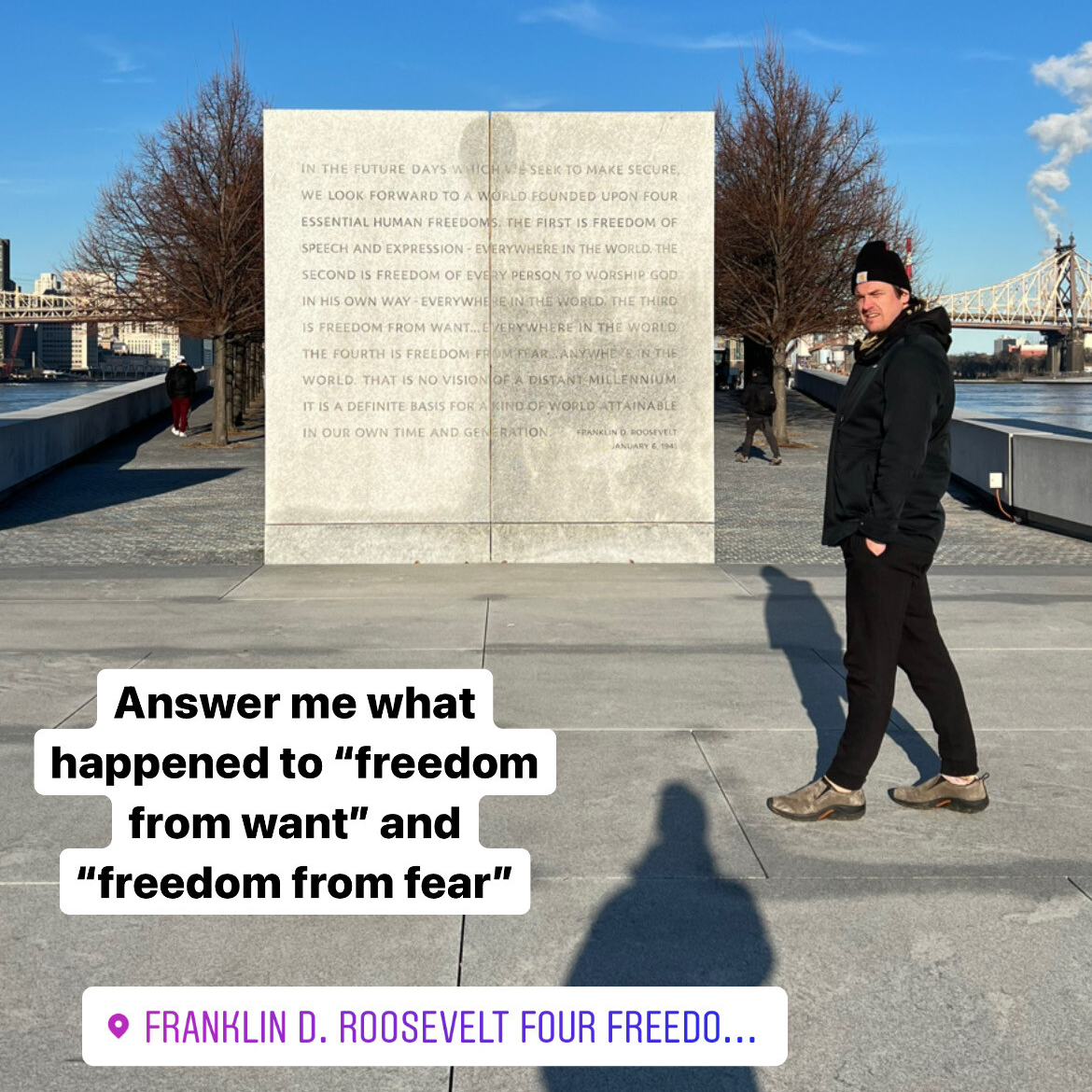
But as I found out literally there and then, after we were done with the hollow Smallpox Hospital, there is another feature of Roosevelt Island that I’ve never heard anyone talk about in terms of either content or existence, and was totally surprised to find at the very southern tip of the island on that cold January day. It’s the Franklin D. Roosevelt Four Freedoms Park. (I had lived all my life proximal to, and then in, New York, and you will simply never hear anyone say, “oh, you gotta go visit the Franklin D. Roosevelt Four Freedoms Park,” or “the Franklin D. Roosevelt Four Freedoms Park is fine, but skippable,” or even “avoid at all costs the Franklin D. Roosevelt Four Freedoms Park.”) I’d never heard of the Four Freedoms themselves, either, even though I have vague memories of taking A.P. U.S. History once upon a time. Yet there they were, those Four Freedoms, engraved in a giant stark block of stone, as if they are not only known, but never to be forgotten.
The quote goes like this:
In the future days we seek to make secure, we look forward to a world founded upon four essential human freedoms. The first is freedom of speech and expression—everywhere in the world. The second is freedom of every person to worship god in his own way—everywhere in the world. The third is freedom from want… everywhere in the world. The fourth is freedom from fear… anywhere in the world. That is no vision of a distant millennium. It is a definite basis for a kind of world attainable in our own time and generation.
The historical context here is that this quote is drawn from FDR’s State of the Union speech delivered on January 6, 1941, after everyone had been watching the surge of Nazi Germany for a few years, but almost a year before the Pearl Harbor bombing. FDR was apparently trying to drum up support for the U.S. to involve itself in helping secure the world globally according to our politics, which played not a small role in us becoming the Team America: World Police as we know ourselves today. But ignoring that unfortunate outcome for a moment, reading the Four Freedoms blissfully absent of content, it seemed to me like a striking summary of how to define a decent human existence.[^1] I’ve thought often about the Four Freedoms since. I’ve wished they did not sit, lonely in a park on a little-visited island, facing not in toward the land but out to the river. You couldn't even see them from a distance unless you were passing by on a boat.
Freedom of speech and worship are the famous American freedoms. We know about those, and we hardly ever stop talking about them. They were easy to imagine in the negative space of escaping monarchy. Freedom from want and fear, by contrast, are not inalienable rights guaranteed by the constitution. But those two additional proposed freedoms feel like they modernize the goals of a democracy, define it away from broad open-ended self-determination—which, if no one has noticed, is not working out very well—and give some structure to the positive space we could or should be swimming toward: that it is possible, practical, and even necessary to a functioning democratic society to meet everyone’s basic health and security needs, and to structure our world to sufficiently protect each other, so that no one has reason to feel threatened by anyone else.
Now, it feels like we almost live in a funhouse-mirror version of the worst future timeline that FDR could only imagine in 1941. Sometime between 1941 and now, the idea of “freedom from want” became not only no longer a priority, but antithetical to how things work around here. “Want” drives the vicious cycle of our existence. We are set up to think we are supposed to solve most of our problems by want—you have to want it even just to eat decent food; you have to want it to have physical health; you have to want it to have a good education and establish yourself beyond a sixth-grade reading level; you have to want it to have a stable career, and want it for that career to be stable enough to support a family. You have to want it to have shelter and basic dignity. We’ve baked want so deeply into the American experience that we now fully believe that wanting is supposed to be part of the “””fun,””” that literally there is no “deserve” without “want.”
By freedom from fear, FDR was obviously dropping hints about, specifically, Nazis. But it’s another good one to consider more broadly: do we even have freedom if so many aspects of our lives are daily nightmares? School shootings? A 1 in 100 lifetime chance of dying in a car crash? Rapidly increasing odds of dying in a plane crash thanks to a limping FAA? Looming Iran War draft? How long do we need to make this list?
I don’t say all this to monger fear; I live bravely through each day, myself. But it’s plain how investment in fear drives so many decisions, both at the systemic and individual level: police presence, restriction on social resources, the individual purchase of literal weapon arsenals and tanks we drive on public roads, the inability to leave our houses without a car.
On a recent podcast episode of Design Matters with historian Timothy Snyder as a guest, Snyder described this as a politics of “sadopopulism,” or essentially: [the] government doesn’t solve your problems, it blames your problems on other people,” with the only guarantee being that more suffering will be inflicted on the blamed people: As Snyder told Slate in 2018, “at [a] vulnerable moment, there are two things you can say: The good guys will say, ‘Look, this shows that we all need a little help sometimes. Let’s build up something like a social democracy.’ The bad guys are going to say, ‘Look, this shows how the Mexicans are taking your jobs, and the Muslims are killing you, and the black people hate you, etc.
“One of the truths that is rarely stated in American public discourse is that the welfare state exists to sustain a more or less politically reasonable middle class. You break the welfare state in this country in order to make the white people crazy. You don’t do it to punish the black people. That’s what you say you’re doing — and maybe you take a pleasure in doing that. But ultimately what you’re doing when you break the welfare state in this country is that you’re hurting white people. Trump and his allies can then direct that vulnerability for political ends.”
So as things are, you may be sent into lifelong crippling debt by one health problem coming to bear; you may lose your house to a natural disaster and corresponding lack of insurance; you or your children may not survive a random shooting, because no amount of additional weapons or law enforcement can prevent them, and those are the only resources we are willing to devote to that particular cause. Not only can these problems not be solved individually, or by persecuting random groups of people; they can only be solved by collective actions and decisions and policies that establishes a floor—a floor that constitutes freedom from want, and freedom from fear.
I like the “freedom from fear and want” framing because, when the self-determination framing is accepted, the question in the face of all these nightmares becomes, what are we supposed to do? Pretend this all isn’t happening? Give up and suffer? Well, no—we have to remember it is possible, feasible, even easy to construct things in a way that we don’t all feel on the run, constantly, trying to escape the various grips of literal and existential threats to our livelihood, while we are also getting cut off at the knees. The idea that it’s somehow difficult or impossible to establish a basic amount of physical and existential security is just plain fiction, and the only people who can protect us from that fiction are ourselves and each other. The threats just shouldn’t be there. Freedom to do your best to run away isn’t freedom at all; freedom from having to run away, is.
 She's A BeastCasey Johnston
 She's A BeastCasey Johnston
 She's A BeastCasey Johnston
Drag Queen Pattie Gonia calls out Secretary of Defense Pete Hegseth: “Here's me benching 130lbs with perfect form, with my dick tucked, you could never you little bitch”
by u/LunaLore_ in Fauxmoi
~Liftcord Pick of the Week: 90-year-old Ann Crile Esselstyn set a new Guinness World Record for “oldest woman to hold a dead hang,” for 2 minutes and 52 seconds.~
Pattie Gonia calls out Pete Hegseth for lifting obviously fake weights and then dumbbell-benches 130lbs, feet-up.
“Joined by her Forbidden Fruits co-stars Lola Tung, Victoria Pedretti and Alexandra Shipp, Reinhart was asked to name the “acting note that she took personally.” She did not hesitate to answer: ‘When I had a male director come up to me and silently lean over and go, ‘Just suck in your stomach a little bit.'’” This is how hourglass syndrome starts!
Thrilled to see the r/Costco subreddit catch on to the collagen protein-inflation scam, regarding “Joyburst Protein Soda.” (More on collagen here.)
More and more youth are reconnecting to the real world by replacing their smartphones with dumbphones. Here are their kits. I especially relate to several of them saying how removing their smartphones from their lives has led them to talking to more people, and it's been an overwhelmingly positive experience. (My little dumbphone project here.)
Explain It Peter
by u/eldritchfloppa in explainitpeter
I dug through Susan Orleans’ New Yorker archives this week, and found this piece on Gray’s Papaya and this piece on Thomas Kinkade. (Previously on Orlean’s immaculate-vibes surfer girl piece that became the basis for Blue Crush.)
Enjoyed the press about Snail Mail from last week. My millennials and xennials and Xers, please listen to 15 or so seconds of the opening riff of her song “Tractor Beam” here and tell me what ‘90s song it reminds you of.
An interview with Apple’s unsung third founder, Ronald G. Wayne. It all started when Steve Jobs said, “hey Wayne, let’s start a slot machine company,” basically.
That’s all for this week! I love you for reading, thank you, let’s go—
[F1] Here I’ll ask you to ignore that I never really thought about the fact that we call it Roosevelt Island, thus it makes sense for there to be some kind of “Roosevelt Park” there. Also I hope this speech doesn’t have some kind of weird reputation among or implication known to political experts. If so, I don’t know anything about that; I just liked the ideas in principle. Likewise, someone’s going to probably say “this is just about the war and is not supposed to have any wider implication or meaning”; well, then he should not have made this combination of words so germane to our current moment.




There’s a new protein bar brand that’s been circulating for a few months claiming to have the fewest calories (150) relative to its protein content (20 grams) of any protein bar you can buy. The branding (”David,” written in Apple’s “think different” font) is slick. They are promoted by extremely famous podcaster Andrew Huberman, who, according to my careful research, may be the actual Antichrist. A single bar costs $4.50 at my local sundry shop. What could go wrong?
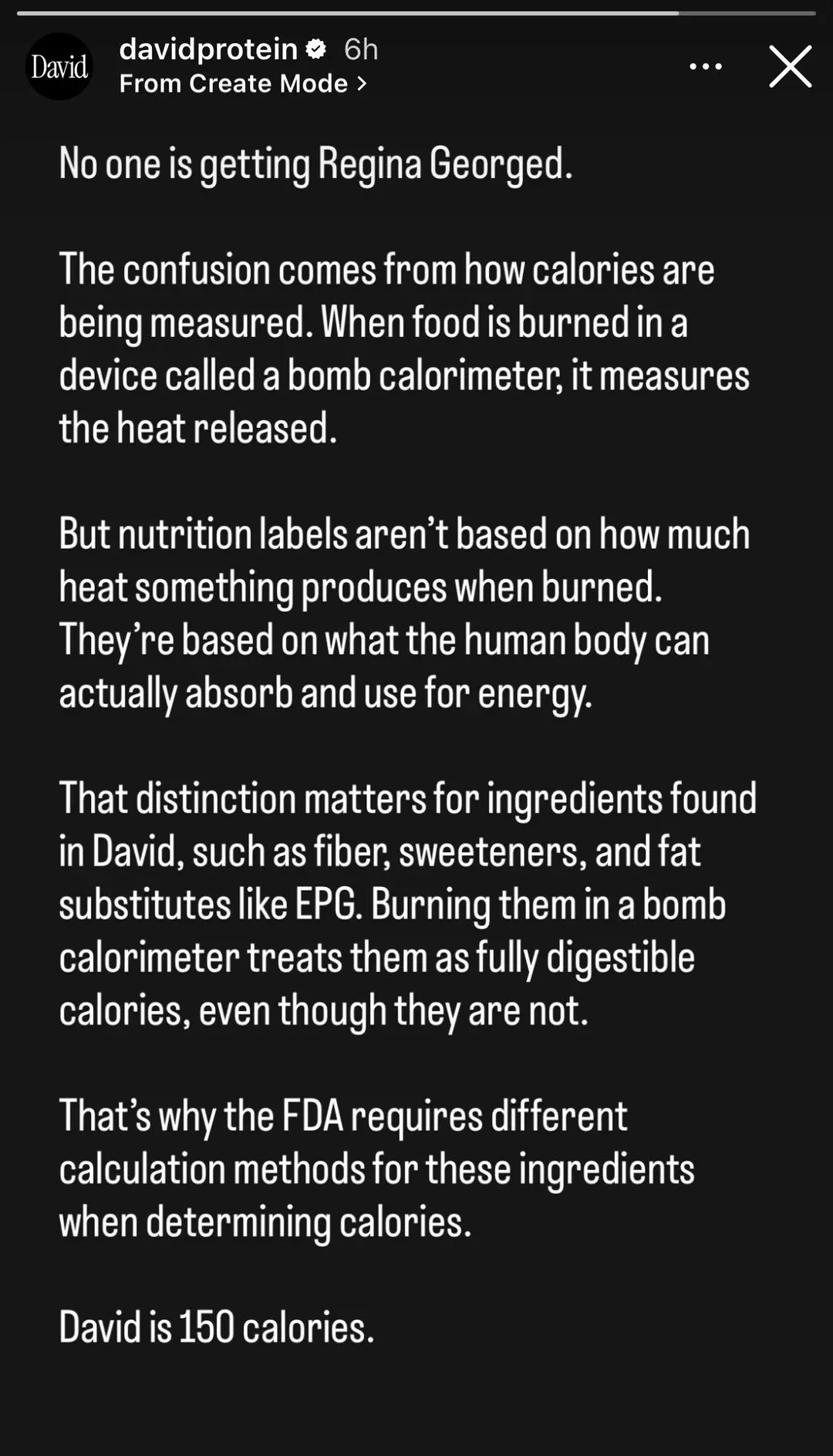
Well—a class action suit was filed against David in January, alleging that the bars actually contain between 263 and 275 calories, including an additional 10 grams of fat not reported on the nutrition label. And far be it for a supplement to lie, of course. Recently, David posted from its Instagram account claiming that the suit was simply measuring wrong by using what is called a bomb calorimeter. “David is 150 calories,” the brand confidently stated.
Who is right? Well, I am not David, or the law, or a disgruntled customer, but I have a theory.
First, we need to understand how calories are measured. Calories are a measure of energy, and we measure the energy in food using a contraption called a bomb calorimeter. A bomb calorimeter essentially burns up the food in question, literally, and then tells you how much energy was trapped inside the material burned. As you might guess, this is not a perfect analog for how bodies use food, which will come into play in a moment. But it is pretty good. The way most nutritional information is put together uses stock bomb-calorimetric figures that were created long ago, because food ingredients don’t really change—if you are using the same kind of all-purpose flour in your bread, and the same yeast, and the same stone-ground wheat, you don’t have to re-bomb-calorimeter your bread once you make it. You just take the existing figures for flour, yeast, and wheat, add them together, and boom, you have the nutritional info for your bread.
Now, the relevant fly in the ointment for a bomb calorimeter, in this case, is that it cannot distinguish between food and not-food the way our bodies can. If you put a hunk of wood in a bomb calorimeter, it will burn it up and say the wood has 1,000 calories.[^1] But if you were to eat the hunk of wood, it would just pass through your digestive system and come out the other end mostly intact, if a little wet, because our bodies can’t make energy out of wood. (If only!)
This is where things get good. Remember that the nutrition labels for the David protein bars claim a caloric content of 150 calories or so. David customers thought something fishy might be going on, so they put the David protein bars into a bomb calorimeter, and the bomb calorimeter said the bars actually had 275 calories. The customers got mad and they filed a class action suit. Can you guess what happened? I will give you a moment to contemplate the answer to this science mystery.
. . .
 The Question
I am 40 and two years postpartum, after carrying twins to term. Once I figured out how to carve a bit of time out of parenting twins life for me to work out, I spent six months doing core/pelvic floor rehab work. I had no acute, diagnosed injury, but twin pregnancy pushed me to the brink, and I wanted to proactively try to gain back some basic functionality before starting to lift or run. I felt better and was excited to move on to lifting after spending this time in the world of restorative exercise I am finishing stage two of LIFTOFF, and the other day, while doing an RDL, I felt a twang in my pelvic floor that just felt wrong. More than pain, it freaked me out. Am I bearing down when I lift and not even noticing it? Did pregnancy permanently break my body in some profound, yet low-key way? Should I even continue lifting? While the sensation remained off and on in a mild, achy way, this reaction was mostly emotional for me. I did stop lifting for a week, but then I started again. I guess my question is where to even start with lifting and also caring for my pelvic floor?
Grace
The AnswerOh my goodness, Grace—twins!! You are a hero for striding across the earth with two whole babies in your stomach. I’m glad to hear you followed that pelvic-floor-testing experience with core and pelvic floor rehab work, too.
A few months ago, I wrote a piece for Wired all about my experience of dealing with my own pelvic floor, which worked just fine all my life and through pregnancy, only to suddenly start causing me unbearable pain anytime I sat down about four months postpartum. I felt like I’d heard about every possible pelvic floor function and malfunction up until that point, and also like I’d done everything I possibly could for my own pelvic floor health, only for it to rudely rise up and try to fight me from within. (I’m enclosing the PDF of the Wired piece, at the bottom of this piece; it’s a good complement to this answer.)
Pelvic floors are still somewhat of a mystery, even to our foremost pelvic floor experts. As late as the '70s, medical professionals had surprisingly little idea of how they worked, or even that it was possible to consciously control the pelvic floor—as far as I was able to gather in reporting that piece, everyone just thought the pelvic floor was just sort of there (until a woman gave birth, at which point it became far less “there,” as best they could tell).
These days, we have a much better grasp of its role in our bodies and how it works, even as everyone draws the pelvic floor wrong in all the medical diagrams. Yes, really. I insisted on getting a correct one for this Wired piece, and now it might be the only anatomically correct diagram on Beyoncé’s internet. It doesn’t help that we can’t even really observe these body parts—the best we can do is literally have a doctor look directly at the area between your legs while they tell you to pretend you are trying to hold in a pee. But pelvic floors sit at the very center of our bodies, and are connected to all the important parts (spine, pelvis, hips). They are not just a ceremonial muscular curtain through which babies sometimes pass. They are involved in basically everything we do, everything we think, everything we feel.


File this under enjoyable math: I know that a lot of people come to lifting weights with a kind of mortal fear of ganing muscle. They don’t want to be bulky; they don’t want to gain weight; they don’t want to gain muscle. To me, this is like saying “I don’t want to pee in the ocean, because I might drown the fish.” But never mind that for now.
Readers of LIFTOFF know that even the most un-seasoned lifter, the plainest-of-chicken-breast of lifters, can gain strength steadily and predictably in their early days (for six months to a year), if they eat, if they rest. This looks like: show up to work out, squat zero pounds. Next session, squat five pounds. Next session, squat ten pounds. Then fifteen. Then twenty. And on and on.
LIFTOFF readers also know that bodies gain actual, material muscle very slowly. No one gains physical muscle faster than un-seasoned lifters, but the rate is still slow: about a pound a month, for women. That means with six months of all-out, textbook-perfect effort, a newbie lifter would gain six pounds of muscle.
Except: For very new lifters, their bodies aren’t yet primed to really build muscle tissue, per se. They are too akimbo, physically. Most of the training that looks like strength in the very early days is actually their bodies learning basic coordination: When this muscle fires, this one needs to chime in, and then that one follows.

Hi Swole Woman,
Long-time subscriber and intermediate lifter here. I started trying stronglifts 5x5 pre-COVID in a vastly under-equipped work gym thanks to your column, dropped off during COVID, and started following LIFTOFF once I had access to a slightly less underequipped gym. What drew me to lifting was that I'm fat, I had been working really hard to accept that about myself, and I appreciated that being big and eating felt like a GOOD thing.
But earlier this year I started feeling...weight loss curious. I had made it all the way to age 29 in a body perceived to be a woman's without ever counting calories and I was proud of that. And like I said, I thought I accepted my body for what it was; most of the time I even liked how I looked. But I was dealing with some minor medical issues that could be alleviated by weight loss, and sometimes the body image issues would just...hit me.
So I read Renaissance Woman, read up on the Liftcord, downloaded Macrofactor, tracked my calories for the first time ever for several weeks, and then did a cut. I expected to be miserable. I felt great. I only exceeded my calorie goals a few times and never felt the need to do an actual cheat day. My weight went down a LOT more quickly than projected. My lifts were still going up. Some of those minor medical issues immediately improved.
I ended the cut after 10 weeks and went back to maintenance, and honestly I've felt pretty awful. It's been nice to eat out or get a sweet treat without having to plan my whole day around it. But my digestive system is acting up and I've had to eat much less nutritionally-dense food to hit my calorie goals. I accidentally started cutting again because I just didn't WANT to eat like I used to anymore, then had to overcorrect. Now I'm getting to the end of my 10-week maintenance period and I'm downright eager to start cutting again.
But I don't WANT to be excited for this. I never used to be the person who tracked my calories or agonized over what would fit into my meal plan. I'm happy about the weight loss but unsure how to express that happiness to people who don't share my values--like, do I REALLY want to participate in lunchroom diet talk?
I don't know, I guess what I'm asking is - how can I tell the difference between disordered eating and just...being happy with the weight I lost on purpose?
Thanks,
Still fat and trying to be happy about it
The Answer