AI leaders keep saying UBI is necessary. This pledge asks them to prove it.
I’ve been working on universal basic income full-time since 2013. Thirteen years. In that time, I’ve watched the conversation shift from “that’s a crazy idea” to “that&
Show full content
AI leaders keep saying UBI is necessary. This pledge asks them to prove it.
I’ve been working on universal basic income full-time since 2013. Thirteen years. In that time, I’ve watched the conversation shift from “that’s a crazy idea” to “that’s inevitable.” Especially among the people building AI. And I’ve watched that shift accomplish very little.
That’s the problem I want to talk about today.
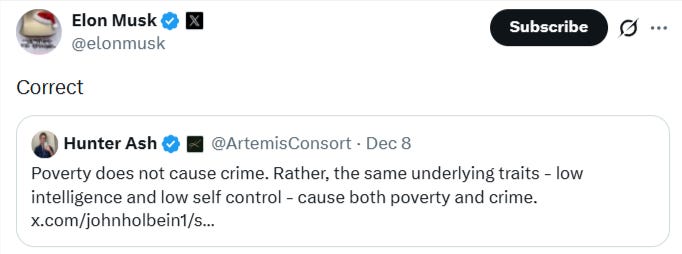
It is now routine for AI leaders to say that something like UBI will be necessary. Elon Musk recently posted that “Universal HIGH INCOME via checks issued by the Federal government is the best way to deal with unemployment caused by AI.” He’s been saying versions of this since 2016. Demis Hassabis, CEO of Google DeepMind and a Nobel laureate, told CNN we may need “universal high income” so that AI’s productivity gains are distributed across the economy. Mustafa Suleyman, now CEO of Microsoft AI, warned in 2023 that AI would create “a serious number of losers” and called UBI a measure we need to start talking about “in a serious way.”
But are they truly being serious about it? Rep. Alexandria Ocasio-Cortez recently told Semafor she is skeptical of tech billionaires’ stated support for UBI, saying the devil is in the details of their willingness to actually fund it. She’s right to be skeptical. The words are everywhere. The action is almost nowhere.
I say almost because there are a few notable exceptions. One of them is Sam Altman who put $14 million of his own money into a three-year basic income pilot — one of the largest in American history. It mattered. It was real money behind a real commitment. Jack Dorsey, through his #startsmall fund, also directed tens of millions of dollars to UBI pilots and research between 2020 and 2023 — including major support for Mayors for a Guaranteed Income, the OpenResearch pilot, and Humanity Forward. Together, Altman and Dorsey are the rare exceptions. But they also highlight how alone they are in having done it.
Meanwhile, the man on track to become the world’s first trillionaire spent his truly massive amount of resources dismantling government programs through DOGE.
The way Elon Musk talks about UBI is personal for me. Years ago, a friend of mine named Gerald Huff worked at Tesla as a principal software engineer who helped develop the Model 3. Gerald could see where automation was heading. He started speaking publicly about the need for UBI. Elon eventually called him into his office and told him to stop talking about UBI or he’d be fired. So Gerald stopped accepting speaking invitations — and started directing them to me instead. That’s how I ended up giving many of the talks that helped build my career in this work. Gerald died of pancreatic cancer in 2018 at the age of 54, before he could see UBI gain the traction it has today. His mother Gisele founded the Gerald Huff Fund for Humanity in his name to carry on his UBI mission. I’ve served on its board since its inception.
What Elon did to Gerald is documented in Gisele’s memoir, Force of Nature. So when I watch Elon Musk post about “universal high income” to an audience of millions — while having personally silenced one of the people inside his own company who tried to advocate for it — I know what the gap between words and actions looks like. If Musk has quietly funded UBI efforts, I’d welcome the correction. I know of others who quietly have, so he wouldn’t be the only one, but color me skeptical.
The pattern is always the same: predict mass disruption, then treat preparing for it as someone else’s problem. And here’s what makes it worse: their casual UBI predictions give everyone else permission to not take AI seriously. When the people creating the disruption treat UBI as a prediction, or even just marketing, rather than an urgent priority, the rest of the world reasonably concludes that the disruption must not be that bad. If the architects of AI aren’t panicking, why should anyone else?
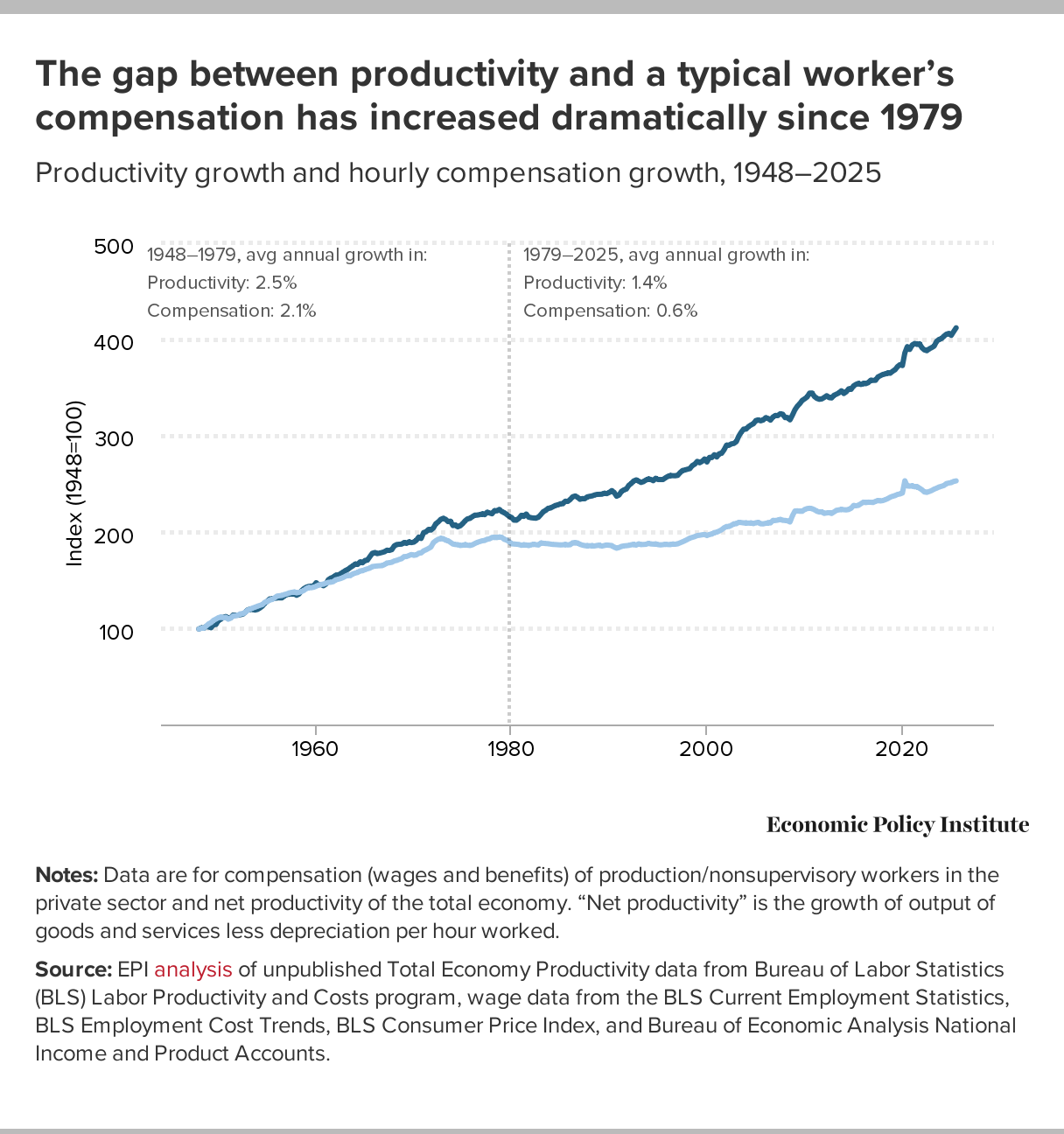
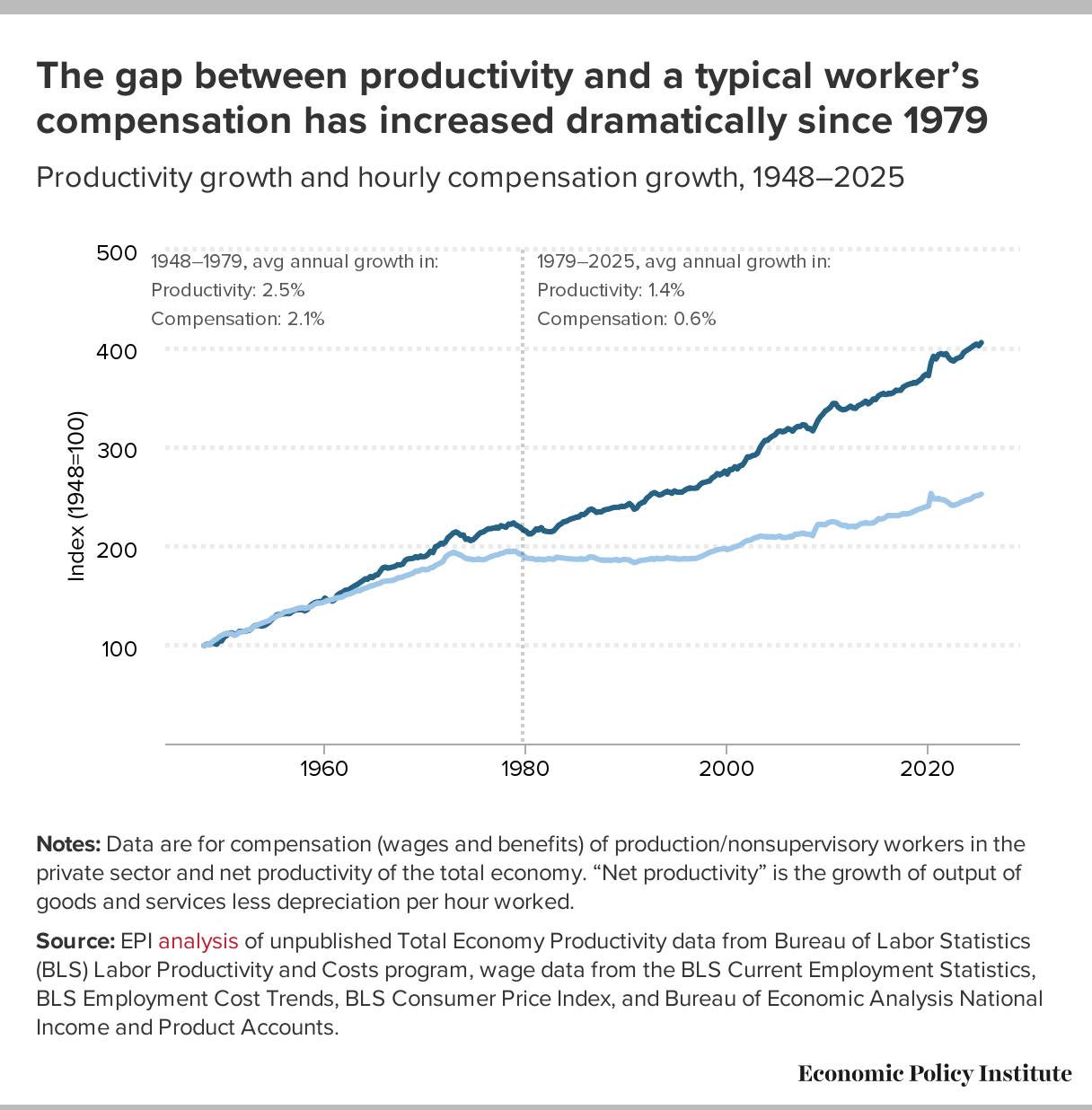
But it is that bad. For fifty years, productivity has soared and wages haven’t. AI is about to accelerate that pattern — driving down wages long before it replaces workers entirely. The disruption is not some distant hypothetical. It’s here. It’s happening in paychecks right now, quietly, before the headlines catch up. It’s happening in the lack of hiring entry level workers. It’s happening in the unusually high unemployment and underemployment rates for recent college graduates. It’s happening through early retirements. More will happen. It will get worse.
Well, I got tired of waiting for the people who should be leading on this to actually lead. So I built something.
The AI Pledge for Humanity
Today, I launched the AI Pledge for Humanity — an open letter and public commitment to turn AI’s wealth into a shared dividend for everyone.
The pledge has two tiers, and both matter.
The first tier is for people with resources to commit. Founding signatories go public with their commitment to invest a percentage of their income or wealth into UBI pilots, unconditional cash programs, and the advocacy work needed to make a shared AI dividend real. Their names, affiliations, and the organizations they support are listed publicly on the pledge page. This isn’t a vague promise. It’s a public, named, specific commitment — and it’s designed to be exactly the kind of thing that the people who keep talking about UBI should be doing but aren’t.
The second tier is for everyone else. If you aren’t in a position to commit resources but believe AI’s gains should be shared, you sign the petition in solidarity. Your signature joins the call and pushes those profiting from AI to step up. You become part of the pressure.
I think of these two tiers as complementary forces. The founding signatories are the proof that serious people are willing to put their money where their mouth is. The petition signers are the weight behind the demand that others do the same.
Why This, Why Now
I’ve written hundreds of thousands of words about UBI. I’ve spoken at conferences around the world. I’ve advised political campaigns. And I believe that at this particular moment, the single most important thing the UBI movement needs is not another study, not another pilot, and not another article. It’s accountability. It’s action.
The conversation about AI and UBI has become too comfortable. People say the right things and do nothing. The AI Pledge for Humanity is designed to make that gap visible. It creates a public record of who is actually backing UBI with resources and who is just talking. And it gives everyone else a tool — a link they can share every time some tech leader mentions UBI without doing anything about it. A way to say: if you believe it, sign it. If you won’t sign it, we know what your belief is worth.
I believe this matters because UBI is not just an economic policy. An unconditional income floor does not just distribute money. It distributes freedom. It’s the power to say no — to bad wages, to unsafe conditions, to abusive situations. It’s the power to negotiate the terms of your own labor and the policies that govern your life. No other policy does this. A higher minimum wage doesn’t. A four-day workweek doesn’t. Unemployment insurance doesn’t, nor does it even reach more than about 30% of the unemployed, let alone everyone doing essential work who are underpaid or entirely unpaid. UBI reaches everyone, because everyone is the point.
One more thing worth saying plainly. The signatories of this pledge are committing private resources, but private resources alone won't fund UBI at sufficient scale. That requires public investment, which requires that those who benefit most from AI contribute the most to making sure its gains are shared. Wealth taxes. Corporate taxes. Whatever mechanism gets us there. The wealthy people who are actually serious about UBI will recognize that personal giving and supportive policy go together — that you can't credibly say you want a shared AI dividend while lobbying against the means to fund one. History tells us what happens to societies when wealth concentrates at the top and stays there. We should not need to relearn that lesson.
What I’m Asking You to Do
Three things, in order of commitment:
Sign the petition. It takes thirty seconds. Your name adds pressure. It tells every tech CEO, every AI investor, every founder who mentions UBI that the public is watching and expects them to act. Sign here.
Share it. Post it. Email it. Text it. And when you see someone powerful talk about UBI without backing it up, reply with this pledge and ask them: will you sign it?
Become a founding signatory. If you have resources to commit — whether that’s 1% of your wealth or 5% of your income or anything you choose — add your name to the public list of people who are putting their money behind their belief in the need for UBI. You can include a link to the UBI organization or project you support, helping others discover where to direct their own resources. Fill out the form here.
We already have founding signatories including Andrew Yang, Dustin Moskovitz, and other founders and co-founders, CEOs, engineers, AI managers, researchers, and advocates from multiple countries. The list is growing. I want your name on it too.
What we lack is not evidence. What we lack is action.
The AI Pledge for Humanity draws a line. On one side are those willing to do something. On the other side are those content to predict a future they have no intention of building. I know which side I’m on.
We all made AI possible. We all deserve a share of what it makes possible.
If you agree with that statement, sign the pledge. And then send it to someone who needs to sign it more than you do.
Why Angine de Poitrine's viral microtonal math rock KEXP session, Ireland's permanent basic income for artists, and Albert Einstein are three sides of the same human triangle
Two guys in papier-mâché masks from Saguenay, Quebec, have been playing music together for 20 years
Show full content
Why Angine de Poitrine's viral microtonal math rock KEXP session, Ireland's permanent basic income for artists, and Albert Einstein are three sides of the same human triangle
Two guys in papier-mâché masks from Saguenay, Quebec, have been playing music together for 20 years since they were 13 years old. For most of that time, they existed in relative obscurity. Then, KEXP posted a video of them playing four songs and the internet lost its mind. As of this week, that video has over ten million views and their song Fabienk is No. 1 on Spotify’s Viral 50 – Global chart. Dave Grohl of Nirvana and Foo Fighters fame has said they “absolutely blew his f*cking mind”. The band is Angine de Poitrine, and if you haven’t watched the full set yet, stop reading this, go watch it, and then come back. I’ll wait. Or just listen to it while you read this essay.
Okay. Now let me tell you why I think this band is one of the best arguments for universal basic income I’ve come across in a long time, and why Ireland and Albert Einstein are part of the same story.
I first want to make three points, like a triangle, because triangles are very on-brand for this article. Stick with me.
The first point is about Einstein. Albert Einstein did not become Albert Einstein in a university lab. He became Albert Einstein while working as a patent clerk in Bern, Switzerland. The job paid the bills and left him enough hours in the day to think. That was key. That was the magic formula. Genius, plus a floor under him, plus time. With those three ingredients, one man starting in his twenties rewrote physics. Special relativity. The photoelectric effect. Brownian motion. The equivalence of mass and energy. All four in a single year, 1905, while he was a patent clerk. General relativity then came a decade later. We are still living inside the consequences of what that one man thought about with his basic needs met more than a hundred years ago. GPS satellites have to correct for his equations or your phone would send you to the wrong address. The energy released by splitting an atom is accounted for by his equations. Our entire picture of space and time is his.
Now try to put a dollar figure on that. Go ahead. I'll wait again. You can't. The value one Einstein delivered to humanity is incalculably large. It dwarfs any UBI program you could ever design. And here is the Einstein Argument for UBI in one sentence: if universal basic income enables even one more Einstein to become Einstein over the course of the next century, it will have paid for itself a thousand times over.
The thing is, Einstein changed how we think about space and time because he had space and time: he had intelligence, education, a floor under him, and time to think. That's not a miracle. That's a policy choice we refuse to make. How many Einsteins never became Einsteins, because they had genius, but lacked space and time?
The second point is about artists. In 2022, Ireland did something extraordinary. The government randomly selected 2,000 artists out of more than 8,200 eligible applicants and gave them €325 a week, unconditionally, for three years. No strings. No testing beyond being an artist. Just money, every week, so they could make art. Another 1,000 artists served as a control group.
The final results came in last year, and the Irish government read them and made the program permanent. The independent evaluation by Alma Economics found that the pilot cost €72 million and generated €80 million in benefits. Artists in the program earned on average €500 more per month in arts-related income, earned about €280 less from non-arts jobs, and drew roughly €100 less per month from social services. The money let them do more of the stuff they were good at and less of the stuff that was just paying the bills. The evaluators estimated that if scaled up permanently, the program could produce a 22% increase in artistic output. Ireland’s Minister for Culture, Patrick O’Donovan, called the scheme “the envy of the world.” He’s not wrong because other countries are already discussing doing the same.
And Ireland isn’t alone. In New York State, Creatives Rebuild New York gave 2,400 artists $1,000 a month for 18 months. The impact study found exactly what you should expect: less debt, better mental health, more time spent on art, no drop in other income, and a bunch of artists who started landing grants, residencies, and paid work in their fields because they finally had the space to pursue them. Stephen Roll, one of the lead researchers, put it well when he asked:
“What art could we produce as a society if our artists could invest more time and money in their craft? Perhaps more importantly, consider how many great artists never get to emerge because an artistic career often carries such high risks of financial hardship and insecurity.”
The pattern from Ireland and New York matches the pattern from every saturation basic income pilot we’ve ever run, going all the way back to Dauphin, Manitoba in the 1970s. When you give everyone in a community a floor of income, entrepreneurship skyrockets. New businesses get started. People take risks they wouldn’t have otherwise taken. This isn’t surprising. Starting a business is terrifying when the downside is losing your house. It’s a lot less terrifying when the downside is falling back on a basic income.
Ireland did not do this because it was a nice thing to do for artists. Ireland did it because art is an enormous economic and cultural engine, and the current system is incredibly wasteful of the people who run that engine. The Irish government calculated a monetary value for art and discovered what should have been obvious: investing in art pays more than it costs. We can apply that same math to everything a basic income unlocks.
The third point is Angine de Poitrine.
Here is what they are. They’re a two-person microtonalmath rock band from Quebec. The guitarist calls himself Khn. The drummer calls himself Klek. They wear black and white polka-dotted costumes and papier-mâché masks with long noses and describe themselves as space-time voyagers. They do not speak to audiences in any real language, just in a made-up one. Between songs they form triangles with their hands and the crowd forms triangles back. They are weird in the absolute best way. They are marvelously, unapologetically, beautifully different.
Quick aside on what “math rock” actually means; math rock is rock music that uses unusual time signatures, odd rhythms, and the kind of structural complexity that makes your foot tap on the wrong beat. Where a normal pop song is in 4/4 — four beats per bar, over and over, like a heart — math rock might be in 7/8 or 11/8 or switch between them every few bars.
And on top of the math, they play microtonal music.
A quick primer for anyone who doesn't know what that means either: Western music uses twelve notes per octave. You can find all of them on a piano — seven white keys and five black. The distance between any two adjacent keys is a half step. Microtonal music uses the notes between those notes. A quarter tone sits exactly halfway between two adjacent piano keys — a pitch that, on a standard instrument, doesn't exist. Most rock and pop you've ever heard lives on whole steps and half steps. AdP lives on the steps in between. As one YouTube commenter wrote, "The elites don't want you to know this, but you can just make your own notes."
To play this music, Khn plays a custom double-necked hybrid instrument — half guitar, half bass — with twice the frets to play the microtonal notes. Klek originally built the first version himself with an actual saw. The current one was made by a professional friend. Khn plays it while looping parts in real time, with both hands, while also working a full pedalboard with his feet. I want to pause on that for a second. I can’t pick a sock up off the floor with my feet. My toes are purely decorative. This guy is using his feet as a third instrument while his hands are playing four times the notes as a normal guitarist, all while peering through his mask’s eye-holes covered by gold dollar signs.
I can’t explain why I love this band as much as I do. There’s just something happening in my brain when I listen to them that I don’t have words for. It’s like the music itself is playing me as an instrument. It’s like I never heard music before this. You know those videos of a hearing-impaired kid getting a cochlear implant and hearing their parent’s voice for the first time? That’s what it feels like when I hear AdP. It makes me very, very happy. And I want more of it. I want more art like this. Maybe that’s selfish. I don’t care. I want more artists to be able to push boundaries, to explore new ideas, to get really good at whatever brings them joy.
Because here’s the thing. Khn and Klek have been playing together for 20 years since they were 13. That’s two decades of two teenagers becoming two masters. Two decades of getting incredibly good at something that, until just months ago, almost certainly was not a significant source of income prior to going viral, and likely functioned as a passion-driven project rather than a primary livelihood. Two decades of pursuing what Khn himself has described as a series of inside jokes about rock music in general that turned, somewhere along the way, into one of the most creatively original things happening in music right now.
How many people, looking at a teenager in small-town Quebec in 2008 sawing extra frets into a guitar would have said “that kid is a genius”? I’m going to guess: none of them.
Angine de Poitrine is what happens when two people get to spend decades getting really good at something weird. They did it without UBI. Maybe they had parents who helped. Maybe they had day jobs. Maybe they had government supports I don’t know about. However they got there, they got there. But here is the point I keep coming back to: without UBI, people like this are exceedingly rare. Einsteins are rare. Khns and Kleks are rare. With UBI, they will be less rare. That is not a hope. That is a statistical near-certainty.
Which brings me to a finding I think about a lot.
A big thanks to my monthly patrons who contribute to making my articles possible and free for all. If you find value in my writing and would like to support it, please join my Patreon or become a paid subscriber on my Substack.
Talent is Everywhere. Opportunity is Not.
A few years ago, an Italian research team ran a simulation of how talent and luck interact over a 40-year working life. Scientific American covered it beautifully. What they found was that pure talent was not the best predictor of success; luck was. The most successful people in the simulation were not the most talented — they were moderately talented people who got lucky at the right moments. Which sounds demoralizing, until the researchers did the interesting part. They asked: okay, given that luck is doing so much of the work, what’s the best way to fund people so that talent actually has a chance to break through?
They tried a bunch of strategies. Giving extra funding to people who were already successful did almost nothing. It concentrated more resources in people who didn’t necessarily have the most talent, just the most luck. Mixing “reward the successful” with equal distribution did a little better. Pure random distribution did better than that. And the winner, by a wide margin, was the strategy of giving everyone an equal amount. In their simulation, distributing a small equal sum to every person every five years led to 60% of the most talented people achieving above-average success. Bumping the equal sum up a little led to 100% of the most talented people having an impact.
Let me say that again. When the researchers gave everyone the same amount of money, 100% of the most talented people in the simulation had an impact. When they gave the money only to the “deserving,” most talent went nowhere.
This is UBI. This is exactly UBI. The paper is essentially a mathematical proof that a world with universal basic income is more meritocratic than a world without one, because luck-based distribution — which is what we have now — throws away most of the talent in the room. A UBI world isn’t a world that rewards laziness. It’s a world where the Einsteins and the Khns and the Kleks and the creatives you’ve never heard of yet actually get a shot at mastery that their talent deserves, instead of getting filtered out at age 19 because they couldn’t afford rent.
The dole worked as a floor. Not a universal one. Not an unconditional one. It came with strings. It was means-tested or contribution-based, which meant earning money reduced it, sometimes sharply. It came with conditions. Forms. Appointments. Proof that you were looking for work. And if you failed those conditions, there were sanctions. Payments cut or stopped. It also came with stigma. You had to declare yourself “unemployed” and submit to a system designed to monitor and correct you. Despite all that, it still did something important. It gave people just enough stability, in some cases, to create.
UBI keeps the only part that mattered—the floor—and removes the rest. No means tests. No earnings penalty. No proving you deserve it. It just shows up, whether you’re earning or not, and leaves you alone to decide what to do with your time.
This is What “Truly Human” Feels Like
Here is the question I want you to sit with. What is it about Angine de Poitrine that has made grown adults in the comments section write things like “30 seconds in: ‘this is fucking stupid’ 18 minutes in: ‘this is the greatest musical performance of the century” and “It’s the first time I’ve felt like a teenager listening to music since I was one”? Why this band? Why now?
I think part of it is that this is happening at the exact moment AI-generated art is flooding the internet. Every day there is more “AI slop.” We are surrounded by the remixing of what already existed into something smoother, less surprising, more average. And into that ocean of generated averageness, two genius maniacs from Quebec walk in wearing polka-dot costumes and start playing notes that don’t exist on a piano, using a custom double guitar with twice the frets each, moving their feet like hands, and the comments section lights up with one phrase repeated over and over: this is truly human.
Because it is. Whatever “truly human” means, this is it. Exploration. Creativity. Joy. Fun. The willingness to try something that might fail and look ridiculous. The willingness to saw extra frets into a perfectly good guitar because you had an idea and you had to play around. The willingness to spend twenty years on something that may never “pay off” in the financial or fame sense. AI can remix the old into new arrangements. And yes, humans remix everything too — every artist is influenced by other artists, every idea builds on older ideas. But there is something qualitatively different about what Einstein did, and what AdP is doing, and what every once-in-a-generation artist or scientist does when they show us something we’ve never seen before. It is the opposite of averaging. It is a leap into new territory. It is what humans do when they are free enough to follow the weird thing.
No matter how good AI gets, I promise you there will always remain a deep, stubborn love for what humans like Khn and Klek make, because part of what we love about AdP is knowing that a real person spent years of their actual life getting good enough to play that. The joy on the other end of the screen is real because the joy on the stage is real.
Genius from Scenius
Brian Eno — the producer, composer, and philosopher of ambient music, the guy who shaped records by Bowie, Talking Heads, U2, and roughly half of the sounds you associate with the last fifty years — has a word for what I’m circling around, and it’s better than any word I’ve come up with. The word is scenius. It’s his coinage. It means the collective form of genius that emerges from a scene. The idea is that individual geniuses don’t pop out of a vacuum. Einstein didn’t happen in a box. Einstein happened inside a culture of physicists arguing with each other in the early twentieth century, reading each other’s papers, correcting each other’s math, building on each other’s ideas. The “genius” is the visible tip of an enormous submerged iceberg of other people doing related work. Scenius is the iceberg.
Eno’s argument is that the “need to earn a living” is actively hindering us from reaching our collective potential. If we want more geniuses, we need more scenius, and if we want more scenius, we need more people who are free to participate in the scene without having to focus every hour of their life around survival. He has said, in so many words, that UBI is the closest thing he has ever seen proposed to the future he actually wants — a future where the sheer cooperative potential of billions of differently-shaped human minds finally gets to express itself.
I think he’s right, and I think AdP is proof. Because Khn and Klek aren’t alone. They grew up inside a scene. They were absorbing Indian, Japanese, Arabic, Indonesian, and Turkish music as teenagers. They were listening to King Crimson and Zappa and Gentle Giant. Saguenay had a music scene. Quebec had a festival circuit. Someone at Trans Musicales in Rennes booked them. Someone at KEXP in Seattle chose to record them. Someone at the Montreal Jazz Festival let them play. And now, there are guitarists on YouTube and bass players on Instagram and composers in tiny apartments in cities you’ve never heard of watching the KEXP session for the 100th time and reaching for plastic zip ties to play quarter tones. AdP has already joined the scenius. They are now part of the raw material other people are going to make their own weird new things out of.
The dole era in Britain was scenius too. The Clash did not happen alone. The Specials did not happen alone. UB40 did not happen alone. Those bands were in pubs and rehearsal rooms and record shops, rubbing up against each other, ripping each other off, fighting, collaborating, improving, and the dole was what paid the rent on all of that. Take away the floor and the whole scene collapses. Britain learned that the hard way. It is, as Eno puts it, what happens when you make everyone spend all their time earning a living instead of contributing to the shared well.
We are all born different. Every human is a unique instrument with its own weird little tuning. UBI is the thing that lets us actually find out what we sound like together — lets the microtones between us ring out instead of getting tuned away. Scenius is the sound of a whole society finally in tune with its own diversity. We have never heard that sound. I would very much like to.
People ask all the time: what will people do with UBI? Won’t they just get lazy? Will they lose their sense of purpose and meaning? Will they stare at the wall?
No. Of course not. They will figure out cool new stuff. They will impress the hell out of the rest of us with how creative they can be when they aren’t forced to spend eight hours a day filling out forms for no real purpose, in what the late anthropologist David Graeber (who also supported UBI by the way) rightly called bullshit jobs. Humans are the most creative species we know of in the universe, and most of that creativity is being wasted right now on make-work and survival. Free it up, and watch what happens. Some people will make bad art. Some people will make good art. Some people will make a microtonal double-guitar and paint themselves with polka dots. Most people will just live better, which is also fine.
The Point of Bread is to Eat It
In his 1932 essay “In Praise of Idleness,” Bertrand Russell pointed out that the whole economy is built on the assumption that production is noble and consumption is frivolous. You make the bread, you are virtuous. You eat the bread, you are wasting time. Russell thought this was absurd, and he was right. The point of bread is not to fuel you to make more bread. The point of bread is to be eaten and enjoyed. To take a few minutes of your day to sit down and think, “damn, that’s some good bread.” Maybe alone. Maybe with someone you love. Maybe with enough time to invent a new sandwich and hand it to a stranger who then wonders if bread was always this ambitious.
Work is important. Nobody is saying work is not important. But the fruits of work are the whole point of work. If you spend your whole life too busy cooking to ever eat, something has gone very wrong.
As I wrote in the Monsters, Inc. Argument for UBI, we are currently running an economy on fear, when joy turns out to be ten times more powerful. A world where more people get to do the science and the art they actually want to do — instead of whatever happens to pay the bills — is a radically better world than the one we live in now. Angine de Poitrine and Einstein are what we get when people are free to do what they truly want. The current world is what we get when most of them can’t.
One more thing before I wrap, because I have not seen anyone else point this out and I can’t stop thinking about it. Look closely at the polka dots on their costumes and their stage backdrops. The dots aren’t arranged horizontally and vertically. They’re rotated 45 degrees. Take that pattern and rotate it back 45 degrees — the dots sit in perfect squares. Rotate another 90 degrees — still squares. The world most of us see. But rotate it that extra quarter turn, the quarter turn they live at, and suddenly the same dots aren’t sitting in squares anymore. They’re sitting in bisected squares — aka triangles. And diamonds. And, if you let your eyes relax a little, cubes. A whole different geometry pops out of the exact same dots.
I think Khn and Klek did a quarter turn to the world. Where the rest of us saw nothing but squares, they saw triangles and diamonds and a hidden dimension that was there the whole time. And now, because we get to watch them, we get to see what they see. We get to borrow their quarter turn. It is, quite literally, glorious.
So let me tie this triangle together.
What Humans Become When They’re Free
Einstein became Einstein, partly because he had a patent clerk’s salary and the time to think. With UBI, more Einsteins will have a version of that combination, and even one more Einstein — just one — pays for every dollar UBI ever cost, and gifts humanity centuries of progress. Science is essential. But it is only half of the picture.
The other half is art. Who are the artist Einsteins? Or maybe I have the question backwards, and the real question is: which artist was Einstein most like? Einstein himself said imagination was more important than knowledge, and he played the violin his whole life, and he thought in pictures. He loved math and he loved music. He said that if he had not been a physicist, he probably would have been a musician.
Math and music have always been the same language spoken two different ways. So maybe the better question isn’t which artist Einstein was like. Maybe the better question is: which mathematician is Angine de Poitrine most like? We need both art and science, and we need more people free to get really good at whichever one brings them joy — especially those who, like Einstein and like AdP, refuse to believe the two are really different things.
Ireland ran the experiment on artists and got a positive return on investment within three years. New York ran the experiment and got a bunch of artists the time and space to finally breathe and create. Every saturation basic income pilot in history has shown that giving everyone a floor leads to more entrepreneurship, more creativity, more risk-taking, more health, more community. The results are in. The studies are done. The math has been checked.
And into this moment of proof walks AdP, fresh off a KEXP session with over 10 million views, looking like a Dada painting, playing the notes between notes, showing us something new under the sun. Two guys from Quebec who spent twenty years perfecting their craft before it ever popped off. This is what human beings do when they have the time and space to do it. Einstein and Angine de Poitrine are not exceptions to the rule. They are the rule of what humans can be when they are free. The exceptions are how few of them we currently get.
With UBI, we will get more. More Einsteins. More Khns and more Kleks. More bread worth eating. More sandwiches we haven’t invented yet. More art that makes you feel like you’re hearing music for the first time, like a bunch of neurons in your brain just woke up and asked where this has been your whole life.
If you already support UBI, keep supporting it. If you don’t yet, I hope this article moved you a quarter-note closer. And whatever you do, please go watch the full AdP session on KEXP. Make a triangle with your hands and waves with your arms while you watch. You’ll know when.
That’s the Angine de Poitrine argument for UBI. I hope it helped connect some dots.
If reading this was worth your time, it’s worth sharing. Share it, subscribe for free, and if you can, make a monthly pledge to keep this work going.
Thank you to my UBI Producer level patrons: Gisele Huff, Steven Grimm, Bob Weishaar, Judith Bliss, Lowell Aronoff, Jessica Chew, Katie Moussouris, Tricia Garrett, A.W.R., Daryl Smith, Larry Cohen, John Steinberger, Philip Rosedale, Liya Brook, Frederick Weber, Dylan Hirsch-Shell, Tom Cooper, Joanna Zarach, Mgmguy, Albert Wenger, Jeremy Wertheimer, Andrew Yang, Kimi Avary, Peter T Knight, Michael Finney, David Ihnen, Janos Abel, Miki Phagan, Draper Kauffman, Walter Schaerer, Elizabeth Corker, Albert Daniel Brockman, Joe Ballou, Arjun Banker, Christine Celli, Felix Ling, Jocelyn Hockings, Mark Donovan, Jason Clark, Chuck Cordes, Mark Broadgate, Leslie Kausch, centuryfalcon64, Deanna McHugh, John Sullivan, Stephen Castro-Starkey, CodyS, chris heinz, Zachary Weaver, bradzone, Tim, Warren J Polk, Jeffrey Emmett, Nicolas Pouillard, Eric Skiff, Thomas Welsh, Linda Hearne, David Allen, Liz, and all my other monthly patrons for their support.
Looking for a UBI-focused nonprofit to support? Donate to the Income To Support All (ITSA) Foundation to support UBI projects focused on research, storytelling, and direct implementation to realize economic freedom for all.
My proposal for a fully refundable $4,500 tax credit that reaches everyone—and leaves the bottom 90% better off
There is a new trend in Democratic politics, and it is one of the most frustrating things I’ve watched in years.
Senator Cory Booker wants to more
Show full content
My proposal for a fully refundable $4,500 tax credit that reaches everyone—and leaves the bottom 90% better off
There is a new trend in Democratic politics, and it is one of the most frustrating things I’ve watched in years.
Senator Cory Booker wants to more than double the standard deduction to $75,000 for married couples. Senator Chris Van Hollen wants to exempt the first $46,000 in income from federal taxes. Katie Porter, running for governor of California, wants to exempt the first $100,000 from state income taxes. This is what passes for Democratic economic policy in 2026: a bidding war over who can shield the most income from taxation.
I get the political instinct. Republicans passed their “One Big Beautiful Bill” full of tax giveaways, and Democrats want to show they can cut taxes too. But this is the same strategic error Kamala Harris made in 2024 when she tried to out-tough Republicans on immigration instead of making the affirmative case for what immigrants contribute to this country. When you play on your opponent’s field, you lose, even when you win.
Taxes are not the enemy. Taxes serve vital functions. The question should never be whether to tax, but what to tax and how to make sure the prosperity we create together actually reaches the people who create it. On that question, Democrats are reaching for the wrong tool.
The right tool is not a bigger deduction. It’s a fully refundable tax credit.
Deductions Help the Rich More Than the Poor. That’s How They Work.
A tax deduction reduces your taxable income. That sounds equal if everyone gets the same deduction, but it’s not. The value of a deduction depends entirely on your tax bracket, which means it’s worth more to those who already have more.
Consider the current standard deduction of $16,100 for a single filer. A worker earning $30,000 is in the 12% bracket. That deduction saves them $1,932. A worker earning $200,000 has income reaching into the 24% and 32% brackets. That same deduction saves them over $4,000. The identical provision in the tax code delivers twice as much benefit to the person who needs it less.
Now consider someone earning $12,000 a year — a part-time worker, a caregiver piecing together hours. The standard deduction zeroes out their small tax bill, but that’s all it can do. It cannot put a single dollar in their pocket. A deduction can only reduce what you owe. It can never give you cash.
This is the fatal flaw in every plan built around expanding the standard deduction. Booker’s plan to raise it to $75,000 for married couples would deliver about $10,000 in annual tax savings to a couple earning $300,000, according to the calculator on his own website. A family earning $20,000? Nothing. The poorest 20% of households would see zero benefit from Van Hollen’s plan because their federal tax liability is already zero.
You cannot fight poverty with a tool that is invisible to poor people, and you cannot reduce inequality with a tool that helps the rich more than the working class.
A big thanks to my monthly patrons who contribute to making my articles possible and free for all. If you find value in my writing and would like to support it, please join my Patreon or become a paid subscriber on my Substack.
A Tax Credit Does What a Deduction Cannot
A tax credit reduces your tax bill dollar-for-dollar. If the credit is $4,500 and you owe $5,000 in taxes, you now owe just $500. Everyone gets the same amount of reduction, regardless of their bracket. Simple. Fair. Equality before the law.
But the real power unlocks when the credit is fully refundable. A fully refundable credit means that if you owe $1,000 in taxes and the credit is $4,500, you don’t just zero out your tax bill — you receive $3,500 as a cash payment. The credit reaches below the tax line into the population that deductions can’t touch: the people in poverty.
We know this works because we already proved it.
In 2021, the American Rescue Plan expanded the Child Tax Credit to up to $3,600 per child and made it fully refundable — meaning families previously excluded because they earned too little could receive the full amount. According to Census data, the expansion contributed to a more than 40% reduction in child poverty, driving the rate to a historic low. The CTC lifted 3 million children out of poverty. Full refundability was the main driver, bringing 19 million more children into eligibility.
When Congress let the expansion expire, child poverty more than doubled.
The Standard Tax Credit: What Democrats Should Actually Propose
Here is what I believe Democrats should do. Replace the standard deduction with a fully refundable Standard Tax Credit — the STC — of $375 per month for every adult and every child, or $4,500 per year per person. Design it the same way the 2021 expanded CTC was designed: anyone can choose to receive the credit as an advance monthly payment, or claim it as a lump sum at tax time.
Like the current standard deduction, the STC is an alternative to itemizing. Filers choose one or the other — not both. Households with high mortgage interest, charitable giving, or state and local taxes can still itemize if that produces a better result for them (although these could also be converted to credits). Everyone else takes the STC, which for the vast majority of Americans will be the far better deal.
This single reform replaces and consolidates the standard deduction, CTC, EITC, WIC, and TANF — converting multiple cash programs into one. No applications. No caseworkers. No benefit cliffs that punish you for taking a raise. Because the credit goes to every adult and every child, a married couple with two children receives $1,500 per month, or $18,000 per year — more than or equal to the combined value of the programs the STC replaces for virtually all households, with a hold-harmless provision ensuring no family receives less than they do today.
Keep the current tax brackets in place for everyone earning under $250k — today’s 10%, 12%, 22%, 24%, and 32% rates. Then raise the existing 35% bracket (currently starting at $250,525 for singles and $501,050 for married couples) to 37%, raise the existing 37% bracket (currently starting at $640,600 and $768,700) to 40%, and add one new bracket on top: 50% on income above $1 million ($2 million for couples). Tax capital gains and dividends the same as ordinary income under these brackets — no more preferential rates that let billionaires pay a lower effective rate than their secretaries. The STC replaces the standard deduction as the primary mechanism for reducing taxes on the overwhelming majority of Americans, and the new top brackets raise taxes at the top to help balance it out.
The credit is what makes the system progressive at the bottom. Because it's a flat amount, $4,500 represents a much larger share of income for a low earner than a high one — and because it's fully refundable, it reaches the people deductions can’t. The brackets handle fairness at the top. The credit handles it at the bottom and middle.
Who Pays More. Who Pays Less.
Under this system, the bottom 90% of Americans are taxed less than they are now. A single filer earning $12,000 goes from owing nothing (and getting nothing) to receiving a net refund of about $3,300. At $30,000, they save $2,568. At $50,000, they save $2,416. At $100,000, they save $958. At $150,000, they save $636. At $200,000, they save $420.
For married couples with two credits, the savings are even larger. A couple earning $40,000 saves $5,457. At $100,000, they save $4,831. At $200,000, they save $1,916. At $400,000, they still save $840. Add children — each receiving their own $375 per month — and the savings grow further.
The crossover — the income at which the new system taxes someone more than the current one — lands at around $206k for single filers and $412k for married couples, roughly the top 5% to 10% of each group. A single filer at $300k pays about $2,124 more per year. A single filer at $500k pays about $6,124 more. A couple at $700k pays about $6,249 more. These amounts represent modest fractions of incomes that will increasingly be the product of AI-augmented productivity — income flowing disproportionately to those capturing the gains from technologies we all helped train.
Then the new top brackets kick in. A single filer at $900,000 pays about $17,000 more once the 37→40 rate change takes effect. At $1.5 million, $85,000 more once the 50% bracket takes over. At $5 million, over $540,000 more. Taxing capital gains as ordinary income ensures that the wealthiest — whose income is disproportionately derived from investments rather than wages — contribute their fair share. Add a wealth tax of 1% above $50 million, 2% above $1 billion, and 3% above $10 billion, and the wealthiest finally begin paying their fair share in taxes.
The bottom 90% see their tax burden go down. The next 9% see small increases — typically less than 1% of their income. The top 1% sees substantial increases. The top 0.1% sees the largest increases. This is progressive taxation that reduces the economic inequality of this Second Gilded Age.
How to Pay for It
The cost of a $375/month standard credit replacing the standard deduction is approximately $1 trillion a year. Here are the other tax offsets:
The new top brackets — raising the existing 35% rate to 37%, the existing 37% rate to 40%, and adding a new 50% bracket above $1 million ($2 million for couples) — approximately $135 billion.
Taxing capital gains and dividends as ordinary income raises a conservatively estimated $150 billion to an optimistic $220 billion.
The wealth tax adds another $240 billion or more.
Total revenue: approximately $745 billion to $815 billion. That leaves a gross annual deficit of roughly $245B to $315B. But that shortfall does not account for what happens when you give money to people who spend it.
A Credit Grows the Economy. The Deficit Pays for Itself.
When low- and middle-income households have cash, they spend it. The USDA estimates that every dollar of SNAP generates $1.50 to $1.80 in GDP. Canada’s Child Benefit generates $2 per $1 while recovering over 55 cents per dollar in taxes from the resulting economic boost. A larger standard deduction disproportionately benefits higher earners who save the windfall. A refundable credit puts money in the hands of immediate spenders. That spending is revenue for businesses. That revenue creates jobs. The economy grows from the bottom up.
Calnitsky and Gonalons-Pons analyzed the Dauphin Mincome experiment and found significant reductions in both total crime and violent crime when residents received guaranteed basic income. Scaled conservatively for the smaller poverty-reduction effect of a $375/month credit relative to Dauphin’s near-elimination of poverty, the total societal benefit of the resulting crime reduction is approximately $300 to $500 billion per year — roughly $75 billion of which translates into direct federal budget savings through reduced criminal justice spending, lower Medicaid costs from violent-crime injuries, and recovered tax revenue from people who were not victimized. Evelyn Forget’s analysis of the same experiment documented an 8.5% reduction in hospitalization rates from fewer accidents, injuries, and mental health admissions. Applied to the roughly $620 billion Medicaid and Medicare spend on hospital care, that’s another $53 billion saved. GDP multiplier effects generate approximately $200 billion in additional tax revenue.
Those three offsets total $328 billion — more than the estimated deficit. The plan therefore runs a net annual surplus of roughly $13 to $83 billion in its first year. And those are just first-year, federally-relevant effects. Research led by Irwin Garfinkel at Columbia University estimates that the children’s portion of the credit alone would generate trillions in present-value annual societal returns through higher future earnings, better health, and reduced long-term government spending — a potential 15-to-1 return on investment per child. This is not a costly proposal. It is a plan that pays for itself, even before counting the massive generational benefits to children and the country they will inherit.
This Is Universal Basic Income. Call It What It Is.
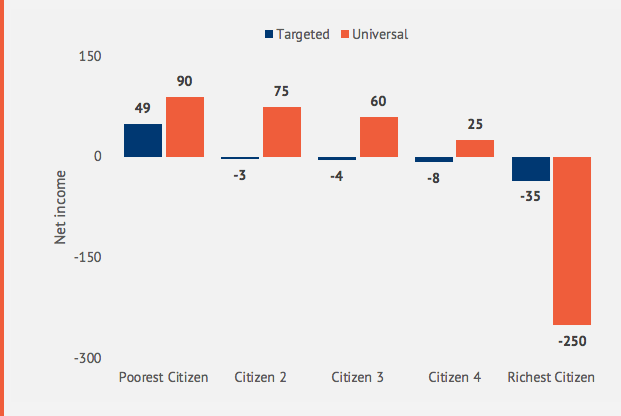
What I’m describing is a small universal basic income delivered through the tax code. A fully refundable tax credit paid to every person, monthly, with no conditions — that is UBI. The political scientist Philippe Van Parijs explained years ago why universality is essential even when it seems counterintuitive to include the rich. Giving money to everyone, even the rich, is not better for the rich but better for the poor. The high earners pay for their own credit and more. Universality makes it much harder for the poor to be excluded or fall through the cracks. Those just below income cutoffs are no longer trapped by the threat of losing means-tested benefits if they find a job. And a universal transfer does not stigmatize the poor the way a targeted one does.
Van Parijs also offered a critical insight: sometimes the best way to achieve a basic income is to present it as a refundable tax credit — simply reducing taxation for everyone, with a cash transfer to those whose tax liability is less than the credit. That is exactly what this proposal does. It is UBI, implemented through the mechanism Americans already understand and accept.
“But Won’t People Stop Working?” No.
The most common objection to UBI is that it will discourage work. The evidence says otherwise — and at $375 per month, the question barely makes sense. $375 is not enough to live on. It is not enough to pay rent in any major American city. It is enough to pay for food, take the edge off, cover a car repair, keep the lights on during a bad month. It is a foundation, not a net full of holes. It’s a floor, not a ceiling.
Unconditional income experiments of $500 to $1,000 per month have not shown people leaving the workforce in any worrisome way. Plenty have shown increases. Alaska, which has paid every resident an annual dividend since 1982, saw increased employment. Their similar size UBI — which could be $3,800 this year — has had no negative impact on full-time work and a 17% increase in part-time work, as cash recipients generated more demand that local businesses had to hire more workers to meet.
But the most relevant evidence is what happened here in 2021. About 40 million American families received monthly Child Tax Credit payments of $250 to $300 per child — approximately the scale of a $375 Standard Tax Credit, through the same delivery mechanism, to the population that would benefit most under this proposal. Parents kept working. Employment among parents actually went up slightly. And economists who studied the impact found no measurable inflationary effect from the CTC payments — the inflation that did occur was driven by global supply chains and oil shocks, not by families receiving cash. The Standard Tax Credit has, in essence, already had a massive trial experiment. It worked.
A Foundation, Not a Ceiling
For those on the other side — those who think $375 per month is too low — I agree. It is. $375 is a starting point, not an end point. The Standard Tax Credit is the foundational layer of a UBI that can grow as additional tax mechanisms are added on top. Each layer is a separate income stream feeding the same monthly delivery mechanism. Some illustrative possibilities:
A 10% value-added tax could raise roughly $1.6 trillion per year. Split 2:1 between adults and children — recognizing adults consume more — that adds about $487/mo per adult and $243/mo per child.
A 1% land value tax would likely equate to about $200B–$400B annually, with ~$300B as a midpoint estimate based on current rough land value ranges. With the same 2:1 split, that adds about $100/mo per adult and $50/mo per child. I recommend raising this to 5% over the course of 5-10 years, which would raise the amounts to $500/mo per adult and $250/mo per kid and grow as land value grows.
A 1.5% stock dilution tax requiring the roughly 35,000 corporations valued over $100 million to issue 1.5% new stock each year into a national wealth fund — sold gradually over the following year through normal trading — could generate around $1.33 trillion. Distributed as a productivity dividend, that adds about $400/mo per adult and $200/mo per child that would grow as the stock market grows.
A $100-per-ton carbon tax on the roughly 5 billion tons of US emissions could raise about $500 billion, adding another $125/mo per person.
A tax on intellectual property rents — applying to royalties, licensing income, and excess profits from patents and copyrights — could raise roughly $200 billion per year, adding about $60/mo per adult and $30/mo per child.
Stack all of those layers on top of the $375 Standard Tax Credit, and the total reaches around $2,000/mo per adult and over $1,200/mo per child — a full-on basic income floor well above the $1,350/mo 2026 federal poverty line. The child amount would cover about 90% of the median cost of raising a child to an adult. Each layer stands on its own merits: the VAT taxes consumption instead of income in the AI Age, the LVT taxes land and increases the housing supply, the stock issuance tax shares national productivity gains that haven’t been shared since the mid-1970s, the carbon tax reduces pollution and incentivizes clean energy, and the IP tax captures economic rent and expands the public domain. The details of each are for other articles and there can be any number of more layers. The point is that the Standard Tax Credit is the base layer that reduces the income taxes of the bottom 90% of Americans. Everything else can build on top of it.
Closing the Deal
“$375 a month for every American” is a clearer, more compelling, more memorable message than “We’ll raise the standard deduction to $75,000.” One is concrete. The other is accounting jargon. One reaches every single person. The other reaches only those with enough income to benefit — and gives more to those who already have more. Democrats don’t need to become the party of not taxing. They need to become the party that leaves more money in 9 out of 10 people’s pockets after taxing. That is not a tax deduction. That is a dividend on being American.
Stop bidding up the standard deduction. Start fighting for the Standard Tax Credit.
If reading this was worth your time, it’s worth sharing. Share it, subscribe for free, and if you can, make a monthly pledge to keep this work going.
Thank you to my UBI Producer level patrons: Gisele Huff, Steven Grimm, Bob Weishaar, Judith Bliss, Lowell Aronoff, Jessica Chew, Katie Moussouris, Tricia Garrett, A.W.R., Daryl Smith, Larry Cohen, John Steinberger, Philip Rosedale, Liya Brook, Frederick Weber, Dylan Hirsch-Shell, Tom Cooper, Joanna Zarach, Mgmguy, Albert Wenger, Jeremy Wertheimer, Andrew Yang, Kimi Avary, Peter T Knight, Michael Finney, David Ihnen, Janos Abel, Miki Phagan, Draper Kauffman, Walter Schaerer, Elizabeth Corker, Albert Daniel Brockman, Joe Ballou, Arjun Banker, Christine Celli, Felix Ling, Jocelyn Hockings, Mark Donovan, Jason Clark, Chuck Cordes, Mark Broadgate, Leslie Kausch, centuryfalcon64, Deanna McHugh, John Sullivan, Stephen Castro-Starkey, CodyS, chris heinz, Zachary Weaver, bradzone, Tim, Warren J Polk, Jeffrey Emmett, Nicolas Pouillard, Eric Skiff, Thomas Welsh, Linda Hearne, David Allen, Liz, and all my other monthly patrons for their support.
What Artemis II and the Return to the Moon Should Remind Us About Ending Poverty
As I write this, four astronauts are hurtling toward the Moon aboard the Orion spacecraft, named Integrity by its crew. On April 1, 2026, NASA’s Artemis II launched from Kennedy Space Center —
Show full content
What Artemis II and the Return to the Moon Should Remind Us About Ending Poverty
As I write this, four astronauts are hurtling toward the Moon aboard the Orion spacecraft, named Integrity by its crew. On April 1, 2026, NASA’s Artemis II launched from Kennedy Space Center — the first crewed mission beyond low Earth orbit in more than fifty years. For the first time since Apollo 17 returned to Earth in December 1972, human beings are returning to the Moon.
Watching that launch, I felt something I haven’t felt in years. I grew up on Star Trek and The Right Stuff. I grew up believing I might one day work on the Moon, or fly a spaceship, or at the very least live in a world that took its cues from the Federation rather than centibillionaires. That feeling where your chest tightens and your eyes sting because you’re watching your species do something extraordinary — that’s what programs like Apollo and Artemis II give me. And it’s that same feeling that drives my work on universal basic income.
The connection between these two things is not merely a metaphor. It is historical.
In August 1969, three days before announcing his Family Assistance Plan — a guaranteed income floor for American families with children — Richard Nixon asked himself why he was doing it. He had doubts. There was no airtight evidence it would work. There was no overwhelming political mandate. There was only the momentum of a decision-making process that had reached the point where it would actually be proposed. He’d already decided. But why?
As Daniel Patrick Moynihan recounted in The Politics of a Guaranteed Income, Nixon’s reasoning came down to three propositions. First, the existing welfare system was destroying the poor, especially the Black poor, and this was becoming the most serious social problem of the time. Second, it was time to bring the South back into the mainstream of American life, and what fundamentally kept the South apart was poverty. Third, it was necessary to prove that government could work — that there was an answer to what Nixon called the “crisis of confidence in the capacity of government to do its job.”
And then Moynihan recorded the crucial line: “The moonshot had been one kind of success; a guaranteed income would be another, at least as important, surely more difficult. America needed some successes.”
Nixon understood something we seem to have forgotten. The Moon landing wasn’t just a technical achievement. It was proof that a democratic government could marshal collective resources, set an audacious goal, and deliver. It restored faith in what we could accomplish together. A guaranteed income, Nixon believed, would do the same — but for the ground beneath our feet rather than the sky above our heads.
He was right. And over half a century later, we still haven’t done it.
A big thanks to my monthly patrons who contribute to making my articles possible and free for all. If you find value in my writing and would like to support it, please join my Patreon.
We Choose to Do These Things
When John F. Kennedy stood at Rice University in September 1962, he did not promise that going to the Moon would be simple. He promised the opposite. “We choose to go to the Moon in this decade and do the other things,” he said, “not because they are easy, but because they are hard, because that goal will serve to organize and measure the best of our energies and skills.”
I look at universal basic income the same way. Ending poverty will not be easy. Restructuring an economy where the top 1% owns nearly a third of all wealth — a record high, per the Federal Reserve — while the bottom half of Americans shares just 2.5% will not be easy. Building the political will to guarantee every person an income floor that prevents them from ever falling into destitution — in a country where we’ve been conditioned to believe that poverty is a moral failing rather than a systemic design choice — will not be easy.
But we can do it. We have the technology. We have the resources. We have the knowledge. We have the economic capacity. We have the wealth. The United States is the richest country in the history of the world. What we lack is the political decision to distribute that wealth in a way that reflects our stated values. We could return to the level of inequality we had in the 1970s and the rich would still be rich. But the poor would no longer be in poverty as we presently define it, and the middle class would have the stability it once had.
An economy where 10% of the population consumes 50% of all goods and services is not a strong economy. It is a distorted one. It is an economy oriented around serving the preferences of a small fraction of the population, rather than meeting the needs of all of us. This is destabilizing. It corrodes social trust, weakens democratic participation, and creates the conditions for authoritarianism. It is the economic structure of a society in decline, not one reaching for the stars.
There's a joke that floats around the internet where someone sits down with Karl Marx and explains what the world is like today. They ask him for his analysis. Marx's response is not about capitalism or class struggle. It's: "Holy shit, you went to the Moon?" They try to redirect but Marx won't let it go: "The Moon in the sky?" It's funny because it captures something real. If you could explain our world to anyone from the 19th century — the technology, the productive capacity, the sheer wealth — the most baffling part would not be what we've achieved. It would be what we've chosen not to do with what we've achieved. We went to the Moon. We mapped the human genome. We carry supercomputers in our pockets. And yet tens of millions of Americans live in poverty. That's not a resource problem. It's a decision problem.
The Parable of Two Wolves
There’s a Cherokee parable I love about an elder teaching a child. Inside every person, the elder explains, two wolves are fighting. One is fear, anger, despair. The other is hope, courage, love. The child asks which wolf wins. The elder answers, “The one you feed.”
I think about this constantly. Not just as individuals, but as a civilization — which wolf are we feeding? And why are we doing that?
When we launch astronauts to the Moon, we feed the hopeful wolf. When we invest in science and exploration, when we set goals that seem impossible and then achieve them, we feed the hopeful wolf. When we tell stories about futures worth building — futures without poverty, without hunger, without the quiet desperation of wondering whether you can make rent — we feed the hopeful wolf.
Universal basic income feeds the hopeful wolf too. It says, “We believe everyone deserves to stand on solid ground.” It says, “We have the resources to end poverty, and we choose to end it.” It says, “The purpose of an economy is to serve those who comprise it, not the other way around.”
And I believe these things feed each other. When we envision a future without poverty, a future where every person has the freedom to pursue work that matters most to them, it becomes easier to imagine a future where we explore the galaxy. And when we do hard things like put human beings on the Moon and send them on to Mars, it becomes easier to believe we can do the hard domestic work of guaranteeing economic security for every citizen.
Gene Roddenberry — the man who created Star Trek and, in doing so, gave millions of people like me a vision of what humanity could become — understood this. He built a fictional universe premised on the idea that humanity would outgrow poverty, war, and greed, and that our species would dedicate itself to exploration and betterment. As he put it: “Star Trek speaks to some basic human needs: that there is a tomorrow — it’s not all going to be over with a big flash and a bomb; that the human race is improving; that we have things to be proud of as humans.”
That vision mattered. It still matters. It matters because the stories we tell about the future shape the future we build. And right now, we are not telling enough stories like Star Trek. Too much of our science fiction, and too much of our politics, is dystopian. It feeds the fearful wolf. We get The Hunger Games. We get collapse narratives. We get fiction that assumes the worst about human nature and then builds worlds to match. We feed the fearful, angry, despairing wolf.
I want the Star Trek future, not the Hunger Games future. And I believe UBI is one of the key policies that gets us there.
What Exclusion Costs
There is a reason Nixon identified the failure of welfare as one of his three motivations. The traditional welfare system doesn’t just fail to solve poverty — it actively undermines the relationship between citizens and their government, and Nixon knew that because he experienced it himself as a kid.
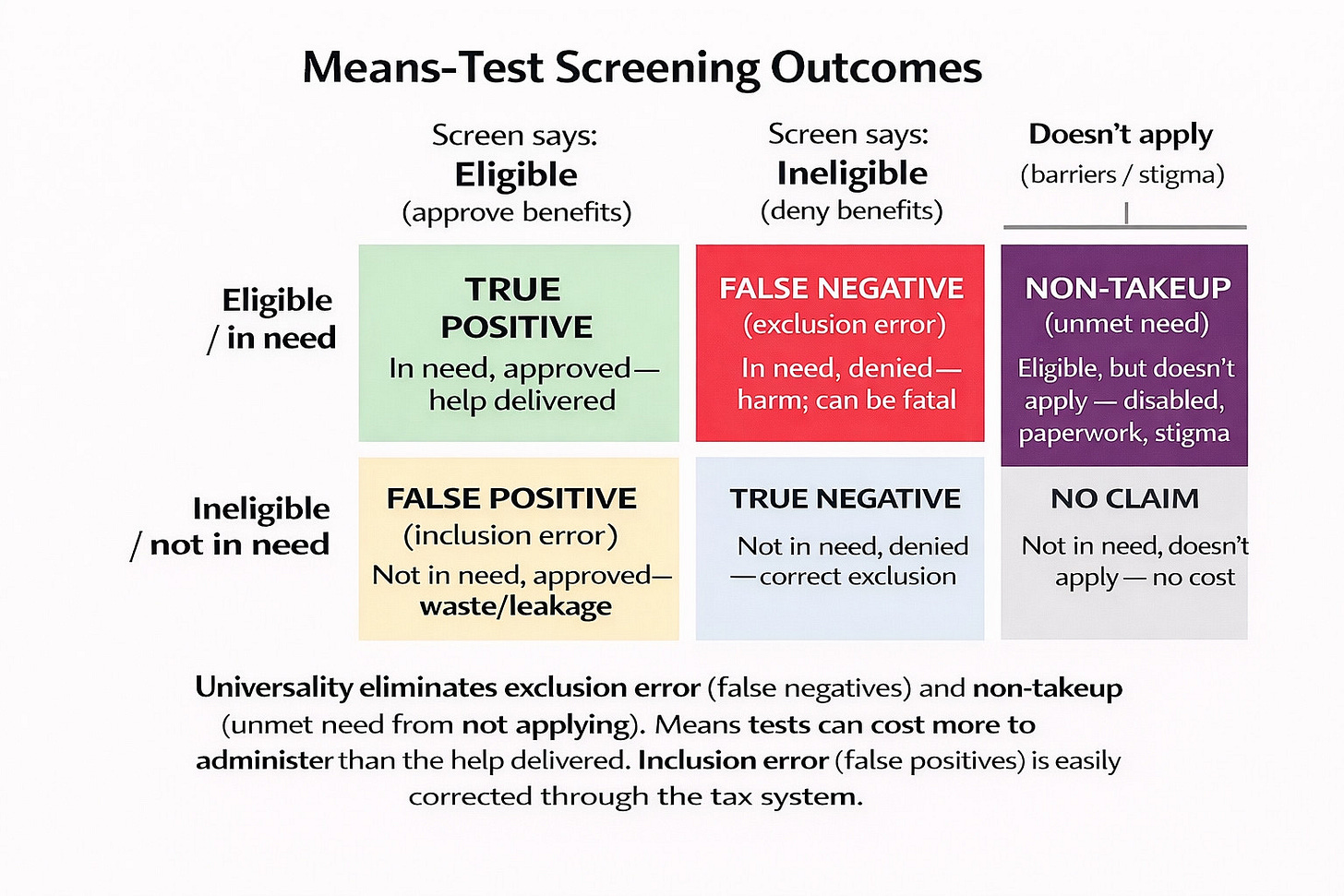
Think about what means-tested welfare actually requires. You must prove you are poor enough. You must fill out forms, attach supporting documents, submit to interviews, and open your life to bureaucratic scrutiny. You must do this repeatedly. And after all of that, you may be told you don’t qualify, even when you are barely surviving. And if you do get it, you can lose it if you work to increase your income, leaving you potentially worse off. The experience is dehumanizing by design.
Research by Katrina Kosec and Cecilia Hyunjung Mo confirms what this does to how people view their government. Studying Pakistan’s national cash transfer program, they found that when someone in need barely qualifies for assistance, their trust in government increases modestly. But when someone in need barely doesn’t qualify — when they are denied help despite being just as desperate — their trust in government collapses by a far greater magnitude. The negative effect of exclusion dwarfs the positive effect of inclusion. It is enormously more damaging to deny someone help they need than it is beneficial to give someone help they need.
This is the trap of targeted welfare. Every time you draw a line and say “you qualify but you don’t,” you create a person on the wrong side of that line who now has a rational reason to distrust and resent their government. Multiply that by millions of people across hundreds of programs with different eligibility criteria, different renewal periods, different documentation requirements, and you get what we have now — a population that broadly believes government doesn’t work. Not because government can’t work, but because for most people who interact with it at its most critical point of contact, it doesn’t.
Universality solves this. When everyone gets the same floor — the same unconditional income that both prevents poverty and enables participation — no one is excluded. The same goes for universal healthcare. No one is told they’re not poor enough or not deserving enough. No one is forced to prove their suffering to a bureaucrat. The floor is there for everyone, just as the Moon is there for everyone to look up at and dream.
The System of Pulleys
Thomas Paine, that great pamphleteer of the American founding, saw this clearly over two centuries ago. In Agrarian Justice, he argued that every person is owed a share of the common inheritance — the natural resources and accumulated knowledge of civilization — and that government’s role is to ensure that share is paid. He envisioned government not as a punitive institution that sorts the worthy from the unworthy, but as what he called a system of pulleys — a mechanism for lifting everyone, in a way that private charity never can and never will.
Universal basic income is that system of pulleys. It treats every person as having equal rights. It looks at every citizen as a shareholder in the economy they collectively comprise. We are all equal before the law when we all receive the same floor — a floor that both prevents us from falling into poverty and enables us to stand upright and and build on a strong foundation.
This is what our founding documents promise, even if we have never fully delivered. All people are created equal. Life, liberty, and the pursuit of happiness. Government of the people, by the people, for the people. These are not just slogans. They are engineering specifications for a society that we have never finished building.
The Moonshot We Still Haven’t Taken
Artemis II is a reminder. It’s a reminder that we can do extraordinary things when we decide to do them. It’s a reminder that the same country that put human beings on the Moon in 1969 — with less computing power than exists in a modern thermostat — can solve the problem of poverty if it chooses to. We went to the Moon not because it was easy but because it was hard. We should end poverty for the same reason.
Nixon was right to connect these two ambitions. The moonshot proved that government could do something magnificent. A universal basic income would prove that government could do something essential — that it could work not just in the extraordinary and spectacular sense of spaceflight, but in the ordinary, daily, foundational sense of making sure no one in the richest country on Earth ever goes without food, shelter, or dignity.
We are the country that first landed on the Moon. We should also be the country that first abolishes poverty. These are not competing goals. They are the same goal — the goal of a civilization that believes in itself enough to do what is hard and what is right.
The astronauts aboard Integrity are about to travel farther from Earth than any human being has ever gone, breaking the distance record set by Apollo 13. Back here on the ground, tens of millions of Americans are struggling to pay rent, buy groceries, or keep the lights on — not because the wealth doesn’t exist, but because we haven’t decided to share it.
We need to decide. Roddenberry imagined a future where there would be no hunger, no greed, and all the children would grow up to pursue what they most wanted to pursue. That future doesn’t build itself. It gets built by people who choose to feed the hopeful wolf — who insist, against all the cynicism and all the despair, that tomorrow can be better than today.
Going back to the Moon is one way to feed our good wolf. A universal basic income for every American is another. And I believe, as Nixon did in 1969, that doing both is how we prove — to ourselves and to the world — that self-governance works. That democracy can deliver. That a government of the people can actually be for the people.
The moonshot we took in 1969 changed how humanity saw itself. The moonshot we still haven’t taken — the one that ends poverty — would change how we live.
It’s time to take it.
If reading this was worth your time, it’s worth sharing. Share it, subscribe for free, and if you can, make a monthly pledge to keep this work going.
Thank you to my UBI Producer level patrons: Gisele Huff, Steven Grimm, Bob Weishaar, Judith Bliss, Lowell Aronoff, Jessica Chew, Katie Moussouris, Tricia Garrett, A.W.R., Daryl Smith, Larry Cohen, John Steinberger, Philip Rosedale, Liya Brook, Frederick Weber, Dylan Hirsch-Shell, Tom Cooper, Joanna Zarach, Mgmguy, Albert Wenger, Jeremy Wertheimer, Andrew Yang, Kimi Avary, Peter T Knight, Michael Finney, David Ihnen, Janos Abel, Miki Phagan, Draper Kauffman, Walter Schaerer, Elizabeth Corker, Albert Daniel Brockman, Joe Ballou, Arjun Banker, Christine Celli, Felix Ling, Jocelyn Hockings, Mark Donovan, Jason Clark, Chuck Cordes, Mark Broadgate, Leslie Kausch, centuryfalcon64, Deanna McHugh, John Sullivan, Stephen Castro-Starkey, CodyS, chris heinz, Zachary Weaver, bradzone, Tim, Warren J Polk, Jeffrey Emmett, Nicolas Pouillard, Eric Skiff, Thomas Welsh, Linda Hearne, David Allen, Liz, and all my other monthly patrons for their support.
Why Universal Basic Income (UBI) Is the Only Way to Share AI and Productivity Gains With Everyone
There was a time in America when productivity growth and wage growth moved together. From the end of World War II until the mid-1970s, as productivity rose, pay rose with it. Workers produced
Show full content
Why Universal Basic Income (UBI) Is the Only Way to Share AI and Productivity Gains With Everyone
There was a time in America when productivity growth and wage growth moved together. From the end of World War II until the mid-1970s, as productivity rose, pay rose with it. Workers produced more and earned more. That was not charity. It was the natural result of an economy that shared its gains with those who generated them.
That relationship is dead. It has been dead for half a century.
According to the Economic Policy Institute, since 1979, productivity has annually grown over twice the rate on average as typical worker pay. Before the late 1970s, these lines were practically the same line. Then policy choices — the erosion of the minimum wage, the dismantling of unions, tax cuts for the rich, deregulation — broke the link between what the economy produced and what most people received. The income generated by rising productivity did not vanish. It went into the salaries of top executives, into corporate profits, and into returns to shareholders.
A February 2025 study by the RAND Corporation put a number on it. Carter Price estimated the gap between what the bottom 90 percent of American workers earned in 2023 and what they would have earned had income growth remained as evenly distributed as it was in 1975. The annual gap in 2023 alone was $3.9 trillion. The cumulative total since 1975 was $79 trillion. Seventy-nine trillion dollars flowed upward, away from the vast majority of Americans, over five decades, because we allowed it to happen through deliberate policy choices.
Some will suggest raising the minimum wage would fix this. It wouldn’t. A higher minimum wage helps the lowest-paid workers but does nothing for the millions above it who have still seen their share of productivity growth erode. Some will point to unions. Restoring union power would help, and we should do it, but even at peak union strength, not every worker was unionized, and unions cannot reach into every home where unpaid care work — raising children, caring for aging parents — produces enormous value invisible to the labor market. No minimum wage increase or collective bargaining agreement will ever put a paycheck in the hand of a parent staying home with a child. Neither would a tax cut.
Universal healthcare? We should have it. Decoupling survival from employment is critical. But universal healthcare distributes healthcare, not the gains of productivity. Shorter work weeks? Worth doing as AI makes it possible to produce more in fewer hours. But shorter work weeks distribute hours of employment, not the wealth generated by the economy. A negative income tax? The net outcome can look like UBI on a spreadsheet, but an NIT phases out as income rises which is the same as taxing the incomes of only those in the phaseout range. It does not provide the same amount to everyone. It does not say to every person: you are a shareholder.
Only universal basic income does that. Only UBI distributes the same amount to every person, unconditionally, as a foundational floor beneath everyone’s feet.
Every article I publish here is free for everyone because of my supporters on Patreon. If you value this work, subscribe to this blog and join them.
Everyone Deserves a Share Because Everyone Built This
Here is the strongest and most fundamental case for universality, and it goes beyond wages and productivity charts.
As the political economist Gar Alperovitz argued in his essay on technological inheritance in 2016, the overwhelming source of modern economic output is not the labor any individual performs today. It is the accumulated knowledge and technology inherited from every generation before us. MIT economist Robert Solow demonstrated that nearly 90 percent of productivity growth in the first half of the 20th century was attributable to “technical change” — a catch-all term encompassing technological innovation, accumulated scientific knowledge, improvements in education, better organizational methods, and any other factor that made a given amount of labor and capital produce more output than before. US per capita output grew roughly sevenfold over the 20th century. None of us individually earned that sevenfold increase. We inherited it.
This inheritance argument applies with full force to AI. Large language models were trained on text that billions of people wrote. Audio and video models were trained on audio and video that billions of people created. We all generated that training data. But it is impossible to determine who contributed what, whose data is being used most in any given output, or whose data is qualitatively more valuable. The complexity is irreducible. What we can recognize is that everyone contributed, and therefore everyone should benefit.
This is not an abstract philosophical claim. When someone puts up capital to fund a corporation, they often receive a dividend when that corporation matures and generates profits. Our collective human output — our language, our knowledge, our creative work — is the capital that built AI. We are the shareholders. UBI is our dividend.
We Paid for This With Public Dollars Too
The case for a universal dividend is further strengthened by the fact that the foundational technologies behind AI were funded by public dollars. Federal investment through DARPA has been the dominant source of AI research funding since the 1960s. The internet emerged from ARPANET. The NSF funded the research behind Google’s PageRank algorithm. DARPA’s Grand Challenges launched the self-driving car industry. Federal agencies have poured billions into the computing infrastructure, neural network research, and reinforcement learning that made modern AI possible.
We all funded the research that created AI. The appropriate return on that investment is not being told to go find another job. A return on investment is a dividend. We invested. We deserve our cut. And we all deserve to benefit even if we keep our jobs, because productivity will continue to grow, and the benefits of everything that got us here should not only go to one percent of people.
Job Guarantees and Targeted Benefits Are Not Alternatives
Do not offer us a new job as our dividend. A job guarantee is not an alternative to UBI. If someone loses their job to AI and a job guarantee helps them find another, that is useful for that person. But it does nothing for the person whose wages have been suppressed for decades. It does nothing for the parent at home. It does nothing for the retired person or the person with a disability. It benefits only those who take the guaranteed job. Everyone should directly benefit from productivity growth, not just those whose employment situation happens to qualify them.
The same applies to benefits targeted only at those who lose their jobs. Unemployment insurance is a net with holes. It only catches those who fall through a specific kind of floor in a specific kind of way. Meanwhile, everyone watches productivity grow and their share shrink.
We don’t tell stockholders that we can’t trust them with cash, so instead of a dividend, they’ll receive food or housing. That would be absurd. Cash allows people to determine for themselves what they most need. Universal basic services are fine as complements, but they are no substitute for cash in people’s hands.
How Much Should the Dividend Be?
The RAND study provides a useful benchmark. If the bottom 90 percent of Americans were shortchanged by $3.9 trillion in 2023 alone, that number has only grown since. Divided among every adult in the United States, we are looking at a dividend that should be about $1,390 per month here in 2026. Factor in a smaller amount per child — roughly $500 per month — and we are talking about a dividend that would end poverty in the United States.
The poverty line for a single adult in the US sits at $1,330 per month. Therefore, a UBI of at least $1,400 per month for every adult, with $500 per month for every child, would abolish poverty as we define it. This is not fantasy. This is the money that should have been flowing to all of us for decades and was instead funneled to a relative few at the top. The $79 trillion cumulative gap since 1975 represents what was taken. A wealth tax on a significant percentage of that accumulated concentration is not punitive. It is corrective.
Ideas like AI token taxes can help with the narrative for this. So can land value taxes, which connect to the oldest argument for UBI — the one Thomas Paine made at the founding of this country, that the earth is the common inheritance of all. Alaska has operated on this logic since 1982 with its Permanent Fund Dividend, and no Alaskan considers it welfare. They consider it their rightful share. That logic supports both a national resource dividend and an AI dividend.
But we should not get stuck on the tax question first. What matters most is settling on the amount and the principle: every American rightfully receives a universal dividend. Then we assemble the tax mix. If the annual figure is now north of $4 trillion, that is the full dividend target. Perhaps phase it in over five years to avoid a demand shock. But do it.
This Cannot Wait
We cannot start crowning trillionaires while millions of Americans line up at food banks and millions more live stressed out lives of chronic financial insecurity. Those like Elon Musk exist at the end of a long chain of human achievement that every person who ever lived contributed to. It is wrong for one person to accumulate a trillion dollars based on what all of humanity built, while the rest of us are told to go retrain and compete on price with a robot or survive on gig work.
Productivity growth used to be widely shared. It has not been for fifty years. The inequality we have now is already worse than the First Gilded Age. We have the productivity and the resources to end poverty and significantly reduce economic insecurity for all. We have the moral and economic case for a universal dividend. What we lack is the political will to treat every citizen as a shareholder in the economy they comprise.
UBI is our rightful dividend. It is time to start paying it.
If reading this was worth your time, it's worth sharing. Share it, subscribe for free, and if you can, make a monthly pledge to keep this work going.
Thank you to my UBI Producer level patrons: Gisele Huff, Steven Grimm, Bob Weishaar, Judith Bliss, Lowell Aronoff, Jessica Chew, Katie Moussouris, Tricia Garrett, A.W.R., Daryl Smith, Larry Cohen, John Steinberger, Philip Rosedale, Liya Brook, Frederick Weber, Dylan Hirsch-Shell, Tom Cooper, Joanna Zarach, Mgmguy, Albert Wenger, Jeremy Wertheimer, Andrew Yang, Peter T Knight, Michael Finney, David Ihnen, Janos Abel, Miki Phagan, Walter Schaerer, Elizabeth Corker, Albert Daniel Brockman, Joe Ballou, Arjun Banker, Christine Celli, Felix Ling, Jocelyn Hockings, Mark Donovan, Jason Clark, Chuck Cordes, Mark Broadgate, Leslie Kausch, centuryfalcon64, Deanna McHugh, Stephen Castro-Starkey, CodyS, chris heinz, Zachary Weaver, bradzone, Tim , Warren J Polk, Jeffrey Emmett, Nicolas Pouillard, Eric Skiff, Thomas Welsh, Liz, David Allen, Linda Hearne, and all my other monthly patrons for their support.
The evidence from Vancouver to Denver is undeniable: When people in crisis receive money, substance use goes down, employment goes up, and homelessness ends.
On any given night in the United States, over half a million people have no place to call home. They sleep in shelters, in cars, under
Show full content
The evidence from Vancouver to Denver is undeniable: When people in crisis receive money, substance use goes down, employment goes up, and homelessness ends.
On any given night in the United States, over half a million people have no place to call home. They sleep in shelters, in cars, under bridges, and on sidewalks. We spend billions trying to address this crisis through a labyrinth of programs, vouchers, case managers, and bureaucratic systems — and yet the number of people experiencing homelessness has been climbing. What if we’ve been approaching this problem backwards?
“We are likely to find that the problems of housing and education, instead of preceding the elimination of poverty, will themselves be affected if poverty is first abolished. The poor transformed into purchasers will do a great deal on their own to alter housing decay.”
King understood something that policymakers have been slow to grasp: poverty is the root, and homelessness is the branch. We’ve spent decades trying to prune the branches while ignoring the roots. But a growing body of rigorous scientific evidence now points to a deceptively simple solution that works far better than our current approaches.
Provide basic income.
Not vouchers. Not services. Not case management alone. Cash. Unconditional cash directly into the hands of people experiencing or at risk of homelessness. And the results aren’t just good — they’re transformative.
A big thanks to my monthly patrons who contribute to making my articles possible and free for all. If you find value in my writing and would like to support it, please join my Patreon or become a paid subscriber here on Substack.
The Vancouver Experiment
In 2018, researchers at the University of British Columbia launched what would become possibly one of the most important studies on homelessness ever conducted. Published in PNAS in 2023, the experiment was elegantly simple: take 50 people who had recently become homeless in Vancouver and give each a one-time cash transfer of $7,500 CAD — roughly 60% of their average annual income — with no strings attached.
The results defied every stereotype about homeless people and money.
Over the following year, cash recipients spent 99 fewer days homeless than the control group. They spent 55 more days in stable housing. They retained $1,160 more in savings. And here’s the finding that should put to rest the most persistent myth about giving cash to the poor: there was no increase in spending on alcohol, drugs, or cigarettes. None. In fact, it dropped by 39%. The money instead went exactly where you’d expect it to go if you stopped thinking of homeless people as fundamentally different from yourself — food, housing, transportation, and durable goods.
Even more remarkable was the cost-effectiveness. The cash transfers generated $8,277 in societal savings through reduced shelter use alone, resulting in a net savings of $777 per person after accounting for the cost of the transfers themselves. We didn’t just help people — we saved money doing it.
The New Leaf Project, as it came to be known, was later expanded to 239 participants and disbursed over $1 million in cash transfers. The expanded results confirmed and strengthened what the pilot suggested: cash recipients spent 40% more nights in stable housing and retained 85% more in savings after 12 months. They even earned 21% more in wages, meaning they worked more and/or found better jobs.
“Across all outcome areas, the data told a consistent story. Unconditional cash support led to rapid, measurable gains in housing stability, financial security, food stability, and key aspects of employment, without reducing labor force participation or increasing irresponsible spending.”
When people have resources to meet their basic needs, to feel stability and hope, they reduce their substance use and secure housing. They stop self-medicating their misery because they have less misery to medicate and start improving their living situations.
What Denver Really Shows
If you’ve followed the debate around cash transfers and homelessness, you may have heard that the Denver Basic Income Project “failed.” This narrative deserves a closer look, because what actually happened in Denver tells a far more interesting and hopeful story.
The Denver pilot, launched in 2022, tested three different approaches with people experiencing homelessness. Group A received $1,000 per month for 12 months. Group B received a $6,500 lump sum followed by $500 per month. Group C received just $50 per month. Crucially, all three groups also received something incredibly valuable that often gets overlooked: a free cell phone with a data plan, plus connections to local charities and support services. This matters because in the 21st century, a phone is infrastructure for survival — you can’t apply for jobs, receive callbacks from employers, or stay connected with family who might offer help without one.
Here’s what happened: 43% of those who started unhoused and who got $1,000 a month ended up housed, compared to 25% of the lump sum group and 28% of the $50 group. That’s nearly twice as many people housed in the highest cash group compared to the comparison groups. Full-time employment increased in Groups A and B — from 18% to 23% in the $1,000 group, and from 24% to 37% in the lump sum group. Meanwhile, employment actually decreased in the $50 control group, from 26% to 21%.
Think about that. The group receiving substantial cash saw employment go up. The common fear that giving people money will make them stop working has it exactly backwards. Money doesn’t create dependency — it creates opportunity. It pays for the bus fare to get to a job interview. It covers the work clothes you need for your first day. It keeps your phone on so employers can call you back. It provides the stability needed to hold down a job once you get one.
And what about drug use? This is the fear that dominates every conversation about giving cash to homeless people. Surely they’ll just spend it on drugs, right?
Wrong. The Denver study found no statistically significant increase in substance use across any group. What did change was blood plasma selling — a marker of financial desperation where people literally sell parts of their bodies for cash. Plasma selling dropped by 60% in Groups A and B. But in the $50 control group? It rose by 17%. When people have money, they stop doing desperate things for money.
Numbers don’t capture everything. The qualitative findings revealed that participants in Groups A and B reported decreased stress, increased hopefulness, and reduced anxiety. They started setting long-term goals — housing, school, transportation. Meanwhile, Group C participants could only focus on immediate survival needs like gas, food, and hygiene. When you’re drowning, you can’t think about swimming lessons.
One finding that particularly caught my attention: almost all participants noted feelings of relief when asked about the impact of the program on their daily lives. One participant mentioned how paying for car insurance for the first time made it possible to drive without the constant stress of looking over their shoulder, waiting to get pulled over or get into an accident they couldn’t afford. Another participant noted that cash was fundamentally different from other benefits: “Food stamps, you can only use it on food. Any other benefits, you can only use it on those bills, and oftentimes, you can’t do it, because you’re using cash to pay someone else’s bill because they’re letting you have a place to stay. With DBIP, you can use that cash on anything you want. That makes a huge difference.”
Here’s another important nuance: sometimes what someone experiencing homelessness needs isn’t actually thousands of dollars — it’s fifty. The Denver study included a $50/month group as the control. Qualitative interviews showed that sometimes the barrier to accepting help from friends or family wasn’t the absence of people willing to help, but the shame of not being able to contribute anything. Having even a small amount of money can transform the psychological dynamic of asking for help. “Can I stay with you?” becomes “Can I stay with you? I can help with utilities.” The difference between those two questions can mean the difference between housed and unhoused.
So why do people claim Denver “failed”? Largely because the differences between the treatment and comparison groups weren’t as dramatic as some hoped. But this misses some crucial points: the comparison group wasn’t a true control. Everyone in the study received phones, data plans, and connections to support services. Group C also received more existing welfare support than Groups A and B, whose higher incomes made them ineligible for programs like SSI. When you give the “control” group substantial help too, of course the gap narrows. The real story is that just trusting people with cash worked, and those with more cash improved the most.
Miracle Money and the “Cash Plus” Lesson
Another real-world test of the “give homeless people money” approach comes from Miracle Money: California, a partnership between Miracle Messages and USC researchers. It’s important because it didn’t just test cash—it tested cash plus human connection, pairing monthly payments with a volunteer “phone buddy” (Miracle Friends) designed to rebuild relational support alongside financial stability.
The program scaled up what looked promising in a small earlier pilot. In that initial Miracle Money pilot, 14 people received $500 per month for six months, and among those who were unhoused at entry, 67% secured stable housing.
Then came the larger test. Launched in 2022, the larger study provided 103 unhoused participants in the Bay Area and Los Angeles County with $750 per month for 12 months, distributing nearly $1 million in cash between 2022 and 2024, and tracking outcomes for 15 months across three groups: cash+social support, social support only, and a waitlist control.
Here’s the nuance. Nearly half of the cash group exited homelessness during the study window—48%—but the study did not find a statistically significant difference in homelessness exits compared to the other groups (38% in the social-support-only group and 43% in the waitlist control), meaning researchers couldn’t claim the cash-plus model reduced homelessness in this particular test. That’s not evidence that cash “doesn’t work.” It’s evidence that amounts matter in high-rent environments, and that a payment sized below local housing costs may function more as stabilization and triage than as a housing guarantee.
What Miracle Money did do—decisively—is crush the moral panic. Recipients spent nearly all of the money on basics, because of course they did. In the reporting on the study, the biggest categories were food (26%), housing costs (24%), and transportation (13%). Spending on “temptation goods” (alcohol, cigarettes, drugs) was under 5%, and there was no increase in it. Employment also didn’t drop—again.
And the “plus” mattered. If Denver shows that large enough cash amounts move housing outcomes more, Miracle Money shows something complementary: even when the payment size isn’t enough to buy a clean exit from homelessness in a high rent market, cash still buys breathing room—and breathing room is where better decisions, follow-through, and reconnection become possible.
The Prevention Revolution
Everything I’ve discussed so far has focused on people who are already homeless. But what about keeping people from becoming homeless in the first place? This is where the evidence becomes even more compelling.
In 2016, researchers from the University of Notre Dame published a groundbreaking study in Science that examined what happened when people on the brink of homelessness in Chicago received emergency cash assistance of around $1,000. The results were stunning: recipients were 88% less likely to become homeless within three months and 76% less likely within six months. Even over a two-year period, they remained significantly less likely to ever end up on the street.
This is the prevention insight that changes everything. We currently spend tens of thousands of dollars per person per year keeping homeless people alive — shelters, emergency rooms, jails, social services. New York City alone spends millions putting homeless people up in publicly-funded hotel rooms. What if we invested a fraction of that upstream, before people lost everything?
Oakland’s Keep Oakland Housed initiative has been doing exactly this since 2018, using a points-based system to identify those at highest risk — including foster care youth — and providing $5,400 to $8,150 in assistance. The result? 92% of recipients avoided homelessness six months later. The model is now being deployed across Alameda County.
Consider what universal basic income would mean in this context. It wouldn’t just reduce existing homelessness — it would prevent much of it from ever happening. When everyone has a guaranteed income floor, the cascade of events that leads from a job loss to an eviction to a shelter to the street gets interrupted at the very first step. You don’t need emergency assistance if you never face the emergency in the first place.
Cash Beats Vouchers
Perhaps the most policy-relevant evidence comes from Philadelphia, where researchers recently conducted a randomized controlled trial directly comparing cash rental assistance to traditional housing vouchers. This is the head-to-head comparison that housing policy has long needed.
The results should reshape how we think about housing assistance.
Cash assistance achieved a 100% utilization rate — every single household was able to use their benefit. Housing vouchers? Only 75% utilization. One in four families offered a voucher couldn’t actually use it, despite Philadelphia having a higher-than-average voucher success rate. The reasons are familiar to anyone who has navigated the housing system: landlords who won’t accept vouchers, bureaucratic delays, housing that doesn’t meet inspection requirements, the sheer complexity of the process.
Cash recipients experienced a 63-75% reduction in forced moves compared to controls. Their rate of homelessness was cut by 67% at 18 months — 2.5 per 100 households versus 7.8 for controls and 6.3 for vouchers. They also reported 22% fewer serious housing quality concerns. Cash worked faster and more completely than vouchers because it gave people the flexibility to solve their own problems in their own ways.
This finding illuminates something fundamental about how we approach poverty. We’ve built elaborate systems designed to help the poor while not trusting them. We create vouchers instead of cash because we worry people will make bad choices. But the evidence consistently shows that people experiencing poverty know what they need. They don’t need us to make decisions for them. They just need resources and the freedom to act with agency and human dignity.
Youth and the Missing Safety Net
One population deserving special attention is homeless youth. Oregon’s Direct Cash Transfer Program provided 117 young people aged 18-24 with $1,000 per month for two years, plus a one-time $3,000 payment. At the program’s end, 91% reported stable housing.
Why does cash seem to work especially well for young people? Research from Merrill Lynch shows that American parents give their adult children approximately $500 billion annually in financial support. This invisible safety net — helping with rent, covering emergencies, co-signing leases, providing a place to crash — isn’t equally distributed. White parents are significantly more likely to provide this support than parents of color, reflecting generations of wealth inequality.
Cash transfers for homeless youth function as a substitute for this inequitable safety net. One participant, Gabi Huffman, used her funds for the mundane necessities that separate housed life from unhoused life: car insurance, gas, work clothes, a laptop for community college. She also paid for her father’s cremation. She moved from a church basement shelter to a duplex with her daughter.
These aren’t stories of young adults becoming dependent. They’re stories of people getting the resources they need to build lives.
This concern deserves a full article of its own, but let me offer several responses.
First, UBI would enable many current renters to become homeowners, which actually increases the supply of rental housing. In the Gary, Indiana pilot in the 1970s, home ownership rates increased by over 30% for pilot participants.
Second, UBI reveals true demand for housing — demand currently distorted by the fact that millions who need homes can’t signal that need in the market. Developers need accurate demand signals to know where to build and how much.
Third, UBI creates an entirely new market for landlords. Currently, renting to low-income tenants is very risky because their income is unstable. But a guaranteed basic income makes everyone a reliable renter with predictable income that landlords can trust.
Fourth, UBI should be accompanied by complementary policies: replacing single-household zoning with multi-household zoning, implementing land value taxes to encourage development and push down rents, and where appropriate, rent controls paired with policies that ensure housing supply keeps growing despite the controls. The solution isn’t to abandon cash transfers — it’s to pair them with policies that ensure housing abundance.
What Saturation Would Show
Here’s something important about every study I’ve described: they were all targeted interventions. Cash went specifically to people experiencing homelessness, not to entire communities. We haven’t yet run a saturation pilot in the US (aside from arguably Chelsea Eats) — giving basic income to everyone in an area — specifically designed to measure effects on homelessness.
But think about what such a pilot would likely show. When everyone in a community has a basic income, local spending increases. One fear is increased rents, but local GDP grows. Local businesses hire more workers. More job opportunities emerge for everyone, including those escaping homelessness. The currently homeless aren’t just receiving cash — they’re participating in a more prosperous local economy with more opportunities to earn additional income.
This is critical: basic income is a floor, not a ceiling. It provides a foundation from which people can build. It doesn’t replace work income — it supplements it. And when that foundation exists for everyone, the entire community benefits.
The Truth About People
What all this evidence reveals is something that should have been obvious to everyone from the start: homeless people are people.
They’re not a separate species with fundamentally different desires or capabilities. They’re not Homo homeless. They’re not uniquely prone to irresponsibility or addiction. They’re people who, through some combination of circumstances — job loss, medical emergency, family breakdown, mental health crisis, addiction, domestic violence, or simply bad luck — found themselves without enough money to keep a roof over their heads. Any of us could find ourselves in similar circumstances. Anything can happen to anyone at any time. It’s Murphy’s Law.
Poverty isn’t punishment for poor choices. It’s a condition that causes poor choices by trapping people in survival mode, unable to think beyond the next meal or the next night’s shelter. The cognitive burden of scarcity consumes mental bandwidth that could otherwise go toward planning, problem-solving, and building a better future. Poverty is a trap, not a verdict. It certainly shouldn’t be akin to a guilty verdict.
This is why the fear that cash will be wasted on drugs gets it backwards. Drug use among homeless populations isn’t caused by having money — it’s caused by not having enough. It’s a coping mechanism for misery, a way to escape unbearable circumstances, a form of self-medication when real medicine isn’t available. Study after study shows that when people receive cash, drug use doesn’t increase. Often it decreases — significantly, as the 39% drop in the New Leaf expansion demonstrates. People stop self-medicating their misery because they have less misery to medicate. They start building futures because they can finally see futures worth building.
Supply people with money and they buy food. They pay for housing. They fix their cars so they can get to work. They buy phones so employers can reach them. They pay for the small things — bus passes, work clothes, car insurance — that make the difference between drowning and swimming. They act, in other words, exactly like you or I would act if we suddenly found ourselves without resources.
The Path Forward
The evidence is now overwhelming and consistent across multiple rigorous studies in multiple cities and countries. Cash transfers reduce homelessness more effectively and more efficiently than our current system of vouchers and services. They prevent homelessness before it starts. They don’t increase drug use — they decrease it. They don’t discourage work — they often increase employment. They save money by reducing the need for emergency services, shelters, and hospitals.
Universal basic income would take these findings and apply them at scale, not just to those who have already fallen through the cracks, but to everyone, ensuring that the cracks themselves disappear. An unconditional basic income floor means that hard times happen less often and anyone facing hard times — anyone at all, because it can happen to any of us — has resources to maintain stability while they get back on their feet and rebuild their lives.
Dr. King was right. Abolish poverty first, and the problems of housing will become far more tractable. Transform the poor into purchasers, and they will do a great deal on their own.
The question is no longer whether cash works. The evidence has answered that decisively. The question is whether we’re ready to trust people — all people — with the resources they need to live with dignity.
The evidence says we should. The evidence says it works.
Period. End of story.
Want more content like this? Please like it, share it with others, and click the free subscribe button. Also consider making a monthly pledge in support of my UBI advocacy work.
Thank you to my UBI Producer level patrons: Gisele Huff, Haroon Mokhtarzada, Steven Grimm, Bob Weishaar, Judith Bliss, Lowell Aronoff, Jessica Chew, Katie Moussouris, David Ruark, Tricia Garrett, A.W.R., Daryl Smith, Larry Cohen, John Steinberger, Philip Rosedale, Liya Brook, Frederick Weber, Dylan Hirsch-Shell, Tom Cooper, Joanna Zarach, Mgmguy, Albert Wenger, Andrew Yang, Peter T Knight, Michael Finney, David Ihnen, Steve Roth, Miki Phagan, Walter Schaerer, Elizabeth Corker, Albert Daniel Brockman, Joe Ballou, Arjun Banker, Tommy Caruso, Felix Ling, Jocelyn Hockings, Mark Donovan, Jason Clark, Chuck Cordes, Mark Broadgate, Leslie Kausch, Juro Antal, centuryfalcon64, Deanna McHugh, Stephen Castro-Starkey, David Allen, Liz, and all my other monthly patrons for their support.
Looking for a UBI-focused nonprofit charity to donate to? Consider donating to the Income To Support All Foundation to support ambitious UBI projects focused on research, storytelling, and implementation to realize economic freedom for all.
As host of The Basic Income Show and moderator for the Basic Income subreddit, I read hundreds of article every year about UBI. Below, I’ve compiled a list of the top ten articles I consider my favorites out of everything published in 2025.
A big thanks to my
Show full content
As host of The Basic Income Show and moderator for the Basic Income subreddit, I read hundreds of article every year about UBI. Below, I’ve compiled a list of the top ten articles I consider my favorites out of everything published in 2025.
A big thanks to my monthly patrons who contribute to making articles like this possible and free for everyone. If you find value in my writing and would like to support the creation of more content like this, please check out my Patreon page.
To start this list, I’ve chosen a philosophical piece from the American Philosophical Association’s blog that approaches basic income from a Kantian perspective. Julieta Elgarte, a philosopher at Universidad Nacional de La Plata in Argentina, argues that we should try to make our life choices not merely as means to external ends, but as ends in themselves—and that UBI is the policy that makes this possible for everyone.
I’ll admit part of why I loved this article so much is that I read How to Be Perfect by Michael Schur last year and it stuck with me. Schur’s accessible tour through moral philosophy left me thinking a lot about Kant’s categorical imperative—the idea that you should never use someone merely as a means to an end—as a general rule to live by if you want to try to be a good person. So when I came across Elgarte’s piece applying that same framework to UBI, it immediately resonated.
What I appreciate about this article is how it frames the case for UBI through the lens of autonomy in relationships and work. Elgarte explains how economic dependency traps people, especially women, in relationships they might otherwise leave, and forces young people to instrumentalize (treat as a means to an end) their very lives by choosing careers based on expected income rather than passion or calling.
Here’s her core argument:
“By freeing young women and men from the economic insecurity that pushes them to instrumentalize their very life—from their most intimate relationships through the abilities they choose to develop to the contribution they make to the world through their everyday work—a UBI would give them the real freedom and the genuine opportunity to choose what they inherently value: to marry for love and to work on their calling.”
This is a great article to share with anyone interested in philosophical foundations for UBI, and it’s a refreshing approach that connects Kant’s famous categorical imperative to concrete policy.
Continuing the philosophical thread, this piece introduces readers to André Gorz, a thinker who long ago anticipated our current moment. Gorz, who fused existentialism, Marxism, and ecological thought, argued in his 1980 book Farewell to the Working Class that automation would make necessary labor progressively obsolete—but that capitalism would cling to employment as a moral obligation anyway.
What makes this article valuable is how Arda Tunca connects Gorz’s decades-old insights to the AI economy. Gorz foresaw the “productivity-without-prosperity” dilemma: technological abundance coexisting with economic insecurity, wages stagnating while output soars, workers pushed into precarious service jobs. His observation that “capitalism cannot survive without making labor compulsory, even when it becomes unnecessary” describes our current situation with eerie accuracy.
Gorz proposed universal basic income not as a way to preserve consumption, but to guarantee autonomy—freedom from market dependency. A basic income would allow people to divide their lives between paid work, care, art, study, and civic participation. He envisioned what he called a “civilization of time” rather than a “civilization of work.”
“The question is not how to make people fit for the system, but how to make the system fit for people.”
For anyone looking for a deeper philosophical grounding for the case that AI demands UBI, Gorz is essential reading, and this article is an excellent introduction to his thought.
For those following UBI developments in Canada, this article for Rabble is a great update. Nancy Wilson writes about Senate Bill S-206, the National Framework for a Guaranteed Livable Basic Income Act, which passed second reading and is currently before the Standing Senate Committee on National Finance. This isn’t a pilot. It’s real legislation working its way through Parliament to form a real plan for basic income.
Wilson does a great job contextualizing the bill’s journey, noting how NDP Member of Parliament Leah Gazan first introduced a similar bill (C-223) in 2021, which died on the vine in 2024, and how Senator Kim Pate has persistently revived the effort. This continuity matters because it shows basic income is no longer tied to a single politician or party—it’s a sustained policy effort with institutional backing.
She also reminds readers of Mincome, Canada’s famous basic income experiment from the 1970s in Manitoba, and its findings: modest reductions in work hours (mostly among new mothers and students), a 17.5% drop in crime rates, and improvements in physical and mental health.
“Basic Income isn’t a utopian dream. It is a real policy initiative that is working its way through Parliament right now.”
Anyone who thinks UBI is politically impossible should read this article.
This Mother Jones piece is essential reading for understanding one of the biggest obstacles facing guaranteed income programs in the United States: the benefits cliff. It tells the story of Portia, a 27-year-old mother in Flint, Michigan, who is paralyzed below the waist and receives $936 monthly from Supplemental Security Income. When she enrolled in Rx Kids, a guaranteed income program in Flint giving $1,500 to expectant mothers plus another $500/mo for the year after birth, she faced an impossible choice: each $500 payment would trigger a nearly equal reduction in her SSI.
“If I wouldn’t have taken the $500, that would have been another two weeks before I was able to put anything in my refrigerator. These are the decisions that people are forced to make.”
The article explains how this problem has existed since at least the 1970s, when researchers running “income maintenance” experiments in Seattle and Denver were puzzled that eligible residents passed on more money than welfare offered—because signing up meant losing other benefits and having subsidized rents raised.
What’s particularly frustrating is how close we came to fixing this. Former Social Security Commissioner Martin O’Malley was working on regulations that would have protected SSI recipients who receive guaranteed income payments, but the effort evaporated after the 2024 election. “We were so close,” says Kathleen Romig, who was helping iron out details at the agency.
This is the kind of article that helps people understand the issues with the conditions and means-testing of existing programs, and to consider what potential reforms existing programs should face in a post-UBI world.
Should anyone ever be worse off if their incomes increase for any reason? UBI makes sure the answer to that is “No.”
Annie Lowrey, author of the book Give People Money, returns with this Atlantic piece that serves as a powerful rebuttal (aside from my own) to recent skepticism about cash transfer programs. Some critics have pointed to “lackluster” results from recent pilots—Denver’s program didn’t significantly reduce homelessness compared to the control group, Compton’s didn’t significantly improve psychological well-being, the OpenResearch pilot didn’t significantly bolster health outcomes. But Lowrey argues these critiques overinterpret limited evidence while ignoring decades of research showing cash works.
She makes several important points. First, the recent pilots took place during and after the pandemic, when Congress was already flooding families with stimulus checks and enhanced unemployment—making it harder to isolate the effects of any single program. Second, they occurred during an acute cost-of-living crisis brought on by post-pandemic inflation.
But her most important point is this: the pilots did reduce poverty. Participants had more money to spend on housing, transportation, and food. Mothers were less likely to be in poverty.
“You give people money; they have money.”
She also reminds readers that the strongest benefits of cash transfers often take time to appear. Mothers’ pensions from the 1910s-1930s had muted effects on the women receiving them at the time, but significant effects on the lifetime earnings and educational attainment of their sons, decades later.
This is an article to share whenever someone claims some basic income pilots “failed.”
It’s always great to read something new from Philippe Van Parijs, widely regarded as the godfather of UBI. In this Jacobin interview, he discusses his intellectual trajectory, the prospects for basic income in the age of AI, and the dilemmas of justice posed by mass migration.
Van Parijs offers an important corrective to the typical AI-based case for UBI. He doesn’t expect AI to make the world jobless, but he does believe it will further polarize the distribution of earning power and wealth. UBI, combined with massive expansion of lifelong learning, can counteract this trend.
On migration, he’s characteristically thoughtful. He acknowledges the tension between opening borders and protecting the interests of the worst-off among locals, but refuses to conclude that borders should stay closed:
“High rates of immigration do not make life easier for a generous basic income, but they do not make it impossible.”
What I especially appreciate is his honesty about his own intellectual positioning. When asked about his relationship to Rawls and Marxism, he says he’s “probably best labeled a left-Rawlsian rather than a Marxist” and explains exactly where he finds Rawls insufficiently egalitarian.
This interview is essential reading for anyone interested in the philosophical foundations of UBI and how it connects to broader questions of global justice.
This essay is a preview of Karl Widerquist’s forthcoming book for the Janus Debates series, and it’s one of the most powerful articulations of the freedom case for UBI I’ve read recently. Karl’s central argument is that UBI gives ordinary people something they desperately lack: real power.
He starts with a critique of our existing checks on power. Our vote is one among millions, easily outweighed by donor money. In the marketplace, we call ourselves “free labor” because we can say yes or no to any one employer, but we lack the power to say no to all the bad choices. A livable UBI changes that:
“A livable UBI is the ultimate check in government and in economics, because it devolves one important piece of real power to everyone as an individual: the freedom from labor-market dependence; the power to say no to any and all employment.”
What I love about this piece is how Karl systematically works through the implications. UBI gives workers the power to demand better wages and conditions. It gives women the power to leave abusive relationships. It gives unions an “inexhaustible strike fund.” It even helps people make better reproductive choices by reducing the financial penalty for having children.
He also addresses the common objection that people won’t work:
“Some people, especially privileged people, allege that we won’t work if UBI exists. We should ask them, are your job offers so terrible that no one with the power to refuse would take them?”
This is an article to bookmark and share whenever someone asks why UBI matters beyond just reducing poverty. It’s about power to the People.
Katie Jagielnicka’s piece for The Noösphere is built around a simple but devastating question: at what point does the evidence become sufficient? She writes in response to the results of Germany’s three-year basic income study, in which 122 people received €1,200 monthly with no strings attached.
The results were overwhelmingly positive. Participants worked 40 hours per week on average—identical to the control group. They reported greater job satisfaction and were more likely to change jobs or pursue education. They saved more money and donated more to charity. Women, in particular, experienced significant increases in autonomy.
But Katie’s larger point is that Germany is just one of many successful trials. She walks through GiveDirectly’s 12-year experiment in Kenya, Finland’s state-run study, Canada’s Mincome, and dozens of others. The pattern is consistent: people don’t stop working, health improves, and the feared social collapse never materializes.
“If governments were genuine in saying they will apply ‘evidence-based policy’, we would have a basic income system already.”
This article resonated with me because I've been saying the same thing for years—but what really excites me is that it's no longer just UBI advocates making this point. The frustration Katie expresses is becoming mainstream. "Of course that basic income pilot was a success" is turning into its own meme, because what else would you expect from the two hundredth study to reach the same conclusion? We've developed this strange habit of endlessly re-testing policies we already know work while refusing to actually implement them, and UBI is finally being recognized as exhibit A.
My article about this one is here if you’d prefer to read that to an 80-page academic paper, but this research is by Marcelo Ferreira at Princeton is so important that I had to include it despite it being a long paper. Ferreira analyzed what amounts to a long-term natural experiment in Brazil: lifetime pensions for daughters of military personnel that date back to 1795 under the Portuguese Empire.
What makes this study remarkable is its scale and duration. This wasn’t a two-year pilot with a few hundred participants. Ferreira analyzed data from over 30,000 people receiving permanent, unconditional income ranging from poverty-level amounts to the equivalent of $15,000 per month. If the laziness myth were true, we’d expect labor force participation to collapse at those higher amounts.
It didn’t. The income elasticity of labor supply was extremely low. For every dollar given, labor earnings fell by just 8 cents on average. People who continued working didn’t reduce their hours at all. The reduction came entirely from some women dropping out of the workforce or taking longer between jobs—often to do unpaid care work or be more selective about employment or to just retire a few years earlier.
When combined with the 2020 systematic review finding that 93% of trials showed no meaningful work reduction, and the 2025 End of Year Report covering 27 American pilots that found zero showed a decline in employment, the conclusion is inescapable:
People are afraid of a bogeyman. Unconditional basic income is the foundation of work, not the enemy of it. This debate is over.
My favorite article of 2025 is this Five Books interview with Matthew Johnson, Professor of Public Policy at Northumbria University and chair of the Common Sense Policy Group. What I love about it is how it weaves together the philosophical, economic, and political case for UBI through a discussion of five influential books—and in doing so, creates an incredibly accessible and informative introduction for newcomers while offering fresh insights for veterans.
Johnson selects a fascinating range: Marx’s The German Ideology for its emphasis on how material conditions shape our worldview; Hayek’s The Road to Serfdom, which could surprise people with its arguable endorsement of basic income; Philip Pettit’s Republicanism on freedom from domination; and Guy Standing’s The Precariat on the changing nature of work.
What makes this interview exceptional is Johnson’s willingness to be direct about the political obstacles. When the interviewer asks about cost, he doesn’t hedge:
“Tax rich people. This is supposedly a rich society, in which rewards from working are reducing relative to rewards from wealth.”
He’s equally blunt about the current UK government’s inadequacy and the need for large-scale public investment. But he also makes the affirmative case that UBI isn’t charity—it’s recognition of our shared inheritance:
“UBI should be seen not as a handout but as a rightful share of common wealth.”
Johnson explains why universality matters (it ensures the poorest actually receive benefits, unlike targeted programs with high exclusion errors), why unconditionality matters (it doesn’t create poverty traps), and why basic income changes everything by working through three pathways: increased resources, increased security, and increased predictability.
This is a fantastic recommendation for anyone wanting a comprehensive introduction to UBI. Bookmark it, share it, and consider reading the books he recommends.
I’m including this as a bonus because I wrote it, but the news itself is potentially the biggest UBI development in decades, and everyone who supports basic income needs to know about it.
In late 2025, the Republic of the Marshall Islands passed and funded a nationwide, legally established, permanent universal basic income called “Enra.” This is not a pilot. Not a time-limited experiment. It’s a permanent system paying every citizen living in the country $200 every three months, with children included. There’s no means test and no work requirement.
Relative to their economy, this is equivalent to the United States paying everyone about $750 per month—around 10-11% of GDP per capita. The program is funded by a U.S.-capitalized sovereign wealth fund created under the Compact of Free Association, essentially making it a national dividend similar to Alaska’s Permanent Fund but at a much larger scale relative to their economy.
A sovereign nation has now legislated a permanent, nationwide, unconditional, individual, regular cash payment to all citizens. It has committed around 8% of GDP to that UBI and another 6% to additional distributions for higher-need communities. It has funded it from a sovereign wealth fund built from external rents.
For larger economies, this isn’t a plug-and-play blueprint, but it is a clean proof of concept. A government can decide that a share of national wealth should be paid out as universal basic income. The Marshall Islands just did exactly that.
So, who’s next?
Bonus Meme:Nothernlion’s Extremely Important PSA
I haven’t done this before, but my meme of the year goes to Northernlion.
You need healthcare and universal basic income. Don’t get distracted!
I hope you found this list helpful and if you want to avoid missing any great articles about UBI in 2026, consider a daily visit to the Basic Income subreddit, subscribing to monthly UBI news updates via my ITSA Newsletter, and following @ScottSantens on Bluesky, YouTube, and everywhere else I am where you are too.
Want more content like this? Please like it, share it, and click the free subscribe button. Also consider making a monthly pledge in support of my UBI advocacy work.
Thank you to my UBI Producer level patrons: Gisele Huff, Haroon Mokhtarzada, Steven Grimm, Bob Weishaar, Judith Bliss, Lowell Aronoff, Jessica Chew, Katie Moussouris, David Ruark, Tricia Garrett, A.W.R., Daryl Smith, Larry Cohen, John Steinberger, Philip Rosedale, Liya Brook, Frederick Weber, Dylan Hirsch-Shell, Tom Cooper, Joanna Zarach, Mgmguy, Albert Wenger, Andrew Yang, Peter T Knight, Michael Finney, David Ihnen, Steve Roth, Miki Phagan, Walter Schaerer, Elizabeth Corker, Albert Daniel Brockman, Joe Ballou, Arjun Banker, Tommy Caruso, Felix Ling, Jocelyn Hockings, Mark Donovan, Jason Clark, Chuck Cordes, Mark Broadgate, Leslie Kausch, Juro Antal, centuryfalcon64, Deanna McHugh, Stephen Castro-Starkey, David Allen, Liz, and all my other monthly patrons for their support.
Looking for a UBI-focused nonprofit charity to donate to? Consider donating to the Income To Support All Foundation to support ambitious UBI projects focused on research, storytelling, and implementation to realize economic freedom for all.
From $500 to $15,000 a Month: How Decades of Data Prove That an Unconditional Basic Income Guarantee Fuels Ambition Instead of Laziness
What if I told you that the Portuguese Empire accidentally ran one of the most comprehensive basic income experiments in human history?
Not a one-year or two-year
Show full content
From $500 to $15,000 a Month: How Decades of Data Prove That an Unconditional Basic Income Guarantee Fuels Ambition Instead of Laziness
What if I told you that the Portuguese Empire accidentally ran one of the most comprehensive basic income experiments in human history?
Not a one-year or two-year or even three-year pilot. Not a few hundred or few thousand participants. A policy spanning over two centuries, distributing everything from poverty-level incomes to amounts equivalent to $15,000 per month in modern purchasing power. And the results absolutely demolish the idea that giving people money makes most of them stop working for more money.
This is the question that haunts every conversation about Universal Basic Income. It doesn’t matter if we’re discussing a UBI of $1,000 a year or $10,000 a month or anything in between—someone always asks: “But won’t people just quit their jobs?”
The Brazil data, analyzed in 2025 by Marcelo Ferreira at Princeton, doesn’t just challenge the laziness myth. It drives a stake through its heart. And when we combine this historical evidence with the massive systematic reviews of the past decade and the just-released 2025 End of Year Report covering 27 American pilots, the picture becomes undeniable.
We have been terrified of a bogeyman. Unconditional basic income is the foundation of work, not the enemy of it.
The Daughters of the Empire
To understand why this Brazil data is so remarkable, we need to go back to 1795.
The Portuguese Empire wanted to ensure that families of naval officers wouldn’t starve if the male breadwinner died. The solution was elegantly simple: a pension for unmarried daughters that would last for life. The logic was paternalistic but practical—women had limited economic opportunities in the 18th century, so the state would provide a floor for them to stand on.
But something striking happened as the centuries rolled on. In Brazil, this policy expanded. According to Ferreira’s research, the scope grew through the nineteenth and twentieth centuries even as women’s labor force participation increased and alternative social protections developed. The central legal framework became Law 3765, enacted in 1960, which regulated pension payments to widows and daughters of military personnel. This was essentially when the basic income quasi-experiment started. Prior to 1960, the money was conditional. A reform in 2000 restricted new eligibility to service members who joined before December 28, 2000, but for those already covered, the pensions continued with a small fee.
These laws created a very large cohort with decades of data to analyze. For the purposes of the Ferreira study, it was like looking at an experiment with over 30,000 people in it who got basic income from 2002 to 2025. The “start date” of 2002 is because the full names required to link individuals across different datasets were only provided by the Ministry of Labor starting in 2002.
This wasn’t a means-tested welfare check that disappeared if they got a job. It wasn’t a conditional stipend requiring bureaucratic hoops. It was, effectively, a lifelong guaranteed income for a specific demographic. I reached out to the study’s author, Marcelo Ferreira, to clarify some details about how it worked. “It is not conditional,” he confirmed, pointing to official Brazilian Navy guidelines. In 2001, military personnel could opt to contribute 1.5% of their pay to keep their daughters covered under the old rules. “I don’t have data on this decision,” Ferreira told me, “but 1.5% seems like a low fee for getting your daughter covered for life so I would expect that most of them took it.”
Here’s where it gets fascinating. Because military ranks vary wildly, the pension amounts varied wildly too. Some daughters received amounts equivalent to minimum wage. Others received sums tied to high-ranking officer salaries—upwards of $15,000 every month.
This allows us to answer a question that no modern UBI pilot has been able to touch: What happens to people’s motivation to work when a basic income floor is lifelong and enormous?
Conventional economic wisdom—the kind that assumes humans are just mice waiting for pellets—suggests that labor force participation should collapse once the income is high enough to live comfortably. If you’re receiving $10,000 a month for breathing, why would you ever clock in, right?
The answer from the Brazil data may shock you: The impact was small and flattened out over time regardless of size!
According to Ferreira’s analysis, the income elasticity of labor supply was extremely low. In plain English, that means even as the guaranteed income got bigger and bigger, the decision to work barely budged. When I asked Ferreira what lessons we could draw, he emphasized that the findings extend beyond UBI specifically: “Any social transfers have an element of income effect on labor supply, and it seems like 5 to 10 cents per dollar is a reasonable estimate for how much ‘free cash’ depresses earnings.”
Eight cents per dollar to be exact. That was the "labor cost" of providing total financial security. In a study of permanent, lifetime pensions as high as nearly triple the national median earnings, it was found that for every dollar given, labor earnings fell by just 8 cents. It wasn't the total abandonment of work that critics fear; it was a modest, gradual adjustment—even when the amount of money was life-changing and far higher than any basic income would likely ever be.
But here’s what makes Ferreira’s findings even more revealing: when he decomposed the labor supply response, he found that “this transfer induces a 10% decrease on the extensive margin of labor supply after seven years, with no effect on the intensive margin.” Translation: the reduction came entirely from some women either dropping out of the workforce immediately or taking longer between jobs. People who continued working didn’t really reduce their hours at all.
The adjustment happened gradually, “driven by a large temporary increase in the hazard of separation and a persistent moderate reduction in the job finding rate.” In other words, some women used the financial security to leave jobs they didn’t want, and others took more time searching for employment that suited them. They weren’t lounging on beaches—they were being selective or doing unpaid work. And those who stayed employed? They kept working exactly as much as before.
This distinction matters enormously. The reduction wasn’t coming from millions of workers each shaving days off their weeks. It was concentrated among those who chose to exit entirely—often older daughters approaching retirement age, or those who could finally afford to leave jobs that made them miserable.
Think about what this all means. We aren’t talking about a small one-time payment. We’re talking about life-changing, “you never have to work again” money. And yet these women participated in the labor force at remarkably high rates. In many cases, their participation rates exceeded the general population because they had the resources to secure education and childcare.
Tragically, this golden natural experiment may be nearing its end. In October 2025, a bill was introduced in Brazil’s Chamber of Deputies—PL 1.160/2025—that would make these pensions conditional on remaining unmarried. If passed into law, if the daughters marry or form a civil union, they would lose the benefit entirely. It’s the typical policy instinct: means-test everything, add conditions, ensure that no one is getting something they don’t “deserve” or “need.”
But for now, those covered under the old rules continue to receive their unconditional income. The Brazilian Supreme Court has repeatedly ruled in favor of the daughters when challenges arise. And the data we’ve gathered from decades of this policy remains some of the most powerful evidence we have about human behavior under conditions of permanent, real, financial security.
Defining What We’re Actually Talking About
Before we go further, let’s be precise about what Universal Basic Income actually means, because the term gets thrown around carelessly.
UBI is defined as a periodic cash payment unconditionally delivered to all on an individual basis, without means test or work requirement. It is cash with four additional characteristics: universality, unconditionality, regularity, and individuality.
Everyone gets it, regardless of employment status or wealth. No strings attached—you don’t have to prove you’re looking for work or attending job training and you don’t lose it as a result of accepting a job. It comes reliably, typically monthly, not as a one-time windfall. And it goes directly to individuals, not household heads who may or may not distribute it fairly.
The Brazil pensions were periodic, unconditional cash payments to individuals. And because they lasted for life, they removed the “duration bias” that critics often cite regarding short-term pilots. These women knew the money was never going away. They had every rational incentive to be lazy. And they chose to be productive instead.
If the Brazil study were the only data point, you could perhaps argue it was a cultural fluke, an artifact of a specific time and place. But it’s not. It’s just the most dramatic example of a trend that appears in virtually every rigorous study of unconditional cash.
In 2018, Gilbert and colleagues published a massive systematic review in the peer-reviewed journal Basic Income Studies. The researchers analyzed 16 major basic income trial programs involving over 105,000 people across 12 nations.
The results? 93% percent of reported outcomes showed no meaningful reduction in work when the criterion was set at a 5% decrease or more.
When the researchers looked at the numbers, the laziness argument was statistically nonexistent. In the vast majority of cases, the needle simply didn’t move. Even more interesting was what happened in developing economies, where guaranteed income often led to an increase in work.
Why would free money make people work more? Because it takes money to make money. Basic income acts like venture capital for regular people. It buys the tools. It pays for the bus fare to the job interview. It provides the stability needed to take a risk on a better opportunity. And a small amount of money does not make earning more money pointless.
This was further reinforced by de Paz-Báñez and colleagues in their peer-reviewed 2020 systematic review published in Sustainability. After screening over 1,200 documents on the UBI/employment relationship, they selected 50 empirical cases and 38 studies with contrasted empirical evidence. Their conclusion was unequivocal: “Despite a detailed search, we have not found any evidence of a significant reduction in labor supply.”
Instead, they found “evidence that labor supply increases globally among adults, men and women, young and old.” The only groups that consistently worked less were children, the elderly, the sick, those with disabilities, women with young children, and young people who continued studying. As the researchers noted, “These reductions do not reduce the overall supply since it is largely offset by increased supply from other members of the community.”
The 2025 Reality Check: Zero Decline
If historical data and international reviews aren’t enough, look at what just happened in the United States.
The End of Year Report 2025 from Mayors, Counties, and Legislators for a Guaranteed Income represents the largest body of research on this topic ever assembled in America. It covers 27 finalized pilots that have disbursed over $335 million to roughly 30,000 Americans.
The report’s findings on employment are unequivocal. Out of 27 scientifically rigorous studies, how many showed a decline in employment?
Zero.
In 27 different locations, with different demographics and local economies, and with the standard amount of guaranteed income being $500 a month, not a single pilot resulted in people significantly quitting the workforce. Recipients were actually more likely to find long-term employment.
The specific outcomes are striking. In Ithaca, caregivers increased their rate of full-time employment. In Baltimore, parents missed 9 fewer hours of work per month due to childcare challenges. In Santa Fe, students used the money to finish school.
This is the reality of human psychology. People aren’t quitting en masse because they start each month with $500 to $1,000. They’re keeping their jobs because that check fixes the car that gets them there and they want far more than $1,000 a month.
The ORUS Elephant: Let’s Actually Look at the Numbers
So how do we square all this evidence—the Brazil history, the systematic reviews, the 27 successful pilot studies—with headlines about the OpenResearch study showing a “significant” reduction in work?
Let’s actually look at what those numbers mean.
According to the ORUS researchers themselves, the reduction in work hours represented an “approximately 4%-5% decline relative to the control group mean.” Remember the Gilbert systematic review that found 93% of trials showed no meaningful reduction? Their criterion for “meaningful” was 5% or more. The ORUS result sits right at or below that threshold—and that’s the average across all participants, including groups we’d expect to work less.
When you break it down further, there were no significant decreases in employment or hours worked among childless adults or those over age 30. The reduction was concentrated entirely among single parents—who shifted to unpaid caregiving—and young adults, many of whom pursued education. For everyone else? Zero percent. The “4%” average is being dragged up by people doing exactly what we’d hope they’d do with financial security: caring for their kids and investing in their futures.
A 1.3-hour reduction per week works out to about 15 minutes less work per day in a five-day workweek. Fifteen minutes. That’s an extra bathroom break. That’s a slightly longer lunch. On an annual basis, it’s equivalent to about 8 days less work per year.
Now here’s some context that should make anyone worried about that number feel a bit ridiculous: Japan has the least amount of paid vacation days of any developed nation in the world, and their legal minimum is 10 days per year. The United States is the only OECD country with zero legally mandated paid vacation days.
So even if we take the ORUS findings at face value and assume that $1,000 of basic income universally causes people to work 8 fewer days per year, Americans would still have less time off than Japanese workers. The difference between us and France would shrink from 30 days to 22 days. Does 8 days of additional rest per year sound like economic collapse to you?
But even that framing is misleading, because the ORUS study couldn’t measure what it couldn’t test.
The ORUS study was a micro-experiment. It gave basic income to a thousand people scattered across Texas and Illinois. It measured the labor supply of those individuals, but it couldn’t measure the labor demand that a true UBI would create.
In a genuine Universal Basic Income scenario, everyone gets the money (but not everyone gets a boost after taxes). That means most (but not all) people are spending additional money. That spending circulates through the economy, driving up demand for goods and services. When demand increases, businesses need to hire more people.
This isn’t theoretical. We see it in Alaska every year. The Alaska Permanent Fund Dividend—where every resident gets an annual payment from oil revenues—had no effect on full-time employment overall. Any reduction was counteracted by spending creating new jobs. There was, however, a 17% increase in part-time employment.
The ORUS study couldn’t capture this multiplier effect because the recipients were too few and too scattered to shift local economies. It measured supply without measuring the demand that universality would generate.
And even setting aside the macro effects entirely, look at who was actually working less in the ORUS data. Again, there were no significant decreases in employment among childless adults or those over age 30. The reduction was concentrated among single parents—who shifted from paid employment to the unpaid (but essential) labor of caring for their children—and young adults, many of whom reduced hours to pursue education.
This isn’t laziness. This is investment. And it’s also freedom.
What Are We Even Doing Here?
There’s one final piece of context that makes the entire “work reduction” panic borderline absurd: artificial intelligence.
We are standing on the edge of the greatest transformation of labor in human history. AI is already handling vast amounts of cognitive and creative work. Entry-level jobs are disappearing. College graduates are finding it harder to get their foot in the door.
In a world where AI and automation are rapidly displacing jobs, why are we so terrified of humans working slightly less? And what does that say about real freedom?
If UBI causes a small reduction in work hours—as people choose to spend more time with their families or pursue education—that’s actually a good thing in an AI-driven future. It means we’re sharing the remaining necessary labor more equitably.
The more work AI does for us, the less sense it makes to hyperventilate about labor supply. We’re solving the problem of production. We have the goods. We have the services. The problem now is distribution. That problem has existed and worsened for 50 years now. We must better distribute growing prosperity.
In an environment where there may not be enough jobs for everyone who wants one, people choosing to work less would actually open up opportunities for those who want jobs. Imagine a work environment where everyone there truly wants to be there and no one feels forced to be there? Imagine that level of freedom from coercion.
The Floor, Not the Ceiling
The lesson from the Brazilian military daughters spans cannot be ignored. They were given a guarantee: “You will survive. No matter what happens, you will have enough.”
They didn’t decay. They didn’t rot. They didn’t retreat from the world. They lived full, active lives. And as the pension grew larger—even up to that $15,000 monthly equivalent—they simply used that security to make better choices.
The systematic reviews covering dozens of trials and hundreds of thousands of people confirm it. The 27 American pilots confirm it. Alaska’s 40+ years of UBI confirms it.
If we implement a UBI and index it to GDP growth, so that as our automated economy gets richer the payment grows with it, the data suggests we have nothing to fear. People want to contribute. They want purpose and meaning.
Ferreira also ran the numbers using a statistics model and concluded that "the redistributive gains from a UBI in Brazil would outweigh its efficiency costs, resulting in net welfare gains." The 5-to-10-cent reduction in earnings per dollar transferred simply doesn't come close to offsetting the benefits of economic freedom for all.
The idea that humans will receive UBI and do nothing but sit on the couch eating potato chips is a cynical myth that has been demolished by centuries of history, multiple comprehensive systematic reviews analyzing over 50 empirical cases, and 27 modern American experimental studies.
UBI is not a ceiling that holds us down. It is a floor. And when you give human beings a solid floor to stand on, they don’t lie down.
They reach for the stars.
If you enjoyed this article, please share it and click the subscribe button. Also consider making a monthly pledge in support of my work to have your name appear below.
Special thanks to my monthly patrons: Gisele Huff, Haroon Mokhtarzada, Steven Grimm, Bob Weishaar, Judith Bliss, Lowell Aronoff, Jessica Chew, Katie Moussouris, David Ruark, Tricia Garrett, A.W.R., Daryl Smith, Larry Cohen, John Steinberger, Philip Rosedale, Liya Brook, Frederick Weber, Dylan Hirsch-Shell, Tom Cooper, Joanna Zarach, Mgmguy, Albert Wenger, Andrew Yang, Peter T Knight, Michael Finney, David Ihnen, Steve Roth, Miki Phagan, Walter Schaerer, Elizabeth Corker, Albert Daniel Brockman, Joe Ballou, Arjun Banker, Tommy Caruso, Felix Ling, Jocelyn Hockings, Mark Donovan, Jason Clark, Chuck Cordes, Mark Broadgate, Leslie Kausch, Juro Antal, centuryfalcon64, Deanna McHugh, Stephen Castro-Starkey, David Allen, Liz, and all my other monthly patrons for their support.
Billionaires are lining up to seed investment accounts for kids, but we already know how to end child poverty — and waiting until age 18 isn’t it
In December 2025, something ostensibly remarkable happened. Michael and Susan Dell pledged $6.25 billion to fund new “Trump Accounts” for American children. Ray and Barbara Dalio followed with $75 million for Connecticut kids. BlackRock and BNY announced they would match government contributions for their employees’ children. Headlines celebrated the generosity. Treasury Secretary Scott Bessent launched a “50-state challenge” calling on billionaires in every state to follow suit.
The idea may sound wonderful: give every baby born between 2025 and 2028 a $1,000 investment account that compounds over 18 years at which point it converts to a traditional IRA account, potentially growing into a nest egg of at least around $700,000 for retirement, or to help with college, buying a home, or some other approved reason to withdraw money without a 10% early withdrawal penalty. Who could oppose giving kids a financial head start as young adults?
I oppose it. At least as an alternative to what we should be doing. Not because giving kids money is bad — it’s not. But because this is the equivalent of offering a starving child a coupon for a meal they can redeem in 18 years. It’s offering a drowning person swimming lessons that begin after they’ve already drowned. It’s a cruel joke dressed up as generosity, and the science is overwhelmingly clear about why.
Understanding What Trump Accounts Actually Are
Before we can evaluate Trump Accounts, we need to understand what they actually are — and what they’re not. The details matter, because the headlines are misleading.
Under the One Big Beautiful Bill Act signed July 4, 2025, the federal government will deposit $1,000 into investment accounts for every U.S. citizen born between January 1, 2025 and December 31, 2028. This is the only group eligible for the government’s seed money. Children born before 2025 or after 2028 can have Trump Accounts opened on their behalf, but they receive nothing from the government, as currently proposed.
The accounts are invested in low-fee U.S. stock index funds until the child turns 18, at which point they convert to traditional IRAs. Parents, relatives, employers, and nonprofits can contribute up to $5,000 annually. Employers can contribute up to $2,500 per year tax-free through cafeteria plans. The money cannot be withdrawn before age 18, at which point it can only be used for approved reasons without penalty until age 59 and a half.
Now here’s what the headlines obscure about the billionaire donations. The Dell family’s $6.25 billion isn’t adding $250 on top of that $1,000 government seed. It’s going to a completely different population: 25 million children who are age 10 and under and were born before January 1, 2025. These children don’t qualify for the government’s $1,000 at all. They’re getting $250 — period.
The Dalio donation follows the same model: $250 each to approximately 300,000 Connecticut children under 10 who were born before 2025. So when you see headlines about billionaires “supercharging” or “boosting” Trump Accounts, understand that the billionaire money and the government money are going to different children. A baby born in 2026 gets $1,000 from the government. A 7-year-old born in 2018 might get $250 from Dell or Dalio — but only if they meet additional criteria.
The Zip Code Exclusion Problem
Both the Dell and Dalio donations come with a geographic restriction: children must live in zip codes where the median household income is below $150,000. According to CNBC’s analysis of Census data, only about 3% of U.S. zip codes have median incomes above that threshold, and 87% of Connecticut zip codes qualify.
This may sound reasonable until you think about what “median” actually means. A zip code with a median income of $160,000 still has families earning $30,000. It still has service workers, home health aides, restaurant employees, and their children. It still has families experiencing working poverty. They’re just surrounded by wealth rather than concentrated with other poor families.
This is the fundamental problem with means-testing by geography rather than ensuring universality. Poor children exist in wealthy zip codes too. A child growing up in poverty in Palo Alto or Greenwich faces all the same developmental challenges as a child growing up in poverty in rural Mississippi — perhaps more, given the higher cost of living and the psychological strain of poverty amid abundance.
When you start carving out exceptions based on zip codes to exclude those who aren’t in need, you inevitably leave behind some of the children who need help the most.
The Trillion-Dollar Problem We’re Ignoring
Child poverty in America isn’t just a moral failure of society itself. It’s an economic catastrophe we pay for every single day. According to research from Washington University in St. Louis, childhood poverty costs the United States over $1 trillion annually — roughly 5.4% of GDP. This comes from lost economic productivity, increased healthcare costs, higher crime rates, and the downstream effects of child homelessness and maltreatment.
Let that sink in. Every year, we hemorrhage more than a trillion dollars worth of resources because we choose not to prevent child poverty. But here’s what makes this choice truly inexplicable: a comprehensive benefit-cost analysis by Columbia University’s Center on Poverty and Social Policy — updated in April 2024 with the latest evidence — found that making the enhanced Child Tax Credit permanent would cost about $97 billion per year but generate $1.5 trillion in social benefits. That’s a return on investment of approximately 15 to 1. For every dollar we invest in directly reducing child poverty, we get back fifteen dollars in improved health outcomes, higher educational attainment, increased lifetime earnings, and reduced spending on healthcare, child welfare, and criminal justice.
We actually know this works because we’ve done it before. In 2021, the American Rescue Plan expanded the Child Tax Credit, making it fully refundable and delivering monthly payments directly to families. The result? Child poverty fell by over 40% — the largest single-year decline on record. The poverty rate dropped to 5.2%, the lowest ever measured. Black child poverty fell by more than half. Hispanic child poverty dropped from 30% to 8%. Each CTC dollar even generated $1.25 in local economic activity. Consumer spending grew the economies of Main Street USA.
Then Congress let it expire. Child poverty immediately more than doubled, shooting back up to 12.4% in 2022 — the largest one-year increase on record, right after the largest decrease. Child hunger spiked 25%. By 2024, nearly 10 million children were living in poverty again. Local businesses across the country took a hit.
What We Actually Learned From the Enhanced CTC
The year following the enhanced CTC’s expiration gave economists a treasure trove of data to analyze. What they found demolishes every argument against direct cash support for families. First and most importantly: the monthly payments had no negative impact on employment. Study after study confirmed that parents kept working just as much as before. If anything, employment increased because over 11% of families used the money to pay for childcare, removing a major barrier to work.
Even more striking: approximately 300,000 households became new small business owners while receiving the monthly CTC. Lower-income parents, defined as making less than $50,000 annually, showed the largest growth in self-employment. The economic security provided by guaranteed monthly payments didn’t make people lazy — it made them entrepreneurs.
The payments reduced desperation in ways that should trouble anyone with a conscience. Before the enhanced CTC, research documented parents selling their blood plasma and taking on predatory payday loans just to feed their children. During the six months of monthly payments, that desperation measurably declined. After the payments stopped? A survey by Parents Together Action found that 45% of parents reported skipping meals so their kids could eat. 64% had to spend down their savings. 84% of parents said the CTC had made them less anxious.
Research funded by the National Institutes of Health found that the enhanced CTC reduced anxiety symptoms by 3.4 percentage points — a 13.3% reduction at the population level. The effects were even larger for Black and Hispanic parents. Other research found that when women receive income boosts from tax credits, an additional $1,000 decreases physical and sexual violence against unmarried low-educated women by nearly 10%. Violence against women and children isn’t just a crime problem. It’s a poverty problem.
The Science of Why Timing Matters
The proponents of Trump Accounts will tell you that $1,000 invested at birth could grow to $1 million by age 28 if the maximum $5,000 amount is contributed annually. They’ll point to the magic of compound interest. What they won’t tell you is that the brain also compounds — but in the opposite direction when exposed to poverty.
The study of epigenetics has revealed that growing up in poverty can literally rewire developing brains. Chronic stress from poverty is associated with dysfunction in the prefrontal cortex and amygdala — regions critical for learning, memory, emotional regulation, and decision-making.
The Great Smoky Mountains Study, led by epidemiologist Dr. Jane Costello at Duke University, provides extremely compelling evidence. Starting in 1992, researchers followed 1,420 children in rural North Carolina, including 349 Cherokee children. Then in 1996, a casino opened on the Cherokee reservation, and every tribal member began receiving semiannual dividend payments — about $4,000 to $6,000 per year.
The results were stunning. Within four years, the number of Cherokee families in poverty dropped by half. Behavioral problems among Cherokee children declined by 40%, falling to approximately the same rate as children who had never been poor. High school graduation rates improved. Crime rates dropped. A decade later, researchers found that theyoungest children when the payments began were a third less likely to develop substance abuse or psychiatric problems as teenagers.
Most remarkably, the children who received cash during childhood showed permanent improvements in two key personality traits: conscientiousness and agreeableness, both of which are associated with higher lifetime earnings.
If anyone still doubts that cash during childhood — not 18 years later — transforms lives, look at Flint, Michigan. In January 2024, Flint became the first city in America to launch a universal prenatal and infant cash program called Rx Kids. Every pregnant woman receives $1,500 during pregnancy and $500 per month for the baby’s first year of life. No strings attached. No bureaucratic hoops.
The results have been nothing short of miraculous. A population-level study found that Rx Kids cut preterm births by up to 18% and low birthweight births by up to 27%. The program prevented approximately 42 preterm births and 68 NICU admissions in its first year, saving an estimated $6.2 million in healthcare costs alone.
But it goes further. Evictions among participating mothers were reduced by 91%. Postpartum depression and anxiety plummeted. Food insecurity dropped dramatically. Perhaps most powerfully, in a city that had been devastated by the water crisis and years of institutional betrayal, trust in government and healthcare institutions began to rebuild.
This is what investing in children now looks like. Not an investment account that can’t be withdrawn from at all until age 18 and without penalty until age 60, but money that prevents premature births, reduces child abuse, keeps families housed, and gives babies the healthy start their developing brains desperately need.
Who Really Benefits from Trump Accounts?
Let’s be clear-eyed about who benefits most from Trump Accounts. A child born to a wealthy family who maxes out contributions at $5,000 per year could accumulate hundreds of thousands of dollars by age 18. A child born into poverty, whose parents can contribute nothing beyond the initial $1,000, might have $3,000 or $4,000 after 18 years of compound growth. This isn’t leveling the playing field. It’s giving a head start to kids who already have one.
Meanwhile, consider who else benefits. All those billions invested in index funds will drive up stock prices. Who owns stocks? Overwhelmingly, the wealthy. According to Federal Reserve data, the top 10% of Americans own 93% of all stocks. When BlackRock and other financial giants announce their support for Trump Accounts, they’re not just being philanthropic — they’re supporting a program that will channel billions into the very markets they manage.
And there’s another troubling dimension. Treasury Secretary Bessent’s “50-state challenge” asking billionaires and corporations to step up has the uncomfortable whiff of a loyalty test. In an era where the federal government has shown willingness to use its power against perceived enemies, what message does it send when billionaires and corporations are publicly called upon to demonstrate their “patriotism” through donations to accounts bearing the president’s name?
The Real Question We Should Be Asking
Here is the fundamental absurdity of Trump Accounts: we’re being asked to celebrate giving a child born into poverty in 2025 a savings account they can access in 2043, while we simultaneously allow that child to grow up hungry, unstably housed, and neurologically damaged by chronic stress.
We know that child poverty costs us over $1 trillion annually. We know that ending it would generate a 15-to-1 return on investment. We know that the 2021 expanded Child Tax Credit cut child poverty nearly in half for about $100 billion per year while increasing entrepreneurship and having zero negative effects on employment. We know that programs like Rx Kids prevent premature births, reduce child abuse, and save millions in healthcare costs.
We know all of this. And yet, instead of making the obvious choice to invest in children now, we’re celebrating a program that kicks the can 18 years down the road — a program that will do precisely nothing to help the 10 million children currently living in poverty — 14.3% of all kids under 18.
What good is a college savings account to a child who couldn’t focus in school because they were hungry? What good is first-time homebuyer money to someone whose brain was permanently altered by the toxic stress of childhood poverty and ended up in prison? What good is business startup capital to an adult whose educational outcomes were damaged before they ever entered kindergarten?
The question isn’t whether we can afford to help children. We’re already paying — over $1 trillion per year in the costs of not helping them. The question is whether we’ll continue choosing an expensive pound of cure while rejecting the affordable ounce of prevention.
Billionaires want to donate to Trump Accounts? Here’s a better idea: demand to be taxed tofund an expanded, permanent, universal Child Tax Credit. Even better, get behind the End Child Poverty Act that would provide $469 a month to every kid in America. Fund programs state by state like Rx Kids in Michigan that put cash in the hands of families now, when it can actually change children’s lives, instead of locking it away until the damage is already done to further inflate the stock market.
The data is clear. The science is settled. The moral imperative is undeniable. Children don’t need investment accounts that mature in 18 years more than they need food on the table tonight. They need stable housing this month. They need parents who aren’t crushed by financial stress today and every day.
Trump Accounts aren’t a solution to child poverty. They’re a distraction from it — a shiny object that allows us to feel good about “doing something” while doing nothing that actually matters in the here and now. And every child who spends the next 18 years in poverty while their Trump Account compounds is a monument to our collective failure of imagination and will.
We can do better. We know how to do better. The only question is whether we’ll ever choose to.
And if we really want to make “every American a shareholder” as the Trump administration is saying they want to with these Trump accounts, we’d just do Universal Basic Income for all adults and kids and index that dividend to GDP growth.
“When every American owns a share of the most powerful economy on earth, every American will benefit from our nation’s growth. Every American will capture a portion of the productivity gains brought about by AI, robotics, and other world-changing technologies. And every American will be invested in the free-market system and its continued success.”
—Treasury Secretary Scott Bessent describing UBI without realizing it
If you enjoyed this article, please share it and click the subscribe button. Also consider making a monthly pledge in support of my work to have your name appear below.
Special thanks to my monthly patrons: Gisele Huff, Haroon Mokhtarzada, Steven Grimm, Bob Weishaar, Judith Bliss, Lowell Aronoff, Jessica Chew, Katie Moussouris, David Ruark, Tricia Garrett, A.W.R., Daryl Smith, Larry Cohen, John Steinberger, Philip Rosedale, Liya Brook, Frederick Weber, Dylan Hirsch-Shell, Tom Cooper, Joanna Zarach, Mgmguy, Albert Wenger, Andrew Yang, Peter T Knight, Michael Finney, David Ihnen, Steve Roth, Miki Phagan, Walter Schaerer, Elizabeth Corker, Albert Daniel Brockman, Joe Ballou, Arjun Banker, Tommy Caruso, Felix Ling, Jocelyn Hockings, Mark Donovan, Jason Clark, Chuck Cordes, Mark Broadgate, Leslie Kausch, Juro Antal, centuryfalcon64, Deanna McHugh, Stephen Castro-Starkey, David Allen, Liz, and all my other monthly patrons on Patreon for their support.
New research from Finland's basic income experiment proves that simply trusting people with money—not just the money itself—significantly improves mental health
There’s a revolution happening in mental health treatment, and it’s not coming from pharmaceutical companies or therapy offices. It&
Show full content
New research from Finland's basic income experiment proves that simply trusting people with money—not just the money itself—significantly improves mental health
There’s a revolution happening in mental health treatment, and it’s not coming from pharmaceutical companies or therapy offices. It’s coming from something far simpler and, in retrospect, far more obvious: giving people monthly unconditional income.
A new analysis of Finland’s basic income experiment has just added another brick to what is becoming an undeniable wall of evidence. In the groundbreaking experiment, two groups of unemployed people received an identical amount of money with identical regularity—€560 per month. The only difference was how they received it. One group got it unconditionally, with no strings attached. The other group got it conditionally, with requirements to look for work, report to unemployment offices, and satisfy bureaucrats. And the money went away with employment.
Same money. Different rules. The results?
In the control group receiving conditional benefits at the end of the trial, 24% had poor mental health. In the treatment group receiving unconditional basic income, only 16% had poor mental health. That’s an 8 percentage point reduction—a full 33% less poor mental health—simply from removing the conditions.
Let that sink in. It wasn’t the amount of money that made the difference. Both groups got the same €560 a month. It was the unconditionality itself—the simple act of trusting people with resources, without surveillance or judgment, without hoops to jump through or forms to fill out—that created these dramatic improvements in psychological well-being.
This new analysis, published in December 2025 by researchers at the Max Planck Institute for Demographic Research and the University of Helsinki, confirms what basic income advocates have long suspected: the conditions we attach to welfare aren’t just bureaucratic inconveniences. They are active harms. They create stress, anxiety, and psychological damage that persists even when the financial support is adequate.
Foreword to Civilization is a reader-supported publication. To receive new posts and support my work, consider becoming a free or paid subscriber.
What Finland Actually Tested
The Finnish experiment, launched in 2017, was a two-year nation-wide randomized field experiment on basic income. Two thousand randomly selected unemployed people received €560 per month with absolutely no conditions—no requirement to look for work, no reporting to unemployment offices, no penalties if they found employment or earned additional income. A control group of over 173,000 continued receiving traditional conditional unemployment benefits of the same amount.
Both groups got essentially the same money. The treatment group’s administrative burden was simply lower—they received their €560 without any conditionality whatsoever. That’s it. That’s really the only difference that was tested.
The researchers measured mental health using the MHI-5, a validated five-item mental health screening instrument that identifies people at risk of mood and anxiety disorders. What they found was striking: the treatment group was significantly less likely to screen positive for poor mental health. The adjusted risk difference was 8 percentage points, with a 95% confidence interval between 3 and 12 percentage points. In plain English, they’re confident unconditional basic income reduced poor mental health by somewhere between 12.5% and 50%, with their best guess being 33%. This wasn’t a fluke or statistical noise—this was a robust, significant finding.
The treatment group was more satisfied with their lives, experienced less mental strain, less depression, less sadness, and less loneliness. They reported better cognitive abilities—improved memory, learning, and concentration. All from receiving the same money with fewer strings attached.
This isn’t an isolated finding. It’s part of a pattern so consistent it should be making headlines everywhere.
The Trust Connection
Perhaps the most fascinating finding from Finland wasn’t about mental health at all—it was about trust. The basic income recipients trusted other people and institutions in society to a larger extent than the control group. They were more confident in their own future and their ability to influence things.
“The basic income recipients trusted other people and the institutions in society to a larger extent and were more confident in their own future and their ability to influence things than the control group. This may be due to the basic income being unconditional, which in previous studies has been seen to increase people’s trust in the system.” [source]
Evidence from Malawi reinforces this pattern. In a cash transfer experiment with adolescent schoolgirls, those who received unconditional payments were 14 percentage points less likely to suffer from psychological distress compared to the control group. Girls who received the same money but with conditions attached—requiring regular school attendance—showed only a 6 percentage point improvement. So here, unconditional cash was 2.3 times better for mental health than conditional cash—a 133% improvement. Researchers attributed the gap to the psychological burden of meeting conditions. Even well-intentioned requirements like education can undermine the mental health benefits that cash provides.
Think about what this means. When society trusts you with resources—when it says “here, we believe you can handle this without us watching over your shoulder”—you begin to trust society back. And when you trust the people and institutions around you, you feel better. Your mental health improves.
I know in my own life, I’m going to feel better mentally if I trust every member of society more. That trust isn’t just nice to have—it’s foundational to psychological well-being. It’s hard to feel good about the world when you feel surveilled, suspected, and constantly required to prove your worthiness. Unconditionality removes that burden, and the mental health benefits follow.
No One Was Harmed—Everyone Benefited
The researchers also investigated whether basic income helped some groups more than others. Using three different analytical methods—conventional subgroup analysis, multilevel modeling, and machine learning (causal forest)—they looked for variations across age, gender, education level, prior employment status, urbanicity, partnership status, and family composition.
What they found was remarkable: the beneficial effects were consistent across all groups. Basic income didn’t help young people more than old people, or women more than men, or the less educated more than the highly educated. It helped everyone roughly equally. As the researchers put it: “Our results suggest that basic income schemes have no harmful effects on mental health across multiple potential axes of labor market disadvantage, and are unlikely to increase mental health inequalities among people in unemployment.”
This matters enormously for policy. One concern about universal basic income is that it might help some people while harming others—that perhaps it would reinforce traditional gender roles or disadvantage certain groups. The Finnish data shows this isn’t the case. Basic income is a universally beneficial policy for mental health.
Cash Beats Therapy
Finland’s findings align with research from around the world. In Kenya, researchers conducted a rigorous study comparing the effects of a $1,076 unconditional cash transfer against a five-week psychotherapy program that cost almost three times as much. One year later, the cash recipients showed higher levels of psychological well-being than the control group. The psychotherapy recipients? No measurable effects on either psychological or economic outcomes.
Perhaps most telling: combining both interventions—giving people both cash and therapy—produced results similar to cash alone. The therapy added nothing. The money was doing all the work.
This shouldn’t surprise us. When someone is drowning in financial stress and bureaucratic anxiety, cognitive behavioral therapy can only do so much. The therapy isn’t addressing the actual problem. Cash—unconditional cash—does.
Germany Confirms the Pattern
Fresh results from Germany’s three-year basic income pilot, published in April 2025, add even more weight to this evidence. Participants received €1,200 monthly for three years with no strings attached. The mental health improvements were, in the researchers’ words, “substantively large and robust.”
Mental health improved by 0.347 standard deviations. Sense of purpose in life improved by 0.250 standard deviations. Life satisfaction improved by 0.417 standard deviations. Expensive, intensive programs often produce effects of 0.1-0.2 SD. Getting 0.35-0.42 SD from “just” giving people money is remarkable. And the strongest effect was on autonomy—basic income gave people the feeling that they had more control over their lives, that their lives were “more valuable and meaningful.”
The German researchers concluded that basic income “functions as a resilience instrument.” It gives people the power to say no—to bad jobs, to exploitative conditions, to situations that harm their mental health. That power changes everything.
Thirty-Eight Studies Tell the Same Story
A systematic review published in Social Science & Medicine examined 38 studies of social security policy changes in high-income countries. Twenty-one studies looked at increases in social security generosity; seventeen looked at decreases. The pattern was unmistakable: policies that improve social security eligibility and generosity are associated with improvements in mental health. Policies that reduce eligibility and generosity are associated with worse mental health.
The evidence isn’t ambiguous. Give people more security, their mental health improves. Take security away, their mental health declines. The researchers also found that cuts to social security tend to increase mental health inequalities, while expansions have the opposite effect.
Cash Transfers Save Lives
In Brazil, researchers studying the Bolsa Família program—covering half the Brazilian population over twelve years (over 114 million people)—found that cash transfer recipients had dramatically lower suicide rates: 5.5 per 100,000 compared to 11.1 per 100,000 among non-recipients. The monthly cash support was associated with approximately a 61% reduction in suicide risk. The effect was strongest among women (65% reduction) and individuals aged 25 to 59 (60% reduction).
We’re not talking about abstract well-being measures here. We’re talking about lives saved. These are thousands of real people who didn’t end their lives thanks to having cash support.
Three Decades of Evidence from North Carolina
Some of the most compelling long-term evidence comes from North Carolina. In 1996, the Eastern Band of Cherokee Indians opened a casino and began distributing profits equally to all tribal members—a universal basic income for the community that continues to this day.
One of the most underappreciated findings from basic income research is how it strengthens community bonds—and how those stronger bonds contribute to better mental health. In the 150+ guaranteed basic income pilots conducted across the United States since 2020, researchers consistently find that participants use their time and resources to spend more time with friends, family, and neighbors.
In Namibia’s UBI pilot, researchers observed that “a stronger community spirit developed.” Begging had created barriers to normal social interaction—when everyone might ask you for money, you avoid social contact. Once basic income made begging unnecessary, people felt free to visit each other without being seen as wanting something in return. In India’s UBI pilot villages, traditionally separate castes began working together in ways that surprised even researchers.
We know from decades of research that social connection is the trump card for mental health. Basic income doesn’t just give people money—it gives them the time and security to invest in relationships. And those relationships support mental health in ways that compound over time.
The Unexpected Connection to Gun Violence
Here’s where the mental health and social cohesion findings lead somewhere potentially unexpected: gun violence. The United States has one of the highest murder rates in the industrialized world—nearly three times more murders per capita than Canada and ten times more than Japan. What explains this (besides the guns)?
In 1998, Ichiro Kawachi at the Harvard School of Public Health led a landmark study investigating the factors driving American homicide rates. Using data from all 50 states measuring social capital (interpersonal trust that promotes cooperation), income inequality, poverty, unemployment, education levels, and alcohol consumption, the researchers identified which factors were most associated with violent crime.
The results were striking. Income inequality alone explained 74% of the variance in murder rates. But social capital had an even stronger association—by itself, it accounted for 82% of homicides. Other factors like unemployment, poverty, or education were only weakly associated. Social capital wasn’t just important—it was primary. As Kawachi concluded, when the ties that bind a community together are severed, inequality is allowed to run free, with deadly consequences.
What about guns themselves? In a follow-up study, Kawachi found that when social capital and community involvement declined, gun ownership increased. People who don’t trust their neighbors are more likely to think guns will provide security. In this way, both the number of guns and the number of homicides stem from the same root: eroded social capital. Address the root cause—rebuild trust and community bonds—and both problems may improve together.
This is where basic income enters the picture. Remember Finland’s finding: basic income recipients trusted other people and institutions more than the control group. Remember Namibia: a stronger community spirit developed. Remember India: castes began working together. Basic income doesn’t just improve individual mental health—it rebuilds the social fabric that protects communities from violence.
According to University of Washington sociologists (my alma mater), social activism—people working together for their community—is the single most important factor associated with reduced violence at the neighborhood, national, and individual levels. Universal basic income gives everyone the time and security to engage in exactly this kind of civic participation. It’s not just a mental health intervention. It’s a gun violence prevention intervention too.
The Conditions Are the Problem
The new Finland study makes something crystal clear that has been obscured for too long: the conditions we attach to welfare programs aren’t neutral features. They are active harms. The surveillance, the requirements, the constant need to prove worthiness—besides adding to administrative costs, these create psychological damage that persists even when the financial support is adequate.
We’ve spent decades debating how much money to give people, when we should have been asking whether we need to give it with so many strings attached. Finland gave both groups the same money. The group with fewer strings had 33% better mental health. That’s not a marginal improvement—that’s a transformation.
The evidence from Finland, Germany, Kenya, Brazil, North Carolina, Namibia, India, Canada, and dozens of American cities all points in the same direction: unconditional cash improves mental health. The unconditionality matters. The trust matters. Treating people like adults who can make their own decisions about their own lives—that matters.
The Canadian Mental Health Association has already officially endorsed basic income. So has the Canadian Medical Association. As the evidence continues to pile up, more health organizations will follow. The question is no longer whether basic income improves mental health—that question has been definitively answered. The question now is how long we’ll continue to ignore the answer.
Every day we delay implementing universal basic income, people suffer unnecessarily. They experience anxiety and depression that could be prevented. Their trust in society erodes, in turn eroding faith in democracy itself. Children grow up with chronic stress that shapes their brains and personalities in lasting ways. The science is in, and it’s unambiguous: universal basic income would be one of the most powerful mental health interventions humanity has ever devised.
Conditions are the problem. Trust is the solution. It’s time we started acting like it.
Note: This article discusses the mental health benefits of universal basic income based on multiple peer-reviewed studies and pilot programs. Individual experiences may vary, and basic income should be considered as one component of comprehensive mental health policy, not a replacement for necessary medical or psychological care.
If you enjoyed this article, please share it and click the subscribe button. Also consider making a monthly pledge in support of my work to have your name appear below.
Special thanks to my monthly patrons: Gisele Huff, Haroon Mokhtarzada, Steven Grimm, Bob Weishaar, Judith Bliss, Lowell Aronoff, Jessica Chew, Katie Moussouris, David Ruark, Tricia Garrett, A.W.R., Daryl Smith, Larry Cohen, John Steinberger, Philip Rosedale, Liya Brook, Frederick Weber, Dylan Hirsch-Shell, Tom Cooper, Joanna Zarach, Mgmguy, Albert Wenger, Andrew Yang, Peter T Knight, Michael Finney, David Ihnen, Steve Roth, Miki Phagan, Walter Schaerer, Elizabeth Corker, Albert Daniel Brockman, Natalie Foster, Joe Ballou, Arjun Banker, Tommy Caruso, Felix Ling, Jocelyn Hockings, Mark Donovan, Jason Clark, Chuck Cordes, Mark Broadgate, Leslie Kausch, Juro Antal, centuryfalcon64, Deanna McHugh, Stephen Castro-Starkey, David Allen, Liz, and all my other monthly patrons on Patreon for their support.
Another way to improve your mental health is to use your phone less…
Universal Basic Income Isn’t a Job Replacement Plan—It’s an AI Dividend and Stable Income Floor That Protects Work, Wages, and Democracy
Eduardo Porter’s new Guardian piece is built around a familiar move: treat universal basic income as a single, maximalist policy meant
Show full content
Universal Basic Income Isn’t a Job Replacement Plan—It’s an AI Dividend and Stable Income Floor That Protects Work, Wages, and Democracy
Eduardo Porter’s new Guardian piece is built around a familiar move: treat universal basic income as a single, maximalist policy meant to replace paychecks, then declare it either unaffordable or socially corrosive, then pivot to means-tested wage subsidies as the “serious” alternative. This time the villain is AI. The structure is the same as last time. He even opens by mocking UBI as a “space zombie,” a sci-fi idea that keeps crawling back no matter how many times critics think they’ve killed it.
The reason it keeps coming back is not Silicon Valley fad-cycling. It keeps coming back because the problems it addresses have kept getting worse for half a century: rising productivity with relatively stagnant wages, growing insecurity, a safety net that a significant percentage of people fall through, and an economy that increasingly rewards ownership over labor. AI does not create those problems. AI accelerates them.
Porter has changed in one meaningful way since he went after UBI in 2016. He now takes the tech disruption of the labor market story more seriously. He now acknowledges that AI can hammer job security, reshape bargaining power, and intensify the distributional fight over who captures new productivity. That is growth.
He has not changed in the way that matters. He still argues against UBI by arguing against a policy that UBI advocates are not proposing. He loves building straw men.
Foreword to Civilization is a reader-supported publication. To receive new posts and support my work, consider becoming a free or paid subscriber here or on Patreon.
What Porter Got Closer To, And What He Still Misses
Back in 2016, Porter argued in the New York Times that UBI was a poor tool to fight poverty and leaned heavily on two claims: it would be ruinously expensive, and it would reduce work. The expense claim relied on multiplying a big check by a big population as if gross cost were UBI’s meaningful cost. The work claim leaned on a moral story about effort rather than the evidence he himself previously cited on pilots.
That contradiction is why I called him out then. He highlighted evidence showing no meaningful work collapse in the pilots he chose to discuss, then turned around and warned that UBI would make people stop working. I pointed out the hypocrisy plainly: praising a result and then denying it in the very next breath is not analysis, it’s agenda.
In 2025, Porter now repeats the same pattern with updated props. He admits AI could destroy or degrade jobs and wages, then treats that as a reason to reject UBI anyway. He argues that if the AI future is bleak, a broad consumption tax is “ridiculous,” and if the AI future is not bleak, UBI is unnecessary.
That is not a critique. It’s a heads-I-win-tails-you-lose pseudo-intellectual trap.
The First Fix: Stop Pretending UBI Means “No One Works”
UBI is not meant to replace the income from all jobs. UBI is meant to ensure nobody falls below a non-zero floor, and to distribute a dividend from an economy we all help create. The floor is the point. The dividend is the justice.
Put in the simplest terms: UBI is a foundation. All income is earned on top of it. A poverty-line UBI is not “the replacement paycheck for the post-work apocalypse.” It’s the equivalent of the foundation of a house. It’s so the house built on top of it doesn’t crumble and fall. It prevents the worst outcomes, stabilizes consumer demand, and gives people leverage to say no to exploitation.
Porter keeps fighting a fictional UBI where everyone gets a middle-class wage from the government and the labor market disappears. He even waves at a fantasy number—“give everyone the median income”—then declares it would cost $14 trillion and therefore the entire concept is unserious.
That is like “critiquing” public schools by multiplying the price of private boarding school for every child and calling public education impossible.
AI Job Loss Is Not 100%. It’s Still Massive. The Right Range Is The Point.
There are two childish stories about AI and jobs. One says AI ends all jobs. The other says everything will be fine.
The reality is a wide band of disruption that can be measured in chunks of the labor market large enough to break lives and politics, but not so large that society becomes a sci-fi desert of total idleness. I have been arguing for years that the most realistic path is not instant total unemployment. It is rapid labor market churn, wage pressure, and a race down the job ladder.
A 2025 study jointly published by the Gerald Huff Fund for Humanity and the National Science Foundation concluded that 25% of jobs could be disrupted by 2028.
A 2023 report by McKinsey estimated that 30% of hours worked in the U.S. could be automated by 2030.
A 2023 Goldman Sachs report estimated that two-thirds of jobs are to some degree exposed to automation and that 25% to 50% of work in those exposed jobs could be replaced by 2033.
MIT’s Project Iceberg has an “Iceberg Index” estimating that current AI systems already overlap with about 11.7% of U.S. labor market wage value in technical capability terms.
That 10% to 25% zone is the disruption Porter should be able to see clearly. It is not the “end of work.” It is the end of stability for many of those who still have some.
Additionally, the spending of UBI will create more jobs for people to take. Without UBI, the net job losses will be larger than without UBI.
Demand Is The Hidden Variable Porter Barely Touches
Porter’s Guardian piece nods at AI and jobs, but it still treats employment as if it’s determined primarily by worker incentives. It is not. Demand creates jobs. People with money create demand. People without money create layoffs.
I laid this out in detail in 2023 with a simple, realistic model: AI makes some workers more productive, firms need fewer workers for the same output, and whether those workers keep jobs depends on whether there is enough consumer demand for the firm to expand rather than cut.
UBI’s macro job effect is not a mystery. A floor under everyone’s income is an automatic stabilizer. It keeps spending from collapsing during displacement shocks. It reduces the odds that productivity gains translate into demand shortfalls and cascading layoffs.
There will always be some amount of demand for human labor, no matter the cost or quality of AI-created goods and services. Just as some people choose to spend more for organic foods, some will choose to spend more on human goods and services.
The Second Fix: Stop Using Gross Cost As Propaganda
Porter’s favorite move is arithmetic theater: multiply a universal check by the population and call the result “the cost,” as if taxes, benefit offsets, and savings mechanisms do not exist.
Here is the serious part: the net cost of a poverty-line UBI, with realistic offsets and tax phaseout, is not remotely the apocalyptic number critics love to chant. A new working paper by Karl Widerquist and Jack Rossbach updates “back-of-the-envelope” UBI costing with 2024 data and finds that a UBI set at $16,000 per adult and $8,000 per child (with a 50% phaseout accomplished via taxes) has a net cost of around $605.5 to $649.2 billion per year, roughly 2.07% to 2.29% of GDP.
The most important point is not even the dollar figure. It’s the trend: as a share of GDP, a poverty-line UBI has gotten cheaper for more than 50 years—down from about 6.22% of GDP in 1970, to around 2% today.
So when Porter treats UBI as a futuristic luxury that becomes plausible only after some imagined AI endpoint, he is historically backward. If anything, the 1970s were the time to begin. That was when wages first decoupled from productivity and growing insecurity and inequality became government policy.
UBI is entirely affordable, and a poverty-line floor is more affordable now than it was when the modern wage-productivity split began.
The Third Fix: Universality Is Not Waste. It’s The Design.
Porter continues to treat universality as a fatal flaw: money “wasted” on people who do not “need” it. That view confuses accounting with political economy.
Universality is what makes a floor durable. Universality is what makes it automatic. Universality is what makes it non-punitive. Universality is what makes it trusted.
Means-tested programs train people to fear the system and actively discourage people from increasing their incomes. They are booby-trapped with cliffs, paperwork, surveillance, and stigma. They punish volatility in income precisely when volatility becomes the norm. They exclude via bureaucratic testing those who need help the most. That is all the opposite of what you need in an AI-impacted labor market.
Porter’s preferred substitute—the Earned Income Tax Credit (EITC) wage subsidy—does something even worse: it ties survival more tightly to wages. It explicitly excludes the unpaid work that keeps society alive: caregiving, volunteering, community building. If you do not have taxable earnings, you do not count.
UBI counts everyone. That is the point.
The Dividend Argument Porter Still Refuses To Take Seriously
Porter concedes that capital owners will capture a disproportionate share of AI’s gains and suggests heavier taxation of capital. Fine. That is part of the answer.
But taxation alone still frames the public as petitioners. UBI reframes the public as dividend-earning shareholders.
AI is built on a mountain of collective inheritance: publicly funded research, public universities, decades of government grants, and training data produced by billions of people—living and dead—who were never asked, never compensated, and never given a share certificate.
Gar Alperovitz puts the moral core cleanly: most modern income exceeds what anyone can claim as the product of their own work in the present; it is “a gift of the past,” a technological inheritance. That inheritance is currently routed upward by default. A universal dividend is how you route a portion back downward by right.
Porter’s alternative is still paternalistic. He wants targeted help for the poor and wage subsidies for workers. That is how you build a permanently anxious majority watching a permanently secure minority.
A universal dividend is how you build a shareholder society that includes everyone.
Porter waves at inequality and implies UBI is too blunt to matter. That is wrong in at least four ways.
Consumption inequality falls immediately because the floor raises the bottom mechanically.
Bargaining power rises because the threat of destitution is removed. When survival is not on the line, saying “no” becomes possible. Wages rise at the bottom because employers lose the ability to weaponize hunger and homelessness.
Unions strengthen because UBI functions as a universal, unlimited-time strike fund. The ability to withhold labor without starvation is what makes collective bargaining real.
Democratic participation rises because time and stress are freed up. That means more organizing, more volunteering, more small-donor politics, and fewer people trapped in the learned helplessness that inequality manufactures.
UBI is not a cure-all. It is the platform that makes other equalizing reforms easier to win and easier to sustain.
Financing: Porter’s “VAT and Income Tax Won’t Work” Claim Is Just Slogan
Porter dismisses income taxation and mocks VAT-style approaches in a future with less work. This is where the critique collapses into vibes.
A modern UBI can be financed by a portfolio, not a single tax:
progressive income taxes and reforms
consumption taxes and transaction taxes
wealth taxes and estate taxes
land value taxation
corporate taxation and excess profit mechanisms
requiring large corporations to issue new stock annually into a National Wealth Fund, diluting shareholder value to fund the universal dividend
Even Porter’s own instincts point toward the real destination: broaden ownership. The difference is that UBI advocates are willing to make that destination universal and automatic, instead of conditional and stigmatized.
Also, taxation is not the only lever. In a world where AI drives disinflationary pressure by lowering costs and compressing wages, some portion of a UBI floor can be treated as macro stabilization, similar in spirit to the pandemic-era recognition that governments can and do create and issue money.
Porter treats that as unthinkable. Recent history says otherwise.
The Missing Layer In Porter’s Work Story: Security, Stress, Democracy
Porter keeps returning to the fear that if people have income, they will work less, and that this is inherently bad.
Even if it were true at the margin, it is not a moral failure. It is a social upgrade. Less forced labor, less desperation employment, more care work, more education, more entrepreneurship, more civic participation.
But the deeper point is what insecurity does to a society.
A chronically stressed population is sicker, angrier, more violent, and easier to radicalize. Insecurity consumes cognitive bandwidth. It increases receptivity to scapegoating and authoritarian “order” narratives. I have argued explicitly that reducing insecurity and inequality is a democratic necessity, not a lifestyle perk.
Universality matters here again. When government delivers a tangible benefit to everyone, it signals inherent worth, builds trust, and reduces the corrosive politics of “makers vs takers.” A universal dividend is not just redistribution. It is social cohesion.
The Real Package: UBI As Floor, Plus A Time Dividend, Plus Public Options
universal healthcare so survival is not tied to employment
shorter workweeks and shorter workdays with no loss in pay so productivity gains become time, not just profit
stronger collective bargaining rights and antitrust enforcement
public investment and, if necessary, public employment for socially necessary work that the market underprovides
Porter writes as if rejecting UBI preserves work. In reality, rejecting UBI preserves desperation.
The Bottom Line Porter Keeps Dodging
UBI is not a plan for a world with no jobs. It is a plan for a world where jobs are less reliable as the sole delivery mechanism for survival and dignity.
AI disruption in the 10% to 25% range is not speculative fantasy anymore. It is visible in exposure measures and credible institutional estimates.
A poverty-line UBI is not fiscally absurd, and arguably never has been. The newest costing work suggests it is on the order of about 2% of GDP on net, and it has gotten cheaper as a share of GDP for decades. The cost to directly end poverty with UBI has never been lower than it is now.
And the moral logic is not radical. It is inheritance. Most wealth is built on a collective gift of the past. A universal dividend is a modest, sane way to distribute a portion of that gift to everyone alive now, including the caregivers, volunteers, and unpaid workers all of whom Porter’s preferred policies leave behind.
Porter has grown enough to see AI as a distributional threat. He has not grown enough to stop fighting a straw man UBI that serious advocates are not proposing. He is still arguing against “universal basic income replacing work,” while the actual case is “universal basic income preventing poverty, lessening insecurity, stabilizing demand, reducing inequality, and distributing an earned inheritance to all so that AI literally WORKS FOR EVERYONE.”
If you enjoyed this article, please share it and click the subscribe button. Also consider making a monthly pledge in support of my work to have your name appear below.
Special thanks to my monthly patrons: Gisele Huff, Haroon Mokhtarzada, Steven Grimm, Bob Weishaar, Judith Bliss, Lowell Aronoff, Jessica Chew, Katie Moussouris, David Ruark, Tricia Garrett, A.W.R., Daryl Smith, Larry Cohen, John Steinberger, Philip Rosedale, Liya Brook, Frederick Weber, Dylan Hirsch-Shell, Tom Cooper, Joanna Zarach, Mgmguy, Albert Wenger, Andrew Yang, Peter T Knight, Michael Finney, David Ihnen, Steve Roth, Miki Phagan, Walter Schaerer, Elizabeth Corker, Albert Daniel Brockman, Natalie Foster, Joe Ballou, Arjun Banker, Tommy Caruso, Felix Ling, Jocelyn Hockings, Mark Donovan, Jason Clark, Chuck Cordes, Mark Broadgate, Leslie Kausch, Juro Antal, centuryfalcon64, Deanna McHugh, Stephen Castro-Starkey, David Allen, Liz, and all my other monthly patrons on Patreon for their support.
Why Elon Musk is wrong about the Finland experiment, and why we must stop ignoring the massive body of evidence that proves poverty is a policy choice that drives crime
There is a Zombie Lie circulating on social media right now, and unfortunately, the richest man in the world just
Show full content
Why Elon Musk is wrong about the Finland experiment, and why we must stop ignoring the massive body of evidence that proves poverty is a policy choice that drives crime
There is a Zombie Lie circulating on social media right now, and unfortunately, the richest man in the world just fed it fresh brains.
Foreword to Civilization is a reader-supported publication. To receive new posts and support my work, consider becoming a free or paid subscriber or joining my Patreon.
Recently, an account on X/Twitter posted a claim that the basic income pilot in Finland proved that basic income doesn’t reduce crime. They cited a new study analyzing the data which found a “null result” on crime impacts. Elon Musk—the guy most likely to become the world’s first trillionaire who allegedly supports UBI but says he doesn’t until people buy enough of his robots and robotaxis to cause mass unemployment—boosted this signal to his massive following, replying “Correct” to the sentiment that if you think basic income fixes crime by reducing poverty, you’re deluded, and that the real problem is low intelligence and low self-control.
It pisses me off because it is a classic case of using a specific, highly nuanced data point to tell a broad, dangerous lie. It allows cynics to dismiss the suffering of millions with a “Well, actually” based on a study they haven’t properly read.
The claim that “Universal Basic Income doesn’t reduce crime” isn’t just wrong; it is actively contradicted by decades of evidence from Alaska to Namibia, and from Canada to North Carolina. But to understand why the Finland study showed what it showed, and why actual UBI significantly reduces crime, we have to look at the details that the headline-skimmers routinely ignore.
The Finland Fallacy
Let’s start with the “Fact” layer of our Truth Sandwich: Poverty, insecurity, and inequality are the primary drivers of crime. When you alleviate those, crime rates go down.
So, why did the Finland pilot show a “null result”? If you give people money, shouldn’t crime drop?
In the Finnish trial, the treatment group received €560 per month. But here is the critical context: This money was instead of the same amount of their normal unemployment benefit. Finland already has a robust social safety net. The people in the experiment were already receiving money from the government; the experiment simply removed the bureaucratic conditions and means-testing attached to that money to see if it would encourage them to take low-paying jobs without fear of losing some of their benefits.
If you take a group of people who are already getting €560/month with conditions, and you switch them to getting €560/month without conditions, why would you expect less crime? Their material circumstances haven’t shifted. They just have less paperwork.
To put this in perspective, imagine we wanted to test if raising the minimum wage reduces crime. But instead of raising the wage, we took 2,000 workers earning $15/hour and simply changed how they were paid—maybe via direct deposit instead of a paper check—but kept the amount exactly the same. If crime didn’t go down, would you conclude “Higher wages don’t reduce crime”? Of course not. You’d conclude that you didn’t actually raise their wages.
The Finland pilot was a test of bureaucracy reduction, not poverty reduction.
The “Nothing” Problem
There is another massive flaw in using Finland to argue against UBI in the United States: Finland doesn’t have our level of desperation.
Right now, there are approximately 13 million Americans living in poverty who receive absolutely nothing from the federal government. They don’t qualify for TANF (which is notoriously difficult to get). They’ve exhausted SNAP and unemployment insurance or never got them. They are completely outside the system.
These are the people most likely to engage in “survival crime.” When you have $0, and your child is hungry, you don’t care about the law. You steal food. You sell drugs. You engage in sex work. You do what you have to do to survive.
The Finland pilot didn’t study these people because, in Finland, desperate people largely don’t exist due to their strong safety net. Finland’s poverty rate in 2022 was 0.3%. A real UBI in the United States would reach the millions who are currently excluded. It would be the difference between $0 and $1,000 a month.
When you actually make that change—when you move people from “nothing” to “something,” or when you boost the income of the working poor who are barely holding on—the data shows that crime drops like a stone.
The Evidence of Abundance
When we look at experiments that actually increased people’s incomes rather than just shuffling their paperwork, the verdict is undeniable.
1. The Plasma Center Effect A fascinating recent study looked at what happens when blood plasma donation centers open in a neighborhood. In the US, selling plasma is one of the few ways people with no income can generate cash quickly. It serves as a grim sort of market-based safety net.
The researchers found that when a center opens, there is a 10% to 12% drop in crime in the surrounding area. Property crime and drug offenses plummeted. Why? Because when people have a legal, accessible way to get the cash they need to survive, they don’t need to break the law to get it. It’s not rocket science. It’s basic economics.
2. Namibia’s Crime Collapse In the Otjivero UBI pilot in Namibia, the entire village was given a basic income. This was a “saturation” pilot, meaning everyone got it (around 1,000 people), creating a community-wide floor. The results were staggering.
Overall crime fell by 42%.
The illegal poaching of animals for food/money fell by 95%.
When everyone had enough to eat, nobody needed to steal their neighbor’s livestock. The “survival” incentive for crime evaporated overnight.
Much of this reduction was driven by a decrease in domestic abuse and alcohol-related offenses. Financial stress is a pressure cooker. When you turn down the heat, the pot stops exploding.
Money is power. Financial independence gives people the power to say no, the power to leave abusive situations, and the power to de-escalate household stress before it turns into violence.
5. The Oh Look I Have Healthcare Now Effect If you want to know what happens when you stop punishing poverty and start treating it, look at the data on Medicaid expansion. In a massive 2022 study, researchers analyzed FBI crime data from over 3,000 counties to see what happened after the Affordable Care Act allowed states to expand Medicaid.
The results were undeniable. States that expanded the safety net saw a 20% to 32% drop in overall arrest rates compared to states that didn’t.
Drug arrests fell by 25-41%.
Violent crime arrests fell by 19-29%.
This is the “prevention” argument in action. When people can access healthcare—including mental health services and addiction treatment—without financial ruin, they don’t spiral into the criminal justice system. A UBI would be a universal preventative care system for poverty that stops crime before the police are ever called.
It’s also a reason to do universal healthcare too.
The Kids are Alright (And Less Criminal)
One of the most insidious arguments against UBI is that it’s a waste of money. But when you look at the cost of crime, UBI is actually a savings plan.
The Smoky Mountains Study In North Carolina, the Eastern Band of Cherokee Indians began distributing a portion of casino profits to all tribal members in 1996. Researchers had already been studying the youth in that area for unrelated reasons, giving them a perfect “natural experiment.”
The results? The children whose families received the income boost saw massive behavioral improvements over the next few decades. As they grew up, they committed less crime. By the time the cohort reached age 21, the number of “minor crimes” committed by the youth had dropped considerably. By age 26, the researchers calculated that the Return on Investment (ROI) was 3 to 1.
For every dollar given to families, society saved three dollars—mostly by not having to pay for police, courts, and jails. It was also the result of better health leading to less need for medical treatment, and better educational outcomes leading to better jobs.
The SSI Cliff Conversely, we know what happens when you take money away. A study published in the Quarterly Journal of Economics looked at children who received Supplemental Security Income (SSI) for their disabilities but were removed from the program when they turned 18.
The researchers noted that the “savings” the government achieved by cutting these kids off were almost entirely wiped out by the increased costs of enforcement and incarceration. We are stepping over dollars to pick up pennies, and ruining lives in the process.
Recidivism: Breaking the Cycle
Critics love to claim that “criminals are just criminals” and that money won’t change their behavior. This is the “bad blood” argument, and it is scientifically bankrupt.
In the United States, the recidivism rate is horrifying. About 70% of formerly incarcerated people are rearrested within three years. Why? Because we release them with $50 in their pocket if anything, a criminal record that makes them unhireable, and no housing. We practically force them back into survival crime.
But look at what happens when we change the environment:
The Just Income Pilot: In Gainesville, Florida, a pilot provided a guaranteed monthly income to formerly incarcerated people. The recidivism rate wasn’t 70%. It dropped by 31% compared to the control group.
CEO’s Returning Citizens Stimulus: Another program giving cash to returning citizens found consistent reductions in new convictions.
Even in Alaska, studies have shown that property crime drops specifically in the weeks after their Permanent Fund Dividend checks arrive. The larger the check, the larger the impact. When liquidity is available, theft becomes less necessary.
It’s the Stress, Stupid
We need to stomp out the eugenicist notion that crime is caused by low IQ or “bad genes.” This kind of thinking is not only racist; it is biologically wrong.
One study showed that Indian farmers performed significantly better on cognitive tests after the harvest (when they had money) than before it (when they were broke). Another study in a mall showed that just getting poor people to think about a large car repair bill caused a drop in cognitive function equivalent to losing a night of sleep or 13 IQ points.
Economic insecurity is like a glitched app running in the background of your phone, draining the battery and slowing down the processor. UBI closes that app.
UBI is not just a crime reduction policy; it is an economic stimulus package for the people who actually spend money.
Unlike the Finland pilot, a real UBI would boost the disposable income of the bottom 60% to 90% depending on tax details. That money doesn’t disappear; it cycles through the local economy. It creates demand. Demand creates jobs.
In Alaska, their UBI has been shown to increase overall employment. Why? because when people have money to spend, local businesses have customers. If Finland had done a real UBI—giving money to everyone in a town and comparing it to a town that got nothing—they likely would have seen the same 15%+ drop in crime seen elsewhere, driven by a booming local economy and higher employment.
The Double Standard of Crime
Let’s be honest about how we talk about crime.
When a poor person steals baby formula, we call it a character flaw. When a rich person steals millions in wages from their employees—which, by the way, accounts for more lost money annually than all shoplifting, burglary, and robbery combined—we call it a “smart business practice.”
Nobody looks at a billionaire committing tax fraud or crashing the economy via subprime mortgages and says, “It must be his genetics.” We understand that the rich commit crimes because they think they can get away with it, or because they simply want more. We need to understand that the poor often commit crimes because they need more.
Conclusion: The Signal in the Noise
The Finland study is a valid data point about bureaucracy and employment incentives within a specific welfare state, but it is a terrible data point about the relationship between poverty and crime.
If you actually look at the mountain of evidence—from the plains of Namibia to the towns of Canada, from the plasma centers of the US to the tribal lands of the Cherokee—the signal is clear: Poverty is a policy choice, and crime is one of its side effects.
UBI also isn’t just about money. It’s about reducing the inequality that tears the social fabric apart. It’s about increasing trust in our neighbors, our politicians, and our government—something the Finland pilot did successfully prove, by the way.
We have a choice. We can keep spending trillions on prisons, police, and punishment to manage the symptoms of poverty. We can keep believing the lie that crime is an inherent trait of “those people.”
Or we can look at the actual data. We can invest in the cure. We can build an economy that serves the needs of the many rather than the wants of the few.
Crime is not a trait. It is not a gene. It is not a skull shape. That is the intellectual on-ramp to eugenics and racism, because it treats social outcomes as biological destiny and uses that story to justify punishment instead of prevention.
Crime is a set of behaviors that responds to incentives, stress, opportunity, necessity, and the degree of inequality and social cohesion in a society.
Elon might be satisfied with a “Correct” tweet, but we should demand the whole truth. And the truth is that universal basic income builds a safer world for everyone.
If you enjoyed this article, please share it and click the subscribe button. Also consider making a monthly pledge in support of my work to have your name appear below.
Special thanks to my monthly patrons: Gisele Huff, Haroon Mokhtarzada, Steven Grimm, Bob Weishaar, Judith Bliss, Lowell Aronoff, Jessica Chew, Katie Moussouris, David Ruark, Tricia Garrett, A.W.R., Daryl Smith, Larry Cohen, John Steinberger, Philip Rosedale, Liya Brook, Frederick Weber, Dylan Hirsch-Shell, Tom Cooper, Joanna Zarach, Mgmguy, Albert Wenger, Andrew Yang, Peter T Knight, Michael Finney, David Ihnen, Steve Roth, Miki Phagan, Walter Schaerer, Elizabeth Corker, Albert Daniel Brockman, Natalie Foster, Joe Ballou, Arjun Banker, Tommy Caruso, Felix Ling, Jocelyn Hockings, Mark Donovan, Jason Clark, Chuck Cordes, Mark Broadgate, Leslie Kausch, Juro Antal, centuryfalcon64, Deanna McHugh, Stephen Castro-Starkey, David Allen, Liz, and all my other monthly patrons on Patreon for their support.
The Republic of the Marshall Islands (RMI) just did something most governments still insist is impossible. They passed and funded a nationwide, legally established, permanent universal basic income, and almost no one outside the Pacific and a few crypto news sites is talking about it yet.
The Republic of the Marshall Islands (RMI) just did something most governments still insist is impossible. They passed and funded a nationwide, legally established, permanent universal basic income, and almost no one outside the Pacific and a few crypto news sites is talking about it yet.
It is not a pilot. It is not a time-limited experiment. It is a permanent system baked into the country’s fiscal architecture, with money already approved by their national legislature, and the first payments already scheduled to arrive by December 1st.
They call their new universal basic income program “Enra.”
What Enra actually does
Enra pays every Marshallese citizen living in the country a flat amount of around $800 per person per year, delivered in quarterly payments of about $200. Children are included. This is per person, not per household. There is no means test and no work requirement in the public rules. Enra is individual, universal within the citizen-resident population, unconditional in terms of income or employment, and regular.
That is the core definition of universal basic income. It is small in absolute terms, but structurally it is a real UBI.
People can choose to receive it by paper check, direct deposit into a bank account, or via Lomalo, which is a government-backed digital wallet that can hold a USD-linked stablecoin called USDM1. The purpose of including a digital wallet and transfer via stablecoin as an option is to lower barriers and costs to maximize inclusion.
How big this is relative to their economy
On paper the Marshall Islands may look like a poor country in per-capita GDP terms. Recent estimates put their GDP per capita at roughly $7,500 a year. Enra at roughly $800 per person per year is thus about 10–11 percent of GDP per capita.
Translate that into U.S. terms. U.S. GDP per capita is on the order of $86,000. Ten to eleven percent of that is roughly $9,000 per person per year, or about $750 per month, for every adult and child.
So in relative GDP terms, what the Marshall Islands just did is equivalent to the United States paying everyone a basic income of around $750 per month, no strings attached.
If you look at it as a share of the whole economy, Enra itself is projected at about 8 percent of GDP. A companion program for higher-need communities, called the Extraordinary Needs Distribution (END), adds roughly another 6 percent of GDP. Together they are spending about 14 percent of GDP on universal basic income plus targeted supports.
That is a real investment in the people of the Marshall Islands.
Extra support for people with greater needs
The Marshall Islands did not stop at a uniform UBI. They layered additional help on top of it.
The first layer is the Individual Support Distribution (ISD) “Enra Bwe Jen Lale Rara” or Enra for short, paid per person to all citizens residing in the country.
The second layer is the Extraordinary Needs Distribution (END) funded from a separate account in the same trust fund. This money is legally earmarked for atolls and islands in “extraordinary circumstances” with exceptional hardship, limited land, poor housing, and very weak local economies. It currently funds food, housing repair, and other support through local governments in high-need communities, especially outer islands affected by nuclear testing and isolation.
Policy documents go further and model an Outer Island Basic Income Support that would add a substantial per-person top-up for these communities, layered on top of Enra and funded out of END. That would effectively be a higher basic income for people in the most structurally disadvantaged locations.
On top of those, the same budget that launches Enra also creates:
A new Social Support Program that pays $100 per month to eligible retirees and disabled people.
An expanded early-childhood program paying regular stipends to mothers of children aged 0–5, aka a universal child allowance.
In other words, they are building a three-layer system: a universal floor, targeted extra support for structurally disadvantaged places, and classic categorical programs for old age, disability, and early childhood.
How they are paying for all of this
The cost will be about $27 million a year for Enra. None of it is funded by a new domestic tax. It is also not funded by some crypto scheme. It is funded from a U.S.-capitalized sovereign wealth fund created under the Compact of Free Association between the Marshall Islands and the United States.
The fund is formally called the Trust Fund for the People of the Republic of the Marshall Islands. It was created in 2003 when the original 1986 Compact was amended. The logic was simple: U.S. aid under the Compact would end after 2023, so the U.S. would pay money into a trust fund for 20 years, invest it, and then the earnings (and if needed some principal) would provide ongoing revenue after grants stopped, with similar logic to Alaska’s Permanent Fund continuing on after their oil revenue stops.
Under the 2003 terms, the U.S. contributed a baseline $7 million per year plus rising “step-up” amounts. The Marshall Islands itself and Taiwan also put money in. Over two decades that built a substantial asset base.
In 2023 the Compact was renegotiated again. Under the new deal the U.S. promised a large, front-loaded injection into the same trust fund:
$200 million in 2024
$200 million in 2025
$200 million in 2026
$100 million in 2027
After that there are no further scheduled U.S. contributions. The idea is that, beyond 2027, the fund mostly lives off investment returns.
By mid-2025, total trust-fund assets were around $1.3 billion across several accounts. The Enra and END programs together are authorized to draw about $50 million per year from those assets, or about 3.6% of the value of the fund, which has grown at an annual rate of 6.9% since 2004, making the UBI permanently sustainable as is.
So Enra is effectively a national dividend UBI financed out of a sovereign wealth fund, in a similar setup to Alaska, but capitalized by another country.
Why the United States is paying
To understand why this money exists you have to remember what the Marshall Islands is in the U.S. system.
After World War II, the Marshalls became part of the U.S.-administered Trust Territory of the Pacific Islands, the only UN trusteeship designated as “strategic.” That gave the U.S. wide latitude to close areas for security reasons. It used that status to turn much of the northern Marshalls into the Pacific Proving Grounds for historic nuclear weapons testing, and to build the missile test range at Kwajalein Atoll.
From 1946 to 1958 the U.S. detonated 67 nuclear devices in the Marshalls, at yields that in some cases dwarfed Hiroshima. Fallout and displacement affected entire atolls. Later, Kwajalein became a critical site for ballistic-missile tests and space tracking. It still is.
In 1979 the Marshall Islands became self-governing. In 1982 it negotiated the first Compact of Free Association with the United States, which entered into force in 1986. Under the Compact, the RMI is fully sovereign, but the U.S. retains full authority over defense and security and exclusive base rights, in exchange for aid and other benefits. The Compact also wrapped nuclear claims and compensation into a contained legal regime, something Marshallese leaders have repeatedly argued was inadequate.
So the trust fund that now pays UBI is the financial descendant of a very simple bargain: the U.S. used these islands for nuclear testing and continues to use them for missile testing, and strategic presence, and in exchange it pays. Some of that payment was structured as a long-term trust fund. The Marshall Islands has now chosen to use a slice of that trust-fund income to pay everyone a permanent universal basic income.
That choice is political, not automatic. The trust fund did not dictate UBI. Marshallese lawmakers decided late last year in a resolution introduced by a member of their legislature David Paul (now the Finance Minister) to make UBI the way some of that national wealth regularly reaches and benefits everyone.
Why Taiwan is in the picture
Taiwan also contributes to the trust fund, though on a much smaller scale than the United States. Its total commitment is on the order of $40 million spread over 20 years.
The reason is not mysterious. The Marshall Islands is one of the few countries that still recognizes Taiwan as sovereign. Beijing has been actively courting Pacific island nations with money and infrastructure deals to switch recognition. Taiwan responds with its own aid packages, budget support, agricultural missions, and, in this case, trust-fund contributions.
So the RMI UBI fund is indirectly and partially financed by the geopolitical struggle between Beijing and Taipei over diplomatic recognition, layered on top of the much older strategic relationship between the Marshall Islands and Washington, DC.
The VAT that does not exist yet
Right now the Marshall Islands does not have a value-added tax on consumption. It has a mix of gross-revenue taxes, wage taxes, import duties, and excise taxes. International advisors like the IMF and PFTAC have been pushing for a shift to a broad-based VAT plus a modern profit tax, with legislation already moving and implementation potentially in 2026.
None of Enra’s current funding comes from a VAT, because there is no VAT yet. All of the UBI and END money is coming from the Compact Trust Fund and related U.S. transfers.
The IMF has explicitly said that, once a VAT is in place though, some of its revenue could be “recycled” back to households as cash transfers to offset regressivity. If the Marshall Islands chooses to do that, VAT money could make the UBI amount larger, index it to inflation, or fund more generous top-ups for high-need communities. A VAT-boosted UBI would also echo Andrew Yang’s “Freedom Dividend” proposal.
At this point that is potential, not policy. Enra today is a fixed nominal amount written in legislation and funded from the trust fund. There is no automatic inflation indexing. Any increase over time will require deliberate political decisions and new budget authorizations.
The digital piece and the IMF’s opposition
The part of this story that caught the eye of crypto media is USDM1, the digital instrument that the Lomalo wallet can hold. The government has framed USDM1 as a kind of “digital sovereign bond” backed by U.S. Treasury assets, with yields used to support public spending. It is important here to separate payment rails from funding.
Enra is funded by the trust fund drawdowns. USDM1 is not the underlying source of the money. It is a way of delivering money, and just one option among several, to “ensure that no community is left behind,” as described by their finance minister.
The IMF has nonetheless raised red flags. From its perspective, a small island state with limited regulatory capacity issuing an innovative digital asset to global investors, and running UBI and other transfers partly through that system, introduces financial-stability and money-laundering risks. It has recommended dialing back the digital ambitions and replacing UBI with a traditional targeted scheme.
So you have a small country using a U.S.-capitalized sovereign fund to implement UBI, while the lender of last resort is telling it to target more and innovate less.
A handful of crypto and markets sites, which noticed the Lomalo app and the stablecoin and framed it as “Marshall Islands launches UBI on a digital wallet.”
Dry IMF and trust-fund committee documents, which talk about “Individual Support Distributions” and “Extraordinary Needs Distributions” in the language of GDP, fiscal risks, and amortization schedules.
Major U.S. newspapers, wire services, and TV news have effectively ignored it so far. Even most UBI enthusiasts have not heard of it yet.
What this means for the global UBI debate
The Marshall Islands is small. Its history is specific. Its funding source is unusual. It is easy for large countries to wave this away as an outlier.
What matters is the structure.
A sovereign state has now:
Legislated a permanent, nationwide, unconditional, individual, regular cash payment to all citizens residing in the country, successfully meeting the Basic Income Earth Network definition of a UBI.
Committed around 8 percent of GDP to that UBI and around 6 percent of GDP to an additional distribution for higher-need communities.
Funded it from a sovereign wealth fund built out of external rents, instead of pretending that money does not exist.
It has also acknowledged that outer islands facing long-term structural disadvantages need more than a flat, uniform benefit and is building layered cash-transfer architecture on top of the universal floor.
For larger economies this is not a plug-and-play blueprint. It is, however, a clean proof of concept.
A government can decide that a share of national wealth that currently accumulates in funds, accounts, and defense-linked transfers should be paid out as a universal basic income. It can do this at scale relative to its GDP. It can include children. It can layer extra support where it is needed most.
The Marshall Islands just did that.
So, who’s next?
If you support my UBI work, please share this post and click the subscribe button. Also consider making a monthly pledge in support of my work to have your name appear below.
Special thanks to my patrons: Gisele Huff, Haroon Mokhtarzada, Steven Grimm, Bob Weishaar, Judith Bliss, Lowell Aronoff, Jessica Chew, Katie Moussouris, David Ruark, Tricia Garrett, A.W.R., Daryl Smith, Larry Cohen, John Steinberger, Philip Rosedale, Liya Brook, Frederick Weber, Dylan Hirsch-Shell, Tom Cooper, Joanna Zarach, Mgmguy, Albert Wenger, Andrew Yang, Peter T Knight, Michael Finney, David Ihnen, Steve Roth, Miki Phagan, Walter Schaerer, Elizabeth Corker, Albert Daniel Brockman, Natalie Foster, Joe Ballou, Arjun Banker, Tommy Caruso, Felix Ling, Jocelyn Hockings, Mark Donovan, Jason Clark, Chuck Cordes, Mark Broadgate, Leslie Kausch, Juro Antal, centuryfalcon64, Deanna McHugh, Stephen Castro-Starkey, and all my other patrons on Patreon for their support.
Irish government plans to implement permanent basic income program of €325 ($361) a week for 2,000 professionals in the creative sector; an expert backs the initiative
The following is the English translation of an article I was interviewed for, written by Eduardo Lemos Marti for UBC (Uniã
Show full content
Irish government plans to implement permanent basic income program of €325 ($361) a week for 2,000 professionals in the creative sector; an expert backs the initiative
The following is the English translation of an article I was interviewed for, written by Eduardo Lemos Marti for UBC (União Brasileira de Compositores) - Brazil’s non-profit collective management organization for music rights holders
Artists and creative-industry workers in Ireland may receive up to R$2,000 (€325) per week under a kind of “basic income for culture” announced this month by the local government. The program is scheduled to begin in September 2026 and is expected to benefit up to 2,000 artists from different fields, including music. The goal is to support recipients’ subsistence and well-being, allowing these professionals to focus on their creative work without worrying about commercial viability.
After three years of a pilot project launched in 2022, the Irish government found that beneficiary artists experienced reduced financial stress, dedicated more time to creative work, and enjoyed greater well-being. The program becomes permanent in 2026, with a promise that the number of supported artists will increase each year.
According to federal administration data, the pilot also identified substantial social and economic benefits, generating a return of approximately €1.39 to the State for every €1.
“The economic return from this investment in Ireland’s artists and creative-arts professionals has an immediate positive impact on the sector and on the economy in general,” said Ireland’s Minister for Culture, Patrick O’Donovan, adding that it was important to keep the arts sector “resilient, sustainable, progressive, and accessible.”
OTHER COUNTRIES
The initiative—unprecedented in its terms and amounts—has attracted attention from other countries. According to the minister, authorities in Australia, Wales, South Korea, Canada, Norway, Lithuania, and Estonia sought information about the project.
The initiative is also being well received by experts such as Scott Santens, president of the Income to Support All Foundation, a U.S. nonprofit that researches and promotes the benefits of universal basic income.
“Focusing specifically on musicians for a guaranteed income program is particularly useful, due to the nature of the work that all artists face. It’s rare for a musician to have a 9-to-5 job playing music five days a week. Most musicians are involved in irregular work. This kind of insecurity is extremely stressful,” he notes.
For Santens, the spread of artificial intelligence only worsens the picture and makes programs like the Irish government’s even more necessary:
“Music-generating AIs were trained on the work of musicians (as well as composers, producers, performers, and other professionals in the music chain). It seems natural, then, that these professionals, as a group, should be the first to benefit from basic income. Basic income is a stable floor. By providing a stable monthly income, musicians can worry less about meeting basic needs and set aside hours of survival work to pay for music work, and focus more on the whole work of being a musician."
GOOD RECEPTION IN IRELAND
The Irish public is also applauding the program announced by the local government. According to a public consultation, 97% of respondents supported the decision to make the program permanent. Of the more than 17,000 respondents, 47% believed that beneficiaries should be selected based on economic need, while 37.5% thought they should be chosen considering artistic background or merit. Another 14% preferred random selection, exactly the criterion Ireland used during the pilot project.
Apparently, no one from the current U.S. government has sought further information from Ireland about the program, and Santens believes this will not happen. But one of the most famous basic-income projects for artists took place in the United States.
Between 2021 and 2024, 2,400 artists in New York State received one thousand dollars per month for a year and a half. At the end of the project, participants—visual artists, writers, and musicians—reported a 19% increase in time devoted to arts-related work, a 19% reduction in food insecurity, and a 29% reduction in cases of severe anxiety and depression among beneficiaries. The study, a multidisciplinary research effort, also noted improved work-life balance for 75% of artists.
The United States is currently debating something that is not exactly the same but is also grounded in the idea of a minimum payment: a bill that institutes basic transfers from streaming to music artists.
NO BUREAUCRACY
For Santens, it is essential that the Irish government and any other country wishing to implement a minimum payment not create excessive bureaucracy for the supported artists, such as requiring specific work outputs like a set number of shows or albums released.
“That doesn’t work. Study after study has shown this to be true. So don’t do it. Don’t insist on it. Insisting on work requirements only increases a program’s administrative cost and worsens its outcomes,” the expert explains.
He also warns about the taxes these artists must pay on the money received.
“A musician with €1,300 per month in basic income should be able to accept a gig that pays €500 without losing €250 or more from their benefit. All earned income should be in addition to the basic income and taxed at a rate that makes sense relative to total income,” he argues.
“Let them determine for themselves what they need. The program in Ireland does this, and that’s why the impact was so positive in the pilot—and why I expect it to continue to be highly positive. It simply isn’t true that artists need to suffer to create good art. The arts thrive when artists thrive. Less stress and more freedom to experience life mean a higher caliber of artistic creation. A fully universal basic income would lead to a Second Renaissance,” the author contends.
UBI means some pay more tax but most net ahead. Walk the walk now: align monthly giving with your likely net tax and help build the income floor.
Show full content
This post is not meant to change anyone's mind about the need for Universal Basic Income. If you don't support it, I'm not here today to convince you otherwise. This post is meant for all those who already know they, and everybody else, absolutely need UBI and who talk about it with others. That's great, we need that, and thank you, but this post is about doing more than talking the talk.
The day that UBI is passed into law, most people will very likely pay more in taxes in some way, be it higher income tax rates, or higher consumption tax rates, or some other tax of some kind like a wealth tax or land value tax. It's not theoretically necessary to tax more for UBI, but realistically speaking, it's likely in order to help manage inflationary potential and inequality. On the flip side, the UBI itself will function as a reverse tax, such that most people will actually end up with an overall decrease in total taxes paid. Understanding both sides of this equation is key to understanding how UBI works and even how much it actually costs, but it’s also an invitation to just start doing it here and now.
Here’s what I mean: let’s say you support starting with a $500/mo universal basic income. A plan exists for that. It could be done with a 9% universal surtax on income (or 7% with reforms like halving the military budget). If your current income is $75,000, you’d pay $6,750 more to get $6,000 in UBI, in which case you’d pay $750 more in taxes. That’s $62.50 a month. If you start donating that now every month in support of UBI, and stop when your UBI starts, you can experience no tax hike at all. That’s what I’m doing, but for a different UBI plan.
We talk about this regularly on The Basic Income Show, but for those who don’t know, my non-profit, the Income To Support All Foundation, is supporting the development of a platform that will create a basic income floor for all members, based on an automated 7% fee on bank deposits. The platform is called Comingle and the target for the basic income floor will be around $50 a week.
The success of Comingle will depend entirely on people choosing to become net donors, just as GoFundMe depends entirely on people choosing to be donors. The Comingle mechanism will distribute income based on income. If the average income of the Comingle community is $40,000 then 7% of that is $53.85 a week. Someone with $40,000 income would essentially pay nothing and get nothing because what they pay and get would cancel each other out. Those with slightly higher incomes would donate a tiny amount to the community and those with slightly smaller incomes would receive a tiny amount. Someone without any income would receive the full $53.85 a week, and someone with an income of $150,000 would donate $201.92 - $53.85 = $148 a week.
I personally am very excited about Comingle existing as an option for automated giving via UBI. As a supporter of UBI, I am more than happy to donate towards UBI on a monthly basis in the here and now, in support of UBI, just as I would happily pay more taxes as a result of UBI. I am no hypocrite. If I support higher taxes for UBI in the future, I support reducing my disposable income in the future to achieve UBI. And if I support that in the future, I support it now.
This is why since early 2025 I’ve been donating 4% of my monthly income to ITSA Foundation in support of getting Comingle up and running, and also why I intend to be an active member of Comingle as a net donor to the community when it’s up and running, where 4% of my income will then go towards creating the basic income floor for the entire community universally.
It won’t work without you. We can build a basic income floor right now, without any need to wait on the government to get around to doing it. It will only require enough people like you deciding to donate a small percentage of your income toward UBI. And then, when UBI exists for real, you can choose to stop doing that, knowing that the government is now doing it for you. Or you can keep doing it, knowing that you’re still helping give people a little extra boost.
Either way, help make UBI happen by doing more than talking about it. If you support UBI, then set aside some of your income to help make it happen. The UBI movement needs resources. It’s not going to just happen. It needs enough of you who want it to happen, to actually put money into it. Because believe me when I say, the billionaires who oppose UBI are most definitely putting money into stopping it from happening. Don’t let them win this fight.
Our problems today are diverse, large, and growing larger. Extreme inequality is driving a cost of living crisis that tariffs are now only adding to. The impacts of AI are arriving, reducing hiring and eating entry-level jobs. The climate crisis is creating climate disasters that are destroying entire communities. All of this is only further inflaming authoritarianism, not just here in the US but around the world. An unconditional universal basic income would significantly help with all of this. It just can't wait any longer. We need a universal floor underneath us that we can depend upon. We need to start constructing that floor. Immediately.
Donating to ITSA Foundation is how to start building that floor and walking the walk for UBI. We are supporting ambitious UBI projects like Comingle, and the Bootstraps docuseries, and UBIdata, and events all across the country next year. You have other options too, no matter where you live, all over the world, there's an organization near you putting resources into helping to make UBI happen. How you choose to financially support the UBI movement is up to you, but please, if you support UBI, walk the walk.
Another way you can help is by sharing this post with others and clicking the subscribe button.
Special thanks to my monthly supporters on Patreon: Gisele Huff, dorothy krahn, Haroon Mokhtarzada, Steven Grimm, Bob Weishaar, Judith Bliss, Lowell Aronoff, Jessica Chew, Tricia Garrett, Katie Moussouris, A.W.R., Daryl Smith, Larry Cohen, John Steinberger, Philip Rosedale, Liya Brook, Frederick Weber, Dylan Hirsch-Shell, Tom Cooper, Joanna Zarach, Mgmguy, Albert Wenger, Peter T Knight, Michael Finney, David Ihnen, Steve Roth, Miki Phagan, Walter Schaerer, Elizabeth Corker, Albert Daniel Brockman, Natalie Foster, Joe Ballou, Arjun Banker, Tommy Caruso, @Justin_Dart, Felix Ling, S, Jocelyn Hockings, Mark Donovan, Jason Clark, Chuck Cordes, Mark Broadgate, Leslie Kausch, Juro Antal, centuryfalcon64, Deanna McHugh, Stephen Castro-Starkey, and all my other patrons for their support.

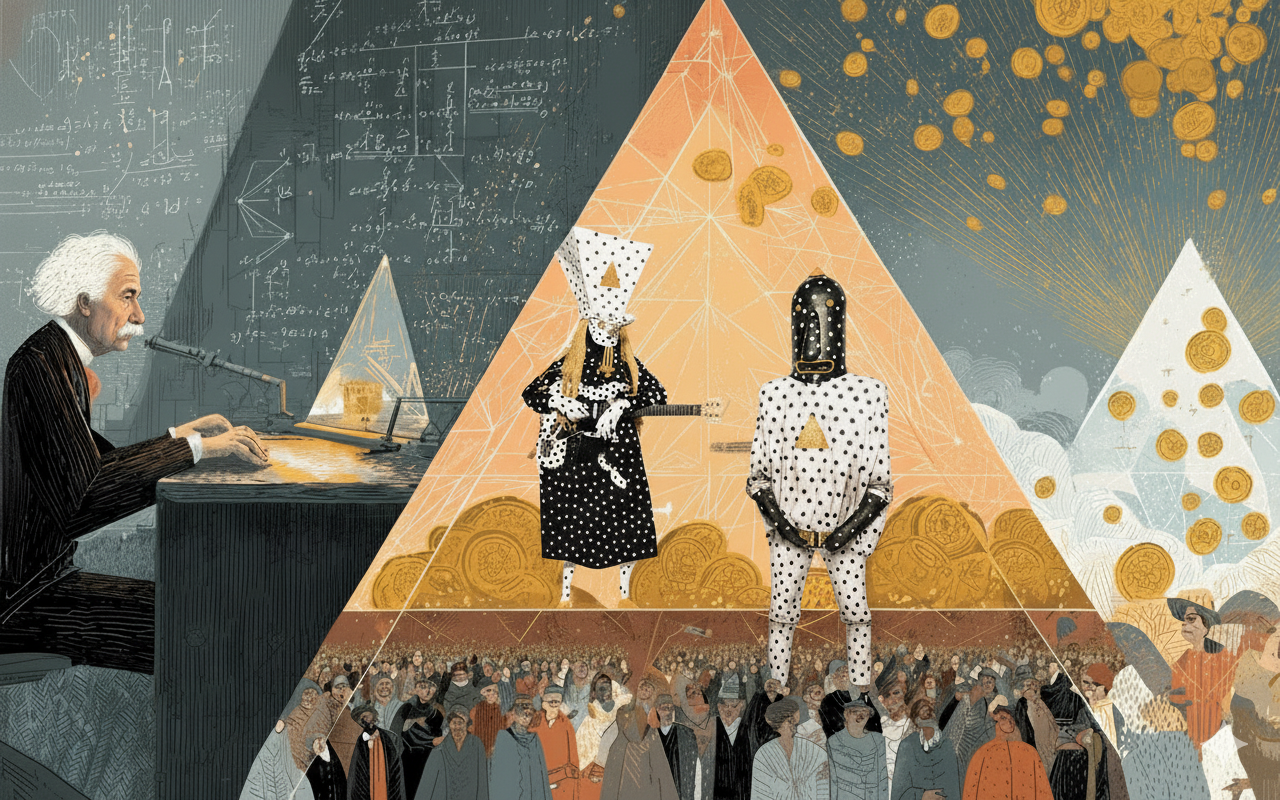

 Foreword to CivilizationScott Santens