Claim optimizations gone extreme
There is a tendency that contracts in terms of copyrights and patent rights
become more extreme. This is such an example resulting in plain idiocy.
Imagine you do work for party B. However, you are hired by party A and they
"lend" you to party B. This is called secondment. You stay employed at party A,
with which you have an employment contract, but perform work at party B.
I recently moved and thought it was a good idea to get back to do some work
through secondment via Maandag. But was I surprised when I read the contract.
Most things went fine in the beginning and I was offered a 6 month project very
quickly. Then, when I got the contract, it had some rather interesting clauses.
The most egregious clause was (translated from Dutch):
Intellectual property
Maandag® is the exclusive owner of all intellectual property rights, including
patent rights and copyrights, of everything you alone or together with others
have conceived, developed and made during your employment. Think of inventions,
devised names, rules, methodologies, models and software in writing or digital
form, but also all works within the meaning of the Copyright Act.
...[obligation to transfer rights to Maandag omitted here]...
Time lapse experiment
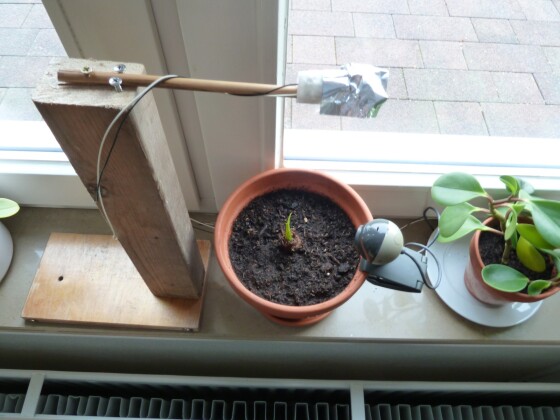
Having fun with a very old webcam and a plant. Yes, it is a miracle, both the
plant and the webcam.
Taking one picture every hour using a raspberry pi, hacked together lighting
and very old webcam. Doesn't matter, it works and is fantastic. Nature still
makes the most fascinating and wonderful imagery.
Most have come to accept the fact that it is getting warmer. Not all believe in
who is responsible. But we will not go into that discussion here. I've had a
significant feeling that the last 20 years have been rather exceptional,
temperature-wise, just where I live and many other places too. Most have seen
all those animations what will happen some time in the future (2050+ etc). But,
what about now? What does the current data actually show us?
Impatient? Go to the videos.
There are several research institutions who have whole datasets available for
any one who wants to check and see the factual data. However, it is one thing
to have access to the data. It is a completely different thing to make sens out
of the data and visualize it properly. So, lets see if the feeling can
be confirmed by looking at the historical and current data.
A recent project highlighted the physical environment, where pupils were
{t}asked to "Solve a problem at school". In other words, look at your school
environment in the broadest sense, identify a problem and design a fix for it.
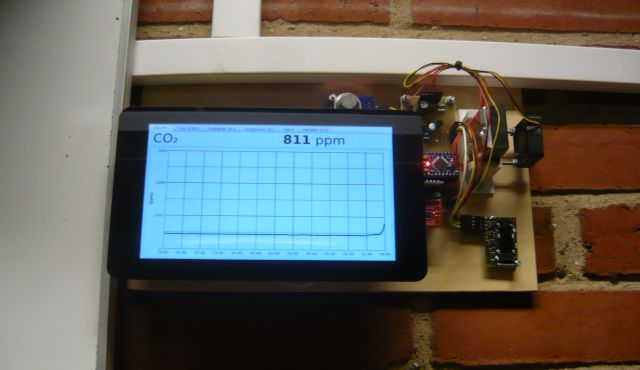
Several groups focussed on the air quality in the classroom, which many
experienced as poor. The hypothesized main culprit: CO2.
It turns out that CO2 has a huge impact og cognitive ability. Better
air quality results in better performance; it is as simple as that. The major
important factors in education are focussed activity, information usage and
strategy. These three ensure that pupils will get to the bottom of a problem
and find the proper solutions.
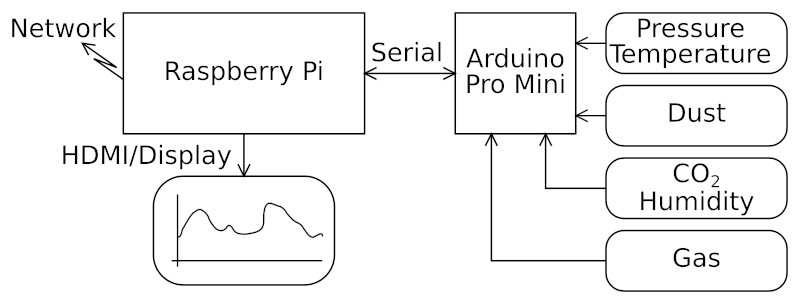
The idea is to have a sensor network, where multiple setups collect data and
send it to a central server. From there additional analysis can be performed
such as statistics and long-term graphs.
You have a high school science fair and want to know how your project was
perceived by the visitors. Modern online behaviour will direct you to "taking
the online survey". That requires an extra step for the visitors, usually by
taking hold of their mobile device and fiddling with a small screen.
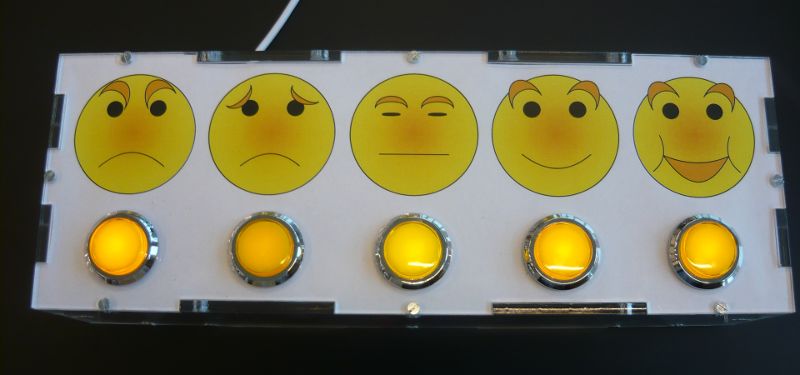
SmileyBox simply asks the question "How much do you like..." within the context
of the box's placement and the visual cues on the box.
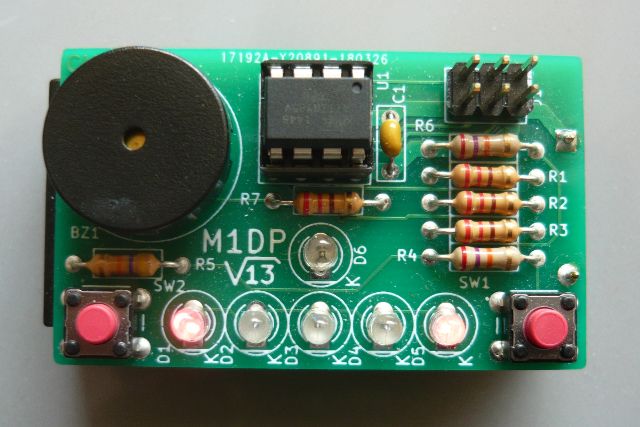
An exercise in futility. That is what many would call this endeavor. How few
elements (signifiers and affordances) do you need to not only recognize a game
for what it is, but also are able to play it?
It turns out that you only need very little to do very much.
Atmel Pack - Atmel device visualizer and fuse calculator.
Looking for an up-to-date fuse-calculator for the Atmel AVR chips
has been something of a long search. There are several online versions, but
they have not been updated to the new chips (like the ATmega328PB).
This is when you scratch that itch, and you make your own. And, while hacking
that, you make it into something much more than just a fuse-calculator.
Gamification is a modern way of saying to take a piss with reality and do what
is, apparently, fun while creating something. An MBA would see gamification as
another way to get what (s)he wants while the other side is just as bad off,
but hopefully feels better about his/her situation. Whether or not a gamified
system is useful remains to be seen and may be determined by your peers.
At least, that is the cynical view on gamification.
To counter the cynicism, we can simply gamify a bad situation and have a good
laugh at the same time. It is even more satisfying when the pun is lost on
those who are the target, while bystanders see a funny device to be used for
their own satisfaction.
The funny thing is; creativity is often fueled by seeing a negative and
converting it into a positive.
So, we take a coping system, mangle it in the gamification engine, add some
electronics sauce, apply engineering and look at the result. Now we can bang
our head with just the right amount of force and get feedback about our state
of mind while we are applying gamified self-punishment. Say hello to Bang
Head Here.
Fast HSV to RGB Conversion - When small CPUs need to do work.
Many people use small small micro controllers. These small machines are
fantastic for doing a specific job. We also see a lot of blinkenlights,
especially with the Arduinos and lots of enthusiastic people hacking their
merry way. Most of us have become accustomed with RGB LEDs and a large group
has had experience with the lovely simple WS2812 LED all-in-one chip.
Using a different color-space than RGB makes coding functionality much
easier, but it comes at the expense of a more or less complex calculation to
convert the color-space used in coding to the LED controlling RGB color-space.
Therein also lies the problem, small micro controllers are unable to perform
complex calculations without significant resources, which usually means
increased calculation time.
Presented are very fast implementations of the HSV to RGB algorithm that work
from the smallest to the largest CPU and are optimized for integer
calculation.
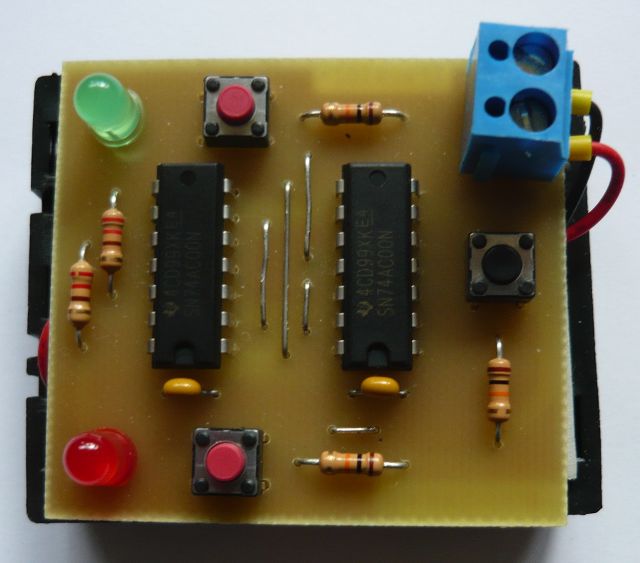
Reaction Tester - Design decisions are important
Scenario: two buttons, one for each player, associated with two LEDs to
indicate the winner, and one reset button. The players are called to press
their button and the light will indicate who pressed first.
An example showing some of the complexities of engineering with a simple
circuit. The devil is always in the detail.
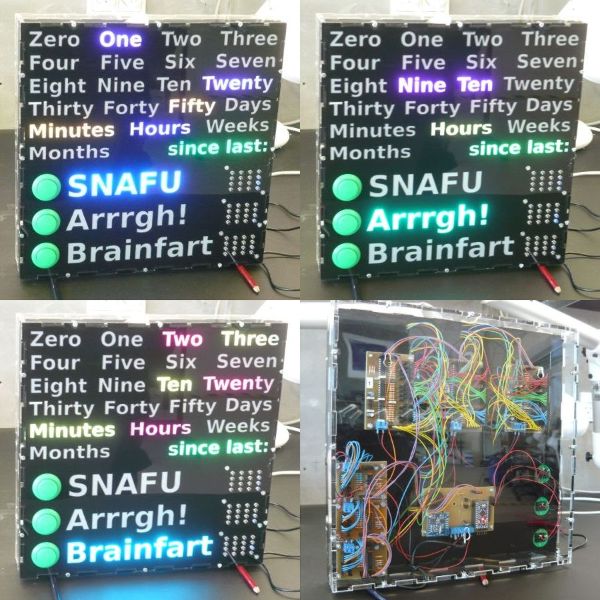
SNAFU Box - With a touch of Arrrgh! and Brainfart.
Everybody gets frustrated once in a while and we all have different ways to
cope with the stress that comes as a result. One thing we all have in common;
we all need some kind of relief from stress. I for one start designing
electronics to sort my thoughts and redirect the frustration into something
more creative.
Getting a grip on the emotional situation is now just one button-press away
from being solved. What do you get when you cross a "Word-Clock", an
"X days since last Y" sign and some fun designing the frustration out of
your system?
You get SNAFU Box.
Update 2016-Jul-02:
There is now an online version: SNAFU Box in a browser.
No longer a need to do hard work putting hardware together. Simply enjoy the
pressing of buttons in your browser and notice how the stress can melt away.
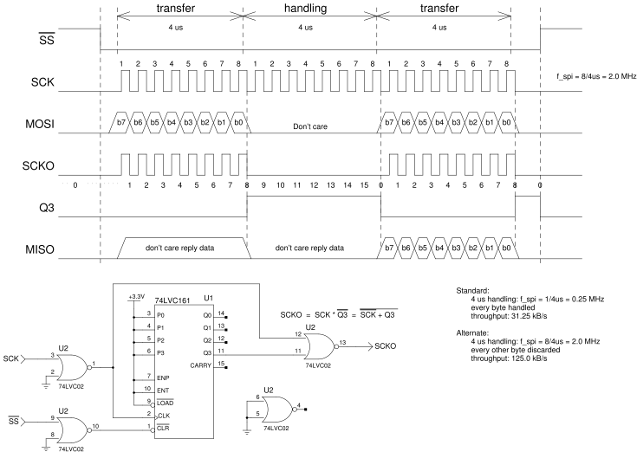
Sending faster and more using less.
Sending SPI data to micro-controllers is often limited by the
micro-controller's speed. The CPU needs to handle data and prepare a reply is a
very short amount of time. This handling-time effectively limits the SPI clock
to a low level.
Using a tiny bit of hardware to manipulate the SPI clock creates a situation
where the SPI clock can be increased by a factor of eight and the throughput is
increased by a factor of four. The micro-controller even has more time to
spare, even though there is more data to handle.
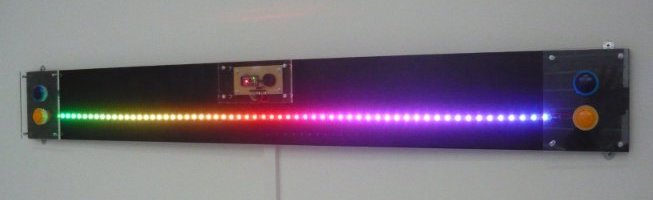
Yet another 1D Pong game, but a nice one.
What to do with a boring hall with lots of white wall? You put something on the
wall. Preferably something that is attractive and can be used as a gathering
point.
The game of Pong has been done many times. Also the one-dimensional version has
been created by quite a few. The charm is its shear simplicity. Take an
Arduino, some LEDs on a strip and a couple of arcade buttons. Write some good
software and you have the game for all to play.
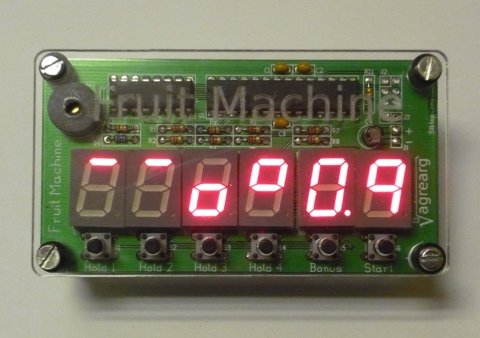
A One-armed Bandit with 7-sement displays.
The Fruit Machine is a remake of the very first program I created on an old
6802 dev-kit over 30 years ago. The modern version still uses 7-segment
displays but uses a modern micro-controller to roll the reels.
A simple yet intriguing game for whenever you get bored. A simple push of the
buttons will make you wager without losing your wallet in the process. A
distinct advantage over the large Bandit versions, which only play for money.
The cost incurred with the Fruit Machine are the batteries you use.
Project updated, now on a real PCB and put together nicely.
Push-button toggle function.
Toggle functions are all around us in electronics. It is one of the basic
functions to perform user-interfacing. However, the digital world and simple
logic is not very forgiving when you put in a simple switch. Mechanical
switches have a nasty habit of contact bouncing.
I recently came across a simple diagram from a mixer-table that had the toggle
function implemented when I was asked to explain how it worked. The mixer-table
is pre-microprocessor era and performs all functions in discrete logic. I have
to admit, the elegance of the circuit is fantastic. It is a brilliant
example of pre-microprocessor era ingenuity.
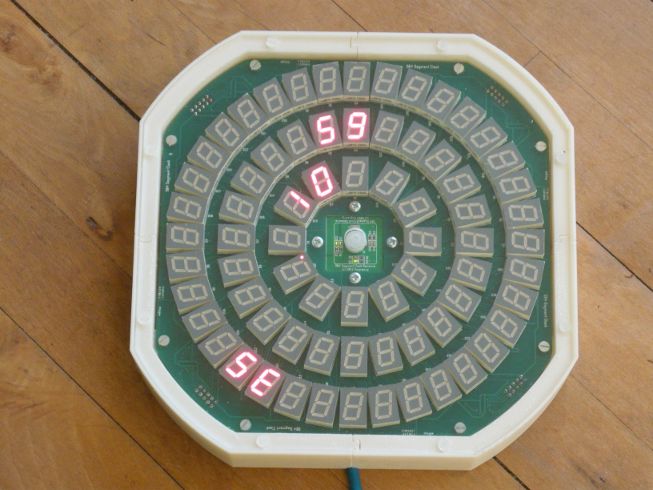
A 7-Segment Clock Done Differently If you need a clock in your house, then you need to do so with style.
Well, that is at least my conclusion when I make something. The last clock I
had in my house was the clock on the old VCR. You know, that tape thingy, which
got scrapped many years ago. And, no, that clock was not a 12-o'clock flasher.
I do have a wristwatch, but you know lazy when you know it.
Time to make a timepiece. It is apparently a human obsession to make clocks in
all forms and measures. Therefore, time for me to join the club and make one
too. And, with an over-engineering principle, a normal clock will not do.
Hence, the 504 Segment Clock.
Gcmc is a front-end language for generating G-code for CNC mills, lathes and
other numerical controlled machines employing G-code. The language is a
context-free syntax created to overcome the archaic format of G-code
programming and aims to be more readable and understandable. Gcmc makes
extensive use of vector mathematics to support the 3D nature of CNC machining.
Gcmc can generate G-code in absolute or relative mode, making it possible to
include code fragments in your existing projects. It has a powerful set of
built-in functions, operating on values, vectors and vector-lists. It supports
values with associated units (mm and mil) and does automatic conversion for
you.
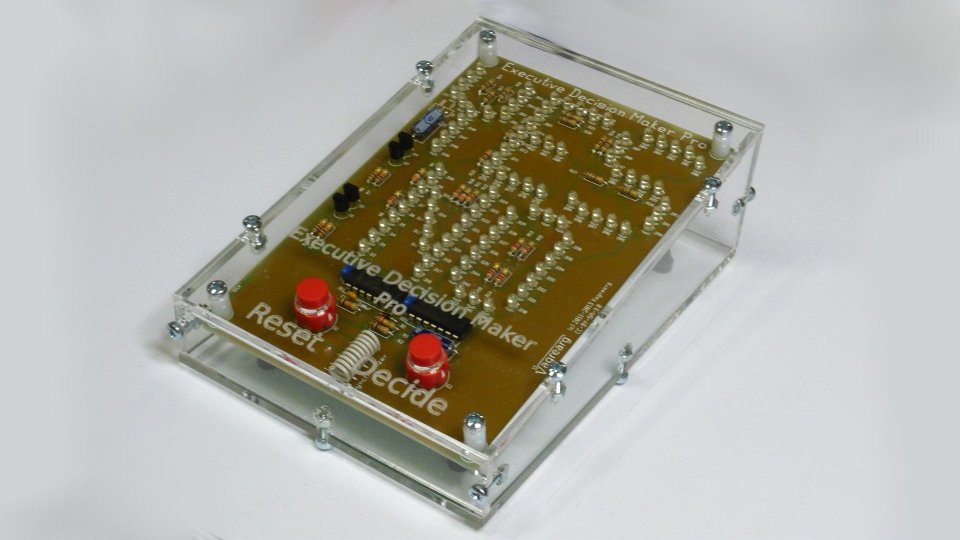
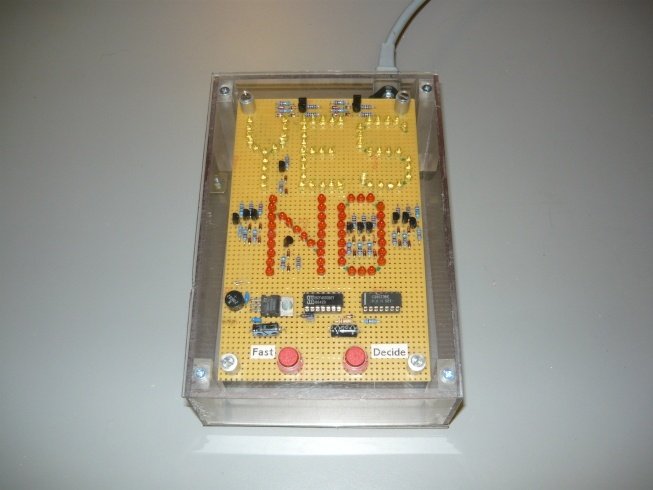
Professional decision making at your fingertips.
Making decisions is a hard thing to do, so it seems to most of us. It is about
time that others can join the club and be relieved of the heavy burden of
decision making. Now you can with the Executive Decision Maker Pro.
Now you can join the club and have decisions made easy from trivial household
decisions to multi-billion dollar Mega-Corp venture decisions and every
management level in between. The Executive Decision Maker Pro embeds an
Intentional Synchronizer which, with the right expressed brainwave patterns,
reads your mind at the subconscious level and automatically chooses the correct
answer.
Breaking ground-loops with galvanic isolation.
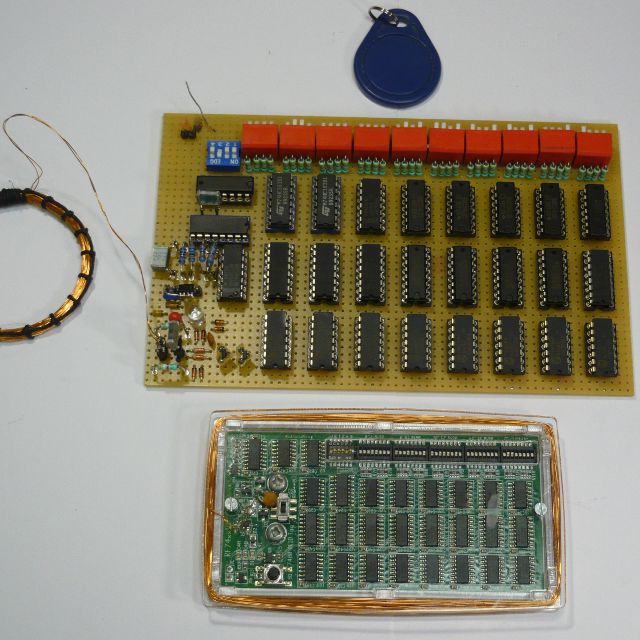
NoLoop is a galvanic isolator for both signal and power connections. NoLoop
separates the in- and out-put breaking any existing of a ground-loop in that
connection path. The signals are transfered with an RF transfer method and have
only very little delay. Power is transfered with a small 1:1 switching power
supply and regulated with an LDO at the secondary side.
A Serial and a SPI version of NoLoop is available. The serial version has two
inputs and two outputs, whereas the SPI version has one input and three
outputs. Both have isolated power and can operate from both 5V and 3V3. The
power output is selectable to 5V (5V in required) or 3V3.
Flipdots and Core-memory - old tech meets old tech
Using/abusing flipdots as core-memory by sensing the current of the changes.
Both core-memory and flipdots use square hysteresis loop magnets. Core-memory
uses the magnetic polarity to save ones and zeroes. Flipdots can do so too with
added visualization of the memory content.
Although a bit slower (about three orders of magnitude) it is a great way to
use old tech emulating old tech and still have something new.
Blinkring is an earring designed for the fashion aware nerds among us. Or,
alternatively, for the person who wants something different.
You can hang it in your ear(s) or on a necklace. Be assured to get some
attention at your next party.
7x7 Flipdot module, large and small
Active matrix modules consisting of 7x7 flipdots in 10mm and 15mm sizes.
Together with a controller to flip dots at rates up to 1500 flips per second or
30 frames per second.
These modules can be cascaded into a 16 module chain and controlled by serial,
SPI and I2C communication at high speeds. The controller handles high level
commands to reduce communication needs.
Battery operated Flipdots
After getting involved with flipdots and doing some
experimentation with fliptest, it was time to
create a working prototype of a completely battery operated flipdot device.
/
A small micro-controller runs a standard program flipping one dot per second
and controls the charge-pump to generate high voltage. The program is optimized
to conserve as much energy as possible for long battery run-time. A programmed
serial port receiver can be used to send flip commands via a computer.
Flipdot 1x7 strip in a test-setup for battery powered operation.
They are so nice, fast and have a fantastic sound. Also, the projects done with
these flipdots are intriguing and make my fingers itch for experimentation.
When asked to look into a battery operated device, it was the right time to
start hacking.
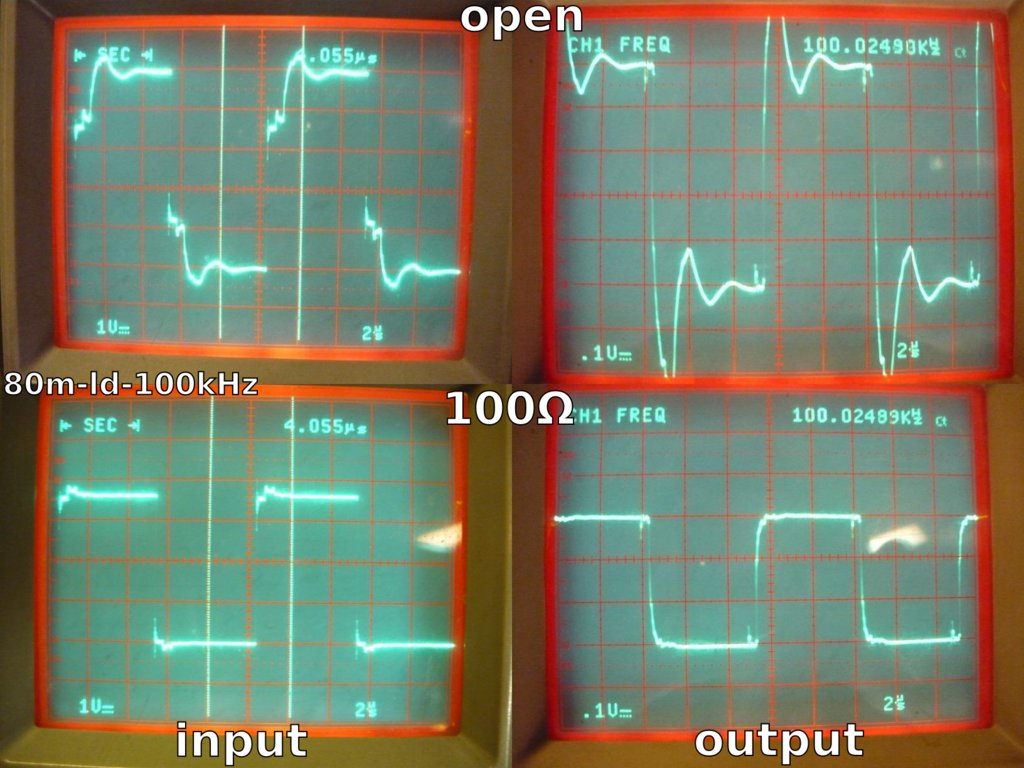
Transmission lines terminate your signal if not terminated
Over at Dangerous Prototypes I got
involved in a forum
post about problems with an SPI bus, where the signals would not function
anymore after some distance. There were two things that my experience told me:
1) check the power supply, 2) check the cabling for reflection. Then I
realized, this must be a common problem for all hobby hackers. Cabling is a
difficult topic and it is time to demystify some magic.
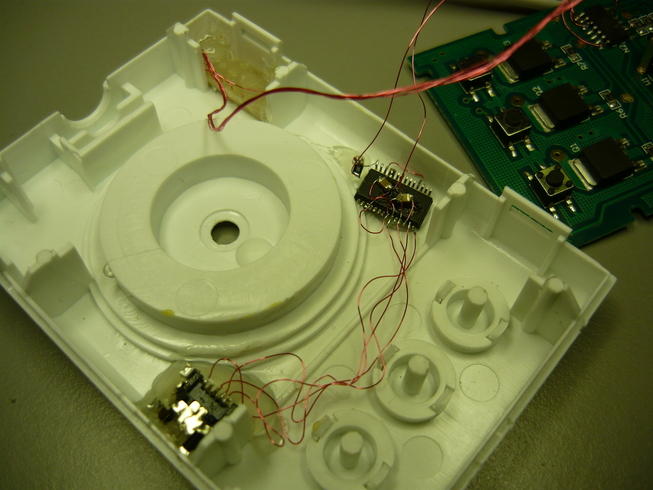
Hacking an Ikea DIODER gadget for use with a milled sign.
Unlike most other hacks, it includes a complete new software stack for
the PIC16F684 processor on the gadget. The software also implements extra LED
outputs and a serial input. The hack includes a serial-to-usb converter so any
computer can control the lightshow.
A blinkenbuttonlight gadget from loose parts for illuminating the winter solstice.
RGB LEDs combined with a small micro-controller and a couple of buttons shaped
as a little dude with button-hands and blinking eyes makes the day a bit
brighter.
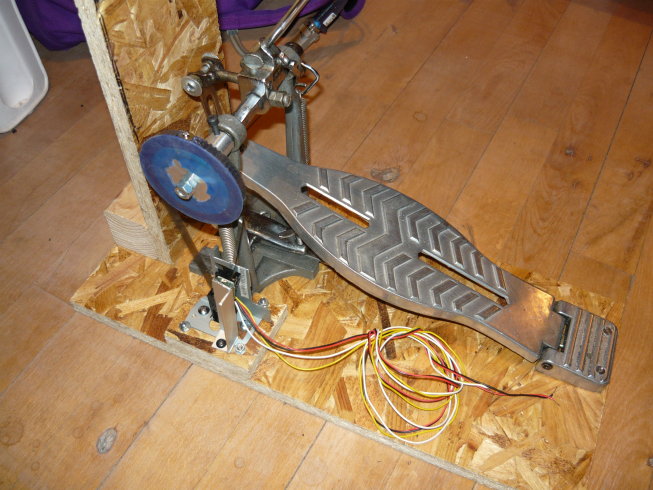
A bass-drum pedal trigger system from spare parts.
Quadrature encoded angular position measurement on the pedal of a drumset to
trigger a synthesizer.
A good example of "poor-man" solutions, reusing materials found at the local
hackserspace.
Bypassing currents in overdrive
While enjoying the 7400 contest, it
occurred to me that many of the submitted logic designs lacked some of the most
elementary safeties to ensure a working result. One of the most disregarded
aspects of the designs was the lack of bypass capacitors. Then, with an
article
about Murphy's law linking a Maxim application note,
it was decided to write a bit about decoupling and bypass capacitors.
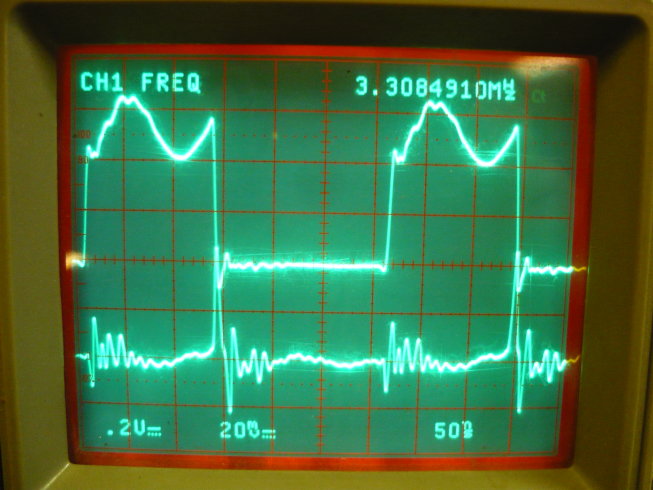
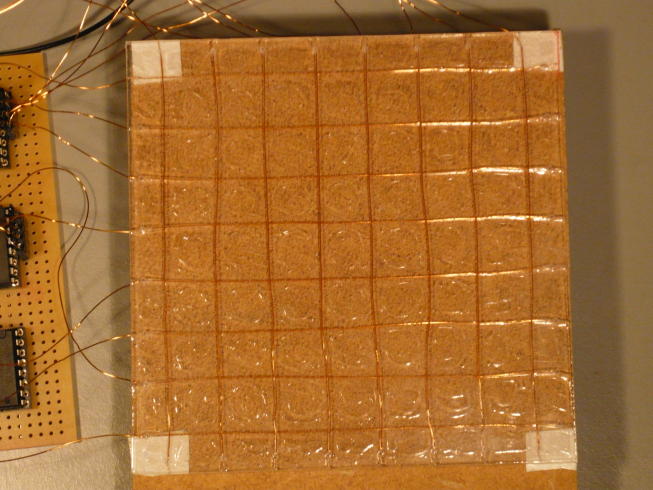
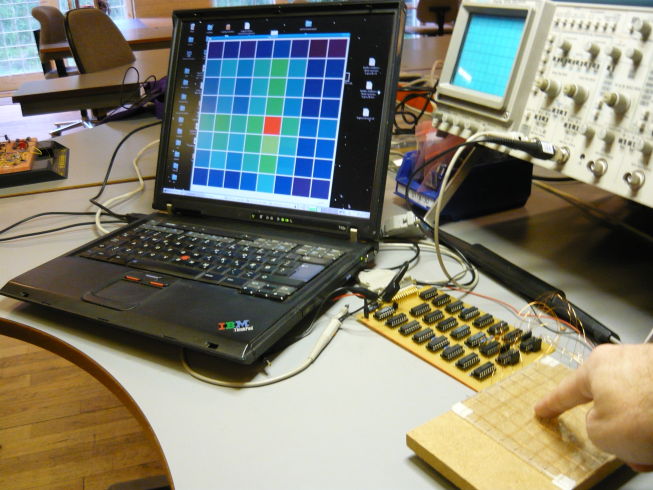
Building a touch panel for capacitive sensing using household equipment.
Layered plastic sheets with wires embedded baked in an oven.
See part 1 for a test of the touch panel.
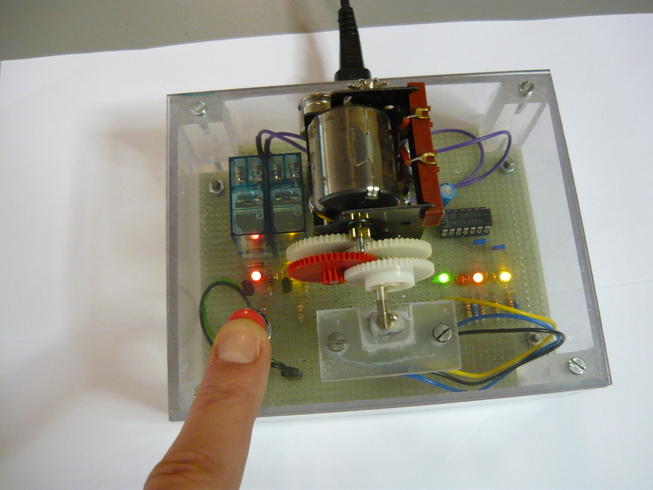
Making decisions is a hard thing to do, so it seems to most of us. But we see
plenty of examples where this does not apply. I must admit that randomness is
key at the executive level (and I can tell from observational experience).
Actually, executives love to postpone making decisions as much as they can.
Only when forced, they will actually decide. The typical PHB reflex is about as
good as you can imagine a random generator. With some effort and mental ability
you can exert influence, but you never fully understand the result.
I just had to make the Executive Decision Maker. And even though I made this to
make decisions, you can also use it to confirm your believes after the fact.
Just ask yourself a question and press that button.
Having fun is important when making things. So, while discussing new and
intelligent ways to do things at the local makerspace and hackerclub, I
concluded that it was time to waste time bigtime. Some of you may be familiar
with the ultimate machine or one of the successors with additional features.
The sad thing is that I do not see a way (yet) to top the ultimate machine.
But, I certainly can make something pointless too. So, what features do we
need: