Today I want to talk about an amazing theorem of Moeglin, which I learned from WTG.
Let  be a finite extension,
  the split odd special orthogonal group over
  ,
,  its unique inner form. By work of Arthur and Moeglin, there is a natural bijection between discrete series representations of
  or , and pairs
  where
where  is a discrete L-parameter and
  is a character of the centralizer group
  . In this setting,
  is discrete if it is the sum of
  pairwise-distinct irreducible representations
 ![\phi_i = \sigma_i \boxtimes [d_i] : W_F \times \mathrm{SL}_2 \to \mathrm{Sp}_{2n_i}](https://s0.wp.com/latex.php?latex=%5Cphi_i+%3D+%5Csigma_i+%5Cboxtimes+%5Bd_i%5D+%3A+W_F+%5Ctimes+%5Cmathrm%7BSL%7D_2+%5Cto+%5Cmathrm%7BSp%7D_%7B2n_i%7D&bg=ffffff&fg=1a1a1a&s=0&c=20201002) with
with  . Here
 ![[d]:\mathrm{SL}_2 \to \mathrm{SL}_d](https://s0.wp.com/latex.php?latex=%5Bd%5D%3A%5Cmathrm%7BSL%7D_2+%5Cto+%5Cmathrm%7BSL%7D_d&bg=ffffff&fg=1a1a1a&s=0&c=20201002) is the usual d-1st symmetric power representation. The associated centralizer group is of the form
is the usual d-1st symmetric power representation. The associated centralizer group is of the form  , and has a canonical basis indexed by the irreducible summands
  . Given , let
  be the associated discrete series representation. Note that is a representation of if is trivial on the evident subgroup
  , and is a representation of otherwise. This splits the representations up evenly: for fixed, there are
  possible ‘s, and we get a Vogan L-packet
  where
where  and
and  each contain
  elements.
Question. When is a supercuspidal representation?
For  I had previously memorized the (already complicated) answer to this question, so you can imagine my pleasure when I learned that Moeglin found a simple conceptual criterion which works in general! To state her theorem, we need a little vocabulary.
Definition. A discrete parameter  is without gaps if for every
 ![\sigma \boxtimes [d]](https://s0.wp.com/latex.php?latex=%5Csigma+%5Cboxtimes+%5Bd%5D&bg=ffffff&fg=1a1a1a&s=0&c=20201002) occurring among the ‘s with
occurring among the ‘s with  , then also
 ![\sigma \boxtimes [d-2]](https://s0.wp.com/latex.php?latex=%5Csigma+%5Cboxtimes+%5Bd-2%5D&bg=ffffff&fg=1a1a1a&s=0&c=20201002) occurs among the ‘s.
occurs among the ‘s.
Definition. Suppose is without gaps. A character of the component group is alternating if for every pair and (with ) occurring among the ‘s, ![\chi(\sigma \boxtimes [d]) = - \chi (\sigma \boxtimes [d-2])](https://s0.wp.com/latex.php?latex=%5Cchi%28%5Csigma+%5Cboxtimes+%5Bd%5D%29+%3D+-+%5Cchi+%28%5Csigma+%5Cboxtimes+%5Bd-2%5D%29&bg=ffffff&fg=1a1a1a&s=0&c=20201002) . Moreover we require that on every summand of the form
. Moreover we require that on every summand of the form ![\sigma \boxtimes [2]](https://s0.wp.com/latex.php?latex=%5Csigma+%5Cboxtimes+%5B2%5D&bg=ffffff&fg=1a1a1a&s=0&c=20201002) , we have
, we have ![\chi(\sigma \boxtimes [2])=-1.](https://s0.wp.com/latex.php?latex=%5Cchi%28%5Csigma+%5Cboxtimes+%5B2%5D%29%3D-1.&bg=ffffff&fg=1a1a1a&s=0&c=20201002)
Theorem (Moeglin). The representation is supercuspidal iff is without gaps and is alternating.
Example 0. By definition, is supercuspidal if  for all summands. In this case, is (vacuously) without gaps and every is (vacuously) alernating, so
  consists entirely of supercuspidal representations. The converse – if consists only of supercuspidals then necessarily is supercuspidal – is also immediate!
Example 1. Let  be distinct supercuspidal parameters. Then
 ![\phi = \sigma_2 \oplus \sigma_2' \oplus \sigma_2' \boxtimes [3]:W_F \times \mathrm{SL}_2 \to \mathrm{Sp}_{10}](https://s0.wp.com/latex.php?latex=%5Cphi+%3D+%5Csigma_2+%5Coplus+%5Csigma_2%27+%5Coplus+%5Csigma_2%27+%5Cboxtimes+%5B3%5D%3AW_F+%5Ctimes+%5Cmathrm%7BSL%7D_2+%5Cto+%5Cmathrm%7BSp%7D_%7B10%7D&bg=ffffff&fg=1a1a1a&s=0&c=20201002) is a discrete parameter without gaps, with component group of size 8. It is easy to see that four of the possible ‘s are alternating, and two of these are trivial on the center of
is a discrete parameter without gaps, with component group of size 8. It is easy to see that four of the possible ‘s are alternating, and two of these are trivial on the center of  . Thus, the packets
  and
and  each contain four elements, two of which are supercuspidal and two of which are non-supercuspidal.
Example 2. Let  and
and  be supercuspidal parameters. Then
 ![\phi = \sigma_2 \oplus \sigma_3 \boxtimes [2] \oplus \sigma_3 \boxtimes [4]:W_F \times \mathrm{SL}_2 \to \mathrm{Sp}_{20}](https://s0.wp.com/latex.php?latex=%5Cphi+%3D+%5Csigma_2+%5Coplus+%5Csigma_3+%5Cboxtimes+%5B2%5D+%5Coplus+%5Csigma_3+%5Cboxtimes+%5B4%5D%3AW_F+%5Ctimes+%5Cmathrm%7BSL%7D_2+%5Cto+%5Cmathrm%7BSp%7D_%7B20%7D&bg=ffffff&fg=1a1a1a&s=0&c=20201002) is a discrete parameter without gaps, with component group again of size 8. Now only two of the possible ‘s are alternating, and one of these is trivial on the center of
is a discrete parameter without gaps, with component group again of size 8. Now only two of the possible ‘s are alternating, and one of these is trivial on the center of  . Thus, the packets
  and
and  each contain four elements, one of which is supercuspidal and three of which are non-supercuspidal.
Example 3. Let  be a nontrivial character. Then
 ![\phi = 1 \boxtimes [2] \oplus \tau \boxtimes [2]:W_F \times \mathrm{SL}_2 \to \mathrm{Sp}_{4}](https://s0.wp.com/latex.php?latex=%5Cphi+%3D+1+%5Cboxtimes+%5B2%5D+%5Coplus+%5Ctau+%5Cboxtimes+%5B2%5D%3AW_F+%5Ctimes+%5Cmathrm%7BSL%7D_2+%5Cto+%5Cmathrm%7BSp%7D_%7B4%7D&bg=ffffff&fg=1a1a1a&s=0&c=20201002) is a discrete parameter (vacuously) without gaps, with component group of size 4. Now only one of the possible ‘s is alternating, and it is trivial on the center of
is a discrete parameter (vacuously) without gaps, with component group of size 4. Now only one of the possible ‘s is alternating, and it is trivial on the center of  . Thus, the packets
  and
and  each contain two elements, with containing one supercuspidal and containing no supercuspidals.
More generally, if is without gaps and all  ‘s are even, then only one is alternating, so the packet contains a single supercuspidal representation (which may be a representation of or – both possibilities occur) swimming in a sea of discrete series representations.
References:
Colette Moeglin, Classification des series discretes pour certains groupes classiques p-adiques, 2006
Bin Xu, On the cuspidal support of discrete series for p-adic quasisplit Sp(N) and SO(N), 2015


 equipped with a fixed norm, with residue field
  . Let
. Let  be a
be a  is distinguished if the associated residue norm
  equals the supremum seminorm
  . A
. A  , it also implies
 .
. is a distinguished surjection, then
  is surjective. Moreover, if
  is surjective. Either way, if
  is a tft
  -algebra.
 such that
  is distinguished as an
  -affinoid algebra?
 be its reduction to a finite type
  . It is not hard to see that if
  is a principal open, then
  is a Laurent domain in
  . Much less obvious is that for any open affine
  , the preimage
  is an affinoid subdomain such that
  is distinguished and
 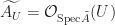 . This is buried in a
  is formal if it can be realized as
  be a reduced quasicompact separated rigid space over
  is a formal cover if
 are distinguished, and
 , the intersection
  , which is automatically affinoid, is a formal affinoid subdomain in
  and in
  .
. along their common formal affine opens
  . Moreover, the special fiber of this formal model is just the gluing of the schemes
  along the affine opens
  .
. admits a formal affinoid cover?
 , even when
  ! More on this later.
 and its unique inner form. After reading this paper, and with some key assists from SWS and WTG, I now see how to prove this compatibility (at least over unramified extensions
  ). It shouldn’t even take many pages to write down!