“I will cast abominable filth upon you, make you vile and make you a spectacle.” – Nahum 3:6
We open on a tragedy. A crew filming a planned performance with an animal to show off to the world. A creature of nature they believe they know and understand. And through the commodification of their encounters with said creature they make their fame, fortune, and bread. Except it’s all gone wrong. We open on the shattered fantasies of such a scenario. Of what happens when you believe you are more in control of nature than you actually are. Of the price incurred in the pursuit to entertain, to be remembered, and to make money. We open on the brutal fallout, witnessing the stained sleeves of the chimp that plays the role of ‘Gordy’. We open on his fallen victim, whose blood is smeared upon his mouth. Nothing has gone according to plan. None of this could be anticipated.
And then we cut away.
And as the movie proceeds on, we go onto to learn the full truth and scope of this incident when we meet Steve Yeun’s character Ricky ‘Jupe’ Park. We see him as a flashy man of performance, a star of Hollywood, an owner of a theme park, who we come to understand is the key unscathed survivor of that horrific incident we saw in the opening. The boy who ‘made it.’ The child star that survived the traumatic and tragic incident with the wild animal that either killed or maimed his peers.
‘It was a spectacle,’ says Jupe, trying to play it cool, trying to present an air of control. He talks of a fanbase for the program- Gordy’s Home, and how it’s rising. He’s even got a whole special room dedicated to it, with memorabilia intact and preserved from the terrible tragedy. He charges people to go into said room. Jupe laughs, and recounts how the whole affair was turned into a great SNL skit, with bonafide performers. He goes beat by beat, performing it for us, discussing it like it’s just any other regular, hilarious venture. Like it’s any normal thing to laugh about. He presents a smile of control. But as he puts on this performance, the veneer cracks, as the film cuts to a momentary flashback of Jupe as a young boy, hiding underneath a table, the unscathed survivor, witnessing the horror. It’s clearly traumatic. And then we cut right back, as he still tries to play it cool. The contrast of his performance and the actuality of his past wind together to express a powerful truth the film is really taken with.
Because if you pay attention, if you really pay attention, Nope begins and ends the same way. It’s effectively a mirrored conclusion. We start on a tragic massacre set around the filming of a performance involving a wild animal, the spectacle of the creature being a critical element in how the creators hope to make their fame, fortune and bread. And it’s about how that doesn’t go quite as planned. And that’s what we return to at the end.
The scope is astronomically different, certainly, for a chimp is nothing compared to an impossible sky-animal. But in both cases, the film is less about the animals in question and more about people’s responses to them.
And it’s all about the price of performance, and what all it serves.
It’s laid out for us quite clearly when we really get introduced to our two principal characters- Otis Junior ‘OJ’ Haywood (played by the wonderfully considered Daniel Kaluuya) and Emerald ‘Em’ Haywood (played by the unforgettable Keke Palmer), who are now taking care of their recently deceased father’s ranch and his horses. Their father, Otis Senior, worked as a horse trainer for Hollywood productions and sets, running Haywood Hollywood Horses. But their history with motion pictures runs older and deeper than that.
As Em tells us:
“Did you know that the very first assembly of photographs to create a motion picture was a two-second clip of a Black man on a horse? Yes it was! Yes it was! Look it up! Now I know you guys know Eadweard Muybridge, the grandfather of motion pictures, who took the pictures that created that clip. But does anyone know the name of the Black jockey that rode the horse? Nope. I mean, the very first stuntman, animal wrangler, and movie star all rolled into one and there is literally no record of him. That man was a Bohemian jockey that went by the name of Alistair E. Haywood, and he is my great-great-great grandfather.”
This, of course, alludes to very real history here, with Muybridge’s Animal Locomotion motion pictures. While the Haywoods and their connection to the very real man in the clip is fictitious for the sake of Peele’s story, it’s rooted in a reality. And said reality informs the entire film. This was a real person. This was a real Black man with a name, a family, a life that we know nothing of in our reality. Nothing remains of him but this footage. This very real person, a man who lived, has been reduced to this bit of spectacle. He was subsumed by and into the spectacle of the motion picture, abstracted away from a real person into a mere ‘representation.’ He became a product that a man like Muybridge parlayed into cultural significance as ‘the grandfather of motion pictures’.
And that really is what the movie is framed by. This idea of the all-pervading, all-subsuming spectacle, and the inevitable price that we pay in order to help its perpetuation. The price of our performances, as it were, to keep the spectacle going. The price of reduction is one that the man in Muybridge’s footage surely understood, and he paid it. And thus, within the film, his descendants live on in the knowledge of that price, too. But he’s not alone in paying the price or suffering reductions. That’s also why Jupe’s story matters. He was but a boy, and he became an abstract symbol of, as he himself puts it, ‘a spectacle.’ And his entire life since then has been built in the shadow of that spectacle. He is less himself and more so the performance of himself. He plays to the projection of him, that constructed image of him, with so much of what he does, rather than ever escaping it. Even as it is harrowing and traumatizing and painful and destructive. And that’s the price of his performance, as he walks around his own Western theme park- a hollow recreation and construct echoing the actuality of a past long gone. Nope is a film really taken with the idea of representations, images, performances, and the spectacle that drives all of them.
It’s why when the TMZ biker enters the picture and finds himself on the verge of certain death, he doesn’t care about his life or actuality as much artifice. He cares about the damn picture–his camera–and the footage. And he cares about it because it’d be good content, it’s good money, and content comes before life. The spectacle matters more than life itself.
And the biker isn’t alone there, as even Antlers Holst (played by the great Michael Wincott) the legendary cinematographer working with the Haywoods meets his end by standing by that truism. He pays the price of his life. That’s a choice he makes, as an artist obsessed with performance and getting that perfect shot. The spectacle is.
It seems foolish, certainly, but it’s also the reality of the price many people are willing to pay within the society of the spectacle that we live in. It is the price they are being asked to pay. And it’s a price the Haywoods are willing to deal with to get what they want. And what they want is what their ancestor was denied: fame, fortune, and credit. They want the prize that should’ve been theirs to begin with. They’re people on hard times, broke as hell, barely making anything, having to sell off their fathers’ treasured horses. They’re people struggling, who feel they shouldn’t be. They’re more like that poor biker than not.
That’s why the dinner scene in the film feels telling. Angel Torres (played by the incredibly charming Brandon Perea) asks the cast: “What we document…it’s gonna do some good, huh? I mean, besides the money and fucking fame. We can save some lives, fuck, we can even save Earth, right?’
And our leads can only silently sit there, with OJ managing a quiet ‘Mhm’ and Em muttering a ‘Yeah’. And they’re said less like convictions, things they believe in, and more things they need to say to convince themselves that this will somehow be…more. More than the money, more than the fame, more than the seemingly inescapable ‘spectacle.’ Something that matters and is meaningful.
The question then being: ‘Will it? Will it actually?’ And if the window into the future offered by Jupe is any indication, all that awaits after all the fame and fortune is just the endless perpetuation of the spectacle. Like Jupe, the Haywoods, whilst getting all that which they deserved, will be subsumed by spectacle. They’ll dress in more expensive clothes and sport smiles as they give interviews about all that they did, retelling stories over and over like Jupe, feeding the spectacle. Over time, their yarn will morph into a mythic adventurous tale that goes over well on the news, flattened into a simpler, inspiring narrative lacking the spiky, messy realities bound to what it actually took to achieve what they did. The Haywoods themselves, and their story, will become a commodity, a brand: valued and sold. Something they’ll have to maintain and keep to and live under the eternal shadow of, continuing the performances expected of them, the way Jupe does, telling the tragic tale of ‘Gordy’ for the millionth time. They’ll be people trapped amidst the artifacts of their own traumatized past, turning it into product and entertainment and content to make a living. The TMZ bike will be treated like a museum piece, in a room dedicated to the spectacle that will have defined their lives.
Everything will inevitably be eaten away by the spectacle, Haywood then or Haywood now.
That in a film about a seemingly alien, impossible creature’s existence and some kind of first contact, there’s such little focus dedicated to that aspect of it is a revealing choice. There’s tons of other films that do just that. Nope isn’t about the contemplation of us no longer being alone in the universe, of alien life and what it means or any of that. It’s instead a movie about people’s responses, their reactions.
At its core, whilst it is many things, Nope is a monster movie. But it is not a movie concerned about the nature and minutiae of the monster. It is not a film about what it really is that hides in that sky.
No, it is instead a movie about the very act of looking up at the sky itself.
It’s why the film immediately dives into the project of turning the encounter with this wild, impossible creature into a venture of commodity, something to be profited from. That is the focus and contemplation. It’s in the art of performance and spectacle, and how we react and respond to such things. How representations relate to our realities, beyond the spectacles that seek to reduce us, and how we live with the complexities of that.
Perhaps that’s why even in one of its most horrific scenes, wherein a bloody ‘Gordy’ approaches a young traumatized Jupe, and rather than trying to kill or maim him like he’s just done to the others…’Gordy’ seeks a fist bump. Like an ‘I did good, didn’t I?’, as though asking for approval for a job well done. Seemingly as if he’s just won a Chimp-Oscar by giving people one hell of a performance and a show of spectacle they’ll never forget.
Jupe’s reaction and response to that is informative, and it’s perhaps why he describes it as ‘a spectacle’ to all his audiences.
Fitting then that in the end what slays the monster isn’t some weapon, but spectacle itself. The sky-creature’s fall occurs when it consumes a gigantic balloon cowboy- a literal hollow representation of man writ large. A spectacle, if there ever was one, an image of man filled with nothing but hot air.
And as it falls, dying from the spectacle it hoped to consume, it is filmed by our lead Em, caught on camera, ready to be turned into further spectacle, to feed the machine.
It’s a powerful ending, and a powerful choice. Much of the film made me think back to some of the ideas in Guy Debord’s seminal work The Society Of The Spectacle. And the film feels relevant, especially as we live in a time wherein all of us are reduced down to representations by the powers that be, wherein we are all at once both Content and Content-Producers. As they say, if it’s free, you’re the product. And in the age of social media and algorithmic systems, more than ever, performance is massive. Everything and everyone is a commodity, a brand, everyone is hustling, everyone’s trying to make a buck and survive, even as the world gets more and more progressively absurd and impossible. We have no time to take in and really reflect, as we’re pushed to ever run on the treadmill that feeds our society of the spectacle, just trying to exist. We all feel cheated, we all feel like we were promised something else and meant to have something that we never got. We all lost someone in ways we’re still reeling from. We all feel confused and lost, and we’re all afraid to go out there, for catastrophe might strike at any moment.
We understand the Haywoods.
Nope feels like a work of art for the now, for the current pandemic-riddled late-capitalist hellscape we inhabit. It’s about people surviving, or trying to.
Perhaps that’s why the movie emphasizes and stresses on a key aspect, the big distinction between the situations of all the other contrasting figures of the past and the Haywoods now. Unlike the others, they are not alone. They are not lone figures. No matter how bad it gets, how matter how hard and horrific the scenario, OJ and Em have each other. They can be there for one another, they understand one another, and it’s that bond and the strength of that united spirit that sees them through. It is the beating emotional core of the film, and it is how they survive. And it’s why, tellingly, the film’s most striking image at the end isn’t the photograph, but the image of an OJ who’s survived. Em fears she may have lost him, but she hasn’t. He made it. And there he stands in the dust, like a myth. A Haywood on a horse, like the man of old, but he’s not alone. And he never will be.
It’s a film about a triumphant act of genuine bravery and heroism, which is genuinely beautiful and cathartic when you see the Haywoods have succeeded and survived, whilst also being a work wise enough to indicate to how the spectacle they’re surrounded by is enormous and subsumes all.
It’s a film that, across its 5 chapters, tightly rides the line between being many different kinds of movies, and seamlessly balances them all to be something really special and fresh. It’s a film deeply in love with people, and their capacity for the impossible in impossible circumstances.
A reflection upon comics, politics, and just where I'm at
Show full content
It’s been a terrible year. By all accounts, this is possibly the worst year I can recall from my adult life. It was a year that saw the Palestinian Genocide continue onward and escalate and escalate, alongside a whole host of other genocides, while an American Election saw people flock to a Genocide Party: Red Version and Genocide Party: Blue Version in the name of delusional self-preservation. It’s the year that completely shattered any veneer of ‘the international rules based order’ or the supposed ‘civility’ and ‘fairness’ or ‘law’ that the West so prides itself on. It was the loudest declaration that the West’s laws and international courts exist to condemn Africans, and perhaps Arabs and Asians, but never the Imperial West that has more blood on its hands than can even be imagined, with its death-grip murdering the earth as we speak.
It was the biggest illustration of how much of what passes for ‘journalism’ in the imperial cores and amongst imperial media is really just propaganda and boot-licking. They couldn’t even begin to recognize what real Journalism is like if they tried, which is why so many supposed ‘Journalists’ were happy to not only stay quiet on the most brutal and vicious murder-campaign of journalists in history by Israel, but even eager to collaborate in helping back the genocide by parroting Zionist talking points alongside the erasure. After all, for all their proclamations of pursuing ‘truth’ and reporting on truth, they don’t actually care about truth. Only their careers. Only their pockets. Only how they can do well and be well and get ahead.
And of course, the naked racism and western supremacy is a condition they forever refuse to shed. This is just what imperial ‘journalism’ is.
It was also a year of cowardice in the arts, as legions parroted white supremacist genocidal propaganda until it was far too late, refusing to believe Palestinians in the face of their imperial genocide papers. Papers they can recognize are lying when it pertains to them, but must clearly be telling the truth about those gosh darn brown people in the middle-east, no matter how racist or dehumanizing the lies. Everything about baby-killing to rape, a whole bunch of white supremacists made it up and published it. And then legions of losers parroted it and defended it because deep down their orientalist minds believe in such monstrous ideas and find validation through them. They are racist dipshits pretending to be otherwise. Countless ‘respected’ artists justified those horrific lies about Palestinians on and on in ways I can never ever forget. They spread them far and wide.
And then there were the flavor of cowards who either said nothing or said the most nauseatingly hollow both sides bullshit in the name of ‘peace’. Endlessly posturing and performing in the hopes that all that noise would go away so they could just go back to hustling about their books or promoting their brand. For that is all that exists for a lot of these people–craven careerism.
I had to read The Great Thoughts of Supposedly Smart People in The Arts give their take on the world at large, and grit my teeth through every bit of the western supremacist horseshit they were saying. That applies particularly to comics. It’s not exclusive to comics, it’s all industries of art, from Film Industries to Prose Publishing to Video Games, you name it. And some have written on specific landscapes like prose. But what I’m here to talk about is comics, given it all applies particularly aptly to this pit.
So many people I once believed I respected I no longer do. So many dunderheads and morons, and an entire industry and culture built around worshiping and fanning over these dolts. Forget the irrelevant work they make which they wish people read instead of the new volume of Chainsaw Man. I have never loathed the ‘industry’ and ‘culture’ around comics more. I say this particularly as just a few days prior to me typing this, a big-name comics artist put up an insanely white supremacist post dehumanizing Brown Muslim women, particularly outside America, with no real meaningful apology for having done so.
What is there in this white supremacist ‘industry’ and ‘culture’ but profound disappointment? What is there to feel but contempt against these cowards who everyday yelled out-loud how they’d Vote Blue No Matter Who or back Biden or Harris or whichever Blue Hitler with no shame whatsoever. These people who want to both commit the sin and then expect to be lauded for it, to be respected for it, like they’re some ‘complex’ heroes who deserve approval for the ‘hard’ choices they have to make. Like they’re the stars of their insane Hollywood productions propagandizing about imperial cowards. All their insane, asinine justifications and self-delusions, which any principled person of the Global South watching had to endure, as these ‘good people’ told you how they’d ride-or-die for a genocidaire with a melanin mask. And the way all of these supposed ‘good people’ in the arts made way way more noise over the Election Results than their own nation engineering and funding a modern holocaust for a whole damn year??
Who has the patience for their imperial selfishness? Particularly as people sitting in America or Britain ‘joke’ about ‘World War III’ while for much of the world the ‘war’ that these westerners fear and dread has never stopped, it has been eternally waged on them, whether it be a child in Congo mining for resources or a woman surviving in Palestine. All these people fear for is themselves and their imperial safeties and comforts.
Again, who has the patience?
It was a year of being reminded loudly how utterly violent the ‘benevolent’ Liberal Western Ideology that people claim is the bastion of freedom and decency and the only hope in this broken world. It was a year of demonstrating clearly to legions how it is just an enabler of fascism with a different coat of paint.
Of showing people just how utterly right Malcolm X was when he called a Liberal ‘the most dangerous thing in the Western hemisphere’.
Especially so when these liberals guise themselves further under the pretense or even delusion of ‘leftism’ or purport to leftist causes all the while clinging to imperial ideas and assumptions and a warped idea of progressive values that in any other sane place would be considered right-wing or center at best. None of this is new, of course. To even pretend it is would be the greatest delusion and ignorance. None of this began on October 7th. It began decades ago when Palestine was occupied. It began centuries ago when Turtle Island was colonized. None of this is started here. It’s merely a continuation of a long-process of Western Supremacy and Imperialism. This is just simply what the West has always been, and these imperial justifications or conditioning aren’t terribly new. It’s just that when you watch a year of live-streamed genocide, day after day, night after night, whilst all these Westerners maintain a strategic silence or post like callous PR motherfuckers or outright go into vile horseshit for imperial self-interest, something snaps.
It’s hard not to feel something shatter in you as you sit there and see such ghoulishness.
Whenever I had to see supposedly ‘progressive’ Westerners discuss what ‘Biden’s Legacy’ would be, particularly as they were all drugged up on the delusions of Biden-Harris/Democrats still winning the Elections, and go on and on about how it would be that he ‘helped Save America’ and ‘helped the first Black Man to be the American President and then the first Black Woman to be the American President’, I felt like I was going crazy. How can you even think that shit?! How can you even spout that nonsense when everyday single day Palestinians are being bombed and tortured to death through Biden-Harris and the Democrats? Are Palestinians not human? Are non-American lives not real? Is American Life all that matters? Is ‘saving America’ (whatever the fuck that means for a genocidal settler-colonial project killing the earth) the only thing that matters? It was such fundamental detachment from humanity and reality and such a loud expression of how a zone of interest absolutely exists even for people who want to perform and pretend otherwise.
Human life matters, sure. But Our Lives Matter More. We Are More Real. We Are More Human. Our Suffering Is More Important. We Are The Most Affected.
America on top. The West on top. Life itself reduced to a rankings list and a hierarchy.
And yet, for all this, for my endless contempt against all of this, against ‘industry’ and the ‘culture’ that surrounds it, ironically my love of the actual art-form of comics has never been higher. More than ever, I get Alan Moore’s sentiments. The whole damn place is the realm of cowards and losers and soulless grifters and hustlers. People with no real meaningful principles or convictions, who pursue craven careerism and are rewarded for their silence or apathy, and rise to the top.
Who has the patience?
And if you’re wondering why I’ve written so much on politics and the state of the world above to discuss comics, it’s because I know of no other way to talk about art. Art doesn’t exist in a vacuum. It is framed by the world it exists in. And art isn’t just product or content to be chowed down. It’s meaningful expression, or at least, it ought to be. And if I saw one thing loudest and clearest all year, in every art-form, it was white supremacy re-asserting itself loudly and clearly. It was Western Supremacy screaming loud and clear, no matter if it was blue or red. As well as the woefully out of touch media class locking together to defend their fellow cowardly peers even when they really should not. And it all absolutely happened in comics, whether it be people yelling justifications for Miriam Libicki’s willing move and enrollment into the IDF and the Israeli project in Occupied Palestine or only ever broaching the matter of Palestine in deeply selfish imperial ways.
All these supposedly ‘radical’ folks who always tell you about their ‘radical’ works with rebellious heroes and narratives, about supposedly fighting fascism and tyranny and empire, about their care for diversity and representation, all falling in line to peddle the same loser shit for ages and ages. Turns out all that was just Aesthetic and Marketing and a Brand. All a matter of cowardly convenience and self-serving performance.
Anytime I had to hear the ‘Well if you think Biden or Harris are bad for Palestine, wait till you see what Trump will do! He’ll turn it into a parking lot!’ echoed, it felt like a maddening detachment from fundamental reality as it was playing out in front of our eyes, and reality as lived by Palestinians on the ground. How you see a literal live-streamed holocaust in front of your eyes and say ‘Well it could always be an even worse Holocaust, y’know!’, I will never understand. This imperial ignorance and hypotheticals in the face of the worst crime possible–genocide–is unforgivable. It is The Great Imperial Delusion to allow a ‘normalization’ and ‘acceptance’ of that which is fundamentally unacceptable. So many have wondered what they’d have done back in the day during the days of the Holocaust, if they were around. Well, they need no longer wonder. They’ve shown it. They’ve shown it with their reactions and responses, displaying to us how the original holocaust was even possible. How such a monstrous crime could happen. They showed us they’d talk about how it could always be worse, y’know, and so they gotta vote back in the Hitler doing said holocaust, for it is the only ‘moral’ thing to do in their eyes, apparently. They’ve shown where their zone of interest extends. They are ‘the good people’ they viewed with contempt in every single imperial history of monstrosity, they just don’t have the capacity to know it. And if they do, they don’t ever want to acknowledge it. For truth is anathema to imperial mind, delusion is the faith to keep the ‘sanity’. It’s self-care after all.
Stephen King proudly boasting a shirt celebrating the moment when Kamala Harris, a genocidaire, shut down principled Anti-Genocide Protestors in a girlboss moment. What image better encapsulates The Imperial Progressive Artist than this?
The whole phenomenon of this American Selfishness and Willfull Delusion was perhaps best encapsulated by the DNC attendees in this clip. This is the unmasked face of America. And not just White America. But America period. A multiracial empire that uses rainbows and black and brownfaces to commit mass-murder. No wonder Israel tries to do the same. No wonder the Hasbara repeatedly tries to emphasize that same Intersectional Imperialism in its propaganda.
In the end, what can you say to such disgusting dissonance with reality?
A dissonance perhaps best embodied in the reputational laundering and genocide cover run by the likes of AOC saying shit like ‘Kamala Harris is working tirelessly to secure a cease-fire in Gaza’!, while legions of bozos clapped and cheered at the DNC like it was fucking comic con. Countless people ready to vote for a war criminal without asking for a damn thing, withholding fuck all. Comics people doing ‘Geeks for Harris’ ‘Cartoonists for Kamala’ and other depraved fund-raisers or auctions, raising money for these holocaust-engineers and more, under the banner of goodness, decency, and supposed progressivism. With plenty of big names joining up shamelessly, for this is just the material reality of imperial arts and its ‘progressive’ culture. Somehow all these notable creatives found the time and energy to raise money for these genocidaires when they were all dead-silent and did nothing with their massive platforms for the actual people these war criminals were genociding.
And then when it all went wrong after the Election Results, these very same legions who’d voted for their favorite flavor of Hitler were shocked. How could this happen?! Is humanity bad now?! You had old white writers talking about how their comics work would get worse now because they no longer believed in their fellow Americans or their innate ontological decency (a thing, apparently), so they could no longer write superheroes well or whatever. How one could spout such horseshit after watching an entire year’s worth of live-streamed genocide funded and armed by America, I do not know. Or rather, I do. It’s entirely possible if one believes America is the earth and all that matters. It’s possible if one believes in the Settler-Colonial Hierarchy Of Lives, wherein American Lives rank higher than the rest outside their borders. It’s perhaps the only way anyone who lived through The War On Terror or Iraq can spout such insanely stupid shit.
All these people who had quite willingly made the choice to put themselves over the Palestinians, and had accepted the terms of a bipartisan genocidal electoral system as well as its co-signment of the Palestinians’ Genocide in exchange for supposed American ‘rights’ and ‘safety’, were shocked. A shock-wave that didn’t stop as for weeks, news story after news story followed on the mishandling of the DNC donations/funds, with which many enriched themselves, the real BTS truths of both candidates and their insane campaigns, and a shock that kept going going up when Biden/Harris kept on signing and enabling horrific shit even on their way out. Proving once and for all that they cared about nothing except themselves and also brutal mass-murder, which they’d expressed in blunt terms for ages. Yet so many were shocked.
Shocked that people who had repeatedly told them they were happy to engineer the genocide of an entire people ‘over there’ in the middle-east would be comfortable co-signing their own American citizens to a horrific fate. Making pikachu-surprise faces at picking a Hitler and being shocked that a Hitler is never gonna do a damn thing for you if you accept his terms as he massacres an entire people before you. These are the supposedly smart, principled people we have to respect. These are principled ‘artists’, apparently.
Because deep down they believe in the settler-colonial lie they’ve been conditioned to all their lives. They accept The Hierarchy Of Lives they’ve been fed. They accept that their imperial lives, their American lives, ‘matter more’ and ‘are more real’ than some brown or black child in the Global South. They’re more important. They come first. America First, but with a blue motif and a rainbow flag.
And worse–while they made their monstrous choice, they kept on framing it constantly as the one true moral and principled choice. And that anyone who didn’t make that choice to participate and back this bipartisan genocidal project wasactually the real ‘selfish’ one who just sought ‘comfort’ and ‘absolution’ for themselves, and didn’t understand how the real world worked. That they were the ones who were making the world worse, while these hitler-backers were clearly making it a better place. Choosing selfishness but framing it as virtue, abandoning principles to vote for a hitler-cop and decrying anyone who doesn’t as the ones without principles. How truly American.
What is there but horror?
It was a whole period of time that was perfectly summed up by the ‘progressive’ westerners mourning the infamous war criminal Jimmy Carter, with Trump and Obama paling around at his funeral. It was appropriate punctuation to a whole year of delusional propaganda about how the Democrats were nothing like Republicans. And how the former would ‘save’ people from the latter.
This is America. A gigantic capitalist scam of genocidal monsters, which dipshits believe in and buy into. A settler-colonial enterprise which only morons respect and view as worthwhile.
It’s why you have to be a completely soulless moron to tell principled people who refused to participate in this Blue Hitler/Red Hitler system that they were selfish and only sought ‘absolution’ for being American. It’s the only way to rationalize one’s own imperial selfishness and zone of interest as inherently benevolent and kind and most gracious, as opposed to what it really is. And we all know what it really is. We know. After a whole goddamn year of this crap, we know.
It was all wretched and sickening. I can never forget any of it, and it will forever color how I view so many people I once thought of in some regard. And it gave me immense personal lived-in perspective on so much of what constitutes imperial arts ‘culture’. I thought I’d imagined and seen the bottom before. I was wrong. My bad. There were greater lows possible. I was naive.
And what’s even worse is, given Trump’s taking office, we’re suddenly gonna have to endure a whole lot of folks rewriting history, wherein everyone who was either silent and said nothing/ignored all this or said some mealy mouthed both-sides bullshit or still advocated for the Blue Butchers through the holocaust pretend they were always principled radicals taking some Great Stance against all of these people. That they never believed the racist propaganda or parroted all that shit. That they were always good progressives, retconning reality and gaslighting you. Just like with the horrors of Iraq and every travesty before it. Repackaging their cowardice and selfishness and careerism as eternal bravery and pragmatic principled action. Retroactively being for every radical cause while in-the-moment standing against it by bootlicking for the status-quo and self-interest.
And, of course, inevitably trying to place it all just on Trump and the Republicans given it’s all just Sports to them, wherein they use RESIST or #RESIST a lot or do Orange Man Bad shit with zero fucking analysis, yearning for the days of Obama like the goddamn Get Out guy.
That they ARE the Get Out Guy. They’ll never realize that. That they are racist scumbags and Blue Cultists who are as monstrous as any fascists. That they are everything Malcolm X said they were. Even if they try and use the word ‘leftist’ to disguise their wolfish monstrosity.
The dire horrors of living through this moment have been written about by many principled writers, but I thought Palestinian writer Steve Salaita perhaps nailed it best in his essay Let America Be Your Periphery:
We’re a year into unspeakable brutality, so let’s keep it simple: there is no electoral solution to the problem of Zionist genocide. If anything useful comes about in the United States, then it will be at cross-purposes with all these silly dreams of American redemption.
If you want to talk about Democrats as a better alternative to Trump and polish up the other talking points that arrive in four-year increments, then sure, fine, go for it (although this too is a waste of time). Just don’t use Palestine as a rhetorical device in your capitulation to imperial common wisdom. Declaring that Palestinians face threats greater than actual genocide or that Palestine must remain secondary to domestic issues (as if it isn’t fully domesticated already) is a slovenly argument that only generates embarrassment and ill-will. Embrace your liberalism and be off so those of us who refuse to sacrifice Palestine for access to an inhospitable system can be marginalized in peace.
But remember: nobody in Gaza is expecting American salvation. They don’t dream of an audience with the genocidaire. They dream of life. They dream of justice. They dream of freedom. Each of those dreams is seeded in the gardens of the Eastern Mediterranean.
He’s right, and the lack of clarity so many have had about such basic realities is what’s embarrassing.
None of these deluded people are about to make any kind of art or work that’s meaningfully relevant to our cultural moment. They lack the fundamental will and desire to understand how power operates and the world works outside their imperial interests and performances of guilt. They are undeserving of respect.
It’s why I find myself wanting nothing to do with so much of this shit. To be beyond and outside of all of it. I have no patience for all this horseshit anymore.
But the art-form of comics itself, it is a beautiful thing. There is much to love in the form itself. Frankly, I don’t know that I’ve ever loved the art-form more, which is darkly amusing. But then again, like in every ‘industry’ this year, amongst all the cowards and losers, there were are still people in comics who stood by their principles too. Folks who used their platforms meaningfully to actually raise money or help Palestinians and others in need rather than just Hustling and telling you to Buy and Pre-Order their books. Whether it be Cartoonist Cooperative running the E-Sims For Gaza initiative or Naoki Urasawa fundraising for Gaza, there was a genuine show of what it is a true principled artist is meant to be doing. And seeing folks like that, people using their platforms for people actually in need rather than genocidal scumbags, that was a nice thing to see amidst all the delusional madness. The people who totally disavowed and refused to participate in the bi-partisan genocidal enterprise and back either flavor of hitler. They joined their many artistic peers in other fields, prose, film, music, games, and more, in being the exceptions to their hollow industries, showing genuine principles, no matter what, because it’s just the fucking right thing to do. And those people, I’ll forever remember and appreciate.
I suppose in the end, it’s rather like an exorcism ritual. Once all the shit that’s assembled on top of it has been ripped up, there is clarity. You know more than ever, with the clearest eyes, what all you cannot stand and will have no patience for, and thus also inversely what matters most and why. There is truth laid bare in such period of horror. That’s been my relationship to comics in this terrible year, a period in time wherein the soul of humanity is alive and well in every resistance fighter in the face of imperialist agents, in every kindness the Palestinians show both each other and to us in impossible moments, in every person with principles who refused to participate in the 99% Hitler vs 100% Hitler voting scams. There is great good and decency in the world, as there has always been. It is just frequently being suffocated by the monsters and the apathetic assholes who’re happy to be silent and ignore it all for their own imagined benefit. And it is this great suffocation that is the tragedy of all our times.
No principled person has been able to make it through this period unscathed. If you’ve made it all, I’m glad. I’m glad you’re here. The world is better for it. The world needs love. And the world needs principled anger and action driven by said love. More than ever, as people peddle some ‘ahh let’s all just get along’ ‘let’s all be positive’ horseshit, we need principled people who’re willing to say ‘No’, despite the personal cost that might incur.
This was the year that taught me a lot. It was the year I turned 26 and I frankly cannot recall who I was before all of this, much like the days before Covid feel like some fleeting dream of another being. I feel like a fool and an idiot for ever not realizing all the shit that I do now. I was a dumbass. I suppose I say that and feel that way every year, reflecting on the younger-me who came before. But perhaps it’s truer than ever this time around. I feel like it was a year where so many illusions and false expectations fell away, with a clarity that came via the exorcism. It was utterly transformative, and I learnt a great deal. I can’t say I’m glad to have done so though, not given the price for it. The toll was impossible. It was monstrous. It shatters my heart to even think of it.
It’s been a year of tragedy and exhaustion for everyone I know, including me. And even so, we’re the ‘lucky’ ones, who do not have to endure what the people in Palestine or Sudan have to. The world is a horrible place, and on an even more perilous path.
But a better world is still possible, I still believe in it, and the tremendous capacity of people to achieve it. The road to that world though is going to be impossibly tough. It won’t be easy, and it won’t be quick. Perhaps a lot of us may even live to enjoy its fruits. But that’s okay. Let’s hope we make it, eh? We gotta try. It’s all we can do. It’s what we must do.
If you are able to at all, please consider donating to or supporting any of the following here:
If not these, whatever you prefer or personally trust that serves and can help the people of the Global South in need.
And if you’ve read this far, thank you. I just had to write this down, for my own sanity. It’s my own ritual of sorts, I just had to get this off my chest. I could not even begin to talk about comics without all this. It just wouldn’t be honest. I don’t know how to cut out this part of me or separate our deeply political realities from the art produced in it. It all haunts me.
With that said, let’s talk about comics. There were some pretty good ones this year.
a note on comics listed below
Below are my picks for what resonated this year in the art-form. It’s what worked for me. These may not all work for you, which is fine. I am no marketer or PR person, I’m not here to sell anything, nor do I want anything. I don’t care about any of that. I’m just some fool. This is just me blogging and talking about an art-form I love for the joy of it. I don’t feel the need to ‘sell’ anything or please anyone. If I did, I probably wouldn’t have started on a big political section that will certainly not please a great deal of folks lol.
It’s just a matter of honesty for me. Honesty about how something hit me, why, and the way I end up seeing it. I want to be able to look back on these entries like journals, particularly given my dreadful long-term memory, as time-capsules charting through a whole period clearly. It’s all for me, in relation to the world as it stands at this point in time. Whatever else someone besides me gets out of it, well, that’s up to them.
If there are absences, odds are I probably read the books you’re thinking of and wondering about not seeing here. For instance–I read the new Schrauwen, the new Burns, and the new Tsuge. None of them are here. That’s not ignorance. That’s a deliberate choice in curation and taste. Conversely, there’s stuff that isn’t here that I DID miss, like Yasmeen Abedifard’s When To Pick A Pomegranate, which I really wish I got to and that not being here is a genuine ‘I wasn’t able to read it, damn’ situation. So there’s a bunch like that, like Atillio Micheluzzi’s The Farewell Song of Marcel Labrume for instance, which do stem from me not getting to read them, but by and large, I’ve read a lot this year, and read widely, so the curated list below is a series of deliberate choices from that reading.
I say all this because to this day I am haunted by something one of my favorite critics said in regards to why he ‘quit’ at the time. It was Jog, aka Joe McCulloch, speaking in this long interview:
What I had to learn is that when you are a critic, you are building a reality. The moment you release anything to the public, you are no longer writing all the rules: what others see you doing, is the construction of an ideal world, in which the things that are valuable in art are presented. Do you want this world, this ideal, the very stuff of this reality, to be mediated by those forces which act to exclude the liveliest of the art; to concede, implicitly, that this is the terrain of reality: capitalist peculiarities cast as laws of physics which comics must obey? When goofball journalists read ‘comics’ through the lens of superhero movies, that is exactly what is happening: the invocation of critical reality, defined by the desires of the market, so that the market becomes the same as the art. They are not the same thing.
It has always stuck with me since I first read it. I’ve tried to live up to it, and I don’t think I always have. In fact, most of my ‘critical’ career, I look back on quite harshly on, probably harsher than any hater one can conjure up. And that’s important, for me. Particularly given I am not a critic anymore– I write for no outlets, I get no money, I benefit in no way, having retired completely. Yet amusingly, I find I have better critical judgement now. My critical faculties are probably the best they’ve ever been. And only now in recent times do I feel able to realize the promise of what it is a capable critic should be doing and ought to accomplish– Considered Curation. The irony being, of course, I had to quit and let it all go to get there. Hah.
I’m glad though. I’m happy. I’m no longer a critic. That’s a role that comes with a real responsibility and burden, one I take very seriously and hold to a high standard. My time trying to live up to that standard is up. But that’s okay.
In the end, I guess it just comes down to this:
So in any case, this is my curation, dear reader:
TOKYO THESE DAYS BY TAIYO MATSUMOTO
A story about middle-aged people in the middle of things. A book about the gaps in our lives, those weird mid-points of transition, wherein we have just made a big choice and must live by it. But can we? Can we really? So unfurls the human drama set in the world of comics publishing that Matsumoto shows for us. Our lead is a Comics Editor who’s just quit and he wants to give away his comics, just move on from the whole damn thing.
But the question is–can he? As we walk through his life and the streets of Tokyo, seeing him connect and re-connect with a great many people, we’re given snapshots of a whole host of people who are also in trying to let go or move on from something, but are tested by that same eternal question. Can you?
It’s deeply human. The inability to let go. The desire to cling on. And it’s a comic entirely dedicated to those messy human feelings and how people react to being presented with the choice of perhaps returning to that thing they thought they’d left behind. It’s a comic about comics, but frankly it needn’t be. It could be a comic about cooking and chefs, sports and athletes, it all works. It’s a comic about the things that haunt us, the things that possess our souls, the things we can’t let go. Some are able to let go, fully, truly. Others aren’t. No matter how much they say they will or can.
I found it to be poignant, reflective, and endlessly beautiful. Matsumoto is a master of the medium, and it’s a joy to see what is, to me, his most refined work thus far. I adore this book. It’s easily one of my favorite comics ever. A comic about obsession and passion and love, amongst a whole host of other things.
DRCL midnight children by shin-ichi sakamoto
Inarguably the greatest comics take on Dracula. It’s not even a contest. It’s not even funny how much it’s not a contest. Sakamoto is just that fucking good. What we have here is a spell-bindingly gorgeous Gothic masterpiece of a comic. It’s put together with so much care, consideration, and attention to the most minute details. It’s maddeningly well crafted and executed. The only way to describe the experience of this comic is that almost every page or every other page had me going ‘oh shit, oh shit’ and just freaking out over something it was doing. And it’s doing A LOT. I genuinely haven’t had such a euphoric comics reading experience since I first binged through Takehiko Inoue’s Vagabond, which at the time felt life-changing.
And if I’m not telling you shit about its premise/pitch or WHAT exactly it’s doing, it’s because I think it’s best to go in blind. Just know that it’s not a traditional or typical adaptation and it’s doing its own fresh thing. And get ready to be surprised by striking visual after striking visual that’ll make you fall to your knees. It’s a damn near overwhelming sensory experience, reading this damn thing. It’s genuinely a masterclass in comics construction. Sakamoto doesn’t use onomatopoeia in his work at all on principle, because it clashes with his personal philosophy of comics and the mode of realism he’s trying to achieve. And the rhythm his comics tap into, the internal ‘sound’ he consistently builds with his pages, the sheer musicality of his work, it’s a delight. Honestly this could have been the first pick above all else, it’s just that good. The only reason it’s not is Tokyo These Days is an actual completed work unlike this, which is still ongoing and a long-form saga. But goddamn is it a good one. I had the time of my life reading this.
Centuria by Tohru Kuramori
A slave boy flees onto a ship, having murdered his oppressor. The ship is full of fellow slaves like him. It’s sailing to a land far beyond, which none of them can dream of. So begins the dark fantasy saga called Centuria. There’s monsters, murder, and monstrous bargains.
And what you end up with is a wild European-Fantasy world of terrors and tumult, in a place with an impossible emperor, a sacred prophecy of doom, a forever war over borders, and the strange ancient creatures that haunt the lands and the sea. And navigating all of that is our deeply traumatized lead Julian, a boy trying to find a reason to live, a purpose by which to still go in a world that has only hurt him and given him endless cruelty.
It’s great. Kuramori draws some amazing monsters and eldritch ass entities, which is perfect for a dark fantasy series, and when the battles pop off, it’s astonishing. It’s just deliciously well drawn dark fantasy battle comics, and appropriate to its terrain, it does not ever try to maintain some comforting ‘status quo’ or get too precious with its characters. It’s slow, but the journey is super worth it, and the 30+ issues of it are so satisfying. You don’t have to believe me though. You can take the word of Chainsaw Man’s Tatsuki Fujimoto. Or perhaps you can even take the word of Dandadan’s Yukinobo Tatsu.
Kuramori worked as an assistant to Fujimoto, and let me tell you, it shows in the best possible way. I cannot wait to read more of this. It’s one of the best comics being published right now.
Fool Night by kasumi yasuda
A science-fiction detective drama in a world of climate collapse. The sunlight no longer shines upon the earth, it hasn’t for a century now. The night never ends, it is forever. Even oxygen is taxed in this reality, wherein people are ‘transflorated’ into being plants in order to produce more oxygen. It’s a manga full of horrors and a world of systemic cruelty, wherein the weight of being broke and poor is really really underlined, as well as the desperate places that pushes people to. Afterall, why else would anyone willingly sign up to become a plant?
There’s monsters, mysteries, and tons of bureaucracy, as our deeply fucked up lead who is doomed to die investigates various cases that cross their path. This has some of the best English re-lettering I’ve read ever, props to Snir Aharon who works on the Official Editions of these and does a killer job. I’m so glad he’s nailed this, because this book is good. It’s my favorite kind of comic. It’s Gosho Aoyama by way of horrific late-stage-capitalist sci-fi horror. It was practically designed in a lab to speak to my soul, and boy it’s good. Depressing, but oh so good.
Hirayasumi by Keigo Shinzō
Keigo Shinzo is absolutely on a roll with this barn-burner. It’s the kind of comic many would describe with a word I despise–‘cozy’. But what makes Hirayasumi work for me is it’ll do this thing wherein there will be something silly about a character that you just laugh at, but it turns out to be cover for something sad and masking an inadequacy and human mess that feels all too real. That’s the magic for me.
There’s a melancholy that’s laced in just right, to make it work in a way a lot of ‘cozy’ shit just fails to in my eyes.
There’s more going on in these people than just the charming surface. The wave of sadness that underlies the lives and realities of the people at hand as they go about their day to day in our tiring, consumerist world, living a way they perhaps did not dream of, and doing something that perhaps wasn’t their ideal. That’s essential to the book, except it doesn’t really swim or wallow in that. It’s instead about the more real experience of how people try to bury that and chug on. It’s folks sighing or grinning on and trying to do what they can with what they’ve got. It’s all they can do. It’s the cards they’ve been dealt. As such, there’s a real magic to just getting to spend time with these people as they navigate their lives and try to go their best.
Our lead is Hiroto, in his late 20s, taking care of his college-aged cousin in the city, and the people in his orbit, all trying to live however they can. It’s a comic entirely about the little moments, and Shinzo’s cartooning is such a joy. Taiyo Matsumoto has specifically cited him as an influence at this point, which totally makes sense to me. Shinzo isn’t as good yet, but you can absolutely see why Matsumoto would read his work and find it inspiring. There’s absolutely stuff to take from here. A love of people, in all of their intimate smallness. If you like stuff like MIDNIGHT DINER, I think you’re sure to dig this.
It’s just people trying to survive in the hustle-and-bustle of the modern city life under capitalism, and find some semblance of happiness. Whatever the hell that looks like.
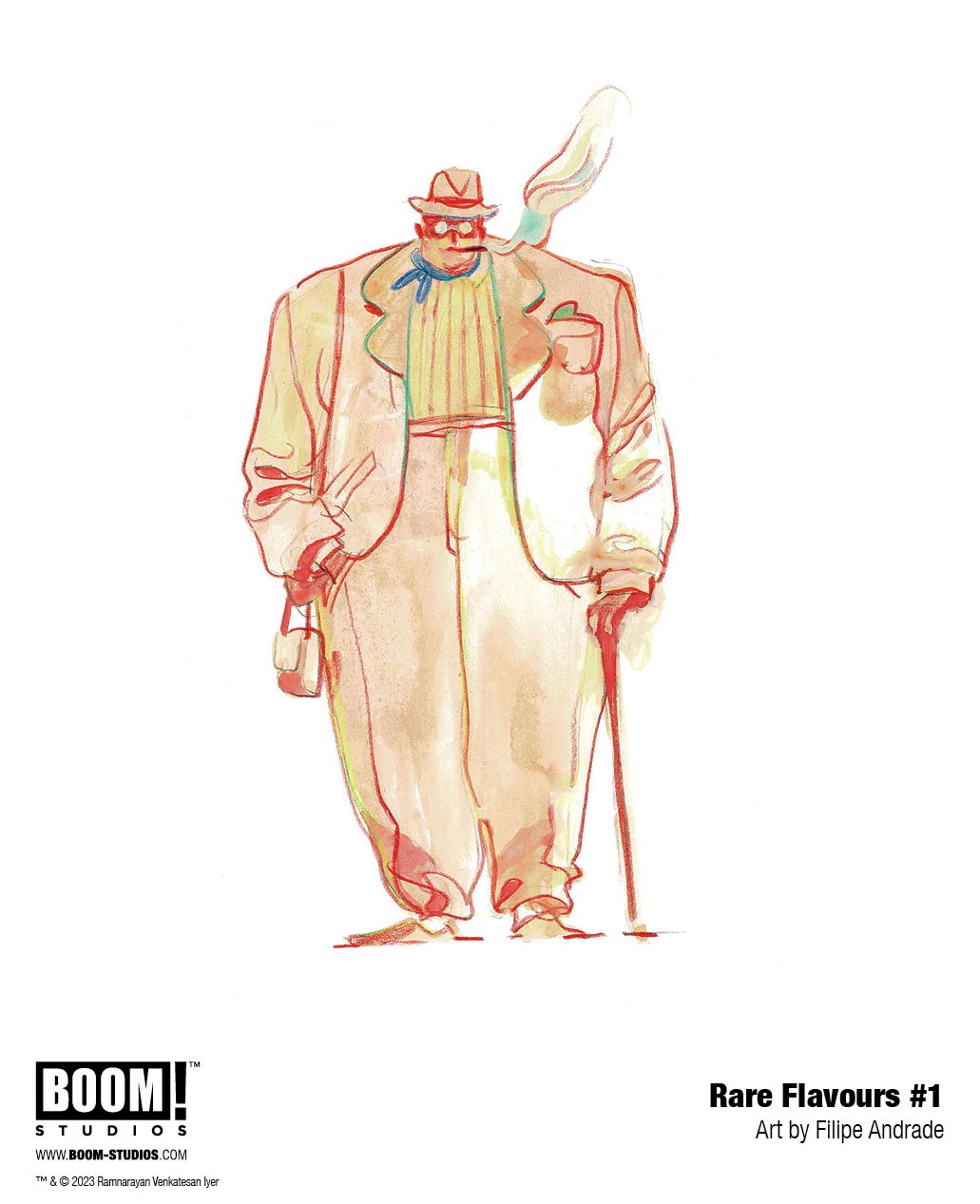
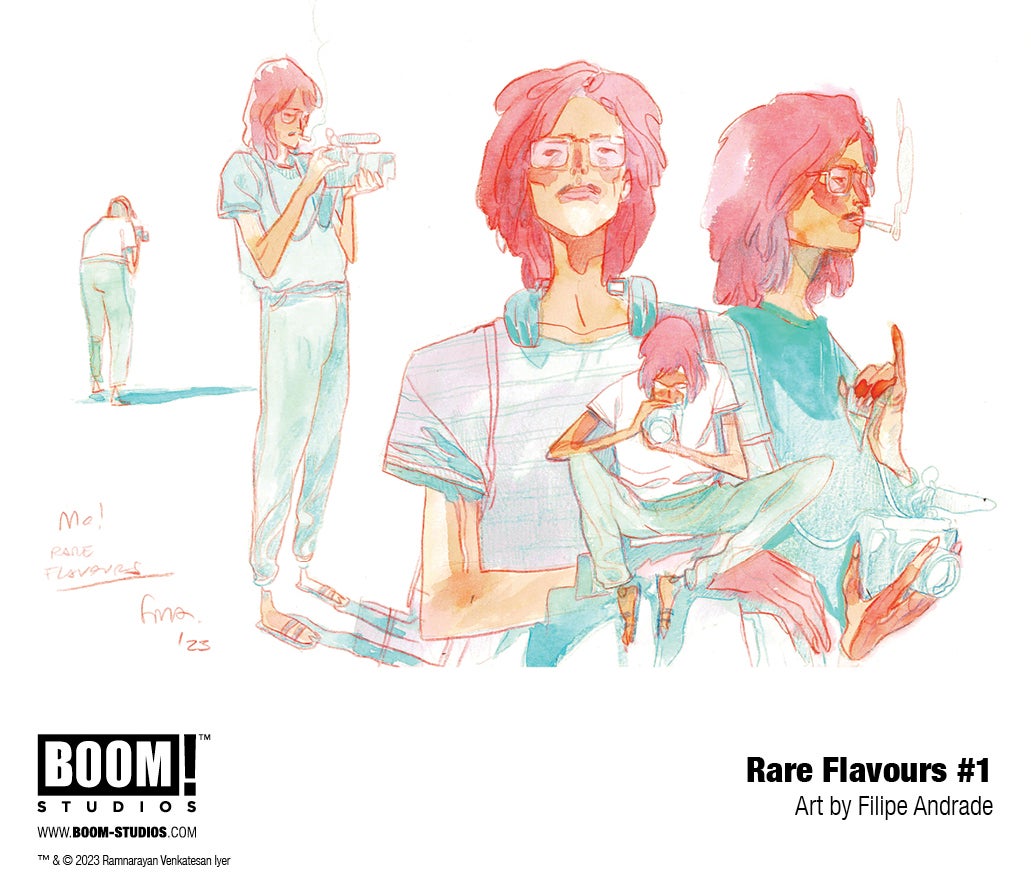
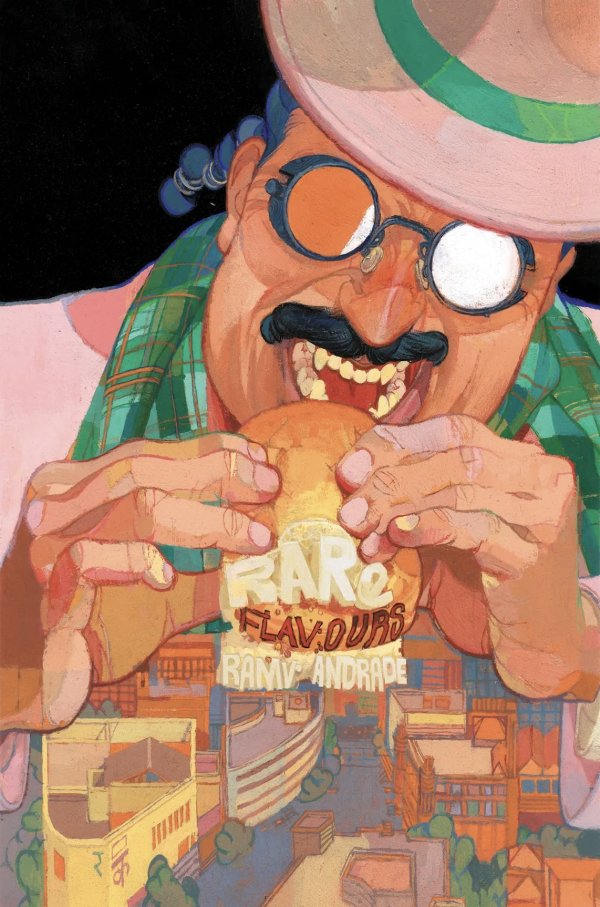
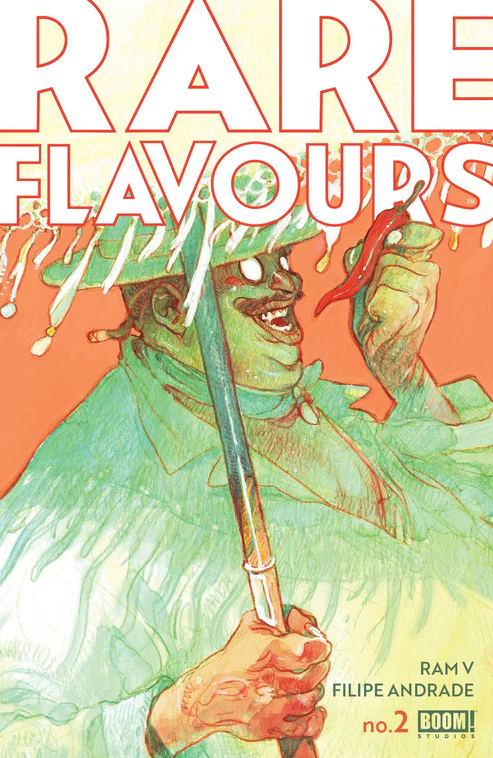
Rare Flavours by ram v/ filipe andrade
I can smell this comic. Okay, that’s probably a weird thing to say. What I mean to say is–this is a food comic set in India, and I can fucking smell this shit. I can hear this comic, smell it, I know the places it’s describing, I’ve tasted the dishes it’s illustrating. And as such, there’s an intimate comfort in seeing these things put to the page and captured in an artform like comics. It’s new to me. I’ve never seen this, and it’s kind of a pleasure. Is this how those Americans feel all the time? Goddamn lucky bastards.
But seriously, this is my favorite Ram V comic now, I think? Not the best, but certainly my favorite. You could consider me biased, maybe I just love Indian cuisine. And you’d be right. But also, this is a beautiful, earthy reversal of V/Andrade’s prior book Laila Starr. A demonic demonstration of human beauty and the capacity of human art–the difference between mere consumption and appreciation. Between Content and Art. Between Hack and Artist. It’s about what it means to express yourself and why you do so at all in this world, what makes it worth it.
Every scene with Baksh and Mo traveling India and having their back and forths reminds me of my own father and me, sitting somewhere, arguing about something, him trying to explain something to me, detailing things he knows about this region of India. So much of this comic feels familiar to me, it’s like home. What a strange thing to feel from a comic. But I’m glad I get to. This is brilliant stuff, with each issue structured around a single dish that is thematically appropriate and also culturally specific, it’s a love letter to not just the Indian food that it showcases, but the very places, culture, and context that birthed them. Here I am reading a comic that mentions Shah Jahan!! Hell yeah dude. But even besides the familiarity and comforts it evokes, it’s a comic that smartly uses its structure and limited space to tell contained singular short-stories of different people across each issue. The kind of people you would overlook and never think much of. The people who are never the stars of stories, but are shadows in the distance. And as such, each issue has a glorious episodic quality to it with a lived-in texture. It works on like 5 different levels as a book, and is endlessly re-readable.
Cheers to Ram and Filipe, they’ve got another classic in the bag.
My Name Is Shingo by kazuo umezz
Honestly just a masterclass in tone-management and mood-building. Kazuo Umezu passed away this year, RIP king, so you might think this is a tribute to honor the man. But no, he doesn’t have this slot because of that. He has it because My Name Is Shingo is absurdly well-put together and is just damn fucking good. There’s just no denying it. That second volume in particular is such a tight-rope and by the time it ends, you’re like ‘Sonovabitch’.
This guy man. He was really one a kind. What a master. No wonder they called him The God Of Horror Manga. He was singular, and his library of work speaks for itself. I hope you’re at peace, old man. Thank you for all your work, you gave countless people joy and scares, and inspired legions of great artists across generations. Hard to imagine a finger legacy.
Can’t wait for more volumes of this weird freakish little manga that’s at once hilarious and horrifying the way a great thriller ought to be.
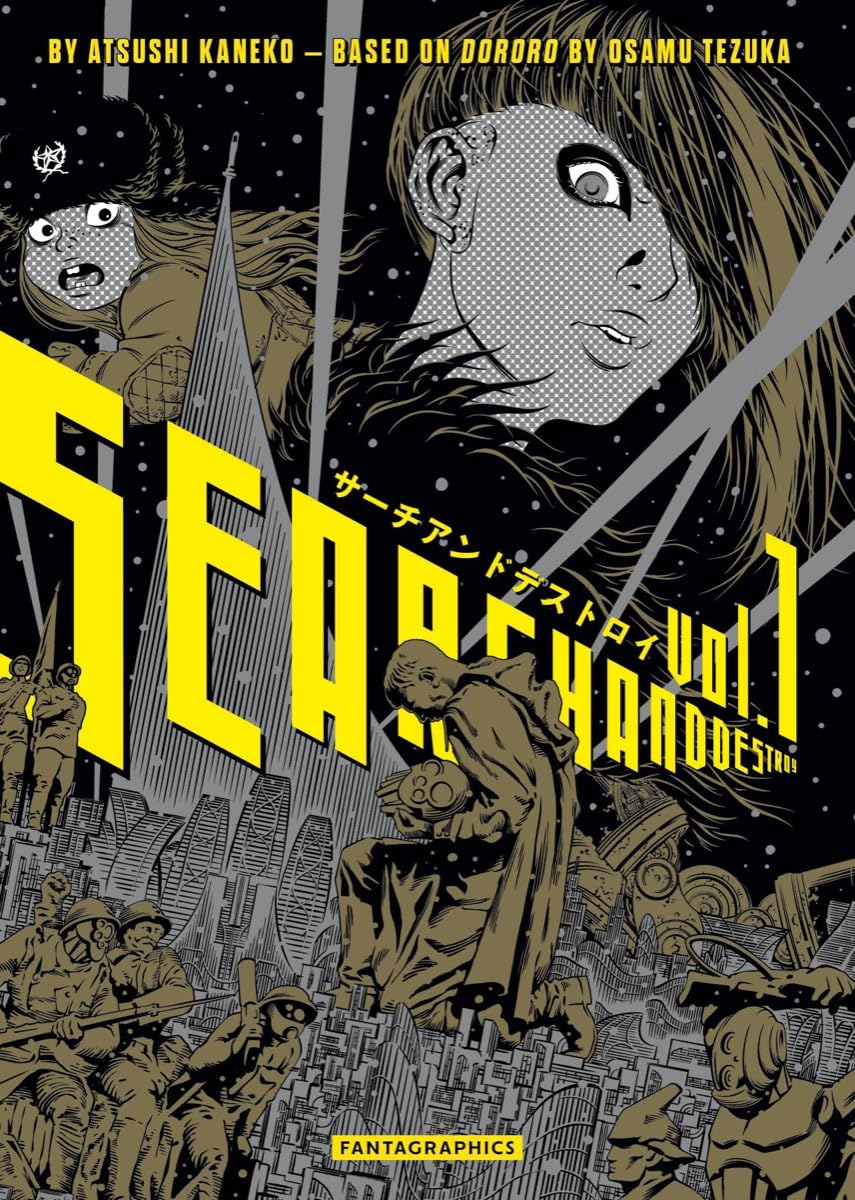
Search and Destroy by Atsushi Kaneko
Nobody makes angry punk action comics like Atsushi Kaneko. He’s a clear Western Alt Comix guy. You can tell, and he’ll even talk about it at length. But the way he blends those influences of his, as well as his general love of punk, into the manga influences of the scene he was raised in? It makes him special. He’s one of one, and his work is just electrifying. There’s such rage to it. His leads are always loners against a dire world, with such burning fire in their hearts. His current comic EVOL might be one of the best things coming out right now, but it’s really his reboot of Tezuka’s Dororo that’s made him recognizable to the English audiences at last. Mangasplaining and Fantagraphics have teamed up to publish this, and I’m so glad.
It’s pure signature Kaneko comics, and it’s honestly way better to me than the original Tezuka. Which I realize is probably sacrilegious to say, but also I was never a Tezuka guy, I’m much more partial to Yokoyama and Ishinomori. A comment I realize would enrage Tezuka, because it enraged the aptly named ‘Jealous God’ of manga even while he was alive. But hey man, it’s true. And Kaneko’s cyberpunk sci-fi revamp of Tezuka’s work just lands for me so much more. It’s just totally my jam. I can’t wait for more volumes to come out, it’s gonna be so much fun.
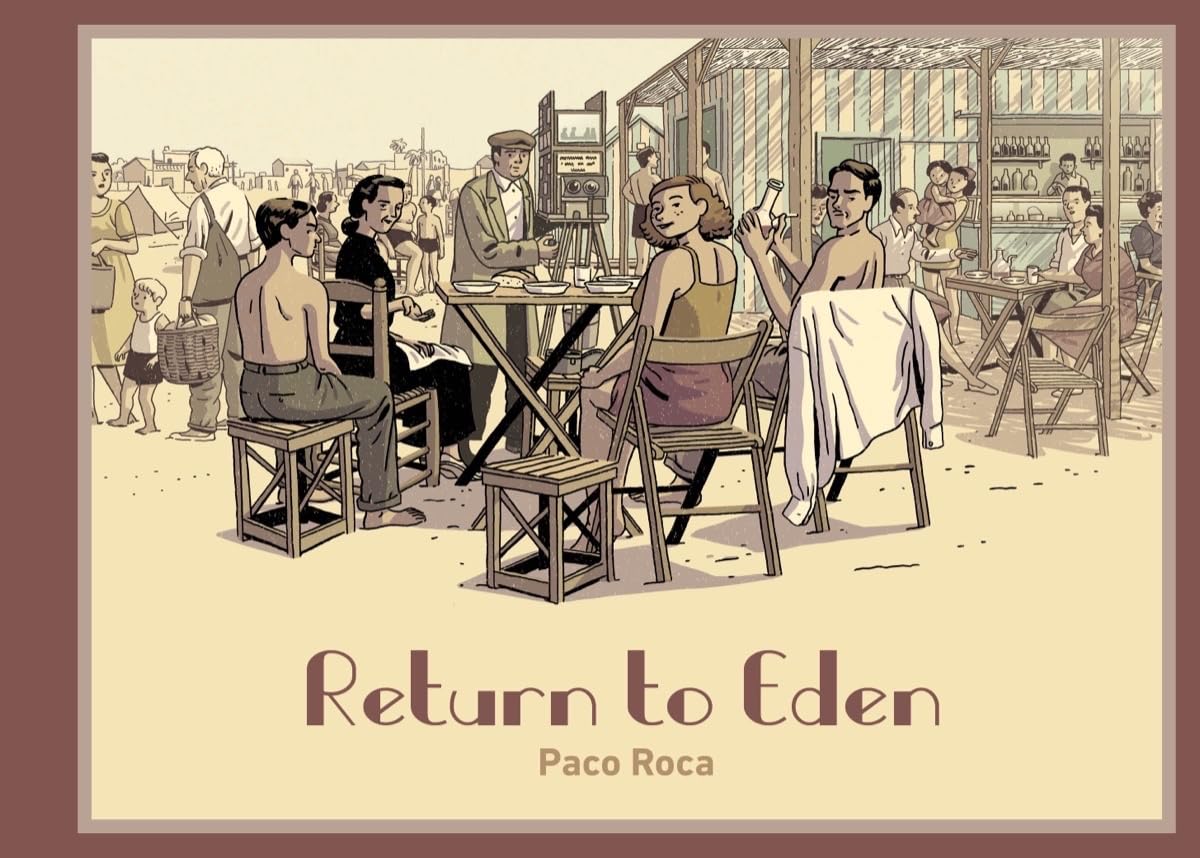
Return To Eden by Paco Roca
Paco Roca is probably THE Spanish cartoonist of the modern era, I think? Certainly given his prolific output, the sheer quality of it, and the way he keeps evolving, he’s an artist one cannot afford to miss. He just always delivers. Whether it legal dramas about lost treasures or labor histories in Spanish comics publishing, the man just delivers. He has yet to miss in my book and is one of the finest European cartoonists.
But if there’s perhaps one key obsession that Roca returns to, it is (rather appropriately) the Spanish Civil War and its haunting influence. He’s broached the subject before in his books, getting at it in various ways. But here he does so in perhaps the most viscerally direct way, telling the story from his mother’s point of view, as she lived through Francoist fascism.
And just the opening of this book alone on the very idea of image-making, image-construction and memories, it’s a formalist tour-de-force in exactly the way you’d expect from Roca. It’s arguably his most personal book and it’s a hell of a read, as he digs into his own family history to explore a trying time in both Spanish and European history.
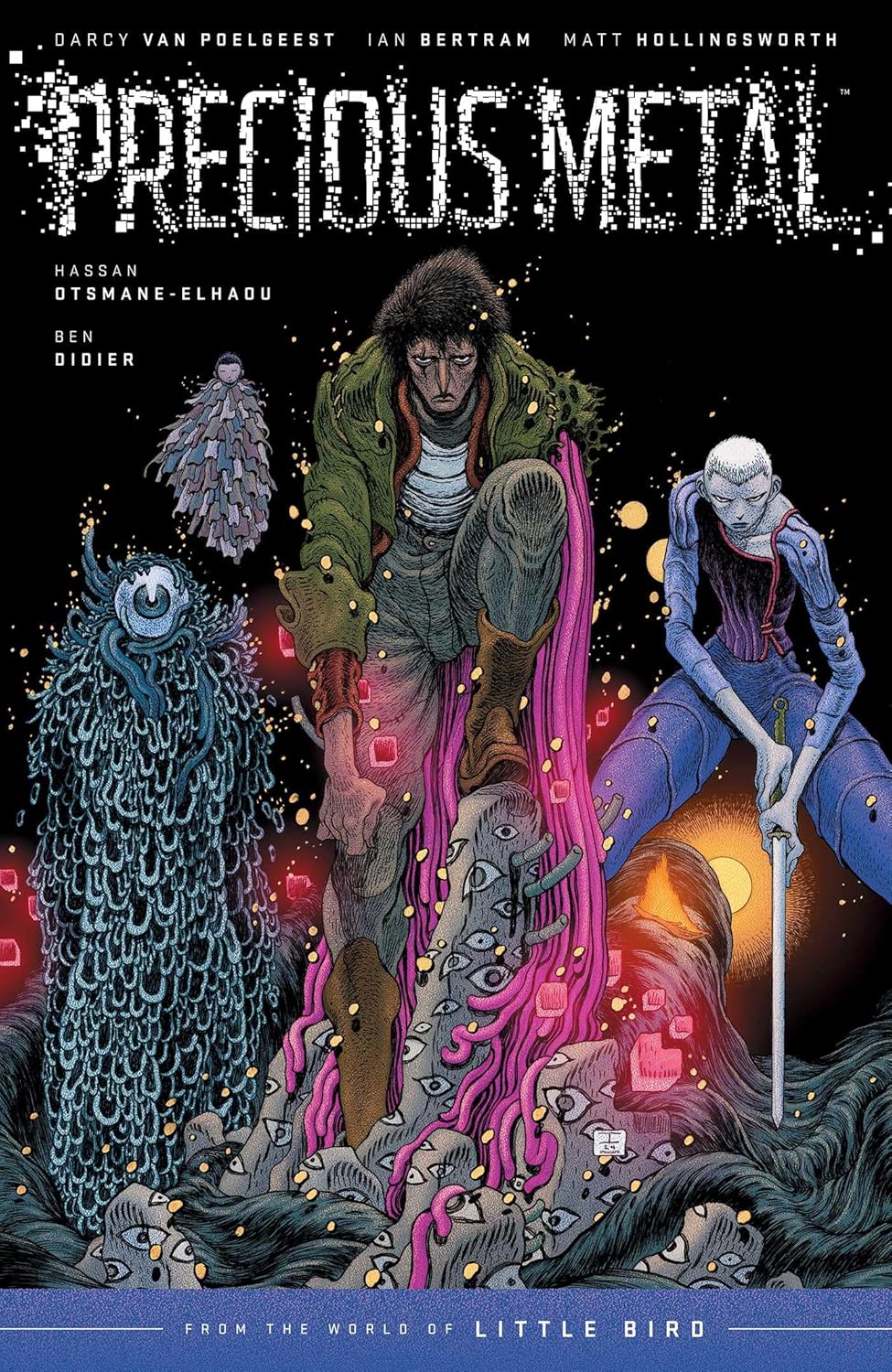
Precious Metal by dvp/ian bertram
Bertram remains one of my favorite artists, very much cut from that Moebius-inspired Quitely school of illustrious, textural detail wherein you can feel very fold of cloth and every wrinkle on the skin. But his figures bend and twist more, they’re most ghastly and gangly. And together with DVP, he delivered his finest work via Little Bird a couple of years back. I really dug Little Bird.
And this prequel is arguably even more beautiful and well-crafted, as Bertam and Hollingsworth together have never looked better. The pages are gorgeous, and getting to revisit this world ruled over by the Christo-Fascist Imperium Of Americas felt well-worth the trip.
The Last Delivery by evan dahm
I initially intended to just flip through this. Y’know, I’ll take a look at the interiors for a bit, get to it later. Whatddya know, that was impossible, because once I started, I couldn’t stop. I was locked the fuck in.
A tightly wound dark fantasy fable about the futility of of capitalist work-practices, and the absurd world of excess and ritualistic cruelty that it exists within, as the hedonistic capital class lives it in up in monstrous ways. Now, that can seem didactic, but thankfully, this isn’t that kind of comic. It’s just a damn good tragedy of this little delivery man, this poor gig-worker trying to deliver his package and get his damn signature so he can get back to his work.
Too bad his delivery is to a place no soul should have to go, much less endure. Set in a nigh-labyrinthine house of horrors, it’s a great bit of horror with fantastical absurdities all over the place from one of our finest working cartoonists. Dahm just kills it on this. I’m surprised it’s not on more end-of-the-year lists this year. It really should be.
A tremendous tone poem about the experiential horror of living amidst an apocalyptic world with an oppressor who just will not listen or change. The kind of thing that could easily be annoying or boring in other hands is transformed into a sweeping, emotionally rich, and evocative piece of comics poetry that relentlessly reinforces a tonality and a horror that feels all too-real and of this moment in the 2020s. It’s about all the experiences of reaching out and dreaming of a better world, and seeing those dreams eviscerated. It’s about extending help, only to find you are unwanted and in fact blamed for the problems to begin with. Until of course the time to pretend there is no problem at all starts, of course.
More than anything, it’s a comic rooted in feeling. It’s why though it is quite short, no longer than 30 pages, it hits. Every page is working towards that feeling. Every page is a unit in the larger composition here like a beat in a great track. It’s short, it’s bleak, and it’s just right. Stephens remains one of my absolute cartoonists working today, and I really do wish more people read her work.
P.S.- I can’t wait to see the next part of her incredible Darlin’ serial this year!
GLEEM by Freddy Carrasco
Pure propulsive comics of the sort most Western comics wish they could do, really. Carrasco is practically flexing on this goddamn thing. The transitions in this are so bloody good, and the cartooning is so confident, so expressive, and so darn precise that I’m always kind of in awe. He’s such an easy read, and in the best kind of way, the way truly great cartoonists are meant to be. The sheer sensory experience of GLEEM as a collection of short-comics is just a delight if you love comics as an art-form. I’m so thrilled Carrasco’s got new stuff coming next.
The Guy She Was Interested In Wasn’t A Guy At All by Sumiko Arai
The title really does say it all in this case. A charming Lesbian romance comic that begins with misconceptions and misunderstandings, like all good romcoms do. I grew up on Romance manga so I’m a total mark for a good one, and Arai has such a sense for strong characterization. She just knows how to nail a person effectively and immediately, without them feeling like a dull card-board cutout archetype in the way that it can be easy to.
Beyond that, the way this uses color is remarkable. Arai sprinkles in green so deliberately and so effectively that it’s stunning when it appears, and it creates for such clear and memorable aesthetic identity that defines the whole book. But even beyond that, its structured into these little vignettes and short-stories that are perfect little comics on their own but collectively build and build into a serialized drama that really delivers, and is paced super-well both in the micro and the macro. This blew up big time in the manga world, and it’s easy to understand why. It’s just damn well executed. I love good romance comics, especially when they’re put together with such slick craft.
Lunar New Year Love Story by Gene Yang/LeUyen Pham
We were talking about romance comics, weren’t we? This is a pretty good one. Rooted in Yang’s recurring interest in cultural syncretism but taken to a new place and outlet by teaming up with LeUyen Pham, we’re treated to an Asian-American romance drama about two unlikely people.
And it centers around the tradition of Lunar New Year, as well as the ceremonial dances and performances around it, with our messy duo discovering who they are both together and apart. It’s Classic Romance, it’s the kind of ‘go get ’em!’ esque sweeping thing, and it’s sweet, charming, well-drawn, and a surprise after Yang’s Dragon Hoops. It’s likely not where anyone would’ve expected the prolific cartoonist to go. But it’s a joyous tale full of generational trauma, messy Asian-American families, intra-community drama and a whole lot more that feels wholly appropriate and exactly what you come to a Gene Yang comic for. But even more than Yang, LeUyen Pham kills it. There’s such striking spreads and splashes in here that express love and myth in symbolically slick ways that are memorable. And she carries the whole book with her cartooning strength.
The Gulf by Adam De Souza
Adam De Souza’s been killing it for a couple of years now. Between Blind Alley, the webcomic that’s always funny and charming, and the Ish collection of experimental work, I’ve always been a fan.
But this is probably the most single piece of sustained work Adam’s done, and it’s a delightful coming-of-age yarn that looks like nothing else on the stands and is so much fun to read through and go over again and again. If you missed it, I say give it a shot. It’s a great time.
I dig a good Dark Fantasy, and at 74 pages, this is just that. Zhu creates a lovely hybrid that takes as much from manga as it does european cartooning to create a lovely, tight little fable with tragedy all over it. It’s a Great Quest narrative inter-cut with backstory that wraps up neatly by the end, and it looks utterly gorgeous while doing it. It’s like a splendid BD Album. What a treat.
Haus Of Decline
So consistently the very best webcomic I read. It’s short. It’s tight. But it always hits. It’s minimalist, but so so precise. Great comedic timing, great execution, and just an absolute riot. I’m surprised this is not on everybody’s list constantly given how much joy this comic brings. But I think it especially deserves a mention this year for its long-form serials, which have been absolutely stunning. The absolute standout, of course, being this one. Centered on a character aware of his existence being a fictional figure caught in one-page vignettes, it runs wild from there to produce a poignant and thrilling journey that runs up to 70 pages. That’s long enough to be a contender any year, and so it is in my book. Haus Of Decline is simply brilliant.
Cutting Season by Bhanu Pratap
Bhanu Pratap is an interesting one. I’ve always wondered what do comics from our region of the world look like? What do they mean? What does it entail to be ‘Indian’ comics? Or ‘Pakistani’ comics? Or ‘Bangladeshi’ comics? Or ‘Kashmiri’ Comics or ‘Nepalese’ Comics or ‘Sri Lankan’ comics, on and on.
It’s difficult given our region’s history as a once-colonized place, particularly as you see the places with big, storied comics eco-systems and scenes are often explicitly imperial and colonial states that have benefited from resource extraction and being ahead via the very history of printing/publishing and how access/wealth fit in with that.
It’s no accident that America, Japan, France, and Britain, and other imperial peers are the ones with the ‘biggest’ comics eco-systems. Their histories explain why they have it, including the powers of their currency.
But still, art persists, as it always has in colonized places, wherein people made their own to the best of their ability. And we see that all over the world, including here. Political cartoons in papers to long-form work, it has all been done, despite the difficult circumstances. But really, when you say ‘Indian comics’, usually three things come up:
a) Tinkle Comics (Gag Cartoon Strips) b) Amar Chitra Katha (Hindu Mythological Retellings) c) Raj Comics Superhero Garbage (Terrible American mimicry material)
All of these hold nostalgia for many, but by and large, they’re not terribly good. And a lot of Indian comics have spent a great deal of time trying to iterate in the vein of this, to produce a whole lot of garbage no one cares about.
As such, there’s no rich, interesting, identifiable styles or visions here of comics the way you can find in Bandes dessinées over in Belgium or France with Ligne Claire, the masters you can find in Italian Fumetti, or the titans of Spanish comics or Argentine comics, or even British comics, forget American and Japanese. There’s some rough expectations of ‘This is how a Japanese comic looks, this is how an American comic looks, this is how it tends to be lettered’ and so on, even as that can be shattered (and indeed has been) in the increasingly global world of comics production.
‘Indian’ comics has no such thing. It is, to me, a wide-open space. The most interesting work is being done now, with major Indian creatives working for publishers abroad, making books for different international markets, given the Indian comics scene is not a conducive space for them to be able to do what they do. Ram V, Anand RK, Sumit Kumar, Aditya Bidikar, are at the forefront of this at the current moment, though there’s many more. They’re probably the biggest.
But none of them are as experimental or as wildly out there or weird as Bhanu Pratap. Pratap’s work is so clearly drawn from a love of alternative comix and refuses to conform to be anything mainstream. He’s so unlike anything that came before in Indian comics, and feels like the face of the ‘alternative’ vision of Indian cartooning.
His figures bend and twist in unusual ways, he makes striking use of color, and his work has such adoration for abstraction, with fierce purpose and pointed humor being found in it. I have such fun reading comics, and he reads like nobody else. He’s a fascinating hybrid comics artist who I frankly could not get bored of. A whole bunch of his short-stories are collected in this collection by Fantagraphics and they’re a riot. In a landscape wherein it is easy to be generic, Pratap and his work standout. He’s gloriously weird, and the world needs more of that. Weird cartooning is cool.
I could go on and on about this one and turn in a whole essay reflecting on Pratap’s work in relation to ‘Indian Comics’, and this entry betrays my impulse to do so, but alas, I’ll have to keep this short and cut it here. But yeah, very quick read and very enjoyable read.
Anzuelo by Emma Rios
An apocalypse as lived. Emma Rios is one of the sharpest cartoonists working right now, and her crafting this weird, wild book of people trying to survive the end of things is simply one of the most memorable piece of comics work I’ve read this year. The painted-water colors, the delicate lettering that looks like hand-writing, every aspect of this feels so naturally crafted by hand, by a singular voice.
And there is simply no other comic out there this year that looks anything like this. It is so utterly distinct. There are images in here seared into my head, and in terms of sheer image-making, and memorable, distinct image-making, this is up there as one of my favorites this year.
Initially, I tried to read it all in one go, but that felt off. So I slowed down and read this in the short vignettes it’s almost designed in, and that flowed much better for me. It works best in almost that serialized form. It’s the kind of thing to take your time with and savor, I feel. I do wish it had more of a clean structure at certain points to delineate the passage of time more cleanly, but also I totally understand why it doesn’t. That sense of time breaking down, being non-existent, at the end of all things, of everything all at once, that makes total sense to me.
I’m glad this exists, and I really do hope we get more from Rios as a cartoonist. I’d love to see more tomes from her, with her singular style and voice.
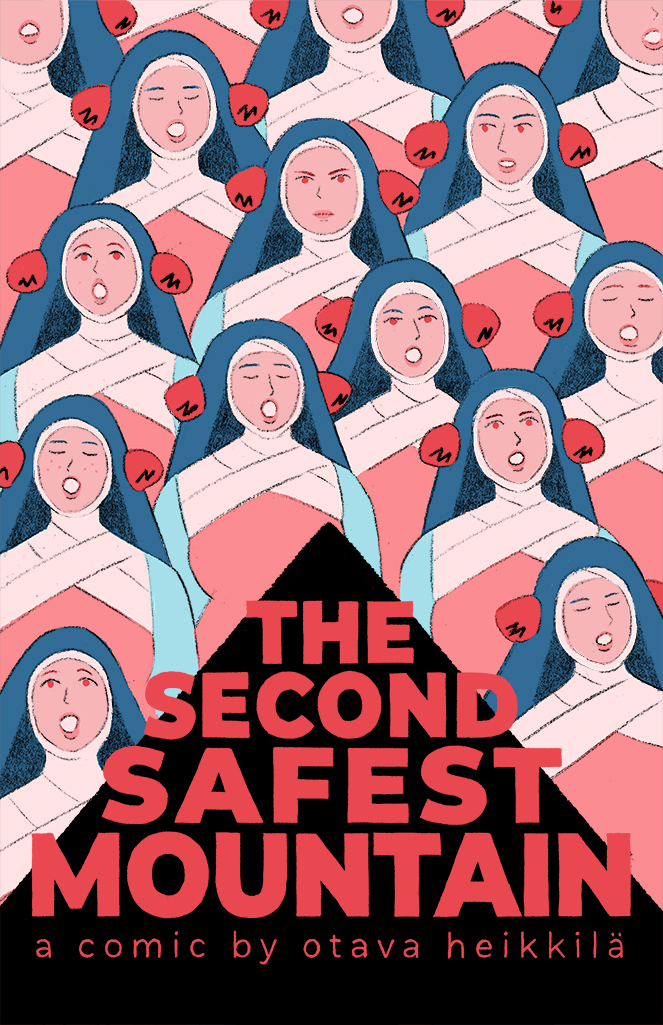
home by the rotting sea by Otava Heikkilä
I really loved Heikkilä’s Second Safest Mountain from last year. And Home By The Rotting Sea feels very much like a spiritual successor to that. It continues Heikkilä’s recurring interest in exploring female companionship amidst oppressive patriarchal systems designed to destroy them. Both of them are set in fantastical dark fantasy settings, of strange celestial creatures and fictional beings like the Giants. And over and over, across both, we see the common, everyday violence that is ever-present and ever-expected, as well as how these women cope and have coped in the face of that.
There is a Content Warning for this with regards to Sexual Assault, so do go into it knowing that.
At about a 100 pages, this is roughly a OGN/Two BDS/a mini-series length exploration of two women who’ve been sent away by The Human King to the settlement of the Giants and must try to survive there. It’s all about living and adapting in a different culture, particularly as people who’ve lost all there is to lose over and over again, having been objectified and discarded by the monstrous machine of human society.
One of those comics that when it ends, it made me go ‘Oh! It’s over already?? Damn. I’d have happily read more’. I really look forward to Heikkilä’s offering next year.
For sheer visual flair, this might be my favorite thing this year. It’s a bit over-written for my tastes at points, so it drags to a halt at points in those specific sections, but once it gets out of them and out its way, it’s simply a visual feast. And the kind of thing designed to be read more than once, over and over, which is also why I understand those dense sections being what they are.
I can’t describe it any better than it describes itself- ‘A trans/(anti-)military/sci-fi comic set in four timelines. Jack, a genetically modified supersoldier, and Nour, a displaced sniper, find each other on opposite sides every time. Unknown to them both, their lives are defined by the existence of a weapon that puts the worlds into motion.’
And that is indeed what it is. And it is at its most glorious when Dáire just cuts loose as a cartoonist and runs wild with the visuals.
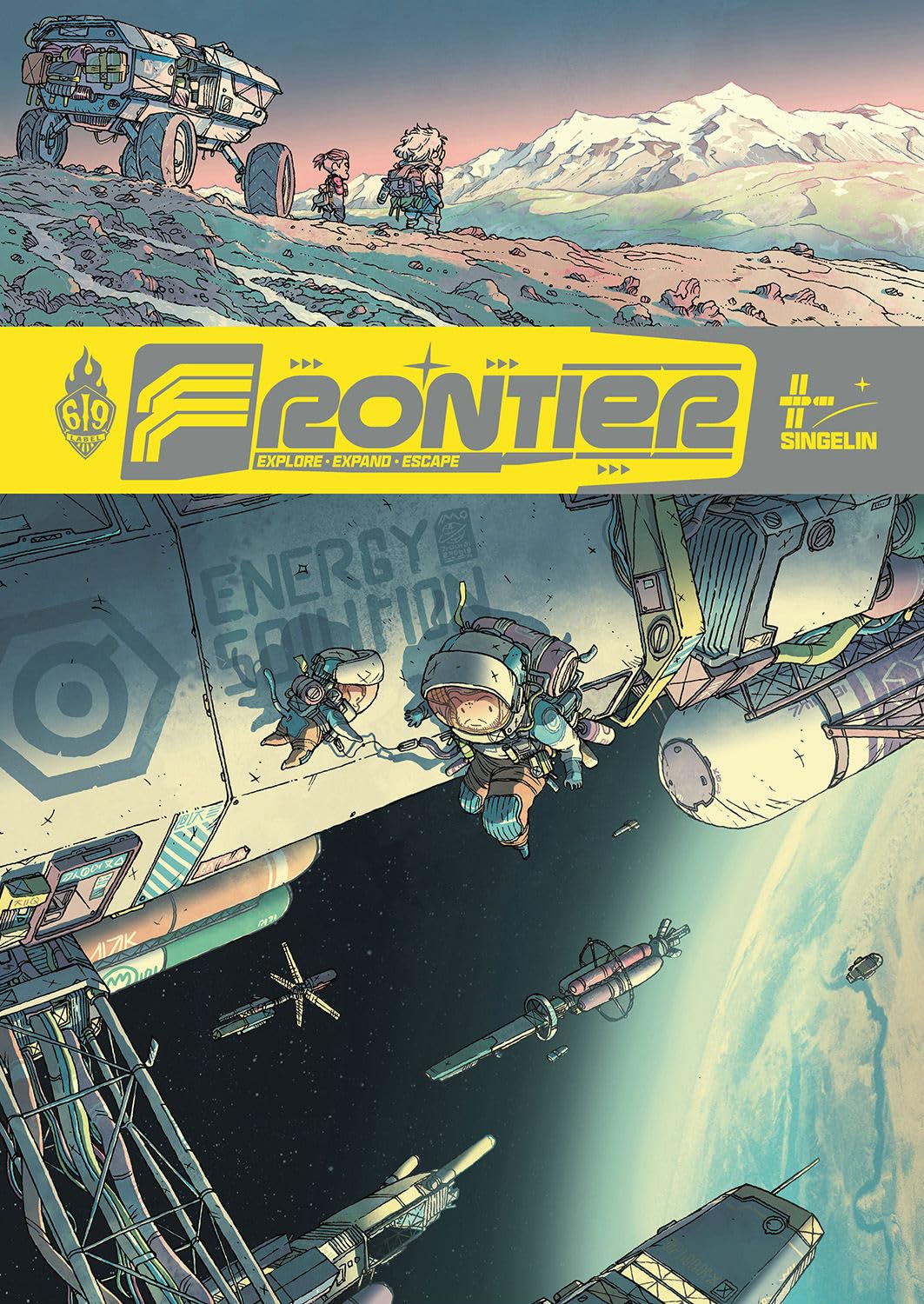
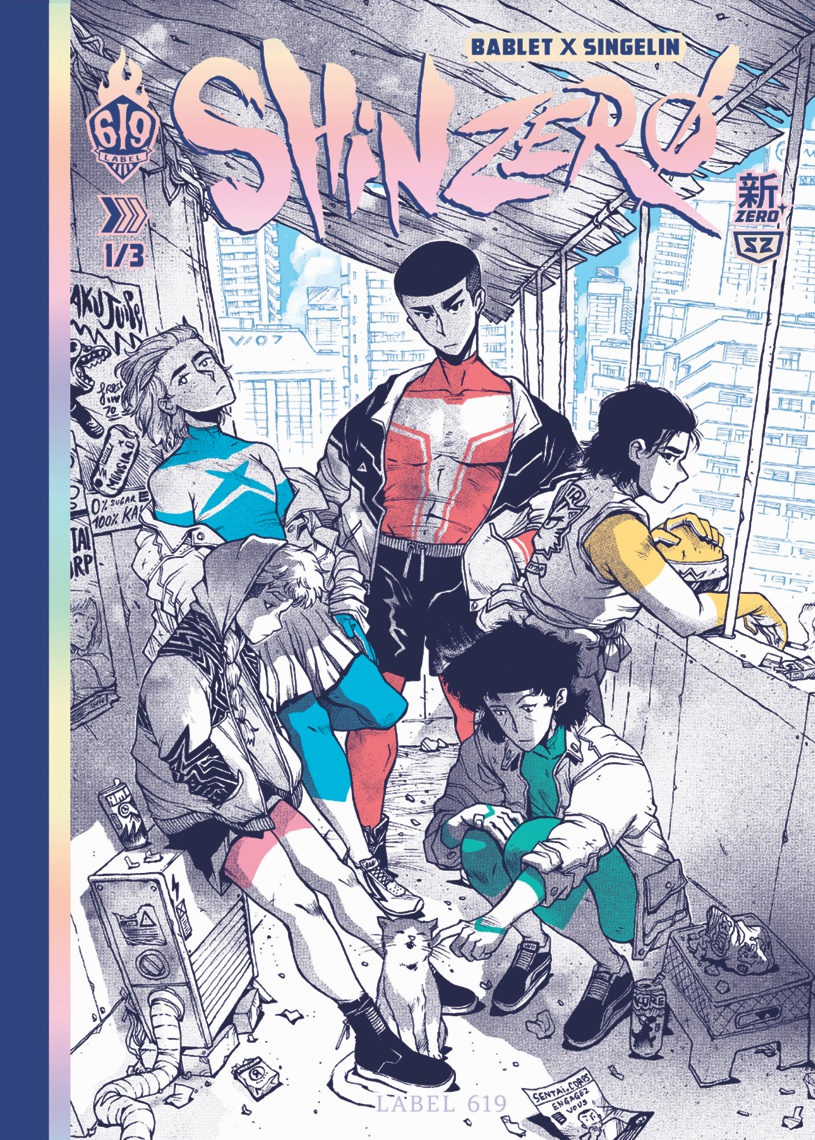
Frontier by Guillaume Singelin
One of our most talented cartoonists sits down to draw a spectacular sci-fi about labor in a techno-dystopia, and the result is a really satisfying, lived-in piece of work. I’m not super fond of the chibi-figures approach here, but the actual backgrounds, vehicular design, and dialogue alongside what the overall text is doing really did keep me engaged. And I can safely say no one else in Western comics is perhaps doing it like Singelin is here.
Super fun, sci-fi comics that’s just a good human drama about people being weighed down by the capitalist rituals and reduction they have to endure.
The Russian Detective by carol adlam
This kinda lit my brain on fire with all its delightful formal play. I don’t really care about the story or whatever in it, but just purely on a drawing level and playing around with form, this made me giddy as hell in a way that I treasure. I frankly wish more comics made me feel this way. I’m not sure if it’s good necessarily, but it’s something that stuck with me, so it’s here. Make of that what you will.
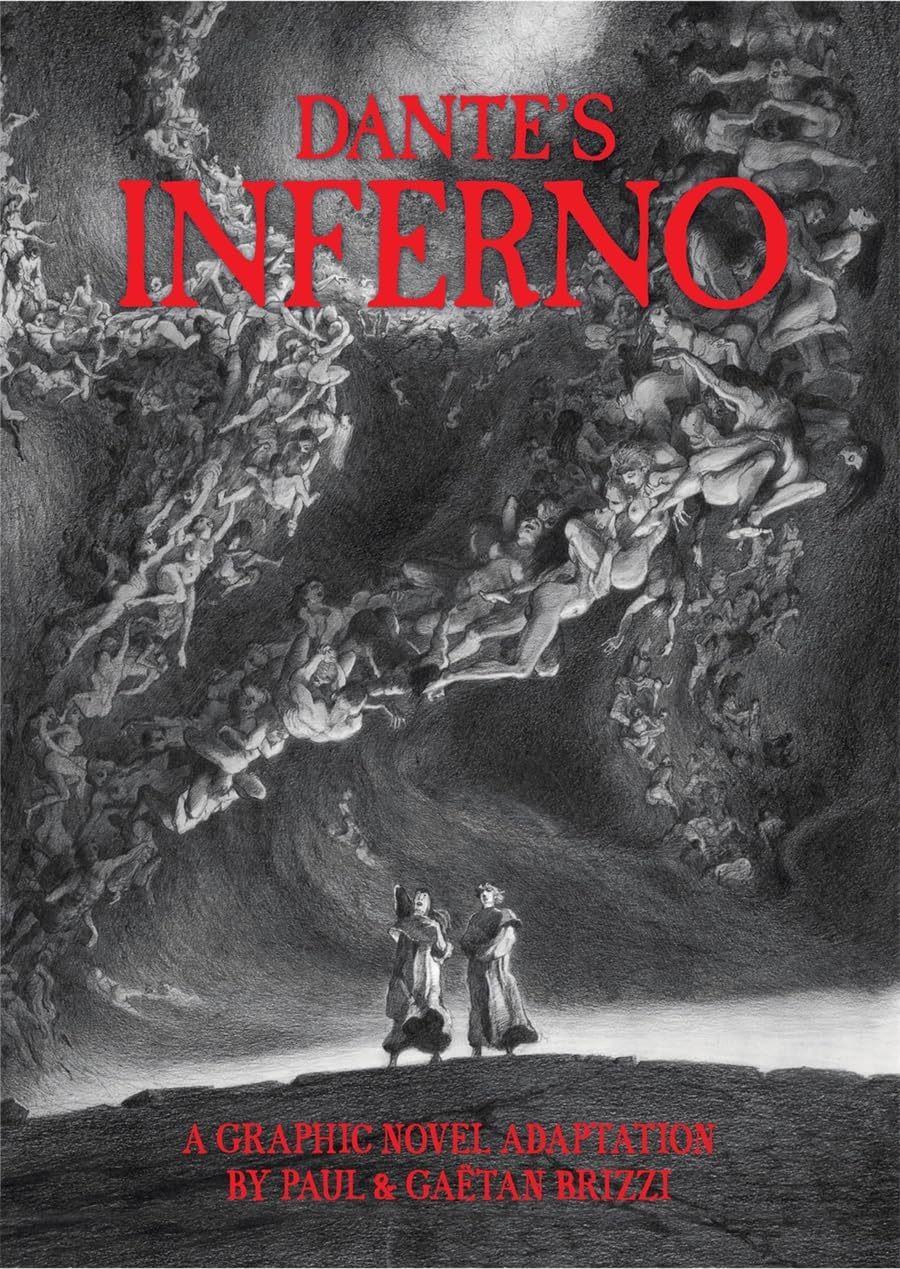
Dante’s Inferno by paul and Gaëtan Brizzi
Veteran animators Paul and Gaëtan Brizzi team-up to tackle the iconic poem, and the results are simple gorgeous image after gorgeous image. In what is surely one of the most visually striking and evocative adaptations of the material, it is a tremendous artbook of Black/White pieces that I could just stare at forever. I really do hope more of their comics work gets translated to English, beyond this. Their compositional skill is superb.
frogocalypse by matt rockefeller
I had a stupid grin on my face from the first panels of this. A legion of humanoid frogs mean to conduct an operation against humanity in order to save the earth from human-driven climate collapse. And across 85 pages, you have a delightful and tragic story of a guy getting caught up in said operation, becoming the Frogs’ Token Human. When a Frog that’s basically a weeb for Human Culture and Humans showed up, I lost it. This is both incredibly silly and funny but also completely sincere and serious, without a hint of any ironic detachment or distance. Which is why it works. Very charming read that stuck with me and is constructed tightly. I’d happily read more if Rockefeller ever chose to make more. But I think it’s kinda perfect as the short piece as is, too.
NOT EXACTLY 2024, BUT READ IN 2024
Okay, these weren’t precisely from this year, but they bang. I’ve obviously read a ton of comics that are older, and they aren’t all in here (for instance, Gundam: Origin which I’ve been slowly reading, and totally rules, is not on here). But the ones that are here I feel are the highlights that I think are worth highlights. I don’t need to tell you Asadora, Dandadan or Chainsaw Man are great, y’know? You already know that. You know Akane Banashi rocks. This is about all the others.
Social Fiction by Chantal Montellier
Honestly, reading this just pissed me off [highest compliment]. In that, how have we been locked away from Chantal Montellier’s work for so goddamn long? Reading the foreword of this alone, describing how English Translations of her work botched things, it feels like borderline sabotage. It’s goddamn criminal that one of the most vital cartoonists and a pioneering artist like her was denied a wider readership via proper translation.
Montellier is a feminist trailblazer of French comics who made sharp political work, and this collection of a number of her stories is tremendous. WONDER CITY is one of the best short-comics I’ve ever read and might genuinely be the best of its type. The cartooning in this man. Man. The use of color alone. Montellier is maddeningly fucking good. It feels like downright robbery that her work was kept away from non-French speakers for so long and denied a greater audience and applause. Because it deserves it. It absolutely deserves it, far more so than so much of the crap we’ve seen paraded about for decades. This came out in late 2023, and I only got to check it out in 2024, but it was so worth it. It gets my highest goddamn recommendation.
the Buzzelli collected works by guido buzzelli
My friend Harry Kassen put me onto this, and my god. Buzzelli was really ahead of his time, much like Toppi, Breccia, and others. There are pages he does that feel light-years ahead of the period they were published in. He feels ahead of the curve, and there is such wild, free-spirited cartooning skill in play here. The Labyrinth in particular is such a well-cartooned bit of absurdist dystopia that feels oh so mundane. Buzzzelli plays the apocalypse as almost a farce and what you get is this weird midpoint between the likes of Eisner and Mézières.
This is the kind of guy you DO wish did an elaborate and sprawling adaptation of Dante’s Inferno, because his sensibilities matched with that feel like they’d really produce something fun, even beyond Buzzelli being Italian.
The Wrath Of fantômas by Olivier Boquet/Julie Rocheleau
The ultimate modern revival of the greatest phantom criminal. Bocquet and Rochelaeu do a deliciously enjoyable presentation of one of the most deadly fictional figures to emerge from the pulp scene, preserving all his monstrosity and macabre sensibilities. This is not the charming Arsene Lupin. God no. This is Fantômas. He’ll kill you and skin you.
And Rocheleau’s work here is some of the most gorgeous you can find in comics. This has to easily be one of the best lettered comics I’ve ever read in my life. It’s not even a contest. It’s ridiculous how much personality there is in the lettering, and the way it’s customized to each moment or character or mood, particularly combined with the magnificent colors. The colorwork on this is out of this world. Rocheleau is simply marvelous.
the chimera brigade by serge lehman/fabrice colin/gess
So my good pal Serge put me onto this given he’s in France. He asked me ‘Have you read The Chimera Brigade?’ and I was like ‘No! Let me look this up!’. And I did. And I was struck by having heard no peep on it. And as is my nature, whenever I find a blind-spot, I try and do my level best to correct it and fill-it up. So I went in. I went all-in and did my research and worked my way into it.
Serge Lehman, Fabrice Colin, Gess, and Céline Bessonneau together ask a simple question– What if the world’s first super-humans emerged during The First World War via Marie Curie’s Radium Research?
A premise that feels so damn obvious that it feels absurd that it took a French creative team in the mid-2000s to be the first ones to do it. What does that tell you? It ought to reveal how utterly creatively bankrupt the landscape has been and still is. How much room and space there still is in this shit, and how this is a domain that’s largely been one for careerist hacks. It’s goddamn embarrassing to never have done such basic ‘what if’ science fiction premises for speculative fiction. But then again, as I joke, the direct market and conversely superhero material is where science-fiction ideas go to die, and become factory sludge.
Jokes aside though, the team, in pursuing this period drama what-if, chart the chronicle of the European pulp figures from the end of the First World War up to the Second World War. And they do it while taking a clear and distinct French perspective on the whole thing too, which is worth noting.
A comic perhaps not unlike The League Of Extraordinary Gentlemen, but different in that a) it doesn’t suck shit b) it doesn’t piss me off with absurd levels of racism and imperialism c) it’s not all over the place and actually feels focused and purposeful, with a clear mission/remit that it fulfills by the end.
It’s a comic with clear Alan Moore influences, from Miracleman to Watchmen all clearly lain-bare, while the aesthetic powers of Mike Mignola are clearly a huge influence on Gess in this period and project. And above all, as any comic of this terrain ought to be–it’s a comic about failure. And it is strikingly honest and bleak in its admission of that and exploration of that, of European complicity, cowardice, and failure, in a way so much American material around WW2 just never is, going for a ‘yeaaaahhh wooo, da american heroes punch out hitler!!’. There’s none of that self-congratulatory, back-patting hero-myth shit to ‘uplift’ the audience and a nationalist myth. It’s instead all about how all this shit ends up serving fascism. It’s precision-engineered pulp work rooted in both very real history and pulp history in such a way that it works.
When I read it, it fit like a glove for me alongside the likes of other texts in this terrain, like Watchmen, 20th Century Men, The Winter Men, and so on.
The SenTinels by enrique breccia/xavier dorison
The book I came to after finishing The Chimera Brigade. A book that is drawn by the legendary Enrique Breccia, the son of the even more legendary Alberto Breccia. The prodigal son of the most talented family of cartoonists to ever live, the Argentine artist teamed up in the late 2000s with then-rising BD star Xavier Dorison to produce 4 French Albums that are truly special.
If The Brigade posited the emergence of the superhumans in WW1 and then cut away to explore the Pre-WW2 period, The Sentinels is a book solely dedicated to living and breathing in that WW1 period itself. It is about a WW1 super-soldier program, and again, is a project heavily rooted in the Alan Moore influence, with it being inevitably about monstrous figures.
Beginning life initially as an Iron Man pitch for Marvel set during WW1, the project morphed when that fell through and Marvel pulled back from its European endeavors. That’s when Dorison tweaked it and really set out to make something unique and deeply French, and when he got out and got Breccia onboard.
The end-result? A proper masterpiece. Breccia drew all 4 volumes in his 60s and it may be some of my favorite work from him, particularly his painted-on colors which are just stunning. It is mature work from the experienced master, before he enters his 70’s and experiences the lull he’s kind of been in since. So this really does feel like a special last treat.
A shame that it is incomplete and is open-ended, with no definitive conclusion, and Dorison/Breccia never got to cover the entire 1914-1918 period of the war across every volume, charting various regions and campaigns. But I am glad we got what we did, and it works really nicely, as each volume feels pretty complete, and where it leaves us IS satisfying and closure enough.
What a bleak, fucked up comic about ‘heroes’ who are as monstrous as any fucked up bastards they fight, about how power corrupts and erodes humanity, all brought to life by one of the greatest artists to ever pick up a pen.
If you’re looking for a reading order, try The Sentinels–>The Chimera Brigade–>Watchmen–>20th Century Men–>The Winter Men.
That should make for a hell of an experience.
graveneye by sloane leong/anna bowles
I finally got around to this after ages, and honestly, it raised my estimation of Sloane Leong so much higher. I adore Leong’s A MAP TO THE SUN. Probably one of the finest comics, esp sports-related comics, to come out from the American scene, cartooned wonderfully well. But cartooning yourself and scripting for another artist are different jobs entirely. And the fact that Leong can do both impressed me, particularly given Leong does it so damn well.
This is a proper Gothic horror piece, with Anna Bowles’ art going obscenely hard. And it’s frankly one of the best comics I’ve seen come out of the DM period. It’s a shame more people have not read it, and that I had not up until now. It’s so tightly wound and so sharply executed. Its usage of captions and simulated sound (or lack there of) is so well done, and it’s such a complete package. God this rules.
manuel (1985) by rodrigo
Hands down one of my favorite discoveries of the year. Thank to pal squarehead333/robin of the GHR blog fame for putting me onto this. Rodrigo is simply put one of the best artists to ever grace the pages of the artform. The sheer compositional freedom, the technical skill and detail, the free-flowing figurework that never feels stiff or static, full of such lively people bursting with life, and a clear architectural background that makes his settings feel really textured and lived-in and tangible. My god. What a draftsman. It’s downright criminal that such a magnificent queer artist has not been reprinted damn never everywhere, particularly since a) he’s so bloody good but also b) Manuel is a silent comic! You really don’t have to do much work to reprint it in terms of translation, re-lettering or what have you. It’s almost good to go.
And it’s such spell-binding comics, too. Just thunderously impactful drawing after drawing, with a range that is wild, and it is simply breathtaking work. I’m so glad I got to experience Rodrigo’s work. And I hope one day more people will too. One of the great masters, truly. It still feels insane to me that this book came out in 1985, because it feels so ahead of its time. Like the best of Toppi, Breccia and other great masters, Rodrigo transcends. He feels as cutting edge NOW as he must have done decades prior. And that truly is special, folks.
direct thoughts on the direct market
The Direct Market…whew, what a dire place. I know we always say that. But it truly is. It’s a market that feels even more conservative than it did a decade ago, which is crazy. It’s even more rampant with IP Farm Publishers and predatory Creator-Shared (but marketed as Creator-Owned) contracts that all bank on Hollywood IP Option/Adaptation money. I know people will defend this as ‘Well, it lets a buncha folks keep on making comics’. And sure. But that doesn’t mean that work isn’t going to be of a Type to fit and suit those IP Vultures, and that it isn’t going to be executed and done in a certain narrow form that feels all too familiar and soul-killingly boring to read. Some do it more blatantly and shamelessly than others, while others effectively do The Respectable Prestige Versions of this. Tynion’s entire body of work, for instance. Basically the queer liberal version of Millarworld. I see that stuff and I fall asleep.
This is the zone where ‘diversity’ goes to die and should frankly never be expected. And the very rare ‘diversity’ that you do get is often the most hackish bullshit. Like the terribad or forgettably mediocre YA sludge equivalent. Just the same ol’ boring white writer IP Mining shit, except y’know, with a different identarian filter. Which just sucks. Like, sure, yes POC talent ought to be able to do mediocre shit like all the crackers too, sure. But also, I’m not here to care about boring and mediocre ass art. They can make that and get their bread. I’m just not obliged to care about it.
It’s why by and large, all the exciting diverse talent is self-publishing, in the book market, in webcomics, or in other global markets. The DM is a deadzone that has only gotten more and more insular, priced out more and more folks, with a shrinking demographic of oldheads, designed to sell IP over art. I have no hope for it in the long-run. It’s a shitshow.
This past year I feel like I really dipped back in and gave it an earnest shot again, trying out all the big new launches/relaunches and initiatives, and by the end, I’m left bored. And there is one big pattern I can’t help but notice-
everybody’s got a (uni)verse
It used to be that Marvel and DC had their own Shared Universe Books. Then Image came along and introduced their own solo Big Universe books, whether across multiple books like Jim Lee’s Wildstorm or in a more focused manner like Todd McFarlane’s Spawn. Then there were the TMNTand Transformers at IDW, and then later Power Rangers came to BOOM! Studios. But it feels like over the past few years, as the market became more conservative, more safe, more IP-driven, the pursuit of such Superhero Universes have become The Thing.
You have the Millarverse (moved from Image to Dark Horse), the Hellboyverse (Dark Horse), the Black Hammerverse (Dark Horse), the Massiveverse (Image), you have the Energon Universe (Image), the TMNTverse (IDW), The Rangerverse (BOOM!), The Nacelleverse (Oni), The Thunderverse (Dynamite). On and on. There’s more I’m not mentioning here.
Everybody and their mom wants to be Mini-Marvel and Mini-DC. The IPverse as their primary breadwinner and Thing. Which is to say…everybody wants to be fucking Wildstorm all over again.
Even Kieron Gillen/Caspar Wijngaard’s The Power Fantasy which I was once excited for (I’m an optimistic fool) has effectively turned out to be their version of that. Their Astro City, their Black Hammer, their Invincible, effectively. Just, y’know, with X-Men instead of the usual JLA/Superman/Spider-Man/Batman. This is effectively Gillen doing his purest, truest ‘Image’ title in the ’90s vein. And frankly, the landscape itself does feel very 90’s, this IP rat-race. Particularly with The Substack Grants and the likes of 3W/3M being another World-building Enterprise not unlike these.
In a very real sense, this is also why you get the new Ultimate Universe and Absolute Universe initiatives. Beyond stemming from their mainlines being cooked and dead, in a stasis of eternity that cannot be shaken (for change is evil in the eyes of the traditionalist cape-lifer), they’re reflective of a market that wants this more ‘smaller’ umbrella Universes/Initiatives to follow. Pop-Up Imprints as The Mode, essentially.
It’s a very safe and calculatedly cynical market wherein the nostalgia is either freely bandied about (Power Rangers) or is more ‘prestigified’ for dignity’s sake. And it’s an enterprise I see folks often celebrating. What a huge W.
I find it all strange. I find these exercises to be tiresome and boring at this point. As Grant Morrison perhaps put it best on the Absolute Imprint– ‘Fortunately, the target audience has not been around the block as often as myself’. Maybe it’s novel if you’re young or are caught in the addiction mechanics of these IP Engineering enterprises. But it’s all the same, done-to-death repetition, often with the same old names, the same oldheads, reflective of an insular deathpit with a cooked talent pool situation caused by its own lack of care for cultivating any kind of talent. There’s no infrastructure for fostering a plurality of voices meaningfully afterall. There’s only The IP and The Hustle.
It’s a creatively bankrupt hellhole that systematically excludes and alienates any real interesting voices, with the ones who somehow stick around and find any measure of success being the rare exceptions to the rule, proving the rule.
It’s the realm of the Eisner Awards, which are white as shit and boring as fuck, and want to convince you the best of the entire artform of comics over the past few years is…some mediocre James Tynion or Tom King nonsense. It’s all quite embarrassing and insular. Just deeply delusional.
There’s so much garbage, man. And the worst part is, you can’t even call it ‘crap’, because crap in the Kim Thompson sense at least is something. We could frankly use some ‘crap’, as Thompson argued all those years ago. Manga, for instance, has plenty of crap. A variety of crap, in fact. The DM doesn’t have shit beyond a very narrow mode of rubbish. What the DM provides is unbearable IP Engineering rubbish that we are expected to respect and rate.
I’m tired of the most boring white creatives on the planet being pitched as some exciting talents or ‘rockstars’ or whatever in this tiny pond. That said, amidst the endless piles of rubbish, there are books and a few creators who go against the tide to deliver good work on occasions.
The big ones for me are Ram V, Juni Ba, and Deniz Camp. As such, their specific upcoming projects are what I’m looking forward to in 2025:
Monkey Meat: Summer Batch by Juni Ba
Monkey Meat! We are back!! The incredibly fun and frenetic anthology is back, with Juni Ba out to deliver one big present before he apparently rests up for a while. So this ought to be our last Ba comics for a bit, which means they’re something I will relish.
Set around the monstrous actions of an unchecked corporation, structured into standalone single issues that formally play around and do very different things, Monkey Meat is the perfect pulpy sci-fi fare of the sort one can’t help but love.
Assorted Crisis Events by Deniz Camp/Eric Zawadzki
Deniz Camp doing his own custom-built anthology series in the vein of Prince/Morazzo’s Ice Cream Man and Juni Ba’s Monkey Meat, with Eric Zadowdzki on art this time to push him. Wherein ICM was about a creepy infernal figure of the night and MM was about a rapacious corporation, Assorted Crisis Events/ACE uses a cataclysm across time as its essential story-engine. That ought to allow for a lot of room and space to play to do a genuine sci-fi comic, wherein the idea of an apocalypse is confronted from a very human point of view, not unlike in The Leftovers. Standalone single-issue storytelling that is dense and reflective is and always has been Deniz’s forte, so him building a framework that allows him to indulge in that is a treat. I love the guy and I can’t wait to see what him and his collaborators have cooked up here.
Alongside Ram and Juni, he remains one of the sole reasons to even look at the DM in my eyes.
absolute martian manhunter by deniz camp/javier rodriguez
Camp working with Javier Rodriguez is really the draw here for me. Don’t care about anything else at this point. I love the weird freakish design that looks nothing like your usual superhero shit, and the whole pitch sounds rather like in the vein of Vertigo’s SHADE THE CHANGING MAN. And while unlike most, I don’t care for that book or just Milligan in general, I can appreciate the distinct lane it wants to slot into. Should be fun, I think. Especially given it’s just a 6-issue run at least for now. Limited, complete seasonal story, sweet.
Ram v/evan cagle’s the new gods + ram v/anand rk’s resurrection man
Ram V is probably the best and most consistently engaging creator in the Direct Market period at this point. I will show up to try anything Ram does at this juncture. And his revival of Kirby’s The Fourth World is off to a strong start, while his Resurrection Man maxi-series reuniting the Grafity’s Wall/Blue In Green team looks sick as hell.
The Absence of the original ongoing serial (with sauce)
Beyond these, I’m basically out of this space for the year. I was hoping Gillen/Wijngaard’s The Power Fantasy would deliver, because more than anything, I would have loved to have a monthly ongoing that I actually enjoyed, with some ambition in there, which also was not an anthology. The Original Ongoing in the DM is something that has practically died afterall, at least outside of anthologies. That sort of proper long-form thing is now relegated to like 6 people:
-Lemire -Gillen -Remender -Tynion -Liu -BKV
There are others, of course, like Fraction, Hickman, but none of those guys really do that anymore. They’re kinda past that. And everybody else just cannot afford it.
Monstress is gorgeous and a deservedly run-away success, being basically a messy queer-women led western battle manga (Takeda is a japanese artist afterall) that really is rare and occupies a unique niche. There’s no other book like it in the DM, certainly none that look as good, and feel as well-designed. It’s the kind of thing that feels like it could’ve been at Karen Berger’s Vertigo once upon a time. But at the same time, its dialogue tends to be a bit too YA for my tastes. Never quite as polished as I’d like, though it is a solid book. And it’s also not really built for single issue reading either, I find? It’s much more of a Trade Read. There’s no real impulse or draw to read it in singles, I feel.
Lemire bores me. Remender is also boring. BKV is unreadably dogshit. Tynion, hell no. So that just leaves Gillen for me. In that sense, TPF was very much my last hope of an actual honest to god ‘man, this fucks’ long-form serial in the DM.
Alas, it has ended up being a twee Jupiter’s Legacy for people who would not want to be caught dead with a Mark Millar comic. It solidified for me that Gillen can write about the insular arts culture, fans, critics, creators, that sort of thing, y’know, stuff utterly swimming in that sort of bubble. Phonogram, WicDiv, Die. That sort of ‘my relationship to this artform and this art culture’ project. He can manage that. But ask him to write reality, Real Shit, stuff that has to tackle Real Politics or geopolitical material, grounded in a well-read understanding, and it all goes to shit. That is just so not at all a thing he can do, from what I’ve seen here. Maybe he can in a few years, if he works at it. But right now? Absolutely not. I read TPF and my god, it wants to be Watchmen, but it is instead wank.
A comic that would like to be about the drama of The Most Powerful People On Earth, like, say, Succession but instead of having Brian Cox or Jeremy Strong-esque character actors who look like real people, everybody looks like a romanticized Tumblr Sexyman. They all look Hot but also crucially Hot in the same narrow sort of way. It’s a comic full of Logan Roys if they were all Tumblr Sexymen. If that sounds stupid, well, it’s because it is. And rather than Succession’s showcase of how pathetic these people are, it’s a comic that indulges in the ‘cool’ factor of the all-powerful leads. It’s the ‘ohhh man, these guys are fucked up and dangerous! But damn, that thing he did was cool and badass! They looked good doing it!’.
It’s a comic supposedly about not-fighting, so you’d think when action happens, it would feel hauntingly visceral. You’d expect some kind of interesting handling of violence. But no, when it does happen, when a guy gets turned into a meatball, or heads get blown up, it feels no different to a Kirkman or Millar book. Its relationship to violence is nothing like the reflective Alan Moore work it wants to channel. It’s an adolescent’s idea of a Mature Comic, which is to say, it is a Mark Millar comic. All posturing and performance without anything of real substance to back it up. Everybody looks amazing, with perfect clothes and make-up, with nary a sight of a wrinkly Urasawa oldman or any sense of textured reality that Otomo or Totleben could convey. It’s Instagram Filter Reality. It’s Indie X-Men Comics for people who bought the Krakoa era. Commercially savvy, certainly, and I do hope the creators make good money off it, but creatively? Cooked. This is nothing. It’s outright bad. It’s a comic that gives its characters varied specific international identities and yet everybody talks like Kieron Gillen. The dialogue is dire.
And my disappointment is immeasurable.
So ends my attempt at finding an original long-form ongoing I can enjoy reading in the DM.
Alas.
Maybe when Ram tries to do it, I can try again in a couple of years.
But until then?
a new STEP FORWARD? who can say?
The Direct Market aside, there’s been some interesting movements to keep an eye on. First Second is getting a Sister Imprint that is exclusively for publishing Adult Graphic Novels via Macmillan.
This is big. We had Tor Nightfire launch a few years back, with Nadia Shammas/Marie Enger’s Where Black Stars Rise (an excellent comic fyi) at the forefront, aiming to serve Adult Comics Readers exclusively. But that seems to have vanished and died out, and we have no clue on it at this point. Nothing new has come from them since.
So another notable player coming into the terrain to make Adult OGNs happen is good. That’s needed. That’s sorely needed, as not everything can be YA or Middle-Grade, and lord knows there are tons of people dying to work on and get paid for making actual comics for adults and not just younger folks. And the outlets to do so in the book publishing space have been scarce compared to what they ideally ought to be.
Nearly two decades later, First Second has lasted so successfully that it has found itself with a sister imprint, 23rd Street Books, which will launch next fall with a focus on graphic novels for adults. 23rd Street aims to publish 10–12 books a year to start, in addition to First Second’s current list of 45–50 annual titles.
The imprint will also become home to First Second’s backlist collection of adult graphic novels, as well as future titles in such marquee series as The Adventure Zone. Both Yang and Zita the Spacegirl creator Ben Hatke, long fixtures of the First Second list, have projects with 23rd Street in 2025, as do actor and comedian Damon Wayans Jr., poet and performer Saul Williams, and others.
This is good news. 23rd Street Books existing is a net-good for the artform. I hope more and more publishers can get into the Adult Comics publishing space and make the right hiring moves to help it blossom into what it really can be. There’s no shortage of comics readers or a hunger for comics reading. It is just a matter of material and finding the avenues to get that material into the right hands.
And it’s a particularly exciting enterprise, given we know one of the big launch titles coming from the new publishing imprint this year in August:
drome by jesse lonergan
Pitched as ‘a creation myth for the modern age’, Drome looks to be a sweeping mythic fantasy epic with all the formal flair we’ve come to expect from Lonergan. So it should be great fun whenever it arrives.
If 23rd Street can have more books that look as robust as this, we’re in for a good time every year. Glad to have more avenues for talented creators to do cool shit, always.
Upcoming Comics I’m looking forward to in 2025
Now, having gotten that out of the way, these are all of the big comics of the year I’m really excited to check out.
The Legend Of Kamui by Shirato Sanpei
It feels like I’ve waited my whole damn life to get a proper full-on collected English version of Shirato Sanpei’s groundbreaking gekiga series. It’s influential, its a cultural juggernaut in Japan, but it’s been so unavailable to access and enjoy for an English-speaking audience. The new D&Q Editions look to be collecting the whole thing in 10 volumes, and I’m thrilled we’ll have high quality modern pages of Shirato Sanpei available.
It’s gonna take a while for all of the volumes to hit, but goddamn I am happy to wait. I’ve waited this long. I can manage.
Shin zero by Matieu Bablet/Guillaume Singelin
Singelin is one of the most talented cartoonists around. And alongside Mathieu Bablet, we have a new collaboration that sees them tackle Super Sentai from a decidedly French angle. It’s very much a DKR-esque ‘And the heroes retired, it’s been years since they were last required’ sorta deal. You know the usual. And it seems them all ordinary, trying to get by. So nothing too terribly new. But Singelin’s strikingly distinct cartooning is the big draw here.
Those regular jackets and boots over the Sentai suits look so cool and provide such real texture to the world of Shin Zero. After Frontier, I can’t wait to see what this ends up being like.
misery of love by Yvan Alagbé
Yvan Alagbé (of the Yellow Negroes and Other Imaginary Creatures fame) is finally back with another new book after like 7 years, so I’m really curious what this looks like and ends up being.
The classic and seminal Spanish comic finally being reprinted in a definitive edition by Fantagraphics. I’ve held off on reading this and this is the mode I want to do it in. And I’m really excited to see what it holds.
The Veil by Kotteri!
An utterly gorgeous romance manga that I’ve been eyeing for quite a while now, and the official English editions hit this year, and it’s gonna be so much fun. Look at that art!! It’s utterly magnificent.
havana split by Brrémaud/vic macioci
Vic Macioci is probably one of the most exciting Italian cartoonists of the current period. And this gorgeous looking French Album from Dupuis looks like a total visual feast. I’m often blown away by Macioci’s work, but the coloring in particular especially so. Look at how striking the work is!
The Giant by Youssef Daoudi
Daoudi is one of those artists I’ve kept an eye on ever since a friend of mine showed me his Jack Johnson comics, and so the fact that his take on Orson Welles from 2023 is getting an English Edition means I’m thrilled. Daoudi’s art is standout, and watching his evolution ought to be fun.
Cornelius: The Merry Life Of A Wretched Dog by marc torices
A very acclaimed Spanish comic of the recent times, and one wherein the pages just look gloriously playful and formally free in a way that totally appeals to me. I’m thrilled this is getting an English Edition from Drawn and Quarterly.
Worms by erika price
Erika Price is one of my favorite indie cartoonists period, and her DISORDER was on my list of favorites last year. It was visceral and it hit me hard in a way so many attempts at ‘horror comics’ in the west just never do. There’s a textured quality to Price’s work, almost akin to embroidery on clothing. You feel every line, every scratch, every drawn sinew, every jagged edge of teeth. Every screeching howl. And her new work WORMS lives up to what one expects from Price. It’s currently serializing on her Patreon, but there’s enough for a Volume One. More should be coming later this year and that should make up for enough to hopefully have a bigger public collection, but yeah, having read this, I can’t wait for more, as I think this is really going to blossom even further in the year, and get collected at the end of that journey.
JE SUIS UN ANGE PERDU by jordi lafebre
Lafebre’s new project after Always Never! I was mixed on the that book, and thought Aditya Bidikar kinda nailed it in his critiques of the book. But Lafebre still remains a very talented cartoonist, and I am eagerly looking forward to what this next book will be like. Hopefully something much sharper than the quite stunted Always Never.
fin
It took me a good while to put the finishing touches on this long, sprawling piece. When I first started, it was a good bit ago. Now it’s the 19th of January, the ceasefire has just gone into effect in Occupied Palestine. We’re seeing such outbursts of joy and relief from Palestinians after 15 months of horror. The Palestinian Resistance alone deserve credit for this, having defeated every single ambitions of the Zionist entity and its many imperial backers. Without their resilience, and the spirit of the Palestinian people, none of this could be possible. May it last. May this be the foundation for the eternal preservation of this relief and joy. Now, more than ever, the Palestinian people need our help. So once again, if you got anything out of this piece, I ask that you consider helping within your means or doing whatever you can with your platform.
That is all. This feels like the only worthwhile and responsible use of whatever platform I have. So that’s it from me for now. Much love.
An examination of the art of lettering across multiple comics--looking at the craft employed by letterer Aditya Bidikar
Show full content
This piece was originally written in March 2021.
Aditya Bidikar is perhaps one of the most prolific letterers in the American Direct Market world of comics. And certainly among the most sought-after at the moment, as the list of titles he’s been involved with recently illustrates. In 2020, he had a landmark year, working on some of the biggest, most successful, and creatively-rich texts that we saw released. From the likes of Hellblazer and Blue In Green to Barbalien, Bidikar has a body of work that is both as interesting as it is varied.
And today, I’d like to take some time to unpack some of those works. Ones that I happen to be quite enamored with.
Certainly, the letterer will be most known for his work on the juggernaut indie book that is The Department Of Truth, and we’ll get to it. But as we do, we’ll go through some relatively lesser-known texts as well. Works that feel just as telling and informative, and shed light on his approach to storytelling.
I – Blood Moon: What Cost, Revenge?
A free-to-read webcomic beginning in 2019, Blood Moon is an ongoing project by the creative team of P. M Buchan, John Pearson and Aditya Bidikar, with editor Hannah Means-Shannon.
Set on the eve of the Brexit Referendum, it’s a British folk-horror story about a tragedy.
We follow a family that’s only just moved to Cornwall, who can only afford to live in a small tent by the road. The Fitzwilliams are a small unit, led by Owen and Maura, the two parents, and their two children, Anna and Harley. They’re outsiders to Cornwall, and they may not have much, but they make do. All they want is to make a life here, one that is hopefully better than the one they had prior.
But it all goes wrong. A crew of rich kids, drunk-driving, kill Harley Fitzwilliam and put Maura in a coma. The tragedy is horrific, as this entire familial unit is destroyed in a moment. But more horrific is the fact that those same kids bail from the crime scene, not stopping. With strong ties to the local rightwinger MP, who peddles predictable Brexit rhetoric, the kids escape all consequences.
After all, the Fitzwilliams are not ‘Cornish,’ they’re not ‘local.’ They’re ‘outsiders.’ Thus not a word is spoken to help Owen, who sits with a daughter he cannot control, his partner lost, and his son doomed. No evidence turns up, and the whole thing’s a dead-end.
That’s when, through desperation, witches, blood-bargains, devils, and other manner of horrific oddities get involved to fuel this tale of bloody revenge.
That’s the essence of the work, which I think is important to note, as is the style in which it is conveyed, as can be seen in the page above, showcasing John Pearson’s work. Both of these are key to understanding the work that Bidikar is actually doing, and what that means and does for the final work that we see.
Consider this page:
It’s not one that is aiming to be ‘cohesive’ in the traditional sense, as much as it is a fractal realm of contrasts. It’s blacks and whites, it’s faded photo-figures in the background, loose sketches, it’s various disparate layers at various parts of the page. It’s colors that aren’t attempting to naturally ‘mingle’ as much as highlight the presence of the other.
It’s not going for ‘clean’ as much as it is a rough, jagged reality that’s at odds with itself. It’s a reality that’s pliable. That’s on the edge. It’s not all solid, but neither has it been crushed to pulp to be all fluid. It’s in this middle state, where detail persists in some places, while in others it is absent entirely. Some things are insinuated and suggested than detailed, others are brought to life.
And that makes sense to me, especially in the context of its story. It’s set on the eve of Brexit. It’s reality as messy, uneven, kind of all over the place. It’s not meant to be taken in as one complete hologram, as much as disparate things that just don’t seem to fit, which seem to resist any synthesis.
Take a look at another page, which is more or less this comic’s version of a page sticking to the nine-panel grid form, just with the upper tier unified:
Notice how this isn’t all ordered and clean. The panels aren’t bordered and delineated. They’re not consistent, they don’t try to fit to a set size or shape, just the loose notion of a panel. Moments almost seem to bleed into one another, and rather than clean pencil outlines, you have broad brushstrokes painting this reality.
And the canvas it’s being painted on is almost this aging paper, this liquid-stained paper, wherein parts are whited out, elements are rough and incomplete, it feels like a reality on the verge of a glitch.
So consider how one might letter this, how this could be lettered?
The traditional ‘solid’ approach to lettering this, that which has ‘weight’ feels wrong for this. You cannot do any conventional approach here that would serve Pearson’s style fairly here. This demands ‘lighter’ lettering, which actually reflects the nature of what we’re seeing, what we’re being asked to experience alongside the characters. And to that end, Bidikar comes up with a style that is effectively the prototype for what he would go onto use and refine further in the likes of The Department Of Truth.
It’s a style that eschews the typical oval balloons, and even the scalloping balloons that present a variation on said oval. You don’t get smooth edges that blend and curve. You get jagged ones that strike out, ones that feel uncertain and ‘hard’ rather than ‘soft’. They have no borders, not really. The only thing resembling a border sits atop the entire balloon, like a poorly fit-frame. It’s a border that cannot contain that which it is supposed to. It’s a boundary that doesn’t even truly fit that which it might be intended to.
It’s not quite right. But then, nothing is, is it? It’s not ‘comfortable’. There’s an air of unease and uncertainty suggested by it. This is only aided by the text that sits within said balloons, feeling like it’s constantly at a tilt, skewing one way or another. It’s slim lines, written in a manner that evokes a sense of diaristic quality. It feels ‘small’ and personal, but also like the scribbles from a sharp quill, which at any moment could get sharper still.
It all grants the work a personality it would otherwise not have. It’s not ‘invisible’ lettering. You notice it at every moment, at every turn, and the fact that you do makes the reading all the more chilling, all the more foreboding. The letters, in calling attention to themselves, become tools to build across the page, across beats. The words are weaponized on a visual level to have impact on a consistent basis, as the visuals actually reflect the sense that you don’t know what to expect.
The balloons hang like ghostly warnings embedded at the heart of this horror narrative, as their sharp tails feel like razors meant to slice. The air of unease that builds across this book only does in the manner it does because Bidikar’s lettering fundamentally understands the work and its nature. The placements across the pages not only carefully guide your eye to the essential moments in the right order, they also help juxtapose vital elements and punctuate points to carry the storytelling. They’re the razor sharp guide to the heart of the narrative.
Often, it is common among a great many to discuss comics by dividing them into the dull binary of ‘Story’ and ‘Art.’ And ‘story,’ in that context, is a more weighty way of saying ‘Writing’. But nowhere amidst those discussions does it occur to many the plethora of problems therein. The idea implicit here that ‘Writing’ is ‘Story,’ while everything else, the ‘Art’ as it were, isn’t. The very notion that these things are divisible at all, when the entire form of comics is built on the marriage of imagery and text. The ‘story,’ as it were, is the hologram, the symbiotic output of the collective. It is not the words in the script a writer puts down. It is not just the pencils the artist does. It is not merely the colors the colorist employs. It is not just the lettering a letterer does. It is the totality of all of that. It is that as one unit. ‘Story’ is the sum of all parts, at once. It’s the unified whole of disparate voices, inseparable from all others.
It’s why I cannot discuss the lettering without discussing what the work is. For it is easy to reductively classify the likes of colors, pencils, and letters into ‘Art,’ or to shrug them away into the corner of ‘Form,’ while Writing is ‘Story,’ placing the ur-importance on said supposed story but not how it was told. It is easy to talk about lettering or these other elements of the form as isolated ‘Craft,’ divorced from their contexts, as dull exercises of an artisan’s tools. And many do it enough that widely speaking, there is a disinterest in how this craft, the formalism, actually matters deeply to the contents of a work. It’s why Bidikar’s lettering here must be placed within the context of the work it’s part of, for what Bidikar is doing isn’t just leading the reader’s eye, it isn’t just getting the text down.
It’s surgery. It’s stitching various disparate elements of a body back together, to bring the body to life. It’s a vital operation, without which what you have is a dead body with no life. A comic is saved or slain on its lettering. Lettering is seeing, lettering is understanding. Lettering is knowing the shape of a thing, the spirit of it, understanding how its heart must beat, and then performing the job that will make it so. It’s storytelling to stitch together all the various parts, to actually make the final comic. It’s the glue that holds it together, and it’s the pulse that gives it life. It’s what makes a comic sing.
And for a comic set on the eve of Brexit? One which is, quite literally, about a reality that feels like it’s on the verge of collapse? Bidikar’s specific approach to the book works. It fits a narrative wherein the what was is lost, and it didn’t just vanish into thin air. It was taken. It was taken by careless, privileged monsters who couldn’t give a toss about who got hurt in their delusional power trips. It was taken by those that’ll be just fine and just comfy, whose futures are a-okay. But the people who lost suffered, who hoped for a better future? They lost their chance at that, as they had everything taken from them. And they get no voice. They get no justice, for they are not ‘from here’. They are ‘outsiders’, and they are struggling working class people, who get nothing. It’s about the shattering of a family, which, when you look at it, is basically a mechanism to reflect the larger shattering that Brexit represented. Something was irreparably broken here, and there is no going back.
The death of a child represents just that. The loss of a future. The loss of potential. The loss of all that could have been. And all for what exactly? For nothing. For absolutely nothing. That which was so important was taken for no real reason at all.
For a comic about the anger of that, the horror of that, the fury of that, set in this pliable reality about to burst on the seams? A reality that is all jagged edges, horror and rage that cannot be contained and sealed into a neat box or balloon? Yeah, it works. It feels true. It’s pure storytelling. The text-as-graphic storytelling is a vital part of what makes comics function, and that’s what Bidikar does here. He captures the truth of the comic in the most visceral, potent way for the reader, that not only reflects that truth, but enhances and adds to it.
II – Coffin Bound: Happy Ashes
Kicking off in 2019, Coffin Bound is an ongoing project by Dan Watters, Dani, Brad Simpson and Aditya Bidikar, published at Image Comics.
A fairly dour text, Coffin Bound is…precisely what the title promises. It’s about death. It’s about the dying. It’s about those bound to death, and about those who shall pass on. Each arc of the book is about someone who is confronting their demise. But all that of that is done not through hard-line realism, but through an elevated and absurd reality that feels like a theater production. It’s strange, no one really speaks in a ‘realistic’ manner, and it’s closer to the aesthetics of a Gerard Way music video than it is to reality.
The world the comic inhabits is one where Death is a literal monster that is coming for you, hunting you down. And it’s one where one’s doom is symbolized by a patient Vulture-man in a coat, with a bird-cage on his head. He walks around with you, as you call up your pals who are now just Brains, quite literally.
There’s an absurdist horror to the text, and at its core, it’s rooted in questions of death and existence. It asks if we’re all more than the sum of our parts, if our presence really means anything, and if we’ve harmed more than helped. It asks us to take stock of our own legacy and what it really means to be here, to be breathing, living, standing and engaging with our fellow people in this moment. That it opens on Kafka-quotes shouldn’t be surprising.
It’s a text wherein the lead, Izzy, is quite ready for death, but most importantly, wants to close up her matters on this earth. Her singular goal remains, to ‘erase’ herself, her very presence. She wants to be gone, and when those that remembered here are, too, no one will even know she existed. It’s a book about erasing one-self.
Dani’s artwork on the book is very much going for a minimalist approach, to capture not just the absurdist reality, but the nature of the story. Smoke isn’t detailed smoke, but a jagged, mad frenzy of sharp lines. The negative space is utilized to convey significant meaning rather than through standard detail. The nothingness, the absence, and simple strokes suggest larger things, as reality is broken down to its barest essence, stripped down to its fundamental components.
There’s a poetic quality to it all. Everything is, yet isn’t. Everything is on the verge of vanishing out of existence. What is there feels like that which you could reach out to touch, only to find it is now gone.
Now, observe Bidikar’s lettering across these pages. How does his work reflect the work?
Immediately, you’ll notice unbordered balloons, just balloons of white sitting on top of the art. Until you realize…not quite. They’re bordered, but only just a tiny bit. It’s like whatever complete border existed has now been erased. Like it’s been eliminated. It’s like a breakdown, graphically, of what is there.
Now, look closer at the tails of said balloons.They’re not the standard tails with depth or ‘weight’. They’re just a thin white-line and a black-line strung together to make a thin link. Everything is simplified, reduced, broken down, and stripped away here. Everything has been brought down to its barest essence, its simplest form. It’s just black and white, with no room for anything else. This is a reality not of detail or ‘realism’ but almost archetypal nature, in that sense.
Notice how The Vulture, the figure symbolizing death and doom, has his letterforms done. His letters are the jagged, uncertain boxes, the font sharp as knives, as though it were carved with one. But unlike the previous jagged panels we’ve seen in Blood Moon, these are ones where there is no ‘completeness’. The boxes in Blood Moon don’t fit with another, but they are complete. They show a clash of realities, a mismatch.
What these jagged balloons show instead is a rough reality that’s clinging on, like patchwork. The incomplete lines, which feel drawn on too long, the shakiness they imply and the uneven nature of it all, that is in-line with the nature of the work. The Vulture being here is not quite right. It feels haunting. It feels ghastly, like a scratching noise, as though nails were being dragged across the board, that rings within your head. It reads like the horrific noise that cannot go on. It is only for a time. It’s a voice that is set to end, and will come to a close, when Izzy dies, as she must at the end of the volume.
But beyond that, notice how, while all these choices could very easily pull you, the reader, out they actually do fit with the page and the rest of the ‘standard’ lettering. The Vulture’s lettering is meant to stand-out, to pull you beyond the ‘typical’ of this world a bit more, but just enough, not much more than desired, to the point that it breaks. This requires a careful, delicate balance that calls attention itself but never too much. That’s the magic of Bidikar’s lettering work here for me. That it works. That it rides that balance and pulls it off.
It nails the more subdued, stripped down approach, the sort of silent, meditative aspects of the text, which are about decay and erosion. It’s about things coming apart, falling to time, it’s about that lovely new car you see turning to a rust-bucket, as that is inevitable. It’s an acceptance of death on the material level. And it’s matter-of-fact about it, for Izzy’s balloons do not express shock or surprise at the presence of The Vulture. There is no buzzing, loud Workman-esque scream of horror. It’s the calm lettering that plays it like it’s just another tiresome Monday for Izzy.
But while Bidikar’s approach here does all this, it does the opposite, too. Coffin Bound is a work loaded on grindhouse horror aesthetics. There is a ‘loudness’ to it, underneath the more silent demeanor, which really pops out when the Eartheater character, who is Death, arrives.
This same ‘loudness’ again runs in sharp contrast to the rest of the text, as you can observe Eartheather’s got a clear title on top of each caption pertaining to it. And the title isn’t written in slim, reduced text, but big, bold text with weight. It even teems with color and is ostentatious, coming with an exclamation point to really hit home the message.
This is the opposition, this is that which is all the things in here are not. This is Death. This is bigger, bolder, heavier than all others. This walks with a weight and presence, it is held with a power that is unlike anything else, as is reflected in the very form of the comic, visually. The forcefulness that comes through here is part of the story.
And that counter-approach, that contrast to the rest of the material, it never ends up breaking the comic. It, again, works just enough, as it never goes overboard, to get the point across.
Coffin Bound wouldn’t really work as well without this delicate approach to its lettering, which is so committed to capturing its spirit. It’s idiosyncratic and true to the essence of the work, and tells you everything you need to know about it in one glance.
It’s why, in the end, when everything clashes, when everything has been stripped away and bare, when inevitability has caught up, when Death has finally come, and the end is here, you buy it. You believe it.
III – The Department of Truth: The End of the World
The Department Of Truth, published by Image Comics, is an ongoing project from 2020 by the creative team of James Tynion IV, Martin Simmonds, Aditya Bidikar, with designer Dylan Todd, and editor Steve Foxe.
It is a text of conspiracies. It’s a book about the conspiracies that have haunted us all, and ones that will forever continue to haunt us. It’s a book about our past, and more vitally, it’s about the present. Above all, it’s a book deeply, fundamentally about America, and a text rooted in the 2016 – 2021 era of American Politics, wherein Trump held office.
It’s a guttural scream of a book about Trump’s America, and all the things that preceded it, that came before it, to make way for it in the first place. However, at its core, it’s a book about narratives, the nature of narratives, and why we buy into or believe in them at all, and how they can shape us. It’s about the power they hold over culture and a people, their reality aside. It’s about the harm that is possible because of them, because, as we all ought to know by now, something needn’t be real to damage us all. People need only believe in it.
It’s a text about consensus reality and how it affects and shapes things, literalizing that which terrifies us, which is what horror as a genre is so effective at. And so we’re immersed into this world wherein the collective whims of people, enough people, can alter reality.
And at its heart is our protagonist Cole Turner, a man who has experienced such reality-altering events. He’s a man caught in a world he’s only begun to even comprehend, a pawn of much larger forces whom he cannot truly grasp the full nature of. Given its contents, it’s a book about perception of reality, meaning it’s subjective on a very visceral level. And that’s what Martin Simmonds’ artwork captures here, channeling the likes of Bill Sienkiewicz. Combining photo-reference and a painterly style, screaming ‘Vertigo’, the work feels very much the spiritual successor to Alan Moore and Bill Sienkiewicz’s Brought To Light: The Shadowplay.
The thing about being part of that tradition, however, means you need lettering that is really willing to go bold. What you have here is a text about the very subjective experience that Cole Turner is having, wherein reality is seen through his eyes, felt through his senses, and his experience is meant to be our experience. How he’s taking this in is how we’re taking it in, that’s the reality that Simmonds’ artwork paints. It’s all framed through Cole’s POV, because by the very nature of such stories, they demand a subjective perspective to grant them meaning. To have characters who’re interpreting, uncertain and are like us, lacking in answers.
So when Bidikar approaches the work, with Simmonds’ art, which is almost this bridge to subjective realities, one that feels translucent, it can be a real challenge. Simmonds’ art flows wide, it goes big. It’s like reality upon foggy glass, painted over, set to vanish at any moment. And that sort of light, flowy work, which can take up entire spreads and splashes with one singular image eating away at all space, it can be something in which the words almost sink. Either that, or the text destroys that flowy, reality-as-foggy-glass quality of the work. It’s a tricky balance.
Which is why the style that Bidikar used in Blood Moon is effectively resurrected. Or more accurately- a version of it is to be refined and reworked. And that makes sense. Both on a visual level, given there is a touch of commonality in the nature of the art we’re discussing here (Pearson and Simmonds have worked together before), but also on a thematic level. This is a story set firmly in Trump’s America, about a gay man trying to process the absurd reality he seems to be plunged in, and you can absolutely draw a line of connection from a narrative framed around Brexit to one another Trump’s America. And so taking from that style? That makes sense in my eyes, while also effectively building on and refining on past work. It’s lettering and aesthetic as means to further explore ideas which share a commonality- namely realities shaped by right-wing cruelty and madness.
The differences, however, are telling.
Bidikar ditches the thin font that’s tilting and in a different direction than ‘diaristic.’ Instead, the words here are bolder, and have much greater ‘weight’. They hang with a greater heaviness, and the word balloons become akin to anchors on the loose artwork. They ‘ground’ the subjectivity with meaning. The jagged balloons, with a border that just doesn’t fit, are back, but the borders seem to hang looser around the balloons, certain, but also fluid enough, reflecting the spirit of the book. And this time, that approach has a different effect from Blood Moon.
The thicker, more confident nature of the text with the ill-fitting borders almost makes the balloons seem like they’re cut-outs. Like, they’re clippings and things cut with a scissor, about to be placed and pinned on a giant conspiracy board. And is that not the book in a nutshell? But also, it’s informative to see how Bidikar approaches the book when it shifts parameters. Does his lettering change? Does it stay the same? And what does that tell us about the work itself?
The above is a page from #6 drawn by the incredible Elsa Charretier. It’s the ‘break’ issue from the ‘main’ narrative and arc of the book, with regular artist Martin Simmonds taking a break. And this being a planned fill-in issue, fundamentally built into the structure of the book, accounts for that. It’s an issue that departs from our Cole Turner’s perspective, his subjective view of the world and his reality. We pull back from all that and cut to a flashback, as seen above.
Notice how it’s lettered, and ask yourself ‘Why wasn’t the established lettering style for this one?’
Instead, this is a much more ‘standard’ lettering approach to the book, and it’s worth pondering. The answer requires less discerning intent, as that is not at all the goal or the interest of this writing, and more interpretation, as ever. It’s not so much trying to precisely guess the thoughts of the artist, as much as it is ‘This is how it comes across to me, this is how I read it’, because it is ultimately what the work is doing for me.
Fundamentally, this is an issue drawn by a different artist, telling a different story, in a different style. Charretier’s work is decidedly NOT Simmonds, and the book isn’t trying to mold it to fit or be akin to Simmonds’ either. So the lettering approaching her work as though it were Simmonds’ and lettering it just the same, given the gulf between the two’s approaches, feels like a misstep. It just wouldn’t look as good as it does on Simmonds’ work, and is not the best fit. Charretier’s work isn’t as flowy and nor is it the ‘reality-as-foggy-glass’ approach of Simmonds. It’s much more solid, much more actively tangible. It’s more ‘real’ and discernible. Its various elements can be parsed more easily and studied. It’s not translucent reality. So the pretense that it even is through lettering designed to reflect that? A mistake.
And once you get that, once you understand that in a comic that is so built around form serving function, another thing becomes evident- This is a much more ‘objective’ view of reality. This isn’t Cole Turner’s perspective, full of uncertainty. This is much more certain. It’s divorced from the head-space and experience of call. And more vitally, what that also tells us is- if the primary Department Of Truth story is rooted in the ‘now’, the immediacy, Cole in the moment, then this is the opposite. It’s a flashback. It’s not ‘Things As They Are Happening/Experienced’, it is Things As They Already Happened. There’s a documented quality to them, a clarity that can only arrived at from a retrospective, the power of hindsight and reflection. And thus the much more messy subjectivity is stripped away.
It’s capturing a fundamentally different thing, and its goals are much different. However, that documentative quality isn’t to say it’s neutered of personality either. Far from it:
Bidikar opts for balloons which are ‘fluid’ albeit in a different way, which bend and curve as per the moment, to reflect back and forths on reality feel charged, like the conversational equivalent of a sword-duel. And that less glaring nature, with this approach just tweaking the typical approach to comics lettering, fits the narrative and story, wherein two people are masking their true natures, sitting on secrets, and circling one another, measuring each other. They’re playing a game of sorts, and that’s what this approach serves, while being a different beast than the usual. The ‘softness’ here also fits Charretier’s style much better and carries a loose flow that clicks, as the balloon tails bend and twirl in this conversational duel.
Lettering is a delicate art, one of immense complexity and thought. It’s the art of visual storytelling at its purest, for it’s marrying the text and the imagery together, to the point that imagery is text and text is imagery. It’s what binds everything, without which everything would collapse. It’s the first thing you notice and the first thing you take for granted as you read, for it guides you so gently, when done right, immersing you in its world and vision, that it’s downright magical.
And among the plethora of incredible contemporary letterers out there, Bidikar’s work stands out to me as being among the best, and deeply considered. His style is that of chameleon-like adaptation to the nature of a work, matched with a precision that helps the text be incredibly legible, while making formally striking choices. The lettering doesn’t get in the way of the work, but fits with the work. It’s not invisible, for no good lettering is ever invisible, but chameleon-esque adaptation to the environment and context. That’s what good lettering does. It fits with what it’s surrounded by.
Bidikar’s work doesn’t distract, but enhances and adds, which is essentially why you’ve been seeing his name on so many notable, key books over the last year or so. And I suspect it’s why you’ll be seeing his name on a great many more for years to come.
Reflecting on comics that resonated for me in 2023
Show full content
It’s been a hell of a year, eh? Feels like just about everyone I know has been through the ringer and then some. The world is shit, multiple genocides rage on, the world seems hell-bent on a rightward turn as the capital class’ wealth extraction schemes go on and on. But even amidst all that cruelty and wretchedness, art continues to persist. The material circumstances for making art have only become increasingly difficult for artists (prompting the much-needed strikes and hard-fought union victories this past year in Hollywood), and the corporate exploitation and treatment of its creatives has been as bad as ever (the disastrous messes in the video game industry this year).
That said, getting to the actual work of artistry itself, while much of any medium is full of sludge and poor work, there’s always thunderously potent work, too. Movies were pretty great the past year. So was the realm of prose. Lots of incredible video games arrived the past year to thrill us. And then there is, of course, the realm of comics. They were pretty good too.
There are often cries of comics’ supposed ‘demise’, but they are always from the American Direct-Market and people who center the Direct Market as the end-all-be-all. Those who conflate the state of the DM with the state of the artistic medium itself. It’s a mistake. The DM specialty-store market was fundamentally built around and designed to sell IP comics–specifically Corporate Superhero comics. It has sold other things too, but fundamentally, everything in that realm orbits around the gravity of the sun that is The Big Two Superhero Publishing. And they certainly feel more irrelevant than ever at this juncture, particularly given the ubiquity of the superhero mammoth on every screen you can imagine.
They’re in your films, your TV shows, your video games, and they are, always, central. To entire generations of children, the superhero is an entity of the screen, not the comics page. And the DM as it exists caters to a perpetual aging audience of insular die-hards, the Wednesday Warriors, and so no shock that it is not particularly an avenue wherein audience expands. You’ll never get all those normal people who loved watching Endgame to pick up your Iron Man #3s or what have you. These comics are at present are as relevant as Video Game Tie-Ins are. The ‘actual thing’ is the media now. Kids don’t care about monthly Spider-Man comics. They care about the Spider-Verse animated films and the Spider-Man video games by Insomniac. They’re happy to wait until the next one, they don’t need to pick up workman-like comics that cost too much for what little they offer. It’s just how it is.
That aside, I do mean it–comics were real good this year. Now, the Direct Market wasn’t, and neither were the Corporate IP comics, but again, we must never conflate those circuits with the actual artistic medium, which had some true gems this year.
Shubeik Lubeik by Deena Mohamed
This is, to me, the undisputed comic of the year. Mohamed’s been serializing this saga in Egyptian comics for a while now. But it’s finally been translated into English and presented to us in a beautiful package. Set in an alternate history Cairo, Shubeik Lubeik/Your Wish Is My Command is a sci-fi character drama built around intricate character portraits set in a ‘post-colonial’ context, wherein we see people from a variety of backgrounds wrestle with life. It’s Black & White comics, with deliberate uses of color when necessary, and it’s as formally audacious and bold as you’ll ever see, from its deployment of Charts as a tool for intricate personal emotional expression to ‘aesthetic break-ups’ and world-building. Mohamed uses everything and anything to express feeling in this book, and the contents themselves are rooted in an exploration of Class, Capitalism, Colonialism, and what it really means to wish and dream in a world that puts a price on such things.
I’ve recommended it to everyone and their mother at this point, but it still doesn’t feel enough. This is a book that’s worth every second spent on it, and if by the end, it leaves you with such impact that it feels impossible to forget. This is not only the best comic of this year, this is one of my favorite comics ever period. I adore the way Mohamed has chosen to translate the book from Arabic to English by drawing from Manga, wherein she chooses not to ‘flip’ the book but instead retain the original right-to-left reading experience. This is such a cool book, and I couldn’t be more glad it exists. A book about people in all their complexity and mess, written with such understanding, such compassion, as they live amidst the shadow of empire.
A lot is said about ‘future of comics’ and it’s often applied to white anglo-creators who do a very specific type of work. But reading this, I couldn’t help but scream ‘Yes! This is the future!’. It felt like a book of the future I wanted to inhabit, the one that blazes past the limitations of the now to inspire a whole realm of the new. It’s rooted in perspective that felt closer to me and my experience than any of the billion white middle class comics I’ve read over the years. This felt like the truth to me. I love it, and I hope more people read it.
It’s impossible to read this and not be inspired. That’s just the kind of comic it is.
20th Century Men by Deniz Camp/Stipan Morian/Aditya Bidikar
Possibly the best Direct Market comic of the past 10 years? One of the best comics ever published in the Direct Market period? Both statements would be fitting and true. This one is another all-time favorite and even made my 2022 list. But it had its breathtaking final issue come out last year, and came out as a collected edition in 2023 as well. Reading this month-to-month was legitimately an experience I will never forget, and one of the greatest experiences with serialized comics I’ve ever had.
Set in an alternate history 20th Century, the book wields genre fiction iconography to construct an epic about imperialism and western thinking. Inspired by the real Afghan-Soviet War and the longer history of imperialism that plagues our reality, we lay witness to a period piece drama set in Afghanistan, as its people are caught between a war that wages between The United States and The Soviet Union. There are super-soldiers, cyborgs, iron-men, conspiracy theories, and so much more. But in the end what sticks with you is the people of flesh and blood. This is a book about what happens to a people who are not viewed as people at all, about what occurs when men believe they are gods and do battle–about who has to deal with the wreckage, and what that means.
I’ve dug Deniz’s work since his key debut with Maxwell’s Demons, and I’ve enjoyed his Ice Cream Man shorts for Maxwell Prince’s anthology book. But this is a different beast. This book feels like Deniz finally finding his voice, shedding away any skin of inspiration and influence to become truly himself. Unmistakable, unimpeachable. It’s his essence as a writer laid-bare, and it’s breathtaking to watch. And it is only so given his collaborator Stipan Morian is doing just the same. Morian is tremendous, but never has his voice been as striking and so original as it is here. It is brimming with such power, and he’s a chameleon able to switch into different modes and styles from panel to panel, page to page, all the while maintaining aesthetic consistency. He never ‘breaks’ the book despite all his experimental variations, and that is far harder than it looks.
This, too, is the future. This is the kind of density, power, compositional care, and intelligence more Direct Market comics should aim for. We should all be blessed to have such wondrous serialized comics that feel worth every penny and are infinitely re-readable, layered, and offer so much.
This is the successor to the likes of Watchmen, Stormwatch/The Authority, The Ultimates, and Hickman’s Marvel.
It’s a book about what happens when supposed Great Men lay their schemes. It’s a book about how Ideas become systems and wield people, and ultimately destroy them. More than anything though, it is about inverting the gaze and perspective to look at a specific strand of English literary tradition going all the way back to Joseph Conrad. Whether it be Coppola (Apocalypse Now), Moore (Watchmen), Ellis (Authority), Millar (Ultimates), Morrison (Pax Americana), Ennis (Punisher), Hickman (Secret Warriors), King (Omega Men), this is a comic none of them could write. This is a comic beyond their scope and view and experience.
It’s a comic about the West’s obsession with itself, Western Centrality, Western ‘Civilization’, White Protagonism, and where that ultimately leads. I’m so glad it exists.
Rare Flavours by Ram V/Filipe Andrade
I’ve already written about this at length before. It’s probably the best Direct Market comic being published right now. This and 20thCM are the only two DM books/floppies I have on here. Set across all over India, Rare Flavours follows Rubin the Rakshas (a demon) and filmmaker Mo as they try to make a documentary on food. Imagine an immortal man-eating monster obsessed with cuisine and the naive young man who just wants to succeed as an artist following him around. That’s the book, as each issue centers around a specific Indian dish and its recipe–with said dish’s recipe being built into the actual sequential storytelling of the comic. Every single issue tells a complete human story of people Rubin and Mo come across, to whom a specific dish means a great deal. It’s a comic about food and people and culture–and how they’re rooted in the places they’re from. It’s a natural extension of Ram V’s work being so obsessed with psycho-geography.
But beyond that, it’s just as much a comic about cooking as art, as metaphor for artistry, and what that means. What is it to create vs consume? What is the way forward for an artist, amidst all the pitfalls one could perhaps fall into in our hyper-commercialized world that leads you astray? It’s a comic about cold spirits trying to rediscover the fire of life and the joy of existence, and also people get cooked and eaten. It’s unlike anything else out right now, and it’s the band behind The Many Deaths Of Laila Starr re-teaming to cook up something special.
After years of what feels like his tremendous talents being wasted on random superhero fare, it’s such a delight to see Filipe Andrade work on bangers like this that take full advantage of his skill set and push him forward. Andrade’s fluidity and range are on full display here and it makes for a magnificent read. Rare Flavours very much lives up to that title.
Roaming by Jillian Tamaki/Mariko Tamaki
The long-awaited reunion of the Tamakis. The team that brought us modern classics like This One Summer is back yet again with what is, to me, their most mature work to date. Roaming centers on the relationships of three Canadian women as they visit New York city and are caught amidst the complex web of their own messy relationships. It’s set in that precipice of youth/adulthood and lets us roam with our three leads, as we get swept away in the grandeur of New York City.
No comic loves New York this year more than Roaming. It is a ode to the city the way only visitors could craft it, which is a distinct beast from the love of those who inhabit it every day. But more than anything, Roaming is a book about the gaps that shape human experience, whether it’s the gap between their Canadian homes or the American New York, or the gaps between the people themselves. There are always things about people we do not know, will never know, holes that will never be filled, yet we care anyway. We take a leap of faith, we try and connect, and we build bonds. At its heart, that’s where the book exists and sits–at the tumultuous, messy in-between spaces of human connection.
It’s a masterfully composed, breathtaking work you’ll want to pour over and re-read again and again, because Jillian Tamaki remains quite simply the best. What a gift.
Monica by Daniel Clowes
A new Daniel Clowes is always an event. But particularly so when it’s a book as vivid as Monica. A lush character portrait constructed through a series of short-stories that feel in the vein of old school Warren Comics horror! How often do you see that? From playing around with type to cartooning the hell out of all manner of absurdity, there’s simply no one out there who’s doing it like Clowes still is. And what could just be a series of slick short-comics becomes a vivid illustration of a whole life lived, the communities it was bound to, the people it touched and didn’t touch, and what it all amounted to in the end. There are cults, conspiracies, monsters, and the whole thing is really striking dive into the way people break, and where that takes them. It feels human every step of the way, and the end result is a hauntingly real bit of cartooning.
There’s a scene at the very end of the book wherein the titular Monica finally learns something that she’s been after the entire book, and her reaction surprises her. But it surprises you, too, as the realizations she has about herself in light of her quest for answers really hits home. There’s one line in particular, which it feels like the entire book is building to, which made me go ‘Jesus’. And then the book goes on after it, and still finds a way to surprise you all over again.
It’s a strange, weird, cool comic that could only ever be what it is, and it’s a real pleasure to read another Clowes home run like this.
Mobilis: My Life With Captain Nemo by Juni Ba
I did not realize how much I needed this book until I actually got it. French writer Jules Verne’s ultimate construct of The Other, the fearsome Captain Nemo, is reinterpreted here by Senegalese French cartoonist Juni Ba. I’ve never been huge on Captain Nemo, particularly given how much he is a product of White imagination, even going into the efforts of Alan Moore/Kevin O’Neill’s League Of Extraordinary Gentlemen–a comic that has a real case for being The Ultimate Cracker Comic.
But seeing Juni Ba’s take on him here really gave me an appreciation for the possibilities with the good ol’ Captain. To start with, I adore the killer block of a beard Ba gives Nemo, which looks like it could be used as a murder weapon to kill. It’s a great, striking visual that I just adore, and makes for a sick silhouette. But besides that, Nemo as the brooding, complex, lonely, and depressed man trying to be a good mentor/parental figure to a little girl he finds named Arona. If you’ve ever enjoyed Doctor Who, particularly the older and meaner Peter Capaldi interpretation, this will work just fine for you. As a total mark for such a thing, seeing a fucked up South Indian explorer guy reckoning with his failures while trying to be better for this little brown girl he wants to help totally landed for me.
Ba is perhaps the best pulp artist of the moment, wherein he can walk the pulp terrain but decidedly avoid its Euro-centrism or Orientalist tendencies, with Djeliya being a perfect illustration of how he wielded the aesthetics for a decidedly West African context. He’s a confident artist at the height of his powers, and watching him take Verne’s anti-imperialist figure and try and make him relevant for the now in the 2020s was a thrill. Ba’s illustrations and usage of pulp storytelling never feels retro or throwback, and here he frames the Nemo story as a sci-fi apocalypse saga wherein it’s just two people and we explore their relationship. It’s a decidedly different approach and book from Ba. Djeliya was a sprawling epic that drew from West African oral storytelling, folklore, epics like The Epic Of Sundiata. Monkey Meat was a pulp sci-fi anthology about capitalism, colonialism, and the horrors of modern living that felt closer to, say, The Twilight Zone. Both are Big and are going for a wide scope with a massive cast of characters. But here in Mobilis, Ba cuts it all down to just two people, while retaining all the grandeur and scope you expect from his work.
The end result? A really beautiful reflection on failure, endurance, and legacy. It may not be as frenetic as Djeliya, or as openly experimental as Monkey Meat, but this feels like an evolution for Ba as a creator. He’s drilling down and doing character work here and refining his storytelling on that front, beyond just the sheer conceptual power and idea-storm one associates with his work. And building on his exploration of rapacious capitalist imperialism, this book feels like the natural extremity of the apocalypse after that. It plays Nemo against the climate collapse and the hubris of humankind that feels very now. Ba is unmissable in my book, and this latest voyage is no different.
This is, without question, the best horror comic I read in the past year. And you know that means something because I am not at all a horror person. So for a horror comic to move me purely on the basis of being a horror comic primarily, that takes some doing. That takes some real effort and work. And every page of this feels like a real effort and work. You can feel on every page the pain-staking amounts of care and detail put into this. Erika Price might just be the most potent horror image-maker in Western comics right now. I know that feels strange to say about a visual form built around image-making, but seldom have I read horror comics in Western publishing that are filled with SO MANY memorable, striking images.
Disorder, which numbers at about 150-ish pages, is indie work in the truest sense of the word, and my god is it amazing. The body horror and surrealism that Price leans into with an unrestrained freedom and daring when it comes to composition? It is simply astonishing. It’s a book about the gnashing, gnawing horror of existing in a mortal coil, the primordial terror of feeling like your very existence is wrong in some way, and the crushing path to make yourself anew, even as the entire world stands against you. It feels like a scream from the soul, like a river of expression flowing out of the heart and onto the page, turned into ink. Every time I kept flipping through, I’d just go ‘holy shit, holy shit’, while transfixed. Every page is packed, and so carefully composed, and this is paced with such care too.
This is quite simply some of the most powerful comics I’ve read in the last little bit, and once I finished, I went ‘…I wanna go over it all again, there’s so much I’ve missed’, which is the best feeling. There are a lot of comics that feel ‘produced’, but this feels ‘crafted’, like truly put together by human hands, with a real personal quality that just resonates. Erika is just one of the most exciting talents we have now in comics, and I cannot wait to see what she does next. She’s brilliant, and I would love for more people to engage with her work and see it. Disorder, no matter how much I describe it, has to be experienced to be truly known. It’s that kind of book. It’s an aesthetic assault on the senses in the best possible way. Go out and seek it.
River’s Edge by Kyoko Okazaki
Okazaki’s teen drama is collected in this volume, and boy is it special. It swims in the naked cruelty, mess, and pain of those teenage years in a way that feels so visceral because of how tangible it feels. It’s soaked in a nihilism, as no one in the book is terribly good, and we’re watching very broken people make poor choice after poor choice. But amidst all the cruelty and disaster, there is a humanity in those gaps that holds the whole thing together. When all is said and done, you’ll go ‘jesus christ’, and it’s a book that will stick with you.
I was surprised by how the impact of this book kept bubbling up in me every time I thought of it, in ways I can’t quite say about other books I read this year and quite liked. It’s why it’s here. It definitely leaves an impact.
Blood Of The Virgin by Sammy Harkham
The collected edition of Harkham’s long-running serial about a Jewish Iraqi immigrant in 1970’s America trying to make it in Hollywood! It’s been long-awaited, and goodness, what a triumph this is. I love a comic that knows the power of a well-timed title-drop and just revels in it. But I also love comics about art and artistry and the people trying to just make the damn things. And watching Seymour hustle around 70’s Hollywood while trying to balance the domesticity of being the father of a newborn child is a ton of fun. The standout though is Harkham’s spectacular cartooning, wherein his pages can boast at least 21 panels quite frequently just for the fun of it, and it totally fucking works.
There’s two chapters in here that will take your breath away–the first being a color chapter that interrupts the otherwise Black/White comic and is stellar, and then a silent chapter centered around one character that is executed with such confidence that it’s absurd. What use of form, what glorious cartooning power. This book swims in the chaotic turbulence that is 70’s Hollywood and movie-making, the wild party culture, and all the disastrous possibilities that suggests. It’s a riot, and it’s one of the most complete works you can pick up and read this year.
You ever read a comic that isn’t done, but immediately know ‘Oh. This is special’? This is that. At about 88 pages, this first installment of the still serializing adult western werewolf period horror drama by Olivia Stephens is a banger. Illustrated in a evocative Black & White palette, the whole thing is such a clear and loud display of aesthetic power. Stephens just lets you be immersed in her world of 1880’s America and it’s one of those comics wherein I was just lost in it.
Once you read enough comics and do so critically, your brain is always ‘on’ and judging and assessing composition, lettering choices, dialogue, all sorts of things. It’s rare that you read just like you did when you were a kid, with your brain just getting lost in things because the work is just that captivating. So when it does happen, I truly am glad and thrilled. It just takes you away. Getting to read with such purity is always a delight, and reading this saga of Marta, the mysterious werewolf on the run/hunt across the west in the shadows? I wanted more.
This is one of those books that you can see why it had to be done indie and serialized by Stephens herself rather than at some publisher. It’s an adult comic that’s a hard-sell for a lot of publishers in the markets. But it’s also one of those books wherein you read it and you know when it’s a 400-500 page tome at the end when it’s all said and done, it’s gonna be something absolutely magical to own. I need more. And I’m so glad we’re getting it. It’s a work of such lovely mood and atmosphere, and it’s one I hope to revisit as the next Part is worked upon.
Miles Davis and The Search For Sound by Dave Chisholm
I’ve been a big fan of Chisholm’s music comics. He’s an actual real life musician and music teacher AND he’s a cartoonist who makes comics. That’s the kind of specialization crossover that lets you really harness some magical possibilities. And it shows in his work. There is perhaps no one else working in Western comics right now who has as acute a grasp on how to depict sound in comics. Chisholm’s numerous varied approaches to simulate sound in an artform that has none but signifiers for it, is always thrilling. But it feels like it reaches new heights and refinements here in Miles Davis.
It’s a project that exists due to the Miles Davis estate reading his biopic comic on Charlie Parker from a few years prior (Chasin’ The Bird!), and personally requesting Chisholm’s take on Miles. And while I did have fun with Chisholm’s Enter The Blue which followed his Parker bio, it was no Chasin’ The Bird. Miles Davis and The Search For The Sound feels like Chisholm back at his absolute best, and in fact breaking past it. He pulls on ideas, cues, and strands across his prior musical comics work and pushes them even further here, as the presentations of various instruments’ sounds, the visualizations of their combined melodies, the look of varying rhythms, just so much is put forth with such care.
And that’s on top of the general incredible compositions which radiate with such dynamism and energy that you’re always hooked in. The book is a visual treat and charts Miles’ long career through his pursuit and obsession with capturing a certain sound. And it’s just a grand ol’ time. I would very much like to see actual Black cartoonists and creative teams exploring the story of Miles Davis and other titans of his ilk, and this is decidedly not that. But I am glad this exists, and hope there’s room for even more takes, approaches, and crucially perspectives that explore some of the greatest artists to ever walk the earth.
Night Eaters: Her Little Reapers by Marjorie Liu/Sana Takeda
I respect Sana Takeda and Marjorie Liu for making an entire series of Graphic Novels about the most relatable experience possible:
“What is it like to have a total hardass Asian parent who can do anything and is kinda awesome but also toxic as hell and kills your soul?”
The second part of a trilogy, Night Eaters sees the creative team behind the unbeaten Monstress saga having fun in the OGN format for three years. Centered on the Asian-American family of The Tings, we follow Milly and Billy Ting as they try to make sense of the supernatural madness that wrecks their world, which their parents Ipo and Keon Ting seem to know all about but will say little about. The whole thing feels like what if you had an Asian-American equivalent of Dylan Dog or Martin Mystery, and it’s kind of a delight, with all of the sharp writing you’d expect from Liu and the pure aesthetic power of Takeda.
There’s a scene wherein the two leads are practically begging their mother to just talk to them and shed light on their familial history and background. And the mom just blows cigarette smoke in their faces. It’s a terrible thing to do. It’s callous. But also, she’s the coolest goddamn character in the book. She’s the kind of person who could beat down an army of a 1000 men and not break a sweat, but is just fundamentally incapable of hugging her children or saying ‘I love you’. It’s maddening to have a parent like that, but my god, it makes for great fiction to read!
The book picks up right from the first and leads right into the final one, and boy, I cannot wait for more of this. This is the kind of thing we need more of. Adult Genre OGNs that are serialized and sold as lovely collections with slick covers, from publishers like Abrams Comics. As ever, Liu/Takeda are the absolute forefront of Western comics and are killing it. I am thrilled to see them go at it and do this, and I cannot wait for them to get back and complete the marathon that is Monstress. I remain in awe of what they’ve accomplished together as a creative team. People often fawn over BKV/Fiona Staples or Ed Brubaker/Sean Philips. I feel no passion for either of those teams. This team though? Hell yeah. I will be there, always, no matter what. They are cooking.
The Naked Tree by Keum Suk Gendry-Kim
An adaptation of the classic Korean Park Wan-Suh novel into comics, this is Keum Suk Gendry-Kim attempting a work of translation of forms. And the end-result is a really evocative work set across the 1950’s during The Korean War. We meet a whole cast of characters who’re struggling and trying to make do as best they can in the harsh times of war, exploitation, and misfortune. It’s a period wherein families are torn apart, people are lost, bombs fall without warning, and everything is uncertain, as the impact hits everyone. From the venomous presence of white American soldiers who take advantage of their power as well as their own currency’s to the demeaning conduct the people under heel have to take up just to survive and let their work thrive, it’s a portrait of growing up in a time and context nobody should ever have to.
Gendry-Kim tweaks the structure of the original novel, opting to start at the end and then move back to the start to explore how things rather than use the source’s linear approach. On top of that, she works in bits of the original real-life context that inspired the book itself into the work, making for a piece that feels like a genuinely novel way to experience the material.
There’s a pain and melancholy in this book that really sticks with me, as people yearn and long for that which they cannot have in the entire book, and it feels so earnest and resonant.
In Limbo by Deb JJ Lee
This is one of the annual memoir comics, as it feels like every year there’s at least one really solid comics memoir. And it really is a special debut, as Deb JJ Lee plunges the reader into the youth of a Korean-American feeling deeply detached and isolated, and struggling to make sense of their changing life through the High School period, as the specter of College just looms in the distance. It captures that period’s shattering of the self and crisis of identity, the absolute mess of confusion and isolation, from having to reckon with both oneself, one’s parents, and trying to navigate the complex dynamics of school and the tangle of relationships. It’s that first step up to adulthood and all the pitfalls that comes with, and we get to see what that entails for Deb. And it’s…not pretty. Mistakes are made. Regrets amass, and what you have is a rather sincere, honest self-reflection that doesn’t feel constructed to flatter its subject but express a messy truth and journey of trying to make sense of things.
Lee’s distinctive cartooning style and artistic background are really the standouts here, as their carefully textured work that really knows what to focus in on and what to cut for maximum impact lets the whole work sing. The book reads like an exorcism and I mean that in the best way possible. And I cannot wait to see what comes next from Lee after this, because their work and style are really sharp. I’d like to see where it heads next, following this.
I’m a big fan of The Monkey King. He’s inspired countless characters and ideas I grew up loving, and his story is one that’s full of so many fun ideas and visuals. So the prospect of Chinese artist Chaiko working on an adaptation of Journey To The West and chronicling The Monkey King’s journey was really exciting to me. Chaiko’s style is clean, sharp, and luxuriates in its tender details. It’s immediately recognizable and distinct, and its cartooning with such expressive sensibilities that it’s a right match. And the book delivers! While the book isn’t a complete adaptation of Journey To The West (despite ‘The Complete Odyssey’ being the subtitle), it covers a hefty chunk and does illustrate a character arc of one of the greatest literary characters we have.
The result is quite simply one of the most beautiful comics you can read this year, and a loving tribute to a cultural icon that feels appropriate. It’s slick action adventure comics that I’m glad to have. I do have a nitpick about the lettering, I wish they’d opted for a different font in this English edition. But that aside, I’m quite pleased with this and rejoice at its existence.
DOGSRED by Satoru Noda
I love a good passion project. Satoru Noda, the famous mangaka behind Golden Kamuy, has forever wanted to make a Hockey manga. In fact, he started as a newbie with his first real comic series being an Ice Hockey sports drama titled Supinamarada! A mouthful, I know. But it got cancelled. And then he’d move onto become A Name with Golden Kamuy and receive much acclaim and success. And after having done so, I dig the fact that his first move was to use his clout to go ‘Actually, I’m uncancelling my cancelled Hockey saga. I’m gonna revamp it, reboot it, and relaunch it fresh all over again. I’m a better, smarter creator now, and I’ll do it right this time. I’ll make a Hockey saga they can’t cancel!’
That’s energy I can respect. It’s the kind of ‘fuck you, I’m doing it!’ kinda move we all deep down dream of. And he’s actually doing it. It’s like when Hiromu Arakawa’s dream comic was not Full Metal Alchemist, her hugely successful battle shonen manga, but rather Silver Spoon, her really intimate Slice Of Life drama about Farming. She had to do the former and have that success in order to be able to get to really do the latter the way she wanted. I love seeing people finally get to that one story that’s been bubbling up and away inside them all along, and them just getting to unleash it on the world after having trained themselves to become masters of their form.
All that brings us to Noda’s new Ice Hockey epic DOGSRED, set in a small-town, centered around an prodigious ice-skater who exits that realm in ignominy. The kid doesn’t care about Hockey or any of that, but gets roped into it and has to learn the damn thing on the fly and try and work out why so many people seem to give a shit about it at all. It reminds me a lot of classical Sports Manga that just no longer get published. The first volume alone feels like a Volume Zero that takes its time to just wander and linger and ‘set things up’ rather than going for razor-sharp efficiency and economy the way so many Sports Manga debuts now do. People forget Slam Dunk was initially a weird delinquent manga with romance elements for a good bit until it made the full transition into its High School Sports Manga mode, which since then has become the default prototype model after which 99% of sports manga are made.
A comic like Haikyuu that is rooted in that Slam Dunk template never gets to linger the way Slam Dunk did, and it’s very much a feature and flavor of older sports manga, and frankly that’s what DOGSRED feels evocative of. It feels like a sports manga pulled from the past but being published in the now, and not in a bad way. It gives it a different flavor and it aspires to a ‘classical’ sensibility that I’m enjoying right now. Noda’s really building something fun here and taking his sweet time to do it, and I dig that. There truly has not been a great Hockey manga, and I like that Noda’s gone all-in on changing that. He’s terrific, and I love reading his efforts here.
The Unlikely Story Of Felix and Macabber
This is Juni Ba’s SECOND OGN this year, and frankly I do not know how the man does it. I hope he’s getting enough sleep and rest. Someone pleasure ensure he’s taking care. But beyond that, it’s also prolific comics letterer, designer, and critic Hassan Otsmane-Elhaou’s comics writing debut. It’s his first big longform comics work in published form. And to see a collaboration between Hass and Ba like this is a treat.
I wasn’t quite sure what to expect going into this from all the visuals, but I was not expecting a melancholic sports drama about an ex-wrestler and his tragic past and many failings and how that informs and shapes a young lad he meets? It’s unexpected, but quite welcome, I think. I had a ball reading this, and really, it feels like the other half of the same coin with Ba’s other book MOBILIS this year. Both this and Mobilis are about old failures reflecting on their lives and trying to pass on what little they can to younger generations and the future, so that they may fare better and survive.
From quirky experiments with lettering, as visual elements take the place of text in word-balloons to a lettering font style and compositional approach that puts the work squarely in the terrain of the kind of work Marie Enger does, the end result here is a delightful all-ages romp starring a grisly mean old man and an affable young lad.
Family Style: Memories Of An American From Vietnam by Thien Pham
Thien Pham, who most may know as Gene Yang’s collaborator, makes his solo cartoonist debut here. Family Style chronicles his family’s tumultuous journey from Vietnam to America and then the Phams’ life in the States all the way up to the present. It’s a memoir comic structured around food and specific food dishes and tastes, which is not just a superficial framing choice but has deep thematic resonance to the material at hand.
Pham’s work here is so deeply earnest and vulnerable that it’s hard not to be swept away by it. The opening chapters in particular, set on a boat, are filled with such power. Pham knows how to utilize space to have real impact and he has a real grasp of what to show and what not to show, as he puts you in the perilous perspective of a young boy in a storming sea with parents who are terrified, as pirates ransack and destroy what little they have. The choice of cutting to black in this book has more impact than most superhero action you might read this year. The gaps and absences hold power too, and it’s what Pham’s work very much understands, and the overall journey of the book feels like a self-discovery. It feels like a comic that needed to be made for Pham’s sake and to make sense of things for himself, rather than having it all worked out clearly from the start.
Also Gene Yang is an actual character in it, so hell yes.
Girl Juice by Benji Nate
Easily the funniest comic I’ve read all year. Benji Nate is a comedic genius and this book is just killer gag after gag. I’m a huge fan of Gag Comics. They’re criminally underappreciated in all spheres. And Nate really knows how to make a damn good one, as this book is packed to the brim with short 1-pagers, 2-pagers, 3-pagers, 4-pagers, and even longer gag short-stories, all centered around a group of women who room together. There’s Bunny, the central figure, and the epitome of No Thoughts, Head Empty, while the other three characters in the form of Ana, Sadie, and Tallulah try to deal with her shenanigans. It feels like a classical sitcom you’d see on Network TV, only it’s in comics form.
And it’s a blast. You can pace yourself and read how much ever of it you like, and then come back to it later and pick it back right up. It’s a riot. And it’s immensely re-readable in the great way all great gag work or sitcoms are. It’s just a fun time. You can watch foolishness unfold, as insanely stupid hi-jinks ensue and laugh your ass off. This is a joy.
Now Let Me Fly: A Portrait Of Eugene Bullard by Ronald Wimberly/Brahm Level
I’m a big fan of Ronald Wimberly. You tell me he’s got a new book out, and I will simply be there. Granted, this is not him drawing it himself, so it’s different. But still, even though it’s merely him writing, it’s still a new Wimberly. And it’s a biopic about Eugene Bullard, one of the world’s first Black combat aviators, who flew for France during World War I. Teaming up with Brahm Level, Wimberly brings us Now Let Me Fly. The work begins with Bullard as an older man working elevators in Madison Avenue, until he finds himself stuck in one with an ad-man in the offices and they get talking and he chronicles his life. The book charts the man from his boyhood in Columbus all the way to his time in England, Scotland, and crucially Paris, where all the action happens.
Level’s art is typical of this mode of biopic comic that you expect, and it doesn’t really have the compositional flair as, say, this year’s other point of comparison Miles Davis. But while it may not be as bold in its formal choices, it is a really well constructed character portrait that’s drawn well and the story being told is as thrilling as any great fictional adventure that could be conjured up–except it’s better because it’s real. This man was a boxer, a musician, a performer, he could kinda do it all. It’s amazing. Bullard’s story and life across continents is a hell of a thing, and you totally understand what drew Wimberly to a project exploring the psyche and life of such a man.
All in all, really solid work I had a good time with.
Ocean by Lucie Bryon
Lucie Bryon follows up last year’s tremendous Thieves with another slam dunk here. At around 73 pages, OCEAN is a magnificently cartooned romp about two Time Traveling Agents who are stranded in 2000s France and become owners of a Barbershop (called OCEAN). The agents Toots and Boots are part of an agency that deals with correcting errors in Timelines–think Men In Black but instead of Aliens, they police Time. And now they’re stuck and just have to live out their time as regular people in this small society in France.
And it’s this ridiculously simple, silly premise that Bryon mines totally charming slice of life vignettes and moments out of. The whole thing is a nice, lovely character piece centering on two people who find joy and purpose and meaning in this silly pointless barbershop affair than they did in all their sci-fi lawkeeping business as genre warriors. And the point where it ends feels like it could either be an ending or a launchpad for a whole lot more of OCEAN comics. Either way, whether this was just a standalone bit of fun or a pilot presaging a whole lot more, I’m very down. It’s beautifully drawn and it’s such a breeze to read through. Bryon is one of the very best cartoonists we have at the moment, and I cannot wait to see what more we see from her next.
The Infinity Particle by Wendy Xu
Set in the distant far future in an era of Post-Late Stage Capitalism and Post-The Age Of Billionaires, wherein humanity has somehow made it and people live on Mars, The Infinity Particle is a romance. Specifically it’s a romance about a human woman and an Artificial Intelligence, and like all such endeavors in this genre space, it asks pertinent questions about sentience, free will, and possessive, hubris-driven thinking of people.
The way I saw it was almost a sort of reversed look at a conceit like Astro Boy but from a decidedly more shoujo-romance driven angle. I don’t know if this makes sense to non-manga heads, but it does to me. Wendy Xu’s cartooning certainly draws from romance manga aestheticism particularly with the flushed lines and expressions of the leads, and it’s just an engaging character piece wherein two people find each other. Clem and Kye’s connection and relationship as two isolated people trying to find and reach for something, while affected by their own respective traumas, very much works. And as a kid who spent way too many years obsessively reading shoujo manga, let me tell you, this was definitely my jam. Especially given it has all manner of cute little A.I critters, with our female lead Clem even having her own little mascot pet partner SENA.
I always dig seeing what Xu’s come up with, and this one was no different.
Parasocial by Alex de Campi/Erica Henderson
Imagine a washed up CW-star and his most obsessive Tumblr stan being stuck together after con-hell.
Sounds awkward and horrifying, yeah? But also kind of funny in that painful ‘oh god’ way, like a trainwreck you can’t look away from.
That’s Parasocial in a nutshell, and it owns. This is the finest outing I’ve read from the De Campi/Henderson team, and it just works because it’s like a perfect gag that never runs longer or shorter than it needs to. It’s just right. Any longer, and it may have worn off, and any shorter and it may have felt a bit unsatisfying. But as it is, it feels pretty appropriate, and is a total riot. I laughed all the way through this book, and it’s a dark comedy that very much works. It’s all the awkwardness, discomfort, and pain of parasocial encounters turned up to 11, with Henderson coloring her own work and doing some really fun stuff with color. And De Campi really just knows how to letter to enhance and sing with Henderson’s pages here. I was flipping through it, planning to read it later on, but I just got caught up in it and binged it in one-go and finished it.
It’s an easy read, a quick read, and it’s gonna make you laugh.
I adore Pomery’s work. His diorama worlds of precision engineering and intricate detail, his tangible designs that feel so worked out they feel like depictions of archaeology than fiction, and his people who live amidst those settings. This is very much set against the backdrop of a humanity running out on its precious resources, as an uncertain future looks ahead, with no one having a clue as to what they’ll do. But amidst that, as Alcanite runs out, there are Extractors, who scavenge for what little remnants they can at the twilight of this age of space-travel.
What follows then is a quest into the unknown, a faint possibility of hope, a potential alternative and pathway to the future, all played against the context of the bottomless exploitative greed of rich billionaires and their militaristic goons, with entire corrupt systems dancing to their beat. It feels quite now, and it’s what I find to be quite quintessentially Pomery. His work feels like what if Gerry Anderson emerged now and instead of making Thunderbirds or Captain Scarlet, he just made slick architectural sci-fi comics instead. It doesn’t feel retro or throwback, the whole thing feels NOW, and there is that Anderson-esque ‘This is a real set somebody designed’ quality to it, which is always a joy.
I do wish Pomery would reconsider the approach on the lettering for this book, as the rigid straight tails with the digital lettering sit strangely on the page. They feel far too ‘pasted on’, rather than ‘integrated’ into the artwork itself. A simpler curved line instead of a traditional tail might frankly work better, I think, to better express the fluidity of conversation and its flows and the general humanity of the people he draws. Pomery’s work is at its best when it balances his pristine dioramas against the fluid people that inhabit it. But even still, despite that nitpick, I had a blast with this. It ends a bit too abruptly than I’d like, but I assume there’s more coming perhaps. We’ll see, I suppose. Either way, though it may not be a complete work in the way that, say, Blood Of The Virgin is, a new Pomery is always worth the time in my book. Good stuff.
Bea Wolf by Zach Weinersmith and Boulet
Boulet is an incredible artist. Now pair him together with Zach Weinersmith for a reworking of the epic Beowolf except for young children. And it’s written in a way as to evoke the sensibility of the poem, which results in a strange, silly, and outrageous book. This is less a typical comic and more so a picture book, but the sheer mad energy it runs on, alongside Boulet’s expressive and dynamic artistry make for a special combo that I had a lot of fun with. It’s the kind of book you sit and read with a kid, and it’s a laugh for both you and the child.
Boulet draws the world of Beowolf with the same gleeful absurdity and outrageous quality that covers Lemony Snicket’s work, which is perhaps why it’s appropriate that there’s a Snicket quote on the book recommending it. In any case, if you love sick comics art, this one’s a treat.
Hungry Ghost by Victoria Ying
Content Warning on this one–this is expressly all about eating disorders. So know that going in. If you can deal with that, what you have is a book about a relationship between a Taiwanese-American woman and her mother. The poisonous idea of thinness and ‘watch what you eat’ reprimanding from the mother becomes such a debilitating horror in the life of Val that she develops a really unhealthy eating disorder. And the entire book is how she does her best to hide it and pretends to be ‘normal’ and acts like nothing is wrong, while obsessing over her own body and its inadequacies in a society that constantly drills into your head certain horribly awful and narrow ideas of beauty and health. It’s a charade that can only be maintained for so long, and when a line is crossed and things explode, there’s consequences.
Victoria Ying is very much working through a lot of stuff here and this is personal work that really is affecting by the end.
A 100-page visual feast, this is a book centered around a group of nuns on a mountain who pray and serve a sacred deity that’s rather akin to a malevolent monster. He is their god and father and lord, and to his whims and pleasure they serve. But they must not descend down into the world below or leave their station. But of course, there are always those who do not listen, and thus unfolds the story of what happens when such doctrine is not obeyed, and what the lives of those beneath are really like. Otava Heikkilä’s work here is so driven by the power of imagery and is so immensely rereadable that I was really charmed when I burned through it. It’s a cool, short piece of work that I really enjoyed for its aesthetic quality alone.
Akane Banashi
The physical Weekly Shounen Jump magazine has felt really stale in the past few years to me. With the exception of One Piece and the recently concluded Chainsaw Man, it’s kind of been dire. Particularly given I have no positive things to say about the likes of My Hero Academia, Jujutsu Kaisen, or Demon Slayer. I have dug bits and pieces of Sakamoto Days (great action artwork), Kaiju #8 (again, artwork is the strongest part), but by and large, it kinda feels lacking. There’s fun gag series in the form of High School Family and Me & Roboco, which can be a laugh. And Blue Box is charming and inoffensive. But there’s no real ‘holy shit’ book there–with one notable exception.
Akane Banashi is a manga about Rakugo, and it is basically a Sports Manga, feeling like a strange cross between the likes of Hikaru No Go and Bakuman in the terrain it inhabits. Rakugo is such a specifically Japanese artform, but the way the book explores it and lays it out and makes a compelling, visually cool comic out of it, it’s just a blast. It’s the most fresh book WSJ magazine has in its print line up right now, and the only new one wherein I’m actively intrigued about new developments and where it is headed.
The digital imprint of WSJ in the form of Jump+ which circumvents a lot of the restricts/censory troubles of the print publication has always been better, featuring the likes of SpyxFamily, Dandadan, and even the sequel to Chainsaw Man. So the digital side is rock solid and fantastic. But as for the physical magazine itself? Akane Banashi feels like the crown jewel and true champ of quality there right now. The best thing WSJ magazine publishes every week is a Sports Manga about Rakugo. Kinda rules eh?
It made my list last year, and it makes it this year too. It’s just fucking good man.
— Breathtaking Singles Artwork: Petrol Head/Somna
Now, these aren’t comics I loved, especially given they’re quite early into their arrivals. But I have loved their artwork, which I think is point blank some of the best being published right now in the direct market. On the left, you have PETROL HEAD, wherein Pye Parr is just cooking up the sickest looking vehicular mayhem every month. On the right, you have SOMNA, where two heavy weights of the Direct Market comics art in the form of Becky Cloonan and Tula Lotay team up to deliver what is one of the most gorgeous pieces of single issue comics you could conjure up.
These aren’t comics I’m in love with yet, but I wish more comics looked this fucking good and had design sensibilities this rad and distinct, y’know? So I wanted to spotlight them just for that alone. They look sick.
Comics I Couldn’t Get To
Despite my extensive list above, there were comics I just could not get to in 2023, though I really wanted to. They were on my to-do list but I never made it. Always happens every year, there’s just too many cool comics to read. But I still wanted to list the big ones from there here, because I think they are worth doing so, and also because I do really hope to get around to them in 2024.
–The Chromatic Fantasy by H.A -A Guest In The House by Emily Carroll –Of Thunder & Lightning by Kimberly Wang -This Country by Navied Mahdavian -Restless by Joseph Kai -Buzzelli’s The Labyrinth -The Council Of Frogs -Prism Stalker: The Weeping Star by Sloane Leong
The Oddball: The Sickness by Lonnie Nadler/Jenna Cha
Now, this is a strange one. I like all the creators involved here. But this didn’t click for me. The Sickness is a 13-issue Black & White comic, and a big sprawling horror drama at that, which very much aspires to tap into that Alan Moore/Eddie Campbell FROM HELL sensibility as well as a bit of the Moore/Burrows Providence. It resolutely rejects and has no interest in doing the IP-brain stuff that so much of the Direct Market and mainstream comics is crowded with.
It just feels like a story and comic that exists because someone had something to say in the medium of comics and that’s it. It’s not locked into the usual 5-6 issue mini format of current Western serialized comics, as it’s published by Uncivilized Books.
I bring it up here because despite it not quite being my tempo, especially given I’m not at all a horror guy, I like what it signals to and symbolizes. Comics for comics’ sake, comics with some real ambition, comics that are taking a swing, and serialized comics that run longer and aren’t just IP-engineering or Hit Engineering. Comics that are okay alienating people and not being for everyone. That exist just to satisfy their creators’ creative juices. And most crucially, long-form serialized comics that are in Black & White.
I love all of this, even if the specific book itself didn’t hit me the way I’d hoped, given I do genuinely dig all the people involved. I think more comics should be like this, even if they are not for me, and are not my tempo. This is closer to what I’d like to see in the Direct Market as the regular norm as opposed to what actually is the norm. Comics that aren’t about cashing in on Hollywood Optioning money, without predatory IP-Mining publishers offering Creator-Shared contracts to grab onto some media rights. Just comics for comics’ sake. That’s cool to me. We need more of that.
Comics I’m Looking Forward To In 2024
Now, having reflected somewhat on 2023’s comics, I’d like to take a look ahead at some stuff I’m excited for in 2024, as we move forward into the year itself. This is not a comprehensive list, but it’s kind of the big hitters that occur to me off the top of my head:
Lunar New Year Love Story by Gene Yang and Leuyen Pham
New Gene Yang baby! And it’s with Leuyen Pham to boot! And it’s a love story/romance from a glance! I am down! I am there, day one! Need I say more really?
Dawnrunner by Ram V/Evan Cagle/Aditya Bidikar/Dave Stewart
It’s a Ram V/Evan Cagle comic featuring mechas and kaijus, with Aditya Bidikar lettering and Dave Stewart on colors. Hell yes I am on-board. After enduring a tsunami of endless white guy western comics about mechas and kaijus, I am ready to see a take on this landscape that has some actual goddamn juice and a capacity to be more than just empty calories I forget about.
Man’s Best by Pornsak Pichetshote/Jesse Lonergan
Jesse Lonergan is simply one of the most exciting cartoonists of our times. Pornsak Pichetshote is one of the finest comics writers and editors of our time. Put those two together in a book that reminds you of We3 at first glance (Pichetshote’s Vertigo pedigree as an editor should come to mind), with Jeff Powell joining on to letter and design it like the rest of Pichetshote’s creator-owned work? You bet I’m into it. I’m looking forward to seeing what this entails.
The Gulf by Adam de Souza
I really love De Souza’s cartooning, and his Blind Alley is a favorite. I always get a kick out of seeing his work. And so the fact that he has an OGN out this year means I am thrilled. I’m quite excited to sit down with this book!
Return To Eden by Paco Roca
Paco Roca’s new releases are always an event for me. Every time his work comes out in English, I pay attention and try to pick it up. Whether it’s his period piece drama about Comics freelancers and creator’s rights, or a legal procedural about lost treasures, he’s rarely disappointed me. So the fact that he has a new book out in Return To Eden means I’m a happy camper. I gotta get my hands on this bad boy.
A reflection on Rare Flavours- the new Indian Food Comic by Ram V and Filipe Andrade
Show full content
You may have heard of this book- but if you have not, it is the second project of Ram V/Filipe Andrade/Deron Bennett aka Andworld Design. They all worked on the tremendous book The Many Deaths Of Laila Starr at BOOM! Studios, which felt like it rocked the Direct Market space. Tremendous, all-timer stuff packed into an elegant 5-issue format. I’ve written about the book extensively twice now- for TCJ and for TGR– so you can check out these pieces if you’re interested.
Anyway, point is- they’re back together again, at the very same publisher, and they’re cooking. And I really do mean that, because this new project is a Food Comic. And it’s a delicious one at that. There’s so much to like and dig into here.
The experience of reading it is rather like a band you dig putting out a new album.
Rare Flavours chronicles an immortal demon and a human filmmaker’s journey as they set out to make a documentary exploring the cuisine of modern day India. And all the while, said demon is being hunted.
The central dynamic between our demon Rubin Baksh and the human Mo is very much that of a devil’s bargain and the man tempted into it. It’s a classical set-up, and you can see shades of all kinds in there. This awkward, tense relationship is at the heart of the whole affair.
It looks great, Filipe Andrade draws the hell out of it, and its palette is lovely. And Deronn Bennett and his Andworld Design studio are just a perfect match for the aesthetic here. And as for Ram? Between These Savage Shores, Laila Starr, and this? The man has mastered writing for the 5-issue format of the American Direct Market. If you adopt the Alan Moore lens of ’12/13 issue comics tome as Novel’, then at about just half of that, in that framing, the 5-issue form is the Novella. And Ram’s damn good at writing to and structuring towards that.
If Laila’s 5 issue structure oriented itself around the many stages of one’s life itself, then the structure here seems to be less obvious and more broad, based on varying ‘flavours’, if you will, with each issue being named after and built around a specific Indian dish. And wherein the recipe would typically be back-matter in most Western comics, this hews closer to Food Manga by incorporating the actual recipe and cooking into the actual pages of the story itself.
It’s a book about food, life, art, memory, legacy, and death.
It feels like the right kind of second project for this Laila Starr team, and like a curious mirror to the nature of that first book.
Laila Starr was very much about a fallen star, a god from on-high, laid low, a being of the divine down in the dirt, forced into the mundanity of mankind to understand and come to terms with life- the very thing she negates and snuffs out dispassionately. This is kind of the opposite, this is about a demon in the dirt, someone who’s always been close to earth and man, whom gods and their spawn only rip apart. It’s the perspective of one who’s always been here, watching, lying witness to all the changes and transformations of this land and its people, and he’s obviously going to have a radically different experience and perspective here.
Laila almost seems a tame tourist compared to the longevity of Rubin’s perspective here.
There’s a certain darkness and edge, the sort of sharpened teeth, that this suggests, a kind of danger, that wasn’t present in Laila Starr. Relatively speaking, Laila feels almost more abstract and about existential questions- which makes sense, we’re dealing with undying god who no matter how much they get hit or killed, they keep on coming back like it’s nothing. Whereas this? This feels like one where you can see the flesh, feel the damage- as Baksh talks about broken backs and things healing in time. There’s a weight of consequence here in a sense.
Kind of perfect for a food comic, in that regard, the material, the earthly, the flesh and bone, the flavours of the earth itself. The sharpened teeth. Feels right.
It’s also a reversal in that- Laila Starr was Death hunting a man, to take his life and prevent him from granting humanity immortality. Here, the lead Rubin Baksh is the one being hunted, instead. And that Baksh is being ‘tracked’ and ‘hunted’ essentially here I think speaks to a kind of difference- that sense of danger. The kind of danger that feels evident when Baksh says ‘people and flavours’, almost with a bit of Lecter. That and the fact that he’s a mysterious protagonist.
Laila as a character was transparent- we knew her deal, she laid it out loud and clear for us early on, which made identifying with her so easy. There’s not much about her or her desires that we don’t know. Here, Baksh’s whole project and plan feels shrouded in mystery, one that will come into clear focus as you get a greater sense of his scheme alongside Mo, who is closer to the audience as he’s entangled up with this enigmatic figure. Baksh is immediately a more intriguing character, I think, as you want to know more, because you clearly understand you don’t know everything, given so much about him is packed with implications of his long past.
Laila was about gods and open skies of cosmic reflection, this is about demons and the tiny alleyways full of dirt and delicious food.
Even the openings that introduce both of our respective leads tell you a great deal.
It’s ‘Gods as mundane corporate office crew’ vs ‘Grand mythic painting being viewed at a modern museum by a Demon’.
One normalizes the cosmic as mundane, the other plays up the contrast, the ‘then and now’. The myth and the materiality. It’s a different flavor, certainly.
But at its heart, the book still continues the interest of Ram V’s oeuvre in exploring how ideas are shaped by people through the very specific cultural context of modern Indian society. It feels like a natural extrapolation and next step, an extension, that dabbles into food and food culture- for what is a better expression and crystallization of a people and a culture than their food? Than what they make, quite literally? What greater encapsulation of people and ideas on an everyday scale exist than food, which is this thing we pass down, share, tweak, and do all kinds of things with?
Food is, afterall, the essence of life. It is what keeps us alive and keeps us here, and it is also a great joy of life- in all the ways we engage with it. It’s a beautiful expression of cultures and their exchange and transformation, and a visible display of a people or a place’s history. It plays such a huge part in our lives yet there’s such few comics in the west on a relative scale that explore it, particularly in contrast to the long, storied lineage of Food Comics in Japanese Manga.
It makes sense to me that V’s work would inevitable go here to mine something, and that he’s joined by Andrade here is a joy. Andrade’s work skews closer to the aestheticism and qualities we associate more so with European comics, and so to see it applied to such a specific Indian context and illustrating modern day Indian society, is a weirdly fascinating mixture. But also perhaps a fitting encapsulation of a work rooted in India that is also made and sold in a Western comics market and industry.
The real special shout-out though, I really do have to give to the Andworld Design studio, helmed by Deron Bennett. I’ve long been a fan of Bennett’s work, particularly his manga lettering like in Ping Pong, which is just top-notch. And here he does something fun and he does it in a way I’m not sure I’ve ever seen before in a Western Direct Market comic?
Here, a Chai Wala (Tea Guy) is speaking in Hindi. It’s anglicized as opposed to using actual Hindi script, of course, given a) It is for a Western market b) I don’t know that any pro letterer in the biz right now aside from Aditya Bidikar could be asked to letter in Hindi, a language they do not read or write in.
But what’s cool and really charming to me is that instead of the usual Editor’s Note denoting the meaning of what’s being said in another language off to the side, like a footnote, or the font color being different, say in blue (Bennett has done this before in his other work), as opposed to the usual black of when English is spoken, to denote the difference of the other language, there’s something simpler here.
There’s just…subtitles. And very specifically, subtitles in the aesthetic evocation of filmic subtitles, which feels so obvious and simple. We live in the age of streaming, wherein everyone is familiar with subtitles, whether it’s being an Anime Subs head or watching Foreign film, we all know it and get it. And so just applying that familiar aesthetic approach in a comic, putting the translation below their words, it’s such a…clean and clever way to convey different languages. It’s not as ideal as putting the actual script in the word-balloons, of course, that’s frankly the only way I think this could be even better. But it’s pretty darn close and the second best thing.
I love it, and it’s a choice that immediately clicks and fits, especially in a book quite literally about making a documentary and film. Borrowing from cinematic language makes total sense here. It’s just one of those little choices, it’s almost throwaway for just one single panel, but it really caught me and struck me and I loved it. It’s an elegant decision and I adore it and I wish more folks put in this kinda thought into little things about language and translation on a visual level. It’s really fun.
In the end, all of this leads to what is (to me) one of the strongest #1s I’ve read. It feels fresh, smart, and really well crafted. I was delighted by it.
I have far more thoughts on it than I can really express here and get into even now, but I imagine I’ll want to save those for a later time when the work is complete, and is a finished object. So I’ll let them continue to simmer.
In the meantime though? I’m deeply taken by the joy of this work and it existing. I’m glad it does. More weird, varied, personal work like this should exist in the mainstream Direct Market.
Welcome to The Brewing Blog! A hub I’m hoping can be a collection of thoughts too big for micro-blogging social media platforms, but may not really warrant a grand newsletter or a patreon essay. This is my wayward notebook, part-journal, part idle musings, and anything and everything else that can possibly be. I hope you […]
Show full content
Welcome to The Brewing Blog! A hub I’m hoping can be a collection of thoughts too big for micro-blogging social media platforms, but may not really warrant a grand newsletter or a patreon essay.
This is my wayward notebook, part-journal, part idle musings, and anything and everything else that can possibly be.