The structure and behaviour of many social systems are shaped by the interactions among their individuals. The typical approach in social network analysis consists in representing individuals as interacting in pairs, while many human interactions involve groups of many different sizes.
Our everyday social path is in fact a succession of these group events that involve different numbers of peers, from walking alone or having a coffee with a friend, to engaging in meetings or group conversations at work or during social gatherings.
Why do we care about groups?
On the one hand, there is a foundational reason. To obtain meaningful insights from a system, choosing an appropriate representation is a crucial step that cannot be overlooked.
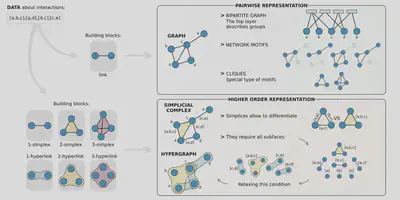
Since the building blocks of many —not just social— complex systems are intrinsically non-pairwise, there is often a need for higher-order approaches. Hypergraphs are thus natural candidates to move system descriptions beyond dyadic relationships and effectively map relationships between any number of units (see also this post).
Most studies on group formation and structure, however, do not take into account the temporal evolution of the underlying social systems, characterised by patterns of memory, burstiness, and temporal correlations.
These complex patterns are the results of microscopic individual-level decisions, ultimately shaping the emergence of collective behaviours.
Understanding these mechanisms —how these groups form, evolve, and how people move across groups— is essential to better characterise the emerging group dynamics and to better model biological contagion or transfer of social norms and information.
In this new study, together with M. Karsai and A. Barrat, we study the temporal dynamics of groups through empirical traces of social interactions. Leveraging two publicly-available data sets of temporally-resolved human interactions among preschool children and university students, we highlight complex mechanisms of group dynamics both at the node and at the group level.
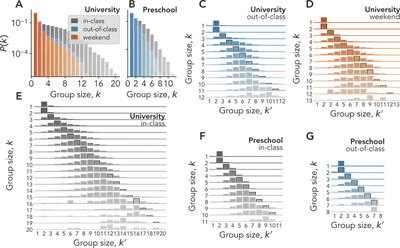
At the node level, we follow how individuals move across groups of different sizes, finding that the main dynamical patterns of group-change are independent from the nature and context of interactions (due to age and setting constraints).
Group size distributions (A-B) and node transition matrices (C-G) for University and Preschool interactions that take place in-class, out-of-class, or during the weekend. In (C-G) the elements of each matrix represent the conditional probability $P(n_i^{t+1}=k^{\prime}|n_i^t=k)$ of finding a node $i$ in a group of size $k^{\prime}$ at time $t+1$ given that at time $t$ it belonged to a different group of size $k$. Probability values are given by the height of each element (normalized by row). Note that the scales on the y-axes–one for each matrix row–vary for visualization purposes.
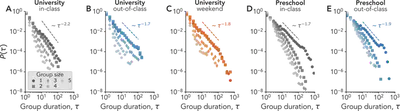
Shifting the focus to the groups, we analyze the statistics of group duration. Whether students interact during classes, in the other spaces of the university, or
elsewhere during the weekend, the distributions of their group interactions depend on the group size in a similar way, with long-gets-longer effects.
Distributions of group durations $\tau$ for the University (A-C) and the Preschool (D-E) data sets in different contexts. Different symbols correspond to different group sizes.
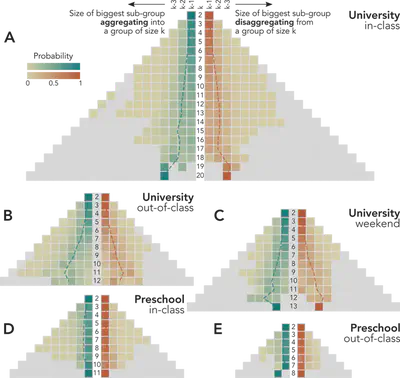
While the individual point of view adopted is useful to understand how people move between group sizes, we still need to understand the impact of these individual changes on the sizes of the groups. For instance, large groups tend to have shorter lives, but how do they break up? Similarly, how do they grow? Indeed, a group might appear due to the fusion of two pre-existing groups of comparable sizes —like water droplets that merge after overlapping due to surface tension—, or from a gradual process due to the integration of one individual at a time.
We thus follow the members of each group before the group’s birth and after its break-up, pooling together the results of groups of the same size. For small group sizes, both group aggregation and disaggregation tend to happen gradually from or to groups of similar sizes. The picture for larger groups suggests instead a partially hierarchical dynamical mechanism according to which individuals first engage in relatively small groups that then aggregate and form bigger ones. A symmetric process takes place when large groups dismantle.
Group dynamics of aggregation and disaggregation for University (A-C) and Preschool (D-E) interactions that take place during in-class, out-of-class, or weekend time. Each side of the pyramidal heatmaps shows the probability distribution associated to the size for the largest sub-group joining and the largest subgroup leaving a group of size $k$. The central column reports the considered group size $k$, while the probability distributions on its left-hand side and right-hand side respectively corresponds to group aggregation and disaggregation. Dashed lines refer to the distribution average.
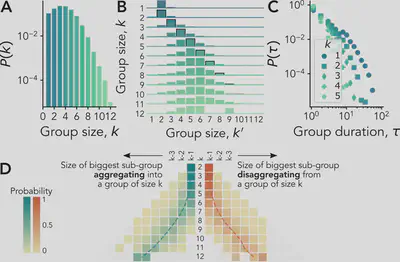
Finally, we propose a synthetic hypergraph model describing how nodes form groups and navigate between groups of different sizes. Informed by empirical data, the model reproduces the non-trivial dynamics of group changes, and could be used to generate synthetic substrates for studying the impact of higher-order temporal interactions on dynamical processes.
Simulated distribution of group size, node transition matrix, and group duration for different group sizes $k$ generated by the proposed temporal hypergraph model (fitted on the University out-of-class setting).
Taken together, our results hint at common robust mechanisms determining group formation and evolution. Our study represent a further step in understanding the social dynamics of higher-order interactions, stressing the importance of considering their temporal aspect.
Over the last 15 years, the SocioPatterns collaboration led by ISI Foundation (Turin, Italy) and the Aix-Marseille University (Marseille, France) has developed wearable proximity sensors to assess proximity of individuals, carrying out measurements in over 12 countries, engaging more than 50,000 participants, in contexts that spanned hospitals, primary schools, high-schools, social gathering conferences, households, including various environments in low and middle income countries in Africa. The data released by the collaboration have been used in over 2,000 scientific papers in domains that span network science, computational epidemiology, computational social science, and more.
The Complexity 72h workshop will deploy the SocioPatterns setup during its 5th edition in Madrid. The goal is to further understand the characteristics and the dynamics of face-to-face interactions between individuals within this unique context. The setup of this study is straightforward and participant-friendly. Each individual who consents to participate will receive a small sensor, which will be attached to their badge for the duration of the workshop. These sensors are designed to detect other nearby sensors, facilitating the privacy-conscious collection of data on face-to-face interactions between participants. It is important to note that no other signals, such as sound, will be recorded. Optionally, participants will be able to share additional information about themselves, including gender, academic title, field of research, nationality, and previously known workshop participants. Such information is extremely valuable as it allows for deeper studies of the mechanisms by which people meet and join forces. Along this line, additional surveys will also be deployed through a web application, specifically designed to gather context-specific information regarding the dynamics and interactions within the team, offering further insights into the mechanisms of collaboration.
The data collected will be stored in secured GDPR-compliant servers with access limited to the organizers of the workshop and the experiment. Participants will have early access to aggregated data that will be later released and made publicly available. The project has been reviewed and approved by the Northeastern University London Research Ethics Committee and it follows the NUL data protection policy. Further details will be available in the Participant Information Sheets.
This is the first time that the workshop hosts a SocioPatterns study, and hopefully it will not be the last. Researchers of the SocioPatterns collaboration, the co-founders Ciro Cattuto (ISI Foundation) and Alain Barrat (CPT, CNRS), and Lorenzo Dall’Amico (ISI Foundation) will be present at the workshop. This study is a very good opportunity to gather valuable data about human interactions, and to present the SocioPatterns setup to the Complexity 72h community. All participants are encouraged to take part in this great pilot study!
I am super excited to announce the 1st edition of CRAB: Complexity Research in Animal Behaviour!
CRAB 2024 has been selected as a Satellite event at the Conference ComplexSystems 2024 (CCS), which will be held in Exeter, UK, from September 2nd to 6th, 2024, and will be a cross-disciplinary meeting to encourage greater exchange between the fields of Complexity and Animal Behaviour.
While massive steps forward have happened in applying complex systems approaches —such as social network analysis— to study animal behaviour, there remains limited exchange between the research fields!
The call for abstracts is now open!
Are you working Animal social networks, Collective animal behaviour, Animal communication, Animal cognition, Disease ecology, Evolutionary biology, or related topics? Send us an abstract to give a contributed presentation!
C72h is an interdisciplinary workshop where participants form teams and carry out projects in 72 hours, aiming at producing and publishing online a report of the work done by the end of the 72h.
Collaborations born during previous editions led to peer-reviewed publications: this one is the spillover of a project that we started during the 2019 workshop.
This year the workshop will be in *Madrid, Spain, from 24 to 28 June, and I will be joining as a tutor for a project on social interactions.
Have a look at mine and others’ projects here.
Comple(X) (G)roup (I)nteractions (XGI) is a new Python package for the representation, study and visualization of complex systems composed by units that interact in groups of arbitrary size (not necessarily in dyads). Strongly inspired by NetworkX, XGI allows the user to encode higher-order interactions into hypergraphs and simplicial complexes (see [Phys. Rep. 2020] for a comprehensive review on the topic —or a 3 min summary).
Higher-order naming game: combining group dynamics ans social influence
Our study “Group interactions modulate critical mass dynamics in social convention” is out on Communications Physics!
How can minorities of regular individuals overturn social conventions? The theory of critical mass argues that apparently stable social conventions can be overturned by a minority of committed individuals if such minority reaches a critical size. Several studies have focused on identifying this critical size.
Quantitative support to the tipping points dynamics has come from the naming game model for social convention, where a critical mass of 10% was shown to be able to induce norm change. Subsequent generalisations showed how the threshold can vary between 10% and 40% of the population. Finally, controlled experiments of social coordination have brought empirical evidence for tipping points in the dynamics of social conventions, finding a critical threshold of 25% of the population, as theoretically predicted by a best response naming game model.
Ph by Callum Shaw
All theoretical models and empirical studies existing so far have considered minority groups of fully committed individuals, i.e., individuals who will not adopt majoritarian conventions under any circumstances. In this light, even 10% of the population, the smallest threshold obtained thus far, can hardly be considered a “small” group. Numerous observations suggest that even groups counting just tens of committed individuals, and not significant fractions of the population, may trigger abrupt social and normative change. Social movements offer several examples in this sense.
So… where does the critical mass itself come from?
In this new work, together with G. Petri, A. Baronchelli and A. Barrat, we give a mechanistic explanation of how such small minorities can emerge. In particular, we show that the critical mass required to induce norm change is dramatically reduced when non-committed members of the population are less susceptible to social influence than previously assumed.
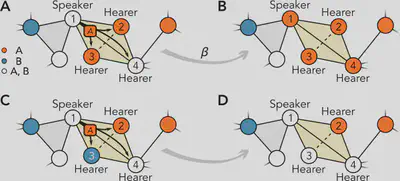
Dynamics of the model. Agents are represented by the nodes of a social structure composed by interacting groups of different sizes. The vocabulary of the agents–for simplicity containing at most only two names (or conventions) ${A, B}$–is reflected in the colours of the nodes as shown in the legend. At each interaction a group is chosen at random (highlighted in yellow in the figure) together with a speaker (node 1), while the remaining nodes act as hearers. (A) The speaker chooses a name at random from its vocabulary (here, $A$), and communicates it to the rest of the group. Since $A$ is present in the vocabularies of all the hearers (nodes 2 and 3 support $A$, while node 4 knows both names), the group can reach an agreement. (B) With probability $\beta$ the group agrees on the chosen name, and all nodes involved immediately update their vocabulary to $A$, erasing $B$. With probability $1-\beta$ instead the agreement does not happen. (C) In this case, the speaker selects $A$, but node 3 does not possess $A$ in its vocabulary. (D) Thus, there cannot be agreement in the group. Nevertheless, all hearers update their vocabularies by adding the heard name, i.e., node 3 switches from $A$ to $A, B$.
We adopt the Naming Game framework, already used to determine the range of 10% to 40% critical mass thresholds, and admit the possibility that individuals may be reluctant to let go of alternative conventions even when they successfully manage to coordinate with one another on a specific norm. We control this through a global communication efficiency parameter $\beta \in [0,1]$. This generalises the standard naming game model where a successful coordination is followed by a certain and exclusive adoption of the norm that allowed the coordination.
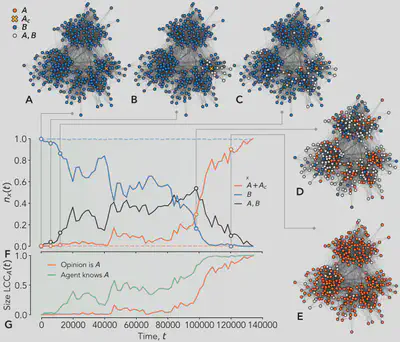
Illustrative example of a simulation on an empirical social structure (contacts in a French high-school) where a minority of one single committed individual supporting $A$–consisting of 0.3% of the population of 327 individuals–overturns the stable social norms and reaches global consensus (under imperfect communication). (F) Temporal evolution of the fraction $n_x(t)$ of nodes supporting name $x$. Different solid lines correspond to different names, $x={A+A_c, B, (A, B)}$. Dashed lines are reported as a benchmark, representing the case with perfect communication.
We inform the model with real-world data concerning the structure of the social networks and of the microscopic interactions, considering both pairwise and group meetings. This implies using a higher-order representation beyond pairwise interactions, as the one offered by hypergraphs.
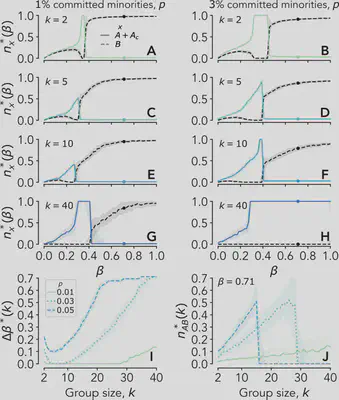
Higher-order (group) effects in naming games for different values of $\beta$. We consider $(k-1)-$uniform hypergraphs, i.e. regular structures in which each interaction involves exactly $k$ agents. (A-H) Left and right panels correspond to simulations initiated with a different size of committed minority supporting opinion $A$, namely $p=0.01$ and $p=0.03$. In the initial state, all the other agents hold norm $B$. The range $\Delta\beta^$ of $\beta$ values for which $n^_A=1$ (i.e., the committed minority manages to convert the whole population), is plotted in (I) as a function of the group size $k$ and for different values of $p$ (see legend).
We show that results hold in a significant region of the parameters and on all the considered real and artificial social structures. In addition, we clarify the role of group interactions showing a non-trivial dependency of the long term dynamical output with the group-size (non-monotonicity is observed). We also provide an analytical mean-field description of the model and confirm its accuracy against Monte Carlo simulations.
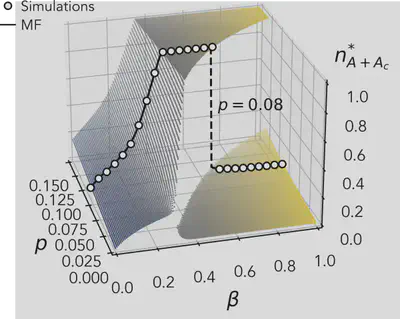
Mean field phase diagram of the NG with committed minorities on 2-uniform hypergraphs. An example curve with $p=0.08$ is shown with a solid black line. The associated results of stochastic simulations (circles) for homogeneous systems of $1000$ agents are shown for comparison.
Our findings reconcile the numerous observational accounts of rapid change in social conventions triggered by committed minorities with the apparent difficulty of establishing such large minorities.
In this scenario, clarifying the microscopic mechanisms driving this process is key to gain a better understanding of our society and to design possible interventions aimed at contrasting undesired effects (see recent studies about social media infiltrations by the Chinese government).
Adoption processes in socio-technological systems have been widely studied both empirically and theoretically. In this paper, we focus on network approaches that aim at capturing and modeling the fundamental mechanisms behind the social dynamics of adoption. The processes through which humans discover and adopt novel items–where by items we indicate not only artefacts or new technological or commercial products, but also concepts, ideas, social norms and behaviors–can be described in two radically different ways, both involving the presence of a complex network, whose nature is different in the two cases.
Indeed, on one hand item adoption can be seen as a contagion dynamics over a social network of individuals influencing each others through their social connections. On the other hand it can be described as an exploration dynamics over a network of similarities among the different possible items that an individual can adopt.
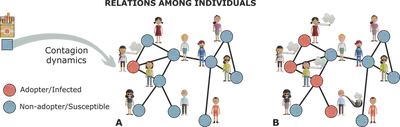
Illustration of a contagion process. The adoption of norms, behaviors, ideas, technological items, etc., is typically modeled as a spreading process over a network of social contacts. Red and blue nodes of the social network denote respectively the adopters (or infected individuals) and the non-adopters (or susceptible) of the item that is spreading. For example, in (A) a smoker transmits the—bad—habit to its neighboring agents, which in turn can transmit it again through their social links (B).
In the first case a single item (a single product, idea, or behavior) is considered at once, and the transmission from one individual to another over a social system is modeled as an epidemic-like spreading process across the links of a social network. Hence, the focus here is on the complex (and sometimes higher-order)structure of the underlying social network.
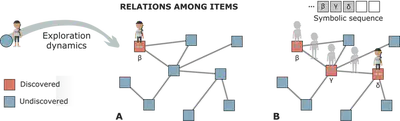
Illustration of an exploration process.The cognitive process through which an individual agent explores the space of possibilities in search of novel items (novel ideas, technological discoveries) is usually modeled as a walk over a network of relations similarities or proximity) among items. For example, in (A) the agent discovers item $\beta$ and then continues the exploration over the links of the network by sequentially moving to node $\gamma$ and then to node $\delta$. In (B) three items have been discovered, and the exploratory walk can be seen as a sequence of symbols representing the visited nodes.
In the second case, the main focus is instead on the network of existing relations between different items. Hence, the modeling attention is shifted towards the cognitive processes through which single individuals explore the space of different possibilities and produce sequences of explored items in search of novelties. In this latter way of interpreting adoption dynamics, different exploration (and innovation) models have been proposed to replicate the (sometimes multi-agent) processes of exploration according to which one idea, concept or item leads to another, and a discovery can trigger further ones.
Here, we provide a brief overview of the existing models of social spreading and exploration and of the latest advancements in both directions. We propose to look at them as two complementary aspects of the same adoption process: on one hand there are items spreading over a social network of individuals influencing each others, on the other hand individuals explore a network of similarities among items to adopt. The two-fold nature of the approach proposed opens up new stimulating challenges for the scientific community of network and data scientists. We conclude by outlining some possible directions that we believe may be relevant to explore in the coming years.
Expanding the adjacent possible to the social space
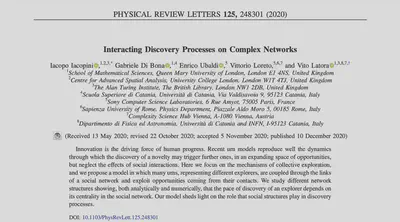
Our paper “Interactive discovery processes on complex networks” with G. Di Bona, E. Ubaldi, V. Loreto and V. Latora just got published in Physical Review Letters.
Discoveries are essential milestones for the progress of our societies. Recently, different mathematical approaches have been proposed to investigate and model the hidden mechanisms behind to the emergence of the new. Among these, of particular interest are random processes with reinforcement, such as urn models and biased random walks:
These models could successfully replicate the basic signatures of real-world discovery and innovation processes, such as the Heaps’ law, a sub-linear growth of the number of distinct elements $D(t)\sim t^\beta$ with the number of elements $t$, which governs the rate at which novelties grow. However, they neglect the effects of social interactions. In particular, by considering the exploration dynamics as the one of a single entity and thus neglecting the multi-agent nature of the process, these models
do not capture the heterogeneity of the pace of the individual explorers;
do not include the benefits brought by social interactions and collaborations.
Indeed, empirical evidences of these mechanisms have been found in various contexts, from music-listening and language to politics and voting.
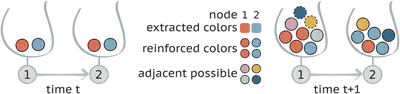
Illustration of the model in the case of a network with two nodes. Each node is equipped with an urn obeying to the UMT with same parameters $\rho=2$ and $\nu=1$. At the time $t$, the urns start with two balls, one red (R) and the other blue (B). Then, each node extracts a ball (1:R, 2:B), and therefore $\rho$ additional balls of the same colors are added to the respective urns (reinforcement). Also, since in both cases, the extracted balls represent a novelty for the respective nodes, $\nu+1$ balls of new colors are also added (adjacent possible). At $t+1$, node $1$ has access to all its balls plus two extra ones coming from the adjacent possible in the social space, i.e., the set of balls available through its neighbor (dashed borders).
In this Letter, we propose a model of interacting discovery processes in which each explorer is associated with a node of a complex network, and an urn model with triggering (UMT) governs its dynamics. In this framework, the appearance of a novelty opens up the possibility of further discoveries through an expansion into the adjacent possible. Urns are then coupled through the links of a network so that each exploration process is also subjected to interactions with the processes of the neighboring nodes, and explorers can exploit opportunities (possible discoveries) coming from their social contacts.
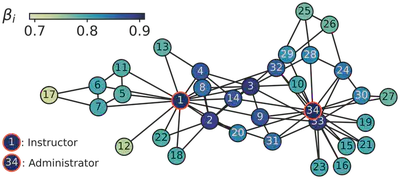
Dynamics of the interacting urns on the Zachary Karate Club network, whose nodes are colored according to the resulting Heaps’ exponent.
Social networks have been vastly used as structures on top of which dynamical processes take place. Here, we investigate the behavior of many coupled dynamical discovery processes on complex networks and study the impact of the network topology on the exploration dynamics. We find that the pace of discovery $\beta_i$ of an explorer strongly depends on its position in the social network. We obviously could not desist from using the Zachary karate club network. Notice the higher pace of discovery displayed by the notoriously central nodes. This proves that nodes with identical UMTs can have completely different dynamics, suggesting that a strategic location on the social network correlates with the discovery potential of an individual.
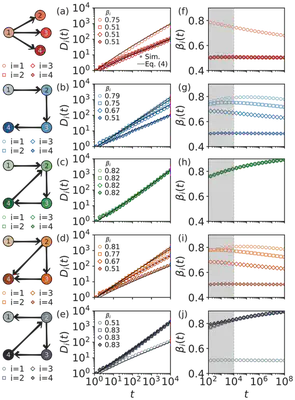
Heaps’ dynamics of the interacting urns on five directed toy graphs (different symbols correspond to different nodes). Each node is equipped with a UMT with same parameters. (a-e) Temporal evolution of the number of discoveries $D_i(t)$ for each node $i$ (associated Heaps’ exponents $\beta_{i}$ in the legend). The analytical solutions, shown as continuous black lines, are in perfect agreement with simulations. (f-j) Temporal behavior of the associated Heaps’ exponents extracted at different times. The grey area up to $T=10^4$ corresponds to the values of (a-e).
We investigate this relation through numerical simulations on synthetic and real-world networks, and we identify the key role played by the network centrality. While thermalization times—typical of empirical trajectories of diffusion process—are strongly influenced by the topology of the network, we find the ranking induced by the pace of discovery persists at all finite times.
Scatter plot and Spearman’s rank correlation coefficients $r_{S}$ between fitted Heaps’ exponents $\beta_i$ and normalized $\alpha$-centrality $c^{[\alpha]}i/c^{[\alpha]}{\text{max}}$ associated to the $i=1,\dots,N$ nodes of four empirical networks: (a) the Zachary Karate Club, (b) a Twitter network of followers, (c) a co-authorship network in network science and (d) a collaboration network between jazz musicians.
We further explore this characteristic behavior and ultimately prove its universality for all networks. In particular, we show that the ranking of the nodes that distinguishes the fastest explorers can be predicted analytically by using the eigenvector centrality (or the $\alpha$-centrality in the most general case of non-strongly connected graphs). This highlights that the structural—not just local—properties of the nodes can strongly affect their ability to discover novelties.
Everything you always wanted to know about higher-order interactions (but were afraid to ask)
Our review on the structure and dynamics of higher-order interactions is out in Physics Reports! —-> [link to arXiv] - [link to Physics Reports]
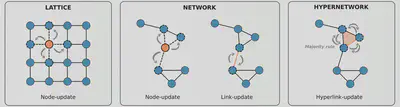
Any significant understanding of a complex system must rely on system level descriptions. After many years of reductionism, networks have emerged as a reference modeling tool for complex systems, triggering thousands of contributions over the last twenty years and leading to the formation of the new multidisciplinary field of Network Science. However, the fundamental limit of networks is that they capture pairwise interactions only, while many systems display group interactions. Indeed, in social systems, ecology and biology among other examples, many connections and relationships do not take place in pairs, but rather are collective actions at the level of groups.
Here, together with F. Battiston, G. Cencetti, V. Latora, M. Lucas, A. Patania, J.-G. Young and G. Petri, we give a complete overview of the emerging field of networks beyond pairwise interactions focusing on both structure and dynamics.
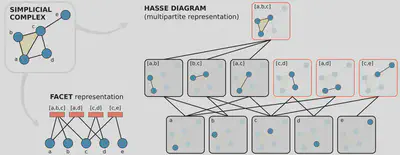
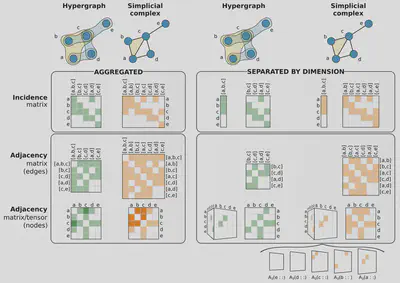
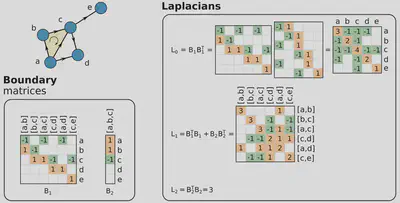
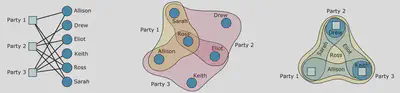
We first discuss the methods to represent higher-order interactions and give a unified presentation of the different frameworks used to describe higher-order systems, highlighting the links between the existing concepts and representations.
We discuss the most common measures currently used to characterize and quantify the structural properties of systems with many-body interactions, at each level of their description.
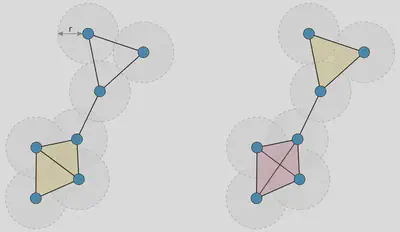
For example, in the case of cliques, hyperedges, sets, or simplices, many common notions developed for ordinary graphs have been generalized to their higher-order counterparts.
We also review the models proposed in the literature to generate synthetic structures, such as random and growing simplicial complexes, bipartite graphs and hypergraphs, and how they are used to make statical inferences.
In the second part of the review, we introduce and discuss the rapidly growing research on higher-order dynamical systems and on dynamical topology, with a particular focus on novel emergent phenomena characterizing landmark dynamical processes.
We start from models of higher-order diffusion and continuous-time random walks on simplicial complexes and hypergraphs.
We also discuss how coupled dynamical systems can be extended to higher-order structures, and how the presence of high-order interactions can affect synchronization in both phase oscillators and nonlinear dynamical systems.
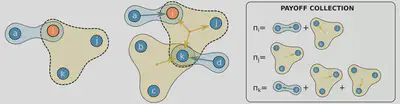
We review a broad variety of models of social dynamics that account for non-pairwise social interactions, going from spreading processes and social contagions to models of opinions formation and consensus.
We then move to evolutionary games, often studied in a simple dyadic setting, but recently extended to investigate competition and cooperation among multiple agents.
Finally, we give an overview of real-world applications to systems with higher-order interactions such as social systems, neuroscience and brain networks, ecology and other biological systems.
We conclude with an outlook on current modeling and conceptual frontiers.
“Creative Connectivity Project - A network based approach to understand correlations between interdisciplinary group dynamics and creative performance” is now published on E&PDE 2019, Proceedings of the 21st International Conference on Engineering and Product Design Education, University of Strathclyde, Glasgow. 12th -13th September 2019.
When sleep deprivation meets Complexity 72h: now out on arXiv
Fresh out the arXiv the pre-print we wrote during the Complexity 72h with A. Bernini, E. Blouzard, A. Bracci, P. Casanova, B. Steinegger, A. S. Teixeira, A. Antonioni and E. Valdano entitled “Evaluating the impact of PrEP on HIV and gonorrhea on a networked population of female sex workers”! Have a look here.





](https://iaciac.github.io/posts/temp-dyn-groups/drinks_hu11477705267402016830.webp)
](https://iaciac.github.io/posts/temp-dyn-groups/grouping_hu16924295182358148609.webp)
](https://iaciac.github.io/posts/temp-dyn-groups/droplets_hu8394651334450529183.webp)










![Scatter plot and Spearman's rank correlation coefficients $r_{S}$ between fitted Heaps' exponents $\beta_i$ and normalized $\alpha$-centrality $c^{[\alpha]}_i/c^{[\alpha]}_{\text{max}}$ associated to the $i=1,\dots,N$ nodes of four empirical networks: (a) the Zachary Karate Club, (b) a Twitter network of followers, (c) a co-authorship network in network science and (d) a collaboration network between jazz musicians.](https://iaciac.github.io/posts/urnet/Fig4_hu11757344071651941901.webp)