I am excited to announce that the hardback edition of our edited volume, In Solidarity, Under Suspicion: The British Far Left from 1956 has been published by Manchester University Press. You can order it here. The hardback edition is quite pricey so please recommend it to your library. If you do want a copy of […]
Show full content
I am excited to announce that the hardback edition of our edited volume, In Solidarity, Under Suspicion: The British Far Left from 1956 has been published by Manchester University Press. You can order it here.
The hardback edition is quite pricey so please recommend it to your library. If you do want a copy of your very own, you can use the code ‘EVENT30’ to get a 30 per cent discount.
A more affordable paperback edition will follow in the next 18-24 months.
Here is the table of contents:
Introduction Studying the far left in Britain after ‘Generation Left’ – Daniel Frost & Evan Smith
Against the State 1 Undercover policing of the left 1968-82: subversives under the lens – Chris Brian 2 ‘Secret and Delicate Sources’: British black power, counter-subversion and undercover policing – Rosie Wild & Eveline Lubbers 3 Shot by both sides? The foundation of the Institute for Workers’ Control and its critics on the left and right – Ieuan Franklin and Alan Tuckman 4 From the SLL to the WRP: violence, gender, and the perils of Leninism – Aidan Beatty 5 Anti-statism and the trajectory from the Revolutionary Communist Party to Spiked – Evan Smith
Worlds transformed 6 Trades councils and The December The Sixth Group: trade unions and the ‘unofficial’ radical left in the early 1970s – Hazel Perry 7 ‘Organising to win’: Big Flame and workplace interventions 1970-3 – Kerrie McGiveron 8 Socialist-feminist revival in the Merseyside Women’s Liberation Movement: new priorities, strategies, spaces and solidarities after 1978 – Rachel Collett 9 ‘Black and white, unite and fight’? black power and the British radical left, 1965-79 – Alfie Hancox
Beyond borders 10 ‘Let the people of Malaya rule their own country!’: The Communist Party of Great Britain’s solidarity campaign with Malaya – Armand Azra bin Azlira 11 British Maoists, China, and the Cold War in the 1970s – Neil Redfern 12 British Marxism and the coup in Chile – Owen Dowling 13 Difficult solidarities: the Irish diaspora and the British left during the Northern Ireland conflict – Jack Hepworth
Breaking and entering 14 From rupture to retreat: black Power and the rise of black Marxism in 20th century Britain – Azfar Shafi & Ilyas Nagdee 15 Inside out, outside in: the IMG’s changing attitudes towards the Labour Party and entryism – Nicolas Sigoillot 16 Finally moving on? The Socialist Labour Party and the search for an electoral alternative to New Labour – Alfie Steer 17 Researching left-wing activism (after 1956) during and after Corbynism – Daniel Frost
British Union of FascistsFascismHistoriographyNew Guard
An on-going research interest of mine is on the demographics of the far right in Australia and Britain. Below is an excerpt from a literature review discussion from a longer paper. There are a small number of studies that have attempted to examine the socio-economic demographics of the far right in Australia and Britain across […]
Show full content
An on-going research interest of mine is on the demographics of the far right in Australia and Britain. Below is an excerpt from a literature review discussion from a longer paper.
There are a small number of studies that have attempted to examine the socio-economic demographics of the far right in Australia and Britain across the twentieth century. The scholarship on inter-war far right in both countries has concentrated on membership because these groups focused on extra-parliamentary activity, rather than electoral politics. However these have always been approximations as attempts to gain accurate records of far right groups is difficult to obtain, due to their semi-clandestine nature. Regarding Britain, Thomas Linehan has written, ‘[t]he history of British fascism shows that support for home-grown fascist parties straddled social-class boundaries and that workers were just as liable as members of other social-class groups to succumb to the far right’s various messages’.[1] Scholars, examining the far right in both Britain and Australia in the 1920s-30s, have long debated the possible cross-class appeal of fascism and paramilitarism during these decades.
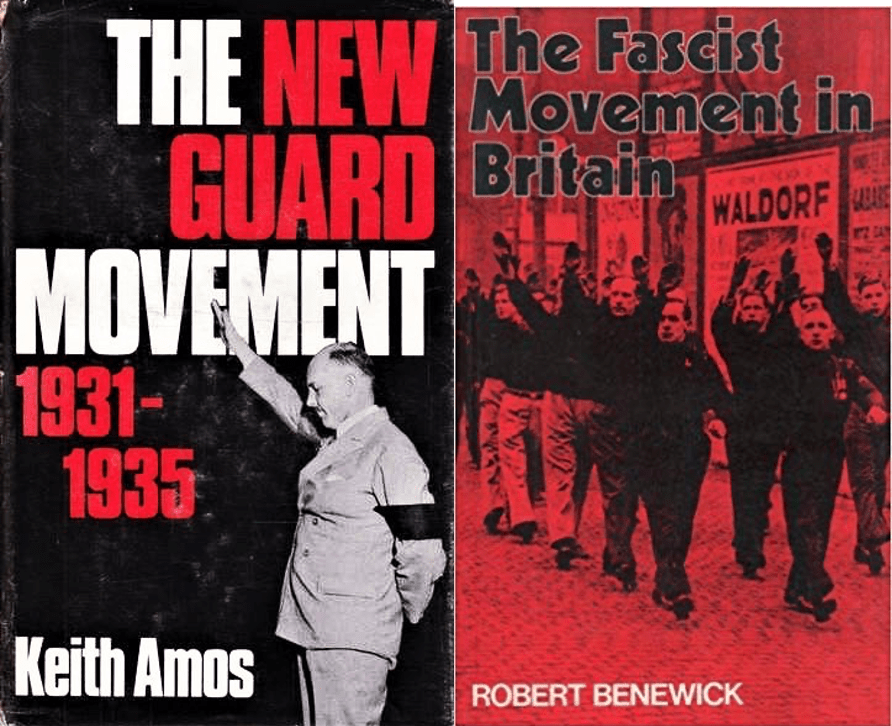
Keith Amos’ 1976 work on the history of Australia’s New Guard movement under Eric Campbell states that the founders of the New Guard in 1931 were ‘nearly all ex-officers in their late thirties with middle-class backgrounds’.[2] Citing the NSW police, Amos writes there were ‘few young or old men in the movement’, with ‘at least 25 per cent of members [being] ex-servicemen’ and ‘all occupations’ being represented in the New Guard.[3] Contemporaneously, the newspaper The Sun characterised the New Guard as being ‘composed of a wide cross-section of society including clerks, bank managers, labourers, small shopkeepers, accountants and barristers’, but Amos argues that it was unlikely that the New Guard had much support from workers.[4] Amos cites the New Guard’s Francis De Groot as claiming that the group’s Sydney City locality being composed of ‘about 200 members who were mostly Caretakers of City Banks, Insurance Buildings and such… positions usually held by retired Army and Navy Non-Commissioned and Petty Officers’.[5]
Discussing the literature that exists on the New Guard, Matthew Cunningham’s 2015 PhD thesis notes that the work of Humphrey McQueen, William Tully and Phyllis Mitchell all ‘contended that the proletariat was sparsely represented in the movement’, although notes that Jean O’Mara and Andrew Moore had found pockets of working class support for the New Guard, particularly in the Five Docks locality and in some right-wing trade unions like the Railway Service Association.[6]
Despite these small areas of working class support, the consensus is that the New Guard was ‘overwhelmingly a middle-class organisation’.[7] Andrew Moore wrote that while ‘the New Guard involved more workers than some accounts would allow’, the fact was that ‘Australian fascism was shaped by its lower middle class, small shopkeeper hegemony’.[8]
Cunningham’s study of the wider right-wing citizens’ movements in Australia and New Zealand during the inter-war period also highlights the middle class composition of these groups. Looking at the leadership for three groups, the All for Australia League, the Australian Citizens’ League and the Citizens’ League of South Australia, Cunningham shows that the leaders were significantly middle class, with those in professional, business and commercial occupations being the majority in all three (72.7 per cent for the All for Australia League, 60 per cent for the Australian Citizens’ League and 65.7 per cent for the Citizens’ League of South Australia).[9] The All for Australia League leadership had some from the manufacturing business (11.3 per cent) and workers (10.4 per cent), while the other two had significant minorities of farmers/pastoralists (25.4 per cent for the Australian Citizens’ League and 13.7 per cent for the Citizens’ League of South Australia) and workers (14.1 per cent for the Australian Citizens’ League and 19.2 per cent for the Citizens’ League of South Australia).[10]
Comparison could be made with the membership of the New Guard and the British Union of Fascists, which according to Amos, was ‘probably never more than half that of the New South Wales’ New Guard’,[11] but still the largest far right group in British history. There have been several studies that have explored the class composition of the BUF. Looking at the profiles of 103 figures in leadership positions within the BUF in the mid-1930s, W.F. Mandle stated that the ‘composite fascist leader in 1935’ would be a ‘man in his late thirties, educated at a public school who had served in the great war as an officer’, who was also be ‘widely travelled’ and middle class.[12]
In 1972, Robert Benewick argued that the BUF was ‘popularly identified as a middle-class movement’ and while it made some gains amongst the unemployed, it found ‘little success in the most distressed areas such as Scotland, South Wales, or the North-East’.[13] Benewick reaffirmed Mandle’s suggestion that the BUF leadership were ‘for the most part solidly middle class in terms of occupation’, but qualified this by also writing, ‘[h]ow far the social composition of the leadership reflected that of the membership is unknown’ as most records were seized by the British authorities in 1940 and remained closed when Benewick was writing.[14]
In 1980, Stuart Rawnsley’s study of the membership of the BUF argued that Mosley’s party was able to recruit in the early years from those who were unemployed or fear unemployment, with cotton workers particularly sought after in Lancashire.[15] Rawnsley quoted from several BUF leading figures that suggested that the working class made up a significant part of the BUF, with district members reportedly being ‘mainly millworkers and mechanics’ in Blackburn, with ‘a sprinkling of small shopkeepers and business people’, alongside ‘as much as 40 per cent of the local membership’ in Hull being ‘working class and unemployed’ and ‘large numbers of working-class people’ in the BUF in Lancaster.[16] But Rawnsley wrote that the BUF was unable to make much headway with the ‘organised sections of the working classes’ and therefore, ‘[t]he working-class recruit was typically one who had not been educated in the labour movement’.[17]
As well as the unemployed workers, especially in the North, Rawnsley saw that self-employed people turned to the BUF. This, Rawnsley wrote, ‘cut across class lines and included working-class people who attempted to start one-man painting and decorating businesses or window-cleaning rounds, owners of small shops and garages, and also taxi drivers.’[18]
A more recent study of BUF membership is by Thomas Linehan, who challenges ‘the classical view of fascism as essentially a middle-class revolt and tendency to describe fascist joiners in terms of a single stereotype.’[19] Linehan analysed a sample of 311 Mosleyites in East London and South-West Essex and found ’36 per cent were unskilled and semi-skilled workers and 15 per cent were skilled workers (“lower class”)’, alongside ‘lower and intermediate white collar employees’ (14 per cent), ‘self-employed merchants’ (14 per cent) and ‘independent master craftsmen’ (‘nearly 8 per cent’).[20] Linehan argues that these last three categories were from ‘the “lower middle and middle-middle class”, in terms of social class’, meaning that in his overall figures, ‘the largest grouping… in respect to social class’ was ‘the “lower class” element’ (51 per cent), compared with the ‘lower middle and middle-middle class’ (39 per cent).[21]
In 1995, Roger Griffin suggested that the ideal type of fascism ‘has no specific class basis in its support’ and that ‘the middle classes were over-represented in the membership of Fascism and Nazism… because specific social-political conditions made a significant percentage of them more susceptible to a palingenetic form of ultra-nationalism’.[22] Further research is required, if possible, to determine whether Griffin’s thesis can be ascribed to those who joined far right groups in Australia and Britain in the same period.
[1][1] Thomas P. Linehan, ‘What Happened to the Labour Movement? Proletarians and the Far Right in Contemporary Britain’, in Nigel Copsey & David Renton, British Fascism, the Labour Movement and the State (Houndmills: Palgrave Macmillan, 2005) p. 16.
[2]Keith Amos, The New Guard Movement 1931-1935 (Melbourne: Melbourne University Press, 1976) p. 26.
[6] Matthew Cunningham, ‘The Reactionary and the Radical: A Comparative Analysis of Mass Conservative Mobilisation in Australia and New Zealand During the Great Depression’ (Victoria University of Wellington: Unpublished PhD thesis, 2015) p. 156.
[7] Matthew Cunningham, ‘Australian Fascism? A Revisionist Analysis of the Ideology of the New Guard’, Politics, Religion and Ideology, 13/3 (2012) p. 382.
[8] Andrew Moore, ‘Workers and the New Guard: Proletarian Fascism in New South Wales, 1931-1935’, in Greg Patmore (ed.) Transforming Labour: Proceedings of the Eighth National Labour History Conference, p., 244.
[9] Cunningham, ‘The Reactionary and the Radical’, p. 148.
[15] Stuart Rawnlsey, ‘The Membership of the British Union of Fascists’, in Kenneth Lunn & Richard C. Thurlow, British Fascism: Essays on the Radical Right in Inter-War Britain (London: Croom Helm, 1980) p. 160.
As part of my growing interest in digital archives, as well as my interest in Southern Africa during the Cold War and decolonisation, I have been undertaking a project to scan various publications produced in this region which are increasingly difficult to find. Previous endeavours have included scanning copies of ZAPU’s Zimbabwe Review from the […]
Over the last year, I have been scanning issues of Rhodesian/Zimbabwean History, the academic journal of the Central Africa Historical Association, based at the University of Rhodesia/Zimbabwe from the 1960s to the 1980s. The Central Africa Historical Association and the History Department at the University was influential in the historiography of Rhodesia/Zimbabwe, as well as Southern Africa more broadly. Names such as Ray Roberts (editor of the journal) and Terence Ranger loom large in the historiography, although as Clapperton Mavhunga wrote for Africa is a Country blog, the historiography of Zimbabwe has been overshadowed by its shaping by outsiders, primarily from Britain and North America.
The Central Africa Historical Association was its peak during the years following Rhodesia’s Unilateral Declaration of Independence and the national liberation struggle fought by ZAPU and ZANU. The university unintentionally fostered an environment of historical research while the settler colony surrounding it waged a war to maintain white minority rule. The irony of the ‘golden age’ of Rhodesian/Zimbabwean historiography was highlighted in a recent article by Gerald Chikozho Mazarire:
This was hardly possible in Rhodesia, where Africans were hounded out of the university and forced to trek to mission universities in South Africa or Lesotho before proceeding to the UK or American institutions for further training, but were still prohibited by racist laws from teaching at the local university when they qualified. Despite this, newly qualified African historians were active in the Central African Historical Association run from the University of Rhodesia and frequently published in its journal Rhodesian History. The ‘golden age’ for African historical scholarship in Rhodesia was therefore reached in this colonial period and achieved by African and radical white scholars in exile even under state repression. By 1970, when Rhodesia was declared a republic, the university had shed most of the SOAS staff, while the predominantly white History Department had strengthened its relations with and provided academic services to the state. In the process, however, it set its own milestones: it graduated a record number of PhDs, ran a world-class journal and incubated new academic departments. Political Science grew into a full-scale department out of History, while War and Strategic Studies maintained a subtle, if subversive, presence within the History Department, run and taught by active military personnel of the Rhodesian army or moonlighting British ex-servicemen.
The first issue of Rhodesian History appeared in 1970, with the expressed aim of providing ‘a forum for the dispassionate study of the history of Rhodesia’. It appeared annually until the early 1980s, with articles contributed by historians in Africa, Britain, North America and Australia throughout its issues. In 1979, as the end of Rhodesia loomed, the journal changed its name to Zimbabwean History.
As we know, the aim of ‘dispassionate history’ is folly, particularly for a country with a very contentious history like Rhodesia. I am interested in how the history of Rhodesia and Zimbabwe was expressed through the journal over the years and hope to write something on this in the future. I am not sure if an archive of the Central Africa Historical Association exists, but this would be another avenue to explore.
The academic work of the CAHA can be contrasted with the Rhodesiana Society, which was an organisation established for enthusiasts of a popular history of Rhodesia. It was formed by two civil servants in 1953 and changed its name to the History Society of Zimbabwe in 1981. It produced a journal called Rhodesiana. The Internet Archive has scans of issues of the journal from 1969 to 1979, the same time as Rhodesian History journal. David Kenrick wrote an academic article about the Rhodesiana Society here.
The scans of Rhodesian/Zimbabwean History run from 1970 to 1981 and can be found here.
A break from radio silence to announce that our new edited volume, In Solidarity, Under Suspicion: The British Far Left from 1956, is now available for pre-order from Manchester University Press. The hardback is a bit expensive (the book will apparently be 500 pages long), but an affordable paperback will be available in 2026-27. Please […]
Show full content
A break from radio silence to announce that our new edited volume, In Solidarity, Under Suspicion: The British Far Left from 1956, is now available for pre-order from Manchester University Press.
The hardback is a bit expensive (the book will apparently be 500 pages long), but an affordable paperback will be available in 2026-27. Please encourage your institutional or local library to order a copy of the hardback!
ArchivesDigital humanitieshistory from belowlabour history
A few weeks ago, the database publisher Gale organised an online symposium on the archives of social movements called ‘Power to the People‘. I took part with a talk on online radical archives. You can view the video below:
Show full content
A few weeks ago, the database publisher Gale organised an online symposium on the archives of social movements called ‘Power to the People‘. I took part with a talk on online radical archives. You can view the video below:
Anti-apartheidHigher Edcuationno platformSouth AfricaUnited States
The controversial South African figure Mangosuthu Gatsha Buthelezi has passed away. Buthelezi made a brief appearance in my book No Platform: A History of Anti-Fascism, Universities and the Limits of Free Speech when there were protests against him debating a representative of the South African government at the Oxford Union in 1985. With this in […]
Show full content
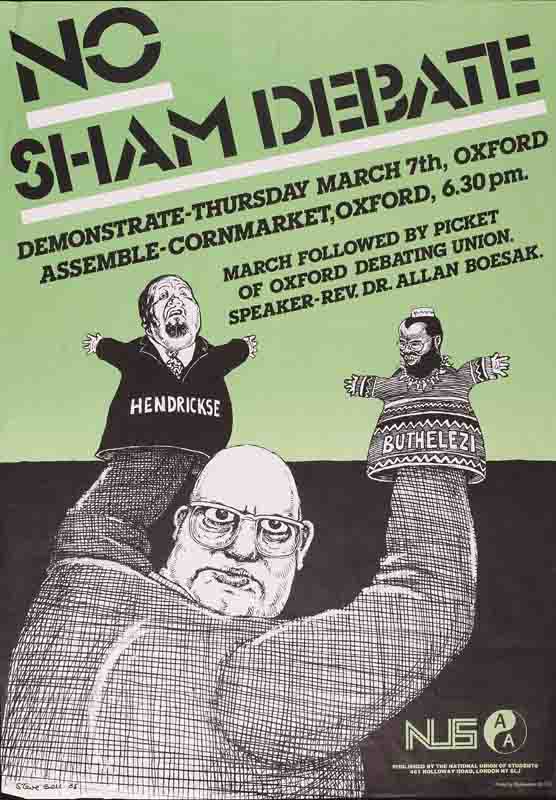
The controversial South African figure Mangosuthu Gatsha Buthelezi has passed away. Buthelezi made a brief appearance in my book No Platform: A History of Anti-Fascism, Universities and the Limits of Free Speech when there were protests against him debating a representative of the South African government at the Oxford Union in 1985. With this in mind, I thought I’d post this excerpt from the book on anti-apartheid and ‘no platforming’ at British universities in the 1980s. It was originally posted on Patreon here.
Throughout the 1980s, there were protests and instances of ‘no platforming’ pro-South Africa speakers at British universities. The most infamous was Conservative backbencher John Carlisle. Carlisle was a prominent member of both the Monday Club and Federation of Conservative Students, and was a hard right figure within the Conservative Party. During this decade, he was most well-known for his support for apartheid South Africa and his condemnation of the African National Congress, including the imprisoned Nelson Mandela. Matthew P. Llewellyn and Toby C. Rider have described Carlisle as a ‘fierce pro-Pretoria spokesman’[1] and it was on this topic that he frequently spoke at public meetings, including at universities. Carlisle generated significant controversy during his tour of universities in 1986, with several student unions invoking the ‘no platform’ policy against his visits.
However, as well as the ‘no platforming’ of pro-South Africa speakers, such as John Carlisle, students protested against representatives of the apartheid government from speaking on campus throughout the 1980s, as part of the broader Anti-Apartheid Movement (AAM) in Britain. Although it had existed since the 1960s, the AAM grew exponentially after the Soweto Uprising in 1976 and by the 1980s, it had become a significant social movement, including many young people and mobilising students on campuses across Britain.[2] In the early 1980s, the NUS and AAM developed a number of joint campaigns which helped build anti-apartheid work as an important part of the student movement.[3] The ‘no platforming’ of pro-South Africa speakers and government representatives gained traction at British universities in the 1980s, building on previous anti-apartheid work on campus, such as NUS boycott of Barclays for their investments in South Africa.[4]
In February 1982, students at the University of Bath, in the words of the Anti-Apartheid Movement Annual Report, ‘provided an angry reception’ for Dr Roy McNab, ‘a former information attaché at the South African embassy in Paris and [then] the London Director of the South Africa Foundation.’[5] Later in the year, students at Bath University protested against the invitation by the Centre for Development Studies of Professor Jan Coetzee from the University of Bloemfontein.[6]Anti-Apartheid News reported that ‘in the face of anti-apartheid action’, Coetzee’s status was shifted from ‘official guest’ of the Centre to ‘personal guest’ and as picket was mounted outside the Centre, Coetzee ‘left a day earlier than planned’.[7]
In November 1983, the South African ambassador Marais Steyn encountered large student demonstrations the Universities of Nottingham and Cambridge, having to cancel one. Invited by the Conservative Association at Nottingham University, anti-apartheid protestors ‘took over the room in which ambassador Steyn had been due to speak, forcing him to abandon his speech for “security reasons”.’[8] Speaking at the local Conservative Party headquarters in Nottingham, Steyn described the students as a ‘jackbooted mob’, claiming insincerely that ‘[i]n South Africa we certainly have free speech and believe in equality’.[9] In the same month, Steyn faced around 300 protestors at Cambridge after the Union Society invited him, alongside John Carlisle, to debate the sporting boycott of South Africa. Anti-Apartheid Newsreported:
Waving banners and shouting anti-apartheid slogans, the protestors made clear their anger at the opportunity given to the ambassador to air his views on sporting links between Britain and South Africa. Their shouts could be clearly heard inside the debating chamber, where Steyn was joined by apartheid’s old ally John Carlisle…[10]
In March 1985, Steyn’s successor Denis Worrall was invited to a debate on South Africa by the Oxford Union, alongside the South African ‘coloured’ cabinet minister Allan Hendrickse and Bantustan leader, Chief Gatsha Buthelezi.[11] Following a protest by Oxford students and the local branch of the AAM, all three withdrew from the debate, which was subsequently cancelled.[12]
In September 1986, the South African Consul-General in Scotland, Dr James Alexander Shaw, was invited by the Federation of Conservative Students to speak at the University of Stirling, but was allegedly opposed by a number of students. The Times Higher Education reported that Shaw claimed:
when he arrived at the campus gates, he was met by around 20 students who warned him that 150 students had been brought in from outside by the Socialist Workers Party and others, and were picketing the hall.[13]
He further asserted that he had been told that ‘the protestors had said they would not permit him to use the campus as a platform for racism, and had threatened violence if necessary.’[14] Shaw condemned the students who protested against him, declaring:
Those students who believe their views should prevail and that the views of others should be suppressed are the step-children of Hitler, and epitomize the evil that is inherent in totalitarian systems of government.[15]
The President of the Students’ Association at Stirling University, Ian Robertson, disputed Shaw’s version of events, saying ‘there were between 40 and 50 students, who were intent on peaceful action’ and that Shaw had only heard about the protest from FCS representatives (which Shaw conceded).[16] Robertson rebutted Shaw’s characterisation of protestors as well and was quoted in the student newspaper at Stirling saying:
For a representative of a racist regime which is involved in the brutal oppression of the majority of the South African population to equate peaceful protest with the action of Hitler and the Nazis would be laughable if it were not so disgusting.[17]
The Principal at the University of Stirling also queried Shaw’s claims, replying that ‘there were no groups of students from any other university on campus’ and that ‘Dr Shaw’s allegations against the University of Stirling students are… based solely on a supposition of possible violence and not on fact’.[18] The Principal, Professor John Forty, also responded that the FCS had not informed the university of the impending visit and had not sought advice on potential security concerns.[19]
Even though Ian Robertson claimed that the protest was ‘not a no-platform issue’, a general meeting of the Stirling University Students’ Association shortly afterwards ‘re-affirmed SUSA policy of no platform for racists or fascists in the light of the recent attempt by the FCS to bring the South-African [sic] Consul-General to speak at the University.’[20]
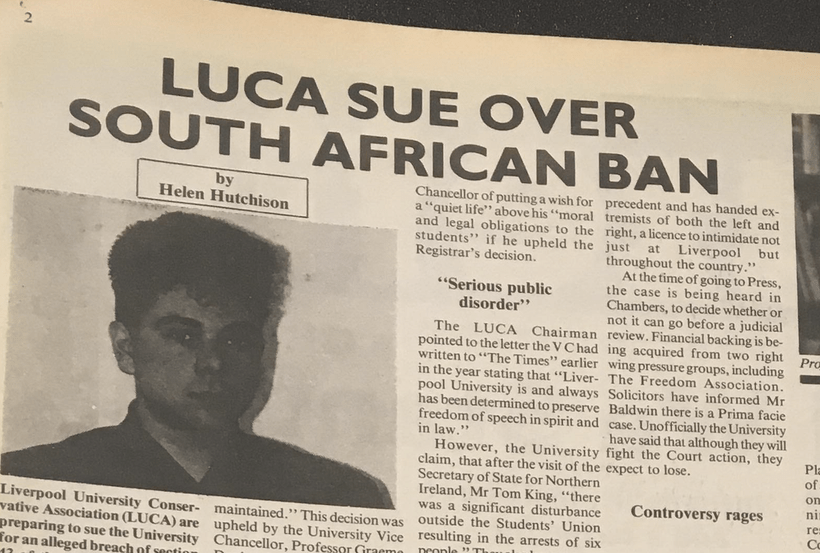
The controversy surrounding ‘no platform’ and South African representatives reached its peak in the late 1980s, following events at the University of Liverpool. In October 1988, the Liverpool University Conservative Association invited two representatives from the South African embassy to speak at the university. After initially allowing the proposed event to go ahead under strict provisions (including no advertising of the event, restriction of entry to students only and the reservation of the right to charge the Conservative Association for any additional security costs),[21] the university administration cancelled the meeting after discussion with the Merseyside Police.[22] This was contested by the Conservative Association and after wrangling between the student group and the university, the proposed meeting was rescheduled for January 1989.[23] The Conservative Association’s newsletter stated that the banning confirmed that ‘the University’s commitment to free speech was at best questionable’ and that the action was ‘totally without justification’.[24] The newsletter called the rescheduled meeting ‘a considerable moral victory for the association [sic]’.[25]
However the January meeting was again cancelled after consultation with the police. In the ensuing legal case, the High Court judge stated that ‘[t]he police were very concerned about what in particular might happen in nearby Toxteth with its large coloured population’.[26] There was also concern about public disorder at the university after a visit by the Northern Ireland Secretary Tom King had led to ‘widespread disturbance’, when six arrests were made.[27] The university argued that they cancelled the meeting as a ‘last resort’ because ‘the threat of a breach of the peace was too substantial’, as outlined under section 43 of the Education (no. 2) Act 1986.[28] This Act had been brought in by the Conservatives in 1986 after a series of student protests against speakers at universities and compelled universities to take reasonable steps to ensure freedom of speech on campus.
Some right-wing columnists, politicians and activists complained about this move by Liverpool University. Conservative MP and Monday Club supporter, Sir Rhodes Boyson wrote a letter with Norris WcWhirter, chairman of the neoliberal group, the Freedom Association, to The Timescondemning both the disturbances during the King visit to the university and the subsequent banning of the South African diplomats, seeing it as part of a wider trend for universities to use the 1986 Act draconianly:
Liverpool University has classified visiting speakers, such as the Foreign Secretary and others, as ‘controversial’ and therefore likely to provoke violence or public disorder. Thus ministers of the Crown, elected MPs, and others are likely to be subject to the same arbitrary treatment as that given to the diplomat in question. Full censorship of visiting speakers by unrepresentative groups becomes possible by the expedient of issuing threats, as has happened at Liverpool.[29]
Also in The Times, columnist Bernard Levin argued that the Vice-Chancellor at the University of Liverpool, Graeme Davies, had failed in his moral and legal duty to uphold free speech at the university and had ‘surrendered’ to the ‘barbarians’ (echoing a term earlier used by Sir Keith Joseph to describes students in 1986).[30] Levin purported:
Liverpool’s preference for a ban on a meeting rather than on those who wish to disrupt it shows that some would take the practice of surrender even further.[31]
The out-going Chairman of the Conservative Association at Liverpool University, Joe Baldwin, accused Davies of ‘moral cowardice’ and blasted the university for the decision to force the cancellation of the meeting in December 1988:
I am totally outraged that the university has taken this decision. It has absolutely no legal or moral basis. It is abundantly clear that the University of Liverpool has flagrantly disregarded the duty laid upon it by the Act.[32]
Although Baldwin was a member of the Conservative Collegiate Forum, a successor organisation to the FCS in the late 1980s and as The Times reported, ‘appea[ing] to have stepped up controversial speaker visits in order to provoke left-wing students’, he also suggested:
This is a scandalous denial of free speech, which sets a disgraceful precedent and has handed extremists on both the left and the right [my emphasis] a licence to intimidate not just at Liverpool, but thoughout the country.[33]
But the invitation and the subsequent legal case was large seen in the mainstream and student press as a chance sought by the Conservative Association to test section 43 of the Education (No. 2) Act. As an editorial in the student newspaper at the University of Liverpool, Gazette, claimed:
The highly provocative invitation was intended to serve a purpose. LUCA claim that they were testing the 1986 Education Act (no2) which requires Universities and others to take steps which are ‘reasonably practicable’ to ensure freedom of speech within the law is secured.[34]
In May 1989, the incoming Chairman of the Liverpool University Conservative Association, Andrew Caesar-Gordon, launched legal proceedings against the university, arguing that the banning of the event was ultra viresof the university’s responsibilities under the 1986 Act, particularly with regards to the police suggestion that the event might have caused disorder in nearby Toxteth. The costs for the Conservative Association’s case were being supported by a right libertarian group called the Campaign for a Free Britain (sometimes called the Committee for a Free Britain), headed by journalist David Hart,[35] but also included long-standing opponent of ‘no platform’ and radical student politics, Baroness Cox. Lawyers for the Conservative Association argued that the university was ‘not entitled to take into consideration threats of disorder outside the university by persons not in statu pupillari’ (students of the university) and while the university could ‘take advice on the risk where there is a risk within the purview of the university’, it could not ‘take account of a substantial risk of riot elsewhere.’[36]
The university’s legal representatives baulked at this division of risk, arguing:
It is illogical, artificial and irresponsible to take into account of the risk of serious public disorder on university or outside the university involving its personnel but ignore other risks of disorder. Large-scale disorder was expected. A university cannot be expected to isolate itself from what is happening off its premises… The court should say that reasonable practicality entitles the respondents to take into account of the possibility of injury to persons or damage to property in the local community.[37]
For the university, to ignore what the police had warned may occur if the event went ahead would be a dereliction of duty to its surrounding community. The university’s lawyers suggested that with the introduction of section 43 of the 1986 Act, ‘Parliament cannot have expected universities to place themselves in an ivory tower’ and the university had performed the ‘balancing exercise’ between free speech and public order as required by the Act.[38]
In May 1990, the High Court noted that the ‘university authorities acted with the best possible motives to prevent breaches of the peace which they had good reason to believe would occur on and off their premises’, but stated that section 43 of the 1986 Act only pertained to ‘good order within the precincts of the university’.[39] The High Court found that ‘the university is not enjoined or entitled to take into account threats of “public disorder” outside the confines of the university by persons within its control’, with Lord Justice Watkins quipping:
Were it otherwise, the purpose of the section to ensure freedom of speech could be defeated since the university might feel obliged to cancel a meeting in Liverpool on the threat of public violence as far away as, for example, London, which it could not possibly have any power to prevent.[40]
The High Court suggested that if the university had simply refused permission for the event with regards to concerns about the risk of disorder within the university, they would have been within the law regarding section 43, but because ‘the threat was of public disorder without the university, then, unless the threat was posed by members of the university, the matter was… entirely for the police’.[41] This meant that the Conservative Association won the case, but because the university had acted reasonably and in good faith, the court refused to order the university pay the student group’s legal costs, which were being paid for by the Campaign for a Free Britain.[42]
While the university wholeheartedly welcomed the court’s decision,[43] the response by the Liverpool University Conservative Association and its supporters were mixed. Caesar-Gordon himself called it ‘victory at a price’, but hoped that the court had ‘handed a message to both left and right extremists that the threat of public disorder will not now be sufficient grounds for trying to halt a meeting taking place of a university campus’.[44] Although this overlooked the fact that the High Court ruled that this was only insufficient grounds if the possible disorder was to take place off campus and without the involvement of university students. Caesar-Gordon also raised the issue that the court did not object to the university’s insistence on extra security for controversial speakers, arguing that it was ‘still open for the university to charge what it wants for security measures, which could price clubs out of existence’.[45] This has remained a point of contention amongst Conservative students who have criticised universities using the 1986 Act to cancel meetings on public order grounds.
Since 1990, this case has been used to argue that universities can cancel events due to public order concerns,[46] but that there are some limits to this with regards to risks outside the university – although in R (Ben-Dor) v University of Southampton, Justice Whipple ruled that outside factors could impact whether an event should be allowed as these ‘might lead to disorder or violence within the confines of the university’.[47]
Although the ruling went actually against the university, the ruling handed down in 1990 has been used since to determine that there are limits to protection of the freedom of speech legislated for by section 43 of the 1986 Act. Originally seen as a way to hit back against the perceived power of the student unions, who were seen as the main instigator of the shutting down of free speech on campus, the 1986 Act put the powers to decide who could speak in the hands of the university authorities, which was largely reinforced by the High Court ruling. It has thus been evident since the late 1980s that universities have had to consider competing demands and legal requirements when allowing or not allowing events to take place or speakers to visit.
—————————————————————————
[1] Matthew P. Llewellyn & Toby C. Rider, ‘Sport, Thatcher and Apartheid Politics’, Journal of Southern African Studies, 44/4 (2018) p. 579.
[2] Gavin Brown & Helen Yaffe, Youth Activism and Solidarity: The Non-Stop Picket Against Apartheid (London: Routledge, 2018) p. 6.
[3] Roger Fieldhouse, Anti-Apartheid: A History of the Movement in Britain (London: Merlin Press, 2005) p. 334.
[4] Jodi Burkett, ‘“Don’t Bank on Apartheid”: The National Union of Students and the Barclays Boycott Campaign’, in Jodi Burkett (ed.), Students in Twentieth-Century Britain and Ireland(Houndmills: Palgrave Macmillan, 2017) pp. 225-248.
[46] Ian Cram, ‘The “War on Terror” on Campus: Some Free Speech Issues Around Anti-Radicalization Law and Policy in the United Kingdom’, Journal for the Study of Radicalism, 6/1 (2012) p. 17.
[47]R (Ben-Dor) v University of Southampton (2016) EWHC 953 (Admin). Italics are in the original text.
AnnouncementsLiving MarxismRevolutionary Communist PartyRevolutionary Communist TendencySpiked
Just a quick announcement that Jacobin has published a piece by me on the history of the Revolutionary Communist Party between the 1970s and 1990s. While it is framed by the trajectory from the RCP to Spiked, the article primarily focuses on the left-wing period of the RCP and then the beginnings of the rightwards […]
Show full content
Just a quick announcement that Jacobin has published a piece by me on the history of the Revolutionary Communist Party between the 1970s and 1990s. While it is framed by the trajectory from the RCP to Spiked, the article primarily focuses on the left-wing period of the RCP and then the beginnings of the rightwards shift in the 1990s. You can find the article here.
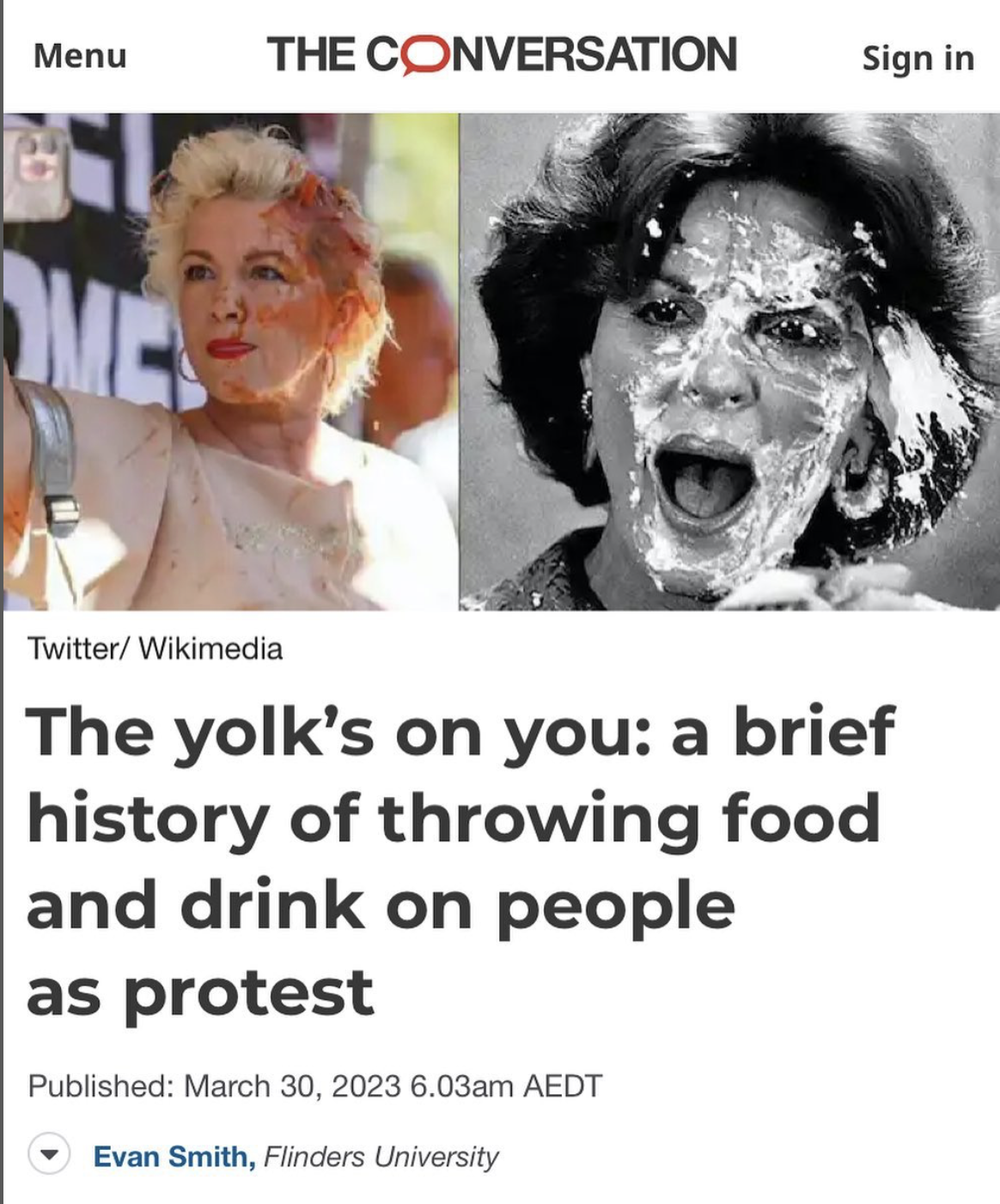
Apologies for the radio silence on the blog. I should mention that since anti-trans campaigner Posie Parker had food and drink lobbed at her in New Zealand, there has been interest in my research on the history of throwing food at public figures as a form of protest. Firstly, The Conversation published this piece by […]
Show full content
Apologies for the radio silence on the blog. I should mention that since anti-trans campaigner Posie Parker had food and drink lobbed at her in New Zealand, there has been interest in my research on the history of throwing food at public figures as a form of protest.
Firstly, The Conversation published this piece by me at the end of March.
Then some radio stations got interested in it. I spoke with Radio NZ back in April. You can listen to the interview here.
ABC Radio National recorded an interview between me and Geraldine Doogue and this played out in early June. Listen to it here.
gay rightsLGBT historyNational Union of Studentsno platformThatcherismUniversities
As it is LGBT+ History Month in the UK this month, I thought I’d share a short story of protest against homophobia in Britain in the 1980s by students at Swansea University. This story can be found in my book No Platform: A History of Anti-Fascism, Universities and the Limits of Free Speech. When the […]
When the National Union of Students introduced their ‘no platform’ policy in 1974, the focus of the policy was fascists and racists, primarily the National Front (NF). With the immediate threat of the NF declining in the early 1980s, there was a rethink of the various strategies used to combat them and the new threats that presented themselves at the time. This included debates about the application of the tactic of ‘no platform’. As well as targeting fascists and racists, the ‘no platform’ policy was also used at times to oppose speakers and groups that were sexist and homophobic. Coming at a time when the Conservatives stood steadfastly against gay rights and homophobia was the norm on the right, there were protests against some of the explicitly homophobic speakers who appeared on campuses. The most prominent example of this was the actions in opposition to a local Tory councillor with a record of homophobic remarks who was invited to speak at Swansea University in 1987.
In January 1987, a local Conservative councillor in Swansea, Richard Lewis, was invited by the Conservative Association at the University College of Swansea (more commonly referred to as Swansea University) to speak. Lewis was well-known in the local media for his homophobic views and this was at a time when homophobia was widespread in British politics (particularly in the Conservative Party), with the concern about AIDS being used to promote anti-gay agendas. As Daryl Leeworthy has written, ‘[t]he emergence of HIV/AIDS provided an excuse for social conservatives to try and reverse the development of a public gay life in the 1970s and early 1980s’ and that in 1987, several Conservative Party candidates and officials were involved in expressing ‘overtly homophobic opinions’, including Lewis.[1]
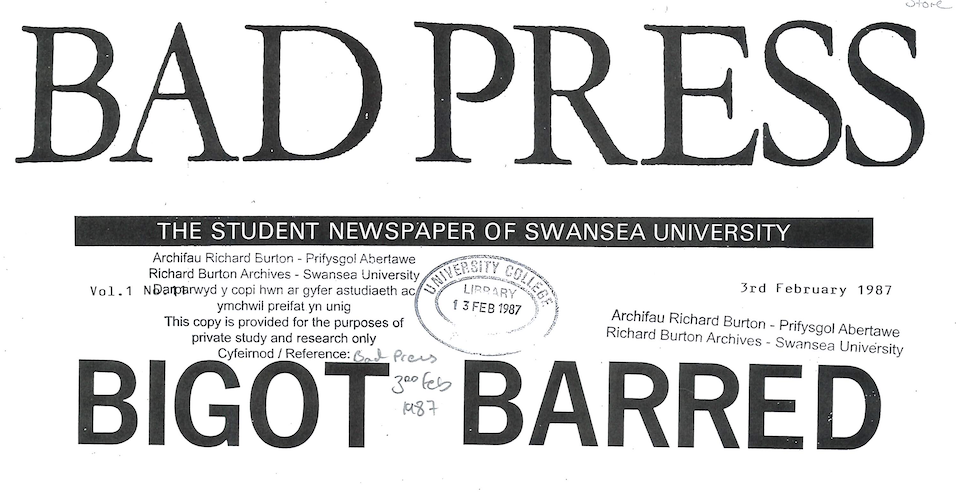
This incident occurred just prior to the Thatcher government starting to agitate against the ‘promotion of homosexuality’ by local governments (part of, as Anna Marie Smith points out, a wider attack on local governments during the 1980s), leading to the introduction of Section 28 the following year.[2] A column in Bad Press, the student newspaper at Swansea, noted that Lewis had ‘called for a “Mary Whitehouse” type clean-up campaign for Swansea’, ‘labelled freedom fighters in Southern Africa as “terrorists”’ and called AIDS a ‘gay plague’.[3]
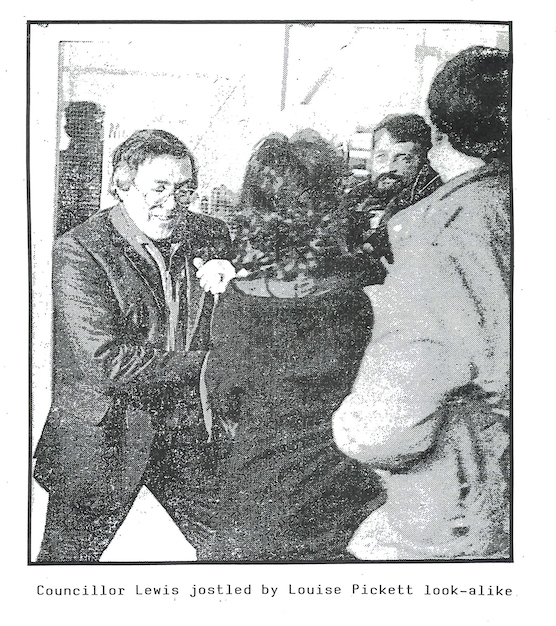
The student union at Swansea University had banned Lewis from entering the building, specifying that the Conservative Association had not given them the required four weeks’ notice that Lewis was scheduled to speak, rather than ‘actually refusing to let him speak’ – although they did acknowledge that Lewis’ views were ‘very dangerous’.[4] But Lewis, supported by members of Conservative Association, attempted to proceed with coming to the university and giving his talk. Bad Press described the events:
Accompanied by two bodyguards, Mr Lewis was met outside the Council Chambers by protestors who barred his entrance. Jon Lloyd-Owen, the Union Treasurer, informed Mr Lewis that he was not welcome in the building and had come uninvited. He was reluctant to leave, saying that he had every right to be there. However, led by Ms Pickett [the Chair of the Conservative Association] the entourage eventually moved out of the building and across to a lecture theatre, followed by some 60 protestors.
Refusing to begin this meeting until everybody was ‘sittign [sic] down properly’, Ms Pickett looked on scornfully as [Mr Lewis’] speech was drowned by cries of ‘OUT OUT’ from angry students.[5]
The student newspaper reported that Lewis spoke about the evils of homosexuality and then ‘condemned the behaviour of the S.U. members saying that it was an infringement of his freedom of speech’.[6] Lloyd-Owen replied that Lewis was ‘a dangerous homophobic bigot, whose antics pose a threat to all students and in particular those already oppressed by racism and anti-gay hysteria’.[7] The student union president declared in Bad Press that Lewis was ‘reactionary, opportunistic and misinformed’ and that his ‘ignorant views’ were ‘a danger to us all and generations to come’.[8]
In the aftermath of the protest against Lewis, the student union disaffiliated the Conservative Association and there was a fierce debate throughout the university about the protest.[9] There were letters in the student newspaper, as well as in the university newsletter, which both condemned and defended the actions of the protestors. One ‘narked socialist’ wrote to Bad Press, calling the protestors ‘bloody thugs’ and ‘mindless’, while ruminating that ‘the days of peaceful, organised effective demonstration in Britain’ were gone.[10] A protesting student replied the following week, countering:
There was nothing ‘thuggish’… about the behaviour displayed by those students who took part in the picket, … Lewis was met by a contingent of people who, not surprisingly, given the highly offensive nature of his views, weren’t exactly prepared to roll out the red carpet for him. He received a noisy and hostile reception, it is true, but he was never at any point physically assaulted by a student.[11]
The letter writer also objected to the demonstrators being called ‘mindless’, stating that the protest was ‘very effective’ that had achieved its aim – ‘the prevention from speaking (for very long) of a truly mindless man who denies freedom of speech to those whom he disagrees with’.[12]
Amidst the debate about the rights and wrongs of the protest, the university administration sought to take action against those involved in the protest, including two lecturers from the university.[13] The Principal at the university, Brian Clarkson, complained about the ‘bad publicity’ that had been attracted by the protest and proclaimed that he was ‘particularly shocked to see that two members of the academic staff were associated with the disruption’.[14] After over 30 academics from across the university signed a letter defending the protest against Lewis, Clarkson stated that freedom of speech was ‘the foundation of a University society and is not one which can be qualified in any way’.[15] But Colwyn Williamson, a philosophy lecturer at the university, asked ‘is there anyone who honestly believes in an unqualified right of free speech?’[16] As the letter by the numerous academics pointed out, ‘freedom of speech is not an absolute right in our society’ and one that is legally curtailed on several levels.[17]
As the university administration deliberated over whether to discipline the staff members that had protested, particularly one drama lecturer who was also gay, the Association of University Teachers (AUT) and the student union publicly lambasted Clarkson.[18] The student union stated that it ‘reject[ed] Clarksons [sic] unqualified statement on “freedom of speech”’ and pushed to ‘ensure that no-one [was] victimised by the Principal or College for their part in the demo’.[19] After Clarkson wrote in the university newsletter that it was ‘not necessary for the College continually to have to dissociate itself from such views’ as those professed by Lewis,[20] Dave Moxham, the student union President, argued that ‘gay lecturers and students would still feel there was a lack of support because the College had in no way disassociated itself from Cllr. Lewis’ “crusade”’.[21] In the wake of the Lewis incident, the student union implemented a formal ‘no platform’ policy, with Bad Press reporting that the union believed that ‘positive action against bigots, racists and homophobes must have to be taken as their views [had] no place on a university campus’.[22] Throughout the 1980s, other student unions pursued similar policies that expanded the principle of ‘no platform’ to sexists and homophobes.
This expansion of the ‘no platform’ tactic to include action against homophobes (and sexists) caused some of those originally wedded to the idea to object to its use beyond the original targets – organised racists and fascists. They felt that sexists and homophobes, while offensive, did not present the same kind of threat as the fascists that the policy was originally developed to combat. However the ‘no platform’ for sexists and homophobes, as advocated by some students and activists in the 1980s,ni needs to be seen in a wider context of the student unions attempting to address the sexual and homophobic harassment and violence experienced by students. The policy of ‘no platform’ for sexists and homophobes was not just an action to be taken against certain types of speech, but saw these forms of speech as precursors to acts of violence which required a pre-emptive response. And in the 1980s, the widespread homophobia of the press, the police and the Conservative government, as well as right-wing individuals and organisations, led activists to argue that such action was necessary in the fight for LGBT rights.
[1] Daryl Leeworthy, A Little Gay History of Wales (Cardiff: University of Wales Press, 2019) p. 122–123.
[2] Anna Marie Smith, New Right Discourses on Race and Sexuality: Britain, 1968–1990 (Cambridge: Cambridge University Press, 1994) pp. 15–22.
anti-fascismAustralian far leftAustralian far rightAustralian historyBooksFascismMedia appearances
Over the holiday break, our book, Histories of Fascism and Anti-Fascism in Australia, was published. Last week there were two bits of media coverage relating to the book. The first was an article in the Sydney Morning Herald by Peter Hartcher on the history of Australian fascism, including a few quotes from me. The second […]