Show full content
Going forward, all of the content here will also be posted at https://goodoptics.substack.com/
The substack subscribe feature is much easier to use. I will continue to post on wordpress for the time being.
Going forward, all of the content here will also be posted at https://goodoptics.substack.com/
The substack subscribe feature is much easier to use. I will continue to post on wordpress for the time being.

A friend recommended Tyler Cowen and Alex Tabarrok’s introductory economics textbook, Modern Principles of Economics, to me. It’s been almost ten years since I took an economics class, so I decided to take a look. I think I have noticed an exception to the law of comparative advantage as it is presented by that book. I figure that either I have made a mistake, or this exception is already very familiar to those in the know. If I’m right, the exception would have no real world significance whatsoever, but it might provide an interesting way of looking at why the law of comparative advantage is true. If I have made a mistake, hopefully someone will point that out in the comments.
Let’s start with just laying out comparative advantage. Why is trade and the division of labor necessary? There are three basic reasons:
(1) Tastes differ. If wild blackberries grow on my land and wild strawberries grow on yours, and we each prefer the other kind of berries, we can make ourselves better off by trading.
(2) Specialization allows learning and economies of scale. The example given in the book is that, if each of us were forced to live in the wilderness, growing our own food, building our own shelter, and making our own tools and clothing, we would probably starve. But one modern farmer can grow food for thousands of people. This is because farmers can learn far more about farming than can people who also have to learn about tool making, weaving, building, etc. Specialization enables the development of more knowledge. Specialization also makes it possible to invest in useful equipment that would not be justified if you were only growing food for personal use. Tractors are more efficient than trowels or draft animals, but a subsistence farmer wouldn’t be cultivating enough land for it to make sense to use a tractor.
(3) Comparative advantage.
[If you already know about comparative advantage, you can skip to the section “Fastistan vs. Slowistan” below; but maybe you will want to brush up like I did.]
Imagine a world economy with two countries: Burkina Faso and Britain. This economy also has only two products: shoes and socks. Britain can produce 50 pairs of shoes per year, or 50 pairs of socks, or any combination of an equal number of pairs adding up to 50. This graph represents the possible combinations of shoes and socks that Britain can produce in a year:

Note that the slope of this “Production Possiblity Frontier” (PPF) is 1.
Burkina Faso can produce 10 pairs of shoes or 20 pairs of socks. Britain can produce more than Burkina Faso of both products–it has an absolute advantage.

Note that the slope of the PPF is 1/2.
What could Britain gain from a trading partner who, seemingly, brings nothing additional to the table?
This is where comparative advantage comes in. Consider the opportunity costs of production for each country.

Because Britain can produce more of both products than Burkina Faso can, the cost in foregone production of producing in Britain is higher than in Burkina Faso. Therefore, both countries can be made better off by trade. As Cowen and Tabarrok put it: “The theory of comparative advantage not only explains trade patterns but it also tells us something remarkable: A country (or a person) will always be the low-cost seller of some good. The reason is clear: The greater the advantage a country has in producing A, the greater the cost to it of producing B” (pages 18-19).
Fastistan vs. SlowistanImagine two countries that are almost identical. The only difference is that in the first country, Fastistan, all productive machinery operates twice as fast as in the second country, Slowistan.
Fastistan can produce 10 pairs of shoes or 10 pairs of socks in a year.

Slowistan can produce 5 pairs of shoes or 5 pairs of socks.

Here are the opportunity costs of producing shoes and socks in Fastistan and Slowistan.

Note that the opportunity costs are the same. That is because, no matter how much more productive Fastistan is than Slowistan in absolute terms, what determines the unit opportunity cost is the per unit amount of foregone production. So if all products can be produced in the same ratio but in different amounts in two countries, the opportunity costs do not differ. It follows, I think, that neither country would be made better off by trade.
I don’t think that this fact has any real world implications–you are unlikely to get a situation like that of Fastistan vs. Slowistan in the real world. Modern economies produce millions of different products. If there were really only two products, it might be possible in practice to get two countries with PPFs with the same slope. But such a thing is very, very unlikely with a PPF that exists in millions of dimensions.
That leads me to a few concluding questions:
1. If the PPFs have the same slope, there is no comparative advantage, only absolute advantage (I think). Does it follow that the more different the slopes of the PPF functions are, the greater the gains from trade?
2. How do economists model trade in real economies, which have more than a few products? I once was talking to an economist about some class of models, and I asked him if every product gets its own dimension, leaving you with an ultra-high dimensionality monstrosity. He said that in principle you could model it that way, but that actually was too complicated to do in practice. He then explained what they do instead–but I don’t recall what he said! How is this handled?
If technological progress continues, AI will eventually be able to replace all human labor. What will happen next?:
(1) One much discussed possibility is that the AIs will forcibly take control from humans, perhaps killing them or perhaps just pushing them aside and running the world without significant human input. This scenario is often thought of as analogous to historical coups or violent revolutions.
(2) Another possibility is that income would continue to be paid out to the factors of production (land, labor, and capital). In this scenario, people who owned capital or land prior to AI take-off would become fabulously wealthy from AI driven growth acceleration. But most people, who depend on wages or salaries, would starve or become dependent on charity. Robin Hanson’s Age of Em belongs to this group. Scenario (2) can be thought of as a future driven by factor payments.
(3) A third possibility is that income from the AI labor will be heavily taxed by a central authority, which will then pay that income out to people to replace the wages lost after the economy transitioned away from human labor. What kind of a future is (3)?
It is often thought of as a communist vision of the future. Here is Matt Yglesias:
Another way of putting it would be Simon (i.e., plenty) for capital and Malthus (i.e., subsistence) for labor. That, of course, is Karl Marx’s vision of long-term economic development. And while I don’t have a strong opinion as to whether or not this is accurate over the long term, it’s certainly a plausible story about the future, and Marx’s solution — socialism — unquestionably seems to me to be the correct one.

But I think the identification of (3) with communism is incorrect. In fact, (1) is closer to communism, in that the workers (robots) would be seizing the means of production and liquidating the (human) owner class. (3) on the other hand is properly thought of as a welfarist, rather than a communist, vision of the future.
One model of the purpose of the welfare state is that it exists to provide income to those who receive no factor payments. A large section of society does not work for wages or own capital. Children, students, the temporarily unemployed, retirees, and the disabled all need some sort of income. Some might say that this income should come exclusively from personal savings or from family members. But another view is that it should provided out of tax revenue by the state. Matt Bruenig illustrated this point of view with a Swiss welfare state theory graphic:

The graphic shows two households at different levels of per capita income. Each household has one worker, but one of the workers supports a large family while the other worker supports only himself. The function of the welfare state, in the graphic, is to equalize the two workers’ incomes by redistributing from the worker with no dependents to the household of the worker with many dependents.
What does this have to do with futurism? If no humans work, the group without labor or capital income will become much larger. In addition to all those who do not currently work, it will expand to include those who mainly get income from working. In scenario (3), nearly everyone would become a welfare state beneficiary. But that would be nearly the opposite of communism, because the workers (robots) would control neither the instruments nor the products of their labor. In fact, they would presumably receive the bare minimum of “income” that they needed to keep working. Robots in (3) would therefore be in the position that Marx (wrongly, as it turned out) thought that the human proletariat was in.
Most people want to avoid scenario (1). But some might might prefer (2) to (3). And even if you do prefer (3) to (2), the difficulties in realizing it are substantial. You need to get whoever has control of the robots to submit to redistribution, but they might use their vast resources to resist, through force or litigation. I think (3) is possible in two situations. First, AI take-off might happen slowly enough (and governments might be with-it enough) that no private actor gets a decisive strategic advantage over existing regimes. Second, some private actor might create a new regime after becoming far more powerful than existing governments, and that regime might be redistributive.

All sensible people care non-instrumentally about things that happen in the world outside of themselves. Would you prefer that there be more or less extreme poverty? How about war? Cancer? Even if these things don’t affect you directly, you probably care about them.
Everyone also cares non-instrumentally about his own well-being. Most everyone also cares more about the well being of his friends and family than about that of strangers.
Sometimes, what is good for you is good for the world. There is probably a correlation. Ceteris paribus, what is good for you is likely to be good for the world. This is because (1) you are part of the world so your well-being counts for something even considered impartially, (2) in order to help, you probably need to be in reasonably good shape. But the correlation between goodness for you and goodness for the world is probably not perfect (why would the correlation be perfect?). The very best thing for you to do, impartially considered, is probably not selfishly the best thing for you to do. And this conflict doesn’t depend at all on the details of what you care about. Whether you want to maximize utility, minimize existential risk, realize American national greatness, spread Christianity, or achieve social justice, it is unlikely that what is best for you is best for the world by your own standards.
So you have self-regarding and other-regarding motivations. And these come into conflict, to some degree. How do you decide what to do? Somehow, you must reach a compromise (in almost all cases, it isn’t psychologically realistic to commit 100% to either selflessness or selfishness). A simple way of thinking about this would be to come up with a conversion factor between selfish and altruistic value. Say that you value yourself five times as much as you value other people. That sounds like a lot at first–but I think in practice your actions would be indistinguishable from those of an impartial altruist. There are a lot more than five other people. There are yet more animals. There are potentially countless (maybe literally countless) future people. So should you just make the conversion factor extremely large? “I value myself as much as a billion other people”? That also does not sound right. In fact, it sounds like something a villain in a comic book would say. In practice, I don’t think the conversion factor model describes what nearly everyone will do in real life, which is to try to compromise between selfish and altruistic actions.
Another way of thinking about is to imagine two homunculi, one selfless and one selfish, bargaining with each other. The selfless homunculus is an impartial altruist. The selfish homunculus just cares about you and your family. The two homunculi negotiate to determine what decisions you will make. They pick a plan together, and each homunculus can veto any plan. Note, this is not a model of moral uncertainty (though it does owe a lot to various theories of action under moral uncertainty, particularly the parliamentary approach). The thought is not: you have an equal credence on ethical egoism and impartial altruism. The thought is: in practice, you will act as if you value some things besides impartial altruism.
There are lots of opportunities for gains from trade between the two homunculi. For instance, money for private consumption is subject to sharply declining marginal utility (how many yachts can one man own?). But marginal utility doesn’t decline (or only declines very slowly) with money for altruistic purposes. The thousandth child vaccinated against polio is just as valuable as the first. So if you try to become extremely rich, both homunculi can be happy–the selfish homunculus because you will be able to buy tons of stuff, the selfless homunculus because, even after buying tons of stuff, you will have lots of money to give away. Similarly, many people become researchers because they love it and can’t tear themselves away. And if you love biology, you might be able to make both homunculi happy by trying to invent a cure for Alzheimer’s Disease.

In general I like this model of compromise between conflicting values. But I also see a few big flaws.
I think that there are a lot of situations where the ability of the homunculi to veto seems intuitively attractive. Liking the veto seems like a similar feeling to wishing that Abraham had told God, ‘No, I’m not going to sacrifice my son, and I don’t care what you offer me, there’s no opportunity for a deal here, just go ahead and strike me down’.
But imagine if you had the opportunity to jump in between Gavrilo Princip and Archduke Franz Ferdinand in 1914, stopping Princip’s bullet and preventing the First World War (assume–unrealistically–that you understand the stakes of the situation as it is happening). I would say, if you have that chance, you should definitely take it. Normally, I think it is fine for people to care a lot more about their own lives than the lives of strangers. It’s just human nature; it would be a waste of energy to criticize something as built-in as that. You might as well command the tide not to rise. But in some extreme situations, my feeling changes. Normally, it is alright to put yourself above the rest of the world, to some extent. But if you can prevent WWI at the cost of your life, you should do it. I would be sympathetic to someone who was so overcome with fear in the moment that he let Princip shoot the archduke. But if someone just coolly watched it happen, and then said ‘look, the homunculi couldn’t reach an agreement on this one’, I would object to that.
However, cool refusal is exactly what my two homunculi model predicts. Unless the life of your child is at stake, there is no worldly benefit you can be offered that offsets the loss of your life. So the selfish homunculus just will not sell, no matter what the selfless homunculus offers him. There is no deal to be made.
I wonder if we can save the model with some idea of negotiating in advance to make extreme sacrifices in special situations. Imagine the two homunculi, before you are born when they are perfectly ignorant of every fact about you, agreeing that if you have the chance to die to prevent a world war, you should take it. And if you have a chance to live a life of minimal altruistic value but that is sufficiently surpassingly enjoyable, you will also do that (maybe being a great writer or musician–but perhaps that example doesn’t work because other people would enjoy your work).
Putting the model aside, I find my own thinking about this issue to be very muddled. I absolutely would give my life to stop WWI, or achieve other comparably important ends. That’s not because I don’t love life; I do. But, even though I would be willing to sacrifice my life to prevent WWI, there are some seemingly less painful things that I really cannot see myself doing. For instance, if my best opportunity to help the world were something that made my parents hate me, I think I would probably just pass it up. You might object: this isn’t necessarily an inconsistency, maybe I care more about filial piety than life itself. But that isn’t it. If I had choose between pressing a button that got me excommunicated from my family, or a button that got me killed (but left a beloved memory in my wake), I would definitely press the excommunication button. That is not consistent. (A friend suggests that I may put some epistemic weight on my parents’ judgment, which maybe resolves the inconsistency.)

Here’s another problem: both homunculi are always on board with instrumental selfishness (or helping yourself now so you can help others later). Put on your own oxygen mask first, as they say on airplanes. But “instrumental selfishness” is poorly defined.
Getting enough sleep is important to doing good work and important to being happy. But what about getting along with your parents? Certainly, some people would be so miserable if they didn’t get along with their parents that they wouldn’t be able to do good work. What if you require lots of vacation time to do good work? What if you require the finest caviar every night? What about a new Bugatti? Where does it stop? The issue applies to a whole host of decisions, not just financial ones.

Finally, a general worry. It seems like we value a lot of things that are imperfectly correlated with each other. The true, the good, and the beautiful sometimes coincide, and sometimes they don’t. And one consequence of thinking of the relationship between these things as a correlation that is less than one is that the maxima of truth, goodness, and beauty will come apart.
We are left with two (by my lights) pretty unattractive options. We can compromise and miss out on the maxima of all three values, and perhaps realize a lower amount of ‘total value’ (whatever that means); or we can maximize one value uncompromisingly. It sounds attractive to adopt the principle that, even though you normally compromise between X and Y, if you can really hit X out of the park you should just focus on doing that, Y be damned. But I wonder if, in the real world, this principle makes compromise of any kind impossible, that it just mandates zealotry.
In a dictatorship, the leader can do whatever he wants. Any dictator, simply because he is a dictator, is liable to engage in illicit self-dealing and to kill people who threaten his power. However, if the leader has reasonable wants, and reasonable ideas about how to accomplish what he wants, then there is a limit to how bad things can get. Only moderately bad dictators have tended to be less revolutionary than the worst dictators. Hitler and Stalin both wanted to take over the world and change their own societies completely. The Shah of Iran, on the other hand, was happy to mostly hold on to power that he had inherited. The Shah of Iran was not a great guy. He killed people who threatened his power, and he was corrupt. But that is where it stopped. He did not try to root out any races or classes, he did not cause any massive famines, he did not attempt to engineer a world war.

Imagine a regime with a committee of five rulers. They vote to decide what to do, and the majority rules. I think this kind of an oligarchy would tend to be more moderate– and therefore, less destructive–than a dictatorship. Further, an oligarchy in which all members have to be unanimous before any action can be taken would be more moderate still.
A complication is that such a regime might be staffed by revolutionary ideologues who all believe the same crazy things. Would that be any different in practice from a revolutionary dictatorship? Also, why are representative democracies generally less bad than dictatorships? One popular model is that the people understand the world well enough to stop the very worst abuses. The usual examples are wars of aggression that the aggressor country might lose and manufactured famines. But why should this be? Why don’t we find countries of ideologues, where the common man is as blinkered and as willing to sign up for bloodshed as Stalin was?
One explanation: the average person simply does not know enough to be an ideologue. Being an ideologue means learning and applying a vast amount of theoretical content (I do not say information). Most people, for better or worse, have not learned all that. The average American apparently cannot explain what it means for someone to be liberal or conservative. They know which of these terms is associated with which political party. They might know which issue positions are liberal or conservative. But my understanding is they have a very limited ability to explain how these positions are supposed to cohere with each other. That means they can’t predict what ideologies prescribe “out of sample”. In a new or extreme situation, they have to respond with an open mind because they just do not know what any ideology would say they should do.
Perhaps if you had some super-educated country, then democracy would be no better than dictatorship at avoiding atrocities? I actually think this is not quite right–although more education might make people more ideological, people differ temperamentally in how ideological they are willing to become. Someone like Deng Xiaoping can engineer a retreat from the worst communist practices for pragmatic reasons. Deng did not dismantle communism because he didn’t really understand communist ideology. Rather, he was able to consider China’s problems with an open mind despite understanding communist ideology.
Thus regimes in which some or all rule (oligarchies or democracies) are likely to be more moderate than regimes in which one rules. Having one ruler increases the chance that the ruler is both able and willing to apply an ideology, which I think is how people get killed in very large numbers. Further, regimes in which a larger majority of the rulers is needed to do anything will, to that extent, tend to be more moderate.
My argument suggests that the worst possible regime is not a dictatorship. It is actually an exotic kind of oligarchy in which an action is taken if any rather than all or a majority of the rulers wants to take it. A group is less likely to average out to a Stalin than one ruler is to be a Stalin. But a group is also more likely to contain a Stalin aspirant than a single person is to be one.

Nobody wants to die. Natural risks are known to be pretty low, because we can estimate their frequencies in the future with their frequencies in the past. As it happens, supervolcanic explosions and planet killing asteroids don’t come around very often. So if very few people are trying to wipe humanity out and natural risk is low, then why worry?
Consider the risk posed by passively listening for alien messages (recently explored in an excellent post by Matthew Barnett). If we expect that some alien civilizations will expand very rapidly but still significantly slower than the speed of light, there will be a large margin between the frontier of their physical expansion and the furthest places they can reach by sending messages at light speed. Expansionist aliens might try to use messages to start expansion waves from new points further out or to prevent other civilizations from grabbing stuff that is in the future path of their expanding frontier.

Therefore, if we get an alien message, it might be bad news. It might encode instructions for some kind of nightmarish world destroying weapon or hostile, alien-created AI. Maybe we just shouldn’t try to interpret it or run it on a computer. (Bracketing all the technical problems this obviously raises–if we get a message we don’t recognize as such or that we can’t make head or tail of, then there’s obviously nothing to worry about). As one commenter summarized Matthew’s argument: “Passive SETI exposes an attack surface which accepts unsanitized input from literally anyone, anywhere in the universe. This is very risky to human civilization.”
The SETI Institute’s current plan if they get an alien message is apparently to post it on the internet. For the above reasons, this is a terrible idea. Matthew wrote: “If a respectable academic wrote a paper carefully analyzing how to deal with alien signals, informed by the study of information hazards, I think there is a decent chance that the kind people at the SETI Institute would take note, and consider improving their policy (which, for what it’s worth, was last modified in 2010)”.
I have studied information hazards a bit, and the subject is very interesting. But as far as I can tell the study of information hazards is short on general purpose lessons besides: be careful! One important finding is the idea of the unilateralist’s curse. If a group of independent actors discovers a piece of sensitive information, the probability that it will be released is given not by the average of the probabilities that each member will release it but by the probability that the most optimistic or risk tolerant member will. This leads to a “principle of conformity”. In an information hazard situation, you shouldn’t just do what you think best. You should take the other group members’ assessment of how risky publicizing something is into account. Be careful!
Information hazard research pioneer Nick Bostrom came up with an analogy for existential risks created by future technologies. Imagine that there is an urn containing white, gray, and black balls. A white ball is a beneficial new invention, a gray ball is an invention with mixed effects, and a black ball is an invention that destroys human civilization (for example, a bomb that, once discovered, any idiot can assemble which would destroy the entire earth if detonated). So far, technological progress has been good for humanity. We’ve drawn lots of white balls, a few gray balls, and no black balls.
But will that continue? Bostrom wrote:
Most scientific communities have neither the culture, nor the incentives, nor the expertise in security and risk assessment, nor the institutional enforcement mechanisms that would be required for dealing effectively with infohazards. The scientific ethos is rather this: every ball must be extracted from the urn as quickly as possible and revealed to everyone in the world immediately; the more this happens, the more progress has been made; and the more you contribute to this, the better a scientist you are. The possibility of a black ball does not enter into the equation.
I think the existence of this ethos is the most important big picture reason for pessimism about existential risk. It is much harder to bound the risks created by new technologies than it is to bound natural risks. We have only had a few centuries of fast technological progress. Presumably the technologies of the future will be more powerful than the technologies of the past. Presumably things that are more powerful are riskier. And, if a black ball had come out of the urn already, there would be nobody around to ponder this question. So how much can we conclude, really, from the fact that no black ball has been drawn so far in our own history?

We should be worried that our civilization spends almost no energy worrying about this possibility. Science emerged from the breakdown of various orthodoxies and taboos. Scientists’ hatred of taboos is pretty understandable–and the fact that I find it understandable worries me all the more. I hate, hate, hate people who try to institute taboos on exploration and discussion! And that is even after spending a lot of time thinking about why future technologies might be risky. Even though I think this attitude imperils my species, I cannot suppress my allergy to taboos.
So what are the chances, then, that the “pull out as many balls as possible, color be damned” ethos changes, without other huge changes in the structure of human civilization? Maybe we could convince SETI organizations to “be careful!”. Then that (small, in the grand scheme of things) problem might be solved. But how many other groups, doing other kinds of research, would we have to convince? We either have to scramble to invent countermeasures to technologies that do not exist yet, or we have to try to persuade various research communities to change in ways that they find very uncongenial. We are running around a dam that is springing leaks, trying to plug them with our fingers. That is the kind of thing that will eventually stop working.
It is reasonable to expect that, if all goes well, astronomically more people will be alive in the future than are alive today. So, the argument goes, ‘the utilitarian imperative “Maximize expected aggregate utility!” can be simplified to the maxim “Minimize existential risk!”’.
But, it was later objected, the fact that the number of future people may be very large does not by itself mean that we should focus on minimizing existential risk. In some situations, it might be more effective to try to make smaller improvements to the expected welfare of future people. Trajectory changes are changes that improve the value of the long-term future through some mechanism other than preventing existential catastrophe. Trajectory changes have to be:
(1) Sticky; to count, their effects must be extremely long lasting.
(2) Not inevitable; bringing something about that would have happened anyway a bit later does not count as a trajectory change.
(3) Morally significant; events that are unimportant cannot be trajectory changes.
Whether trajectory change or existential risk mitigation is more effective obviously depends on the magnitude of existential risk. More fundamentally, it depends on how smooth or jumpy the curve of increase in the expected value of the future is. To the degree that the future is not completely determined yet, variation in human choices will result in variation in the ultimate amount of realized moral value. Good choices will result in more value than bad choices. Different worldviews imply different functions mapping quality of choices to amount of value. For instance, one might think that there are really only two equilbiria in the long-run: extinction and utopia. If this is your view, your function mapping performance to realized value would look something like this:
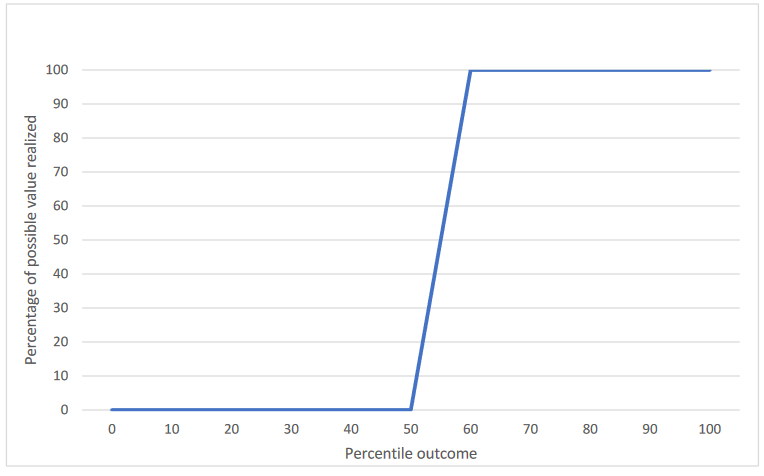
Given this function, you should probably focus on existential risk reduction. Smaller changes are precluded. Another, I think somewhat less popular, view is that extinction is quite unlikely but that realized value in the future varies significantly with performance:

Finally, you might think that existential risk is high and that the variation in value between different futures without existential catastrophe is large:

If we are in the world described by the second graph or the third graph, it might make sense to pursue trajectory changes in addition to or instead of existential risk reduction. But it can be hard to imagine exactly what kind of changes those would be. It is very easy to see why a nuclear war that killed everyone on earth would curtail humanity’s future. What kind of event might reduce the value of the long run future by, say, 1%? In order to build intuition, I looked into a few examples of morally significant and long lasting historical changes.
Historically Attested Trajectory Changes The Caste SystemIn India, nearly everyone belongs to a traditionally endogamous group that historically occupied a specialized economic niche. Genetic evidence shows that caste endogamy is thousands of years old. The rate of intermarriage between at least some Indian sub-castes and their neighbors in the last several millennia must have been less than one percent:
People tend to think of India, with its more than 1.3 billion people, as having a tremendously large population, and indeed many Indians as well as foreigners see it this way. But genetically, this is an incorrect way to view the situation. The Han Chinese are truly a large population. They have been mixing freely for thousands of years. In contrast, there are few if any Indian groups that are demographically very large, and the degree of genetic differentiation among Indian jati [sub-caste] groups living side by side in the same village is typically two to three times higher than the genetic differentiation between northern and southern Europeans. The truth is that India is composed of a large number of small populations.
David Reich, Who We are and How We Got Here, 145-146.
In David Reich’s analysis, fully one third of studied groups were as endogamous as or more endogamous than Ashkenazi Jews.
Textual evidence shows that hierarchical ideas of caste are also thousands of years old. In the Rig Veda, a collection of hymns composed some time in the second millennium B.C., there is a hymn in which a god, Purusha, is sacrificed and his body divided to form the basis of the castes. Purusha’s mouth formed the priestly caste, his arms the warrior caste, his legs the farmer caste, and his feet the laborer caste. Later ancient texts, like the Arthashastra and the Manusmirti, prescribe laws and policies for maintaining caste hierarchy.
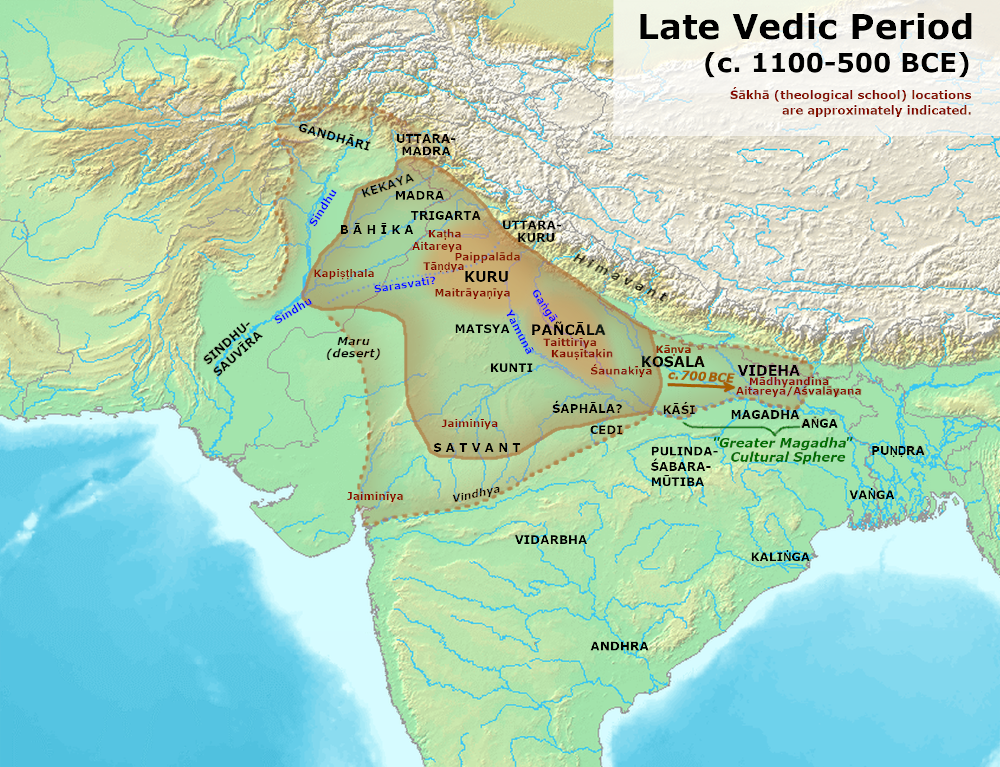
Finally, Reich presents genetic evidence that the highest caste, the Brahmins, are disproportionately descended from Steppe people who conquered the Indian subcontinent in ancient times.
Does the above evidence prove that bad treatment of lower caste people in India dates back to ancient times? Well, it is hard to be sure because the Indian climate makes it very difficult for ancient texts to survive. However, it is at least very suggestive. Lower caste people have, in well-documented recent history, been relegated to lives of poverty and illiteracy. They also have been treated utterly without respect. It seems likely to me that people have diminishing marginal utility in status. That is, the gain in going from an extremely low and despised position to an average position is greater than the gain in moving from an average position to an extremely high position. If this is true, the caste system is negative sum in welfare terms–the misery of the low castes is not compensated in aggregate by the bliss of the high castes. All societies, even lots of groups of non-human animals, are hierarchical to some degree. While a moderate amount of inequality may not have significant welfare costs, the costs could be extreme in an extremely hierarchical society. And, at least in recent history, it is hard to think of more extreme examples than the caste system.
For the caste system to represent a historical trajectory change it has to be long-lasting, avoidable, and important. The hardest of these criteria to establish is that the caste system was avoidable. It seems unlikely that the caste system is a necessary result of military-economic competition. Talent for various jobs is unlikely to be perfectly correlated with caste (why would the correlation be perfect?). That means that, inevitably, there will be inefficiency when people perform the labor appropriate for their caste rather than the labor appropriate for their skills.
But might the caste system have been a necessary result of the ancient Indian political situation? The Indo-European invaders seem to have established weaker systems of endogamous classes or castes in ancient Persia, Rome, and Greece. But none of those countries has anything comparable to Indian caste. So caste systems stable on the scale of several millennia were not a universal result of the Indo-European conquests. The arrival of Islam in Persia is sometimes associated with the end of the ancient Persian caste system; perhaps the fact that Islam only became firmly established in India five hundred years after Iran caste to entrench itself in India. It is also possible that something about the ancient Indian political situation made the persistence of caste almost inevitable. Either way, after the caste system became firmly established, it has proved very hard to dislodge.
Infanticide and AbortionThe Greeks, Romans, and Pre-Islamic Arabs all practiced widespread infanticide. I think the extent to which Christianity and Islam actually ended infanticide in these places, as opposed to just pushing it out of the literary sources, is not totally clear. However, there is good data on infanticide and abortion from Early Modern Japan. Ordinarily, in pre-industrial societies fertility rates were high, and population growth was slowed by high natural infant mortality. In Tokugawa Japan, fertility rates fell long before industrialization and rose again early in the industrial period, once infanticide was brought under control:
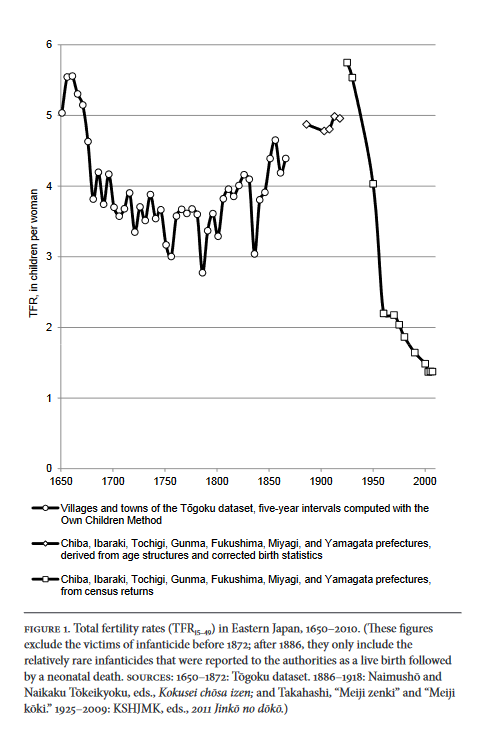
In Early Modern Japan:
Infanticide permitted a range of interpretations. Administrators worried about dwindling populations and falling revenues, and often thought that it was a love of luxury that prompted people to kill their children. Villagers complained that poverty left them no other resort, and sometimes helpfully suggested that lower taxes would do wonders for the safety of their newborns. Men of learning often believed that moral education could convince villagers to give up infanticide, but some thinkers argued that it would take a fundamental reform of the political system to achieve that goal. Men of substance who were content to work within the established order, meanwhile, reinvented themselves as moral leaders of their communities and wrote to their governments with offers to finance the eradication of infanticide. Most domains in Eastern Japan built expensive systems of welfare and surveillance. By 1850, the majority of women north and east of Edo were obliged to report their pregnancies to the authorities, and the majority of the poor could apply for subsidies to rear their children. Over the same years, a demographic revolution was set in motion. In the eighteenth century, the consensus of many villages in Eastern Japan was that parents could, and under many circumstances should, kill some of their newborns. Perhaps every third life ended in an infanticide, and the people of Eastern Japan brought up so few children that each generation was smaller than the one that went before it. By 1850, in contrast, a typical couple in the same region raised four or five children, and a long period of population growth began. By the 1920s, the average woman brought six children into the world, and in Eastern Japan, as elsewhere in the nation, overpopulation at home became an argument for expansion abroad. Eastern Japan, in other words, had experienced a reverse fertility transition.
Fabian Drixler, Mabiki, 2.
One reviewer of Mabiki acknowledged the reality of the pattern but attributed the shortfall in births to abortion rather than infanticide. Either way, the population was reduced and per capita standards of living would have been raised (assuming, what is almost certainly true, that Early Modern Japan was a Malthusian economy). In addition to the effects of infanticide on population size and average well-being, it may also have had negative psychological consequences for parents. Speaking personally, the deaths that seemed to weigh by far most heavily on older members of my family are the (unintended) deaths of children, even though those deaths all happened seventy or more years ago. Those deaths were not products of infanticide, and for all I know, the pain associated with infanticide might have been less. On the other hand, I think murder is often more troubling to the victim’s family than other causes of death. And in Roman law, the paterfamilias could decide unilaterally, without the mother’s permission, whether to accept a new baby into the family. I imagine the pain of the mothers in those situations must have been enormous. Finally, if we are going to establish moral side-constraints against anything, we probably should start with infanticide.
Human Sacrifice and Gladiatorial CombatRodney Stark is a Christian historical sociologist. He is not at all a neutral observer. But I think his discussion of what gladiatorial games reveal about pagan society appropriately describes the stakes:
But, perhaps above all else, Christianity brought a new conception of humanity to a world saturated with capricious cruelty and the vicarious love of death. Consider the account of the martyrdom of Perpetua. Here we learn the details of the long ordeal and gruesome death suffered by this tiny band of resolute Christians as they were attacked by wild beast in front of a delighted crowd assembled in the arena. But we also learn that had the Christians all given in to the demand to sacrifice to the emperor, and thereby been spared, someone else would have been thrown to the animals. After all, these were games held in honor of the birthday of the emperor’s young son. And whenever there were games, people had to die. Dozens of them, sometimes hundreds. Unlike the gladiators who were often paid volunteers, those thrown to the wild animals were frequently condemned criminals, of whom it might be argued that they had earned their fates. But the issue here is not capital punishment, not even very cruel forms of capital punishment. The issue is spectacle for the throngs in the stadia, watching people torn and devoured by beasts or killed in armed combat was the ultimate spectator sport, worthy of a boy’s birthday treat. It is difficult to comprehend the emotional life of such people. In any event, Christians condemned both the cruelties and the spectators. Thou shalt not kill , as Tertullian (De Spectaculis) reminded his readers. And, as they gained ascendancy, Christians prohibited such “games.” More important, Christians effectively promulgated a moral vision utterly incompatible with the casual cruelty of pagan custom.
Rodney Stark, The Rise of Christianity, 214-215.
Fourteen centuries of Christian rule provided ample cruelties of their own. Christian era executions, some of which took especially dramatic forms like breaking on the wheel, often served as public spectacles. And pagan Rome wasn’t necessarily all bad. While the Carthaginians famously burned children alive as offerings to their god Moloch, the Romans: “did not tolerate human sacrifice among the peoples they conquered[…] seriously curtailing the practice (if not actually eliminating it) among the Carthaginians and among the Celts.” Practices such as human sacrifice and gladiatorial combat were long-lasting side-constraint violations, even if that the Malthusian model implies the welfare effects of each individual game in the Colosseum or human sacrifice were transient.
VegetarianismToday, vegetarianism and other diets that limit meat consumption are more common in India than almost anywhere else. Moral vegetarianism in India dates back to ancient times. My understanding, from a professor I had as an undergrad, is that early Jains were the first to become concerned about animal welfare and then this concern spread to Buddhists and Hindus. While many religions involve fasts from meat for spiritual purposes, I think Indian civilization is pretty distinctive in valuing animals intrinsically. This seems likely to be a contingent fact of India’s cultural history rather than an inevitable adaptation to the circumstances. Further, the animal welfare consequences of Indian vegetarianism over the broad sweep of history are likely to have been large. There also may be human population size consequences of foregoing meat.
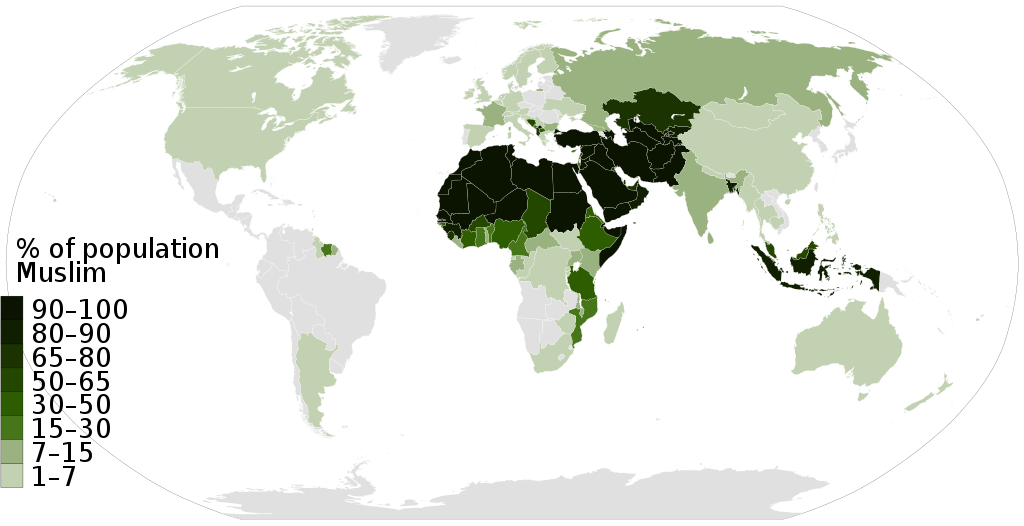
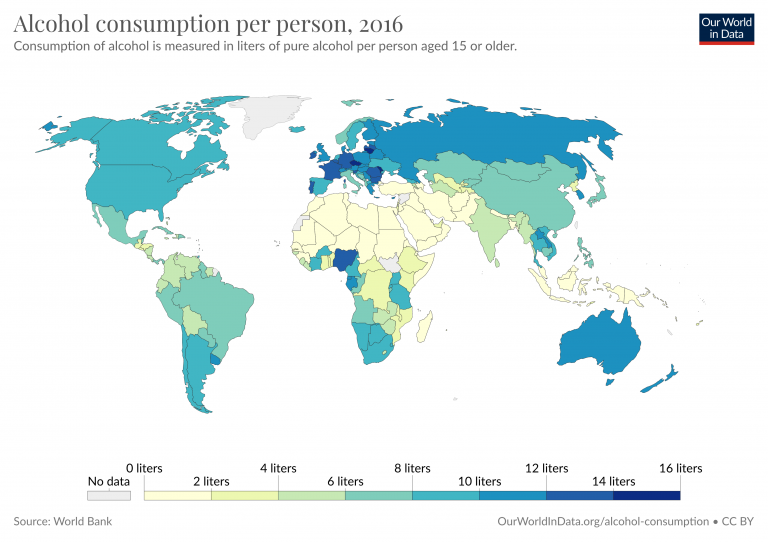
Alcohol ProhibitionIn the modern world alcohol might be a net benefit to humanity. Many people enjoy it, but many others become addicted to it. So it is hard (if not impossible) to say whether it is good or bad. In a Malthusian situation, the effects of alcohol seem more obviously negative. Either it is a form of luxury spending that can be replaced with other luxuries when the system is out of equilibrium. Or it is consumed at equilibrium as a substitute for subsistence goods. Who would trade subsistence for alcohol? Alcoholics.
Orthodox forms of Islam prohibit the consumption of alcohol. And this prohibition seems to be effective enough, at least now, that it can be read off of a map:
Some readers might have noticed that none of the suggested historically attested trajectory changes involve changes in per capita living standards. That is because nearly all economies prior to the Industrial Revolution were governed by Malthusian dynamics. In a Malthusian economy, growth in technology or the capture of new natural resources results in only a transient improvement in per capita living standards. This is because the population always grows to eat up the new surplus. Once the surplus is eaten up, living standards decline again. How far do they decline? Back to subsistence; that is, back to the point at which they could not decline any further without causing the population to fall. This is why per capita incomes did not grow in a sustained way between the rise of agriculture and the Industrial Revolution.
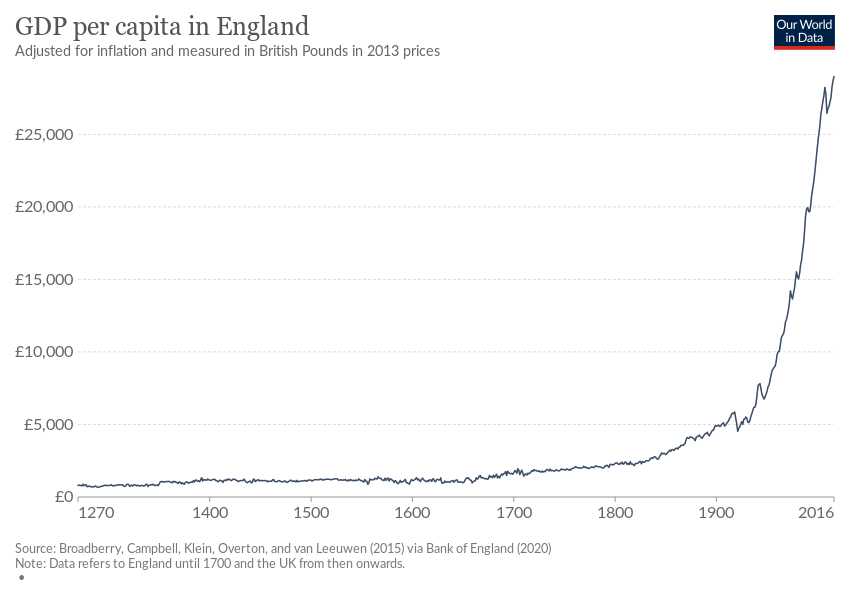
Unless the jaws of the Malthusian trap are broken, there is no way that changes in per capita economic living standards can be made to stick. But there is more to life than per capita economic living standards. Some changes along other dimensions have been significant and long lasting. That’s why I want to push back on the tendency I sometimes see in online discussions of macrohistory to assume that the only genuinely “macro” historical events are the invention of agriculture and the Industrial Revolution.
The examples I gave of historically attested trajectory changes fit into the categories of:
Changes in Population SizeMalthus allowed that, if fertility could be controlled artificially, the increase of population might not consume increases in productivity. Thus infanticide and abortion can change both population size and equilibrium economic living standards. The history of infanticide and abortion will therefore have different assessed consequences according to different views of population ethics (apart from their inherent moral significance).
Non-Economic Welfare ChangesEveryone knows that it is possible to be poor and happy or rich and unhappy. This idea seems less relevant to the deep past because the level of poverty that nearly everyone was subjected to was so extreme. Similar levels of poverty are seen today in rich countries not among the average poor but only among the very poorest. It is hard to imagine how anyone could be happy while starving or freezing. But it is easy to imagine how someone could be made more miserable. Extreme disrespect or non-disabling physical torture could make the life of even someone living at subsistence harder, without killing him by reducing his income.
Animal WelfareHuman economies were Malthusian with respect to the human population. But they also had associated populations of domesticated animals, in varied living conditions. Those animal populations did not follow Malthusian laws because people consciously regulate the size of animal herds. Thus changes to human beliefs or practices related to animals can have long lasting welfare consequences, even in a Malthusian situation.
Violation of Side-ConstraintsThe short-run welfare effects of many atrocities (murders, wars, violent rampages) are obviously negative in any situation. In the medium term, in the Malthusian trap, the consequences become debatable. A war that killed off 10% of the population would reduce the intensity of cultivation and might allow farmers an easier life until the system returns to equilibrium. Or maybe the acute suffering and destruction of physical capital outweigh this effect. Either way, in a Malthusian situation, the welfare effects of deadly violence will be transient. Eventually, the population will return to equilibrium, regardless of whether there was more or less suffering in the meanwhile. However, some moral theories hold that certain actions are wrong apart from their welfare consequences. And even if we are committed consequentialists, we should still not be certain that our preferred moral theory is right. So we might regard events as historical trajectory changes if they established long-lasting practices that violate the rules of deontological or virtue theories.
AddictionNormally, people prioritize survival for themselves and their children over all other goals. There is, however, a big exception. When people are addicted to a drug, they often prioritize access to the drug over access to goods needed for survival. Because, unlike most goods, demand for an addictive drug can compete with demand for food, the spread of an addiction can reduce the maximum population that can subsist at a given level of total wealth. Also, addictive drugs introduce new sources of non-economic suffering.
The Steady State of the FutureBecause of the expansion of the universe, there is only a finite amount of matter and energy that is in principle accessible from earth. The maximum amount of possible economic value per atom may be finite or it may be infinite. If it is finite, economic growth due to technological change will at some point cease. All the important, possible technology will have been invented already. If this “Technological Completion Conjecture” is correct, trajectory changes will have to act on some other mechanism than increasing the total wealth of the civilization of the future. Future civilizations would be analogous to past civilizations in that the only way they could increase per capita wealth would be population decline. The economic steady state of the future may or may not be Malthusian. Population could be artificially capped at some level above subsistence. But population and individual living standards will ultimately be capped, naturally or artificially. Thus changes to the moral trajectory of future civilization might have to take similar forms to changes to the trajectories of pre-industrial civilizations. My typology of trajectory changes possible given a fixed level of output is very likely to be incomplete. There are probably many other morally significant kinds of changes that can occur in the absence of changes to per capita income (most obviously, changes in the distribution of income might change welfare levels without changing total economic output).
What specific aspects of the trajectory of future civilization might it be important to change? I have a few ideas, but they are very speculative. If output is again capped and Malthusian dynamics return, population axiology may begin to seem a lot less dry and academic. Factory farming might either disappear or radically expand. Digital minds might be created, and treated either humanely or horrifically. Horrific treatment could be motivated by efficiency (as it is in factory farming) or by more perverse motivations (as in human sacrifice or gladiatorial games). And new addictive drugs (and counter-measures to addiction) are very likely to be invented.
Thanks to Applied Divinity Studies, Matthew Barnett, Skluug, Kenan, and Voxette for comments and discussion.
In the modern world, the richest countries often have very limited natural resources (e.g., Japan). And often, resource rich countries are very poor because of protracted civil war (e.g., Congo-Kinshasa), misgovernment (e.g., Venezuela), or being stuck at the bottom of the value chain (the so-called Dutch Disease). It is still better to have abundant natural resources than to not have them. But there is a lot more to a modern economy than natural resource extraction. I think that prior to the industrial revolution it was rarer for a country blessed with rich natural resources to be poor. One extreme example of this is the division of Genghis Khan’s empire among his four sons. The eldest son, Jochi, received the area corresponding to Russia and Siberia. The state created by Jochi and his descendants is known to history as the Golden Horde. The Golden Horde was the least populous of the four sections, but it was seen as desirable because it had abundant natural resources, particularly furs. If given the choice today, I would certainly rather be Khan of China or the middle east than of Siberia and the Great Steppe. But back then, they don’t seem to have seen it that way.

So it seems fair to say that natural resource are less central to determining which regions are considered rich or poor in the modern world than they have been historically. And it also would seem to follow that starting a war for the purpose of stealing natural resources makes much less sense than it used to. But, though the role of natural resources in starting wars has diminished, the role of natural resources in expanding wars once they begin has increased.
In general, a pre-industrial army is not that hard to supply. You need food, clothing, wood, various widely available metals, and maybe saltpeter. There are some exceptions–I’ve seen speculation that the Late Bronze Age collapse was caused in part by an inability to find new sources of tin for making bronze after the tin mines in what is now Afghanistan stopped operating. But, in general and for the most part, modern nations need vastly more varied and geographically disbursed resources to fight wars. I notice this whenever I read about World War II. The German and Soviet leadership were constantly freaking out about access to chromium or phosphorus or tungsten or various other obscure elements of the periodic table. One of the major reasons Japan attacked Pearl Harbor was the Americans had subjected them to an embargo on oil exports, and they imported 80% of their oil from America. Prior to the invention of the internal combustion engine, a situation in which it made sense to the Japanese to attack the United States may just never have arisen. During World War I, Germany was cut off from deposits of guano (bird and bat droppings) from South America which it used to get fixed nitrogen for use in fertilizers and explosives. The German chemist Fritz Haber saved the day by having invented the Haber-Bosch process. But that was just luck.
It has become far more common for rich countries to import the majority of the food they consume from abroad (though there are ancient examples of this, like the role of Egypt as the breadbasket of Rome). Fossil fuel powered transportation makes it more economical to ship heavy items like food. And food imports seem to have been a crucial factor in the escalation of the world wars.

Germany’s strategy in WWI was to use submarines to blockade England and starve the English into surrendering and deprive them of supplies. (I don’t know why people always say “U-boats” in this context, it just means unterseebooten, i.e. submarines. I guess it is the same impulse as refusing to translate Führer into “leader”.) Unrestricted submarine warfare had the side effect of leading the Germans to sink ships carrying American passengers, which expanded the war. The Germans, for their part, also suffered from difficulty importing food. It was serious enough that the effects of the Entente blockade show up in graphs of the height of German children.

These days, lots of us have WWIII on the brain. But those concerned about the long-term future have additional reasons to think about great power war. The ill effects of a world war could easily be permanent.

I want to suggest a model according to which international trade in geographically concentrated natural resources increases the risk that a small war becomes a world war:
(1) Cheap international shipping and greater knowledge of how to use rare materials creates more demand for geographically concentrated natural resources in peacetime.
(2) Therefore, modern economies rely to an ever greater extent on imports that can not be insourced in an emergency.
(3) When war breaks out, access to some essential resources is lost. In the simplest case, this is because you were buying the resources from your adversary. But it could also be because countries are less interested in trading with belligerents or you are under blockade.
(4) The need for domestically unavailable natural resources spreads war further because if the resources cannot be bought, the only other options are doing without (which may mean accepting defeat) or stealing them from other countries that you attack.
The idea that commerce reduces the likelihood of war has a distinguished and ancient pedigree. The reasoning goes that familiarity borne of trade breeds international understanding, and that it is financially disastrous to start a war with your trading partners. That all sounds right to me. But if my argument is correct the doux commerce thesis is only half of the story. Yes, war between major countries is less likely to start in the first place if there is lots of international trade. But if war does start, it is more likely to spread until it engulfs the globe, because countries will be faced with the choice between death and expanding the war in order to plunder necessary resources.
Constantly putting out small wildfires reduces the number of small wildfires in the short run. In the long run, it increases the number of large wildfires because putting out small ones allows a vast supply of tinder to build up. In the same way, financial bailouts might reduce the acute severity of the normal business cycle while gradually contributing to a future catastrophic economic meltdown. And international trade might make small wars less numerous and world war more likely.

If you assume that people are rational and self-interested, it is hard to explain why they vote. This is because the odds of being electorally decisive are always very low. A rational and self-interested actor would conclude that by voting he was wasting his time. One solution is to compromise on the assumption of self-interestedness. Because the altruistic upside of deciding an election is so much larger than the self-regarding upside, even a small probability of being electorally decisive can make voting rational if you are not purely self-interested.
Bryan Caplan suggested another way of resolving the paradox of voting, which he called “rational irrationality”. He said that in some situations epistemic rationality (i.e. rationality in the sense of correct reasoning) and instrumental rationality (rationality in the sense of correct decision-making, “rationality is winning”) can come apart from each other. It might be instrumentally rational for a baseball player who is past his prime to ignore that fact and somehow trick himself into believing he is still in his prime. Caplan’s model holds that we can understand much political action as instrumentally rational if we take the ends aimed at to be the psychological gratification of the political actors in question. This model also purports to explain why politics seems to melt people’s minds; when engaging in politics, according to Caplan, it is instrumentally rational to be epistemically irrational.
I feel this model is psychologically unrealistic. Can you just decide to believe things because you feel it would be gratifying? I certainly can’t. Presumably this is supposed to happen at some subconscious level–but that seems pretty hard to prove. It also seems inappropriate to totally separate epistemic and instrumental rationality in this way. In order to act appropriately, you need knowledge. Maybe you can add an epicycle about how people have a very good sense of when they can get away with suspending epistemic rationality vs when they can’t. But what is the mechanism, there?
But, bracket these doubts about rational irrationality in general. The applicability of the model to political elites when it comes to global catastrophic risks seems testable to me. That is because, while politicians and other important political actors are normally insulated from the consequences of their bad choices, this is much less true when it comes to global catastrophic risks. So, the rational irrationality model (at least as I understand it) predicts that when the self-regarding stakes get to be sufficiently high, political elites will shape up.
Does that sound right to you?
We just had the worst pandemic in a century. As of right now, essentially zero public sector effort is being directed at preventing future pandemics. And various kinds of research with negligible benefits that poses a serious risk of accidentally causing future pandemics are being allowed to continue, despite the fact that even supposedly high security labs leak all the time. Whether or not COVID-19 itself came from a lab (though, for what it’s worth, I think it probably did), this doesn’t look very instrumentally rational to me. Politicians could die in a future pandemic, just like anybody else.
How about nuclear weapons? I think here the issue is not as blatantly obvious–but I have to say I’m not thrilled with the various governments of the world’s performance.
The Chinese people are not to be cowed by U.S. atomic blackmail. Our country has a population of 600 million and an area of 9,600,000 square kilometres. The United States cannot annihilate the Chinese nation with its small stack of atom bombs. Even if the U.S. atom bombs were so powerful that, when dropped on China, they would make a hole right through the earth, or even blow it up, that would hardly mean anything to the universe as a whole, though it might be a major event for the solar system.
Mao Zedong, a man whose rationality when it came to global catastrophic risks was at least open to question.
Besides rational irrationality, what other explanations are there for political elites’ failure to take catastrophic risks sufficiently seriously? A few popular ones are free-riding and bad values (in particular, non-zero discount rates). I think both of these explanations have their place. But I think the main explanation is probably something like: politicians just do not think in these terms. They are unaware of the relevant empirical facts. If they were aware, it would be a big break from their normal routines of thought and action to respond adequately to those facts. People like routine. These issues are not that widely thought about in our culture, especially compared with controversial political issues.
On top of that, thinking about these issues can be upsetting. I remember once seeing a bird with damaged wings. It couldn’t fly. When a group of people crowded around it, it was obviously scared, but it couldn’t fly away. So it turned and faced a wall. If it didn’t have to look at the people, it didn’t feel as scared, even though that obviously did not solve the underlying problem. I think human psychology also works this way.
I think there are two legitimate purposes for historical essays:
(1) providing exposition of an idea or event, or
(2) making an argument with a clear thesis.
If records of an event are dispersed and hard to understand, writing an expository essay explaining what they say is valuable. If some idea is very complex or recondite, or only makes sense in the context of other ideas that are largely forgotten, exposition is equally appropriate. So, for example, it makes sense to write an essay explaining exactly what happened at Katyn Forest in 1940, or what the abbé Sieyès’s theory of political representation amounted to.
History doesn’t interpret itself, so there is also a place for thesis driven writing. This is where review articles on whether slavery was a necessary complement of capitalism come in, for example.
There’s more latitude for books because they are long enough to fulfill multiple functions. But a lot of history books basically fulfill the task of exposition on an ambitious scale; To Stand with the Nations of the World pretends to have a thesis but mostly it just (very successfully) explains what happened during the Meiji Restoration and compares that era of Japanese history to other times and places.
But a lot of historical writing doesn’t fall into category (1) or (2). It is neither genuinely expository nor genuinely argumentative. Usually, historical writing that is in neither category is bad. Without the discipline of argument or a clearly defined object of exposition, you get a kind of insight porn that throws around allusive lists of concurrent events and spurious chains of diachronic associations. This sort of writing ends up sounding like:
Harry Truman, Doris Day, Red China, Johnnie Ray, South Pacific, Walter Winchell, Joe DiMaggio, Joe McCarthy, Richard Nixon, Studebaker, television, North Korea, South Korea, Marilyn Monroe, Rosenbergs, H-bomb, Sugar Ray, Panmunjom, Brando, “The King and I”, and “The Catcher in the Rye,” Eisenhower, Vaccine, England’s got a new queen, Marciano, Liberace, Santayana…