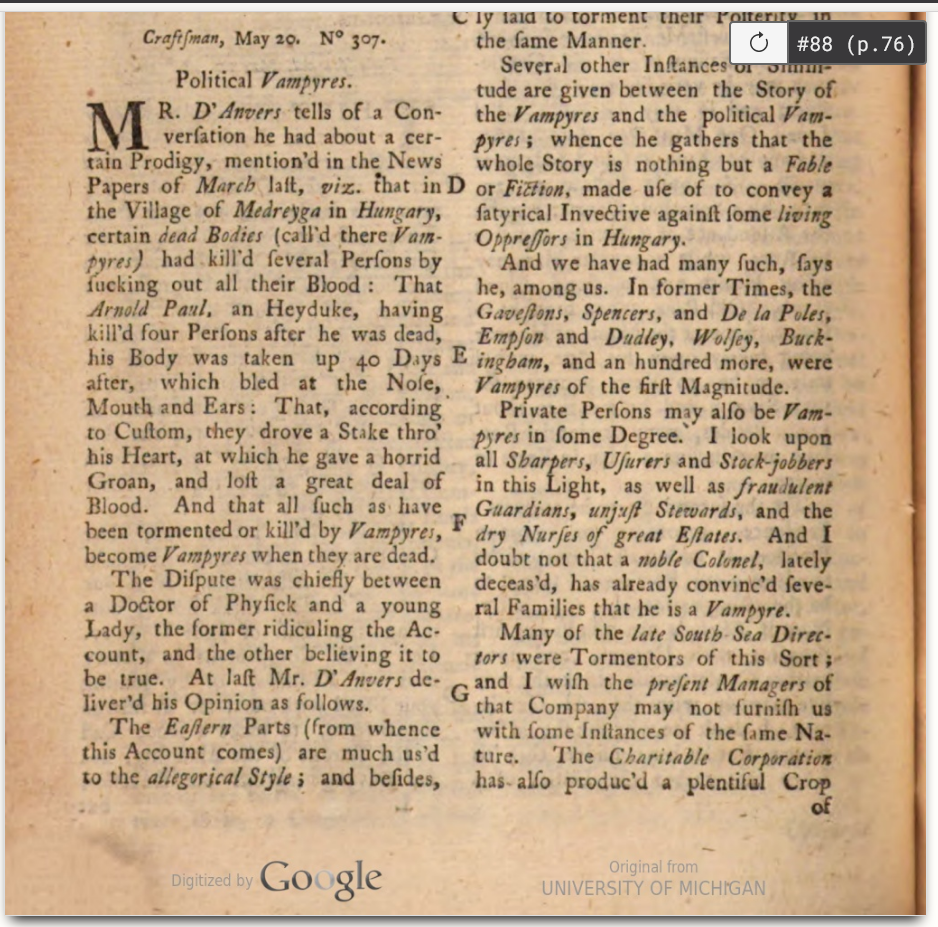
Her nearly 40 novels published over a half-century sold some 135 million
copies, placing her among the most popular fantasy writers of all time.
By Lisa de los Reyes for The Hollywood Reporter, December 12, 2021
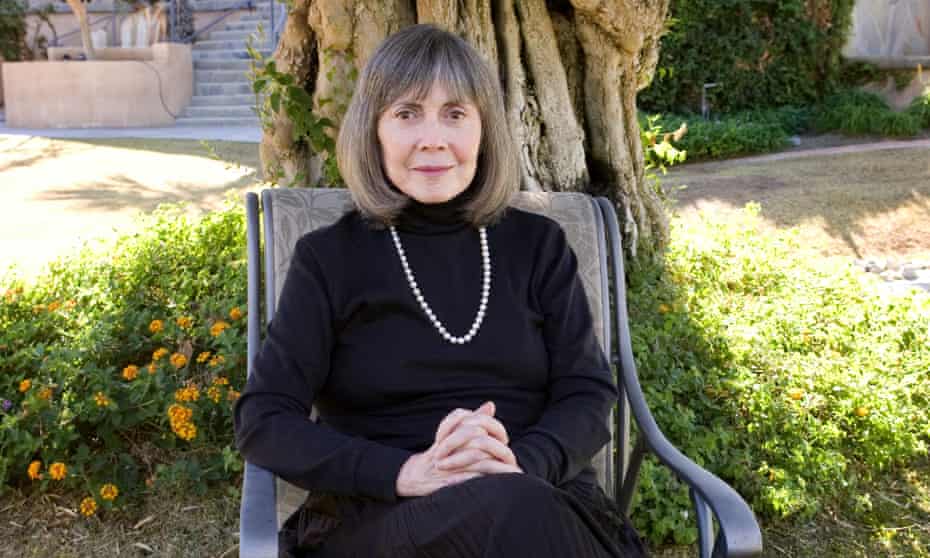
Anne Rice, the famed New Orleans author whose sensational debut novel, Interview With the Vampire,
sent her down a supernatural path writing about blood-suckers, witches
and werewolves, died of complications from a stroke on Saturday. She was
80.
Rice’s son, Christopher Rice, announced the news on social media.
“She left us almost 19 years to the day my father, her husband Stan,
died,” he wrote. “The immensity of our family’s grief cannot be
overstated.”
The author, who resided in Rancho Mirage, California, was surrounded
by her family. “In her final hours, I sat beside her hospital bed in awe
of her accomplishments and her courage, awash in memories of a life
that took us from the fog laced hills of the San Francisco Bay Area to
the magical streets of New Orleans to the twinkling vistas of Southern
California,” he added. “As she kissed Anne goodbye, her younger sister
Karen said, ‘What a ride you took us on, kid.’ I think we can all
agree.”
Rice’s nearly 40 novels published over a half-century sold some 135
million copies, placing her among the most popular fantasy writers of
all time.
Rice adapted her first book into the 1994 Warner Bros. movie starring Tom Cruise and Brad Pitt, and six of her other novels, including Exit to Eden and Queen of the Damned, were turned into movies and/or telefilms as well.
She considered the struggles of outsiders a throughline in her work, which in addition to her Vampire Chronicles and Mayfair Witches novels included the erotic Sleeping Beauty series (written under the nom de plume A.N. Roquelaure) and, on the other end of the spectrum, her deeply religious Christ the Lord books.
Rice also used the pen name Anne Rampling for 1985’s Exit to Eden and 1986’s Belinda. That was in tribute to British actress Charlotte Rampling, whose performance she loved in the erotic 1974 film The Night Porter.
Interview With the Vampire, first published in 1976, tells
the life story of the vampires Louis (Pitt in the movie) and his sire
Lestat (Cruise), hopping on a 200-year journey through history that
begins in a Louisiana slave plantation and moves to Rice’s native New
Orleans, France and Eastern Europe.
With the plot including two male vampires raising a vampire child,
the book subtly raises themes that were ahead of their time in
mainstream literature. Rice credited the mythical quality of the book
with allowing her to see deeper truths about life: “For some reason,
when I work with these comic-book vampire characters, these fantasy
characters, I can see reality. I can touch reality,” she said.
New Orleans’ Gothic architecture — in particular her antebellum
Garden District home — and vibrant culture served as an inspiration,
with her hometown also the setting for her other major series, The Mayfair Witches.
Its first book, 1990’s The Witching Hour, centers on a
neurosurgeon named Rowan Mayfair who discovers her clan’s Southern roots
and the magical legacy of her female ancestors. The trilogy spans the
family’s 400-year history and examines the supernatural nemesis that
plagues them.
Anne Rice was born Howard Allen Frances O’Brien in New Orleans on
Oct. 4, 1941. She was named for her father, it was said, because her
mother, Katherine, thought that the unusual name would help a girl get
ahead in life.
Rice grew up bashful of her first name, however, and when asked to
introduce herself to a teacher on the first day of school, she replied
on impulse that she was Anne. The name stuck, and she would make it
legal.
She was the second of four girls (older sister Alice Borchardt also became a novelist known for her Legends of the Wolves trilogy,
and sister Tamara Tinker became a poet). Rice’s dad was a World War II
Navy veteran who worked for the Postal Service; her mom died as a result
of alcoholism when Rice was still a teenager.
“My mother believed we could accomplish great things,” she told Alice Cooper in a 2016 interview in Billboard.
“She told us stories of the Brontës and how they’d written under male
names in order to be accepted by the literati; she filled my head with
tales of Dickens and all he achieved in terms of social justice through
his novels. My mother totally believed in me, and though she died when I
was 14, I took her confidence and faith in me to heart and have all of
my life.”
Rice’s father remarried in 1957 and moved the family to a suburb of
Dallas, where Rice graduated from Richardson High School. She attended
Texas Woman’s University for a year and then North Texas State College
before dropping out and moving to San Francisco, where she worked as an
insurance claims adjuster.
From California, she reconnected with high school sweetheart Stan
Rice, who proposed to her by letter. They married in 1961 and settled in
San Francisco’s Haight-Ashbury district. After several false starts,
she completed her bachelor’s degree in political science in 1964, then
earned a master’s in creative writing from San Francisco State.
The couple had a daughter, Michele, in 1966, but she was diagnosed
with leukemia and died at age 5. In the painful aftermath, Rice spent
much of her time drinking and writing and was diagnosed with
obsessive-compulsive personality disorder.
Michele’s passing “had a devastating effect,” she told Playboy in
1993. “There’s a period after a death like that when you don’t think
the lights will ever go back on. I remember even in the immediate weeks
after her death it was hard for me to swallow food.”
It was then that she turned a short story she’d written into the novel Interview With the Vampire.
“I was just a drunk, hysterical person with no job, no identity, no
nothing,” she said. “There was a two-year period after her death when I
just drank a lot and wrote a lot, like crazy. Then I sort of came out of
it and wrote Interview With the Vampire. My husband had told
me, ‘I really believe in your writing.’ … I’ve always felt that was one
of the greatest things he ever did for me, other than being his
wonderful self.”
Although the novel features a 6-year-old who is killed and turned into an immortal, Rice said she never consciously connected Vampire‘s
plot to Michele’s death (neither did Stan, a poet and painter). “When I
look back on it, I think, ‘How in the world could I have been so
detached?’ But I really didn’t think of that as being about my life.”
After being rejected by numerous publishers, Rice met agent Phyllis
Seidel at a writers’ conference, and she helped her connect with Alfred
K. Knopf. The firm paid an unusually high advance for a new writer at
the time — $12,000 — and the novel was published in 1976. The investment
paid off, with the first book selling some 8 million copies and the
12-book series eventually topping 80 million in sales.
Rice personally adapted the story into the screenplay for the film; a
critical and commercial success, it grossed $223.7 million worldwide
(nearly $400 million today).
Controversy during the making of the Neil Jordan-directed movie
centered on Rice’s disapproval of the casting of Cruise as the
archetypal vampire Lestat, but she later told Billboard, “I
thought [Cruise] did a magnificent job. As soon as I finished watching
the movie on videotape in my home [before its release], I called the
great producer David Geffen at home in California and told him I loved
the movie, loved what Tom had achieved, loved all of it. All my early
fears were meaningless in light of Tom’s passionate portrayal.”
In addition to Pitt and Cruise, the film features Kirsten Dunst as Claudia, the child vampire; Antonio Banderas as Armand, a 400-year-old vampire; Thandiwe Newton as Yvette, a slave; and Christian Slater
as the journalist interviewing Louis. (River Phoenix was originally
cast in that role but died before he began filming; Slater donated his
salary to charity in Phoenix’s honor.)
That same year, Rice’s 1985 novel Exit to Eden was made into a sexual fantasy comedy starring Dana Delany as a seductress and Dan Aykroyd and Rosie O’Donnell as undercover cops.
Queen of the Damned, the third novel in the Vampire Chronicles series,
also received the movie treatment with a 2002 film starring Aaliyah in
her final role before her death in an August 2001 plane crash. The
singer-actress portrayed Akasha, the 6,000-year-old mother of all
vampires, with Stuart Townsend as Lestat, who becomes a rock star in the
modern-day storyline. The film grossed $45.5 million worldwide.
In 1978, the Rices had a second child, Christopher, who eventually
followed in his mother’s footsteps as an author of supernatural
thrillers and erotic romance. Rice swore off drinking when her son was
born.
After her first book, Rice wrote a pair of historical novels — 1979’s The Feast of All Saints and 1982’s Cry to Heaven — which were popular but not at the level of Interview. She then authored the first three of her erotic novels (a feminist and a strong opponent of censorship, she told Playboy, “I’m fascinated by sadomasochism”) before returning to her original success with 1985’s The Vampire Lestat.
Stan retired as chair of the creative writing department at San
Francisco State, and in 1988 the family moved to New Orleans, purchasing
a mansion in the Garden District that served as the setting for The Witching Hour.
The couple went on to buy and renovate numerous properties in the city,
including St. Elizabeth’s Orphanage and Rice’s childhood home.
While Vampire Chronicles paved the way for later popular vampire fiction, Rice disparaged Stephanie Meyer’s Twilight series, saying,
“Lestat and Louie feel sorry for vampires that sparkle in the sun. They
would never hurt immortals who choose to spend eternity going to high
school over and over again in a small town — any more than they would
hurt the physically disabled or the mentally challenged.” Amid backlash,
she later clarified that the statement was a joke.
Rice fell into a diabetic coma in 1998, among the several health
setbacks she experienced in the late 1990s and 2000s. Afterward, she
lost about 100 pounds and had gastric bypass surgery.
Rice’s husband died in 2002 after complications from a brain tumor.
In the following years, she sold her New Orleans properties and decamped
to California.
She publicly announced her return to the Roman Catholicism of her youth and wrote religious novels including 2005’s Christ Our Lord: Out of Egypt. It was adapted into film as The Young Messiah (2016), which earned only $7 million at the box office.
She wrote in THR at
the time of the film’s release, “My deep devotion to Jesus prompted me
to try to contribute to the responsible fiction tradition with regard to
Him. I admired Lloyd Douglas’ The Robe and Lew Wallace’s Ben Hur but sought to do something completely original.”
In 2010, Rice announced that she was leaving all organized religion,
citing disagreements with church doctrines and social teachings. She
returned to writing about the supernatural, notably 2012’s The Wolf Gift and 2013’s The Wolves of Midwinter, whose protagonist, Reuben, becomes a werewolf.
Rice will be interred in the family’s mausoleum at Metairie Cemetery
in New Orleans in a private ceremony. A public celebration of life will
take place next year in New Orleans.
Rice is survived by Christopher and by three of her sisters.
Anne Rice (Howard Allen Frances O’Brien), writer, born 4 October 1941; died 11 December 2021.


.png)
.png)
.png)
%20%E2%80%94%20Scaled%20(81%25).png)