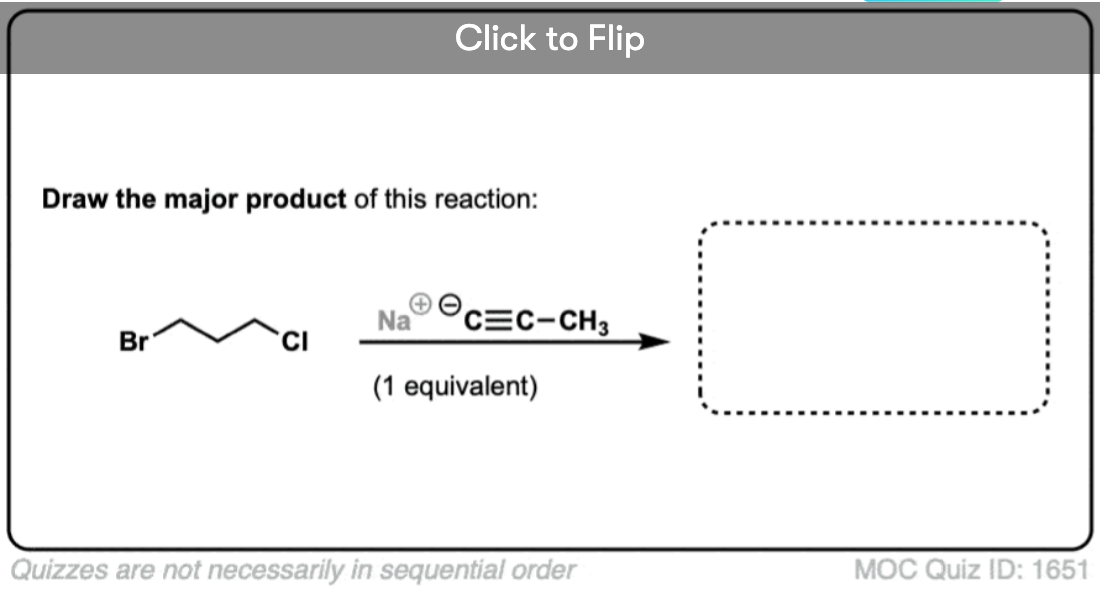
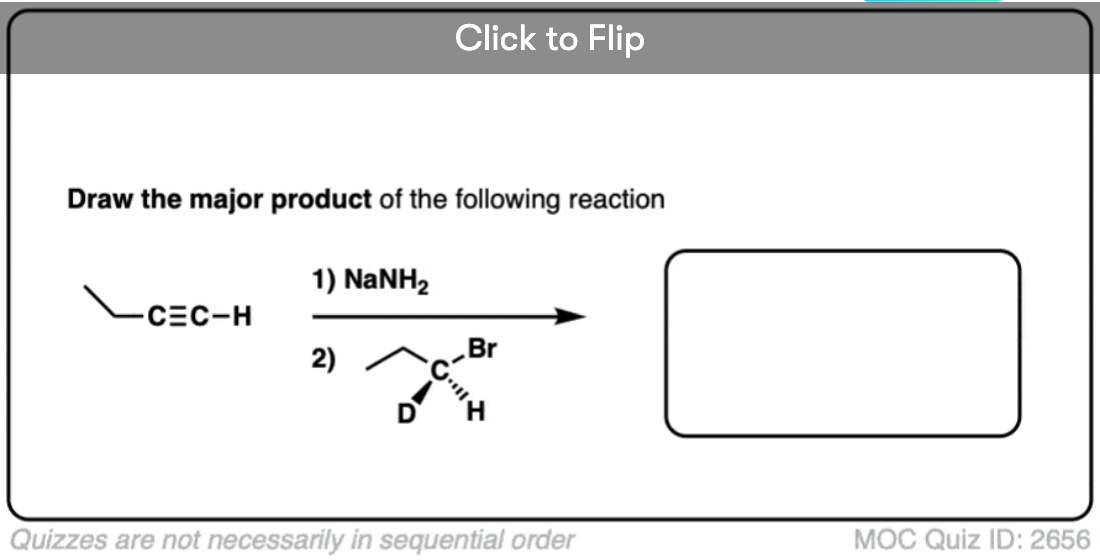
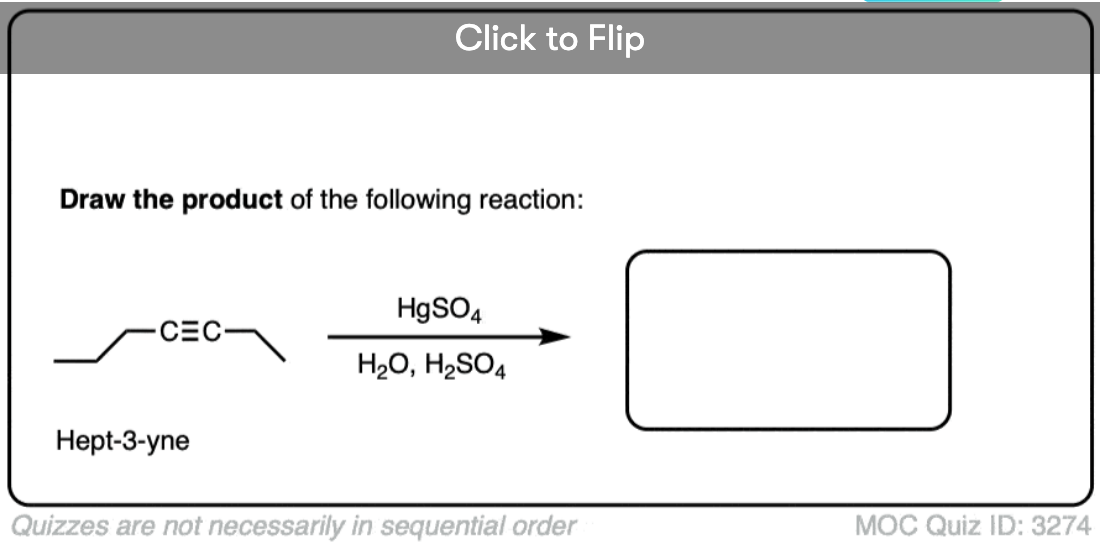
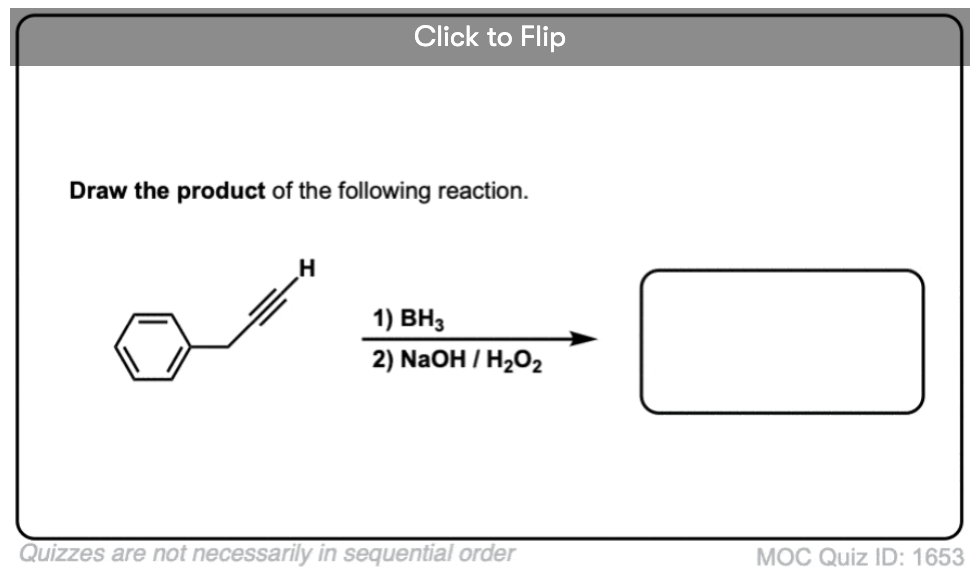
GeistHaus
log in · sign up

Master Organic Chemistry

Part of feedburner.com

stories
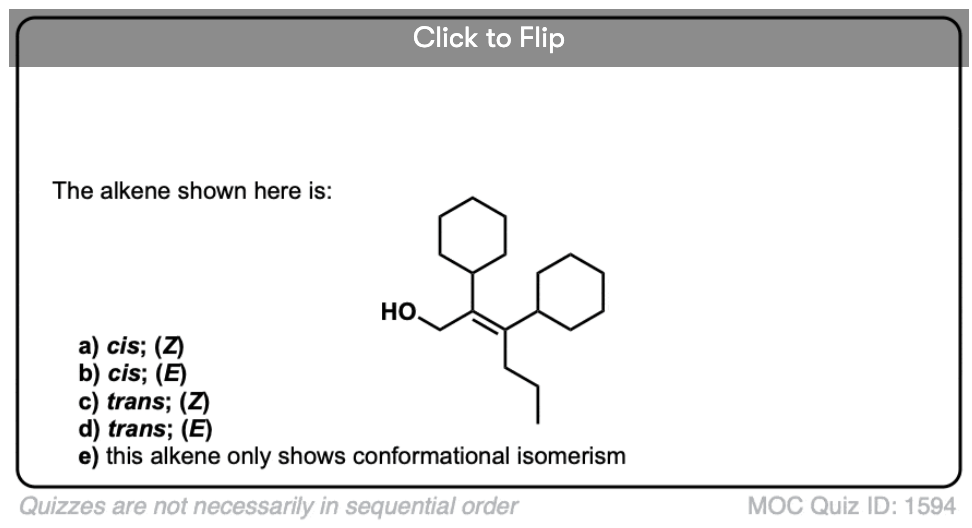
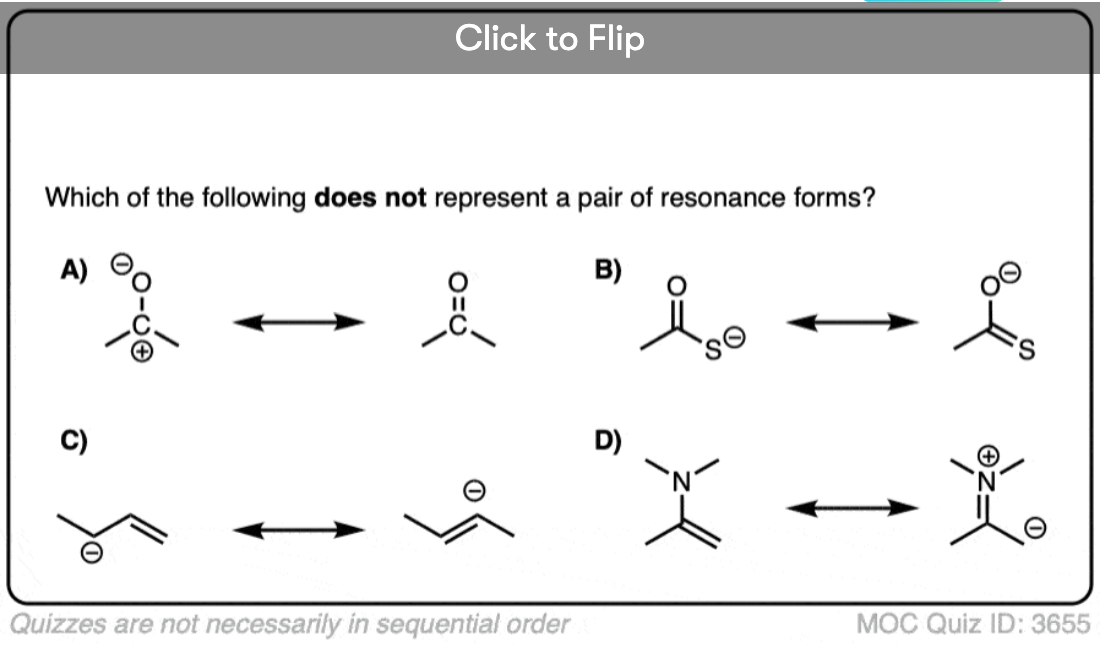
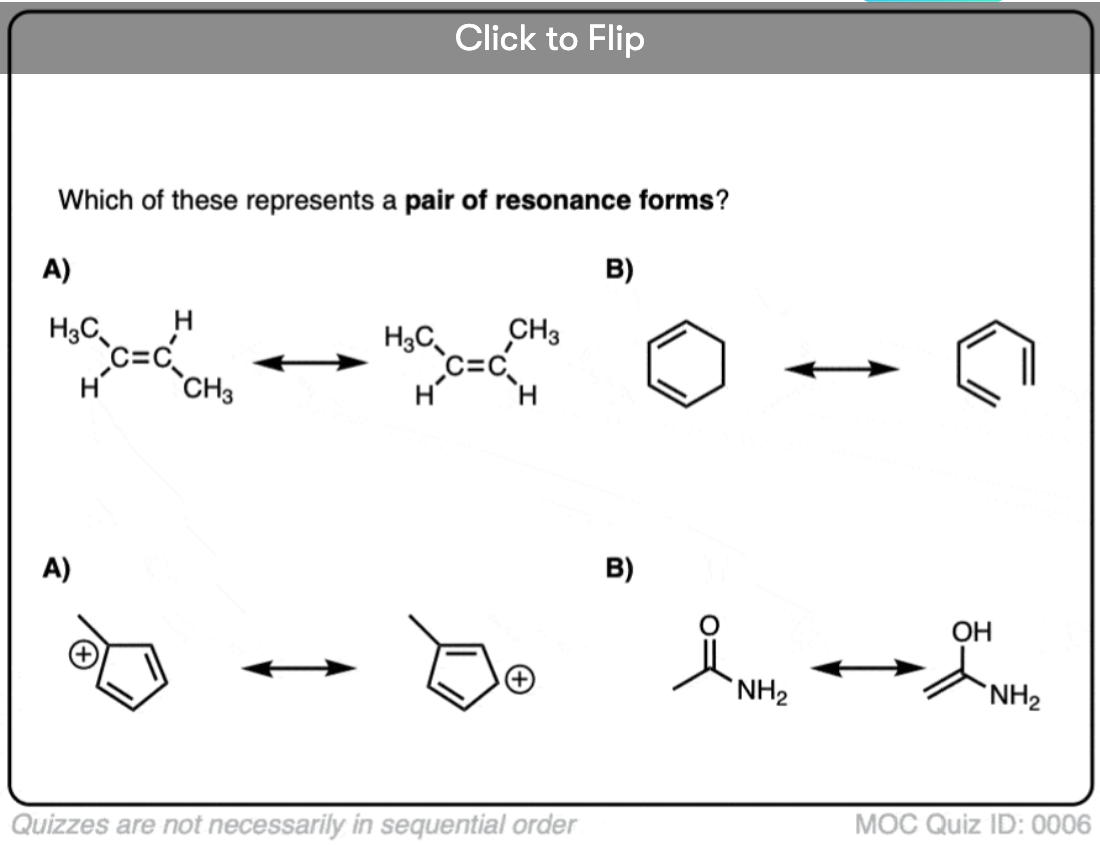
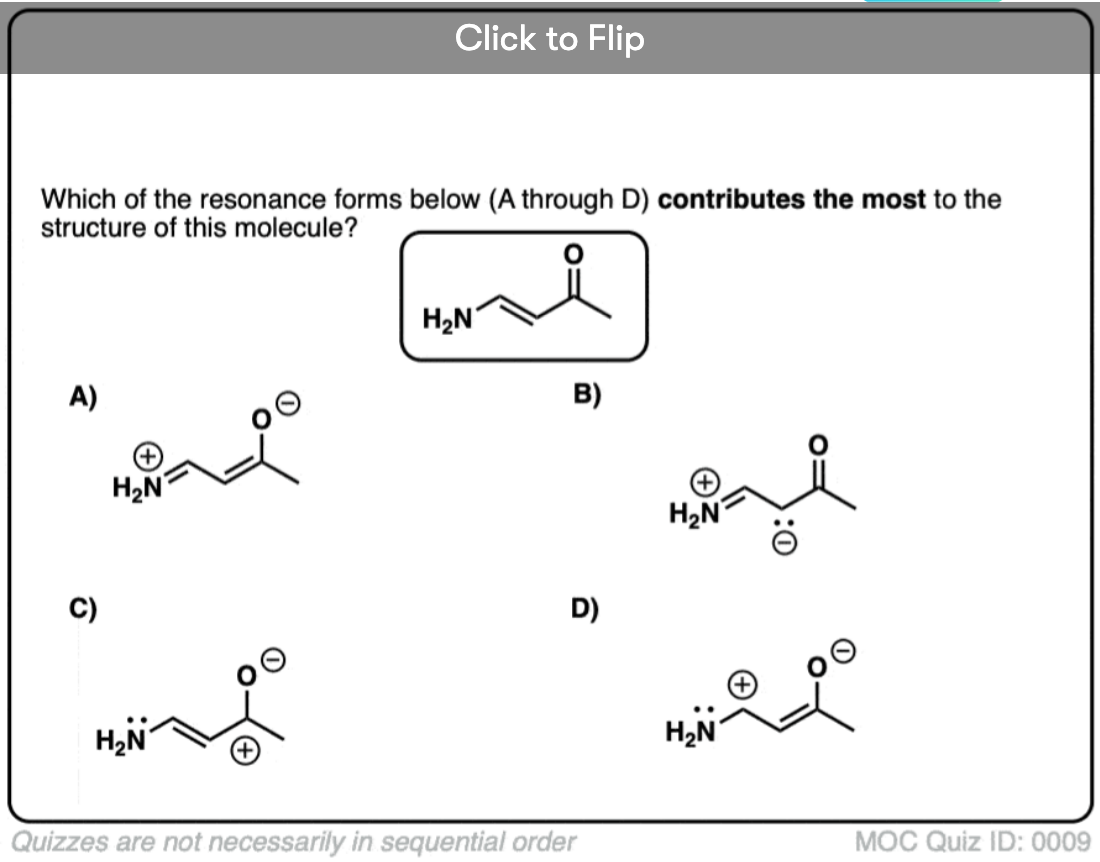
Practice Exam – ACS Style Org 1
Blog
Here’s a 50-question practice exam (ACS Style) with (mostly) multiple choice questions. It covers first-semester topics (including alcohols/epoxides). [This is by request from an MOC
Show full content

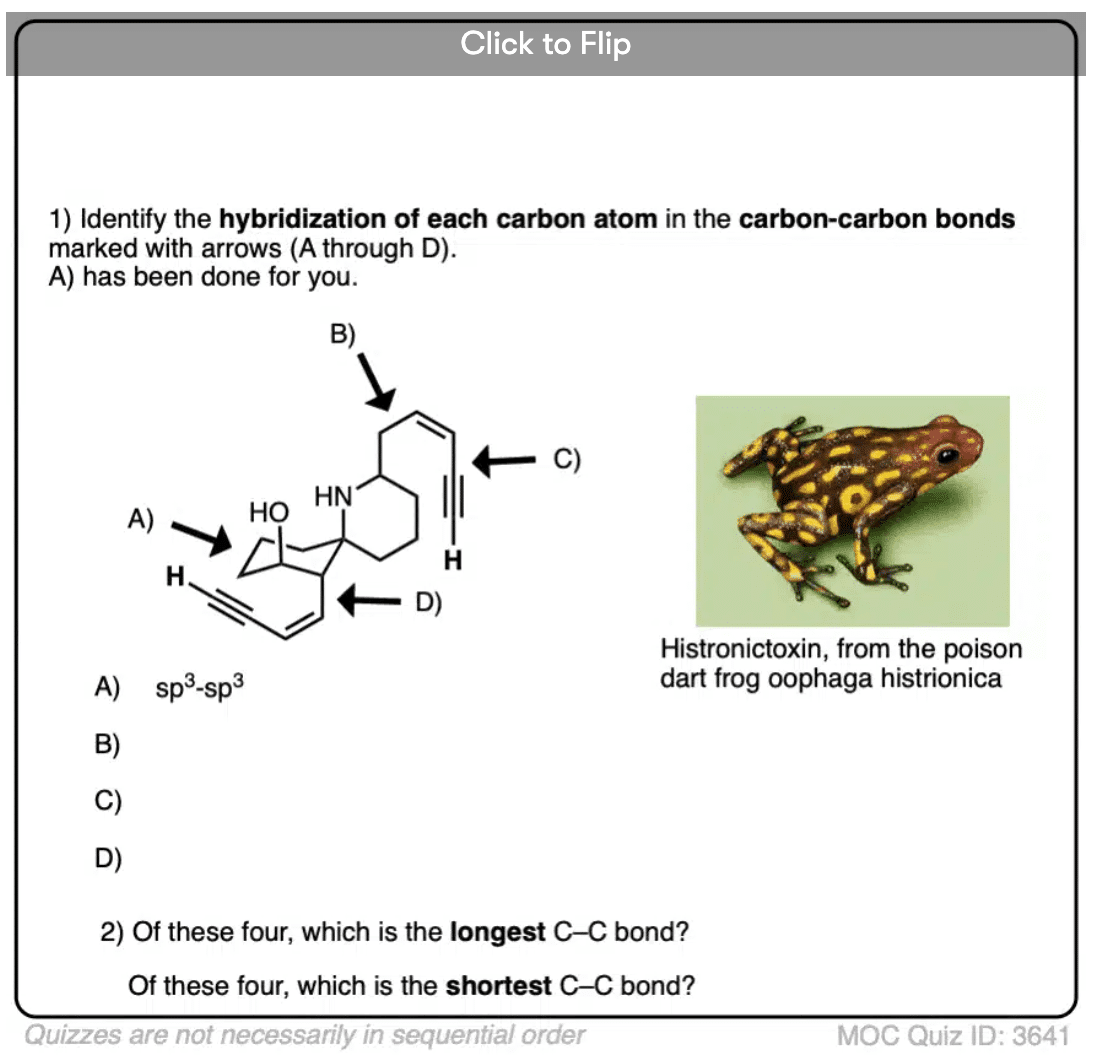
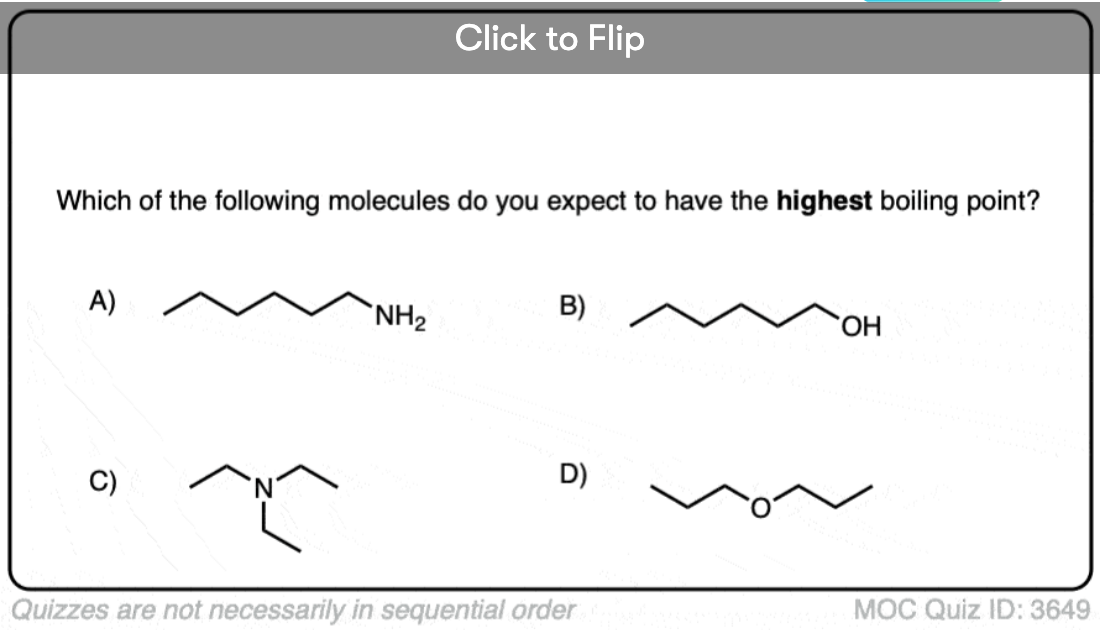
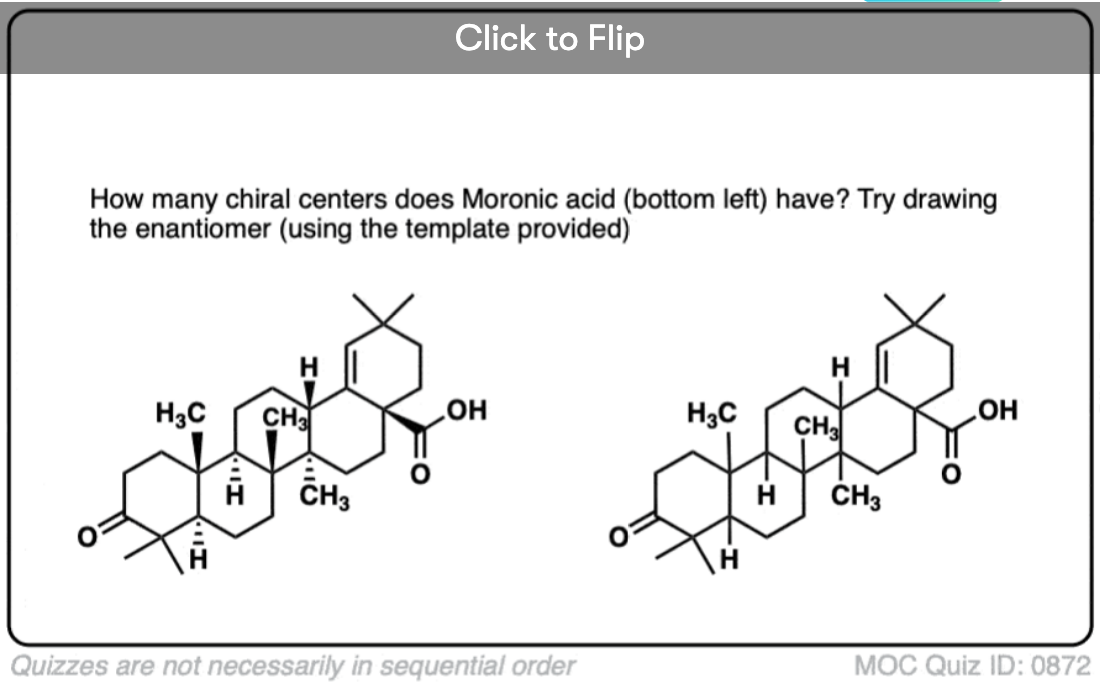
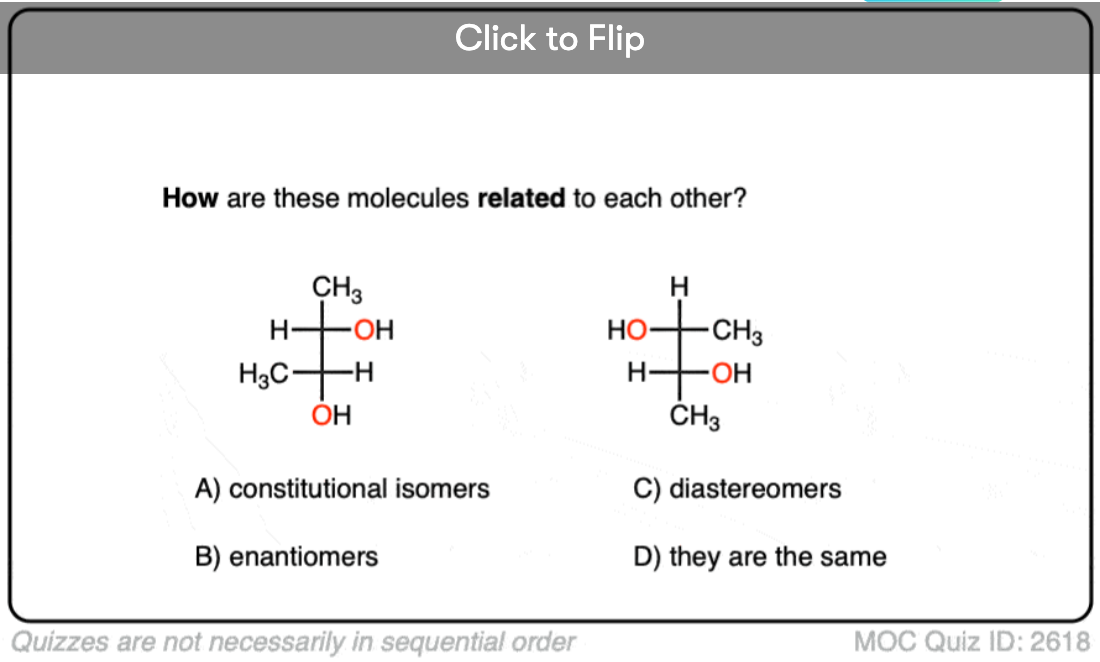
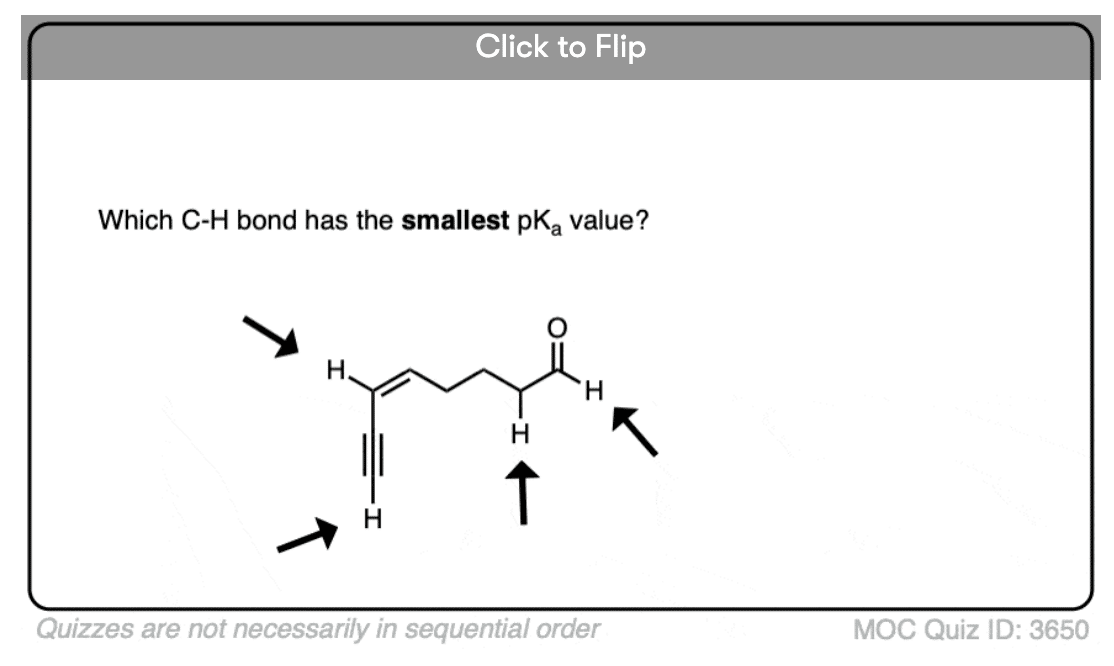
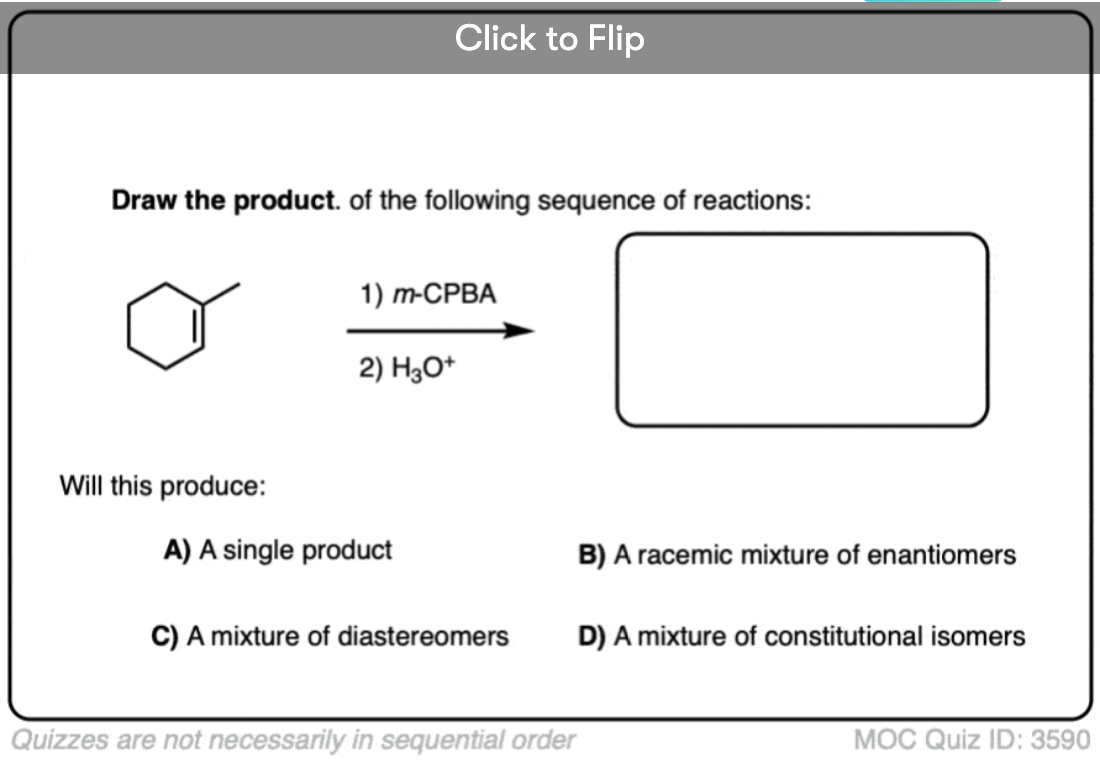
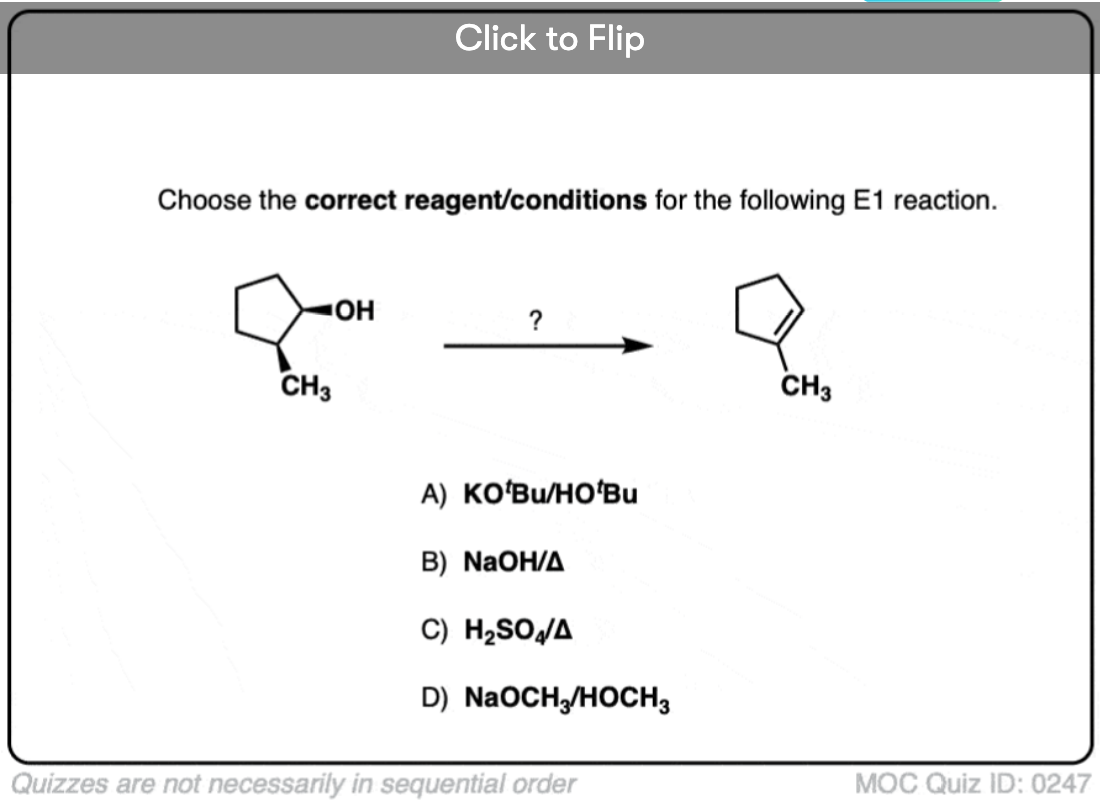
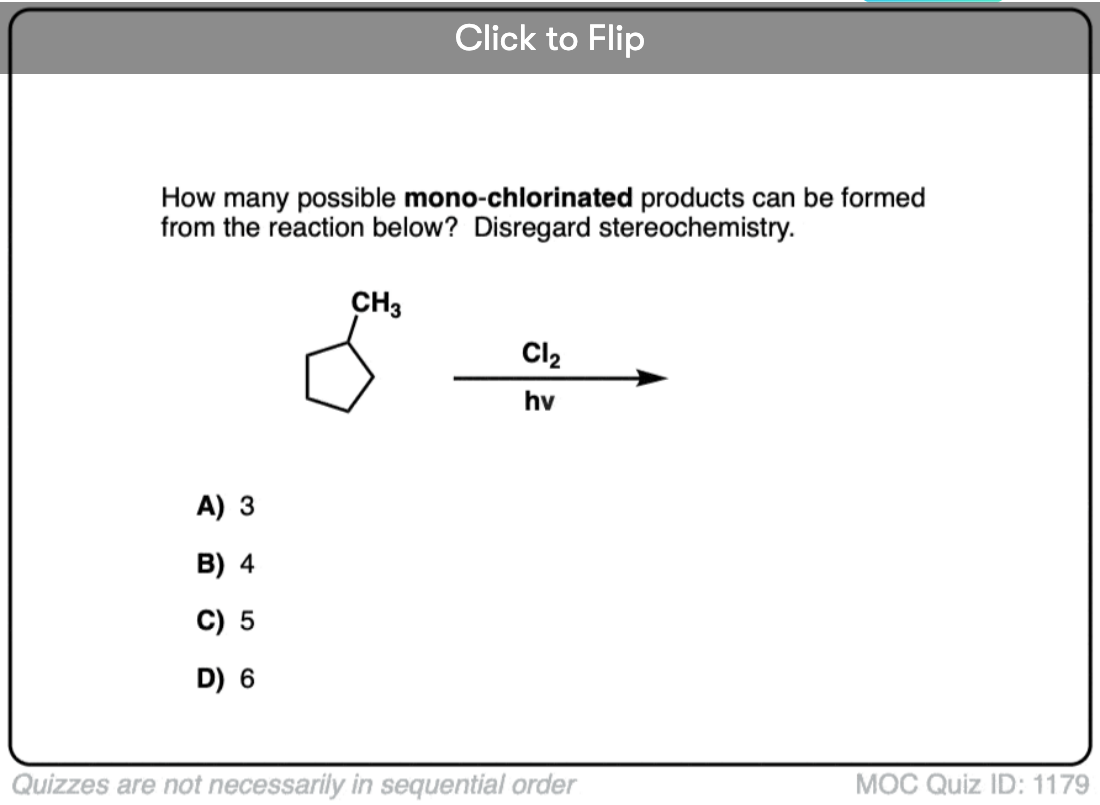
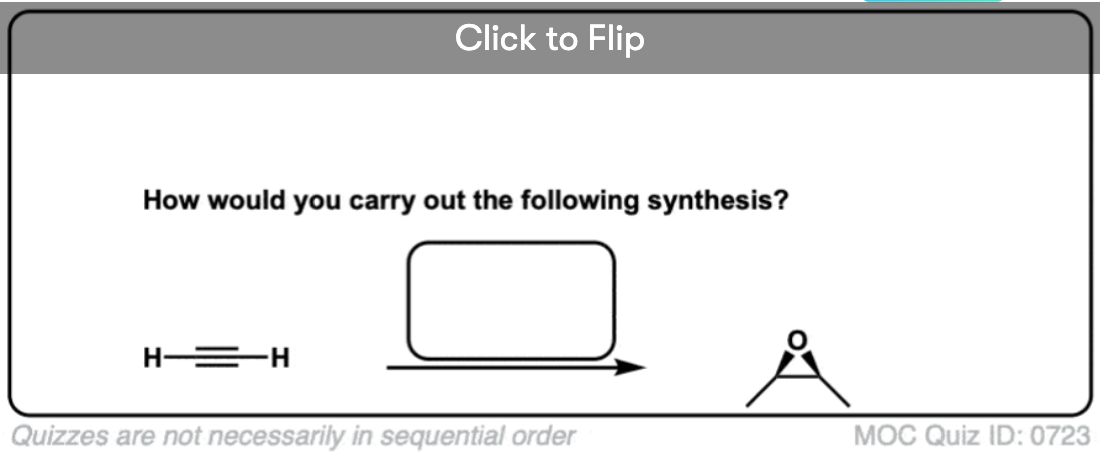
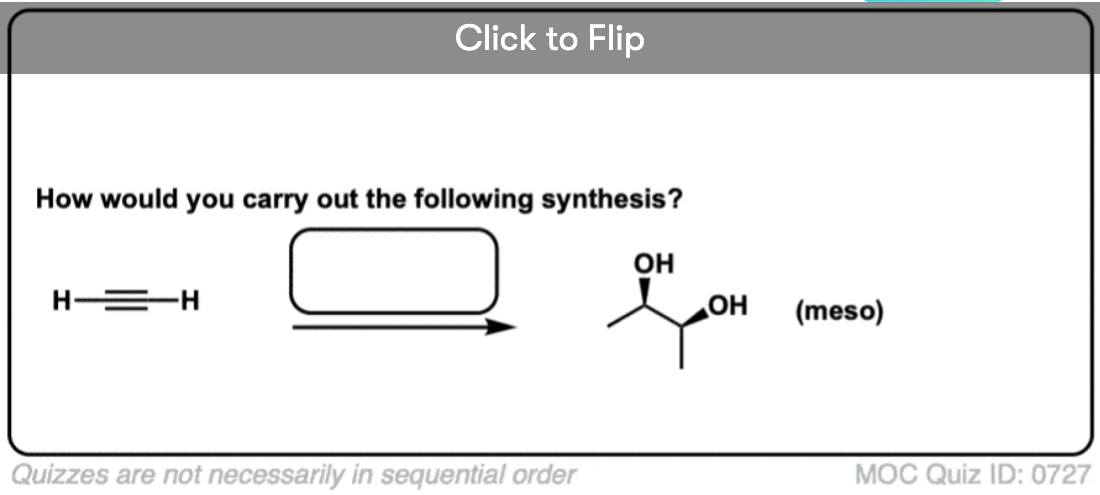
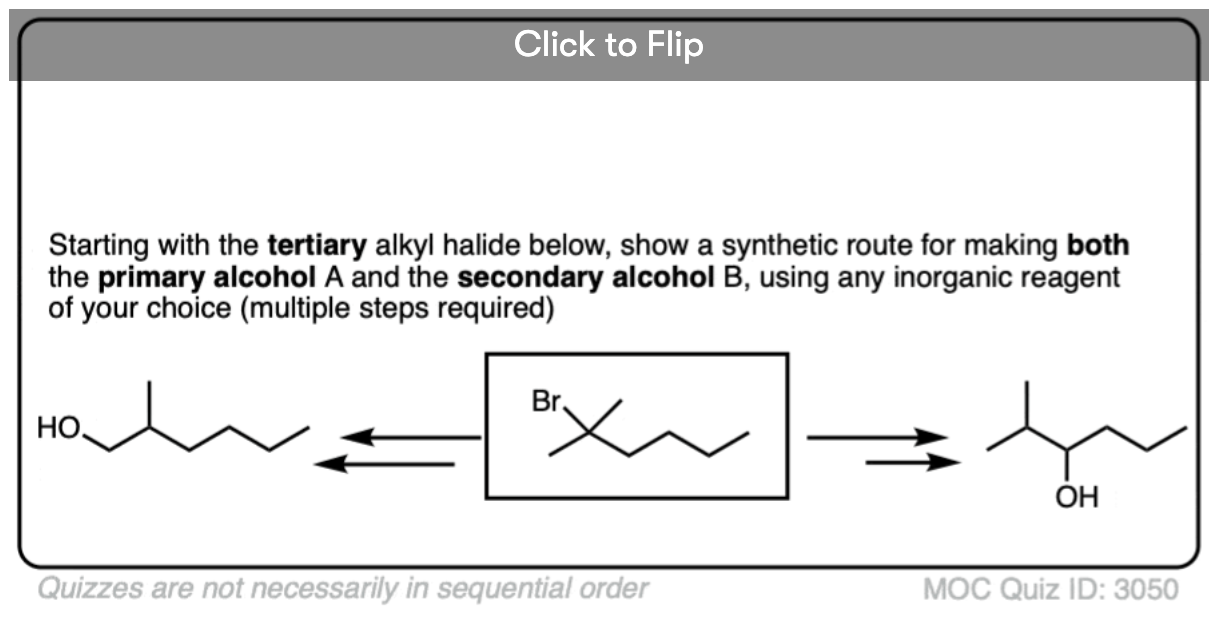
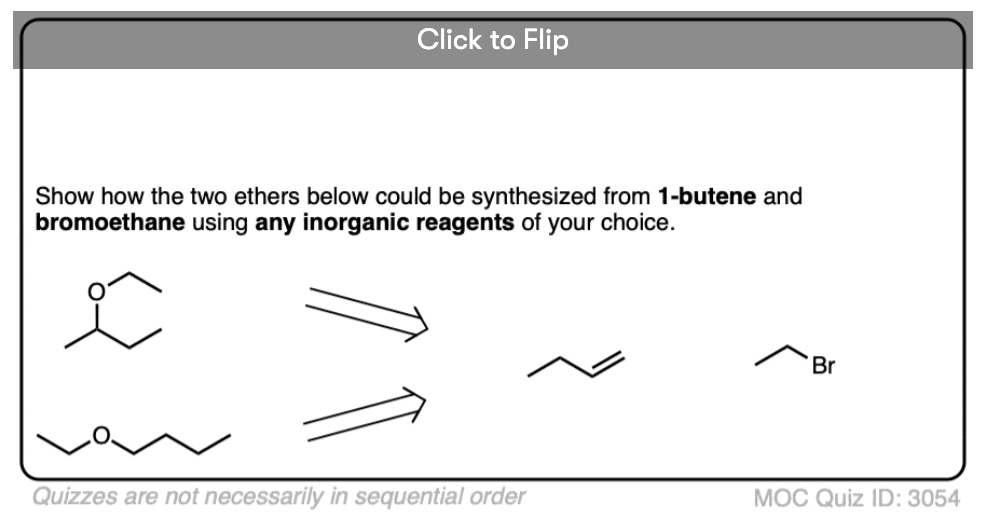
Here’s a 50-question practice exam (ACS Style) with (mostly) multiple choice questions. It covers first-semester topics (including alcohols/epoxides).

[This is by request from an MOC member at a prominent public university in New Jersey.  If you’d like a similar type of practice exam made for you, reach out at james@masterorganicchemistry.com . If you have a sample exam, share it, and I’ll base the practice exam on your sample].

Contents

1. Structure and Bonding
2. Stereochemistry
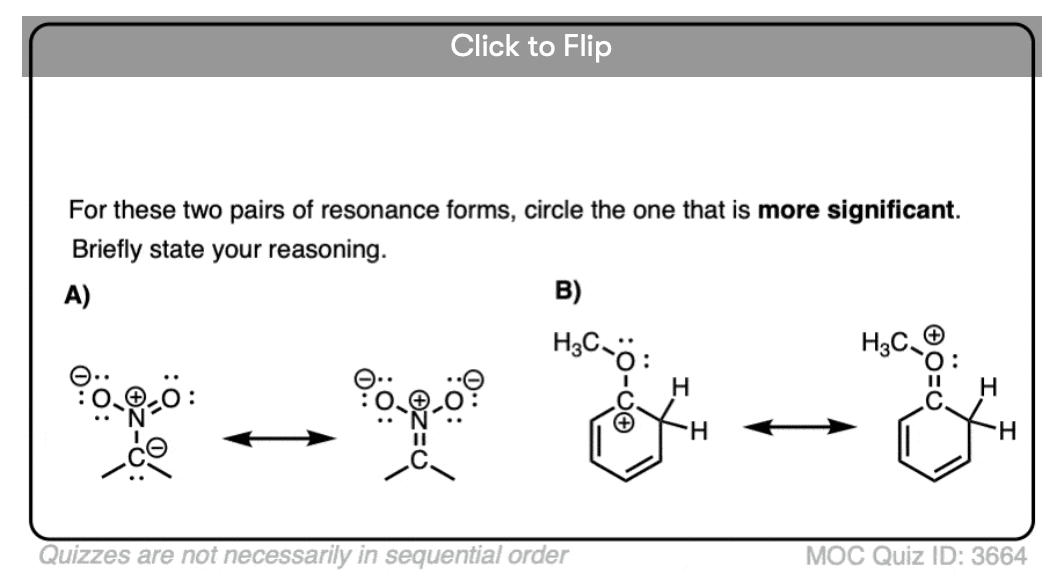
3. Resonance
4. Cycloalkanes
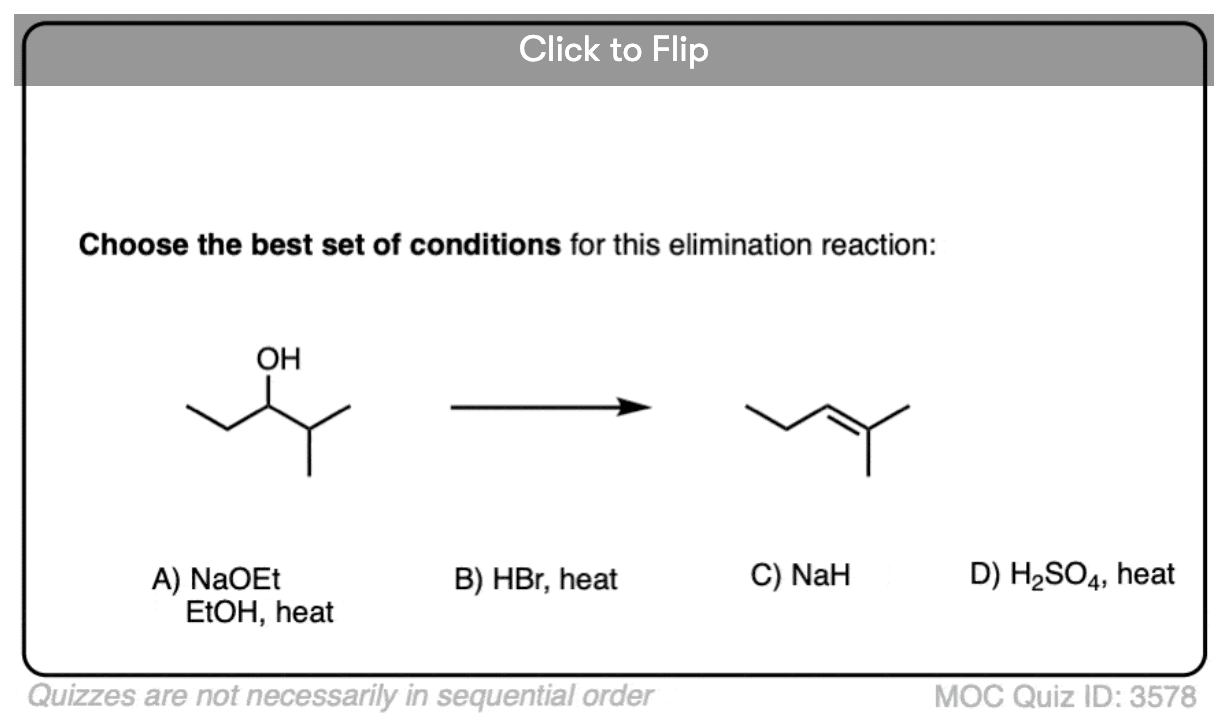
5. Elimination
6. Substitution
7. SN1
8. Acidity
9. Redox
10. Thermodynamics (reaction energy diagrams)
11. Epoxides
12. Alcohols
13. Diels-Alder
14. Free-Radicals
15. Alkenes
16. Alkynes


1. Structure and Bonding


Become a MOC member to see the clickable quiz with answers on the back.


Become a MOC member to see the clickable quiz with answers on the back.


Become a MOC member to see the clickable quiz with answers on the back.


Become a MOC member to see the clickable quiz with answers on the back.


Become a MOC member to see the clickable quiz with answers on the back.


2. Stereochemistry


Become a MOC member to see the clickable quiz with answers on the back.


Become a MOC member to see the clickable quiz with answers on the back.


Become a MOC member to see the clickable quiz with answers on the back.


Become a MOC member to see the clickable quiz with answers on the back.


Become a MOC member to see the clickable quiz with answers on the back.

3. Resonance


Become a MOC member to see the clickable quiz with answers on the back.


Become a MOC member to see the clickable quiz with answers on the back.


Become a MOC member to see the clickable quiz with answers on the back.

4. Cycloalkanes


Become a MOC member to see the clickable quiz with answers on the back.


Become a MOC member to see the clickable quiz with answers on the back.

5. Elimination


Become a MOC member to see the clickable quiz with answers on the back.


Become a MOC member to see the clickable quiz with answers on the back.

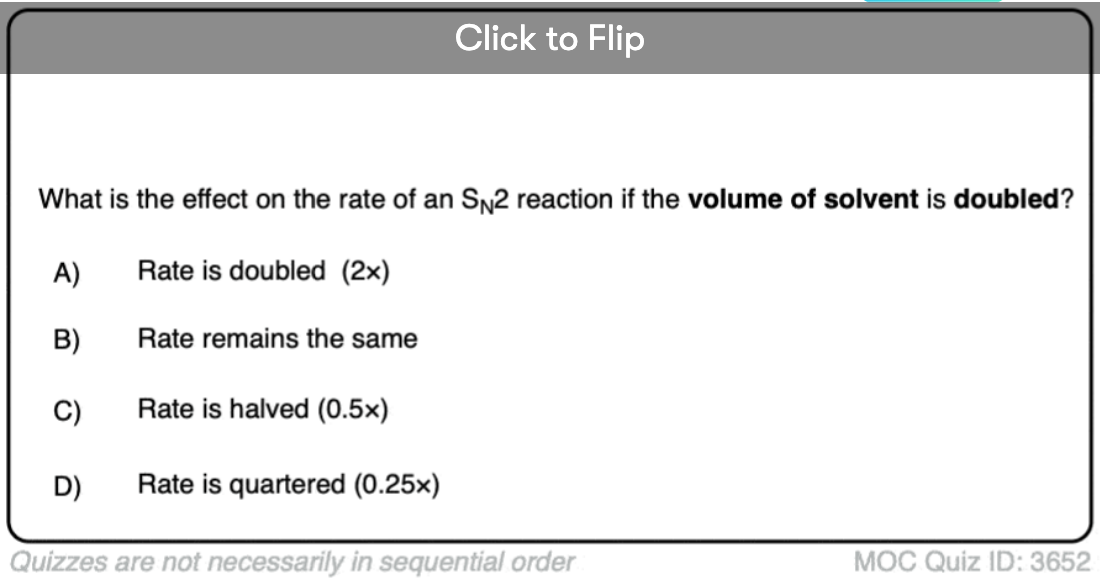
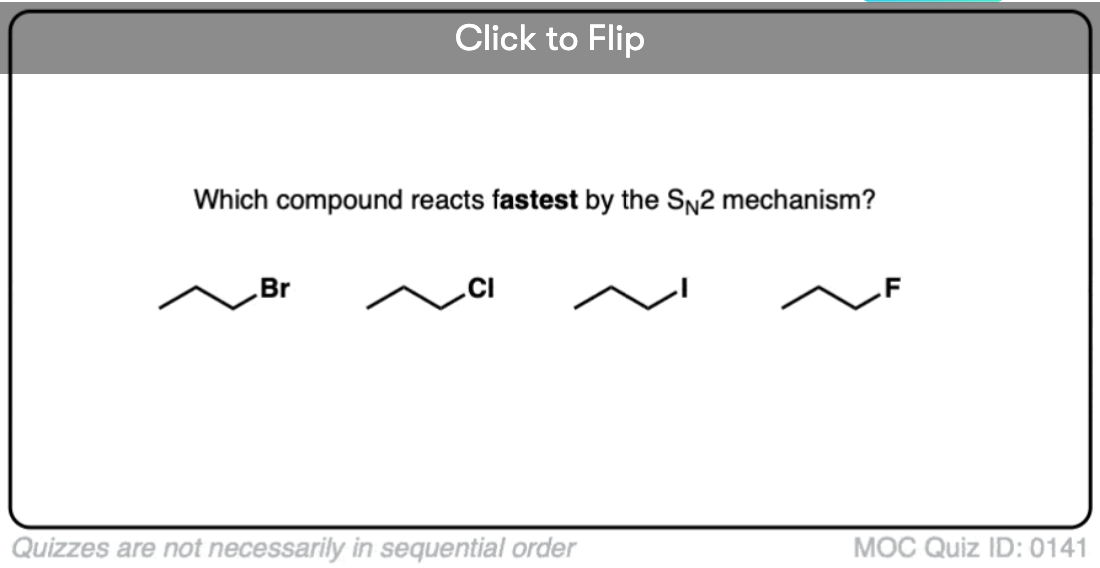
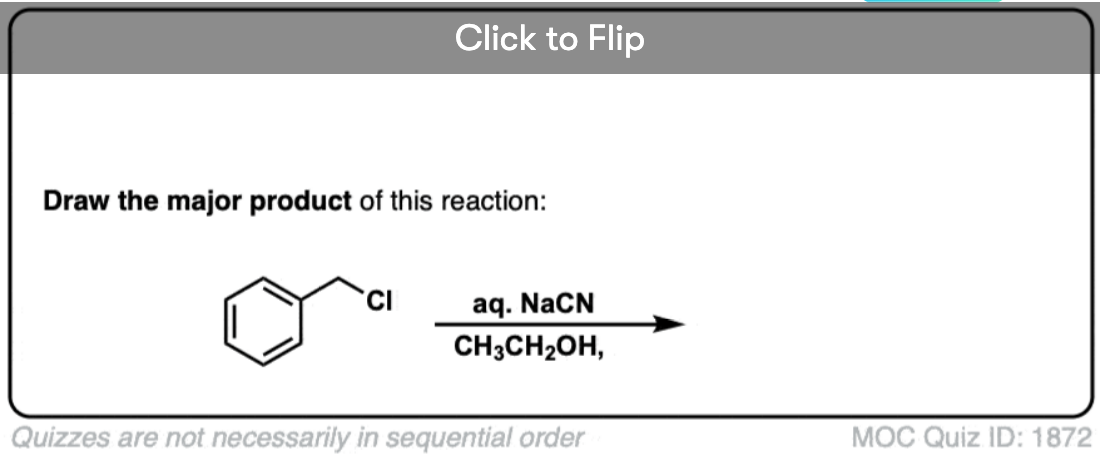
6. Substitution


Become a MOC member to see the clickable quiz with answers on the back.


Become a MOC member to see the clickable quiz with answers on the back.

7. SN1


Become a MOC member to see the clickable quiz with answers on the back.


Become a MOC member to see the clickable quiz with answers on the back.


Become a MOC member to see the clickable quiz with answers on the back.


Become a MOC member to see the clickable quiz with answers on the back.


Become a MOC member to see the clickable quiz with answers on the back.

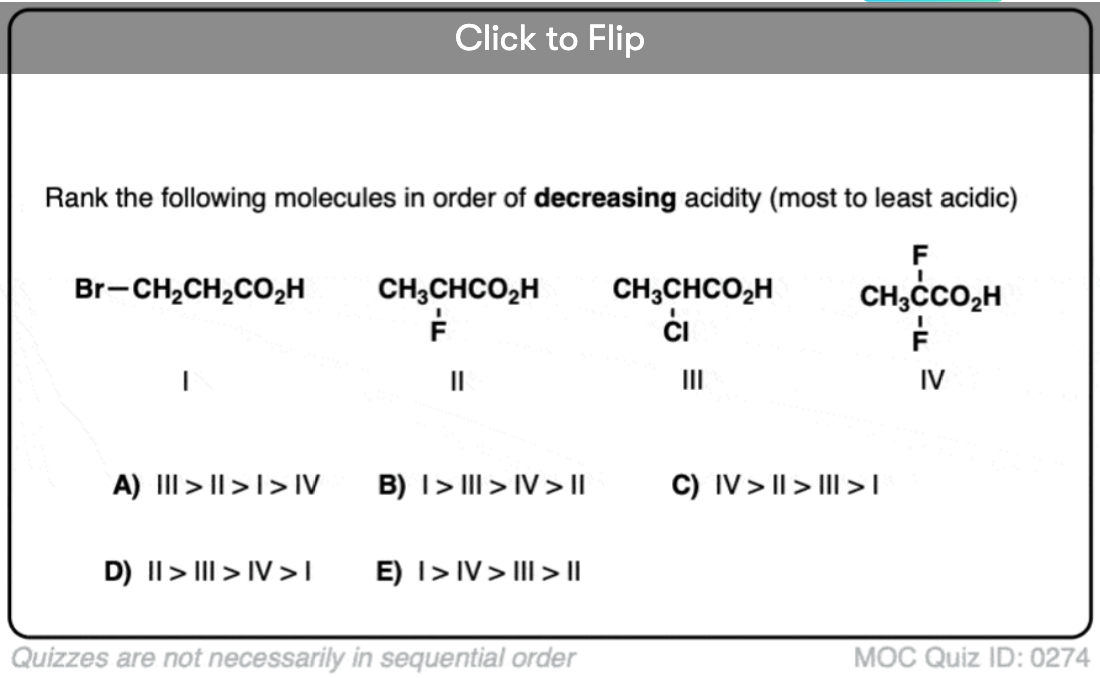
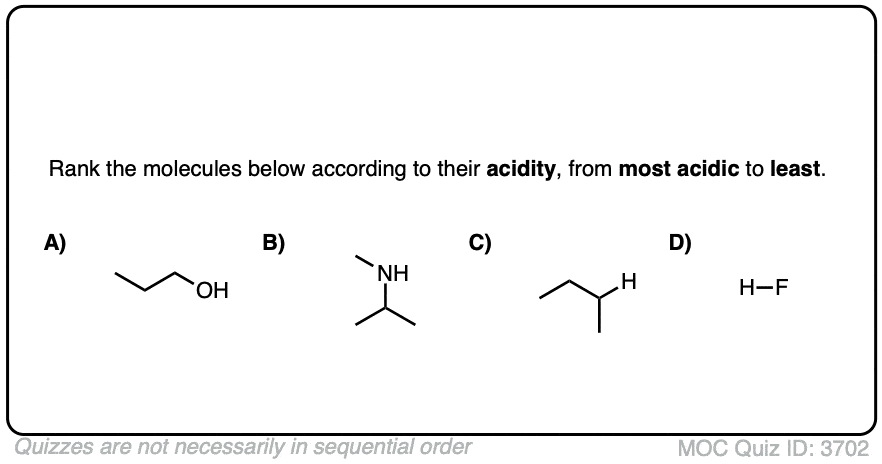
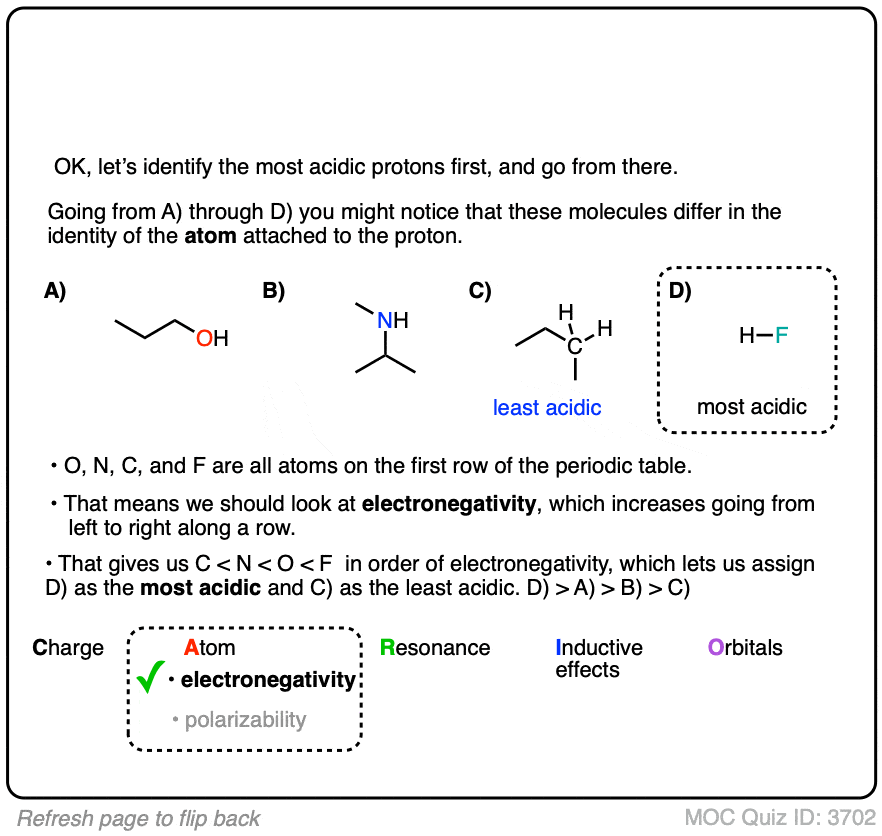
8. Acidity


Become a MOC member to see the clickable quiz with answers on the back.


Become a MOC member to see the clickable quiz with answers on the back.

9. Redox


Become a MOC member to see the clickable quiz with answers on the back.

10. Thermodynamics


Become a MOC member to see the clickable quiz with answers on the back.


Become a MOC member to see the clickable quiz with answers on the back.


Become a MOC member to see the clickable quiz with answers on the back.


Become a MOC member to see the clickable quiz with answers on the back.


Become a MOC member to see the clickable quiz with answers on the back.

11. Epoxides


Become a MOC member to see the clickable quiz with answers on the back.

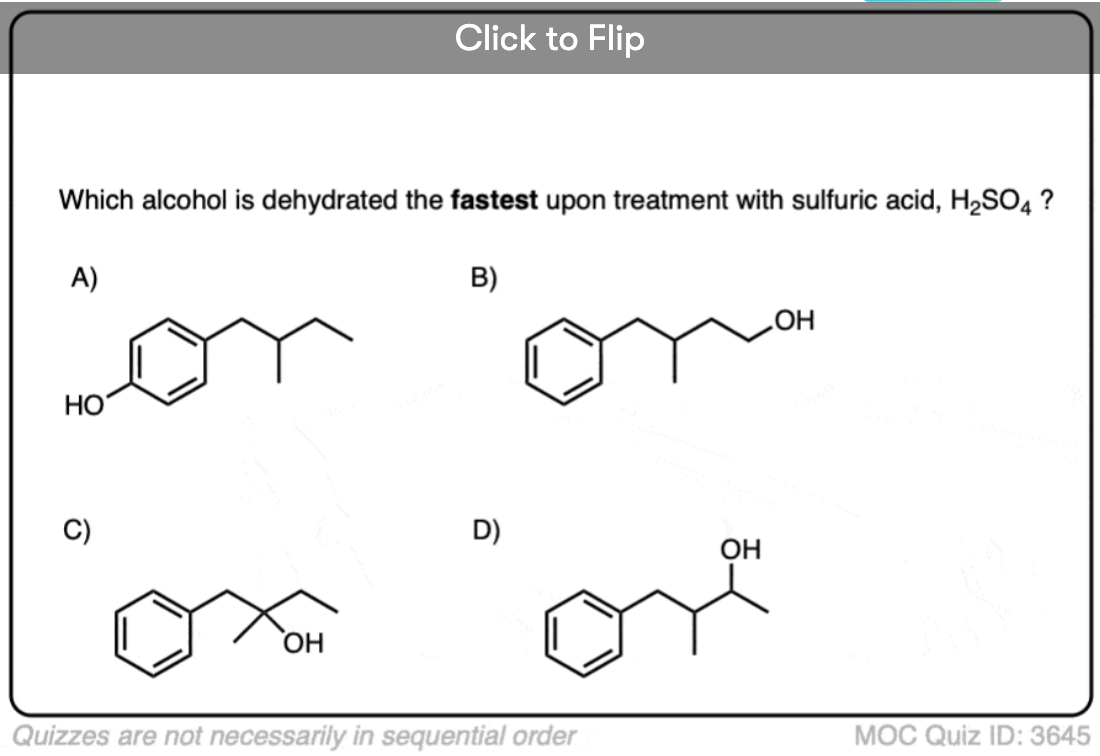
Alcohols


Become a MOC member to see the clickable quiz with answers on the back.


Become a MOC member to see the clickable quiz with answers on the back.

12. Diels-Alder


Become a MOC member to see the clickable quiz with answers on the back.


Become a MOC member to see the clickable quiz with answers on the back.

13. Free Radicals


Become a MOC member to see the clickable quiz with answers on the back.


Become a MOC member to see the clickable quiz with answers on the back.


Become a MOC member to see the clickable quiz with answers on the back.


Become a MOC member to see the clickable quiz with answers on the back.

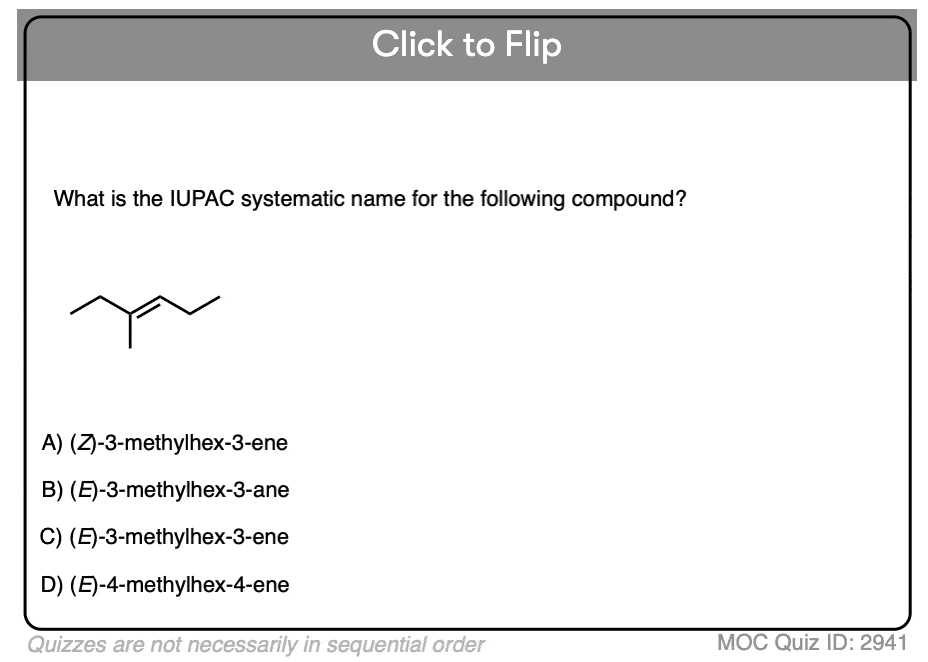
14. Alkenes


Become a MOC member to see the clickable quiz with answers on the back.


Become a MOC member to see the clickable quiz with answers on the back.


Become a MOC member to see the clickable quiz with answers on the back.


Become a MOC member to see the clickable quiz with answers on the back.


Become a MOC member to see the clickable quiz with answers on the back.

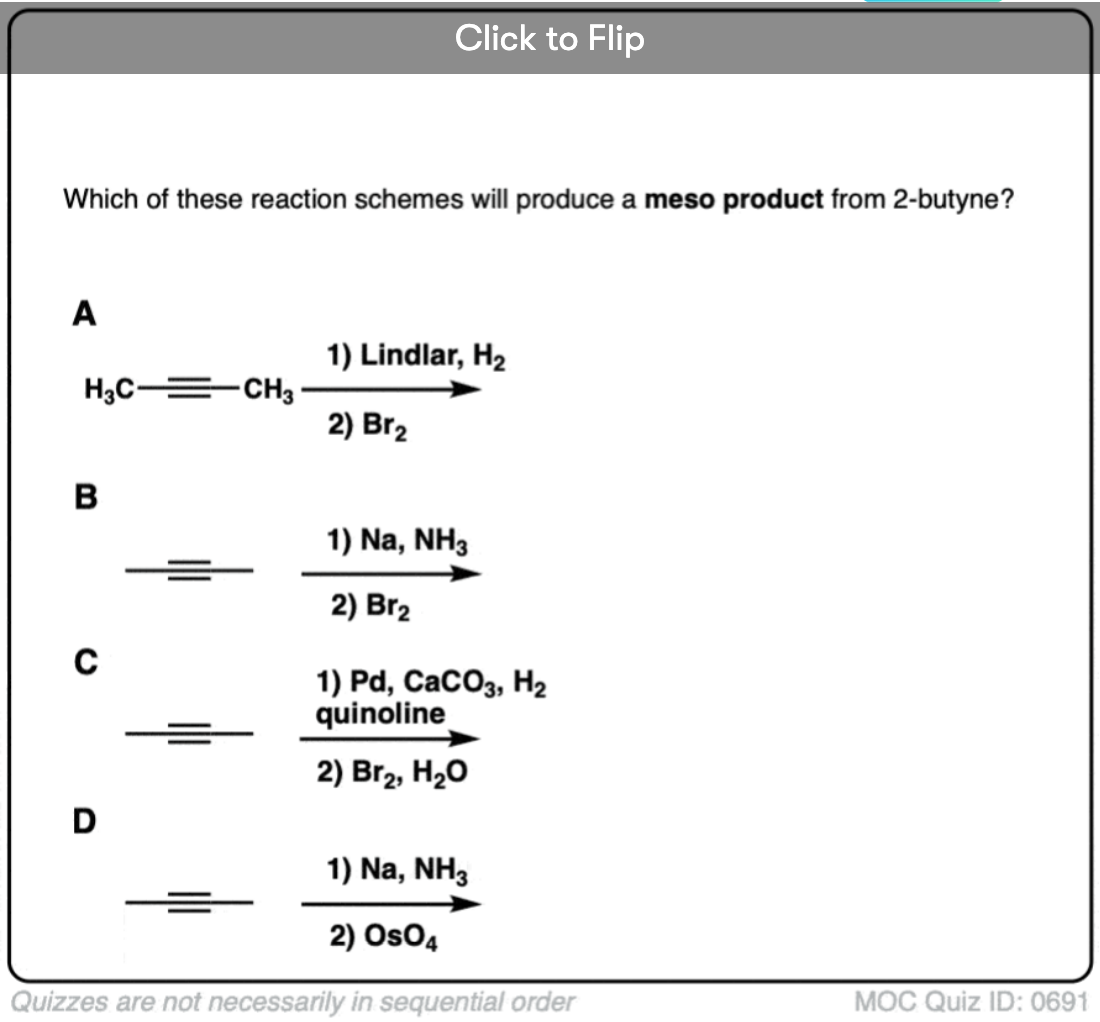
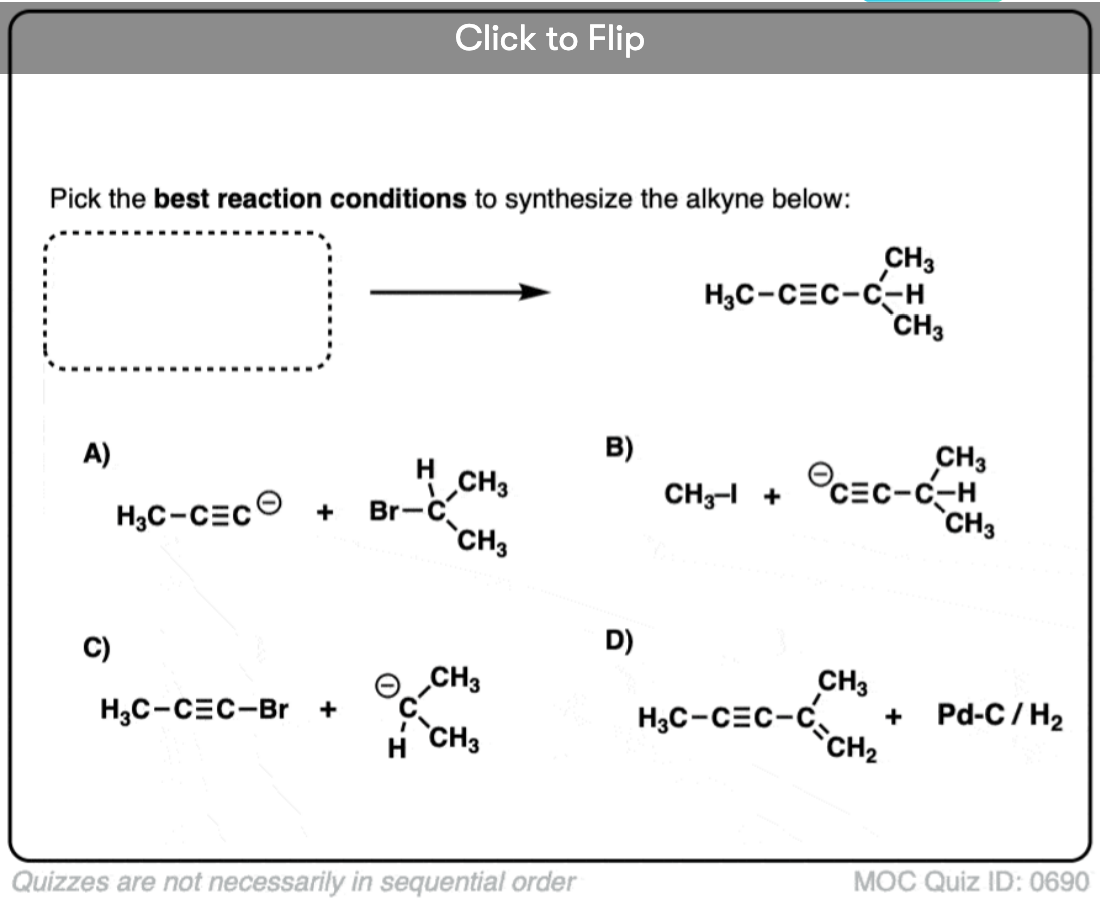
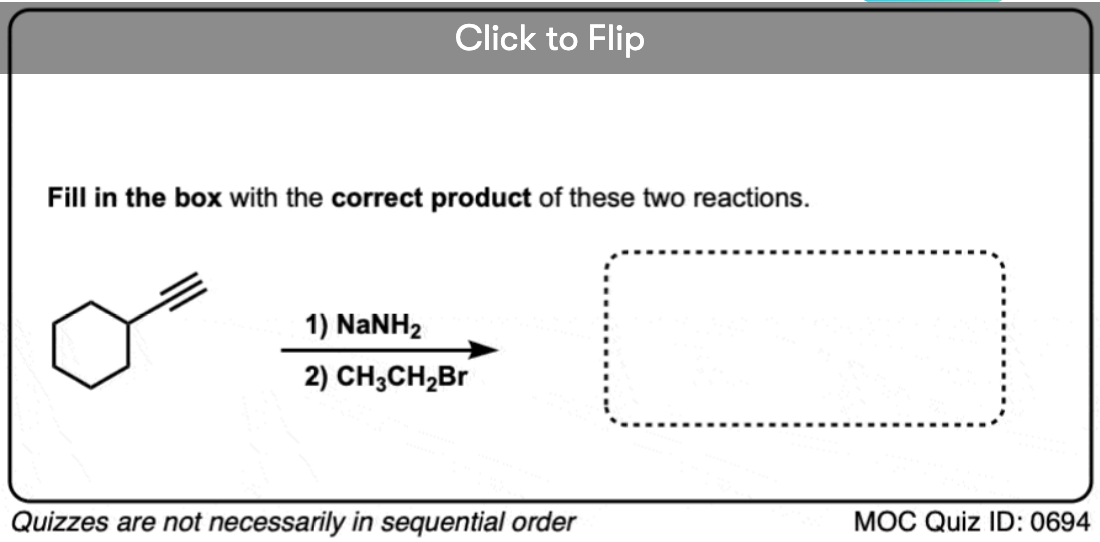
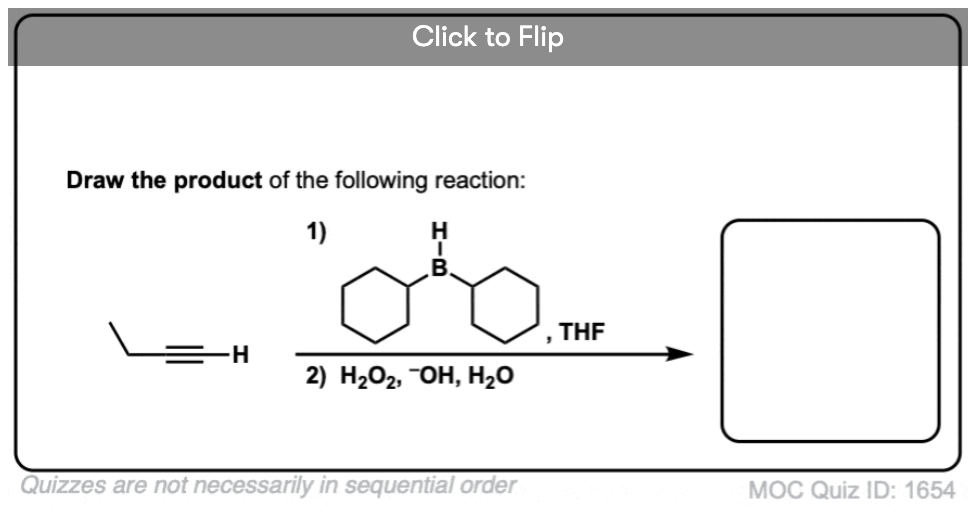
15. Alkynes


Become a MOC member to see the clickable quiz with answers on the back.

https://www.masterorganicchemistry.com/?p=45820
Extensions
practice-questions-alkynes-aldehydes
Uncategorized
Show full content


Become a MOC member to see the clickable quiz with answers on the back.


Become a MOC member to see the clickable quiz with answers on the back.


Become a MOC member to see the clickable quiz with answers on the back.


Become a MOC member to see the clickable quiz with answers on the back.


Become a MOC member to see the clickable quiz with answers on the back.


Become a MOC member to see the clickable quiz with answers on the back.


Become a MOC member to see the clickable quiz with answers on the back.


Become a MOC member to see the clickable quiz with answers on the back.


Become a MOC member to see the clickable quiz with answers on the back.


Become a MOC member to see the clickable quiz with answers on the back.


Become a MOC member to see the clickable quiz with answers on the back.


Become a MOC member to see the clickable quiz with answers on the back.


Become a MOC member to see the clickable quiz with answers on the back.


Become a MOC member to see the clickable quiz with answers on the back.

https://www.masterorganicchemistry.com/?p=45814
Extensions
Classic Exam Questions on Intramolecular Reactions
Blog
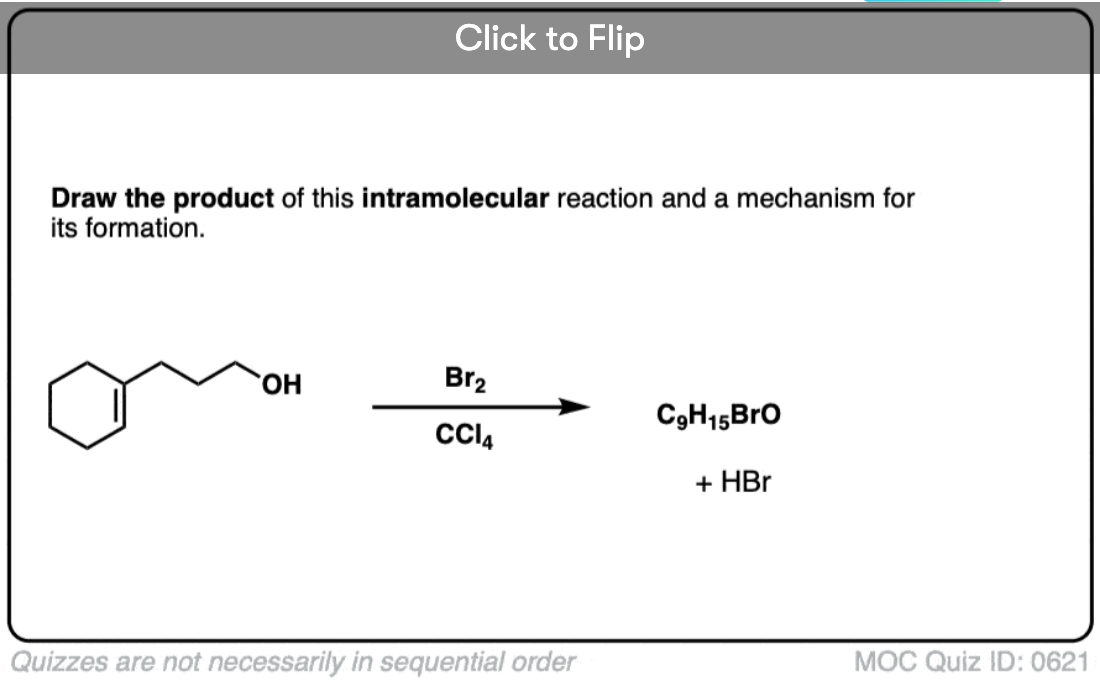
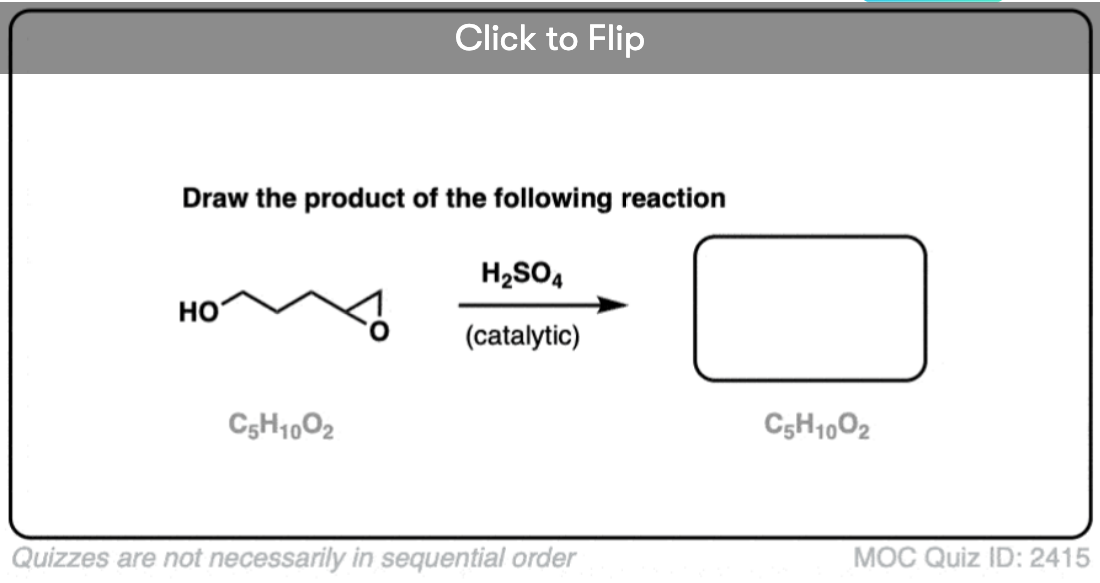
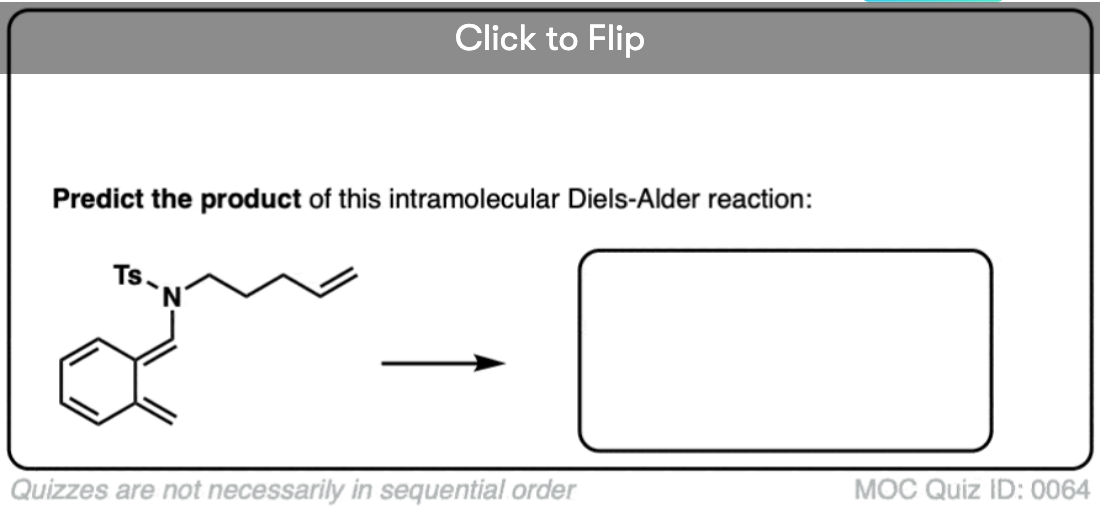
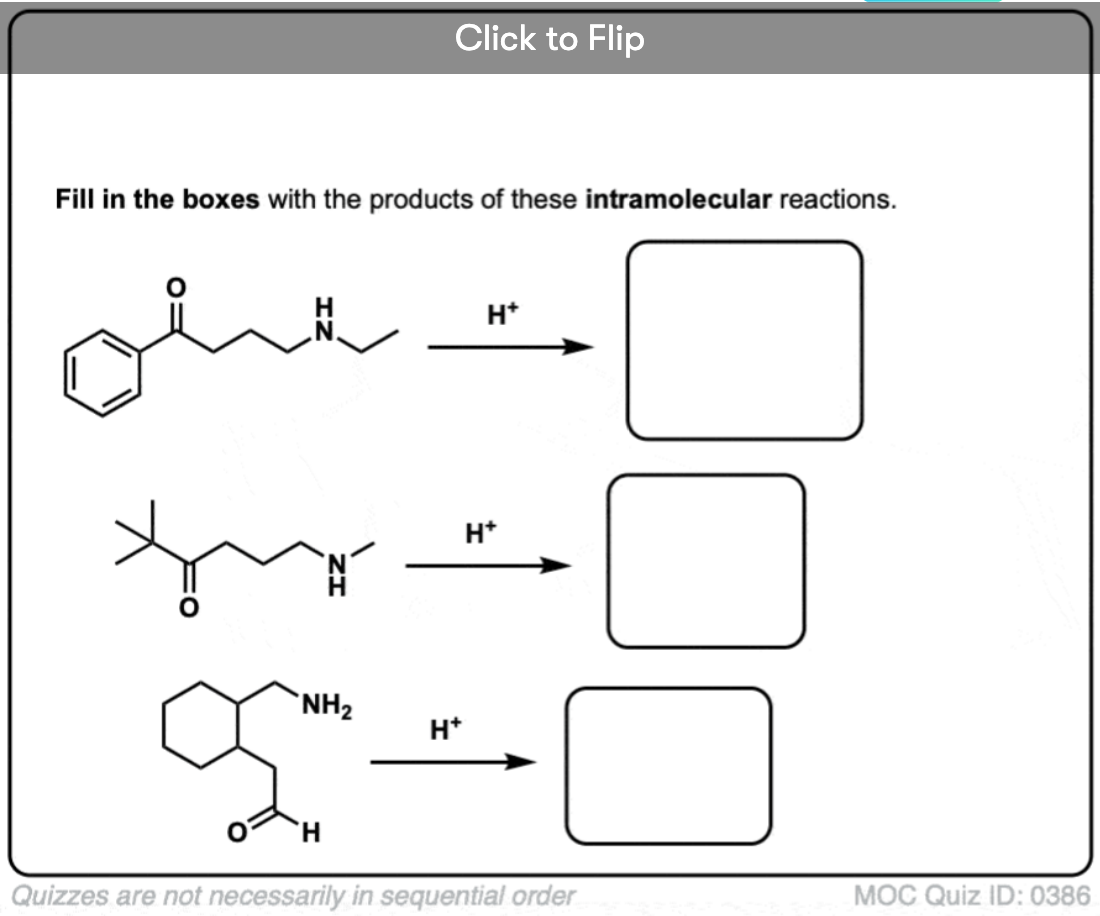
Intramolecular Reactions Classic exam questions. Substitution Reactions Williamson Ether Synthesis Addition to Alkenes Epoxide Opening Wittig Reaction Diels-Alder Reaction Friedel-Crafts Alkylation and Acylation Acetal Formation
Show full content

Intramolecular Reactions

Classic exam questions.

Substitution Reactions


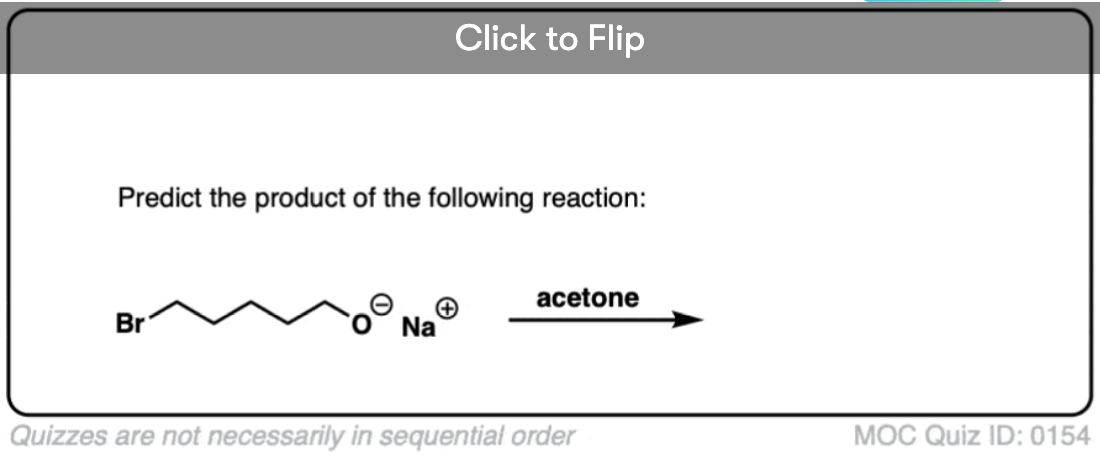
Become a MOC member to see the clickable quiz with answers on the back.


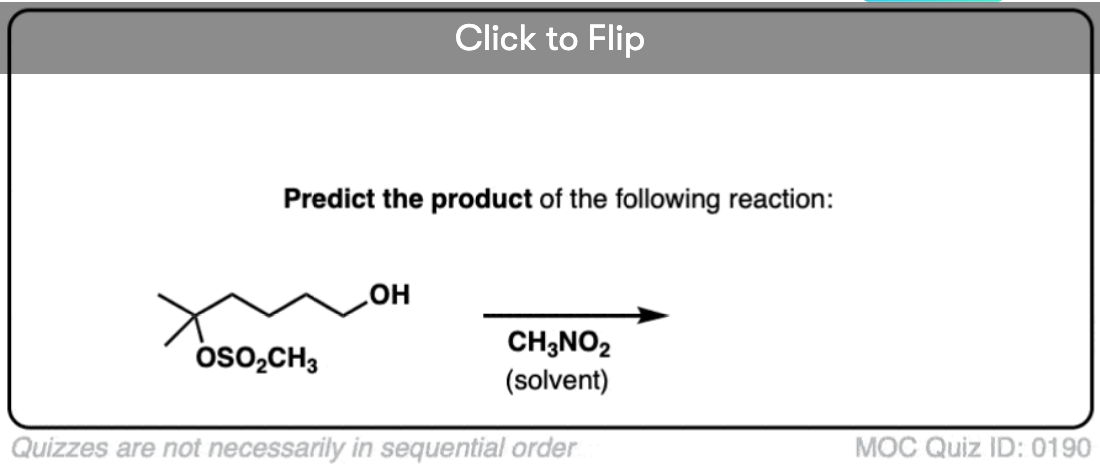
Become a MOC member to see the clickable quiz with answers on the back.


Become a MOC member to see the clickable quiz with answers on the back.

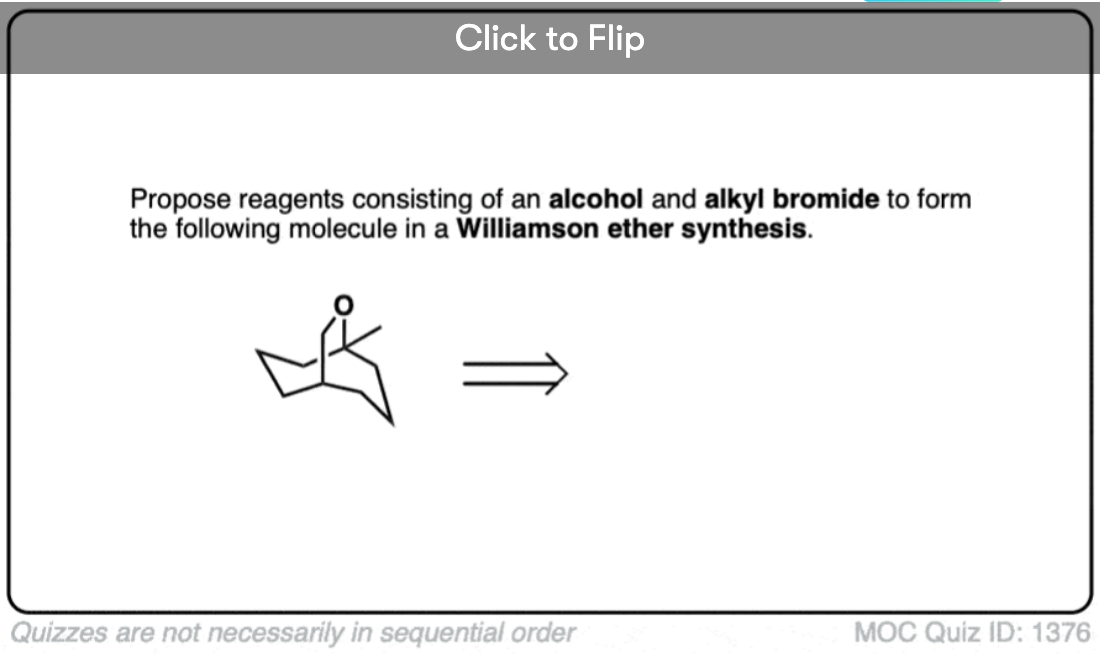
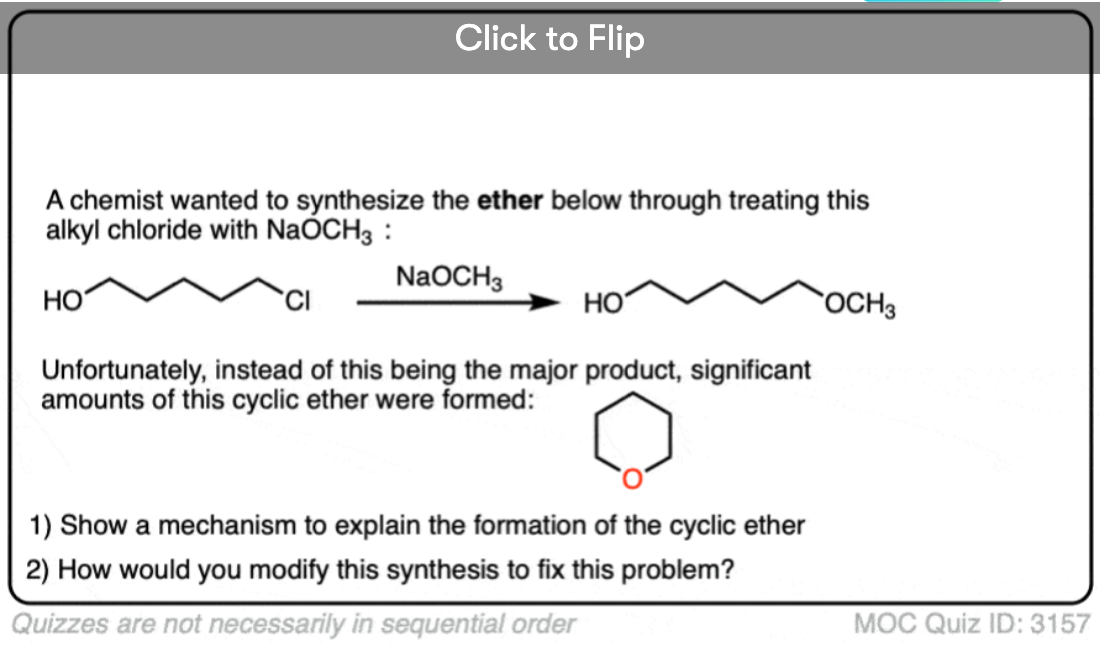
Williamson Ether Reaction


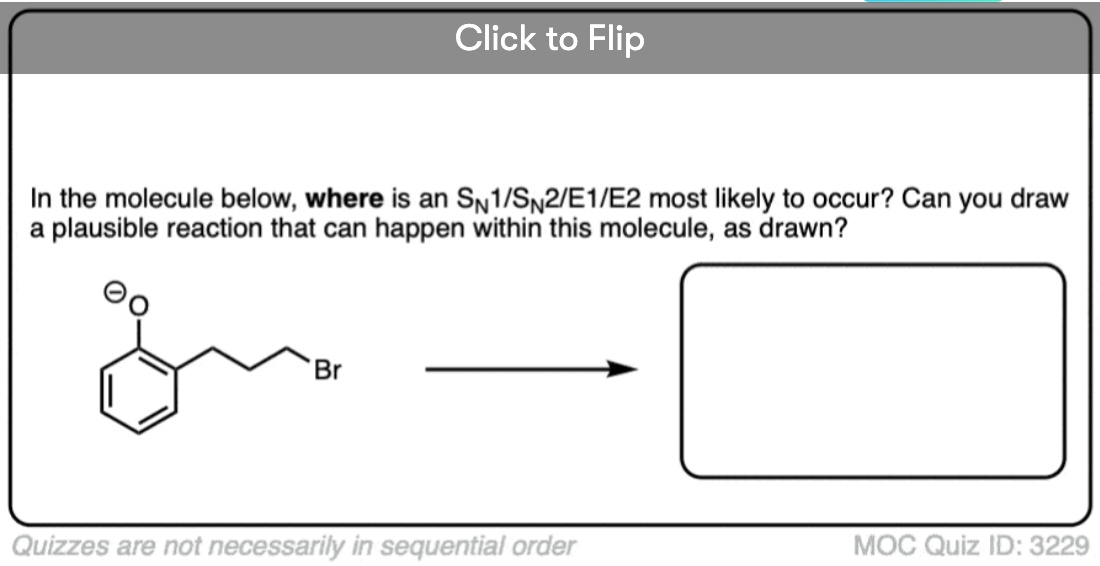
Become a MOC member to see the clickable quiz with answers on the back.


Become a MOC member to see the clickable quiz with answers on the back.


Become a MOC member to see the clickable quiz with answers on the back.

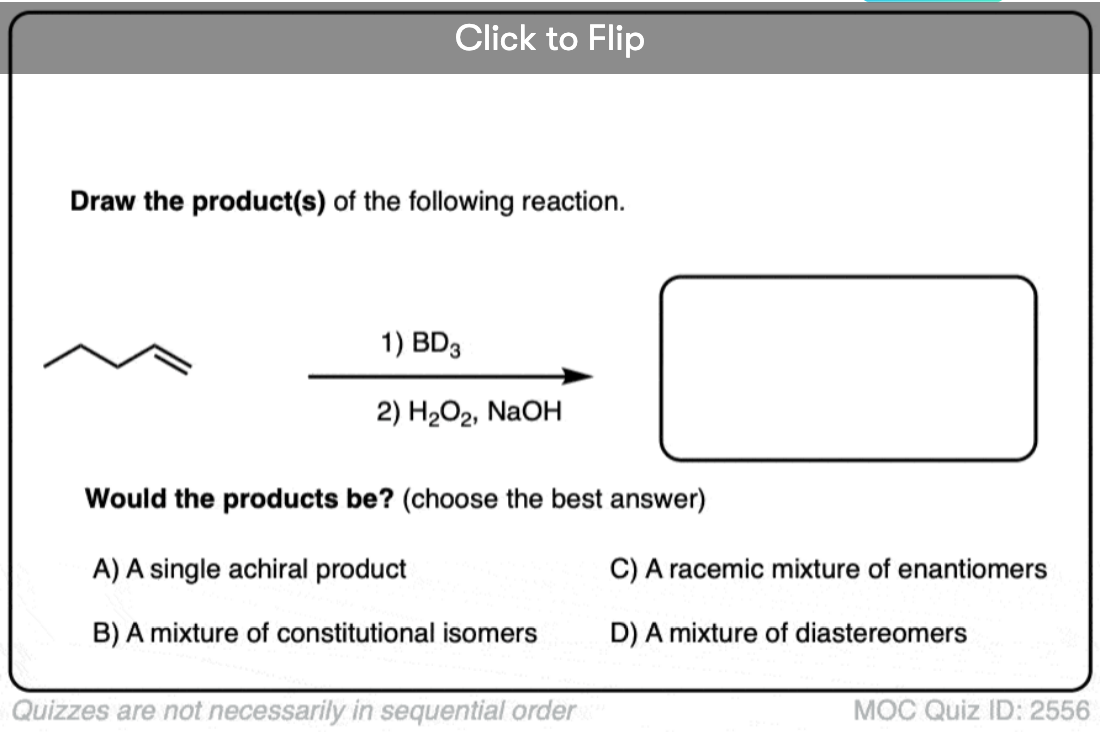
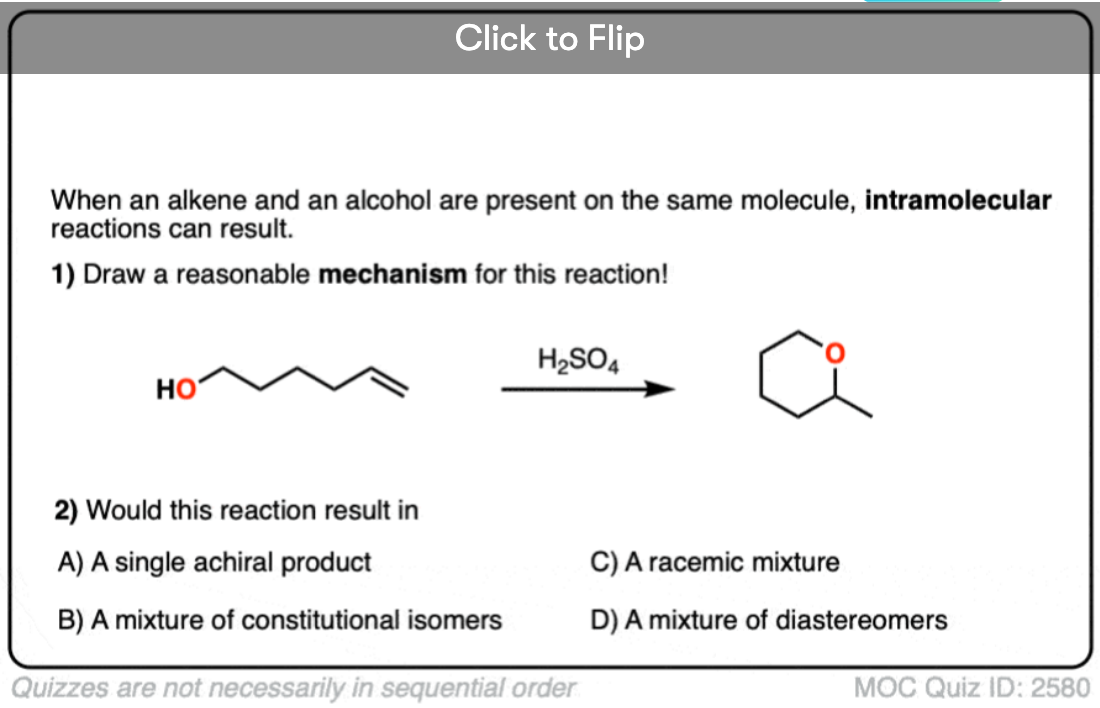
Alkene Additions


Become a MOC member to see the clickable quiz with answers on the back.


Become a MOC member to see the clickable quiz with answers on the back.


Become a MOC member to see the clickable quiz with answers on the back.

Epoxide opening


Become a MOC member to see the clickable quiz with answers on the back.


Become a MOC member to see the clickable quiz with answers on the back.

Wittig Reaction


Become a MOC member to see the clickable quiz with answers on the back.


Become a MOC member to see the clickable quiz with answers on the back.

Diels Alder Reaction


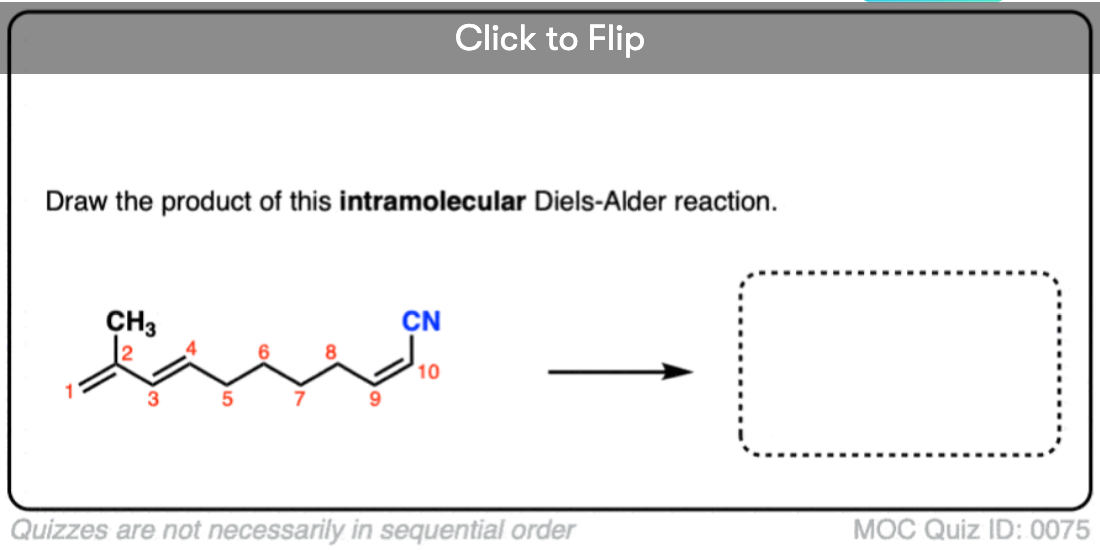
Become a MOC member to see the clickable quiz with answers on the back.


Become a MOC member to see the clickable quiz with answers on the back.

Friedel Crafts Alkylation and Acylation


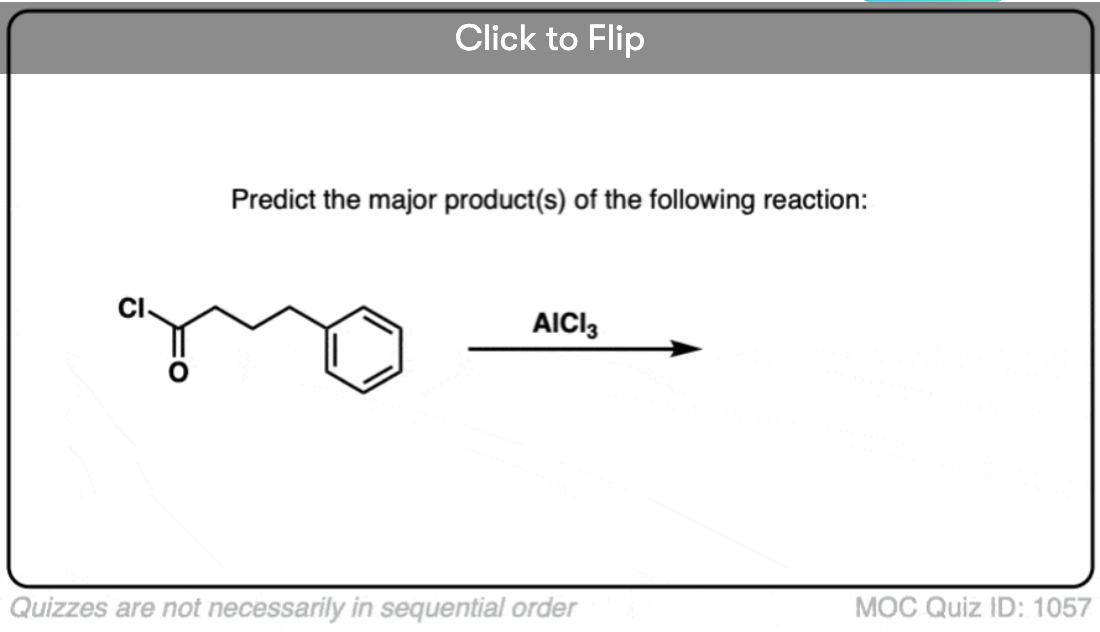
Become a MOC member to see the clickable quiz with answers on the back.


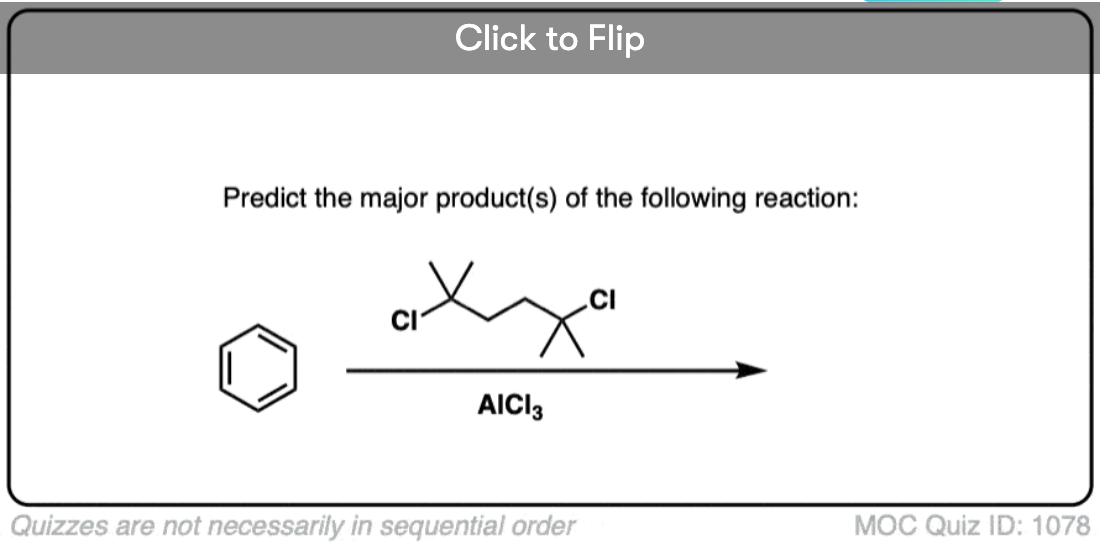
Become a MOC member to see the clickable quiz with answers on the back.

Acetal formation


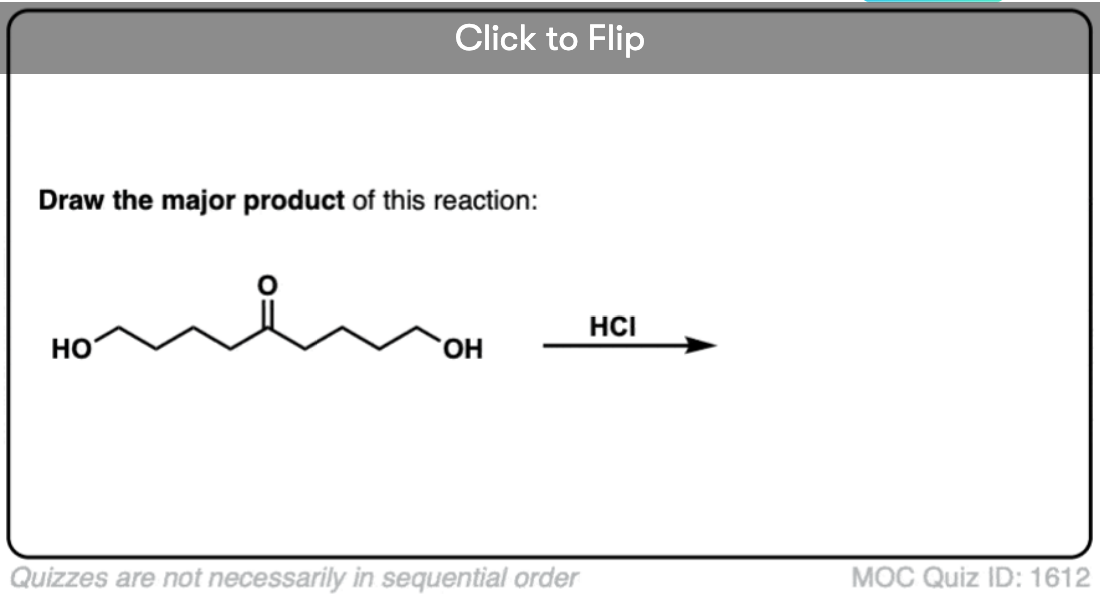
Become a MOC member to see the clickable quiz with answers on the back.

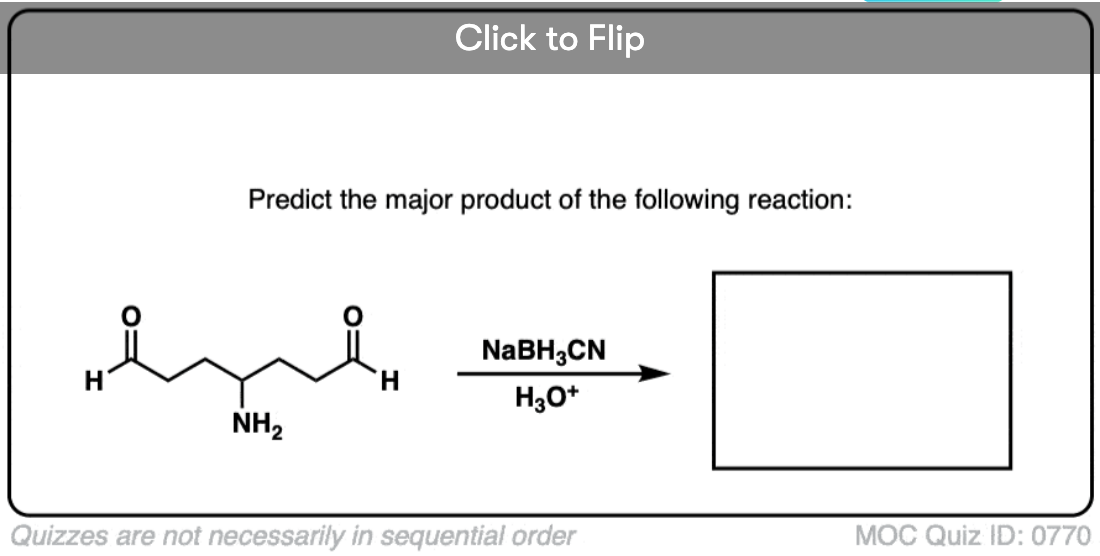
Imine formation


Become a MOC member to see the clickable quiz with answers on the back.

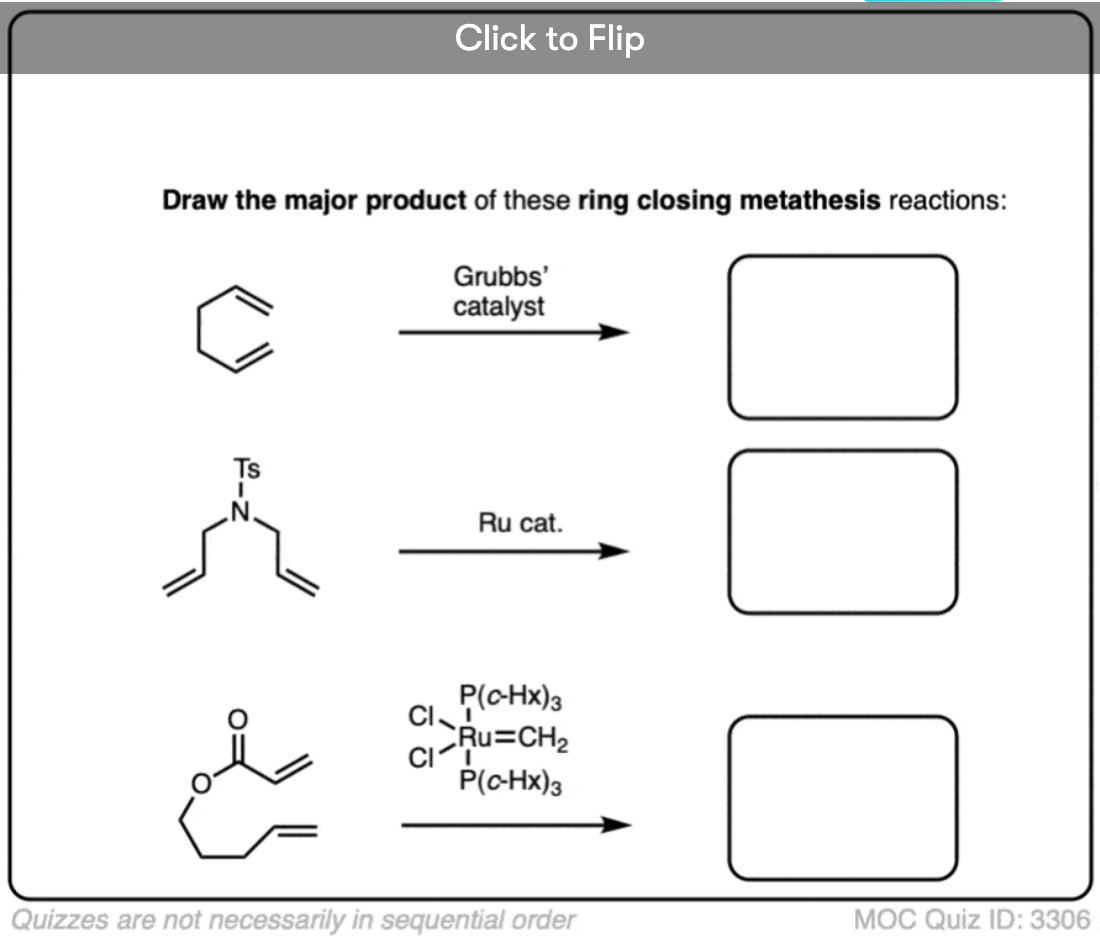
Ring Closing Metathesis


Become a MOC member to see the clickable quiz with answers on the back.

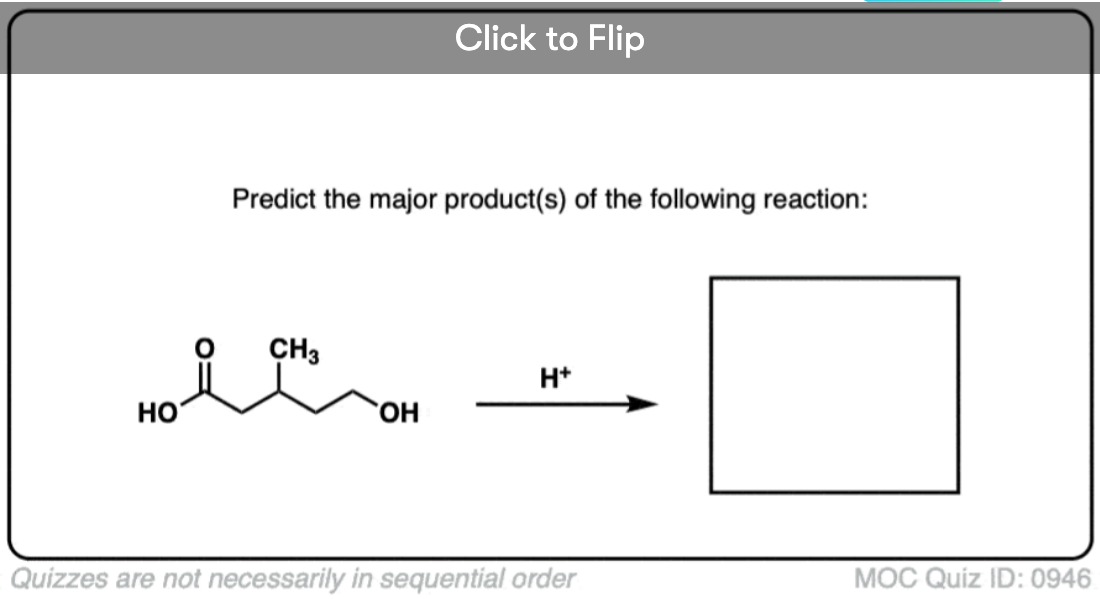
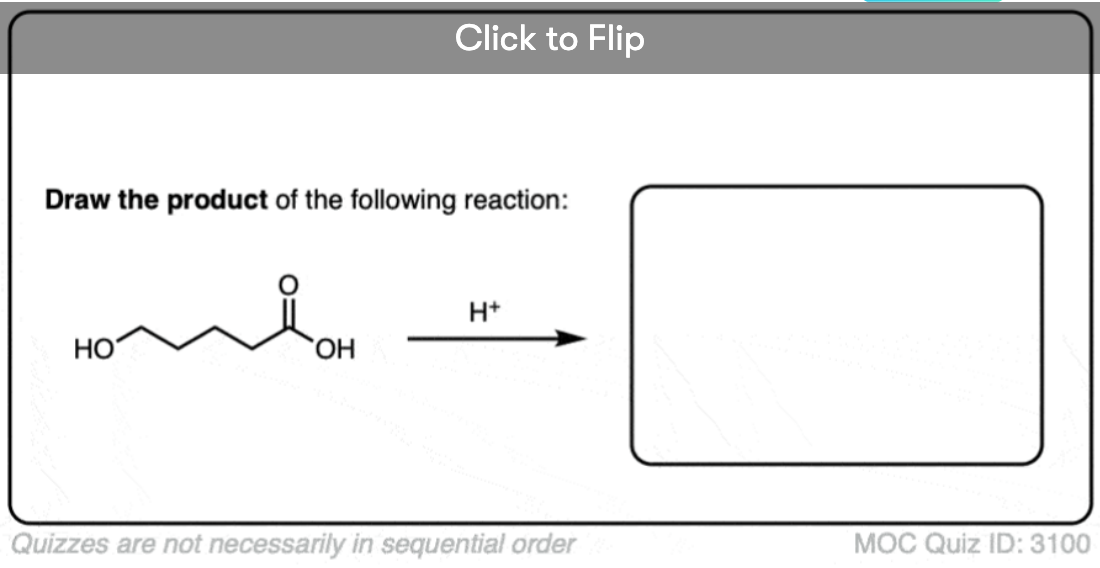
Fischer Esterification


Become a MOC member to see the clickable quiz with answers on the back.


Become a MOC member to see the clickable quiz with answers on the back.

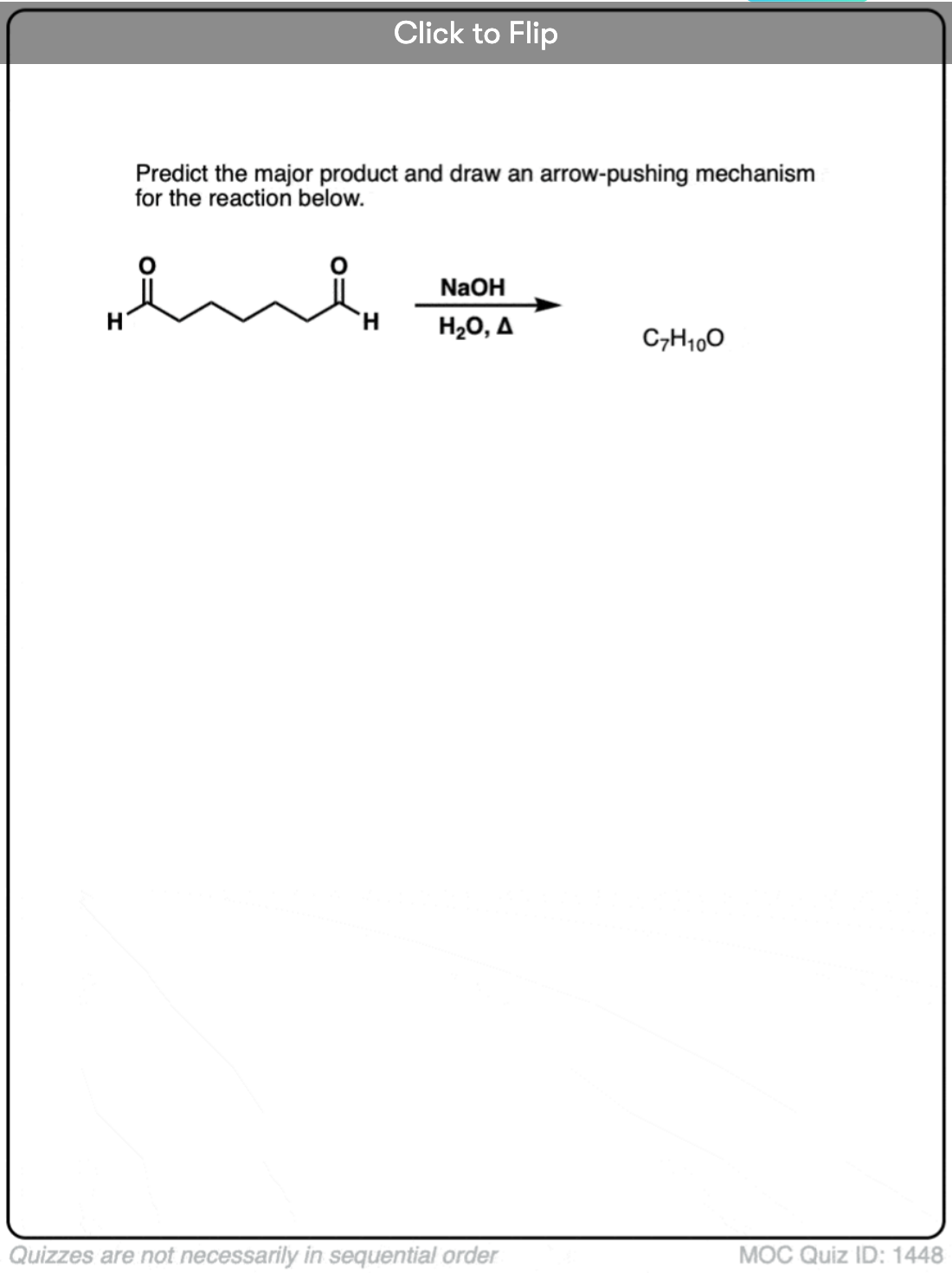
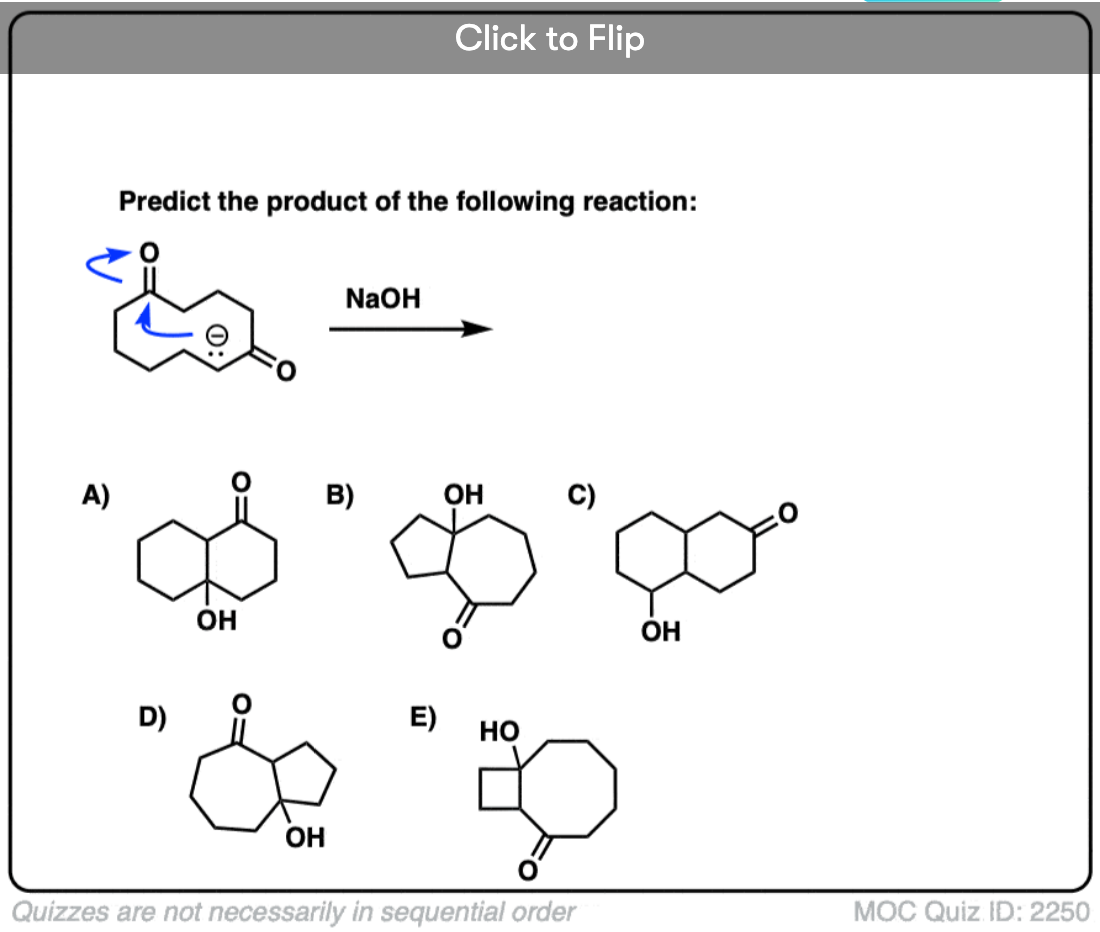
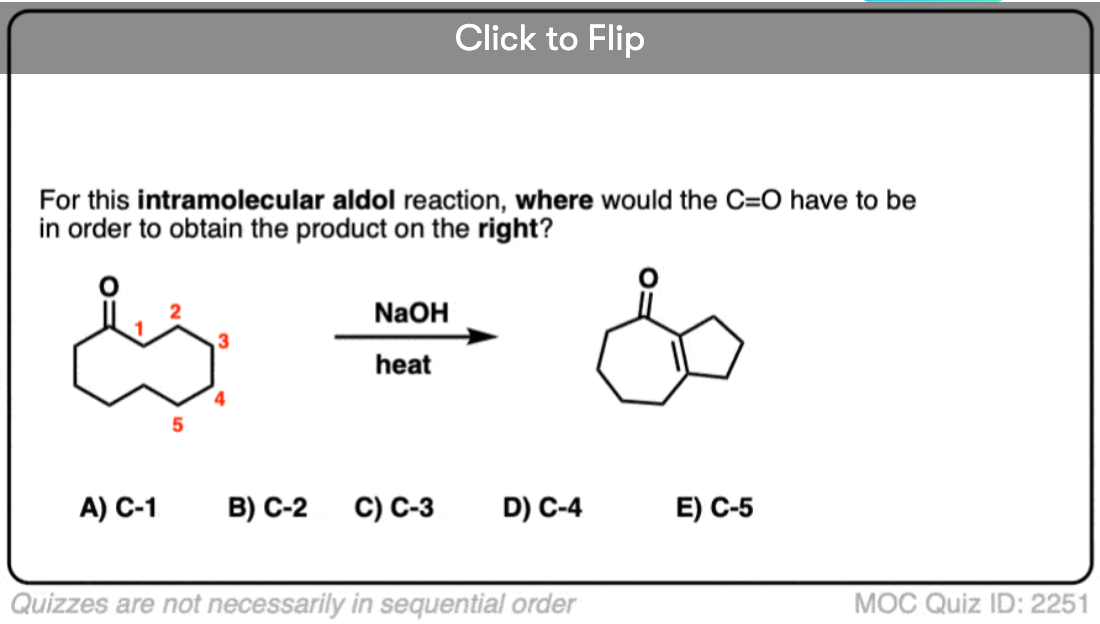
Aldol reaction


Become a MOC member to see the clickable quiz with answers on the back.


Become a MOC member to see the clickable quiz with answers on the back.


Become a MOC member to see the clickable quiz with answers on the back.

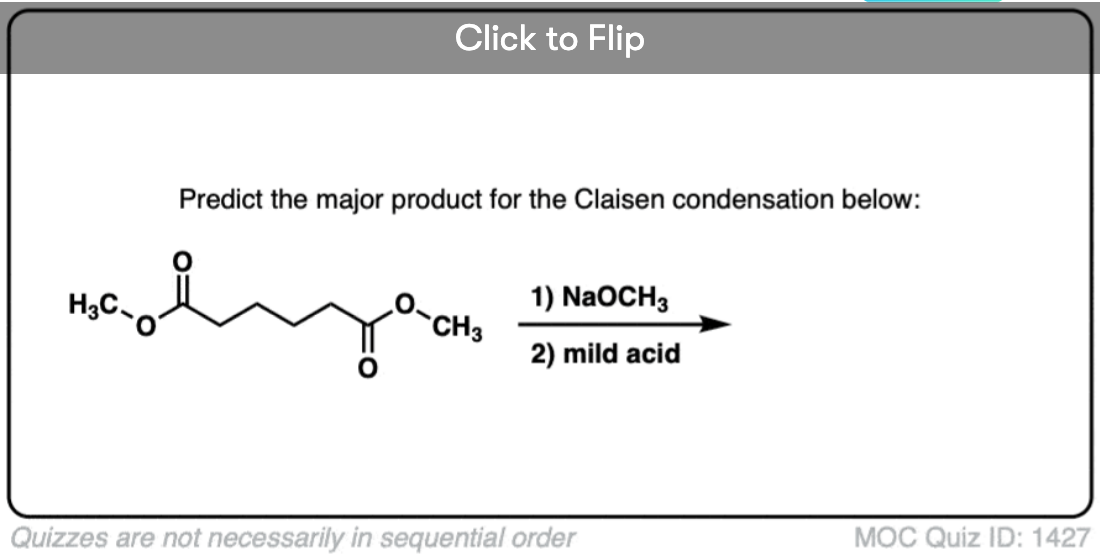
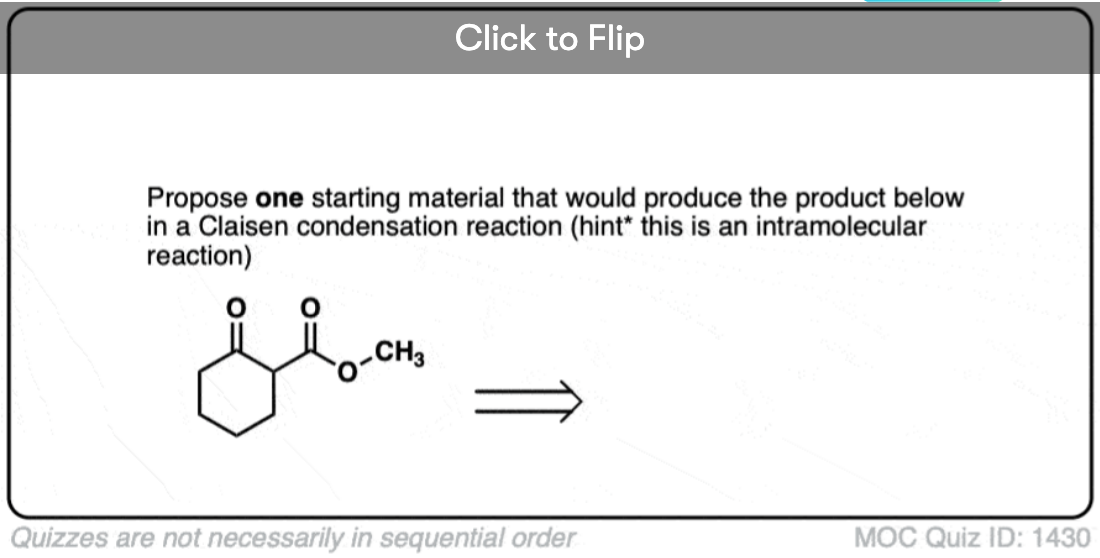
Dieckmann


Become a MOC member to see the clickable quiz with answers on the back.


Become a MOC member to see the clickable quiz with answers on the back.

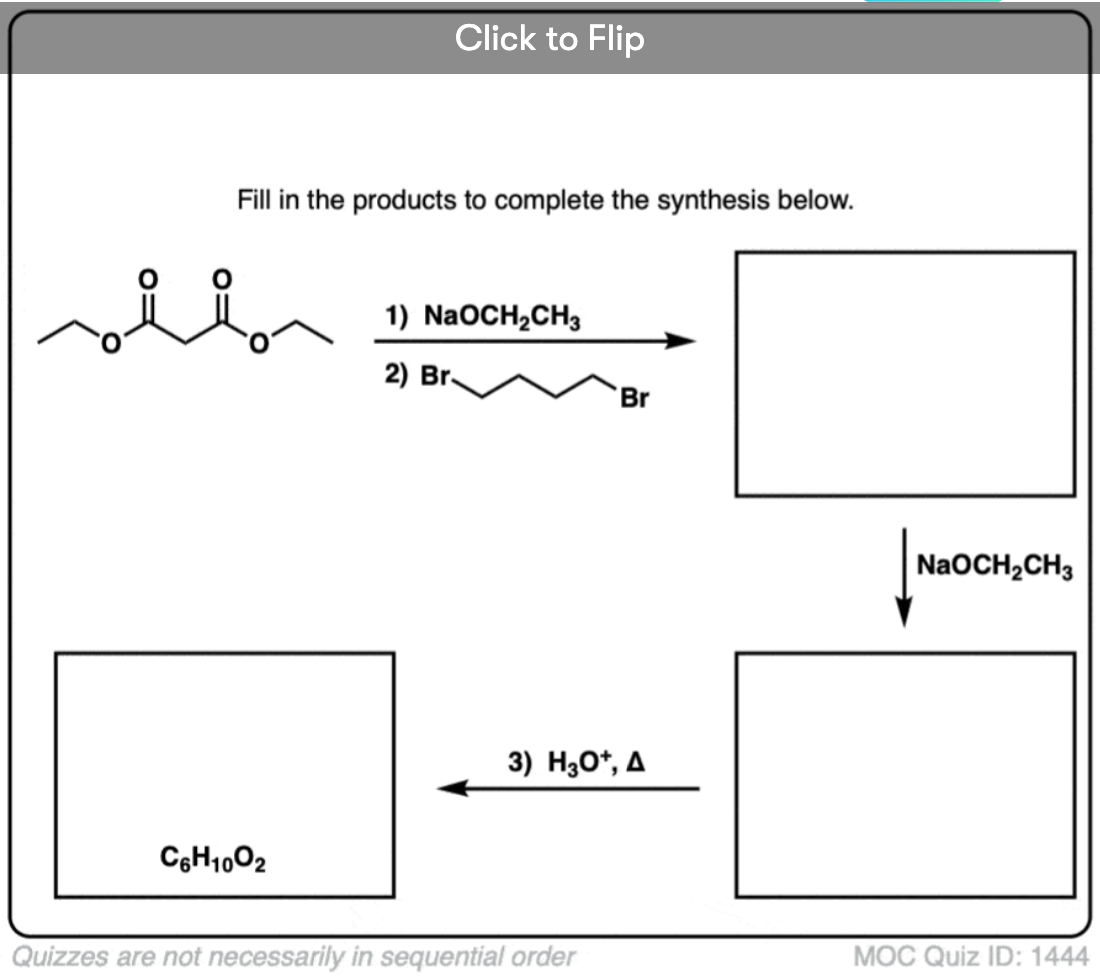
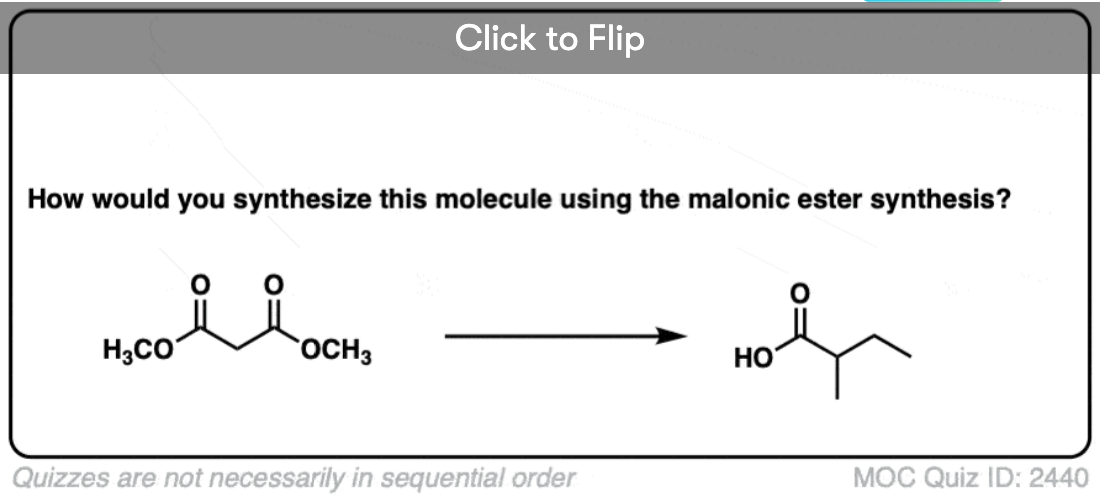
Malonic Ester Synthesis


Become a MOC member to see the clickable quiz with answers on the back.

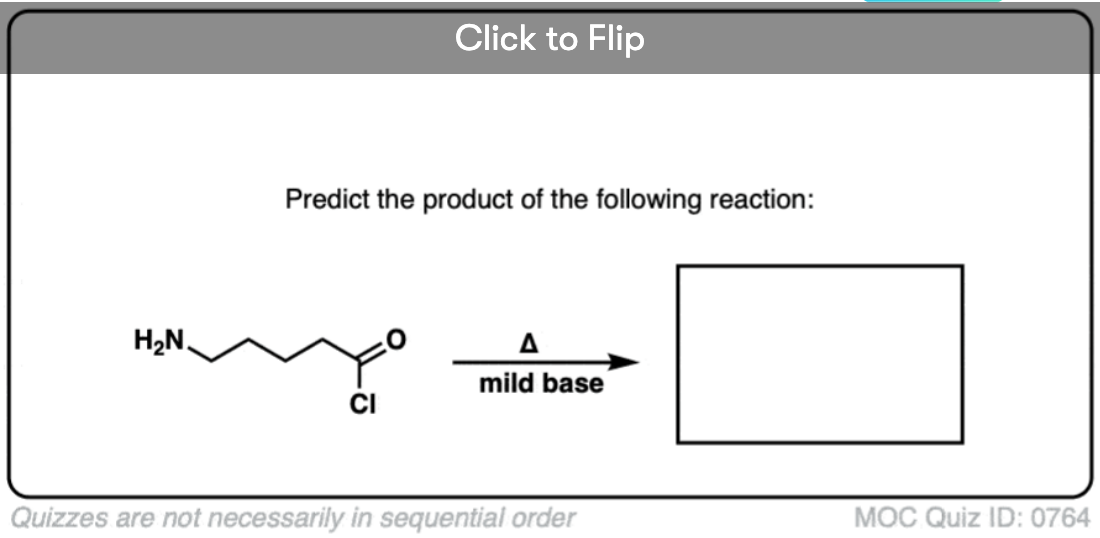
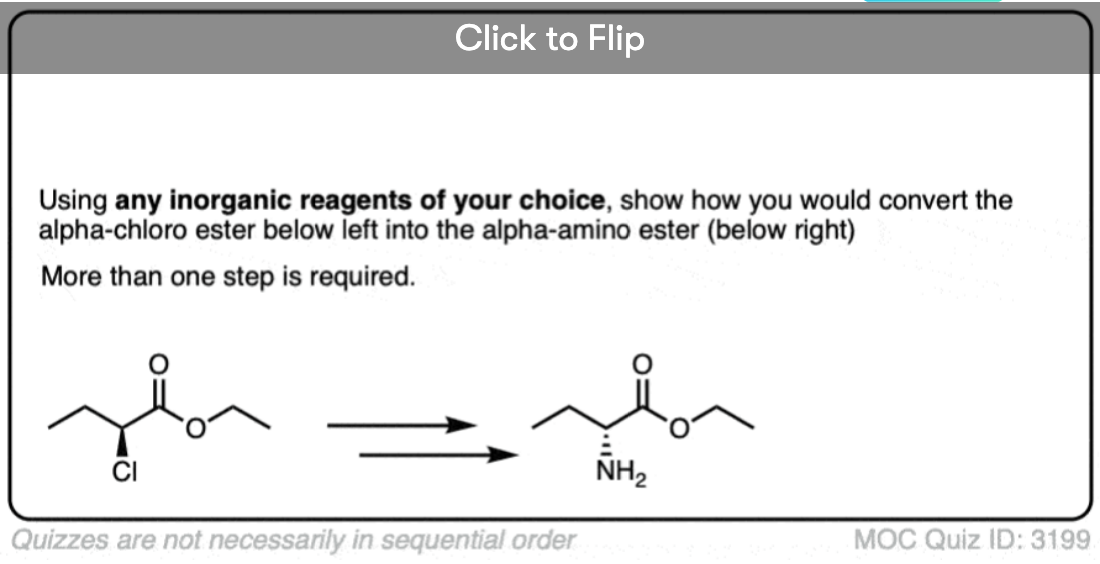
Amines


Become a MOC member to see the clickable quiz with answers on the back.


Become a MOC member to see the clickable quiz with answers on the back.

https://www.masterorganicchemistry.com/?p=44012
Extensions
Two-Step Synthesis Problems – 20 Solved Examples
Blog
Think about learning how to do synthesis two reactions at a time. When you learn a new reaction, take a moment and just think of
Show full content

Think about learning how to do synthesis two reactions at a time.

When you learn a new reaction, take a moment and just think of one extra reaction you could do with that product.

Example. You learn free-radical halogenation of alkanes to make alkyl halides. What’s one reaction of alkyl halides?

  • Elimination (with base) to give an alkene
  • Substitution (with nucleophile) to give (e.g.) a nitrile
  • later on, formation of a Grignard reagent.

Eventually, you will find yourself piecing together these two-step syntheses into longer chains of sequences.

Here are 20 examples of two-step synthesis questions that are great building blocks for bigger things (OK, some are 3 steps)

  1. Chopping Off The Alkyl Group
  2. Walking Over The Alkyl Halide
  3. Making Molecules Alkynes of Ways
  4. Trans to Cis? Not A One Step Process
  5. Alkanes to Alcohols
  6. Protect That Alcohol!
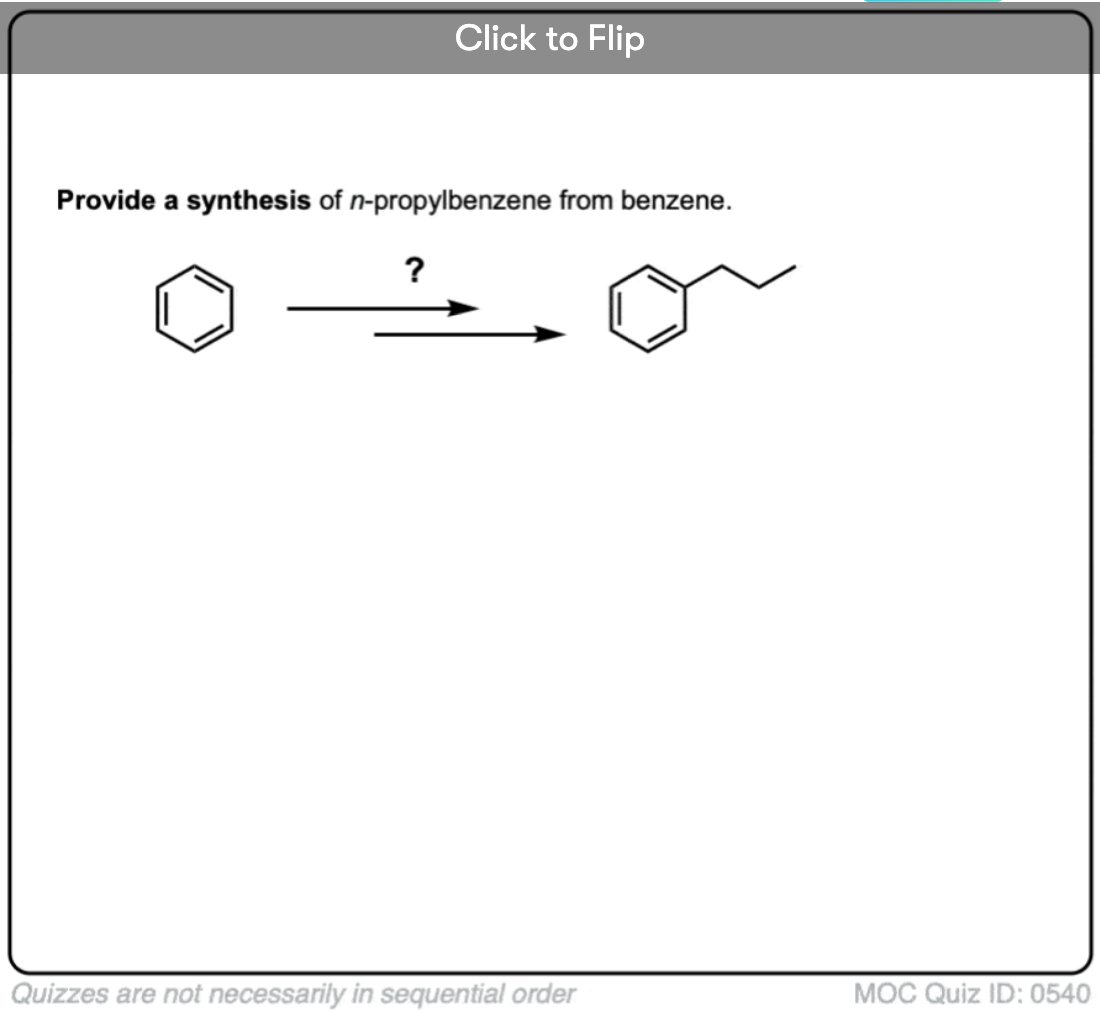
  7. The Great Friedel-Crafts Workaround
  8. Styrene
  9. Polarity Reversal On A Ring
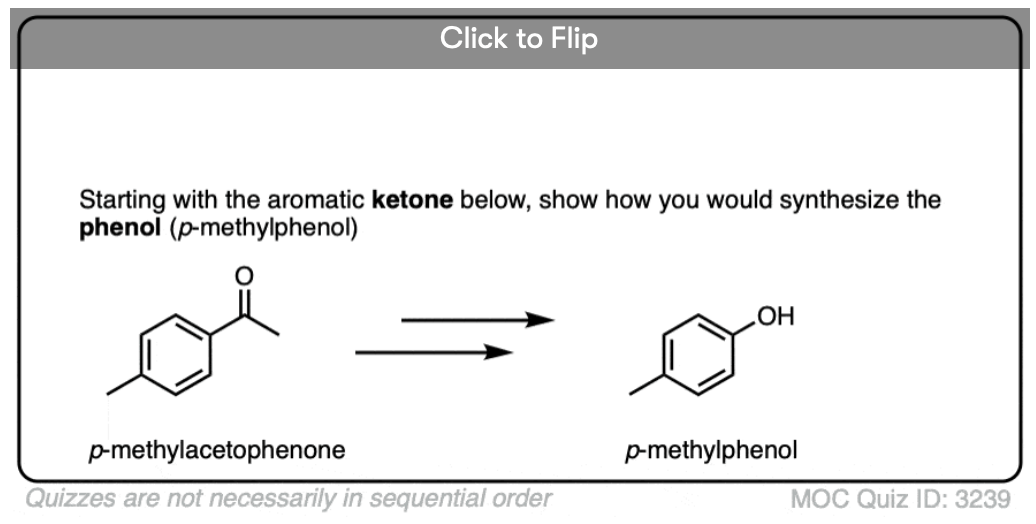
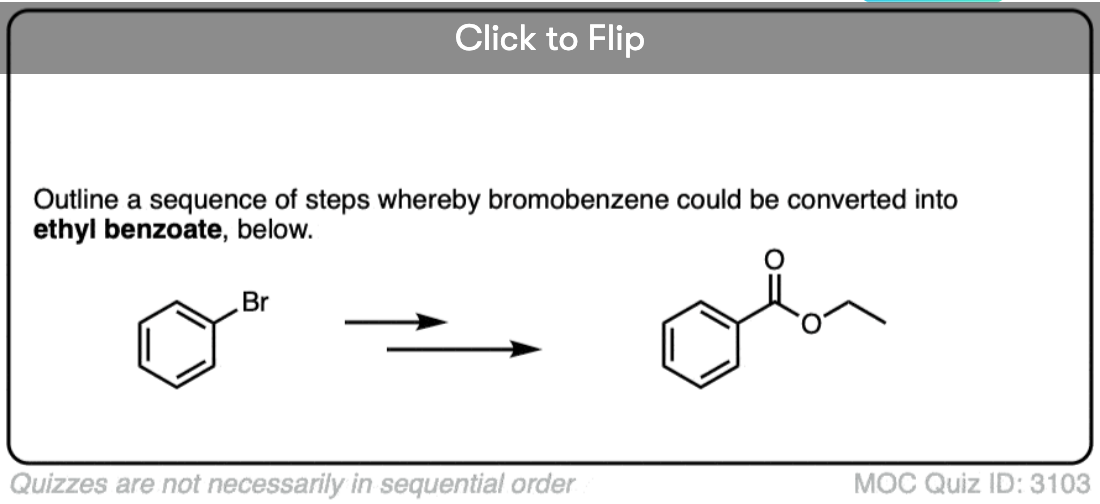
  10. Fun With Carboxylic Acids… and Esters
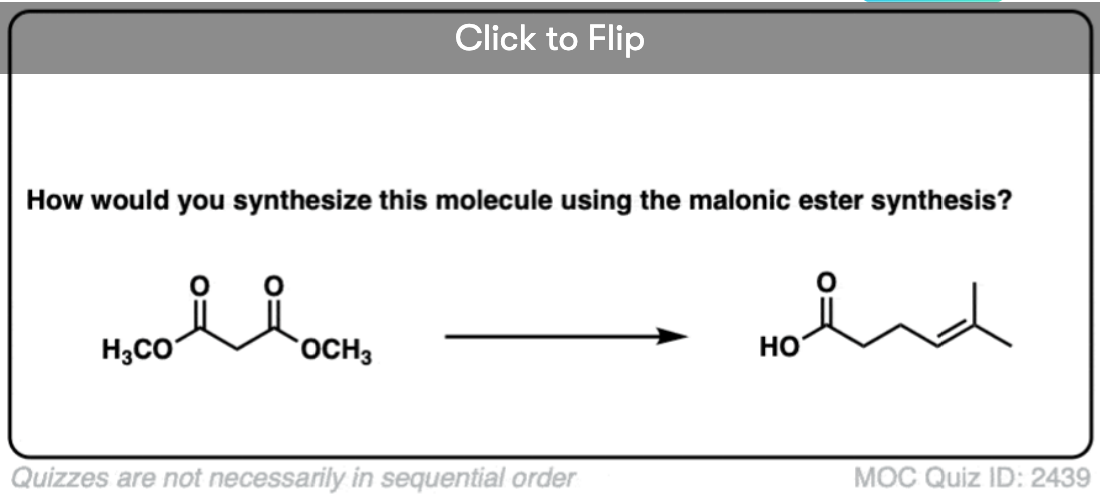
  11. Malonic Ester Madness
  12. Cyclohexenone
  13. Know What Amine?

Here are the relevant quizzes:

1. Chopping Off An Alkyl Group .wq-quiz-wrapper[data-id="41033"] { --wq-question-width: 100%; --wq-question-color: #009cff; --wq-question-height: auto; --wq-font-color: #444; } .wq-quiz-wrapper[data-id="41033"] { --wq-question-width: 600px; } @media screen and (max-width: 600px) { .wq-quiz-wrapper[data-id="41033"] .wq_singleQuestionWrapper { width:100% !important; height:auto !important; } } Click to Flip 2. Walking Over The Alkyl Halide


Become a MOC member to see the clickable quiz with answers on the back.

3. Alkynes of Ways To Make These


Become a MOC member to see the clickable quiz with answers on the back.


Become a MOC member to see the clickable quiz with answers on the back.


Become a MOC member to see the clickable quiz with answers on the back.

4. Trans to Cis Is Not A Simple Operation


Become a MOC member to see the clickable quiz with answers on the back.

5. Alkanes to Alcohols Via Alkenes


Become a MOC member to see the clickable quiz with answers on the back.


Become a MOC member to see the clickable quiz with answers on the back.

6. Protect That Alcohol


Become a MOC member to see the clickable quiz with answers on the back.

7. The Great Friedel Crafts Workaround


Become a MOC member to see the clickable quiz with answers on the back.

8. Ethylbenzene to Styrene


Become a MOC member to see the clickable quiz with answers on the back.

9. Polarity Reversal On An Aromatic Ring


Become a MOC member to see the clickable quiz with answers on the back.

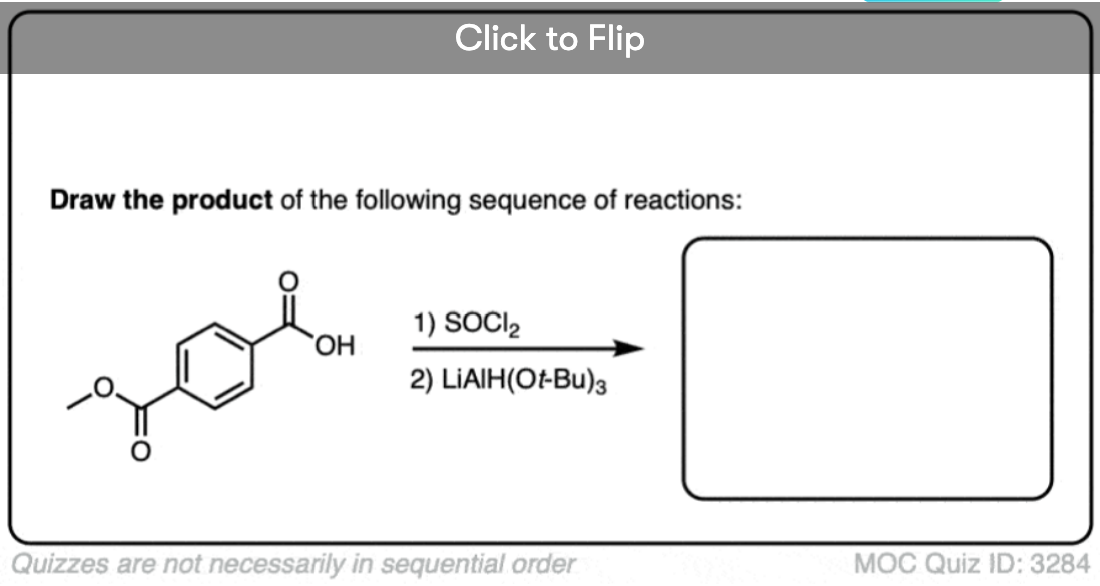
10. Carboxylic Acid Fun (and Esters)


Become a MOC member to see the clickable quiz with answers on the back.


Become a MOC member to see the clickable quiz with answers on the back.

11. Malonic Ester Madness


Become a MOC member to see the clickable quiz with answers on the back.


Become a MOC member to see the clickable quiz with answers on the back.

12. Cyclohexenone


Become a MOC member to see the clickable quiz with answers on the back.

13. Know What Amine, Vern?


Become a MOC member to see the clickable quiz with answers on the back.


Become a MOC member to see the clickable quiz with answers on the back.


Become a MOC member to see the clickable quiz with answers on the back.

https://www.masterorganicchemistry.com/?p=44010
Extensions
Org 1, Midterm Number 1
Blog
Org 1, Midterm 1: 10 Common Types of Exam Problems I’ve looked at a lot of first midterms for Org 1 at North American schools. 
Show full content

Org 1, Midterm 1: 10 Common Types of Exam Problems

I’ve looked at a lot of first midterms for Org 1 at North American schools.  Here, I’ll share some of the common types of questions that come up, with examples. There won’t be much commentary here, mostly just a problem dump for now.


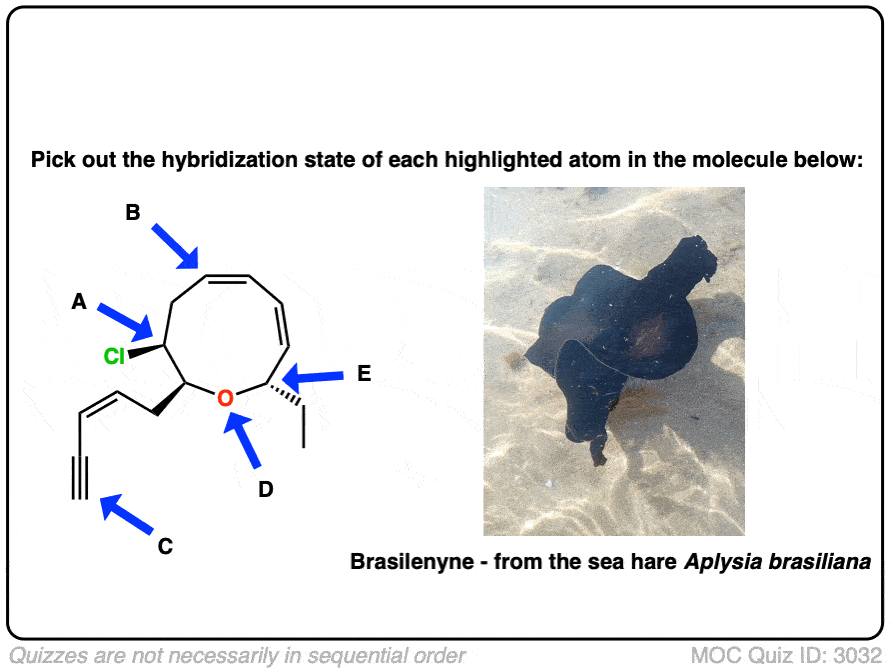
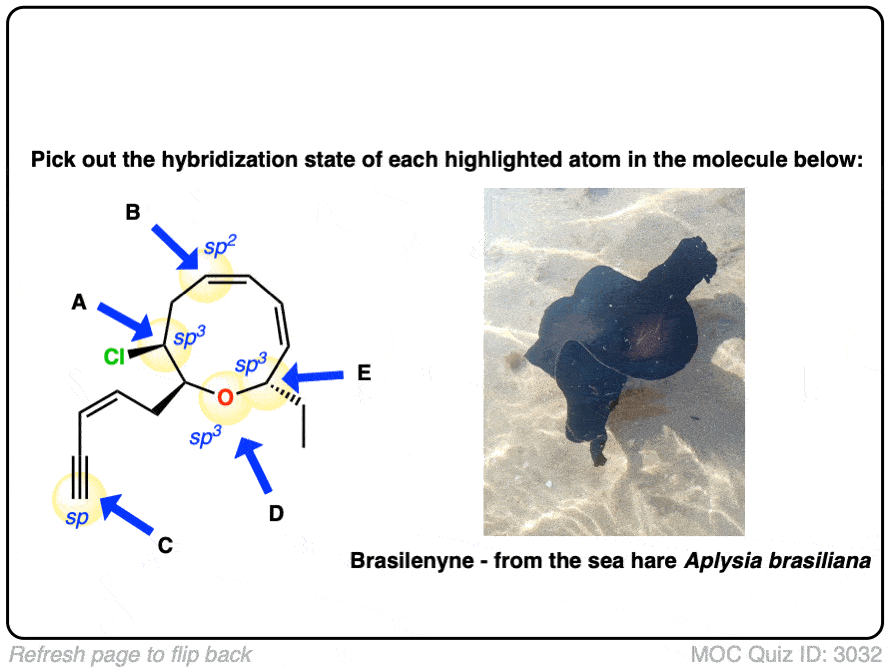
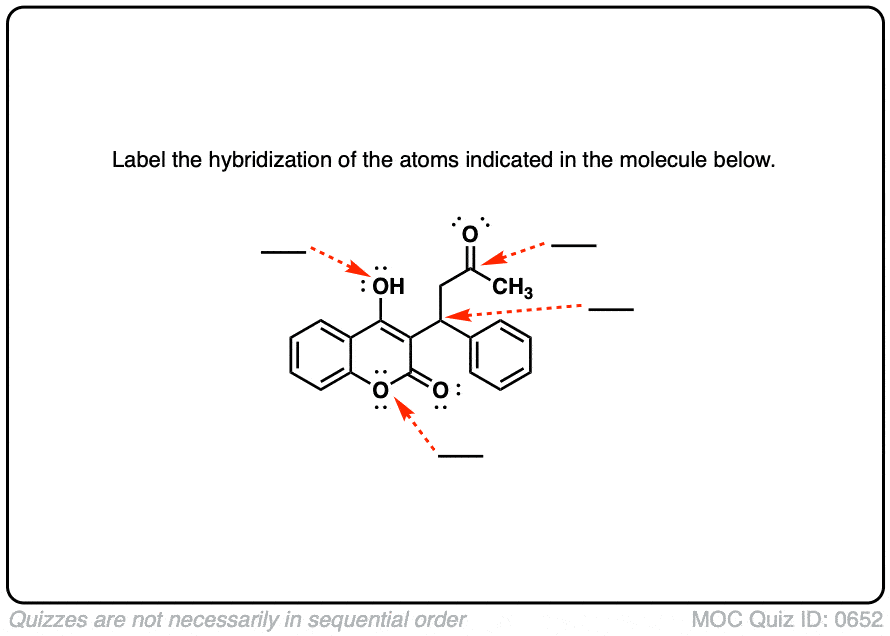
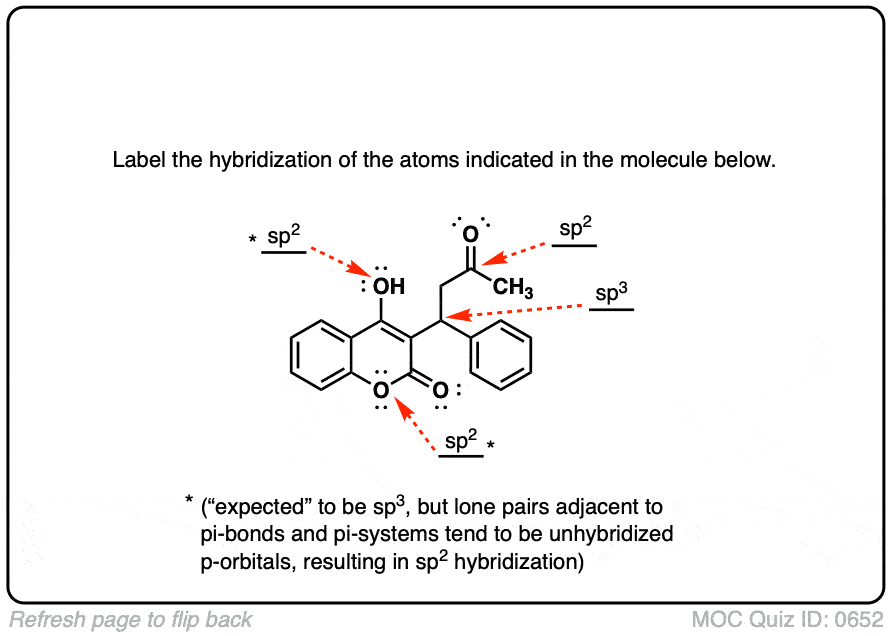
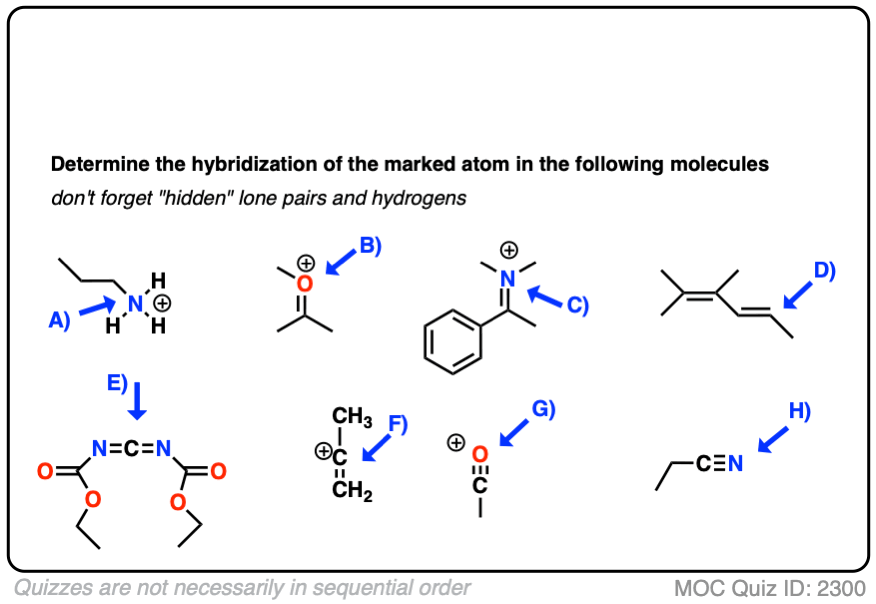
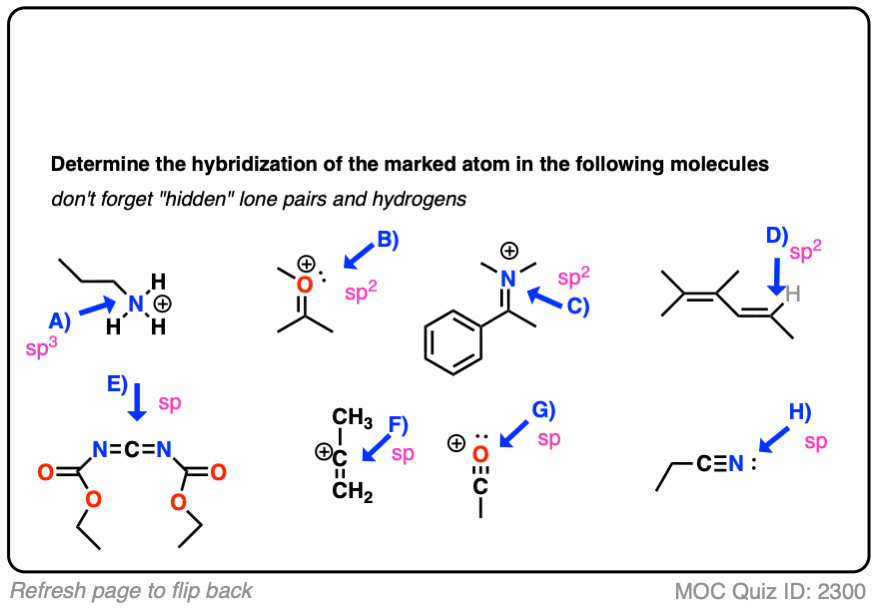
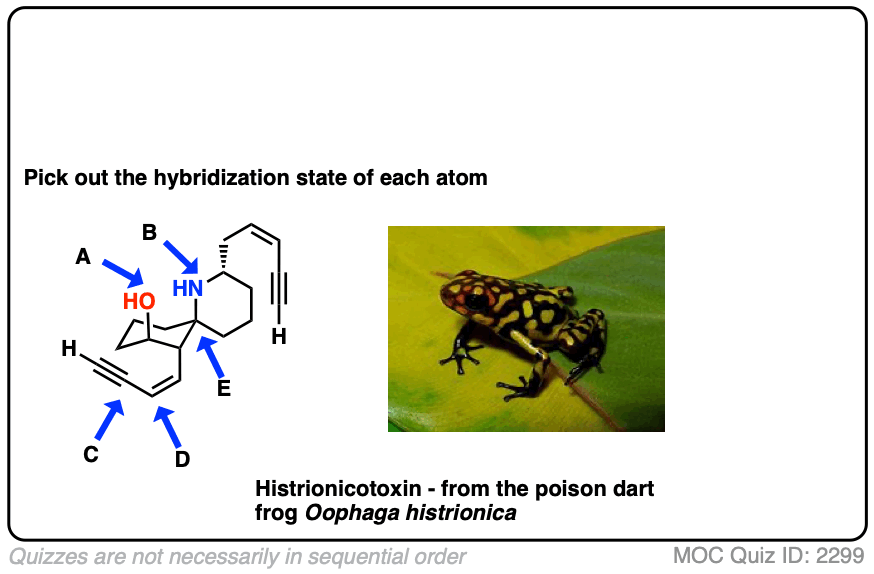
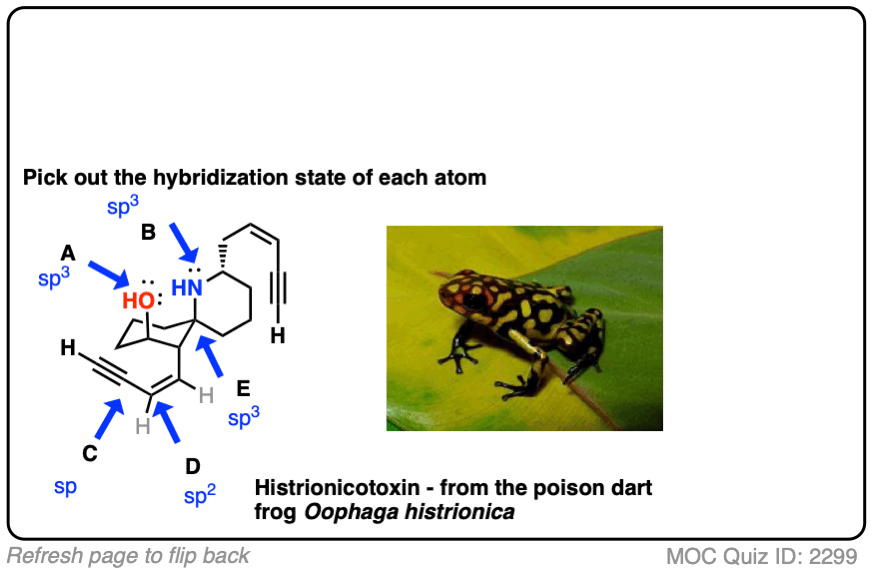
1. Hybridization (*crucial*)

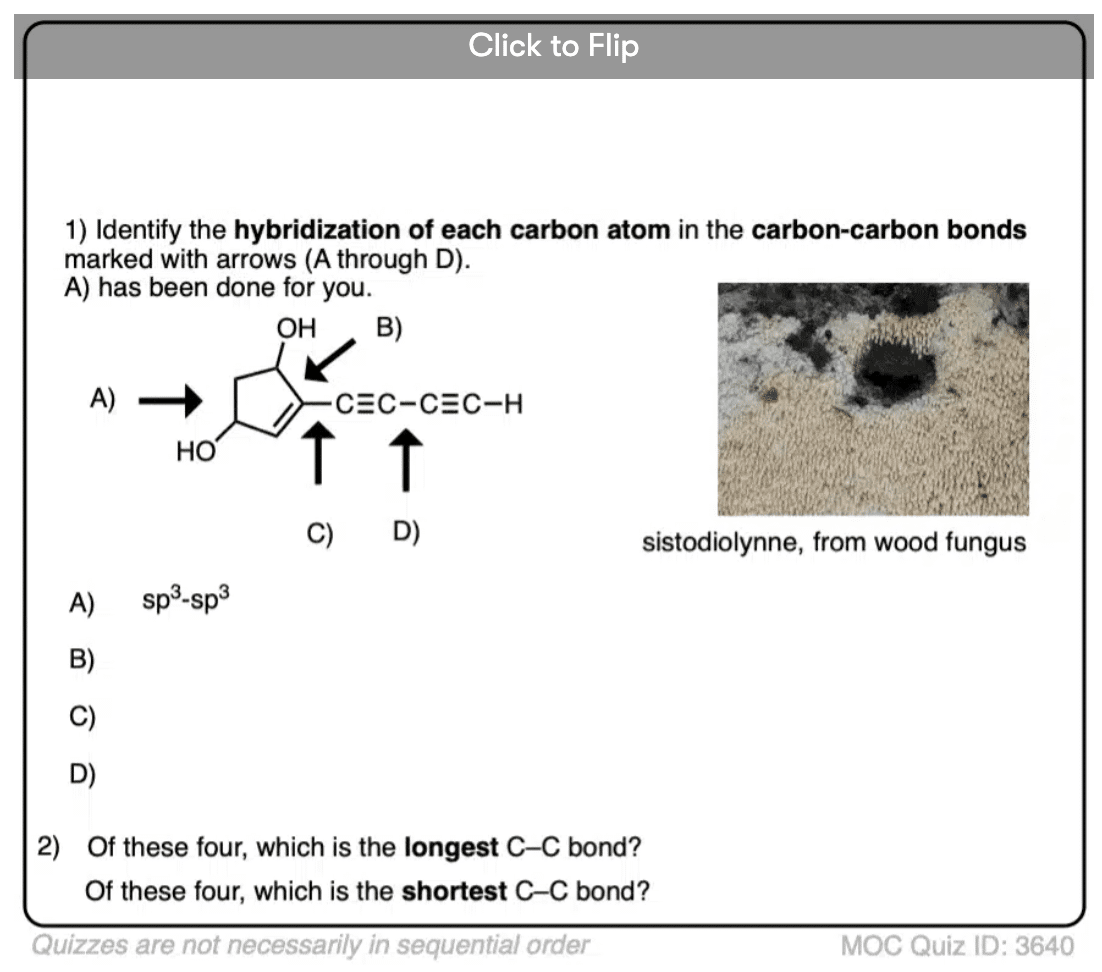
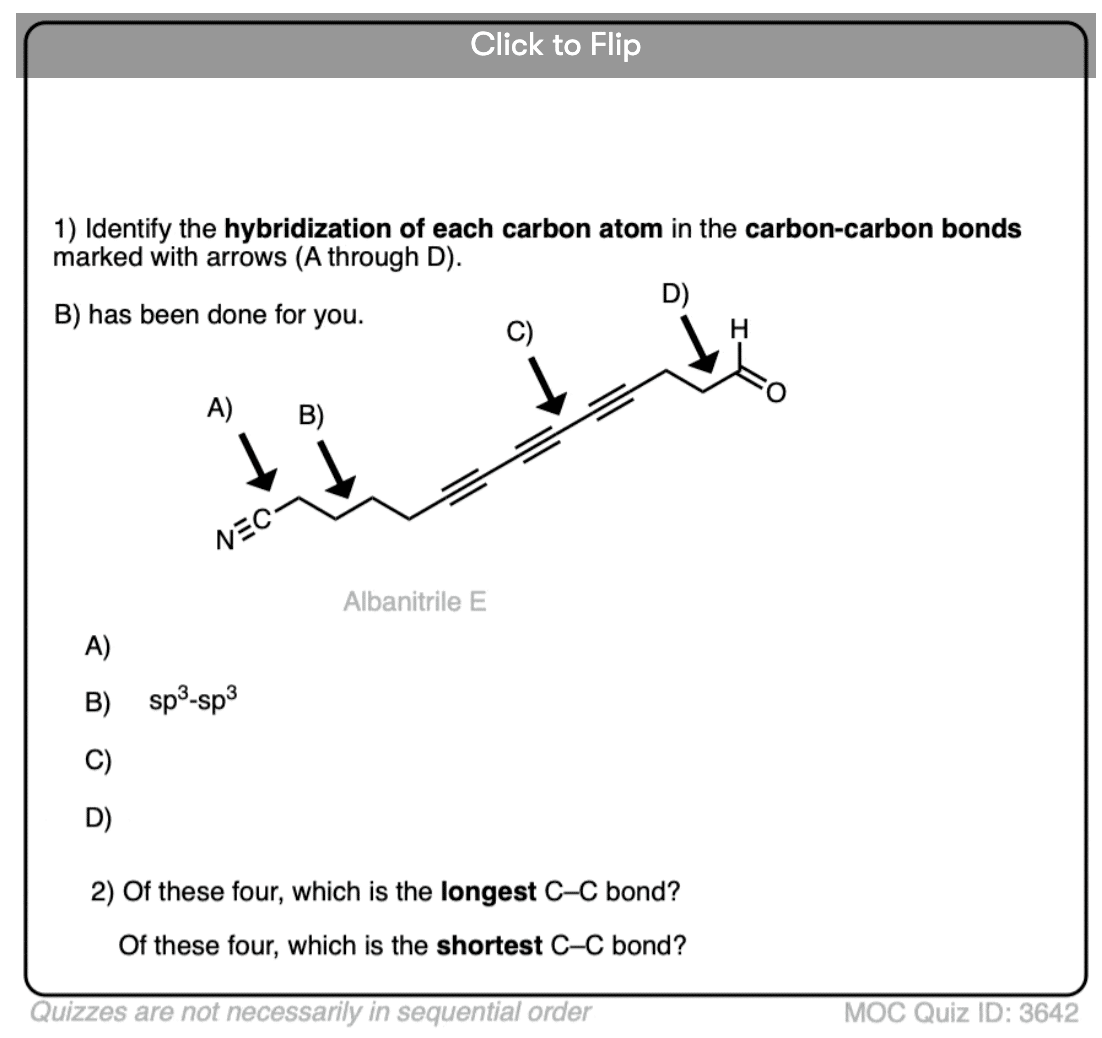
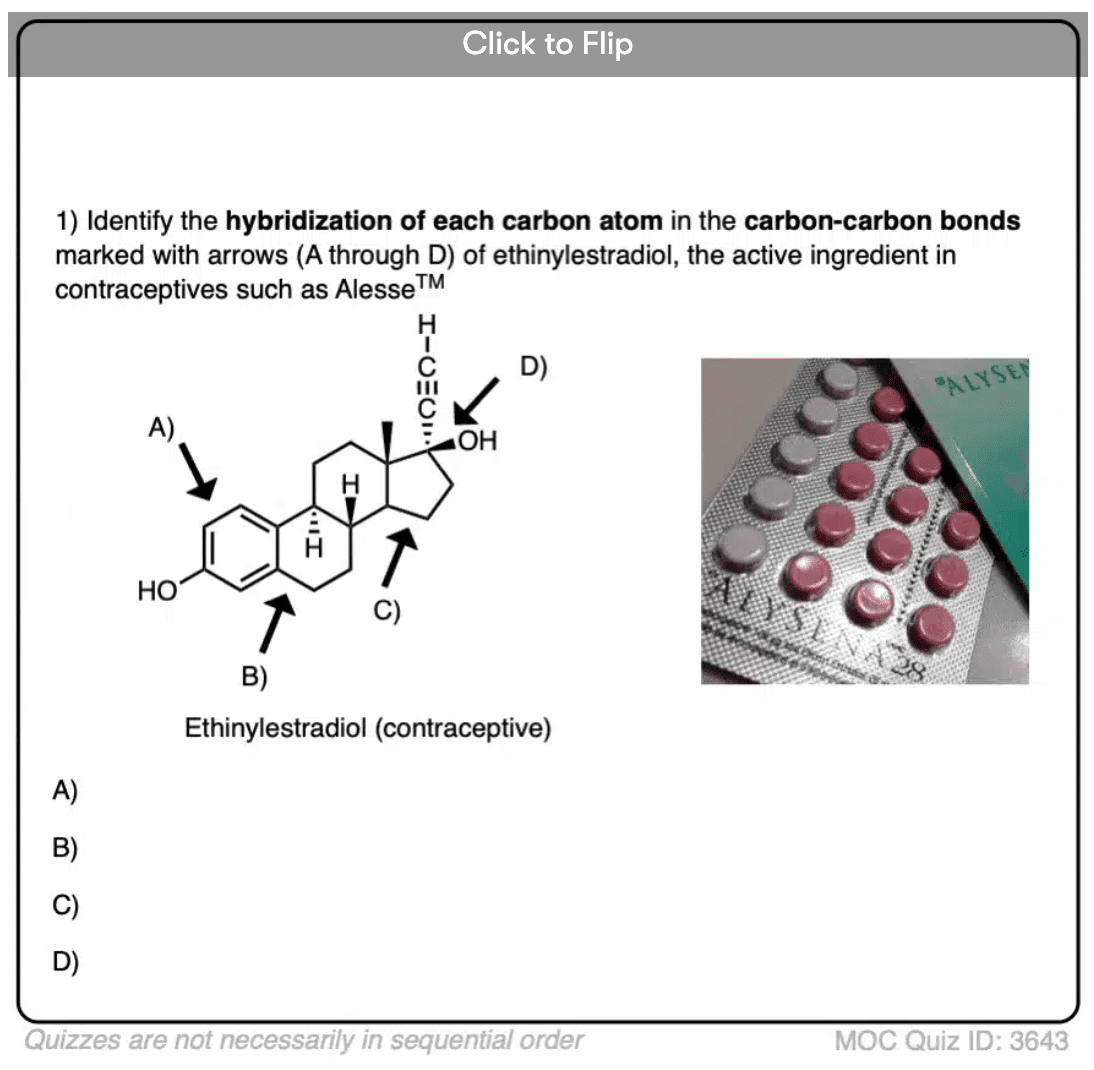
Expect to be able to determine the hybridization at pretty much any atom. One form this commonly takes is to be shown a large molecule and your job is to assign hybridization at various atoms. Remember the hybridization shortcut, which involves counting the number of attached (atoms + lone pairs).

  • If it’s 4, the atom is sp3,
  • If 3, it’s sp2,
  • If 2, it’s sp. (If it’s 1, it’s probably hydrogen.)  Just be on the lookout for atoms with lone pairs adjacent to pi bonds.

.wq-quiz-wrapper[data-id="38800"] { --wq-question-width: 100%; --wq-question-color: #009cff; --wq-question-height: auto; --wq-font-color: #444; } .wq-quiz-wrapper[data-id="38800"] { --wq-question-width: 600px; } @media screen and (max-width: 600px) { .wq-quiz-wrapper[data-id="38800"] .wq_singleQuestionWrapper { width:100% !important; height:auto !important; } } Click to Flip
.wq-quiz-wrapper[data-id="38753"] { --wq-question-width: 100%; --wq-question-color: #009cff; --wq-question-height: auto; --wq-font-color: #444; } .wq-quiz-wrapper[data-id="38753"] { --wq-question-width: 600px; } @media screen and (max-width: 600px) { .wq-quiz-wrapper[data-id="38753"] .wq_singleQuestionWrapper { width:100% !important; height:auto !important; } } Click to Flip
.wq-quiz-wrapper[data-id="43635"] { --wq-question-width: 100%; --wq-question-color: #009cff; --wq-question-height: auto; --wq-font-color: #444; } .wq-quiz-wrapper[data-id="43635"] { --wq-question-width: 600px; } @media screen and (max-width: 600px) { .wq-quiz-wrapper[data-id="43635"] .wq_singleQuestionWrapper { width:100% !important; height:auto !important; } } Click to Flip
.wq-quiz-wrapper[data-id="43634"] { --wq-question-width: 100%; --wq-question-color: #009cff; --wq-question-height: auto; --wq-font-color: #444; } .wq-quiz-wrapper[data-id="43634"] { --wq-question-width: 600px; } @media screen and (max-width: 600px) { .wq-quiz-wrapper[data-id="43634"] .wq_singleQuestionWrapper { width:100% !important; height:auto !important; } } Click to Flip

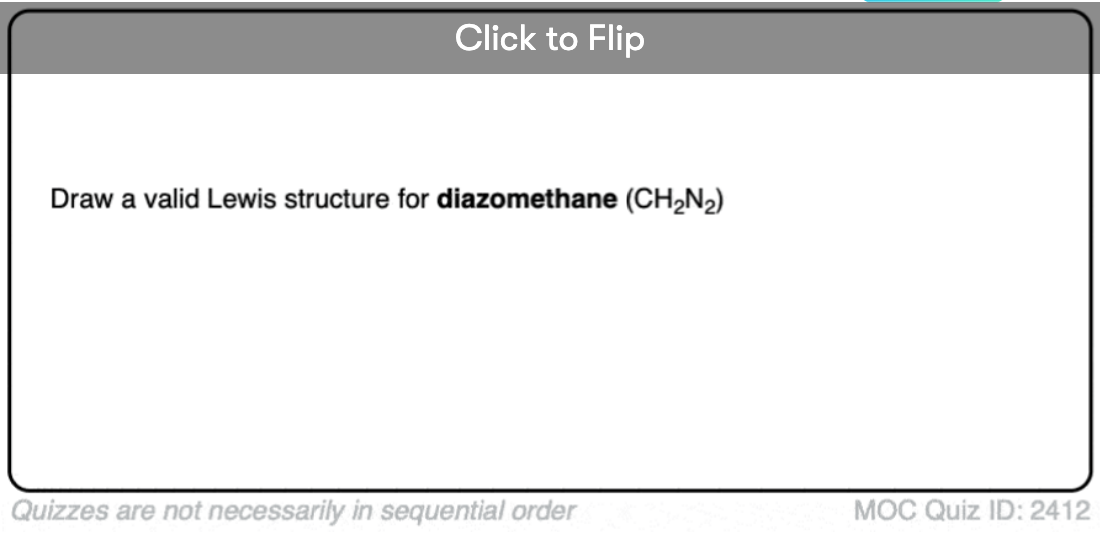
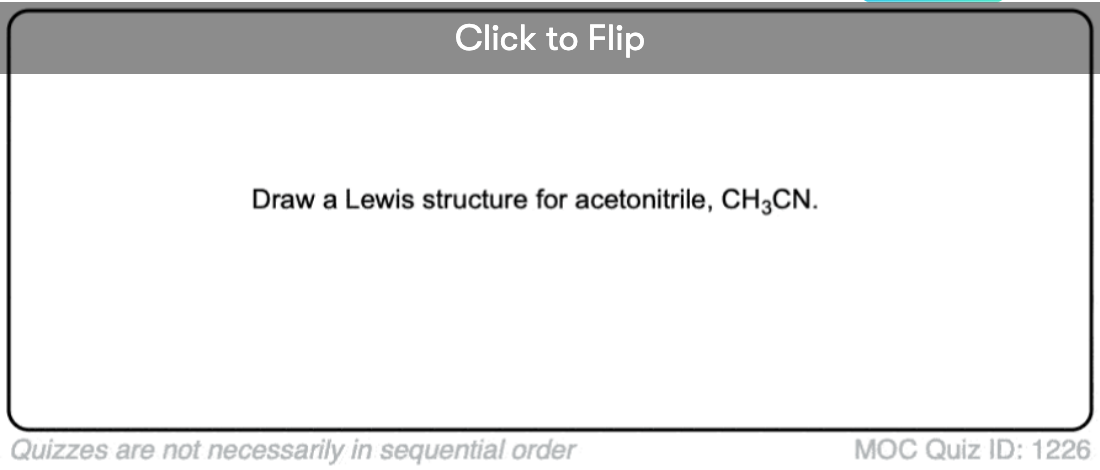
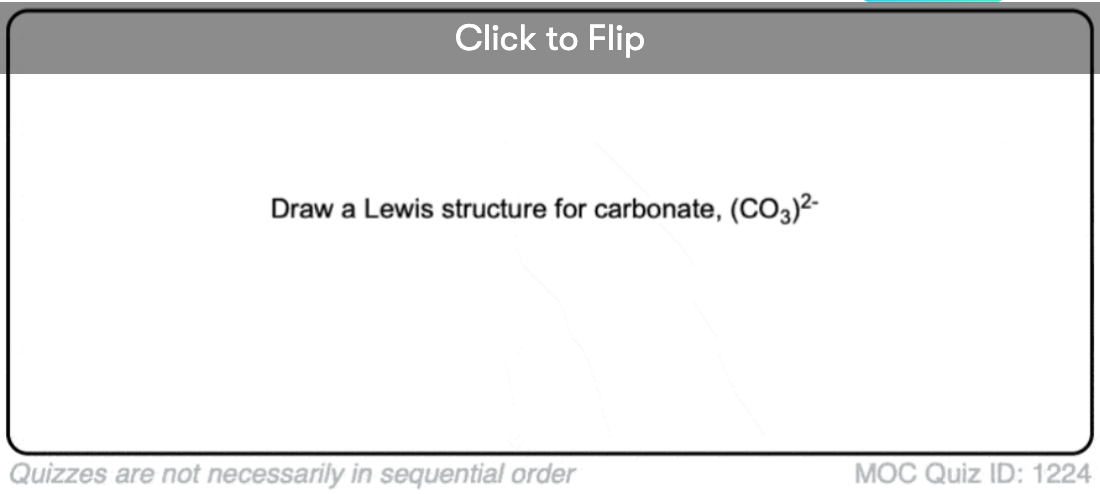
2. Lewis structures

Expect to be able to draw a Lewis structure for simple molecules. Popular examples include diazomethane (CH2N2), nitromethane (CH3NO2), the carbonate ion (CO3)2- and others. Here are a few examples:


Become a MOC member to see the clickable quiz with answers on the back.


Become a MOC member to see the clickable quiz with answers on the back.


Become a MOC member to see the clickable quiz with answers on the back.

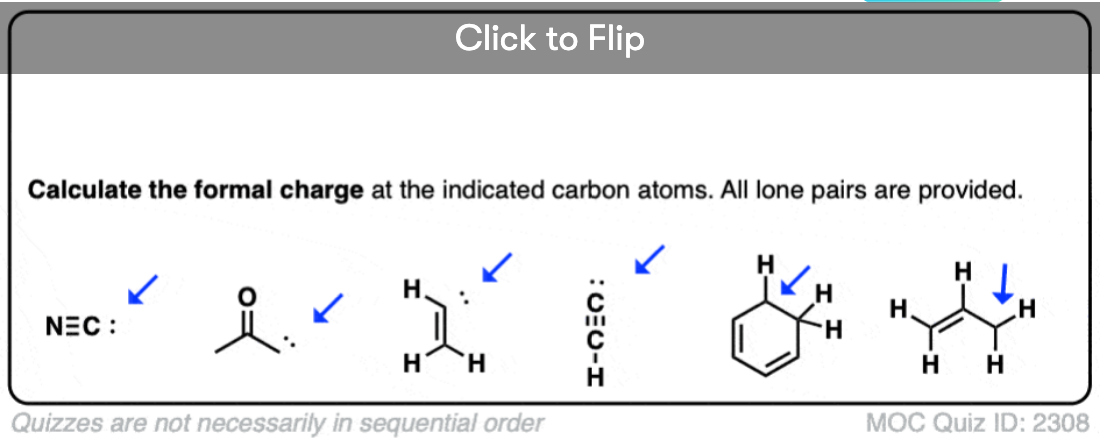
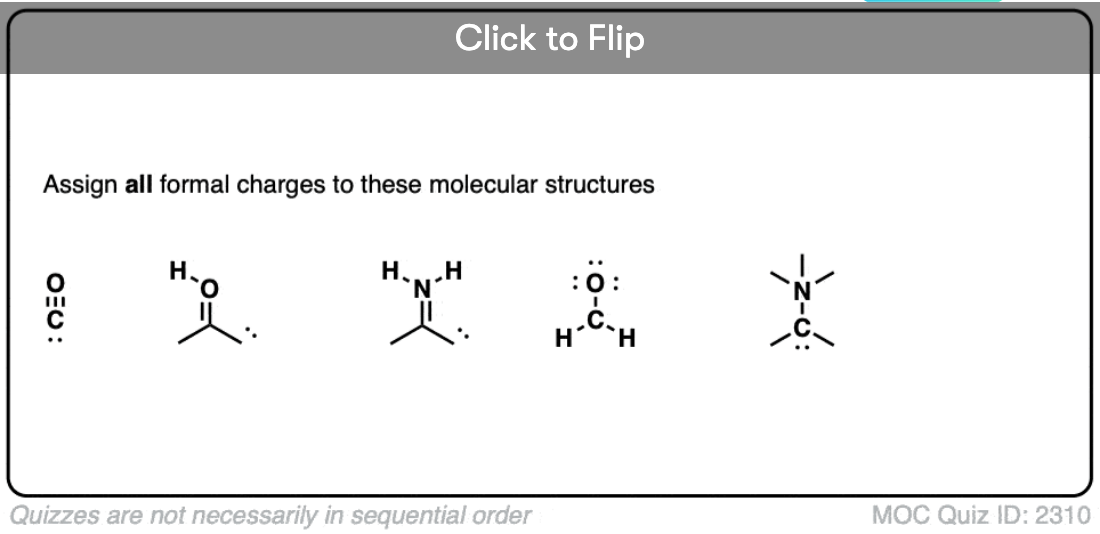
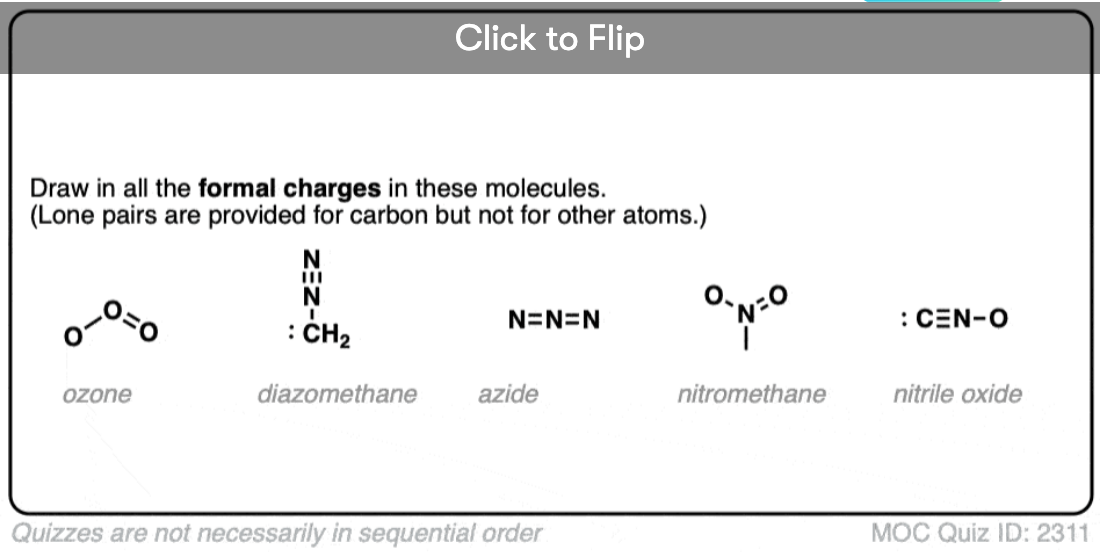
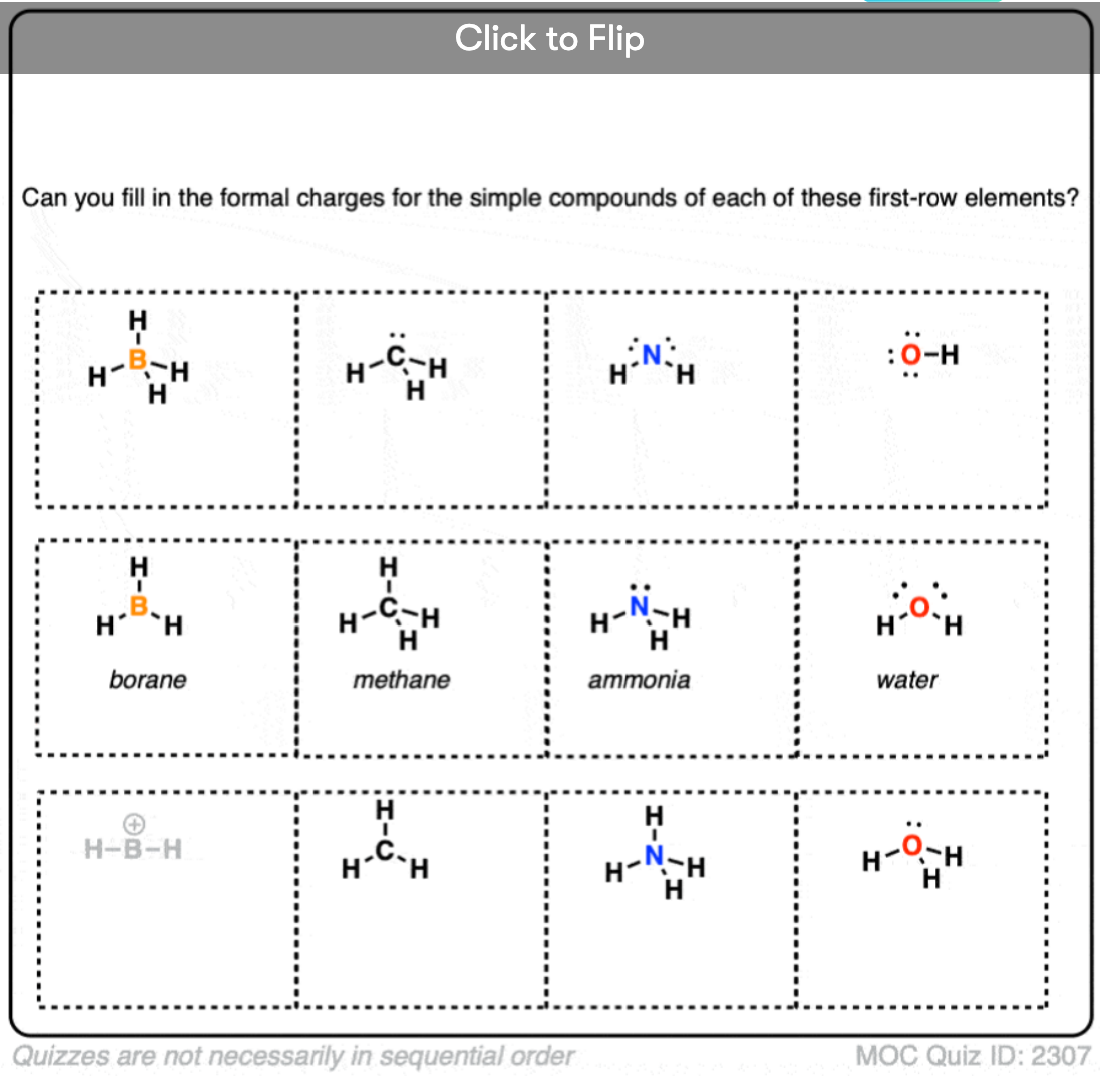
3. Formal Charges

Formal charge calculations are a staple. If you’re given the structure of a simple molecule, expect to be asked to quickly be able to calculate the formal charge of different atoms.

Become a MOC member to see the clickable quiz with answers on the back.


Become a MOC member to see the clickable quiz with answers on the back.


Become a MOC member to see the clickable quiz with answers on the back.

Here’s the final boss:


Become a MOC member to see the clickable quiz with answers on the back.

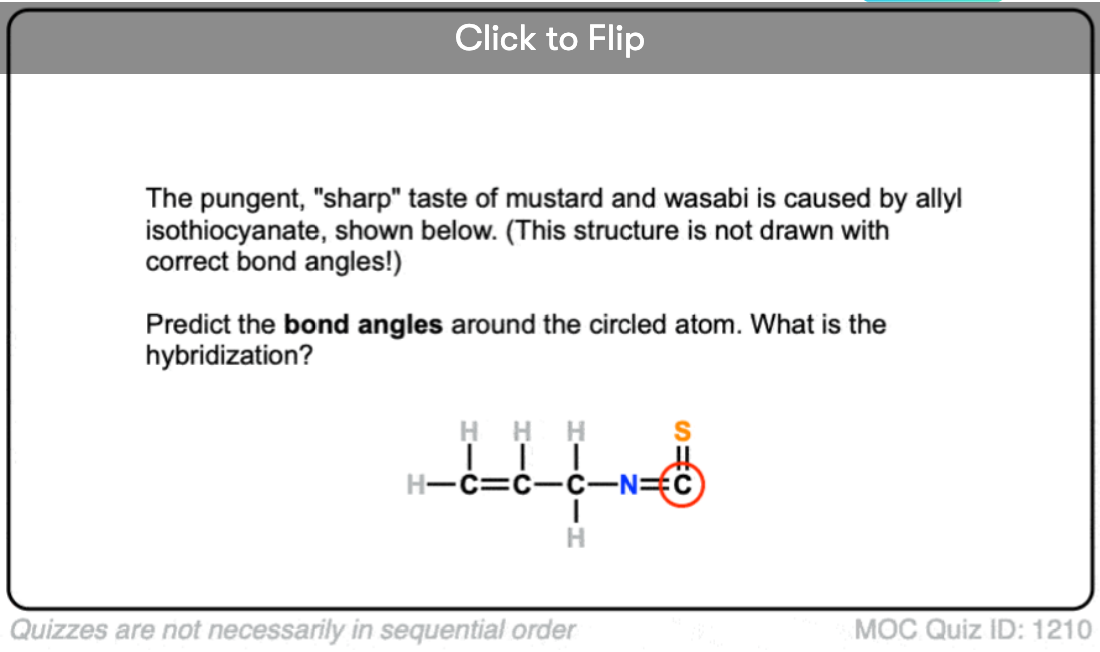
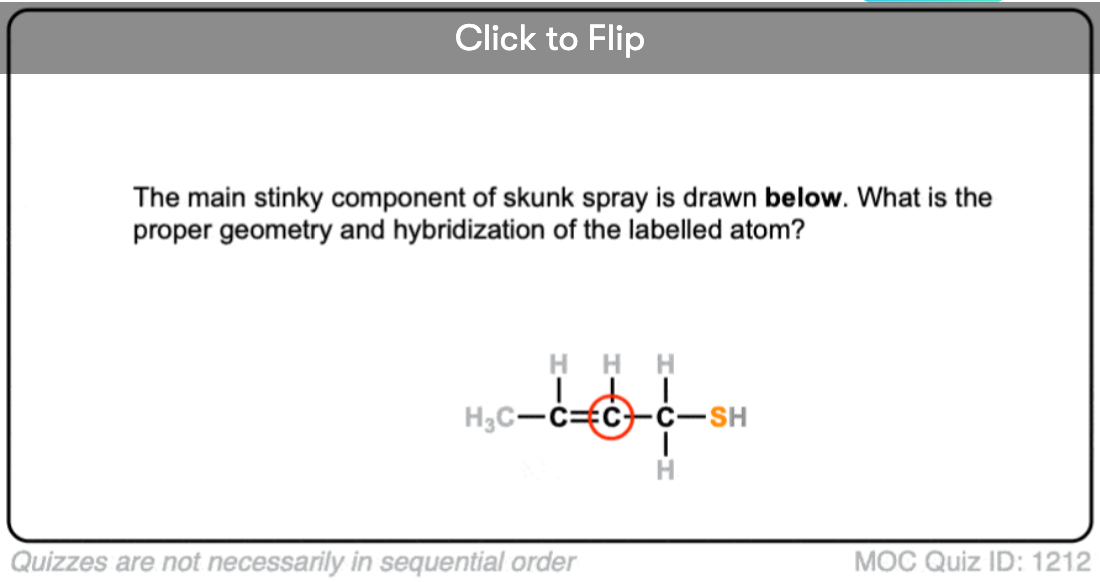
4. Geometry / Bond Angles

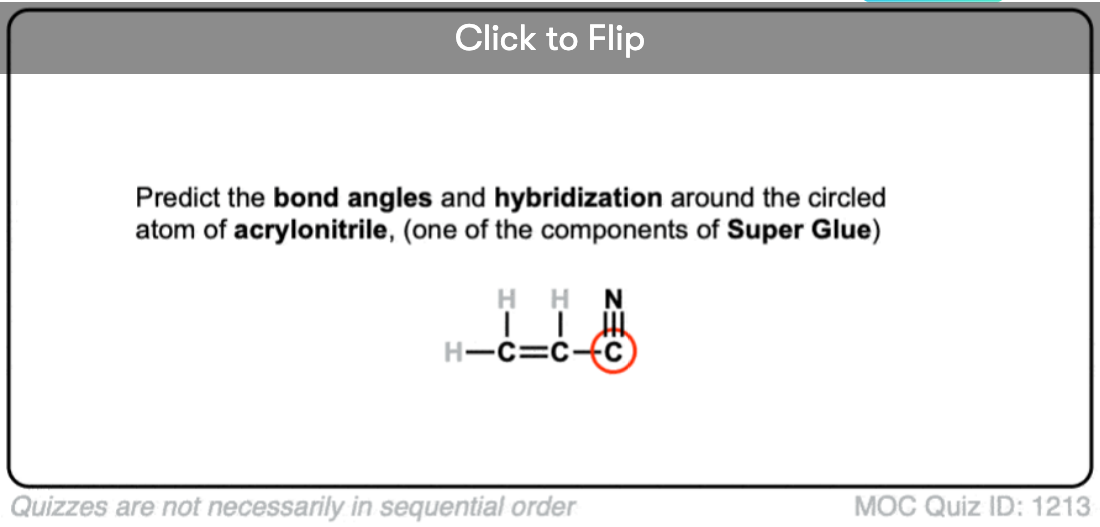
If you’re shown the chemical formula for a molecule, can you predict the geometry / bond angles at specific atoms? If you can determine hybridization, this should be straightforward.


Become a MOC member to see the clickable quiz with answers on the back.


Become a MOC member to see the clickable quiz with answers on the back.


Become a MOC member to see the clickable quiz with answers on the back.

5. Bond types

Another wrinkle on hybridization questions is to be given the structure of a molecule and to identify the types of bonds. Not too tricky, but it starts with being able to assign hybridization.  Here are some examples.


Become a MOC member to see the clickable quiz with answers on the back.


Become a MOC member to see the clickable quiz with answers on the back.


Become a MOC member to see the clickable quiz with answers on the back.


Become a MOC member to see the clickable quiz with answers on the back.

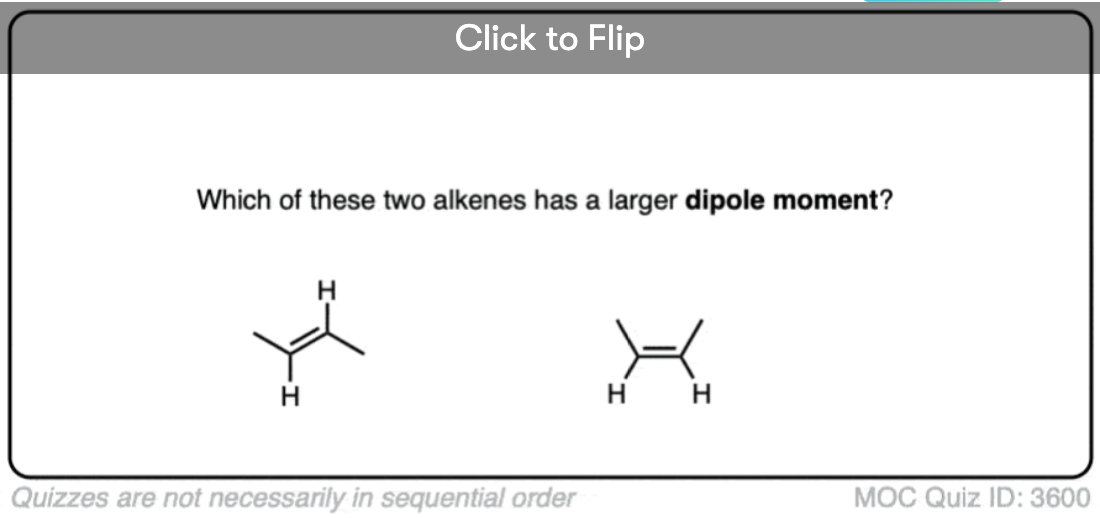
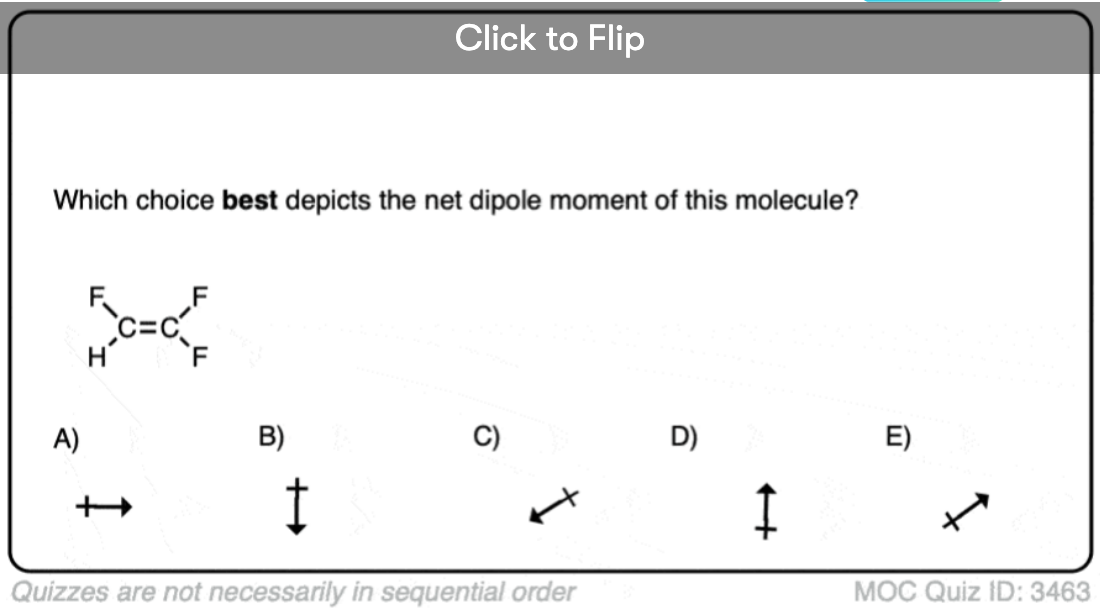
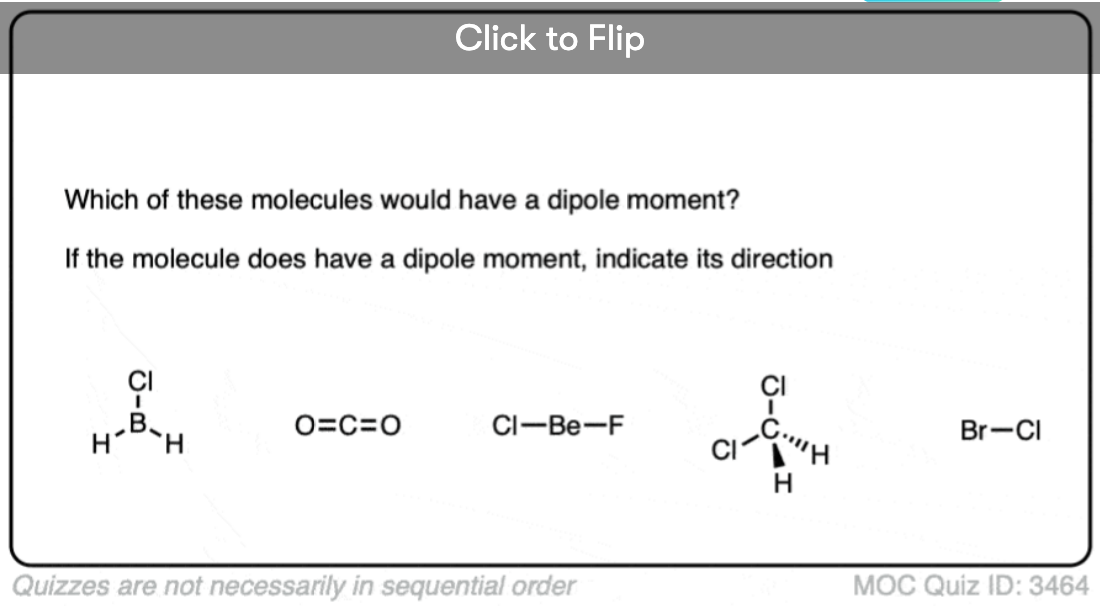
6. Dipole moments

Not a huge component of midterms, but recognizing dipoles and dipole moments in molecules is a fundamental skill. Understand that atoms have different electronegativities and this leads to bond polarization. Furthermore, these small dipoles are vectors, and the vector sum affects the overall dipole moment of the molecule.

Become a MOC member to see the clickable quiz with answers on the back.


Become a MOC member to see the clickable quiz with answers on the back.


Become a MOC member to see the clickable quiz with answers on the back.


Become a MOC member to see the clickable quiz with answers on the back.

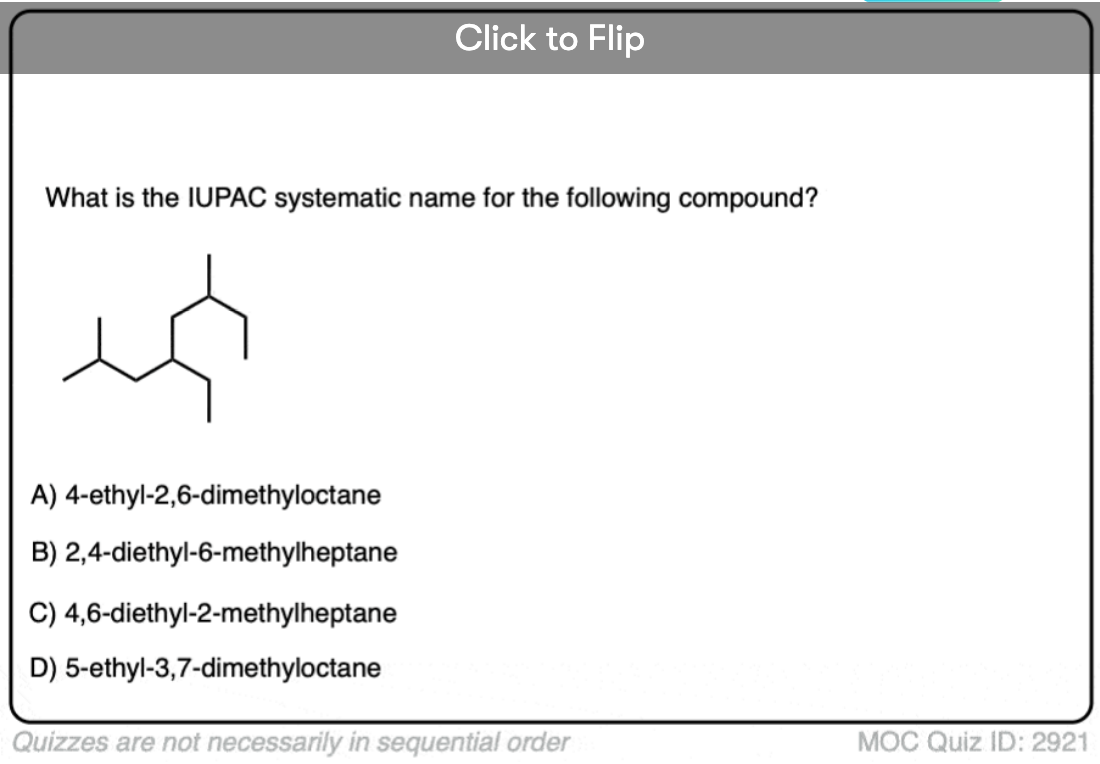
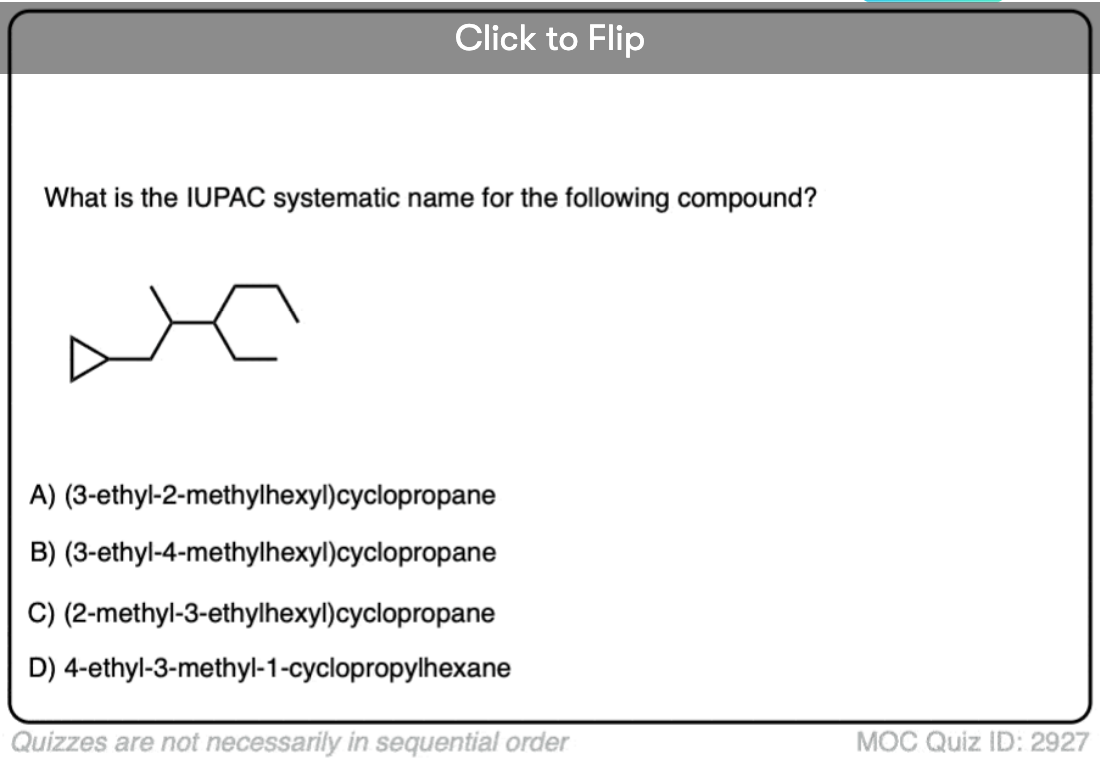
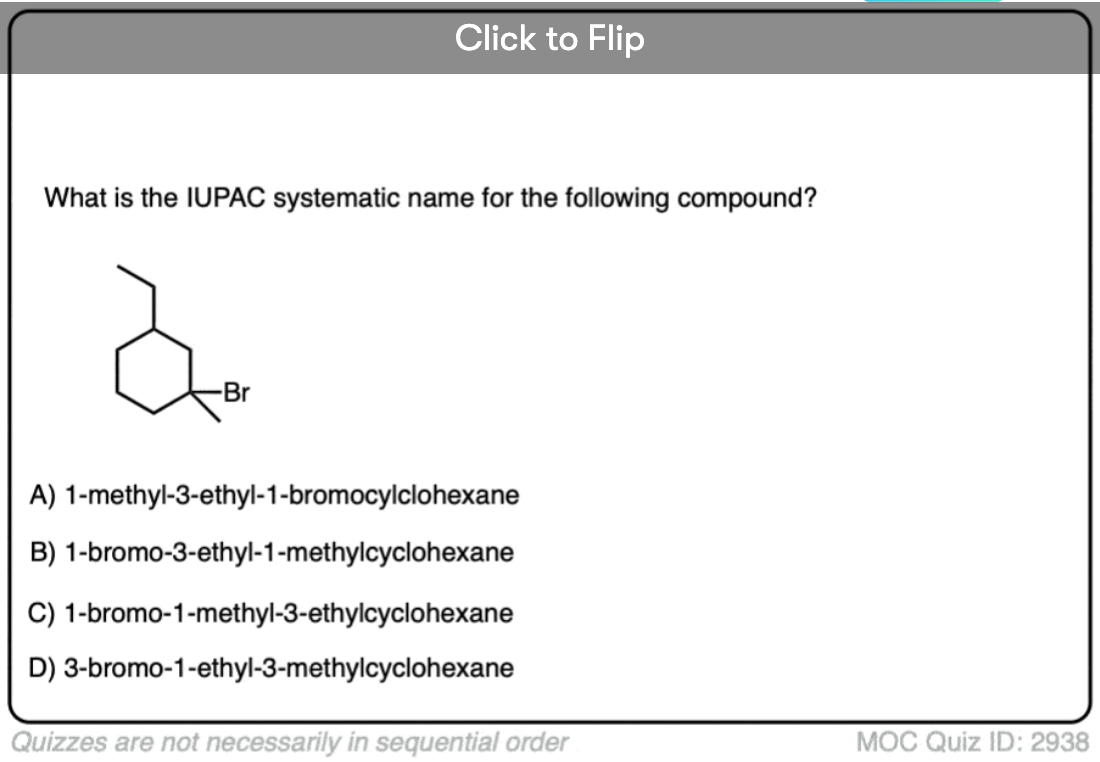
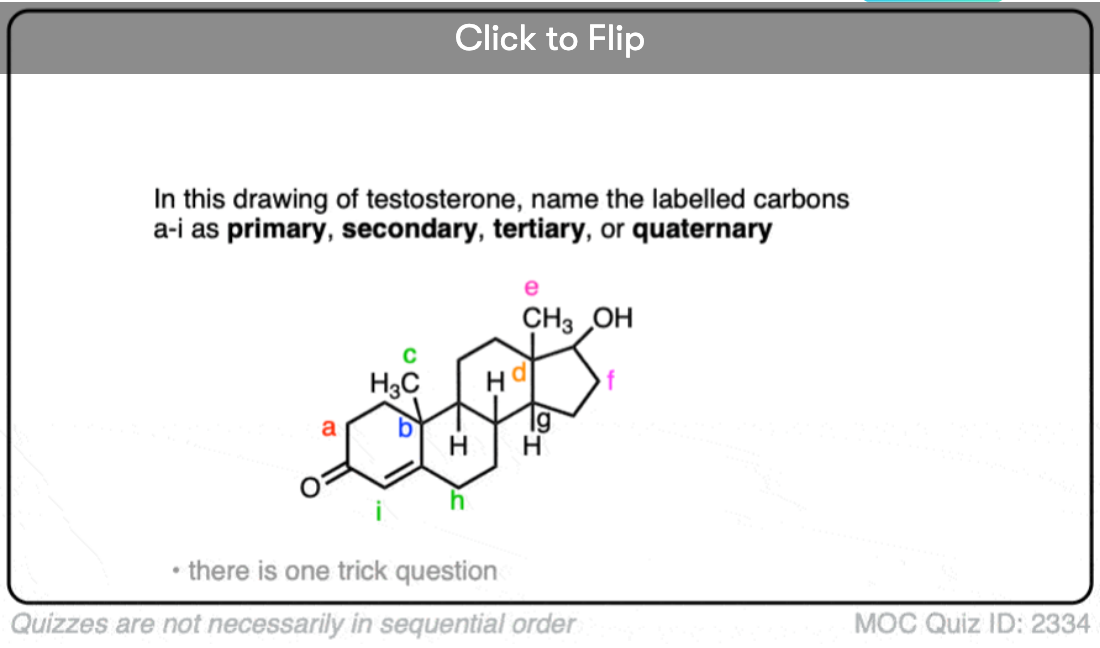
7. Simple nomenclature

Identifying the longest chain in an alkane and properly assigning substituents and naming locants is important. So is being able to determine whether different carbons are primary, secondary or tertiary. This latter skill is absolutely crucial for later success in the course!

Become a MOC member to see the clickable quiz with answers on the back.


Become a MOC member to see the clickable quiz with answers on the back.


Become a MOC member to see the clickable quiz with answers on the back.


Become a MOC member to see the clickable quiz with answers on the back.

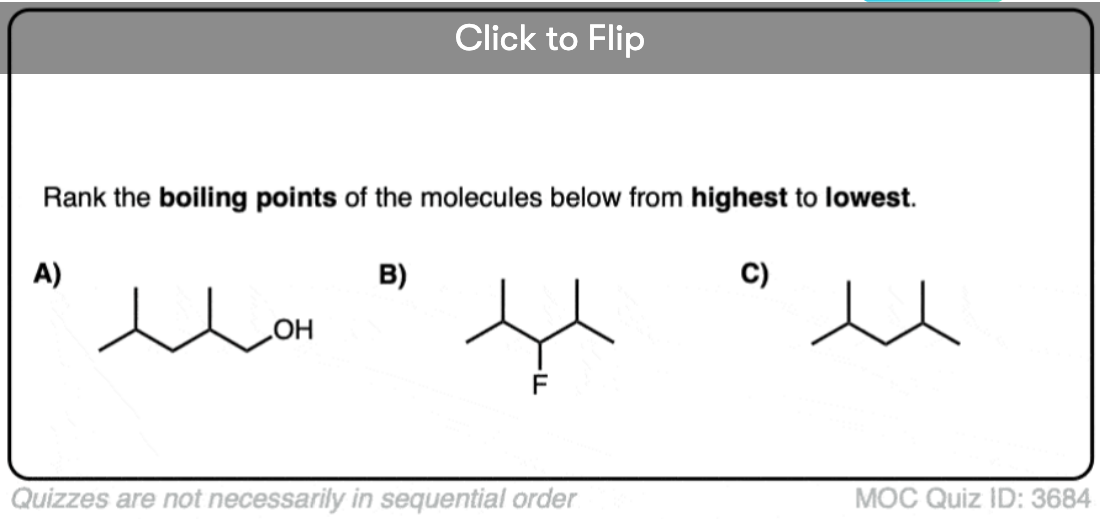
8. Boiling / melting points

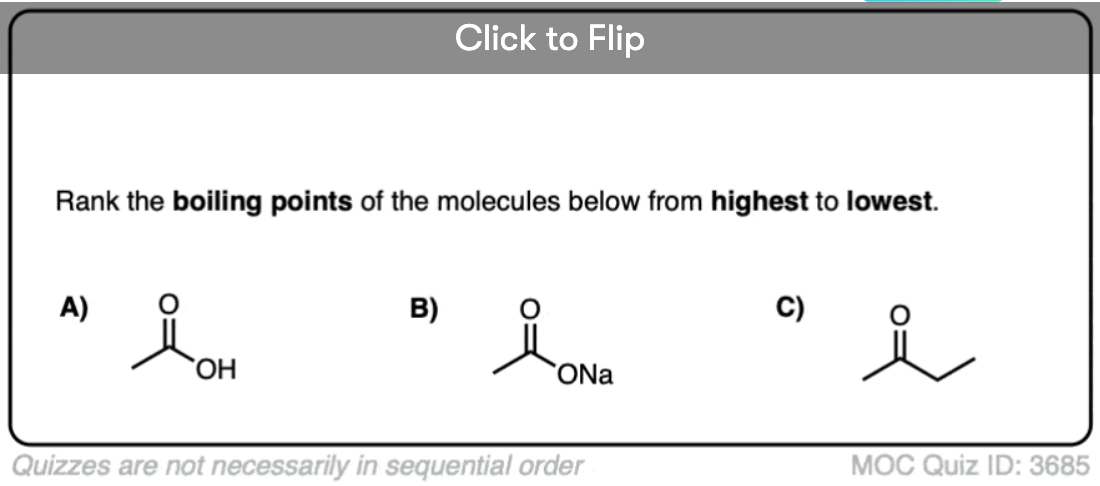
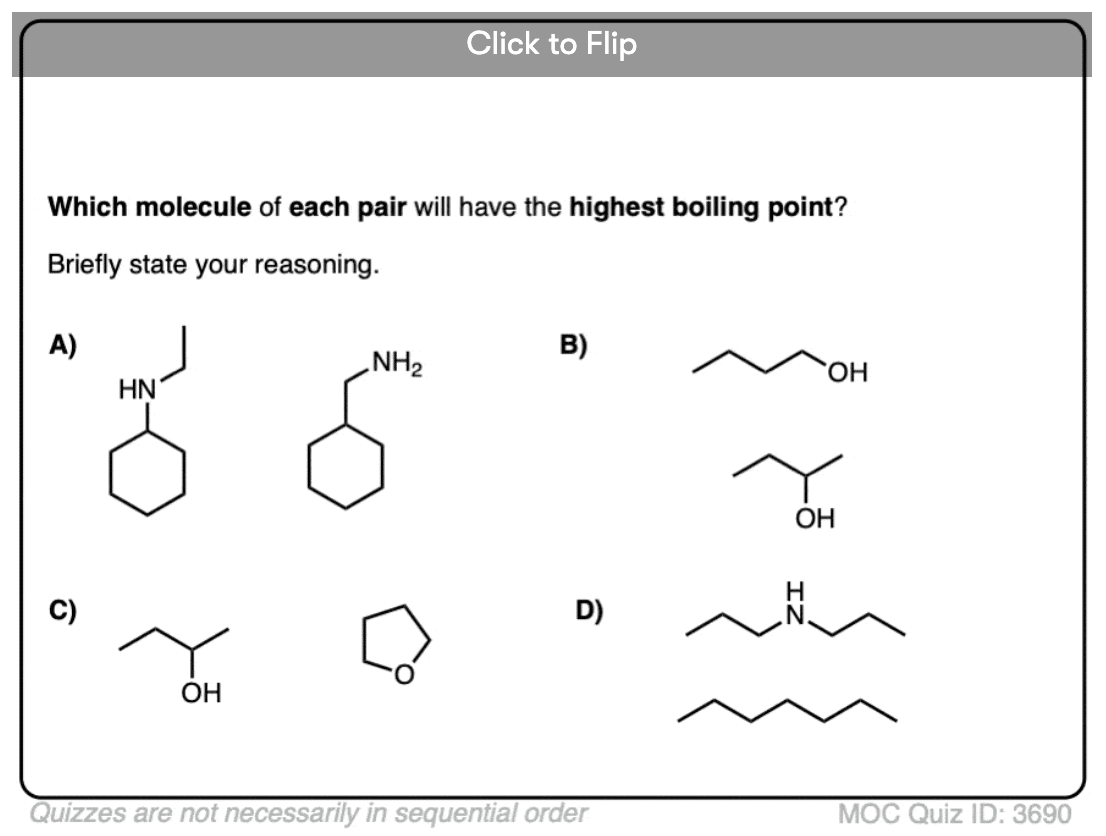
Here, just know the trends. Part 1 is recognizing the four intermolecular forces and how they affect boiling points. Part 2 is looking at other factors such as the molecular weight,  geometry, and number of polar functional groups in each molecule to make a decision. Melting points may also make an appearance.

Become a MOC member to see the clickable quiz with answers on the back.


Become a MOC member to see the clickable quiz with answers on the back.


Become a MOC member to see the clickable quiz with answers on the back.


Become a MOC member to see the clickable quiz with answers on the back.

9. Resonance 

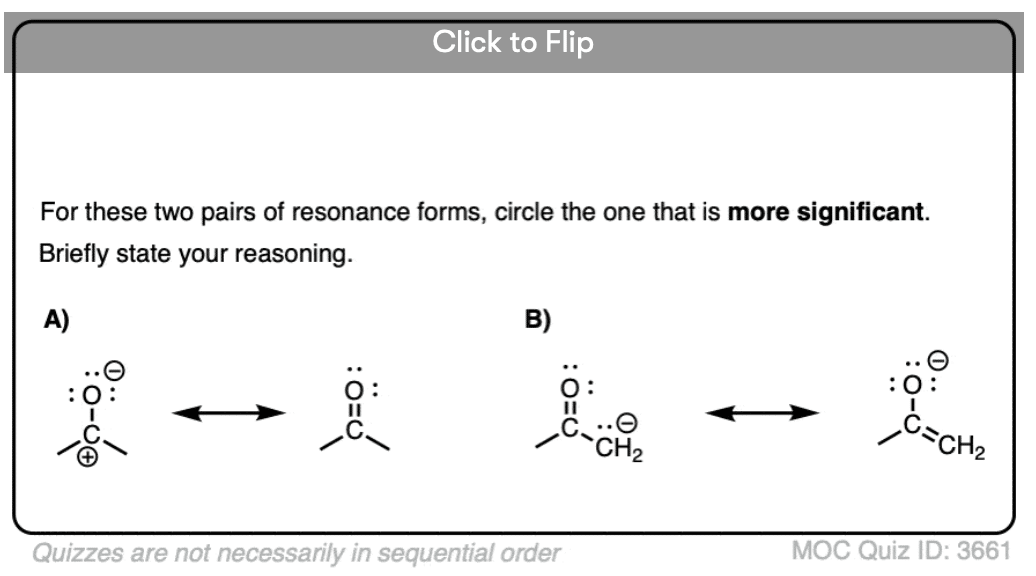
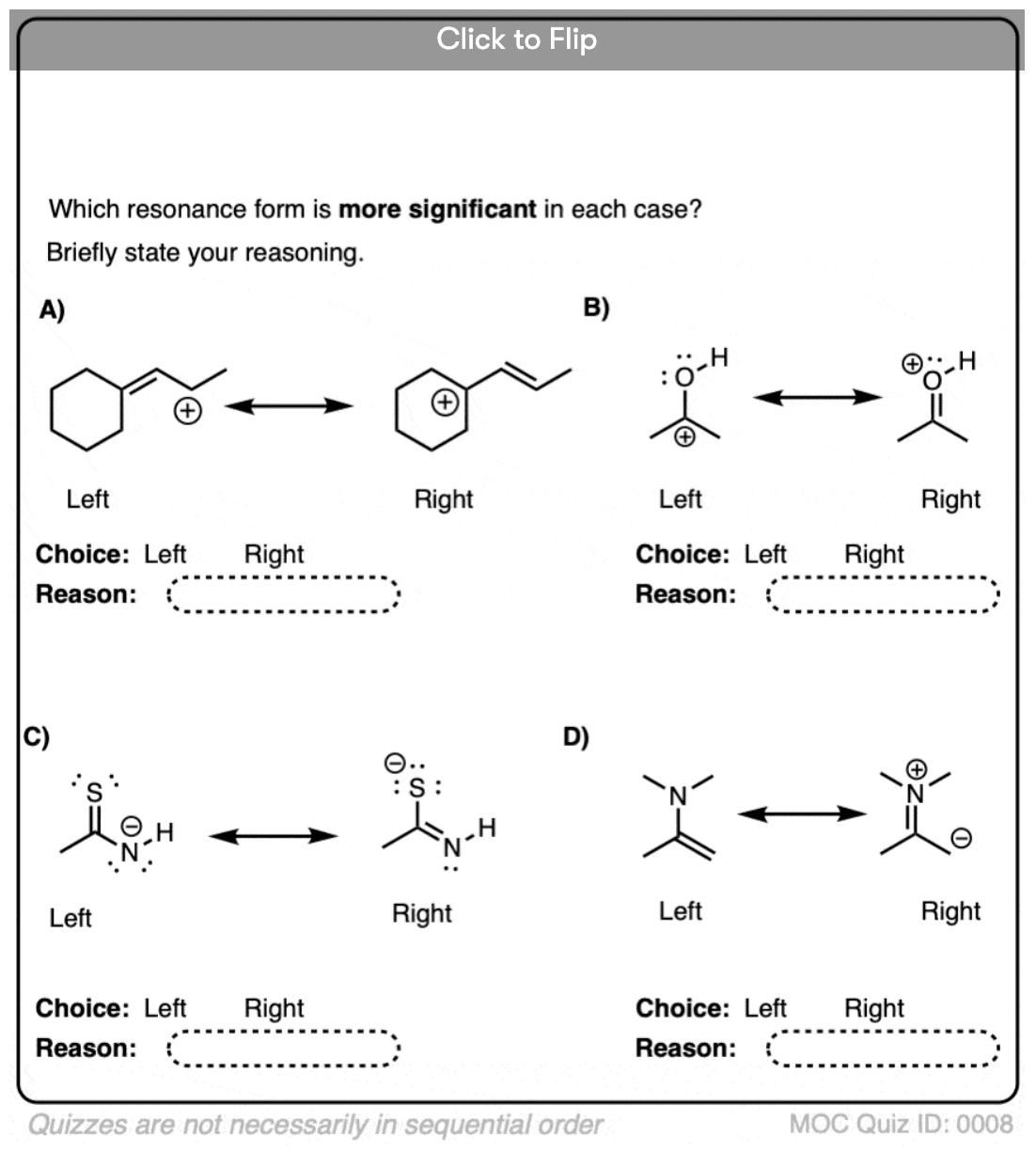
A fundamental subject.  It’s important to be able to recognize resonance forms, first of all (don’t break single bonds! don’t move atoms!) and then to be able to rank them in order of their importance (full octets, put negative charges on least basic atoms, carbocations with adjacent alkyl groups are best…).

Even if you’re taking Org 2 these are worth revisiting, since resonance is a huge theme all throughout Org 2.

Become a MOC member to see the clickable quiz with answers on the back.


Become a MOC member to see the clickable quiz with answers on the back.


Become a MOC member to see the clickable quiz with answers on the back.


Become a MOC member to see the clickable quiz with answers on the back.


Become a MOC member to see the clickable quiz with answers on the back.

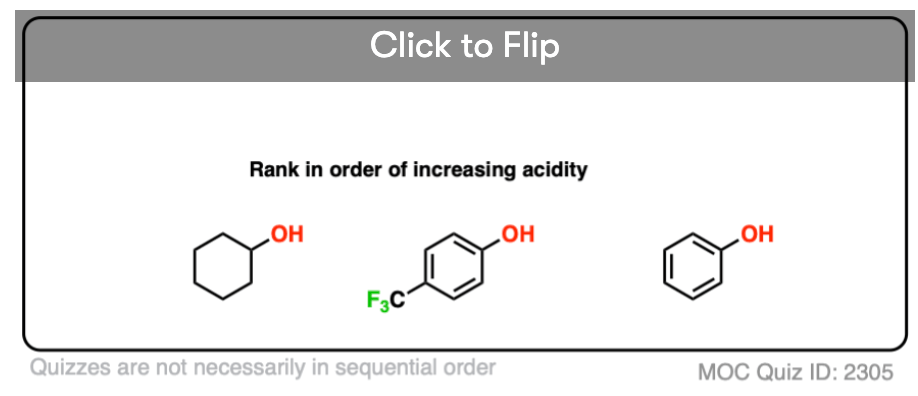
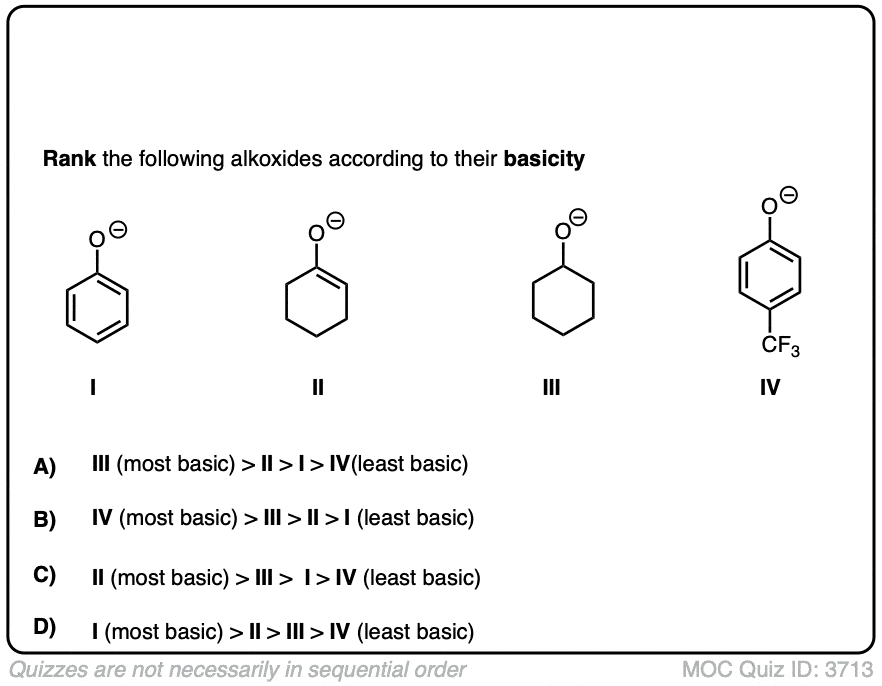
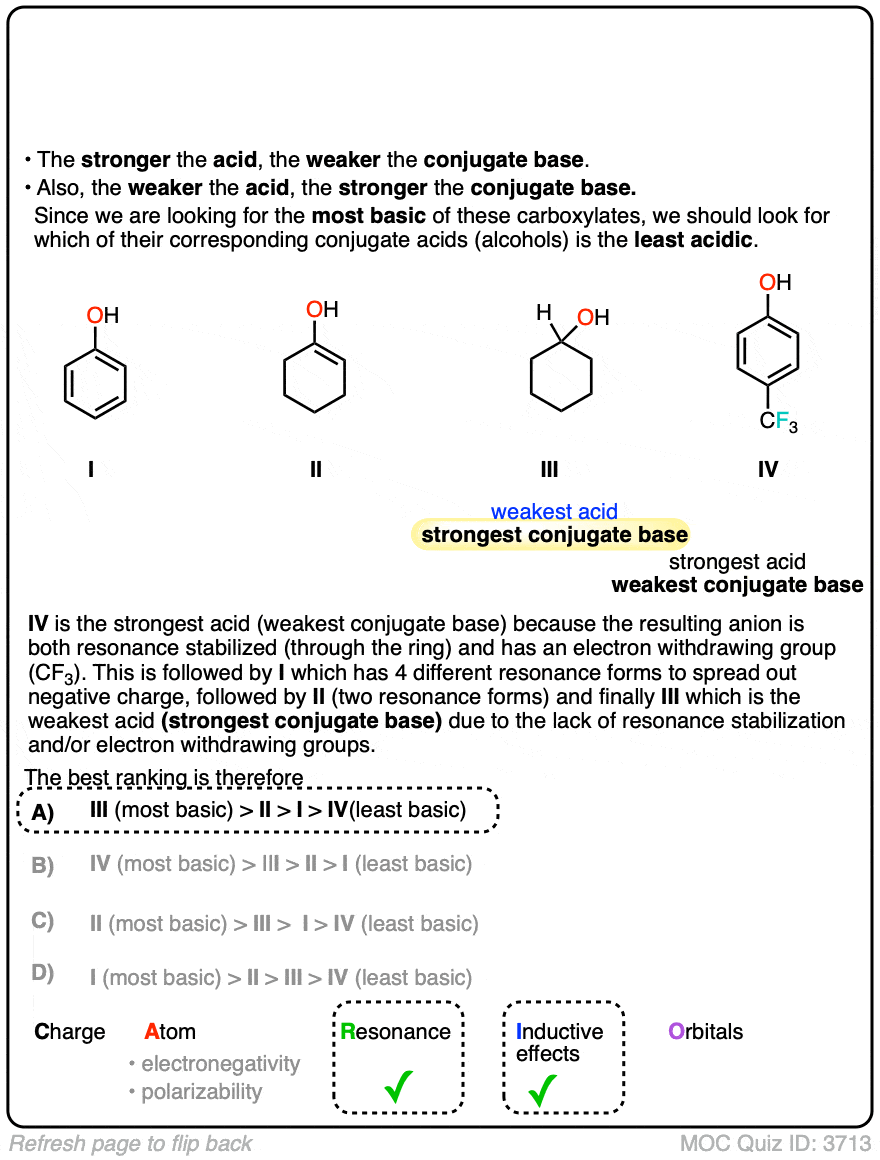
10. Acid Base

Another fundamental subject, which is essentially asking, “what factors stabilize negative charge?” (there are 5 big ones). Understanding that acid-base equilibria favor formation of the most stable conjugate base.


Become a MOC member to see the clickable quiz with answers on the back.

.wq-quiz-wrapper[data-id="43622"] { --wq-question-width: 100%; --wq-question-color: #009cff; --wq-question-height: auto; --wq-font-color: #444; } .wq-quiz-wrapper[data-id="43622"] { --wq-question-width: 600px; } @media screen and (max-width: 600px) { .wq-quiz-wrapper[data-id="43622"] .wq_singleQuestionWrapper { width:100% !important; height:auto !important; } } Click to Flip


Become a MOC member to see the clickable quiz with answers on the back.

.wq-quiz-wrapper[data-id="43767"] { --wq-question-width: 100%; --wq-question-color: #009cff; --wq-question-height: auto; --wq-font-color: #444; } .wq-quiz-wrapper[data-id="43767"] { --wq-question-width: 600px; } @media screen and (max-width: 600px) { .wq-quiz-wrapper[data-id="43767"] .wq_singleQuestionWrapper { width:100% !important; height:auto !important; } } Click to Flip


Become a MOC member to see the clickable quiz with answers on the back.


Become a MOC member to see the clickable quiz with answers on the back.

https://www.masterorganicchemistry.com/?p=43988
Extensions
Spectroscopy and Synthesis Quizzes
Blog
Hey All! If the site has had a consistent weak spot over the past few years, it’s been in the realms of spectroscopy and synthesis.
Show full content

Hey All!

If the site has had a consistent weak spot over the past few years, it’s been in the realms of spectroscopy and synthesis.

I’m happy to announce that this hole has at least been partially filled with a new selection of quizzes on these topics.

Spectroscopy Quizzes

(link)

The section on Spectroscopy starts with some exercises on Index of Hydrogen Deficiency (IHD), and then moves on to UV-Vis, IR, Mass Spectrometry and finally to 13C and 1H NMR.

When teaching this topic, I’ve always been of the mind that students should start by calculating IHD first. With a bit of practice, it’s a simple calculation that sets the stage for the remaining topics. There is a lot of logic in structure determination and a quick IHD calculation helps you quickly rule out certain possibilities.

Next comes UV-Vis. The focus here is just on the key lesson that increasing conjugation results in a narrowing of the energy gap ΔE  between the highest-energy occupied molecular orbital (HOMO) and the lowest-energy unoccupied molecular orbital (LUMO). Since E = hν and λ = c / ν , this means the wavelength of light absorption increases as ΔE decreases. The goal of the quizzes is to learn to quantify conjugation lengths and correlate these with λmax.

The section on infrared spectroscopy focuses on training students to recognize the main diagnostic bands in an IR spectrum – the OH stretch around 3200-3400 cm-1 and the C=O stretch around 1700 cm-1. Students who spend the first 15-30 seconds of IR analysis on looking at these two regions will be well-primed to then move on to looking at areas of secondary importance, such as the C-H stretch around 3000 cm-1  and the acetylene C-H stretch around 3400 cm-1. There are also exercises on recognizing nitriles, amides, amines, and carboxylic acids.

The exercises on mass spectroscopy focus on identifying the presence of halides (Cl and Br) by looking for their characteristic M+2 peaks, and roughly approximating the number of carbons in a sample by analyzing the strength of the M+1 peak.

13C NMR spectroscopy begins with quizzes on predicting the number of signals each molecule will generate. The second section then tries to prime students to look for the presence of sp2 – hybridized carbon in the region above 100 ppm, and sp3 – hybridized carbon below 80 ppm. Questions on identifying molecules given the 13C spectrum are all multiple choice.

Finally, the section on 1H NMR spectroscopy begins with identifying the number of signals a molecule will produce and then asks students to predict multiplicity and chemical shift. The final section provides some multiple choice questions on identifying which molecule is represented by each spectrum.

The “click to flip” quiz format is good for training students on key patterns and in applying logic, but it has its limitations. It does not lend itself well to classic structure determination problems that provide multiple pieces of information (IR, 13C, 1H). Students who want more practice with these sorts of problems should probably check out these problems from CU Boulder.

Synthesis

The Practice Quizzes section now has over 100 new problems on Synthesis, divided roughly into Org 1 topics (alkenes, alkynes, nucleophilic substitution) and Org 2 topics (everything else up to amino acids).

These have a “roadmap” format where students must fill in the blanks to get to the desired product. To make things slightly easier, condensed formulae are provided.

Of course there can be multiple ways to solve each particular synthesis problem and I’ve tried to note situations where multiple alternatives exist.

I hope the instructor community and MOC Members will find these new resources useful.

Please let me know via this form if you spot any typos or items that need correction.

– James

https://www.masterorganicchemistry.com/?p=37369
Extensions
Alkene Stability
Alkene Reactionsalkene stabilitycisconjugationcycloalkeneshydrogenationmonosubstitutedresonance energysubstitution patterntrans
Alkene Stability (And Instability) What factors affect alkene stability? If you’ve studied elimination reactions, no doubt you’ve learned about Zaitsev’s Rule – about how elimination
Show full content

Alkene Stability (And Instability)
What factors affect alkene stability? If you’ve studied elimination reactions, no doubt you’ve learned about Zaitsev’s Rule – about how elimination reactions generally favor the “more substituted” alkene.

In this post we explore how increasing substitution at carbon increases the stability of alkenes, as well as the effects of conjugation and strain.
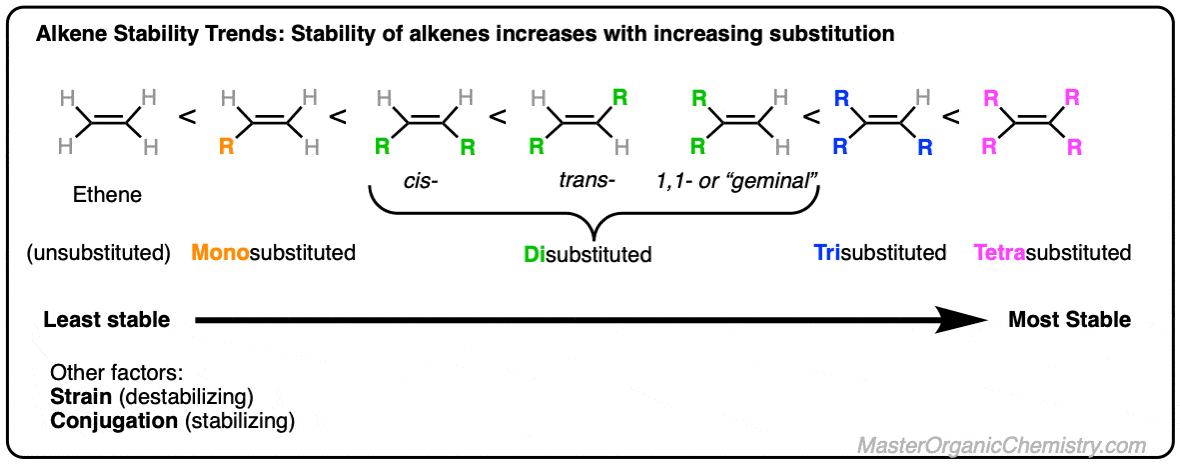
alkene-stability-summary-image-trends-monosubstituted-less-stable-than-tetrasubstituted

Table of Contents

  1. Heat Of Hydrogenation As A Measure Of Alkene Stability
  2. Stability of Alkenes Increases With Increasing Substitution
  3. Heats Of Hydrogenation For Some Monosubstituted Alkenes
  4. The Relative Stability of cis- and trans- Alkenes
  5. Alkenes Stabilized By Conjugation: Resonance Energy
  6. Alkene Stability: Summary
  7. Notes
  8. Bonus Topic #1: Why Is Alkyl Substitution Stabilizing?
  9. Bonus Topic #2: trans-Cycloalkenes
  10. Quiz Yourself!
  11. (Advanced) References and Further Reading

1. Heat Of Hydrogenation As A Measure Of Alkene Stability

We might not spend as much discussing thermodynamics in here organic chemistry as you did in general chemistry, but that doesn’t mean the concepts have just gone away!

One area where we’ve previously seen the usefulness of thermodynamic data is the use of heat of combustion data to quantify ring strain. [See: Cycloalkanes – How To Calculate Ring Strain]. The heat of combustion for cyclopropane works out to about  166 kcal/mol per CH2 compared to the heat of combustion for unstrained cyclohexane [157 kcal/mol per CH2]. That “extra” heat of combustion seen in cyclopropane is attributed to the instability arising from the strain of bent C-C bonds far away from their ideal angle of 109.5°. That’s angle strain.

Another area of organic chemistry where thermodynamic studies are useful in the stability of alkenes.

Back in 1935, Prof. Kiasatakowsky  and co-workers at Harvard published a method for measuring the heat of hydrogenation of ethylene (aka “ethene”) as it was passed over a finely divided metal catalyst containing adsorbed hydrogen. [Note 1] Because hydrogenating a molecule is considerably more gentle than, say, BURNING it, the method tends to be more sensitive for determining subtle differences in enthalpies.

In a hydrogenation reaction, a C-C bond is broken, and two new C-H bonds are formed.
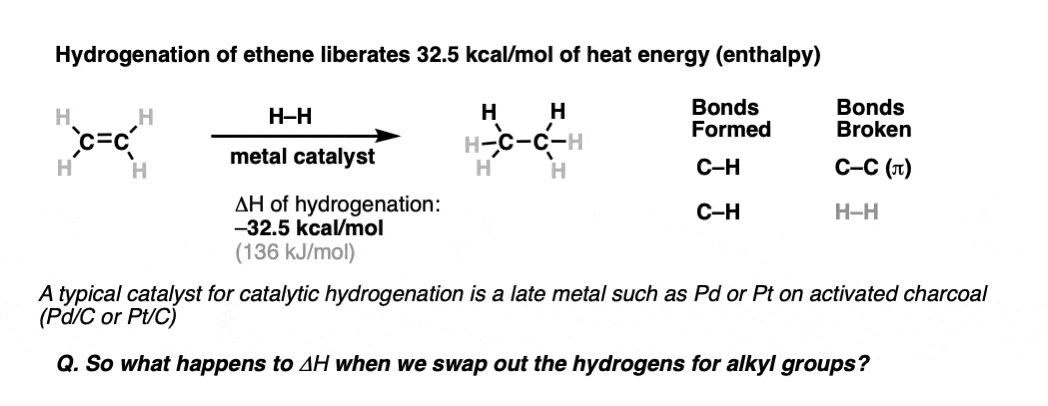
-heat-of-hydrogenation-of-ethene

It was found that hydrogenation of ethylene released 32.5 kcal/mol (136 kJ/mol) of heat. [Note 2]

Once the heat of hydrogenation of ethene was obtained, the next logical step was to measure the heat of formation for a huge variety of other alkenes, and to see what patterns emerged from the data.

So what happens to the heat of hydrogenation when alkyl groups are added to the alkene?

2. Stability of Alkenes Increases With Increasing Substitution

Well, as you might imagine from someone who had invented a new technique, Kiastakowsky went to town on this, investigating the heat of hydrogenation of a huge variety of alkenes. [Note 3] In the following decades, even more data has been accumulated, which is easily obtainable (with references) from the NIST Chemistry Web Book.

For our purposes, there are six substitution patterns on an alkene (seven if you count ethene).
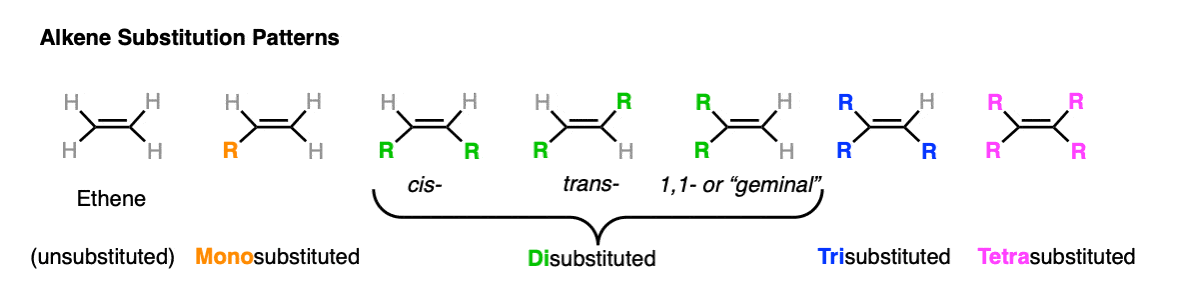
six-types-of-alkene-substitution-monosubstituted-disubstituted-trisubstituted-tetrasubstituted

The most notable trend that was found is that the heat of hydrogenation decreases as C-H bonds are replaced with C-C bonds. 

So what does that mean? 

Since the same bonds are formed and broken in every hydrogenation reaction, the heat of hydrogenation is measuring the stability of each type of alkene.

This means that the lower the heat of hydrogenation, the greater the stability of the alkene.

The way to visualize “stability” here is to compare it to potential energy, much like a ball becomes more “unstable” with increasing height.

via GIPHY

So what we’re really saying here is that alkene stability increases with increasing substitution of hydrogen for carbon. 
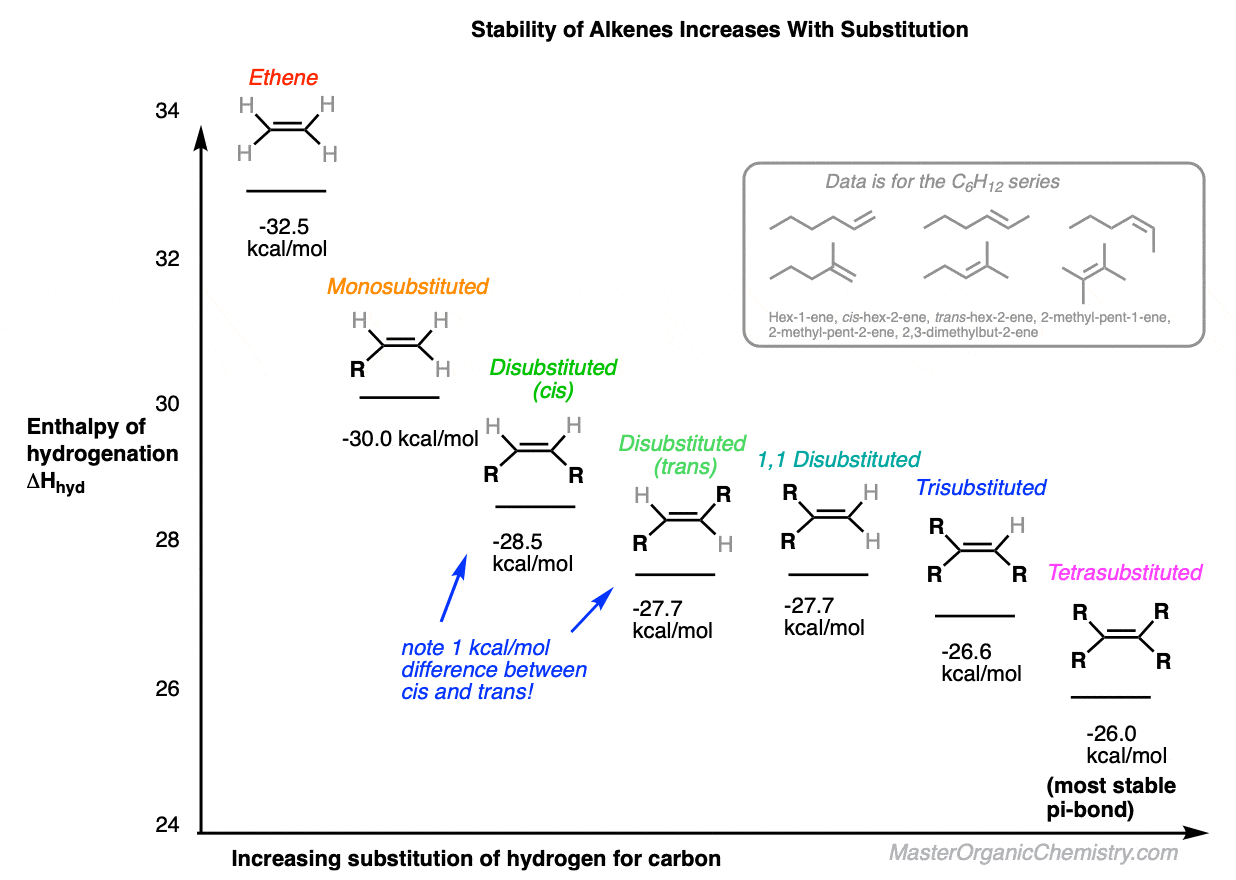
table-showing-stability-trends-of-alkenes-measured-by-enthalpy-of-hydrogenation

[The image above uses heat of hydrogenation data for the series hex-1-ene, trans-hex-2-ene, cis hex-2-ene, 2-methylpent-1-ene, 2-methyl-pent-2-ene, and 2,3-dimethylbutene, which all share the molecular formula C6H12. ]

OK, you might ask. So, why does this happen?

The short answer is that substitution of alkyl groups on the alkene allows for donation of electron density between (full) C-C sigma orbitals and the (empty) C-C pi star orbital. It’s often not addressed in introductory courses, so we’ll push the explanation down to this footnote. [Bonus topic one]

3. Heats Of Hydrogenation For Some Monosubstituted Alkenes

Just for fun, let’s look at a series of mono-substituted alkenes. Nothing weird here, we’ll just go from propene up to hex-1-ene.
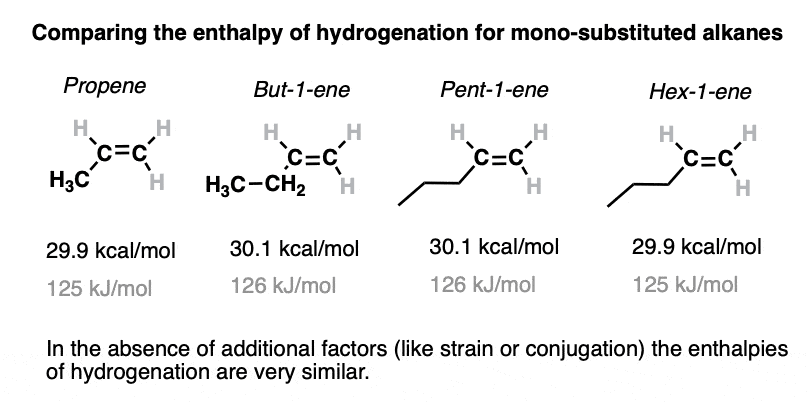
stability-of-monosubstituted-alkenes-by-enthalpy-of-hydrogenation

Note that the heat of hydrogenation is quite consistent for a series of linear, non-branched, monosubstituted alkenes.

4. The Relative Stability of cis- and trans- Alkenes

So what about disubstituted alkenes? There are three types (cistrans, and 1,1-disubstituted) but let’s just concern ourselves with cis and trans here.

We all know by now that cis and trans alkenes should differ a little bit in stability because in a cis alkene the groups are held closer together (more strain!) and in a trans-alkene they are further apart. [For a good time, amaze your instructor and call it by its proper name:  1,2-strain]

Heat of hydrogenation data actually allows us to quantify the difference in stability between cis and trans alkenes.

For instance, compare cis– and trans– but-2-ene, or cis- and trans hex-2-ene. The difference in stability is about 1 kcal/mol, rounding up generously.
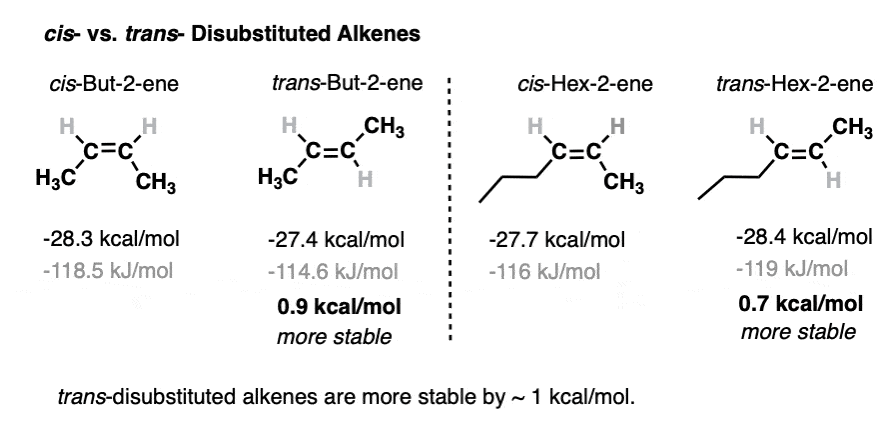
cis-vs-trans-disubstituted-alkenes-enthalpy-of-hydrogenation

While a difference of 1 kcal/mol might not seem like a lot, it  isn’t *that* small – for an equilibrium at 25 °C, a difference of 1 kcal/mol will give you about an 80:20 ratio of products. [Note 4]

For a really good time you can pick something crazy like the cis– and trans- di t-butyl ethylene. [not the correct IUPAC name, but definitely more vivid than cis- and trans- 2,2,5,5-tetramethylhex-3-ene].

Here the trans is more stable than the cis by about 10 kcal/mol.
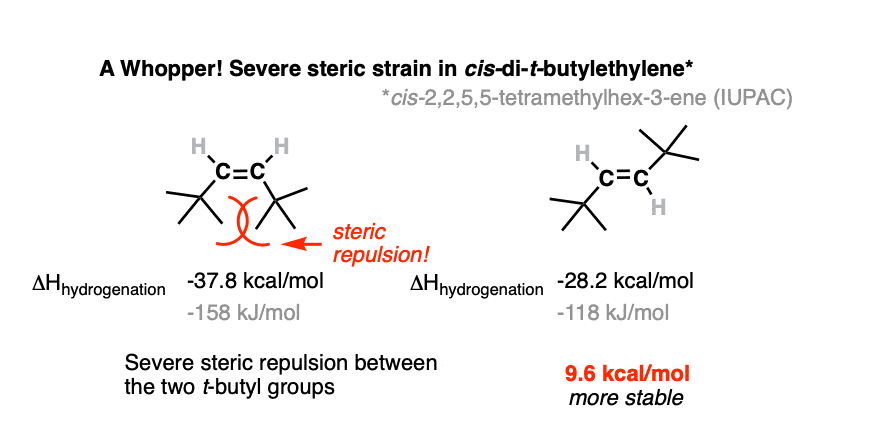
cis-and-trans-di-t-butyl-differ-in-energy-by-10-kcal-mol-enthalpy-of-hydrogenation-stability

That’s a lot of strain.

5. Alkenes Stabilized By Conjugation: Resonance Energy

The stability of alkenes is also affected by conjugation. This is a really a topic for another chapter [specifically, see Conjugation and Resonance] where we talk about pi systems, but the bottom line is that the p-orbitals in adjacent pi-bonds can clump together forming larger “pi-systems”, which provides more “room” for electrons to roam, lowering their energy. [Note 5]

Heat of hydrogenation numbers allow us to quantify the effect of resonance stabilization. How so?

Take but-1-ene. As we saw above the heat of hydrogenation is about 30.1 kcal/mol.

Add a double bond, and you might expect the heat of hydrogenation to double as well. But it doesn’t! It’s actually a little bit less. [56.6 kcal/mol] . The difference  (that extra 3.6 kcal/mol of additional stabilization)  is called “resonance energy“.
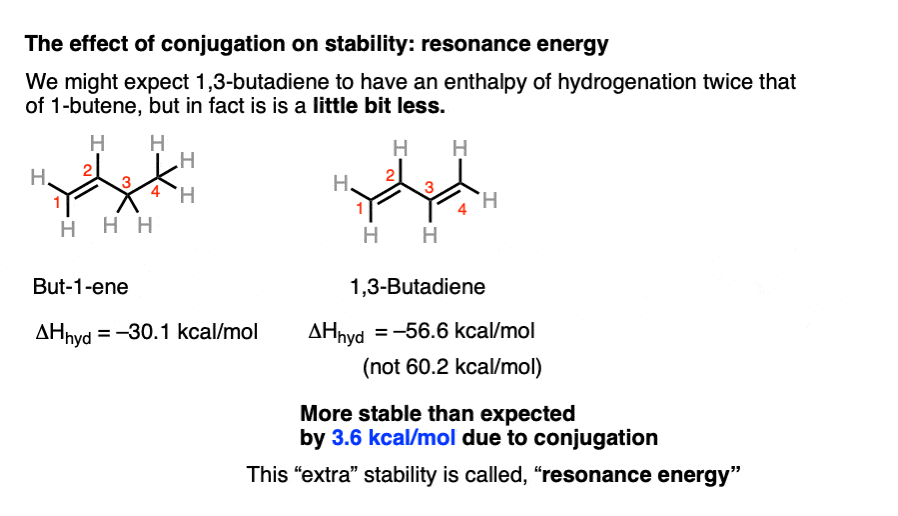
conjugation-increases-stability-of-alkenes-as-measured-by-heat-of-hydrogenation-resonance-energy

The most dramatic example of resonance energy is found in the example of “cyclohexatriene” , which has an extra stabilization energy of 36 kcal/mol. That’s a sure sign that something highly unusual is going on with this molecule, which is better known as “benzene”. That “highly unusual” property is called aromaticity and it warrants its own chapter. [See: Introduction to Aromaticity]

6. Summary: Stability of Alkenes

Three key factors affect the stability of alkenes, and the influence of these factors can be measured through the enthalpy of hydrogenation.

  • One important factor is the substitution pattern. As C-H bonds are replaced by C-C bonds, the stability of the alkene gradually increases in the order mono (least stable) < di < tri < tetrasubstituted (most stable).
  • When hydrogenation liberates more energy than expected given the substitution pattern, that’s likely a sign of strain. This is exemplified in the difference in enthalpy of hydrogenation between cis- and trans- alkenes, where the trans- alkene is more stable by about 1 kcal/mol.
  • When hydrogenation liberates less energy than expected given the substitution pattern, that’s a sign that some extra factor is stabilizing the molecule. Among commonly encountered factors, conjugation ranks high. The difference in energy between the “expected” heat of hydrogenation and the measured heat of hydrogenation is called the resonance energy. The conjugation of one pi bond with an additional pi bond is “worth” about 2-3 kcal/mol.

The increasing stability of alkenes with increasing substitution not only comes up in Zaitsev’s Rule, but also later in the course when you study Thermodynamic and Kinetic Control.


Notes

Related Articles

Note 1. It was a copper catalyst, after a lot of trial and error.  The advantage of measuring the heat of hydrogenation over the heat of combustion is that it is a more sensitive technique for measuring small energies.

Note 2. This number was first measured in 1935, remeasured in 1951, and so far as I am aware, has not been updated. See the entry in the NIST Chembook for ethylene.

Note 3. Standard heats of hydrogenation have been pulled from the NIST Chembook.

Note 4. Actually 82:18 at 298 K.   From delta G = -RT ln K, using delta G of 1000 cal, T = 298 K, R = 1.987 cal / mol•K .

Note 5. If you think of electrons as waves, a larger pi-system allows  for longer wavelengths,  and since energy is inversely proportional to wavelength, this means a lower overall energy of the electron.

And a big thank you to The Kraken for his steady hands in the stability GIF.

Note 6. What about alkynes (and allenes) ? Same trend. More substituted = more stable.
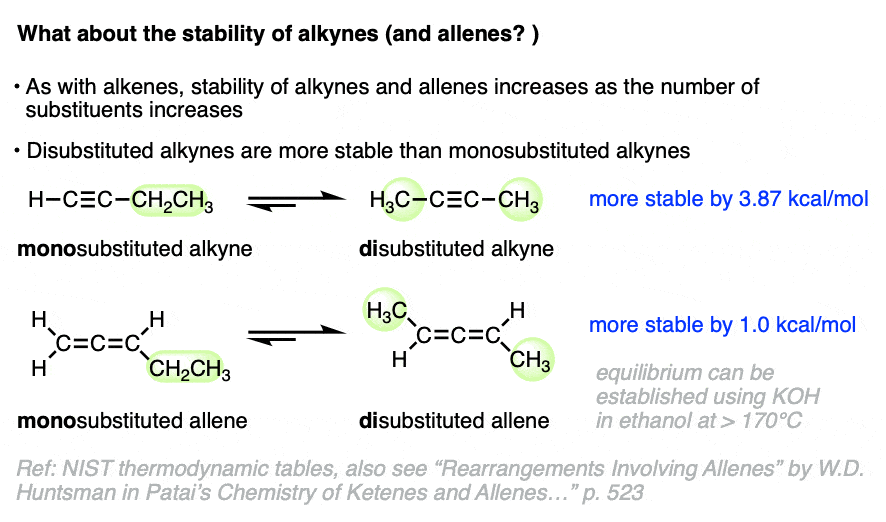
Stability of substituted alkynes and allenes depends on the number of substitutents - disubstituted alkynes more stable than monosubstituted - same for allenes

Great source for this is the NIST Chemical Webbook. Chapter 15 in this book (“Rearrangements involving Allenes”) provides a great overview.

Appendix 1: Why Does Increasing Substitution Increase Stability?

So why does increasing substitution at the alkene increase its stability? This is not an easy question to answer to an introductory audience in a few sentences, and given the time constraints of a typical course the answer you will generally get from an instructor will range from “it’s complicated” to “hyperconjugation” to “orbital mixing”. Very rarely you might get an MO diagram.

The unifying principle here is that full orbitals – even those from single bonds – can donate into empty (even antibonding) orbitals, and that this interaction is stabilizing.

In ethene (below left) all of the C-H bonds are in the plane of the alkene, and none can overlap with the pi bond.

When a methyl group is added, say, in propene, one of the C-H bonds can now align with the pi-system of the alkene. The pair of electrons from the C-H bond can then donate into the empty pi* orbital.

This can be visualized through “no-bond resonance”, below right, where a “resonance” form is shown with a broken C-H bond and a new C-C pi bond. [The quotation marks are to differentiate it from our traditional view of resonance where only pi-bonds are allowed to form and break]. 

This mixing results in a stabilization of the molecule. . Although CH3 is in rapid rotation, at any given moment at least one of the C-H bonds will have the proper geometry to allow overlap with the pi system. why-are-more-substituted-alkenes-more-stable-as-depicted-by-molecular-orbital-hyperconjugation
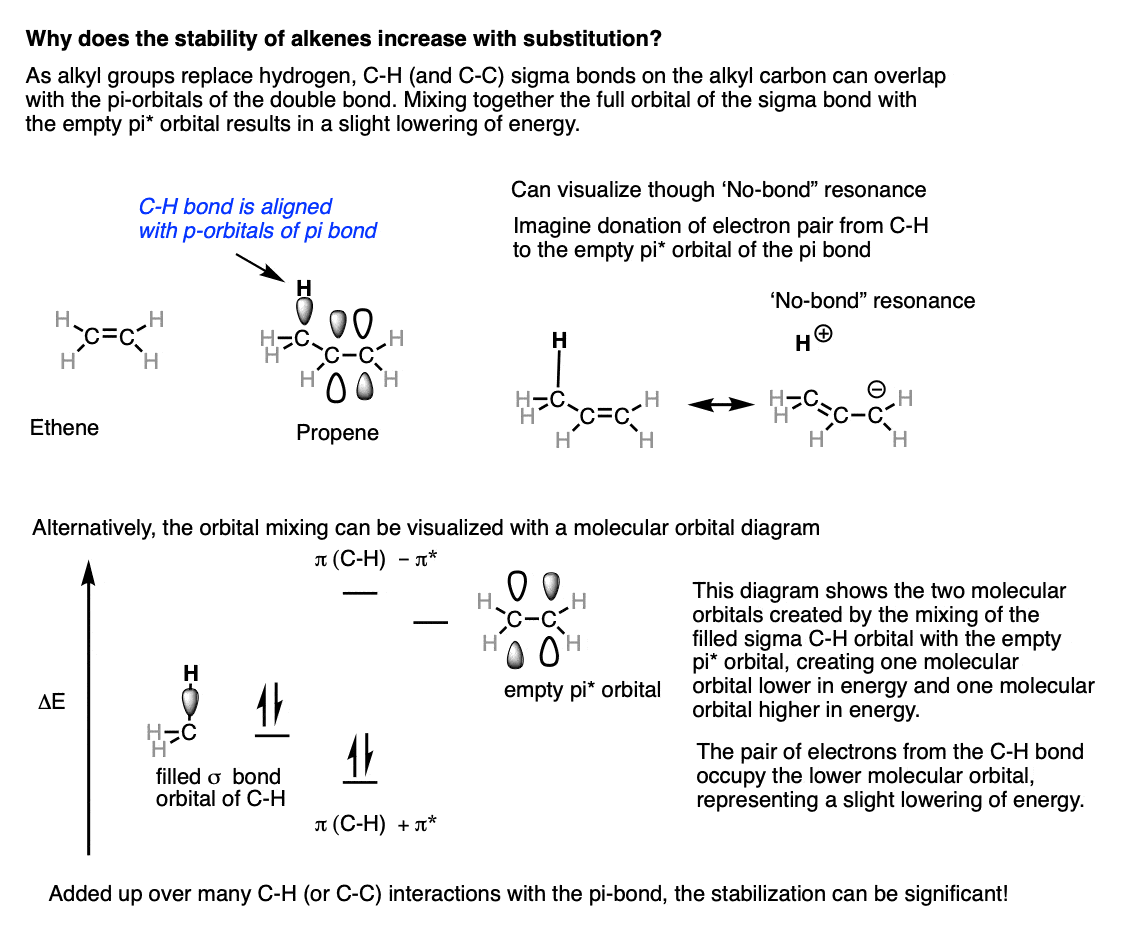
Predicted to slightly lengthen C-H and C-C pi and strengthen C-C sigma.

Appendix 2: trans-Cycloalkenes

99% of people reading this will never use this so it is going down in the footnotes.

In the vast majority of molecules you will encounter, the double bonds in rings are cis. Why? The most vivid answer is provided by trying to make them with a model kit.
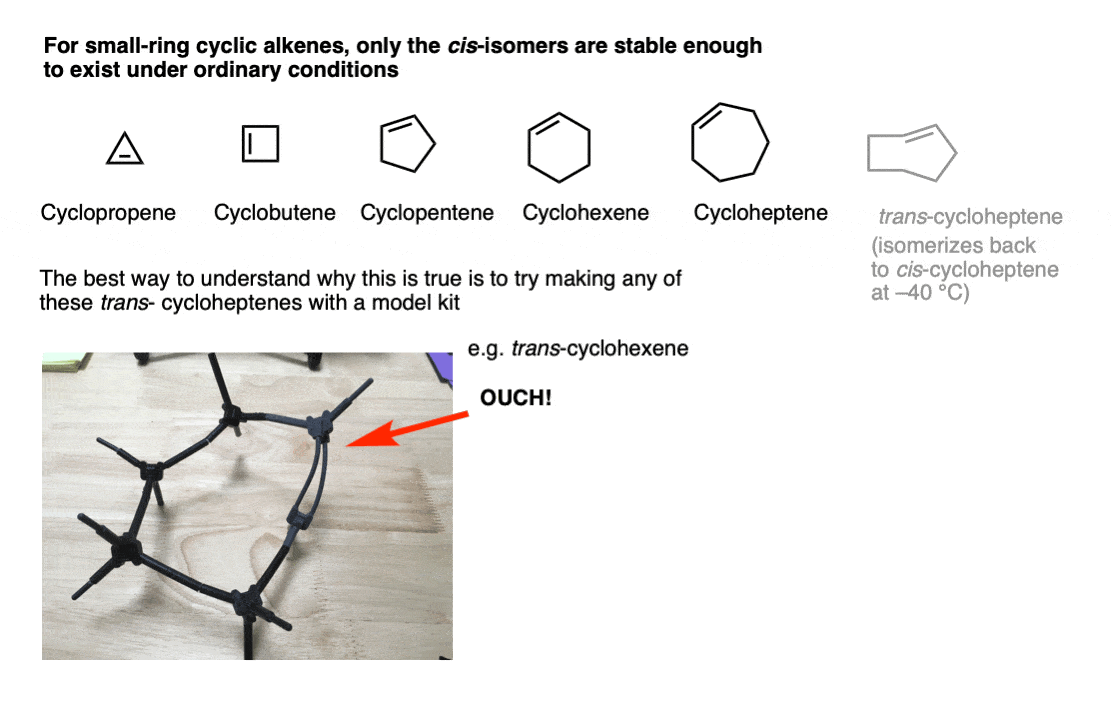
small-ring-cyclic-alkenes-the-only-stable-isomer-is-cis

That is not a happy double bond.

However at a ring size of 7, a trans double bond becomes more than transiently stable (albeit very short lived at 0°), and at a ring size of 8 there’s enough floppiness in the ring such that its boiling point can be measured [143°C !] . Larger ring sizes than 8 can easily accommodate a trans double bond.

The heat of hydrogenation can be used to quantify the stability of these rings (note that this is not the whole picture, since it doesn’t take entropy into account, and that can be quite significant).
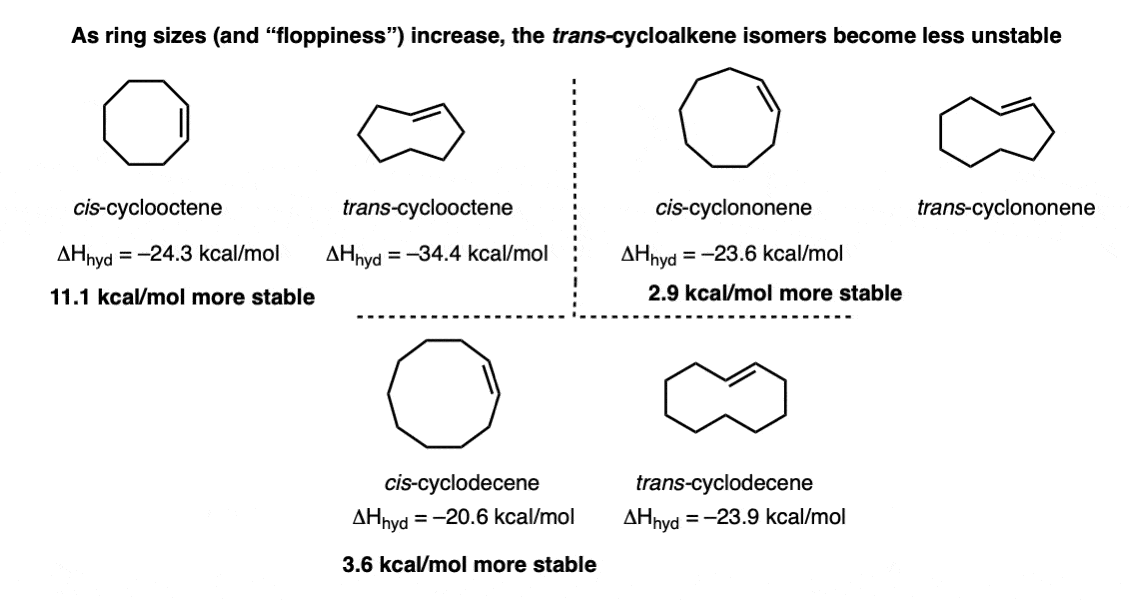
larger-ring-trans-cycloalkenes-are-more-stable-heat-of-hydrogenation

At ring sizes of 11 and 12 the trans-isomer actually becomes more stable (when allowed to equilibrate with acid) but recall that anything involving equilibrium is ultimately a measure of delta G, and delta G also includes an entropy term (S). It turns out that the main factor in the increased stability of 11- and 12- membered trans-cycloalkenes is their greater entropy. See this reference.


Quiz Yourself!
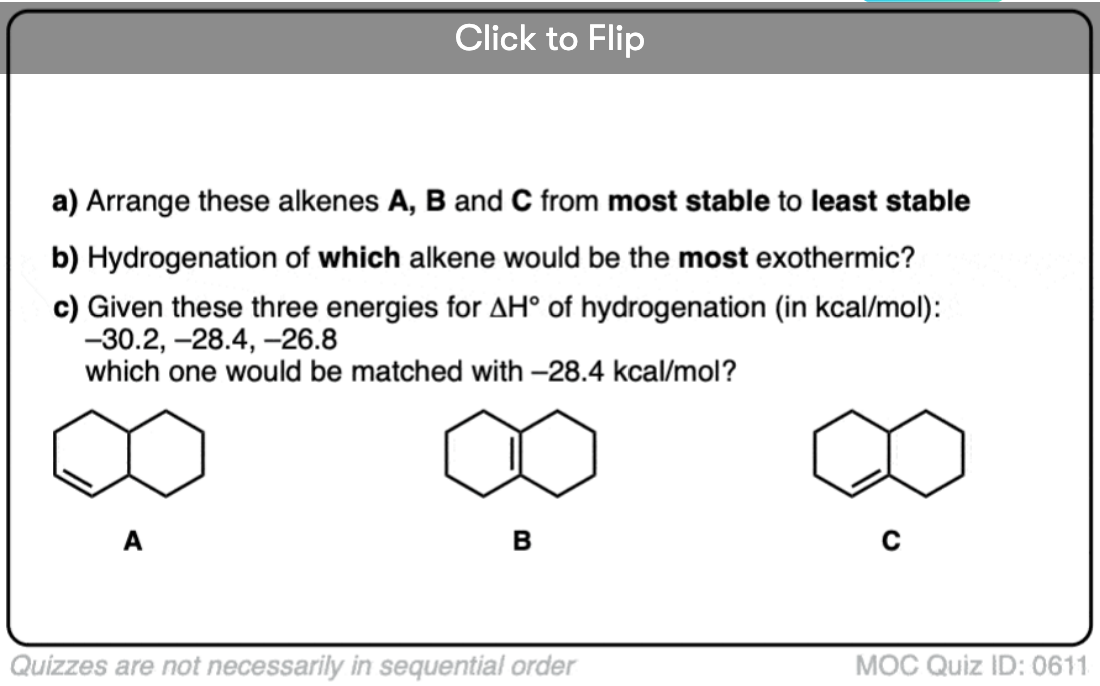
Become a  MOC member to see the clickable quiz with answers on the back.
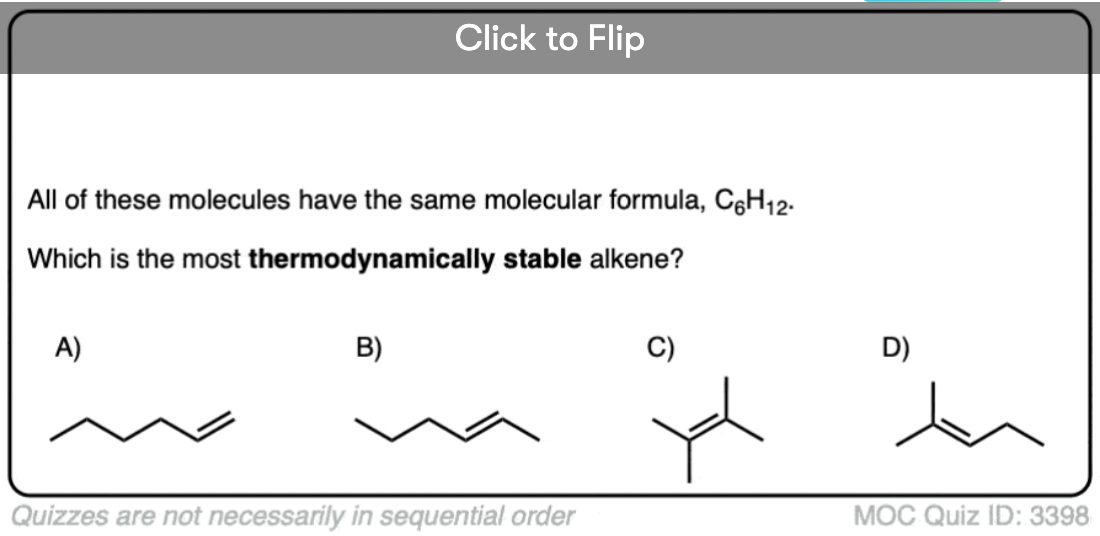
Become a  MOC member to see the clickable quiz with answers on the back.
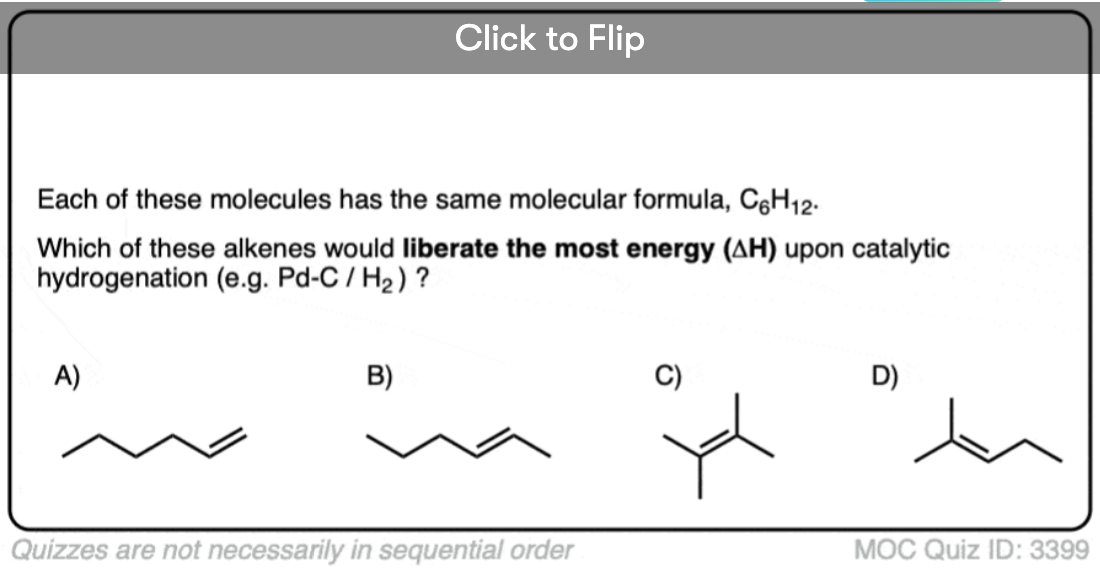
Become a  MOC member to see the clickable quiz with answers on the back.
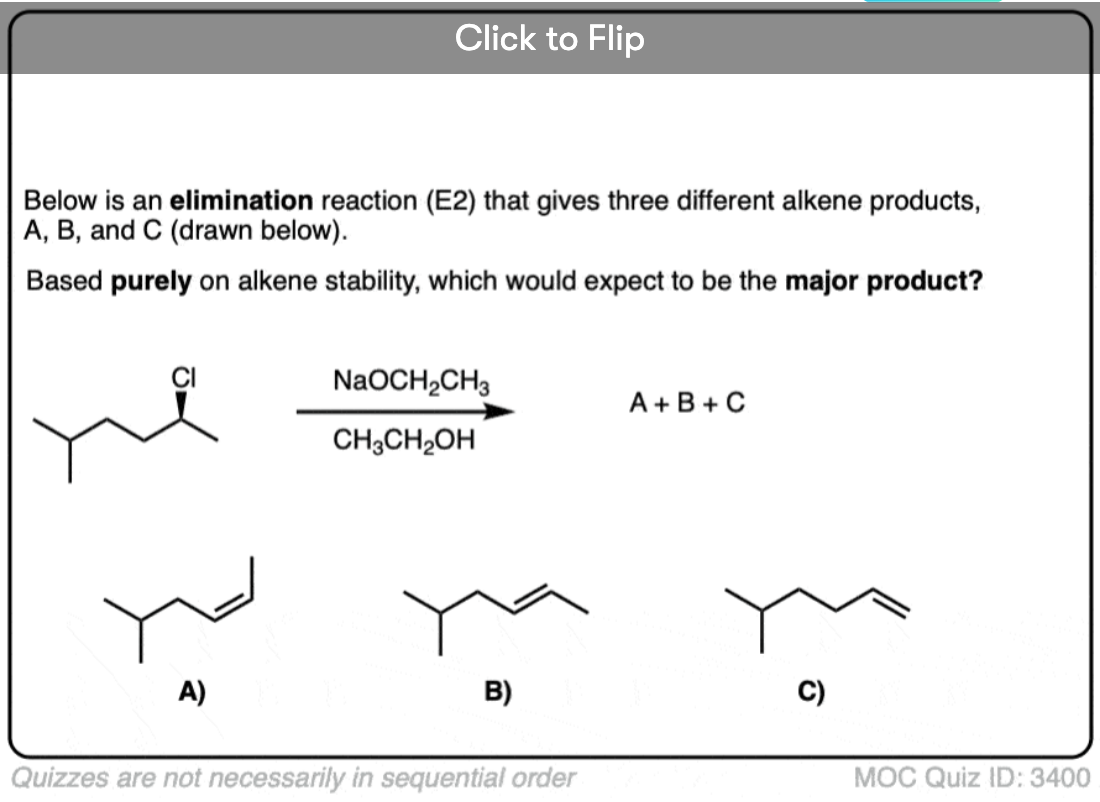
Become a  MOC member to see the clickable quiz with answers on the back.
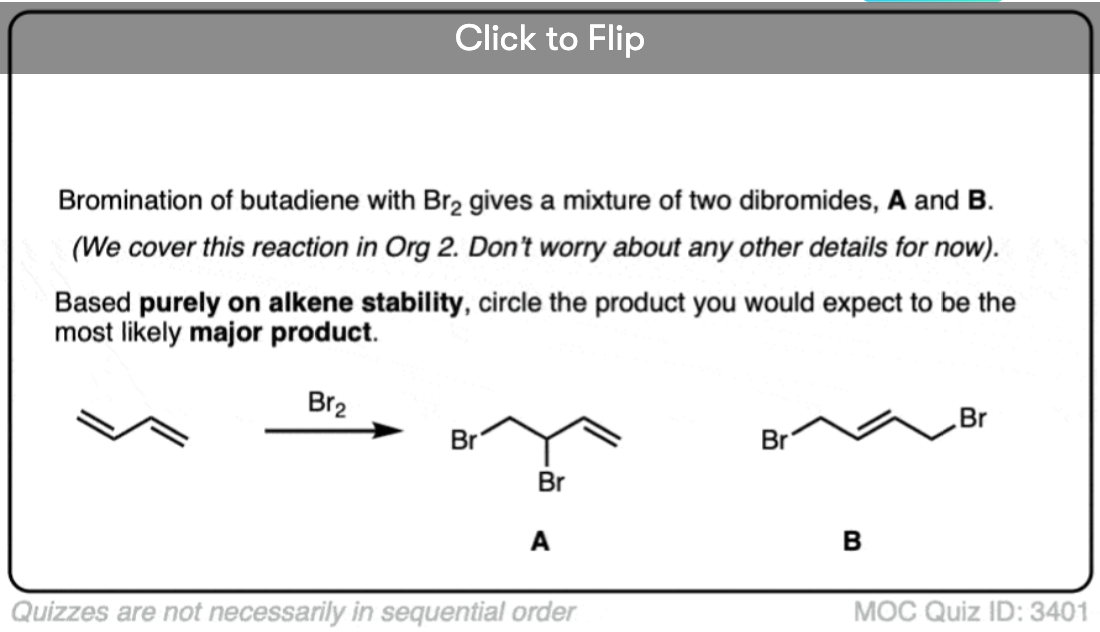
Become a  MOC member to see the clickable quiz with answers on the back.
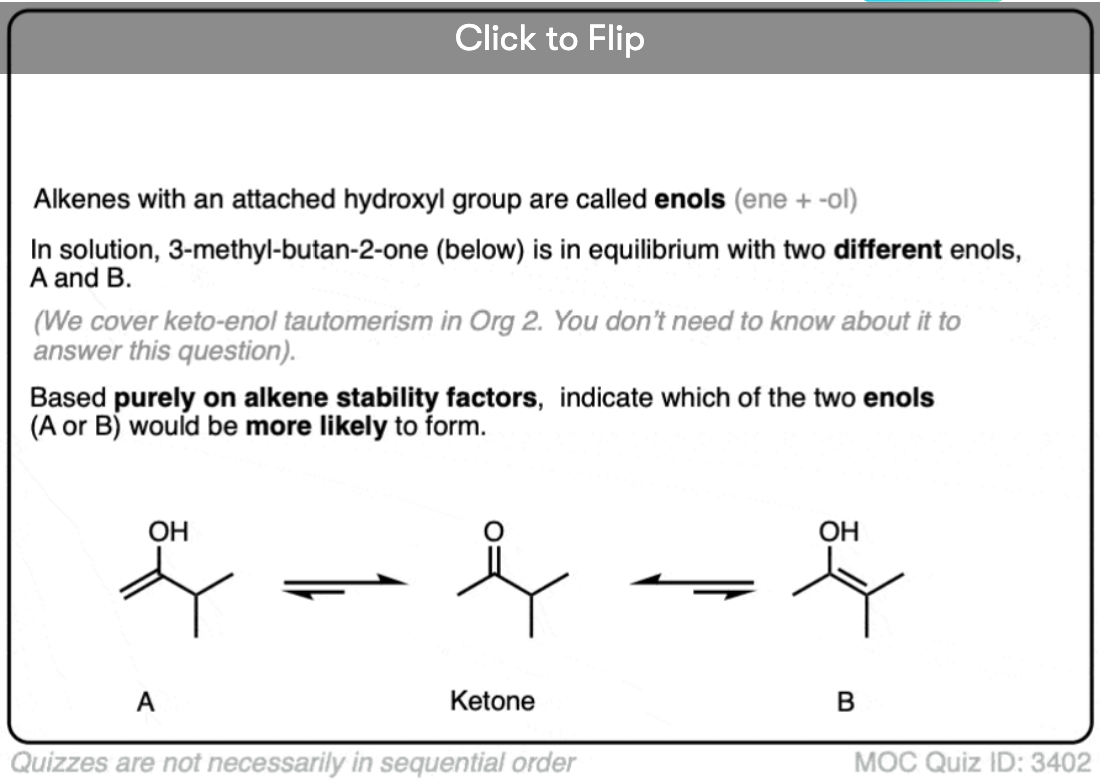
Become a  MOC member to see the clickable quiz with answers on the back.
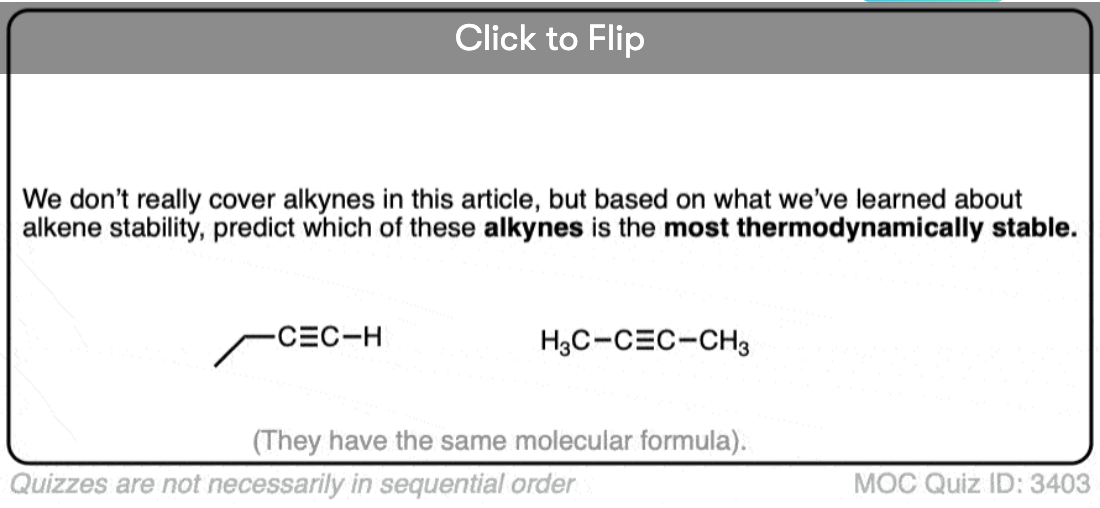
Become a  MOC member to see the clickable quiz with answers on the back.


(Advanced) References and Further Reading

All heat of hydrogenation values cited here were obtained from the NIST Chemistry Web Book. Searching by CAS number never fails. Selected original references below.

  1. Heats of Organic Reactions. I. The Apparatus and the Heat of Hydrogenation of Ethylene
    G. B. Kistiakowsky, H. Romeyn Jr., J. R. Ruhoff, Hilton A. Smith, and W. E. Vaughan
    Journal of the American Chemical Society 1935 57 (1), 65-75
    DOI: 10.1021/ja01304a019
    Prof. Kistiakowsky’s first (of many) papers on the heat of hydrogenation of organic molecules, where he describes the apparatus required to obtain accurate heat of hydrogenation data in painstaking detail. The results stand up.
  2. Heats of Organic Reactions. IV. Hydrogenation of Some Dienes and of Benzene
    G. B. Kistiakowsky, John R. Ruhoff, Hilton A. Smith, and W. E. Vaughan
    Journal of the American Chemical Society 1936 58 (1), 146-153
    DOI: 10.1021/ja01292a043
    Contains the heat of hydrogenation for 1,3 butadiene, benzene, and other unsaturated molecules, including allene (71.0 kcal/mol).
  3. Heats of Hydrogenation. IV. Hydrogenation of Some cis- and trans-Cycloölefins1
    Richard B. Turner and W. R. Meador
    Journal of the American Chemical Society 1957 79 (15), 4133-4136
    DOI: 10.1021/ja01572a042
  4. Heats of hydrogenation. IX. Cyclic acetylenes and some miscellaneous olefins
    Richard B. Turner, A. D. Jarrett, P. Goebel, and Barbara J. Mallon
    Journal of the American Chemical Society 1973 95 (3), 790-792
    DOI: 10.1021/ja00784a025
  5. RELATIVE STABILITIES OF cis- AND trans-CYCLONONENE, CYCLODECENE, CYCLOUNDECENE AND CYCLODODECENE
    Arthur C. Cope, Phylis T. Moore, and William R. Moore
    Journal of the American Chemical Society 1959 81 (12), 3153-3153
    DOI: 10.1021/ja01521a067
    A.C. Cope reported that when cis– and trans– cycloundecene (11-membered) and cyclododecene (12-membered) are allowed to equilibrate (by heating with catalytic TsOH)  the trans-double bond is favored at equilibrium (i.e. has lower Δ G)… even though trans-dodecene has a higher enthalpy (Δ H) than its cis-isomer. This is a helpful reminder that enthalpy (delta H) is just one part of the Gibbs equation (Δ G = Δ H – TΔ S), the trans-cycloalkenes have higher entropy (S) and this explains their greater stability.
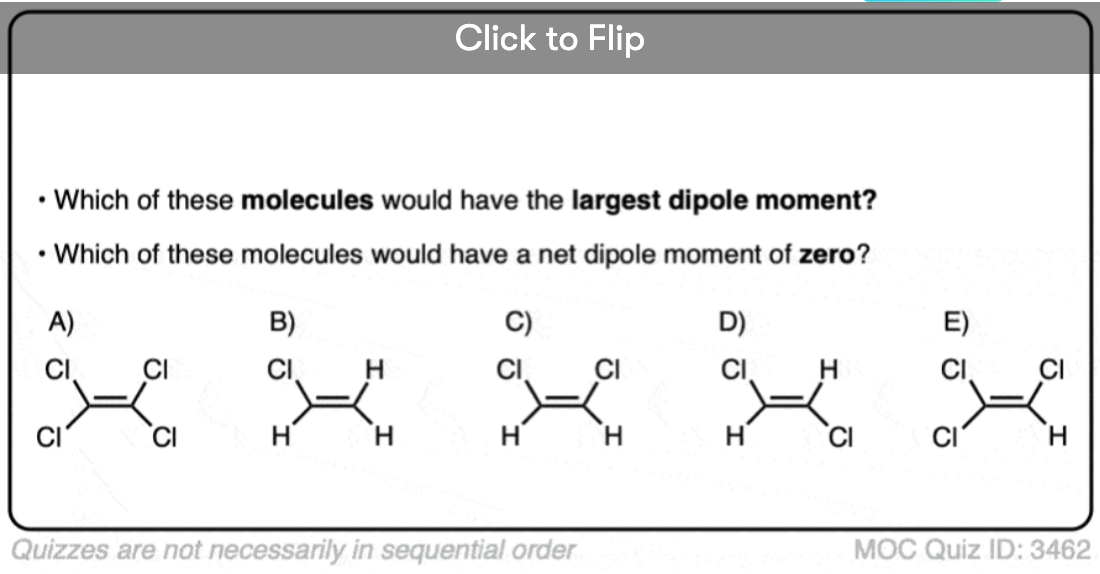
https://www.masterorganicchemistry.com/?p=19754
Extensions
How Do We Know Methane (CH4) Is Tetrahedral?
Bonding, Structure, and Resonance2p2sbondingorbitalstetrahedral carbon
What Do The Valence Electrons Of Carbon Tell Us About The Bonding In CH4? (Hint: since the dipole moment of CH4 is zero, the answer
Show full content

What Do The Valence Electrons Of Carbon Tell Us About The Bonding In CH4?

(Hint: since the dipole moment of CH4 is zero, the answer is, “not enough”)

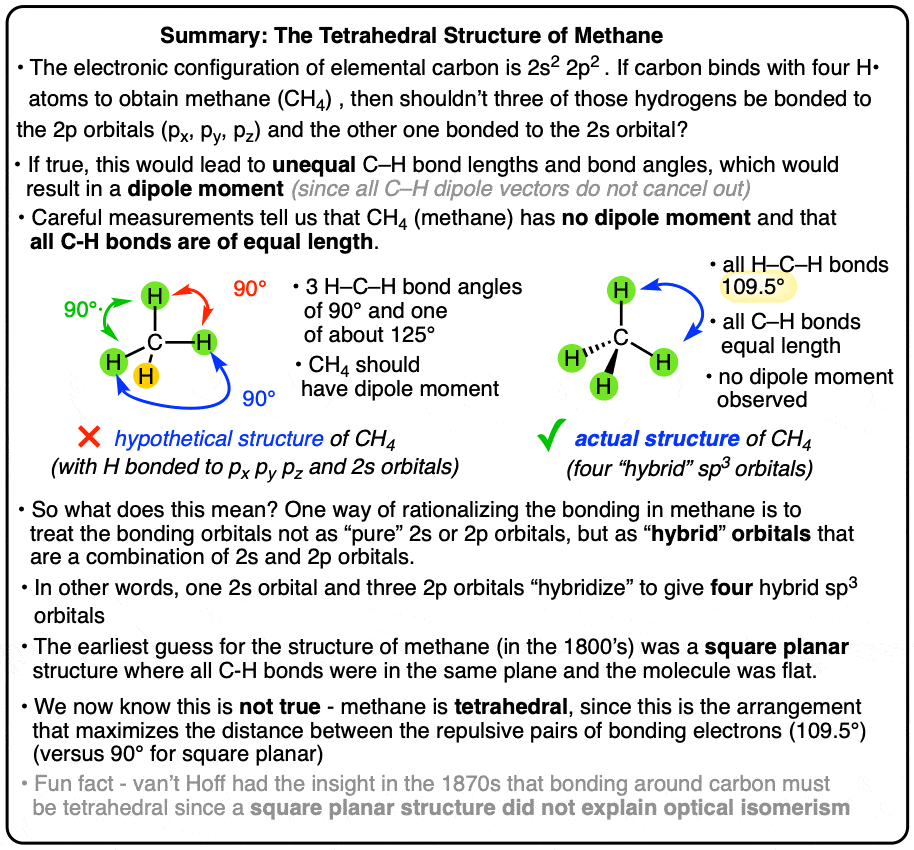
If the orbital  configuration  of carbon is 2s22p2 , then how can we use this information to figure out what the arrangement of the orbitals are in a simple organic molecule like methane (CH4)?

It turns out that methane is tetrahedral, with 4 equal bond  angles of 109.5° and 4 equal bond lengths, and no dipole moment.

This brings up two questions. First, how do we know that CH4 is tetrahedral? And secondly, how do  we reconcile this  electronic configuration (2s22p2 ) with the fact that we have four equal C–H bonds?

Summary how do we know methane tetrahedral because no dipole moment and equal bond lengths also needed for optical isomerism

Table of Contents

  1. The Electronic Configuration Of The Valence Electrons Of Carbon Is 2s22p2
  2. Can We Use This Information To Figure Out The Structure Of Methane (CH4)? (Spoiler: No)
  3. Maybe Methane (CH4) Is Square Planar?
  4. Disproving The Square Planar Structure Of CH4 (1874) And Proposal Of A Tetrahedral Structure
  5. Tetrahedral Carbons: Not A Popular Idea In 1874
  6. So What Orbitals ARE Involved?
  7. Notes

1. The Electronic Configuration Of The Valence Electrons Of Carbon Is 2s22p2

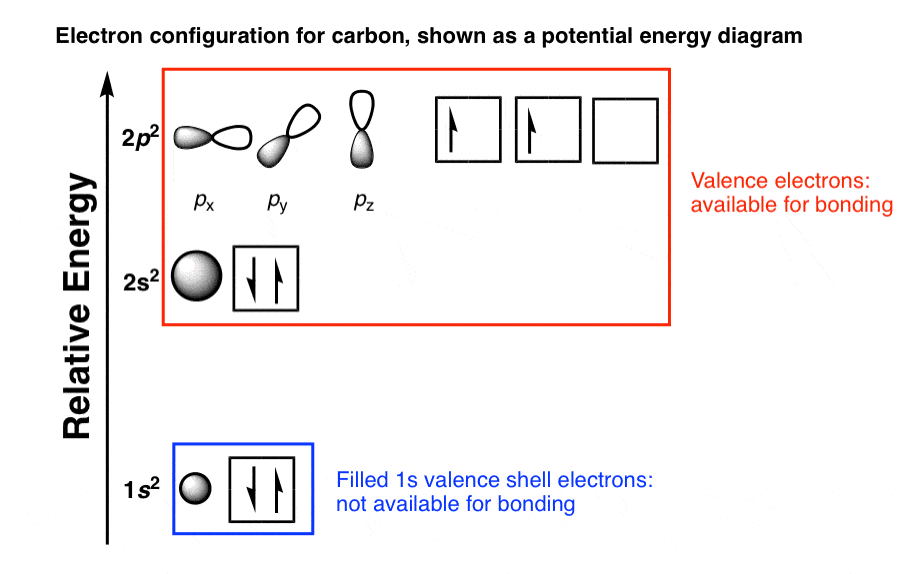
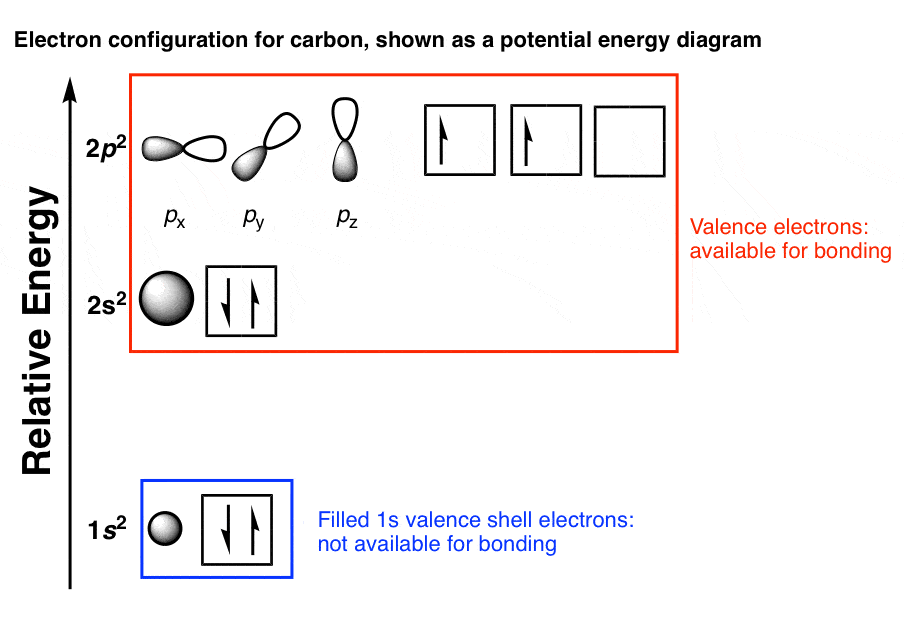
In our review of atomic orbitals, we saw that the orbital configuration of the valence electrons of carbon is 2s22p2 as shown below:

electron-configuration-for-carbon-atom-shown-as-potential-energy-diagram-with-valence-electrons-4-and-filled-1s-electrons

Since the 2s orbital is lower in energy than 2p, it’s filled first. That means that there are two electrons in the 2s orbital, and a single electron in two of the three 2p orbitals. There’s also an empty 2p orbital.

[In addition, there are two electrons in the “inner shell” 1s orbital, which are not available for bonding].

2. Can We Use This Information To Figure Out The Structure Of Methane (CH4)? (Spoiler: No)

So far so good. This is fine if we’re just talking about isolated carbon atoms.

But in order to be truly useful, we need to be able to relate the orbitals of carbon to the structure and bonding of actual organic compounds.

The simplest organic compound is methane, CH4. So let’s bring four hydrogen atoms into the picture and try to apply what we’ve learned to come up with some hypotheses about the bonding in this molecule.

valence-obrtials-of-carbon-look-like-this-with-three-p-orbitals-and-a-2s-orbital

The 3 p-orbitals in carbon are all at 90 degrees to each other, along the x, y, and z axes.

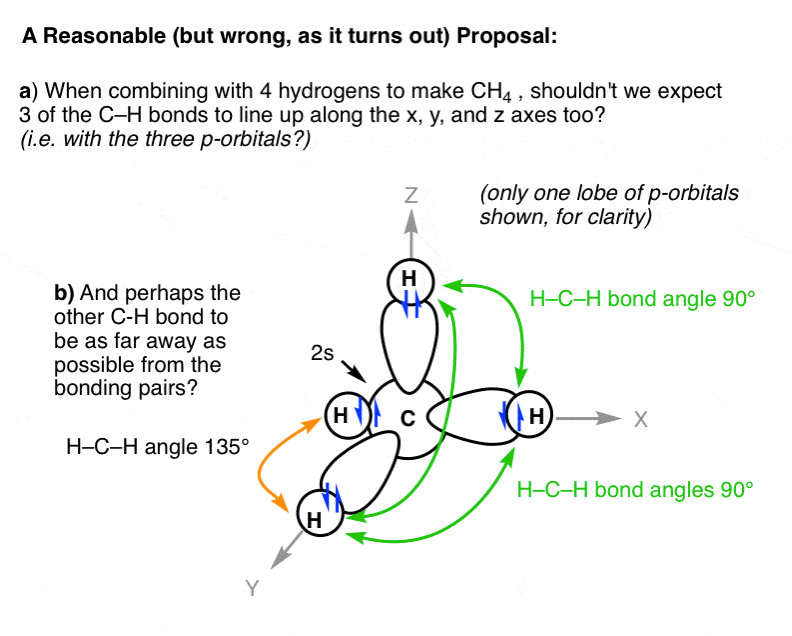
Shouldn’t we expect that the structure of methane would have three C-H bonds for each of the p orbitals (at 90 degrees to each other) and then the fourth C-H bond attached to the 2s orbital? Since electron pairs repel, maybe we should put that C-H bond the maximum distance away from the other C-H bonds; this would give an H–C–H bond angle of 135°.

Following this logic would give a structure like this:

reasonable-but-wrong-proposal-for-ch4-bonding-why-dont-c-h-bonds-line-up-along-x-y-and-z-axes-with-h-c-h-bond-angles-of-90-degreesAs it turns out, it can be shown that this proposal is wrong.

Why?

Dipole moment.

Recall that each C–H bond has a small dipole due to the difference in electronegativity between C (2.5) and H (2.2). We expect C to be partially negative and H to be partially positive. (See article: Dipoles and Dipole Moments)

  • If the above structure accurately depicted the structure of methane, we’d expect methane to have 3 longer C–H bonds (to the 2p orbitals) and one shorter C–H bond (to the 2s orbital, which is closer to the nucleus)
  • Furthermore, we’d expect 3 H–C–H bond angles of 90° and one H–C–H bond angle of 135°.
  • When the vector sums of the C–H dipoles are added up in this structure, they would not all cancel out.
  • We would therefore expect to observe a small, but measurable dipole moment for CH4. [Note 1]

However, the measured dipole moment of CH4 is zero. Therefore this cannot be the correct structure.

This tells us that all the bond lengths and bond angles in methane are identical.

3. Maybe Methane (CH4) Is Square Planar?

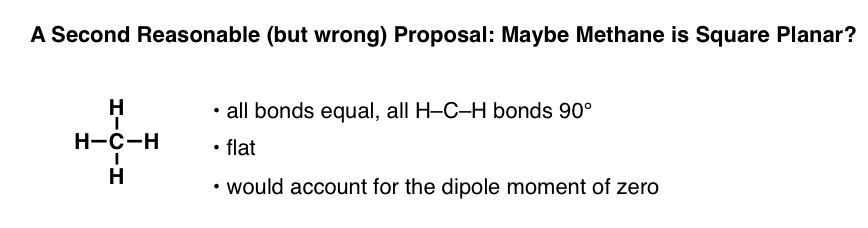
Alright, you say. If all C-H bonds are of equal lengths and angles, why can’t CH4 have the structure below, where all the bond angles are 90° and CH4 is flat, in the plane of the page. (We call this structure “square planar”).

how-do-we-know-methane-is-not-square-planar-with-all-bonds-equal-all-h-c-h-bonds-90-degrees-flat-and-zero-dipole-moment

This was in fact the majority opinion for the arrangement of bonds around carbon until about 1880. Extremely brilliant chemists such as Berzelius went to their graves having no reason to doubt that methane was anything but flat.

However, we now know this to be wrong. Why?

4. Disproving The Square Planar Structure Of CH4 (1874) And Proposal Of A Tetrahedral Structure

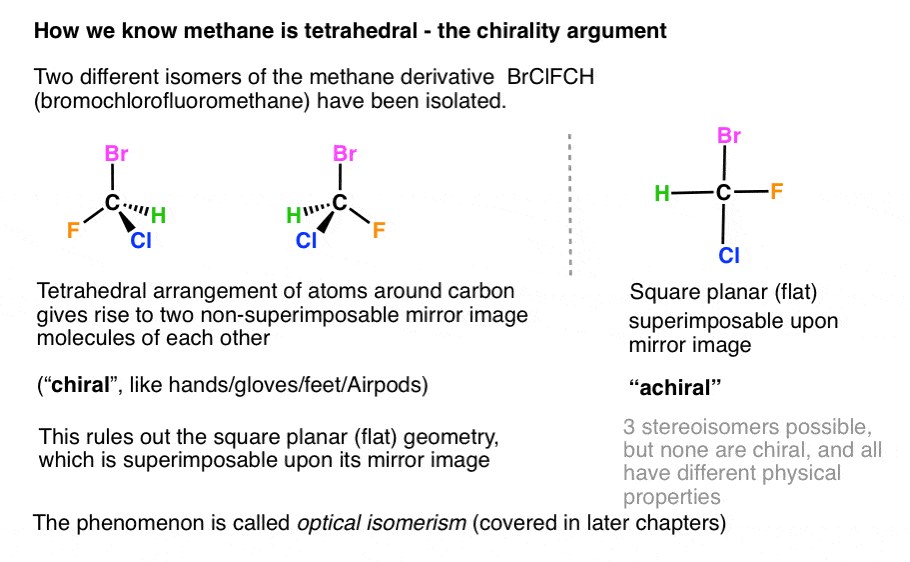
If methane is modified so that the central carbon is attached to four different groups, the molecule can exist as 2 different isomers that are non-superimposable mirror images (this is called “optical isomerism” and covered later in the course).

This is possible if the arrangement of 4 groups around the central carbon is tetrahedral, but not if the molecule is square planar. For example, the methane derivative bromochlorofluoromethane has four different groups around carbon and can be separated into two different isomers which rotate plane-polarized light in different directions. [As we’ll see later, these isomers are called “enantiomers”]

how-we-know-methane-is-tetrahedral-the-chirality-archument-two-different-chiral-isomers-possible-for-tet-optical-isomerism

This  observation rules out the square planar structure. If carbon was square planar, the molecule would be flat, and be superimposable on its own mirror image, and only one isomer would be possible.

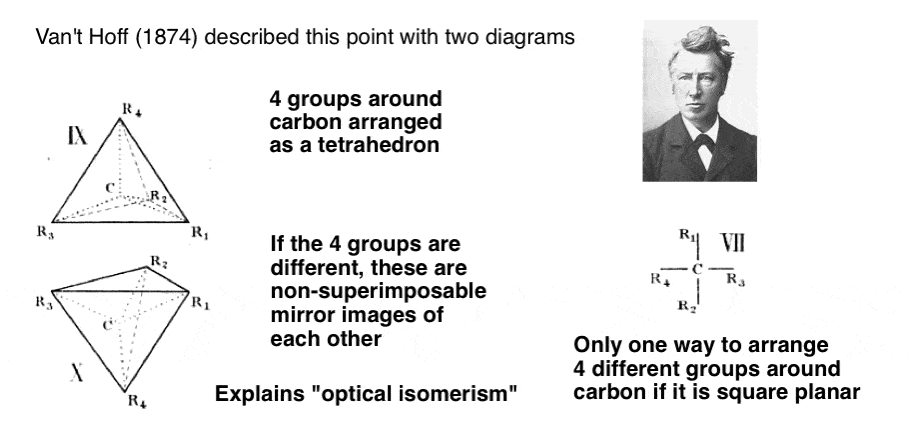
Jacobus Henricus van’t Hoff , a fellow at the veterinary college in Utrecht, was among the first to address the possibility of three-dimensional carbon. In his “La Chimie dans L’Espace” (1874) he noted that the arrangement of atoms in space has important practical consequences – a point that had been completely neglected to that point. van’t Hoff showed that a tetrahedral arrangement of four different groups around a carbon atom (which he called an “asymmetric carbon”) would give rise to two different isomers, and furthermore, this would explain why tartaric acid (with two asymmetric carbon atoms) existed in three forms (+, –, and meso).   [Source]

ant-hoff-description-of-4-groups-around-carbon-as-a-tetrahedron-non-superimosable-mirror-images-explains-optical-isomerism

van’t Hoff’s work – which should be noted was purely theoretical –  was not well received in some circles.

5. Tetrahedral Carbons: Not A Popular Idea In 1874

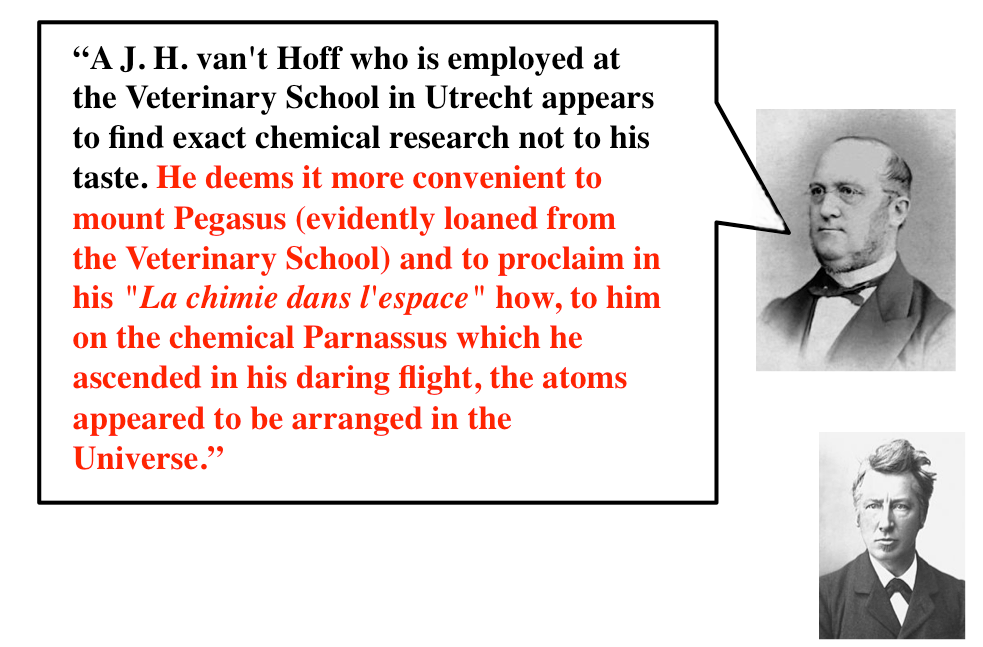
The eminent German chemist Hermann Kolbe had this to say:

quote-from-kolbe-about-vant-hoff-flying-on-pegasus-regarding-tetrahedral-carbon

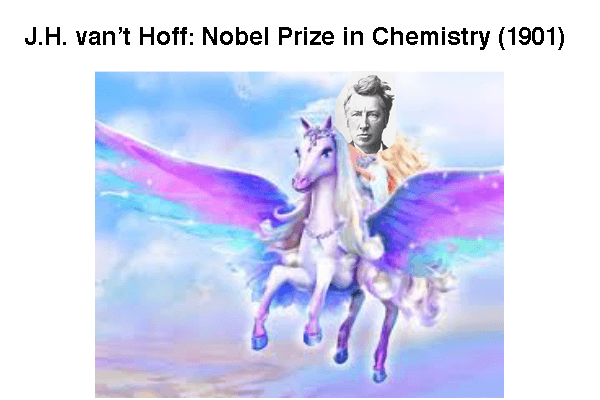
For his part, van’t Hoff flew to Stockholm on his Pegasus to receive the first Nobel Prize in Chemistry in 1901. [Note 2]j-h-vant-hoff-nobel-prize-in-chemistry-1901-flying-on-pegasus

Incontrovertible proof for the tetrahedral arrangement of bonds around the carbon atom came in 1913 when Bragg determined the structure of diamond using X-ray crystallography and found it to be a tetrahedral network of carbon atoms with C-C-C bond angles of 109.5°.

6. So What Orbitals ARE Involved?

We now rationalize the tetrahedral arrangement of atoms around methane as being due to the repulsion of the bonding pairs of electrons with each other (a.k.a. VSEPR theory).

This doesn’t help us with understanding the orbitals involved in bonding, however.

If we accept that the arrangement of hydrogens around methane is tetrahedral, then how do we describe the bonding orbitals of methane, given what we know about the geometry of s and orbitals?

After all, the 2p orbitals are all at 90 degrees to each other, but the bond angles in methane are 109.5°.

Furthermore, how do we account that each of the 4 bonds in methane are of identical lengths? What happened to the 2s orbital, for example?

Are the electrons in the C-H bonds considered to be in orbitals or s orbitals? Or something else?

As it turns out,  the conventional treatment is to deal with the bonds around carbon as being in hybrid orbitals. 

More on that in the next post.

Next Post: Hybrid Orbitals


Notes

Related Articles

Note 1. Note that mono-deuterated methane (CH3D, where D is deuterium, the heavy isotope of hydrogen) has a small dipole moment that has been measured. [ref]

Note 2: it should be noted that van’t Hoff’s Nobel Prize was for his contributions to physical chemistry, not organic stereochemistry.

I am indebted to this page covering van’t Hoff’s “The Arrangement of Atoms In Space” for historical perspective. Well worth reading in full.

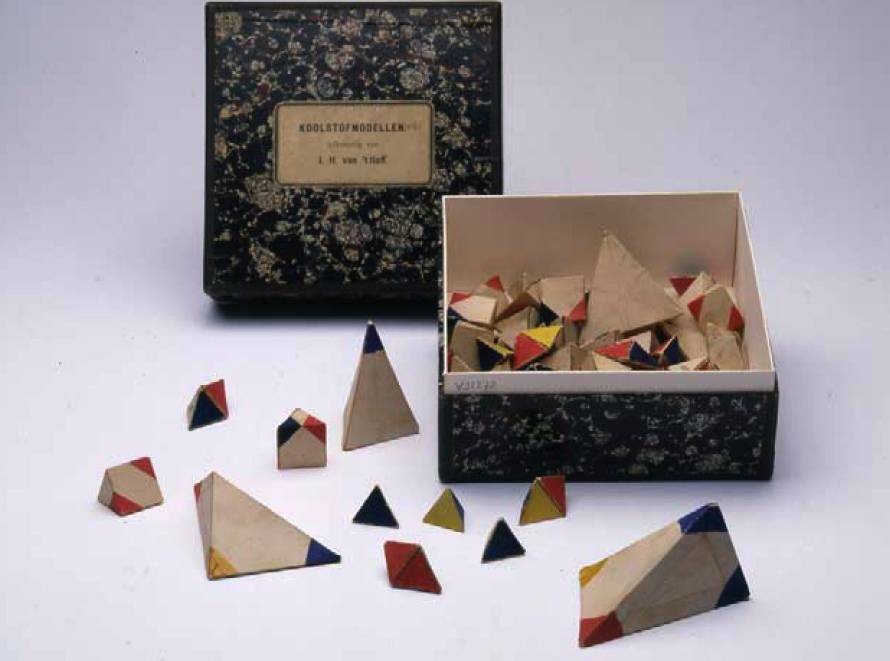
From the same source: van’t Hoff’s tetrahedral models [from the Leiden history of science museum; source]

vant-off-tetrahedral-models-from-leiden-history-of-science-museum

From the same author, some more historical perspective on the Kolbe/van’t Hoff spat:

Obviously Kolbe was silly to be so intemperate and spiteful. He was also short-sighted, and he guessed wrong. We can easily appreciate that in the court of history he got what was coming to him.

The challenge is properly to respect the indispensable contributions the attitude he was championing had made to the development of chemistry. It was by sticking close to careful experimental observations that chemistry had gotten where it was (and is). Kolbe was trying to keep science on a productive, intellectually justifiable path.

Read here for full.


https://www.masterorganicchemistry.com/?p=10917
Extensions
E and Z Notation For Alkenes (+ Cis/Trans)
Alkene Reactionscahn-ingold-prelogcise and zentgegennomenclaturestereochemistrytranszusammen
E and Z Notation For Alkenes Unlike C–C single bonds, C–C double bonds can’t undergo rotation without breaking the pi bond One consequence of this
Show full content

E and Z Notation For Alkenes

  • Unlike C–C single bonds, C–C double bonds can’t undergo rotation without breaking the pi bond
  • One consequence of this is geometric isomerism – the existence of alkene stereoisomers that differ solely in how their substituents are arranged in space about the double bond
  • In simple cases where there are two identical substituents on each carbon of the alkene, we can use cis and trans– to designate the isomers where those substituents are on the same and opposite sides of the double bond, respectively.
  • For geometric isomers that lack two identical substituents, we rank the two substituents on each end of the double bond according to the Cahn-Ingold-Prelog (CIP) rules.
  • The Z isomer (“zusammen“, same) is the geometric isomer where the #1 ranked substituents are on the same side of the double bond. Mnemonic: “zee zame zide
  • E isomer (“entgegen“) is the geometric isomer where the #1 ranked substituents are on the opposite side of the double bond,

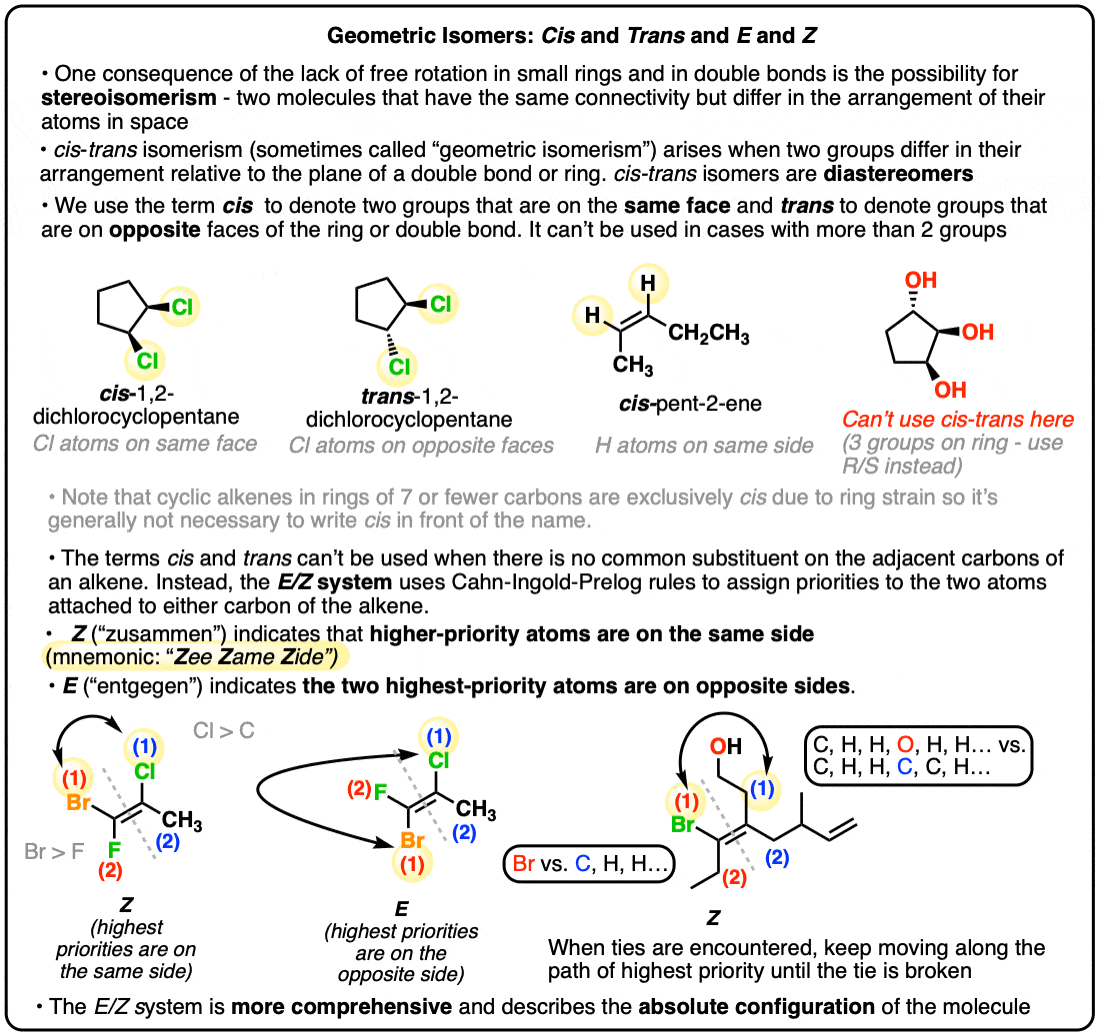
Summary of cis trans e and z entgegen zusammen nomenclature zee zame zide mnemonic for alkene and cycloalkane stereoisomers

Table of Contents

  1. When do we use cis– and trans– Notation In Rings?
  2. cis– and trans– Isomerism In Alkenes
  3. Watch out for ambiguous names when geometrical isomerism is possible!
  4. cis– and trans– isomerism in cyclic alkenes
  5. When “cis“- and “trans‘” fails: E and Z Notation
  6. E and Z Notation For Alkenes
  7. Breaking Ties: The Method of Dots
  8. Conclusion: E and Z Notation For Alkenes
  9. Notes
  10. Quiz Yourself!

This post was co-authored with Matt Pierce of Organic Chemistry Solutions.  Ask Matt about scheduling an online tutoring session here.

Quick Review: cis– And trans- Isomerism (“Geometrical Isomerism”) In Rings

Earlier on our MOC series on cycloalkanes, we saw that a key feature of small rings is that they can’t be turned “inside out” without breaking bonds.(See post: Cycloalkanes – Dashes and Wedges)

One of the most important consequence of this is that it can lead to the existence of stereoisomers – molecules which share the same molecular formula and the same connectivity but have a different arrangement of atoms in space.

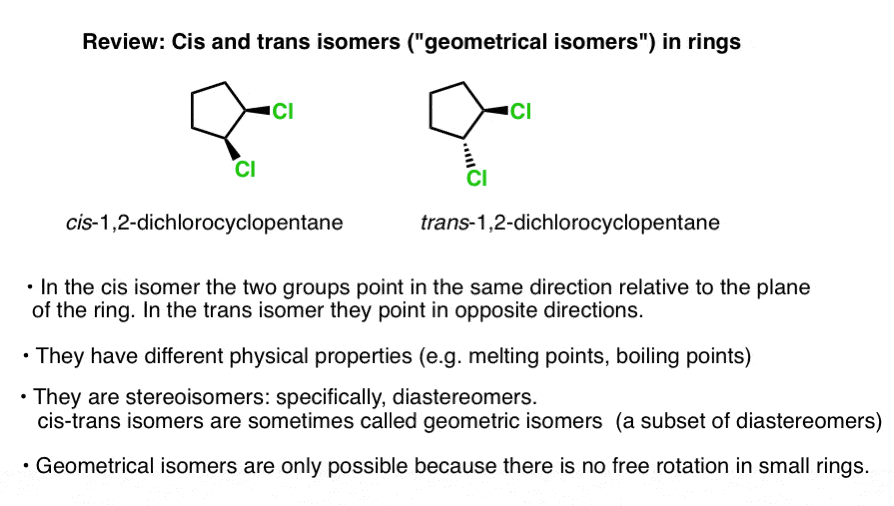
These two versions of  1,2 dichlorocyclopentane (below) are an example. They have the same connectivity – both are 1,2-dichlorocyclopentane –  but have different arrangements of their atoms in space. The chlorines are on the same side of the ring in the left-hand isomer (both “wedges”, coming out of the page)  and on the opposite sides  (one wedged, one dashed) on the right-hand isomer.

geometrical isomers cis and trans in rings 1 2 dichlorocyclopentane

These two molecules cannot be interconverted through rotation  of the C-C bond without rupturing the ring (use a model kit and try, if you like). They are therefore isomers.

Molecules which have the same connectivity but different arrangement in space are known as stereoisomers

Specifically, the relationship between the two molecules above is that of diastereomers: stereoisomers which are not mirror images of each other. (See post: Types of Isomers)

These two molecules have different physical properties – different boiling points, melting points, reactivities, spectral characteristics and so on.

 [Just to note, the other subclass of stereoisomer is “enantiomers”. We apply this to two stereoisomers which are (non-superimposable) mirror images of each other. Also: keep in mind that the terms “diastereomer” and “enantiomer” denote comparative relationships, like the terms “brother” or “cousin”. ]

1. When Do We Use cis- And trans- Notation In Rings?

We use the terms cis- and trans–  to denote the relative configuration of two groups to each other in situations where there is restricted rotation.

[Side note: the “restricted rotation” is how cis- and trans- subtly differs from  syn and anti, which we use in cases where there is free rotation, such as the orientation of methyl groups in “eclipsed” and “staggered” butane. Bottom line: syn and anti forms can generally be interconverted through bond rotation: cis and trans forms cannot. ]

In nomenclature,  “cis” is used to distinguish the isomer where two identical groups (e.g. the two chlorines in 1,2-dichlorocyclopentane) are pointing in the same direction from the plane of the ring, and trans to distinguish the isomer where they point in opposite directions. [You might also hear organic chemists say, “the chlorines are cis to each other” or “the hydrogens are trans to one another”.]

A common name for these so-called “cis-trans” isomers is “geometric isomers”. Those scolds at IUPAC actually discourage the term “geometric isomers”, and for once, I agree:  the term is somewhat redundant and can cause confusion. In the rest of this post I’ll just use the term “cis-trans” isomers.

In order for cis- trans- isomerism to exist in rings, we need two conditions:

  • two (and only two) carbons each bearing non-identical substituents above and below the ring
  • the two carbons have at least one of those substituents in common

In 1,2-dichlorocyclopentane we saw that C-1 and C-2 each had non-identical substituents (H and Cl) above and below the ring, and they each had at least one substituent in common (in fact they have two substituents in common:  H and Cl ).

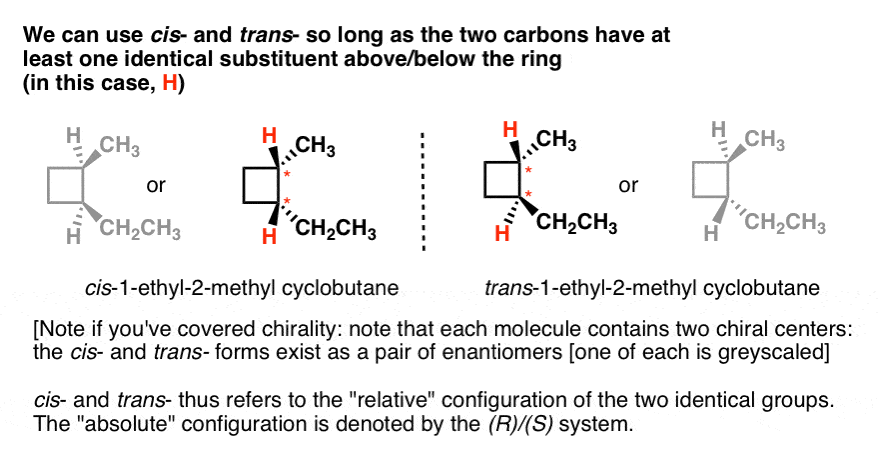
Here’s another example: cis- and trans– 1-ethyl-2-methylcyclobutane. Note that they each have two carbons which each bear non-identical substituents above and below the ring (H and CH3; H and CH2CH3). They also have at least one substituent in common (H). So we can refer to cis-1-ethyl-2-methylcyclohexane as the isomer where the two hydrogens are pointing in the same direction, and trans where they point in opposite directions.

cis and trans in cyclobutane at least one substituent identical

If you’ve covered chirality, you might also note an interesting fact: there are two ways to draw each of the cis- and trans– isomers, and they can’t be superimposed on each other. These are enantiomers, by the way. (See post: Enantiomers, Diastereomers or the Same)

So cis- and trans- doesn’t specify which enantiomer (it can be applied to either). It’s just describing the relative configuration of the two groups (in this case). If we want to specify a particular enantiomer, we need to use the  Cahn-Ingold-Prelog (CIP) system of assigning R and S configurations, which provides us with the “absolute” configuration. In that case, cis– and trans- is redundant. (See post: Cahn-Ingold-Prelog System)

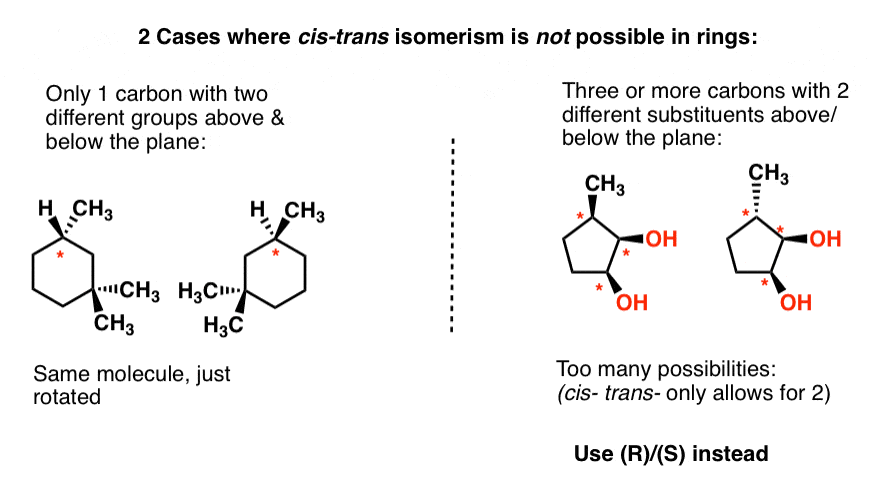
Because cis– and trans– is relative, it doesn’t work if the two carbons don’t share a common substituent. In that case you also have to use (R)/(S) .

We’re taking too long to go through rings here, so let’s just illustrate 2 examples where “cis” and trans” doesn’t work in rings and leave it there.

no geometric isomers present in rings where only 1 carbon has different groups also 3 or more carbons above below

2. cis– and trans- Isomerism (Geometric Isomerism) In Alkenes

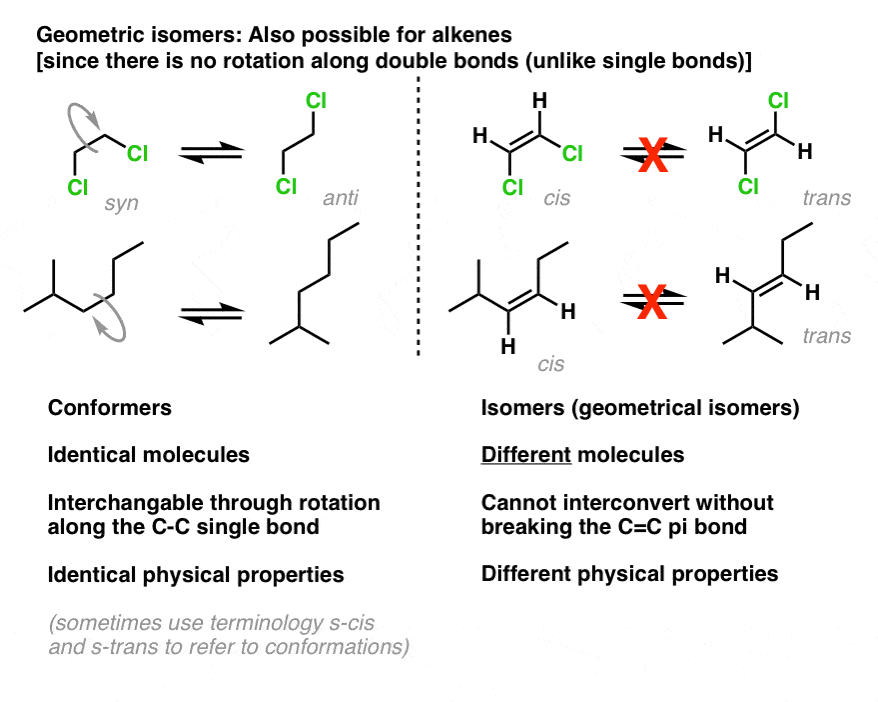
cis-trans isomerism  is also possible for alkenes.  As in small rings, rotation about pi bonds is also constrained: due to the “side-on” overlap of pi bonds, one can’t rotate a pi bond without breaking it. This stands in contrast to conventional sigma bonds (single bonds) in acyclic molecules, where free rotation is possible: witness 1,2-dichloroethane (below left).

Hence we can have molecules such as cis-1,2-dichloroethene [boiling point 60°C] and trans-1,2-dichloroethene [boiling point: 48°C] which can be separated from each other due to their differing physical properties.

geometric isomers in alkenes possible because no rotation about double bond cis and trans

We can also use the cistrans nomenclature to distinguish isomers such as 2-methyl-3-hexene (above right). In the cis isomer, the two hydrogens are on the same side of the pi bond, and in the trans isomer, the two hydrogens are on the opposite side of the bond. [Note: this risks a “tsk-tsk” with accompanying finger-wag from IUPAC , but it nevertheless gets the right structure: see the Note 1 below for a digression as to why]

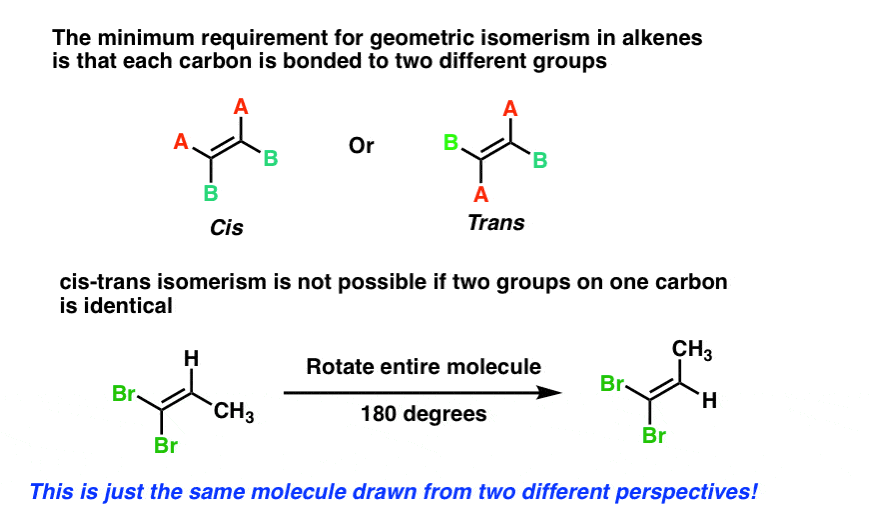
As with rings, the minimum requirement for cis-trans isomerism in alkenes is that each carbon is bonded to two different groups, and that the two carbons have at least one substituent in common. 

As with rings, cis-trans isomerism isn’t possible if one of the carbons of the double bond is attached to two identical groups, as with 1,1-dibromo-1-propene, below. Try it for yourself if you’re not convinced.

cis and trans not possible in alkenes if two groups on one carbon are identical

3. Watch Out For Ambiguous Names Where Cis/Trans Isomerism Is Possible

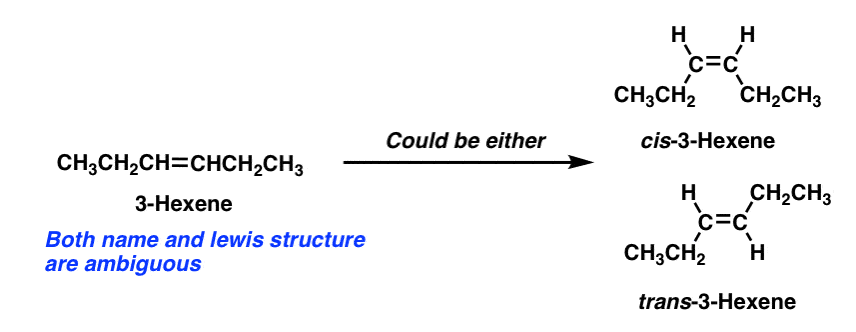
A quick digression: one consequence of our newfound appreciation of geometrical isomerism is that many simple-sounding molecule names  are actually ambiguous.

For instance, the descriptor “3-hexene” does not unambiguously describe a specific molecule.  [The same is true for 2-butene: try it! ]. To nail down the specific molecule,  we need to specify cis– or trans– 3-hexene.

sometimes condensed formula can lead to ambiguous name e g 3 hexene could be cis or trans hex 3 ene

Note that 1-hexene is still OK, since the 1-position of 1-hexene is attached to two identical groups (hydrogens) and thus no cistrans isomers are possible.

4. Cis Trans- Isomerism For Cyclic Alkenes

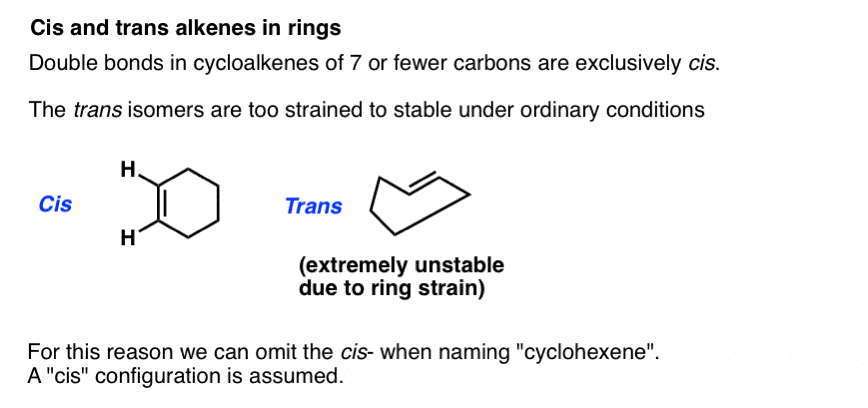
cis- and trans can also be applied to alkenes in rings. For example, on paper it’s possible to draw cis– and trans– cyclohexene, since the pi bond fulfills the requirements for cis- trans- isomerism. In reality, trans-cyclohexene is impossibly strained. Try kissing yourself on the tailbone. That will give you some idea of the strain involved in trying to accommodate a trans– double bond in  a six membered ring .  [Note 2]

For this reason, for ring sizes 7 and below, it’s safe to ignore writing “cis” : the configuration is assumed.

in small rings cis and trans is omitted since e alkenes in small rings are too unstable eg trans cyclohexene

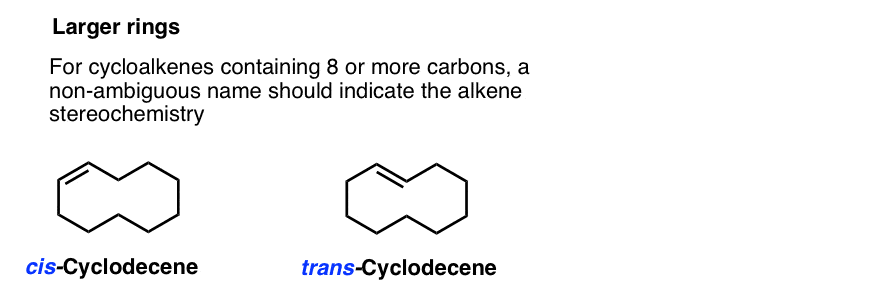
At ring sizes of 8 and above, we do need to put a cis– or trans- in the name, because the trans– isomer becomes feasible. (Imagine trying to kiss yourself on the tailbone if you had the neck of a giraffe: suddenly not impossible!)

large rings cis and trans are both possible such as cis and trans cyclodecene

5. A Solution For When “Cis” and “Trans” Fails: The E/Z System

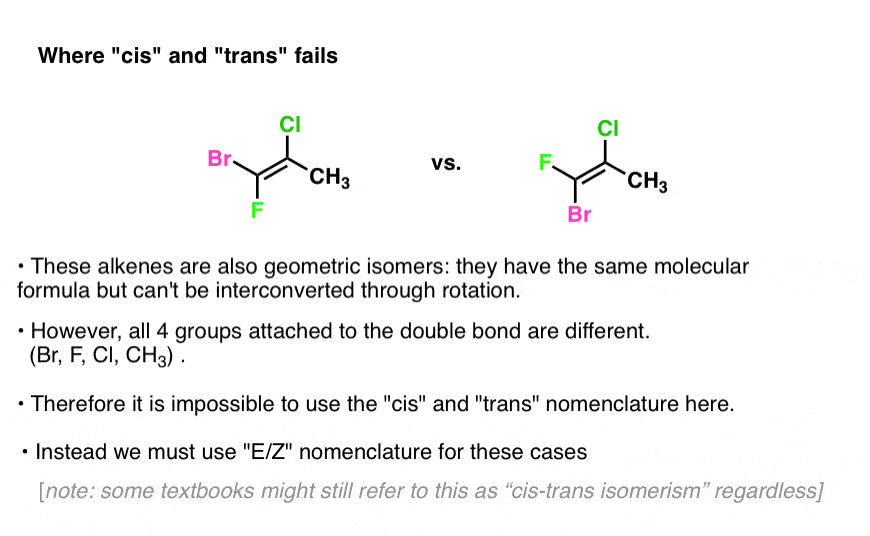
We saw that cis and trans fails in rings when the two carbons lacked a common substituent. It also fails for alkenes under these circumstances.

Case in point: try to apply cis and trans to the alkene below:

e and z must be used when cis trans fails e g double bonds with no carbons bearing identical substituents

See the problem?

In the absence of two identical groups, we have no reference point!

On the left, the chlorine is cis to Br and trans to F. But does that really justify calling the isomer “cis” ? How do we decide?

What we need is some way to determine priorities in these situations.

[note: some textbooks may still refer to this alkene as exhibiting “cis-trans isomerism” even though we must use E and Z]

6. The E and Notation For Alkenes

Thankfully, we can apply the ranking system developed by Cahn, Ingold, and Prelog for chiral centers (as touched on in this earlier post on (R)/(S) nomenclature) for this purpose.

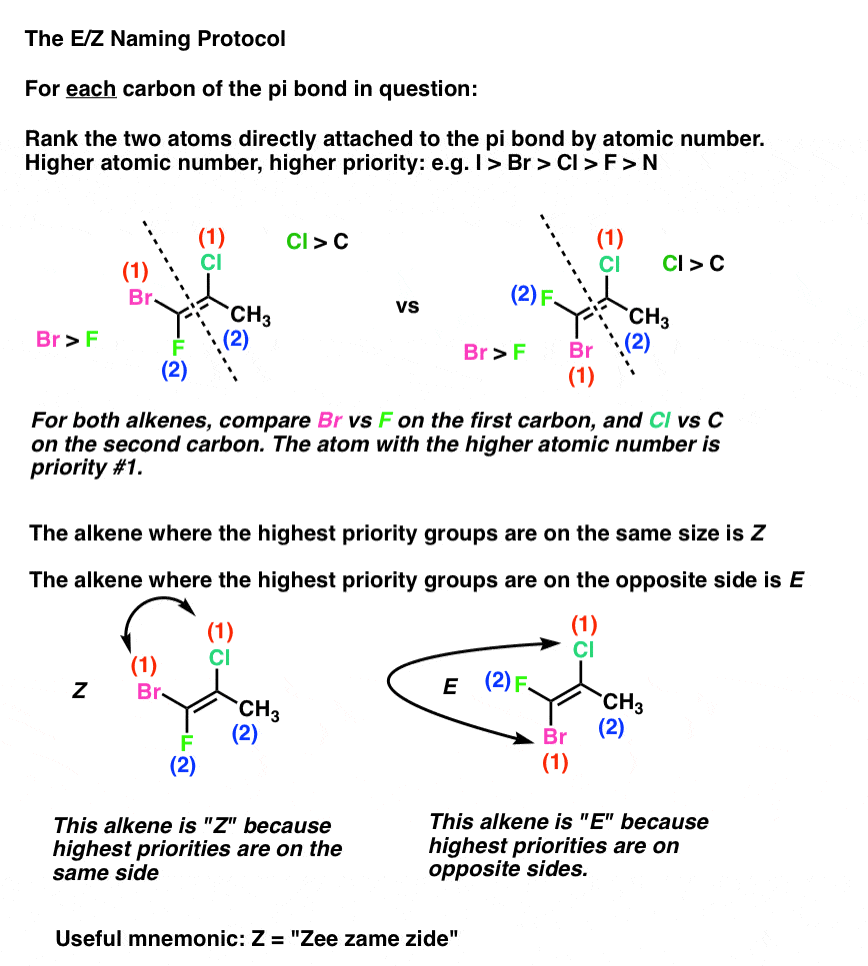
The protocol is as follows:

  • Each carbon in the pi bond is attached to two substituents. For each carbon, these two substituents are ranked (1 or 2) according to the atomic numbers of the atom directly attached to the carbon. (e.g. Cl > F )
  • If both substituents ranked 1 are on the same side of the pi bond, the bond is given the descriptor Z (short for German Zusammen, which means “together”).
  • If both substituents ranked 1 are on the opposite side of the pi bond, the bond is given the descriptor (short for German Entgegen, which means “opposite”).

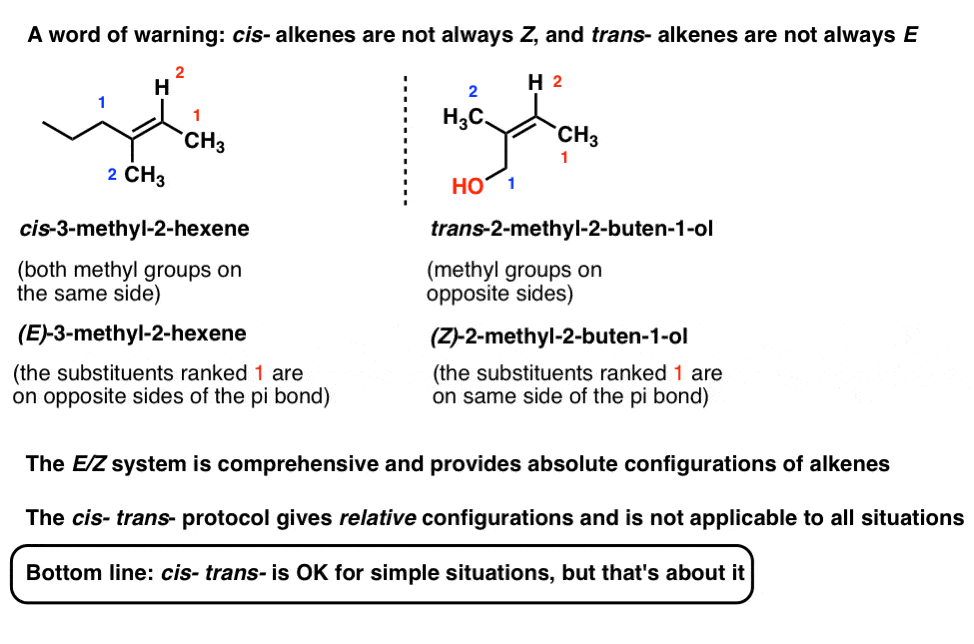
So Z resembles “cis” and E resembles “trans”  .  (Note:  they are not necessarily the same and do not always correlate: see Note 2 for an example of a cis alkene which is E . The E/Z system is comprehensive for all alkenes capable of geometric isomerism, including the cis/trans alkene examples above. We often use cis/trans for convenience, but E/Z is the “official”, IUPAC approved way to name alkene stereoisomers].

 One easy way to remember Z is to say “Zee Zame Zide” in a German accent. My way of doing it was pretending that the Z stands for “zis”. Whatever works for you.

Here’s a practical example:

e and z notation for alkenes rank two atoms directly attached to pi bond by atomic number alkene where highest priority groups on same side is z

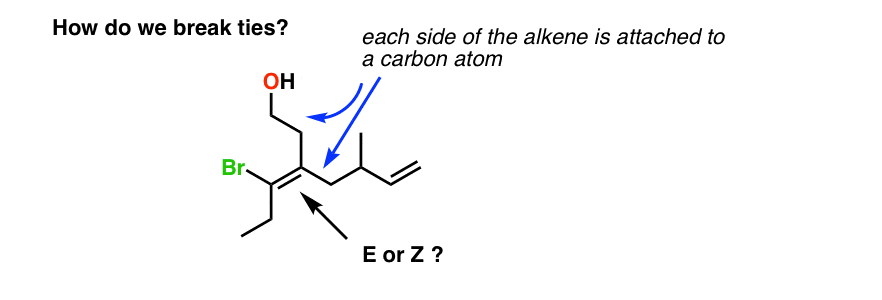
As with chiral centers, ranking according to atomic number can result in ties if we restrict ourselves merely to the atoms directly attached to the pi bonds.

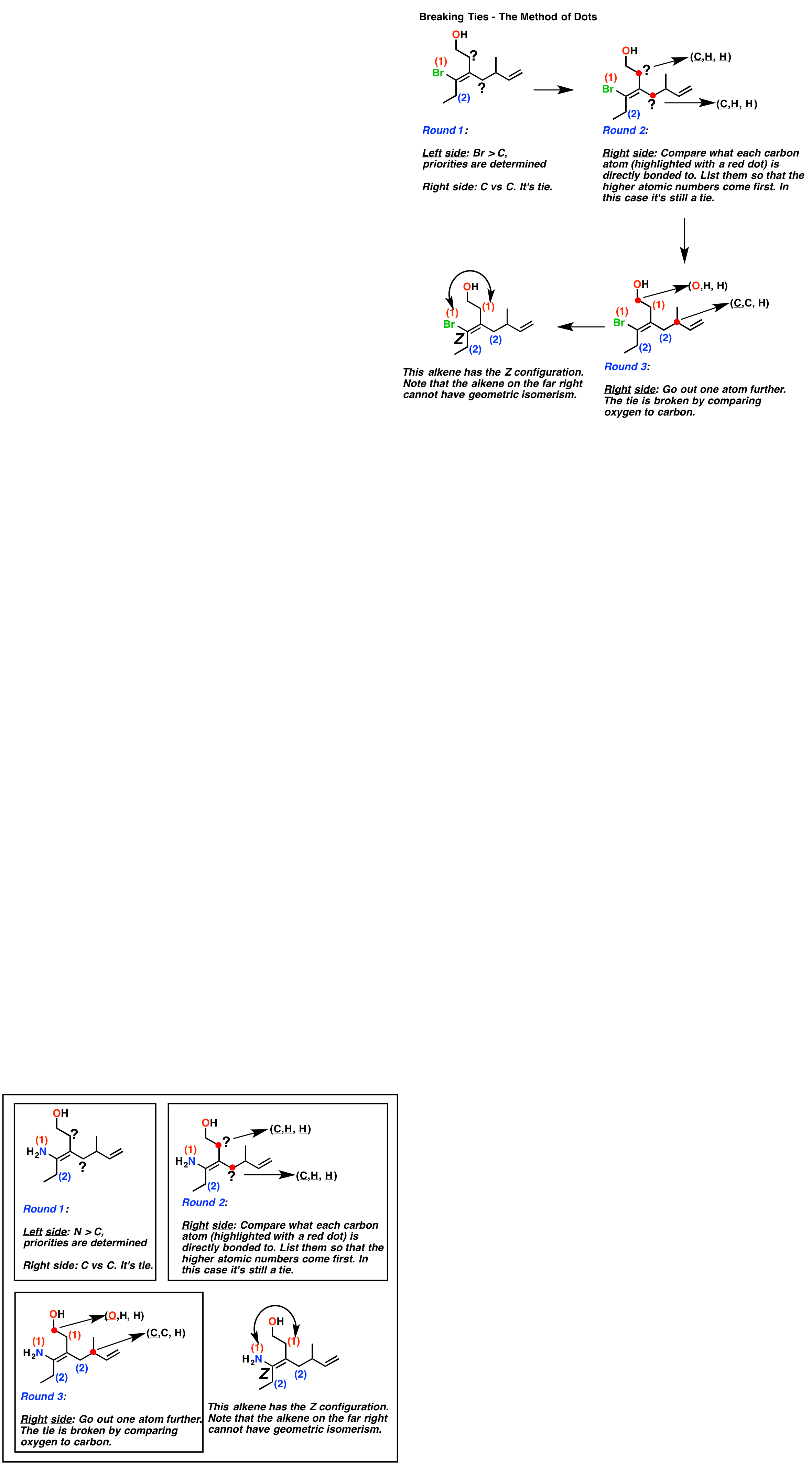
7. Breaking Ties: The Method of Dots

For instance, the alkene below presents us with a dilemma: one of the carbons of the alkene is attached to two carbon atoms. So how do we determine priorities in this case. How do we break ties?

breaking ties method of dots for complex alkenes e and z

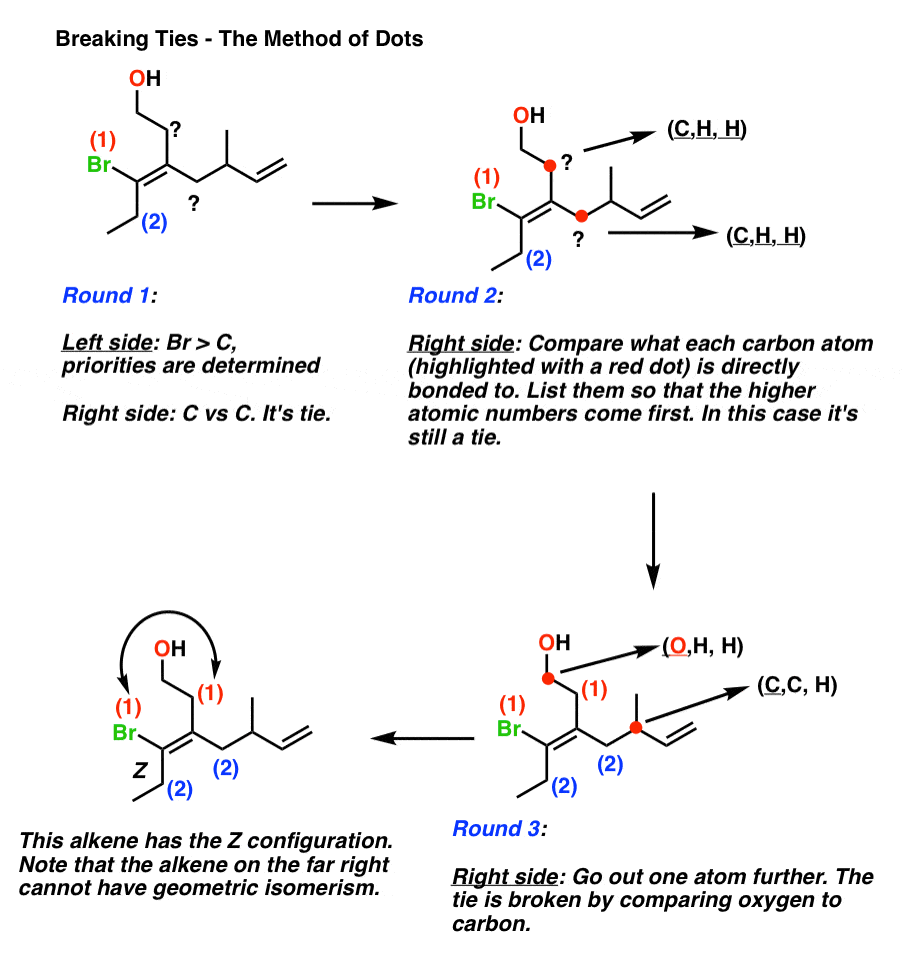
In the case of ties, we must apply the method of dots.  Dots are handy placeholders which is why I like to use this method.

  • Place a dot on each of the two atoms you are comparing.
  • List the 3 atoms each atom is attached to, in order of atomic number.
  • Compare the lists, much like you would compare a set of three playing cards. Just as a hand of (8, 8, 7) would beat (8, 7, 7), so would (C, C, H) beat (C, H, H).
  • If the lists are identical, move the dots outward to the highest priority atom on the list.
  • At the first point of difference, assign (E or Z).
  • If there is no difference… then the groups are identical, and E / Z does not apply.

Here’s a practical example of the “method of dots”. 
method of dots determining e and z breaking ties example

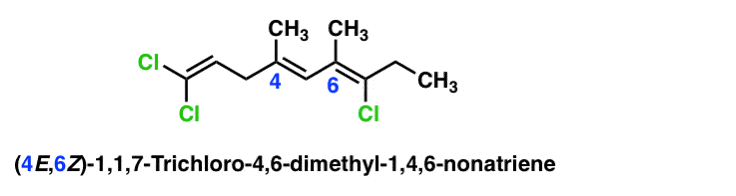
Here’s a more complex example with multiple alkenes. In this case each pi bond is designated by a number with its own separate E or Z configuration.

complex example of molecule with multiple alkenes with designated e and z configuration

OK, this was long. But hopefully useful.

Watch out for a future post in which we go into more detail on the “method of dots”.

8. Conclusion:  E and Z Notation For Alkenes

cis-trans-  is OK for describing simple alkene stereoisomers, but only works in certain cases. Furthermore,  it only gives relative configurations.  The E/Z system is comprehensive and describes the absolute configuration of the molecule.

See below for an example of an alkene which is “cis” and a Z alkene which is “trans”. 

Just a reminder: this post was co-authored by Matt Pierce of Organic Chemistry Solutions.  Ask Matt about scheduling an online tutoring session here.


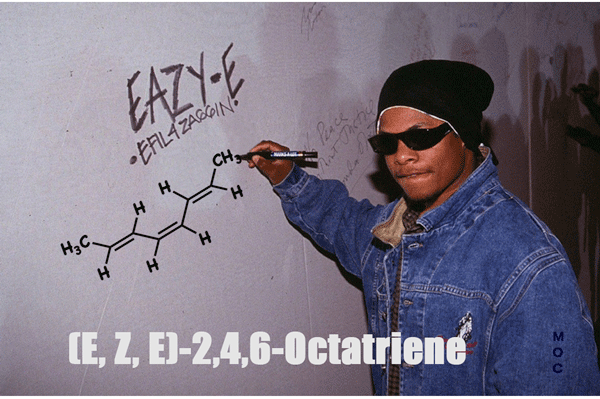
Eazy-E-teaches-E-and-Z-2E-4Z-6E-Octatri-2,4,6-ene-2 Notes

Related Articles

Note 1: It’s possible to have an alkene we’d describe as ‘cis’ be E and vice versa.

E/Z is the preferred, more comprehensive nomenclature since it describes absolute configuration, whereas cis- trans- merely describes relative configuration.

cis alkenes are not always z and trans alkenes are not always e

Note 2trans-cyclopropene, trans-cyclobutene, and trans-cyclopentene have never been synthesized or observed. trans-cyclohexene is a laboratory curiosity, stable at a few degrees above absolute zero. trans-cycloheptene has an extremely short half-life at room temperature. trans-cyclooctene is a stable molecule [it also exhibits axial chirality, which is interesting! ].


Quiz Yourself!

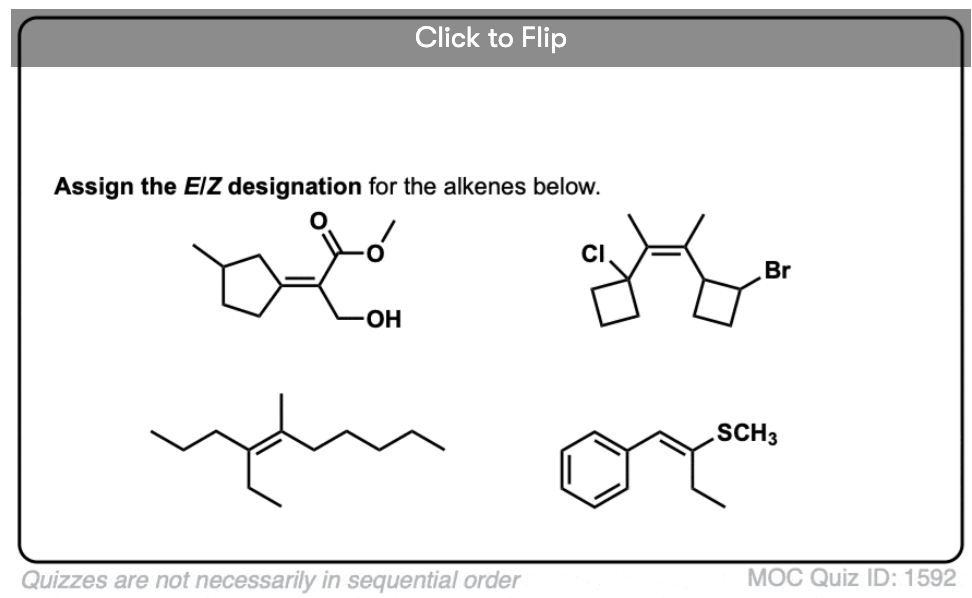
Become a  MOC member to see the clickable quiz with answers on the back.

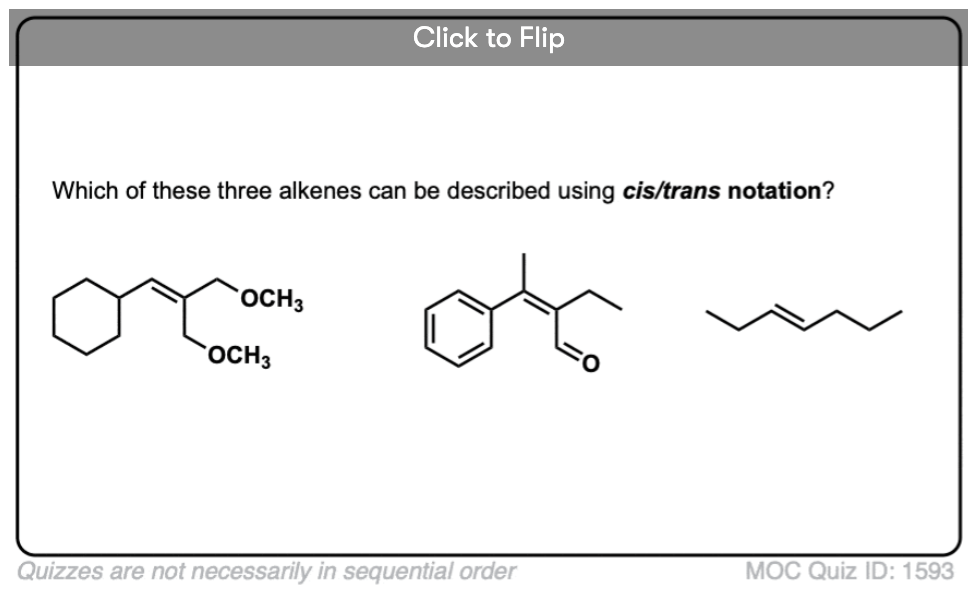
Become a  MOC member to see the clickable quiz with answers on the back.  

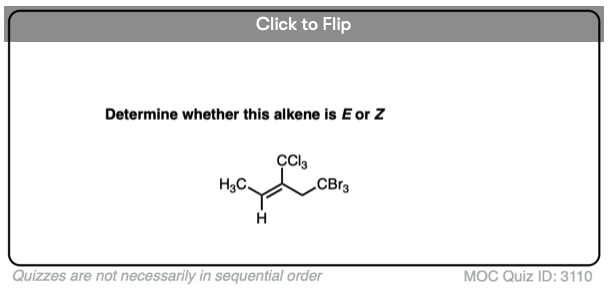
Become a  MOC member to see the clickable quiz with answers on the back.

Become a  MOC member to see the clickable quiz with answers on the back.

Become a  MOC member to see the clickable quiz with answers on the back.

Become a  MOC member to see the clickable quiz with answers on the back.

https://www.masterorganicchemistry.com/?p=10224
Extensions
Acetylides from Alkynes, And Substitution Reactions of Acetylides
Alkyne ReactionsacidityalkynesSN2spsubstitutionsynthesis
Alkylation of acetylides Terminal alkynes have unusually acidic C–H bonds (pKa 25). Treatment with a strong base such as sodium amide (NaNH2) gives an acetylide,
Show full content

Alkylation of acetylides

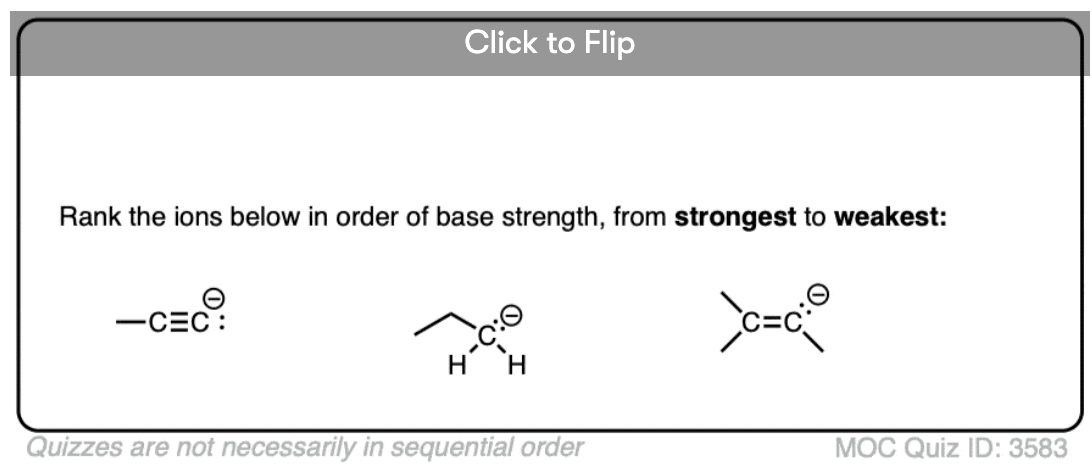
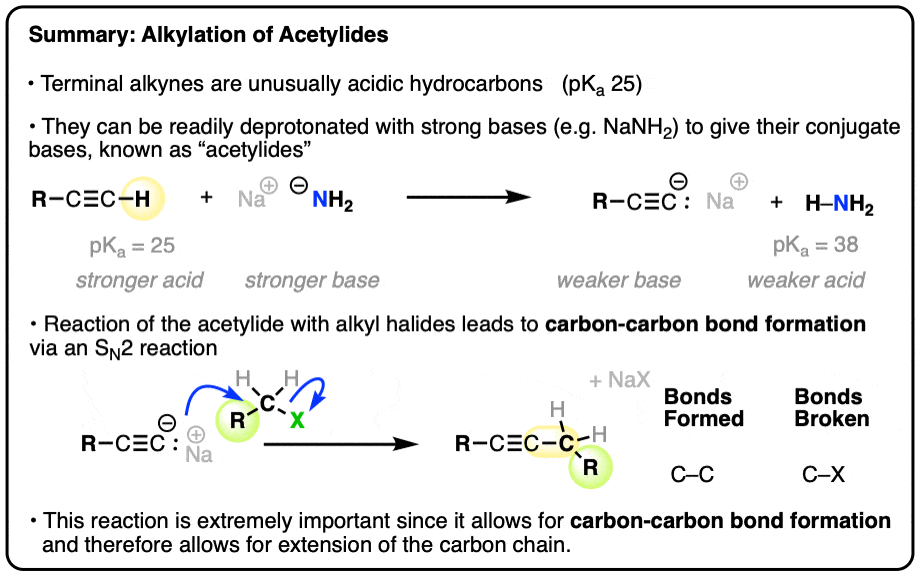
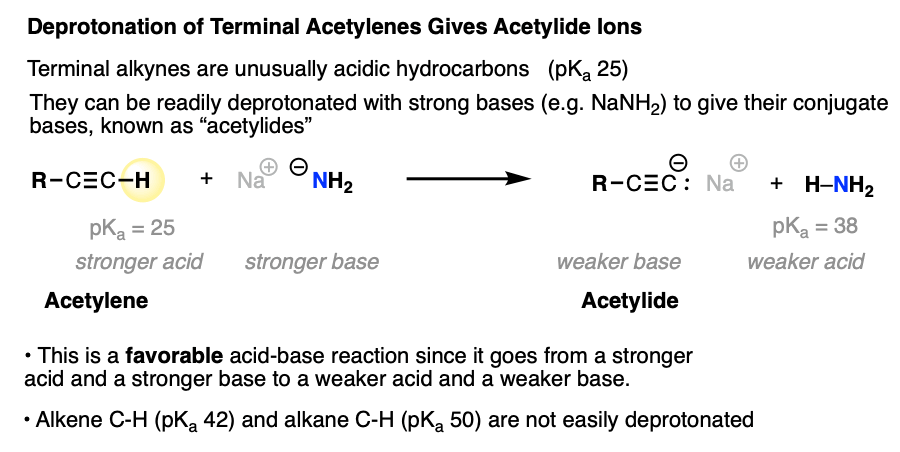
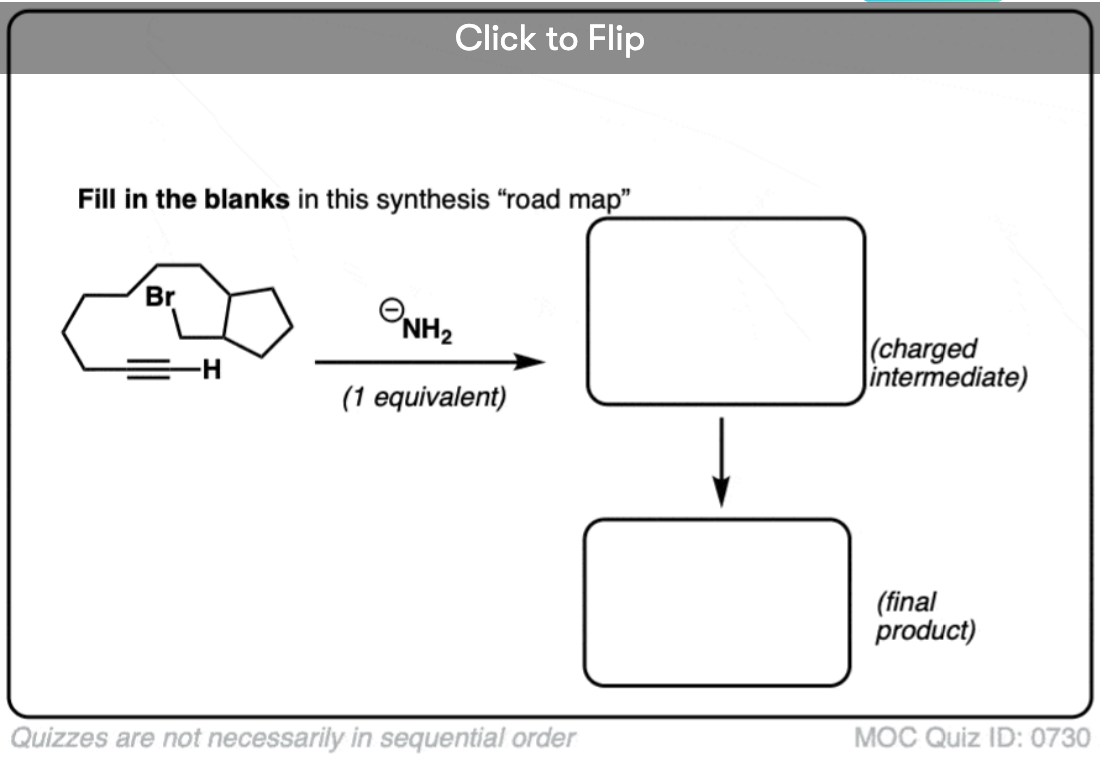
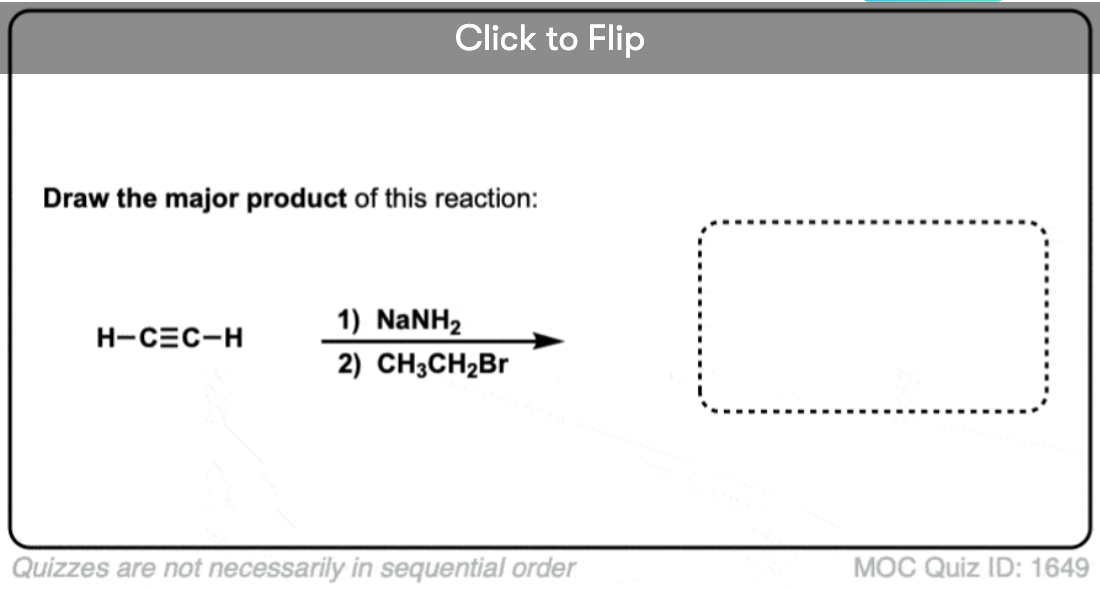
  • Terminal alkynes have unusually acidic C–H bonds (pKa 25). Treatment with a strong base such as sodium amide (NaNH2) gives an acetylide, the name for the conjugate base of a terminal alkyne.
  • Acetylides are more stable than the conjugate bases of alkenes and alkanes due to the fact that the lone pair is held in an sp-hybridized orbital which has 50% s-character. Since s-orbitals are held closer to the positively charged nucleus than p-orbitals, the electrons in this orbital are more stable (i.e. have less potential energy)
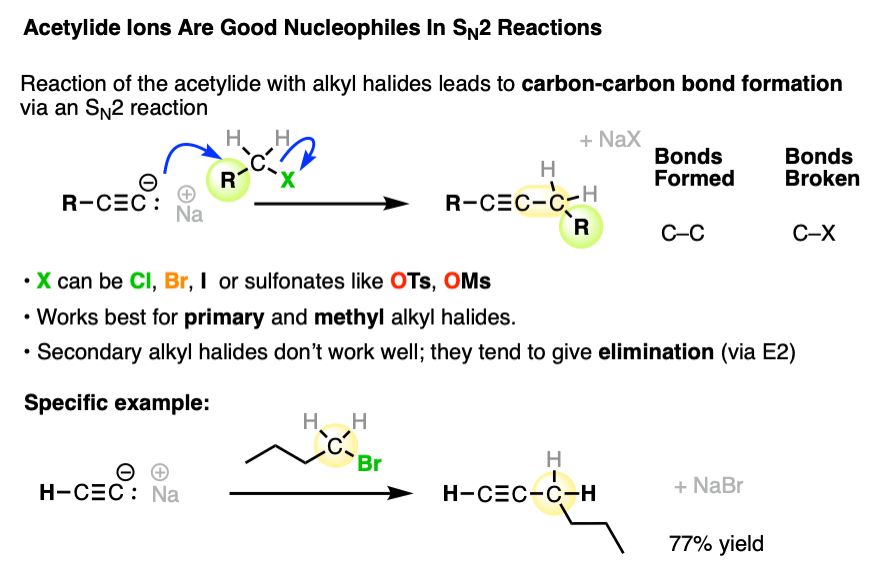
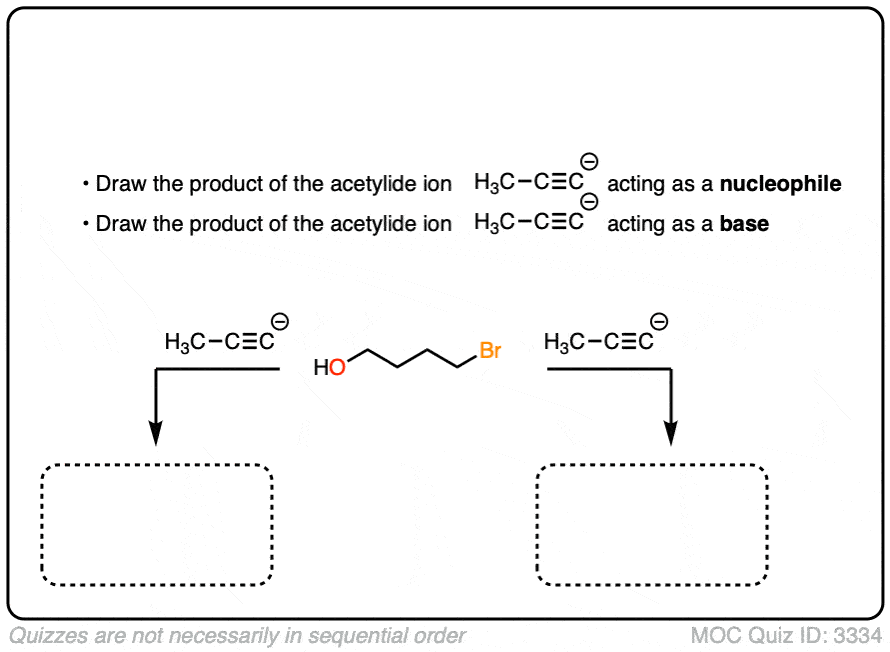
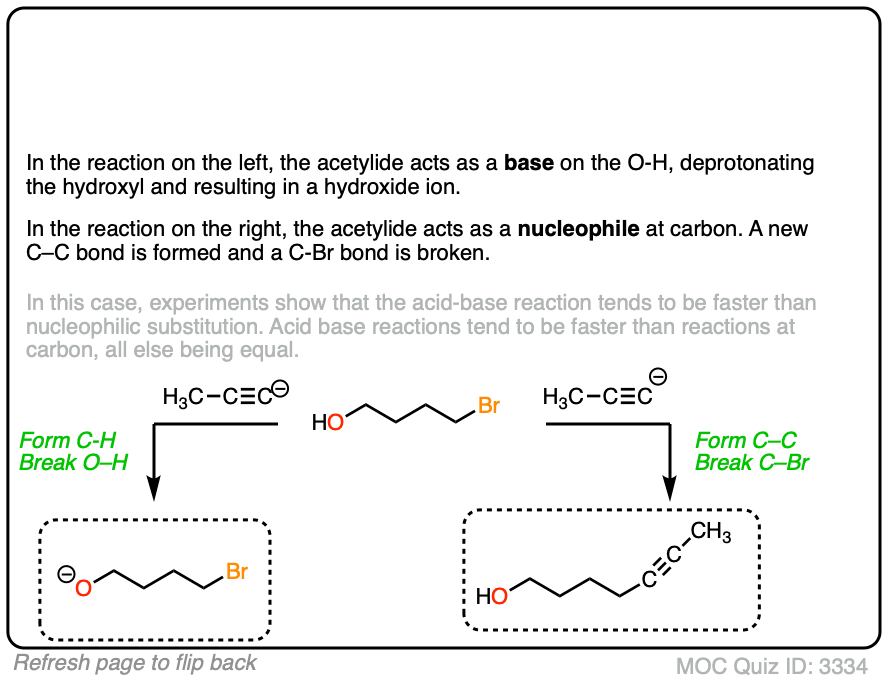
  • Acetylides are strong bases, but can also act as nucleophiles in nucleophilic substitution reactions (SN2) with alkyl halides to form substituted acetylenes.
  • These reactions work best for primary and methyl alkyl halides.
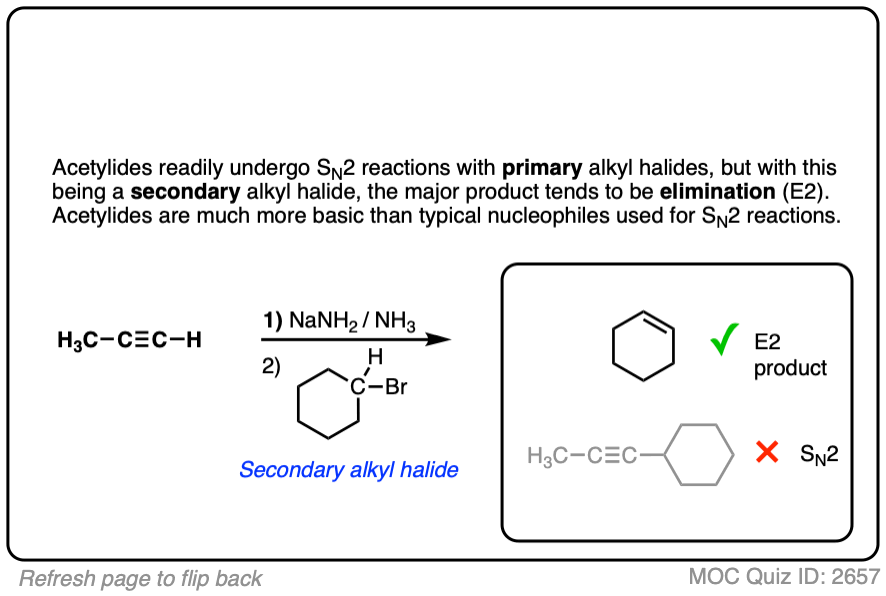
  • Attempts to form C-C bonds via SN2 reactions with secondary alkyl halides almost always results in elimination (E2) instead, due to the high basicity of the acetylide ion.
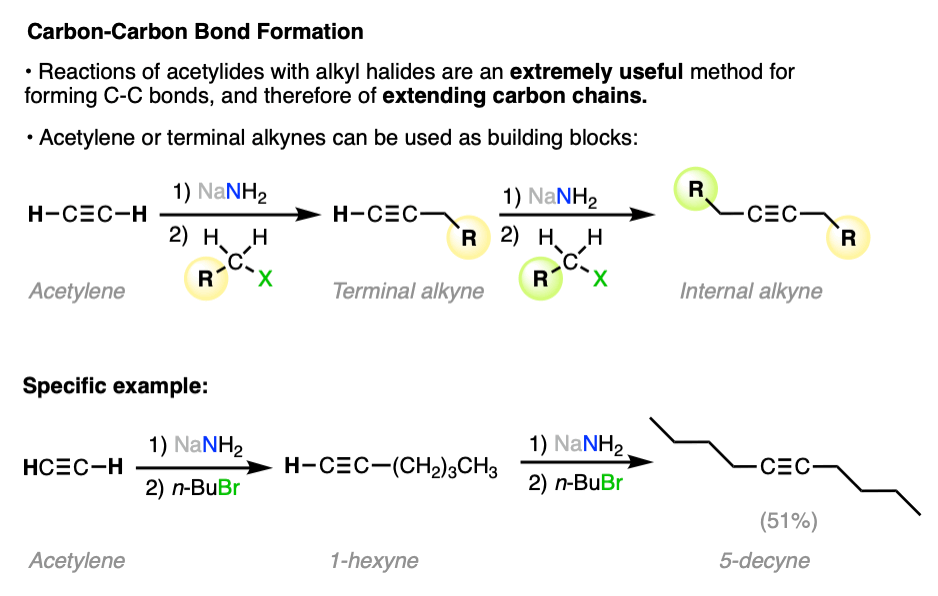
  • The reaction of acetylides with alkyl halides one of the most important reactions you will learn in first semester organic chemistry because it provides a versatile way of forming C-C bonds and extending the carbon chain.
  • This reaction is therefore a key entry point in planning the synthesis of various molecules, especially since the resulting alkynes can be hydrogenated to alkanes (and partially hydrogenated to alkenes, as we’ll soon see). [See article – Partial Hydrogenation of Alkynes to cis-Alkenes With Lindlar’s Catalyst]

summary- alkylation of alkyynes through deprotonation and reaction with alkyl halides

Table of Contents

    1. Terminal Alkynes Are Acidic!
    2. Alkylations of Acetylides With Primary Alkyl Halides: Finally, Some Carbon-Carbon Bond Formation!
    3. Alkylation of Acetylides – Some Practice Questions
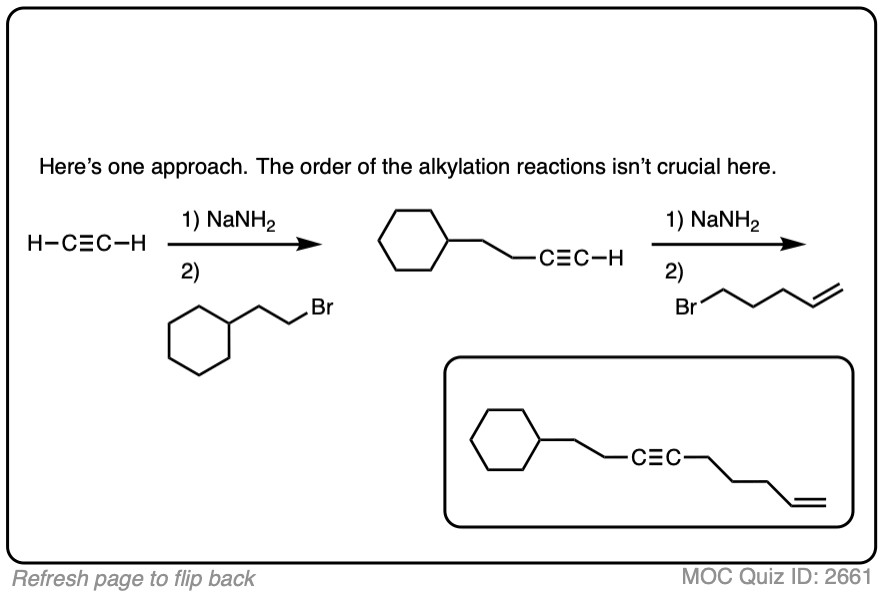
    4. Synthesis of Substituted Acetylenes – Practice Questions
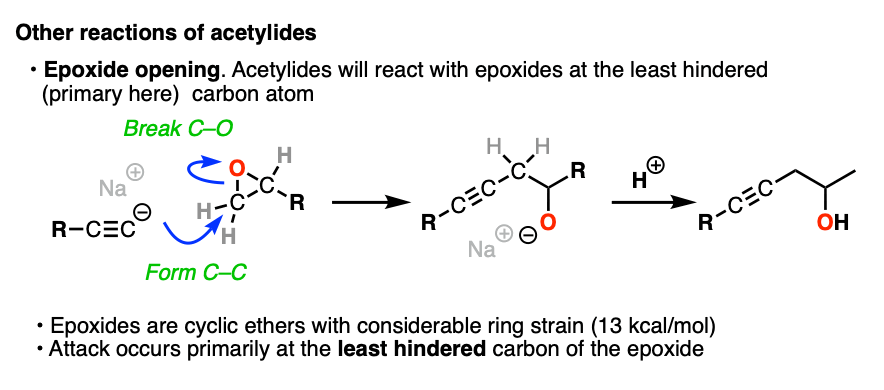
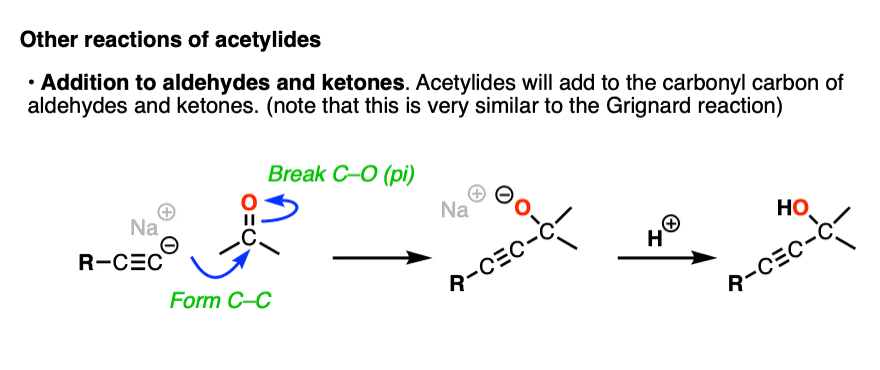
    5. Other Reactions of Acetylides – Epoxide Opening and Addition to Aldehydes/Ketones
    6. Summary
    7. Notes
    8. Quiz Yourself!
    9. (Advanced) References and Further Reading

1. Terminal Alkynes Are Acidic!

Among hydrocarbons, terminal alkynes have a very special property.  Their C-H bonds are unusually acidic (pKa 25).

The alkyne C-H bond is sp-hybridized. When C-H is deprotonated, the resulting carbanion is held in an orbital with 50% s-character. Since s-orbitals are closer to the nucleus than p-orbitals,  this means that the electrons experience greater stabilization from the positively charged nucleus than the conjugate bases of alkenes and alkanes.

Any factor which stabilizes a lone pair of electrons tends to reduce its basicity. (See article – Key Factors That Influence Acidity). In fact,  just thinking of “basicity” as a synonym for “lone-pair instability” can get you pretty far in organic chemistry! 
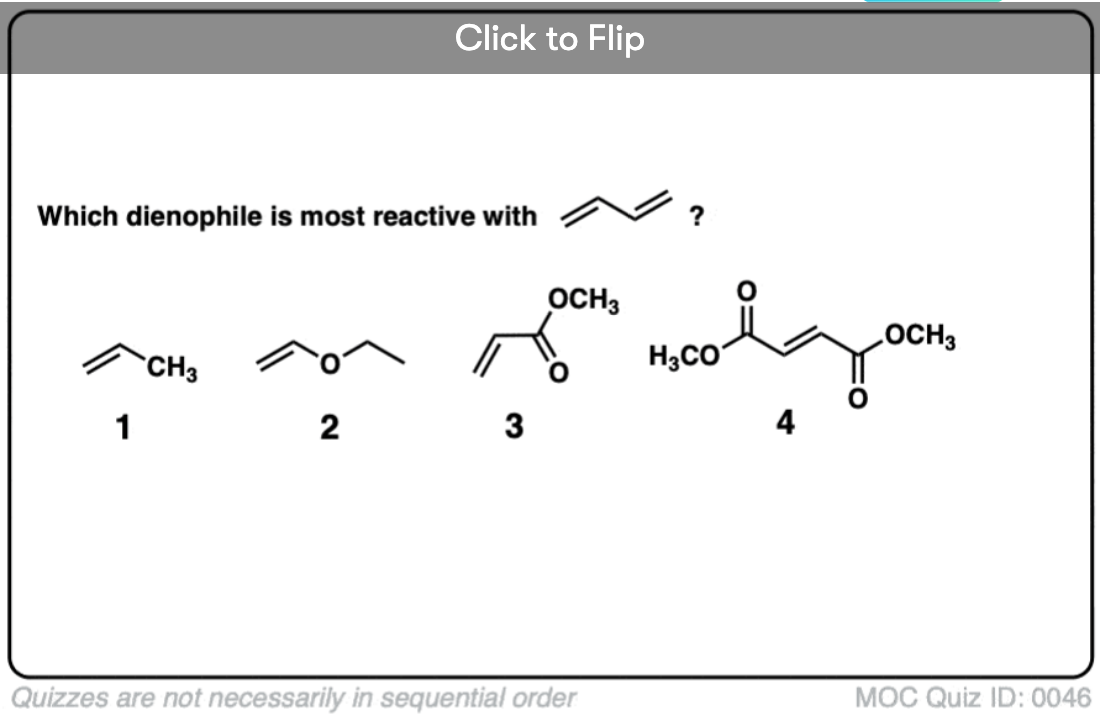
A common choice of base for deprotonating the C-H bond of acetylenes is sodium amide (NaNH2), often used in its conjugate base, liquid ammonia (NH3). NaNH2 can also be used to deprotonate the great-granddaddy of all alkynes, acetylene itself.   [Note 1]

Note – don’t confuse NaNH2/NH3  [strong base!]  with sodium in ammonia,Na/NH3  [reducing agent for triple bonds!]  [Note 2]

deprotonation of a terminal alkyne by nanh2 to give terminal acetylide

Acid-base reactions spontaneously proceed in the direction that gives weaker acids from stronger acids. (I lovingly call this the “Principle Of Acid-Base Mediocrity” – See article: How To Use a pKa Table).

Since we are proceeding from a stronger acid (terminal alkyne, pKa 25) towards a weaker conjugate acid (NH3, pKa 38) the acid-base equilibrium here will be favorable.

On the other hand, the acid-base reaction between NaNH2 and alkenes (pKa 42) or alkanes (pKa 50) is unfavorable since it would result in a stronger acid (NH3, pKa 38), as well as a stronger base. Remember – the stronger the acid, the weaker the conjugate base! 

2. SN2 Reactions of Acetylides With Alkyl Halides: Finally, Some Carbon-Carbon Bond Formation!

OK. So we can make acetylides. Now what?

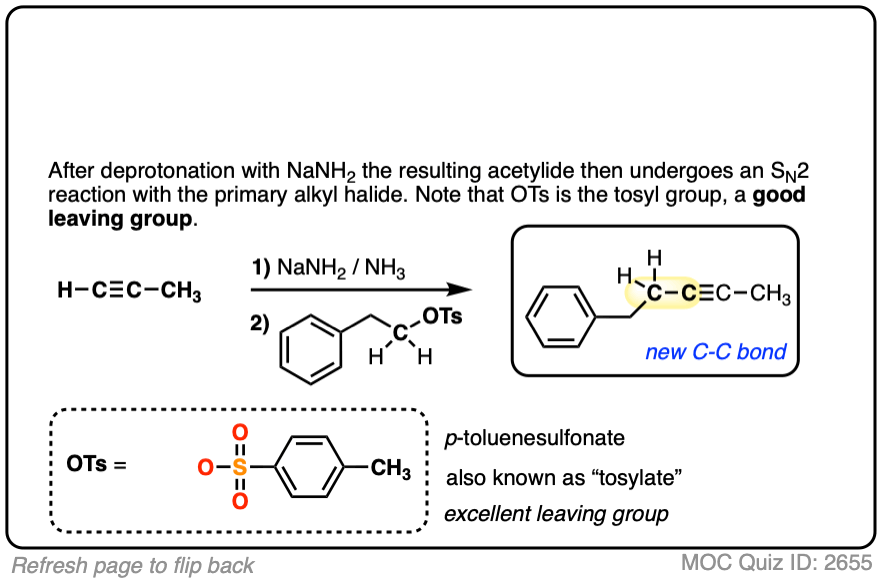
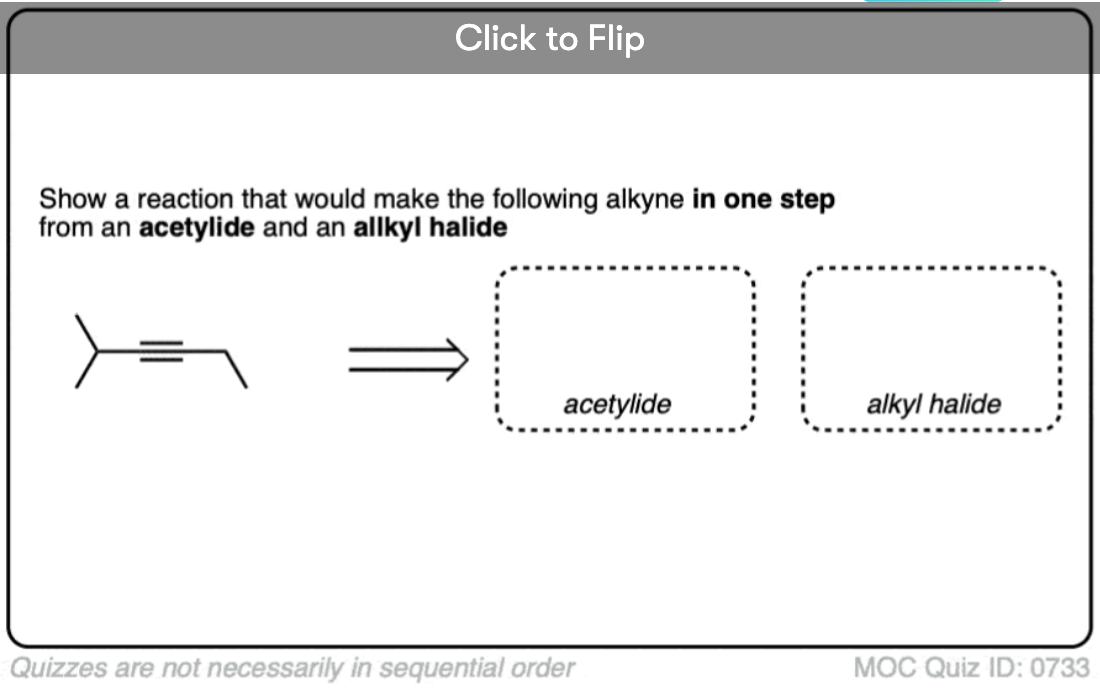
Well, acetylides are excellent nucleophiles.  They react with alkyl halides to give internal alkynes, in a reaction known as nucleophilic (aliphatic) substitution.

It is a substitution reaction because a new bond is formed (C-C) at the same carbon where a bond is broken (C-X, where X is a good leaving group). ( See article: What Makes a Good Leaving Group?).

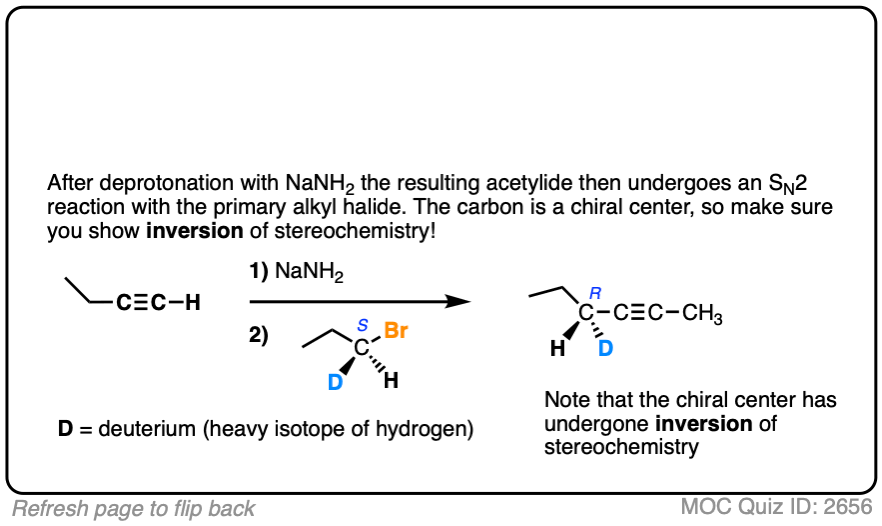
More specifically, the substitution proceeds through an SN2 mechanism (substitution, nucleophilic, bimolecular rate-determining step) since the C–C bond is being formed at the same time that the C–X bond breaks. The reaction occurs via donation of the nucleophile lone pair into the sigma* orbital of the C-X bond, often referred to as a “backside attack”. It results in inversion of configuration at the carbon, although inversion can only be observed with carbons bearing a chiral center. (See article: The SN2 Mechanism)

The reaction works best for primary (and methyl) alkyl halides due to their lack of steric hindrance.

terminal acetylides react with primary alkyl halides to give internal alkynes

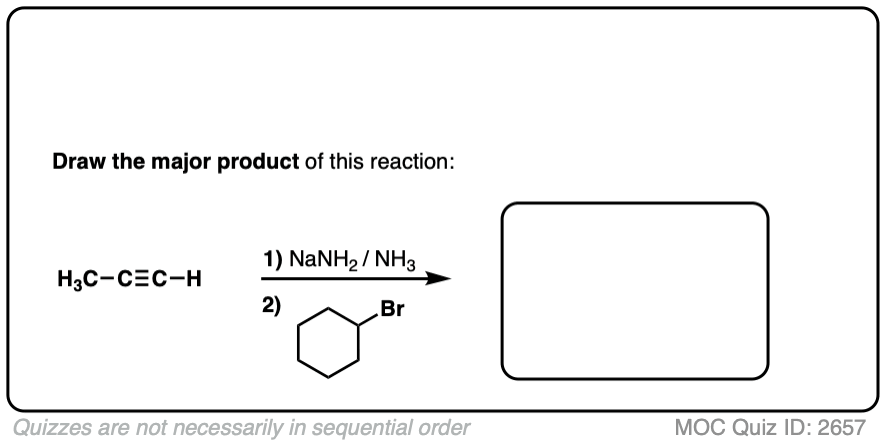
Secondary alkyl halides tend to give elimination (E2) instead of substitution, since there is more steric hindrance at a secondary carbon and acetylide is still a very strong base – even if it’s a weak base for a hydrocarbon!

All right. Perhaps you’ve already covered nucleophilic substitution reactions, and this reaction might not seem like such a big deal to you. Fair.

I would like to draw your attention, however, to the key bond that is formed in this reaction: C–C.

Up until this point, it’s unlikely you’ve covered any carbon-carbon bond forming reactions. If you’ve covered any at all, it might be the cyanide ion (e.g. NaCN) with alkyl halides. That isn’t so important for our purposes since we don’t cover reactions of cyano groups until later on in Org 2.

Since organic chemistry is ultimately the chemistry of carbon, having the ability to form a new C-C bond from a terminal alkyne via an SN2 reaction is huge because it allows us to plan the synthesis of essentially any linear hydrocarbon from acetylene, provided we can partner it with primary alkyl halide.

(Those primary alkyl halides can themselves be made from various reactions with acetylene, a point we’ll get to later in this chapter!). 

The example below, for instance, shows the synthesis of 5-decyne:

specific examples of internal alkyne formation from terminal alkynes and acetylide

This reaction is extremely versatile. Simply by changing the identity of the alkyl halide, we can  tack on pretty much any alkyl group we want –  so long as it’s primary – which gives us access to a huge variety of linear hydrocarbons!

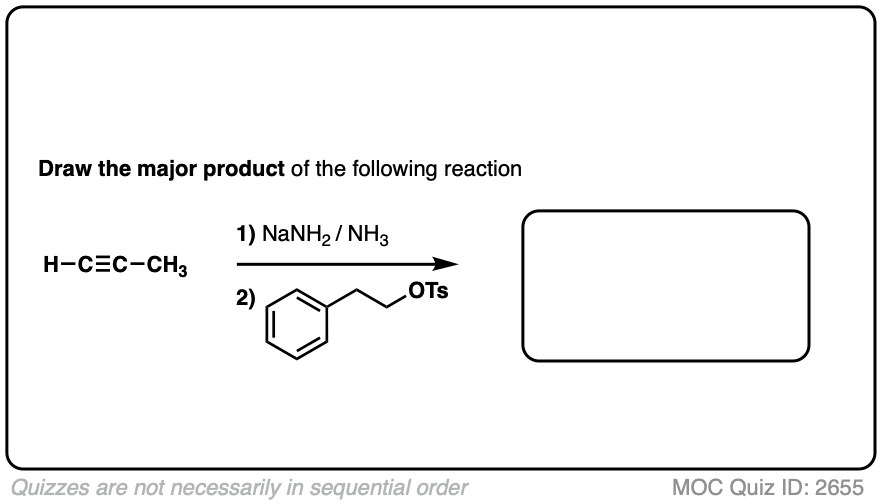
3. Alkylation of Acetylides – Some Practice Questions

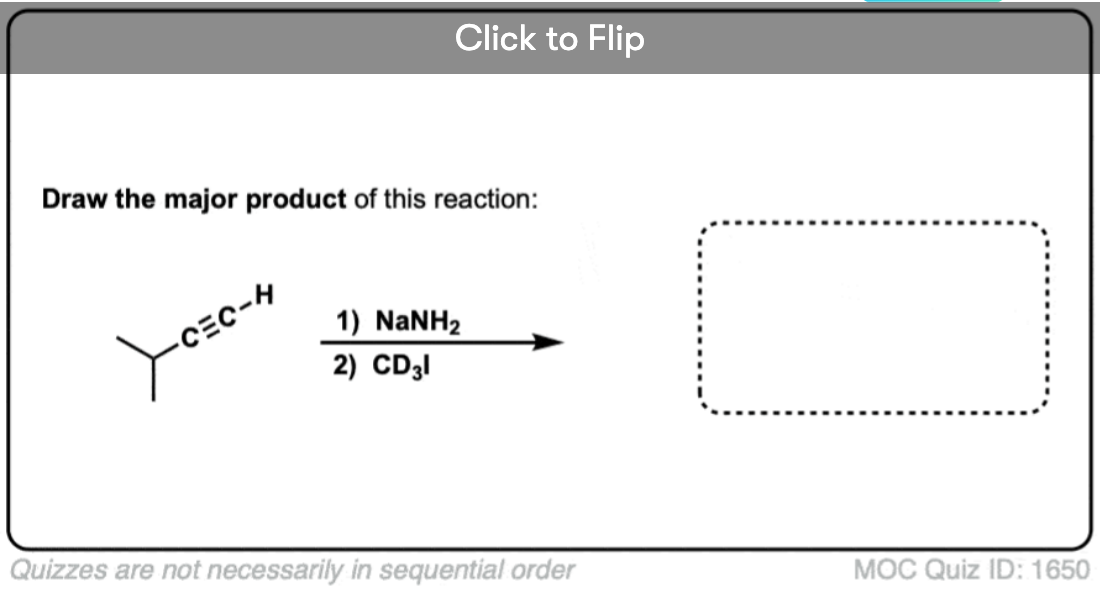
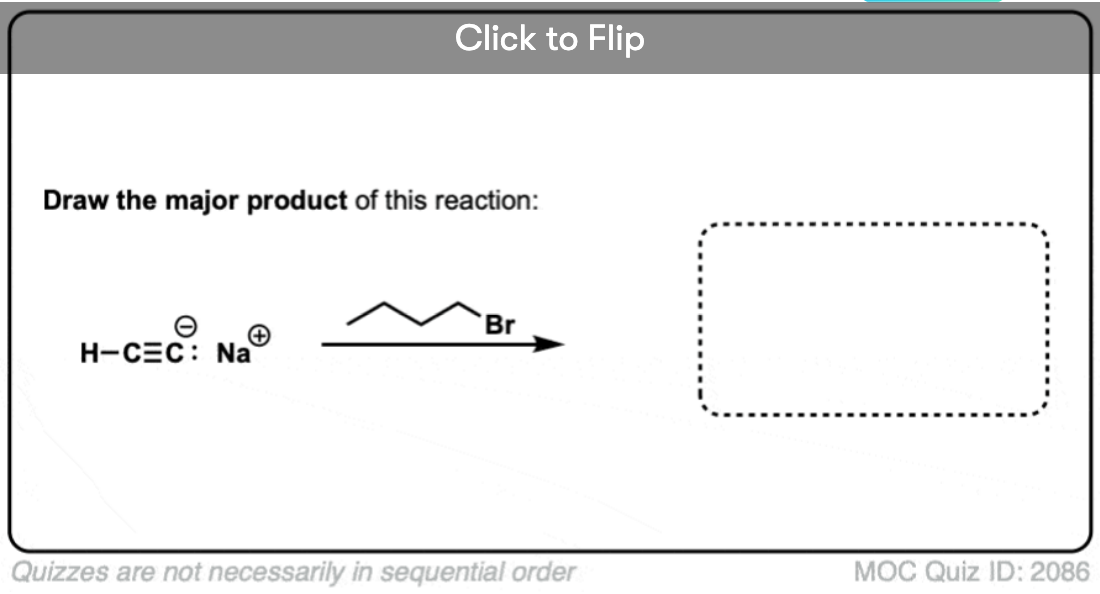
We’ll get to some synthesis applications a little further below. In the meantime, see if you can draw the product of this reaction:

.wq-quiz-wrapper[data-id="35923"] { --wq-question-width: 100%; --wq-question-color: #009cff; --wq-question-height: auto; --wq-font-color: #444; } .wq-quiz-wrapper[data-id="35923"] { --wq-question-width: 600px; } @media screen and (max-width: 600px) { .wq-quiz-wrapper[data-id="35923"] .wq_singleQuestionWrapper { width:100% !important; height:auto !important; } } Click to Flip

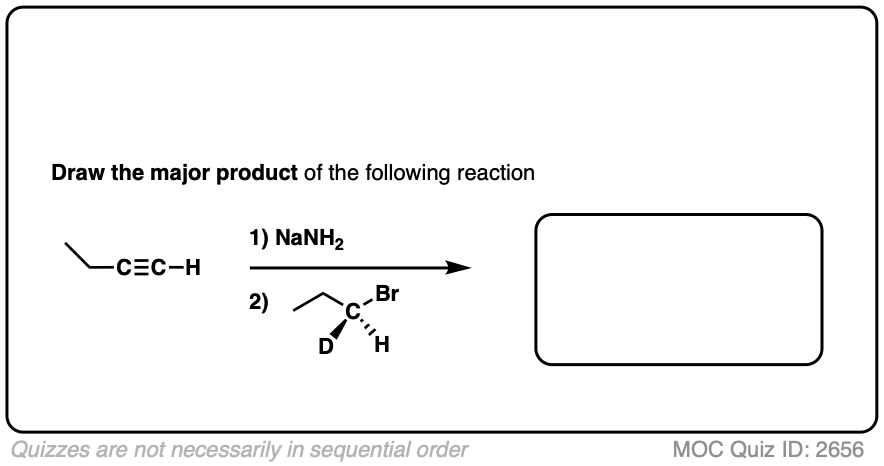
Here is another example of a reaction between an acetylide and an alkyl halide. Can you draw the product? (D is deuterium, the heavy isotope of hydrogen).

.wq-quiz-wrapper[data-id="35924"] { --wq-question-width: 100%; --wq-question-color: #009cff; --wq-question-height: auto; --wq-font-color: #444; } .wq-quiz-wrapper[data-id="35924"] { --wq-question-width: 600px; } @media screen and (max-width: 600px) { .wq-quiz-wrapper[data-id="35924"] .wq_singleQuestionWrapper { width:100% !important; height:auto !important; } } Click to Flip

Draw the product of the reaction below:

.wq-quiz-wrapper[data-id="35925"] { --wq-question-width: 100%; --wq-question-color: #009cff; --wq-question-height: auto; --wq-font-color: #444; } .wq-quiz-wrapper[data-id="35925"] { --wq-question-width: 600px; } @media screen and (max-width: 600px) { .wq-quiz-wrapper[data-id="35925"] .wq_singleQuestionWrapper { width:100% !important; height:auto !important; } } Click to Flip

In the reaction below, the acetylide is treated with an alkyl halide containing two leaving groups. Draw the product!

.wq-quiz-wrapper[data-id="35926"] { --wq-question-width: 100%; --wq-question-color: #009cff; --wq-question-height: auto; --wq-font-color: #444; } .wq-quiz-wrapper[data-id="35926"] { --wq-question-width: 600px; } @media screen and (max-width: 600px) { .wq-quiz-wrapper[data-id="35926"] .wq_singleQuestionWrapper { width:100% !important; height:auto !important; } } Click to Flip 4. Practice Questions – Synthesis of Acetylenes

As mentioned above in section two, the SN2 reaction between acetylides and alkyl halides means that we can build up pretty much any linear alkyne from acetylene, provided that we have the necessary (linear) alkyl halides.

The questions below ask you to show how you would synthesize internal alkynes from acetylene and alkyl halides.

Here’s one synthesis problem:

.wq-quiz-wrapper[data-id="35927"] { --wq-question-width: 100%; --wq-question-color: #009cff; --wq-question-height: auto; --wq-font-color: #444; } .wq-quiz-wrapper[data-id="35927"] { --wq-question-width: 600px; } @media screen and (max-width: 600px) { .wq-quiz-wrapper[data-id="35927"] .wq_singleQuestionWrapper { width:100% !important; height:auto !important; } } Click to Flip

A second, slightly more difficult synthesis question.

.wq-quiz-wrapper[data-id="35928"] { --wq-question-width: 100%; --wq-question-color: #009cff; --wq-question-height: auto; --wq-font-color: #444; } .wq-quiz-wrapper[data-id="35928"] { --wq-question-width: 600px; } @media screen and (max-width: 600px) { .wq-quiz-wrapper[data-id="35928"] .wq_singleQuestionWrapper { width:100% !important; height:auto !important; } } Click to Flip

More of the same thing!

.wq-quiz-wrapper[data-id="35929"] { --wq-question-width: 100%; --wq-question-color: #009cff; --wq-question-height: auto; --wq-font-color: #444; } .wq-quiz-wrapper[data-id="35929"] { --wq-question-width: 600px; } @media screen and (max-width: 600px) { .wq-quiz-wrapper[data-id="35929"] .wq_singleQuestionWrapper { width:100% !important; height:auto !important; } } Click to Flip 5. Reaction of Acetylides With Other Nucleophiles

Acetylides don’t just react with alkyl halides! They are versatile nucleophiles with other electrophiles as well, although you might not see some of these reactions until later in your course, or perhaps in the second semester of a two-semester course.

Epoxides are 3-membered cyclic ethers with considerable ring strain (about 13 kcal/mol) (See article – Epoxides, The Outlier of the Ether Family).  Acetylides will react with epoxides at the least substituted position to form new C-C bonds (See Article: Epoxide Ring-Opening With Base)

other reactions of acetylides include addition of acetylide ions to least substituted carbon of epoxides

Acetylides will also add to aldehydes and ketones through nucleophilic addition to the C-O pi bond. In this respect the reaction of acetylides is essentially identical to those of Grignard reagents.

addition of acetylide ions to aldehydes and ketones results in alchols

6. Summary
  • Acetylides react with primary and methyl alkyl halides to give new C-C bonds via nucleophilic substitution (SN2 mechanism).
  • They tend to give elimination with secondary alkyl halides.
  • This is an extremely important reaction for first semester organic chemistry, as it allows for formation of longer carbon chains from acetylene.

In the next article in this series, we will show how the triple bond of alkynes can be partially hydrogenated to give alkenes. (See article: Partial Hydrogenation of Alkynes to Give Alkenes)


Notes

Related Articles

Note 1. Conditions for the deprotonation of acetylene are here. Note that acetylene is a gas, so it has to be bubbled through a solution containing NaNH2 in ammonia. These days, it’s more common just to just purchase the conjugate base of acetylene (such as lithium acetylide, diethylamine complex) directly from a commercial supplier like Aldrich and weigh it out.

Note 2. By no means is NaNH2 the only base used for deprotonating acetylenes, it just seems to be the textbook reagent of choice. Grignard and organolithium reagents are also often used to form acetylides.


Quiz Yourself!

.wq-quiz-wrapper[data-id="41280"] { --wq-question-width: 100%; --wq-question-color: #009cff; --wq-question-height: auto; --wq-font-color: #444; } .wq-quiz-wrapper[data-id="41280"] { --wq-question-width: 600px; } @media screen and (max-width: 600px) { .wq-quiz-wrapper[data-id="41280"] .wq_singleQuestionWrapper { width:100% !important; height:auto !important; } } Click to Flip

Become a MOC member to see the clickable quiz with answers on the back.


Become a MOC member to see the clickable quiz with answers on the back.


Become a MOC member to see the clickable quiz with answers on the back.


Become a MOC member to see the clickable quiz with answers on the back.


Become a MOC member to see the clickable quiz with answers on the back.


Become a MOC member to see the clickable quiz with answers on the back.


Become a MOC member to see the clickable quiz with answers on the back.


Become a MOC member to see the clickable quiz with answers on the back.


(Advanced) References and Further Reading

This is a pretty standard acid-base reaction, driven by the acidity of the sp-H atom. The utility lies in that this is still a robust method of C-C bond formation, and a useful way to introduce alkynyl groups if desired.

  1. THE PREPARATION AND ALKYLATION OF METAL ACETYLIDES IN LIQUID AMMONIA*
    T. H. Vaughn, G. F. Hennion, R. R. Vogt, and J. A. Nieuwland
    The Journal of Organic Chemistry 1937 02 (1), 1-22
    DOI: 10.1021/jo01224a001
  2. PREPARATION AND USE OF LITHIUM ACETYLIDE: 1-METHYL-2-ETHYNYL-endo-3,3-DIMETHYL-2-NORBORNANOL
    Mark Midland, Jim I. McLoughlin, and Ralph T. Werley Jr
    Org. Synth. 1990, 68, 14
    DOI: 10.15227/orgsyn.068.0014
    I was initially a little surprised that something like this was published so recently in Organic Syntheses, but reading the discussion gives some context. The selective formation of the monolithiated species from deprotonation of acetylene is tricky.
  3. 1-PHENYL-1-PENTEN-4-YN-3-OL
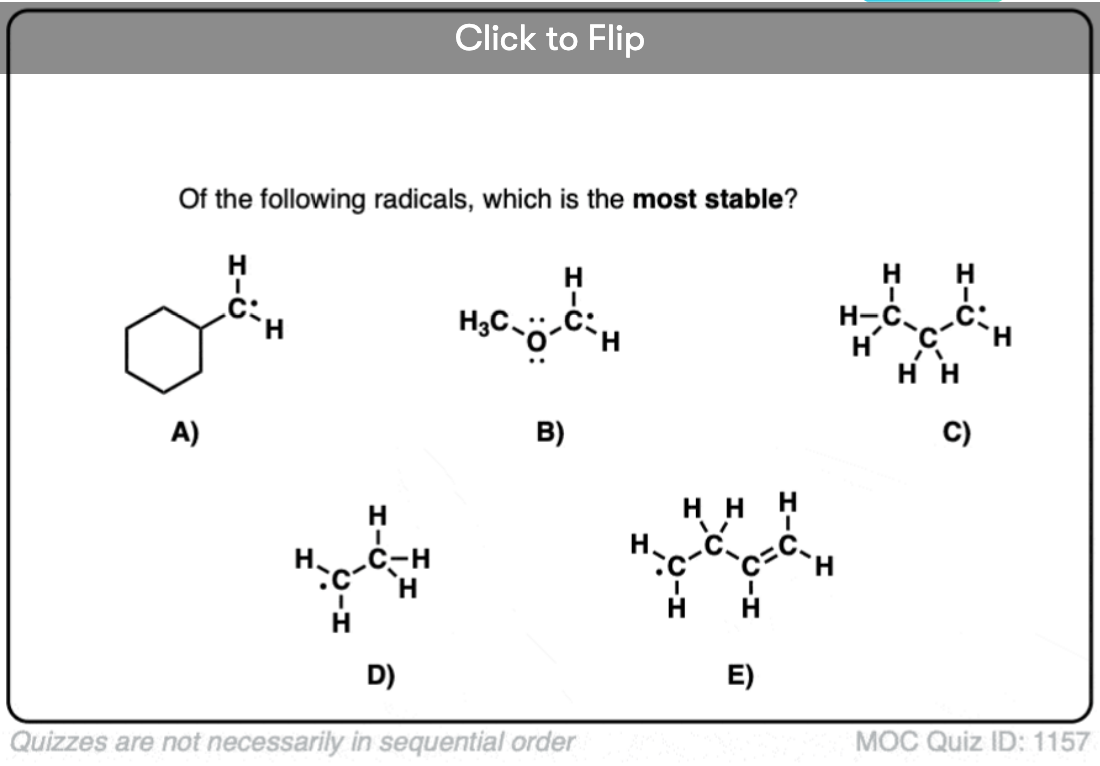
    Lars Skattebøl, E. R. H. Jones, and Mark C. Whiting
    Org. Synth. 1959, 39, 56
    DOI: 10.15227/orgsyn.039.0056
    Alkynyl Grignards can also be formed by deprotonation of a terminal alkyne with a Grignard reagent, as this procedure demonstrates.
  4. n-BUTYLACETYLENE
    Kenneth N. Campbell and Barbara K. Campbell
    Org. Synth. 1950 30, 15
    DOI: 10.15227/orgsyn.030.0015
    An extremely simple example of this reaction. The deprotonation is done with Na metal in liquid ammonia, and care has to be taken to avoid the conditions of dissolving metal reduction (the procedure states that the reaction should not turn blue)
  5. Synthesis of Unsymmetrical Alkynes via the Alkylation of Sodium Acetylides. An Introduction to Synthetic Design for Organic Chemistry Students
    Jennifer N. Shepherd and Jason R. Stenzel
    Journal of Chemical Education 2006, 83 (3), 425
    DOI: 10.1021/ed083p425
    A nice paper that describes the adaptation of this reaction for undergraduate teaching labs.
https://www.masterorganicchemistry.com/?p=7256
Extensions