Show full content
We're excited about the next evolution of Bloom! It's free to subscribe at Substack and receive biweekly content in your inbox. Join us!
bloomliterary.substack.com Continue reading →


In her forthcoming memoir, LONDON SOJOURN: Rewriting Life After Retirement, Rebecca Knuth writes about her shift from academic writing to creative nonfiction. LONDON SOJOURN is a bibliophile’s dream, offering avid readers a delicious outsider’s perspective on moving abroad using a literary lens. To fulfill her dream of writing creative nonfiction, and to satisfy her desire for a life of the mind, Rebecca enrolls in a two-year writing course at City University. More important, Rebecca discovers how thoroughly the mores of the twentieth century silenced women writers. She becomes a late blooming feminist and seizes her chance to give them voice in her City University Master’s thesis, determined to be heard herself. Please enjoy the excerpt below.

Excerpt from London Sojourn
By the time they died, two months apart in 1901, Victoria and Charlotte [Yonge]’s influence was attenuating, as witnessed by the lives of Edith Wharton and Virginia Woolf. Both were born in the Victorian era, struggled against its constraints as Edwardians (separating from their mothers and rebelling against social correctness), and achieved autonomy and fulfillment as writers in the twentieth century. They negotiated the treacherous terrain of sex, intimacy, and autonomy differently. Edith Wharton née Miller, born 1862 into a prominent New York family, was schooled in social correctness, passivity, asexuality, and learned ignorance (oops, sounds like me) and policed by a cruel mother who set off panic attacks. Her path to authorship was torturous. A shy, self-conscious debutante, Edith married an older man with whom she was intellectually and sexually incompatible. Ambivalence about social and domestic roles led to anorexia, asthma, and chronic fatigue. But marriage allowed Wharton to separate from her mother, to travel, and to write.
According to biographer Cynthia Griffin Wolff, Wharton’s struggle to become a novelist was inextricable from that of becoming a woman. Wharton’s private papers allow us to see how sexuality affected her writing. The elusive, philandering, bisexual journalist Morton Fullerton, her secret lover, would surface and then drop from sight. The highpoint of their affair was a clandestine encounter in the Charing Cross Hotel, which fronted a London railway station. In dingy Room 92, forty-five-year-old Edith Wharton achieved orgasm and felt profoundly connected to humanity. Next day, she wrote the poem “Terminus”:
And lying there hushed in your arms, as the waves of rapture receded,
And far down the margin of being we heard the low beat of the soul,
I was glad as I thought of those others, the nameless, the many,
Who perhaps thus had lain and loved for an hour on the brink of the world,
Secret and fast in the heart of the whirlwind of travel. . . .
Wharton, a tough-minded realist, ultimately broke off the clandestine affair with Fullerton. But she never forgot the encounter. “I have drunk the wine of life at last, I have known the thing best worth knowing. I have been warmed through and through never to grow quite cold again till the end,” she confided in her diary. She thereafter wrote of love from personal experience and went on to live a brave and spirited life.
On the Saturday afternoon when I penetrate what is now the Amba Hotel Charing Cross, my inquiries about the room that Wharton and Fullerton shared are met with blank stares. An older bellhop, here since the 1970s, states that there never was, or could have been, a Room 92. I hold my tongue. There’s no staff memory or lore available, but perhaps I was naive in expecting there would be. Wharton and Fullerton wouldn’t have been noticed in the early 1900s, and “Terminus” and biographical revelations weren’t published until much later.
Another staff member, younger, opens to the possibility, explaining that because of renovations, the room numbers haven’t always begun in the 200s. He leads me up an original staircase on which I imagine Wharton and Fullerton stole off to their tryst. The public rooms are beautifully renovated but the hotel seems contextless, despite a corridor hung with framed floor plans, a menu, photographs, and newspaper clippings. The impersonal display conveys little sense of the travelers who stayed here. I suggest the posting of “Terminus,” a photo, anything—perhaps in the hallway, or in the dining room where Henry James supped with his friends Wharton and Fullerton before catching a train and the curtain went up for the lovers. Oh, for a little explicit Edwardianism.
The hotel shares its listed facade with entrances to the train station. I ask my guide one last question: Can you hear trains in any of the hotel rooms? He says no, not even in the basement—so much for one biographer’s romantic notion that Wharton and Fullerton had made love to the noise of steam engines. The earth may have shook, but not from the trains. But, wait. I thought about these lines from “Terminus”: “as I woke & heard the calm stir of your breathing / Some woman has heard as I heard the farewell shriek of the trains.”Maybe steam engines were noisier than modern trains. The oft-renovated Amba Hotel Charing Cross may now be insulated from trains, cohabiting with the station without intimacy, but may not have always done so.
If this affair had become public, her reputation and literary career would have been irreparably damaged, doors slammed shut, and honors withheld. And yet she dared. That’s a long way from the neurotic passivity of the early years of her marriage, from her conflicted performance of seemly womanliness. Charing Cross was the roll of the dice in favor of self-determination and modern womanhood by a canny woman who carefully claimed her sexuality and her talent.
Another brave thing Wharton did was to preserve her diaries on the affair, although her executors sequestered them in closed archives for years. Among the released papers was the stunning and graphic “Beatrice Palmato,” a seriously sexy unpublished portrayal of incest between father and daughter. Where did that come from? Virginia Woolf was subject to incest (by her stepbrother). Was Wharton abused as well?
Wharton’s biographer Katherine Joslin makes points that hit the mark with me. Because all the men in her life failed to provide her with a viable traditional way of being a woman, Edith had the time and independence to forge a creative and fulfilling life. Joslin quotes feminist Caroline Heilbron: “It is perhaps only in old age, certainly past fifty, that women can stop being female impersonators, can grasp the opportunity to reverse their most cherished principles of ‘femininity.’” They can forge a story without romance and marriage at the center, can take advantage of independence, a secure income, and nurturing friends.
I see parallels between my life and Edith Wharton’s. She kept her passion for men under control as I have. We both chose men that didn’t hinder our ability to write. Yet, we allowed ourselves love and sex. Edith took calculated risks and used the experience with Fullerton in her writing, to stimulate her imagination, while going on to create a good life with close friends, traveling, feeding refugees during the First World War (for which she received a medal from the French government), and creating beautiful gardens. I have had a full, productive life as well. It is in Wharton’s autobiography that I come across a vision of sustainable living, even into old age: “In spite of illness, in spite even of the archenemy sorrow, one can remain alive long past the usual date of disintegration if one is unafraid of change, insatiable in intellectual curiosity, interested in big things, and happy in small ways.”
© 2026 Rebecca Knuth
#


Rebecca Knuth is a retired professor and expert on censorship and cultural destruction. Formerly at the University of Hawaii, she authored Libricide: The Regime-Sponsored Destruction of Books and Libraries in the 20th Century and has contributed to Smithsonian Magazine, Cabinet, History News Network, CBC Radio, and more. Transitioning to creative nonfiction, she earned another master’s degree, her third, to add to her doctorate, and immersed herself in London’s literary scene. Now a full-time writer, she published Emily Dickinson Had to Have Curls in 2024. She lives in Portland, Oregon where she coordinated the Sylvia Beach Writers Conference as part of the Oregon Writers Colony. Learn more at rebeccaknuth.com
Photo © to Sari Singerman


Liz Ross spoke with Ellen Birkett Morris about her award-winning debut novel.
Liz Ross: First, congratulations on Beware the Tall Grass. Your novel centers around the Sloans, a family grappling with their young son’s troubling memories of a past life as a soldier in Vietnam. You weave their story with one that unfolded decades earlier, when Thomas Boone, a young man caught up in the drama of mid-sixties America, was sent to war. I was intrigued by the idea that there are children who experience past life memories. What inspired you to explore this?

Ellen Birkett Morris: In 2014, I was on a road trip with my husband and heard an NPR story on the University of Virginia Medical Center program that attempted to corroborate the past life stories of young children with the experiences they describe. These children talk about being in war, the Holocaust, and being present during terrorism. The researchers would hear the stories and look at news accounts and records to see if they matched the details of the story the children told. A surprising number of times they did match.
I’ve had this sense about growing up, that the life we expect often isn’t the life we get. Certainly this is the case for the children who have these memories, and for their parents. Parents think of children as a blank slate they’ll be able to fill with happiness. So it appealed to me on that level, imagining a kid carrying around these heavy memories, and parents trying to navigate them. It’s an example of the inevitable challenges we face, things we don’t expect that change our lives.
LR: Would you talk a bit about the title of your novel?
EBM: The phrase came to me, Beware the tall grass, nothing good ever happens there as I was writing a scene where Thomas has to make a difficult choice. Tall grass shows up several times in the book. It represents those dangerous areas where we can’t see what is coming next.

LR: Can you talk a bit about your character Thomas, and his decision to enlist during Vietnam?
EBM: He’d lost his horse, Beau, who was his best friend. He was depressed and couldn’t imagine his life on the ranch without Beau. I also think he was sold a bill of goods. He was looking for connection and the Army recruiter said he’d be with a band of brothers. He imagined this was the answer to his problems with no real sense of what it would mean to be sent to a war zone. In my research I came to understand that these young men were taken out of factories and farms with no real sense of what they were getting into. Their only reference point for war was WWII, which was a completely different sort of conflict.
LR: Thomas is a gentle person. Can you tell us a bit about what it was like for him, being in a war zone?
EBM: In many ways he was a complete innocent, but he was also a kid who had a deep sense of integrity. I wanted him to be a gentle, animal-loving soul in an unexpected situation. The more I’ve written, the more I’ve realized that the craft of coming up with a story is largely about establishing a character and then creating situations that push back on their core qualities and beliefs. So I’m going to take this kind, animal loving kid and put him in this situation where he is asked to do horrific things. I was reminded of advice I received in a workshop, to start where the pain is, so that is what I did.
I’m largely a skeptic, but this is definitely a phenomenon that affects some folks and I’m not sure we can fully understand where it comes from.
LR: Decades after the Vietnam War, Thomas’ memories surface in the Sloan’s young son, Charlie, who is traumatized by them. Can you tell us a bit about this?
EBM: Charlie’s memories were a great way to push back on Eve Sloan’s desire to give Charlie a perfect childhood. Since I’ve written the book people come up to me with all kinds of stories about their children, their siblings, or themselves. I’m largely a skeptic, but this is definitely a phenomenon that affects some folks and I’m not sure we can fully understand where it comes from.
LR: This November marked the 60th anniversary of the Vietnam War. What would you like people to be thinking about as we mark this milestone?
EBM: So many people were touched by the war. I would love for us to remember, with some degree of appreciation, the sacrifices and challenges faced by the people who served. While the war was a real hot button issue, and there was protest and opposition, I would like us to look back with compassion and understanding at the complexity of the conflict, for those whose lives were changed by it, both here at home and in Vietnam.

Ellen Birkett Morris is the author of Beware the Tall Grass, winner of the Donald L. Jordan Award for Literary Excellence, judged by Lan Samantha Chang, published by CSU Press. She is also the author of Lost Girls: Short Stories, winner of the Pencraft Award and finalist for the Clara Johnson, IAN and Best Book awards. Her fiction has appeared in Shenandoah, Antioch Review, Saturday Evening Post, and South Carolina Review, among other journals. Morris is a recipient of an Al Smith Fellowship for her fiction from the Kentucky Arts Council.
Liz Ross has an MFA from the Program for Writers at Warren Wilson College, several publications in LEON Literary Review, and lives in Southern California where she is at work on a novel.


Sarah Christie spoke with returning Bloomer Sharon White, whose second novel If the Owl Calls is out today from Betty.
Sarah Christie: Congratulations, Sharon, on the publication of If the Owl Calls. The sweeping descriptions of the frozen landscape in this novel are so evocative. What did the research for this book look like?

Sharon White: I loved doing research for this book. I lived in northern Norway a couple of years after I graduated from college and returned several years later, but I wanted to experience Oslo and the Arctic north again as I was writing If the Owl Calls. I spent time in Oslo to get a sense of the geography and landscape for Hans Sorensen. From Oslo, I traveled to northern Sweden on a train and bus to see the landscape where Johan Turi wrote Turi’s Book of Lappland. I had a residency in the far north of Sweden in a painter’s summer house.
After I discovered that the Danish translator of Johan Turi’s book was Emilie Demant Hatt, I became curious about her life. I travelled to northern Denmark where she grew up, and I lived for a month on an island off the coast of Denmark near where she spent time in an artist colony. I saw many of her paintings in Stockholm and learned more about her through several curators and writers in Denmark and Sweden who had also become fascinated by her story.

SC: One of the primary characters, Hans, has Sami ancestry, and the exploration of that culture is central to the book. How did you come to include and shape his character?
SW: During my time in Norway I lived in a Sami village. I fell in love with the place and almost moved to Finnmark years later but decided the long winters would be too difficult for me, and then my life swept me away.
Hans left the north when he was quite young to live a very different life working for the government in Oslo as part of the Norwegian Police Service. He believes he’s protected himself from some of the painful memories of his childhood and adolescence, but the death of his wife has already made him more vulnerable. When the case he’s working on takes him back to the village where he grew up, instead of someone who’s part of the fabric of the community his police status exposes him to the disapproval of his family. He leaves the identity of the person he’s become in Oslo. Almost immediately, he understands when he interviews Olav Elstad, one of the suspects who is from a nearby town and knows his family, that another version of himself is alive in the past. Unlike in Oslo, the Sami community where he grew up has a web of stories connecting everyone in the village. Hans doesn’t fit into that past now, and his wife Astrid’s death has destroyed his carefully constructed persona, cut off from his family.
SC: How did you decide to split the perspectives between Hans and Kathryn? Did the story always have a dual POV?
One of the reasons I started writing this book … was the rapid transformation of the Arctic region from climate change. Often people imagine the Arctic region as empty and barren. In Alaska, the Arctic National Wildlife Refuge is constantly under threat. It’s an incredibly beautiful fragile place.
SW: I took many years to write this novel. I started with Kathryn’s story. I had a corpse in the wild river near the village where Kathryn lived but no detective. The story evolved when Hans appeared. For a while I had several points of view and finally whittled the narrative down to just two. Emile Demant Hatt’s letters were a much larger part of the story at one point, and Kathryn’s fellow foreign worker, Gunter, also had a point of view. It was hard to know at first where the center of the book was and how the threads should connect. The structure became more obvious once I simplified the voices. Hans eventually took over the plot and Kathryn became a piece of that story. I experimented with the timelines and flashbacks before the final draft. I wanted the reader to be able to see the characters from two different perspectives and for the plot to come together at the end.
SC: How does your extensive travel influence your work? Where and how do you find inspiration when in foreign places?
My first husband died when he was young, and I know how difficult it is to restart your life. Hans grapples with the death of his wife throughout the novel. He’s spent months feeling numb after Astrid’s death, locked into his grief and unable to see beyond the weight of his loss.
SW: I always wanted to be a writer and wrote plays and poetry when I was very young. I think the idea of going away, either in books or on foot to the woods at the end of our street in Waterbury, Connecticut, was my goal. Travel to Norway was the spark for much of my work after college. I wanted to go as far north as possible after a detour to Oregon in my early twenties. I heard about a program while I was there that placed international workers on Norwegian farms.
Even Philadelphia was a new place when we moved here. Looking at gardens helped to give me a sense that in the city I could still discover the wild edge of things. I taught in Japan for a summer and wrote my novel, Minato Sketches, in the blazing summer light there. Along with going to a new environment, exploring a place because it’s important to whatever project I’m working on keeps me alive as a writer. My new collection of poetry that will be published next year was inspired by my time on Shetland and the Shetland language. I had a residency there when I was researching Emilie Demant Hatt’s travels and the book grew out of that time.
SC: The environmental activism at the heart of the novel reminded me of Richard Powers’ The Overstory. I felt that this novel was similarly shaped around the push-pull of the natural world and human interests (both for protection and expansion). How did the natural world inspire this writing?
SW: One of the reasons I started writing this was the rapid transformation of the Arctic region from climate change. Often people imagine the Arctic region as empty and barren. In Alaska, the Arctic National Wildlife Refuge is constantly under threat. It’s an incredibly beautiful fragile place.
When I was in Finnmark, several people in the village where I lived were involved in a movement to recognize Sami culture and rights after years of discrimination by the Norwegian and Swedish governments. The protests at the proposed site of the Alta dam were part of larger global protests against the destruction of indigenous communities. I had seen how important salmon fishing and reindeer herding were where I lived. The rapid transformation of the Arctic region from climate change echoes the historic threats against the Sami community. The Alta dam protests were an important movement against the government and helped publicize Sami issues and rights. The years of protests didn’t stop the project, but a Sami parliament was established in 1989. Unfortunately, there are still many threats to the ecosystem in Finnmark. Recently, for example, the BBC had an article about the area. The reporter visited Kirkenes in the far north of Finnmark where the pressure of foreign investment in a trans-shipment port is an example of the possibility of destructive development from governments, businesses, tourism, greed.
SC: What texts, films, art did you draw inspiration from during the writing process?
I reread a 1966 reprint of E. Gee Nash’s English translation of Johan Turi’s Muitalus Sámiid Birra. I also read Thomas A. DuBois’ 2011 translation of Mikael Svonni’s new edition called An Account of the Sámi. Emilie Demant Hatt’s paintings in the Nordiska museet in Stockholm brought her time in the north alive for me. A Danish friend translated some of her letters for me, and this helped me with the sound of her voice. I watched countless murder mystery series on foreign language streaming services.
Hans understands … that another version of himself is alive in the past.
P. D. James’ complex characters and multiple plot lines inspired me, along with Tana French and her ability to highlight the physical reality of her characters. I looked closely at Kate Atkinson’s work and the clever way she structures her novels, knitting the pieces of the story together through images.
SC: There is something meditative about the adventures on skis. When Hans skis with his father and Sara, his ability to notice the natural beauty around him is enhanced; a waterfall, a falcon’s nest, a pink sunset swirling.
This juxtaposes with the environmental stance we encounter at the beginning of the novel, that “he would’ve loved a ski track lit up through the darkest months” even if it means destruction to a Sami village and way of life to achieve it. How do you think the character’s stances on the environment and their ways of living changed depending on location? How is this different for Hans compared to Kathryn?
SW: Hans has already started to pay more attention to the natural world in Oslo through watching birds, something he wasn’t interested in before his wife’s death. This connects him to another world outside his grief. The birds are practical. They hunt, they sleep, they raise their chicks. But also, mystical. They escape the ordinary world for another otherworldly place. Their mysterious lives connect to the larger universe where things are not always transparent.
Throughout the book he reconnects with his love for skiing, something he’s forgotten during most of his time in Oslo. He opens himself up to the passion for the landscape and the struggle of the Sami community, something he’s worked hard to forget in Oslo. Reading Emilie Demant Hatt’s letters also helps him to understand her bond with Johan Turi and other members of his family. Hans becomes more attuned to the life of the natural landscape and human landscape of both Oslo and Finnmark throughout the book. This opens him up to the complications and mysteries of our relationships, as with Emile Demant Hatt and her husband. He’s drawn to Demant Hatt and her passion for the north, something she shares with her husband, an archeologist, but Hans struggles with Hatt’s actions during the Nazi occupation of Denmark.
Kathryn first sees the landscape in Finnmark as barren and bleak but grows to see how special and irreplaceable it is throughout her time there. She understands the passion for the environment the more time she spends on vidda. For several of the characters, their immersion in the Finnmark landscape where Hans grew up transforms their lives. They are not the same once they’ve spent time in northern Norway.
SC: It is in this transient space that he reflects on memories of Astrid, ancestors’ stories, of the joys of music and paintings. How did you come to incorporate themes of grief and the bittersweet into the novel?
SW: Because I started with the feeling of loss, loss of culture, destruction of landscape, the instability of the earth, it made sense to have a protagonist who was dealing with his own grief. My first husband died when he was young, and I know how difficult it is to restart your life. Hans grapples with the death of his wife throughout the novel. He’s spent months feeling numb after Astrid’s death, locked into his grief and unable to see beyond the weight of his loss. As he learns more about Emilie Demant Hatt this pulls him into another world where art and music console and recharge the spirit. His role as a detective forces him to acknowledge that his grief is just part of a collective history of loss that accumulates as he finds out more about the case.
For several of the characters, their immersion in the Finnmark landscape where Hans grew up transforms their lives. They are not the same once they’ve spent time in northern Norway.
SC: The boldness with which Kathryn chooses to uproot her life mirrors that of Emilie Demant Hatt; they are both seeking exposure to a different culture and way of life. I underlined this passage: “She wanted something different. To be in a place that was wild. Towering trees, sap on her hands, rushing rivers. Not something safe and predictable with every minute planned.” How did you come to capture this desire for unconventionality in Kathryn’s character?
SW: Kathryn grew up in a very conventional world and always wanted to break free from her life. She’s an artist and setting out in her own direction is the only way she can become who she wants to be. Emilie Demant Hatt also grew up in a comfortable middle-class family and wanted to experience a life that was more connected to the wilderness.
SC: Kathryn is reshaped by her time in this new kind of wilderness, “close to the earth’s heart.“ Devotion to nature is a theme across your body of work. You’ve written about Japanese gardens and spirituality in Minato Sketches and finding the wild in urban Philadelphia in Vanished Gardens: Finding Nature in Philadelphia. How do you think your writing has been influenced by trying to keep yourself ‘close to the earth’s heart’?
SW: I’ve always felt happiest when I was outside. Everything I’ve written examines our place as part of the natural world. After years of teaching literature and writing from this perspective, I know how even people who were oblivious to nature can come to be nourished by it. The disastrous effects of climate change because of our actions and attitudes are also difficult to ignore at this point.
An Associate Professor Emerita at Temple University, Sharon White has dedicated her career to teaching and writing. Her work appears in numerous literary journals and anthologies. An avid traveler, Sharon draws inspiration from the landscapes and cultures she explores, weaving themes of place, nature, and memory into her writing. Vanished Gardens: Finding Nature in Philadelphia won the AWP Award in Creative Nonfiction, while her collection of very short fiction, Boiling Lake, received the Italo Calvino Prize in Fabulist Fiction. Her debut novel, Minato Sketches, won the Rosemary Daniell Prize. If the Owl Calls is out now from Betty.
Sarah Christie is a writer and bookseller who lives and creates on unceded Waddawurung land, in Victoria, Australia. She holds a B.A in English Literature and Children’s Literature. Her creative work and book reviews can be found on Sarah’s Substack, Seed to Seed.

Bloom spoke with Lesley Bannatyne about her debut novel, Lake Song, which won the 2024 Grace Paley Prize for Short Fiction and is out now from Mad Creek Books.

Leah De Forest: First, congratulations on Lake Song.
Lesley Bannatyne: Thank you, Leah. It’s very exciting.
LDF: This is your debut novel, though you’ve been writing (and publishing) for some time. Can you tell us a bit about how this book came about?
LB: I fell in love with the short story form more than a decade ago and wanted to challenge myself to write a series of stories that were linked. I started with the idea that a secondary character in one story would become primary the next, and so on, until a chain of characters existed. Arthur Golden, who wrote Memoirs of a Geisha, said that you should begin a novel as if you’re shooting someone out of a canon, and I thought the same must be true of a linked collection. I wrote the first story in Lake Song with this in mind. I fired my best shot, then picked one of the characters from that story to focus on in the next. What’s interesting to me now is how arbitrary that choice was. If I’d picked a different character to bring forward, Lake Song would have been a completely different book.

LDF: Two things—other than the gorgeously lyrical prose—in particular stood out to me about your book: the landscape, and the sweep of time. Can you talk a bit about how you approached those two elements in Lake Song?
LB: The landscape was really where the book was born. I’d been interested in the “burned over district” of New York state because it was so unique; more than 30 religious or spiritual movements began in this very rural, hilly part of the country. And the only reason I bumped into this history is because my grandparents bought a cottage there, and I’ve spent a part of every summer since I was born on the shores of Keuka Lake. The way storms move, the colors of that specific sunset, the sound of cicadas—these things I know in my bones. It became scaffolding for my characters: weather, light, temperature, the physicality of land and field and creeks not only form a backdrop but work as emotional or spiritual layers.
I used landscape in two other ways. First, as a rhythmic element. When there’s a need to still the plot, let the reader have a look around, take a few breaths, I used descriptions of the natural world. Second, landscape in Lake Song was one of the ways I illustrated the passing of time. Forests in this part of the world become fields of hops, then soybeans, corn, then hay, then vineyards as the century passes. Where we are in time relates to how many trees have been cleared and what species.
About the sweep of time, I wanted to explore the long tail of trauma and needed several generations to do that. Actions that happened at the beginning of the book ripple out in different ways. I found it fascinating—how a few seconds can change a life forever, and how the smallest actions can touch generations unborn.
Generations … are connected; what happens in the past matters to us and what we do matters to those who come next.
LDF: I’ve heard you describe the book as “gently haunted”. Can you identify some moments in the book (no spoilers!) when you think that comes to the fore?
LB: There is a moment when my character Harley locks up the house he’s just built and heads into the woods. He catches sight of a woman and her baby, but when he looks harder, realizes it’s a doe and her fawn. A hundred and eighty-three pages and 60 years later, a single mother, Marlena, is lost in the woods, desperately seeking shelter with her 10-month-old during a freak snowstorm. She spies an older man through the snow. When the squall clears, she realizes it is a buck. I placed a number of these “portals” throughout the book—visions or images that link characters through time—to help the stories talk to each other and to emphasize the idea that generations—strangers, perhaps—are connected; what happens in the past matters to us and what we do matters to those who come next. I used slant/parallel scenes in the same way: the book begins and ends with similar acts of mercy. I was fascinated by how similar acts in different time periods and situations resonate in completely different ways.
Also, the idea that a community includes the dead is one of the main themes of Lake Song, as is the idea that memory can be a very potent, living thing. I used ghosts to make those ideas tangible; not often, but when there’s something that needs to be said/remembered, I gave myself license to put those words in the mouth of a ghost, be it a lifelong love, a child, or a drowned woman.
LDF: There’s a wonderfully vivid, interwoven, cast of characters in this book. Who among them came to you first, and how did they evolve?
LB: The character of Mavis came first and her story set everything else in motion. I saw that I had three families, and I knew I wanted to thread those together throughout the book; not literally—there are stories where members of those families are not present—but I wanted their influence to be felt emotionally, financially, spiritually.
Although it’s not autobiographical, writing fiction feels incredibly personal.
LDF: There’s a wonderful line early in the book: “Can a man be forgiven for something a boy did?” As a fiction writer, do you ever feel protective toward your characters—reluctant to let readers see their full selves?
LB: If I’ve kept back a part of themselves, I’m not aware of doing that. I do feel protective, though, in that I write to understand why characters do the things they do and try to do that without being influenced by moral or social judgement—mine or the potential reader’s. I did feel compelled by that question, though, and wrote a piece late in the book (one of the very last, actually), because I thought it deserved an answer.
About full selves: the chapters in Lake Song are constructed as stories, so I’ve got a tighter box in which to fit characters in than, say, a traditional novel. In a novel, characters are well-lit throughout—you see them as they develop over time. In this novel-in-stories form, the reader sees a character only when a light flashes on them. It feels to me like a prism. Turn it one way and you get to know two 11-year-old boys. Turn it another and a woman runs an Avon sales party; the boys run through. Turn it again, the boys are in their 20s. These are snapshots, but hopefully their full selves are present in each one.
LDF: Did writing this book change the way you view the world in any way?
LB: I learned a lot about the first half of the 20th century—I had to, in order to place characters in the right clothes, cars, and stores, etc.—and learned things that surprised me. How active the Klan was around Ithaca in the 30s, or that there were scammers called the Ketchup Murderers operating in the state. Philosophically, I think I became more aware of that wonderful line of Whitman’s that Stephen King used so beautifully in his Life of Chuck: I contain multitudes. Every character is more complex than we first imagine.
LDF: As you know, at Bloom we highlight writers who debut—or find their new creative stride—in their 40s or older. I’m wondering what this book represents to you in the span of your career?
Arthur Golden, who wrote Memoirs of a Geisha, said that you should begin a novel as if you’re shooting someone out of a canon, and I thought the same must be true of a linked collection. I wrote the first story in Lake Song with this in mind. I fired my best shot, then picked one of the characters from that story to focus on in the next.
LB: My first creative experiments were in theater, which was a passion for more than 20 years. I was a performer, then a director and choreographer, and I loved the process of developing a story and shaping the way it played out on stage. I think empathy is critical, both in portraying characters and in working with actors or dancers, and that experience stood me well when I found myself in a beginning short story writing class at the Harvard Extension School at the age of 59. I’d been writing non-fiction for decades—newspaper stories, fashion shows, radio and television ads, several books—so putting words on a page was something I was familiar with. But there is a huge chasm between that and inventing plots and characters. Although it’s not autobiographical, writing fiction feels incredibly personal. I almost left.
Turns out, writing fiction was like opening the door to my closet and finding another entire house behind it. No verifying quotes? No footnotes? No corroboration, no fact checking? It was breathtaking.
Nine years later, my first collection of short stories, Unaccustomed to Grace, came out from Kallisto Gaia Press (2022) and I was halfway through writing Lake Song. I think an author grows with each book. Your toolkit broadens, your energy focuses. Lake Song represents all I know about writing at this moment; it’s the very best I can do. I didn’t write the book thinking about what would happen to it out in the world, but I’m glad it found a place.
LDF: What has been the best thing about bringing this book into the world?
LB: I’d have to say the best thing is getting to meet people who have read the book or are curious about how it was written. As you know, writers work more or less alone. I say more or less because writer’s groups, early readers, and editors are a big part of writing a book and authors are never entirely alone. But every book is like a new recipe. You’re pretty sure you’ve got it right but you don’t know until someone tastes it. To meet readers and other writers and talk about your own book is such a rare pleasure. And people have the most interesting thoughts. It’s incredibly rewarding to make something that someone else enjoys.
LDF: What’s next for you?
LB: I love the short story form. I love creating work that lives within the confines of a short piece, as there’s such freedom to create the world of the story. My story “Corpse Walks into a Bar,” for example, takes off from an old Irish folktale but is set is contemporary Dorchester, MA. I can reanimate a corpse for a short story and set the rules of that world because it happens within 20-30 pages. It would be a lot to ask a reader to go along with that outrageousness for 400 pages. Most recently I’ve begun working on a series of short stories that explore the overlapping characteristics—mostly sensory or metaphorical—between people and animals.
Lesley Bannatyne is the 2024 recipient of the GRACE PALEY AWARD for short fiction for Lake Song (Mad Creek Books, 2025). Her debut collection of short stories, Unaccustomed to Grace, was published by Kallisto Gaia Press in 2022. Lesley’s fiction and essays have appeared in the Boston Globe, Smithsonian, Christian Science Monitor, and Zone 3, Shooter, Craft, and many other literary magazines. She won the 2018 Bosque fiction prize and received the 2019 Tucson Festival of Books literary award for fiction and her work has been nominated for the Story Prize, Pushcart, and Best of the Net. As a freelance journalist, she has covered topics ranging from druids in Massachusetts to relief workers in Bolivia. Her most recent non-fiction book, Halloween Nation, was the finalist for the Bram Stoker Award. She holds an ALM in Creative Writing and Literature from Harvard Extension School.

Recently I attended a friend’s 50th birthday party. It was a lively, festive affair with friends and family, abundant food & drinks, DJ & dancing, and performances and tributes by loved ones. After a touching and humorous 20-minute slideshow finale, my friend took the stage to thank everyone and to share her experience of going through decades of photo albums to provide the material. “Everyone should do this,” she said. “Spend some time with visual evidence of your life’s journey, remember and appreciate all the stages of your life, all the ups and downs (including hairstyles!).” A close family member had died earlier in the year, and she’d been to a few funerals over the past few years that featured slideshows. “And do it now. While you’re alive. Don’t wait until you’re not around for it.”
I appreciated her directness. This was her party, and she was going to talk about death if she wanted to. My friend is an artist and a writer – so, a truth teller.
We don’t grow old very well in this country. Instead of embracing the realities of aging and mortality, we more often wince in shame or avoidance. We don’t like to talk about dying. Which means we don’t set ourselves up to die well; which means we don’t live as well as we could. We “act is if” aging and death are not going to happen, or that our days are promised to us, or that life is predictable or within our control. Some of us have been through or are going through this with our stubbornly mortality-denying parents –— who avoid or even refuse open conversations about their wishes, the true state of their health, how they want to live out their last years or distribute their money & assets, and who will make decisions if they are unable to.
Neither do we mourn or grieve well. Grief is a long-term process, not something you start and finish in order to “get over” your loss in a convenient time frame for your colleagues or friends. Mourning often begins when a loved one is still physically alive; we experience loss in stages and layers over time.
***
I wish our culture was less afraid of engaging with mortality – the one absolute true thing we all have in common, and what we all struggle to manage and endure. This is why I admire and am drawn to stories that go there. These are some films I’ve appreciated recently:
MUCH ADO ABOUT DYING. In Simon Chamber’s auto-documentary, he shares the story of his Uncle David — a Shakespeare-loving one-time thespian, a gay man in his 80s living alone in London, and now in poor health. Simon is also single, queer, childless, and as a self-employed filmmaker, the only person in David’s life who has the time and flexibility to care for him. The film is as much about Simon as it is about David, as he struggles to do what he can for his stubbornly dramatic and periodically troublesome uncle, navigating a complicated eldercare system with limited resources, relying on the kindness of a few friends and strangers, and wondering what his own future years hold for him. All of this may sound harrowing: I suppose it is, but David’s exuberance and Simon’s raw honesty remind us that being able to confront and manage death is as crucial to a good life as anything.

AWAY FROM HER. I hadn’t seen this since it came out in 2006 – when Canadian director Sarah Polley was in her late 20s—and was even more taken with it upon rewatching. The incredible Julie Christie plays Fiona, a luminously elegant woman who is experiencing early stages of dementia. The story begins with Fiona comforting her husband Grant, who is more in denial about Fiona’s condition than she is: It’s Fiona who decides she should move into a care home, where she will be safe and where he will not have to witness her losing her self. Fiona is clearly strong-willed and stubborn; still, it’s an early tip-off to the viewer in my opinion that Grant defers and allows this move to occur, along with her conditions that he not visit for a set period of time. Based on the story “The Bear Came Over the Mountain” by Alice Munro, it’s no surprise that this is a story about the inner life of a woman, and her complicated relationships with men. Over time we learn more about Fiona and Grant’s marriage, and their true characters. As Fiona becomes less herself, she also becomes more herself. Polley takes some liberties with the original story, but I found it deeply impressive–—the first time around as well as the second—how wisely and unflinchingly this young director interpreted these characters onto the screen.

AMOUR. Michael Haneke’s film about a cultured octogenarian French couple is in some ways the bravest of this genre in that it is also a profound romance that asks the question, “What would you do for the person you love most?” Anne suffers a stroke, while George is also increasingly infirm. But their togetherness—taking care of each other and themselves—is the core of who they are as humans with limited time left on the planet. I have found that some stories of older people being “stubborn” about how they manage aging and illness generate physical agitation in me, and an urge to scream at the characters that they just need to “let it go” and accept the reality of their situation. Haneke tells the story distinctly from Anne and George’s perspective, with great sympathy (their daughter, played perfectly by Isabelle Huppert, is the third wheel here, who tragically has no access to or bone-deep understanding of her parents’ depth and breadth of devotion). What also struck me, as an American viewer, is that this wrenchingly emotional story takes place in a context where the circumstances are in fact as ideal as they could be: The French healthcare system provides everything they need at home at little or no cost, and Anne and George have each other and a comfortable place to live. Even for the privileged and the beloved, what is ultimately true and natural are decline and loss.
I am not saying we can be truly prepared for any of this. But I do think, in Western cultures, art is the primary place where it is permitted to really “go there.” Empathy, courage, and truth are the realm of great art. I wish it were more the realm of day-to-day life.

by Lisa Peet
 There’s no doubt that sensationalism sells, and that flattening complex, difficult stories for easy entertainment is profitable. Telling those stories with nuance, compassion, and honesty, on the other hand, presents a range of challenges, from an audience’s resistance to its animosity. In The Tragedy of True Crime: Four Guilty Men and the Stories That Define Us (Celadon Books), John J. Lennon takes on what is wrong with true crime as entertainment by giving body and backstory to four men serving time for murder.
Lennon, who is currently serving his 24th year of a 28-to-life sentence for murder, drug sales, and gun possession at Sing Sing Correctional Facility, has built an impressive career in journalism over the past 15 years since he first attended a writing workshop in the Attica Correctional Facility. His work has appeared in the New York Review of Books, The New York Times Magazine, The Atlantic, Esquire, Rolling Stone, and New York magazine, and he is a contributing editor at Esquire.
In 2018, he was approached by a producer who invited him to appear on a segment on HLN, a channel that mainly airs crime shows, ostensibly to talk about becoming a journalist in prison. Instead Lennon’s interview with host Chris Cuomo was used as the background for a lurid recreation of the murder he committed as a 24-year-old drug dealer and addict; he later found out the show was called Inside Evil.
Lennon’s experience with HLN got him thinking about the genre, and the greater systemic harm it represents for those who have committed crimes, are working to move forward in their lives, and find themselves reduced to a caricature of wickedness. “While I have a writing career to push back on the show’s nasty narrative,” Lennon wrote in a Vulture article, “so many other incarcerated people have no recourse when true crime makes a spectacle of their worst deeds.”
The Tragedy of True Crime offers portraits of three men incarcerated for murder—Michael Shane Hale, Milton E. Jones, and Robert Chambers, the 1980s “Preppy Killer”—along with Lennon himself. He provides no excuses, but rather looks carefully at the full lives of all four, before and after their crimes, to offer an alternative to the easy true formula that exploits perpetrators and victims alike.
*
 Lisa Peet: In the book, you talk about your writing following two trajectories—honing your craft with practice and critique, and at the same time doing some very intense soul work. It doesn’t sound like one would have been possible without the other. How did those two paths work together to get you to this point in your writing life?
John J. Lennon: I was fortunate to be getting sober around the time I was in that [Attica] workshop, because I believe it helped me find my voice, to see things more clearly. You’re trying to figure yourself out in recovery—your fears, your own character, your desires, and what drives you to drink and to feel like shit so you have to. I think that while learning about myself doing step work and recovery, I was also learning that in the workshop.
LP: Was it hard to be open to criticism and critique as writer when, as a prisoner, you need to be on the defensive in so many other ways?
JJL: It depends on who’s giving you the criticism. I was yearning for criticism when I went to the workshop with my writing instructor. We were all hanging on his words when we were getting back our works in progress. And it was the same when I started building relationships with editors. I knew I had an ego, and I knew when to cut that ego if I wanted to learn. But of course it stung. I remember some of the earlier edits from a writing instructor, who would take some line and say, “This is a little self-aggrandizing”—I thought that was an amazing line. And it had a red line through it!
Editors have saved me from myself on many occasions. I think we’re all running toward the best versions of ourselves, and I think for me, perhaps oddly, it’s fun at times.
LP: What made you move from long-form journalism to a full-length book?
JJL: On one hand, it was the next natural step. I started writing 1,000-word pieces—slice-of-life pieces, op eds—and then someone along the way tells me the pinnacle of print journalism is the 5,000 word, 7,000 word feature in glossy magazines—”But you’ll never do that, because you’re a prisoner.” [Writing a book] wasn’t really on my radar—I was just doing my thing. I was finding myself as a feature writer. I was doing it, or at least it was starting to do it.
And then I had that experience [with the true crime show], and I was like, “What is going on here?” I had something to say about this. I said some of those things along the way in feature magazines in terms of criticism, but criticism is like you’re using others’ work as a foil to think about the genre. I wanted to try my own story.
I worked with an editor at The Atlantic, Vauhini Vara, and she later was a mentor in the Lighthouse Writers Workshop working with first-time authors. I got a fellowship to the Lighthouse [Book Project] right before I got this book deal, and she helped me develop the proposal and the structure of the book.
LP: Can you talk a little about your choice to focus on individuals and their stories?
JJL: From the proposal we started by framing out the structure and how I wanted to subvert the traditional true crime narratives and do it differently. We first thought about individual chapters—the story of Milton, the story of Shane, the story of Rob, maybe the story of me, four separate pieces.
When we tell stories, how we deliver the information is the effect that we’re going to get. So I opted to braid my story through, and then it was like, All right, I’ll [write about] the killing, and then prison, and then redemption. But I didn’t want to have my story alone—I wanted to commune with them. So it wasn’t just chronology, it was thematic too. We have to meet them first. We have to know their backstory.
It’s tricky—ideally you want to pick a sympathetic character that goes through different trials and tribulations and tries to overcome something: conflict, developmental stages, resolution at the end. That’s an oversimplified version. But it’s hard to [get a] sympathetic character off of somebody who murdered somebody, right? It depends on how you lay out the story. This was not going to be like the ones in the [true crime] genre. I’m not going to start with bang-bang, whoo, the sirens. This is not what we’re doing here. Let me start with taking a jog in the [prison] yard, and what is it like for Shane? This is his day-to-day life, get to know him a little bit before we’re going to judge him, before I’m going to tell you about the awful shit.
That’s one of the things that is easier inside—in terms of character selection there’s a bit of an edge that I have over the traditional journalist. I get to see my characters every day, day in and day out, and I watch them. I watch their action, and if you watch a character’s action that’ll be much more revealing than what they tell you.
Rob wasn’t as robust in terms of an arc, trying to achieve something, trying to struggle to overcome prison. He had to deal with a lot of other things that Milton and Shane did not—a relentless media that would never stop telling him who he was. And unfortunately, he believed it, I think, in the end. He couldn’t overcome that. And you know what, I don’t know if I could have either. Look how bent out of shape I got with this one show. I mean, those HLN producers were probably like, yeah, we maybe shouldn’t have covered that murder—this guy gave us so much grief.
LP: It sounds like what that show did, and what I’m guessing a lot of true crime narratives do, is compress all the aspects of a story into a consumable, dramatic work, which is something you reject. Was that always on your mind as you were writing?
JJL: I’m trying to try to show a nuanced way in which we could tell these stories and actually rap with the people and not hate the people and maybe even understand them. Not that I have all the answers. We don’t know why we did these horrible things until later, if we do some work on ourselves. I wanted to get into that space because of the work that I did, as you mentioned, on myself. I looked at it as a responsibility. I think one of the reasons that a lot of true crime creators can’t tell the fuller story is that most true crime stories usually stop after the verdict and the sentence. They don’t have access to the whole other part of the story, which is accessing the person when they go away [to prison], and following their path, and what do they do with what they did? And how did they try to overcome it, and do they? I had access to those stories because I was living that story, and others were too, and I wanted to tell their stories.
LP: What would you like readers to take away from the book?
JJL: There are other narratives out there. When we ask why people turn to true crime, I think it’s about grappling with fear. There’s a choice, there’s another genre out there that that could be illuminating for readers. I hope that’s The Tragedy of True Crime.
I have an audience that I developed with these immersive magazine pieces. I hope I delivered to readers who have been reading my work. I want both audiences, and I think there’s something I could say for both audiences, hopefully in a way that’s palatable.
LP: I think you walk that line well. What about your fellow prisoners? The book is very candid and revealing in places—how do you feel about people inside with you reading it?
JJL: A little anxious. Prisoners are a tough crowd, you know? There’s a few revelations I make that are not something that you’re talking about with your workout partner in the yard, they’re not those kind of conversations. So it’s like, every time somebody is like, I’m gonna order your book, I’m just like, Oh God, is there a way they could rip out page 30? If you ask me this question and I’m on the street and I don’t have to worry about the subculture and the norms of prison, I would be like, Look, I’m 48 years old. I left it all on the page, right? But, yeah, it’s complicated.
But [like] with all my characters, because I’m involved, there has to be evolution on my part too, right? I have to have made some growth. I like to think I did with writing the book, and I think Shane was a part of that. When I first meet him in the book, there’s this hesitancy—I’ve been [talking] with Shane too long. What’s the crowd gonna think? I’m talking to the gay guy in the yard. These are the stupid things that you have to think about in prison. There are all these things that you’re navigating in here, pretty daunting. But I navigate it.
LP: Who were some of your influences as a writer and a storyteller?
 JJL: I’ve always been a structure geek. I wanted to know this genre that I took to, this first-person style of journalism that has had different names—new journalism, gonzo journalism, immersive journalism, literary journalism, personal journalism. I started writing for Esquire, and then I would just get lost in the archives and have people send me great essays by Tom Wolfe, Norman Mailer, Joan Didion—she toyed with true crime too, with this gorgeous essay about a murder in California. Janet Malcolm—one of my favorite books is The Journalist and the Murderer. That whole book was about Joe McGinniss’s lack of ethics. What he did with his access was he betrayed his subject. I was just captivated by that, and Malcolm pissed everybody off with that famous opening line—”every journalist who is not too stupid or too full of himself to notice what is going on knows that what he does is morally indefensible. He is a kind of confidence man, preying on people’s vanity, ignorance or loneliness, gaining their trust and betraying them without remorse.” I appreciated her take on it.
LP: Do you have any projects coming up that you want to talk about?
 JJL: I have some book proposals in my head that I’m hoping to write up next year. And I’m working on a big magazine piece that I’m in the process of pitching right now. I’ve been in Sing Sing three times during my 24 years in prison, so it’s really a part of my history. I found out that next year is the 200th anniversary of the building of the first cellblock—it opened in 1846—so I want to write a sort of bicentennial, my style of it. I’ll put my criticism cap on for these different characters that worked here. There’s been a guard who has written a memoir. There’s been a journalist who was here, who killed his wife and wrote a memoir. And then there’s Ted Conover’s [Newjack: Guarding Sing Sing]. I’m going to engage with all these different voices that have experienced Sing Sing through their point of view and then tell the story with my own style of flash forwards and flashbacks. The history of Sing Sing captures our American experiment with prison, and I don’t think that that piece has really been told. It’s relevant right now, especially when four or five years ago we were having this realizing moment as Americans that we didn’t get this right, this Prison Experiment thing. We got a lot of things wrong—this is not how we should treat people. We’re right back to where we were. I think it’s time to create that piece.

Lisa Peet is the Executive Editor, News and Features, at Library Journal and School Library Journal, and a card-carrying bloomer herself.
John J. Lennon photos by Luke Piotrowski.
Click here to read Lisa Peet’s previous features


by Sonya Chung
“’I got a vanilla and a chocolate… which do you want?’ A rhetorical question. Who under voting age ever chose vanilla?” –Jackson Brodie, from Big Sky by (bloomer) Kate Atkinson
It’s been 14 years since Occupy Wall Street; 9 years since Vermont Senator Bernie Sanders, a self-declared democratic socialist, won 41% of the popular vote in the Democratic presidential primaries; and 7 years since Alexandra Ocasio Cortez (AOC) ousted 10-term incumbent Joe Crowley from his Congressional seat, and became one of two female members (with Rashida Tlaib of Michigan) of the Democratic Socialists of America ever elected to Congress.
In NYC in June, voters elected Zohran Mamdani, a 33 year-old Muslim American Democratic Socialist of African birth and South Asian descent — who dons dark suits and white collar-shirts while creating zippy, policy-centered TikTok videos and ran on a simple, economic platform of affordability — to be the Democratic nominee for mayor in the general election this fall. According to the NY Times, June 2025 marked the second highest voter turnout — just over 1 million people — for a NYC mayoral primary in history. Of these, close to 400k voters were age 18-35; compared with approx. 250k in that same age group in 2021. Over 35k more new voter registrations were recorded in the days leading up to the election than in 2021 – a significant proportion of these, it would be fair to presume, drawn in by Momdani’s “energetic, focused, always bringing people in” (Momdani’s words) campaign. It is reported that Momdani received more primary votes than any candidate in NYC history.
Something significant happened in NYC politics this past June — something reflective of generational shifts that prompts intriguing questions for me about what it means to cede and share leadership to/with younger people; and how values and motivations among the generations both overlap and clash at these key leadership junctures.
***
First, here’s a question: How do we all feel about socialism? And: What, precisely, do we even mean by it? Are we—older and younger—operating on the same definitions? Likely not. It seems me the word signifies on varying levels for different groups. If you were alive and sentient, for example, during the Cold War years of the 80s, or descend from the Cultural Revolution in China, or any number of dictatorial regimes in Latin America, the concept of socialism will inevitably conjure, at least partially in your mind, a system of authoritarian, anti-bourgeois social control, i.e. a state-sponsored socialism aimed at centralizing state wealth and power by restricting not only individual wealth accumulation, but intellectual and spiritual freedom, along with progressivism and creativity of all kinds. In an interview with Momdani by CNN Anchor Erin Burnett, Burnett pressed him about his commitment to affordable food via a pilot plan for city-owned grocery stores: “So you’re not looking at some, like, um, Soviet Union grocery stores on every corner that are going to be run by the government?” Burnett, born in 1976, fished for the shorthand image of socialized food provision—drab, sterile, state-rationed, and lacking variety and likely quality as well (potatoes and beets and cabbage, anyone?).
“So you’re not looking at some, like, um, Soviet Union grocery stores on every corner that are going to be run by the government?”
The younger generations have less if any baggage associated with the word, or idea, of socialism (even if many of their immigrant parents and grandparents do). It is for them largely an idealistic concept associated with equity, care and compassion from the top down, anti-greed and -corruption, and both a shared burden and collective standards for quality of life. They are likely to think less of bread lines in Soviet Russia or electricity shortages in Cuba, and more Parisian creche, Canadian support for artists, and Scandinavian health care.
***
Capitalism on the other hand is the air we breathe in the U.S., and in my opinion generally unexamined by most Americans (ironically even less so by socialist-friendly Gen-Z than their older counterparts). All of us participate in and benefit from capitalism, consciously and unconsciously; and simultaneously express disapproval and/or cry injustice at many of its impacts. If you have bank accounts, retirement accounts, an investment or two, a mortgage, have a smart phone and cell service, buy things from Amazon and other chain stores or multinational corporations, have social media accounts and streaming accounts—basically the majority of Americans—you are part of the engine that drives corporate growth and power in this country and around the world. We are the market. We communicate to corporate America what we will spend money on, and they keep producing/making it available to us, at whatever human cost; and we keep buying it, ignorant of (or claiming powerlessness in relation to) the ultimate impacts of our consumer choices on ourselves and others, and round and round.
Capitalism is the air we breathe in the U.S., and in my opinion generally unexamined by most Americans. All of us participate in and benefit from capitalism, consciously and unconsciously; and simultaneously express disapproval and/or cry injustice at many of its impacts.
But it is both naïve and sanctimonious, in my opinion, to refer to the mechanisms of capitalism as something that “they” perpetrate at the big-money level. Capitalism is about buying and selling things. It is only as strong as the consumer market it caters to. We should be engaged in solving the injustices unbridled capitalism causes as a “we,” not a “they.” And “we” span all the generations.
***
Still there are generational differences when it comes to support for some elements of “socialism” in our economic policies. These differences are less about ideals and more about what we perceive as physical necessities and quality of life at different stages of life, shaped by the era in which we came of age. Gen-Z wants to be able to travel, live independently (not with family, not with roommates), not work too much or too hard, look good for their social media selfies, eat & drink well at home and at restaurants with their peers, get where they need to go (“out”) at reasonable cost, and still envision the possibility of stability and home-owning. Millennials want to own real estate or trade up (into good school districts), drive a reliable car(s), pay down college loans and credit-card debt, afford every advantage and activity for their children, maybe pay for private school while also saving for college, and avail themselves of affordable healthcare for their whole families. Gen-X is ready to do work that we love (or at least don’t hate), now that the kids are grown and overhead is lower, and/or balance work-life better going forward, and we really really need to plan for financial stability in our older age, given the uncertainty of social security and Medicare, the cost of elder care for our parents, the mortgage we still have because we borrowed against our houses to pay for college, and the unlikelihood that Gen-Z kids will support us.
(Baby boomers: My willingness to generalize stops with you. The fiercest and most thorny battles— ideologically, politically, and practically speaking—between socialism and capitalism seems to live within this generation.)

I really don’t know why young people came out so forcefully for Zohran Momdani. The pundits credit the simple economic message—affordability—as one that crosses race, age, religion, et alia. And certainly deliverables like lower rent, higher minimum wage, and free buses, along with progressive environmental policies, have wide appeal for young people. Dignity for all, inclusion, and fighting corruption and Trumptocracy fuel these deliverables with a hopeful, positive vibe. Maybe some part of this is simply the perennial difference between life experience and youth: Vanilla is reliable, unoffensive, status quo; chocolate is sweeter, more intensely flavored, and caffeinated. But chocolate is also risk… especially when it drips all over and stains your clothes.
***

I started doing yoga in the early 2000s — a time when a yen for the “Oriental” in mainstream culture was on the rise: yoga, feng shui, Buddhist meditation, Kurosawa films, kimchi. I was 30, living in Brooklyn, the only Asian person in an all-white 7am class. Yoga has become ubiquitous and standard in any health or fitness offering now, and appeals / offers benefits to people of all ages, races, and genders. My own enthusiasm for Zohran has to do with his youthful energy, but also his personal qualities and cultural background: “It takes more strength to love than to hate,” says my yoga teacher, as we flow into Shanti Virabhadrasana. This young, laser-focused, warm-hearted, South Asian African Muslim Democratic Socialist in the age of Trump is our much-needed Peaceful Warrior.

Sonya Chung is the founding editor of Bloom. She is the author of the novels The Loved Ones and Long for This World, as well as many essays and reviews. More on Sonya here.
Homepage image via The Guardian: Chet Strange / Getty Images; Adam Gray / Bloomberg via Getty Images
Peaceful Warrior by Nancy Vala

Sarah Christie spoke with Evanthia Bromiley, whose debut novel Crown is out now with Grove Atlantic.
Sarah Christie: First off, congratulations on the publication of Crown—and congratulations on its longlisting for the Centre for Fiction First Novel Prize. Much deserved!
How did you come to tell this particular story? How did you land on Crown’s thematic bones and its Southwest setting?
Evanthia Bromiley: I’m a somewhat improvisatory writer, and I’m a discovery-based writer. I start with an image—sometimes a snippet of dialogue or a run of prose. With Crown, at times it felt like I was finding something. Other times, it felt like I was making something. Once I had an initial image (it was of Virginia, standing at the edge of a grassfire) I mined it. What was she doing there? The characters and everything grew outward. I wrote to find out who Virginia, Evan and Jude were, and the milieu of the trailer park rose around them.

I have this picture of when I was working on this novel, of all these scenes on the floor like a collection of polaroids, and I remember there was a time when I would physically move them around, and try to get the right texture or space or little shock between them, where the reader might pour in her own meaning. Any thematic bones belong to the reader—I didn’t think about that while I was working.
SC: I love that image of the polaroids all spread out and trying to find the right texture as you weave it together. You are based in the Southwest, correct?
EB: Yes, I live in Durango, in the Hermosa Valley, next to the Animas River and at the base of the San Juan Mountains, the ancestral land and territory of the Nuuchiu (Ute) people. I wanted to write this spare and wild space, and to throw the lyricism of the twins’ imagination against it. I enjoyed writing with that juxtaposition in mind. It’s not an easy place to live, but it’s uncannily rugged and beautiful here.
SC: I was initially surprised by how large a role the twins’ perspectives play in telling the story, but quickly found they lent a unique angle to the storytelling. How did you come to the decision to include their dual perspectives as frequently as their mother Jude’s?

EB: Crown is a triptych. I began this novel in an omniscient point of view. However, once I was more familiar with Jude, Evan and Virginia, I knew that a polyphonic approach with three first-person narrators was important, both to embody the intimacy of this family, and to show the sharp contrast of their separate experiences over the course of the three days before they’re evicted, and the baby arrives (Jude is very pregnant). Jude is young and ferociously loving. Evan is a daydreamer. Virginia is very physical, she’s confident and at home in her body, she’s the motor of the book. A triptych allowed for all the textures and registers and felt true to their situation and family.
It also prevented the first person from becoming too claustrophobic. I’m very interested in adding complexity to first-person narrators, and one of the ways to do this is to have a many-voiced novel. Sometimes Crown opens even further, to include the voice of the park itself, bystanders in line for a bus, people in line at the social services office, etc. During the process of making this book I would overhear a snatch of dialogue at a bus stop or in a laundromat and think, that’s beautiful. Those bits made their way into the novel.
Finally, it made technical sense. The perspectives of children allow for a kind of separation of character and reader. The reader understands things the children do not, and this builds propulsion, adds tension and sometimes even sweetness or humor.
SC: Absolutely. Because then it’s not all laid out for the reader, right? They get to fill in the gaps, and they bring the understanding of the workings outside of the imaginative land the kids occupy.
EB: Yes, exactly. I like that phrasing of “the imaginative land, or space.” Imagination is a resource for these kids. They inhabit a different space than Jude, who understands very well what is happening and sees no way to prevent it.
SC: I noticed a lot of the natural world soaked through the prose, as well as this kind of imaginative dreamscape that is set up from the dramatis personae and kept alive by the twins’ perspectives and adventures.
How does the natural world influence your work? What about play and imagination?
EB: I’ve lived in rural areas most of my life, so I think it’s how I write, and I do feel an interconnectedness with the land. I don’t feel myself apart from the natural things around me. And so, the names of the flora and the fauna in the novel speak to and pay homage to the place in which I write. The Animas River is one of the last free-flowing and undammed rivers in Colorado, and I am so fortunate, because I can be there in two minutes. I like to think the Animas helped me write this book. Jude has a spirit like that river.
Nature’s magical anyway, and makes one more aware of liminality. When you look at a dragonfly, for example, you can see how strange and fierce he is. I find that kids are aware of that; it hasn’t been forgotten yet. The stones and the flowers and the trees of the place Evan and Virginia inhabit and play in—those were fun to write and they lent exactitude to the set.
As far as play, my favorite part of writing is when a liminal space approaches in a book, or reality cracks just a little bit. A writer who does this well is Tim Winton. In Cloudstreet, there’s this scene where Quick is lying in his bed. He’s lost his brother, Fish, and he’s pinned all of these images of trauma above his bed, to make himself suffer because he’s alive and his brother is not. But when he falls asleep, Winton (or the narrator) sets these images of the suffering and the war-ridden and the oppressed free of their pins and sends them dancing above the bed. I just love moments in the process like that, opportunities to pay attention to the reality of the imagination and heart rather than straight reality.
There’s a moment shortly after the eviction in which Evan and Virginia are lying in bed. Evan’s looking at this crack that runs from the moulding across the ceiling, and in his mind, the roof just cracks open like an eggshell, exposing them to the night sky.
SC: How did you find writing children’s perspectives? Had you played with that much prior?
EB: I always seem to fit in a pre-teen or a child’s perspective. I’ve worked with kids my whole life, and families. I suppose it also has something to do with the liminal spaces we’ve been talking about.
SC: I loved the references to Jude’s tattoos, and I think they also tie into this kind of dreamscape underbelly of the story. Why did you choose to include them as a way of characterizing her?
EB: I like the way you phrase that, this idea of the story having an undercurrent. That feels right to me. Jude’s tattoos were a subconscious choice, not a deliberate or crafted one. I could just see her. She was a woman who wanted to decorate her body. She didn’t have a lot to say out loud, but there was an art to her. I have Jude’s back in this book. She’s a person I’m rooting for. I feel that about all my characters.
When I begin a draft, I’m often really listening to what’s there on the page, and paying attention to what the characters do or want, their idiosyncrasies, then I riff off that. In the middle of the process I’m working with the music, paring away, cutting away micro tensions, building in white space for the reader to cross or leap or fall into, making the book more of what it wants to be. Jude’s tattoos were there from the start and they stayed.
SC: Kirkus Review describes you as a “master of the rhythms and realities of working-class life, in which keeping yourself together is a daily negotiation with bureaucracy and a chafing reminder that others have it worse”. Jude has little access to housing, healthcare, or other social support. How were you thinking about these issues as you wrote the novel?
EB: So, artistically, when working, I’m never thinking of issues; I’m just thinking about the character or person in front of me.
However, these are very real and present issues in the US right now, so aside from the work, I will say that at this moment 43 percent of women in the US use Medicaid to pay for a birth. We have an incredibly high mortality rate for a developed country. Our leadership right now shows little concern for our most vulnerable populations.
Crown took five years to finish, and I was writing very early in the morning, before my daughter went to school and before I went to work. This also explains the compact form—it was the time I had. It’s a novel that can be read in one sitting; it’s slim, compact. I was grateful for those early morning hours, because it taught me to carve away anything extraneous and drill down into the heart of the thing. I’m a blue-collar writer. I just show up at the desk every day. I admire the everyday poetry of work, what comes if you show up and pay attention, so I don’t think of it as something other or apart from who I am as a person.
SC: You’ve just touched upon my next question within your answer, about how you find yourself drawn to the quotidian in working-class communities.
EB: It’s a beautiful question. I am absolutely fascinated with the day-to-day. If I’m paying attention. I think that applies to all life and living, regardless of socioeconomic class. You’ve made me think of a film I just saw, Bird. It’s written and directed by Andrea Arnold. It’s this raw, lived-in film, a portrait of the coming-of-age of this young girl, Bailey, living in a squat in Kent. Bailey has her phone, and she’ll capture little moments that you would call quotidian. The movie is really brilliant at not telling you why or how to think about this, but it’s integral to Bailey’s character. She just captures these beautiful or hideous everyday moments—a hawk. A man yelling at a woman. All of it together. And I believe she’s doing that to put a frame on things. Perhaps she thinks if you hold those things, you can control them in some way? But she can’t, and so this attention to imaginative possibility is a wonderful impulse being played out in the film.
I really admire that impulse, and I think it puts a voice to something I often consider while writing. How can this be held?
SC: How do you think language can work as a reclamation of belonging to a community? I’m thinking about this especially in the context of other characters labeling Evan and Virginia as “trash”.
EB: The moment you’re referring to is the moment when a woman is looking down from a train at the kids playing by the tracks, and she labels them, oversimplifies them. It’s both a devastating and cathartic moment for Virginia, because she’s carried around this confusion and rage the whole novel. How can this eviction be happening, right now, when the baby is arriving? She doesn’t understand. Why does no one come to fix it? Until that moment, when that woman labels her in that way and uses that word. It creates a split between the child and the soon-to-be…not woman, but that bridge we cross in our pre-teen years. And actually, the stranger on the train does Virginia a service, because Virginia erupts, and then in that moment, Virginia sees the way an adult sees.
Virginia wants to grow up. I saw that in my daughter at that age. She didn’t want to stay a child. I might have harbored some kind of nostalgia as her mother and maybe I was concerned about her loss of innocence, but she just kept barreling forward. She wanted to grow.
SC: A favorite author of mine, Lucia Berlin, often haunts New Mexico’s laundromats, and there were echoes of her eclectic prose in the way you wrote the Woods’ experience in the Southwest.
Which books, authors, films, and art did you use as touchstones in writing Crown?
EB: While I was writing this, I read Deaf Republic by Ilya Kaminsky. It’s a book of poetry, but it’s structured like a play and a fable; I found the form really perfect for the material. To the Wedding, by John Berger. A simple, beautiful love story that attends to hope when all evidence points elsewhere. I think Sean Baker films are probably an influence, particularly The Florida Project. I love that he populates his film set with everyday people, and I love his closings—the one in The Florida Project is such a perfect, devastating image. There’s echoes of CD Wright in this novel, in some of the found dialogue. There are so many touchstones I can’t even begin to do them all justice.
SC: Can you tell us a bit about your publication journey?
EB: I had published some short fiction and creative non-fiction before I began Crown in my final semester of graduate school. I spent five years accepting my own style and allowing this book to become more of what it was. When I was ready, it all happened very quickly. I combed through the books on my shelves to look for books I loved, which I thought might be in conversation with Jude and Evan and Virginia. One of those was Salvage the Bones, by Jesmyn Ward. I reached out to Jennifer Lyons because of that novel. She took me on, for which I’m so grateful. After that it went to Elizabeth Schmitz at Grove and I haven’t looked back once. I have been so, so fortunate. She’s a wonderful editor and a beautiful human and she understood what I wanted to do completely. Her touch is like gold.
SC: What’s next for you?
EB: I’m working on several projects now, but none of them are quite ready to be shared yet. I hope they will be, soon!
Evanthia Bromiley is a graduate of the Warren Wilson MFA Program for Writers and the recipient of scholarships from the Aspen Institute, a Lighthouse Fellowship, a Lisel Mueller scholarship, and Elizabeth George and Carol Houck-Smith awards. She is the 2025 Grace Paley Fellow for Under the Volcano international residency in Tepoztlán, Mexico. Her short fiction and creative nonfiction can be found in AGNI, Prairie Schooner, Five Points, and elsewhere. Crown is her debut novel. https://evanthiabromiley.com/
Sarah Christie is a writer and bookseller who lives and creates on unceded Waddawurung land, in Victoria, Australia. She holds a B.A in English Literature and Children’s Literature. Her creative pieces and book reviews can be found on Sarah’s Substack, Seed to Seed.

by Sonya Chung
It’s been nearly 13 years since the launch of Bloom. The concept—of highlighting authors who hit their stride at age 40 or older—had kicked off a year earlier, at the literary site The Millions, where I was a staff writer and pitched the idea of a column. I called it Post-40 Bloomers—because who was to say whether 40+ was “late”?
My own debut novel had come out a year before that—when I was 37—and I’d been both surprised, and irritable, when I realized I’d been dropped into a “late” or “old” bucket. The age cut-off for young-writer awards and fellowships was commonly 35. The New Yorker’s “20 Under 40” coronation was coveted by fiction writers (and despite positive reviews of my quietly received debut, I surely would not join the royalty ranks before 40). When I was invited to my MFA alma mater for a reading, more than one student asked, What took you so long (I had graduated at age 25, after all)? At a prestigious month-long artists residency, I labored to improve a bad second-novel draft that only got worse, and wailed in shame to a friend on the phone, as the competitive pressure among the (young and old) novelists there was palpable and painful. (I survived those 4 weeks by falling in with independent filmmakers and poets.)
Something was wrong. About all of that. Not just the injury to my personal pride or sense of out-of-syncness, but the values that were driving an unspoken measure of success: mainstream recognition at a young age. The message was, Hurry up, ascend steadily on a linear path, become NY Times-famous.
Where to begin with the cognitive dissonance and essential incompatibility of that message with the nature and purpose of art?
At the time, I was just sort of pissy and wanted to channel that energy productively. Now I see that my motivation for reading and writing about literary artists who’d taken their time, or made detours, willingly or unwillingly, wasn’t just sour grapes about being excluded from the cool kids; my investment in evolving as an artist and in the experience of meaningful art itself was real, and hard won, and—yes—had emerged relatively late, in adult life, following a wholly pragmatic, material and status-obsessed immigrant upbringing. What I was most irritable about was the co-opting of artistic life and work by—in the immortal words of bell hooks—the white supremacist capitalist patriarchy.
* * *

I write this on June 19th—Juneteenth National Black Independence Day. I can’t recall where I first read hooks’ powerful words, but they struck me as both hard on the ears and too true. In her book The Will to Change, she uses the phrase (which I will refer to as WSCP) as constructive critique for feminists and feminism—citing the fundamental contradiction of women’s participation in the racist profit-driven patriarchy while demanding liberation. Women thoughtlessly climbing the corporate ladder are not free. Women who demean men for being emotional or making less money than they do are not free. Beyoncé, as a blonde blue-eyed capitalist commodity (gasp), is not free. This vein of loving critique could apply to any good liberal of any race or gender, including and especially the creative class—artists, writers, musicians, culture workers, et alia who’ve bought in to WSCP parameters of excellence and success.
In her stirring and necessary manifesto Rest Is Resistance, Tricia Hersey introduced the term “grind culture”—a way of living also rooted at the intersection of WSCP, originating in the American slave economy. Modern grind culture says, Your worth is in your productivity, measured quantitatively and in relation to white-supremacist (linear, profit-constrained) time. You are a machine, useful only as labor to institutions and power-holders whose core practices have been pre-established and deeply seeded according to WSCP values. Consider the phrase “well-oiled machine”—understood as high praise for an American business, organization, or really any system of work.
Creativity, dreaming, patience, slow or singular focus, complex collaboration, humility, deference, circular or iterative processes, evolution by experimentation and failure—none of this is favorable in grind culture. To be loose, to try something unconventional, to detour or pause or embrace imperfection as fertile, generative territory—these are all failed states and thus unacceptable, even shameful. In grind culture, the winners excel at the three P’s—productivity, performance, and perfectionism.

(Don’t get me started on how social media identity construction has exacerbated the primacy of the three Ps. That’s for another post.)
* * *
And so Bloom was never really about age. When we gathered around Lisa Peet’s kitchen table in 2012 to envision the site, two of us were over 40, two of us were under 40. Bloom was about morphing from writing author profiles to forging a community. A proverbial If you build it, they will come. For me, it was a kind of cry into the void: Does anyone else want to live and create and grow in a different kind of soil and air than the one being forced upon us?
The flora metaphor has always been perfectly apt. Looking back on my own writing for Bloom, one of my favorites dates back to June 2015—10 years ago, almost to the day. I wrote about Malcolm Gladwell’s theory that big fish in little ponds fare better in every way than small fish in big ponds. The connection to Bloom’s community and purpose was clear:
When I consider the fish-pond conundrum, I find myself shifting to a different nurture-and-thrive metaphor… Any gardener knows that when putting plants or seeds in the ground, you must mind the distance in between—too close, and they’ll compete to their detriment for air, sun, moisture, and nutrients; too far and weeds will fill the space, guzzling up the nourishment and leading to sparse harvest… So the question for a student, or an artist, or anyone seeking to achieve goals and dreams might be: Where can I best blossom—upward and outward, deeply rooted and nourished?

This was a piece about Gladwell’s book David and Goliath, and also about Dave and Reba Williams, whose memoir Small Victories: One Couple’s Surprising Adventures Collecting American Prints told the story of a later-life passion for art collecting (on a budget). Their journey struck me as exemplary of both the authentic passion and productive constraints that fuel blooming later in life. They didn’t just want to join the game, and compete; they wanted to thoughtfully contribute. From “Small Victories, Large Discoveries” (Bloom, 2015):
The Williamses needed an open space in which to root and thrive, a pond in which to swim and not just tread water among the throng. What they did, in fact, was dig their very own pond. [Dave wrote:]
Reba proposed that we…build a big, affordable American print collection. We would seek the work of artists whose signatures were not household names, try to find great prints by lost or forgotten printmakers. Less money, more prints.
It’s notable—and inspiring to me—that the fundamental assumption behind the project was that there is a vast trove of extant art that has been lost or forgotten; that what has risen to the surface as “great” or popular at different moments in history is incomplete.

Whether digging a pond or a garden, there has to be the possibility of nourishment and life—air, food, sun, movement, essential health. As creative people, we may be ambitious, sure; but a thriving, lasting thing will be a vessel for both self-fulfillment and generosity. We make art, we write, because we have to, to feel alive and accomplished and productive. But the best work is also an offering and considers whether what I have to say needs to be said; does the world need this story, this perspective, these words in this arrangement. A crowded, hyper-competitive, commercially-driven art or literary world has never made sense to me. What’s the point. How is that way of creating and connecting even art, as opposed to mere solipsism?
* * *
The last five years for me have been… not very Bloom-y. I’ve allowed grind culture to swallow me up. You could say I have been productive; I have performed a lot and by some standards well; perfectionism has mostly hijacked my freedom to explore and try and fail. Since January of this year, I, like many in this country, have been unsettled and anxious, clinging to everything I know to be good and right, and searching for values-based connections and communities as the WSCP reins ever more overtly, arbitrarily, dangerously. For literary people the threat is particular. As Masha Gessen writes in Surviving Autocracy:
Trump has an instinct, perhaps even a talent – for mangling language…using words to mean their opposite, and stripping them of meaning… Trump’s word piles fill public space with static, the way pollutants in an industrial city can saturate the air, making it toxic and creating a state of constant haze.

***
Bloom’s existence and persistence, as a values-based (anti-WSCP) literary community, heartens me. It is no coincidence that such a community—through starts and stops over the years, volunteer-run and pacing itself as it can and must (not late, but in good time)—continues to fill a need and a niche, rooted as it is in art as exploration, process, meaning-making, and truth. None of this is fast or efficient or particularly glamorous; all of it requires deep roots and time. Thirteen years on, my heartfelt thanks goes to those who’ve kept the community going, refusing to cede the essential beauty and truth of language and tending to this vital garden of health and resistance.
Sonya Chung is the founding editor of Bloom. She is the author of the novels The Loved Ones and Long for This World, as well as many essays and reviews. More on Sonya here.

by Lisa Peet
 Although it may sound like a metaphor, the titular boat in Joanna Choi Kalbus’s The Boat Not Taken, A Memoir, out last month from Betty Books, was real indeed.
Kalbus was born to a well-off family in North Korea, escaping to South Korea with her mother—her Omai—and brother in 1946 after the Communist takeover. But life as a refugee in Seoul was hard, and money was scarce; while relatives took in her brother, Kalbus and her mother lived in a communal boardinghouse and sold family possessions to stay alive.
At one point, her mother told her, “We are going home”—back to the North, where life had once been easy. But the ticket agent refused to let them book passage.
“Woman, are you out of your mind?” he said. “Most people in North Korea are desperately trying to flee from there! And here you are—trying to get back?” He slapped my mother across her face and yelled, “Get out of here! Don’t you ever try this again!”
 Kalbus and her mother stayed in Seoul, and five years later emigrated to Los Angeles. That boat not taken made all the difference for them, and her account offers a vivid and visceral picture of their lives as immigrants in 1950s California. She went on to earn her PhD in Educational Administration from the University of California, Riverside and has worked as a teacher, principal, assistant superintendent, and regional superintendent. She is a writer, harpist, and annual participant in the Bay to Breakers Footrace. She lives in the Bay Area where she can view her favorite bridge, the Golden Gate, that she and her mother sailed under in 1951.
Much later, after Omai’s death, Kalbus began another journey: fleshing out her mother’s history, and hers along with it. The Boat Not Taken—Kalbus’s debut work, published when she was 82—is warm and relatable, yet never predictable. Bloom caught up with Kalbus shortly after the book’s launch to talk about kitchen table history, her writing process, and the book that took her nearly 30 years to publish.
*
Lisa Peet: This is such a thoughtful and well-framed memoir—I’d like to know more about its genesis. How long were you thinking about writing it before you began?
Joanna Choi Kalbus: I did not plan to become a writer. As a reader, I put authors on a pedestal—how do they craft words so that I, the reader, cry and laugh; take me to places I had never imagined, and introduce the characters I want to emulate as well as others I want to despise?
I started writing after my mother died, on January 17, 1996. She was my life’s historian, and without her, I felt rudderless. Initially, I communed with her by journaling. Journaling led to composing vignettes.
Unanswered questions haunted me. As the starting point, I drew a timeline of important dates in her life in what would become an epic covering the entire 20th century, with my mother as the lead character. It took 14 years to retrieve and write the stories and another 15 years to decide to publish it.
LP: Did it have the shape of this finished version, with the five distinct sections, from the beginning, or did that evolve as you wrote?
JCK: It definitely evolved. The earlier versions were all scattered vignettes. For example, when President Obama adopted a dog at the White House in 2009, I wrote about my pets. Growing up in Korea, we had animals, but they were not pets. These animals had jobs. Cats caught mice. Dogs guarded the premises.

Kalbus at the harp recital that secured her a scholarship to Mt. St. Mary’s College in Brentwood, CA.
When my mother and I came to America in 1951, I wanted to be an American girl and have pets like other American girls. Well, I did! I had three chicks and one rat gifted to me by a foreign student who did research on leprosy.
I liked my vignettes because they were non-linear. But if I wanted to publish, a well-known agency’s agent suggested I write the story in the order it occurred. Then I struggled with how to structure it. I have a bankers’ box full of manuscripts with different structures before I settled on the five sections.
LP: Why did you wait until this point in your life to publish it? What was that process like, and how did you find Betty?
JCK: Two things prevented me from publishing it earlier. First, I needed to learn the craft of writing. I enrolled in writing classes in our local school district’s Adult Education programs. After that, I attended writers’ workshops, joined critique groups, and the like.
A tipping point in my writer’s journey was authors Gail Tsukiyama and Jane Hamilton’s writers’ workshop. My fellow attendees and the two teachers made me feel like I am a writer, not a wannabe writer.
The second obstacle had to do with the story itself. While writing what I thought would be a straightforward chronology of my mother’s and my life, the story line went awry. It took another 15 years for me to finally resolve the issue and decide to publish my book—in total, 29 years since I started.
Submitting my manuscript to WTAW Press was the turning point. Although I did not win the contest, they offered me a contract from WTAW’s newly created Betty Books imprint. Betty Books is an innovative press: it’s a collaborative enterprise. The member authors are in partnership with the press.
LP: I’m curious about how you pieced together the narrative of your and your mother’s earliest years—they’re so vivid in the book that it came as a surprise to find out that you didn’t have any family records or journals to work from. How did you piece it all together? Were there challenges in reconciling your own earliest memories with other family members’ stories?
JCK: Oral histories are how one generation tells the next generation. My mother was a multitasker. Her hands were never idle. Often, after the dinner dishes were put away, we would sit at the kitchen table, and she, mending our clothes, told me stories about her family’s life in Korea. I heard those stories as a child and forgot about them until she died. As a grieving daughter, I desperately wanted to mine those precious memories. It was like trying to grasp air. Often, I would go to her grave and talk to her. I peered at the old sepia photographs searching for answers. In difficult parts of her life, knowing my mother, I imagined how she would feel and in my lucid dreams, narratives emerged not in words but in thoughts. You asked about challenges in reconciling other family members’ stories. The hardest part of writing a memoir was attempting find the truth. Whose point of view is true?
LP: The pivotal moment of those early years—the boat not taken of the title—is an interesting reversal of the common story of people wanting only to escape North Korea, rather than your mother wanting to return to what she had known as a life of relative plenty. I’m sure you’ve thought about that scenario often. Have you heard of other people, originally from the north, who tried to return (or succeeded)?
JCK: I think when people experience traumatic events such as the scenario you referenced, most people bury it deep within themselves. My mother and I never discussed this event. I thought about “the boat not taken” incident after my mother died. The boat not taken was a life-defining event.
I have not heard of other people originally from the North who tried to return (or succeeded).
LP: Your narrative skips over a large part of your life, from your decision to attend UCLA to your Omai’s death. Why did you decide to leave that out?
JCK: The main character in this memoir is my Omai, my mother. Her life’s story spans almost all of the 20th century and crossed two continents. I happened to be with her for 55 years. For 22 years of my life, I lived with her. When I graduated from UCLA and became a teacher, she lived with me. Just as my Omai took good care of me, I took good care of her. How do I know this? My Omai told me so.
LP: It would have been a very different book without your discovery of the secrets your Omai kept about your father, and you leave that revelation for the latter part of the book, when you talk about the research you did on your family. Did you ever consider framing it differently in the book’s narrative?

Kalbus on the train to Busan, South Korea, 2023
JCK: My book outline did not include this chapter. If I didn’t pursue writing this memoir, my mother would have taken her secrets to her grave. Just as fiction writers claim that their characters become different characters than the writer molded, my Omai became a stranger. As the narrator, I was in shock! I did not have the wits about me to even consider framing it differently in the book’s narrative.
LP: How did the writing workshop you took influence or change the memoir?
JCK: Writing is a solitary endeavor. Not only did I learn about the craft of writing, I appreciated the camaraderie of fellow writers. My memoir straddles two cultures, and I infuse Korean words into the sentences. Workshopping helped me to better understand how Western writers and readers interpret my piece. Their feedback definitely helped me to write cohesively.
LP: Do you have any more writing projects planned?
JCK: You asked me about the gap in my memoir: from 18 to 55 years old. I am thinking of writing a memoir titled A Principal in America. It will chronicle my principalship in mid 1970s at an elementary school where parents were predominantly the Hell’s Angels Motorcycle Club. Mayber the title should be: “Where’s the Jap bitch?” as I was called.
LP: What other memoirs did you turn to for inspiration?
JCK: Before I knew I was going to be a writer, I read Angela’s Ashes by Frank McCourt. It was on the New York Times list for years—such humor, when they led such miserable lives. When I got serious about writing, I read The Liars’ Club by Mary Karr. I reread her book three times. Such vulnerability and honesty! Another memoir that inspired me was Autobiography of a Face by Lucy Grealy. Such grit and bravery! I have a special book titled Lost Names (Scenes from a Korean Boyhood) by Richard E. Kim on my bookshelf. He signed it for me on June 11, 1998. I was too chicken to tell him I was writing a memoir.
LP: What are you reading that you love, and/or what have you read that helped form you as a reader or a writer?
JCK: As I wrote above, I put authors on a pedestal. I have to confess I did not have the time to read for pleasure when I was working. There are two authors, Ann Patchett and Anna Quindlen, whose books make me feel like they are my kin. Then there are two authors I actually met whom I respect and admire: Gail Tsukiyama and Ruth Ozeki. Both of them “pay it forward” to this wannabe writer. I love their books and their generosity.
Lisa Peet is the Executive Editor at Library Journal and a card-carrying bloomer herself.
Click here to read Lisa Peet’s previous features

“If we met, the only language we might exchange belongs to our colonizers.” – Roohi Choudhry, Outside Women
When Hajra is drawn to an image of a laughing Sita, a woman who lived a hundred years before her, it takes her breath away. This woman, Hajra learns, was an indentured laborer from India whose journey to South Africa made her an “outside woman.” I, too, lost my breath in that moment while reading Outside Woman, Roohi Choudhry’s exquisite debut novel. While the laughing woman and the label set Hajra on a journey for answers and the strength to face her own struggles, it was Sita herself—who could have been my own foremother—that made me gasp.
I am a descendant of indentured laborers who worked on British (and Scottish) sugar plantations in the West Indies, brought to the colonies when England replaced slavery with a new version of serfdom. It is not often that I get to see myself, my own story, or the history of a people I call my own in the pages of a book. Oh, I am able to celebrate and find kinship with newly sung tales from other underrepresented cultures. I subsist on the occasional and brief or fractured reflections of myself in those works. While here, too, the reflection is not quite my own or my foremother’s, Roohi’s work helped me to understand something of my own story. And I suspect it will do so for many of its readers, no matter their backgrounds.
It was a privilege to sit down with Roohi to discuss the novel. Outside Women is out now from the University Press of Kentucky.
Shabana Kayum: Can you take me through the book’s journey, let’s say from idea to publication?
Roohi Choudhry: Oh, wow. How long have you got? It’s a very long story. I’ve been reflecting on this in the last few weeks. It wasn’t until the end of my MFA in 2012 that I really started working on this novel. But I think it goes back further than I initially realized.
When I was thirteen, my family moved to Durban, South Africa, where a lot of the book is set. I had lived in a couple other countries in Southern Africa before then, but my family is from Pakistan. When we got to Durban, it was at the end of Apartheid, but it was still Apartheid. I had to go to an Indians-only school. There were all these folks who looked like me in my neighborhood, but our experiences were so different. Because of how isolated South Africa was, the people of Durban were really fascinated with South Asians, who spoke South Asian languages. There was a real hunger for connection. And that was reciprocated. I was already a history buff as a kid, and I wanted to understand how this community came to be here and thrive here. It became a fascination learning why we felt that connection to each other. The color of our skin alone did not really account for all of it. We didn’t have a shared language or anything, but there was a real kinship there. It kept me engaged with this history even after I moved to the US as an adult. And it wasn’t until much later that I started to explore it through fiction writing.

I had been doing research for years and considered doing it as an academic pursuit. But later I started playing around with the idea of a character that became Sita. Then the research took me on this journey. I thought, “Well, I don’t know how to write a novel.” And I also wanted some time to write. Those were two big reasons why I applied to an MFA program. It was very much just a glimmer, but I felt there was a story in me that would not let me go.
It took about five years to write that first draft and then another two or three to revise and the rest trying to get it published. Even after I got an agent and we worked on it for a year, it was on submission for two years with only rejections until this publisher took it. And that’s where we are now.
SK: What do you feel is the difference between academic research and research for a creative project?
RC: In terms of the book, it was more a labor of love than academic. I applied to a program to do it academically but then decided against it. I went down the fiction path and was doing research to understand my character better. But it actually made it harder for me to get to know her. Obviously, research is necessary for a book that’s in a different time and community from my own, but it can be a real obstacle to the creative process. It’s a tricky balance. Towards the end of my MFA, I had put together a few chapters and showed them to my thesis advisor, Eileen Pollack. And she said, “You need to stop doing research.” She doesn’t mince words. But that heavy hand of research was really showing at that point. I was struggling to break free of it – of wanting to show on the page all the research that I’d done, for example, or feeling tied to events that actually happened. The research was making me anxious about being true to the time instead of being true to the character. But the character is made up.
At that point I had to put it aside, and when a question would come up about the period, I would put a note. What really helped was getting to know her as an embodied person. That’s when she started to come alive for me – when it wasn’t about research anymore. She was someone who was comfortable climbing trees and being an outdoorsy young woman in a way that, as a bookworm, I really wasn’t. It was interesting to imagine being in a body where you can shimmy up a tree and it’s nothing, you know? To feel that sense of ease in the outdoors, in your body, and to know plants and animals in that way. I began to feel that now I knew this person … even though I made her up.
Whatever you read about the land or the natural world in the book, that was me reestablishing that connection for my characters and for myself – becoming friends with the natural world again after it became a place to be afraid of for so long.
SK: I’m glad you were able to get Sita on the page. You introduced us to this beautiful life that she had with her grandmother and father, who loved her and put her first. Then it all gets washed away, and suddenly she has to fend for herself and travel the world to find a life for herself. So, I cried. A first for me, I think, crying at the beginning of a novel, rather than the end.
RC: I wrote that chapter much later in the process. I was trying to figure out how she got into the life that she eventually gets to. While revising, I realized that I needed this sense of anchoring in her life – a sense of a day in her life. I’m glad that it worked. I worked really hard on that.
SK: The novel focuses a lot on a sense of belonging and connection to the land. Sita feels she does not belong on South African soil because the ashes of her ancestors did not build that land. Hajra and her family are refugees from India into Pakistan, and there’s already a sense of not belonging there. Can you tell me a little more about why connection to land was an important element in the story?
RC: I’m glad you’re asking about that because I feel sometimes it gets missed. It’s something that matters a lot to me. The book had a different title for a lot of the writing. It was called The Land That Joins Them, a phrase from a poem by Ursula Le Guin. The idea of the land that joins them helped me to thematically pull some of these things together. It’s helpful to have something like that, like a guidepost, even if it doesn’t end up being the title. I think by the end of the writing process, I answered that question for myself: what is the thing that joins them?
As migrants – myself a multiple migrant – “place” becomes so intangible. A border is a tangled place, a concept that someone came up with and constrained us. The actual land it describes gets lost in the shuffle. I think that’s the biggest loss in some ways. The connection that we might have with land is taken from us. I feel it strongly as a woman of this world and as a woman in the family I was brought up in, where connection to the land was really devalued (and there’s a lot of factors that go into that in terms of colonial legacies, and so on). But I was a kid living in a big city and had no connection to land. For me land, or the wild, I should say, was a place that was supposed to be dangerous. It was related to the idea of being a woman who is inside and not having a relationship with the outside. I was exploring ideas of inside and outside and what that means in all sorts of ways, including in public spaces. That wild place outside of us is also a place where we could just be living beings. But that’s not allowed. We have to be socialized women who are acceptable, and our connection with the wild world gets broken. Whatever you read about the land or the natural world in the book, that was me reestablishing that connection for my characters and for myself – becoming friends with the natural world again after it became a place to be afraid of for so long.
Now that the book is finished, it’s actually been powerful to hear people tell me what they think of as outside women. … It’s fascinating to hear how people are interpreting it for themselves. It can give language to a place for which language is not always available.
SK: We do indeed get many examples of what it means to be an “outside woman.” Before this book, what did that term mean to you? And after the book, what does it mean to you now?
RC: I don’t know if I had really come across it before the book. It’s hard to say with some of these things that get lodged in our brains. I think I had a sense of it from Urdu. There’s a concept that feminists in Pakistan have rallied against for decades now, of the “chaadar,” which is the veil, and “chaar diwari” which means the four walls of your home. They’ll use the phrase, “chaadar aur chaar diwari” to refer to the ways that women are constrained. Because it’s so commonly invoked, referring to the need for women’s liberation in Pakistan, I think that’s where my idea of inside versus outside women comes from. Someone who steps outside of those boundaries of four walls and of the veil and what that means. What happens after that? That was a question for myself as I was writing. What do you do on the outside and how do you find a sense of community and safety?
Now that the book is finished, it’s actually been powerful to hear people tell me what they think of as outside women. It’s just been a few weeks, but already I’ve had these conversations. It’s been the focus of my book events, too. Even those who haven’t read the book are intrigued by the title. It’s fascinating to hear how people are interpreting it for themselves. It can give language to a place for which language is not always available.
SK: Speaking of what your book might mean to other people once it’s out in the world, as someone who grew up Muslim, I really loved your depictions of playful and irreverent characters within the overarching label of Muslim man or Muslim woman. I’m thinking now of Hajra’s uncle telling her brother to come eat. The food is halal, and the goat never missed a day of prayers. We don’t often get to see Muslims portrayed in relatable, everyday – “these are people just like us” – ways. Was that an important thing for you to get across in your own book?
I’m always learning, so it’s great if someone is taking something away from this book that adds to their knowledge. But I’m not writing towards that goal. The place I want to come from is a place of empathy. I want anyone to feel like they can empathize with these characters even if they don’t understand everything…
RC: Yes and no, in a way. It might be funny to say no to that. Yes, I wanted my characters to be real people. But no, I don’t think my book is for people who don’t think of us as real people. If there are people who don’t think of Muslims as regular people, then it’s not my concern if my book convinces them. It’s not my job to write for them or teach them about Muslims. The reason I wanted to write the book was to write my story, our people’s stories – not to be explaining it to someone else.
It’s so lovely to hear that those scenes resonated with you. Those scenes are organic; there is no thought of “let me explain to you that Muslims can have a sense of humor.” There is a thin line between those two things. I’m always learning, so it’s great if someone is taking something away from this book that adds to their knowledge. But I’m not writing towards that goal. The place I want to come from is a place of empathy. I want anyone to feel like they can empathize with these characters even if they don’t understand everything, or if everything [such as Urdu words] is not explained to them. I don’t feel that’s something I’m required to do.
SK: I admire that attitude because I struggle with it, too, wanting to write my story unapologetically while being aware that my audience is going to be an American audience. How do you reconcile those two things?
RC: There are real consequences to having this approach. It’s not something to take lightly, and I don’t take it lightly. I do think that is one of the reasons it took me so long to find a publisher, or that I’m pitching everyone on my own without the support of an institution. Those are the consequences of not writing to the majority. If I wanted to be famous and make a lot of money, there are so many other things I could have done. If I’m doing this, it’s because I’m going to stick to my convictions and be true to my stories. It may be a harder path, but everything that’s happened through this publication process has been through the support of my community, immigrant folks, South Asian folks, Muslim folks, and also allies – people who really believe in this stuff. These are the people showing up, and that’s how we’re getting this book into the world.
I don’t want to dismiss the experience of someone wanting to write to a majority audience for all the reasons that might make sense for them – wanting to teach something or wanting a lot of people to read it. There are a lot of good reasons for that, and there are a lot of good reasons for this, too. These are real trade-offs.
SK: I was really struck by how these women moved about while being extremely aware of whose land they were encroaching on. Sita was aware that she was on Zulu land, that she was there because of white masters on someone else’s land. Were you thinking about that while writing the story?
The majority of migration stories – although they are amazing and powerful stories – are about the West or where the destination is the West … but growing up, that was not the story of my family.
RC: I’m always thinking about that, not just as a writer but as a person. There are a lot of differences between Hajra and me. We don’t share much in life experiences, but one of the things we do share is that we’re descended from Indian refugees. All four of my grandparents were refugees during the Partition. I’ve never been able to visit my “ancestral land,” whatever that may mean. When I was three, my parents visited India, but I don’t remember any of it. Aside from that trip, I’ve never been able to go into what is now India, and it’s really hard to get a visa. And I don’t know, with the way things are going now, if it will ever happen. So that loss is something I’m aware of in different ways. But having that awareness and being connected to that loss can inform the way I’m present on this land, which was taken from other people. I don’t think we always know what to do with that. As a person moving through the world, I don’t always know how to navigate being on stolen land. But I want to always remember it. I don’t want to just forget about it. I also want to engage with whatever efforts are being made to repair and restore. This is also part of the experience of being South African, and yet it does get lost sometimes because it’s uncomfortable. That said, in South Africa, we had a Truth and Reconciliation Commission after Apartheid, which was briefly mentioned in the book. There was some effort to say these things out loud, which isn’t happening on an institutional and governmental level here.
SK: In terms of writing stories about loss of land and migration, what does it mean for you to put this book out into the world?
RC: What means the most to me, and what I have not been able to read in the way I want to, are stories about crisscrossing diasporas and different layers of diasporas – multiple migrations and especially migrations that don’t end up in the West. The majority of migration stories – although they are amazing and powerful stories – are about the West or where the destination is the West. That ended up being my own story when I moved here as an adult, but growing up, that was not the story of my family. Whether from India to Pakistan, from Pakistan to South Africa or other parts of Africa, there are a lot of different lines – if you were to draw them on a map – and they are not coming to the West. Those are the kinds of stories that are underrepresented. Especially those of Indian Ocean travel, which is so ancient. Where are those stories? Where are the stories that aren’t just venerating the West as the place that will save us? Sure, there are more and more stories now about how the West is problematic. But it’s still so centered. I want to de-center it.
SK: Is there a question I didn’t ask that you were hoping I would ask?

RC: One question that doesn’t usually get asked is about queerness and its role in this book. There’s something to be said about a different kind of queer narrative. The idea of writing a story about two women that have an undefinable, maybe spiritual, relationship across time and is not about a man is queer in itself. The connection they have with each other is a form of queerness and outside the bounds of heteronormative relationships. There’s very little sex in my book, so that is perhaps why this isn’t an aspect I get asked about as often.
SK: I thought I saw a little of it early in the book between Sita and Tulsi, but I didn’t know if I was reading too much into it. What were your intentions with regard to queerness?
RC: I definitely left it ambiguous, as sometimes those kinds of relationships are. For Sita, she’s on a journey, and how she feels about other women becomes clearer to her by the end. I don’t know if I had any intentions about it the whole way. But during my revisions, I thought, why am I being so coy about Sita being queer? Because I kind of knew all along. I wondered if that was some kind of self-censorship that I was inadvertently doing. Once I had that realization and noticed what was happening in the narrative, I went back to pull on that thread, which was already there. But I pulled on it a little more – small things – just to be clear that this character is going through this journey. She is in a time in her life and a time in the world when she might not have had language even for that. But she is starting to understand what she feels.
I hope that she goes on to find that community. I think probably Meera is queer and will help shepherd her. There were many things that I could have pulled out and made more central. I didn’t want that to become the only thing, but it was definitely part of her journey of coming to the outside and embracing the outside.
SK: There are so many complexities within the narrative. I was really happy to read a story that was all about women.
RC: Me too! That’s what I want to read, and that’s what I want to write. It’s frustrating that in popular media there always has to be a man at the center. There are men in my life, men I love, and there are men in the story, but I guess it’s another form of de-centering, you know? And that’s the world to me, the world of women, so it is not a challenge to de-center in that way. But I do think it makes it more challenging to be legible to others.
SK: What’s next for you? Are you working on something else?
RC: I worked on Outside Women for about a decade, so for the past two years I really wanted to play more. I’ve been working on a book of essays about migration, trying to use nontraditional essay forms to describe the non-traditional experiences of being a migrant. I also make ceramics, and I started working on a nonfiction book about clay that explores the relationship between our bodies and the earth. I’ve done a lot of research on it, and I’m at that point now where I need to put a pause on it and see where the book goes. I’ve also been writing short stories about women in the wild. We’ll see which one actually gets to the finish line first.
Roohi Choudhry was born in Pakistan and grew up in southern Africa. She is the author of Outside Women (University Press of Kentucky, 2025), named one of the most anticipated feminist books of 2025 by Ms. Magazine and described as “riveting… an incisive story of how change happens” by Publishers’ Weekly. She holds an MFA in creative writing from the University of Michigan and is the recipient of a New York Foundation for the Arts fellowship and residencies at Hedgebrook and Djerassi. Her stories and essays have appeared in Ploughshares, Callaloo, Longreads, Poets & Writers, and the Kenyon Review. She worked as a researcher in criminal justice reform and public health, wrote for the United Nations, and facilitates creative writing workshops for community organizations.
Shabana Kayum, who holds a Master of Liberal Arts in Creative Writing and Literature from Harvard Extension School, writes speculative and magical realist fiction and poetry. She resides in the deep woods of the Pocono Mountains, where one can get away with that sort of thing.


by Alice Lowe
1.
 “A woman must have money and a room of her own if she is to write fiction.” This overarching theme of Virginia Woolf’s A Room of One’s Own has been quoted widely, emblazoned on shirts, parodied in every manner. The money, the room, and the fiction have been interpreted as both real and metaphorical and expanded to embrace all aspects of women’s lives. Woolf herself acknowledges that money and a room are to a certain extent symbolic, representing the ability to reflect at leisure and to think independently. She says her arguments “have some bearing upon women and some upon fiction” [emphasis mine] and that women’s creative force has “so overcharged the capacity of bricks and mortar that it must needs harness itself to pens and brushes and business and politics.”
A Room of One’s Own examines history, explores the roots of women’s subjugation and the role of education, evaluates progress made and obstacles encountered, and proposes actions for further evolution. It is a timeless exposition that has revealed new truths and given renewed direction over the decades, almost a century, since its 1929 publication. Barriers still exist today and full equality does not. Room continues to resonate for women who have had to compromise or subvert their ambitions to societal convention or others’ expectations.
 “For we think back through our mothers if we are women,” Woolf says, declaring that sexism and convention have been continual impediments: “the safety and prosperity of the one sex and the poverty and insecurity of the other and of the effect of tradition and of the lack of tradition upon the mind of a writer.” Women couldn’t write because the circumstances of their lives and the state of mind that resulted were antithetical to creativity. Prior to the 18th century, women were invisible or insignificant in recorded history; in fiction their roles were solely in relation to men. Indifference and hostility were greater barriers than material needs: “There was an enormous body of masculine opinion to the effect that nothing could be expected of women intellectually.”
Feminism then and now is a critical consideration in assessing the relevance of A Room of One’s Own today. In the 1920s, there was dissension between advocates of an essentially middle-class feminism that focused on issues of equality in education and the professions, and a broader movement that addressed the poverty and oppression of working-class women as the foremost concern. The same dichotomy split followers of the second wave of feminism in the 1970s. Julia Briggs, in Virginia Woolf, An Inner Life, sees Room as bridging the two. The idea that Room applies only to a privileged few, that a woman’s money must be inherited or somehow handed her on a silver platter, is disputed by Woolf’s exhortation to women to earn their living. She cites the example of Aphra Behn (1640–89), who laid the foundation for Jane Austen, the Brontës, and others, and enabled middle-class women to start writing.
The backlash against feminism claims that women have achieved parity, and, as a result, hard-won gains are being lost. Woolf said in 1929 to give it a hundred years, but now, 96 years later, we’re fighting the same battles. Room continues to be a critical discourse as it reflects the importance of history, developments over time, and the reality of material needs. Women may not be relegated to home and family as they once were, but they still have the greater burden of care, more demands on their time and energies at the expense of creative expression.
2.
 When Virginia Woolf wrote A Room of One’s Own, the ideas weren’t new to her, nor was she through with them, and nor can we dispense with them now. In her body of work both prior to and after Room, she exposes different perspectives on the theme, as a sculptor might chip away at a wooden block, turning it frequently to uncover obscure aspects. Often she narrows her lens to reading, writing, and creativity as interlocking parts of a puzzle. She asks questions, searches for clues, and sets forth her assessments in numerous essays that display the breadth of her lifelong interest. The theme of women’s creativity and intellectual freedom permeates her novels as well. In Night and Day, Katharine Hilbery is expected to help with her grandfather’s biography while harboring a secret love for mathematics, which is deemed unsuitable for women. Cambridge is a bastion of male privilege and camaraderie in Jacob’s Room, in which the women are depicted in their sexual relationship to Jacob rather than as independent beings. In To the Lighthouse, Lily Briscoe is a serious artist, but she’s thwarted by her own insecurity in the face of societal obstacles and male opposition in the form of Mr. Ramsay’s insistence that women be subservient to his needs and Charles Tansley’s assertion that “Women can’t paint, women can’t write.”
An early story, “Memoirs of a Novelist,” tells of Miss Willatt, who started writing at the age of 36, after years of focusing her life on others. Her first novel was compared to George Eliot, the narrator observing that “George Eliot and Charlotte Brontë between them must share the parentage of many novels at this period, for they disclosed the secret that the precious stuff of which books are made lies all about one, in drawing-rooms and kitchens where women live.”
As Behn and Elizabeth Gaskell, Austen, the Brontës, and Eliot influenced writers from their time to Woolf’s, so her work has impacted those who followed her. Writers and scholars have appropriated Woolf’s words as a call to arms, and the premise that women’s lives often are not their own has been the inspiration for novels and stories, essays and memoirs by writers who continue to pay homage to Woolf’s words and examples. In contemporary British and American fiction, she appears not just as an icon of our time but often to convey her timeless observations. Novelists express the frustrations, unfulfilled needs, and emotional voids of fictional characters who have sought and found the privacy of that proverbial room in order to do creative and meaningful work or to do nothing at all, to be alone with their thoughts.
 Margaret Atwood, A.S. Byatt, and Margaret Drabble are among those who write about women who grapple with the obstacles that modern life sets before them. In The Summer Before the Dark, Doris Lessing’s protagonist has to detach from her family to come to the physical and metaphorical space where she can analyze her life. In Happenstance, Carol Shields tells of a conversation among women at a crafts exhibition: “How much time does the average woman get to spend pursuing anything? If she’s an artist of any kind, then she’s expected to do her stuff between loads of wash. I finally laid down the law and got myself a studio. A room of one’s own. Good old Virginia. She had her head screwed on right.” A Tessa Hadley narrator in “Mother’s Son” is a feminist literary scholar whose thesis on women writers of the early 20th century cited Woolf and others, arguing that “in their novels and stories they had broken with the conventions deep-buried in the foundations of the fiction tradition: that all good stories end in marriage.” Alice Munro’s narrator in “The Office” wants a private space in which to write or just to sit and think. She tells her husband that while a man can just shut the door and work peacefully at home, a woman is her house and can’t be separated from it while she’s there.
These authors and others have cited the continued presence of a challenging environment and a double standard for women writers. Woolf’s exhortations are no less valid today than they were in 1929 when she told her readers to write all kinds of books, because “History is too much about wars; biography too much about great men.” She closes with an entreaty to read and learn from the classics to see more intensely, and to travel, idle, contemplate, dream, loiter: “So when I ask you to earn money and have a room of your own, I am asking you to live in the presence of reality, an invigorating life.” She continues to exhort us, Room’s readers today, to be vigilant, to remember our history and our foremothers, to forge new links in the chain that extends to future generations.
Alice Lowe is a Bloomer who writes about life, language, food and family. Her essays have been widely published, including several times in Bloom and this past year in Big City Lit, Borrowed Solace, Midway, Eat Darling Eat, Eclectica, Fauxmoir, Idle Ink, and Dorothy Parker’s Ashes. Her work has been cited twice in Best American Essays and nominated for Pushcart Prizes and Best of the Net. Alice has authored essays and reviews on Virginia Woolf’s life and work and is a regular contributor at Blogging Woolf. She lives in San Diego, California, and posts at www.aliceloweblogs.wordpress.com.


Bloom sat down with debut novelist Sarah Yahm, whose prize-winning novel Unfinished Acts of Wild Creation is out from Dzanc Books this month.
Liz Ross: Congratulations on Unfinished Acts of Wild Creation. Can you tell us a bit about your path toward publication?
Sarah Yahm: I had some good luck in that I found an agent very quickly. As I was beginning to query, I posted in a Facebook group asking for help with my query letter, and there was an agent in that group who asked me to send my book. She read it and signed me. In that way, I was very lucky.

Then my book was on submission for about ten months. We had a couple of bites and near misses that were heartbreaking.
My takeaways were twofold. First, a book where two of three main characters die is a hard sell. Second, my book was too long and needed a strong developmental edit. The big five publishers want a book that’s pretty much ready to go because they don’t have the time or money to spend working on a manuscript.
I submitted to Dzanc and basically forgot about it. Then a week after my mother died, I got the call that I’d won the contest.
I’ve had a wonderful experience with Dzanc. Chelsea Gibbons and I worked together on a developmental edit. She read it so thoughtfully and truly understood my characters and vision. It made me realize how critical the relationship between a writer and editor is. Because Dzanc is so small, Michelle, the publisher, did the copy edit. The three of us were able to work together in a fluid, freeform way. That is absolutely not the way it works in big publishing houses where the developmental editors, line editors, and copy editors pretty much have nothing to do with each other. I wouldn’t have gotten this book where it is without Dzanc.
LR: Your novel centers on the devastating effects of a genetic disease upon a family. You’ve written elsewhere about your own chronic illness and I wonder if you’d speak to how your lived experience informed your novel?
SY: The idea for this book had been kicking around in my mind for a while, but it started more as an intellectual exercise: a family with a genetic disease and how people act when faced with the certainty of death. Then I got pregnant, had a baby, and the story stopped being an intellectual exercise. Pregnancy hormones caused intense laxity in my ligaments and tendons, creating severe inflammation and pain. I couldn’t type, use my phone, or do much with my hands. I was panicked about my ability to take care of the child that was coming in just a few weeks. That’s when the book took on emotional heft and resonance.
Also, in the first years of my daughter’s life, my mother was dying a miserable death. This book is about how existentially lonely it is to be in a sick body, in large part because we don’t have the language to explain subjective physical experiences. I’m attempting to expand upon our impoverished language for physical suffering and hoping people can use the book to navigate suffering and death in their own families.
LR: Louise’s mother and husband are therapists. Given the nature of the conflict in the novel, that felt significant. Could you tell us your thoughts on that?

SY: It’s the milieu I grew up in. Both of my parents were therapists. My grandmother was a therapist. It’s safe to say that in my house, psychoanalysis was religion. My parents firmly believed that if you had the right insight and uttered it aloud, poof, all your problems would go away. They definitely pathologized me, a kid with Obsessive Compulsive Disorder, with religious fervor. They tried to fix me using the tools they had.
LR: Do you think you could have published this book while your parents were still alive?
SY: I see this book as an homage to them. The way my characters—Leon, Louise, and Lydia— talk to each other is one hundred percent the hyperaware, smart, funny, insightful, non-stop intrusive conversations my own family had. I felt like I was inhabiting their voices and it brought them back to me, made me feel closer to them. They were special people.
LR: You braid humor and sorrow so beautifully throughout the novel. It felt like you were saying something about the relationship between the two. What was your intention there?
SY: I think the dark comedy of this novel is the most Jewish thing about it. I think historically marginalized communities frequently develop a dark sense of humor. If you’re powerless to prevent tragedy, you may as well enjoy the absurdity of it. I think that sense of humor emerges from feeling like an outsider.
LR: While everyone lives with the idea of the ticking clock, for some the clock ticks louder. What do you hope the reader takes away from Carpe Diem Lydia’s fearlessness?
SY: Although Lydia exists as her own person, we both have OCD. When you have OCD, the idea of seizing the day immediately gets looped into obsessive thinking because it’s about purity. It’s zero sum. The key for me, and Lydia, is to accept that you can be sick and miserable and scared and other things simultaneously. You can be all the Lydias at once.
LR: Would you tell us a bit about your writing process?
SY: My writing process has been dramatically influenced by my disabilities. At this point, I’m much more able-bodied than I was in the immediate aftermath of my pregnancy, but I still can’t type. When I wrote Unfinished Acts, I worked with a former student who I knew would be interested in the themes of the book. I dictated to her, which helped me hear the rhythm of my characters’ voices and inhabit their physicality, and then she read it back to me. Hearing the words in her voice allowed me to feel when things were off—when characters were saying things they wouldn’t normally say. I trusted her as an interlocutor, as my audience.
It was the collapse of my relationship with the computer that enabled me to write this book. Now I write by hand, dictate, transcribe, print out, edit by hand, and then someone helps me put those edits into the computer. It’s labor-intensive and inefficient, but it works. The process takes the time it takes.
LR: You’ve worked in radio. Does work in broadcasting inform your process as a novelist?
SY: I’m thrilled to no longer be working in the business of fact. Working, even tangentially, in journalism was stressful for me because I was interested in narrative and interpretation, not objective truth. My instincts were to tell the best story, not the most factually correct story, which was a problem for obvious reasons. That said, my time in radio and oral history forced me to spend hours transcribing other people’s words. That gave me a visceral understanding of authentic patterns of speech. Interviewing people taught me how to access the interiority of others. Time spent learning about other people made my characters more vivid, and got me out of my own head.
LR: Can you tell us about the title of your book?
SY: My editor and I brainstormed. I wanted something related to “wild creation.” We landed on Unfinished Acts of Wild Creation because, in the end, all lives are unfinished. I think that’s what this book is about, making meaning while we’re here, accepting the time-limited nature of our lives. It’s more extreme for my characters, the Rosenbergs, but it’s only a difference of degree. I see this book as an act of wild creation, which is a form of meaning-making for me.
LR: What’s next for you? Any other projects underway?
SY: I’m about two-thirds of the way through another novel with the working title Kindernook. The elevator pitch is this—it’s about sexual abuse that occurs on a commune in upstate New York in the 1980s, and the rippling aftereffects of that abuse on a child who grew up there. It’s about the violence of utopian and ideological thinking upon children. Also, the creation myths families tell about themselves.
Sarah Yahm has worked as an educator, oral historian, documentarian, and writer. She’s taught at colleges and universities, and in public parks and elementary schools. She’s published in Slate, Bellevue Literary Review, and placed pieces on NPR and affiliates, among others. In her work as a writer and an academic, she’s focused on the lived experience and social meaning of illness and disability. She lives in the woods in Central Vermont with her family.
Liz Ross has an MFA from the Program for Writers at Warren Wilson College, several publications in LEON Literary Review, and lives in Southern California where she is at work on a novel.

by Lisa Peet
Jane Gardam died on Monday, April 28, in Chipping Norton, England. She was 96, and published more than three dozen novels, nonfiction books, short story collections, and children’s books. In honor of her long and brilliant life and career, we’re reposting an essay from November 2013. Also, check out Evelyn Somers’s interview with Gardam.
*
1.
The names alone hint at underlying complexities: Old Filth, Polly Flint, Fred Fiscal-Smith, Bilgewater (whose given name is Marigold). Jane Gardam’s characters have enormously involved inner lives, but rather than waste time telling us this, she instead grows them—like a patient, experienced gardener—as we read. Like late-season flowers, or heirloom tomatoes ripening slowly on the vine, the people in Gardam’s stories become who they are organically; and the results are intensely rewarding. Gardam’s gifts as a writer are many: a sly black humor alongside true compassion, the ability to paint a vivid picture of the English countryside with just a few verbal strokes, and an ear for the way people speak past each other in service to their own marvelous trains of thought. Her characters unfold, mysteriously and in their own time, demonstrating both her love for them and her unobtrusively steely control as a writer.
Hers is clearly a mature talent: Gardam didn’t sit down to write what would become her first collection of short stories until she was 41. But even in her first works, written for children, a reader can sense a lifetime of thoughtful observation—and the even hand of a veteran gardener, which, it turns out, she is. While the precocious young narrator of her first novel, A Long Way from Verona, opens her story with a firm refutation of the author’s method—
I ought to tell you at the beginning that I am not quite normal, having had a violent experience at the age of nine. I will make this clear at once because I have noticed that if things seep out slowly through a book the reader is apt to feel let down or tricked in some way when he eventually gets the point.
—Gardam takes great pleasure, here and in the more than 30 books that would follow, in proving her wrong.
2. Jane Gardam was born Jean Mary Pearson in July of 1928, in Coatham, a former fishing community in North Yorkshire. Her father was the son of a farmer turned schoolteacher, and a well-loved housemaster at Sir William Turner’s School. Her mother’s formal education ended at age 12—she had a bad heart and wasn’t expected to last long, though she ended up living to 90—but she was a dedicated letter writer, possessed of great faith in the power of words.
Gardam always knew she wanted to be a writer. She wrote stories as a child, but furtively, and hid her first efforts in the chimney of the unused fireplace in her bedroom. “In those days in Yorkshire, you never had a fire in your bedroom unless you were very ill,” she told Lucasta Miller in a 2005 Guardian interview. The winter she was six she came down with chicken pox, a fire was lit before she could protest, and all her work literally went up in flames. That year would also provide another trauma by fire, in which she burnt both hands severely in an accident; at 85, she still bears the scars. And soon after that, her mother nearly died of scarlet fever after giving birth to her brother.
That year of pain and uncertainty changed something in her, she recalls: “That was the end of the happy little girl.” Books were a deep source of comfort, and when a library opened in her hometown when she was eight, she decided that she would someday go to London “to be among people who cared about books as much as I did.” And indeed, at 17 Gardam earned a scholarship to read English at Bedford College, University of London. She planned on a career in literary scholarship, and did good work on a thesis on Lady Mary Wortley Montagu. But she was forced to abandon it after running out of money, and on graduating went straight to work.
She put in time as a researcher, then as a Red Cross Travelling Librarian for hospital libraries for two years, and eventually as a journalist, first as sub-editor at Weldon’s Ladies’ Journal, and finally as an assistant literary editor at Time and Tide. She had met David Gardam, an up-and-coming young barrister, at a party while still at university, and they were married in 1952. When she gave birth to her first son, Timothy, in 1956, she left her job at Time and Tide, vowing to be back in three weeks. But as her other children came along—Kitty, and then Tom—she settled into life as a wife and mother at home.
David Gardam’s law career provided comfortably for the family. He was often away, however, traveling abroad in the service of construction litigation, and keeping the home front together was a full-time job. It wasn’t until her youngest son started school—that same morning, as she tells it—that she finally found the time and space to write. And the floodgates opened.
Gardam wrote and wrote. “Without writing,” she told the Guardian, “I would have been bored and unfaithful, maybe both.” Instead she finished a collection of short stories for young adults, A Fair Few Days, in 1970, and promptly sent it off to a publisher. Having no idea how the business worked, she called back three weeks later to see what was taking them so long (“‘There’s an awful woman on the phone,’ was the first response. ‘Get rid of her.’”) But an editor at Hamish Hamilton liked it, and contracted her for a second as well, and she was on her way. In a recent interview, she admits, “I think I would have died if it hadn’t been published. I was desperate to get started—I was possessed.”
3. As of this year, Jane Gardam has published 12 young adult books, 10 adult novels, and eight short story collections, as well as a retelling of the Green Man myth with illustrator Mary Fedder and a work of nonfiction about the landscape of her childhood, The Iron Coast: Photographs of Yorkshire. She is the only writer to have won the Whitbread Award—now the Costa—twice, for The Hollow Land in 1983 and The Queen of the Tambourine in 1991, and has been awarded countless other prizes as well. God on the Rocks was nominated for a Booker; Old Filth for the Orange Prize, and in 1999 Gardam received the Heywood Hill Literary Prize for a lifetime’s contribution to the enjoyment of literature.
Her lifetime’s contribution covers a lot of ground, but a dedicated reader will recognize recurring themes. She is interested in England, of course—Gardam’s characters and general tone are quintessentially British, even when the story is set elsewhere. And along with that particular Britishness comes a fascination with Empire, the bill of goods sold to an entire nation which began to exhibit its first fault lines as her generation came of age.
Even more than the cracks in the façade of England’s nationalism, Gardam is fascinated by the ways its people construct personal walls—which are also prone to crumbling at inopportune moments. Life doles out its misfortunes to her players, and she shines, as a writer, when she chronicles the struggles between their inner and outer lives. She is never heavy-handed here. Characters move through their emotional and psychological battles under her sympathetic gaze—an awareness that the line between decorum and breakdown can be very thin indeed. Or, as Courtney Cook describes Gardam’s novels in the LA Review of Books, “they are a taxonomy of ordinary madness, and by that I mean the kind of madness that does not require a visit to an institution, or at least, not often.”
4. Perhaps her best portrait of this “ordinary madness” is that of Eliza Peabody in The Queen of the Tambourine. This epistolary novel traces Eliza’s mental descent and ascent—although it’s never quite so clearcut a progression as that—through a series of letters she writes to Joan, her neighbor across the street, who has abandoned their proper, middle-class suburb for a series of exotic locales: Prague, Kurdistan, India. Or has she? Is there, in fact, a Joan? Eliza’s state of mind is never quite identifiable enough for the reader to relax into knowing that this is one kind of story or another, and Gardam obviously takes pleasure in letting us proceed in this fashion.
Eliza is ditsy—“You have a grasshopper mind,” a friend’s husband tells her—but also serious, pained, and terribly funny. Her husband leaves her, neighbors fuss over her condescendingly, she sees an Oxford don suddenly dissolve and trickle down a drain, and through it all she muses with a dispassionate eye, pathetic one moment and hilariously arch the next. Through her letters, Gardam captures the sudden realizations of middle age as only a fellow-traveler could:
I looked along my skinny body, half a century old: the purple ridge, the appendix scar, the blotches of the old-fashioned vaccination marks on my thigh, but all still serviceable enough. A body not much noticed since the womb. Unused.
What might it have looked like? If I had married a man who thought sharing a bed important? Fat and flaccid? Covered in stretch-marks and Appalachian ranges? I’ve never seen a stretch-mark and don’t know what it looks like. I have never seen a contraceptive pill. I have never seen pot or hash or heroin. I’ve never actually examined a condom, and steel feel they are rather secret, nasty things.
Bosoms. Scarcely there. They might, I suppose, by now be hanging like old leather bottles? The children saying, “Mother’s letting herself go. Such a shame.”
But I’d have looked used.
Yet Gardam is not above having some fun at her own expense, and Eliza’s description of a self-important neighbor who writes children’s books is catty, self-deprecating, and extremely funny:
With the solicitor husband and his international practice, the five healthy children all now at boarding-school and scarcely needing her, with her own effulgent bounce and so much money she doesn’t know what to do with it, she now writes fiction. . . . She is always being interviewed on television as the fully mature woman with the perfect life. She is asked her views on Margaret Drabble and Proust, at least she was until she confused the two.
Among other afflictions, Eliza lost her mother young. In fact, many of Gardam’s characters are orphans of one sort or another. There are the literal kind, like the eponymous Faith Fox, or Polly Flint of Crusoe’s Daughter, whose mothers die at birth and are given up to relatives or friends by fathers who are unable to care for them, and also the children known as “Raj orphans”—born to parents stationed in the colonies and sent back to England at a tender age, alone or with siblings, to be raised and schooled in civilization, without their parents. Gardam may have grown up in an intact family, but she is consistently interested in exploring how the injured child informs the outwardly functional adult. These explorations into the reverberations of loss echo through her 40 years of writing, but are probably most skillfully—and most touchingly—realized in the three books that make up her “Old Filth” trilogy: Old Filth, The Man in the Wooden Hat, and Last \Friends.
5.
Old Filth, considered by many to be Gardam’s best book, is the story of Edward Feathers, a Queen’s Counsel barrister who made his fortune practicing in Hong Kong. His nickname, Filth, comes not from any lack of personal hygiene, but from a vaguely derogatory acronym used about lawyers who fled the home country: Failed In London, Try Hong Kong. The book opens on his final years; he and his wife, Betty, have retired from Asia to the quiet countryside of Dorset, and Betty dies one afternoon while planting tulips.
Feathers has spent the better part of his life cultivating an impression that everyone around him seems to agree on: he is exemplary, immaculate, and a bit boring. But Old Filth is not quite what he seems, and Betty’s death begins to unmoor him—not all at once, of course, and here Gardam is at the top of her form, building her story, and the characters who inhabit it, with great subtlety and perceptiveness. Old Filth takes the reader on a journey as complex as that of Feathers’ inner workings, which turn out to be very complex inded. Based partly on Rudyard Kipling’s tales of his own Raj orphanhood, particularly his short story “Baa Baa Black Sheep,” Gardam has given her protagonist some terrible—and terribly sad—secrets to carry. He explains his and Betty’s childlessness to a young woman:
If you’ve not been loved as a child, you don’t know how to love a child. You need prior knowledge. . . . I was not loved after the age of four and a half. Think of being a parent like that.
Gardam never hurries to unburden herself of Feathers’s burdens, though, and neither does she condescend to her readers. He’s as complicated a character as anyone you might meet, or know, or simply wonder about. And she carries these dense lives through the rest of the trilogy, The Man in the Wooden Hat—Betty’s side of the story—and 2013’s Last Friends, which brings in several peripheral characters and manages to make the story interesting all over again. Clearly this is a labor of love—she referred to Feathers as “my little boy” in a recent WNYC interview—but the time she has spent with these characters also reflects a willingness to let a story grow at its own pace—a gardener’s sensibility.
In a Publishers Weekly article that explicitly dubbed her a “Late Bloomer,” Gardam explains,“I couldn’t have written any earlier. I wasn’t ready. I was a very anxious sort of woman.” Clearly she waited just long enough: there is no anxiety to her work. Rather, she has a kind of authorial green thumb. Gardam understands the beauty of coaxing something to unfold over time, and trusts her readers with the patience to watch her stories grow.
Lisa Peet is the Executive Editor at Library Journal and a card-carrying bloomer herself.
Click here to read Lisa Peet’s previous features.

In The Confines, Anu Kandikuppa’s captivating debut collection, the restrictions of a conservative society seep into the inner lives of husbands and wives. Bloom sat down with Anu to discuss the collection and her writing process.
The Confines is out now from Veliz Books.
Shabana Kayum: You mention in your acknowledgements that the stories in this collection took more than 10 years to write. Can you tell me a little about your journey with these stories and the collection’s journey to publication?
Anu Kandikuppa: I started experimenting with writing fiction in 2012. I have an engineering and consulting background, but I had done a little bit of writing way back when I lived in India. I used to publish humor essays and personal essays in one of the newspapers. I wasn’t thinking about fiction writing then, but there was definitely a pull there. Eventually I did an MFA, and I finished around 2015. And during the MFA I started writing some of these stories. About five of them were in my thesis. I wasn’t really thinking about a collection then. The way the MFA program runs, you’re learning by writing short stories. I had six or so when I started seeing a theme and a pattern there. Even then I don’t think I was writing toward a collection. They just came from the same well of feeling, and that brought them together naturally.

Then I began publishing them. My first publication was about 2017 or so. I did the tiered approach with the collection, where I first sent it to short story collection contests. That’s a good way to get published. The collection came out as a finalist in one and a semi-finalist in another. I also did an agent search. There was some interest in it, but these are literary stories and are niche. It wasn’t getting picked up by an agent, but I was fine with that. I had low expectations of finding an agent. It’s a literary collection. None of the stories are very plot heavy and it’s not about immigration or a diaspora, which tends to be of interest. I was mainly doing the agent thing just to experiment and get the experience, maybe make a few contacts, and I do have a few for future projects.
But I’m happy where this landed. I knew there was always the small press approach. As it happens, Sean Bernard, the then editor of Veliz Books, solicited the manuscript. I had published in one of the journals he edits. His work is great, and [Veliz Books] seemed like a really nice little firm, so I sent my manuscript, and they accepted it. This was about two years ago. Over the last year, I did a lot of edits with his guidance. And that’s how it came to be.
SK: Can you tell me a little about your writing journey in general? You said you did some writing earlier on, but you didn’t get serious about it until 2012? What made you decide to get your MFA?
AK: When I started writing, one of the first things I did was go to a Bread Loaf Writers’ Conference. I had taken some writing workshops in Boston, but that was more about the nitty gritty of writing. I literally didn’t know what point of view was at that point. [The workshops] were like a manual. But the writing conference opened my eyes to how writing can be an intellectual pursuit. Creative writing is not just about picking a POV. It can be so much more layered, and the study of creative writing really appealed to me. The other reason was I wanted to broaden my reading. I had not been reading much for the 20 years I was working in consulting and engineering back in India. I wanted to read more. In a way, I’m one of those people who like to do everything the hard way. I do see people who just jump in and write a novel. But I wanted to get to the bottom of it – of the art of creative writing. I just like to study.
[W]riting can be an intellectual pursuit. Creative writing is not just about picking a POV. It can be so much more layered, and the study of creative writing really appealed to me.
SK: What was the most surprising thing you learned?
AK: Time is the hardest and the most surprising thing. I don’t think I thought it would take this long to get where I am. I got in thinking that I would have a book in five years. But the sheer amount of time it takes – the number of revisions. That might be just me, but I hear a lot of people saying it just takes so much time. And I was doing other things along with writing. I was working for some of those years. I was raising kids until last year when both kids left for college. That’s the other challenge. Maybe especially for women.
SK: After reading your collection, I imagine I understand the weight and symbolic nature of your title. But what does it mean for you? What is the significance of The Confines as a title for your collection?
AK: Many of the stories were about growing up with rules and restrictions of the conservative society I grew up in, which I was subjected to and saw people around me subjected to. It ranges from the big ones like [restrictions on] marriage, which not only includes having to stay in a marriage but also having to get married in the first place. I certainly felt that when I lived in India. The other one that creeps into my stories is the restrictions on dress. I grew up in India always covered from head to toe. It just felt restrictive there, and you come to this country, and you realize it doesn’t have to be that way. These are just some examples of the constraints from that culture. And a lot of it stems from having to live in a world of men, right? I guess there are some men who might be trapped in marriage, too. But these restraints are more on women. That’s what the title means to me; it represents a line which men and women have to live in society. That line is tighter and stronger in a conservative society. It’s here in America, too. It’s relative. I think women everywhere have lived in the confines. The specific words themselves were actually suggested by somebody at Veliz Books. We were throwing around various titles, and that’s the one that stuck.
SK: Your work focuses on Indian characters, and their stories are rooted in the Indian experience. However, you are writing for an American audience. How do you navigate that challenge, if it is a challenge?
AK: That’s a good question. I’ve never thought of it like that. By the time I was writing, I was already in this country for 20 years, so it is hard to tell how much of me has changed or already adapted to this country. I’ve never written fiction for an Indian audience in India, so I don’t really have a comparison. I don’t find myself consciously writing for a certain audience. I was just writing. I wouldn’t say it was a challenge because I’m never conscious of it. I will say I don’t think the content or style would be any different. Or if it is adapted, that might just be because that’s what I’ve become after years of living here. It’s really hard to separate. In a way, I guess the style I write in is actually very American because I’ve imbibed all the teachings from the MFA. It’s very immersive, it has a really light touch. I don’t read a lot of Indian authors—I should probably read more. I find that my writing is probably more subtle and layered than some Indian writer’s I’ve read.
Maybe this is a different opinion from what a lot of people will say, but I would say that I found a lot of acceptance for my writing even though it was about a different culture, both through my MFA and literary journals. I would be one of those people who sends a positive message about this. There is a lot of discussion about how it’s really hard to get published as an “other” or get acceptance, but I’ve had a positive experience.
That’s what the title means to me; it represents a line which men and women have to live in society. That line is tighter and stronger in a conservative society. It’s here in America, too. It’s relative. I think women everywhere have lived in the confines.
SK: Marriage, often strained and sometimes restrained, comes up quite a bit in the collection. What drew you to explore the inner lives of women (and sometimes men) in the context of such marriages?
AK: I’ve been married almost 30 years now. From my own experiences and also looking at marriages around me, it’s pretty clear that marriage demands a great deal of participation. There is the daily strife: maybe you don’t like noise in the morning and your partner makes a lot of noise. There are small things and bigger things, like finances. It’s a difficult relationship to keep up. I’ve seen many people in arranged marriages who seem so different, who might have been happier with other people or just not married at all. Divorce was definitely frowned upon [in India]. Things have changed a little bit, but it still is. It’s a huge constraint. It changes life – being in a marriage which is not happy, not knowing what your life might have been. That’s what drew me to it.
SK: Most of the pieces in this collection are standalones. However, there are three stories that follow the relationship between your characters, Meenu and Adi, and two that follow Bela. How did you know when you’d finished telling a couple’s story, or when you were done with a character’s journey?
AK: At one point I had the ambition of writing a whole book of stories about the same marriage. I was reading John Updike’s Too Far to Go: The Mables Stories. It’s a collection of stories that follows the same couple through the various stages of their marriage, from youth to child-raising to separation. I wanted to do that, but I also had these other ideas for stories. So [Meenu and Adi] seemed like a compromise. I did three stories for three different stages of their lives. Sort of a triptych.
With Bela, I wrote the first story (“Manu and Me”), and then the second (“Humbug”) was almost an accident. It’s a comedy and it gives a more satisfying end to Bela, who was left quite bereft at the end of the first story. With “Humbug,” there’s a little bit of hope that she’s stronger than she seems or she’s more sensible than she seems. It also gave me a bit of a kick to write, in that it was funny.
I love all of my stories. I hope I put a little bit of myself in all of them, the same amount of effort and something of me in my style or my thoughts. Having said that, the ones that I’m closest to are the ones that offer something a little bit more unconventional, whimsical or funny.
SK: When do you know when you’re done with a story?
AK: I don’t know if I have a great answer to that. You just keep going back to it, and you feel some sense of resolution. Some are easier than others. “Humbug” was pretty easy. I could see the end from the beginning. And I was writing to that – that she would have some sense and not go with this guy who’s trying to make use of her. Then there are stories that give a lot of trouble with the end. You get to the point where you just have to write it, and you experiment with a few different ways. My last story is one where I’ve changed the end numerous times. If I had to revise it again, I’d probably think of a different way. The end has to pull together all the threads you’ve inserted throughout. When that happens, you kind of know it happens. And if you have that feeling, it feels really good. But you don’t always end up with that feeling. Sometimes you just have to end it.
SK: Although there are some recurring themes, this is a diverse collection of stories. Some standouts for me include the sense of dramatic irony in “If It Shines,” a surprising turn of events in “The Service” and a dose of absurdity in “Humbug.” What were your favorite moments to write? Which are you most proud of?

AK: I love all of my stories. I hope I put a little bit of myself in all of them, the same amount of effort and something of me in my style or my thoughts. Having said that, the ones that I’m closest to are the ones that offer something a little bit more unconventional, whimsical or funny. I love “The Reddys” because it’s about a character sensing other people’s sorrow because he’s so hurt himself. I love the story for the idea. I like “The Service” because it’s a little strange. The stories that have something special in their theme or the way they are told are my fondest ones. “Notes on an Affair” takes a more unconventional form because it’s less about a woman grieving and more about how she’s making sense of her grief. That’s also a special one for me.
SK: What’s next for you?
AK: I’m working on a novel now. It’s a workplace satire. It’s a literary/speculative novel which imagines a future where technology takes over jobs. It asks the question what would people do if there were no jobs. How would they find purpose? I’m in the second draft now, so let’s see how it goes. I’m working on it through the Grub Street Novel Incubator program. I started working on it in 2020, and I think it’s prescient now. The topic is very timely, so I would like it to have as big a reach as possible. I don’t have a publisher yet. I think I’ll probably go agent hunting again. The hope is that novels are easier.
SK: Can I expect those unconventional moments that made you prefer one story over another in this novel?
AK: Yes. It’s written in many different viewpoints and styles, and one of the challenges for me is unifying them. I tend to be pulled towards unconventionality, and I can get away with it in a shorter project. In a longer one, the challenge is making it cohesive and marketable, but unconventional at the same time. I‘ll just keep plugging away and finish it.
SK: Best of luck with it. I hope I get to read it soon!
AK: Thank you so much.
Anu Kandikuppa’s debut short story collection, The Confines, was released in March 2025 by Veliz Books. Her work has appeared in New England Review, Colorado Review, Michigan Quarterly Review, and other journals. She was awarded a Massachusetts Cultural Council Creative Individual grant in 2024.
Shabana Kayum, who holds a Master of Liberal Arts in Creative Writing and Literature from Harvard Extension School, writes speculative and magical realist fiction and poetry. She resides in the deep woods of the Pocono Mountains, where one can get away with that sort of thing.
BLOOM is proud to present a column about women writers who published novels that share the stories of other women, who were forgotten by history. This column is in honor of Women’s History Month. I’d say “Enjoy the column!”, but it is a little discouraging, is it not, to see all the wonderful women we have had to fight to know? Special thanks to Sandie Kirkland of Booksie’s book blog for sharing her reviews and to Barbara Bos and Sarah Johnson for weighing in on selections. Feel free to comment to share other novels about women that history ignored or forgot. And please, of course, support these women authors by purchasing their books. Many of these novelists published their debuts at age 40 or older.

THE VELVETEEN DAUGHTER by Laurel Davis Huber
(review by Sandie Kirkland)
Most people are familiar with the book The Velveteen Rabbit. This is the story of Margery Williams, the author, and of her daughter Pamela. While Margery has attained lasting fame, Pamela, who was in her time much more famous has been relatively forgotten. Pamela was an artist and was hailed as a child prodigy. As her life progressed, she found it more difficult to capture that same artistic excellence as her health was never good and she spent quite a bit of time in a mental hospital after frequent breakdowns.
The book discusses the people who made up the Williams’s world. They were English but came to the United States sponsored by Gertrude Whitney. The family was surrounded by others who were figures in the art and literature worlds. Richard Hughes was a family friend as was Picasso. Eugene O’Neill was married to Margery’s niece.
But as she grew up, Pamela found herself floating from one romantic obsession to another. She spent years in love with Richard Hughes, known to the family as Diccon. He was much older and never thought of her as a romantic interest and she was heartbroken as he formed his own romantic affairs. She married in haste in her twenties to a man who was unreliable and left her after she had his baby. She was almost fifty before she found a love that worked for her.
Laurel Davis Huber has done a superb job of research and written a book that explores the lives of a family. Margery wrote a series of children’s books. Pamela had her art and later in life, she also wrote and illustrated children’s books. But her early art was always hemmed in by the desires of her father and how he saw the art world and what it would want. Once Pamela started having mental health issues, she was quickly forgotten and then ignored by the art world who had celebrated her as a child prodigy. The reader will be drawn into the world of the arts in New York and in the country where the family would retreat to renew their spirits. This book is recommended for literary fiction readers who are interested in fictional treatments of real events.

The American Queen is based on real events that occurred between 1865-1889.
“Miller (THE LIGHT ON HALSEY STREET) captivates with a propulsive historical based on the true story of a group of formerly enslaved people who founded a utopian society in the Appalachian mountains in the 1860s . . . readers will be won over by Louella’s gumption, optimism, and tenacity. Miller brings to enthralling life a hidden gem in American history.”-Publishers Weekly

The Pelton Papers by Mari Coates
A richly imagined novel based on the life of artist Agnes Pelton, whose life tracks the early days of modernism in America. Born into a family ruined by scandal, Agnes becomes part of the lively New York art scene, finding early success in the famous Armory Show of 1913. Fame seems inevitable, but Agnes is burdened by shyness and instead retreats to a contemplative life, first to a Long Island windmill, and then to the California desert. Undefeated by her history—family ruination in the Beecher-Tilton scandal, a shrouded Brooklyn childhood, and a passionate attachment to another woman—she follows her muse to create more than a hundred luminous and deeply spiritual abstract paintings.

Lady Tan’s Circle of Women by Lisa See
(review by Sandie Kirkland)
Tan Yunxian loses her mother at a young age when her bound feet become infected. Tan is sent to be raised by her father’s parents as his government position requires constant travel. Tan loves her grandparents, especially her grandmother who is one of the few Chinese women doctors and who trains Tan in her profession. She is also introduced to the best friend she will ever have, Meiling. Meiling is the daughter of the local midwife and learning that profession. While the two girls are of different social status, they develop a friendship that cannot be broken.
When Tan is fifteen, she is married to the man picked by her father, the son of a rich merchant family. Once she is inside the gates there, she is not to leave. She must do everything her mother-in-law says and her only acknowledged purpose is to have a son that can carry on the family name. Tan cannot give up her knowledge and slowly begins to treat some of the women in the household. There are many as a rich family’s women consists of all the wives of the family, the children, the concubines and the spinsters and widows of the family. Eventually, along with Meiling, Tan is on hand to deliver the new Emperor at court.

The Invincible Miss Cust: A Novel by Penny Haw
How did I miss this novel about Aleen Cust, the first ever female veterinary surgeon in Britain and Ireland?
“Inspiring, heartwarming, and ultimately triumphant.” – Lisa Wingate, #1 New York Times bestselling author of The Book of Lost Friends
“What a remarkable woman–and what an enthralling story!” – Janet Skeslien Charles, New York Times bestselling author of The Paris Library

Behold the Bird in Flight: A Novel of an Abducted Queen by Terri Lewis
(Publishing June 3rd)
For fans of Maggie O’Farrell, a coming-of-age story and a royal love triangle marked by danger and longing, based on real events in medieval France and England.
Inspired by real historical figures—Isabelle d’Angoulême, Hugh de Lusignan, and King John of Magna Carta fame—Behold the Bird in Flight is set in a period that valued women only for their dowries and childbearing. Isabelle’s story has been mainly erased by men, but the medieval chronicles suggest a woman who developed her own power and wielded it. And as the woman behind the throne, who’s to say she didn’t influence history?
#
Liz Ross spoke with Sasha Hom about her debut novella, Sidework, which is out from Black Lawrence Press today.
LR: Congratulations on Sidework, Sasha. It’s a stunning debut—lyrical and layered, humorous and heart-wrenching. Can you tell us a bit about the title?
SH: The first page of the novel begins with a list of the protagonist’s literal sidework duties, written out by the restaurant manager, like refilling salt shakers and other stocking duties servers do. Sidework is often looked upon as a pain, yet it’s the little stuff that keeps the restaurant operating. It maintains the status quo.

One could extrapolate and look at this in a more metaphoric sense. We could ask ourselves about the sidework we do in our socio-political roles to maintain the status quo of our families, communities, and country. We could ask ourselves about the sidework in our daily lives, the returning of emails, doing dishes, etc., and compare that with what we feel our primary role in life is—mother, wife, partner, daughter. How much time do we get to spend in that primary role? And what about our responsibility to our inner selves?
LR: Names feel important in this story. Characters are referred to by their appearances—TYHO (The Young Handsome One), or how they dress—GR (Grim Reaper), or what they own—The Hormel Chili Guy, or the shifts they work—A, B, C, D Girls. It feels significant that the protagonist of the story is unnamed, that we know her by the names given by others—Chinita or Hon. Can you talk about the intention here?

SH: I was playing with this idea of different levels or layers, orbits even, and feeling the servers to be celestial bodies on varying orbits around the sun. The anchor that maintains the structure of the whole solar system, the sun, would be the kitchen, of course. It’s the hottest and lowest paid part of the restaurant and arguably the most dangerous. Like, that’s where the gas, bacteria and knives are concentrated. So, in that sense, names are like a cloak, they’re the gases emanating off the celestial bodies, not the heavenly body itself, or something like that.
I felt a strong resistance to naming the protagonist. She never greets her customers by telling them her name which can be seen as an act of resistance on her part. Also, restaurants are pretty superficial environments so identifying people by their role or appearance felt appropriate.
LR: The hero works as a server in a cash-only diner. Sidework is set during a single breakfast shift which serves as a sort of container for the story. I’m wondering if you would talk a bit about that.
SH: When you’re a server dealing with people and there’s a million interactions in a day, it can get pretty wild. That’s what I was trying to reflect upon without relying on stream of consciousness as the structuring factor. I used time and modular sections to show where her mind might go as she’s working, to bring her past experiences into the present moment.
Time can be a great anchor and throughline. The breakfast shift container enabled me to bring in a lot of aspects of the narrator’s life.
LR: The diner is in a wealthy area and there is an emphasis on making eye contact with customers, upselling sides, worrying about tips. I’m wondering if you’d speak to the idea of economic precarity in close proximity to extreme wealth.
SH: It reverberates back to the idea of sidework. When you’re poor in a wealthy area, you have to do a lot of extra work to be able to stay there. Your poverty is accentuated by the contrast. There are advantages to being in a wealthy area because you can live off the overflow, so to speak. You can take advantage of programs for kids, good tips (sometimes), but there are power dynamics to navigate while trying to maintain a sense of self worth, impart that sense of worth to your children.
The protagonist and her family chose to remove themselves from that power dynamic, as best as they could, by living off-grid in nature. They lived in an intentional community until it fell apart, as they sometimes do, which is why the family is now living in their van and trying to maintain the values they want to instill in their children. Like, look, this is what’s important to us: the natural world, a simple life, family, community, our interactions with others.
I’m not saying that stories are our saviors, but moment to moment, table by table, the currency of connection is story, the personal exchange.
LR: The protagonist is a homeless mother of four, a Korean adoptee raised by Chinese-American parents who has wolf/dog hybrids. Attention is given to where people, and animals, come from, as well as displacement and the desire to belong. Can you talk a bit about this?
SH: I think this has to do with ecological belonging and how we fetishize what we consider to be wild. We’ve tampered with it to try and own it, semi-domesticate it, to bring it into our lives in a controllable way.
I’m talking about wolf dogs here but also about international adoption. Specifically the legacy of international Korean adoption which came into being in the 50’s during the Korean war, or shortly thereafter, developed to deal with bi-racial war orphans. The country industrialized so quickly as a result of US involvement in South Korea, one could argue, simultaneously decimating and polluting its land such that people couldn’t always support themselves, let alone children. Young people were migrating to Seoul to work in factories and whatnot, leaving behind their villages and support systems. I’m simplifying, of course, but children were adopted overseas and often placed into communities where they were the only Korean person in town.
The protagonist was adopted by Chinese Americans so the issue of ‘passing’ sort of comes in. Like how a wolf-dog can pass as a dog. How we’ve altered wild spaces to live in them. Or even totally re-identified what’s wild—a vineyard, for instance. What are the implications of that?
People long for the wild, for nature. We study its benefits as if we are something separate from it. We feel such deep displacement echoing through so many levels, creating conflict, this uncomfortable feeling that spurs us to point the finger and yell, Get out, we’re making America great again. We is not an inclusive term here, nor has it ever been.
LR: The diner employees are a sort of work family. Everyone has their role and responsibilities, the stories they share to get through the day. That was one of my favorite lines in the book, “Because this is how we get through a shift—by sharing the crimes and regalos of the whole long day.” Can you talk a bit about the ‘crimes and regalos’ and the meaning found in them?
SH: For the protagonist, the crimes occur when the really wealthy folks don’t tip well. When the bosses withhold food from the employees that will go into the trash. Crimes occur when she made a killing in tips and her co-worker, who works equally hard, makes less and must leave this job and drive to the next. This is where she feels her participation in mechanisms of exploitation, her privilege.
But the gifts, oh yes, the gifts. Peter Kulchisky, I believe it was, said something about how privilege is a responsibility. It’s not something you hide guiltily, it’s something you must re-circulate in the world. And for our hero, that’s where the gifts come in. That’s how she and her co-workers get through the day, by sharing stories, essentially. Sharing stories is sharing our selves. Our differences and commonalities get woven into a story that gets passed back and forth between people. I’m not saying that stories are our saviors, but moment to moment, table by table, the currency of connection is story, the personal exchange. That’s what’s interesting to her. And then, there are these moments of witnessed kindness and that gets passed around between them too.
But the gifts, oh yes, the gifts.
This is also about motherhood and immigration and suicide. Suicide is a big one. She’s saying things don’t fall easily under crime or gift categories. Life is devastating. Life is devastatingly beautiful. It can tear you open if you let it. And yet, we’re parents stuck in our orbits, our playback loops, trying not just to survive, but sometimes trying too hard to feel okay when there’s no reason. Feel the discomfort, the lack of control, and turn that into your gift to the world. Or something like that.
LR: What’s next, Sasha? Do you have any other projects underway?
SH: We’re trying to establish an organization that brings historically underrepresented people out into nature. We live on 600 cooperatively-owned acres, a privilege and crime unto itself, where we rotationally graze pasture-raised goats for meat for those whose normal cuisines would include goat, but because they’ve been displaced, they don’t always have access.
I’m working on what one might call a collection of linked short stories that takes place in Berkeley and Oakland in the 90’s. I’m also working on a novel and a hybrid text about adoption that includes documents and as well as short stories.
LR: Thank you, Sasha!
SH: Thanks so much, Liz!
Sasha Hom is a text-based artist. Her first novella, a New Immigrant Writing Series selection, will be published by Black Lawrence Press in March 2025. Her fiction and non-fiction can be found in The Millions, Leon Literary Review, Exposition Review, and Brink. She is a recipient of an Elizabeth George Award, a Sustainable Arts Foundation Grant, a Vermont Artist Development Award, a Brink Literary Journal Award for Hybrid Writing, and a Holden Scholarship awardee. She is a goat farmer and a homeschooling mother of four. After a decade of living in canvas tents in California, she relocated to Vermont after fleeing wildfires and now lives in a yurt in the woods on 600-acres of cooperatively owned land where she finds herself frequently cold.
Liz Ross has an MFA from the Program for Writers at Warren Wilson College, several publications in LEON Literary Review, and lives in Southern California where she is at work on a novel.

BLOOM is proud to share a second book round-up this year in honor of Small Press Month. Please support a small press title this month by making a purchase and by spreading the word about a press or one of its books. Enjoy the column!

L’AIR DU TEMPS (1985) by Diane Josefowicz
In 1985, the shooting of Mr. Marfeo disrupts the quiet suburban neighborhood of Maple Bay and prompts thirteen-year-old Zinnia Zompa to reorganize everything she knows about her parents—their preoccupations, obsessions, and above all, their battles with each other. As her understanding of the world grows, Zinnia sees how the violence she witnesses is part of a larger pattern of domination, one that shadows the world far beyond her neighborhood, and that coming of age means reckoning with this darkness.

WHAT THE LIVING DO by Susan E. Wadds
Between a job dealing with the dead, an unresolved traumatic past, and a cancer diagnosis, 37-year-old Brett Catlin must find the answer to the question, who is worth saving?

DETROIT UNREQUITED by J. A. CANCELMO
Images of post-apocalyptic Detroit have triggered a traumatic memory from Tony’s college years in the ’70s. Desperate to reconnect with parts of himself left unfinished, Tony returns to an officially bankrupt, dystopian Detroit in 2013 and faces his past on new terms.

AGAINST THE WALL: My Journey from Border Control Agent to Immigrant Rights Activist by Jenn Budd
Jenn Budd, the only former U.S. Border Patrol agent to continually blow the whistle on this federal agency’s rampant corruption and rape culture challenges us—as individuals and as a nation—to face the consequences of our actions.

SIDEWORK by Sasha Hom
Sasha Hom’s Sidework is a lyric, page-turning novella about a homeless Korean adoptee and mother of four. During her busy Sunday shift waiting tables, her customers—rock stars, locals, and the Grim Reaper himself—bring her face to face with larger issues of motherhood, suicide, environmental degradation, death, and belonging.

THE MAPS THEY GAVE US: One Marriage Reimagined by Wayne Scott
Wayne Scott’s marriage memoir will appeal to readers who loved the messy rawness and emotional complexity of Molly Roden Winter’s More: A Memoir of Open Marriage—but queerer—suffused with an expansive sense of possibility and hope.
#
BLOOM is proud to share a second book round-up this year in honor of Small Press Month. Please support a small press title this month by making a purchase and by spreading the word about a press or one of its books. Enjoy the column!
L’Air du Temps (1985) by Diane Josefowicz
In 1985, the shooting of Mr. Marfeo disrupts the quiet suburban neighborhood of Maple Bay and prompts thirteen-year-old Zinnia Zompa to reorganize everything she knows about her parents—their preoccupations, obsessions, and above all, their battles with each other. As her understanding of the world grows, Zinnia sees how the violence she witnesses is part of a larger pattern of domination, one that shadows the world far beyond her neighborhood, and that coming of age means reckoning with this darkness.
WHAT THE LIVING DO by Susan E. Wadds
It’s 2004, the summer of Glacier Park’s grizzly bear DNA study. In the Cut Bank Valley, Clancy Dyer dashes through the aspen to roust her coworker Ezra, but instead she finds his shredded tent and a horrible smell. Ezra has disappeared. It’s not long before a search and rescue mission begins to unearth a growing tangle of misdeeds and betrayals.

TO THE STARS THROUGH DIFFICULTIES by Romalyn Tilghman
Andrew Carnegie funded 59 public libraries in Kansas in the early 20th century, but it was community women who organized waffle suppers, minstrel shows, and women’s baseball games to buy books to fill them. Now, a century later, Angelina returns to her father’s hometown of New Hope to complete her dissertation on the Carnegie libraries just as Traci and Gayle arrive in town.Traci is an artist-in-residence at the renovated Carnegie Arts Center and Gayle is a refugee whose neighboring town, Prairie Hill, has just been destroyed by a tornado.

THE BOOK OF JEREMIAN by Julie Zuckerman
THE BOOK OF JEREMIAH, a novel-in-stories, tells the story of awkward but endearing Jeremiah Gerstler—the son of Jewish immigrants, brilliant political science professor, husband, father. Spanning eight decades and interwoven with the Jewish experience of the 20th century, the book follows Jeremiah’s lifelong yearning for respect and acceptance.

AFTER HAPPILY EVER AFTER by Leslie Rassmussen
Maggie, forty-five years old, is on a journey to rediscover herself while navigating challenges in her marriage, her daughter heading off to college, and her father’s health crisis. When all of these things become overwhelming, she begins making decisions that could jeopardize the life she’s built.

ELSEWHERE by Katherine Oktober Matthews
This striking journal and personal essay pulsates in time and between places with a nebulous sense of home and the deep wish to belong. Katherine Oktober Matthews’s prose is made even more personal through her quiet, compelling photos. Elsewhere traces the widening recognition that the one thing a wanderer takes with her everywhere is herself.

SO HAPPY TOGETHER by Deborah K. Sheperd
So Happy Together explores the conundrum of love and sexual attraction, creativity and family responsibilities, and what happens when they are out of sync. It’s a story of missed opportunities, the tantalizing possibility of second chances, and what we leave behind, carry forward, and settle for when we choose.

SUNSHINE GIRL by Nancy Townsley
Nancy Townsley’s debut novel Sunshine Girl, a page-turning tale of family secrets set in a world of truth-telling, explores the art of regional journalism through the lens of an intrepid reporter who discovers more than she expects — once she starts investigating her own life.

CRASH: How I Became a Reluctant Caregiver by Rachel Michelberg
When Rachel’s husband, David, survives a plane crash and is left with severe brain
damage, she faces an impossible choice: will she dedicate her life to caring for a man
who is now irrational, incontinent, and seizure-prone, or choose a different path? Crash
tackles a pervasive dilemma in our culture: the moral conflicts individuals face when
caregiving for a disabled or cognitively impaired family member.

MURDER IN THE ONE PERCENT by Saralyn Richard
SOMEONE COMES TO THE PARTY WITH MURDER IN HIS HEART AND POISON IN HIS POCKET.
A lavish celebration. A rare poison. An ingenious plan. Billionaire, Preston Phillips, brings his new wife to a gathering of old friends–and enemies. When Phillips is found dead, Detective Parrott is brought in and finds almost everyone is a suspect.

THERE ARE NO RULES FOR THIS by JJ Elliott
After their best friend dies by suicide, three friends grapple with the multitude of feelings and layers of shock caused by her death. While trying to make sense of this profound loss, they plan their own funerals—while still living—and celebrate how Feeney’s death taught them to truly live.

AN INVITATION TO THE PARTY by MJ Werthman White
This page-turning charmer featuring a Great Pyrenees, Vera, and her elderly owner, Garnet, will make you laugh and cry, and leave you wanting more. P.S. The dog does not die.

REARRANGED: AN OPERA SINGER’S FACIAL CANCER AND LIFE TRANSPOSED by Kathleen Watt
Kathleen was a New York opera singer at mid-career, beset by a vicious bone cancer that blew her plans to smithereens, along with her face. Rearranged follows her plunge from the operatic stage…through the devastation of cancer, and out the other side.

CLOWN SHOES by Robert Markowitz
After New York attorney Will Ross gains acquittal for a child abuser and the child is subsequently killed, he resolves to abandon law and become a children’s entertainer—ultimately clearing his sense of guilt and freeing himself to love.
#
In Minato Sketches, Sharon White’s immersive narrative explores loss, renewal, and the Japanese landscape through the musings of art history professor Gigi, a stroke survivor looking to feel like herself again in a new city. Bloom sat down with Sharon to discuss the book’s journey as well as her future projects.
Minato Sketches is out now from Minerva Rising Press.
Shabana Kayum: I understand that this book, your debut novel, was not quite what you had originally set out to write. Can you tell me a little bit about the book’s creative journey and your own creative process?
Sharon White: I was staying at a hotel in Vermont, at a cross-country ski place, and I saw a family at breakfast one morning – it seemed like a mother and father and two grown-up boys. I was there with my family, my husband and grown-up son, and I was really interested in the mother of the family. She was a beautiful woman sitting quietly at her table, and she had a completely blank look on her face. Her family would come up and bring her food to eat from the buffet. And that image stayed with me. I felt connected to her, and I wanted to know what her story was.
I can’t remember whether it was before I saw her or afterwards, but my mother had a stroke. I spent several years off and on with my mother, helping her to recover. Later, when I lived in Japan, teaching in the summer, I would wake up really early every morning and I’d start to write. I started thinking about this woman, and that’s how she became Gigi.
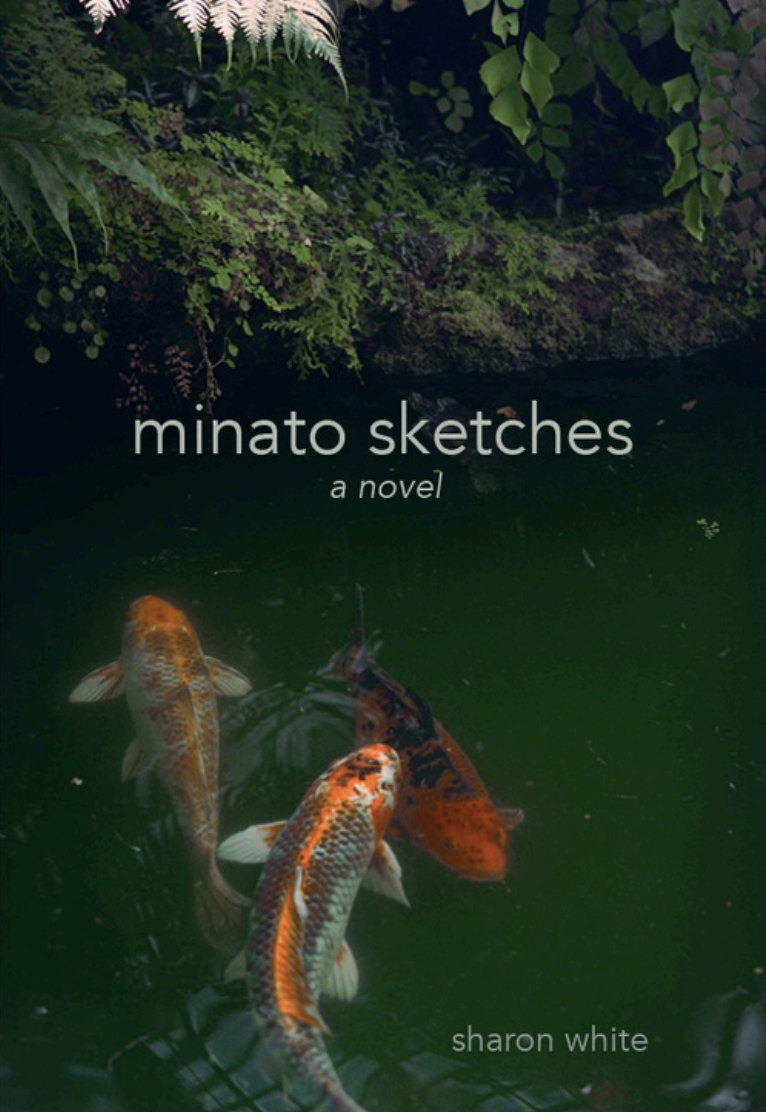
Around the same time, I had a disappointing experience with an agent, who had tried to sell a novel of mine, which is now going to be published in November. She wasn’t able to sell it, and it was pretty frustrating. I started to write another novel and she was not very interested. She didn’t think it worked. It didn’t have enough plot and this and that. I thought, well, I’m just going to forget about that agent. I’m going to write this book. I’m going to call it sketches because that doesn’t put any pressure on me. I don’t have to worry if I have the right voice or if there’s a plot. I can just write. And that’s what I ended up doing.
By the time we were about to leave Japan, I had about 40 pages. I sent them to a contest at Philadelphia Stories, and I won. Author Karen Joy Fowler was the judge, and she loved it. That was a huge encouragement for me because I was writing something so different from what I’d written before and calling it a novel.
SK: So your second novel became the first to be published.
SW: Yes, I guess it happens with a lot of people. So don’t give up on that first project!
SK: You have published a memoir, you’ve published collections of poetry, and now a novel. What are some of the noticeable differences between these creative outlets, as you’ve experienced them?
SW: With the memoir [Field Notes, A Geography of Mourning], I felt fairly exposed because it was my story. I wrote a book called Vanished Gardens about Philadelphia’s historic gardens, and there were some pieces of memoir in that, but it was really about the landscape and natural history of Philadelphia. So, my memoir was the hardest book to have out in the world. And in poetry, I’m always writing behind a persona. Some of it is me, but not all the voices are my voice.
[E]mpty space is actually not empty at all. It’s where things take place.
That’s the biggest difference with this book. I’m not Gigi at all, except for Gigi’s relationship with her mother. But it felt very freeing to have all these characters who were not me.
SK: Your use of white space seems so fitting to Gigi’s story and her struggles as a stroke survivor. As her mind wanders into the past and she makes connections between her past and present self, they remind me of brain synapses that connect our neurons. How much of Gigi’s journey helped to shape the structure of a novel in sketches? Or did you already have this structure in mind?
SW: I didn’t have the structure in mind. I think you’re right that it’s her journey that created the structure in the book. I was also doing a lot of reading on Japanese gardens and the sense of space and emptiness in some of them. Gigi learns about this in the book—that empty space is actually not empty at all. It’s where things take place. The shape of the short chapters produces that white space, and the book designer emphasized that, too. I think it all came together organically.
SK: Gigi also acquires more stories in her time in Japan. She meets a host of characters who have suffered loss and/or are searching for a new sense of self. There is recurring internal conflict between how your characters see themselves (or may want to see themselves) and how others see them. What do you want readers to take away regarding your themes of identity and self-perception?
SW: I don’t really think about what I want my readers to feel. Isn’t that terrible? But I do want them to feel immersed in this place, with these characters, and feel a part of the story to a certain extent.
I think we all struggle with having to be too many people at once. And Gigi wants to find the person she was before the stroke. I saw that happen with my mother. She was unhappy that she couldn’t get back to who she was. She felt like she’d lost most of herself and people would look at her and say—as they do with Gigi— “No, you’re great. You’re fine. You’re the same person you were.” But obviously, you’re not.
Gigi finds this out with the [Fukushima] devastation in the north when they make their journey to see the wild boar. The people there will never get back to who they were, and they’ve suffered such an incredible loss. Gigi’s able to see how she can also be renewed, but she’s never going to be who she was before. I think that’s really what the book is about. It sounds like such a cliché, but everybody carries these hidden losses. They’ve managed to get through horrible situations and come out on the other end. And they’re able to tell their story. Telling their story is part of the healing.
SK: Am I right in thinking there is an element of magical thinking in Gigi’s mind? She imagines that some of the people she encounters during her walks are ghosts. She picks up a phone with the intention of hearing her dead mother’s voice. To what extent should this penchant for magical thinking influence the reader’s interpretation of her experiences in Minato City?
SW: That’s an interesting question. I feel as if I go through the day using magical thinking. We all do. But it’s also connected to the idea of Japanese gardens and Japanese spirituality—that there seems to be this other world that exists at the same time or on the same plane as the everyday world that we see. The dream overlaps reality in a couple of places in the book, but Gigi really is experiencing things. She’s not making things up. She isn’t existing in another world. The storytelling itself plays with perception, and what she’s perceiving is what I was feeling in Japan—that my reality was somehow transformed by being in that amazing place, where there are holy trees and magical strings and white lightning bolts.
It sounds like such a cliché, but everybody carries these hidden losses. They’ve managed to get through horrible situations and come out on the other end. And they’re able to tell their story. Telling their story is part of the healing.
When she’s speaking to the hundred-year-old man, and he tells her a story, obviously it can’t be true, but it seems true. He’s not 100 years old, but she is actually sitting on a bench next to him by the canal. She hasn’t been transported. It doesn’t quite leap into magical realism, although when I started the book, it was much more surreal than it ended up being.
SK: Can you talk about Richard, Gigi’s only named love interest, and their would-be romance? What role does he play in Gigi’s journey?
SW: Richard is important for coaxing Gigi out of the little cocoon she’s put herself into. But he’s pretty unreadable, so she doesn’t really know how he feels about her or how she feels about him. She’s attracted to him, but she’s not brave enough to leap into that. And she doesn’t want that either because she’s so full with what she’s felt for the past few years, being stuck as a sick person and never quite recovering from that. He’s a real spark for her, as far as being her guide. He helps her get outside of Gigi, the stroke victim to become Gigi, a plain old person, not stuck in a definition.

SK: You mentioned earlier that being able to tell your story is a part of the healing process. That means that by the end, Gigi has healed in a way that Richard hasn’t.
SW: Yes, he still has a way to go on his journey. Gigi is angry at the end that he hadn’t told her about this huge loss that he’s had.
SK: What about your journey? What is your next creative project?
SW: The project that I’m working on right now is a biography of Anna Caselberg. I was an artist in residence in her house in New Zealand in 2019. I was there finishing Minato Sketches, and while I was there, I found out more and more about her. She was an amazing artist. We went back this past spring, and I spent six months looking at her paintings, meeting people who knew her and taking walks where she took walks. And now I have about 350 pages of this book about her work and her life. That’s what I’m really passionate about right now. I’m hoping it can be published with photographs of her art.
Anna died of cancer, and I had some pieces of my own journey with cancer in the book. But I decided to take them out because it seemed like it was hijacking her story. I think it’s going to end up being its own book. So that’s two new projects.
SK: Another memoir?
SW: Yes, where I’m really exposed.
SK: And you have a title coming out in November with Betty Books?
SW: Yes, IF THE OWL CALLS. It’s a mystery. It took me years to write that book, and lots of research. It’s partially about a Danish artist, Emilie Demant Hatt. She was the translator for a Sami writer, Johan Turi. The Sami were originally reindeer herders in the northern part of Scandinavia. Turi was an amazing artist and wolf hunter. Emilie Demant Hatt became interested in his life, and they ended up writing a book about the Sami in the early 1900s. IF THE OWL CALLS is about an Oslo detective who is related to Turi, and also about a young woman working on a farm in the north.
SK: Is it safe to say that art and literature influences or inspires your writing?
SW: Yes, definitely. That and the natural world. I feel very connected to the natural world, and it seems I often write about art and artists. It’s part of many of my books.
Sharon White is the author of several books of poetry, fiction, and nonfiction. Her first novel, Minato Sketches, won the Rosemary Daniell Prize from Minerva Rising Press. Vanished Gardens: Finding Nature in Philadelphia was the winner of the Association of Writers and Writing Programs award in creative nonfiction. She is also the author of three collections of poetry, The Body is Burden and Delight, Eve & Her Apple and Bone House. Boiling Lake (On Voyage), a collection of short fiction, won the Italo Calvino Prize in Fabulist Fiction.
Her memoir, Field Notes, A Geography of Mourning, received the Julia Ward Howe Prize, Honorable Mention, from the Boston Authors Club. Some of her other awards include the Marguerite McGlinn Prize for Fiction from Philadelphia Stories, the Neil Shepard Prize from Green Mountains Review, a Pennsylvania Council on the Arts Fellowship for Creative Nonfiction, the Leeway Foundation Award for Achievement, a Colorado Council on the Arts Fellowship, and a National Endowment for the Arts Fellowship. Sharon is an Associate Professor Emerita at Temple University.
Shabana Kayum, who holds a Master of Liberal Arts in Creative Writing and Literature from Harvard Extension School, writes speculative and magical realist fiction and poetry. She resides in the deep woods of the Pocono Mountains, where one can get away with that sort of thing.

With this short story by Terry Price, we continue to highlight original fiction and poetry from writers who either published their first book at 40 or after, or who have yet to publish a book. Writers interested in submitting work should see our guidelines.
Miles eases his foot down on the accelerator, pressing him and Amanda deep into worn leather seats in his ’69 Cutlass convertible, pale blue that matches the morning sky. Amanda closes her eyes and lays her head back against a seat yellowed and cracked by the sun. The wind whips hair around her face making her seem a strawberry-blonde Medusa.

Miles loves her hair. Sitting behind her through endless engineering lectures at Georgia Tech, his mind often wandered deep into shiny tresses that hung, straight and fine, between thin shoulder blades. After class he followed her just to smell the lavender in her wake. They were both on track to graduate that semester and he almost waited too late before asking her out. The first date he took her to a movie and then to dinner at a little Italian place just off Peachtree, cheap and small, the way he felt beside her. He told her he was from Nashville and she said she’d always wanted to go there. The first date ended with her asking him out for a second and him wanting to slip her into his pocket like a love note. It is now the weekend before final exams and, on a lark, he is taking her to Nashville.
****
The car blows through Marietta before he exited I-75 onto Highway 41 toward Chattanooga. “Convertibles aren’t made for interstates,” he tells her.
Amanda points at an old barn, painted black with a red metal roof. On the side, in white block lettering, it reads See Rock City.
“What’s a Rock City?” Amanda asks. “And why would anyone want to see it?”
“Tourist trap,” he says. “Don’t have a clue.”
She turns toward him. “You haven’t been?”
Miles shakes his head. “Nope. No interest.”
“Why?” Aren’t you curious?”
“I’m curious about you.”
“Stop it,” she giggles and turns forward in her seat, laying her head back.
****
Just before Chattanooga, Amanda rakes fingers across her stomach and points to an old diner. “Tomasita’s”, the faded wood sign reads. Air-conditioning..
“Let’s eat there,” she says.
“Are you kidding? There’s no telling what we might catch.”
“Please. Let’s try it.” She throws her arms open as if embracing the world.
He pulls in, turns off the ignition and gets out. She waits for him to open her door. Which he does, with a bow and a sweep of his hand. She stretches a leg out, then swings around and extends her hand to his. Miles takes her fingers and holds tightly as she lifts herself from the car. He kisses her hand as she walks across gravel and waits at the door until he opens it.
The place is mostly empty and the woman at the counter tells them to sit anywhere. Amanda thanks her and picks out a window booth. The woman arrives with menus and chips and salsa. Amanda takes a menu, angles it toward the window for light and asks, “What is your specialty?”
The woman smiles. “Our guacamole is like nothing you’ve ever tasted. Everything fresh. We call it sexo en un tazón de fuente.”
Amanda bursts out laughing, and the woman smiles. Miles doesn’t get it.
Amanda leans across the table and whispers. It roughly translates to something like “sex in a bowl.” She looks at the server. “Bring us some guacamole! And a burrito. And rice. And do you have sweet tea?”
“Yes,” the woman says, writing. “Rice and sweet tea,” she repeats. “And for you?”
“The same.”
The woman turns, still smiling.
“And sexo en un tazón de fuente,” Amanda reminds.
“And sexo,” the woman exclaims.
Amanda reaches across the table, takes his hands in hers, and squeezes. “What do you want to do first when we get to Nashville?”
Miles knows what he wants first but lies. “I don’t know. You first.”
“I want to drive through downtown. Get a cowboy hat. Get a beer. Dance with a cowboy.”
“A cowboy?” he says.
“Yes. Any one will do. I just want to dance with a cowboy.” She jumps up and goes over to the old jukebox and traces her finger on the glass, across and down, then stops. “This thing still plays actual records for a quarter! Give me one.”
He fishes around in his pocket and tosses the coin to her. A cowboy?

She drops the quarter in and it clinks, metal on metal. She pushes the buttons until they click. The motor whirls. The speakers hiss, and the metal arm reaches in and pulls out a record and positions it on the turntable. He feels the slow bass of the song before he hears it. Pump-da-da-pump, da-pump, da-da-pump-da-pump.
She holds out her left hand. “Dance with me, cowboy?” She wiggles her fingers impatiently.
He smirks and shakes his head. “I’m not a dancer.”
“Have you tried?” Her hand still extends toward him.
“Yeah. I got no rhythm.”
“Dance with me.” She moves her fingertips in and out, a come-here motion to a child. Fingertips exposed, unpolished and beautiful, he thinks.
He slides out from the booth and she takes his hands and wraps them behind her then laces her arms around his neck. Miles slips his fingers into her back pockets and pulls her against him. Even with no rhythm, he falls into hers. She leads as their hips, pressed together, swing back and forth in time, like a pendulum. Her lips graze his neck and he feels her heat and pulse in their hips, feels the bass pound through his body to hers. A stiffness forms in his jeans as he presses against thin patches of denim that separate them.
“Sexo,” she whispers.
“Yes,” he says.
She giggles. “I mean the guacamole is here.” She gives him a quick kiss, runs and slides into their booth. Amanda digs a chip into the green, chunky dip and puts the entire thing in her mouth. “God, that’s heaven,” she says, closing her eyes. “Have some.”
His mind, or what passes for it, is still on the dance floor and not on guacamole. He walks awkwardly to the booth, sits and watches her eat. She makes it look so good. So he scoops a salty chip in and pulls out a mound of avocado and tomatoes and onion. He inhales the cilantro and puts the entire chip in his mouth and chews. Amanda says it is heaven, but Miles recognizes it for what it is: pure, delicious sin. They finish a bowl of un sexo and order another and put it on the burritos and on the rice and scrape the bowl clean with chips and bits of tortillas. When they pay he asks if they can take some with them.
“No,” the woman says. “The guacamole must be eaten fresh. It must be eaten as soon as it is made. Otherwise, avocado goes bad. It’s not the same.”
“I’ll take my chances,” Miles says. “Put an order on the bill.”
“No, I’m sorry. We don’t sell it for take-out.”
He is the customer and this woman is making him look bad. But Miles looks at Amanda and holds his tongue. As he fumbles in his wallet for a twenty, the server takes out her pad and writes. She takes the bill then goes back to writing. “Don’t tell,” she says as she rips the page off and hands it folded up with the change. She smiles and looks at Amanda as he reads the note. It is the recipe for sexo en un tazón de fuente. Amanda looks over her shoulder as they leave, arm in arm, for the car.
****
The road turns upward and they drive through pockets of cool air you can only fully feel in a convertible. Chill bumps rise along her arms as they crest Lookout Mountain.
At the top, Miles pulls into a visitors’ center. Parched from the salty food, he buys them soft drinks from the machine. Amanda gets out and searches the brochure rack of local attractions.
“Rock City!” She turns and holds it up at him as if she’d discovered a treasure. “It’s here! In Chattanooga! Let’s go.”
“Seriously? I mean, we’re making pretty good time and all.” He hands her the Coke. She turns it up and swallows without taking her eyes off the yellow brochure.
“Fantasyland!” she says. “C’mon, it’ll be fun.”
Their ideas of fantasyland are different, but Miles knows they’d need to go to hers if he has any chance of going to his.
They follow the signs along Highway 41 and park in a lot with rows and rows of cars with license plates from all over the country. The sign in the parking lot that says to lower the sun visor if you don’t want a Rock City bumper sticker put on your car. Surely they’re joking. There must be a special place in hell for people who’d put a bumper sticker on a Cutlass convertible. He grabs the visor and looks over at Amanda, then pulls it down and she grimaces. He knows she wants everyone to know that she has seen Rock City.
****
They walk past a scenic overlook, but Amanda wants to go to Fairyland Caverns filled with dolls and statues, gnomes and dwarfs. Miles thinks it fitting that Rock City is in the same state that as Dolly Parton. Both have a lot of natural beauty cheaply enhanced to sell more tickets. When he opens the door, a burst of cool air blows past them like a frightened tourist. Inside, nursery rhyme characters stand behind purple velvet ropes, under black lights that seem to give them special powers, like Superman under a yellow sun. All the room is missing is incense, pot, and Pink Floyd, he thinks.
Amanda and Miles are alone in the black light with the characters and song. She stares out over the displays. “Did your mother read you fairy tales when you were a kid?”
“Yeah. Every now and then.”
“I can’t remember a single story. Not one. When I was little, my mother always had something to do, always had a place to be.” She bites on a fingernail and sighs. “When I got old enough, I read my own stories before going to sleep. I never believed them though. I mean, does anybody really live happily ever after?”
He shrugs. “I guess.”
“Do you know of anyone?”
“Not offhand, but give me a few days.”
“Seriously. I mean, do they know they’re living happily ever after? Do they wake up every morning and say, Yep another zippety do-dah day? Or at the end, when it’s all about over, do they look back and reflect and say, Told ya we’d live happy ever after?”
“C’mon,” Miles says. “Let’s get outside.” He pulls her hand from her mouth and leads her out.

They follow the arrows up the walkway until they reach the top named Lover’s Leap. A low stone wall with black railing was built to keep tourists from falling onto jagged rocks. There are coin-operated binoculars spaced every twelve feet or so, big, round, face-like viewers with lenses that look like eyes, and aiming handles for ears. In the center of them is a stone column topped by a cast bronze metal marker that reads, “See Seven States” with labeled arrows pointing in the general directions of the states. The rock and bronze display reminds Miles of headstones in a cemetery and steps around it.
He leans out from the rail and looks down. “Did you ever wonder why there are so many Lovers’ Leaps? Seems like every mountain range has one.”
Flags shiver in the wind above them, their metal clips clanging against the flagpoles.
Amanda points in the distant direction of one of the arrows. “I see North Carolina.”
“I’m serious. Everywhere you go, there’s a Lover’s Leap. And they almost always have the same legend. A couple wants to be together but can’t. So what’s the couple to do? Find a cliff and jump off, right?”
“Georgia. That’s definitely Georgia.”
She squints and leans out over the railing as if a few more inches would bring everything into view. Miles puts his hands around her waist and squeezes and lifts her, just a bit, but she doesn’t take her eyes off the horizon.
“South Carolina.” “I see it. Over there. See?” She stretches and points again.
He presses against her back and puts his hand in the front pockets of her jeans, his head aligns with hers over her shoulder. She feels different, malleable, soft. He looks hard down the length of her arm to her finger, but only sees hazy sky and hills stretching out, lazily across the landscape.
“I know I love you,” he says.
“Yes.” She breaks loose from his grip and climbs up on the lower rail. She leans out, putting her weight against the upper rail that crosses just above her knees.
Miles reaches out to grab her, but she jerks back, nearly losing her balance. “Hey!” he says and his voice echoes back off the rock. “What the hell are you doing?”
She leans way out, arms extended as if preparing to fly.
“Come down.”
“You know what I don’t see? I don’t see where to go from here, where we go from here. I can’t see beyond graduation. There are no signs, no arrows. Can you see? Because I can’t.” Amanda looks back at him over her shoulder.
He edges closer to her. “This isn’t funny. Come down now. Please.”
She leans forward and spreads her arms. Her hair blows back and she almost looks as if she is flying.
Her eyes widen. “That’s it?”
“What?”
She stares down off the mountain. “The reason for so many Lovers’ Leaps.”
“What are you talking about?”
“When people find out there’s no happy-ever-after. What then? Really? They buy into the fairy tale, find out the truth and begin to look for an escape. But there isn’t one, is there?”
“You don’t believe that.”
“It makes as much sense as happy-ever-after.”
“Get down!” He cannot move. His mind is locked away from his body. No words come. Nothing.
She turns and looks at him. “Poor Miles.” She extends her hand to him, fingers wiggling. He inches over until fingertips touch and he takes her hand. She flings herself into the air toward him and into his arms.
Miles wraps his arms around her and squeezes. “You scared the shit out of me,” he breathes.
“Cantilever,” she whispers in his ear as she hugs him back.
“What?”
“Cantilever.” She pulls back and looks him in the eyes. “Combination of force and distance from a pivot point with the center-of-mass. Cantilever. Same force that holds this overlook onto this mountain, kept me on this rail.”
“Jesus, that was an engineering lesson?”
“Among other things.” She kisses him, then lets go and weaves her way through the crowd until she is out the gate and into the car before he can get her door for her. As he walks around the back of the car he sees the black bumper sticker that says See Rock City in big yellow block lettering,
Damn.
****
They head back out on Highway 41 and descend the mountain toward Middle Tennessee, top still down. Western skies darken into a bruise-like purple, and fat drops of rain slap the windshield. He turns on the headlights and wants to put the top up but tries to outrun the rain instead.
Lightning streaks overhead and thunder cracks, then settles into a guttural ripple. Raindrops give way to showers that spread across the windshield, creeping up to the chrome frame. Fifty, sixty, sixty-five miles an hour along wet, winding roads, until most of the rain sweeps back over their heads with the saturated air. But they cannot outrun all of the rain and it pelts his hair, his shoulders. Neither the wind nor the rain is cold, still he begins to shiver.
“Let’s put the top up,” he says.
She puts her head on his shoulder and looks up into the sky. They ride along as the rain and the skies lighten.
“Let’s not.”
Another streak of lightning scars the sky, the flash infusing storm clouds, rendering them lavender, before they settle back into their angry steel blue.
Amanda’s hair whips wet behind her.
The seats of the Cutlass are glossy from the rain and he wants to pull over. But he doesn’t. Instead, Miles reaches into his shirt pocket, takes out the recipe and unfolds it with one hand. Random raindrops pop against the whipping paper, smearing the ink. He reads the list of ingredients that make “Sexo.” But, in the end, it was just guacamole. He fingers the paper back in half and holds it loosely between two forefingers of his left hand as the wind tries to pluck it from him.


Terry Price, is a Springfield, Tennessee, based writer and photographer, with an MFA from the Naslund-Mann Graduate School of Writing at Spalding University in Louisville, Kentucky. His work has appeared in 5th and Church, CCM Magazine, Writer’s Notes Magazine, Bloodlotus, The Trunk, The Tennessee Writer and in the print anthology, Best of New Southerner. The short story, “Eminent Domain,” was published in the Timber Creek Review and was nominated for a Pushcart Prize. His essay, “The Addition of Clouds” was published in Life Lessons from Loss, one of the Wisdom From Others series of books. He is currently working on a novel, An Angel’s Share. You can read more of his work at https://terryprice.substack.com
Photo credits (top to bottom): Elwin DeWhite, Patrick Fore, Brice Cooper – all from UnSplash. Author photo by Katy Yocom


Sara Reish Desmond’s debut collection, What We Might Become (out now from Cornerstone Press), has been hailed as both “vivid” and “haunting.” Filled with complex and riveting characters, her stories will stay with you for a good while after you have turned the last page.
Bloom sat down with Sara to talk about her journey and her process.
Shabana Kayum: First, congratulations on your debut collection! Often, agents and others warn that a short-story collection from a new voice is near-impossible to publish. What has been your experience?

Sara Reish Desmond: You are not wrong. From inception to publication, this collection has been a sixteen-year project. Agents and mainstream publishers are not necessarily interested in short story collections. When I queried agencies, I received bites from agents who would say, “Your writing is beautiful. Do you have a novel?” The answer was no, not yet.
At the time, I had been a high school English teacher for many years. In 2016 I became an instructional and curricular coach for young teachers in Boston, so I didn’t have the take-home work anymore of grading essays, and it freed up my time to concentrate on writing again. I started writing a novel and finished during the pandemic. I tried to go back to those agents who were interested in my collection, who had asked whether I had a novel. It’s a novel about grief and redemption. This was during the pandemic, and many of them said, “This is beautiful, but we can’t do a novel about grief right now.”
I had put down the story collection entirely during that time because novel writing is so immersive, I couldn’t juggle writing a novel and writing short stories simultaneously. Then a good friend from grad school asked me about them. I thought it was a dead project. I told her I had all these mainstream rejections. And she said, “I think the wave of the future is independent presses and university presses. Why aren’t you sending it there?” And I took her advice to heart.
Cornerstone accepted my manuscript in March of 2022. I can’t say enough good things about my experience working with an independent publisher, and a university one at that. Cornerstone Press has been terrific to me. Dr. Ross Tangedal and his team have been thoughtful, detail oriented and deferential to me as the author, allowing me to make the final calls on many of the editorial choices.

SK: What do you see as a throughline for the collection, if there is one? What crucial elements hold these stories together?
SRD: Initially, I viewed this collection as primarily about liminal characters and experiences. The collection features many adolescent characters who are, to me, the quintessential threshold character, neither belonging to the child world nor the adult world. But the collection also features characters like a new widower, an expecting mother, a wounded vet returning from war, all of whom are at the threshold of new versions of their lives. And certainly, there are many stories that revolve around characters who are navigating some threshold moment—grief, fidelity, loss, for instance. I think grief is a predominant throughline in many of these stories. We often associate grief primarily with death, but grief can happen in so many other ways. Many of these stories also involve ideas of alienation and agency. I think a lot about agency with respect to my characters—how much access and how much control they have over aspects of their lives. What I really enjoy now that the book is out in the world, is talking with people who get me to see the collection in a whole new way. You, for instance, Shabana, reminded me that this collection is also so much about women and mothers in all of their many interactions.
SK: Your characters are compelling and not easy to forget. From 12-year-old Cheryl Boyd, who has eaten all the girl scout cookie orders, to Cece Neely with her enhanced robotic anatomy, to Corinne, the half-way-there mother lost in the depths of her alcoholism, each character is perfectly flawed and yearns for something more, better, or just different. What motivates you to create such characters and tell their stories?
SRD: I love character. It is probably my favorite thing to spend time with—making distinct, unusual characters. If I know where I want the story to go, I try to be authentic to the characters I’ve created, what they would say, what they would do, how they would respond to certain stimuli. Then the storyline works its way out of that.
I can’t say enough good things about my experience working with an independent publisher, and a university one at that.
On some subconscious level, I am always writing stories that help me to understand the human condition … my human condition, I suppose, in some selfish way. Everyone contains multitudes. We are multidimensional in ways that are invisible to others, and I am obsessed with exploring that multidimensionality. It provides me with great comfort in this great wide world to know that everyone is more complex than they might appear. I want to make my characters as complex as I feel I am as a person.
SK: There is a diversity of mothers in your collection. Mothers grieving, mothers anticipating, reluctant mothers, seemingly uncaring mothers, dead mothers. Why do you feel it is important to feature the lived lives of mothers in your work?
SRD: I think, as a culture, we’re just starting to understand and talk about the “invisible work” of motherhood, right? And more than that, I think we’re not yet talking about all of what mothers carry that is unique to the role. Mothers don’t have tremendous agency, or the agency we do have is perhaps not the agency that we want. That work is truly exclusive to women, I think.
When I began writing this collection, I was on the brink of becoming a mother myself. And of course, that came with its own host of anticipations and anxieties. And now I’ve been a mother for 16 years and the challenges and joys of motherhood are different than they were when my children were babies, but they are no less significant. I think this has found its way in almost every story in the collection. I think sometimes my writing is working out those challenges on the page by acknowledging the work, honoring it, and certainly normalizing how complicated it is—normalizing all of the kinds of mothers there are in the world. Again, we contain multitudes.
SK: Speaking of diversity, you have created some characters with diverse backgrounds and identities, including a Chinese character and a trans character. As a writer, what considerations do you keep in mind when portraying experiences that might differ from your own lived experiences?
SRD: Thank you for asking this question. It is a challenging thing to write about—not from the perspective of—but about characters who are unlike yourself. And I try to bring to that as much care and thoughtfulness as I possibly can.
I’m a curious person. Part of making sense of the world, to me, is to try to think about others’ experiences outside of my own. When I’m writing about a character who is unlike me, it’s important to appeal to the character’s uniqueness, to make the details matter so that a character is fully drawn in every aspect of their uniqueness, and so they can be fully realized by the reader. Rendering characters who are unlike me has to be essential to the story. The story “Some Small Act of Compassion,” is partly a story about assumptions, especially those of white people. In order for the story to work, James has to make assumptions about his new Chinese neighbor that are critical to the unfolding of the plot. His white lens, and her Chinese one, is critical to the story as a whole.
Everyone contains multitudes. We are multidimensional in ways that are invisible to others, and I am obsessed with exploring that multidimensionality. It provides me with great comfort in this great wide world to know that everyone is more complex than they might appear.
SK: I was happy to read two stories with science-fiction elements in this collection. I’m all for genre-bending, myself. Just as mystery fiction and science fiction are their own genres, do you see literary fiction as its own genre, or is it something else?
SRD: I do see literary fiction as its own genre. But I want to be very clear—literary fiction, for a long time, was reserved for a certain canon of predominantly older white men. It’s what was taught in schools and universities and elite English Literature programs. I’m so glad that has evolved. We’re making progress! Literary fiction now encompasses so many unique and diverse voices and dips into different genres with great deference and care. I think some of the ways we can honor diversity of the literary landscape is by letting worlds bleed together.
Still, literary fiction, to me, is predominated by a deep curiosity about the human condition, relationships, and our understanding of the world. It is uniquely interested in relational elements, not just between characters, but between a character and their perception or a character and self. It also pays particular attention to language at the micro-level: sentences and images and the sounds of words. Thank goodness.
SK: Let’s talk about endings. As a reader of such engrossing stories, I often felt as if I inhabited the bodies of your characters, so much so that the endings felt like little exorcisms. I was pulled out of their spheres as suddenly as I was dropped into them. Their stories aren’t at an end, I am simply no longer privy to them. How do you decide what the stopping point is, or when the story has reached its written conclusion?
SRD: I am a “pantser” when it comes to writing fiction. Often, I have my characters and a beginning, and I know where the story is headed, but the puzzle is getting there: via scene and character arc, complications of plot, etc. That’s the work of the short story, for me: solving the puzzle from point A to point B. It’s engrossing. I also often allow a story to be carried by the momentum of the characters and the choices they make, and the ending is very different from what I had set out to do. Without being super conscious of it, I let the art and magic do its work instead of having the study of craft overtake art.
I realize I often write the story with the turning point very close to the story’s conclusion. Perhaps that’s why you have that feeling of a “little exorcism.” With a climax coming so close to the end of the story, you may not feel that the resolution has come to a place where you’re satisfied. And there are so many stories that are not “satisfying,” in which the denouement makes you feel whole. My favorite stories (not mine, but the ones out in the world) are ones I can’t let go of after I’m done reading them, ones in which I’m unsettled by the endings – whether or not I can trust the characters or know what happens next. That feels like an additional puzzle to work out on the reader’s side of things.
For what it’s worth, I’m not sure that I have as much control over that experience as you’re suggesting that I do! I’m just here for the art and the magic.
Sara Reish Desmond grew up in Lewisburg, Pennsylvania. She earned a BA in English from Kenyon College and her MFA in Fiction from Vermont College of Fine Arts. Her work has appeared in The Los Angeles Review, The Kenyon Review and Water~Stone Review, among other publications. Her short stories have been finalists for the Rick DeMarinis Short Story Prize and The Copper Nickel Award. What We Might Become is out now from Cornerstone Press.
Shabana Kayum, who holds a Master of Liberal Arts in Creative Writing and Literature from Harvard Extension School, writes speculative and magical realist fiction and poetry. She resides in the deep woods of the Pocono Mountains, where one can get away with that sort of thing.

With this work by Alexis Levitin, we continue to highlight original fiction and poetry from writers who either published their first book of poetry or fiction at 40 or after, or who have yet to publish one. Writers interested in submitting work should see our guidelines.

It was decades before he ran into her again. By then, he was bald and twenty pounds overweight. He was dining alone in the town’s most chic restaurant. He rarely went there because, though the modern frescos were attractive and the food good, the meals were over-priced. But tonight, planning to hear the local band in the bar next door later that evening, he had decided to splurge for a change. Emerging from the men’s room (these days every meal at a restaurant involved such a detour), he bumped into a slender woman, narrow-shouldered, perfect in her high heels, just leaving the ladies room. Mumbling excuses, there in the narrow vestibule, they saw whom they had bumped into. Clare was unchanged, utterly unchanged. Embarrassed, touched, without a thought, he said: “I have nothing but good memories of you, that’s all I have, nothing but the good.” “Me, too, Joey,” she had managed to whisper, with a brief look of affection, before hurrying back to the somber husband staring at her from their table.
Joseph never saw her again till the day before she died. Her daughter had come to town to be with her mother in her final suffering. The husband apparently hovered round the hospital bed much of the time, unwilling for anyone, including God, to share in his prize. He told friends who called that she wanted to see no one, because he wanted her to see no one. He had even tried to prevent her only daughter from coming, but to no avail. Her friends, however, were afraid of him and didn’t show up. That’s the way he wanted it. She was his wife, his love, his love alone. He had loved her back in high school, but only in his sixties, after marriages, divorces and deaths in both their lives, had he finally captured her. And now she was slipping away, and he was furious. He paced all day, but in the evening he went home to drink, and Clare’s daughter, from her mother’s bedside, called the boyfriend from thirty years before to say: “If you want to see Mom while she’s still here, you better come right away. He’s gone home, he’s drinking, he won’t be back tonight.” And so Joseph went to say good-bye.
Her fingers were puffy with edema. So, too, her face. But the eyes were the same, even as she lay there dying. Eyes sparkling with mischief, ready to find a laugh in anything. Joseph moved a chair to beside her bed and sat down.
“Hello, Clare,” he said.
“Joey,” she answered. He took her swollen hand and softly caressed her fingers.
“I am so glad to see you, so glad,” he managed to say. She smiled from her cocoon of prednisone and soporifics. The daughter gave him a nod and quietly slipped from the room. They were alone. But what could he say? What can one ever say, up against the wall?
“Remember that time when Shep ate that big steak right off the dining room table?”
“It was a roast, a whole roast. I went to the kitchen to get the vegetables and when I came back there was nothing on the table and he was licking his chops.”
They laughed and laughed. Life had been good. Now it was leaving. What could one possibly say?
“I was a bad guy, Clare. I’m sorry.”
“Don’t be silly, Joey, you were just a kid. A forty-year-old kid, that’s all.”
They held hands and said nothing. Time passed. He gave her a sip of water and she sighed. She mustered a wan smile, but her attention drifted, as if to another presence in the room. Her grey eyes looked both spunky and preoccupied. After a bit, her eyes closed. She seemed to be drifting off. He kissed the puffy hand he had been holding since sitting down beside her. She didn’t open her eyes, but she smiled and gave him a small squeeze.
“So good to see you one more time,” he whispered, as he arose. She squeezed his hand again, but said nothing. He looked at her puffy face and couldn’t bear it. Without a sound, he left the room.
* * *
Fresh to town, he had been lucky to meet her. She was leaving a Christmas party and a Butch chick had called out “Looking good, Clare.” Drawn by that remark, he had turned around in time to catch sight of a slender, pert creature in elegant high heels, slipping into a camel hair coat. She had looked so good that without another thought he had grabbed his own Duffel coat and bid a hasty farewell to all.
He caught up before she reached her car. They shook hands, exchanged names, discovered they both loved to dance. They agreed to meet at a cocktail bar where the best local singer was performing the next night. And that is how it began. Even before their rendezvous at the Round Table, he knew how lucky he was.

She danced with controlled abandon. She had a flare, pizazz, energy to burn, but everything wound tight, like an Arabian mare, sleek, reined in, but ready to go. They danced every number, rock, foxtrot, cha-cha, even a waltz. She made it all look easy. They were bathed in sweat and never stopped till the band took a break. She told him, then, that she was a supervisor at the hospital and that she had six kids, but he couldn’t believe it. She was slim and smooth, with a mischievous grin, joie de vivre incarnate. Though she was French-Canadian, she had lost the language of her ancestors, but not their bounce, their verve. She was a ball of fire and he was very happy.
After a while, he began to drop by her house. He met the six kids, a terror of teenage boys, all rambunctious, all disdainful of school. None of them even brought their texts home with them. Only the lone sister seemed to enjoy her studies, seemed to feel a richness coming from the lectures, the classroom, the books themselves. As for the boys, once escaped from their obligatory classes, they reveled in basketball, baseball, and, when the lake froze solid, ice hockey. The T.V. was on twenty-four hours a day. The only books in the house were anthologies of Readers Digest. Joseph was an English prof. at the regional junior college, no great shakes, but books were part of his life. They wouldn’t be in this household, he thought with regret. Yet she was so utterly charming, a bundle of energy and good-will. How could she raise six kids, and dance all night long, and get to the hospital by eight A.M. every day? But she did. She did it all, and never thought to complain.

He knew he was blessed. But he also was discontent. Charming as she was in manner, lovely as she was to look at, when he tried to discuss things beyond the scope of daily occurrences, events, nothing happened. It wasn’t just books he couldn’t discuss with her. He couldn’t even manage to share his lifelong preoccupation with mortality. Coming from a Shakespeare class, one day, he tried to engage her in a discussion of les dernières choses. He had been teaching the very problematic, almost tragic comedy, Measure for Measure. A lovely virgin is desired by a cruel judge, who will execute her brother unless she gives her “sweet body” to him. She is, of course, bewildered and appalled. She visits her beloved brother in prison and tells him he must die. Unless. “Unless what,” the desperate young man responds. She explains the Judge’s heinous offer of his life for her “sweet body,” but is assured her brother is too noble to entertain such a thought. To her shock, he groans and replies: “Oh Isabel, Death is a terrible thing.”
“What do you think of that?” Joseph said to his slender, eternally-young love, as she slathered a goose in rosemary, thyme, and butter. “Death,” she said. “Funny you should mention that. I was talking to an old timer in the nursing facility attached to the hospital, just yesterday. I said to him: ‘So how you feeling today, Benjamin?’ And he says, ‘Well, Miss Rabideau, not too good, not too good.’ So I say to him, ‘why what’s the matter, Benjamin?’ So he says, “I think I’m just running out of steam, Miss Rabideau.’ So I say, ‘Benjamin, how old are you, anyway?’ So he says: ‘Well, Miss Rabideau, I’m 104, going on 105, if I get to July.’ So I say: ‘Well, Benjamin, that might explain why you’re feeling a bit tuckered out. Not too many people get to 104, now, do they?’ So he says to me: “Well I’ll be a monkey’s uncle. You know, Miss Rabideau, you’re right, I guess I just didn’t think of that.’ Now what do you think of that, honey?” And that was their discussion about mortality.
But then he remembered her effortless grace on the winter ice, a twirling, swirling of pink jacket and blue jeans in the frozen cove, dark pines behind her, grey sky above. And his own clumsy strides, his bent ankles, his inability to stop. And her smooth transformation to concertgoer up in Montreal, those sophisticated high heeled slippers she insisted on, even in winter snow and springtime slush. Her camel hair half-length winter coat, its snug embrace. Her delight in the concerts, though he wondered if she had ever gone before. Yet seated in the loge, she looked the perfect fit. As if that was where she belonged.
She never said a word, but after a couple of years, Joseph could feel that she was waiting for something. Though they never discussed money, it was clear that her salary was barely enough to keep the household afloat. She was happy with her lover, but he understood that she needed a husband. However, when he thought of the TV on day and night, the shelves of Readers Digest, the wild kids full of life, but oblivious to everything he believed in, and the impossibility of discussing the mysteries of life and death, he felt himself balk. He felt he would have to marry not just his delightful, slender dance partner and elegant concert date, but her six children as well. Indeed, that was reality, and it was too much for him. They never discussed it, but when New Years was approaching, she gently, but firmly informed him that, alas, she had a date. He was miserable, but he understood that he had brought it upon himself. He had lost her. The man she went dancing with on New Year’s Eve had plenty of money, did the right thing, and four months later they were married. He could blame no one but himself.

And now she was dying. As he walked home through the silent streets, he wondered if he hadn’t made a dreadful mistake thirty years before. He had enjoyed her sparkling eyes, her cheer, her humor, her lovely body, her ebullient spirit, her roasts, red potatoes, and Brussel sprouts. Why hadn’t he married her? And what about love? Had he loved her back then? He remembered that at the time, happy as he was, he thought he was not “in love.” And now, wandering home in the dark, he was returning to an empty house, its walls lined with silent books. It had been decades now since his home had been blessed by the unfathomable love of that same dog Shep, who, against all civility, but in consonance with his wolfish nature, had gobbled down Clare’s entire roast so long ago. The empty house, a shell, awaited him.
How foolish he had been thirty years ago. Now, old and bent, he was able to feel a tenderness that the armor of his ego had not permitted when he was young. As he trudged homeward, it dawned on him, in the dark winter stillness, that against the grain of his self-centered instincts, his quietly ruthless egoism, he had actually loved her back then. In fact, he had loved her all along. But only now could he admit that to himself, knowing that tomorrow or the day after, she would be gone forever from the face of the earth. The old hit song suddenly slipped like a dagger into his belly: “You don’t know what you’ve got till it’s gone.”
There was slush on the ground and his feet were growing cold. He would have to make himself a pot of very hot tea when he got home.

During the last half century, Alexis Levitin has published forty-eight books as a translator, primarily of poetry from Brazil, Portugal, and Ecuador. His works include Clarice Lispector’s Soulstorm and Eugenio de Andrade’s Forbidden Words, both published by New Directions. Later this year, his translation of Leonor Scliar-Cabral’s Consecration of the Alphabet, a sonnet sequence devoted to the history of the letters of the Hebrew alphabet, will be published by Ben Yehuda Press. His own short stories began in the fear-tinged isolation of the pandemic. Those stories, written in old age, gave him a new life. So far, fifty-four of them have been published in various magazines in the United States and in Europe, including Agape Review, Agon, Gavea-Brown, Latin American Literary Review, Mediterranean Poetry, Niv, The Nonconformist Magazine and Rosebud. A collection of his chess-related stories, The Last Ruy Lopez: Tales from the Royal Game, was published in November 2023 by Russell Enterprises.
Photo credits, top to bottom: Anna Lincoln, Allef Vinicius, Fiona Murray-DeGraaff, Andreas Rasmussen (from Unsplash) Author photo by Nick Levitin

In her forthcoming new novel, Dancing Woman, Elaine Neil Orr writes overtly for the first time about feminism and the need for women to have women’s art-and to create art. Her powerful story has earned glowing praise from Charles Frazier, Toyin Falola, Rachel M. Harper, and more. Please enjoy the excerpt below.

Excerpt from Dancing Woman
She led her visitor to the sunroom. The dancing woman struck her as she had the first time Isabel laid eyes on her, mysterious and essential as the Rosetta stone.
“So you have created a shrine? I can’t blame you. This one is quite rare.” The man stood close enough to the terra-cotta to breathe life into her or, more likely, to draw strength and courage from her. “There are very few female Noks and almost none in such good condition. You did an excellent job in your excavation.”
“I had endured some difficulties when I found her. She seemed to restore my soul. The Sarki has told me I must discern her meaning.”
“It is quite interesting that you should put it that way. We are trying to imagine what these sculptures were for. We have found nothing else of the people who made them. No tools. Not even bones. Yet as you say, they are powerfully made and seem to carry a divine energy. You can feel it, can you not? What has it said to you?”
Isabel put her hands on the table. Did this guy know Bobby Tunde? They spoke in a similar way. “I believe she has something to say about the importance of women in culture. After all, we raise children. But I also believe a woman made this figure.” None of this had quite distilled in Isabel’s brain before this moment.
“It is likely there are others in your compound, still in the ground. They are congregated where people long ago built settlements.” Mr. Igede finally stepped back. He was ignoring her observation about the significance of the sculpture for women in particular.Isabel had a vision of an archeological dig in the backyard, a discovery of pavers laid out in a circle, one Nok, if she must call it that, set in the center, the others facing in. For surely, they were meant to be in conversation. A sky, pink as a guava, had opened before her that day as she dug. There was a second world reflecting on this one, a second Isabel who observed her life even as her daughters clamored for her attention and her broken husband banged around the kitchen and she stumbled with her Hausa. She felt a presence emanating from the dancing woman, as one might from a true mentor, a kindly god. She felt purified, her outer coarseness lessened. This feeling was compounded when she practiced her own art, which was not nearly as profound as the terra-cotta, but somehow her paintings existed in the same stream. She wished she had a name for the stream. She felt a great need to tease it out, to understand what she was trying to do in her paintings. She could not live in her parents’ world or Nick’s world. She had to create her own world, her own nature. Painting took her there. Right here in this place some woman long ago had felt the same need and created the dancing woman.
#
© 2025 Elaine Neil Orr and courtesy of Blair Publisher.

Elaine Neil Orr is the author of five books, including the novels A Different Sun and Swimming Between Worlds. She was born and grew up in Nigeria, the daughter of missionary parents, and most of her writing is grounded in both the American South and the Nigerian South. She is a professor of literature at N.C. State University and serves on the faculty of the Naslund-Mann Graduate School of Writing. She lives in Raleigh. Learn more at https://www.elaineneilorr.com/
Photo by Mallory Cash
Bloom spoke with short story writer Janis Hubschman, whose debut collection Take Me With You Next Time is out today from Betty, an imprint of WTAW Press.
Leah De Forest: First, congratulations on Take Me With You Next Time.
Janis Hubschman: Thank you, Leah!
LDF: Can you tell us a bit about your path to publication?

JH: It feels less like a path and more like a maze. Over a period of about ten years, while my two children were in school, I wrote two novels. I found agents for each of those books, and they made the rounds of publishing houses, but neither book was accepted for publication. For good reason: I’d taught myself how to write fiction with those novels. It was a DIY MFA program.
I moped around for a while, telling my sad rejection story to any writer who’d listen, until one day someone advised me to develop a few novel chapters into stories. The process was so pleasurable. I’d spent years getting to know these characters. In stories, I could isolate a moment or two in their lives and dive in. I felt more comfortable working on this smaller scale. I could carry an entire story around with me in my head, while in contrast, the novel felt unwieldy, like lugging a bulky binder stuffed with loose papers. After a few of those stories were accepted for publication, I felt brave enough to create new characters and stories. The story rejections, when they came, were easier to get over than the novel rejections, because I felt more hopeful about my writing future. Every story gave me the opportunity to try something new and to improve my craft.
Also, at this time, I’d started to attend workshops and residencies and exchange work with other writers. For the next decade, I continued to write and publish stories in literary magazines. Eventually, I assembled a manuscript that I submitted to contests. I’d made the finalist lists for a few contests, including one at WTAW Press. Peg Alford Pursell, the publisher, told me about a new imprint she would soon launch. I was among the first authors to sign on with Betty Books.

LDF: How does it feel to be on this side of the process?
JH: A bit overwhelming. Now that I’ve achieved my years-long goal of publishing a book, I realize it’s not the finish line after all. My parallel goal of perfecting my craft, learning the best ways to tell a story, sustains me now, which is good because it’s a goal that’s entirely within my control. Whenever I feel myself getting swept up in the highs and lows that come with publishing a book, I’ve found that working on a story grounds me. A sort of peace comes over me then; the kind of feeling you get when you’re doing the thing you’re meant to be doing.
LDF: Women are at the center of this collection: they’re wonderfully complicated, funny, thoughtful, and sharp-tongued. What draws you to these kinds of characters?
JH: Thank you for that compliment. What drew me to those characters is the same thing that draws me to the smart, quick-witted, supportive women in my life. I love reading fiction about intelligent, complicated women characters who quietly defy society’s expectations while sometimes getting in their own way. I’m also interested in writing and reading about women’s relationships, the shared intimacies and mutual support, as well as the rivalries and betrayals.
LDF: Can we talk a bit about one of these characters? In “Open House”, Frankie has been repressing “quite a few noxious comebacks these past weeks”.
JH: Frankie knows what she needs to do, but she keeps looking for outside confirmation. This reliance on other people’s approval or reassurance was present when her much older and more educated husband mentored her at the start of their relationship. During her marriage, she has an affair to affirm her desirability when her workaholic husband is absent or distracted. Later, she needs Clara, her adult stepdaughter, to repeatedly reassure her that she was a good mother. And she looks to Suzy, the competent real estate agent, to convince and cajole her into selling a house that no longer fits her life now that her stepdaughters and husband have left it.
LDF: Frankie’s got quite a lot on her plate.
JH: That’s for sure. She’s managed to hold it all together up to the point where the story begins. She spent years taking care of her family while reserving only a small private space for herself. Now that she has only her own needs and desires to consider, she feels a bit lost.
LDF: What was it about these two particular characters—Frankie and Suzy, her realtor—that you found fruitful in writing this story?
JH: I was interested in the way the two women contrast and complement each other. Suzy is outwardly strong, efficient, and assured, but she drags around a deep, intractable pain that informs every choice and action. Frankie is stronger and more resilient than she gives herself credit for, but she presents a fuzzy persona to the world. This, despite her real accomplishment of providing two grieving girls with a loving and secure home. When Suzy takes over Frankie’s house, preparing it for potential buyers, she gives Frankie the opportunity to take a step back and assess her life with more objectivity.
LDF: I won’t give it away, of course, but I will say that the ending of this story delights me. What are you hoping readers walk away with at the end of this piece?
JH: I hope readers decide that Frankie lands on her feet. At the end of the story, she’s beginning to accept her losses. This will make room for her to find meaningful work and friendships and to continue to nurture and enjoy her relationships with her stepdaughters. I see her creating a home that reflects her taste and interests, because she’ll finally have a clearer idea of what those are.
LDF: Thematically, what do you see as some of the throughlines in this collection?
JH: Resilience is a theme that runs through every story. Also, the inevitability of change in oneself, in one’s life, and in the people we love.
LDF: What, if any, crossover is there between those throughlines and your own life?
JH: I most relate to the way the women in my stories overcome fear and self-doubt and embrace change rather than run from it. In middle age, I enrolled in graduate school, joined a Central Park running team, took up cycling, and started teaching fiction writing. As I get older, change becomes harder. On some days, my comfort zone shrinks to the size of my favorite reading chair; life can feel like a game of whack-a-mole with one setback or obstacle popping up after another. However, the prospect of future regrets keeps me moving forward and saying yes to new experiences, like joining Betty Books, for example.
LDF: You and I are both author-members of Betty, an imprint of WTAW Press that prioritizes publishing books by writers who identify as women. Can you tell Bloom’s readers a bit about Betty?
JH: Sure! Betty Books is dedicated to publishing books by women for everyone. Betty offers the benefits of a traditional press but also has an innovative collaborative structure. Betty authors participate in all the publishing tasks from choosing new books for the Betty Books list to editing, marketing, and publicizing the imprint’s titles. We also write and publish a newsletter to help build a community of writers and readers.
LDF: How does it feel to have your book come out first?
JH: Exciting. Also, a bit scary.
LDF: What has surprised you about this process?
JH: The long road to publication. This might sound naïve, but I imagined publishing a book would involve signing a contract, approving edits, and then waiting for the box of books to arrive in the mail. The process is so much longer and more involved. There are so many steps between signing a contract and publication day that must happen in a set order and on a specified timeline in order to produce a finished book. As a Betty author, I’ve been given a peek behind the publishing curtain in a way that authors who sign with larger publishing houses might not get. This education has been one of the perks of publishing with Betty.
LDF: What has delighted you?
JH: I’ve been so touched by all the support I’ve received along the way from the other Betty authors. My collection has benefited from their attention and expertise from the editing stage to promotion on social media. I’m also moved and inspired by the generosity of the writers who have endorsed my book with blurbs and in posts on social media, and who have volunteered their time to be in conversation with me in live and virtual events. I’m looking forward to paying it forward.
LDF: And finally—what’s next for you?
JH: More stories. Another collection. During this busy lead up to publication, I’ve only had the time and attention span for revision, which I prefer to writing brand new stuff anyway. I’m revising a couple of stories from my files. I’m also reading widely—novels, stories, poetry—and attending Zoom craft lectures and readings. I’m trying to stay open and alert, absorbing ideas and impressions, paying attention to what sparks my interest and creativity.

Janis Hubschman has published over two dozen short stories in literary magazines that include Cimarron Review, Chautauqua Journal, Southern Humanities Review, Colorado Review, and Green Mountains Review. Her stories have won Bellingham Review’s Tobias Wolff Award and a first-place award from Glimmer Train. She has published essays in The New York Times, Glimmer Train Bulletin, and New York Runner. She was the recipient of a Bread Loaf-Rona Jaffe Fiction Scholarship and a fellowship from the Virginia Center for the Creative Arts. She lives with her husband in New Jersey where she was born and raised and where many of her stories take place. She teaches fiction writing at Montclair State University. Take Me With You Next Time is her first book.

It’s always a pleasure to reconnect with writers Bloom has featured in the past—especially when they reach a career milestone. Returning bloomer Meg Pokrass spoke with us about First Law of Holes (Dzanc Books), a selection of stories from the past fourteen years of her career, which is out now.

Leah De Forest: First, congratulations on First Law of Holes.
Meg Pokrass: Thank you so much.
LDF: How are you feeling about this collection?
MP: Excited and honored to be in the Dzanc Books family. Dzanc has been a dream press for a long time.
LDF: Bloom first featured you in 2013, which was two years after your first book, Damn Sure Right came out. Could you talk about how this collection sits within your wider body of work?
MP: The collection includes new work and what I see as “greatest hits” from my work from 2008-2020. I didn’t include selections from more recent books. Many of the stories from the earlier titles have been forgotten and it’s gratifying to bring older pieces back into the light.
LDF: In 2013, asked about flash fiction, you said: “Beautiful, dense prose which fulfills itself and brings a mysterious, sudden satisfaction to the reader—like great songs—are deceptively small and strangely mighty.”
MP: I stand by that! And I’ll add that flash is a unique form which marries the compression and lyricism of poetry with the narrative urgency of fiction. It’s a compact, supercharged literary form.

LDF: Flash is a difficult form—it’s really hard to do well.
MP: I do agree. And yet, for me, it’s impossible to write any other form. The way I see the world is perfectly suited to flash. I have always seen the world in ‘bursts’ of experience.
LDF: Each piece in this collection seems to me like a perfectly chewy morsel. Whole worlds spin in each one: characters who are confused, or in love, or in pain. And so much more! I’m going to ask you the impossible kind of process question. How do you achieve such wonderful compression?
MP: I never saw myself as a storyteller. It’s still a surprise to me that I became a fiction writer, as I suppose I see myself more as a poet.
About my process: I write stream of consciousness first drafts. They’re wild and weird. I try not to think about the deeper meaning when drafting. I don’t aim toward anything specific. I assign myself seven random words and a found photo to “make sense of”. When drafting, I try to use all the words. I write to a set a timer, and the idea is not to edit while I write.
The more intellectual, craft-oriented part happens later, in the editing process. Revision is everything in flash, and I’m a perfectionist, so it can often take 20 more drafts to realize the heart of a story.
The first law of holes is to stop digging. Some characters want so badly to fix things that they keep digging new holes. These are the stories I’m drawn to write.
LDF: That perfectionism shows in the work, I think.
MP: Oh, thank you. Occasionally the story pops out just right. Very rarely! For example, in my story “If You Want to Be Loved, Love”, it came out just as it was meant to be in an ekphrastic writing workshop led by the amazing Lorette C. Luzajic. Participants were asked to write something inspired by Gertrude Abercrombie’s artwork. This story arrived very quickly. I didn’t change anything. I believe all I did (later on) was structure it into list form.
LDF: What does revision look like for you? Some writers recommend, for example, making a list of everything they want to revise and working through the list, finding different ways to break it down.
MP: When revising I work with the “flow” by reading a piece aloud and making numerous small adjustments. Sometimes I feel as a visual artist might, in that I pop in sensory detail and “fill it out” until the story feels real to me. I’ll often find that the best ending is hidden smack in the middle of the early draft. And often I’ll look at a story on a different device, like my phone, which will change the way I see the story visually—that can help.

For me the key is uncovering the emotional truth of a story, and that goes back to my background in acting. How “intention” and what lives beneath the lines is the essence of making characters real. When I was an actor I fell madly in love with the work of Tennessee Williams, and by studying his lines, learned so much about lovable pathos.
When I gave up acting in my twenties, I began writing poetry, and worked privately with poet Molly Peacock, who became a mentor. Both disciplines have influenced the way I work.
LDF: Maybe reading and studying all those scripts also helped you internalize dramatic structure.
MP: Yes, the idea that something needs to change in a story and that thing can be internal and subtle. Something needs to change from beginning to end. And there is something about writing that reminds me of being a visual artist, in that each draft (like a layer of paint) adds a new layer of meaning.
LDF: I love the metaphor you used about thinking of each draft as a layer of paint on a canvas. First drafts are just the first layer of paint on the canvas.
MP: Yes, exactly. One should try and hold on to the early drafts. I’ve edited stories to death and occasionally, through overworking them, they can lose their spark. When that happens I’ll revert to the original. Craft awareness is great, but we need to hold on to that rawness. Self-consciousness and over-intellectualization can be lethal.
LDF: I often think that the ideal scenario is that you learn craft so well that you don’t think about it any longer. Like driving a car.
MP: Very much so! In the beginning I was so obsessive. When writing the pieces in in Damn Sure Right (my first collection, from Press 53) I’d write a new story every day and work obsessively until I felt it perfect. Looking back on it, I spent a long time learning the craft of how to write and hone a little story in one day. I can’t do that anymore.

LDF: I noticed echoes in this collection: water marks in a ceiling and clowns are two that come to mind. Can you talk a bit about how that came about, and what effect you hope it has for readers?
MP: I used to live in a house with watermarks in the living room and I was always very worried about them. Fictionally speaking, watermarks can indicate problems, such as leaks in a marriage, and other places that are supposed to be places of safety.
The protagonist in “The First Law of Holes” was born to a clown dad. In my own life, I didn’t know my own father. Growing up without a father was hard, but it allowed me a great deal of freedom to imagine the way it would be to have different kinds of families.
My characters are trying to make sense of imperfect conditions. This gets back to the idea of holes and what people will do to fix them. The first law of holes is to stop digging. Some characters want so badly to fix things that they keep digging new holes. These are the stories I’m drawn to write.
LDF: There’s something recognizably human in that persistence, I think.
MP: Yes, I agree. I think what makes characters interesting is their fierceness; their flawed desire to elevate themselves makes them very human and often, very funny.
LDF: I just want to go back briefly to a line from the story you mentioned earlier, “When You Want to Be Loved, Love”. The line “When she became an artist, she gave up the idea of being okay.” Can you talk about that line?
Artists who live unusual lives, that is, lives determined by who they are versus who they think they should be … these are my heroes.
MP: Thank you for pulling it out. That particular line popped out just as it was meant to be, no editing necessary. I do strongly believe that when a person realizes they are a writer, an artist or a performer, and if they want to live out their real calling, they must abandon the idea of “normalcy”. Conventionality and conformity are the death of creativity. Let’s all be as weird as we really are! And this is what makes our fiction glow.
Artists who live unusual lives, that is, lives determined by who they are versus who they think they should be … these are my heroes.
LDF: We all need friends like that.
MP: Indeed!
LDF: To go back to the beginning of our conversation a bit: I’m curious what it was like for you seeing this collection come together, and how it felt to read some of your older work alongside the new pieces?

MP: My writing has evolved in the same way as I have as a person. I’m impressed with the older work and feel like those pieces were written by a familiar stranger. My themes have changed because my life themes have changed. It’s a fascinating experience to see how each collection had a specific worldview inside it.
Looking back at my older work is a bit of a head trip! It feels similar to looking at an old photo of myself, thinking, Who the hell is that interesting-looking stranger?
LDF: This reminds me of a line from Peter Ho Davies’ book on revision: “All our attention to revising a story, changing it, sharpening it, deepening it … and all this time it’s been revising us.” When we revise our work, we’re also revising ourselves.
MK: So true, and very helpful. You can keep revising a story your whole life. It’s never right and it’s never wrong, It’s simply reflective of who you are in that moment of your life.

LDF: I wanted to ask you about your experience with living in the UK. How much of the new work was written there and how do you think the move might have affected your work or your process?
MK: Well, I do feel like a fish out of water here at times, and it’s challenging. Isolation has become quite a theme in my work. At the same time, I believe it’s been good for me as a writer to live abroad and to learn how to adapt to life on a new continent. Like any big life change it’s a mixed bag—but mostly fascinating and sustaining.
LDF: My last question is: what’s next for you?
MK: Thank you for asking. I’m working on a second collaborative collection with Jeff Friedman. Our original collection, The House of Grana Padano, was published by Pelekinesis in 2021. And I’ve nearly completed a new solo chapbook about two old college friends that meet up again in their eighties. I’m excited about these new projects.
Thank you so much for taking the time to interview me here at Bloom!
Meg Pokrass is the author of eight flash fiction collections, two award-winning collections of hybrid prose, and two novellas-in-flash. Her books include Damn Sure Right (Press 53, 2011), The Dog Looks Happy Upside Down (Etruscan Press, 2015), My Very End of the Universe: Five Novellas in Flash and a Study of the Form (Rose Metal Press, 2015), Alligators At Night (Ad Hoc Fiction, 2018), Triple #12 (Ravenna Press, 2019), Alice In Wonderland Syndrome (V. Press, 2020), The Dog Seated Next to Me (Pelekinesis, 2020), The Loss Detector, a novella-in-flash (Bamboo Dart Press, 2021), Spinning to Mars (Blue Light Press, 2021), and co-author of The House of Gran Padano, with Jeff Friedman (Pelekinesis Press, 2022). Forthcoming in 2023 is Disappearing Debutantes (from Outpost 19), co-written with Aimee Parkison.

With this short story by Kathy Mirkin, we continue to highlight original fiction and poetry from writers who either published their first book at 40 or after, or who have yet to publish a book. Writers interested in submitting work should see our guidelines.

Ruby didn’t want to hear babies cooing or crying during her train ride home to Indiana. She didn’t want to see mothers toting sloppy bags overflowing with bottles and diapers. And no baby boys, for crying out loud, no baby boys! She staked out two spots in a four-seater section and then sank into the cold, orange vinyl cushion. Thank goodness, the two seats facing her were empty. The last thing she wanted was some noisy busybody bothering her with chitchat.
She ached from the memory of cradling her grandson last week at the hospital in Chicago, caressing his hair as wispy as dandelion fluff, and kissing his toes and fingers. She’d brought him his blue knit cap, his binky, and his blanket with blue elephants.
A few days later at Sarah’s apartment, her daughter yelled, “Mother, get out. Go home!”
Those words still stung.
Ever since Sarah had begun an adoption, Ruby had yearned to be her sounding board and give her strength and comfort. But she hadn’t spent a full week at Sarah’s apartment before her daughter bellowed her marching orders. She’d hoped to have stayed for at least a month.
Passengers began to board and stream through the underground train. A middle-aged couple wearing matching shamrock-green Fighting Irish fleece jackets sat down across the aisle. Ruby sighed with relief when they stuck their noses in books. She closed her eyes and tried to relax, but soon someone brushed against her.
“A pleasure to see you again,” said a tiny, elderly lady.
There was the same annoying woman she’d ridden with on her way to Chicago last week. Selma, with her sallow face, thin shoulders, pug nose, gray bun, and buttoned gray cardigan and gray skirt. She slipped onto the seat across and took out knitting needles and a ball of silver yarn.
Ruby scowled. Why was that woman on the train every time she took it? Perhaps she had nothing to do but ride back and forth day after day. From their previous conversation, Ruby knew Selma had no husband, no children, and no grandchildren. How terrible to grow old alone and do nothing but knit cardigans. How frightening to toss and turn at night dreading the day when you’d head out with a cane or a walker. And no one called. And no one cared.
“How’s your grandson?” Selma said.
“He’s…,” said Ruby, her voice trailing off.
Selma cupped her ear. “Can’t hear you,” she said, in a sing-song voice.
“He’s none of your beeswax.”
“Last time we met you simply wouldn’t stop talking and talking and talking about your grandson.”
Ruby scrutinized her chipped maroon nail polish and refused to speak. Why was Selma curious about her grandchild? Previously, she’d had zero interest.
Selma took out a phone from her clutch purse and scrolled through photos, a sly expression crossing her face. The train click-clacked out of the tunnel and up into the hum of warm, late afternoon light. Selma scrolled and chattered on about the most darling and adorable child. Oh, never had there been such a perfect child as the boy she’d visited today.
“Last week,” said Ruby, “you told me you had no grandchildren. You preferred ferrets to children.”
Selma pointed a knitting needle at Ruby. “I was pulling your leg.”
“Not funny.”
If only she had a giant flyswatter and could smack that lady. She buried herself in a National Geographic that a previous passenger had left behind, its shiny pages displaying matriarchs from around the world surrounded by their beaming extended families of babies and children and teenagers and young and middle-aged adults and seniors. Everyone in the world had a big, loving family, except for her.

Selma tapped Ruby’s knee, then shoved a photo before her. “Isn’t Bobby Junior the cutest thing ever?”
Ruby slapped down her magazine. “Someone once said, ‘insanity is hereditary. You can get it from your children.’”
Selma ignored the jab and thrust her photo closer. “Surely you admire his dimples?”
Ruby peeked: a toddler with curly, red hair and a dimpled smile sat on a toy rocking horse. Well, she wasn’t going to resign herself to the misery of looking at other people’s grandchildren. She’d give the photo a twist; it was pleasurable to imagine the toddler as an Albert, an awful child, prone to tantrums who fooled with matches and exploded firecrackers.
“I’d be most eager to see a photo of your grandson.” With a forced smile, Selma displayed her sharp, small yellow teeth.
“I’ve been focused on other things lately.” Ruby pictured unopened diaper bags.
“But last week you wouldn’t stop talking and talking and talking.”
“Not to brag, but I’m busy with an exciting job.” Ruby swallowed hard. “As a TV news journalist.”
“Is that so? I’ve never seen you on television.”
“You’re watching the wrong channels.”
In truth, The Michiana Times newspaper had forced her into retirement from her job as an administrative assistant a few months ago. Now her days were long. Too long. She plunged ahead, unwilling to resist the lure of lying—she preferred to call it tall tales—an art she’d practiced since childhood to draw her mother’s attention away from her four brothers. “And I love to travel. I got back a few weeks ago from the Italian Riviera where I was off with my Italian lover.” She wrinkled her brow, struggling to think of Italian names. “Giordano,” she said.
Selma rolled her eyes. “I dare say, isn’t that the name of a pizza place in Chicago?”
Ruby gripped the edge of her seat. “Giordano took me to La Scala for the opera.”
Selma waved a knitting needle at Ruby. “Show me photos of your suitor.”
“Don’t be silly. They’re not on my phone.” If only she could stop now. But curiosity about her fabrications propelled her on. She blurted out, “I have prints.” Curiosity was a curse. It could make her do and say things when she might be better off keeping her mouth shut. She rattled through her carpet bag. “Well, I may have left them at Giordano’s place back in Rome.”
Selma clucked her tongue. “Rome? You claimed you were at the Riviera.”
“Giordano’s a former opera star. Of course, he has more than one villa.” Ruby puckered her lips. “And he’s the best kisser I’ve ever known. I’ll have you know I’ve been with plenty of fine lovers.” She sighed with contentment, lost in her own story. Delighted. Confused. And more than a bit panicked.
Selma arched a thin eyebrow. “I dare say you’re making this nonsense up.”
“No, no, no. Let me find those photos.”
Ruby rummaged through her carpet bag, emptying its items one by one. Her pillbox, her lemon sours, her hairbrush, her long underwear, her underwire bras, and, finally, her large and squishy green bag of Depend disposable underwear.
Selma looked pleased and horrified. “Please,” she said. “Stop.”
“I’m sure those darn photos are in my bag. Somewhere.” Ruby dug further into her bag. Through the grimy window, toxic streams of smoke choked the sky as the train passed the steel mills of East Chicago. A stench like rotten eggs seeped through the train.
Selma’s face froze. A deep sadness filled her eyes. “You don’t need to play pretend anymore.”
Ruby crammed her bras in her bag, muttering to herself.
“I know what pretend is.” Selma appeared concerned and amused as if she were regarding someone pathetic. She asked if she could help, but Ruby was too flustered to answer.
The train passed a scrapyard filled with metal junk gleaming with splashes of sunlight. So often things sparkled, pretending the sun was right there. Glass and steel buildings. Metal scraps. Lake Michigan. They could all dazzle. But no. The sun wasn’t there. Only mirrored reflections as if the whole world conspired in a fake show. Pretend, pretend, pretend!
Her daughter didn’t pretend. Ruby pictured Sarah making a face yesterday. An enraged face, despondent, disappointed. An alarming explosion of fury and despair. Without any pretense. The face hurt worse than when Sarah yelled, “Mother, get out. Go home!”
The train swerved and Ruby’s mess slid across the slick orange vinyl seat. Selma rose and reached with her bony arms towards the remaining items. “Let me help you.”
“Sit back down!” cried Ruby.
“I insist.” Selma remained standing, swaying slightly, until the train hurtled ahead, and her tiny body shook. With a cry and a moan, she toppled over onto the bag of disposable underwear and then collapsed onto the seat next to Ruby.
“For crying out loud,” said Ruby, wrapping her arm around Selma to help her sit upright.
Catching her breath, Selma lifted herself slightly. Daintily, she pushed the disposable underwear out from underneath her.
Ruby gasped. There on Selma’s left wrist was a small tattoo of a fire-breathing bull. What wild tribe did tiny Selma belong to? She appeared antiquated, but maybe she was a member of a motorcycle gang of ladies in gray cardigans with gray-haired buns, bony and sallow and pug-nosed, who zoomed across the highways of America breaking traffic laws and defying gravity, their knitting needles flashing from between their sharp and yellow teeth.
With a grin and a wave of her arm, Selma held up the Depend bag as if flashing a trophy. “I must say, these things are remarkably soft to fall on.”
Ruby roared with laughter. “Nothing’s more humiliating than those disposables. But diapers would have been cute on my daughter’s baby.”
Selma patted Ruby’s arm. “Diapers will be utterly charming on her baby.”

Ruby pictured a crib—empty, empty—and Sarah curled up on her bed, turning down trays with tea, bread, and jam. Providing comfort—a mother was supposed to know how—was a task that felt like climbing the tight rope in gym class in high school, straining against twine, lugging the heavy weight of the body upward. Climbing nowhere.
“Lucky you to have a grandson,” said Ruby. “You don’t have to know how it feels to be old. And alone.”
“I . . .,” said Selma. She sighed deeply, rose, and returned to her seat. She clutched her knitting needles. “I never said the boy was my grandson.”
“That red-haired boy isn’t yours?” said Ruby, her voice rising.
Selma nodded, wrapping a strand of yarn around her ring finger. “I’m telling you I never wanted to be married. Never wanted children. But when you talked about your grandson last week, I wanted one, too. I have never felt so forlorn.”
So, their whole conversation today was make-believe? Too many times in her life Ruby had sought the flimsy protection of pretend. What she hadn’t wanted was the risk of revealing herself to someone who might laugh in her face or talk behind her back. Pretend to care and then abandon her. Cold.
“Pretend is a risky game to play,” said Ruby.
“It’s Russian roulette.” Selma put away her knitting needles and reached into her skirt pocket, pulling out a candy. “Would you care for a honey drop?”
“Don’t mind if I do.” Ruby unwrapped the sweet thing and popped it in her mouth. She scrutinized Selma’s face. How tired she appeared; a network of fine lines was etched across her forehead like a lifetime’s payment in worries. How blind she’d been to have not known Selma was bluffing.
As the train chugged along, Selma told her that the child in the photos was the grandson of a friend she’d visited. She’d given her friend a crib as a present. Care to see a picture of it? It’s not phony. Ruby nodded. Selma reached into her bag, then showed a photo of a baby’s crib, with thin bars. Such frail-looking, thin bars.
Ruby said, “I bought a yellow crib for Sarah’s baby. But after the mother gave birth at the hospital, and the nurses handed the baby to Sarah, and she rocked the puckered miracle in her arms, the birth mother changed her mind. And so did the lousy birth father.” She peeled the polish off another fingernail. “Now the adoption’s up in the air until the parents make up their minds.”
“A crying shame,” Selma said. “Did they give you any warning?”
“No more than a tornado before it blows down your home.”
Selma took from her shopping bag a gold box filled with rows of round balls of chocolates wrapped in gold foil. She offered one gold ball to Ruby.
“My salvation.” Ruby unwrapped the chocolate and popped it in her mouth. She opened her bag and searched for her candies. “Would you like some lemon sours?” She held them towards Selma.
In the rush to exchange sweets, Selma’s fingers grazed Ruby’s gooey fingertips, and their hands stuck together, the lifelines brushing against each other. They laughed and a wave of warmth rushed through Ruby. For a moment, they were silent, clasping and squeezing each other’s hands mid-air.
When the train stopped in Portage, Selma stood up and bowed her head. Ruby rose and hugged her. After she got off, Selma stood by the track waving, the sun sinking in the distance. Ruby waved and waved as Selma became smaller and smaller after the train departed. If only she’d asked for a phone number or suggested they email, if only she could know the stories of Selma’s life and share hers—not her silly fabrications but her true stories—her losses would lighten and lift. Maybe Selma would tell how she got her tattoo. They wouldn’t need to play pretend. Not ever again.
It was hard to understand what to say to people. She would say too little. Or she would say too much. Or the wrong thing. No matter what she said last week—she’d meant to be encouraging—Sarah got upset. “Mother, don’t pretend the adoption will work out.” And last week she’d talked when Selma hadn’t wanted to listen—how she’d blabbed on—insisting Selma hear about her grandchild, ignoring her pained looks.
Now it was too late to talk more. Selma had vanished. Who was she? Where was she going? Ruby hoped she’d see her again. The train tooted, heading fast into the twilight as it passed some discarded junk in a backyard in Michigan City. Tires in a children’s pool. A stroller, upside down. Ruby was struck by a sudden radiance of the fading sunlight sparkling against the stroller’s silvery wheel spokes.


Kathy Mirkin writes fiction and poetry for adults and children. Her fiction has been featured in Chantwood and Grande Dame literary magazines and her poetry in the anthology Meaningful Conflicts, a 2023 Foreword INDIES Book of the Year Award Winner. She is the recipient of writing scholarships from the Highlights Foundation and The Society of Children’s Book Writers and Illustrators.
Excerpts from her WIP novel “The Secret Letter Writer” won Gold and Bronze prizes in Off-Campus Writers’ Workshop (a global writers’ organization) contests. An excerpt from “The Secret Letter Writer” has been called “A concise, humane, and hilarious exploration of loss, disappointment, aging, and the search for love whose absurd, amusing touches never detract from the sympathy the narrator has for her flawed, sad characters.” (Kathleen Rooney, author of From Dust to Stardust). Follow her online at X, Facebook, and KathyMirkin.com.
Author Photo by Sonya Sones.


With this work by Anthony Domenick, we continue to highlight original fiction, creative non-fiction, and poetry from writers who either published their first book at 40 or after, or who have yet to publish a book. Writers interested in submitting work should see our guidelines.
(For Gina Marie Smith, whose capacity for empathy embraced the possibility of enduring the unendurable)
Strong Son of God, immortal Love
Whom we, that have not seen thy face,
By faith, and faith alone, embrace,
Believing where we cannot prove;
(“In Memoriam” Alfred Lord Tennyson)
In the days that followed my partner’s death, I found myself sequestered in a resignation to tears. Jim’s passing was the end of the warmth, intimacy, and companionship I thought would sustain me into old age. What I did not anticipate was sabotage.
Blood Entitlement Maligning a Gay UnionThe subject of Jim’s cremated ashes became an adversity that roused outbursts of animosity, sovereign possession, immeasurable devotion, and a reflection on the sacred nature of immortality. Jim’s family alleged that the entombment of his cremated ashes was a decision solely predicated on blood entitlement. In the omission of a conventional heterosexual coupling and with no wife to reap the distribution, monetarily or otherwise, the siblings presumed a surrogate dominion in all matters related to my partner’s death, in both the earthly and supernatural realms. They believe their familial bond proves more peremptory than the love shared between two men.
The siblings’ right to inheritance translates as projected attacks on the core of Jim’s being, his decision-making, the integrity of his character, and the expression of a same-sex union with me. Distorted reasoning obscures an understanding of final disposition as a reverent abstraction. They fail to interpret this end-of-life concept reasonably, much less mystically, as majestic finality. This arrogance stems from a vacuous affinity for atheistic nihilism, manifesting in the presupposition of a statutory invitation to separate and spread Jim’s ashes over random areas in the state of Idaho where two of Jim’s sisters reside, a location appropriating no significance to Jim’s former residence in New York. This ritual would be a whimsical act deriding the beauty of spiritual supremacy, submissively applauding the skeptic’s outlook of no afterlife, rendering Jim in a fundamentally unsacred vein. The firm belief that ashes transform body into soul migrating to a spiritual domain would then be relegated to something not metaphysical but mundane, something corrosive in the conscience of redemptive doctrine. This aimless act of scattering would be disbursing Jim as if the energy of his soul were undefined matter vacillating in the movement of the wind, baking soda particles spread on a rug.

As a believer in the Lord’s mercy and advocator of Jim, I could not allow this incongruity to suspend like a drawbridge disassociating Jim’s temporal life from his eternal one. In the commitment of a male partnership, the situation answers to an identification of something that carries graver importance. Those Biblical observations on death and eternity I paid attention to as a child with my hands folded during religious education classes hang over me. Consequently, the family’s recommendation makes me densely uncomfortable. Serious misgivings begin to compel me into an estranged entanglement. Dispersing Jim’s ashes tarnishes the summary of reflections I have of him, meaningful reminders I want to secure and frame like a work of art in homage of a cherished posterity.
When I animatedly confirmed that Jim’s ashes would be interred with me in my family plot when I pass, a deluge of wrath discharged. Vehement verbalisms from the family spewed like spitting snakes: “Jim was not a Catholic.” “A relationship! You only knew him for twenty years; we knew him for sixty-six.” “You’re making us sick and angry.” “We want those ashes.” “If we don’t get those documents related to my brother’s estate, we will file an injunction against you in the Bronx Court for not fulfilling your fiduciary duties.” Compliance quelled; counterattack festered. “File away,” I exploded. Their tumultuous invectives stormed my senses with the realization that I was on the phone with Lucifer’s disciples. Jim’s family transmuted everything into something diabolic.
Parting with the totality of Jim’s ashes would subvert the bond of a contented existence chartering our relationship throughout the years in the landscape of joys and sorrows: The genial glances over coffee, the harmony of an embrace, the magic of laughter, the contentment of our conversations, and the spiritedness of walking shoulder to shoulder. The insight from Saint Paul, “Do you not know that your bodies are members of Christ?” (1 Corinthians 6:13c) would thrust Jim into the consequences of divine decay. This dissolution nullifies every furrow of our existence while negating the anima of his human and intangible identity.
I became the victim of another pernicious force: Jim’s old friend. Having been unrequitedly smitten with Jim for years, he was tethered to the autocracy of an underhanded agenda. He insisted that the totality of Jim’s ashes not be spread in locations around the country where his siblings reside, but, instead, over Jim’s parents’ grave at a cemetery in Peekskill, New York. “It’s the only right thing to do, and you do want to do the right thing,” he condescended. “Jim was very close to his parents.” (Words that pitted the unlimited love from a partner against the unmatched nurturing of a mother and father). Unbeknownst to me, he claimed that Jim expressed this wish during passing conversations. I acknowledged this as a fabrication, a buttinsky’s ruse connoting oppressive control to the exponential degree. His gift for intrusiveness fomented a compulsion to autonomize Jim’s affairs and the aggregate of his existence, whether it be Jim’s temporal past or his transition to a hereafter. This unsettling behavior reconciled in a persistent mission to usurp my relationship with Jim, and regress to the earlier days when I did not stand between his unrestricted attachment to Jim. This reprehensible green-eyed claiming of Jim would not cease. Even with Jim’s passing, this friend’s penchant for control seethed and swelled like beach waves crashing.
Family and friends allowed resentment to subdue their better judgment. In the depth of their rancor, they prevailed unyielding in the face of the connotations attached to the words “partner,” “executor,” “co-trustee.” They deemed the decree, “I appoint Anthony as my executor. I hereby direct that my body be cremated, and my ashes be scattered in a place and time to be solely determined in my Executor’s discretion,” null and void. By consciously undermining my relationship with Jim, they were dishonoring Jim’s spirit and bequeathment, assigning him the role of a disoriented child, who, even in death, needed guidance in the element of all endeavors. In this despotic disrespect, their inclination toward irreverence was boundlessly calculating. The intimidation was stoked further with mercenary enterprise. Jim’s siblings, cousins, and a few close friends were goaded into contacting the lawyer who prepared Jim’s declaration to deduce any potential for assets payable to them as “beneficiaries.” It was a predator’s merging of spite and greed.

The mortician asked me if I wanted to view Jim prior to cremation. Although the anticipation of the sight of Jim this way agonized me with a reality that seemed alien, I agreed. No family or friends showed up at the viewing. Just my sister and me. We stood motionless by the casket where Jim lay, an omnipresence concaved in an oblique sallowness. I am left in a turbulent solitude strewn with broken flashbacks. No longer imprisoned by the heavy hand of steadfast suffering, the reward of a long-awaited blessing now softens him. He was confined from the neck to waist in an eggshell-colored immovable canvas fabric that could pass as a straitjacket. I spared myself further anguish by not asking the mortician the reason for this peculiar attire. A face, once handsomely commanding, now a haunting portrait, received me. I scrutinized him as if I were waiting for a sign, a response, a movement, a murmur, a definitive expression, or something from our past when Jim cultivated hours of living without affliction. Yet, nothing imposed.
An unusually vacant silence suffused as I took a seat in this Spartan visitation room. It felt austerely indifferent with no furniture, flowers, or visitors there to pay respects. Only a stab of stillness chafing my sister and me. Morbidly glancing at Jim, attenuated in corporeal display, I choked out unmasked wailings. My sister kissed Jim’s head and made an affectionate gesture to his chest. The preservative obliterated the greying shadows on his face and the hollow indentations of his cheekbones. An outline of Jim’s clasping hands protruded through the covering. His skull maintained some hair, along with a full moustache, both thinly coarse and grizzled stiffly in a brown and white dissolved hue.
My sobs rekindled as I stepped to his side. I crossed myself to not give into the reprise of sorrow inscribing my chest with a vibrating ache. I kissed his lips, lips whispering in cadaverous obstinance. This state of repose nursed the deception of resting. It altered my previous understanding of the life of the dying from cancer’s megalomania and its frightful end-stage manifestation in hospice, where Jim’s body awaited release. In those final moments, he thrashed and waned, convulsing in violent and terrifying wheezing as the breath left him. The tumult of delayed fading and then triumphant expiration, one hard-to-grasp process conversing into the other.
The Catholic Paragon of ResurrectionSpurred by the Genesis reference, “By the sweat of your brow you will eat your food until you return to the ground, since from it you were taken; for dust you are and to dust you will return” (3:19), I needed resolution. I wanted clarity about the divine right thing to do with Jim’s ashes. As a child who was educated in Catholic schools, I was intrigued by the teachings and rites presented in the Book of Common Prayer. I learned to revere goodness and scorn evil. I listened in amazement to stories about the integration of human reality into divine reality. Christian themes conveyed in the New Testament about the Lord, his resurrection, and eternal life for the believer, since in both death and life, we are the Lord’s entity, all felt plausible to me. However, as an adult, my notions about holiness, sin, and human weakness changed. The batch of recurring trials and crosses we must regularly bear fix me in a reverberating quandary. However, I never lost my faith in “God” or “Christ.” In this quest for finality, I was also clamoring for some semblance of comfort—though my heart, in its jaded anguish, obstructed any possibility for that. I was subconsciously pleading a cause for action, compensation for the heavy and prolonged suffering Jim’s death elicited.
So, I went to my church. Father John enspirits the Sunday liturgy with a revelatory voice and articulation of erudite confidence. During his Sunday Masses, he elucidates the Scripture in a Saint Thomas Aquinas affirmation demonstrating divine faith. Father John speaks of the need to actualize the mysteries of faith culminating in the body, blood, and soul of the Eucharist—the spiritual nurturing agent in Catholic lives. He incarnates the complexity of such an undertaking with courage, significance, and a tenacity professed in the acknowledgement of a higher power. Father John’s tall frame rigidly genuflects before the tabernacle in a concentrated devotion under a hovering nebula of frankincense. While he raises the Lectionary Book of the Gospel, and proceeds to the pulpit, he ruminates in the secular realm of human experience. Father John assumes the ownership of sin, not in the second person plural, but in the personal context of the subject pronouns “I” and “we.” His leadership and the parish coexist in the reception of a communal humanism. Father John is devoid of any pious ego during his homilies. Admitting to his own fallibility, and we in ours, the congregation always welcomes Father John as an emissary to God.
Following one Sunday Mass a few weeks after Jim’s death, I approached Father John with the intention of asking him if he would bless Jim’s ashes. I wanted to know his personal thoughts, which are synonymous with the sentiments of the Catholic Church, about interment through cremation, the appropriate dwelling place of the ashes, and if dispersion to family members is religiously ethical. When I told him that I presently sanction the ashes at my home in an urn on a bureau with rosary beads draped on its surface, his face roiled with disdain. “The body is a temple of reverence to Christ, and the Catholic Church enforces strict rules about cremation.” He spoke in a voice that challenged no interpretation.
Then, he gestured for us to leave the vestibule area where the banter of some parishioners magnified in volume as they awaited in grace for the pastor’s greeting. We took a few steps to the interior of the church just behind the last row of pews. A glass-encased sculpture of the ravaged Jesus dangling inert reposed before a pedestal of flashing candles. With the suggestion of correctional admonition, he continued, “According to the Vatican, separating ashes is a form of desecration. Ashes should not remain in someone’s home for any extended period since a home is not a sacred place, but should be interred in a Catholic cemetery or in a consecrated place.” When I added that I made certain the hospice chaplain gave Jim the last rites (fishing for atonement), Father John’s face took on a contented look.
“Let me know what you will do.” Father John said with a smile and a handshake. His words, blazing in the assertion of the Nicene Creed, the foundation to spiritual everlasting, evaded me, too sacrosanct to confront. The conversation fell short of my expectations. In the requisite of unwavering canon, it was clear that my possession of Jim’s cremated ashes unquestionably valorizes the spirit of his soul. I weaken, feeling that Father John spurned my sorrow for the sake of resolute dogma, his sacred teachings laden with punitive subtleties. I was not posing philosophical rhetoric on Christian faith. I wanted a priest’s reassurance that Jim would be sanctified, rewarded compensation for his monstrous suffering. Consolation from the Lord can be summoned and can be promised. I felt foolish, reduced to a willy-nilly helplessness, too timid, too tongue-tied to ask, “So, you cannot bless my Jim’s ashes?” I wanted a bending of the rules, an egalitarian reinterpretation of Catholic affirmation in response to my personal petition of eternal enlightenment for Jim. I wanted Father John to say that if keeping the ashes with you until you pass makes you feel closer to him and aids in your grieving, then do so. I wanted Father John to tell me God did not abandon Jim, despite my choice. He did not.
I became consumed by troubling multitudes: life, death, evil, sin, goodness, virtue, relationships, faith, guilt—all irresolvable in my subjective thinking. I left the church that day yielding to the ignominy of restless self-reproach as my body moved in an unusual reluctance. My shame weighed greatly like a formidable omen. Jim and I would not be rescued from the limbo of damnation. A richness of isolation descended. By the time I reached my house, a silent smoldering of gray unfolded.
A Symbol of PerpetuityIntegral to my breach of Vatican edict and to the latitude of vindication permitting Jim salvation, the urn rests on my dresser table today. I try not to think of my choice as blasphemously self-serving. Rather, I perceive it as God’s merciful commitment to Jim for eternal life. This ceramic vessel is designed in a seascape highlighting a beach pivotal between an azure sky above and raw umber sand below. The imagery evokes Jim’s affinity for nature’s quintessence. I frequently light candles in front of it and rewrap rosary beads when they slack from its narrow neck.
To the left of the urn is a framed photo of Jim and me taken at the Ponte Vecchio, a vision of prolific joy as I caress Jim’s shoulder. It was a trip that enraptured us in the harmony of freedom. A romantic inclination presumes we stood in the same place where Dante met Beatrice, his muse and lover. The “Bridge of Gold,” the transcendence of profound love. Jim looks so youthful, a sublime vision contradicting time, possessed by a husky vitality festooned with the Italian summer sun. Jim and I on the Old Bridge everlasting. No messengers of death. No corridors detouring into the chaos of disease. Only the purity of an eternal still-life, immutable, no ceasing.

Anthony Domenick is a retired high school English teacher from New Jersey. Under the tutelage of Dr. Marlen Harrison, he was inspired to write in the autoethnographic genre. This narrative form engages Anthony to write about the complexities of the human condition.
Photo of urn by Linda Domenick.


by Alice Lowe
 Judy Reeves has been a mainstay of San Diego’s writing community for more than 30 years. The founder of the former San Diego Writing Center in 1993 and the thriving San Diego Writers, Ink in 2004, Reeves teaches classes and workshops, leads retreats and writing groups, and offers one-to-one coaching.
A self-proclaimed practice writing provocateur, she has co-led the Thursday Writers, a prompt-based writing practice group, for almost 30 years as well. Out of this experience came A Writer’s Book of Days, published in 1999 with a second edition in 2010, a month-by-month guide to daily practice writing, with prompts for every day of the year. It was followed in 2002 with Writing Alone, Writing Together: A Guide for Writers and Writing Groups.
Reeves was intent on being a writer from age eight; her childhood hero was comic strip reporter and adventurer Brenda Starr. Her father instilled a travel bug, taking her on imaginary journeys through the pages of their world atlas. Later models were writers who evoked romantic, adventurous images: Isak Dinesen, Lillian Hellman, Anaïs Nin, Dorothy Parker. Now Reeves adds Joan Didion, Annie Dillard, Abigail Thomas, and other contemporary essayists and memoirists as inspirations.
She worked for many years in commercial writing and journalism until, as she approached 50, Reeves turned her full energy to writing and the writing community. In addition to craft publications for writers, she has produced poetry, plays, fiction, and creative nonfiction. She’s a lifelong journaler, harkening back to the bound diaries with tiny lock and key that so many of us kept, myself included. Putting aside a novel-in-progress, her journals sparked the decision to write a memoir on the travels that led her to a new direction. When Your Heart Says Go—My Year of Traveling Beyond Loss and Loneliness was published in October 2023 by She Writes Press.
July 31, 1990—I wrote the first words in one of seven journals I would write
on my year-long solo trip around the world.June 16, 2016—I wrote the first words in one of ten spiral-bound notebooks
I would write on my seven-year journey to publication of my memoir.
 In spring 1990, three years after her husband’s death, Reeves sold her business, her condo, and her car, bought an around-the-world airline ticket, and launched a solo adventure at the age of 47. It was a spiritual as much as a physical journey. She describes herself as both “the single woman longing for what she can’t name and the brave traveler off on an extended solo adventure.” Reeves sought to unite the two, to “create or discover a patched-together new woman—someone at home with herself and at home in the world.”
Each chapter of When Your Heart Says Go, like the diary entries, is noted with date and place. Reeves departs San Diego on July 31. The month of August takes her to London, the Netherlands, and the capitals of Scandinavia, Germany and Austria, no more than a few days in each place. She takes the Orient Express from Salzburg to Budapest, recalling its mystery, intrigue, and romance as depicted in stories and noir films. “The train turns out to be just a train,” she writes, the trip forgettable until she sees the armed guards at the Austria/Hungary border. There, she says, “I experience fear. Because of the guns. Because of the strange-looking alphabet. Because I can’t decipher what I’m supposed to do.”
She spends a month in Greece, celebrating her 48th birthday in Athens. In every town and city, she finds a comfortable café—a place to read and relax, to write in her journal. She’s an extrovert, but she’s content in her solitude. One of the discoveries of her time alone is that “I’m not as naturally gregarious as I thought I was.”
In Paris she finally stops moving. She stays for six weeks and rents an apartment, where her daughter joins her for Christmas, and she sees in the new year. In January 1991 she’s on the move again, to Bombay, with plans to travel around India and Nepal, then to Thailand and beyond. But her trip is interrupted by the Gulf War: terrorist activities in major cities; Americans being told to leave; flights out of the country becoming scarce. The writing is on the wall—it’s time to go home.
Authors are always confronted with deciding on the appropriate tense for their story. Reeves’s use of the present tense gives her travels an immediacy, a sense of seeing through her eyes. It allowed her to remember more details and associations, she says, to be “more in my body.” She invokes the past tense for the flashbacks interspersed throughout the book: Meeting and falling in love with her husband, Tom; too few years later, his diagnosis and long, painful struggle with lung cancer. These passages are imbued with tenderness and sadness but not sentimentality. Her pain, her loss, her grief, are all part of the internal reckonings that have led her to this journey and to the reinvention of self that will launch her future.
*
Throughout the trip, Reeves fills her journal with page after page of self-examination along with the details of her days—where she went, what she saw and did. The journals would become the source of the memoir, providing the details and aiding her memory as she faced the task of reconstructing her travels, reflections, and ruminations 15 years later.
In confronting her notes and her recollections, she was struck by the vagaries of memory. She asks, “Who can say why a certain memory, a particular image, comes when so many others don’t?” In London for the first week of her trip, she fills every day with activity: gardens, plays, museums, cafés. “Why,” she wonders, “in all of this grand city with its rich variety, is my most vivid memory of the afternoon I napped in Kensington Gardens beneath a great spreading tree? Why this memory and not another, seemingly more impressive one?”
This passage evokes Virginia Woolf, who wrote in her unfinished memoir, Moments of Being, “There seems to be no reason why one thing is exceptional and another not. Why remember the hum of bees in the garden…and forget completely being thrown naked by father into the sea?”
 Early in her journey, while contemplating the pros and cons of traveling alone—and being alone—Reeves observes that she’s lonely but contented. She poses a question: “Is traveling alone better than seeing a therapist?” The answer is tentative: “Perhaps, except that the therapist asks questions, nudges, listens; a travel journal merely offers a blank page.” When I ask how she would answer that question now, more than 30 years later, her response is a resounding “Yes! All that solitude, all that writing—especially the unlimited, unhurried time to write, not imagining any kind of end product, but as a process of self-exploration and self-expression. Asking the questions, exploring the emotions that arise from experiencing the foreign and interacting as only you.” Traveling alone can be especially introspective, she adds, for those who use their journal as “companion, confessor, record-keeper, story- and memory-holder.” The takeaway is a line she cites from Oscar Wilde: “I never travel without my diary. One should always have something sensational to read in the train.”
The inevitable question is, “What’s next?” Will Reeves return to her novel, or are other projects vying for attention? Having written and published outtakes from her memoir—turning chapters or episodes into stand-alone personal essays—she’s discovered an affinity for creative nonfiction, especially the flash form. We share a mutual admiration for the micromemoirs in Beth Ann Fennelly’s incisive Heating and Cooling. Already in the works, however, is another book project. In a newsletter shortly after her memoir was published, Reeves posed the question: “How do you get from there to here—journals to memoir?” Drawing on her own experience, Moments to Memoir will be a guide for writers who want to turn memories into autobiography. And you can be sure journaling will be a big part of it.
Alice Lowe is a Bloomer who writes about life, language, food and family. Her essays have been widely published, including several times in Bloom and recently in Big City Lit, Borrowed Solace, Midway, Eat Darling Eat, Eclectica, Fauxmoir, Idle Ink, and Dorothy Parker’s Ashes. Her work has been cited twice in Best American Essays and nominated for Pushcart Prizes and Best of the Net. Alice has authored essays and reviews on Virginia Woolf’s life and work and is a regular contributor at Blogging Woolf. She lives in San Diego, California, and posts at www.aliceloweblogs.wordpress.com.
P.

With this work by Benjamin Macnair, we continue to highlight original fiction and poetry from writers who either published their first book at 40 or after, or who have yet to publish a book. Writers interested in submitting work should see our guidelines.

The summer ended at 4.00 this afternoon
Clouds were a smudge of white against a darkening sky.
Autumn started at 5.00pm
There was a genocide of healthy leaves,
Crunching under the feet of children.
A boy of 5 rides his new blue scooter through the park.
Its lustrous sheen betrays the rusting, spider web encrusted
existence of its shed bound future.
His sister pushes her rusting bike,
trying to keep up, but knowing that she can’t.
Winter began at 5.30pm,
Its malicious winds, and silent threats
a mere promise of what it could be.

The Last Train is sleeping now,
her keeper has locked her safely away.
The last drinkers have left the pub,
and are watching the drift
as their unsteady walk
guides them home.
The rain keeps me company,
as does the Hedgehog
that slowly crosses my path,
he is a spiky football
with a mind of his own.
The last Train driver is walking home,
there is a caller on the late night radio,
saying he heartily disagrees with any opinion,
that is not his own,
but he is only talking to the sleepless,
The ticking clock, and the chime of the bell
show another day has passed,
under this November sky.

Born in 1976, Ben Macnair is an award-winning poet and playwright from Staffordshire in the United Kingdom. Follow him on Twitter @ benmacnair

Valerie Nieman spoke with Marjorie Hudson about her debut novel Indigo Field.
To understand Marjorie Hudson, you must walk with her—through the huge garden where she and husband Sam raise a lot of their food supply, or down the road with DJ so that the fuzzy mutt can stretch her legs. Though not a native, Marjorie has long been anchored in the North Carolina Piedmont, the land “between the rivers” that comes to vibrant life in Indigo Field. A former National Parks magazine writer and explorer of the natural world, lately she’s found sustenance in mentoring writers around her “Kitchen Table,” and working as a community activist. If you’ve not yet been fortunate enough to spend time with Marjorie, as I have, then read Indigo Field and it will be almost as if she walked beside you.

Valerie Nieman: One librarian called Indigo Field “the best damn book I ever read.” The words “spectacular,” “superb,” and “redemptive” have appeared in comments from podcasters, Foreword Reviews, and author Sue Monk Kidd. The novel won the 2023 Sir Walter Raleigh Award, was a Crooks Corner Prize Finalist, and has been selected as a Great Group Read by the Women’s National Book Association. What sparked this novel? Was there a primary voice or situation that led you into this braided narrative?
Marjorie Hudson: I decided to write a novel the day I saw a man running down my road—a jogger, an older man, and as he passed, he gave me a look of utter desolation. It hit me in the heart. I wondered about him for days. Why did he feel that way? How could he keep running? But also there was this: I live on a farm road, and in those days, we didn’t see runners in my part of rural North Carolina. I also had the question: where in the world did he come from? I needed to answer those questions. So I began to write a story. That man became Col. Randolph Jefferson Lee, newly retired to the South, a runner who runs daily to escape his past and present losses. But the scope of the novel became so much more than the story of just one man. It expanded to include three very different families living in the rural South whose lives are transformed by encountering buried secrets – and each other.
VN: Where did the other families come from?

MH: I had been working on a story about a struggling young widow, Jolene Blake, who sells goat cheese at the farmers’ market. She became one of the colonel’s neighbors across the highway. When I wrote Jolene’s backstory, a new character, Miss Reba, an elderly Black woman, showed up as a midwife who’s been keeping surprising family secrets. I realized that what I wanted to say in this novel was bigger than any one character. I wanted to explore the complex ecosystem of human and natural life I had encountered in my rural community: fields and forests, Black and white, rich and poor, and Indigenous. I wanted to explore the ways past injustice stays alive in the rural South as personal grievance, and how encountering the past face-on is required before we can make a working community. Because of local weather disasters, I had noticed an extraordinary thing: isolated communities of necessity had to come together in times of crisis.
VN: You open with a grove of trees that overlooks the field of the title. Are there actual Gooley Pines? How does the natural world “between the rivers” not only offer a setting for your book but a presence that affects the lives of the characters?
MH: This grove of ancient storytelling pines was inspired by a story my husband told me about the old trees he loved as a boy visiting our farm. They’d been cut and he grieved them. I, too, have witnessed clearcuts and grieved the loss of life and wildlife when that happens. I think of old trees as witnesses to history – they can live longer than any human possibly could. And their rings record weather. Why couldn’t they absorb human stories as well? So the grove of Gooley pines became a mystical voice, the quintessential old-timer who knows more than an individual person can know. As a former journalist and nature writer, I felt honor bound to research every species local to the area, their time of pollen bloom, the shape of their bark scales, to find the perfect species to embody this imagined grove of old trees. I finally realized that no single real species accurately fit the story. That’s when I realized that as a fiction writer, I had the power to make up a species. So the Gooley pines are a fiction.
VN: Miss Reba’s voice is powerful and her life and history and moral dilemmas are the lodestone of the novel, as she has lived through Jim Crow and knows the dire history of tribal people in her family. Yet you open the book with the voice of retired military man Rand. Can you talk about your choices in structuring the novel?
MH: The structure of my novel is a metaphor for how we tell the dominant story of the South – and our country’s history. We almost always start with the stories of white privileged people, barely glancing in the direction of people outside that class or color. As a newcomer living in a fancy retirement village, the colonel lives in his constructed world, blind to Miss Reba’s struggles, though he lives just across the highway. His world does not include Miss Reba, he can’t see her or understand her, though they are neighbors, until one day they collide on the highway. Even then, he constructs his story of events based on his own ego and pride – as she does the same, based on her own prejudices and history. I wanted his world in place before I took the reader through a portal to Miss Reba’s world, a present-time world in which Black and Indigenous struggles of the past are very much alive. By the way, I don’t live in either of those worlds. I live at their intersection.
Each character has a full transformational arc—even the birds.
VN: Eudora Welty talks about making the imaginative leap into characters: “What I do in the writing of any character is to try to enter into the mind, heart and skin of a human being who is not myself. It is the act of a writer’s imagination that I set the most high.” You made such a leap with Rand, a retired military man, and with Miss Reba. What helps you enter the mind of a person very different from yourself?
MH: I was born with the quality of paying attention to emotional atmosphere. I was a very quiet child, well into my teens and twenties, and when you are quiet, you hear more. You notice the expressions on people’s faces that flash by so quickly they are almost invisible. You notice the things people say that are clues to unspoken feelings. I think fiction writers who write character-based stories must foster that sensitivity in themselves. You must be able to understand the complexities of human motivation, fears and yearnings and have empathy for every kind of human being who is interesting to you, including the fictional ones.
I was worried that readers might object to my novel because I write from a chorus of voices, all very different, and none of them much like me. Miss Reba might seem the least like me. But I share deep feelings of some kind with each character. I made a rule for my writing that when I wrote across lines of color and culture I would write with respect, accuracy, and empathy. My experiences working and living with many kinds of people put many voices in my ear and my love of my community made me want to honor those voices. One librarian told me, “This book is for everyone. Everyone has a voice in this story.” I love that. Each character has a full transformational—even the birds.
VN: Tell us about the birds!

MH: Birds are a big part of the story, caged, wild, and migrating. Our farm is a paradise of wild birds, so of course I had to include them in the ecosystem of Indigo Field. I’m personally obsessed with wild parrots I’ve seen living in colonies outside their range—in Rome, London, San Francisco. So that became the colonel’s obsession. But I didn’t know much about caged parrots (cockatiels) and lovebirds, which the colonel and his wife keep as pets. So I did a little research.
A friend took me on a parrot tour of Durham, NC. We went to a parrot cocktail party. Everybody had snacks and drinks, parrots flying around overhead, having their own conversations, snacks and drinks. Then we went to a carwash which kept a large parrot caged in the waiting room. You could walk up to him and if you were female, he would sing you a love song and do this flirty thing with his head. He was a very good singer! Last, we went to a parrot rescue and boarding place. A cockatoo had been left there for more than thirty days and he was plucking the feathers out of his chest, just despairing. That’s the day I learned that birds grieve.
VN: Cheerwine, Nabs, moonshine—can you talk about the food culture of the South and how it’s depicted in this novel?
I think stories that brew during middle years, then fully hatch when you’re older, can go deeper.
MH: I had so much fun discovering Southern foodways when I moved here. Cheerwine was invented in North Carolina, and like my character TJ, I wondered at first if it had wine in it. As far as white liquor, I tasted it first in a cabin deep in the Pisgah forest, where I was reporting a story about the Great Smokies. It was mixed with cherry Kool-Aid. You need something to soften the kick, even if it’s a smooth brew. Food is almost always honored in Southern fiction in some way, from Charleston tea cakes to collards and beans. I wanted to honor it too. The characters in Indigo Field have after-church Sunday dinners and funeral spreads and potlucks and a farmers’ market with seasonal foods (strawberries!). I even have a recipe for pimento cheese—Rand’s favorite snack—on my website. And of course a feast is a way to bring people together—in the South and everywhere else.
VN: What about publishing your first novel when over 40? Are there any advantages to that?
MH: I see many women colleagues publishing first novels in their sixties and it’s great to be in their company. They’ve had busy professional and family lives and whatever they’ve been working on has finally come together. I think stories that brew during middle years, then finally hatch when you’re older, can go deeper. For me, I think it took thirty years to gain the skill and wisdom to write the Southern novel I aspired to write—one that includes everybody, has emotional accuracy, and doesn’t look away from anyone’s humanity.
Marjorie Hudson was born in the Midwest, grew up in Washington, DC, and now lives in rural North Carolina. Her community activism helped the poet George Moses Horton (the first African-American man to be published in the South) gain wider recognition, with a renewal of interest in the Chatham County school that bears his name. In addition to winning the 2023 Sir Walter Raleigh Award, she has received a PEN/Hemingway honorable mention for her book of short stories, Accidental Birds of the Carolinas. Her creative non-fiction book Searching for Virginia Dare: On the Trail of the Lost Colony of Roanoke Island has been called “As fascinating as a detective story . . . . An absorbing, intelligent consideration of national and personal identity, beautifully written” (Lee Smith, author of The Devil’s Dream).
Hudson has received fellowships from the Hemingway Foundation, Headlands Center for the Arts, Ucross Foundation, Hedgebrook Retreat for Women, the North Carolina Arts Incubator, and the North Carolina Arts Council. Formerly Features Editor of National Parks Magazine, she lives with her husband, Sam, and her small fuzzy terrier DJ on a family farm in Chatham County, NC, where she mentors writers and reads poetry to trees. The audio book of Indigo Field is out now from Tantor Media, available wherever audiobooks are sold.
Valerie Nieman’s most recent novel, In the Lonely Backwater, won the Sir Walter Raleigh Award in 2022 and was a Foreword Reviews finalist. Her next novel, Upon the Corner of the Moon, telling the tumultuous childhoods of Macbeth and his lady, comes out in spring 2025.

In Claudia Marseille’s memoir, But You Look So Normal: Lost and Found in a Hearing World, she shares her moving and memorable story of severe childhood hearing loss and its effects on her childhood, and even her adulthood. Library Journal starred their review of this book, calling it “A fascinating, beautifully written memoir about a woman determined to carve out a fulfilling life for herself.“ She Writes Press released this title on May 14th. Marseille’s essay below is about invisibility. It’s a powerful testimony.

Invisible Girl
By Claudia Marseille
I was finally motivated to write my memoir, But You Look So Normal: Lost and Found in a Hearing World, about growing up with a severe-to-profound hearing loss as I started to reflect back on the deep impact my loss has had on my life. Another impetus was watching many friends around me who are now dealing with age-related hearing loss and getting sophisticated digital hearing aids. They think they at last understand what I went through dealing with my lifetime hearing loss but they really have little idea what it was like growing up with a severe loss at a time of very primitive hearing technology and relative lack of awareness of hearing disabilities.
Then, I’ve had some friends tell me that when they first got to know me they thought I was a bit aloof, reserved or even “out of it”. This misreading of me is painful to hear because when I am comfortable in my surroundings, I am actually quite social and outgoing. But until people know that I have a hearing loss, they may not understand my lack of responsiveness when they talk from behind me or when they try to strike up a conversation in a noisy situation and I give a strange, off the wall response. In fact, when I was at loud parties in college, my classmates often thought I was stoned because of my periodic clueless responses to their questions. When I was finally bold enough to tell more people about my severe hearing loss, I was often told, “but you look so normal!” That answer always confused me – what did they think someone with a hearing loss would look like? For all these reasons, I was motivated to share with others an inside glimpse into my life with hearing loss.
My disability is a hidden one. When I walk down the street, and someone calls to me from behind, I don’t hear. I miss much of what is said in a discussion amongst a group of friends. When the waiter rattles off his list of specials in a loud restaurant, I will not understand. I can’t follow conversations in most restaurants. When I go to the doctor’s office and am confronted with the medical personnel wearing masks and can’t lipread, I struggle to make out what is being said. I cannot understand announcements broadcast over loudspeakers or PA systems. As a child I couldn’t chatter with my friends at slumber parties, and as I student I couldn’t participate in conversations in cafeterias, or at noisy parties. Now, as an adult, I cannot engage in pillow talk with my husband because I cannot lipread in the dark.
All my life, (until recently with significant changes in technology), I’ve also struggled to understand what was said on the telephone, TV, movies, radio, musicals, comedy shows and theater. As a teenager, because talking on the phone was so challenging, I was unable to gossip like others for hours on end with my friends. And later as an adult, it was difficult to make calls to make appointments or to get needed information. My invisible disability has affected so many aspects of my life; even my closest friends and family have no idea how profound the ramifications are.
Because it isn’t always obvious that I have a severe to profound hearing loss, people don’t realize, that in order to communicate with me, they need to face me, not whisper in my ear (as then I can’t lipread), speak articulately, and ideally, not in a noisy environment. It’s not obvious to others how I miss out on the simple day to day life activities and events that others take so for granted.
This invisibility disability was exacerbated by the fact that when I was growing up I was too ashamed to communicate my hearing loss to others; first to most of my friends, and later, to my teachers and bosses. I wanted to fit in with my peers; I didn’t want to be seen as different, strange and needing assistance. My two powerful behind the ear hearing aids were well hidden underneath my short haircut, and people simply didn’t recognize that I had a hearing disability. As my parents chose to mainstream me in the public schools I didn’t meet any other deaf or hard of hearing people until my mid-thirties. I was totally alone with my hearing loss.
In fifth grade I bombed my oral report on Abraham Lincoln in front of a large auditorium packed with expectant parents, teachers and guests. I stood totally frozen and humiliated on the stage. No one knew that, because I had a hearing disability, I needed extra help in preparing and delivering a report. Later, in my twenties and early thirties, I struggled painfully through several jobs. I tried to hide my difficulties in using the phone and my inability to understand group discussions from my colleagues and bosses. Desperately, I tried to “pass” as “normal”.
I was not alone in my reluctance to reveal my disability. In Coqual’s 2017 study, “Disabilities and Inclusion,” only 39 percent of employees with disabilities disclose their disability to their manager. Even fewer disclose it to their teams (24 percent) and to HR (21 percent). Despite the positive changes described below, there’s still a stigma on the job around having a disability and concern about how this difference might impact the disabled person’s work life. I understand this all too well.
It is hard to know exactly how many Americans have an invisible disability; much depends on how such a disability is defined. But according to the CDC, out of the 61 million adults in America that have a disability, about 10 percent of those are invisible disabilities. Such disabilities include, but are not limited to various mental disorders, chronic fatigue syndrome, hearing loss, Lyme’s disease, diabetes, heart disease, colitis, and autoimmune disorders.
My life as a hearing disabled person gradually becoming more visible became easier at age 39 with the passage of the landmark American with Disabilities Act of 1990 (ADA) and California’s “Deaf Children’s Bill of Rights” of 1994. These two important legislations require “reasonable” accommodations on the job and in the classrooms, such as sign language interpreters, telecommunication devices, closed captioning of films, optimal seating arrangements, and projection of the teacher’s notes onto a screen at the front of the room. Nowadays, in many cases, teachers are fitted with FM assisted listening devices which transmits their voice clearly into their students’ hearing aids. I have often thought with sadness how much happier and easier my childhood, school and professional life would have been if I had grown up with the supports offered in the post ADA and “Deaf Children’s Bill of Rights” era.
These two pieces of legislations also helped change the social landscape towards more awareness and understanding of disabilities. Children are taught to advocate for themselves and ask for what they need. I wish that kind of training and encouragement had been given to me when I was young. But I have greatly benefitted from this increased acceptance of differences; I no longer hide my disability and now, with hearing aid usage being so common among my peers, it is not regarded as much of a stigma to be seen wearing them.
Fortunately, some of the difficulties I suffered through in my younger years have been mitigated with the use of miraculous modern technology. First, my old, analogue single-ear box hearing aid I wore as a child has been supplemented by far superior digital ones. Understanding speech in noisy situations, always the bane in the lives of those with hearing loss, continues to be difficult. But today’s digital hearing aids have made even that somewhat easier as they can be programmed to partially block out background noise. But there is more: Bluetooth streaming from my iPhone and Zoom calls directly into my hearing aids has been a major game changer, allowing me finally, after all these years, stress-free phone and conference calls. Zoom (and other teleconferencing platforms) is also fantastic as it makes it possible for me to lipread. An assisted listening device streams sound to my hearing aids directly from the TV. And to my great joy, with closed captioning on my television, I am able, at last, to enjoy TV programs and movies.
Writing my memoir was a difficult but at the same time a healing process. It was heart-wrenching to relive old memories of the deep hurts of social isolation and loneliness that I experienced at different times throughout my life. Yet the process of writing has helped me at last release many of these distressing memories and also made me acutely aware of how far I have come. I am profoundly grateful for the significant changes in modern technology that have occurred over the course of my life. And the increased compassion, understanding and greater acceptance of disabilities and de-stigmatization of hearing loss have improved my life in immeasurable ways. In addition, with supportive family and friends, maturity and embracing painting as a profession, which is compatible with a hearing loss, I have come to peace and acceptance of my disability. I no longer hide my impairment from others, and I am more able to participate in the social and cultural life around me. Finally, I am visible.
#
© 2024 Claudia Marseille.

Claudia Marseille was diagnosed with a severe hearing loss at age four. With determination and the help of powerful hearing aids, she learned to hear, speak and lipread. She was mainstreamed in public schools in Berkeley, CA. After earning master’s degrees in archaeology and in public policy, and finally an MFA, she developed a career in photography and painting, a profession compatible with a hearing loss. Claudia ran a fine art portrait photography studio for fifteen years before becoming a full-time painter. Her paintings are represented by the Seager Gray gallery in Mill Valley, CA, and can be seen on her website: www.claudiamarseille.com. She has played classical piano much of her life; in her free time she loves to read, watch movies, travel, spend time with friends, and attend concerts and art exhibits. She and her husband live in Oakland and have one grown daughter. Find out more about her memoir at www.claudiamarseilleauthor.com.
Photo by Anita Scharf
With this work by Pamela Medve Polivka, we continue to highlight original fiction and poetry from writers who either published their first book at 40 or after, or who have yet to publish a book. Writers interested in submitting work should see our guidelines.

During her college summers, Barbara works at the zoo. She gets to know the elephants, the leopards, the rhinos. But among them all, the giraffes are her favorite. She watches with wonder as their long legs gracefully propel them forward so they can tug at leaves high up in the trees, swooping their necks downward to encourage their babies to step more confidently.
Greta and her latest daughter, Grizzie—names they just hate—seem to recognize Barbara and stare wide-eyed at the pretty brunette lady who visits them. They even nuzzle her hand and loudly grunt in what Barbara knows are their attempts to communicate only with her because they don’t do that with any of the other zoo employees. She asks them about their day, shares secrets about her boyfriend and struggles at school, and thanks them for their empathetic nods.
Barbara wishes she could be an architect, creating beautiful buildings that would be as ethereal as the giraffes. But in her time there are only three jobs women can be: teacher, nurse, or secretary. So she chooses teacher. That doesn’t last long as she and her husband soon open their lives to five children with barely time to rest in between their births. Life becomes very busy with the boys constantly wrestling through the house like tumbleweeds and the girls bickering like static on the radio.
In an impulse buy, Barbara picks up a small ceramic giraffe on one of her family’s summer vacations. She doesn’t intend to get any more giraffes, but over the years, family and friends give her more than 50 figurines from all over the world. They range from an Asheville artist colony giraffe wildly swirled in black and white to a demurely seated Caribbean giraffe, its toes pointed. The giraffes eventually all live together in a cabinet wedged into a corner of the living room. Barbara never shows any favoritism, but one day she confides to one of her daughters that she has a special affinity for the pair of all-white giraffes running in tandem.
When her husband dies and she is alone in the house except when her children visit, the giraffes know Barbara needs them, so they try to be as kind to her as she was to their distant relatives years ago. Unbeknownst to her, the giraffes imbue Barbara with the patience to learn how to use Netflix, though like her they are baffled by smartphones and computers. They try to play cards with her when no one else is around, but their lack of hands prevents them from playing.
Before anyone else, they notice the differences. She can no longer figure out how to turn on the TV. She wanders in circles around the kitchen endlessly, the hours passing as she prepares dinner for herself. As she dusts the figurines, the glass giraffe that her husband gave her tries to jump into Barbara’s arms, but it falls to the floor and shatters. Barbara sobs as she slowly sweeps up the pieces so no one else will see.
She doesn’t feel like herself. She knows something is very wrong.
“Come with us,” the white giraffes call out. “It’s time to get out of this place.” So after her children see her one last time, Barbara gets on the back of a white giraffe and flies away.
Their magic gone, pieces of the collection are given away as remembrances while the loving family home where her children had grown up becomes just a structure as it is stripped of its Christmas decorations, family photos, even her brush filled with her white hair.

Pamela Medve Polivka is a former marketing copywriter and journalist who has written for many Southern California publications. She recently had a short story accepted by Calliope that will appear in December and is working on a nonfiction book about an unusual friendship.
Serengeti photo by Justin Lane on Unsplash


 At first glance, the three disciplines referenced in the title of Yxta Maya Murray’s new book, We Make Each Other Beautiful: Art, Activism, and the Law (Cornell University Press, June 15), seem like vastly different concepts. But the reader with an interest in any one of them will get the connection within a few pages: Art, activism, and law have full potential to inform each other deeply, and do—particularly in the work of woman of color and queer of color artist/activists, or artivists, as Murray terms them.
Murray, a Latinx art critic and law professor, tells the story of these artivists and their work with insight, affection, and an eye for interconnections and influence. There is something here for anyone with an interest in art, power, change, and hope, and much to be learned. As Murray writes, “artivism ‘works’ as an agent of legal change in the same way that social movements have always done: by pushing at the law, disagreeing with it, challenging it, breaking it, and thus transforming it.”
Bloom caught up with Murray to talk more about her convergence of interests, the many ways to enact change, and the necessity of shaking things up—both in the greater world and in your own life.
*
Lisa Peet: This book pulls together several threads that on the surface would seem disparate, but are actually not. Can you talk a bit about how your areas of interest came together?
Yxta Maya Murray: I started writing fiction and became a law professor at the same time, in the mid-1990s. There’s something that’s known as the right of allocution in federal court, which means you get to tell your story before you’re sentenced. So I was listening to story after story, and I started writing fiction based on that. Those two things were born simultaneously.
 It was really the only path that I wanted to pursue until about 2010, when I stopped writing fiction for about six or seven years. That happened because I faced some unhappy circumstances—I was 42 years old, and I had health problems, and I was assaulted by somebody in the publishing industry, and I said, Yeah, this is not working for me. I stopped doing art, I stopped writing fiction. And I said, I’m just going to invest in law, because the people I know in the legal academy are a lot more kind to me.
I wound up doing all of these oral history projects on gentrification and disaster in Puerto Rico and Detroit, and I started learning how to interview people. That was really exciting. At the same time, I felt so starved of art, so I would go to museums and I would look at paintings, and I would look at documentaries about artists. At that point I began to write law review articles about art, in about 2011. I first wrote a legal essay about Tracey Emin, a Turkish British artist who had been raped, and she just seemed disorganized in her art—abject, kind of throwing herself all over the place, really emotional. Then I started to piece together her art and I realized that it can be organized into a series of trials—a trial against herself, a trial against her rapist, and a trial against the community who didn’t support her. So I wrote that all out, and I realized that there were real resonances between art and law.
Around 2012, I saw this documentary about Carrie Mae Weems where she talked about these daguerreotypes that she had photographed in the Harvard Museum, and I realized that there was a copyright issue embedded in that, and also an issue about property law. I wrote a massive law review article about that, and I started doing this legal scholarship about art. But it wasn’t until about 2015 that I started writing for arts magazines—Artillery, Artforum, the Brooklyn Rail. I started interviewing artists and I did that for about 10 years. And then I wrote this book.
LP: What inspired you to begin writing critically about art? That takes a different kind of confidence in your own opinions than practicing law.
YMM: I became very ill, and then I got better. But while I was healing, I thought, you know, you have hit bottom. There is no reason for you to just not do everything that you want to do. There’s no downside. If you want to write art criticism, write art criticism and send it out.
I went to LACMA and there was this Agnes Martin retrospective. Luminous, just overwhelming. But it didn’t mention anything about her mental health, or her lesbianism. And, you know—I am bisexual, and I had just been through cancer, and I just thought that this was information that they were closeting in presentation of the show. So I sat down and I wrote an essay about that, and I didn’t know who to send it to at all. I looked up local arts magazines, and I sent it to Artillery. And then I emailed them until they replied to me. Tulsa Kinney is the editor in chief, and she said, “We’ll take it.” So—this frustration about an Agnes Martin show, my own dark night of the soul, and then this arts editor who brought me under her wing and started sending me anywhere I wanted to go—she was like, “Do whatever you want.” I started running around Los Angeles covering stuff all the time. It became my new passion. I also started writing fiction again. I wrote six novels.
LP: The book opens with you explaining how you discovered the U.S.-Mexico border interventions of Tanya Aguiñiga—what about the other artists you covered? How did you come to their work?
YMM: Some of them came out of research that I did about law. Imani Jacqueline Brown came directly out of trying to figure out what was going on post-Katrina in terms of gentrification, because I do a lot of anti-gentrification work, and I just stumbled across this website where these artists were doing anti-gentrification projects. And then Young Joon Kwak I found because I had been on assignment for Artillery for a show at the Broad in Los Angeles and Kwak’s Mutant Salon was in the show. So— I learned about them through the other work that I had been doing.
LP: The artists you include are very carefully scaffolded—the work of one follows another both chronologically and conceptually, and you refer back to earlier individuals to make points later in the book. Did you know exactly who you were going to write about before you started?
YMM: I sat down and outlined artivists that I thought were doing work that would talk back to law in a way that I could diagnose or analyze coherently for an audience. Since arts activism’s connection with law was my focus, I’ve gotten to know a lot of artists, and I chose artivists that I thought would relate to property law, accommodations law, immigration law, queer rights laws, and societal issues that I think are particularly pressing right now.
 The woman of color and queer emphasis, and how I’m tracing the lineage of these particular artists, was a particular choice, and one that I was thrilled to make. The history of articulating lineages in art and in literature and anything is very delicate. I really felt myself to be wandering into a contentious space. But I was excited to look at the “many-gendered mothers” who gave birth to these art forms—Maggie Nelson, in The Argonauts, uses that phrase. The history of it shows that part of these projects will always be dedicated to the liberty, or the nourishment, of intersectional people or communities of color. It was a thrilling aspect of the book for me.
LP: It comes across as very intentional throughout—were there surprise discoveries as you wrote?
YMM: The historical section, the first section, was a lot of discovery. I really was happy to learn everything that I could about Marsha P. Johnson. I had written an article about Yoko Ono, so I already knew about her, but Howardena Pindell doing these kinds of surveys and reports on art institutional racism, Charlene Teters—these were folks that I did have to search out and that hadn’t been in my personal archive. So there was a lot of learning.
LP: Who weren’t you able to include in the book that you’d like to mention?
YMM: Lorraine O’Grady is this incredible performance artist and multidisciplinarian artist. She just won a Guggenheim, but she’s been working since the 1980s. She would show up at art openings in the persona of Mademoiselle Bourgeoise Noire and whip herself while wearing a gown made out of gloves, really wild and interesting stuff that that was criticizing segregation in the arts.
LaToya Ruby Frazier is a photographer who does work on environmental racism. I’m most familiar with her work in Braddock, Pennsylvania, where she does photographs of industry towns, factory towns that are emptying out but are left with the residues of these toxins. She and her mother both have health problems that are connected to the environmental problems in their hometown, and her work is very powerful.
rafa esparza is wonderful artist. He does a lot of work with earth, tierra, like clay. In 2016 I saw him in L.A.’s Elysian Park doing a piece called Red Summer, where he was next to an LAPD shooting range and every time a shot went off, he would fall to the ground—it was an endurance art piece, and we just sat there just watching him get up and fall down and get up and fall down for a long time.
Carolina Caycedo, who does work in Latin America dealing with hydroelectric dams. She shows how dams, which are so useful for corporations, can destroy local communities. And she taught me about the importance of not just going into a community, making art, and leaving, but in going into a community. making art, and then returning and continuing to give back, which is a really hard lesson.
LP: The book also unpacks a lot of elements of performance art, and how it is relevant, in a way that makes that kind of conceptual work more comprehensible. Did you envision people with legal or other non-art backgrounds deepening their understanding through reading this?
YMM: As a lawyer, I’ve done work on rape law, the law of sexual assault and sexual harassment, workplace discrimination, things like this. But when you see something like Cut Piece, which is Yoko Ono’s famous 1960s piece at Carnegie Hall, and you see people cutting off her clothes, it’s something else. A guy rips off her whole top while she’s just sitting there. You really feel things kind of clicking into place, the issues of sexual assault and consent, and what it means to lack consent, what it means to not provide consent, and what the law looks for. It’s all in that piece. That seems like a critical work of performance art that people interested in the law of sexual assault should take a look at.
Same thing with a piece that happened a few years later, Marina Abramović’s Rhythm 0—she lies down on a table, and there are a bunch of objects including a gun around her. And she says, “I have full agency here and I will basically allow people to do whatever they want.” It’s a heightened version of Cut Piece involving weapons. It became very violent, kind of like a Stanford Prison Experiment, but conducted by a woman. It relates particularly to sexual violence and consent in a way that is very disturbing: What does it actually mean to consent? Are you consenting to your own destruction? She’s not, she’s crying, she’s terrified. But she’s there. And I’ll tell you, you can read rape case after rape case where it’s the same fact pattern where somebody’s not leaving, but they’re suffering, and they’re being exploited or being raped, and the courts just can’t put their minds around that reality. These artists are illustrating that in the flesh. So it seems like a like inexhaustible wealth of data for people who are interested in thinking deeply about laws that curtail sexual violence, or at least try to deal with it in some way.
LP: There’s such a growing need for advocacy in this world, and along with that a growing passion for it. What would you say to artists or activists, young people or older people, who are starting out on that journey and exploring the ways they might make a difference?
YMM: I’ve learned a lot by being a newcomer, by joining up later, with this entire other discipline behind me. I did work with a collective called Drawn Together, which I write about in the book. I was the lawyer in the group and I was also the elder by a fair number of years. My collaborators, Anaïs Duplan, Mira Dayal, Simon Wu, and Maia Chao, they were just the most exuberant and thoughtful group of artists and activists that I had been in, and they included me in their work. I didn’t feel uncomfortable, but I definitely felt like I was in a new space. That risk-taking—a small risk, but that feeling of lack of expertise—was very freeing. When you see how old patterns are no longer serving you, that’s when you can begin to advocate with a clarity that might have been denied to you before. So uncomfortable or untried situations, I think, are very helpful for advocacy. Not knowing all the answers is also extremely important. Having a lot of questions is really good. Which is basically the antithesis of what you’re trying to do as a lawyer, because as a lawyer you’re supposed to have all the answers. And there is a whole persona of confidence and control. But learning to release that and unlearn things, and learn a new way, has been very vitalizing.
Lisa Peet is the Executive Editor at Library Journal and a card-carrying bloomer herself.

Over the years, Bloom has had the pleasure of featuring many wonderful debut authors. But what comes next? A second book, perhaps. Or even a third. This week, we spoke with returning Bloomer Jimin Han, who we first featured in 2017 (and again earlier this year, in our report from AWP). Han told us about her second novel, The Apology, which is out in paperback from Little, Brown this month.
Leah De Forest: First, congratulations on The Apology.
Jimin Han: Thank you for your kind words, and thank you for reading the book.
LDF: It was really a pleasure! It’s a great book. My first question is about second novels, which are known for sometimes being difficult. There’s the potential challenge of finding a publisher, if a first book didn’t sell well, not to mention that edge-of-a-cliff feeling when starting a big project. What was your experience like?

JH: It’s funny because for some people 2017 to 2023 might seem like a long time, but it felt like an okay time between books for me. It takes a while for a book to go through the production process at a publishing house. I’d been working on another book since 2015 so I guess that does seem like a while, but it felt fast because my mother died in 2016 and we had lockdown and COVID-19, never mind the former man who was in the White House. Such a strange time. I was working on this other novel but my heart wasn’t in it and, out of grieving for my Mom, this other voice emerged.
My mother was very different from Jeonga [narrator of The Apology]; she was a physician in Korea for one thing, but there was a part of my mother and her sister, my aunt, that’s really formidable—they’re strong-willed, and stand by those they love. So it was really fun to write a character like that. I have these memories of my family, stories my mother had told me, and it all came together in the voice of Jeonga. I didn’t really see it as a serious novel, in answer to your question about second novels—I kind of fooled myself. There was that other book I was working on that carried all the pressure, and this one was fun and silly. Then it became more serious and my writing group said, ‘this is the book you should be working on’.
LDF: I think it’s so helpful for people to hear about how books find their way into the world—to understand the workflow. The fact that you’re maybe writing one while the other is in production, potentially promoting the first book while you’re in the weeds with the second.
JH: Right, there’s an overlap. In September 2021 it went into production, and a few months later it was copy edited. I had to turn those edits around in two weeks, and after that it was proofread. We had galleys in the Spring, and there was a huge lead time for promotion. The hardcover came out in August 2023.

LDF: Can we talk a bit about Jeonga? She is a wonderfully cranky narrator. She judges almost everyone she encounters and often seems blind to her own feelings and desires. Can you talk a bit about what it was like to write the story from this, shall we say, idiosyncratic perspective?
JH: That’s a great question. Thinking about someone who is very different from myself was really freeing. She got to say a lot of things that other people may not be allowed to. I was thinking of her being a kind of comical character. So I let her be extreme. My mother had a dry sense of humor. When she would joke with her sisters, you knew what they were saying wasn’t what they meant. They knew each other so well. So it was really remembering conversations that I’d heard and putting the feeling of that into this book.
LDF: I enjoyed reading about Jeonga’s persistent belief in the superiority of most things Korean—and her perplexity at the lives of her family in America. I mean, immigration is complex. Can you speak a bit about what it was like, writing about immigration from Jeonga’s perspective?
JH: When I went to Korea, at 18, I found that many things that my parents had said about us being Korean just weren’t true. Koreans in Korea didn’t have the expectations my parents had of all of us being Korean in the States. There was this sense that you’re of us, but you’re different. And so with Jeonga, she isn’t sure what she has the right to expect but she’s really wounded by her son after he moves away.
LDF: Can we talk a bit about the afterlife? I mean on the basic level—how did you go about imagining it, and getting your vision onto the page?
JH: In Korea there are many different organized religions, yet they are all deeply influenced by shamanism, which has the longest influence on the people living in Korea. And in shamanism there’s less of a boundary between life and death. There are people who can speak to the dead for you. My parents both grew up in the northern part of the Korean peninsula, in a rural area. They had a lot of ideas about what happened after you died and I absorbed a lot of those and put them into this book. During the writing of this book, a friend of mine was diagnosed with a malignant brain tumor. We read each other’s manuscripts and talked a lot about death. So I tried to lighten it for him, in some ways. My general tendency is to get dejected and I couldn’t go there with him. I’m glad that we could make fun of what might happen after we die. It was a way to cope with what terrified us.
LDF: What do you hope readers will be left with, after reading The Apology?
JH: I’ve heard from some that Jeonga has a kind of optimism in her own way that helps them deal with challenges. They say that her being so stubborn and persistent helps them get through tough periods in their lives. And that’s been a really wonderful gift to hear that. She shores them up in a way.

The other thing someone told me is that reading the book helped them forgive someone, and process things about generational trauma. They were judging older people in their family, and then realized that they had an entire history that they were carrying. I hope that it makes people feel less alone. And I know some people have not wanted to read the book because it is about someone who dies—no spoilers there. If they’ve had a loss recently, they don’t want to read about it. But then they say, once they read the book they say that it comforted them. I’m so glad. For me, it felt very selfish to write a book like this that gave me space to just be with my mother and her stories a little longer.
LDF: Could you tell us a little bit about your new novel, Dreamt I Found You?
JH: It’s going to take me to South Korea again, this time for research. There’s a small city in South Korea, called Namwon-si, and apparently the Korean Romeo and Juliet story originated there. This was a story that helped people resist the Japanese occupation. It’s about class, unlike Shakespeare’s Romeo and Juliet, and for some reason I seem to be really interested in social structures, like in The Apology.
LDF: Would it be wrong of me to ask what else might be keeping you busy?
JH: You can ask me anything! I have to read a lot and it’s a wonderful problem to have. It’s interesting, usually when I’m writing I read poetry and non-fiction. But I’m being asked to blurb fiction, so I have to read these books while making a concerted effort to set aside time for writing. In The Apology there’s a scene where a psychic has to wash her hands to be ready for the next person who wants to connect with someone who’s passed on. So I have to think about ways to protect my writing time. For me, I’ve got to submerge a bit to stay in that world so reading novels isn’t helpful.
LDF: It’s always great to hear how others are finding that balance. It sounds like I need to find my equivalent of washing my hands between tasks!
JH: I think some people are able to transition really quickly, and they get a lot done. Some can divide up the week, teach one day, write another, which has worked for me in the past. It’s extra hard when you’re on a writing deadline.
LDF: Okay, my final question is—was there something you learned about yourself in the process of writing this book? And was that connected at all with being a writer who is over the age of 50?
JH: I think as an immigrant, there’s always a problem around the corner. There’s uncertainty, instability; we moved around a lot as a kid so I couldn’t count on my house as a reliable home base. It’s taken me a long time to be able to trust that I’m safe where I am. It’s not going to be ripped away tomorrow. Of course who knows, something I don’t understand could happen—that’s always possible—but when you’re a child of immigrants, and your parents have lived through some trauma, there’s an omnipresent level of anxiety that I carry. It’s taken me all these years to really believe I can write, have the right to write, and have something to share with others without looking over my shoulder. And I need that in order to write. To really be present to listen to myself, find what I’m trying to say. I can’t be writing in a low grade state of panic all the time.
LDF: That’s really interesting. I’m just sitting with that.
JH: How does that affect you, do you think?
LDF: You know, I’m an immigrant. There was a lot of instability in my childhood too. So I think this is a wonderful place to end our conversation—this question of, what does it mean, finding that place? Because you’re talking about physical safety, and also about being safe within yourself, knowing you can give yourself that time to sit.
JH: Exactly. It means a lot to me that you understand it.
LDF: Thank you so much, Jimin, for your time. It’s always such a privilege to talk about a writer about their process and their book.
Jimin Han is the author of The Apology, a Barnes and Noble Discover Pick named a best audiobook of the year by Booklist, a best book of the summer by the LA Times, Vanity Fair, Shondaland, Apple Books and more. She is also the author of A Small Revolution. Her third novel, Dreamt I Found You, is forthcoming from Little, Brown in Spring 2026. Han’s writing can also be found at American Public Media’s Weekend America, Poets & Writers, and other media outlets. She teaches at The Writing Institute at Sarah Lawrence College, Pace University, and community writing centers. Born in Seoul, South Korea, she grew up in Providence, Rhode Island; Dayton, Ohio; and Jamestown, New York. Her work has been supported by the New York State Council on the Arts.

Work began on this book round-up in March, which is Small Press Month. Shortly afterward, we learned that Small Press Distribution was closing. In honor of our many great small presses, we’re noting some of their authors who first published at age 40 or older. Enjoy the selection below! We’ll do another round-up to support small presses soon.

D. J. Green’s debut novel, NO MORE EMPTY SPACES (She Writes Press, April 9th), is set in Turkey in 1973, as an American geologist and his family face rifts and fissures, just like their landscape.

Dena Rueb Romero’s memoir, All for You: A World War II Family Memoir of Love, Separation, and Loss (She Writes Press, May 7th), based on family letters, shares how her Jewish father and Lutheran mother fled Nazi Germany, separately. Apart for many years, Emil struggles to get Deta to the U.S., as well as to rescue his family left in Guntersblum.

Dian Greenwood became a debut novelist as an octogenarian with About the Carleton Sisters (She Writes Press 2023); her second novel, Forever Blackbirds, a World War II historical novel told in dual timelines, is out in this month from Travelers Moon.

David Ciminello’s debut historical novel, The Queen of Steeplechase Park, is a delightful, queer Coney Island tale inspired by his great aunt, publishing this month by Forest Avenue Press. This novel just got a starred Kirkus review!

The Ill-Fitting Skin by Shannon Robinson, winner of the 2024 Press 53 Award for Short Fiction, is layered with surreal storytelling but remains an extraordinarily realistic read. It is just out from Press 53.

Susan F. Blair’s A Howling weaves together poems about natural phenomena with those about grief, family dysfunction and remorse. These poems have a candid directness, an unadorned honesty. (Press 53, 2023).

Kevin McIlvoy’s posthumous poetry collection, Singing Lessons, meditates on love, addiction, family, and distance, while tracing the dances we make, the songs we sing. (Press 53)

Coming Clean by Beth Uznis Johnson (Regal House Publishing, January 2024) is a darkly complex, wildly funny story of haves vs. have-nots and healed vs. healed-nots as cleaning lady Dawn and her friend Matthew embark on a week-long, clandestine photography project–in the houses she cleans.

Resonating with relevant issues of race, class, and sexism, That Pinson Girl by Gerry Wilson (Regal House Publishing, February 2024) portrays perilous biracial loyalties in rural Mississippi during World War I.

Alice the Cat by Tim Cummings (Regal House Publishing, 2023) is a heartbreaking and hilarious tale of one girl’s quest to save her suicidal cat, the loyal friends who help her, the first love she accidentally falls into, and the angry ghost she encounters along the way.

In Things I Want Back from You by Elizabeth Stix, hopelessly flawed characters flail against their own insecurities, seeking one true moment of connection, and if they’re lucky, winning that rarest of gifts – a second chance. (Black Lawrence Press)

Set in the lushness of Cuba and Florida, and spanning decades, the stories in Dressing the Saints by Aracelis González Asendorf chronicle lives left behind and new ones forged with struggle, melancholy, and hope. (Black Lawrence Press)

Down Here We Come Up by Sara Johnson Allen is about three women who have lost connection with their children, through alienation, adoption, and across a militarized border. (Black Lawrence Press)

And just a note to remember Tracey D. Buchanan’s charmer of a debut novel, Toward the Corner of Mercy and Peace, released last year by Regal House Publishing and featured here.
#
With these poems by Tad Tuleja, we continue to highlight original fiction and poetry from writers who either published their first book at 40 or after, who have yet to publish a book, or have begun working in a new form/genre. Writers interested in submitting work should see our guidelines.

She is singing a song she does not know is a song,
dropping the seeds in rows, a pinch to a foot,
wiping her face and neck with a torn bandana.
She catches a rattle of squirrels, a robin’s whisper,
and answers in three-note phrases, going nowhere
in particular but nuzzling into her heart,
a mother’s croon. La la la she sings, going
up and down scales, like a child going
up and down stairs oblivious of fatigue.
She handles the hoe with deference, working
each row slowly, not hacking as if at a snake
but breaking clods gingerly, lest an earthworm
or forgotten memento be the victim of haste.
Beans will be good this year, the almanac says,
and the three notes la la la sing cassoulet,
the old man’s favorite before sickness took him.
In Millet’s painting The Gleaners, peasant women
bend over, picking through the leavings
of a landowner’s harvest. This woman, in her own field,
is not bending over. She is singing la la la,
straight up with the hoe.

For my brother Greg on his 71st birthday
A chunk of wood, softball size, has found a final harbor
on my desk. Boldly asymmetrical, it reveals, turning
in my hand, two sawtooth planes, a confusion of knotwood,
a crevice of crustaceous bark. Depending on the light
and angle of vision, it shape-shifts, presenting itself
as a carrier flight deck, a Southwest mesa, a spaceship,
a fish, a dog asleep, the mouth of a cave, an avalanche,
or the cliffs of Dover.
But these are whims that come to adult eyes, those
worn doors of perception that guard the seen, allowing
only bloodless Truth to hobble in. With my eyes shut
the doors are cleansed, and I feel the unseen:
an old tree’s broken heart. A silver maple taller
than our house, it sentineled our lawn throughout
our childhood, so stalwart that on a street lined with
maples, we called it The Tree:
The Tree whose leaves we raked into autumn’s forts,
whose lowest limb we dangled from so often it became
a parabola, babyskin smooth, whose branches laddered us
into a leafworld where Truth lost dominion
and the mind’s eye ruled, where the trail was marked
with the initials of puppy love and good footholds
and spent birds’ nests that pointed us up, up, up
until lawn disappeared,
where in the thinnest perches dutiful children
could escape earth for a while, flee a mother’s protection,
remaking ourselves as forest dwellers scanning
the suburban horizon for council fires or swaying
fearless aloft in a clipper’s topgallants,
looking out in wonder for the edges of the world,
hanging on tight then shaking the branches, mimicking
the gales of our father’s war
until age or beetles or disease outran our shaking
and chattering men with chain saws took The Tree down
scattering the lawn with flecks of our childhood
and this wood chunk, massacre’s survivor, this one
only, rescued by our mother, handed to me just before
she died, this one only so I would not forget that something’s
beyond the sky in a summer breeze, that one could do worse
than be a shaker of trees

wild green of hope and purple of mourning
crimson and burnished gold of majesty
who do you mean to dazzle with these colors?
will you paint the pine or stain the sea?
at the swaying bridge of San Luis Rey
a jackdaw carried away a pilgrim band
their mouths full of honey pockets of salt
far below the river sparkling silver
why do you seek the seed that is in your hand?
verse after verse yielding no fruit
the tree that does not die needs not your tending
though you may water it if it please you with your tears
Is not the world solid? Is not the world light?
Is not the world shining? Is not the world bright?

Tad Tuleja is a Jersey-bred, Texas-based folklorist who after many years as a nonfiction writer and teacher returned in his seventies to a passion of his youth, lyric poetry. He has written pulp novels and literary spoofs, edited three scholarly anthologies on American vernacular traditions, and has received a Puffin Foundation development grant for his war song cycle “Skein of Arms.” He is currently preparing a collection of poems entitled Things of the Brilliant Earth, which aims (as Joseph Conrad said), “to make you see.” His singer/songwriter website is www.skipyarrow.com.
Photo credits (top to bottom): Julian Paolo Dayag, Shannon Douglas, Zoe Schaeffer, all from Unsplash. Author photo by India Nolen-Tuleja.

On March 28, more than 300 small presses learned that their distributor, Small Press Distribution, had abruptly closed. The news left many small presses wondering: when, and how, will we get our books back? Will we ever see the royalties we’re owed? And even—can we survive this?
Bloom asked one of the affected publishers, Peg Alford Pursell of WTAW Press, about the events of that day and what comes next. We first featured Peg in 2018, when we interviewed her about her fiction debut.
Leah De Forest: First, thanks for taking the time to speak with us. I imagine this is a busy time.

Peg Alford Pursell: I’m very glad to talk with you and Bloom readers: Bloom is a publication after my own heart. It’s certainly a busy time for WTAW—as it is for so many other small publishers left in the lurch—while we continue to evaluate the fallout and work to find solutions.
LDF: Can you explain a bit about what the business of distribution, and what having—and suddenly losing—a distributor means for a press like WTAW?
PAP: Distributors get publishers’ books into stores and online retailers. The distributor collects books from multiple publishing houses; bookstores place single orders through a distributor rather than place many orders through individual companies. Without a distributor, it’s very difficult for a publisher to get books placed with retailers.
LDF: Diane Goettel, of Black Lawrence Press, told NPR: “You know how sometimes if you fall down or something happens suddenly, and you can’t tell right away how badly hurt you are? That’s how I felt for the small press world when I got that email.”
PAP: March 28 was a day I’d been looking forward to for months: the date on which WTAW planned, along with the final judges, to announce the results of the first annual Kevin McIlvoy Book Prize. That morning our newsletter and our social media platforms shared the thrilling news of the winning manuscript: Kai Maristad’s THE AGE OF MIGRATION. Within hours came the crushing news: SPD shut down, without warning. Less than 10 days before, I’d shipped to them copies of LIFE SPAN, the debut memoir from award-winning fiction writer Molly Giles, and the title was set up on the distributor’s website for preorders. To this day, the warehouse where the books were sent cannot account for the books. There is no longer a distribution preorder mechanism.
“As SPD’s services deteriorated over the past couple years, publishers were already feeling the crunch. Now, monies are owed, and it’s unlikely publishers will ever receive them.”
LDF: In the words of the author Matt Bell, on Twitter/X: “Well this is going to be a shitshow.”
PAP: I can understand why Bell said this. The number of small presses affected is anywhere from 300–500. Many, like WTAW, will have a difficult time recovering from this failure of SPD—and some may not be able to. The margins are so slim. As SPD’s services deteriorated over the past couple years, publishers were already feeling the crunch. Now, monies are owed, and it’s unlikely publishers will ever receive them.
LDF: WTAW, like many small presses affected by this closure, has launched a fundraising campaign. What led you to that decision?

PAP: It was a difficult decision to make but essential to help us navigate the situation while we take next steps in a strategy-focused, forward-looking manner. Our community has been supportive of WTAW from the very start—the early days with the reading series Why There Are Words that I started in the Bay Area, and in 2015 when I announced the founding of the press. I’m proud of what WTAW has achieved with its publishing programs, with the success of the books we’ve published—the reviews, media coverage, reviews, and awards they’ve received—and with the ardent readership of our books. We set a modest goal of $9340, informed by actual losses calculated so far, and the community stepped up quickly to help us. We’re now about $1000 away from reaching our goal.
LDF: What, to you, is the value of small press publishing? Why does it matter?
PAP: Books serve as a collective soul, a memory bank, for the culture, and they must reflect all our culture’s stories. Small presses play a key role in providing options that aren’t available in mainstream corporate publishing. Small press publishers like WTAW strive to ensure that voices from across the cultural landscape are heard.
LDF: What do you see in the future for small independent presses?
PAP: Small independent presses are a significant ecosphere of cultural community. They collaborate in a way corporate presses don’t. They’re adaptable and agile, and they embrace sustainability, ethical practices, and diversity in authentic ways that corporate presses simply can’t replicate. Times like these are a great opportunity for folks to get to know small publishing presses in their communities. To support them, yes, but also to benefit from them! Titles from small presses are like beach glass—uniquely beautiful for the journey they’ve taken to await your discovery. At WTAW, we have never been more enthusiastic about the books in our pipeline—from Molly Giles’s moving LIFE SPAN to Kai Maristed’s amazing AGE OF MIGRATION to Betty Books’ first-ever title, Janis Hubschman’s story collection TAKE ME WITH YOU NEXT TIME—I couldn’t be more excited for readers to encounter these titles.
LDF: That really does sound optimistic.

C.J. Spataro is an award-winning short fiction writer whose work has appeared in many literary magazines and anthologies, including Taboos & Transgressions, Iron Horse Literary Review, december, Sequestrum, and Exacting Clam. She directs the MFA in Creative Writing and the MA in Publishing programs at Rosemont College and was a founding partner of Philadelphia Stories. Her debut novel, More Strange Than True, will be published by Sagging Meniscus Press in June, 2024. She will be 61 when the book is released.
Curtis Smith: Congratulations on More Strange Than True. Can you tell us about the book’s journey? I’ve enjoyed the work Sagging Meniscus has put out—how did you hook up with them? What’s the experience been like?
C.J. Spataro: I’ve been working on this novel for a while now. I thought I would try to get an agent, and I came heartbreakingly close several times, but ultimately, they all said no—one actually ghosted me after asking for a revision.
In the meantime, a good friend, the author Charles Holdefer, had been encouraging me to send the book to his press, Sagging Meniscus. They had published a short story of mine in their literary magazine, Exacting Clam, and featured the story on their podcast. So, I sent them the book and they decided to publish it. The experience has been wonderful. Jacob Smullyan and the whole team have been really great.
C.S.: I think many folks envision publication—but perhaps not so much what comes after. Writing is such a solitary pursuit, and then suddenly one is thrust into a more public stance, and has to navigate the world of getting the word out to the public (especially with an indie press where much of the promoting is on the author). How are you gearing up for this? What have you learned so far about promoting an indie title?
C.J.S.: Yes! There is so much about publication that has nothing to do with writing. Publishers depend on their authors to do a lot of marketing and promotion, unless you’re someone like Stephen King. My friends all told me not to because they had not had good experiences, but I went ahead and hired a publicist. I have been working with someone recommended to me by my publisher, and she’s been fantastic.
I think you just have to decide how much time you have, and how much money you can budget to pay someone to help you. It’s not cheap. Because this is all happening for me pretty late in the game, I thought it would be worth it for me to spend the money and build as big a platform as possible. I knew I couldn’t do it by myself. I’m also in a position where I’ve inherited a little money; if not for that, I would not have been able to afford it.
C.S.: I won’t be giving too much away when I say the book uses William Shakespeare’s A Midsummer’s Night Dream as a kind of template. I enjoy this strategy—the parallel stories that take the familiar and update them with a modern twist. What was your history with A Midsummer’s Night Dream? What were the elements of it you found rich and still relevant?
C.J.S.: I am a big fan of adaptation in all its forms. I wouldn’t say Midsummer is a template so much, as I don’t really incorporate any of the plot elements from the play, except for one. The truth is, I had come up with this concept for a book that required a world with faeries in it. I did some research on traditional Celtic faeries, which didn’t really feel right for this book, or at least not entirely. Then I thought about A Midsummer’s Night Dream and its ready-made world of faeries and that was it! I decided to use Ondine and Iolanthe, both water faeries (or nymphs) from mythology, as Titania’s sisters. Also, there is this ridiculous Gilbert and Sullivan operetta called Iolanthe, which I thought would be fun as a backstory. Once I got going, I just decided to go all in.
C.S.: Was it hard to make that jump into the new, magical world while also inhabiting a present-day reality? Did the parameters of this fantasy world come to you with its inception—or did you discover it scene by scene? Was creating this balance between these two worlds difficult?
C.J.S.: I didn’t really find it difficult to jump back and forth. Contemporary Philadelphia is my home, and I used lots of real locations like Rittenhouse Square, the dog park at the Schuylkill River Park, and businesses like A Garland of Letters. I wanted people from Philly to be able to see the city.
As for the Realm—that was more of a challenge. I had some images in my head, but I wanted to push things beyond what I might normally do. In that sense I did discover it scene by scene. Other aspects changed as I revised. The bulk of the story takes place in Philadelphia, but I did want to show aspects of where the faeries (and other magical creatures) are from.

C.S.: A Midsummer’s Night Dream was set in Athens, but your book takes us to present-day Philly. I know you have deep roots in Philly—and I was wondering what about this setting provided a nice transition from the source material—and what elements provided a pleasing contrast?
C.J.S.: At one point in the novel, one of the faerie characters says, “…We’re drawn to it [Philadelphia] because it’s old and there are people here who still believe in magic.” I think that’s true about Philly. I’ve lived here for over 30 years and there is something very special about this city and the people who live here. It seemed like a great setting for a book like this.
C.S.: I often talk to my students about how we access our material—be it through setting or mood or character or situation. Do you remember what your earliest door into this story was? How did those early fascinations morph as your writing went on?
C.J.S.: Stories come to me in all different ways. Sometimes it’s an image, sometimes a character, or even dialogue. With More Strange Than True it all started with a premise, a what if. Originally, I thought More Strange would be a short story. I was thinking back to when I was younger, living on my own, and pretty lonely. I distinctly recall at one point wishing that I could find a person who cared about me as much as my dog did. After admitting this to friends, I discovered I’m not the only person who’s had this thought. So that’s where it all started, the whole, okay, so if the dog could somehow become a man, how would that work? How would it happen? I realized before I even started writing the story that it was going to be a novel. It was just too big of an idea.
C.S.: So now that novel number one is done, what have you learned in the process that you’ll use on your next project? What were the aspects of the work that engaged you the most? And which were the most challenging?
C.J.S.: At least for me, I’ve found that each set of characters and story presents its own challenges and rewards. The one thing that stays constant is that I don’t plan a lot before I start and so I end up finding my way as I’m writing.
This novel was challenging in that I’d never written anything that could be characterized as fantasy before, and I was unsure of my world-building abilities. This was part of the attraction to adapting elements of Midsummer. The world of the faeries was already established and gave me a good jumping-off point.
About three-quarters of the way through writing the first draft, I was completely unsure how I was going to get to the conclusion. I was on a writing retreat, sitting in my cabin, staring at my computer thinking, “What am I going to do now?” I was listening to classical music, and I started thinking about this song that I sang as part of my graduate recital, “Der Erlkönig,” or “The Elf King,” a poem by Goethe set to music by Franz Schubert. I started doing some Googling, reread the poem, listened to a really famous recording of the song by Dietrich Fischer-Dieskau about 900 times, and then the turning point of the book just presented itself to me. I thought, “This is either going to really work or be really terrible!” Hopefully readers will think it worked.
C.S.: Is having music in the background part of your process? If so, are there go-to artists or genres? Does the music depend on the project?
C.J.S.: I did listen to a lot of music depending on what part of the story I was working on. I’ve created two playlists to accompany the novel. That might be overkill, but the bulk of these playlists is the music I listened to when I was writing. I made a list of jazz for the Philadelphia chapters that featured music that was important to the main character’s father, including “Spain” by Chick Corea and “Unsquare Dance” by Dave Brubeck. I have a separate list of classical music for the faerie sections of the book. I listened to a lot of German Romantic music when I was writing those chapters—not all of that made it onto the list, but a lot of it did.
C.S.: We’ve known each other nearly twenty years—and in that time, you’ve worked on the publishing side of things (as publisher/editor/cofounder of the great Philadelphia Stories) and as a professor and the director of Rosemont College’s MFA program. How have these roles impacted your creative work? I imagine they take time away from it—but I also imagine they can be motivating and rewarding.
C.J.S.: I learned so much from my time at Philadelphia Stories. As the fiction editor and later editorial director, I read so many stories. I could really see what kinds of things worked and what didn’t, and how often authors end up writing the same kinds of stories.
Being the MFA program director (and now also the director of the MA in Publishing program) does take a lot of my time, but I find working with students to be so rewarding. My students inspire me to be brave and to try new things. They really are the best. We’ve created this really wonderful community of writers at Rosemont, and I get to be a part of it.
Finding time to write is challenging. I’ve become a “binge” writer. Three or four times a year I try to go on mini-retreats, either by myself or with women from my writer’s group. All of these words and ideas get stored up in my head and when I sit down to write, it can be like a geyser. I don’t mean to be hyperbolic, but I am able to really write a lot sometimes, as much as 20,000 words (60 pages) in three or four days. Then I might not have time to write again for weeks or even longer. I don’t really recommend this method to others, but it works for me. I look forward to retirement so that I can establish a more consistent writing practice.
C.S.: What’s next?
C.J.S.: I’ve finished a short story collection that I’m shopping around, and I’m 99.9% finished with a new novel titled Kaiju Island. It’s maybe the most ambitious thing I’ve ever attempted. In some ways it’s very literary and in others not so much—it has gigantic prehistoric monsters and extra-terrestrial aliens in it!
Curtis Smith’s most recent novel, The Lost and the Blind, is currently a finalist for Foreword Review‘s Indie book of the year award. His last novel, The Magpie’s Return, was named a top indie release of 2020 by Kirkus Reviews.

With this short story by Nathan Cover, we continue to highlight original fiction and poetry from writers who either published their first book at 40 or after, or who have yet to publish a book. Writers interested in submitting work should see our guidelines.
She was always afraid that the next time she saw him would be the last. That she would die in an accident of horrific randomness. Immolated in her apartment, bitten by a snake, mangled by a ladder, you name it, the fantasies poured out exponentially. So she had developed the habit of finding ways to say I love you, and then if she died, the last words she said would be a memorable and lasting record.

In text, she was always careful to end the night with a bitmoji of sheep and hearts or a clever reply using their pet names for each other in conjunction. In case, what if she died in her sleep and that was the last memory he had of her? Unlikely, unlikely, but still, what if?
And he would reciprocate, of course. Of course, he did love her. But every day striving to find some clever and new way to say goodnight, well it was tiring, tiring for both of them to be honest.
Eventually, over the years, it spun off from pet names into the names of literal dogs and cats, and these proliferated in their household. Saying I love you to Midnight the cat, or a chorus of hearts and bones for Geraldo the dog, was increasingly as good as saying I love you to the partner, it being understood that the love for the other’s pet was a proxy of love for the partner.
Each morning she awakened half expecting a lump to appear in her breast, her brain to suddenly go haywire and send her spiraling into dementia, her car to explode suddenly when she turned the ignition.
Early in their dating life, she had shared a few of these with him. In a prosaic way, so that they both laughed about how silly she was to constantly worry about non-existent scenarios. Eventually, she stopped sharing them though, because it is oppressive to live with someone who constantly fantasizes about her own death. And try as she might, she could not get him to understand how real these things were for her. She felt like Lady Macbeth, trying to rub out the invisible blood from her hands. She wasn’t worried about him leaving her exactly, she wasn’t insecure. But it made her feel psychotic to keep talking about it. So down it went into the pit of dreams.

Each day failed to deliver the spectacular death she had dreamed up. Each day she was simply, painfully, alive and had to keep up the whole masquerade of life, as each day took a little more out of her. The passage of time, as she became acutely aware, meant each day, despite it passing faster, was more precious than the one before, because it came out of a diminishing bank of days. An unquantifiable amount, sure, but still, there was an amount that whether God or Shiva or The Devil knew, existed nonetheless.
And so she began to hoard the days, trying to carve out more and more time for herself. A Gollum with her preciousssssss.
Harder and harder to do, maintain the relationship, keep the job, take care of her parents, endless adulting. She would carve ten minutes here or there, minutes she had no need of, yet desperately needed. A little buffer zone to keep them both sane. Adding ten minutes to the grocery trip just to sit in her car with her head tilted back staring vacantly into the sky from the parking lot.
The best part was the lying. Making the ever increasing delays continue to seem plausible when she showed up late. The pit of dreams into which so much had been shoved began to overflow into her in a way she could not contain so easily.
And so it was with unfathomable sadness, that she read now in the parking lot over and over and over again, his last text to her.
“Can you get some more milk? We’re almost out.”
Such pitiful non-communication of such magnitude. After all the careful planning.
Similar scenes she had envisioned for herself, but somehow never for him. It was a semi, never saw him, changing lanes that had sent him into the ditch.
She had warned him about not driving in the blind spot of the large trucks. Numerous times. But still they were trained professionals and used to such conditions. That was true now just as when he had said it then.
At first, it was such a horribly delicious bout of freedom that she felt overwhelmed with joy and instantaneous guilt. All the time she had been hoarding and suddenly when she opened her hand it all fluttered away. She had infinite time now or so it had felt. Once she had shucked the pesky neighbors delivering food and looking at her pitifully and grimly, once they were gone and she set the tupperware in the stack with the other tupperwares, she would lean with her back to the door, the lights off, until she fell asleep against the door. If someone else came, she didn’t answer.

Only in the first month. After that, they stopped coming, stopped calling and she at last had peace.
She would talk to him as she went about her day, as they had always done, daily updates about her life. Sometimes she would talk to the dog as well, Geraldo, who would transmit the updates and return with a message from The Great Beyond.
Something like, “We need more bread, get the whole grain kind, you can’t keep buying that spongy stuff, there’s no nutrients in it.” Which was true, so far as it went.
But now, finally, in the parking lot, all the sum total of minutes she had extracted when the time was so precious, did not have any value when stacked on top of each other. The account to which they belonged was bankrupt. So much so that she felt silly for having hoarded them, only to now find their value multiplied by zero.
She picked up bread, the kind he liked, though she didn’t care for it personally.
The remaining days, more valuable than ever now, according to her previous calculations, drifted on endlessly. She had so many conversations with herself now, that she answered back in full paragraphs, and she could keep that dialogue going for hours on end, even past the point of losing interest. She wasn’t talking with him or with herself exactly.
But she did wonder, some days, how many more times, she could sit in the parking lot on a nice crisp fall day, drinking whole milk directly from the half gallon container reading,
“Can you get some more milk? We’re almost out.”
She, of course, reread other sweeter, more sentimental messages, dug back further and further into the catalog to find more meaningful ones, proud of the work she had done to always let him know she cared. Her curated body of work stood the test of time for dying messages to a loved one.
And yet his… were so lacking. Perfunctory, even. The hearts were there, the sentiment, but always responding to her, like a counter-striker waiting for her to land the first blow, but until then circling circling the drain of whatever topic had struck them as important that day.
She hated to give grades for this sort of thing, it felt cruel to judge him in death. C- she decided. He had always answered the bell of life, but just so and no more.
She did not cry in the parking lot, despising public shows of emotion.
She did not cry at home either. She did not clamor for a reunion. She did not wish to join him in the great beyond. She did not believe, in fact, in the great beyond. But eventually, patting Midnight’s head and allowing her eyelids to drift down in the darkness, becoming one with their fuzzy bodies and fishy breath, she began to take comfort in the final sentence, and even managed to smile wistfully when Geraldo cocked his head as she cackled to herself, “We’re almost out. That’s pretty good, baby. That’s A+ stuff”

Nathan Cover is a transplanted Texan copywriter, storyteller and traveler who lives in Chicago. His nonfiction has appeared in Hypertext Review and Barzakh. Fictional pieces have been published in X-ray, BlazeVox and BULL.
Photos by Nathan Cover. Street art by Megan Kind.

Bloom had the pleasure of attending “I Published My First Book After 50: A Reading and Conversation” at the Association of Writers and Writing Programs conference in Kansas City this month. Moderator Anne Elliott joined Karen Schubert, LeTonia Jones, Louise Marburg and Jimin Han to talk about their paths to publication, persistence, and the joy to be found in the one thing all writers control—the work itself.
The event opened with a reading; we present an edited transcript of Anne’s introduction and the discussion that followed.


Left to right: Anne Elliott, Karen Schubert, LeTonia Jones, Louise Marburg, Jimin Han
Anne Elliott: Writing is hard work, publication even harder—and the whole undertaking can get more discouraging with age, as time heaps up the rejection slips and taps creative reserves. The mainstream publishing industry seeks to launch long careers for fresh young voices, but we older folks still have something to say. This session seeks to inspire longtime practitioners who hope to find an audience.
I published my first book after I had basically given up. It was the fourth book for which I sought publication. In my late forties, I decided to stop chasing the New York publishing apparatus and applied for an MFA program. I also parted ways with a fantastic agent who was nevertheless unable to sell my manuscripts. I started sending to book contests—and within a year had a publisher for my short story collection. The other three books remain in the drawer.
My debut went into print just before I turned 53, and coincidentally just before the pandemic made in-person marketing impossible. There is so much about this process that is out of our control.
[Here, each panelist read from her debut work].
So, let’s talk about the path to publication. How many of you worked with an agent to place the debut work? One out of five of us. How did you obtain the agent?
Jimin Han: I was teaching at the Writing Institute at Sarah Lawrence and a local agent offered to come to talk to my novel writing class. So you never know where you’ll get one.
Anne Elliott: Okay, so everybody else, how did we get into print then without an agent?

Karen Schubert: I submitted my manuscript to contests for many years. I would send it out in a little flurry and I would see it better after it was rejected. I’d send it out again for a while. And then one day I thought, oh, I know just what to do with this. I started sending it out again and it was a semi-finalist. Then a finalist. I’d had the good fortune to interview Katerina Stoykova at Accents Publishing, so I knew her and she asked to see my manuscript. And she published it. I feel I earned that because I’d refined the manuscript—when it finally came out, it was the book I wanted.
Anne Elliott: I love that, that all of those false starts a part of the process and makes the book better. So I think that’s an advantage of letting it happen the way it happens. LeTonia, what was your path to publication?

LeTonia Jones: I had the benefit of crossing paths with Katerina Stoykova as well. Living in Lexington, Kentucky, we have a very, very rich history of some amazing writers. Years ago I planted myself at a place called the Carnegie Center, and I was just taking classes, writing for myself, would not claim that I was a writer at all. There was something called the Author Academy. It’s a nine month program. I applied for that, received it, and Katerina became my mentor. She was not my first mentor—she ended up having to step in when I lost my original mentor in the process. We wrote together. I had known her for years, but I stood on the outside of calling myself a writer.
By the end of that process she said to me, LeTonia, it’s time to make a proposal because one of us has got to propose a marriage of sorts. She said, I’ll do the asking. So she became my editor, and then finally my publisher. I’m just really grateful for having someone work very closely with me because I am a scaredy cat when it comes to this. It took me 25 years to get this in the world. I released it on my 51st birthday. I’m so grateful that that birth has finally happened. I didn’t birth any children, but that book is in the world doing some amazing things.
Anne Elliott: What I love about that story is the idea that through being deeply involved in the writing community and working with a mentor, we become invested in each other’s work. That relationship can develop into something more editorial somewhere along the way.
Let’s hear from Louise. Tell us about your path to publication.

Louise Marburg: It was absolute tenacity. I decided I wanted my book published and I literally submitted to every contest, every open submission for two years, just everything I could find, every last thing. When I finally got it accepted, I did not have to withdraw my book from any other publisher. It was my last, and it was a great press that had just started. So I was really lucky, but I had no mentors, no help. I just thought, damnit, I’m going to get this published and I’m not going to give up.
Anne Elliott: Do you recall how many publishers you sent it to?
Louise Marburg: I’m going to say 30, probably. It was intense. I mean, at the end, I thought, this is it, I’m not going to get it published. It was pretty rough when I started, and then by the time it was accepted, it was pretty solid. It was a lesson. Then with my second book, it was almost the same, endless rejections, but it was less time. Maybe a year. And then with my third book, it was like nine months. So it got easier, maybe.
Anne Elliott: My first book was actually the fourth book that I wrote. Do any of you have these secret books in the drawer that you finally put aside? Louise has one.

Jimin Han: I had about fifty versions of my first novel before it was published.
Anne Elliott: Right, and that’s part of the process. If anyone’s stressed out over that, just know that it means you’re a writer.
This leads to my next question about some of the gifts of debuting later in life. I think one of those is you have some perspective that you realize that getting a rejection slip in the mail is not the biggest heartbreak in your life. Life gives you a kind of resilience.
What have been some of the advantages in your opinion of publishing after age 50?
Louise Marburg: One of the advantages is you’re so much more chill about not getting it published. My feeling was that whatever the journey was, that was fine; whatever the destiny was, was fine. When I was younger, I was very much like, I have to have this, I have to have that. You get older and you’re like, no, I don’t have to have anything in particular. I think as an older author, I sort of trusted that the book would land where it was meant to land, and that was really freeing for me. I also think that, honestly, I didn’t have that much to write about when I was younger. The older you get, the more you have to write about. That makes the whole thing more fun, I think.
LeTonia Jones: It took me a long time to accept the fact that I wasn’t 27 anymore. I was shocked to find out I was 50. When this panel came along, it struck me. Even though I released my book on my birthday, it still really hadn’t resonated with me. Just waking up to the fact that I did have something to offer at what people would consider middle aged, a place where women just sort of disappear and our stories don’t matter—I think finding out that that is absolutely not true was important for me. And I could not do that in a 27-year-old body with a 27-year-old mind.
I don’t feel I was racing against time because I on some level believe that I was the only one who could tell the story. There’s some power in that, and the ability to reshape and reinvent yourself.
LeTonia Jones
There is still so much more that is available to unfold as long as I am willing. I hang out with peers and I do things that writers do, but I didn’t study it. I kept telling myself I didn’t get an MFA, I didn’t do those things, so I can’t be a real writer. Absolutely none of that stuff was true. And so now I feel like I’m on a path to try other kinds of writing. One of my mentors said to me, you are the only person that can tell the story that you have to tell. I don’t feel I was racing against time because I on some level believe that I was the only one who could tell the story. There’s some power in that, and the ability to reshape and reinvent yourself. And I find that to be just invaluable. I didn’t know that would be a gift of pushing past the fear to actually say yes to Katerina and to saying yes to being published.
Jimin Han: I’m a late bloomer and in some ways there are many things that horrify me about the times that we’re living in now. Social media and Zoom for example have their pluses and minuses. As a parent, my children are such a gift because they make me TikTok videos and they keep me informed of what’s going on. I guess I would say that as you’re writing, everything and everyone has the potential to help you. All the friends that I’ve made, all the connections I’ve made—everyone was so helpful when my books were published. And continue to be. I’m a really shy person and I didn’t go out to all those book events when I was young because I don’t have that kind of personality. Social media connected me to writers in a way that was comfortable for me. Now I can see what my friends are doing and support them and be inspired by them—there’s a downside to social media for sure, but for my personality, it’s really helped. It really inspired me, made me feel connected. I didn’t have that when I was 22.
All the friends that I’ve made, all the connections I’ve made—everyone was so helpful when my books were published. And continue to be.
Jimin Han
Karen Schubert: I would say all of those things, and—I like myself better than I did when I was younger. I have a lifetime’s worth of stuff to write about. Also, I’m in a position now where—and this is also new in my life—I’m the director of a literary arts center. A lot of people who come in don’t think they have a place at the table. They say, I’m not a real writer. I don’t have an MFA. And so I can be there to say to them, there are many paths. Do it your own way.
I like myself better than I did when I was younger. I have a lifetime’s worth of stuff to write about.
Karen Schubert
Anne Elliott: Yes, there are many paths. Let’s talk about some of the disadvantages or challenges of publishing a first book over 50.
Louise Marburg: I think the disadvantage is really in my head. I thought, I’m too old to get up and read. I just felt a thousand years old. It was unusual for me to feel ‘less-than’ because of something so random. It did bother me because other people were younger, but on the other hand, I agree, you don’t really like yourself as well when you’re younger and you don’t have as much to say. So it was bittersweet in a way, to have my stories out there; I felt a little self-conscious.
Anne Elliott: I did too.
LeTonia Jones: Like we said, it’s really all in my head. Every now and again I’ll get a sense of ‘time is running out and I just got started’ or get that sense that somehow I wasted some years. But I have to remember that just because I think it doesn’t make it true. Because it’s not true, and whatever we have to say I believe is of utmost importance to say. If it has been with you for 25, 30 years and it will not let you go, then you have to let it go. You have to free it. I try to combat those thoughts by just stating the truth. I published at 50. At 51, I have been a writer and I’ll continue to be a writer and it will show up in the various ways that it does in the world.
Now I follow the writing as best I can. When you love something, you have the energy that comes with that. I was also a very tired 20-something and at 30. It’s the mind games. If I can step up to a microphone and share what has healed me, then I know that can work for somebody else. Just being an example of that is enough for me, and I need to remember that.
Anne Elliott: I find that so inspiring.
It was absolute tenacity. I decided I wanted my book published and I literally submitted to every contest, every open submission for two years, just everything I could find, every last thing.
Louise Marburg
Jimin Han: I appreciate what everyone’s saying about liking themselves better now at this age. I know that if I’m having a terrible writing day, it’s going to pass. I know I’m not the best judge of my writing at certain hours of the day. I know to trust myself and others. In terms of age, absolutely, like LeTonia, I feel that I don’t have not as much time left, and it also has to do with my mother having passed away. But also I have more time too, look—my phone’s not blowing up with calls from my children because they’re 24 and 21 now. I have more quiet space in my head.
Also, I love that Poets & Writers features ‘Five over 50’. There are places out there that support writers who are our age. The writers they feature all work in different genres and publish with different size presses. And now with the size of this group [at the event], I think they should make it many more than just five over 50. I have friends who are in their eighties publishing for the first time.
Karen Schubert: I meant to mention that I was 60 when my book came out. I can’t really think of a downside for me. I mean, I would love to publish another book, but if it doesn’t happen, I’m so grateful. It’s been really fun. But I can think of another advantage. I have two friends who are retired and now are meeting every week on Zoom to workshop, and they both published a few new books just since they retired a year or two ago. I can’t even imagine what that incredible gift of time would be like.

Anne Elliot: Amazing. You can go on your book tour without having to put in for vacation time.
There’s one big challenge that I found, and this is preventable: the acknowledgements page. You work with so many mentors, so many workshops, so many friends, writers’ groups. I had to remember all their names with this postmenopausal brain. Impossible. So, keep a running list of all the people who have helped you make the manuscript so that you can thank them when it gets published. I don’t think you’re being presumptuous doing that. You’re giving a gift to your future self.
Now finally, I just want to make sure we hear from everyone on the panel about what you’re currently working on or promoting. Jimin, do you want to tell us a little bit about your new book, The Apology?

Jimin Han: That’s kind of you, Anne. The paperback’s coming out May 7th, and the hardcover is available now.
Karen Schubert: I’m working on a manuscript of prose poems from my experience growing up in transient suburbia in the late sixties, early seventies.
Louise Marburg: I’m shopping a novel that actually grew out of my short stories. I like to say I wrote it behind my back because I don’t think I’ll write another novel. Now I’m working on short stories.
Anne Elliott: There’s a lesson right there. So while you’re shopping the thing, move on to the next thing. LeTonia, how about you?
LeTonia Jones: In 2020 I was a co-founder of a writing collective here in Kentucky called Bloodroot Ink. We’re BIPOC women and femmes. We’ve been writing together for three years, and now we are embarking on creating a manuscript for an anthology that will have about 43 of the voices that we’ve been writing with over the last three years. And I personally am playing with fiction.
Anne Elliott: Yes, so keeping this community going on and working on collaborative projects is a way to feel less lonely in this long process.
Thank you everyone for coming. Have a great conference, everyone.
Banner photo by Laura Kapfer on Unsplash


With these poems by Bonnie Stanard, we continue to highlight original fiction and poetry from writers who either published their first book at 40 or after, or who have yet to publish a book. Writers interested in submitting work should see our guidelines.
CROSSING THE HORIZON
In my past is a land of patchwork farms
where potato peels grow
planted eye up to spot the sun,
where tradition gets tacked to your core.
It’s benumbed by lore
and clothed in shirts frozen to the line
like a winter wash.
If you have holy socks
you can trade them for a bus
ticket and a way to get out
of the inner existence of
acres of crops and years of deprivation.
The ride generates gas fumes
as you make your way to
big business intersections.
It won’t be long before you reach
for a phone and order a pizza,
for by eating, some say,
you can outwit death
at least until forever becomes
a word you recognize.
That’s when you think of writing
something immortal.
I’ve dissolved into that psycho babble,
have pasted my aches on my finger tips
and lost limits to too much ink.
Every light is a North Star.
Every wind a jet stream.
My bad dreams hoard wastepaper.
It’s like putting coins in the cat’s dish
or jawbreakers in the bird feeder.
A choking bird is flapping against
my window now, trying to get away.
PERIOD OF UNCERTAINTY
Our mothers and grandmothers
took intimacy’s risk as Eve’s inheritance
as foretold them by sanctified men
who had nothing to lose
when the moon encumbered a lover
with motherhood.
We of the womb learned of security
as spelled out in marital chambers
made to the order of others.
But history proves we often
abandon our learning
and as the incurable daughters of Eve
we have reaped dirt rubbings and cursed births.
At a time when a man
was landing on the moon
with a small step for mankind,
we were taking steps against
our immutable incarceration
in motherhood.
We swallowed a pill,
one that took past-due dates
out of the calendar months.
Who could have foreseen
that prayers would arise
and call happenstance beatific?
That holy people would call
adjustments to fate
odious to the order of the universe?
People of good faith say
that the flow of monthly blood is divine
that the carnality of cessation is a sacrament.
Accordingly, to make a change
trespasses upon the providential order
of the master of our inception.
Has the altar been corrupted?
Who will speak of these things
with a tongue untainted by inheritance?
REWRITING GOOSEBUMPS
How long is the memory
of careless carnality?
Centuries of wanton acts
of passion are twisted with threats
and the power to hurt.
A trifle is the member
that fools the heart.
“Nature’s consequences,”
says the pastoral wisdom,
but the female’s body shows
the offense of trifles.
Little pills found their way
from laboratory to bedroom,
little pills big enough to bother the gods.
Mastery of the birth oracle
isn’t found in sacred texts.
“Carnal exists in the lap
of the mother,” it is said at the altar.
“Poverty is a blessing,”
is written on the wafer.
A love injury shifts
with the new moon
and brings bloody consequences
even for the often-raptured woman.
Perfumed beds.
Lovers and heartache.
A mother speaks to her daughter.

Bonnie Stanard grew up in South Carolina on a farm near the North Edisto River, went to college, married, and followed her husband’s career with moves from Virginia Beach to Brussels, Belgium. She has seen love and hate come and go. Childhood and youth. Faith and doubt. All of which seem to have no explanation or reason. It is often the case that she doesn’t know what she thinks until she writes it down. She has edited local periodicals in places where she’s lived. Her historical novels and children’s books are available at various online venues, poetry available from Main Street Rag and Belle Isle Books. She lives in Lexington, SC.

Containing multitudes, Tyler C. Gore’s debut, My Life of Crime: Essays and Other Entertainments (Sagging Meniscus Press), is testimony to the weirdness of growing up Generation X, an homage to New York City, a cry against conformity, and a droll appraisal of the institutions and mores underpinning American society. Laugh out loud funny as well as poignant and thought-provoking, this unconventional collection includes a book-length essay, “Appendix,” from which the following excerpt has been taken.
The Plague Year
COME CELEBRATE WITH ME
THAT EVERYDAY SOMETHING HAS
TRIED TO KILL ME AND HAS FAILED
—Words displayed across the Prospect Park Bandshell in the early spring of 2021, an art installation by Mildred Beltré and Oasa DuVerney with lines excerpted from Lucille Clifton’s poem “won’t you celebrate with me”
Actually, 2016—the year which had just begun to unfold—wasn’t going to be such a great one.
Oh, in many ways it would be like other years, a lot of same-olds and rather-nots punctuated by irreproducible moments of joy and grief. We’d see friends, take trips. Natasha made pottery and I went on long runs through parks and beaches. After a few months, my post-appendectomy bowels would return to normal, by which I mean that I no longer spent much time thinking about them. I would, however, develop a revolting and humiliating rash on my scrotum, which turned out to be caused by an allergy to sunblock, oddly on the one place I had never applied it. The world moved on, as it always does. Prince died, Muhammad Ali died. Umberto Eco, Harper Lee, Richard Adams, Carrie Fisher. Emerson died in March; Lake died in December. Milestones, marking the passage of one era into the next. Natasha’s grandmother, Nanny, the much-loved matriarch of my wife’s sprawling Trinidadian clan, died that year too.
That was to be expected, the changing of the seasons. But all that year, beyond the foreground of daily life, a creeping dread marched through the headlines. Mass shootings, terrorist attacks, climate change, the rise of nationalist nutjobbery in nearly every corner of the world. Brexit happened, like watching a friend drink Drano on a dare. The passionate intensities of social media, 140 nasty characters at a time. Lines of force coalesced, the center couldn’t hold, you were going to have to choose sides. All this had been happening for quite some time and yet something felt different. A shifting in the tectonic plates had awakened something foul from its stony sleep. It was hard to avoid apocalyptic feelings that year, with the Lord of the Flies slouching towards the White House. And then in November, the nightmare became real. The election of 2016. A festering turd in the punchbowl if there ever was one.
It wasn’t just the United States. Shitbags were running the show across the globe. Haters hated with a new, gleeful ferocity. Some sickness had entered the world. In the beginning, galvanized by loathing, Natasha and I did the things a lot of people did. The Women’s March, angry postcards to elected officials, that sort of thing. Attended some activist meetings and quickly realized (much as we had during the Bush years) that activism wasn’t really our cup of tea, so we raged and stewed, made modest donations to the ACLU and Planned Parenthood, and signed a few petitions.
Life went on. People died, babies were born, leaks sprouted and ceilings were patched. The next year, we learned that our building superintendent, Godot, had been diagnosed with terminal cancer and this made us very sad because at some point during all those maddening years of missed appointments and paperclipped faucets, Godot had become our friend. With alarming speed, Godot grew sallow and wasted, but between surgeries and chemotherapy he summoned up the old maniacal energy, slapping paint on doors, building a bench out of discarded scrap. Even when he became too weak to do those things, I’d still encounter him in the halls laboriously heaving groceries—one bag at a time—up three flights of stairs to his ex-wife’s apartment, where he now resided. He sure as fuck wasn’t going gently into that good night.
In the fourth year of the Turd Emperor, the metaphorical sickness that had entered the world became literal. The Plague Year hit New York like a tsunami. The panicked scramble for face masks and sanitizer, the shuttered restaurants and bars, the confused armies of homeless people wandering the abandoned streets and subways, the morgue trucks. We all experienced it together and yet we were all alone. At night, Natasha and I stood at the window, staring out at the darkened plain of our wounded city. Across the East River, the Empire State Building convulsed in red, blinking like the Eye of Sauron. A melancholy wind from across the sea had blasted away all the certitudes of ordinary life. We had only each other now. No, that’s not quite right; we had a third companion in our pod. Thank God for Luna, our cat. She still puked with stubborn perversity but she’d never spiraled back into anorexia. Our friend Valerie was not so lucky. In the early days of the pandemic, one of her two beloved cats died. She was devastated. She lived alone and was terrified that if she got sick, there would be nobody to take care of her remaining cat. For many months, she saw no one. She had her groceries delivered and spent her days alone, birdwatching in the nearby cemetery. That would soon become something of a trend.
The numbers rose. Every morning, I put on my N95 and escorted Natasha to the subway, waiting on the deserted platform until the train came to take her to the hospital. I didn’t know what else to do. Some days, against her protests, I’d ride the train to work with her and walk back through the lunar landscape of early-pandemic Brooklyn. During that three-mile trek, I’d sometimes stop to piss against the side of a building—there was nowhere else to go—and sense all around me the disapproving eyes of sequestered families peering through the blinds.

We learned to live with fear. Every hour Natasha spent at the hospital felt like a round of Russian roulette. I was certain she’d be exposed, that she’d become one of the hundreds on ventilators, dropping dead within days of diagnosis, and all day and night, the incessant wail of ambulances racing towards her hospital kept that terror fresh. Natasha feared for her colleagues on the clinical frontlines, pulling eighteen-hour days plowing through an avalanche of the dying and the dead. Huge numbers of staff had contracted the disease. She despaired that she’d never again see her mother or sister in Trinidad, which had closed its borders. She cried when she told me that a cafeteria worker at the hospital—a fellow Trini—had died of Covid-19. Whenever the cafeteria had offered some Trinidadian specialty, he’d save a plate just for her. They spoke daily, but she’d never known his name until he was gone.
It felt like an asteroid had slammed into the planet: an extinction level event. But life seeks out the empty places. As the last dinosaurs shuddered into the dying swamps, small furry creatures crawled out into the half-light and blinked, keen to inherit the earth. For a time in the silenced city, birdsong filled the air. By summer, a new dispensation had taken root. The pandemic transformed the Long Meadow of Prospect Park into a Seurat painting, a grassy archipelago dotted with picnicking families, solitary readers, socially distanced yoga classes, and, nestled near the periphery, secretive clusters of young people huddled under clouds of marijuana smoke. A new city regulation allowed restaurants and bars to open outdoor street cafes, and—despite all the masks and precautions—humdrum Park Slope became as lovely and festive as an Italian piazza. All summer long, like mushrooms after a heavy rain, jazz bands popped up on random street corners.
After the murder of George Floyd, the city erupted into months of Black Lives Matter protests, but even in that great outpouring of grief and rage, there was a strange joy. Helicopters roared overhead, but in the streets below, colorful murals exploded across the plywood fencing of vacant lots, children taped crayoned expressions of solidarity to their windows, and young people of all ethnicities tore themselves away from their screens to gather at the barricades and forge alliances seeded with newfound purpose and meaning. In that barren year of social isolation, the flowering of a new civil rights movement offered the possibility of hope.
That was also the year of the bicycle—and not just bicycles. Cheaper lithium batteries and the rise of certain evolutionary conditions (the reluctance to use public transportation, the increased reliance on deliveries, the urgent need to get the fuck out of cramped apartments) led to a Cambrian explosion of newfangled wheeled contraptions barreling through the streets. Every conceivable configuration of bicycle—electric, cargo, tandem, fat-tired, reclined—jostled for space in the narrow bike lanes with a Dr. Seuss parade of unicycles, tricycles, skateboards, scooters, go carts and rickshaws. Citi Bike offered free annual memberships to hospital workers and Natasha decided to try it. I purchased a membership so I could join her. We bought helmets and practiced in parking lots, and after a week or so, Natasha started biking to and from work. We soon acquired bicycles of our own. This would have been inconceivable a year earlier; we’d always thought our bicycle friends were nuts to risk their limbs in the meatgrinder of city traffic. Times had changed. I surprised myself by signing up for Revel, an electric moped sharing app. They looked like futuristic Vespas. I only used them for short rides, but what a rush! Even strapping on the helmet was a thrill. Whizzing through Brooklyn in my sunglasses and scarf, I’d pretend I was a handsome Italian professor in Rome, late for an important lecture.
Skiing was out of the question that winter. But we did go sledding. On the evening of the first heavy snowfall, we dug out the old blue plastic sheets from the back of the closet, exactly where we’d stashed them a decade earlier, and trudged through the snowdrifts to Sunset Park. In Central Park, they’d had bales of hay at the bottom of the sledding hill. In Sunset Park, there was an iron fence. Just as we arrived, a little kid on a sled slammed right into it. For a moment he lay still, and his distraught mother came scrambling down the hill after him. He stood up, shook it off; he was okay. Jesus. We took careful note of the distance between the bottom of the hill and the fence.
At the top, we decided we’d go one at a time so we could take turns recording the adventure on our phones. I went first. Fighting the wind, I unfurled the plastic sheet and flopped onto it headfirst, gripping the slots in front. With a little kick I was off. Woo-hoo! I’m sledding! I shot down over the snow, reached bottom, and immediately rolled off to avoid crashing into the fence. I jumped up, brushed the snow off my coat, waved to Natasha. This was fun! Why had we waited so long to do this?
I clambered back up and got out my phone. Natasha’s turn. She opted to sit upright on the sheet, facing forward. I gave her a push, and down she went. Go Natasha! Halfway down the hill, she lost control, spinning like a top. As I noted earlier, you can’t steer those plastic sheets; all you can do to avoid collision is bail. But she didn’t bail. Now facing backwards, she reached the flat stretch at the bottom—and just kept going. What the hell, Natasha?
Three yards, two yards, Oh God—
Her head smacked against the iron bars and she crumpled to the ground.
I stood frozen at the top of the hill, mouth agape. Had I just witnessed my wife die in the most ridiculous manner possible? I couldn’t move. And then she lifted her head out of the snow and cried Tyler! I need you! and now it was me scrambling down the hill. She was, thank God, alive. She had a nasty bump on the back of her head, but her winter hat had cushioned the impact. No broken bones, no blood, no lifelong paralysis. I helped her to her feet, and she told me that she didn’t want to go sledding anymore.
I laughed, relieved that she was okay.
“But we can come back another time,” she insisted. “I want to do it again.”
Because that was just how we rolled during the Plague Year, when death raged all around us. By then we understood: every day was a day stolen, every endeavor edged with risk. You could never win the war against entropy—the house always wins—so there was no sense in putting things off for idealized conditions that might never come. I don’t mean to imply that I would spend the Plague Year learning to play the violin and firming my buttocks. Au contraire. I would watch every terrible sitcom ever made and gain fifteen pounds. But I knew at last what I really wanted out of life. I wanted to live.

Tyler C. Gore is the author of My Life of Crime: Essays and Other
Entertainments, which the Washington Independent Review of Books called
“immensely readable…full of the people and peculiarities of New York and told
with an almost wide-eyed wonder of someone in love with the place — even the
worst of it.” My Life of Crime was also a First Horizon Award Finalist, shortlisted for the Eric Hoffer Book Award Grand Prize, and appeared in the Independent Book
Review’s list of “Impressive Indie Books of 2022.” Tyler has been cited five times as a Notable Essayist by The Best American Essays, and currently serves on the editorial boards of Exacting Clam and StatORec.
His essays, stories, and reviews have appeared in many of the fine, high-quality
journals preferred by discerning readers like you. He lives, as he dreams, in Brooklyn. Visit him at http://tylergore.com
Author photo by Leigh Gore

With this work by Jeneva Burroughs Stone, we continue to highlight original fiction and poetry from writers who either published their first book at 40 or after, or who have yet to publish a book. Writers interested in submitting work should see our guidelines.
Asana
The door at the top of the stairs
is shut. I did not make it through
although I can see light’s rectangular
outline etched there. On this other side
above me, so many risers and treads
up and up, laughter wafts down to me
here alone at the base of things.
Sometimes I think of my classmate John
with his colleagues in the burning skyscraper.
I read they climbed to the roof expecting
rescue. Even when descent remains possible
I think our minds are wired to ascend.
I struggle with table pose when I practice
yoga: Cat pose, convex. Cow pose, concave.
Leveling presents difficulties, gives pause—
that, there, moment of hesitation—
That’s it, the moment you choose.
I still use she/her, my child says while
a question, for how long? envelops
the car as resistant air streams invisible
over hood windshield roof and even
beneath us wheels spin on their axles
the highway behind us as gray to me as
that before—the route to and from college—&
she unspools deep background for me
on the queer/trans/bi/feminist communities
divergent & meshing & foiling one another
online in-fighting of who/what/when makes
a woman or a man (here I’m hating binaries
with the blood lust of a parent whose contract
to protect a child has long expired but still
possesses the receipt) who said you have to be just
one person or another? thinks this cis-het-woman
conventional all her life but what I manage
to say? I read Judith Butler’s Gender Trouble
in its first edition studying for my doctorate—she
replies, thanks mom
*
Each day I still strap on my maternal
armor—breasts’ elastic heft, dense & full
two shields shifted in lace cups braced
by underwire against menopausal sag
and in the mirror now I glimpse
the man I might have been: stiff hairs
emerging from my chin’s tip & corners
of my face heavier & more aligned in
masculine precision than when my mother
once said, you’re a square-jawed Swede
*
Transformation saved a legion
of mythic maidens & heroes alterity
a twist & wriggle from a clutch of
desperate ends & sometimes I grasp
that change is not alteration but
a refraction of the light as my children
ripple away at the edges of the dropped
stone of my thoughts of them endless
metamorphoses of shape/form/being
in a world that works to reduce each
of us as we shimmer in its grip
*
The day he told us, pls use he/him, I
recalled the moment his older brother’s
neuromuscular rictus set in—sudden
the way change becomes apparent: he
the first of us to shift radical like
an imploding star before disabled
began its past & future tensing—
a movement rolling his wheelchair
(& all of us) forward at warp speed
into our future & (un)expectant
selves as a line of star dots become
dashes (a highway’s visual cue to shift
a lane or two or even three over) rush
like photons unbound & streaming toward
a vanishing point a future closing in
then opening at the still center of
our selves—I have two sons (& always
have) or as my aunts used to say before
you were a twinkle in your mother’s eye: you
were (you are you always have been)
what else is love
Cassandra Considers a Change in DirectionRhinestones red in one direction
from the other brilliant white
dusk falls no longer on black ships
cast upon a wine-dark sea now
rivers of tarmac wind as far as
my eyes can see and farther than
the second sight I was cursed with—
I warned Agamemnon (victorious)
not to return: saw Ajax violate me
before the towers fell: glimpsed
my triumph in blood filaments
winding through the waters of
my captor’s bath—I told him never
go home. No one believed me—
the future most people can see steps
into the image of itself day after day
as casually as a woman slips on
her jeans one leg first and then
the other on her way somewhere
only to return to the self-same
house because habits of home
are hard to break and each person
idling in each vehicle out there
at dusk I see waiting for their own
headlights or taillights to replace
the set just ahead inching along
length by length moving forward
steadily as one future displaces
a lingering past notched by passing
possible exits while drawn to one that
must be taken never wondering
what is my fate that I must escape it
or will I ever return from where
I’ve been? Does the future meet us
where we are or are we driven into it?

The injera arrives folded and neatly cut into four perfect squares,
teff-grey on a white plate. Behind my son in cubes of shelving are
two espresso cups with rims striped red, green, and yellow. We are
four persons settled on each side of a table.
Somewhere in the world there’s balance instead of entropy, a tree
trunk divided in two arabesques framing power lines. I would
embrace the world but the physiology of my arms is more limited
than my consciousness.
Here are two people on a single night crossing Christopher Street in
the rain, faces lit by streetlights. I’m one of them, the night I fell in
love. The other, you, explains the destruction of Sarajevo as a war
over alphabets. Attempts to simplify are, just that, not enough.
Each time I gave birth a clearing opened the way trees grow to
accommodate regular disturbances in the air, like the draft of
vehicles along a street. Then they wrapped you and placed you in
my arms. And then another you.
In Sarajevo the luge run is pockmarked with bullets. In Ethiopia the
famine has lifted. All of this only temporary. In another restaurant,
plates strewn and smeared with bits of food, four people push back
their chairs in no established sequence and with no particular
rhythm, and run.
—for Kevin “Mc” McIlvoy
at the end of your life you
must not blink even to avoid

the impact of your death
as it arrives with the shock
wave of a blast you’ve been
expecting one afternoon
to reach you although its
initial concentric buffets
have brushed mild as gusts
of summer breeze still
harbingers of an inevitable
always ongoing detonation
bursting grapes on a vine
the pop pop pop roses
make as their blooming
fulfills the tight shudder
of each bud or an infant
widens her mouth for
the first time mimicking
the final blast that must
originate from within though
you’ve expected the impact to
arrive from without imploding
cells nerves insensate the heart
(always the heart) speeding
or slowing regardless of any
excitement or lack thereof —
don’t blink—though you’ve lived
on this planet adequately
enough and with imperfect
intent—keep yourself vivid
until the very end because
all of this world was once
yours and you are required
to hold it steady as a server’s
platter balanced on a weary
arm until placed on a table
for those who will enjoy it next

Jeneva Stone (she/her) is a poet, essayist and advocate. She’s the author of Monster (Phoenicia Publishing, 2016), a mixed-genre meditation on caregiving, disability & medicine. Her work has appeared in New England Review, American Poetry Review, Waxwing, Split This Rock, Scoundrel Time, Pleiades, and many others. She is the recipient of fellowships from MacDowell, Millay Arts and VCCA. Her opinion writing has been featured in The Washington Post and CNN Digital. She holds an MFA from the Warren Wilson Program.
Jeneva volunteers for several health care and disability rights groups. She is the Blog Manager for Little Lobbyists, a family-led organization advocating for health care of children with complex medical needs and disabilities; the Maryland Community Ambassador for the Rare Action Network, and a member of the Montgomery County Maryland Commission on People with Disabilities.

“The blazing fire makes flames and brightness out of everything thrown into it.”
Marcus Aurelius, Meditations

The rain was rectangular. Relentless. Slicing through the air.
It didn’t rain enough in Baja and when it did, it arrived like a stranger.
Gabriel huddled under a blue tarpaulin, hunching his shoulders against the chill. The dirt around him was puddled with rain, reflecting the lightning. He poked a stick against the tarpaulin and rain sluiced down to the ground.
Even though it was only an hour or so past noon the sky was dark, and Gabriel could see lights in the windows of distant houses. While there was room enough for hundreds of houses on the tiny plots of land surrounding him, there were only a dozen houses in view, and these were spaced widely apart. The fraccionamiento—the community—had started strong and then quickly faltered. The promise of paved roads, sewer pipes, and water service never materialized. With so few services the owners of land forestalled moving in.
Gabriel had come up from Honduras in one of the migrations, hoping the forward motion would push him over the border to the United States. He’d been one of the oldest members of the migratory group, which numbered over three hundred. Most were young men, and Gabriel was instantly pinned with the name abuelo—grandfather. Sometimes the name was spoken with warmth, other times contempt. It didn’t matter to Gabriel. He was grandfather to none of them and their good or bad fortune meant nothing to him.
He was about to take refuge in the cab of his pickup when the rain stopped. He waited a moment—he was only two miles from the coast—the strip of Pacific was visible from his lot. Being this close to the ocean meant the weather could change at any moment. The rain could commence from nowhere, as though an unseen hand was turning on a faucet.
The sun shone through the clouds, lighting up the ocean—turning it from a dark slate-blue to a pale yellow-gray. Gabriel stood up and angled the tarp so the puddled water streamed to the ground.
He’d squatted there for three nights. There was no entrance into the United States and there was no reason to return to Honduras.
It was time to build a home.
#
Gabriel’s truck was good in the mud. A 1982 Toyota 4×4 held together with homemade welds, steel wire, duct tape, and putty.

Once it was clear to Gabriel that he was marooned in Mexico, he extracted $300 of his meager funds from his boot and purchased the truck from a Tijuana meth head. It wasn’t a deal—the truck was worth no more than that.
But it ran.
#
As he drove, there was a smell that the rain made omnipresent. The smell of charred wood, still smoking. Gabriel hung a left off the Popotla road up into the hills, following the smell of smoke.
He found it easily enough. The shell of a cinderblock house destroyed by fire. On closer inspection, he saw there was salvageable wood from a section of the roof that had escaped the flames. There was also an intact window and a smoke-blackened door.
Gabriel spent several hours loading his truck with material. There had been a bamboo ramada that had burned like tinder. Left behind was the steel frame that had supported the bamboo.
He felt a twinge as he scavenged among kitchen items: steel pots, knives, a blue enamel spoon, a cast-iron comal.
Among the ashes was a book. A Spanish translation of Meditations by Marcus Aurelius. Why it didn’t burn he didn’t know.

If he didn’t take these treasures, someone else would.
#
“The soul becomes dyed with the color of its thoughts.”
Marcus Aurelius, Meditations
#
When you raise your head—when you begin to grow—that’s when people notice. Facedown in the mud you’re invisible. Rise up even a little and they become aware of you.
Half-dead you aren’t a problem.
Half-alive you must be dealt with.
They came on twin ATVs. Gabriel heard them before he saw them. They came roaring toward him—an impotent roar.Chickens masquerading as eagles. The ATVs throttled down and braked on the road in front of the land that Gabriel had come to refer to as “his lot.” He had no ownership other than the rights of a squatter. The rights of the possessor.
A skinny woman and a short man disengaged from the ATVs and—after exchanging a charged glance between them—walked toward Gabriel.
“You know you’re wrong,” said the woman.
Some women have the look of delightful promise. Others—like this one—have the look of dirty water down the drain.
The man said, “How come you’re here?”
The man’s hair was combed forward in a losing battle with baldness. The fringe drooping over his forehead made him resemble an ancient Roman senator.
A man can be pushed so far down that he becomes elemental. It’s like flipping over a card and revealing an ace.
“Get off my land,” said Gabriel. “I don’t want to hurt you, so I’m giving you a warning.”
The woman sputtered, “This isn’t your land.”
“It is now,” said Gabriel.
The man reached out and touched the woman on the shoulder. It was a simple gesture, but it showed Gabriel that for now at least, he had them on the run.
“I have a lawyer in Tijuana,” said Gabriel. “A Honduran. He’s being paid by the Americans to help Hondurans make a home in Mexico.”
This lie confused the woman and man. It was the kind of lie that could easily be true in Mexico.
The man leaned close to the woman. “Let’s go. This cabron has a mess here. First big wind it will fly away.”
Again, the man put his hand on the woman’s shoulder, more firmly this time, and both turned back to their ATVs.
#
“Never let the future disturb you. You will meet it, if you have to, with the same weapons of reason which today arm you against the present.”
Marcus Aurelius, Meditations
#
Gabriel’s scavenging didn’t stop with the burned house. Whenever he saw abandoned material, it found its way into the bed of his pickup.

The burned bamboo inspired him to seek out a grove of bamboo growing wild along a stream bed adjacent to the highway. He spent a full afternoon chopping away at stalks twice his height. The scavenged steel frame and cut bamboo became a one-room hut with a single door and window. The floor was dirt.
His son in Honduras sent him small amounts of money—enough to buy food and basic supplies.
#
The woman and man on the ATVs rumbled by once a week but never stopped. Politics and power can be humorous. Maybe the man and woman thought the Honduran lawyer was capable of doing something for them, such as securing sewer and water hook-ups for the community. All in the name of humanitarian efforts.
There were times when Gabriel would be working on his home when he would pause and watch them roll by.
Then, one day when they passed, he waved.
And they waved back.
#
If you’re careful with water, you can save money. You can also save when you grow your own food. Not all that you need, but some. Gabriel grew tomatoes, green onions, and nopal. He transplanted a lime tree and a young fig tree. Peppermint plants provided him tea, and chiltepin peppers spiced his evening meals. He bought rice and beans in bulk. Two chickens provided eggs. Tequila is cheap if you buy the brand with the goat on the label. He had no need of a phone or internet service.
He was a slow reader and the volume of Meditations provided relief from the chores that filled his days.
#
“Anger cannot be dishonest.”
Marcus Aurelius, Meditations
#
Little chihuahuas or French bulldogs are treated like little princes or princesses by their Mexican owners. Yard dogs are good for announcing visitors and receive little affection. Then there is a third variety: the rooftop dog. They’re reduced to a prison existence, living out their days alone. Roof dogs are little more than blood and bone burglar alarms. As a rule, they don’t live long and when they die, they’re easily replaced.
The house at the base of the hill had such a dog. Gabriel would glance down the hill when he heard the dog barking. The dog was midsized, with a gray, bristly coat. Gabriel always thought the dog’s bark was more plaintive than threatening.
Someone must have fed and provided water for the animal, for it was alive, after all. But Gabriel never saw anyone give it a pat or take it down from the roof.
#
Mexicans don’t need an excuse to set off fireworks. A backyard barbecue is reason enough. But when they do have an excuse, they go all out. The 4th of July is not a Mexican holiday, but Baja California is on the border, and Mexican-Americans with a long weekend off work drive south on the 4th to celebrate. It’s usually a sad sight at the tail end of the holiday. Dead dogs panicked by cohetes—fireworks—lie smashed to bits on the highway. Dogs that escaped death wander in a daze, far from home.
There are efforts to curtail fireworks for the sake of these frightened creatures. Partygoers shrug their shoulders and light a match.
It was late evening of Independence Day when Gabriel became aware of the sound of a bellows outside his door. Snatching up a broad kitchen knife, he swung the door open. The bellows was a panting, wild-eyed dog—the dog from down the hill. The poor animal had an electric cord around its neck, a makeshift lead. The effort to break free had tightened the cord and the dog was suffocating. Gabriel’s eyes met those of the dog. The request in the dog’s eyes was clear: Please. I’m dying. Please help me.
Gabriel found a sliver of wood and a knife. Working the wood under the cord—squeezing for a moment the last bit of oxygen from the dog—he made a base that enabled him to saw through the cord.
The dog stood flat-footed, breathing deeply.
In the distance was the boom of fireworks. The dog trembled at each blast and echo. There were still hours before dawn—even tomorrow the cohetes were bound to continue.

Gabriel knelt and picked up the beast and carried him into his house. The dog’s gray hair bristled to the touch. Gabriel held the poor animal close, as though the warmth of his chest and heartbeat would calm the creature.
Maybe gratitude is more powerful than love; more powerful than hate.
They both lay under the covers and Gabriel said, “Time you had a new name.”
#
In Honduras, Gabriel had a wife, now dead. His son was 44 years old, with three children of his own and a job as a construction crew boss that often brought him away from home. The money his son sent was welcome, but that was all he sent. There was no love, no family bond. At best there was an acceptance of responsibility on his son’s part.
Certainly, there was no hate.
#
Because of the dog’s bristly coat, Gabriel named the dog Áspero; Spanish for “Rough.” After a bath with flea shampoo, Áspero appeared two shades lighter. With a pair of scissors, Gabriel carefully cut away at the dog’s matted hair. At any moment he expected a visit from his neighbor demanding his animal back. Gabriel rehearsed in his mind argument after argument why the dog should remain with him.
The drama was resolved when Gabriel heard and then saw a new dog on his neighbor’s roof.
No one would be coming.
Áspero had no real value to anyone except Gabriel.
In the weeks to come, Gabriel improved his property. He trucked in dirt to level his lot and built a wall with stones he gathered from the surrounding countryside. By trial and error, his house became waterproof, with each rainfall exposing leaks to be patched.
There was a broad and rocky beach a few miles south of his home. The rocks were draped with clusters of chorros—black mussels. When the tide was low, Gabriel would wade out to the rocks with Áspero beside him. With a screwdriver, he’d pry loose enough mussels to fill a plastic shopping bag from Calimax. He became adept at preparing mussels numerous ways.
On Sundays, families would drive to the fraccionamiento and set up a picnic on their empty lot. It was a way to dream about the future and take pleasure in what they owned. Gabriel would always enjoy seeing them.
Often, he would have a picnic of his own, sitting in the yard in a white plastic chair, reading and rereading Marcus Aurelius.
#
“Dwell on the beauty of life. Watch the stars, and see yourself running with them.”
Marcus Aurelius, Meditations
#
Five years passed. Gabriel was now 74. Who knew Áspero’s age? Both their muzzles were gray.
Mexico’s strange law of possession worked to Gabriel’s advantage. He hired a lawyer, who made the legal argument that Gabriel was now the owner of the land, having lived there five years running. No owner appeared to dispute Gabriel’s claim. A cursory search of fraccionamiento records showed the original owner had made no mortgage payments for nine years.
The night the legal decision was finalized in Gabriel’s favor, he sat under the moonlight with Áspero. There were dramatic black cumulus clouds in the sky, looking like photo negatives of fluffy white clouds on a sunny afternoon.
Gabriel had bought a small bottle of Patron to celebrate. He’d also bought a package of beef jerky, which he fed to Áspero, piece-by-piece.
Gabriel wrapped his fingers in Áspero’s ruff and pulled lightly, a caress the dog enjoyed.
#
Months passed; a year or a little more. It was the rainy season again, November and December. The roof was watertight and the lot was carefully leveled so water flowed through the property.

When the sun went down and it was dark, to Gabriel’s ears the rain became louder.
“I wonder if that’s true?” thought Gabriel.
He was lying on his bed, feeling light—as if there was a balloon in his belly.
There was a rock wall, and chorros, a truck that still ran, a moon that if you really looked, never looked the same from one night to the next.
He reached over and let his fingers pass over the bristly hair on Áspero’s head.
Gabriel said to Áspero, the last words he ever spoke, “I always knew I would die old, and now I am old.”

Mark Rogers is a writer and artist whose literary heroes include Charles Bukowski, Willy Vlautin, and Charles Portis. Rogers lives in Baja California, Mexico with his Sinaloa-born wife, Sofia. His award-winning travel journalism has brought him to 56 countries. His crime novels have been published in the U.S. and UK. Uppercut, his memoir of moving to Mexico, is published by Cowboy Jamboree Press. NeoText publishes his Tijuana Novels series and Gray Hunter series. You can reach him at markrogers627@gmail.com.
Photos, top to bottom (excepting book jacket): Alex Duhanov, Lucas Pelucas, Hikkyo Ikan, Fabian Gieske, Ian Talmacs — from Unsplash. Author photo by Sofia Rogers

Bloom spoke with Jennifer Lunden about her debut book, American Breakdown: Our Ailing Nation, My Body’s Revolt, and the Nineteenth-Century Woman Who Brought Me Back to Life, out now from Harper Wave.
Leah De Forest: First, congratulations on the publication of this wonderfully thought-provoking book.
Jennifer Lunden: Thank you. I am just so happy to have it out in the world.
LDF: American Breakdown is many things: it’s memoir, medical mystery, history, and cultural critique. Could you tell us a bit about how the book came about?

JL: In about 1994 I found a biography of Alice James at a used book store. Alice was a diarist from the nineteenth century, sister of the writer Henry James and of the psychologist William James. I’d heard about her. I knew she had a fatiguing illness that left her bedridden. At that point I’d been sick for five years with what at that time we called chronic fatigue syndrome. It’s a devastating illness and isolating. I picked up the book (which was by Jean Strouse) thinking I’d like to read about somebody who’s had a similar experience. Her illness was called neurasthenia. I fell in love with Alice James. I felt like I’d found a soul sister in this struggle with this completely disabling illness. I got curious about whether her illness and mine might be the same. Around the time I was reading the book, scholars generally dismissed neurasthenia as a psychological illness—the idea was that maybe it had to do with women’s oppression, women not wanting to have the role of being housewives. But I felt from reading Alice’s biography, which included excerpts from her own journals and letters, that what she had experienced was as deep, real and disabling as my own illness. That was the seed. I began to do research about neurasthenia and chronic fatigue syndrome, to try to find out if anyone else had made this connection, and learned that only a handful of people writing scholarly papers had explored the connection between neurasthenia and chronic fatigue syndrome (which we now call myalgic encephalomyelitis/chronic fatigue syndrome, or ME/CFS).
I started writing this book because I wanted people to understand the real-life, catastrophic effects of ME/CFS and how the illness takes over a life. Then … the book became something more.
The illness was so dismissed, especially when I first got sick in 1989. Things are better now, but still not good. There is overlap too now, with long COVID—fifty per cent of people with long COVID also qualify for a diagnosis of ME/CFS. A lot of them are being dismissed by doctors who don’t know how to treat them. I started writing this book because I wanted people to understand the real-life, catastrophic effects of ME/CFS and how the illness takes over a life. Then, as I kept researching and writing, the book became something more.
LDF: Can you describe the experience of having ME/CFS?
JL: A lot of people who have this illness will have experienced somebody saying, ‘Oh, I get tired too, I know what that’s like’. But they don’t. If you haven’t had this illness, try to think back to the worst flu you’ve ever had, or a severe case of COVID, and imagine your life being like that every single day, no knowing if it’ll ever get better. Being so fatigued that just getting up to go to the bathroom takes energy. You can’t do the things you love that bring you joy, because there’s no energy for it, and if you do those things anyway, you’re going to get something that feels like punishment. You’ll be in worse shape than before. One finding I cite in the book is that ME/CFS is often more disabling than AIDS, even in the final week of life. And that has certainly been my experience when it’s been at its worst. For many people there’s some fluctuation—I’ve had times when I’ve been able to do quite a lot, and a lot of times when I would get sicker and have to cancel a lot of things.

LDF: The subtitle of your book describes Alice James as “the woman who brought me back to life”. What was it about Alice and her story that struck a chord with you?
JL: Alice was so smart. And so witty. This is kind of funny to say because she was a nineteenth-century woman, but there’s something punk rock about Alice James. She once wrote, in a letter to a friend, “ill-health though not an exceptional or tragic fate inevitably brings a certain monotony into the lives of its victims which makes them rather sceptical of the much talked of and apparently much believed-in joy of mere existence.” She still makes me laugh, and that sentence is so true. When you have an illness like this one, and many others, it is very hard to have access to the much believed-in joy of mere existence. For her to be able to say that truth with this edge of irony, and wit—that is the thing that makes life endurable. Dark humor is one of the things that gets me through. When I was working as a therapist, that was one of the things I brought to my work, so that my clients and I could laugh at those hard times.
This is kind of funny to say because she was a nineteenth-century woman, but there’s something punk rock about Alice James.
LDF: In some ways this book is a long braided essay: your personal story is central, of course, and so is Alice James’s, and so are the other threads that you bring in (the history of medicine, for example, and your critique of gender bias in healthcare). Were you thinking about this kind of braiding as you wrote?
JL: It was more something that emerged. When I began writing the book, I knew some of the things I wanted to say, and I had an idea of the structure. But at that time I don’t think I’d read much braided writing. And then I discovered the lyric essay and fell in love with that form. It’s a hard form to define, but braided essays can be lyric essays; lyric essays often make use of white space and they can blend in research and memoir. They also leave room for a reader to make intuitive connections.
I came to see that I was taking the story of my illness and Alice’s illness, and I was putting them within the context of the larger story of what was happening in the nineteenth century, during her lifetime, and what was happening in my lifetime. I was looking at the cultural things that were contributing not only to our illnesses, but maybe all illness. And the only way to write something that complex was to do it in a fragmented, braided way. Also, in the mid-80s—when I first started studying writing in college—I found that I couldn’t write in linear ways. I felt like this was a flaw. But many years later I was introduced to this life-changing quote by the French writer Jean Cocteau: “Listen carefully to first criticisms made of your work. Note just what it is about your work that critics don’t like—then cultivate it. That’s the only part of your work that’s individual and worth keeping.” So discovering the lyric essay helped me find a way to write the way I naturally write, and cultivate it. And I don’t have to write a linear narrative. Thank God!
I was introduced to this life-changing quote by the French writer Jean Cocteau: “Listen carefully to first criticisms made of your work. Note just what it is about your work that critics don’t like—then cultivate it. That’s the only part of your work that’s individual and worth keeping.”
LDF: Can we talk a bit about wallpaper?
JL: Yes! Let’s talk about wallpaper. Wallpaper was this life-shifting moment for me when I was researching the book. You described the book as a sort of medical mystery: I was trying to figure things out about my illness and its context. I have a friend, Jennifer Tuttle, a PhD who specializes in nineteenth-century narratives of women’s illness. I was talking with her about my research one day, telling her there was a missing piece, and I didn’t know what it was, or if I could find it. The next time we met, she brought me this tiny little clipping from The Boston Globe that was about the Arts and Crafts trailblazer William Morris. His wallpapers had arsenic in them. I was flabbergasted. I unearthed nineteenth-century research estimating that 54 to 65 percent of all wallpapers sold in the US between 1979 and 1883 had arsenic in them. The arsenic was used to make these brilliant shades of green that nobody had seen before. This was a great way to use up a byproduct of the copper mining industry. People died, including two children of a Lancet journalist. Arsenic was in candy wrappers, playing cards, children’s craft papers, in the papers that lined bakery tables.
Even William Morris called the growing belief that arsenic was making people ill “witch fever.”
Manufacturers insisted these arsenical wallpapers were safe, and even William Morris called the growing belief that arsenic was making people ill “witch fever.” Manufacturers argued successfully that we didn’t need any legal protection from arsenic. That felt like what’s happening now with everyday household chemicals that we’re exposed to and that we think the Government is keeping us safe from.
LDF: And the Cartesian model?
JL: The Cartesian model—the idea put forward by the philosopher René Descartes that the mind and the body are separate entities—has been so important in medicine, helping us break things down to their smallest conceivable unit. That allowed us to do things like understand pneumonia, or create machines that will look at a part of the body—CT scans and so forth. But the failure of Cartesian medicine is that it divides the mind and the body as if they’re two separate things. It’s so inculcated in our culture that even after spending 20 years writing this book, I still have to consciously interrupt myself when I start thinking that something’s happening in my head and not my body. They’re attached by the neck, for a start!
Complex multi-system illnesses—like ME/CFS, Multiple Chemical Sensitivity, long COVID, Postural Tachycardia Syndrome (POTS), chronic Lyme and various autoimmune diseases—don’t respond well to the Cartesian method. These are not logical, linear illnesses. They require us to understand the body as a whole that is interconnected. And that all the systems in the body are in communication with each other. When I first was sick and my doctor ran blood tests, she found nothing. So she determined that there was nothing wrong with me. This sort of thing is happening now with long COVID. But I believe that we’re on the threshold of a new way to approach medicine which does take into account the whole person. And it’s going to be much more effective at identifying and treating multi-system illnesses like mine.
LDF: And healing?
“Considering how common illness is, how tremendous the spiritual change that it brings … it becomes strange indeed that illness has not taken its place with love and battle and jealousy among the prime themes of literature.” — Virginia Woolf
JL: I feel the most important thing to know about healing is that healing can happen even when cure doesn’t. Most people who are sick with a disabling illness are hoping for a cure, I certainly did, and part of what’s in the book are all the things I tried to do to recover my health. I knew I personally was not going to give up on recovering full health, but I also learned from one of my teachers that you can heal even if there’s no cure. Illness is an opportunity to look inward, and also to look outward, to see the world in a different way. There’s an epigraph at the beginning of the book from Virginia Woolf. It says: “Considering how common illness is, how tremendous the spiritual change that it brings … it becomes strange indeed that illness has not taken its place with love and battle and jealousy among the prime themes of literature.” I want to be clear: I don’t think illness comes to us because we have something to learn, but I do think that those of us who become ill or disabled, or both, can use that as an opportunity for healing. For me, illness was a way to find meaning in the darkness. And so was writing the book.
LDF: And hope?
JL: The whole time I was writing the book, I knew I couldn’t just write a cultural critique. I had to find something hopeful, or what’s the point? People would finish reading the book and then they’d feel powerless. That would have felt like a failing, because for me one purpose of writing this book was to shift people’s ways of thinking and behaving. And if people feel helpless and hopeless, they don’t change. Speaking just for myself—if I’m in that state, why would I bother? And that can become an excuse for taking no action at all.

When I was finishing the book we were at the beginning of COVID, Trump was the President, and I had just written a lot about what was wrong with America. I felt pretty hopeless. But Rebecca Solnit’s book Hope in the Dark taught me some really important things, which eventually undergirded an entire chapter. One of the key things that I learned—and this applies to the time we’re living through now, too, when things feel hopeless and scary for many reasons—is that positive social change isn’t linear. Even when it looks like things are completely hopeless and that things are never going to change, we cannot predict what’s going to happen. One of the things I did in American Breakdown is think about things that seemed, at the time, like they would never change. For example: the fight for gay marriage. People fought for this for decades. Efforts failed repeatedly: at the time, people probably felt like they’d failed. But they were laying the groundwork. There was a time, when I was a kid, when the “Wanted” ads had separate listings for jobs—those for men, and those for women. In the ‘70s this was just normal. Feminists have done so much to change things for us that we now take for granted: that happened because people worked for change. And it didn’t happen in a linear way. I really believe in the power to create social change when we invest our time and our energy, and, when we can, our money.
The other important thing Solnit says is this: The powers that be want us to be hopeless, to be placid. Hopelessness, and also toxic positivity, can both be used as excuses for inaction. Cynicism can be a way to avoid putting any effort into making the world a better place.
LDF: I’d like to turn to your process for a while, if that’s okay. One of the things you talk about in your book is learning to work with your body, rather than in resistance to its needs. Can you talk a bit about how that played into your process of writing American Breakdown?
JL: It took 20 years, in part because of my health. The first one or two years of the illness I would try to just do things anyway. I’d say: I’m tired, but if I just tell myself I’ll be fine, I’ll be fine. And then the outcome would be not good and not worth it. I’d crash into a deeper exhaustion. One of the things the illness has given me the opportunity to do—and I say this almost with an eyeroll: Thanks a lot, illness!—is to learn to listen to my body and to rest when I need to rest. Culturally, this is hard. There’s a section in my book about stress in America, and the way our relationship to stress is related to industrial capitalism. When I was writing this book, I was also working part-time, managing my illness and my healthcare appointments. Something I noticed around that time is that I was happy to live in my head. But part of my work in recovery was to learn how to pay attention to my body and connect with my body. That’s an ongoing project.
When I finished the first opening of the book I showed it to a friend for feedback, and she said: this is all written from your head, Lunden, you need to find more story, to be able to tell this from your body. So learning to connect with my body was important for my health, and also for my writing. Connecting with your body can be key, I think, to writing well. In part that’s because you’re connecting with your senses, which helps readers connect with the story, and their own bodies. You also need to connect to your own rhythm as a writer. For me, that means writing in short fragments, and interweaving them.
LDF: What surprised you about the writing of this book?
JL: I thought it would take two years. (Laughter.)
LDF: What surprised you about publishing this book?
JL: The audio book is narrated by Anna Caputo. I chose her out of five people: I loved her voice, and I felt she was really authentic. Eventually, I found Anna on social media and messaged her. She told me that the book had changed her life. She lived with a chronic illness and the book gave her some ideas for more that she could do to heal, and it also helped her feel less alone. Anna was one of the book’s first readers who wasn’t somebody I knew. So in a way she was like my first reader, and for her to tell me that my book changed her life … I’d forgotten I was also writing it for individual people, and in particular for people who suffer from illnesses like these. It was just so gratifying to make that connection with her.
LDF: What didn’t surprise you?
JL: That I’m just so relieved to have it out there. In about 2015, I was so done with this book—and by done I don’t mean “close to finished”. I didn’t want to do it anymore. I wanted to write essays, I wanted to be free. I am somebody who finishes what she starts, but I gave myself permission to consider stopping. It was tempting, but I also felt like what I was writing was important, and that the writing was good. I decided I was going to reach out for help. I would apply for grants and residencies. If somebody would support me, that would be the message I needed to hear that this book mattered. That year, I got grant money for the Money for Women/Barbara Deming Memorial Fund, and was invited to be a fellow at two artist residencies: the Virginia Center for Creative Arts and Yaddo. That changed everything for me. So I just kept working and working until it was finished. So what didn’t surprise me is that I’m just so relieved it’s over. I love that it’s out in the world, and I love having conversations like this one about the book, and I love that people can go to a bookstore and buy it and read all the stuff it took me 20 years to learn and write.
LDF: What’s next for you?

JL: I love to swim in the Presumpscot River here in Maine—there’s a special spot that I love to go to in the summer. For three months of every year, I’m able to swim across the river and back. Sometimes I’ll post on Facebook about the little moments that happen there. Two or three years ago, I found a hole that was full of musk turtle hatchlings. The hole was deep; it was too steep for them to get out. They stank like death, and I thought it was because they were dying, but it turns out that’s what musk turtles smell like (and that’s why they’re called musk turtles). I love animals; they bring out the child in me—animals and bakeries will do that! I started getting the turtles out, holding them cupped in my hands and wading into the river with them, letting them choose when to swim off into the river. I was in heaven. Each time I went, over the next couple of weeks, there were more turtles in the hole. I posted videos and pictures of the musk turtles, and people loved it. And that’s what got me thinking about how much I’d like to write a book about the river—about the people and the animals I connect with there. It’s a book about connection and awe. For me, it’s the antidote for all the stress, negativity and fear that we have about what’s happening in the world right now. It’s also a healing book, to help me heal from writing the first book. This book will have a little bit of research, but it will be mostly memoir. I’ve started making notes and organizing them, but I’m planning to officially start in January. And I can’t wait.
The recipient of the 2019 Maine Arts Fellowship for Literary Arts and the 2016 Bread Loaf–Rona Jaffe Foundation Scholarship in Nonfiction, Jennifer Lunden writes at the intersection of health and the environment. Her essays have been published in Creative Nonfiction, Orion, River Teeth, DIAGRAM, Longreads, and other journals; selected for several anthologies; and praised as notable in Best American Essays. A former therapist, she was named Maine’s Social Worker of the Year in 2012. She and her husband, the artist Frank Turek, live in a little house in Portland, Maine, where they keep several chickens, two cats, and some gloriously untamed gardens.

Michael Okulitch’s first published novel, Toward Him Still, will be released in late spring 2024 by Fomite Press, a small literary press in Burlington, Vermont. Please enjoy the excerpt below.

Excerpt from Toward Him Still
Merely, thou art death’s fool
For him thou labor’st by thy flight to shun,
And yet runn’st toward him still.
Prelude
They make way for him, some adults, a cluster of students. By their attitudes, I expect they think his manner odd, anomalous his zig-zag course. I do. He pushes a broom down the main hallway, lost in thought, apparently; at some remove from the others passing him this way and that. I can’t see his face. His blue cloth hat is pulled down low—typical—its brim turned up all around. Quietly stylish. I wonder where he got it? He will be brought to a sudden stop by the foot of the stairs if he doesn’t soon come to. I hope the principal doesn’t see Jimmy like this. That’s what he calls himself, anyway. I lose sight of him.
The first bell has rung—I’m tired already—and the corridor crowds with people. So many. Friendly some, some impassive (as if best just to get on with it); and then there are the troubled. More troubled, I should say.There is a pretty one; not too troubled yet, it seems; the likely cost of prettiness still to come. People.Their eyes (much to be read there). Some see you; not all. Eyes dance sometimes, glittering eyes, as the poets say, gaiety for a moment, freedom from whatever dampness hangs on the spirit; and then the coda, a moment later or many years on, truth in the turn of a mouth.
Patterns of identity—smiles from this one and that, the usual greetings. I don’t know all their names—even after some time—and yet how good they can feel, these daily exchanges (I can smile and nod at least; raise a friendly hand), brief encounters scarcely varying, a series of small pleasures in passing. I remain pleasantly surprised and sometimes should like to stay the chemistry. Pleasures that can almost get the better of caution. Over and over. I catch myself about to speak. One day—who knows? My mouth opens and I manage, just, to hold back a sound.
I once had a beautiful voice, or so I was told. Coy, that. I did, I do, but don’t tell anyone. Anyway, morning greetings, good morning, comity, social scaffolding. Pretending to have marched on beyond distrust, past the pale’s limitations: the tribe. Standing up to nullity, in effect. Futile in the long run, I know. But yes, pleasure. What tenderness am I missing to so value the ritual, I wonder? Jane. Of course.
On the other hand, nothing from that one or this: look at those eyes, turned in on themselves as if. It is not only me she doesn’t see. A janitor, after all. Others too, as if invisible. What does she see? And here, for this other—his face signaling displeasure at all affect but his own—these social niceties are an irritant, or so I imagine he believes; how else account for that face? Petulance. I wish I’d missed it. Small minded notion: I should like to greet him effusively. Of course, I mustn’t. That he wears a frown to signpost his position: cast off your useless, bourgeois leavings, he might well say—shout rather—overcome by impatience at some hapless soul wishing him a good day (I don’t speak, of course); or no, something simpler: Fuck Off, I would guess. Well he is angry about something. Who cares?
Jimmy has since disappeared and I have come into possession of his diary. His diary and some. Just wait. The three paragraphs above are two of his entries. School District exercise books filled cover to cover—taupe, blue lined, a great many—with writing in a usually legible longhand, often in gray fountain pen ink, sometimes in pencil, occasionally in blue or black ballpoint. Here, at the top of this page—there is a generous top margin—he has drawn a tree in gray ink, branches extending this way and that, some leaves still remain here and there, one is falling, just detached he’d have you believe, the image rhyming with its roots shown below ground: as above so below. Nice. Is that a worm? Yes. He tried to give it a face, has spoiled some the effect of the rest.
Even before coming into possession of his notebooks I had come to doubt, more, disbelieve with an almost unbecoming certainty, that Jimmy is his real name; convinced of the likelihood that he pretended to be mute; and that by working as a janitor he meant, in effect, to make himself invisible. This suggests that Jimmy is to some degree a man skilled in the ways of contending. Some degree because, for all his obvious intelligence—canny, he is, with godly intuition even: you’ll see—he makes mistakes. His manner for one; his style for another, in spite of himself I should think, if his intent was to disappear. Who is he hiding from?
#
© 2023 Michael Okulitch and courtesy of Fomite Press.

Michael Okulitch is a Canadian citizen and a long time resident of Los Angeles. His literary novel, Toward Him Still, will come out from Fomite Press in spring 2024. Learn more at https://www.fomitepress.com/toward-him-still.html
Photo by Joan Pearson
With this work by J.M. Schmidt, we continue to highlight original fiction and poetry from writers who either published their first book at 40 or after, or who have yet to publish a book. Writers interested in submitting work should see our guidelines.
About a year ago Lu demanded a horse. That was after her going mute on us. Her behavior was one of several post-inheritance problems. It was like she consistently had Mom and Dad over a barrel in a way that I, her twin, have never managed. They’d been pressuring us forever to study for the SATs/ACTs, then post-inheritance changed their tune slightly, assuring us that now we didn’t have to win scholarships to the best schools, we just had to get in. My list had grown to fifteen applications over the summer, fourteen elite and one safety. All of the essays were in Google drafts, fiercely edited by Mom, who often suggested content revisions.
Lu had totally clammed up in May when her scores came back. Silent Lu in the kitchen, silent Lu on the deck, silent Lu at all the dumb parties our parents made us go to causing weird social embarrassments like our neighbor Carl serially lying to others saying Lu had laryngitis. This selective mutism earned her two months of intense psychotherapy, individual and family sessions, the outcome of which was her first utterance in seventy-seven days:
“I’m not applying for college.”
The efficacy of this approach was admirable, and I was like, “Go, Sis.”
My parents were now stunned into silence, no doubt by the presence of the therapist. Dad finally managed to stutter:
“We…we need a minute.” It felt longer than a minute. They locked eyes. Mom brought her hand to forehead, rubbing her third eye in clockwise circles, and finally came out with “I think your father and I need to talk privately.”
“Why not here? Why not now? It’s my life. I’m seventeen.”
There was another long pause during which I reached over and grabbed her hand and said,
“Good girl, Sister.”
“Raskin!”
“I’m just being supportive, Dad, isn’t that what we’re here for?”
“You can’t control me.” Her voice, so long unheard, was like the Oracle at Delphi. Calm, with a sense of inevitability.
Dr. Jeong crossed his knees and clasped his hands over them. “Well,” he said, smiling as he made eye contact with each one of us individually, “College isn’t for everyone, right?”
Mom’s eyebrows shot up while Dad’s lowered into a glower. I set my chamomile tea upon the intricately woven coaster, the better to review the survey I’d just filled out. What a fantastic survey. With a value of 5 = fully independent/making all my own decisions and 1 = not making any decisions important to me, how much independence do I think I am ready for? Followed by, with the same values: How much independence do I have?
The thing is Lu hadn’t gone fully mute since we were like, nine. So my parents were in a bit of a pinch. I shit you not, both of them were literally biting their fingernails in the car on the way home from Dr. Jeong’s.
Soon after, we started hearing about the horse. Maybe she couldn’t get Dr. Jeong on board with this one, because she asked while Mom, Lu, and I were visiting Grandma, who was beginning to show symptoms of dementia and, (coincidentally, I’m sure, regarding Lu’s strategic asking abilities) who grew up on a farm. You could say trapped in the past, but Grandma really seemed to like it there, with the party line telephone, the ice-box, Dodo, her favorite cow that Pappy didn’t slaughter, the bucolic adventures on those faraway great plains, and all her admirers who came to visit. She had us doing internet searches for area swimming holes, which I can now say with authority no longer exist in the region. Grandma was not as efficient an advocate as Dr. Jeong but she was no less effective.
“Ah. A horse. A horse is a wonderful animal. Soulful,” or
“There were years when my pony Davy was my very best friend…I would put a slice of apple on my lips just to get a snuffle from him.”
Mom smiled, kissed her mother on the temple and said things like “I know you loved Davy, Momma,” and “Oh, Momma, so much change in your lifetime!” but was less amenable on the way home.
“We’re just not horse people, Lu.”
“I am.”
“How on earth would you know—you have no experience.”
“I do.”
“No, dear, you have YouTube videos but you’ve never actually cared for a horse.”
“Farm Camp, Mom?”
“It’s not the same.”
“It’s a start.”
“We live in a city.”
“There’s horses on Ager Road. Cops have horses.”
“We are not horse people!” Mom was wailing now.
“I am.”
Later that week she shared in our family chat an article she’d found about careers in equestrian care and the growing industry of equestrian-assisted therapy.
The rapprochement finally coalesced around the plan that she could clean stables and walk horses a few days a week as a volunteer at Crawley’s Stables. I have to say, when I went to pick her up on Tuesday and Thursday evenings, she always looked mighty peaceful.
So, if I had to rank the problems in the year post-inheritance, well, I can’t.
Dad’s dad had died about a year earlier, but we never really knew him because he’d written a letter to Dad and Mom long ago expressing his “incompatibility with you and all your ilk,” and saying that while he recognized that Dad was his son, he didn’t want to spend another single hour of his life in his presence. Grandad nevertheless left Dad ten percent of his estate, giving the lion’s share to the NRA and his church. That ten percent was plenty, though, for us.
Unfortunately for Mom, Dad met his old high school sweetheart at Grandad’s funeral. There were months of furtive texting and a long trip back Dad took to “help arrange things for the house,” then a visit from said high school girlfriend where she actually stayed in our house for a weekend and Mom made her best beef stroganoff and tomato salad and Dad and girlfriend giggled over it late at night in the kitchen while Mom was watching movies in bed, and there were long silences following the giggling that I could hear from my bedroom, toiling over my college essays, and everyone knew exactly what was happening. Dad visited his hometown while we visited Grandma, this time giving no reason for the visit. Mom and Dad finally called it quits right around the time I started receiving rejections.
I didn’t even get into my safety. And by now we were in lockdown and processing my failure to matriculate with Dad on Zoom, because he was living with the girlfriend, working remotely, and looking like a totally different human on the screen. Livelier, maybe even younger, and he just didn’t care as much about anything. Mom, on the other hand, was old and haggard and care-worn by every decision. So maybe I would rank the problems during the past year like this:
Largest order of magnitude: I didn’t get into college.
Second: Mom and Dad split.
Third: Worldwide pandemic.
Fourth: Lu silent, refusing to go to college, and demanding a horse. Can all of that even count now?
The first day after Dad got on the plane for girlfriend-land was a Tuesday and Mom came out to the Crawley’s Stables with us. Lu got out of the car and headed for the barn. Mom sat in the car with me.
“What do you do when you come here? Just sit in the car?”
“Yeah, I check my email and do homework on my phone mostly. Sometimes I get out and walk to the tree.”
“Will you walk with me to the tree?”
Such a strange request from my mom who is usually angling for time alone. We got out of the car. It was barely misting and just a little wind. With the horses and pastures, I felt like we were in Scotland, or maybe a commercial for Scotland. I couldn’t tell for sure if Mom was crying or her face was just wet from the mist.
“Oh God, Raskin, I couldn’t be alone in the kitchen with the knives.” She looked at my face and rushed on, “No, don’t worry, don’t worry, I would never do anything, I just have the thoughts. Fleeting. Like I get it that other people do.”
“Mom, Carnegie-Mellon declined me.” I had started to say “decline” instead of “rejected” because it felt softer. We both were looking down at our feet. There was a root poking out from the tree and I started kicking it, kind of absentmindedly but kind of hard.
“Honey, why do you walk to this tree?”
I stopped kicking and looked up, and we both saw the dark branches against the gray sky. The tree was budding and you could see on the low branch just over us how the bark of the branch split open where the bud was poking out. The skin of the tree, under the bark, was white and green, tender, and the torn skin of the bark around the bud formed the shape of an eye.
“Don’t worry Raskin you’ll get in somewhere, just wait, you’ll see, this is the hardest part.”
But it wasn’t.
The wind came up and we both turned away from it and toward the paddock. Lu had graduated to being trusted with walking, then riding the horses and she was mounting a horse now, dappled gray and looking, to be honest, tired. I don’t know if it’s because we’re twins but sometimes when I’m watching Lu do something it almost feels like I’m doing it. I could feel the slow jostling ease of the walk in my hips, the jumpiness of the canter, but I couldn’t really feel it when she got that horse to gallop. Mom had never seen Lu on a horse galloping before and she looked petrified, gazing across the field at Lu’s back as Lu leaned forward towards the horse’s mane, running away from us, then in profile.
“It’s a sight to behold,” I said.
“That girl can really fly,” she said.
Lu brought the horse back into a canter and walked in our direction. We humbly made our way to the rail fence. The horse ambled, stopped and snorted, eye level with me and those big dark eyes. Lu towered over us and somehow even the helmet looked cool. She patted the horse’s neck.
“Hey,” she said.
“Is for horses,” I said.
And mom said, “Lu, you can really fly.”
What was the hardest part? Was it Easter when we were getting reports of people dying on the floors of hospital hallways for lack of beds, and Uncle Matt couldn’t even find Aunt Mimi’s body? I’d received the last slim envelope, from Cornell, days before, but hadn’t opened it. Mom yelled at Lu for shaking her laundry out because virus might fly off and land in her nose, and yelled at me about not wearing a mask while bicycling because of airborne slipstream particles. I couldn’t bring myself to care about risk factors. She didn’t know I was sharing joints on the bike trail with Ben, who had gotten into four of the eighteen places he applied. Mom’s Facebook was full of jubilant college admissions announcements from friends and neighbors and I was trying to avoid all social media because I just couldn’t take it. That left me with games and music and completely pointless homework. I couldn’t bring myself to pick up a new hobby.
“Let’s garden!” said Mom, or “How about a new adventure with mushroom hunting!” Lu shrugged and occasionally accompanied her. I stayed home and occasionally smelled my armpits.
Mom has started smoking weed in front of us. We’d seen this in the evening at times but it was a shock at breakfast, Mom having her black coffee and not eating, me and Lu cutting open our hard boiled eggs. We’re all sitting six feet apart with TV trays covered in towels because Mom read the virus doesn’t live as long on cloth. There’s an awkward silence as she tucks a tiny screen into the bowl of her glass pipe and we salt and pepper our eggs.
“I’m sorry, kiddos, I can’t pretend any longer.”
“It’s OK, Mom,” I say.
“It’s your medicine, Ma,” says Lu, serious and bright, like some kind of nurse.
Mom does a sigh so heavy it might be a sob.
“I love you kids, you know,” she’s tapping tiny amounts of weed from a previously rolled, now unrolled joint into her pipe, “Whatever you decide to do in this fucked up world is all right by me. Just try to be kind to others and please take care of yourselves.”
It’s a Thursday and Lu is already wearing her horse boots.
“We got this,” she says.
“I don’t know if I have this,” I say.
Mom looks at me. Lu is still smiling and confident.
“I don’t know if I have it,” says Mom.
“I really, really, really don’t know what to do with my life,” I say.
“Me neither,” says Mom.


J.M. Schmidt writes poems, plays, and stories in the Washington, D.C. area, and is a grateful recipient of an Artist-in-Residency at Casa Uno in Atenas, Costa Rica in Fall 2023. Their work has appeared in the Beltway Quarterly Review, On the Issues, The Rush, the Little Patuxent Review, and is included in Dear Robot: An Anthology of Epistolary Science Fiction. They hold an MFA in fiction from the University of Maryland, College Park.
Photo (top): Lucas Van Oort/Unsplash

Bloom caught up with Charles Forrest Jones, whose debut novel The Illusion of Simple is out now from the University of Iowa Press.
Leah De Forest: First, thanks for taking the time to talk with Bloom about The Illusion of Simple.
Charles Forrest Jones: Thank you right back for the opportunity.
LDF: Could you tell me a bit about how this novel came about?
CFJ: The novel originated during an employment break around 1995 and featured a water-in-the-West theme. Going back to work, I set it aside for a retirement project. At that time, some twenty years later, I found that I had changed. My obsessions had shifted from external tensions to inner struggles. So, I started with the same opening scene—interesting characters in interesting situations—and took it in a whole new direction.

LDF: One of the things I noticed about this book is its capacious voice—your narrator moves between characters’ perspectives, and through time. Was this something you planned, or did it feel organic to the novel as you wrote it?
CFJ: It took a while to get the narrative voice right in my head. The original draft had a kind of jazz feel to it, terse with quick cuts. It didn’t work very well. I needed to find a storyteller’s voice that was truer to myself, the way I talk and think. Once the voice was settled, everything else was pretty much organic. But organic to final involves a ton of polishing.
LDF: Your narrator has views about, or at least a particular interest in, the way that big social forces—such as the economy or political shifts—affect the lives of its characters.
CFJ: As a former county commissioner, director of environment for the State of Kansas, and professor of public administration, I learned how great forces such as public policy, politics, and economics shape the human condition, whether that condition is lived or written. Plus, I find those topics completely and nerdishly fascinating, fun to write about.
LDF: The landscape comes to life in this novel. It seems like this may be a place you know well?
CFJ: I’ve hung around many small Kansas communities, and my wife and I live part-time in the tiny mining town of Creede, CO. So, yes, I do have a working familiarity with the landscape of this novel. Readers often ask if I was raised in western Kansas. I was not but take it as a sign that the novel rings true.

LDF: You’ve spent most of your working life in public service. Can you talk a bit about how your background in government and public administration informed this novel?
CFJ: Well, it helps with authenticity to write about what you know. For example, there is a scene in the book that involves the accidental poisoning of some cattle. That actually happened, pretty much as described, when I was director of environment. Wandering statehouse and courthouse halls afforded me a bird’s eye view of the dynamics and manipulations of power. As both observer and practitioner, I have gained a pretty good grasp of Machiavelli.
LDF: You say on your web site that public policy is rooted in the human condition. What felt urgent to you, coming from your professional background, and writing this book?
CFJ: Urgency abounds in western Kansas, where the majority of small towns are aging and dying, where water resources are dwindling, where demography is shifting, where extremism retains a stubborn and historic toehold. It’s a tough place to be a sheriff.
“Great forces such as public policy, politics, and economics shape the human condition, whether that condition is lived or written.”
LDF: What surprised you most about the experience of publishing this novel?
CFJ: How lucky I am to have found a fine agent and publisher.
LDF: What didn’t surprise you?
CFJ: How much I love to write. What a joy it is to spend time, every day, with these people (characters), their aspirations and struggles. Writing gives my life purpose and structure and an endless supply of puzzles to solve. Being published and promoting the book has been a very gratifying experience. But I work hard not to let the business of writing ever get in the way of my joy. How is the book doing? I try not to know. I don’t want to define success that way.
LDF: What’s next for you?
CFJ: I’ve just submitted to my agent, Isabelle Bleecker of Nordlyset Literary Agency, a new novel with the working title of Blizzard Horse. I wanted to explore first person narration and magical realism. So, it’s a story about intellect, dying, and redemption in a small mining town in Colorado. The featured voices include a young female scholar, an old man facing dementia, a little girl who died in 1898, and a fuzzy white horse that is both wise and profane.
Charles Forrest Jones lives with his wife and dogs in Lawrence, Kansas and Creede, Colorado. He has a BS in Biology from Kansas University, an MPA from Harvard University’s Kennedy School, and spent the majority of his professional life in public service. From 2003 to 2014, he served as Director of the Kansas University Public Management Center and taught MPA ethics and administration.

By Megan Culhane Galbraith
What does it mean to be truly seen, especially if you’re a woman? As a woman in midlife, I feel the pressure to remain visible in a society that works hard to render me invisible. Perhaps this is why I’m captivated by writing that explores the complexities of midlife in three dimensions like Chin-Sun Lee’s debut novel, Upcountry (Unnamed Press), in which the lives of three mature women at different life stages collide in transformational and deadly ways.
Set in the small Upstate New York town of Caliban, the addictive plot is propelled by a cast of three strong female characters against a backdrop of gossipy, scheming locals who find anyone perceived as new or different immediately suspect. Townspeople quickly become torch-bearers bent on shame and blame. Lee’s depiction of place is eerily spot-on: I raised my children in a similar Upstate village and felt, at times, that she was writing about my town.
Upcountry is rife with small-town vigilantism and “othering,” reminiscent of a modern-day We Have Always Lived in the Castle. It is a complex exploration of place, race, class, illness, and female rivalries and friendships. Lee writes about the cruelties of a society that “others” those they don’t understand instead of embracing difference and humanity. In this way, her novel becomes a mirror of society itself. We come to realize that the real horror is always us.
Chin-Sun and I met years ago at an artist’s residency in Virginia where we became fast friends. I remember her reading from this book there. She was recently named to the Poets & Writers 5 Over 50 list, an honor we share. Poets & Writers began their list in response to the misguided sentiment that if a writer hasn’t published a book by age 35 (you know those “30 Under 35” lists) they are never going to make it.
“These first-time authors,” according to Poets & Writers, “who range from their early fifties to early seventies, remind us that time, and its inevitable passage, is a gift that enriches our personal and literary lives and that age can make us both robust and nimble, ready to persevere, to put words on the page.”
Full of complex and relatable characters, Upcountry will haunt you in the best way.
Megan Culhane Galbraith: Your book is populated with almost entirely female characters: Anna, a Korean transracial adoptee and member of a cult called the Eternals; Claire, a privileged and flawed gentrifier; and April, a misunderstood local trying to scrape together a better life for her children. The male characters are mostly sad, helpless, unreliable narrators who are plot devices. You imbue the women with a dark agency and a realism that I love! Tell me how you conceived this novel.
Chin-Sun Lee: Thank you—it’s gratifying to know you recognized their agency and challenges. As for the men, while I hope they serve more than the plot, it was a deliberate choice to make them secondary to the women. I really wanted the novel to center on women, especially in mid-life, as I am. It’s a demographic that society tends to either ignore or pigeonhole as soccer moms, Real Housewives, sad divorcées, or desperate spinsters living with cats. Those stereotypes don’t represent me or most of the women I know. And I don’t think they represent the majority of readers who actually are that demographic. Women forty and older are complex, strong, sexual, pragmatic, and often fulfilled, regardless of whether they’re partnered and have children. And when they’re not fulfilled, those reasons are complex, too.
Because fiction requires conflict, the women in my novel are all tested and undergo hardship, but in the process, they grow to recognize their resilience. Even Claire, who arguably suffers the most, accepts her own agency. From the beginning, I was interested in the dynamic between women, especially when there’s an initial tension, and how that could gradually shift, if not into friendship, then at least acknowledgment of what they hold in common.
I also knew the book would address class and economic disparity, because in 2015, when I started writing it, the repercussions of the 2008 recession were still very evident, especially in rural areas like Upstate New York. At first, Claire and April were the main protagonists—and antagonists to each other—and Anna tertiary. But in later drafts, I saw that developing Anna’s character could create an interesting triangulation, because not only is she the bridge between Claire and April (rival to one and friend to the other), she’s also a younger person of color who grew up with absolutely no autonomy, no sense of herself. I’m not an adoptee born into a cult, but as a first-generation Korean American raised in a very traditional, patriarchal household, I relate to her delayed maturation. I grew up seeing my brother, the only boy, elevated above me and my two sisters (though also burdened with much more expectations); and was told my main purpose was to marry and procreate. My parents meant well, and it was simply what they knew—but even as a very young child, I chafed at that double standard.
MCG: Speaking of midlife women, congratulations on being named to Poets & Writers 5 Over 50. It’s powerful for debut authors to see that success isn’t confined to our thirties. How does it feel to debut your first book at an age where society typically deems women “invisible,” and to write a book filled with characters at, or approaching, midlife?
CL: Ah yes, 5 Over 50—well, that’s an honor we both share! I have a lot to thank Poets & Writers for, not only in the last year but as a resource from the time I first started writing seriously in my forties. I never thought it would take me this long to publish my first book but now that it’s happening, all I feel is grateful. I mean, it’s been my dream for so long, of course it feels fantastic. But oh, do I know what you mean about the ways society erases women in mid-life, and as I mentioned, it’s why I was determined to make my characters that age. Frankly, I was just pissed off. I’ve been pissed off since the months leading up to the 2016 election, the absolute bullshit contradiction of how the media skewered Hillary Clinton while indulging Donald Trump, the devastation of her losing, the Brett Kavanaugh confirmation hearings, the way Elizabeth Warren was systematically diminished toward the end of her run, all the #MeToo revelations and how these men are permitted to resurrect their careers, the reversal of Roe v. Wade…I could go on and on. Add to that the frustrating inequity of emotional support I’ve experienced in my own relationships with men. I have never felt more ferociously feminist in my life. It’s not a convenient position to find myself in because things are so truly imbalanced. There are a lot of good men in the world—but even the good ones often have no idea, much less care to imagine, what it means to inhabit a female body and be treated like a lesser citizen. I know I’m not alone in feeling this. Will all this collective rage change anything? I honestly don’t know. But I’m going to keep writing about women and support my fellow women artists, regardless of their age.

MCG: I love that you developed Anna’s character as a bridge. As an adoptee, I applaud how you explored her in all her complexities. I especially like how much she matures emotionally despite the grief and double standard of her faith. I love an open-ended character. I wind up thinking about them a lot and that’s the case with Anna, who seems the least resolved, in a good way. Do you feel like she’s still searching? If so, what do you think she’d tell you if you were to continue to write about her?
CL: It’s gratifying to know you found my portrayal of her as an adoptee to be both believable and complex. I see Anna as someone who embraced her faith as a way to receive what she considers the purest form of love—from God—partly because of her early indoctrination, but also because she never knew unconditional love from actual people, including her birth and adoptive parents. Even her husband’s love is compromised by his allegiance to the Eternals and her fear and bewilderment about sex and motherhood. Without giving too much away, I believe by the novel’s end, she begins to recognize what genuine love and commitment mean and, more importantly, what it feels like. She’s emboldened by that love and a new assurance of her own judgment and strength, so I can’t imagine her reverting back to the passive, trusting young woman she was at the novel’s start. Is she still searching? Yes—because aren’t we all, no matter where we are or what we’ve achieved in our lives? The human condition is to desire. What Anna might be searching for, if I imagine her beyond this novel, is a way to reconcile the divine love she has for God with the corporeal love she’s discovered for those closest to her.
MG: All the women are “othered” in different ways, which I feel is Shirley Jackson-esque gothic horror at its finest. How did you plot out this revelation that your three female characters come to help each other instead of fighting over a man, as is the usual, tiresome trope? It becomes a statement about the power of female friendship and sacrifice.
CL: Well, any comparison to Shirley Jackson is high praise indeed! Yes, they are all “othered” for different reasons and what connects them beyond a house and certain tragic events is that they are outsiders. Each does not conform to a tacit standard within their respective circles. Claire is seen as a privileged newcomer, April as irresponsible with loose morals, and Anna as bizarre and disobedient. In real life, women are also subjected to more scrutiny and criticism than men—sometimes, sadly, by other women, although thankfully, in my own life, I’ve found women to be a great source of support. Upcountry begins with a rupture involving Claire and her husband’s infatuation with Anna—but it was never going to be about a romantic triangle. I mean, I love so many men, and the world, for me, would be a lesser place without them. But I’ve never considered a man whose attention strays to be worth fighting over.
MG: The house itself is also a character in Upcountry, can you talk a bit about that?
CL: In early drafts, the house was a source of strain between April and Claire, something they both felt possessive toward, but it wasn’t nearly as strong a presence in itself. Although Claire had visions of ominous shadows on her bedroom wall, it was more a projection of her own terror and anxiety than an actual ghostly presence. But an early reader really loved the supernatural element in that section and I could see how leaning into it would amplify the destabilizing tone I was aiming for.
Once I reconciled that this was going to be a gothic novel, I began to see that the house—and to a broader extent, the entire town—could act almost as a force field of the tensions and wrongdoings enacted within and around it. I believe our environments can energetically absorb and regurgitate trauma and violence—I don’t mean that in a New Age sense but rather like alchemy or how physics affects consciousness. Once an idea exists, it reverberates elsewhere, changing the atoms to travel into the ether. Also consider how much a house absorbs of its occupants—the layers and layers of dead cells we constantly shed seeping into its crevices. That’s a bit morbid and fantastical, but to give another example: I remember years ago visiting Alcatraz in the Bay Area, and while it was emptied out and sanitized, it emanated desolation. You could reason that it was a projection of my imagination, stemming from the knowledge of what that place had been—but while it’s logical, I don’t feel that explanation is complete. I’m certain other sites of incarceration, torture, and suffering project unease as well. Maybe I’m more attuned to these things, but I’ve experienced feeling creeped out in random houses, hotels, and rooms where something just feels off, far beyond a “bad vibe.” Suffering and corruption leave a residue.
MG: Let’s talk about the idea of place as a character. I live in Upstate New York just north of the Catskills, and I envision the fictional town of Caliban as the town of Cambridge, NY––further north––where I lived for thirty years and raised my kids. On the outskirts of town was a local cult similar to the Eternals. They hosted dinners, just like in your book, they got in trouble for breaking child labor laws, and were similarly “othered.” Your descriptions of the house, the farmland, and the deadly events at the river are stunningly similar to the town that is so familiar to me. How did you do your research to write about a place so vividly?
CL: In 2014 and 2015, I spent two summers near the town of Durham in the Catskills, staying rent-free in a guest house owned by the parents of a dear friend. I had recently left New York City and a long career as a fashion designer to pursue writing full-time. I was bopping from residencies to the homes of family and friends, essentially living out of a suitcase. Those extended summer months where I didn’t have to map out my next move were such a gift. My hosts were very involved in their community and my friend’s mother really took me under her wing, introducing me to everyone and shepherding me to every possible social outing. I was thrust into the milieu early and easily, and was struck by the way different social classes in the area were able to coexist, regardless of their politics, income, and cultural influences. It was remarkable to me because, when I lived in the city, people tended to stay within like-minded tribes—myself included.
Once I began to write about the Catskills, I pondered what could reverse the harmony of a community into suspicion and hostility. A common reason is tragedy or loss. Devastating events often provoke the desire to assign blame, which creates the need for a scapegoat. After Trump became president, the stark divisiveness of our country seemed to mirror what I was trying to articulate in the novel, the surreality of seeing unexpected sides of people you’d viewed before with friendship, or at least civility. How fear and ignorance fuel those divisions. In the town where I stayed, there was a religious group (likely an offshoot of the one you described) who, like the Eternals, practiced an archaic form of Christianity but were nonetheless very active in their community. Once I interacted with them, I was intrigued. The group in real life was very benign, but of course, my fictional interpretation went much darker.
MCG: What is a question you haven’t been asked about your writing or about this book that you feel readers should know?
CL: The importance of luck, which is a big theme in the novel, one that Claire contemplates toward its conclusion about herself and Sebastian—because you could say their luck changes most dramatically. Sometimes, one person’s bad luck creates an opportunity for someone else; this happens to Anna when she’s about to be married to her first suitor. Luck can also reverse itself: In the beginning of the novel, Claire benefits from April’s misfortune; later, the opposite occurs.
Luck has certainly been consequential in my life, especially as a writer. From a young age, I’ve been fascinated and mystified by the concept: How some people have such terrible luck while others seem blessed by fortune; how unfairly luck is distributed; the myth of the idea that “we make our own luck” (no, we don’t, and if you believe we do then guess what, you’ve probably been lucky); how luck can suddenly turn for the better or dry up. Luck can make or break a person’s life and there’s absolutely no justice to it. All we can do is try our best to survive a streak of bad luck, practice grace toward those who seem more fortunate, and genuinely appreciate when that beam of good fortune finally shines upon us. I definitely feel I’m having a lucky moment right now, and while the weeks leading up to publication involve some anxiety, I remind myself often to step back from all that and really savor it.
Megan Culhane Galbraith is a writer, visual artist, and adoptee. Her debut memoir-in-essays is The Guild of the Infant Saviour: An Adopted Child’s Memory Book (Mad Creek Books/Ohio State University Press, 2021.) Megan’s work was listed as Notable in Best American Essays 2021 and 2017 and she was recognized by Poets & Writers in their “5 Over 50” issue. She was the 2022 Writer-in-Residence at Adoptees On and is the founder of Never Hush Workshops for Adoptees. Her essays, interviews, reviews, and visual art have appeared in BOMB, The Believer, HYPERALLERGIC!, ZZYZYVA, Tupelo Quarterly, Longreads, Hotel Amerika, and Catapult, among others. She is the Director of the Bennington Writing Seminars.

 While the titles of poetry collections often come at a reader obliquely—mysteries that can only be solved in the reading, if then—Diane Mehta’s newest, Tiny Extravaganzas (Arrowsmith Press, November 2023), is exactly what it calls itself. The poems in this collection, her second, are lush—most not longer than a page or two, but all layered with language and imagery that reward multiple readings. Mehta’s work is sophisticated and filled with knockout imagery, lurking empathy, and inventive, joyful-to-read-out-loud language.
Mehta was born in Frankfurt, grew up in Bombay and New Jersey, studied in Boston, and now makes her home in New York. Her essay collection Happier Far comes out in 2024. New and recent work can be found in The New Yorker—be sure to check out her wonderful conversation with Kevin Young on the New Yorker Poetry Podcast in August, where they talk about Eavan Boland’s poem Letter Writing, Mehta’s poem Landscape with Double Bow, and the work in Tiny Extravaganzas—Virginia Quarterly Review, Kenyon Review, American Poetry Review, and A Public Space. Her writing has been recognized by the Peter Heinegg Literary Award, the Café Royal Cultural Foundation, and fellowships at Civitella Ranieri and Yaddo. She was an editor at A Public Space, PEN America, and Guernica. Her latest project is a poetry cycle connected to The Divine Comedy. She is also collaborating with musicians to invent a new way of working through sound together.
Bloom caught up with Mehta during the week of her book launch to talk craft, music, and ripeness.
*
Lisa Peet: The poems in Tiny Extravaganzas are wonderfully constructed, each one a kind of contained and layered cabinet of wonders: image, place, language, concept. They’re so complex, but at the same time really accessible. Where do you start with a poem—visuals, words, setting, any or all of the above? And then how do you build that out?
 Diane Mehta: Every poem starts with a rhythm or melody. Something must jolt me into emotion, and a phrase or several words emerge. I’m all for putting down sounds, and scribbling beats in where I hear them, rather than just stringing proper words together. A poem is a score, so I go in sound-first. An abundance of feeling is lucky, charming, but that tends to appear in tune with the phrasing as pacing starts setting the poem in place. The challenge is keeping at it every morning, and failing a lot. I chase the working moment by listening to a lot of music. Then it’s an experiment in figuring out how to design and sound it out.
The making of a poem is architectural, like the story of a bridge, and it contains many of the same attributes: structure, engineering, utility, beauty, a sense of crossing something suspended in air. At the risk pushing the metaphor too far, a poem is about engineering something sturdy, as physics allows, to keep you moving. If the component parts of a bridge are the foundation, substructure, and deck, the poetic equivalent is form and structure—how many lines a stanza takes up, how sentences unfold across a line; a substructure of phrasings, rhyme, and sounds that build up the tone and character necessary to grounding and enlivening a poem, and the “deck” of rhythm, which is the way you drive across that bridge, and the meaning, akin to where you’re going.
LP: And when I say accessible, I don’t mean just that I can get them without much of a formal poetry background—the cadences and imagery reverberate in my brain afterward, when I’m narrating my own life to myself (does every writer do that?), and I’m not even a writer of poems in the first place. The kind of language you use maps to my own thinking, if that makes sense. Is that balance of complexity and legibility something you consider when you’re writing?
DM: All readers need is a good ear. We listen to music without training. Maybe we have a sense of the harmonies and melodies involved, but few of us think about the timing or key. A reasonably educated reader is pretty good at making a leap of faith while paying attention to the mechanics and acoustics. Maybe we like a turn or a refrain, or something more akin to turntablist techniques, like scratching or relooping.
I like empty beats, or pauses that foreshorten a lyrical sentence as it moves happily along. Those are the kinds of things I hope people notice, but there’s also something to just reading a poem out loud to make sense of it, and I mean repeatedly, not once. If you’re constantly stumbling over a reading, is the poem clunky or is it fractured? And you don’t need an answer to what a poem is “about.” There are different ways to read. A John Ashbery poem makes sense if you take one sentence at a time and forget about the big picture. Charles Simic writes in boxy prose lines with soft line breaks. He’s seldom indirect. People love the simplicity of the images or ideas.
LP: Can you talk a little more about how sound and form figure in your work?
DM: I’m a craft maniac, and get revved when I can get a sound or a series of sounds to embody an emotion rather than explicitly tell the reader how I feel. I’d also rather puzzle out someone else’s feelings by continued out-loud readings, because then I’m in a conversation and that’s what I’m always after.
What you noted earlier about cadences is really important. If you’re listening, and picking up cadences, you’re pretty deep into a poem already. The poem is a score, so it’s filled with beats and pianissimo notes, pauses and sixteenth-note feelings expressed in syllables. The cadence is the music of how it creates emotion and meaning together, and then buried in there somewhere are the elements of a story. It doesn’t need a beginning or end, or even a lot of information. The sounds have all the meanings and pathos already. It’s a fantasy that a poem is about a thing or an idea; it’s about how to express it, about noticing it, about chasing the idea in the poem while you’re fussing with it. In other words, it’s a live performance, or should be.
LP: Many of these poems are about things that I think of as the subject of life’s ripeness—mortality, loss, mothering an almost-adult child, leavetaking of one kind or another, solitude, thinking about how to look at art and listen to music as a participant rather than an observer. Is that material you’ve been drawn to as you’ve gotten older, or were those always of interest?
DM: What a word “ripeness” is! It’s sexual and also about rotting. How terrific we can hold both ideas in our head. In short, yes, I’ve always been obsessed with aging and time passing, even when I was young. I was strategic about paying attention to and appreciating people who were much older than me, because I sensed that they possessed some secret knowledge that I’d get to eventually. One reasonably tolerable way to cope with mortality is to be a good observer and suck up experience, to maximize it. Camus’s A Happy Death had a huge impact on me, so I set about figuring out how to make the most of things, experientially speaking. It probably got me into some trouble!
It’s a difficult choice to write about aging, sadness, or grief, rather than turn an entire poem on love or the physical body, themes that seem to resonate with young poets these days, but it yields a lot emotionally if you can stand it. I just finished the novel Soul, by the Soviet writer Andrey Platonov, and it struck me that while it was a profound look at mortality and loss, it was equally a story of resilience in the face of that reality. The narrator, a guy named Chagataev, returns to his homeland, to a nomadic nation called Dzhan, and sacrifices everything to help his starving nation figure out how to value life again. Most stories, most poems, most of the world, is about loss. Yet this ripeness you mention that gives it some forward-thrust mixed up with sour reality.
LP: I really like the writing about art. When you’re looking at a painting, or dance, or listening to a piece of music, are you thinking Oh, I can write about this? Or is it more of a slow burn in your consciousness?
DM: What ends up in a poem tends to have some personal or emotional resonance, but now that I write poems about art, I do tend to hunt for a subject. It’s not so much the texture or quality of the art itself, but the subject. I’ll look at hundreds of things before one ideas emerges. Music is more of an innate part of the poem, which moves in parallel to it or actually helps construct it. Right now I’m trying to finish a poem about a porcelain sculpture by a friend, but what I’m really doing is using the technique of making porcelain objects to write what is essentially an ode to this friend. Here’s another route: I just saw a performance by the New Chamber Ballet in New York City that made me want to write about the process of choreographing a dance around five existing pieces of music by the composer Anthony Cheung. The dancers were athletic and lithe but the excitement was how energy moved through their bodies and made them long or kinetic, whether en pointe of twisted on the floor. I should be so lucky to use every part of my working mind the way they used their bodies. Like me, they practice four hours a day. But I don’t have an idea to write about their event. It’s more of a slow burn approach, understanding how they work together, what they are capable of athletically.
LP: I’m also curious about your relationship to music, since it figures so prominently—do you play an instrument?
DM: Five years of piano lessons in elementary school made me a transactional, mediocre musician. Without clear talent, I moved on. But my first dream was to sing, and while I don’t have a performative or trained voice, I’ve started to partially sing one or two of my poems. Mostly I have a deep listening response to certain kinds of music, and that’s where the charge comes from. I daresay some of it is just a gift for hearing sounds and putting sentences together to make them exciting and musical. My second dream was to become a dancer, so you see there’s a theme here. Poetry is the height of these worlds; it includes everything. Awkwardly, too, I move around when I’m really in a rhythm; my hips, my hands, my shoulders. I print out the poem and sing it a little, read it, scribble, pace. The poem literally electrifies me if I enter it properly.
LP: How has your work in general changed as you’ve grown older? Was this mix of concepts and pictures and sounds part of your approach when you first started out?
DM: Earlier poems, from my twenties and thirties, were higher in pitch and tone. I wrote in long free verse paragraphs or rigid forms, trying everything and counting syllables, and thinking I’d gotten it all right. I wanted to become an expert in form. For years I wrote tercets, or three-liners; the form moves. You can loop in and out of images and ideas, which is perfect for an associative mind like mine. It’s sort of like knitting. So the tercet appealed to me because I didn’t have to resolve anything or put a structure on the poem that in parallel structured my thoughts. It was easier to write in tercets than in verse paragraphs, where mistakes are naked.
In my forties, I tackled longer poems and series to get at narrative stories I wanted to express about my experiences growing up as an immigrant and my mixed or uncertain allegiances to America and India, Jainism and Judaism, faith and godlessness. I got enthralled with sonnets, a tight and regimented form that excels at holding chaos in the architecture of the poem. I was probably too much in the minds of Seamus Heaney, George Herbert, John Donne, and Gerard Manley Hopkins. I still love them (the writers and the form), but burned out.
Now, in my fifties, I have little interest in writing about myself and would rather shake my fist at the world more indirectly. I’m focused on the moral life, evidence, objects, friendship, and the meaning of where we are now historically. Politics is embedded, by the choices I make, but I’m not interested in stridency or making statements. I want to uncertainty to thrive and be front and center. Grief has always been a theme, but now it’s less grief-y. Life ends, but the shape of it is interesting if you keep chasing more of everything. My strength and talent was always in sound, image, and rhythm, and it was writing prose that helped me organize and tame some of that. Now I’m interested in the interior and literal logic of a poem. It’s fun, new for me.
LP: Your poetry moves in a lively way between the physical and cerebral—not just in terms of subjects, although definitely that, but in the words you use. There’s a lot of elegant wordplay, twinned sounds and images, phrases that are a reward if you read them out loud. Does the language come to you along with the poem? Do you go back and add embellishments?
DM: The language falls into an iambic beat, which is part of the furniture of my mind. Like most poets, I move away from it, play with it, and that takes a lot of meticulous revision. But my goal is to really push it, twist it, and find something inevitable but surprising, and then push against my inclinations so I’m able to surprise myself a little rather than fall into my habits, however successful they may be. I mean, no one wants to be bored in a poem, including myself. I love risk-taking, but it’s not a wild time at all. Taking a risk means sitting there figuring out how to turn your head backwards, because you have no idea what you’re doing and the goal is to shake off what you are capable of and try something that doesn’t seem like it’s going to work, and be patient and rigorous while believing you can make it work. So the risk is with myself—my technique and skills—and it has something to do with doubling back repeatedly to get it right, and then interrogating whether I really got it right or let stray words or inaccurate ideas slip by because they are convenient. Poetry should not be convenient.
LP: How separate in your writing mind are your poems, essays, fiction? Do you borrow from one for another, or have ideas that you hold as common up-for-grabs, or is everything very contained in its own lane?
DM: The musical style I adore does toggle over to prose, but I really have to pull back a little and then focus on transitions, because the sentence is pretty good at arriving wherever I land, in prose. In other words, I need more find-tuning in structure than in writing a killer sentence. The transitions I’m making from sentence to another in prose teaches me how to add a tighter logic to my poems. Maybe I’m not siloed at all! This is a good example of how meaning in a poem switches to its opposite during the revision process
.
Lisa Peet is the Executive Editor at Library Journal and a card-carrying bloomer herself.

With the selection of poems by Pamela McGarry, we continue our series of original fiction or poetry by writers who either published their first book at 40 or after, or who have yet to publish a book. Writers interested in submitting work should see our guidelines.
PERFORATIONS

I was lying on the grass of an ashram garden staring at a mental snapshot of myself tied up in a chair. Plain as day. My heaviness was slipping away like blood seeping into the ground. I’d become nothing, nothing filled with nothing. Though I was completely immobilized, pegged down, there was no physical strain or pain. I was in a state of rapture. Ravished by God, or the gods. A thought ambled in and out: Would I ever get up? Walk? Then the gardener came in through the gate, dragging a long hose and began watering the grass, the shrubs. I immediately got up, stood, then walked away. I left through the opened gate and saw Peter strolling by. I went up to him. "I’m dying," I said, and for all I knew, I was, though I didn’t care one way or the other. I went with him to his room and fell onto the bed. I started to roll around, a leaping laughing fish, Eventually I was as quiet and as peaceful as I could ever be. At some point I fell asleep. In Peter’s bed. In the morning, he rolled on top of me but my body was like water, a wave, and I felt nothing, nothing at all, not his body, or mine. I couldn’t tell the difference. I stayed in his room all day. He made me tea and later brought me a bowl of bananas and yogurt. Didn’t fuss, said I was a crazy ecstatic and couldn’t help myself. Later, friends visited. We sat in the garden—the same garden—and talked about WH Auden’s description of a mystical experience—of being outside on a beautiful day, how he was filled with an indescribable joy. I couldn’t tell my friends about my ravishing. My being tied up on a chair and being filled with light. Unable to move. It sounded too sexual. And it wasn’t the first time.

It was high summer. Our children were with us, chatting, laughing, all of us together on the hill. The grassy slopes breathing underfoot. A man pushing a bicycle passed us in a rush of wind. The lens in my eyes fell away and my ears opened. Our voices tumbled in the air. The blue of my dress throbbed. Outside inside-out. At the crest of the hill, the sky spilled. I wondered about the man pushing the bicycle.

And then there was that train journey. The sun had me pinned in the corner as the door opened and a man in a suit entered the compartment. Just the two of us. He sat in the northeast corner, I in the southeast. Before I closed my eyes I saw him disappear behind a screen of light. Was it the train rocking, or was it the earth? I kept my eyes shut, engulfed in light, and so too, with me was the man in the suit. The compartment heaved like a fairground whirligig, but neither of us moved to give the game away as on and on with the sway and roar of the wheels we radiated the inside of that coach with a golden fallout. I wonder to this day, when the train stopped and the city gent got out, did I moan?

More recently, I learned about the ‘perforation’ of one’s edges. How the contours of our separate selves fade as we slip in and out of the boundaries that keep us intact. And how the beyond may find its way through our perforated borders. Peter tells me I’m in tatters, and should be kept under wraps. "It’s a jungle out there," he warns. "All is one, and one is all," I laugh back at him.

HOLY LAND

I shall lie so still you will believe I am your very body
breathing in the dark,

and then I shall slip away leaving a facsimile of me
that assures you of my presence.

I am unfaithful for this wanton straying from your side
into the Holy Land

where I walk the solitary steps away from being known
or followed.

My mother was brave every day with my father:
I am not her daughter in that regard,
not now, not anymore if ever.

A retrograde, a fish, a shooting star past,
not holding anything
but its extinction.

I roam from your side with not a semblance of regret
and leap like a bride before the wedding
into the edgeless liquid dark

where all the shapeliness of light,
the awful furniture of time and place
must wait forever… or

until I stand, a prisoner at the dock
of a new day, protesting all knowledge of escape,
pointing to the evidence—

This child I lift from his bath, wet as birth,
(who shouts in triumph every time)
to whom I whisper in his forgetting ear,
leaning close to hear what he might hear still—

voices, like distant cattle bells moving through a felted night,
a code or message passed that binds us here.

STREET SCENES

It is a long departure. Each minute, so.
I have no fear, you tell us at the end;
those words—bright banners—catch a faith
we’ve put aside and of it make one quiet beat of praise.

Come the morning, I walk the high street
in my high-heel boots. Go for a coffee and a pain au chocolat.
What a devil is this thing, life,
that intrudes everywhere, even death!

When my mother’s mother, Kathleen, died young,
my grandfather went with a whore in Cork city.
She’d found him running through the streets
calling, Kath, Kathleen where are ye?
and took his arm, guiding him to her door
and up the stairs to her tiny back room
where she made tea for him.
INTERRUPTION

In the night meadow, we leave our eyes open. I ask you, my love, am I levitating? And your answer, a clear chime of truth tells me, yes.
But in the morning, light as dandelions in the breeze, we laugh away the children of the vanished night.

                                                                                             II

When she died, I saw her afterwards in a Bardo waiting room. She sat still in the bright darkness, her hair tied back, dressed in formal wear. Appropriate for an interview. Serious, a throwback to a long-gone age, though she was young. I knew the dress, bronze satin, with a bow at the neck, though I’d not seen it here. She looked into a distance in the shining light where I found her that night when my believing heart unfilled its loss because she was no longer gone from me, and I could know what cannot be known in the morning. But then, my love, you coughed, and broke my heart awake, and I let it bleed into a memory I might have lost.


Pamela McGarry: I didn’t choose to be a writer. I loved writing from an early age. An inner voice that wanted to speak or tell of a felt experience that was already there waiting to be ‘translated’ into words. Poems came first, then short stories and novels. In the evenings I do yoga and weight lifting. (Born in London, England to the sound of bombs dropping. Loves to discover and explore the ‘out of bounds’ regions we live in.)

I first met Jody Hobbs Hesler at a residency at the Virginia Center for the Creative Arts. She was incredibly generous with my debut novel, THREE MUSES, and I am so happy to provide support to her debut launch. Jody says she has written “ever since she could hold a pencil.” She teaches at WriterHouse in Charlottesville, Virginia and reads for The Los Angeles Review. Having grown up between suburban Richmond, Virginia, and the mountains outside Winchester, Virginia, Jody now lives and writes in the foothills of the Blue Ridge Mountains. These locations run through her debut book, a short story collection with a wonderful title: WHAT MAKES YOU THINK YOU’RE SUPPOSED TO FEEL BETTER. The stories assembled here are the work of an experienced, accomplished writer, and are alternately haunting and loving, often both. Like many writers, Jody had a long and circuitous path to publication. I caught up with her by email.
Tell us about your path to publication.
Most writers’ debut books aren’t the first they’ve written. Back in 2007, I had the great fortune of working with Barry Hannah on an excerpt from a novel-in-progress at the Juniper Summer Writing Institute. Much to my surprise and delight, he asked for the whole manuscript and eventually sent a draft to Algonquin Books, a dream publisher, with a letter of recommendation. The editor there was lovely, but she was correct in saying the book wasn’t ready. I wrote another book after that. For both, I courted agents, received every possible answer from ghosting to near-misses, and I even landed an agent for a (fruitless) year. I wrote the next novel, which eventually became Without You Here [coming out in November 2024] and engaged in the same rigamarole. One agent looked at three different drafts of this one.
Throughout, I was also writing short stories. Now and again, I’d corral a bunch and try for a chapbook or story collection contest. I collected rejections, some with very kind words, a few including “finalist” or “semi-finalist.”
During Covid lockdown, I finally discovered the right approach for Without You Here and had time to wrangle it into order. I also found myself with a stack of stories, ripe for a final revision, that shared that high lonesome feeling and were all set in the same area of Virginia. These became What Makes You Think You’re Supposed to Feel Better.
At a writing residency immediately before lockdown—in retrospect, the strangest timing for three-weeks of writerly isolation—I finished a full draft of another novel, too.
As lockdown eased, I began querying for both the finished novel and the collection—along with all the other writers who’d finished manuscripts during their pandemic-imposed hibernations. The glut of new manuscripts along with Covid-delayed book launches and other pandemic issues made agents even busier than usual. Eventually, I zeroed my attention on independent publishers that were open to unagented writers.
I researched my way through internet listicles of indie presses, focusing on those that would best suit my work. In the end, though, I discovered the press for What Makes You Think You’re Supposed to Feel Better in a cover letter I came across as a reader for The Los Angeles Review literary journal. After ages of searching for a home for this collection, and years on top of that searching for a home for any of my books, I received an acceptance within a few short weeks.
In a thrilling surprise bonus, fewer than three months later, a different indie press accepted Without You Here for publication in November 2024.
A lot of the stories in your collection seem dark, or have a dark side. Can you talk about that?
My stories share a sense of loss and longing that reminds me of the “high lonesome” of bluegrass music. Those songs belly up from the ache the way my stories do. People reaching across chasms, never quite connecting—there’s a resonant chord in this struggle for me, something that draws me back again and again for each new story. In the darkest ones, danger factors into missed connections, or loneliness itself becomes a sort of threat, but loss and longing are still the most defining traits.
My stories share a sense of loss and longing that reminds me of the “high lonesome” of bluegrass music. Those songs belly up from the ache the way my stories do. People reaching across chasms, never quite connecting—there’s a resonant chord in this struggle for me, something that draws me back again and again for each new story.
Tell us about your writing life.
Lately, much of my writing life revolves around my book launch. Despite working and pining for this experience for so long, I’ve been surprised by how much and how many different kinds of effort go into getting the word out about a new book. It’s a challenge, but I’m grateful for it!
I’m also deeply grateful for the privilege of being able to shape my life around my work. Most days I put in several hours of writing. I like to have lots of projects in different stages of readiness so there’s always something to work on, no matter what type of energy I bring to my desk.
Besides fiction, I also write for and help edit Charlottesville Family Magazine and Virginia Wine and Country Life and write frequent book reviews. I think of these projects as “using my skills for good,” because these assignments allow me to celebrate people in my community and other writers.
Tell us about your reading life.
Character and place grab me most in a book. Plot for me is almost a means for delivering interesting people, rather than the other way around. Formalistically innovative books lose me if they become more focused on supporting their gimmick than on engendering some empathy.
In my reading I’m looking for authentic human experience, characters that show me who they are, places I’ve been but see anew through a new writer’s eyes, or places I’ve never seen but the author transports me there so viscerally that I feel the grit of its dirt under my fingernails. I enjoy reading writers whose experiences I’ve shared as much as those whose experiences are new to me. It’s important to me to read diverse writers, not just ones who look and think like me, because I’m reading to explore and discover the world, to learn about people, about history, about how we love, and how we fail.
My goal every year is to read at least one book a week. I do know people who read a book a day. I can’t seem to do that. Blame my bad back or tired eyes or general distractibility. For every book I read, I write a brief entry in my reading journal, enough to remind me later what the book was about and what I liked or disliked about it. I don’t have to love a book to finish it. Sometimes I don’t care for a roundly beloved book, but I’ll study it for what’s working, what’s making it appeal to other people. When I do love a book, I wish every time that it would last forever.
You are a teacher. I wonder what you’ve learned from teaching writing that helped with this book?
Everything I’ve learned about writing comes from making mistakes, so as a teacher what I want most is to keep students excited about writing. The more they write, the more mistakes they make, and the better chance they have of stumbling onto whatever insight they need to make the story work.
If they’re stuck, I urge them to go where the joy is. If you’re not on scene X, but scene X is all you can think about, by all means, write scene X. Write out of order. Then write toward the out of sync scene and be prepared to rewrite it entirely when you come upon it again. Tweak, tweak, reorganize. Rewrite a scene emphasizing the opposite emotional tone. Write the beginning last. Don’t get stuck on transitions—build them in later. Question the scene your story opens on. Question the point of view you’ve chosen. Question every condition your story creates.
I try to take my own advice and shake things up after I get a draft down. Question everything. Experimentation is the goal of so many writing exercises because it helps us discover what’s underneath the surface. When I remember to write the way I teach others to write, I have more fun and the results are always surprises.
Tweak, tweak, reorganize. Rewrite a scene emphasizing the opposite emotional tone. Write the beginning last. Don’t get stuck on transitions—build them in later. Question the scene your story opens on. Question the point of view you’ve chosen. Question every condition your story creates.
All of that is terrific advice! How did you choose and organize the stories in this collection?
For a while, the collection included a dozen stories. Then ten. Finally, seventeen. So I chose and un-chose and rechose my way through the process. Longing, loss, “high lonesomeness” unites the stories, but the characters vary widely by age, gender, and socioeconomic status. Their differences across the collection seem to me to emphasize the universality of what they have in common, which is how I wound up with seventeen stories.
Putting them in order was tricky. I wrote titles along with first and last lines onto small strips of paper so I could switch them around on a tabletop and get an idea of how and where they connected. I prefer a junction that communicates to readers immediately when they’ve crossed into a new story’s world, so a story from a teenage boy’s point of view follows one from a young mom’s point of view. A hotel room attendant’s story follows a billionaire’s. Looking at where first and last lines joined also helped me create ebb and flow in emotional intensity and flavor.
For readers who have not yet read your book, can you tell us about the title? 
The title comes from a line of dialog in the story “Sorry Enough.” Buckley has come to Ida to atone for the hit and run that landed him in jail for a year and permanently injured her. Without giving too much away, the title is Ida’s response when Buckley seems to look to her to feel better about what he’d done, and she refuses to let him lean his need against her. That refusal, the collection’s title, was what unlocked the whole story for me, and it captured the sense of longing that runs through each story.
Can you recommend three short story writers that you love?
Louise Marburg writes wryly funny and emotionally cutting stories. Her characters lie and misbehave and create chaos while delivering emotional punches that land true. I love reading her because I feel like she cracks her stories open in marvelous, unexpected ways.
Celeste Mohammed writes richly-voiced stories that immerse the reader in the beauty, conflict, and contradiction of contemporary Trinidad. Her characters run the gamut from powerful to powerless, and their conflicts and crises explore greed, political and personal power dynamics, and the old standards of love and loss.
Shena McAuliffe’s recent collection We Are a Teeming Wilderness blew me away with its inventiveness and beautiful language. And I could go on, but you only asked for three!
What writing/publishing projects are you working on now?
Right now, I’m working on later revisions of that other novel I worked on during lockdown, Watchdog, and I’ve got several new short stories out on submission and in varying degrees of completion. Final edits for Without You Here are pending, and I’ve begun what will be the next novel and have lots of simmering excitement for the one that will come after that. It’s a busy, productive, distracting time!
Anything else you want to add?
Like so many writers, I’ve had a bunch of close calls and plenty of hope and heartbreak along the way. Now that I have a book coming out, I am overwhelmed and overjoyed by the support of my friends and family and my writing community. I want to thank everybody for their generosity and for sharing my joy.
And thank you, Martha, for making time for this interview.
Martha Anne Toll is a DC based writer and reviewer. Her debut novel, Three Muses, was shortlisted for the Gotham Book Prize and won the Petrichor Prize for Finely Crafted Fiction. Her second novel, Duet for One, is due out in May 2025.


by Alice Lowe
 Jennifer Lang begins her “memoir-in-miniature,” Places We Left Behind (Vine Leaves Press, 2023), by mapping her peripatetic adult life—beginning in 1985, when she spent her junior year in Paris—in a flowchart of dates and moves, seven of the nine boxes dominated by the word “uproot.” This succinct, visual vignette belies its brevity. It speaks volumes and sets the stage for what follows both in form and content.
In micro-essays that play with structure, Lang combines gentle self-mocking humor and deep introspection to explore the dichotomies of place and religion. The two are interconnected and cause havoc in her marriage. Her husband, Philippe, wants to be in Israel where he can live his Judaism; Jennifer wants to be in the U.S., safe and surrounded by friends and family, the comfort of her secular Jewishness. The gulf they will spend more than 20 years bridging presents itself soon after their meeting. In “Conjunctions” she exults that he fits all the boxes on her imaginary checklist, at the same time as she laments, “if he wasn’t Sabbath observant, and he wasn’t enrapt with his new homeland, but he is.”
The majority of the 65 vignettes are headed by crisp, one-word titles (“Pang,” “Stuck,” “How?”, “Cocoon,” “Tilt,” “Flow,” “Surrender,” “me!”), which evoke the snap, crackle, and pop that are hallmarks of successful flash prose. The one- and two-page sketches and fragments are vivid in their conciseness, augmented by Lang’s experiments with form and wordplay:
 The two most vivid for me are:
Words and sentences here and there are crossed out in a strike-through font, showing the reader Lang’s self-censoring, things she’s ashamed to admit to herself or others. It speaks volumes. One example: While living in the U.S., they make annual visits to Israel. To Lang, “non-negotiable (as long as we live in America), but I don’t want to be here.”
Remarking on these tailored-to-fit graphic accoutrements, Lang told me, “The whole book started as what I call flat prose and I tinkered and experimented with a lot of it to make it dance on the page.”
 The innovative mix of forms doesn’t get in the way of the continuity of the memoir. For me, it augments the flow, keeps me turning the pages. The frequent moves. The conflict. Jennifer and Philippe negotiate each change, one or both compromising, one or both likely to be dissatisfied. After five years in Israel, they move, with their firstborn, to Paris so Philippe can complete his MBA, followed by a move to Oakland, California, close to Lang’s family, with a second child on the way.
In Oakland, Lang takes a beginning yoga class, launching a long and satisfying personal odyssey. She describes how, mid-session on a “nothing-special Wednesday morning,” she finds herself, “no longer in my little head, dwelling on history, revisiting crossroads, or embellishing truths,” but rather “100 percent fully, totally, completely, wholly, absolutely, entirely grounded in my body.”
When Philippe’s work options require a relocation to either New York or Israel, Lang opts for New York, where they settle in a suburban town that has five synagogues but no yoga studios, and she realizes how essential her yoga practice has become to her well-being. It’s her go-to, her separate space that keeps her rooted and balanced. She locates a studio in another suburb and enrolls in a teacher training program to become certified and expand her passion into an avocation.
 When another move to Israel looms, Jennifer declares herself “more ruthless than Ruth-ish, unable or unwilling to adopt Ruth’s ‘Whither thou goest, I will go,’” while Philippe asserts that he’s only here for her, and that he feels dead in America. A graphic calculation speaks volumes in lieu of repetitive words or dialogue: their six years in Israel vs. 12 in the U.S. equals an unbalanced scale. Followed by her “Surrender,” isolated at the bottom of the next page: “Like a losing candidate in a skewed election, I concede.”
Throughout “nonstop negotiations and mobile marriage,” with soul-searching and therapy, grounded in love, the nitty-gritty fact stands out that, “No matter where we reside, one of us will always rue the loss of the place we left behind.”
“Mantra-ish self-talk” brings Lang around to the breakthrough that change can, and might be, good. “Here we come,” she announces as they enter the last box of the flow chart from the first vignette: “2011: Uproot to Israel for son’s military service and marital peace agreement.”
Jennifer Lang’s story continues in Landed: A yogi’s memoir in pieces & poses, which will be published by Vine Leaves Press in October 2024.
Alice Lowe is a Bloomer who writes about life, language, food and family. Her essays have been widely published, including several times in Bloom and this past year in Big City Lit, Borrowed Solace, Midway, Eat Darling Eat, Eclectica, Fauxmoir, Idle Ink, and Dorothy Parker’s Ashes. Her work has been cited twice in Best American Essays and nominated for Pushcart Prizes and Best of the Net. Alice has authored essays and reviews on Virginia Woolf’s life and work and is a regular contributor at Blogging Woolf. She lives in San Diego, California, and posts at www.aliceloweblogs.wordpress.com.
P.

With this work by Sarah Freligh, we continue to highlight original fiction and poetry from writers who either published their first book at 40 or after, or who have yet to publish a book. Writers interested in submitting work should see our guidelines.
After Four Days Sober, There’s a Sound in Her HeadA sound that shows up suddenly the way Jehovah’s Witnesses will arrive on the front stoop of her trailer with their fisted bibles that they thrust in her face, demanding to know if she had been saved. The sound is high and sweet as an old hymn, gentle as the Mormon boys who come to call in pairs, often when she is turbaned and toweled, just out of the shower. The Mormon boys wear neckties dark against white shirts and smell of motel soap. They call her “Ma’am” and look through the open door into the dark of the trailer, stare at a spot over her head. If staring could resurrect what’s died in her, she’d kneel and kiss the hems of their cheap blue pants, let them claim they saved her. But they always look away first, eyes flicking over the V of her bathrobe, away from the dark star of her cleavage.
The sound is the music of elevators and department stores, harmony hummed to the swish of tires on a hot, dry highway, to the buzz of locusts that drill the air at twilight.
Wine will sour the sound; vodka won’t quiet it.
When the hum arrives, she hums back. Hums along, the sound of laughter breaking like a sob.
Half-past crazy, she sings.
What She Remembers: Queen for a Day
The time she dragged home a TV she’d trashpicked from the curb in the rich neighborhood she drove through on her way home from the bar. Nothing but guts and a screen, so it scared the shit out of Petey who hid behind the sofa until she explained to him about picture tubes and Hollywood and satellites until he came crawling out and planted himself in front of the thing. They sat there for the rest of the day eating sleeves of saltines with peanut butter, watching quiz shows where people won cars and diamond bracelets and trips to exotic islands, or soap operas where couples shouted at each other between advertisements for products that would make you skinny or keep you regular. Their favorite show was one where women told their sorrowful stories in quavering voices, each one sadder than the last: chopped off breasts and babies who died in cribs, husbands who were let go at work and later hanged themselves. The winner got an armful of flowers and a Maytag washing machine, and what was the use? It wouldn’t bring back the dead kid or unhang the husband; a washing machine couldn’t hug you or love you back. The roses, though, they were really something.
McDonalds
The boys again, their sneakered feet and chin zits and peach fuzz. Her boy at that age had been slow to grow, slow to do anything. At fourteen, he still had a voice like a flute and sang soprano in the choir until he dropped out because the high notes hurt his head. Everything hurt his head then – the light from the TV screen, the spin cycle on the washing machine –-but she didn’t take him to the doctor until he imagined he could hear voices singing opera on the phone wires. The doctor tapped his right knee and ordered an MRI that lit up his brain pink and purple, like a sunset after a storm’s passed through only the real storm was coming and there was nothing to do but shut the windows and keep him quiet for as long as he had left, which turned out to be five months, three days. Ma’am, the boys call her when they come to the counter to ask for something, salt or straws or cups of ketchup. Ma’am, they say and when they say it softly enough, it sounds just like Mom.
WhateverThe orange cat showed up at my back door this morning
howling for food. He’s cross-eyed, maybe blind
and definitely homeless. Tough in this summer
of rough weather, but he shelters in the shade
of a chaise lounge or curls up under the derelict
Cadillac in a neighbor’s driveway. Rain again here
and in Houston for a fifth day, turning freeways
into moats on which a flotilla of boats helmed by a navy
of ragtag volunteers sail out daily to pluck those treading
water, high and still rising. Everyone’s a stray at heart,
one storm from the street. Call me a crazy cat lady:
He believes I’m Jesus when I feed him. No loaves,
but plenty of fishes. The cans multiply. Maybe faith
hollows you out, open to whatever will fill you.

Sarah Freligh is the author of five books, including Sad Math, winner of the 2014 Moon City Press Poetry Prize and the 2015 Whirling Prize from the University of Indianapolis, and A Brief Natural History of Women, published in 2023 by Harbor Editions. Recent work has appeared in the Cincinnati Review miCRo series, SmokeLong Quarterly, Sun Magazine, the Wigleaf 50, and in the anthologies New Micro: Exceptionally Short Fiction (Norton 2018), Best Microfiction (2019-22) and Best Small Fiction 2022. Among her awards are poetry fellowships from the National Endowment for the Arts and the Saltonstall Foundation. The three prose pieces are from a novella-in-flash in progress.
Photos (top to bottom): Ajeet Mestry, Fernando Andrade — on Unsplash. Author photo by Walter Colley.

By Ann Levin
The first baby book came in the mail when my mother, Sally, started her death cleaning about thirty years before she died. She had a mania for order—she did the dishes while she cooked rather than letting them pile up in the sink—so it made sense that she began the project when she still had decades left to live.
About the size of a scrapbook, it arrived in a padded envelope with a rose-tinted beige cover and gold-embossed title, Our Baby’s First Seven Years. Attached was a note that said, “Look what an adorable child you were!” I flipped through the pages, seeing familiar pictures—me in a highchair, face smeared with spaghetti; me in a birthday hat, blowing out candles—then tossed it in a drawer.
Some ten years later, my husband’s father died. When we were cleaning out his apartment, we found Stan’s baby book in the back of a closet. It was almost identical to mine but more deluxe, with a creamy, faux leather cover and clear plastic sleeves. His mother, Ruth, had preserved it in its original salmon-and-violet box, nestled in yellowing tissue paper. Both had the same title and publisher—the Mothers’ Aid of the Chicago Lying-In Hospital, University of Chicago—and same general format, with pages of charts and questionnaires.
While I was indifferent to my book, I was fascinated by his. That’s because Stan has always been something of a mystery to me. We’ve been together for more than thirty years but I can’t imagine anyone more different than me. For example, I can eat a sandwich in five minutes when it takes him at least forty because he’s never mastered the art of talking with his mouth full. He loves to watch NASCAR, while to me the races sound like a swarm of buzzing flies. I like to listen to raunchy comedians, but he can’t bear to be in the same room when they’re on. He doesn’t judge people, whereas it’s been my family’s lifelong sport. And lately, he’s become enthralled with the stars and outer space while I’m still laser-focused on the hot new restaurants in downtown Manhattan.
The baby books beckoned with the possibility of answering a conundrum worthy of his beloved Hercule Poirot (a TV show I dislike): Why he is the way he is; why I am the way I am; and why, despite our differences, we’re still together. His book also offered the opportunity to learn more about the mother-in-law I never knew.
Ruth died at age 56, several years before I met Stan, of complications from tuberculosis, which she picked up in the Poston War Relocation Center in Arizona, a World War II concentration camp for Japanese Americans, where conditions were crowded and unsanitary. Stan hasn’t talked about her much unless he’s with his sisters, which only made me wonder about her more. Now, here was a historical record that she singlehandedly prepared.
In the process of my investigation, I discovered that millions of these baby books were sold after they were first published in 1928, at the dawn of the age of scientific child-rearing. Even though they were filled with charming illustrations of infants and toddlers, there was a creepy whiff of eugenics about them. In the foreword, the authors talk about how a physician could refer to the book for the discovery of “constitutional tendencies” or “acquired susceptibilities.”
“A study of 1,000 baby books such as this will guide the teacher, the physical culturist, the eugenist, and the statesman, in their broad efforts to improve the race,” they wrote, exhorting the mother, but not the father, to fill out the pages diligently to render a distinct service to the grown child and “his” children—oh yes, they were sexist too. “Indeed, she will thus make her contribution to society.”

Ruth saved everything: a sheaf of bills and brochures from the hospital where Stan was born, pages of typewritten notes from his pediatrician, a lock from his first haircut, annual 8ʺ x 10ʺ studio portraits, scraps of paper with his first attempts to write his name, and Willem de Kooning-like kindergarten drawings of crazed-looking people with lobster appendages.
Sally saved a few things too: a handful of birthday cards, some snapshots, and several brownish yellow telegrams that she sent and received in the hospital where I was born. One was to our synagogue in Mount Pleasant, apologizing for having to miss the annual Purim pageant—she was the director:
Sorry I cannot be with you. Queen Ann has taken precedence over Queen Esther. However, good luck and happy Purim to all!
Like something out of one of her beloved 1940s movies, the cast sent back its reply the next day:
Opening night huge success. Congratulations on your newest production!
Ruth preserved the front page of their local newspaper, the San Diego Union, on the day Stan was born—as well as the extra edition on Saturday, November 23, 1963, with the banner headline, “Kennedy Is Slain.” I had to wonder about that. Stan had turned five and started kindergarten that fall, but the assassination had no more direct bearing on his life than it did on mine—I was in fourth grade and remember the teachers wheeling in a small black-and-white TV so we could watch the events live.
Then it occurred to me that the political violence, coming just a year after the Cuban missile crisis, might have reminded her of that earlier historical trauma, when she and her family—and Stan’s father’s family—were in the camps. Was she thinking that the country might go to war again, wondering what might happen to her baby, to the nation? Or did she simply think that the Kennedy assassination was a historic event that Stan would want to know about when he grew up, in the same way that parents must have kept newspaper clippings about 9/11 for their newborns?
My father, who was a second-generation Jewish American whose relatives were killed in the Holocaust, must have worried too about the potential for political violence, although because we were white, the U.S. was still a safer place for us—even with its own long history of antisemitism. Other than that JFK tear sheet, neither one of our books included any references to current events.
In some ways, each of our immigrant families was ridiculously American, mostly in the abundance of material goods that surrounded us from the day we were born. Tanks, trucks, and cars for Stan; cuddly animals and dolls for me. Although my family had more money than his did—my dad ran a furniture store, Stan’s was a gardener—both of us had a lot of stuff. Two pages at the beginning of each book were set aside just for the presents we got when we were born.
Naturally, Ruth went into greater detail: blue corduroy creepers & T-shirt; Oneida silver feeding spoon; Carter’s blue & wt print sleeping bag, 6 mos to 3 years; 2 sheets – 1 pillow slip – yellow terry. My mom was terser: Cup. Rattle. P.J.’s. Doll. Also, Ruth made a check mark at the end of each line to indicate whether she’d written a thank-you note.
What struck me most about the long lists of gifts were the family names of the people who gave them to us. Most of the people in my book were Jews of Russian or Eastern European descent whose ancestors settled in western Pennsylvania: Levinson, Glick, Friedlander, Epstein, Davidson, Sternberger, Goldstone, Weiss. Most in Stan’s book were descendants of Japanese immigrants who put down roots in Southern California: Yamamoto, Yanizaki, Watanabe, Matsui, Kitasaki, Yamaguchi, Iwashita, Shimoji.
I was also impressed with the similarity of our mothers’ handwriting, clearly a lost art of the twenties and thirties, when they were growing up. It flows across the page in ruler-straight lines, although Ruth’s cursive letters are tiny and precise while my mother’s tend to get looser as they urgently move forward, flattening out at times to the point of illegibility.

The biggest difference was in the narrative voice. Ruth’s was clinical and observant. My mother’s was exuberant and imperious in her disregard for the format of the book and its incessant demand for seemingly trivial information. She simply skipped over a lot of pages, including those for Prayers, Allergies, and Religious Education. Nor did she note the order in which my baby teeth appeared, preferring to focus on the tragicomic dimensions of my early life, like Zippy the Monkey, a stuffed animal I got when I was eight months old: Ecstasy and joy! Slept with it. (It was an ugly grotesque thing) but she’d rock with it, etc. Abruptly lost interest after 3-4 months. (Don’t Google this—she was right.)
Stan’s mother took a more completist approach, even including details of her pregnancy—she gained 20 ½ pounds, compared to my mother’s 80—and her labor. Also, while my parents quit writing in my book in the fall of 1957, when I was 3 ½ and their fifth and last child was on the way, Stan’s mother kept making entries up until the summer before he entered fourth grade. She noted that in the past year Stan had become eligible to join the Scouts (Garfield Cub Pack #234, Den #3) and started Japanese language school (Liked it very much. Teacher, Mrs. Takashima, said he has a very good accent.)
Both mothers talked a lot about food. Ruth recorded Stan’s sensitivities to everything from a certain brand of formula to egg yolks, cow’s milk, rice and barley cereal, green beans, and apricots. Sally, on the other hand, ignored the long list of “new foods” arrayed along the lefthand side of one page and simply scrawled at the bottom: An incredible appetite – Eats voraciously – Self feeds and loves fruit, meat and fish. At a year eats just as the family does!
She reserved most of her comments for the notes section at the end. Generally placid baby, she began, adding more impressions over the next fifteen months: terrible burp problems … marvelous eater … extremely active and garrulous … powerful body … happy personality developing … plays independently … becomes very frightened at seeing a stranger … cries when I leave the room … has tremendous voice … gargantuan appetite. The very last entry was written by my dad: Likes to eat farinaceous foods. Says ‘bread, butter for breakfast.’
….…
As I pored over our books, I thought about whether they told me anything about us that I didn’t already know. To this day, Stan has digestive problems, and I still adore farinaceous foods, especially bread and butter for breakfast. I suppose his love of auto racing could be traceable to early childhood, when his mother noted that at 16 months, he pointed to a picture in the newspaper and said “car.” However, there was nothing in our books that might explain why he sometimes will start crying for no apparent reason when we’re sitting at the dinner table, or why I feel compelled to make a joke about everything while he thinks there are some subjects that simply aren’t funny.
However, I was starting to appreciate how much my book revealed about my parents. For starters, all my dad’s anxieties were laid out on the page. It was heartbreaking to see how much he yearned for a “normal” child, and how, for a while, he thought that was me. Ann E. is, I think, the best natured, the most social, un-neurotic of the three children, he wrote when I was sixteen months. She picks up things readily, is very mimetic. Definitely the best adjusted of the three. A real baby. No problems at all with her—just like a goyishe kid.
My older sister and brother were difficult babies. Janet was smart but intense, and Howard was trouble from day one, born with a number of afflictions: projectile vomiting, dyslexia, attention deficit disorder, and other developmental problems that would take years to diagnose. My dad, who was iconoclastic enough to write in my book and not leave it all to my mother, just couldn’t get over the cultural expectation that his first-born son would excel and follow in his footsteps to Harvard. You can tell he was crushed when it appeared that Howard, who was sixteen months older than me, didn’t have the baby chops that I did. Soon enough, however, he began to worry about me. Very, very headstrong & stubborn, he wrote when I was two. We better get her disciplined or will have the same problem as we have with Howie. Incidentally & this hurts to say it, her social adjustments are infinitely better than Howie’s.
Both of them yearned for us to do better than they did, to climb up one more rung on the ladder to acceptance in a white, Anglo-Saxon, essentially Christian culture—but not to stick out. When I was growing up, they fretted constantly about their appearance and dieted all the time. Maybe that’s why they regarded my “gargantuan” and “voracious” appetite with a mixture of fear and awe, like it could be a problem someday. And maybe that’s why I’ve had an obsessive relationship with food since puberty and why, after thirty years of binge eating, I eventually found my way to Overeaters Anonymous.
Over the weeks I spent studying the books, I tried to get Stan interested in the project. I’d say things like, Do you think you became a photographer because you watched your mother watching you?
He wasn’t into it. A longtime photojournalist, he now takes pictures of the night sky. If the past is a foreign country where things are done differently, well, he’d prefer to journey to places where no one has gone before, like Kirk and Spock traveling to distant galaxies in a rocket ship—which, after all, is just a souped-up kiddie car.
In response to my questions, he’d look up from his computer, become momentarily distracted by a beguiling picture from childhood, then go back to studying his charts of the starry skies. I started to wonder if he had the right idea, if I’d be better off taking the cosmic view too, imagining what all this looks like from an extraterrestrial perspective.
I had to conclude that if beings from another planet ever found our baby books, they might think it was quaint that a group of social scientists and doctors on Earth at the beginning of the 20th century believed it was possible to quantify the messy business of growing up, that you could archive past behaviors in order to predict the future. And I would have to agree. The most you can say is that for better or worse, Stan and I, when we were growing up, were seen. Whether or not that was a curse or a blessing, a luxury or a burden, who can say.

Ann Levin is a writer and book reviewer whose essays and memoir have appeared or are forthcoming in Sensitive Skin, Southeast Review, Mr. Beller’s Neighborhood, Potato Soup Journal, Main Street Rag, Smoky Blue Literary and Arts Magazine, Porridge, Hunger Mountain, Cutthroat, Uppagus, and the Read650 anthologies. After receiving a BA in English from Smith College and a master’s in creative writing from the University of Texas at Austin, she worked for many years as a journalist. You can read her work at annlevinwriter.com and follow her on Twitter @annlevinnyc.

 Brad Fox’s The Bathysphere Book: Effects of the Luminous Ocean Depths is, perhaps, not what you were expecting. To begin with, pick up a copy of the U.S. hardcover and you’ll be surprised by its heft, with thick, sumptuously printed pages that do full justice to delicately rendered watercolors of undersea life. Yes, it is absolutely about early deep-sea exploration, opening with naturalist William Beebe and Otis Barton’s 1930 descent in the bathysphere, a four-and-a-half-foot steel ball designed by Barton, off of Bermuda’s Nonsuch Island. But the book is more than a scientific history; Fox has undertaken his own deep dive. His joy in the research is palpable, and The Bathysphere Book offers up a panoramic portrait of early-20th-century undersea discovery in ways that line up with Beebe’s own theories of observation. Fox writes:
[I]nsights did not spring from what you looked straight at, but what you half-sensed at the periphery. He called this the oblique glance. He cultivated such dispersed attention and sought connections rather than analysis: no action or organism is separate. This was what led to dynamic thought, not statistics.
The book examines the politics that touched the world of exploration, the people who contributed to the work, and Beebe’s wonder-filled musings on how it felt to venture into the unexplored depths. He gives us the women who worked with Beebe—among them scientist Gloria Hollister, who oversaw the bathysphere’s dives and set the world record for the deepest dive undertaken by a woman on her 30th birthday; illustrators Else Bostelmann and Helen Tee-Van, who painted the never-before-seen creatures Beebe observed according to his descriptions, iterating until their images matched what he remembered; and historian Ruth Rose, who went on to write the screenplay of King Kong. Color theory, eugenics (the renowned racist Madison Grant was Beebe’s friend and mentor), and the 1930s Caribbean party scene figure into Fox’s account as well, along with a host of other details.
Fox’s novel, To Remain Nameless, was published by Rescue Press in 2020. His stories, articles, and translations have appeared in The New Yorker, Guernica, Public Domain Review, and the Whitney Biennial. He has worked as a researcher and story consultant for novelists and filmmakers, taught creative writing and literature at City College in Harlem, and had an earlier career as a journalist and relief worker in the Balkans, Mexico, the Arab World, and Turkey. Bloom’s Lisa Peet caught up with him to learn more about his approach, his research, and the synchronicities that brought the history and backstory of The Bathysphere Book (published in May by Astra House) together.
*
Lisa Peet: This book has such a fascinating, offbeat structure. How did it germinate?
Brad Fox: I first came Beebe’s book Half Mile Down probably over 20 years ago, and it lodged in my imagination with this passage that became the first chapter of the book, where he describes coming up from the one of the first deep dives and emerging into the afternoon light and feeling this sense that the yellow of the sun has been forever formed by the blue and the deep. In some way, it was rolling around in my head ever since.
 I ended up getting a PhD in English at CUNY [City University of New York]. Before I started, I went to see the professors that I was interested to work with, and I told them that I didn’t want to write a scholarly academic book. I was interested in the skills of research and creating a context to write a strange nonfiction book. I was specifically interested in the kind of particular contract that nonfiction sets up with the reader, because I think it gives certain stakes to experimentation.
All of those things were going through my mind when I started off as a graduate student. I had written a few fictionalizations of the bathysphere situation, and one of them was published in a broadsheet that was part of the 2014 Whitney Biennial, which had a literary bent. Then in my first class, I met a science historian who happened to be curating, at that time, a collection of Else Bostelmann’s illustrations, and so we got to talking—I was just publishing on Beebe and she was doing this work that was related to the bathysphere expeditions and the Department of Tropical Research. Through her, I met the archivist at the Wildlife Conservancy, and started visiting the archives and understood how rich and wonderful this material was. I saw that there was a fabulous book to be written. It wasn’t as if it came out of nowhere in my mid-40s or something—it was kind of an organic process. It was as if it had been percolating in my mind for many years before it came time to sit down and write.
LP: Beebe’s thoughts and impressions are such a great part of the book. When you were reading his memoirs, did his philosophical explorations resonate for you right away, or did that come as you were doing the research?
BF: What struck me about Beebe was his sense of exuberance and wonder, and the aesthetic experience of his research was just refreshing. I saw in his descriptions of first encountering the deep ocean, and his constantly repeating how language was failing him, how everything was beyond language. That was something that stuck with me. And I was also studying visionary literature. I have a longstanding interest in, in a 13th-century visionary writer named Muhyiddin Ibn ‘Arabi, who came from the Sufi tradition and wrote thousands of pages of treatises on esoteric topics, but there’s a wonderful visionary quality to that work. So when I started to write The Bathysphere Book, it gave me an opportunity to write about those ideas obliquely, without taking it on directly. A lot of the philosophical focus comes from those obsessions, and I saw that looking at Beebe and Hollister, and their way of encountering the unknown, connected to that stuff.
LP: There were so many interesting layers to the book, but it flowed well. I’m curious about your process—how did you braid them together? Do you outline?

Scanned from WCS Archives Collection 1039
BF: The first chapter of the book is really that first spark that interested me in this story, and I just tried to follow that—Beebe, Hollister, Barton, the bathysphere, the ocean, those dives, Bermuda, 1930s, then you go into color, and then that takes you into the history of optics and bioluminescence. I tried to stay true to the way it unfolded to me in my process of getting to know this material. That said, there was a lot of careful organizing and structural balance at certain points of revising the manuscript. But I did try to keep with that flow, as if you’re following the flow of a person’s curiosity. And I just found, the more I looked at this material, it seemed there were so many incredible associations. It ties into some of the most villainous thinkers of the 20th century, inspirations to Hitler, who were intimately connected to the expedition and to Beebe’s career. Half Mile Down was dedicated to Madison Grant, who was about to die after a long career devoted on one hand to saving the redwoods, on the other hand to forced sterilization and just terrible racist anti-immigrant beliefs. Those things were inseparable. They made a picture of a world. It was just a pleasure to let those stories enter into the world of the book.
LP: What surprised you the most during your research?
BF: Many things were surprising. I had read Beebe’s text of his account of the dives, but I wasn’t aware of the Else Bostlemann illustrations until my classmate told me about the show that she was curating. And then it just seemed like one thing after another, following this thread of them needing to get out of Nonsuch because of this hurricane and staying with Beebe’s friend, and her starting to tell this story about the doctor who had been buried alive. And when I looked into who that doctor was, I found the amazing story of James Berry, this trans individual who leapt from the UK to South Africa to the Caribbean to Canada, an incredible tale. At every step, there were surprises. Marie Tharp, for example, the cartographer who mapped the ocean floor, who is so hugely influential in the sense of how we picture the globe. I’d never heard of her until looking into this material.
LP: I loved the fact that you wrote in so much detail about all the women doing the work— exploration was such a boys’ club in those days.

Scanned from WCS Archives Collection 1039
BF: In fact, the Society of Women Geographers, which was started by Beebe’s first wife, and which eventually Gloria Hollister and Amelia Earhart would be a part of, was started because the Explorers Club didn’t admit women. This community is interesting in the sense that it was funded by these highly conservative racist individuals, and at the same time it created this space where women and queer and other kinds of nonconforming people could pursue careers and flourish and have wonderful adventures. There was something amazing and magical about spending time in that world, in my imagination, as I researched and wrote. But yeah, I didn’t want to write a book about Beebe, although of course, he’s central to the book and the story. I wanted to show that this was a community and a network, and give all of the space that it needed to become the entity that was represented in the book, rather than the story of an adventurer.
LP: I love both the gorgeous, eerie paintings and the story behind the them, of Beebe describing these underwater creatures and having somebody on the boat painting them and getting them on paper by trial and error. Did you have any trouble with permissions for the artwork? What was it like to work with that archival material?
BF: It was really thanks to my classmate Katherine McLeod, the science historian. She was she was working in the aquarium in Coney Island, and was building habitats for animals, and came across a bunch of Else Bostelmann’s illustrations in a closet there and recognized them. She informed the management and they managed to save them, because the facility was damaged during [Hurricane] Sandy. It was in that moment of jostling these images around and trying to find a safe place to store them that the idea of doing a show at the Drawing Center came together. Katherine worked closely with Madeleine Thompson, who was the archivist brought in to oversee that project for the Wildlife Conservation Society, and the artist Mark Dion also came in, and the three of them curated that show.
During that time I was in touch with them, part of the conversation was about how to include these darker stories of the history of the community, and I got to know Maddie and started visiting the archive. They were very helpful and interested in what I was doing. There’s another cache of Else Bostelmann images in Bermuda, the aquarium there owns them. They’ve been super supportive as well—they even brought me down to do a book launch. I got stuck in Peru during lockdown—much of the book was written at the edge of a small town in northeastern Peru. I happened to have everything in a Dropbox folder, but I didn’t have all of Gloria Hollister’s diaries, and the people at the Library of Congress were kind enough to scan everything and send it to me. I was very lucky to have helpful archivists.

Scanned from WCS Archives Collection 1039
LP: I made a joke to a few people when I was reading this that it is the heaviest book for its size I think I’ve ever picked up—it’s the white dwarf star of books—because it has such lovely heavy paper that makes those high-quality reproductions possible. Did you have to go through any negotiations with the publisher to get that?
BF: It was my condition, let’s say. When I first had that conversation with Ben Schrank, who was the editor at Astra, I was just like, for me the most important thing is that it’s a beautiful object, and that I’m not asked to normalize the form. And he got it. They had to crunch some numbers to see if they could make it happen. It was like a dream come true really, when I first saw it, from the image on the cover to the way it’s so beautifully laid out. The oddness of it came through, I felt, and it was just very, very satisfying.
LP: What are some notable responses that you’ve gotten?
BF: I thought that this is a very nichey, strange thing that I was doing, so the fact that it has gotten as much attention as it has is an absolutely wonderful surprise. Going to Bermuda to present there at the aquarium was amazing, because they’re presenting the book to marine biologists and oceanographers and people who work in exactly the environment that I’m describing. I’m a literary person, I have no scientific training, so I was nervous to talk to all these scientists. But I feel like they were very happy to have their world described in a kind of rich, nonscientific way that celebrated that attention, but also saw its limitations and contextualized it.
LP: What were some of your literary influences?
BF: As a teenager, I got knocked over the head by Joyce at some point, and got obsessed with Ulysses, and that took me into Greek tragedy, Shakespeare, Ibsen. As a college student, I got interested in the New York downtown avant-garde stuff. I read a lot of Kathy Acker, Dennis Cooper, and Darius James, who I would eventually meet in Berlin years later. I left the U.S. when I was 22, and that started this process of constantly studying a language, reading Carlos Fuentes in Spanish very slowly until I could read it competently, reading Danilo Kiš in Serbian, Sait Faik Abasıyanık in Turkish, writers that I concentrated on because I was struggling to understand them. It’s been just since I moved back in in 2011 that I’ve reacquainted myself with American English in the U.S. and started to read here.
LP: What are you reading now?
BF: I’m teaching Intro to Creative Writing at City College, so I’m trying to think of what to assign to19-year-old students. The recent thing I’m reading for that is Kathleen Collins’s Whatever Happened to Interracial Love? And I’m reading a book by Enrique Vila-Matas, who’s a Spanish experimental writer, The Illogic of Kassel. I’ve also been reading Katrina Dodson’s translation of Macunaíma, which is a crazy Brazilian classic that kind of works between Portuguese and several Indigenous languages, kind of a fabulous euphoric work of modernism and Amazonian mythology.
LP: I’d take that class! Anything you’re working on now that you want to talk about?
BF: Today I am working on an article for the Public Domain Review on Islamic astrology. And I have a project that looks into housing injustice in the U.S. as seen through my family and my building. Several generations in my white family in Kansas City fell on different sides of that struggle—fair housing activists and people who were working for real estate developers that were building racially homogenous neighborhoods. And I now live in Sugar Hill in Harlem, in a building that was the home to W.E.B. Du Bois, Thurgood Marshall, Roy Wilkins, Walter White, and the whole leadership of the NAACP, who were the legal opposition to segregationist companies in my hometown. So I’m working on telling that story in a complex way. We’ll see where that goes.
Lisa Peet is the Executive Editor at Library Journal and a card-carrying bloomer herself.

With this work by Christopher Smith Gonzalez, we continue to highlight original fiction and poetry from writers who either published their first book at 40 or after, or who have yet to publish a book. Writers interested in submitting work should see our guidelines.
Manuel woke to a scream and an arm across the face.
Behind the screaming he could hear the boom, crash, boom, crash of waves. Juan, only a boy, was the one screaming. Again. Most nights Juan woke up feverish, sweating and yelling. He hugged and rocked himself while the other men in the makeshift hut grunted, cursed at him, and rolled back on their sides.
Manuel sighed.
“It’s just the waves,” Manuel told the younger man.
It was just waves and not cannons. The smoke in the air was not gunpowder, just the remnants of the small campfires the prisoners made every evening. The buzz in the air was not musket balls, just mosquitoes.
Manuel reminded himself too: It’s just waves, not death.
Manuel scratched his arm as he laid back down. Here, to itch was to be alive.
Mosquitoes came with the wind, fleas from the sand, ticks in the brush. He didn’t know how many like him were out here, left to starve on the sand of this forsaken island. An island that was only a stone’s throw away from hell. If they had any stones.
They’d made makeshift huts as best they could, Manuel, Juan, and the other prisoners. They’d pushed together sand, branches, and grass, and huddled inside to escape the sun until they couldn’t stand the mosquitoes and the stink, and would crawl outside to roast in the heat.
The white men had brought them here and then left them to fend for themselves. A few of the white men were still around, on horseback, with guns. In the distance, Manuel could see their tents. Manuel knew he and his fellow prisoners outnumbered their guards, but Manuel also knew there was nothing they could do to them.
The white men had won.
The boy laid back down. The groans, exhales, slaps against mosquitoes, and mindless scratching of endless itches continued. Manuel shut his eyes. He had trouble sleeping. Just like all the other men. And so, just like all the others, Manuel thought of home. He’d left there a year ago maybe. Maybe two?
You lose count when the misery is as dull and constant as the cicada’s cry.
Far to the South, a wife, a child, parents, cousins, sisters. When officers arrived in their village, one of his brothers had tried to resist. His corpse lay in the road out of town as the army began its march North, Manuel among them.
They’d marched further than he had thought it possible to go.
At first, despite the fear, Manuel was excited. He’d heard from others that Mexico was big. Bigger and stranger than you can imagine, a priest had told him. What do priests know, Manuel had thought. But now he believed. To Manuel, it seemed the trees, the flowers, the sky itself was changing, rearranging, with each step. The smell of the dirt was different. The bird calls foreign.
The other men in the army spoke more variations of Spanish than he could count on his fingers. He’d never seen so many people, horses, wagons all in one place. He had never been part of something so grand.
As they marched, Manuel tried to imagine how they must have appeared to God. A long line of ants crawling over hills, through rivers, and across deserts.
But the excitement did not last and he eventually stopped thinking of God and ants. He thought only of dust and the back of the head of the man in front of him. And he tried not to think of the men they left on the way.
Many more died once the battles began. The fighting was against fierce white men and Manuel didn’t know what they were fighting for. He only knew he fought when he was told to fight. He had learned to fire a gun and then he had lost it, and everything else, on a hot afternoon when the white men came screaming out of the trees. And now he was here, thinking of his wife. Her thick arms and wide hips. The way she’d cried when he left. Their little patch of crops. The smell of the dirt when it rained. Manuel thought of home and fell asleep.
There wasn’t enough wood. Tools — saws, hammers, nails — were nonexistent.
The only thing the island had in abundance, Samuel said absentmindedly, was mosquitoes.
“And the stench,” said William, the secretary.
The stench of their own living quarters, and worse, thought Samuel, the stench of the Mexican prisoners.
“Did you finish the list?” Samuel asked his secretary.
Samuel, a staff member of the young Republic’s government, shared a small tent with two other staffers. Rickety desks and hard chairs their only furniture. Samuel had claimed the chair that was said to have been used by General Houston.
The younger man handed over the list of supplies being requested from New Orleans. Samuel would have liked to double it but he knew the money wasn’t available.
Samuel had missed the war, thank goodness. With his father dead, he had to care for his mother and younger siblings and so they made a run for it when Santa Anna and the Mexican army crossed the river.
But now with the war won, the Texans in charge, Samuel and his family were on the island where the government had established itself and there were opportunities for a man like him.
The money they had and their good friendships with the proper families had bought him his position in the government. Still, he would have preferred proper offices and large, stately government buildings like those he’d seen back East. Instead, they had tents.
Tents and Mexicans, Samuel thought to himself.
He’d had not been there when the prisoners arrived. It must have been a sight: A wave of short brown men swarming onto the island. It was a wonder the Texans were able to march them here at all, William said. The prisoners seemed listless, powerless. They simply sat in their corner of the island.
When the boats with the prisoners first arrived, they seemed to never end. It was only two miles across the shortest stretch of water from the mainland to the island and the makeshift ferries churned back and forth loaded with sick, broken, defeated men. Some had uniforms that at one time must have been quite beautiful but now the reds were the color of mud, and the blues nondescript and forgotten. But most of the men wore the same rags they had on them the day they had been forced to join the Mexican Army. Once off the boats they were marched to a sandy rise on the island. Some captors some could speak Spanish, and they said this patch of sand, grass, cactus, and stunted trees was where the prisoners were to stay.
If it was up to him, Samuel said, he’d put the lazy bastards to work. Get them to build the Republic the brave men of the Alamo, Goliad, and San Jacinto had died to establish. That would be the proper punishment, he said as he looked over the list of supplies again.
William nodded in agreement.
He’d have to put that in a letter to the President, Samuel thought as he made notes on the margins of the list.
Samuel got his supplies and he got his workers. The sounds of birds and waves was replaced with the rough music of hammers and saws. Not a day was left silent.
Manuel, Juan, and all the others who had not died of disease or starvation, had not been “lent” to prominent families as indentured servants, or had not tried a reckless attempt at escape, were put to the backbreaking work of constructing a city where only sand dunes had been.
They started slow with docks and warehouses. Then came buildings for shops, businesses, and other offices.
Samuel was happy when wooden houses began to form on the island.
Bulwarks against the shifting sands, Samuel called them at a dinner party. The flag of civilization firmly planted.
Watching the city emerge was, as one of Samuel’s friends put it, “like the magic of the Arabian Nights stories.”
Magic, for Manuel, would have been to wake up in his own bed at home next to his wife. Magic would have been to know a day when he wasn’t yelled at in a language he hardly understood, made to work in the oppressive heat with the always-present mosquitoes.
There was no magic for Manuel, Juan, and the other men. Their only respite was when the work was over and they could go to the beach to wash themselves in the waves.
With only this luxury to look forward to, the men quickly lost their fear of the water. The crashing waves were no longer the sounds of cannons. The brown water was no longer the same muddy waters where their friends were held down, their screams reduced to bubbles, the knee of a white soldier on their back, the sharp edges of bayonets slicing, searching.
In the evening melting heat, Manuel would dive into a wave then erupt out the other side and spray the salty water into the air. Despite the sting of the salt, he’d open his eyes and make sure the sky was still there above him, the stars just starting to emerge.
It was here that Manuel imagined God could still see him.
And it was here, at their only sanctuary, that Manuel last saw Juan. The men were in the water, feeling the tug of the undertow on their legs and the crash of the waves on their chests. The sand and salt scrubbing them until a fresh layer of skin emerged.
By ones and twos they came back to the shore. Manuel was sitting on the sand when he realized Juan was not with them. They searched up and down the beach. They looked in the dunes. They called his name into the darkness.
Manuel waded in the waves and yelled for the boy but there was no response. Just a boy. He’d never know a family. He’d never see home. He should have never been here. Manuel called his name to the night sky hoping God above would hear and return the boy. Manuel looked around and saw that he was alone.
As Manuel walked out onto the beach, all he could hear was the hiss of the water retreating. Boom as a wave crashed then hiss as it was sucked back into the bosom of the ocean. Hiss and Juan was gone.
An island of windborne sand was never meant to be settled, colonized, built upon, and locked down. When European settlers began to build homes, docks, streets, and farms, they did so on geological quicksand. An illusionary blink of an eye in the scale of mountains, glaciers, and oceans. Native American Akokisas and Karankawas would visit the island but never stayed. Cabeza de Vaca crash landed there like the alien he was. Others, pirates especially, would call it home for short periods but they too would abandon the island once it was too inhospitable, too forlorn.
The island is flat but when you stand on it, you feel as if you are at the bottom of a bowl. When it is pleasant, the soft southern breeze rolls in from the Gulf keeping the island cool in the summer and warm in the winter. The morning sun rises like a warm blanket and tugs life out of the sand. But when the winds blow from the North in the winter, there is nowhere to hide. The cold will blow down the grass and rattle the scraggly oaks clinging to life. In the summer, the heat will clamp down like a lid to the bowl. Heat mingles with humidity. The warm blanket is drenched in hot water and held over a gaping mouth struggling to breathe.
People weren’t meant to settle here. They were not meant to drive stakes down into the sand, plow compost into the loose soil, build homes against the wind.
But they did. They did it on the backs of their prisoners.
Manuel never made it back to Mexico. No one went to his funeral. His grave was not marked. It didn’t matter. The city he built swallowed him. Like a creeping bed of moss, it grew over his grave.
Before he died, Manuel had stopped dreaming of home, of his wife and children. By the time he was moved into the worker’s quarters, all his dreams were about marching. Always marching and always North. The North in the distance. It never got closer but it never disappeared either. It just stayed North.
At the very end, when he was nearly useless and most of his companions, the men he’d marched with, were dead or disappeared, his dreams transformed.
He dreamt about marching but now he saw the column from above. Each night he was higher and higher in the sky. First it was like he was in the tree tops and then he was as high as the vultures that fly with their long wings catching the warm breeze.
The men marching in a column got smaller and smaller until they were as small as little red ants.
He finally got so high above them that he could see they were an endless column that stretched all the way to the distant North. Then, one night, he followed the column back and back and still further back and found that it began at his tiny hometown.
He started descending toward his village and his home. As he got closer, he heard the voices and laughter of his two little children. He was near enough to his front door that he could reach out and touch it. He smelled smoke from the fire and his wife’s guisado simmering.
She would be there, he knew, behind the front door. He just had to open it.
When he reached his hand out, the sounds of his children playing faded away. The smell of food vanished.
In their place came a sprinkle of salt in the air and the smell of rotting fish. And then he heard the hiss of water being sucked back to the sea.
The undertow took hold and pulled him gently, firmly, finally, back to the island. Each wave a return to the dark underside of the water.
Each tug of the undertow pulled him back to the North.

Christopher Smith Gonzalez is a Mexican-American writer living where the land is washing away faster than it is being built up. He rode a bull in a rodeo once but he’s over 40 now and has grown wiser with age.
Beach photo by Gabo Romay on Unsplash
Kesha Ajose-Fisher’s debut story collection, No God Like the Mother (Forest Avenue Press), won the Oregon Book Award for Fiction. It follows characters in transition, through tribulation and hope. Set around the world—the bustling streets of Lagos, the arid gardens beside the Red Sea, an apartment in Paris, and the rain-washed suburbs of the Pacific Northwest—this collection of nine stories is a masterful exploration of life’s uncertainty. Omar El Akkad, author of American War, said, “…Kesha Ajọsẹ-Fisher is a brilliant new talent, and No God Like the Mother the beginning of an equally brilliant literary career.” Please enjoy the excerpt below.

Excerpt from No God Like the Mother
In Her Shoes
I run in the mornings. I keep my head down to ignore the elderly couple walking their poodle. When I look up, the sun is fixed atop the plum trees ahead, welcoming me to the end of my run. I slow down, gather my breath. “Wow,” I whisper, as clouds bow out of view. Light tumbles over a field of fog and dew-laden grass. My shoes are covered in mist. Had I the promise of seeing that sunrise again, I would have done exactly that with the rest of my day.
I check my phone. Over an hour has been eaten away. There is a missed call from my aunt, but no message.
Warm water pleasantly beats against my skin in the shower. It reminds me of when I first came to America—how infatuated I was with freshly delivered hot water. It further amazed me to see my aunt’s bathtub in a room of its own. She had told me to take a hot bath. I inquired about where she kept the pots.
“Why?” she asked. Her eyes lingered above a knowing smile.
“To boil water for my bath.”
At least she had not laughed. In the bathroom, she introduced me to what I still consider the best thing about America: hot water spilling from the faucet without all the fuss of gathering wood or losing kerosene too soon. In Lagos, a small bucketful would have sufficed for bathing. I feared draining my aunt’s world of its abundance of warmed water, and turned it off. She extended permission through the door. “Fill the tub, take your time.” I could hear her smile from the other side.
I undressed as water carried steam on its back and plunged into the blanket of bubbles. Suds around my ankles awakened the pores all over my body. I sat and stared at the dripping faucet. This is why Americans are so happy, I told myself.
Now, as I am showering, the phone is buzzing again. It is her. She always tries three times in a row. First, she would complain about never hearing from me, with all the intended guilt. “What if someone is calling to say I was shot?” she would say. I overlooked the second attempt. By the third, I habitually answered with, “I was just going to phone you.”
The ringing stops. I mutter to myself, “Why doesn’t she just text me?”
Instead, she leaves a message with four succinct words: “Mama e ti ku.”
I drop the phone on the floor and stare at it. I wait for more details to climb out of the speaker like ants from a mound. There is only silence. Within the unnerving quiet, I feel my blood fighting the slow pace of her words swirling round my head, “Your mum is dead.”
On the wall, I see ten years of wasted time in degrees that never inspired pride in my mother’s eyes.
“Finish high school, and university,” my aunt had asked of me. “Then you can go visit your mum.” She had also said, “But only if you go unscathed.” I didn’t understand this until she clarified.
“Imagine your virtue is one million dollars sitting in a clear bag. It is strapped to your back for everyone to see. Some will try and take it from you. Others will sweet talk you. But only you can choose when and who to share it with.” I nodded, unsure of what she meant, but obedient.
The next time my mother had called, I asked her to explain the bag story. She enlightened me. “Do not open your legs for anyone, full stop.”
“Why didn’t Aunty just tell me that?”
“Aduke,” said my mother, “my sister is just that way.”
My aunt’s indirect way of speaking appeared when she lingered around the kitchen during my conversations with my mother. She hovered closely with her gaping smile, urging me to share my contentment for life in Berkeley. There were too many apprehensions to share, especially since my mother was spending a fortune to call all the way from Lagos. Instead, I leaned against the wall where the telephone hung loosely from its jack. “I like living here,” I finally said.
My aunt snatched the receiver. Giddily, she spoke in an ironically fashioned American accent. “Did you hear that, Soon-bow? Your daughter lost her Nigerian accent already.” I looked forward to when she would correctly pronounce my mother’s name: Soon-buh.
As I walked away, I heard my aunt say, “Thank God. I never trust sending money to Nigeria, o.” I was halfway up the stairs when she reverted to speaking Yoruba. She complained about her children. “They never call or visit … one day police will call them to report my death.”
After the phone conversation, she went to her bedroom and sobbed, loud enough to snag my attention. I knocked on the door. “Aunty, what’s wrong?”
“Your mum,” she began, when I sat on the chair beside her bed.
My stomach tightened to the worst thoughts. Cancer? Malaria?
She sat up. “Your mum is lucky to have you. I hear how much you love each other.”
I exhaled.
“I wish my children brightened up that way when we talk. They always sound inconvenienced—”
I knew then I was locked in a rant that was likely to last beyond the end of The Arsenio Hall Show. Her complaints were American: My coworker is trying to destroy me. The gardener missed some weeds. The cable is out. My feelings don’t matter. I’m fat. I need a bigger house. I need to downsize. People only want my money. No one ever calls. My children never call. My children only call for money.
I lent her my ears for as long as she needed. After, I returned to my room and stared at the pictures of the children she spoke of so vaguely— children who were out conquering the world, children who had forgotten their mother. I saw that as the only real problem in her life, and I grew saddened by the thought of my own mother weeping over my absence.
#
© 2023 Kesha Ajọsẹ-Fisher and courtesy Forest Avenue Press.

Kesha Ajose-Fisher was born in Chicago, raised in Lagos, Nigeria, and returned to the United States with her family in the early nineties. She won the Oregon Book Awards’ 2020 Ken Kesey Prize for her debut collection, No God Like the Mother, which was re-released in 2023 by Forest Avenue Press. She is also an Oregon Literary Fellow and a relentless student of the human condition. Ajose-Fisher’s work has appeared in collections such as The Alchemy, The Phoenix, and The Buckman Journal, and one of her stories was recently anthologized in Dispatches from Anarres: Tales in Tribute to Ursula K. Le Guin. Her website is https://www.keshaajosefisher.com.
Photo by Andrea Leoncavallo
Bloom spoke with J. Vanessa Lyon, whose novel Lush Lives is out from Roxane Gay Books today.
Leah De Forest: First, congratulations on the publication of Lush Lives.
JVL: Thank you, Leah! I’m excited about this conversation! I could say it’s been a long time coming, but in some ways, it really hasn’t. I wrote the book in 2021 and here it is! I say this partly to remind myself what a bucking bronco of a publishing ride I’ve been on these past few years and partly because I like hearing about books that were written and came to market relatively quickly, and this is one of those.
LDF: Now this novel is an almost-debut, right? It’s your first publication of a novel in print under your own name—and the second title put out by Roxane Gay books.

JVL: Exactly. I published my first book under a pseudonym because I wasn’t sure there was a place in my agonistic academic life for an alternate identity as a writer of racy queer romance. But then my second project, a gothic campus novel that was as full of sapphic sex as the first one, was produced as an Audible Original without the pseudonym. Hearing actors whose work I love narrate my novel was thrilling. Once it happened, I realized being this kind of writer is more meaningful to me right now—and generally a lot more fun—than publishing peer-reviewed articles. So, Lush Lives is my third novel—but the first one to come out in print with my name on the cover. It’s fiction. But it’s also very much a product of my experience as a professor and especially as a queer Black feminist who loves teaching but basically hates the academy.
LDF: Can we start at the tricky place? The hard-to-sum-up question of what a book is about; why it matters. I’ll start by saying: Lush Lives challenged me to think about when, and how, and why to stand up for what matters.
JVL: Thank you for saying that. I’m really moved by that reaction, which I admit I’m hoping for from other readers because I think about it a lot myself. As to why Lush Lives matters, I hope my book matters because it’s doing something a little different—a little speculative—with the Harlem Renaissance canon, challenging some main character conventions, and asking, along with other authors, why “literary” can’t also apply to the genre of the “kissing book.” But I agree, it’s tricky. Because the romance space as such comes with certain expectations like seeing both leads in most or all chapters. And a romance arc springing from time-tested tropes like enemies-to-lovers or fake relationships or my favorite, the age gap. Most importantly—to many of us anyway—a romance novel needs a happy ending.
I hope my book matters because it’s doing something a little different—a little speculative—with the Harlem Renaissance canon, challenging some main character conventions, and asking, along with other authors, why “literary” can’t also apply to the genre of the “kissing book.”
And I want that for queer and BIPOC characters on the page as much as I want it for us in real life. Writing a happily ever after for underrepresented characters was something Roxane Gay supported from start to finish in a brilliant, hands-on, editorial way. But in addition to the upbeat pay-off, Lush Lives plays out a convergence of less happy historical and systemic realities—just like life. Various notions of inheritance are definitely in there. People can inherit habits, beliefs, and looks, not to mention objects and, if they’re exceedingly lucky, land and money. Much of that is beyond our control. I wanted to write a book about how we can nonetheless choose to inherit ways of seeing and being in the world that make us freer and surer of ourselves. For queer and trans and gender non-conforming people and people with difficult families and traumatic pasts knowing this is possible can be transformative—for me, discovering and embracing queer of color role models has been life-affirming.

LDF: Lush Lives is a love story—between Glory (a visual artist) and Parkie (an auction house appraiser). It’s also, I think, a love story about women and work. Can you talk about how you saw this working in the novel?
JVL: Absolutely. Working relationships were definitely on my mind. There’s this traditional—and I think outdated—idea that a romance, even a workplace romance, needs to be so escapist as to be unrecognizable as the buzzkill that the known world can be. In my head, Lush Lives needed to be brimming with the complex and confusing tensions resulting from suddenly finding yourself, personally, fully in another woman’s thrall while being married, professionally, to your budding career. Plus racism, ableism, ageism, chauvinism, and other obstacles that threaten to derail some of us daily. Plus hard choices about how far to go to get ahead. People, many of them straight, joke about women with work wives. Lush Lives is about a point in, let’s say, some thirty-something women’s careers, when work itself has become the spouse. Add a burning romantic interest to that scenario and you get a threesome—which also factors into Lush Lives, wink-wink!
LDF: On that note, let’s talk about Glory and Parkie as a couple. Their chemistry is immediate. And they often disagree —not just on minor matters, like where to place a dish once you’re done with it—but on huge questions like: how do you hold to your personal values (towards justice, equality, authenticity) in a world which, shall we say, tends in the opposite direction.
Compromising on how to replace the TP roll is one thing. Compromising on speaking truth to the exploitative and bigoted powers that be, is another. It doesn’t count if you’re not there for the consequences. And there are always consequences.
JVL: It’s true. The better they get to know each other, the better Glory and Parkie learn that they see the world differently. In the early stages of a relationship, you ask: is this a deal breaker? Can’t we cross that bridge later and maybe compromise on some of it? Compromising on how to replace the TP roll is one thing. Compromising on speaking truth to the exploitative and bigoted powers that be, is another. It doesn’t count if you’re not there for the consequences. And there are always consequences.
LDF: You do a deft job of showing how Glory and Parkie navigate their identities. Glory is Black; Parkie is white. Parkie is also disabled. Both women are queer. The novel shows us the care each woman takes with the other, and how—inevitably—they get things wrong, or make the wrong assumptions.
JVL: I appreciate the way you put it all out there so clearly. We could also include class: Parkie and Glory are both from wealthy families replete with doctors, lawyers, and bankers. But privilege doesn’t operate in the same manner across difference. In the mid-80s, I was fortunate enough to attend a big urban public high school with kids from all over the socio-economic, racial, ethnic, gender, and sexuality spectrum. Some of the Black and brown kids were rich and some of the white kids were far from it. Certain prejudices were multiculturally upended in those hallways—but it wasn’t always utopia for those of us working hard to achieve but not stand out. Thin, able-bodied, straight, and white was the unspoken standard. I wanted Glory and Parkie to hold certain things about their education and upbringing in common so that their relationship struggles weren’t confined to stereotypical binaries.
People can inherit habits, beliefs, and looks, not to mention objects and, if they’re exceedingly lucky, land and money. Much of that is beyond our control. I wanted to write a book about how we can nonetheless choose to inherit ways of seeing and being in the world that make us freer and surer of ourselves.
LDF: Alongside Glory and Parkie there’s a cast of older, often formidable, women. Can you talk a bit about how those generational tensions played into the story? Why did it feel important to include them?
JVL: Yes! I’ve gained a lot from intergenerational relationships with people, especially lesbians, who are either older or younger than me. When I’m peopling a novel, for a lark, I do think about casting—the joke among my students is that I have streamed all there is to stream. I watch a lot. But I make a point to avoid watching for pleasure most shows with no character over twenty-five. Or no women leads. Or no BIPOC and/or queer main characters. I know I’m not the only author to fantasize about seeing actors in an adaptation of my story. For example, Condola Rashad, whose subtlety bowls me over me in Billions, is my absolute ideal Glory. For Parkie, so far, I can only imagine Jessica Chastain or Sarah Rafferty a few years back, but I’ll worry about that when the opportunity presents. Manya would be so fun to cast. For Dr. K, Lynn Whitfield comes to mind. And Madeline Cuthbert is a villain tailor made for Kim Cattrall. I don’t live or want to live in a world of people only my age or only my anything, so that’s not the world I write.
LDF: So let’s talk about ageism.
JVL: Yes, let’s! I am happy to see publishing begin to acknowledge that ageism is another nasty bias that can have real impact on a writer’s success regardless of the quality of their work. Excepting Cate Blanchett, women over fifty are encouraged to disappear—and if we exist, God forbid we revel in our post-menopausal bodies and lived experience. But oh, the irony! Not only is getting older full of fate and luck and the good and the bad and lessons, it’s also, to a point, the one thing we all do. Yet this is a truth we don’t (can’t?) seem to grasp until a certain age. Ageism is also enacted intersectionally, of course. In a nutshell, I learned right away that very, very few of the people buying and representing books right now are women of color, never mind queer Black women, and never mind any kind of woman over forty-five. Yes, there are kick-ass exceptions and equity-driven, informed people with discerning minds, thank goodness! Because, as studies have shown, race and sexuality and socio-economic background do play a part in what’s being bought and how it’s being sold. Age in the guise of “relatability” plays a part too. I don’t believe it’s a coincidence that Roxane Gay, who is 48, took me seriously as a late-blooming fiction writer and acquired my book. My current main characters are millennials, it’s true. But I like to think their story is told from the perspective of a mid-lifetime of ups and downs, of having been there and lived to tell about it. It’s been disappointing of late to see younger queer authors dissing what writer Sari Botton would call “oldsters” as if we should simply shut our pie holes about what the young’uns are up to—as if we don’t know a thing or two. And honestly, as if we haven’t done the work and paved the way just as ways were paved for us, not uncommonly at a cost. It’s a sorry situation and I hope it changes soon. To get back to your original question about knowing when to stand up, especially for marginalized folx, I think now is a very good time to stand for solidarity on issues like civil and reproductive rights and teaching American history accurately and ethically and prohibiting book bans—across our differences, and that includes age.
Excepting Cate Blanchett, women over fifty are encouraged to disappear—and if we exist, God forbid we revel in our post-menopausal bodies and lived experience. But oh, the irony! Not only is getting older full of fate and luck and the good and the bad and lessons, it’s also, to a point, the one thing we all do.
LDF: You started writing fiction during COVID. Your professional background, like your characters’, is in the art world. You teach art history at a liberal arts college. Has it felt like a change of direction for you, this focus on writing fiction? Or do you see it more as part of a continuum?
JVL: It’s useful to hear my background described as being in the art world since, in general, I perceive art history to be largely and willfully disconnected from what goes on in contemporary art, the market, and the world at large. From the outside it might seem like writing histories of baroque painting could smoothly segue into writing fiction about an artist, but for me it’s been a radical, and emancipatory, change of direction. I’m lucky to be on the faculty of a small and iconoclastic college that upholds the notion of “teacher-practitioners”—defined as educators who have creative/intellectual, often interdisciplinary, lives both inside and outside the classroom. Really though, this is my second act. I started writing fiction at fifty and it instantly transformed my rather solitary existence into something fuller and more enjoyable. I learn and grow from the writing life on a daily basis.
LDF: What excites you about publishing this book?
JVL: Everything about publishing Lush Lives has been a gift and a revelation. I think I’m happiest of all to see my novel take its place as an inaugural title of Roxane Gay’s pathbreaking imprint for Grove Atlantic. I am definitely guardedly excited! But mainly, for all the reasons behind my answers to your generative questions, I’m grateful to have made it to launch day!
LDF: What is … shall we say … less exciting?
JVL: Wow, Leah, you don’t play! I’m heartened and delighted by the response to Lush Lives so far. Still, let’s just call “less exciting,” “terrifying”—and that for me is the prospect that the book won’t find its people, readers of all descriptions who enjoy spending time in NYC with Glory and Parkie as they fall head over Manolos in love in pursuit of their happy ending!
LDF: What’s next for you?
JVL: Although we may not have seen the last of Manya and Loden, I’m currently finishing a memoir about finding myself in art.
J. Vanessa Lyon’s debut novel, Meet Me in Madrid (Carina/HarperCollins) was published under the pseudonym Verity Lowell. She is the author of The Groves, an Audible Original, and Lush Lives, an inaugural title of Roxane Gay Books/Grove Atlantic. A James Baldwin Fellow at MacDowell, contributor in nonfiction at Bread Loaf, and Fulbright scholar, she holds a PhD in the history of art from UC Berkeley and teaches visual studies and critical race theory at a New England liberal arts college.

With this work by Karen Walker, we continue to highlight original fiction and poetry from writers who either published their first book at 40 or after, or who have yet to publish a book. Writers interested in submitting work should see our guidelines.

In I go with this in a black trash bag. The art show is on the second floor.
Ahead is a fellow artist, a man with his creation carefully bubble-wrapped against the rain and artless eyes. He lets the gallery’s heavy door swing shut on me.
I climb the stairs. There’s a tall woman at the top. She’s all in white. Her red lips tell me to approach, but her sharply drawn eyebrows point back down.
An entry for the juried show? she asks.
I blurt that I’m mixed media.
I’ve brought the yellow plastic pearls I wore to brunch with Grandmama at The Good Graces Café (as in I want to stay in her…) to enhance my entry. Grandmama’s pearls were real. I may or may not inherit them.
I’m found objects, too. Have brought a bent tarnished fork as a symbol of how she pokes and stabs, and how it’s getting old. And two quarters—all Grandmama left as a tip—and a tin cup so gallery visitors can make a donation to the poor waiter if they wish.
I tell the woman I’m also performance art. I wear the same grey silk dress Grandmama bought me.
Her smile does not move. Intriguing, but what is your name?
Becky Beamish, I reply. Grandmama would be mortified. She demands I be Rebecca.
And what is the name of your entry?
I, I call it ‘Grandmama Hates Tomato Bums’.
The woman rolls her eyes.
Unbidden, I explain it is acrylic on canvas, my story told in tomato orange, dowdy grey, and fresh-faced green.
Garçon! Garçon! Garçon! I surprise the woman by barking like Grandmama did when she discovered the tomato bums in her salad, among the romaine hearts and croutons, under the green goddess dressing. My sound skitters along the gallery’s shiny marble floor.
The woman stares.
I had the pan-seared white shrimp on a mesclun mix with pea purée. Pause. Because I am what I ordered: small, pale, and afraid of Grandmama.
The woman is still life. Suddenly, she blinks. Affix this to your entry, she says scribbling on a label.
Inside the hall, fellow creators are unwrapping and hanging and fussing and muttering to their creations, but not to each other. The art world is tense.
There’s only one table. In the centre of it, the door-dropping man unveils a sensuous female nude.
I drag my trash bag over and ask in a clear voice—not the feather mumble that fluttered to the floor of the café—if we might share the display space.
The sculptor grabs his muse. He holds her very tightly, as if expecting an earthquake. Or me to bump the table.
Which I do as I set my canvas on a silver stand from my mother’s living room, where, for years, it has borne the weight of Grandmama’s photograph. Around my art, I lay the pearls she made me wear, arrange the fork and the tin cup, the two miserable quarters.
I stick the gatekeeper’s label in front. ‘Grandmama Hates Tomato Bums’ and I are entry 37A.
At the far end of the table, the sculptor snickers. He winks at his nude and puts a label on her shapely hip. She and he are 5B.
What a curious numbering system…
B? As in beautiful work? B for beguiling bronze in Beaux-Arts style? The letter may be for the man himself. B as in buddy, as in back-slap from the art judges, then—surprise—the blue ribbon?
Whatever.
I am A for amazing and awesome for having created. Amateurish? Okay. Fair. But not, I hope, so awful that there will be gasps of Ah, no! Or laughs. Ah ha, ha, ha.
B for braver than I was at brunch with Grandmama, I await this judgment.

Karen’s writing is in Janus Literary, Reflex Fiction, Brink, The ViridianDoor, Bullshit Lit, FlashBackFiction, Ellipsis Zine, JAKE, Flash Boulevard, and other places. She/her. Twitter: @MeKawalker883
Art and author photo by the author

Bloom spoke with Mark Ernest Pothier—whose debut novel Outer Sunset is out from Iowa University Press this spring—about persistence, dreams, and growing through art.
Leah De Forest: First, congratulations!
Mark Ernest Pothier: Thank you! It’s a thrill to finally be talking to people like you about a book that took so long to arrive.
LDF: Your novel is a moving portrait of fatherhood—and, I think—the riches that can come from looking back on life and seeing what was there all along. Do you think persistence in your writing life informed how you portrayed the passage of time in Outer Sunset?

MEP: I’m not sure it’s all persistence. The writing of this novel, which grew out of a story I’d published 30 years ago, was pushed by my need to articulate something trustworthy in the face of trouble. I’m glad to say my family and marriage are healthy, but while writing it I did enter my sixties, and I saw and experienced a good deal of loss around me, as many of us did from 2016 through Covid. Writing and talking are my best tools for working out problems; once you articulate a knot well, you can see and grow around it better.
Although some readers might see persistence as the key driver behind Jim the narrator’s story (and behind my writing of it), it’s the urgency of the problems he’s facing off with — a whole-life upheaval — that’s forcing him forward. Time’s short. It takes real trouble to break through an inner world like Jim’s, and he must dredge his past for resources for an ever-shortening future. And when he does, along with all the good stuff he mines from memory, he rediscovers old pain he’d never faced. It sounds a bit metaphysical, but: When you’re in crisis, you’re fully in the present; your past and future press in on both sides, and if you’re lucky you can dive through that crux and come through new and improved. Jim does it, and becomes fully present through art; he finally pulls his head out the rear-end of his self-enclosed narrative (if you will) because he learns that’s what he must do to be present for everyone he loves, including those who might leave him.
LDF: I know this is an impossible question—and I’m kind of “sorry, not sorry” to ask it—but I’m wondering what the kernel of this novel is for you. What do you feel like you’ve offered here? Why does it matter?

MEP: I love “sorry, not sorry” questions! The initial story at the heart of this novel grew from a workshop exercise, in which we were told to write both sides of a thick, real life moment — in this case, the hug Jim first gives his son in Chapter 1. I’d originally written that in the son’s POV, which was closer to mine 30 years ago, but it turned out (even back then) it was the father’s voice I’d written that had a beating heart. When drafting this novel years later, I returned many times to the moment where Jim, alone on his porch, concludes his recitation of Wallace Stevens’ lines (to himself!) and says: “Oh my, I thought. I thought…”
And, as one might, I wondered: Who cares, Jim? But I did, somehow. As long as he constantly dove beneath himself for things truer and more pure, and still managed to keep a sense of humor — which always entails a bit of humility — I was right there with him. When writing this book, I was never sure anyone else would engage with him like I was, but writing him out was what I needed to do to take my “secret journey.” (In person I’d tell you that with a smile, but it’s sort of true.)
Today, one of the most rewarding things about having the book out and getting to discuss it with readers is hearing how the novel’s affected them, in equally strong but different ways: as parents; as divorcees; as people recovering from alcoholism, disease, in mourning, daydreaming about writing. Aging. My kids are in their twenties, and the friends they brought to the launch loved the book! That matters.
“Once you articulate a knot well, you can see and grow around it better.”
LDF: Thank you! One reason I ask is because it can be easy, in talking about a book that’s already out in the world, to think in terms of “task accomplished”—like a score on a report card. But when we’re in school, so much goes on during each semester; likewise, as writers we might spend years working away (potentially in pajamas) on work that we only hope will one day matter. I think what you’ve just described has value “in progress”—in the sense of the time you spent with the words on the page—and as a novel out in the world.
MEP: Absolutely — you’re right. This only half feels like “task accomplished,” because writing the book opened up a bigger world of stories and more work to do.
LDF: The setting of the novel is so important to your protagonist and to the book’s wider aims—after all, it’s named after the place! Can you talk a bit about your choices there?
MEP: Staging really matters in fiction, especially if you want to struggle with heady stuff but root it in specifics. The real-life hug that informed Chapter 1 (see above) took place on a different porch with my own father, but when I wrote this story, Jim immediately appeared on a damp porch in San Francisco’s foggy Outer Sunset district. Everything unfolded organically from there; the location prompted more story, sometimes. Where else could this guy be but in the clouds, facing his sunset years, near a Cliff House by Lands End? It’s an emotionally dense, beautiful place, a tad sketchy, often gray and cold, a place that feels very “literal,” if that makes sense.

LDF: Jim’s relationship with his daughter is obviously central to the novel—and it’s beautifully rendered. I was struck, too, by the development of Jim’s (and by extension, ours, as readers) understanding of his ex-wife.
MEP: Thank you. It was a heart-expanding experience, getting to know these characters so well — far better than I needed to for this book. I love them all and need to check in with them again in 20 years.
LDF: You’ve written about your journey to novel publication; the thrill of having Annie Proulx refer you to her Park Avenue agent; of landing said agent; the bruise of having publishers pass on that first novel. This novel, you’ve said, feels earned. How did it feel, on the day your book came out?
MEP: Truthfully, 30 years ago, that all felt more like a shock. Good fortune on that scale forces you to stretch to accept it. It happened too fast: To go from a first published short story winning an Algren to having a first novel shown around, all in a year, was a lot. I’m a late bloomer, I need trust, and I was unable to grow as quickly as that spell required. (I covered this more fully in a recent essay in LitHub.)
But Outer Sunset arrived on the backs of two other novels and three decades of writing. Because pushing your work out takes time and energy (and some expense), I’d gotten to the point where I didn’t want to fully commit again to publishing a novel until the work was perfectly ready — the best I can do. Then there were years of queries, including re-submitting to agents who’d originally rejected me. After that, my new agent did the same with editors, starting the first week of Covid. There was no “Wow, I just can’t believe this is happening!” moment. This time around, each step to pub date felt like checking off task boxes, in order. It was work.
All the same, the day you finally get to hold your first book is a stunner. For some reason I never got an advanced reader’s copy — my launch conversation partner offered me hers when she heard I’d never seen it! — but once the thing was finally in my hands, it felt like the moment you first bring a baby home: the relief it’s finally arrived, the exhaustion from all that effort, the wild hopes for its future, and the amazement at how beautiful it is. (Readers have told me this, too: It really is a beautifully designed, well made book.)

LDF: I’m curious to know what surprised you in the process of launching your first novel.
MEP: I’m still buzzing from the love I’m getting from friends near and far, and by how much I’ve enjoyed the public speaking. We launched at Green Apple Books with fellow San Francisco novelist Rebecca Handler, who is a wonderful person to talk with, and even though we’d only emailed a bit beforehand, the event conversation was very high and engaging. Everyone felt that. Another reading two weeks later was ticketed, with me alone at a podium, on stage, on-camera… but that turned out to be fun, too. That surprised me.
LDF: What didn’t surprise you?
MEP: From decades of working in non-profit communications, I went in understanding that every phase of the production process would take time: blurb- and permissions-gathering, copy editing, design, messaging, etc. And from working with my friends in the Poets & Writers “Get the Word Out” debut author publicity incubator, I’d already expected to be paddling in white water for the few weeks before and after launch. Knowing all of that in advance, being prepared to let go of my writing time and everyday life, made it easier to focus entirely on the fledgling book until it didn’t need my hovering.
“Once the [book] was finally in my hands, it felt like the moment you first bring a baby home: the relief it’s finally arrived, the exhaustion from all that effort, the wild hopes for its future, and the amazement at how beautiful it is.”
LDF: What’s next for you?
MEP: Another novel, and hopefully soon. Along with finally acquiring some patience, one of the best parts of aging before I got a first book out is having lots of other material. My first novel that got shown around 30 years ago is still in the can, but I’ve also got a good draft of another novel, set in New York’s cold North Country, that is more interesting to me, especially given the cascading climate crises we’re in. I know what I’m doing now, especially how to rewrite, so I hope to have this ready to show in a year. But then, you never know where your characters are going.
LDF: I’m going to close with a left-field question … if Jim Finley were to visit the site of his Outer Sunset home today, what do you think is the first thing he’d do? What would he say?
MEP: The week the book was launched, I walked around the few blocks where the story was staged — that’s somewhere between 47th and 48th Avenue, between Irving and Kirkham, for those who know it — and I visited the nearby Black Bird Bookstore for the first time. It’s new to me; bright and beautiful with a café and places to sit. I said Hi to the sales clerk — also a writer, of course — and she told me her story of moving from New York and why she loved living in the Outer Sunset. I like to think Jim might do the same one day, strolling in with Carol, picking up a book on their way to picnic at Ocean Beach.
Thanks you for this chat, Leah!
Mark Ernest Pothier’s debut novel, Outer Sunset, was published by University of Iowa Press in May 2023. His stories have won a Chicago Tribune/Nelson Algren Award and been long-listed for the Pirates Alley/Faulkner – William Wisdom prize. He earned an MFA from SF State, a BA from St. John’s College in Annapolis, and has lived with his wife and kids in San Francisco since 1987.

by Alice Stephens
Told in 79 brief chapters, CE Shue’s debut Bridge of Knots is a many faceted wonder that defies easy classification. The book deeply resonated with me as its fragmented, wide-ranging narrative evocatively mimics the experience of a person who learns she was adopted later in life. Shue movingly depicts its shattering effect, while also delving into universal themes of family, the natural realm, urban life, and more. The language is poetic, the observations both profound and wry, the leaping connections the author makes enlightening. Bridge of Knots was the winner of the 2021 Gold Line Press Fiction Chapbook Contest.
Alice Stephens: A big concern in publishing is where a book will be shelved in a bookshop. On the back cover, Matthew Salesses describes Bridge of Knots as “a pandemic story that is not about the pandemic.” How would you categorize your book?
CE Shue: Thanks for the great question! I thought about this a lot—but after I wrote the book, not before. I’m a believer in letting the first draft be uncategorized so the material reveals what it wants to be over time, almost like working with clay. The first step is just a big lump!
I originally wrote Bridge of Knots in a more conventional novel form, but when the pandemic hit and we were all quarantined, I went back to the manuscript and it felt like we were living so differently now that I wanted the book to reflect that. So I started writing a book that wasn’t a pandemic story, but then shaped it during the pandemic, and it was published as the pandemic was evolving—I think that’s what Matthew saw when he read it, which is thrilling to me that he saw all these aspects in my writing. It’s a real gift to have your writing affect another person in such a deep way.
I usually write the piece in a way that feels natural and after I’m finished, I see where it fits publication and genre-wise. The great thing about writing now is that genres are becoming more fluid and there are more places to publish work that crosses genres. A poet like Ross Gay is writing micro essays in The Book of Delights that I love. A lot of my work could be categorized as either fiction or poetry, or even memoir. There used to be flash fiction publications, but now there are calls for flash creative nonfiction. It’s so encouraging to see how many kinds of writing are being published and that there is more freedom than there used to be.
That said, I’m a big fan of writers like Jenny Offill (The Department of Speculation and Weather), Renata Adler (Speedboat and Pitch Dark) and Patricia Lockwood (No One Is Talking About This) who all write in fragments, and I hope people who enjoy their books will enjoy Bridge of Knots, too.
AS: Please talk about the wonderfully evocative title, Bridge of Knots.
CES: I’m so glad you like the title! For a long time the working title I had for the book was Every Now And Then, which reflected the essence of change that you picked up on in your question about Bridge of Knots being a pandemic story that isn’t a pandemic story: The sense that everything that was happening now was rooted in something that had happened before. But as the book evolved, I started to feel like the title was asking to be changed as well. I’m a big knitter and crocheter, and I have a section in the book that talks about Penelope knitting and unknitting a burial shawl while her husband Odysseus is off on his epic journey. (She’s doing it to avoid getting remarried even though everyone is trying to get her to admit that Odysseus is probably dead and she should move on.) The form of the book felt a bit like knitting to me—the phrase that I use in the story is “a series of beautiful knots” that “held itself together.” So I changed the title to include that. The image of the bridge and the infinity symbol that is on the cover of the book are also connected to the title in a way that I hope people will enjoy discovering as they read! I definitely wanted to convey a sense of a person’s journey, even if it’s not a direct route from point A to point B.
AS: Among the many things I learned about you from reading your book was that you studied poetry. How does poetry inform your prose, and the writing of this book?
CES: I’d studied journalism in college, as well as fiction writing, and I was curious about poetry, so I signed up for a summer workshop at Tin House to see what it was like. I lucked into a class with the poet Matthea Harvey and it really opened my eyes to a whole new way of looking at writing. She was so fun and open to everyone’s work and that atmosphere made it easier to take a chance on writing something different.

After that I was even more curious, so I took an online poetry workshop with Jason Schneiderman and just fell in love with poetics—the image, the line break, various ways of including rhythm—all of it. I was like a kid with a box of paints, playing with all the different colors I’d never used before. So when I went back to school when my kids were a little bit older, I decided to study poetry. It was amazing to immerse myself in something so familiar, yet so new. One of the things I loved most was the use of prompts—something that I think they do more in fiction classes now, but didn’t when I studied in college. There is something so freeing about writing poetry—it’s all about learning ways to harness your creativity on the page.
AS: Some of the biggest themes of the book are the city where you live (San Francisco, though I am not sure if you ever name it), nature, and your family. How are these themes connected?
CES: I’d be so interested in hearing how you felt these themes connecting when you read Bridge of Knots! San Francisco, nature, and family are all intimately connected for me because they are the threads that run through my life—and I hope those connections resonate for the reader as well. Even if they aren’t specific to everyone’s experience, I think everyone can relate to the themes of place, nature and our relationship with it, and family, in their own ways. I hope Bridge of Knots gives people a little window on what it’s like to live in the Bay Area—that even in a big city, nature is everywhere—and I hope readers will perhaps be able to see similar threads in their own lives. That’s the wonderful thing about writing—that even though we all have lives that are very specific and individual—we also share the experiences of living in a place, within an ecosystem, in a family with its own history and dynamics. I hope readers will come away after reading Bridge of Knots with a feeling of seeing and being seen.
AS: As the book progresses, it becomes more personal, most especially in examining your parents, childhood, and the profound effect of discovering you were adopted when you were an adult. Writing with intense vulnerability, you go deep into your behavior, mention your therapist, are open about depression, and expose your innermost thoughts. Was it difficult to write with such vulnerability? Did you have any concerns about publishing such a deeply personal book?
CES: Like a lot of people, I grew up not talking about my feelings—this was during the “never let them see you sweat” era. My family was also the first wave of the model minority myth, so the idea that you had to pull yourself up by your bootstraps, never complain, never admit to being anything but happy, responsible, and highly competent was the water I swam in. Luckily, I was able to channel my anxieties into activities like swimming and being a tomboy, but as I grew older, my landfill of unprocessed feelings got bigger and it was harder to ignore. That’s where therapy and some of the other things I talk about in the book came in.
I was really nervous to let my daughter read the manuscript, but after she did she said, “You know even if nobody reads this book it will make a difference because it made a difference to me.” We’ve had some really wonderful conversations because she read the book and felt able to be more open about some of the things she was going through. That made all the anxiety that I had worth it!
Not everyone will react the same way, but I’ve found that if you can be vulnerable, you will often discover that people will feel seen in a way that you hadn’t expected. I hope I’ve given readers a chance to talk about things that are important to them. One of the best comments that I’ve gotten is that even though the book goes into some intense areas, there’s a lot of humor in it too. My sister is a stand-up comedian and we are always cracking each other up. She’s funny in real life; I’m funny in writing.
And one of the great things about writing fiction is that it can hold everything! So some parts are autobiographical and some aren’t, but you are right that I wanted to allow myself to be vulnerable. Even though it’s hard not to worry about what people will think. I would never intentionally hurt anyone I love, but I’m also learning that you can’t live your life trying to fix everyone’s feelings. Believe me, I’ve tried and it only leads to more trouble!
AS: I love that story about your daughter! At Bloom, we celebrate the author who takes her time. Describe your journey as a writer, and to publication.
CES: That’s a great question, a big question! The writer Cormac McCarthy wrote, “Keep a little fire burning; however small, however hidden.” Looking back, I feel like that’s what I’ve done. Even when I was writing very little because I was raising my kids, or when I was only getting one or two things published a year in small journals—I was taking a class to keep in touch with my writing or joining a book club so I could talk about stories. I was also on the board of directors for a local series called Bay Area Generations that put on literary readings in San Francisco and the East Bay. I met so many wonderful writers through that! And for years my good friend Lisa K. Buchanan and I would get together once a month and exchange work to read and give each other feedback.
So all those things kept my writing fire burning and then when it was the right time, Bridge of Knots was born from that fire. That’s the best advice I can give—find the people who will support your creativity and keep going. Right now, Lisa and I are reading flash stories from the anthology, Best Short Fictions, and meeting at different coffee shops around the city to talk about them. It’s my favorite thing to do now that keeps me in touch with my own writing. Whenever I read something amazing, it often sparks me to write something I’ve been thinking of myself. I keep a stack of 3×5 notecards with me as I’m reading—so when I think of something I jot it down on the card so I won’t forget. All of my books are stuffed full of notecards! My next book will probably emerge when I go back through all those cards and see what they’re trying to tell me.
Thanks so much for these thoughtful questions—it was lovely to answer them!
Alice Stephens is the author of the novel Famous Adopted People, as well as a book reviewer, essayist, editor, short story writer, and co-founder of the Adoptee Literary Festival.

Bloom spoke with author Candace Walsh about her experiences as a mid-life graduate student.
Leah De Forest: First, congratulations. You’re now officially a PhD candidate in creative writing.
Candace Walsh: Thank you. It’s nice to be coming toward the completion of a five-year project.
LDF: Before we talk about what got you started with the PhD, can you tell me a little bit about the comprehensive exams you’ve just completed?

CW: At Ohio University you develop two reading lists: one has to do with books in the tradition you are working in as a writer with your own dissertation—in my case, a novel manuscript. There’s also period of specialization. I chose 20th and 21st century post-colonial and trans-national literature. I mainly focused on post-colonial women writers of color.
The lists included fiction and nonfiction, poetry, craft, and theory. I had to have read all those texts, about 140, and be familiar enough to write four essays between 9am on a Friday to 9am on a Monday. Each essay had to be at least six pages at double spaced.
LDF: So it’s kind of like a really compressed NaNoWriMo for literary essays.
CW: Yes, but no word salad!
LDF: That’s a huge achievement—to have done all that study and turned around the analysis so quickly. And this is all working towards your dissertation, which is the novel you’re writing.
CW: Yes, this process was in conversation with the novel. I feel like I can do something with those essays at some point, thanks to their craft focus. I ended up writing 45 pages worth of essays; about 15,000 words in a weekend. I felt like a goblin who would run into the kitchen every now and then and shove food in my face. It was very primal, you know. I wore athleisure the whole time … it was an altered state of consciousness.
LDF: You know, one might think of a comp goblin as someone who might be in their early twenties, possibly drinking a lot of Red Bull. What was it that led you to take on a PhD in your forties?
CW: It’s kind of a complicated story. I was a high achiever K through 12; I was the last person you would expect not to finish their BA on time. But a lot of the kind of fault lines in my childhood and adolescence manifested in college in ways that distracted me from my studies. Also, some part of me really didn’t think I had to follow the rules when it came to taking the math and science and PE classes, you know? Undiagnosed ADHD didn’t help, either. I finished my BA in 2015, and I was supposed to finish in 1994. In the meantime I worked as a journalist and an editor so it didn’t get in my way professionally. But at a certain point it did. For example, I had the opportunity to work for the State of New Mexico as a magazine editor; they required a BA for that. I was lucky that they were able to make an exception. It really brought home to me that my incomplete undergraduate degree could deprive me of opportunities in the future. And then it did. After my memoir Licking the Spoon came out in 2012, I received a speaking invitation from the American Association of University Women. It was a great opportunity, but I couldn’t do it because I didn’t have bachelor’s degree. And that just made me so mad! After dozens of calls to the registrar’s office of SUNY at Buffalo, I connected with a wonderful staffperson, Lynette Deponceau, who shepherded me through the process. I took community college classes to pick up my remaining credits. I took tennis classes for PE, and an architectural drafting class to fulfill my science requirement. After several painful, expensive failed attempts to pass pre-calc, UB recognized that I had made a good faith effort and extended a waiver. This request was supported by my undergraduate mentor, Dr. Stacy Hubbard.

When I got to Warren Wilson College for my MFA I loved it so much—it was like my destiny. I’d been camping out near my destiny as a journalist, and I’d been writing creatively and having a decent amount of success, but there was a lot I didn’t realize that I didn’t know. Before grad school, I would read an amazing novel and just ache because I didn’t know how they did it on a craft level. I wanted to know how they did it so I could do it.
Once I got to my second semester at Warren Wilson—it’s a two year program—I thought, my gosh, this is almost over. So I googled “post-MFA life” and PhD programs came up. I saw that this could be five more years of centering creative writing. The cohort in PhD programs skews younger—in low residency programs like Warren Wilson you see a mix of ages—but I’m so glad I didn’t let that stop me.
In my PhD life I interact with colleagues, almost all under 40, and I’ll see the look on their faces when I mention that I have a 21-year-old daughter and a 19-year-old son. People think, oh, you’re a mom. And not of a toddler, either. Yet some have become my closest friends.
LDF: I wonder if you’re familiar with Oldster Magazine? They have a questionnaire which asks, among other things, what age you associate with yourself in your mind. I think of this as—what age do you feel you have always been?
CW: Well, in terms of my sense of humor, I’m 12—you know, goofy, scatological jokes make me laugh. When I was young (a kid, a teenager, even into my early twenties) I felt older than my peers. I didn’t have that levity that a lot of people that you associate with youth, and also I just looked older to people. But then, as I passed 30 I continued looking 30 for a long time.
As to what age I feel I am on the inside, I’d say I feel like I’m in my late thirties. I’ve heard some people say they still feel like they’re 22, and—I definitely don’t feel 22!
LDF: This also makes me think that we can be different ages in different areas of our lives, right? One could have a 12-year-old’s sense of humor, but maybe a 40-year-old’s approach to finances.
CW: I’m six years old there.
LDF: I’d like to talk a bit about what you’ve gained from the PhD program. What intellectual riches have you unearthed?
CW: One of the things I have really, really appreciated, and which was unexpected, was learning to teach first-year writing (rhetoric and composition). I knew how to be a convincing writer, but I didn’t know how to break it down into logos, kairos, ethos, pathos. I tested out of first-year writing as an undergraduate. I osmotically picked up how to be persuasive, but I had no idea what any of the rhetorical methods were.
As to the research aspects of my PhD (the reading lists I mentioned earlier), if you’re writing about family and marriage in 2023, it really helps to know like what it was like in the Victorian and Modernist eras. For many women, marriage was about survival. You weren’t necessarily allowed to work, to go to school, or own property. It was very precarious. Knowing how unromantic marriage was in the past really informs how I write about it in the present.
I began to see how historical legacies evolve over time. For example: if you’re writing about a conflict between a mother and a daughter, it’s important to see those characters as individuals as well as to understand the systemic forms of intersectional oppression affecting the relationship. Not just—Mom throws us over for men or My daughter doesn’t respect my values. What are the systemic structures of oppression acting on these people that influence their conscious decisions as well as their unconscious desires?
On a practical level, the ongoing tacit expectation that we should be sending work out to literary journals with the goal of getting it published has helped me to focus on that noodly process. I’ve had a number of short stories, novel excerpts, poems, craft essays, and interviews published, and if I hadn’t been in this program, that number would be a lot smaller.
LDF: As I mentioned before, you’re coming towards completing your dissertation—which is the novel you’re working on. Can you tell me a bit about how it feels to be coming towards the end of a project you’ve been working on for so long?
CW: It’s exciting, scary, overwhelming—and good. I’m glad to have the structure of a PhD. To have gifted faculty and colleagues giving me notes on my manuscript. I feel like it’s become a bigger novel thematically.
LDF: What’s next for you?
CW: After I finish my novel, I will need to revise it. For the PhD, I also have to write a critical introduction which places my novel in a historical context and speaks to what literary traditions my novel might be continuing.
And after that? It’s exciting for me as it’s so unknown. For a lot of people, it can be tough not knowing what’s coming next; for me, it’s like opening up a present. I’ll be applying to tenure-track creative writing professor positions; continuing to freelance as a developmental editor; writing my next novel and shorter pieces; submitting work to publications, and hopefully going to residencies. I’m lucky that I’ve worked as a journalist and editor; I have related career skills to fall back on.
LDF: Perhaps that’s another strength of taking on graduate study as a mature person?
CW: Yes, you nailed it. And I love to teach—my PhD program showed me that. I’m excited about my students’ intellectual development. Just knowing that somebody has grown as a writer and a reader, and that they feel better in their body and in the world is so satisfying to me. I also love working with Quarter After Eight, and organizing literary events. Writing is so solitary; I love getting different groups of people together. Those connections can be so generative. I’m picturing pollen floating—not so much the sneezing, but the way it makes new things grow.
LDF: I’m going to finish up with a left-field question: if you could meet one of the characters from your novel in real life, who would it be and what would you do together?
CW: The character who comes to mind is Beryl; she’s a tenured professor in her late fifties. A scholar of wallpaper of the aesthetic movement. A public intellectual. Very stylish.
She’s a kind person, but she’s lost in her privilege—I mean, people don’t often tell tenured professors what they really think! But she has a charming aspect to her, she loves to entertain people, and she probably smells really good. I think we’d have lunch in New York City, at a restaurant that where it’s really hard to get reservations (but not because it’s a flavor of the month). She would teach me new things about the food, share gossip about the chef, she’d mention the best place to stay in Mallorca, and then I’d also benefit from her casual asides at the museum we’d walk through afterward.
LDF: Sounds like a great day.
Candace Walsh is a PhD candidate in creative writing at Ohio University. She holds an MFA in fiction from Warren Wilson College. Recent or forthcoming publication credits include The Greensboro Review, Passengers Journal, Leon Literary Review, Entropy, Complete Sentence, Craft, and Akashic Books’ Santa Fe Noir (fiction); Sinister Wisdom, Vagabond City Lit, HAD, Roi Fainéant, Husk, and Beyond Queer Words (poetry); and New Limestone Review and Pigeon Pages (creative nonfiction). Her craft essays and book reviews have appeared in Brevity, descant, New Mexico Magazine, and Fiction Writers Review. Links to these works can be found at candacewalsh.contently.com. A passage from her novel in progress made the longlist of the 2018 First Pages Prize. She co-edits Quarter After Eight literary journal and teaches writing classes at Ohio University. She received the 2022 Ohio University College of Arts and Sciences Teaching Assistant Award. Walsh also teaches or has taught writing workshops, intensives, and seminars at Cleveland Lit, Lighthouse Writers Workshop, Taos Summer Writers’ Conference, and Santa Fe Summer Writers’ Conference. Her 2012 book, Licking the Spoon: A Memoir of Food, Family, and Identity (Seal Press) won the 2013 New Mexico-Arizona LGBT Book Award, and two of the three essay anthologies she co-edited were Lambda Literary Award finalists.

By Martha Anne Toll
I met Michelle Brafman through the Washington, D.C. area writing community, and have had the good fortune to have taken her writing prompt class for many years. I’m fond of saying that Brafman gets material out of me that no one else can (including and especially myself!). Brafman’s third novel, Swimming with Ghosts, is a page turner set during the summer of 2012 when a terrifying storm called a derecho tore through the region. Her characters belong to a swim club. The intensity of their involvement in this competitive and recreational activity turns into a serious exploration of friendship, addiction, and what is truly meaningful in life. I caught up with Brafman by email.
For readers who have not yet had the pleasure of reading your book, can you tell us about your swimming life?

Competitive swimming and I go way back. I joined my first team in Milwaukee when I was eight and competed all the way through high school, college, and well into my 20s. After I moved from San Diego to D.C., I swapped the challenge of finding a pool for the convenience of running. I thought I’d ditched the sport for good, but no. After my husband and I got married and bought a house in the burbs, we discovered a community swim club only blocks from our home. In an effort to waterproof our two kids, we signed them up for the swim team. Soon, the magic and adrenaline of summer swimming cast a spell on our entire family. Our kids fell in love with this all-consuming experience. They memorized the team cheers and wholeheartedly engaged in team watermelon eating contests, karaoke nights, and pep rallies. I signed on as a team representative, and my husband announced the meets and timed the races, and my kids eventually became coaches. For fourteen years, we spent June and most of July immersed in the world of summer swimming.
That’s a literal immersion! How did your lead characters come to you?
I encourage my students to carry a notebook and pen because this habit can yield delicious fruit. My lead characters in Swimming with Ghosts came to me from noting interactions and snippets of conversations at various pools, not necessarily my own. For example, the seeds of Charlie’s character grew from watching a stay-at-home dad unsuccessfully try to break into a conversation between a group of swim moms. From there, I wrote a short story about a man who gets a little too enthusiastic about his kid’s swimming talent in order to feel seen. Gillian and Kristy materialized from observing two moms whose lives were intertwined in a beautiful, yet potentially volatile, way. I wrote a story about how an incident with a whoopie pie and an interloper severed their tie. Justin, the lovelorn lifeguard who sees all, narrated another short story about a hot, July night he gets dragged into some unsavory nocturnal activities at the pool, when he tries to track down a grape-flavored Slurpee, his ex-girlfriend’s drink of choice. I rely on my notebook for the spark of an idea and the short story form for the space to get to know my characters and what matters to them.
Great writing advice! You have both a teaching practice and a writing practice. Can you tell us about them?

I love that you used the word “practice” in this question. I do think of both writing and teaching as interactive practices. Both demand a balance of method and madness, part of the title of Alice LaPlante’s brilliant craft book. I’ll start with madness. I think it’s important to give myself and my students permission to write total dreck and to learn to trust that something, maybe just an image or one line of dialogue, will emerge from the effort. I say keep writing until this dreamlike, sometimes nonsensical, material starts to take a shape, keep connecting dots until you/I come up with an imperfect story. Then as Jane Smiley says, “listen to the draft.” I’m always asking: what’s the story beneath the story?
To develop this raw material, I rely on my various “methods.” I can really geek out on technique (don’t even get me started on point of view!). I learn a ton from diving into my students’ work and deconstructing my understanding of a specific skill in order to convey it to them. For example, shifting the narration from first person to second person can blow open a whole story. I continue to take craft workshops to become a better writer and teacher. I just took a three-day class on characterization with Kristina Gorcheva Newberry (author of The Orchard) that provided me with new approaches to intubating my characters. You can bet I’ll share these with my students. I feel like an imposter if I’m not sidled up to them in this glorious and sometimes frustrating fiction trench we’ve chosen to occupy!
I love that dual role of writer and teacher. Can you talk about your choice to write in the first person?
Four characters narrate Swimming with Ghosts, including swim moms Kristy Weinstein and Gillian Cloud. They are so close that they’ve been nicknamed Krillian. For this reason, it was important to me that they sounded different. The first person point of view forced me to stay true to their voices 100% of the time. The other two characters are male, and it’s also always easier for me to write outside of my gender, or other life experiences, in first person.
I’ve always been drawn to the topic of addiction, so I created an alcoholic patriarch, a mythic figure at the pool, a ghost, to pay a visit to his descendants and the people closest to them.
Tell us about the choice of a swim club to set a book about addiction.
I chose the summer swim league setting before I decided to explore the topic of addiction. Over time, I noticed parents, um including myself during certain moments, growing bizarrely intense at the meets, the lowest stakes imaginable summer competitions. I also noticed how tightly some folks held on to certain traditions of the pool. What was the source of all this emotion? As we fiction writers do, I exaggerated the tensions and started to ponder what could be haunting my characters. I’ve always been drawn to the topic of addiction, so I created an alcoholic patriarch, a mythic figure at the pool, a ghost, to pay a visit to his descendants and the people closest to them.
Interesting! How did you do your research?
I read more than 50 books and dozens of articles about addiction and conducted lengthy interviews with addicts, specifically love addicts. I also landed in a support group for families and descendants of addicts, and though I wouldn’t classify this experience as “research,” it continues to teach me about the multi-generational ripples of this disease.
How did you arrive at the structure for your book?
I knew I wanted the book to span the course of the swim season (June and July). I also knew that the climax would occur on June 29, which is the date of the 2012 derecho, a real-life perfect storm that hobbled the D.C. area for weeks. An addiction relapse has also been described as a perfect storm, and one of my main characters completely surrenders to her love addiction the night the land hurricane hits. I also knew I needed to: set up the storm/relapse by providing enough emotional context for my love addict, write the storm scene, figure out its effect on all the characters, and then craft an ending. Even though the narrative structure was in place, it still took me a bazillion drafts to figure out pacing, characters, tense, point of view, and again, the story beneath the story.
Do you see a connection with this book and your previous two books?
The characters and settings couldn’t be more different. That said, even when I don’t plan to, I write about ruptures of the soul. I’m interested in the multi-generational forces that can sever ties with people we love and our abilities to mend these relationships. I write about our capacity to transcend our toughest family legacies. This is a throughline in all of my work, fiction and nonfiction alike.
Super interesting. What writing/publishing projects are you working on now?
I’m about 70 pages into my new novel, which I’m pretty excited about. I do feel like I need to get to know my characters better, so I’ve decided to push the pause button on the book and write some short stories about a few key moments in their lives.
Martha Anne Toll is a DC based writer and reviewer. Her debut novel, Three Muses, was shortlisted for the Gotham Book Prize and won the Petrichor Prize for Finely Crafted Fiction. Her second novel, Duet for One, is due out in early 2025.

With this short story by P.A. Callaro, we continue to highlight original fiction and poetry from writers who either published their first book at 40 or after, or who have yet to publish a book. Writers interested in submitting work should see our guidelines.
The rain fell on Larry Fender’s casket without passion or prejudice. Years ago, at a party, when asked what he did for a living, Larry answered, “I’m an attorney in the Manhattan D.A.’s office.” The party guest, loosened by bourbon, pursued his line of questioning further and asked whether public opinion, political pressure or even personal prejudices ever affected his work prosecuting alleged criminals. With a half-smile and a tilt of his head, Larry answered, “The only things I carry into the courtroom are the facts and the law, everything else is left outside the door.” The cold December rain fell everywhere, guided only by Nature’s dispassion. It fell on the parking lot, it fell on the trees, it fell on the mourners, it fell on Larry Fender’s casket, all as if a lovely homage to the man inside.
****

Larry Fender, James Budd, Leo Cohen, and I met fifty-three years ago at Soaring Oak Elementary School in the Westchester suburb of Scarsdale, outside New York City. I’m convinced Nature sorts adolescent boys into groups. The four of us weren’t leather-jacket-wearing greasers, or stellar academics bound for Harvard, or romantics who, in the pine trees behind the gymnasium, divined the pleasure of kissing girls. Rather than compete with fists, textbooks, or embarrassment in the pine trees, the four of us played ball, basketball, football, baseball, any ball. If the weather was foul, we moved to Larry’s basement, where we played ping-pong or cards while listening to music on his father’s stereo system. Not Mr. Fender’s Haydn or Debussy or Mozart – we had our own Holy Trinity of music: drums, bass, and lead guitar. We were inseparable and managed to avoid typical childhood disagreements. When we weren’t playing ball or listening to music, we rode our bikes to get ice cream, hiked to the distant side of Lake Woodcrest or enjoyed scavenger hunts in the deep woods behind old man Dolen’s property. We were a gang of four best friends, but it was James and I who shared a deeper, closer bond. I’m not sure why he chose me, because there was nothing exceptional about me.
James Budd, however, was gifted. He couldn’t run very fast and his strange habit of eating peanut butter and jelly sandwiches every day for lunch earned him the nickname Skippy, but the name never stuck, and I knew why. There was a kindness in James that was unusual for a twelve-year-old boy. You could hear it in his voice as he calmed a crying third grader who couldn’t find his classroom on the first day of school, and see it in his eyes as he missed our school bus home so he could help a kid who’d gotten hurt falling off his bike. The teachers all said that James was a “such a caring boy.” I called it his gift. The only thing James wanted in return for his gift, was a smile. The name didn’t stick because James Budd had too big a heart to be defined by some frivolous nickname.

Years later, we all enrolled at colleges around New York, and no one was surprised that James and I were accepted at the same school and became roommates. For us, a key purpose of college was partying, but even someone as unexceptional as me was able to grasp one of the true gifts of college, being incited by books and classmates and professors to think more deeply and to ask questions about things I thought I knew. Not just intellectual things, I also thought about friends and relationships. How, in elementary school, my friends were the kids I sat next to in class. How, in high school, I thought that such a precious thing as true friendship should be born of something less random than the serendipity of a seating chart. And, how, in college, I became sure of it; sure of some complex combination of forces at work to determine what type of people we become, how we think the world works, who we choose as friends, and more significantly, which of them goes beyond being the friend who helps us move furniture and rises to that often singular place in our lives reserved for our fidus Achates, a friend from whom no secret is kept and with whom no sorrow is too burdensome. Years later at our weddings when James and I stood for each other as Best Man, it surprised no one, not even our brothers. But there were secrets that James kept, and it took many years before I learned of them. He kept them not to protect his own privacy or some thing he valued, but rather to protect me from the unease, that awkward touch of guilt I might feel knowing the things he’d done, with considerable inconvenience, or even cost, in service to me. And years later, when James’s actions were unwittingly shared with me, I did feel that unease, and it magnified the shame I felt knowing I might not make the same magnanimous sacrifices for a friend. Stories of broken dates with his girlfriend Erica, his aborted impromptu weekend ski trip with her, his abandoned lunch with a recruiter to discuss a coveted IBM internship. I’m sure he made plausible excuses to those he disappointed. There were just other things he needed to attend to. My broken ankle which turned out to be a sprain, my twenty page presentation, left behind in our dorm room with only one way to get delivered in time for my speech at a marketing conference in New York City. And Maria’s disclosure after too much wine, of her neighbor Grace’s heartbreaking ordeal. The crushing middle-of-the-night abandonment by her husband leaving her and their two young sons to make sense of it all through their tears. Her wealthy brother in California refusing to help even though he had the means. James paying the daycare costs for the boys while Grace went back to school for a teaching certificate. That was just money. It was what James did with his time that made me question the size of my own heart. There were visits to the library with the boys, hot dogs at Yankee games. He coached their little league team. He cheered when the boys mastered their two-wheelers and gave solace when they skinned their knees. He was the most patient of driving instructors. All without ever neglecting his own family. Each was a choice, a choice he made freely. The truth was, there was never really a choice at all. It was a gift.
****

The recitation of Kaddish stopped the rain. The shock of Larry’s death added considerable weight to the shovelful of wet dirt I placed into his grave. I approached Larry’s widow Angela and held her limp body. Our silent embrace amid choked tears connected us in a way that words could not, and I was startled with a precious and consoling insight that the act of healing could be so simple. All of us, James and Maria, Leo and Lori, Kate and I, dried our eyes and walked to our cars for the short drive to the restaurant where lunch had been arranged.
The restaurant was a respite from the duplicitous scent of flowers – celebration at weddings, sorrow at funerals. All of us ate together, except James. I saw him sitting in a corner with Larry’s daughters, Jaden and Zoe, college girls with mascara smudges on their cheeks, doing his best to reset the orbit of their world. After lunch, as we said our goodbyes, everyone hugged Angela. These weren’t normal good-bye hugs, these lasted just a second longer. How was it possible that a single extra second of time could carry so much meaning? I looked at Kate to see if she was ready to go, but she and Maria had begun a conversation with Angela and the look on her face told me she couldn’t leave. They decided they would go back to Angela’s and stay with her for a while, so James and I drove into town for a much-needed drink.
****
Poe’s Tavern had been Larry’s favorite place for a Saturday afternoon beer. He had a preferred table against the wall by the fireplace where he’d tell us stories about the wild things jurors had said during voir dire, or his recurrent dream of running for public office, or the pro bono work he’d done for a local shelter for abused women. Poe’s was founded in 1894 by a man who wrote stories and poems as a hobby. It was now owned by his great-granddaughter, an older woman who had a spring in her step, a fondness for old scotch and a vocabulary fit for a barroom. She wasn’t a writer; she was a librarian by trade. Some years ago, she added several bookshelves to the tavern walls and filled them with classic novels and books of poetry for patrons who, liberated by the spirits, might be compelled to read a few lines of Homer or Shakespeare or Melville, either quietly to themselves or raucously to their gathered friends. Poe’s was a charismatic and convivial place to spend an afternoon with a glass, and a companion, living or dead.
The tavern’s heavy wooden door, sturdy oak floorboards, hewn wood beams, and stone fireplace had remained unchanged since its opening. The most curious feature of Poe’s, however, was its century-old woodwork. The tavern’s walls were fashioned and trimmed with fine grain persimmon wood in an ebony color which, depending on the angle of sunlight, changed in tone and mood. The walls’ richness and changeability were seductive, almost sentient. The bartenders were fond of recounting the local myth that these protean walls were in fact a historical ledger of sorts, whose mood and color were imbued in the grain not by some exotic pigment but rather by having stood as a silent and receptive audience to one hundred years of daring tales, solemn confessions, and whispered dreams.
Poe’s thirty-foot-long bar had been worn smooth by thousands of hands over the decades. Above it, the founder had hung an antique stained-glass triptych whose presence was so magisterial it couldn’t be ignored. In a medley of opulent colors, it depicted the three Greek divinities Clotho, Lachesis and Atropos, in bold stances as if defending the massive bar from worldly obtruders, their names etched in delicate ribbons of deep crimson glass.
****
James and I took a table near the fireplace. We warmed our hands with the fire and our stomachs with a twelve-year-old scotch.
“Maria said something strange to me this morning while we were getting dressed,” James said.

“What was it?”
“She asked me how long I expected to live.”
“Did she have a knife in her hand when she asked?
“No, Alex, Maria’s more of shotgun girl, you know, keep her manicure neat.”
“Why would that question surprise you, under the circumstances?”
“I suppose, but asking me how long I expect to live? The word expect seemed strange. It feels different than asking, how long do you think you’ll live. Think gives it a more casual tone, like a passing comment, you know, shooting the breeze. Using expect makes it sound like a serious question, one I should give some serious thought to before answering. Don’t you think?”
“You’re an engineer James, I think you think too much about everything. Whether she said think or expect, either way I don’t think it’s a strange question on a day like this. What did you say?”
“I told her that I don’t think about dying. I get up every day and live my life, and I expect to wake up again tomorrow. But who knows, it’s fate. Larry was still taking judo classes, he had normal blood pressure, good cholesterol, and taking out the trash ends up killing him. His time was up, some things are just out of our control. We should just enjoy life every day,” James said.
We looked at each other and I said, “Alright, that’s enough depression for one day. Let’s talk about something fun. How about retirement? I figure we both have a good thirty years left. For two guys who hate their jobs as much as we do, is there anything as exciting as thinking about thirty years of retirement?”
“Yeah, to not feel nauseous on Sunday nights thinking about Monday morning. A couple more years, if I can stand it, and I’ll be ready to pack it in. Maria loves her job, so she’ll probably keep working.”
“Kate and I need another two or three years. Neither of us wants to do anything fancy though, no beach house or around the world cruise. Kate wants to audit some college classes, do some traveling, and hopefully at some point there’ll be grandkids. And I know exactly what I want to do with my free time.”
“I think I can guess, but go ahead, let’s hear it.”
“I’m going to do the two things I’ve always loved but never had time for, woodworking and writing. I’m going to convert part of the garage so I can work on small wood projects like my dad used to do. And I’m finally going to write a book.”
“Well, you’ve been talking about that since college, so it’s about time.”
“Once I’m done working, I’ll have the time to actually do it. And now I know what I want to write, something of substance that will tell my grandchildren, knock wood, something about me to keep a bit of myself alive for them after I’m gone.”
“That sounds like a great idea. A memoir,” James said. “I hope we all have lots of grandkids.”
I followed James’s eyes as he spoke to the fireplace surrounded by the ancient stone and sable colored walls: “Damn it, Larry. Weddings and grandkids and travel, that’s all you ever talked about.”
We held up our glasses and drank to Larry.
“He’s probably listening and waiting for us to order another scotch and finish our retirement conversation,” James said.
“Well, he’d agreed that after forty years of jobs that made us ill, we should finally do what we want to do. No boss, no clock, no pressure. I plan on spending the rest of my life, however long it is, doing the things I love. We know Larry would have traveled the world. How about you, what are the two or three things you want to spend your time doing?”
I waited for James to speak but he had a confused smile on his face as though he’d never given any thought to the question of what things made him happy. He stared, first at me, then again at the hundred-year-old woodwork by the fireplace which in the afternoon light had changed to an inky violet. He bit his lower lip, struggling to answer. How unfair it was that the gift of an enormous heart was no guarantee that you could recognize your own happiness.
****
One of our four had died a sudden and insolent death, and as we sat beside the attentive wall, now charcoal gray, I was speaking of a propitious light on my horizon but the friend I loved most in the world, the friend who loved the most, could not find the breath to whisper his dream.

P.A. Callaro, a native New Yorker, stumbled into a love of literature in college. Now, he runs for miles in the early morning searching for clarity of thought. Occasionally he finds it and invents characters for his fiction who discover, or stumble into, some of life’s small but stubborn truths. His writing has been featured in The Muleskinner Journal and Umbrella Factory Magazine.
Photos: (Top to bottom) Jace-Afsoon, Emily Studer, Nick Nice, Phil Cruz, through Unsplash.
Author photo by Madison Callaro

As the news rumbles about future matters electoral and the Federal Government declares the end of the COVID-19 Public Health Emergency, we revisit our conversation with Elise Engler on her book A Diary of the Plague Year: An Illustrated Chronicle of 2020. Lisa Peet spoke with Engler in December 2021.
By Lisa Peet
Time is always a slippery thing, even under the best of circumstances—and recent years have hardly been the best of circumstances. The past year has been punctuated by some degree of hope: a new presidential administration in the United States, widespread vaccination rollout, and a degree of economic rebound, offering at least a bit of respite from panic. But 2020 was a blur punctuated by spikes of horror, an epic story with too many dark details to make sense of.
 A chronicle of that year may not be for everyone yet, but as I read through Elise Engler’s A Diary of the Plague Year: An Illustrated Chronicle of 2020, out January 18, 2022, from Metropolitan Books, I felt a kind of relief: Here’s what happened, and yes, it was every bit as bad as I remembered. Engler’s graphic journal chronicles the daily headlines of 2020—plus a few memorable weeks at the beginning of 2021—in a series of mixed-media paintings done in real time, as the news unfolded. Her gaze is dispassionate and at the same time intimate, with a wry sense of humor where appropriate, and the resulting book is a detailed record of a deeply strange year.
Too soon? I don’t think so. I found myself riveted as Engler’s account of the year unspooled, even though, yes, I know how it ended. The chance to revisit the incidents and events of 2020 as they erupted, disappeared, re-emerged, and accrued meaning offered a way to own the story. Look at what we made it through—and what a remarkable achievement it was for those of us still here (with all my respects to those who are not).
 Engler, a New York–based visual artist, has captured the world around her through a wide range of projects, from Tax-Onomies (2003–08), which pictures five years of U.S. tax expenditures—including weaponry used in Iraq, 30,000 civilian and military casualties, and the contents of a fire engine and an NYC virology lab—to animated documentation of Engler’s time with scientists in Antarctica as a recipient of the National Science Foundation’s Antarctica Artist and Writer’s Program Grant. The 6″ x 109′ A Year on Broadway depicts the entire 252-block length of Manhattan’s Broadway.
Her most recent completed project, Diary of a Radio Junkie: 1,827 Days of Waking Up to the News, is a series of small, mixed-media works on paper depicting and responding to every day’s headlines between November 2015 and January 2021. The images, which Engler posted daily on social media, caught the eye of Metropolitan Books’ Riva Hocherman, who proposed turning the project’s final 12 months into what Metropolitan calls “an accidental yet extraordinarily original and indelible record of an extraordinary year.”
*
Lisa Peet: When did you start the practice of painting the day’s headlines, and why?
Elise Engler: I’m a radio junkie, and I thought I really wanted to do something in homage to the radio. I started it on November 22, 2015, thinking that I was going to do 2016, just one year. But I started it five weeks early, because I wanted to see if I really was interested. That’s often the way I work—I start something and I think, “Is this going to stick or am I going to lose interest?” If I can sustain something for a couple of months, then I say, “Okay, I’m doing this.” So that’s why I started in November. The reason I wanted to do it for a year was because I had just finished another project that took exactly one year, and I liked that schedule as a beginning and an end.
And then of course in November 2016 the world went through some upheaval, so it was like, I can’t quit now. And it just kept going.
 I was going to go till November 22 [2021], which would have been the exact five-year point. For my bigger project, it made sense, but for the book it really didn’t. Riva Hocherman said, “Can you just go to the inauguration? It makes this book into a book.” So it ended up going five years and two months.
LP: Did you always do the pieces in the morning?
EE: Yes, for the most part. There were a few occasions over the five years that I had to work at other times, because I was traveling or had other things to do, but there were also times when I got up at four in the morning.
LP: Looking back at that year now, there’s such a narrative arc to it, but of course a piece of time never feels that way when you’re in the thick of it. You wrote in your introduction that you weren’t expecting to catalogue a drama, but it absolutely was. At what point did you look at your work and think, “Okay, this is a story, not just documentation of what’s going on in the world.”
EE: I think when Trump was elected, just knowing that I was going to be documenting this crazy presidency. I knew that I was going to have to continue until Trump was gone—I mean, if he had been reelected, I don’t think I could have kept going. I just would have been too disheartened. But then, there became a kind of story on steroids when the pandemic hit. It was multiple plagues.
LP: And how did the project become a book?
EE: The way one dreams. God, do I hate to give credit to Facebook, but the editor saw my drawings on Facebook and she contacted me. She sent me three emails and the last one said, “I promise I’m not a stalker.” It was like, wait a minute—are you sure you don’t mean Eve Ensler? But yeah, it was rather miraculous. I think it was May 22, almost halfway through 2020.
LP: Did the publishers have any kind of stipulations about how they wanted you to treat the work as you went, or did you have carte blanche to just keep going the way you were?
 EE: Nothing was ever said to me about changing the work in any way. If I posted on Facebook, I think [Hocherman] would like it. I knew she was watching, but I didn’t feel any kind of control [from her]. I still had to write a proposal, and I had to get an agent. It still had to go through the process of becoming a book—she really had a great vision. I had a project, she made it into a book.
LP: Have you always been a working artist?
EE: Always. I feel kind of lucky that way. I didn’t have to go through that agonizing of what am I going to do when I grow up, even though it’s not always easy being an artist. But it’s nice to know what you want to do.
LP: Did you have a traditional arts education?
EE: I grew up in a household that was very politically conscious, and I grew up at the end of the Vietnam War, so I didn’t want to be in school. I took classes at the Art Students League and worked, but I learned anatomy—I studied with Robert Beverly Hale, who was a fantastic anatomist. He was the first curator of contemporary painting at the Met, and he was a great storyteller and a real renaissance man. Eventually, I felt like I needed more education, so I sort of backed my way into Hunter College and got an undergraduate degree there, and worked in the printmaking studio and in painting, and then went to graduate school, had a teaching fellowship to go to Bennington.
LP: What artists inspired or influenced you?
EE: Florine Stettheimer. She’s definitely one of my muses. And Philip Guston. Marsden Hartley, Sassetta.
LP: How about writers?
EE: I’m an eclectic reader. I read a lot. I try to keep up on contemporary fiction, but that’s kind of a losing battle. I’m in a book club like everybody else, and we read classic fiction. So right now I’m reading Jude the Obscure—it’s like, oh, God, why are we reading such a depressing book? I like to read everything by an author, so I read all of Henry James at one point. I’ve read all of Virginia Woolf. I read everything about Bloomsbury.
LP: You say in your introduction that you felt the work change during 2020. Could you talk a bit more about that?
EE: Previously, most of the time I felt like an outside observer—even though as an American, as somebody politically involved, I was affected. But when the pandemic hit, it was right there. The news became about me and everyone around me, as opposed to about them. It was in my head, in my house. The pandemic took over our lives, so instead of being somewhat of an outside observer I felt myself to be in a kind of vortex. And in the drawings, some of them, you could see that—the virus as a sphere also became that vortex.
 LP: The way you used the virus model as a graphic device was so well done. Sometimes it was almost whimsical, but of course it wasn’t whimsical at all, because it’s such a threateningly iconic symbol.
EE: It’s entered a lot of artists’ work, I know. There is something cartoonish about it and it’s even pretty sometimes. At the same time, it’s so insidious that you don’t want to be flip about it. But there it is.
LP: What was your process like? Did you work from any kind of template, or did you just figure out the layout as you went along?
EE: No templates. I jot down the headlines on a piece of paper, listening to the radio, and to Amy Goodman on Democracy Now!. I would go online and take lots of screenshots of whoever was the main character in the headline or whatever was the main scene. And then I would sit at my drawing table with my iPad and just draw from looking at the iPad.
At the beginning, the initial project was to draw from the very first headline I heard in the morning. So they were really mundane. I had these things about deer sterilization, or local New York politics—not that that’s mundane, but the scale was quite different. The longer I did it, I couldn’t be absurd anymore, because there was too much at stake. And it also was much more interesting to draw what mattered.
Also when it first started, it was one headline per day. That changed the day Trump was so rude to John Lewis, and it was the same day that Ringling Brothers was shutting down. It was like this circus—it was so horrible, Trump was so crude. And then I looked up Ringling Brothers and there was this picture of cavorting elephants. Elephants! It’s like, oh my God, this is a gift. So that’s when I started having multiple headlines, in 2017.
I would put in my preoccupations, certain areas of interest. I am a cyclist, so every time there was a bike crash on the streets of New York and somebody was killed, I would include that. And certain places—I spent time in Antarctica as an artist in residence, so if there was Antarctica news, I liked to include that. That was my curatorial power, picking the news. But I tried not to leave out anything that I thought was earthshaking.
There’s a relationship between the other things that I’ve done and this, which is the element of time. The Broadway project was about exactly one year. And the Antarctica project was about being in a place for just two months and trying to do as much as possible.
LP: Do you feel as if you have a better perspective on the news cycle as you’ve gotten older—seen what elements of history repeat, and what’s unique to this particular time?
EE: Oh, definitely. I think maybe I can pick out what matters a bit more, because over time certain things are going to be just a flareup, and other things are going to have a lasting effect. I think having lived longer, one can sort of suss that out somewhat. I kind of had a sense that those things would come back, maybe because I do have some kind of historical perspective.
LP: In addition to the content, I’m interested in the visual choices you made. Your portraits of people aren’t caricatures and they’re not photorealistic—they’re a bit impressionistic. But you can always tell who the subject is.

EE: I learned how to draw in a very traditional way. I learned anatomy and I studied very conventional, realistic painting. So I have a certain amount of drawing skills, but I’m not used to drawing portraits. It wasn’t something I had much occasion to do. But after doing William Barr, I could do Barr in my sleep, and I could catch his expression just from doing it over and over again. I did so many portraits.
LP: And I really like the way every so often you use just a single image—the California wildfires, or when Ruth Bader Ginsburg died. It’s so effective.
EE: Some of those days I just thought, I can’t really do anything else. This is a singular image. Nothing else is as important today as this.
LP: I’m curious why some were done in black and white.
 EE: In the beginning, they were all painted. Then in 2018, I got West Nile virus. I actually could barely see for a few days, and I didn’t want to stop doing this project, so I have a few days where I only did these very light pencil drawings. That opened the possibility that I didn’t always have to paint, that some of them could be drawings, so it actually turned out to be very positive because each day I would have all these choices—this feels like a black-and-white day, this feels like a color day. Occasionally it was also “I don’t have a lot of time, I’ve got to do this quickly, so I’m going to make it pencil.” But usually the choice was more aesthetic than time consideration, because I figured out a way to make time.
LP: Did you ever go back and redo a day?
EE: No, it wasn’t part of the rule—you know, you make these rules for yourself. Also the thing is, I posted every single day on Instagram and on Twitter, so I couldn’t go back. I also would tell the reporters that I used their story. It was kind of fun—these NPR reporters all over the world would be like, “Oh, she used my story today.”
LP: Did you ever feel burnt out on following the news cycle so closely?
EE: I think it actually really helped me. I was up at MacDowell during the inauguration in 2017, and I remember sitting at the dinner table with everybody, and people were like, “Oh, God, I don’t know what I’m going to do. How can I keep making art? I can’t keep doing what I’m doing.” And I didn’t have to make that decision. I felt kind of fortunate that it was just a natural keep going.
Lisa Peet is Executive Editor at Library Journal and a card-carrying bloomer herself.

In this charming first novel, Tracey D. Buchanan introduces the unforgettable Mrs. Minerva Place. Minerva is a quirky widow who prefers communing with the dead to dealing with the living, but when a young boy and his father burst into her world, her life in 1950’s small-town Paducah is turned on its head. Publisher’s Weekly called the novel “…one to savor.” Please enjoy the excerpt below.
Excerpt from Toward the Corner of Mercy and Peace
Chapter 1
Mrs. Minerva Place knew they thought her odd. That she didn’t mind. Kept them out of her hair. But crazy? Crazy was a whole other matter. Preoccupation with a cemetery should not qualify one as insane.
“Oh, Minerva, don’t be so dramatic,” she said as she marched down Charity Avenue (was talking aloud to yourself another sign?) “It’s just your imagination.”
And with that lapse of concentration in where she placed each step, her heel—a modest, practical heel though it was—got crossways with the gravel and turned her ankle. Faster than a blink she lay splayed atop the resting place of—she twisted to see—Electra Eliza Barkley.
“Mrs. Place?”
Minerva squinted. Tiny Johnson’s face hovered above hers upside down. His eyebrows seemed to be speaking. No, that was his mustache where his forehead should be.
“Yes.” Of course, it was her. What kind of inane question was that?
“You all right? You’re lucky you didn’t fall over there.” Tiny pointed to a freshly dug grave. He laughed and spit. Tobacco juice arced toward her. “Wouldn’t that have been something?”
Minerva rolled to her side.
“You need help?” He offered a hand caked in dirt. She gripped the headstone, then—what choice did she have?—she reached for Tiny’s hand. It was moist, which repulsed her further. She grunted as she stood, a muffled “Oomph.”
Tiny laughed again. “You’re a big gal, ain’t ya?”
“Thank you, Mr. Johnson.”
She reminded herself that Tiny Johnson wasn’t right in the head. Still, her face burned. “I’m fine.” She motioned him away with hand sweeps. Hopefully he would forget this soon. If anyone else had seen her, the news would spread like poison ivy. Just yesterday the whole beauty shop lit up like a Christmas tree with news about Bess Truman. As if what the first lady wore was their business. Honestly, people would meddle about anything these days.
“Why do I see you over here all the time? If you’re…”
“Forevermore. Mr. Johnson, just go on and leave me be.” Oh, my stars. He looked like he might cry.
Minerva clapped her moss-bruised hands. Tiny picked up his shovel.
“Well,” he offered. She concentrated on the leaves and bits clinging to her tweed coat. The last thing she wanted was to make eye contact and reengage him.
Finally, Tiny Johnson ambled toward the grave he had been digging. Minerva gathered what she’d dropped—paper, pen, crayons, toothbrush. The jar of water had rolled out of her bag and rested by the headstone.
“Mrs. Barkley, I’ll be on my way.” She addressed the headstone with a nod.
“You say something?” Tiny called. The man had such keen hearing. He was already a few gravesites down the way when he stopped to check with her. Hope filled his question.
“No.” Minerva didn’t bother to turn around. She continued toward the corner of Mercy and Peace, pebbles maneuvering under her careful steps.
The weather-worn marker engraved with a weeping willow and German inscription sat crooked, leaning as if it wanted to forfeit its job. She laid out her tools, dipped the toothbrush in the Ball jar, and scrubbed the words. As the water ran over the ridges like tears, her throat tightened, and her nose tingled. This feeling startled her. She felt like a doctor listening to a patient’s heart with a stethoscope, intimate. Or maybe she was upset over the fall. Who knew?
Once she cleaned the stone, she wrapped the butcher paper around the front of the marker, then secured the paper with duct tape. She chose a dark crayon—purple for this Frau—tore the paper jacket off, held it flat against the stone, and rubbed. As the words appeared Minerva imagined this was how war spies felt when a message in invisible ink materialized. A snuffle of a laugh escaped through her nose. War spies. Minerva, really.
The words emerged like ghosts on the butcher paper:
Margaretha
Stuck
Denkmal
Für die Liebe und Freundschaft
Seiner früh verstorbenen Frau,
Margaretha Retter, Geburtsname,
Stecken, wird dieses Denkmal gewidmet
von ihren trauernden Ehemann und Kinder.
Sie wurde in Siebeldingen, Deutschland am 6. Juli 1819 geboren
Und verstarb nach kurzer Krankheit im Januar 1845.
Weich und Peaceful im Herrn
Ruhe ihre Asche.
On this November afternoon, the air awash with the last of the leaves dancing their way to earth, she inhaled the perfume of woodsy remains then sighed, satisfied. She rolled up the rubbing and slipped it into her coat pocket.
Nella must have been looking out her kitchen window waiting to ambush her, because the minute Minerva pulled in her carport, her neighbor bustled out her side door.
“Forevermore. What now?” Minerva muttered. She liked her neighbor fine, but some days she wished she could hang a closed sign on her door.
“Have you been to the cemetery, Minerva?”
“What can I do for you, Nella?”
“Oh, not a thing. I’m bringing you a piece of pie.” Nella held up a plate covered in tin foil. Her smile revealed a smear of red lipstick on her teeth. Nella, still in her 40s, wore too much makeup―lipstick, rouge, eyeliner, and mascara. All that for a simple weekday.
“C’mon in.” She gestured with her finger to indicate Nella should clean her teeth.
“Oh, thanks.” Nella rubbed and re-smiled. Minerva nodded. “Did you hear about the house around the corner selling—the Sullivan house?”
“Huh-uh,” Minerva called from the hall where she hung her coat. She noticed Nella had gotten a new coat. A plaid involving gold, red, olive, blue, brown, and orange. Loud. Minerva wouldn’t say vulgar or obnoxious, but borderline. “Who bought it?”
“Somebody moving from out of town. Somebody with the plant.” Nella transferred the wedge of pie from her dish onto one of Minerva’s plates and licked her finger. “Apple.”
“Very thoughtful.” Nella liked to experiment with her culinary skills, though Minerva kept trying to convince her that she preferred straight forward dishes. Exotic fare such as Tuna Fritters with Cheese Sauce, Peas Juliette, or Fritos Veal Roll did not, could not, measure up to a simple meatloaf. Minerva tolerated experimental sweet recipes better. Nella had made a chocolate cake with mayonnaise—mayonnaise!—and it had been delicious.
#
© 2023 Tracey D. Buchanan

Tracey Buchanan crashed into the literary world when she was six and won her first writing award. Fast forward through years as a journalist, mom, volunteer, freelance writer, editor, artist, and circus performer (not really, but wouldn’t that be something?) and you find her happily planted in the world of fiction with her debut novel, TOWARD THE CORNER OF MERCY AND PEACE (June 2023, Regal House Publishing.) She and her husband Kent Buchanan live in Paducah, Ky. You can find her catch-all blog at TraceyBuchanan.com.
Photo by J. Dodson

Bloom spoke with Arab-American author Sarah Cypher, whose debut novel The Skin and Its Girl is out today.

Leah De Forest: First, congratulations!
Sarah Cypher: Thank you! I’ve been working on The Skin and Its Girl in some form since the early 2000s, and parts of it have grown up with me as a writer. Seeing the finished book in the world seems like a fable come true, in some ways—but in part, too, the publishing industry has evolved enough that it was possible to find a home for an unconventionally plotted novel about queer Palestinians. Although I don’t want to spend so long on another novel ever again, there is something to be said for allowing yourself to learn how to write a challenging project, and also for believing in it enough not to compromise its core identity just to fit an artificial bandwidth of “the market.” I’m not just celebrating this book, but all the changes that (often indirectly) made it possible for it to be published.
LDF: The Skin and its Girl is about so many things: family, belonging, queerness, and coming of age … and its protagonist has blue skin. Can you talk a bit about how this character came to you, and what her appearance came to represent?
SC: When I was writing a very early version of this novel, one of my characters gave birth to a cobalt-blue baby. I’d been reading a lot of Gabriel García Marquez, so I let the event remain undefined in the narrative—something about that decision felt right. Blue, as a color, doesn’t have the cultural index that it does in SWANA-region cultures (or India, of course, if you’ve read SJ Sindu’s Blue-Skinned Gods). In an American context, a blue daughter worked best as an uncategorizable space in which other characters reveal their natures by trying to explain it. For me as the writer, I treated blueness as a zone of meaning in my own thinking about the project without trying to pin it down, and there’s something very queer about that approach—something both welcoming and productively unstable.
The instability is also mirrored in the family situation, and in the larger geopolitical context of the story, which begins in 2002 after 9/11 and during the Second Intifada in Palestine. In The Skin and Its Girl’s opening scene, infant Betty is stillborn and has her mother’s typical skin tone, but she comes back to life and turns blue. The color implies the question, “What now?” It embodies this idea of aftermath that runs through the novel’s other subplots. For instance, her nuclear family has already split apart. Her father has already cheated on her mother, prompting a divorce. Her grandmother has already sold off the family’s ancestral soap factory in Nablus, and there’s a decades-long feud. Things are so broken that the characters’ identities are tangled up in the fractures.
It’s into this situation that Betty’s larger-than-life auntie, eighty-year-old Nuha, inserts herself and prods everyone start to answer the question, “What next?” She is the family storyteller, the family’s sense-maker, and posits storytelling as a form of agency.
LDF: I was really taken with this element of the story: the way your characters hide things from themselves and each other.

SC: That’s a really good observation. It picks up on the double-edged nature of storytelling. When you are using that power to create space for yourself, especially as a character like Nuha does, the conventional narrative holds the temptation of simplification. Who makes a likely hero? What motivations are honorable? How does an outsider speak up for their humanity from a position of diminished power? Some of my main characters can “pass” in situations that would normally label them outsiders (whether because of class, origin, or in Betty’s mother’s case, mental illness). These characters are likely to hide behind their stories in order to fit in. Others cannot pass, like Betty, and her relationship with storytelling is more of a search for self—“Is there a precedent for people like me? Can I revise old stories to give myself a place in them?” These are the questions most tied up with the novel’s revisions of storytelling forms like the parable, the traditional Arabic folktale with its repetitions and variations, the origin story, and so on.
LDF: The Rummani family’s key connection with their former home in Palestine is with a soap factory in Nablus. Can you talk a bit about what role that plays in the novel, and how you went about researching that element?
SC: I’m bothered by the bad-faith rhetoric about “there was no such place as Palestine”—the classic, anti-Indigenous fable that exists in some form in America’s nationalist story too. In traditional Nabulsi olive oil soap, however, I found an object lesson in people, place, and history. For some 600 years or more, it was a pillar of a booming regional economy: existing because of local olive trees in local dirt, with local ash from a particular local plant tended by the Bedouins, cooked in limestone quarried from the local hills. There’s a whole Palestinian history implied by a simple object, and even though the occupation and present struggles have badly damaged that economy, it is still manufactured today. The deeper I got into writing about soap and its connection to the (fictional) Rummani family history, I needed to put my body in that place, walk through those streets, enter the factories, walk on the land.
When I’d chosen to rewrite The Skin and Its Girl from scratch during my MFA program, I knew I couldn’t write a whole novel in only a semester or two. I was able to get a grant that let me take a leave of absence for a semester, dial back on my freelance editorial work, and travel in the West Bank for a little while. I recognize that this is an extraordinary privilege—not just the grant and work flexibility, but also to visit a place that is often inaccessible to people who have much closer family connections there than I do.
LDF: There’s a story in the novel about Rummani family’s ancestors dyeing their skin with their soap. What was the inspiration for that?
Who makes a likely hero? What motivations are honorable? How does an outsider speak up for their humanity from a position of diminished power?
SC: This was purely a storytelling decision, and it has no historical inspiration! Betty comes from a family that has manufactured soap by these traditional processes for centuries, and she’s born on the same night their ancestral factory is destroyed in an Israeli airstrike on Nablus. I wanted the family to have a strong basis for accepting her for her strangeness, and it helped to have her auntie reference this (possibly apocryphal) story about a Rummani boy who’d fallen in love 200 years before and tried to impress his crush by making a batch of indigo-blue soap. It doesn’t go as well as he’d hoped—in fact, it goes so poorly that it becomes a tale the family tells for centuries. This was all very fun to write.
LDF: Another theme that stood out to me in your novel is intergenerational trauma. The way that Betty, who was raised in the US, carries the history of her family … in a sense literally, on her skin.
SC: That’s exactly right—the frame for The Skin and Its Girl mirrors the family’s situation living in the Palestinian diaspora. Betty is a second-generation Palestinian American, and her immediate family was committed to making all things possible for her. As a result, she is happy with her adult life in the Bay Area. But she narrates the story from indecision because she’s fallen in love with a woman who wants her to emigrate to another country in order to continue the relationship. Part of Betty’s resistance is personal—she is afraid of how othering that experience will be—but she also has an ingrained resistance to ultimatums that essentially say, “You’ll lose either your home or your loved ones, so pick.” This theme comes up in other Palestinian stories, especially in the diaspora. It was done beautifully in the film Farha, where the protagonist chooses to stay and is forced to realize that once everyone she loves is gone, her village is just a dead shell of a home.

LDF: I’d like to talk a little now about your journey as writer. You’ve been writing for a long time. Can you talk a bit about your experience with that? What challenges have you encountered, and how have you overcome them?
SC: I took a lot of workshops as an undergraduate, but while so many of my peers went on to get their MFAs right out of college, my internal compass was pointing me away from formal institutions. It was right after 9/11, and I was thinking a lot about identity—also trying to get the courage to come out. My family was (and still is) rooted in the Pittsburgh area, and in looking for places to gain some distance, I knew I didn’t have money to go to New York City. I didn’t know how to break into the publishing industry as a first-generation college student. But I knew I just really enjoyed working with manuscripts and fiction, and I moved to Portland because it was beautiful and inexpensive and I didn’t know anyone there. I started my freelance editing business, The Threepenny Editor, within a year of graduating from college.
Since then, editing has given me an opportunity to see a lot of manuscripts and think about their mechanics, so when I finally did return for my MFA at Warren Wilson from 2017 to 2020, I felt like I brought that with me. But the MFA nudged me to read more intentionally than I ever had before, and the Warren Wilson community is also big on modeling good literary citizenship. It wasn’t until after having all those pieces in balance did I feel like I could begin to figure out what I was doing with my own writing.
LDF: You’ve written in your newsletter on Substack about your first experience with getting an agent and having a novel that didn’t sell. What was that experience like for you, and how has it informed the way you think about the launch of this novel?
My wife Erin and I are each other’s biggest supporters, and it’s not an exaggeration to say that getting The Skin and Its Girl done and published is as much her achievement as mine.
SC: Oh, it was devastating, as it always is when that happens! I’ve had so many friends in that boat and its heartbreaking. But it’s not a career-stopper unless you let it be one, and it certainly forces you to ask how much writing matters to you, and why. It usually means having to start again with a new project or revisit an abandoned one no one else has seen.
In my case, it got me back to the idea of getting an MFA and got me to pick up this project again—and when I did find an agent for The Skin and Its Girl, I went in without a lot of illusions. I actually felt it was more likely for it not to sell. So the best thing I did for my mental health was just to articulate what I could control and what I couldn’t, and be very intentional about the factors in my control: good communication with my agent, being thorough about edits, standing up for my vision, and seeking feedback and advice from my community. My thought was, if this doesn’t go well, at least I know I did everything I could. And if it goes well, I can celebrate it with a lot of people.
LDF: All writers experience challenges in their personal lives; I might observe that as we get older, one of the key challenges is that life gets fuller. You have a busy life as an independent editor and a military spouse, which has involved—among other things—a lot of moving around. Can you talk a bit about how you’ve managed those competing demands on your time, and how you’ve been able to keep working and writing over the long haul?
SC: Honestly, partnership is a huge part of my creative life. Ursula K. Le Guin said something about writing and marriage that I’ve always kept close to my heart, something to the effect of, you don’t have to marry money, but just don’t marry resentment. My wife Erin and I are each other’s biggest supporters, and it’s not an exaggeration to say that getting The Skin and Its Girl done and published is as much her achievement as mine. We constantly talk about our dreams, our difficulties in a day, and the problems we’re trying to solve—and she’s also much more of an optimist than I am. Even though we’ve both taken on a lot more in our careers these past several years, we try to balance each other’s stress with humor and generally keep a positive mental attitude about situations that seem especially difficult. And I’ve gotten better about discerning who and what deserves my energy, and what doors to simply close without guilt: that’s been a gift of age.

LDF: What’s next for you?
SC: Tonight is the big launch event at East City Bookshop in downtown DC, which is both virtual and in-person! Along with some virtual events for Arab American Heritage Month, the Epigraph Literary Festival, and a craft talk at the Writer’s Center, I’ll be doing hybrid and in-person events at the Center for Fiction, White Whale Books in Pittsburgh, and the Books in Bloom Festival in Maryland. After that, although I am strongly envisioning myself off of social media for a few months and floating on a paddle board on a lake with my dog, the reality is that this final year in Washington, DC, will go quickly. I will be returning to my next novel at a Vermont Studio Center residency in June, and then teaching a few virtual classes and workshops at The Loft. Editorial work always keeps me busy at my desk, too. But I’ll probably find myself some time to be offline in the sun, too!
LDF: Thank you so much for your time, and congratulations again. I’d like to finish off with a left-field question, which I hope won’t be too awkward. Here it is: If you could meet your protagonist, Betty, in the real world, what is the first thing you would say or do?
SC: What a fun question! I’d probably invite her to the best Middle Eastern restaurant in the area so we could critique the stuffed grape leaves while talking about the coolest things she’s found in the museum archives.
Sarah Cypher is a freelance book editor and author of The Skin and Its Girl, forthcoming from Ballantine on April 25, 2023. She holds an MFA from the Program for Writers at Warren Wilson College, where she was a Rona Jaffe Graduate Creative Writing Fellow in fiction. Her writing has appeared in the Washington Post, New Ohio Review, Majuscule, North American Review, LEON Literary Review, Crab Orchard Review, and others. As a writer, Arab American, military spouse, and queer woman, Sarah is interested in how people define and identify with one another’s differences.

by Rosalind Goldsmith
On the menu: Salade Nicoise. And then this: grapefruit and pinenut salad, and: chicken with honey and mustard sauce and potatoes grenadine, whatever that was, no idea, but where was Mart?
It was a sparkly restaurant, Lisa thought, fancy, with dim spot lights, Hollywood posters, dark wooden tables and low music. And it was just perfect for the occasion. All the family together, all celebrating her birthday – silly to celebrate at all at her age – but sweet all the same. What for cake? Chocolate with lemon meringue and raspberry coulis. Maybe.
Now they were just waiting for the last to arrive, her sister. Always late, always apologenetic. There were two kinds of people in the world, Lisa thought, those who were always on time, and those who were never late. She was always on time. Mart, who must have got some other gene, was always late and always by at least fifteen minutes.
To drink – not Campari. No, not that. Not tonight. For some reason, Campari did not appeal.
They had drunk Campari at Lisa’s apartment when the deal was struck. They had to be foolishly drunk to agree to it – but agree to it they did, both Lisa and Mart, in writing and in ink. They both laughed as they signed their names, a sharp edge in their laughter said: there’s truth here, truth on this page. Mart kept the paper. “This is the kind of deal people make in their latter years,” she said.
“You mean later,” said Lisa.
“I mean people our age,” Mart said and looked away. She put the paper in her purse and they spoke no more about it. That was three weeks ago.
The waiter asked: “Drinks?”
Lisa ordered a Campari and soda. She didn’t usually drink, but what the hell, this was her birthday, why not. The waiter went round the table, smiling and asking and tilting his head as he wrote down the orders. They were all there – eight of them all together, her brother-in-law, her nephew and niece, her brother-in-law’s sister, her niece’s husband, and their small girl Ellie, only three, prancing around the table. So young, so few years, forming years, or former years. Reminded her of – something.
The deal had been struck not only for them, but for the sake of everyone, the whole family. Lisa and Mart were sitting in Lisa’s living room on the sofa, drinking Campari and Soda, an old tradition, and having one of those bitterly truthful talks that are one part booze, two parts bravado, and eighteen parts terror.
“You’ll tell me. If necessary.”
“Of course I will.”
“But not straight out.”
“How then?”
“Do you want me to tell you?”
“Of course. If necessary.”
They were quiet as Lisa’s grey cat Shadow strolled into the room and jumped up on to Lisa’s lap.
“I wouldn’t know how to tell you,” said Lisa.
“Me neither.”
“We need a sign. That way we won’t have to actually say anything; we’ll just know.”
“Right,” said Mart.
They went through several possibilities – cryptic light switch codes, a single word, a Hallmark card with a butterfly or a bird on it. The drunker they were, the sillier their ideas became. Mart suggested hiring a plane to skywrite, “Switzerland” And Lisa suggested a dead squirrel wearing a party hat.
“How on earth am I going to find that?” said Mart, laughing.
“Well how am I going to afford to rent a plane?” Lisa said and glared at her sister.
Finally, they both agreed that the sign would be a wrapped green mint, an after-dinner mint. They would each have one with them always and give it to the other if they thought it was time. Time to go. To Switzerland. Make arrangements. Take appropriate steps. Wrap things up and find a way to step away from life gracefully, leave the planet with silent acceptance so as to pre-empt the burden they would become to the rest of the family, the burden their mother had been to them for twelve long years.
But how would they know if it was time? They talked for hours about this, even researched online, and finally decided it would be more of a gut feeling than a certainty, but there would have to be obvious clues: a kettle in a fridge, getting lost in the mall, brushing teeth with spot remover, an obvious and glaring absence of thought, forgetting an appointment.
Mart was now seventeen minutes late. Was she going to arrive at all? Lisa looked at the menu.
“What’re you having?” her nephew said.
“Chicken Florentine, I was thinking,” said Lisa, “What about you?”
“Steak. Raw.”
“Oh my God. Not raw. That’s dangerous; you could get Salmonella from raw meat.”
“I thought that was only from fish.” He smiled.
“Ha ha,” she said.
Finally, Mart arrived, flustered, carrying a large white bag with pink tissue flustering at the top of it. “Sorry,” she said, glancing round the table. “Am I late?”
She sat beside Lisa at the end of the table.
The dinner was going so well, Lisa thought. For once, there was no conflict, no tensing in the air, no wearisome references or remarks about past quarrels. She was relieved that everyone was in a pleasant, recepting mood – they even joked about decades-old memories they shared.
“I wish I lived in the 80’s,” her nephew said.
“You would have hated it, Sam,” said Mart, “Tears for Fears, Thompson Twins, Madonna?”
“Yeah, you’re right, I would’ve hated it.”
“I nearly broke my ankle once,” said Lisa, “walking down the street in a strong wind on my six-inch platform shoes!”
They all laughed at that, and she was so pleased she’d made everyone laugh – that hardly ever happened, especially recently, as she was more often liable to talk about the latest disaster, catastrophe or misery in the world.
“That was the 70’s, though, Lise,” said Mart.
“I know that,” said Lisa and smiled at her nephew.
By dessert she’d had another drink and was tipsy. The jolliness around the table was becoming rambunctious, frictious and somehow out of control – everyone was laughing too much. It was too loud. Mart’s husband Don told a story about a party at work, and his sister wouldn’t stop laughing. The story went on for ages, was becoming piebald and brutish. Rude. But then, he was always ruddy, no – rude, wasn’t he, always managed to come up with some colourful, off-colour story.
As they were waiting for dessert, her nephew Sam started in with his one-liners. He’d memorized all the good ones. He was clever and his timing was perfect. She’d even told him that he ought to think about becoming a stand-up comedian. He was pleased then, pleased as a bunch, with that idea. “That would be cool,” he’d said. Now, sitting just across from her, he put down his glass, looked round at everyone in a chance second of silence and said: “It’s really impossible to know if there’s a chameleon in your house or not.”
Everyone roared. The laughter was so loud that the people at the next table turned and looked at them. Lisa, though, did not laugh. “What’s so funny about that?” she said.
There was a silence that lurched in the air above the table then. A monster of a silence. Like a horribly wounded and disfigured creature sitting right on the dinner table that no one would acknowledge or even look at. Like someone standing up in public and showing a large brown stain on the back of their pants as they turned to leave. The silence was like that.
“It’s funny,” said Sam.
“I don’t see why,” said Lisa, “I really don’t.”
Mart’s husband leaned across the table to her. “Chameleon,” he said. “You know, chameleon. Get it?”
“I know what a chameleon is,” said Lisa, her face flushed, “I just don’t think it’s funny.”
Mart leapt in. “It’s not that funny really,” she said, “I know lots of people who wouldn’t find it that funny.”
“Like who?” said Sam.
“Like Lisa,” said Mart’s husband. Mart glared at him, and there was another horrific aftershock of a silence. A dead thud. Lisa picked up her empty glass and pretended to drain the last drop. Thankfully, the waiter brought the desserts.
“I don’t think it’s funny either,” Mart whispered to her sister.
“Well I just don’t get it,” said Lisa, loud, looking round at everyone. “What would anyone be doing with a chameleon in their house in the first place? And why –”
“How’s the crème caramel?” Mart spoke over her.
Lisa fell silent. Stared at the table. Wouldn’t look at anyone. They were all strangers to her. She was alone. What was she doing here with these people? Panic seized her, and she wanted to say that you can’t even buy chameleons in Canada – she knew she was right about that. But then the waiter brought a cake. They all sang an over-enthusiastic “Happy Birthday” to her. Lisa sat quietly, staring at the table as her family placed their gifts in front of her.
She opened an envelope from Sam. Inside a card with a cat on it was a gift card to Indigo. Oh, that was so thoughtful of him, she thought – especially the cat. She looked up and smiled, blew him a kiss. The others gave her two mystery novels, a cup, and a box of her favourite tea. Don’s sister gave her a donation to a children’s charity in her name. Mart’s gift was a beautiful china thing, a thing made of dark wood, probably hand crafted by an indigent artist, Lisa thought. “It’s beautiful, thank-you,” she said, and it was a beautifully sculpted thing, a – a thing that would clang and make beautiful noises in the wind. She could hang it up on her porch. How sweet of Mart to give her such a gift! She hugged her and thought she saw tears in her sister’s eyes.
At the end of the meal, Don paid. They got up and went outside the restaurant, standing in the fading light, saying a long good-bye to each other, hugging each other before they all went to their separate homes. Ellie danced around, threading her way through everybody’s legs. Lisa and Mart stood together.
“Can’t believe you’re sixty-two!” said Mart.
Lisa, so pleased with the beautiful gift her sister had given her, was bright and smiling again. “Crazy, isn’t it?” she said.
“Latter days,” said Mart.
Lisa looked at her. “What?”
Mart hugged her. “Happy Birthday, Lise,” she said. And then, “Would you like a mint?” and hurried to add, “No, just joking. Ha ha.”
“I would. Do you have one?” said Lisa.
Mart frowned, slowly took out a green mint from her purse and offered it to her sister. “Are you sure?” she said.
“Yes, thanks, why not?” said Lisa. She took the mint, unwrapped it and popped it in her mouth. Her sister was looking at her so strangely, she thought. What could be wrong now? They hugged again, Mart turned away from her, and Lisa went to find her car.
On her way home, she wondered what all that hesitation and fuss over the mint was – what was her sister on about now? Was it another joke? Mart was always a strange one, Lisa thought, always somewhat cryptic and mysterious, even over the tiniest thing, even over an after-dinner mint. But she loved her sister, that was certain. After so many years, knew her better than anyone, loved her more than anyone, and was so happy about that beautiful – wooden gift, that she was smiling as she drove home, and was still smiling as she pulled into her driveway.
***

Rosalind Goldsmith lives in Toronto. She has written radio plays for CBC Radio Drama and a play for
the Blyth Theatre Festival and has also translated and adapted short stories by the Uruguayan writer,
Felisberto Hernández, for CBC Radio. Her short stories have appeared in journals in the USA, the UK,
and Canada, including Orca, Litro, Fairlight Books, Chiron Review, Stand, the Lincoln Review, Fiction
International and the Masters Review.
![kalon-_tdPmqADgbA-unsplash [photoutils.com]](https://bloomsite.wordpress.com/wp-content/uploads/2023/04/kalon-_tdpmqadgba-unsplash-photoutils.com_-1.jpg)
by Ramona Reeves
Karin Cecile Davidson grew up in New Orleans and frequented other Deep South locales as a child and adolescent. Her second book, The Geography of First Kisses, is a collection of stories that dips into those childhood places, as well as several from her adult life. Her book is fiction, and the characters and story lines are by no means autobiographical, but Davidson knows the Deep South and Gulf Coast, as well as Tulsa, Oklahoma, and Columbus, Ohio. Readers can’t escape place in her fiction—not that they will want to. Her lush prose is capable of delivering a cool breeze one moment and a gale force wind the next. While Davidson’s characters do not emerge unscathed, they are endowed with agency and rendered with tremendous empathy. Published by Kallisto Gaia Press, The Geography of First Kisses received the 2022 Acacia Fiction Prize.
Ramona Reeves: I loved reading your collection, Karin. For readers unfamiliar with your work, I’ll mention that the first syllable of your name is pronounced the same as a four-wheeled vehicle, i.e., car, which I learned from a friend of yours who came to a reading I did in Fairhope, Alabama. Like a car, the stories in The Geography of First Kisses take us places, particularly to Louisiana and Mississippi. Did you always know the region would play a key role in these stories, and how did you first conceive of this collection?
Karin Cecile Davidson: Thanks, Ramona! I love that you discovered my name’s pronunciation from a friend of mine at one of your Gulf Coast book events. That’s too funny!
It’s true that there is movement within the collection in terms of geography and within the stories themselves. Place is where I start out in stories, usually via an image that belongs to that particular place. This not only grounds me and the characters but eventually the readers. Louisiana and Mississippi, as well as Florida, are places that I knew in childhood, that I revisit as an adult, so their landscapes and details are pressed into my mind. The title story begins with that idea of the first kiss on a beach in Maine, but the truer outcome for the unnamed character takes place in New Orleans, a city which also formed me. The final story occurs in the countryside outside Picayune, Mississippi, where, like the main character Carly, I internalized the scent and sway of pine trees and the sound of quail murmurings from a young age, with New Orleans just a drive away.
As far as the collection goes, I wrote the stories without a collection in mind. For many, place was something they had in common; for others, themes of love and longing and the appearance of dynamic female characters created connections. I guess it was about ten years of getting the words down and then looking at the stories collectively that led me to believe, yes, there is a collection here.
RR: Many stories revolve around the lives of girls and young women. What attracted you to those voices and stories?
KCD: I think it was more that these girls and women called to me. They’d appear in my mind, sometimes shy and sometimes shouting. Memories also called me to write of children whose parents become absent, and here I wanted to explore themes of only children, in various early stages of their lives, who in some stories had their own children, and so the cycle of absent parents continues or is broken. Occasionally, I would find myself trapped by circumstances which I got through by knowing that I was going to write the hell out of them someday. Two stories emerged that way—“The Geography of First Kisses” and “We Are Here Because of a Horse”—and both won prizes. So there you go.
RR: The lyrical use of language supports the themes of desire and longing that recur throughout this collection. The prose feels sensuous at times, and at other times, reverberates with innocence, particularly in “Bobwhite” and “If You Ask Them Nicely.” How did you think about desire in the context of your characters? What drew you to include this theme?
KCD: Yes, there is a lot of longing and desire in these stories. For me, language does the work of calling up place, creating characters, pushing through barriers that might seem to block those characters from reaching what they want. With the unnamed girl in the title story, it’s that first kiss she desires. With younger, more innocent Lizzy in “If You Ask Them Nicely,” it’s the wish of catching minnows, holding them in her hand, feeling their little aquatic souls for seconds before releasing them. She wishes for much more than this, of course, but I won’t spoil the story. I will say the ultimate image that brings her to the realization of just who her cousin May really is—well, this not only surprised her, but me as well, as did her reaction. I don’t blame her, but wow. And sweet, funny Carly in “Bobwhite” longs for her mother, for her life back in New Orleans, but on the other hand, she navigates her situation pretty well, don’t you think? Her aunt, uncle, and cousin are genuine, generous people. They include her in their life in the Mississippi countryside, and she finds a way to nestle in, to belong. Finding the right language to move the characters along, whether to help them linger in a moment or chase an idea or fling themselves into adventure, is the way I approach the writing. Seriously, I follow, they lead.
As far as including themes in these stories, I don’t think I attempted that at all. The themes turned up and then kept turning up, whether of longing or desire or wishing to belong, as in all three of the mentioned stories. I think this happens to all of us as writers and artists—we create and then we see recurring themes and motifs and even obsessions. Maybe some writers aim to place themes within their work. For me, this is one of the sweet surprises in my stories.
RR: Your epigraph contains lyrics from a Lucinda Williams song, Car Wheels on a Gravel Road. For me, that song captures the tone of your book, bluesy yet comforting, the perfect road trip piece. Do the songs from that album equate to your playlist for this collection? Would you add other songs/artists?
KCD: I’m laughing here. That epigraph is so perfect, and yet those lines didn’t occur to me until I had thought about them for a long time. Lord knows why this took me so long to understand. But seriously, the three lines speak to the collection in many ways. The comforts of home that could any moment turn mean, the innocence of the child, the attentions or inattentions of the parent, the beckoning scents of breakfast crossed with an adult’s straighten-up-and-fly-right attitude, the call to look outside eventually followed by let’s go and see the world from another perspective. How could I not know immediately that these lines and this song were echoing moments from these stories? After all, I heard the music well before I’d done the writing and then all along as I was drafting and revising the book.
All that said, while I think the song “Car Wheels on a Gravel Road” reflects the collection’s tone, I don’t think the album does. Recently, I made a very long playlist for The Geography of First Kisses, which includes Joni Mitchell’s “Blue” (sung by Rufus Wainwright), Wilco’s “You & I,” James Booker singing “Baby Won’t You Please Come Home,” a couple of songs from Dylan’s Blonde on Blonde, a bunch of BeauSoleil, Jason Isbell’s “Dreamsicle,” a dark version of “Cotton Candy Land” (originally sung by Elvis Presley) by Stevie Nicks and Chris Isaak, of course Lucinda Williams “Crescent City,” two versions of “Where or When?” by Wynton Marsalis and Peggy Lee, and, because it just belongs, Taylor Swift’s “happiness.”
RR: Your prose shines in its rich descriptions and blended moments in time. There are so many examples of fresh and apt turns of phrase in your work. Walker Percy, Marguerite Duras, Tim Gautreaux and Emma Pérez came to mind as I read, and I wondered, did you look to other writers’ work as models when you were writing these stories?
KCD: Wow! I love this quartet of voices: Duras, Gautreaux, Pérez, Percy! To be honest, I read all the time. Even when I’m writing. I was in graduate school during the drafting of many of the stories in Geography, so I was definitely reading while writing. More recently I’ve read Duras and Percy, but during that ten-year period of composing these stories, I felt drawn to women authors like Shirley Ann Grau, Sheila Bosworth, Elizabeth Spencer, Holly Goddard Jones, ZZ Packer, Louise Erdrich, Stephanie Vaughn, Joan Silber, and so many more. The grace and honesty, the humor and clarity and depth of their novels and stories. I felt swept away. But it wasn’t just books that called to me, it was also music. The voices, the lyrics, the instrumental progressions. The playlist above is just a glimpse.
RR: While many of your protagonists are young, they do not come across as victims; they possess agency, even in the face of grave danger, as in “The Biker and the Girl.” Was it important to you that your protagonists defy stereotypes, and if so, what are some of the ways you accomplished this?
KCD: I’m heartened and relieved that you read “the girl” in this way. She has total control of her actions, even when she places that red helmet over her high ponytail and sits close behind “the biker” on his Harley. There are many ways to respond to your question, but I’ll narrow the path. The girl is one of the many “only children” in the collection, and as we all know, “the only child” is sometimes seen as spoiled and egocentric and at times nearly perverse to the idea of “the family.” Throughout the drafting of these stories, only children kept appearing, each one clear and capable and crystallized, each one an individual with distinctive drives created out of DNA or destiny or that hallway argument between parents or the way the world seems to spin. The girl was not defined by perspectives and opinions, but by her own kind of endurance and reflection and understanding and—yes, there it is again—longing. Generalized perceptions of others is something that seems to create insensitivity, myopia, fear, even hatred. Pushing through these generalizations to point out that which is unique and lovely and maybe even something in common with those doing the questioning is the goal.
RR: In the story “Bobwhite,” you explored grief through the characters of nine-year-old Carly and her teenage cousin Robbie and masterfully weave together their separate traumas. What drew you to this story and these characters?
KCD: The image of dead bobwhites being cleaned at dusk was a memory that drew me in and asked to be examined. Each autumn in the country outside Picayune, Mississippi, there was a weekend celebration with pond swimming, volleyball, hammock-lazing, board games, cooking, hunting, and adult nonsense like smoking and drinking. One member of the hosting family, a teenage boy named Robbie, at the end of a long day showed me how to clean the little quail he’d shot, maybe hoping to shock me. Even at age eight or nine, I wasn’t easily shocked. But I’d never forget that image and the smells and the sounds of the setters, their huffed breaths, their metal tags shifting and singing, as they waited patiently for their prize of innards. When it came to writing the piece, there were Robbie and Carly, certainly the real Robbie and me at the start, but even in the first few pages, they became their own selves, with uncertainty and anger, compassion and grief drawing a line between them and then slowly pulling them together.
RR: This is your second book. Was it easier or harder to write, or simply different than writing your first book Sybelia Drive, a novel? How long did it take you to write this collection? What was your process for arranging the stories?
KCD: Well, to be honest, The Geography of First Kisses is the first book I wrote. The stories were composed in tandem with the novel, which sounds insane, and perhaps it was, but given grad school and kids and twenty other things going on back then, it’s just the way things went. In estimation, the stories and the novel took about ten years to complete. Sequencing the stories took some time and in the long run was decided by tone, pacing, length, and perhaps trust. Ironically, though the collection was completed before Sybelia Drive, the stories sat and waited their turn. One just has to love the publishing world and its love of novels, right? In my opinion, wrong, but that’s for another day. It’s all fine, though, as the stories became stronger and were all accepted by individual literary reviews in the meantime. And in the end, the one last try of throwing the collection out to contests worked! Thanks be to Kallisto Gaia Press and the Acacia Fiction Prize!
RR: I’d love to talk about the story “We Are Here Because of a Horse.” The story is beautifully developed, seamlessly jumping through time. I wondered what sparked this narrative, and how did you approach the handling of time?
KCD: Oh, Lord. The genesis of this story. Well, call it a young dark horse too shy and weary to show, a DoubleTree Inn where things were out of control, all with the background of strange, magical, troubled Tulsa. I just had to write out of those circumstances, and this wild, curious narrative arrived. I’m ever grateful to Caitlyn Horrocks and Passages North for awarding the story the Waasmode Prize.
In terms of time, the motif of drums added a kind of beat and momentum to the present story, braided with the backstory of how Sam and Meli met. I’m thinking a little bit out of order on this response, in respect to “handling time,” so bear with me. The editing done on the collection as a whole changed this story more than all of the others. In the original, each section is numbered consecutively from One to Twelve, adding an echo to the drumbeat as well as creating a definite structure:
One.
Tulsa by night shines like a shattered gold watch…
Two.
We are here because of a horse.
Three.
The horse has disappeared from the Expo Center stall…
I appreciate both versions. The literary review version where the story stands on its own, that extra pulse added within the structure: One, Two, Three. And the version that belongs to the collection, each section in the story distinct but not calling attention to itself, still keeping a count, still thrumming, but without the emphasis.
And the braiding? I think this is perfected in writing over the years, practicing, trying, not quite succeeding, trying again until the present and past weave together without fraying, or with just enough fray to make things interesting, textured, bright.
RR: Several stories deal with women who’ve experienced physical abuse by a parent or partner, or the threat of abuse is present. In each case, you find unusual and unique ways to tell these stories. Did you spend much time looking for the right perspectives and angles from which to approach such narratives? I’m thinking of “Gorilla,” “We Are Here Because of a Horse,” and the title story.
KCD: With each of these stories, I felt I had to tread carefully. In “Gorilla,” the abuse becomes so complicated that I had to step back several times, to find the right path to understand how abuse can linger within families, how it can become as attractive as it is threatening. The subject is heavy enough, so I wanted to avoid a heavy-handed approach. Establishing subtlety early on seemed a way in, and moving between the ape house in the Berlin Zoo to the domestic scene at home guided the narrative. In “We Are Here Because of a Horse,” the narrator will never really understand his wife’s origins and the abuse she went through. Writing a story through this lens is nearly impossible, and maybe too subtle, but it’s also a reflection of how family violence is hard to fathom when one’s own family is loving.
RR: Can you talk a little about your writing journey?
KCD: Oh, I don’t want to bore anyone. In a nutshell, reading, bad poetry, terrible stories. More reading, writing, children, writing on grocery receipts, reading children’s books aloud, writing workshops, graduate school, more writing workshops, interviewing authors, writing like a madwoman. And to date, that equals one novel, a story collection, a nearly full draft of another novel, the beginnings of another collection, and over sixty interviews. Best part about the whole journey? The very generous literary community. So many amazing people who write so many amazing things!
RR: Your sentences elegantly carry the reader from one sentence to the next. Here’s an example:
Black raspberry hibiscus, lavender orange honey, lemon ginger and matcha.
Chloe finds the assortment pretty, but pointless. Until she tastes one and
it disappears over her tongue like no kiss she’s ever known. She imagines a
damselfly’s wings might taste as ephemeral, sheer strands of sweetness, gone
as soon as they land, as soon as they’ve left you with the sense that you’ve
remembered something you’d forgotten. Round on the outside and high in
the middle. Something that makes you want to cry.
How would you describe your writing style? Do you think it developed over time?
KCD: Oh, Chloe. I love that character. She does float, doesn’t she?
My writing style definitely developed over time. All that bad poetry and terrible prose I first wrote must’ve helped me toward a better direction. I’ve heard my writing style described as poetic, evocative, sensuous, lyrical, and recently from the wonderful C. Morgan Babst, author of The Floating World, “prismatic and crystalline.”
RR: Let’s talk about your story leads, like “Tulsa by night shines like a shattered gold watch.” What is your process for beginning and ending stories?
KCD: Seriously, these lines come to me. I think about the images or circumstances or hearsay or whatever I’m drawn to via obsession or memory or what-have-you, and then I sit down to write. The lines come. I’m never thinking in terms of leads or hook lines, I’m just mulling over the moment in mind and the language arrives. I suppose my mind is a strange thing. I’m capable of so much on the page, while in conversation I might become speechless or trip over my own words. Ending stories is sometimes more difficult. At both sides of a story, beginning and end, for me, it all comes to trust.
RR: Another theme that shows up in the collection is direction/misdirection. Sometimes, as in the title story with its compass points, this theme rises to the surface for everyone to see. Did you think about direction/misdirection both literally and figuratively in the telling of these stories, and if so, what interested you about this theme?
KCD: I love this question. In response, I’ll be direct and indirect. Direction: NSEW, wind, distance, decision, crossroads, compass points, and suddenly Dorothy and Toto and “Now which way do we go?” Not to mention, straight ahead, around the bend, and just up the road. Misdirection: wrong turns, indecision, getting lost, sailing too close to the wind, spinning in circles, searching for that missing horse, missteps, saying yes and meaning no, finding a way in while thinking it’s a way out. The literal and figurative of where we’re headed and where we end up. Come on, I’ll take you there! Exactly, therein lies the terrain of a story. How a character determines that landscape and whether to cross or crisscross is the adventure.
RR: Thank you for speaking with me, Karin, and congratulations on this collection of stories. As a final question, what are you working on now?
KCD: Thanks so for the opportunity and the amazing questions!
The last question about direction and misdirection leads in a straight line to the novel-in-progress, which is about all these things. See the last response for “all these things!” Direction begins with the working title Highway 61 and proceeds north to south and, yes, reveals a road trip of sorts, if a wife leaving her husband in the middle of the night in their 1962 Ford Fairlane counts. Then comes all the misdirection which led the main characters to their present direction, New Orleans. And there I go again, heading to the Gulf South.
Ramona Reeves writes fiction and essays. Her linked short story collection, It Falls Gently All Around and Other Stories, won the 2022 Drue Heinz Literature Prize and was published Oct. 4, 2022 by University of Pittsburgh Press. More about her is available at www.ramonareeves.com
Author photo by Angela Liu

by Lisa Peet

Lisa Dordal; Photo credit: Beth Gwinn
Lisa Dordal, a poet and teacher based in Nashville, holds both a Master of Fine Arts in poetry and a Master of Divinity—neither of which will surprise the reader of her deeply accomplished, deeply compassionate work. Her first full-length collection, Mosaic of the Dark, was published in 2018, and Water Lessons in 2022 (both Black Lawrence Press). Next Time You Come Home, an elegant and fascinating reshaping of letters from her mother, will be out in September—pre-order it here.
Dordal offered her thoughts to Bloom recently on poetry, spirituality, making the invisible visible, and more.
*
LP: Water Lessons and Next Time You Come Home are wonderful counterpoints to each other—such different and yet complementary sides to the spectrum of what poetry can be. Have you always thought of yourself as a poet?
LD: I haven’t always thought of myself as a poet though, looking back, I see that I always was one. I wrote a lot of poetry in high school and college as a way to deal with the depression I was experiencing at the time. At the age of 30, I came out of the closet as a lesbian but, prior to that, all I knew was that I was deeply unhappy and didn’t feel good about myself. Writing poetry helped me process that pain. It wasn’t until much later—when I went to divinity school at the age of 36—that I began to think of myself as a poet. That’s when my poetic impulses—which had been dormant for so long—began to awaken.
I should mention there was actually a brief time in high school when I consciously thought of myself as a poet. I had entered a poetry contest sponsored by Gwendolyn Brooks and when she called to tell me I had won a prize in her contest, I thought: Wow! I’m a poet! I even wore a black turtleneck to school the next day because I thought that was the way poets dressed. My understanding of what a poet was at that time in my life was superficial and not yet inwardly grounded. It would be two decades before I really claimed the title—and when claiming it felt completely authentic to who I was deep down and within.
LP: What was your genesis as a writer (as well as a poet)? What did you read growing up, and what stuck with you and/or formed your sensibilities?
 LD: I was definitely a reader growing up. I grew up in an academic family, right across the street from the University of Chicago. My father had a career in academic medicine; my mother, who worked as a social worker, was a huge reader—literary fiction, magazines, newspapers. Our house was filled with books. Reading was the norm in my family and something I loved to do. But unfortunately, there was a big emphasis on information over transformation or, say, emotional experience; a big emphasis on the disciplines of science and math over literature. Growing up, I absorbed a lot of unhealthy ideas about intelligence—like the idea that people who are good at math are smarter than people who aren’t or the idea that knowledge (in the form of factual information) is superior to the kind of wisdom a person might garner from the transformative power of literature. These were warped ideas that likely stemmed from the gender roles in my family and, related to this, the privileging of math and science over the arts. This privileging of information over transformation was so deeply ingrained in me that, during one of my college breaks, I read (and took notes on) the entire World Book Encyclopedia because I thought this would make me smart. My artistic impulses—much like my sexual impulses—were deeply buried. I see a big similarity between the length of time it took me to realize I was a lesbian and the length of time it took me to realize I was a poet. Two different but very related journeys.
LP: There is a strong sense of spirituality running through your poems—how did your formal divinity studies change/reinforce/channel that part of your art?
LD: Divinity school opened up new channels of creativity for me and was really the starting point for me thinking of myself as a poet. In my Biblical Studies courses, we were trained, when reading a story from the Bible, to ask who has power in the story and who doesn’t; who is in the center and who is in the margins; who has a voice and who doesn’t. I was particularly drawn to stories with female characters and soon started writing poems in which I would creatively reimagine the story in order to give the female characters more voice, more centrality. Not long after this, I started asking these same kinds of questions about my own life: Who had power in the family and culture in which I was raised and who didn’t? Who had voice and who didn’t? Who was in the center and who was in the margins? The very act of asking those questions allowed me to tap into a wellspring of wisdom and emotion and experience that I then spent the next 10 years exploring in my poetry.
I see so much overlap between religious pursuits and poetic pursuits. Poetry is all about meaning-making through words and the same could be said of many religious or spiritual pursuits. Telling stories—whether new ones or ones that have existed in the world for thousands of years—is a form of meaning-making. Both religion and poetry are attempting to make what is usually invisible, visible.
I’m still very drawn to certain stories from the Bible and it’s not unusual for me to make biblical references in my poems. For example, in my poem “Ars Poetica,” I make a reference to a New Testament story in which a group of women tell the male apostles about their experience at the empty tomb and they are not believed. An argument could be made that the reason they aren’t believed is because they are women. I experienced this kind of gender dynamic throughout my childhood and young adult years and I experienced it particularly in connection with my mother’s alcoholism. My mother started drinking when I was 10 years old and her drinking had a huge impact on me. I tried to speak out about it, but my concerns were dismissed. The final lines from “Ars Poetica” are: “I was the one no one believed. / And my father still insists her liver was fine. / It was her heart, he says, just her heart.
LP: Water Lessons, which is more of a traditional poetry collection, captures a lifetime of experience: family relationships, childhood, loss and grief, the natural world, and a growing awareness race and racism, among many other threads. Where did those poems happen in your work timeline—were they brewing for a long time, or are they more recent distillations?
 LD: It took me close to 10 years to write my first book, Mosaic of the Dark. But Water Lessons came much more easily—probably only two years from start to finish. Many of the poems in Mosaic of the Dark focus on my experiences as a closeted lesbian trying to fit my life into what, for me, felt like a prescribed script of heterosexuality, and also on my mother’s possibly non-heterosexual orientation and eventual death from alcoholism. In this way, the book addresses the psychological harm that can arise from restrictive societal expectations for women.
The poems in Water Lessons continue to explore these themes—especially with respect to my mother. But there are also poems in this collection about my father’s dementia and my own childlessness. Those poems emerged very naturally from certain life events that occurred or resurfaced during the two years I was writing the book.
Then there are poems about my own complicity in systemic racism as a white girl growing up in the ’60s, ’70s, and ’80s. Those poems were inspired by the work I started doing in 2018 (thanks in large part to my Unitarian Universalist congregation) around the issue of mainstream white supremacy.
And woven throughout Water Lessons are my meditations on a divine presence that, for me, is both keenly felt and necessarily elusive. There’s a lot in the book about the relationship between reality and imagination; faith and doubt; and presence and absence. Many of the poems I am currently working on—for a future book—are very much centered on these themes. So far, each book I have finished has provided me with a natural starting point for a subsequent book.
LP: Some of the details you use are so specific. Are you a note taker/journal keeper?
LD: I am a note taker, for sure. When I read—especially nonfiction—I take a lot of notes. There used to be a time—maybe 10 years ago—when I would spend one day a month in the magazine room at the Vanderbilt library, reading everything that was interesting to me from a wide range of journals and magazines. I called this day my “purple notebook day” because I would take notes in a purple notebook. Then, in the evening over dinner, I would share with my wife all the quirky things I had learned that day. Mostly I do my reading and note-taking at home now (but still in a purple notebook!). One of the things I love about being a writer is that I get to follow my curiosities wherever they take me. The trick (for me) is to not worry about where my reading might lead me. Sometimes my internal editor might kick in and say: Do you really think this is ever going to be relevant? I have to silence that voice and just enjoy the process of learning regardless of whether or not it leads to a new poem or any other kind of writing.
LP: Did your mother’s death open up a path in your work that hadn’t existed before? How did your work differ before and after the event?
LD: My mother died five months before I started divinity school. During divinity school, I had many opportunities to write about and reflect on her death and also on her alcoholism. And I would say that, yes, her death somehow gave me permission to start writing about what I had experienced as a child and then later as an adult. As I mentioned earlier, divinity school had a huge impact on my writing. The fact that my mother died around the same time as I began divinity school makes it hard to know which “event” impacted my writing more. Everything changed for me as a writer once I went to divinity school and my experience in school was shaped in profound ways by my mother’s death just prior to the start of school.
 LP: As a longtime, regular letter writer, I absolutely loved what you did with Next Time You Come Home. It struck me as the flip side of blackout poetry, where instead of pulling out words and phrases to make new meaning you set pieces of these letters to be in conversation with each other—to become more themselves. You say in the prologue, “If someone had asked me, during the distillation process, what criteria I was using to decide what text to keep and what to delete, I’m not sure I would have been able to provide a satisfactory answer,” and you name a few things that rose to the surface. Now that some time has elapsed since you put the collection together, do you have any different insight into that sculpting process?
LD: That’s a great question. I don’t really have any new insights about the process, but I would say that the sense of awe I still feel about the process has only deepened since then. The experience felt almost trancelike—as if I was being guided by something. I like to think that I was being guided by my mother! But who knows. All I know is that the experience of rediscovering my mother’s letters so long after her death was transformative for me. Throughout the process of reading her letters and then sculpting them into something new, I felt so much love—as if my mother was right there with me working on the book. To me, this speaks to the power of words. Every time I re-visit her words, I hear her voice and feel her presence. Words are magic in this way.
LP: Are you a letter writer, other than your correspondence with your mother? And if so, does having done that work, which has such a strong collective cadence, make you more (or differently) conscious of your own rhythms when you’re writing casually? Has it changed how you approach your poetry?
LD: Unfortunately, I’m not much a letter writer in the old-fashioned pen and paper sense. And I do think it’s a shame that so few people write letters nowadays. It really is a dying art. Not long after I finished the manuscript for Next Time You Come Home, I picked up the letter writing habit for a while by writing weekly letters addressed to my mother. Since I’ve never been as consistent with journal writing as I would like, I thought, well, maybe the reason I’ve never been able to maintain a journaling practice is because my entries aren’t addressed to anyone. So once a week I sat down and wrote a letter to my mother with the hope that by specifically addressing her, I would feel compelled to continue the practice. Unfortunately, this only lasted for about three months.
In terms of her letters impacting my poetry, I do feel like her letters have helped me appreciate—even more than I already did—how much power the simplest, most straightforward language can have.

Milly Dordal
LP: I’m also fascinated with the backstory of having the box of letters in your home for years before you discovered it. Do you feel like that surprise, or unfolding, changed how you approached the way you worked with them?
LD: Once I rediscovered the letters, I was so worried about something happening to them that I immediately started typing them up (a process that took several weeks). Reading her words again, so long after her death, was transformative for me because the experience allowed me to feel her love in such a direct way. As I mentioned earlier, my mother started drinking when I was 10. One thing I struggled with growing up was not always feeling “seen” by her. After she’d been drinking, it was as if I was invisible, as if she was looking right through me. But when I reread the letters, it was like she was alive again and I could feel her looking directly at me—and with so much love. This is why I felt such urgency about preserving the letters. I had already lost my mother twice—once to alcoholism and once to physical death—and I didn’t want to lose her again.
LP: Are you working on anything new that you want to talk about?
LD: I do have new poems that I’ve written in the last year—some of which have been inspired by my father’s death last May. I know I have more to write about that. And also a few that have been inspired by my study of mysticism. I am very interested to see where those poems go—and to see what new ones emerge.
Also, I recently wrote a children’s book about the experience of becoming a new cat mom. My wife and I adopted two cats last year after being dog people for decades (we’re both in our fifties). We are smitten! I’m currently looking for a publisher for the book but even if it never gets picked up, it sure was fun to write.
LP: And last of all, the eternal question: What are you reading?
LD: Ever since my father died, I’ve been drawn to the writings of Willa Cather. My father grew up in North Dakota and, even though Cather’s novels don’t take place in North Dakota, there is something about the Nebraska landscape that is very familiar to me and also comforting in the way that it reminds me of my father. I will be attending a Willa Cather conference this summer in Red Cloud, Nebraska and I am viewing it as almost a religious pilgrimage. I can’t wait to spend time in that landscape—both the physical landscape and also the emotional and psychological landscape. Who knows what feelings will bubble up while I’m there.
I have also been reading a lot about mysticism lately. As I mentioned previously, there is a deep connection to me between poetry and spirituality. Both endeavors are interested in the relationship between what is visible and what is invisible, between what is seen and what is unseen, between the “real” and the imagined (which, to me, is no less real). And both endeavors require the use of metaphor and imagination, an appreciation for solitude, and the necessity of faith (whether in the writing process itself or in a divine being). I’m hoping to spend concentrated time this summer with the writings of Teresa of Avila, Thérèse of Lisieux, Julian of Norwich, and any others I have time for (before the fall semester starts)
LD: And the real last question: What didn’t I ask you that you’d like to say?
LD: I’d love to add something about my writing process in general. Writing is really a two-way conversation—it involves listening and speaking. Reading is the listening part and writing is the speaking part. I make a point of reading a lot and reading widely—not just poetry but fiction, nonfiction, etc. I let my curiosities take me wherever they lead.
If I told myself I had to get up every morning and write, I might not ever get out of bed. The blank page can be very intimidating. But one thing I can do is read. My daily writing practice during the summer months (which is when I get most of my writing done because I’m not teaching then) is to spend an hour or so every day reading poetry. I read it slowly, sometimes out loud. And I keep pen and paper close by. Ninety-nine percent of the time, the poetry that I’m reading will call up something for me—something from my own experiences that I feel compelled to write down. At that point, I start writing as much as I can on paper—whatever comes to mind. I write until I discover what it is that something inside me wants to say.
I always learn something from my poems—or go somewhere I didn’t know I was going to go. Once I have reached this place on paper, only then do I move to the computer to continue the process. There might be more that I discover once I move to the computer, but I really need to have some kind of base to work with.
Last year I attended a workshop led by the amazing singer-songwriter Mary Gauthier and she put into words something I’ve been experiencing for years but had never fully articulated which is that inspiration typically—maybe even always—arrives in small moments. It’s not loud and thunderous—like a voice coming out of the clouds. Rather it’s small moments, small things I notice that I need to write down. I don’t usually know where those moments will lead me but I know they will eventually lead to something.
The reason I bring any of this up is because it’s so easy for people to be intimidated by even the thought of writing. But, really, there are things you can do to make it less intimidating. Setting aside time to read every day (if you can!) or every week (which is also fine!) is the beginning of the writing journey. Once ideas, images, stories start to bubble up inside you, it’s time to start writing and let the magic begin.
Lisa Peet is the Executive Editor at Library Journal and a card-carrying bloomer herself.
Click here to read Lisa Peet’s previous features

Yesterday, the day before Mother’s Day, I thought about asking my daughter, Allie, to teach my wife, Val, how to love herself. Physically.
Unbelievable, I know. Crazy! Allie was barely home from college and final exams. She was on her way out the door to meet friends.
Too, too weird, she would have said. Actually, she’d say, I am NOT hearing this—we are NOT having this conversation, and she would hold her hand up in the air for Stop just like she did when she was three and wanted everyone to listen.
Of course, I see how it is too weird for words. Perverted even. But I’m at a loss.

The only reason I thought of it at all was because of the article in Redbook—Redbook or Cosmopolitan, one of them. Lately Val has been picking them up at the grocery store checkout and now Allie and Val thumb through them together. Last night they sat on the couch flipping through one, acting all horrified at some designer outfits, collapsing over each other laughing at something else, then getting all serious when they saw something they both liked. Both are seriously into shoes.
It was like the two of them were all of the sudden girlfriends, looking at magazines together, talking and talking, Val hanging on Allie’s every word like it’s this big drama—all the college stuff and friend stuff and boyfriend stuff. Val listened leaning forward as if our daughter’s life is completely different from ours, like it is some brand-new thing open to every possibility, which it is, but it’s still just the way it is. But Val acts as though there is something even more important, important to her, that is going on. At the same time, we both know Allie is just a sophomore in college and, in actuality, doesn’t know half what she thinks she knows, not spit really.
To listen to Allie, you’d think she had the final word on any subject.
###
Val isn’t happy.
I’ve asked her, what’s up? She says, nothing. Says, I don’t know—nothing and smiles like she’s embarrassed. Where do I go with that? It’s not like I’m a mind reader; none of us are mind readers. Still, Val and I are married thirty-six years; I know when she’s unhappy.
She tries not to show it now that Allie is home for the summer. But I’ve caught her staring at nothing in particular. Once I heard her crying when she didn’t know I could hear. Maybe she cries when I can’t hear.
I remember the two of us starting out, me loving Val, Val loving me—it filled up everything. I have to shake my head at that; I have to laugh. That was something. We were something. Then, of course, there were jobs, our son, our daughter, everything—the rest of the story, as they say. It wasn’t easy, a real learning experience. Lots of ups and downs before we could sail through anything.
But that’s the way things were, not the way things are. Now, I’m not sure if Val even loves me. Still loves me. Not that that’s the most important thing at the moment. But I know my just being around doesn’t solve anything for her.
Regardless, I want her happy. I want her life to brighten up. Val’s face, when she’s happy, there’s no mistaking it. I miss that.
It’s funny how they say, it’s the little things (you especially get that impression from the magazines), but I can see the little things really getting to Val.
One thing I think is that Allison graduates from college next year. Our son Mark is married. He and his wife, Sally, just bought their own place, and are so busy that our son doesn’t have a lot of time to visit or call and talk to his mother.
This morning on her way home from church (Val is the only one of us who goes), she stopped at the kids’ new house. Since it was Mother’s Day, she had told them that she’d stop by. When she went in, my daughter-in-law Sally handed her a big plate of home-made chocolate chip cookies. Sally had made them for Val for Mother’s Day.
The cookies were on a large plastic plate patterned with bright flowers. The whole thing was covered with cellophane wrap. Val said Sally gave her the cookies, then a big hug. Val said she had a hard time hugging back, holding the plate of cookies. Mark was off in the garage working on something to do with their new house. Sally told Val what it was (they have tons of projects going on), but when she told me later, Val couldn’t remember.

Mark came in before she left. Happy Mother’s Day! he said bright and loud because that’s the way Val described it to me. He came up behind Sally, laced his fingers across her stomach, set his chin on her shoulder, his head next to her head, and gave her a squeeze. They looked so happy, she said. Val was still holding the cookies Sally had baked. After a minute Mark let go of Sally and gave Val a big Mother’s Day hug, then he had to go back out because he was in the middle of something.
Val understood that.
We were always in the middle of something when we were their age. What else is there at that age? Anybody with jobs, houses, husbands or wives, kids, is always in the middle of something. Val got that. She was still holding the plate of cookies. She said she happened to notice the plate of cookies was shining. She didn’t know why—something in her eye maybe, or the way the light was pouring in, that and the plastic wrap—but she was struck by it. This big shining plate.
She said this standing in the doorway of our kitchen still holding the cookies. We both looked at them but they weren’t shining then. I looked at her. She was bent a little sideways like her sciatica was acting up but she was smiling. I know Val’s smiles, even if I don’t know what they all mean. They’re part of her secret code. This one looked a little heavy, a little lopsided, like it was about to fall off, like it could fall off any second.
I needed to do something. I got up from the table where I was eating a glazed cake donut. I went over and squeezed the back of her neck. I pat her shoulder. I’m making a special dinner for you, I tell her. Her smile just sticks there. After a minute she goes into the living room and sits on the couch and picks up a magazine. I give her a little time before I follow.
A couple minutes later our daughter comes into the living room from her shower, wet-headed and rosy. She slept in extra late being a college kid just home for the summer and not yet working at her Park and Rec job. She comes out of the bathroom and gives her mother a hug and me a hug. She never was a hugger when she was little. It was worth your life to cuddle that kid. But since she’s been away to college, she’s started hugging us more like she’s practicing or making up for lost time, or like somebody saying goodbye.
Hey, it’s Mother’s Day, I tell her. She says, Oh, smacks her forehead, and goes and bends over the back of the couch where Val is sitting and gives her mother another big hug around the neck. Happy Mother’s Day, she says, then begins singing, Happy Mother’s Day to you, like it’s her birthday and Val tucks her head against our daughter’s arms. She puts both hands up and holds Allie’s arms there while Allie sings happy Mother’s Day.
It makes me think of the Mother’s Day Mark gave Val two plaster of Paris molds of his hands—his little boy hands. He was in first grade and painted the impressions of his hands pink and the outside turquoise. Like he was washing them in water, he said. Washing his hands in water! You’ve got to laugh. Both of us thought that was pretty good. He’s got some imagination, like Val—he doesn’t get it from me. We could see how carefully he’d stayed within the outlines. There was no missing how proud he was. I nearly choked up. Of course, Val cried and laughed, and hugged him, and rubbed his back like she was rubbing the proverbial Aladdin’s lamp. Then she sat back and looked at him—both of us, we just looked.
Now I’m staring. Now it’s me standing here staring at Val and Allie.
###
When Allie goes off later to visit her friends, I say something casually about it to Val, about the house being so quiet, and she says, Oh, sure. But everybody’s busy. They’re not little kids anymore. She shrugs it off. She doesn’t want to talk. Apparently, it isn’t one of those sharing times they go on about in the magazines.
That evening, I sautéed scallops and steamed asparagus for her, her special dinner, but that was me, and that was later.
The problem isn’t Mother’s Day. It’s not like it just started. Part is the kids growing up, going to college, buying their own house, leaving the nest and all. We know all about the empty nest stuff. Still, it isn’t like Val or I have lived through it. It’s our first time. And one thing I’ve discovered, knowing something doesn’t really have spit to do with living through it. You think it prepares you, all that preparing. It doesn’t. You have to experience it.
But it’s not just the kids growing up. It’s always about more than just one thing. And I can tell that things have been going on, building up behind the scenes.
It’s been coming on like weather—a big weather front.
Val absolutely loves watching The Weather Channel. She stares at the radar patterns and the satellite shots from outer space; it fascinates her. Her face looks like a kid’s when she is watching some huge weather event, which is what they call them, sliding across the mid-section of the country. Shaded one color or another, it’s like a gigantic tide washing over everything.
I think that’s what’s happening. I think it’s like a big weather event that’s been building up for years. Now it’s pushing through.
When I think of huge events pushing through, I can’t help it, I think of when our son was born. Whoa! Val would agree. That was something—talk about an event.
I’d never seen Val like that. Never. We went to a birthing center—a birthing center—I don’t know what we were thinking. At the time it seemed right. The doctor never showed until after the event. Val, me, and the nurse had the baby. Had our son.
Talk about unbelievable—but not Val. During all the sweating and screaming and pushing, she was more believable than I had ever seen her, than I ever imagined. I was pretty much useless—not her. She was something else. Our son was something else—our son she grew inside herself like some magic garden.
I can only shake my head.
When she tucked our son up against her to nurse, both of them acting like they knew just what they were doing, like they were born to it, I wept. I bawled like a baby. And Val smiled at me, a smile I still don’t know what it meant, just that it meant everything at the time. She freed one hand from around our son and rubbed the side of my face—and smiled, her face all wet and shiny. Joyful, I’d have to say joyful.

I don’t know what I added, except I was there. Every minute. Every second. The same for our daughter Alison when she was born (not at a birthing center, a normal hospital this time—with a midwife). Again, Val was amazing, cradling this tiny creature that’s our daughter—our college girl! And me, I was there.
That’s what I mean by a big weather event. It’s something you can’t even imagine until it’s happening. Even then there’s no knowing the outcome. The thing about weather is, it never stays the same. Not unless you live along part of the California coast, or in Hawaii, and one of those is set like a trap ready to fall off into the ocean, and the other is basically volcanoes.
Nothing is stable, new weather is always pushing through. A new weather pattern is coming, but I don’t know what it will be. I almost wish it was just that, one of those big low-pressure areas waiting for high pressure to move in and fill it. Then I think about what that could mean, the whole process, anything from rain to hail, to tornadoes ripping the entire landscape apart, tearing real solid things to shreds like trailers, city blocks—people’s lives. That isn’t what I want; that is not what I’m waiting for. There’s something I should be doing.
That’s why I thought about that magazine article. (These magazines have been eye-openers.) Since they’re around, I’ve been reading them too. Because they’re women’s magazines, Redbook, “O”, Cosmo, I figure they have insights into women’s lives. This one was a how-to article about what a woman needs to know to love herself. That was definitely the bigger picture. They gave it as practical advice a woman could use to learn how. Once she knew, the article said, then she’d be able to tell her partner how to love her better as well. There are all these emotions involved besides the physical. The point of the article was that a woman needed to know first. If she didn’t know how to love herself—which I’m not sure Val learned back when we were growing up but which the article said a woman needs to know—otherwise it makes it almost impossible to let someone else, their husbands for instance, know how to love them.
That’s where the idea of asking my daughter came from. In this day and age, you assume girls know things. Plus, I hope Val and I taught Allie how to love herself—how important she is regardless of how confusing it all gets. To know she matters no matter what. I hope we did that.
Val needs to know that too, needs to see not just how important she is to me, to the kids, but that she is important to herself.
I thought if our daughter knew, though it sounds counterintuitive, she would be able to teach Val. Then Val would be able to teach me. How to love her better, to be more loving, more lovable—how to make her feel special. Which is really what each of us wants.
But it’s hard, knowing how to start that whole conversation.


Michael Horton, 73, has worked as a janitor, factory worker, prep cook, bookmobile librarian, head of housekeeping, purchasing agent, and IT guy at different times but writing is what he does. His first published story appeared in Glimmer Train when he was 64, and he has subsequently had stories in Iron Horse Review, Raleigh Review, Whitefish Review, Porter House Review, Red Rocks Review, and Barnstorm, among others; a story is upcoming in Alaska Quarterly Review. His work has been nominated for “Best of the Net” and the Pushcart Prize, and his collection is a finalist for the 2022 St. Lawrence Book Award.
Photos (top to bottom) Jonas Jacobson/Unsplash; Denise Leon/Unsplash; Liv Bruce/Unsplash

by Bobbie Jean Huff
I was 12 when I wrote my first novel. It was four pages long, and in it Martha, the butt of bullying by her eighth-grade classmates, graduates top of her class. Not much else happens, but with the novel’s completion I had accomplished a major life goal.
Nearly 60 years later I started another novel. For two years I basically lived in the quiet room of the Ottawa Library, and then another year in the Princeton Library, ignoring cracks from my sons about posthumous publication. That novel was published a year ago.
Writing it, I discovered, was actually the easy part of the publishing process. The next step was finding an agent.
I’d been warned by my editor. She told me that as an older author I might have trouble finding an agent. She knew a Canadian agent who prided himself on never taking on a debut novelist over the age of 45.
The reasoning behind this: first novels typically don’t sell—or so I was told. If a novelist is to succeed, it’s usually the second or third book that pushes them over that hill.
In view of all this, I thought it best to hide my age. My Twitter profile pictured an older lady, her white hair done in a braid. My name was beneath it. My Facebook profile showed that same lady holding a newborn who was clearly a grandchild—or worse.
I needed to get younger, and fast, so I called my niece and suggested lunch. A few days later, if you checked my profile pictures, you would have seen a young woman with her blond hair piled on top of her head with a purple claw clip.
And so, the younger me proceeded to search for an agent. This took time: multiple query letters, various extracts from my novel (50 pages to this one, the first chapter to another, the full manuscript to another). Persuading an agent to take a look at your finished manuscript is nearly impossible for a debut author, whatever her age. You might as well send it to http://www.themoon.com
But an agent did respond. The upside of the pandemic: She suggested a phone call instead of a meeting, and courtesy of contemporary hearing aid technology, phone calls go directly to my ears (providing I remember to charge the hearing aids each night).
People say I have a young voice. When the agent said, “Tell me about yourself,” I told her that I moved down from Canada to New Jersey a few years before to be near my four sons. And that when I was in Ottawa, I had written and published essays and poems and short stories. Also, I said, I played church organ. Then I quickly changed the subject to the writing I was currently doing.
Here’s some of what I left out: My sons are all over forty, I have five grandchildren, and some of my organ playing has been for the funerals of close friends.

I signed with her. There then followed a month-long, nerve-wracking process: submission of the novel to publishers, the offer, the negotiation of a contract, the unbelievably lengthy period of time that passed before signing, and then yikes—a request from the publisher for a photograph!
No photo, no publication? I panicked. Then I recalled an author photo I had seen years before—was it Margaret Atwood’s? That picture featured a lone hand holding a pen. I contemplated doing that, but then decided no, I was tired of all this. I’d send the damn photo, but before that I’d do The Big Reveal. I called my agent and said, timidly, “There’s something you need to know.” And then I told her, fully expecting that as soon as those two awful words—seventy-four—were out of my mouth, she would gracefully bring the conversation to a close and I’d never hear from her, or the publisher, again.
That night I called my third son. “Of course they knew your age,” he said. “They only had to type your name into Google.” I tried it and discovered he was right. Google even knew my birth date. But superstitiously I waited until publication day to replace the photos of my niece with pictures of the old lady with the white braid.
British novelist Martin Amis was once quoted as saying, “Octogenarian novelists on the whole [are] no bloody good. You can see [them] disintegrating before your eyes as they move past 70.” (It should be said that Amis’ most recent novel, Inside Story, was published in 2020 when he was 72.)
Then there was Simone de Beauvoir: “A novel is the least suitable form of literature for the elderly writer, because they risk simply repeating things and are past imagining new possibilities.”
When The Ones We Keep was published last year, it occurred to me that at 76 I might be the oldest traditionally published female debut novelist. I’ve spent some time searching “oldest debut female novelists” and the same names keep popping up: Laura Ingalls Wilder, 65 when she published the first book of her Little House series; Mary Wesley, 70 when she published Jumping the Queue; and Harriet Doerr, 74 when Stones for Ibarra came out. Then there is Delia Owens, whom everyone thinks is the oldest female first novelist. But Delia was only 69 when she published Where the Crawdads Sing. Compared to me, Delia was just a puppy.
Now, once again, I am searching for an agent and a publisher. By the time The Ones We Keep was published, I had another novel ready to go. My agent loved it and submitted it to my publisher. Early indications were good, and I was told that the editorial staff were over the moon about it. But the sigh of relief I heaved was premature. To everyone’s shock, Sales and Marketing gave it the thumbs-down.
I was crushed.
That rejected novel has now been paused. My agent told me that, based on its rejection, another publisher would only wonder why my own publisher didn’t want it. Instead, I have a third “slim” novel (aka novella) ready to go. My job now is to find a publisher who will like it enough to take the risk of publishing an “older” author. If I succeed in finding that publisher, all well and good (and I will continue the sequel I’ve already started to The Ones We Keep). But if I don’t? I will never know whether it’s because I am, as de Beauvoir put it, “past imagining new possibilities,” or just, according to Amis, “no bloody good.”
Regardless, I no longer try to hide my age, which is now 77. After all, anyone looking at my book jacket can figure that one out.

Bobbie Jean Huff is a Canadian-American writer. Her debut novel, The Ones We Keep, was published by Sourcebooks in January of 2022. Her poetry, stories, and essays have appeared in various Canadian and US journals: Quarry, Queen’s Alumni Review, Room of One’s Own, Queen’s Quarterly, Event, the New Ohio Review, Syncopation Literary Journal, The New Quarterly, and The Globe and Mail. She lives with her husband outside of Princeton, New Jersey. Some of her previously published work can be found at http://www.bobbiejeanhuff.com.

By Lorelei Goulding

I sit up in bed after a bad night’s sleep, trying to keep my sniffling quiet. My roommate sleeps across from me, in a cap and socks. She gets cold at night, even in the summer. I have noticed that she has trouble falling asleep too, and maybe that is why they assign roommates by age. Menopause is a time of depletion, marked by loss of bone and beauty and blood, and perhaps the conference organizers hope that such things will bond roommates to each other for these ten days.
It’s day eight at Bread Loaf Writers’ Conference in Middlebury, Vermont. About two hundred writers sleep in (largely) twin rooms, awaiting another day of lectures, workshops, and shared meals. Everyone is talented, and more than a few are famous. The day before I’d seen Mitchell Jackson walking along the road to the cafeteria. I’m shy around the workshop leaders and fellows, but I’d managed tell him how much I enjoyed his conversation with Cheryl Strayed and Steve Almond on the Dear Sugars podcast. The episode, “You Must Change Your Life,” is about the moment you realize your life has veered off its trajectory, that something has gone profoundly wrong. On the podcast, Jackson spoke about his moment of reckoning, when police found drugs in his car and he started calculating precisely how long a prison sentence he would serve, a story he recounts in his memoir Survival Math. He knew in that moment that he had to change his life, a quote from Rilke’s poem “Archaic Torso of Apollo.” Strayed recounts a similar reckoning and realization in her memoir Wild. It’s not an uncommon theme for writers.
Jackson was gracious and kind. I was glad he didn’t ask if I was in the middle of a reckoning. That question has a long and complicated answer, impossible to summarize in a hundred paces on the way to lunch. Maybe he didn’t ask because I look harmless; I am aging and my 52-year-old body has become formless, thicker in the middle, and I am wearing a white dress more appropriate for a Victorian picnic than a craft lecture. I do not look like I am changing my life and I do not look prepared for any sort of reckoning as I pad across the lawn in thin flip flops and Medusa-hair, untamed in the humidity.

But this is what is happening. A weeklong reckoning has been slowly building since I arrived at Middlebury, the unmistakable fingers of grief grazing my neck, so gently at first I think it will pass without incident. The feeling pushes up at me from the center—where all my appetites reside—and I resist, as I often resist anything that feels indulgent; food, extreme emotion, time for writing in the face of other obligations. I’ve been working to suppress the eddying sadness. But this morning the tears wake me, after days of trying to quell an uneasiness that has been steadily rising. I recognize this feeling in me, now, after so many decades of living with myself. I must get out of bed. I grab my notebook and pen.
It could be either late summer or early autumn on this perfect indigo morning full of stillness and dotted with stars. I sit at a picnic table under a marquee strung with warm-white fairy lights. I look at my phone: 4:30AM, another ambiguous time that can also be either very late or very early, depending on the context.
Since I have been in Vermont I have started to dream, literally and figuratively. I am thrilled to be at Bread Loaf—privileged, lucky, not a little surprised—but shadows lurk beneath the questions that swell: How do we live if we are grieving the time we have lost, the time that is now gone, the time that passes as we speak? Everyone at the conference seems so young. I could be a mother to some; there are participants my age but not many, and fewer with families and children. There are tattooed poets and novelists with ungray hair and two-book deals. There is someone who strikes a warrior pose as they recite poetry in the tent one evening and sings their work the next, braver than I could ever be, and less than half my age. The audacity of their confidence awes me, how easily they inhabit themselves. How much they believe in their voices. How envious I am of their certainty. I salute their hardiness, their commitment to their art. But I pray for them, too—especially the younger ones—and hope they can cling to their idea of themselves in a way I could not when I was their age; dark moments come to us all, but for some of us the pole is greased and it is all but impossible to hang on to who you want to become.
***.
In 1992 I was a senior in college, majoring in English at a state school in New York, with plans to work in publishing and dreams of becoming a writer. In the last semester of my last year, I was sexually assaulted. A family member whom I loved very much came to take care of me when it was clear I could not take care of myself; she led me by the hand through the days that followed. I gave a seven-hour statement in an open-plan police station to an officer who did not type quickly. I went to the doctor and tested positive for herpes and chlamydia. I met with the prosecutor who said that I would make a sympathetic witness. I attended my first therapy session and when I could not speak, the counsellor sat next to me on the couch and held my hand as I shook and cried. I write all this with sadness for that young woman who could not yet see that the course of her life had just been diverted; I also write this with the weary knowledge that is the exact story of millions of other women, except for the names and the places and the dates.
Because it happened in my dorm after a night out and I knew my rapist, this person I loved who came to take care of me said: “It’s not like it was really rape. It was date rape.” It was 1992 and such distinctions were made, then. She was—and still is—a feminist. She loved me very much, and I do not blame her for her words; MeToo was still decades and light years away. But I felt a kind of complicity every time I stepped onto the carpet in my room, and at night I replayed what happened to me—on the very bed I was lying in—trying to pinpoint what I could have done differently.
I only wanted to be able to go to class and finish out the year without seeing him on campus, but without definitive proof, like a rape kit or witnesses, it was my word against his. After the police contacted him, he started calling me. He left messages, telling me to shut my fucking mouth. He was tall, and an athlete, and he knew where I lived, so I kept quiet. I stopped talking to my friends about it, I stopped going to class, I stopped leaving my room, even though that was where it happened. The prosecutor called me in to say there was a lack of evidence; I had showered afterwards, the messages I left for a friend that would have been useful had been erased, and I waited too many days before I filed a report. They had no choice but to drop the case. On the way out of the police station an officer returned my clothes to me in a sealed evidence bag, neatly folded. I had trouble concentrating on my work and dropped my classes that semester, and eventually left university five credits short of completing my degree. I did not graduate.
By 1994 I had moved across the country. I did not know I was suffering with PTSD, but I had started writing and wanted to finish my Bachelor’s degree so I could apply for an MFA; maybe I could still be a writer. The first short story I wrote was about a woman living alone in her first apartment who had just bought a decorative bowl to put on her kitchen table, a housewarming gift to herself. As she unwraps it, an intruder breaks into the apartment through a window and attacks her from behind. She drops the bowl and it shatters on the floor. At the end of the story when she is in a daze, she gathers up the broken bits of pottery and tries to glue them back together. But now there are missing pieces and chipped edges; she realizes the bowl is permanently damaged, unfixable. It wasn’t a very good story, but I was trying to process something. It was not my exact experience.
I sent this story to the person who helped take care of me after the rape. I cannot recall if she asked if I was okay—she must have—but I remember that she was unsparing in her assessment of my work and did not offer any praise. She did not like the style. She especially did not like the voice; it was written in a southern dialect, and the language sounded off to her ear. She did not believe the narrator. I went quiet as I cradled the phone, tears in my eyes as I took notes. I still have that story, and she was right on all counts: it is a self-conscious piece of work, and I seem to be imitating Alice Walker or Toni Morrison or someone else I had admired at the time. I was uncertain of myself then, as a writer and in most other things.
I had spent a lifetime seeking approval from this person and when it wasn’t forthcoming in that phone call, it was a different kind of silencing. Again, I do not blame her; I was probably more vulnerable than she realized. When I started writing again a couple years later, I did so safe in the knowledge I would not show my writing to anyone. I did not go about it in a disciplined way. I did not take myself seriously as an artist. I had learned that my words did not carry weight; I was not heard on that terrifying night in my room, or at the police station, or in the prosecutor’s office, or by my own family. So when I wrote, it was haphazard; a couple of lines in the margins of notebooks, a few pages in the journals I received as gifts, scribbled poetry that surged in a fit of feeling scrawled on the backs of receipts. But more often than not, I ignored those inclinations to write. As much as others didn’t seem to hear me, I did not listen to myself, either.

The book I am currently writing has been pulsing within me for more than twenty-five years. When I was forty-nine, I took a memoir class, and it was the first time I had shown anyone my work in decades. I won a prize for the story that I started writing in that class, and it changed my life. Self-doubt and silence are often the bedfellows of trauma, that is true; even so, it took me far too long to pay attention to myself, to find the courage to share what I had to say.
***
It is 2022, exactly thirty years after the assault. It is only fitting that it is at this conference—surrounded so many young writers just starting out—that I can clearly see the spectacular derailment of my life. I see how much that night emptied of me, how since then a part of me has been trapped in amber, frozen and inaccessible. I do not forgive the man who raped me—I don’t have that need—but I must forgive myself my own numbness, for all that I did not allow myself to feel these three decades. I must forgive myself for doing the things I did to distance myself from pain, for ignoring all I had to ignore—including the call to words, more times than not—just so that I could survive.
Still. As I look around at the faculty and the fellows and the young participants, it is hard for me not to think (with more bitterness than I would like to admit, I am not above such pettiness) that I could have been one of them. I could have been an academic or a scholar or an author much sooner. I could have been an expert on Rilke or Austen or Something Important, as many of the workshop leaders are.
I am only myself. When I meet with my non-fiction workshop leader, the brilliant Melissa Febos, she assures me that your writing is very good, Lorelei, I cry like a child and feel foolish as she consoles me, more therapist than teacher. We do not talk much about my workshopped piece—instead I tell her I’m battling, struggling with the loss of time. I tell her I see the hope of my younger self in the unlined faces that surround me, that each one reminds me of the exact moment I left myself on the doorstep of self-belief. I feel haunted. She nods. She has been through many things too. She gives me a hug. And then she says something astonishing, and my life is changed again: It is never too late to become an expert of yourself.
I was thinking these words as I fell asleep last night. It is here in Vermont that I have allowed myself outrageous dreams at the age fifty-two, despite the crushing realization of all the time I have lost on the way to this moment. Maybe there isn’t enough time to become an academic or a scholar, or an expert in Something Important. But I do not regret my life. I do not regret my husband or my children, who tether me to this earth, the family I did not know I could hope for. I feel the tide pool of grief, yes; but now that I am writing, finally, I feel a calm that is new. I have arrived at words, at the right place in my life, at last. I am lucky to have made it here.

So. I heed the swelling words within me when grief wakes me early this morning. I am not the only one who has ever had a reckoning, I am not the only one who must change their life. It is not early. It is not late. It is simply now. Now I have time to go outside and look at the moon, glowing, a sliver as thin as a wood shaving, cradling its far larger shadow. Now I have time to look at the mists across the fields. To walk out to the Adirondack chairs and sit in the dark, alone, and look at the gently curved mountains against the lilac sky. To watch the grey-shadow deer bound across the grass, playful and alive. To sit with all the time that has passed within me, and to plan the time that lay ahead. When I arise from my seat in the breaking dawn, I see my own footprints that led me to this moment of quiet. I am too surly a person to be immediately grateful. But I am not anxious. I will not retrace my steps back the way I came to this place. I want to leave a different set of footprints in the grass that lead me to the rest of my life.
It is too late to be many things. I know this now, and I forgive myself for all I will never be, as we all must forgive ourselves for all we will never be. But if there is a single thing I may take home with me—back across the ocean, back to my family, and into my future—let it be this: that there is still time to be an expert in Something Important. It is never too late to become an expert of yourself.
Lorelei Goulding is from New York and lives in the UK. Her short story “Birdie” won the Spread the Word Life Writing Prize in 2020 and she is currently enrolled on the MA in Creative Writing at Bath Spa University. She is represented by Marianne Gunn O’Connor at MGOC Talent and is at work on her first book, a memoir.
by Doug Jacquier
I don’t know why I keep coming to this café. In fact I do, but that’s what I used to say ritualistically when I met friends there occasionally and they complained about the espresso coffee (too much or too little crema), the unsmiling service provided by the grandchildren of the original Italian owners, and the mass-produced tasteless cakes.
“I don’t know why,” I would say, and mumble self-deprecating words of mock embarrassment that varied from “Force of habit,” to “I love the irony of the unchanged tacky 70’s décor,” to “Loyalty to the memory of Franco and Nina, who fed me often when I was an impoverished uni student.”
But I do know why. It is here that I had my first coffee after moving to the inner city to escape family, suburbia, and the single-track lives of my young adult friends and their focus on replicating themselves and their parents interminably.
It is here that I first experienced what “home” might be like in another universe. It is here that I talked volubly and naïvely with my university student friends about revolution. It is here where we planned protests. And it was from here that we went home to each other’s share houses, smoked dope, and fornicated with each other in a type of serial group monogamy.
It is here, many years later, that I brought my future wife and Franco and Nina fussed over us because they sensed that this was my way of saying, “This the one.”
It is here that I came after the divorce. She said that she wanted deliverance from the black hole of my world processor of existential angst. She said she could no longer wear the nun’s habit of disciplined vows and hard, self-made beds. She said she should have gone years ago, having seen my Janus faces of laughter and despair. Franco and Nina let me sit on one cup of coffee for several hours as I watched couples stroll past, kissing and laughing in the weak winter sun.
And it is here that I came after my father’s funeral, instead of going to his cliché-driven memorial service. My siblings knew that I would abandon them to the fairy tales of my father’s goodness and virtue, delivered by women in obligatory black and men in old, too-tight suits and black ties.
I imagined that some would attend just to be absolutely sure he was dead. Some would be there because they were related to him in some way, or worked with him, or drank with him.
None would be suffering under any delusion that Dad gave a damn about them. They knew he was the epitome of malevolence toward all people and all things that were not centred on him and his desires.
They knew that he had never uttered a solitary word of praise or admiration about anyone, unless it was followed by a stiletto dipped in venom, sunk deep and twisted.
They knew it was a never-ending drip of misery and disappointment for Mum. They knew why us kids took off at the first opportunity and rarely looked back. They knew that on those rare occasions when we did, it was for Mum’s sake that we coped temporarily with the barrel of bile that Dad had been saving up. They pretended she hadn’t taken her own life while consoling themselves that she was now at peace.
But they came to Dad’s funeral anyway. To pay their respects.
In his last days at home and after he went into permanent care, Dad held court with anyone who was paid to pretend to listen. He was absurdly old when he put down the TV remote for the last time at 99.
Toward the end, I agreed to visit him, with my siblings. His parchment skin bruised at the slightest touch. The lingering smell of incontinence drifted through the corridors, despite all attempts to mask it. Immigrant staff did their best to be kind when feeding mush into one end and wiping it up at the other. Eventually he just sat, vacant but seemingly anxious and recognizing no-one, including us, his own family, which seemed to me to have an element of continuity.
These days, I only come to the café alone. I do not lie to myself about what this café means. I know it is simply a familiar shell into which, like the hermit crab that I have become, I scurry, knowing full well it is a home borrowed from someone else’s past.
That past is mine. One filled with desperation to be as unlike my father as I possibly can; one filled with self-loathing when his genes ambush me unprepared; one filled with yearning for someone I could trust to understand the legacy my father left me, and let me use him as an excuse for my self-inflicted failings.
In my retirement village, as I slide inexorably into more intrusive levels of care that involve a revolving door of underpaid strangers paid to be patronizingly respectful, I cling to the last of my freedom and capacity to shuffle with my walker to this café. It is all of me that is left.

Doug Jacquier is a former not-for-profit CEO who lives with his wife on the Fleurieu Peninsula in South Australia. He’s lived in many places, including regional and remote communities, and has travelled extensively, especially in Asia. His poems and stories have been published in Australia, the US, the UK, Canada, and India. He blogs at Six Crooked Highways.
photo credit: Doug Jacquier

Joel Agee, author of The Stone World, said of Joan Frank’s essay collection, “Late Work is one of the best books on writing and the writing life I have ever read. It contains wonderful pages about the covenant between writer and reader along with advice for writers on how to use one’s own ‘skinlessness’ as a creative tool. It is above all a book about art and the role, both tempering and freeing, that aging plays in an artist’s life and work.” Please enjoy the excerpt below.

Excerpt from Late Work
The Action Figures Collection
In an essay for American Theater magazine, playwright Craig Lucas (“Prelude to a Kiss”) described finding himself, some years ago, in the middle of a kind of personal renaissance, having just received a wonderful award.
Lucas had been given the Greenfield Prize. That meant a $30,000 stipend and a writing residence at a place called the Hermitage in Englewood, Florida. His life, he cheerfully admitted, was a mess at the time: his marriage done, his work dead-ended. Though he’d overcome alcoholism and addiction, he wasn’t sure, at 60, “what kind of character I wanted to play in my third act.”
The retreat and cash prize gave him what every writer craves: time, space, financial stability. He could sort himself out and make new work. In what feels like a report or evaluation of this windfall experience, his essay tries to convey “the one big surprising thing I learned in my year of reading, contemplation and conversations with the Hermitage staff and fellow artists.”
I re-read his essay several times, struggling to summarize for myself that “one big surprising thing.” I sensed that Lucas had written the piece in a heightened state, even perhaps a fugue state. That is to say, he was quite high—a recognizable art colony high, that supremely fertile, alert, all-pores-open period when the very air seems to vibrate and the imagination with it. During that time, delicious possibilities rise to the surface like glistening golden carp, promising to coalesce into something brilliant—if we can just string together the words to finesse the job.
Lucas was high on the exquisite freedom and peace of a solitude that’s supported and protected by like-minded others, unimpinged-upon by interruptions and demands. He felt he was glimpsing, during that high, What It All Means, and he tries in this essay to tell us: “Self-knowledge…Trust in others, time, process…Humility and gratitude [are key] in gaining mastery…I can’t afford the luxuries of self-pity and resentment, privileging me and my work over others.” Bad reviews, he adds, “are like weather … a permanent condition of being an artist.” (Lucas had been receiving unfavorable notices for the work that followed “Prelude.”) In fact, he declared, bad reviews have freed him “to write what I might otherwise have feared to say.”
“Art models freedom,” he notes, “but you must choose it—and keep choosing it.” That got my attention.
“We are what we do, not what we say, feel, or intend,” he adds.
Lucas sensed that the constant trick of making art is to resist being dragged under by “gossip and schadenfreude.” Act in aggressive opposition to those reflexes, he suggests. Better art will follow.
When I read this essay, it both touched and bothered me. I understood its circumstances, and admired its earnestness. Lucas’s urgency, surely hard-earned, was inspiring. Yet from experience I know how that foamy, effervescent high in artistic retreat (with all its passionate revelations) can flat-out evaporate as we return to the daily, as we resume trying to fit writing in amid chores and obligations—ducking the slings and arrows.
I also recognize that art that matters—rather, art that winds up mattering, since time is the only real arbiter of that—can come from awful people. The books we write are not us, finally—for better and occasionally for worse.
But lately I’ve begun to suspect that Lucas, and others like him, may be onto something—something almost chemical—about giving back, “contributing to the common good” and “acting in opposition” to mean or petty reflexes.
Believe me: I’m the last person I’d expect to hear saying this.
After more time in the life than I like to concede, I’ve only recently started to figure out (slow learner) that crabby, covetous fretting hasn’t done a lot to help my work’s success. My work has helped my work’s success (combined with rabid determination to send it out to as many pairs of eyes as may be willing to glance at it). So has the unstinting generosity of several generations of superb teachers and writing mentors.
Increasingly, in fact, a habitually gloomy attitude strikes me as deadweight: stale, boring, cumbersome, and—most interestingly—utterly irrelevant. Of no use at all.
At the same time, we’ve all noticed over the years that there are writers out there whose generosity and kindness are so legendary as to form a sizable piece of their identities. Certain names stand out as synonymous with “amazing goodness.” Their reflexive graciousness seems to so shockingly transcend (even disprove) the street-level grit and grime of the writing life—the thousand-and-one frustrations and jealousies, the scraping and scrabbling—that we remember them for it.
You’ve doubtless met some of the people I’m talking about. The encounter always feels astonishing. They look you in the eye. They offer clear, sensible words of encouragement, and they appear to mean it. They follow through with the help they pledged, the referral, the recommendation letter, the blurb. They cheer for you when good things happen for your work. And they seem to manage all this without visible strain, guilt-mongering, or similar complexities—whatever else they may be juggling in their own lives—year after year.
In short, their integrity seems real.
Lucas grasped, I think, that this mind-set (and behavior) works as an antidote to almost everything that can discourage us about the writing life—everything that can make us waste precious time questioning ourselves, and it.
Therefore, I want to be like those writers. Or at least bear them in mind, talismanically.
Something along the lines of a mental bumpersticker:
What would (name inserted here) do?
What if it helped us, as artists, to keep a sort of private roll-call of these exemplars in the backs of our minds—like a collection of those action figures we used to play with as kids, hopping them around on furniture, giving them voices (though of course the mortal models for these figures have well-established voices), telling stories with them?
The writers I’m thinking of are in no way, let me hasten to add, Pollyannas. They know the game well. They’ve seen all the trends and cycles. They’ve wished for the same things we’ve wished for, that the life parses out so grudgingly: recognition, critical approval, a bit of money. They’ve been burnt; even encountered rejection. Imagine!
So when I propose this, I don’t mean to candy-coat the difficulties and random weirdnesses of the life. Also, I do not imagine I can fool the universe into thinking I’m a nice person. The universe is smarter than that―and being a nice person, as noted earlier, doesn’t automatically make good art. (Jane Smiley quipped recently, in a list of writing tips, that “you cannot know human variety and maintain good manners at the same time.”)
What I have in mind is at least an effort to re-route a reflex. Even if the stellar models have been faking it all this time, something got sparked by that. Function follows form to a stupendous degree. Spirit follows letter. We are what we do, not what we say. So whether inside or outside the haven of artistic retreat, no matter how my inner curmudgeon groans, I’ll try more, in days ahead, to emulate the words and especially the deeds of my action figures collection.
I, too, am curious about how that third act turns out.
#
© 2022 Joan Frank

Joan Frank is the award-winning author of a number of books of literary fiction and essays including Because You Have To: A Writing Life and All the News I Need: A Novel. She lives with her husband, playwright Bob Duxbury, in the North Bay Area of California.
Photo by Reenie Raschke


Anne Elliott talks to Bloom about transitions: from financial analyst to fiction writer, from New York to Maine, from wanting the writing life to living it.
Leah De Forest: You’ve been writing a long time. Can we go back and talk about what your life was like, say, twenty or thirty years ago?
Anne Elliott: I finished graduate school in 1991, and I wanted to be an art teacher, but the jobs just weren’t there. I moved to New York City thinking, well, I’ll just make a big splash as an artist. Of course, it doesn’t work that way! I waited tables for a while and then I happened to become a secretary on Wall Street, and I worked my way up through the ranks. I was at this big Wall Street firm, in the convertible bonds department of all things, and writing and performing poetry at night. Then I realized that I was reading more fiction than poetry, and I decided to try writing fiction. I did that very secretly for a while in my little studio in Brooklyn, while going to this day job as a statistician and analyst on Wall Street.
Finally I started taking classes in fiction writing, and I became involved in an online fiction writers’ community. I started to get serious and submit. I discovered that you could go to residencies, use your vacation time, and go be a full-time writer for two weeks, which was fantastic. So that’s where the transition began.
Residencies and writers’ conferences became really exciting to me: craft lectures and workshops with people from all over the world. At this point, I started networking as a writer and started thinking of myself as a writer. And then I started looking for some kind of an escape from the constant work imperative of living in New York City—I mean, I read a lot on the subways, so it wasn’t so bad. But I had to juggle two careers, and I was starting to think of myself as a writer and not as an analyst. I wanted to make a transition. Some of Bloom’s readers might be having those same kinds of thoughts. Like, you know, I’ve gotten myself locked into a work situation, and I can’t afford to leave this job, but I really don’t want it to be the center of my identity anymore.

“Finding joy in the work itself is not disappointing. It’s never disappointing.”
Whether you’re working as a grocery clerk or mechanic or an attorney or a doctor or anything, you could be feeling like this. That the work is to pay the bills, but you don’t want your identity to be wrapped up in that. That’s when I started thinking about possibly moving. My husband and I—my husband’s a musician—had people in Maine. We decided to move where we had a good social network. We were lucky enough to have a home in Brooklyn that we could liquidate. So that gave us a bit of money to change our lives with.
Maine is gorgeous, but it’s very, very quiet. I had a ton of time on my hands, and I kind of went crazy. I was like, oh boy, what have I done? Wait, when you’re a writer, what you do all day? And I was not as successful as a writer as I was in my paid job. I realized I’d had a great deal of respect that was given to me by my colleagues. I had a kind of a crisis of the ego.
I had also lost my network of writers in New York City. I was adrift. I was lucky enough to go to a poetry reading here in Maine, and these three guys walked up to me and said, are you a writer? And we got to talking and I was able to join a writer’s group within a couple of months of moving. And that is something that I would recommend to anybody who’s making this transition. To find a creative support network.
I did also take on a day job in Maine for a few years, at a hedge fund administrator. Like the workaholic I was.
LDF: Were you publishing fiction by then?
AE: I started publishing when I was still working the office jobs. That was through sheer persistence. I made it very mechanical. I’d send stuff out and when people said no, I’d re-evaluate the manuscript. I had critique partners, too. I would keep sending stories out, upwards of 50 times in some cases. And finally somebody says yes. The main thing is not quitting. And you have to have the courage to hit send.
I think a lot of us are perfectionists. I try not to let the perfect be the enemy of, you know, pretty darn good. I tell myself it’s not my job to decide that my stuff is not right for the publication. I do as much as I can to target the right place to send my work, and then the rest of that is up to them. I try not to reject myself.
“Once I heard James Longenbach say something along the lines of, ‘it doesn’t matter who writes the next great poem, what matters is that it gets written’. So whether I’m making the investment in my own writing or in the writing of one of my colleagues or a student, investing that time in unfinished writing is really important because that is the literature of the future.”
LDF: I’m interested in how that transition felt. You had these two very disparate parts of your life, and you made a big change. In your life, and your identity. What drove that, and how did it feel?
AE: A big part of what drove me was having people tell me that something I wrote was meaningful to them. If you’re writing in private and you get fulfillment from that, then that’s fantastic. Keep doing that and enjoy it. But if you’re writing in private and you want to share it, you should share it. Share it with people who are going to be supportive of your creative spirit, not people who are going to be purely competitive or have a reason or an agenda to cut you down. Just let your freak flag fly, because it’s your right to express yourself and to express yourself in a way that’s unique to you.
At first, I got the most response to my work from reading it aloud. I had many opportunities to read aloud in New York, and that’s what made me start to think that this is something that I love doing. I love the habit of it and the practice. That’s part of what made it feel like an identity to me.
Also, as a person who’s tried many form forms of art, whether that be music or spoken word or visual art, why do I call myself a writer? That’s mysterious. I really don’t know the answer to that. But I feel in my heart, that’s what I am. And maybe that’s just a for-now kind of thing. Maybe in 20 years I won’t—if I’m still alive—I won’t feel that way.

LDF: You mentioned the loss of your professional network when you moved. In fiction we often talk about mirroring as a way of creating characters on the page. Maybe what you’re talking about is finding people to look at you in a way that feels right to you. So it helps you take on that identity.
AE: I think that’s why attending gatherings with other writers is so important. Because if you’re spending five days, ten days, whatever, with writers talking about writing … everybody goes through the same kinds of struggles as a writer, no matter how experienced you are. And also just talking about craft problems that you’ve encountered, or a solution you discovered by reading a particular book. Those conversations are part of how you can start to think of yourself as a writer.
LDF: I realize I don’t know old you are, exactly.
AE: I’m 56.
LDF. I’m 47. So we’re in the same ballpark: middle aged, I suppose.
I wonder about your experience of making a big life change after you’d had another career. What’s it like for you kind of moving through the world as a middle-aged person who’s taken on this new identity?
AE: It’s a good moment for me to take this kind of risk. I don’t have kids in college—if I did, that would be a totally different story. Just in terms of breaking down the finances, I was able to put enough money away to make a transition like this. So if I’m not making a lot of money—or even very little, or almost none—I’m still going to be able to eat. And I have to say, the Affordable Care Act has made this possible for us. If it weren’t for that, then, then I would still have to work because I’m married to a person with chronic health conditions.
But I feel like having had this “straight” career gave me a lot of life experience that can inform my work. Having had that office job for many years, experiencing different kinds of personalities or the ins and outs of an industry. Those are things that have informed my work.
Also, when I was younger, I had the energy to have two careers at once. To get up at four in the morning and write, and then go to my day job, and then come home and write into the night. I don’t have that energy now.
LDF: Was there a particular external-facing moment, such as when your collection came out, when you felt like I’m really a writer now?
AE: No. I don’t feel that secure in my identity as a writer, quite frankly. It’s just something that I keep asserting because I want it to be true. I think a lot of that is just claiming the authority, whether you feel it’s there or not.
The moment when I decided to leap out of my day job, possibly for good, was when I applied to grad school, which was on my bucket list. I was also submitting my short story collection to contests at the time—this is while I was going to the day job in Maine. I got into my first choice of grad school and won a contest within weeks of each other. I had told myself, well, if both of those things happen, then I definitely have to quit my job. I just got quite lucky all of a sudden with these two things.
LDF: You mentioned before, finding yourself in your new life and thinking: what do I even do as a writer? Can you tell us a little bit about your work life now?
AE: I use the Pomodoro method to keep myself from browsing the Internet all day. And that said, I’m still pretty darn lazy. At the beginning of every month, I make myself a to-do list. So here are all the grants I’m going to apply for, and all the submissions I want to do, and the tasks I have for my teaching gigs … and my taxes and all that stuff.
I’m not one of these people who’s like, I’m going start working at 9am and I’ve got a routine. I wish I was, and I’m not.
All of my decisions in my adult life were based on scarcity. You know, I better grab one of these jobs while they’re there. Or time, or resources. I’m just trying to think in terms of: what if scarcity is a false narrative? I also happen to be reading The Gift by Lewis Hyde right now. It’s about changing your thinking about creativity from a capitalist model to something that’s more about gift giving. Passing on all the gifts that you’ve received.
LDF: You talk as if you don’t get a lot done, but you’ve got a novel almost finished, right?
AE: So, okay. I’m part of this group where we email a tiny bit of writing to each other every day, and that’s literally how I’m getting it done.
LDF: So what does the next phase look like for you?
AE: I have a short fiction collection and a novel that I’m trying to complete by the summer. I’m working part-time teaching writing, and doing my best to manage our household finances. That involves gardening and cooking, all those tightening-the-belt kind of things.
LDF: I’m thinking about how, wherever we are in a writing career, we often see other people succeeding. And it looks like that peak is the big moment, right? You seem to be saying that for you, the joy is in the process, in being able to be that person.
AE: This is one of the advantages of putting writing at the center of your life as a middle-aged person. I’ve witnessed so many of my peers obtain success of one kind or another when we were younger. I’ve rooted them on from the sidelines, and I’ve been very happy for people getting great publications and critical acclaim, or sudden attention. But so often their experience is confusing. I’ve witnessed this over and over again: someone sells their book, and maybe I feel jealous. And then I realize how confusing it is for them to finally have that wish fulfilled. And often it simply isn’t what they thought it was going to be.
Finding joy in the work itself is not disappointing. It’s never disappointing. I also actively work on pulling the ego out of the process, because the minute I start thinking in terms of ego, it’s my old New York City sensibility where everything is about achievement. And I start to feel very insecure when it’s all about achievement. I mean, we’re not really doing this to achieve, are we? We’re doing it because we love literature.
Once I heard James Longenbach say something along the lines of, “it doesn’t matter who writes the next great poem, what matters is that it gets written”. So whether I’m making the investment in my own writing or in the writing of one of my colleagues or a student, investing that time in unfinished writing is really important because that is the literature of the future.
LDF: That’s fantastic. I love that. Thank you.

To finish up, I wanted to ask you a kind of left-field question. You have three dogs, right? [Gracie, who’s 13, Fiona, who’s 9, and Junior, who’s two.] So what I’m wondering is, if you could be any kind of dog, what kind do you think you’d be?
AE: You know, if I were to be one of my dogs, I’d be Fiona, who is the lazy dog who just wants to lay around. I’d be one of those big lazy dogs.
LDF: That’s pretty funny, because I don’t perceive you in that way at all.
AE: It’s all theater, you know. You should see what’s going on outside the square of the Zoom frame. It’s a pure chaos.
Anne Elliott’s short fiction can be found in Story, A Public Space, Crab Orchard Review, Ploughshares Solos, Witness, Hobart, Bellevue Literary Review, Fifth Wednesday Journal, and in her collection, The Artstars. Honors include the Blue Light Books Prize, the Story Foundation Prize, and fellowships from The Elizabeth George Foundation, the Table 4 Writer’s Foundation, and Vermont Studio Center. Her essays on the craft of fiction have been featured in TriQuarterly, CRAFT Literary, and The Writer’s Chronicle. Elliott holds an MFA in visual art from UC San Diego, and an MFA in fiction writing from Warren Wilson College. She lives in Maine, where she teaches fiction writing online for A Public Space and Harvard Summer School.
You can find her on Twitter and read about her years as an analyst at LinkedIn.

Periodically, we revisit some of the “best of” Bloom from previous years. Bloom published this Q&A with Sari Botton on February 15, 2022, four months before we featured an excerpt of Botton’s memoir And You May Find Yourself … Confessions of a Late-Blooming Gen-X Weirdo.
Lisa Peet caught up with Botton to talk about—as Botton describes it in Oldster Magazine—“what it means to travel through time in a human body”.
by Lisa Peet
 Like so many in these pandemic years, I’ve subscribed to a great pile of newsletters, loading my inbox with dispatches from creative, thoughtful, and interested writers. Perhaps my favorite is Sari Botton’s Oldster Magazine, a Substack newsletter that considers, from multiple angles, what it means to get older. She talks to people from all walks of life, of all ages—you’re never too young to think about aging. As Botton notes at the head of the newsletter, “From the time I was 10, I’ve been obsessed with what it means to grow older. I’m curious about what it means to others.”
Those others include writers, artists, designers, editors, musicians, athletes, retirees, and folks who fall into none of those buckets. Some write personal essays exploring the ways age has complicated—or simplified—their relationships to work, or sexuality, or beauty routines. Others answer Botton’s wonderfully evocative Oldster Questionnaire, reflecting on their chronological age, inner age, limitations, expansions, role models, birthdays, and more. (Take it yourself, when you have a moment, and see what you turn up.)
 In addition to serving as an eloquent ambassador of getting on—before Oldster, when she worked as essays editor at Longreads, she created the series Fine Lines: Writing About Age— Botton is also a writer, editor, and teacher. She compiled two anthologies that look at living in New York from both sides of the exit ramp, Never Can Say Goodbye: Writers on Their Unshakable Love for New York (Touchstone/Simon & Schuster, 2014) and Goodbye to All That: Writers on Loving & Leaving New York (Seal Press, 2013)—a reissue, with new essays reflecting the COVID-era exodus, came out in 2021. Currently she’s a contributing editor at Catapult and is at work on her own memoir, coming this summer.
Bloom caught up with Botton on an icy February weekend to find out more about the genesis of Oldster, and why thinking about aging hits a note for everyone.
*
Lisa Peet: Maybe it’s just that I’m getting older, but I feel like I’m seeing the experience talked about, and represented, more than it used to be. Do you think aging is having its moment? Or is it just that older people are more visible than ever?
Sari Botton: Well, I think everyone is more visible right now because of social media. It has made us see ourselves and it makes us compare ourselves to others, which can be both bad and good—we can see that other people are struggling more than we are, we can see our privilege, other people can see our privilege. We’re seeing people we didn’t see before, because only the rich white people, and the young and beautiful—not that old isn’t beautiful, but conventionally beautiful—were the only people we used to see. And now we see everyone. I think that’s good.
I also think that a generation that has been calling attention to itself for a long time is now older. Gen X is old. I’m Gen X—I’m 56. And we are not demure the way our parents’ generations were. We’re saying, “Hey, I’m going through some stuff, and I want to talk about it,” and now there are platforms where you can do that.
LP: We started Bloom 10 years ago, partially reaction to the whole 30 Under 30 phenomenon, and now some of those folks are 40, or pushing 40. Do you see a shift happening in the online attitude about aging as people who were younger in the early days of blogging and social media hit those age milestones?
SB: I think that’s a natural thing that happens all the time. As people get older, they realize their past views of older people are really not consistent with reality. It’s one of the reasons that I started Oldster, because I feel like everyone is an oldster to someone younger than them and a youngster to people older than them. A lot of it is about this realization of what age is.
I also think that we’re interrogating aging and age in a way that we never did before. I think that the Baby Boomers and Gen X have each rewritten the rules about aging so that we are stopping to think, Okay, does it still mean the same thing? You look at shows from the ‘70s and a woman who’s 60 is a little old lady with a bun, and now you’ve got Patti Smith at 74 rocking the house. So I think the paradigms have shifted, and now feels like the right time to reflect on what’s happening with age. Something’s changing, let’s get it down and look at it.
LP: You say that you were always obsessed with what it means to grow older. What did that look like before you started Fine Lines and Oldster—what forms did that obsession take, and how has that changed since you actually started digging into it?
SB: When I was younger, I was more concerned with that I wasn’t doing things soon enough, that I was behind, that I was too young for things, that I was too immature for my age group. I was intent on being precocious. I wanted to be ahead. And then it all switched for me when I was 26, 27, and got divorced for the first time. I had a very belated adolescence because I hadn’t really had one.
LP: At what point did you decide that you wanted to really dig into the concept of aging as a creative project?
 SB: While I was at Longreads, I let my hair go gray. I used to have these chunky blonde stripes alternating with my brown hair. And then my brown hair started to be salt-and-pepper and it just didn’t look good anymore. I basically got my head buzzed and decided to grow in my gray. And as I was going through that, I started to see myself differently and I started to notice that other people were seeing me differently. I was having this whole experience of being an older woman.
We bought a house and a 30ish woman from the power company came over to do something and she was on the phone with her boss. I was in pigtails, dressed like I’m in junior high, because that’s how I dress. And she described me on the phone as an older woman. I was like, Oh my God—what, me? That’s when I decided to start the Fine Lines series at Longreads, because I wanted to hear what other people’s experiences were of aging, and how they understood themselves, and how they experienced the world, and what the world reflected back to them.
After I left Longreads, I realized I was not anywhere near done with the subject—I might never be—and that I would like to at some point do an anthology, but I wasn’t ready to start with a book proposal. I also was not really sure what it was going to be, so I thought, let me start a newsletter and invite people to try different kinds of things, and then I can decide.
LP: What do you feel has made Oldster possible so far?
SB: I think there’s a storytelling revolution still in play that started with social media and things like The Moth and This American Life, storytelling podcasts. I think of Oldster as my Humans of New York. People want to know what other people’s lives are like, and they want to know that other people are having similar experiences to them. Social media has facilitated it—it’s made it possible for us all to glimpse other people’s lives in various ways, and we like it, especially isolated in a pandemic.
What’s more, a lot of people have lost faith in legacy media. They want something that doesn’t come from the places they’ve been looking all their lives—they want something that feels a little special, a little niche, a little more authentic and off the beaten path.
LP: With all the folks who have answered the questionnaire, have any patterns emerged that particularly interested you, or were not what you expected?
SB: I’m really heartened to learn that I’m not the only person who feels many different ages inside myself. The second question on the questionnaire is: Is there another age that you associate with yourself? And everyone has that, everyone thinks of themselves as being a different age. I thought that was some weird thing that I did, so that’s been really heartening to me. One of the things I love about writing, about essays, about personal narrative, is that whether you’re the reader or the writer, you learn that other people are like you. That’s been really good for me, because everywhere I’ve gone in my life I felt like a weirdo and a misfit. Oldster has been a place where I’ve discovered that many people feel similarly to me, in a lot of ways, about getting older.
LP: Do you feel like people our age, especially those of us who’ve chosen creative careers, have taken a more crooked path than previous generations?
SB: I know I have—I have made a lot of weird choices. I can’t speak for other people. But there’s no blueprint, there’s no clear map for us. It’s all required a certain amount of agility, flexibility, and creativity in trying to forge a path.
LP: I have a conflict between how much more skilled I am at what I do now than I was in my 20s and 30s, and how much less time and energy I have, and how much less agility to move around in my field. And I feel like Oldster gets at that.
SB: I think that is one of the things that people are looking at—their relationship to work as they get older, and their abilities. I don’t think there’s been one clear answer. Some people feel like they’re doing better than ever before, and other people feel like they’re challenged in ways. I know that I feel both of those things. On the one hand, my brain is not what it was. But by the same token, I feel more myself—more confident in my choices, my abilities, my instincts. It’s a real paradox. On the one hand, I’m old and affected by my age. On the other hand, I’ve been marinating in my experience, and I’m better at what I do than I ever was before.
 I’m having fun. I am enjoying Oldster more than any other gig of mine. It came from my curiosity and my instincts, and that always leads me in a good direction. That’s what led me to Goodbye to All That. Every time I listen to my instincts, follow my curiosity, it leads me in a good direction where I just want to keep doing more. The subjects I’m interested in, I’m really interested in. This is one of them, and I hope I hope I can keep doing it. Hey, I’m going to keep getting older, and I’m going to keep having new experiences of being older, and I’m going to keep wondering what it means for everybody else—and hopefully everybody else is too.
[Ed. note: You can subscribe to Oldster and help support another thoughtful take on getting older—which is, after all, an ongoing process we all share.]
Lisa Peet is Executive Editor at Library Journal and a card-carrying bloomer herself.
Photo of Sari Botton by Sylvie Rosokoff.

With these poems by Jack Stewart, we continue to highlight original fiction and poetry from writers who either published their first book at 40 or after, or who have yet to publish a book. Writers interested in submitting work should see our guidelines.

       Basquiat's Prayer

 I cross out words so you will see them more.
                                    Jean-Michel Basquiat


Uneven crown, or maybe
a head on fire—if
people painted religious
art anymore, this
                     would be the pain

of Jesus, teeth
clenched, body
clenched
and emaciated—this
                    would be the pain

of Peter struggling
for faith
in his moment of
denial, eyes wide
in inescapable
realization—this
                     would be the pain

of Lot’s wife looking
back and thinking
of friends consumed
by the flames running
up the sleeves
of their screams—

Oh, Basquiat,
born in poverty,
your clothing not as warm
as a shroud,
if only you had
painted a prayer,
perhaps one you mouthed
when you were
a child,
                   and crossed it out,
how we would
read all we gave up
                  but need,

your line separating us
from it—
line we long so hard
to cross.
When Words Fail


We have just met,
and he is proud of his wife’s
recent augmentation
and insists my wife
“give one a squeeze.”
Is there a word
that articulates
our embarrassment,
any syllables to express
our reluctance to look
at the robin’s egg
turquoise pendant
nesting in her cleavage?
I have to tell this because
when words aren’t enough,
you have to search
for them in narrative,
as if they might
emerge like characters
who save the hero and heroine
and bring a moral
to the story.

Private, incredulous
laughter later won’t do it.
Neither Latin nor
German roots offer
suggestions.
Perhaps we receive
moments
such as these
to understand
what makes us human is
knowing some things
are unsayable,
that we have absences
we’d give almost anything
to define.


Directions in Paris


You don’t need a map. No matter where you stand,
it is always the same: turn left at the statue
and right at the fountain. You will pass
a bakery and lingerie store, a wine shop
across the street. When you get to the café
on the corner, take the avenue that angles
to the left. (If you feel you might be lost,
ask the woman smoking by the park.)
When you hear police sirens, you are
getting close. Where you are going is two doors
down from the woman walking her little dog.
(He is well behaved and does not notice you.)
Home is where you live inside several
centuries, the buildings not allowed to be built
as high as their ambition. Where the river
flows through the belt loops of the bridges.
In the museums, paintings gossip
with the guards. Every morning people hum
the national anthem of fresh bread.
Don’t you dream a city with few trash cans and less
trash, that worships jazz and does not paint
lanes on the roads? Everywhere tells you maps
are redundant. Everywhere tells you the sky,
whether bright or deepening gray, is meant for you.

Petals


1.
The constellations are moth-eaten,
But I still have enough light
To make my way through
The dogwood darkness.
The cicadas burned out months ago
In the drought of their own songs.


2.
The grass is black,
Soft pavement going nowhere.
In a month,
We will have enough cold
That not even stalks of steam
Will rise after rain.


3.
Mornings,
The air still pulses a little
With birds left over from summer.
Ducks sit like fat hearts in puddles.


4.
We never get snow,
Even when winter is fully here,
Just a jacket of emptiness
Buttoned by nuthatches.


5.
So much for the stars,
The ancient heroes
Now amputees
With an empty wheelbarrow.


6.
Still.

Still.

That is a word you can give your heart to.


7.
Red candle wax melts
Down the faces of the Muscovy ducks.

In the moss-gray dusk,
The moor hens dip their match-head beaks
In the water, searching
For grains
Of anything.


8.
Petals of anything,
Even green mold in a crevice of bark,
Mean something was flowering
Somewhere.
I’ll walk in that direction.

Jack Stewart, 62, was educated at the University of Alabama and Emory University and was a Brittain Fellow at The Georgia Institute of Technology. His first book, No Reason, was published by the Poeima Poetry Series in 2020, and his work has appeared in numerous journals and anthologies, including Poetry, The American Literary Review, Nimrod, Image, and others.
(Photos, top to bottom: MJS/Unsplash; Ron Dylewski/Unsplash; author photo by Sherri Stewart)


“There’s a moment where artists start doing what they do. A good example is Rothko: his early work doesn’t look like Rothko. But then all of a sudden everything looks like a Rothko. I feel like that’s probably true of a lot of writers … at some point maybe you settle into the kind of thing you do, and no one else does. That is what grabs people, makes them want to read your work.”
Bloom spoke with novelist and SPEEDWELL contemporary gallery board member Debra Spark about celebrating mid-to late career women artists and maintaining stamina over a long writing career.
Leah De Forest: Tell me a bit about Speedwell and how you came to be involved.
Debra Spark: Speedwell’s mission is to show the work of mid to late career women: Visual artists who’ve been at their art for decades and may have not received the kind of recognition they deserve, given their accomplishment. The woman who founded Speedwell, Jocelyn Lee, did a show at a fundraiser, highlighting all the artists she had been exposed to. Not a single one of them was a woman.
Although I think things have changed for 20 and 30-year-olds, maybe even 40-year-old women, a generation got left out when things turned around. You will occasionally see a really big show of an older artist—for example, Portland Museum of Art just did a show of Katherine Bradford, who’s around 80. She wasn’t showing in big museums earlier, but she should have been. Speedwell is devoting itself to woman or woman-identifying artists who deserve that kind of attention and deserve not only a one-person show, but to have their work really seriously documented. Each of Speedwell’s shows is produced with a video of the artist and a catalog—a kind of retrospective. They also do artists’ residencies. But in general, the mission is to show older women: women who have been out there and working and just not represented the way they should be.
Jocelyn Lee and I went to college together, so that answers the second part of the question. We’re the same age (60). Jocelyn is an extremely talented photographer. Her last book was of nudes of older women. In one of the photos, a 90-year-old woman is covering only one part of her arm, because she doesn’t want to show the number that was tattooed on her at Auschwitz. She has a body that’s beautiful, and worn, as bodies are. And then there’s a beautiful image of two women, an older woman and her niece, who has this luminous skin. You see the older woman and the younger woman, whose body will change. I think Jocelyn is trying to change notions of what beauty is with her work.
LDF: I’ve seen some of the portraits on Jocelyn’s website. They’re beautiful.
DS: A lot of her work has the theme of time passing. She often photographs the stage of life she is approaching. Before she had a child, she was photographing pregnant women, for example. She’s curious what’s going on with bodies that might be her body soon.
LDF: What are some of the passions you see on display at Speedwell? What keeps people going?

DS: As artists or as people supporting artists?
LDF: Let’s take a little of each.
DS: This isn’t quite answering your question, but I happened to read two books by Molly Peacock. She’s a poet, and she also wrote a beautiful memoir, and two biographies about artists. One of those artists, Mary Granville Pendarves Delany, was an 18th century artist who started her career in her seventies. And she’s now shown in the British Museum. Her work is amazing. She made collages of flowers that are incredibly lifelike; they’re actually mosaics. And one of the things that I really found fascinating about Mary Delany (and I find fascinating about Speedwell as well) is how much her friendships enabled her to do her art. Literally she had a friend who supported her financially; and also, the emotional support that she got from friendship. And I would say for me, the emotional support I get from my writer friends—all of them, and particularly the ones who are exactly where I am in life—has been invaluable. Just having a supportive community that appreciates what you’re doing is, so … I mean, I’m not saying anything earth-shattering! But it matters. Jocelyn and two other artist friends and I zoomed once a week through the pandemic. I thought, I am so lucky to have these women in my life. Sometimes we were talking about other things, but a lot of times we were talking about, our work, what was going on, what was hard, you know, that kind of thing.
LDF: This also goes to the question of longevity. How does one keep going? What sustains you?
DS: Me personally? Or the artists?
LDF: Well, both.
DS: I think sometimes you do feel discouraged and like you want to quit. I always feel like if you just get a little bit of encouragement at the right time, you can sort of push through all the negativity … all those times you hear, No, I don’t want it. No, I don’t like it. Here’s your rejection letter.
LDF: I think part of the answer is community, right?
DS: That’s part of what I’ve always loved about Warren Wilson [where Debra teaches writing in the MFA program]. Here’s a group of people who value exactly what I value. People get excited about favorite books or even ideas related to writing. I sometimes think, even if you don’t publish, you get to have that life, you get to make the work, you get to be in a community of other writers who were making it and thinking about it.
LDF: What sort of obstacles do you see for writers and artists later in life?

DS: Well, rejection. If you’re a writer or visual artist, you have to know how to deal with rejection, both external and internal, which is not saying anything new. I think everyone struggles with that at times. I mean, it’s going to get to you and you’re going to feel crappy. I was telling a friend recently about something she’d written that I loved. She said, “Oh, thank you so much.” And I told her—this is really embarrassing! I have a little folder in my email called Ego Saves. If anyone says something nice about my writing it goes in there, and then when I’m down, I take a look at it. It’s embarrassing to admit, especially to this friend who is a Buddhist. But I think it helps to be reminded that someone valued or liked your work. Just before I got on this call a rejection came in for a piece I worked really hard on. I thought, Okay, maybe that one’s not going to work out. But I loved writing it, I loved everything I learned writing it.
LDF: I love the Ego Saves! I’m going to do that. Can you talk a bit about writers giving themselves permission to spend time on their work, and how that might change through life?
DS: I think when you’re really young you want to prove to your parents that it’s okay, right? I was very lucky in that when I was young I had a story in Esquire. I actually went back and read it: I thought, I hate this story. How did this story get me so much attention? But it did. And then, you know, I had the same bad luck that everyone did for years. But that little bit of success gave me some permission.
Later, you’ve got other responsibilities; you’ve got to pay your mortgage. It’s so complicated. Even if you’re really successful, most people aren’t financially successful, right? So it’s always something you’re really doing just for the love of it.
LDF: In what ways do you think being older is well-suited to staying the course as an artist?
DS: I just think a lot of us are better when we’re older. Sometimes I think it’s so funny that I, when I was young, I had this luck of getting attention and I still had no idea what I was doing. My better books definitely came later. Maybe that’s not true for everyone. But I think as you learn more, you’re better. Maybe that’s more true of writing than visual art. Writing is so dependent on life experience.
LDF: Right, and that experience is like having more colors in your palette.
DS: Yes. With visual art, in a retrospective, you often see early work that is really imitative. The artist is either painting like their teacher or a painter they greatly admire. But then there’s a moment where artists start doing what they do. A good example is Rothko: his early work doesn’t look like Rothko. But then all of a sudden everything looks like a Rothko. I feel like that’s probably true of a lot of writers, too, that for a while you’re just, I’ll try this, I’ll try this. Then at some point maybe you settle into the kind of thing you do, and no one else does. That is what grabs people, makes them want to read your work.
LDF: I have one more question, which as you know, since I warned you in advance, is kind of left field. If you could have any kind of superpower—as a writer, or otherwise—what would it be?
DS: I do have an answer for this, and it’s embarrassing: invisibility. Because I want to go places and hear stuff I’m not supposed to hear. I wanna snoop. I mean, that’s terrible.
LDF: As a writer, it would be the ideal superpower.
DS: (Laughs). Right, right.
Debra Spark is the author of four novels, two collections of short stories, and two books of essays on fiction writing. Her most recent books are the novel Unknown Caller and the essay collection And Then Something Happened. With Deborah Joy Corey, she co-edited Breaking Bread, a book of food essays by Maine writers to raise funds for a hunger nonprofit. Four Way Books will publish her fifth novel, Discipline, in 2024.
A graduate of Yale University and the Iowa Writers’ Workshop, Debra is a professor at Colby College and teaches in the MFA Program for Writers at Warren Wilson College.
SPEEDWELL is a contemporary non-profit art gallery that promotes the work of women who have made a lifelong commitment to their creative work. Their programming includes solo and group exhibitions, residencies, free community events, and the publication of documentaries and catalogs.
The gallery’s next exhibition, Deep Fake by Greta Bank, opens on March 10th at 5pm. Visit Speedwell’s web site for more information.
by Alice Lowe
We get old. And as we do, our creativity and productivity become increasingly challenged. We face—and fear—disability and dementia, decline and death. We’re subjected to increasing ageism from without and self-doubt from within. What could possibly be the upside?
 In the recently published Dancing With the Muse in Old Age (Coffeetown Press, 2022), Priscilla Long proposes looking at creativity in old age “as a potentially dynamic and productive time full of connections to others and deeply satisfying work.”
The advantage, our ace in the hole, is experience, starting with the skills we’ve learned and exercised over time. In addition to the technical craft skills we apply to our endeavors, there are the attitudes and ways of working that Priscilla calls meta-skills. In her own case, she says, “I have learned how to learn. I have learned how to focus, how to break a problem down into its component parts, how to encourage myself, how to take my time when venturing into new territory.”
Time itself, which was at a premium in younger days when we were working and raising families, now is increasingly at our disposal for the creative endeavors we either crammed into precious spare minutes and hours, or postponed year after year, as in the case of the slow or late starters (“late” according to whom?, as Bloom reminds us). An example is the artist Alice Neel, who sold her first painting after 70. I’ll add myself, as I didn’t start writing until I was 65, after I’d retired from full-time employment, and had my first published piece at 67. With time and experience we realize greater social and emotional intelligence. We know and accept who we are; we’re more patient and understanding of ourselves and others.
 Priscilla Long is her own best example. While working as a printer in Boston, she participated in a women’s history group. After years of research—in her spare time—and a move to San Diego, her intended biography of labor organizer Mother Jones grew into a history of the coal industry. Where the Sun Never Shines was published in 1989, when she was 46. She relocated to Seattle to get her MFA in Creative Writing at the University of Washington. Teaching and editing paid the bills while she wrote stories, poetry, essays, and reviews, which have been widely published in literary journals.
Her guide for writers, The Writer’s Portable Mentor, was published in 2010, when she was 67. Since turning 70 in 2013, she has published five more books: two poetry collections, Crossing Over (2015) and Holy Magic (2020); Minding the Muse, a handbook for creators, in 2016; Fire and Stone, an essay collection, also in 2016; and now the current volume.
“Ageism poisons creativity,” Priscilla asserts in her introduction, going on to state that prejudice against the old, while often unconscious, is rampant in our society. Most of us have seen or experienced age discrimination firsthand, and we have unwittingly, to some extent, internalized negativity toward aging. Even the most accepting, the staunchest feminists among us, may be reluctant to admit our age, or we may express delight when we’re thought to be younger than we are. Priscilla doesn’t dance around the nomenclature. She resists the terms elderly, senior, and “X years young.” At 79, she proudly claims and defends the word “old.” Further, there are no such things as “senior moments”; we all, at any age, forget where we left our keys or glasses now and then.
Extensive research and scientific findings are reinforced by models, citations of women and men, most though not all in the arts, who continued to be creative and productive well into old age. More than 100 exemplars include writers Margaret Atwood, Maya Angelou, and Iris Murdoch; painters David Hockney, Alma Thomas, and Anna Mary Robertson Moses, formerly known as “Grandma,” who lived to 101 and was quoted as saying “I just didn’t have time to paint before I was 76”; dancer Twyla Tharp and composer Philip Glass; singer-songwriters Leonard Cohen and Mick Jagger; Nobel laureate scientists Barbara McClintock and John Fenn; sprinter Don Pellman, who broke world records over the age of 100; former president Jimmy Carter, and luminaries Sophia Loren, Gloria Steinem, and Yoko Ono.
I’m partial to the centenarians, inspired especially by publisher/editor/author Diana Athill and novelist/critic/memoirist Doris Grumbach, who lived to 101 and 104 respectively. Their memoirs, written well into old age, capture their exceptional lives and careers as well as their candid experiences and appraisals of getting old. Françoise Gilot was a committed painter before she met Pablo Picasso, but she didn’t gain wide recognition for her own work until after his death. She’s still painting at 101. The Delany sisters, Bessie and Sophie, wrote their memoir, Having Our Say, after both had turned 100. Born in the late 19th century, their father a former slave, the sisters had successful careers and were civil rights pioneers, overcoming racism and sexism for much of their lives. Bessie died at 104 and Sophie at 109. Models like these put my 79 years into perspective and my workout schedule into high gear.
From Long’s chapter “Brilliant Old Brains”:
We know we cannot control our fate. But we can influence it. We can protect the health of our brain. Indeed, the creator immersed in creative work, who also connects with likeminded peers, goes a long way toward a lifestyle that supports vitality and mental acuity in old age.
Exercise, eating right and not smoking, continuing to learn, reducing stress, connecting with others, and pursuing goals are the daily practices that researchers have found to support a vibrant and creative old age. So does happiness, which, contrary to conventional wisdom, is common among the old. Research shows that people are happier, more content, and more satisfied as they age. Poverty, depression, and loneliness can inhibit happiness, but these are not the exclusive purview of the old, and they are not antithetical to continued creativity.
Dancing With the Muse in Old Age addresses continuing to work as we age or assuming encore careers (whether voluntary or financially driven), redefining productivity, economic realities, spirituality, grandparenting, and volunteering. Linking all these factors together is what I see as the big takeaway: We adapt. We adapt to our age and to the circumstances we find ourselves in.
 When Long wrote The Writer’s Portable Mentor, she drew on 20 years of teaching plus decades of writing while continually sharpening her skills. She says: “It is an offering that at a younger age I simply would not have had the knowledge or experience to create.”
During the launch of the second edition of The Writer’s Portable Mentor in 2018 (a third one is now in the works), Priscilla gave a talk on aging and creativity, after which someone suggested she write a book about it. Dancing With the Muse in Old Age is the result.
I’ve known Priscilla for more than 30 years; we will turn 80 within a few months of each other. When I started writing, she became my model and mentor, as much for her disciplined writing regimen and resolute positivity as for her remarkable productivity. Over the years her literary output has continued to expand and has been increasingly recognized with honors and awards. I asked her, why this book and why now? She replied: “I (we!) are about to turn 80. I wanted to go into older age proactively, with knowledge of the science (much of which has changed even in the past five years) and with many models of active, engaged, productive, creative people. Which is what I found.” From the closing pages of Dancing With the Muse in Old Age:
As we who are now growing old shape a new sort of old age—one full of flourishing well-being, social connection, learning, moving our bodies to the extent we are able, and engaging in creative work—we are at the same time helping to reshape the future of everyone else, the middle-aged, the young, the generations to come. Just so, all the old, uber-creative, extremely productive artists who appear in this book—and so many more who do not—have lighted the way forward for me and for us all.
Practicing what she preaches on all fronts, Priscilla is living proof that old dogs can learn new tricks (my words, not hers). She announced in a recent interview that she is currently learning to play the banjo and is studying math, which was her worst subject in school. And of course, she continues to write—her goal is 10 more books.
Alice Lowe is a Bloomer who writes about life, language, food and family. Her essays have been widely published, including several times in Bloom and this past year in Big City Lit, Borrowed Solace, Midway, Eat Darling Eat, Eclectica, Fauxmoir, Idle Ink, and Dorothy Parker’s Ashes. Her work has been cited twice in Best American Essays and nominated for Pushcart Prizes and Best of the Net. Alice has authored essays and reviews on Virginia Woolf’s life and work and is a regular contributor at Blogging Woolf. She lives in San Diego, California, and posts at www.aliceloweblogs.wordpress.com.
Photo of Priscilla Long by Anne Herman.

by Lisa Peet
 Although everyone who discovers their muse later in life does so in their own time, over years of tracking authors and artists for this site I’ve noticed certain eras that seem to have particularly encouraged blooming: post–World War II, for instance, and the early 2000s when everyone was writing on the internet, and—possibly my favorite—that period in the mid-1960s and ’70s when American women everywhere were realizing that their private writings, paintings, and myriad other creative pursuits were legitimate and important art forms, and stepping up accordingly. I’m the child of one such artist, and I always have my radar attuned to others.
Hilma Wolitzer published her first short story in 1966, in her mid-30s, and her first novel, Ending, in 1974. She has since written nine adult novels, four works of YA fiction, and a nonfiction book on writers and craft. A collection of her short fiction, Today A Woman Went Mad In The Supermarket (Bloomsbury), came out in 2021, when she was 91, offering a sampler of her work from that first published piece to a series of stories tracking the lives of Paulie and Howard, who come of age along with Wolitzer, to “The Great Escape,” written in 2020 after her husband Morty died of COVID. The stories are all muscle and heart: funny, sad, unsentimental, kind, domestic but not in the least fussy. I had the great privilege to catch up with Wolitzer at the end of 2022, as we waited for news of the runoff elections in Georgia, to hear more about her long and wonderful blooming.
*
Lisa Peet: Your emergence as a writer happened during a period when a whole generation of women were coming into their own. Did you feel like you were in step with the times?
Hilma Wolitzer: I was kind of isolated in an artistic or a literary sense. I lived in a town on Long Island that had no bookstore. I knew no other writers at all. I had never met a writer, I hadn’t gone to college, I married young and had children. And I just started writing short stories.
I published the first short story when I was 36. It was in the Saturday Evening Post, which was such a big deal. I actually bought my first car with the proceeds. And it made a tremendous difference in my life. My generation, if someone asked us to do something, we did it. An editor wrote to me after my stories appeared asking if I had a novel. So I wrote one. I don’t think I would have done it without that impetus. I remember that I really needed permission, in a way, to become a writer, because I had contracted to be a housewife and a mother—which I enjoyed very much—and which gave me a lot of fodder for my writing, finally, because I wrote very domestic fiction.
LP: You’ve said that you originally considered yourself a visual artist, rather than a writer.
HW: Right—I went to the Brooklyn Museum Art School. When I started I was doing sculpture, and I did portraits of people, which is interesting in terms of character and visualizing what characters look like. It’s a parallel to the kind of writer I am. When they gave us a small piece of soapstone and they told us chisel away, I expected the form would come out of the soapstone like Michelangelo’s figures came out of the marble. And the next thing I knew, I had nothing but a pile of dust. I had whittled it all the way down. Yet when I was given clay and could build it up, I was able to get a form out of it. And I find I’m that kind of writer, I’m a builder. I write too little and I have to add, rather than take away. Other writers overwrite and then have to whittle it down.
 LP: That’s interesting, because I found the characters in Today a Woman Went Mad in the Supermarket emerged that way—as if I got to know them over the course of the book. There are clues in the stories as to when they’re set, and each one is dated, but mostly they feel timeless to me—they speak to the human condition really well, the ills and joys of life—motherhood and insomnia and the effects depression has on a marriage. Do you set out to write about certain subjects that you want to engage with?
HW: No. I never think in terms of topics, and I never think in terms of readers. What happens is that, at the risk of sounding like Joan of Arc, I hear a voice in my head that just says the first sentence of the story. It’s very much the way poets write too—they start with a line. I start with a line too, and if another line follows, and another line follows that, I may not even be sitting at—in those days at the typewriter, or with a pencil, and now with a computer, I might be walking in the street—and if the lines keep coming, then I know that I’m about to write a story. But I never set out with a topic, certainly not a moral or anything like that. I just want to tell the story that’s starting in my head. I’m not sure where it’s going, and sometimes it doesn’t go anywhere. Sometimes it would just die. But like most writers, I’m thrifty, and I will use little pieces of the discarded story elsewhere.
LP: Do you ever completely give up on something?
HW: I’ve given up on 150 pages of a novel and realized that it just wasn’t going anywhere. The risk of writing, the way I do is that that can happen. John Gardner, I remember, talked about putting butcher paper around his studio and laying out the entire plot—subject to changes as it went along—but he knew what was going to happen. I write for the same reason I read: to find out what happens. And it is risky, because sometimes you just run out of steam, and you don’t know where you’re going. Sometimes I will actually write the end, and then sort of drive toward it. But I’m not married to it—it could change.
LP: As the stories in the collection progress, they seem to engage more and more with changing expectations—of partners, of children, of life. It felt like perspective that grew with age and experience on your side.
HW: The main character in the short stories tends to tell the reader, and tell herself, that she’s very happy, that she’s very optimistic. In some ways this is true of me as well. I’m going to be 93 in January, and I’m still interested in how things turn out. I have children and grandchildren and a great grandson now, and I worry terribly about the world they’re going to inherit, and how awful things have been for quite a while now. But I want to see what happens next. Part of me is not happy about being old, and having lost my husband and living through COVID times, which I think are not going to be over in my lifetime. That’s troubling. But on the other hand, I am still somewhat hopeful.
LP: There was a long gap between the next-to-last story about Paulie and Howard, dated 1975, and “The Great Escape.” Why did you want to return to them?
HW: I never forgot about them. They were like neighbors who moved away, and you wonder what happened to them. And the only way you find out is by writing about them. I used to say that they lived in my head so long, they should have been paying rent. I felt like I knew them.
LP: How much did you bring your own marriage into the Paulie and Howard stories?
HW: It’s a great compliment to a writer when a reader thinks [their work] is factual. I remember when my first novel came out, it was about the death of a young husband. I gave a reading somewhere and a woman came up and she said, “I’m so sorry about your loss.” I was thrilled that she really believed it was true. My husband was less than thrilled, I have to say. He was standing right there.
They were not my husband and myself, and they’re not based on our lives. I do use little tidbits of experience in them, but they’re completely fictional. And yet they paralleled our lives in terms of time. They grew up when we did, they got married when we did. And Howard died. That was the most autobiographical story of all, “The Great Escape,” because my husband did die of COVID.
LP: I’m so sorry, and I felt that keenly with you and the characters while I was reading. The grief comes through along with the humor and the tenor of the times, all together.
HW: We were married for 68 years. I really can’t complain—that’s a that’s a long run—but it was the circumstances that were so difficult, and that I felt I needed to talk about. I was in the hospital with COVID too, but we were in different hospitals. And he died two days before I came home. So when I came home, he was just missing. His eyeglasses were still on the bed. His slippers were next to the bed. It was a very, very strange experience. That, I think, made it much harder than ordinary death. I mean, we were both 90 when he died. Most people don’t even reach 90.
LP: That separation, because of COVID, made so many people’s experiences even more painful.
HW: The circumstances were just so terrible. We never really had a chance to—not just say goodbye. Every time I read an obituary, people are surrounded by loved ones. I don’t know who my husband was surrounded by. I was out of it at that point, too. And afterward, there were none of the rituals that I thought I would want—a funeral, people coming over afterwards, comforting each other, seeing my children. I didn’t share a meal with anybody for 18 months. It was very, very strange.
LP: Was writing the story was a form of mourning?
HW: Exactly. I felt I had to write it. And I also had to do something besides grieve. Writing was something else to do, putting the book together was something else to do, that was greatly encouraged by my younger daughter [Meg Wolitzer]. It was her idea in the first place to put the collection together. Writing this story was both difficult and cathartic, if that makes sense. I found that I wasn’t just writing about death. I was writing about life. The story is really about a long marriage in which a death takes place, a long marriage that’s ended by a death.
I don’t know that the book would have happened if it were not for COVID, and our separation at the end. I don’t think I had any plans to put the stories together. or to write another story. I think my daughter was trying to comfort me and distract me, and she did a good job. When my agent placed the story, he called her before he called me. That’s how involved she was.
LP: That was a kindness.
HW: I have a good relationship with my children. They’ve been very loving and supportive through all of this. My grandsons came over after my husband died, because I still had all his belongings, all his clothing. The two young men came over—the younger one cried when he saw his shoes. But they put everything into plastic bags, and took them to Goodwill, and brought back pizza. It was just perfect.
I have a photograph that I took the first time we all saw each other. It was outside, and we were keeping that social distance—all of them standing around in their masks, far apart from one another, and apart from me, and waving.
LP: The cover of the collection is wonderful.
HW: The first story I ever published was the title story, and the illustration was done by a very well-known illustrator named Austin Briggs. When this collection was accepted, my daughter looked at the original illustration and said it would make a great cover. It was a woman in a brown coat, wheeling a cart in a supermarket. The art department at the publisher was not too thrilled with it, but they ended up getting an illustration by Austin Briggs, who is long dead—his son is now 90, and he gave us permission. He said as long as I sent him two copies of the book—which I did, of course—he gave us permission to use the artwork. And that’s that cover. It’s really good, isn’t it?
LP: It is! Are you working on anything now?
HW: I’ve written a few poems, and essays for Lit Hub and the Wall Street Journal and the Guardian, a few pieces here and there. And nonfiction really isn’t my forte, so that was surprising.
I want to continue Paulie’s story—what happens? Fortunately, I’m still completely independent. I’m still living in the same apartment; I don’t have any assistance. But what if her kids worry about her living alone? My kids don’t, and they’ve been very supportive of my independence. But what if she can’t live alone? Or what if she’s threatened with having to go into assisted living? That seems to me something that’s happened to so many people I know. So I’m trying to write about that. But again, that’s a topic. I have to get into it in a different way. I have to let her into my head, what she’s thinking about, what she’s feeling.
LP: How do you invite your characters’ voices in? Do you have a method, or do they just arrive?
 HW: They just come unbidden, and it’s really surprising. I wrote a book on writing [The Company of Writers: Fiction Workshops and Thoughts on the Writing Life] and I asked several writers for quotes about their own practice. Amy Tan said she wakes up and goes right to the typewriter or the computer, and I do the same thing. She called it going from dream to dream. And it’s true, sometimes, the voice of the character will be in my head when I wake up and I have to run inside and start [writing]. And the next thing I know it’s dark out. Anne Tyler said that she gets to live two lives—simultaneously, unfortunately, not consecutively. But it’s really true. I am completely in the fictional universe. When I stop for the day, I’m surprised. I go past a mirror, I’m surprised by how old I am. When I was writing that final story I had so much energy, I wasn’t the least bit tired. I didn’t feel stiff sitting in that chair all day. I wrote the story very quickly.
The characters sort of take over. I can’t say I’m just taking dictation—I am involved. But I feel that I need that invasion of the characters to get going. And so far that hasn’t happened to this new story.
LP: What have you read lately that you like?
 HW: I just read Elizabeth McCracken’s The Hero of This Book. We’re represented by the same agent and I sent him a note saying, “Just tell her I love it.” It’s a marvelous book.
I like to keep my apartment in order and I have to exercise and walk a certain amount every day, so I’m not reading as much as I should. But there’s always something on my iPad. I do subscribe to the New Yorker, to Granta, to Ploughshares, to the New York Review of Books, and since I have dinner by myself every night, I have a stack of New Yorkers and New York Review of Books where my husband used to sit, where we used to have conversation. I now have a kind of literary conversation with the writers I’m reading. They’re really good company.
Lisa Peet is the Executive Editor at Library Journal and a card-carrying bloomer herself.
Click here to read Lisa Peet’s previous features

With this evocative and lovely short story from Mary Cuffe Perez, we continue to highlight original fiction and poetry from writers who either published their first book at 40 or after, or who have yet to publish a book. Writers interested in submitting work should see our guidelines.
Editor’s note: I got to know Mary more than a decade ago, when we were community gardeners together on a mutual friend’s beautiful country property. Together, we hilled potatoes and spread mulch and harvested beans and tomatillos and turnips (so many turnips!). Every fall, the dozen families who tilled the plot together had a harvest dinner to celebrate everything we grew, and to celebrate each other. Mary was joyous in every task, whether it was squishing potato bugs or pressing bushels of apples for cider or sharing a glorious garden grown salad. Her gentle and observant joy is evident here, in this poignant and poetic short story about age and time and care – SJS.
Necessity
A dream of cold. Snow fallen all night. The horses left out, no hay thrown to them, the trough frozen to the bottom. Backlit by morning sky, they gather at the gate into their own geology. Peaks of ears, clouds of breath. Waiting.
He awakens into smothering heat and the swamp of difficult breathing. Even within the darkened room, the surge of another day pulls him to alertness. For hours he is witness to the progression of light, the surfacing of walls, the hallways coughing and groaning awake. What is the color of the walls? he asks himself each morning, angry all over again at its elusiveness. A bloodless beige like nothing in nature. The color of hospital waiting rooms and doctors’ offices. Non-committal. If it tells him anything it is that he has come this far and will go no farther. All of what he carried will pass on to someone else. He tries to remember who. He leafs past Ellen, long dead, past his daughter in another state, and comes to his son. His son is taking care of everything. Everything. What is that now? He passes the pigs, the chickens, the herd, the wood to get in, the hay to cut, the dog. There is just the barn. And the horses.
One dark form rolling into the next, solidifying into a hunger mountain. There is no whinny of welcome nor blow of impatience. They draw him by the keenness of their attention. They are aware of his first stirring, the coming to wake. The stumbling downstairs into the groove of everyday. Smoke rising from the chimney, the door opening. His burdened answer to this necessity, following the same path from house to barn he has always taken, the path that is worn into him so deeply nothing else will grow there.
The carts rattle, the aides complain. At half past eight his breakfast clatters in through the doorway. An aide switches on the voice and smile she uses when entering the room. More often now, it is not thrown on until halfway across the room and is dropped before she turns around to rattle out. The aides use the same smile and voice when tending to the man on the other side of the room, his bed separated by a pale blue curtain. Not really a man, but the husk of a man, who comes back to life each morning with a howl. The sound is all the man has left of himself. He is heavily drugged and most of the time can only manage a whimper or a few weary rumbles of outrage. Three times a week, after they feed the man his breakfast, he is dressed, hoisted from his bed with a special lift and set in a wheelchair. Then he is wheeled downstairs. Two hours later they wheel him back. He knows only this about the man, the path he will take each day. It is part of his own path now. It begins with the rise and advance of light across the room, the day put up and broken down, the new seasons of therapies and medications and the times they wheel him down to the first-floor community room and park him in front of the platform where an Elvis impersonator flounces for an hour. He knows how the building sighs as it shifts from one department of the day to another. It is what he does. What he has always done. Listen for the next thing to happen
He could hear a calf being born, the hunker of a coyote, the terror held in the hen’s throat, the conspiracies of weather. He heard the ice rasping on the roof that morning before it made a sound. He heard it coming while Ellen slept deeply beside him, and he heard what would come after. Power out for nine days and a herd to milk by hand. Breaking ice off the pond. He and Ellen and the kids huddled around the woodstove, making do. They always could. How did they? All those mornings, 75 head, the fields to mow, the tractor seized up, two kids to raise. Fences always down, the barn to keep up. No matter what, the barn to keep up. It held the center. The fields and pastures radiated from or rose to meet it. A 17th Century threshing barn, turned dairy barn, still as square as a good bull, its understory moored deep into earth on a fieldstone foundation.
Slates come off every spring, he tells his son. Ice works up under them all winter so a strong wind can kick them lose. Keep an eye out, he said, and the barn doors, tell the girl who feeds the horses to close them tight or the wind will tear them off. His son nods. She’s still coming, every day, that girl who said she would? His son nods but doesn’t look at him. He is older somehow, the top of his head a pink bowl. He asks his son again, feeling that old necessity working its way into his blood, drumming his heart faster than it should go. Check the fences by the road. Every winter the snowplow knocks out rails. Horses go mad in spring; they’ll find a down rail. His heart beats faster. Will the hay hold ‘til grass? His son draws a long breath of exhaustion, finally looks up. Eyes sagging with too much to carry. Is the girl coming? His son leaves, comes back another time. The aides rattle in and out. He listens to the day roll by on the commotion of wheels, shuffle of feet, the desultory savagery of the aide’s conversation outside in the hallways. Smiles put on and pulled off, words wobble like Jello. No one tells him anything. No one sees him. He is a child, going backwards to death. He follows the path of each day. Listens. When he comes to the hush that sinks between the joints of the day, he listens harder.
He saw no good to them. Two geldings and a lame mare. When he tries to remember how old they are, he gets lost somewhere else. No one farmed with horses, he argued. They had no more use than a barn full of kangaroos. Something else to feed. But Ellen would have her horses. She was hard on this. He never understood what it was. Any chance, she’d be off on the bay gelding without a word to anyone, away from work, out of the reach of their calls. He’d catch sight of her breaking away from the circle of need, into the north field at a canter, galloping up into the hemlock hill. One winter day—how long ago?—snow belly deep to the horse, twin black flames of her loose hair and the gelding’s tail flickering away. The only dark, moving thing, like a vessel sailing toward an impossible destination, caught in a wind whipped swirl of snow, disappeared completely.
As a boy he learned horses but left off them when he drove his first tractor. Ellen came to horses late and grew into them. More with every year until it seemed they were all she saw. At stray moments of the day, he’d find her leaning against the fence, looking out into the field where the horses grazed. Toward the end, that was all she could do. Watching them with a look too far for him to get to.
Take care of the horses. You’ll do that, won’t you?
He said he would, but never meant to. With Ellen gone, the herd sold off, he’d sell the farm. But it never came to that. He could not see himself any other place. He was framed by the hedgerow of black locusts to the south, with the layering of fields beyond, the rise of the Adamowski fields to the east, the dark tide of hemlock to the north and to the west, where the weather came. The barn in the center.
Sometimes he wonders about the howling man on the other side of the blue curtain. What hills had framed him; what was his center? He wants to tell the man that he holds the same howl inside but cannot let it out. There is no reaching the man to say anything to him. His eyes are sunken deep into his head and his cheek bones are like cliffs falling off into the cave of his mouth. No one comes to visit him.
Toward the last, there were only the horses to keep him to his old path. Just as the sun eased over the Adamowski hill and crossed the road into his own fields, he answered the call only he could hear. The path is worn there still, he knows, the 500 feet from house to barn, as deep as the paths the horses wore out to pasture. Even here, from behind these walls, he feels the way, goes there to the horses waiting. Their alertness still tuned to him. The old ache in the crook of his back as he slides the great doors open. The horses brought in, stomping over the stone floor, snorting, tossing their heads, pushing past one another. Snow on their backs, muzzles frosted.
His son in the doorway the next time. Snow steaming off his coat and hat. He can smell the depth of cold. Winter again? He almost asks but catches himself. His mind staggers back trying to find the day before. It was summer, last time. How could he get so lost? He kept such careful track of the departments of each day, the measure of each season. He says little while his son tells him about what couldn’t be helped, traffic and shifts at the mill. So long since his last visit. And yet, hadn’t his son sat right there with the same explanations, the same way of mumbling into his hands, last week? He looks through the section of window visible from his side of the room. Snow falling through bare limbs. It is slanting in from the east, a needle fine snow, driven to lay the world to rest. The old necessity yanks at him. Watch the snow on the barn roof, he says. When you open the doors, it will avalanche off those slates. Bury you alive. Tell the girl to bring the horses in for the night. Don’t wait too long. This one has intentions. He is studying the snow so intently he doesn’t notice that his son has stopped talking and is staring at him with the obliqueness of a stranger. Then his son drops his head, speaks into his hands again. Everything is fine.
It does not stop snowing. Even after darkness, the day all shut down, the snow falls.
Hissing all night across the tin roof. Were the horses in? Quickly, he is out of bed and dressed. Downstairs. Doesn’t stop to rouse the fire. He switches on the porch light and there is only snow. The outline of the barn barely visible through the smothering white of sky and earth. Snow to his knees, seeping into his boots. He can hardly move against it; each step tears at his chest. The barn surfaces. Beyond is blankness. Nothing else. He stands before the barn, breathing heavily. Waiting. His breath and the scything of snow is all there is. But he knows they are there, even before he sees them. A darkness, a defiance of snow. One, then the other, steps forward, assembles into the landscape he knows. He moves against the gathering snow. Slides open the door.
Author photo courtesy of Mark Bowie.
Barn photo courtesy of James Jordan (CC BY-ND 2.0) at https://www.flickr.com/photos/jamesjordan/2085785316.


Mary Cuffe Perez, 75, published her first book of poetry in 1999 (The Woman of Too Many Days, Calyx Press); and since, has published two children’s books, one novel in verse, a chapbook of poetry and a collection of creative nonfiction.

In March, Tortoise Books will release Joyce Becker Lee’s first book, a collection of short stories entitled Casualties. Miles Harvey, bestselling author of The Island of Lost Maps and The King of Confidence, said of the book, ““Some of characters in Casualties are young people peering anxiously into uncertain futures; others are older adults looking back at pivotal moments of adolescence—traumas they’ve endured, secrets they haven’t shared with anyone, impulsive decisions that changed their lives forever. Whether you’re a young reader searching for a way forward or an older reader reckoning with a past self who won’t leave you alone, you’re likely to find unexpected insights in Joyce Becker Lee’s emotionally complex and superbly crafted collection.” Please enjoy the excerpt below.

Excerpt from Casualties
South Shore, Chicago
What had once been home, the air warm and clear as autumn sun, had once been clean, now rolls like a mangy dog in the dust of neglect. Worn houses, once straight and neat, now crouch like aging, broken beasts, bent with age’s curse of sagging spines and shedding coats of paint. Everywhere seeps the scent of anger, a smell as hot as blood, an odor that slinks the streets like an exfoliant surreptitiously dusted, commingling with the filth of russet dust, of unswept leaves pulverized by time and tread.
So is the neighborhood I loved laid low since my cousins and I could safely walk about at night, chasing the chimes of the ice cream truck, or kicking a ball in the street. I know it’s foolish for me to be here, know that I should reclaim the safety of my car, but need and memory drive me on to my destination, just ahead: The synagogue, still square and stone, still there, still stoic through time’s devastation.
It’s changed little, yet changed completely, its door, once decorated with a wooden Star of David now boasting a plain, shining cross. The windows, once a pastel rainbow of whorled panes, are now pained by change, some replaced with splintered wooden boards that press like bandages across a wounded cheek.
I remember the swelling in my heart when, as a child, I sat in my family’s balcony, next to my mother, her eyes straight, her piety soft and loved. From our lofty perch we could look below at the white-shrouded men praying around the little square bima. I wonder if the chandeliers remain, great ivory glass lights that hung down beneath a circle of bright bulbs, like a Hasid’s fur-trimmed hat, inverted. I sat lulled by the drone of words familiar yet unknown, staring at those great, hanging lights. I’d imagine myself launching from the brass safety rail, swinging by the light’s metal chains, landing safely on the curved ledge of the windows on the opposite wall, round blue bays with white-glass stars echoing the blue stars on the chandeliers.
As I grew older, I left my dreams of swinging on the lights to contentment in simply being in such a hallowed place, surrounded by love and family. How I loved God as I sat in that peaceful room! I could picture him watching us from the high, curved white ceiling. When we read (the English translation) how He would decide who would live and who would die, who from stoning and who from drowning, I could feel His presence, and I wanted so desperately for Him to love me and inscribe me in His Book of Life. Each time I visited the little shul, I vowed to be a better person, a better Jew, to give tzeddukah and grow in His glory. Each time I left I left renewed, my outlook refreshed, my soul replenished.
Like wind and rain on a rock, time wears away piety. I left that cherished enclave for a wider world. My family left, the neighborhood “changed.” My mother died, and with her died my intense devotion to God as a stern Father. I raised my sons to believe in tradition, but more to believe in themselves and their responsibility to the world—not just to religion. I lost a little of myself, and now I return to find that piece, that peace.
As I approach, two teens, lounging on the steps, turn to look at me, their dark eyes wide with questions.
“You lost?” one asks. Her friend gives her a nudge and they both laugh.
“No, I’m okay, thanks,” I smile. They’re just kids. “Just visiting.”
They shrug and stand to go in, leaving behind the shadow of a covert glance. I remember those glances, given in this neighborhood long ago—only now I am the recipient, and the sudden chill shakes and embarrasses me.
Soft music begins inside—a choir practice, I guess. It swells, building like a wave in rhythmic prayers, blending with autumn wind, a song to grace a graceless world. The music morphs in my mind, becoming something old, remembered remnants, shards of sounds that shine, to the bending nasal tones and plaintive chants recollected by both me and the building. It’s there within our mortar, buried deep, ingrained as though by osmosis over time. The dance of language lingers, drawing deep of autumn nights and prayers that vivified, even if only half-understood. Here, then, my own roots, tangled, complex, grew, where concrete and ethereal combined.
For many years I walked the bidden path, bound with the strong rope of generations; bound by sound and soul, by threads of heart and hand. Now, though much is gone—the house, my mother, youth—this canon, even sleeping, ever stays alive.
The music from inside soars to burst free in the autumn air. It is joyful, hopeful, loving, even as our chants were filled with joy, with hope, with love. Time may change the face of salvation, yet salvation remains, even as the words and tones and rhythms alter. The songs I hear today still carry all the same dreams I once held inside, still offer solace, hope, familial warmth. The melodies of this place, today and past, combine and shift, first one and then the other, the same and not the same, the melody sweet and strong in bend and beat. The purpose is new and yet not new, for faith is faith, and true in any form. The hearts inside still pray, still sing, still survive, because within those walls belief is safe. The name means nothing, the symbols merely that. The heart is all.
My time is up and I must leave behind the cement and the brick while keeping always the memories and the love. I can leave now, knowing that this place will always be with me, always the same, and that the road that brought me here will take me home at the last.
#
© 2022 Joyce Becker Lee

Prior to earning her MFA from Northwestern University, JOYCE BECKER LEE worked as a newspaper reporter, editor, theater columnist, textbook developer, and high school and college instructor of English, Writing, and Theater. Her stories, features, and poetry have been published extensively in print and online, and she also writes novels, plays and screenplays. A dedicated theater professional, she has spent a lifetime in educational, community, and professional theater as a director and performer, and is writer/composer of seven children’s musicals. She enjoys volunteer work for civic and animal-related causes and is a busy hands-on grandmother.
Photo by Joseph Lee

by Lisa Peet
 Kimberly Olson Fakih’s debut novel Little Miseries (Delphinium Books, January 2023) opens with the horror story about a distant relative who, at 14, was crushed between two coupling train cars; before he died, the family women showed up to attend him with an almost otherworldly dignity. True or not, the story goes on to become a mainstay of Castle family lore, scaring its wide-eyed children deep into the middle of the 20th century.
The novel’s subtitle—This Is Not a Story About My Childhood, gently crossed out on the book’s serene cover—offers a hint at the interplay of memoir and fiction at work in Fakih’s tale. The Castles of Des Moines, Iowa, may bear a close resemblance to her own family, but this is Fakih’s story to tell the way she wishes, and with a deft touch she moves between humor and tragedy as her young protagonist—also named Kim—grows into a hard-won understanding of how the world, and her family, work. Bloom caught up with Fakih to find out more about the balancing act of writing about childhood: what you knew then, what you know now, and what you realize you’ve known all along.
*
Lisa Peet: Was this novel in the works for a long time, or was there a tipping point when you decided it was time to write it?
Kimberly Olson Fakih: This was a very recent development. I’ve always had these ideas about my family floating around. The same awareness that the protagonist has in the story—what was up with that?—has lived with me for so long. After my husband died and I got back in touch with my birth family a bit more, my brother made a comment about, “How did you know to escape to New York?” I went, “What do you mean?” And he said, “Our family’s just nuts.”
We started going over family stories, especially my mother’s comments about my body type and things like that. And I said, “You heard that?” And he said, “Yeah, I always felt really sorry for you.” And I went, “You should have said that at the time.” And he’s like, “Well, I was 12.” So I started thinking about that, and I started thinking about my sister.
My parents had told me when my daughter was six, which is now 24 years ago, about my sister having reawakened memories about abuse at my grandfather’s hands. And I had been ruminating over that, thinking, I knew that. I saw the way he pulled her out of gatherings and took her aside. And I was always curious about that. It wasn’t just that she was his favorite, there was something else. And every time I tried to talk to my parents about it as a young girl, they just shrugged and poured another drink—you know, “They love their grandchildren, just leave him alone.”
In the last three or four years I had been writing these little snatches of memories. I started talking one night with two friends. One is Sandra Jordan—she started Orchard Books, she was at Farrar, Straus and Giroux, she worked at New American Library. And I was talking with her and Jennifer Campbell Brown, then at Four Winds–Scholastic, two friends who go back 40 years. And they said, “You have to write this stuff down.” So I started to really sort through it, probably the summer of 2019, and it just came out in a rush, like patchwork. Then I started to organize it and I saw the mystery unfold. I saw that I really knew what I knew when I knew it. Then I showed it to my literary agent. She sent it to multiple publishers in summer 2021, and Delphinium bought it in October and wanted to put it on their 2023 list. So it happened really, really fast.
LP: I’m not surprised that the book sold that fast, but it’s great to hear. You had written some of your family stories for children, right?
 KOF: I’d written two books about my grandparents. One is for six-year-olds called Grandpa Putter and Granny Hoe, about my Democratic grandma and my Republican grandfather. It’s just a funny story. And then I wrote High on the Hog, very loving glimpses of the same grandparents. I had no vision of the black marks on my family in those books. But once I had a baby in ’92, I started to say, “Wait, this is parenting—where were my parents? Why did they give us away to babysitters? Why was it okay to leave us with grandparents for extended periods of time?” I never did that to my daughter. My husband and I didn’t drink for 20 years, because we always felt so distant from her when we had a drink. I just thought, how irresponsible were the ’70s—loud music and people drinking and smoking and things going up in flames.
LP: You capture the tone of that time so well. Do you have a really good memory? Were you able to check facts with people who were around then?
KOF: I sent a draft of the book to my brother early on, and, and he said, he said, “Oh, my God, I don’t remember any of this this way.” And I said, “So tell me the things you do remember.” He said, “I remember dad saying terrible things in front of you. Like, ‘I’m an ass man,’ and it being okay to talk about women like that, that casual misogyny.” Then he started to take certain things apart, and I said, “No, that’s true. And that’s true. And that’s true.” He said, “Where was I?” And I said, “You were the only grandson. You were entitled. You lived in your own bubble, so you didn’t see how cast aside [my sister] and I were in the hierarchy. You didn’t see that you were getting the biggest dessert—we were getting apples and you were getting pie. We were watching our weight, and you were getting graham crackers and frosting.”
He fact checked a few things for me, but most of it was memory. When my parents saw High on the Hog, they were reading it out loud when they were driving up to the lake. And at one point my father just pulled over off the road and said, “Was she following us around with a notebook while she was growing up?” I know I hit some nerves. And that was a really innocent book. So I guess I just have a good memory. My mother would say, “You hold grudges.” But you know, if you don’t want me to remember these things, don’t say them out loud in front of me.

LP: Did you keep a journal as a kid?
KOF: I was a journal keeper. But I wasn’t writing down what my parents said, I was writing down the broken things—like when my brother got a haircut, because he had really long hair, my grandparents gave him new mag wheels for his car. And my sister and I went to my grandparents and said, “What can we do to get new bikes?” My mother said, “He’s a boy. He’s older. He’s their favorite, just go with it.” I railed against those things in my diary. I was always angry about the favoritism. I was always angry about my parents not speaking up for us. They would just say, “Get over it. Move on. You’re the middle child. She’s the beloved baby sister.” They had all these bad reasons for why things were the way they were. And I was always the one asking questions and not getting very good answers.
LP: You have two different framings at work in the book. You use your own name, and some real family names. But then the title asserts that it’s not a story of your childhood. I’m wondering if there was a similar push and pull of memoir and fiction as you were writing, and how you resolved that.
 KOF: All the time. I submitted it to my literary agent as a straight memoir, and I saw early on they needed a hero. But this is the problem of childhood itself—there were no heroes. There were no judges, no sheriffs. There was no one riding into town and rescuing us. We looked around and there were just irresponsible adults everywhere. I loved the principal of my elementary school, Miss Lightfoot, but I couldn’t go to her and say anything, because I didn’t really know how to talk about what was happening to us. Martin Luther King was shot, and Bobby Kennedy was shot, and Apollo was happening. So many things were happening when I was 10 that it was like, how can you talk about anything that’s happening in your home?
[My agent] needed more of an arc. And I realized, well, I will fictionalize some things. I won’t make me the hero, but I’ll let there be more of a climax, more of a reconciliation, some sort of peace. I also knew there had to be something about me coming into my own. I did start to believe in myself as a writer when I was that age. I just tried to do my best to stick to the truth of the emotions of the time, and walk the line of what I knew without forcing too much else on it.
LP: I think the ’70s can seem so exotic for a lot of readers—those levels of parental irresponsibility, and the idea that people wouldn’t listen to a child.
KOF: You’re so right. I had really narcissistic parents. My father was born in 1930. He was the only child for 14 years—they didn’t think they could have children. He was this lovely little redheaded boy, and they farmed him out to the wealthier neighbors in Mason City, Iowa whenever they didn’t have food, so he would eat while they sat home and starved. During the real estate boom, right after the war, they had a little girl and she grew up while he was in high school and off to college. My father by then was fully formed, this redheaded smarty pants, beautiful tenor voice, the center of their universe and the apple of their eye. He just always wanted to be the smartest guy in the room, and he would put others down to make that happen.
My mother was a beautiful woman who married above her, I think. Connie was always trying to keep up. She thought she had to buy into my dad’s life and be the trophy wife and all of those things, so she had to adopt sort of narcissistic habits too, be the Tri-T, bridge club person. She loved the beautiful clothes that my father’s salary bought her. And it was just really easy to be that, and then just to drink. I think alcoholism is its own bubble. If you’re not drinking, there’s so much that can happen, but once you put that buffer in there, then the numbness starts to happen.
LP: Your protagonist, Kim, seemed to be set on the path of being a writer. Was that your goal growing up? And what were you reading?
 KOF: My grandfather Olson gave me a typewriter when I was 13, a Smith Coronamatic that had a cartridge you could slip in, because he thought I could be a writer, and my aunt Susan gave me a thesaurus, Webster’s Dictionary, Manual of Style, Words Into Type. And a good book every year of my life from the time I was born—The Hobbit and all of Tolkien, and Up a Road Slowly. When I said I wanted to be a nurse, she was the one who said be a doctor. And when I said I wanted to be a sailor, she said, “You should be an admiral.” But I was pretty sure I couldn’t make my living as a writer.
 I was given a Newbery every single year by a librarian who gave books out to the 10 readers with the most checked out books, and I was always on that list. I read The Witch of Blackbird Pond, Island of the Blue Dolphins, things like that. But I also read Jane Austen early on. I read all my father’s Westerns on the shelf, like Louis L’Amour, Frank Yerby. I read Taylor Caldwell when I was 12. I would read Lenora Mattingly Weber, the Beany Malone books, and Maud Hart Lovelace. Anything that was a series I just devoured. And then I started reading a lot of nonfiction, like Eudora Welty and John Gardner on becoming a writer, just because people kept pressing those books on me.
I went to the University of Minnesota and was in the school of journalism, but I clashed heads with Walter Brovald, the dean of journalism, so I transferred to the School of English and got a literature degree instead. That’s where I saw the posting for the publishing course and knew, “Well then, I’ll go be an editor.” It was when I was working at Harper & Row, my first job, that I saw how easy it was to slip between editing and writing.
LP: There’s a very strong theme through the book of stories that both save you and fail you.
KOF: I was always bothered by fairy tales. I’m not comforted by happy endings. I’m deeply comforted by always being in the middle of a story. I tell myself, this is the middle, and I hang on to that—I don’t know the ending and I’ve got to see this through. That’s seen me through disasters, when my husband was dying, when anything has ever happened to me. I’ve told myself, please just get through this, because you don’t know the ending. That’s what I mean by “story’s seen me through,” that if you can just keep turning the pages and find out what happens next, you’ll be okay. It may not be a happy ending, but it’ll be something that will guide you to the next thing.
LP: And finally, I love the title. Did you always have it in mind, or was it a process?
KOF: We went through so many titles. It was The Castles of Iowa, because I was set on this idea of the things that had fallen down and were ruined, and then it was All the Little Miseries. At some point it got tightened to Little Miseries. It was the idea that none of this really added up to more than a hill of beans, but taken all together, it was a big deal. The story of the boy in the rail yard was a big version of children being in the way of adult things going on. Also, I always loved the way the women took over, and there was such grace in in the way that played out. I wanted that to be a highlight—that there’s a way through the little miseries if you keep your shit together. And the way through the little miseries is just the little graces, those moments like when they’re washing the baby at the end [of the novel], or when they’re watching the sun come up over the fields, these feelings that everything keeps rolling through.
Lisa Peet is the Senior News Editor at Library Journal and a card-carrying bloomer herself.
Click here to read Lisa Peet’s previous features

With these poems from Sharon Whitehill, we continue our series of original fiction or poetry by writers who either published their first book at 40 or after, or who have yet to publish a book. Writers interested in submitting work should see our guidelines.

Death Rituals
I never thought to put coins on your eyes,
shroud the mirrors in black,
freeze the hands on the clocks—
as if death were a ticket to your destination,
as if a reflection could capture your soul
or your time were not already stopped.
If you could live again somewhere, somehow,
I’d encase every mirror in concrete,
pound every timepiece to dust.
But nothing invented can soften the fall
of the body’s hard smash against earth,
extinguishing even the darkness.
Premonitions
Not only your sudden sorting of papers,
additional meetings with family,
replaying of programs that stirred you,
but all you held back from me near the end.
The book you ordered on “crossing over,”
delivered days after your death.
The poem “Epitaph” you saved,
and the comment you wrote underneath:
Feeling done here, wonder if prepping for “transfer.”
That you knew me so well:
knew my view that death is total erasure,
knew that speaking of yours would undo me.
That you bought us the gift
of those last peaceful weeks,
an awareness unshared
as your body closed down.

The Tortoise and the Hare
If life is a race against time,
you were the tortoise, I was the hare.
You, patiently holding a door
while I dodged through the crowd.
I, tacking so fast and so far
I could no longer find you
when I looked back.
I, forever impulsive and quick to react,
fast-flowing with words.
You, stumbling over the rocks
but deep as a slow-moving river.
Always, always, I rabbit ahead.
But you crossed the finish line first.
Field of Grass
In the dream
we are running away, you and I,
beating our way
through a field of long grass.
You ahead of me, just out of sight:
Wait! I call, breathless. Where are you?
Right here, you call back.
Me: Where is ‘here’?
No reply.
There needs no ghost, my lord,
come from the grave
to tell me the meaning of this.
More opaque is the field itself:
grass thick and shining as hair
curved into Victory roll whorls
we pushed out of our way
that springs back in our wake.
Something to do with recovery, I think,
after a season of setback or crisis.
The resilience my sister describes
as “waking up happy again”
passed down to us by our father.
A zest that grows back over time
like the arm of a starfish,
the greening around a dead tree.

Sharon Whitehill, 84, is a retired professor of English living in Port Charlotte, Florida. She began writing poetry after retiring from Grand Valley State University in Michigan. Her poems have appeared in Cerasus Magazine (UK), Prairie Fire (Canada) and most recently Last Stanza Poetry Journal. She has also published two scholarly biographies, the first of which, The Life and Work of Mary O’Hara, Author of My Friend Flicka, led to Flicka’s Friend: the Biography of a Biography, one of her two memoirs.

by Alice Lowe
Periodically, we revisit some of the “best of” Bloom from previous years. Following is an encore post, originally published on May 18, 2021. Before Annie Ernaux was a gleam in the Nobel Prize committee’s eyes (perhaps), Alice Lowe sang her praises here, and—like Ernaux herself—the piece has gotten better with age. (For more on Ernaux, see also Alexandra Schwartz’s excellent piece on her in this week’s New Yorker.)
1.
She would like to assemble these multiple images of herself, separate and discordant, thread them together with the story of her existence, starting with her birth during World War II up until the present day. Therefore, an existence that is singular but also merged with the movements of a generation.
 Thus Annie Ernaux sets out her goals for the memoir as she writes it, and they become part of the book itself. The Years is not just her own story but a chronicle of her generation—which also happens to be mine. Annie Ernaux was born in 1940 in Lillebonne, a small village in northern France, I in 1943 in Franklin Square, a hamlet on Long Island, New York. But in spite of geographic displacement and points of reference, we are united by shared history and experience
Ernaux is a prominent French novelist who has published more than 20 books since 1974. Yet she has dwelt under the radar of American readers, even though 12 have been translated into English, and two—A Man’s Place in 1992 (La Place, 1984) and A Woman’s Story in 2003 (Une Femme, 1989)—were named New York Times Notable Books. Les Années was published in France in 2008, where it received numerous honors. Now as The Years, in its 2017 English translation by Seven Stories Press, it has garnered a flurry of appreciative critical reviews in the U.S. and England, and has brought Ernaux popular acclaim.
 Her previous books are considered fiction, but they are all essentially autobiographical, tracing events and people in Ernaux’s life. Her first, the 1974 Les Armoires vides (translated as Cleaned Out, 1990) chronicles the internal dialogue of a 20-year-old college student after an illegal abortion. Subsequent novels chronicle her marriage, a significant affair, her mother’s struggle with Alzheimer’s, her parents’ lives and deaths. I located these last two, A Man’s Place and A Woman’s Story, in the fiction section of my local library, but their first-person narration and intimate detail defy this classification.
2.
This will not be a work of remembrance in the usual sense, aimed at putting a life into story, creating an explanation of self. She will go within herself only to retrieve the world, the memory and imagination of its bygone days, grasp the changes in ideas, beliefs, and sensibility.
In The Years, Ernaux turns away from autofiction, which she called autosociobiographie, to nonfiction that emphasizes her sociological perspective. Reviewers have labeled it historical memoir, group memory, collective autobiography, “WE-moir.” This distinction is most striking as the narrator identifies herself as “she,” “we,” and “they,” but never “I.” Her earliest recollections begin in the third person, but soon take on the “we” of children collectively as she describes a postwar childhood. The framework for the entire memoir is a continuous rotation of points of view. There are no chapter breaks, but transitions are marked by white space.
Pronouns are important to her concept. The rationale she sets out in the book itself is that “There’s something too permanent about ‘I,’ something shrunken and stifling, whereas ‘she’ is too exterior and remote.” Eventually she gravitates with more frequency to the communal first person plural, which feels most fitting. As a reader I find myself distanced by “them,” but drawn in and included among her collective “we.”
Photographs—not shown but described in detail—introduce each shift in time and form frames for narrative and recollections. The first, from 1941, is “a sepia photo, oval-shaped…a fat baby with a full, pouty lower lip and brown hair pulled up into a big curl.” The next, circa 1944, shows “a little girl of about four, serious, almost sad despite her nice plump face.” She dissects these images, observing foreground and background, clothes and furniture, the positions of hands, and reads a story and a history into each.
After the war, at the never-ending table of holiday meals, other people’s memories gave us a place in the world. Memory was transmitted not only through the stories but through the ways of walking, sitting, talking, laughing, eating, hailing someone, grabbing hold of objects.
In addition to photo images, holiday meals mark the transitions and disconnects of generations. The children were silent observers, seen but not heard, taking in the conversations and filing away bits that would merge with their own first-hand memories. Ernaux introduces a family tragedy with the emergence of a photograph of a little girl, Ginette, with a notation that she died at the age of six, two years before Annie’s birth, the older sister she never knew.
3.
It is with the perceptions and sensations received by the spectacled fourteen-and-a-half-year-old brunette that this writing is able to retrieve something slipping through the 1950s, capture the reflection that collective history projects upon the screen of individual memory.
I have no frame of reference for Ernaux’s memories of the restrictions and reconstruction of postwar Europe, of the domination of the Catholic Church and attending all-girl convent schools. I’m not yet a part of her collective “we.” But then she describes a photo of herself in 1955, wearing a short-sleeved sweater, polka-dot skirt, and ballerina flats, and I see myself. She lists what was “in” for teenage girls: plaid skirts, black sweaters, chunky lockets—check. Ponytails and bangs like Audrey Hepburn’s in Roman Holiday—check. Her point of view switches to the third person singular: “she” listens to pop music on the radio and copies down the lyrics, thinks about boys all the time. Even before she pulls back from that girl, herself, “she,” to reflect the larger shared world of teenagers, I’m on board; my own American teenage years mirror hers. Her “we” now includes me.

Annie Ernaux (l.); Alice Lowe (r.)
She recalls a brief, painful summer romance. When the boy stopped calling she wept and played “Only You” by the Platters over and over, stuffed herself with bread, cookies, chocolate. My first heartbreak was a year later, and the song was “One Summer Night” by the Danleers, but the story is the same.
And so into the ’60s. France had Algeria while we had Vietnam; we shared the Cold War. But French and American youth were equally self-absorbed. There were overlaps in the movies we saw and the music we listened to; Ingmar Bergman and the Beatles were universal. “Sexual life remained clandestine and rudimentary, haunted by the specter of ‘an accident.’”
4.
The girls on either side of her in the photo belong to the bourgeoisie. She doesn’t feel like one of them. Nor does she think she has anything in common with the working-class world of her childhood. She has gone over to the other side but she cannot say of what. She feels she is nowhere, ‘inside’ nothing except knowledge and literature.
Ernaux studies literature at university and reads dead authors: Kafka, Dostoevsky, Durrell, Flaubert, Woolf. But she looks to contemporary writing to help form her present existence. “It seems to her that education is more than just a way to escape poverty. It is a weapon of choice against stagnation in a kind of feminine condition that arouses her pity, the tendency to lose oneself in a man.” She starts a novel “in which images past and present, her dreams at night and visions of the future, alternate with an ‘I’ who is her double, detached from herself.” This is her first mention of writing, and even here she seeks to establish a unique voice, one that distances author from narrator.
I went from high school directly into the working world and didn’t attend college until the late ’70s, didn’t start writing for decades more. Yet our experiences coalesced again after just a few years, when “youth had come to feel like a vague and cheerless time…[and] we fell in love more purposefully and found ourselves married and soon to be parents.”
 French student riots and protests in May 1968 mirrored American uprisings in response to Vietnam and the assassinations of Martin Luther King, Jr. and Robert Kennedy. Annie and I, absorbed with new motherhood and family life, felt detached, isolated. We became feminist activists when “we realized that we’d missed our share of freedom—sexual, creative, or any other kind enjoyed by men.” We read the same texts—The Female Eunuch, Sexual Politics, no doubt The Feminine Mystique—and we had the same poster on our walls: “A woman without a man is like a fish without a bicycle.”
François Mitterand was elected President of France in 1981, and “everything seemed possible.” The death penalty was abolished, homosexuality legitimized, the workweek reduced. The changes didn’t last—it was as if they had never happened. We didn’t fare as well stateside, going from Nixon to Reagan with Jimmy Carter providing a brief but uneventful reprieve. Still, the yo-yo of hope and despair, the back and forth in politics, the absence of lasting progress—all was familiar.
“And we, on the threshold of the 1980s, when we would enter our fortieth year, were suffused with a weary sweetness that came of accomplished tradition,” Ernaux writes. Divorce proliferated, and neither Ernaux nor I were exempt.
5.
What has most changed in her is the perception of time and her location within it. The future is replaced by a sense of urgency that torments her. She is afraid that as she ages her memory will become cloudy and silent. Now’s the time to give form to her future absence through writing, start the book, still a draft of thousands of notes.
At 45 she lives with her two sons, has a lover, and fears getting old. Thoughts are revived about the book she’s envisioned over the years: “It would convey the passage of time inside and outside of herself, in History.” She never mentions her semi-autobiographical novels published every few years since 1974, yet they must have provided rich material.
In her early 50s she lives alone with a cat. She still teaches, and devotes her free time to reading and films, phone calls and correspondence, love affairs. “She” and her cohort (myself included) grapple with their lives and the changing times. There’s still no “I.”
Her writing project assumes precedence, prodded by fear of forgetting and guilt at her failure thus far to commit it to paper. With each start, she meets the same obstacles: “how to represent the passage of historical time, the changing of things, ideas, and manners, and the private life of this woman?”
She retires from teaching as the new millennium begins. After 9/11, she writes, “our image of the world was turned on its head.” Fear of terrorism, of another world war, of the threats of George W. Bush (“insipid son of the one before”), are followed by a sharp political turn to the right in both countries. New and improved electronic gadgets exert pressure to keep up with the times.She observes that “The quick jump-click of the mouse on the screen was the measure of time. The web was the royal road for the remembrance of things past.”
At the family gathering of Christmas 2006 there are three generations, as before, but she now represents the oldest, her sons nearing 40 embodying the middle, grandchildren bringing up the rear. The Years was originally published in 2008, but ten years later I pull up a recent photo of my own three generations—myself, my daughter at 50, and my grandson on his 27th birthday—and I continue to marvel at the extent to which Annie’s and my trajectories kept pace, both personally and societally.
6.
She thinks [a particular] painting represents her life and that she is inside it, as she was once inside Gone with the Wind, Jane Eyre, and later Nausea. With every book she reads, To the Lighthouse, Rezvani’s Les années-lumière, she wonders if she could write her life in that way too.
 Annie Ernaux has been compared to Simone de Beauvoir, Françoise Sagan, Collette, and Marguerite Duras. Upon its English translation in 1995, her novel A Frozen Woman (La Femme gelée, 1979) was likened to Alice Munro’s Lives of Girls and Women. Reviewers of The Years evoke Proust. In her translator’s note, Alison Strayer asks, “Is this Ernaux’s Remembrance of Things Past or her Gone with the Wind, Life and Fate, with perhaps a nod to Virginia Woolf: the stream of consciousness, the struggle with the ‘I’?”
As I read The Years, Woolf is in the forefront of my mind. For the past 25 years, I’ve read and written extensively about Woolf’s life and work, with a particular interest in her influence on contemporary writers. Is it coincidence or subtle homage that Ernaux’s memoir has the same title as Woolf’s 1937 novel?
 The Years was the last of Woolf’s novels to be published in her lifetime. It’s a work of straightforward fiction, not autobiographical, yet I’m struck by ways in which its underlying structure and Woolf’s purpose are manifest in Ernaux’s memoir.
The narrative is built around a span of 55 years—1880 to 1935—in three generations of one London family, the Pargiters. Just as Ernaux journeys from post–World War II France to the present day, Woolf follows the Pargiters from Victorian times through World War I to the mid-’30s, incorporating historical, political, societal and cultural allusions. In a 1937 letter to a friend, Woolf sets out her driving motive:
What I meant I think was to give a picture of society, not private life; exhibit the effect of ceremonies; Keep one toe on the ground by means of dates, facts: envelop the whole in a changing temporal atmosphere; suggesting that there is no break, but a continuous development, possibly a recurrence of some pattern.
This sounds like what Ernaux called “an existence that is merged with the movements of a generation.”
Today we’re inundated with revealing memoirs by people who often are not far past the experiences they relate. They expose themselves and others with what might be seen as courage or indiscretion or both. That hasn’t always been the case. Letters and diaries—Woolf’s are an example—often were withheld from publication while the author and people who might be harmed by them were alive. Entrusting painful or complicated episodes to private writing is a way to achieve catharsis while keeping an accurate record intact. Converting them to fiction is another. Memoirs might wait until later in life, but intimate secrets and potentially scandalous or libelous disclosures can be disguised in a roman à clef.
Although Ernaux wrote and published autobiographical novels for more than 30 years, she doesn’t mention them in The Years, because her memoir encompasses all her stories while expanding the picture beyond the merely personal. Without the pronoun “I,” she has succeeded in writing her “woman’s destiny,” conveying the passage of time in “an existence that is singular but also merged with the movements of a generation.”
Annie and I are still not so far apart. I write personal essays—mini-memoirs—in which I attempt to incorporate the world I inhabit, a sociological perspective, and the literature I love into my own experiences. Annie Ernaux has become a kindred spirit while providing new insights into the myriad ways we tell our own stories.
Alice Lowe reads and writes about life and literature, food and family. Her personal essays have appeared in more than sixty literary journals including, this past year: Superstition Review, Ascent, Waccamaw Review, Baltimore Review, Stonecoast Review, and Hobart. Her work is cited among the Notable Essays in the 2016 Best American Essays and was nominated for the Best of the Net Anthology. Alice is the author of numerous essays and reviews on Virginia Woolf’s life and work, including two monographs published by Cecil Woolf Publishers in London. Alice lives in San Diego, California and blogs at www.aliceloweblogs.wordpress.com.
photo credit: Annie Ernaux courtesy of Seven Stories Press

by Lisa Peet
In 2021, I wrote an essay here about wanting to rediscover a joyful approach to work, and life in general, that would light up my creative circuits. My hope was to find a way to contend with that particular combustion of grief and monotony that characterized these past few years for so many of us; the ideal state, I felt, would be the Buddhist concept of beginner’s mind—“a newcomer’s attitude of openness, eagerness, and lack of preconceptions when approaching a subject, even a habitual or daily activity: with a sense of possibility, a little unsettledness, and delight.”
Like anything else worth cultivating, it’s an ongoing practice. I think I’m getting better at it. And part of that has been seeking that experience out among others, hearing their stories of trying on the unknown for size. With that in mind, I’d like to introduce a new Bloom column that goes beyond the benchmark of publishing or switching genres after age 40 to wonder what people have taken up later in life, and why, and what it has sparked for them.
The subject of this inaugural Beginner’s Mind column is Lauren Bufferd—director of a small museum in Nashville, where she has lived for over 20 years; book reviewer; and longtime friend. For the past four years she has also been a volunteer DJ for the freeform FM radio station WXNA, which, she says, brings her much joy.
*
 LP: How would you describe yourself as a cultural consumer/producer/steward, since I know you do all those things?
LB: In my professional life as a museum director, and as a museum person, and as a former librarian, I have been involved in collecting and disseminating cultural artifacts one way or another, whether they were books or archival or art pieces. In some ways, I guess, being a DJ is just another part of that. You’re finding the things that you like, that you want to share, that you think might need a wider audience. I think there’s a part of me that’s all about the accidental find—you go to a museum to see one thing, and then you see something else and you’re amazed by it. I’m always thinking about that. And I think for those of us who were born before the internet and found things by accident—spent decades just kind of stumbling over things—that’s still my MO.
LP: What’s your history as a music listener, radio and otherwise? And how has that changed now that you can hear pretty much whatever we want to whenever we want?
LB: I’m 62, so I came of age with the rise of FM radio and LPs. I grew up outside of Boston, so there were a lot of independent stations—WBCN, which was famous, and WCAS, which doesn’t exist anymore, but it played folk and what we would now call Americana. In public school, my junior high homeroom teacher had a turntable in her room. We could listen to music when we first got to school, so we were all bringing in music, from Joni Mitchell to Cream to the Mahavishnu Orchestra. We were raiding our parents’ record collections, our own record collections. No internet, just the luck of the draw—one thing would lead to another. I still find things that way. Which isn’t to say that I don’t use the internet, but I tend to find things either from other people or maybe a few online sources.
LP: How did you decide to take up DJing?
 LB: There were two things. One, my family was going through a difficult time with one of our children, and I was trying to experience that but not let myself be completely immobilized by it. I was trying to do a few more things for myself. And a friend of mine was starting a workshop based on The Artist’s Way. I found part of that process really opened me up to other ways of being creative and other ways of saying yes to things.
There’s an independent radio station here in Nashville that was started by people who had been involved in WRVU, the Vanderbilt station, which I listened to when I first moved here and really loved. When you move to other cities, for me at least, I’m always looking for the homegrown cool, weird thing. And college radio will offer that, because commercial radio is so crippled by hype, algorithm, not enough independence—I could go on. So the people who started WRVU went on to start WXNA, and I listened to that. And I gave them money, so I was on their newsletter list.
The newsletter came around and said they were looking to add to their DJ roster, and was there anybody out that was interested? I thought, Well, okay, I’ll try that, and so I applied—you had to program 15 minutes, I think, and record yourself on air—and I got into the cohort of wannabe DJs. I so clearly remember that first meeting, because I was the oldest person there by at least 25 or 30 years. And most of the people had experience. They were either musicians, or they did college radio, or they did radio somewhere else. I thought, “I don’t know how this is gonna work.” But they paired me with a mentor, and for about three months I went to her show and helped, and I watched how she did it. She would give me a little 15-minute segment to program, and then 30, and then she gave me an hour. Then I had to apply to do a show, and they gave me a show.
I consider myself very lucky. But I also know now that I’ve been there for a while that being a grownup, in this instance, was helpful. I follow the rules. I don’t stand over the control board and eat something sticky or drink coffee, I don’t smoke weed in the studio. I don’t promote my own band. I don’t swear. I follow all the FCC rules.
I have to say that it’s been so satisfying. Probably as satisfying and happy-making as having my children—it’s a close second to that. It’s my own creative thing and I really, really love it.

LP: Was it hard learning your way around the studio?
LB: For me it was. I remember looking at the console and thinking, “No, I’m not going to be able to figure this out.” The buttons and lights—it was more fear that I wasn’t going to be able to do it, or that I was going to mess up on the air. But you know, I hear people mess up all the time, even on our NPR affiliate. There’s not much you can do. Unless you swear, which I have never done.
LP: Has the show’s format stayed the same since you started out?
LB: Pretty much. It’s called Different Every Time, which is taken from a Robert Wyatt lyric. The tagline is “Deep trad to free jazz and everything in between.” Those are the two poles that I go between, but I play a lot of pop and jazz that’s not free jazz, like bebop and Coltrane, and a lot of singer-songwriters, and then sometimes I just play the same thing that you would hear on any other radio station. I do have themes, birthdays or seasonal or voting.
I’ve gotten a lot of pleasure with the various elections that have gone on over the years. I live in Tennessee, which is now a completely red state legislature, red red red everything. I don’t think I’ve been heavy-handed about it, but I have played things that I felt were representative of my political ideals—there’s quite an array of songs about reproductive justice and abortion out there, more than you might think—and provide context for it. And so far, nobody’s called and complained that I know of.
I think if I had a show that was late night, I might get weirder. But my show’s in the middle of the afternoon, when people are picking up their kids. I’m not going to play 20 minutes of Albert Ayler, because I wouldn’t want to be in my car listening to that either. I’m aware of my surroundings.
LP: Do you take notes for the show?
LB: I have a song notebook and a couple of charts and lists. I keep a calendar with birthdays. I have a show I do in April, which is Poetry Month—one April, for all four of my shows that month, I did either all spoken word or poetry put to music, or music influenced by a particular poet or about a particular poet. In October, when the Southern Festival of Books happens, I do a show of music based on all different kinds of books, from the Bible to Sylvia Plath, and writers who have influenced other music. I do a Christmas show. I’ve done a Hanukkah show. I try to keep it themed because it’s helpful for me to have something to coalesce the music around.
LP: Do you have people you talk with about music in the same way that we talk about books?
LB: [My friend Andy] and I go back to that junior high classroom where we were listening to music. Our very first letters to each other when I was at summer camp were about Dylan, and—what Rolling Stones album was coming out in 1973, Exile on Main Street, right?—they were all about him going to the record store every day and waiting. And we’re still talking. A couple of people online, we talk about music. There’s a few DJs at the station. But not it’s not quite the same.
The thing about people talking about music is it’s a bit of a sausage club. It’s men. I go to this music festival every year in Knoxville, Big Ears, which is just incredible. The first year I was there I was standing in the street with two men who were friends of mine—we had all gone together—and these two other guys came, and we’re all standing and talking. But they weren’t talking to me. They were talking to the two men about who they’d seen. I think they assumed that I was somebody’s girlfriend. That’s what I find happens frequently, women just are not expected to know anything about music the way men do, and no one’s going to ask me about what I’m listening to. It’s not like that with people at the station—there are a lot of women DJs. But it can be hard to find women to talk to about music.
LP: How has DJing cross-pollinated the rest of your life?
LB: I think it’s given me a certain confidence that the words that are going to come out of my mouth are going to make sense. I script a little bit of my show because I don’t want to be rambling on the air. I don’t like a lot of pontificating. But it has made me trust myself more, and trust my ability to address a group of people in my regular work life. I’m a director now, and my work is more performative in a way, giving reports and talking to boards and meeting with in-charge type people. And I think I trust that I can do that work, because—I have a radio show!
LP: Do you get feedback from listeners?
LB: Sometimes. At first my parents listened for a while, but it’s not quite their cup of tea, and that’s fine. My friends listen. I did have a very funny experience once when I was driving. I had pulled up in traffic next to somebody and they had a WXNA bumper sticker. So I rolled down my window, and I said, “Thanks for supporting the station.” And the person said, “You’re welcome. Different Every Time!” She recognized my voice—that just blew my mind. But I have no sense of what my listenership is like. Every once in a while someone will call the station when I’m on and say, “Thank you for playing that.”
LP: Do you have any plans for the show?
LB: I would like to have more guests on. I had a few folks before COVID, and I’ve had one since, but I’ve been thinking about doing a show with writers. And now I’m thinking that instead of a whole different show, I would just try to incorporate it more into my show as it exists. So it would continue to be a mostly music show, but it would be nice to talk to writers about process, about music, about inspiration. I’m always interested in one art form inspiring another. I’m mulling that over now. I may try in the spring to have my friend Lisa Dordal on, who’s a poet—try out something that would be what I’m thinking of in terms of format.
LP: What are some of your favorite shows on the station?
LB: Free Form with DJ Alexis—Alexis trained me, so I have a special place in my heart for her and her show. We have a Venn diagram of overlapping likes (Lee Hazlewood, Lal Waterson, Neil Young) but I always hear something on her show that is new to me. She also cut a killer record this fall.
Sea Ship Auricle with DJ Crittle Dee. Chris has very far-ranging taste and plays a ton of new music, free jazz, and experimental sound. He’s turned me on to so much music, including Myriam Gendron and Jaimie Branch.
Needles and Pins with DJ Laura. This gets me to work every Wednesday morning—lots of punk, lots of women, from Fanny to Iggy to Blondie. It’s so good.
Swing Shift with Tom Priesmeyer. I love Tom’s show, which is dedicated to the music of the jazz orchestra. He is so knowledgeable, and the music he plays is just gorgeous. Sometimes I invent an errand at lunchtime on Thursdays so I can drive around and listen to him.
All of these shows are archived, so you can listen on your own time.
LP: You have really eclectic taste—that’s so much what I’ve always loved about radio.
LB: That’s the thing, radio is how we learned about music. I know there’s a million other ways now. And it’s not that I don’t value them—I do. I listen to stuff on Bandcamp a lot, which is a great artist-run [platform]. But you know, I just feel like my taste was really formed by radio. And by mixtapes.
LP: We’re the mixtape generation.
LB: The mixtape was how you got someone to fall in love with you, right? You made them a tape where there were some things that you knew they liked, some things that were precious to you.
LP: And little coded messages.
LB: Right, right. That aesthetic is still a really powerful thing for me. So yeah, my show is a mixtape for my listeners—I want you to fall in love. I want you to hear something that you love. And then I want you to hear something you’ve never heard before that you write down and you go find that artist.
If you had asked me in my 30s or 40s, was I ever going to be a DJ? I just would have laughed at you. I mean, I wanted to do it, and I have tons of friends who did it in college, and when I lived in Chicago. But I just never really thought I’d end up doing this. For me, in part, that’s what Bloom is all about, right? Never say never.
Lisa Peet is the Senior News Editor at Library Journal and a card-carrying bloomer herself.
Mixtape photo by antony_mayfield, CC BY 2.0 , via Wikimedia Commons.
Click here to read Lisa Peet’s previous features

by Lisa Peet

This week, Bloom turns 10. Not a long time in the greater scheme of things, maybe, but in internet years a decade is worth celebrating.
In September 2011, Bloom founding editor Sonya Chung launched “Post-40 Bloomers,” a monthly series at The Millions established to shine a light on “authors—living and deceased, new-on-the-scene and now long-established—whose first books debuted when they were 40 or older.”
The concept was something of a pushback against the rampant, award-friendly admiration for those writers who hit the ground running early in life—the 30 Under 30, the Young Lions, the whippersnappers (thank you for that one, Martha Southgate). For a while there it was, or felt like it was, everywhere in the online cultural commentary. Sonya’s point was that there was much to celebrate about writers who took a bit longer to get where they were going—“people who have lived a whole life, or two, or three.” She added,
I myself am hesitant to use the word “late” (or “older,” for that matter) in reference to writers over 40, which is why the column is not called “Late Bloomers.” Late relative to what and according to whose definition of early or on-time?
The series ran at The Millions for a year. I was honored to contribute a few pieces, and together we covered a range of great authors, including Walker Percy, Giuseppe di Lampedusa, Yvvette Edwards, Isak Dinesen, William Gay, Harriet Doerr, Daniel Orozco, and more. It was a fascinating, energizing lens to examine the writing process through, and in summer 2012, Sonya hit on the idea of creating a stand-alone site.
She assembled a tiny team to tackle the conceptual and web development—big shout out to Erin Ehsani and Wendy Siegelman—and in a few months we hammered out what would become Bloom. My most vivid memory of the lead-up process is sitting at my kitchen table during the week we were without power after Hurricane Sandy, drawing and redrawing the Bloom logo by the light of multiple candles while endless pots of water boiled on the stove behind me in an effort to keep the house warm.
And we did it—Bloom launched on November 12, with Donald Ray Pollock our first featured author. The early lineup featured pieces on Mary Jo Bang, Shannon Cain, Pauline Chen, Kate Chopin, Deborah Eisenberg, George Eliot, Peter Ferry, Penelope Fitzgerald, Joseph Kanon, Karl Marlantes, Samuel Richardson, and Bram Stoker. Talk about hitting the ground running.
*
Celebrating youth has been around as long as people have been counting candles, and it hasn’t fallen out of vogue yet. But I see more respect out there for older creators than I did 10 years ago. Maybe it’s just that those of us who took up Internet 2.0 in the early 2000s have stomped out of our 20s and 30s and have redefined what “old” (or “older,” anyway) means.
It’s a surprisingly complicated recalibration. I’m not old—I may be closing in on 60, but I can still happily recall golden afternoons slam dancing at CBGBs matinees with my head half shaved. But during the pandemic I joined an all-ages LP club—like a book club, except we talk about records—and last summer had to scramble to adjust my thinking when a woman in her late 70s joined the discussion on Big Brother and the Holding Company’s Cheap Thrills, moving from my initial “Oh how nice, someone’s mom is sitting in” to total enthrallment with her stories of following Janis Joplin around little clubs in San Francisco. Old, and older, mean something else entirely these days, and I’m deeply pleased with the proliferation of websites and newsletters taking on that paradigm shift, such as Oldster and Revel (just to pick two out of my own inbox).
When we launched this site, I was a Bloomer who had yet to bloom. I was 48, in grad school, with no real idea of where to go from there. The fact that I ended up getting a full-time writing job without a single print clip I attribute largely to the love and devotion I—and our wonderful Bloom team as it has grown and contracted over the years—put into this project. I was fortunate to find a good toehold in the slippery river rocks of an ageist industry. But everyone’s navigating their own path as we speak; the only commonality to figuring it out as we get older is that we can only gain from cheering each other on.
*
To that end: Have you published your first book (produced your first film/mounted your first play/landed your first major gallery exhibition), post-40? Switched genres in a major way? Something else we should know about that we haven’t thought of yet? Are you an essayist whose work touches on any of these ideas with a piece you’d like to submit? If so, please drop us a line at bloom.seniorwriter@gmail.com. We’re doing some masthead reshuffling, so if you’ve written and haven’t heard back, please try again. I know, I know, none of us are getting any younger.
But that’s the point. Here’s to another 10 years of Bloom and blooming, for us all.
Lisa Peet is the senior news editor at Library Journal and a card-carrying bloomer herself.

In April, Donnaldson Brown’s first novel, Because I Loved You, will be released by She Writes Press. This beautiful debut takes readers from East Texas in the Vietnam era to New York City’s vibrant art scene in the 1980’s, and up to today. S. Kirk Walsh, author of The Elephant of Belfast, said of the novel, “Equal parts Kent Haruf and Elizabeth Wetmore, Because I Loved You embodies all of the expansiveness and intimacy of a contemporary Western page-turner, and more. Starting in a small town in East Texas and traveling to the East Coast, this vivid, riveting narrative will transport you and break your heart at same time. Readers will love Donnaldson Brown’s stunning debut.” Please enjoy the excerpt below.

Excerpt from Because I Loved You
October 16, 2016
Caleb McGrath
It is a cool, blustery morning. Caleb McGrath boards a train at Grand Central Station heading north to Wassaic, New York, the last stop on the Harlem River line.
The week before, Caleb saw his brother, Hank, for the first time in forty-two years. Caleb knew Hank had his own well of secrets. It turns out he’d been keeping one of Caleb’s, as well. One Caleb didn’t even know he had. They are a burden, secrets. Sooner or later we have to leave this world. The fewer secrets we carry, the less bound we are to it.
Sitting upright on the hard, creaking seat, the dog-eared and yellowing diaries and sketchbooks Hank gave him heavy in his lap, he watches the city give way to low-rise suburban houses, clapboard or stucco, and small businesses. Gyms and hair salons, auto repair and lawn mower sales give way to thickets of trees, already yellow and orange, and an occasional bloom of red.
There’s no station at Wassaic. Just a platform, not even benches. Though still unaccustomed to it, Caleb’s grateful he brought his cane. Something to lean on as he waits and watches the last passenger bounce down the platform steps with her overstuffed knapsack and ukulele and hop into a squat yellow Fiat that barely stops before scampering out and south on Route 22.
Perhaps she’s changed her mind. Perhaps she’s not coming.
Napes, Texas
August 1972
Leni O’Hare
Her mother’s native tongue snaps and spews, skimming after her across the dry goatweed and brush.
“Madeleine O’Hare! Come back here. Reviens! A cet instant! Écoutes-moi! Arrêtes! Arrêtes!”
But she and Foggy are gone. Galloping beneath the dove-gray sky to the far rise in a frantic waltz—one-two-three, one-two-three, one-two-three. She imagines clods of dirt and grass from her dappled mare’s hooves, like one of Foy’s fastballs, lodging in their mother’s throat. That would shut her up. No more talk of selling Leni’s prized mare.
At the top of the rise, Leni glares back at the patchwork of paddocks circling their barn, like pieces of the stupid quilt Maman makes her work on week after week, scraps of their old clothes and dishtowels, nothing wasted, everything to be used and reused until it’s shreds.
Mad all over again, she gives Foggy more rein, urges her on. The mare stretches her neck and lengthens her stride. The saddlebags with grain for Foggy, and the few clothes and whatever else she could grab, jostle behind her. The tall switchgrass passes beneath them like rushing water. Faster and faster, over the crest of the small hill and down toward the river. But even by the river, with the beating of Foggy’s hooves across the dry ground, her mother’s shouts seem still trapped between her ears. “Dieu to vois. Remember that! Good sees you!” Leni tightens her legs around her mare as they jump ditches and dodge one hawthorn bush, then another, desperate to shed her mother’s curses, because she’ll be as wide and open as this Texas chaparral. Infinite, maybe. Not pockmarked and scarred by her mother’s curses, like Evan Holt’s face since he came back from Da Nang with shrapnel from his navel to the crown of his head, and now Marguerite—perfect, buxom Marguerite with their mother’s dark curls and her always starched blouses and smoothly pressed skirts—won’t marry him like she’d promised.
Beyond the bend, across the Old Tram Road, the river widens into a small marsh. Leni pulls Foggy up to a jog, then a walk. Sweat lathers the mare’s neck, runs down Leni’s neck and back, too. They are both puffing hard.
With the reins loose now, resting on Foggy’s neck, the mare picks her way lightly over the dry grasses. Leaves and twigs crunch beneath her hooves as they follow the river north. Exciting to be on her own. And away—finally—from her foolish mother, in her homemade hats, lace-up shoes, and white socks, insisting Leni give up her horse and barrel racing as though she’d ever be prim and prissy and boy crazy like her sister.
The river winds calmly here, especially lazy now since there’s hardly been any rain since spring. Dry as a turkey’s gullet, her daddy says. The air, though, is moist and thick today. Foggy’s ears spin forward, watching a jackrabbit dash out from a cluster of cottonwood trees and weave into the tall grass.
….
There used to be more people here between the creeks, back when most folks were farming. But the small farms with one or two dairy cows and a few pigs and laying hens gave way to ranches raising beef cattle for the feedlots in Midland or stockyards in St. Louis. The McGraths run the biggest ranch. Her daddy says Mr. McGrath’s been buying up land for more than thirty years to run his cattle on, and he’s got himself wells pumping out oil from here to Oklahoma, too. Leni sees him on occasion at a rodeo or the feed store. He’s built like a tree stump. His older son, Hank Junior, looks just like him—dark-haired and thick all over. Only he’ll smile on occasion. At girls, mostly. The younger son, Caleb, is in Foy’s grade at Pewitt High, a year ahead of Leni. They’ll be seniors this year. Caleb’s built like a sapling, tall and smooth. He keeps to himself mostly, from what Leni can tell. Like her.
Caleb McGrath
Cal had finished his chores and was waiting out the worst of the August heat in his room, tinkering with the miniature ham radio he kept tucked inside his desk drawer in case someone—namely his father—were to barge in. Hank Senior strictly forbade the radio enterprise. Cal figured it was more because he couldn’t understand it than because a ham radio was illegal to operate. Cal built a small one anyway. Using sardine tins for the transmitter and transceiver, hammering the tin lids into shape. Scouring ads in the back of Popular Mechanics, he sent away for the coils and tiny transponders, paying with money he earned giving roping lessons to the ranch hands’ kids and anyone else who’d ask. The radio operated at about two watts, enough to tune into Mexican operators at night and north into some of Oklahoma most days.
The back door off the kitchen slapped shut.
“Molly!” his father’s shout ricocheted through the newly-remodeled kitchen and across the open dining room where the heels of his boots struck the stone floor like matches on flint.
Cal’s mother was tall and slender. She wore her hair, which was the pale brown color of winter wheat, in a short bob. Her fingers would often flutter up and smooth stray strands behind her ears. She was a native to Texas and ranching, but she would fit right in in the suburbs of Dallas or any southern city. There was an elegance about her, and grit. She stood eye to eye with her husband, and had a look—with those pale green eyes—that was about the only thing that could stop him, tightly coiled and ready to spring as he was, in his tracks.
“Where’s that boy?” Cal heard his father growl, his ire up. Nothing new about that.
“The one you named?” his mother replied, likely extracting a cigarette from the pocket of the small scalloped apron she wore, over her customary cigarette slacks.
#
© Donnaldson Brown

DONNALDSON BROWN grew up riding horses on her family’s ranch in East Texas as well as in Connecticut. Her debut novel, BECAUSE I LOVED YOU, is due out in April 2023 with She Writes Press. She is a former screenwriter and worked for several years with Robert Redford’s film development company. Her spoken word pieces have been featured in The Deep Listening Institute’s Writers in Performance and Women & Identity Festivals in New York City, and in the Made in the Berkshires Theatre Festival in Stockbridge, Massachusetts. She’s a past fellow of the Community of Writers (formerly Squaw Valley Community of Writers), Virginia Center for the Creative Arts, and Craigardan. A longtime resident of both Brooklyn, New York and western Massachusetts, Ms. Brown is a former attorney. She is a facilitator and trainer with The Equus Effect, offering somatic based experiential learning with horses for veterans, first responders and others struggling with PTSD. Find her online at donnaldsonbrown.com
Photo by Kate Burton

With the selection of poems by Jack Powers, we continue our series of original fiction or poetry by writers who either published their first book at 40 or after, or who have yet to publish a book. Writers interested in submitting work should see our guidelines.
UNEARTHED

When Jim googles me, my picture appears
above the bio of a Jack Powers
born 1827, soldier, gambler,
horseman, accused killer, outlaw.

You look good for 192,
Jim writes as I contemplate my name-kin,
murdered and robbed by vaqueros in 1860,
now lying perhaps in a rocky grave.

How many other name-kins await mis-googles
to unearth their long-buried bones and bios?
Stone Soup poet Jack, Manhattan coach Jack,
actor Jack, all reborn from one flawed algorithm.

What do I owe all past and future Jacks?
Should I help Death Row Jack get his life back?

Two weeks later a teacher emails me
for help with a poem by Stone Soup Jack.
I am the wrong Jack Powers, I reply,
but find him a YouTube reading, a fan blog,

thinking it's the least I can do for kin
and fellow poet, but I'd do the same
for car salesman Jack, truck mechanic Jack,
lying in graves with my name edged in stone.


The teacher emails me a thank you and says,
You may be the WRONG Jack Powers now but
be the RIGHT Jack Powers in the future.
If I take care of my name-kin, perhaps

after I ride off in that black Cadillac,
some future Jack will briefly snatch me back

FLIRTS

Once Nanny settles in her pew, she searches the back rows
as she catches her breath. Down to ninety pounds, her fragile heart
made the walk down the aisle feel like a marathon. She'd layered on rouge
and bright red lipstick, slept in curlers to get some bounce back
in her dyed blonde hair. I don't even know his name, she whispers
as she pretends not to see him, still broad shouldered in his tailored pinstripes.
Under thick gray brows, he scans, then nods. She turns to face the altar.

After Mass, she waits at the curb in the April sun. He stops,
removes his fedora and, in a gravelly voice, asks, How are you today?
She blushes. Fine, she says, sticks her chin in the air. And you?
He smiles. Very good. He leans in closer. Very good. For a moment,
she becomes her twenty-something self, beguiling young Springfield suitors
on Sunday trips with the girls to Brigham's. Her eyes are blue as the sky!
He limps off, turns at the corner, puts two fingers to the brim of his hat.
A NOD TO THE MASTER

Zippy Stolfi distilled the head nod to its essence in seventh grade
from the moment he first appeared at the beach that summer:
chin lifted an eighth of an inch, dark brows tightened but not raised,
brown eyes saying I see you. What elegance and economy! Sincere
but not eager. Cool. Effortless. We couldn't respond in kind
so we slapped him five, said, What's up? shouted, Zippeeee!

We practiced at home in mirrors, never getting it quite right,
but learning the eyes and brow were key. I've been distracted since
by the high five, the clasped grip, the fist bump, the elbow tap, even
the garish Yo, yo, yo, but always return to the simplicity of Zippy's nod.

When I heard he died of cancer, forty years after we'd last met,
I still felt the sharp stab of his loss, of a door closing on a era,
on a little known master who died too young. So I raise my chin to you,
one last nod, across this lifetime, Zippy, I still see you.
EVERY SNOWFLAKE

The Inuit do not have fifty words for snow, but the Greeks had eight words
for love: that familiar kind you pack in blocks and build into a home,
that flirty type that lures you to the window but doesn't stay, the practical

that treats a sprain or chills a beer, the friendly solid base
for the grip and glide of fellowship, that self-polished sort for ogling
your own reflection, that manic type that blinds you in a storm,

even that pristine-landscape kind that leaves your mouth agape. But
we talk only of the sparkle in moonlight kind, the never touches ground kind,
the captured in lines and offered in cupped hands to a lover kind.

But what of snow angels and snow globes and snow forts dug on snow days,
what of swirling snow in April dusting crocus and daffodil, what
of snow squalls and avalanches and glittering snow on bowing branches?

Why stop at fifty words for snow or love? Coin a word each time
they fall, whitening weathered fields, making the world new.

HOW TO HOLD A HEART
 (Source: "Tip: How to Hold a Heart." Malia Wollan, New York Times, Jan. 8, 2016)

Slide your hand behind the heart
until you can feel your knuckles graze
the smooth pericardial sac encasing it.
Once the organ is centered in your palm, lift up.

Always cradle it in two hands. Squeeze
the pinkie sides of your palms together, overlapping

your fingers as if you are scooping up water to drink.
MGOTHGER AND DGAUGHTGER

When Mom dragged us out on errands, Mary sat up front and they chatted
in their secret language. Did she say Jgohnnagie and Dgannagy? I'd ask Danny,
but they'd moved on. We could never keep up. They were two best friends

out shopping while Danny, Ella and I fought in the back over window seats,
drawing lines to stake out territory. When Mary turned sixteen, their Uga lingo
was replaced by screaming about boys and curfews and the smell of alcohol,

rising to a crescendo when she moved in with her post-college boyfriend.
She was exiled: suddenly Pgersagonaga non ggrataga. We couldn't even
talk about her. When she left him, Mary was forgiven and invited home,

but instead she moved to Boston, keeping a cool distance. But once Mom
was alone, Mary started visiting on weekends. And when Mom stopped talking,
Mary spoke for her: Mom doesn't want that or Mom wants you to…

I'd returned to the back seat. And they'd circled back to bgestaga frgiendsaga.
Yes, yes, Mary murmured as she massaged Mom's feet or wiped Mom's chin.

Jack Powers is the author of Everybody’s Vaguely Familiar. His poems have appeared in The Southern Review, The Cortland Review and elsewhere. He won the 2015 and 2012 Connecticut River Review Poetry Contests and was a finalist for the 2013 and 2014 Rattle Poetry Prizes. Visit his website: http://www.jackpowers13.com/poetry/.

by Wendy Besel Hahn
The title of Estela González’s debut novel, Arribada, means “arrival,” but in so many ways the book is also about departures. The novel opens with the return of Mariana Sanchez Celis to her hometown of Ayotlan to help locate her missing uncle, Alonso, and care for her mother, Doña Clavel, who has transformed in response to the crisis: “White hair, formerly black; dark skin, formerly pale; she seemed a negative portrait of herself.” During the ride from the airport to her home, Mariana observes the ways tourism has subsumed childhood haunts in her absence.
Ayotlan is a magical realm in which nothing is as it appears on the surface: Alonso is more a brother than an uncle due to their close proximity in age; the heroes of the town endanger the local sea turtle population for the sake of development; Fernanda, who is described as “a pagan Madonna,” becomes both a lover and a priest. Throughout the course of the novel, Mariana not only discovers the fate of Alonso, but also unravels her own identity and her family’s complicity in her uncle’s fate. Nothing about this journey is linear; like the waves lapping against the sand, the story unfolds in scenes from different perspectives that tug against the beach.
Deftly interrogating a world in which there is no binary, but rather a “both, and,” González tackles environmental conservation, sexuality, familial relations,and colorism. The author inverts the trope of the enlightening muse in the form of a dark skinned Native woman. It is no wonder Estela Gonzáles’ Arribada has earned a starred review from Kirkus.
Wendy Besel Hahn: Where did the idea for the story begin? Was there a particular character who emerged first, or was the heart of the story rooted in the fictional Ayotlan, which you explain is a composite of five Mexican towns from your childhood?
Estela González: The characters in the novel are fictional, but most are inspired by several of my family members, and experiences I or others have had. The main idea came from two experiences I had returning to my dad’s hometown, Mazatlán. It was my childhood playground, since we spent many vacations there with the extended family. Growing up, to me Mazatlán felt like paradise: the expansive beaches and ocean, the sprawling, loving family, my grandparents’ old stately home. When I returned there as an adult after an absence of more than 15 years, I was distraught to see the mansions dilapidated and the beaches degraded. That is reflected in Mariana’s experience of returning to her town.

The other experience that inspired me was witnessing a sea turtle hatch in a beach that was the opposite of pristine—it was touristic with beachside restaurants, and yet this little turtle made it out of the nest and into the ocean safely. I was overjoyed and heartened by hope.
In all, I think writing Arribada is a way of expressing my heartbreak about beautiful places loved yet neglected by their inhabitants; and at the same time, the undying hope, optimism, and courage people who advocate to save these places give me for the future.
WBH: Like Mariana, you are someone who left your home to pursue your studies in the larger world. Are there other ways in which your story overlaps Mariana’s?
EG: Mariana’s story is a combination of my own story and that of some of my aunts. She takes from me a combination of dread and hope for a better future; also the hard-headedness and sometimes clueless or even tactless idealism. From an aunt, the beauty, charm, and musical talent. From other aunts, what I call the innocence of privilege: Mariana is fair-skinned, blond, and blue-eyed, and in a society ruled by colorism that gives her enormous advantages over her darker-skinned mother and sister.
WBH: I was curious about the power dynamics related to colorism in this novel. Can you say more about that?
EG: That is something I have always been keenly aware of in my own family, where my ancestors include a British great-grandfather, Grandpa Henry, who married a Native Mexican woman, Grandma Flavita. Their children included five, as they put it, “beautiful” girls who looked like movie stars, their eyes either green, blue, or purple, along with my grandmother, “poor thing, nice girl but not pretty,” because her skin and eyes were dark. The trauma this racism caused my grandmother comes down the generations to some of my cousins, depending on the color of their skin and eyes.
WBH: Arribada explores the topics of environmental conservation, sexuality, and familial relations. Was it difficult finding comparable titles for your work?
EG: Yes, I confess I have not read books that are comparable to mine. There are many books that deal with some of the topics in Arribada, but I have not read one that combines all of them in the way I do.
WBH: With which books did you feel in conversation while writing?
EG: More than books, I am engaged in conversation with a number of authors I admire: Sandra Scofield is a model of a quiet feminism combined with a critique of classism and ableism. I deeply admire—and have tried to emulate—Scofield’s keen observation of detail and the simple elegance of her style. From Sarah Waters and Carolina de Robertis, I have tried to learn the many ways in which LGBT women go about their world, negotiating the cruelties of the closet and the risks of coming out. Pam Houston and Alison Hawthorne Deming have shown me the value of a slow, thoughtful engagement with the physical world, of listening to the animals and the water in the ocean and the rustling of the breeze through the dune grasses. And Luis Alberto Urrea has taught me voice, voice, voice: how personal, intimate, and expansive a narrative can become when you trust and cultivate your own personal voice—and that of your narrators’.
WBH: Titles are so important to a work. Published by Editorial Verbum, the Spanish-language version of your novel is Limonaria. I’d love to hear about that decision to publish under two distinct titles.
EG: Each title highlights important themes and elements in the novel. Limonaria is the tree growing in the center of Mariana’s world, her house’s courtyard. She spent her childhood climbing and playing in the tree with her beloved uncle, sister, and friend, whereas for her mother and ancestors the tree has an ominous meaning. In family lore—and this too comes from my own family—limonarias (murraya paniculata, or orange jasmine) only grow in spinsters’ homes. So it behooves her mother and grandmother to get rid of the tree in order to steer the young women in the “right direction.” Of course, Mariana has different life plans. The title Limonaria centers the stakes for a young woman seeking her life path.
Arribada focuses on other themes. Firstly, “arribada” means “arrival,” and the novel is an arrival in many ways, as it opens with Mariana’s return home. Arribada is also a scientific term denoting a coordinated, mass nesting event for olive ridley sea turtles. These turtles often nest individually, but in some beaches they congregate en masse once a month, guided by the full moon. Mexico used to have some seven of these sites, but habitat degradation has left only one of them: La Escobilla in Oaxaca. Five other sites exist in the world: two in Costa Rica (Ostional and Nancite) and three in India (Gahirmatha, Rushikulya, and the Andaman Islands).
WBH: Picking up a novel as a reader comes with certain expectations. I couldn’t help but admire all of the ways in which you break conventions of structure. Could you talk about how your story took on this form?
EG: Thank you for your question! This aspect of my novel has been a challenge for me—a worthy one. And it resonates with readers, who tell me they feel stimulated by a text that does not spoon-feed them, but rather expects them to actively participate in unlocking the text’s meaning.
As a family saga, my story affects an entire set of family members and their community. So I felt it best to let each of them show how they see the world; to let them argue with one another, fight it out in their own voices. This includes the community itself, and a couple of chapters are written in the first-person plural.
In all, the decision to combine diverse narrative structures did not arise from an experiment I might have assigned myself. Some writers do this and although I respect their process, I do not share it. In my case, I just wrote the stories spontaneously, channeling the particular characters, and as chapters developed with different point of views and voices I decided to let those characters speak for themselves. One result of this is that a character seen as an antagonist tends to elicit great empathy from readers, and I feel enormous satisfaction from that.
WBH: You incorporate poetry and mythology into your novel. Why were these essential components in the story?
EG: The poetry and mythology reflect the theme of indigenous groups who are often leaders in conservation efforts, putting their lives on the line to preserve their environment and communities over corporate profits. That is the case of the Concáac people of northwestern Mexico, stewards of sea turtles and other creatures in their desert environment, of whom Mariana’s girlfriend Fernanda is a member.
The preface is a reinterpretation of the Concáac cosmogony that credits the leatherback turtle for giving humans earth, a place to dwell, to walk without drowning. My version of the myth includes a prophetic twist, warning where we might end up if we do not change our ways. It is an invitation to understand what we risk as we decide to build larger and larger hotels and condos on the dunes and mangroves; what happens when we buy those properties, or spend our vacations at those hotels.
WBH: Writers publishing a debut after age 40 are considered an “under-represented” group—one that Bloom seeks to highlight. What has that journey to publication been like for you?
EG: What an opportunity Bloom offers! Yes, we are underrepresented, so much so that I have been excluded from applying for grants BECAUSE of my age. There are places that will not consider people older than 35 “because they are trying to lift up the young”! I complained about ageism and they told me straight up that the donors would not support anyone older.
It is not that I started writing late—I’ve been writing all my adult life (my favorite Christmas present when I was nine years old was a typewriter). My late bloomer status has more to do with publishing. I published my first story when I was about 35, followed by a long hiatus. That is related to my sexuality—for a long time I was afraid of publishing stories that would reveal that I am lesbian. I did not want to make my ailing father suffer. As soon as he died, I published my first LGBT themed story at age 48, I think, and many others have followed.
My novels (Arribada and the Spanish language version Limonaria) were ready some eight years ago but no one would publish them. So I kept tweaking and submitting until it finally stuck. I am very grateful. And frankly, all those tweaks did make my work stronger, so maybe I am indeed a late bloomer.
Life is complicated!
Wendy Besel Hahn is the nonfiction editor for Furious Gravity: Vol. IX in Grace and Gravity Series (May 2020) and Grace In Love: Vol. X in Grace and Gravity Series (May 2023), founded by Richard Peabody and edited by Melissa Scholes Young. Her work appears in The Washington Post, Scary Mommy, Redivider, Sojourners, and elsewhere.

This year, Backroom Window Press published Linda McCauley Freeman’s debut collection of poetry, The Family Plot, with intimate poems of family bonds and the human journey. Please enjoy the following three selected poems.

I was told to wait, so I am waiting.
All my kindergarten classmates vanish
into parents’ big-finned beasts.
Mothers, mid-flight, ask—
Are you sure someone is coming?
I nod to each one. Stand like a toy soldier
outside the school gate.
My eyes search up and down the city street.
The light on the corner keeps turning.
Green then red, green then red.
Cars I don’t know come and go.
The last boy leaves,
glances at me, walks away.
I miss him,
miss the someone else,
someone to take my hand, wait with me,
know I am only four going on five,
small even for small.
I don’t wear a watch or know
what the big and little hands mean.
I don’t know why I am still alone,
still waiting not to be
what I would fear
for the rest of my life.
In the photo taken long ago
and a moment ago, my mother and I
stand, still together, smiling,
at the top of the stairs in front of our house,
the house now sold by my brothers
while I was away, giving me one day to say
goodbye to the rooms now empty of us.
We all lived so large in that house.
Curtains red like the bleeding heart
my father always accused me of being
and orange like my mother’s pantsuit circa 1970.
Memories crisscross each other as I pack—
blur time, signs lost and followed…
The giving up, the never giving up.
all of it now: stacked, stored, divided.
In my old room the alarm clock ticks.
My toes are cold. The scarves
my mother had draped by the window flutter
from the heating duct below.
I watch them lift and surrender.
A grey squirrel sits where the tree house was.
Broken slats nailed to the bark hang loose as if now
even the tree allowed no girls to ascend.
Going back requires hope and defies
longing, is never a return to what was
but to what is now not.
Memory bends and stretches, shapes
a new creation: the loves lovelier,
the hurts harsher.
The lattice under the porch
where that damn woodchuck lived
with her yearly crop of babies is gone,
the hours inside the house are gone,
but the door is still there, blown open,
and the green shutters still cling,
though most of the windows are broken.
Stories told and retold over time,
each slightly different, each absolutely true.
The grass my father never mowed. How
the boyfriend who became my husband who became
my ex-husband who became the father of a child
he never wanted with me—fertilized
the front yard and planted ivy so my father
would not have to mow. Who knew
the ivy’s long locks would choke the wall,
destroy the mortar? How each turn of my life
became a new road without my ever seeing
its one-way sign.

Linda McCauley Freeman is the author of the full-length poetry collection The Family Plot (Backroom Window Press, 2022) and has been widely published in international journals, including in a Chinese translation. She was nominated for a Pushcart Prize 2022. Recently she was the featured poet in The Poet Magazine, and appeared in Delta Poetry Review, Amsterdam Quarterly, and won Grand Prize in StoriArts’Maya Angelou poetry contest. She received a grant from Arts MidHudson and was selected for Poets Respond to Art 2020, 2021 and 2022 shows. She was a three-time winner in the Talespinners Short Story contest judged by Michael Korda. She has an MFA from Bennington College and is the former poet-in-residence of the Putnam Arts Council. She lives in the Hudson Valley, NY. Follow her on www.LindaMcCauleyFreeman, Facebook@LindaMcCauleyFreeman and Twitter@LindaMccFreeman

by Alice Stephens
Martha Anne Toll is an important part of my writing community and I had the pleasure to be a first reader for her debut novel, Three Muses, and follow the book on its journey to publication. Three Muses is a poignant love story, though perhaps not in the traditional sense, because instead of a love story between people (which it is, as well), it depicts how people come to love themselves despite trauma. The story follows Janko, a concentration camp survivor who becomes John Curtin upon his emigration to America, and Katherine, an aspiring ballerina who becomes Katya Symanova at the behest of the manipulative choreographer of her prestigious ballet company. Toll makes the world of dance and music come alive with a story that is intricate, lush, and compelling. Three Muses was the well-deserved recipient of Regal House Publishing’s 2022 Petrichor Prize.
Alice Stephens: Congratulations on the publication of your gorgeous, moving debut novel, Martha! In a poignant essay, you wrote about how you were raised by Francophile parents, deracinated from your Jewish background. Were you inspired to write Three Muses in some part to reclaim your heritage?
Martha Anne Toll: Thank you so much! I have been trying to understand my Jewish heritage for most of my life. Certainly, by my teens, I was on a trajectory of asking older relatives for their stories, reading as much as I could, and learning from friends about their Jewish practices. I have never been religious, but I am extremely interested in our history as a people and the meaning of our culture, to the extent that it is ascertainable. The more I read and talked to people, the closer the Holocaust seemed to my life. The magnitude of the atrocity increases the more you learn about it. So, I am not sure if “reclaim” is the right word, as much as my need to try to tell it forward. Unfortunately, it seems that every generation needs to relearn the lessons about the horrific dangers of prejudice and bigotry.
AS: You write about ballet and music so vividly. Please tell us about your background in both.
MAT: I studied ballet as a young girl and fell in love with it. My body was totally unsuited, so the school made it clear by the time I was 12 or 13 that it was time to go. Those early years of training instilled a love of that full-body workout and the interplay between music and dance. I also had the amazing experience of watching dancers rehearse, which left an indelible mark. I got very serious about viola around age 14 (I had been taking lessons since I was eight or nine) and studied intensively to become a professional viola player through college, before I decided on a different career. I have played and/or performed large portions of the orchestral and chamber music literature. When I began writing in earnest, my primary goal was to get music on the page. I’m still trying!
AS: Those dances that you so expressively describe—such as Seasonal Colors, Charged Particles, Veiled Road, and of course, Three Muses—are those yours?
MAT: Yep, those are all mine. I realized that I would have more literary freedom if I wrote my own, so that’s what I did!
AS: After immigrating to America, John becomes a psychiatrist, and we see him make his painful way through his medical residency. What kind of research did you do for that, as well as for his experience living in a concentration camp, singing for his survival?
MAT: I have been doing research on the Holocaust my whole life. I was heavily influenced by the writing of Aharon Appelfeld, Viktor Frankl, Primo Levi, Arnošt Lustig, André Schwarz-Bart, and others, each of whom was able to convey the raw brutality and mental dysregulation that comes from surviving the experience. And yet. Love is a through line in all of their writing. The idea of that love overwhelms me and is something I will ponder forever. I spent some time on the website of the Holocaust Museum here in Washington, and read a lot of memoirs by survivors. I did not do too much research on psychiatry, but a dear friend who is a psychoanalyst read the manuscript twice to check my accuracy. Any errors are mine, of course.
AS: I had the privilege of being an early reader of Three Muses and, in our correspondence on the manuscript, you revealed that John was your favorite character in the book. Why?
MAT: I am not sure that I would still stay that! But I think I most relate to John. I have always felt a mystical empathy with his suffering and losses and his travails at navigating the world. For me, he epitomizes much of the Jewish experience.
AS: You have long been involved in social justice work. How has that work informed your fiction writing?
MAT: I am still trying to figure out how to answer that question. I used to conceive of a bright line between the two, but how can that be, when the same person is doing both? I now think that my attraction to social justice has everything to do with my attraction to literature. I feel like each of us is put on this earth to do our tiny bit to heal the world—the Jewish concept of Tikkun Olam. It’s hard to articulate why you love something or someone, but my interest in fiction has to do with the way it gets to the emotional truths of our lives by uncovering the weaknesses and problems in all of us. More and more I am interested in fiction’s exploration of the ambiguities within which we humans live. Love is the most important thing, and the best social justice work derives from love in all its complexities.
AS: Please tell us about the road to publication for this book.
MAT: Long! It took about five years from the time I started sending Three Muses out until it sold. At a very early stage, I had an agent who worked with it but could not figure out how to represent it. She was gracious, however, and encouraged me to look elsewhere. I was able to get a second agent who greatly improved the book over two years during which I wrote major revisions. I am incredibly grateful to her. However, she seemed to lose interest after she could not sell the book in New York, so I asked if I could reclaim control of the manuscript. By that time, Three Muses was starting to become a “runner-up” in a number of literary contests. I submitted it to Regal House Publishing (at your suggestion, I think!) in the spring of 2020 and was over the moon when it won the Petrichor Prize for Finely Crafted Fiction. The prize came with publication, a dream come true.
AS: I have been watching the way you are developing your online presence to market this novel. You’re even on TikTok! Could you share with us your PR tips?
MAT: My most important tip is to be a good literary citizen. To me that means sharing books that you love in any way that you can. Give shout outs to authors, especially the newbies! I try to do as much of that on social media and in my reviewing as I can. Other than that, I feel like a PR novice. Over the past year or so, I have tried to use my social media platforms a little more strategically, to engage more with readers and writers, and to share what I can of Three Muses, and what it means to me.
AS: You are a prolific book reviewer for venues like NPR and The Washington Post. How has book reviewing helped you as a writer?
MAT: I am incredibly inspired by good writing. The great privilege of reviewing is that you get to play a role in sharing wonderful books. I have learned so much about the refugee and outsider experience from books I’ve reviewed. I am also intrigued by authors who play with structure, and I hope to incorporate some of those lessons in my next project. I am in awe of many of the writers I have reviewed, including, but certainly not limited to, Sarah M. Broom, Garth Greenwell, Cassandra Lane, Paul Lisicky, Thirii Myo Kyaw Myint, and Morowa Yejidé.
AS: What’s next for you?
MAT: I am struggling to finish a surreal novel about a girl stuck in a painting. I’ll be excited if and when I can complete a first draft!
Alice Stephens’ debut novel, Famous Adopted People, was published in 2018 by Unnamed Press. She is also a book reviewer, essayist, editor, co-founder of the Adoptee Literary Festival, and columnist for the Washington Independent Review of Books.

With this story by Teboho Mohlomi, we continue our series of original fiction or poetry by writers who either published their first book at 40 or after, or who have yet to publish a book. Writers interested in submitting work should see our guidelines.

The smoke filled the hut. Thick, blue. Mama tossed another cake of dry cow dung into the mbawula, an enamel bucket riddled with holes, to augment the heat. One of many made by tata over the years, for these extremely cold nights, when wind whistled over the thatched roof, exposing any holes that lurked unseen.
“We will have to close that before I go,” Tata would always say to me. Mama did her best to seal whatever holes developed when he was away. Slits where the frail window frame was lodged into the mud wall. Sometimes I would hold the lower door of the main rondavel in place, while mama hammered a nail to keep it in position. Tata was always away in the big city. This is why most of the work was done by mama, while he sent her money to fix this, rebuild that, plough maize, and pumpkins in between maize stalks in summer.
Then when he returned home and never went back to the city, she still had to continue doing it.
Another piece of dung in the mbawula. From across the hut, through the smoke, I could see mama glancing over her shoulder at the bed with a steel frame, on which tata lay. We could see clearly through the room divider made of cloth, that she had erected when he stopped getting up regularly. She did not ignore any of his coughs. My older sister Qwathikazi always told stories around the fire. All lies. Others revolting. Mama would always warn her about exaggerating her stories. But this evening mama did not have any words of admonition. She allowed us to argue till our voices were loud enough to drown out tata’s coughs.
Another cough, another glance.
“Listen! Listen!” Qwathikazi began another incredible story. “The dog and the cat were arguing about who is faster. All the animals said the dog was faster, but the cat insisted that it was the fastest animal of all of them, and that they had never seen it race because it always sneaked up quietly on its prey. Pig said, you may be right there, but do you think any of us could be used to hunt? Because we do not possess the speed that is required. Like me, I can sprint, but you know I don’t have stamina, I will tire quickly, and whatever I catch I will probably eat it by the time my master catches up.” She grunted the last parts.
Behind us, another cough. And another. Mama turning her head slowly. Even sliding her hand through the dividing cloth.
“So they organized a race day…”
Another cough, as tata ’s head moved. The next cough was longer, deeper, and forced what sounded like a gargle out of him. Even Qwathikazi paused. Mama’s head remained fixed on tata.
“So the race day was a Sunday. It was winter, like it is outside, because they wanted to use the garden because it wasn’t ploughed and was clear and ready to host the race.”
“I think you must go to your hut to sleep, it’s late.” Mama spoke softly. “You can continue the story tomorrow.”
“But mama…I was about to finish.” Qwathikazi was relentless.
“You can continue tomorrow. It’s late.” Mama’s tone was still subdued but a little sterner this time. Their eyes met briefly before mama rose from her chair and moved towards the bed where tata had stopped coughing. Hastily, she lifted the mbawula and carried it towards our rondavel, which was always colder than the one in which tata slept. Its handle never seemed to burn her hands like it did ours.
Qwathikazi remained behind. I’d later learn that she had volunteered to run next door to call our neighbour, Mr Butyobo, while mama closed tata’s eyes.

Teboho Mohlomi was born 50 years ago in Mthatha, in the Eastern Cape province of South Africa. He was a high school English teacher in the 1990’s after which he stumbled into the world of broadcasting, working as a presenter on East Coast Radio and KayaFM while a television news anchor for ENews and Enca in Durban and Johannesburg. During this time he was using the pseudonym Jeff Moloi. Mohlomi now resides in the small coastal city of East London, teaching Broadcasting to Journalism students at the Walter Sisulu University. He has a Masters Degree in Creative Writing from Rhodes
University.

by Ramona Reeves
Steve Adams grew up in Grand Prairie, Texas, and like the main character in his debut novel, Remember This, knows plenty about moving from Texas to New York. Adams’ novel follows John who moves to New York City in the 1980s and falls for a married woman. As the affair unfolds, John’s childhood bubbles up to reveal a link between his past and present. Meanwhile, the specter of AIDS haunts New York, forcing questions around notions of beauty and love. True to his other work, Adams writes intricately about place. His writing has won a Pushcart Prize and been listed as a Notable Essay in Best American Essays. He’s won Glimmer Train’s Short Story Award for New Writers, been a guest artist at The University of Texas, and had plays produced in New York City.
Ramona Reeves: Hi Steve, it’s great to chat with you about your debut novel, Remember This, out from University of Wisconsin Press in October.
Steve Adams: Thank you. I’m excited.
RR: I’ll start by asking you to tell readers what your novel is about, without giving anything away.
SA: It’s funny, I’m still learning to give a pithy response to this question. It’s the story of a young man who flees his home in Texas to move to New York City, where he finds himself in an affair with a married woman who has an eighteen-month-old daughter. She also happens to be his boss, and they have two months together before she has to return to her husband. The year is 1988 and AIDS is everywhere. There’s a second storyline that tracks his childhood in Texas with his three older sisters and shows how he became the person he is.
RR: How did the idea for the novel come to you?
SA: The answer comes from something I have in common with my protagonist, John: New York City was important to me as a young man. I came into my own there, as my protagonist does. I lived there during three different decades, about 16 years in total.
In 2008, I had a good day job in the city until the economy collapsed. They basically shipped my job overseas. I knew I wasn’t going to find work and would need to leave. I had several months of unemployment before my lease was up and didn’t know if I’d ever return, so I spent that time wandering the city and revisiting places that had meaning for me, including going to the big public library and writing. And I wrote and wrote.
Eventually, I realized you can’t just have a sad guy wandering New York City and make that work as a novel. So the idea came to me of a character who’s involved in a love affair. I added to the story a clock that’s ticking down—they’ve agreed the affair will end in two months when her husband returns from overseas. I made the woman he’s involved with the love of his life, gave her a child, etc., to raise the stakes. In a way, I was writing through my own loss of the city. And having that time to wander around the city and take notes is how it all came about.
RR: As you mentioned, the AIDS epidemic looms in the background. Did you always know that would be part of the novel?
SA: Yes. I was there in the mid-80s to early-90s. It was one of those periods in my life where I felt I was most fully alive. I was a theater person at the time and was having plays produced, but I was also losing heroes to AIDS. To see the government not do anything for a very long time was painful. And of course one of my main characters is gay.
I wanted to place the story within that intense time, and convey the feeling we had. We didn’t really know where AIDS was spreading. It complicated love in New York, evoking the question, “Am I going to love?” and if so, “How am I going to love?” In the city, there were so many beautiful people, and you felt alive, and then you would see somebody who was sick and it was such a shock. That moment had so much intensity in my life, and I wanted to write about it.
RR: As you were responding, I thought about how those losses serve to intensify the losses John experiences. I also thought about place. You write well about New York City. Your subway stations and Irish bars, for example, are rich with details. I felt I was there. Can you talk about the idea of place in your work?
SA: Place for me is deep in the bones, far below the surface. When I’m writing a story, I set it in a place that has resonance with me. Place seems to come together in my stories organically. It’s true I love places and I love objects. I’ve been to places where I immediately knew, “I could never live here,” just by the feeling in the air, and other places where I felt I’d found a home on sight. Place is just something I experience, like smell and taste, especially when visiting cities—I love cities.
I experience settings intensely, which is one reason I love New York so much: it’s such a rich and intense place. It has its own life, and if you live there, you’re a part of that life. And so I wanted to write about New York that way, as a living place.
RR: What was your favorite part about writing this novel? And in general, what is your favorite part of the writing process?
SA: I feel like I’m a natural at the shorter form. It took me years to get a handle on the longer form and a narrative that could stretch out. One of my favorite things about writing is the discoveries, and I find the longer form of the novel forces you to discover a lot. Staying with it when it seems like it will never end and when you get lost is hard, but if you keep going, something will shift and you’ll make a discovery. Maybe you’ll discover something about a character or something else that snaps other moments into position.
RR: Did you follow an outline or wing it when you wrote the first draft? How did you go about plotting the two timelines between Texas and New York?
SA: I studied screenwriting, and used the three-act structure. Once I got those bones into the story, then I could travel and explore for 300 pages. As a writing coach, this is something I recommend for writing a novel; I have a chart I give to clients that shows the three-act structure. It’s standard in screenwriting, but I think we should teach it more in prose writing.
In terms of three acts, there’s the initiating event that triggers the story, the end of the first act, the midpoint in the second act, the “all is lost” moment at the end of the second act, and the climax and denouement in the third act. So when I take off with an idea for a novel—I’m working on one right now—I like a sense of that shape. It’s helpful to know what’s going to happen, so you don’t need to solve the puzzle of the entire novel while you’re writing the early draft. Some people outline in tremendous detail and some people don’t. I need those points of the three-act structure in order to set off on the adventure.
For this novel, my first draft was only the main storyline. And then I landed back in Texas, and I paid an editor to give me feedback on the novel. She said it wasn’t working. What I had wasn’t enough. It was crushing, but she was right. After I crawled out from under my bed, I was talking to my sister and she told me about Jack Nicholson’s complicated relationship with his older sisters, and it stuck with me.
Not long after, I was flying back to visit New York and an image of a little boy and his three older sisters popped into my head and I thought, “Oh that’s the main character as a child.” It really came to me like that—poof!—and I knew the two stories needed to interplay so that readers would understand why John enters into the relationship in New York. At first, I alternated the two timelines and realized that wasn’t working, so I began organically grouping chapters by “feel” into these little arcs and placing the arcs against each other. At one point, I wrote a summary of each chapter on slips of paper and went to a coffee shop and moved the chapters around on a table until the order seemed right.
RR: After you finished the novel, how long did it take to publish it?
SA: I had a fairly polished draft around 2013, when I had the fortune of winning a Pushcart Prize. I thought, “Oh, here we go.” I got a top agent but my novel didn’t sell. That was pretty crushing, and it all happened really quickly. After I crawled out from under my bed again, I put the novel away and started writing other things. Over the years, I would pull it out and read it through and think, “Wait, this is good,” and every now and then send it out again. I didn’t carpet-bomb because I was still raw over it not hitting. But I couldn’t give up on it. I really believed in it, whether the world did or not. I became fatalistic, joking with friends that when they buried me, my hand would reach up through the dirt pushing my manuscript at them while my corpse yelled, “Read this—it’s good!” So, it was great and unexpected when the University of Wisconsin Press wanted it. They’re a great university press, and I’m just so happy to be working with them.
RR: What advice would you give to other writers trying to publish their first book?
SA: Show your work to good readers and get feedback. You want it to be as good as it can be. If you believe in your book and you know you’ve done the best you can, don’t let rejection be the final say. A lot of this is luck and timing. I think timing helped my novel this time around. And remember, the creation of a work is the most important thing. Once you’re sending a manuscript out, begin writing something else. That will help keep you sane because publishing can be a rollercoaster, and it can also take a long time. And if it takes you five years to find a home for your novel, by then you will have another book written.
RR: I recently read your newsletter and you said your parents were avid horse racing fans. I thought that was an interesting detail and wondered if you’ve ever written about that world or if you think you will?
SA: My dad still watches horse racing on TV. It seems like more of a generational thing, big in the 1950s and 60s. My parents were from Arkansas and had in their blood that Southern horse tradition that stretches into Kentucky. I went to races with my parents, and they were cute together and had fun, but I don’t think I know enough to write about it. I would need to do a deep dive to understand that world. The really cool thing about it is when you arrive before the races and go down to the track to see the horses. They’re just incredible, huge, beautiful animals that know they’re special. You also can smell the dirt of the track, feel the heat; it’s a very visceral thing. And when they come thundering by, it’s intense.
RR: That’s fascinating, and there’s your sense of place again. My last question is who are some of your favorite writers and why?
SA: One book I always think about is Marilynne Robinson’s Housekeeping. I was transported by it, amazed that such magic could happen in a novel. I don’t know that it’s something I could do, but it’s incredible. I loved The Passion by Jeanette Winterson. When I read it, I thought, “Look what you can do, look what you can do.” I also like Cormac McCarthy. I think my favorite of his is All the Pretty Horses. That was a novel that really hit me. I like a lyricism and language that transports me. Michael Cunningham’s The Hours was a big one for me, too. I read a lot of these when I was in New York and getting my MFA, and it was as though a little bell was ringing inside me when I read them.
RR: I love that image. And speaking of bells, I can’t believe our conversation is already over. It’s been great chatting with you, and I’m so happy I had the opportunity to read Remember This. I know it’s a novel I’ll remember.
SA: Thank you. It’s been great.
Ramona Reeves writes fiction and essays. Her linked short story collection, It Falls Gently All Around and Other Stories, won the 2022 Drue Heinz Literature Prize and will be published Oct. 4 by University of Pittsburgh Press. More about her is available at www.ramonareeves.com.

 Thomas H. McNeely’s debut novel, Ghost Horse, was published in 2014, winning the Gival Press Novel Award; it was shortlisted for the William Saroyan International Prize in Writing as well. He has published short stories and nonfiction in The Atlantic, Texas Monthly, Ploughshares, and other magazines and anthologies, including The Best American Mystery Stories 2000 and Algonquin’s New Stories from the South: The Year’s Best. He currently teaches in the Stanford Online Writing Studio and at Emerson College, Boston, and has led writing workshops at the Grub Street Writers Workshops, the Lighthouse Writers Workshops, the Writers’ League of Texas, Writespace Houston, and Inprint Houston.
 McNeely is also a Bloom writer; his Experience Required essay “The Long Journey of Ghost Horse” appeared here in 2015.
His recent short story collection, Pictures of the Shark: Stories (published in July by Texas Review Press), revisits Ghost Horse protagonist Buddy Turner, looking at his life from one angle and another as it follows him from boyhood to adolescence to his years as a young man. The portrait is sad but not sorrowful; there is the hope of persistence in Buddy’s stories, and McNeely never loses hold of a deep love for his characters.
Below, an excerpt from “No One’s Trash” from Pictures of the Shark:
*
No One’s Trash
 Outside, Margot saw the Knight girls, Cara and Darla, hop across the paving stones in the back yard, like naiads, like water sprites, already soaked to the bone. Buddy turned to her, his mouth pinched and vindictive.
“Get rid of them,” he said.
“I can’t do that,” she said.
She couldn’t, even if she’d wanted to; they were already at her door.
* * *
She laid towels on the kitchen floor, scolding the girls for their thoughtlessness, while they dripped and stared down at their bare dirty feet; they were used to being scolded. Both of them wore the same cheap pink polyester shorts they’d worn all summer, and matching T-shirts with two tie-dyed handprints above the message: HANDS OFF. Margot wondered if their mother had bought the T-shirts for them. Buddy stared at Cara with a vacant, fixed expression. Darla watched him with puppy dog eyes. Cara pretended not to notice Buddy’s stare, though she kept her arms crossed tightly over her chest. When it was just Darla and Buddy, they got along fine, but when Cara was there, it was almost always a disaster.
Cara was as tall and gangly as a colt, with a long, pretty face men would find attractive. She was already going on dates, though she was barely thirteen. Margot thought that she had escaped the brunt of Mr. Knight’s violence. Darla, three years younger, the boy’s age, was by far more the intelligent of the two, and would be more beautiful, neither necessarily an advantage. In the past year, she had gained weight, become spooky and withdrawn.
“What were you thinking,” Margot said, using a tone, getting the girls in line, “coming over here, dripping all over my floor?”
“Yes, ma’am,” Cara said. “We’re sorry. We didn’t have time.”
“What do you mean, you didn’t have time?”
Cara glanced at her, hesitating, caught.
“Do your parents know you’re over here?” Margot demanded.
“No, ma’am,” Cara said. “The lights went out and we ran.”
“They’re crazy, ma’am,” Darla said. “They been fighting all day. Mamma yelling at daddy to leave us alone. They’re both crazy.”
“Hush, Darla,” Cara said, under her breath.
Neither of the girls would look at her. Now she would have to call the Knights, too, after she got the girls settled. She couldn’t send them back home. Maybe she would just let Mrs. Knight find them. But that would only make matters worse.
“Okay,” she said. “I’ll get you some dry clothes. Then I’m going to call your mother. You put me in a tight spot.”
They grinned. They had gotten what they wanted, she thought; they wouldn’t have to go back home.
“Thank you, ma’am,” they said, bright as bells.
* * *
Estelle Knight answered on the first ring. Margot asked Estelle if their power was out, and Estelle said that it was; then she told Estelle that she had the girls there, bracing herself for what would come next. Estelle was a difficult woman, whom years of marriage to Donald Knight had not improved. She had a sharp face and a beady gamine stare. Margot thought, in her less charitable moments, that she was just intelligent enough to be vicious. Estelle had railed against Margot in the past, accusing her of trying to steal the girls, a charge so absurd Margot recognized it as a sign of her desperation.
Today was more of the same. Of course Margot had her children—chirren, Estelle said, Margot couldn’t help but note. That’s where they always were, Estelle said. Margot Liddy, she said, holier-than-thou, with her churchgoing and her fancy degree, who couldn’t keep a man in her house, who had to send her son away every weekend with his father. Maybe that’s why Margot was always tempting her girls over there. Maybe Margot needed to get her own house in order.
Margot looked through the storm door at the pecan tree, at the water in the yard lapping toward the garage door, upbraiding herself for the tears that pricked her eyes. Estelle’s viciousness, she knew, was a consequence of her suffering.
“Estelle,” she said. “You know that’s not true.”
“I do not know any such thing,” Estelle said.
“The girls came over here on their own, Estelle, just as always. They’ve been coming over here since they could walk.”
“It’s because you tempt them over there. Then you use them like maids.”
“They choose to come over here, Estelle, because they feel safe. Wouldn’t you say that they need somewhere to feel safe?”
Estelle didn’t answer her.
“Would you like me to send them back to you?”
This was unfair, Margot knew; she had no intention of sending the girls back. But Estelle had been unfair to her, too.
“No,” Estelle said.
“Okay, then. You just let me know when you want them to come back. You know it’s always a pleasure for me to have them.”
* * *
In the back of the house, Darla was calling for her, her voice pitched at a level of alarm that seemed to require Margot’s actual presence. Buddy had been screaming and carrying on, but it hadn’t been noteworthy enough for her to take action. He was always acting, always melodramatic. In the hallway, Darla stood outside the bathroom, her round beautiful face and quick blue eyes lit with alarm, and excitement.
“She’s killing him!” she said. “She’s killing him!”
For a moment, Margot couldn’t trust what she saw. In the dimly lit bathroom, Cara knelt, mantis-like, over the toilet. She was sick, Margot thought; then she imagined Cara was pregnant, and felt a bolt of panic. Then she saw Buddy, beneath Cara, stripped to his underwear, headless, because Cara was shoving his head into the toilet.
“What are you doing?” she said, pushing past Darla.
“He started running around and screaming and took off all his clothes,” Cara said. “You don’t do that, you hear?” she said to him.
“Let him up!” Margot barked.
Cara pulled him up by his hair. Her son lolled back against Cara, sliding down into her lap, so that she had to kneel to hold him up. His eyes were closed; a faint, sated smile flickered on his lips, as if he were asleep and dreaming. Cara cradled his head against her stomach. Margot didn’t know what to think.
“Have you lost your mind?” she said to Cara. “There are parasites in toilets.”
“He was running around in his underwear,” Cara said.
“He is still in his underwear,” Margot said. “So you have not improved the situation. I should send you both back home. Is that what you’d like?”
Cara, blushing, shrank from her. Margot felt guilty, playing this gambit; but she was angry with Cara for letting things get out of control. “Why on Earth were you running around in your underwear?” she asked Buddy, to even the score.
“They wanted me to,” he said, dreamily.
“What do you mean?” she said, poking him. “Did they ask you to?”
“No,” he said, opening his eyes. “But I could tell.”
“If they had wanted you to do that, they would have asked you.”
“I wanted it to be like it was before,” he said, spinning a yarn; he could rationalize anything, she thought, just like his father. “I used to run around naked all the time and no one minded. Now you like them better than me.”
She wanted to tell him that at twelve years old, he was too old to be acting this way; but she didn’t see any point in humiliating him further.
“I like you just fine,” she said. “It’s not like it was before. Now clean up while there’s still hot water. And put some clothes on.”
* * *
They ate lunch in the dim kitchen. The house hadn’t gotten as hot as she’d expected, the cool air underneath it drawing up through the wooden floors; but a film of moisture clung to everything. The girls’ faces were shiny with sweat. Margot wanted a glass of wine, but it was too early in the day for that. The backyard resembled a lake, lapping the shore of the concrete slab porch underneath the second story on Mr. Knight’s house, reaching dangerously close to the door of her garage. Someone would have to go outside to clear the drain.
The girls now gazed upon Buddy with sisterly compassion. By some mysterious means, a score had been settled between them, peace regained. Darla, in prosecutorial mode, recounted the horrors he had fed them about the private school Arlene paid for him to attend—the uniforms, the French lessons, the marching to chapel. Cara moued and nodded. Buddy sat back in his chair, fattening like a tick on their sympathy.
“Beau told us he has to go over to his grandmother’s house every weekend,” Darla said. “He says that he has to do all his schoolwork over again. He says that his grandmother’s mean and crazy.”
Margot shot a glance at Buddy, piqued; he knew she didn’t like him talking about their family. But of course, that was why he’d done it. He stared back at her, as cold-eyed as a gangster.
“She has been very generous to us,” Margot said, hoping to convey by her tone that they had overstepped.
“Beau says he hates his school. He says it’s full of snobs,” Darla said, drawing out the long “ah” in “snobs.” Cara giggled.
“I hate it,” he said.
“Why can’t he go to Jackson?” Darla said.
Jackson was the public school down the street. Her son couldn’t go to Jackson, Margot thought, because it was a war zone.
“Because he’s going to St. Edward’s,” she said; then, to Buddy, “Do you want to go to Jackson?”
“Sure,” he said.
If faced with the actual prospect of going to Jackson, Margot knew, he would beg not to; or if he went, he would get beaten up, bullied, or worse. She had moved fourteen times before graduating high school, and she’d gone to schools like Jackson, and she was not going to send her son to one, not if she could help it.
“Beau says his grandmother thinks he ought not to play with us,” Darla said, staring dead at Margot with her beautiful blue eyes.
It was a question, Margot realized, that Darla wanted answered for the sake of her dignity—that was how the boy had gotten the girls so riled up about Arlene, by implying that Arlene’s sending him to St. Edward’s was a sign of her disapproval of them. Which, of course, it was. The boy grinned at her vindictively.
“I’m sure she never said anything like that,” Margot said to him, a hint.
“Yes, she did,” he said. “You know what she says about them. You know why she doesn’t want me to play with them. She says they’re trash.”
Cara and Darla flinched, as if they’d been struck. Margot saw that Buddy hadn’t said this to them before. She wanted to reach across the table and strangle him. He smirked, thinking only, she knew, of how pleased he was that he had embarrassed her, not caring how his words hurt the girls. What would become of him? she thought. He was weak, like his father, seeking comfort wherever he could find it. She didn’t know how she had raised such a child.
“You’re right,” she said. “I don’t like you. Not when you act like this. You think you’re so clever, but you’re not. You’re behaving like an imbecile.”
Now it was her son’s turn to flinch, his eyes to water. The girls looked at her curiously; she hoped they would remember that they could speak to a man like this. “No one’s trash,” she said. “Except people who call people trash. We’re not going to talk about this anymore. We have a lot to do. Old Beau here is going to clear the drain.”
Buddy mumbled that she had told Jimmy the drain was just fine; but only a little. He knew he needed to redeem himself, Margot thought.
He changed into his yellow swimming trunks and went outside. The rain was still coming down hard. The girls and she watched from her bedroom, which had a view of both the yard and the street, where the drain reached the curb. After Jimmy had returned from the Army, when it was clear he wouldn’t live with them anymore, he had dug a trench through the yard to the curb, smashing the sidewalk and the curb with a sledgehammer to lay the drain pipe, then repaired the curb at the mouth of the drain and poured a new square of cement in the sidewalk. Later, she saw he had written their names in the sidewalk, and the year, 1977, three years before. It would be out there forever, she thought, on her property, a monument to folly, a tombstone; sometimes, she imagined going outside and smashing it, as well.
They watched Buddy wade into the yard, squinting in the rain, his hair plastered dark and slick on his head. He moved carefully through the water, carrying a garbage bag, his face grave and older-looking; she had instructed him to put the detritus from the drain into the bag, wait for the drain to clog, then clear it again. She imagined lightning hitting the pecan tree, or the metal fence, water moccasins and amoebic waterborne diseases. If anything happened to him, how would she explain it to Jimmy and his mother?
Then, she thought, he was hers to sacrifice, if she wanted. If Abraham could take Isaac to the mountain, why couldn’t she send her son to unclog a drain? She had fought, first to have him, then to keep him. He was and would always be hers.
Buddy cleared muck out of the drain into the bag, then waited. A whirlpool formed, drawing in more sticks and leaves and who knew what else; he cleared it again. Margot watched him, and the mouth of the drain at the street; it was possible the pipe had clogged, and all of this would be for naught. Cara and Darla were following the drama, too, remembering how Jimmy put in the drain—the story of the sledgehammer and the new concrete. Her son stood over the drain in the yard, waiting. In his frowning, abstracted face, she saw Jimmy’s face, and the faces of her father, her uncles, her cousins, silent, dutiful men—useful men.
In the street, a gout of leaves and dirt pulsed out into the water rushing past it, toward the storm drain. In the yard, water spun, disappearing around the boy’s ankles. In Margot’s house, she and the girls cheered.
Author photo by Alice Mayra McGrath.

by Martha Anne Toll
Judith Turner-Yamamoto’s accomplished novel, Loving the Dead and Gone, is a beautifully rendered story of love and longing. The book opens with a fatal car accident that makes 17-year-old Darlene a widow and unleashes the secrets and emotional stuntedness of the people around her. Turner-Yamamoto makes her novel debut in her late sixties, after a lifetime of experiences, memories, writing, and publishing in a wide variety of outlets.
MAT: How did you come to the idea for your book?
JTY: This novel found seed in my first memory from a tragic family death, the specifics of which I would only learn as an adult. The memories from this event conflated with a later parental betrayal to become Loving the Dead and Gone.
Exploring the characters’ internal dialogue became a way for me to better understand the family members and traumas that shaped my early life. I created an infidelity that felt compelled into being by tragic events, and a hard-as-nails grandmother, who, we come to learn, has ample reason for her meanness. I wanted to free someone from the strictures of place, and she became Darlene, the headstrong and impulsive 17-year-old widow. For the young character, Emogene, I wanted to give her an advocate, someone who was looking out for her interests, something absent from my own experience.
MAT: Was any of this based on your own upbringing?
JTY: I did not have an easy relationship with the place where I grew up, somewhere I was always trying to escape, first through the magic of books and reading. The limits of very small towns, especially Southern ones, can be crushing, particularly for the questioning and intellectually curious. All this was confounded by an absent father and a boundary-less narcissistic mother, their tumultuous relationship and infidelities, and having adulthood foisted upon me at an early age.
I first began to write fiction in a class at Georgetown University with the amazing Shirley Cochrane, who coincidentally, was a fellow North Carolinian. I found myself right back in the little store up the road from my paternal grandparents’ farm. My father wasn’t around much when I was growing up, but I do have memories of going with him from the summer heat into the cool darkness of that store, and the unspoken strangeness of it all, broken only by the sweating Brownie drinks pulled from the drink box and a salty pack of Nabs—the ubiquitous Southern cheese crackers with peanut butter sandwiched in the middle.
I wrote a scene set in that store that was the beginning of everything. Shirley encouraged me to keep going with this insular/unique place where I’d again found myself.
MAT: Did you have a sense of the characters before you started, or did they evolve as you wrote?
JTY: I was dealing with the mythological figures of early life. Characters are like anyone else—you have to hang out with them before you get to know them. They can surprise and shock you as they evolve and become more of themselves.
MAT: Tell us about your writing trajectory, how you learned to write, and how you arrived at this novel.
JTY: I first came to writing through my art history studies. I was a junior in college when an art history professor told me I should become an art critic, I wrote so well about art. I had no idea what an art critic was, but since no one had ever said I should be anything, I immediately added art history as an additional major and charted a path to graduate school.
I wrote art reviews and magazine features for several years while I worked for the legendary art dealer Harry Lunn, where I was immersed in photography which became an area of my expertise. I then worked as a projects director for the Smithsonian Institution Traveling Exhibition Service. I’d started to break into major papers and national magazines, expanding into dance, music, books, travel, and food. By the mid-80s, I knew I wanted to focus exclusively on writing and that I wanted to be home with my newborn son. But my son was soon sharing me with his siblings—the four novels, the screenplay, the many short stories I would write during the next 12 years.
I met a famous psychic who told me he saw a golden hand with a pen in it, surrounded by passports and suitcases. That’s exactly how my writing career unfolded. In my work as a critic and features writer, I was free to follow my curiosity while working with such publications as The Boston Globe Magazine, Elle, Omni, Interiors, Art & Antiques, The Los Angeles Times, and Travel & Leisure. That work, and over 1000 articles, took me all over the world and into conversation with such luminaries as Frank Gehry, Hella Jongerius, Marcel Wanders, Annie Leibovitz, Alison Krauss, and Lucinda Williams.
At the same time, I began taking fiction classes. Washington, DC, is rich in resources. As an American University alumna, I had access to MFA workshops with such stellar visiting writers like Terry McMillan and Lynne Sharon Schwartz. I took classes at the Washington Writers Center; I was a Jenny McKean Moore Fellow at George Washington University where I studied with Richard McCann. Everything I learned about how to run a workshop I learned from Richard.
And in that very first Georgetown class with Shirley, I also had the good fortune to meet Barbara Scheiber, who was also beginning her fiction career. She was in her sixties; I was 32. Over the next 30 years we read everything the other wrote. Richard’s best advice was, “You have to decide who you’re going to listen to.” Barbara was that person for me.
After writing full time for 12 years, I had a 20-year period where I fit writing around a new full-time career in public relations, first for the Smithsonian’s American Art Museum and then launching my own consulting firm. I discovered a gift for telling other people’s stories, for advancing their careers. I could imagine their different realities just as I had done with my characters, making it all happen in real time.
Abandoning my own storytelling was a nagging death. A psychic—yes, another one— even chided that my books were just sitting on a shelf, waiting for me to pay attention to them. Three years ago, a cascade of life changes—a major health event, the death of my last parent—freed me to bring my full focus back to fiction, an ambition driven by the regret of omission. There absolutely couldn’t be a better moment to be experiencing this.
MAT: Did you conduct research for this novel? If so, what?
JTY: I talked with my late cousin—he and I were both family outliers. It was interesting to hear his adult perspective on the shared aspects of our growing up, family history, and dysfunction. I talked with my maternal grandmother about day-to-day life on a tobacco farm in the 1920s. My father had worked in a hosiery mill for ten years. He was a fabulous storyteller who never forgot a detail, many of which made it into the book. And I ate dirt. Not just any dirt, but the red, iron-laden clay that runs through the Piedmont region where the novel is set. At work on the scene where a protagonist is witnessing the burial of her baby, I asked my father to mail me a vial of said clay from one of his fields. This is what I wrote:
“The smell of fresh-turned earth was thick on my tongue like it was me being covered up with dirt. Part of me was going in the ground with Malinah, all that was good and kind and took an interest in others. The day would never come when smelling a plowed field didn’t make me think of Hank and our baby’s grave and the part of me that was dead.”
I’ve also eaten grass, but that’s a story for another day.
MAT: I love the title of this novel. Can you comment on it?
JTY: Titles! This book had so many. I find it to be the most difficult part of writing. Garden of the Dead came to me translating signage in an Istanbul graveyard—so perfect for these characters tending and cultivating their grief. Unfortunately, it’s also the name of a cult horror film. The River of My Dreams was another possibility I loved, which came from Aurilla’s thoughts about her prescient dreams of death. I do love titles that come from something said or thought by a character. Aurilla says near the end, “Loving the dead and gone was the sweetest love of all.” There’s a bluntness to the title that feels right.
Even after the title was finalized, I fell in love with The Relicts—an archaic word for widow I discovered too late on a gravestone in historic Spring Grove Cemetery here in Cincinnati where my husband and I spend an inordinate amount of time walking.
MAT: This book is so much about longing. I wonder if you thought about it that way, and how you sought to portray longing.
JTY: I confess to not doing much thinking at all when I’m writing, that comes later with unending editing. Pieces of ourselves find their way into our work—how else to give your characters humanity? We only possess one window onto the world. I think longing and abandonment were unconscious unaddressed threads through my early life that found voice in the pathos of my characters.
MAT: How did you arrive at the structure for your book?
JTY: A lot of rewrites—five? —done over a period of 30 years. It began as a series of interconnected short stories. Kelly Cherry read that version when I was a fellow at the Duke Writers Conference and said it felt like it was happening in a closet, that I needed to build a world around the stories. For years, I played with who would speak first and from what point in time. At one point, the book was optioned by a major independent publisher and that editor wanted me to put everything in third person. That change gutted the book and then it was turned down. It was Margot Livesey at Sewanee, where I was a scholar, who advised me to begin with the tragedy and let everything unfurl emotionally from there.
MAT: Bloom supports and features writers who published their first work when they were over 40. What has it felt like for you?
JTY: It’s not a straight path and being a perpetual “bridesmaid” can be frustrating. In the early days, Lee Smith read an excerpt and wrote me an inspiring letter to keep going, as did Jonathan Galassi at Farrar, Straus, Giroux. Pat Strachan, then fiction editorat the New Yorker, was writing me encouraging rejection letters (there’s a whole tier system to rejection letters, as any writer will tell you). I thought I was on my way when the first draft won the Washington Prize for Fiction in 1989 and I was picked up by a New York literary agent. Two more agents, 15 prizes and fellowships—including two fellowships from the Virginia Arts Commission and with the Ohio Arts Council—and publication in more than 25 literary journals and anthologies followed, while I completed three more novels and an award-winning screenplay. There was the period I worked with my third agent and she had Deborah Treisman—the New Yorker again—looking at my work. A few years ago, this first novel was almost picked up by ICM Partners. That rejection was crushing. But you learn to roll with rejection, that’s part of the daily experience of being a writer.
I wasted a lot of years with agents and pursuing the dream of major house publication. I never had any trouble getting an agent, the trouble came with the selling. “Beautiful writing, but too quiet to succeed in the current literary marketplace,” was the general thread I heard over the years from editors at major houses.
I’ve loved working with a small traditional and accessible publishing house, and for me there’s a cosmic message that Regal House is based in North Carolina. The true excitement has come from getting the advance review copies into the hands of real-world readers, librarians, and reviewers, and learning how reading the novel impacted them. This is my homecoming, on my own terms. What could be more gratifying?
MAT: What advice do you have for debut novelists?
JTY: Be undaunted.
MAT: What writing/publishing projects are you working on now?
JTY: At this moment, I can’t do much more than write poetry (poems come whole and it’s a matter of capturing the words before they dissipate like morning fog). And recording the sentences that drop out of the blue into my head into what Richard Ford calls “the book of the book,” my idea incubator.
I am totally focused on helping this book have the moment it’s waited for so long. It’s a moment I never thought would arrive and gratitude feels like such a small, inadequate word. This resonates with another powerful and joyful life moment—when I met my current husband at a monthlong artist residency in Spain. At 50, I was old enough to know love doesn’t present itself that often and I gave myself over to enjoying every single minute of an unlikely courtship that had us for three years meeting all over the world. But this, the book…honestly, it’s the best love affair of all, because as one of my high school friends who read it remarked, I have lived my whole life to write it.
Martha Anne Toll won the 2020 Petrichor Prize for Finely Crafted Fiction. Her debut novel, Three Muses, is forthcoming from Regal House Press, September 2022. She is a frequent contributor to NPR Books, the Millions, the Washington Post, and other outlets. For her fiction and nonfiction, please visit her website, and tweet to her at @marthaannetoll.
