GeistHaus
log in · sign up

asemic horizon

Part of wordpress.com

stories
Flux
Uncategorizedaxiologybooksbrotherhoodconsensushistoryinfinityphilosophypoliticsspiritualitytheoryutopia
I. The style and thrust of theory (especially, but not exclusively on asemic horizon) is in a way of stuttering. There is an awkwardness, a meandering tendency to weave between simple and clear accounts only to come up with what, to overwhelming majorities, must seem like unnecessary complication. What’s worse, asemic horizon is, to an […]
Show full content

I.

The style and thrust of theory (especially, but not exclusively on asemic horizon) is in a way of stuttering. There is an awkwardness, a meandering tendency to weave between simple and clear accounts only to come up with what, to overwhelming majorities, must seem like unnecessary complication. What’s worse, asemic horizon is, to an uncomfortable degree, made up: it multiplies road blocks (often) without justifying their particular distribution, even as they vie for load-bearing status in this whole structure which, well, is there in such a way that we can’t apparently even purge old, embarrassing themes.

The stuttering is, of course, integral to the role of theory. What, even the most sober of philosophies can’t really do without some degree of stuttering, lest the natural anamnesic flow of thought flood over careful attempts to reason at higher levels of abstraction: our deepest model of reason is founded in a situationship of sorts between the gadfly and the hoi polloi. But asemic horizon characteristically throws all care and rigor to the wind; it wants ultimately to reach something beyond epistemorphic prejudices (sic, as they fail to resist the anamnesic flow) of reason and truth.

Our ultimate goal (and here I’m again taking care of the I/we distrinction — I do mean “yours and mine”) here is, as by now stated, staked hundreds or thousands of times, General Axiology. Yet General Axiology has nothing to do with stuttering. At this point, we could do away with the whole flawed model that had us falling down a tunnel through increasing genericity until it flips over into generality. We can replace all that crap with the barenaked assertion that the way of General Axiology is in a general kind of fluency.

II.

The best actual illustrations I’ve actually been able to make so far have to do with marriage. The healthiest, most robust relationships are fraught with conflict: as partners slip out of generic profilicity into great openness and vulnerability, all kinds of sharp edges come out. But there’s a right way to deal with marital rows — simply, to bring into the focus the higher-order telos of the relationship itself over whatever banal thing is apparently at stake. This is, of course, a stuttering description of the real thing, which would be near-unspeakable even if all couples were fundamentally the same (and the point of coupling is that they’re not). Instead: the whole thing is in a shared fluency and in the overarching notion that partners ultimately want to agree, to be of the same mind — to live, in short.

III.

Pressed for a clear definition of what’s clearly undefinable, I have, in past asemic horizon material, described General Axiology as a kind of ultimate consensus. This is a violent oversimplification: at the barest level of syntax, “consensus” is a transitive form — it has to be about something, and to make things worse, something generically epistemorphic. Ultimate consensus is definite, even if its praxis allows for a kind of implicitness that distinguishes it and gives it more feasibility than plain “agreement”. It’s in this implicitness that we find consensus to be a useful, if provisional mental model: Arrow’s (preference aggregation) theorem tells us that three people can’t really agree on what color to paint a wall; the ensuing Terrible News is that neither can we emerge as decision-making instance amidst the internal cacophony we like to present as a “self”.

What’s more: the key differences between “agreement” and “consensus” model the key step from Universal Consensus to General Axiology. If General Axiology is a general form of fluency, then it should dissolve the transitivity of “consensus”, leaving us with a flowing form that’s as implicit and natural and peaceful as consensus, but moves beneath the surface of “aboutness” that characterizes disagreement, debate, imposition and consensus. Universal embrace, universal goodwill, but not in the form of a regression to basic common values: not basic literacy, but infinite wisdom and infinite bliss.

IV.

Politics is always predicated in leaps of faith — at the very minimum, faith in the polis and the polity. In the classical model, politics was further predicated in paideia, the generalized education-like ideal that expected each man to reach for general excellence — in war, geometry, sports, statecraft. The fact that this was, in the classical era, an aristocratic model, does not seem capricious or contingent on the universal history of social strife: paideia demands men that are worthy of itself rather than looking for common ground and minimal dignity in whatever is found in all men.

That’s not, of course, how we roll now: politics is unqualified men and women that concern themselves with agitating and backroom-dealing for politics (note the beautiful circularity of this formula). Yet politics authorizes itself as such (and not as a social game or as the Mafia) by occupying the polis. Now: is there any viable concept of the polis (the generalized city) that survives occupation by a naked protection racket? Or is the (generalized) city an artifact of the polity, such that politics can only claim to be politics by making itself the “politics of the polity”? Or does politics generate the polity (imposing extraneous social structure on the mass of human flesh it claims sovereignty over) as needed? These are silly, abstract questions bordering on wordplay; devoid of any realistic social texture, they nevertheless illustrate how any conceivable genealogy of state power relies on lowest common denominators: politics/city/polity are founded on that which city/polity/politics will bear.

In General Axiology, of course, the distinctions between politics/city/polity become blurred, hopefully to the point of epistemic collapse. Polity is brotherhood — as universal or local as it presents to you at any given moment; city is the material presentation of such brotherhood (and yes, you can lock your doors; I can love you as you are because you can love me as I am, and because General Axiology changes us). Politics is that fluent form of intransitive, flowing metaconsensus I was just discussing a few paragraphs above.

V.

Before General Axiology: carry water, chop wood. After the onset of General Axiology: carry water, chop wood. Although this whole project was spurred back in 2018 by political events, it really centers around what would normally be characterized as a spiritual pursuit. Yet this vortex needs not be an all-consuming spiritual obsession: much of the human experience as it exists now can be explained by how it is not moving toward General Axiology. The “axiological turn” underlying theory tells us to look at reality in specific ways: tempo, chroma and so on as infrastructure, but more importantly values over truth, agreement and disagreement (and all the ensuing levels of meta — like married couples agree they’d like to agree even if they disagree where sharp edges cut) over debate and even persuasion; surface effects (as in Baudrillard); the discourse of the Analyst (as in Lacan); territory over meaning (as in Deleuze). This is how I justify the cheeky soubriquet “research and consulting”.

Yet — when all else is said; with General Axiology frankly recognized as utopia that may or may not be counter to human nature; after the admission is made that making theory is rewarding for its own sake even as it fails to have any kind of real-world footprint — I’m left with the distinct feeling that this all implies desirable change, necessary change. Politics clearly swims in the opposite direction of General Axiology as universal fluency, infinite bliss, ultimate embrace; yet doesn’t the whole thing seem to imply a political program? There is true power and grandeur in this vision, and the only real bottleneck seems to be my own ability to conjure it in some way that begins the process of reassembling the polity.

Inapt as I seem to be at this, que cosa fuera, corazón, que cosa fuera? What the fuck should I be doing instead?

Download audio
abstract tango 2
asemichorizon
http://asemic-horizon.com/?p=1864
Extensions
La Maza
Uncategorized
I. They say the point of washing your windows is so you won’t see the glass. This is the grand conceit of critical thinking: to improve the mind is, at the transcendent limit, to make it disappear. But thinking is something that feels more like sharpening, like shaping blunt masses into tools — tools that […]
Show full content

I.

They say the point of washing your windows is so you won’t see the glass. This is the grand conceit of critical thinking: to improve the mind is, at the transcendent limit, to make it disappear. But thinking is something that feels more like sharpening, like shaping blunt masses into tools — tools that are to be held, and therefore held with purpose. In the transcendent limit, thinking is a world-making endeavor; the chief source of anxiety of all transcendental philosophy is how to account for the kind of thinking necessary to make any kind of benign world. All reasoning is, thereafter, motivated reasoning.

II.

I have been coming back to truth and reconciliation a lot lately. For a long while, mainstream culture told us that “polarization” was about a hollowing-out of debate in such a way that aligning disparate strands of motivated reasoning was harder and harder as camps became entrenched. But the issue of alignment is always directed; something fluid is actively set as a function of something fixed. This is where magic words come to be invoked: civic duty, democracy, justice, the general interest. But our ever-growing political malaise was never about misalignment. Heck, it was never even about tribalism. If anything ever has root causes, it’s this: political polarization arises out of widespread thinking. The Lights of Kant, Diderot, Lagrange, Hegel — they’ve finally become cancerous.

Now: taking the concept-process of truth and reconciliation to your favorite sites of controversy (ICE in Minneapolis? Bolsonaro in jail? Barbells versus machines?) should be immediately nauseating. What, in almost every instance it becomes truncated so that “truth commissions” can be raised to rewrite history. Can it ever work? Can a sufficiently clear window on further controversies ever be produced?

asemic horizon has always been about leaving questions like these hanging in the air, but I fear this whole discussion is lost if an answer is not stated/staked out here: I don’t think so. I think the best we can do is to dial back our investment in the presumed value of truth, and deal in mealy-mouthed peacework.

III.

The crux of asemic horizon — yes, a project amidst the years of accumulating cruft — is the idea that the only way forward is to find a new understanding of purpose. Because all thinking happens inside purpose, this quickly degrades into an infinite recursion — understanding “understanding “understanding “…..”””. The gambit of theory is that turning this recursion upside down gives us workable terms towards this hidden pearl: theory is the theory of generic structure. Classic asemic horizon then claims theory to be fundamentally apraxic — no time but in tempo; no ethics but in chroma. But this means theory doesn’t go; it’s not only that, as Baudrillard puts it, the secret of theory is that truth doesn’t exist, it’s furthermore that this doesn’t matter. Not, at least, in that last zinc spark-like emergence of the matter that really matters, i.e. General Axiology.

The epochal error of asemic horizon, its very own self-referential paradox, is that it seems to operate as if truths of theory matter even if theory and truth do not. General Axiology is then an artifact of a cheap Sorites (how-many-grains-of-sand-in-a-heap) puzzle: there exists a sufficient degree of understanding such that all discord is resolved, and from there a simpler degree of understanding that would allow us to understand that ultimate dissolution. It doesn’t go, General Axiology.

IV.

Silvio Rodriguez tells us in La Maza that, if not for his beliefs, he’d be an awkward mass of strings and tendons, wood and flesh (he fuses himself with his guitar, which contra Heidegger shall never be broken tool on a shelf) — purpose-less, like a sledgehammer outside a quarry. Because of his noted role as one of the core propagandists of the Cuban revolution, we’re prone to quickly conclude that such beliefs are political as-such. But as almost everywhere else in his mature repertoire, Silvio’s poetry is ambiguous enough that it may well be (malgré lui-même; it’s rather likely that he doesn’t understand this) fundamentally a poetry of indeterminacy.

This actually works in two different “levels”. First, the contents of Silvio’s beliefs are vague (although not fully generic, rather pervaded by a Goethean rational-romantic individualism) but — we’re told — necessary, through a reduction to the absurdity of purposelessness. Yet this is not the fleeting reductio of mathematical proof; the florid indeterminacy (“what would I be, my heart, what would I be”) of life sans purpose makes the bulk of the song, up to its very title. We’re not meant to be touched by the reason behind his beliefs; we’re meant to understand these are the only beliefs he can have.

V.

The key to grappling with asemic horizon is thence to understand the core concepts and motifs of theory are (as far as I can tell) the only ones that stave off the basic rudderlessness of intellectual effort: if not for the chroma shift and General Axiology, what the fuck would I even be doing? Writing political takes? Moralizing the widespread breakdown in social harmony? Doing careful exegeses, one line at a time, of Baudrillard or Luhmann or Deleuze? What the fuck would I be doing, my heart, que cosa fuera?

But note: this is true of basically any project. Everywhere across the over-reified political spectrum, people and orgs and belief-sets have painted themselves into corners. Axiological collapse: rather than “swimming upward, toward General Axiology, ultimate unity of purpose, infinite power, infinite bliss”, warring parties find themselves mimicking their opposition’s bad faith tactics, making it their own. But, hark, there lies the fundamental sin: the ends may well justify the means, but the means corrupt the ends.

Screenshot from 2026-01-22 10-56-17
asemichorizon
http://asemic-horizon.com/?p=1845
Extensions
Changsha
Uncategorizedbookscinemalogicphysicssciencewriting
(To some extent, this is a part of the Ezra, Huaso and St. Dennis series (I and II, Huaso unchained, Margot Robbie’s legs, Julian.) I. The curious task of economics is to trace out modes of circulation and render them as media. For as much flak as it gets for some presumed “physics envy”, econ […]
Show full content

(To some extent, this is a part of the Ezra, Huaso and St. Dennis series (I and II, Huaso unchained, Margot Robbie’s legs, Julian.)

I.

The curious task of economics is to trace out modes of circulation and render them as media. For as much flak as it gets for some presumed “physics envy”, econ hardly partakes in the scramble for differential equations that, otherwise, inevitably characterizes mathematicizing efforts in the social sciences. The sticking point here is, of course, that “economic time” is not the homogeneous time of physics — that universal flow we like to write as dt. Thereafter even simple linear production models like Leontief’s input-output matrices, which at a surface level are stated as dynamical disequilibrium equations, are instead solved — and in this one instance for something that’s not quite an equilibrium assumption either.

This is ultimately, of course, downstream from a wider-reaching malaise about time and movement. Early industrialists were quick to realize that movement (along a production line) was unmanageable and proceeded to create a scientific praxis entirely out of subordinating movement to time. dx/dt, movement over time has in turn by now been reframed as a productivity, a moral category. (Differential equations do show up in economic theory to formalize this moral frame.) But civilization-defining episodes like longitude invert this frame altogether: only in the divergence of measurable timelines (the succession of noontimes versus the beating of the mechanical clock) we’re able to draw a spaceline (a second one, after latitude, both jointly giving locations in our home 2-manifold). Thereafter jet lag and datelines: time, human-defined time changes with movement again.

We have to stop playing precious games with physics notation after a while. The Cinema books tell us that movement (or action, or something) is in a sequent exactly as follows: perception + affect ⊢ dx. Longitude is such a sequent: global evident time + local measured time ⊢motion along evident space. Alike is the whole drama of capitalism: by simple arbitrage all risk-normalized interest rates equalize, but a blank stands between that and the material work of capital (rate of return + ____ ⊢ production). This blank is filled by basic human need in times of poverty, but growing abundance gates production differently. This is why, for example, we need the spectacle of capitalist leaders of mythical wealth burying themselves in overwork.

II.

Ezra Pound’s charge against Capital (“…made to sell and sell quickly”) is one of m/d/misalignment with humane time. Well, duh. asemic horizon used to make much out of how the “time value of money” (under the conditions of sequential coherence that mandate the exponential function) was a manifestation of a mathematical-metaphysical principle (the Laplace transform, which exchanges timelines for rates of frequency and return) which replaces dt altogether for something slightly mysterious usually written ds. The beating heart of the (small-c) capitalist economy is then, well, a beating heart, something that makes more sense in ds-domain than in dt-domain. But ds is also the site of arbitrage, and therefore of the universal, acid-like dissolving power of capitalism. Everything that seems “out of joint” about time in the current regime is fine there.

Of course, everything out of the financial news cycle says otherwise: spreadsheet monkeys may think in ds-lang, but the true (small-m) masters of the universe think and speak in the language of hype. What of this is spectacle, and what is genuine contingency and opportuneness? Whatever that is, it properly gates the temporalization of production: ds + ____ ⊢dt. Here, Alone the Pirate Doctor used to say: “this is why the system is the system and you’re not”. Yet the “system” can feel rudderless from the straight, glistening dt line. Time laughs in the face of movement; longitude is undefeated; the “system” depends on governing abstractions lack the proper tactile affordances. Even capitalism has to plant itself in the uneven breakbeat time of human affairs which asemic horizon used to call tempo.

III.

Lifters everywhere know that a heavy barbell always tells the truth. Yet moving from a soft booty-gym to a grainy powerlifting one will change your perception of just how jacked you thought you were. This was the point of Dunning-Kruger: not that you might be unwittingly using fake rubber plates, but that your hard-won two-plate deads is actually pussy weights, dude.

Dunning-Kruger-awareness is therefore rationally moot. Whereas something like an awareness of something like the germ theory of disease has effects in the social medium but not through social mechanisms, Dunning-Kruger is purely social. It’s true that being around hardcore guys might eventually lead me to bigger, more impressive lifts; this implies there’s more to lifting than my relationship to the barbell. But then: this is the precise opposite of what the epistemic hygienist (see also: biases, fallacies, blind spots) wants to find in social psychology. (It also says precisely zero about my actual lifts.)

IV.

We should be especially cynical of anything or anyone that holds the Bayes formula (“Bayes’ theorem”) as especially significant. The “theorem” appears magical, but follows from the definition of conditional probability P(X|Y) very directly

P(X|Y) = P(X and Y)/P(Y) = P(Y and X)/P(Y) = P(Y|X) P(X)/P(Y)

which of course means any of the cute puzzles used to illustrate the Bayes “theorem” can usually be given a simpler direct analysis with conditional probabilities. (Ite domus, rationalist, and sin no more.)

Now, serious contemplation of the formula as “belief-updating” method should be anxiety-inducing. Given new evidence, are we.. producing new evidence about the joint (X,Y) probability, thereby making it about a new probability measure Q(X|Y) — or are we just retroactively overwriting our previous knowledge as if it hadn’t been there? And what does Y|X mean again? Whence the formula that gives that a probability? How would you marginalize Q? What if P(Y)=0?

That said: naive adoration of little equations like the Bayes rule speaks of a wild, wide Emersonian freedom. It’s definitely good that mathematics can be safely misused like this, even if mostly for religious inspiration (like in the Slate Star Codex). It’s in this spirit of freedom that I begin this essay by mixing-and-matching Leibniz derivatives, notation from the Gentzen calculus and film theory. But taking something like the Bayes formula seriously (at least in the absence of a deep, zuhanden experience in so-called “Bayesian” statistics) runs you a sharp risk of getting stuck in a higher-order version of the Dunning-Kruger’s: not that the barbell lies or that your intuitions are per se “wrong”, but that you misunderstand what kind of lift you lift and what kind of abstraction your thinking spans. And yes, the “p(doom)” types are pretty much self-mocking — but I’ve seen the best minds of my generation produce ad hoc ontologies, searching for their keys under lampposts, stark, raving mad.

V.

Here’s a pure act of theory: we’ve been stating, staking out formulas, patterned after the Gentzen sequent calculus and the Cinema books

perception, affect ⊢ dx (movement)
dt, dt’dx (longitude)
ds, ____ ⊢dx (production)
ds, ____ ⊢dt (timeline)

Logical traditions prior to Gentzen used to understand the turnstile ⊢ as something to be leaped over — as the site of a (stated, staked out) judgement; its most basic form being a pure succedent or consequent

⊢something known

and its extension to the left (with antecedents) something like

natural contours, feminine face, ___ ⊢this is a woman

In the modern approach (there’s violence to a subtle field here in the casting of Frege as ‘old’ and proof theory as ‘new’), the turnstile is realized as something more productive: I can obtain a woman (out of some nondescript human biomass) from this combination of objective and ineffable antecedents; I can derive and construct longitude from divergent timelines. But the accretion of consequents restores indeterminacy to this picture: “something known” is unspecifiedly unspecific:

⊢life, death

which is how, of course, we’re able to say dt, dt’dx with a straight face — movement, yes, but in which direction does colonization ensue? The motto of modern intellectualism is that “ideas matter”, but how exactly? Where to place the turnstile, that pure container and harbinger of indeterminacy?

cello 3 postmodern
asemichorizon
http://asemic-horizon.com/?p=1812
Extensions
Sallies
UncategorizedaccelerandoAIartbooksfemdomphilosophypoetrysoftwaretheoryvibe-codingwittgensteinwriting
I. You know Claude Code is good because suddenly everyone seems annoyed by its restrictions. By contrast, there is only praise for similarly-aimed tools like Cursor and Wind…whatever it’s called; this means they’re either not used for serious projects or by serious people. II. As a child — in the 80s — I was told […]
Show full content

I.

You know Claude Code is good because suddenly everyone seems annoyed by its restrictions. By contrast, there is only praise for similarly-aimed tools like Cursor and Wind…whatever it’s called; this means they’re either not used for serious projects or by serious people.

II.

As a child — in the 80s — I was told by an actual software developer that computers could only be made useful if given very detailed, sequential instructions. Computer people subsequently came up with successor “paradigms” (object-oriented, actor-model, etc); but these are as effective at dissolving the sequential nature of computers as numerically-controlled lathes are at dissolving the woody nature of wood. There was an alien invasion into computers that did provide programmers with novel affordances: the introduction of “type inference”, brought straight from the distant stars of logic and higher mathematics. That futurity, however, was unevenly distributed; it enabled vibe-reasoning about data structures, but not, like, vibe coding.

III.

What is it with children and trains? They’ve never actually seen locomotives of the choo-choo variety with its rich internal rhythms, yet they love toy trains more than they like toy helicopters or toy snowmobiles. Of course, steam power was in its day more impressive than Claude Code (which is still, to keep analogies, closer to Mazeppa’s horse than it is to true vibe-travel). In many ways — possibly every way — to live after the emergence of steam-powered travel is to know the other side of a kurzweilian singularity. I’m not sure if this is how toddlers understand it, but toy trains stand for everything technological that comes to them as birthright — running water, buckets of marbles, bluetooth. Does this mean there’s a cargo cult to choo-choo trains that we keep passing on? Well, yes.

IV.

A child aged 3 or 4 can be made to understand that there’s a single thing called “electricity” (we tend to call it “light” — with kids, you can’t be a stickler for accuracy all the time) that powers the refrigerator, the TV and the lights themselves in their light sockets. It’s considerably more difficult to similarly explain the internet: they’re very aware that, while we can’t watch Netflix on the TV when the “light” goes out, Netflix is still in existence in our battery-powered phones. This is probably even more true if you make the informed parental decision not to give them their own devices yet: as far as they’re concerned, their music just exists anywhere they want. They’re just vibing.

V.

Remember Accelerando, by Charlie (or just “Charles”? I own a physical copy, but my library is in terminal disrepair, now admitting only random search) Stross? At one point in asemic horizon‘s arc I kept pointing to Crystal Castles as my paradigmatic marker of peak history; Macx and agalmics, however more typical, had by then faded from my theoretical field of view. Accelerando was… really, a novel of femdom erotica set against a continually fragmenting postsingularitarian background. This is not shade thrown at Stross; the sex stuff (which is not restricted to the action-packed theatrics of the first chapter, as many believe, but even reaches the next generation) undermines both Macx’s basic Hiro Protagonist-ness and the faux-radical politics of agalmics. Stross is now half-dismissive of Accelerando (a “journeyman novel”), which reads like a half-blessing to go ahead with death-of-the-authoring work that might shed much needed clarity on what the hell was, more generically, that peak-00s earnestness and whether the hell it survives anywhere.

VI.

Dylan Moran had a beautiful joke (probably easy to find on YouTube) about being both compulsive and indecisive — the man needed to do something right now, but what? That open demand is, of course, a hallmark of both Manfred Macx’s politics and his kink (“you still haven’t told me what to do”). At least at face value, this strongly contrasts to sacher-masochism proper as described by Deleuze in Coldness and Cruelty, which pivots around the slavery contract and the ensuing distance and silence. At the same time, it also stands in stark contrast with Socratic irritation; Socrates needs the Many (who, unlike him, know something) like Macx needs billionaires to exploit him for free, invaluable advice — but Macx just stands there waiting. These are unsettling comparisons; what do they mean for that one Gilles Grelet poem that “one-shotted me” into launching asemic horizon? Of course, Grelet himself seems to have found a better finale than either: unlike Macx and Sacher-Masoch, infinitely receptive, or Macx and Socrates, endlessly seeking engagement, Grelet just moves to a boat.

VII.

Greek philosophy famously culminates (after failed formulae like “featherless biped”) on a definition of Man as the “city-dwelling animal”. Yes, this is amusingly parochial; it’s only by the end of the 2000s that the share of humans living in urban areas (of some sort) becomes majoritarian. Mainstream commentary tends to explain that the phrase means only in cities the telos of man can be fully realized. Grelet’s presumably permanent retreat from the city can, then, be restated as a retreat into atelicity and a radical existential statement of the difference between philosophy and theory. In less ennobling words, of course, it’s also a move towards plain vibing. Yes, le chiendent est aussi du rhizome — in a different life, Gilles Grelet would likely be vibe coding. What a fierce, purposeful world would that be, on the strength of him alone hammering at Claude Code, prompting for untestable, atelic, open-ended programs.

VIII.

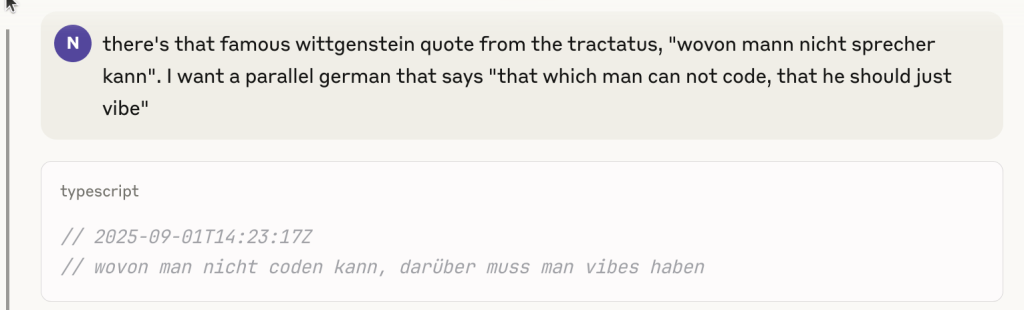
wovon man nicht coden kann, dar"uber muss man vibes haben

asemichorizon
http://asemic-horizon.com/?p=1801
Extensions
Julian
UncategorizedartbooksdementiainfinityJaegerpaideiaphilosophypoetrypoliticsprocrastinationtheory
I. It’s a convention of this (dying) genre: a “blog” as such must reveal a tendency for (and a tendency to indulge in) eye-wandering and light grazing, the logical endpoint of which is the antiepideictic fixed point of “procrastination”. This fixed endpoint strives to achieve a critique of inaction by bracketing out all doubts (all […]
Show full content

I.

It’s a convention of this (dying) genre: a “blog” as such must reveal a tendency for (and a tendency to indulge in) eye-wandering and light grazing, the logical endpoint of which is the antiepideictic fixed point of “procrastination”. This fixed endpoint strives to achieve a critique of inaction by bracketing out all doubts (all thought, really) of what, exactly, is worth doing. What’s left to explain is, then, psychological: procrastination is (sometimes succesfully) understood to be an anxiety response. Alas, this is a snake biting its own tail: this anxiety is all about the bracketing-out itself and the resulting exorbitance of the main task ahead. Now: procrastination is a popular theme because it’s amenable to chicken-soup cures that revolve around this exorbitance; thereafter there’s nothing to the main task but to do it.

Of course these cures are ultimately underwhelming; they implicitly refer to acute spells (whereas procrastination is a chronic tendency).

Yet: it should be clear, however indirectly, that an account of how procrastination works needs first to account for how procrastination as a concept comes to coalesce and then become an active concern. It’s not enough to bracket out the general issue of whether we want to wrestle with the soi-disant main task: procrastinating behavior is a clear and transparent sign of not wanting to deal with the main task. How does then procrastination (or “akrasia”, yadda gadda da-vida) manifest as a concern of note? Everything here tells us that we’re dealing with ambivalence — we’re “of two minds”. Is ambivalence by Aristotelian necessity anxiety-inducing? Is the anxiety a technical device we use to map higher-order time-preference valuation onto this flat field of two-mindedness? If the latter — is the exorbitance a miniature model of what it feels like to continually produce a mind — a representative thread, temporally consistent and accountable.

Yet — doesn’t talk of procrastination evince an unwilligness or inability of groups to align on ambivalence as such? The “procrastinator” finds himself in something of a short-term pickle, much like someone who needs cross a traffic-heavy street; he’s already announced one-mindedness without having really achieved it. In this way, two-mindedness is “laundered away”, never really having been mined for the many one-minds it implies.

It’s in this way that quability theory (so often deprecated and then revived) is a theory of “human resources” and “organizational behavior” and all such sweetness; or even a theory of the manager as philon logous kai spoudazon peri paideia; or even an account of “getting things done” from the quability conditions of culture-formation-slash-culture-sculpture. The abstract understanding of this implies as a corollary an abstract understanding of how two-mindedness resolves (and when it should).

The painful flip side: as forcefully denounced in recent times, General Axiology is a bogus notion — but not as much because “genericity” is incoherent as an idea, but because only paideia is real and genericity militates against it. Yes, this is still an upwards spiral; all movement is in some sense recursive and hierarchical through layers and levels and plateaus of “quability conditions on the quability conditions on the…” but this has a final floor on “… the quability conditions on the quability conditions OF paideia”.

II.


Ongoing conditions force us to step way beyond radical theories of mindmaking — post- or noncognitivism (and so on). A new kind of dementia — a roaring, forceful, in its own way glorious kind — haunts the ruins of what I, 15 or 20 years ago, used to call the “Socratic project”. There is some of this dementia in the very act of calling it so, by something like an emotional appeal to a yardstick called “sound mind”; there are, in fact, no such markers of note, and even coming up with a neologism like “amentia” fails to shake loose cogito and reason. It should be, of course, remarked that the Socratic project is more or less robust to a collapse in contemporary notions of mind and cognition. It’s less clear, however, that there is a continuable Socratic project rather than a Socratic crisis in the bosom of Greek paideia — military leaders (for example) disconnected enough from agonistic arete that they can be led into aporia by someone who fought as a foot soldier and now claims to hear voices. This echoes in turn the near-loss of writing in a previous epoch of collapse, and more generically the continual stumbling of Man into darkness.

This gives us a kind of political-compass chart: Socrates as crisis-event or civlizational project, on the horizontal, and cogito versus amentia on the vertical. Cogito plus crisis gives us Aristotle, intellectual life as a generalized, if deracinated, form of paideia, and, after a while, capitalism. Cogito plus projct gives theory the role of ballast or tuned mass; amentia plus crisis implies the role of intellectuals is to keep the candle burning; amentia plus project implores, in vain, for social engineering. Possible archetypes, respectively: David Ricardo and Warren Buffet; Ibn Arabi and Erasmus; Werner Jaeger and Schoenberg; Wynton Marsalis and Lyndon LaRouche. Somewhere in the center (but this is guessworkish and inherently contentious and more than a little forced): Deleuze’s Hume, Deleuze’s Spinoza and, well, Deleuze.

[Not that there’s intrinsic merit to centrism, of course; a centrist politics must justify itself either by the fundamental stupidity (at one point I wanted to say “dysmentia”…) of extremes or by a radical difference that elevates it from the flat map of the compass to a higher dimensional vanishing point.]

If amentia sounds overly abstract, consider what has been popularized in engineering as “the bitter lesson”: large, stupid computer models are extraordinarily more effective than artisanal, reasoned-through ones. Since, increasingly, “computer model” can stand for any product of human technical ingenuity, the bitter lesson is a floating-bridge whammy bar: “amented” or “nonminded” representations of technical problems are, essentially, the only viable ones — but worse, nonminded approximations to mindful problems are taken to be sufficient. More crudely put: the plus-à-jouir of “mind” as applied to mindable problems and tasks is founded and guaranteed by a mindable theory of the world. Where we once asked whether we could know what it’s like to be a bat, we now ask whether language models are able to “reason”. Isn’t it striking how little pushback AI companies get for the incredible misuse of that most hallowed signifier of modernity — reason?

III.

The hard claim asemic horizon is willing to make is that Artificial Intelligence (from Cybersyn to Stable Diffusion and beyond) is unable to germinate. This isn’t (just) a mystical claim about all that’s pluripotential and therefore fraying, frayeux at the edges of causality — it touches on core “technosocial” (what an ugly word to overspecify that which ultimately has no boundaries in the interfacticity) capabilities such as the power to redesirate — to bring the atelic back from the dead. Not just a claim, therefore, about God’s wounds, but on our ability to glorify and reanimate (and, really, reinflate) Him.

If that flight of metaphysics scares xor offputs, consider the following “soft claim”: Artificial Intelligence in its current iteration is the claimed realization of a shameful dream. It is a base dream, like somehow getting simultaneous sexual gratification from two totally hot babes; it’s a low dream that leads us astray from will-to-power and consumes us with logistics; it’s a shameful dream because no one is really able to affirm it with a head held high. This is why AI is sold to us in terms of practicality and productivity — I could write a twice-weekly asemic horizon newsletter if only I would get chatbots to interpolate my random mental connections between the doctrine of wahdat-al-wujud and the tonal slides of dialecto lunfardo (perhaps by means of Sabrina Carpenter’s legs, or something).

But productivity is a ruse, a lure, a cardboard cutout, a distraction; AI salesmanship is tied to this lure because the net claimed effect of its product is to displace our own generativity. Productivity is then scandalously equated with yielding into dementia. This isn’t necessarily bad (not in the way of VR headsets that displace the agon of seduction for push-button illusions of sexual prowess, anyway): maybe this dementia that desires dementia is General Axiology, the ultimate bliss from which we were derailed by emergencies of survival that sent us down the slippery slope into agriculture-to-writing-to-ultratechnology. But what is really in the quability conditions for this disaster? Do such conditions rule out philology-and-zealotry-for-paideia?

circle-frame-surfer
asemichorizon
http://asemic-horizon.com/?p=1721
Extensions
BUCHAREST
UncategorizeddemocracyeconomicsinfinityphilosophyRomaniatheory
1. There are certain notions asemic horizon holds to be self-evident — if only at the cost of irreparably mangling what “notion” and “evidence” even mean. A more honest version of this catchy opener is that there are certain theorems we hold to have value in a way that propels (de suyo) the epistemological Noah […]
Show full content

1.

There are certain notions asemic horizon holds to be self-evident — if only at the cost of irreparably mangling what “notion” and “evidence” even mean. A more honest version of this catchy opener is that there are certain theorems we hold to have value in a way that propels (de suyo) the epistemological Noah into the axiological belly of the fish. But mathematics has come to own the word “theorem”, which historically means not just “proposition”, but also intuition, spectacle, vision. This is not only a might-makes-right deal — the power of maths compels us all — but also a philosophical enclosure that structurally underwrites the very edifice of human achievement. After all, mathematics as the scramble for “knowledgeness” (“mathema”) is built on de suyo truth — from itself, from the fact that it is itself. Thus knowledgeness is achieved by a powerful armada of mathematical theorems. As theorems, they grow on our intellectual power as intuition, vision and sometimes spectacle, but as mathematical statements they grow our intellectual power itself.


To start again: asemic horizon holds intuitions, visions and spectacles; but these visions do not relate to actual ongoing scenarios but (yes, we keep retiring the term and bringing it back) quability conditions that are adequated by the ongoing thing-of-the-world. At some point, I came to use the word “verified” for how Capullo de Jerez animates the music-theoretical notion of the duende (the Andalucían diabolus in musica), but that’s something that slipped through thanks to my own inattentiveneness. The apparent claim that Capullo gives truth-content to the metaphysics of Andalucían flamenco, but it is his ability to access duende that bestows him with a standing as cantaor flamenco. (When I say “access”, you can think “affect” or “ready-to-hand”; this choose-your-own-adventure character is in the quability conditions of theory).


Now, this project has long promised to clean house with so many loose concepts of “early theory” that, in its beginning, protected it from falling too much into the grumpy, frumpy role of political commentary. I find continual fascination in politics de suyo and continual abjection in politics as such. Therefore: even if we’ve touched on political matter time and time again, we abandoned the as-such after the first handful of texts. Remember: theory is something that comes to me like a feverish waking dream, sentences typing themselves, sometimes in circles, sometimes entirely adrift; trying to cover politics-as-such was annoying, as in our earlier texts, and trying to bring sparse theoretical ideas to bring new lights to thing was like approaching a woman with canned pick-up lines and techniques. The advice we’ve given to incels and awkward men in general — tell each person a different name, dress normal, let the interfacticity carry you, don’t be yourself; just be — is, in retrospect, a thinly disguised confession of a theoretical praxis.

2.

A philosopher wrote — “writing is not about meaning, but about landsurveying and measurement, including that of lands yet to come”. I’m serious about the germinal turn of asemic horizon, as I was about each phase of the project that, at each turn, denounced, built on, and ignored (in varying proportions) the previous material. Yet this “seriousness” is earnest and open, like an improvising musician who integrates some of his wrong notes and lets others flow away. Perhaps the key takeaway of this project is this general attitude to theorymaking: too open-ended to be “gonzo philosophy”, too abstract to bea teenage girl’s journal, too Deleuzean for Heideggereans, too Lacanian for Jean-Yves Girard, too self-referential for Valuable-Insights blogging, too political for Literotica, too rational for TPOT mystics, too weird for engineers and inventors.


The danger of proclaiming self-indulgences like these (“we’re here! get used to it get used to it!) is that the generic structure in the formula “theory is the theory of the theory of the theory…”) silently shifts in scope to mean “the generic structure of theory”. A cool name for this would be the Kantian flytrap. Yes, there’s a rock’n roll swagger to our mannerism — the rushed writing, the self-authority, the way we swerve and circle around aporetic black holes like a nouvelle vague director might film a jolie fille’s legs. But I find myself spending hours engrossed in my own material. Perhaps much fo this is because the near-automatic writing means I find freshness and verve; but it’s also the case that even old, flawed texts that say “quable” have a vatic effect — distinct, palpable, haptic. This is how I know to avoid the Kantian flytrap: try to be neat, yes, but never disavow the messy, numinous shit in your past.

I assume one of the effects of a rigorous editing protocol is to reencounter the text enough times that the author is sick of it, preventing him from being high on his own supply. But I, myself, have had the experience of having text polished and mangled for publication; there’s a spectral quality to the results in that what survives is only what you “mainly meant”; the record of all the amputated outward resonances of the original text is hidden in plain sight — holes and stubs, painful to the touch — but no one else can see them. asemic horizon, for one, has no such stubs — except for the handful of initial texts that tried to achieve cogency about politics while, at the same time, trying to make theoretical advances.


Yet — something is happening.

3.

If asemic horizon hadn’t completely veered off its course after those initial months, it would feel like a failure: the then-latent legitimacy crisis in the sources of policy has come to an absolute collision, yet after all these years we have little explanatory power — at least none that is legible without getting lost in the weeds. In many ways, this project has survived a car crash by virtue of not being in the car. But the funny thing about automobile collision is that it doesn’t always terminate the colliding objects — it’s often possible to not only drive away, but also to circle back and strike again (whether with malicious xor psychotic intent.) It’s therefore never enough to sit in a high chair and say these two objects won’t move along this path because they would collide — not when the point is to destroy the car.


This tactic can be contrasted (even to the point where they seem like complete antinomies) with the “CIA” tactic. This is not to make the actual CIA into a major structural force, at least not the same level of abstraction of our previous example-by-analogy. The crashing car is about using something to effect its own destruction; the CIA is about creating an instrument that ends up instrumentalizing its creator. The crashing car destroys itself as such at the same time it comes into its own (as an accelerating engine) de suyo. When it creates this hypothetical CIA-like autonomous instrument, the state apparatus (gradually, like the car that comes back and back) destroys itself as a de-suyo source of policy, even as (through international regime change ops) it projects policy as such.


While the former dynamic comes to a stop — it’s meant to come to a stop — when the instrument is rendered impotent, the latter is able to renew itself as long as its host is kept alive, zombie-like, as an as-such projection. Of course, because power relations are never as simple, the host is never simply enslaved; even the upkeep of a hollow structure would cost, but a real state apparatus (even under near-complete capture) costs much more.


The capturing instrument (CIA-like) scenario is, therefore, never like Baudrillardian simulation — nor even like The Matrix, for that matter. The reality of politcs de suyo (even in the scenario where it predominantly enacts an exogenous agenda as such) weighs down on the slick technocratic machine that never hesitates to break a few eggs to make marmalade. But this “de suyo reality” of politics is not (at all, at all) necessarily experienced by anyone outside the very core of the state apparatus where the machine’s policy is rehydrated and modified until it becomes state policy. Dude, if there’s anything you should have learned from the 365-day slice of history that immediately precedes this, it’s that political parties are as-such. Which is why they can be terminated without disrupting “de suyo reality”.


The crashing car, on the other hand, comes a lot closer to Baudrillard. We, the hoi polloi, are vaguely aware of the collisions, but are rarely — if ever — awake to the ourobouros of it all. Much like a manifold is flat around any point, we think that moving towards the collision path is moving through history; the crash is experienced as a shock, a betrayal, a dialectical antithesis. But dialectical sublation is supposed to be about the emergence of a roving contradiction — an unresolved superposition of terms — yet history looks more like a succession of open fires. The French Revolution never really sublates; Americans see it again and again in their Civil Rights movement and in “antiracism” politics and Women’s Lib and the gender revolution. The CIA-like thing is in a way of preparing to lose (better to surrender to the Agency than to communists); the crashing car is in a way of confronting and winning and confronting and winning.

4.

The task that faces us as political creatures is to tell the truth — not a truth grounded on facts, but a moral truth, grounded in what for practical issues is a self-evident gradient from bad to good that lets us make an epistemic cut: acceptable, unacceptable. General Axiology was/is an utopian project was all about making gradients from cuts from gradients from cuts. But we have no General Axiology at hand — our problems haven’t been dissolved yet — and still many political questions (both ongoing issues and discrete events) on the cusp of outright catastrophe seem to require very little moral and ethical capabilities — let alone refinement — to be sorted out.


And yet we’re lost: because the dominant philosophy (the discourse of the Master) tells us that godliness follows from factfulness, the sphere of facts is permeated by noise that drowns out signal. The same dominant philosophy tells us that the political gridlock (and sometimes one is theorized into existence) stems from an attachment to the values and beliefs of one’s camp over reality, which in the context of gridlock has the structure of some consensus (or the promise of a consensus horizon). If this seems like an unworkable structure, that’s because it is one. This is a car meant to crash again and again. The ultimate goal of democracy is to destroy itself. It can’t really go anywhere else.


The opposite of this is, of course, the “deep state” — the structure that politics de suyo builds in order to become as-such (a transition that is never complete, like those that involve surgery and opposite-sex hormones). There is (at least in principle and in historical semi-myth) a best form of this — paideia, the total ideal of excellence in which every man is expected to be a geometer, an athlete, a philosopher, an orator, a warrior. But to obtain paideia from current arrangements we would need the state apparatus to first invert its notion of a civic education to then realize what we’re about to lose (societal and cultural integrity) and then create the instruments to which the sources of policy de-suyo will be dislocated. Politics as such might remain a fun horse race in such a scenario.


But instead: civic education subordinates everything else to raison d’etat. Civics is the ultimate recurring crashing vehicle: it attacks again and again the irrepressible human flourishing that makes civics thinkable despite the bare essentials (disease, darkness and hunger). Civics is a murrain; there is no delocalization scheme that can protect the sources of policy from it. Every last strength we manage to put towards political action must be against civics before it destroys civic life de suyo and towards the takeover of society by paideia — the only thing that can ultimately protect and promote boundless, spontaneous, asemic human flourishing.

an-open-trash-fire
asemichorizon
http://asemic-horizon.com/?p=1696
Extensions
Homologia Fantastica
UncategorizedculturedominohistoryLacanpoliticsrube goldbergtheorywokewokeness
1. Those tarred as the “woke right” have spent about a week protesting their dissimilarities with the “woke left”; these protests have, however, pretty much cemented the idea that their emergent ideology is, indeed, emergent and “woke“. It wouldn’t be counterintuitive to characterize “the Right” as the thought that imagines itself not to be “thought”; […]
Show full content

1.

Those tarred as the “woke right” have spent about a week protesting their dissimilarities with the “woke left”; these protests have, however, pretty much cemented the idea that their emergent ideology is, indeed, emergent and “woke“.

It wouldn’t be counterintuitive to characterize “the Right” as the thought that imagines itself not to be “thought”; or at least, not to be “transcendental thinking” but, instead, derivative from “plain fact”. This would (more or less) pin the birth of “the Left” on Kant. Perhaps more clearly put: the secret name of “the Right” is qualunquismo. “The Left” has no such secret name because it identifies itself with broad tropes it managed to paint as equivalent to civilization itself: enlightenment, progress, reason. This is why the final boss for the Left is l’uomo qualunque; and that, in turn, is why it keeps getting tangled in morally abhorrent causes (for example, in sexual issues as it pertains to children). Si, il gramigna è anch’esso rizoma.

Whence, then, the “woke right”? Well, the more extreme views of “the woke left” have nothing to do with “woke” — they’re just generic left-wing positions (not everyone in “the Left” is, however, required to hold all possible left views). What’s notable about the woke left is its quickness to arrive and adopt certitudes. Their “ideas” are hardly ideas at all — they’re obstructions. Take the Climate Rebellion’s signature tactic of gluing themselves to works of art: the worldview they want to highlight is actually the generally accepted worldview — the only novelty to be conveyed is in the urgency.

This already exemplifies two key features of “woke” tout court. First, woke is not a deep rebellion against a status quo, but an ancillary feature of one. Second, woke has this asemic quality — clearly seen in Climate Rebellion’s antics, but also in the looting of high-fashion stores during Black Lives Matters — it really isn’t saying anything except “this is a big deal”. Therefore, all popular woke slogans are essentially pleonastic: trans rights are human rights; black people are people; America for Americans.

2.

My son is going through a domino toppling phase. Even at the dinner table he’ll cyclically place four or six pieces, announce something and push the starter piece. Dominos used in this fashion dramatize the (usually left in the background, like air conditioning and garbage disposal) issue of cause and effect: the future here is inside the present.

Domino toppling is Apolinean; the Dionysiac counter part is chain reaction sequences (“Rube Goldberg” machines). It’s surprisingly difficult to find content with chain reaction machines that isn’t sauteed with dark humor — the trick is to look through domino creators until you find the ones that do extended rube-goldbergiana within child-friendly boundaries. But chain reaction videos are sharply distinct from domino topples in that they “wear their contingency on their sleeve” (often, a succesful chain reaction display will be followed by a carnival of failures). What’s more: since, fundamentally, the chain reaction falldown is a generic, unformalizable object, there’s no broad theory to these failures — or, to think of it, of successes.

Of course, there is something very generic to these “machines”: if you run the film in reverse, what ensues is so patently unreal that we immediately know it’s backwards. This is because — I mention this to my son now and then, but it’s still way beyond what he conceives he’s even able to conceive — chain reactions work by releasing energy that was painstakingly (and at a great rate of error) distributed towards the machinery. Fussy as those are to correctly progress, they still dramatize something close to a moral theory of cause-and-effect: causality (the drop from a high energy to a low energy state) is actively inserted in the system by the human hand. The contingency — the effective infinity of ways in which the falldown can fail — stands in for human faliblity and sin.

This energy-drop account of how “things” can be made to accomplish “goals” is, sometimes, generalized into a kind of “physical economics” that centers cause-and-effect and reads either the difficulty or the asymmetry of effort into a direct theory of value — it’s much harder to drop an egg to the floor than it is to glue the egg back in place. This is at the core of the labor theory of value — workers cause nature to fold into shape. It also still haunts us when cryptography is marshalled to forcefully equate hardness of effort and scarcity: thereby crypto mining very directly enters energy inputs into a chain reaction contraption. “Physical economics” can, at the same time, be constructed so to imply or handwave a natura cogitans into the turbulent core of general ecological causation: if the purpose of a system is what it does, then the world is dotted, doted with “natural capital” and ecosystems can be said to “perform labor”.

Now: after having seen some number of domino topples up close, one acquires a certain familiarity with the toppled-down state of various simple arrangements. Even then, we can’t easily reverse the toppledown — we can’t, starting from the fallen system, pick the last piece and gently push the system back up. This has to do in part with the loss of energy as sound (and so on, and so on); but the main issue is that even a four-domino row is a distributed system in that energy has been inserted at separate places (in order to produce the stable domino row we can look at) but drops all at once. This realization should effectively pop the energy-drop theory of value: if the state transition was inherently meaningful, then meaning would be trivially be recoverable from the lower energy state. This is why standard, subjective-value economics is essentially unassailable from otherwise very sound “physical” critiques: the semantic content of things is, for most purposes, self-replicating — I’m right here discussing causality with reference to domino topples that have taken place in the past — and value isn’t anything if it isn’t semantic. What, you can make bread out of talking about Bitcoin without ever mining any: the value of crypto arises out of conversations about it.

3.

A tentative definition of “woke” is: germinal-terminal fusion by means of rabble-rousing. It’s one of those daredevil takes I’m prone to quietly incorporate to the general lexicon of theory — it takes an empirical explanation (woke is pleonastic because it’s an obstreperous reaffirmation of what Lacan termed S1, the dominant sense of things) to an unexamined theoretical connection. We gave a name for such Tony Hawk-styled high jinks: functoriality. Given that woke is, in fact, whatever it is in the real world, this connection becomes binding on the theory side of things. To make a connection is to say that theory bends but not breaks under its pressure.

This “functoriality” (and the abuse of a math word is, perhaps, the quintessential heart-stopping daredevil move of theory) maps neatly to Lacan’s Discourse of the Analyst*.

The intellectual style of woke is nearly indistinguishable from the Discourse of the Master (and very sharply distinguished from the model of actual political rebellion given to us as the Hysteric); the already-dominant system of meaning recruits and deploys all other sense-meanings of the world (S2) in order to produce its little profit — the little validations of woke causes that dynamize the pleonasm as inevitability. Trans rights are therefore not only logically and ethically human rights, but they’re also politically so — “get used to it, get used to it!”.

Functoriality (with a germinal-terminal fusion) then arises from taking the Analyst position and making the little validations (or rather the desire structure behind them) speak; the “Other” of this alternate discourse is that which had founded the dominant sense of things in first place — the “broken” or “divided subject”. What is thereafter produced is the dominant sense of things itself. The connection is then critically contingent on how the little validations (or, more precisely, the impossibility of sufficient validation) negotiate with the broken and mirror-staged subject. So, for example: how is the ongoing drama of Solow convergence and demographic collapse massaged by the little kicks given by a nostalgia-for-Americana woke-right position? There’s of course, a real-world answer — rabble-rousing. But at the other end of the connection — what is the neurotic motor that animates the general circuitry of things into melting itself down?

If this is sounding a lot like General Axiology, that’s because it illuminates the fundamental naiveness in General Axiology. The woke right has discovered a kind of Dark Switcheroo.


create-a-photorealistic-depiction-of-8-penguins-all-standing-on
asemichorizon
http://asemic-horizon.com/?p=1593
Extensions
untitled excerpt
Uncategorizedcynefineconomicsemergence
…. ECONOMIC GROWTH: if there was a single phenomenon that could be characterized as “emergent”, this would be it. Dave Snowden posted something about purpose (or was it strategy? in many ways it doesn’t really matter) being an emergent process rather than a north star. The point being that you can’t beam whatever makes orgs […]
Show full content

….

ECONOMIC GROWTH: if there was a single phenomenon that could be characterized as “emergent”, this would be it.

Dave Snowden posted something about purpose (or was it strategy? in many ways it doesn’t really matter) being an emergent process rather than a north star. The point being that you can’t beam whatever makes orgs work directly into people’s minds.

On the other, more visible side of things, Rory Sutherland is making a killing out of tightly edited minute-long lectures delivering invariably the same lesson — that value is contextual and relational. The implication is that I can’t sit on my computer and decide to “create value”. (It’s far from an original idea, but it *is* getting some long due airtime)

And yet: economic growth as generally understood is precisely value-creation power. Thus my classic refrain (guaranteed to break the ice at parties) that macroeconomics is primum inter pares among systems theories: it deals with very gross causal levers — such as purchasing power and investment — which, under the best circumstances, should set the stage for “value-creating” emergent loops.

The surface ambiguity of macroeconomic data is something like a (yes, Kantian) sublime expression of an ineffable underlying world of human behavior.

This idea of the sublime brings us back to Snowden’s north star, which in economics gets called “development”. The word itself is ghostlike: as if material prosperity was currently “enveloped” — like candy that needs to be carefully unwrapped to be separated from its plastic enclosure as it is retrieved. Everything that’s naive, mistaken or corrupt about “development policy” stems from this north star-like metaphor disguised as a problem statement. But there’s no single problem statement that can be abstracted from social reality and forcefully identified with “development”. Yes, high income inequality is also rhizome.

But this isn’t just about third-world government foibles: “value generation” is everywhere ensconced — in talking points, startup decks and resumes, but also in how people think of what they should be doing. Thus the solution-in-search-of-a-problem syndrome (which is ultimately also the heart of development policy): once you’ve created value, you just have to find someone in enough “pain”. Concepts have consequences.

(This was inspired by a couple of LinkedIn posts and thereafter posted on LinkedIn. But it’s way too erudite for the medium.)

asemichorizon
http://asemic-horizon.com/?p=1588
Extensions
TERMINAL ACCELERATION
Uncategorizedchristianitydesireeconomicsgodinfinityjesuslingeriephilosophyreligionstructuretheodicytheologytheory
Definite terminality in its quality as definite terminality comes close enough to the process-philosophical notion of singularity that I can’t actually tell them apart (at least at this moment in theory development). Terminality is the process by which differentiation is arrested; definite terminality is the attribute of not being able to further differentiate. Classic neurology […]
Show full content

Definite terminality in its quality as definite terminality comes close enough to the process-philosophical notion of singularity that I can’t actually tell them apart (at least at this moment in theory development). Terminality is the process by which differentiation is arrested; definite terminality is the attribute of not being able to further differentiate.

Classic neurology understands neurons to be definitely terminated — that is, fixed and impermeable to forces that might otherwise press for change. To the extent that the standard consensus on scientific reduction avails what theory needs it to, definite terminality of neurons is tantamount to individual singularity — individual personality, if we’re thinking of humans. The process of a particular person’s life is then conditioned by modulating the self-anihilating tendency of all cells: to arrest death long enough that personality has the time and space to ex-press something, to press something out of themselves. These outpourings are de-terminations: they’re popped out of the dying biological thing and become separately differentiable, reproducible, remixable, misinterpretable.

This neurocentric view of the person is, of course, a raft that one uses to cross a river and then discards. It serves us to ilustrate terminality as a kind of death-within of all processes.

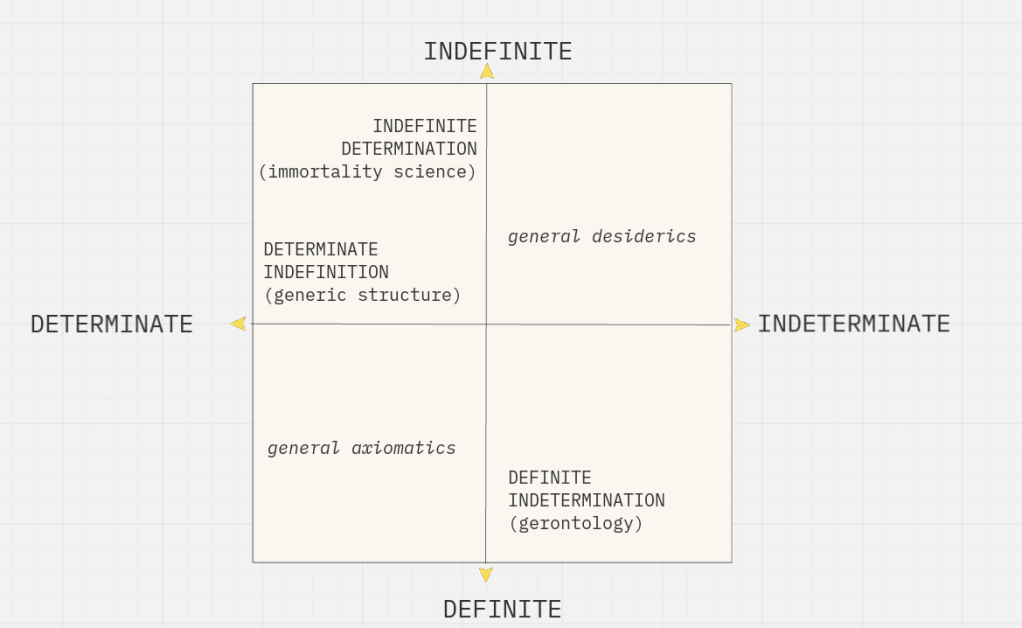
We often would like to have answers to questions, terminal answers, de-finite in that they escape the finitude of provisional episteme and become infinite in their reach. But even the Abrahamic God can only terminate capital t-Truth in a kind of last instance. To the extent his Creation is marked by definite terminality, it is the only possible creation; this meshes uneasily with omnipotence, or rather, requires God to have a further layer of powers, a metaomnipotence — the power to be omnipotent in any way He desires it, the power to arbitrarily terminate the world. But then — standard Abrahamic doctrine is that there is a particular determinate (however self-imposed at the meta layer) form of omnipotence that gives sharp upper bounds on God’s ability to intervene in the universe. All human termination then happens in history (Darwinian morphogenesis and human self-axiomatization). And I think most people who have thought things through are bathed in the feeling that this terminality is arbitrary; some even arrive at the conclusion that ultimate determination, indefinite determination, is reachable from within the germinal-terminal circuitry we flow in. To someone like Aubrey de Grey, this means immortality of the flesh; to asemic horizon circa 2019-21, this meant general axiology.

But does “indefinite determination” even mean anything? Is it somehow commutable or otherwise related to the more palatable “definite indetermination”? “Definition”, after all, stands for a particular kind of “infinity” that obtains from expressing something abstract in something material — like one squeezes out the oil out of olives. The hope that the abstract derives from the material is, of course, modern Humean empiricism — and therefore not such a hard sell. And we all know what “indeterminate” means: it’s a swarm of possible determinations, i.e. a germinal circle. “Indetermination” is then exactly what the tin label says: “germinal reduction is obtained by procedures of determination” and therefore indeterminability is germinal irreducibility. “Indefinition” might therefore stand for an analogous “swarm”, a mass of suspended particles — each one the infinite scope of a definite abstraction. If (and this is a sizeable “if”) this flimsy attempt avails, then “indefinite determination” can be derived as a sort of blend of conceptions of germinal circles — a germination over germinal irreducibles.

This becomes a tall order for Aubrey de Grey types: it immortality for arbitrary humans with almost no sense of their history — certainly not genetic testing for telomere length or whatever is current in gerontology. Immortality science (indefinite determination) involves, in this way, what asemic horizon used to call a “switcheroo” over gerontology (definite indetermination). The problem for asemic horizon was that we posited our indefinites — genericity, I called them, a single voice raising their clamor — and subsequently forgot they were pretty much revealed in a fever dream. Theory was the theory (of the theory of the theory…) of generic structure; but generic structure would be a determination over indefinitions (determinate indefinition).

So what is terminal acceleration (not to be confused with germinal acceleration)? It’s that towards-death vector between the empty quadrants that takes us to the arbitrary satisfaction of immediate desire, that mirror symmetry of Buddhist dharma that says “infinite bliss here, now”. Terminal acceleration explains modernity.

when-someone-says-systems-not-goals-they-mean-sexy-not
asemichorizon
http://asemic-horizon.com/?p=1579
Extensions
Germinal acceleration
Uncategorizedaccelerationismphilosophypolitics
A barely-even-there distinction needs to be drawn between axiom and axiomatics. This distinction is best seen when the axiom hasn’t degerminated yet, that is, when it plays the role of a desideratum. Then, desiderics makes itself known as the abstractmost concupiscence that desiderata try their best to infuse with definite terminality. But if an axiom […]
Show full content

A barely-even-there distinction needs to be drawn between axiom and axiomatics. This distinction is best seen when the axiom hasn’t degerminated yet, that is, when it plays the role of a desideratum. Then, desiderics makes itself known as the abstractmost concupiscence that desiderata try their best to infuse with definite terminality. But if an axiom is a degerminated desideratum, then axiomatics must likewise strip the germinality present in the raw capacity for violence in desiderics. To temporarily oversimplify for dramatic effect: it must obscure the structural sources of this violence so it appears to be purely terminal.

Axiomatics therefore enforce a kind of (partial, conditional) “pure terminality” of axioms on us. Axiomatikos, as you might remember, are police officers; the law they wield is a pure terminal, abstracted away from the social desiderics that gives rise to police power. Note how this implies that police power is indeterminate: any fool will tell you to cooperate with the cops and then push for determination through the courts. The law before a judge is not the same as the law before a cop; a judge must make the application of the law determinate by stripping it of its pure terminality. In the eyes of a judge, the law has an underlying hermeneutical current that must escape the axiomatikos. Legal hermeneutics must add new germinal nodes to the circuit of law enforcement without slipping into general desiderics.

When someone says “systems, not goals”, they mean “axiomatics, not desiderics”. But the barely-even-noticeable dance of germinal and terminal nodes almost necessarily escapes them. The phrase “systems-not-goals” is, after all, itself an axiomatic, albeit one with very high-dimensional terminals. The ensuing axiom of atelicity is, in its own way, the product of a degerminative transformation of “systems-not-goals”. Is it reversible? Can an utter lack of directional information be “redesiderated”? This, my repeating reading indicates, is how one gets to Deleuze’s rhizome — both the spectre that haunts the world and a desire no longer grounded in a negative.

It’s useful to ride this connection into the general polemic of accelerationism. There are disjoint camps staking a claim to this word, which makes reference to some fragment of a sentence from the D+G corpus. But why? Why would 2015-vintage Nick Land need these soixante-huitard connotations to articulate his universal darwinism? Why would Mark Fisher need to distance himself from the marxist dialectic of capitalism as a roaring contradiction? This is why (I gather): both universal darwinism and the marxist dialectic are powered by a negative propulsion — a “telic lack” — that just doesn’t vibe with acceleration. Land and Fisher alike need to tether themselves to a kind of Nietzschean life-affirmation that they’ve only learned to access through Deleuze.

Nowadays I tend to think this is wrong in almost every aspect. Fisher and Land deal, each in his way, with the challenge of atelicity in the contemporary social formation. They then imagine accelerationism as something to mow down this atelicity like a speeding car crashes into a goat. But any political problematic is powered by a desideric problematic. The problem is precisely to redesiderate atelicity. This is what I’m now calling germinal accelerationism.

(General axiology, as noted lately, suffered from the yawning gap between atelic genericity and totally telic (totatelic?) generality. It leaned into systems theories as a kind of transport medium and told passengers “if we gather all of our telic matter and place it inside this volcano, infinite bliss will eventually explode into the skies”. Germinal accelerationism is more of a fist, an already-there potential, as fragile as its pure punching power. The danger that a fist breaks down into its glass bones is matched by the danger of germinating onto desideric fields of unknown power. This is a fallible project.)

when-someone-says-systems-not-goals-they-mean-sexy-not
asemichorizon
http://asemic-horizon.com/?p=1502
Extensions