GeistHaus
log in · sign up

Aamir Virani

Part of aamirvirani.com

Aamir Virani's home on the internet. Basic information about me as well as random writing and other documentation.

stories primary
How should I price my startup product?
pricing
How to justify that magic $100,000/year annual contract to customers
Show full content

I write new articles and publish them to Substack if you want an easy way to keep up. I hope you’ll subscribe!

Read more product and company-building articles

A few weeks ago, I met with a founder who sells their product to medical systems. The founders still make up the company and have been selling their MVP for about $10 /month.

They have a good set of customers!

They have revenue!

They have yet to pay themselves.

And so we started discussing where that $10/month came from. It was just a shot in the dark - something to get started. That price point made no sense since the company is not a B2C startup. They needed to increase their pricing, but how much?

Pricing is a signal, and they were sending a bad one. How would they justify their price when they spoke to the managers and CIO/CTO types in charge of purchasing at mid-size and large medical systems?

So I told him one of the two stories I always tell about pricing, and I present it here to you.

Messing with Canva Magic Studio - “dinosaur reading a product review” Messing with Canva Magic Studio - “dinosaur reading a product review”

Back in my day… reviews meant something

After finishing graduate school in 2006, I worked at PowerReviews. At the time, my short description for it was “a review engine for e-commerce websites.” The company started during a time when only Amazon had product reviews, and so it was winning the SEO battle on Google and appearing at the top of results. Every other seller on the internet, including folks like Walmart, needed help figuring out what to do.

So PowerReviews says,

Add one line of JavaScript to your website, and suddenly, you can take reviews and show reviews for the products you are selling.

HUGE DEAL. And it worked! (This is still one of the best ideas I’ve ever heard and was why I jumped at joining when coming out of school. It just made sense.)

So it’s all rainbows and IPOs, right?

Well, this was such a good idea that another company started in Austin around the same time called BazaarVoice. The two were in direct competition, with the same promise: “You show reviews, more people buy, you make more money.”

One problem, though. There was no proof that reviews would lead to more sales. Retailers worried that reviews would lead to fewer sales as people trashed products and gave them low ratings.

After a year, Bazaarvoice released a whitepaper that showed the average star rating was 4.4/5.0, so basically, everything looked good once it had reviews. And there was indeed a lift in sales for those who implemented Bazaarvoice.

Side Note: This is a perfect example of what a whitepaper should do. Show the reader how they will get their ROI and help them remove their top reason to say no.

The race was on. The sales targets were the Internet Retailer Top 100 list. Amazon was #1. Everyone else needed a review engine.

How would customers choose?

PowerReviews had the best technical solution for reasons that don’t matter in this story.

PowerReviews and Bazaarvoice had some excellent initial clients thanks to friend networks and prior business partner relationships.

Both had sales teams made of folks who had worked in e-commerce before. They had rolodexes and would make the case.

Would we split the market?

Would our better technical solution win out?

One day, our engineering team is eating lunch around a table in our small office, and one of the sales guys walks in, and he’s steaming mad.

Can you believe it? Bazaarvoice is telling folks we’re going to go out of business!

So, about that startup business model

PowerReviews had a business model. There was a plan, and it went like this:

  1. retailer gets the review engine for free
  2. we get the reviews under a license
  3. we show all the products and all the reviews across all the retailers on our shopping portal
  4. we get to the top of search results
  5. consumers visit the portal, and when they decide to buy, we show them where
  6. they click on one of the retailer links, and we make affiliate revenue on the purchase

Affiliate marketing was still nascent, so this was a big deal! It made sense to us, and once we had the eyeballs (uh oh), it would make lots and lots of money.

The best part was the alignment of incentives: we made money when the retailer made money. So we wanted you to make more, and you would be happy to give us a cut.

Messing with Canva Magic Studio - “South Park underpants gnomes 1) product 2) ??? 3) profit!” Messing with Canva Magic Studio - “South Park underpants gnomes 1) product 2) ??? 3) profit!”

Our sales guy is fuming. He tells us what’s going on:

They’re telling everyone our business model won’t work!

Bazaarvoice’s story was that there was no way for us to get to scale and make enough money to survive as a company. Did the retailer expect us to build the #1 product review site online and earn enough affiliate revenue to grow and cover all expenses?

Let’s say that did happen. If PowerReviews pulls it off, the amount the retailer would pay in absolute dollars could be crazy as it scaled with revenue.

They went on.

How many employees are working on your website right now?How many will you need to build and maintain reviews on your site?

And then, the killer line: 

Wouldn’t you rather pay the low, low price of one engineer ($100k/year) and get a whole product team making best-in-class review software?

It’s a fair price. You know exactly how much you’re paying, and we’ll be around in two years.

I was just an engineer at this point, but I remember thinking:

Damn. That’s pretty good!

I may have said that out loud. I remember the sales guy going off again after that.

Pricing your startup’s product is hard!

Messing with Canva Magic Studio - anime style, telepathic message between two people of “pricing is a signal” Messing with Canva Magic Studio - anime style, telepathic message between two people of “pricing is a signal”

A year later, we launched our shopping portal and signed some good retailers!

But Bazaarvoice had taken the lead. They signed the top online retailers and were on their way to dominating the market.

Many other things happened, and many other strategic choices were made. But the end of this story is that Bazaarvoice went public and acquired PowerReviews a few years later. (The FTC found the merger was a monopoly and broke up the company in the “reviews” space, but whatever.)

I have a few takeaways from this story.

First, pricing is hard! The PowerReviews pricing model made sense and is a standard model today. You develop a product, drive revenue for your partners, and take a cut of revenue. And yet, it wasn’t the right solution at this particular time in this particular space. Company founders need to consider multiple pricing options and think about sustaining the company against potential competitors.

Second, pricing indicates value. Reviews bring higher sales, higher SEO, and higher trust. Why wouldn’t you pay for it? As a founder, your goal is to find a similar way to easily pitch ROI for your product.

Third, pricing is a signal. If it’s too low for your market, it may signal that you are not solving a critical problem or that you’re not a serious option. If it’s too high, you might mistakenly message that your startup product is meant only for huge enterprises, rich people, or even an entirely different problem. (The second story about pricing digs into this.)


https://aamirvirani.com/pricing/2023/10/30/how-should-i-price-my-startup-product
My Journey with LASIK Eye Surgery - A 20-year Retrospective
personal
Personal reflections on LASIK - how it went, side effects, and things to look for when you are considering eye surgery.
Show full content

I write new articles and publish them to Substack if you want an easy way to keep up. I hope you’ll subscribe!

Read more product and company-building articles

My Journey with LASIK Eye Surgery: A 20-Year Retrospective

Over the past two months, two friends have talked to me about LASIK eye surgery. I had the surgery done in 1999, and so I’ve lived with its effects for over 20 years. When people ask me if I should get LASIK done, I say, “Yes, but you should know the warnings.” So, I wanted to write down what I usually say in case it helps anyone else.

Why opt for LASIK?

I grew up wearing glasses. I wasn’t the coolest kid, and having glasses was not cool. It didn’t help that I had no fashion sense, so I was wearing thick glasses when they were not in. Let’s put it this way - I was one of those kids who put a string on the glasses to keep them from falling off by choice.

In high school, I tried to switch to contacts but could not get them in. I have dry eyes and couldn’t stand putting my finger on my eye. My first contact appointment took 2 hours because it took 1.5 hours to put the contacts in. The last straw was when I was wearing the contacts during high school, and one popped out on my desk while I was sitting and looking at the chalkboard. I went back to glasses.

When I got to college, my uncle started telling everyone how he had gotten PRK eye surgery, how his vision was now better than 20/20, and that it was a fantastic experience and very easy to do. My parents started asking me about it, and I was still in “prove the haters wrong” mode after high school, so I decided to do it.

The LASIK procedure: woozy and smelly

I had surgery at Mann-Berkeley Eye Center in Houston, Texas. Back then, it claimed that it was the #1 LASIK center in the world and that it had the most experience. They placed a lot of ads in the Houston Chronicle.

After an initial consultation, they set a date, and I came in for an outpatient surgery.

It’s been 20 years, but I vividly remember two things:

  • They drug you up, and I remember someone helping me from the waiting room to the machine.
  • The machine moved across my eye, and there was a slight burning smell as the lasers did their thing.

I went home with eye shields on. They had holes so that I could see through them, and it felt amazing. I could see better, and things were sharp.

When I exited our car, I remember looking at a tree in our yard and seeing the bark on the trunk. Like really seeing it, with detail. And it was awesome.

After LASIK surgery: amazing clarity

I was allowed to take the shields off 24 hours later and had to put eye drops in for about a week. At that time, things felt super clear and sharp, and I was thrilled.

But a few weeks later, I remember things shifting a little, and my eyesight changed for the worse.

LASIK side effects: halos and imbalances

I wish I knew what halos were before the surgery to compare them to what I see today.

First, I started seeing fuzzy rings around lights. This was especially noticeable at night while driving.

Second, my right eye got a little worse than my left eye. Over time, my mind has adapted to the difference. But the best way to describe this is that I can close my right eye, and my left eye will read things okay. If I switch and close my left eye, I can read the same thing, but it’s a little more challenging and fuzzier. I notice a halo shadow around the letters, too.

Would you do LASIK again?

Yes. Even with the issues, it worked out well for me. I think I’m one of the good cases.

Wait, what’s a bad case of LASIK?

I have two siblings, and they had different experiences with LASIK eye surgery.

One sibling wears glasses again.

One sibling had their eyesight collapse after about ten years and decided to get the surgery again. Things seem to be pretty good now.

I already mentioned my uncle, who claims 20/15 vision after decades.

I have another friend who recently had the surgery and has worse eyesight. They’re dealing with difficulties working.

What should you consider before LASIK?

If you are considering LASIK eye surgery, here are three pivotal questions to pose to your healthcare provider:

Ask your eye doctor how the surgery works at their clinic.

You’ll want to dig into how many surgeries they’ve done, what types (PRK, LASIK and its variants, and so on), and who does them. There is probably some talk about how it’s automated, but you still want to ask who is there thinking about the procedure and working on your day.

When I had the surgery performed in 1999, they said they would use “templates” best matched to your eye to perform the correction. They were not mapping your eye and personalizing the incisions. I assume this is different now, but you should dig into this and learn what is customized and what that means for how things could go wrong.

Talk to your eye doctor about your current eye experience.

Dry eyes? Halos? Do you use drops? Are they itchy? Do you deal with allergies, and does that mean you may mess with your eyes a lot during the delicate period after surgery? Do you feel your eyesight differs in daylight, indoor lighting, and night? How do you feel when you drive?

Ask your doctor about LASIK risks and complications.

And listen. Don’t let the doctor blow by it with a simple stat. Ask them what they’ve personally seen go well and go poorly. How many folks end up with good vision after one year? Five years? Ten years? They have the data for this now!

And along with this, dig into how many folks have differences in vision in each eye. Remember, you’re doing two surgeries, not one!

Hopefully, this helps - If you found this page and want to share your experience, please contact me on Twitter @avirani, and I can share your thoughts here.

https://aamirvirani.com/personal/2023/09/11/lasik-eye-surgery-personal-retrospective
Bad positioning in your startup pitch
pitching
The three mistakes I see most often in pitch decks, and how they lead to distrust and failed fundraising.
Show full content

I write new articles and publish them to Substack if you want an easy way to keep up. I hope you’ll subscribe!

Read more product and company-building articles

TLDR
  • Read the Sequoia article on pitching
  • Define your positioning: target market, metrics, and an MVP to match
  • Investors will believe in you through your interactions rather than your deck.
Another meeting

I met with a founder today who is working on a business plan for their pre-product startup. Like many founders, they believe their main objectives are to:

  1. Present an overview of their dream product
  2. Link it to a large market
  3. Request a “typical” amount of funding to build an MVP as their company’s first phase

Oh, and to make themselves sound smart, they think filling the time with details on markets and report data establishes credibility and makes investors more likely to commit.

Don't do this

Step 1: Listen to Sequoia

First things first - There’s a Sequoia article on pitching, and it’s great. It says you need to cover the following in a deck:

  • Company purpose
  • Customer problems and existing solutions
  • Your solution and why it’s unique
  • Why now?
  • Market potential
  • Competition/alternatives
  • Business model
  • Team
  • Financials (if any)
  • Vision
Step 2: Position yourself

Over the years, I realize that the easiest way to describe what you’re doing when you first develop a pitch deck is a marketing word:

Positioning

The point of that Sequoia outline and all the other advice out there is to get you to describe how you’ll message the company and product to an audience.

At the pre-seed stage, investors want to hear the same thing customers will hear to determine your viability. You don’t have users or financials, and you probably don’t have much of a team outside the founders.

So your deck focuses on your positioning - why your product will be unique and why you’ll stand out.

It seems easy enough, but folks get bogged down with conflicting messages on how to raise money, so they make these mistakes:

big means nothing

Mistake: Identifying a target market that is too big

TAM, SAM, SOM: Ugh.

You are getting distracted into thinking the larger the number you show, the more likely you are to find an interested investor. When you do this, you indicate your naivete about the space and inability to define a suitable go-to-market strategy.

In most of my meetings, this comes across as a lack of knowledge about the market and a superficial view of the opportunity. After all, anyone could look at the same reports where you got your numbers and say, “I should make a product.”

Even worse, a potential investor will immediately think of the big names in the space and anchor to their customers and offerings as your relative positioning.

Instead, show where you will begin your journey into the market and that this submarket is viable. And that it could lead into the larger market you see. By doing this, you’ll show that you’ve identified an opportunity the incumbents are ignoring and maybe even that there are multiple outcomes and markets that you can enter.

Here’s an example of how this manifested in the founder meeting:

The founder had a process flow chart. It’s a chart that people with a cursory knowledge of the space will know and understand. They fit their product story into the flow with no real change. The simple description was, “We’re cheaper and better.” When you say that, you’re going against incumbents with the money and marketing to keep you from gaining market share.

sure you are

Mistake: Describing your value through poor metrics

You need something more besides “cheaper” and “better.” If you are cheap, it may mean competitors cut their prices to destroy you. Better… what’s that?

“Better” is where your founder ability to position yourself comes in. What matters to your users and customers? What have you learned from customer interviews and digging into the problem?

By using personal anecdotes and observations, you move beyond the simple consultant-talk mistake from earlier. You’re discussing product and design thoughts that will make you a viable offering. You’re doing the thing where you talk about benefits, not features. And this leads to defined metrics you will improve, and the users will pay for this promise. Hooray!

This founder did the same thing many folks I speak with do: they mention the cost and then say, “The competition is too expensive, and we’re better.” And when pushed, they mentioned an obvious metric like “speed” and said, “We’re faster.” Speed of what?

If you are not clearly defining your metric, you’re allowing the investor to make a market reference based on what they’ve heard, and you’ll lose.

Also: don’t use NPS alone. NPS is bullshit.

hit that checkpoint

Mistake: Asking for money without providing a goal

Now you’ve defined an excellent initial market and metrics that you will improve. Great!

Next, show how you’ll improve the metrics and gain users.

I’m sorry, but you can’t just say “technology,” “AI,” or “viral sharing.” Provide enough specifics to show there is something there worthy of a monetary bet.

You must show what you’ll accomplish when you suggest a round size.

Yes, you’re probably going to hire people. Yes, you’ll go to beta. What’s the point?

You’re building a business, not a science project. What are the goals of the people and the launch?

How will you define success for your users so they’ll pay?

Investors are looking to you as a leader. They want to see someone who can explain a checkpoint that sounds like a good goal. That’s one that will:

  • provide insight into the product and traction
  • validate the market and whether your submarket hypothesis could be correct
  • showcase your team’s ability to build
  • clarify where you will go next.
Step 3: Get to the point.

Once you do all this, you might have enough material for 30-60 minutes. That’s the usual amount of time you get in a first meeting with an investor if you’re lucky.

You might think you must fill the time, but that’s false.

The decision-making happens during the discussion about your deck, not while you’re reading your deck out loud.

(Yes, that’s what most folks do. Stop looking at your deck while you’re presenting.)

Don't read your deck

There are those amazing people who can come in with a slide deck (or nothing!) that shock-and-awes investors into throwing money at them, but the odds are that’s not you. Your deck needs to be good, but the investor will believe in you through your interactions when you deftly answer their questions and show you know your stuff.

Edit your deck and make sure it tells your story - and pace yourself so you can finish with time to spare.

Your story is your positioning

When you review those Sequoia bullet points, you might freak out and see your deficiencies before you’ve even begun. But you must overcome this fear and realize that the beginning is always scary and uncertain.

Everyone has holes in their pitch deck.

But if you focus on what you’re learning and how it will help you position the company and initial product in a noisy market, an investor will likely see you as more than the pitch deck. They’ll see you as someone who can help them place a viable bet in a growing market.

https://aamirvirani.com/pitching/2023/05/03/bad-positioning-in-your-startup-pitch
What are A records? How should I plan domains?
technical
Learn about DNS A records and how to best plan for a website's root and subdomains. What are those? Let's answer that and set things up all at once.
Show full content

I write new articles and publish them to Substack if you want an easy way to keep up. I hope you’ll subscribe!

Read more product and company-building articles

A quick comment from me

I’m getting back into coding and using services to help move faster as I test ideas. Writing out a few technical notes will help me remember, and maybe it will help you if you find this.

What is an A record?

An A record (short for “address record”) is a type of DNS (Domain Name System) record that specifies the IP address of a server. When you type a domain name into your browser, the DNS server looks up the A record for that domain name to find the IP address of the server that hosts the website. The server then sends the website’s content back to your browser, which displays it on your screen.

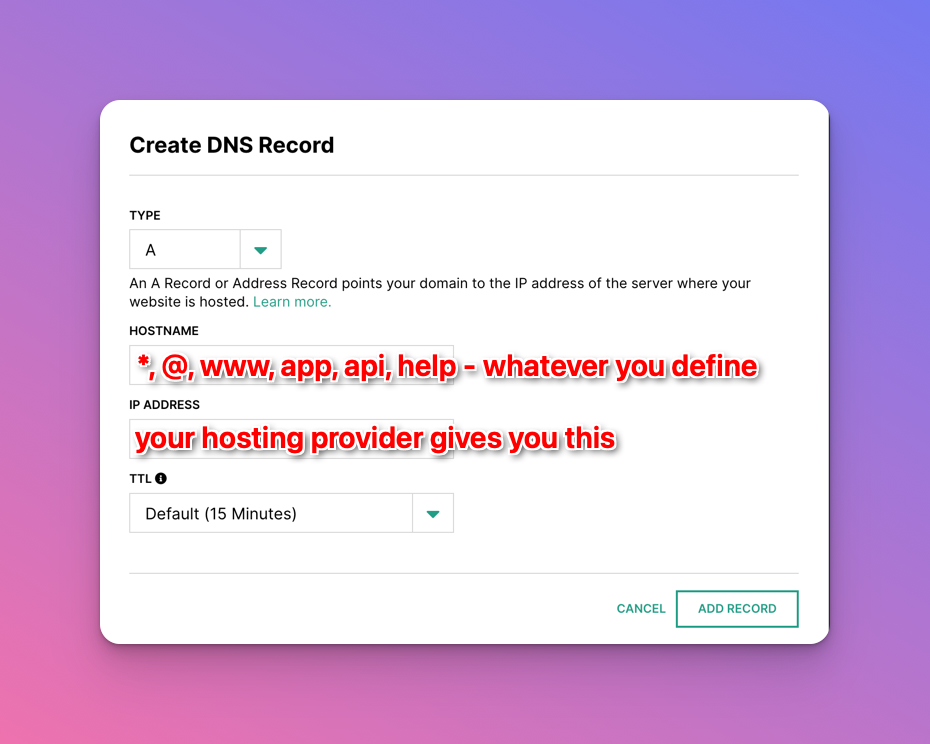
If you’re working on this type of stuff, you probably have a domain provider already. I use Hover because it’s a clean, fast interface and cheap enough. The support has also been stellar when I’ve had questions about what something is.

Defining an A record using the Hover interface

A “root domain” is the primary domain name of a website, such as “example.com.” A “subdomain” is a domain name that is a part of the main domain and is typically used to organize different website sections. For example, you might use the “www” subdomain to host the marketing website and then use subdomains for specific areas of the website, such as “blog.example.com” or “help.example.com.” You can create as many subdomains as you like for your root domain and specify separate IP addresses for each subdomain using A records in your DNS configuration.

Wildcard A records

A wildcard A record is an A record that uses the “*” symbol as the hostname. For example, a wildcard A record for “.example.com” would specify an IP address that you can use for any subdomains of the root domain that do not have their own A record.

For example, if you have a wildcard A record for “*.example.com” and a user types “test.example.com” into their browser, the browser will redirect to the IP address specified in the wildcard A record.

Wildcard A records can be helpful if you want to use the same IP address for multiple subdomains of your root domain, but they can also be less flexible than having separate A records for each subdomain. Use it as a catch-all once you define the rest below.

”@” A records

An “@” A record is similar to a wildcard A record but is explicitly used to represent the root domain. For example, an “@” A record for “example.com” would specify the IP address for the root domain.

An “@” A record can be helpful if you want to use the same IP address for both the root domain and the www subdomain (e.g., example.com and www.example.com). However, it is generally a good idea to have separate A records for the root domain and the www subdomain so that you have more control over which subdomains are associated with which IP addresses.

A records for the “www” subdomain

You should use an A record for the “www” subdomain to specify the IP address for the www subdomain of a root domain. For example, an A record for “www.example.com” would determine the IP address for the www subdomain of the root domain “example.com.”

It is a good idea to have an A record for the “www” subdomain, as well as the root domain itself (e.g., example.com), so that users can access your website using either version of the domain name. Ensure that result correctly redirects to whichever you want as the primary domain (either www.example.com or example.com).

Takeaways for planning

If you’re moving quickly, you might think this is silly. But spend 5 minutes thinking about how you’d build if things go well enough. Where will you put your support site? Your primary marketing site? Your app? Your API? These may be separate codebases and launches, so you may as well set up the framework now since you are on your hosting site.

A record Description @ example.com - probably your marketing website, accessible to you and your future copywriting/marketing team www www.example.com - you’ll want to redirect this to example.com so set it to the same IP address help help.example.com - redirect it to your marketing site for now, later you can point it to something like intercom.com, zendesk.com, or whatever you use api api.example.com - redirect it to your marketing site for now (and a landing page for signup?) app app.example.com - redirect it to your marketing site for now (and a landing page for signup?) or do something clever with a basic login * catchall for anything else a person might type in - redirect it to your marketing site

Feel free to reach out with any questions, and if you are looking for a hosting provider, check out Hover.

https://aamirvirani.com/technical/2023/01/06/refresher-on-dns-a-records
The Rules of the (VC) Game
venture capital
Before you invest in venture capital (VC), get a startup founder and current investor perspective on how the money and incentives work.
Show full content

I write new articles and publish them to Substack if you want an easy way to keep up. I hope you’ll subscribe!

Read more product and company-building articles

TLDR
  • Before investing in VC funds, you need to understand the money (so you can make more).
  • Before joining a VC firm, you need to understand the money (so you can get a share).
  • GPs make the investments, and LPs provide the money.
  • Management fees go to the VC firm, and GPs and LPs share the returns.
More VC, please!

I get the following questions a lot:

You have diversified your investment portfolio and added venture capital (VC) to your holdings, right?

How did you join a VC firm?

Why did you leave VC?

These questions open up a can of worms I’ll address in future posts1. To understand the discussion, let’s begin with how money flows in VC.

Rich, Busy, Looking for Adventure

Imagine you are rich2.

get money

You have money to burn. You could put your money into a bank account, but that doesn’t grow over time - it’s not returning more money. That means you won’t keep up with inflation. Becoming less rich? Ugh.

You want to find a place that can make you money without asking you to do work. Trading time for money? Ugh.

Most people look for returns by putting money into stocks and bonds. Both are riskier than leaving it in your bank account - stocks and bonds go up and down in value. They usually increase, and this is especially true over long time horizons.

But you are rich.

You want to grow your money even faster and account for the possibility that stocks and bonds may go down by putting some of your money into an “alternative” option. Something that isn’t going to follow what stocks or bonds do.

These alternative investments are riskier. And so they claim to generate higher returns than your plain old stocks and bonds to compensate you for the risk.3

What’s riskier than putting your money into a small team trying to make the next Facebook, Google, cold fusion, or NZT? You need to go out, find some of these teams, and give them your money for a share of their companies.

But you are rich.

You’re willing to pay someone else to find these teams and filter out the good ones, negotiate with them, track them, and do all the financial stuff to ensure you get your money back and more.

And the teams might fail. You may not get your money back.

And even if you do get your money back, it’ll take a while. You can’t build Google in a day.

That sounds like an adventure for your money, your capital, eh?

Time to find “someone else.”

Seeking Hungry, Outgoing Know-it-all

Meanwhile, there are people out there who claim to know things.

They know the right teams who are building amazing products.
They know the right industries that are about to go mainstream.
They know the right investors who are investing in great companies.

If only they had enough money to bet on this foresight.

she knows things

They may have enough money of their own, so they’ll say they are angel investing. You could do the same, but that sounds like work.

The folks who don’t have enough money are the ones who want you. They want to partner with you. To make it legitimate, they start a firm - a venture capital firm.

The fancy title they give themselves (besides founder) is General Partner (GP).4 They may join up with a few other folks - they’ll all be GPs.

Now they need to go out and find you and other rich people to give them money so they can place those bets on what they know. They’ll give rich people the fancy title Limited Partner (LP) in return for the money.

You are rich, so you get to be an LP.

But you want more than the title, remember? You want a return on your money. And you want it to be bigger than you could have gotten through boring investments like stocks and bonds.

What’s 20% among friends?

Wait!

The GPs need to run a firm, which means they need a nice office, swag, money to woo those teams, and staff to help them. They will charge you a management fee every year to cover these expenses. It’s only 2%.

But they promise to make you so much money that you won’t care about this fee.

The money you make is on the returns from the investments. But…

You want everyone on the same team, right? If you want the GPs to care about the outcome, they should share the upside.

The GPs and LPs agree: let’s split the returns5 - 20% to the GPs, and 80% to the LPs. The GPs’ share is called carry6.

These returns happen when a company has a “liquidity event,” which means that people who own shares can legally exchange them for cash. Usually, this occurs when a company is legitimate enough to make an initial public offering (IPO) on a stock market, or if another company decides to buy (acquire) them.

deal? deal

You are rich, so there’s one more thing you want.

Why would you give all of the money to the GPs at one time? They’re not going to invest it all right away, so that money will be sitting in a bank account, and that’s what you are trying to avoid. Instead, you tell the GPs to call and ask for the money as they need it. You want them to call capital.

That’s fair, no problem. Let’s make some money!

Find teams… and rich people again

The GPs get down to business.

They find companies, interview founders, evaluate their progress, and begin writing checks for promising investments. As they do so, they call you for some money. The capital calls start.

Some of this money goes towards the management fee.

The fee pays for the office and GP salaries. It also pays for the auxiliary people on their team - analysts who research, financial experts to track all the money, and HR folks. The fee could cover some operational people who advise the teams to execute better and faster.

The carry is where the big win is, though. So let’s go out there and find some great teams!

But in the back of their heads, the GPs are worried. What happens when they’ve invested all the money in the fund and are waiting for returns? They want to make more investments and will need more money. They’ll need to think about raising another fund…

here we go again

Questions to dig into next time

Now you have an overview of how money flows and in which directions. That movement leads to more questions if you want to enter the venture capital world as an investor or as a person supplying the investors with money.

If you have money and want to invest in venture capital, you’re asking:

  • How much money does a fund need to return to be worth the fees and added risk?
  • What happens when a fund does poorly?
  • What happens when a fund runs out of money to invest?
  • When do I get my money and those sweet returns back?
  • What are you doing with your money, Aamir?

If you want to join a VC firm, you’re asking:

  • How do I get into a firm as an investor? How did you do it, Aamir?
  • If I have options, how do I decide between firms?
  • What does the day-to-day look like? How can I become good at startup investing?
  • Can I get some of that carry?
  • Why in the world did you decide to leave?

The next few posts will cover these points of view and provide my perspective on them.

  1. I’ll link to those when they’re done. 

  2. You may also be an institution, like a non-profit foundation, college, or university. 

  3. Remember, prior performance is not an indicator of future returns. But folks love to tell you about the past to lead you to the dreamy future you want. 

  4. These titles are not made up - they are legally defined and matter because of the structure of the firm and investing funds. 

  5. A “hurdle” is often in place to ensure the LPs get their money back first, and then the split begins. 

  6. “Carried interest,” which you may hear about every few years when politicians bring up potential sources of tax revenue. 

https://aamirvirani.com/venture%20capital/2022/08/10/the-rules-of-the-venture-capital-vc-game
What did you do as a Presidential Innovation Fellow?
pif
Learn about Aamir Virani's Presidential Innovation Fellowship (PIF). Detail on his time at NGA, developing teams to help build better software products.
Show full content

I write new articles and publish them to Substack if you want an easy way to keep up. I hope you’ll subscribe!

Read more product and company-building articles

Please read the following for context:

TLDR
  • I worked on product management training and developed a roadmap to scale product management within NGA.
  • Cultural change is hard, and you must patiently build communication channels when joining an existing team.
  • The best government folks have a mission mindset we can learn from - long-term thinking, calm building.
What’s NGA?

You join PIF inside the General Services Administration (GSA). You’re nested in there, working on the Presidential Innovation Fellows team. You are stationed at an agency. You’ll spend most of your time there, with weekly all-hands meetings back at PIF HQ.

NGA logo

I was stationed at the National Geospatial-Intelligence Agency (NGA). It describes itself:

NGA delivers world-class geospatial intelligence that provides a decisive advantage to policymakers, warfighters, intelligence professionals, and first responders.

A lousy description I use that engages people is:

NGA makes maps and provides analysis to help our government. It’s Google Maps for our government and allies.

This description works for me because Google Maps is software, it’s vast, and it has many features you can identify with - navigation, geographical features, business markers, Street View, and more. All that stuff makes it easy for you to find the nearby Starbucks, right?

It’s a lot of software, and so is NGA. The difference is that there are many more features to track, it’s often more real-time, and it’s not (always) consumer software.

To be clear, I’m not saying NGA is a software agency. I work with this lens to communicate why software is essential to NGA’s goals and why my role was strategic.

What was your team?

I joined CTO Alex Loehr’s office. At the time, it was just him - he was recently promoted from Deputy as the original CTO had left for the private sector. Lucky for me, another PIF, Carlos Roqué, joined the team simultaneously.

The NGA Technology Strategy covered a plan for improving software development, and we started to work on that1.

Carlos and I had industry product management experience, so we worked with Alex to attack the problem.

You may ask, “If you both have product management backgrounds, why didn’t you join the product management teams?”

And that leads to my main project.

No Product Managers?

where is everybody

NGA has been developing software for decades, and there are no software product managers. The reasoning was that there are lots of program managers and that they define the software to be developed.

Programs and products, I guess they’re the same?

But when I spoke to software teams, I heard:

Software developer:
“I don’t get any definition and am coding with little guidance.”
“The Program Manager is telling my team whether we’re on the right track, but I don’t believe they’re talking to users and prioritizing.”
“Oh, and we must deliver everything in the contract at once. No release cycles for us!”

Program Manager:
“I control the budget and communicate with the people giving us money. Is that the user?”
“I’m ensuring the software teams produce what the contract says they would. But I can’t do that every sprint cycle. By the way, what’s a sprint?”
“The software team has someone who talks to users. I’m slammed with all this program paperwork and DAWIA!”

No one was talking to the users. People were confusing the people paying for the products (customers) with those who use the products day-to-day (users). And at the end of a software release, those customers would yell, saying that the users were not more effective and not getting things done.

Introducing The Praxeum

My project became the development of a software product management training course that fits into how NGA teams work. We called it The Praxeum2 because the government loves Star Wars references. The initial participants were either unofficially performing product management or were product management curious, like software developers and program managers.

Over six months, we iterated on the class five times and had 50 of the guesstimated 200 product manager-ish folks at NGA go through it.

salute to those who worked on this

On my departure, version 1.0 was a one-hour, six-week course that walked through:

  • defining users
  • identifying useful user metrics
  • building a roadmap
  • crafting a vision

Yes, this is insane. How can you do this in six hours?

But we wanted to get these newly-minted product managers to quickly draft something for each piece of core documentation, even if it was wrong. Writing something down, communicating with stakeholders, and iterating were better than assuming people were thinking the right things.

Even better, those who found this interesting and wanted to work on it more and make it better were the natural product managers in the bunch. For those who didn’t, the course helped them understand the difference between their current position in software, program, business analysis, etc., and why software product management is different.

Did you do anything else?

Yes, many things, including process suggestions on better integrating software development into program management, contracts, and legal processes.

Oh, and there were projects back at PIF HQ and one small one within GSA, but it’s nothing to write home about.3

Did you learn anything?

The comment I get from some folks is that it sounds like I was an interim VP-Product and helped the leadership team create a structure and process to build a better product. That this was old hat, and I’d done this before.

Not really.

NGA is not a software company. It’s a mission-driven enterprise with software, hardware, science, research, and analysis teams working to keep America safe and secure in its place in the world.

Oh, and it’s over 10,000 people. So yeah, I had never really dealt with a company of this size.4

so many people

I learned (and re-learned) a lot, but at a larger scale:

Structuring teams and communication is complex. Duh!

Every organization is a snowflake. NGA has hundreds of software products with different users, different goals, different funders, and more. We had to learn who organized certain pieces of software into existing product lines and why. And then, we suggested ways to break them out of their silos into a user-oriented structure.

And if that wasn’t possible, we wanted to ensure more communication between teams so they could share user, product, and software knowledge more often and easily.

More products = more problems, and program managers theoretically help with that.

Like all the other startups I’ve worked for, Dropcam didn’t have programs.

When Google Nest acquired us, we were thrown into an environment that did. The problem was that program and product managers (or product marketers) couldn’t clearly describe the differences between their roles. It came across as a turf war in the worst case and an extra person playing telephone in the best case.

It clicked for me at NGA. It doesn’t map perfectly to all companies, but the dividing line we developed was:

  • program management focuses on customer needs and communication to deliver on time and on-budget
  • product management focuses on user needs and communication to build the right product in the most effective order

This is an academic alignment. We’ll have to see if it works out at NGA so that the program and product managers are on the same team and working on complementary responsibilities. But if I’m leading a large group, this is the defining line I’ll use.

we're not fighting, are we?

You can be nice and effective.

I have worked for some nice people during my career, and they were not effective.

I have worked for some effective people during my career, and they were not nice.5

At NGA, I got to see some effective people who were nice.

The other trait I admired was that there was a long-term perspective in government. You’re inside an organization that’s been around for decades. It’s had many ups and downs due to changing budgets and leadership. You learn to stop treating every issue as hair-on-fire and instead filter through this more comprehensive view.

It helps if your natural tendency is to be long-term optimistic if you think this way. So I need to work on that.

I saw folks like CTO Alex Loehr and CIO Mark Andress operate and communicate this way. I hope I absorbed enough of their attitudes to influence my future thought patterns.

I’m most thankful to PIF for this lesson.

teams get stuff done

Jobby job?

The PIF year ended, and I returned to Silicon Valley life here in the SF Bay Area. Living in DC isn’t in the cards for now.

But what about you?

If you are interested in the Presidential Innovation Fellowship, feel free to reach out. You’ll also want to talk to other PIFs and leadership team members - people do this through LinkedIn most.

If you are looking for government roles that allow you to flex those software and product muscles, I’m biased and would ask you to check out positions at NGA. Here are two postings that went live in July 2022:

They’re also looking for software folks, so you can search for those roles, too. If you want to talk to some folks about how things work on the inside, you know what to do!

  1. One day, I will learn about the Four Seals Memo that people pointed to as an impetus behind the Strategy. 

  2. From Fandom: “The Jedi Praxeum, also known as the Jedi Academy or the Yavin Praxeum, was an academy that was founded by Jedi Master Luke Skywalker on Yavin 4 in 11 ABY during the era of the New Republic.” 

  3. Unfortunately, it’s one of the examples of why I became slightly more agitated by government spending. 

  4. Nest went from 400 to 1000 people while I was there, and even National Instruments was only ~2000 people back in 2004. 

  5. What about me? Fair question. I think I am effective and not nice enough. I’m infamous for saying “this is a place of business” and referring to that one Mad Men scene a bit too much. 

https://aamirvirani.com/pif/2022/07/26/what-do-you-do-as-a-presidential-innovation-fellow
Applying for the Presidential Innovation Fellowship
pif
Tips and tricks on applying for the Presidential Innovation Fellowship (PIF). Considerations before you apply and accept the role.
Show full content

I write new articles and publish them to Substack if you want an easy way to keep up. I hope you’ll subscribe!

Read more product and company-building articles

Please read the first post on why PIF for some context.

TLDR
  • One year is possible. Two is optimal.
  • Which PIF archetype are you? How does that make you feel?
  • Tell your story, and vet the opportunity based on that.
PIF is really two years

how many years do you PIF?

Let’s start with one important warning for those planning a one-year stint.

The Presidential Innovation Fellowship should be described as a two-year position. Most PIFs stay for two years, and some stay even longer!

Once you join, you’ll hear the framing you hear when joining a company in a leadership position: spend the first 90 days listening, observing, and learning about the teams, processes, and history around you.

And you’ll also hear something about needing time to hand off your work and ensure it keeps going. That’s probably 30 days or more.

So you’re down to eight months to affect change.

Meanwhile, you’ll learn that, yes, things do move slower in government.

Some reasons will make you say, “Damn, that’s a good point.” I encountered this often while at NGA and during discussions with other PIFs and folks at GSA. So much thoughtful consideration of all potential users, not just computer-savvy folks. So much oversight around taxpayer dollars to ensure responsible stewardship.

Of course, you’ll also find many roadblocks to slow you down. Some are personal, like people who don’t trust you because you’re “just a government outsider” or “just a short-term consultant with the fancy title” that they can wait out. Some are structural, like legacy processes and the mental models behind them.

You’ll need time to meet people, learn this context, and find the areas where you can attempt strategic change, not a quick-win that’s equivalent to a project that an excellent new hire could do.

I stayed for one year (see the earlier post for why this was the plan). I hope I worked on something that is structurally important, but I’m sure a second year would have been helpful.

The three types of PIFs

Going into the fellowship, I thought everyone would be like me:

  • 10+ years in industry
  • senior leadership experience
  • considered PIF an effective way to do public service (that isn’t running for office).

No, that’s not the case at all.

I don’t know if the data backs it up, but I observed three types of people who are PIFs:

  1. people (often 25-35?) who have rocked their first private-sector position and are looking to turbo-charge their career through PIF and jump into seniority in the public sector (or back in the private sector)
  2. people (often 35+?) who are having a mid-career re-assessment and considering a move to non-profit motive work
  3. people (40+?) who are taking this as a hiatus to scratch that “give back to my country” itch

When I joined, I fell into #3. Over the first six months, though, I started saying, “Wow, this is amazing! There’s so much going on, and software can affect so many things. This is great!” And that led me to think more about #2.

As you think about applying and what you can get out of the Presidential Innovation Fellowship, consider which type you are above… and whether the other two types are folks you want to interact with. Everyone has a different agenda.

Vet the opportunity even if you see it as an act of service

scope things out

People have asked for advice about the application and interview process.

First, I want to emphasize that when I saw the process on the inside, it was the fairest, most equitable process I’d seen in my career. The team cares a lot about having interviewers remove bias while assessing candidates. I took a lot of notes.

Second, follow the instructions on how to write a government resume. It’s related to the fairness goals above and will help you better understand the story you are trying to tell. You have to indicate some area of expertise and focus when you apply, as that will help agencies and leaders understand what you bring to the table.

You are telling this story, so you are deciding on your expertise and the type of work you’d like to do.

Once you do this and submit your application, it is possible (and likely) that you may disqualify yourself. Maybe this year’s batch of agencies isn’t looking for someone with your expertise. Maybe this year’s applicants are heavily weighted to your focus, so you lose out.

That’s okay - for PIF, and really for any job, you want to ensure you get what you want (once you look past the fancy title).

Okay, so if you get this far and get to the agency interview phase, you’ll speak to your likely manager and learn about the agency and role. Here, you listen a lot, ask questions to ensure you are getting what you want, and emphasize your area of expertise and how it could fit into the role.

You want to vet the manager and role gently.

Here’s the dirty secret - the role may be poorly defined or in flux, and you will not be set up for success. You only have one year (or two) to make good things happen. If you and your manager spend the first six months trying to figure out what area you are working in, you’ll be dissatisfied.

The manager… may not be your manager. So you should ask!

Also, feel out whether they are there for the long haul and what they want from you. Are they hoping you’ll be an individual contributor on their team? Are they looking to hand off part of their team’s strategy to you? Is that strategy aligned with any explicit agency-level guidance and planning?

If you don’t hear answers you like, then you should tell the PIF interview team this during feedback. You may get a follow-up that helps clarify concerns and puts you at ease. Or you may not get the position, but you will be happier and can try again later.

My fellowship went well because I worked under NGA’s CTO Alex Loehr. He, along with a few other members of the technology leadership team, interviewed me. They referenced official public-facing documents like the NGA Technology Strategy, which referred to product management and the strategy I would help with.

Next time…

I still owe you what I worked on and what I learned.

I’m trying to keep posts to five minutes. If you think these are too short, please let me know!

https://aamirvirani.com/pif/2022/07/19/applying-for-presidential-innovation-fellowship
Why do a Presidential Innovation Fellowship (PIF)
pif
Learn about the Presidential Innovation Fellowship (PIF), and how startup founders and leaders are welcome participants. Read about roles and motivations.
Show full content

I write new articles and publish them to Substack if you want an easy way to keep up. I hope you’ll subscribe!

Read more product and company-building articles

TLDR

PIF is great under the right circumstances,1 and you should apply for the fellowship if you’ve got a strong background and are gov-curious or wondering about innovation at scale outside of Silicon Valley.

Oh, and of course, to give back to our country.

What’s PIF?

A friend emailed and asked:

I’m thinking about applying for the Presidential Innovation Fellows Program. You did it last year. Why? Did you get anything out of it? Aren’t you a startup guy?

I was a Presidential Innovation Fellow in the 2021 class. I worked for the government as part of the General Services Administration (GSA) and was assigned / stationed at the National Geospatial-Intelligence Agency (NGA).

PIF logo

Here’s how PIF describes what it is:

We hire annual cohorts of mid-to-senior career technologists, designers, entrepreneurs, and strategists.

So you apply, get assigned to a government agency for a period of time2, and try to do good work. Hopefully, it’s strategic, not individual-contributor (IC), stuff.

At the end, you’ll write up a report for your agency and the fellowship, and hopefully, your work will continue after you leave.

Give back to our country?

So why did you do PIF in 2020? This is always the first question.

I’ve been blessed with a great career in software in Silicon Valley, and I wanted to give back to the country that’s given my family a lot. My dad often said:

I came to America in 1972 with $20 in my pocket - look at me now. Look at our family now!3

Things got more urgent after I got married and I thought about what type of dad I wanted to be. I didn’t want money to be the sole driving force in my kids’ lives4, which meant I wanted to show and experience some other paths for them to consider.

Back in 2015, as I finished my time at Google Nest, I wanted to join a political office to work on tech policy. I reached out to three officials around me to learn more. How could I make my way into this world given I wasn’t a college intern and didn’t want to file papers? No staff members responded to my requests for learning more, though.

While researching, a friend said, “Have you talked to Todd Park? He’s doing this thing called the Presidential Innovation Fellows.” So that was sitting in the back of my head as a way to help with the tech experience I had now looking like a plus.

Then my wife got pregnant and we had our first kid and I got the chance to join a VC firm…

(We can talk about the VC life later…)5

And then I left. So it felt like the right time and I decided to apply. The PIF leadership team decided I was good enough to qualify and I accepted the offer.

Don’t give me lip service.

Okay okay okay…

All of the above is true, and I needed some other push since this idea of working on government technology and tech policy had been sitting in my head since graduating from Rice.

Designing Your Life book

I heard about this book Designing Your Life, and I worked through it in 2019 and saw that I had done a good job of hitting my interest areas: software, startups, investing.6

There was this other angle to life I still wanted to consider - something about taking my tech background and affecting society and government.

And so, I did some of the outreach again, and a person again mentioned PIF, so I applied.

This time around, we had two kids, and neither was in Kindergarten. And now I was thinking, “I’ve lived in Texas and California, is there anywhere else on my list?”

Washington DC looking amazing

Washington DC is one of the places7.

And that led my wife and me to discuss the idea of living in DC for one year while I do this fellowship. She helps lead a small business here in the Bay Area, and I was asking for us to switch locations and see if she could work remotely for one year if I happened to get the fellowship.

The application process was before COVID happened, remember?

She said okay, this might be fun and we can make it work, and I applied.

Next time…

We’ll cover:

  1. the caveats if you decide to apply (or are in the application process)
  2. what I did
  3. what did I get out of it

I promise this one is already written, it’s just that this is long. See you soon!

  1. I’ll talk about this caveat in more detail in the other post. 

  2. Yes, a caveat covered next time… 

  3. I would not be surprised if this was an exaggeration, as every immigrant kid seems to have a similar story. But the point is that he was a poor kid from Pakistan. 

  4. Therapy helps you work through a lot! 

  5. As usual, this is a personal marker - people have asked, so I should write about this someday. 

  6. I recommend this book a lot, so if you’ve worked through it and want to share the exercises and discuss them , I’m happy to do so! 

  7. NYC is the other. 

https://aamirvirani.com/pif/2022/07/13/why-do-presidential-innovation-fellowship
Co-Founding is not a Marriage
founders
Read about how to vet co-founders on a startup team. Learn about what cultural alignment is necessary, and how founder dating is a waste of time.
Show full content

I write new articles and publish them to Substack if you want an easy way to keep up. I hope you’ll subscribe!

Read more product and company-building articles

TLDR
  1. Founder dating is a stupid concept.
  2. Look for signals around responsibility, accountability, and cultural alignment (and whose ego comes first).
  3. Make sure you are on the same page about the company you are pursuing and risk tolerance.
A reader asks…

Well, let’s knock out a few of these at once.

How did you decide to work with Greg as a co-founder?

How do you vet a person as a co-founder, especially if they’re not technical?

What happened at Xobni?

90-Day Co-Founder: Happily Ever After?

sure, let's get married

Potential founders often asked me how to find a co-founder while I worked on Dropcam and did angel+VC investing. Some would mention founder dating, as in “I met someone, worked with them for a few weeks, and now we’re co-founders.”

There is a whole Silicon Valley subculture focused on this problem, and they have events and networking opportunities to bring people together. Usually it’s “business” types looking for “engineer” types, or vice versa.

I would usually roll my eyes at this concept because of two things:

  1. Working on one project is not enough, even if it’s for a few months. Everyone is on their best behavior when you’re explicitly dating, and the obstacle you’re facing is usually some sort of engineering or product milestone, not a holistic business or company problem.
  2. Bringing together complementary skillsets is difficult because everyone wants to be a visionary.
  • Business types think they need “coders” who will listen to their product vision.
  • Engineer types think they need “someone to handle the copy and cold email” and will listen to their product vision.

At the beginning, everyone should be gathering information about the business and product and synthesizing the results together.

If you don’t want to do that, it’s okay! Then just say you’re a solo founder, hire your first employee, and give them explicit tasks.

Looking for a mind at work

Ideally, you’ve worked with your co-founder before. That’s obvious - school, office, siblings, whatever. Hopefully you’ve worked together enough that you can figure out:

  1. Do you respect each other’s complimentary skills? And could those be separate responsibilities when it comes to your co-founding team?

  2. How do you each respond when things go sideways on a project? Do you act like a team or point fingers? Have you held each other accountable?

  3. Are you culturally aligned with where you want your careers and lives to go?

Greg and I met at Xobni1. All you really need to know about the company is that it was a blown opportunity with negative responses to the above questions.

Over the course of one year, Greg and I worked on a few projects together, so we saw how his coding prowess melded with my organization and project management skills. And we both really wanted to build stuff that people would pay for (like a CRM in Outlook - this is 2007 remember), not just gather eyeballs and wait to monetize in the future.

hamilton is amazing

While dealing with founder fighting, a belittling CEO, a failed acquisition2, and the resignation of our head of engineering, Greg and I kept working and launched an invite system for the core product. And I tried to keep the small team running while dealing with shady promises3.

And going to Starbucks. Lots and lots of Starbucks.

Tip: If your ICs are leaving the office to get coffee, they’re plotting.

Pro Tip: If everyone in your office is leaving the office to get coffee, you have a culture problem4.

Getting verklempt

Coffee fueled three things we saw as lessons from our Xobni experience.

  1. Build a product people would pay for.

We didn’t want to capture eyeballs and pray for monetization later. If we had to hold a car wash, we’d do it to make $1 in revenue in our first year.

  1. Respect our employees and be transparent.

If we were unwilling to talk to employees about something as founders/board members, we would say so instead of lying or obfuscating.

  1. Avoid burnout and build a long-term culture.

At the beginning, everyone at Xobni worked long days and weekends. By my sixth month there (and especially after the acquisition attempt), everyone was burned out.

At the same time, Greg was married and wasn’t getting time with his wife. So we agreed on wanting a culture that respected family, as that external support would be necessary to have happy, engaged employees when we were in the office.

We had seen egos destroying a company and realized we wanted to nip that in the bud. It led to the napkin discussion I mentioned in the last post.

90's SNL reference!

And one more thing…

Greg and I left Xobni at different times, and we kept meeting up for coffee. During this time, we discussed product ideas and aligned around one more thing.

This was it.

We were going to start this company and it was going to be a place we figured things out. We weren’t looking for a quick exit. We weren’t looking to be acqui-hired.

We were going to get big or die trying.

  1. Still a joke link. 

  2. This is when you learn TechCrunch was shitty reporters and a shill for Silicon Valley. Microsoft walked away. 

  3. If you really want to hear about anti-mentors, let me know! 

  4. Why are people leaving the office? Is it to find a way to clear their heads or to get away from the shitshow? 

https://aamirvirani.com/founders/2020/10/13/finding-a-co-founder
Shots Fired In Terminal C
founders
Read about founder dynamics at a Silicon Valley startup. What is it like being the CEO? How do you assign roles and responsibilities between founders?
Show full content

I write new articles and publish them to Substack if you want an easy way to keep up. I hope you’ll subscribe!

Read more product and company-building articles

TLDR
  1. Co-founders fight. It’s how you deal with it that matters.
  2. If you’re not the CEO co-founder, you need to be get comfortable with that.
  3. Business development and partnerships early - pointless!
  4. Read the last quote below.
A reader asks…

The last post ended up having lots of responses! But the #1 question by far was:

Tell me about “Sony and the fight Greg and I had at SFO that resolved one of our main founder arguments in the early days.”

Everyone wants to hear about fights.

Late 2010(?) - talking to Sony

I might be mixing two stories together. Here the broad strokes.

This is around late 2010. We’ve built out the first Dropcam hardware product using an Axis M1011-W camera and we have the cloud service running with our seed funding. We start selling a few and begin making some very small noise on TechCrunch.

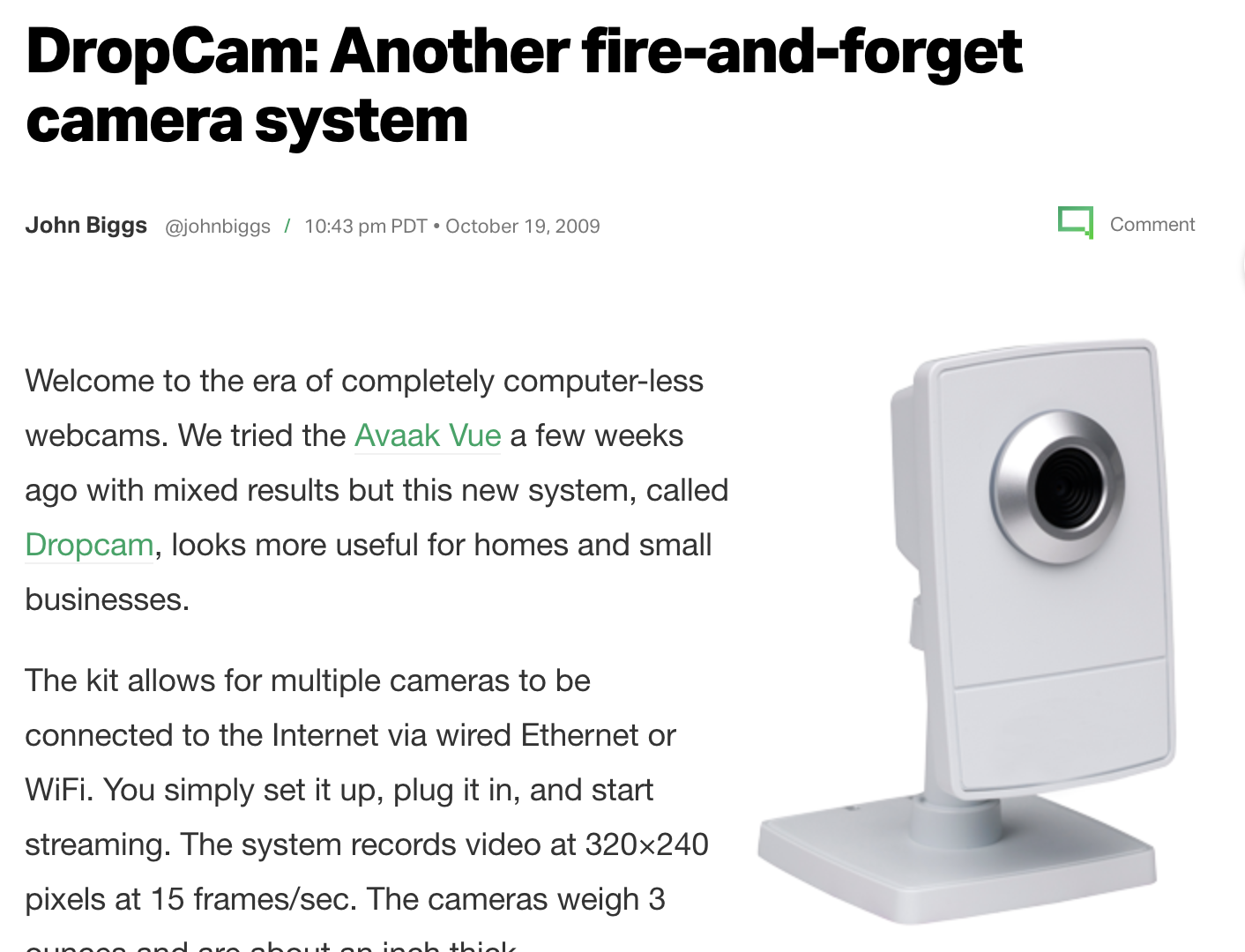
Dropcam in TechCrunch back when it was cool

We’re also making some noise in the IP camera space because we are buying “a lot” of those Axis cameras.

Somehow we get in touch with Sony’s corporate development group. We start talking to them, driving down to their San Jose offices, showing them the camera’s easy setup and how it could apply to their own cameras. More importantly, the subscription cloud service is also valuable and could ingest video from anywhere, including Sony surveillance cameras.

Having worked on this idea for under two years and still having waaaaay less than 1000 paying customers, I’m excited. Greg seemed like he was, too… but I remember him taking it a little less seriously and not preparing as much as I’d like.

The Argument

There is no Terminal C in SFO

So we have a flight at SFO after one of these meetings, and Greg was late. I went off on him about that when he arrived, and I’m animated and yelling about how he’s always late and not taking things seriously with Sony and I start talking about how he’s not doing a good job as CEO and…

Yeah, I went there.

So he gets riled up, too, and we get on the plane and keep arguing and talking about decisions and… honestly the rest is a blur.

I just remember being on the plane sitting next to him and things being awkward. We talk things through, with the end of the argument coming when Greg says,

Hey, you signed up for this. You agreed that I was CEO and I get to make these calls.

I go quiet. Did I sign up for this?

Jan 2009 - The Signup

Greg and I knew each other from working at Xobni1 as software engineers. There was a talent exodus in late 20082, and we would meet to talk about ideas since we liked working together.

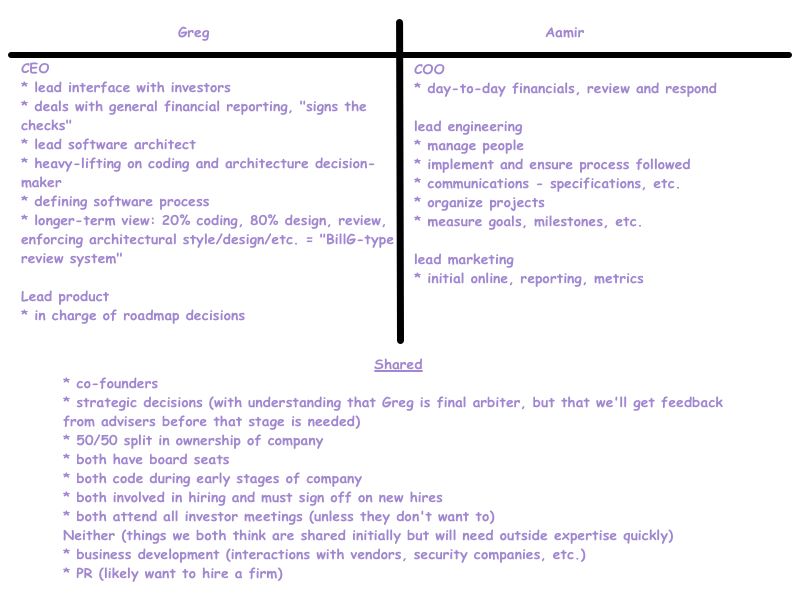
Dropcam emerged as an idea from Greg and we got together, talked about it, and I decided I’m in. We met at Little Shamrock one evening under Greg’s apartment and started talking details. A napkin (or maybe it was a notepad ;o)) was written on:

actual roles, yes this is real

Yes, we did write this out. I know most founders don’t do this, but we had seen enough ugliness from Xobni, and we really wanted this to work.

Yes, things shifted from what the napkin said - product and engineering melted together during those first few years, and business development work happened as part of the hardware and sales operations we hadn’t taken into account, lots of things are missing… Basically we engineers underestimated the non-engineering portion of the business3.

Yes, Greg was right - I did say I understood that he was the final arbiter on strategic decisions.

But I’m Right!

I was still annoyed and angry - why should my opinion matter less just because Greg came up with the idea? We were both steeped in what was going on and invested in the success equally. I couldn’t just let him do what he wanted, right?

Rahim Fazal is a friend who was a few years into his own company as CEO around this same time. I met up with him later to vent.

His first piece of advice was to continue being an active participant in the discussion and playing the role of a good co-founder. Work as a team, argue in good faith, look out for each other and the company’s goals. Lead in your areas of expertise and responsibility.

The second part:

Aamir, you just don’t know. Being CEO is different. Greg’s getting calls and emails you don’t know about and stress you just don’t get to observe.

If the company fails, all the blame is placed on the CEO and you get to say ‘Well, I was a founder and now it’s my turn.’

If the company succeeds, all founders get the halo effect and you get to say ‘Well, I was a founder and now it’s my turn.’”

The Aftermath

Rahim talked me off the ledge. He reminded me that I had indeed signed up for this. I said I wanted to work on this idea with Greg and that he was CEO.

I went back to work.

It took a while (like another year), but I tried to be more empathetic and supportive as a co-founder by filling the gaps on all the random things that needed to get done related to our developing strategy. And when there were unclear moments, I would try to bring data (on markets, companies, products, users, whatever) to the table so that our conversations weren’t just “he said, he said”.

The reality is that Greg was the best person for the job - he had incredible knowledge about the underlying video and cloud technical details, and he was a good storyteller about Dropcam.

I mean, how many times did he talk about his dad and dog poop?

What about Sony?

Oh, the Sony talks were dumb. They didn’t go anywhere. Our last meeting with them was a day where Greg went to present and saw another camera startup walk out right before he went in. After that we thought they were just digging for their own research and not planning anything serious.

  1. Again, this is a joke link because they were not nice people. 

  2. The consulting VP-marketing decided not to join full-time, the VP Engineering was pushed out, a consulting engineer decided not to join full-time, and the first three software engineers all left. 

  3. I should write something about the things you don’t think about that do matter at the beginning. 

https://aamirvirani.com/founders/2020/09/29/how-to-deal-with-being-the-non-ceo-founder