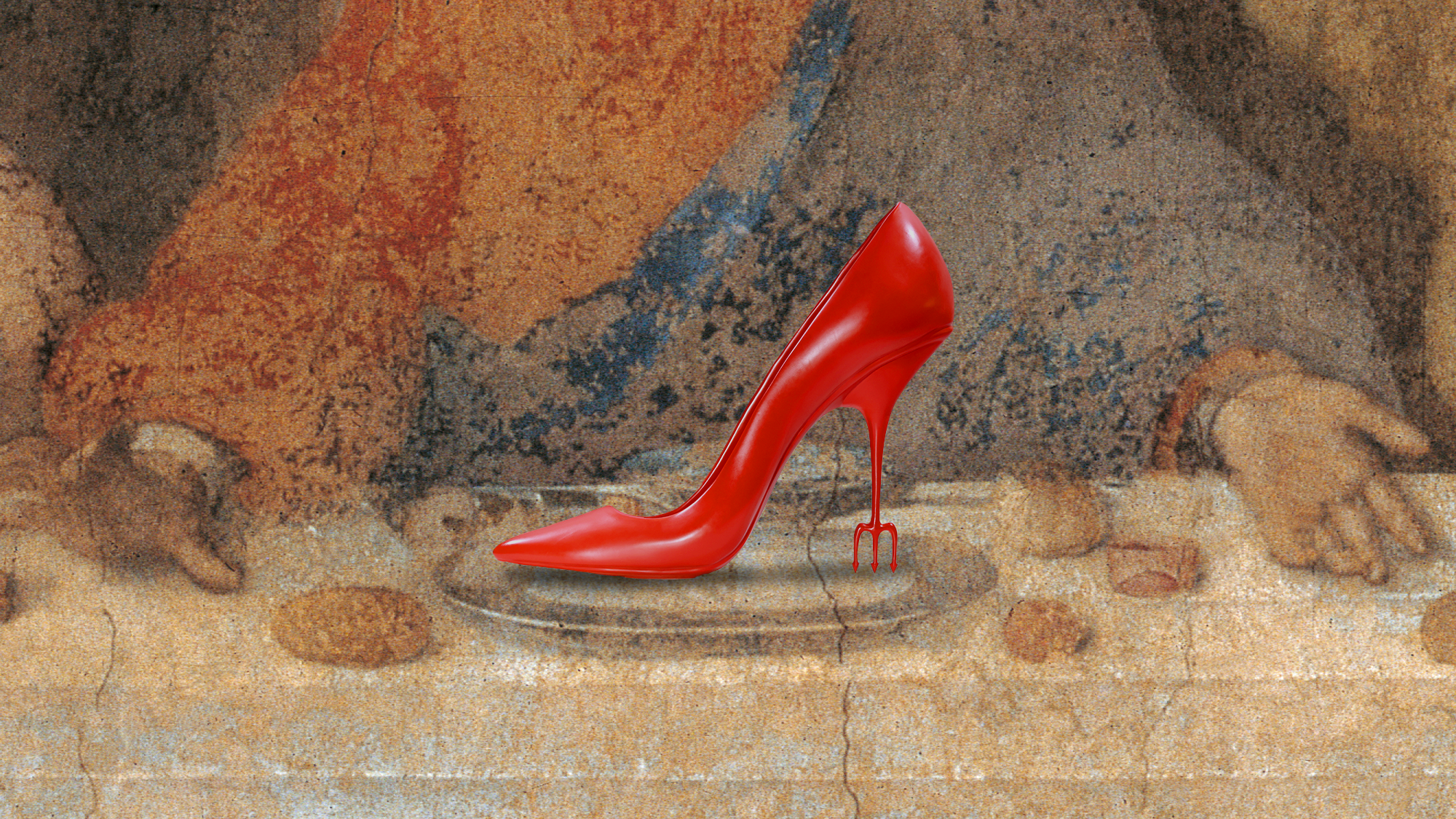
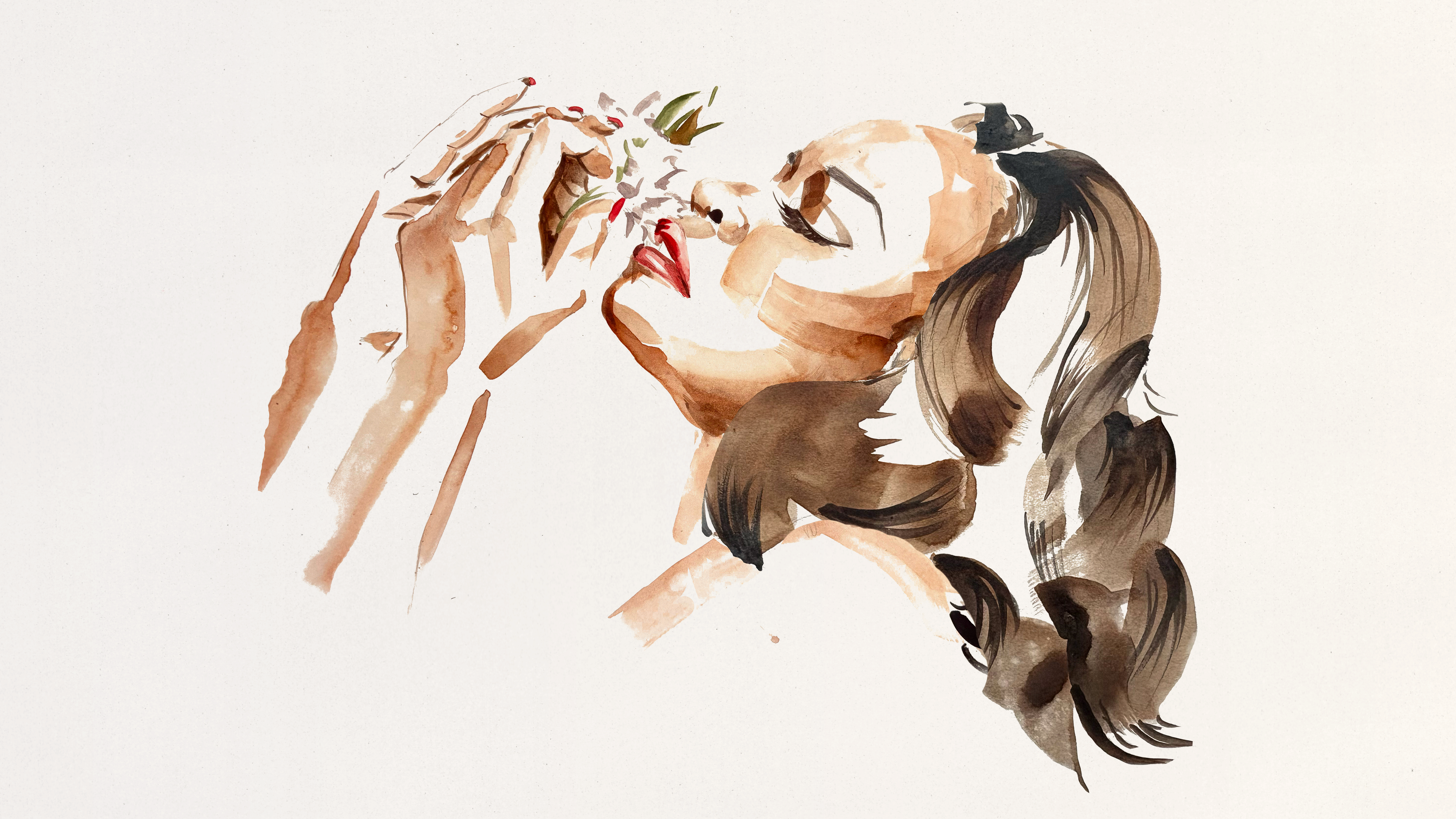
The garment has long been an indicator of people’s views about innocence and sexuality.
Show full content
Earlier this month, to celebrate a Spotify-streaming milestone, the singer Olivia Rodrigo held an intimate concert in Barcelona while wearing a certain outfit: a floral baby-doll dress, pink bloomers, and knee-high leather boots. The getup almost immediately set off an online maelstrom. Some commenters accused her of dressing like a “sexy baby” and promoting “pedo core” (short for “pedophilia core”); others defended her right to dress however she pleases.
Rodrigo, though, appeared to have specific references in mind: In a recent interview, she noted that she’s currently inspired by artists such as Kat Bjelland and Courtney Love, who paired baby-doll dresses with punk rock in the 1990s to repudiate the fetishization of girlhood. But those artists, too, were disparaged for the look back then—one reviewer in 1994 called Love’s style that of a “raddled Baby Jane whose notion of clothes-shopping is to lie in a skip outside a paedophile brothel.” And critiques of the style reached into the world of fashion more broadly. After Giorgio Armani and Anna Sui featured baby-doll dresses and pleated skirts in ’90s runway shows, one New York Times writer remarked, “Is there anything more perverse and weird than grown women wearing kiddie clothes?”
Baby-doll dresses have clearly been a magnet for moral panic for decades. But though some people might associate them squarely with girlhood, the history of the billowy dress is far more convoluted: It has traveled, over the centuries, between kid and adult closets. This fluidity reflects how “kiddie” and “grown” clothes have never had strictly differentiated styles, fashion historians told me, and how the line between the two has constantly shifted—even if the policing of how these garments are worn, especially by women, has remained constant.
For much of history, people mostly made kids’ clothes at home, and they sometimes dressed their children like adults; in the Victorian era, some children wore corsets. Kids’ clothing as a separate, mass-produced consumer category didn’t even really take off in the United States until the early 20th century, thus launching fresh concerns about what was appropriate to wear at each age. In the 1920s, some people viewed the era’s adult shift dresses as childlike; when men wore shorts in public in the 1970s and ’80s, it was also sometimes deemed a kiddish regression.
Short, flowy garments—the classic baby-doll silhouette—actually started out as a practical choice that a child of any gender could play in: One American boy’s garment, from 1855, looks roughly like a baby-doll dress Rodrigo or Sabrina Carpenter might wear on tour. Adults started wearing a version of this garb around the 1860s, Aude Le Guennec, a design anthropologist at the Glasgow School of Art, told me. At the time, many women were transitioning from riding horses sidesaddle to commuting by bicycle, and shorter dresses and bottoms were simply more functional. The outfit was highly controversial at the time, Le Guennec said, with people claiming that it looked as if women were showing their underwear. (Eventually, many women switched to wearing culottes.)
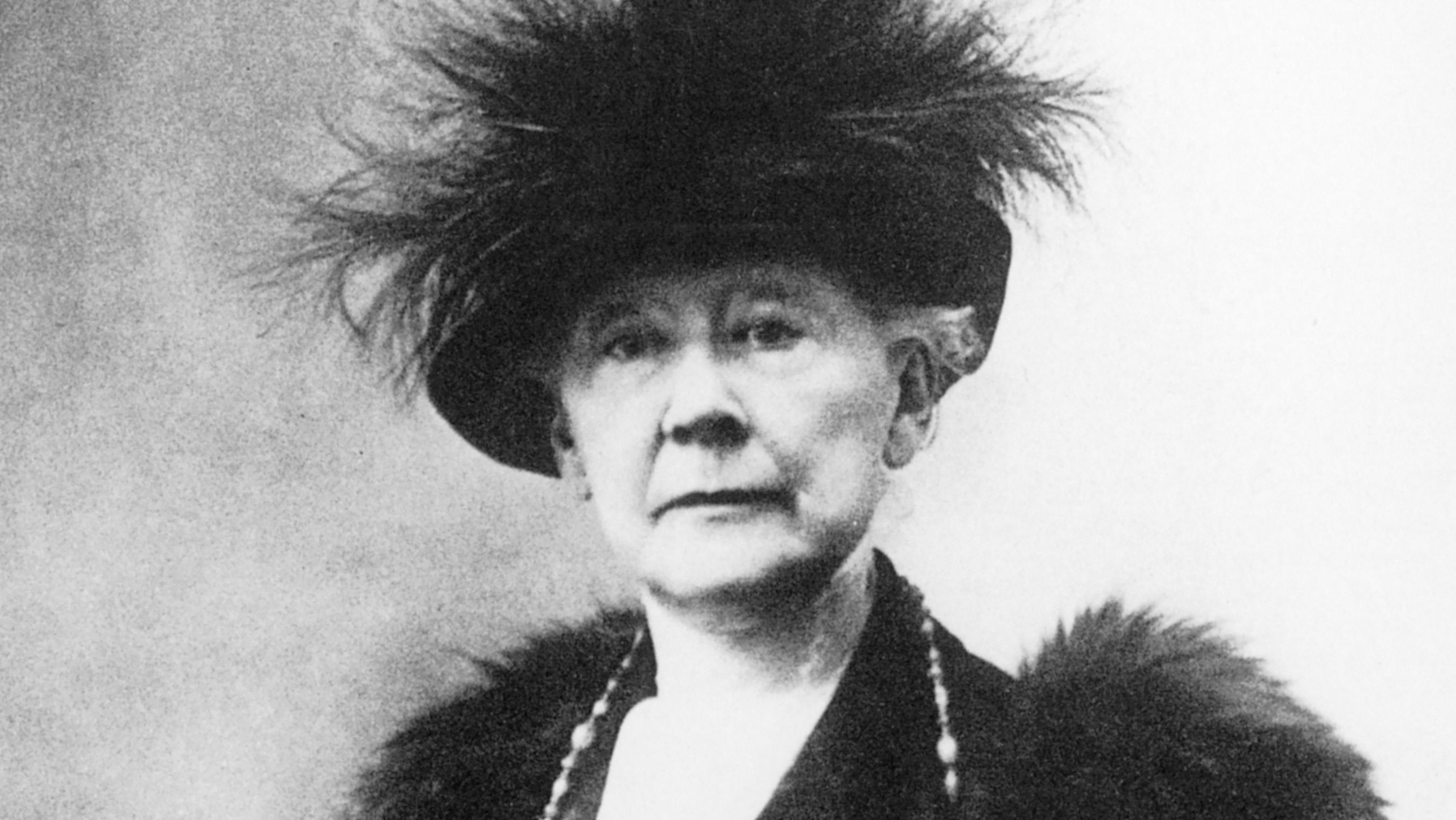
Later in the 19th century, similar bottoms—varying from knee- to ankle-length—would be called “bloomers” after the suffragist Amelia Bloomer, who advocated for less-restrictive women’s clothing. Bloomers became a symbol within the women’s-rights movement—though even Bloomer eventually felt pressure to abandon the garment, after critics loudly accused her of trying to be too “masculine.”
In the 1950s and ’60s, short, loose-fitting dresses and bloomers were reconceptualized again, this time as lingerie. The designer Sylvia Pedlar, in response to World War II fabric shortages, had in the 1940s chopped nightgowns in half, creating dresses that people might now link with the baby-doll look. But the style gained its contemporary moniker after it became associated with the 1956 movie Baby Doll, about a 19-year-old girl forced to marry an older man. Old ideas about the silhouette’s functionality waned, and the dress started to be seen as a sexual symbol, a messy one that played into the over-sexualization of young women.
Fashion tends to be a Rorschach test reflecting the concerns of its time. And the line between kid and adult clothes has been drawn largely based on ideas about which clothing was age-appropriate for girls to wear, Daniel Cook, a childhood-studies professor at Rutgers University at Camden, told me. After the rise of mass manufacturing, whole new vocabularies emerged to cater to different age groups (and to get people buying more clothes): “teenager,” “subteen,” “preteen,” “junior miss.” By the 1990s, the “tween” was a full-blown consumer category, catered to by new retailers such as Limited Too. And with each new demarcation, the clothing industry and the broader public seemed to negotiate the age at which it was okay for a girl’s body to be put on display. A “preteen” dress, for example, might be less revealing than a “teen” dress, or have a less “sophisticated” (read: tight) shape.
Nowadays, the distinction between child and adult fashion is largely disappearing again, especially as social media consolidates clothing into a more age-agnostic, algorithmic aesthetic. Stores such as Lululemon and Zara, associated with adult styles, are popular with girls; Limited Too recently released pleated skirts and polos in adult sizes.
Still, even as fashion evolves, the same cultural habit of scrutinizing women’s wardrobes persists. But so does a spirit of defiance. Amid the frenzy surrounding Rodrigo’s dress, Courtney Love reposted a series of reels to her Instagram Story, in support of the singer. “You can pry my babydoll dress,” one of the posts read, “from my cold dead hands.”
The Centennial Exhibition of 1876 promised a glorious industrial future. Outside its gates, the country seethed with violence and corruption.
Show full content
William Dean Howells, the editor of The Atlantic, wandered through Philadelphia’s Centennial Exhibition of 1876 trying to make sense of a spectacle that defied description. Two wheels, one small, one large, seemed to tell the story of the great transformation on display. The small one was made of wood—an old spinning wheel set up in a rude log cabin meant to conjure colonial Plymouth. As Howells related, a reenactor playing the Mayflower pilgrim Priscilla Alden paused in her work to give an old Quaker woman a turn. At first, the woman’s “long-unwonted fingers” seemed rusty. She struggled to splice the thread, then got it tangled while Howells and others watched in breathless silence. Finally, though, her dexterity revived, and the wheel came to life “with a soft triumphant burr, while the crowd heaved a sigh of relief.” It was, Howells reflected, “altogether the prettiest thing I saw at the Centennial.”
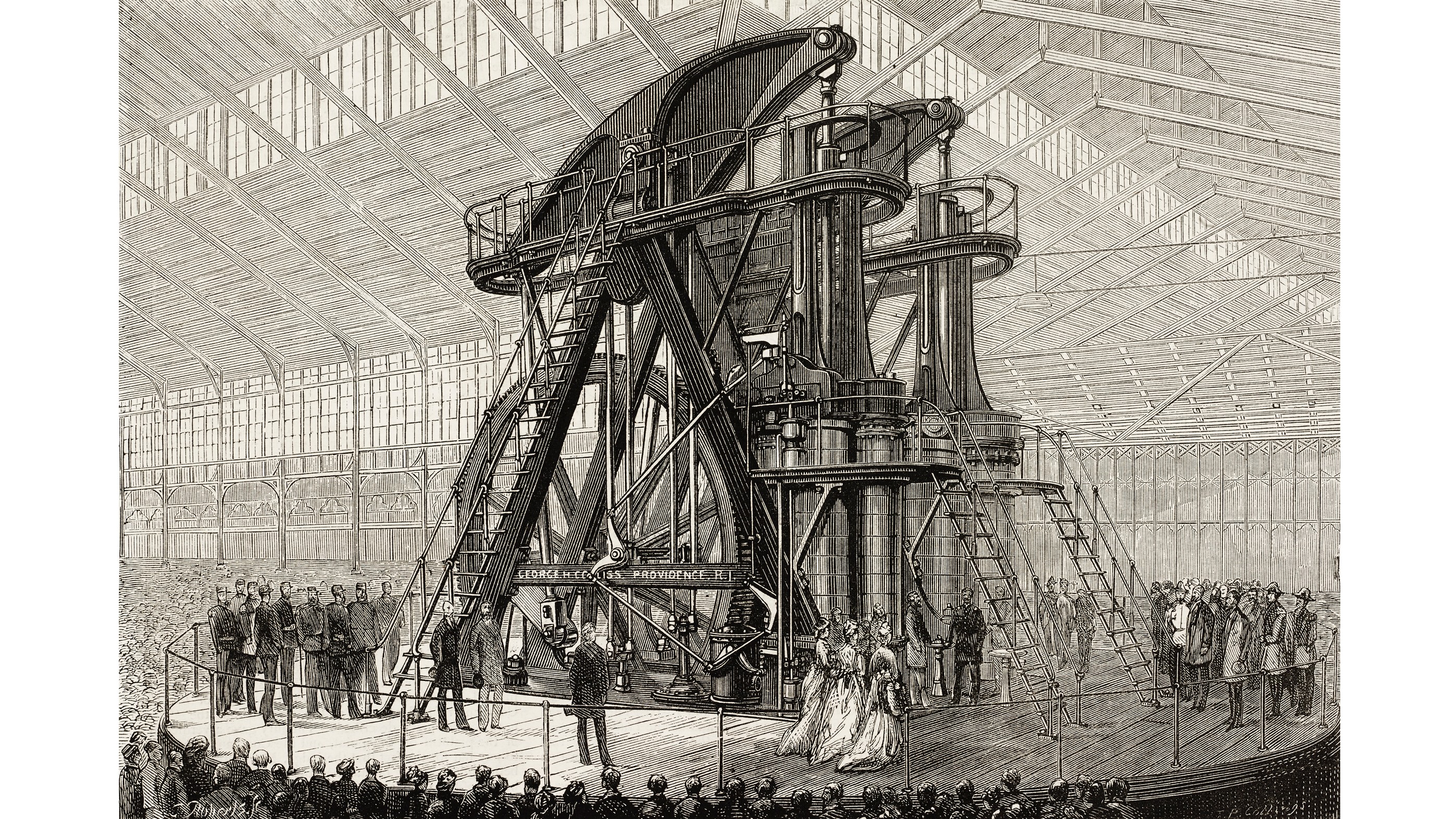
But Howells and millions of other Americans went to Philadelphia as much to look forward as to look back. Far more thrilling than the wooden spinning wheel was the huge cast-iron wheel—30 feet in diameter and 122,000 pounds—turning almost noiselessly at the center of the complex works of the Corliss Engine in Machinery Hall, driven by steam pumped in from a separate building. Howells sat, stunned, before the engine’s “infinitely varied machinery” working “with unerring intelligence.” No Priscilla Alden or old Quaker was necessary here—just a single, mostly idle attendant whose only job was to occasionally put down his newspaper and administer a few drops of oil.
In Centennial: The Great Fair of 1876 and the Invention of America’s Future, the historian Fergus M. Bordewich takes a tour of the exhibition—and, venturing beyond it, takes the measure of America on its 100th birthday. At not quite 200 pages of text, the book is brisk and tightly constructed, filled with vivid characters and finely wrought, often-wrenching scenes. Along the way, Bordewich finds a country caught between the marvel of its material progress—what he calls a “phantasmagorical theater of national glory”—and the fragility of its ideals and institutions. While the fair celebrated a confident industrial future, the nation outside its gates seethed with violence, corruption, and social inequality.
Writing in our own anniversary moment, when historical narratives are themselves the stuff of cultural and political conflict, Bordewich largely lets the discord speak for itself. But taken together, the dizzying disorientations of 1876 can’t help fueling grim conclusions. Bordewich, who has written forceful histories of the Underground Railroad, the radicalism of the Republican Congress during the Civil War, and Reconstruction-era Ku Klux Klan violence, presents a country turning its back on two revolutions—those of 1776 and 1865. In their place, Americans embraced a third: an industrial revolution that rendered the spinning wheel a quaint relic of the past and the iron wheel an object of faith for the future.
The centennial commenced on the morning of May 10, 1876, with a seemingly providential break in the rain. The program—which included lengthy speeches on the marvels of American growth, and an orchestra playing an array of national anthems from around the world in addition to Richard Wagner’s made-to-order “American Centennial March”—had swelled to fit the exhibition’s hybrid nature. What had originally been intended as a national birthday celebration had been joined to a World’s Fair displaying the material wonders of the Industrial Age. The ensuing event, which ran for the next six months, was designed to show how happily material progress and national glory could be made to blend. Financed through a mix of public and private money and enabled in no small part by the backroom maneuvering of the Pennsylvania Railroad boss Thomas Scott—whose lines stood to benefit from the traffic—it was a perfect Gilded Age confection.
The massive glass-and-iron main building was the largest man-made structure on the planet at the time, encompassing more than 21 acres of floor space. It was just one of some 200 buildings across the site, many of them sparkling architectural showpieces dedicated to, among other things, pomology, photography, brewing, dairy processing, and glassmaking. Nations and states commissioned their own buildings—a Tudor mansion for England, a residence and “bazaar” for Japan, a “cottage” for Connecticut, a Spanish-moss-fringed log cabin for Mississippi. Fairgoers could see some of the first mechanical typewriters in action, sample Charles E. Hires’s root beer, hear the ear-splitting “annunciator” of Western Electric’s new heat-sensitive fire alarm.
When the exhibition closed in November, at least 9,799,392 people—about 20 percent of the U.S. population—had visited, including a 79‑year‑old man who walked from New Albany, Indiana, with the aid of a stick cut and carved in the 1810s. Most of those who went were delightfully overwhelmed. In a letter home, a young woman from Providence, Rhode Island, struggled to find words for what she saw: “Dear Mother, Oh! Oh!! Oh!!! Oh!!!! Oh!!!!! O-o-o-o o-o-o-h!!!!!! Your affectionate daughter, Mary.” Even Alexander Graham Bell, whose newly invented telephone was one of the fair’s sensations, said that it was all “so prodigious and wonderful that it absolutely staggers one.”
Behind the unspeakable wonders of Machinery Hall stood a world of labor—dirty, dangerous, and low-paid—that constituted a grave threat to the values of the republic. Such toil clashed with Jeffersonian ideals that equated independent proprietorship of farms and shops with the moral virtue necessary for honest citizenship. Just before the Civil War, Abraham Lincoln had said that men performing wage labor for more than a short stint suffered from “either a dependent nature which prefers it, or improvidence, folly, or singular misfortune.”
By 1876, industrial wage labor was the permanent misfortune of a growing class of people. Their absence from the spectacle in Machinery Hall was telling. The ingenuity of those who’d designed and displayed the machines fit easily on the trajectory of national greatness; the drudgery of those who did the grunt work off-site did not. The old ethos that Lincoln had believed in still had enough purchase that workers themselves bore the blame for their own miseries. “Had an unfortunate accident this morning,” a Pittsburgh plant manager working for Andrew Carnegie reported (one of Bordewich’s many well-chosen quotes).
Rope on cupola hoist broke and cage fell catching the Hoist Boy in the act of crossing under, crushing him to a jelly. It was caused by the boy’s carelessness, and disobedience of order and the poor fellow paid the penalty with his life. Delayed works slightly.
Events unfolding that summer in Pennsylvania coal country, about 100 miles away from the exhibition, showed how little hope there was to at least improve working conditions through unions and other forms of labor organizing. As Bordewich narrates in an astonishing set piece, the Philadelphia and Reading Coal and Iron Company had seen to that. When it sought retribution against Irish miners who had gone on strike the previous year, it didn’t merely have the backing of public authority in Schuylkill County; it was the public authority. With the help of a private police force, the company’s president took on the powers of a district attorney and personally prosecuted a set of cases against the miners, most of whom were labor activists. In a series of show trials, the men were charged with murder and assorted acts of terror, and 20 were sent to the gallows.
If industrial workers were largely absent from the centennial, Bordewich shows how Native Americans turned into a different kind of disappearing act. Assumed for decades to be “vanishing” before the tide of Anglo-American civilization, they had become objects of ethnological interest, their “primitive” cultures underscoring the marvels of the present age. Taking the lead on the event’s many Native American exhibits, the Smithsonian’s director, Joseph Henry, first planned to stage a living display of several hundred Native Americans—a Museum of Natural History diorama brought to life. But ongoing hostilities in the West got in the way. Instead, Henry sent expeditions to gather as many Native American artifacts as possible, in order to “present savage life and conditions in all grades and places.” For fairgoers, the juxtaposition with mechanical developments was powerful.
Beyond the exhibition, of course, the “vanishing” of Native Americans was not an abstraction but a policy. Writing on “the Indian question” in 1873, Commissioner of Indian Affairs Francis A. Walker had asked, “What shall be done with the Indian as an obstacle to the national progress?” The answer, he hoped, would involve peaceful means, albeit with extant Western Indians coerced onto reservations, where they would be subject to a “rigid reformatory control” while learning to adopt Anglo-American culture and practices. More often, the putative “Peace Policy” devolved into war, as was the case with the American campaign against the Lakotas happening during the centennial.
That campaign—provoked by America’s violation of an existing treaty after the discovery of gold in the Black Hills—produced a great shock at the fair. Just three days after the triumphant Fourth of July celebrations in Philadelphia, news arrived that the Lakotas had routed American forces under the command of General George Armstrong Custer near the Little Bighorn River, in the Montana territory. Custer, who was killed along with more than 260 of his men, had confidently predicted that “civilization in its advancing tread” would “roll mercilessly over” the Plains Indians. Only weeks before, he’d been at the centennial—to take in the wonders of civilization in its advancing tread.
For Black Americans, the centennial posed a pressing question: What place would they have in the national future it claimed to celebrate? Some, such as Representative Josiah Walls of Florida, anticipated that the fair would blot out “all questions of minor differences and all hurtful recollections of past disagreements.” Walls was mostly right, just not in the way he hoped. Bordewich describes how, at a moment when political support for Reconstruction was ebbing, the exhibition staged a reconciliation not between races, but between regions. White northerners and white southerners restored their old bonds of friendship through symbolic gestures—Union and Confederate generals seated together; a relative of Robert E. Lee reading the Declaration of Independence on the Fourth of July.
Still, claiming their place in both the exhibition and the nation at large remained a goal of Black Americans. Members of the African Methodist Episcopal Church commissioned a monument to Richard Allen, a prominent Black Philadelphian of the early republic and the founder of the denomination. “We intend to leave Philadelphia in 1876 as did the heroes in 1776, with a fixed resolve to achieve noble results,” the group announced. “And in 1976, we expect our progeny to gather around the Monument in question, shed tears of gratitude for the example we have left them, and call us blessed.” Delayed first by a missed deadline and then by a train accident, the monument was installed just a week before the exhibition closed.
In Allen’s absence, the most prominent “memorialization” for Black Americans was a restaurant, not a monument or a pavilion. When a white Atlanta businessman proposed to open a “Restaurant of the South,” centennial commissioners welcomed the prospect. The waitstaff would be among the only Black employees on the fairgrounds (Black workers were mostly excluded from the centennial), and their job would include playing enslaved people on a plantation, singing “quaint melodies,” and strumming the banjo. Northern fetishization of southern slavery was nothing new; the minstrel show had become popular in northern cities in the decades before the Civil War. But the success of the restaurant and its apparent nostalgia for slavery seemed to complete a notable shift in national sentiment since Appomattox.
Many northerners (Republicans, at least) had linked Black freedom to national progress immediately after the Civil War. That connection had all but faded by 1876, amid violent campaigns to “redeem” southern states from Republican rule and Black voters. As Bordewich relates in a harrowing account, those efforts had turned to South Carolina in the summer of 1876. Well aware that they were in the minority in their state, South Carolina’s redeemers had been waiting for a chance to “provoke a riot and teach the negroes a lesson,” as the future governor and senator Ben Tillman recalled. “It was generally believed,” Tillman wrote, “that nothing but bloodshed and a good deal of it could so well answer the purpose of redeeming the state from negro and carpetbag rule.”
The redeemers had their opening when two white men in a carriage confronted a Black militia marching in a Fourth of July parade in the town of Hamburg. When the two men returned for a court date four days later, they came with a mob and a cannon. The militiamen did not appear at the courthouse, but took shelter instead in a nearby building that housed their weapons and ammunition. In the ensuing standoff, the mob (including Tillman and his rifle club) began shelling the building. When the militiamen were driven from the building, the mob killed six of the men, as well as the town’s Black marshal, cutting out his tongue. The massacre was just a piece of what became a successful campaign to oust the Republican governor and legislature. The following month, a Black South Carolina Republican wrote to President Ulysses S. Grant begging for federal protection after another armed white group attacked a party meeting and demanded that the men “give up the flag” or be shot.
At the centennial’s closing, on November 10, 1876, there was no providential break in the rain. Those on hand for the ceremonies packed into Judges’ Hall for valedictory reflections and final rounds of Handel’s “Hallelujah” chorus, Wagner’s march, and a rendition of “America.” Grant declared the exhibition over, and a telegrapher tapped out instructions to the Corliss Engine’s operator to halt the great machine.
Three days earlier, on Election Day, the great machine of American self-government had also come to a halt. That year’s presidential contest pitted New York’s Democratic governor, Samuel J. Tilden, against Ohio’s Republican governor, Rutherford B. Hayes. Neither was a man of great charisma—Tilden shy; Hayes upright, teetotal, and vague—but everyone knew what was at least nominally at stake in the election. In addition to taking on the widespread corruption with which the Republicans had become associated, Tilden promised an end to Reconstruction. Hayes paid lip service to the rights of former slaves, while also voicing his commitment to reconciliation between the North and the South.
Though the choice was not exactly stark, the outcome was opaque. Bordewich offers a concise account of the tangled mess that followed. Tilden won the popular vote and stood on the precipice of claiming the Electoral College, but given rampant problems and irregularities, the nation “teetered on the edge of a constitutional abyss,” as Bordewich writes. The result came down to three southern states—Florida, South Carolina, and Louisiana—in which both parties claimed victories in state and national races.
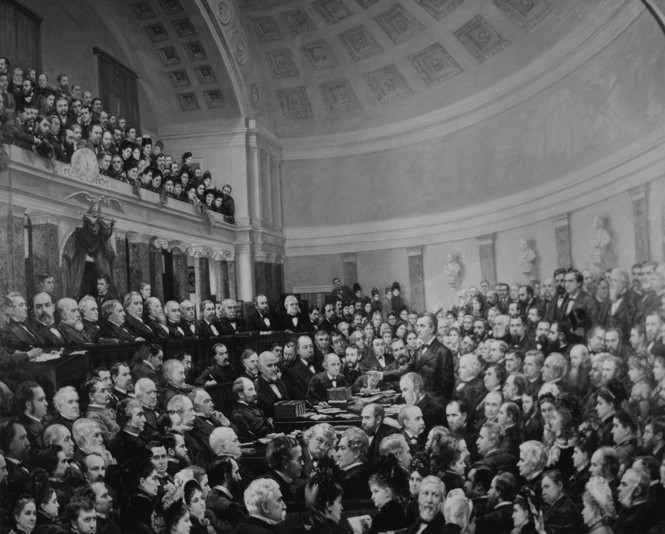
An 1878 painting of a congressional hearing addressing the disputed 1876 election between Samuel J. Tilden and Rutherford B. Hayes (Cornelia Adele Strong Fassett / Three Lions / Hulton Archive / Getty)
Absent the violence and intimidation visited upon Black voters, the Republicans would likely have won each state, but winners were impossible to determine. Florida ended up with three separate vote counts. In South Carolina, where the number of votes exceeded the number of eligible voters, two legislatures and two governors vied for control and haggled over the presidency. Louisiana’s electoral commissioner put the state’s returns up for sale to the highest bidder, while a monitoring commission tossed out the results from 15 parishes in which the fraud and violence had been particularly egregious.
Another civil war loomed. While the White League in Louisiana threatened to attack the statehouse, and representatives of rival governments, all heavily armed, faced off in South Carolina, former Union General George B. McClellan, a Tilden supporter, talked of marching on Washington at the head of an army. Resolution came only through shadowy negotiations and political compromises. Congress created a special Electoral Commission—composed of senators, representatives, and Supreme Court justices—to determine the outcome, but its deliberations quickly broke along partisan lines. In a series of backroom dealings, Democrats agreed to accept Hayes’s election if federal troops were withdrawn from the South. Reconstruction, already heading toward a violent end in places like Hamburg, came to an official close as Hayes removed the last federal troops from the South, seven weeks after his inauguration.
Not long before the Centennial Exhibition ended, a Massachusetts man published a poem in a Washington, D.C., newspaper telling “The Story of Hamburg,” just a few columns over from a grim run of headlines leading an article on continuing violence associated with the election. The poem isn’t in Bordewich’s book, but, like the stark contrasts in its pages, the lines speak to our moment. “Let others tell of the nation’s glory,” the poet began; his attention would be elsewhere:
I sound no paeans of valor and fame—
My song is shadowed by strains of sadness;
I tell the tale of the nation’s shame.
On the 250th anniversary, we are no less caught between the glory and the shame than our forebears were on the 100th. Since the 1960s, the writing of American history has largely been a project of recovering and reckoning with conquest and its legacies, racism and the limits of democratic practice, and horrific events like the Hamburg Massacre. The aim of the official anniversary proceedings embodied in President Trump’s 2025 executive order has been to “restore truth and sanity to American history”—and, in the process, to recover the glory and forget the shame. That effort was vividly realized in Philadelphia earlier this year, when the National Park Service removed a slavery exhibit from the President’s House in Independence National Historical Park. A federal judge’s order to restore the exhibit is now being appealed, and the fight over where to look—and how to look—at our past remains the crux of our commemorations.
Though we’ll mostly be looking back at 1776 this year, Bordewich has done a great service in calling our attention to 1876. The soundness of our democratic machinery is again in doubt; we, too, wonder at the power of new technology, and what it means for work; race remains a source of conflict and a tool of power. Bordewich is as cautious in drawing such parallels as he is in spelling out the lessons that might lie in the juxtapositions of fairground and background. It’s up to us to hear the echoes, and to make sense of the glory and the shame.
This article appears in the June 2026 print edition with the headline “How America Celebrated Its 100th Birthday.”
Did Karl Lagerfeld really leave millions to his blue-cream Birman, Choupette?
Show full content
Karl Lagerfeld, the great German fashion designer, lived in a surreal kind of grandeur. The creative director of both Chanel and Fendi, he owned apartments in Paris, Rome, and the Côte d’Azur, as well as villas in Biarritz and his native Hamburg; enormous collections of Art Deco furniture, antique jewelry, and couture garments; a personal library of some 300,000 books, by his own estimation; paintings and sculptures by Jeff Koons, Takashi Murakami, and John Baldessari; three Rolls-Royces; a curious assemblage of 509 iPods; and hundreds of pairs of his trademark wraparound sunglasses and fingerless biker gloves. According to a conversation that his biographer, William Middleton, had with the Parisian florist Lachaume, his annual flower budget appears to have been about 1.5 million euros. Lagerfeld never married or had children, and when he died of cancer, in 2019, the press quickly began to speculate about the immense fortune he’d supposedly left behind, which a number of outlets, including Bloomberg, Forbes, and The Guardian, ballparked at more than $200 million. Speculation also swirled about where these riches would end up.
More than seven years later, here is what is known for certain about the details of Lagerfeld’s will and estate: nothing. (Under French law, such matters are not made public.) But plenty has been rumored. Various figures close to Lagerfeld have been suggested as beneficiaries, including several male models and fashion executives, his bodyguard, his housekeeper, and the princess of Monaco. Even so, from the start, one improbable name has stood out: Choupette, Lagerfeld’s blue-cream Birman cat.
In the years before he died, Lagerfeld often spoke in extraordinary ways about the role Choupette played in his life. Listen to just a fraction of his avowals: “I never thought that I could fall in love with an animal like this.” “She is the center of the world. If you saw her, you would understand. She is kind of Greta Garbo.” “She has lunch and dinner with me, on the table, with her own dishes. She never touches my food. She would never eat on the floor.” “I have only one great love, my cat, Choupette.” And, ruefully, “There is no marriage, yet, for human beings and animals.”
Choupette came into Lagerfeld’s life over the 2011 Christmas holiday. A young model with whom Lagerfeld had a close friendship, Baptiste Giabiconi, asked whether he might leave his four-month-old kitten at Lagerfeld’s home while he visited family in Marseille. Somewhat reluctantly, Lagerfeld, who had previously had little time or affection for cats, agreed and found himself besotted. When the kitten was reclaimed by Giabiconi, Lagerfeld moped, and beseeched that Choupette be returned to him for good, a wish soon granted.
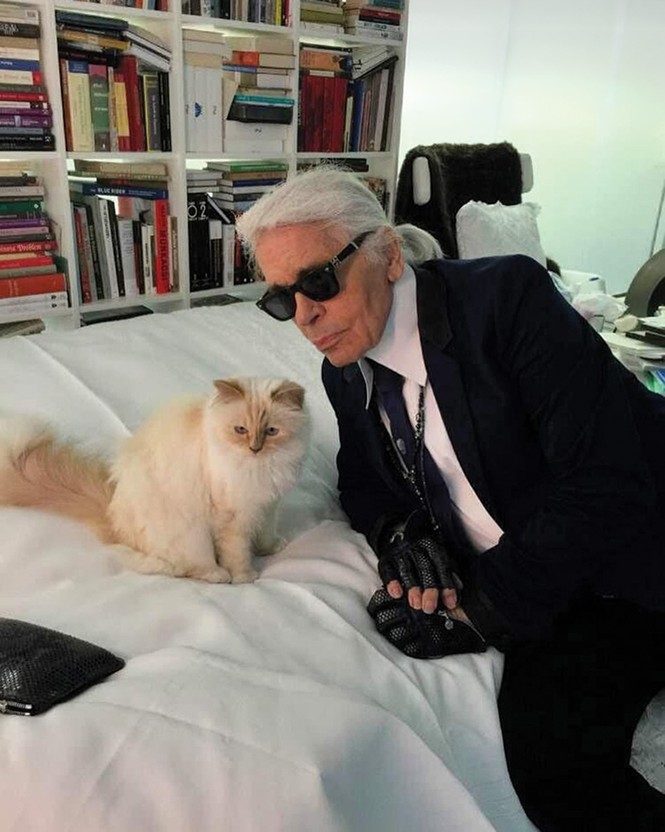
The first public window into this change in Lagerfeld’s life came not long afterward, when a friend of his posted a picture of Choupette sitting wistfully in Lagerfeld’s apartment, next to what appears to be a full bathtub, an arrangement of several dozen roses arching over her. By that summer, Lagerfeld was explaining in interviews that Choupette was “like a kept woman”; that she had “two personal maids, for both night and day—she is beyond spoiled”; and that these maids, aside from their other duties, were charged with writing down every detail of Choupette’s behavior when he wasn’t around so that he might know what he had missed: “Everything she did, from what she ate, to how she behaved, if she was tired, and if she wasn’t sleeping.” Already, Lagerfeld declared, there were 600 pages of such documentation.
Choupette’s fame swiftly grew, and Lagerfeld routinely extolled the extravagance of his cat’s day-to-day life: how she ate chef-prepared meals off the best china, traveled by private jet, appeared with models on magazine covers, and starred in advertising campaigns. Lagerfeld proclaimed her the most famous cat in the world, and declared that her advertising work had made her independently wealthy. “She has her own fortune from things she did,” he stated. “She’s a rich girl!”
Courtesy of Lucas BérullierA photo of a private-jet trip that Choupette took with Lagerfeld to New York, posted to her official Instagram account several months after the designer’s death. “Always watching over daddy,” the caption read.
According to Lagerfeld, in 2014 alone, Choupette earned more than $3 million from campaigns for Opel Corsa cars and Shu Uemura’s Shupette makeup line. That same year came a book, Choupette: The Private Life of a High-Flying Fashion Cat, including photos, biographical tidbits, and details of Choupette’s beauty regimen. A second book, Choupette by Karl Lagerfeld, 53 photos of Choupette taken by the designer on his iPhone, followed in 2018.
Once he adopted her, few Lagerfeld interviews failed to include testimony to Choupette’s outsize role in his life, albeit clearly one that reflected his own particular tastes and needs. “She’s peaceful, funny, fun, graceful, she’s pretty to look at, and she has a great gait,” he’d explain, “but her main quality is that she doesn’t speak. It was love at first sight.”
In his later years, Lagerfeld had intense attachments to select younger men he adopted as muses, but he is not believed to have had conventional romantic relationships. (As a younger man, he had a partner of nearly 20 years, Jacques de Bascher, who died from AIDS in 1989.) Lagerfeld often spoke as though his was a life that sidestepped sex entirely, though he once told Vice magazine: “I personally only like high-class escorts. I don’t like sleeping with people I really love.” Either way, if the manner in which he chose to live could be considered to have left a void, Choupette seems to have filled it. In a period when the designer was no longer close-shaven, he observed, “With this facial hair, I am really starting to look like Choupette. We are like an old couple. She even grooms the beard—we sleep on the same pillow and she spends her time licking it.”
Then reality intervened. Lagerfeld had learned he had cancer several years before his death in a Paris hospital on February 19, 2019, but this was information he had shared with almost no one. To ensure that Choupette was properly taken care of after he was gone, he designated his housemaid Françoise Caçote, who had long been the cat’s primary lady-in-waiting (and diarist), as her ongoing caretaker. During Lagerfeld’s last days, she surreptitiously brought Choupette to his hospital room. Once, not long before Lagerfeld’s death, Choupette caused great panic by disappearing, feared lost in the wider hospital, until her tail was spotted sticking out from her hiding place in Lagerfeld’s en suite bathroom.
As the post-death arrangements were made (Lagerfeld would be cremated with a piece of aquamarine jewelry bearing Choupette’s likeness), the media speculation about Lagerfeld’s estate began. The narrative that this involved Choupette had been primed by Lagerfeld himself, who had referred to how, should he die first, Choupette would be lavishly provided for. Although some reports that week allowed that any bequest to Choupette was, as yet, unconfirmed, a fair few were more absolute—led, as many such narratives are, by the British press, even its supposedly more respectable sectors. Their cumulative message was clear: “A cat belonging to the fashion designer Karl Lagerfeld, who died on Tuesday, is reportedly in line to receive up to $300m (£230m) of his estate” (The Telegraph); “Karl Lagerfeld’s cat, Choupette, may be set to inherit some of his £150 million fortune” (the Daily Express); “Karl Lagerfeld’s cat Choupette is reportedly set to inherit some of the formidable fashion designer’s £150m fortune” (the Independent).
The swirl of scuttlebutt about other beneficiaries, totals, tax liabilities, and relative shares has continued ever since, and there are consistent reports that, even now, no one has received any money. Nonetheless, it has been printed as established fact that, separate from his will, Lagerfeld had arranged a sizable sum, generally said to be about $1.5 million (though sometimes as much as $4 million), to ensure that Choupette would live on in the style to which she had become accustomed. She was, it was sometimes claimed, the richest cat in the world.
A little over seven years after Lagerfeld’s death, I’m sitting in an office building that towers above the Parisian suburb of Courbevoie with a man named Lucas Bérullier. Bérullier is Choupette’s agent.
Bérullier never met Lagerfeld, but he is fluent in the lore. “There’s a story,” he recalls, “when he adopted Choupette, at early stages and she was still young, everything was white in his apartment, and she was like a white fur ball. And he was so scared of someone or himself sitting on her or hurting her that he had every piece of furniture changed into black.”
Bérullier runs a company called My Pet Agency, one he started nearly a decade ago after seeing an unfilled opportunity for representing pets with potent social-media engagement. My Pet Agency’s menagerie is dominated by dogs, which Bérullier says are generally more obliging than cats. One of the dogs he has represented is Messi, the French border collie prominently featured in the film Anatomy of a Fall, though Bérullier points out that the company handled only Messi’s “social-media and special campaigns,” not his acting work. (Yes, this is a world where an animal might have more than one agent.) Most of the rest are cats, though along the way there has also been Buckley the cow, Cheepy the Australian cockatoo, Jiro the otter, Spike the beetle, and Mr. Pokee the smiling hedgehog.
As the business grew, Bérullier was aware that there was one megafamous pet living nearby in Paris that he would love to bring into his stable. While Lagerfeld was alive, Bérullier never found a way to make contact, but the summer after his death, an initial connection was finally made. Bérullier’s wife, a makeup artist, was doing a job in Lagerfeld’s studio, and she got to talking with Lagerfeld’s former bodyguard and confidant Sébastien Jondeau about Choupette. Bérullier soon went to visit Françoise Caçote and Choupette, and everything was agreed. “She needed someone to help harmonizing and structuring the communication,” he says. “Someone on her side defending what was best for her and what was best for Choupette.”
These days, Choupette lives in an apartment with Caçote somewhere in Paris, but I’m told that neither cat nor caregiver is receiving visitors right now. Bérullier says that a large part of his job, when it comes to matters relating to this particular client, involves turning people down.
Courtesy of Lucas BérullierLagerfeld’s former housekeeper Françoise Caçote, Choupette’s caretaker after the designer’s death
He says that commercial opportunities are screened according to a number of criteria: Beyond financial considerations, there are questions as to whether such offers are suitable for Choupette and for Lagerfeld’s legacy. There are moral considerations, too. “We believe that Choupette only works with animal-cruelty-free brands,” he explains. “A brand that uses fur, we would have to decline a collaboration.”
Other practicalities must also be accommodated. Cats, in general, can be tricky, and Choupette sounds a little tricky even for a cat. Bérullier has to prepare clients for the possibility that Choupette won’t even turn up. “And people understand, because you call them, you’re like, ‘Sorry—for the cat welfare and well-being.’ And they all say, ‘Oh, it’s fine. Okay. You told me. I get it.’ Then we have to either reschedule or just not do the job.”
Jobs that are not rescheduled, and that require Choupette to leave her home, are generally done at a studio that Choupette is accustomed to, just a few minutes away. Clients are told that there is a two-hour maximum, that everything must be ready before Choupette’s arrival, and that she requires her own private room. There must be no noise on set, and no one may take photographs aside from the photographer. Also, Choupette must not be shot from above. Shooting from human height, Bérullier explains, is the classic amateur pet-owner blunder. “That’s not engaging. But if you start laying and going like this—” Bérullier mimes getting on the floor in front of an animal. “And even sometimes going under them, it makes the impression that they’re giants! And that will engage.”
Bérullier shares one more practical accommodation made for the most important shoots: Whenever prudent, there will be a cat double on set, ready to do whatever Choupette might not. They don’t use just one regular stand-in—it depends on what might be required that day: “We know the one that is very human-friendly, the other one that is playful, the one that has the eyes that look the same or the tail that looks the same.” It’s clear that he does not consider this duplicity, more the reality of dealing with animal actors—and one, he points out, that is routine in moviemaking. He notes that the Choupette camp doesn’t go out of its way to disguise footage from a double, and that eagle-eyed Choupette fans can often tell.
Bérullier also demystifies some other assumptions that lie at the very core of how Choupette is commonly perceived. The multimillion-dollar fees that Lagerfeld alluded to Choupette commanding were for campaigns where the clients were largely paying for Lagerfeld’s name, and also for Lagerfeld being the photographer, designer, and art director. Bérullier doesn’t share Choupette’s current rate card but suggests that the numbers involved are substantially more modest. “Let’s be honest, we can’t ask millions for a post or a shoot,” he says.
Likewise, he punctures the notion—one that Lagerfeld sometimes explicitly stated—that Choupette has her own seven-figure bank account. “The law is the law,” he says. “A cat can’t own a bank account.” (When I ask whether there couldn’t be some kind of corporation holding the money, he says that if this were so, it would be a matter of public record.) Furthermore, he suggests that we should be skeptical of stories that Caçote has already received a million-plus sum on Choupette’s behalf. The one printed story of this kind that Bérullier verifies is that Lagerfeld did, before his death, give Caçote the apartment in which she and Choupette live, but he notes that even this came with substantial unaddressed French tax liabilities.
Bettina Pittaluga for The AtlanticChoupette’s agent, Lucas Bérullier
There is no suggestion at all, in what he is saying, that Choupette wants for anything. Revenue is clearly coming in, though maybe not as much as one might assume. “It’s really hard for me because on one hand, you do want to keep the myth up,” Bérullier says. “But it’s not what I want people to be interested in. I mean, for me, she’s the most beautiful cat in the world; she’s the most fascinating—and culture and iconic and heritage. But not in a money way.”
As for the will itself, here are some more details of what has been rumored. The will was apparently written in April 2016, and there are commonly said to be a number of beneficiaries. Many accounts suggest the former bodyguard Sébastien Jondeau and two of Lagerfeld’s male-model muses, Baptiste Giabiconi and Brad Kroenig. It is generally agreed that the Lagerfeld executive Caroline Lebar is also named. Sometimes, but not always, mentioned are the former Chanel creative director Virginie Viard; the writer and style consultant Amanda Harlech; a second Lagerfeld executive, Sophie de Langlade; Kroenig’s son Hudson (Lagerfeld’s godson, who started modeling for Lagerfeld on the runway at age 2); another model friend and protégé, Jake Davies; Princess Caroline of Monaco; and Caçote. (Animals may not inherit directly under French law.)
It is said that a key reason for the delay in settling Lagerfeld’s estate is a long-standing legal fight with the French tax authorities. One area of dispute may stem from the repercussions of the belated discovery that Lagerfeld’s home in Monaco, where the tax regime is famously gentler, was technically in France. But there may well be more than that. There is talk of a complicated web of international corporations potentially structured to reduce tax liability, and it was reported several years before Lagerfeld’s death that he was under investigation for tax evasion. An added layer of intrigue was the apparent disappearance of Lucien Frydlender, Lagerfeld’s accountant of 30 years and the estate’s putative executor, who reportedly died in Israel in 2024.
The closest anyone has come to capturing what those supposedly involved say about any of this is Michael Waldman, who made a remarkable documentary, The Mysterious Mr Lagerfeld, for British TV in 2023, in which he interviews a range of Lagerfeld associates, including all three men—Giabiconi, Kroenig, and Jondeau—who are most often identified as the principal beneficiaries. Jondeau describes Lagerfeld handwriting the will and confirms that he was one of the beneficiaries, and appears to confirm that Kroenig and Giabiconi are included too. And Giabiconi says this: “He named me top of the list. Well, I got a big percentage.”
But a percentage of what, exactly? Although the Lagerfeld estate’s value was widely assumed to be in the low hundreds of millions, there seems to be no solid basis for this number. And although Lagerfeld was evidently very rich, he was also famously generous and profligate: In the documentary, the manager of Lagerfeld’s favorite bookshop says that he was the store’s best client, spending 500,000 to 700,000 euros each year. Various sales have liquefied assets in the years since—a Paris apartment was sold for $10.8 million, a villa outside the city for about $5 million—but nothing yet approaching the totals that have been widely touted.
In Waldman’s film, one interviewee, Lagerfeld’s estranged friend Patrick Hourcade, raises another rumor, the most dramatic of all—that the remaining money will go to the French finance ministry. Waldman tells me he got the sense from other interviews that expectations had certainly been lowered—that, for instance, Jondeau “thinks and hopes that something will come, but he doesn’t know how much, and he knows that it’s possible that there’ll be very little or nothing.”
Waldman also spent time with Choupette at Caçote’s home, which he reports is a nice-enough apartment, where she lives with her husband and teenage son. “The husband was quite funny,” Waldman says. “He was like a salt-of-the-earth plumber—he might even have been a plumber, I can’t even now remember. But he was a working man. And he was obviously bemused by this mad world that his wife had got herself into and more than tolerant of this extraordinarily beautiful cat.”
Filming Choupette, Waldman says, required patience. “She didn’t like strangers,” he says. “That was understood.” But, he adds, “there was also something in the way that Choupette moved that said, I am more important than you. I am more important than anybody or anything. And I sort of saw that. And in terms of trying to seduce Choupette into my lens and, as it were, communicate in an unprecedentedly intimate way, she refused.”
The latest rumored turn in the seemingly never-ending drama of the Lagerfeld estate came earlier this year. It had been reported in 2024 that the beneficiaries had agreed on terms to settle with the tax authorities. According to the German magazine Bunte, in December 2025 the will had at last been finalized, but then had apparently been challenged by an unknown party. This had come to light, Bunte asserted, because Lagerfeld’s surviving blood relatives had received a letter informing them of this development. These relatives, who are not believed to be in the will, had apparently been notified because, should it be ruled that Lagerfeld had no valid will, his estate would then be divided among them.
Lagerfeld was born in Hamburg in 1933. (For many years, he would claim to have been born in 1938, something he would later attribute to his discomfort at having been born in the year of the Nazis’ rise to power.) Lagerfeld’s father—who, incidentally, was a member of the Nazi party—had been married before, and Lagerfeld had an older half-sister, Thea. It is from that line of the family that his surviving German niece, Thoma Theodora Friederike, the countess von der Schulenburg, comes. She is quoted in the Bunte article as saying that she would “emphatically reject” any inheritance.
But Lagerfeld also had a full sister, Martha Christiane, who was two years older than him. When she was in her mid-20s, she took a job in Seattle as an au pair. There she met a tax inspector named Robert Johnson; they married and moved back to his hometown of Portland, Connecticut, where they raised three boys and one girl.
I reach Caroline Wilcox in the records department of a municipal agency in rural Connecticut, where she has worked for more than 40 years. She is Karl Lagerfeld’s niece.
She first met Lagerfeld when she was a baby, when her mother took a ship back to Germany for a visit in 1961, about a year after her birth. Later, Caroline and her younger brother Karl—named after his uncle—would wear the clothes that Lagerfeld and Lagerfeld’s mother sent them; her brother Karl was the only kid in the neighborhood in lederhosen. (Two more boys, Roger and Paul, would follow later.) Still, she notes, her mother’s world and her uncle’s were far apart. “I was raised a little feral with three brothers,” she says. “I had a pet goose.”
In the fall of 1974, Lagerfeld, who was in New York, drove up to see his sister for the first time in years, and invited Caroline and her brother Karl to visit him in Paris the following summer. “We had a wonderful time,” she says. “He took me to a salon for a full day. I came out not even looking like myself. Took us shopping for clothes, reoutfitted us. I had never been to a restaurant.”
Lagerfeld met up with his sister one final time, in the 1980s, and after that, none of Lagerfeld’s American family ever saw him again, but they never fell out of touch. “We weren’t close,” Wilcox says, “but we had contact.” Lagerfeld would send presents, and sometimes money, to his sister, and also a Fendi fur for her 50th birthday, and he and his sister would talk by phone. In 1992, when he found out that Wilcox was getting married, he told her to forget about the dress she had already picked out. He, Karl Lagerfeld, would be making his niece’s dress. Faxes went back and forth, Lagerfeld sending his hand-drawn sketches and handwritten thoughts. The day before the wedding, a courier arrived in the snow carrying Lagerfeld’s creation, flown in that same day with its own seat on the Concorde.
In 2015, Wilcox’s mother died after a short illness. Lagerfeld had been getting updates, and once she was gone, Wilcox let her uncle know. “I texted with him throughout the day,” she says. “He was upset and talked about how different their lives were. I recall he was on an elevator to take a moment of privacy because he was at a show or working. That day was very busy for him, but he did take the time out to make me feel better.”
Wilcox says that her close friends know of this family connection, but few people beyond that. “If you said ‘Lagerfeld’ to most people here,” she points out, “they would not know who that was.” Her brother Roger lives nearby, and drives heavy vehicles. Her other brother Paul moved to Texas, where he is a government contractor. (Her oldest brother, Karl, died in a motorcycle accident when he was 18.) “We’re just ordinary people,” she says. “He has American relatives that live quite, quite differently than what his world was like. We’re very proud, but also unassuming.”
She declines to say whether she has recently received a letter regarding the will, but emphasizes that she certainly has laid no claim to it. “He was a generous, kind person to us,” she says. “My uncle was so unique. A once-in-a-century person.”
Courtesy of Lucas Bérullier“She is the center of the world,” Lagerfeld once said of Choupette. “If you saw her, you would understand. She is kind of Greta Garbo.”
She mentions that in his later years, Lagerfeld would text her pictures of Choupette. “He loved that cat,” she says. Sometimes she would send back photos of her dog, a Chihuahua-corgi mix: distant relatives finding common ground.
“A picture of my dog, Poppy, on my couch,” she says, “is a lot different than a picture of Choupette on a pillow.”
One more strange wrinkle in the Choupette story relates to her online history. The Instagram page @choupetteofficiel was launched on August 15, 2019, Choupette’s eighth birthday, nearly six months after Lagerfeld’s death.
But, as I’ve previously alluded, by then Choupette’s virtual celebrity was already long established. Lagerfeld often referred approvingly to her online popularity; the 2014 Choupette book boasted of “her own Twitter account and a vast following” and reprinted the first tweet, on June 6, 2012, from the account @ChoupettesDiary, posted less than six months after Lagerfeld had taken Choupette as his own: “Baptiste may think he is a muse but only I, Choupette, am Lagerfeld’s true muse. Everything from my whiskers 2 my meows inspire.”
Given the way that these social-media accounts were regularly referenced in the conversation surrounding Lagerfeld, it was natural to assume that they were part of Lagerfeld’s wider conception of Choupette. But the odd truth is this: They had nothing to do with Lagerfeld, or with anyone around him. On that day in June 2012 when the very first tweet appeared, Ashley Tschudin, a 23-year-old who held a low-level job at a New York company that managed booking software for modeling agencies but who had no inside track to the world of fashion or of Lagerfeld, had just read an interview with the designer published that morning in Women’s Wear Daily, in which he rhapsodized about Choupette and her obsessively documented two-maid luxury life. A character popped into Tschudin’s head—“a sassy, satirical, high-fashioned feline,” she tells me, “who had a lot of opinions about humans, about her lifestyle, the fashion industry, pop culture, and the beauty industry”—and, right there and then, she opened a Twitter account with the name @ChoupettesDiary, composed a bio (“I’m a famous beauty who refuses to eat on the floor & my maids pamper my every need. I am Choupette Lagerfeld and I am a spoiled pussy”), and started tweeting.
By the end of the same day, @ChoupettesDiary had gathered so much attention that Tschudin had done two anonymous interviews as Choupette by direct message—one with WWD, whose Lagerfeld interview had inspired all of this just hours before, and a second with Fashionista (“I felt it was time to show the fashion world the REAL Choupette,” the cat pronounced).
After that, Tschudin says that Lagerfeld’s team soon reached out to ask who she was. She told them her name and that was that. “It was never that they would step in and say, ‘Oh, no, you can’t say this,’ ” she says. “There was no control or approvals or communication as to overseeing the brand that I was building, except for that first introduction.” In the Twitter feed, and on the Instagram account and the more discursive blog that shortly appeared in tandem, she would freely use whatever photos were out there, including anything available from Lagerfeld and those around him. “Never once did I receive an email that said, ‘Hey, you can’t use these anymore.’ Why would they do that? I was building a brand for them for free.”
Meanwhile, Tschudin was able to monetize the social-media accounts for herself, though she says only to modest effect: “Not in a consistent-paycheck way,” she notes. “Not enough to pay for my groceries.” She most benefited, she acknowledges, in more indirect ways: “Choupette became my voice and opened a lot of doors in my career for me within digital marketing, within the fashion industry, the beauty industry.”
Though Tschudin always had full-time jobs unrelated to impersonating a cat, she would typically spend hours each day on Choupette-related posting. “I loved it,” she says. “It was my creative outlet. It was my voice. I could say things that I, a human, couldn’t say, because it was humorous coming from a high-fashion feline.” When Lagerfeld died, at first she simply carried on. “Thank you everyone for your words of condolence,” Choupette swiftly announced. “With a once cold but now simply broken heart, I am going into mourning.”
She knew that there was going to be a problem when she saw Caçote’s first @choupetteofficiel post that August. Bérullier had touched on this situation when I met with him, mentioning that when he first came on board, “there was a bit of a dispute—we can call it that—with the person who had fans’ accounts. We had a conversation with the people behind, but we didn’t find an agreement that was okay.” Tschudin’s version is rather more blunt. She says that her lawyer made contact offering “a variety of options”: Choupette’s representatives could buy the brand and its audience; they could collaborate with her; they could hire her. “They were not interested in any of those,” she says. “They did not come in a collaborative way to the table.” It became clear that they preferred a fourth option. Tschudin was never formally shut down, but she could no longer easily use photos, and all of the fashion-world invitations she’d become accustomed to simply evaporated. She took the hint. “It was heartbreaking,” she says. “It was as if my voice was taken away.”
Not all of her memories of her time as Choupette are sour ones: “The brand as a whole is something I’m extremely proud of. I’m proud of a voice that I gave to an animal that did not have a voice. I’m proud to have gotten the opportunity to be one of the world’s first pet influencers when that was not a career path.”
During all of those years when she was assuming Choupette’s voice, Tschudin and her subject never met. Truth is, she’s not an evangelical cat person. Back then, she did have a pet, but it was a Chihuahua called Roscoe. Now, living in California, where she works for a company that does hiring for Google, she has seven rescue dogs and a rescue pig.
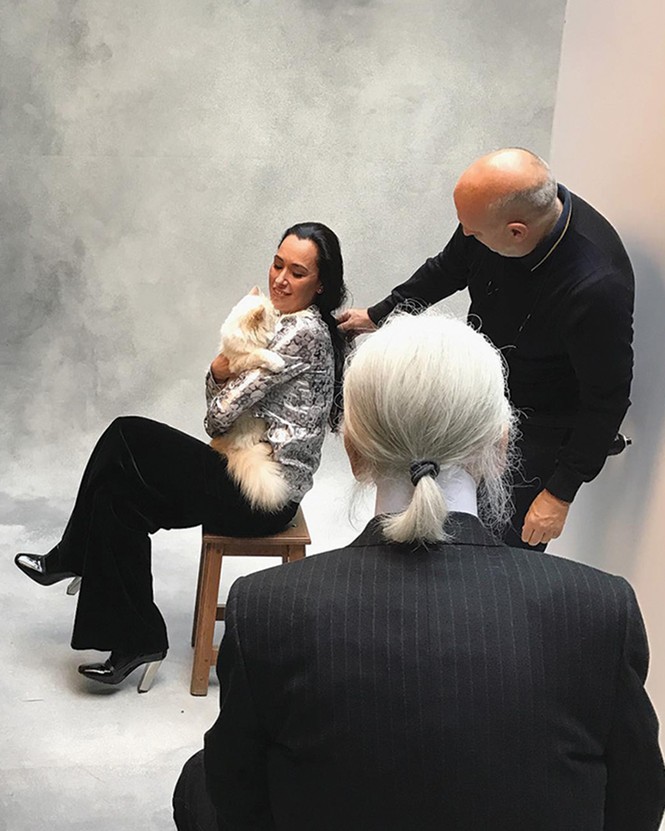
In 2023, it was decided that the theme of the year’s Met Gala, to be held on May 1, would be a tribute to Karl Lagerfeld. The first that Choupette’s people knew of this was when a request came to participate in an Annie Leibovitz Vogue photo shoot that would feature a dozen supermodels. Choupette’s part in this went well enough. Bérullier says that when the cat and her team turned up on the day, all of the models gathered at Paris’s Grand Palais were cooing, “Choupette! Choupette!” The cat’s designated model was Naomi Campbell, and Leibovitz duly photographed the two of them together on Pont Alexandre III, Choupette in Campbell’s arms.
That, though, was just the prequel. As news of the Met Gala theme became public, My Pet Agency was bombarded with endless versions of the same question: Would Choupette be attending the Met Gala? There are two stories to tell here. One is the story that was told at the time. The second is the one that appears to be closer to the truth.
This is the first narrative: Choupette’s people were besieged with requests for her to attend the Met Gala, but were stretching out a will she or won’t she? dynamic. A little over a week before the event, Choupette was photographed on Instagram lazing on a bed, paws over her face: “Me while everyone is wondering whether I’m going to the Met Gala.” A few days later, Kim Kardashian posted a photo of herself, lips pouting, next to Choupette on a bed: “Had a date with @choupetteofficiel in Paris. We then spent some time at @karllagerfeld’s office to get a little inspiration for the Met.” The implication seemed to be that because Choupette wouldn’t be mingling with the famous and beautiful in New York, one of their representatives had paid a visit beforehand.
The day of the Met Gala, when the cat’s nonattendance was revealed in a @choupetteofficiel post, it was presented as how things were always going to be: “Many people invited me to walk the red carpet of the #METGALA2023 in tribute to Daddy, but we preferred to stay peacefully & cozy at home.” Attention instead pivoted to the way Choupette was represented in New York on the night—Jared Leto walking down the red carpet in a full-body Choupette costume. This, presumably, had been the plan all along.
Except that a second narrative, significantly different, became apparent later that year, during an episode of The Kardashians. It turned out that Kim Kardashian’s meeting with Choupette had actually happened in the middle of March, about six weeks before her Instagram post. Ahead of the meeting, Kardashian explained to her show’s cameras exactly why she was there. “I am going to the Met with Karl Lagerfeld’s cat as my date,” she said, “and I’m so excited.” Later she further spelled out the mindset she was bringing to that day’s meeting: “Choupette is really key to my whole vibe for the Met this year.”
When I ask Bérullier, he concedes that this was provisionally the case. “We received about half a dozen requests of people who wanted to take her,” he says. “And first you’re like, Oh, yeah, cool. Of course. We’ll be there.” Then they started thinking about the reality of traveling there, and of taking Choupette down “the busiest, loudest, craziest carpet,” and wondering whether it was a good idea after all. Still, once Kardashian emerged as a likely escort, plans began to form. “It made the most sense: the most famous cat with the most famous person on the planet.”
That was why it had been arranged that Choupette and Kardashian would meet in a suite at the Paris Ritz. “I’m nervous,” Kardashian said beforehand. “I literally feel like I’m going on a blind date.” I’m pretty sure, watching this, that Kardashian is just mugging for the camera, creating a frothy reality-show narrative. But genuine trepidation might have been wise.
The cat and the Kardashian met for the first time when Caçote placed Choupette next to Kardashian on a plush hotel sofa. (Bérullier was there, too, taking a video on his phone.) Choupette initially appeared somewhat tolerant of Kardashian’s close presence, but not for long. Kardashian was wearing a black jacket—“some sort of plastic leather,” says Bérullier, who believes that Choupette was scared of the sound that this outfit made. Soon Choupette hissed, then jerked toward Kardashian, snarling. Kardashian swiftly withdrew her hand.
“Don’t worry, she pretends—she won’t do anything,” Bérullier reassured her.
“Oh, it’s okay—I act like that sometimes too,” Kardashian replied. “She is feisty.”
But then there was more hissing. Bérullier says that the two of them were together on the sofa for nearly an hour. At one point, when Kardashian tried to hold Choupette, Choupette lashed toward her face, and Caçote quickly stepped in to take the cat.
Later on, Kardashian and Choupette did successfully pose for photos together on a bed. By then, Kardashian had removed her jacket, and Bérullier says that this part of the encounter went much better. But the conclusion had become obvious. As she would summarize it on The Kardashians: “I think I realized really quickly that Choupette, we’re not a match. So I am not bringing her to the Met.”
“It would have been just not right for the cat,” Bérullier says. “You know, sometimes you need a bit of distance to understand that.”
Most of Choupette’s public life in the years since Lagerfeld’s death has been rather more low-key. Her most regular client is a high-end German cat-accessories-and-toys brand called LucyBalu. Just before Christmas, she did a shoot for a Maisons du Monde home-decor range. Last year, she was announced as the French voice of the mischievous cat Azraël in the French version of the Smurfs movie (Les Schtroumpfs ), though that was more clever marketing than anything else. She filmed some promotional footage but, cat being a universal language, no French-cat noises were overdubbed in place of the original sounds.
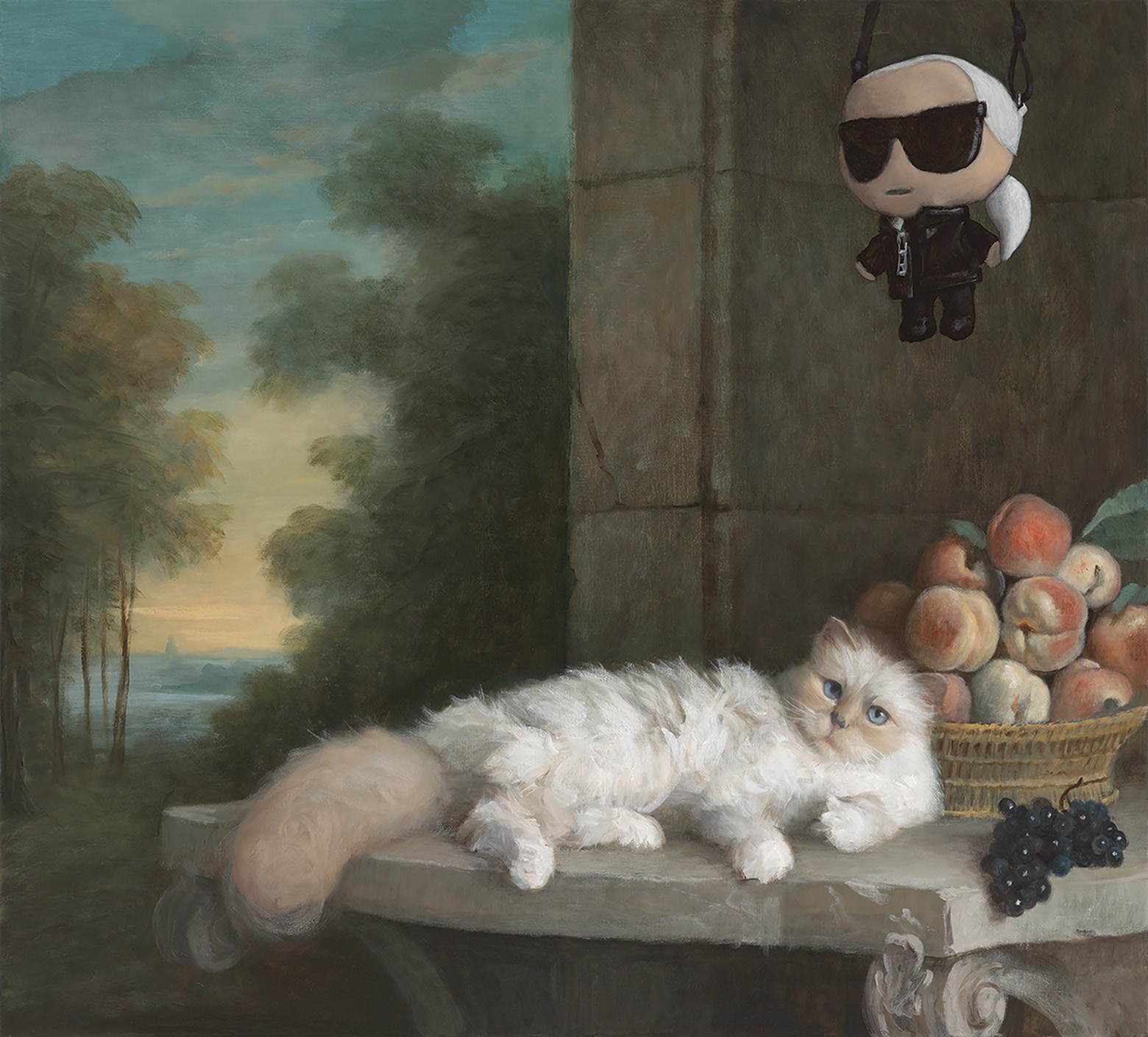
One more unusual recent collaboration was with a German painter, Max Renneisen, who has a particular interest in the great French 18th-century animal portraitists Jean-Baptiste Oudry and Alexandre-François Desportes.
“There are so many depictions of the favorite dogs of Louis XV, Louis XIV, and I thought that Choupette is a perfect match,” he explains to me. “It’s the equivalent of today to these royal pets. I want to present Choupette in the same way as these royal pets in the 18th century were presented.” Initially, he sourced some photos of Choupette and got to work. The first painting he did, of Choupette in a spectrally lit forest clearing, was directly styled after Oudry’s 1726 portrait of Polydore, one of Louis XV’s hunting dogs. But Renneisen felt dissatisfied with what he had created. “It is not really Choupette,” he adjudges, “but more an invention of a white cat supposed to be Choupette.”
To do better, he felt like he needed Choupette herself, so in 2024, he tracked down Bérullier and secured permission from Bérullier and Caçote to photograph her, in order to capture images he could use for paintings.
In truth, Renneisen tells me, the ensuing photo session wasn’t that successful. He would like to have seen Choupette in certain poses, but it became apparent that his expectations were unrealistic. “When she realizes that you want something,” he says, “she doesn’t want to do it.”
No matter. He was also given lots of photos he hadn’t seen, and these guided him. Choupette was difficult to paint—“because of the texture, this fur, all the shades of her color”—but bit by bit, a portfolio came together.
Renneisen returned to Paris this February to photograph Choupette a second time, now alongside some of the paintings he had made. I ask him whether he got the sense that Choupette recognized herself in his paintings.
“No, I don’t think so,” he replies. “All the fuss we do about her, all this concept of celebrity, giving a meaning to her, everything—this is us, for the humans.” He further notes: “Choupette is not a diva. She’s a cat, and we want to see the diva in her.” I point out that a lot of people fixate on Choupette’s character, and on what she’s thinking. I ask him whether he does that too.
“No,” he says. “No, no, no. I accept her as a cat. She’s a cat.”
Photograph By Joe Clark; painting courtesy of Max RenneisenThe German painter Max Renneisen depicted Choupette in the style of the great French 18th-century animal portraitists, with a very 21st-century Lagerfeld floating above her.
And that is where I believed my grand Choupette quest—often surreal and delightfully absurd—had reached its natural end. But I was wrong.
Long after my return from Paris, as this article is going to press, I receive a message that Caçote might answer some questions in writing. I send some, and wait. Eventually, answers arrive.
One thing I ask Caçote about are those day-to-day diaries of Choupette’s life written between 2012 and 2019, of which she was the primary author. Most of the 100 or so volumes that she believes exist are no longer in her possession. “I miss them,” she writes. “I’d like to pick one at random and reread it. Karl loved to do that too.” And, she adds, “It’s very frustrating, especially since I asked for them after Monsieur’s death and was told they were part of the estate, so they weren’t given to me. I was told they might be given to me later, but I’m still waiting. I’d like to know what happened to them!!”
But of all Caçote’s answers to my questions, the following three are the ones that tell me the most about what I want to know:
Is taking care of Choupette—with everything that entails—a heavy responsibility for you?
“Yes, of course!! I’m always afraid of being judged. What I do know is that Choupette is happy at home, and that’s the main thing.”
Choupette is often called “the richest cat in the world,” and newspapers frequently report that you’ve received huge sums of money to take care of her. I understand that this isn’t true. What do you think of this misconception, and what would you like people to know about it?
“I want to be completely transparent: today, we have received absolutely nothing. Given the situation’s complexity, I have had to hire expensive lawyers to claim the inheritance in my name and ensure that Karl’s wishes are properly respected.
“While things are being sorted out, I’m doing my best to honor his wishes, especially that Choupette wants for nothing. That’s my top priority. In addition to caring for her, I work part-time to support her. She receives all the love, attention, and care she needs.
“The most important thing is that she’s happy, surrounded by love and affection, and protected as Karl would have wanted. We remain hopeful that the situation will one day be resolved peacefully.”
What is Choupette doing right now?
“She’s taking a quiet nap.”
This article appears in the June 2026 print edition with the headline “Cat Heir.” When you buy a book using a link on this page, we receive a commission. Thank you for supporting The Atlantic.
The “Weekend Update” joke swap is a celebration of friendship, bad taste, and the importance of context.
Show full content
Even by the standards of shocking Michael Jackson jokes, it was a shocking joke. “Michael Jackson did nothing wrong,” Michael Che, a co-anchor of Saturday Night Live’s “Weekend Update,” said during last night’s episode. “He was right to molest all those kids.” This was delivered with palpable surprise at the words coming out of his mouth, but Che kept going: “They were lucky. I would have paid him to do it. And I did! That’s right, when I was 10 years old, Michael Jackson molested me, and the only thing it gave me was a fetish for middle-aged white women.” He then smiled and said, almost as an aside, “That is not why I have that.”
Che, of course, wasn’t saying what he actually thinks about the late pop star or his own personal sexual preferences. He was participating in a tradition where he and co-anchor Colin Jost each write “Weekend Update” material that the other man has to deliver cold, without seeing the joke ahead of time. The goal is to make their co-anchor look as crass, offensive, and stupid as possible, and Jost had crafted a real doozy for Che to read. But the joke wasn’t just about shocking the audience or innovating in the seemingly spent arena of Michael Jackson jokes—it also demonstrated how the right context can make grotesque humor sing, by turning the discomfort of the joke teller into the real gag.
In an interview with the comedian Mike Birbiglia, Che said that the stunt was inspired by the “Update” jokes they’d written that had bombed during dress rehearsal. (Che recalled how one groaner was greeted with a woman loudly saying “no.”) But for one episode, Che and Jost decided to recycle those same jokes for the other man to say. To Che’s surprise, the act of telling the audience that they were aware that these jokes were in bad taste “made them laugh hysterically.” Jost pushed for them to do it again, but without knowing the jokes ahead of time; Che admitted that he became worried that Jost was going to surprise him, “so I wrote new ones that were horrific.”
This has since evolved into a biannual tradition—and one of the best parts of the past decade of SNL. Highlights have included Jost getting Che to call Kendrick Lamar “the biggest bitch of them all” during the height of his feud with Drake, and Che writing a joke about Jost’s wife, Scarlett Johansson, that was so beyond the pale he later apologized to her on air.
The tradition has endured partly because of the sheer shock value of the jokes, which almost guarantees they go viral, but also because it’s very sweet, in a very strange way. After working together for a decade, the two men understand each other on an artistic and personal level. For Che, writing his jokes means leaning into Jost’s straight-laced vibe and the idea that he seems like a guy who would enjoy racist material, such as this line he was made to recite about the Oscar-winning film Sinners: “A Black vampire is just like a white vampire, except the only thing it sucks dry is the welfare state.” In contrast, Jost loves to make Che look like some sort of louche sexual deviant, as seen with the Jackson joke.
It all comes down to the two men’s anguished delivery, which itself becomes the joke. In the interview with Birbiglia, Che noted that people worry they will “get in trouble” for laughing at jokes they know are wrong, so the secret is to give them permission. This is how jokes that on paper read as merely sexist and racist really become about two friends trying to make each other really, really uncomfortable.
The latest joke swap arrived just after Netflix’s recent roast of Kevin Hart, which was filled with nasty, not-all-that-winky exchanges between the featured comedians. Take one particularly vicious back-and-forth between Shane Gillis and Chelsea Handler, where Gillis cracked about Handler partying with Jeffrey Epstein and Handler returned fire by bringing up Gillis’s history of telling racist jokes. The environment wasn’t that fraternal. Maybe everyone was in on the joke, but the event certainly seemed like it was filled with people who despised one another, and who wanted to demonstrate that they were the edgiest and most callous person in the room.
In comparison, Jost and Che’s one-upmanship clearly comes from a place of deep affection. At one point, Jost was made to joke about a new album by Ye (formerly Kanye West): “Please try to separate the art from the artist, and remember that Ye can make awful music and still be right about Hitler.” At the end of “Weekend Update,” he said that to atone for this particular bit, “I’d like to sacrifice the most important thing in my life: my beautiful, award-winning, world-famous hair.” A barber entered the set from behind, pulled out his clippers, and draped Jost in a black cape.
But right before the clippers made contact, Che intervened with a passionate No! “You was really gonna do it?” he asked in seemingly genuine disbelief. “Man, you are the greatest comedian of all time,” he added, dropping the bit for a second and simply telling his friend how much he loved him.
Tender shrub, green leaves of its foliage,
the curl of a baby’s fingernail, knocked
over by storm, its brush crumbling to touch—
how did I miss it—it’s all that I can
do—for those I could not save—but twist
the stubborn bush from its tangled roots
& turn it upright as if giving birth
to a baby in breach. I don’t mind mud
underneath my nails, worms my fingers touch
(they enrich the soil), mosquitos swarming
crazily (it’s one hundred degrees!),
circling my head like a halo of distrust.
It’s nature’s promise I curse. All those weeks
when I prayed for a triumphant birth.
A new exhibition makes George Washington seem like anything but a saint. That’s a good thing.
Show full content
George Washington has long been something of an American visual cliché. When the Russian diplomat and artist Pavel Svinin visited the United States in the early 19th century, he found it “noteworthy that every American considers it his sacred duty to have a likeness of Washington in his house, just as we have images of God’s Saints.”
Today, the country is no less prone to canonizing versions of patriotism, though they go well beyond art. As the nation’s 250th anniversary nears, the Trump administration has come up with observances thatshow a limited image of American history, as in its visually conventionalThe Story of America video series, full of yellowed parchment and tricorn hats. Other commemorations are essentially celebrations of the current president: The U.S. Mint is set to issue a commemorative gold Donald Trump coin, and one of the administration’s first observances of the anniversary year was a military parade that coincided with the president’s birthday. Such decisions, like the “sacred duty to have a likeness of Washington” on the wall, obscure the line between the nation and its leader—which, in turn, seems connected to Trump’s tendency to suggest that criticizing him is unpatriotic.
But in the context of the 250th, it’s worth remembering that patriotism doesn’t have to be uncomplicated or exuberant or even easy. In a 2018 remembrance of Philip Roth, Zadie Smith recalled that after the great writer retired, he devoted himself to reading, especially about slavery: “His coffee table was piled high with books on the subject—canonical, specialist, and obscure—and many slave narratives.” For Smith, this investigation was coherent with Roth’s body of work: “He always wanted to know America,” she writes, “and to see it in the round.”
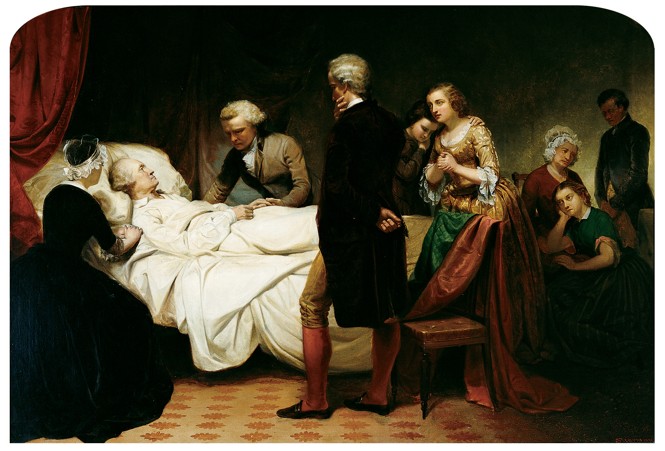
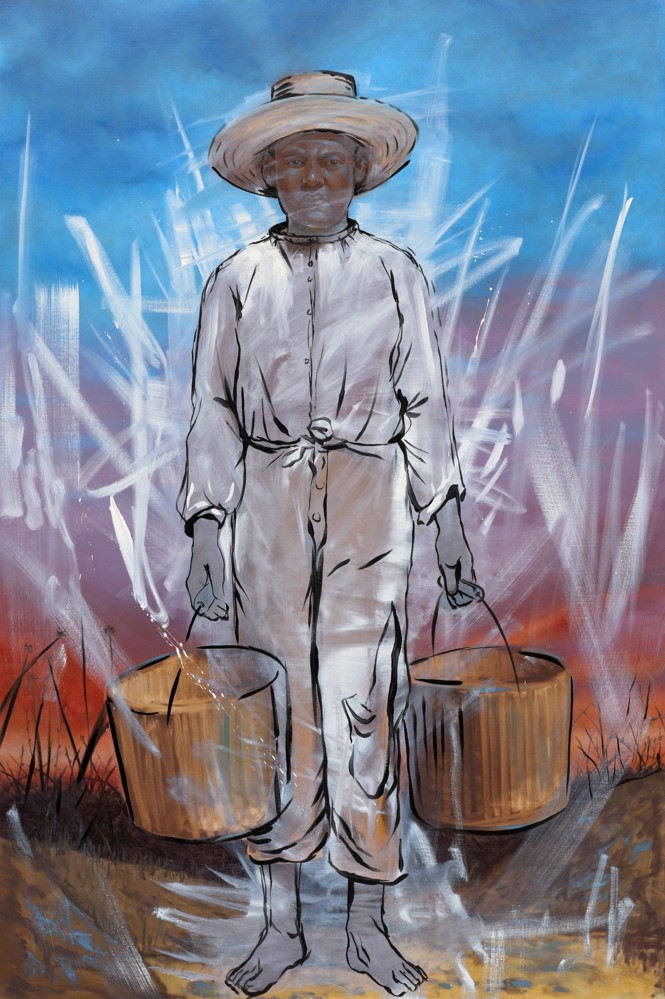
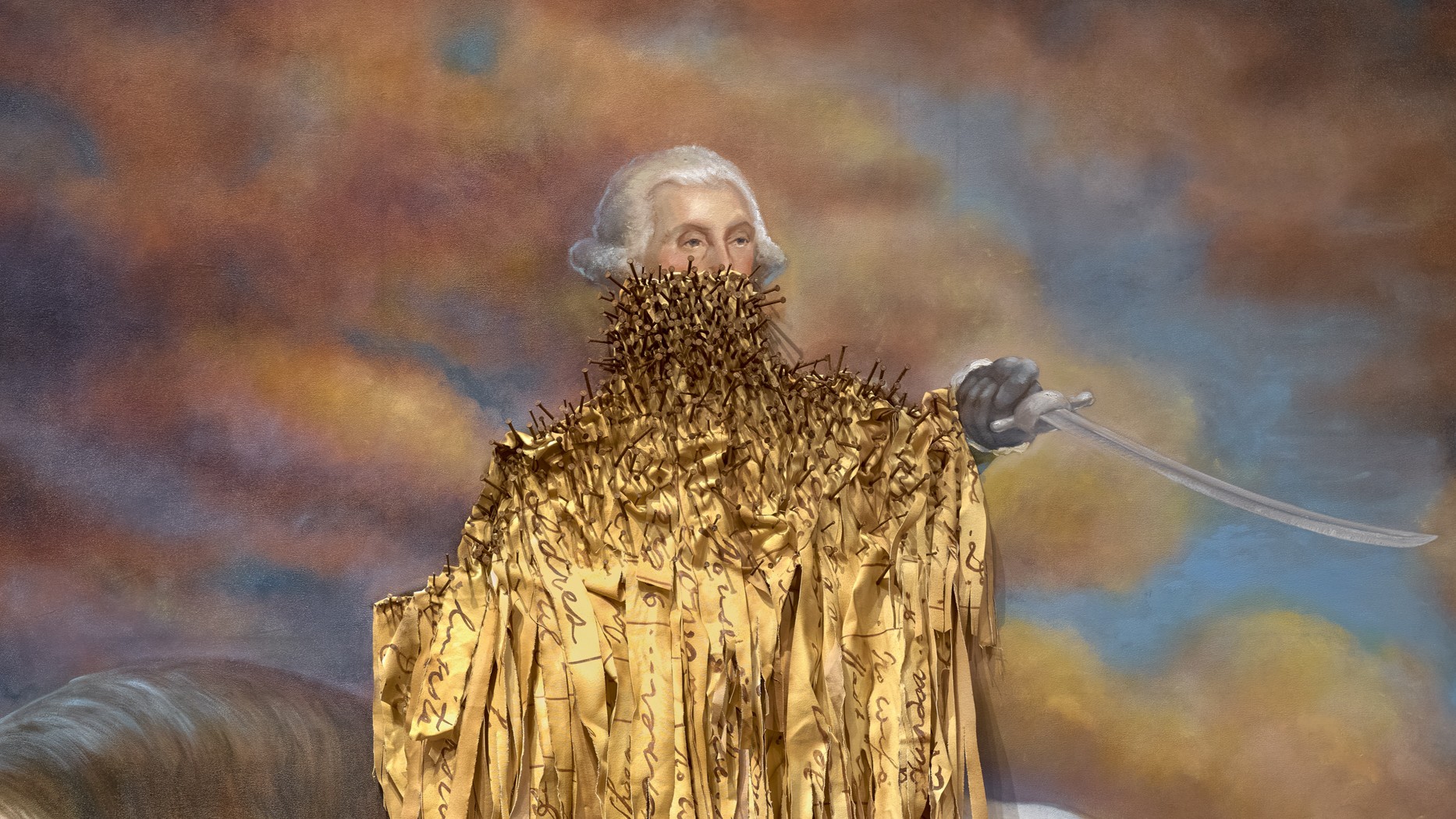
A similar spirit of understanding as patriotism animates the Virginia Museum of Fine Arts’s show “Titus Kaphar and Junius Brutus Stearns: Pictures More Famous Than the Truth,” which is part of Virginia’s state commemoration of the semiquincentennial. It juxtaposes the 19th-century artist Junius Brutus Stearns’s paintings of George Washington—not portraits, but imagined scenes of the president’s life that circulated widely in their time and remain canonical enough to appear in those Story of America videos—with six works by the contemporary painter and sculptor Titus Kaphar. Both artists show Washington as a slaveholder, a choice that’s noteworthy in Stearns’s work and central to Kaphar’s.
Kaphar is married to a descendant of Washington’s, and his works in the show approach the Founding Father with the seriousness and respect one might give an older relative. Kaphar seems less interested in criticizing Washington than in bringing two often-fragmented narratives about him together—that is, in inviting viewers to see him both as a once-in-a-nation’s-lifetime hero and as a flawed human being who enslaved many others. As Kaphar unites these ideas, he also combines wildly varied artistic techniques. The show includes two of his sculptures, and paintings that are done not only in conventional oil on linen but also in uncommon materials such as torn fabric and sculpted tar. This mixing of media does not divert attention from Kaphar’s abundant traditional skill. In fact, his oil painting is so gorgeous, and his canvases so strikingly colorful, that they eclipse all of Stearns’s work.
I wasn’t surprised that Stearns couldn’t compete with Kaphar. Mark Thistlethwaite, an art historian who has written about Stearns extensively, described him to me as a “very competent painter,” someone who’s remembered largely because he was good at creating clear, accessible images. Still, it’s fun to see contemporary works outshine older ones. It also creates an excellent model for honoring America’s 250th; because Kaphar’s art is so exciting, the show celebrates his work—and therefore the present—at least as much as it engages with the past. This slight elevation of new over old is its own vision of progress, one in which serious contemplation of art history leads to visually stunning and, at least in Rothian terms, meaningfully patriotic art.
The Virginia Museum of Fine Arts is in Richmond, not far from Monument Avenue. Outside the museum is Kehinde Wiley’s Rumors of War, an enormous sculpture of a young Black man on horseback that Wiley conceived in 2016 as a response to the five statues of Confederate leaders then lining that street. (As of 2021, all of them had been removed.) According to the historian Lydia Brandt, those Confederate monuments, all erected decades after the Civil War, were connected by style, ideology, and sightline to the two Washington statues in Richmond’s Capitol Square. At that time, Brandt writes, Virginia’s Lost Cause apologists were eager to suggest that “just as Washington was great, so too were these sons of the Confederacy”—and they were keen to resurrect “the idea that the Confederacy’s mission had been squarely in line with the ideals of the founding fathers.”
Stearns’s Washington series holds echoes of this idea. Done in the 1840s and 1850s, around the time that the Fugitive Slave Act became law, Stearns’s images were unusual in explicitly depicting Washington not just as a slave owner but as a plantation master—and, in representing his enslaved subjects as healthy and content, the art historian and Yale University President Maurie D. McInnis writes, they contributed to the myth that “slavery was a benevolent and natural institution.”
Washington as a Farmer at Mount Vernon, one of the Stearns paintings included in the VMFA show, is a scene of the president managing his fields. Much of the composition is devoted to enslaved workers, and yet your eye goes directly to Washington. His face is so bright that it seems illuminated from within. Stearns used this technique in the other works that are on view too: Though they’re full of people, and though his skill at portraiture wasn’t great enough to make Washington’s face immediately recognizable, you can always spot the president by his glow.
Kaphar uses light to even greater effect than Stearns did. All four of his paintings in the VMFA show have luminous backgrounds—gold, lapis, candy pink—and even brighter subjects. Asma Naeem, the director of the Baltimore Museum of Art, who previously curated a show of Kaphar’s work at the National Portrait Gallery, described him to me as “incredibly erudite when it comes to the history of portraiture.” His knowledge manifests in part in his ability to replicate, riff on, and sometimes—as in this case—exceed the styles of the era he’s reacting to.
By subjects, I don’t mean only Washington. The VMFA show includes two of Kaphar’s paintings of the Founding Father; one of his enslaved chef Hercules Posey; and one of his enslaved valet Christopher Sheels. Sheels also appears in Stearns’s painting Washington on His Deathbed, hovering at the very edge of a crowded scene; he’s cast in such deep shadow that his expression is hard to read.
Washington on His Deathbed, 1851 (Junius Brutus Stearns / Dayton Art Institute)
Kaphar’s All That We Carry (Christopher Sheels), in contrast, places Sheels alone in front of an acid-trip sky, wearing white clothes that match the ones the president wears in Deathbed.While Stearns’s fabrics are laboriously draped and bunched, Kaphar uses thick black strokes to give Sheels’s clothes folds, creating dimension while also demonstrating ease. Rough streaks of white paint crackle around Sheels’s body like electricity, and a white dot in each of his irises makes it seem as if he is staring directly into bright light. His face is young, resolute, and full of blue glints that match the sky behind him.
All That We Carry (Christopher Sheels), 2025 (Titus Kaphar)
In interviews, Kaphar often speaks of “amending” art history “in the same way as we do to the constitution”—adding and changing, but never erasing. By transforming Stearns’s cramped, overshadowed Sheels into a near-celestial figure, Kaphar creates a companion image to Washington on His Deathbed that is not a replacement or rebuttal but a demonstration of how much more humanity—how much more America—there is to see.
A more muted version of this additive ethos is visible in another Kaphar painting, George Washington’s Chef. Posey’s gorgeously draped, golden-white clothing is painted with a skill that Stearns might well have envied. His face is made of carefully molded tar. Only his mouth is discernible—a logical feature to highlight on a cook. Choosing to call attention to Posey’s mouth, and therefore his work, chimes with the painting’s title, which puts the focus on Posey’s enslaver. The presentation of the chef in this context may seem at odds with Kaphar’s almost joyous approach to Sheels, but Posey is rendered with a dignity that keeps this painting grounded in the legacy that it’s rectifying.
Washington himself appears in two of the Kaphar paintings in the VMFA show—but not all of him. In Shadows of Liberty, Washington appears on his horse, his body and the bottom half of his face—which Kaphar paints with pink-cheeked 19th-century perfection—covered in shredded pieces of yellow-white canvas that bear the names of people Washington enslaved. They’re nailed on, echoing Kongo power objects called minkisi that are used in spiritual practice; in that tradition, the nails can signify either curses or binding contracts. In Kaphar’s version, the many nails and the canvas strips they hold in place work to obscure Washington. The president becomes a slaveholder on horseback, his identity swallowed up the way Stearns’s shadows eat up Sheels.
Another painting, In the Name of God Amen, uses a similar concept, but its tone and mood are distinct. In it, the president glows against a gorgeously blue background. He gazes levelly into nothingness—death, perhaps, or the future. The lower part of his face is hidden by golden-yellow ribbons of canvas that contain some of the text of Washington’s will, which freed everyone he’d enslaved, pending the death of his wife, Martha. Here, instead of letting the strips hang loose, Kaphar sculpts them into an elaborate, beautiful ruff that gives Washington a regal air. It is as if his decision, this time, has elevated him.
Writing about Kaphar for the Gagosian gallery’s magazine, the philosophy professor Jason Stanley, who studies fascism, observes that the nails in Kaphar’s paintings of Washington and other presidents, in their reference to Kongo practice, are a “manifestation of Black agency in both material and technique; they are also, well, rusty nails driven into a president’s face.” This is technically true for In the Name of God Amen too—but it has fewer nails, and they suggest much less violence than Stanley implies, such that they seem to represent a contract, not a curse.
Stanley views Kaphar’s work as a challenge to “‘patriotic’ art,” but the transition between these two paintings—and these two renditions of Washington—strikes me as intensely patriotic. In one, the heroic image of Washington on horseback is buried under symbols of his commitment to slaveholding. In the other, his decision to manumit those he’d enslaved gives him—to use a canonically un-American word—nobility. The latter painting makes clear that the show is celebrating as well as contemplating Washington.
Such a nuanced approach to the Founding Father is a form of progress, especially compared with the canonizing images of Washington that Svinin observed. Of course, it’s also artistically exciting. Stearns’s work has the appeal of transforming the past into a clear visual story. Kaphar’s, meanwhile, sucks viewers in with its combination of beauty and intellectual complexity. It asks its audience not to change their idea of how important Washington was and remains to the country but rather to expand their notion of how many of his choices mattered.
I left the VMFA convinced that Washington’s greatest step toward liberty was the one—manumission—that he chose to delay until after the death of his wife, Martha. (Likely fearing for her life, given how many people’s freedom hinged on her dying, she ultimately chose not to wait.) What’s more, it struck me that without understanding the reluctance that this order of events indicates, it’s impossible to consider the courage of his decision. By asking viewers to consider Washington as a slaveholder, Kaphar proposes a kind of patriotism that comes with a full—and ever growing—understanding of history. By presenting his work alongside Stearns’s, the VMFA underscores this vision. It reminds visitors that taking pride in one’s country requires memory.
The success of Michael suggests that audiences are nostalgic for a universal kind of fame that’s rare today.
Show full content
A few years ago, Magic Johnson told a story about Michael Jackson that seems almost unimaginable today. In the 1980s, the former Los Angeles Lakers superstar invited Jackson to a Lakers game, an invitation the singer was initially hesitant to accept because he was worried that his presence would create too much of a frenzy. As it turned out, those fears were justified. “He sat down; people went crazy,” Johnson recalled to Variety. “They were running from upstairs, the sides. We had to stop the game to get him out.”
As popular as Beyoncé, Taylor Swift, and Drake are, all have attended sporting events without causing a stoppage in play. But Michael Jackson, after he became famous, was different. He existed on a truly singular plane of stardom—and nearly 20 years after his death, he still inspires a unique level of obsession, devotion, and curiosity from fans, even those who weren’t alive to see him in the flesh. The enormous success of Michael, the recently released biopic about Jackson’s life, is a testament to that staying power. Already, the movie is the second-highest-grossing biopic of all time, and there’s serious speculation that a sequel will be produced, given that the movie’s timeline stops in the late 1980s.
Audiences haven’t been deterred by the critics largely panning the film for being shallow and offensively commercial. The flurry of headlines about what was left out of the film—most obviously, the 1993 lawsuit that accused Jackson of molesting a 13-year-old, and subsequent lawsuits alleging similar abuse—also haven’t mattered. (Jackson settled the 1993 lawsuit and denied wrongdoing; in 2005, he was acquitted in a lawsuit brought by a different accuser. Jackson, who died in 2009, was accused of sexually assaulting four children in a new lawsuit filed against his estate in February. The estate has denied the allegations.) Regardless of any prior negative buzz, the Michael filmmakers were counting on nostalgia overpowering the controversy about the movie’s moral footing—and they were right.
I’m not ashamed to admit that I fell for it too. As I watched Michael in the theater, I was flooded by my own memories of Jackson. One of the movie’s core plot points revolves around the tensions that cropped up during the planning of the Jacksons’ Victory Tour in 1984, where the adult Michael reunited with all of his brothers in the Jackson family. I was 9 years old when my mother took me to one of these dates; tickets were almost impossible to get, but my stepfather at the time won a pair from a radio promotion. Our seats were so high up in the Pontiac Silverdome, which is just outside of my hometown of Detroit, that it was a wonder my ears didn’t pop. Not that I would have cared. Although I can’t remember every song the Jacksons sang that night, I still vividly remember how electric it felt to be in that audience.
This is the exact emotional manipulation the Michael filmmakers seem to have been going for. They wanted me to remember how I’d kissed the poster of Jackson on my wall every day before school; the soap-opera-esque love triangle I’d manufactured between my Barbie, Ken, and Jackson dolls; the way I’d treated the debut of the “Thriller” video like it was the moon landing; how I’d prayed fervently for Jackson after his hair had caught on fire during a video shoot for a Pepsi commercial. In fact, a friend of mine from Los Angeles recently shared that she and her mother drove down to the hospital that treated Jackson for his burns to hold vigil. Even though those are specific memories, the millions of people around the world who’ve watched the movie may very well relate; for better or worse, it seems that many of them have chosen to take a trip down memory lane rather than deal with the complicated reality of Jackson’s life.
It probably doesn’t help that, today, the famous are no longer that famous. Modern superstars certainly seem much more accessible than Jackson ever did, because of social media and the demand from fans and business partners for more visibility. But even younger fans who never got to experience Jackson the way I did enjoy his music and imitate his dance moves; his mythology never lessened over time. It’s more than just nostalgia driving people to the theaters. Jackson has existed as a foundational piece in music history, and no fan wants to feel as if they’re missing out on understanding one of the most consequential figures the industry has ever produced.
This isn’t to dismiss concerns about the movie’s quality or the complete elimination of the child-sex-abuse allegations. (Scenes about the 1993 lawsuit were filmed, but legal issues led to millions being spent on reshoots.) But the gulf between what Michael delivers and what some people think it ought to be couldn’t be wider. Fans don’t want to feel uneasy about Michael Jackson. They want to see the poster on their bedroom wall. It’s worth thinking about why that is.
The festival is excessive, at times preposterous. But it can still yield moments of profundity.
Show full content
The forced excitement accompanying each new iteration of the Venice Biennale, I’ve heard it said, is akin to a faked orgasm—at some point, it’s probably better to stop. Yet among this magical city’s spells, as the novelist Mary McCarthy once wrote, is “one of peculiar potency: the power to awaken the philistine dozing in the sceptic’s breast.” McCarthy had in mind “dry, prose people” who object to “feeling what they are supposed to feel, in the presence of marvels.” This, then, is the art lover’s dilemma whenever the Biennale comes around: Do you marshal skepticism or let the feelings flow?
Whatever your preference, you’ll get a lot of practice. The Biennale, which opened last week and will remain up through November, has frequently and misleadingly been called “the Olympics of the art world”—and it’s certainly a competition of sorts (primarily for attention), but no one seems to care much about who’s winning. More accurate, it’s an everywhere-all-at-once phenomenon. You try to account for it all, but it’s virtually impossible to tell a clean story about it.
This year, the buildup to the Biennale was dominated by responses to the decision by its president, Pietrangelo Buttafuoco, to allow the Russian and Israeli Pavilions to mount exhibitions. Accusations of complicity with pariah states and counteraccusations of censorship flared during the festival’s early days. In other corners, opinions ran hot about rampant nudity in the Austrian Pavilion. Yet the fervor, whether consequential or minor, in some ways has little to do with the actual physical experience of being in Venice, scouring the city for art.
There is so much of it. I saw thousands of artworks in dozens of locations for five straight days and still missed a good deal of what was on offer. The whole thing is frankly preposterous. But what reliably happens at the Biennale is that you, at some point, see something unexpected that slows you down—that makes you conscious of tiny changes in your breathing, maybe even draws a tear. It might happen in a church: in the Frari, for instance, home to Titian’s Pesaro Madonna altarpiece, the first painting I seek out every time I visit Venice. Or in a darkened room along the Grand Canal, while watching Arthur Jafa’s devastating collage of mostly found footage, Love Is the Message, the Message Is Death. You don’t, in other words, know when it might happen. But if you want it to happen, you have to remain susceptible.
On the morning of the opening day, I set off early so I could duck into the Scuola Dalmata, a small 15th-century building only minutes from the Biennale’s main entrance, to see a cycle of paintings by the great Venetian Renaissance painter Vittore Carpaccio. The most famous of these shows Saint George slaying a dragon whose human victims—reduced to skulls, amputated limbs, and severed heads—litter the ground beneath them. The dragon’s jewellike, fanned-out wing, the colonnade of receding palm trees, and the architectural backdrop are all sublime. But when you get up close, the painting is shockingly macabre.
Saint George and the Dragon, 1502, Vittore Carpaccio (Save Venice Archives. Photograph by Matteo De Fina.)
Another painting in the cycle had been replaced by a yellowing photographic reproduction. The original was only yards away in a small room, illuminated by studio lights. Standing in attendance, like doctors in a teaching hospital, was a team of conservators funded by Save Venice, an American organization that works with local experts and authorities to preserve Venice’s artistic heritage. They welcomed me in, suggesting only that I mind my umbrella. Scuffed and pockmarked, the painting looked stoic but stripped of dignity, like an old aristocrat in a hospital gown.
A short walk away in the Giardini are the pavilions of the Biennale. As I was inspecting Carpaccios, diplomats, collectors, and press were mentally preparing for an art-viewing marathon punctuated by endless dreary speeches about the importance of art in a turbulent world. When I arrived at the Russian Pavilion, Aleksei Paramonov, the Russian ambassador to Italy, was being led through the building by the exhibit’s commissioner, Anastasia Karneeva. (Karneeva, I learned later, is the daughter of Nikolay Volobuyev, the deputy chief executive of Rostec, the state-owned Russian defense corporation.) Suddenly, all hell broke loose.
Dozens of women dressed in black clothes and pink balaclavas had gathered outside the pavilion. It was raining. They began setting off smoke flares—pink, blue, yellow. They chanted slogans (“Blood is Russia’s art!”; “Disobey! Disobey! Disobey!”), danced to loud music, climbed the pavilion’s external structures, and bared their chests to reveal more slogans. This, of course, was Pussy Riot, the performance artists and anti–Vladimir Putin activists who, since 2012, have disrupted a World Cup final, a Winter Olympics, and—most famous and at great cost—a Russian Orthodox cathedral in Moscow. For 20 minutes, they basically tore the place up. The Russian ambassador cowered inside the pavilion. A helicopter hovered overhead.
Important people speaking at exhibition openings will tell you that art is about communication. They’re not wrong. But because some crucial part of artistic expression is always slipping toward the incommunicable, the most powerful art is sometimes less a dialogue than a soliloquy. Pussy Riot’s performance felt this way: They crave justice, they’re willing to risk blacklists and prison, and they’re creative. They know how to communicate. But look past those pink balaclavas and into their eyes, and it’s clear that their hearts are broken in ways that they’ll never truly communicate to us in the crowd, clutching our cellphones.
The performance represented a rare vital moment at the center of the otherwise-lackluster exhibitions in the Giardini and the adjacent Arsenale. But the satellite exhibits spread across the city have, in recent years, become the best reason to visit the Biennale. These are high-quality, reputation-making shows, and they’re installed in some of the city’s most beautiful churches, palazzi, and museums.
Many of this year’s exhibits address war and suffering. Michael Armitage, a British painter born in Kenya, updates old-style history painting with fresher, journalistic impulses to produce compositions—of chicken thieves, migrants crammed on rafts, crowds facing COVID-era curfews—that feel strangely dreamlike. All reveal his extraordinary flair for color: lilac and dull greens undergirding local outbreaks of yellow, turquoise, and red.
Raft (i), 2024, Michael Armitage (Michael Armitage / David Zwirner. Photograph by Kerry McFate.)
Armitage’s show, at the Palazzo Grassi, contains allusions to the etchings of Francisco Goya, so it complements Nalini Malani’s dazzling, large-scale animations projected in darkness at the Magazzini del Sale. Malani, an Indian artist in her 80s, uses a fast-paced collage aesthetic, layering her own imagery over appropriated artworks, including Goya’s Disasters of War etchings, all accompanied by her own anti-war voice-over. Her sequence of animations forms a colonnade of colored light in this narrow, high-ceilinged former salt warehouse. Both the Malani and Armitage shows left Jenny Saville, the British painter of magnified bodies and faces, with a solo show at the prestigious Ca’ Pesaro, looking mannered and lost. (If competition is not the point in Venice, comparisons are nevertheless inevitable.)
Another superb show featured Matthew Wong, a painter of intimate, hauntingly lovely figurative works inspired by van Gogh and Matisse. Wong died suicide at the age of 35, in 2019. Seeing his smaller, brightly colored, sometimes heavily patterned works in the rooms of the Palazzo Tiepolo Passi, their walls painted tomato red or pale green, with shafts of light coming through the pale-curtained windows, was my favorite experience of the Biennale. While I was there, everything seemed to rhyme, both within and beyond the paintings: the patterns, the colored light, the interiority, the intimacy.
Installation view of Matthew Wong: Interiors, 2026, at the Palazzo Tiepolo Passi (Matthew Wong Foundation / Artists Rights Society, New York. Photograph by Roberto Marossi.)
The Biennale is best understood as a massive, citywide festival of art in three parts: the national pavilions, in which countries choose their own artists to show; the main exhibition (a curator, with a vague theme in mind, selects work by international artists—110 of them this year); and, finally, those satellite exhibitions staged all across Venice.
The national pavilions and main curated exhibition have been steadily getting worse over the more than two decades I’ve been attending. “In Minor Keys,” the main exhibition this year, was to have been organized by Koyo Kouoh, an admired and beloved curator who was born in Cameroon and educated in Switzerland. Kouoh died a year ago, days after being diagnosed with liver cancer. Several tributes to her are visible in Venice—most notably a giant mural by the American artist Derrick Adams on the facade of a palazzo near the Arsenale.
Kouoh was only months into the job, but she had come up with an outline, and after a meeting in Dakar, Senegal, shortly before she died, a five-person committee was charged with carrying out her vision. Sad to say, but perhaps unsurprising under the circumstances, it’s a flop—an avalanche of slapdash assemblages, clumsy painting, human figures morphing “surreally” into bouquets of found objects, and random-looking installations. Elaborate wall labels drum relentlessly on themes of identity politics, the ecological crisis, colonialism, and wellness. No artist, it seems, can stick to a single medium. One, we are told, “has developed an interdisciplinary practice that spans painting, drawing, sculpture, tattoo, poetry and sound.” Throughout the show, wall labels repeatedly refer to each artist’s “practice,” cant designed seemingly to encourage an endless unspooling of arbitrary-looking art “product” and to repress a basic reality of art making—the struggle to create objects with their own unique resonance and autonomy.
A few works did stand out. I loved a giant embroidery by Thania Petersen, a South African of Afro Asian Creole descent. A fantastical map tracing the migration of Sufi music in Africa, it superimposes Sufi iconography over a 17th-century South African coastal landscape, features a rich array of plant life, and is populated by whirling dervishes riding on flying fish. I was seduced, too, by a four-channel video installation by Cauleen Smith, a Los Angeles–based artist. Her work is a very private-feeling meditation on what it’s like to live in that city. It includes footage of softly lapping ocean waves, wheeling birds, the Watts Towers, freeways, protests, and the city center at night. It’s all set to gorgeous music that Smith commissioned, and keyed to the writing of the great L.A. poet Wanda Coleman.
Close-up of Cosmological Offerings for a Drowning World, 2026, Thania Petersen (La Biennale di Venezia. Photograph by Marco Zorzanello.)
Meanwhile, the national pavilions this year tended toward the embarrassing, the way that only committee-driven, compromise-riddled projects can be. One exception (it’s embarrassing precisely because the artist didn’t compromise) was the aforementioned Austrian Pavilion, converted into what the artist, Florentina Holzinger, calls “Seaworld Venice.”
Holzinger is a performance artist working in the taboo-breaking tradition of the Vienna Actionists, who used blood, meat, and naked bodies to incite disgust and test the endurance of the audience. Visitors enter the pavilion beneath a giant bell into which a naked woman climbs via a rope before flipping upside down and turning herself into a living, swinging clapper. Inside, another naked woman on a Jet Ski does circles in a turbulent body of water. Out back, a small sewage-treatment plant converts bodily waste from two flanking portable toilets into purified water, which is piped into a large tank in which yet another unclothed woman, wearing a scuba mouthpiece, floats for four hours at a time. All of this is presented as a critique of mass tourism and ecological devastation. But it’s exactly what it looks like: a desperate bid for attention.
By comparison, the United States Pavilion, displaying abstract sculptures by Alma Allen, a Utah-born artist living in Mexico, seemed refreshingly modest. Unfortunately, Allen’s work is frictionless, and so polite that it’s hard to distinguish from interior decoration. It’s the sort of work you see in commercial galleries on the manicured main streets of Palm Beach and Santa Barbara. Allen’s last-minute selection came after another artist, Robert Lazzarini, was chosen and then summarily dropped. The U.S. Pavilion has always been one of the most hotly discussed shows in the Giardini, but at this year’s opening, people were leaving the building with blank expressions.
The Biennale has been presenting art in national pavilions for more than a century, and although I can recall great exceptions, there’s something dismal about most of them. The tradition endures even as most people quietly agree that art probably shouldn’t be co-opted by the agendas of nation-states. In this day and age, soft power is no joke: It can help you get away with murder, as the Saudis have demonstrated. Their pavilion, created by the Saudi Palestinian artist Dana Awartani, re-creates beautiful floor mosaics from sites in Syria, Palestine, and Lebanon, all destroyed over the past 15 years. The tiles are designed to crack over time, a reminder that everything is fragile and fleeting, including Venice.
Back on the Grand Canal, Christie’s International Real Estate was trying to gin up interest in a 15th-century palazzo (asking price: more than $20 million). The Ca’ Dario, as it’s called, was painted by Claude Monet; praised by John Ruskin in his three-volume architectural study, The Stones of Venice; and likened by Henry James to “a house of cards that hold together by a tenure it would be fatal to touch.” In Venice, the Ca’ Dario is legendary. It has remained unsold, its interior rarely seen, for more than two decades because it is thought to be cursed: At least seven past owners and guests have died, sometimes violently.
During the Biennale’s opening week, however, invited guests were able to enter, and for thus risking our lives, we were rewarded with a display that was, on the one hand, shameless marketing—a classic auction-house flex—but on the other, pretty dazzling. It included a stunning portrait by Titian, a rare Édouard Manet painting of Venice, and works by, among others, J. M. W. Turner, John Singer Sargent, Cy Twombly, and Andy Warhol. Prices range from $500,000 to $50 million.
Great art can be attached to stupid sums of money; it can also be political in nature. But it is above all about inner life. It allows you to escape the trap of your self, enabling you to absorb what is unknown and incommensurable. Some works achieve this through untrammeled beauty; others, very often, do so through expressions of acute pain.
T1982-U1, 1982, Hans Hartung (ADAGP / Fondation Hartung Bergman and Perrotin. Photograph by Tanguy Beurdeley.)
On my final afternoon in Venice, I went to see The Martyrdom of Saint Lawrence, a Titian painting I’ve been trying to view for years. Every time I try, the church is closed. But this time, I got lucky. Titian painted Saint Lawrence—a third-century church deacon who was slow-roasted for defying Roman authorities—bound to a palette over a sizzling fire, while a man thrusts a long, forked skewer into his torso. The painting, surrounded by scaffolding while the church undergoes repairs, is full of thrusting diagonals and shadowy figures, a meditation on both extreme suffering and pointed indifference to it.
Art that’s anchored in real pain almost always leaves open a channel to beauty—or at least some more richly humane response to life. I realized this in “Still Joy,” a vital show about the experiences of young Ukrainians since the Russian invasion, and I sensed it again in the abstract, technically masterful art of Hans Hartung, a German artist who lived through two world wars, lost his leg fighting in the French Foreign Legion, and had much of his early work destroyed in the bombing of Dresden.
Hartung hated silence. He couldn’t tolerate sudden loud noises and couldn’t create without music. The Hartung show at the Fondazione Querini Stampalia is about Hartung’s relation to music, and it includes the most beautiful modern painting I saw all week: an abstract arrangement of hovering fields of dark and light blue, a large patch of black, and a lozenge of light seemingly stolen from the middle of a Venetian cloud an hour before dusk. In his work, the unfathomable is what most powerfully involves us—some private kernel of feeling that resists interpretation, and always remains out of reach.
In retrospect, maybe the protein Pop-Tarts were a bit much. Americans, broadly speaking, are in a state of protein mania. We are eating it at breakfast, lunch, dinner, dessert, and just about anytime in between. We like it in chips, candy, soda, water. We like protein so much, in fact, that we’ve been eating it all up.
Whey-protein prices are surging, and a shortage may be imminent. “Demand is strengthening,” the USDA warned in a recent report, and “inventories remain tight.” Some manufacturers have already sold their supplies for the full year. Since January, wholesale prices for food-grade whey powder have risen by more than 50 percent, to the highest level on record, according to the commodity-pricing experts at DCA Market Intelligence.
Retail prices are going up, too: Six months ago, a two-pound jug of Optimum Nutrition’s “delicious strawberry”–flavored whey protein powder went for about $40 on Amazon; now it’s $54.03. “We’ve absolutely felt it,” Stephen Zieminski, the CEO of the supplement company Naked Nutrition, said of the shortage in an email to me (though he noted that his company had not raised prices). “Demand is up and supply is tighter than it has ever been.”
Historically and currently, much of the protein that has made its way into packaged foods and smoothies and those big tubs of protein powder comes from whey. Raw milk is treated with heat, acid, or enzymes to coagulate it into two distinct substances: curds, which become cheese, and whey, which was, at least until recently, the cheesemaking process’s unlovely by-product.
Almost as long as industrialized agriculture has existed, the problem with whey wasn’t scarcity at all, but the opposite. Farmers did anything they could do to get rid of it as cheaply as possible: fed it to livestock, sprayed it onto fields (“although the smell and salt often proved to be troublesome,” as one food scientist put it), dumped it into rivers and sewers. For much of our nation’s history, any fish unlucky enough to be born in Wisconsin or Vermont had a good chance of being murdered by whey.
Then environmental regulation limited whey dumping, and technological developments made processing whey into powder much easier. Starting in the 1980s, whey was the food industry’s go-to source of supplemental protein: cheap, vegetarian, efficient, and already right there in abundance. Supply and demand were more or less in alignment, for a while.
But then came protein fever. Influencers started bragging about how many grams they got in a day. The government flipped the food pyramid around, placing protein at the top. People from every walk of life latched onto protein as a sort of one-size-fits-all superingredient, supposedly capable of giving anyone the body they want, as long as they eat enough of it (even though the reality is, obviously, more complicated). And food manufacturers responded to this new demand enthusiastically, cramming in America’s new favorite macronutrient wherever they could, usually in the form of whey.
Now the infrastructure can’t keep up. The North American dairy industry has pumped about a decade of investment into whey processing over the past four or five years, the University of Wisconsin at Madison agricultural economist Leonard Polzin told me—but it’s still not enough. “Consumer demand and consumer preferences can change faster than processing capacity can,” he said. “We’re in that lag situation right now.”
Turning fresh, raw cow’s milk into the shelf-stable, scoopable, tasty-enough protein powder people want is a massively complicated process, one that requires space and time and huge, expensive machines. At one point while Polzin and I were talking, I suggested that one of these machines might cost, say, $100,000. Wrong, Polzin told me—try millions. A full processing plant can cost up to $1 billion to build, he said. “Everything is just big numbers.” Even if you had, theoretically, started raising capital for a dairy-processing facility the day the word protein-maxxing first appeared on Reddit—three years ago—it would unlikely be up and running today.
The higher the protein content, the more complex (and expensive) the processing. Whey protein isolate—the proteiniest protein available, the kind that makes it possible to stuff half a chicken breast’s worth of fuel into a candy bar—is the most expensive and, until recently, was a very small part of the market. The dairy industry just isn’t set up for it. “The processor decisions are long-run decisions,” Polzin said. “It’s really hard to make capital investments at the drop of the hat, based on whatever new shiny consumer preference there is out there.”
Polzin grew up on a dairy farm. He remembers the cottage-cheese craze of the past, when a fitness-fixated country set its sights on a different milk-based superfood that was supposed to make you healthier and thinner and more powerful. Trends come and go, was his point. They move quickly. Our appetites change faster than the systems that satisfy them. North America is currently building out about $12 billion of dairy-processing capacity. Projections suggest that the current shortage will be short-lived and that the dairy industry will catch up with demand in the near future. I just wonder what consumers will be demanding then.
The Late Show host has been a calming counterbalance to his peers.
Show full content
When a celebrity stops by The Late Show With Stephen Colbert, they aren’t there to lip-synch to a pop song. Colbert’s approach has been marked, instead, by a sincerity that’s rare in the 11:35 p.m. block: He had Joe Biden on during the coronavirus pandemic to discuss how to handle grief, and a conversation with Dua Lipa about Colbert’s Catholic faith seemed to come out of nowhere, light but never flippant. Colbert, a veteran comedy performer, doesn’t always take himself so seriously, of course; he was just as eager to ask former First Lady Michelle Obama to do an impression of her husband, Barack, and was delighted to hear the actor Saoirse Ronan speak in her native Irish accent.
Colbert has never been shy about his intellectual bent. Whereas The Late Show’s prior steward, David Letterman, was happier to playfully bicker with guests, his successor took a surprisingly heady path. It ended up being the right one to chart: a calming counterbalance to Jimmy Fallon’s bite-size-clip harvesting and the more pointed political work being done by his peers Jon Stewart, Seth Meyers, and John Oliver.
Colbert has sprinkled earnestness amid the gags since he took the reins of The Late Show more than 10 years ago. It’s a tack unlike any other in late night; it will be unmistakably lost when he departs on May 21—and missed by both his viewers and his guests. When the filmmaker Christopher Nolan presented the trailer for his new blockbuster, The Odyssey, on the show earlier this month, for instance, his appearance was a rarity for the press-shy Oscar winner. Even more distinctive was Colbert’s eagerness to discuss the Homeric epic that Nolan was adapting: “I know you don’t do this very often—don’t do the late-night shows,” Colbert told him. “Only you, actually,” Nolan murmured in reply.
Last July, The Late Show’s network, CBS, announced that the program would end its run the following May; CBS called the decision a purely financial one in the face of changing viewer behavior. No doubt, watching TV live is becoming a thing of the past, and the glitzy nightly talk show that used to be a network cash cow has become a trickier economic proposition. But Colbert’s forced departurestill raised many an eyebrow, given that CBS’s parent company, Paramount Skydance, had recently settled a lawsuit with President Trump over a 60 Minutes interview and was angling for government approval of a potential takeover of Warner Bros. Discovery. The president has made it clear that he is no fan of Colbert, a frequent critic of his administration, and CBS seemed not to consider The Late Show valuable enough to defend it against any similar blowback.
The Late Show’s final season has been slightly odd and funereal, but that’s largely just indicative of what the TV landscape is about to lose. What other comedian on the air would be able to, mid-interview, remind his guest that the poet Ovid actually went by his middle name? (“There you go—you’re pulling rank again,” Nolan replied to Colbert’s correction, adding, “You don’t have to tell me, because I wouldn’t know what the hell you were saying.”) Colbert turned a program defined by Letterman’s penchant for snark into something quite estimable: the classiest broadcast in late night, whose host was unafraid to embrace playfulness or throw a sharp elbow at the White House when necessary.
The most intriguing thing about Colbert’s Late Show, though, has been the way that it didn’t challenge the form. For decades, late-night TV has introduced trailblazers trying to break, or reinvent, the staid routine of stand-up monologues and celebrity chitchat. In the 1980s, Letterman caustically rejected the schmoozy style of Johnny Carson’s Tonight Show with his follow-on program, Late Night. In the ’90s, when Letterman took that vibe to CBS to launch The Late Show, his replacement, Conan O’Brien, brought an anarchic, surreal approach that went on to influence a new generation of comedians. Colbert himself was the talk-show firebrand of the 2000s with The Colbert Report, where he metamorphosed the sharp political comedy of Stewart’s TheDaily Show into a never-ending parody, a cable-news satire that doubled as a nightly piece of performance art.
When CBS hired Colbert, I worried that the host of such a distinctly arch comedy show would be an odd fit for a bigger, more mainstream brand. Indeed, his early months on The Late Show were rocky; Colbert seemed uncertain about simply being himself after playing a character for so long. He brought back his Colbert Report persona,had Stewart pop up in surprise gags, and generally struggled with how to differentiate himself while his time-slot mate, Fallon, pumped out goofy interviews and games at The Tonight Show that produced viral clips. In 2016, CBS foisted a showrunner on Colbert’s program to give it more structure; around the same time, The Late Show started to lean more heavily on political humor. Later, Colbert recalled that his producer (and old friend) Paul Dinello had encouraged him in that direction, despite his trepidation to do so amid what he called in a New York Times interview “increasingly contentious public discourse.” According to Colbert, Dinello argued that topical jokes are “the part the audience wants to see.”
Dinello was right, and The Late Show eventually became late night’s ratings leader—a throne that CBS is now voluntarily abdicating. But although Colbert’s performance frequently involved taking jabs at Trump and making pleas for common decency in America’s politics, to me, these weren’t what defined his tenure on the show. The clips I revisit the most speak to his empathetic nature, which revealed itself more and more as The Late Show went on. Take his exchange with Keanu Reeves, in which he asked the actor, “What do you think happens when we die?” (as part of a rapid-fire series), and Reeves pondered and replied, “I know that the ones who love us will miss us.” This moment of sweet profundity would have felt more jarring on Letterman’s or O’Brien’s show,but Colbert expanded it as a recurring feature: an existential questionnaire to pose to other celebrity guests, searching for an insightful peek into their brain; it’s a much more tender version of a viral segment.
I would love to see Colbert lean into his wackier side again once he is free of CBS; he remains an incredibly agile improviser who loves to go down the silliest rabbit holes when prompted. (His podcast appearances are a great example of that—such as this hilariously complex tangent about commuting in Chicago.) Possibly, he’ll follow the same route that O’Brien and Letterman have taken—the former with his podcast, and the latter on Netflix—doing long-form interviews with famous people that are unbound by the strictures of network TV.Notably, however, the first post–Late Show project he’s announced is co-writing a movie in the Lord of the Rings universe—one of his deepest, nerdiest interests.Losing The Late Show will not diminish Colbert in the slightest, but it will diminish the medium of late-night TV, which enters its true twilight as a profitable source of entertainment for the masses.
The National Portrait Gallery reopened its presidents exhibit—but kept some details low-key.
Show full content
For the past year, the Smithsonian Institution has found itself in the awkward position of telling the nation’s story while being supported in part by a government that wants to narrow how that story is told. In December, the White House threatened to revoke funding to the institution if it did not hand over a trove of wall texts and exhibit plans for a review. So when a permanent exhibition of presidential portraits closed for a refresh earlier this spring, whether some important but unsavory facts about the current president would be there when it reopened was unclear.
Now we know: The “America’s Presidents” galleries at the National Portrait Gallery in Washington, D.C., are back, and President Trump’s two impeachments are technically there. But they are mentioned without context, in a way that underlines the Smithsonian’s touchy relationship with an administration that has not hesitated to strong-arm the institution.
Last summer, the Smithsonian National Museum of American History quietly took down references to Trump’s two impeachments from a display on presidents who had faced the removal process. The change came amid a content review that the Smithsonian had begun under pressure from the White House, but following a public outcry, mention of Trump was restored. Then, months later, when the National Portrait Gallery swapped out a portrait of the president for an image he preferred, it also removed accompanying wall text that had touched on his impeachments and the January 6 insurrection. The new image was shot by the White House photographer Daniel Torok, and the new text was a “tombstone label,” the museum world’s term for signage that includes minimal information. (Months earlier, a Trump official had complained about the wall text.)
In a museum known for long-winded labels, the monthslong quiet about Trump was loud—especially as wall texts on, say, Bill Clinton and Richard Nixon nodded to their respective controversies. By saying nothing at all, the museum seemed to be saying everything.
Now the National Portrait Gallery has found a voice again—but one that isn’t quite its own.
In the refreshed galleries that reopen today, the Torok photograph is paired with a 178-word excerpt from Trump’s 2021 farewell address. In it, Trump outlines his hopes for his legacy as a president who “restored self government” and “the idea that in America no one is forgotten, because everyone matters and everyone has a voice.”
On the other side of the portrait, the museum has mounted what you might call a presidential résumé listing Trump’s education, major pieces of legislation, and key events during his first term. Here, his impeachments and the “January 6 U.S. Capitol attack” are noted without further information. The word insurrection does not appear.
The previous label had described Trump’s rise to power, listed landmark moments in his first term, and explained that he was “impeached twice, on charges of abuse of power and incitement of insurrection after supporters attacked the U.S. Capitol on January 6, 2021.” It went on to note, “After losing to Joe Biden in 2020, Trump mounted a historic comeback in the 2024 election.” The new text makes no mention of his 2020 defeat.
The new treatment—a farewell quote and a CV—is given to every recent president beginning with George H. W. Bush, who was the first for whom the National Portrait Gallery commissioned a painting.
Mindy Farmer, a historian at the museum, told me during a walk-through that the gallery felt that the farewell address, which is “the very first time that a president speaks to their entire legacy,” combined with the commissioned portrait, “was a very powerful way to think about how they want to be remembered.”
But the thinking part has been left to the public. After visitors see a series of galleries in which the museum confidently narrates the story for each of the first 39 people to occupy the presidency, the latter six presidents appear as though they are merely in the application process for a job as a historic figure.
It’s a role that Trump is acutely interested in. During the past year, the president’s name has been added to a “living memorial” to a slain president and tacked onto an airport. His face has been plastered alongside George Washington’s on National Park Service entrance cards, hung beside Abraham Lincoln’s on a banner in the nation’s capital, and added to special-edition passports. He has pitched changes to D.C.’s landscape in order to chisel his legacy in stone. He has shown himself eager to become historic in real time, to shape public memory of himself before he’s gone.
It is fitting, then, that his portrait at the National Portrait Gallery, ground zero for presidential-image making, has caused such drama.
Typically, presidents are added to the National Portrait Gallery after they leave the White House. First, the museum mounts a placeholder photograph, and later, it switches in a commissioned portrait. But Trump is the only chief executive to return to the presidency in a nonconsecutive term since the museum opened, in 1968 (and only the second to do so ever, after Grover Cleveland). Short of taking his portrait down, curators’ only choice was to perform the political tightrope act of having a sitting president—one deeply concerned with his own image—on view in the museum.
This predicament has been complicated by the president’s unprecedented attempt to influence programming at the wider institution. In an executive order last spring, Trump complained about what he called “divisive narratives” in the museums. He went on to accuse the Smithsonian of focusing too much on slavery, and later, his administration published a list of Smithsonian materials that it found objectionable.
The National Portrait Gallery, where Trump’s interest in his personal legacy and the nation’s history intersect, has repeatedly found itself in political crosshairs. Last summer, Trump attempted to fire its director, Kim Sajet, whom he described as “highly partisan” and who eventually resigned. The artist Amy Sherald pulled a show after a dispute over how and whether to display her portrait of a transgender woman as the Statue of Liberty. Although the Smithsonian asserted during the Sajet episode that only the institution’s secretary could fire museum directors, the controversies combined to illustrate the toll of political pressure.
Now, after pulling down the earlier Trump wall text in January, the National Portrait Gallery is “exploring” using different kinds of labels, the museum spokesperson Concetta Duncan has said. The exhibition for its Outwin Boochever Portrait Competition is dominated by tombstone labels. And now the six most recent presidents’ portraits have no institutional narration next to them.
Mark Gulezian / Smithsonian National Portrait GalleryThe revamped exhibit.
The change is a real departure for the Smithsonian, which just a few years ago was, like many other museums, eager to dive into the political moment. The museums forged “rapid response” collecting teams to preserve objects from touchpoints such as the George Floyd protests and mounted displays about the coronavirus pandemic.
Now the Smithsonian is experiencing a resurgence—perhaps a conveniently timed one—of the idea that public memory must crystallize before it’s institutionalized. “Trump is literally making history every day,” Farmer, the historian, said, stressing that his legacy could change as documents come out, academic research is undertaken, and time shapes perception. “That’s really more what we’re focusing on here—giving ourselves time to really not try and predict what will be a presidential legacy or some of the biggest takeaways, but for that scholarly consensus to emerge so that we can draw from that,” she added.
The idea of a waiting period is common for monuments and memorials. There is a law, for example, about how long a person must be deceased before being monumentalized on federal land in the capital region. Although former presidents have always been eligible for the gallery’s collection, until 2001, the museum had a rule that it would not collect living sitters until a decade after their death.
The museum got into the touchy territory of commissioning portraits of living presidents in 1994. This has served it well in the past: The splashy unveiling of Kehinde Wiley’s and Sherald’s portraits of Barack and Michelle Obama in 2018 put the museum, a staple of school tours, at the center of a cultural flash point.
Under Trump, though, the National Portrait Gallery has found itself in a difficult spot. The artist Ronald Sherr completed Trump’s portrait for the museum several years ago, but it has never been publicly unveiled. It’s currently on loan to the White House, according to the museum, and The New York Timesreported this year that the administration has requested that curators commission a new one.
Meanwhile, the White House has loaned the museum the Torok photograph, which shows Trump glowering over his desk. It’s an expression that Trump seems to like—the same one can be seen in the banners that the administration has hung in D.C. and placed on National Park cards.
What do we learn from an encounter with this image and its labels? Perhaps visitors familiar with Trump’s first term will see beyond how Trump wants to be remembered. But for those less familiar—say, a teenager who was just 10 when the January 6 insurrection happened—the museum does not guide. It presents a few events with no clear links among them.
David Ward, a former National Portrait Gallery historian, told me that the controversy over impeachment descriptions and the proliferation of tombstone labels recalled something that a Smithsonian leader suggested in the 2000s—that the museum wouldn’t need curators anymore, because the world now had Wikipedia. It caused “universal despair on the part of the curators and historians,” Ward said.
The National Portrait Gallery doesn’t quite go that far. Placed in an undeniably uncomfortable situation, the museum gives us some information about recent presidents, including the one in the Oval Office. Visitors have a list of facts and some quotes to work with. But from there, it’s up to them to tell the story.
On the day Dinah lost her hat, I was sitting on the top step of my just-right Scamp trailer doing a crossword. I was puzzling over nine-across, “Thai tidbits.” Seven letters. I had A-blank-blank-E-blank-G-S. I was debating whether or not to get my phone and look it up when Morris came out of his cute little Airstream with Dinah’s pushchair in his arms.
From the far end of Hallelujah Avenue, which ends in a boat landing and a lick of beach, I could hear Bob Seger’s “Heavy Music,” an earworm if ever an earworm there was. Adding insult to injury, it seemed to be on terminal repeat.
My name is Sherry Winfield. That’s Sherry with a y instead of an i at the end, which makes it old-school. I’m in my 70s now, and at plus-200, I’m sort of a truck. These days I’d look mighty silly in a mini, but there was a time, my friend, when I could knock your eyes out. I had moves.
That was then. Now I’m a widow living in the Happy Haven Trailer Park. I knit sweaters, play bridge, and attend the Mystery-Book Club every week, but—like you, reading this—I have a past. In my closet is a T-shirt that says a true thing: I MAY BE OLD BUT I SAW ALL THE GOOD BANDS. That would include Bob Seger and the Silver Bullet Band, by the way, although “Heavy Music” was never one of my favorites. I was more of a “Nutbush City Limits” gal (yes, I know Tina Turner wrote it).
Morris carried Dinah’s chair down his three concrete-block steps and went back inside for the girl. I don’t remember what date that was, only that it was overcast and humid and close enough to Halloween that I had bought a bunch of mini candy bars at the Publix up the Tamiami for the little ghosts and goblins.
Down the way, a bunch of young fellas were hooting and hollering. You know how they do when Friday afternoon is the launching ramp for Friday night. Back then I would have been right there with them, wearing my red bikini. Back then I had a tanned midriff you could have bounced a quarter off.
I went back to my crossword. Ten-down crossed “Thai tidbits.” That one was “Connecticut river,” and let me tell you what all veteran crossword puzzlers know: The places where tough clues cross are total pissers. I could name the state capitals, I knew most of the countries in Africa, ditto “The younger Guthrie” (Arlo) and “Old English before” (ere), but “Connecticut river”? Come on. There must be a ton of rivers in the Nutmeg State.
Except I didn’t need to get off my fat ass and go look at my phone. Not when I had Morris.
He came out with his kippah perched slightly askew on his head and Dinah in his arms. If she grew a lot more, the girl would be too much for him, but the answer to both how long and how big she might grow was not very. How old was she on that overcast pre-Halloween day? I don’t know. She might have been 6; she might have been 10 or 12. Her stomach bulged beneath her I ❤ FLORIDA boatneck and her face was round and waxy-pale. The swelling came courtesy of steroids, the steroids courtesy of everything that was wrong with her. Her eyes, a brilliant green, shone like bits of costume jewelry poked into an uncooked loaf of bread. Her legs and arms were white sticks.
Morris plopped her into her chair with a grunt of relief and pulled out the sunshade. Even with clouds, that UV is still a mother. From the stroller’s back pocket he took a bright-red hat with a wide, floppy brim. On the front it said RIOT GRRRL. That kiddo was the furthest thing from a punk rocker, but I loved the sentiment and I loved the hat and I liked Morris for taking good care of her. He wasn’t her father. I don’t know what their relationship was, just that there were no suspicious cuts or bruises on her. He kept her clean. That was good enough for me.
“Sher-REE !” he shouted in falsetto, like Frankie Valli. He’d finished adjusting Dinah’s hat. Between it and the sunshade, her face was in deep shadow. “How goes your life in our Happy Haven?”
“Not bad,” I said, “but I wish those kids down there would move on to a different song. Even KC and the Sunshine Band would do.”
He lifted Dinah’s feet to display her plastic sandals. “Boogie shoes,” he said. “Come with us. We’ll urge them to change their tunes.”
I had a doubt even then about whether or not that was a good idea, but I joined them. More fool me. “I don’t suppose you know a seven-letter word for a Thai tidbit? Or a river in Connecticut, last two letters I-C ?”
Dinah looked up at me from beneath her red hat. “Shah-ree.” She smiled, showing her three remaining molars. They were leaning like old gravestones. I thought the tooth fairy had gotten the best and would soon have the rest.
I took a knee—not easy when you’re a heavyweight, but I wanted to get down to her level. “How are you, pretty one?”
“Goo!” Dinah smiled more widely than ever. “I goo!”
I raised one of her swollen hands and kissed it. “Great. I goo too.”
“We … two … goo!” Dinah said, then laughed. She had a good one.
“Your Connecticut river is ‘Niantic,’ ” Morris said. “Which makes Thai tidbits ‘ant eggs.’ ”
Dinah made a face. It’s hard to know how much she understood, but she clearly found the idea of eating ant eggs disgusting.
“Thanks! You’re a wonder, Morris.”
He shrugged. “I’ve done beaucoup crosswords in my day. I’m wise to their tricks. Walk with us?”
“All right.” I filled in the missing letters of the head-scratchers and put the magazine on my cinder-block step. The few remaining clues looked easy. “Let’s go. The beach, I suppose?”
“Yeah,” Morris said. “She likes to look at the water. And the birds.”
“Wah-wah burts!” Dinah said.
“Water and birds, that is correct, mademoiselle. Off we go.”
The few street names in Happy Haven were determinedly upbeat, with Christian undertones. Hallelujah was the main thoroughfare. Crossing it were Redemption Street, Cheery Close, and Joyful Boulevard. Mostly we were cheerful (if not always joyful), but there were apt to be raised voices after drunk o’clock, when the Dead River Bar closed and the local bikers roared back down Highway 41. Sometimes it was the Harrigans arguing in their Aliner. Sometimes the Sanchezes in their fancy-schmancy Forest River. Once or twice there were gunshots, but that’s not unusual in Florida, and nobody has ever been killed, at least to my knowledge, although Mitch Yellin shot himself in the leg two years ago practicing his quick-draw move in his backyard. Mostly we’re all right. When there’s trouble, it has a tendency to come from the water.
I actually thought this as we strolled down Hallelujah Avenue toward the music. I should have listened.
Dinah suffered from some kind of cancer, complicated by a stroke, liver damage, and erythropoietic protoporphyria. That rare malady results in an accumulation of the pigment found in red blood cells. It causes acute sensitivity to sunlight, which was why she was so pale and Morris took her out only on cloudy days. Those days aren’t all that common in Florida, which isn’t nicknamed the Sunshine State for nothing. It’s true that UV can mean a sunburn on cloudy days, but in bright sunshine, even with the shade over her stroller and her floppy RIOT GRRRL hat, Dinah would have cooked like a cheese sandwich in a microwave.
She could have lived a normal life with EPP if not for the cancer. That occasioned the steroids and probably caused the stroke. The liver damage might well have been caused by EPP, or maybe it came with the original equipment and was just waiting for the moment to jump out of its box and play its part in scrambling Dinah’s brains.
Morris was closemouthed about her origins, but enumerated her various conditions with a kind of doleful enjoyment. He told me, after one of her frequent visits to Sarasota Memorial, that her condition was “on the border line.” I didn’t ask him what that meant, because I was pretty sure I knew. All I cared about was that, though Dinah bruised easily, Morris wasn’t the cause. He and I were neighbors and friends, but not what I’d call besties, and I didn’t want to get any closer to him and Dinah than I already was. I’d lost a few besties along the way, and I was not eager to lose another one. Or two.
The trailer park’s main drag was paved, but at the stake fence that marked its end, the asphalt turned to hardpan dirt. The music became louder. Still “Heavy Music.” The long version that’s on Seger’s ‘Live’ Bullet double album. The road went down a shallow grade to the beach. The brochure for our trailer park proclaims FULL BEACH ACCESS, and it doesn’t lie, but the beach is little more than a hundred-yard swatch of white sand with the boat landing on one side and the Sunset City condos on the other. It’s a nice beach for what it is … but it ain’t much. And right away my bad feeling doubled. No, tripled.
See, half a dozen guys were down there, throwing around a big, old yellow Nerf football, kicking up sand, weaving around a couple of Styrofoam coolers, and tackling one another. A guy with a goatee yanked down another guy’s salmon-pink board shorts, and I got a better look at his lily-white butt than I wanted before he yanked them back up. These were not preppy tourist kids but townies with townie buzz cuts. No girls; it was strictly a stag party. Sometimes girls have a way of mellowing guys out. Not always, but sometimes.
That wasn’t the worst part, though. Drunk young studs are common as dirt on the Suncoast. The worst was the party boat they’d arrived in. I recognized from the blue and red pinstripes that it was one of the rentals from Cool Water Mama, in Nokomis. This boat’s party days were over. The kid piloting it, no doubt drunk as a skunk, hadn’t bothered anchoring, just drove it up onto the beach, where it now leaned askew, one of its pontoons dented and the other torn off and bobbing four feet out.
The kids didn’t seem to know or care that when they got back—on foot—they’d be looking at a $2,000 deductible. If, that was, they’d taken the insurance, and I guessed they’d been too high to bother. You could blame Skip Kilgallon for renting to them in the first place, but I had to give him a break on that. Until the season gets going after the year-end holidays, everyone on the Gulf is scraping by.
The speakers on the cabin of the gravely wounded pontoon boat were momentarily silent, then once more began to blast “Heavy Music.” There were yells of bro and dude.
“You know what,” I said, catching Morris’s arm, “this might not be such a good idea.”
“Burts!” Dinah said, and pointed toward the water. Under the thinning clouds, the Gulf was like a fogged mirror. “Burts!”
“No, it’ll be fine,” Morris said. “They are just having a good time.”
“Such a good time that they wrecked one of Skip Kilgallon’s pontoon boats,” I said.
It was like he hadn’t heard me. “And everybody likes Dinah. What’s not to like?” That was true, most people did like Dinah, and made much of her. Coochie-coo and all that. She wasn’t pretty, and of course she was mentally disabled—had the mind and vocabulary of a toddler—but even so, she had a certain charm. Joie de vivre? Maybe. Morris liked to show her off. He also enjoyed the kudos he got for taking good care of her. So down the hill we went, into that throbbing, repetitive bass line and into trouble.
A blond kid, shirtless, tall, built like a brick outhouse, was the first to see the stroller and the oversize girl in it. He grabbed a beer from one of the coolers and kangaroo-leaped over to us, kicking up sand and shouting, “Hey, baby! Hey, baby!”
Dinah gave her charming (mostly toothless) grin and pointed past him. “Burts! See burts!”
A tubby boy ran up, catching the Nerf football over his shoulder and falling on his knees, spraying sand onto Dinah’s lap. He stared at her as if at an exhibit. “ ‘Burts’ is right! ‘Burts’ and Ernies! We’re goin’ to Sesame Street!”
The others clustered around, circling the stroller and throwing shade. The smell of beer and pot was strong.
“What’s wrong with her?” one of them asked. He had a cat tattoo on one bicep. “Is she sick, or what?”
“She is quite sick,” Morris said in a lecturely voice. “She has erythropoietic proto—”
“She’s a alien!” another shouted. This one had a mohawk. He bent over, hands on sandy knees. Studied her and said: “A retarded alien. Are you a retarded alien, honey? Need to phone home?”
“That’s not a word we use,” Morris said, but Dinah smiled uncertainly.
The boys were crowding me out, so I elbowed back in. “Morris, I think we should—”
One of the kids, the boy with the trying-too-hard goatee, snatched off Morris’s kippah. “Yid lid, Yid lid!” He spun it in the air. Morris lunged for it and missed. Goatee tossed it to Blondie and the boys spread out, throwing it around in a circle. They all started to chant “Yid lid.” Dinah didn’t like all the yelling. She started to cry.
I was pissed. Mostly at them, but also at Morris. He had wanted to come among this pride of young and drunk lions to show off his darling Dinah. He’d been expecting a lot of cooing and positive strokes, like when he pushed Dinah’s chair into the circle of ladies who formed the Mystery-Book Club. He had ignored the warning signs, most especially the ruined party boat.
“Give it back!” I shouted. “Give it back, you fuckheads!”
The boy in the pink board shorts asked me if I kissed my mother with that mouth. The rest of them laughed.
The afternoon was brightening, the sun preparing to come through. If it did, it was going to be tough on Dinah. Just one more delight in what was turning out to be a delightful fucking day. The six of them weren’t out of control, but dancing on the edge of it. The boat, I thought. They either don’t realize what they did to it, or don’t care. Morris, what other warning did you need?
One of the boys spun the kippah to the blond boy. Morris leaped for it, his face a mask of outrage.
“Look out, Morrie!” I shouted, but too late. His sandal-clad foot came down on the stroller and knocked it on its side. Dinah spilled out, at first too startled to cry. Morris fell on top of her, knees spread to keep from squashing Dinah’s chest and maybe killing her.
“Check it out!” Goatee yelled. “Yid boy’s dry-humpin’ his idjit daughter! Somebody call ICE!”
Dinah’s floppy RIOT GRRRL hat had come off. One of the boys picked it up and threw it like a Frisbee. Tattoo Boy caught it, then spun it to Mohawk Boy. They were drifting down toward the water, the kippah forgotten in the sand.
“We have to get her out of the sun,” Morris said.
It was still only a white disk above the thinning clouds, but the skin on her cheeks was red and a blister was forming over her right eye. The sunshade on her stroller had gotten twisted around its thin chrome bars, reminding me of the pontoon that had been torn off.
“Sherry, little help here!”
He picked Dinah up and settled her into the stroller. One wheel sank in the sand and she fell out again. She stopped crying, and that scared me more than anything.
“Stand back,” I said, and picked Dinah up. “Get the stroller out of the sand. Hurry up.”
The girl was surprisingly heavy. Sand had stuck to the mucus from her nose, giving her a mustache. The first blister had been joined by another.
Except for Blondie, the boys were now ignoring us. Which was fine with me. The one with the mohawk curled his arm and scaled Dinah’s hat high into the air. The wind caught it and it sailed over the water, landing beside the half-submerged pontoon, which would never float again. Incredibly, everyone except the blond kid was laughing. He at least had the good grace to look worried. The maddening bass signature of “Heavy Music” played over and over.
Morris yanked the stroller out of the sand and I put Dinah in it. I will never forget her bulging eyes, so green, like sea glass. She knew something bad was happening but not what it was. Her scant hair was full of sand. I carried the stroller to the edge of the hardpan road that boaters used to back their small craft down to the edge of the water. Later that night I would have trouble bending over and taking off my sneakers, but right then, muscle memory—and panic, that too—had me feeling 19 again. Once her stroller was clear of the sand, I stripped off my shirt and billowed it over the stroller like a tent.
“Holy shit, look at them jahoobies!” Goatee Boy called. He was handsome. He could have been a model in a catalog. “Are those 44s or 48s?”
“Forty-eight D’s!” yelled the short, tubby one. He had a PBR in one sandy fist. “Those ain’t tits, they’re cannons! Anti-aircraft shells! Where’d you get a bra to hold ’em? Boobs R Us?”
Morris was looking dazedly at his kippah. He put it on his head. Sand fell out and ran down the sides of his face. The boys howled. I suppose it was funny, in a slapstick sort of way. Even Blondie was smiling, although he seemed to have some idea that the fun had gone too far.
“Morris!” I yelled. “Morris, come on!” He looked around at me as if startled out of a dream.
The blond boy came toward me, bumping Morris with one shoulder and almost knocking him over again.
“Listen,” Blondie said.
I held up my hand like a traffic cop. “Don’t fucking touch me.”
“I’m sor—”
“Fuck off!” I yelled, and he backed away.
Tattoo Boy was wading out to get Dinah’s hat. He grabbed it, waved it over his head, and whooped. The sun came out. Water droplets flew off the brim. I remember that. It’s clear, like a photograph.
Under my shirt, Dinah was crying again.
“Morris! Morris, help me!”
“Her hat—”
“I don’t give a flying fuck about her hat!”
We pushed her back up the hill, leaving the boys on the beach. The music cut out, creating a hole, one that was somehow as loud as the Silver Bullet Band in full flight. Pushing was hard because one of the stroller’s wheels was now crooked. Dinah had gone silent under the makeshift tent. That quiet felt ominous to me. Like the sudden lack of “Heavy Music.”
We were back where Hallelujah Avenue began. Except for Blondie, the boys were facing away from us, looking at the listing pontoon boat as if they were just realizing they were going to be in a world of shit when they reported back to Skip.
The blond boy raised his hand tentatively. I gave him the finger, and there was nothing tentative about it.
Illustration by Hokyoung Kim
Morris and I had been neighbors for eight months or more, but I’d been in his Airstream only a few times—very few. (Not besties, remember?) It was small and dark and cramped. There were two chairs facing the TV, one big and plump, the other small and plump. They looked like garage-sale specials. I had carried Dinah in because Morris wasn’t up to it. He sat in the big chair. Collapsed in it, more like, gasping for breath. I put Dinah in the small one and leaned on the tiny counter in the kitchenette, catching my own breath. Dinah was making a sound somewhere between a sob and a grizzle. “Bat boys,” she said, and I assumed she wasn’t talking about boys who were also superheroes.
“They were,” Morris said, and tried a smile. One thing I could say for Morris: He always tried to look on life’s sunny side. “Probably they’re sorry now.”
“Sorry,” Dinah said, then pointed at me. “Sherry!”
“You got it, cabbage,” I said. “You got the head on ya.” Then, to Morris: “We should take her to urgent care, at least. There’s one on Bee Ridge.”
“No need. She’ll bounce back. She’s gotten sun before and she always gets better.”
Sun was the least of her problems, I thought, but she did look a little better. “At least let me clean her up.”
His bathroom was the size of a telephone booth. It contained a sink, a toilet, and a shelf crammed with Dinah’s prescriptions. There was no shower; he probably took care of his daily ablutions in Happy Haven’s Courtesy Center. A damp washcloth was in the tiny sink, but it didn’t smell mildewy. Morris wasn’t the worst male housekeeper I’ve ever seen, but like most of them, Mama will take care of it was probably always somewhere in the back of his mind. I wrung out the washcloth and wiped sand and snot off Dinah’s cheeks and chin.
“Does that feel good?”
“Goo!”
“Yes, I bet it does. Give me a smile, can you?”
She did, showing her nearly toothless gums. She couldn’t chew. When Morris fed her, it was mostly yogurt, soup, and Gerber dinners. Despite the nubs under her long-sleeved shirt that would one day be breasts (assuming she lived long enough), she was little more than a baby; childhood strokes are the gift that keeps on giving.
“You still should get her checked out,” I said. “I’ll drive you, if you feel like you can’t—”
“No,” he said again. Then, as if it were a great realization: “We should never have gone down there.”
With a mighty effort, I restrained myself from saying, “I told you so.”
Give him credit: He said it for me. “You told me that. I didn’t listen.”
Dinah’s eyes closed. Her head slipped against her shoulder as she sat in her chair, reminding me of the pontoon boat, sitting beached and askew.
“She’s going to sleep,” I said.
“Already gone. Best thing for her. Knits up the raveled sleeve of care.” He smiled. “I think I saw that in a Sominex ad.”
“When you get around to taking her to the Courtesy Center, be sure to wash her hair.”
“Roger that.”
I realized I didn’t know if he showered with her. She could stand and walk a little (although it was more like lurching), but I had never seen her run like a normal child. Because—duh—she wasn’t normal. Could she wash herself? What would he do when she got her period? Could she get her period? What were they to each other, anyway? Did I want to know the backstory, or was that too far down the road to besties?
“I could go to Frankie’s,” I said. “Could you eat something, Morris?”
“Sure,” he said. “A tuna-fish sandwich would be great. Mushrooms and lots of black olives. What do you want?”
“Pizza.”
“Pizza gives me the runs,” Morris said. “I think it’s the oregano.”
“TMI, Morris. Isn’t that what the kids say?”
“If I ever was one, it’s too far back to remember. Happy to buy. There’s money under the book on my night table.”
I thought of saying we’d go dutch, but I felt the first warning twinges in my back and decided that since he was the besotted fool who’d wanted to take Dinah down to the beach and show her off, he could pay for our dinner.
There was well over $200 in 20s under a book called Raising Children Right. Thumbing through his stash, I realized I also had no idea where Morris got his dough. The Suncoast is pretty and its climate is temperate, but it’s not cheap. Lot rental alone at Happy Haven is almost $900 a month.
“Going,” I said. “Back soon.”
I called in the take-out order in my perfect-for-one Scamp trailer and had a wash. I picked the food up at Frankie’s in my Neon. Dinah looked better when I got back. She was wearing a bib (I’M A BIG GIRL NOW) and feeding herself some kind of beige baby goo. She was also wearing a good deal of it. She raised one hand in a cheery wave when I came in. “Sherry! Foo!”
“Sherry with the foo, that’s correct,” I said. I got a couple of plates and a chair that went with the little fold-up table in the kitchenette. Morris and Dinah were watching the news. Shannon Behnken, in a pretty green dress, was talking about an air-conditioning scam in Tampa. The scammer wouldn’t talk to her. No surprise there.
As I was cutting Morris’s sandwich in two, there was a knock at the door. Because I was up, I opened it. Blondie stood there holding Dinah’s red RIOT GRRRL hat. It was damp and looking bedraggled. Blondie looked rather bedraggled himself, but more or less sober.
“I’m sor—” he began again. I snatched the hat out of his hand and swatted his arm with it.
“You fucking should be.” I started to close the door.
“No, let him come in,” Morris said. “If he wants to apologize, he should apologize to Dinah.”
I looked around, because Morris didn’t sound like his dithery, good-natured self. He was using the same damp washcloth to clean Beef ’N Peas off Dinah’s cheeks and mouth. Her green eyes were alight in a way I’d never seen before. She pointed at the kid and said, “Bat boy!”
“That’s right, a bad boy,” Morris said. “A bad boy who has something he wants to say to you.”
“Where’s your chums?” I asked him as he came in. Low ceiling; he had to duck his head to keep from bumping it.
“What’s a chum?” He looked honestly puzzled. “Like, fish food?”
“Pals. Your pals.”
“Oh! They went with Harley. It was Harley who rented the boat and it was Harley who beached it, driving like a mad motherf …” He glanced at Dinah. “Like a mad mother. I’m Colin Jensen.”
“Was Harley the one who swiped Dinah’s hat or the one who called her a retard or possibly the one who threw it in the water?”
He didn’t reply to that. He still smelled like a brewery, but at least he knew a rhetorical question when he heard one. “Harley will have to call his dad to pay the damages. Which he will. Harley is doing sh … stuff like that all the time.”
Morris bowed his head, making sure Blondie saw the kippah, which was still sandy. The sides of his face were flushed high up on his cheekbones, and were his eyes blazing? I know that’s an overused phrase, total melodrama, but I have to say, they were. He was nothing like the ditzy Morris on the beach, but of course there was only one boy here instead of half a dozen.
“I take my Yid lid off to you, boychick.”
It was Blondie’s turn to flush, and I sort of liked him for that. I also liked him for having enough spine to come here. He must have asked which trailer the little retarded girl lived in … although he might not have put it just like that.
“I’m sorry about that, sir. We were drunk.”
“ ‘Sir’! Now it’s ‘sir’! Such a gentleman!”
“Morrie, take it easy,” I said, but he didn’t seem to notice. Now I know that wasn’t Morris’s fury. He wasn’t Dinah’s father, but they were connected, all right. Oh boy, were they.
“Apologize to her,” Morris said. “Me, I don’t need it. I’ve been called a Yid before. And worse.”
Colin was everything Dinah was not: handsome and healthy, tanned and smoothly muscled, in his prime. Dinah had never had a prime, never would. Fish-belly white, face and belly plump with steroids, hair a thin no-color that showed her scalp. Still, he went to her and knelt before her chair. On the TV, Juliana Mejia was saying the fire danger was lower following the rain, I remember that as clearly as I remember Tattoo Boy fishing Dinah’s hat out of the drink. How those drops flew!
Colin handed her the hat. “I’m sorry we scared you.”
She clasped it to her chest. The TV burped static and the picture was obliterated by snow. Dinah’s brilliant-green eyes turned red. I saw it. A tiny pearl of blood bloomed at the corner of each and ran down her fat white cheeks like tears. I tell you, I saw this. Her entire lower face bulged. Her lips were forced back by a cram of crooked fangs. One of her remaining teeth—her real ones—fell out and tumbled into her lap. Her head darted forward. For a moment she looked like some kind of small but dangerous animal. Maybe a mink.
“Bite him!” Morris screamed. “Go on and bite him! Schlemiel! Kuckuh!”
Dinah’s head snapped from one side to the other. Just once. Colin cried out in surprise and pain. All at once the skin of his forearm, from wrist to elbow, was in bloody stripes.
Dinah drew back, wiping a mixture of blood and baby food from her mouth. The cuts in Colin’s flesh—actually rips—were shallow. She could have done worse if she had wanted to, and I believe part of her wanted to. The animal part of her wanted to, but she fed Morris that part of her rage. If not, it might have been worse.
Blondie had entered Morris’s trailer sobered-up enough to realize that they had done wrong, and Dinah now realized—in the dim room of her mind—that Colin had tried to make it right. Or as right as he could.
Blood was pattering down onto the carpet from Colin’s wounded arm. The TV came back on, some final feel-good item about a bear cub caught in a culvert. The disfiguring bulge in Dinah’s lower face went away.
“Oy!” Morris said, obviously distressed. “Look at this now, would you? Dinah, what did you do?”
I wasn’t going to take off my shirt a second time. I got a dish towel from the kitchenette and wrapped it around the blond boy’s tattered arm. He didn’t even ask what she had done to him. He looked stunned. Which was how I felt.
“My gosh,” Morris said. “Such a mess. What should we do, Sherry?”
That seemed clear to me. I was going to urgent care after all, just not with Dinah as my passenger.
It was after six on a weeknight, and there were only a few cars in the parking lot of the doc-in-the-box on Bee Ridge Road. Colin turned to me, his face as pale as Dinah’s. “What happened, lady? Did you see her?”
“I did,” I said, “but I advise you not to tell whoever treats you what we saw.”
“Did you know—”
I shook my head. I was holding myself together, but just barely. I thought, In time I’ll be able to convince myself that never happened. But as you can see, I never forgot. Everything is as clear to me as the droplets of water that flew from Dinah’s hat when Tattoo Boy picked it up and shook it. As clear as Juliana Mejia saying the fire danger was low.
“Why don’t you tell them you got those cuts when your friend Harley beached the party boat? They’ll believe that. You may be sober now, but you still smell like Milwaukee’s finest. If you tell them anything else, you’ll have to tell them how a bunch of drunks harassed a little girl and stole her hat.”
“What is that girl, ma’am? Do you know?”
“I don’t.”
I went in with him. When the doctor saw him, Colin told him about beaching the party boat.
“They look almost like animal bites,” the doctor said. “You’re going to need some liquid stitches.”
Colin said, “The side of the door where I was standing was all splintered.”
“That must have been it,” the doctor said. We left with a prescription for antibiotics.
Outside, I told Colin he had done a good job, coming up with that story about the splintery doorway.
“I just want to forget the whole thing,” he said. “You can drop me off at the Dead River. I need a real drink. Beer won’t cut it.”
I went in and had one with him, paying out of Morris’s change.
That night, after moonrise, Morris and I sat out in front of his Airstream on lawn chairs. Dinah was asleep inside, snoring on her cot next to Morris’s bed. We sat in silence at first, but then I asked Colin’s question.
Morris shook his head. “I don’t know what she is. Or where she came from. She knocked on the door one day, dirty and wearing kid-size OshKosh overalls with one busted strap. There was a pocket in front. Inside it was a scrap of paper with her name printed on it. Just that one word. Scratched knees, black eyes, blood on her face. That was in Indiana. She asked—in her way—if she could have something to eat. My wife fed her soup and a sandwich. I was never a very good Jew. Marta was a little better. But we tried our best. Deuteronomy tells us to love the stranger, because we were strangers in the land of Egypt. Does that answer your question?”
“No.”
“Me either. Mostly I don’t think about it. Dinah could eat the sandwich because back then, she still had teeth.”
“Wait,” I said. “Wait a darn old minute. Your wife?”
“Marta died five years ago,” Morris said. “Kidney failure, God rest her.”
“How long has Dinah been with you?”
“It’s almost 15 years now. She was sick then, but she’s gotten sicker since then. It’s a slow process, but I can’t wait for it to be over. To be free.”
“She has … what, a power over you?”
“When she needs to use it, yes. I’m her safety valve. I love her, which makes it better. She loves me. I think. I’m never sure.”
“She goes to a doctor?” I was thinking of all the prescriptions crowding the shelf.
“Yes. I’ll move in six months or a year so her local physician doesn’t get suspicious. We’re rolling stones, Dinah and me. We’ve lived all over the country.”
“Where do you get your money, Morris?” It was a question I hadn’t meant to ask.
He shook his head slowly. “You don’t want to know, and you wouldn’t believe it.”
“Does Dinah have something to do with it?”
“Yes. That’s all I’m going to say. I tell people she’s 12 these days. I used to tell them she was 9.”
I had other questions. What did she live on, really? It sure wasn’t baby food. What was the extent of the power she had over him? What happened to his wife? Was it really kidney failure? Did those green eyes of hers glow in the dark, like a cat’s? Would she die, or molt like a spider?
I could have asked these questions, but decided not to. If he answered them, that might make us besties.
“I should check on her,” he said, getting up. “Make sure she’s still breathing.” He climbed the cinder-block steps to his door.
“Have you ever thought of putting a pillow over her face?” I asked. “Whatever she really is, I bet it wouldn’t take long. Sick as she is.”
He looked at me for a few seconds, then went inside without answering. I sat and looked at the moon and thought about her big red hat with the floppy brim.
Riot Grrrl.
This short story appears in the June 2026 print edition.
The Comeback and Hacks bring the AI debate to the writers’ room.
Show full content
Hollywood, no stranger to existential crises, is finding itself torn on the rise of generative AI. Supporters of the technology argue that it’s the cost-saving future of show business, but opponents say that it could be the end of true creativity. As the debate over AI use rages on in the real world, the fictionalized entertainment industries of Hacks and The Comeback are similarly preoccupied. These self-aware comedies, each following women trying to leave their mark in Hollywood before their cachet expires, have satirized the business with cutting specificity. In their final seasons, the critique extends to AI’s temptations and shortcomings, ultimately making the case for the inefficient art of comedy.
On The Comeback, the flailing sitcom actress Valerie Cherish (played by Lisa Kudrow) is accustomed to sacrificing her dignity for the spotlight. On Hacks, Deborah Vance (Jean Smart), a caustic comedian, will happily sell her stories and likeness in exchange for mountains of cash. So when they’re offered lucrative deals involving generative AI, Valerie and Deborah are receptive. Their instinct to look out for themselves means that neither is particularly moved by pleas from those around her to save writers’ jobs. Instead, they discover a consequence of the technology that surprises them both: AI may offer shortcuts, but it also eliminates the human collaboration that helps them produce their best possible work.
The Comeback’s blunt depiction of Hollywood neuroses has been ahead of the curve since its 2005 debut. Its first season follows Valerie as she films her own reality show, anticipating the boom of Real Housewives–esque series becoming some of TV’s juiciest dramas. Its second, which first aired in 2014, has Valerie confronting the dysfunction of her former workplaces. Twelve years later, The Comeback’s target is AI. Struggling to find work during a sharp post-pandemic contraction on production and amid the ripple effects of the 2023 writers’ strike, Valerie gets an offer from a slinky tech bro named Brandon Wallick (Andrew Scott): She can lead a new comedy show secretly written by a computer program named “Al,” that can spit out jokes faster than any Diet Coke-fueled writers’ room.
Valerie generally chooses the quickest path to success; it’s not a shock when she decides to swallow her concerns and embrace Al as her new head writer. With most of the cast and crew kept in the dark to avoid any messy interference from their respective unions, the program generates scripts at a rapid clip. But its limitations quickly become clear. It plagiarizes jokes; it can’t adjust to a live studio audience on the fly. It spins nonsensical stories based on wordplay that it doesn’t understand. When the legendary sitcom director James Burrows (playing himself) attends a taping, he acknowledges Al’s competence but delivers a diagnosis as rueful as it is damning: He saw every joke coming. The funniest and most surprising punch lines, he explains to a chastened Valerie, come from writers “beating themselves up to beat out a better joke.”
But Brandon doesn’t care whether the jokes are any good. All he really wants is a sitcom for his subscribers to fold laundry to, a bar low enough for Al to clear. When Valerie needs to solve a problem beyond basic joke input, though, Al can offer only more of the same. After another live-taped scene falls flat, Valerie brings in an actual writer to help. He, in turn, ropes the rest of the crew into an ensuing brainstorm. Even the kid in charge of maintaining Al, who says he learned to code only because TV writing hadn’t seemed viable as a career, can’t resist turning the scene inside out by hand. Their new joke earns a bigger laugh than Al’s. Much to Valerie’s surprise, she’s more thrilled by the spontaneous collaboration than she is by the audience’s reaction.
Nevertheless, Valerie’s AI stance is fluid. She ultimately leaves the show for one run by humans but also looks the other way as Al keeps writing jokes for the Valerie Cherish AI simulation taking her place. Her loyalty to writers is conditional—unlike her Hacks counterpart, Deborah, whose allegiance to her pen is absolute. She prides herself on reworking her material until it’s sharp enough to kill, and her partnership with her Zillennial co-writer Ava (Hannah Einbinder) challenges her beyond complacency. After more than 50 years in the industry, however, Deborah is a shrewd businesswoman. She’s flattered when a tech investor, Graham Sweeney (Alex Moffat), asks to use her catalog of work for his new app, QuikScribbl, which would embellish users’ eulogies or bridesmaid speeches with her comedic sensibility.
Ava is horrified by Deborah’s willingness to make the deal. She protests that AI’s “cataclysmic reshaping of society” could wipe out many jobs, including hers. Deborah, ever the die-hard capitalist, shrugs her off. Why should lesser writers failing to read the market be Deborah’s problem to fix? She’s always found a way to break through the industry’s seemingly brick walls. A crushing talk-show cancellation pushed her to succeed in stand-up comedy; a lack of respect from her peers motivated her to write the most critically acclaimed special of her career. If people can’t work around the inevitability of AI, she reasons, they were never good enough to make it in the first place.
But when Graham suggests that she should use the app to write new material herself, Deborah immediately shuts him down. Nothing could offend her more than the suggestion that her love for turning a spark of an idea into an electric joke is a waste of time. She genuinely likes doing the work—a fact that deeply confuses a man whose entire ethos is “But what if you didn’t have to?” AI’s proponents often tout its ability to bypass the hardest aspects of the creative process. But for writers like Deborah, landing a stellar punch line through trial and error upon error is what yields the greatest reward. As with Valerie watching her colleagues enthusiastically reclaim the sitcom script, Deborah realizes the effort is just as important as the end result.
The Comeback and Hacks both make striking arguments about what AI can’t replace and what it means to embrace a technology intended to minimize struggle. Even as Valerie and Deborah prioritize their career goals above all else, they can’t deny the fulfillment of finding answers through collaboration with others, or simply within themselves. Taking the easy route to instant gratification feels good; the satisfaction of doing the work yourself lasts much longer.
The United States tried to swerve away from politics at this year’s Venice Biennale and ended up saying nothing at all.
Show full content
As I left the United States Pavilion at the Venice Biennale, I felt like I’d just finished a puzzle that mocked me for solving it. Every two years, countries from around the world select an artist (or a group of artists) to showcase at contemporary art’s most prestigious festival. This year, after a process laden with complication and controversy typical of the second Trump administration’s cultural efforts, the United States picked the 55-year-old sculptor Alma Allen. He filled a series of rooms with quiet, abstract shapes, including an onyx boulder with a wavy surface, a folded sheet of scuffed bronze, and a standing oval of marshmallowish marble.
The work was neither magnificent nor hideous; my main reaction was to note my lack of one. But confusion, then annoyance, rose as I read the plaque by the exit, which was filled with more than 800 words of artspeak so pretentious that it made Jacques Derrida sound like ChatGPT.
“We are at a critical moment in culture,” wrote the pavilion’s curator, Jeffrey Uslip. He was referring to America’s 250th birthday, which inspired this exhibition that “favors deep time, eschews finite positions, and encourages artistic autonomy and curatorial independence.” According to Uslip, Allen makes “allocentric art” that “provides the ground for ‘the Allocene’—a proposal for art that embodies a state of alterity, weightlessness, and freedom of thought.” The artist also described his own work: “Here is cancellation deployed as a physical act,” and “here is the biggest risk of my life except for all the other ones.”
Gallery walls are hardly known for the quality of their copy, but this gobbledygook carried a passive-aggressive edge. Allocentric is the opposite of egocentric, and allocene is a made-up word suggesting a new epoch that—one imagines—deemphasizes identity and self-interest. Curatorial freedom and cancellation evoke the terms of Trump-era culture wars. Ostensibly, the only freedom of thought encouraged by Allen’s work is the freedom to mull what you’ll do for dinner later. But the implication was that his rocks and metals bravely defied small-minded concerns such as politics—even the politics that had landed Allen in that very pavilion.
Though the Biennale has been called the Olympics of the art world because of the way it brings the globe together in friendly competition, conflict was inescapable this year. In April, the Biennale’s five-member jury announced that it wouldn’t give prizes to nations accused of war crimes by the International Criminal Court—thereby disqualifying Israel and Russia. A number of artists also called for the U.S. to be censured for its military actions of late. The festival’s organizers rebuked such calls by declaring the need for “a place of truce in the name of art, culture, and artistic freedom.” Days before the event was set to begin, the jury resigned in unison, leaving its once-prestigious awards to be determined by a poll of visitors.
America’s participation was already tinged by the Trump administration’s ongoing assault on the arts establishment—its attempted elimination of the National Endowment for the Humanities, its revocation of grants under the aegis of fighting DEI, its disruptive rebranding of the Kennedy Center. In previous Biennale editions, the State Department has delegated an esteemed institution to oversee the U.S. pavilion; in Trump’s first term, the Madison Square Park Conservancy programmed a well-regarded show by Martin Puryear. The latest process, however, was a bit stranger.
The managing institution this year was the American Arts Conservancy, an obscure Tampa-based nonprofit that was founded in 2025 by a pet-supplies entrepreneur with personal ties to Trumpland. That group hired Uslip, who left his previous stateside curating job in 2016 after viewers protested an exhibition he organized in which a white artist smeared chocolate and toothpaste over pictures of Black people (Uslip says his departure wasn’t related to the scandal). A few prominent artists turned down what typically has been the most coveted invitation in American arts, and Uslip ended up booking Allen, a journeyman sculptor with little name recognition.
Allen’s work isn’t terrible. The mineral veins in his smooth-hewn stone pieces do, in fact, induce contemplation of “deep time.” His bronze figures intriguingly juxtapose structural deformity and Mar-a-Lago shininess. But his and Uslip’s written insistence that—as I understand it—this stuff evades categories and agendas seems deluded. In fact, walking around the Biennale, I came to suspect that he fit into a predictable and politically motivated trend: pariah-state minimalism.
The fest generally overflowed with ambitious and vibrant work, some goofy and some transcendent. In the main exhbition—a transnational collection of work selected by the team of Biennale’s head curator, Koyo Kouoh, who died last year—Beverly Buchanan’s drawings rendered rustic scenes from the American South with a sense of vibrating electricity. Greece’s pavilion, by Andreas Angelidakis, invited visitors into an immersive space that was like a glitchy 1980s video game set at a goth club. Sitting beneath neon lights on a plushy cushion resembling a gearshaft, I felt overstimulated in a way that was genuinely escapist.
Protests added to the carnivalesque atmosphere. Outside Russia’s pavilion last Wednesday, the perennial Vladimir Putin antagonists Pussy Riot joined with the activist group Femen to conjure a storm of pink smoke and guitar music. Later in the week, a number of exhibitions closed as participants stopped working, in protest of Israel’s inclusion. Japan’s pavilion had been filled with baby dolls wearing sunglasses—a project about parenthood by Ei Arakawa-Nash—but on Friday, a sign read BABIES ARE ON STRIKE TODAY.
By contrast, the mood inside the protested countries’ pavilions was sober. For Israel, the artist Belu-Simion Fainaru constructed a sculpture in which a grid of water droplets fell steadily into a dark pool, creating endlessly pulsing ripples. Wall text stated that each drop was “both a sign and a deferral of meaning,” and that by alluding to “drip irrigation—an Israeli innovation developed in response to desert conditions,” the art offered “an ethical metaphor for attentiveness, restraint, and care.” Restraint seemed like a striking word to emphasize when so much has been said about Israel’s lack of restraint in Gaza. As in the U.S. pavilion, polite art had been paired with pushy framing. Again, visitors were told the work was beyond meaning while also being given an official interpretation.
Marco Bertorello / AFP / Getty
Visitors views "Rose of Nothingness" by Israeli artist Belu-Simion Fainaru, in the Israeli Pavilion during the pre-opening of the 61st Venice Art Biennale in Venice on May 6, 2026.
Russia took a similar approach, though with more noise and vodka. The art itself was mostly just large flower arrangements; explanatory signs spoke of gathering unalike people around “the mythic, anomalous figure of the tree.” The pavilion was open only for the press-preview week, programmed with an ongoing slate of performances and a free bar. The idea was that any socialization there would become part of the art too: “We aimed to fill the space with such situations as dancing, learning, listening, sharing timid glances.”
When I stepped inside, I was hit with ominous amplified droning: the music of the Moscow band Phurpa, whose members were swathed in black veils and sitting on the floor. Upstairs, a mix of hipsters also in fashionable drapery were mingling with people who appeared to be dignitaries in suits. Most paid no mind to the atonal roar that was growing in intensity. In a way, the stated aim of the pavilion to create meaning out of chance encounters was being enacted. Here was an on-the-nose illustration of the problem with treating the Biennale as a place of “truce,” beyond politics: One way or another, the broader context seeps in. Whether an artist wants to be or not, they’re working in a specific time, in a larger world.
This time in this world, of course, is marked by fraying alliances and state-sponsored conflict. Now more than ever, the country-by-country format of the Biennale—and other international competitions, such as Eurovision and the Olympics—necessarily serves the purpose of soft diplomacy, even if by conveying that a nation is a respectable member of the global community. And the stony-serious pomposity of the exhibitions that provoked the most backlash this year suggests how valuable it can be for a country accused of savagery to project a facade of sophistication. But anyone who’s spent time in the art world knows to watch out for a poseur.
What should we do when confronted with posts from family influencers?
Show full content
In 2014, Kristine and Matt, the parents of five young children, posted a 15-minute video on YouTube. “24 Hours With 5 Kids on a Rainy Day” was the first vlog to appear on their channel, Family Fun Pack. It splices together snippets of the utterly ordinary and frankly boring activities that make up a kid’s life: eating, getting dressed, playing, practicing piano, more playing, story time before bed. Watching this feels somewhat akin to watching a home video—except I don’t know these children, and their parents are trying to sell me things. The “unbreakable, colorful cereal bowls” the kids eat out of, for example, are affiliate-linked in the caption. Over the past 12 years, the vlog has received more than 316 million views.
Kristine and Matt, who don’t share their surname publicly, have been on YouTube since 2011, when Kristine uploaded a video of her twin toddler boys putting themselves to bed. As she tells the journalist Fortesa Latifi in the new book Like, Follow, Subscribe: Influencer Kids and the Cost of a Childhood Online, she “didn’t understand privacy settings” and simply intended to send the video to her mother-in-law. Soon, it had 8 million views. “Everything just spiraled from there,” Kristine says, which is putting it mildly: The Family Fun Pack YouTube now has 10.5 million subscribers and 15.9 billion lifetime views. One marketer estimates that the channel brings in about $200,000 a month from YouTube’s AdSense revenue-sharing program, in addition to whatever the family makes from brand-sponsorship deals, affiliate links, and Cameos.
The Family Fun Pack are in the upper echelons of the family-influencing industry, in which parents invite social-media followers into their family’s life with constant streams of content. Over the years, Kristine and Matt have continued growing their brand on Facebook, Instagram, and TikTok. They’ve also had three more kids since that first rainy-day vlog—kids who have never known an unrecorded life. In 2024, Kristine chronicled their second-youngest’s potty training in a 20-minute video complete with affiliate links for organic cotton underwear and a plastic Fisher-Price toilet. A moment that YouTube highlights as “most replayed,” Latifi notes, is Kristine describing the toddler having an accident.
This kind of runaway growth in search of virality is typical of family influencing, Latifi writes. For years, she has been covering family and mom influencing—writing about, for instance, TikTokkers posting #dayinthelife videos of their infants and toddlers, or telling the stories of kids whose entire childhoods have been recorded for clicks. In Like, Follow, Subscribe, she documents what happens “as the family shifts from its first form into something more resembling a business arrangement.”
Latifi’s book also raises urgent questions for anyone who scrolls social media. Family and mom influencers are all over the internet; even if you don’t think of yourself as a viewer, you might be surprised when you audit your feeds. The proliferation of these monetized videos risks desensitizing viewers who might otherwise consider the ethical implications of “sharenting”—which, in its most extreme form, has enabled and concealed serious harm. The most famous case may be that of Ruby Franke, an early and successful family vlogger now convicted of child abuse. Latifi, who has spent years interviewing influencer parents and children as well as researchers who are concerned about the practice’s effects, stops short of such inquiry. But Like, Follow, Subscribe paints a picture disturbing enough to prompt hard questions about what we’re comfortable watching on our screens. This content is not going anywhere—tech companies continue to resist regulations, and the financial incentives are compelling enough to make parents tolerate serious risks to their children. The only people who can slow it down are the viewers—by actively choosing not to watch.
It all began, Latifi explains, with mommy bloggers. In the early 2000s, women used the democratized format of the blog to talk about previously hush-hush topics. These mothers shared vulnerable, deeply personal thoughts about topics such as mastitis and feeling annoyed with their kids, but they largely weren’t getting paid. Even when they began taking on banner ads and brand deals, Latifi writes, commodified mommy blogs were different from the mom-influencer pages and family vlogs of today. In the blogosphere, “it almost felt like the children involved in the stories were secondary,” she explains. Over time, the focus shifted from confessional reflections on motherhood to curated images of children’s lives.
Social-media influencing became far more lucrative than mommy blogging ever was, in large part because posts starring children garner attention. A Pew Research Center analysis of YouTube videos uploaded by high-subscriber channels in the first week of 2019 found that videos featuring children under the age of 13 averaged three times as many views as videos that didn’t show kids. A YouTube strategist tells Latifi that vlogging families know the best-performing videos include “content where a child is sick or hurt and content surrounding a pregnancy or the arrival of a new baby.” Children’s most vulnerable and embarrassing moments bring in more views, and brands want kids in social-media ads and sponsored content. A mom influencer on Instagram and TikTok who doesn’t show her kids’ faces online tells Latifi that she has turned down or lost out on brand deals with diaper, baby-food, and toy companies as a result of her decision.
Much of what family and mom influencers put out—weekly grocery hauls, time-lapse kitchen-cleaning videos, bedtime routines—is mundane. That mundanity is, in fact, the appeal: “We want to see how other families function and measure them against ours,” Latifi writes—a natural and relatable impulse. Yet after conducting an informal poll, Latifi found that for some viewers, particularly kids, watching family influencers offers something else entirely. “I was a young, depressed, lonely, financially poor child,” wrote a respondent, who viewed one family every day after school. Watching them “made me so happy because for a little bit, I could escape my terrible home life & see how other children were enjoying their life.”
A video of a mom creatively keeping her baby entertained can feel like a lifeline to a struggling parent. Latifi admits that this is why she tunes in: She wrote Like, Follow, Subscribe during and just after a pregnancy, and includes multiple passages about watching mom influencers and family vloggers while bleary-eyed from breastfeeding in the night. “It can’t be overstated how much other mothers sharing their experiences has helped me through my own first foggy days of motherhood,” she writes, offering her strongest argument in favor of this economy. Perhaps understandably, she’s deeply empathetic to the choices of the families in her book. On the one hand, this appears to have allowed her to get influencers to open up to her; her access is remarkable. On the other hand, it seems to stop her from fully synthesizing the implications of her reporting and research.
As Latifi plumbs the industry, what stands out is just how manufactured this content is, and how often the children are being manipulated to perform. A former nanny for an influencer family tells Latifi that the toddler she cared for struggled to tell the difference between being allowed to play with his toys freely and having to play with a particular toy in a particular way for a video. In the most revealing interview in the book, the parent behind a now-defunct family vlog that brought in more than $1 million a year explains that they would bribe their kids with as much as $1,000 to participate in a video. Even though the family is no longer on YouTube, the kids’ worldview still seems skewed. “They really struggle when things don’t go their way, or they don’t get what they want, or they don’t get bribed to do what other children are just expected to do,” the anonymous parent tells Latifi.
The dangers of sharenting don’t come just from within the family. The most harrowing chapter in Like, Follow, Subscribe focuses on pedophiles who seek out influencers’ posts featuring kids, and publicly posted pictures of children that have turned up on the dark web and been transformed using AI into child-sexual-abuse material. Yet multiple times in the book, even when influencers are aware that adults are using their children for sexual gratification, they find sometimes-convoluted excuses to keep posting.
The evidence that Latifi collects in Like, Follow, Subscribe could easily support the conclusion that family influencing is unethical, full stop. Parents who chase algorithms on social-media platforms are sacrificing their children’s privacy, well-being, and safety. Their home becomes a boundaryless jobsite where there is no third-party protection, and where a child’s primary caregivers are also their bosses. Seven states have now passed legislation to regulate family influencing, but these laws mostly just ensure that parents set aside a percentage of earnings to compensate their children. Latifi’s sources indicate that most of these kids are already being paid—usually in the form of bribes. At any rate, the laws put the onus on the parents to comply and correctly calculate their children’s earnings, with little to no outside enforcement.
Latifi doesn’t take a clear stance on what should be done with this evidence. In extending empathy to the influencers, she might be giving them too much credit. She repeatedly references how moms who have few other work options have carved out hard-won financial stability via their kids’ virality, positioning influencing as a viable career path. She concludes the book by throwing her hands up when confronted with the ethical dilemmas. After admitting that she’s “talking in circles,” Latifi finally states that she wouldn’t do it herself.
The question of whether parents should enter this world is not the only—or the most—important one; just a small fraction of people raising young children post them online even semiprofessionally. More consequential is the question of what their viewers should do. Courts have begun to penalize tech companies including Meta and Google for addictive and harmful features on their platforms, and for insufficiently protecting child users from sexual predators, but regulations that force these platforms to de-prioritize content that features children don’t seem to be on the horizon.
I’ve written before about the harms of family influencing, so I was unnerved to realize, while working on this review, that I still followed at least five different accounts that posted monetized content featuring children. In fact, I had recently watched parents who have millions of followers relate the traumatic birth story of their premature son, who already had an Instagram account even while he remained in the NICU. I had been following this couple for years, initially drawn in by their cheeky videos about the differences between Italian and American life, only to get sucked into their intimate stories about a high-risk pregnancy following years of fertility struggles. As I waited to click past a YouTube ad to get into their birth vlog, I suddenly asked myself why I was still watching. Honestly, it was mostly to rubberneck people whose lives were very different from my own. For others who are watching to feel less lonely, or to find a model of how to manage the labor of motherhood, or to escape their own family life, logging off might be more difficult. That doesn’t mean it wouldn’t be the right thing to do.
A family’s 50-year rise through the international antiquities trade is a tale of entrepreneurial genius—and of theft, deception, and betrayal.
Show full content
In November 2017, French President Emmanuel Macron traveled to the United Arab Emirates to inaugurate a new museum—and a new relationship between East and West. The Louvre Abu Dhabi was to become the Arab world’s first “universal” museum, filled with art from around the globe that spanned thousands of years of history. The Emiratis were paying the French $1 billion for the rights to the Louvre name, guidance on what art to buy, and loans of masterworks by Da Vinci, Matisse, and Van Gogh. The kings of Morocco and Bahrain joined Emirati royals at the celebrations, which included a spectacle of costumed dancers and pyrotechnics worthy of an Olympics opening ceremony. In his speech, Macron pitched the museum as an antidote to global conflict and the legacies of imperialism. Instead of taking the greatest works of art from the lands it conquered—as Napoleon’s armies had—France was now bringing its treasures east.
“Beauty,” Macron declared, “will save the world.”
Two days after the museum opened, one of its beautiful objects began drawing attention from scholars, but not in the way that Macron might have hoped. It was an immaculately preserved rose-granite slab, or stele, inscribed with a royal decree from the pharaoh Tutankhamun. The stele dated to about 1318 B.C.E., closer to the boy-king’s death than any other surviving monument. It stood at five and a half feet, and the engravings—Tut offers wine to the god Osiris on one side of the slab, and accepts bouquets from a priest on the other—were unlike anything scholars had previously seen.
What puzzled experts was that a Tut stele this astonishing could emerge, as if from nowhere, a century after the British archaeologist Howard Carter discovered the pharaoh’s tomb. “Does anyone know ANYTHING about this?” a Giza-based Egyptologist tweeted. The museum’s label for the stele, she added, was “a masterclass in saying almost nothing.”
Marc Gabolde, an acclaimed Tut scholar at France’s Paul Valéry University, in Montpellier, pressed the museum’s French advisers for an explanation. They told him that a German merchant-navy officer named Johannes Behrens had bought the stele from a little-known Egyptian dealer, Habib Tawadros, in 1933. It had remained in Behrens’s family until shortly before the museum acquired it, in 2016, for more than $9 million.
AFP / Getty
Dignitaries at the inauguration of the Louvre Abu Dhabi in November 2017 included French President Emmanuel Macron (center); Abu Dhabi Crown Prince Mohamed bin Zayed Al Nahyan (left of Macron); and Jean-Luc Martinez, the president and director of the Paris Louvre (right of Macron).
Gabolde received the museum’s permission to write the first scholarly paper on the stele, but something about its provenance continued to bother him. Germany’s economy was in shambles in 1933. Gabolde wondered how a merchant-navy man could have afforded a monument of Egypt’s most celebrated pharaoh. He searched historical records but found no evidence of Behrens’s existence.
Events in America soon deepened his concerns. In February 2019, a Manhattan prosecutor seized a golden mummy coffin from the Metropolitan Museum of Art, concluding that it had been looted in Egypt in 2011, during the Arab Spring—and that papers documenting its provenance had been forged. Gabolde noticed that the coffin’s sales history partly resembled that of the stele: Habib Tawadros was again listed as the original owner. If Tawadros had never actually owned the coffin, might the stele’s history also be a lie? Gabolde came to a disturbing conclusion. “Whole stories,” he wrote in his research notes, “seem to have been made up to hide the exact provenance of the artefacts.”
In their billion-dollar agreement with the Emiratis, the French had pledged to “pay careful attention to the ethical rules regarding acquisitions, in particular regarding provenance.” Helping guide those acquisitions was the most powerful museum official in Europe: Jean-Luc Martinez, the president and director of the Paris Louvre. The year before the stele’s purchase, Martinez, an archaeologist, had written a 50-point plan for protecting antiquities in conflict zones, and he’d warned of traffickers who “invent a story” for looted objects to disguise their illicit origins. They could “claim it was found by a great-grandfather who was a diplomat, fabricate fake notary documents to lend credibility to the lie,” Martinez wrote.
Could a bogus story about the Tut stele have duped him just months later?
Alamy
The Louvre Abu Dhabi bought a marble head of Cleopatra for about $40 million, the highest known price a museum has ever paid for a single antiquity.
In 2021, Gabolde stepped off an airplane in Paris to find the national police waiting for him. They took him to their headquarters in Nanterre, where officers interrogated him for hours about his research into the stele’s origins. “They told me it was a huge affair,” Gabolde recalled, “something far beyond my understanding.” The police had begun to unravel a criminal network stretching from the deserts of Egypt to the largest museums in the world. From 2013 to 2018, traffickers had sold the Met and the Louvre Abu Dhabi some $65 million worth of allegedly looted artifacts. Among them was the Tut stele, the golden coffin, and a colossal marble head of a Ptolemaic queen, purported to be Cleopatra, purchased for about $40 million—the highest known price a museum has ever paid for a single antiquity.
At the center of the deals, mostly hidden from sight, was a family with warehouses full of magnificent artifacts and a knack for outrunning the law.
One day in the 1960s, a little boy entered a jewelry shop in Cairo and held out an ancient scarab amulet. “You want to buy it?” he asked the proprietor.
Simon Simonian, who ran the shop with his brother Hagop, dealt in modern jewelry but was intrigued enough by the ornament to accept the boy’s offer. “My father purchased it for little and he sold it for a big profit,” Simon’s son Kevork told me. Sensing a financial opportunity, Simon called one of his younger brothers, Serop, who was studying business at a university in Germany.
Study Egyptology instead, Simon told him.
Serop was one of Simon’s five siblings, a bookish middle child who collected stamps and lived in the shadow of his eldest brother. Their father, Ohan, had fled Turkey on foot as a boy, after his parents were murdered in the Armenian genocide. When he arrived in Egypt, a relative told me, he begged for food and slept in trash bins before getting a job as a busboy, buying a truck, and eventually founding his own transportation business. Losing his parents at such a young age caused him lifelong anguish. But Ohan gave his children chances he’d never had, and they learned to seize them.
When Serop got Simon’s call, he did as he was told. He switched to Egyptology, wrote a dissertation on coffin design, and received his doctorate from the University of Göttingen in 1974.
Gibson Moss / Alamy
Jackie Kennedy inaugurated the first major tour of Tutankhamun artifacts, in the early 1960s, helping fuel a popular fascination with ancient Egypt.
It was an ideal time to be in the Egyptian-antiquities business. In the early 1960s, Jackie Kennedy, as first lady, had inaugurated the first major tour of Tutankhamun artifacts, a small collection that attracted giant crowds. It was soon followed by a far bigger exhibition, “Treasures of Tutankhamun,” which showcased the pharaoh’s gold death mask and fueled a craze that critics called “Egyptomania.” The show’s nine-year world tour, which began in 1972, would draw about 7 million people in the U.S. alone. During its four months at the Met, museum goers poured $500 million, in today’s dollars, into hotels, restaurants, and other New York businesses. Steve Martin’s 1978 single, “King Tut,” which parodied the era’s obsession with the pharaoh, sold more than 1 million copies.
Serop Simonian wasn’t an extraordinary Egyptology student, a teacher in his program recalled, but it didn’t much matter: He was now Herr DoktorSimonian, and had a network of influential scholars and museum directors. He hadn’t even finished his degree when, in 1970, through a Paris broker, he sold the Louvre a 4,000-year-old acacia statue of the Egyptian high priest Hapdjefai.
In 1976, he opened a shop called Galerie Antiker Kunst in a wealthy district of Hamburg, and began loaning antiquities to German universities. He knew that professors would relish the chance to publish papers on previously unknown artifacts. Their articles, in turn, increased the value of his objects. An Egyptologist named Jürgen Horn described a papyrus bearing verses from the Book of Isaiah as “breathtaking,” writing to Simonian that he hoped “this information will help you in your difficult negotiations.” Another German professor called the papyrus “a sensation.” These endorsements, an American scholar of early Christianity wrote to a colleague, “explain why the price doubled.”
Serop had become precisely what his older brothers had hoped: a respectable figure, with the ties and training to sell the family’s artifacts, at staggering prices, to insatiable Western markets.
One of the first people to notice anything amiss was an American art historian named Eleni Vassilika. It was the summer of 2000, and Vassilika—who’d spent a decade as an antiquities curator at the University of Cambridge—had just started a new job as the director of the Roemer and Pelizaeus Museum, in the provincial German city of Hildesheim. She quickly discovered that dozens of Egyptian relics the museum presented to the public as its own were in fact the merchandise of a dealer named Serop Simonian. Two of his artifacts—a 4,000-year-old model boat and a 2,300-year-old coffin—had even appeared on the covers of exhibition catalogs for the museum’s traveling shows.
It wasn’t uncommon for museums to display objects from collectors, with labels identifying the pieces as loans. But to exhibit the stock of a dealer—and to do so without disclosure—struck Vassilika as a form of laundering. It allowed a dealer to hide his ownership of potentially dubious antiquities from the public and law enforcement, yet quietly present them to buyers as museum-worthy. (Lara Weiss, the Roemer and Pelizaeus’s director since 2023, told me the museum would not approve such a relationship today and “would consider it laundering.”)
The state of some of Simonian’s wares made the arrangement all the more bizarre. An ancient statue of Osiris “had been restored from head to toe,” with “large parts” added that “did not correspond to its original condition,” a conservator at the museum later told investigators. Coffins, meanwhile, appeared to have been reassembled from modular pieces; the conservator suspected that they’d been sawed apart in Egypt so that government inspectors wouldn’t recognize them as protected artifacts.
Jamie Salmon for The Atlantic
As a museum director in Germany and Italy, Eleni Vassilika, pictured here in her London home, was among the first people to question Serop Simonian’s antiquities.
By then, the West’s fascination with ancient Egypt had fueled waves of looting. In just the first three months of 1973, as the giant Tutankhamun tour got under way, Egyptian tombs were robbed of millions of dollars’ worth of antiquities. Egypt had so many buried artifacts and so few guards, the Associated Press reported, that “99 percent of all lootings go undiscovered.” To fight the trafficking of cultural property, UNESCO had adopted a major treaty in 1970. Then, in 1983, Egyptian lawmakers fully criminalized the antiquities trade, barring all sales and exports.
Yet there had been no discernible interruption in the Simonians’ business. The brothers had a ready explanation: They’d acquired their antiquities in the ’60s and early ’70s, they said, from the heirs of Habib Tawadros and another Egyptian dealer, Sayed Pasha Khashaba. “Everything,” Serop later told investigators, had been shipped to Switzerland by 1973, a full decade before Egypt outlawed the trade. A family member described this cache to me as an “infinite supply.”
Simonian’s relationship with the Roemer and Pelizaeus Museum, which began no later than 1990, was off the books: There was no contract, no insurance, no notification to the city, which owned the museum. When city officials finally learned of the arrangement, in 1999, they grew alarmed. But Vassilika’s predecessor, who was a friend of Simonian’s, talked them down. He told them that the dealer was best seen as a quiet benefactor whose antiquities were drawing visitors and helping fund the museum’s new building. The city’s leaders seemed appeased, and soon agreed to Simonian’s demand that the museum buy some of his artifacts, in return for his loans to the traveling shows. When city administrators questioned Simonian’s prices, the museum director again allayed their concerns—by obtaining appraisals from Ursula Rössler-Köhler, a former classmate of Simonian’s who’d become head of the Egyptology institute at the University of Bonn. Of the help that she gave Simonian, Rössler-Köhler later told investigators, “We were happy to do this and were then able to keep some of these pieces on loan for our own small exhibition.”
Vassilika was appalled by the city’s naivete. She ordered the removal of Simonian’s objects—about 100 of them—from the museum’s warehouse and tried, in vain, to halt the purchases.
When she left the museum in 2005, at the end of her five-year contract, Vassilika hoped never to think about Simonian again. She’d been offered a job as the director of the Egyptian Museum in Turin, Italy, whose 40,000-piece collection was regarded as the most important outside Egypt. The city was preparing to host the 2006 Winter Olympics, and a local banking foundation, the Compagnia di San Paolo, had pledged about $30 million for the museum’s renovation. With the encouragement of Italy’s culture minister, the Compagnia had also acquired an eight-foot papyrus roll from the first century B.C.E. It appeared to contain the only known copy of a work by the Greek geographer Artemidorus and the oldest surviving map from the Greco-Roman world. The foundation planned to exhibit the Artemidorus at a nobleman’s palazzo during the Olympics, then donate it to the Egyptian Museum.
Paco Serinelli / AFP / Getty
An Italian foundation paid Serop Simonian about $3 million for a papyrus that appeared to contain a lost work by the ancient Greek geographer Artemidorus.
Vassilika was fascinated by the papyrus, which she’d never heard of. Who was the seller? she asked her boss.
Her boss called the Compagnia and handed the phone to Vassilika.
“This piece was legally exported from Egypt by an Armenian family in the 1970s,” she recalled a foundation official telling her.
She felt her ears ring and the blood drain from her face. “You don’t mean Serop Simonian?”
He did. The Compagnia had acquired it from the Hamburg dealer for $3 million—the highest known price ever paid for a papyrus.
By the 2000s, the Simonians had amassed tens of thousands of artifacts in warehouses across Europe and North America. So numerous and varied were the objects that the family could serve nearly every market, from multimillion-dollar deals with museums to two-figure bargains on eBay. Most elite dealers shunned cheap objects, but for the Simonians, a sale was a sale. The range of price points was “unprecedented for a single network,” an American law-enforcement official told me.
The only bar to still greater profits, it seemed, was Serop himself. With his degree and connections, he’d supplanted his brothers as the de facto head of the family business. But he had little in the way of glamour or charm. Plump, shabbily dressed, and unshaven, he lived in what another dealer described to me as “kind of your grandmother’s apartment in the 1950s.” He was so loath to spend money that he stayed in budget hotels and had a habit, according to a business associate, of “re-toasting old bread so as not to waste it.” He was still haunted by the poverty of his first years in Germany, when he’d lived in a building with shared bathrooms and had little to eat. “He didn’t want to go back to the same place,” Simon’s son Ohan told me.
The one time Vassilika met him, to discuss his antiquities, Serop showed up at her museum office disheveled, slouching, and smelling of cigarettes—a manner wholly unlike that of the urbane, well-groomed men who dominated the trade. “He just looked shaggy,” Vassilika recalled. “He didn’t look like an art dealer, you know, an upmarket art dealer.”
Of his reputation as a salesman, Gabriele Pieke, a German Egyptologist and museum official, recalled, “Tricks and tricks, like someone who wants to get more money out of you.” She likened him to sellers in a souk or bazaar. “If it’s not in your character to bargain, then it’s really annoying.”
Simonian was prickly and easily aggrieved, which made dealing with him even more challenging. “He didn’t really feel people respected him enough,” Noele Mele, a Connecticut dealer who brokered pieces for him, told me. Buyers would sometimes agree to Simonian’s asking price, only for him to suddenly raise it, out of spite for some perceived insult. “He’d say, ‘It’s your fault; you should have gotten it in writing,’” Mele recalled. “The next time, we did get it in writing. He said, ‘So what?’ and tore it up.” He eventually grew estranged from his wife and children, while forming what the business associate said were emotional attachments to the antiquities in his storerooms. “My babies,” he called them.
In 2011, Simonian reached an agreement with the Reiss Engelhorn Museum, in Mannheim, Germany, to display thousands of his artifacts, apparently including the Cleopatra bust, for up to 30 years. But by 2013, the museum had backed out, citing Simonian’s failure to supply provenance paperwork and his refusal to allow laboratory testing to determine the age of his objects. “No one wanted to deal with him,” Mele told me.
To sell to the world’s greatest museums, Simonian needed help. In the early 2000s, a pair of Lebanese antiquities dealers introduced him to their son Roben Dib, who was studying biomedical engineering at the University of Hamburg. Dib was in his 20s—nearly four decades Simonian’s junior—but he’d collected coins since he was a boy and had a natural savoir faire. Several years later, Simonian offered him a job, and Dib accepted, thrilled by the idea of turning his hobby into a career.
In 2011, Dib traveled to the Paris auction house Pierre Bergé and introduced himself to its archaeological expert Christophe Kunicki, one of France’s foremost authorities on Egyptian art. Kunicki moved among museum-world Brahmin. “When he’s not organizing sales,” the French newspaper Libération wrote, “he scours major international fairs and rubs shoulders with the elite of the art market, between Paris, New York, London, and Geneva. Always at his side, his husband and collaborator, Richard Semper, perfectly bilingual in English.” The couple regularly hosted dinners for Louvre and Met curators, who were “always delighted to be the first to discover new treasures.” Dib brought small artifacts to Kunicki, gaining his trust, before offering him larger and more legally questionable ones.
In 2015, Kunicki grew smitten with a spectacular coffin Dib showed him in a warehouse in Cologne. Sheathed in gold and covered in hieroglyphs, it had once contained the mummified corpse of Nedjemankh, a first-century-B.C.E. priest of the ram-headed fertility god Heryshef. Kunicki had the coffin professionally photographed, and in May 2016 he emailed the pictures to Diana Patch, the chief curator of Egyptian art at the Met. Might the museum be interested?
Mahmoud Khaled / AFP / Getty
The Metropolitan Museum of Art acquired the gilded coffin of Nedjemankh in 2017. The Manhattan District Attorney’s Office alleged that it had been looted in Egypt in 2011, during the Arab Spring.
When Patch asked for provenance documents, Kunicki sent a scan of what he said was an Egyptian export license, issued to Simon Simonian in 1971. Janice Kamrin, a curator on Patch’s staff, emailed the Egyptian government that the license had “all the proper stamps” and “looks right to us” but that the museum wanted to confirm its authenticity “as part of our due diligence.” When an Egyptian official requested “all the data and pics,” Kamrin asked if sending just the license number and year would suffice. It didn’t: The Egyptians wanted a copy of the license that Kamrin had claimed looked right. According to an official summary of a Manhattan grand-jury investigation, Kamrin puzzlingly replied that she didn’t have copies, “electronic or otherwise”—despite the fact that Kunicki had emailed Patch a scan of the license months earlier.
Patch, meanwhile, pressed the dealers. She insisted in an email that for the sale to proceed, “we of course will require the original export license.” But Patch never got the original—the dealers made a series of baffling excuses—and Egyptian officials stopped answering Kamrin’s emails. Still, in May 2017, Patch and Kamrin recommended the coffin’s purchase to the Met’s director. When senior Egyptian officials learned of the museum’s plans to go through with the acquisition, they again requested a copy of the export license. The dealers had sent Patch two copies of it—one in which Simon Simonian’s name was visible, and another in which it was blacked out. Kunicki asked Patch to send Egypt “the copy without the names.” According to the summary of the grand-jury investigation, Patch complied—depriving Egypt of a key detail about the coffin’s origins. Soon after, in July 2017, the Met acquired the coffin, for about $4 million.
The gilded coffin of Nedjemankh became a sensation. Kim Kardashian, in a gold Versace gown, posed for photos beside it at the 2018 Met Gala. Two months later, the museum made the coffin the centerpiece of an exhibition that drew nearly half a million visitors.
If museum directors had wanted the truth about the Simonians, they could have gotten it from Egyptian officials—or done some basic research. On microfilm at the Library of Congress, I found a series of disquieting articles in Egypt’s Al-Ahram, one of the Arab world’s oldest and most influential newspapers. The first, from January 1975, was headlined “Armenian Jeweler Killed on the Bank of a Canal in Saqqara.”
The dead jeweler was Serop’s younger brother, Abraham Simonian. His bloodied, half-naked body had been found with bullet wounds near a hut where he’d parked his Mercedes. The newspaper reported that although Simon, Hagop, and Abraham were nominally in the jewelry business, their primary activity was “buying stolen artifacts and selling and smuggling them abroad.” Abraham, who was 28, “had frequented numerous archaeological sites throughout the republic,” seeking “antiquities wherever they might be found.”
A colleague of the Simonians told me that Serop, wanting more business for himself, had Abraham make deals behind their older brothers’ backs. At one point, Abraham gave Serop a photo of a Book of the Dead, a collection of spells for the afterlife, which Serop showed to a professor in Germany. “The professor told him, ‘It’s important—go and buy,’” the colleague said. The Simonians paid the Egyptians who had dug it up the rough equivalent of $7,000. Then, according to Al-Ahram,the Simonians sold the book in Germany for more than 30 times that amount. After the diggers learned of this profit—and of how little of it they’d gotten—a fight erupted, and they shot Abraham with his own gun.
By then, Egyptian law enforcement had known of the Simonians for perhaps a decade. In the 1960s, a relative told me, Simon spent two years in prison for alleged antiquities crimes, and lost teeth in an attack by fellow inmates. In 1971, he was stripped of his antiquities license after registering in his own name the shop of Habib Tawadros, the dealer the Simonians would later claim owned both the Met’s gilded coffin and the Louvre Abu Dhabi’s Tut stele.
Simon and Hagop left Egypt for Los Angeles and Montreal, respectively, in the early-to-mid-’80s, around the time the country abolished its antiquities trade. In 1989, Canadian authorities seized about 60 illicit antiquities from Hagop—some “taken” from excavations, according to Al-Ahram. Six years later, an Egyptian court sentenced Simon in absentia to five years of hard labor for trying to smuggle at least 100 antiquities out of the country with forged government documents.
In 2005, a Berlin judge halted a shipment of Simonian artifacts to a buyer in the United States, after Egyptian authorities linked the objects to dealers who’d bribed a senior official in Egypt’s antiquities ministry. But the judge’s decision was soon reversed, and the artifacts—funerary relics exhibited at the Roemer and Pelizaeus Museum in the 1990s—were sold, for more than $2 million, to the Nelson-Atkins Museum of Art, in Kansas City, where they remain today. (The Nelson-Atkins declined to comment on Egypt’s allegations.)
For eight years, Eleni Vassilika had kept the Artemidorus papyrus out of Turin’s Egyptian Museum, her intransigence infuriating her superiors. In 2018, four years after her departure, Italian prosecutors declared both the papyrus and a key provenance document fake. Serop Simonian, they alleged, had committed aggravated fraud, a crime made easier by the carelessness of the Compagnia and of the scholars who’d facilitated the purchase. But it was too late to charge Simonian, they said: The statute of limitations had lapsed. (The Compagnia did not respond to requests for comment.)
The Artemidorus remains the only known Simonian relic deemed a forgery. Some others were crudely restored, with slapdash handiwork or ill-fitting parts cannibalized from other antiquities. But by and large, the family’s objects are seen as genuine. The problem is not their authenticity, but their origins.
Behrouz Mehri / AFP / Getty
Matthew Bogdanos, the chief of the Manhattan District Attorney’s Antiquities Trafficking Unit, served as a Marine colonel in the Iraq War, when he led a team that recovered artifacts looted from the Iraq Museum.
In the fall of 2017, a Lebanese collector named Georges Lotfi was strolling through the Met’s Egyptian galleries when he noticed a new acquisition: the gilded coffin of Nedjemankh. The more closely he examined it, the surer he became that he’d seen it before. About five years earlier, Lotfi told me, a Jordanian trafficker named Mohammed “Abu Said” Jaradat had offered it to him for $50,000. Lotfi had passed. But after his visit to the Met, he called Jaradat and asked what had become of the coffin. Jaradat said he’d sent it to a German dealer named Roben Dib, who had promised to split the proceeds of any sale. Jaradat had heard nothing since.
“Abu Said,” Lotfi responded, “it’s in the Metropolitan Museum.”
Jaradat was livid. The Met had paid $4 million, and Jaradat hadn’t gotten a penny. “He wanted to take revenge,” Lotfi told me.
In March 2018, Lotfi tipped off Matthew Bogdanos, a prosecutor who leads the Manhattan District Attorney’s Antiquities Trafficking Unit. Bogdanos recognized the names Dib and Jaradat. About five years earlier, he had come across emails from them in the inboxes of several New York collectors and museum officials he was investigating in a different case. The emails contained what Bogdanos called “dirty photos”: images of dirt-encrusted antiquities, the sort that thieves send to buyers to prove that a relic is fresh from the ground and thus not a fake; the mindset, as Bogdanos describes it, is If it’s looted, it’s real. To investigate further, Bogdanos’s team served search warrants in 2013 on Dib’s and Jaradat’s email accounts, obtaining thousands of messages. But he couldn’t seize the antiquities in their “dirty photos” without knowing where the objects were.
Not until Lotfi’s tip, five years later, did Bogdanos get a break. Lotfi introduced Bogdanos to Jaradat, and the prosecutor found corroboration for Jaradat’s golden-coffin story in the seized email accounts: In late 2011 and early 2012, a looter had sent six dirty images of the coffin to Jaradat, who forwarded them to Dib. Metadata showed that the photos were taken in Egypt’s Minya region in autumn 2011, just months after a rash of antiquities looting during the Arab Spring. A photo emailed to Jaradat appeared to depict one of the traffickers: a man in a hoodie, crouched on a sand dune, with an assault rifle across his chest.
“When is the big yellow one going to get here?” Simonian asked Dib in a September 2012 Gmail chat, using their code name for the golden coffin, according to the summary of the grand-jury investigation.
“Early October it will be ready for the EU,” Dib replied. The coffin was smuggled from Egypt to Dubai, then sent by FedEx to an old friend of Simonian’s, a shipping agent who lived near the Cologne warehouse where the relic would be stored. The FedEx label, found in Dib’s email, described the multimillion-dollar Egyptian coffin as a “gypsum Wooden Box and lid” from Turkey, with a value of 5,000 euros.
From speaking with Simonian’s associates and reading court papers and other legal documents, I got the sense that Simonian had a system. He put almost nothing in writing. He used intermediaries and an offshore shell company to obscure his role in sales. He had artifacts shipped to friends, freight forwarders, and small museums such as the Roemer and Pelizaeus, where—a museum official there told investigators—he had her go into a customs office to complete paperwork on his behalf, while he stayed in the car and smoked. He once bragged to a colleague of his near invisibility: “I run beside my shadow.”
When Bogdanos reviewed the Met’s internal communications, he was dumbfounded. By the time Diana Patch, the Met’s chief curator of Egyptian art, recommended the purchase, the Paris dealers had given the museum no fewer than three provenance stories: one in which the current owner was a “Mme Chatz” of Switzerland, another in which it was an “M.D.” of Germany, and a third in which the owner was Serop Simonian. Still more suspicious, one date on the license suggested that it had been issued in May 1961, while another suggested May 1971. Neither could be reconciled with a government stamp that said Arab Republic of Egypt, a name Egypt didn’t adopt until September 1971.
Manhattan prosecutors didn’t charge anyone at the Met, but in February 2019, Bogdanos’s team convinced a judge that the museum likely possessed stolen property in the first degree. Agents seized the coffin with a search warrant and, with the Met’s cooperation, returned it to Egypt. Then they found and repatriated five other antiquities that the Met had recently acquired, for more than $3 million, from the same network. Two had bogus Khashaba or Behrens provenance; another was described as having been sold by a Dutch gallery nine years before the gallery opened. A fourth piece—a Roman-era portrait of a woman—was looted from Egypt in the 1990s, according to Manhattan prosecutors, but the sellers evidently needed another story. “Hehe, it should come from you, the Simonian family,” Dib allegedly wrote in a Gmail chat. “No,” Simonian replied. So they attributed it to a friend, who they claimed purchased it in 1968 from a Munich gallery.
A Met spokesperson told me that the museum was “the victim of a fraud” and had “filed a complaint in the criminal legal proceedings in Paris.” Asked about the conduct of Patch and Kamrin, the spokesperson described the coffin’s acquisition in 2017 as a “museum decision, supported by a multi-step institutional process in place at the time.” After the coffin’s repatriation, in 2019, the Met “undertook a thorough review of its process for verifying documentation and approving acquisitions, and then strengthened requirements for acquiring antiquities.” The spokesperson declined to answer more detailed questions, citing the “ongoing, strictly confidential proceedings in France.”
This was hardly the Met’s first provenance scandal. The museum returned a cache of relics to Turkey in 1993 and a stunning Greek vase to Italy in 2008—each of which it had purchased, for at least $1 million, months after they’d been excavated by tomb robbers. The Manhattan D.A.’s office says that it has seized more than 200 antiquities, valued at more than $54 million, from the museum since 2023. In 2024, the Met hired its first-ever head of provenance research, who oversees a team of 12 analysts that in partnership with outside experts, including the D.A.’s office, is reviewing objects in the museum’s collection from problematic dealers.
So would the Met continue to buy antiquities—as it had the gilded coffin—without original export licenses and without the country of origin’s confirmation that relics were legal? The museum spokesperson told me that the guidelines the Met follows do not include those “conditions” but that it would make every effort to verify documents, including by contacting people connected to them. Diana Patch and Janice Kamrin did not respond to requests for comment.
The Louvre Abu Dhabi had made an even more enticing target for Simonian’s network than the Met. The Emiratis had allotted hundreds of millions of dollars to building a world-class collection within a decade. Antiquities worthy of their ambitions had proved difficult to find, according to internal documents seen by Libération, because of “heightened sensitivity” about provenance. This tougher environment didn’t deter traffickers so much as inspire them: If they fakedlegal provenance, they could command astronomical prices—precisely because of how few legal objects were on the market. From 2014 to 2018, Simonian’s network sold the Louvre Abu Dhabi at least seven Egyptian antiquities for more than $50 million, among them the Tut stele, the Cleopatra head, and a hippopotamus figurine originally displayed by the Roemer and Pelizaeus. (The Louvre Abu Dhabi declined to comment, citing the ongoing investigations.)
European police discovered that Simonian and his associates had allegedly fabricated early-20th-century sales records with an old typewriter—the same one Simonian used to write his dissertation—and blank invoices from long-dead dealers such as Tawadros. The traffickers then paid friends and other “witnesses” to claim, in notarized letters, that they’d inherited the objects from ancestors such as Behrens, the supposed merchant-navy officer. Simonian’s two adult children, meanwhile, had their own provenance story: that they owned the Cleopatra head and the Tut stele, and had gotten the artifacts from their grandmother. Their story, which appears in certain back-end sales paperwork, made it possible for 30 million euros in sales proceeds to flow directly into their accounts, bypassing their elderly father and effecting a massive, intergenerational transfer of wealth.
Kunicki and Semper, the Paris middlemen who’d brokered the sale of Simonian objects to the Met and the Louvre Abu Dhabi, were charged in 2020 with fraud, money laundering, and forgery. French journalists, quoting confidential police files, reported that Kunicki admitted to using forged paperwork to fill in “missing links” in ownership. In the antiquities world, Semper suggested, due diligence was a kind of knowing pantomime in which “everyone is putting a bag over their head.” He alluded to a French schoolyard game in which children stare into each other’s eyes and try not to be the first to laugh. (Kunicki and Semper deny wrongdoing, their lawyer told me.)
To determine how high the conspiracy went, French police scrutinized the conduct of the Louvre Abu Dhabi’s advisers. Among them was France’s most prominent critic of archaeological looting: Jean-Luc Martinez, whom French president François Hollande had appointed in 2013 to lead the Paris Louvre. In his 2015 report on safeguarding antiquities in conflict zones—commissioned by Hollande and submitted to UNESCO—Martinez urged museums “to systematically refuse any proposal to acquire works whose provenance is not certain.” He described nearly all the “laundering techniques” that traffickers used: fake ownership histories, middlemen, attempts to exhibit looted objects in prestigious museums “to enhance the artwork’s reputation and reassure potential buyers,” long waits before stolen relics appear on the market to give “dealers time to fabricate provenance.” Yet in helping the Louvre Abu Dhabi acquire antiquities, Martinez, along with other French advisers, apparently missed, or ignored, these very problems.
The police concluded that the Agence France-Muséums—the body that France created to advise the Emirati museum—had become “a formidable tool at the disposal of traffickers.” Though Martinez isn’t thought to have personally profited from the deals, the Emiratis’ payments to France helped fund major renovations at the Paris Louvre, including a roughly $60 million project to improve the flow of visitors through the reception areas beneath the glass pyramid. Martinez was charged in 2022 with complicity in fraud and money laundering. (Martinez’s lawyer, François Artuphel, told me that Martinez was one of six members of the Louvre Abu Dhabi’s acquisitions committee, which made decisions collectively and was not expected to verify the provenance documents provided by sellers. Artuphel called Martinez a victim of “alleged counterfeiters,” and believes his client will be “fully exonerated.”)
Roben Dib was charged in France in 2022 with criminal conspiracy, organized fraud, and money laundering. His attorneys didn’t respond to a list of questions, but Dib has previously professed his innocence. A French defense lawyer associated with the trafficking cases told me that the dealers were being asked to prove legal ownership from the day an object was unearthed through the present, an almost impossible standard, particularly for discoveries that precede modern record-keeping practices.
Serop Simonian was 81 years old in September 2023 when he was extradited from Germany to France and charged there with criminal association, money laundering, and organized fraud. Detained in Paris’s La Santé prison, he made statements to investigators that were by turns boastful, contemptuous, and self-pitying. Simonian hinted that his family had sold a statue to John Lennon. He called Bogdanos “the greatest art thief of all time,” mocking the prosecutor’s seizures from dealers and museums. He suggested that missing sales paperwork simply reflected an earlier era’s looser standards of documentation. He denied possessing illicit antiquities, then taunted his inquisitors: If they really cared about illegal provenance, he said, “I could empty half the Louvre.” Finally, he asserted that he was suffering from dementia and that Dib had become the decision maker: “I trusted him more than I trusted my children.”
Simonian’s French attorney, Chloé Arnoux, visited her client in prison in late 2024. She told me that he struggled to speak without losing his breath, used a walker, and slept in a cell with two young inmates, “who were not really that sympathetic to him.” That December, after more than a year in detention, he was released by a judge, who cited the octogenarian’s declining health. Prosecutors successfully appealed, calling Simonian a flight risk. But he had already left France, by bus, and checked into an assisted-living center in Hamburg. He’s unlikely to be re-extradited to France until his trial, lawyers close to the case told me. (For their roles in antiquities sales, Simonian’s son, Abraham, is being prosecuted in Germany on charges of fraud and receiving stolen goods, and Simonian’s daughter, Alice, on a charge of money laundering. Their lawyers deny the charges, saying their clients had no awareness that the provenance provided to buyers was allegedly false.)
In many months of trying to speak with Serop Simonian, I received just two responses: a completely blank message from his email address, and a WhatsApp call from a number associated with him in which someone breathed heavily for a few seconds before hanging up. Days spent looking for him in Hamburg yielded only dead ends. His lawyers didn’t respond to detailed lists of questions.
Serop’s brother Simon died in 2020, and Hagop didn’t respond to interview requests, but I found Simon’s son Ohan, who is in his early 50s, in California. We spent part of an afternoon together in the Coachella Valley. His arms were sleeved in tattoos: an Egyptian ankh, an Eye of God inside a pyramid, the face of Jesus over the words In God We Trust. Growing up in Egypt in the 1980s, he told me, he’d been teased by the Armenian kids he played basketball with. “You guys robbed a pyramid,” they’d say. “You stole half of Egypt.” In truth, Ohan insisted, his father was not a thief but a rescuer, saving the marvels of his homeland “for the world to see.”
Unlike his brother Serop, Simon openly enjoyed his money, frittering it away on parties, vacations, trips to Las Vegas. Where Serop wanted to be “the elite behind the curtain,” Ohan told me, “my dad was, Look at me! I’m Simon!” Ohan and his brother, Kevork, both went through bankruptcy in recent years and have driven for Uber to support their families. They’ve spent years seeking the $11 million they say Serop still owes them for their late father’s share of the $40 million Cleopatra head. Simon once flew all the way to Hamburg to collect his cut, refusing to believe that his own brother would steal from him. But Serop pretended to be out of town, and Simon died soon after.
Talking about this debt made Ohan so furious that he began loudly cursing his uncle. Death, Ohan fears, will be Serop’s final escape. “If I had the choice to be a god,” Ohan told me, “I’d be the god of the afterlife, so I could go after him.”
In December 2020, Eleni Vassilika was weathering the pandemic in her London home when she received an email fromGermany’s federal police. “We are sorry you had to wait so long before being contacted by us,” the agent wrote. Vassilika was thankful for their interest in Simonian. But what about the Egyptologists who had blithely endorsed his objects? What about the museums that had rushed to buy them? Germany, France, and the United States were among the nearly 150 countries who signed the 1970 UNESCO treaty to fight the illicit antiquities trade. Museums had promised reforms and hired provenance sleuths. Scholars had adopted ethics codes to constrain their contacts with dealers. Yet tens of millions of dollars in loot were still making their way into the world’s most illustrious museums.
“The story is the enablers—it’s us,” Vassilika told me. “Museums and scholars are the moral compass of art history and the art world. We should be, at least.”
Ralf Brunner / laif / Redux
The Roemer and Pelizaeus Museum, in Hildesheim, Germany, allowed Serop Simonian to store about 100 of his antiquities in its warehouse, and displayed dozens of them—without attribution—in exhibitions around the world.
After Simonian’s arrest, I asked, did she and her staff discuss whether to continue exhibiting his objects? “Of course,” Weiss said. But the museum was in such financial trouble, she said, that it nearly closed in 2022, and “the important thing” was to survive. The museum had no plans to identify Simonian as the objects’ prior owner. The new galleries, she said, were designed for families and children, and “in this context, there is not really room for long labels about provenance, because we want easy texts, few texts, and not long and difficult academic narratives.
“I mean, I see this can be criticized,” she continued, as if suddenly realizing how this might sound. “But this is the decision we have taken at the moment because we really need more visitors.”
For 50 seasons, the show has gamified the tension at the core of American life: Are we individuals or a community?
Show full content
There’s a clue to the secret of Survivor less than 10 minutes into the very first episode. It’s not any of the obvious things: the marooning on remote shores, the obstacle-course challenges, the pathetic attempts at lighting fires or building bamboo shanties. It’s something both subtler and more fundamental, and it is why the show has stayed fascinating for 50 seasons and more than 25 years.
It was May 2000, and two of the competitors—Richard Hatch and Sue Hawk—were having a frustrating conversation. The members of their tribe were running around the beach at cross-purposes, trying to set up camp—to set up a society. Richard, a consultant, was consulting. He was trying to marshal them toward a common goal, but it wasn’t working. “Why are we here? And what’s the point?” he vented to Sue.
“Oh, I figured that out before I come here,” Sue replied. “And you haven’t?”
“I have, for me,” Richard said. “But we haven’t, for us.”
That first season had an uncertainty to it. Was Survivor primarily about watching strangers build a new community together, or was the individual game of voting opponents off the island the whole point? Every episode, contestants go to tribal council and send home one of their own. They do this until only one winner remains, and is awarded $1 million.
At first, contestants didn’t coordinate with one another, and mostly voted for whomever they didn’t like, or people who were underperforming in challenges. One guy simply voted for his fellow castaways in alphabetical order. But slowly over that first season—and then dozens more, as the show became the most influential reality show in the history of TV—the game took center stage. That game illuminates the tension between self and community that has fueled the show’s longevity, and reflects the preoccupations of a country that has always been torn between the two.
The show is currently airing its splashy 50th season, complete with celebrity cameos and a cast of all-star former players. It has evolved many times over the years: complicating the gameplay, diversifying its casting, first traveling the world and then settling indefinitely on the beaches of Fiji. The quality has varied, but as fans put it, Survivor is like pizza: Even when it’s bad, it’s good. How to pursue personal ambition while cultivating interpersonal relationships is a conundrum with infinite answers. Each group of competitors offers a fresh—and inevitably juicy—variation.
All along, Survivor has revolved around the truth that Richard Hatch intuited almost immediately: To win this game of one, a me will need an us.
To wit: Richard, Sue, Kelly Wiglesworth, and Rudy Boesch formed Survivor’s very first alliance, voting together to eliminate everyone else until they were the final four. Forming alliances is now Survivor 101, but at the time, colluding to control the vote was a surprising—and controversial—tactic.
The final tribal council, where Richard faced Kelly, ended up being a referendum on the meaning of the game. Facing a jury of contestants who’d been voted out, Kelly was apologetic, saying she hoped she’d be judged not for the betrayals she’d committed but for the person she was and the connections she’d formed. Richard took the opposite tack: “For me, it’s not about you deciding who the best person is,” he said. “It is about who played the game better.”
When the jury awarded Richard the prize, it set the stakes for the 49 seasons to come. Survivor is about the pursuit of individualism within the constraints of community, and the limits of community in the face of rampant individualism. It’s a defining tension of American culture, gamified and with a $1 million on the line.
When Alexis de Tocqueville came to the United States in the early 19th century to study the political system of a nascent nation, he was struck by the depth of Americans’ individualism. Americans “are in the habit of always considering themselves in isolation, and they willingly fancy that their whole destiny is in their hands,” he wrote in the second volume of Democracy in America, published in 1840.
To this day, the United States ranks highly on many measures of individualism, such as valuing self-expression, believing that success is determined more by individual effort than by outside factors, and even giving children unique names to make them stand out in a crowd. The importance of the self in American culture seems to have become even more pronounced since about the mid-20th century, when the communal—and sometimes conformist—spirit of the 1950s gave way to movements for individual rights and a cultural focus on self-reflection and self-help. One of Americans’ most prized values is being true to themselves.
Television has long mirrored the fixation on the individual; the sociologist Todd Gitlin wrote in 1983, reflecting on network shows of the late ’70s and early ’80s, that “with few exceptions, prime time gives us people preoccupied with personal ambition.” On competition shows, that drive is amplified.
Most contestants and fans understand that everyone on Survivor is—and mostly should be—out for themselves. The show has a bootstrappy vibe in which individual grit and self-belief are portrayed as the keys to success. “You gotta dig!” the host, Jeff Probst, is fond of shouting at contestants who have fallen behind in a challenge. If they escape their proverbial hole, they will be rewarded with another of his favorite catchphrases: “That’s why you never give up on Survivor!” Contestants marvel at their self-actualization via game-show challenge: If you push yourself on Survivor, they say, you will do more than you could have imagined.
Although Survivor was an individual game from the start, loyalty played a prominent role in early seasons, when betraying a close ally was considered somewhat taboo. “Boston Rob” Mariano faced a bitter jury during the 2004 finale of Season 8, Survivor: All-Stars. Rob had begged another contestant, Lex van den Berghe, not to vote out Amber Brkich, with whom he’d become romantically involved. He promised to protect Lex in return, then (treachery!) voted him out. At the final tribal council, Lex laid into Rob: “As good as your game was, you sold out your values, you sold out your character, and you sold out your friends for a stack of greenbacks,” he said. This betrayal cost Rob the $1 million, which he lost by one vote to his fellow finalist, Amber. (The two got engaged during the reunion show.)
But over time, this sort of manipulation became something to aspire to—you do the necessary work of building relationships while never losing sight of your own endgame. In the current season, Cirie Fields, who is playing Survivor for the fifth time, explained the evolution from “old era” to “new era” strategy: “The new-era mindset is ‘I can vote with my archenemy for one vote, for two votes, and then I can get them out. I just want to advance in this game.’ The old-era style is ‘I stick with the people I said I was gonna stick with, and that’s it.’” This shift happened gradually, but new-era thinking was entrenched by Season 41, the show’s first post-COVID season.
The game, as Cirie pointed out, has gotten more individualistic over time. Now voting out a strong ally is a defining move many people seek to put on their “Survivor résumé”—the list of accomplishments that contestants fantasize about reciting to the jury should they make it to the end. And what once was a simple majority-rules vote each week has been complicated by the addition of individual immunity idols and advantages that can shift the balance of power from the collective toward maverick individuals.
These individualistic stories reach their conclusion at the final tribal council, where finalists attempt to cement the story of their personal game as the best one. After weeks of forming relationships to get ahead, they rewrite strategic moves that were communal as personal achievements. Frequently, jury members ask questions to the effect of What moves did you make on your own? How did you take control of the game?
Even those who lose still tend to talk about their journey in terms of a different kind of individual achievement: self-discovery. They’ve learned so much; they’re so grateful; they’ve evolved into a better version of themselves.
Yet neither the trajectory of American culture nor that of Survivor is a simple story of individualism run amok. Tocqueville was struck not only by Americans’ individualism, but also by their seemingly limitless capacity for forming associations—political, civic, religious, and social. He believed this tendency helped keep individualism in check. The push and pull between individuals and groups has persisted across American history. “There is no period,” the historian Jennifer Ratner-Rosenhagen wrote in her 2019 book, The Ideas That Made America, “when thinkers have not wrestled with the appropriate balance of power between self-interest and social obligation.” She traces movements such as mid-19th-century transcendentalism, with its love of self-reliance, and the Progressive movement a few decades later, which prized collective solutions to social problems. (And even as individualism seems to be on the rise in the U.S. and around the world today, the importance of community care can still be seen in, for instance, the growth of mutual-aid networks.)
On Survivor, even as the show leaned into the individual elements of the game, it also doubled down on the importance of relationships. The ethos that everyone will (and should) do what’s best for their own game somehow seems to have led to gentler, cuddlier tribal councils, where people take betrayal less personally—because you’ve got to respect people for doing what’s best for themselves. Rarely does anyone bitterly storm off anymore when it’s time for Probst to snuff their torch. They’re far likelier to give everyone who just voted for them a hug and a “Good game” on the way out. Back at camp, players who feel betrayed after a vote now often insist that they understand, and that they’re not mad (even if they are mad), for the sake of preserving a relationship that could still be useful to them.
The cast of Season 47 (Robert Voets / CBS / Getty)
In recent seasons, Probst has begun talking frequently about “community.” “The reason community has always been the foundation of this social experiment we’ve been doing for 24 years is because humans have always craved community,” he said at the start of Season 47. An odd introduction to a game of manipulation and backstabbing, perhaps, but that is the duality of Survivor.
A successful game of Survivor neglects neither the individual nor their complex web of connections. Players talk about the importance of building “authentic relationships”—to further their own ends. Blindsiding a threatening ally builds your résumé, but those with no “social game” are likely to be punished. Players who swing too far to one side of the individualism-community spectrum rarely win. For instance, one of the show’s most notorious villains, Russell Hantz, boasted in Season 19, Survivor: Samoa, of using people like “puppets.” “When I’m finished with them, I just throw them in the trash,” he said. Though he made it to the final tribal council, jurors excoriated him for this attitude and denied him the prize. Likewise, several contestants who played very loyal games have made it to the end, only to be defeated by someone with a more impressive individual strategy.
The question of how to balance me and us is still unsettled as of Season 50. At tribal council in a recent episode, players vented about the difficulty of getting to a group decision when everyone has their own agenda. “We don’t work for anybody but ourselves,” Cirie said, chafing at the notion that she should take directions from anyone. But, Rizo Velovic added, “if it’s about ‘I, I, I, I,’ then it’s not gonna be about ‘We, we, we’ when you want me to vote with you.” The best Survivor players make it about I and we—right up until one person, and only one, goes home with the big prize.
When you buy a book using a link on this page, we receive a commission. Thank you for supporting The Atlantic.
The Last Supper makes a conspicuous—and strange—appearance during a gathering of self-styled elites.
Show full content
Picture, if you will, a gathering at Milan Fashion Week, hosted by one of the world’s glossiest magazines and attended by planetary VIPs. The event: a post-show dinner. The mood: celebratory. The setting: a rectory in a state of photo-friendly disrepair. Candles cast flickering light on the age-worn walls. Champagne flows. Every detail has been considered. Every invite has been curated. Every element of the evening, from the decor to the passed hors d’oeuvres, hews to the mandates of quiet luxury—save for the guests themselves, many of them clad in sequins and satin, all of them serving as reminders that luxury, even the quiet kind, has a way of making itself loud.
The event might have been hosted by Vogue; this version was put on by Runway, the fictional publication in The Devil Wears Prada 2. In the film, it is a climactic scene: What goes down will decide the fate of the magazine and the people who produce it, including Miranda Priestly, the imperious and embattled editor in chief, and Andy Sachs, the newly installed features editor. The evening’s import is conveyed by the fact that the dinner is set not in a standard-issue rectory but in the one that belongs to Milan’s Convent of Santa Maria delle Grazie—the same room where, in the final years of the 15th century, Leonardo da Vinci transformed a wall into the mural that would come to be known as The Last Supper.
The backdrop is proof that history, whether tragic or comic or something in between, can also be an aesthetic—and read as a metaphor. Viewers might sense a grand statement being made by the invocation of this famous painting. Here, gathered in the rectory, are humanity’s self-styled elites: the rich, the beautiful, the powerful. And there, above them, is Leonardo’s image of Jesus—arms outstretched, eyes cast down—presiding over the scene.
The Last Supper depicted Jesus breaking bread with his followers, one of which would soon betray him. Devil 2 can be interpreted as a rendition of that narrative, in which Miranda (played by Meryl Streep) is awaiting her own potential betrayal—perhaps by Emily (Emily Blunt), the assistant she long ago tossed aside, or by Andy (Anne Hathaway), her old mentee.
This is all, of course, a provocation, a way of merging the sacred and profane, and asking which is which. Andy Warhol silk-screened a reproduction of The Last Supper, turning it into a piece of kaleidoscopic pop art. The organizers of the 2024 Paris Olympics staged a version featuring drag queens. Devil 2 treats the work more earnestly. As my colleague David Sims recently wrote, Runway, in this sequel, “is becoming a relic.” Miranda, herself risking relic-hood, is no longer the terrifying presence she once was. On the contrary, the film’s use of the painting suggests that the character, at risk of being betrayed, is now a figure worthy of redemption.
The qualities that made the first Devil so effective were the clarity of its terms and its own ambivalence toward the industry it skewered. Through Andy—a former editor in chief of The Daily Northwestern who considers herself a serious reporter, and who takes the job “a million girls would kill for” while turning up her nose at it—the film pitted “real” journalism against fashion journalism, questioning which subjects were meaningful and which were superficial. But both Andy and the film were conflicted. They loved fashion and resented it. They appreciated the artistry of couture but were keenly aware of its outlandish expense, and of how fashion appealed to, and sometimes provided cover for, a class system that was not always visible.
Devil 2 has abandoned the old ambivalence about fashion’s role in the world. Proving that vertical integration can rise to the heights of a Louboutin heel, the movie leans hard into the idea that fashion is art—adopting, as it happens, the same theme as last week’s Met Gala, overseen by Vogue and its global editorial director, Anna Wintour. The film is not a continuation of the first; it’s an all-out inversion of it.
Fashion, in the original, was more than pretty clothes and “wearable art”; it was an industry, which, in Miranda’s formulation, lent it gravitas. Fashion was also complicated—art and commerce, soulful and pragmatic, aspirational and banal—and its ambiguity made it interesting.
In the sequel, this nuance is lost. The unsubtle decision to invoke The Last Supper may be baffling; it is consonant, though, with the breadth of the movie’s message. Miranda, in her assumption that she is to be betrayed, may be making a metaphorical claim to earthly divinity—but so is the field she represents. Here, fashion itself is the victim. It wears the indivisible halo. It is deified.
And the enemy? It is no longer old-school consumerism. It is big data and big finance, and their small sense of human possibility. McKinsey is a villain. So are tight-fisted, technocratic executives. The devil is no longer a lightly fictionalized version of Wintour. It is Benji Barnes, a tech mogul evocative of Jeff Bezos (played, as a flesh-and-blood deepfake, by Justin Theroux).
The recipient of a recent glow-up, Barnes is unimaginably wealthy and therefore unaccountably powerful. He is also foppish and foolish—the kind of entrepreneur who sets his sights, unironically, on landing on the sun. This new antagonist is a caricature of what can happen when egos, like extreme wealth, go unregulated. But villains are load-bearing characters, and this villain is so cartoonish that he ultimately holds little weight.
The original Devil was successful because it allowed Streep to be treated as its star despite her playing, effectively, a supporting role—and because Streep embodied Miranda so deliciously. Her monstrosity somehow had layers: She was a boss who seemed to flit effortlessly across all nine of Dante’s hellish circles. The ballast she provided made the film’s appointed heroine, Andy—who treated pluck as a personality type and believed that she was somehow above, or exempt from, the industry in which she toiled—more sympathetic than she otherwise might have been.
In Devil 2, we get Andy 2.0, grown-up but relatively unchanged. Instead, Miranda is the one transformed. She is still selfish and capable of casual, at times strategic, cruelty. But she has shed much of her old acridity, having ceded her villain status to Barnes. Devil 2, in that way, might be viewed as an allegory. Miranda and Andy, together, represent the sacred: artistry, vision, humanism. Emily and Barnes represent the profane: AI, algorithms, culture-via–data set. Throughout the movie, the artists are betrayed by the machines that were supposed to serve them. Runway, that bible of fashion and art, is under threat—from Barnes, from his grim brand of techno-Darwinism, from the large language model made flesh.
The conflict is a timely one for the film to engage with. As a narrative proposition, though, it is remarkably inert. The new Devil is an accomplished sequel in that it serves fans and challenges them. It offers a detailed, considered look at the existential crises facing Runway and its peers—and an impassioned argument for the value of journalism as an industry. But satire, as a rule, falls flat when the satirist has so little to say. It falls flatter still when the satirist says so little, so loudly. The sharp terms of the original film have broadened so epically as to be nearly meaningless: human versus technology, art versus data, the visionary versus the vendor. These binaries fail as stakes because they are false as distinctions.
The first movie, like the novel it was based on, was a winking act of pseudofiction, powerful in part because audiences knew that, despite the legal disclaimers (any resemblance to actual persons, living or dead, is entirely coincidental), they were watching fake versions of real people. To some extent, The Devil Wears Prada was fan fiction, told from the perspective of someone (Andy, a.k.a. Lauren Weisberger, the novel’s author) whose love of the fashion industry had been betrayed. The film took the age-old advice don’t meet your heroes and explored it at feature length. Its sequel had the potential to do something similar, with even more wincing acuity. Instead, it pulls its punches. It assumes that technology and humanity are oppositional forces, when the more interesting point—and the truer one—is that the two are, in the end, one and the same.
The movie’s marketing machine worked exactly as it was supposed to: The film’s opening weekend led up to the Met Gala, organized—as always—by Vogue, and co-chaired by … Jeff Bezos and Lauren Sánchez Bezos. The couple paid millions for the honor; the event itself paid a different price. Several of its regular attendees were conspicuously absent, which some people speculated was a form of protest against Bezos and his influence. But many celebrities, including cast members of Devil 2, walked the carpet, displaying their takes on the “Fashion Is Art” theme. Some of the outfits were museum-worthy works. A smattering seemed to double as protest art. (Sarah Paulson’s ensemble, which came complete with a dollar bill hovering, like Magritte’s apple, over her eyes, might—or might not—have been its own kind of sequel: to the Tax the Rich dress that Representative Alexandria Ocasio-Cortez so famously wore to the same event five years ago.)
Mostly, though, concession was the evening’s theme. In real life, Bezos was the lead funder of the ball, skirting the red carpet and holding court at the party in comfort and style. As Earth’s elite gathered, supping and posing and taking bathroom selfies, he was the one at the center, surrounded by disciples. What is sacred? What is profane? The movie said one thing; the gala said another. In the end, though, the wealth stole the show.
The hit novel Yesteryear seems to be a withering critique of influencers—but is actually more attuned to the corruptions of power.
Show full content
If you scroll down to the bottom of Ballerina Farm’s Instagram page, all the way down, to the point where your browser starts sputtering in protest at the data usage, you can find images from more than a decade ago of America’s most famous homemaker goofing around on the beach and at Disney World in clothes that are demonstrably made from polyester. There are no earthenware mixing bowls in sight, no raw-cotton milkmaid dresses, no gathered floral centerpieces or spuming jars of sourdough starter. Hannah Neeleman and her husband, Daniel, look like average beaming newlyweds, young parents fake-posing with margaritas and figuring things out.
Today, things are quite different. The Neelemans have nine children, 10.4 million Instagram followers, and a thriving retail and e-commerce brand selling meat and frozen cinnamon rolls. Hannah cooks more than she smiles now, making sauerkraut, rolling out dough for taco shells, breastfeeding an infant in front of the stove. She wears an awful lot of gingham. You can chart the evolution of her aesthetic with her exponential increase in followers—pre-2020, she wore mostly jeans, T-shirts, and waterproof boots, grinning endearingly from atop a truckful of plastic bottles and posting muddy pictures of livestock. You can’t definitively argue that this turn toward an ultra-feminine, domestic-nostalgic, pacified depiction of womanhood has been driven by audience engagement. But you can deduce that it’s working.
Caro Claire Burke’s Yesteryear, the most talked-about novel of 2026 so far, has landed in a moment that’s in thrall to the tradwife: the domestic goddess who cooks everything from scratch, homeschools her sizable family, hides her state-of-the-art kitchen appliances behind Shaker cabinets, and treats her husband like a king. Conservatives idolize her. Feminist Substackers gleefully dissect tradwife pregnancy announcements and raw-milk misadventures. A recent King’s College report that surveyed women ages 18 to 34 found that respondents appreciated tradwife content, not because they believe in “traditional” gender roles, but because they find the “calm, relaxed” portrayal of domestic life preferable to the pressures of working while caring for a family.
The contradiction embedded in the tradwife, which Burke explores with fierce aplomb, is that she does have a job—a lucrative and demanding career in content creation. (Hulu’s The Secret Lives of Mormon Wives has offered a revealing glimpse of the peculiar marital dynamics at play when women who become famous for performing traditional womanhood also become the breadwinners of their families.) Yesteryear is narrated by a woman named Natalie Heller Mills, a Ballerina Farm facsimile who is pregnant with her sixth child at the beginning of the novel, and whose pixel-perfect online life as @YesteryearRanch is essentially all a lie.
Natalie’s husband, Caleb, is the youngest son of a senator and a terrible farmer whose failures on their Idaho land have to be propped up by day laborers, secret barrels of pesticides, and Natalie’s social-media income. Their marriage is so dysfunctional that Natalie has to impregnate herself with a turkey baster. The children are being raised by a pair of nannies, to Natalie’s intense relief—as much as she considers motherhood her calling and identity, she despises it in practice. All of her care and creative energy are devoted to performing Online Natalie, whom she describes as a confused and eroticized projection: “a flawless Christian woman. The manic pixie American dream girl of this nation’s deepest darkest fantasies.”
Tradwifery carries an undercurrent of trolling—a middle finger raised at anyone antagonized by women boasting about catering to their husband’s every whim. Attention is a commodity like anything else, and it doesn’t have to be positive in order to pay dividends. Natalie has an almost psychosexual fixation on her followers who detest her; she names them the “Angry Women” and idly fantasizes about their rage while composing her posts. “These women wanted—no, they needed—perfection from me,” she thinks. “After all, the tighter the stitching, the more soothing it is to pick apart at the seams.” But the book dances around a more crucial question: What does Natalie want? Does she genuinely wish to promote a kinder, küche, kirche lifestyle for women, or is she just thrilled by her ongoing project of provocation?
Yesteryear is a rollicking read, in part because of the central twist that comes about 30 pages in: Natalie wakes up in what appears to be 1855 and is obliged to endure a true pioneer lifestyle. As Burke interweaves narratives from Natalie’s past and present, we slowly come to understand what’s happened to her. Along the way, the novel nods to an unwieldy number of contemporary flash points: political dynasties, the manosphere, white supremacists preparing for civil war, postpartum depression, reality television, the ethics of mining your own children for clicks. What becomes clear is that Yesteryear is not actually the withering critique of faux-trad influencers it’s been marketed as. Rather, it’s a character study of a woman becoming corrupted by the only kind of power she considers herself able to wield.
Yesteryear has been an unequivocal smash, its film rights snapped up prepublication by Anne Hathaway, its reviews almost unanimously enthusiastic (followed by the inevitable dissent), its sales high enough to make most first-time authors weep. Burke, who is in her early 30s, is a popular commentator on TikTok who discusses both feminism and its backlash; she also co-hosts a podcast named Diabolical Lies, which takes its title from an expression used by the NFL player Harrison Butker in a reactionary commencement speech he gave at Benedictine College, in which he urged female graduates to become homemakers. (“I think it is you, the women, who have had the most diabolical lies told to you. How many of you are sitting here now about to cross the stage and are thinking about all the promotions and titles you are going to get in your career?”) I’ve long been a fan; in her videos, Burke’s arguments are rigorous, engaging, and wry, and her presence on TikTok can feel like an island in a morass of absurdity and extremism.
You can sense Burke’s trenchant voice in Natalie, who’s an extraordinarily compelling character—vicious and driven and as sharp as a blade—but perhaps an implausible person to choose a life of wifely submission and pastoral drudgery. Her religion is left intentionally vague; she explains only that she grew up in a traditional community in Idaho but was raised by a single mother, who was by no means as conservative as some other families. There are no named pastors in her backstory, barely any Bible passages or internalized commandments. When Natalie mentions God, she’s usually taking his name in vain. “I was interested in the fundamentalist nature of Natalie's interests, and that kind of transcends any specific religion,” Burke said in an interview with NPR.
But the flip side of that decision is that Natalie has a giant void where her relationship with faith and God should be. “I barely related to Natalie, who comes across as a peculiar Christian fundamentalist: theologically illiterate and seemingly unchurched,” Liana Graham, a self-professed “tradwife influencer” (who’s actually a research assistant for domestic policy at the Heritage Foundation), wrote in the conservative women’s magazine Evie.
What Natalie does seem driven by—more than faith, more than redirected ambition—is her instinctual loathing of other women. She’s something of a beguiling sociopath, roiling with narcissistic self-obsession and external loathing. She despises her nannies, whom she considers work-shy and incompetent. A run-in with an old acquaintance in a Target fills her with fury at all the women like her, “with their expensive latex foreheads and their I’m with her bumper stickers.” Natalie describes her eldest daughter as “practically a woman now. She couldn’t be trusted.” She has nothing even approaching a friend. In flashbacks to her time at Harvard, where Natalie feels victimized for having long hair and a conservative wardrobe, she especially hates her roommate, Reena, who encourages her to drink and has unpleasant casual sex in their shared dorm room. But Natalie also hates the women in her church group, noting that “the idea of sharing spiritual communion with them would probably feel like getting intellectually stoned to death.”
Burke is making an implicit, and compelling, argument: that what unites men who want a submissive and traditional wife and women who want to be one is their shared misogyny, with the proviso that women—like Natalie—who are in the fold but can see the supposed deficiencies of other women get a pass. (Evie recently ran a piece titled “Why I’m Not a Girl’s Girl,” and the comments on Instagram are a thing to behold: “As a female myself, I never did like most girls.” “From my experience, there is no such thing as sisterhood.” “I own nothing to anyone.”) But what kind of pass is it? Out of spite, Natalie marries Caleb, the first man she goes on a date with, who happens to be “capital-R rich”; out of rage at her gentle dud of a husband, she goads him into becoming a cruel conspiracy theorist; out of fury at her lack of options, she encourages her father-in-law to buy them a farm where Caleb can cosplay as a cowboy and Natalie can start constructing her own simulacrum of an American ideal, a cult of sorts in which she is the Heavenly Mother.
Burke gets some heavy digs in at all the paradoxes of tradwifery. Farming, she makes clear, is backbreaking work, filthy and despair-inducing and as far removed from a sun-dappled photo of a woman in Laura Ashley bottle-feeding a lamb as it’s possible to be. And because of the “traditional” dynamics of her marriage, Caleb is entitled to all of Natalie’s Instagram revenue, reducing her to siphoning off crumbs into a secret personal account. A sourdough-baking breadwinner she may be, but Caleb’s name is on the deed to the farm, and her income relies on the strength of her brand as a dutiful wife—a brand that a surfeit of problems renders more fragile by the day.
Still, Yesteryear doesn’t seem majorly invested in social critique. It’s telling a story first and foremost, throwing out clues and red herrings on the way to its ultimate reveal. I don’t want to spoil the book’s twists, but it’s fascinating how Burke likens the self-surveillant habits of an influencer to the principles of religion—if you grow up believing that God is always watching everything you do, then broadcasting your life online might simply mean performing for a different kind of audience. And yet, Natalie isn’t trying to spread her faith with her videos, the way that many tradwives and content creators seem to be. She’s grasping for power. She knows that the domestic realm is the one space that’s been ceded to women’s authority, and she’s aware that the internet has given her ways to expand her sprawling desire for control. “What did I want? An easy answer,” Natalie explains early in Yesteryear. “I wanted more of what I already had. I wanted the whole entire world to see itself through my eyes. A new level of influence.”
In her 2025 book, The House of My Mother, Shari Franke—the eldest daughter of Ruby Franke, a popular parenting influencer who’s currently in prison for aggravated child abuse—imagines the moment her mother gave birth for the first time: “In her arms lay not just a baby but a woman’s ultimate power. Her divine right to mold a new soul in her own image.” If she’d had other opportunities, her daughter thinks, Ruby could have redirected her ferocious ambition into other outlets. Instead, motherhood was her calling, her creative project, and her business enterprise, and her children were forced to become subservient cast members in her never-ending performance. If Yesteryear seems at first like it’s satirically critiquing savvy businesswomen who pretend to be docile helpmeets, by the end it’s much more attuned to the tragedy of women like Natalie, and how corrupted motherhood can become when it’s all about the audience.
SNL poked fun at maternal fantasies, with a little twist.
Show full content
As he introduced Saturday Night Live’s annual Mother’s Day show last night, Matt Damon had a confession to make. This year, he wassad to say, the cast’s moms weren’t at 30 Rock to kick things off with a dose of warm fuzzies. Instead, he offered a service to every panicked child in the audience who’d made it to the night before Mother’s Day without buying their mom a gift: a “personal,” direct-to-camera greeting that not only flattered its recipient’s looks but also reminded them that they deserved a night out. Why not head to the theater—perhaps to see the actor’s upcoming film, The Odyssey, a trailer for which conveniently played in the commercial break following Damon’s monologue.
In a way, he was offering a culture-wide apology for an unfortunate tendency: to overlook the one day a year dedicated to recognizing our moms and the often taken-for-granted toil of motherhood. But what if there were a way to make up for all those forgotten Mother’s Days? An everlasting thank-you card fulfilling the wishes of any mom who may be feeling unappreciated, exhausted, or neglected? Maybe one that comes with goo-goo eyes from Matt Damon?
That’s what “Mom: The Movie”is for. In the spoof of gentle, soft, focused crowd pleasers, SNL’s Ashley Padilla channeled the kind of maternal figure she’s honed over two seasons on the show—culturally out of touch, relentlessly cheerful, and covered in statement accessories. The central joke: Only in the movies would a family indulge its matriarch’s basic desires for companionship, sensitivity, and praise. More than that, she was the mom who’d gotten everything she’d ever wanted: Her adult kids had moved back into her house, two grandchildren were on the way, and she was Mrs. Matt Damon—Rhonda Damon, to be exact. Yet funny as it was, the “story by moms, for moms” had a twinge of sadness at its core. The movie-trailer framing and Padilla’s exaggerated reactions and line readings kept the sketch in the realm of comedy. But just as much of its humor came from portraying displays of everyday decency as the stuff of Hollywood make-believe, on par with the cinematic catharsis of a high-stakes Damon vehicle.
The comedic targets were hit hard and often, with punch lines that could resonate on either side of the parent-child divide. Rhonda tempted Damon with an offer to “slip into something a little more comfortable,” then tore at her Talbots-esque top to reveal a pair of saucy, shoulder-baring cutouts. A gaudy gift she gave her daughter was not only tolerated but proudly worn outside the house—which prompted Padilla’s motormouthed exclamation: “Is that the pink puffy purse I bought you with the big old gold chain?” And in a nod to anyone who’d ever had to give their mom a mid-movie rundown of which character was which and how they were related to one another, everyone on-screen wore a name tag.
When the trailer cut to three middle-aged women in the audience (played by Chloe Fineman, Sarah Sherman, and Jane Wickline) offering their reactions to the movie, a striking irony set in: The film in which a mom had a blast spending all her time with her adoring family existed to give her real-world counterparts needed time away from their families. That paradox was all over the movie’s fairy-tale elements, which allowed the intended viewers to escape their own dreary realities and live in Padilla’s glammed-up, scarf-festooned one. (The stark contrast between her cozy-chic house and the unremarkable, harshly lit theater lobby was a clear differentiating touch.)
Then again, one of the parody’s other turns argued that the fantasy had more in common with a screensaver than actual cinema. The sketch understood the parody’s target demographic well enough to recognize that with all the mental and physical energy that moms expend, they’re probably going to conk out before the second act. For the remainder of the runtime, a narrator explained in voiceover, the movie was little more than a nonstop parade of smiling actors and rearranged props.
The women were shown snoozing while the movie did its best to not disturb their slumber—revealing an additional, crucial poignancy. Moms were the subject of mockery, but they were depicted empathetically too. Because, sure, the average mother works hard enough the other 364 days of the year to deserve a Mother’s Day tribute that puts her modest dreams of grateful children and a thoughtful spouse on the silver screen. But maybe the best gift is a quiet, dark room where she can drift off for an extended period of alone time.
The Trump administration hastily canceled research grants last year—but just hit a roadblock in court.
Show full content
Winning a grant from the National Endowment for the Humanities can take months of preparation and can require multiple attempts. So last year, when DOGE officials with no humanities experience yanked the funds of hundreds of grantees using little more than a chatbot and a haphazard search for terms such as BIPOC and gay, it stung.
“The NEH, NEA, Guggenheim, and maybe one or two other grants are considered just the gold standard for your prestige in the academy,” Elizabeth Kadetsky, an English professor at Penn State, told us. Her grant to research stolen Indian antiquities for a nonfiction-writing project was canceled last year. “Can you imagine if you win the Pulitzer Prize or the Nobel and they’re like, Oh, I’m sorry, never mind, you don’t have it?”
A federal court on Thursday ruled that the grant cancellations were unconstitutional, potentially reversing, for now, one of the many moves made by the Trump administration to influence how experts uncover—and then tell—the country’s story. Despite Trump officials’ efforts to impose their values and version of American history on knowledge-making institutions, doing so may not be as simple as they thought, particularly given their slapdash methods that have now been called out by a federal judge.
U.S. District Court Judge Colleen McMahon ruled in favor of plaintiffs, Kadetsky among them, finding that DOGE personnel didn’t have authority to terminate NEH grants and that the cuts violated the First and Fifth Amendments. The NEH, responsible for funding research, education programming, and restoration work, “was not created as a vehicle for government expression,” McMahon wrote in her ruling, but rather to “support the intellectual and cultural work of private citizens, scholars, teachers, writers, and institutions.”
The court’s decision could reinstate funding for more than 1,400 grants totaling more than $100 million, though the administration could still appeal to pause enforcement. In response to questions about the outcome, the White House did not say what action it planned to take. The ruling “provides yet another example of liberal judges trying to reinstate wasteful federal spending at the expense of the American taxpayer,” White House spokesperson Davis Ingle wrote in an email, adding that the Trump administration expects to be “vindicated” as the case proceeds. The NEH did not respond to requests for comment.
Almost immediately after President Trump returned to office last year, his administration began pursuing an ideological purge across the parts of the federal government tasked with conveying history and promoting the arts. It became clear that much of this effort was meant to sanitize American history by downplaying or omitting chapters such as slavery. Meanwhile, the Elon Musk–led Department of Government Efficiency ran unchecked across the American bureaucracy, slashing programs and gutting the civil service. Compared to, say, USAID, the NEH cuts might have been easy for Americans to miss.
But the canceled NEH grants were a shock to historians, state humanities agencies, and professional associations, who sued the agency. Videos of depositions from two 20-something DOGE employees released earlier this year became an internet sensation, in part because they captured the perceived overreach of a revanchist administration, and also because one of those workers seemed barely able to explain what DEI meant.
Plaintiffs we spoke with this week described the court ruling as a moral victory, though it’s yet unclear whether it will be a material one. “Even if it takes a really long time to ever see any of this money, and even if we don’t see the money, this is a win for us,” Paula Krebs, the executive director of the Modern Language Association, a plaintiff in the case, told us. “The country’s commitment to the humanities has been affirmed in court, and I love that.”
The ruling applies to research grants awarded to scholars, writers, research institutions, and other humanities organizations. The Federation of State Humanities Councils and Oregon Humanities also brought a separate lawsuit, which challenged the Trump administration’s termination of operating grants for state and other humanities councils across the country.
The NEH was founded in 1965, and is the only federal-government agency devoted to funding the humanities. Its overall budget of about $200 million is small compared to other federal-government agencies, and although it is led by political appointees, it is considered independent, with peer-review panels that make recommendations to a council of appointed experts. Last fall, the White House fired a majority of that board, retaining only four members who had been previously appointed by Trump.
Humanities organizations say that under the Trump administration, much of the typical process has been overhauled or discarded altogether to focus on presidential priorities. Trump’s 2027 budget proposed eliminating the NEH, along with its sister agency, the National Endowment for the Arts, and the Institute of Museum and Library Services.
But if the administration wanted to reform the NEH on philosophical grounds—or even in the name of “waste, fraud, and abuse,” the phrase often used by Trump and Musk—it didn’t try very hard to articulate a consistent reasoning. McMahon’s 143-page ruling details how the two young Trump officials, Justin Fox and Nate Cavanaugh, scoured for cuts to humanities funding, relying on only their own biases and AI. Asked multiple times to define DEI in a January deposition, Fox struggled to articulate an understanding of it, repeatedly saying he would refer back to the executive order because he could not possibly capture the scope of DEI in his own words. (He was referring to a January 2025 executive order that described diversity, equity, and inclusion programs as “discriminatory” and called for their termination across the federal government.)
“DEI is a very broad structure,” Fox said.
At one point, he and Cavanaugh divided the grants, which had been awarded during the Biden administration, into buckets such as “Craziest Grants” and “Other Bad Grants,” labels that Fox said reflected their “subjective” views. They did a keyword search for terms including tribal, immigrants, diversity, inclusion, equity, equality, and marginalized. Cavanaugh and Fox relied on short descriptions and did not look at the applications’ text or accompanying materials. Fox then turned to ChatGPT to find more grants to cancel, according to the ruling.
Krebs’s group and other plaintiffs posted clips of Fox and Cavanaugh’s depositions in March in part to bring more attention—and viral infamy—to the case. Krebs said that the goal was to expose DOGE’s internal operations to public scrutiny. “What we need to do is get the actions of DOGE into the historical record because there had been no exposure of exactly what their tactics were,” Krebs told us. “We said even if we don’t win, if we get these guys into the public record, that will be a victory for us.”
Clips of the depositions resonated beyond humanities circles and seemed to illustrate the recklessness of DOGE’s actions in early 2025. “The videos really did expose how unqualified these guys were to make decisions about humanities grants,” Krebs said.
Fox testified that he sent ChatGPT each grant in question along with the prompt: “Does the following relate at all to DEI? Respond factually in less than 120 characters. Begin with ‘Yes.’ or ‘No.’ followed by a brief explanation.”
Among the canceled grants, McMahon wrote, was one that would have supported a museum’s whaling-history project. It was canceled because, per DOGE, it sought to “create an inclusive and impactful experience, which is aligned with DEI principles.”
The ruling gets spicy in parts. “This must represent the first time in history that an exhibit about the whaling industry—a cornerstone of New England’s economy during the 19th and early 20th centuries—has been thought to fall under the banner of ‘diversity, equity and inclusion,’” the judge wrote, “unless the whales’ status as a species endangered by the whalers places them in a ‘marginalized’ status.”
Oleh Kotsyuba, the director of print and digital publications at Harvard University’s Ukrainian Research Institute, spent more than a year preparing an application to translate works of Ukrainian literature into English. He told us his funding was reversed last year and Harvard appealed the decision, emphasizing that the translations would help provide historical and cultural expertise about Ukraine to policymakers and the public. Kotsyuba said that they never received a response to the appeal.
Plaintiffs have perceived the moves at the NEH as part of a broader campaign against expertise. That has included stripping funding from the National Institutes of Health, cracking down on academic independence at universities, and promoting false information about vaccines and climate change.
“I see what’s going on as essentially a war on knowledge and the Enlightenment itself, which produced the United States,” Gray Brechin, the founder of Living New Deal, a nonprofit that preserves and documents the public artworks and history of that era, told us. The organization was supposed to receive a $150,000 grant.
“They want an ignorant society,” he added.
The pursuit of knowledge can be quashed, but the public funds have to go somewhere. In the case of the NEH, the money went to different pursuits of the Trump administration. The agency’s staff was reduced, and some agency funding was redirected toward the proposed National Garden of American Heroes, which Trump wants to build near the monuments on the National Mall. (It is unclear how much of the money meant for the restored grants has been spent in other ways.) The NEH subsequently prioritized fewer but larger grants, including $10.4 million to a Jewish educational and civic nonprofit associated with the right in both the U.S. and Israel, and a “special” $10 million award to the University of Virginia that would speed up humanities projects related to the Declaration of Independence, the American Revolution, and the United States’ founding. The awards signaled a shift in funding strategy that concentrated support among groups aligned with Trump’s priorities, including the country’s 250th birthday.
If the administration’s efforts to shape the telling of history and the dissemination of culture came as a shock, the pushback—largely in the form of litigation—will be a slower burn. Trump’s attempts to influence American arts and culture have been tangled up in an ever-growing list of lawsuits. His plans for the White House ballroom and a 250-foot-tall arch, his attempt to close down the Kennedy Center for a renovation, his push to paint the Eisenhower Executive Office Building, and changes thrust upon National Parks and even Washington, D.C.’s golf courses have been challenged.
Within the NEH, Thursday’s ruling was a welcome decision—even as staffers scramble to understand what it will mean in practice. Major questions remain about whether NEH-grant recipients will actually regain access to funds and whether a drastically diminished agency has the staffing capacity to realistically administer them, one staffer who spoke on the condition of anonymity for fear of reprisal told us. “But the majority of staff, I think, were hoping for this outcome from this lawsuit,” the person said. “It’s a good problem to have.”
Grown-ups who dismiss literature for kids aren’t just snobbish—they’re missing out.
Show full content
Please don’t judge me, but in March 2020, when I moved across the country, I got rid of six boxes of books, including many classic works of literature and nonfiction. Gone were titles by Jane Austen (Northanger Abbey—I’d rather reread Pride and Prejudice) and Charles Dickens (A Tale of Two Cities—plain old disinterest). Moby-Dick went (I’d tried for years, and failed). So did Joan Didion’s Political Fictions and Robert Caro’s The Power Broker (just never got around to them).
What I did not—and never would—get rid of: The Snowy Day, Miss Rumphius, The Little House, Cars and Trucks and Things That Go, Blueberries for Sal, and about 50 other children’s books. My copies have been with me since the 1970s and ’80s. They sit, always, in a place of honor, alongside artist monographs and exhibition catalogs. In 1991, when I left home for college, they moved with me from Davis, California, to New York City. From the East Village they traveled to Brooklyn, then Queens, then Brooklyn again, following me on a professional trajectory (half a dozen jobs) and a personal one (one marriage, one divorce). During my most recent move, purging my adult library created more physical space for my kid one—Caro’s books are roughly 20 times the width of an average Dr. Seuss title—but more important, the sifting represented a setting of priorities. The picture books took precedence.
Again, I’m inclined to ask readers not to judge me. It’s a defensive crouch that comes from experience: I have heard numerous people suggest that in no way is “kid lit” on par with words written for grown-ups. (At least one of Margaret Wise Brown’s contemporaries dismissively referred to her genius works—Goodnight Moon, Little Fur Family—as “baby books.”)
This kind of snobbery is what Mac Barnett, the author of many dozens of children’s books—including The First Cat in Space Ate Pizza, the Jack Book series, and Sam and Dave Dig a Hole—calls a “literary misdemeanor.” In his new book, Make Believe: On Telling Stories to Children (this one’s for the adults), Barnett writes, “When we dismiss children’s books, what we’re really doing is failing to recognize the potential of children.” To this, I would add that in dismissing children’s books, adults fail to recognize the potential of people.
Reading children’s literature in adulthood isn’t just a nostalgia impulse or an exercise to undertake in the context of sharing stories with kids. Incorporating these books into a literary diet—whether or not a person has children—can help anyone to see and hear with fresh eyes and ears, to find or rediscover wonder in the large (mountain ranges, the moon) and the small (a hummingbird, a smile, a square). In my home office, surrounding myself with kids’ books puts me in a state of mind that complicates and enriches my thinking. The books have also nudged me toward some of my more original ideas. (I recently took a behind-the-scenes tour of the Los Angeles airport because I was interested in writing about how certain aspects of large airports work—here’s looking at you, Richard Scarry.)
A useful concept, “childness,” may sum up this way of experiencing the world, Alison Waller, the author of the 2019 book Rereading Childhood Books: A Poetics, told me. The term comes from the literary critic Peter Hollindale, who identified “a common ground where remembering adult and remembered child might come into contact,” Waller writes, “and where they may, indeed, find something to share through childhood experiences more generally.” When we chatted, she was quick to stress that childness does not mean childlike. The latter, she said, contains an element of judgment; the former acknowledges that for many people, aspects of childhood stay with them—sometimes vividly—into adulthood. (As the renowned children’s-literature editor Ursula Nordstrom put it, “I am a former child, and I haven’t forgotten a thing.”) Rereading childhood books, Waller suggested, might be a way to acknowledge that our younger selves are “part of a continuum of identity.”
In Make Believe, Barnett writes movingly about the “perceptive, flexible, and open-minded” nature of a child’s mind. Kids, he argues, are better at make-believe than adults, and may be better equipped than adults to engage deeply with stories, because they have to be. So much in the world around them is new; so much is possible; so much of childhood is “a long series of experiments—testing out hypotheses and making adjustments.”
During a recent conversation with Barnett, I began to wonder if rereading picture books could encourage creative plasticity in adults, a return to a seemingly simpler, but perhaps more sophisticated, way of encountering literature (and, by extension, life). Many children’s books, after all, engage in leaps of logic. They can be strange, spooky, sometimes existentially unsettling. It takes an attentive, receptive intellect to process that type of weirdness, to follow along with a writer’s or illustrator’s nonsense and suspend judgment or disbelief.
Barnett writes that one way adults “define ourselves as older is by rejecting the things we very recently loved.” But older is not always wiser. When we spoke, he pointed out that encountering words and pictures together invites people to enter a liminal zone. “The words are doing some of the work,” he said, “and the pictures are doing some of the work, and they create this space in between that really asks the reader to come in and interpret and to make sense of it. They demand a reader’s active engagement.” That is, children’s books activate a part of the brain that some adults—caught up in the day-to-day business of work or child-rearing or simply survival—may have unwittingly allowed to go dormant.
This past week, I popped into Wolfcat Books, a new children’s store in Los Angeles that, when I visited, was preparing for its soft launch—though its proprietor, Andrea Meller, told me that she hesitates to call it a “children’s” shop, because to her mind, children’s books are for everyone. (She has a quote from C. S. Lewis affixed to her door: “Some day you will be old enough to start reading fairy tales again.”) We chatted about how reading kids’ books, especially picture books, can induce an experience not unlike visiting an art museum—or, as Meller pointed out, working in theater (as she once did). “You can kind of do these wild things in theater because it’s in the moment,” Meller said. “When I found picture books again, as an adult, I felt that same sense of freedom, where there are these rules that we think of with literature, but in picture books they’re all broken. The main character can be eaten in the middle.”
Barnett writes about that sort of openness to quirk, too. “Kids read without tightly held notions of what a story can or should be,” he observes in Make Believe. “An unconventional structure or new approach bothers them not a whit.” I see the same spirit in the stories of some of my favorite writers and journalists, people who, with contagious curiosity, attack their work with a formal innovation and exuberance that one might call evidence of childness: Think John McPhee on oranges; Maggie Nelson on the color blue; The Atlantic’s Caity Weaver on bread.
Many picture books remind readers to be brave. And the best (here I think of The Giving Tree and Where the Wild Things Are) refuse to shy away from some of life’s heaviest topics: love, death, loss, fear. They also push readers and writers to savor the music of words, use language with economy, and pay attention to the tiniest details. I’ll never forget reading a letter, from Wise Brown’s archive at Hollins College, that she wrote to a fellow alumnus. “Did you know that if you listened during the day on Fifth Avenue when the light changes and the traffic stops,” Brown observed, “you can hear a loud sound of feet?”
Who says that? Who notices that? An adult who can summon a child’s delight at the absurdity and surprise in the everyday.
When you buy a book using a link on this page, we receive a commission. Thank you for supporting The Atlantic.
Why Americans remain convinced that the government is hiding an alien conspiracy
Show full content
This article was featured in the One Story to Read Today newsletter. Sign up for it here.
“There has been a threat to publicly release government material long shrouded in secrecy.” This sentence could have been intoned by a TV newscaster anytime in the past few years, about any number of real or alleged cover-ups—of Joe Biden’s mental decline, or the names in the Epstein files, or the origins of COVID‑19. In fact, it comes from the trailer that aired during the Super Bowl for Disclosure Day, Steven Spielberg’s new movie, opening June 12. For people who believe in aliens, or who would like to be able to believe in them, that title leaves no doubt about the kinds of secrets in question: Disclosure refers to the long-awaited moment when the U.S. government will admit what it really knows about visitors to our planet.
When President Trump promised, in a social-media post in February, “to begin the process of identifying and releasing Government files related to alien and extraterrestrial life,” he implied that disclosure might be just around the corner. It wasn’t: This morning, the Pentagon released a tranche of historic images on a new website, war.gov/ufo, which feature plenty of black-and-white murk but nothing that looks even a little like an alien spacecraft. Still, if history is any guide, this disappointment won’t put an end to the belief that the government is hiding a spaceship or an alien corpse; according to one of the best-known UFO legends, both were retrieved from a crash site near Roswell, New Mexico, in 1947. Or the proof could be something less tangible—a clear image of a nonhuman craft in flight, a radio signal from an extraterrestrial civilization. However it happens, disclosure will finally reveal the truth—not just about aliens, but about the authorities that have been deceiving us for so long.
This isn’t a new theme for science fiction, or for Spielberg. His career as a director took off in a post-Watergate climate when Hollywood was obsessed with official conspiracies and heroic whistleblowers—think of Alan J. Pakula’s All the President’s Men, Sydney Pollack’s Three Days of the Condor, and Francis Ford Coppola’s The Conversation. Spielberg brought this suspicious, anti-establishment mood to his early blockbusters, starting in 1975 with Jaws, in which the mayor of a northeastern beach town tries to cover up a deadly shark attack.
But the perfect genre for a story about government lies was the UFO movie, as Spielberg showed with Close Encounters of the Third Kind in 1977. “All I wanna do is know what’s going on,” says Roy Neary, the working-class hero played by Richard Dreyfuss, after a brush with a UFO. Unfortunately, powerful forces are determined to keep him from finding out. The term gaslighting wasn’t as popular then as it is today, but every military and government official in the movie is engaged in exactly that—trying to convince Neary, and other ordinary people like him, not to trust their own eyes.
“Now, there are all kinds of ideas that would be fun to believe in—mental telepathy, time travel, immortality, even Santa Claus,” a condescending government spokesman says to a group of UFO witnesses. At the film’s climax, the Army invents a story about a chemical-weapons spill as an excuse for evacuating a swath of Wyoming where the aliens are expected to land. If they hadn’t finally shown themselves at the end of the movie—in a sky-filling, strobe-lit mother ship too awe-inspiring to conceal—there’s no doubt the U.S. government would have gone on hiding the truth forever.
Sunset Boulevard / Corbis / GettyOn the set of Close Encounters of the Third Kind, which came out in 1977Universal / GettyElliott (Henry Thomas) and E.T. in E.T. the Extra-Terrestrial (1982)
That’s just what it tries to do in Spielberg’s next alien movie, E.T. the Extra-Terrestrial, from 1982. When the government learns that Elliott, a young boy, is hiding an adorable alien, his entire house is sealed off in a plastic tarp—a quarantine that also serves as a perfect concealment. When the boy and the alien manage to break out, they are pursued by agents with guns, escaping with the aid of a bicycle and the power of imagination.
The lesson of these movies is clear: Trust yourself, not the government. It’s a message deeply in the American grain, and science fiction has been amplifying it for decades. In the long-running TV series The X-Files, the FBI agents Mulder and Scully battle the “Syndicate,” a conspiracy at the highest levels of power to sell out the human race to alien invaders. The Men in Black movies play the idea for laughs, imagining a world where law enforcement keeps tabs on aliens living among us in disguise. The titular agents use a “neuralyzer” device to wipe the memory of anyone who stumbles upon the secret.
Merrick Morton / Everett CollectionDavid Duchovny and Gillian Anderson in the X-Files movie (1998)Niko Tavernise / Universal Pictures and Amblin EntertainmentJosh O’Connor and Emily Blunt in Steven Spielberg’s Disclosure Day
Disclosure Day promises a new kind of UFO story, in which government secrecy is defeated and the world finally learns the truth. Spielberg may be a half century older than when he made Close Encounters, but he clearly hasn’t lost his power to read the mood of American culture. In the past decade, a profound shift has taken place in the way we talk and think about UFOs. To quote the title of a 2025 documentary on the subject, we are living in “The Age of Disclosure.”
The most important sign of this change is that aliens have become respectable. It used to be that only supermarket tabloids such as the National Enquirer reported on UFO sightings; now they are seriously discussed in mainstream media and congressional hearings. Even the term UFO has fallen out of favor, tainted by its long association with crankery. Government officials and true believers alike now prefer to talk about UAP. At first the acronym stood for “unidentified aerial phenomena,” but aerial was soon changed to anomalous, to include all kinds of “space, airborne, submerged, and transmedium objects.” That is how UAP are defined in the mission statement of the All-Domain Anomaly Resolution Office, a government agency created in 2022 “to synchronize efforts across the Department of Defense, and with other U.S. federal departments and agencies, to detect, identify and attribute objects of interest.”
Our age of disclosure was born on December 16, 2017, when The New York Times published an article headlined “Glowing Auras and ‘Black Money’: The Pentagon’s Mysterious U.F.O. Program.” The story revealed that, from 2007 to 2012, the Defense Department had allocated approximately $22 million to the Advanced Aerospace Threat Identification Program (AATIP), a secret task force charged with investigating reports of flying objects that maneuver and accelerate in ways that ordinary aircraft cannot.
Such sightings aren’t new. Americans have been noticing inexplicable things in the sky since World War II, when pilots over Germany reported being followed by glowing balls that they nicknamed “foo fighters.” The term unidentified flying object was coined in the early 1950s to describe such phenomena in a neutral, noncommittal fashion. But of course, what made UFOs fascinating was the possibility that they could be extraterrestrial spacecraft.
In 1966, public concern about the issue prompted the Air Force to convene a panel of scientists to review UFO reports. The committee, headed by the physicist Edward Condon, bluntly concluded that such sightings were meaningless, blaming them on “inexperienced, inept, or unduly excited” observers who mistake ordinary sights like planets and balloons for flying saucers. “Nothing has come from the study of UFOs in the past 21 years that has added to scientific knowledge,” the committee reported, and “further extensive study of UFOs probably cannot be justified.”
That verdict led the U.S. military to stop officially taking notice of sightings, even by its own pilots. But the 2017 revelations about AATIP seemed to prove what advocates of disclosure had always maintained: Though the Pentagon publicly denied that it had any evidence of aliens, it actually knew they were real. In fact, it possessed videos of encounters between UAP and American military aircraft. The Times and other news outlets published several of these videos online—low-resolution black-and-white footage of what looked like a small blob zooming over the ocean.
All of this respectful attention drove a transformation in public opinion. In 1996, a Newsweek poll found that 20 percent of Americans believed that UFOs were “probably alien ships or alien life forms.” When a YouGov poll asked the same question in 2022, that figure had increased to 34 percent. Even people who don’t think aliens have been here are now much more likely to believe that they will be here soon. In 1996, 69 percent of Americans thought that humanity would not contact aliens in the next half century; by 2022, only 39 percent did.
No wonder politicians who would once have scoffed at UFOs began to see them as a winning issue. Disclosure has never seemed closer than it did on July 26, 2023, when the House Oversight Committee held an open hearing on UAP as a national-security threat. Witnesses with apparently unimpeachable credentials testified under oath that the U.S. military has been hiding its knowledge of UFOs for decades. David Fravor, a retired Navy pilot, said that in 2004, his fighter squadron encountered a “white Tic Tac object” in the sky off the coast of San Diego. The craft had “no rotors, no rotor wash, or any sign of visible control surfaces like wings,” yet it was able to outrun fighter jets.
David Grusch, a former Air Force intelligence officer, made even more explosive claims. “I was informed in the course of my official duties of a multi-decade UAP-crash retrieval and reverse-engineering program” that operated in secret, “above congressional oversight,” Grusch testified. In interviews with journalists, he was more explicit, saying that the U.S. government possessed both intact spacecraft and extraterrestrial bodies.
Last year’s documentary The Age of Disclosure includes similar claims. Pilots talk about seeing objects with no wings or engines that seemed to defy the laws of physics, or at least the limits of human technology; Fravor mentions an oval-shaped object that could move at speeds of “32,000 miles an hour.” The narrator of the film, Luis Elizondo—a former Army intelligence officer who worked on AATIP—talks about a Defense Department effort he calls the “Legacy Program,” which has “been capturing, retrieving, and reverse engineering UAPs since at least 1947. On numerous occasions, these retrievals included the bodies of nonhumans.”
These are exactly the kinds of admissions that disclosure was supposed to bring, and though the more outlandish claims were denied by the government and treated skeptically by the mainstream media, they couldn’t be ignored—not when they were taken seriously by people such as Secretary of State Marco Rubio and former Director of National Intelligence James Clapper, both of whom appear in The Age of Disclosure. Who could blame UFO believers for thinking that the world was about to change in profound and disconcerting ways? “This is Disclosure. This is it Right Now,” a Reddit user announced on r/UFOs, a forum with hundreds of thousands of weekly visitors, in the aftermath of the House hearings. “If you have loved ones, it may be a good idea to begin deciding how you will broach the subject, especially if they are dependents.”
In the Disclosure Day trailer, one character asks what would happen “if you found we weren’t alone. If someone showed you, proved it to you.” But showing and proving are exactly what Elizondo and other self-styled whistleblowers have never been able to do. For all the attention paid to UFOs over the past decade, we still have no evidence that they exist. The public may be more willing to listen to claims about downed spaceships and alien life forms, but we haven’t actually seen any. The murky Pentagon UFO videos have not been followed by clear pictures of alien spacecraft, which could theoretically be taken by anyone with an iPhone.
The most parsimonious explanation for this failure is that there is nothing to disclose. But UFO believers are compelled to reject this idea, because the U.S. government is better equipped than any entity on Earth to detect the arrival of extraterrestrials. If they have been here, some kind of cover-up is a logical necessity. At least one person is certain enough to bet on it: In February, the prediction market Kalshi recorded two wagers, totaling almost $300,000, that the U.S. government would announce the existence of aliens by the end of the year. Inevitably, the news prompted speculation that the bettor was a Trump-administration insider who knows that something big is coming.
Disclosure isn’t just about logic, however. It is awaited with an almost religious fervor because it will give UFO believers the same kind of affirmation that the coming of the Messiah will give religious believers. Faith, the New Testament says, is the evidence of things not seen. But at the end of days, when God finally becomes visible, faith will give way to knowledge: “For now we see through a glass, darkly; but then face to face.” UFOs are not supposed to be supernatural; if they exist, they must obey the same laws of physics that reign here on Earth. But for now, they remain objects of faith because we have never been able to see one face-to-face. Disclosure will show that this faith was justified all along—that the believers were right and the skeptics wrong.
If this sounds a bit like a revenge fantasy, that’s understandable. UFO belief, like traditional religion, tends to attract the scorn of what the Protestant theologian Friedrich Schleiermacher called “cultured despisers,” people who consider themselves too sophisticated to fall for a popular error. How sweet it will be when disclosure proves that the experts and elites were wrong—worse, that they were actively suppressing the truth that nonexperts always knew was out there.
This dynamic of condescension and vindication has become central to American life over the past decade. It drives all kinds of populist causes: vaccine skepticism, the MAHA movement, Roswell-level conspiracy theories such as QAnon and Pizzagate. Every kind of “truther” makes a demand for disclosure—to stop hiding the truth about why the World Trade Center collapsed on 9/11, or where Barack Obama was born, or how Trump’s ear got bloodied in Butler, Pennsylvania.
It’s tempting to dismiss these as fantasies born of ignorance and nourished by paranoia. And the cultured despisers are right, most of the time. There is no convincing evidence that the Earth has been visited by aliens, just as there is no convincing evidence that vaccines cause autism. And yet, the Pentagon really was hiding videos of flying objects that could not be readily explained. Jeffrey Epstein really was friendly with royals and presidents. These things were disclosed only after years of public pressure from people who weren’t content with the official story.
And when people are convinced that they know a secret, world-shaking truth, they are willing to wait a long time for vindication. This is another way in which UFO disclosure resembles the coming of the Messiah: Both are constantly running behind schedule.
In 1950, Donald E. Keyhoe, a pilot and fiction writer, published a book called The Flying Saucers Are Real, in which he argued that the government’s apparent UFO denials were actually “part of an elaborate program to prepare the American people for a dramatic disclosure.” After all, the news that there are aliens among us would likely have devastating consequences. People would panic about a possible invasion of the planet and turn against institutions that had been hiding the truth. Nations would compete to benefit from the newcomers and their technology, and religious authorities would have to rethink the foundations of their faith.
It makes sense that the custodians of such knowledge would want to release it little by little, to help humanity prepare for the shock. In fact, UFO believers have long speculated that Hollywood stories about aliens play a role in this acclimatization process. Some online theorists are already arguing that Disclosure Day itself is part of such a campaign: “Is this all just coincidence + perfect marketing timing for the movie? Or has someone been dropping clues?” one Redditor asked after the first trailer appeared.
Keyhoe promised that “the official explanation may be imminent.” In 2024, Elizondo used virtually identical language in his book, Imminent: Inside the Pentagon’s Hunt for UFOs, looking forward to “imminent government disclosure about nonhuman intelligence.” Three-quarters of a century is a long time for disclosure to remain imminent. But if it proves once and for all that humanity is not alone in the universe, isn’t it worth the wait? Religious believers have been waiting thousands of years for the apocalypse, the vision of the End Times described in the biblical books of Daniel and Revelation. Apocalypse and disclosure are, in fact, Greek and Latin ways of saying the same thing: Both refer to uncovering, the removal of concealment. And as long as we’re convinced that some great, mysterious truth is being hidden, we don’t have to confront an even more unsettling possibility—that there’s nothing out there to believe in at all.
This article appears in the June 2026 print edition with the headline “Alien Nation.” When you buy a book using a link on this page, we receive a commission. Thank you for supporting The Atlantic.
Throughout year one of his pontificate, Pope Leo XIV has been especially vocal about two issues: immigration and war. The first American pope has spoken of the “inalienable rights” of migrants and lamented the growing, global “zeal for war.” He told a delegation of U.S. clergy last fall that “the Church cannot be silent” in a time of mass deportations, and said in March, a month after the United States began attacking Iran, that God “does not listen to the prayers of those who wage war.”
His opposition to the conflict has provoked President Trump’s ire and earned him rebukes from prominent right-leaning Christians. The Fox News anchor Sean Hannity deemed Leo “more interested in spreading left-wing politics than the actual teachings of Jesus Christ.” Vice President Vance advised the pope “to be careful when he talks about matters of theology.” Regarding the pope’s statements about immigration, the podcaster Allie Beth Stuckey accused him of confusing “toxic empathy and Biblical love.”
These critiques, however, miss something crucial about Pope Leo’s reasoning. His statements indicate that he’s not disregarding Church teaching to weigh in on political issues of the day. Instead, he’s making a moral case, rooted deeply in Catholic thought, for how the faithful should treat the vulnerable—a case that results in resisting war and protecting migrants, and also opposing abortion.
In September, for example, the pope remarked, “Someone who says, ‘I’m against abortion but I’m in agreement with the inhuman treatment of immigrants in the United States,’ I don’t know if that’s pro-life.” In a January address to Vatican diplomats, he voiced his support for Christians who defend “the unborn, refugees, and migrants.” In March, before a group of Polish faithful, the pope said that “in a time marked by the madness of war, it is important to defend life from conception to its natural end.”
The idea that being anti-abortion, being against war, and being protective of immigrants all stem from similar principles is not new. In 1983, during the Cold War arms race, Cardinal Joseph Bernardin delivered a speech in which he popularized a phrase connecting these issues and several others: “a consistent ethic of life.” It has reverberated in the American Catholic consciousness ever since.
For Bernardin, 20th-century technologies had magnified the scale at which life could be harmed. Catholics, he argued, needed a framework that would encompass the protection and promotion of life. It would decry the intentional taking of innocent life, whether noncombatants in war or, in the Catholic view, unborn children through abortion. It would also be concerned with caring for the world’s most defenseless people—among them the poor, the homeless, and “the undocumented immigrant.” Bernardin said, “Our moral, political, and economic responsibilities do not stop at the moment of birth.”
To have a consistent ethic of life did not mean conflating the distinct moral considerations raised by abortion, immigration, and war, or treating them as equally significant. Rather, it meant that a person should strive to notice the “interrelatedness” of these issues and foster a culture that cared about them all. “A systemic vision of life,” Bernardin said, “seeks to expand the moral vision of a society, not partition it into airtight categories.”
The consistent ethic of life, implicitly or explicitly, continued to crop up in Catholic circles over the subsequent years. In his 1995 encyclical,Evangelium Vitae (“The Gospel of Life”), Pope John Paul II emphasized that Catholics ought to be “profoundly consistent” regarding their solidarity for society’s vulnerable, including immigrants. The document denounced assaults on “the right to life” in the context of abortion, and the waging of violent conflicts as well.
Pope Leo’s worldview was also shaped by these ideas. In 2023, when he was Cardinal Robert Prevost, he delivered an address in Chiclayo, Peru, in which he praised Bernardin’s framework as coherent and “anchored in respect for human dignity.” The future pope described discovering ways to “teach and promote precisely this kind of thinking” as one of the “greatest challenges” facing Catholics. As his fellow prelate had done four decades prior, Prevost mentioned modern warfare and the rights of migrants, as well as abortion.
American Catholics have long been divided on how to be consistently pro-life. Some liberal Catholics have worried that their conservative brethren condemn abortion while ignoring issues such as poverty and immigration. Some conservative Catholics have said that liberals misuse the ethic of life “to deflect criticism away from pro-abortion politicians and those who support them,” as one writer put it. These debates reflect that Catholics, like Americans more broadly, are polarized by party, and that Catholics who do try to emulate Bernardin’s framework lack a natural political home. “Popes don’t fit into any political category in the U.S.,” Cathleen Kaveny, a law and religion professor at Boston College, told me, “and Catholics don’t really either, in terms of official Catholic teaching.”
Catholic skeptics of the pope’s remarks about deportation policies and the Iran war have pointed out that the Church teaches that abortion is “intrinsically evil”; when a country should wage war and how it should regulate immigration, however, are subject to “prudential judgments.” In a sense, they’re right. Catholics can have good-faith disagreements about how restrictive immigration policy should be, or the moral justifications of a particular armed conflict (though Church teaching says war is permissible only in very limited circumstances). But by intertwining these three issues, Pope Leo has made dismissing concerns about immigration and war as mere “prudential” matters harder for Catholics. This is not because Church teaching has changed recently—it hasn’t—but because present conditions regarding immigration and war have made a “prudential” disagreement less tenable.
Immigration debates over the past year, for example, have not been solely or even primarily about optimal migrant flows or procedural requirements. They’ve been about arbitrary detentions and roundups, and about callous rhetoric and imagery. The Trump administration’s policies have threatened immigrants’ ability to practice their faith: Catholic dioceses have reported that Mass attendance is down because many congregants are afraid of being apprehended by ICE at church. Last summer, detainees at a Florida detention center were denied access to Mass for about a month. (An official reportedly told a priest that the facility was too crowded to accept visiting clergy.) Likewise, the current debates about war have not simply been about the efficacy of a given military strategy. They’ve also been about the administration’s apparent disregard for the safety of noncombatants, as demonstrated by Trump’s threat that “a whole civilization will die tonight.”
Abortion—a “pre-eminent priority,” according to U.S. bishops and for many lay Catholics—clearly remains important in the pope’s mind. But Leo has clarified that other threats to the promotion and protection of life should alarm the Catholic conscience, too.
Before she became Mother’s Day’s safest painter, she was an artistic visionary whose concerns were political.
Show full content
On December 1, 1936, a group of artists stormed the New York City office of the Works Progress Administration. They were protesting budget cuts to the Federal Art Project, a New Deal program that employed artists to create works for public spaces across the country. Of the 219 who were arrested, several gave fake names to the police, offering aliases such as Cézanne, Picasso, and Van Gogh—painters who had once staged their own kind of revolution.
Among the jailed protesters was the painter Lee Krasner, who in the subsequent decade would play a central role in the Abstract Expressionist movement (and also marry Jackson Pollock). When arrested, she too used a famous artist’s name in lieu of her own: Mary Cassatt.
Later, Krasner would joke that she “didn’t have a big selection, you know,” of women artists’ names from which to choose. But Krasner, who had pursued formal art training, knew the history of her craft. Although Cassatt is now most remembered for her sentimental-seeming images of mothers and children, she had also mounted a revolution.
Cassatt’s contemporaries knew her as a visionary painter of daily life, one who confronted the enigmatic complexities of being a woman in the modern world. The only American to exhibit with the Impressionists, Cassatt astounded audiences with her radical compositions, bold color choices, and disregard for conventional standards of beauty. French critics regularly noted her virile (“manly”) technique and the deeply psychological nature of her art. As the Impressionists rose to prominence, so did she. Only later, in the 1890s, did Cassatt create her enduring maternal scenes—but those works, too, stressed not tender family ties but the hard work of child care.
Cassatt’s paintings, pastels, and prints adorn the knickknacks that fill shop displays in the days leading up to Mother’s Day. Owing to this association, and unlike most women artists who came before or after her, Cassatt has retained a rare degree of name recognition. But it has come at a price: The Cassatt on the postcards that I, too, once gave my mother has been sweetened and softened, packaged into an example of what women artists could, and could not, achieve. As a result, a full century after her death—marked this year with an exhibition of her works at the National Gallery of Art—Cassatt is both one of the most familiar and misunderstood artists of our time.
Cassatt was born in 1844, near Pittsburgh, to a prosperous family. From 1851 to 1855, as her family traveled to France and Germany, she obtained an informal artistic education by visiting museums and, likely, the 1855 Exposition Universelle in Paris. Early on, she told her parents that she wanted to be an artist. “I would almost rather see you dead,” her father replied, but Cassatt would not be discouraged.
Cassatt enrolled as a teenager at the Pennsylvania Academy of Fine Arts. As a woman, her options were limited. Although men could study from nude models—long hailed as a pillar of artistic education—women could not. Still, timing was on her side. In 1860, Cassatt and her peers formed their own life-drawing class, in which they posed (while clothed) for one another. That same year, Cassatt became part of the first wave of women allowed to attend the academy’s anatomy lectures.
After the end of the Civil War, American women sought out careers in the arts as never before. Thousands poured into art schools across the Eastern Seaboard, where female enrollment soon eclipsed that of men. Others ventured abroad. In the mid-1860s, accompanied by her mother, Cassatt became one of the hundreds of American women sailing to Paris annually to study art. She quickly secured lessons with a slew of established (male) painters in their private studios, harboring a new goal: to “paint better than the old masters.”
In 1868, Cassatt had a work, The Mandolin Player, accepted to the Paris Salon—Europe’s most prestigious juried show, and a lodestar for artists who came from abroad. On the surface, the canvas paid homage to a French and Dutch painting tradition showing well-off women with musical accoutrements. But Cassatt upended this convention by painting a subject who was clearly from the lower classes in an ambiguous setting, hardly performing for pleasure. Here, we see the seeds of what would become Cassatt’s signature approach: capturing moments rarely placed on display while refusing to cater to idealized notions of feminine beauty.
Soon, a new circle of artists came to Cassatt’s attention. In 1874, the group now known as the Impressionists held their first exhibition, rebelling against the perceived conservatism of the Salon and its jury’s repeated rejection of many of their works. They would hold eight shows through 1886, advancing an aesthetic prioritizing unblended colors and loose, visible brushstrokes that sought to capture the ephemerality of modern life.
Cassatt was especially captivated by the work of Edgar Degas. She advised her friend Louisine Elder (later Havemeyer) to purchase one of his works, Rehearsal of the Ballet. Elder became Degas’ first—and quickly his most influential—American patron; Rehearsal is said to have been the first Impressionist work exhibited in the United States, in 1878. Cassatt was already on Degas’ radar too. In 1874, on seeing her painting Ida at the Salon, he had marveled, “This is someone who feels as I do.”
The two artists finally met in 1877. Cassatt had recently faced Salon rejections herself and was eager to work more independently; Degas invited her to exhibit with the Impressionists. “I agreed gladly,” she recalled. “I hated conventional art. I was beginning to live.” Starting in 1879, Cassatt would participate in four of the Impressionists’ final five exhibitions—becoming, alongside the painters Berthe Morisot and Marie Bracquemond, one of a handful of women to be featured. Her approach fit well with the group. She shared their interest in capturing the effects of fleeting moments, yet set herself apart by focusing on the workings of the mind.
Sepia Times / GettyLittle Girl in a Blue Armchair, 1879 (National Gallery of Art)
For her first Impressionist show, Cassatt chose several works that asked what it meant to be a woman at different stages of life, probing how real people felt. Take the most radical piece she showed that year, Little Girl in a Blue Armchair. A young girl reclines on an overstuffed chair, one of many pieces of furniture that crowd a room with no apparent order. A small Brussels griffon (likely Cassatt’s own pet) lounges to her side. By allowing us to view the girl from both below and above—an unusual painterly perspective, difficult to pull off—Cassatt has left unclear whether we are experiencing the scene as a child or an adult. The girl is meticulously dressed, the plaid scarf around her waist matching her socks and hair ribbon. But she herself does not seem to care. Nor does she pose. If anything, she appears bored. We see the malaise of childhood, a girl on the cusp of adolescence but not quite there, uninterested in whatever she is meant to be or do. Cassatt made this emotional state worthy of representation—worthy of art.
Unusual in a society that rewarded cultivated elegance, Cassatt emphasized that women did not always want to be on view. In two other works she exhibited in 1879, she depicted the theater, a favorite Impressionist locale. Unlike her peers, however, she stressed the fraught nature of being a woman in such a voyeuristic space, where audience members were part of the visual spectacle. In one of these works, an oil painting, a woman (likely her sister, Lydia) sits in a fashionable pink dress, allowing an admirer’s gaze. In the other, a pastel, Cassatt’s subject turns away from us, gripping a large fan that threatens to hide her features entirely. The prior year, yet another theater scene by her hand—In the Loge—had become the second Impressionist painting exhibited in the United States. In it, a woman peers at the stage through binoculars, resting her elbow on the balcony edge, intent on watching the performance. Mirroring her pose, a man raises his own binoculars to stare equally eagerly at her. One American critic wrote that the painting “surpassed the strength of most men.”
Universal Images Group / AlamyWoman in a Loge, 1879 (Philadelphia Museum of Art)Artefact / AlamyAt the Theater, ca. 1879 (Philadelphia Museum of Art)
As her reputation grew, Cassatt foregrounded women’s labor in her art. In her Set of 10, created from 1890 to 1891, a group of multicolored prints—technological triumphs inspired by Japanese woodblocks—Cassatt portrayed women going about their daily routine. We find seamstresses and caregivers, mothers and paid helpers. None appears to pose or to be aware of any viewer, emphasizing Cassatt’s focus on their internal state. Soon after completing the series, Cassatt shifted scale, painting Modern Woman, a monumental three-panel mural for the Woman’s Building of the 1893 World’s Columbian Exposition in Chicago. It is now lost or destroyed, hints of its appearance preserved in a grainy photograph. If it had survived, many think it would be considered her greatest achievement.
Those were the same years when Cassatt—who, by choice, never married or had children—began producing most of the images of mothers and children for which she is now known. In the late 1880s, she had started painting maternal scenes more serially (much like Degas’ dancers and Claude Monet’s cathedrals). But few of these works actually showed mothers with their children. Their subject was the work of being a woman: Cassatt typically paired paid models with children she encountered in her neighborhood. Most of all, she relished the challenge of rendering bare flesh.
In 1891, for the first time, four of Cassatt’s maternal scenes (some in paint, others pastel) were displayed as a thematic group in Paris. Visitors were enthralled, and Paul Durand-Ruel—an early supporter and a leading dealer of the Impressionists, who ultimately bought about 400 of Cassatt’s works—began promoting her as a painter of motherhood. In 1892, even as Cassatt herself focused on other themes, a book on Durand-Ruel’s collection now presented her purely as a creator of maternal subjects.
Hulton Archive / Heritage Images / GettyHeritage Images / GettyFrom Left: The Fitting and Woman Bathing, 1890–91, from the Set of 10 (National Gallery of Art)
By the early 20th century, this characterization had solidified: Dealers were regularly describing and selling Cassatt’s works as intimate family scenes. Several critics balked at the ordinariness of her subjects, a writer for The New York Times even branding her “the apostle of the ugly woman in art.” Yet by 1910, the Musée du Luxembourg, the Metropolitan Museum of Art, the Detroit Institute of Arts, the Pennsylvania Academy of Fine Arts, and the Art Institute of Chicago had all acquired tender “maternal” scenes by her hand. Although several still bear variations of the title Mother and Child, whether the models had any family ties is unclear. Cassatt staged these compositions to show the daily labor of child-rearing: bathing, entertaining, soothing, rousing from a nap.
Unintentionally, these museums helped boost a now-familiar narrative that hid the political activism underlying many of Cassatt’s artistic choices at the time. In 1915, once her failing eyesight had forced her to stop painting, Cassatt agreed to exhibit more than a dozen works at the Knoedler Gallery, in New York. Louisine Havemeyer, her lifelong friend, organized the event. The profits would support women’s suffrage, a cause that Cassatt championed with growing urgency as the horrors of World War I unfolded. In the lead-up to the exhibition, Cassatt wrote to Havemeyer, “If the world is to be saved, it will be the women who save it.”
Woman With a Sunflower was one of the works featured in the show. It too pictures an unnamed woman with an unnamed child, models likely unrelated by blood. The young girl, naked, glances at us through a looking glass in her hands. Behind this mirror hangs another, larger mirror. This painting poses a challenge—Cassatt and her subjects dare us to consider what is at stake when we observe or inhabit the female body, on which so many expectations and restrictions are imposed. Cassatt’s unusual inclusion of a sunflower on the woman’s dressing gown makes this clear: It was a symbol of the National American Woman Suffrage Association. The bodies we see were expected to labor, but they could not vote. Until recently, this painting was dismissed as a banal example of Cassatt’s more saccharine works.
Heritage Images / GettyWoman With a Sunflower, ca. 1905 (National Gallery of Art)
That this nuance was long lost, even in feminist takes on Cassatt’s work, shows the depth to which Cassatt’s messaging was obscured by the believability of the illusions she painted. Already in 1917, at the time of Degas’ death, Cassatt’s aggressively unsentimental Girl Arranging Her Hair, an exercise in painterly technique that had hung in Degas’ home for three decades, had been misattributed to Degas by his executors—despite having been exhibited in the final Impressionist show under Cassatt’s name. By this point, Cassatt seemed an unlikely candidate for such an unconventional canvas.
It is unclear exactly how, or when, knowledge of “Cassatt the radical” began to fade. Certainly, the dealers who retitled her works to emphasize maternal affection did not help. Nor did the fact that many of these works are truly exquisite. With her keen psychological insight, Cassatt conjured something rare and wondrous about the hard work of motherhood. It almost seems a cruel joke that the very success of her most sentimental scenes would eclipse the defiance at the core of her oeuvre.
Still, gender has played an outsize role. Cassatt did not suffer the destiny of most female artists from her time—she was not overlooked and, ultimately, erased. But her fate diverged markedly from that of her male peers, such as Pierre-Auguste Renoir and Monet, who also painted dreamy visions of mothers and children that now pepper museum merchandise. Such canvases do not dominate, or often even appear in, scholarly or popular discussions of either artist’s canonical works.
Nor are most people aware that Cassatt has helped shape the American public’s understanding of the Impressionist movement. Following the death of Havemeyer, in 1929, her trove of Impressionist works—collected under Cassatt’s guidance—began spreading to museums across the United States, with nearly 2,000 objects going to the Metropolitan Museum of Art alone.
Instead, in the first decades of the 20th century, Cassatt came to underlie a new, constricted mythology of what it meant to be a woman artist in America. She was celebrated as a pioneer who prevailed by creating soft, feminine subjects, opening the door for other artists who would go further, as professionals and radicals. Cassatt, of course, had already been both. Perhaps Krasner, facing arrest, perceived this side of Cassatt’s legacy—recognizing not just a forebear, but also a kindred spirit.
The mild-mannered NBA commissioner has overseen a time of peace and prosperity for his league. Until now.
Show full content
Photographs by Paola Chapdelaine
Adam Silver is one of America’s most powerful men. Part businessman and part diplomat, he leads a multibillion-dollar international conglomerate and exercises soft power across continents. But on the day we met, the commissioner of the National Basketball Association appeared aimless, drifting awkwardly through the roped-off VIP area of a sports-business conference in Nashville.
Silver had just concluded a keynote session. Unlike other headliners, such as Major League Baseball’s Rob Manfred and the Southeastern Conference’s Greg Sankey, who’d been interviewed onstage by journalists, Silver had been joined in conversation by his friend Bob Myers, a former Golden State Warriors executive, who opened by congratulating Silver on his decency, integrity, and “moral compass.” The commissioner is carefully stage-managed. Media engagements are rare; rarer still are the probing questions that might be asked of someone leading a business valued at roughly $200 billion. Early last year, I’d approached the NBA about a profile—not just of Silver but of the game itself, a holistic look at the evolution of professional basketball. The answer: a hard no. Hence the trip to Nashville.
I had been warned, when talking with his contemporaries, that Silver is kept in bubble wrap. Now I witnessed it up close. Silver’s longtime flack, Mike Bass, was refusing to answer my texts—we stood 50 feet apart, separated by the VIP rope, as he stared at his phone—asking for an introduction. Meanwhile, officials from three separate teams, whom I’d planned to meet in Nashville, had all canceled. It seemed like a coordinated snubbing. Which left me no choice: When Silver wandered within reach, I slipped the rope and thrust an open hand in his direction. The commissioner, who is six-foot-three and wears a clean-shaven head, studied my name tag—The Atlantic—and then spun toward Bass, who looked exasperated. Silver’s complexion turned colorless, almost ethereal, as he shook my hand. I assured him that there was nothing to fear, that I’d tracked him to Tennessee because I wanted a proper interview.
“That’s up to Mike,” Silver said, glancing at his spokesman.
“C’mon,” I replied with a grin. “You’re the commissioner.”
Silver was expressionless. “Sorry, it’s not my call,” he said. Then Bass hustled him away.
The whole thing felt a bit pathetic. As a sports junkie, I’d always imagined commissioners as party bosses: indomitable, shank-wielding enforcers who win by any means necessary. Silver is not that guy. He is warm and dignified, a people pleaser who thinks in terms of negotiations and partners, not arguments and adversaries. He’s also an anxiety case, a born worrier who lives with constant apprehension about dangers to his league and its legitimacy.
Silver is right to worry. Professional basketball has entered a moment of institutional crisis. The commissioner is confronting urgent, headline-grabbing allegations of corrupt ownership and betting scandals and teams intentionally losing games. He is also confronting broader critiques of the sport’s very soul: a lack of rivalries, a lack of competition, and, just over the horizon, a lack of homegrown superstars. This would be daunting for any commissioner—much less one who dreads confrontation.
Standing in that Nashville hotel, I thought of Silver’s predecessor, David Stern. He might have agreed to do the interview then and there; he also might’ve cussed me out and had security escort me from the premises. What he wouldn’t have done was shrink at the sight of a reporter wearing a laminated name tag.
Every basketball fan is acquainted with Stern’s legend. An attorney who joined the NBA as general counsel in the late 1970s—when the league was flirting with extinction, its playoff games tape-delayed to air after local newscasts—Stern engineered an extraordinary comeback. It was Stern who brought blood feuds and first-name-basis players to the mass market. It was Stern who turned basketball into a global sensation. And it was Stern, toward the end of his 30-year run as commissioner, who groomed Silver as his successor.
Silver’s mandate was to do no harm, yet his tenure began with controversy. He’d been on the job two months when, in the middle of the 2014 playoffs, TMZ published audio of Donald Sterling, the Los Angeles Clippers’ owner, unleashing a racist rant. The response from Silver—he essentially forced Sterling to sell the club and banned him from the NBA for life—earned him so much goodwill that his first decade as commissioner felt like a honeymoon that would never end.
After that early intervention, Silver kept a low profile. He kept out of the way. He kept the superstars happy. And, most important, he kept the team owners rich. When the NBA announced a massive new $76 billion media-rights deal two years ago, the commissioner was celebrated for taking the league to new financial heights.
Now, however, with the 2026 playoffs under way—the capstone of the most turbulent regular season in modern NBA history—Silver for the first time faces real trouble. The quality of the product has diminished. Narratives surrounding the league are prevailingly negative. Things once taken for granted—commercial satisfaction, cultural prestige, national relevance—no longer seem guaranteed. Peacetime is a thing of the past; for the foreseeable future, the commissioner will be at war—with fans, with media critics, with players and coaches, with the game itself. I came to Nashville wanting to know: Does Adam Silver have the stomach for this fight?
Paola Chapdelaine for The AtlanticAs commissioner, Silver has kept superstars happy and team owners rich. When the NBA announced a massive new $76 billion media-rights deal two years ago, Silver was celebrated for taking the league to new financial heights.
Soon after he was elected president of the National Basketball Players Association, Fred VanVleet, the stocky point guard of the Houston Rockets, walked to the front of a Las Vegas ballroom. It was July 2025, a few weeks removed from the Oklahoma City Thunder winning the NBA Finals, yet the ensuing season was already under way. Rookies had been drafted. Developmental prospects had come to Vegas for exhibition games. And with them had arrived a basketball establishment—coaches, executives, team owners—accustomed to flying high. Revenues were up. A collective-bargaining agreement was in place. The new media deal was kicking in. Nothing, it seemed, could stop the juggernaut inspired by James Naismith and his peach baskets back in 1891.
Yet when VanVleet addressed the room in Las Vegas, his first words were a warning. “Don’t fuck up the game,” he said.
Laughter filled the ballroom. Except VanVleet wasn’t joking. The 10-year veteran is a throwback: an unheralded recruit who grinded his way to All-American status at Wichita State, an undrafted rookie who willed his way to becoming a world champion. To him, basketball is not merely a business. It is a source of identity, the ticket he claimed to escape a troubled life. Anything that taints its beauty constitutes a threat.
This season has demonstrated that the threats are real—and they are multiplying. Teams lost countless games on purpose in the pursuit of better draft positioning. Players—and, even more troubling, a head coach—were caught up in gambling-related scandals. The NBA’s wealthiest owner, former Microsoft CEO Steve Ballmer, who bought the Clippers after the Sterling fiasco, was accused of funneling payments to his franchise player via a third party to circumvent the salary cap, an allegation that continues to shake the foundations of the league.(Ballmer has denied any wrongdoing; the investigative journalist Pablo Torre’s podcast, which exposed the alleged cheating, was recently awarded a Pulitzer Prize.)
Exigencies related to the game itself—some shaded by nostalgia, others by angst about the future—are no less dire. The leading men who have carried the NBA for a generation (LeBron James, Steph Curry, Kevin Durant) are nearing their curtain call, while a number of would-be American successors (Jayson Tatum, Anthony Edwards, Cade Cunningham) have yet to fully emerge from the wings. Meanwhile, all three of the NBA’s best players (Shai Gilgeous-Alexander, Nikola Jokic, and Victor Wembanyama) are imports. That the league will soon hand its eighth consecutive MVP award to a foreign-born player is, in theory, a boon to the NBA, evidence of the game’s international prestige. Yet it also testifies to serious trouble: American basketball stars were once among the most recognizable public figures on the planet, not just elite athletes but pop-culture pioneers who influenced fashion, music, and film. Who is the next Jordan or LeBron? Is there a next Jordan or LeBron?
Amid such uncertainty, the great debates that transcended sport—about eras and dynasties, about Wilt versus Russell and Kobe versus Shaq—have given way to narrower disputes about the sport itself. What happened to the fundamentals of footwork and boxing out? Why is everyone launching contested three-pointers and refusing open midrange shots? When did playing defense become optional? And, for crying out loud, how can the league ask fans to care about all 82 games of the regular season when the teams obviously don’t?
The NBA is missing something. Maybe it’s just intensity, the type that heats up rivalries and chills relations between players. There’s no use in denying that basketball has gone soft; just watch the latest viral clips of youngsters flopping and flailing in homage to their favorite NBA stars. The league has in recent years normalized a certain nonchalance that is unbecoming of a great game. Mostly this is an annoyance. At times, however, it can feel almost existential.
On March 10, when the Miami Heat forward Bam Adebayo scored 83 points—the second-most ever in an NBA game—the fans saluting his achievement were shouted down by those who felt that it was fraudulent. And with reason: The Heat, despite leading by 25 points in the fourth quarter, deliberately missed free throws, fouled opposing players, and manipulated the clock in order to feed Adebayo extra possessions as he sought to eclipse the 81-point performance of the late legend Kobe Bryant. All of this unfolded against an opponent, the Washington Wizards, that had spent the second half of the season trying harder to lose games than to win them. The muted reaction to Adebayo’s achievement from players and coaches around the league said it all. A night for the NBA history books turned into just another debate about basketball losing its way—or, as VanVleet might say, about fucking up the game.
The modern NBA was built on controversy. Its success owes to the otherworldly talent and maniacal drive of its players, of course—but also to the drama, exquisitely packaged and promoted over decades, that has captivated viewers and created incessant demand for more. This always seemed to be at the league’s direction, under its control. Not anymore. Circumstances have conspired to create a different kind of drama. And at center stage is a man with no taste for the spotlight.
The son of a prominent New York lawyer, Silver grew up a Knicks fan and graduated from Duke—biographical facts that somehow never endeared him to the basketball masses—before working as a congressional aide and attending law school at the University of Chicago. From there, he took the usual path for high-achieving J.D. holders: federal clerkship, then junior associate at a white-shoe firm. But as he approached his 30th birthday in the spring of 1992, he felt unfulfilled.
The NBA was killing it. Michael Jordan and his Chicago Bulls were about to win their second championship of a six-ring dynasty. The league’s iconic players—Jordan, Magic Johnson, Larry Bird—were forming a “Dream Team” that would dominate the 1992 Olympics. Stern’s league was having fun, something that Silver found himself envying.
Nathaniel S. Butler / NBAE / Getty; Andrew D. Bernstein / NBAE / GettyTop: The NBA helped create a “Dream Team”—led by the league's biggest superstar, Michael Jordan—to compete in the 1992 Summer Olympics, and turned basketball into a global sensation. Bottom: Then–NBA Commissioner David Stern celebrates the USA’s Gold Medal with Magic Johnson and Jordan.
Silver’s father had once been a colleague of Stern’s, so the young lawyer wrote him a letter seeking advice. That letter turned into meetings; eventually, Stern offered Silver a job. The title was special assistant. The reality was less glamorous: Silver became the commissioner’s shadow, accompanying him practically around the clock and doing whatever research or grunt work needed to be done. “I think I had a separate desk somewhere,” Silver told me, allowing a smile, “but from morning ’til night, I sat in his office.”
We were gathered around a circular orange table with black channels—Silver, Mike Bass, and me—beneath dozens of basketballs suspended from an industrial ceiling, inside the NBA’s Manhattan headquarters. After months of pestering and cajoling, I had finally secured a sit-down with the commissioner. Reticent at first, Silver seemed to enjoy reminiscing about his mentor. They were an odd pairing. Stern, who died in 2020, was “loud, profane,” and “so different than anyone in my family,” Silver recalled. “I’d never met anyone quite like David in my life.”
For the next two decades, they were inseparable. Silver, a bachelor into his early 50s, lived to work. The understudy took note of his boss’s obsession with small details, his rapid processing of new information, his hunger for solving problems and staying ahead of the competition. He also learned what kind of boss he didn’t want to become.
Ethan Miller / GettySilver went to work for Stern in 1992 and became the commissioner’s shadow, working under him in various roles for more than two decades before succeeding Stern in 2014.
“David was really rough on some people. Not a secret. And I was often the one that after he ripped into someone and then left the room, I would be left picking up the pieces,” Silver said. “It was devastating to some people to be talked to that way, and it was unnecessary.”
Silver went on: “I think he also felt that, in many cases, he was the tough coach, with the tough love, getting the best out of people. And in doing that, it required a certain harshness—often that he would accuse me of not being up to.”
When things got out of hand, Silver told me, he would step in to play peacemaker, shielding someone from his boss’s wrath. The commissioner warned Silver that it was a weakness. “It’s too important to you to be liked,” Stern would say.
Silver did not appear to enjoy this particular memory. I sensed that he was trying to explain, however indirectly, that our strange encounter in Nashville was consistent with his approach to the job. The NBA, Silver wanted me to know, is not about him.
Modesty had not been an option when Stern joined the league. The NBA was fighting for survival; conflict and provocation were tools to achieve relevance. Stern made enemies with his brash behavior, but he also discovered a recipe for commercial success. In much the same way that another impresario, Vince McMahon of what is now World Wrestling Entertainment, was seducing audiences with gripping storylines and larger-than-life characters, Stern realized that athleticism was but a part of his product’s appeal. The target was no longer just devoted fans; Stern pitched his product to casual viewers as a soap opera on the hardwood, a tale of heroes and villains in which the domineering boss himself was always willing to play the heel.
A commissioner’s ultimate charge, Silver told me, is to protect the integrity of the game. Stern could be annoyed by innuendo and conspiracy theories—about a fixed draft lottery favoring the Knicks, say, or a rigged officiating scheme favoring the Lakers—but he also understood they were juicy subplots of a story arc. Silver can still remember the daily deluge of furious messages for Stern, left on his answering machine by fans who’d called the NBA switchboard and found their way to his extension, accusing him of manufacturing outcomes. But he never saw the commissioner sweat. “He would find humor in everything,” Silver said. “He never took himself all that seriously. He never took the NBA all that seriously.”
When it came time to name a successor, Stern seemed to perceive that audiences were tired of his act. There was nothing left to prove, no one left to vanquish. The torch of superstardom had been passed several times—from Magic and Bird to Jordan, from Jordan to Kobe and Shaq—and now LeBron and Steph were taking the game to a wider audience than ever before. The NBA didn’t need another conquering pugilist. It needed a caretaker.
“If more of a showman were necessary at this time, I probably wouldn’t be the right guy for the job,” Silver said. “Maybe David recognized that.”
Cards on the table: I am a lifelong Detroit Pistons fan—and a child of David Stern’s NBA.
I was a kindergartner in 1990 when I attended my first game at the Palace of Auburn Hills, home of the two-time defending champions. Better known back then by their nickname, the “Bad Boys,” the Pistons were a group of rugged, irascible competitors who bullied their opponents both physically and psychologically. From the moment I heard the PA man introduce our All-Star shooting guard, Joe Dumars—“Joe Duuuu-mars!”—I was hooked.
When I was a teenager, Dumars, who’d since become Detroit’s top executive, built his roster in the image of those Bad Boys. That led to the best years of my life as a hoops fan—none better than 2004. The Pistons won the NBA title that year by defying modernity: The team ranked near the league’s bottom in scoring and three-pointers attempted, but it led the NBA in total defense and allowed opponents to convert just 30 percent of three-point attempts—a figure that hasn’t been eclipsed since. Not even the heavily favored Los Angeles Lakers—Kobe, Shaq, and a supporting cast of future Hall of Famers—could score on the Pistons, who embarrassed L.A. in the 2004 Finals.
Tom Pidgeon / GettyJoe Dumars, who won back-to-back NBA titles with the Pistons as a player, later took over the team's front office and assembled its 2004 championship roster.
This was a troubling trend for the league. Teams such as Detroit and the workmanlike San Antonio Spurs, which won the 2003 Finals, had built a championship formula around slowing the pace and squeezing offenses. But nobody wanted to watch: The league’s two best teams were drawing some of its lowest ratings.
With the Pistons and Spurs on a collision course—they would meet in the 2005 Finals—the league was desperate for a remedy. Help arrived in serendipitous fashion. In November 2004, as Detroit began its title defense, an on-court altercation spilled over into the stands of our home arena. Scenes from the “Malice at the Palace” captured international attention: players decking fans, fans ganging up on players, coaches and referees and announcers frantically trying to end the melee. It was the ugliest episode in the history of modern professional basketball.
Embedded in this crisis was opportunity. Although the league had recently adopted new rules aimed at reducing physicality, officials were phasing them in gradually. But now the NBA had justification to crack down—and it did. No hands on a dribbler. No dislodging a player beneath the basket. No tugging on jerseys. Meanwhile, a sudden leniency was granted to ball handlers. Whistles for carrying, traveling, and double dribbling vanished as the league pushed for a faster, more exciting brand of hoops.
Scoreboards could barely keep up. Defense was out. Offense was in—and it was advancing. Teams began to fire three-point shots at a historic clip, season over season. There was a theory at work—namely, that an open three-point miss is often a better shot, analytically speaking, than a contested two-point make—but it struck many fans as a fad. And then along came Stephen Curry.
The son of the onetime Charlotte Hornets sharpshooter Dell Curry, Steph had wowed college audiences with his long-range accuracy. But he was small—three inches shorter and 30 pounds lighter than his dad—and durability concerns spooked some teams. Not the Golden State Warriors. The team was reeling when it selected Curry in 2009. Soon after, however, he would become the centerpiece of an organizational overhaul, with a front office that preached the principle of efficiency. That meant more than taking a high volume of threes; it meant featuring Curry and other snipers in an offensive system predicated on making them at such a clip that opponents would be forced to overcompensate, extending defenses and allowing easy buckets in the paint, essentially making the team impossible to defend.
By the end of his first full season as commissioner, in 2015, Silver was presenting the championship trophy to Golden State—and the league MVP award to Curry.
Golden State had reinvented the game with its sophisticated scoring attack. What the basketball world caught was something simpler: three-point fever. In 2004, teams across the league had attempted fewer than 15 threes a game. A decade later, when Curry was named MVP, that number was up to 22 a game. By the end of last season, it had ballooned to nearly 38 a game.
In some sense, this was long overdue. “There was a crisis with scoring and spacing in the ’90s and early 2000s,” Rick Carlisle, the head coach of the Indiana Pacers, told me. “The game had to evolve.” It happened faster than anyone could have predicted: Practically overnight, traditional assessments of a player—athleticism, toughness, finishing ability—took a back seat to the question of whether he could make threes. This helped introduce the modern phenomenon known as “positionless basketball,” in which some teams ask a seven-footer to orchestrate their attack from the perimeter and others deploy lineups with five shooters and no traditional big man at all.
This can make for thrilling offensive play. Yet its convergence with the post-Malice era of penalized physicality ushered in something less desirable: the decline of NBA defense. Since the Pistons’ championship in 2004, teams league-wide have gone from allowing 93 points a game to allowing 115. The evolution, Carlisle said, came at a cost. “Defending in today’s game is a task that has become—” The coach paused. “It’s not impossible. But it’s very, very difficult.”
Andre Iguodala, who won four championships with Golden State during its dynastic run, told me that he thinks about this era in terms of “unintended consequences.” I could see what he meant. Stern’s tenure had been a study in power. Drug testing increased. Lockouts were used as leverage to weaken the players’ union. Fines and suspensions were handed out wholesale. He even introduced a dress code, after the Malice, that banned accessories such as chains, medallions, and Timberland-style boots, kindling a racial tension that has long permeated professional basketball. Stern didn’t care. He would sometimes quip that although the NBA operated in the United States, it was not a democracy.
Silver corrected course. He promised to treat players as equals. He used the language of partnership and embraced how social media gave athletes greater control of the league’s image and presentation. The new commissioner made it known that his north star was not power. It was money.
In a previous posting before the commissionership, as president and chief operating officer of NBA Entertainment—the league’s media arm—Silver saw untapped investment potential, particularly overseas. (The NBA now allows sovereign wealth funds to acquire minority ownership of its franchises, which is just one source of growing international capital.) When he became commissioner, Silver pressed all of the right buttons, finding new and inventive ways to cash in on the NBA brand, such as expanding the playoffs and adding sponsorship patches to jerseys.
In the decade preceding Stern’s retirement, the NBA’s annual revenue hovered between $3 billion and $4 billion. After just a few years with Silver in charge, the league was making $8 billion, and franchise valuations were soaring. Last season, total revenue was $12.5 billion; this year, it’s projected to top $14.3 billion.
Those successes help explain Silver’s perpetual vigilance. He begins and ends his days with media briefings, but he also spends plenty of the intervening hours scrolling “NBA Twitter,” studying complaints and critiques the way a stockbroker monitors movement in the S&P 500. It’s an unhealthy habit. Silver finally married in 2015, at age 53; one person close to him told me that league employees, worn out by the commissioner’s neurotic disposition, rejoiced when his two daughters were born.
Silver does not dispute such portrayals. “There’s a lot coming at us all the time, and I think there’s plenty to be nervous about,” he said. “I think maintaining a state of mild paranoia is necessary.”
Paola Chapdelaine for The AtlanticNarratives surrounding the NBA have been prevailingly negative of late, as the league confronts betting scandals, allegations of corrupt ownership, and a pattern of teams intentionally losing games to improve their draft position.
Sure enough, the current season wasn’t a week old when the news broke: Multiple people affiliated with the NBA had been arrested by the FBI and indicted on charges related to gambling, some stemming from an illegal betting ring with Mafia ties. One is a current player, the Miami Heat guard Terry Rozier. Another is Damon Jones, a onetime player and coach, who formerly had close ties to LeBron James and was once a sort of unofficial attaché of the Los Angeles Lakers. The third is Chauncey Billups, a Hall of Fame guard who was named MVP of the 2004 Finals—his iconic No. 1 jersey hangs in the rafters of Detroit’s arena and in the closet of my oldest son—and who, until the FBI arrest, was serving as head coach of the Portland Trail Blazers. Billups is charged with colluding to cheat opponents out of millions of dollars at an illegal, mob-run poker game; meanwhile, a person fitting his exact description, “Co-Conspirator 8,” is accused of leaking insider information about Portland’s roster decisions to bettors. (Jones has pleaded guilty to two counts of conspiracy to commit wire fraud. Rozier and Billups have pleaded not guilty.)
All of this was at once shocking and not quite surprising. Rozier had been investigated by the league back in 2023, when sportsbooks recorded an unusual volume of wagers pegged to his individual performance. (That he was allowed to resume playing, only to be busted by the feds, does not inspire confidence in the NBA’s system of justice.) Another person named in one of the indictments, Jontay Porter, had already received a lifetime ban in 2024 after a league investigation found that he tipped off gamblers, took himself out of a game to help bettors, and even wagered on NBA action himself. Porter’s brother, the Brooklyn Nets star Michael Porter Jr., explained on a podcast last year that young men who come from poverty see an opportunity to do something relatively harmless—faking an injury, perhaps—that can guarantee a windfall of cash for associates. “It’s bad,” Porter Jr. said of the NBA’s betting problem, “and it’s only going to get worse.”
The gambling issue is especially tricky for Silver: He was the first commissioner of an American professional league to advocate for the mass legalization of sports betting. Given the hazards that are now manifest—moral and financial and otherwise—I asked Silver, prior to the indictments, whether the league would come to regret getting into bed with the gambling industry.
His response was tortured. Silver argued that legalized betting has made it easier to catch people engaging in illegal schemes—but he would not concede that legalized betting has invited more of those illegal schemes in the first place. He said that he stands by his push to make sports gambling universal but that he is sensitive to the societal scourge of “problematic” gambling. By way of answering the initial question, Silver finally told me: “I’m not at the point where I’m saying I regret being in favor of this, but I think we should be learning every day from the behavior we’re seeing.”
Perhaps sensing my skepticism, the commissioner added, “I don’t want to be Pollyannish. I don’t want to say, like, ‘Isn’t this wonderful that everybody’s betting on our games?’”
I found myself wishing that Silver would spare us the anguished ambivalence and speak candidly: Yes, gambling can ruin lives, and yes, it jeopardizes the legitimacy of our game, but it’s making our league and its stakeholders rich. Reports suggest that the NBA collects some $170 million annually from sportsbook partnerships. When I asked him about all of the money being made, Silver downplayed the revenue as relatively insignificant. “The greater value to us is the engagement,” he said. “If you’re able to bet on a game or some aspect of a game, you’re much more likely to watch it.”
For a man so preoccupied with how his league is perceived, Silver seemed oddly lacking in self-awareness about the threats that gambling poses to the league’s legitimacy. (The commissioner has shrugged off concerns that Giannis Antetokounmpo, one of his biggest stars, owns a small minority share in the prediction market Kalshi, currently valued at $22 billion.) From the outside, cause for suspicion is self-evident. No major sport has as many late-game outcomes shaped by officiating. And no American league, aside from the NBA, has in recent memory been tainted by a referee admitting to betting on the games he officiated.
Silver spoke about that fixing scandal—after which an official, Tim Donaghy, ultimately went to prison—as if it’s a blip from a bygone era. But 2007 isn’t ancient history. And the league’s more recent troubles have done little to assuage concerns about basketball’s credibility. A November poll from Quinnipiac University asked self-described NBA fans whether they believe that players and coaches participate in illegal betting schemes. The results were damning: Only 19 percent of respondents believe that it happens “rarely if ever.” The remaining respondents think that it happens “very often” (12 percent), “somewhat often” (23 percent), or “occasionally” (46 percent).
For what it’s worth, I am part of the 19 percent. Despite the shameful spectacle of NBA personnel being cuffed by federal agents, I’m not convinced that there is a systemic culture of illegality in the league. Still, there is ample reason to distrust—and, it pains me to say, even dislike—today’s NBA.
Consider the question of “tanking”: teams doing everything in their power to lose games in order to rebuild through the draft, where the worst teams are awarded the highest picks. This strategy is not new, nor is it confined to professional basketball. But it has become something of an art form in the modern NBA. Teams in at least nine markets—one-third of the league—all but announced to their fans that losing games this season would be necessary to compete in the future.
“It’s the first time I’ve really wondered, like, Do we have the right guy running the league?” Bill Simmons, the dean of basketball’s influencer corps, said on his Ringer podcast in February. “Because he doesn’t seem interested in actually fixing real problems that everybody can see.”
The very next day, Silver abruptly fined the Utah Jazz $500,000. The commissioner declared that the club’s decision to rest a pair of star players during the fourth quarter of two recent closely contested games “undermines the foundation of NBA competition.”
It was hard to know what to make of this decision. Nobody likes tanking, but everybody can see that it works—it gives bad teams the requisite draft capital to build a championship roster. What Utah did was seemingly unprecedented, and some analysts argued that tanking via in-game benching was especially pernicious. But substitution patterns have never been a punishable offense. Given that the Jazz actually won one of the games in question—and outscored its opponent in that fourth quarter—the franchise’s owner suggested that Silver was unfairly making an example out of it, a view shared by others around the league.
Whether or not they agreed with the decision to fine the Jazz, most basketball pundits assumed that the commissioner’s punishment was a symbolic bloodletting. His tepid response to the twin crises at the start of the season—the gambling indictments and the allegations of corruption against the league’s wealthiest owner—had fueled the narrative of a feeble commissioner who’d been overtaken by events. Singling out Utah seemed a token attempt to rewrite the script.
But that assumption proved wrong. A week after fining the Jazz, Silver held a call with team officials across the league and informed them that sweeping reforms were on the way: potential structural changes to the draft, escalating punishments to offenders, a zero-tolerance policy for tanking beginning next season. The message was explicit. No longer would clubs deliberately disrespect the game and its fans in Adam Silver’s NBA. “He sounded more like Stern than Silver,” one person who’d participated in the call told The Athletic. The commissioner was, at long last, charging into the fray.
Paola Chapdelaine for The Atlantic“There’s a lot coming at us all the time, and I think there’s plenty to be nervous about,” Silver said. “I think maintaining a state of mild paranoia is necessary.”
But what, exactly, are his battle plans? The anti-tanking ideas floated by his office were quickly panned as ineffective and potentially counterproductive; the formal proposal sent to teams in late April has skeptics worried about the creation of a permanent subclass of teams for whom losing with lesser talent becomes structurally self-perpetuating. In any event,if Silver is worried about the lack of competitive play, a surgical strike against tanking will accomplish only so much. There’s a more obvious barrier to keeping star players on the court: the NBA’s 82-game death march of a regular season. To many fans, this is the league’s fundamental flaw and the source of other major problems: the rash of injuries to marquee players, the “load management” strategy of resting healthy players on good teams to prevent burnout, and the anger from fans who pay top dollar to watch a watered-down product.
Punishing Utah was meant as a show of strength, but it exposed the NBA’s great weakness: a corporate mentality that views basketball decisions through a prism of profits and losses. The measures necessary to truly remedy the game—namely, shortening the season by 15 or 20 percent to keep the best players on the court and make every game more meaningful—would cost the league and its franchises money. This, in turn, would threaten Silver’s standing with the only people whose opinion of him truly matters: the team owners, known as “governors,” at whose pleasure a commissioner serves.
It’s hard to imagine Silver, for whom the answer has always been more—expanded playoffs, a new in-season tournament, three All-Star teams instead of two, and the impending, almost-certain launch of franchises in a pair of additional cities—settling for a lesser schedule. But it’s not implausible. If the outcry from fans, players, and coaches reaches a certain pitch, the commissioner could be left with no choice. It happened once before.
Two seasons ago, members of the NBA competition committee—players, coaches, referees, team executives, governors—gathered for a meeting. The vibe was tense. Critics of the league’s offensive bonanza were emboldened; even Steve Kerr, the Warriors coach, had voiced exasperation with the “disgusting” trend of ball handlers crashing deliberately into defensive players with the guarantee of a whistle and foul shots. After league officials gave a presentation, sharing metrics to demonstrate the scoring binge and the dissatisfaction of NBA viewers, Mike Krzyzewski spoke up.
“You know,” said the legendary Duke coach, who’d recently joined the league as an adviser, “fans like defense too.”
Silver described this comment—and the meeting itself—as a sort of road-to-Damascus revelation.
“We weren’t, I think, appropriately responding to the perception that we had let it go too far,” Silver told me. He later added, “To the extent that we were overly limiting on players’ ability to be physical on defense, I think that led to the perception in many cases that they were not as passionate about winning as they were in the old days.”
My childhood hero, Joe Dumars, was working in the league office at that time. He rejoiced at this epiphany. To Dumars, three components of basketball are intimately connected: physicality, intensity, and animosity. Teams that play a physical style on defense endear themselves to fans. They also piss off opponents, who respond by ratcheting up the intensity. The end result is two teams—and two fan bases—that hate each other. When the NBA was at its best, Dumars told me last year, players would walk off the airplane in a certain city ready for a brawl—metaphorical or literal.
“That’s what makes the game,” he said. “Fans today are missing out on what it feels like to be a part of a real rivalry.”
Dumars isn’t suggesting a rerun of the Bad Boys era. But he spent many years working for Silver—before he returned to the front office this season, taking over the New Orleans Pelicans—advocating for a rebalancing of the rule book, for giving defenses a chance against this historic offensive onslaught. I asked Dumars whether he thought the pendulum would ever swing back toward physicality, intensity, and animosity. His answer surprised me.
“I think the change you’re talking about has already started,” Dumars said.
Referees had called games somewhat more loosely during the 2025 season, in the aftermath of Krzyzewski’s guidance to the competition committee, but it was hardly perceptible to ordinary fans. So I was intrigued when Dumars assured me, on the opening day of the 2025 postseason, that defensive-minded reforms were already under way.
And then the playoffs began. The first week of games was downright gladiatorial. The increased contact was so dramatic that some players and coaches—including Kerr of Golden State—complained that officiating had now swung too far in the other direction.
The people who weren’t complaining: NBA fans. Viewership surged in the early rounds; the matchup between the Pistons and the Knicks, which featured constant shoving and scrapping, was a ratings jackpot. Why the spike in viewership compared with one year earlier, when those same Knicks drew fewer eyeballs? The young, surly, Bad Boys version-3.0 Pistons, who turned every game against New York into a dogfight.
More physicality, however, came with one apparent downside: more flopping. Against Detroit, the Knicks’ Jalen Brunson continually feigned injury in such farcical ways—and was so frequently rewarded with calls after crumpling to the floor—that Pistons fans serenaded him with chants of “Fuck you, Brunson!” every time he touched the ball. During the Western Conference finals, after Oklahoma City’s Shai Gilgeous-Alexander was awarded seven foul shots in the opening minutes of a game, ESPN’s color commentator labeled him a “free-throw merchant.”
It’s a serious problem—one that continues to irk fans. But evidently they’re not too bothered. The NBA reported record-breaking viewership during the opening round of the 2026 playoffs, after huge numbers a year ago. For all the differences between eras, and commissionerships, Stern’s maxim holds true: the more controversy, the more eyeballs.
Silver admitted to me that, as a fan, he was annoyed watching the antics of Brunson and Gilgeous-Alexander last postseason. And then he said something fascinating. “I think it’s part of the theater of the game, to a certain extent,” he told me with a shrug. “Even those chants at the Pistons games—I think that’s what fans come there for.”
This was a different side of Silver. Here he was in one breath, acknowledging that faked injuries and terrible calls are indeed an affront to the integrity of the game—and then in the next, wryly reminding me, and himself too, that basketball games are amusement for the masses, and that a touch of controversy is good for the product. In that moment, the commissioner of the NBA was telling an aggrieved Pistons fan to shut up, stop whining, and enjoy the show. Never had I respected the man more.
Sitting inside NBA headquarters, I thought back to how Stern would rebuke his protégé for being too soft, for caring too much about what others thought, for wanting too badly to be liked. I imagined a young Adam Silver, wide-eyed, listening to the incensed messages on the commissioner’s answering machine, only to see his boss wave them off with a cackle.
Companies take on the personality of their leader. For 30 years, the NBA was a reflection of David Stern: feisty, colorful, unpredictable, entertaining. Silver’s NBA has embodied his best qualities—competent, commercially successful—while also suffering from a certain dispassion, the type that suggests someone who has never fought to survive, only to maintain.
The commissioner isn’t in survival mode. Not yet. If that day comes, he might have to fall back upon the one lesson he refused to heed: how to be the bad guy.
Ted Turner was an entrepreneur in a classically American mold. But even the boldest visionaries have their limits.
Show full content
Before Ted Turner created a world of endless news, he imagined how the news would end. In 1980, in the run-up to the launch of CNN—in the days when 24-hour news cycle was a pipe dream, and something of a joke—the future mogul commissioned a segment to be aired in the case of environmental disaster, nuclear holocaust, or a similar Armageddon. CNN’s “doomsday video,” as it is commonly known, has existed, over the years, less as a piece of content than as a piece of lore, a production first rumored and then leaked and now existing, for the most part, as a series of grainy screenshots and short clips.
Its main feature, though, is a soundtrack—a military band playing “Nearer My God to Thee,” in a purposeful callback to the musicians of the Titanic who chose, in their final moments, the melody’s quiet dignity. The segment suggests resignation: The network, too, is prepared to go down with the ship. It is also insistent, and a bit cocky. It assumes that humanity will end not with a bang or a whimper, but with one last spectacle, offered up by CNN.
Turner died yesterday at the age of 87, having found a form of vindication: His vision became an empire. He was an icon in a classically American mold—an industrialist in the manner of Andrew Carnegie, a showman in the manner of P. T. Barnum. And the doomsday tape is a testament to his place in that firmament. CNN would be so enduring that it would pay witness to the very last, turning the ultimate breaking-news story into a eulogy for civilization itself. Confronting apocalypse, the network would also make it telegenic. “We will cover the end of the world, live,” Turner said at the time, a brash promise that, in hindsight, could be read as an omen.
Today, 24-hour news cycle is nearly a slur, a metonym for a media environment that prizes the outrageous and the merely outraged. But Turner founded CNN as a civic ideal: American democracy, propelled forward by constant information. Reliably confident and unapologetically arrogant, he was also, in his way, selfless. His greed was idealistic. CNN was his proof. Always-on news, he believed, would be good business. But it would also be a gift—to the country and to humankind. Well before move fast and break things became shorthand for a particular, and destructive, style of entrepreneurship, Turner was writing its principles into the workings of mass media. He was doing so guided by the conviction that, when it came to breaking news, moving fast would fix things.
He was brash. He took big risks. He could seem larger than life, in part because he was so adept at the artificial inflation of his image. He had a gift for the dramatic and a prescient understanding, well before the advent of social media, of how easily people could turn themselves into clickbait. He practiced one of his favorite pastimes, the regular public insult of his rivals, with the dedication of an athlete and the verve of a poet.
His approach to business hewed mostly to the all-publicity-is-good-publicity school. Like so many of his fellow showmen, he understood that even self-mockery, correctly pitched, could be a branding exercise. He embraced the faint-praise nicknames assigned to him over the years (“the Mouth of the South,” “Captain Outrageous”), once remarking that “if only I had a little humility, I’d be perfect.”
Turner’s media empire brought a stark new literalism to the promise of “the greatest show on Earth.” But great shows tend to come with high costs. CNN, true to his vision, made information newly accessible and in many ways newly engaging. Today, though, the network—and the many imitators it spawned—is a prime piece of evidence that the critic Neil Postman, writing in CNN’s early days, was correct: On television, Postman observed, the only thing worse than being wrong is being boring. Cable television turned spectacle into a mandate, and then into a banality of American life. Whether or not people watch the content, they live in a media environment ruled by the ravenous beast of infinite air.
One of the most striking things about Turner’s audacity, though, was that he often used it to benefit other people. Also: He could be humble. While giving an interview to TheNew Yorker in 1988—the magazine’s reporter asked him about rumors of the apocalypse tape—Turner picked up a kaleidoscope from a nearby table and looked through it while making a point about his career arc and eventual environmental advocacy. “When I was younger, racing all over the world and having a ball, I didn’t think about the world situation,” he said. “I used to think everything was fine.” Then—peering, still, into the colors of the device—he described the founding of CNN and his gradual realization that he “needed to find out what was happening in the world. You know, what was really happening.”
In the course of looking around to find out, Turner said he realized that “at the rate we’re going, man is the most endangered species on Earth.” He came to the conclusion that “we had to take better care of our planet, because in taking care of our planet we might be able to save ourselves.”
The scene, for all its Bond-villain overtones (Turner, as described, might as well have been stroking a hairless cat), gestures at something remarkably selfless. The Turner of the article, reaching for a prop—giving the print reporter the gift of a cinematic anecdote—makes a broad concession. He describes his realization of his own ignorance. He then suggests how he solved the problem: by following his curiosity.
As a human disclosure, the claim is not extraordinary—but it is extraordinary in the context of Turner’s status as a mogul. The strategy he used on his way to environmental philanthropy—“I started studying the world, and I got together with a group of experts and politicians who understand the planet better than I do”—is one he would deploy repeatedly: while establishing the Goodwill Games, say, or when he pitched the idea that the Cartoon Network should air stories about “a superhero for the Earth.” The birth of Captain Planet is most directly attributable to Turner’s power; guess whose company owned the Cartoon Network? But the figure’s endurance is due, in large part, to Turner’s lack of vanity. The character, as IP, may have served Turner’s bottom line; it did fairly little to serve his public image.
In that sense, Turner defied the models that were so common among his predecessors in mogulhood. The robber barons of the 19th and early 20th centuries, practicing a form of philanthropy that was both blatantly loud and reservedly apologetic, used their donations to burnish their reputations. Carnegie, having transformed the urban skyline with his industrialized steel—and having amassed a fortune in the process—offered, to the un-millionaired masses, universities and museums that took their aesthetic inspiration from the marble masonry of ancient Greek structures. John D. Rockefeller, enriched by Standard Oil, turned a portion of his wealth over to health-care efforts and other public works. Whether motivated by duty or by the wan necessities of image management, Turner’s forebears were typically ostentatious in their generosity, announcing their contributions so systematically that, today, their names are practically pieces of infrastructure.
Turner, who named one of his networks TNT—the initialism is not a reference to explosives—flirted with monomania. But his philanthropy is notable in that he typically declined to brand it. Captain Outrageous gave us Captain Planet, with little further fanfare. For all his outward brazenness, Turner ultimately chose a quieter exercise of power. I got together with a group of experts and politicians who understand the planet better than I do: This was a piece of his character arc—the hero, taking a step on his journey—that spoke to his essential character.
The doomsday tape, ideally, will be a waste of energy and resources: an obituary that, dutifully produced, will never air. But it is one more component of Turner’s legacy—awkwardly, but also movingly, visionary. Any entrepreneur can change the present, disrupting and innovating recklessly fast. The wise ones demonstrate, with sincerity, that they care most of all about the world they will leave behind.
Denyce Graves is retiring from performing after a career as one of opera’s leading women. But there’s more work for her to do.
Show full content
When the curtain of New York’s Metropolitan Opera House rose for the closing matinee of Porgy and Bess in January, the boos that typically accompany the entrance of the show’s villains were a mere murmur. The nearly 4,000 people who packed the space to capacity—175 of them standing-room ticket holders who remained on their feet for the opera’s three-and-a-half-hour run time—had come to cheer.
Thirty-one years before, Denyce Graves had made her Met debut in the title role of Georges Bizet’s Carmen. The mezzo-soprano had been a revelation, her full, rich voice and lusty physicality defining the role for a generation. Graves was a diva in the original, operatic sense: a world-renowned performer who made journalists wilt, and whose name alone was enough to draw crowds. But here she was, playing a supporting character in Porgy and Bess. Graves was singing the part of Maria, the matriarch of the 1920s working-class Black community of Catfish Row, the Lowcountry settlement where the show takes place. It was set to be her final performance ever, a return to the opera that had launched her professional career in 1985.
After intermission, but before the opera resumed, the entire company crowded onto the stage, and the house rose to its feet. Peter Gelb, the company’s general manager, presented Graves with a plaque recognizing her career. It would be installed in the Met’s List Hall, where aspiring artists audition. “My heart is unrehearsed at having to hold so much love,” Graves said, tearing up and taking a few beats to collect herself. “It has never been asked to hold this capacity of love before.”
It was a rare moment of harmony in a year—for opera as for much else—that had been defined by conflict. Just weeks after his second inauguration, President Trump had fired members of the board of trustees at the Kennedy Center—the longtime home of the Washington National Opera, the other major opera company that Graves had performed with for decades. He handpicked the artists recognized for the Kennedy Center Honors, banned drag queens from performing there, and affixed his name to the building’s facade. He successfully pushed to dismantle the Corporation for Public Broadcasting, which for decades had helped opera find audiences on television and radio. After the WNO voted to leave the Kennedy Center early this January, and after several acts refused to play the venue in protest of Trump’s changes, he announced that the building would be closed for “renovations” for two years.
The administration had also engaged in a sweeping campaign against Black history—against what it calls “wokeness”—perhaps most notably demanding a review of every exhibit in the Smithsonian’s halls, singling out the National Museum of African American History and Culture, with its unflinching portrayal of slavery, as a purveyor of “corrosive ideology.” Two days before Porgy and Bess’s closing matinee, National Park Service workers removed an exhibit at Philadelphia’s Independence National Historical Park memorializing nine people enslaved by George Washington (the administration is now appealing a federal judge’s order that the exhibit be restored).
Courtesy of Richard Termine / Met OperaGraves’s final performance brought her back to Catfish Row in Porgy and Bess, the opera that launched her career.
Graves is a perfect avatar of everything the Trump administration seeks to eradicate, a fact that gave her swan song an even more sentimental air. She has consistently used the artistic capital she amassed through her mastery of the European canon to unearth and preserve Black history, and to promote productions that challenge Eurocentrism. She’s sought to diversify the world of opera. And Graves does not consider her work finished, even if she has now walked offstage for the last time as a performer. With both the arts and Black history under attack, she is entering a new phase of her career, one that may well be more consequential than the first.
After the show, I found Graves backstage, already changed out of Maria’s plain apron, shift dress, and sensible black Mary Janes. She wore a strapless burgundy A-line number paired with stiletto pumps, an ensemble more befitting a diva. A crowd had gathered outside the stage door of the opera house, and another in the front plaza of Lincoln Center, even as frigid winds cut through layers of clothing like X‑Acto blades. A staffer coordinated a receiving line so that Graves could greet her frozen public before she was taken to her retirement party.
“I was genuinely surprised,” she told me, speaking about the intermission ceremony, her voice deep-toned, like polished mahogany. “You know what I thought about? I thought about what we see happening right now, with our history being erased.” The placement of the plaque in the Met’s audition hall, where a new generation of Black artists would see it and perhaps be inspired, was what had touched her most.
Graves’s path to the stage was challenging, in no small part because of racism. She was born in Washington, D.C., in 1964 and raised in a poor neighborhood in the city’s Southeast quadrant. When she was 4 years old, riots erupted after the assassination of Martin Luther King Jr., and nearly 12,000 federal troops were deployed to the city.
Graves grew up singing in church, initially at the behest of her mother, Dorothy Graves-Kenner, who had to coax her daughter past her shyness and toward some sense of authority behind the microphone. Judith Allen, her first music teacher, recognized that she had something worth nurturing, both in voice and in presence. Allen took a young Graves to rehearsals of D.C.’s All City Chorus at Constitution Hall. At age 13, when Graves heard a record of Leontyne Price singing Puccini arias, she was struck with a revelation: She needed to be an opera singer.
With Allen’s encouragement, Graves auditioned for the Duke Ellington School of the Arts, a D.C. public magnet high school seemingly worlds away from the racialized poverty that characterized her neighborhood. Still, when Graves informed her mother that she wanted to study singing in college, Graves-Kenner was surprised. People attended college to become doctors or lawyers. What on earth was her daughter going to do with a degree in something she’d already learned in church?
Graves ultimately studied at Oberlin College, where she encountered the first in a procession of gatekeepers who saw her as a misfit or a novelty because they believed that opera was a white art form. A professor told her, “This is not a place for you” when she showed up to his class, she recalls. Still, in 1985, she signed a contract with the Tulsa Opera, taking roles in Porgy and Bess and The Magic Flute. The former carries a fraught reputation because it is a work about poor Black people, written and composed in 1934–35 by a white creative team (George and Ira Gershwin and DuBose Heyward), and almost always conducted and directed by white leaders. Even now, aspiring Black opera singers are warned against Porgy and Bess, lest they find themselves confined to Catfish Row for the rest of their career.
But Graves, like her Black-diva predecessors—Price, Marian Anderson, Jessye Norman—has always had a gift for transforming domains in which she was considered foreign, and making them bend to her. She went on to perform with the Vienna State Opera, London’s Royal Opera, and the Paris Opera. Graves met her friend and close collaborator Francesca Zambello, now the WNO artistic director, when Graves was singing with the Bavarian State Opera and Zambello was directing the company’s production of Otello. In 1995, Graves made her Met debut in Carmen. A busload of 75 family members and friends traveled from Washington to see her.
Kathryn Osler / The Denver Post / GettyFor most of Denyce Graves’s career, the titular character of Carmen was the role most people associated with her.
She was incredibly magnetic. Before that Met debut, a smitten Morley Safer interviewed her in her dressing room for 60 Minutes, seeming more nervous to speak with her than she was about performing. Graves soon became an opera evangelist to young children, appearing multiple times on Sesame Street, including in a memorable segment where she uses Bizet’s “Habanera” melody to fashion a lullaby for Elmo. She sang with BeBe Winans and Patti LaBelle, and released several albums. But if you really wanted to witness her talent in its fullest, you had to go see her in her element.
Unlike musical theater, there are no microphones in opera. When singing fills an opera house, it floats on the power of the lungs, assisted by only the acoustics and architecture of the room. Both the form and its fans can be unforgiving. But Graves was an experience, the sort of performer who reaches through the proscenium, grabs you, and doesn’t let go until curtain. She more than held her own when sharing the stage with the Three Tenors—Plácido Domingo, José Carreras, and Luciano Pavarotti—the supergroup that made opera sexy and popular in the ’90s.
In Carmen, and in her other signature role of Dalila in Camille Saint-Saëns’s Samson et Dalila, she played seductresses with such believability and authority that many profiles raved over the carnality she projected. Her crossover appeal extended to the halls of power. Graves sang at the inauguration of President George W. Bush and became close friends with Ruth Bader Ginsburg, singing at the justice’s funeral in 2020.
Graves used the fame and influence that Carmen brought to nurture her passion for Black artistic history. In 2005, she starred in the opera Margaret Garner, composed by Richard Danielpour, with a libretto by Toni Morrison. Garner was a woman in antebellum Kentucky whose escape from slavery—and decision to kill her daughter rather than allow her to return to bondage—had inspired Morrison’s 1987 novel, Beloved.
Margaret Garner brought Black artists together to an extent that few operas could, and since its debut, Graves has consistently supported Black vocalists, conductors, composers, directors, and librettists. In 2013, she sang in the composer (and frequent Spike Lee collaborator) Terence Blanchard’s first opera, Champion. In 2021, she went back to the site of her first paying gig, the Tulsa Opera, to sing in Greenwood Overcomes, a production memorializing the 1921 Tulsa Race Massacre.
Graves has always chased a sense of workplace and artistic camaraderie, of homecoming. I recognized it in the Met dressing rooms when I visited her: Black singers casually trading stories about jobs, directors, and cities, able to let down their guard and enjoy one another’s company. For much of Graves’s career, such a scene was a rarity. Instead, there was a tremendous, lonely pressure to be perfect. She wants things to be different for her heirs, for the future Black standard-bearers of opera. Implicit in this desire is also the desire for opera to persist, not as a remnant of its old grandeur, but as an art form that has been elevated by accessibility.
Greg Nash / GettyGraves sang at the funeral of her friend Ruth Bader Ginsburg in 2020.
As I spoke with Graves in the weeks before her final performance, she seemed ready, happy even, to say goodbye to performing. She could finally set aside the monastic life required to keep her voice in top shape. “I know I’m not going to have dairy,” she said, explaining a typical day to me. “I know I’m not going to have vinegar. I know I’m not going to have all of those things which cause acid reflux and which will play out in the quality of the sound. I’m even thinking about talking to you, and the cost of that. If you’re a violinist, you’re not playing the violin from the moment you wake up until the moment you go to bed. But you’re using your voice. It’s very, very different.”
Although Graves might be newly able to partake in cheeses and vinaigrettes, she is far from retired, and intends to dedicate more time to directing while continuing to teach and build her foundation, which aims to promote more diverse representation in the vocal arts. She made her directorial debut in May 2022 with a Minnesota Opera production of Carmen. Last year, she directed the world premiere of Loving v. Virginia, by the composer Damien Geter and the librettist Jessica Murphy Moo, which tells the story of Richard and Mildred Loving, the couple at the center of the 1967 Supreme Court case that ruled anti-miscegenation laws unconstitutional.
This March, six weeks after her retirement from performing, Graves was slated to direct the opening production of Washington National Opera’s 70th spring season, an expanded and reimagined version of Scott Joplin’s 1911 opera, Treemonisha, with which the famed Black ragtime composer had intended to create a Black style of opera, before his death in 1917. Though Joplin paid to have the piano-vocal score published, his original full orchestrations were lost. Graves’s restoration would feature new orchestrations and arias by Damien Sneed and a new libretto adapted by the playwright Kyle Bass.
Treemonisha, which is set in the Texas wilderness in 1884 and tells the story of a Black woman trying to rid her community of the influence of conjurers and superstition, was originally scheduled to open at the Kennedy Center Opera House. But that was before all the unpleasantness began with Trump. The show would instead debut at George Washington University’s Lisner Auditorium. And if the production did not previously register as political, a revival of Black opera’s would-be foundational work by D.C.’s opera-in-exile just a few blocks away from the Kennedy Center certainly reads as a provocative statement now.
On opening night, when Francesca Zambello and WNO’s general director, Timothy O’Leary, took the stage to introduce the production, they were greeted with a standing ovation filled with whoops and throaty roars, as though they were a couple of outlaws in formal wear.
“We deeply appreciate your understanding, your solidarity, and your belief in creative freedom,” O’Leary said. The opera opened with a banjo solo, and Sneed played Joplin’s score on an upright piano onstage.
The performance could never be exactly what it would have been in its planned venue. Opera is a big, melodramatic medium, designed for capturing big, melodramatic emotions. Although Lisner is a perfectly serviceable auditorium, it lacks the high ceilings, deep stage, and general grandeur of the opera house. The Treemonisha set didn’t have the three-dimensional, full-scale production value and enormous cast size typical of opera productions. The usual ornate set pieces were more modest and two-dimensional, relying on a floral-filigree wrap that evoked the background of a Kehinde Wiley painting. Sitting in the auditorium, I felt those constraints.
Even so, Treemonisha’s themes played to the times, and after the final number, in which the title character and the chorus repeat the refrain of “Marching onward, marching onward,” the auditorium erupted. Graves and Sneed joined the performers for the curtain call. And then the cast and the crowd joined together to sing to a surprised Graves. The debut was on March 7, her 62nd birthday.
This article appears in the June 2026 print edition with the headline “The Diva.”
Do you really like that new song—or is someone manipulating you?
Show full content
You’re scrolling TikTok, Instagram, or one of the many other apps where short-form video devours your time (maybe the app you use to order sushi). You come across a stranger doing something amusing while a song plays in the background. A few swipes later, you hear the song again. Now it’s in your head. Now it seems like an interesting part of the zeitgeist. You save the song to your phone.
A question flashes through your mind: Did you just discover new music, or, through the dark arts of algorithmic manipulation, did the music industry just bait a new customer?
Quite possibly the answer is the latter, in which case you’ve fallen prey to “trend simulation”: the marketing tactic of paying people online to post opinions they don’t necessarily hold, endorsing music they don’t necessarily care about, so as to trick social-media algorithms—and users—into regarding a band as more popular than it really is. The practice became a topic of controversy after a recent Billboard interview in which Jesse Coren and Andrew Spelman, two of the founders of the marketing firm Chaotic Good Projects, bragged about their ability to make any musician go viral. They said they can get hundreds of accounts to rave about an SNL performance, or shape what’s being said in comment sections about an album. Spelman described music marketing as an “arms race” for “volume”: “One artist hires us and we run 20 pages for them,” he said. “Someone else will do 25.”
Coren and Spelman were discussing the matter nonchalantly, but to many musicians and listeners, news of their tactics came as a depressing surprise. The firm, observers noted, has worked with established names (such as Justin Bieber and Dua Lipa), new stars (Alex Warren, Sombr), and indie darlings (Mk.Gee, Oklou). The singer-songwriter Eliza McLamb reacted to the interview with a viral Substack post attempting to map out Chaotic Good’s web of influence. A Wired headline zeroed in on the Chaotic Good client Geese to speculate that the young band’s success was a “psyop.” That article caused its own controversy: People really do love Geese’s wild-eyed, rawly thrashing music, and now they’re being told they’ve somehow been duped.
Defending Chaotic Good’s practices to Billboard, Coren quoted a belief of Spelman’s: “Everything on the internet is fake.” Indeed, though trend simulation is recently ascendant in the record industry, it’s also just a variation of what’s come before. Guerrilla marketing and astroturfing were notorious advertising strategies decades ago. Bots, opaque algorithms, and AI deepfakes have since pushed society into what pundits call the “post-truth era.” Music was never going to be exempt from our civilizational drought of trust.
But trend simulation can’t simply be shrugged off as a sign of the times. Rather, it—and its backlash—could mark an end point of a cultural cycle that’s been running at least since the advent of TikTok. Music has survived crises of credibility before—and it’s well past time to revise what realness means today.
In a 1993 article for The Atlantic, the classical composer David Schiff relayed the perplexing lessons he’d learned teaching a music-history class at Reed College. He asked his students to listen to a range of artists, including the Beatles, Luciano Berio, and Dmitri Shostakovich. Whether discussing opera or pop, the students all seemed to use the same criteria: “They were constantly on guard against the phony, the spurious, the commercial,” Schiff wrote, because “they wanted to believe that the music connected them to another human being rather than just to a creature of marketing.”
His students weren’t unusual in this. Authenticity is the prime lens through which lots of people evaluate music, even though—as music critics love to point out—the ensuing judgments can seem incoherent. Bob Dylan’s creaky voice gets touted as the pinnacle of real, but his songs and statements are filled with fabrications. The precise qualities that make Taylor Swift so relatable to many listeners seem totally calculated to others. Schiff was amused that his largely white, middle-class students deemed N.W.A a truthful take on rap, and MC Hammer false—how could they possibly judge that? All of these examples show that authenticity is a shorthand for something more complex.
Scholars like to debate whether a fixation upon identity and intention is an intrinsic part of art appreciation, or whether it’s something more modern. Some of Shakespeare’s plays were published without his name attached. Folk songs that circulated for centuries all over the world had no one “author.” But in the modern era, some feeling of realness and human touch has become central to most discussions of art.
In 1935, the critic Walter Benjamin famously offered an explanation: When mechanical reproduction (such as recordings and prints) allowed for the mass distribution of what had previously been place-and-time-bound work, it deprived art of its “aura” of originality. Chaotic Good’s techniques suggest that another factor is at play: social context and narrative. How and why a work reaches an audience are inextricable from the audience’s attitudes toward a work. Knowing that the music you’re hearing matters to other people, especially if they’re people who seem to be peers, can have a powerful effect.
Marketers have long understood this. Nineteenth-century opera houses paid troupes of people—called “the claque”—to applaud where the audience might otherwise not. In the early days of popular music, Tin Pan Alley’s publishing houses employed “pluggers”: musicians who played their employers’ songs in public, at any opportunity, in order to get people to buy sheet music. A 1930 book about the music industry informs readers that most every song they hear in public is “the result of a huge plot—involving thousands of dollars and thousands of organized agents—to make you hear, remember and purchase.”
But when marketing efforts become too obvious, music itself—and the public’s taste—tends to change in defiance. Gustav Mahler banned claques from his performances as part of an effort to revolutionize opera and symphonic music, turning them into the serious art forms they’re considered today. Tin Pan Alley—and its assembly-line approach to hitmaking—saw its relevance wane under competition from the rawer sounds of rock and roll. And in the 1950s, early rock’s reputation took a blow after it came to light that rock labels had been bribing—or giving “payola” to—radio DJs.
The evolution of cool has long tracked this cat-and-mouse game between the record industry and audiences. The public may not be tuned in to the specifics of the exact marketing strategies helping propel any given musical movement, but we all intuit when innovation congeals into cliché and genuine sentiment into sap—and we all have some sense of how money feeds those processes. Bigotry famously played a role in the “Disco sucks” backlash of the late 1970s, but so did exhaustion with the record industry for propping up a craze that would otherwise have died down. Labels were churning out gimmicky singles such as “Disco Duck,” all but inviting jaded listeners to pick up a baseball bat and smash some records.
The internet era has already seen the rise and fall of a number of marketing-and-music waves (see: blog-hyped indie rock or the corporate empowerment anthems of the Obama era). Sometime in the mid-to-late 2010s, pop entered the place it’s been stuck for a while: a “lowercase” era defined by an intimate, tossed-off sensibility. Think of the confessional lyricism of Taylor Swift, Billie Eilish, Olivia Rodrigo, Zach Bryan, and Noah Kahan. Think of Charli XCX’s confidently apathetic attitude. Think of rappers such as Playboi Carti dropping shaggily edited albums without warning. And think about how these artists have harnessed TikTok, which created a global network of everyday people performing and chatting from car seats and couches.
Lowercase pop originally cut against the polished trends of the early 2010s: the filtered aesthetic of Instagram, the thirsty hashtags of Twitter, the highly produced spectacles created by Beyoncé, Ye, and Lady Gaga. It matched real-world lifestyle shifts toward social isolation and phone addiction, and it suggested a comforting idea: Life lived through screens could be as real—maybe realer—than the real thing.
This idea is exactly what trend simulation has taken advantage of. In one video with more than 800,000 views by a poster who previously listed a Chaotic Good email in her profile (though now it just reads “dm for promo”), a girl in a scarf sits pensively on a train. The text reads, “The more you love someone, the sleepier you are around them.” A folk singer mewls in the background. Cozy and DIY-seeming, the video is a perfect distillation of the lowercase sensibility. If you click on the link to the audio, you find that it soundtracks many suspiciously similar clips of young faces and twee aphorisms.
In the Billboard interview, Chaotic Good’s Spelman took credit for popularizing this kind of video. He called it “pastel talk” and said it was perfect for promoting singer-songwriters. Other genres require other approaches. For hip-hop, he said, slowed-down snippets of music over clips from video games work well. For country, you want images of cowboy hats and trucks. Competitor firms use slightly varied tactics: Floodify automates the posting of meme-like videos for a fee; Hundred Days specializes in circulating interview and performance clips.
What unites these approaches isn’t simply their simulated authenticity. It’s that they take for granted ways of engaging with music: as a wallpaper for life’s intimate moments, as a form of online social currency. They proceed from the shared sense that the internet is a real place filled with real people sharing how music shapes their real lives. They recognize the level of trust on which online culture currently operates, and they are exploiting it.
Still, it’s not clear how effective these campaigns have been. Trend simulation involves gaming the recommendation algorithms to make playcount metrics go up—and the algorithms keep changing in part to counteract such practices. And although TikTok has become integral to the music industry in recent years, the internet researcher Ryan Broderick reports that artists tend to go viral on platforms like it for an old-fashioned reason: The music is already popular among listeners. Chaotic Good seems to be trying to reverse that dynamic—but when Billboard’s Robinson asked if social-media virality always translates into more streams for a song, Chaotic Good’s Spelman said that sometimes, “there’s something irreducible about the song that people just don’t want to listen to.” In other words: Marketing can’t actually make you like bad music. It can just expose you to it.
But at a certain point, amplifying mediocrity on social platforms just undermines the whole system. Already, distrust for the internet has been growing amid latent panic over the hijacking of our attention spans. In music, rappers routinely accuse one another of juicing the charts with fake streams. AI has begun scrambling notions of authorship. And now, the remarkable amount of publicity and backlash that the Chaotic Good interview has generated will only worsen matters. Ask Milli Vanilli—the music-listening public doesn’t forget when it feels like it’s been lied to.
That doesn’t mean trend-simulation tactics will cease to be used, or that all listeners will wisen up. But it does mean that social-media platforms will continue on their long journey into jankiness and uncoolness—and away from seeming like possible sources of authenticity. Music that caters to the sensibilities of TikTok will begin to seem as dated as the Bee Gees did in the early ’80s. Artists and audiences will, intuitively, begin to ask what real looks and feels like now.
What happens next is hard to say. I, for one, thought that Geese might represent an answer, as the band’s reckless intensity and inscrutable lyrics seemed to mock the inside-kid energy and tedious literalism of lowercase pop. The buzz it generated seemed like a hopeful sign that the next wave for music culture would involve noise, nonsense, and moshing together.
That very sense of excitement and exceptionality is why that particular band has become a flash point in the controversy over Chaotic Good. Some people always thought Geese was overhyped and now feel validated; others, like me, say we’re simply being reminded of the complex ways that music always travels. The band had been rising in the rock world for a while (in an email to Wired, one of Chaotic Good’s co-founders, Adam Tarsia, pointed out that Geese’s well-publicized debut came out four years before the firm was founded). Media write-ups, genuine word of mouth, and—no doubt—some behind-the-scenes shenanigans served to get Geese’s songs heard. But the thing that’s cool about music is that, even when you can trust little else, you can always trust your ears.
The organization is best known for its dance numbers and trick plays. Now it’s reviving one of the most entertaining—and controversial—franchises in baseball history.
Show full content
Photographs by Kevin Wurm
“My dad was a big Lakers fan,” Kobe Shaquille Robinson told me, indulging an admittedly obvious question. Robinson was born in 2001, in the middle of Kobe Bryant and Shaquille O’Neal’s three-NBA-championship run. But he discovered early on that his name couldn’t help him shoot a basketball. As an athlete, he stood out on the pitcher’s mound.
Robinson is 6 foot 2 and lanky; when we met, he was wearing his hair in two-strand twists. We were talking on a Saturday afternoon in Memphis, in a retro-style downtown stadium named after an auto-parts chain. It was, in a way, the perfect venue for a conversation with an up-and-coming ballplayer—a minor-league park with all the trimmings of a major-league one. It was also, objectively speaking, an unusual workplace for a Black athlete in 2026.
Back in the mid-1980s, during the prime of Ozzie Smith, Rickey Henderson, Tony Gwynn, and Dwight Gooden, more than 18 percent of Major League Baseball players were Black. Now that figure is just below 7 percent—right around where it was in 1956, less than a decade after Jackie Robinson broke the color line.
No single reason explains Black Americans’ diminished footprint in the sport; the high cost of equipment and travel ball, dwindling municipal funding for youth leagues, the rise of the NFL and the NBA, and a parallel surge of Latino talent have all contributed. Despite these factors, Kobe Robinson still dreamed of a life in baseball. “I just felt like the man out there,” he said. “So I stuck with it.”
Robinson’s fastball, which earned him the nickname “Hot Sauce,” carried him from a Tennessee community college to the 2021 MLB draft, where he was selected by the San Diego Padres. Injuries, however, stymied his early career: He had issues with his elbow, then his shoulder. In 2024, the Padres released him. The closest he ever got to the big show was A‑ball, three rungs below the majors.
At 23, Robinson was out of baseball and, he said, “in a dark space.” He took overnight caregiving shifts at a group home, delivered packages for Amazon, and searched for a way to get back on the field. Last fall, after a year on the sidelines, he found a potential opening: The Savannah Bananas were hiring.
Over the past three-plus years, the Bananas have gone from a baseball curiosity to a cultural juggernaut. The team tours the country playing what it calls Banana Ball: a family-friendly, souped-up, TikTok-ready version of the national pastime. Games feature singing and dancing and celebrity cameos, plus backflipping outfielders, stilt-walking batters, and the occasional double to the gap. Last year, according to the organization’s own data, the Bananas and their affiliated teams sold 2.2 million tickets—more than 11 different MLB franchises.
The Bananas are frequently compared to the Harlem Globetrotters. But unlike their basketball counterparts, who ritually defeat the rival Washington Generals, the Bananas don’t script the outcomes of their games. They play against—and sometimes lose to—a rotating band of teams with their own personalities and followings. Among their opponents are the denim-clad Texas Tailgaters, the often-shirtless Party Animals, and the Firefighters, who make their entrance in full firefighting uniforms, as if to douse an inferno in right field.
Robinson filled out a Prospective Banana Ball Player form and got invited to audition for a roster spot. He knew from a former teammate who played for the Firefighters that this would not be a traditional tryout. “I didn’t want to go dressed as just a baseball player, because that’s not what they look for,” he said. Instead, he went as Frozone, the Incredibles character voiced by Samuel L. Jackson. “It looked kind of goofy,” he said of his blue-and-white bodysuit. “But I said, I don’t care. I’m going out there, and I’m pitching.” In this context, pitching meant doing a synchronized twirl with his infielders, then firing a fastball across home plate.
The scouts liked what they saw. A month later, Robinson was drafted by one of two expansion teams making their Banana Ball debut in 2026: the Indianapolis Clowns.
Kobe Robinson was drafted by the San Diego Padres, but never made it past A-ball. The Indianapolis Clowns are a second chance at professional baseball. (Kevin Wurm for The Atlantic)
Unlike the other teams in the extended Bananas universe, the Clowns are not an original creation. They were a real baseball franchise that competed in the Negro Leagues; in 1952, they signed a teenage prospect named Hank Aaron. Like the Bananas, they were also an entertainment act. The Clowns traveled with acrobats, a “one-man jazz band” called Boogie Woogie Paul, and an actual circus clown. Some of the only existing footage of the original Clowns shows the long-limbed first baseman Reece “Goose” Tatum, who also played for the Globetrotters, dropping to his knees as if to pray for a base hit and getting awakened from a fainting spell by a smelly foot.
Jesse Cole, the 42-year-old impresario behind the Bananas, has said that relaunching the Clowns is a way to honor one of Banana Ball’s forebears and preserve the legacy of the Negro Leagues. Robinson was thrilled. The Clowns “paved this way for us,” he told me. “Now we have to bring it back to this day and age and make it even better.” The Clowns also provide an opportunity to increase Black representation in baseball. Robinson, who feared that his career was over, now has another shot.
But the decision to revive the Indianapolis Clowns isn’t as straightforward as it may seem. Although the team’s antics were widely popular, they could also descend into racial caricature. The Clowns rankled both their Negro Leagues peers and Black sportswriters, chief among them Wendell Smith. The influential Pittsburgh Courier columnist called the team a “fourth-rate ‘Uncle Tom’ minstrel show.” He also accused the team’s white owner—who promoted one of his star pitchers as baseball’s version of the shuffling, feebleminded minstrel character Stepin Fetchit—of profiting from “the kind of nonsense which many white people like to believe is typical and characteristic of all Negroes.”
The Savannah Bananas have risen to prominence by ostentatiously breaking the rules. Cole, who is white, often talks of his admiration for P. T. Barnum, the brash showman who would do anything to attract an audience. The Bananas’ owner rightly intuited that baseball, the most hidebound of American sports, didn’t know how to market itself to a new, social-media-enabled generation. Cole makes all of his public appearances in a banana-yellow tuxedo and banana-yellow top hat; he has made swaggering nonconformity part of the brand. “If you’re not getting criticized,” he has said, “you’re playing it too safe.”
Resurrecting the Clowns definitely isn’t playing it safe.
When Bob Kendrick saw Banana Ball for the first time, in 2022, he felt like he was watching something at once new and very familiar. The action on the field was fast-paced and bold, and the fans were rapt. For Kendrick, the president of the Negro Leagues Baseball Museum, in Kansas City, Missouri, the scene evoked the audacity of preintegration Black baseball—the daring to build something new in opposition to the mainstream.
That May, Kendrick gave Cole and his players a private tour of the museum as part of an ESPN documentary series on the Bananas. Kendrick took the team to the section that featured the Clowns and told Cole that he saw them as an ancestor of the Bananas. “I think that’s when he had the epiphany that someday he would bring back the Indianapolis Clowns,” Kendrick told me.
The Clowns’ revival is a business arrangement: The Negro Leagues museum, which owns the Clowns’ intellectual property, received a fee from the Bananas for the rights to use the team’s name and develop a set of new logos. The partnership, Kendrick said, “comes along at a perfect time,” as he’s raising $50 million to build a 35,000-square-foot museum campus in Kansas City. Beyond the cash infusion, the Bananas will bring attention to the Negro Leagues, putting Black baseball history in front of a potentially huge audience.
In a video announcing the Clowns’ return, Kendrick offered a brief lesson on why the team mattered. He name-checked the luminaries who wore a Clowns uniform: an 18-year-old Hank Aaron, a 60-something Satchel Paige, and the pathbreaking Toni Stone, who became the first woman to get consistent playing time for a professional baseball club when she joined the Clowns in 1953. Kendrick explained that the team helped popularize “shadow ball,” an elaborate routine in which real and invisible baseballs are tossed around the infield. And he said that, until the Clowns folded in the late 1980s, they were the last team standing from the Negro Leagues.
The Indianapolis Clowns manager Buster Haywood and the player Toni Stone circa 1953 (Transcendental Graphics / Getty)
Everything Kendrick said in the video is true. But that introduction to the Clowns is incomplete. Their full story is one of ingenuity and endurance, but also exploitation.
The history of racial caricature in baseball goes back nearly as far as the organized game itself. As early as the 1870s, blackface performers began, in the words of the historian James E. Brunson III, to “exploit the game’s lucrative possibilities.” Many decades later, a team called the Zulu Cannibal Giants pushed this minstrel tradition to a dreadful extreme, taking the field in bare feet and grass skirts with “war paint” slathered on their bodies.
The man who created the Cannibal Giants in the 1930s was a former Negro Leagues pitcher. The team’s Northeast booking agent was a New Yorker with a background in vaudeville. His name was Syd Pollock, and he would become best known for owning another barnstorming team: the Ethiopian Clowns. Pollock’s Clowns wore wigs and pancake makeup and played under faux-African pseudonyms such as Abbadaba and Tarzan. They also trafficked in humor that was, at best, minstrel-adjacent.
Richard “King Tut” King, who’d previously had a stint with the Cannibal Giants, was the team’s most prominent comedian. He would emerge from the dugout looking like an escaped prisoner, or pantomime shooting craps before dropping his pants. His main collaborator on the Clowns was a dwarf known as Spec Bebop. (His real name was Ralph Bell.) In one recurring skit, a dentist gag, Tut would place a lit firecracker in Bebop’s mouth.
In the early 1940s, Negro Leagues owners banded together to try to prohibit their teams from playing Pollock’s franchise. The ban proved impossible to enforce, though, because the Clowns were so popular—with both white and Black fans—that cash-poor Black-owned clubs felt they had no choice but to book them.
The Negro American League eventually eased up on its Clowns ban, admitting them to the league in 1943. The Clowns, for their part, promised to lose the makeup and stop calling themselves Ethiopian. The team, which had been nominally based in Miami, rebranded itself, becoming the Cincinnati Clowns before moving to Indianapolis. They got rid of the paint, too, though not right away. At Howard University’s Moorland-Spingarn Research Center, I found a 1945 program touting the Clowns as the “Most Sensational Ball Club in the World.” Next to that caption was a photo of 15 men with white clown makeup slathered on their faces.
The Clowns were at times competitive in their new league, but the NAL—and Black baseball as a whole—was soon decimated by integration. When Major League Baseball plucked away the likes of Jackie Robinson, Larry Doby, and Roy Campanella in the late 1940s, Black fans abandoned the Negro Leagues en masse.
Richard “King Tut” King, the team’s most prominent comic act, and his main collaborator, Ralph Bell, known as Spec Bebop (Dean Conger / The Denver Post / Getty)
The Clowns were better positioned than their peers to navigate the Negro Leagues’ collapse. That was largely because Pollock had a knack for making his team the center of attention. In 1953, the Clowns’ owner signed Toni Stone, declaring that baseball was the “latest masculine enterprise to fall before the advance of wearers of skirts and panties.” The team’s new female second baseman was a media and box-office sensation, reviving interest in the entire Negro American League. “Give the fans something they want to see,” a triumphant Pollock said, “and they’ll come out.”
The boom didn’t last. In his book Negro League Baseball: The Rise and Ruin of a Black Institution, the historian Neil Lanctot writes that crowds dwindled the next season despite the Clowns’ addition of two new women, Connie Morgan and Mamie “Peanut” Johnson. After the 1954 season, the Clowns left the Negro American League, and a year later, all three female pioneers were out of baseball. As an independent barnstorming team, the Clowns returned to their slapstick roots and played to smaller audiences. One game in 1964—estimated attendance: 400 people—featured the 4-foot-5 Billy Vaughn playing third base in a dress and the first baseman James “Natureboy” Williams pulling an oar, a golf club, a mannequin leg, and four baseball bats out of his pants.
In 1968, the Clowns reverse-integrated, adding their first white player. By the 1980s, the decade when the Clowns finally petered out, the team’s roster was entirely white.
A little after 9:30 a.m., three and a half hours before the first pitch of the new Indianapolis Clowns’ Sunday matinee in Memphis, Jackie Bradley Jr. was already on the field. His task that morning in early March was to lock down his part in a mid-game song-and-dance routine. When Outkast’s “Hey Ya!” started booming from the stadium PA, though, he seemed uncertain of his moves. My scouting report: For a dancer, he’s a great center fielder.
The former Red Sox star, now 36, was the first ex–major leaguer to move to Banana Ball full-time. In his Clowns debut, he caught a fly ball behind his back. “I’ve had to rewire my brain to not just catch the ball,” he told me. “Any ball that’s hit to me, I almost have to do a trick play, because they just see me catch it normal, it’s like, Oh, whatever. Do something cool.”
Mastery of trick-play theory and technique is a job requirement in Banana Ball. “These guys are baseball players,” Errick Fox, the team’s head coach, told me. “You also have to flip that switch and be like, Hey guys, you’re performers.”
Fox grew up in Atlanta in the ’90s, when the Braves’ lineup featured Black superstars such as Fred McGriff, David Justice, and Deion Sanders. “At that time, it was exciting,” he recalled. “All of us kind of gravitated to really want to be like those guys.” One of his first responsibilities as the Clowns’ coach, he said, was to “get some Black ballplayers.”
Bradley, who’d made a cameo appearance with the Bananas in 2025 at the urging of his oldest daughter, was the team’s top recruit. The Clowns’ partnership with the Negro Leagues museum played a role in his decision to sign on, as did the potential to sway more Black athletes to get into baseball. As a young prospect in Virginia, he’d gotten used to being the only Black player on the field. “I enjoyed the people that I was around,” he said, “but I definitely wanted there to be more people to look like me.”
Jackie Bradley Jr. was the first former major leaguer to play Banana Ball full-time. He was a star center fielder for the Red Sox; now he’s honing his juggling skills. (Kevin Wurm for The Atlantic)
Some of Bradley’s new teammates are Banana Ball veterans. Malachi Mitchell told me that his baseball philosophy is to “play loud”—to run hard, display his emotions, and try to put on a show. That approach didn’t always go over well in Florida’s youth-baseball scene. He ran across “a lot of racist people,” he said, and “the words they would use are arrogant or he’s doing too much.” For the Savannah Bananas, too much was the perfect amount. Mitchell adopted the persona of “Flash Tha Kid,” the Bananas’ designated runner, delighting fans with his speed on the basepaths, simulated banjo playing, and willingness to eat a disgusting amount of fettuccine Alfredo in service of a comedy bit. But as one of the organization’s few Black players, Mitchell told me he sometimes “felt a little separated.” When Jesse Cole asked him if he wanted to switch to the Clowns, he said yes right away. “Now I feel at home,” he said.
Another group of Clowns got pulled from baseball’s discard pile. When Nick Wilson threw his final pitch in college, he marked what he thought was the end of his career by tossing his cleats over a telephone wire. Last fall, he was selling computer equipment when he heard about a Banana Ball tryout in Nashville. It was the same audition where Kobe Robinson showed up in a Frozone costume. Wilson went as a Ninja Turtle.
Wilson told me his mother hadn’t been sure about the whole Clowns thing—she worried that the team’s name might put him in a bad light. But the franchise’s connection to the Negro Leagues was meaningful to him. Wilson’s grandfather James, who died in 2017, played pro baseball in Houston in the early ’50s, when sports were still segregated in the city. Now he had the chance to carry that legacy forward. “This is history,” he told me. “Why would I not want to be a part of a team called the Clowns?”
The team I saw in March wasn’t quite complete. A month later, the Clowns brought on Mo’ne Davis, who in 2014 became the first girl to throw a shutout in the Little League World Series. Twelve years later, she’s joined the Clowns’ lineage of pioneering Black female athletes. In Davis’s inaugural Clowns appearance, she retired her first batter on a routine grounder to third.
The new Clowns aren’t all Black. Among the team’s white players are the two most clownish guys on the roster: 20-year-old Fisher Polydoroff, a multi-instrumentalist magician who’s adopted the persona of a 1950s pitcher named “Ole Knuckles,” and 38-year-old Mat Wolf, a second-generation rodeo clown with a deep repertoire of trick pitches and methods for dropping his pants. (“You can do it quickly, you can do it slowly, you can do it with a spin,” he explained to me.)
Saturday night’s game began with a ceremonial weigh-in. Wilson, the Clowns’ contestant, faced off against the Party Animals’ Jake Lialios, a man who (judging by his social-media presence) spends most of his waking hours covered in baby oil. Both players stood atop a pink scale, then flexed and danced bare-chested. Around the time when an on-field announcer described Wilson as “over six feet of meat,” it dawned on me that AutoZone Park would not be hosting a nuanced colloquy on Black representation in baseball.
The Indianapolis Clown Nick Wilson during a weigh-in before a game against the Party Animals in March (Kevin Wurm for The Atlantic)
This weekend series was really about the Party Animals. They were the “home team” in Memphis, which meant the Clowns mostly got subsumed within their opponent’s hot-pink-and-glistening-pecs aesthetic. “As the away team, we just don’t have the same number of opportunities to share and kind of story-tell,” Joe Meyer told me.
Meyer is the Clowns’ 24-year-old show coordinator—the man responsible for developing the team’s look and feel. “In my role, I’ll say quite frankly, I think in some ways we had expected—or seriously considered—a person of color for it, and it’s something that’s important to us, and it is something to talk about,” he said. Nevertheless, Meyer, who is white, has the assignment, and he feels the significance of what he’s being asked to do: “Ultimately, how we build this brand is going to be how a lot of people remember not just the Clowns, but remember the Negro Leagues.”
Day to day, Meyer produces and directs the Clowns’ in-game entertainment. I first spotted him prowling the field with a clipboard, watching over the team’s “Hey Ya!” dance routine. That kind of choreographed sequence—what’s known in Bananaland as an “over-the-top moment,” designed to pop live in the stadium and later on social media—tends to be a relatively small-scale production. The project that’s really consuming Meyer is the Clowns’ home-team show, which is scheduled to debut in Indianapolis in May. That will be the time, he said, when “the full brand kind of comes to life.”
Traditionally, Banana Ball branding hasn’t been difficult to parse. The Party Animals are party animals. The Firefighters fight fires. The Loco Beach Coconuts, this season’s other new team, are represented by a coconut wearing sunglasses.
The Clowns are more complicated. When Meyer started diving into the franchise’s past, he discovered a photo of the Ethiopian Clowns from their 1930s face-painting era. “You’re like, Whoa,” he said. “The Clowns name represented something a lot different than we think it did.”
Early on, when Meyer and his colleagues were kicking around concepts for the team, he worried that they might be veering into whoa territory. He told me that he wrote up a five-page memo, essentially laying out the difference between a “minstrel show and the brand of today.” His takeaway: “If we’re super heavy in making these guys look like clowns, then we’re really playing into this just negative part of the history.”
The Clowns’ logo, a pair of big red shoes, nods to the circus without approaching the realm of wigs and face paint. Still, a team known as the Clowns that can’t look too clownish presents a marketing challenge. So does the mandate to educate as well as entertain. “Fans come to Banana Ball games expecting the greatest show in sports, and a show that is more than just a Negro Leagues history night,” Meyer said.
In Memphis, the best preview of a fully realized Indianapolis Clowns experience came during pregame introductions. That segment began with some musical theater: a song, “Here Come the Clowns,” that borrows its tune and pop-history approach from Hamilton’s “My Shot.” Written and performed by the team’s hosts, Brandon Bomer and Jarius Jones—both young Black men—it provides some useful background for fans who don’t know the team’s history (“We started in the Negro League, when it was hard, sweat, tears, and blood we bleed”).
The Clowns do a pregame dance. (Kevin Wurm for The Atlantic)
When that musical number was over, more than a dozen players picked up baseballs and started juggling—for a juggler, Jackie Bradley Jr. is also a great center fielder—while Fisher Polydoroff and Mat Wolf threw pitches back and forth between their legs. The team then started playing shadow ball, with choreography inspired by the original Clowns’ routine. There was a dive for an invisible grounder, an invisible throw from deep in the hole, and an invisible pop-up that bonked someone on the head. At one point, everyone started moving in extreme slow motion, before speeding up again. Then the finale: Malachi Mitchell did a backflip, caught an invisible ball at home plate, and—like magic—pulled a real ball from his glove.
Before the Clowns’ Sunday game in Memphis, I started hearing rumors about a special guest—a figure from the team’s past. Around 11:30 a.m., he showed up at the ballpark: a small, thin man with a slight smile, dressed in a navy Notre Dame hoodie and a vintage baseball cap embroidered with a red C.
Reginald Howard first crossed paths with the Clowns in the late 1940s, when he worked for the team as a batboy near his hometown of South Bend, Indiana. A decade later, he became their second baseman. Now, at 91 years old, he sat in the dugout at AutoZone Park as the modern-day Clowns leaned in close.
Howard told them that he was a “disciple” of Rube Foster, the Black baseball legend who founded the first sustained Negro League. He talked about long bus rides and asked if they’d heard of the two-way star Martín Dihigo. (Kobe Robinson said yes—Dihigo is a playable character in the video game MLB: The Show.) Then Nick Wilson, the pitcher whose grandfather played in segregated Texas, asked Howard a question: How can we get Black kids to come back to baseball? His answer: You’ve got to get them while they’re young.
Howard had recently published a book about how baseball lost Black children in the first place. When he stepped onto the field to get saluted by the sold-out crowd, the PA announcer read the title in a cheery vibrato: Baseball’s Silent Genocide. I don’t have comprehensive records, but I believe this was the first time the word genocide was uttered over a loudspeaker at a Banana Ball game.
At a Starbucks the next day, Howard handed me a copy of his book and laid out his thesis. He believes there was a “sordid conspiracy” to preserve baseball as a predominantly white sport. As far back as his childhood, Black kids were told—and many came to believe—“this malarkey” that they were better equipped for sports other than baseball. He also watched resources shift toward all-white suburbs while they vanished in America’s inner cities. Many of the Black players who did stick with baseball ended up profoundly isolated. In the worst case, he wrote, “you begin to think there’s something wrong with you” just for liking the game.
The number of Black players in Major League Baseball rose for decades after integration. But that growth eventually stalled, then reversed. The historian Louis Moore has shown that at baseball’s lower levels, Black talent was dwindling as far back as the early 1970s. Moore doesn’t call this a conspiracy, but he does attribute the decline in part to informal racial quotas.
Major League Baseball now has a variety of initiatives to make the sport more accessible to Black athletes: youth academies, inner-city programs, showcases for players from historically Black colleges. The league has seen some positive returns; nine of the first 21 picks in the 2024 MLB draft were Black, and the overall percentage of Black Americans in the majors has increased slightly in the past two years. An MLB spokesperson told me that nearly a third of the 64 Black players on Opening Day rosters in 2026 emerged from the league’s development pipeline.
Reginald Howard, who is 91, played for the original Indianapolis Clowns in the 1950s. In March, he visited with the new Clowns. (Kevin Wurm for The Atlantic)
Jesse Cole and Bob Kendrick are, in their way, contributing to the mission to revive Black baseball. But the problem with bringing back the Clowns is the same problem the team posed in its heyday. For as long as the Negro Leagues existed, Black ballplayers and their champions were battling for recognition and respect. What they were fighting against was the idea that their version of the game was nothing but a clown show.
It started with ThePittsburgh Courier’s Wendell Smith, a forceful advocate for integration in the 1940s, who believed that the Ethiopian Clowns risked discrediting the entire Negro Leagues. It continued with Piper Davis, who mentored Willie Mays as a player and manager for the Birmingham Black Barons. “If you were Black, you was a clown. Because in the movies, the only time you saw a Black man, he was a comedian or a butler,” Davis once said, reflecting on life and baseball under Jim Crow. “But didn’t nobody clown in our league but the Indianapolis Clowns. We played baseball.”
Historians of Black baseball have long struggled with how to tell the story of the Clowns. Larry Lester, one of the co-founders of the Negro Leagues Baseball Museum, told me he saw the old Clowns play as a child in the 1960s. “The skits were hilarious,” he said. “But as a kid, I didn’t realize the negative stereotypes that were being portrayed.” Now, when he recounts the history of the Negro Leagues, he focuses on the greatest Black baseball teams ever assembled, such as the Homestead Grays and the Pittsburgh Crawfords.
Another of the museum’s co-founders, Phil Dixon, told me that he intentionally omitted King Tut and Spec Bebop from his acclaimed photographic history of the Negro Leagues: They weren’t the image of Black baseball that he wanted to portray.
Lester and Dixon have, through their research and advocacy, helped get Black baseball legends enshrined in Cooperstown and have their statistics acknowledged in the sport’s official record books. But despite their best efforts, the Clowns still play an outsize role in public memory.
Malachi “Flash Tha Kid” Mitchell. His baseball philosophy is to “play loud”—which didn’t always go over well in Florida’s youth-baseball scene. (Kevin Wurm for The Atlantic)
Kendrick, who presides over the Negro Leagues museum today, told me that he does not want to hide the uglier elements of the Clowns’ history. At the museum, a display featuring the Clowns notes that they “strengthened common black stereotypes and were frowned upon by league management and the black press.” Below the sign: a photo of King Tut in a billowing clown suit.
How do you append that kind of caveat to the show that the new Clowns are putting on? I wanted to ask Jesse Cole this and other questions. But the Banana Ball PR team, which made the Clowns’ players available to me in Memphis, stopped replying to my inquiries and never granted my requests to speak with Cole. Meyer, the show coordinator, also didn’t respond after initially promising to share his five-page memo on what separates the modern-day Clowns from the minstrelsy of their ancestors.
In our conversation, Meyer had emphasized that the larger story he wants to tell about the Clowns is one of triumph and unity—how a group of Negro Leagues players overcame adversity on the way to success. “This is all about us coming together, and it doesn’t matter who you are, doesn’t matter what you look like; you can be part of this team,” he said. The uplifting narrative he was laying out didn’t much resemble the scholarship of Lester and Dixon, to say nothing of Reginald Howard’s jeremiad.
“Yes, race is a part of it,” Meyer said. “But how do we make the story about the individual players and who the Negro Leagues and the original Indianapolis Clowns actually were?” He added, “I think that that story is so, so much bigger than the story of segregation.”
Who were the original Indianapolis Clowns? Some of them were history makers, like Hank Aaron and Toni Stone. Others, like King Tut and Spec Bebop, were entertainers. But most were just ordinary baseball players, men like Howard.
In Memphis, Howard was introduced on the field as a man who’d suited up for the Clowns “as they barnstormed across the country, bringing joy and world-class baseball to fans of all backgrounds.” But that wasn’t the baseball life he’d actually lived. In his day, the late ’50s, the Clowns didn’t typically draw big crowds, and they weren’t playing at a world-class level. “I would like to say that I played in the same league as Larry Doby and Jackie Robinson, but it wasn’t,” he told me. “The caliber of ball was not the same.”
Howard said it’s always bothered him that so much storytelling about Black baseball is “rhetoric and lies.” Given the relative dearth of information about the game’s preintegration stars, the history of the Negro Leagues has long been full of tall tales—Josh Gibson hitting a home run so prodigious that the ball didn’t come down until the next day. In the midst of all this mythology, Howard believes, telling a true story can be a radical act.
When I asked Howard to describe himself as a player, he said that he was only “fair,” with quick feet, quick hands, and a good mind, but also a weak arm and warning-track power. I couldn’t help but think of Kobe Robinson and Nick Wilson, talented young players who didn’t quite have what it takes to make it all the way to the majors. Now they have the chance to keep playing the game they love.
Whether the new Indianapolis Clowns succeed in bringing Black fans and athletes back to baseball may come down more to players like Robinson and Wilson than to Bob Kendrick and Jesse Cole. In Memphis, I watched the Clowns sign autographs for a predominantly white crowd. I also saw Wilson lean down to speak with a group of Black children, giving them time and attention and a different image of what a baseball player could look like. He was getting them while they’re young.
This article appears in the June 2026 print edition with the headline “The Clown Show.” When you buy a book using a link on this page, we receive a commission. Thank you for supporting The Atlantic.
Last year, I took a drastic step to protect my attention: I cut off my home internet service. I already refuse to get a smartphone and have long paid for an app to block internet access on my laptop when I need to be productive. Yet I was still wasting too many late-night hours scrolling X, or watching CGI reenactments of plane crashes and VHS rips of old Letterman episodes. Even resisting took an effort that I resented; the internet, I became convinced, was making me stupid, and I had no one to blame but myself.
Attention, these days, is something that many Americans seem to regard as an inherent virtue whose purity they can try to protect or allow to be despoiled. A diminished attention span is a sign of personal weakness, or even intellectual debasement. On social media, people talk of having “German-shepherd attention spans” and liken their condition to “brain damage.” To reduce one’s attention span, so the logic implies, is to reduce one’s humanity.
But this might be an outdated way of thinking about attention—and one that blames the individual for dispensing something that, more accurately, is being extracted. Some of the most lucrative companies on the planet, after all, are those that harvest attention. Perhaps many people feel bad about their attention span not because it’s too short, but because they sense that they’re running themselves ragged by giving away a precious commodity for far less than it’s worth.
According to neurologists, humans have many types of attention. “Serial” attention, for instance, might be used to monitor gadgets as they move past on a factory assembly line, whereas the ability to focus on a face while ignoring noise around it is “spatial” attention. Today’s laments about deteriorating focus, though, generally refer to “sustained” attention, which is when one homes in on a single item for a long period. And people are faced with so many distractions that their capacity to singularly focus does seem to be undergoing a fundamental change, Tony Ro, a neuroscience professor at CUNY, told me. In 2007—the same year the first iPhone was released—the scholar N. Katherine Hayles, then an English professor at UCLA (where she’s now a research professor), called this transition a shift from “deep attention,” which is extended focus on, say, a novel, to “hyper attention,” a type characterized by “switching focus rapidly among different tasks and information streams.” Along with this shift came judgment; Hayles wrote that hyper-attention was “regarded as defective behavior that scarcely qualifies as a cognitive mode at all.”
A great irony of this contemporary insecurity about attention is that, compared with the rest of the animal kingdom, the human attention span is really not that impressive. Although we have many exceptional cognitive abilities (abstract thought, for instance), Raymond Klein, an experimental psychologist at Dalhousie University, told me that a house cat staring at a mouse hole can marshal much more impressive attentional resources than the average person.
Even the relatively paltry sustained-attention span of modern humans is a recent innovation. Primitive foragers needed a limber form of attention that could constantly monitor for threats. Only when humans settled did it become more beneficial to dedicate focus to crops, to looms and fences, to reruns of The Price Is Right.
But hyper-attention, especially the sort demanded of modern humans, comes with astronomically high costs. Concentrating uses up oxygenated glucose in the brain, and whether one is steadily focused on a single thing or rapidly shifting among focal points, both forms of attention draw from the same figurative fuel tank (a tank that, it’s worth noting, can vary by person, depending on genetic or environmental factors). When that fuel runs out, so does one’s capacity to lock in. And like a car that stops and starts every couple of blocks versus one that cruises down the highway, shifting our attention among different things uses up far more energy than steadily focusing on one. Not only are people constantly bombarded by news updates, Slack messages about deliverables, and whimsical memes, but their brains have also defaulted to operating in the most inefficient mode.
Trying to push through results only in a crash. In the early days of factory work, employees had to stand at assembly lines for hours at a time, focusing on repetitive tasks and moving at a merciless pace. As physically strenuous as the work could be, it was even more punishing mentally. In Behemoth, Joshua B. Freeman’s history of the factory, he writes that workers called the state of fatigued, overtaxed attention “Forditis.” The wives of Ford workers complained that they came home in a bad mood and went straight to bed—and that Forditis even made their husbands impotent. Switch out the assembly line for screens and social media, and Forditis seems like a fairly good analogy for today’s ailment: brains that are drained, unable to make room for much else.
Still, mere exhaustion doesn’t quite account for the panic about attention. When people complain about “attention-seeking behavior” in others, after all, it’s because they feel like something valuable is being taken. And although nobody is forced to watch TikTok, many seem to feel that their attention is being stolen from them. In a way, it is. Tech companies have turned attention into a moneymaking commodity, and yet most of the scrolling masses are unable to cash in on even a fraction of the value generated by their very own eyeballs.
In the regular economy, Americans put their labor or goods on the free market, and in exchange, they receive money to spend on rent, food, gray-market peptides, jeans with sequined butterflies on the back pockets, etc. In the attention economy, people don’t really sell their commodity—their attention; they simply give it away or barter it in return for … what? Photos of a co-worker’s breakfast? Cat videos? According to one behavioral study released last year, the median American adult spends a little more than six hours a day looking at a smartphone, and many spend five hours on social-media apps alone, which essentially amounts to clocking in to a part-time job—though plenty of people are likely being paid only in amusement, envy, stoked outrage, or a sort of anesthetized daze that’s not quite boredom but not quite not-boredom either.
When everyone’s too tired and atomized from looking at their phone to assess their place in the attention economy, it’s easier to resort to self-recrimination, to make a resolution to reclaim one’s focus, to cultivate one’s own mindfulness. (Or, in my case, to hoard attention like a cranky prospector in a mountain shack.) The desire to escape the attention economy has simply opened more pathways for attention capture. While TikTok fine-tunes its algorithm for maximum addictiveness, start-ups sell meditation apps and brain supplements. Perhaps the best metaphor for the contemporary attention span is the factory-farmed dairy cow: shot up with hormones on the one hand, milked mercilessly on the other.
The attention economy’s subsumption of the conventional economy happened so rapidly that many people may only just now be realizing that they’re being farmed. As late as 2013, the largest company in the world was the fossil-fuel giant ExxonMobil; just a few years later, it was Alphabet. Great wealth is often acquired by such sleights of hand. The farm containing the first oil well in the U.S. was bought for only $5,000, and the island of Manhattan was, as legend has it, exchanged for glass beads and trinkets.
But these fleecings tend to leave a bad taste in the mouth. Is it any wonder that so many people are so anxious, so restless, so frustrated about attention these days? The queasiness one feels after a fleeting hour of scrolling could be from a sense of soiled virtue, from mental exhaustion, or from a much more American consternation: the awareness, even if only subconscious, of having sold oneself cheap.
When you buy a book using a link on this page, we receive a commission. Thank you for supporting The Atlantic.
The evening squandered an opportunity to really make the case for fashion as art.
Show full content
Every year, the Met Gala—the opulent celebration of the Metropolitan Museum of Art’s Costume Institute—unveils a theme with a dress code that its famous attendees then attempt to interpret. And every year, many of the guests fail the assignment: They arrive in a superficial take on “punk” or an awkward rendition of “dandyism,” if they don’t veer off course completely. (See: various questionable efforts to capture the 2019 theme, “camp.”) It’s a treat, then, when someone gets it just right.
Someone like the actor Tessa Thompson at this year’s event, for instance. The theme of the 2026 exhibit, “Costume Art,” considered how fashion and fine art intersect; the gala’s corresponding dress code was “fashion is art.” Thompson’s Valentino garment, inspired by the French painter Yves Klein, couldn’t have been more appropriate. Klein was known for exploring a particular shade of ultramarine blue, now known as International Klein Blue, throughout his career; in one project, he drenched models in blue paint and used them as human paintbrushes. Thompson’s dress, in said hue, involved sculptural pattern cuttings (fashion) and evoked the shape of paint splatter (fine art). She even coated her fingers in blue makeup, referencing Klein’s MO down to the last detail.
If you tuned in to the official livestream of the Met Gala red carpet last night, however, you would have learned none of this. Indeed, you wouldn’t have learned much at all. Perhaps unsurprisingly, the spotlight stayed largely on the spectacle. One ostentatiously dressed invitee after another paraded across the screen; occasionally they were stopped for a trivia-laden interview. Did you know Amanda Seyfried has a donkey whose milk she does not drink, because the donkey is male? Or that Hailey Bieber loves listening to Rihanna when she’s getting ready?
Shallow chitchat is the lingua franca of red-carpet Q&As—but the Met Gala is the rare venue where the question “Who are you wearing?” can yield actual substance beyond just a name, and more so this year than in the recent past. The Costume Institute exhibit heralded last night features nine new mannequins modeling body types that aren’t typically included in the fashion industry, including those that are in wheelchairs, pregnant, or missing limbs. “Fashion is art” was meant to encourage attendees to think about how every human body is a canvas, and about how making an item of clothing—the precision that goes into selecting textiles, creating shapes, and combining colors—requires the same kind of artistry deployed by the painters and sculptors featured throughout the museum. In a speech before the evening began, Anna Wintour, the Vogue editorial director and Met Gala co-chair credited with transforming the event into the A-list pageant it is today, emphasized that the evening was an opportunity to showcase the work that goes into fashion—work, she said, that included the efforts of hairdressers, drivers, and caterers, who make the Met Gala itself possible. Once she hit the carpet, Wintour noted that the livestream also encourages tourists to visit the Met in person.
Yet what the Met puts on display for such visitors to view seemed beside the point last night. Some celebrities, such as Lena Dunham and Gwendoline Christie, mentioned some of the artworks and artists they were referencing, such as Artemisia Gentileschi’s Judith Slaying Holofernes and John Singer Sargent, respectively. A handful of times, an image of a concept sketch or the cited inspiration appeared on-screen. But mostly, for every minute an interview devoted to exploring the thinking behind an outfit, another was spent on empty blather. The designer Michael Kors, for example, who made Anne Hathaway’s gown, had just finished describing the dress as an ode to the Grecian urns in the Met when the conversation turned to Hathaway’s sleep schedule.
The superficiality, perhaps unintentionally, highlighted the noise surrounding this year’s Met Gala—particularly the fact that the billionaires Jeff Bezos and Lauren Sánchez Bezos were the lead sponsors and honorary co-chairs of the evening. But anyone watching the livestream would not have heard the hosts discuss the protests that had cropped up against the Amazon founder’s involvement, or that one protester was detained after attempting to enter the event. (This is not the first time that the Met Gala has met in-person pushback; pro-Palestine demonstrators similarly stood out front, and off camera, last year.) They wouldn’t have noticed that the gala was attended by several tech CEOs, some of whom skipped the photo op and slipped inside; Sánchez Bezos posed for the cameras but didn’t participate in interviews. Other reporters whose exchanges weren’t caught on the livestream did ask celebrities about Bezos’s participation: Venus Williams, one of this year’s celebrity co-chairs alongside Beyonce, sidestepped a question, while Cher mentioned she was “not a fan.”
The emphasis on glamour did nonetheless offer some excitement—and financial payoff. This year’s Met Gala brought Beyoncé back to the event for the first time in 10 years, saw the debut of Stevie Nicks as an attendee, and raised a record-breaking $42 million, putting the Costume Institute on track to become self-sustaining. But the gala’s masterminds—including Wintour and Andrew Bolton, the Costume Institute’s curator—should go beyond showing off bespoke gowns and suits. The event is a pop-culture institution with the cachet to really elevate the artistry of fashion. Beyond letting the public ogle nice suits and gowns, it could emphasize the handiwork that goes into such clothing—and help us understand what makes the spectacle possible.
How she writes best sellers that are also critical darlings
Show full content
How does she do it? Not just the neat trick of beguiling highbrow critics while at the same time pleasing millions of readers who don’t care about literary bona fides. The real feat is harpooning the reader artlessly (or so it seems), with language as plain as a Congregational church, a paucity of dramatic incident, and a cast of characters no more exotic than your neighbors. They aren’t exotic, her characters, but they’re quirky—some cantankerous, some bafflingly passive, all convincingly real. Thinking about them, I keep coming back to the bedrock of her work, what she has called “the singularity and mystery of each person.” She shows us how strange we are, and how similar (an insight verging on homily but thankfully sugar-free). She’s not a minimalist, but Elizabeth Strout does more with less than any writer I can think of.
Her 11th novel, The Things We Never Say, is classic Strout (New England setting, unhappy marriages, family secrets, lots of what mental-health professionals call “suicidal ideation”); her legion of fans is bound to propel it to the top of the best-seller lists. And this time, there’s an urgent topical element: The story begins in the summer of 2024—not in Maine, where Strout grew up, her go-to fictional territory, but rather in an unnamed seaside town in Massachusetts—and Donald Trump (whose name is one of the things never said) is about to be elected president for the second time. Strout’s hero, Artie Dam, is a high-school history teacher, so it comes as no surprise when he eventually writes the word FASCISM on the blackboard.
Artie grew up poor, married rich, worked hard, and now is grateful for his settled, comfortable life (“He was, in many ways, the embodiment of the American dream”). Instinctively humble, he insists on egalitarian ethics, telling his class, “Do not ever feel that you are superior to someone else.” You want to like Artie—and when you find out that his placid, often-jovial exterior conceals a troubled inner life, you want to know him better (even though his closest friend admits to herself that he’s “almost dopey”).
He suffers from the most common ailment in Strout’s world—loneliness. The eponymous main character in Olive Kitteridge, which won a Pulitzer Prize in 2009, knows “that loneliness can kill people.” She tells a man who doesn’t want to die alone: “We’re always alone. Born alone. Die alone. What difference does it make?” (The sentences enact isolation.) In My Name Is Lucy Barton(2016), Lucy confesses, “Lonely was the first flavor I had tasted.”
Artie’s brand of loneliness is specified in the novel’s epigraph, from Carl Jung; it comes from “being unable to communicate the things that seem important to oneself.” His grown-up son has been a little distant lately, but his students call him “Damn-dam, the greatest man,” and his colleagues like and respect him. Still, Artie is lonely; the flow of thought and feeling finds no outlet. He goes to a cocktail party with his wife; on the way home, he wonders why “people never say anything real,” and as he hangs their coats in the closet, he feels “a dismalness return to him.”
On page 16 we learn his “secret” answer to his condition: “For more than two months, he had been thinking how to kill himself without his wife or son (or students) knowing that he had done so.” Considerate even as he plots self-slaughter, Artie decides that drowning is the way to go. His sailboat is moored in the bay. A boating accident might be staged. But then a boating accident very nearly does kill him (he slips when stepping from dinghy to boat). The water in the cove is frigid—“so cold he felt as though he had been dropped into a test tube of acid.” As the current sweeps him away from shore, Artie understands that he won’t last long.
Strout has set the scene with a comically banal metaphor: “The sky was once again a terrific blue; white clouds rolled past, puffy-looking like enormous cotton balls.” Now, unable to swim against the current, his boots full of icy water, his sodden sweater and coat weighing him down, Artie stares up at the sky. “Oh, it was beautiful! White clouds moved far above him, momentarily blocking the sun, and then the sun came out again.” Stripped of ornament, the goofy simile gone, the radically spare sequence of sun-clouds-sun matches the seesaw of emotion visited upon the reader—lovely day, mortal fear, sudden hope when rescue arrives. After the tension, release. “It was that quiet and that simple, but Artie—having almost died—no longer wanted to.”
Because we nearly lose him (less than a quarter of the way through the novel), Artie is now that friend we hug close and watch over nervously. Fear of spoilers prevents me from saying why, but Artie’s troubles (mostly centered on his wife, who thinks he’s “soft,” and his son, whose marital woes may or may not explain his hangdog look) have not blown away like cotton-ball clouds. Soon Artie feels as cut off as he did before the near-death drenching.
Which could be why, at age 57, he starts shoplifting, taking first a cheap plastic comb from a drugstore. Then comes a remarkable episode in a shop three towns away from where he lives.
Strout’s scene-setting is brilliantly terse and precise: “A little bell tinkled as Artie stepped over the threshold of the men’s carpeted clothing store. There was almost a sense of stepping inside a small church, it was that quiet.” The peculiar placement of “carpeted” and the hesitant, almost-apologetic church metaphor do plenty of work, reflecting Artie’s confusion, echoing his voice, invoking traditional morality, and pretending with the colloquial phrasing that nothing literary is happening on the page.
Artie buys a shirt and then tries to steal two dress shirts (impossible, by the way, to imagine him actually wanting to wear them). “What am I doing?” he thinks, feeling “bizarrely far away.” Strout gives the tinkling bell she started with a sinister echo: “As he stepped through the shop’s front door, a loud buzzer went off, and Artie experienced both an immediate terror and bewilderment.” He’s been caught, a blaring indictment spoiling the holy hush.
A wrenching swerve here, I know, but I want to revisit the hilarious shoplifting scene near the beginning of Jonathan Franzen’s The Corrections(2001). Chip Lambert steals a filet of line-caught Norwegian salmon from a Manhattan food emporium Franzen calls “the Nightmare” (though it’s obviously Dean & DeLuca). The scene is a flamboyant satire of turn-of-millennium yuppiedom:
A humidity had stolen over the sky, a sulfurous uneasy wind from Rahway and Bayonne. The supergentry of SoHo and Tribeca were streaming through the Nightmare’s brushed-steel portals. The men came in various shapes and sizes, but all the women were slim and thirty-six; many were both slim and pregnant.
Chip has no way of paying the $78.40 that the filet costs. When he tucks it under his sweater, it slips down into his pants: “The dangling filet felt like a cool, loaded diaper.” Later it spreads into his underpants “like a wide, warm slug.” The Nightmare is hellish (that sulfurous wind) and stealing from it hardly seems sinful; the thief’s only discomfort is physical, and Franzen plays it for laughs.
Shoplifting is a crime against capitalism, an insult to consumerism, the pursuit of happiness perverted. Ostentatious, almost boastful, Franzen amplifies the socioeconomic implications. Strout—subtle, almost furtive—mutes them. But both highlight the character’s desperation. Chip is beyond broke and generally in a bad way. A purloined salmon filet covering the groin “like a codpiece” is a low point for him (and reminds us of his priapic obsessions), but he gets away with it—zero remorse—and that’s somehow exactly right. Unashamed, unpunished, he’ll regale dinner guests with the story and get a laugh.
Strout, meanwhile, looks inward, deep into Artie, who’s mortified, profoundly shaken. Once the shock has worn off, he sees his behavior as an alarming symptom—has he had a stroke?
Diametrically opposed in temperament, Strout and Franzen do have something in common: They’ve both had books chosen for Oprah’s Book Club. Whereas Strout was a gracious and grateful beneficiary of the “Oprah effect,” Franzen famously made disobliging comments about some previous picks—“schmaltzy, one-dimensional,” he called them.
Is Strout one-dimensional? Though quiet (the clang of current events mostly muffled), her novels are complex and layered. She’s a keen dissector of American class structure. Whether she’s schmaltzy is trickier. More interested in virtue than vice, she likes to show what appears to be vice vanquished by the revelation of hidden virtue. Are you a schmaltzy writer if you shy away from depicting evil, if your baddies turn out to be merely misguided?
The Burgess Boys(2013) revolves around what seems to be an act of evil. In a small town in Maine coping with a substantial influx of Somali immigrants, Zach (the Burgess brothers’ teenage nephew) throws a frozen pig’s head through the door of a storefront mosque—during Ramadan.
As usual when a public issue is at stake, Strout makes it personal. She channels her character Abdikarim, a café owner homesick for Mogadishu, to show the pain and fear inflicted by this desecration, and she also gradually reveals what motivated Zach, who eventually sees the gravity of his “dumb joke.” His regret shades into genuine contrition. Moreover, Abdikarim manages to forgive Zach, who he understands is no more than a frightened child.
Strout sympathizes with the Somali immigrants. Her protagonist, Bob Burgess, laments “the terrible, terrible stuff they’ve been through” (and also acknowledges the difficulties that communities face in integrating and assimilating people from a very foreign culture). She despises bigotry and racism—the whole gamut, from the townsfolk who know better but insist on calling the new arrivals “Somalians” to the neo-Nazi white supremacists who make a cameo and call them “parasites.” As anyone who’s read any of her work can testify, Strout champions tolerance. Her tender heart is clearly center-left.
But to call her tenderhearted would be wrong. Angry, blunt, brittle, occasionally cruel (and especially intolerant of “meek-and-mousy-looking people”), Olive Kitteridge, in many ways the quintessential Strout character, is nobody’s idea of a liberal snowflake. She’s no conservative, either. Her disdain for George W. Bush (whose name, like Trump’s, is never mentioned) affects her physically: “She couldn’t stand to look at the president’s face: His close-set eyes, the jut of his chin, the sight offended her viscerally.” Nor is she woke, or rather (to avoid anachronism), politically correct: “Here was a man who looked retarded,” she thinks. “You could see it in his stupid little eyes.”
The tender side of Strout is her hopefulness—and that may be toughening up. In The Burgess Boys, Olive Kitteridge, and other early books, Strout seemed confident that good would eventually prevail, or at least persist. She never did happy endings, but in general her characters coped or grew or showed remorse; they endured, and the reader cheered them on.
Loneliness isn’t Artie’s sole affliction. He’s deeply disturbed by the temper of the times. The upcoming presidential election makes him feel “as if a noose was tightening each day around his neck.” His wife calls him a “doomsayer.” And indeed, he thinks his country will “never be the same, not in his lifetime.” When he teaches the Civil War to 11th graders, he assigns each student a soldier or nurse from Massachusetts to research. The principal calls him in and tells him some parents have demanded that he also assign “the Confederate side.” Dismayed, the principal apologizes: “This forcing you to take on Confederate soldiers, I’m sorry. This is what anticipatory obedience is.” Artie complies, yet sticks to a core principle. “In all my years of teaching,” he says when asked in class whom he’ll vote for, “I have never made my political views available to my students.” The reader is in no doubt.
Olive Kitteridge, a recurring character who gets a nod in the new novel, allows Strout to explore how to be a good person when you’re not, in fact, a particularly good person. With Artie, she shows how a good person fares in the age of Trump, when dismalness is an ever more common complaint and her characters’ sins of omission snowball into big, consequential lies; the moral slippage is both personal and political, domestic and national.
Always eager to exploit tension among her characters, Strout sets up a contrast between the meals Artie shares with two friends. One is Kenneth Moynihan, the man who saved Artie when he nearly drowned; the other is Anne Merrill, a colleague who teaches English at the high school and has been “a little bit in love with him” for years. Making canny but sparing use of fiction’s superpower—interiority—Strout lets seemingly trivial interactions give rise to unexpected emotions.
With Ken, Artie opens up easily: “Boy, I talk a lot with you. I just yak away.” When he tells him a momentous secret he’s shared with no one else, Ken feels privileged to be his confidant. They talk about their children, their parents, “how deeply upset people were these days,” the mess in the Middle East. Tucked between parentheses is the exception: “(They did not talk about the upcoming election in their own country.)” It later emerges that Ken may be a supporter of the unnamed Trump, but Artie doesn’t let that trouble him. The easy connection between the two men—Ken reaches out, touches Artie’s hand, and even says, though self-consciously, “Thank you for sharing”—is just a little mawkish.
A painfully awkward lunch with Anne swings the pendulum the other way. Here, Artie is incapable of telling his old friend anything, and when she tries to confide in him, his reaction disappoints. Both are baffled by the disconnect. Later, he realizes that what he fails to tell her shields her, and him, from having to acknowledge a chain of betrayals. Because he doesn’t open up to her, the best they can do is shake their heads in tandem over the topic du jour: “The election, Jesus,” she says. He answers, “I know, Anne. I know.”
Strout questions the conventional wisdom of our combative times by suggesting that partisan agreement doesn’t always bring us together, and that the partisan divide doesn’t always divide. A refreshing perspective—but how wearying, how unsettling, to be unsure even of our friends’ loyalties. Artie’s emotional range shrinks as the book draws to a close. In the epilogue, he says repeatedly that he’s tired. He’s tired of the lies he’s lived with; tired of the ambient anger; tired of the daily shocks administered by the new president. “On and on it went. Artie watched all these things, and he slowly understood that what he had felt the day of the election was true: His country was committing suicide.”
The Things We Never Say … and yet, in two unmistakably political paragraphs in the novel’s epilogue, Strout makes a point of saying. She compiles a record of Artie’s distress during the first year of the new administration (deportations, arrests of student protesters, “Alligator Alcatraz”—he’s serially appalled). I suppose it could be mistaken for an anti-Trump rant: She certainly lets us know where she stands. Yet she’s neither preaching to the converted nor attempting to convince the misguided. Artie’s distress could be common ground, or not.
Lucy Barton—another writer, a stand-in for Strout—learned when she was very young that books soothed her sense of isolation. Lucy found her calling thanks to a rush of fellow feeling: “I will write and people will not feel so alone!”
This article appears in the June 2026 print edition.
Mike Vrabel is facing questions about his personal relationship with a reporter. He should answer them.
Show full content
Updated at 11:56 a.m. ET on April 8, 2026.
Just a few months ago, the New England Patriots coach Mike Vrabel was experiencing a special kind of celebrity. Across the sports world, Vrabel was widely praised for becoming one of eight coaches in NFL history to take his team to the Super Bowl in his very first season as head coach. Built like an oak tree, the former linebacker (he spent eight seasons with the Patriots) is known for his no-nonsense demeanor, and has even put on football pads to mix it up with his players—all part of the tough persona that endeared him to fans.
Though the Patriots lost the Super Bowl, many still believed that Vrabel was perfectly positioned to return the franchise to the upper tier of the NFL, where it has lived for the majority of the 21st century. For the past few weeks, however, Vrabel’s reputation has shifted as he’s become a fixture in the gossip pages. On April 7, the New York Post published photos of him and the NFL reporter Dianna Russini together at an Arizona resort. Both Russini and Vrabel, who are married to other people, initially denied having any personal involvement beyond their professional capacity.
But as Russini’s then-employer The Athletic (which is owned by the New York Times Company) began an internal investigation into their relationship, Russini resigned from her position. (In her statement, she didn’t explicitly deny the allegations, but said she had “no interest in submitting to a public inquiry that has already caused far more damage than I am willing to accept.”) A week later, Vrabel told reporters: “I’ve had some difficult conversations with people I care about—with my family, the organization, the coaches, the players.” He didn’t confirm or deny the rumors, but called the issue a “personal and private matter.”
Shortly thereafter, Vrabel issued a statement announcing he would be missing part of the upcoming NFL draft to seek counseling. For the head coach to be away from the team during the draft is highly unusual; even under these circumstances, the announcement seemed to come out of nowhere. But just before the draft began, the Post published photos of Vrabel and Russini kissing and holding hands at a New York bar in 2020, furthering speculation about their personal relationship. (At the time, Russini was working for ESPN and Vrabel was the head coach of the Tennessee Titans. I should mention that I used to work at ESPN, but didn’t work with Russini.) Now Vrabel is being regularly hounded by paparazzi at the airport, while facing accusations that he’s a philanderer.
The violation of journalistic ethics is obvious: Married or not, reporters should never develop intimate relationships with their sources. (The Times’ ethical-journalism handbook, which journalists for The Athletic are not subject to, says that any romantic relationships between journalist and source must be disclosed to the standards editor, and notes that “staff members may have to recuse themselves from certain coverage”; The Athletic’s editorial guidelines do not explicitly mention romantic relationships.) For some women in sports journalism, the situation resurfaces misogynistic assumptions that women reporters sleep with sources for information or that they use their access like a personal dating app.
But even absent a flagrant ethical transgression, the relationship between coaches and journalists can be tricky to navigate. Sports journalists are expected to get close to coaches, players, and members of a team’s front office. In the process, some journalists wind up developing buddy-buddy relationships with their sources that go beyond basic professional obligation. Proving it from the outside is hard, but some sports fans are used to noticing—and speculating—when a journalist appears to be getting a lot of information from the same source, or when their objectivity seems to bend toward supporting a particular agenda.
Putting aside the tabloid nature of the situation, it’s fair to wonder how Vrabel and Russini’s relationship—whatever it entailed—could have influenced Russini’s reporting, which in turn influences real people’s lives and livelihoods. For example, throughout this past NFL season Russini reported that the Philadelphia Eagles wide receiver A. J. Brown was unhappy with his role on the team. Vrabel had coached Brown for three seasons in Tennessee, and Russini noted in later, co-bylined reports that the Patriots were a possible destination for the disgruntled player. Could Russini have reported on Brown’s discontent in order to help facilitate a trade to New England? Maybe, maybe not—but we might never know, as the league dismissed the idea of conducting any investigation into Vrabel’s behavior.
Vrabel has often spoken passionately about accountability being a core principle of his football team, but in providing vague answers about his relationship with Russini, he seems to be dodging what he’s preaching. Russini’s career might be over. And perhaps that’s appropriate: Her job is different than his, including the professional ethics and standards required to perform it. Meanwhile, Vrabel may be allowed to move on to the new NFL season, and in the process offer all the right platitudes about getting back to business. There’s a gap between what he said when he was being praised and what he’s done under fire.
But even if Vrabel stays with the team, things won’t be business as usual anytime soon. He now faces a new level of scrutiny on top of the demands and pressure that automatically come with trying to be a winning NFL coach. It’s a new reality that he completely earned.
This article originally referred to the Times’ code of conduct, instead of its ethical-journalism handbook, and has been updated to reflect the distinction.
It shrewdly illustrated all the ways that breakups can distort reality.
Show full content
With time, a breakup can become an edifying event in one’s life. The immediate aftermath of a split tends to be less clear, a hazy maelstrom that can involve medicinal tubs of ice cream, insomnia by way of intrusive thoughts, and an aversion to wearing anything other than sweats. But a fresh breakup can also be a warped lens through which everyday occurrences can be newly interpreted: It’s capable of transforming, say, an innocuous song playing over the speakers at CVS into a private soundtrack that speaks directly to one’s loss. It can cause rote interactions to feel like personal taunts, or lead one to read deeply into something that isn’t quite true.
The peculiarities of these heartbreak goggles fueled a zany Saturday Night Live sketch, a standout from last night’s solid episode that saw Olivia Rodrigo doing double duty as host and musical guest. In “My Ex,” Rodrigo played a woman named Brianna who tried to make her ex jealous at a party by appearing to flirt with someone else; he did the same, leading her to double down, and vice versa. The ever increasing absurdity turned a familiar mind game between exes into a shrewd illustration of heartbreak’s capacity to create wild distortions of reality.
The sketch opened with people gathered at an intimate restaurant to celebrate their friend’s birthday. Brianna, spotting her former boyfriend, Duncan (Ben Marshall), attempted to brush off the awkward encounter. But she inadvertently made it plain that the three-week-old wound had not yet healed, admitting that she’d been thinking constantly about him and weeping nightly. She then turned to the stranger sitting to her left (Tommy Brennan) and asked whether he’d pretend to be her date to make Duncan jealous. Seeing them nuzzling together, Duncan then asked the woman next to him, Beverly (Ashley Padilla), to act as though they’d arrived together that night.
Their behavior was relatable, reminiscent of the subtle one-upmanship that can so easily govern unwieldy, ego-driven social encounters. But “My Ex” ratcheted up the wackiness, highlighting the odd ways such mental gymnastics can work: In a riotous turn, Beverly played her role as Duncan’s fake date with inappropriate panache. When Brianna giggled at what her “date” was saying, Duncan—worried that this new guy was already making her laugh—told his date to act as though he’d just told a joke. Instead of chuckling flirtatiously, Beverly swerved in an unprecedented direction: “A gay joke?” she furiously yelled at Duncan, fist raised as though about to punch him. “Hey buddy, my sister’s gay!” When he clarified his request, asking her to appear to enjoy the joke, she cackled exaggeratedly and proclaimed: “What a great gay joke!” When Brianna and her date later feigned fun by smudging bits of birthday-cupcake frosting on one another’s noses, Beverly attempted to outdo them by smearing globs of mashed potatoes all over Duncan’s face and her own, goading him to lick it off while she moaned in false pleasure.
From across the room, a horror-stricken Brianna appeared to register, for a moment, Duncan and this stranger’s flailing attempts to make her envious. But instead, to Brianna’s mind, Duncan and his date embodied a sexual chemistry that was “off the charts,” despite the decidedly unsexy mashed potatoes coating their faces. When Padilla’s character later ripped off Duncan’s shirt and, inexplicably, attempted to replace it with her own sparkly cardigan, Brianna didn’t see it for what it was—a scheme gone disastrously awry—but rather saw two people who were “all over each other.”
Padilla’s physical comedy shifted the sketch into a different stratosphere; Marshall and Rodrigo barely stifled their laughter as Beverly tried to wrestle the cardigan onto Duncan’s chest. The scene culminated with Beverly giving an unhinged speech that came across more like a formal royal decree—“We are to be wed at midnight, under the clock tower!”—than a ploy. By escalating the antics between the ex-lovers into objectively ridiculous displays of forced intimacy, the sketch underscored how often a broken heart can obscure what’s really happening. A twisted version of reality aligned with the already despondent mindsets that Brianna and Duncan had brought into the party.
The ultimate gag, though, was that the plans to make one another jealous, however off the rails, worked: Brianna stood up in front of the entire party and confessed that she wasn’t yet over Duncan, and she’d made a mistake in breaking up with him. He said he felt the same way, and the two then left together. They’d broken up for a reason unbeknownst to viewers. Yet at that moment, they had eyes only for each another—even if one of them was dripping mashed potatoes.
Companies are monitoring workers not just for productivity but for agreeability.
Show full content
The good news, for me at least, is that the computer thinks I have a nice personality. According to an app called MorphCast, I was, in a recent meeting with my boss, generally “amused,” “determined,” and “interested,” though—sue me—occasionally “impatient.” MorphCast, you see, purports to glean insights into the depths and vagaries of human emotion using AI. It found that my affect was “positive” and “active,” as opposed to negative and/or passive. My attention was reasonably high. Also, the AI informed me that I wear glasses—revelatory!
The bad news is that software now purports to glean insights into the depths and vagaries of human emotion using AI, and it is coming to watch you. If it isn’t already: Morphcast, for example, has licensed its technology to a mental-health app, a program that monitors schoolchildren’s attention, and McDonald’s, which launched a promotional campaign in Portugal that scanned app users’ faces and offered them personalized coupons based on their (supposed) mood. It is one of many, many such companies doing similar work—the industry term is emotion AI or sometimes affective computing.
Some products analyze video of meetings or job interviews or focus groups; others listen to audio for pitch, tone, and word choice; still others can scan chat transcripts or emails and spit out a report about worker sentiment. Sometimes, the emotion AI is baked in as a feature in multiuse software, or sold as part of an expensive analytics package marketed to businesses. But it’s also available as a stand-alone product, and the barrier to entry is shin-high: I used MorphCast at no cost, taking advantage of a free trial, and with no special software. At no point was I compelled to ask my interlocutors if they consented to being analyzed in this way (though I did ask, because of my good personality).
Every successful technology needs to find a problem that people are willing to pay money to solve. In the case of emotion AI, that problem appears largely, so far, to be worker performance and productivity, especially in customer service and blue-collar labor. If you’ve ever been warned that your call “is being monitored for quality-assurance purposes,” chances are good that the person on the other end is being assessed by emotion AI: The insurance giant MetLife, like many other businesses, uses software to monitor call-center agents’ pitch and tone of voice. Trucking companies use eyeball trackers, high-sensitivity recording equipment, and brain-wave scanners to find signs of driver distress or fatigue. Burger King is piloting an AI chatbot embedded in employee headsets that will evaluate their interactions for friendliness. Her name is Patty.
In 2022, the writer Cory Doctorow theorized about what he called the “Shitty Technology Adoption Curve”: Extractive technologies, he wrote, come first to people in precarious circumstances—like, say, low-wage jobs—before they are refined and normalized and brought to people in greater positions of power. “Each disciplinary technology,” he later wrote, “starts with people way down on the ladder, then ascends the ladder, rung by rung.”
Emotion AI’s next step is white-collar work. The Slack integration Aware advertises its ability to continuously monitor messages for “sentiment and toxicity”; Azure, Microsoft’s cloud-computing software, also allows employers to, theoretically, use AI to batch-analyze workers’ chat messages. MorphCast’s Zoom extension tracks, in real time, meeting participants’ attention, excitement, and positivity. The emotion-AI company Imentiv advises clients on applying emotional analysis to the job-interview process, promising employers detailed analysis of candidates’ emotional engagement, intensity, and valence, as well as personality type. A number of HR companies are turning toward AI that applies sentiment analysis to employee surveys. Framery, which makes soundproof phone pods and sells them to companies such as Microsoft and L’Oreal, has tested outfitting its chairs with biosensors capable of measuring heart rate, breathing rate, and nervousness.
Last year, the European Union banned emotion AI in the workplace, except for when it’s used for medical or safety reasons. (The regulation prompted MorphCast, which was founded in Florence, to relocate to the Bay Area.) But still, according to one estimate, the global emotion-AI market is expected to triple by 2030, to $9 billion, as the technology becomes more sophisticated and more available. It is not that hard for me to imagine a near future in which workers in all industries are pushed to work not only harder and more, but more happily and more agreeably. This is the new era of employee surveillance: invisible, AI-supercharged, always on.
To have a job is, fundamentally, to trade some amount of freedom for some amount of money. “The idea that managers or corporations want to keep tabs on what their workers are up to is not a new concept,” Karen Levy, an associate professor of information sciences at Cornell, told me. Using new technologies to track people’s emotions without their consent is also not new—see Facebook in the 2010s. Nor is the lack of privacy protection for workers generally: Although regulations vary by state, U.S. federal law gives employers broad permission to monitor much of what an employee does on company time, property, and devices—to scan communication and record video and audio, even when employees are off duty.
For decades, workers were protected not by law but by reality: Their information may have been collectable, but analyzing such a huge amount of it was practically impossible. Not anymore. Over the past few years, a wave of companies has emerged to extract sophisticated and granular information about how employees spend their time, sometimes down to the minute, using tech such as location trackers, keystroke loggers, cameras, and microphones. (Employees have in turn figured out some work-arounds, such as mouse jigglers and keystroke simulators.) But the product is less the data than it is these companies’ ability to turn the data into narrative: “AI-powered systems can now analyze 100% of interactions rather than the typical 1-3% sample size of traditional approaches, ensuring nothing falls through the cracks,” the promotional copy on one call-center-monitoring firm’s website reads.
And as the technological conditions for widespread employee surveillance have fallen into place, so have the cultural and economic conditions. The pandemic pushed more workers than ever before into remote work, out of sight of their bosses. Trust between employers and employees is tanking. A recession has been promised for years, and while we wait, AI is upending the job market: The technologies currently surveilling workers such as call-center staff may soon replace them entirely, and in the meantime, corporations are laying off people by the tens of thousands and looking for other ways to replace them with machines. The availability of data, and tools with which to examine such information, has turned human resources, once a qualitative discipline, into “people analytics.” After being bombarded for years with eerily targeted ads and news stories about data breaches, many Americans have settled into a state of privacy nihilism, one in which we know that all of our data are being collected and exploited, even if we prefer not to think about it too much.
The companies selling digital surveillance advertise all manner of use cases: worker safety, mental health, organizational efficiency, burnout reduction in high-stakes fields such as medicine and transportation. (At First Horizon Bank, AI monitors call-center employees’ stress and presents them with a montage of pictures of their families when levels get too high.) In practice, these companies also seem to be selling an empirical assessment of worker productivity, down to the minute. A 2022 New York Times investigation found that eight of the 10 largest private employers in the United States track individual workers’ productivity. In one poll, 37 percent of employers said they had used stored recordings to fire a worker.
But the problem with many of these tools is that they’re not very good at doing the things they say they can. A keystroke tracker can’t necessarily know the difference between mindless typing and focused knowledge production; a breakdown of someone’s app usage doesn’t definitionally tell you much about the kind and quality of work they’re doing inside the app. At UnitedHealth Group, the Times found, a program used to monitor efficacy (and help set compensation) docked social workers for keyboard inactivity, even though they were offline for a good reason: They were in counseling sessions with patients. (UnitedHealth acknowledged to the Times that it monitored staff, but noted that multiple factors go into performance evaluations.)
If computers are flawed analysts of straightforward productivity, imagine, now, applying that same technology to something as complex as the constellation of emotions expressible by humans. Study after study shows that AI replicates the biases of the data it’s trained on. (In 2018, Lauren Rhue, then a professor of information systems and analytics at Wake Forest University, studied photographs of NBA players and emotion-recognition AI; she discovered that the tech found Black players to be angrier than their white teammates—even, in some cases, if they were smiling.) Many emotion-AI products base their rubrics on the clinical psychologist Paul Ekman’s theory of basic emotions, which holds that all people experience the same six core emotions: anger, disgust, fear, happiness, sadness, and surprise. That theory has been widely challenged as oversimplistic and methodologically flawed in the many decades since it was first published.
Body language is a metaphor that has become a cliché, but anyone who has spent much time at all around other people understands that everyone speaks in a different dialect. “Your movements,” the neuroscientist and psychologist Lisa Feldman Barrett told me, “whether it’s on your face or in your body or the tones that you emit, don’t have inherent emotional meaning. They have relational meaning.” They vary based on the context of the conversation, the physiognomy of the person making them, culture, room temperature, vibes.
Research suggests, Barrett said, that in the U.S., people scowl when angry about 35 percent of the time. This means a scowl is relatively likely to be an expression of anger. It also means that if you are looking only for a scowl, you miss about 65 percent of cases in which a person is angry. Half the time when people scowl, they aren’t angry at all. “So imagine a situation where you’re in a job interview,” she said. “You’re listening really carefully to the person, you’re scowling as you’re listening because you’re paying really, really close attention, and an AI labels you as angry. You will not get that job.”
A hospital call-center employee verbally expressing sadness when speaking with a patient about their condition could be read as conveying an inappropriate lack of warmth or cheer. A fast-food employee listening intently to someone’s order could be perceived as upset. Although the MorphCast app liked me, I work in a newsroom in 2026—it’s easy enough to imagine my little mood dial drifting into the “negative” quadrant for reasons having nothing to do with my personal pleasantness.
HireVue—a job-screening platform whose clients include Ikea, the pharmaceutical company Regeneron, and the Children’s Hospital of Philadelphia—uses AI to interview and analyze job candidates and promotion-seeking employees. In a 2025 legal complaint, the ACLU alleged that HireVue’s platform didn’t provide adequate subtitles in a promotion interview for a deaf member of the accessibility team at Intuit, the financial-software company. The employee was denied her promotion; in the email that she got explaining the decision, she was advised to “practice active listening.” (HireVue and Intuit have disputed these claims.)
Barrett has been studying the psychology of emotion for years. Toward the end of our conversation, I asked what she wished more people knew about emotion AI. First she asked if she was allowed to swear. “I have been talking about this for a fucking decade,” she said. “There are—I mean, literally, at this point—hundreds and hundreds of studies involving thousands and thousands of people to show that when it comes to emotion, variation is the norm.” The idea that emotions can be objectively measured or analyzed at all, in other words, is fantasy.
The companies packaging this technology—and the other companies buying it—do make some good points. Humans are biased, too, they say. In interviews, representatives of some companies told me about their algorithms’ abilities to reveal patterns that impressions alone cannot. The tech will get better—this is the promise of AI: that it learns from its mistakes.
But if it gets better, then what? Most of the time, discussion of emotion AI and similar tools focuses on what can go wrong—the muddied signals, the imperfect analysis, the scowl of empathy, the junk science being leveraged to fire workers. The more I used MorphCast, the more I began to worry about the opposite: a world where the robot embedded in my inbox and my Zoom account could actually say something meaningful and true about my emotional state; a world where, in addition to my job job, I have the work of making the emotion robot think that I’m sufficiently cheerful; a world where my every unintentional facial expression has bearing on my ability to feed my family. I’ve always known that my workplace holds wide-ranging power over me, but I don’t need it made quite so literal. “I mean, there’s a reason there’s a lot of sci-fi stories about this kind of thing,” Levy, the Cornell information scientist, told me.
Levy wrote a book about the way affective computing and other forms of biometric surveillance have been deployed in the trucking industry—a field that, due to its mobile and distributed workforce, was long immune to surveillance. But in 2016, the federal government began mandating electronic logging, in an attempt to reduce overwork and ward off accidents. The constant surveillance added its own form of stress, however—without actually reducing crashes. Truckers, historically, have had a “really notable degree of pride,” Levy said, and “had a lot of autonomy to kind of do the work in the way that they saw fit.” That pride, she said, has been picked away at, as the computers have begun watching. “There really is, I think, a pretty strong dignitary concern to being watched in some fairly intimate ways, or pretty granular ways that have to do with people’s bodies and their spaces.” I am flattered the computer liked me, but I’d prefer it didn’t know me at all.
Trump’s pet project would contort a White House design that is supposed to emphasize democracy and openness.
Show full content
One of the less-discussed traditions of American presidents is how they hide the reality that they need protection. Following the assassination attempt at the White House Correspondents’ Dinner, however, Donald Trump and his allies have doubled down on their assertion that the ballroom he wants to build is essential to presidential safety.
The justifications have been strikingly granular: The new building would have “bullet proof windows and glass,” “heavy steel,” and a “drone proof roof,” as Justice Department lawyers wrote in a court filing Monday night that echoed Trump’s recent posts on Truth Social. Congressional Republicans have shared that the building will have seven-inch-thick windows, amid their push to get taxpayers to spend $400 million on a project that Trump once billed as a gift from patriotic donors. As the Trump administration works to dismiss a lawsuit seeking to stop the ballroom’s construction, the structure sounds more and more like a fortress.
It’s hard to keep track of the reasons to object to the president’s pet project, among them the administration’s bad-faith handling of the demolition and review processes, the structure’s unpopularity with Americans, and the way its composition violates rules of classical architecture. The latest reason emerged after a federal judge ordered construction to pause. The ruling allowed work on belowground features related to national security to proceed, referring to plans for a military facility beneath the new East Wing that the judge was able to review. In response, the White House began to argue that the aboveground portions were also related to national security, because they would protect the president. Since then, the details have just kept coming.
Although tight security at the White House is nothing new, this kind of talk is, and it represents another way this presidency has abandoned its imperative of projecting modesty, openness, and stability. Even if the White House is a stronghold, it is not meant to look like one.
When executive-branch officials have discussed the compound’s security features, they have sometimes taken an apologetic tone. Following a 2014 incident in which a man breached the main door of the White House, President Obama’s press secretary described the challenge as “balancing the need to ensure the safety and security of the first family, while also ensuring that the White House continues to be the People’s House.”
Foregrounding the infrastructure that keeps the presidency safe undermines the democratic symbolism of the White House. Its visibility from the street, its modest materials, the tricks that make it seem smaller than it is, the fact that ordinary people can tour parts of it: All of these contribute to the impression that the White House serves a government accountable to its citizens. But these principles are in tension with the security required. Each fence, bollard, and inch of blast-resistant laminated glass is a barrier between the people and their government.
Virtually every modern presidency has understood this, leaning into discretion and gesturing toward transparency even as new security measures have been unfurled over time. It was a bit of a fiction, but now we see the alternative, and it is grim. As one Department of Justice lawyer wrote of the ballroom project in a letter after the Correspondents’ Dinner, “President Trump and his successors will no longer need to venture beyond the safety of the White House perimeter to attend large gatherings at the Washington Hilton ballroom.”
Discretion has been the watchword of presidential security since the Secret Service began protecting presidents in 1901, following William McKinley’s assassination at a world’s fair in Buffalo. From then until now, the officers closest to the president have dressed in nonthreatening clothes and avoided attention. Everyone knows that there are guns nearby, but they appear only when threats emerge, as they did at the Correspondents’ Dinner.
The same is true for the security of the White House complex. The public rarely hears about defense features until an incident happens, such as when bullets shattered glass in 2011 or a radar anomaly put authorities on alert in 2019, exposing a missile battery. For one thing, secrecy is its own kind of protection. More abstractly, these features remind us that our world is more fragile, and the president is more vulnerable, than we want to believe. Inconspicuous security supports the president’s role as a steadying presence for Americans, allies, markets, and more. The White House played a similar role in projecting this serenity, which is one reason its main fence stood only about six feet tall until 2019.
The tenor of White House security was set under Franklin D. Roosevelt. Following a report by the architect Frederick Law Olmsted Jr., the administration replaced an assortment of barricades with 3,500 feet of wrought-iron pickets on a stone base. The design was essentially an extension of one of the site’s oldest features: a fence erected on the north side in 1819. From the 19th century to World War I, the White House grounds had been accessible to a degree that can seem startling today. In general, the north side, which was the formal entrance for business and social events, was basically open. The long lawn to the south remained mostly off-limits—but not for security reasons so much as keeping nosy tourists away from the first family.
In the lead-up to World War II, FDR constructed an ersatz shelter in the basement of the adjacent Treasury Building, the first leg of a large network under the complex. After the attack on Pearl Harbor, he rebuilt the tiny East Wing to conceal construction of an underground air-raid shelter just to its south. Despite being protected by nine feet of concrete ceiling, it was obsolete once the Soviet Union detonated its first nuclear weapon. As missiles grew more advanced, the government shifted its security strategy to one of movement and dispersal. Presidential emergency facilities such as Mount Weather in Virginia and Raven Rock in Pennsylvania were established as centers to which essential personnel could evacuate in an emergency.
For threats smaller than nuclear armageddon, visible security upgrades remained minor for the rest of the Cold War. The streets on either side of the White House closed, better gates went up, and armed guards appeared on the mansion’s roof. The posture changed dramatically in 1995 when Timothy McVeigh detonated a truck bomb next to a federal building in Oklahoma City, killing 167 people. Jersey barriers and concrete planters sprung up around Washington, D.C., and General Services Administration officials began talking about “standoff distance.”
The site of the planned ballroom (Andrew Harnik / Getty)
On the advice of the Secret Service, President Bill Clinton ordered Pennsylvania Avenue on the north side of the White House closed to vehicles. Publicly, he was apologetic about the event, dedicating his entire radio address on May 20 to justify the measures. “I will not in any way allow the fight against domestic and foreign terrorism to build a wall between me and the American people,” Clinton said. “We cannot allow ourselves to be frightened or intimidated into a bunker mentality.” Hedging on whether it would be permanent, the president said he had barred traffic out of deference to experts and the Secret Service that guarded his life. (The area remains closed to vehicles today.)
The hope that it might be temporary lasted six years. After the September 11 attacks, the Secret Service blocked vehicles from the road that runs immediately south of the White House, E Street NW. A slew of unexplained construction projects occurred under George W. Bush and Obama, from the front of the West Wing to an obscure site in nearby East Potomac Park. However, worksites were shrouded and officials stayed quiet about their nature. That may have been in part to keep any adversaries (or lone wolves) guessing.
But there also seemed to be a sense of embarrassment about what were considered necessary evils. Public frustration at the closure of the two east-west roads led to projects that reclaimed them. In 2004, Pennsylvania Avenue at Lafayette Park was transformed by the landscape architect Michael Van Valkenburgh into a lively pedestrian plaza where tourists mingled with protesters. To the south, a similar project would have blended E Street into a revived Ellipse, the grassy park between the White House and the Washington Monument. The design by Rogers Marvel used every trick imaginable to make its truck barriers disappear.
This new norm deteriorated in Obama’s second term, when a series of individuals climbed FDR’s low fence, including one who popped through the mansion’s main door in 2014. The Secret Service seemed to have had enough. The fence was raised to 13 feet of total height. Construction began in 2019 and wrapped the compound by 2021. The first Trump administration also abandoned the plans for E Street without explanation.
Security became more imposing in 2020. On May 29, protesters responding to the murder of George Floyd assembled in front of the new, towering fence. Trump was rushed into FDR’s air-raid shelter. As the protests went on, deeper layers of security rose around the White House. On June 1, protesters were aggressively pushed back to install mesh riot barriers, sealing off about 100 acres of Washington. Trump bragged on Twitter that any protesters who might have made it over the White House fence would have faced “the most vicious dogs, and most ominous weapons.” Since then—and yet more prominently after the January 6, 2021, insurrection—those metal barriers have been a regular sight around D.C., even going up for the White House Easter Egg Roll, as more and more of Pennsylvania Avenue has slipped from the public domain.
Thirty years ago, Clinton warned about falling into a bunker mentality. Now a bunker seems to occupy the entire mind of his successor. From FDR to Obama, classified facilities were built under cover, and security upgrades were made quietly. Even the report on the major 2014 incident is heavily redacted.
In contrast, with every setback against his ballroom project, Trump discloses more of its secret features. The presence of a medical suite, some kind of reinforced roof, and specialized air handling: The president is being compulsively transparent about topics that none of his predecessors was. Yet in making the barriers between himself and the people so visible, he has eroded the symbolism of the White House. Even when precautions were necessary, presidents once felt shame about their distance from the people.
These titles will spirit you to some of the planet’s wildest landscapes, without making you leave your armchair.
Show full content
When you stand at the summit of Mount Everest, the sky is a deep-blue bowl inverted above you, and the peaks of the Himalayas are a carpet at your feet. The sun on the snow is bright enough to blind you, even as your body starts failing in air so thin it can hardly sustain human life. I know that not because I’ve been there myself, but because I’ve read Jon Krakauer’s Into Thin Air and other books about the world’s highest mountain.
Krakauer survived a deadly ordeal on Everest—a high price to pay for a remarkable book. But thanks to the alchemy of his crisp, vivid writing, Into Thin Air genuinely manages to conjure the experience for readers, even those who might never trek there. The shine of this magic trick hasn’t worn off, and my favorite place to encounter it is in a truly harrowing adventure story. Life-and-death stakes? Dangerous mysteries? Motley crews pitting themselves against impossible odds? Sign me up—but only vicariously, please. I like my adventures paired with a cup of tea and my softest blanket.
Many readers, even the ones like me, are drawn to epics of disaster and survival, accounts of cross-country marathons and exceptional journeys to far reaches—transportive stories about ordinary people attempting extraordinary things. Here are seven books that I promise will spirit you to some of the planet’s wildest landscapes and greatest human feats, even when read in total comfort.
I’ve read a lot of books about the suffering endured by the 19th- and early-20th-century European explorers who, seeking to reach the North and South Poles, slogged and starved and (sometimes) cannibalized their way through enormous fields of ice. So I feel well qualified to say: If you read only one book about a frozen expedition gone awry, make it Endurance, Lansing’s propulsive, compact, and rigorously researched narrative of Ernest Shackleton’s remarkable 1914 Imperial Trans-Antarctic Expedition. Shackleton and his crew had intended to make the first complete traversal of Antarctica. But their ship, the Endurance, became trapped in sea ice before they even made it to the coast, kicking off a many-month struggle to survive—first on board their doomed vessel, and then adrift on a series of ice floes after it was crushed. Lansing, an American journalist, interviewed several of the remaining survivors in the 1950s and consulted diaries and other documents. Every carefully chosen detail brings the icebound sailors’ plight to creaking, finger-blackening, stomach-growling life, and the result is riveting.
Fedarko’s title is, presumably, a nod to A Walk in the Woods, Bill Bryson’s well-known memoir of hiking the Appalachian Trail, and the author initially takes a similarly bumbling and underprepared approach to his own long walk: With a photographer joining him, he’s hoping to hike the entire length of the Grand Canyon, piecing together a barely there path between the rim and the river. But the risks in the Southwest’s canyon country are greater than those of a New England summer. Fedarko, a former Colorado River raft guide, must enlist a fascinating array of veteran local hikers and slot canyoneers to help see his party through potentially fatal hazards: navigational challenges, extreme heat, scarce and unpredictable water sources, and gravelly cliff faces. This massive undertaking seems, at times, like a fool’s errand. But as Fedarko proceeds, his deep familiarity with, and love for, the region comes through strongly, and his vivid writing makes even the most miserable points of the journey sound at least a little bit tempting.
In Coasting, Raban chronicles his solo journey, in a sailboat, around the island of Great Britain. “Home is always the hardest place to get into sharp focus,” he writes; so, in his 40s, he hopes that floating just offshore will give him a clearer perspective on the nation that raised him. England seen from the water is “a gloomy house, its shutters drawn, its eaves dripping”—but it’s not the only character in Raban’s narrative. The ocean itself becomes a companion, as do the treacherous coast and the many people Raban meets on land along the way. Coasting is partly a lovely work of nature writing, partly one Englishman’s uneasy memoir, and perhaps most of all a caustic, granular portrait of the Thatcher years. At one point, he arrives in port to learn that war has broken out in the Falkland Islands; the grotesque absurdity and jingoism surrounding that conflict are a target of his acid observations for the rest of the voyage. As Colin Thubron wrote about Coasting in The Times of London 40 years ago: “The poetry is in the pitilessness.”
Cole’s suspenseful, sexy novel is both a historical romance and a breathtaking story of two people running for their lives. During the American Civil War, Marlie, the daughter of a formerly enslaved Black woman and an affluent white man, is part of a network of Black Americans who spy on, undermine, and resist the Confederacy from within the South. She uses the relative freedom conferred by her father’s family to do what she can for the Union, including sheltering a white Union soldier, Ewan McCall, who’s escaped a prisoner-of-war camp. Soon, Marlie and Ewan are forced to flee together. Hunted by a sadistic Confederate officer, knowing that capture will mean torture and death, they follow the Underground Railroad through the Carolina wilds. They have to choose whom to trust, both in white communities and among the hidden pockets of escaped Black people who help them on their way; most of all, they have to figure out who they are to each other. Cole’s novel is based on the real, little-known history of Black resistance to the Confederacy, and it’s also a gripping adventure.
In 1820, an American whaling ship was attacked by a whale—an incident that became so infamous, it helped inspire Herman Melville’s Moby-Dick. In the Heart of the Sea is Philbrick’s National Book Award–winning nonfiction narrative about that disaster and the crew’s fight to get home. Whereas Lansing’s treatment of Shackleton’s Antarctic survival epic is stirring, Philbrick’s tale of the Essex is more like a horror story. First, the men are menaced by an enormous, enraged sperm whale (terrifying, even as on some level the reader can’t help rooting for it against the harpoons), which rams and ultimately sinks their boat. The survivors, drifting on the open ocean, are then whittled down by hunger and thirst, by the varied dangers of the Pacific, and eventually by one another. This is survival rendered in its rawest, ugliest, most gut-churning form.
Some of the most extreme adventures described in the books on this list were not matters of choice; their protagonists were forced into do-or-die journeys by circumstance or bad luck. Not so for the Alaskan wildlife biologist Caroline Van Hemert, who, disillusioned with laboratory life, attempted to regain her love for her field via a daring and physically demanding journey from coastal Washington to the Arctic. Van Hemert and her husband traveled 4,000 miles under their own power—first in homemade rowboats through the damp, rocky gantlet of the Inside Passage, which connects the Pacific Northwest to the Gulf of Alaska, and then via a combination of ski mountaineering, canoeing, hiking, and rafting across the interior of the Yukon and Alaska. Meaningfully, Van Hemert chose a route that follows the northward migrations of birds, the creatures that first sparked her love of science and the wilderness. Her time in the wild is dangerous and demanding, but it restores something important within her—and her book might also leave readers changed.
Percy Fawcett, the main character of Grann’s story of obsession, was a British explorer who vanished mysteriously with his son in 1925, while on the hunt for a mythical Amazonian city. As Grann starts to painstakingly reconstruct Fawcett’s voyages on the page, the longtime New Yorker staff writer also gets caught up in Fawcett’s mania. He travels to South America himself, looking for clues about the mystery of both the city and its seekers. As a result, the book chronicles two parallel preoccupations, linked across a century: the subject’s and the author’s. Grann doesn’t find everything he’s looking for, but he discovers new evidence about what might have happened to Fawcett—and his book uncovers why this supposedly missing civilization was so ruinously compelling to the men searching for it.
The Devil Wears Prada 2 finds the magazine industry in a much less glamorous place.
Show full content
The Devil Wears Prada debuted amid the glorious roar of capitalism. The hit 2006 comedy took place in a world where magazines were still triumphant, with Runway, a fictional, Vogue-esque publication the film was centered on, sitting firmly atop the heap. The only concern was whether Andy Sachs, a plucky aspiring journalist played by Anne Hathaway, could survive working as the assistant to Runway’s imperious editor in chief, Miranda Priestly (Meryl Streep), without totally losing her sense of self. But in The Devil Wears Prada 2, Hollywood’s latest nostalgia-baiting follow-up film, the crisis is no longer personal—it’s existential.
Ahead of watching the sequel, I worried about what I thought would be a lazy parade of fan service; I feared that the movie would lob catchphrases and cameos at the audience like dead fish to a herd of clapping seals. (This often seems to be Hollywood’s view of its customer base too.) At first, the story is a bit of a retread: 20 years later, Runway still exists, and Miranda still rules it with a relatively iron fist. But the magazine’s budgets are no longer limitless, the September issue is not quite as thick with glossy ads, and dreaded words such as content and traffic are bandied about during meetings that used to be focused on which passed appetizers would be served at an upcoming gala. The sequel thus finds a good reason to exist: It has plenty of breezy fun probing the dilemmas of modern media, without abandoning the glitz that made the original so enduring.
I’m as surprised as anyone. The director, David Frankel, has mostly specialized in mediocre dramedies since the success of the first Prada, while the screenwriter, Aline Brosh McKenna, has done her best work in television since then. Yet they’ve managed to land on an enticing premise as well as assemble an impressive lineup of on-screen talent. Stanley Tucci returns as Miranda’s right-hand man, Nigel Kipling; so too does Emily Blunt, who plays Andy’s former rival and colleague, Emily Charlton. Additions to the cast include Kenneth Branagh as Miranda’s violinist husband and Lucy Liu and Justin Theroux as a newsmaking tech-industry power couple that are now freshly divorced. Although Frankel is a workmanlike visual storyteller, he understands what to emphasize here—that is, lots of spiky friendships and mild work drama, and very little romantic turmoil.
In the first movie, Andy is a hard-nosed Northwestern journalism grad who derides Runway’s glossy existence and thinks herself above fashion. She eventually gains some respect for Miranda without submitting to the tractor beam of life at the magazine. (I was thrilled that the sequel contains very little scolding over Andy’s workaholic tendencies, which really weighs down the previous film.) She’s become a celebrated journalist, except Prada 2 kicks off with her career hitting a low point: The publication where she works, The New York Vanguard, is downsizing. (Members of the press watching might find this premise triggering.) In parallel, Runway is weathering a minor scandal, and its publisher hires Andy as a features editor to help stabilize the ship. She remains junior to Miranda, but she’s now confident enough to go toe-to-toe with her former boss more regularly.
Miranda is the queen of a fading empire. She hangs up her own coat in her expansive office, rather than throw it at an underling, and her assistant chastises her when she raises controversial topics (such as being “body negative”) in meetings. Runway is still a home for glamour, but its print edition, as Nigel remarks to Andy, is becoming a relic; the magazine’s editors now worry about posting quick stories online for readers to scroll through. Prada 2 is not completely without flash—one set piece takes place at the Met Gala, while another features da Vinci’s The Last Supper as a backdrop, and everyone’s always dolled up in the finest couture. But its jaded outlook on the industry that Andy once desperately wanted to break into feels appropriate; she got close to the top, only to discover that there’s no stability in working in media, even at the highest echelons.
The lesson here could be for Andy to learn to let go. She meets a nice new fella, a charming Australian contractor named Peter (Patrick Brammall), and has her pal Lily (Tracie Thoms) in her ear promising a cushy copywriting job should Andy ever need a landing pad. But Prada 2 isn’t as afraid of the hustle as its forebear; although Andy has a pretty good head on her shoulders, the big arc of the film involves her, Miranda, and the ever-reliable Nigel remembering that they all want to stay in journalism for the love of the game, even if the events don’t stay as glittery. To do that, they become embroiled in the antics of dueling tech billionaires (and exes), searching for patrons that will allow them to keep the magazine afloat. That trajectory may be depressing to consider, but it’s also as credible as Prada 2 gets—and who am I to bemoan my movie-star fun being zhuzhed up with a little smack of realism?
The photographer spent decades meandering across the country with his camera. What was he looking for?
Show full content
Photographs by Lee Friedlander
Few people have taught us to see America quite like Lee Friedlander. The 91-year-old photographer has been making pictures since the late 1940s, focusing largely on what critics and historians describe as the urban social landscape: all of these little jigsaw scenes of our built environment. He notices the everyday moments that go unseen by most, moments so inconsequential that we probably wouldn’t even bother dismissing them as mundane. Friedlander once distilled his approach into a simple ethos: “I just walk and see something interesting.”
Life Still, a monograph of Friedlander’s work that Aperture published this spring, collects photos from the 1950s to the present, and it’s in Friedlander’s careful placement of pictures side by side that these puzzle pieces begin to depict a meaningful and at times delightful whole. Looking at them is like noticing that the song you’re listening to catches the beat of a passing car, or seeing two strangers walk in symmetry on opposite sides of the street. You study Friedlander’s pairs, recognizing the rhymes across time and space. The only clues that date his wanderings arrive in the shape of a mid-century refrigerator, or a certain hairstyle, or a peeling political bumper sticker.
What Friedlander finds “interesting” is often ironic and devilishly funny. An archway marked ENTRANCE provides entry to no building, but rather to endless sky. You can imagine Friedlander’s glee when he happened upon a sculpture with a busted phallus standing next to a painting of the comic-strip character Wimpy chomping on a slender baguette.
Lee Friedlander*Kentucky, 1977
Plastic trinkets and graffiti, television sets and bumper stickers, road signs and wigs—many might describe these items as disposable culture, signs of America’s crass habit of regarding anything as art. What of it? Everywhere in his work, we see reminders that this is a land of artists, even if they don’t see themselves as such. In one picture, he focuses on a figurine of a tattoo artist inking a woman’s breast; in another, a lamp fashioned from a tree sits on a book about “Tramp Art.”
Lee Friedlander*New Orleans, 2016Lee Friedlander*Buffalo, New York, 1963
There aren’t many people in these pictures, but there is presence. Is anything more intimate than the divot left by the owner of a well-worn armchair? A seemingly simple picture of a shop window reminded me of that John Coltrane quote about starting in the middle of a sentence and moving both ways at once: We see what is in front of Friedlander, only the glass captures what is behind him too, and it’s as though all of history has converged in this moment. These pictures can seem like accidents until you notice the unlikely beauty everywhere: the wondrously mathematical shadow of a chain-link fence, a patch of sky mirrored in a window, a bird in the distance that appears perched on a car door. Every now and then, you glimpse Friedlander’s reflection—these are moments that feel slyly autobiographical. We see his shadow cast against a kitschy display that reads NOT ALL WHO WANDER ARE LOST. I like to imagine that he is smiling throughout, a reminder that the artist is at work. There are still more roads to walk, more things to see.
This article was adapted from Hua Hsu’s introduction to Lee Friedlander: Life Still. It appears in the June 2026 print edition with the headline “A Land of Artists.”
A new book explores how contemporary art can offer glimpses of the divine.
Show full content
Early in his 2009 BBC documentary, Why Beauty Matters, the late conservative philosopher Roger Scruton described seeing Michelangelo’s Pietà for the first time. Gazing on the 15th-century sculpture, which depicts Mary holding Christ after the crucifixion, was a “transporting experience” for Scruton and informed his later view that art can, in its pursuit of beauty, “raise us to a higher moral or spiritual plane.” As he said in the film, “My life was changed by this.”
To Scruton, the contemporary art popularized in Europe and North America throughout much of the 20th century could never provoke such a transformation in a viewer. He argued that abstract, experimental, and conceptual art merely strives to “disturb” or “break moral taboos.” He referred repeatedly to Marcel Duchamp’s 1917 work Fountain, an inverted urinal, as emblematic of an artistic propensity to shock and assert that “anything is art.” Many other traditionalists have made a version of Scruton’s critique, insisting that contemporary art reflects self-indulgent, relativistic, and impious tendencies. As one reactionary influencer said in a YouTube video, “The purpose of modern art is just to rebel against beauty.”
With these sweeping assessments in mind, I was interested to read James K. A. Smith’s latest book, Make Your Home in This Luminous Dark: Mysticism, Art, and the Path of Unknowing. Like the above traditionalist critics, Smith comes from a faith background: He’s a philosopher at Calvin University (a Christian institution) and a former preacher. And like those critics, he’s deeply skeptical of certain intellectual currents in contemporary culture. But he does not share Scruton’s and others’ distaste for modern art. Smith writes that, far from being spiritually vapid, such art can lead viewers to a “contemplative posture that might make us open to the mystical.” Abstract and experimental art, he argues, is innovative, meaningful, and conducive to the sort of habits that can bring people closer to God.
To the credit of Scruton and other critics, the history of post-Renaissance European (and, later, North American) art can be understood as a movement toward secularization and self-expression. Many artists within this tradition went from seeking to imitate the beauty of the world to expressing their subjective experience. The desire to be original and authentic, and to use the creative process as a form of discovery and self-expression, largely replaced overt concerns with God. Raphael’s Madonna gave way to Mark Rothko’s rectangles.
But contemporary art does have spiritual value, Smith argues, for its ability to draw viewers into “new modes of awareness” and to contend with uncertainty. He recalls, for example, seeing Agnes Martin’s Friendship, a large gold-leaf panel made up of hundreds of grid-forming lines. The painting, like other abstract works, tells no discernible story. Rather than trying to extract a point, to “get it,” Smith focused on the meticulousness of Martin’s hand-scored pattern. He began to envision her working with “singular attention and tenacious tedium.” In Smith’s attentiveness, the painting became a locus of communion, one that linked him to the artist who made it.
Smith also writes of beholding El Omrane, by the Swiss artist Helmut Federle. The painting is imposing, almost as tall as a basketball hoop and as long as a sedan. It’s also ominous, a patchlike gray void without an obvious focal point. But trying to describe it shows the limits of the sayable. As Smith notes, a work such as El Omrane bypasses “well-honed habits of discursive control.” It prompts “a form of concentration” distinct from forming an opinion or solving a dilemma; it invites contemplation, not argument.
Engaging with modern artworks such as these turned Smith toward habits and practices developed long before Martin or Federle had picked up a paintbrush. Christian mystics throughout the centuries—Smith writes, for instance, of the 16th century’s Teresa of Ávila and John of the Cross, among many others—explored the ways in which retreating into solitude or letting the world slip amid silence had the potential to yield profound spiritual insights. The mystics were also attuned to the limits of language. The medieval text The Cloud of Unknowing advises those seeking God to “focus on the God who made you and ransomed you and led you to this work. Think of nothing else. Even these thoughts are superfluous.” Centuries before contemporary artists presented a way to pay attention without words, the mystics had searched for it.
Smith’s book doesn’t take on the more scathing critiques of contemporary art, such as Scruton’s. He also doesn’t address how some conceptual works can undermine spiritual contemplation. (It’s hard to imagine, for example, how he might make the case that Duchamp’s Fountain could offer mystical insights about the divine.)
But if Smith can seem, at times, too enthusiastic about the edifying potential of contemporary art, the traditionalist critics can be recklessly dismissive. To many of them, abstraction and experimentation amount, at best, to “melancholy repetitiveness,” as Scruton said of Rothko. When faced with an avant-garde painting, many of them see “nothing discernible,” as the right-wing podcaster Matt Walsh put it.
What these critics don’t reckon with enough is that inscrutability is also a feature of the world. In their campaign to glorify objective beauty, they fail to note that moments of incomprehension and uncertainty are natural parts of life, worthy of examination. The attempt by contemporary artists to convey these moments, and to do so without resorting to a vocabulary that pulls the viewer back to a false sense of certainty, has a beauty to it. Moreover, the traditionalist critics of contemporary art downplay that an embrace of mystery is key to understanding God. As Augustine wrote, philosophy “cannot penetrate the inscrutable wisdom of God.”
Smith doesn’t expect any given artwork to affect all viewers. Art isn’t programmable like that. But he does write that, for him, “encountering art for which we don’t yet have established habits”—art more like Martin’s, less like Michelangelo’s—ultimately “turned the gallery into an oratory.”
On a recent afternoon, I visited Washington’s National Gallery of Art to see the lone Martin work on view there: Untitled #2. The 1981 painting is abstract and minimalist, a compilation of placid shades—pink, blue, and white lines—stacked horizontally. Pretty soon, I was counting them, first one by one, then in clusters, top to bottom, bottom to top. Through my reflexive tallying, I was unwittingly demonstrating a recurring theme in Smith’s book: an obsession with certainty, a reflex to decipher this work of art.
Yet after I’d counted the painting’s lines for a while, I no longer cared about determining the number, and I slipped into a metronomic focus. The painting didn’t fully overcome my own habits of “discursive control”—I was still associating, grasping for words. But it was far from a gratuitous provocation. Martin and I shared a moment. If art such as hers can inspire a sense of connection like that, it very well could point heavenward.
When you buy a book using a link on this page, we receive a commission. Thank you for supporting The Atlantic.