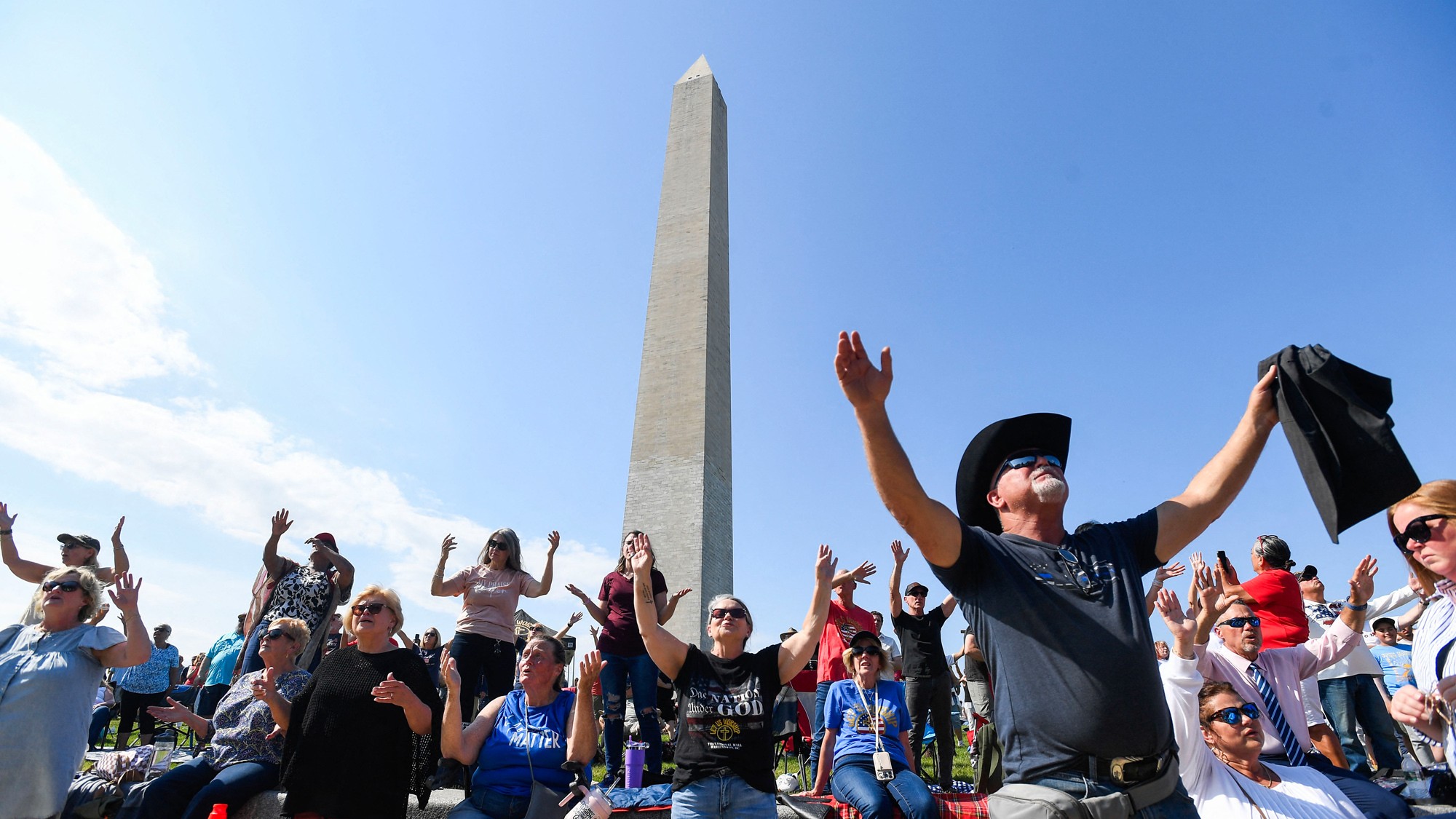
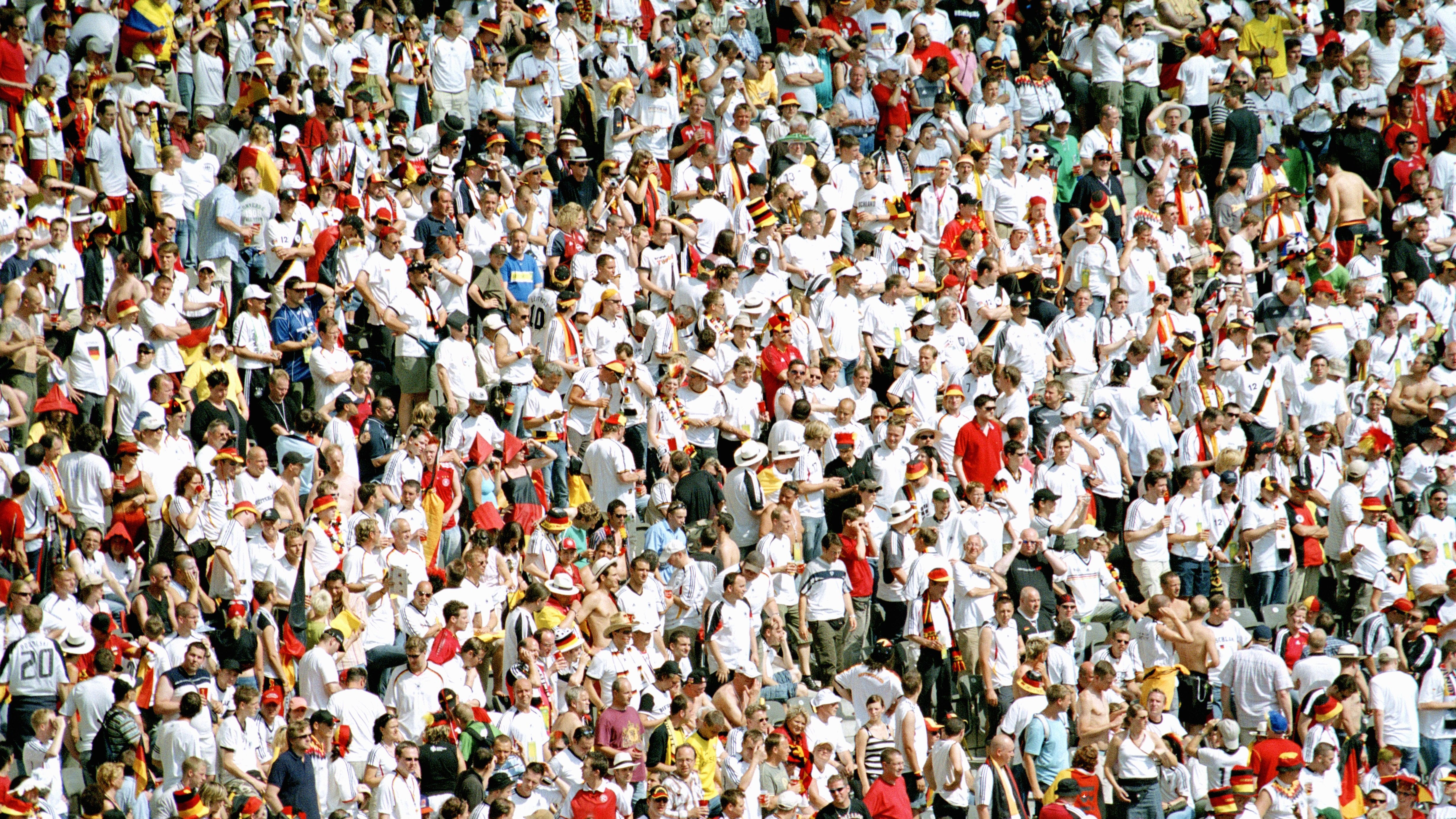
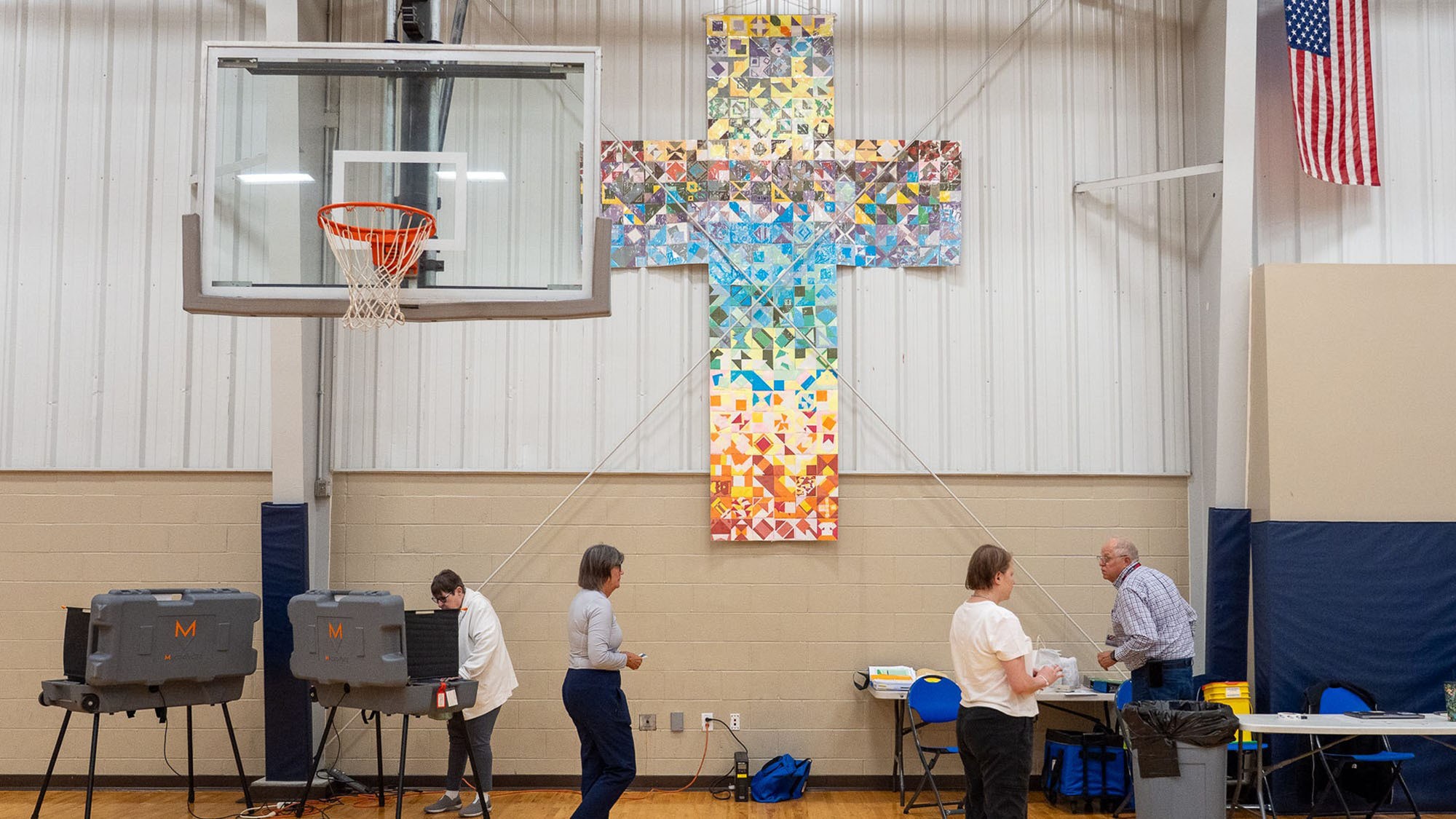
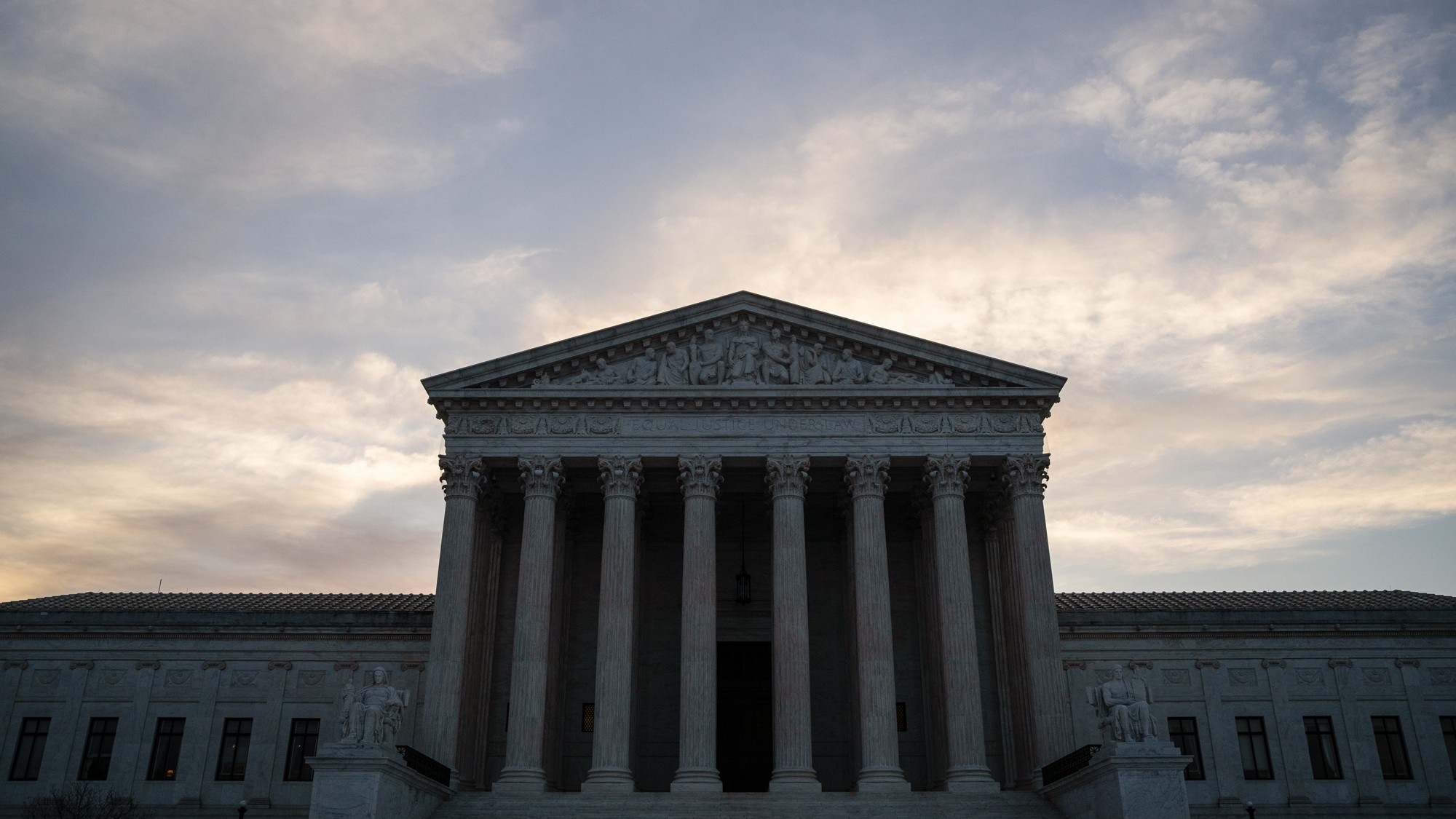
By 10 a.m. yesterday, the line of people wishing to dedicate America to God was more than three hours long. They came ready with prayer flags to wave the Holy Spirit into action, and shofars to scatter demonic forces. They wore T-shirts declaring the sort of Christians they were. A muscular man wore one that read Prayer Warrior. A woman in cargo shorts announced that she was an Intercessor for America. An elderly woman wore one that read I Am the Weapon.
“You understand you’re not going to be able to get in with that,” a security guard told a man wheeling a huge cross toward the entrance to the National Mall, as thousands of people began spreading out across a swath of grass that many of them now considered a kind of occupied territory in a cosmic spiritual war.
“We are here to bring the Earth into alignment with God,” a man named Joel Balin, who had come with a friend from Atlanta, told me. “To bring the kingdom of heaven to Earth.”
The rally, called Rededicate 250, was billed as a “jubilee of prayer, praise and Thanksgiving” for “God’s presence” in American history. It was part of a series of events celebrating the nation’s anniversary put together by a Donald Trump–aligned nonprofit called Freedom 250, which is being funded by a public-private partnership that includes corporate donors such as Exxon Mobil, Lockheed Martin, and Palantir and for which Congress has allocated $150 million. Critics of the event denounced the reliance on government funds, the participation of administration officials, and the near-total lack of religious diversity as an attempt to make a certain version of Christianity a national religion. A minor protest went on outside the barricades—a small group of people holding signs supporting LGBTQ people, immigrants, and all of the other Americans they believed to be under threat from the Trump administration. They blasted metal music, and a woman with pink hair screamed into a bullhorn.
The people in line paid them little mind. The event was a long-sought triumph for those who came and for millions more grassroots believers who helped elect Trump twice, embracing prophecies that God anointed him for the great spiritual battle against demonic forces that they understand to be animating current events. This idea was the work of the apostles and prophets of the New Apostolic Reformation, a charismatic movement that began gathering momentum in the 1990s and is now the leading edge of the Christian right. Sunday was a clear display of the influence of the movement, whose leaders were instrumental in mobilizing voters to turn out in recent elections and to take part in the January 6 insurrection, when many people believed that they were taking the U.S. Capitol for God’s kingdom.
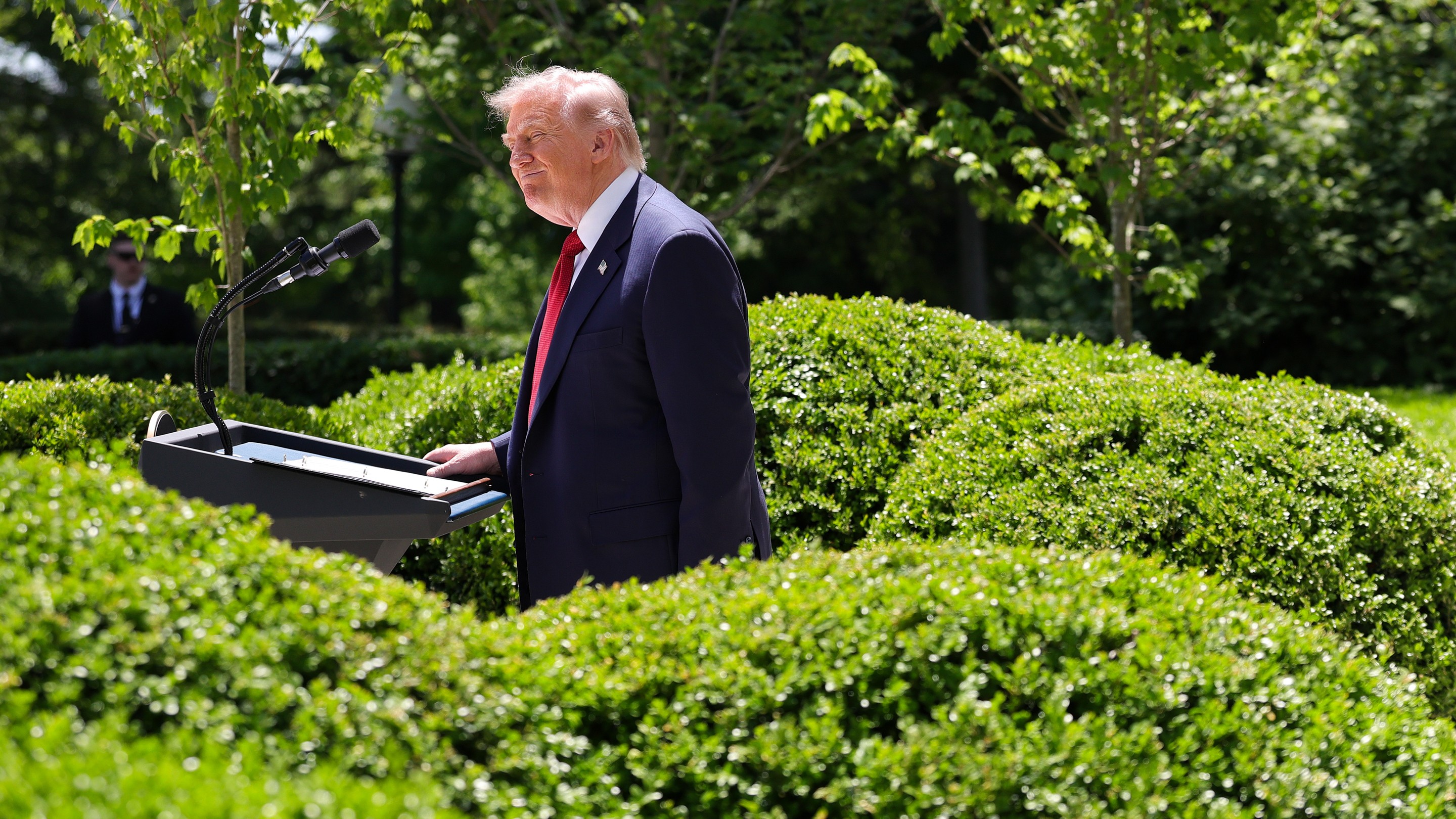
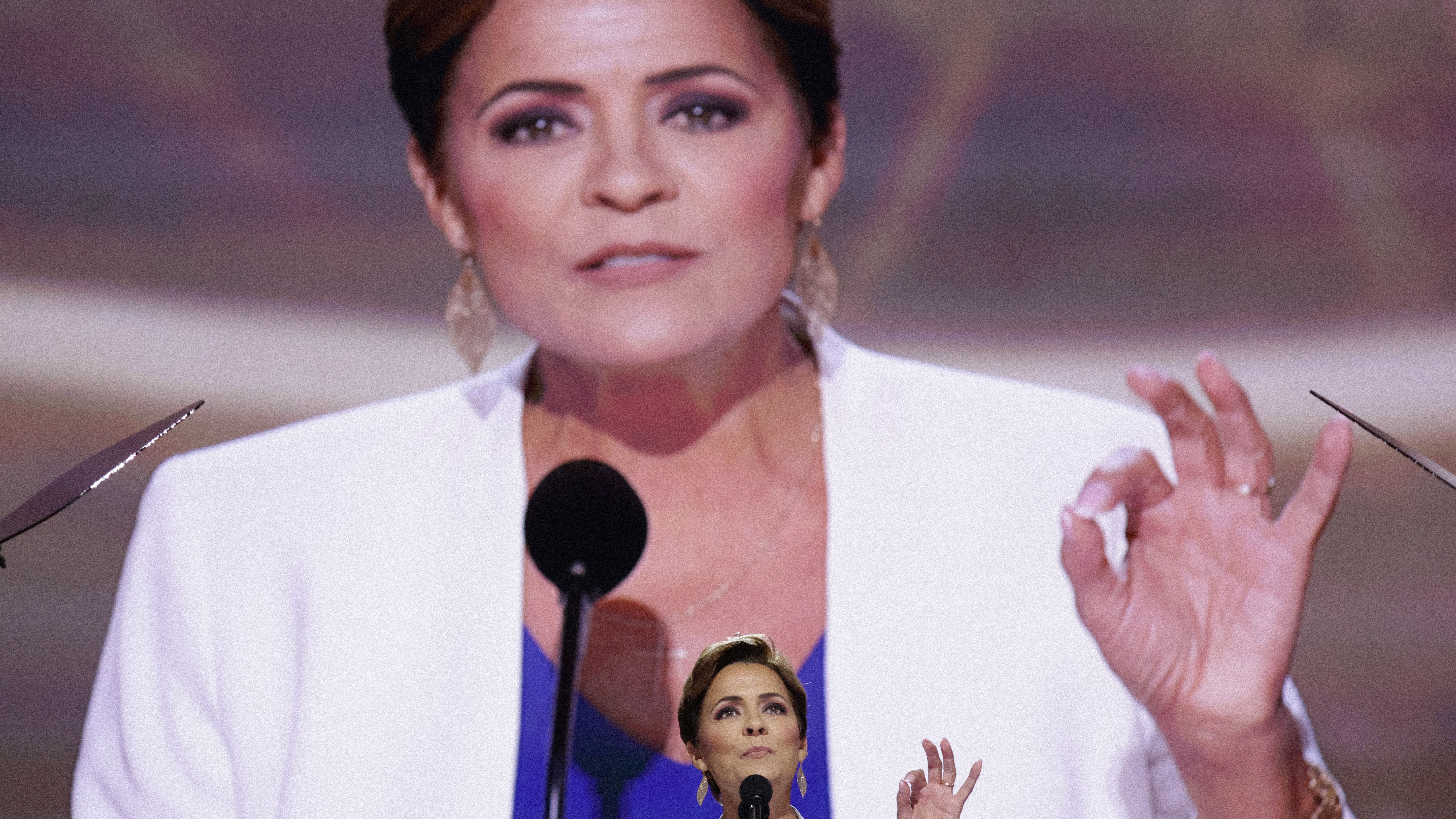
Speakers yesterday included Paula White-Cain, an apostle who now leads the White House Faith Office; Lou Engle, an apostle and prophet who is known for organizing the kind of mass-prayer gatherings that characterize the movement; and Guillermo Maldonado, an apostle who leads one of the largest Latino churches in the country, El Rey Jesús, in Florida. Administration officials including Secretary of Defense Pete Hegseth and Secretary of State Marco Rubio, whose own theologies do not exactly align with the movement, told stories about God deploying miracles at key moments in the nation’s history, leveraging these anecdotes to argue that the United States was founded to be a Christian nation. Historians say this is a clear misunderstanding of the American Revolution. Trump, just back from China, appeared in a prerecorded video in which he reads from the Old Testament, which seemed to be the same video that he had recorded for a marathon reading of the Bible last month. More revealing than any of these speakers, though, were the thousands of people willing to stand in line for three hours and then roast for seven more in the hot sun.
Balin, who leads a men’s ministry called Wednesday Warriors, told me that by enabling the event, Trump was “opening up a door for us to do spiritual warfare,” and that the very presence of so many believers gathered in the nation’s capital was scattering demonic forces and advancing the kingdom. He said that church-state separation is a “myth” and that, really, any separation from God is a foolish denial of the cosmic reality of the spiritual battle under way. He said that people he knows are tired of “materialism” and “dualism” and “an Enlightenment mindset” that fails to account for how supernatural forces affect earthly life. “There are so many things happening in the supernatural realm, and in the ancient world and other cultures, they recognized this—there was no separation,” he said. “I think we are rediscovering that as Americans.”
It was past 11 a.m., and people were spreading out blankets on the green grass, taking selfies, and livestreaming to congregations back home. “This is Pastor John!” a man in a blue suit said into his cellphone. The crowd was mostly white, but many people I spoke with emphasized that their movement is international and multiethnic, even as some expressed skepticism about accepting Muslim and other non-Christian immigrants into the country. MAGA hats abounded.
On the stage, the first of many praise bands blasted the surging worship music common in charismatic churches these days. People mouthed the words. A screen displayed what appeared to be two church windows, which sometimes were filled with images of stained glass, and sometimes with an American flag, and sometimes with swirling clouds and stars. In the crowd, several women danced free-form with prayer flags, and other people periodically blew a shofar, the hollowed-out ram’s horn used in traditional Jewish services and considered in charismatic circles to be a tool of spiritual warfare. Two women from the central coast of California looked around.
“This is what we’ve been praying for, for our country to turn back to God,” Debbie Cloud, a retiree, told me as she began to cry.
She and her friend Susan Fraze said that they are working on the long-shot campaign of an influential apostle named Ché Ahn, who is running for governor of California as a write-in candidate. Cloud said that she attends a nondenominational church called Calvary Chapel. Fraze goes to a nondenominational church called the Bridge. Almost everyone I spoke with had some story about how they used to be Baptist, or Pentecostal, or Methodist but had found their way to churches with names such as Oasis and Free Chapel and Anchor and Abundant Harvest, the kind of nondenominational congregations that are growing as most denominations continue to decline. At least 15 percent of all American adults now identify as nondenominational, and most of them are embracing charismatic ideas about signs and wonders and spiritual warfare. Many people told me about their involvement with prayer groups, prayer rooms, prayer closets, and so-called prayer furnaces, spaces dedicated to intense, dayslong prayer sessions that people believe can shape the spiritual destiny of the country.
Under the shade of a tree, a man named Adriel Lam told me that he’d flown in from Hawaii, where he works for Capitol Ministries, an organization that seeks to bring prayer into state capitols. Lam is also running for Congress. He said that yesterday’s gathering was more evidence that an outpouring of the Holy Spirit is under way across America, a moment that he described as “post-postmodernism.”
“Modernism told us, Let’s know our chemistry. Let’s know our physics. Science can explain the world,” he said. “Then postmodernism said, Let’s question the foundations of everything. Post-postmodernism is people saying, Let’s go back to zero. Let’s go back to the first century, when Jesus united the physical and the spiritual. God is moving our generation for renewal.”
On a blue towel in the grass, David Hitt, an accountant from Atlanta, huddled and kneeled with several friends. He told me afterward that they were submitting themselves to Jesus and aligning their spiritual posture with God.
“We underestimate what’s going on in the invisible realm,” he said. “Our assembly, our worship, our prayer is creating openings for God to do his will.” He elaborated that he meant actual openings, portals where the Holy Spirit could enter into battle against actual demonic forces. He estimated that the prayer of just one person could put 1,000 demons in flight, and the prayer of two people could eject 10,000.
“So here we’ve got how many people focused on God?” he said, envisioning legions of demons fleeing the capital.
“Praise Jesus,” someone said. A man walked by in a T-shirt that read Jesus is King, Repent or Die. Another wore one that read Blessed are those persecuted for righteousness.
Outside the metal barricades, the capital was quiet. People jogged and went to the Smithsonian, and beyond a block or so, you couldn’t hear the music or the loud cheers when House Speaker Mike Johnson said, “We hereby rededicate the United States of America as one nation under God.” Inside, though, the message was clear.
“We are the kingdom,” a woman named Robin Noll, who’d come to Washington, D.C., on a bus with 29 others from western Pennsylvania, told me. “God is driving us into the battlefield.”
There’s a lot going right at universities, if you're only willing to see it.
Show full content
Roosevelt Montás grew up in a small mountain village in the Dominican Republic. Two days before his 12th birthday, his mother flew him up to New York, where she had found a minimum-wage job in a garment factory. A few years later, when he was a sophomore in high school, some neighbors in his apartment building threw out a bunch of books. One of them was a finely bound volume of Socratic dialogues. Montás snagged it—and Socrates changed his life.
A high-school mentor helped him get into Columbia, where students confront the great books of Western civilization in the school’s Core Curriculum. There, Montás encountered the writings of St. Augustine. “In plumbing the depths of his own psyche, Augustine gave me a language with which to approach my own interiority,” he recalled in his memoir, “he gave me a model and a set of questions with which to explore the emotional wilderness, full of doubt and confusion, that was my own coming-to-adulthood, in America.”
Augustine paradoxically caused Montás to lose his Christian faith, but led him to gain a faith in philosophy. Montás went on to lead Columbia’s Center for the Core Curriculum, and he is now starting a center on citizenship and civic thought at Bard College.
I get to visit about two dozen campuses every year, and I meet at least a few teachers like Montás at each of them. I can generally spot the ones with the pure disease, the ones with that raw teacher-fire. Usually, they had some experience early in life when they fell in love with learning. This love then became a ruling passion, and now they fervently seek to share it with their students in the classroom. You can find them at Ivies and at community colleges, at big state schools and small liberal-arts colleges. They are a part of what’s going right in American higher education, the part that critics (like me) don’t write about enough.
These teachers talk of their vocation in lofty terms. They are not there merely to download information into students’ brains, or to steer them toward that job at McKinsey. True humanistic study, they believe, has the power to change lives. They want to walk with students through the biggest questions: Who am I? What might I become? What is this world I find myself in? If you don’t ask yourself these questions, these teachers say, you risk wasting your life on trivial pursuits, following the conventional path, doing what others want you to do instead of what is truly in your nature. If society doesn’t offer this kind of deep humanistic education, where people learn to seek truth and cultivate a capacity for citizenship, then democracy begins to crumble. “What I’m giving the students is tools for a life of freedom,” Montás says.
These great teachers are the latest inheritors of the humanist tradition. Humanism is a worldview based on an accurate conception of human nature—that we are both deeply broken and wonderfully made. At our worst, humans are capable of cruelty, fascism, and barbarism that no other mammal can match. On the other hand, deep inside of us we possess fundamental longings for beauty, justice, love, and truth, which, when cultivated, can produce spiritual values and human accomplishments breathtaking in their scope.
Life is essentially a battle between our noblest aspirations and our natural egotism. Humanistic education prepares people for this struggle. Yes, schooling also has a practical purpose—to help students make a living and contribute to the economy. But that practical training works best when it is enmeshed within the larger process of forming a fully functioning grown-up—a person armed with knowledge, strength of judgment, force of character, and a thorough familiarity with the spiritual heritage of our civilization. Preprofessional education treats people solely as economic animals; humanistic education also treats them as social and moral animals.
Humanistic teachers do this by ushering students into the Great Conversation—the debate, stretching back centuries, that constitutes the best of what wise people have thought and expressed. These teachers help students encounter real human beings facing the vital challenges of life: Socrates confronting death, Sun Tzu on how to manage conflict, Dante in love, Zadie Smith on living in the boundary between different identities. The Great Conversation represents each generation’s attempt to navigate the dialectics of life, the tension between autonomy and belonging, freedom and order, intimacy and solitude, diversity and cohesion, achievement and equality. The Great Conversation never ends, because there are no final answers to these tensions, just a temporary balance that works for a particular person or culture in a particular context.
By introducing students to rival traditions of thought—Stoicism, Catholic social teaching, conservatism, critical race theory—colleges help students cultivate the beliefs, worldviews, and philosophies that will help them answer the elemental question of adulthood: What should I do next? By introducing them to history and literature, colleges arm students with wisdom about how humans operate, which is handy knowledge to have. They offer them not only life options but also, more importantly, the ability to choose among them. “Any serious human problem is a hard problem,” Andrew Delbanco, who teaches at Columbia, told me. “The fundamental obligation of a humanities teacher is to try to develop in students an allergy to ideology and certainty. To acknowledge self-doubt.”
But humanistic education is no mere intellectual enterprise. Its primary purpose is not to produce learned people but good people. When teachers do their job, they arouse in their students not only a passion for learning but also a passion to lead a life of generosity and purpose. “The correct analogy for the mind is not a vessel that needs filling, but wood that needs igniting—no more—and then it motivates one towards originality and instills the desire for truth,” Plutarch observed many centuries ago.
Teachers do this by making excellence attractive to the young—excellent lives, excellent ideas, excellent works of art, commerce, and science, and, above all, excellent ideals. The students who are captivated by these ideals find some cause to advance, some social problem to address, some business to start. When confronted by inspiring ideals, many students say: I care intensely about this, I want to orient my life around this. It’s not only their minds that have been refined but also their desires and ambitions. In a true humanistic education, the French philosopher Jacques Maritain wrote, “the shaping of the will is thoroughly more important to man than the shaping of the intellect.”
Preprofessional education is individualistic and selfish. Such students learn to ask: How can I outcompete my peers and beat them up the ladder to success? In a humanistic program, by contrast, groups of people gather to form communities of truth, to reason together, to explore life together, to pool their desires and seek the common good.
I find that students flock to humanistic teachers who radiate a sense of urgency. They tell students: We are doing something important here. College is not just frat parties and internships; it’s potentially the most important four years of your life. You can emerge either an anesthetized drone or a person fully curious, fully committed, and fully alive.
I know this kind of education can have this effect because it is the education I got decades ago at the University of Chicago. I knew I could never be as learned as the professors I encountered, but their passion for large topics and great books seemed so impressive to me. I yearned with all my soul to understand the world as best I could, to embark on a lifelong journey of growth. Whatever my ample failings, that yearning, kindled in those classrooms with those books and those teachers, has never gone away. I stumbled unknowingly into a humanistic education, because it was the only college I got into, but I can tell you, it totally worked on me.
Today, the teachers I’m talking about tend to feel like dissidents within the academy, like they are doing something countercultural. That’s because at most schools, humanistic education has been pushed into the remote corners of academic life. It’s not that people woke up one morning and decided to renounce the humanistic ideal, it’s just that other goals popped up. It was easier to fundraise for them, easier to sell them to tuition-paying parents. The idea of forming students into the best version of themselves sort of got left behind.
Meghan Sullivan grew up in a working-class family in Florida, with her parents running through a series of jobs, punctuated by periods of unemployment. She went through grade school thinking she wanted to be a teacher, because she admired her teachers. Then in high school she joined the debate team and decided she was put on this earth to become a lawyer. She had a friend whose father taught philosophy. She was struck by what a dumb profession that was. As she told an interviewer, Tom Burnett, she decided that “there’s no universe where being a philosophy professor is more important than being a lawyer.”
Sullivan went to college fully intending to major in prelaw. But one semester, she didn’t get into the classes she wanted, and her adviser suggested she take a philosophy class. She rolled her eyes but signed up. Her first assigned paper asked her to consider whether it is ever morally permissible to commit suicide. She went to her teaching assistant and asked, “Am I allowed to, like, answer this? Like, are we allowed to talk about this?” He told her that not only was she allowed to do so, but it was a course requirement. “I found it just totally exhilarating,” she recalled. Now she teaches philosophy at Notre Dame.
Mark Edmundson also grew up in a working-class family, in Medford, Massachusetts. He got into college, something no one else in his family had done, and told his father that he might study prelaw, because you could make a decent living as a lawyer. His father, who had barely graduated high school, “detonated,” Edmundson later recalled. You only go to college once, his father roared, you better study what genuinely interests you. The rich kids get to study what they want, and you are just as good as any rich kids.
Edmundson soon encountered Sigmund Freud and Ralph Waldo Emerson. “They gave words to thoughts and feelings that I had never been able to render myself,” he wrote in his book, Why Teach? “They shone a light onto the world, and what they saw, suddenly I saw, too.” Edmundson now teaches poetry and literature at the University of Virginia.
“To get an education, you’re probably going to have to fight against the institution you find yourself in—no matter how prestigious it might be,” Edmundson once told an audience of students. “In fact, the more prestigious the school, the more you’ll probably have to push.”
The forces arrayed against humanistic learning are many:
Specialization. Aside from educating the young, universities have another perfectly noble mission—the advancement of knowledge. This goal requires that academics be trained to specialize in a single narrow discipline. They are often given jobs and awarded tenure because of their contribution to that narrow discipline.
The resulting system often values research instead of teaching. Sullivan observes that in graduate school “the message you get overwhelmingly is that you need to be a narrow research specialist, you need to impress the grand poohbahs of your discipline. Teaching is something you do to pay the bills.” And, as Anthony Kronman of Yale has argued, when academics specialize, it starts to seem downright unprofessional even to ask the big general questions of life. Specialization, even for a noble purpose, is a dehumanizing force, one that induces universities to turn their back on the formation of the young.
Preprofessionalism. Every year, UCLA surveys freshmen about what they hope to get out of college. Back in the 1960s, more than 80 percent—the top answer—said they hoped to “develop a meaningful philosophy of life.” Over the ensuing decades, that priority has plummeted. Now, more than 80 percent of freshmen say the purpose of college is to help them become “very well off financially.” Going to college has become a consumer experience—you pay huge tuition and in return you get rewarded with a pleasant time, career prep, a network of connections, and some fancy credentials. Interest in subjects like history and humanities has plummeted. More subtle is the effect preprofessionalism has had on the student mindset. A tone of cynical calculation prevails as students learn to manipulate the game. Many read just enough to get by, optimizing time management in the general frenzy for merit badges. An ethos of detached knowingness displaces an ethos of passionate inquiry. Humanistic education says: You need to elevate your desires! The consumer mindset says: Tell us what you want, and we will give it to you.
Politicization. The humanistic ideal has been replaced in some departments by the activist ideal. The purpose of the professor is to indoctrinate students so they can resist the structures of oppression. The activists naturally focus more on power and social systems than on the subjective inner experience of an individual heart, an individual soul. Politics, rather than the pursuit of truth, goodness, culture, or beauty, becomes the cause that gives life meaning.
Political radicalism once seemed exciting, but now it just makes parts of academic culture dreary. I used to love going into the Seminary Co-op bookstore at the University of Chicago or the Harvard Coop bookstore in Cambridge, both of which feature the latest academic books. Now there’s much less on those sales tables I’d want to buy. It’s the same ideological story, the same jargon, applied to different subject areas: oppressor/oppressed, transgression, deconstruction, intersectionality—the aging Foucault-inspired monoculture. Students have learned to manipulate this hustle. You don’t have to work on your soul in order to be counted as a good person, you just parrot the approved progressive attitudes on your way to Goldman Sachs. Roughly 88 percent of students at the University of Michigan and Northwestern admit to researchers that they lie in their papers and pretend to be more progressive than they really are in order to get a better grade.
The crumbling of humanistic self-confidence. Many people who work in the humanities have lost faith in the idea that a book or a course can transform a life, or even that literature is a repository of great wisdom to which one must humbly submit. The old humanistic ideal seems to many archaic, outmoded, reactionary. Thus, passionate attempts to transform students have been replaced by a dispassionate application of theory on behalf of some geriatric race, class, and gender ideology. Why would anybody major in English if the stakes involved are really so trivial?
The loss of national purpose. In his 1996 book, The University in Ruins, Bill Readings wrote that universities once saw themselves as the defenders, creators, and transmitters of the national culture. That is, they served the same function as the cathedrals of the Middle Ages: cultural and intellectual furnaces whose influence radiates outward and elevates the broader society. Earlier generations of university leaders like Charles William Eliot, Vannevar Bush, and Robert Maynard Hutchins saw themselves as public figures with national roles. But, Readings argued, universities have lost any notion of serving the national culture, replacing it with the pursuit of excellence. Like any corporation, they seek to provide excellent services to consumers in order to move up the ranking systems.
We’re never going to go back to the humanistic ideal as it existed in the 19th century or even the 1950s—nor should we—but the failure to come up with a new version for the 21st century has been devastating for universities. They’ve lost a core piece of their identity. According to a survey by the Pew Research Center, 70 percent of Americans say universities are heading in the wrong direction. Public trust in universities is in such steep decline that President Donald Trump gets cheered on for trying to dismantle them.
It has also been devastating for students. In a Harvard survey, 58 percent of college students said they had experienced no sense of “purpose or meaning” in their life in the month before being polled. “Ideals are psychological goals necessary to the health of the mind,” the literary critic Alfred Kazin once wrote. Today’s students, whose educations are seldom oriented around ideals, are not in a healthy state of mind.
And it’s been devastating for America’s leadership class. Universities are supposed to make the great good—to train the nation’s leaders in virtue so they can live up to their responsibilities as privileged members of the elite. But today’s leadership class, which has not been trained to serve or even understand those who are less fortunate, has forfeited the trust of the populace. Because universities have left a cultural void, the nation as a whole has lost its humanistic core, its sense of shared morals, its shared humanity. Simultaneous technological advance and humanistic decay have left us both objectively better off and subjectively worse. Loss of faith leads to nihilism. Might makes right. Brutality reigns. Welcome to American politics in 2026.
The good news is that things are changing. There is an interesting pattern in the history of higher education: Universities reform after confrontations with barbarism. Columbia formed its Core Curriculum program just after the horrors of World War I. It was, as the literary critic Jacques Barzun put it, a curriculum “born of trauma.” During and after World War II, a slew of writers like Maritain, Hutchins, T. S. Eliot, C. S. Lewis, Hannah Arendt, and Karl Jaspers published books on how to reform education. People took a look at the civilization-threatening brutality unleashed by the war and concluded: We’ve got to cultivate better human beings! In 1942, the German dissident Dietrich Bonhoeffer took a look at the way fascism had devoured his country and argued that the most important question for any responsible person was not just how to behave honorably during the war; it also concerned “how the coming generation is to live.”
The cruelty of the Trump era has aroused a similar response. Wide swaths of Americans can suddenly see the importance of character and character formation. As public norms crumble, more and more people come to appreciate the importance of teaching citizenship. As the public culture grows more savage, people can see what catastrophes result when the nation abandons its humanistic core. Moreover, Trump is never totally wrong. His assaults on the universities, and especially on research funding, have been monstrous, but it is true that universities got a bit too ideological, a bit too preprofessional, a bit too exclusive and elite. For higher ed, these have been the worst of times but, paradoxically, also the best of times.
I’ve met with several dozen university presidents over the past year, and nearly every one of them is initiating some sort of new program or reform. They understand, as Rajiv Vinnakota of the Institute for Citizens & Scholars put it to me, that universities have spent so much time serving the private good of students and faculty that they have neglected their role as stewards of the public good. We are living through the greatest period of university innovation of our lifetimes.
I would lump these changes into three buckets:
Moral formation. Some colleges never got out of the character-building business, including the service academies, the Christian colleges, and the HBCUs. But over the past decade a raft of schools have introduced programs to help students become better versions of themselves. Some of these programs resemble the kind of great-books education I got at Chicago. For example, several years ago the historian Melinda Zook realized that only a tiny percentage of Purdue students had ever taken a literature or history course. She introduced the Cornerstone program, offering students the chance to study “transformative texts.” In 2017, about 100 students enrolled. Now, nearly 5,500 Purdue students are reading transformative texts.
Ted Hadzi-Antich Jr., who teaches at Austin Community College, decided that big ideas shouldn’t be just for rich kids, and began teaching a seminar called “The Great Questions.” He then formed the Great Questions Foundation, which has trained more than 140 faculty at community colleges across the nation on the art of leading big-ideas seminars.
Wake Forest decided to put character formation at the center of its mission about a decade ago. Since 2020, it has trained 140 faculty across various departments on how to do character education, and 160 faculty on how to think about their own moral growth. The university also formed the Educating Character Initiative, which has so far dispersed more than $35 million impacting 146 institutions that are developing their own programs.
These days, I find that almost every school I visit has at least one course that directly addresses the great moral challenges students will face. At Wesleyan, there’s a course called “Living a Good Life,” where students try on different moral philosophies and participate in experiences like “Live Like a Daoist Week.” At Harvard, Richard Weissbourd leads a course called “Becoming a Good Person and Leading a Good Life.” He covers subjects like how to raise a moral child; how to care for people across cultural, racial, and economic differences; how to cultivate romantic relationships; and how to find your purpose. He’s learned that Shel Silverstein’s book The Giving Tree particularly resonates with female students. The book is about a tree who gives and gives and gives to a self-centered boy until she is a stump and has nothing left to give. Some of the women say their romantic relationships are kind of like that.
There’s a tremendous variety to these programs. Some teach character formation by holding up moral exemplars, some through the exploration of moral philosophies, some by discussing good commencement addresses. At Valparaiso University, students discuss great ideas and then have to write, produce, and perform a musical about those ideas, an exercise that requires cooperation and self-sacrifice. The University of Pennsylvania art historian Gwendolyn DuBois Shaw taught a course in Washington, D.C., called “Memorials, Models, and Portraits of Leadership,” on exploring character through the arts. Francis Su of Harvey Mudd College turned his approach into a book called Mathematics for Human Flourishing.
Civic thought. If democracy is not to degenerate into disorder, citizens must learn to exercise their freedom responsibly, deliberate together, and make sensible judgments about the choices before them. This requires training, and lately, a raft of citizenship programs have sprung up to provide it.
At Yale, where I also work, my colleague Bryan Garsten recently launched the Center for Civic Thought, which hosts conversations on political theory, constitutional principles, and how to disagree well. I recently sat in on Garsten’s class “The Common Good.” The course is structured around questions such as how much we owe to others and how political authority should be distributed. Students are asked to design their own society, with its own system of government. It’s an exercise that causes them to think about power and fairness, and that challenges them to understand their own values.
In one class, Garsten showed two brief videos, one from the Trump aide Stephen Miller saying that international relations is about nothing more than raw power, and one from the former Democratic presidential candidate Pete Buttegieg saying that international relations is about building a rules-based order. Then students read the Melian Dialogue in Thucydides’s History of the Peloponnesian War, in which the Athenians make the Milleresque claim that international affairs have nothing to do with justice or the right, that the strong do what they can and the weak suffer what they must. Garsten asked students to decide if they agree.
I have found, over the past few decades of teaching, that it has become harder and harder to get students to argue in public. They are afraid of being judged by their peers and of the harsh social penalties that might follow. Gradually, the skills required to disagree well have atrophied. The new college civics programs are designed to give students and faculty the tools to do that. For example, Vinnakota has organized a coalition of more than 70 university presidents, who are launching programs to educate students for democracy, to prepare them to argue well, and to protect free speech. I recently visited the University of Michigan, where there is a new $50 million initiative designed to do this. The Greater Good Science Center at Berkeley offers an eight-month online course that discusses the latest science on the art of bridging differences.
These programs are especially vibrant in red states, where legislatures have funded a series of initiatives to widen intellectual diversity on campus. The University of Tennessee, for example, now has the Institute of American Civics; Ohio State boasts the Chase Center. These programs face intense pressure from the left-wing academics in other departments who want their scholars deplatformed—and from the right-wing state legislators who funded them (who can get a little nutty, and demand, for example, that you shouldn’t teach Socrates, because he was gay).
The University of Florida now hosts the Hamilton School for Classical and Civic Education. It offers courses like “Capitalism and Its Critics,” “What Is Statecraft?,” and “What Is the Common Good?” More than 3,000 students enrolled in Hamilton School classes in its first two years of operation.
I visited the University of Texas at Austin’s version of these programs, the School of Civic Leadership. It offers courses like “Excellence of Character: The Virtues,” “Great Thinkers in Realism and Geopolitics,” and “Truth and Persuasion.” I met faculty who had left other universities from across the country to do the sort of teaching that had inspired them to go into the profession in the first place. I was impressed by how hard they were trying to prevent this program from becoming a conservative ghetto. The students I met were all over the political map. They said they got involved in the program because they wanted to find a space on campus where they can argue things out. Some of them came from Classical Christian schools where they’ve been debating Aristotle since they were 11, and others came from normal public high schools where they had never heard of Aristotle, but they were mixing it up together now. One freshman told me, “This week alone two separate professors accused me of being a Neoplatonist.” I don’t know exactly what they meant by that, but it sounds like he’s getting a good education.
How to do life. The third big area of change involves basic life skills—how students can lead not just a successful life but also a flourishing one. Several years ago, Lori Santos’s happiness course, “Psychology and the Good Life,” took Yale’s campus by storm, attracting at one point a quarter of the student body. At Stanford, “Design for Living & Learning,” a course based on engineering and design thinking, was also astoundingly popular.
Miroslav Volf and others designed the “Life Worth Living” course at Yale to use classic theological wisdom from the Buddha to Augustine to address fundamental questions like who we answer to and what we should hope for. In the book that grew out of the course, Volf and his co-authors Matthew Croasmun and Ryan McAnnally-Linz write, “Life isn’t a series of crises calling for Heroic Moral Deeds. Most of the time, it’s a series of small, seemingly insignificant decisions and nondecisions.”
Meghan Sullivan’s “God and the Good Life” is perhaps the most popular course at Notre Dame. She walks students through the large life topics: how to live generously with your money, how to take responsibility in your community, how to manage suffering, how to prepare for death. Over the course of the semester students compose an “apology,” which is a statement in the Socratic tradition “about your beliefs and how they fit into the ongoing story of your life.” Once completed, the apologies are frequently shared with family and friends.
Courses like these cut through the over-intellectualized nature of academic culture—the idea that all inquiry should be depersonalized, dispassionate, data-driven, objective. Being a good person is more about having the right emotions, perceptions, and intentions toward others in the concrete circumstances of life than it is about logic-chopping games and dry dissertations. “For Aquinas,” Sullivan and her co-author Paul Blaschko wrote in the book that accompanies their course, “faith is a different sort of knowledge, closely related to the virtue of love. Love is a deeply intellectual virtue, requiring attention and understanding.” By the spring of 2025, 142 classes at 35 institutions explored how to make a life-worth-living course, and more than 14,000 students had taken one of them.
Anna B. Moreland leads the Shaping Initiative at Villanova. Freshmen take a course about how to get the most out of college, and seniors can take a seminar on how to shape an adult life. Students often arrive on campus, Moreland says, underprepared to face the identity questions that meet them. She started a seminar as a sort of experiment to help them figure out who they are. “The student response was almost visceral, like I had put my finger on a raw nerve of their lives.”
Students, for example, are powerfully struck by the distinction Aristotle makes between different kinds of friends—friends of utility, friends for pleasure, friends for virtue. In the highest form of friendship, each person values the other for who she fundamentally is—for her character—not just as a means to have a good time or to secure some practical advantage.
In the fall of 2025, after I visited some classrooms at Villanova, I gave a talk in a larger hall. When I finished, a young man carrying an iPad came up to me. He was a bit pimply, a freshman all of two months into his college life. He showed me what looked like an electrical-wiring diagram, with my main points structured across the screen. He’d drawn elaborate connections between them. Then he told me that a quotation from an obscure Simone de Beauvoir book was relevant to my argument, and proceeded to read it to me. It was a brilliant quote, directly relevant, making a point that had never occurred to me. I wanted to grab this kid by the shoulders and ask him, “Who the hell are you?!”
On every campus there are students who haven’t yet gotten the memo that they’re only supposed to deconstruct, critique, dismantle. These students are willing to honor their longing to bring their lives to point. They display a willingness to be transformed.
All through history, in civilizations all over the world, peoples have sought to pass down the best of their own way of life from generation to generation, to orient those around them toward the good life, to inculcate virtue, and to aim each other toward some ultimate purpose. That our culture dropped the ball on all of that is just plain weird. Now I constantly meet people who are unfamiliar with the humanist tradition. Sometimes when I ask professors how they help their students find meaning, they admit bluntly: I wasn’t trained for that; I would have no clue how to do it.
The student hunger never went away. The social need never went away. And now, the tide is turning. If you are a Fox News watcher who thinks that the universities are simply woke hothouses filled with Maoists plotting revolution, your views—which were always exaggerated—are out of date. Leaders are adapting. Professors are rediscovering their sense of mission. There’s a ton of good stuff happening on campus these days, if you’re only willing to see it.
In his final act, the liberal stalwart wants to save his party from ideologues.
Show full content
Barney Frank might not draw a connection between his coming out as gay nearly four decades ago and his coming out against left-wing dogmatism in the Democratic Party today. But the parallel is unmistakable: The 86-year-old former Democratic congressman from Massachusetts is shining a light on a sensitive subject that many people wish he would keep quiet about.
In his forthcoming book, The Hard Path to Unity: Why We Must Reform the Left to Rescue Democracy, Frank contends that left-wingers have saddled his party with a “vote-repelling platform” of open borders, defunded police departments, and “the rule of the pronoun police.” By voicing his criticism of these stances, Frank hopes to give cover to fellow liberals who share his political concerns, if not his courage. “I know most Democrats agree with me,” Frank told me via Zoom from his home in Ogunquit, Maine, where he recently began hospice care. “But they’ve been intimidated out of saying so.” Frank’s physical infirmity had no apparent effect on his mental acuity and, if anything, made his message more urgent. By refusing to repudiate far-left ideas, he said, Democrats “allowed the impression that we agree with them.”
With its allusions to personal integrity, the importance of setting an example, and the ignominy of silence, Frank’s explanation for speaking up now echoes his comments in 1987 when, in an interview with The Boston Globe, he became the first elected federal officeholder to voluntarily disclose that he was gay. Now, as then, his candor has prompted a certain amount of discomfort and even hostility.
On CNN earlier this month, the host Jake Tapper asked a frail and visibly gaunt Frank why he believes his own side needs fixing. “As we succeeded in bringing the mainstream of the left into a concern with inequality,” he told Tapper, “we also enabled people who wanted to use that as a platform for a wide range of social and cultural changes, some of which the public isn’t ready for.” Frank lamented that by subjecting Democrats to litmus tests on highly controversial issues—such as “male-to-female transsexuals playing sports designated for women,” as he put it—progressives set their causes up for defeat.
The response on the left proved Frank’s point. An X post that commented “Barney Frank literally dying on CNN while denouncing trans kids in sports is all time peak for the Dem brand” earned 41,000 likes. “Having the argument be made by someone clearly in the last months of his life does not do much to counteract the impression that the left wing of the party represents its future,” Nathan J. Robinson of Current Affairsgloated.
During his 32-year congressional career that ended in 2013, Frank developed a reputation as one of the House’s most prominent progressives. In addition to helping lead the movement for gay and lesbian equality, he was a crucial defender of President Bill Clinton during his impeachment, and Frank’s name graces a major piece of progressive banking legislation. Frank has more than earned the credibility to criticize his own side for its failings. Indeed, the fact that a figure with such sterling progressive bona fides is so concerned about those failings that he wrote an entire book about them indicates how serious the problem has become. His political valedictory deserves a fair hearing, not catty rejoinders.
The growing popularity of economic populism on both sides of the ideological divide, Frank argues, has vindicated the left’s economic program. But just when the “mainstream left” had the opportunity to capitalize on the public’s embrace of economic populism, the cultural left sabotaged the opportunity by forcing a suite of far-out ideas into public discussion. “Instead of accepting victory” for having convinced Americans of their economic views, Frank told me, the left “took it as a sign that they were right about a broader range of things.”
Frank’s last name captures his personality. Friends and foes alike frequently describe his temperament as “brusque.” Speaking his mind is a trait Frank developed early in his career, when he showed the sort of moxie necessary for a Harvard-educated Jewish New Jerseyan to gain prominence in Boston, a city whose politics were long dominated by ward-heeling Irish Catholics.
Frank came of age politically between the end of World War II and the Vietnam War, when liberalism was the country’s reigning creed. The opening pages of Smahtguy, a cartoon biography by Frank’s former staffer Eric Orner, describe how Frank’s parents revered Franklin D. Roosevelt, New York City Mayor Fiorello La Guardia, and Israeli Prime Minister David Ben-Gurion. One panel depicts the Franks reading an installment of Eleanor Roosevelt’s daily syndicated column, “My Day,” in which the former first lady lambastes the British authorities for refusing Jewish refugee boats to dock in Palestine. In his early 20s, Frank unknowingly participated in a CIA-funded trip to a youth festival in Helsinki with Gloria Steinem (a program aimed at buttressing the non-Communist left, which, along with funding a smattering of highbrow anti-Communist literary magazines, counts among the greatest things the agency ever did).
Although liberal interest groups gave him consistently high scores throughout his career, Frank has long had an independent streak. In 1978, as a Democratic member of the Massachusetts House of Representatives, Frank crossed party lines to endorse Republican Senator Edward Brooke, the first Black candidate to win a Senate seat by popular vote. Brooke, the only Black senator to serve between 1881 and 1993, was a prominent member of what is now an extinct species: the liberal Republican. Frank, who served as a co-chair of Democrats for Brooke, thought Brooke’s reelection was crucial not only for racial representation but also for political moderation. “Brooke’s loss in 1978 was a prime example of the negative impact of people with strong ideological passions demanding rhetorical militancy from their candidates,” Frank wrote in a 2015 appreciation.
In Congress, Frank supported higher taxes on the rich and opposed Bill Clinton’s North American Free Trade Agreement and welfare-reform package. His support for economic populism has not waned. Well-intentioned mistakes made by liberals, he writes in The Hard Road to Unity, “are largely responsible for the political strength that xenophobic populism has come to enjoy in the developed world.” He attacks, at length, the neoliberal policies pursued by Clinton, British Prime Minister Tony Blair, and other followers of the post–Cold War, center-left “third way” philosophy that sought a path between social democracy and the free-market orthodoxy of President Ronald Reagan and Margaret Thatcher. These leaders were so single-mindedly devoted to economic growth, Frank argues, that they ignored the massive gulf emerging between the super wealthy and everyone else. A process of what he calls “globalization without amelioration”—that is, the passing of international free-trade agreements without measures to address the economic displacement they would cause the working class—“reinforced the identification of liberal governance with economic hardship.”
Both wings of the left, Frank believes, are to blame for its sorry predicament: The moderate left’s “complacent confidence in the calming effect of a steadily rising GDP” has alienated working-class voters while the progressive left’s immoderation on social issues keeps them away.
Especially divisive, Frank believes, is immigration, which he described to me as “one of the exacerbating factors but not one of the original causes” of America’s current populist moment. The mainstream right, which once welcomed more immigrants, has entirely shifted its stance. “My barometer is weasel-in-chief Lindsey Graham,” Frank said. The South Carolina Republican senator co-sponsored a comprehensive immigration-reform package two decades ago only to turn toward restrictionism once Donald Trump made immigration the centerpiece of the GOP’s agenda. But Frank also faults his own party for its refusal to adapt to growing misgivings about immigration within the electorate. Instead, Democrats lurched in the opposite direction. Frank recalls a debate in which nearly all of the 2020 Democratic presidential candidates raised their hand in agreement with a statement that border crossings should be decriminalized. That image, Frank writes, “should have been captioned ‘We who are about to die politically salute you.’”
On transgender issues, Frank has personal experience with how the left defeats itself. In 2007, he introduced the Employment Non-Discrimination Act, a bill that would have banned employment discrimination on the basis of sexual orientation. Frank was excoriated by left-wing activists for not including gender identity as a protected category. Doing so would have made the measure impossible to pass; even Frank’s more narrowly scoped bill drew a veto threat before being defeated in the Senate. Every subsequent effort to pass federal anti-discrimination legislation that included a gender-identity provision failed. (The need for such legislation was largely obviated by a 2020 Supreme Court ruling that the 1964 Civil Rights Act protects individuals from discrimination on the basis of both characteristics.)
Today’s LGBTQ activists, he says, could learn something from their predecessors, who would not have forced elected officials to face a litmus test on whether transgender women should be allowed to participate in women’s sports. He points to Barack Obama, who was widely viewed as an ally of the gay community in 2008 despite opposing its signature issue at the time, marriage equality. Contrast that politically savvy and ultimately successful approach with the left’s treatment of Democratic Representative Seth Moulton, who was widely denounced after the 2024 election for expressing discomfort at the idea of his daughters “getting run over” by biological males on a playing field.
To Frank, the greatest internal difficulty that people on the left face is an unwillingness to recognize that they live in a moderate country. A liberal incrementalist, he all but accuses his intra-party opponents of delusion. After Republican Barry Goldwater and Democrat George McGovern suffered landslide defeats in their campaigns for the presidency in 1964 and 1972, respectively, some supporters of each nominee, Frank told me, had the same reaction: The candidate “didn’t do enough to bring out the true believers.” The real problem, Frank contended, was the opposite: an abundance of partisans who scared away moderates. Making matters worse, the left truly believes that its radical views are embraced by the public. They’re “not advocating that we take consciously unpopular stands,” Frank says. “They think they’re popular. They’ve convinced themselves of that.”
Such righteousness exacerbates the intra-left squabbling over the Democratic Party’s future. Many progressives believe their own hearts to be pure but cannot conceive that anyone to their right might have sincere reasons for opposing them on borders, crime, foreign policy, or any other issue. “Many of these zealots,” Frank writes, “are convinced that the source of their abandonment is some form of corruption.” One can see this motivated reasoning in the current attempts to blame Kamala Harris’s election loss on her not taking a stronger position against Israel during the war in Gaza. Of those who refused to vote for Harris on such grounds, Frank is unsparing. “If there were to be a competition for the dumbest, most counterproductive voting behavior in American history since secession,” he writes, “this would be in the running.”
The title of Frank’s book calls for party unity. He gives the impression that his definition of the term is broad, and it essentially means whatever it takes for Democrats to win elections. Strangely, he has little to say about the issue that, more than any other, is making that unity so elusive: Israel-Palestine. When I asked Frank what he makes of the rampantanti-Semitismon the activist left, he responded by blaming not its purveyors but Israeli Prime Minister Benjamin Netanyahu, who “wins the prize for achieving the biggest political movement I can think of, which is moving Israel from being an untouchable, third-rail issue in America to making it so unpopular.” He cited the disproportionate representation of Jews in Congress as evidence that anti-Semitism is “not a broad political issue” but “a problem at the individual level, a personal-safety issue.” Frank seems oblivious to the ways in which the progressive ideologues he correctly faults for repelling voters are, by and large, the same people pushing the party in an extreme anti-Israel direction. They will not be satiated by a change in the ideological composition of the Israeli government.
In contemplating how the American left should advance its goals, Frank distinguishes between “swords,” which he describes as interventionist policies “into the behavioral patterns of others” favored by progressives, and “shields,” or protective measures “less likely to provoke a backlash.” The 1968 Fair Housing Act, which prohibited discrimination in the sale, renting, or financing of housing, was a shield. Busing children as a means of desegregating schools was a deeply unpopular sword. Frank says that the gay-rights movement wisely chose to advance the shield of local antidiscrimination measures long before pushing for marriage equality—a lesson, he believes, that the transgender movement should follow.
Striking the right balance on these divisive issues will not be easy. On affirmative action, climate change, immigration, and other matters, a significant distance separates progressive activists and the white working class whom the Democratic Party needs to attract. When I asked Frank whom he likes as a 2028 presidential nominee, the only name he mentioned was Senator Chris Murphy of Connecticut. “My fear is not that we will nominate someone from the far left but that whoever is nominated will be tempted to move too far in that direction to win,” he said.
It took nerve for Barney Frank to come out as gay four decades ago, at a time when homosexuality was still grounds for denying someone a security clearance. And it takes nerve to stand up to a bullying, intolerant left today. As he nears the end of his life, Frank is offering his fellow Democrats a message they would be wise to heed. The future of the country may very well depend on their ability to listen.
In Beijing, a lame-duck president personified the decline of American power.
Show full content
Spare a moment, please, for the lame-duck superpower. It calls itself the leader of the free world, but the free world no longer believes it. When it extends its hand, nobody rushes to accept. When it threatens, nobody trembles.
After President Trump arrived in Beijing this week, Xi Jinping showered him with pomp befitting a summit of great powers. Yet the Chinese leader permitted potshots at his guest to go viral on his country’s internet rather than suppressing them, as some observers expected he would during a state visit. Xi answered Trump’s lavish praise by sternly lecturing him about meddling with Taiwan. In the end, Xi offered nothing of great substance—no solutions to the war in Iran, no sweeping trade deals, no promises of access to rare earth minerals. Xi used the visit to humor the lame-duck president, waiting for his time to pass.
During the first Trump administration, foreign leaders flattered and accommodated the president out of deference to American power. They feared it; they relied on it. During the second administration, and especially since the beginning of the Iran war, their calculus has quietly shifted—not because the strategy of obsequiousness has failed, but because it’s no longer worth the trouble. Like many of his counterparts around the world, Xi has begun to assume that it’s not just Trump who is term-limited; it’s also his nation.
Trump’s war in Iran was meant to showcase American power. It did the opposite. In the course of failing to remove a much weaker regime or eliminate its nuclear threat, the United States blew through its arsenal—so much so that allies in the Pacific reasonably wonder whether enough munitions remain to protect them. According to The Wall Street Journal, the Pentagon is now worried that it lacks the firepower to execute contingency plans for defending Taiwan.
Supporters of the war argued that it would deal China a severe blow by eliminating one of its most potent allies. But the Gulf nations most threatened by Iran have actually turned to China. As first reported by The Washington Post, an intelligence assessment prepared for the chair of the Joint Chiefs of Staff warned that those countries have begun acquiring from Beijing the systems needed to protect their oil infrastructure and bases. Trump didn’t just fail to weaken China’s position in the Middle East. He strengthened it.
Without exerting itself much, Beijing has profited from America’s self-immolation. China’s petroleum reserves and its investments in renewable energy have allowed it to offer Thailand, the Philippines, and Australia relief from the energy crisis that the United States instigated. Instead of applying diplomatic pressure on Iran to cut a deal, China has let the conflict linger, so that the United States continues to bear the blame for the disruptions to shipping. Meanwhile, China poses as the faithful steward of the rules-based order—the cooler head, the power on which even the U.S. must now rely.
By patiently waiting out this moment, by letting the United States exhaust itself, China has bought time to pursue what Xi calls “national self-reliance”—time to catch up with the West technologically and to fortify itself for the point when competition takes a harsher turn.
That very same strategy is guiding Iran. Trump repeatedly signals his desire for a deal to end the war, by wishfully exaggerating how close he is to reaching one. But Iran keeps responding to his offers with outrageous demands, including for reparations for the destruction the United States wrought.
In the meantime, Iran has been able to dig out weapons systems buried in the rubble caused by American strikes on bunkers and caves. According to intelligence assessments, The New York Times reports, the Iranians have restored access to 30 out of 33 missile sites along the Strait of Hormuz. Across the whole of the country, Iran has regained roughly 90 percent of its underground missile storage. Without having to purchase a rocket or launcher, it has bounced back.
American history is rife with the perils of lame-duck leaders. As their time in office grinds to a close, presidents grow eager to write a final chapter worthy of their saga. They reach for the grand gesture; they attempt to solve the intractable problem. But in their mad dash to assert their relevance, they manage merely to prove how little they matter to the rest of the world. Trump is now living that fate, and the consequences extend far beyond his presidency. Every failed deal, every summit that yields nothing, every boast that goes unfulfilled, confirms what adversaries already suspect. A lame-duck superpower exhausts itself in full view of the world, and the world moves on.
The commencement speech is a ritual act, not an expressive one.
Show full content
Congratulations. After four years of hard work, you—or your son or daughter, or grandson or granddaughter, or neighbor or niece, or other sort of ramen eater—are graduating from college. It wasn’t easy. It was probably also very expensive. You may have thought, I’m not sure I will make it. I thought that too. And I remembered that feeling when I dropped in, last night, for late-night custard at Famous Local Diner With Not-So-Secret Custard. But I did make it, and so did you. And here we are together, having made it. The sun is shining, and the rest of your lives are ahead of you.
That’s the structure and message of a commencement speech. An accomplished and maybe-famous person is probably giving a similar address right now to a sea of graduation caps spread across a green lawn and under blue skies. All of those hardworking graduates will probably forget the content of the address by tomorrow, if not earlier–and that’s fine.
A good commencement speech is not aimed at posterity, proffered to everyone for all time. Instead, it is a temporary moment in which a speaker brings a community together in the moment they share together, and which evaporates immediately thereafter.
Dispensing memorable advice is “good in concept,” David Murray, who runs the Professional Speechwriters Association, told me. But it’s a high-wire act that works on vanishingly rare occasions. Think Steve Jobs at Stanford (“Stay hungry, stay foolish”), David Foster Wallace at Kenyon (“This Is Water”), Toni Morrison at Wellesley (“True adulthood””), or John F. Kennedy at American University (“Not merely peace in our time but peace for all time”). But if the speaker isn’t Morrison (who among us has such a way with words?), these speeches are best when they are disposable.
An old quip holds that being a commencement speaker is like being the corpse at a wake: The event needs one to take place, but the person who plays the role doesn’t have to do much. But even doing very little can still go terribly wrong. Some speakers are chosen for bad reasons, such as their relationship to a donor. Others have no relationship to the school or town and come off as clueless. Other speakers do not prepare and just wing it. Still others go dark but ask for help at the last minute, when a speech can be only salvaged instead of prepared. Some commencement speakers even show up visibly intoxicated.
But even for the ones who do everything right, the graduation speech poses a tricky challenge. A commencement speech is less about the speaker than the audience and the reason they are gathered for the speech. Graduation speakers ought to be renowned, of course—otherwise, why would they get to make the address? But they must make themselves understood as a part of the group that is celebrating graduation.
And that act requires disappearing into the background. Graduation is a ritual that works more or less the same in all cases. And as Murray put it, “the ritual is the thing.” The University of Florida speechwriter Aaron Hoover even defined a formula for it: The speaker’s job is to carry out the celebratory ritual in a way that foregrounds the graduating class, the families, and the college itself. Cosmic wisdom is less relevant than the comforting sentiment that everything is going to be okay.
Seen from that perspective, the supposedly greatest speeches, like those delivered by Jobs and Wallace, actually violate the principles of commencement speeches by having a life after graduation. That seems weird. But “commencement speeches are weird,” Jim Reische, special adviser to the president for executive communications at Williams College, told me.
Hearing Reische explain the matter, I tried to recall my own graduation speaker. It was Bill Cosby, a name that seemed impressive back then, in the 1990s, but which has since been sullied. But neither Cosby’s former glory nor his present impurity caused me to recall anything the former pudding-pop spokesperson had actually said at my graduation. Instead, I simply recalled the fact of it—me being there, the event happening, and him being physically present for it, along with me. “Just give them a nice kind of homily, and then get them to the cocktail party and on their way,” Reische said.
This century has seen an arms race in commencement-address celebrity. In the past, a graduation speaker was most often a renowned scholar performing the act as an honor. In the early 2000s colleges and universities started using commencement speakers to compete for prestige, Reische told me. “Some of them were paying a lot of money,” he said, and like everything else, the honor became confused with opportunism (the University of Houston paid Matthew McConaughey $166,000 for a 2015 graduation speech; Katie Couric received $110,00 from the University of Oklahoma in 2006, although the news anchor reportedly donated the fee to charity). Carrying out the ritual in an effective manner took a back seat, at times, to landing a figurehead like Michelle Obama or Taylor Swift.
The process is made challenging by organizational politics. These days, most colleges and universities perform a complex process to identify and invite a commencement speaker, usually involving negotiations among a committee of students and faculty, and an administration seeking to acknowledge an alumnus, woo a donor, or outshine a competitor. Many commencement speakers are given honorary degrees, but the prestige associated with such matters has declined over the years; six-figure piles of cash surely seem more useful than an ersatz doctorate given to an accomplished alumnus or once-local homegirl.
Controversy surrounding campus speech of all kinds has complicated matters further. This week, a graduation speaker at the University of Central Florida, in Orlando, got booed after praising artificial intelligence in her remarks. Rutgers University canceled a graduation speech by Rami Elghandour scheduled for Friday, after students reportedly complained about the tech entrepreneur’s pro-Palestine social-media posts. And New York University students took issue with Jonathan Haidt’s scheduled address, on the grounds that selecting the NYU social psychologist (and Atlantic contributor) and author of best-selling books such as The Coddling of the American Mind disregards “the very real-world crises and systemic hurdles that have defined our graduates’ experiences.” These examples might seem to highlight intolerance and suppressed speech on campus. But they also demonstrate that graduation remarks do not exist outside of that debate.
No matter how much one might favor free-speech absolutism on campus, the graduation ceremony is not really the place for such controversy. It is easy, if not always simple, to express one’s strongly held convictions on behalf of the self who holds them. It is harder to bring a whole community of differently minded people together around a shared accomplishment. “This is a really important day for a lot of people in that audience, and the goal is to make the day about them,” Reische told me.
The speechwriters I spoke with for this story, including Reische and Beth Bowden, a speechwriter at Washington University in St. Louis, where I am on faculty, told me that wrangling commencement speakers can be wearying. Few take up the offer for writing consultation—even if just to ensure that they aren’t saying something contrary to what another speaker, or the university chancellor, might have just said on stage. Some don’t even show up to sound check.
Conan O’Brien’s 2011 Dartmouth College speech might be the model commencement address. O’Brien allowed the place and the context to take center stage, rather than his own humor or fame. He said nothing worthy of anthologizing. He cited multiple examples of local Dartmouth and Hanover, New Hampshire, culture—a technique the former Al Gore speechwriter Eric Schnure calls the “howdahell,” a hook that connects the speaker to a specific audience in a specific place, such that they ask themselves, “How the hell did he know that?” O’Brien ranked Dartmouth over his own alma mater of Harvard, where he had also given a commencement speech a decade earlier. And once he established that trust, he delivered an earnest but essentially generic piece of life advice: “Whatever you think your dream is now, it will probably change.”
Such an effort requires humility, a virtue that feels depleted these days. Instead, righteousness rules. Last month, the former Barack Obama speechwriter Zev Karlin-Neumann urged the renowned individuals preparing to stand before the class of 2026 to engage with politics directly in their addresses. Given a “profound crisis in our democracy,” he argued, commencement speakers “owe” the graduates “more than recycled anecdotes.” But in light of that crisis, perhaps the most important work a commencement speaker can do is to rise above it, momentarily—to bring a community of people together through what they share in this fleeting moment, rather than to dwell on how they are being driven apart.
For anyone not living here, it’s nearly impossible to comprehend what has become of the place.
Show full content
Spencer Pratt, the former reality-TV star and aspiring mayor of Los Angeles, recently spoke with me for a podcast. We met in front of the Airstream trailer that now sits where his house did before it burned down in the Palisades Fire in January of last year. He was excited to share his ideas, if not always able to complete his thoughts, about what he’ll do when he’s in charge. For starters, he’ll clear the drug-ravaged homeless encampments of downtown, bring in developers from all over the world, and use 3-D-printing technology to build “an entire art deco, vibed-out affordable housing.” On the issue of bike lanes, a pet cause of the YIMBY voters who are backing one of his main opponents, Pratt says he’ll do them one better.
“I'm going to have bike tubes through the sky!” he says. “You know, like it’s endless possibilities when you enforce a law and you get rid of the zombies.”
Zombies is Pratt’s term for the tens of thousands of people who live in depraved conditions on L.A.’s streets, many of them addicted to drugs that leave them profoundly incapacitated and sometimes violent. It’s not a nice word to call someone who’s fallen into a bottomless abyss of hallucinations and thrashing self-destruction. But anyone living here knows exactly what he means.
For anyone not living here, it’s nearly impossible to comprehend what has become of the place. It’s not just that, in January of 2025, wildfires destroyed more than 16,000 structures and engulfed nearly 40,000 acres across the county. Apocalyptic as the fires were, they are not the main story and never really were. The main story is one of a city seemingly annihilating itself. Potholes crater the roads. Street lights, stripped of copper wire by organized-theft crews, are out across the city.
Vector-borne diseases such as typhus are breaking out at record levels, the result, at least in part, of 45,000 people (a low estimate, and closer to 75,000 if you include the whole county) living in squalid encampments on sidewalks. Fueled by fentanyl and a new, psychosis-inducing form of methamphetamine, street homelessness is no longer confined to the 50 hellish blocks of Skid Row in downtown Los Angeles. It’s now a city- and countywide humanitarian crisis that lives on freeway ramps, underpasses, parks, the banks of the desiccated L.A. River, the steps of public libraries, and the alleys behind homes and businesses. Undeterred—and unprotected—by laws that are no longer enforced, profoundly sick humans stumble blindly into traffic, defecate in plain sight, wave machetes in the air, threaten violence to passersby, and leave dogs tied to junk-filled shopping carts while they slump on the sidewalk in a fentanyl stupor.
It’s possible to live here and not fully comprehend the scope of it. Not just by dint of wealth, though that helps, but because the region is carved up into separate jurisdictions with seemingly no logic. Pacific Palisades, where almost every structure north of Sunset Boulevard burned to the ground, is part of Los Angeles, but its neighbors up and down the coast, Malibu and Santa Monica, are their own jurisdictions with their own city officials. Inglewood, an independent municipality whose mega sports stadiums have lifted it into affluence, sits adjacent to South Central, where the 1992 riots that follow the Rodney King beating still haunt the streets. Trendy northeast L.A. neighborhoods abut Glendale and Pasadena, cities with their own micro-cultures and tolerance levels for street camping and open drug use. To live in greater Los Angeles is to embrace the arbitrariness of it all. Your neighbor one block over might have an entirely different mayor, police force, and fire department than you do. This is usually immaterial, the kind of thing most people don’t notice until there is a very real reason to notice it, at which point it matters quite a bit.
Such is the setting of 2026 L.A. mayor’s race. On June 2, Los Angeles will hold a nonpartisan primary in which the top two vote-getters, regardless of party, advance to a November runoff. (If someone gets more than 50 percent in the primary, they win right there and then.) Incumbent Mayor Karen Bass, a career politician with deep ties to the city’s progressive-nonprofit world, would probably have skated through a couple of terms if not for the force majeure of January 7, 2025. On that day, she happened to be attending a presidential inauguration in Ghana even though fire-weather warnings had been issued before her plane left L.A. Among her campaign promises in 2021 was never to travel abroad during her time as mayor.
More than a dozen mayoral candidates are on the ballot, including a few unlikely sorts who seemed at first to be running almost as a joke. Until mid-April, Bass’s chief rival was presumed to be Nithya Raman, a city-council member who chairs the city’s Housing and Homelessness Committee and who identifies as a democratic socialist.
Then one of the jokes got serious: Pratt. A lifelong resident of Pacific Palisades, Pratt lost both his own house and his parents’ house in the fires. Shortly thereafter, he found himself in a new kind of reality show. Part community advocate, part self-appointed investigator, he ranted on TikTok about municipal negligence and alleged cover-ups, filed a lawsuit, and testified at a Senate hearing about the failed fire response. On the one-year anniversary of the fire, he took the podium at a rally called They Let Us Burn and announced his candidacy for mayor. “Business as usual is a death sentence for Los Angeles,” he told a crowd of about 1,000, “and I’m done waiting for someone to take real action.”
Spencer Pratt watches the wildfire as it approaches his house on January 7, 2025 in Pacific Palisades, California. (MEGA / GC Images / Getty)
Pratt is a remnant of the last era of television as something that was actually watched on a television. The designated villain on the MTV series The Hills, which ran from 2006 to 2010, he was of the generation of reality stars for whom mere reality wasn’t enough. Audiences demanded drama—love triangles, career sabotage, family histrionics—and cast members had to supply it while maintaining the premise that it was all true. Therein began a mass erosion of the fourth wall. Tabloids reported on storylines as if they were real-life scandals, a central one being the tumultuous relationship between Pratt and his girlfriend-turned-wife, Heidi Montag, who were famously accused of leaking a sex tape belonging to their castmate Lauren Conrad.
After the show ended, Pratt continued his commitment to notoriety, publicly blowing his fortune on Birkin bags, designer suits, a crystal collection, and, as he wrote in his memoir, The Guy You Loved to Hate, “tens of thousands of rounds of ammo stacked in the closet next to my Armani.” The book, published a few weeks after Pratt announced his candidacy, is a frenzied romp of self-incriminations and about as far from campaign literature as you can get.
The notion of Pratt being the leader of the second-largest city in America is random and absurd. But Los Angeles is itself random and absurd. Built in a waterless basin on top of two major fault lines and fringed with chaparral ready to burn at a moment’s notice, it’s a city that never really should have been here in the first place. And although it flourished magnificently in spite of itself, it is now, in many ways, less here than it has ever been in its entire history. As of January, rebuild permits had been issued for roughly one in five of the homes destroyed across the region. The slowly-then-all-at-once downfall of the film and television industry has gone from something everyone talks about to something actually happening to everyone. Locals all seem to know at least one art director or costume designer leaving the business and going back to school to become a therapist.
As work disappears, the average monthly rent hovers around $3,000 and the average home price is just under $1 million. What that has to do with the number of people sleeping in urine-soaked clothes on the sidewalk is a question that can be debated in good faith. But it is by now a truth almost universally acknowledged that the man waving around a machete on Venice Beach is not doing so because he can’t afford an apartment. He is doing so because his situation requires serious professional treatment, and he should get it whether he wants it or not. Even Mayor Bass recognizes this. “Just putting someone in a house is not enough,” she has said. “There needs to be health care and other social-services support.” Fair enough. But she’s had four years to implement that policy and hasn’t come close.
This sort of fecklessness from politicians, alongside ineptitude, waste, and possibly fraud from the nonprofit sector—a federal audit found the city’s accounting of $2.3 billion in homeless services so opaque that auditors couldn’t track what had actually been spent as intended—is why many Angelenos see no solution other than a factory reset.
After a great deal of initial skepticism, I have landed in that camp. If I thought any other candidate was viable, I would not be entrusting a city I love to a guy from The Hills. But when the moderate Democrat I’d have otherwise chosen couldn’t raise his polling numbers above the low single digits, I crossed the Rubicon into the surreal. It helped that I have never seen an episode of The Hills.
What you will frequently hear about Pratt, including from me, is that even if he accomplished very little of his agenda as mayor—not an unlikely scenario in a city where the mayor shares power with 15 council members and has no authority over the county agencies that run most social services—his mere willingness to acknowledge reality and enforce existing laws would be an improvement over the status quo.
Pratt is a registered Republican (he told me all of his friends are Democrats except one he hadn’t seen since ninth grade), but the mayoral seat is nonpartisan, and he’s running on local issues that cut across party lines. His plan for the homeless is, depending on your point of view, simplistic or seductively simple: get them off the streets and into appropriate treatment, by force if necessary, and do away with the nonprofits that stay in business by perpetuating the cycle. He’s also won over some voters by talking about an issue so disturbing, it all but goes ignored: the horrific abuse of dogs on Skid Row, which rescue groups have said are being bred, sold for drugs, and tortured by addicts and dealers on the streets. Pratt has made the issue central to his platform. “People that are torturing dogs, these are monsters,” he told me. “They are going to jail with Mayor Pratt. Under the jail.”
Pratt told me he believes he can win on dog lovers and safety-concerned moms alone. Whether enough of those moms and dog lovers are registered voters in the actual city of L.A. and not Burbank or Calabasas or any one of countless not-in-L.A. parts of L.A. is anyone’s guess. Less than 15 percent of L.A. voters are Republicans. Rick Caruso, a housing developer who spent $100 million on the 2022 race, switched his registration to Democrat before running but still lost to Bass 55 to 45. Although many Angelenos I’ve talked with now kick themselves for not voting for Caruso, a sizable portion are so unwavering in their hatred of Donald Trump that anyone bearing the slightest resemblance to that other reality star is a hard pass.
Fittingly, given his background, it could be argued that Pratt’s message is almost a side note to the medium. The short videos that were instrumental to Zohran Mamdani’s mayoral win in New York already look like vintage films compared with the avalanche of content generated by and for the Pratt campaign. The official campaign ads are notably polished, sincere, and stylish. At the same time, independent creators are using AI to make their own pro-Pratt videos, putting made-up words into real people’s mouths and throwing out all pretense of convention or decorum. Gleefully unwoke and unapologetically crude, they roll out almost day by day, heralded by fans—and maybe sometimes bots—as “the best campaign ad ever made.”
The campaign is rewriting the rules about what is allowed and therefore what is possible. It’s also a bit of a trick mirror, given that selling Pratt as a serious adult requires selling the idea that his previous incarnations weren’t really him but rather an extended piece of performance art. In a cruel electoral irony, some of the people most derisive about Pratt’s mayoral effort are deeply invested Hills viewers who hate the embellished character he created in his own name and can’t comprehend that it’s anything but real.
One of Pratt’s refrains is “I keep being called a reality star, but I’m the only one living in reality.” In a city fed up with leaders who tell constituents that problems happening before their eyes aren’t happening at all, that message lands, as they say in Hollywood. Even if Pratt never becomes mayor, it’s possible that simply saying the truth out loud will make him a bigger force for change than whoever does.
He was elected to tackle one problem. Instead, he’s made it worse.
Show full content
Donald Trump, probably by mistake, said something honest the other day.
Appearing on the White House lawn Tuesday afternoon, Trump was asked by a reporter to what extent Americans’ financial situation was motivating him to make a deal with Iran. “Not even a little bit,” Trump replied, before elaborating: “I don’t think about Americans’ financial situation. I don’t think about anybody.”
Trump was probably trying to lie here—he likely wanted to reject the premise that the economic pain caused by his war of choice is putting pressure on him to end it. The premise is obvious, but he has fervently denied it, in part to retain some leverage over Iran.
But his denial revealed a deeper truth: Trump has treated the public’s economic well-being as an afterthought. The thing he admitted so casually is the primary reason his popularity has cratered. Trump was elected to tackle inflation, and instead has made it worse.
Trump won the 2024 election in large part because the post-pandemic inflation shock doomed both Joe Biden and Kamala Harris, and Trump promised, “We’re going to bring those costs way down.” This goal was never realistic—reducing the nominal price level would have been virtually impossible without a recession. What many Democrats glumly assumed would happen, rather, was that Trump would change the definition of success from lower prices to a lower inflation level. And because the inflation rate had been slowly returning to normal since 2023, Trump didn’t need to do much to achieve this goal.
The factors that determine inflation often lie outside elected officials’ control. The Biden-era inflation surge occurred mostly due to the disruptive effects of reopening the global economy after the coronavirus pandemic, though the large fiscal stimulus he signed also contributed.
The rise in inflation under Trump, by contrast, is almost entirely a result of his administration’s policy choices. Every time he has faced a choice between price stability and advancing one of his priorities, he has picked Door No. 2. Some of the effects have been small. Trump’s legislative centerpiece, a huge tax cut, increases the budget deficit by more than $4 trillion over the next decade, putting additional money into the pockets of consumers, which tends to nudge prices higher. Likewise, his restrictionist immigration policy has caused labor shortages in concentrated sectors. Last June, Adriana Kugler, the former governor of the Federal Reserve, warned that cutting off immigrant workers “decreases the labor supply and could add meaningful upward pressure to inflation by the end of the year in sectors reliant on immigrant labor such as agriculture, construction, food processing, and leisure and hospitality.”
On tariffs, higher costs are not a side effect but the mechanism by which the policy works. The goal is to encourage domestic production by raising the price of goods to the point where it becomes more cost-effective to make or grow something domestically than to import it. Goldman Sachs estimated last year that Trump’s tariffs would add a point to the inflation level during the second half of 2025 and the first half of 2026. Because the Supreme Court subsequently curtailed Trump’s ability to levy tariffs, the actual effect is almost surely lower—but inflation would be even higher if Trump had his way.
The Iran war is the culprit behind the recent inflation spike. The closure of the Strait of Hormuz has prevented oil, gas, and fertilizer from reaching global markets, driving up the cost of food, transportation, and goods. The April data show that inflation has now risen 3.8 percent over the past year. Producer prices, a more direct measure of the costs of economic inputs, shot up 6 percent.
Trump may not have expected the war to take this long, or for it to throw off such a large inflationary shock. But a drawn-out conflict that led to an oil crisis was always a risk. Trump was willing to take the risk because he simply doesn’t seem to care enough about inflation to prioritize it over any other goal of his.
The problem is that voters do care more about inflation than any of Trump’s other goals. His approval on inflation is now lower than any American president in the history of polling. A new paper by the economists Jared Bernstein and Daniel Posthumus finds that people have remained sour on the economy because of the post-pandemic price shock, which ended a long era of price stability. Anger over prices is key to understanding public opinion during the past four years.
The remarkable thing is that while the surge in inflation (and the public’s fixation on prices over other measures of economic well-being) took Biden by surprise, Trump knew when he ran that inflation was voters’ highest-priority issue.
Or, at least, he was told this repeatedly. During the campaign, Trump appeared to resist pleas by his advisers to focus on bringing down prices. He marveled at the language they had apparently suggested he use—“They call it ‘groceries,’” he said, bemusedly.
At one rally in August 2024, he held a kind of debate with his own speechwriters when he told the audience that he was following orders to focus on inflation. “They wanted to do a speech on the economy,” he said mockingly, casting his advisers in the role of schoolmarms. “So, we’re doing this as a intellectual speech. You’re all intellectuals today.” After wandering off and then back on topic, he broke the fourth wall again to reveal his misgivings: “Today, we’re going to talk about one subject, and then we’ll start going back to the other because we sort of love that, don’t we? But it’s an important—no, it’s an important—they say it’s the most important subject. I’m not sure it is, but they say it’s the most important. ‘Sir, inflation is the most important.’ But that’s part of economy.”
After he won, Trump continued to publicly question whether inflation was crucial to his victory. “They all said inflation was the No. 1 issue,” Trump told supporters in January 2025. “I said, ‘I disagree. I think people coming into our country from prisons and from mental institutions is a bigger issue for the people that I know.’ And I made it my No. 1. I talked about inflation, too, but, you know, how many times can you say that an apple has doubled in cost?”
Trump clearly didn’t want to believe he won the election because global prices spiked in 2022. And one consistent feature of Trump’s mental style is that if he does not wish to believe something, he won’t.
Editor’s Note: On Thursday, May 14, 2026, Jonathan Haidt—a contributing writer at The Atlantic and a social psychologist at New York University—delivered this commencement address at NYU. His selection prompted objections from a small group of student leaders. We are reproducing his speech in full, so that readers may judge it for themselves.
NYU began holding commencement ceremonies here in Yankee Stadium in 2009. Since then, graduates have heard from prime ministers, presidents, Supreme Court justices, movie stars, civil-rights crusaders, and Taylor Swift. So I know what you’re all thinking: Finally, they brought in a social psychologist!
Perhaps that’s why over the past few weeks, as I’ve thought about what I might say to all of you, I’ve felt grateful. I’ve felt excited. But most of all, I’ve felt a strong sense of responsibility. Because I am part of NYU. I love this university, and I love the students that I have the privilege to teach. That’s why I feel a strong responsibility to do my small part to make this the great and memorable day that all of you, and your families, deserve.
Graduates, I see how hard you have worked. And I love how you also throw yourselves into the life of New York City. Because all of us made the same deal when we chose NYU: We traded in the campus quad for Washington Square, and the football stadium for the city that never sleeps.
Here’s something else I know: Most families have stories of struggle and perseverance, many of which began on distant continents. But all our family stories converge here, today, in Yankee Stadium, with a loved one graduating from New York University. So to all of the parents, grandparents, and other relatives and friends in the audience, and to all the teachers or anyone else who helped you reach this day, let us all thank you and applaud you.
As I sat down to write this address, I thought back to my own commencement, in May of 1985. I remember the mix of emotions I felt as I sat with my fellow graduates in our caps and gowns. On the one hand: pride, excitement, gratitude, and love for my friends. On the other, the sadness of knowing that an amazing chapter of my life was ending, and the fear of not knowing what would come next.
Our commencement speaker that day was a former Massachusetts congressman who said that in 20 years we would not remember anything from his speech. He was wrong: I still remember that he said we would not remember anything from his speech.
His words ring as a reminder to approach my role here with humility. So, while I will share several lessons that I’ve learned in my life and my research, if there’s just one thing from my address that you remember tomorrow, next week, and 20 years from now, make it this: Treasure your attention.
In 2014, when she was nearly 80 years old, the poet Mary Oliver wrote a short poem titled “Instructions for Living a Life.” It goes like this:
Pay attention.
Be astonished.
Tell about it.
It sounds simple. But paying attention is in fact one of the most challenging and meaningful things you can do. Because what you pay attention to shapes what you care about. And what you care about shapes who you become.
Taking control of your own attention has never been easy—which is why it’s one of the many things this university has tried to prepare you to do. In 2005, the writer David Foster Wallace gave one of this century’s best-known commencement addresses, at Kenyon College. He said, “the really significant education-in-thinking that we’re supposed to get in a place like this isn’t really about the capacity to think, but rather about the choice of what to think about.” He was right, and he seemed to anticipate that, two decades later, there would be so many powerful people and big companies trying to take that choice away from you.
They compete with each other to capture your attention. Think about that phrase. It acknowledges that your attention is valuable. But it also reveals that some of the biggest corporations in human history aren’t trying to earn your attention, or deserve your attention. They’re trying to take it from you.
Consider just one example. Meta is valued at well over a trillion dollars, even though few of us have given it any money. How is that possible? Because it invented a business model that extracts attention from nearly half of all human beings and sells it to advertisers. Other industries followed: video games, dating, gambling—even investing has been gamified and optimized to keep us all staring and swiping. We’ve all had the experience of picking up our phone, maybe for a good reason, only to find ourselves, an hour later, mindlessly scrolling. That’s not an accident. That’s our phones and apps, doing what they were designed to do.
Let me tell you what I have learned, from my research and my teaching, about how to resist, how to reclaim your attention. I’ve taught a course at NYU’s Stern School of Business, now for 12 years, called “Flourishing.” On day one of that course, I ask students to do something simple: Turn off nearly all the notifications on their phones. Do you get an alert every time an email comes in? Many young people do, so, turn it off. Alerts for breaking news? Turn those off, too.
A week later, I ask them, “Did you miss anything really important?” The answer is almost always no. Then I ask: “Did you gain anything important?” Yes. Students are amazed at how much better life feels when they remove a hundred interruptions from their day. When they check things when they choose to, rather than giving a company the right to interrupt them as it pleases.
In the third week of my “Flourishing” course, I ask my students to take part in an exercise that they think is going to be a lot harder: I ask them to delete social-media apps from their phones, just for a week. I don’t ask them to stop using social media entirely. Many of them continue to use it through a web browser. But adding that little bit of friction for one week, by having to log in on a web browser rather than just pulling out a phone without thinking, puts us back in charge of deciding where our attention goes.
By the end of the week, most students are surprised by how easy it was. More than that, they’re surprised by how much freer they feel. They got back precious hours each day, and a feeling of agency over how to spend that time.
So treasure your attention more than the people who want to take it from you. Never forget what it’s worth. For Meta, it’s a trillion dollars. For you and your life, it is priceless.
Once you’re in control of your attention, you can start to ask yourself one of life’s most exciting questions: “What do I want to do?”
Of course, the answer to this question is going to be different for each of you. But looked at in another way, I think the answer may be the same for all of you. What should you do? You should do hard things.
This is among the most universal pieces of advice from our ancestors. In the words of two great philosophers—Friedrich Nietzsche and Kelly Clarkson—what doesn’t kill you makes you stronger. The psychological foundation of this great truth is that humans, and especially young people, are not fragile. They are antifragile, to use a term coined by NYU professor Nassim Taleb. Fragile things break when they get knocked over or challenged, so we need to protect them vigilantly. Antifragile things grow stronger, so we need to expose them to challenges, diligently.
So how should you live these next postgraduate years, these years of transition? By repeatedly turning your attention toward doing hard things. Throw yourself into your next job, or academic program, or whatever your next adventure is. Take chances. Say yes to anything that will expand your capabilities.
And I’m not just talking about your career. Devote your precious attention to taking chances in relationships, too. You’ve heard it said that “’Tis better to have loved and lost than never to have loved at all.” That line becomes even more resonant once you understand that your heart is antifragile, too.
Which brings me to my final point. Because along with the question “What should I turn my attention towards?” comes a related question: “Whom should I spend my attention on?”
Once again, the answer is going to be different for each of you. And once again, the answer may also be the same for all of you: You should spend a lot of your attention on real people in the real world.
During your time at NYU, in-person connection was built into the architecture of your lives. You ran into friends constantly. Or maybe someone texted “pizza?”—and 10 minutes later, you were getting pizza. Shared experiences are easily launched in college. That’s part of what makes this place so special.
But today one of the most common experiences of adulthood—especially in ambitious cities, among high-achieving people—is a strange kind of loneliness. You can be messaging people all day. You can see everyone’s lives unfold in real time. And yet, despite all this so-called connection, you may find yourself feeling increasingly alone. Friendship now requires much more intentionality than it once did. So my advice, as you think about what does and doesn’t deserve your attention, is to reach out to others, even when it feels awkward.
Call someone you love just to say hi. Invite someone to dinner. Say yes when someone invites you. Be the one who makes things happen in the real world, and others will be grateful to you.
Think about your most memorable moments from your time at NYU. I’m willing to bet that almost none of them happened on a screen. Most of them probably happened while spending time with people who made you laugh or helped you grow. Keep making those moments happen.
So, NYU class of 2026, I want to end where I started, with Mary Oliver’s instructions for living a life:
Pay attention.
Be astonished.
Tell about it.
I cannot predict what your future will hold. But I can tell you this: At your age, at this point in your life, with a degree from NYU, you have opportunities that few people in history could have dreamed of. You have the opportunity to become the best, fullest, and truest version of yourself.
Here’s something else I can tell you: The world needs you to seize that opportunity with everything you’ve got. It won’t be easy. You’ll face the universal challenges encountered by all the generations who came before you, and you’ll face the unique ones that have arisen for your generation.
But if you treasure your attention, and then use it to do hard things, with other people, in real life, then––and trust me on this, as a social psychologist––your life is going to be amazing. And the world is going to be a far better place because you’re in it.
Congratulations, NYU class of 2026. May you all flourish.
Donald Trump is the most anti-environment president since “environmentalism” emerged in America. He has rescinded the “endangerment finding,” meaning that the government no longer accepts the basic truth that climate change is bad for people. He is rolling back regulations that would have protected American skies and waters from pollutants such as mercury, arsenic, “forever chemicals,” soot, and methane. And he is working to demote conservation as a priority use for the 245 million acres of land managed by the Bureau of Land Management.
The environmental movement—green-minded politicians, entrepreneurs, philanthropists, writers, volunteers, and advocacy organizations—has seemed ill-equipped to respond. Environmental-news headlines get little attention, court challenges play out in obscurity, and when people do protest, our air, water, forests, and oceans seem like afterthoughts amid so many other worthy causes.
How did the movement lose its vibrancy? More screen time, less wild habitat available to visit, and a shift to urban living have made Americans less viscerally connected to the splendor of planet Earth. Even conservation scientists have been trapped indoors, thanks to the falling cost of crunching large quantities of data (much of which is gathered by satellite) relative to the high cost of the travel, staff, and equipment required to observe plants and animals in the field. From 1980 to 2014, conservation research papers based on fieldwork dropped by 20 percent whereas research done by data analysts and modellers rolling around in cubicles increased by at least sixfold.
But another factor is at play. For more than 30 years, I have worked at the intersection of economics and conservation at organizations such as Resources for the Future, Conservation International, and the Conservation Strategy Fund, which I founded. What I have seen in recent years is that the environmental movement has become unmoored from nature for a reason of its own making: The movement has set its sights on the biggest environmental issue of all—climate change—but it has done so as if the planet’s climate is unrelated to its wild places. Nature is what gave the environmental movement its purpose, gave its founders their calling. Today it rides in the back seat. The environmental movement needs to find nature again—to fight for the planet’s ecosystems, plants, and wildlife—if it ever hopes to regain the power and purpose it once had.
Humans have stewarded the ecosystems that feed them for untold millennia, but as an American political movement, environmentalism started around the turn of the 20th century. John Muir and Theodore Roosevelt set out to protect awe-inspiring landscapes; Harriet Lawrence Hemenway and Minna B. Hall founded the first chapter of the Audubon Society to save birds imperiled by the use of their feathers to decorate hats. In the decades that followed, the country protected hundreds of millions of acres of public land. Writers such as Aldo Leopold and Rachel Carson published eloquent ecological and scientific rationales for wilderness preservation, wildlife management, and pollution control, laying the intellectual groundwork for the late 1960s and early ’70s boom in environmental legislation.
When the issue of climate change emerged, it was initially viewed as just another environmental challenge, which environmental groups met with campaigns for national and international climate policies, all while still advocating for the preservation of wildlands.
But in this century, climate has shifted from one of many environmental issues to the dominant issue. Twenty percent of the environmental organizations started from 2000 to 2010 had climate in their name. In the next decade, that figure grew to 52 percent. I ran a conservation organization from 1998 to 2016, and saw that, at first, the climate issue elevated environmentalism, making it into a Serious Issue among diplomats, CEOs, and bankers. But after a while, climate eclipsed other environmental concerns such as land, water, wildlife, and local pollution; “climate” conceptually swallowed “environment.” Today’s New York Times coverage of nature-related issues, for example, is tucked away in a section that readers can access from the “U.S.” or “World” menus by clicking on “Climate.” Once there, the heading broadens to “Climate and Environment.” Running wilderness or ocean-preservation stories under that rubric, as the Times often does, is like putting baseball news in a section called “Football and Sports.”
Nature-conservation work hasn’t stopped, but it has become more climate-driven. Funding for forest protection in the Amazon expanded dramatically in the late 2000s and early 2010s, with the overwhelming majority of new money coming from Norway and Germany, whose primary motivation was keeping the trees standing so that their carbon content wouldn’t be released into the atmosphere. Long-standing conservation efforts in wetlands, grasslands, mangroves, kelp beds, and forests—in the U.S. and elsewhere—were rebranded as “nature-based solutions” to climate change.
There’s nothing inherently wrong with that. Climate change is, as Barack Obama said, more than a big environmental issue; it’s the “issue that will define the contours of this century more dramatically than any other.” Those of us in the conservation corner of the broader environmental movement couldn’t ignore climate change; wild species are even more vulnerable than humans. Look no further than the near-certain demise—even under best-case warming scenarios—of basically all of the world’s warm-water coral reefs and their various colorful fish. Plus, intact ecosystems slow down the process of warming. We hoped funders would acknowledge that value and help close a global financial shortfall for nature protection, now estimated at $700 billion a year.
But the climate solutions that attract the most attention and investment have little to do with nature. Globally, investment in “energy transition” hit $2.3 trillion last year, up 8 percent from 2024 and 10 times the amount spent on “nature-based solutions.” Much of that $2.3 billion represents investments in businesses that sell equipment; investors expect to get their money back with a return. That’s hard to do with nature, though we’ve tried just about everything. My first job out of graduate school was to look into the economic potential for pharmaceuticals sourced from forests to pay for the protection of those ecosystems. That flopped, as have all subsequent attempts to protect nature permanently and on a large scale through the use of markets. So nature conservation still gets done with scarce government and philanthropic money.
Some prominent climate thinkers even explicitly promote solving our carbon problem so that we can comfortably expand humanity’s material footprint, albeit at nature’s expense. “Decarbonization” became the American policy approach of choice starting in the mid 2010s. The idea is to produce everything people want without emitting greenhouse gases. Instead of reining in consumption—and the extraction of natural resources that it requires—decarbonization advocates hope to merely reduce the climate pollution that extraction causes. In an interview about his 2022 book, How to Avoid a Climate Disaster, Bill Gates said that curtailing consumption to eliminate carbon emissions is of limited value. “The primary plan has to be multiplying by zero” emissions per unit of consumption, he said—something that would be achieved via technological breakthroughs. The Microsoft founder doubled down on a pro-growth, tech-driven, nature-free approach in a 2025 essay, in which forests, biodiversity, and nature weren’t mentioned, either as climate casualties or remedies. Admittedly, Gates’s voice is just one in the environmental movement, but his is louder in the public square, and arguably more influential, than those of career environmental leaders, activists, and scientists who have a broader view of the problem.
Decarbonization is also the main environmental idea of the “abundance movement,” in part because it pragmatically avoids asking people to make material sacrifices. As Derek Thompson wrote in this magazine in 2022, “By going all-out on clean energy—solar, wind, geothermal, nuclear, and beyond—Americans can power more luxurious lives, free of the guilt that their luxury is choking the planet.” Going all-out, Thompson and his co-author, Ezra Klein, wrote in their 2025 book, Abundance, is mainly about, at least as far as climate is concerned, removing regulatory obstacles to building green-energy infrastructure.
Their thinking addresses a number of important, mostly non-environmental, social goals, and touches a nerve in many of us who have seen needless bureaucracy stop good things. But even if cutting “green tape” does unleash widespread decarbonization, the approach is a woefully incomplete answer to our environmental predicament. It reduces the complex physical and biological system that is our Earth to a mere carbon processor, ignoring the vulnerability of nature’s other gifts, such as fresh water and 8.5 million wild species, many of whose populations are already crashing. Solving for just one variable—carbon—will still leave the planet choking on mining waste and other pollution caused by producing the goods and services of those more luxurious lives.
Decarbonization is a necessary environmental goal, but letting it overshadow more relatable ecological causes is a strategic blunder. Getting the carbon out of buildings, factories, and transportation infrastructure provides no awe, no spiritual elevation, no invitation for humans to reflect on the marvel that is our planet. Decarbonization is a six-syllable mouthful about subtracting something invisible from our lives. How do you build a movement around that? By pairing it with nature.
People protect what they know and love. The environmental high point of the past year for me was when Western politicians, led by Republican Representative Ryan Zinke of Montana and backed by constituents across the political spectrum, thwarted Senator Mike Lee’s plans to sell off public lands. The MAGA-aligned hunter and influencer Cameron Hanes delivered a searingly straightforward explanation of how these natural lands make all sorts of people healthy and happy. A close second was on Earth Day, when several Republicans from Florida and at least one from Pennsylvania rebelled against their party’s bill to water down the 1973 Endangered Species Act. Representative Anna Paulina Luna said on social media, “Don’t tread on my turtles. Protected means protected.” Representative Kat Cammack defended the coastline in her district of Florida: “I want to make sure that we’re doing everything that we can to be the best stewards as possible.”
Zinke, Hanes, Luna, and Cammack are part of the environmental movement, too, though they might bristle at the label. They’re sending a message to the rest of us that we should stitch the atmosphere and the biosphere back together in our advocacy. Most nature-focused organizations I know of have already started, creating programs that acknowledge the benefits of healthy ecosystems to climate stability, and vice versa. But reciprocal gestures are rare among climate-focused groups.
This makes no sense scientifically—or politically. Climate is hugely divisive and nature isn’t. In a 2025 poll, a 50-percentage-point gap, 84–34, separated Democrats and Republicans on the question of whether the U.S. should “take a more active role in global climate efforts.” Support for “conservation lands and wildlife,” however, was 80 percent among Dems and 61 percent among Republicans. People of all stripes, it turns out, run, hike, bike, collect firewood and food in the wild. Ninety-six million Americans bird-watch, 58 million fish, and 14 million hunt.
“If you get down to the local level, genuine bipartisan collaboration can happen because there are people on both sides of the proverbial aisle who really care about the places that they live,” Michelle Nijhuis, the author of Beloved Beasts, which chronicles the history of the American conservation movement, told me.
This kind of collaboration should be channeled to expand publicly accessible natural lands. Call it an “environmentalism of places,” in which people take care of ecosystems near them for the good of plants, animals, water, and human psychological well-being. Climate advocates can refer to these very real, locally known places to make climate change real and relevant to people.
An environmentalism of places would also restore wild populations. As I’ve written previously in this magazine, the loss of wild abundance is an acute, potentially irreversible environmental crisis that’s moving fast. People connect with animals. We want to see their faces, hear birdsong, have plentiful game and fish—not just walk through pretty, empty landscapes. The Endangered Species Act has been highly effective at preventing extinction. We need additional national policies that bring back and protect wild abundance, not just existence.
In the climate arena, nature-aware policy means lowering emissions by all means possible, including industrial decarbonization, and protecting ecosystems such as forests, mangroves, and kelp beds that absorb carbon in large quantities. It means using adaptive measures such as seawalls and air-conditioning as a last resort, not a way to loosen our emissions budgets. And it means incentivizing people to downsize our consumption, which, no matter how green, makes material demands on the Earth.
For me, it also means putting down my screen for a while, going outside, getting my feet wet in grass still damp from a May rain, following the trill of an orange-crowned warbler to a buckeye tree just opening its spears of white blossoms, and getting a look from the tiny yellow bird that seems to ask, Where have you been?
Douglas Wilson has a modest proposal to improve American life: He wants to repeal the Nineteenth Amendment, which gave women the vote. In his ideal system, “we would do it in our politics the same way we do it in our church structure,” he told me recently. “And that is, we vote by household.”
Wilson is a co-founder of the Communion of Reformed Evangelical Churches, based in Moscow, Idaho. Over the past five decades, he has built a small empire there, dedicated to disseminating his theocratic vision for the United States: a publishing house, a school, a liberal-arts college, and a video-streaming service. His denomination, which has about 170 affiliated churches, counts Defense Secretary Pete Hegseth as a member, and Wilson was invited to lead a prayer service at the Pentagon in February. So when the pastor casually suggests disenfranchising half of America, people listen.
When I asked him about this position, Wilson said it wasn’t his top priority—“We have bigger fish to fry”—but something he sees happening in perhaps 200 years’ time. I found this intellectual footsie maddening. “If I said to you, ‘I think all white men should be put in cages—but not now; it’s not my aspiration for now,’ ” I suggested, “then you wouldn’t be interested in a single other thing that I had to say at that point.”
Wilson chuckled. “Oh, I know you’d probably have all my attention.”
This is twinkly, avuncular Douglas Wilson, the guy who joined a hippie congregation fresh out of the Navy because he liked to play guitar, and ended up leading services once the regular pastor moved on. The same guy who once went on a multicity debating tour with the New Atheist Christopher Hitchens, and bonded with him over their shared love of P. G. Wodehouse. But the 72-year-old shows a different side on his website, Blog & Mablog. For more than two decades, Wilson has been airing piquant opinions on unruly women—or, as he calls them, “small-breasted biddies,” “harridans,” “lumberjack dykes,” and “Jezebels.” He once referred to Gloria Steinem and another feminist as “a couple of cunts.” And this is the polite version. Every year he celebrates “No Quarter November,” when he promises to tell readers what he really thinks.
Wilson believes that women should “not ordinarily” hold political office, and should never serve in combat roles in the military. Husbands should have dominion over misbehaving wives’ weight, spending habits, and choice of television programs. His uncompromising vision for America was once considered marginal, the conservative writer Karen Swallow Prior told me. Since his elevation by Hegseth, however, “no one can credibly say that Doug Wilson is fringe anymore.”
Wilson is a prominent voice in what is sometimes called “masculinism”: a movement to fight back against the advances of feminism and reassert the primacy of men. His version is religious, influenced by the notion of male “headship” of the family and Saint Paul’s belief that godly women should “be quiet.” There are also plenty of secular masculinists, as well as nominally Muslim ones, such as the streamer Sneako, the self-proclaimed pimp Andrew Tate, and the podcaster Myron Gaines. Woman-bashing plays well on social media and sells lots of ads for crypto, sports betting, and supplements. You can make good money telling men that they’re the truly oppressed sex.
But this isn’t just a movement of grifters exploiting a quirk of the algorithm. In the past decade, one of the New Right’s major challenges has been to retrofit a consistent ideology onto the electoral power of Donald Trump. Masculinism has been a great gift, because factions with different views on, say, protectionism or Israel or Big Tech can all agree on the overreach of feminism and the need for a return to traditional gender roles. Far from being a fringe belief system, masculinism has become the single most important force uniting the American right, bringing together an unlikely constellation of pastors, posters, senators, preachers, influencers, podcasters, and fanboys.
The MAGA movement is often framed as a reaction to the first Black president, and to a growing Latino population. But the multiracial appeal of the manosphere and Trump’s 2024 inroads with young minority men point in a different direction. “People ask me what the New Right is furious about,” the author Laura Field, whose book, Furious Minds, describes the intellectual underpinnings of Trumpism, told me. “And I think a good shorthand for that is they’re furious about their own loss of status in society over the last few years and the elites who made that happen, and I think that the pithiest short version of that is that it’s the women. It’s the women who took their status.”
Wilson’s approach to public life clearly has an element of what professional wrestlers call kayfabe—the winking, performative trollishness that now characterizes the online right. He wants feminists like me to get angry with his most outlandish proposals, making ourselves look like scolds or Chicken Littles in the process. But Wilson and a growing number of powerful allies are sincere in these beliefs, and would want to enact them if given the chance.
One of masculinism’s central claims is that no one is talking about men. So true! Men’s issues are not being discussed in Senator Josh Hawley’s 2023 book, Manhood: The Masculine Virtues America Needs. They aren’t being discussed in Tucker Carlson’s documentary The End of Men. They aren’t being discussed in the panoply of Christian books available on Amazon with titles such as Man for the Job, Masculine Christianity, and It’s Good to Be a Man, or in their secular counterparts, such as Why Women Deserve Less. They aren’t being talked about on social-media feeds (which can be highly segregated by sex) or on some of America’s most popular independent podcasts, such as Modern Wisdom, Huberman Lab, and The Diary of a CEO.
For decades, each feminist advance in American public life has prompted an equally strong backlash. The first wave of women’s-rights activists won suffrage for women, against ferocious and sometimes violent opposition. After the second wave secured Title IX and other legal victories against sex discrimination, Phyllis Schlafly successfully fought back against the full ratification of the Equal Rights Amendment. By the identity-obsessed 2010s, the full weight of corporate America had swung behind glib slogans such as “The future is female.” This commercial blitzkrieg inevitably convinced some people that women’s advancement had come at men’s expense. A refrain I kept hearing over the past few years was that boys were being made to feel ashamed of themselves, as if they were stained by some kind of original sin. These years have seen a counterreaction, with the total abandonment of the #MeToo movement, conservative gloating over the fall of Roe v. Wade, and the return of straightforwardly sexist put-downs—“Quiet, piggy”—to public life.
Like most popular movements, masculinism has many entry points, and both defensible and alarming forms. At one end of the spectrum are legitimate concerns about male loneliness, the declining share of men in higher education, stagnant wages for non-college-educated men, and the deadening effects of day-trading, gaming, and porn. At the other end of masculinism are a misogynist vocabulary about AWFULs and the longhouse (terms that we’ll come back to) and a political agenda close to that in The Handmaid’s Tale, whereby women are denied the right to work, vote, and control their own bodies.
On the internet, masculinism is presented as a rebellion—a transgressive middle finger to the liberal establishment, expressed in all the words a corporate HR department would order you not to say. In the past few years, leaked group chats have shown Young Republicans and college conservatives using sexism, infused with racism, as a bonding mechanism. “If your pilot is a she and she looks ten shades darker than someone from Sicily, just end it there. Scream the no no word,” read a message in a Telegram thread used by the leaders of Young Republican chapters in New York, Kansas, Arizona, and Vermont. (Several members of the chat were women.) Richard Hanania, who describes himself as a former white nationalist, calls this kind of in-group signaling “the Based Ritual,” a way for younger MAGA enthusiasts to prove their bona fides to one another.
Nick Fuentes has suggested that women be sent to “breeding gulags.” (Photo-illustration by The Atlantic. Source: Jacquelyn Martin / AP.)
Among Gen Zers, Douglas Wilson’s intellectual heir is Nick Fuentes, who leads a loose collection of trolls known as Groypers. A self-professed Christian nationalist, anti-Semite, and virgin, Fuentes has built a fan base in part by deploying vividly misogynistic language. “Our No. 1 political enemy is women, because women constrain everything, every conversation, every man—everything,” Fuentes said on a livestream earlier this year. He added: “Just like Hitler imprisoned Gypsies, Jews, Communists—all of his political rivals—we have to do the same thing with women.” He suggested that they be sent to “breeding gulags. The good ones will be liberated. The bad ones will toil in the mines forever.”
Fuentes’s rhetoric shows how this gendered view of the world can easily be interlaced with other prejudices. Gay men? Effeminate, uninterested in sports, therefore unmanly. Jews? Clever rather than athletic; also unmanly. University lecturers? Pencil-necked postmodernists; also unmanly. Trans people? Inevitably degenerate. Muslims? An invasion force of rapists. Black men? Thugs from whom white women should be protected (if only they would submit to patriarchy). Almost every facet of contemporary online rightism can be refracted through the prism of gender. Multiple people affiliated with the Heritage Foundation, perhaps the most influential MAGA policy organization, cut ties with the group after its president refused to condemn Fuentes’s anti-Semitism last year. But his view that women belong in forced-breeding camps has produced no such fuss.
Wilson told me he considers this sort of rhetoric unforgivably gauche. “The Bible says that a godly woman is a husband’s crown,” he said. “I’ve never seen a king talk about his crown the way Fuentes talks about women. It’s absurd.” I wanted to ask whether “small-breasted biddies” came from the Gospel of Mark or Luke, but Wilson was on a roll. He thought Fuentes was so extreme that he might even be an undercover federal agent sent to discredit the movement. “He is, as far as I’m concerned, on the other team.”
In theological terms, that might be true. But both men benefit from a shock-and-awe rhetorical strategy. In 2014, it was a minor scandal when the megachurch pastor Mark Driscoll was revealed to be “William Wallace II,” the author of dozens of pages of message-board rants about how America was a “pussified nation” where men are “raised by bitter penis envying burned feministed single mothers who make sure that Johnny grows up to be a very nice woman who sits down to pee.” Now such language would barely raise an eyebrow.
Writers who used to hide their masculinist impulses behind a pen name now write and say outrageous things under their real name. Take the manosphere provocateur known as Raw Egg Nationalist, whose handle on X, where he has more than 300,000 followers, is @Babygravy9. He combines lifestyle and nutritional advice—“slonking” raw egg yolks—with hard-right, anti-immigration politics. He writes for Infowars, the conspiracy theorist Alex Jones’s media outlet. He posts about antiwhiteness and has his own line of microplastic-free herbal-tea bags, Kindred Harvest.
In 2024, a left-wing activist group outed him as Charles Cornish-Dale, a religious historian who has studied at both Oxford and Cambridge, and whose Ph.D. thesis was titled Migrations of the Holy: The Devotional Culture of Wimborne Minster, c.1400–1640. When his name became public, Cornish-Dale, now 38, concluded that being doxxed has “only made me stronger and more committed to what I’m doing.”
He did not use a pseudonym for his new book, The Last Men, in which he questions whether it is “possible to be men fully in a liberal democracy.” His political prescriptions, like Wilson’s, might be described as uncompromising. “Someone asked me the other day—I think it was a girl, actually—she was like: ‘So would you take away the vote from women?’” he told me. “I was like, ‘I would take away the vote from the vast majority of men as well.’ ”
His book, published by the venerable conservative imprint Regnery, suggests that men with high testosterone levels voted for Trump because high T is correlated with an acceptance of hierarchy, status, and inequality. Liberalism, by contrast, suppresses men’s life force: “Leftists have now openly embraced emasculation and having low testosterone as part of their identity.” He also revisits an argument he first made in an article titled “Ecce Homos,” that the left had robbed straight men of their heroes by recasting them as gay. He wants to reclaim the male bonding of “Julius Caesar or Alexander the Great, the Spartan last stand at Thermopylae, cowboys, pirates, gang members.”
Charles Cornish-Dale, trained as a religious historian, is also a manosphere provocateur known as Raw Egg Nationalist. (Photo-illustration by The Atlantic. Source: Courtesy of New Culture Forum.)
The Last Men is a confounding book because it seems equally perturbed by falling birth rates and Brokeback Mountain winning three Oscars. Cornish-Dale identifies potentially worrisome phenomena, such as a reported decline in sperm counts around the world, and gestures toward genuine feelings of ennui experienced by many young American men, who are stuck in unrewarding jobs, searching for greater meaning in their lives. He lays the blame at the feet of the elites: They are keeping you fat; they are unhappy with risk taking and hierarchy; they are calling masculinity toxic.
In conversation, Cornish-Dale is cocky but likable, with a languorous way of speaking that reminded me of Simon Cowell. Our Zoom took place at 6 a.m. his time, and he appeared to be talking to me from his bed, wearing striped pajamas. His current aesthetic is shaved head and swole, though back in 2012, he gave up doing fieldwork in a Buddhist monastery when he was asked to cut off his man bun. “I was going through a hipster phase,” he told me. “They wanted me to wear a robe instead of skinny jeans, and I just wouldn’t do it.”
Cornish-Dale is essentially an influencer—albeit one who knows a lot of $10 words. But masculinism is not merely an outgrowth of the attention economy. Other figures with similar ideas have strong connections to conservative policy circles.
One of these is Scott Yenor, who has declared that modern women are “medicated, meddlesome, and quarrelsome.” Since 2000, Yenor has taught political philosophy at Boise State University, in Idaho, 300 miles south of Douglas Wilson’s stronghold in Moscow. He has also worked with Florida Governor Ron DeSantis on rolling back DEI programs, which conservatives see as a de facto racial and gender quota system that is harmful to white men. “The core of what we oppose is ‘anti-discrimination,’ ” Yenor wrote in a 2021 email, released to The New York Times under a public-records request.
Yenor now fancies doing a little discrimination of his own. As he wrote in an essay for the Claremont Institute last fall, he believes that the law should change to allow businesses “to support traditional family life by hiring only male heads of households, or by paying a family wage”—that is, compensating men more so that their wives do not need to work. (Currently, this would be straightforwardly unconstitutional sex-based discrimination.) In 2021, he argued that colleges should not try to recruit more women to become engineers, but instead should “recruit and demand more of men who become engineers. Ditto for med school and the law and every trade.”
Like J. D. Vance, he reserves particular scorn for women who do not have children. Heaven help the “childless media scold” or “barren bureaucratic apparatchik”—Yenor’s terms—who decides she would prefer having a career to having babies. His rhetoric is unpleasant and extreme enough that he could not get confirmed to a university board in Florida. As for repealing the Nineteenth Amendment, Yenor told me via email that “when America had household voting or some rough equivalent, it was not a tyranny, the country was well governed, and the family was supported. The country is different today, and the same voting system would be uncongenial to our conditions.” (Although he responded to my question about the Nineteenth Amendment, Yenor did not make time for an interview with me.)
Yenor recently became the chair of the American Citizenship Initiative at the Heritage Foundation. A January report from the foundation called for a “culture-wide Manhattan Project” to promote family building through generous tax giveaways to married couples in which one parent is employed. At the same time, abortion, birth control, single-parent benefits, day care, dating apps, and no-fault divorce would be discouraged. The report contains one of the least romantic sentences I have ever read: “Marriage also opens unique retirement planning opportunities.”
Scott Yenor has declared that modern women are “medicated, meddlesome, and quarrelsome,” but says that denying them the vote would be “uncongenial to our conditions.” (Photo-illustration by The Atlantic. Source: Heritage Foundation.)
All of this is a continuation of themes found in Project 2025, the Heritage Foundation’s blueprint for Trump’s second term. The document, in the words of my colleague David Graham, offers a vision of America where “men are breadwinners and women are mothers.”
Yenor’s suggestion that feminism—with its attendant horrors of work outside the home, birth control, and financial independence—has made women neurotic and dependent on pharmaceuticals is now an article of faith on the right. Anonymous online posters frequently bring up data suggesting that liberal women are most likely to report suffering from anxiety. But to attribute female unhappiness to feminism seems wildly ahistorical. Have these people never read, say, The Feminine Mystique, which exhaustively cataloged the despair of mid-century stay-at-home mothers? (“Many suburban housewives were taking tranquilizers like cough drops,” the author, Betty Friedan, wrote.) Across the manosphere, however, young people are told that before feminism ruined everything, women used to be cherished and pampered by their husbands. Now women are supposedly subsidized by government handouts or earning six figures in pointless “email jobs.” In the masculinist paradigm, every woman does HR for cats and every man is a plumber or merchant seaman.
I asked Wilson about his allies’ nostalgic distortion of history. “Just a simple question,” he responded. “If you went back to 1850 and said: Out of all these women who had to get husbands’ permission to travel, to visit a sick cousin or whatever, how many—take 10,000 of those women—how many of them were on antidepressants? And how many of them today are on antidepressants?”
That wasn’t a fair comparison, I said, because today everyone is on antidepressants. Also, in the 1850s, SSRIs hadn’t been invented. You just got told to take some laudanum and go to the baths.
How popular are masculinist ideas? Last year, research by King’s College London and Ipsos found that Gen Z men in 30 nations were far more likely than male Baby Boomers to say that the fight for women’s equality had gone so far that men were now disadvantaged. They were also more than twice as likely to say that a father who stayed home with his children was “less of a man.” Meanwhile, 83 percent of Republican men younger than 50 think society is too feminized, according to a survey by the conservative Manhattan Institute. Intriguingly, this survey did not replicate the usual trope of working-class men revolting against snooty female elites: It found that “college-educated Republicans are more likely than their non-college counterparts to endorse the view that society has become too feminine.”
The most recent presidential election, pitting Trump against Kamala Harris, was a gift to masculinists. After all, the movement’s villains include female bosses, feminists, and women who don’t bear children—and Harris was the embodiment of all three. The male podcasters who got behind Trump in 2024 now host outright misogynists: Consider the career of the Christian debater Andrew Wilson, who in January appeared on arguably the most popular podcast in America, The Joe Rogan Experience—the manosphere-influencer equivalent of singing the national anthem at the Super Bowl.
Rogan’s choice of guests is a useful bellwether of the American political mood; he himself drifted from 2020 Bernie bro to 2024 Trump endorser via anti-wokeness, annoyance at COVID lockdowns, and a deep investment in conspiracy theories. He has lately begun to take an interest in Christianity, and has attended a nondenominational church.
Wilson, who appeared on Rogan’s show to promote his online debating courses, originally became famous for appearing repeatedly on Whatever, a dating podcast with 4.6 million YouTube subscribers. The show’s specialty is goading models and OnlyFans girls into delivering ragebait, such as one recent guest’s suggestion that she deserves a millionaire husband. Women are never supposed to win in the Whatever bear pit, but sometimes they do, just by remaining calm while the men try to trip them up.
In one episode, Wilson told a female fellow guest that she was too stupid to understand him, so she raised the fact that Wilson’s wife, Rachel, has children with three different men. He went thermonuclear. “You lick snizz,” he barked. “You’re a fucking dyke. Don’t talk shit about my wife, you stupid bitch.” He added, “I’m better than you.” It was an extraordinary display of uncontrolled aggression. In another clip, he mocked a female guest for being unable to open a pickle jar. She handed it to him, and he failed too. “Your hand greased the whole top of it,” he complained. Wilson has one of the most unpleasant internet personas I’ve ever encountered, and I’ve been on Bluesky. (He did not reply to my request for an interview, which was a relief.)
Unsurprisingly, Wilson treated Rogan, a high-status man, with far more respect than he showed the models of Whatever. In full bro-ing-out mode, he told Rogan that “feminists would immediately stop being feminist if they just had a taste of, like, well, you know, people actually did have to shut themselves up at night from wolves.” (How a chain-smoking middle-aged man who podcasts for a living would fare against a wolf is an open question.) The difference between this Andrew Wilson and the one from Whatever was remarkable—as was the fact that Rogan was prepared to host the benevolent version without any apparent concern for the malevolent one.
Wilson also took the opportunity to plug his wife’s book, Occult Feminism, which argues that feminism is “born of occult belief, because at its core, feminism seeks to make women gods over men, or at the very least to deify women.” I’ve read it (spoiler alert: The suffragists loved séances; Miley Cyrus’s tongue is pagan) and can say that the experience is eerily reminiscent of a friend recounting half a dozen Wikipedia pages that they read while drunk.
Wilson, however, promoted his wife so successfully that a few weeks later, Rachel Wilson made her own appearance on The Joe Rogan Experience. “I didn’t really have much of an opinion on feminism,” Rogan told her—except that he’d noticed that some feminists hated men. But listening to her book had made him realize that its origins were “bonkers.”
What followed was a greatest hits of anti-feminism—which, as Phyllis Schlafly learned, is the one subject where women’s contributions are always welcome. “Nobody wants to talk about this,” Rachel Wilson told Rogan. “This is the conversation no one’s ready for. Women’s access to higher education is the No. 1 correlate around the world—regardless of economics, race, culture, status, anything—to falling birth rates.”
In fact, observing a link between education and birth rates would be considered utterly banal in policy circles: The United Nations was publishing research on the phenomenon back in the 1990s. But everything in the manosphere has to be presented as allegedly forbidden knowledge. A few weeks later, the podcaster Katie Miller—wife of the Trump White House adviser Stephen—was making the exact same point to Fox News’s Laura Ingraham, also with the air of someone breaking a taboo. Feminism was destroying the family, she told Ingraham, because it “pushed women into the workplace.” As the writer Jill Filipovic noted, “These two women are having this conversation at their jobs.”
In fact, the challenge of falling birth rates is so well-known that many countries have implemented pronatalist policies in response: Singapore offers $11,000 “baby bonuses,” while Hungary exempts mothers of three or more children from income taxes. So far, though, none of the carrots has worked. The actually unspeakable bit is whether women’s access to education and the job market should be restricted, in the name of producing more babies and saving civilization. I wish people like Rachel Wilson would just come out and say that they favor this, so we can have a proper argument about it.
Instead they deploy a classic masculinist tactic: Tiptoe up to the edge of a policy that would poll as well as mandatory Ebola, then pirouette away at the last minute. Joel Webbon, a hard-right pastor based in Austin who has built a large social-media following by opposing feminism and the “LGBT Mafia,” is one of those prepared to say openly that he would like to restrict women’s participation in public life. “I know a lot of people, and I’m obviously not going to name them, but a lot of people and names that you would recognize are much further to the right than they are willing to publicly say,” he told me. However, he did not mind their bait-and-switch style, because the left has used it for decades. A small group of people argued that “love is love” to pass gay marriage, “and then, you know, it’s like: Oh, actually, Drag Queen Story Hour.” Masculinists were only turning lefties’ own strategy against them.
Joel Webbon, a hard-right pastor with a large social-media following, says openly that he would like to restrict women’s participation in public life. (Photo-illustration by The Atlantic. Source: Right Response Ministries.)
Like Douglas Wilson, Webbon is regularly described as a hate preacher; he told me that his services in Austin attract protesters who photograph his congregation. And as with Wilson, and Cornish-Dale, there is an enormous gulf between Webbon’s combative online persona and the person I interviewed. On his podcast, he talks trollishly about “the fake sin of raaaycism,” but one-on-one, he was scrupulously polite, calling me “ma’am” and listening without interruption as I told him that the system he advocates for is closer to Saudi Arabian guardianship than anything from the Christian tradition. He sees his internet presence, he told me, “like the Apostle Paul arguing and lecturing in the hall of Tyrannus,” an important period of evangelism for the early Church. When I checked his X feed later, he was talking about “Jewish sodomites” and reposting an account called @IfindRetards.
The Phyllis Schlafly of today is the writer Helen Andrews, with whom I am sometimes confused by liberals with Helen blindness. In a viral 2025 essay for Compact magazine called “The Great Feminization,” Andrews asked whether greater female participation in the workforce was “a threat to civilization.” (Honestly, women can be so overwrought.)
She was building on an influential thesis on the right known as “the longhouse,” which argues that modern, feminized society resembles the communal living halls of the past, which were dominated by “den mothers” who ruled by passive aggression, offense-taking, and ostracizing their enemies—all classically feminine modes of behavior. The most famous outlining of the longhouse thesis came from a writer calling himself L0m3z in the religious magazine First Things. He declined to cite any specific historical examples and added that one could not really define the longhouse, anyway, because “its definition must remain elastic, lest it lose its power to lampoon the vast constellation of social forces it reviles.” How convenient! Instead, the longhouse was “a metonym for the disequilibrium afflicting the contemporary social imaginary.” Let me shock you: L0m3z was eventually outed as a humanities academic.
Andrews took this thesis further, arguing that “everything you think of as ‘wokeness’ is simply an epiphenomenon of demographic feminization.” To translate that into English, the claim is that women don’t settle arguments like characters in a Guy Ritchie film, with fisticuffs outside the smoking shed and no hard feelings two hours later. Instead, Andrews writes, they “covertly undermine or ostracize their enemies.” Therefore, “all cancellations are feminine.” Again, a quick glance at the history books presents a few challenges: The backstabbing in the Roman Senate was both literal and figurative, and the Vatican has always been a nest of scheming cardinals. And who pressured ABC to take Jimmy Kimmel off the air after Charlie Kirk’s assassination? Brendan Carr, who is Trump’s Federal Communications Commission chair—and the possessor of a Y chromosome.
Later in the essay, Andrews offered a testable proposition: “If a business loses its swashbuckling spirit and becomes a feminized, inward-focused bureaucracy, will it not stagnate?” As it happens, the labor economist Revana Sharfuddin has crunched the data on factories in the Second World War—one of the greatest periods of “demographic feminization” in American history—and found no evidence that they became paralyzed by cancel culture and petty HR disputes. When I asked Andrews about this, she noted that wartime automobile and electrical factories were still essentially segregated by sex, and that even so, some managers hired counselors to help them deal with their new workforce. “For what it’s worth, the counterargument that most landed with me was the example of communism,” she wrote in an email. “Women were well represented in medicine and science in the Soviet Bloc, and their society didn’t collapse—well, it did, but probably not because of the women.”
Andrews’s essay comes to the defense of former Harvard President Larry Summers, who resigned under pressure in 2006 after arguing that women might be underrepresented in the hard sciences because of their innate lack of interest in those fields and their inability to perform at the highest levels. It later emerged in the Epstein files that this was a sanitized version of his private view, which was that women have lower IQs than men. (Out of curiosity, I hunted down the diversity stats for 2006, the year Summers resigned. At the time, four-fifths of Harvard’s tenured professors were men.) In retrospect, Summers’s ouster doesn’t look like the product of feminist hysteria; rather, his colleagues may have seen him as an embarrassing liability and seized on the opportunity to offload him.
To my surprise, when I put this to Andrews, she partially agreed. “Saying Larry Summers was fired because of the controversy is like saying America entered World War II because of Pearl Harbor,” she said. “It’s a simplification: good enough for the one-sentence version, but definitely omitting important factors.” In our communication, she was wry and self-deprecating, apologizing for any inconvenience I’d experienced by being mistaken for her—“the bad Helen.” I reflected that this version of Andrews wouldn’t have gone viral in the way that the one warning that working women are a “threat to civilization” did.
On the right, creeping feminization has become an all-purpose explanation for many recent events: Women pity the underdog, pander to self-proclaimed victims, and care about hurt feelings more than the truth—all of which are exploited by undocumented immigrants and violent criminals. In this analysis, Renee Good—the woman shot by an immigration-enforcement officer in Minneapolis—was killed because she’d adopted left-wing values. “An AWFUL (Affluent White Female Urban Liberal) is dead after running her car into an ICE agent who opened fire on her,” the right-wing pundit Erick Erickson posted immediately after her death. Women are childlike, naive, immature; they simply do not understand the real world.
Helen Andrews wrote a viral 2025 essay that questioned whether greater female participation in the workforce was a “threat to civilization.” (Photo-illustration by The Atlantic. Source: Jon Meadows.)
Many MAGA figures have identified the surfeit of feminine empathy as a political issue. The first episode of Douglas Wilson’s Man Rampant podcast was called “The Sin of Empathy.” The Canadian marketing professor Gad Saad issues regular condemnations of “suicidal empathy” between posts complaining that women “no longer wear any real clothes and instead are always in athleisure.”
This disdain for empathy often leads to the conclusion that women’s political participation is a problem, because the little ladies will insist on voting for the wrong candidates and policies. “The 1920s were the last decade in American history during which one could be genuinely optimistic about politics,” Peter Thiel, an early advocate for Trump in Silicon Valley, wrote in a 2009 essay for a Cato Institute journal. “Since 1920, the vast increase in welfare beneficiaries and the extension of the franchise to women—two constituencies that are notoriously tough for libertarians—have rendered the notion of ‘capitalist democracy’ into an oxymoron.” In this view, the gender split in American politics—55 percent of men but only 46 percent of women voted for Trump in 2024—is not merely a reflection of differing priorities but a problem to be solved.
At the same time that people like Wilson are saying out loud that they want to repeal the Nineteenth Amendment, the suggestion that anyone seriously wants to end female suffrage is often dismissed by mainstream conservatives as lib hysteria. After all, changing the Constitution would require the assent of three-quarters of the 50 states. “I’ll be concerned about the 19th thing the day a single state—just one out of 38—passes a repeal,” Inez Stepman, a former fellow at the Claremont Institute, posted in March. Liberals were “humorlessly chasing fumes of jokes and bar chatter, and dishonestly using it to silence real policy and cultural debate.” Personally, I would feel better about this line of argument had I not sat opposite the conservative intellectual Jordan Peterson in 2018 while he sneered at my suggestion that Trump-appointed justices would overturn Roe v. Wade. Or if the Trump administration had not taken the issue of birthright citizenship all the way to the Supreme Court. Or if Pete Hegseth had not already blocked the promotion of female (and Black) military officers, and frequently expressed his opposition to women serving in combat.
Masculinism is now approaching its imperial-overreach phase, like the Roman empire that many of its leaders so admire. For some of its most ardent adherents, if someone on the left is doing anything, regardless of their sex, it’s feminized and bad. Meanwhile, when Trump sends out a bitchy Truth Social post about a petty grievance, that is a display of manly vigor. Tucker Carlson’s perfectly buoyant coiffure? Rugged—butch, even. Ben Shapiro’s heartwarming enjoyment of musical theater? In the best tradition of the Vikings or Spartans, probably. This reductive view of the world—women things bad, men things good—is the mirror image of the worst excesses of 2010s Tumblr feminism, when introverted teenage girls posted hashtags like #KillAllMen and drank from mugs that read MALE TEARS.
In March, the anti-DEI activist Christopher Rufo had to fend off a horde of anonymous right-wing posters claiming, apparently seriously, that white men “are very easily the most oppressed group in history.” When he described this view as “brain damaged” and invoked a little-known American phenomenon called slavery, he was besieged with complaints.
For me, this episode gets to the core of MAGA masculinism. Which of its faces is the real one—the conservative think-tankers seeking to undo antidiscrimination laws, or the soap opera of influencers railing against “small-breasted biddies” and AWFULs, wallowing in self-pity, and labeling everything they dislike as feminine?
But of course, the sober thinkers and the shock troops feed off each other. Sometimes, as with Wilson, they coexist in a single person. This is a movement with real policy goals: the rollback of no-fault divorce. Tax breaks to reward male breadwinners and female homemakers. An end to anything with a whiff of DEI, even leadership programs for women in the military, like one cut by Hegseth. A return to the workplace culture of the 1970s, where sexual harassment was normalized. An open preference for male employees in hiring, promotion, and pay awards—in other words, affirmative action for men.
Yet masculinism also functions as a perpetual-motion machine of grievance, an inarticulate howl of anguish at the status quo—whatever that currently is. Masculinism is both serious and silly, sometimes camp and sometimes chilling, an attention-grabbing performance and a genuine proposition. No wonder it has become the cornerstone of Trumpism.
This article appears in the June 2026 print edition with the headline “The Men Who Don’t Want Women to Vote.” When you buy a book using a link on this page, we receive a commission. Thank you for supporting The Atlantic.
The policy is unfocused, run by amateurs, and concerned more with the president’s many grievances than the security of the United States.
Show full content
Last week, the Trump administration released the official 2026 United States Counterterrorism Strategy. The document is a mess, replete with typos, hyperbolic assertions, and an obsession with former President Joe Biden. The bigger problem, however, is that it’s not an actual strategy. It’s more a long set of notes for a campaign speech, a repackaging of President Trump’s various preoccupations and prejudices that frames everything the administration doesn’t like as “terrorism” and any actions it has already taken as “counterterrorism.”
As the security expert and Atlantic contributor Juliette Kayyem told me, such reports used to be serious documents meant to “guide our intelligence and law-enforcement agencies,” as well as inform “the citizenry, including state and local leaders.” This report, unfortunately, is anything but serious, and good luck to anyone trying to make sense of it. But someone has to figure it out, because it is still an official product of the United States government, and it is still supposed to serve as a guide to policy. With that in mind, I read the report—it’s mercifully short—and I offer here a few samples of what readers are up against in trying to understand it.
The fact pattern under the Biden Administration was clear: individuals at the highest level of the U.S. Government used their significant powers to politically target individuals in the interests of those they favored, wanted to keep in power, or to help win elections.
(This is an old Trump accusation, but now it sounds a lot like projection, as the administration goes after its perceived enemies and tries to undermine America’s electoral process.)
Jihadi terrorists have continued to plot against and kill Americans, in part because of the failed “forever war” policies of prior Republican administrations, the empowerment of terror-sponsoring regimes like Iran under Democrat administrations, and a past unwillingness to challenge Islamist ideologies head on.
(As Homer Simpson would say: “Everyone is stupid except me.” Previous administrations did, in fact, devote significant efforts to countering violent extremism, including a program called, oddly enough, Countering Violent Extremism.)
America’s new U.S. Counterterrorism Strategy is driven by the principle that America is our homeland.
(Glad we’ve cleared that up.)
The report lists the threat of Islamist terrorism as a top concern, which is fair enough. The other two threats identified in the report, however, make less sense. One is “Narcoterrorists and Transnational Gangs,” an obvious attempt to reverse engineer a justification for Trump’s boat attacks off the shores of Latin America so that they are not crimes but part of a “strategy.”
The third category is made up of “Violent Left-Wing Extremists, including Anarchists and Anti-Fascists.” Who could these be? Communists, perhaps? Not quite. The document identified them as “anti-American, radically pro-transgender, and anarchist,” and promises to “map them at home, identify their membership, map their ties to international organizations like Antifa, and use law enforcement tools to cripple them operationally before they can maim or kill the innocent.” It also promises to “do the same with the state sponsors of such groups and those governments undertaking lethal plots on U.S. soil or against Americans anywhere.”
Of course, the Trump administration has always tried to portray antifa, a loose affiliation of people who dramatically think of themselves as anti-fascist fighters, as a coherent, organized terror threat. Now the White House is saying they are something like a transgender, anarchist SPECTRE supported by foreign nations—which nations, the report does not say.
And on and on it goes, until it gets to Iran, which the report calls “the greatest threat to the United States emanating from the Middle East.” The danger of Iranian terrorism is a reasonable concern, but only a year ago, the administration’s 2025 National Security Strategy downplayed the threat from Iran. This change is significant: It’s almost as if something extremely dangerous happened over the past few months.
The report also notes the real and significant problem of the persecution of Christians in Africa and elsewhere. But even here, a tragedy is draped in the needless overstatement that Christians are “the most persecuted people on Earth.” This grim honor could more accurately be applied to various other groups, but it was likely included to please Trump’s evangelical base.
These various digressions have very little to do with terrorism, and although the report calls itself a “strategy,” it contains almost no strategic recommendations other than to do obvious things, such as identifying “terror actors and plots before they happen”; cutting off “their arms, funding, and recruiting streams”; and then destroying them by “taking necessary and specific actions in self-defense to neutralize imminent threats to the United States.” These generic exhortations are not a strategy. A strategy entails specific discussions of priorities and goals, how the instruments and means of national power will be brought to bear on those objectives, and the risks and rewards of various options.
The security analyst Kabir Taneja wrote on X that the document “looks like something written by an intern,” and Kayyem told me that the report is so badly done that it “mocks the American public” rather than informs it. The terrorism scholar Colin P. Clarke posted that “competent career CT professionals must be aghast at this slop” and that he “would give this a solid D+ grade.” I’m a former professor, and I might have given it something a smidge higher, but only if it had come from a clueless undergraduate who was encountering all of the concepts related to terrorism and counterterrorism for the first time. But it didn’t. Instead, this jumble was apparently the brainchild of Sebastian Gorka, deputy assistant to the president and senior director for counterterrorism.
In Trump’s first term, Gorka was also an assistant to the president, and he lasted all of seven months, during which he did little besides fend off criticism for his alleged ties to a far-right group in Hungary and fight to gain a security clearance. After he was forced out, Gorka took up podcasting, continued to appear on television, and hawked fish-oil pills. Now that Trump has returned without adult gatekeepers in the White House, Gorka is back, and his involvement in this document explains a lot.
Gorka has no real experience in national security; his reputation in the MAGA movement rests on his devotion to Trump (of course), and his ostensible expertise as a scholar of terrorism and counterterrorism. Not that there’s anything wrong with academic expertise as a foundation for policy—I’m a big supporter of that idea—but Gorka isn’t much of a scholar. Other experts have noted that Gorka’s academic work is, to put it gently, subpar, including his 2008 Ph.D. from an undistinguished Hungarian university and his later paucity of scholarly publications.
Gorka has always brushed away such criticisms. “What I care about is if somebody in the field is reading my article,” he told The Washington Post in 2017. “I see myself as somebody who supports the bravest of the brave—the warfighter. Publish or be damned? I’ll be damned, thank you very much.” Part of serving the bravest included a stint at Marine Corps University, where he was hired, according to the Post profile, not as a government employee like other faculty, but as a chair funded by Thomas Saunders III, a major Republican Party donor.
Once he was at MCU, the Post report noted, “enthusiastic officers eagerly packed Gorka’s lectures, even as many faculty members took a dim view of his work.” Much like the shallow report he has now produced, Gorka’s teaching about terrorism, a former military faculty member told the Post, “made a difficult and complex situation simple and confirmed the officers’ prejudices and assumptions.” Another professor added: “The guy he was on Fox News is the guy he was here—bombastic and a showman.”
Gorka has taken some criticism for calling himself “doctor.” (I have no objection to that, although most of us with doctorates do not insist on the title.) The more substantive issue, however, is that Gorka claims to be an expert on jihadism and terror in the Middle East despite the fact that he speaks none of the languages of the region and until recently had never even spent time in the area. He is, like so many in the Trump administration, a mediocrity who holds a job for which he is not qualified, solely because of his connection to the president.
In any number of policy areas, appointing someone like Gorka might be merely an annoying waste of taxpayer money. In national security, however, allowing an unprepared nonexpert to handle counterterrorism strategy and advise the president of the United States—in the middle of a war with Iran, no less—represents an especially serious risk.
It is possible that Gorka’s “strategy” is meaningless and that his advice never reaches the Resolute Desk. Trump clearly likes Gorka, but less clear is whether Gorka is part of the small and informal circle that surrounds the president. In any case, every administration churns out its share of bumf. Some reports, such as the National Security Strategy, are required by law; when I was at the Naval War College, professors had to teach these documents, and the process that creates them, to our students. Not all of them are of equal importance, but they usually manage to explain a president’s goals and priorities to Congress, to the American people, and in some cases, to the world.
The 2026 Trump Counterterrorism Strategy fails even at this basic task of communication, which raises the question of why this undercooked report was released at all. As it turns out, Gorka may have been goaded into it by a journalist. Last month, the ProPublica reporter Hannah Allam wrote a story titled “The Counterterrorism Czar Without a Counterterrorism Plan,” in which she noted that Gorka had repeatedly promised a strategy without delivering one. Nearly a year ago, she wrote, Gorka declared that the report was “imminent.” Gorka, she added, said last summer that “he was ‘on the cusp’ of unveiling the plan—a phrase he repeated three months later in October. And again in January.”
When Allam reached out to Gorka for comment, Gorka refused and instead posted on X that Allam was an “anti-American hack” and that she should go ahead and write her “putrid piece of hackery.” On May 4, Allam noted in a follow-up article that “exactly two months into the Iran war, Gorka’s counterterrorism strategy has yet to appear.” Two days later, the White House issued the document.
The poor quality of this putative strategy is a reminder of what happens when unserious people are asked to undertake a serious job. The United States always needs experienced national-security officials, especially in the field of counterterrorism during a war with a fanatical Islamic regime. Normally, these professionals formulate policy by meeting and cooperating in a complex interagency process that includes the National Security Council, the various agencies of the intelligence community, the Defense Department, and the FBI.
Gorka, however, is not only unqualified in the subject but also apparently winging the process. The National Security Council is moribund—its director, Marco Rubio, is busy also being the secretary of state—and both DOD and the FBI are led by immature men who are far out of their depth, one of whom, as my Atlantic colleague Sarah Fitzpatrick reported last week, even uses a bottle of bourbon as his calling card. Meanwhile, Iran has just survived two months of a military onslaught; the CIA reports that the regime in Tehran continues to maintain substantial capabilities and, more important, is nowhere near close to collapse.
At a time like this, Gorka’s Counterterrorism Strategy is worse than useless: It is dangerous. Its simplistic formulations loudly signal the Trump administration’s incompetence to the entire world. Foreign adversaries are unlikely to be intimidated; instead, they might even take some pleasure in knowing that the American government thinks drug dealers, transgender activists, and a bunch of street goons calling themselves “antifa” are as much a threat as transnational terror organizations and their state sponsors.
A document that should have explained the president’s plan to keep the American people safe during wartime is now on global display as a pathetic—and dangerous—joke. More than anything, it is a faithful reflection of the Trump administration itself: To judge from this report, America’s counterterrorism policy is unfocused, run by amateurs, and concerned more with Donald Trump’s many grievances than the security of the United States.
How to persuade skeptical voters to take a fresh look at the party
Show full content
Racial preferences in college admissions have long been deeply unpopular, and three years ago, the Supreme Court declared them unlawful, in a sweeping ruling that portended doom for other race-conscious policies to promote diversity or remedy past discrimination. Some research indicates that, in the aftermath of the civil-rights era, the achievement gap between rich and poor students now dwarfs the gap between white and Black students. Even so, well-intentioned blue-state Democrats keep pushing for race-based affirmative action, to their own political detriment, rather than supporting a much fairer policy of providing a leg up to economically disadvantaged people of all races.
In February, the California State Assembly passed, by a 54–14 vote, a measure seeking to place on the November ballot a change in the state constitution to allow racial preferences in K–12 education and in higher-education scholarships. (The state Senate has not yet acted on the measure.) In New York City, Mayor Zohran Mamdani released a 375-page Racial Equity Plan last month that said, “New York’s history has been one of colonization, exploitation and racial oppression”; among other measures, the plan reaffirms the city’s intent to steer contracts to minority-owned businesses. Late last year, Democratic supermajorities in the Maryland House and Senate overrode Governor Wes Moore’s veto of legislation to study reparations for the descendants of enslaved people.
In huge swaths of the country, the Democratic brand has become anathema. The party will struggle to recapture the White House and reclaim the Senate unless it can persuade some red-state voters to take a fresh look at it. One obvious move would be for the Democrats, who have hemorrhaged working-class voters, to abandon their stubborn support for politically radioactive racial preferences. Significantly more Americans believe that economically disadvantaged people of any race deserve special consideration in admissions and employment decisions, and such efforts do not run afoul of laws against racial discrimination. Nevertheless, many Democrats cannot bring themselves to accept the Supreme Court’s ruling—or the public’s attitude—even when doing so would help their prospects immensely.
In a recent study, the political scientists David Broockman of UC Berkeley and Joshua Kalla of Yale tested potential policy shifts in 29 different issue areas—including immigration, transgender athletes in women’s sports, and Israel and Gaza—in an attempt to discern what might make skeptical voters consider choosing Democratic candidates. They found that moving to the center on racial preferences in college admissions was the most electorally fruitful move Democrats could make and that doing so on racial preferences in government contracting was the second most important.
The findings are surprising. Affirmative action has rarely turned up in the top-10 issues most relevant to voters. Inflation, the economy, jobs, and health care almost always rank higher.
Perhaps affirmative action has a powerful symbolic value to some voters. To proponents, it signals a commitment to the advancement of underrepresented groups, particularly Black Americans. To other voters, Democrats’ support of racial preferences suggests that the party favors some groups over others rather than seeking equal treatment for all Americans.
As the center-left commentator Matthew Yglesias has argued, swing-district Democrats rarely play up the party’s most unpopular positions; many candidates merely try to avoid mentioning them at all. But Republicans are only too happy to bring up these issues. This is why President Trump emphasizes his opposition to “discriminatory DEI” programs at every turn. Republicans may disagree about the Iran war and entitlement cuts, but they are united in opposition to DEI programs. And they know that many Democrats are also opposed to counting race in deciding who gets ahead. In 2020, for example, California voters supported Joe Biden over Trump by a whopping 29 points and simultaneously rejected an effort to reinstate racial preferences by 14 points.
Even among the intended beneficiaries of racial preferences in college admissions, ambivalence has grown. A Gallup poll taken months after the Supreme Court’s ruling in Students for Fair Admissions v. Harvard found that 52 percent of Black respondents, and 62 percent of Black respondents under 40, said that striking down racial preferences was “mostly a good thing.” (I was an expert witness for the plaintiffs in that case and in a similar lawsuit against the University of North Carolina.)
The most successful Democrats have long understood that support for racial preferences is a political albatross. Bill Clinton and Barack Obama, the only Democratic presidents since Franklin D. Roosevelt to be reelected, both publicly questioned racial preferences. In 1995, Clinton said that he wanted to shift the basis of affirmative-action programs to economic need, “because they work better and have a bigger impact and generate broader support.” More than a decade later, then–presidential candidate Obama said that he thought his own daughters did not deserve racial preferences in college admissions and that working-class students of all races did.
Neither president, however, fully followed through on his instincts. An Obama staffer once told me that the only way the president could shift policies toward class-based affirmative action would be if the courts forced him to. The Supreme Court’s 2023 decision striking down racial preferences was a defeat for Democratic priorities but also a political gift.
New evidence suggests that, after the 2023 Supreme Court ruling, universities began the transition from racial to economic affirmative action. In a recent Progressive Policy Institute study, my colleague Aidan Shannon and I found that since the Supreme Court’s decision, the share of students eligible for federal Pell Grants (which go to low-income and working-class students) increased at 83 percent of top colleges for which data were available. Our findings are in accord with a 2025 Associated Press analysis of 17 highly selective colleges, which found that “almost all saw increases in Pell-eligible students between 2023 and this year.” In many cases, the increases are huge. In 10 of the 18 top colleges we studied, the share of Pell Grants rose by more than 20 percent, and at six of those, the share increased by more than 30 percent. In the Associated Press analysis, MIT expanded its Pell representation by 35 percent, Duke by 29 percent, and Smith College by 25 percent.
The Trump administration has suggested that it may attack these new economic programs as proxy discrimination. Democrats ought to be defending these new initiatives instead of clinging to racial preferences.
Parties can shift. Ask the Republican establishment, which watched in 2016 as a renegade presidential candidate remade the party on issues including trade, entitlement reform, and the Iraq War. Democrats should understand that the most successful reforms—such as Social Security, Medicare, and Obama’s crowning achievement, the Affordable Care Act—distributed benefits based on economic need, not race.
Any Democratic presidential candidate who wants to jettison racial preferences in favor of economic affirmative action has a political opportunity. Among the party’s potential candidates in 2028 is Moore, the governor who bucked overwhelming Democratic majorities in the Maryland legislature. His position has a powerful precedent. In the 1960s, Martin Luther King Jr. argued that there exists a better path forward on reparations: a Bill of Rights for the disadvantaged of all races.
The evidence suggests that a shift away from overt racial preferences, more than any other position change, will prompt skeptical swing voters to take note.
This is a story about what happens when you are stateless and powerless—the daily humiliations, the endless waiting, the impossible choices, the dependence on strangers, the danger in every official encounter, the high price of survival, the struggle for dignity.
Safia Noori and Fakhruddin Elham are a young Afghan couple who both served in the Afghan special forces, fighting alongside American troops in Afghanistan. After the fall of Kabul, they fled Taliban persecution in their own country, then escaped to Pakistan, where they lived as refugees with their two small children, waiting for the United States to make good on its promise to bring Afghan allies to this country. Last year, Donald Trump returned to power and broke that promise, closing the doors to resettlement. Around the same time, the Pakistani government stopped renewing the visas of Afghan refugees and began deporting them by the hundreds of thousands. The family became fugitives with no legal status, hiding from the police in Islamabad to avoid being sent back to death or misery in Afghanistan, trying to find a way to safety.
On March 24, this magazine published my story about Safia and Elham. (I gave them pseudonyms for their own protection, but can safely use their real names now.) That day, an acquaintance who leads an international humanitarian organization, and who had brought the family’s plight to the attention of high-level Spanish officials back in January, used my essay to nudge Madrid about the family’s request for asylum, and Madrid nudged its embassy in Islamabad, setting in motion the maddening, dreamlike events that followed.
The next day, on March 25, the Spanish ambassador sent a letter approving the family’s travel to Spain for “international protection.” The embassy instructed Safia to send copies of plane tickets for Madrid, as well as all-important exit permits from the government of Pakistan, before their visas could be issued.
Spain’s positive decision didn’t guarantee anything. The family now had to get out of Pakistan without being caught and deported. This was difficult for Afghans in any circumstance; two wars would make it even harder. The American and Israeli attacks on Iran had shut down commercial flights over much of the Middle East and left only one viable route from Islamabad to Madrid—through Istanbul on Turkish Airlines. The other war, between Pakistan and Afghanistan, received much less international attention, but it had turned Afghan refugees, already a despised underclass around the region, into pariahs in Pakistan. Safia and Elham became enemies of a state that wanted to punish them for the actions of a Taliban regime in Kabul that regarded them as traitors and infidels.
A few days before hearing from the Spanish embassy, Safia and Elham had paid $1,400 to a fixer at a “travel agency” that put them on a waitlist for three-month tourist visas issued through a Pakistani consulate somewhere in Afghanistan. (The official cost for such a visa was $8, but obtaining one the normal way, through Pakistan’s embassy in Kabul, was virtually impossible.) Safia explained to me that this sketchy document would keep them relatively safe from the police while they looked for some way to leave Pakistan, but it wouldn’t be official enough to legalize their status. Also, the $1,400 was just a deposit. Delivery of the visas, not including ones for the children, would eventually cost $3,100—or maybe more. The price fluctuated almost daily, as if visas were being sold like black-market gasoline. Now, with Spain allowing the family to travel to Madrid, the $1,400 was a sunk cost.
The Pakistani government finds ingenious ways to profit off the desperation of Afghan refugees. It requires every foreigner without a valid Pakistani visa to obtain permission to leave the country—a document called, without irony, a “Humanitarian Safe Passage Exit Permit.” Four of them would cost the family $2,650 in fines and fees for overstaying the expired visas that Pakistan refused to renew. Even then, the exit permits weren’t certain. Like most things in Pakistan, they depended on connections and bribes.
First, Elham had to register their 2-year-old son, Yusuf, who didn’t have an entry visa, because he had been born in Pakistan, but who couldn’t leave without being recorded in the national database. This task required Elham to spend a day driving around Islamabad in the car of his Pakistani landlord, who had become a kind of guardian angel to the family because he and Safia were both Shiite Muslims, co-religionists of an oppressed minority. To prevent Elham’s Afghan accent from giving him away at the many police checkpoints, the landlord claimed him as his mute brother.
But even with a Pakistani at his side, Elham was turned away from one registration office after another. “When they checked my documents and saw that I am Afghan, they told me to leave the office and said that this matter was not their responsibility,” he told me later. Finally, the landlord called a friend in the Interior Ministry, who got the matter resolved. But Elham’s day spent wandering through bureaucratic Islamabad, he told me, “truly shows how people take advantage of the suffering of others.”
Pakistan now required all Afghans to pick up their exit permits in person at the Interior Ministry—but this seemed a likely trap for arrest and deportation. The work-around, of course, meant yet another bribe, and on Friday, March 27, Safia and Elham transferred $600 through the “travel agency” to the bank account of a ministry employee. In exchange, they were told, the exit permits would be issued digitally the following Monday.
“I do not trust the government of Pakistan at all, not even one percent,” Safia wrote to me. “But this situation is about bribery, and I know that in such cases, once they receive the money, they usually complete the work. By Monday, everything should become clear.” Meanwhile, the family would shop for suitcases and clothing to prepare for their departure, which seemed more and more like a jailbreak.
I was sending money to their landlord by way of Western Union for their expenses. (When I described the situation to my editors at The Atlantic, they decided to have the magazine reimburse me for some of the money I spent on the family's travel.) By now I was exchanging a dozen messages a day with Safia and Elham. As they came closer to escape, I found it hard to concentrate on anything other than getting them out. But every day threw an unreasonable, enraging obstacle in their path.
Monday arrived. Safia and Elham waited all day for their exit permits. In the late afternoon the Interior Ministry issued a single permit: for 2-year-old Yusuf. Apparently, the rest were delayed by a computer glitch. Their fixer at the “travel agency” reported that the other permits would come within an hour if the glitch could be solved. If not, then tomorrow. An hour passed. Night fell. Safia and Elham drank coffee to stay awake. “Only when the exit permits finally arrive will my heart become calm and I will be able to sleep,” Safia told me.
The next morning brought no permits. The word now was that they would be sent at two in the afternoon. Two o’clock came and went. The unofficial price had apparently gone up. At 4:30 Safia wrote with alarming news: “They have stopped all exit permits and are not approving them. They said that tomorrow I and all my family members must go in person to the Ministry of Interior, and only then there may be a possibility of approval.” By now just hearing the word Pakistan left Safia trembling. She was, she said, “going crazy from worry.”
I didn’t think it was a good idea for a family of Afghan refugees to show up at the heavily guarded Interior Ministry, which was subordinate to Pakistan’s intelligence service, a rogue agency widely accused of aiding terrorist groups, including the Taliban during the American war in Afghanistan. I reached out to everyone I knew with Pakistani government contacts who could spring the exit permits. A friend managed to reach a top official in the Foreign Ministry, who agreed to help.
But Safia had already made up her mind. Life in Pakistan was unbearable. She would gather her courage and move toward her dreams or be handed over to the Taliban and killed. She was ready to accept either outcome.
The next morning, April 1, the family’s landlord drove them to the white concrete Interior Ministry building. Safia, Elham, and the children went inside the reception hall—a cramped room where two men in civilian clothes sat behind a counter. Safia handed over their passports and receipts showing that they had paid for the exit permits.
According to Safia, as soon as the men realized that these were Afghans standing in front of them, their manner turned hostile. One of them glared at her. “Come back next week,” he told her. “Then your work will be done.”
As politely as possible, Safia explained that their papers were in order, their fines had been paid along with extra “fees,” and they urgently needed the permits so they could leave Pakistan.
The official’s face hardened. “Afghans have no right to speak here,” he said. “Leave the hall.” He threw the family’s papers on the floor.
Safia was 26 years old. The past five years had brought many blows. The loss of her career in the Afghan military after the fall of Kabul,and of any hope for a decent life in her native country. A suicide bombing outside the Kabul airport gate that left scores of corpses all around her in a sewage ditch and barely spared Safia, her husband, and the child in her womb. The family’s flight from Taliban pursuers across Afghanistan, during which they survived on rice, bread, and water and slept in strange houses and mountain caves. Safia’s overwhelming desire in the worst moments to end her own life, which only her husband’s sympathy and the thought of her unborn child prevented. The two weeks Safia spent all alone in a Kabul hospital as she struggled to give birth to their daughter, Victoria, while her family stayed away for their safety and hers. The decision to sell everything she owned, including her wedding dowry, to pay for a black-market passport, then say goodbye to her parents and siblings and escape with her husband and baby into Pakistan.The refugee years that followed—the forms and interviews and medical exams the family was put through as they waited in vain for America to make good on its promise to bring its Afghan allies to safety. Those last months spent hiding from Pakistani police in a sunless room. The daily insults of petty bureaucrats. The waste of her youth, her life.
But instead of breaking, Safia clung with all her strength to the only thing she hadn’t lost.
“I’ve done nothing wrong,” she told the men in the ministry. “I’m not a terrorist. I’m a woman.” She later told me that her voice shook and rose nearly to a shout. “You must not treat me this way. I deserve to be treated like a human being. We’re human beings! Look at my children—what is their fault? You should be happy we’re leaving your country. I’ll file a complaint if you don’t do your job. We won’t leave until you do it!”
She sat down in a chair as if she would never again get up. An hour passed. Then one of the men called her to the counter. “You are very stubborn,” he said, and disappeared with their documents into an inner office. Half an hour later he emerged and handed over the exit permits. “Go,” he commanded.
Safia laughed. “Soon I’ll go, and I will never see this place again.”
Elham was hearing stories of Afghan travelers at the Islamabad airport separated from other passengers by immigration officers, harassed with impossible demands, and shaken down for hundreds, even thousands, of dollars. One family missed their flight to asylum, their exit permits expired, and they were deported to Afghanistan.
I discussed these last-minute risks with an American lawyer named Tom Villalon—a member of a tiny nonprofit called Rescue Afghan Women Now that helps keep dozens of Afghan women who’d served in their country’s military alive in Afghanistan and Pakistan. (Last week, one of them, a widow with two young sons, was arrested and deported to Kabul. Pakistan is now deporting as many as 5,000 Afghans a day.) Villalon had a colleague who knew the brother of a senior Pakistani official, and this man agreed to contact the immigration chief at the airport to ensure that Safia and Elham would be allowed to leave. I can’t tell you the brother’s name, just as I have to keep the landlord’s name out of this story. Among all the grief that Pakistan caused the family, some Pakistanis treated them with extraordinary kindness, and for that they might be punished.
The Turkish Airlines flight was scheduled to depart Islamabad in the predawn hours of Friday, April 10. That night I was with my wife and daughter in Córdoba, in the south of Spain. We had come for a short vacation, but also in hopes of meeting Safia, Elham, Victoria, and Yusuf at the Madrid airport. A picture appeared on my phone: a family selfie inside the terminal, broad smiles; by chance, 4-year-old Victoria was wearing a T-shirt that read ESCAPE. Sometime before midnight in Spain—1:30 a.m. in Pakistan—Elham tried to reach me on WhatsApp, but the call was dropped. A few minutes later a text message came. Turkish Airlines would not let them board the flight.
Their luggage had been weighed, and they were about to receive boarding passes, when two airline employees noticed the family and demanded their passports. One of the employees, a young Pakistani woman, sneered: “Go away, dirty Afghans, damned Afghans. Sit there. No one will allow you to travel.”
When the family didn’t move, the other employee, a Pakistani man who seemed to be the manager, snapped: “The lady is telling the truth. Why don’t you go over there? Didn’t you hear what she said? Do you want us to call the police to force you to leave?” The family abandoned the ticket counter and went to sit down. The manager called Elham back and told him that they couldn’t board their flight without return tickets—to Kabul. Elham displayed their Spanish visas and the letter from the ambassador granting their request to travel to Spain for asylum, but it made no difference.
Elham had spent five years in the Afghan special forces, fighting alongside American troops. Military service had given him a highly respected place in society. Now, to save his family, he had to try to put an American journalist he’d never met on the phone with an airline employee who suddenly had the power to ruin their lives. But the manager continued to insult Elham and refused to talk with me, and it seemed as if the family’s chance at freedom was going to slip away at the very last minute. If they weren’t able to reach safety, I thought to myself, then the world was an utterly hopeless place.
Then Villalon, the American lawyer, discovered that Turkish Airlines had flights from Madrid through Istanbul to Kabul. I got online, bought four fully refundable tickets, and sent them to Safia’s email. Their sudden appearance on her phone seemed to upset the manager, but he had to let the family go. A few minutes later, Safia sent me a message: “My heart has grown very dark toward this place.”
The last station in this gantlet of abuse was immigration. The family was sent to Booth #8, but Booth #8 sent them to Booth #3. Booth #3 was empty. Then Booth #1 called them over. Several officers examined the passports and conferred. Elham overheard enough of their Urdu to realize that the officers were familiar with the names of his family. One of them told Elham. “We’ll check your documents and make sure there’s no problem.”
The children were exhausted and had begun to cry. “There’s no problem,” Elham said. “We paid a lot of money to put everything in order.” And he added—perhaps with a gleam in his eye, since he was about to recover a morsel of all that Pakistan had taken from him: “If you want, I’ll call the brother of the senior official right now.”
“No, no, don’t call. Your documents are fine.”
Passports stamped—the last trace of Pakistan. The family started toward the departure gate, but the immigration officer had one more thing to say.
“If they hadn’t reported your names to us, we wouldn’t have allowed you to leave from here. We would have deported you to Afghanistan tonight.”
“Why?”
Elham would never forget the answer.
“Because you are Afghans.”
On the sidewalk outside the departures hall of Terminal 1 at Adolfo Suárez Madrid-Barajas Airport, a dark-haired little girl in a yellow T-shirt is running toward me with outstretched arms. A minute later, in pictures taken by my daughter, Elham, Safia, Victoria, and Yusuf look impossibly young and hopeful.
And now they live in Madrid. Elham quickly mastered the metro, and Safia is competing with her husband in language acquisition, and Victoria and Yusuf love riding on playground swing sets. The Spanish government provides temporary housing in a neighborhood of outer Madrid, three meals a day, metro cards, Spanish lessons, recreational activities, and school for Victoria, while the family’s asylum request moves through the system. All alone in this strange country, Safia and Elham are determined to learn, work, and build a life for their children.
One day, Elham showed me a picture of a small desktop stand on which he’d placed the flags of Afghanistan and the United States. It made my heart sink. America didn’t deserve his unrequited loyalty. “Why not the Spanish flag?” I asked. After all, Spain had given his family the second chance that America denied them. Elham agreed: He would put a Spanish flag alongside the other two, which, he told me, stood for the bond between us.
When the Trump administration locked out Safia’s family and nearly all refugees, the rest of the world did the same. Pakistan and Iran have deported millions of Afghans back into misery; Canada, Australia, and other countries known for humanitarianism have narrowed the pathway to safety; most of Europe has shut itself off from desperate and oppressed people. Safia’s younger sister, a talented artist and writer, is stuck in Afghanistan, trying to resist a forced marriage to a Talib. Elham’s brother is being held in a Taliban prison because of Elham’s military service. It’s impossible for me to appreciate Spain’s generosity to this family without also thinking of the scale of injustice around the world, the toll of countless humiliations.
At night Safia still dreams of Pakistan. “It is as if our bodies have left, but part of our souls are still trying to escape,” she told me. “Those days left such deep marks on our spirits.” But after many years of only surviving, she said, “little by little I feel that a new chapter is opening before us. For the first time in a long time, alongside all the pain, I can also feel hope. I can feel that maybe life still holds beauty for us.”
Knowing how a virus spreads is essential to public health, but people keep getting it wrong.
Show full content
A man goes to a birthday party, sits next to someone with hantavirus, catches it, gives it to his wife, and dies. His wife then infects 10 more people at his wake. Another guest at that same birthday party has no interaction with the index patient except to say “hello” as they cross paths, but that person gets sick too.
One index patient, 33 subsequent infections, 11 deaths, four waves of transmission.
This is from a meticulously documented hantavirus outbreak in Argentina in late 2018 and early 2019, published in the New England Journal of Medicine (NEJM). Nearly the exact same Andes strain of hantavirus caused the recent outbreak on the Dutch cruise ship MV Hondius. Yet from the moment this latest outbreak hit the news last month, public-health officials have been claiming that this virus is spread through “prolonged close contact.” The evidence is not nearly so reassuring.
In any outbreak, the single most important question is: How does it spread? The answer informs the guidance for everything else, including how to stay safe, which protective measures to put in place, and who should be notified during contact tracing. Get it wrong and everything else breaks down.
We made this mistake at the start of the coronavirus pandemic, and the cost was high. Health officials thought the virus spread on surfaces (“fomite transmission”) and through large droplets that dissipate quickly and can’t travel six feet. That’s why we spent a full year cleaning elevator buttons and putting stickers on floors telling people where to stand. But these interventions did little to halt the spread of a disease that in fact traveled through small particles that lingered dangerously in poorly ventilated and enclosed spaces.
We’re now getting it wrong again.“This is not a respiratory disease,” Mike Waltz, the U.S. Ambassador to the United Nations, said about the hantavirus in an ABC News interview on Sunday, adding, “It’s very rare to see it transmitted between humans.” Transmission of the virus “requires close contact,” Jay Bhattacharya, the acting director of the Centers for Disease Control and Prevention, insisted last week. The CDC’s official communications have continued to emphasize that “prolonged, close contact” is necessary for transmission, as have other public-health officials outside the Trump administration.
As an expert in what we call “exposure science,” I have spent a career conducting forensic investigations to understand how diseases spread and what we should do about it. As a member of the Lancet COVID-19 Commission, I chaired the Safe Work, Safe School, and Safe Travel task force, and was an early proponent of the theory that COVID spreads through the air. There was evidence early on of airborne transmission, which my colleagues and I tried to draw attention to. We modeled the early-2020 outbreak of the disease on the Diamond Princess cruise ship and found that 90 percent of the spread was through aerosols, not contaminated surfaces, but the CDC didn’t update its guidance until late 2020. I am alarmed to see the same pattern playing out now.
Hantaviruses usually originate in rodent feces. Someone cleans a dusty area that has rodent droppings, inhales the particles, and gets sick. Only the Andes strain of hantavirus is known to be transmitted from human to human. In the outbreak documented in NEJM, the virus spreads without physical contact or prolonged exposure. One patient gets sick after simply crossing paths with someone who was ill. Two others are infected while seated at tables meters away. One person infected five others within 90 minutes at one party. The NEJM authors suggested that the virus spreads through the air.
Although the NEJM evidence is clear, officials have kept repeating “prolonged, close contact,” so I wanted to be sure I wasn’t missing anything. Last week I spoke with a physician who was on the MV Hondiusas a passenger but who jumped in to help treat infected passengers after the ship’s official doctor got sick and was evacuated. He told me that the original treating doctor and staff were definitely in close contact with the first patient. But the others who got sick? They had merely shared space in the dining room and the lecture hall, and had not had close contact. We’re now at 10 confirmed cases from the ship, which aligns with the prior outbreak dynamics: one person infecting many, no close contact required.
Every outbreak investigation involves careful clinical workups, painstaking epidemiology, re-created time-activity patterns, and genomic sequencing—but almost every time, without fail, the investigators ignore the actual space where the outbreak took place. Was the cruise ship’s ventilation system working? What filters did it have, and were they running?
This matters because medical teams treating patients need to know how they might be exposed. When infected passengers go home to quarantine, their households need to understand the risk. As passengers fly back to their home countries, contact tracers need to know which exposures matter. The doctor who treated patients on the cruise said on CNN that he relied on goggles, a gown, and hand-washing to protect himself. But given that this virus spreads through the air, an N95 mask and a strong ventilation and filtration system would have served him better.
This outbreak is not likely to spark a pandemic, mostly because the hantavirus is less contagious than influenza, measles, and SARS-CoV-2. But given just how little experience we have with this virus, any certainty is hubris. Thankfully, despite the flawed messaging, the system is broadly working: Officials are investigating, passengers are quarantined, the seriously ill are getting treatment, and the risk to the general public is low. International and national public-health authorities are acting responsibly.
But what happens next depends on how well public-health officials communicate what precautions people should be taking. If people mistakenly believe transmission relies only on “prolonged close contact,” they may take risks they will soon regret.
Public-health officials have to be more honest and more humble about how this virus actually spreads. An essential lesson from COVID is that officials should be candid about communicating that we are often learning in real time, and we should shy away from making bold pronouncements that may prove dangerously misleading weeks or months later. When it comes to preventing an outbreak from becoming a pandemic, insisting on the wrong answer to that most central question—How does it spread?—may well be worse than not having an answer at all.
Donald Trump is a victim of propaganda as much as he is a manipulator of it.
Show full content
The model of an authoritarian leader that the 20th century instilled in the Western imagination is a master of lies. Big Brother commands a machinery of propaganda that bombards his subjects with relentless projections of strength, combined with savaging of enemies real or imagined.
Donald Trump resembles this archetype in many ways, both superficially (the obsession with building new monuments to his greatness or renaming existing structures after him) and substantively (pressuring media and business into capitulating, turning the power ministries into organs of vengeance). But he differs in one key aspect: The president is a recipient and victim of propaganda as much as he is an originator of it.
Trump’s strange, symbiotic relationship with the world of lies was in evidence last night, when he experienced one of his periodic social-media crashouts. From 10:15 to 10:53 p.m. EST, he shared more than two dozen posts on his Truth Social account alleging a blizzard of conspiracies. Roughly half of them centered on Barack Obama, whom the posts accused of having committed treason, having attempted a coup, having personally used Hillary Clinton’s email server under a pseudonym, and having personally collected $120 million from the Affordable Care Act.
The rest of the messages contained attacks on various targets—such as Mark Kelly, James Comey, Jack Smith, and Hillary Clinton—whom Trump wishes to be arrested, including demands that the Justice Department move more quickly to apprehend these or other targets, as well as a handful of random videos that appear to show Black people misbehaving in public.
These messages, collectively, do not alter our understanding of Trump’s mindset. His accusations against Obama, as is typical, seem like reflected confessions. Obama never ordered investigations of his rivals, tried to overturn an election, or used the presidency as a vehicle of profit (the ACA charge, which appears new, seems to originate from a satirical website). Trump has done all of these things.
Trump’s fixation on Black Americans as a source of crime is long-standing, though he may be growing more uninhibited about expressing his prejudices. His undisguised intention to target his enemies with prosecutions is also by now familiar. As he has said many times, including yesterday, “I was hunted by some very bad people. Now I’m the hunter.”
The subject matter of his posts also confirms Trump’s boredom with the Iran war. In recent weeks, he has used his social-media accounts to attempt to scare Iranians or reassure oil markets (while often having the reverse effect). Yet his overnight posting binge ignored the war that he is currently waging, the economic effects of which have turned into his party’s biggest political liability.
Only one message in this series of posts was written by Trump himself. The rest are reposts of messages written by apparent supporters.
These posts feed Trump’s paranoia and desire to criminalize his opponents. But he leaves it to others to fill in the daffy specifics. Trump has communicated the broad idea that his political rivals are all crooks and traitors, and these social-media accounts fill in the picture for him with imagined treason investigations, computer servers, sums of cash, and fake quotes. Trump then consumes the fan fiction and attempts to turn it into concrete policy by ordering his compliant staff to produce legal charges matching the claims, periodically firing them when they fail to make reality conform to his fantasies.
Given the importance that he has always placed on locking up his enemies, it is striking that he is so willing to abdicate the details to random social-media followers. Trump has cultivated a cadre of professional authoritarian legal warriors eager to corrupt the legal process on his behalf, yet he is outsourcing the work of ginning up charges to random social-media users such as @Shelley2021, @YouWishUwere4US, and @Real_RobN.
Trump is using social media not as Big Brother or Stalin would have employed this technology, but the way a depressed teenager would: as a source of fantasies that provide him with validation, comfort, and escape from the frightening realities of the outside world. He appears to be a lonely man with few true friends, compulsively scrolling the night away, not so much a social-media influencer as a social-media influencee.
The school’s famous Honor Code was no match for chatbot-enabled cheating.
Show full content
In 1876, an editorial in Princeton’s newly founded campus newspaper, The Princetonian, argued against the use of proctors to monitor exams. Proctoring was “a means of bad moral education,” the author wrote. Treat students as presumptively dishonest, and some would become so; treat them as honorable, and they would learn to behave honorably. And so the editorial board suggested a different approach: “Let every man write at the end of his paper a pledge that he has neither given nor received help, and let professors and tutors address themselves to some better business than watching for fraud.”
That proposal was eventually embodied in Princeton’s famous Honor Code, adopted in 1893 and modified only lightly in the ensuing 133 years. When students take their final exams, professors leave the room. Students write down a pledge not to cheat. They are expected to report anyone who does. Any student accused of impropriety comes before a jury of their peers.
The Honor Code had a good run. F. Scott Fitzgerald (who enrolled at Princeton in 1913 but did not graduate) once wrote that violating it “simply doesn’t occur to you, any more than it would occur to you to rifle your roommate’s pocketbook.” The code lasted through two world wars, the upheaval of the 1960s, the disillusionment of Watergate, and even the rise of search engines and SparkNotes. It finally met its match in generative AI. Yesterday, after the rise of AI-facilitated cheating became too obvious to ignore, Princeton’s faculty voted to begin proctoring exams again. Technically, the Honor Code is still in place. Students will still sign a pledge that they didn’t cheat. But now professors will be watching to make sure they’re telling the truth. The Honor Code can’t run on the honor system anymore.
Even at Princeton, obviously, some students have always cheated. Fitzgerald himself was scandalized when, during a campus visit a decade after his time at the university, a member of the football team told him that his roommate knew of unreported Honor Code violations. (Shortly thereafter, a fellow alumnus shared the same suspicion with the famous novelist.) “The implication was that these were many,” Fitzgerald wrote to the dean. Back then, however, academic dishonesty was constrained not only by codes of conduct but by the amount of effort it required. A student who wanted to cheat had to go to the trouble of finding someone who would let them copy their answers.
The internet and the shift to doing work on computers rather than by hand dramatically lowered the barriers to cheating. A study of thousands of students at Rutgers University found that, in 2017, a majority copied their homework answers from the internet. AI has taken that dynamic to new extremes. It can mimic any writing style, produce a unique essay, and add in typos to make it appear human-authored. The available detectors are not foolproof. Studies have consistently found that teachers are worse than they think at detecting AI usage. “It’s a temptation,” Anthony Grafton, a longtime Princeton history professor who retired last year, told me. “I can imagine the student with the devil over his or her left shoulder and the angel over his or her right shoulder.”
Since generative AI became widely available, in fall 2022, Princeton has seen rising academic dishonesty. The Committee on Discipline, which has jurisdiction over take-home assignments, found 82 students responsible for academic violations in the 2024–25 academic year, compared with 50 students in 2021–22. Those are just the students who manage to get caught; the real numbers are undoubtedly much higher. In the school newspaper’s survey of graduating seniors, which 501 students responded to, 30 percent said that they had cheated, 28 percent said that they had used ChatGPT on an assignment when it was not allowed, and 45 percent said that they knew of cheating by a peer and chose not to report it. Michael Laffan, a Princeton history professor, told me that he has sat in coffee shops near campus and watched as students copied responses from ChatGPT and passed them off as their own.
The ease of AI-enabled cheating seems to be imparting a “bad moral education” of its own. Cheating has become more visible, Nadia Makuc, a senior at Princeton and former chair of the Honor Committee, told me. Students post about violating the Honor Code on Fizz, the campus’s anonymous social-media app. That makes students who play by the rules feel like suckers. “There’s an air of people cheating on take-homes and people just using ChatGPT,” Makuc said. “As long as people think there is more cheating, it encourages more cheating.”
Princeton’s professors are finally trying to reset the system. Proctors are just one component. In the past year, the number of take-home exams at Princeton has declined by more than two-thirds. Next year, the economics department will require its majors to do an oral defense of their research projects, Smita Brunnermeier, the director of undergraduate studies, told me. David Bell, a history professor, has also added in oral exams and switched from short take-home papers to in-class writing in blue books. One of his colleagues in the history department forces students to write their papers in Google Docs so that he can review the stages of their composition.
In short, what the 1876 editorial called a “system of suspicion and surveillance” is making a comeback. “It does change something about the student-faculty relationship,” William Aepli, a graduating senior and the former chair of the group that represents students accused of violating the Honor Code, told me. “It’s one thing to have proctoring from the very beginning. It’s another thing to have this tradition of self-proctoring exams and trust that students abide by the Honor Code, and then to take that away.”
Bell told me that AI has made him more wary of his students, and that they can tell. When he changes his assignments to keep them from cheating, they understand that he doesn’t trust them. “Inevitably, all the solutions involve a greater degree of surveillance—that’s the one thing in common,” he said. “Maybe we’ll just have to get used to this new kind of police state of instruction. But I’m not eager to see where this leads.”
Much of higher education’s value rests on the assumption that cheating is an exception, not the rule. A diploma is meaningless if employers and graduate programs can’t trust that graduates learned something in college. Prospective students and their families must believe that their tuition dollars will purchase a good education. And taxpayers need to trust that public-school students are getting something from their four years of subsidized education. Rampant AI use breaks down these signals. “It is bad policy to suspect a man of being a rogue in order to be sure that he is a scholar,” The Princetonian warned in 1876. Perhaps so. But the alternative is even worse.
The long-shot candidate for L.A. mayor has run an effective campaign. Can he tap into populist energy without alienating Angelenos?
Show full content
While driving around Los Angeles last month, I was shocked to find myself absent-mindedly humming a song from a viral campaign ad from an L.A. mayoral race. In Southern California, most of us seldom, if ever, think of the mayor of L.A., let alone the primary candidates. But this year’s election is different. Spencer Pratt, 42, gained notoriety in the late aughts on the MTV reality series The Hills. In January 2025, his house burned down in the Palisades Fire. And lately, his bid to unseat Mayor Karen Bass has been the talk of the Southland.
Pratt began the race as a long shot: He’s a registered Republican in an overwhelmingly Democratic city, and he has zero experience in government. Yet last week he was one of just three candidates to qualify for a televised debate––a debate that could hardly have gone better for him. While Bass and L.A. City Councilmember Nithya Raman spent much of their time highlighting each other’s failures to remedy the city’s problems, Pratt had the advantage of being the only option onstage for voters seeking change. And he stuck to his strategy of focusing on local issues, including fire preparedness, crime, homeless encampments, and misspent funds, never even broaching a subject unrelated to Los Angeles.
As the June 2 primary approaches, Pratt is leaning heavily into his image as an Everyman outsider—and online, lots of pro-populist people and groups have eagerly gotten behind him. To have any chance of winning, Pratt must tap into the populist energy that is propelling him. But like a drag racer with nitro, too much of this energy will make him crash and burn.
The pro-Pratt ad that’s been stuck in my head, “Spencer, Saca La Basura!,” is a salsa-inspired earworm by a group called Latinos por Pratt (which the Los Angeles Timesreports seems to consist of one person, a Cuban American lawyer). The song’s title translates as “Spencer, Take Out the Trash!” “Mayor Karen took a trip way off the map while the hills caught fire,” the first verse begins, reminding voters that Bass was traveling in Ghana as her city burned. The seemingly AI-generated music video that accompanies the song goes on to depict pothole-filled streets lined with homeless encampments and trash. A muscled Pratt in a black T-shirt and jeans is portrayed rolling Bass out of town in a garbage bin; salsa dancing with his celebrity wife, Heidi Montag, as supporters with an American and a Mexican flag cheer them on; and using a broom to sweep away litter and tent cities. “Sweep that nonsense fast,” someone sings, “cause this clown show can’t last.”
The symbol of a populist outsider using a broom to sweep away the establishment’s mess has precedent in California: The most recent Republican to win any statewide office here, Arnold Schwarzenegger, campaigned with a broom of his own, promising to clean house in Sacramento and sweep out special interests. His 2003 bid for governor was the rare example of a populist-right campaign that achieved victory without demonizing immigrants or minorities. Instead, the villainous “others” were politicians and bureaucrats.
Schwarzenegger’s strategy energized Californians who wanted to punish incumbent Democrats, but avoided scaring too many of the state’s median voters. If Pratt wants a chance at victory, he’d do well to keep threading the same needle, critiquing the Democratic establishment with enough vigor to generate high turnout among Republicans and independents who’d normally sit out a Los Angeles mayoral primary, while taking care to avoid the sort of bigotry or tribalism that would alienate the majority of voters. Put another way, Pratt needs to avoid seeming like the populist right’s leader, Donald Trump—who is even more unpopular in L.A. than he is in America at large.
So far, Pratt has managed to deploy sharp attacks while eschewing MAGA-style racism, sexism, and xenophobia. An ad that he posted on his X account Friday includes images of the pristine Los Angeles that he says he will bring about and features some of the diversity of the city’s residents. It’s not an ad that seems to be pandering to the white-nationalist wing of the populist right; rather, it sides with the attitudes toward diversity that prevail among Angelenos. In another ad, Pratt showed that he knows how to attack his opponents without seeming bigoted or unhinged. He stands outside an expensive-looking house and says, “This is where Mayor Bass lives. You notice something? Or here, where Nithya Raman’s $3 million mansion sits. They don’t have to live in the mess they’ve created, where you live.” The visuals cut to homeless encampments, graffiti, and fire. “This is where I live,” he continues, standing in front of an Airstream trailer where he relocated after the destruction of his own $2.5 million house. “They let my home burn down. I know what the consequences of failed leadership are.”
Still, all populist-right political hopefuls and their supporters have perverse incentives to fight the culture war rather than focus on running a campaign. Another viral pro-Pratt ad, not produced by Pratt’s own campaign, best illustrates the perils of populist-right energy. It begins with Mayor Bass depicted as the version of the Joker portrayed by Heath Ledger in the film The Dark Night: a psychopath bent on deliberately sowing anarchy and violence to unsettle and destroy a city. AI is apparently now superhuman in its ability to mix visual metaphors, because as the ad continues, Bass is not only the Joker; she is also a judge presiding over a scene meant to evoke a decadent court of nobles at Versailles. She is flanked by California Governor Gavin Newsom and Kamala Harris––and they are served by masked thugs in black paramilitary outfits that say DSA. The masked thugs deposit a tearful middle-aged woman in front of Bass, Newsom, and Harris. The woman begs for help with homeless drug addicts. Everyone laughs. Newsom replies, “Look, if you were a transgender migrant I could get you a free pussy.”
Prior to 2015, that ad would have struck almost everyone as unthinkably crass and disturbing. Today, it didn’t merely go viral on social media; it was reposted by Pratt himself on X and celebrated as a notably excellent ad by many Republicans, including public figures such as Ted Cruz and Matt Gaetz. “Maybe the best political ad of the year,” Jeb Bush said. The L.A.-based essayist and podcaster Meghan Daum, a liberal who supports Pratt’s candidacy, had a more sensible reaction: “I understand that people around here enjoy these ads,” she wrote on X, “but they will be repellent to the undecided voters Pratt needs to catch, most of whom will think they’re coming directly from the campaign. Get smarter, guys.”
The Bass campaign is casting Pratt as a Trumplike figure; a spokesperson said that he was doing his “best Trump impression” in the ad where he stood outside her and Raman’s houses. Another outside ad, also celebrated by some Pratt fans online, puts new lyrics to “California Dreamin’,” with Trump playing the flute in front of California landmarks. Associating Pratt and the movement to elect him with Trump, among the most hated political figures in Los Angeles, can only damage his campaign, and Pratt himself seems to get this. “I don’t do national politics,” he told a recent interviewer. “I don’t do tribal politics. I don’t talk about other states. I’m localized.”
Democrats, for their part, are giving Pratt a clear opening. Bass herself acknowledges that the city of Los Angeles is badly governed. In last week’s debate, the moderators asked about billions of local and state dollars for homelessness that were allegedly misspent. Bass responded, “I don’t think it’s shocking that you do find corruption in big programs like this, and I think it is extremely important to hold them completely accountable.” Raman said, “There is no accountability in the city”––that “even as we’re spending hundreds of millions of dollars every year,” there is no staff making sure that every dollar “is being spent appropriately,” because “the city has not invested in oversight.”
When a moderator in last week’s debate asked Pratt why he should be trusted to preside over a multibillion-dollar budget, given his inexperience, his answer was that advisers would help him with the accounting. “My job is to be, as crazy as this will sound––I’m the adult in the room here as Spencer Pratt,” he said in a moment of savvy self-awareness. “That’s what it’s come to.” Adult leadership isn’t especially exciting to influencers on the populist right who revel in waging culture wars. But whichever candidate can provide it will deliver what the city’s voters crave.
Cities and states are covering a lot of the costs of this summer’s matches, and have few options for bringing in much revenue.
Show full content
This article was featured in the One Story to Read Today newsletter. Sign up for it here.
When the United States, Canada, and Mexico bid for the 2026 World Cup back in 2017, they promised free public transportation for ticket holders—just as prior host nations had provided. In 2023, recognizing the financial challenges of hosting, FIFA conceded that transit could be priced to cover the cost of providing it. Even so, FIFA was surprised when New Jersey announced plans to charge World Cup attendees $150 for the round-trip train ticket from Midtown Manhattan to MetLife Stadium, in East Rutherford, which will host eight matches this summer, including the final. The 20-minute journey usually costs $13. Fans complained of price gouging, one more black mark for a competition already infamous for hotel, parking, and ticket prices so high that even President Trump says he wouldn’t pay to go.
The fare has since been lowered to $105, thanks to some unnamed corporate donors. But New Jersey isn’t poised to come out ahead when those tickets go on sale tomorrow. The unhappy truth of international soccer is that the World Cup generates lots of money—for FIFA. The Zurich-based group will take in $13 billion from the tickets, parking, merchandise, on-site concessions, sponsorships, and television rights. Meanwhile, the cities and states that host are responsible for the costs: stadium retrofits, security, transportation, administration, public “fan zones” for everyone who does not have a ticket. Not only does FIFA not share tournament revenue; local organizers say the federation’s infamously controlling contracts have left hosts with no plausible way to recoup expenses. Those hundred-dollar train tickets are not the product of a state looking to make a buck off of the World Cup, but of one trying to salvage an investment in a system that makes FIFA rich while taxpayers foot the bill.
New Jersey Governor Mikie Sherrill defended the decision on those grounds, saying on X that the agreement with FIFA “will cost NJ TRANSIT at least $48 million, while FIFA is positioned to make $11 billion during the World Cup. As I have said repeatedly, FIFA should cover the cost of transporting its fans. If it won’t, we will not be subsidizing World Cup ticket holders on the backs of New Jerseyans who rely on NJ TRANSIT every day.” FIFA was not pleased: “We are quite surprised by the NJ governor’s approach on fan transportation,” the organization said in a statement.
After two tournaments in autocratic countries (Russia and Qatar), where FIFA could order up stadiums à la carte, the coming 2026 iteration has required the messy work of dealmaking in democratic societies. The exchange has worked out splendidly for FIFA, which, as Governor Sherrill observed, has been crowing about the financial blockbuster of the expanded, 48-team competition. Managing a constellation of local partners across three nations, including dozens of cities, states, transportation agencies, stadium authorities, host committees, and satellite stadium towns such as Santa Clara, California, and Foxborough, Massachusetts, seems to have been a blessing in disguise for FIFA. If any host had complained about the terms, their games could have been relocated to a more compliant jurisdiction. (Some red-state hosts, such as Houston, Dallas, and Kansas City, are receiving tens of millions in public funding from state sports grants, and so have faced fewer funding challenges.)
Professional-sports organizations always promise that events like these will generate billions in visitor spending and associated taxes. But a huge surge in economic activity rarely comes to pass, in part because of the substitution effect: Sporting tourists take the place of other visitors, and tend not to replicate their habits. A group of English soccer fans dropping thousands of dollars on World Cup tickets probably won’t be taking in a Broadway show or shopping at Bloomingdale’s.
The benefits are speculative, but the costs are certain. Most of the American host cities spent the winter in a state of apprehension over $625 million in federal funding promised for local police but held up by a partially shut-down Department of Homeland Security. In March, New England Patriots owner Robert Kraft had to front $8 million for World Cup “security” measures including a new SWAT truck to persuade the town of Foxborough to issue FIFA’s permit. The federal money was finally disbursed later that month, but state and local governments are still spending tens of millions of their own cash to accommodate the tournament, all the way down to the grow lights nurturing fresh grass to FIFA’s specified root depth. Most U.S. cities had pegged the cost of hosting at around $200 million. North of the border, Toronto and Vancouver now say they will spend $380 million and $624 million Canadian dollars, respectively. NorthJersey.com estimates the state has spent more than $300 million. Figuring out who pays for what among the different local players has been like finishing a big meal at a bar: The bill comes, and everyone has to go to the bathroom.
FIFA’s bespoke preparations are only making things tougher for the hosts. American football stadiums deal with crowds this size all the time. But many of those fans have cars. FIFA has put a dent in each stadium’s parking supply by demanding extra-large security cordons around the stadiums, to create space for VIP tents, jersey sales, photo ops, and so forth. At MetLife, in New Jersey, there will be no general parking at all.
Workers install the pitch ahead of the 2026 FIFA World Cup in Dallas, Texas. (Omar Vega / Getty)
What parking remains is going to be a major moneymaker—again, for FIFA: Parking for the Democratic Republic of Congo match against Uzbekistan, in Atlanta, will cost $100; parking in Kansas City, to see Ecuador play Curaçao, will cost $125, which may be the highest parking fee ever recorded in that town. Dallas game parking also starts at $125, and it’s nearly a mile walk to the stadium. In Boston, parking to see Haiti versus Scotland is $175. All that cash is for FIFA. (FIFA does pay a rental fee for use of the stadiums.)
Those parking restrictions, plus the challenge of getting tens of thousands of beer-fueled foreigners into rental cars, have required special attention to mass transit. AT&T Stadium, in Arlington, Texas, is not served by the Dallas region’s train network, so the host committee is funding a shuttle system to make up for the four parking areas FIFA has repurposed. Kansas City’s host committee has hired hundreds of buses. In Boston, the regional transit authority MBTA says Gillette Stadium has lost 75 percent of its parking to FIFA’s “safety perimeter,” and MBTA has spent tens of millions rebuilding the local train station. To try to make up for that, it will charge $80 to the estimated 20,000 fans who planners believe will take the train to each game.
Providing those services carries opportunity costs, too. The MBTA in Boston will reduce service on other lines to add World Cup trains. NJ Transit plans to bar its own commuters from using Penn Station during the hours around games. The stadiums are also missing out: By FIFA decree, none have any other events scheduled from now until the July 19 final. In May, when the K-pop supergroup BTS comes to Silicon Valley, they will play at Stanford Stadium instead of the larger, newer Levi’s Stadium, in Santa Clara, which is closed until Qatar plays Switzerland on June 13. Thousands of public servants have been redirected from their usual responsibilities to World Cup duty. In at least three contracts, FIFA even restricts major “cultural events” such as concerts at other venues in the host cities around match days unless given prior FIFA approval. Those missed opportunities represent, in miniature, the situation for mega-event hosts at large, as sports tourism crowds out other economic activity.
“Current politicians are realizing what their predecessors agreed to a long time ago,” Robert Sroka, a sports-management professor at Towson University who has written about the hosting agreements, told me. “Those obligations have some costly implications in the present, and they’ll be receiving none of the revenues. Host cities are entitled to nothing.” Their peers that decided not to participate, such as Chicago and Montreal, have not regretted sitting out.
To help manage the logistics and cover the costs of this decentralized tournament, FIFA proposed a new system of local host committees. These groups were authorized to raise money from corporate sponsors to fund transportation, stadium retrofits, and viewing parties. But FIFA also placed extreme restrictions on their ability to do so. Local sponsors brought on by the host committee were limited in how they could market their association with the tournament. They did not get tickets or suites to games, unless the local host committee purchased them full freight from FIFA.
Additionally, the pool of potential new sponsors was small because FIFA prohibits host committees from forming partnerships with companies that compete with existing FIFA sponsors. Boston couldn’t work with Boston-based New Balance, because FIFA has a deal with Adidas. Seattle couldn’t hit up Seattle-based Starbucks, because the FIFA sponsor Coca-Cola owns a coffee brand in the United Kingdom. “It was ridiculous to think the categories left open would in any way, shape, or form generate the money,” one person who was part of these discussions but not authorized to speak to the press, told me. “Aftermarket auto parts. Prepackaged meat. Luggage.”
The assumption may have been that the tournament’s main commercial partners, such as Visa and McDonald’s, would also strike deals with local cities. But with a few exceptions (Airbnb is paying for some train service in Philadelphia), that did not materialize. A member of a different committee, who requested anonymity to speak freely, told me: “All those companies said, Why on earth would we pay again? We pay FIFA for this right—why are we double paying?” After $100 million for the main event, why drop another $48 million on 16 host cities?
As a result, local-sponsor lists have a bit of an outfield-wall quality to them, featuring law, real-estate, and health-care firms instead of recognizable consumer brands. Few local host committees have signed up the FIFA-approved maximum of 10 sponsors. With a month to go, Miami has engaged only three: Royal Caribbean, a host committee board member’s entertainment company, and the host committee’s outside legal counsel. No surprise that many committee budgets have come in way under expectations. Public officials resent having to pick up the slack.
Argentine soccer fans celebrate after their team's victory against France, 2022. (Florencia Martin / Picture Alliance / Getty)
The most visible loss from these fundraising woes might be the “fan zones” that FIFA holds up as a democratic counterpoint to high ticket prices. FIFA wanted these spaces to show every match, free of charge, in partnership with FIFA sponsors, with room for at least 15,000 people. Many cities have had trouble hitting that bar, and FIFA eventually acquiesced to format changes. Boston’s City Hall fan zone will last only through the group stages. Los Angeles will have admission fees at many of its watch parties. The official New York–New Jersey zone, on Jersey City’s Hudson River waterfront, was canceled in February in favor of a network of smaller events; San Francisco and Seattle have opted for similar strategies. In February, FIFA partner McDonald’s decided they didn’t want to be the official food vendor at the events.
As bad as these deals are, local officials do want to be seen as stewards of a successful mega-event. Most of the ugliness happens under the radar. The contracts between FIFA and the host committees or cities are secret; the politicians who signed or supervised them are gone; the local pro-sports elite who populate the host committees and brought the games to town are behind the scenes. Today’s mayors and governors will not reap substantial political benefit from a seamless tournament. But they will be the ones humiliated if a match does not start on time or England fans tear down the lampposts.
In that spirit, two weeks after Sherrill called out FIFA, her counterpart across the Hudson, New York Governor Kathy Hochul, stepped in with $20 million in public money to make sure that New York’s fan zones—built around giant TV screens in each of the five boroughs—are free to enter this summer. To most local soccer fans, that probably seems only fair, given that the cheapest available tickets for the group-stage match between Senegal and France are north of $1,000 (not including that train fare). But though entrance to the fan zone will be free, New Yorkers will be paying one way or another.
Kari Lake, Trump’s pick for ambassador, has a disastrous record.
Show full content
Jamaica is a beautiful island with white beaches; a green, mountainous interior; and, despite its small size, one of the most recognizable cultures in the world. Jamaica has exported music, fashion, and food to the farthest corners of the planet. Bob Marley alone wrote songs that hundreds of millions of people would instantly recognize as Jamaican.
Jamaica also has a stable parliamentary democracy and excellent relations with its neighbors. The United States is the country’s largest trading partner. Some 3 million Americans visit the island every year, and hundreds of thousands of Jamaicans come to the United States. Jamaica and the United States, according to the State Department website, “maintain strong and productive relations, based on trust and mutual interest.”
Given all of that: What did Jamaica do to deserve Kari Lake?
Lake, a failed Senate and gubernatorial candidate from Arizona, has just been named as President Trump’s candidate for ambassador to Jamaica. If confirmed, she will arrive in Kingston with no diplomatic or political preparation, other than the 14 months she just spent running America’s foreign broadcasting agencies into the ground. During a chaotic tenure as the leader of the U.S. Agency for Global Media, Lake tried to dismantle Voice of America, and to block funding for America’s other broadcasters, including Radio Free Europe/Radio Liberty and Radio Free Asia. By doing so, Lake ceded influence to Chinese and Russian state media all over the world and undermined America’s ability to reach people during times of crisis, most notably in Venezuela and Iran.
Lake also squandered tens of millions of dollars, perhaps hundreds of millions, of taxpayer money. Because she couldn’t be bothered to understand U.S. employment law, she tried and failed to fire hundreds of VOA staff. Many of them remained on administrative leave for months, receiving salaries while being barred from working. She abruptly canceled a contract for Washington, D.C., office space without following the correct procedures, potentially leaving the U.S. government liable to be sued for more than $200 million.
She had very little contact with agency employees or journalists, sequestering herself away in the State Department, although it’s unclear how much time she spent there either. Instead, she devoted hours of her time to posting on X, repeating election conspiracy theories and partisan slogans. She also attempted to run for Congress, but could not get the president’s blessing. She finally lost several lawsuits, including one that ended with a judge questioning whether she even had the legal right to run USAGM, and declaring all of her decisions null and void.
According to someone familiar with the process, Lake was not even Trump’s first choice to be ambassador to Jamaica. But perhaps the administration was so desperate to get Lake out of Washington that it gave her the job anyway.
The United States does have a long tradition of politically appointed ambassadors, some of whom have been no better prepared than Lake. But rarely, if ever, is anyone given a diplomatic posting directly following such a spectacular failure, especially one that did so much damage to American interests around the world. Jamaica is a solid American ally, a strong democracy, a cultural superpower. Why inflict this dubious honor on it?
Yvonne Wingett Sanchez contributed reporting to this article.
People keep trying to kill the president. The closest call came in Butler, Pennsylvania, in 2024, when Donald Trump (then a candidate) had his head grazed by a bullet. Other apparent attempts include an incident at the Trump International Golf Club in West Palm Beach, and possibly another that resulted in a Secret Service shooting at Mar-a-Lago in 2026. The latest would-be executioner, at the White House Correspondents’ Dinner, was stopped long before he got anywhere near Trump. Nevertheless, these repeated incidents are disturbing symptoms of an obsession with vigilante violence that has infected the country.
No figure on the left in a position of power comparable to that of the president has called for violence the way that Trump has—but the sentiment that he deserves to be killed is easy to find online. Imagining that assassinating a president would solve any kind of problem is delusional. Presidents are chosen by the electorate; their supporters and their politics do not disappear when they die.
Thinking that you live in an action movie is also delusional. The wannabe assassin at the dinner showed up, allegedly, to kill the most protected man in the world with, The New York Times reported, “a shotgun, a handgun and knives.” In real life, violence is not like in a video game. You do not have a health bar you can refill with pixelated roast turkeys. The man is lucky to be alive, and his chances of success were always near nonexistent.
Thinking that an assassination would advance a political cause is likewise delusional. The only cause these attempted assaults have benefited is Trump’s. His main preoccupation since the dinner has been justifying the illegal construction of his lavish ballroom. But on Thursday, he tried to leverage the horror with which Americans react to political violence to criminalize a political opponent—demanding that House Minority Leader Hakeem Jeffries be prosecuted for “inciting violence.” Trump posted on Truth Social a photo of Jeffries with a sign reading maximum warfare that was meant to promote Democrats’ redistricting success in Virginia. The phrase—certainly extreme—had nothing to do with the assassination attempt, Jeffries said; he chose it because it had originally been used by an anonymous Trump associate who told The New York Times that the White House political strategy was “maximum warfare, everywhere, all the time.” The charge was absurd, but Trump wasn’t going to miss the opportunity.
The greatest delusion of all—one shared by both the would-be shooter and the president he targeted—is that violence is an expression of strength, and nonviolence a symptom of weakness. Now, I am not a pacifist. I do not believe that violence is always wrong. And I am not arguing that it is always ineffective. But the Trump administration’s greatest failures have been connected to its obsession with violence, and its opponents’ most dramatic victories have resulted from the organized and courageous use of nonviolence.
The Trump administration scrapped an already existing diplomatic accord with Iran in favor of war, and now finds itself desperately trying to reach an inferior agreement to end that war before the conflict crashes the global economy. Its immigration crackdown, which has killed at least four Americans and produced scenes of brutality associated with dictatorships, has contributed to the president’s plummeting approval ratings and Republicans’ diminishing chances in the midterms. The entire world watched as Trump tried to crush the Twin Cities with an army of masked officers, only to be defeated by ordinary people who loved their neighbors enough to risk their own lives to defend them.
The success of that kind of nonviolent civic resistance is not an anomaly. Around the world and across history, nonviolent campaigns have triumphed against even the most brutal regimes. As the researchers Erica Chenoweth and Maria Stephan write in their book, Why Civil Resistance Works, nonviolent campaigns are more successful than violent ones, and, “once they have succeeded, more likely to establish democratic regimes with a lower probability of a relapse into civil war.” This has proved true in starkly different settings: the Philippines, Ukraine, Brazil.
Even setting aside the obvious moral considerations, sustained political violence requires people with a relatively rare set of traits—the willingness and ability to kill among them—that limit participation. Nonviolent campaigns, by contrast, can draw from all sectors of society: Think of the protesters in Minneapolis, the moms and dads ferrying food to immigrant families in hiding, the observers and “commuters” who tracked ICE officers and tried to draw attention to their actions. Nonviolent methods are also more likely to build broad coalitions and foster high-level defections, because officials do not fear being killed by the opposition. Perhaps more important, the skills and social bonds built through nonviolent struggle are more conducive to the kind of society Trump opponents want to build—a multiracial democracy where people of all backgrounds can thrive.
The Trump administration would have loved to validate its misadventure in Minnesota with scenes of violent protesters. It knew that a violent response would alienate the broader public and consolidate its own power. Trump had already justified deployments of federal agents to cities such as Portland by falsely portraying them as postapocalyptic war zones. Both Trump-administration officials and their allies in the right-wing media attempted again and again, against all evidence, to portray Minnesotans as violent. Fox News insisted that Minnesota was home to “revolutionaries” filled with “bloodlust,” while the administration smeared Renee Good and Alex Pretti, two observers killed by immigration agents, as “terrorists.”
Instead, the nonviolent resistance of the Twin Cities forced the Trump administration to back down from an operation that advertised only its own barbarism. Although advocates for nonviolence are often caricatured online (by people on both the left and the right) as cowardly, Good and Pretti were braver than their killers; and resorting to violence is often an expression of the purest cowardice. The resistance imposed political costs that the administration was unwilling to sustain, and two prominent figures associated with the crackdown, Department of Homeland Security Secretary Kristi Noem and the Border Patrol commander Gregory Bovino, were forced to step down.
Seeking to provoke violent confrontations to justify greater crackdowns and seizures of power is a long-standing tactic of authoritarian regimes. During the Cold War, supposed Communist plots were used as pretext for the establishment of military dictatorships (which were backed by the United States) all over Latin America. During the Years of Lead in Italy, fascist groups pursued a “strategy of tension” by executing terrorist attacks that they then blamed on the left. The theory was that chaos and the fear of chaos would increase support for an authoritarian government led by the former fascists. As my colleague Adrienne LaFrance has written, far-left groups engaged in their own campaign of terrorism in the name of ushering in a communist utopia—including the Red Brigades’ assassination of the center-left former Prime Minister Aldo Moro—that shocked Italian society into cracking down on extremists.
The debate over the efficacy of violent and nonviolent tactics is an old one, as alive during the past century as it is today. The story is not quite as neat as we’re often told. Lawmakers who feared that the civil-rights movement might abandon nonviolence, particularly after the “long hot summers” of the 1960s, were willing to deal with Martin Luther King Jr. because they believed that if they didn’t, more radical leaders such as Malcolm X would take his place. King, to be clear, was largely sympathetic to the Black Power movement’s motives, if not its theories. He was also not opposed to using violence in self-defense—his entourage carried firearms—even as he argued for disciplined nonviolence during protests and other public events.
Those arguments ring as true now as they did then. “The problem with hatred and violence is that they intensify the fears of the white majority, and leave them less ashamed of their prejudices toward Negroes. In the guilt and confusion confronting our society, violence only adds to the chaos. It deepens the brutality of the oppressor and increases the bitterness of the oppressed. Violence is the antithesis of creativity and wholeness. It destroys community and makes brotherhood impossible,” King wrote in Where Do We Go From Here. “To succeed in a pluralistic society, and an often hostile one at that,” he wrote, Black people would need to form “constructive alliances with the majority group.”
One might object that demanding that activists and protesters remain peaceful in the face of violence wielded by state officials and right-wing groups is a double standard. Well, that’s true. But it’s always been true. That double standard is written into both the Declaration of Independence and the Constitution, documents whose references to “insurrections” included slave revolts. Americans have always been more tolerant of state and right-wing-vigilante violence—lynchings, soldiers firing at striking workers, the New York City police riot of 1992, the January 6 insurrection—than of violence from the left. That double standard is part of America’s political topography and cannot be wished or argued away. It can only be outmaneuvered.
Writing of the Black Power movement, King asked: What kind of nation “applauds nonviolence whenever Negroes face white people in the streets of the United States but then applauds violence and burning and death when these same Negroes are sent to the fields of Vietnam”?
Yet that hypocrisy does not change the political landscape. As King noted, “The Negro’s struggle in America is quite different from and more difficult than the struggle for independence. The American Negro will be living tomorrow with the very people against whom he is struggling today. The American Negro is not in a Congo where the Belgians will go back to Belgium after the battle is over, or in an India where the British will go back to England after independence is won.”
Americans are going to have to figure out a way to live with one another. Nonviolence is the only way to create political change without the kind of generational wounds that make tolerance impossible. The alternative offers little more than a lonely and ridiculous death.
He can no longer hide the consequences from the Russian public.
Show full content
This article was featured in the One Story to Read Today newsletter. Sign up for it here.
Four years ago, President Vladimir Putin offered Moscow and its business elite a de facto deal: Support my war in Ukraine, and in exchange you won’t have to think about it. In the past week, that deal was broken.
Not that Moscow was ever fully immune: As long ago as May 3, 2023, the first two Ukrainian drones to reach Moscow exploded over the Kremlin, doing no damage but revealing that the capital’s air defenses weren’t as stellar as advertised—and that the war wasn’t as far away as Muscovites assumed. Eventually, the Ukrainians shifted their efforts toward Moscow’s airports, using drones dozens of times to buzz the runways or circle the airports, deliberately creating travel chaos and expense.
Last week, the whining noise of unmanned flying objects could be heard in the city of Moscow once again. On the morning of May 7, the mayor of Moscow announced that the Russian air force had shot down hundreds of Ukrainian drones aimed at the city. Two days later, Moscow was due to host Russia’s annual May 9 military parade, a celebration linked very intimately with the Russian president, Vladimir Putin, who had revived this Soviet-era celebration of Stalin’s victory over Nazi Germany and his conquest of Europe.
Suddenly, and very publicly, Russian officials appeared nervous, afraid that their parade would be spoiled. The Russian foreign minister issued a threat, promising “no mercy,” whatever that means, if Ukrainians struck the parade. The Kremlin’s spokesperson reassured Muscovites that security was tight because the “threat from the Kyiv regime” had already been taken into account. The Russian president even persuaded the American president to ask the Ukrainian president for a one-day cease-fire. Volodymyr Zelensky granted Putin’s wish, after Trump offered to broker an exchange of 1,000 prisoners of war. Zelensky then issued a magnanimous, droll decree, formally granting Putin permission to hold the parade.
The tone of Russia’s official communications has changed, and no wonder: Three years after the first drones exploded over the Kremlin, and more than four years into a conflict that was supposed to be nothing more than a brief “special military operation,” Muscovites have no choice but to think about the war. Alleged security measures—some think they are a form of censorship—had already rendered cellphone coverage in Moscow and across Russia unreliable, at times nonexistent. Although Russians had already lost access to most forms of Western social media, in April the state cut access even to the Russian-built app Telegram, as well as many VPNs. Without public internet, many physical systems, including ATMs, also stopped working. Ride apps don’t function either. These inconveniences come on top of high inflation and high interest rates that have weighed on even Russia’s wealthiest businesses and consumers for months.
The war, and the Kremlin’s anxiety about the war, is also finally now visible on the streets. Briefly, during the former Putin ally Yevgeny Prigozhin’s very short rebellion in 2023, Muscovites were told to stay home for fear of violence. For the past several days, they were once again put on high alert. According to a diplomat of my acquaintance, snipers were visible in and around Red Square, in advance of the parade, as well as soldiers with anti-drone weapons. Ordinary people were prevented from entering the city center. Photographs taken on the day of the parade show empty streets.
Russians watching the parade from farther away would also have noticed some differences. Fewer foreign leaders bothered to show up this year, and no tanks, missiles, or fighting vehicles were on display. The whole show was brief, lasting only 45 minutes. Putin looked gray, anxious. Solemn North Korean soldiers, marching alongside Russians, provided the only novelty. But their presence was a reminder of the thousands of North Koreans who had died helping Russia recapture its own Kursk province, which Ukrainian forces occupied for eight months in 2024–25. Also, as the only foreigners present in significant numbers, the North Koreans sent an ominous message about the current state of Russia’s alliances.
Of course, it was just a parade. But the anniversary matters because Putin thinks it matters. He revived the May 9 celebration in its current form in 2008, deliberately choosing to celebrate the moment of Moscow’s imperial victory, when Stalin controlled all of the territory between Moscow and Berlin. Perhaps not coincidentally, Russia invaded the former Soviet republic of Georgia later that year.
The carefully promoted cult of the Second World War started in Soviet times, but Putin has deepened and expanded it. The loss of the Soviet empire in 1989 and the disintegration of the Soviet Union in 1991 created enormous nostalgia for 1945, and Putin has been promoting that nostalgia for more than two decades. During that time, he also built that nostalgia into the fabric of the city of Moscow and other cities across Russia, adding and expanding the monumental sculptures and brutalist memorials that glorify the heroic war dead.
Now, at last, the cult of the war has caught up with him. Putin knows he can’t live up to the mythology he created, and everyone else can see that too. His unnecessary, illegal, brutal war in Ukraine has already lasted longer than the Russian war against the Nazis, killing or wounding more than a million Russian soldiers and producing neither military nor political nor any other kind of success. On the contrary: He can’t even hold a parade in Moscow without fearing that the Ukrainians will disrupt it.
That doesn’t mean his Ukraine war is over, or that Putin’s reign has ended. But it does mean that Russians in general, and Muscovites in particular, can now clearly see the contrast between propaganda and reality. A vacuum has opened up, and sooner or later something else, or someone else, will fill it.
Despite their anger at Donald Trump, European nations have an interest in defending the freedom of navigation.
Show full content
America’s allies, particularly but not exclusively the Europeans, have very good reasons to be furious with the Trump administration. Quite apart from Donald Trump’s gratuitous insults and shocking threats (particularly to take Greenland), they are rightly incensed that the United States, together with Israel, launched the latest campaign against Iran without consultation or forewarning. Their first reaction to requests for help escorting ships through the Strait of Hormuz has been some version of “You made your bed, now lie in it.” Even the Saudis, no friends of Iran, are reported to have temporarily cut off access to American air bases out of anger at getting no heads up from the Americans about the latest decision to guide American ships through the strait.
All understandable, but a serious error from the point of view of their own interests. The fundamental situation is this: The American blockade of the strait, though belated (it began only on April 13, six weeks into the war), is effective. Despite its paucity of mine-clearing vessels, and probably using previously unknown or secret systems, the U.S. Navy has enough confidence that it has guided two American commercial vessels and sent two of its valuable destroyers through the strait. Iranian potshots at those vessels failed. The question is now which side will yield most in a complicated and chaotic negotiation.
The United States would like its allies to provide frigates to escort oil tankers through this cleared passageway. Frigates, the equivalent of the destroyer escorts of World War II, are usually smaller than destroyers. An American Arleigh Burke-class destroyer can displace nearly 10,000 tons, the equivalent of a cruiser before World War II, where a European FREMM frigate might displace just more than 6,000 tons. Escorting convoys has been a mission for that class of warships for generations indeed, in some ways back to the age of sail. And improvidently, the U.S. Navy has failed to keep acquiring frigates.
Why should the Europeans help? One crude reason is that Trump, who has no sense of guilt about having failed to consult with allies, will come out of this episode angrier than ever at them, particularly the Europeans. Unfair and unjust, no doubt, but that is who they are dealing with. An enraged Trump, particularly if he feels humiliated in some way, is likely to do even more rash and stupid things than he has in the past, including withdrawing more forces from Europe, or effectively if not legally blowing up the NATO alliance.
There are other reasons for sending the frigates, however. All seafaring nations have a deep interest in maintaining freedom of navigation through international waterways, of which the Strait of Hormuz is one of the most important. If Iran gets away with charging any kind of toll or fee for passing through it, that principle is shot, and that is a dangerous thing. The allies may not like how Trump is addressing that problem, but addressed it must be.
Moreover, European and Asian nations have a greater interest in securing this strait than does the United States. Yes, oil is fungible, and yes, Americans are already feeling the result of the shutoff of oil flows from the Persian Gulf. But the fact remains that the United States is a major exporter of oil and natural gas, that it is exporting ever greater quantities, and that it is quietly facilitating tremendous growth in the export of Venezuelan oil as well. Trump’s bet that the strait’s shutdown hurts other countries more than the U.S. will probably not hold in the long term, but thus far, it has proved correct.
Finally, hate Trump if you wish, but the Iranians are much more of a problem than the Americans. Negotiations, compromise, limited strikes, sanctions, temporary deals—none of them stopped, or could stop, Iran’s drive for nuclear-weapons capacity, its incessant efforts to subvert neighbors, or its attempts to destroy the state of Israel. The longer-range missiles under development in Iran can hit European capitals. Nor is it the case that there has ever been a group of moderate Iranian leaders willing to break with the Islamic Republic’s fundamental policy of hostility to the West and Israel, and its desire to extend its imperial reach through violent means. The differences have been between the more and the less patient, the cruder and the subtler, the slightly more compromising and the hard-core fanatics. The underlying ideology, however, has been constant.
Would it be dangerous to send in the frigates? Yes. But here we run into one of the ways in which the West’s strategic culture has been vitiated by the Cold War habit of confusing strategy with deterrence. Many advanced states understand the need for some kind of violent reaction to terrorists or insurgents, usually as a task for special-operations forces. For the bulk of the armed forces, their main purpose has been preventing war by looking imposing rather than winning wars by fighting. That rationale for military power no longer suffices.
The Ukraine war has convinced many in Europe that deterrence may not be enough. The Iran conflict should as well. Navies have to be built to sail into harm’s way. The notion advanced by France and Britain, in particular, that a European flotilla should exercise a role only when the shooting is definitively over, is futile. The shooting will not end conclusively for quite some time, and indeed the most recent fighting is just one more round, if an exceptionally intense one, in a conflict that has gone on since the early 1980s. There will probably be others.
In the dark world that we have entered, the free maritime nations of the world have to be willing to take risks that in the past they might not have accepted. In this case, the United States’ having done most of the heavy lifting means it would be wise for America’s angry and badly treated allies to support it. Wagging a finger and curling one’s lip is emotionally satisfying in some ways, but it is a luxury affordable only before one has reentered history, not now. Pique is not policy, and sometimes statecraft requires swallowing hard and assisting someone whom you have every reason to despise.
Lately, I’ve come to notice that the strangest and most terrible pieces of my childhood are roaring back. I was born in 1933, and much of what I remember as a little girl was defined by either the war or what we called, simply, sickness.
I myself was blessed with exceptionally good health, but my friends, family, and community were regularly struck with childhood diseases. Neighborhoods were frozen in fear when maladies suddenly erupted: pool closures during polio epidemics, quarantines when mumps or measles raged. I remember one particularly galling time when my older sister Mimi and I were confined to the house, morosely watching our friends playing on the construction site of a new house across the street. We were fine; they all had whooping cough. Whooping cough was often deadly for babies and toddlers but among the less debilitating of childhood diseases past for older children, thus the freedom to play while coughing. Neither Mimi nor I ever caught it—a fact I was grateful for 40 years later, when I met with a pulmonologist about my cigarette-compromised lungs and he remarked, “At least you never had whooping cough.”
We did, however, catch chicken pox simultaneously with our older sisters, Jane and Helen; we were then 5, 7, 11, and 13. Just thinking of it can resurrect the itch. (And lest I forget, some 70 years later, following a time of extended stress, that long-dormant varicella-zoster virus returned as a bout of shingles.) But that was nothing compared with the measles Jane contracted. Memories of those days, among the most vivid of my early life, still evoke tremors in the bottom of my stomach. There was widespread fear of measles causing blindness, which had indeed happened to a young family acquaintance. So for several days at the height of her illness, Jane was quarantined in one bedroom while Helen moved in with Mimi and me. The shades were drawn and curtains closed in Jane’s room, and the door was opened only after the hallway was darkened. She survived—and later went on to become a wife, mother, and well-regarded artist. But that was just the luck of the draw. Measles killed some 10,000 American children in the 1930s and ’40s—roughly 500 kids died every year. In my generation, we were the guinea pigs for what science would soon discover: This pesky childhood sickness increases the risk of stroke, chronic lung problems, and impaired neurodevelopment.
Health Secretary Robert F. Kennedy Jr. was not born yet when all of this took place. By the time he turned 13, in 1967, most of the diseases that ravaged my childhood had been eradicated by the vaccines he now disdains. The unfortunate thing about that disdain is that Kennedy has the power to impose his bizarre notions on the entire country. It’s too bad that we have no way to time-capsule him back several decades (or time-travel forward, for that matter) in hopes that he might understand the havoc he will wreak upon future generations.
RFK Jr. would have liked my friend Jack, a rambunctious child given to sudden mischief. Jack was part of a foursome, the others being Mary Sue and Tommy and me. We bonded days after I arrived in Ashland, Virginia, having just turned 6. For several years we were inseparable, even when Jack developed rheumatic fever and was bedridden for weeks. We simply detoured from climbing trees and playing ball into spending afternoons staging battles with toy soldiers on his bed or listening, enraptured, to his favorite radio serials, including The Lone Ranger and Jack Armstrong, the All-American Boy. Jack was isolated even from the three of us when whooping cough rampaged through the town, but he still managed to catch that too. He died of heart failure at age 19; how much of that good young heart’s failure was due to those earlier illnesses, we’ll never know. That was more than half a century ago. I never forgot Jack. I wish I could tell Kennedy about him, and the pain his death caused everyone who loved him.
The other childhood friend I would most like our health secretary to know is Susan, who moved to our neighborhood in second grade and contracted polio when we were in our early teens. I remember being taken to visit her when she was in an iron lung. Though she was in a highly restricted part of the hospital, I was allowed to visit, largely because she was not expected to live and we were desperate to see each other. In those days of family doctors who made house calls for everything but major emergencies, I had been in a hospital once or twice at most. I knew all about the iron lung and was thoroughly familiar with Susan’s precarious state; still, I was not prepared for the sight of a giant monster of a machine on sturdy legs, with only my friend’s head protruding from one end.
There were six of them in all, I think, in a cold room smelling of ether and rubbing alcohol: six futuristic creatures with human heads. Nurses in starched white uniforms and rubber-soled white shoes walked wordlessly among the machines, which kept up a steady thrum as they forced air in and out of failing lungs. Susan’s mother stood on one side, stroking her daughter’s hair, while Susan and I talked in voices just above a whisper, as if we were in church. She wanted to tell me about the boy who had been in the iron lung behind where I sat, who was there when she arrived but a few days ago had vanished. There was only one other visitor, another mother stroking another small head. Happy as I was to see Susan, I couldn’t help wondering if I would be able to summon the courage to endure such hardship just to survive. But survive she did, unexpectedly, to live to adulthood with some disabilities.
The disabilities resulting from those childhood diseases far exceeded the recorded life-and-death statistics: the compromised lungs, the weakened hearts, the bones and muscles and systems unable to develop as they might have. It’s impossible to calculate the awful toll. Vaccines, though, changed it all, essentially vanquishing those diseases in the United States and much of the rest of the world. The rejection of science is sending us back to those dark ages.
When I was 12, Americans everywhere threw what can only be described as a two-day party. It was 1945, and Japan had surrendered. Euphoria swept across the country, including in small towns like Ashland, where my friends and I had pulled red wagons around to gather scrap for the war effort. There had been a slight exhaling of breath the previous May, on what came to be known as V-E Day, and another one after the bombs were dropped on Hiroshima and Nagasaki in August. (Only later would I learn the grim moral complexity of such weapons.) But with the end of the war came a widespread belief that lasting peace was no longer just a dream. Flags went up on every front porch, the sounds of long-hoarded firecrackers pierced the air, perfect strangers hugged each other on sidewalks, and high-school bands paraded in the streets.
Those of us who are now in our 90s might be forgiven a twinge of nostalgia for that moment. But this is no plea to return to some imaginary good old days. Indelibly etched into my brain are memories from the decade leading up to our entry into the war. I was 4, at most, the night my father woke Mimi and me in what seemed the middle of the night and gently carried us downstairs into the living room. He deposited us on the floor in front of the Philco radio. We sat at the feet of our mother, who was on the sofa darning socks. There were crackling sounds coming from the radio, someone speaking over the noise of a crowd. My father explained that we were in no danger but that terrible things were happening in the world, largely because of one very bad man, and he wanted us to hear what this madman sounded like: Adolf Hitler on a shortwave-radio broadcast. We, of course, had no idea what Hitler was saying. But the angry shouts to a cheering crowd, sounds reinforced later in newsreel clips shown at movies we occasionally attended, carried a powerful message I have never forgotten. They were the sounds of evil, the antithesis of “Love thy neighbor.”
Americans survived those years on kindness and collective effort. In the 1930s, when hunger, poverty, and despair were at levels hard to imagine today, you could have nothing and still be kind. As a child who never went hungry, I was spared the traumas suffered by many, but I witnessed hardship in the nation’s psyche. My father had a job that paid enough to feed four daughters and cover the mortgage on our tiny three-bedroom house, albeit just barely. Several times a week, men in worn coats and brown fedoras in search of food and work would knock on our back door. My mother would make peanut-butter-and-jelly sandwiches, hand them to me with glasses of milk, and instruct me to be very polite to “our visitors.”
Throughout World War II, we knitted socks for soldiers and went with our mother to deliver hot cross buns to neighbors when a new Gold Star was hung in someone’s front window. We kids were also serious about collecting scrap and were occasionally enlisted to help watch the skies from a small rural hut for the rare passing airplane, whose description we would carefully record in a government logbook. My memories of these long-ago years are spotty; I was just a child. Far more clearly I recall the aftermath, when all of those men (and a few women) in uniform came home—Jane married one of them—and war stories were left behind. Everyone was in a hurry to move forward into a newly peaceful world, a world without the tragedies of war abroad and the curse of sickness at home.
It was a time of singular, optimistic patriotism. No one thought the road ahead would be easy; everyone believed that peace and shared prosperity were possible. For nearly a century, I’ve been privileged to watch the fits, starts, and swings of that optimism: the forward leaps of science and technology, the backward falls into tragic wars, the sidesteps into misguided ideologies. But the collective effort behind those hot cross buns and front-porch flags? That is still who we are, if we choose to be.
This article appears in the June 2026 print edition with the headline “The America I’ve Known.”
In the beginning, God created Man and Man created cities. And from these cities sprang forth a service to cart Man around: the taxi. And it was good. So good that, over centuries, it barely changed. Visitors to ancient Rome could hail a cisium. In 17th-century France, they could take a fiacre. And 19th-century England had the hackney coach. Automobiles eventually replaced horse-drawn carriages, but other than that, the experience remained the same: Passengers hailed a driver who would help them load their luggage and perhaps make small talk about the city while ferrying them to their destination.
Then, in 2009, Man made the ride-share app. And it was very good. Many of the nuisances of taxis that had seemed unavoidable were eliminated overnight. Waiting in the cold with your hand in the air scanning for available cabs? Drivers refusing to take you somewhere after you’d already gotten in their vehicle? Cabs refusing to stop because of your race? Losing items, never to see them again? All problems that were gladly ushered into the past. The act of schlepping around a city was changed forever.
Ride-sharing has its own flaws: surge pricing in inclement weather, incessant rate hikes, late or canceled rides. But in all of the ways I’ve imagined improving upon the modern taxi, eliminating drivers themselves has never crossed my mind. And yet, the powerful minds of Silicon Valley and the investors who fund them are trying to do just that.
Earlier this year, Tesla, which already has a driverless-taxi service, announced that its Gigafactory in Texas would begin producing robotaxis devoid of steering wheels or pedals. Waymo, the Alphabet-owned driverless-taxi service that launched commercially in 2020, recently raised $16 billion, and plans to expand into more than 20 cities. In November, Los Angeles and San Francisco, where Waymos were already operating, started allowing the vehicles to travel on highways and to certain airports. Waymo now has its sights set on America’s taxi mecca: New York City.
The pitch for driverless taxis follows the familiar contours of many of Silicon Valley’s recent technological advances: We should all be excited about a “dream” from the future finally being realized. The thrill of inevitable progress! A safer, easier tomorrow!
Driverless taxis are the next step toward tech’s hopes for broad adoption of driverless cars in general. Uri Levine, a co-founder of Waze, predicts that Generation Beta will not drive. “A generation after that,” he told Business Insider, if you tell a young person “that you used to drive cars yourself, they will not believe you.” One of the arguments for self-driving cars is that they would be free of the human errors that lead to crashes. “It’s going to be such a great technology,” Sebastian Thrun, the roboticist and former head of Google’s self-driving project, said recently. “Think of the 1.2 million lives we lose each year (to car crashes), mostly because they’re not paying attention. Think if we could get some of those lives back.”
That number is correct. But that figure is global, and more than 90 percent of the fatalities occur in low- and middle-income countries (ones that are not part of Waymo’s or Tesla’s expansion plans). Trade organizations such as the Autonomous Vehicle Industry Association, which advocates for “the safe and timely deployment of autonomous driving technology,” insist that driverless cars will save lives. But groups such as the Union of Concerned Scientists are more skeptical, pointing out that “studies have shown that automated vehicles are less able to detect people of color and children.” They also worry that the cars could “displace millions of people employed as drivers, negatively impact public transportation funding, and perpetuate the current transportation system’s injustices.”
More certain than safety are profits. When companies talk about safety, it’s not just because they care about people, but because they want to sell their product. Self-driving cars are projected to be an $87 billion industry by 2030. And the robotic “passenger economy,” which includes driverless taxis and robot deliveries, could generate as much as $7 trillion by 2050.
Chances are slim that the average American will benefit much financially from any of that money. But we will lose something, as Big Tech yet again destroys human interaction and calls it “convenience.”
Most of us live in silos, clustered together with people whose jobs, educations, incomes, languages, and faiths are similar to or the same as our own. We have few occasions to brush against other ways of living, few ways to interact with people of different backgrounds. These moments are meaningful and rare, and the taxi cab is one place where they regularly happen.
Every new city that I visit comes with a personalized introduction from a taxi driver. Like the guy who used to do stunts in Hollywood and now has to pick up shifts driving cabs who regaled me with tales of stars and action movies in a more flush time in Los Angeles. Or the 60-something Navy vet who took up driving after his restaurants closed during the pandemic. He drove me to the airport in Pittsburgh and told me about having recently connected with a son he never knew he had, who’d found him on Ancestry.com. Or the young driver from Pakistan who was nervously preparing for his upcoming wedding. He got some free advice, as well as a nice tip.
Many of these drivers are immigrants. Many are people whom the economy has left behind—people who started driving to supplement day jobs and struggling businesses, or because they’re juggling caregiving responsibilities. Perhaps, Big Tech thinks that riders won’t miss them when they’re gone. Drivers can be annoying. They can talk too much. They can play music you don’t like. But they can also be generous and kind and surprising. Human interaction, imperfect as it is, is what makes us human.
And maybe that’s the problem for the titans of Silicon Valley. Compared with robots, humans take a lot of effort. “I cannot imagine having gone through figuring out how to raise a newborn without ChatGPT,” Sam Altman, the CEO of OpenAI, said recently. Artisan, an AI start-up, advertises its services with the explicit slogan “Stop Hiring Humans.” We are living in the ultimate revenge of the nerds, driven by a crew of socially awkward tech bros who won’t stop until the society that they never quite fit into is obliterated.
Do we want these people dictating profound changes in our society? Technology advances, in part, because a small number of entrepreneurs or scientists get really hyped about something, and another small number of investors gets even more hyped about the massive financial opportunities that development represents. But the rest of us do have a say: We have a choice as to whether we want to adopt that technology or not. We can consider our preferences, and the long-term societal implications. We can resist the old-fashioned corporate greed that gets wrapped in the language of pro-humanistic societal advancement and care.
For two decades, I have watched us blindly fall for one sales pitch after another. Every app and advancement comes shrouded in promises of “progress” and “connectivity” and “convenience.” And in many early cases—such as the invention of ride-sharing apps—Silicon Valley truly did deliver a better mousetrap. But we’re getting diminishing returns. We are living in Silicon Valley’s future now, and we are lonelier, more anxious, and more polarized than ever before. Are the mousetraps better? Safer? Who knows. But the mice inside are miserable.
A ransomware attack took down a popular university-course-management software right in the middle of finals.
Show full content
A student emailed me yesterday, panicked, in the early afternoon. She was worried about her final project in my university course, which was due at midnight. By the time I saw the email, three hours had elapsed. By the time we got on Zoom to discuss the matter, another 90 minutes.
That’s when I learned about the outage. Canvas, an online service used by as many as 40 percent of North American colleges, among them Washington University in St. Louis, where I teach, had gone down globally—victim to a ransomware attack. Just like ride-share apps replaced the physical act of hailing a cab, “courseware” such as Canvas has replaced more analog systems at almost every college and university, which now use the tool to run classrooms, manage assignments, and handle grading. When Canvas goes down, college classes cease to operate.
My heart sank because already I could anticipate a million little irritations that would add up to a huge headache for everyone, as students worried about how to submit their work, whether they would be penalized, whether they could be given an opportunistic extension—and I worried about whether I would have to reschedule my weekend to complete grading by Monday. Students had already started emailing—Submitting my project just in case. Better safe than sorry. I get it—I’d threatened to refuse late submissions, but only because I had endeavored to push the deadline as late as possible in the first place, to give them as much time as I could. Of course, I wouldn’t hold this against them, but I understood their anxiety. Students are all anxiety, today. Every interaction begins and ends with worry.
Later in the day, while I waited for the crisis to resolve, I watched the episode of Mad Men in which Don forces Megan to eat orange sherbet and then abandons her at a Howard Johnson’s in Plattsburgh, New York. Communication in this era was simpler: pay phones, whose calls may or may not reach their recipients. Ambiguity and uncertainty were assumed and understood. Some answers would not come right away; you would just have to wait. I considered how nostalgia for the 20th century is, in part, a longing for a time when human interactions felt more direct and therefore more successful, even when they failed. Now, people feel trapped by the tools we use, unable to interact in a human way by means of them—and forced to do so less efficiently besides.
But in the moment, with the student’s nervous face on my computer screen, I faced a more immediate problem. Having changed her plans for the project at the last minute, she wondered if her new plan for her video game—the course is an Atari 2600 game-programming class—would make the result, and her grade, worse. The question was reasonable. Students have been encouraged to orient themselves toward performance; faculty have been advised to meet them where they are; college costs a lot of money and mainly serves to professionalize students, even when they are learning to program a 50-year-old computer.
But I could not answer her question, despite wanting to. The reason was the rubric, a name for the detailed liturgy of how a professor will assess an assignment. Rubrics are meant to avoid arbitrariness, but they also serve other instrumental goals: normalizing “learning objectives” so that universities can assess “learning outcomes” for accreditation and other bureaucratic purposes. This, in part, justifies the use of software such as Canvas, which allows instructors to write rubrics and grade against them, and (in theory at least) for assessors to roll up such results into reports and data. My assignment existed only inside Canvas, and my rubric along with it. I could not log in to see my own grading criteria and thereby offer my student advice about how to maximize the seven hours remaining until the assignment was due.
As those hours elapsed, I read more about the outage, which sounded serious. Hackers who had previously targeted Google and Ticketmaster had purposely chosen now, when college finals are happening, to threaten Instructure, the company that makes Canvas, that they would leak the personal information of 275 million Canvas users, among them teachers such as myself and the students in my class, if the company didn’t pay up. That leverage was possible because so many universities have outsourced course management—a concept that didn’t exist when I was a student—to a handful of companies providing it via cloud-based “software as a service,” and at great expense. In place of the usual Canvas webpage was an image of robots fixing a cartoon rocket above the text, “Canvas is currently undergoing scheduled maintenance,” a message that seemed like a lie.
Neither Canvas nor my university were yet offering alternatives for how to close out the semester successfully and fairly, but I knew I needed one. Students are notorious for not checking their email, but I couldn’t figure out how to email them anyway; communication between teachers and students is now managed in Canvas, which I could not access.
My heart sank again as I fell upon an answer. Over the past five years, my campus, like many others beset by the deficiencies of IT systems first made in the 1990s or 2000s, has spent hundreds of millions of dollars on Workday, the cursed but ubiquitous enterprise-resource-planning software that might afflict you at your job, to operate our enrollment, registration, and other student-facing systems. I had recently had an exchange with a colleague in the provost’s office, wondering if we could make the students upload their photo to Canvas so that professors like me could use the thing as a face book of sorts. That feature is in Workday, she reminded me.
I logged into Workday and navigated its alien Instructor Teaching Dashboard to locate my course and its roster. I was able to send an email to the students via an awkward and unfamiliar Workday form. I had no idea if it worked. My goal was not to communicate information, but to assure: Don’t panic. I will decide what to do next once information becomes available. Implied in my message: Please do not email me, because the last thing I need is 30 more emails asking the same question I also cannot answer.
It was 9:45 p.m. I navigated to Canvas out of curiosity. It worked! I sent a Canvas Announcement, a private-label version of an email—a type of communication that I was never certain students actually received. I extended the deadline from midnight to noon and notified them of this fact. I’d have to rejigger my schedule a little, but this was the software-as-a-service life, the way of being that no one chose, yet all of us now suffer under. I thought about a trip to the dentist earlier in the week, during which, out of impatience, I’d rebuked the staff for sending so many text-message reminders about my appointment, an act that the dental office had not even really intended to do but that was simply a consequence of whatever patient-management software it must use, the dental equivalent of a courseware assignment rubric.
The next day arrived, and with it more emails from students. Canvas had gone down again. Not Canvas itself, actually—this time, my university had disabled access to it, out of an abundance of caution, which is to say, in order to avert further trouble.
The university had promised an update by 9:30 a.m. It was now 9:40. In the faculty Slack, one of my colleagues in computer science reflected on the wisdom of so many universities putting their faith in one outsourced software provider. A staff member relayed IT’s advice to submit a ticket regarding any Canvas/Workday problems. I felt my blood boiling—more software was being prescribed to solve the problems created by other software.I composed and then deleted a Slack reply that would have only inflamed the situation.
Now 9:45 a.m.: Canvas was back! I logged in from my home office, which required carrying out two-factor authentication via Duo. Thanks to false-confidence attacks on Duo 2FA, that process now required the entry of a three-digit code, not just the pressing of a button. I composed a Canvas Announcement reiterating the noon deadline that I had already decided upon. I also sent the same message via Workday, just in case. In each message, I described my intention to send the same message via the other software service. Why? Out of an abundance of caution, I suppose. Caution for what? I no longer knew.
I replied to all of the students who had emailed me their work directly. “Please also submit to Canvas”—I had to ask this, because I grade in Canvas, because that’s where the rubric lives, that’s where the records live, that’s where I hold everything in my head at once, if ineptly. I hoped they wouldn’t reply. One replied, “I already did so.” Just in case. Out of an abundance of caution.
Another emailed for the first time. Her phone had stopped charging, she reported, and it was now dead. That meant she couldn’t login to Canvas, not because it was down, but because logging in off campus requires two-factor authentication, and 2FA requires a working mobile phone. She attached the materials to the email. Just in case.
I hit “Reply,” to assure her that I had received it, that I understood, that none of us had chosen any of this, but that now we must live together in its murk. “What a world,” I wrote, and then pressed “Send.” I worried briefly that this reply would not be interpreted definitively enough, and that a follow-up requesting explicit confirmation would arrive. An hour passed absent such a reply, and I heaved a sigh of relief, as a morsel of ambiguity connected her and me, a tiny thread of human understanding eked out of a world run by software.
In the before times—before machines could hallucinate, before compute was a noun—it was not uncommon to go several weeks without someone telling me the world was about to end. Similarly, a whole season might pass without anyone assuring me that it was also, simultaneously, about to become perfect.
That particular luxury died on November 30, 2022, when OpenAI released ChatGPT to the public. What followed was less a news cycle than a weather event—a tropical depression that would not budge. Within weeks, millions of people had their first experience with generative AI. Within months, every major technology company had announced its own version of a large language model, or a partnership, or a pivot. Venture capital arrived drooling. Most people in tech think about money, but AI-profit projections are different—like CFO fan fiction, written in Excel. In 2023, the McKinsey Global Institute estimated that $4.4 trillion in annual corporate profits could be up for grabs from generative AI alone. Morgan Stanley estimated $40 trillion more in operational efficiencies. The words artificial intelligence went from obscurity to a constant hum, present in every earnings call, every school-board meeting, and far too many arguments at dinner tables.
Yet for all of the noise, a simple question stayed unanswered: What exactly was this new technology going to do for people? Not for corporations or the billionaires who aspired to become trillionaires, but for people with mortgages and sick parents and children struggling to learn things.
Answers, when they came, were either so enormous as to be meaningless or so specific as to seem beside the point: AI would cure cancer and write your text messages. AI would create deadly superviruses and drain all meaning from our existence.
I got to know some of the people delivering these competing prophecies, and they had a lot of overlapping traits. Brilliance, certainty; delight at being players in a turbulent drama. A hairball of motives.
Accelerationists—the cure-cancer people—were often in charge of, or funded by, or praying to be funded by the companies whose products they were predicting would save civilization. Doomers—the extinction people—were then led by Elon Musk, who sued OpenAI to try to reclaim its founding mission as a nonprofit serving humanity. (Although a more plausible read was that he wanted to hobble his archnemesis and former partner, Sam Altman, long enough for his own AI start-up, xAI, to catch up.)
Geniuses, rivalries, clashing ideologies—all lovely ingredients for a writer like me to work with. But documenting a state of confusion isn’t the same as providing clarity, and after months of talking with the assorted zealots, I was getting a little loopy myself. I needed someone who could see the technology clearly—not as a salvation or a catastrophe or a Powerball ticket, but as a tool.
Danny Hillis was one of the first people on the internet, back when it was still called the ARPANET and the community of users was so small that he knew all of the other Dannys online. His work on parallel processing led to the creation of cloud computing, which laid a foundation for the rise of artificial intelligence. Danny listened to me rant about the AI industry with sympathy and bemusement. He’s seen every gold rush in Silicon Valley, and his heart rate is as steady as the Buddha’s. When I arrived at my exasperated coda—“Danny, what is AI actually good for?”—he was ready.
“Try to imagine the tech without the tech companies,” he told me.
To my embarrassment, it had not previously occurred to me that one could do that.
Danny was certain that an AI counterculture had to be out there, beyond the tech megalopolises, full of people experimenting with AI in ways more meaningful than the latest chatbot-calendar integration. Why not write about them?
Not long after, I discovered whole tribes of people who were tinkering with artificial intelligence to make things that matter—education, health care, government, human connection—work better. A Cleveland Clinic cardiologist was using AI to make lifesaving heart scans available to everyone; teachers in an Indiana school district were finding new ways to engage with students; technocrats were bringing their deeply unglamorous government agencies into modernity; a former physicist was racing to build AI-powered translation for nonverbal autistic kids, including her son.
Like the accelerationists, these people are plenty frustrated with bureaucracies and ideas that have aged into obsolescence. But they don’t believe in the techno-optimist philosophy known as “Move fast and break things,” because they don’t want to break things; they want to fix things. They had run into a problem that defied conventional solutions, and were stubborn or desperate enough—or just cared enough—to keep going, even if it meant having to learn more about technology than they had ever wanted to.
The downsides of AI are real: misuse, malfunction, the temptation to replace people instead of teaching them new skills. It’s easy to understand why some people would prefer that AI just go away; no one is in the market for another existential risk. But here’s the thing about defensive crouches: They don’t actually stop anything. They just ensure that you get whacked in the back of the head. The people in the AI counterculture have figured out that the only effective response to a transformative technology is not to hide from it but to get your hands dirty and make it work to preserve and improve the things you care about. That’s not naive optimism—it’s enlightened self-interest.
A week before the 2024 presidential election, I went to Washington, D.C., for the least sexy reason: I’d heard that the IRS was up to something. Let me rephrase. People who work inside the tight circle of government information technology kept whispering the equivalent of Psst. Y’know what’s going on at the IRS? When I would answer that I did not, they’d smile and tease me with rumors of some secret AI Fight Club inside the federal government that may or may not exist. Who could say?
It seemed unlikely the IRS was working on a supercool, supersecret AI project, because the IRS runs on ancient tech and has never once flirted with being cool. As for secrecy, I had entered its headquarters to meet then-Commissioner Danny Werfel within two weeks of requesting an interview. But after a few minutes in Werfel’s waiting room, I began to wonder. Dull-blue carpet. Walls the color of cafeteria pudding. The room’s center of antigravity—its un–focal point—was a faux-mahogany cabinet displaying unloved plaques and seasonal gourds. I had never been in a place so perfectly optimized to kill all curiosity. If a diabolical genius were hiding an incredible AI project, this is the anteroom he’d build.
Werfel is trim and boyish, and he welcomed me into his office with the slightly besieged air of someone used to getting kneecapped whenever he stands. Werfel knew what I wanted to discuss, and cautiously allowed that “there’s a trajectory for artificial intelligence that has a net positive impact on society and government.” But he raised a hand to indicate he would go no further: complications first.
The IRS is bound by rules about “inherently governmental” functions and cannot simply replace its employees with AI. It has a duty to serve all taxpayers equally, whether they file on smartphones or with pencil and paper, so imposing chatbots on them isn’t an option. In any case, the IRS has some of the strictest privacy and cybersecurity requirements in the world, and many AI products don’t meet them.
Werfel sidestepped politics—commissioners are appointed to a five-year term that is intended to span presidencies—while acknowledging that the IRS is inherently political. From 2010 to 2021, as the annual flow of tax returns increased by 15 million, its budget was slashed by more than 22 percent. As a result, crucial IT infrastructure had been on life support. Recent cuts were driven by Republicans, but the IRS has always been the essential part of government from which everyone recoils—the body politic’s colon. Since its creation, in 1862, only one president, John F. Kennedy, has visited its headquarters.
“The other thing,” Werfel continued, “is that a bureaucracy like the IRS doesn’t move in 180-degree turns. We move in five-degree turns. And that’s just understanding the biorhythm of our bureaucracy.”
This was such a colossal bummer that I almost missed his pivot.
After cataloging the reasons that it’s nearly impossible for the IRS to use AI, Werfel quietly began to list some of the ways in which the IRS was already using AI. Natural-language processing was speeding taxpayers through call centers and getting them to the right human representative. Large language models, including GPT-4 and Meta’s Llama, were being tested to assist with code generation. Bespoke AI was helping employees spot complex tax-evasion schemes. Most impressive of all, AI was assisting in the translation of the IRS Individual Master File (IMF)—the massive Kennedy-era database that contains not just the tax records of every American, but every change ever made to those tax records—into modern software languages. The IMF is the white whale of obsolete government technology; the team that drags it into the present should be given its own national park.
By design these were incremental changes, only to be whispered about. In the perverse environment of Washington, where the IRS is somehow both the most neglected agency and the most abused, Werfel was shrinking its AI efforts to invisibility, using the perception of the IRS as slow and boring and technologically hopeless as cover for his effort to transcend that perception.
To be clear, Werfel did not admit to any of this. The first rule of Fight Club, et cetera. The closest thing to a slipup was when he said, “The IRS has launched more digital tools in the last two years than we launched in the previous 20, and it’s possible AI can help us move faster than that in the future.” But that hardly counts as swagger.
Maybe he was a diabolical genius, although traditionally we call a person willing to swallow their ego and navigate hardship in the service of their country a patriot.
Danny Werfel was obliged to suppress most signs of exuberance—and committed to the bit. Further down the chain, Kaschit Pandya, then the IRS’s chief technology officer, had the freedom to get excited. “The opportunities with AI are endless,” he told me.
For most of the 21st century, IRS customer-service reps would get calls from taxpayers, listen to their questions, and use an internal search engine that had indexed thousands of pages of Internal Revenue Manuals in hopes of finding answers. “Very kludgy,” Pandya said.
Pandya’s team used AI to restructure these dense manuals, making them easier to search and navigate. Now when a taxpayer calls, representatives can find answers almost instantly in language that makes sense to non-accountants. This was one of many service improvements noticed by the national taxpayer advocate, who informed Congress in 2024 that “despair has turned to cautious optimism.”
“A whole bunch of IRM manuals, it’s not the sexiest thing,” Pandya said. “But when you call us, and our customer-service reps can get answers faster, that’s a modernization journey too.”
Pandya is the first chief technology officer I’d ever heard use the phrase modernization journey. It’s the equivalent of meeting a brain surgeon who talks about chakras, and Pandya modestly agrees that he’s unique in his field.
After college, Pandya worked in consulting; clients said that he was great at deploying new technology—and horrible at explaining it. He went back to school for an M.B.A. and loaded up on communications courses. “I used to say, ‘Here’s some tech, and here’s what it does,’” Pandya said. “But it didn’t resonate until I could explain why you should care, why it impacts you, how it can be transformative.”
At the IRS, Pandya splits his time between tracking the latest AI developments and explaining them to the people who have to live with the consequences. He’s learned that the second part is harder. AI can mean the difference between a taxi and a bullet train—an obvious improvement, unless you feed your family by driving a taxi. So he’s become a skilled empath. “We can’t get to the target if you don’t come along with us on the journey,” he said he tells people. “The intent isn’t simply to extract knowledge from you. It is to broaden your portfolio of available skills, and make it so that you are the reason why we succeeded, not the tech underlying the effort.”
Empathy has practical limits, though; at some point, the systems just have to work. The IRS divides its technology into two tiers. Tier one refers to crucial stuff, such as the IMF. Tier two encompasses all of the programs and machines that integrate with tier one—everything including smaller databases and fraud detection and the taxpayer online-account portal—but that aren’t part of the tax record.
The IMF is the IRS’s master database—software originally built decades ago that runs on a mainframe, a kind of industrial-strength computer designed to process massive amounts of data reliably and securely. Mainframes are designed to be up and running almost 100 percent of the time, making them ideal for securely managing sensitive government data. (Seventy percent of Fortune 500 companies—airlines, banks—also rely on mainframes.) “Our hardware gets updated every two to three years—it’s not outdated,” Pandya said. “What makes it seem old is the software. The system was originally built 60 or 70 years ago using programming languages like COBOL and ALC, and those are still what run the IMF today,” he said, referring to Common Business-Oriented Language and Assembly Language Code.
In a vacuum, there’s nothing wrong with COBOL and ALC. They grind away inside the mainframe efficiently. But not everything is a mainframe, and most of the software in tier two—and the world—is coded in languages that prioritize usability and interoperability with other software. That’s turned COBOL and ALC into the equivalent of Sanskrit—perfectly useful if you happen to know a bunch of other people who speak Sanskrit, and pretty isolating if you don’t. Plus, COBOL and ALC engineers are retiring, and dying, faster than the IRS can replace them.
If a customer-service agent using modern tier-two software wants to look at a taxpayer record on graying tier one, they have to navigate multiple systems or wait while middleware, which is exactly what it sounds like, translates the request. That’s usually what’s happening while the IRS’s signature hold music is slowly lobotomizing you.
In 2014, the IRS began a 10-year process to replace the IMF’s 2 million lines of code. By law, there could be no disruption to tax filing or the 400 IRS processes that rely on the IMF—“ripping and replacing was not an option,” Pandya said. “And there was no tool out there that easily converts from the old to the new. What that meant is: We had to use an approach called ‘pair programming.’ Literally, you, COBOL, and an ALC programmer sit here next to me and tell me what this thing is doing, and I will work on creating a similar logic in the modern version of this language.” But eventually, somehow, by November 2024, 90 percent of the IMF was shiny and new.
Next up is the migration of the equally monstrous Business Master File, and it will not take 10 years. “This,” Pandya said, “is where AI gets really exciting for us.”
AI tools such as Llama, Claude, and ChatGPT can digest COBOL and ALC and create pseudo-code. It’s not a one-for-one translation machine. It’s an AI assistant that extracts the logic of the original code and gives human developers a foundation to build on. But what took months on the IMF project, AI is doing in days.
These tools also automate documentation, the process by which software engineers are supposed to—but rarely do—note all of their thinking so that future engineers can modify or maintain the code. “When I talk to people outside of work and say we’re using AI so our developers can save two hours a week on documentation, they’re like, ‘So what?’ But it matters!” Pandya told me. “When we have 500 or 1,000 developers, all of a sudden, two extra hours a week turns into some real development progress that we can make at a much faster rate.”
Migrating these master files is a once-in-a-lifetime test—the CTO equivalent of restoring Notre Dame. But there is a type of person who finds all of this—civil servants, upskilling, rule-following, empathy—insufferable. Not just inefficient, but offensive. To them, the government is a failed company that never goes out of business, and every public employee is complicit in its mediocrity. This type of person does not believe in incrementalism. They believe in chainsaws, in moving fast and breaking things, especially if the things are slow, unionized, and taxpayer-funded.
This type of person was reelected to the presidency the day after Pandya and I spoke.
Werfel resigned on Inauguration Day. The IRS cycled through four acting commissioners in three months, and lost its chief financial officer, chief risk officer, and chief privacy officer, along with thousands of employees who took buyouts and walked out the door. In March 2025, the IRS told the Government Accountability Office that it had paused its modernization programs because it was reevaluating its priorities.
Despite DOGE, Pandya (whose title is now chief information officer) and his colleagues proved that careful, unglamorous AI adoption can move a bureaucracy toward something better. AI is still young and weird—a puppy that will read the Quran in Portuguese and eat the TV remote. But the tech is catching up to its hype, and every day it gets easier, faster, and a little less strange. If we don’t shape AI for good, in our government and in our daily lives, it will be shaped by people who don’t know or care about our problems. If we don’t teach it what matters, someone else will teach it what’s profitable. The choice isn’t between a world with AI and a world without it. The choice is between AI designed by people who think fixing things is worth the trouble, and AI designed by people who think breaking things is more efficient.
The organization is best known for its dance numbers and trick plays. Now it’s reviving one of the most entertaining—and controversial—franchises in baseball history.
Show full content
Photographs by Kevin Wurm
“My dad was a big Lakers fan,” Kobe Shaquille Robinson told me, indulging an admittedly obvious question. Robinson was born in 2001, in the middle of Kobe Bryant and Shaquille O’Neal’s three-NBA-championship run. But he discovered early on that his name couldn’t help him shoot a basketball. As an athlete, he stood out on the pitcher’s mound.
Robinson is 6 foot 2 and lanky; when we met, he was wearing his hair in two-strand twists. We were talking on a Saturday afternoon in Memphis, in a retro-style downtown stadium named after an auto-parts chain. It was, in a way, the perfect venue for a conversation with an up-and-coming ballplayer—a minor-league park with all the trimmings of a major-league one. It was also, objectively speaking, an unusual workplace for a Black athlete in 2026.
Back in the mid-1980s, during the prime of Ozzie Smith, Rickey Henderson, Tony Gwynn, and Dwight Gooden, more than 18 percent of Major League Baseball players were Black. Now that figure is just below 7 percent—right around where it was in 1956, less than a decade after Jackie Robinson broke the color line.
No single reason explains Black Americans’ diminished footprint in the sport; the high cost of equipment and travel ball, dwindling municipal funding for youth leagues, the rise of the NFL and the NBA, and a parallel surge of Latino talent have all contributed. Despite these factors, Kobe Robinson still dreamed of a life in baseball. “I just felt like the man out there,” he said. “So I stuck with it.”
Robinson’s fastball, which earned him the nickname “Hot Sauce,” carried him from a Tennessee community college to the 2021 MLB draft, where he was selected by the San Diego Padres. Injuries, however, stymied his early career: He had issues with his elbow, then his shoulder. In 2024, the Padres released him. The closest he ever got to the big show was A‑ball, three rungs below the majors.
At 23, Robinson was out of baseball and, he said, “in a dark space.” He took overnight caregiving shifts at a group home, delivered packages for Amazon, and searched for a way to get back on the field. Last fall, after a year on the sidelines, he found a potential opening: The Savannah Bananas were hiring.
Over the past three-plus years, the Bananas have gone from a baseball curiosity to a cultural juggernaut. The team tours the country playing what it calls Banana Ball: a family-friendly, souped-up, TikTok-ready version of the national pastime. Games feature singing and dancing and celebrity cameos, plus backflipping outfielders, stilt-walking batters, and the occasional double to the gap. Last year, according to the organization’s own data, the Bananas and their affiliated teams sold 2.2 million tickets—more than 11 different MLB franchises.
The Bananas are frequently compared to the Harlem Globetrotters. But unlike their basketball counterparts, who ritually defeat the rival Washington Generals, the Bananas don’t script the outcomes of their games. They play against—and sometimes lose to—a rotating band of teams with their own personalities and followings. Among their opponents are the denim-clad Texas Tailgaters, the often-shirtless Party Animals, and the Firefighters, who make their entrance in full firefighting uniforms, as if to douse an inferno in right field.
Robinson filled out a Prospective Banana Ball Player form and got invited to audition for a roster spot. He knew from a former teammate who played for the Firefighters that this would not be a traditional tryout. “I didn’t want to go dressed as just a baseball player, because that’s not what they look for,” he said. Instead, he went as Frozone, the Incredibles character voiced by Samuel L. Jackson. “It looked kind of goofy,” he said of his blue-and-white bodysuit. “But I said, I don’t care. I’m going out there, and I’m pitching.” In this context, pitching meant doing a synchronized twirl with his infielders, then firing a fastball across home plate.
The scouts liked what they saw. A month later, Robinson was drafted by one of two expansion teams making their Banana Ball debut in 2026: the Indianapolis Clowns.
Kobe Robinson was drafted by the San Diego Padres, but never made it past A-ball. The Indianapolis Clowns are a second chance at professional baseball. (Kevin Wurm for The Atlantic)
Unlike the other teams in the extended Bananas universe, the Clowns are not an original creation. They were a real baseball franchise that competed in the Negro Leagues; in 1952, they signed a teenage prospect named Hank Aaron. Like the Bananas, they were also an entertainment act. The Clowns traveled with acrobats, a “one-man jazz band” called Boogie Woogie Paul, and an actual circus clown. Some of the only existing footage of the original Clowns shows the long-limbed first baseman Reece “Goose” Tatum, who also played for the Globetrotters, dropping to his knees as if to pray for a base hit and getting awakened from a fainting spell by a smelly foot.
Jesse Cole, the 42-year-old impresario behind the Bananas, has said that relaunching the Clowns is a way to honor one of Banana Ball’s forebears and preserve the legacy of the Negro Leagues. Robinson was thrilled. The Clowns “paved this way for us,” he told me. “Now we have to bring it back to this day and age and make it even better.” The Clowns also provide an opportunity to increase Black representation in baseball. Robinson, who feared that his career was over, now has another shot.
But the decision to revive the Indianapolis Clowns isn’t as straightforward as it may seem. Although the team’s antics were widely popular, they could also descend into racial caricature. The Clowns rankled both their Negro Leagues peers and Black sportswriters, chief among them Wendell Smith. The influential Pittsburgh Courier columnist called the team a “fourth-rate ‘Uncle Tom’ minstrel show.” He also accused the team’s white owner—who promoted one of his star pitchers as baseball’s version of the shuffling, feebleminded minstrel character Stepin Fetchit—of profiting from “the kind of nonsense which many white people like to believe is typical and characteristic of all Negroes.”
The Savannah Bananas have risen to prominence by ostentatiously breaking the rules. Cole, who is white, often talks of his admiration for P. T. Barnum, the brash showman who would do anything to attract an audience. The Bananas’ owner rightly intuited that baseball, the most hidebound of American sports, didn’t know how to market itself to a new, social-media-enabled generation. Cole makes all of his public appearances in a banana-yellow tuxedo and banana-yellow top hat; he has made swaggering nonconformity part of the brand. “If you’re not getting criticized,” he has said, “you’re playing it too safe.”
Resurrecting the Clowns definitely isn’t playing it safe.
When Bob Kendrick saw Banana Ball for the first time, in 2022, he felt like he was watching something at once new and very familiar. The action on the field was fast-paced and bold, and the fans were rapt. For Kendrick, the president of the Negro Leagues Baseball Museum, in Kansas City, Missouri, the scene evoked the audacity of preintegration Black baseball—the daring to build something new in opposition to the mainstream.
That May, Kendrick gave Cole and his players a private tour of the museum as part of an ESPN documentary series on the Bananas. Kendrick took the team to the section that featured the Clowns and told Cole that he saw them as an ancestor of the Bananas. “I think that’s when he had the epiphany that someday he would bring back the Indianapolis Clowns,” Kendrick told me.
The Clowns’ revival is a business arrangement: The Negro Leagues museum, which owns the Clowns’ intellectual property, received a fee from the Bananas for the rights to use the team’s name and develop a set of new logos. The partnership, Kendrick said, “comes along at a perfect time,” as he’s raising $50 million to build a 35,000-square-foot museum campus in Kansas City. Beyond the cash infusion, the Bananas will bring attention to the Negro Leagues, putting Black baseball history in front of a potentially huge audience.
In a video announcing the Clowns’ return, Kendrick offered a brief lesson on why the team mattered. He name-checked the luminaries who wore a Clowns uniform: an 18-year-old Hank Aaron, a 60-something Satchel Paige, and the pathbreaking Toni Stone, who became the first woman to get consistent playing time for a professional baseball club when she joined the Clowns in 1953. Kendrick explained that the team helped popularize “shadow ball,” an elaborate routine in which real and invisible baseballs are tossed around the infield. And he said that, until the Clowns folded in the late 1980s, they were the last team standing from the Negro Leagues.
The Indianapolis Clowns manager Buster Haywood and the player Toni Stone circa 1953 (Transcendental Graphics / Getty)
Everything Kendrick said in the video is true. But that introduction to the Clowns is incomplete. Their full story is one of ingenuity and endurance, but also exploitation.
The history of racial caricature in baseball goes back nearly as far as the organized game itself. As early as the 1870s, blackface performers began, in the words of the historian James E. Brunson III, to “exploit the game’s lucrative possibilities.” Many decades later, a team called the Zulu Cannibal Giants pushed this minstrel tradition to a dreadful extreme, taking the field in bare feet and grass skirts with “war paint” slathered on their bodies.
The man who created the Cannibal Giants in the 1930s was a former Negro Leagues pitcher. The team’s Northeast booking agent was a New Yorker with a background in vaudeville. His name was Syd Pollock, and he would become best known for owning another barnstorming team: the Ethiopian Clowns. Pollock’s Clowns wore wigs and pancake makeup and played under faux-African pseudonyms such as Abbadaba and Tarzan. They also trafficked in humor that was, at best, minstrel-adjacent.
Richard “King Tut” King, who’d previously had a stint with the Cannibal Giants, was the team’s most prominent comedian. He would emerge from the dugout looking like an escaped prisoner, or pantomime shooting craps before dropping his pants. His main collaborator on the Clowns was a dwarf known as Spec Bebop. (His real name was Ralph Bell.) In one recurring skit, a dentist gag, Tut would place a lit firecracker in Bebop’s mouth.
In the early 1940s, Negro Leagues owners banded together to try to prohibit their teams from playing Pollock’s franchise. The ban proved impossible to enforce, though, because the Clowns were so popular—with both white and Black fans—that cash-poor Black-owned clubs felt they had no choice but to book them.
The Negro American League eventually eased up on its Clowns ban, admitting them to the league in 1943. The Clowns, for their part, promised to lose the makeup and stop calling themselves Ethiopian. The team, which had been nominally based in Miami, rebranded itself, becoming the Cincinnati Clowns before moving to Indianapolis. They got rid of the paint, too, though not right away. At Howard University’s Moorland-Spingarn Research Center, I found a 1945 program touting the Clowns as the “Most Sensational Ball Club in the World.” Next to that caption was a photo of 15 men with white clown makeup slathered on their faces.
The Clowns were at times competitive in their new league, but the NAL—and Black baseball as a whole—was soon decimated by integration. When Major League Baseball plucked away the likes of Jackie Robinson, Larry Doby, and Roy Campanella in the late 1940s, Black fans abandoned the Negro Leagues en masse.
Richard “King Tut” King, the team’s most prominent comic act, and his main collaborator, Ralph Bell, known as Spec Bebop (Dean Conger / The Denver Post / Getty)
The Clowns were better positioned than their peers to navigate the Negro Leagues’ collapse. That was largely because Pollock had a knack for making his team the center of attention. In 1953, the Clowns’ owner signed Toni Stone, declaring that baseball was the “latest masculine enterprise to fall before the advance of wearers of skirts and panties.” The team’s new female second baseman was a media and box-office sensation, reviving interest in the entire Negro American League. “Give the fans something they want to see,” a triumphant Pollock said, “and they’ll come out.”
The boom didn’t last. In his book Negro League Baseball: The Rise and Ruin of a Black Institution, the historian Neil Lanctot writes that crowds dwindled the next season despite the Clowns’ addition of two new women, Connie Morgan and Mamie “Peanut” Johnson. After the 1954 season, the Clowns left the Negro American League, and a year later, all three female pioneers were out of baseball. As an independent barnstorming team, the Clowns returned to their slapstick roots and played to smaller audiences. One game in 1964—estimated attendance: 400 people—featured the 4-foot-5 Billy Vaughn playing third base in a dress and the first baseman James “Natureboy” Williams pulling an oar, a golf club, a mannequin leg, and four baseball bats out of his pants.
In 1968, the Clowns reverse-integrated, adding their first white player. By the 1980s, the decade when the Clowns finally petered out, the team’s roster was entirely white.
A little after 9:30 a.m., three and a half hours before the first pitch of the new Indianapolis Clowns’ Sunday matinee in Memphis, Jackie Bradley Jr. was already on the field. His task that morning in early March was to lock down his part in a mid-game song-and-dance routine. When Outkast’s “Hey Ya!” started booming from the stadium PA, though, he seemed uncertain of his moves. My scouting report: For a dancer, he’s a great center fielder.
The former Red Sox star, now 36, was the first ex–major leaguer to move to Banana Ball full-time. In his Clowns debut, he caught a fly ball behind his back. “I’ve had to rewire my brain to not just catch the ball,” he told me. “Any ball that’s hit to me, I almost have to do a trick play, because they just see me catch it normal, it’s like, Oh, whatever. Do something cool.”
Mastery of trick-play theory and technique is a job requirement in Banana Ball. “These guys are baseball players,” Errick Fox, the team’s head coach, told me. “You also have to flip that switch and be like, Hey guys, you’re performers.”
Fox grew up in Atlanta in the ’90s, when the Braves’ lineup featured Black superstars such as Fred McGriff, David Justice, and Deion Sanders. “At that time, it was exciting,” he recalled. “All of us kind of gravitated to really want to be like those guys.” One of his first responsibilities as the Clowns’ coach, he said, was to “get some Black ballplayers.”
Bradley, who’d made a cameo appearance with the Bananas in 2025 at the urging of his oldest daughter, was the team’s top recruit. The Clowns’ partnership with the Negro Leagues museum played a role in his decision to sign on, as did the potential to sway more Black athletes to get into baseball. As a young prospect in Virginia, he’d gotten used to being the only Black player on the field. “I enjoyed the people that I was around,” he said, “but I definitely wanted there to be more people to look like me.”
Jackie Bradley Jr. was the first former major leaguer to play Banana Ball full-time. He was a star center fielder for the Red Sox; now he’s honing his juggling skills. (Kevin Wurm for The Atlantic)
Some of Bradley’s new teammates are Banana Ball veterans. Malachi Mitchell told me that his baseball philosophy is to “play loud”—to run hard, display his emotions, and try to put on a show. That approach didn’t always go over well in Florida’s youth-baseball scene. He ran across “a lot of racist people,” he said, and “the words they would use are arrogant or he’s doing too much.” For the Savannah Bananas, too much was the perfect amount. Mitchell adopted the persona of “Flash Tha Kid,” the Bananas’ designated runner, delighting fans with his speed on the basepaths, simulated banjo playing, and willingness to eat a disgusting amount of fettuccine Alfredo in service of a comedy bit. But as one of the organization’s few Black players, Mitchell told me he sometimes “felt a little separated.” When Jesse Cole asked him if he wanted to switch to the Clowns, he said yes right away. “Now I feel at home,” he said.
Another group of Clowns got pulled from baseball’s discard pile. When Nick Wilson threw his final pitch in college, he marked what he thought was the end of his career by tossing his cleats over a telephone wire. Last fall, he was selling computer equipment when he heard about a Banana Ball tryout in Nashville. It was the same audition where Kobe Robinson showed up in a Frozone costume. Wilson went as a Ninja Turtle.
Wilson told me his mother hadn’t been sure about the whole Clowns thing—she worried that the team’s name might put him in a bad light. But the franchise’s connection to the Negro Leagues was meaningful to him. Wilson’s grandfather James, who died in 2017, played pro baseball in Houston in the early ’50s, when sports were still segregated in the city. Now he had the chance to carry that legacy forward. “This is history,” he told me. “Why would I not want to be a part of a team called the Clowns?”
The team I saw in March wasn’t quite complete. A month later, the Clowns brought on Mo’ne Davis, who in 2014 became the first girl to throw a shutout in the Little League World Series. Twelve years later, she’s joined the Clowns’ lineage of pioneering Black female athletes. In Davis’s inaugural Clowns appearance, she retired her first batter on a routine grounder to third.
The new Clowns aren’t all Black. Among the team’s white players are the two most clownish guys on the roster: 20-year-old Fisher Polydoroff, a multi-instrumentalist magician who’s adopted the persona of a 1950s pitcher named “Ole Knuckles,” and 38-year-old Mat Wolf, a second-generation rodeo clown with a deep repertoire of trick pitches and methods for dropping his pants. (“You can do it quickly, you can do it slowly, you can do it with a spin,” he explained to me.)
Saturday night’s game began with a ceremonial weigh-in. Wilson, the Clowns’ contestant, faced off against the Party Animals’ Jake Lialios, a man who (judging by his social-media presence) spends most of his waking hours covered in baby oil. Both players stood atop a pink scale, then flexed and danced bare-chested. Around the time when an on-field announcer described Wilson as “over six feet of meat,” it dawned on me that AutoZone Park would not be hosting a nuanced colloquy on Black representation in baseball.
The Indianapolis Clown Nick Wilson during a weigh-in before a game against the Party Animals in March (Kevin Wurm for The Atlantic)
This weekend series was really about the Party Animals. They were the “home team” in Memphis, which meant the Clowns mostly got subsumed within their opponent’s hot-pink-and-glistening-pecs aesthetic. “As the away team, we just don’t have the same number of opportunities to share and kind of story-tell,” Joe Meyer told me.
Meyer is the Clowns’ 24-year-old show coordinator—the man responsible for developing the team’s look and feel. “In my role, I’ll say quite frankly, I think in some ways we had expected—or seriously considered—a person of color for it, and it’s something that’s important to us, and it is something to talk about,” he said. Nevertheless, Meyer, who is white, has the assignment, and he feels the significance of what he’s being asked to do: “Ultimately, how we build this brand is going to be how a lot of people remember not just the Clowns, but remember the Negro Leagues.”
Day to day, Meyer produces and directs the Clowns’ in-game entertainment. I first spotted him prowling the field with a clipboard, watching over the team’s “Hey Ya!” dance routine. That kind of choreographed sequence—what’s known in Bananaland as an “over-the-top moment,” designed to pop live in the stadium and later on social media—tends to be a relatively small-scale production. The project that’s really consuming Meyer is the Clowns’ home-team show, which is scheduled to debut in Indianapolis in May. That will be the time, he said, when “the full brand kind of comes to life.”
Traditionally, Banana Ball branding hasn’t been difficult to parse. The Party Animals are party animals. The Firefighters fight fires. The Loco Beach Coconuts, this season’s other new team, are represented by a coconut wearing sunglasses.
The Clowns are more complicated. When Meyer started diving into the franchise’s past, he discovered a photo of the Ethiopian Clowns from their 1930s face-painting era. “You’re like, Whoa,” he said. “The Clowns name represented something a lot different than we think it did.”
Early on, when Meyer and his colleagues were kicking around concepts for the team, he worried that they might be veering into whoa territory. He told me that he wrote up a five-page memo, essentially laying out the difference between a “minstrel show and the brand of today.” His takeaway: “If we’re super heavy in making these guys look like clowns, then we’re really playing into this just negative part of the history.”
The Clowns’ logo, a pair of big red shoes, nods to the circus without approaching the realm of wigs and face paint. Still, a team known as the Clowns that can’t look too clownish presents a marketing challenge. So does the mandate to educate as well as entertain. “Fans come to Banana Ball games expecting the greatest show in sports, and a show that is more than just a Negro Leagues history night,” Meyer said.
In Memphis, the best preview of a fully realized Indianapolis Clowns experience came during pregame introductions. That segment began with some musical theater: a song, “Here Come the Clowns,” that borrows its tune and pop-history approach from Hamilton’s “My Shot.” Written and performed by the team’s hosts, Brandon Bomer and Jarius Jones—both young Black men—it provides some useful background for fans who don’t know the team’s history (“We started in the Negro League, when it was hard, sweat, tears, and blood we bleed”).
The Clowns do a pregame dance. (Kevin Wurm for The Atlantic)
When that musical number was over, more than a dozen players picked up baseballs and started juggling—for a juggler, Jackie Bradley Jr. is also a great center fielder—while Fisher Polydoroff and Mat Wolf threw pitches back and forth between their legs. The team then started playing shadow ball, with choreography inspired by the original Clowns’ routine. There was a dive for an invisible grounder, an invisible throw from deep in the hole, and an invisible pop-up that bonked someone on the head. At one point, everyone started moving in extreme slow motion, before speeding up again. Then the finale: Malachi Mitchell did a backflip, caught an invisible ball at home plate, and—like magic—pulled a real ball from his glove.
Before the Clowns’ Sunday game in Memphis, I started hearing rumors about a special guest—a figure from the team’s past. Around 11:30 a.m., he showed up at the ballpark: a small, thin man with a slight smile, dressed in a navy Notre Dame hoodie and a vintage baseball cap embroidered with a red C.
Reginald Howard first crossed paths with the Clowns in the late 1940s, when he worked for the team as a batboy near his hometown of South Bend, Indiana. A decade later, he became their second baseman. Now, at 91 years old, he sat in the dugout at AutoZone Park as the modern-day Clowns leaned in close.
Howard told them that he was a “disciple” of Rube Foster, the Black baseball legend who founded the first sustained Negro League. He talked about long bus rides and asked if they’d heard of the two-way star Martín Dihigo. (Kobe Robinson said yes—Dihigo is a playable character in the video game MLB: The Show.) Then Nick Wilson, the pitcher whose grandfather played in segregated Texas, asked Howard a question: How can we get Black kids to come back to baseball? His answer: You’ve got to get them while they’re young.
Howard had recently published a book about how baseball lost Black children in the first place. When he stepped onto the field to get saluted by the sold-out crowd, the PA announcer read the title in a cheery vibrato: Baseball’s Silent Genocide. I don’t have comprehensive records, but I believe this was the first time the word genocide was uttered over a loudspeaker at a Banana Ball game.
At a Starbucks the next day, Howard handed me a copy of his book and laid out his thesis. He believes there was a “sordid conspiracy” to preserve baseball as a predominantly white sport. As far back as his childhood, Black kids were told—and many came to believe—“this malarkey” that they were better equipped for sports other than baseball. He also watched resources shift toward all-white suburbs while they vanished in America’s inner cities. Many of the Black players who did stick with baseball ended up profoundly isolated. In the worst case, he wrote, “you begin to think there’s something wrong with you” just for liking the game.
The number of Black players in Major League Baseball rose for decades after integration. But that growth eventually stalled, then reversed. The historian Louis Moore has shown that at baseball’s lower levels, Black talent was dwindling as far back as the early 1970s. Moore doesn’t call this a conspiracy, but he does attribute the decline in part to informal racial quotas.
Major League Baseball now has a variety of initiatives to make the sport more accessible to Black athletes: youth academies, inner-city programs, showcases for players from historically Black colleges. The league has seen some positive returns; nine of the first 21 picks in the 2024 MLB draft were Black, and the overall percentage of Black Americans in the majors has increased slightly in the past two years. An MLB spokesperson told me that nearly a third of the 64 Black players on Opening Day rosters in 2026 emerged from the league’s development pipeline.
Reginald Howard, who is 91, played for the original Indianapolis Clowns in the 1950s. In March, he visited with the new Clowns. (Kevin Wurm for The Atlantic)
Jesse Cole and Bob Kendrick are, in their way, contributing to the mission to revive Black baseball. But the problem with bringing back the Clowns is the same problem the team posed in its heyday. For as long as the Negro Leagues existed, Black ballplayers and their champions were battling for recognition and respect. What they were fighting against was the idea that their version of the game was nothing but a clown show.
It started with ThePittsburgh Courier’s Wendell Smith, a forceful advocate for integration in the 1940s, who believed that the Ethiopian Clowns risked discrediting the entire Negro Leagues. It continued with Piper Davis, who mentored Willie Mays as a player and manager for the Birmingham Black Barons. “If you were Black, you was a clown. Because in the movies, the only time you saw a Black man, he was a comedian or a butler,” Davis once said, reflecting on life and baseball under Jim Crow. “But didn’t nobody clown in our league but the Indianapolis Clowns. We played baseball.”
Historians of Black baseball have long struggled with how to tell the story of the Clowns. Larry Lester, one of the co-founders of the Negro Leagues Baseball Museum, told me he saw the old Clowns play as a child in the 1960s. “The skits were hilarious,” he said. “But as a kid, I didn’t realize the negative stereotypes that were being portrayed.” Now, when he recounts the history of the Negro Leagues, he focuses on the greatest Black baseball teams ever assembled, such as the Homestead Grays and the Pittsburgh Crawfords.
Another of the museum’s co-founders, Phil Dixon, told me that he intentionally omitted King Tut and Spec Bebop from his acclaimed photographic history of the Negro Leagues: They weren’t the image of Black baseball that he wanted to portray.
Lester and Dixon have, through their research and advocacy, helped get Black baseball legends enshrined in Cooperstown and have their statistics acknowledged in the sport’s official record books. But despite their best efforts, the Clowns still play an outsize role in public memory.
Malachi “Flash Tha Kid” Mitchell. His baseball philosophy is to “play loud”—which didn’t always go over well in Florida’s youth-baseball scene. (Kevin Wurm for The Atlantic)
Kendrick, who presides over the Negro Leagues museum today, told me that he does not want to hide the uglier elements of the Clowns’ history. At the museum, a display featuring the Clowns notes that they “strengthened common black stereotypes and were frowned upon by league management and the black press.” Below the sign: a photo of King Tut in a billowing clown suit.
How do you append that kind of caveat to the show that the new Clowns are putting on? I wanted to ask Jesse Cole this and other questions. But the Banana Ball PR team, which made the Clowns’ players available to me in Memphis, stopped replying to my inquiries and never granted my requests to speak with Cole. Meyer, the show coordinator, also didn’t respond after initially promising to share his five-page memo on what separates the modern-day Clowns from the minstrelsy of their ancestors.
In our conversation, Meyer had emphasized that the larger story he wants to tell about the Clowns is one of triumph and unity—how a group of Negro Leagues players overcame adversity on the way to success. “This is all about us coming together, and it doesn’t matter who you are, doesn’t matter what you look like; you can be part of this team,” he said. The uplifting narrative he was laying out didn’t much resemble the scholarship of Lester and Dixon, to say nothing of Reginald Howard’s jeremiad.
“Yes, race is a part of it,” Meyer said. “But how do we make the story about the individual players and who the Negro Leagues and the original Indianapolis Clowns actually were?” He added, “I think that that story is so, so much bigger than the story of segregation.”
Who were the original Indianapolis Clowns? Some of them were history makers, like Hank Aaron and Toni Stone. Others, like King Tut and Spec Bebop, were entertainers. But most were just ordinary baseball players, men like Howard.
In Memphis, Howard was introduced on the field as a man who’d suited up for the Clowns “as they barnstormed across the country, bringing joy and world-class baseball to fans of all backgrounds.” But that wasn’t the baseball life he’d actually lived. In his day, the late ’50s, the Clowns didn’t typically draw big crowds, and they weren’t playing at a world-class level. “I would like to say that I played in the same league as Larry Doby and Jackie Robinson, but it wasn’t,” he told me. “The caliber of ball was not the same.”
Howard said it’s always bothered him that so much storytelling about Black baseball is “rhetoric and lies.” Given the relative dearth of information about the game’s preintegration stars, the history of the Negro Leagues has long been full of tall tales—Josh Gibson hitting a home run so prodigious that the ball didn’t come down until the next day. In the midst of all this mythology, Howard believes, telling a true story can be a radical act.
When I asked Howard to describe himself as a player, he said that he was only “fair,” with quick feet, quick hands, and a good mind, but also a weak arm and warning-track power. I couldn’t help but think of Kobe Robinson and Nick Wilson, talented young players who didn’t quite have what it takes to make it all the way to the majors. Now they have the chance to keep playing the game they love.
Whether the new Indianapolis Clowns succeed in bringing Black fans and athletes back to baseball may come down more to players like Robinson and Wilson than to Bob Kendrick and Jesse Cole. In Memphis, I watched the Clowns sign autographs for a predominantly white crowd. I also saw Wilson lean down to speak with a group of Black children, giving them time and attention and a different image of what a baseball player could look like. He was getting them while they’re young.
This article appears in the June 2026 print edition with the headline “The Clown Show.” When you buy a book using a link on this page, we receive a commission. Thank you for supporting The Atlantic.
Yesterday’s election in Indiana sent a message to all Republicans of conscience.
Show full content
Why don’t more Republicans defy President Trump? The president’s poll numbers are bad. The war in Iran is raising gasoline prices. The president’s family is pocketing billions. The president seems to care only about building glitzy monuments to himself. With the impending midterms looking pretty bad for Republicans, you’d think that Trump’s co-partisans would be taking a cue from Meat Loaf: “I would do anything for love, but I won’t do that.” But no. Breaches of discipline remain rare and containable.
To better understand Trump’s power over his party—its limits and potential—study yesterday’s Indiana Republican primary.
You may remember that late last year the Indiana Senate rejected a Trump-backed plan to gerrymander the state to eliminate Democratic control over two seats in the U.S. House of Representatives. Twenty-one Republicans joined 10 Democrats to defeat the measure, 31–19. The Republican naysayers cited the gerrymander’s unpopularity with voters. The plan would have denied the city of Indianapolis representation in Congress by chopping it into pieces swallowed by surrounding suburbs and exurbs, among other defects.
Trump and Vice President Vance promptly threatened Republican dissenters with retribution. Eight Indiana state senators were targeted for primary challenges. The Trump White House and its allies—including the formerly anti-Trump free-market group Club for Growth, which now supports him—poured serious (for Indiana) money into those challenges, at least five of which went their way. (Counting continues as I write.) These victories clear the way for Trump’s ultimate plan to topple Indiana Senate President Rodric Bray, who failed to push through the president’s gerrymander scheme. Only candidates who had promised to oppose Bray’s reelection earned Trump’s endorsement and campaign support.
Nervous Republicans throughout the country have heard the message: Stick with Trump, and you may be politically finished; break with him, and you’re finished for sure.
Republicans launched the latest gerrymander battle last year with a bid to squeeze five more U.S. House seats out of Texas. Democrats, after striking back in California and Virginia, had seemed the winners of the push and counterpush. The Texas gerrymander had been premised on the assumption that Trump’s gains with Texas Latinos in 2024 would prove enduring, but Latino support for the GOP is plunging. Republican hopes for Texas are going awry. Some experts estimate that the party’s creative new Texas maps will net only two more GOP seats for the state.
But all is not lost for Republicans, thanks to the Supreme Court’s decision last week to undermine the Voting Rights Act by granting states new permission to eliminate Black- and Latino-held congressional seats. Because the Supreme Court also approved partisan gerrymandering in 2019, the practical effect will be to allow the Republicans of Mississippi and South Carolina to eliminate seats so long as they take care to use the word Democrat in their internal documents and never the word Black.
Any Republican who may have hesitated to use this new permission to eliminate Democratic seats now understands—thanks to Indiana—the penalty of noncompliance with Trump’s wishes.
Yet Democrats are hardly helping their own case, having caught a chronic Republican disease: candidate-quality syndrome. In the political cycles of 2010 and 2012, the Republican Tea Party movement won primaries against mainstream, pro-business Republicans with extremist and oddball candidates. (One recorded a TV ad denying she was a witch. Another suggested that women did not need access to abortion after rape, because women rarely become pregnant when a rape is “legitimate.”) These candidates threw away otherwise-winnable races in Delaware, Indiana, Missouri, and Nevada—and postponed the GOP takeover of the U.S. Senate from 2010, when it was within reach, to 2014.
Something like that may be befalling Democrats now.
It has become an article of faith among progressives that Kamala Harris lost in 2024 because she did not talk enough about Palestinians and Gaza. The actual data available confirm that Harris lost because she was seen as too far to the left of where most voters placed themselves. But beliefs do not have to be based on truth to motivate action.
In the 2026 cycle, Democrats are elevating candidates who have taken positions that would have once seemed politically suicidal: a U.S. House candidate in New Jersey who served as a character witness for “the blind sheikh” behind the 1993 attack on the World Trade Center; a U.S. Senate candidate in Michigan who campaigned with Hasan Piker, a Twitch streamer who has said that America deserved 9/11; and a candidate for U.S. Senate in Maine who unconvincingly claimed not to know that the skull-and-crossbones tattoo he had worn for almost 20 years was associated with the Nazi SS.
Most commentary about these candidates focuses on whether they are doing harm to their own races. But as the Tea Party experience underscores, all politics is national. Nominating an extremist in New Jersey could hurt Democratic candidates all over the country. As unpopular as Trump is, the Democratic brand remains fragile, an April CNN poll indicates. Even now, despite tariffs, the Iran war, and the Trump ballroom, more Americans hold a favorable view of the Republican Party (32 percent) than those do of the Democratic Party (28 percent). Progressives want to bet that “Gaza First” can beat “America First.” To nonprogressives, that betting strategy seems a fast track to political failure.
And if, come summer and fall, Trump finds an exit from Iran, gasoline prices trend down, and the election race tightens, Republican gerrymanders may yield dividends after all. Gerrymanders work best when the vote is close. Trump’s misgovernment should make the gap too big to rig, but the “Gaza First” Democrats are doing their utmost to shrink it. If they succeed, the brave Indiana state senators who resisted Trump may have sacrificed their career for nothing.
According to MS NOW, the FBI has launched an investigation into an Atlantic reporter.
Show full content
This story was updated on May 6, 2026 at 11:39 a.m.
The Trump administration’s war against freedom of the press has reached a startling new low.
According to a report this morning from MS NOW, the FBI has opened a criminal investigation focusing on my Atlantic colleague Sarah Fitzpatrick, related to an article she published last month about Director Kash Patel. Drawing on some two dozen sources, Fitzpatrick reported that people inside the administration and the bureau are deeply concerned about what they described as Patel’s unexplained absences and excessive drinking.
Patel filed a lawsuit against Fitzpatrick and The Atlantic following the story’s publication, alleging defamation and demanding $250 million. The Atlantic says that it stands by Fitzpatrick’s reporting, and legal commentators from across the political spectrum have concluded that the case is weak and likely to fail. Editor in chief Jeffrey Goldberg responded to the MS NOW report with this statement: “If confirmed to be true, this would represent an outrageous attack on the free press and the First Amendment itself. We will defend The Atlantic and its staff vigorously; we will not be intimidated by illegitimate investigations or other acts of politically motivated retaliation; we will continue to cover the FBI professionally, fairly, and thoroughly; and we will continue to practice journalism in the public interest.”
Filing a flimsy civil lawsuit as a private citizen is Patel’s right, though it is also plainly an inappropriate attempt to smother unflattering reporting. But if Patel’s bureau has launched a criminal investigation into a reporter, employing the power of the federal government, that would be a significant escalation. An FBI spokesperson denied that a probe exists, telling MS NOW, “This is completely false. No such investigation like this exists and the reporter you mention is not being investigated at all.”
But MS NOW reports that some of the FBI agents assigned to the case are upset. “They know they are not supposed to do this,” a source told the network. “But if they don’t go forward, they could lose their jobs. You’re damned if you do and damned if you don’t.”
It would be notable if the Trump administration is launching a criminal probe focusing on a member of the press. Previously, the administration has frequently threatened the free press in other ways. President Trump himself has demonstrated either ignorance of or disregard for the First Amendment, saying that negative coverage of him is “really illegal.” He has filed many of his own lawsuits against news organizations; last month, a judge dismissed a suit against The Wall Street Journal for (accurately) reporting on a card that Trump sent the late sex offender Jeffrey Epstein featuring a doodle of a naked woman. Trump has attempted to banish outlets from the White House for refusing to use his new name for the Gulf of Mexico, and his Federal Communications Commission has repeatedly threatened news outlets with loss of broadcast licenses and other sanctions.
The existence of a criminal probe would be notable for other reasons as well. First, the investigation is reportedly being run out of the FBI’s insider-threats unit. That’s exactly what it sounds like: a team charged with monitoring actions by federal employees or contractors who have access to sensitive information and might reveal it, harming national security. Fitzpatrick is obviously not an insider.
Second, neither Patel nor anyone else has publicly alleged any violation of the law on Fitzpatrick’s part in any other venue. Nor does his lawsuit or any public statement allege that Fitzpatrick reported classified information. Reporters do sometimes publish classified information when it is in the public interest, and although every government hates this, they have generally responded by attempting to find and prosecute leakers, not reporters—although the government has sometimes tried to compel reporters to testify about sources. Earlier this year, FBI agents seized devices from a Washington Postreporter who obtained leaks, but she was never reported to be a subject of investigation herself.
This situation lacks even a pretense of national-security threat. If the report is true, Patel appears to have launched a criminal investigation into a reporter simply because he was embarrassed by her reporting. Even for an administration with an awful record on press freedom, and a bureau with a history of unsavory actions by directors, this is a dangerous step.
The lack of any apparent or even alleged wrongdoing, as well as Patel’s precarious hold on a position for which he was never qualified, means that any investigation may never result in charges. But the Trump administration has shown its awareness that an investigation itself can be an effective way to intimidate critics or even neutral reporters. Targets are forced to spend time on the matter and pay for legal representation, even in clearly frivolous situations. Goldberg has made clear that The Atlantic will not be intimidated, but as I have written previously, those with less ability to defend themselves may make different calculations as a result of government pressure. Unfortunately for Patel, the investigation is also likely to pique the interests of reporters and encourage more leaks from those inside the bureau who remain devoted to rule of law. Those two groups today far outpace the director in embodying the FBI motto “Fidelity, bravery, integrity.”
Each year, the undergraduate college at Harvard awards the Sophia Freund Prize to the graduating senior with the highest GPA. For decades, the prize went to one student, sometimes two if there was a tie. In 2025, there was a 55-way tie. The top students all had a perfect GPA. Hundreds more were nearly perfect. Last year, flat A’s accounted for 66 percent of grades. A’s and A–’s accounted for 84 percent.
In Harvard’s Student Handbook, an A represents “extraordinary distinction”—an assessment that makes no sense if it applies to two-thirds of students. To restore meaning to student transcripts, Harvard’s grading committee, of which I am a member, has proposed capping all flat A grades to around 33 percent across undergraduate courses. Our recommendation follows a three-year investigation by Amanda Claybaugh, the dean of undergraduate education at Harvard, that found that the school’s current grading system is “damaging the academic culture of the College.”
Grade inflation is about more than numbers. Putting a perfect GPA in reach of so many students perversely deters them from taking classes that could threaten it. It’s as if students start college with a shiny new car and hope to go four years without a scratch. Who would dare go off-road? If educators want to revive academic risk-taking, engagement, and inquisitiveness on college campuses, then we should liberate our students from the tyranny of the impeccable transcript.
When I was asked to join Harvard’s grading committee last year, I wasn’t sure that there was a problem. Given that students have a tougher time getting in now than they did in my day—the acceptance rate has fallen from about 15 percent in the 1990s to about 4 percent now—the surfeit of A’s might simply reflect the strength of the students. Yet faculty who have taught the same courses for decades report no dramatic improvement in academic performance. In fact, many professors say that students seem less invested in academics and less motivated to do all the reading than they used to be.
A 2025 Harvard report on classroom culture revealed that students’ class choices were in many cases motivated less by intellectual curiosity than by the prospect of an easy A. This puts pressure on faculty to give more A’s to ensure that students enroll in their courses and evaluate them positively in reviews. As my colleague Steven Pinker has explained, resisting inflation can drive students away from gateway courses to whole disciplines. Because grade inflation makes a perfect GPA not just possible but seemingly essential, chancing even an A– can appear needlessly perilous.
In classes where the median grade is an A, students know they need work only hard enough to land in the middle of a class, saving their precious energy for extracurriculars (writing for publications, leading pre-professional clubs) where true distinction can be earned. “It would be flippant to say that [Harvard] grades are useless, but they’re almost useless,” a law-school dean has said. The problem goes beyond the Ivy League. Studiesshow that the most common grade in U.S. colleges is an A.
For generations, students at elite universities underwent a first-year reckoning. Fresh out of small ponds from Brooklyn to Boise, straight-A students would get their first B’s, or worse. They would be sad, maybe a little disoriented, but also freer to explore and experiment, a bit less burdened by the demands of perfection.
Ideally, we can restore the sense of academic possibility that I experienced as an undergrad at Harvard decades ago. Despite having no artistic talent, I enrolled in a studio-art class taught by the architect Louis Bakanowsky. With his Mike Ditka mustache and neighborhood accent, equal parts New York and Boston, he seemed more like a football coach than a famous professor. He haunted the studio, emitting little koans of draftsman’s wisdom as we drew: How much can a line say? How much is enough? How much is too much?
I moved the charcoal against the paper, trying and failing and trying again to capture an onion with scraggly roots. “Do you believe those roots?” Bakanowsky asked, pointing at my drawing. I shrugged sheepishly. “I believe those roots,” he told me. “They’ve got rootyness.” He patted me on the back and walked away. Thirty years later, I have no idea what grade Louis Bakanowsky gave me, but I remember that he believed my roots.
That class pushed me to the limits of my abilities and made me uncomfortable, but I did not hesitate to take it. Had I been a student today, when A’s are largely assured and anything less can feel like a catastrophe, I suspect that I would have avoided the risk.
After considering various ideas, including voluntary guidelines, adding an A+ to the scale, or swapping letters for unfamiliar numbers, we arrived at limiting top grades. Princeton’s cap on A-range grades, in place from 2004 to 2014, famously failed. Its autopsy found that this policy, which left implementation to individual departments, did not give students clear signals about their performance or make grading fair and consistent across disciplines. Their cap also had a big unintended side effect: increased anxiety among students. But Princeton had limited all A-range grades to 35 percent, ensuring that most of the university’s elite students would have to settle for B’s or less.
The lesson for us seemed to be to try a lighter touch. In February we unveiled our proposal to cap flat A grades to around 33 percent across Harvard College. Given that Harvard’s Student Handbook says an A– reflects “full mastery,” we saw no reason to place a hard limit on A– grades. Yes, this will invariably create a proliferation of A–’s. But this policy still promises to restore some meaning to Harvard’s transcripts by limiting A grades to only the strongest performances.
Our proposal was met with broad acclaim from students and faculty alike. Kidding! One poll found that 85 percent of students opposed the cap, mostly for fear of greater stress and competition. Among the faculty, some worry about threats to academic freedom, technocratic fixes for cultural problems, or undue constraints on advanced courses, which tend to attract top-performing students. Others said we didn’t go far enough. The faculty will vote on this proposal starting next week. We expect it to be close. (A Yale committee has also recommended a grade cap, though it would set the average grade to a B. Godspeed!)
Yes, a cap on A’s will create more competition for A’s. But so long as top graduate-school slots and job offers are scarce, students will compete. The question is whether they will focus their energy on coursework or elsewhere. And spikes in mental-health problems on college campuses over the past decade have shown that serious bouts of stress and anxiety can accompany lax grading standards, too.
Some faculty and students have argued that the competition resulting from a cap on A’s would be antithetical to learning: If everyone learns all the material, then why shouldn’t everyone get A’s? We hope to train the next generation of Nobel laureates, the people who are going to imagine better ways of living and lead us to them. An A– is for not losing points. An A is for gaining them in unexpected ways. The grade should reflect exceptional depth, creativity, and originality—the eye-popping essay, the last problem on the exam that only a few students could answer correctly.
My own college education trained me to explore and take risks. Along with studio art, I took courses in behavioral neuroscience and statistics—both outside my major and unexpectedly handy years later. My first semester, I took a class that got me obsessed with moral dilemmas known as “trolley problems.” This pulled me through a philosophy Ph.D., then into cognitive neuroscience and social psychology, and lately into social-impactventures. I wasn’t assured A’s in any of those classes, but I took them anyway because a near-perfect transcript wasn’t expected then.
Restoring that mindset is bigger than grading policies and bigger than Harvard. But better grading policies can help. To regain the public’s trust and live up to our own principles, institutions of higher learning should make our grades mean what we say they mean. Our centuries-long commitment is not to a facade of perfection but to hard-won self-improvement. We must believe our roots.
Thinking otherwise can enable the left’s worst instincts, as a speech at the University of Michigan’s commencement showed.
Show full content
The debate over Israel’s war with Hamas has been unusually vicious in Ann Arbor, Michigan, where pro-Palestine activists have vandalized, spat on, and menaced targets they deemed too Zionist. At the University of Michigan’s graduation ceremony on an unseasonably chilly Saturday morning in front of some 70,000 spectators—including me, my wife, and our parents—the historian and faculty senate chair Derek Peterson instructed the crowd that the moral and just position in this dispute belonged entirely to one side. That side, ironically, is the one responsible for nearly all the intimidation in Ann Arbor.
“The greatness of this university rests also on the courage and the conviction of student activists who have pushed this university down the path towards justice,” Peterson said, citing “the pro-Palestinian student activists, who have over these past two years opened our hearts to the injustice and inhumanity of Israel’s war in Gaza.”
Whether the activists have opened hearts to their position or had the opposite effect (a possibility for which there is at least some evidence), is a matter of debate. But debate is the very thing Peterson wishes to preclude. In his brief speech, he recounted how women, Jews, and African Americans pushed for needed social change at the university, and he described today’s Palestinian activists as a continuation of this virtuous history. The theme was that progressive activists inherently occupy the right side of history.
This is a common view on the left, one that sometimes leads progressives who recoil from activists’ specific positions or actions to withhold disapproval. The left’s reverence for activism is a pathology that can enable the movement’s worst ideas and instincts to escape scrutiny.
Despite that, Peterson walked the Michigan Stadium crowd through a narrative that is familiar to any liberal and to nearly any recent graduate of a prestigious university. Equality was not handed down by benevolent leaders, he suggested, but demanded by brave activists who defied social condemnation. Their critics may have disparaged their causes and perhaps their methods at the time, but history has proved them correct. It follows, therefore, that their modern heirs will eventually be seen as equally just. I’ve had versions of this argument thrown back at me nearly every time I’ve criticized any progressive activist group.
One flaw with this account is that it is selective. Over the past two years, many Michigan students have marched or chanted in support of Israel, but Peterson excluded them from his litany of activists blessed by the legacy of righteous protest. The actual argument made by Peterson and others is for deference not to student activists in general but specifically to progressive student activists. And even this one-sided deference suffers from a survivorship bias of sorts. Progressives believe that activists are on the right side of history, because they choose to remember the causes that fared well. But activists on the left have not always acted with wisdom and foresight: Left-wing demonstrators also marched against aid to the Allies in the 1940s, to block nuclear power in the 1970s, and in defense of totalitarian regimes during the Cold War.
The assumption that progressive activists are inherently on the side of justice elevates them above the category of mere political actors into a kind of priestly class whom others can only learn from, and can never criticize. It redirects any scrutiny of their positions to general admiration for their idealism and passion.
Concern and empathy for Palestinian suffering and anger at Israel’s excessive counterattack are admirable, but the movement’s ambition is not limited to that. Michigan’s pro-Palestine activism is primarily organized by Students Allied for Freedom and Equality, which is the local chapter of Students for Justice in Palestine, a national network. Both the national group and its Michigan chapter have endorsed the October 7, 2023, attacks. Adult progressives’ insistence on viewing their activities as mere youthful idealism makes it impossible to question those positions.
The activists themselves have absorbed the historical-justice narrative, concluding that they are entitled to take whatever steps they see fit to advance their cause. Many campus chapters have seized common space for themselves, an action that no group is allowed. If the crew team, a fraternity, or some local MAGA fans occupied a chunk of grass that belongs to the whole community, they would be evicted quickly. Michigan’s activists did this, and also repeatedly intimidated targets at their homes, including throwing a jar filled with urine through the window of the Democratic regent Jordan Acker’s house in the middle of the night.
Most causes have adherents who get carried away. But not every cause does so with the encouragement of professors who cast them as angels of justice by mere dint of the category of action they are taking. Peterson was lecturing an audience of graduates and their families. Much like the activists he praised, he was commandeering a common space intended to belong to the entire university community on behalf of a narrower, contested segment of it. In so doing, he demonstrated how a belief in the immutable righteousness of one’s own side can be a license to abuse power.
Last week’s Supreme Court decision didn’t just undermine the Voting Rights Act. It foreclosed the possibility of any new Voting Rights Act in the future, too.
The Voting Rights Act of 1965 did not die all at once, or by one means. It died through attrition: a Congress that was too sclerotic and polarized to defend one of its finest accomplishments, lawyers and academics who tolerated retreats on civil rights, a society that lapsed into the comfortable illusion that it had accomplished the work of the civil-rights movement. And it died through action: a series of blows from conservative justices ideologically hostile to the law’s aims.
Last week’s decision in Callais v. Louisiana is the most devastating of those blows. The consequences are grave enough on their own terms. Callais will foreclose nearly all federal voting-rights claims aimed at ensuring minority political participation through fair districting. Over successive redistricting cycles, it is poised to collapse Black representation across the South in ways not seen since the end of Reconstruction.
But to view Callais as merely the final hit in the Voting Rights Act’s destruction is to miss its deeper ambition. The bigger shift is that Callais also closes off the possibility that a future Congress could respond with new legislation combatting racial discrimination in the electoral system. Justice Samuel Alito’s majority opinion, joined by the other Republican appointees, rests on an interpretation of the Fifteenth Amendment that effectively bars Congress from remedying the very inequities Callais unleashes—inequities the amendment itself was designed to eradicate and prevent.
Seen in this light, Callais is not merely an assault on a landmark statute, or just another step in the Court’s and America’s retreat from the multiracial democracy envisioned by the Constitution’s Reconstruction amendments. It is something more ambitious and insidious—a consolidation of judicial supremacy, achieved by turning those amendments against the congressional authority they were meant to confer. The decision does not only dismantle a statute; it hollows out Congress’s capacity to respond to the country’s needs.
The 1965 Voting Rights Act came apart in two stages before Callais. First, in 2013, five Republican-appointed justices invalidated the law’s requirement that jurisdictions with histories of voter discrimination obtain Department of Justice approval before changing voting laws. Second, in 2021, six Republican-appointed justices invented a new legal standard to make challenging burdensome voting rules in federal court nearly impossible.
Both decisions were legally dubious and practically consequential, but at least they left open an escape valve. Lawmakers could pass new legislation to revise the preclearance formula gutted in Shelby County v. Holder or clarify the Section 2 standard distorted in Brnovich v. Democratic National Committee. The John Lewis Voting Rights Advancement Act of 2021 attempted exactly that. Directly responding to Shelby County and Brnovich, it passed in the House and stalled in the Senate during the Biden presidency.
Its failure came from absence of political will among Republican lawmakers, save for Senator Lisa Murkowski, and from the contorted institutional design of Congress via the filibuster, not lack of constitutional authority. At that earlier time, there was no question that Congress had the authority to counter the Court’s deconstruction with a statutory corrective. Post-Callais, it no longer does.
On its surface, Callais resembles its two predecessors. It is primarily a statutory holding, not an overt constitutional one, undoubtedly a setback for voting rights but ultimately something that could appear fixable by a sufficiently robust John Lewis Act 2.0. But Alito’s reasoning embeds constitutional limits that preempt legislative remedy. Were Congress to pass a reform aimed at reversing Callais, Alito and his Republican-appointed colleagues would almost certainly deem it unconstitutional. The reason lies in the opinion’s embrace of what Alito calls “the limited authority that the Fifteenth Amendment confers” on Congress.
This framing is startling. The Fifteenth Amendment confers exceptionally broad authority on Congress. It declares, “The right of citizens of the United States to vote shall not be denied or abridged” based on “race.” It continues, with equal clarity, “The Congress shall have power to enforce this article by appropriate legislation.” Adopted in the aftermath of the Civil War, its expansive, affirmative, and flexible provisions were designed to secure equal political citizenship for formerly enslaved people.
Alito’s analytical move in Callais is to invert the Fifteenth Amendment, recasting it as a restraint on “appropriate legislation.” He contends that Section 2 of the Voting Rights Act must be tightly tethered to what he sees as the Fifteenth Amendment’s bar on intentional discrimination. Liability under the Voting Rights Act, he suggests, should arise only where evidence strongly implies that states had a discriminatory purpose in diluting racial minorities’ political power.
Formally, Callais stops short of requiring proof of discriminatory intent in redistricting. Practically, that distinction is meaningless; Alito reads the Fifteenth Amendment so narrowly that only the most explicit evidence of racial discrimination could ever satisfy it. As every civil-rights lawyer knows, proving discriminatory purpose is extraordinarily difficult, in many cases impossible, especially under the evidentiary frameworks championed by the Court’s conservatives.
More crucial, Congress has never embraced Alito’s narrow view of what counts as discrimination. It codified the opposite. Congress—in the Voting Rights Act, its reauthorizations, and a crucial 1982 amendment—repeatedly and unequivocally rejected the notion that vote-dilution claims must rest on provable intentional discrimination. Instead, Congress legislated explicitly on the premise that electoral systems can be invidious in their effects even absent provable malice.
Imagine that a 2028 sweep returns Democrats to unified control of Congress and the White House. They might attempt to restore the pre-Callais framework by reviving what are known as the Gingles factors, a test derived from a 1986 case that governed districting claims to safeguard the right of “cohesive groups of black voters to participate equally in the political process and to elect candidates of their choice.” Such a statute would likely have survived ordinary court review. But Alito’s reasoning would all but invite its invalidation. By allowing consideration of the effects of redistricting on Black voters, the resurrected Gingles factors—designed to give the Fifteenth Amendment teeth—would now run headfirst into a Fifteenth Amendment problem.
There’s another way that Callais will work to prevent future legislative remedies—this one political, not legal.
Shelby County and Brnovich were damaging, but their effects on representation are more marginal—affecting voters’ ability to participate, but at levels that could still have been overcome electorally, at least in most races. Callais is different in kind. In the near term, majority-minority districts across the South will evaporate. Over successive redistricting cycles, the result will likely be the most significant contraction of Black congressional representation since the end of Reconstruction, potentially the most precipitous fall in American history, a contraction that would have seemed, not long ago, unthinkable.
A redistricting regime that replaces Black Democrats with white Republicans alters the composition of the Congress that would need to act. The decision thus creates a self-reinforcing loop, weakening the representational coalition most committed to racial minorities’ voting rights while eroding the moral authority, political capacity, and agenda-setting power necessary for restoration.
Among the casualties will likely be Terri Sewell of Alabama, Congress’s lead sponsor of the John Lewis Act, whose district Republicans have vowed to eliminate in the wake of Callais. Louisiana’s Troy Carter and Cleo Fields, whose seats emerged from the litigation at issue and who have become eloquent advocates for voting rights, face the same prospect. These lawmakers, among other Black Democrats from the South, are closest to the indignities of racism in American electoral politics, and they bring the full moral weight of the civil-rights tradition to bear in demanding something better.
The decision’s ambition extends further still. Callais does not merely allow the removal of the federal legislators most likely to fight for reform; it gives state lawmakers a road map to entrench vote dilution. In passages that read more like a practitioner’s guide to race dilution than a judge’s constitutional reasoning, Alito instructs lawmakers on precisely how to immunize discriminatory maps from review: Call them partisan gerrymanders. Partisan motivation, Alito affirms, is safe from scrutiny. “Courts must treat partisan advantage like any other race-neutral aim,” he writes. The message to Republican legislatures, in an opinion joined by every Republican appointee on the Court, is unambiguous: Eliminate Black districts while saying you’re doing it for Republican partisan advantage.
For any legislator inclined toward reform, the opinion is equally clarifying. Even a superficially race-neutral remedy, such as proportional representation, would confront a Court primed to strike it down if it threatened conservative political power. In her Callais dissent, Justice Elena Kagan, quoting Justice Ruth Bader Ginsburg’s dissent in Shelby County, argued that the Voting Rights Act was “one of the most consequential, efficacious, and amply justified exercises of federal legislative power in our Nation’s history.” If this statute—so textually grounded, so morally urgent, so explicitly authorized by the amendment it enforces, so significant in results—is not safe from wholescale judicial desecration, nothing is.
Alito’s treatment of the Fifteenth Amendment ultimately will strip Congress of its authority to articulate its own constitutional vision—and will force upon it a tamed, Court-approved understanding of its own powers.
To deny Congress meaningful enforcement authority is to deny it any substantive role in shaping constitutional meaning. This project emerged from City of Boerne v. Flores, a 1997 decision in which the Court’s conservatives held that Congress possesses “the power to enforce, not the power to determine what constitutes a constitutional violation.” Callais smuggles that principle into the tatters of the Voting Rights Act. Traces of it pervade Shelby County and Brnovich, but Callais invokes Boerne for authority and is accordingly more transparent in its embrace of supremacy as such. In so doing, it dismantles a long-standing constitutional settlement in which Congress and the Court jointly elaborated the meaning of foundational guarantees.
On one level, Callais is about the mechanics of representational democracy: about whether people have a voice in government, whether legislators respond to them, whether citizens recognize themselves in those who govern.
But Callais reaches something deeper, about constitutional democracy itself: about whether the Constitution, the law of laws, means what elected branches say it means, and whether those elected branches can act on that meaning. The Court has declared that the branch of government most accountable to the people cannot legislate its way toward a more inclusive democracy.
At the same time, the Court—the branch of government least accountable to the people—has claimed for itself the sole authority to say what the words of the Constitution mean. And it wields that power to entrench discrimination and wall off the paths by which a democratic society might redeem its most aspirational promises.
The boom is not as untethered from reality as it may look.
Show full content
The military stalemate between the United States and Iran is crippling the flow of oil around the world. Gas prices are soaring. Inflation is back above 3 percent. Consumer confidence is tanking, and most Americans are pessimistic about the economy. Yet the S&P 500 has risen 29 percent over the past 12 months, and hit an all-time high last week. After a sell-off at the start of the war, stocks are up 13 percent in 30 days. Despite oil blockades and a threat to a whole civilization, investors have shrugged and kept buying. The stock market looks completely out of touch with reality.
But there is a logic at work: Stocks keep going up because corporate profits have continued to soar. If investors have learned to ignore President Trump’s chaos, it’s not because they’re oblivious to reality, but because this chaos has hardly dented corporate profits. Yes, there’s a disconnect between the stock market’s buoyancy and how ordinary Americans feel about the economy. But the stock market isn’t about the price of milk; it’s about how corporations are doing, and right now they are doing quite well.
Consider the so-called Magnificent Seven, the major tech companies with some of the most valuable stocks in the world, many of which reported record quarterly earnings last week. Alphabet is now on track to make more than $120 billion in profits this year alone. Nvidia is on pace to earn more than that, and has nearly doubled its profits from last year. Meta’s latest earnings rose 61 percent year over year. These companies will collectively make more than half a trillion dollars in profit this year.
This phenomenon goes beyond tech. Close to 80 percent of S&P 500 companies that have reported earnings so far have beaten expectations. The average profit margin for S&P 500 companies is now at its highest point in 15 years, continuing a trend that began post-pandemic. There are several possible reasons for this: Inflation and market consolidation have granted companies more pricing power, productivity has been rising (perhaps because of AI tools), and the AI build-out has fueled huge tech profits. But regardless of why it’s happening, future profits are an essential ingredient for stock valuations, so stocks are naturally rising, too.
This is not to say that today’s stock market makes complete sense. Two weeks ago, the former shoe company Allbirds announced that it was pivoting to artificial intelligence, and its stock septupled overnight. Since COVID began, retail investors have also gotten used to “buying the dip,” treating every sell-off as a clearance-sale opportunity, regardless of geopolitical turmoil.
But there’s plenty of evidence that investors are paying attention to the metrics that matter. Companies that report disappointing sales numbers or miss earnings expectations are being punished by the market. When Nike reported in late March that it expected revenues to drop, the stock fell by more than 15 percent in a day. Investors are also noting future threats to profitability, selling off stocks in software-as-service businesses that may soon be gouged by AI.
There is some concern that the stock market’s price-to-earnings ratio—the amount investors pay for every dollar of corporate earnings—is high (albeit not near the levels we saw during the internet-stock bubble). But in general, investors seem to be sensibly accounting for the fact that corporate earnings are not just high, but growing at a sustainably fast clip. The question now is just how sensible that assumption will prove to be. The war’s high energy prices are hitting corporate bottom lines and taking about $4 billion a month out of the pockets of American consumers. If this continues into the summer, businesses should prepare for less consumer spending and weaker profits.
Investors are also wagering heavily on the AI boom, and the next year or so should reveal whether the valuations of various tech companies have been overinflated. Tech companies have been pouring money into building new data centers and AI chips, which could prove savvy if public demand for their products continues to grow, but will be a serious problem if AI fails to be as lucrative as everyone is promising.
For most investors, buoyed by years of growth, that is a concern for another day. Although many people, including Trump, understand the stock market as a measure of the economy’s health, the divide between what investors see and what most people feel is wide and growing.
The U.K. is phasing out smoking. How long will Americans tolerate tobacco—and other vices?
Show full content
For almost two decades, British retailers have told customers that if they were born after the current date 18 years ago, they can’t buy cigarettes. Starting next year, that date will freeze. Under a recently passed law, selling cigarettes to anyone born on or after January 1, 2009, will be illegal—in perpetuity. As long as the law is in effect, no one who is 17 or younger on New Year’s Day 2027 will ever be allowed to buy tobacco legally.
This generational tobacco ban represents a very different approach from the tobacco-control policy that most Americans are used to. The U.S. regime looks more like what the drug-policy scholar Mark Kleiman called “grudging toleration” toward cigarettes: tax, regulate, and scold, but stop short of outright bans. The new British approach will, eventually, lead to outright prohibition.
Prohibition. The word conjures the specter of violence, crime, and policy failure. But the United Kingdom isn’t the first jurisdiction to impose a generational ban, and it probably won’t be the last. The tiny island nation of the Maldives did so in November. New Zealand passed one in 2022, but a new governing coalition took power and repealed the law before it could go into effect. Here in the United States, 22 towns in Massachusetts, beginning with the Boston suburb of Brookline, have passed a generational ban, a possible precursor to statewide legislation.
The spread of such prohibitions raises the counterintuitive possibility that tobacco bans are in fact a consequence of grudging toleration, rather than a departure from it. Decades of legal intolerance have steadily eroded the user base and cultural support that justified legality in the first place. Stigmatizing smoking, in other words, seems to have created the basis for an outright ban. That dynamic has implications not just for tobacco, but for the many addictive products now dominating a growing share of our economy, including social-media and gambling apps. As addictive designs grow more and more common, prohibition might come back into style.
A crackdown on cigarettes has certainly been a long time coming. As late as 1974, at least 40 percent of Americans were smokers. But that figure declined steadily over the next half century. Today, just one in 10 Americans is a smoker.
Policy changes helped create that cultural shift. In 1964, the surgeon general publicly warned that smoking causes cancer; advertising bans and mandatory labels soon followed. After that came “clean air” laws and municipal smoking bans and then, in the late 1990s, the $200 billion settlement between tobacco companies and the states.
Throughout this process, American policy makers did everything short of actually banning cigarettes themselves. Instead of prohibiting them, we took a “public health” middle ground, allowing people to indulge their vice if they chose to, while heavily discouraging smoking and proscribing who could buy cigarettes and where they could do so.
To an extent, this worked. But smoking still kills roughly half a million Americans a year, nearly seven times as many as those who die from a drug overdose. Death is a trailing indicator, and the decline in the smoking population should eventually mean fewer deaths. But even in 2035, one analysis found, more than 160,000 current smokers are projected to die from their habit.
At this point, the returns on public-health messaging and social stigma might be bottoming out. Does anyone still smoking Marlboros not know by now that cigarettes can kill them? But precisely because of the success of policies that stopped short of prohibition, the constituency of voters who would oppose a ban has dwindled. Indeed, a 2023 poll found that a majority of Americans would support banning all tobacco products. Legal stigmatization produced cultural judgment that, in turn, may eventually acquire the force of law.
Of course, there are plenty of reasons America might not follow the United Kingdom. The U.K.’s socialized health-care system means that the costs of smoking are more directly borne by the taxpayer. Americans are more individualistic and suspicious of government than the British. Still unclear is whether the U.K. policy experiment will work, in the sense of reducing smoking’s total harm. Some of the people prohibited from buying cigarettes legally will do so illegally, whether with the help of a friend born before 2009 or through black markets. Such markets can and do generate crime. We don’t have enough research yet to judge if the costs will be worth the benefits.
Still, the results of the U.K. tobacco ban and similar efforts might offer lessons beyond those related to smoking. America is beset by a variety of addictive products that seem difficult to contain using the delicate instruments of public health. For example, in a landmark ruling last month, a jury determined that Meta and YouTube must pay a woman $6 million for the damage that their products did to her as a child. The plaintiff’s case was built on the idea that social media’s addictiveness is a defective product design, the same argument made about tobacco decades ago. The Public Health Advocacy Institute—whose president, Richard Daynard, pioneered the litigation strategy—has recently brought similar suits against sportsbooks and prediction markets.
These and other addictive products were initially met with enthusiasm; many are now facing backlash. In each case, the moderate position is to endorse some degree of regulation while stopping short of being so crude as to ban something harmful outright. But if the experience of tobacco is instructive, then stigmatizing, taxing, and regulating something for long enough can eventually create the conditions for an outright ban.
Prohibition has been a dirty word in American public policy since the Twenty-First Amendment passed. But as the Carnegie Mellon professor Jonathan Caulkins has observed, American jurisdictions successfully prohibit the sale of products such as fireworks and raw milk on a regular basis. Should we be squeamish about doing so for other things? As with cigarettes, the age of half measures and cautious regulation may soon be over.
New York’s proposed pied-à-terre tax is unlikely to chase anyone away.
Show full content
A billionaire acquaintance of mine who moved from Manhattan to Miami during the pandemic was talking with me recently about New York City’s proposed pied-à-terre tax—an annual surcharge on second homes that are valued above $5 million. When Mayor Zohran Mamdani and Governor Kathy Hochul announced the proposal earlier this month, the tabloids and the business press insisted that it would chase the rich away. But my acquaintance didn’t seem too worried. He had kept his New York apartment, as many recent arrivals to Miami do, and had no intention of giving it up. He is very tied to the city—socially, professionally, and philanthropically—and travels there frequently.
There’s a lesson here for cities and states that are considering raising taxes on their wealthiest residents: The specific type of tax matters. The key is to design it around something the rich don’t want to give up—such as their home in the most economically and culturally important city in the world—not something they can easily avoid by simply changing their tax residence.
For a long time, academic research said that the rich don’t move because of taxes. Studies of millionaire migration, going back decades, found that high-income households had lower migration rates than the middle class. The rich were embedded in the places where they had built their careers, their networks, and their lives. The one real exception was a modest flow of New Yorkers moving to Florida late in life.
That used to be true because the rich had no real choice. Their businesses were in New York or San Francisco or, in the case of Jeff Bezos’s Amazon and Howard Schultz’s Starbucks, in Seattle, and they had to be near them. But digital technology, and especially the successful experiment in remote work during the pandemic, severed the bond between where a business is and where the owner lives. Once that bond broke, everything changed.
Recent years have seen a parade of billionaires, including Bezos, Schultz, Ken Griffin, Larry Page, and Sergey Brin, leaving blue cities for the low taxes, warm weather, and lifestyle of Miami. At first, the rich tried a more holistic version, relocating big chunks of their company with them. Griffin, for example, moved Citadel from Chicago to Miami. Then they figured out that they didn’t have to move the business at all; they could just move themselves. Bezos left Seattle for Indian Creek Island, but Amazon is still in Seattle. Page bought a compound in Coconut Grove for nearly $180 million, but Google is still in the Bay Area. Mark Zuckerberg picked up a $170 million waterfront mansion on the same island where Bezos lives, but Meta is still in Silicon Valley. Schultz bought a $44 million penthouse at the Four Seasons at the Surf Club, just north of Miami Beach, but Starbucks is still in Seattle.
Florida makes this easy because it has no real residency requirement. The wealthy simply declare a Florida home as a homestead, and as long as they don’t spend more than the threshold number of days in their other homes—in New York, Los Angeles, Aspen, the south of France—they are Florida residents for tax purposes. That probably explains why Bezos became a Florida resident before selling $8.5 billion in Amazon stock in 2024. (Florida has no state capital-gains tax.)
This is what Miami and Palm Beach and a handful of other places are becoming: lifestyle tax havens, which offer sunshine, great nightlife, and an ideal place to dock a yacht, as well as tax advantages. Places for the rich, and, more and more, for the rich alone. Meanwhile, an exodus of the less advantaged, the working classes, and the merely affluent has begun. Miami-Dade County had the third-largest loss of domestic population of any county in the country last year. (The outflow of residents used to be covered up by international migration, a process disrupted by President Trump’s immigration crackdown.) As the Miami Herald has reported, the people leaving the city have annual incomes that are half of what new arrivals make, on average. The rich have altered Miami’s housing market and pushed prices up, and they and the key employees they brought with them have taken up the limited supply of private-school slots.
For the ultra-wealthy, the hollowing-out of a city can be a blessing in disguise. Less traffic, less congestion, and fewer people competing for housing and schools are more benefit than burden. They would prefer their lifestyle tax haven to be even more like Monaco. But a city that works for billionaires and few others is not a city. It is a resort with a tax code.
The importance of lifestyle helps explain why a tax on second homes might be the one kind of tax that the super-rich—like my billionaire acquaintance—will grudgingly tolerate. The pied-à-terre tax is unlikely to chase many people away, because it applies to a fixed asset, such as a house, condo, or co-op. The only way to get around the tax is to sell the asset. But that asset is also their home in a place where they really want—and, in many cases, need—to be, and many wealthy people would rather hang on to it.
The amounts involved are also smaller than income or wealth taxes. New York City’s proposal is estimated to raise up to $500 million in annual revenue, according to the city comptroller. Although the details have not yet been released, under a previous proposal, which used a sliding scale rising to 4 percent on value above $25 million, Griffin’s Central Park South penthouse would generate a surcharge of about $9 million a year. That’s real money, but a fraction of what income or wealth taxes cost the ultra-wealthy. If Bezos had still been living in Seattle when he off-loaded Amazon stock in 2024, his Washington State capital-gains-tax bill would have come to about $600 million. The proposed California Billionaire Tax, a onetime 5 percent levy on net worth above $1 billion, would have cost Larry Page roughly $14 billion had he not preemptively fled the state.
A pied-à-terre tax could, then, actually help refill city coffers instead of just eating away at the tax base. The only problem is that the mayor has made a political football of it. Mamdani could have pushed the tax through without making new enemies. Most of the uber-wealthy would have shrugged, like my acquaintance, perhaps grumbled a little, and paid it. Instead, the mayor shot a video outside Griffin’s apartment building and named him as an example of someone who could pay. Gerald Beeson, Citadel’s chief operating officer, immediately called the spectacle shameful and signaled that the firm might pull out of its multibillion-dollar new Manhattan headquarters building. Billionaires do not take well to being made an example of. Griffin, after all, relocated Citadel from Chicago to Miami after feuding with the mayor and governor over taxes and crime. The purpose of a pied-à-terre is emotional, not financial. After enough public shaming, a rich person might lose their taste for keeping a place in the city.
There is also a harder truth underneath the political rhetoric. Blue cities cannot keep taxing their way out of their budget problems. The differentials between high-tax and low-tax states are now too large, and the mobility of the rich too real, for that playbook to keep working. Cities like New York have to get serious about the cost side of their budgets—about efficiency, productivity, and what they spend. The revenue side alone cannot close the gap. A pied-à-terre tax is a useful tool if it is used smartly, but it is not a substitute for running the city well.
None of this means the idea of taxing the rich is wrong. The inequality that has built up in this country has reached levels that are corrosive to the economy and to the fabric of our cities. But income taxes and wealth taxes cannot do the job at the city or state level. They have to be levied at the national level, where there is no state line to cross. Local governments should tax what cannot move, which means fixed assets and real estate above all. A pied-à-terre tax is one version of that idea, and there are others. For cities like New York, the lesson is straightforward. Stop trying to tax what the rich can carry with them, and start taxing what they want to keep.
How David Sacks and the new tech right went full MAGA and captured Washington
Show full content
Illustrations by Mike McQuade
The courtship between Silicon Valley and MAGA was consummated on June 6, 2024, in San Francisco’s Pacific Heights neighborhood, on a street known as “Billionaires’ Row,” at the 22,000-square-foot, $45 million French-limestone mansion of a venture capitalist named David Sacks. Along with Chamath Palihapitiya, a fellow venture capitalist and a colleague on the All-In podcast, Sacks hosted a fundraiser for Donald Trump. He knew that other technology titans were coming around to the ex-president but remained in the closet. “And I think that this event is going to break the ice on that,” Sacks said on the podcast the week before the fundraiser. “And maybe it’ll create a preference cascade, where all of a sudden it becomes acceptable to acknowledge the truth.”
A few years earlier, Sacks had described the January 6, 2021, riot at the U.S. Capitol as an “insurrection” and pronounced Trump “disqualified” from ever again holding national office. “What Trump did was absolutely outrageous, and I think it brought him to an ignominious end in American politics,” he said on the podcast a few days after the event. “He will pay for it in the history books, if not in a court of law.” Palihapitiya was more colloquial, calling Trump “a complete piece-of-shit fucking scumbag.” These might seem like tricky positions to climb down from—but the path that leads from scathing denunciation through gradual accommodation to sycophantic embrace of Trump is a well-worn pilgrimage trail. The journey is less wearisome for self-mortifiers who never considered democracy (a word seldom spoken on the podcast) all that important in the first place. One prominent traveler who had already shown the way was a guest at the fundraiser—Senator J. D. Vance, whose attendance helped close the deal on his selection as Trump’s running mate. Any lingering awkwardness between the hosts and their guest of honor was dispelled by the fundraiser’s $12 million haul, much of it from cryptocurrency moguls.
Opportunist doesn’t really describe Sacks. He doesn’t come across as slippery or two-faced. There’s no evasive glance or roguish smile. He can argue at great length, in a steady sinal drone, with an aggressive debater’s ability to make an evidence-based case for any position he holds—but the position always happens to coincide with his benefit. The only consistent principle of his career is a ruthless devotion to self-interest. Sacks has identified as a “libertarian conservative” all of his adult life, but he has sought government intervention on behalf of his investments when it’s suited him. In 2023, when Silicon Valley Bank collapsed, Sacks demanded that the federal government bail out the uninsured deposits of start-up companies, much of the money from crypto firms. “Some libertarians care about the freedom of only one person,” Peter Thiel, the entrepreneur, investor, and right-wing provocateur, once said of his friend Sacks.
In this sense, though Trump is impulsive and narcissistic while Sacks is cold-eyed and logical, they are well matched. “Sacks is a spirit animal for part of the president’s brain,” a former Biden-administration official told me. “The plutocratic part.” After the election, the new president appointed Sacks as his special adviser, or “czar,” for AI and crypto. After decades of keeping as far from Washington as possible, Silicon Valley would finally have its own man in the White House.
But Sacks has always taken a dim view of politics. At 25, appearing on a C‑SPAN talk show while still in law school, he expressed a preference for “the ethos of Wall Street” over “the ethos of Washington” and quoted Calvin Coolidge on the business of America being business, avowing: “I’d probably rather live in a greedy country where people don’t share than in an envious country where people are stealing from each other.”
Sacks went to Washington on behalf of business, including his own. But business and politics demand different, sometimes opposing talents. “Sacks’s policies are misaligned with his own party,” a congressional aide with a close view of how Sacks operates in Washington told me. “He doesn’t really understand how D.C. works.” His efforts in government on behalf of the tech industry have exposed the president to the charge that Trump is selling out his populist base on behalf of the country’s richest men, driving a wedge through the MAGA coalition.
Sacks once called a rare victory over Thiel in a game of chess one of the greatest moments of his life. In a photo, his arms are raised skyward, ecstatic disbelief on his face. He spent the early years of his career as a kind of junior partner in Thiel’s shadow. Sacks was born in 1972 in South Africa, and moved to the United States at age 5. He grew up in Memphis and attended an elite boys’ prep school before going on to Stanford University. As a sophomore with right-wing views he inevitably gravitated toward Thiel, who was by then in law school, and joined The Stanford Review, the conservative campus publication that Thiel had started as an undergrad. It took aim at the politically correct orthodoxy and anti-Western ideology that swept over American higher education in the late ’80s and early ’90s and never really left. But the outnumbered young conservatives’ mockery almost always overshot the target. An entire issue was devoted to making light of rape, including a contribution from Sacks that challenged whether statutory rape should be a crime. (He has since expressed regret for some of his youthful writings.)
Thiel was determined to be a public intellectual like his hero William F. Buckley, so he began writing a book on left-wing campus extremism. When he found the work too onerous, he turned the research over to Sacks, and they co-authored The Diversity Myth: Multiculturalism and Political Intolerance on Campus, published in 1995 by a libertarian think tank. Sacks attended the University of Chicago Law School, but law was too much like the detested public sector, and in 1999, when Thiel co-founded an online-payments company in Palo Alto that was soon to be called PayPal, Sacks left a consulting job to lead the company’s product team. He made important contributions to PayPal’s success; by various accounts, including Sacks’s own, he was also known for telling co-workers in blunt terms that they were wrong. A former colleague told me that with Sacks, “there’s masters and there’s slaves. He doesn’t have partners: ‘You do what I tell you to do, or you’re one of the few people that tell me what you want me to do.’ ” The former colleague added, “Part of his drive is that he believes he is one of the small number of elite people who really get it and are capable.” (The former colleague and some other Silicon Valley sources requested anonymity to discuss a figure who has power over their businesses; some government officials requested anonymity to speak about White House conversations, because they were not authorized to talk about them. Sacks declined to be interviewed.)
PayPal became famous for surviving the dot-com crash in 2000, and for producing a spawn of Silicon Valley stars known as the PayPal Mafia, including Sacks. Roger McNamee, a longtime tech investor, watched its success with admiration and apprehension. The PayPal Mafia saw before anyone else that the cost of starting an internet company was going to drop significantly. “They realized that the limits on processing power were going to go away,” McNamee told me. But these 20- and 30-somethings were not inspired in the same way that the founders of earlier Silicon Valley companies were: “They didn’t follow the vision of Steve Jobs, that tech can democratize power. They came to get rich.” McNamee added, “If their value system had been different, we would have a completely different country today.”
I met Sacks in 2011, at a dinner at Thiel’s house in San Francisco with a small group of entrepreneurs and investors, most of them PayPal alumni. They despised higher education, worshipped the creators of tech companies, wanted to found libertarian colonies on the high seas and be cryogenically frozen for future resurrection—eccentric outliers then, but forerunners of a broader political trend in the Valley. One guest was an AI expert named Eliezer Yudkowsky. Last year, he co-authored If Anyone Builds It, Everyone Dies, which concludes that artificial superintelligence will kill literally every human being on Earth—thereby causing Thiel to label him “a legionnaire of the Antichrist.”
Sacks seemed the most normal of the group. He was a businessman with conventional libertarian views, more optimistic than Thiel about the economic power of the internet, less apocalyptic about the decline and fall of “Western civilization,” a key term in The Diversity Myth that Sacks seldom used after publication, showing no consistent ideological attachment other than to capitalism. His distaste for politics remained strong. “This is the battle,” Sacks told me. “Can the web disrupt the rest of the economy, or does the old economy fight back using politics to keep the new economy from taking over?” At the time we spoke, he was trying to disrupt the car-wash business. He had invested in an app that allowed you to send your car’s location to a person who would come wash it while you were off getting sushi or founding a company or taking a meeting in Hong Kong. The app, called Cherry, lasted only a year, but Sacks did better with another early-stage investment in a company that sent a town car to pick you up. “It’s totally disrupted the taxi business,” Sacks said of Uber, with undisguised pleasure.
He did extremely well, with a movie he co-produced in 2005 (Thank You for Smoking ), with a company he co-founded in 2008 (a Slack-like social network for businesses called Yammer), and with his investments: in Facebook, Palantir, and SpaceX after PayPal was sold to eBay for $1.5 billion in 2002; in bitcoin and other cryptocurrencies after he sold Yammer to Microsoft for $1.2 billion in 2012. That year, he threw himself a Marie Antoinette–themed 40th birthday party in a rented ancien régime–style Los Angeles mansion, with special guest Snoop Dogg. “Part of believing in capitalism is you don’t have to feel guilty,” Sacks told me.
Christian Grattan / Patrick McMullan / GettyDavid Sacks and Elon Musk attend a party after a screening of the 2005 film Thank You for Smoking, which they co-produced, at Elaine’s in New York City.
He conducted himself in the usual way of an aristocrat of the second Gilded Age: buying lavish properties, contributing to mainstream politicians (Mitt Romney in 2012, Hillary Clinton in 2016), and guarding his family’s privacy. He deplored the deterioration of urban life and funded the recall of San Francisco’s ultraprogressive district attorney, Chesa Boudin. Unlike Thiel, he didn’t publish writings on reactionary philosophers and the virtues of monopolistic capitalism.
The politics of the Valley was always a liberal sort of libertarianism: pro-choice, pro-immigration, idealistic, even utopian, arrogant about its mission of empowering individuals and connecting humanity, but indifferent to and ignorant of government, with an engineer’s contempt for the creaky workings of bureaucracy and the cluelessness of elected officials. Leave us alone to do our magic, which you can’t possibly understand, and everyone will benefit.
But about a decade ago, tech’s free ride ran into trouble. In 2013 Marc Andreessen, an inventor of the first popular web browser in the ’90s and now one of the Valley’s most successful venture capitalists, predicted to me a public backlash against technology companies over privacy rights, intellectual property, and monopoly power. With more foresight he would have included the addictive and corrosive effects of social media. Three years later, in 2016, Facebook enabled Russian meddling in an election that inflamed American divisions and sent Trump to the White House.
Trump and his populist followers made Big Tech a favorite target; so did progressives such as Senator Elizabeth Warren. Under bipartisan pressure, Silicon Valley had to search for ways to keep the government out of its business. Executives and investors spent fortunes on lobbying and campaign contributions. Mark Zuckerberg showed up in Washington to stand before Congress with his hand raised—eyes wide, as if stunned by the reality of representative government—and explain in tortured sentences why Facebook’s platforms weren’t driving America’s children to anxiety and depression while shredding the country’s civic ligature.
“Concern with tech monopoly was big in the first Trump administration,” Tim Wu, an antitrust expert and a professor at Columbia Law School who served in the White House under President Biden, told me. “This has been largely forgotten, but the first Trump administration brought the first cases against Facebook, which are under appeal, and against Google, which we won under Biden.” Biden’s Federal Trade Commission and the antitrust division of his Justice Department pushed anti-monopoly policies even harder. The tech giants “wanted to be able to get in and tell us what to do about everything,” Wu said.
Still, the confrontation between Washington and Silicon Valley under Biden was more rhetorical than substantive. His administration failed to push through any meaningful regulation of the industry, and its legislative achievements in infrastructure, semiconductor manufacturing, and clean energy directly benefited the technology sector. Yet during Biden’s presidency a highly visible element of Silicon Valley turned against the Democrats. It became known as the tech right.
Its most famous figure was Thiel, who had kept a lonely vigil for Trump in Silicon Valley since 2016. But by the early 2020s its most vocal spokesperson was Andreessen. For the tech right, technology is Promethean fire. The founders of the most successful companies in the Valley play a godlike role, for they alone can save America and “Western civilization” from Europe’s hyper-regulated stagnation and from communist and Islamist totalitarianism. Fred Turner, a Stanford professor who studies the culture of technology, told me that deep within Silicon Valley’s libertarianism lies “the idea of a community of saints, of special people, entrepreneurs, philosopher kings.”
In 2023 Andreessen published a litany of pseudo-Nietzschean credos called “The Techno-Optimist Manifesto.” On AI: “We believe Artificial Intelligence is our alchemy, our Philosopher’s Stone—we are literally making sand think.” The AI revolution is coming, just as electricity did; it will exalt mankind, and any attempt at regulation would be tantamount to mass slaughter: “We believe any deceleration of AI will cost lives. Deaths that were preventable by the AI that was prevented from existing is a form of murder.” Among the “Patron Saints” of this cult of the entrepreneur, Andreessen included John Galt, the hero of every libertarian teen who reads Ayn Rand’s novel Atlas Shrugged, and the 20th-century philosopher James Burnham, best known for predicting that the modern world would be run by an amoral class of “managers,” with the talented few ruling over a mass of semi-slaves. Elsewhere, Andreessen has said that oligarchy is inevitable.
The nearly hysterical voice of “The Techno-Optimist Manifesto” is that of a man who has freed himself from a deeply uncomfortable position. Andreessen was a longtime contributor to Democratic candidates. The political change of Silicon Valley figures like him was less a conversion to Trumpism than a deconversion from liberalism, caused by pressure from below and above. In 2025 Andreessen told The New York Times’ Ross Douthat that the new progressivism of the 2010s had “radicalized” young tech workers, turning them into spiteful and, once COVID hit, indolent rebels who intimidated their white, male, for-profit bosses into bowing to the Great Awokening. Andreessen was willing to pay high taxes and support liberal causes and candidates as long as he was regarded as a hero. But during the past decade, what he called “the Deal”—admiration and a free hand for Silicon Valley in exchange for building great companies, making the world better, and supporting Democrats—was broken, when first young people and then the Biden administration turned against the tech industry.
According to Andreessen, the administration wanted to kill the entire cryptocurrency sector by keeping the regulatory rules vague while threatening companies with devastating enforcement actions. He also described a meeting that he and his partner were given with senior officials at the Biden White House in May 2024 that, from the point of view of early-stage venture capitalists, was apocalyptic. Regarding AI, Andreessen claimed, the Biden people declared that the whole industry would be limited to a few heavily regulated large companies, with no place for start-ups: Because social media had turned out to be a disaster for democracy, Silicon Valley had to be nationalized or destroyed. Out in the West Wing parking lot, Andreessen and his partner decided to support Trump in that year’s election.
(I spoke with former Biden officials who disputed what Andreessen claimed he and his partner were told about AI; if anything, the officials said, those present had simply predicted how the capital-intensive technology would play out in the next few years. They pointed to several administration efforts on AI and start-ups that directly contradicted Andreessen’s nightmare account of Biden’s policies. “He needed a conversion story,” one former official told me.)
Illustration by Mike McQuade. Sources: Kiyoshi Ota / Bloomberg / Getty; Consolidated News Pictures / Getty; Sthanlee B. Mirador / Sipa USA / Reuters; Patrick Pleul / Picture Alliance / Getty.
In 2020, during the pandemic lockdowns, Sacks and three other venture capitalists started All-In; the weekly podcast would offer market analysis, political argument, and tech-bro banter about poker and cars. It made them famous online, with Sacks (nickname: “The Rainman”) the smartest, most conservative, and least funny of the four. Shortly after January 6, when Facebook and Twitter banned the soon-to-be-former president and other MAGA figures, Sacks stopped talking about Trump as a threat to democracy. Instead, he denounced the “Big Tech oligarchs” who were threatening free speech in “the biggest power grab in history.”
Free speech—at least as it concerned right-wing political figures—was Sacks’s entry point into MAGA, and he never let it go. Anytime one of the “besties” on All-In mentioned January 6, Sacks countered with claims of censorship. His rhetoric became more polemical, a return to his anti-PC youth, but now in the spirit of Trump, not William F. Buckley, as if he was talking himself into a new political identity. At times his enemies were woke oligarchs, at times mid-level technocrats, at times entry-level radicals, but always “elites.” He criticized the elite’s forever wars and trade giveaways to China, and “the collusion between Big Tech and our security state.” He called himself a “populist” and identified with the two-thirds of Americans who are working-class. In 2022, on the Honestly With Bari Weiss podcast, he said, “I think that the next Republican who’s going to be successful has to take a page out of TR’s”—Teddy Roosevelt’s—“playbook here, which is: ‘We do not represent the interests of these oligarchs and these big, powerful companies. We represent the interests of the working man and woman to have the right to free speech, to make a living, to conduct payments. And it should not be up to tech oligarchs to decide who has those rights.’ ”
If venture-capital populism seems like a stretch, Sacks resolved it this way: End mass immigration of the mentally average, and you’d lay to rest the heartland’s suspicion of Silicon Valley. The solution to inequality is a smaller, less intrusive government, combined with unbridled technological innovation, which would inevitably increase productivity and wages. (Sacks was unaware or unconcerned that decades of unregulated tech and deregulated finance had coincided with growing economic inequality.) “If the Biden administration had only been letting in people with 150 IQs, we wouldn’t have this debate” about immigration, Sacks said on All-In. “If they were just letting in the Elons and the Jensens”—referring to Musk and Jensen Huang, the CEO of the chipmaker Nvidia—“we wouldn’t be having the same conversation today.”
After the Russian invasion of Ukraine in 2022, Sacks voiced alarm about the dangers of American involvement in the conflict. Soon he adopted whole hog the “realist” line (which was also the Russian line) that NATO’s eastward expansion had provoked Vladimir Putin into a defensive war. No matter how often Putin claimed Ukraine as a historic part of imperial Russia, how many times he refused to negotiate seriously, how many provinces he annexed, how many Ukrainian civilians the Russian military killed and cities it destroyed, Sacks stuck by his theory. Eventually, it sank him into conspiratorial waters.
“This is basically a manufactured conflict that I think really started with Russiagate,” Sacks said in a 2024 speech, “where somehow this fantasy was created that somehow Putin was controlling our elections.” The American left, the “neocons,” and Ukrainian President Volodymyr Zelensky managed to fool the U.S. and Europe into risking what Sacks called “Woke War III.” “Somehow, this Russiagate hoax has metastasized into a new cold war with Russia.”
It’s worth asking how someone so committed to facts and logic could end up spouting such nonsense. If Sacks made investment decisions on this basis, he would go bankrupt. An obvious explanation is that a successful businessman might not know much about history and politics. But an intellectual deficiency can be compounded by a moral one. It’s striking that the ordeal of a fragile democracy fighting for its life while under assault by an aggressive empire leaves Sacks so cold that he ends up sympathizing with the perpetrator. If you neutralize any sentiment of right and wrong, Ukraine just looks like a risky bet.
In the 2024 Republican presidential primary, Sacks supported Ron DeSantis—not because Trump had disqualified himself, but because he “just gives his political enemies so much to work with.” A moral objection had become a practical one—so when Trump blew away the Republican field, the final step to complete support was easy. Two weeks after the fundraiser, Trump was invited onto All-In and raved about the splendor of Sacks’s house. Sacks returned the compliment. That July, he delivered a six-and-a-half-minute speech for Trump at the Republican National Convention. By August, he had downgraded January 6 to a long-past event that admittedly “wasn’t great” but had been hyped by Democrats into a “fake coup.”
Jeff Giesea, a fellow Stanford Review alum and entrepreneur who had been a Trump supporter in 2016 before turning against MAGA, gave me a sympathetic account of the calculus made by Sacks and the tech right. “The story Sacks told himself, I imagine, is that, regardless of Trump’s flaws, the benefits to society from pro-tech policies would be a great improvement over an administration that was mired in safetyism and identity politics,” he said.
Sacks had taken the measure of Trump and found a kindred spirit. After getting to know the ex-president at the fundraiser and on the podcast, he reported his findings: “All of his instincts are Let’s empower the private sector; let’s cut regulations; let’s make taxes reasonable; let’s get the smartest people in the country; let’s have peace deals; let’s have growth. ”
Tom Williams / CQ Roll Call / GettySacks, with J. D. Vance in the foreground, at the Republican National Convention in 2024. A month earlier, Sacks had hosted the fundraiser that helped close the deal on Vance’s selection as Donald Trump’s running mate.
In December 2024 Sacks was named the White House special adviser for AI and crypto, with a venture capitalist from Andreessen’s firm installed as his deputy. Sacks’s status as a “special government employee” allowed him to stay on as a partner at his company Craft Ventures, while working no more than 130 days over the course of a year at his government job. He also continued as a co-host of his All-In podcast, analyzing technology, influencing market perceptions, making predictions—all while playing a central role in shaping public policy on AI and crypto.
Because special government employees are subject to most of the conflict-of-interest rules for regular government employees, the Office of Government Ethics (whose head had been fired at the start of Trump’s second term) required two waivers to allow Sacks to keep a foot in both the public and private sectors. They were written by the White House counsel, David Warrington, a Republican operative who had acted as Trump’s personal lawyer after his first term. A spokesperson for Sacks told The Atlantic, “Mr. Sacks and Craft Ventures had to refrain from investing in companies directly affected by his duties as a government adviser and furthermore had to seek approval from the White House Counsel Office for all potential investments.” In essence, the waivers argued that Sacks’s holdings were so large that keeping dozens of small investments in companies related to crypto and AI would pose no conflict of interest for him, because they made up such a tiny fraction of his overall portfolio. But the waivers give only percentages, and their language is so opaque that it’s impossible to know the actual value of these investments. “They try to finesse the issue by saying, ‘Oh, it’s a relatively small percentage of his portfolio, and he’s so rich, it couldn’t possibly affect him,’ ” Kathleen Clark, an ethics lawyer who teaches at Washington University’s law school, told me, adding that this stance beggars belief.
In November, the Timespublished a lengthy investigation of Sacks, finding that, despite large divestments, he continued to hold stakes in hundreds of companies that advertised themselves as AI-related, and that key policy decisions benefited both Sacks and his Silicon Valley associates. A chorus of them, including Andreessen, rushed to his defense. Sacks called the Times article a “hoax,” hired a defamation-law firm to write a threatening letter, and argued that he had cost himself and his company a lot of money—$200 million in crypto holdings alone—to work in government voluntarily without pay. Clark waved aside the question of whether there’s personal corruption on Sacks’s part. “I urge you to limit your use of the term conflict of interest,” she told me, “because it doesn’t begin to capture what’s going on.”
What’s going on is that Sacks joined the most corrupt administration in American history. Throughout his year in the White House, his work on tech policy brushed up against the spectacular grift of his boss at almost every turn. Giesea, the former Stanford Review colleague, who remains an admirer of Sacks, said, “He is an asset to the Trump administration on AI policy. But now he’s trapped in a corrupt clown show.” The pervasive rot makes it almost impossible to distinguish public policy from private venality. The Trump administration’s corruption requires a taxonomy of its own.
At the most blatant level are the gifts the president accepts from abroad: the $130,000 gold bar and the gold Rolex desk clock from Swiss billionaires, followed by a lowering of U.S. tariffs on Switzerland; the $400 million jet from the Qatari royal family that might cost another half a billion or so to be outfitted as Air Force One, followed by a presidential visit (Trump’s first major foreign trip in his second term) to a country accused of sponsoring terrorism; the Trump-family memecoins sold to wealthy favor seekers. Clark called such brazen bribes “power corruption”: displays intended to show that Trump can get away with anything—“the equivalent of shooting somebody on Fifth Avenue.”
A slightly less glaring kind of corruption abuses government power for private gain: presidential pardons handed out to past and future benefactors; investment deals floated by Trump’s two favorite diplomats, his real-estate buddy Steve Witkoff and his son-in-law Jared Kushner, during the most sensitive peace talks in Russia and the Middle East; major investments in Trump-family crypto and real-estate businesses by foreign governments with extensive U.S. interests; stock trades and prediction bets likely based on insider access to official information, including about war.
Criminal anti-corruption statutes are still on the books. But these embarrassing shows of personal turpitude go uninvestigated and unpunished because the mechanisms for holding public officials accountable have been destroyed. When whistleblowers go unprotected, inspectors general are fired, incompetent loyalists replace nonpartisan civil servants, the Department of Justice is turned into the president’s own law firm and police force, and Congress abandons any oversight function, nothing is left to prevent the rot from spreading into every cell of government. (When Senator Warren wrote to Sacks asking for information on potential conflicts of interest in his role as a special government employee, the answer was silence.) The effect is to demoralize the public, to instill a sense of powerlessness. “We’re living in an era when the corruption is occurring on an unprecedented scale, orders of magnitude larger than anything we’ve seen in the history of this country,” Clark said. “And yet the more important story is what Trump has done to enable that corruption, which is dismantling the rule of law.”
Finally, there’s what Lawrence Lessig, of Harvard Law School, calls “institutional corruption,” which may be perfectly legal: the warping of public trust toward private ends, the replacement of the country’s priorities with those of a special-interest group. This brings us back to Sacks.
In his 2025 inaugural address, Trump declared America to be at the start of a “golden age.” His administration put crypto and AI at its center.
Cryptocurrency is a long-standing libertarian project—the dream of a privatized financial system. The founders of PayPal originally aspired to create a tool that gave people around the world access to finance, including in poor and corrupt countries without reliable banking institutions. But in practice, crypto’s anonymity and volatility have made it extremely prone to criminal activity and risky speculation. As a candidate in 2024, Trump, a former crypto skeptic and a latecomer to investing in it, won the industry’s lucrative backing on a promise to put the federal government to work on its behalf and turn the U.S. into “the crypto capital of the planet.” Back in office, he pardoned convicted crypto executives, neutered consumer protections, ended investigations by the Securities and Exchange Commission into crypto firms with ties to Trump’s businesses, and disbanded the Justice Department’s crypto-enforcement team. In May 2025, investors paid up to $400 million to buy $TRUMP memecoins in exchange for access to the president at a private crypto gala. Since 2024, Trump’s crypto wealth has grown by at least $7.5 billion.
Sacks’s main item of business was to push through Congress a bill that would create a regulatory structure for cryptocurrency—something that the Biden administration hadn’t done, to the frustration of the industry and venture capitalists. The GENIUS Act required issuers of a type of crypto called stablecoin to back their digital currency on a one-to-one basis with assets such as dollars and short-term U.S. Treasury bills. According to Sacks and other supporters, the GENIUS Act would position the dollar as the default currency of the digital economy, while providing guardrails against fraud and other abuses. Critics argued that the guardrails were inadequate, and that crypto issued by private firms with government backing could undermine the entire financial system because of weak regulations and nonexistent enforcement actions. The law also does nothing to prevent government officials from profiting off crypto. When the GENIUS Act passed on a bipartisan vote in July, Silicon Valley and Sacks won the first big return on their investment in Trump.
If Sacks’s purpose with crypto was to bring it under a federal regulatory regime in order to make the industry more viable to buyers and valuable to investors, his goal with AI was to keep it unregulated, and to align administration policy with the industry’s wishes. His motto became “Let the private sector cook.”
At the start of his term, Trump revoked a Biden executive order that, among other measures, required AI labs to share the results of safety testing with the government. Though one company found that complying with the order required just one day of work for a single employee per year, Trump pronounced it onerous. Safetyism became a dirty word on the tech right, almost as contemptible as the phrase woke AI—an all-purpose indictment of Biden-era attempts to limit harm from AI to the public, especially children. Yet in the early weeks of the new administration, its policies reflected more continuity than rupture. Not only did Trump keep Biden’s restrictions on licensing the export of advanced AI technology to adversaries such as China; he even strengthened them.
Sacks’s influence increased when Elon Musk, his old friend and fellow PayPal mafioso, who was running the Department of Government Efficiency near the czar’s office in the Eisenhower Executive Office Building, walked away from his work of stripping the executive branch. “You see a more conciliatory approach to China emerging only after Musk has his falling-out with the White House,” Oren Cass, the founder of the conservative think tank American Compass, told me. “With Musk out of the picture, I think Sacks certainly became more prominent.” In April 2025, David Feith, a China hawk who was a senior director for technology and national security on the National Security Council, was fired in a larger purge after the right-wing influencer Laura Loomer warned Trump that Feith was disloyal. Soon after, the NSC’s whole technology directorate was eliminated, clearing the way for Sacks to become the loudest voice on tech policy. His goal was to keep AI free of regulation and let the private sector sell the most advanced American technology to the world—even to China.
On May 13, Trump scrapped a Biden rule, about to take effect, that would have restricted the global spread of advanced AI technology by dividing countries into three categories of trust, with China fully denied access. (A former White House official called it “the most ‘America First’ rule the Biden administration ever had.”) That same day the president traveled to the Middle East to consummate a deal, which Sacks had helped negotiate, to sell 500,000 AI chips to the United Arab Emirates. This astonishing figure alarmed national-security officials: Some of the chips were likely to end up in China, where strict export controls still applied, and the sale would make it easier for the Emiratis to acquire enough computing power to build their own AI capabilities.
The smell of corruption hung in the air before Air Force One took off for Abu Dhabi. At the beginning of May, one of Witkoff’s sons had announced that the Emirates’ AI-investment firm would put $2 billion into the crypto exchange Binance, using a stablecoin issued by World Liberty Financial, the crypto company founded by the Trump and Witkoff families. A co-founder of Binance, Changpeng Zhao, was pardoned by Trump after serving four months in a U.S. prison in 2024 for failing to comply with anti-money-laundering measures. In January of this year, The Wall Street Journalreported an even more blatant scandal: A few days before Trump’s inauguration, a powerful Emirati politician known as the “spy sheikh” (almost always photographed wearing sunglasses, even in the Oval Office) had bought a 49 percent share of World Liberty Financial. These deals made the UAE chip sale look like a giant payoff from the administration.
No one is allowed to be more corrupt than the president, but Sacks may well benefit from Emirati goodwill. The nearly $3 trillion UAE sovereign-wealth fund, of which more than half is controlled by the spy sheikh, offers an immense pot of money for venture capital. Although Sacks had no financial interest in the chip deal that he helped broker, it could put Craft Ventures in a sweet spot for a future round of funding. Is it unfair to point this out? Sacks’s position makes it naive not to. Remaining an investor while serving in an administration rife with graft and shaping policies that could significantly affect present and future deals blurs the line between public and private into indistinction. “It’s hard to disentangle his ideology from his personal interests,” the congressional aide who has followed Sacks closely said. “Maybe they’re one and the same: ‘Let the private sector cook,’ and it just so happens he benefits handsomely from that.” (Sacks’s spokesperson told The Atlantic that future investments “would not be a violation of government-ethics rules. Qualified people would not want to serve in government if it meant permanently giving up their careers.”)
On July 23, the White House released its “AI action plan” at an event in Washington co-hosted by the All-In podcast. Trump called out each of Sacks’s “besties” from the show, and they shared the stage with Vice President Vance and other administration leaders. (Susie Wiles, Trump’s chief of staff, had nixed the original idea for All-In to be the sole sponsor, perhaps out of a sense of propriety.) The 28-page plan, “Winning the Race,” called for rapid development of AI technology and construction of data centers so the U.S. can achieve global dominance. It was co-signed by Sacks, but its main author was Dean Ball, a technology researcher who served as a White House adviser for four months last year. Ball pointed out to me that the plan didn’t pose a choice between innovation and safety, nor did it take a position on changes in export controls: “What it does say is we should enforce the chip-export controls that we have more robustly than we currently do.”
But Sacks had already undermined this key aspect of the plan. A week before it was released, Jensen Huang, the CEO of Nvidia, the world’s leader in AI-chip production, had announced the resumption of the sale of Nvidia’s H20 chips to China, which the Trump administration had banned in April, before Sacks became the dominant official in tech policy. AI is an industry in which the U.S. has a significant advantage over its main rival. China is able to produce less than 3 percent of U.S. computing power—200,000 chips a year to America’s 12 million or so. Hardly anyone except Sacks was able to explain how the decision to lift the ban on selling chips to China fit with “winning the race” for global dominance, or with an “America First” administration.
“I would define winning as the whole world consolidates around the American tech stack,” he said on All-In. “If we have 80 to 90 percent market share, that’s winning.” In other words, sell advanced American AI everywhere, including China, to make U.S. technologies and companies dominant. The counterargument, made to me by former Biden-administration officials as well as conservative critics of the Trump-Sacks policy, is that China will never allow itself to become dependent on U.S. technology. Instead, the People’s Republic will do what it’s done in other sectors: steal U.S. technology and innovate its own—the long-term “indigenization” strategy of Xi Jinping, and the reason the regime has prevented Chinese AI companies, which are hungry for American chips, from importing anywhere close to the numbers the Trump administration has made available for sale.
“Folks on the pro-export side have a story about how actually selling more of these advanced chips to China will addict them to our technology stack and slow their progress,” Oren Cass said of the Trump-Sacks policy. “I find it a ridiculously inadequate story that never holds up to 10 seconds of scrutiny.” Cass distinguished between an ideological view of U.S.-China competition (“two incompatible systems that can coexist but can’t be integrated in any meaningful way”) and the commercial view that has always been Trump’s, and seems to be Sacks’s. The key figure in moving American tech policy on China to the commercial view was Huang, who was eager to gain greater access to the Chinese market. Sacks now had the clout to accompany the CEO of the world’s richest firm into the Oval Office. “When Jensen comes to town, it elevates Sacks’s stature,” the congressional aide said.
I asked a former White House official with knowledge of the discussions if Sacks had achieved his goal of lifting the ban on selling chips to China simply by sitting down with Huang and a president with a well-known weakness for plutocrats. “Yes. That is exactly what happened,” the former official said. As for Sacks’s motive, “there is not a rational explanation. I think doing favors for Nvidia is the only real explanation, or else he believes Nvidia’s talking points that no one else buys.” (In a letter to TheNew York Times in November, Sacks’s lawyers wrote that the policies Sacks had advocated for benefited “all American chip companies” and that “Mr. Sacks has independently arrived at his views on chip policy by consulting and reading hundreds of experts in the space.”)
Even if Sacks is solely motivated by a sincere belief in free-market capitalism, his portfolio companies could now have privileged access to the world’s most coveted computer chips in a market where demand is stronger than supply. “This is why the person who’s regulating AI for the U.S. government shouldn’t also be running a venture-capital firm that has money all throughout the tech industry,” the former White House official said. “Of course he’s picking the winners that in some way benefit him.”
In December, Huang secured an even more valuable victory when the White House allowed Nvidia to begin selling to China one of its most advanced AI chips, the H200. This was too much for some conservative Republicans on Capitol Hill. Jim Banks, a MAGA-aligned senator from Indiana, had already introduced bipartisan legislation, called GAIN AI, that required Nvidia to put American customers, such as start-up companies and universities, ahead of Chinese companies for its limited supply of AI chips. Sacks, determined to prevent government from limiting tech’s commercial potential, began lobbying hard to keep GAIN AI out of the annual defense-appropriation bill. His efforts to get Republican senators to strip it from their version failed, but when the White House declared its opposition, House Republican leadership killed GAIN AI just before the final vote in December. “What ultimately happened is Jensen talked to the president about this, the dam broke, and Sacks got his way,” the congressional aide told me.
Sacks had less success when the administration tried to get Congress to pass a 10-year moratorium on state AI regulations. The measure lost in the Senate in July, 99–1, but its unpopularity didn’t deter Sacks from trying again. In December, Trump signed an executive order, written by Sacks, that banned states from passing laws to regulate AI. By then, state legislatures had introduced hundreds of bills—chiefly in blue states such as California and New York, but also in Florida, Utah, and Texas—and enacted dozens.
Sacks’s heavy-handed interventions in Congress on behalf of tech companies did not sit well with some of Trump’s MAGA allies. Stopping the spread of sexual material, protecting children from harmful chatbots, preserving individual privacy, heading off catastrophic threats such as bioterrorism, preventing large-scale unemployment—these things turn out to matter to Americans across the partisan divide. Polls consistently show that a majority fear AI will do more harm than good. Citizens of the world’s AI leader have a more negative view of the technology than those of almost any other country. Appearing on All-In in December, Tucker Carlson gently pointed out to Sacks and his co-hosts that Americans already feel powerless—“and all of a sudden you have a technology that promises to concentrate power still further in the hands of people other than them, and so they’re touchy about it.”
Oren Cass told me, “One of the challenges of the tech right is they are—what’s the opposite of adept ?” I offered clumsy. “They are very politically clumsy and don’t have a very good feel for the realities of the American electorate, how politics is conducted, what it takes to be successful.” Steve Bannon, a leader of the populist wing of the MAGA movement, recently told me that Sacks’s efforts on behalf of Silicon Valley are blowing up in his face. “Sacks is the best thing to ever happen to the populist revolt against the oligarchs. His unique blend of arrogance and incompetence has single-handedly delivered humiliating defeat to the AI supremacists.”
Brian Snyder / ReutersSacks and the Meta CEO Mark Zuckerberg at a private White House dinner for technology and business leaders in September
Meanwhile, AI’s capability is doubling about every four months. It is already changing work and life for millions of people, with the potential to transform fields such as medicine and war. Its inventors spend hundreds of billions of dollars to develop the technology even as they issue dire warnings of its dangers: It might kill us, but we have to make it as powerful as possible as fast as possible. Sacks dismisses or minimizes the potential for harm. In public comments he has claimed that AI isn’t addictive like social media, that productivity gains will more than make up for lost jobs, and that the number of teenage suicides caused by chatbots is small. Because China doesn’t care about things like copyright protection, compensated journalism, and restrictions on export licenses, we can’t afford to either. He accuses skeptics of belonging to the cult of effective altruists—“doomers,” funded by a few anti-AI Big Tech billionaires, who peddle lies to invite global control of the technology for their own financial gain.
One of the doomers, Nate Soares, a co-author of If Anyone Builds It, Everyone Dies, told me: “The lab leaders say this is horribly dangerous, the employees say this is horribly dangerous, the eminent scientists and researchers who developed AI decades ago say this is horribly dangerous. The only people who say ‘Don’t worry’ are the venture capitalists. They’re the ones who stand to profit from it but aren’t close enough to understand it.”
Unlike Andreessen, Sacks doesn’t equate regulating AI with mass murder. But for every concern, he has the same answer: AI is coming, just like the tide. If America doesn’t win the race, China will.
Once in government, Sacks learned to adopt his boss’s language and defend the indefensible. He derided “fake news” and called climate change a “hoax,” January 6 prosecutions “lawfare,” the notion of White House corruption “nonsense,” and the killing of two protesters by federal immigration agents in Minneapolis a consequence of “antifa-style operations” intent on thwarting the president’s deportation of “criminal aliens.” He liked Trump’s idea of seizing Greenland and predicted that the war in Iran, which he blamed on “that whole neocon establishment,” would probably be short and decisive because the markets wanted it over and Trump’s political instincts were “impeccable.” But on the threats of censorship, politicized justice, state surveillance, and monopoly power, which had once animated his outrage, and which now came from the Trump administration, he had nothing to say. Sacks had become what he always despised—political.
In March, he left his position as AI-and-crypto czar, saying that he had completed his 130 days of service, and returned full-time to Craft Ventures. In December he had moved from San Francisco to Austin, just in time to escape a proposed tax on billionaires that may appear before California voters this November.
Silicon Valley will still have a valuable line to the White House. When Sacks stepped down, he was named co-chair of the President’s Council of Advisors on Science and Technology. Its members include Andreessen, Zuckerberg, Huang, Sergey Brin, Larry Ellison, Michael Dell, a co-founder of a cryptocurrency exchange, the CEO of a semiconductor manufacturer, and a billionaire investor who co-hosts All-In with Sacks. (Among the 15 there is one academic scientist.) This lineup, almost a parody of crony capitalism, signals the final union of America’s interests with those of its wealthiest citizens—tech power fused with state power. The private sector is cooking in Washington.
In his year there, Sacks achieved his two central goals: putting the government’s seal of approval on crypto and keeping its hands off artificial intelligence. He was also a founding member of an exclusive MAGA-aligned club in Georgetown, with a fee of $500,000, called the Executive Branch, and he midwifed the creation of an AI-industry lobby, Innovation Council, that plans to spend at least $100 million in support of the Trump administration’s technology policy in this year’s midterm elections.
In winning his policy battles, though, Sacks might have lost the war. What Tim Wu calls “the turn away from populism to corruption in tech policy” has alienated important parts of the MAGA coalition from Trump and his rich backers. Steve Bannon says that he and his anti–Big Tech allies are going to make the Innovation Council “the moral equivalent of AIPAC: You take that money and you’re dead.” At some point, an unlikely left-right alliance could unite against the tech oligarchs. “Donald Trump and his administration are using the presidency to make themselves and their billionaire friends richer,” Senator Warren told me, listing Sacks’s policy achievements in crypto and AI. “We are at an inflection point where very powerful AI systems threaten to displace jobs and transform our economy—and we will be living with the consequences for years if Sacks gets his way.”
AI could well be the most important issue in the 2028 presidential election. Sacks has moved Trump into the camp of the Silicon Valley saints, selling a world few people actually want to live in, where the state is the handmaiden of industry, wealth accumulates to insider elites tainted by grift, and ordinary people find that they’re losing the last power they have left, over their own minds.
Every so often, the hosts of All-In remember that staggering quantities of money are pooling upward in America, while discontent roils down below. Suddenly sounding earnest, almost chastened, one of them will call on the group to “fix this inequality gap,” end “ostentatious displays of wealth,” do more in the mode of Carnegie and Rockefeller to benefit the public, maybe even support a wealth tax to stave off the coming class war. But Sacks will have none of it. He alone remains committed to the principle of self-interest. He still believes that capitalism means never having to say you’re sorry.
This article appears in the June 2026 print edition with the headline “The Venture-Capital Populist.” When you buy a book using a link on this page, we receive a commission. Thank you for supporting The Atlantic.
For Jürgen Habermas, who died in March, the essence of democracy was thoughtful back-and-forth argument.
Show full content
Americans have a long history of being hurried into war on false pretexts. The “yellow press” encouraged a war fever in 1898 by blaming the sinking of the USS Maine on the Spanish, even though the Navy’s own expert said it was caused by an accidental explosion. The George W. Bush administration justified the invasion of Iraq by claiming that Saddam Hussein had connections to the 9/11 attacks and was building weapons of mass destruction, neither of which turned out to be true.
But with the Iran war, as in so many other ways, Donald Trump has broken new ground. He is the first president to start a war without even bothering to lie to the public, because he simply didn’t care what the public thought. The American people weren’t consulted about attacking Iran—neither formally, through their elected representatives in Congress, nor informally, by allowing pundits, activists, and civil-society groups to have their say. As Trump told The New York Times in January, his power as commander in chief was constrained by nothing but “my own morality. My own mind. It’s the only thing that can stop me.”
The German philosopher Jürgen Habermas, a prolific commentator on world events, didn’t live to comment on the Iran war. He died on March 14, at the age of 96, two weeks after American and Israeli air strikes began. But it bore out his worst fears about the fate of liberal democracy, which he spent a long lifetime analyzing and defending. For Habermas, the essence of democracy was discourse, back-and-forth argument about ideas and values. In his landmark works of political and social theory, he wrote about the “public sphere” where citizens come together to hammer out judgments, and about “communicative action,” which turns language into a force for cooperation. “All political power derives from the communicative power of citizens,” he wrote, and in an ideal democracy “all relevant questions, issues, and contributions are brought up and processed in discourses and negotiations.”
The end of a life as long and productive as Habermas’s can’t be called a tragedy. But there was a special pathos about the tributes published around the world after his death, which seemed to symbolize the tragic condition of democracy itself. In one of his last public appearances, in Munich in November, he gave a speech mourning “the now–barely reversible dismantling of the oldest liberal-democratic regime,” the United States, thanks to Trump’s “arbitrary-autocratic expansion” of executive power.
America’s autocratic turn darkened the end of what Habermas described in the speech as a “politically rather favored life.” Perhaps it was favored in the sense that it began at such a low point, there was nowhere to go but up. Habermas was born in Germany in 1929 and grew up under Nazism; he was a member of the Hitler Youth, and his father served as an officer in the Wehrmacht during World War II. He lived long enough to see democracy take root in West Germany, and then to see a reunified Germany become the bulwark of free Europe.
This happy ending was by no means guaranteed, and Habermas’s work as a theorist and polemicist made an important contribution to it. He began his career in West Germany in the 1950s, when ex-Nazis still dominated the academic establishment. Turning against the influence of Martin Heidegger, then the idol of German philosophy despite his collaboration with the Nazi regime, the young Habermas found a mentor in Theodor Adorno, a radical social critic who spent the Nazi period in exile. Adorno was one of the founders of the Frankfurt School of critical theory, and Habermas took up his mantle as the leader of the school’s second generation, spending most of his career at the University of Frankfurt.
But whereas Adorno effectively lost hope for modern civilization after the Holocaust, Habermas devoted his career to finding resources for freedom in the Western intellectual tradition. That quest began with his first book, The Structural Transformation of the Public Sphere, published in 1962. It is still his most popular work, largely because it is more concrete and historical than his later, densely theoretical writing. Habermas traced the birth of the modern concept of “public opinion” to the coffeehouses, salons, and newspapers of 18th-century Europe, which gave ordinary people the opportunity to debate current events and pass judgment on the decisions of monarchs.
This milieu, which laid the groundwork for the French Revolution, served as Habermas’s political inspiration. The public sphere, he wrote, meant “the dissolution of domination,” so that ideas and policies “prevailed on no other ground than the compelling insight of a public opinion.” But Habermas recognized that this liberal-democratic ideal was never fully realized—not in the 18th century, when the public sphere was open only to men of property, and not in the 20th, when public opinion had become passive and inert, an object to be manipulated by propaganda. “The world fashioned by the mass media,” he lamented, “is a public sphere in appearance only.”
Habermas wasn’t alone in making such observations. But whereas leftist thinkers starting with Marx saw the liberal ideal as totally discredited, a mere camouflage for capitalist power, Habermas kept faith with the utopian potential of liberalism. It might be true that a genuine deliberative democracy had never existed, but he insisted that any good society must be based on its principles. “The legitimacy of law,” he wrote in his 1992 book, Between Facts and Norms, “ultimately depends on a communicative arrangement”: Citizens must be “participants in rational discourses,” able to speak their minds freely and to find mutually agreeable solutions to difficult problems.
His study of the dynamics of discourse took Habermas beyond the realm of political philosophy. His scholarship draws on sociology, linguistics, psychology, and cultural studies, engaging with a wide range of other thinkers, past and present. Indeed, Habermas sometimes gives the impression of having read everything about everything. His prose is equally forbidding—dense and abstract, in the long tradition of German philosophy. Yet his work can also be seen as an example of what he called “discourse ethics” in action—an earnest, back-and-forth engagement with other minds.
Ultimately, Habermas believed, language itself commits human beings to democratic argument. In The Theory of Communicative Action, his 1981 magnum opus, he rejected the scientific tendency to think about language in terms of propositions—statements about the world that can be either true or false. The most important thing, Habermas maintained, isn’t what a statement is about, but who it is addressed to. Any time we say something, we say it to another human being in an implicit attempt to win their assent. Different kinds of statements ask for different kinds of acceptance: A factual claim, like “Earth is the third planet from the sun,” wants to be accepted as true, while a moral claim, like “Murder is evil,” wants to be accepted as right.
But in every case, Habermas wrote, “the speech act of one person succeeds only if the other accepts the offer contained in it.” And the decision to accept or reject a speech act is always “based on potential grounds or reasons.” Whenever we say something, we are making a tacit promise that we have good reasons for saying it, and could produce them if called on to do so. Habermas concluded that persuasion isn’t just one way of using language among many others; it is the foundation of every use of language. “The inherent telos of human speech,” the purpose for which it is intended, is “reaching understanding” between human beings.
In real life, of course, we don’t use language only for rational persuasion. We also use it to give orders and make threats, demanding obedience instead of agreement. But when we agree with someone because of the potential “losses” or “rewards,” Habermas argued, we aren’t truly agreeing, just giving in. By the same principle, public discourse is authentic only when no participant is excluded, no opinion is forbidden, and no one is subjected to coercion. These conditions are seldom found in real politics, but we can always get closer to the ideal or further from it.
When Habermas wrote Structural Transformation, in the mid-20th century, he believed the main obstacles to public discourse were technological. Radio, television, and large-circulation newspapers made it possible to reach audiences that a coffeehouse pundit couldn’t dream of. But this communication is one-way: The mass media speak to the public but “deprive it of the opportunity to say something and to disagree.” And since the media agenda is set by the rich and powerful, it’s nearly impossible for dissenting voices to get a hearing.
By the end of Habermas’s life, ironically, the advance of technology had created exactly the opposite problem. Thanks to the internet and social media, the barrier to entering the marketplace of ideas has never been lower. A lone streamer can become an authority to millions, while once-mighty TV networks and newspapers struggle to stay afloat. This ought to be a boon for communication, and in the early days of the internet, many idealists thought it would be. So why has a glut of discourse turned out to be worse for democracy than scarcity was?
In one of his last books—A New Structural Transformation of the Public Sphere and Deliberative Politics, published in 2023—Habermas briefly surveyed this development. “Just as printing made everyone a potential reader, today digitalization is turning everyone into a potential author,” he observed. The problem is that when it comes to discourse, quantity is often the enemy of quality. Rational public debate can take place only if participants accept certain conditions—above all, the obligation to be truthful and to listen to other points of view.
The internet, to put it mildly, is not known for encouraging these qualities. The problem isn’t just that people deliberately lie, spreading disinformation for personal or political gain. It’s that the public sphere has shattered into competing publics, each able to ignore the others. If you’re a vaccine denier, your social-media feed is full of other vaccine deniers, so your beliefs are always affirmed, never challenged. This makes democratic deliberation impossible. “The point of deliberative politics is, after all, that it enables us to improve our beliefs in political disputes and get closer to correct solutions to problems,” Habermas wrote, and that can’t happen if we are never challenged by counterarguments or kept honest by demands for explanation. (Or as he put it, using the technical language of his theory of communication, “communicative contents could no longer be exchanged in the currency of criticizable validity claims.”)
Habermas was in his 90s when he wrote about social media, and if anything, he underestimated the challenge it poses—not just to liberal democracy, but to his own thought and worldview. The most sinister effect of the internet on today’s politics isn’t just that it foments division. It’s that the weightlessness of online existence breeds a kind of gleeful nihilism. Instead of discourse, social media encourages trolling—the principle that it doesn’t matter what you say, as long as people pay attention to you.
Habermas was right to call Trump autocratic, but what makes him a strongman for the social-media age is his maddening frivolity—the way he doesn’t seem to know or care what he’s doing or what he will do next. Because he doesn’t take anything seriously, he makes it almost impossible to take him seriously, even as he inflicts entirely serious damage on people and institutions. This quality makes Trump an enigma to political theorists, but a star on social media—a medium where “all that is solid melts into air,” to borrow a famous phrase from Karl Marx. When cruelty and carelessness can be such a politically effective combination, it’s clear that the era of rational discourse—the era of Jürgen Habermas—is well and truly over.
The department is growing bolder yet, cutting legal corners in service of getting President Trump the headlines—and revenge—he wants.
Show full content
The Justice Department is entering a hyperaggressive new era, cutting legal corners in service of getting President Trump the headlines—and revenge—he wants. Last month, Trump pushed out Attorney General Pam Bondi, reportedly because he was unhappy with her failure to secure legal victories against his enemies. Todd Blanche, for now the acting attorney general, seems to be campaigning for Trump’s nomination to replace Bondi: On his watch, the department has announced a spate of new prosecutions and submitted a bizarre court filing channeling Trump’s voice to argue for the construction of a White House ballroom. Under any other president, DOJ’s recent activity would represent an astonishing abuse of power. Even by the standards of the second Trump administration, these actions are absurd, and unusually dangerous.
The indictment of the Southern Poverty Law Center, the left-leaning antiextremism group that has long been a bête noire of the American right, heralded this new era. The SPLC had been “manufacturing the extremism it purports to oppose by paying sources to stoke racial hatred,” Blanche alleged, standing next to FBI Director Kash Patel and flanked by two posters tallying funds allegedly spent by the organization to pay informants within extremist groups. (Trump took things even further, insisting on Truth Social, “If it is true, the 2020 Presidential Election should be permanently wiped from the books and be of no further force or effect!”) This is far more than the indictment can actually show—though the document is written coyly, in a way that almost encourages the reader to find more in it than DOJ states outright. What DOJ alleges is that the SPLC sent funds to informants and used shell companies to disguise the source of the payments, presumably so that the informants’ relationships with the SPLC would remain obscured from their fellow extremists.
DOJ has one small problem: It’s not clear that any of what the indictment describes is illegal. Paying informants is not a crime, and the government has provided no evidence that the SPLC’s donors were duped about the SPLC’s practice of sending such payments, which is the foundation of the wire-fraud allegation. The indictment also charges the organization under a statute that prohibits lying to influence a bank, but it explains neither what DOJ understands the lies to have been, nor what the SPLC was supposedly trying to persuade the bank to do. (This is sort of like charging someone for drunk driving without ever stating that they were drunk.) The case, Kyle Boynton, a former prosecutor at DOJ’s Civil Rights Division, told me, is “a new front in the prosecutorial misconduct this department is willing to engage in to get an indictment returned.”
Court filings submitted this week by the SPLC further undermine the administration’s claims. In a Fox News interview, Blanche commented that in no instance had the SPLC ever “turned around and shared what they learned with law enforcement.” This suggestion added fuel to a growing MAGA conspiracy theory that the indictment showed the far-right violence in Charlottesville in 2017 to have been a setup somehow planned by the SPLC. But in a motion to obtain the grand-jury transcripts from the indictment, the organization states that it “used the informant program to gather voluminous and detailed information about the risk of violence at Charlottesville,” and shared that with the FBI and other law-enforcement agencies in advance of the Unite the Right rally. The motion also notes other instances in which the SPLC passed along material from paid informants to the FBI, including one case in which the SPLC may have helped avert a white-supremacist terrorist attack in Las Vegas. None of these details makes it into the indictment, presumably because they would ruin the story the administration wants to tell.
That same disregard for reality also appears in recent arguments made by the Justice Department in the litigation over Trump’s ballroom project. After the attempted attack at the White House Correspondents’ Dinner last weekend, Trump responded by insisting that he be allowed to continue with his construction of a “Militarily Top Secret Ballroom” in the place of the demolished East Wing of the White House. In an apparent effort to dutifully execute his wishes, DOJ filed a motion demanding that District Judge Richard Leon dissolve his injunction halting the ballroom project. The filing reads remarkably like a Truth Social post, albeit with a few stray legal citations. The plaintiffs, DOJ lawyers write, “are very bad for our Country” and “suffer from Trump Derangement Syndrome.” The ballroom will be built “FREE OF CHARGE AS A GIFT TO THE COUNTRY!”
This is not how the federal government’s legal filings typically read. DOJ has traditionally prided itself on professional, careful, and scrupulously un-emotive legal work—what some within the department term “government gray.” The department’s court filings have become stranger and more erratic under Trump—“Courts cannot tell the President what to say,” DOJ blustered in a March brief defending the president’s targeting of law firms he dislikes—but an entire motion written with language so reminiscent of the president’s own style is a new blow to DOJ’s credibility. There is little reason to think that Leon, who has already ruled against the government, will look with particular kindness on this experiment in literary form. Presumably, the DOJ attorneys who drafted the motion know this. The goal must be to just make the boss happy in the short term.
The day after DOJ submitted this incendiary motion in the ballroom case, Blanche and Patel revealed a new indictment against former FBI Director James Comey—the second criminal case against him after a previous charge was tossed out by a judge in November. These fresh charges involve a year-old Instagram post: Comey, on vacation, had shared a photo of seashells arranged to spell out “86 47.” Trump allies immediately concluded that Comey had endangered Trump’s life—“86,” they argued, is slang for “murder,” and “47” refers to Trump, the 47th president of the United States. But “86,” a term from the service industry, more commonly refers to throwing out a truculent customer or denotes that an ingredient or dish has run out. At the time of the Instagram post, even Bondi’s Justice Department declined to take the matter too seriously. According to MS NOW, however, Blanche revitalized the case after Bondi’s departure and ordered North Carolina prosecutors to seek an indictment against Comey for threatening the president.
This development is so ridiculous that it is difficult to know where to begin. Comey, for his part, said in 2025 that he had no idea “86” could be meant as a threat, and quickly apologized and deleted the post. This is particularly relevant because of the high standards established under the First Amendment for prosecuting threats: Recent Supreme Court precedent requires not only that observers must read the language as threatening, but that the defendant himself knows it will be understood that way or recklessly disregards the possibility that it might. At any rate, even if Comey had intended the message as a threat, the courts have previously found that constitutional protections shield, for example, a Vietnam War protester’s comment that “if they ever make me carry a rifle, the first man I want to get in my sights is LBJ,” and a message-board post suggesting that Barack Obama “will have a 50 cal in the head soon.” The Justice Department will have its work cut out for it if prosecutors intend to argue that seashells spelling out “86 47” are more threatening than these statements.
The legal flimsiness of the indictment indicates just how far Blanche’s DOJ is willing to go to please the president. In the first case against Comey—the one that was tossed last year—DOJ managed to secure the indictment that Trump wanted by stretching the facts to conform to the law. In the second Comey case, prosecutors seem to have distorted the law itself—which raises questions about whether or not they accurately instructed the grand jury about the legal standards at issue. The SPLC case also displays this new tactic of suggesting the law is simply other than it is. When I spoke with Boynton last week, shortly after the SPLC case was filed, he voiced the concern that this shift will give DOJ freer rein to harass Trump’s enemies. “A Justice Department that is willing to stretch both the facts and the law to mislead a grand jury into returning an indictment could literally charge any American with a crime,” he said.
This kind of slapdash approach can’t be restricted only to specific cases. It poisons the department as a whole, so that the judiciary and the public no longer know whether they can trust DOJ’s work even in legitimate cases. Already, the prosecution of Cole Allen, the alleged White House Correspondents’ Dinner attacker, has been shadowed by questions over whether or not Allen really fired his shotgun, as DOJ claims. That case will be a test for whether the Justice Department can competently handle a high-profile matter of interest to the president, or will manage to derail even this straightforward prosecution—by Trump’s whims, or by a judge’s skepticism influenced by this DOJ’s flexible relationship with the facts. Another recent indictment against the former National Institutes of Health official David Morens is similarly troubling: Is this a reasonable prosecution in response to Morens’s apparent efforts to avoid public-records laws, or an excuse to harass scientists involved in the 2020 COVID response—or both?
While the Allen and Morens prosecutions move forward, the factual and legal defects in the SPLC and Comey indictments suggest that both defendants will likely succeed in any effort to get their cases tossed out of court. Just as with the Trumpian motion in the ballroom case, DOJ ought to understand that just making things up is not a recipe for long-term success. At this point, though, long-term success may be considered irrelevant within the department. The only thing that matters is whether Trump is satisfied.
The best things shine bright, but never long. So it was for the Voting Rights Act, the 1965 legislation that protected Black suffrage by neutralizing voter suppression in southern states, and became the foundation for equal ballot access for all Americans. Of the 250 years since the country’s founding, less than a quarter unfolded under the aegis of universal suffrage. Color television, credit cards, and Barbie dolls arrived earlier than the VRA and will survive longer. The reign of Queen Elizabeth II lasted a decade longer than the guarantor of democracy in America.
On Wednesday morning, the Supreme Court’s conservative majority completed its 13-year campaign against the law. In Louisiana v. Callais, the Court limited the use of race in drawing congressional reapportionment plans and the ability of minority groups to challenge potentially discriminatory maps. Writing for the majority, Justice Samuel Alito declared that the only permissible consideration of race in creating new districts is when “present-day intentional racial discrimination regarding voting” can be proved. In doing so, he rejected any practical attempt to remedy past and present racism in redistricting plans.
In the South, voting is intensely polarized along racial lines: White voters generally support the opponents of whomever Black voters support. Gerrymanders that discriminate against Black voters could be justified today as merely offering partisan advantage to Republicans. These and a whole suite of other facially race-neutral changes to voting procedures could be used in southern states to hamper Black representation. The VRA and subsequent case law acknowledged this problem, and recognized that the only practical remedies would have to factor in race.
Like previous VRA-related decisions, Callais was “narrow,” in that it did not strike down the law itself. But although the edifice built at great expense—by Fannie Lou Hamer, by John Lewis, by the bloodied limbs of Mississippi sharecroppers and Alabama marchers—has not been entirely bulldozed, only the facade remains. The VRA has not been dealt a “blow”; the decision did not merely defang it. The law is dead, and no matter what happens in the coming elections, politics in America has been forever changed. For most of the nation’s history, the former Confederate states have worked hard to minimize the political influence of Black residents in particular. Now they have full cover to do so again.
The Callais ruling is a sequel to a 2022 case, Robinson v. Landry, in which Black plaintiffs challenged a new congressional map passed by the Republican-controlled Louisiana state legislature. The plan packed Black residents along a corridor from Baton Rouge to New Orleans together into a single district. The remaining lines broke up Black communities elsewhere in the state, and no other district came close to a Black majority. Louisiana has six House members. One third of the state’s residents are Black. The plaintiffs in Robinson successfully argued that this constituted an illegal gerrymander, because it essentially halved Black Louisianians’ voting strength.
The Robinson plaintiffs offered a few maps that guaranteed more Black voting strength, but the plan that was accepted in court was ultimately one drawn by the state’s Republicans, including Governor Jeff Landry, a MAGA stalwart. It created a second Black-majority district by connecting predominantly Black neighborhoods from Baton Rouge to Shreveport—a concession to the court’s ruling that still protected most Republican incumbents, including House Speaker Mike Johnson, from challenges in general elections. But that new map was then challenged by a diffuse group of “non–African American” voters, who claimed that it was an unlawful gerrymander that violated the Constitution by considering race. As the resulting Callais lawsuit rumbled through federal courts, Black voters and civil-rights groups found themselves defending a Republican-drawn map.
Over the past decade, the Supreme Court has given state governments more and more latitude to manipulate maps for political ends. In 2019, the Supreme Court decided that it simply does not have the authority to rule against partisan gerrymandering, so long as lawmakers did not explicitly seek to discriminate on the basis of race.
Until Callais, efforts under the Voting Rights Act to create remedies for racism in reapportionment still took account of race. After the 1970 census, southern lawmakers seeking to dilute the electoral power of Black voters who’d gained the franchise in the 1960s decided to split Black-majority areas into districts where they would be outvoted by conservative whites. In response, Congress in 1982 amended the VRA to create an “effects test,” whereby courts and the DOJ could strike down maps that resulted in racial dilution, even if intent to do so could not be conclusively shown.
Many of the home districts of the longest-serving and most influential Black congresspeople are so-called VRA districts, which states drew under federal supervision specifically to grant Black voters the opportunity to elect representatives of their choice. This system was based on a totality of circumstances—the obvious presence of open bigotry, yes, but also the unmistakable fact that Jim Crow laws and customs had been cast in ostensibly race-neutral language, so as not to run afoul of the Equal Protection Clause of the Fourteenth Amendment or the entirety of the Fifteenth Amendment.
Alito’s ruling in Callais simply waves away that context as irrelevant and takes America back to the willful obtuseness of the Court during the Plessy v. Ferguson days, when in 1896 a blithe Justice Henry Billings Brown wrote that “separate but equal” facilities for Black and white Americans were lawful under the Fourteenth Amendment, despite the plain evidence that segregation was intended to create tiers of citizenship.
Alito follows the path created by Chief Justice John Roberts in 2013. In Shelby County v. Holder, Roberts did not per se erase the VRA’s preclearance protocol, whereby states and counties with a history of racial discrimination needed permission from the Justice Department or federal court to change their voting rules; instead, the chief justice ruled that the formula determining which jurisdictions had to seek advance approval were out of date: The widespread presence of Black elected officials and Black voting in the present day meant that the discrimination in the states and counties covered by the law was no longer as dire. Likewise, Alito, in hollowing out the very provision that made those elected officials so commonplace, cites the difficulty of identifying intentional discrimination as proof that things in America have changed. He technically argues that discrimination is still a problem, but he sets an almost impossibly high bar for proving it.
Since 2013, many civil-rights advocates have held out hope that the VRA might still have some force. Perhaps clever legal strategies might find ways to meet the justices’ new standards, or perhaps experts might come up with new metrics to mathematically prove discrimination, even when intent is vague. Perhaps, as more and more people on the right echo white-supremacist rhetoric, some lawmakers might actually just start saying the thing out loud, and the courts will have to act.
But that optimism now veers into naivete. Through some careful engineering, Roberts, Alito, and their allies have created a trap for voting-rights cases. In the example of redistricting, the perverse logic is clear: If partisan gerrymandering is legal even when partisanship is a solid proxy for race, and if considering race is impermissible in most cases, then addressing disparities or historical discrimination may become not only difficult in practice but generally illegal. More broadly, this same chain of logic turns the Voting Rights Act into a zombie law, a perversion of its intended purpose that now mostly protects white Americans from any attempts to break their disproportionate control of voting machinery.
Justices on both sides of the decision agree that what’s left now is a Voting Rights Act in name only. In his concurrence in Callais, a satisfied Justice Clarence Thomas wrote that although the decision does not outright demolish Section 2—the provision of the law that allows voters to challenge voting laws, including redistricting, on the basis of racial discrimination—it should still “largely put an end to this ‘disastrous misadventure’ in voting-rights jurisprudence.” Writing for the dissenters, Justice Elena Kagan said that “today’s decision renders Section 2 all but a dead letter.” Kagan wrote that the decision was the culmination of “the majority’s now-completed demolition of the Voting Rights Act.”
Many Americans of all political stripes take for granted what a remarkable time the past six decades have been. Much of what passes for conventional wisdom in political science is a recent product, only made possible by the Voting Rights Act. America now prides itself on a relatively low level of political violence—but this was simply not the case when men and women were lynched for registering to vote. Access to the polls has never been adequate across the board, but the relative ease that many people have in participating in politics is a recent invention, based on the VRA.
These structural changes gave us a country where a sense of possibility has been the norm. Indeed, if you are an American, you have likely known people who were subjected to poll taxes or literacy tests, and who lived to vote for a Black president. My grandmother, now in her early 80s, was a grown woman by the time Freedom Summer came to her hometown of Greenwood, Mississippi, and was a mother by the time of the Voting Rights Act. My own generation of Black Americans was the first to grow up under the fully empowered VRA, when politics could be a reasonable, unexceptional ambition for people like us. The Congressional Black Caucus, which did not exist until 1971, now has more than 60 members.
Those numbers will change first. Starting with Louisiana, many states with Republican majorities will revisit their old VRA-compliant maps, and will likely gerrymander out majority-Black districts, as soon as this year. Under an authority meant for state emergencies, Landry has already suspended this month’s congressional primaries in order to implement a new map. The next domino might be Alabama, where Governor Kay Ivey has called a special legislative session to redraw the state’s maps less than three weeks before its primaries. In Tennessee, Georgia, South Carolina, and Mississippi, GOP politicians publicly called for special legislative sessions to redraw maps after Callais. Although the changes might not happen this year, it’s all mostly just a matter of time and will. As Kagan writes, districts that survive will “exist only on sufferance, and probably not for long.” Per the current majority understanding of the husk of the Voting Rights Act, any efforts to remedy that sudden decline will be unlawful. The expectation of even a modicum of diversity within the halls of government could disappear quickly.
But representation in Congress was never the ultimate goal of the VRA, nor will that be the primary problem the country faces after its fall. The point of the Voting Rights Act, as stated by Lyndon B. Johnson, the president who signed it into law, was to force the opponents of liberty to “open the gates to opportunity” to all Americans. Voting rights were, to him, a matter of the “dignity of man and the destiny of democracy,” and the law itself was meant to be a proactive guarantor of that destiny. Without it, no American should consider their dignity to be secure.
This is something that Black voting-rights advocates, from Frederick Douglass to Kwame Ture, long understood; that no person’s rights could really be inalienable if any person’s rights were trampled. The Voting Rights Act was the true instantiation of the Declaration of Independence. For centuries, Black people fought for the ballot, not just to have a say in their government, but to demonstrate their own value, both to themselves and to others. And, for a while, they succeeded.
In the Instagram video, a knockoff JFK Jr. towers over a beautiful woman with a raspy voice. “Are you single?” the woman asks. He smirks into the camera. “I am.”
I had no choice: I clicked on the account, only to discover an endless stream of gorgeous single men looking for love. They were movie stars compared with the men I’d seen on dating apps. Where the hell was this woman finding these guys? And could I come?
The man-in-the-street interviews had been filmed by Amata, one of a handful of new AI matchmaking companies that present themselves as the future of online dating. Instead of scrolling through thousands of options, users are presented with potential matches one at a time. Instead of paying to use the app, you can choose to pay only to set up a date. (Amata charges $20 a date.) There’s less chatting: On Amata, the communication window opens only two hours before a scheduled meeting, saving the getting-to-know-yous for the actual date. One woman who uses Amata told me she liked the mystery of this; the dates feel more like old-fashioned setups. And the apps attempt to limit ghosting—they don’t refund the fee if you back out of a date.
But public trust in artificial intelligence in general is declining, even as the technology becomes woven into daily life. Searching for love is one of the most quintessentially human experiences. Will people really be willing to hand that search over to AI, along with information about their most intimate preferences and desires?
Maybe—if they’re desperate enough.
Last summer, a Forbes Health survey found that 78 percent of all dating-app users say they’re burned-out. Swiping through profiles isn’t romantic; at best, it’s a chore, and at worst, it’s a compulsion. Dating-app companies are especially worried about Gen Z. Young people who grew up online seem uninterested in finding love there. But the industry, which made $6 billion last year off the hopes of would-be lovers, isn’t about to give up on this market. Companies are betting that they can sell AI as an online-dating time-saver, and that people who are already depending on an algorithm to find love won’t be too spooked by this new technology. According to Ludovic Huraux, a co-CEO of Amata, “The future is AI matchmaking.”
Sitch, one of the first successful AI matchmaking apps, launched in 2024. One of its founders, Nandini Mullaji, told me that she’s always had a knack for setting people up. It runs in her family: Her grandmother is a matchmaker in India. But hiring a human matchmaker in the United States typically costs at least $5,000, Mullaji said. Sitch aims to provide a similar service—the ability to “really understand what your values, your preferences (both stated and not stated) are” and to find someone who suits you—for far less money.
Amata’s AI, Huraux told me, “learns about you, about your preferences; it curates profiles; it organizes the dates; it debriefs the dates.” In December, Justin McLeod, who founded the popular app Hinge, announced that he would be leaving the company to start his own AI matchmaking app, called Overtone. The traditional apps have already quietly incorporated AI into their existing platforms. Hinge users can sit back and let AI draft messages to their matches. And Bumble is rolling out an AI dating assistant called “Bee.”
As one of the many burned-out daters, I was tempted by the idea of a matchmaker, though the truth is that I mostly wanted to meet that tall man in the video. So I signed up for Amata to give it a shot.
My best friend, Michael, agreed to try Amata too. His AI matchmaker asked him at least an hour’s worth of questions about his past relationships, what he aspired to achieve in his career, what he was looking for in a partner, and his dating goals. Mine asked me far fewer questions: my height, my job title, my religion, one quality I was looking for in a man, and whether I was open to having children one day. Simple: 5 foot 7, journalist, Christian, wit, and probably. The back-and-forth lasted about two minutes.
After that, the process was relatively straightforward. My matchmaker avatar—a smiling red-haired woman—sent a few photos of a man that the AI had determined I might be interested in, with a paragraph describing the man’s dreams, how he spends his days, and what he’s looking for in a partner. My first thought was that my matchmaker didn’t know half as many of those details about me. What was it telling these men anyway?
The answer seemed to be that I would join a nunnery if I weren’t so determined to repopulate the world with babies. The men the app presented to me were heavily involved in their churches, volunteering multiple times a week. “He meets your must-have requirement of being a Christian,” the app kept telling me. Clearly, my matchmaker had misunderstood.
I tried correcting it: “Actually, I said having a partner of the same faith would be nice, but I said it wasn’t a must-have.” I tried to explain that I am a Christian, but I’m not that kind of Christian. (Think: less pastor’s wife, more raised by a Southern Baptist family that prays before dinner.) But my matchmaker wasn’t having it. “I know you are a Christian. How do you practice your faith?” I felt like I was being interrogated by my mother.
One of the benefits of AI matchmaking was supposed to be that it could help users get around their own biases—the expectations that hold them back from meeting people who might actually be the right fit for them. Many people, Huraux told me, have the “wrong criteria in their mind”: a strict height or age range that might make them miss a good match. But I didn’t suddenly become less shallow on Amata. My matchmaker showed me some men who sounded like they might suit me, but seeing them only two-dimensionally, I still found myself saying no before I could even finish reading the blurb.
I wasn’t the only one for whom the app malfunctioned. Allison Green, a 25-year-old woman living in New York, started using Amata after quitting Hinge. “I like it because it takes out the small talk,” she told me in January. But that was before she went on her first date. When I asked how it went, she said that the app had made a big mistake. Unlike me, she actually had told the matchmaker that she had a religious requirement: She wanted to date someone Jewish. And her date wasn’t Jewish.
She and the guy laughed it off, and set each other up with more suitable friends of theirs. “I don’t know if I trust Amata, though,” she told me. She kept feeling that the descriptions of the men weren’t accurate, and stopped using Amata a few weeks later. Whereas a human matchmaker knows if a client is lying about his height, and can at least guess if he’s lying about his personality, an AI matchmaker probably can’t (at least not yet). Much like traditional dating apps, AI matchmakers have to trust their users to be honest.
For my part, I now knew that the men in the Instagram videos who had drawn me to Amata were in a different category than the men my AI matchmaker thought I deserved. But I was having a hard time explaining that I wasn’t interested in the options it was offering me because they weren’t particularly … attractive. I asked Michael how he was navigating this. “Oh, I lost all political correctness within the first five minutes,” he said. He simply asked the AI, “Can you show me hotter people?” Meanwhile, I was replying “No, thank you!” like I might hurt its feelings.
Amata tries to discourage last-minute cancellations by requiring users to send apology notes. But three of the six men Michael was scheduled to meet called the dates off anyway. One match sent him a terse “Sorry shifting priorities!” the morning of. But another guy was much more decent. He explained that he couldn’t make the date they had planned because he had gotten last-minute tickets to a Lady Gaga concert—but would Michael like to come to that instead? Michael didn’t feel a romantic connection, but at least the app had more than paid for itself.
I was about to quit too, when the app gave me a reason to stick around: a party.
Every few months, Amata throws an in-person matchmaking event. This one was held on a rainy Wednesday night in March, at a bar on the Lower East Side. I had RSVP’d almost a month prior, but by the day of the event I had yet to receive confirmation that I was on the list. I reached out to explain that I was a reporter and wanted to attend the event for a story. Louis Munos, one of the co-founders, replied quickly to say that I was welcome.
I was surprised by how nervous I felt as I waited in line. I told myself that these people couldn’t be that intimidating—they were at a singles event, for goodness’ sake! But moves that once would have been considered sure signs of desperation—going to these parties, hiring a matchmaker, even just creating an online dating profile—are now commonplace. When love is this hard to find, our collective pride has gone out the window.
Once inside, I asked if anyone could point me to Munos. An energetic man with a very French French accent greeted me. “So your first matchmaking session will start in about 10 minutes,” he told me. I panicked: I had come to interview attendees, not to woo anyone myself. But Munos told me that I needed to get the “full experience.” A quick scan of the room told me that these men were much hotter than the ones I’d seen on the app. I was mad at my matchmaker.
Determined to use my 10 minutes wisely, I made a beeline to the bar. Gin and tonic in hand, I surveyed the crowd for a pack of approachable women. I introduced myself to some who looked to be in their mid-to-late 20s. They told me that they had come as a group and weren’t big users of the app; they were mostly on it to get to the parties. Then our phones started lighting up. Time for boyfriend roulette.
The first girl got the most normal-looking guy I’d ever seen. I was second. I showed the group the photo of the man I’d been matched with. “Oh! I saw him,” one of the women said. “He’s actually super tall.”
We were supposed to find our matches among the masses. I messaged mine that I was standing at the entrance, and tried to force myself to make eye contact with the men who walked by. “Annie?!” I turned to find a tall, attractive man waving at me. All the anger I’d felt toward my AI matchmaker melted away; its sins had been atoned. His name was Alex, and he was 35 and a massive flirt. Also, he had a British accent. Soon after we started talking, I saw a photo of him appear on the projector screen behind us. “Isn’t that you?”
Alex, apparently, was an Amata-party regular. I asked if he’d gotten a date out of the previous party. Yes, he said—a tiny blond woman (not his typical type, he assured me). They’d gone out twice, but then she’d ghosted him.
Seconds later, a woman who fit that exact description grabbed his arm. “Alex? I was just talking about you,” she said. “Where was that awesome spot we went on our second date?” He would tell her if she ever texted him back, he joked.
This was entirely too good to be true. “Hi, I’m Annie Joy!” I interjected. She didn’t care. While Alex and this tiny heartbreaker chatted, her friend told me that they were headed to the bar. Before they left, she promised Alex she would text him.
“So that was her!” I said.
“Oh God, no,” he replied. “I met her at Five Guys.”
After 30 minutes, it was time to meet our next match. I opened my phone and tried to politely hide my disappointment: This second guy was no Alex. But this second guy also never replied when I asked how I should find him, so I searched the room for new companions.
I spotted a girl covered in sticky notes. Say hi I’m nervous, one read. Kiss me, said another. I respected her game. Her name was Tia, and she hadn’t received a first match at all. It was one of a number of technical issues that night: Some people never received matches; some matches left before their sessions began; others must have been hiding out from the person they were supposed to talk with in favor of chatting with someone they’d met organically in the room.
But the mood remained optimistic, and no one seemed too worried about the flaws—people kept telling me that they preferred to pick their own match anyway. It struck me that very few people were on their phone. Everyone was either engaged in conversation or scanning the room for potential suitors. Flirting was so much easier when you knew that everyone else was there to do the same thing.
Then Tia told me that she had just spotted her monthslong situationship walk through the door. They weren’t exclusive, but she was still surprised to see him there. The New York City dating scene continued to shrink over the course of the night.
At one point, I saw, floating through the party like a local celebrity, the raspy-voiced woman herself, the one who had lured me in with her interviews of ridiculously hot people. Her name was Issa Santiago, and she told me that when she wasn’t modeling or creating content for Amata, she was studying for the LSAT. She asked me if I wanted to do one of the videos myself, and I declined, though I have never been more flattered.
When I later told Huraux about the glitches I’d encountered on my app and the snafus at the matchmaking party, he admitted that Amata had some kinks to work through. Everyone will have different experiences on the app, he said, because the AI is responding to multiple variables: That’s why my matchmaker had asked me so few questions compared with Michael’s, for example. But Huraux was confident that the technology would improve, and that people would come around: “I think that five years from now, the normal way to meet will be to have an AI matchmaker getting to know you very, very well.” He told me that as humans build more trust with AI, they’ll become more comfortable with it “taking care of your love life.”
But Tia and her friends were skeptical. They doubted their AI matchmakers’ ability to understand who they were and what they wanted. Like so many people I spoke with that night, they were on the app only to go to the parties, where they hoped to find a connection in real life. The party I went to was so popular, Huraux later told me, that the waitlist was 35,000 people long.
At the end of the night, one of my new friends, walking out with her arms draped around two men, shouted back at me: “This is exactly what we’re missing right now!” She wasn’t talking about her AI matchmaker.
“If Obama had a son, he’d attack the White House Correspondents Dinner like Cole Allen,” Randy Barnett, a Georgetown law professor and prominent libertarian activist, wrote on X earlier this week.
The claim that a former president’s hypothetical son would have attempted to assassinate President Trump is insane. Barnett’s hypothesizing about the motives of a nonexistent male child of Barack Obama is part of a conservative fixation that’s detached from historical reality. Yet it feeds a collective sense of victimization that Trump shares and has deftly exploited.
The reference, for those who don’t closely follow conservative news sources, was to a line Obama uttered in 2012. After Trayvon Martin, an unarmed teenager, was shot and killed by George Zimmerman, Black leaders criticized the president for failing to speak out. Obama, appearing in the Rose Garden, said, “My main message is to the parents of Trayvon Martin. You know, if I had a son, he’d look like Trayvon.”
Ever since, the political right has turned the phrase into a notorious synecdoche for the Obama presidency. Conservatives continue to repeat the line, years later, which is why Barnett was able to reference it as shorthand. For some on the right, Obama’s remark is the most emblematic moment of his presidency, hauled out again and again by Fox News, Breitbart, and other right-leaning news outlets to remind them of his responsibility for racial strife.
As Ben Shapiro put it last year on Ezra Klein’s podcast, “The implicit promise of Barack Obama was the worst conflict in the history of America—which is the racial history of the United States, which is truly horrifying. That in his person, he was basically going to be the capstone of the great movement toward Martin Luther King’s dream. And when, instead, things seemed to move in the opposite direction, which was: Well, you know, it turns out that Black people in America, they’re inherently victimized by a white-supremacist system that puts Black people underfoot. And: My son could have been Trayvon.”
Shapiro explained, “The reaction of the right was: This is an interest group–based politics that does not particularly like the founding, and we are going to react to that with Trumpism.”
It is hardly unusual for a president to acknowledge his ethnic heritage. Ronald Reagan and Joe Biden liked to play up their Irish American background. Just this week, Trump touted his mother’s Scottish background.
It may feel to conservatives as though Obama was talking about his race all the time; perhaps that is because they keep reminding one another of the rare prominent instance he did so. Obama delivered a memorably nuanced address about race as a candidate, then mostly avoided mention of it throughout his presidency. If Obama had spoken about his race more frequently, conservatives would not rely so heavily on the singular example. His remark about Martin being Black like him has been endlessly repeated by conservatives because it was the exception rather than the rule.
It is true that the American political discourse around race changed during and after Obama’s presidency. Progressive Americans became more conscious of racism, and many white Americans grew more resentful. In progressive spaces, it became common for mob-style panics to hyperbolize trauma and shut down criticism.
Yet Obama was an early and forceful critic of that tendency. He attacked the left over and over and over again for intolerance and dogmatism on the subject of race. The right’s insistence on ignoring those repeated entreaties, and instead fixating on a single moment when he expressed empathy with the parents of a murdered Black teen, reveals far more about conservatives than it does about Obama.
And this is especially true because Obama’s commentary about Trayvon Martin was, in reality, quite mild. Whereas conservatives invoke the line as if Obama had performed some version of Garrett Morris’s famous SNL sketch (“I’m gonna get me a shotgun and kill all the whiteys I see!”), his comments were measured and empathetic: “Obviously, this is a tragedy. I can only imagine what these parents are going through.” He added, “All of us as Americans are going to take this with the seriousness it deserves.”
Obama took pains to avoid prejudging the case, and urged the country to use it for unity rather than division. “When I think about this boy, I think about my own kids. And I think every parent in America should be able to understand why it is absolutely imperative that we investigate every aspect of this. And that everybody pulls together.” He didn’t say anything about white supremacy. He merely pointed out that his children have a similar skin color as Trayvon Martin’s, which is factually correct. Shapiro likes to say, “Facts don’t care about your feelings,” but the key word here seems to be your—Shapiro’s feelings are another matter altogether.
A decade and a half later, Obama’s remarks about Trayvon Martin present a sobering contrast with the current president. Trump’s supporters have constructed an elaborate double standard to ignore his fire hose of lies and incendiary rhetoric, which they dismiss as “mean tweets” or otherwise inconsequential. They have justified doing so in large part by turning Obama into a chimerical monster who supposedly launched the racial war that Trump must now win.
Yet the strongest evidence they can marshal for Obama’s alleged provocation is rhetoric that is more thoughtful, dignified, and presidential than anything Trump has said in his entire time in the White House.
Thanks to the rise of Claude Code and other AI agents, revenues are finally catching up to the hype.
Show full content
Sign up for Work in Progress, a newsletter where Rogé Karma investigates the mysteries of a complicated economy.
Six months ago, the AI sector was looking pretty bubbly. Companies were plowing hundreds of billions of dollars, much of it borrowed, into building new data centers, but had no clear path to profitability. Experts and journalists, myself included, were comparing the AI build-out to the railroad bubble of the 1800s and the dot-com bubble of the ’90s, in which speculation led to overinvestment that eventually crashed the stock market. Even OpenAI CEO Sam Altman voiced public doubts. “Are we in a phase where investors as a whole are overexcited about AI?” he said last year. “My opinion is yes.”
Today, however, we’re in a very different world. Software developers are adopting AI tools en masse and reporting astronomical productivity benefits. The worry that the country is building too many data centers now coexists with the fear that we won’t have enough of them to satisfy the public’s growing appetite for these products. And the company previously known as OpenAI’s junior competitor has become possibly the fastest-growing business in the history of capitalism. Anthropic’s revenue is increasing faster—much faster—than Zoom’s during the pandemic, Google’s during the early 2000s, and even Standard Oil’s during the Gilded Age. If the company’s current growth rate were to continue, then by early next year it would be taking in more money than any other company in the world.
The cause of this turnaround can be summarized in two words: Claude Code.
When Anthropic released an update to its flagship product in November, AI seemed to cross some invisible threshold between interesting gadget and life-changing technology. With Claude Code, a team of autonomous AI agents could take over your computer and, in minutes or hours, complete programming tasks that previously would have taken humans days or weeks. In many cases, the final product required few, if any, human changes. Other companies have since released updates to their own coding tools, such as OpenAI’s Codex and Anysphere’s Cursor, which are considered nearly as impressive as Claude Code. “This really was a step change,” Ethan Mollick, a co-director of the Generative AI Lab at the University of Pennsylvania, told me. “For years now, we’ve been in an era of chatbots that mostly just say things. Now we’ve officially crossed into the era of agents that can actually do things.”
The implications are enormous for any industry that relies heavily on software. Jordan Nanos, a member of the technical staff at the semiconductor-research firm SemiAnalysis, told me that his small team produces four times as much software as it did last year despite having the same number of employees. Tim Fist, the director of emerging-technology policy at the Institute for Progress, told me that “it feels sort of ridiculous” to be working on his computer-science Ph.D., because “Claude can basically do 90 percent of it.” Meta recently announced that it will lay off 10 percent of its workforce; a few months ago, Mark Zuckerberg told investors that, thanks to AI, “projects that used to require big teams” can “now be accomplished by a single very talented person.”
Academic research backs up these anecdotal claims. Last year, the think tank Model Evaluation & Threat Research ran an experiment in which software developers were randomly assigned to do coding tasks with or without the use of AI. To everyone’s surprise, developers completed tasks 20 percent slower when using AI, in part because they were spending so much time correcting the AI’s output. (That study factored heavily into an article I wrote in September suggesting that AI was indeed a bubble.) Recently, however, the same researchers re-ran the experiment using the latest AI coding tools. This time, the same developers completed tasks almost 20 percent faster with AI than those without it. And that’s probably an underestimate, because some power users had become so hooked on AI tools that they refused to participate in the second experiment.
Now that AI is providing clear productivity benefits, companies have few qualms about spending money on it. By one estimate, the percentage of American businesses with a paid subscription to at least one AI tool or service has risen from about a quarter at the beginning of 2025 to over half today. Researchers at Goldman Sachs who conducted interviews with 40 software companies about their AI use in mid-April found that many were “overrunning their initial budgets” for AI tools “by orders of magnitude,” with some companies already spending as much as 10 percent of their total engineering labor costs. “It typically takes enterprises much much longer to adapt to new technologies than it takes consumers,” Gabriela Borges, a software analyst at Goldman Sachs, told me. “So the speed at which we’re seeing companies adapting these tools is actually quite surprising.”
This dynamic has turned the economics of AI upside down. Six months ago, data-center investments appeared to be getting ahead of demand; today, demand is rising so fast that AI companies lack the physical infrastructure to satisfy it. Anthropic has been forced to limit customers’ use of its coding tools during “peak hours,” and OpenAI has scrapped its video-generation app to free up computing power. Semiconductors are in such high demand that even Nvidia’s fourth-best AI chip, released back in 2022, costs more today than it did three years ago.
When demand for your product outpaces supply, you tend to make a lot of money. In just the past two months, Anthropic’s annual run rate—the amount the company is on track to make in the next year based on the current month’s revenue—has gone from $14 billion to $30 billion. As Axios’s Jim VandeHei recently pointed out, Anthropic grew four times as much during the first quarter of this year than Google did over three years during its peak expansion. And although Anthropic is the standout, the rest of the sector is growing quickly too. OpenAI’s annualized revenue increased by nearly 20 percent from December to February. Google, Microsoft, and Amazon reported in February that their cloud revenue had grown by 48 percent, 39 percent, and 24 percent respectively, compared with the year prior, largely driven by AI firms using their services. CoreWeave, a “neo-cloud” company that rents out chips and data-center space to AI companies, saw its annual revenue grow by 168 percent last year; the chipmaker Micron’s revenue nearly tripled. “It’s very important to emphasize that this pace of revenue growth is absolutely not normal,” Azeem Azhar, a widely cited AI-industry analyst, told me. “Even the biggest AI boosters, myself included, have been caught by surprise by just how fast these companies are taking off.”
Perhaps most important, the AI models behind all of this revenue growth keep getting better. In early April, Anthropic announced Mythos, a new model apparently so powerful that the company did not release it to the public. Mythos has blown away just about every benchmark of AI progress, including completing complex coding tasks and solving graduate-level problems across a range of subjects. (It also has discovered cybersecurity vulnerabilities that had gone undetected by humans for decades, hence its limited release.) OpenAI’s newly released GPT-5.5 isn’t far behind. “On basically every indicator we have, we were already seeing a big acceleration in the pace of AI progress,” Jean-Stanislas Denain, a senior researcher at Epoch AI, a think tank that measures AI capabilities, told me. “And that was before Mythos.”
Some people, however, still believe that the AI sector only appears to be on solid footing. In this telling, surface-level indicators are masking what is, in fact, the peak of a speculative frenzy.
Flagship AI companies, including OpenAI and Anthropic, might be bringing in lots of revenue, but they aren’t yet profitable. They are still spending all of that money and more to cover the cost of developing their next model. In order for these companies to turn a profit, their revenues need to continue growing quickly for at least a few more years. (Anthropic expects to turn a profit in 2028 and OpenAI in 2030.) The question is whether their current growth rates are sustainable.
The pessimistic case starts from the premise that software development is different from the rest of white-collar work. Coding involves huge amounts of training data, a relatively limited range of possible outcomes, and outputs that can be objectively evaluated—all of which makes it ideally suited for AI automation. That isn’t true of all knowledge work. A legal brief or marketing campaign cannot be quickly checked against some objective measure of excellence, and relatively little domain-specific data exist to train bots on such tasks. That could make companies in those fields less willing to spend on AI products. “Even if white-collar workers use these AI tools for some things, it won’t look like anything close to what we’re seeing right now for coders,” Paul Kedrosky, a managing partner at SK Ventures and research fellow at MIT who has become a prominent proponent of the bubble thesis, told me.
AI companies are investing even more money into chips and infrastructure in anticipation of even more demand. But if the current boom turns out to be limited to coding, then by the time the new data centers are built, there won’t be enough customers to pay for them. Instead of turning a profit, the AI companies—not to mention the chipmakers, data-center builders, and cloud providers—will be stuck with huge losses on their books. At that point, the AI bubble will be even bigger than it was six months ago, and the pop could be even more painful. “The best analogy to me is the real-estate market in 2006, 2007,” Kedrosky said. “Market hype leads to more demand. More demand makes you think you need more supply. Before you know it, you’ve built more homes than anyone can actually afford. And eventually it all falls apart.”
This is where a debate superficially about finance turns out to hinge on deeper philosophical questions about the nature of human work. A separate school of thought holds that most knowledge-work tasks share the same basic structure, and thus can be automated. As a group of analysts at SemiAnalysis recently argued, all knowledge work, including coding, is made up of four basic components: consuming information (“Read”), applying existing knowledge (“Think”), producing a structured output (“Write”), and checking that output against some standard (“Verify”). Coding might have certain qualities that make it easier for AI to perform this basic four-step process—such as more data to read and objective standards to verify an output—but that doesn’t make the field unique.
For instance, even if no objective standard for a “good” academic paper or legal brief exists, experts in those fields tend to have a clear sense of better or worse. Perhaps AI systems could develop such a sense if given enough high-quality examples to learn from. “There’s clearly a spectrum here, with coding on one end and things with really hard-to-judge outputs, like short-form fiction writing, on the other,” Mollick, the University of Pennsylvania professor, told me. “But a lot of knowledge work—law, finance, consulting, marketing—falls somewhere in the middle. And many of the tasks in those jobs are probably closer to the coding side of things.”
As a professional writer, I find this suggestion unpalatable. But the evidence in favor of it is growing. A recent MIT study attempted to quantify the ability of AI systems to perform some 3,000 real-world white-collar tasks, such as designing an education curriculum and creating a product-launch plan. After the AI models performed the tasks, the researchers asked human experts to rate the output. Any output that human reviewers considered good enough to be sent to a manager with no human edits was considered “complete.”
In mid-2024, leading AI models were able to successfully complete 50 percent of white-collar tasks that would take a human three to four hours to complete; just over a year later, they were able to complete 65 percent. At that rate, the authors estimate, AI systems will be able to complete 80 to 95 percent of text-based tasks by 2029. “This pace of improvement isn’t quite as fast as what we’ve seen with AI and coding,” Matthias Mertens, one of the co-authors of the study, told me. “But it’s still really, really fast.”
That study considered only chatbots. So-called agentic tools, such as Claude Cowork, are capable of taking over a worker’s laptop and performing a whole suite of noncoding tasks, such as creating PowerPoint decks, sending emails, and scheduling meetings. And workers are only beginning to learn how to use them. Azhar, the AI-industry analyst, told me that when he and his colleagues are planning to launch a new product, they will have their AI agents create a panel of artificial customers broadly representative of their actual customer base, conduct a focus group with these robot customers, produce a report based on what they’ve found, and then turn that report into a list of specific product improvements. All of this happens while the human product managers are sleeping; the end result is waiting for them when they wake up. “That is the kind of process that used to require a whole team of workers and months of time,” Azhar said. “Now we’re doing it three times every week.”
Six months ago, people arguing that AI was a bubble were pointing to real-world facts, whereas people arguing against the bubble hypothesis were making speculative promises about the future. Today, the roles have reversed. AI’s explosive growth may yet encounter some new unforeseen obstacle. But the burden of proof has shifted to the naysayers.
The future of creative labor will turn on whether AI-generated work can be copyrighted.
Show full content
More than 90 lawsuits have been filed by creators against AI companies for copyright infringement. Authors, musicians, visual artists, and news publishers have all accused firms such as OpenAI, Meta, and Anthropic of using their copyrighted works to train AI models without permission. (The Atlantic is involved in one such lawsuit, against the AI firm Cohere.) These cases are frequently framed as the defining fight over the future of creative labor and the entertainment industry as a whole. As one of these lawsuits put it, artists are seeking to end “infringement of their rights before their professions are eliminated by a computer program powered entirely by their hard work.”
But the future of creative labor will more likely be decided through a different question within copyright law, one that has received far less attention: To what extent should AI-generated works receive copyright protection at all? In a 2024 case, Thaler v. Perlmutter, the Court of Appeals for the District of Columbia held that a work generated autonomously by an AI system cannot be protected by copyright, because copyright requires a human “author.” The Supreme Court declined to review that decision in March. With the lower-court decision left in place, the question now becomes how much AI content can be incorporated into a work before it becomes mostly or totally uncopyrightable; courts have not yet weighed in on this but may soon.
The Thaler decision (and any future decisions that refine it) will have major economic consequences for the creative industries and the workers they employ. That’s because entertainment and media companies are in the business of monetizing intellectual property. Studios license films for streaming, theatrical distribution, merchandising, and franchising. Record labels license recordings for streaming, movie soundtracks, and sampling. Book publishers license rights across formats and languages, and for television and film adaptation. Copyright protection is the engine that makes all of this run. Without it, anyone could copy, distribute, or adapt a work for free, and the entire financial model would collapse.
This means that copyrightability is necessary for profits. And this fact has quietly created a powerful financial incentive for the entertainment industry to keep humans in the loop. Even as AI-generated content has started flooding platforms such as YouTube and TikTok, we haven’t seen it migrate to the established gatekeepers: Hollywood studios, large record labels, book publishers. Netflix’s own production guidelines warn creators not to use AI to “generate main characters, key visual elements, or fictional settings that are central to the story without written approval.” Hachette recently pulled the book Shy Girl after allegations surfaced that portions were AI-written.
These are not acts of charity toward the human authors who might complain about AI use; they’re acts of business pragmatism. Cutting out human creators in favor of AI could save producers enormous sums of money. But as long as the prohibition on copyrighting AI-generated content holds, major studios, labels, and publishers must continue employing human screenwriters, actors, illustrators, songwriters, and recording artists. Not because they want to, necessarily, but because maintaining strong copyright protection allows them to license content, compete against other industry players, and stop piracy.
It’s worth acknowledging what copyright cannot do. Some creative industries will probably not survive the arrival of generative AI regardless of whether AI-generated material is copyrightable or not. Stock photography is a clear example; if a company can generate a perfectly adequate image for its website or marketing materials, it has little reason to pay a commercial photographer or license from a company such as Getty. The argument we are making applies most forcefully to the core industries where large companies still serve as intermediaries between creators and consumers: film, television, music, and book publishing. Curation—that is, trusting an intermediary to help you determine what’s worth your time—has remained valuable even as tech companies have made it easy for anyone to self-publish an album or a novel. The growing flood of AI-generated slop seems to have only intensified that demand for curation.
The recent sudden and stunning collapse of OpenAI’s video-generation tool, Sora, is a case study in why such content companies likely won’t be abandoning human authorship to embrace AI wholesale anytime soon. At the end of last year, OpenAI announced a “landmark” licensing agreement with Disney, which would give users the ability to “bring beloved characters from across Disney’s brands to Sora.” Just a few months later, OpenAI announced that it was pulling the plug on Sora altogether.
Some writers and experts suggested that Sora’s demise stemmed from its lack of popularity with users and its huge operational costs. Yet OpenAI’s pivot also hints at why AI content’s uncopyrightability may slow mass labor displacement in the creative industries. Licensing content, after all, is expensive. But why pour millions—or, more realistically, if you’re OpenAI and Disney, billions—into an expensive video-generation tool that creates content nobody can turn into commercially viable IP?
Disincentivizing content companies from relying on AI benefits consumers too. Survey after survey shows that audiences value human-made creative works and are skeptical of AI-generated content. The public backlash to Sora’s AI slop also exemplifies this point. Keeping copyright tethered to human authorship ensures a continued supply of the kinds of creative works people actually want to watch, read, and listen to, even if they may be more expensive to make.
This is not an argument that using AI is unethical or inherently uncreative. Artists should be free to experiment with these tools. Copyright law is mostly about commercial incentives; it’s certainly not a prerequisite to producing content that people find interesting or beautiful. Artists have long worked in media and formats for which copyright offers little or no protection—including conceptual art and improvisational performance—and they still can.
What needs to happen now to ensure that copyright continues to encourage human work? Thaler was the right decision, but the yes-or-no question of whether a fully autonomous AI system can create a copyrightable work is a relatively easy case. The real difficulty lies in drawing a line: How much human involvement is enough to make an AI-generated work copyrightable? The businesses that stand to profit most from a switch from human to AI labor will push to define “human authorship” as loosely as possible, so that a few keystrokes of prompting or a light editorial pass can transform AI output into a copyrighted work. If courts allow that to happen, the structural protections we have described will evaporate. The Copyright Office—the regulatory body that registers much of the copyrightable content produced in the U.S.—has correctly suggested that human prompting alone should not be sufficient to make an AI output copyrightable, but the courts have not yet endorsed this position, and they might come under intense pressure not to.
Courts and regulators also need to impose harsher penalties for misrepresenting AI involvement in copyright registrations and litigation. As AI-generated content becomes harder to distinguish from human-authored work, the temptation to pass off AI-generated content as human-made will grow. The copyright system will protect creators and consumers only if it is backed by meaningful enforcement.
But more than any specific policy recommendation, what we need is to understand this as the key legal question in the fight for protecting human-made creative work. The legal and public conversation about AI and copyright has been consumed by the question of whether training on copyrighted works is infringement. That question will be litigated for years. Even if creators win that battle, their reward might be a onetime payment of a few thousand dollars. But the copyrightability question will determine whether human creators still have jobs in the years to come—and whether the art and entertainment we all consume is made by those humans, or machines that have replaced them.
The race for New York’s Twelfth District keeps getting more interesting.
Show full content
I’m meeting with Micah Lasher at a diner on the Upper West Side. The last time I saw him was also at an Upper West Side diner. That was 32 years ago. He was 12. I was 22. He was interviewing me for a job.
Lasher is running for Congress in the June 23 Democratic primary for the smallest, richest, most educated district in the country, the one that Jerrold Nadler is leaving after 34 years. New York’s Twelfth District jaggedly stretches all the way across Manhattan from the top of Central Park down to 12th Street. It is so liberal that whoever wins the primary will likely get to keep the seat as long as they want. It’s so rich that whoever wins will have considerable power in Congress, thanks to Manhattanites’ ability to donate to other campaigns.
In his Yankees jacket over a white button-down, Lasher doesn’t look that different than the last time I saw him, which is strange because he has since undergone puberty. He still has a boyish, earnest, Michael Cera energy. He has three kids and is married to a finance executive now, but he still lives in a building with his mom. When the waitress comes over, Lasher politely orders cottage cheese, strawberries, blueberries, two eggs sunny-side up, and an orange juice. The orange juice, so high in sugar, seems suspiciously wild.
Lasher has spent his entire life in Manhattan, except for a semester at NYU spent in London, where he roomed with the comedian Aziz Ansari. He’s also spent his entire career in politics. At 15, while he was at Stuyvesant High School, he worked on a state assembly member’s campaign for Manhattan borough president. At 20, he helped start the successful political-consulting firm SKDK. This led to policy jobs with Nadler, Mayor Michael Bloomberg, and Governor Kathy Hochul, and to his current gig in the assembly. But I worked for Lasher long before he turned 15.
I now live 3,000 miles away and don’t have any stake in this race, but it’s one of the most interesting primary fields in the country. Though Lasher is the party-insider pick, having landed endorsements from Nadler and Bloomberg, who has offered to donate up to $5 million to support him, he’s not the most exciting candidate. He’s running against George Conway, the former Republican, former husband of Kellyanne Conway, and former resident of a home without a green screen in every room. The candidate leading in early polls is Jack Schlossberg, the 33-year-old grandson of John F. Kennedy, who spoke at the 2020 Democratic National Convention and has 1.7 million social-media followers eager to watch him simultaneously walk and talk smack about his cousin Robert F. Kennedy Jr., surf shirtless, or laugh after someone calls him “you incel Frankenstein-looking motherfucker.” Lasher is somehow less exciting, even, than Alex Bores, another state assembly member vying for the seat, who once worked as a Palantir data scientist and now takes on AI companies. People mostly see Lasher as an earnest, wonky, slow-talking, detail-oriented, policy guy.
But they don’t know the Micah Lasher I knew.
In 1994, I was a year out of college and working as a fact-checker at Reader’s Digest Books. Not Reader’s Digest, the magazine, where all the action was, but Reader’s Digest Books. One of the older fact-checkers told me about a freelance job that paid $20 an hour—$2 more than I was making. Her friend’s son was a magician. He had gotten a book deal and needed a research assistant. It was soul-crushing to learn that a 12-year-old had already accomplished my dream of writing a book. Even worse, he had accomplished my far-bigger dream of being a guest onDavid Letterman’s show.
I met Lasher and his father, who had been an amateur magician, at a diner on the Upper West Side. His dad did most of the talking, explaining how slammed Lasher was with school, birthday-party performances, and his upcoming bar mitzvah. Then he got the kid to do some magic tricks for me. They were astounding. I clenched coins in my fist that seeped into the ether. Cards sitting on the table in front of me changed faces. If he had done this for me at any other time in human history, I would have burned him at the stake. Mostly for being Jewish. But also for the freaky devil magic.
My friend D. A. Wallach, the former lead singer of Chester French turned biotech investor, went to magic camp with Lasher. Back then, Tannen’s Magic Camp was held on Long Island, and Lasher “was the GOAT,” Wallach told me. “He was better at close-up magic than most of the adults. He was the equivalent of Usain Bolt at that age. He could have been a super successful magician with a show in Vegas. Which seems more fun than Congress.” Still, Wallach understands why Lasher doesn’t talk about his childhood fame much. “There’s something shameful about magic. It’s corny,” he said.
When I was working on Lasher’s book, my friend Jonathan would call me several times a week, claiming to be “The Amazing Micah” and, with a lisp due to an imaginary retainer that Lasher probably wouldn’t have for several years, said, “Mithter Thtein, thith work ith unacctheptable!” Which wasn’t all that far off. Not long after, Lasher fired me.
The idea was that I’d help dig up interesting tidbits from the history of magic, but I could not distinguish between a tidbit and a basic piece of magic history. Lasher’s dad had to call and tell me that my services were no longer required.
The Magic of Micah Lasher: More Than Fifty Tricks That Will Amaze and Delight Everyone—Including You came out in 1996 and was a hit, but I didn’t know about it until a few years ago, when I bought a copy. I immediately turned to the acknowledgments. I did not think I would be listed there. But if I were, I expected to read, “I want to thank Joel Stein for teaching me the magic trick where you steal $1,000 from a small boy.” Instead, he doled out the elegant graciousness that one learns from writing stacks of bar-mitzvah thank-you cards: “Joel’s research was his first real trip into the world of magic, and he did a really great job.”
Lasher stopped doing magic shortly after he wrote the book. As he eats his cottage cheese, he tells me why: “Magic became very much a part of my identification and it could crowd out other things.” Instead, he became the editor of the Stuyvesant High School newspaper, where he had a fight with the administration over censorship that was covered in The New York Times. Magic had been a bond between him and his father, and Lasher wanted to be his own person. His dad mentored others through the Society of Young Magicians, and when he died in 2020, Lasher inherited his huge library of magic books, which I probably should have looked at for research for his book.
Most people go into politics seeking fame, but Lasher had walked away from it. Speaking at rallies and press conferences is the part of the job he likes least, and the part he’s worst at. Even at the height of his magic career, he was famous for close-up magic, not for putting on a David Copperfield show.
Schlossberg and Conway, Lasher tells me, promote themselves as politicians who “know how to function in this low-attention economy.” But Lasher isn’t sure that “anybody’s being persuaded in this low-attention economy. We’re generating a lot of content, we’re getting clicks, but I don't know that we’re really moving people that much. The work of change is still work, and it requires relentless persistence. That’s the case that I’m making to voters.”
Lasher says he learned some lessons about politics from magic. He’s contemplated writing an essay about it, but feared outing himself as a weird child magician. “Also, it lends itself to all these obvious jokes about politics and trickery,” he says. But if he did write it, this is what he would say: Great magicians start with a goal and work backwards. “There is a way that I could walk into this diner, talk to you for 30 minutes, and make myself disappear. It’s simply a function of figuring out the mechanics. In policy making, I found that one of the greatest impediments to changemaking is that there’s a ton of self-limitation, risk aversion, and lack of imagination. Spending years as a kid looking at things that were impossible with the presumption that there was a way to do it was a pretty good discipline for policymaking.”
Lasher hasn’t done magic for anyone but his uninterested children for a long time. But when I bring out a deck of cards, he nods. For 15 minutes, he does magic inches from me, that cocky-kid face, the one that says, Yeah, that happened, returning at the end of each trick.
The card tricks are amazing, although—I have to admit—less impressive than they’d seemed when he was a prepubescent boy. He does two of them and then says he’ll do just one more. And then, just one more.
I select a card out of the deck, memorize it, and put it back. He does that magician thing where he pretends to show me my card, and I have to tell him that, no, it was actually the 10 of hearts, and he has to act flummoxed. “Oh, the 10 of hearts,” Lasher says. “That’s the one I put under the orange juice.”
There it is, face down under the glass of juice. The one he barely drank. And now he has to leave for his next meeting—at a diner 10 blocks away.
For the conservative editor and columnist James Jackson Kilpatrick, the Supreme Court decision outlawing school segregation was an atrocity. Brown v. Board of Education, he wrote in the 1950s, was a “revolutionary act by a judicial junta which simply seized power.” He warned in 1963 that the passage of the 1964 Civil Rights Act would destroy “the whole basis of individual liberty.” And in a 1965 National Review cover story, he argued that in order to “give the Negro the vote,” the Voting Rights Act would repeal the Constitution.
Kilpatrick did not hide the basis of his beliefs: In an article that was spiked after the 1963 Birmingham Baptist Church bombing, titled “The Hell He Is Equal,” he insisted that “the Negro race, as a race, is in fact an inferior race.”
As the historian Nancy MacLean wrote inFreedom Is Not Enough, by the 1970s, this segregationist had refashioned himself as an opponent of racial discrimination, a champion of color-blindness. Liberal egalitarians supporting race-conscious remedies, he argued, were “worse racists—much worse racists—than the old Southern bigots.” His transformation was so complete, he joked, that he was like the convert who “became more Catholic than the Pope.”
In fact, Kilpatrick’s conversion was no conversion at all. To understand it is to understand the Roberts Court’s decision today in Louisiana v. Callais. The decision purports to uphold Section 2 of the Voting Rights Act, which prohibits racial discrimination in voting, but effectively nullifies it, ruling that a Louisiana redistricting map that created two majority-Black districts out of six, in a state whose population is one-third Black, was an “unconstitutional racial gerrymander.” The majority opinion uses procedural language to obscure what its rewriting of the VRA will allow lawmakers to do: engage in racial discrimination in drawing political districts as long as they say they are doing so for a partisan purpose rather than a racist one—as if the results would not be identical.
In states with large Black populations that remain under Republican control—half of the Black American population resides in the South—lawmakers will now be able to draw districts that dilute Black residents’ voting power. In his opinion for the right-wing majority, Justice Samuel Alito wrote that “in considering the constitutionality of a districting scheme, courts must treat partisan advantage like any other race-neutral aim: a constitutionally permissible criterion that States may rely on as desired.” The Court’s decision is consonant with the philosophy, articulated by Kilpatrick in his earlier days, that the state is oppressive when it interferes with the right to discriminate, and respects liberty when it allows discrimination. And the decision fits just as well with Kilpatrick’s later spin on that philosophy: Attempts to ban racial discrimination are themselves discriminatory—against white people.
What Kilpatrick wanted, and what the Roberts Court is making possible, is a country where white people can maintain their political dominance at the expense of Americans who are not white. The anticaste provisions of the Reconstruction amendments, intended by their authors to reverse the “horrid blasphemy” that America was a white man’s country, are being inverted to defend that dominance. This is not the color-blindness of Martin Luther King Jr., but what the scholar Ian Haney López has called “reactionary colorblindness,” the purpose of which is to maintain racial hierarchy through superficially neutral means. It takes the view that the Constitution’s “color-blindness” renders any attempt to remedy anti-Black racism unconstitutional, because by definition that would involve making racial distinctions. Similarly, the ruling in this case does not explicitly overturn the VRA’s ban on racial discrimination in voting so much as rewrite it to allow such discrimination.
In 2022, Louisiana lawmakers passed a redistricting plan that limited Black voters to a single congressional district out of six (“packing” them into a majority district and “cracking” the remaining Black population into other districts to limit their influence). These practices go back to Reconstruction, when Black men first won the vote and white-supremacist Democrats sought to limit or annihilate their political influence. Civil-rights organizations sued Louisiana over the map and won on the basis that it violated the VRA’s requirement to ensure that minority voters have equal opportunity to elect a candidate of their choosing. Louisiana was ordered to create a new Black-majority district, which it did. But then Louisiana was sued again, this time by a group arguing that the new map was unconstitutional because it sorted voters by race. This is the case that went before the U.S. Supreme Court.
In his opinion, Alito argued that “social change has occurred throughout the country and particularly in the South,” suggesting that racial discrimination is a thing of the past. (This ignores plenty of contemporary evidence to the contrary—including the fact that the president who appointed half of the Callais majority has called Somali immigrants “garbage.”) Since the Roberts Court began dismantling the VRA with 2013’s Shelby County v. Holderruling, the racial turnout gap has increased.
It is true that—thanks in large part to the protections that the Roberts Court is carefully dismantling—Americans experience less overt discrimination than they once did. But the obvious flaw in Alito’s logic was revealed when he defended the gerrymander as partisan and not racial by pointing out that most Black people support Democrats, “because race and politics are so intertwined.”
In other words: Discriminating against Black voters is okay because they vote for Democrats. Many Democrats in the 19th century, when Black people overwhelmingly voted Republican, would have enthusiastically agreed with Alito’s assessment. But if you apply Alito’s logic to those white-supremacist Democrats, they weren’t racist either. They just, you know, wanted to win elections or something, and Black people were in the way. The fact that discriminating against Black voters would give Republicans an advantage today is not exculpatory; it only establishes a motive for discrimination.
Drawing a different map that did not disenfranchise Black voters, as a lower court had ordered, would itself be an “unconstitutional racial gerrymander,” Alito concluded. Trying to disenfranchise Black voters isn’t racist; preventing Louisiana from disenfranchising Black voters is racist.
Erring in perception is one thing. But this ruling ignores the will of Congress, which in its 1982 reauthorization of the Voting Rights Act stated that voting provisions that had the purpose or effect of discriminating against minority voters were illegal. Alito seemed to contradict this entirely when he wrote that the VRA “imposes liability only when the evidence supports a strong inference that the State intentionally drew its districts to afford minority voters less opportunity because of their race.”
Congress expressly banned rules and policies that had discriminatory effects, not just those that were explicitly discriminatory in intent, because of a Supreme Court ruling in a 1980 case, City of Mobile v. Bolden, which revealed that the VRA was allowing officials to get away with discriminating as long as they were careful about doing so. John Roberts, then a young lawyer in the Reagan Justice Department, opposed the change, arguing that it would provide a basis for “the most intrusive interference imaginable”—by which he meant the government’s ability to interfere with racial discrimination, not racial discrimination itself.
In her dissent in Callais, Justice Elena Kagan referred back to that case, arguing that the VRA was supposed to be the “corrective” to superficially race-neutral devices that in effect “prevented Black citizens from casting ballots or ensured that their votes would count for next to nothing.” When the Court construed the law “too narrowly—insisting that a person suing under Section 2 had to prove discriminatory intent—Congress amended the law so that it turned solely on discriminatory effects.”
Congress had specifically wanted to close the loophole that the Roberts Court has now pried back open to destroy the VRA almost entirely. The decision does not simply turn the clock back to 1980. It’s worse than that: Many Republican lawmakers may interpret the decision as permission to limit the voting power of troublesome minority voters. For all Alito’s moralizing about the risk of the VRA being “cynically used as a tool for advancing a partisan end,” that is exactly what he and the other five right-wing justices are doing. Shortly after the ruling, Trump’s former campaign manager Brad Parscale crowed on X that “if states are aggressive, we could see a healthy majority in the House perpetually.”
Although Alito worked to hide the breadth of his own opinion, Justice Clarence Thomas was far more explicit in his concurrence. Thomas reiterated his view that the VRA’s districting provisions were “repugnant” to a “colorblind constitution.” An all-white Congress entering office on the success of “partisan” gerrymandering would not be anathema to this “colorblind” Constitution.
What we can expect in the aftermath of this ruling is for more Republican-controlled states to implement discriminatory maps and call them partisan so they can pass legal muster. In practical terms, this will likely mean fewer nonwhite representatives in Congress. Diminishing the power of minority voters may also allow the Republican Party to continue on its path from reactionary color-blindness to more overt racism, safe in the assumption that it will not have to answer to constituents who oppose such racism because they are its targets. There is little risk in attacking people who lack the power to remove you from office.
Alito wrote of the VRA being “perverted” for partisan purposes, but I can’t think of a greater perversion of the VRA than concluding that it is acceptable for white people to try to disenfranchise Black voters for political advantage. It defeats the entire purpose for which the VRA was adopted, which was to end the deliberate and systematic disenfranchisement of Black people then prevalent throughout the United States, and to prevent such racial discrimination from ever occurring against anyone.
The Roberts Court is creating a world in which the federal government does not interfere with the right of white Americans to dominate those they see as their lessers; as Kilpatrick once observed, that is the “whole basis” of their cramped vision of liberty. They can call this color-blindness all they like, but we can see what it really is.