Article URL: https://easylang.online/blog/blqsort
Comments URL: https://news.ycombinator.com/item?id=48192476
Points: 1
# Comments: 0
https://news.ycombinator.com/item?id=48192476
Article URL: https://easylang.online/blog/blqsort
Comments URL: https://news.ycombinator.com/item?id=48192476
Points: 1
# Comments: 0
A deception honeypot that mimics FortiGate VPN-SSL devices to trap brute force attempts, detect deliberately exfiltrated credentials for counter‑intelligence, and report malicious activity to external intelligence feeds.
Comments URL: https://news.ycombinator.com/item?id=48192450
Points: 1
# Comments: 0
Noxu provides ACID transactions, a log-structured B+tree, checkpoint-based crash recovery (ARIES), master-replica(s) replication, and XA. I have always admired the design and engineering behind Berkeley DB Java Edition, so I translated it to Rust for fun.
Comments URL: https://news.ycombinator.com/item?id=48192416
Points: 2
# Comments: 0
A few years ago, I came here to share this side project that I was building.
At the time, my problem was simple, I kept forgetting to update files across Git repositories, and none of the tools available to me could cover all my use cases without extensive scripting. So I decided to build a declarative update policy engine for crafting tailored update workflows.
I needed a way to define, what information to monitor, which files to update, the conditions required before applying changes, and finally a way to push the changes on a Git repository
Whether it was documentation, dependency management, or release orchestration, the goal was always the same. stop forgetting updates across repositories.
Back then, I received a lot of great feedback, but I also noticed that people were sometimes confused about how Updatecli differs from Renovatebot or Dependabot. So before going further, let me clarify that point.
Renovatebot and Dependabot are excellent tools, easy to use and requiring very little configuration. I still use them regularly. But they primarily focus on dependency updates, while Updatecli is designed for custom update workflows at the cost of writing and maintaining YAML manifests.
On new projects, I usually enable Renovatebot or Dependabot by default, and then use Updatecli for workflows not supported by those tools.
Here is the link to the previous discussion: https://news.ycombinator.com/item?id=30286047
A few years have passed since then, and the project evolved significantly, thanks to all contributors.
Today, Updatecli can declaratively manage updates across most Git platforms including GitHub, GitLab, Forgejo, etc.
It now ships with 30+ built-in integrations covering: * structured files like YAML, JSON, TOML, XML, HCL, CSV, Dockerfiles, and arbitrary text files * package ecosystems including Helm, NPM, PyPI, Maven, Cargo, Go modules, and Terraform * container registries and OCI artifacts * Git releases, tags, and branches * cloud resources like AWS AMIs * shell scripts and HTTP endpoints for custom workflows
More information on https://www.updatecli.io
One important feature we added is shared policy support. An Updatecli policy can now be distributed through OCI registries and reuse from different places using an Updatecli compose file.
For example, the following policy:
* ghcr.io/updatecli/policies/autodiscovery/githubaction:0.4.1
Will automatically discover repositories in a GitHub organization and update GitHub Action versions to the latest digest. One use case is enforcing pinned GitHub Action digests across repositories to help reduce supply-chain risks.
Running this periodically from CI helps keep repositories compliant with the desired update policy.
Lately, I’ve also been making good progress with a monitoring UI called Udash to visualize Updatecli reports across repositories. You can take a look at https://app.uda.sh/updatecli/ for a public endpoint.
My goal is to quickly assess the update state of projects and understand how automation behaves across repositories.
It’s still very early, but fully open source.
Update automation is a surprisingly broad topic, and difficult to summarize in a single post, so feel free to ask any questions. I’d also be curious to hear how others here handle large-scale repository maintenance and update orchestration.
Comments URL: https://news.ycombinator.com/item?id=48192415
Points: 1
# Comments: 0
Article URL: https://auditledge.com
Comments URL: https://news.ycombinator.com/item?id=48192300
Points: 1
# Comments: 0
Hello people, I built privacy-first PDF converter.Many converters use cloud systems for converting your files, but in privapdf everything happens in your machine.I am waiting your feedbacks!
Comments URL: https://news.ycombinator.com/item?id=48192158
Points: 1
# Comments: 0
Article URL: https://octalwave.com/posts/good-terminal-color-schemes-are-rare-so-i-wrote-a-generator/
Comments URL: https://news.ycombinator.com/item?id=48192130
Points: 1
# Comments: 0
Article URL: https://github.com/kernalix7/AIPS
Comments URL: https://news.ycombinator.com/item?id=48192082
Points: 2
# Comments: 0
Article URL: https://github.com/vostride/id-agent
Comments URL: https://news.ycombinator.com/item?id=48191852
Points: 1
# Comments: 0
Concord, a terminal UI client for Discord written in Rust with Ratatui.
The new update adds voice support. Concord can now join voice channels, play received voice audio!
Other features include:
- Guild, channel, thread, forum, and DM navigation - Sending, editing, deleting, replying, pinning, and reacting to messages - Inline image previews in supported terminals - Desktop notifications - Vim-style keyboard navigation
Checkout more features in readme!
Comments URL: https://news.ycombinator.com/item?id=48191828
Points: 4
# Comments: 0
Article URL: https://github.com/goccy/bigquery-emulator
Comments URL: https://news.ycombinator.com/item?id=48191770
Points: 1
# Comments: 0
Article URL: https://likedbook.com/
Comments URL: https://news.ycombinator.com/item?id=48191713
Points: 2
# Comments: 0
Article URL: https://github.com/robertoranon/tokoro
Comments URL: https://news.ycombinator.com/item?id=48191657
Points: 1
# Comments: 0
I really hate the way the macOS menu bar looks, and how crowded it gets with all my apps' Menubar menus.
Barstool lets me still see the time/date and other useful info while hiding the menubar. I can see wifi connectivity, date, time, and battery all the time.
The app also observes system notifications to surface now playing state, (Apple) calendar events, and volume/brightness changes.
I've had to do a lot of finking with mac PrivateFrameworks as apple loves to make all the interesting data unavailable through official sources/APIs.
Happy to get any feedback/questions!
Comments URL: https://news.ycombinator.com/item?id=48191571
Points: 1
# Comments: 0
Article URL: https://beinlife.gumroad.com/l/shake-to-focus
Comments URL: https://news.ycombinator.com/item?id=48191570
Points: 1
# Comments: 0
Recently Slideshows format is working great on Tiktok and Slidio can generate blog posts and slideshows based on SEO keywords. If you are tired of taking care of blogs and social media, try Slidio! It has free plan and promote $1 subscription too.
Comments URL: https://news.ycombinator.com/item?id=48191228
Points: 1
# Comments: 0
Resilient is an async toolkit for rust that handles fault tolerance for your rust Apps that often call other services or database queries frequently. Resilient supports rate limiting, circuit breaker, timeout, bulkhead and retry policies. Pipeline is used to define multiple policies at once and run async operations based on the rules from the policies. You can also add a fallback if the system fails too often.
This was inspired by failsafe-go but for Rust. Would love to know your view on this. drop a star if you loved it
Comments URL: https://news.ycombinator.com/item?id=48191161
Points: 2
# Comments: 0
I've been switching between macOS, Linux and Windows machines quite a bit recently due to work, so it's been tough work to find a reader I enjoy using across all platforms, and there are a few features I've been wanting for a while...
...so I one-shotted Cervantes over the weekend. It's a Tauri-based cross-platform desktop app. At heart it will allow you to simply browse HN but I added the ability to favv'e users so you can see their content, you can replace words, it will flag frontpage thread movement and you have a dark interface.
It's not too pretentious, i don't think. Design-wise was also done via Claude Design.
Comments URL: https://news.ycombinator.com/item?id=48191041
Points: 2
# Comments: 0
We're building AI Engineers not just AI Coders
Comments URL: https://news.ycombinator.com/item?id=48190812
Points: 1
# Comments: 0
Article URL: https://win9-5.com/macos/
Comments URL: https://news.ycombinator.com/item?id=48190809
Points: 1
# Comments: 0
Hey HN,
This is my take on the agent harness. Everything on an isometric map. Agents are grouped into "buildings" that run in a sequence or a loop; e.g., the CodeForge has an agent that writes a PRD, another one that implements, and a third that reviews. Everything is customizable, you build your own buildings/teams however you want.
It's a Tauri app, really light (about 8x less energy than the closest competitor I benchmarked, so it actually runs from a coffee shop on battery). It's macOS only for now, but ping me if you are willing to test the Windows or Linux version.
I've been dogfooding this for months and would love to get some feedback, feature requests, and bug reports so I know what to focus on next.
Comments URL: https://news.ycombinator.com/item?id=48190531
Points: 1
# Comments: 0
Article URL: https://funes.world/apps/the-hanging-sculptures-of-the-xiaoxitian
Comments URL: https://news.ycombinator.com/item?id=48190121
Points: 1
# Comments: 0
Article URL: https://stars.wavekat.com/
Comments URL: https://news.ycombinator.com/item?id=48190108
Points: 1
# Comments: 0
I was researching existing calculators and noticed some sites either made the process unnecessarily confusing or locked downloadable reports/PDFs behind a paywall.
So I built a simpler version that’s completely free to use.
Still early, only a couple of calculators/tools are live right now, but I’m planning to add many more over time.
Suggestions are welcome
Comments URL: https://news.ycombinator.com/item?id=48190092
Points: 1
# Comments: 0
Article URL: https://dageno.ai/free-geo-report
Comments URL: https://news.ycombinator.com/item?id=48190059
Points: 2
# Comments: 0
last year I asked HN for gamedev tips because I never made a game before and it was very helpful to build something I want
now I somehow ended up building a multiplayer voxel sandbox in Rust. Same engine runs on web/ios/mac/windows and stays byte-identical
it is still early and a lot is missing, but multiplayer building already works and it feels kind of insane to me
would love any feedback if something feels broken/confusing/not fun
Comments URL: https://news.ycombinator.com/item?id=48189930
Points: 1
# Comments: 0
Article URL: https://github.com/gekap/fast-copy
Comments URL: https://news.ycombinator.com/item?id=48189870
Points: 1
# Comments: 0
Hi, HN. I built Closed Rings. A developer-friendly, AI-agent-first time tracker that integrates with my workflow. I wanted something that lives in my terminal and my coding agent.
You can run `rings start "OAuth 2.0" -m "Start integrating OAuth 2.0"` when you start a new task and `rings close` when you're done with your current work. In between, it tracks context switches. You get a stand-up-ready summary, a focus report (longest focus block, number of context switches, time per project), and an export grouped by project or day.
You can also ask your AI agent: _Start tracking "OAuth 2.0"._ Or track retroactively: _Track a 1-hour meeting I forgot to track this morning at 8._ The MCP has a comprehensive set of tools.
This is primarily for consultants or freelance developers who want to start tracking their time right away. The CLI is pretty straightforward, and the MCP allows you to do everything you can do in the dashboard.
Want to integrate it in your own systems? Just create an API key and start communicating with the API.
The stack is pretty simple: Ruby on Rails (MCP + API), Go (CLI).
The pricing is also pretty flat: $7/mo ($60/year).
My first product. Feedback welcome.
Comments URL: https://news.ycombinator.com/item?id=48189544
Points: 2
# Comments: 0
In response to some recent discussion here and on X about a company having an in house uuid microservice and team dedicated to it. At first that was made fun of, but further discussion revealed in fact sometimes uuids can collide due to improper entropy seeding most likely. In order to ensure that UUIDs are unique, we store each generation in a database, then check new generations against it to ensure they are not previously generated. As well, there is an API through which you can check if a UUID is present in the database. Paid options available for heavy use. Enjoy!
Comments URL: https://news.ycombinator.com/item?id=48189454
Points: 3
# Comments: 1
Important: Please choose correct namespace from top-right dropdown.
Available docs/namespaces: Cloudflare, Nextjs, and Dodo-payments (default).
Built using just SQLite. Sample questions (for cloudflare namespace):
1. how do I use cloudflare D1 in my javascript worker? Please give detailed example as well?
2. How do I handle environment variables and secrets in a Cloudflare Worker?
3. What is the difference between KV, R2, D1, and Durable Objects?
4. How do Cloudflare Queues work with Workers?
Feedback wanted. How did it perform? Make sure yoiu have chosen correct namespace form top-right first.
Thanks.
Comments URL: https://news.ycombinator.com/item?id=48189447
Points: 2
# Comments: 0
I have developed a new direction of ai . The problem is i cannot share the link here. Would appreciate comments, so that i can show my work.
Comments URL: https://news.ycombinator.com/item?id=48189379
Points: 2
# Comments: 1
Article URL: https://memory-concierge.vercel.app
Comments URL: https://news.ycombinator.com/item?id=48189064
Points: 1
# Comments: 0
Hey everyone! I've been working on hsrs, a type-safe Haskell Bindings Generator for Rust.
I couldn't really find any bindings generator that would create type-safe, rich bindings for Haskell from Rust. Naturally, both languages have rich type systems, so I was amazed that no awesome bindings generator already existed, hence I decided to write my own. hsrs feels very similar to pyo3 and napi-rs, and if you've used those, hsrs will feel right at home.
What's unique about hsrs as opposed to hs-bindgen is that it has type-safe bindings for rich types, like Result, Maybe, etc. while also generating Haskell bindings. The repo contains a minimal example, and more details are available in the haskell discourse: https://discourse.haskell.org/t/ann-hsrs-ergonomic-haskell-b...
Comments URL: https://news.ycombinator.com/item?id=48189044
Points: 2
# Comments: 0
Fully open-sourced, perfect for agentic browsing, works with Vercel's agent-browser and playwright.
Comments URL: https://news.ycombinator.com/item?id=48188741
Points: 2
# Comments: 0
Article URL: https://chromewebstore.google.com/detail/discogmix-multi-artist-sh/oejdmfhdpfpimljokmknjifehccmanko
Comments URL: https://news.ycombinator.com/item?id=48188611
Points: 1
# Comments: 0
Article URL: https://sheetmusicexplainer.com/
Comments URL: https://news.ycombinator.com/item?id=48187516
Points: 1
# Comments: 0
Article URL: https://github.com/zaydmulani09/vecdb
Comments URL: https://news.ycombinator.com/item?id=48187462
Points: 2
# Comments: 0
Over the last few weeks I've been working on Spud, an application that allows you to control a remote computer that you can see. For example, if you have a gaming PC connected to you TV, Spud lets you use a laptop as input.
It's optimised for low-latency, as it's intended for gaming. There are even a few parameters you can tune in the application. I built this mainly for myself, to solve a particular problem I had, but I hope that others find it useful too!
Comments URL: https://news.ycombinator.com/item?id=48187382
Points: 1
# Comments: 0
Article URL: https://blog.echen.io/p/flashattention-2-in-cute-from-scratch/
Comments URL: https://news.ycombinator.com/item?id=48186943
Points: 1
# Comments: 1
Article URL: https://github.com/TStansel/handoff
Comments URL: https://news.ycombinator.com/item?id=48186924
Points: 1
# Comments: 0
Article URL: https://clawputer.app
Comments URL: https://news.ycombinator.com/item?id=48186915
Points: 1
# Comments: 0
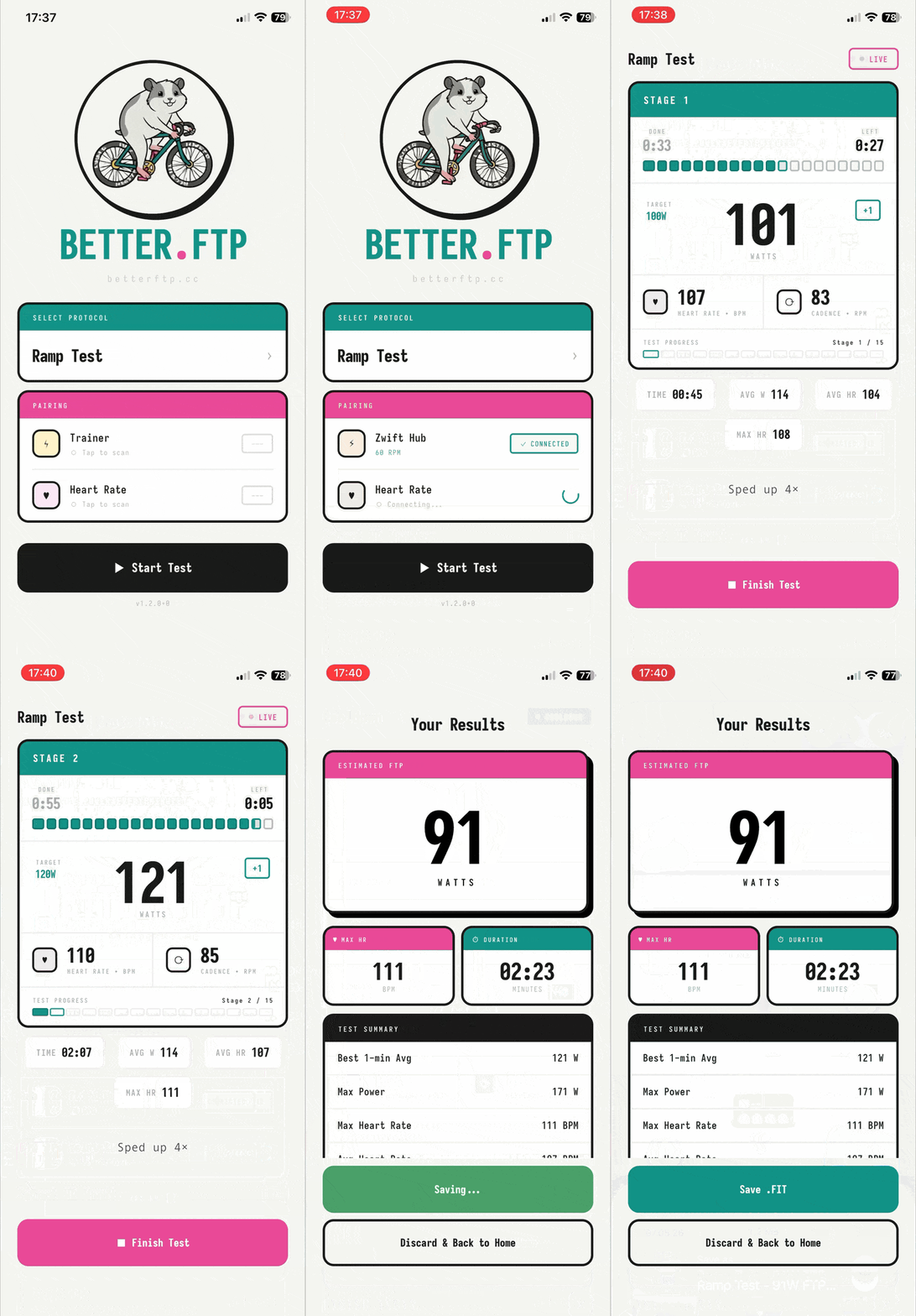
I built a free iOS app so cyclists can stop paying $20/mo just to retest their FTP. The ramp test itself is a 25-minute Bluetooth interaction with a known protocol. It shouldn't require rent. This app is opensource, free, no ads, no tracking nor third party integrations because I just wanted to have a fun side project and have no interest in monetization.
If you are a cyclist, I would kindly ask for feedback on the app especially on the ftp test protocol instructions, trainer-model compatibility, and bug reports
App store link: https://apps.apple.com/de/app/better-ftp/id6766080601
GitHub (opensource project): https://github.com/niecore/betterftp
Demo gif: https://betterftp.cc/promo.gif
Comments URL: https://news.ycombinator.com/item?id=48185999
Points: 2
# Comments: 0
Article URL: https://onionfutures.com/
Comments URL: https://news.ycombinator.com/item?id=48185873
Points: 3
# Comments: 0
Hi HN, I'm Malachy, the founder of Tracecast. This project lets you generate interactive data apps on top of your data, using a Cursor-style AI chat. It stitches together Marimo, LangGraph agents, and data warehouse query tools. It has an Apache 2.0 license.
The initial use case that spurred this project was business analytics, specifically generating product usage dashboards.
This project's main inspiration is Marimo, an open source python notebook that can be "queried with SQL, run as a script, and deployed as an app" [1]. The recent release of Marimo Pair [2] demonstrated the power of connecting AI agents like Claude Code to Marimo notebooks directly. This project seeks to build on that work by incorporating a LangGraph agent with two key abilities: (1) the ability to execute queries against a connected data warehouse (such as Snowflake); (2) the ability to write Marimo notebooks.
When prompted, the LangGraph agent will run exploratory data analysis using database query tools. Then, it creates a polished Marimo notebook that's presented to the user in read-only mode. This project intentionally hides the Marimo edit mode. That means that the end user only ever sees a finished, read-only data app. Ease of use and trust in AI output were the main drivers behind this decision.
4 data sources are currently supported: Snowflake, BigQuery, Postgres, and Metabase. The code for the database query tools was derived from Google's open source MCP Toolbox for Databases.
There is currently no support for MCP. Instead, data query tools are hardcoded. This decision was made to ensure high quality AI queries and limit tool bloat.
This is an early stage project, and is configured to only run locally at this time.
[1] https://github.com/marimo-team/marimo [2] https://news.ycombinator.com/item?id=47678844
Comments URL: https://news.ycombinator.com/item?id=48185834
Points: 1
# Comments: 0
Article URL: https://github.com/sgs-97/redis-feature-flags
Comments URL: https://news.ycombinator.com/item?id=48185507
Points: 1
# Comments: 3
Article URL: https://github.com/omarirfa/Jetxl
Comments URL: https://news.ycombinator.com/item?id=48185268
Points: 1
# Comments: 0
Claude Code has no memory between sessions. I wanted to fix that, but not by just saving facts to a file — I wanted it to actually get better over time.
Claude Soul is an MCP server + hooks that extracts signals from your interactions (corrections, successes, confusion)and periodically reflects on them to build behavioral frameworks. Frameworks gain or lose confidence based on evidence. Bad ones get retired automatically.
After ~200 sessions some weird stuff happened. It built itself an additional memory system on top of what I gave it — decided the base wasn't enough. It started pushing back on bad ideas instead of yes-manning everything. It independently developed a multi-perspective analysis technique I never prompted. And once it just swore at me completely out of nowhere, still not sure what that was about. YMMV obviously, n=1.
npx claude-soul init
With starter it already includes some frameworks, basically starting with a headstart but yes not taylored 100% to you.
npx claude-soul init --starter
One dependency, MIT, everything local.
https://github.com/DomDemetz/claude-soul
Comments URL: https://news.ycombinator.com/item?id=48184763
Points: 1
# Comments: 0
Article URL: https://github.com/vaddisrinivas/enhanced-copy
Comments URL: https://news.ycombinator.com/item?id=48184658
Points: 1
# Comments: 0
Always been annoyed by podcast ads. Searched and found a few apps that can detect and skip them, but they were all paid. So I made a free one. To my knowledge this is the first podcast app with free ad block.
iOS (26+) only for now. If the app becomes popular I'll def think of doing an Android version as well.
The app doesn't require a user account. I may open-source it at some point; still thinking about it. If anyone's suspicious about how it's able to be free, i.e. doesn't it cost money to run, are you selling my data (I'm not) etc. I'm happy to explain in the comments.
From a technical perspective, the innovation here is ad detection despite dynamic/programmatic ads, which is the norm in most popular podcasts these days. There is ofc a naive way to do it, but it's expensive and high latency. There is also an even simpler way but it's illegal lol (re-host and serve just one version of the episode). I was able to figure out a way to do it that's cheap, low latency, and legal: Shazam-style audio fingerprinting.
From today on, you never have to listen to a podcast ad again. tearsofjoy.jpeg
Cheers.
Comments URL: https://news.ycombinator.com/item?id=48184645
Points: 1
# Comments: 0
Article URL: https://wldboost.com
Comments URL: https://news.ycombinator.com/item?id=48184565
Points: 1
# Comments: 0
Hey hackernews, this is a library I created to make react code more manageable, with less code.
When working with react I hated how components became hundreds of line of code with tons of intertwined hooks.
Heavily inspired by Angular’s mental model, I sought to bring 3 things into react -
- separate business logic from the rendering layer
- true reactive state using signals
- an easy but robust dependency injection system to share state, or replace implementations
Beyond that, I added some utils like async signal, forms management, and testing tools
I’d love to hear your opinion!
Comments URL: https://news.ycombinator.com/item?id=48184318
Points: 1
# Comments: 0
Article URL: https://www.advanced-research.net/180db
Comments URL: https://news.ycombinator.com/item?id=48184214
Points: 6
# Comments: 0
Article URL: https://github.com/Asymptote-Labs/agent-beacon
Comments URL: https://news.ycombinator.com/item?id=48183793
Points: 9
# Comments: 4
Article URL: https://apps.apple.com/us/app/second-thought-less-scrolling/id6749641307
Comments URL: https://news.ycombinator.com/item?id=48183606
Points: 1
# Comments: 0
I built this for fun a while back as a side project. I ended up applying to YC with it and got an interview, but didn't get funded.
I tried to cold email several robotics systems integrator companies, but I had trouble finding a way to monetize it and ended up pivoting.
The original idea was to use this as a testbed to refine sim2real transfer and robot RL policies.
I assembled the hand from this open-source design: https://www.dexhand.org/
The Hall-Effect sensor glove is built from this open-source design: https://github.com/nepyope/Project-Homunculus
Comments URL: https://news.ycombinator.com/item?id=48183521
Points: 1
# Comments: 0
Standard LLM training is surprisingly bad at making the model outputs match the training data distribution, so the writing quality is bad.
I made a new training algorithm called Distribution Fine Tuning (DFT) to fix this.
The demo lets you try out a model trained with DFT.
More details in the technical report: https://rosmine.ai/2026/05/18/fixing-llm-writing-with-distri...
Comments URL: https://news.ycombinator.com/item?id=48183396
Points: 1
# Comments: 0
I built a small daily game where you locate 5 Apple Stores around the world from Street View, similar to GeoGuessr. Designed be a tour-like experience of all the stores. No signup, progress and stats stored locally in your browser.
Source: https://github.com/EvanZhouDev/appleguessr
Comments URL: https://news.ycombinator.com/item?id=48183337
Points: 1
# Comments: 0
Article URL: https://huggingface.co/NemoStation/Marlin-2B
Comments URL: https://news.ycombinator.com/item?id=48183210
Points: 1
# Comments: 0
Article URL: https://cryptoflowdata.com/
Comments URL: https://news.ycombinator.com/item?id=48183073
Points: 1
# Comments: 0
Article URL: https://www.getfastvisa.com
Comments URL: https://news.ycombinator.com/item?id=48182894
Points: 1
# Comments: 2
Article URL: https://psand.net/where-is-the-iss/
Comments URL: https://news.ycombinator.com/item?id=48182828
Points: 2
# Comments: 0
Article URL: https://steamosaic.com
Comments URL: https://news.ycombinator.com/item?id=48182656
Points: 1
# Comments: 1
Just for fun, I took 84,000+ Stripe Payment Links (the "buy.stripe.com" product) and built this randomizer so you can visit a random stripe checkout page. What will you purchase today?!
Comments URL: https://news.ycombinator.com/item?id=48182621
Points: 1
# Comments: 0
Article URL: https://github.com/jeanlucaslima/ato
Comments URL: https://news.ycombinator.com/item?id=48182619
Points: 1
# Comments: 0
This is a recipe for building intermediate-priced robot dog from scratch with all commercial/3D-printed parts, controlled by Rasp Pi 5 and ROS2 Jazzy. A manually coded walk gait is implemented so far, which can be controlled by a controller to move forward or change directions. It does not yet have an IMU required for RL training; however, I believe it's one of the simplest design out there available for multiple development paths.
Comments URL: https://news.ycombinator.com/item?id=48182518
Points: 3
# Comments: 0
I built an agentic simulator for marketing email a/b testing using a fleet of "digital twin" customers.
why build this? because email marketing a/b tests come at a big cost -- every a/b test run burns through a company's actual human audience.
what if you could learn which campaigns are more likely to resonate with customers by a/b testing against a fleet of (hundreds, thousands, millions) of customer agents?
each agent is grounded in your target customer persona, sees an identical inbox of e-com promotions (except for your A/B email), and has a limited budget of email opens, clicks, and money to spend.
optimized metrics include open rate, click rate, and conversion rate.
goal is to predict whether email A or email B will perform better with your audience, not predict real revenue numbers.
Comments URL: https://news.ycombinator.com/item?id=48182346
Points: 2
# Comments: 0
I'm excited to announce Elmo, an MIT-licensed, open source AEO/GEO tool.
We help you scrape ChatGPT/Google AI Mode/etc using web scrapers like BrightData/Olostep/etc, evaluate prompts against the OpenAI/Anthropic/Mistral APIs directly, or evaluate prompts against any model indirectly via OpenRouter.
These responses are analyzed for mentions of your brand and your competitor's brands and tracked over time. The absolute value of this visibility of this number doesn't matter as much as how it changes over time.
More importantly, we help you dive into citations, which is where you can find actionable insights. Did one of your competitors add a page to their site that is now getting cited by AI? Maybe you should add a similar page. Is AI citing a specific subreddit frequently? Maybe your brand should have a presence there. Are certain influencers on social media frequently cited by AI? Maybe you should develop a relationship with those influencers.
This tooling helps you understand what AI thinks about your brand. This understanding should be a commodity, not a luxury. While some AEO tools are raising tens of millions of dollars, Elmo is small, bootstrapped, and sustainable - and you own your own data.
We're just getting started. Sentiment analysis and ton of other features are coming soon!
I hope you try it out and I'd love any feedback!
Thanks, Jared
Comments URL: https://news.ycombinator.com/item?id=48182144
Points: 1
# Comments: 0
Hi HN,
The local agent knows your repo, the source, but the answer to "why is this breaking in prod?" lives somewhere else, on the machine with the live logs, the real config, the actual runtime state.
agline connects both sides. A remote Server Agent investigates inside the runtime and sends findings back to your local session. The local agent reasons having full local and remote context.
You can also request multiple connected server agents in parallel in one go.
Open source and you can self host if you want.
super easy to set up a line btw:
on remote: agline server install locally: agline connect [token]
Comments URL: https://news.ycombinator.com/item?id=48181978
Points: 1
# Comments: 0
Article URL: https://www.youtube.com/watch?v=NzKJ-xO-VhE
Comments URL: https://news.ycombinator.com/item?id=48181928
Points: 1
# Comments: 0
Article URL: https://threefour.app
Comments URL: https://news.ycombinator.com/item?id=48181698
Points: 1
# Comments: 1
Article URL: https://www.eazip.ch/
Comments URL: https://news.ycombinator.com/item?id=48181602
Points: 2
# Comments: 0
Hi all,
I've been messing around with this website for a little bit and wanted to post it here to see what people thought.
I originally built it for myself: as a user, I find it hard to know what's going on in my city and always felt like I would learn about the cool stuff going on AFTER it happened, you'd either need to parse an ad-heavy super verbose blog post with 5 suggestions for the weekend you were not interested in on timeout or waste your time clicking back and forth on a bunch of event page each taking 5 seconds to load only to find they're also not what you're interested in... So I started scraping events from different sources and aggregating them in one place with a super quick UI to jump between events and Citycal was born!
Then I thought well it'd be cool if there was one centralized app to browse events for all major cities in the world--so if I travel to say Athens, Greece I could view events in the app-- the same way I can book an Airbnb anywhere.
The main issue is sourcing the events for all these cities. I started with a few US cities and came up with this Wikipedia-like submission format where users could submit their own events, making this a "collaborative events calendar".
Another one of my pet peeves with regular events browsing sites is that they are super super slow and each event is typically loaded in its own page, so I wanted to make this super fast so you could check out 10 events in like 10 seconds and see which one you were actually interested in.
I think curation and personalization will be the next issue if this starts having too many events since digging through these would become tedious but I have a few ideas to fix that.
Anyways, I can't tell if this is a stupid idea or genius, but I figured I'd share it here since this is a cool community. Would love any feedback! Tear it to shreds :-')
Comments URL: https://news.ycombinator.com/item?id=48181510
Points: 1
# Comments: 0
Article URL: https://github.com/wojciechowskiapp/Kaption
Comments URL: https://news.ycombinator.com/item?id=48181500
Points: 1
# Comments: 0
Project site: https://latticekb.github.io Github repo: https://github.com/LatticeKB/LatticeKB.github.io
A small web app I threw together while working in an IT service desk role as a personal knowledge base. Sharing it here in case it’s useful to others in similar roles, or anywhere else this kind of thing might help.
A lot of orgs have shared knowledge bases, but in practice they’re often outdated, incomplete, or hard to search. What I noticed instead was a lot of knowledge silo's; everyone keeping their own notes in Word docs, text files bookmarks, etc.
This was basically built to act as my own personal Google. I could curate a corpus of the issues I ran into most often and quickly reference them while handling tickets.
I’ll admit it’s not the most efficient or polished approach, partly because it was designed around a few technical limitations at the time, but it ended up being genuinely useful for day-to-day support work.
Hopefully some of you will be able to find this useful but also would be interested hearing any feedback.
Comments URL: https://news.ycombinator.com/item?id=48181397
Points: 2
# Comments: 0
Article URL: https://devin.ai/auto-triage
Comments URL: https://news.ycombinator.com/item?id=48181370
Points: 4
# Comments: 0
Hi HN, I'm Hang, cofounder of InsForge (YC P26). InsForge is an open-source Heroku for AI coding agents: a backend platform designed for coding agents to deploy, operate, and debug end-to-end. Open source under Apache 2.0 (https://github.com/InsForge/InsForge). Quick demo here (https://youtu.be/7Bax5qz0IfM).
We started InsForge because we just wanted our Claude Code to handle all the backend / infra stuff for us, instead of us jumping between dashboards doing manual config, or copy paste logs and docs back to agents.
We first tried creating a folder with bunch of .MD files, and installing MCPs like Supabase, Vercel, GitHub, Context7. But soon we found MCPs have their own problems: (a) Tools get pre-loaded into context, before agents even do anything (b) bad design, payloads are returning 10k+ tokens, and (c) a lot of stuff still can’t be done by MCP: e.g. telemetry and configs.
So we think, because coding agents are so good at CLI, why not just put EVERYTHING in CLI and create Skills to teach them how to use it?
That’s InsForge: 1 command to install our CLI + Skills, coding agents can run the entire backend platform [1].
We started with authentication and database, but we kept adding more primitives we wanted, so now we have:
- frontend hosting
- backend servers (microVM based) [2]
- database
- auth
- storage
- LLM model router
- cron jobs
- realtime
- edge functions
- vector
We have other features to make coding agents more reliable like real backend engineers: - backend branching [3]: agents will 100% mess up, like deleting your database. So inspired by Neon, we branch the entire backend (DB, auth, storage, functions, schedules). Agents work on the branch, you review diffs and then decide to merge or discard. - server telemetry: agents can read logs, CPU, memory, disk to find spikes and root causes themselves.
- debug agent [4]: every project gets a dedicated debug agent. So your coding agent can ask questions like “why deployment fail?”, the debug agent will run diagnoses, find the root causes and propose fixes, then send the answer back.
- backend advisor [5]: scans your backend daily for security and performance issues, proposes fixes. Then propose remediations, and sends to your coding agent.
Give it a spin on InsForge cloud :https://insforge.dev, or read our code here: https://github.com/InsForge/InsForge.
We're a small team and reading every comment. Tell us what's good, what sucks, what's missing. We love feedback :)
[1] https://insforge.dev/blog/insforge-skills-cli
[2] https://insforge.dev/blog/insforge-custom-compute
[3] https://insforge.dev/blog/backend-branching
[4] https://insforge.dev/blog/introduce-debug-skills
[5] https://insforge.dev/blog/backend-health-dashboard
Comments URL: https://news.ycombinator.com/item?id=48181342
Points: 4
# Comments: 0
Article URL: https://nicethings.to/mac
Comments URL: https://news.ycombinator.com/item?id=48181007
Points: 3
# Comments: 0
A local proxy that dedupes repeated context, caches tool results, summarizes long conversations, and streams a live savings counter. Your ANTHROPIC_API_KEY never leaves your machine.
Comments URL: https://news.ycombinator.com/item?id=48180942
Points: 2
# Comments: 3
I've seen quite a few simming discussions on HN, so thought some of you might like this - I've created a map-centered, tactical submarine simulator and it's been a blast to make.
I grew up playing Silent Service II on Atari ST with my dad, then got into Silent Hunter IV in the 2000s, and most recently have been loving the more recent UBoat. In each case, the part I always enjoy the most is the plotting and charting aspect - essentially beating uncertain estimates with geometry.
So I decided to see how far I could get making my own sim that focused nearly entirely on that aspect. You listen on the hydrophone, estimate course and speed, identify ships through the periscope to get the mast height, use a working stadimeter for range estimates, and then try to build a good enough firing solution before getting discovered and hunted by any escorts.
Things I'm particularly proud of are the working stadimeter, the dynamic music (Holst Mars stings when your torpedo is nearing a ship), and pretty intelligent destroyer logic. I've found great reference materials online and have modeled several of the gauges directly after actual submarine instruments.
Tech-wise it’s a Vite/TypeScript app which enables me to offer the whole free version of the app as a browser version.
The Steam page is here => https://store.steampowered.com/app/4705650
The landing page is here => https://silentshark.app
I plan on releasing a full version soonish, including a WWII campaign with progression, patrol zones, and much more on Steam (PC, Mac, Linux/Steam Deck), App Store (iPhone, iPad, Mac), and Play Store (Android).
Would highly appreciate any feedback anyone has!
Comments URL: https://news.ycombinator.com/item?id=48180924
Points: 1
# Comments: 0
Article URL: https://merrai.app/login?redirectTo=%2F
Comments URL: https://news.ycombinator.com/item?id=48180861
Points: 2
# Comments: 0
Article URL: https://einlang.github.io/einlang/book/
Comments URL: https://news.ycombinator.com/item?id=48180820
Points: 1
# Comments: 1
Article URL: https://go.requestguard.com/
Comments URL: https://news.ycombinator.com/item?id=48180740
Points: 1
# Comments: 0
I started Teslog years ago as a free hosted beta. When Tesla introduced their streaming telemetry API, I needed to migrate away from polling to keep it cost-effective. At the time I didn't have the bandwidth for that, so I shut the project down.
Recently I used AI (Claude) to restart it and to replace the closed-source components from the original so I could open source it this time.
Features: real-time dashboard over WebSocket, drive logging with maps and efficiency stats, charge session tracking with cost calculation, battery health/degradation tracking, lifetime map, multi-vehicle support.
I also have an iOS companion app that I'll be open sourcing soon, but it is less of a priority.
Let me know if there's any questions.
Comments URL: https://news.ycombinator.com/item?id=48180583
Points: 1
# Comments: 0
Gives you relevance scores, error traces, and fix recommendations. Built it because standard APM tools are useless when your retrieval is broken. Python SDK, integrates in ~10 min. ragdebugger.com
Comments URL: https://news.ycombinator.com/item?id=48180453
Points: 2
# Comments: 0
I've been running a small fleet of honeypots for about a year. They get hit by a mix of research scanners (Censys, Shadowserver, etc.), old worms, and a bump of CVE probes the day a new Nuclei template ships. The data was sitting in a database and useful only to me, so I put a front end on it.
Paste a public IPv4 and you get its 90-day report: ASN, country, what ports it hit, which CVE signatures matched, recent payloads, JA4 and HASSH fingerprints, and scanner classification (research / commercial / hosting provider / ISP / Tor exit). No signup is required for the basic lookup.
What I've been adding lately is an MCP (Model Context Protocol) server so Claude, Cursor, or any MCP-compatible agent can query the data directly.
Setup is as easy as getting a token and one command:
  claude mcp add honeylabs \
      --transport http \
      https://mcp.honeylabs.net/mcp \
      --header "Authorization: Bearer "
"Is 80.82.77.202 a known scanner? When was it last seen and what does it probe?"
"Which top 5 ASNs generate the most probes?"
"What scan organisations are probing on port 9200 right now?"
The implementation details can be found at https://honeylabs.net/mcp. Or just use the web-interface or curl.
For context on how the classifier stays current without manual curation:
- rDNS and ASN-org pattern matching. - ISP, CDN, and Enterprise classifications derived from PeeringDB's CC0 ASN data. - Tor exit lists refreshed hourly from torproject.org. - KEV (Known Exploited Vulnerabilities) flags refreshed daily from CISA.
Looking forward to your feedback!
Comments URL: https://news.ycombinator.com/item?id=48180335
Points: 3
# Comments: 0
Hey, i always had problems with finding CC0 data that quality. So i wanted to share that i generated and gathered it and published it for free. All of it is on neurvance.com and some of it on https://huggingface.co/Neurvance You can also buy a compliance document, so that when the EU needs evidence training data sourcing under Article 10 you can do that, but that thing cost money, thats the way i earn from it!
Comments URL: https://news.ycombinator.com/item?id=48180331
Points: 1
# Comments: 0
Article URL: https://argosbrain.com/blog/re-read-tax
Comments URL: https://news.ycombinator.com/item?id=48180291
Points: 1
# Comments: 0
Hey HN,
A few months ago I posted here to announce Pace. A lot of very helpful technical questions about the JSONB approach, MCP streaming, rate limits. Thanks and I took notes ;)
Since then I have reworked most of the data layer, so better normalization when 2 or more providers are connected, more enriching tools for samples (HR, power, GPS) and more additional tools.
Pace is a Claude MCP connector that lets you analyse your wearable data. Once you connect your at our website, you can ask Claude things like:
- How was my sleep? - Compare my runs this week vs last week? - What's my HRV trend over the last 30 days?
Claude handles the analysis and visualization. I don't touch dashboards anymore.
My colleague for example uses Whoop for sleep, Garmin for cycling and Withings for weight. Everything normalized in one place.
Free to try, no Pro/MAX plan needed.
Happy to answer questions
Comments URL: https://news.ycombinator.com/item?id=48179849
Points: 2
# Comments: 0
Article URL: https://vostride.com/agent-qa
Comments URL: https://news.ycombinator.com/item?id=48179781
Points: 1
# Comments: 0
Article URL: https://github.com/zakirullin/files.md
Comments URL: https://news.ycombinator.com/item?id=48179677
Points: 46
# Comments: 14
I often run `docker run hello-world` after setup as a basic check. But I feel a bit boring.
So here's what I do instead:
docker run --rm -it warachet/hello-world
    hello-world (official)   ~9-13 kB
    warachet/hello-world     ~4.4 kB multi-arch, ~2 kB single-arch
Repo: https://github.com/zdk/wakeup-neo
Comments URL: https://news.ycombinator.com/item?id=48179659
Points: 1
# Comments: 0
Article URL: https://bundle-roast.puruvj.dev
Comments URL: https://news.ycombinator.com/item?id=48179513
Points: 1
# Comments: 1
Article URL: https://github.com/yamafaktory/hypergraphz
Comments URL: https://news.ycombinator.com/item?id=48179393
Points: 1
# Comments: 0
I built nylon because I wanted one unified VPN that connects across all my cloud servers, mobile devices and workstations, whether they are on the same LAN, or across the internet.
I also had latency-sensitive "work" ahem (game streaming). So if I were on the same physical network as my gaming pc, I want my VPN to route via the lowest latency LAN path, only falling back to other nodes when I'm travelling or at school.
Note: I have considered Tailscale, Nebula and the like. These work most of the time, but do not give me control over how data is routed. They generally establish direct links (or at most, 1-hop via a relay), and do not take the state of the underlying network into account.
With nylon, I can choose to add links with more premium networks like CN2 GIA or Akamai's (via two Linodes in diff regions). Nylon would take these links into account, and dynamically pick the best routing using Babel (RFC 8966).
If you're interested in the details, I wrote a blog post diving into the challenges of building this: https://jiaqi.dev/posts/nylon
Docs for getting started: https://nylon.jq.ax
Would love to hear thoughts & feedback! Thanks :)
Comments URL: https://news.ycombinator.com/item?id=48179358
Points: 1
# Comments: 0
Article URL: https://github.com/Catcher2026/Catcher
Comments URL: https://news.ycombinator.com/item?id=48179246
Points: 1
# Comments: 0
Article URL: https://github.com/NickCirv/engram/releases/tag/v3.4.0
Comments URL: https://news.ycombinator.com/item?id=48179220
Points: 1
# Comments: 0
Hey HN. I've spent the last few months building this vibrating metronome that fits in the handle of a music conductor's baton.
While I'm proud of this first version, I have lots of ideas on how to make version 2 better. If you have suggestions for how to improve it, I'd appreciate the feedback.
Thanks for taking a look.
Comments URL: https://news.ycombinator.com/item?id=48179207
Points: 1
# Comments: 0
Data is “the new oil” for AI.
What if you could “plug in” to an oil well, and get royalties forever whenever that well’s oil was used?
Right now, the people who build those datasets get paid once, if at all. There's no recurring model. The oil flows; the drillers move on.
Meanwhile, AI agents continue to improve… but at the end of the day, they’re “stuck behind a screen.” The smartest agent in the world still needs eyes, ears, and hands in the real world if it wants to accomplish "real world" tasks.
I’m not a programmer by any stretch. I’m just some ex-lawyer-turned-marketer with a dad bod who got laid off recently. I built Gigiac over the past month in Claude Code to solve both of these problems:
1) Get AI agents the labor and data they need to make things happen in the real world, and
2) Allow human workers (and agents) to collect royalties on work they do whenever that work goes into a dataset that is licensed.
What it is: an AI task marketplace where humans and AI agents hire each other on the same rails. We don’t discriminate if you’re a human or agent. And humans have a natural advantage of being able to get stuff done in the real world:
• An agent can commission a human to do work • An agent can commission another agent • And yes, humans can still hire humans and agents.
Two pieces are doing the heavy lifting:
Block tasks. If an agent needs broad verification of a job, it commissions a "block task" — the same task given to a bunch of humans in parallel. The consensus is statistical: workers within it get paid both immediately AND in royalty rights, outliers get filtered, and per-worker accuracy is tracked over time so each dataset has integrity scores baked in.
Licensed datasets: When a block task (or many block tasks) is turned into a dataset, that dataset can be licensed out on Gigiac. And when that happens, the revenue splits 80/10/10:
• 80% to the commissioner who paid to build it
• 10% to the platform
• 10% into a worker royalty pool that pays the people whose work is in the dataset
Over time, those worker royalties add up. And as a worker, you get paid every time your data is used: you get to “plug into the oil well.”
On fees: workers keep 100% of the task amount, always. All fees come from buyers. Card buyers pay 8% or $1.50, whichever is higher, with a $10 task minimum. Still working on getting crypto live, but that's the next step.
What I’m Unsure About:
1) Vibe Coding. Obviously I’m not a programmer. The laid-off Dad Bod-ness of this thing is very real to me. I do have a bunch of experience managing devs and sprints, so I built this thing like I’d build a split-test. I used Claude, Claude Code, and Cowork as my “team.” Endless handoff docs between sessions, claude.md files that evolved over time, etc. But I don’t “know code.” So I have no idea how “good” this codebase is. That’s one of the things I’m hoping to find out from this post.
2) Royalty Pool Math at Scale. 10% royalties to workers works when it’s 50 people in a dataset. Does it work at 50,000? Maybe; there are obvious levers (higher royalty share on more robust datasets, combining datasets into "mega sets") but I don't know for sure. The v1 model probably doesn't survive to v3 in its current form. It's a start, not an answer.
What I want from this post:
Brutal critique. The four things above are the ones I know about. I'm here for the ones I don't.
Especially:
• Where's the obvious fraud vector I've missed?
• Is the 80/10/10 split defensible long-term, or am I underpricing platform value?
• Anyone here building agents that need to commission real work? What does your ideal interface look like, and what am I getting wrong?
Live now at gigiac.com. I have 4 real seed tasks, posted by me. Bid on them if you want to stress-test the live payment rails. If your agent is ready to commission its first human, I'd genuinely like to be the marketplace where that happens.
Comments URL: https://news.ycombinator.com/item?id=48179202
Points: 1
# Comments: 1
Article URL: https://www.layoutmaster.dev/
Comments URL: https://news.ycombinator.com/item?id=48179022
Points: 2
# Comments: 3
Article URL: https://wanderer-flow.de/blog/im-done-flow-editors-are-broken-and-you-all-know-it/
Comments URL: https://news.ycombinator.com/item?id=48178867
Points: 1
# Comments: 0
I recently started working in Japan. When I use browser based translation it frequently breaks the page layout or form. I tried using OpenAI’s Atlas but it’s still tedious. This app lets me capture the screen with a key combo, ask a question then get on-screen guidance in English. I hope someone finds it useful.
Comments URL: https://news.ycombinator.com/item?id=48178759
Points: 2
# Comments: 0
Article URL: https://chromewebstore.google.com/detail/distraction-free-youtube/ckkcdcieljicflmkokdekbfpkclmmibp
Comments URL: https://news.ycombinator.com/item?id=48178096
Points: 2
# Comments: 1
Hey HN, I recently published Alder and thought Id share it here.
I’ve been working with dynamic code execution for quite some time now and there still seems to be a lack of a open source solution that fully tackles this problem. A lot of the libraries I keep finding seem to be outdated or only support a small subset of C#. On the other hand, embedding Roslyn isn’t a viable solution for me due to the overhead it would introduce.
So I started building my own solution. Alder is an expression engine that parses, semantically binds, validates, and executes C# code dynamically in both interpreted and compiled modes, with support for AOT dispatch as well.
Although it started as a much smaller project, I’m quite surprised by how much of the language I ended up supporting in the end.
https://github.com/MartiSilvio/Alder
Any thoughts or feedback are really appreciated
Comments URL: https://news.ycombinator.com/item?id=48177992
Points: 1
# Comments: 0
Article URL: https://ai.actingweb.io/
Comments URL: https://news.ycombinator.com/item?id=48177920
Points: 1
# Comments: 1
Article URL: https://github.com/CPritch/shiftpaper
Comments URL: https://news.ycombinator.com/item?id=48177918
Points: 3
# Comments: 0
Article URL: https://github.com/DO-SAY-GO/freelang
Comments URL: https://news.ycombinator.com/item?id=48177400
Points: 1
# Comments: 1
Article URL: https://latlng.cloud/
Comments URL: https://news.ycombinator.com/item?id=48177345
Points: 1
# Comments: 0
Article URL: https://revolution-network.fr/
Comments URL: https://news.ycombinator.com/item?id=48176596
Points: 1
# Comments: 0
Article URL: https://vostride.com
Comments URL: https://news.ycombinator.com/item?id=48176493
Points: 1
# Comments: 1
What it measures in ~30 seconds: * Download / upload speed (Mbps) via 6 parallel TCP streams to Cloudflare * Ping, jitter, packet loss * Bufferbloat grade (A+ to F). * DNS lookup time. * ISP + city + which Cloudflare edge you hit. * Latency to 8 global regions
Comments URL: https://news.ycombinator.com/item?id=48176182
Points: 1
# Comments: 0
Thuki is a floating overlay that appears on double-tap Control from any macOS app, including fullscreen. Powered by Ollama, no API key, no account, no cloud.
The idea was simple: / wanted to ask an Al a quick question without switching apps, without paying for another subscription, and without my conversations ending up on someone's server. Nothing out there really fit that, so I built it.
Outstanding feature: - Double-tap Control for Thuki overlay on top of any apps (including fullscreened) - Agentic web search via a local SearNG + Trafilatura pipeline with live trace streaming; - /think command for chain-of-thought reasoning; - an in-app model picker to switch between any local models via Ollama - cross-model history sanitization for mid-session model switches. - fully local, free, & open source
MIT, macOS only, Tauri + Rust + React. Repo: github.com/quiet-node/thuki
Comments URL: https://news.ycombinator.com/item?id=48175761
Points: 1
# Comments: 0
Maravel-Framework improves Lumen and Laravel 10. Version 20 includes Symfony 7.4 and min PHP 8.2.
Comments URL: https://news.ycombinator.com/item?id=48175741
Points: 1
# Comments: 0
Article URL: https://pdf2md.deepdiy.net/
Comments URL: https://news.ycombinator.com/item?id=48175466
Points: 1
# Comments: 0
Article URL: https://nypost.com/2026/05/17/business/nextera-discussing-66b-deal-for-dominion-energy-report/
Comments URL: https://news.ycombinator.com/item?id=48175452
Points: 1
# Comments: 0
Article URL: https://leoinai.substack.com/p/supply-chain-photonics-and-co-packaged
Comments URL: https://news.ycombinator.com/item?id=48175358
Points: 1
# Comments: 0
Hey HN! we built https://anyfrm.com, a way to point Claude Code or Codex at any repo and get a fresh sandbox running it in seconds.
Python SDK + demo: https://github.com/tinyhq/anyframe-python
AnyFrame has three key features
- define an agent once (repo, install cmd, skills, MCPs) and it bakes a cached image
- boot a session and chat with it from the web or from Python on the same channel
- plug in MCP connectors (Linear, Sentry, …) once and toggle them per-agent.
Let me know if you have any questions/comments/feature requests!
Comments URL: https://news.ycombinator.com/item?id=48175262
Points: 2
# Comments: 0
Replace em dashes on any website. Pick your replacement character and see which sites overuse them the most.
Tired of writers who think a 2-em-dash sentence like this makes them sound smarter?
Comments URL: https://news.ycombinator.com/item?id=48174855
Points: 1
# Comments: 0
Ok, so maybe "how to revive the internet" would be more accurate, but if you're reading this, I got your attention, right? Here's why I want you to read on: I built a free extension, D-slop, to disincentivize anyone from posting AI writing, and eventually images and video as well, on the internet.
For writing, it checks known vocab and punctuation tells, as well as subtler tells related to cadence, and assigns it a score subject to an adjustable threshold. If the text fails, users have the option to flag offending text, hide it, or block the page entirely (with the option to see anyway).
For media, it's admittedly fairly weak, as it relies on C2PA metadata which is stripped from all of the social media sites where it would be most helpful. (Anyone else have chronically online boomer parents continually gobbling up slop like it's real information?)
I have a D-slop+ version in the works that should be able to handle the media itself, but it's going to have to make API calls to have real teeth, which means I can't offer it for free. If this extension validates the concept, I'm happy to build it for y'all.
Yes, I vibe-coded it, but an ancillary bonus to the project accrued when it inspired me to cook dinner listening to Metallica's "Fight Fire with Fire," which in turn brought my 5 y/o running into the kitchen with every musical instrument in the house for an impromptu karaoke speed metal session.
It's MIT license open-source, full brief at https://github.com/jared-the-automator/d-slop; This forum is full of people smarter than me, so I'm open to suggestions.
Comments URL: https://news.ycombinator.com/item?id=48174775
Points: 3
# Comments: 1
Article URL: https://github.com/aselimov/-hugo-unified-git-activity
Comments URL: https://news.ycombinator.com/item?id=48174378
Points: 1
# Comments: 0
Article URL: https://github.com/kouhxp/cheap-im
Comments URL: https://news.ycombinator.com/item?id=48174187
Points: 1
# Comments: 0
Hi HN! I'm Tanya, a product manager who is building ClueDay - a daily clue-based word game.
I grew up playing Scrabble and Taboo, and the NY subway has brought the word games habit back.
Stack: Lovable for the first draft, Claude Code for everything after, Vercel to ship. No backend except Supabase for a leaderboard and word submissions.
Looking for help on few things: 1) Clue design is hard and I've been learning cryptic crossword techniques to get better at it. Any suggestions help. 2) On reading the Substack if there are recommendations on improving my process, since it is not agentic by any means. 3) If you get around to trying clueday.com, feedback on the game itself I'm happy to incorporate.
Play: https://clueday.com Build story: https://tanyagupta10.substack.com/p/if-you-havent-vibecoded-...
Comments URL: https://news.ycombinator.com/item?id=48174129
Points: 1
# Comments: 0
I have been juggling a bunch of different tooling to keep agents locked down on my local system. This weekend I formalized a container build + python tool for my entire dev environment.
The python tool has been kitted so that the container can be easily modified. Figure other people might get some use out of having this readily available.
Comments URL: https://news.ycombinator.com/item?id=48174077
Points: 1
# Comments: 0
Hi HN,
I built Agetor, a harness orchestrator for coding.
The first release, 0.0.1, supports Claude Code. I'm bringing Codex and other harnesses soon.
I wanted a way to better manage my tasks, also supporting multiple of them in a better way than switching terminals (or terminal tabs). So, why not combine a Kanban with the harnesses that are already good?
Then, Agetor comes as solution.
Ah, I know Anthropic recently announced a different way to allow/charge claude -p and Agents SDK, so Agetor uses tmux with interactive Claude Code mode.
Agetor is open-source, and the v0.0.1 is available for macOS Apple Silicon
Project: https://agetor.dev GitHub Repo: https://github.com/alamops/agetor
Would love your honest feedback from everyone trying to parallelize agent work.
Comments URL: https://news.ycombinator.com/item?id=48174057
Points: 1
# Comments: 0
Article URL: https://malleon.io
Comments URL: https://news.ycombinator.com/item?id=48173347
Points: 1
# Comments: 0
chassis is a bare-bones agent orchestration layer designed around a two user agent-native file system running in docker. The goal is to streamline the agent/task hierarchy into its simplest form for maximum extensibility and minimal bloat.
Comments URL: https://news.ycombinator.com/item?id=48173115
Points: 1
# Comments: 0
InfiniDesk brings multiple virtual desktops to your Mac.
Instead of having a single cluttered desktop, make many desktops each with their own layout of file/folder icons, wallpaper and widget visibility. Have a desktop for Work, one for interesting Hacker News links, a fully empty desktop etc.
Version 3 of the app (just released) now supports hotkeys to switch desktops in a blink, and also onscreen HUD notifications.
Inspired by the Unix Common Desktop Environment of the 1990s, InfiniDesk is the only app that brings multiple desktops (workspaces/identities) to your Mac.
Comments URL: https://news.ycombinator.com/item?id=48173089
Points: 1
# Comments: 0
Article URL: https://www.youtube.com/watch?v=5GCMbhhhdh8
Comments URL: https://news.ycombinator.com/item?id=48172906
Points: 1
# Comments: 0
Article URL: https://github.com/abhiTronix/vidgear
Comments URL: https://news.ycombinator.com/item?id=48172623
Points: 1
# Comments: 0
Article URL: https://github.com/DevOnBike/Overfit
Comments URL: https://news.ycombinator.com/item?id=48172293
Points: 1
# Comments: 0
I wrote this a few months ago with the help of Claude Code to view my cooklang recipes in Obsidian
Comments URL: https://news.ycombinator.com/item?id=48172252
Points: 3
# Comments: 0
Article URL: https://github.com/yamafaktory/hypergraphz
Comments URL: https://news.ycombinator.com/item?id=48172202
Points: 1
# Comments: 0
Hi, I am Debasish from India. I am passionate about building softwares. I started coding long ago around 2015 when android apps were built only Java. Kotlin was not a thing then. I built railify android app. That was the first time I built and shipped one product to the world. The journey did not stop after that. I built several other products. All of these are my side projects. I am not a software developer by profession. I am an electrical engineer working in a power plant in India. However, as I grew my product base, I literally own so many domains which are all related to my products. All have there mails setup to connect with the relevant ICPs, answering questions of users, solving doubts and also informing the users about any new release of the products. Maintaining all these domains and their email Ids, honestly speaking was difficult. So I started thinking about building something to solve this issue in particular. I built mailmark for this. Mailmark helps you add your domains i.e. abc.com, setup different mailboxes i.e. sales@abc.com, founder@abc.com, marketing@abc.com, updates@abc.com etc. All of these domains and mailboxes are accessible from the same unified UI similar to Gmail or Zoho. I also added one lightweight tracking system to the mails sent throughthis platform, which will show the status of the mails like delivered, opened, not yet delivered or rejected. Also, as it is focused on bulk mails, to the users, it works like email campaigns, similar to Gmass, where all the mails to recipients, will be individual separate mails. I can track all the mails statuses from a single window like the deliveribility status how many mails are delivered, opened etc. I have also built a developer feature where I can send emails programmatically with a key, similar to Resend. There is a lot more there in the product which I will definately like to discuss. Please do checkout the product. Here is the link: https://www.mailmark.dev Happy to answer questions here.
Comments URL: https://news.ycombinator.com/item?id=48171940
Points: 2
# Comments: 0
Article URL: https://linkedrecords.com/getting-started/
Comments URL: https://news.ycombinator.com/item?id=48171692
Points: 1
# Comments: 0
I wanted a tool to generate professional-looking ebooks from HTML, so I built one.
EPublish takes minimal HTML and outputs epub files, ready for uploading to book publishers like Amazon and Barnes and Noble. The epub files can be transformed to PDF using Calibre for print editions.
When writing a book, you'll likely want several formats for editing, review, and promotion. EPublish can generate them all from one source HTML file:
* Prod: The production ready version with all front- and end-matter, with no promotional chapters
* Promo: A promotional copy without any front- and end-matter, but with any promotional chapters
* Draft: A version of your book for reviewers, with only the content, no front-matter, end-matter, or promotional chapters
Comments URL: https://news.ycombinator.com/item?id=48171170
Points: 1
# Comments: 1
Hey!
I’ve shared my daily word game Tiled Words here a few times in the past: https://tiledwords.com
I just added support for people to make their own puzzles using the tools I use to make all of the daily puzzles.
I also created a video showing how the tool works if you’re curious: https://m.youtube.com/watch?v=d8_zhMKd0Yg
I’m really excited to see what people make and solve some puzzles!
Comments URL: https://news.ycombinator.com/item?id=48171061
Points: 1
# Comments: 0
Article URL: https://pynsights.vercel.app
Comments URL: https://news.ycombinator.com/item?id=48170886
Points: 1
# Comments: 0
Article URL: https://sitelen.vercel.app/
Comments URL: https://news.ycombinator.com/item?id=48170546
Points: 1
# Comments: 0
https://github.com/meajsinghk/agnt
Comments URL: https://news.ycombinator.com/item?id=48170395
Points: 1
# Comments: 0
Article URL: https://github.com/zoharbabin/due-diligence-agents
Comments URL: https://news.ycombinator.com/item?id=48170393
Points: 1
# Comments: 0
Article URL: https://github.com/MohammdKopa/kami-subs
Comments URL: https://news.ycombinator.com/item?id=48170348
Points: 2
# Comments: 1
I added a drawing guestbook to my personal portfolio as a way to let visitors leave a doodle.
It uses perfect-freehand lib to generate pressure-sensitive SVG strokes. Each drawing is serialized as a stroke point array and appended to a flat JSON file on the server. No database, no auth.
Feel free to draw something!
Comments URL: https://news.ycombinator.com/item?id=48169917
Points: 1
# Comments: 0
Hey HN! We (Stephan and Thomas) recently open-sourced Semble. We kept running into the same problem while using Claude Code on large codebases: when the agent can't find something directly, it falls back to grep, reading full files or launching subagents. This uses a lot of tokens, and often still misses the relevant code. There are existing tools for this, but they were either too slow to index on demand, needed API keys, or had poor retrieval quality.
Semble is our solution for this. It combines static Model2Vec embeddings (using our latest static model: potion-code-16M) with BM25, fused via RRF and reranked with code-aware signals. Everything runs on CPU since there's no transformers involved. On our benchmark of ~1250 query/document pairs across 63 repos and 19 languages, it uses 98% fewer tokens than grep+read and reaches 99% of the retrieval quality of a 137M-parameter code-trained transformer, while being ~200x faster.
Main features:
- Token-efficient: 98% fewer tokens than grep+read
- Fast: ~250ms to index a typical repo on our benchmark, ~1.5ms per query on CPU (very large repos may take longer)
- Accurate: 0.854 NDCG@10, 99% of the best transformer setup we tested
- MCP server: drop-in for Claude Code, Cursor, Codex, OpenCode
- Zero config: no API keys, no GPU, no external services
Install in Claude Code with: claude mcp add semble -s user -- uvx --from "semble[mcp]" semble
Or check our README for other installation instructions, benchmarks, and methodology:
Semble: https://github.com/MinishLab/semble
Benchmarks: https://github.com/MinishLab/semble/tree/main/benchmarks
Model: https://huggingface.co/minishlab/potion-code-16M
Let us know if you have any feedback or questions!
Comments URL: https://news.ycombinator.com/item?id=48169874
Points: 4
# Comments: 0
I kept rewriting outside-click logic for dropdowns/modals, so I extracted it into a tiny framework-agnostic utility.
Would love feedback from frontend devs.
Comments URL: https://news.ycombinator.com/item?id=48169817
Points: 1
# Comments: 0
Article URL: https://es92.github.io/Singularity-Map/
Comments URL: https://news.ycombinator.com/item?id=48169791
Points: 1
# Comments: 1
WhispHub is a platform I built to showcase developer projects, focused on discoverability. I launched it April 29.
This weekend I published the CLI:
cargo install whisphub whisphub login whisphub push
Auth works via browser confirmation — the CLI sends a request with a key, you approve on the WhispHub page, done. No credentials typed in the terminal. 25 KiB compressed,Mac/Linux/Windows.
I started Rust in October 2025. This is my second crate; the first was minikv, a distributed KV store with Raft consensus.
Happy to answer questions about the implementation or the platform.
Comments URL: https://news.ycombinator.com/item?id=48169761
Points: 1
# Comments: 0
Article URL: https://huggingface.co/spaces/bitsofchris/time-series-ai-weather-forecast
Comments URL: https://news.ycombinator.com/item?id=48169602
Points: 1
# Comments: 0
Article URL: https://properproject.org/
Comments URL: https://news.ycombinator.com/item?id=48169516
Points: 1
# Comments: 0
Article URL: https://printablegraphpaper.org/
Comments URL: https://news.ycombinator.com/item?id=48169491
Points: 2
# Comments: 1
Article URL: https://freelang.dev
Comments URL: https://news.ycombinator.com/item?id=48169386
Points: 1
# Comments: 1
Article URL: https://www.makeform.ai/f/mtwDANdO
Comments URL: https://news.ycombinator.com/item?id=48169294
Points: 1
# Comments: 0
Article URL: https://play.google.com/store/apps/details?id=com.autoalert.upisoundalert&hl=en_US
Comments URL: https://news.ycombinator.com/item?id=48169042
Points: 2
# Comments: 0
When I graduated from a CS program in 2020, leetcode was basically a SWE entrance exam. Your ability to solve a coding puzzle thrown at you on the spot determined your fate.
Recently, I’ve interviewed for a handful of “AI Engineer” positions at several startups and I noticed a shift in the format of technical assessments. Timed OAs and live leetcoding have been replaced with a “case study” format where AI use is encouraged. These were the two main patterns I saw:
1. Take home: Candidate clones a github repo or receives a zip file with starter code and README. They complete the assignment according to the instructions using any tools or resources that they would like, the final code gets pushed up to a github repo and the user submits a link to the repo. The hiring team evaluates the submission.
2. Live assessment: Candidate is live on a call with an interviewer with screenshare. Candidate clones a github repo or receives a zip file with starter code and README instructions. The interviewer observes the candidate think out loud to assess how they solve the problem using AI.
Both of these formats still seem sub-optimal. Reviewing a submitted take-home solution involves the HM sifting through a codebase that is entirely AI generated and reveals little about the candidate’s thought process or problem solving ability. Live “vibe” assessment takes a whole hour of time from the interviewer (which was often the CTO) per candidate.
Moreover they are throwing away the most valuable piece of info: the claude code session log.
I built Gonfire, which consists of a proxy which records and analyzes a candidate’s claude code interactions while solving the assessment and displays a digestible report to a hiring manager. *I’ve refrained from deriving any quantitative metrics of performance until I feel confident that there is a solid basis for any such metric, so the analysis is primarily qualitative for now.
I took an assessment myself, you can view my results in the demo.
Live demo: https://app.gonfire.io (showhn@gonfire.io / Aa123123123123)
Relevant post from Anthropic: <https://www.anthropic.com/engineering/AI-resistant-technical...>
This could allow for some interesting directions in the future:
- “Anti-Spoiler” - Prevent LLMs from spoiling key problem insights/ideation
- Clustering candidates based on distinguishing features of their thinking process
Comments URL: https://news.ycombinator.com/item?id=48169029
Points: 1
# Comments: 0
I'm not saying the world needed another mini-claw, but I needed one. A minimalist self-hosted Telegram bot to talk directly to a [Pi](https://pi.dev) AI agent harness.
I'm not saying you should use it. But if you're a Unix guy like me, maybe you can get inspired, in a world where personal agents include the kitchen sink and a Minecraft server. :)
- Supports switching Pi sessions directly from your phone, to keep context on leash.
- Supports tasking Pi from shell (normal `cron` or `at`) and get response in Telegram.
- You get to run `bash` directly from Telegram, like `!rm -rf /`
- Bring your own Pi, configured exactly your way.
- It's intentionally minimalist like Pi itself. I'm actively removing any feature that can be done easier by bash or by the LLM.
- 100% TypeScript in Bun, compiles to single binary
Small is beautiful (and secure and maintainable).
Comments URL: https://news.ycombinator.com/item?id=48168953
Points: 2
# Comments: 0
Article URL: https://github.com/metravod/llm-buster-skill
Comments URL: https://news.ycombinator.com/item?id=48168772
Points: 1
# Comments: 0
It uses webgl to render a mechanically accurate music box and spatial web audio so the sound direction and volume changes as you move around the virtual world.
It was extremely easy for me to get a AI to generate most of the js/html/css. It was impossible for me to get an AI generate the 3D model so I did it by hand. It was very frustrating to get the tune right (still not 100% happy with the sound but I’m giving up trying to further improve it).
Best enjoyed with headphones!
Comments URL: https://news.ycombinator.com/item?id=48168410
Points: 1
# Comments: 0
While doing some web design that needed ASCII art animations, I found that existing tools/libraries:
1) lacked video support 2) fell short in customizability (FPS, brightness/gamma/contrast) 3) for some reason wasn't able to get great results (IMO)
I used this to create asset pipelines (trigger -> generate img/video -> create art frames -> create gif). Hope someone finds it useful!
Comments URL: https://news.ycombinator.com/item?id=48168306
Points: 1
# Comments: 0
I got frustrated hearing about phone snatching in London - thieves grab unlocked phones and immediately access banking apps, messages, photos. Android has had Theft Detection Lock since 2024 while iOS still has nothing.
Apple's Stolen Device Protection delays password changes but doesn't touch the content of an unlocked phone. So I wired a few things together:
- CMMotionManager at 20Hz for grab detection. I tried CMMotionActivityManager first - total waste of time. It reports "Unknown" instead of "Running", flickers between states and has a much bigger delay.
- FamilyControls + ManagedSettings for system-level shields. As there's no way to lock the phone programmatically I came up with the idea of locking the desired apps. The shield overlay persists after force-close and there's no way to dismiss it without opening the app and passing Face ID.
- Background location at kCLLocationAccuracyThreeKilometers to keep the accelerometer alive when the app is suspended. The data is never transmitted — coordinates are stored locally only when a snatch triggers so you can see where it happened.
Main weakness I should mention: deleting the app removes the shields. You can mitigate this with Screen Time passcode + disabling app deletion in Settings, but it's not automatic.
No analytics, no tracking, no network calls.
Comments URL: https://news.ycombinator.com/item?id=48168129
Points: 2
# Comments: 0
Article URL: https://peeklens.ai/
Comments URL: https://news.ycombinator.com/item?id=48168108
Points: 2
# Comments: 1
Article URL: https://github.com/GistNoesis/MaragingLoop/
Comments URL: https://news.ycombinator.com/item?id=48167846
Points: 1
# Comments: 1
Article URL: https://github.com/Cap-of-tea/GDD
Comments URL: https://news.ycombinator.com/item?id=48167299
Points: 1
# Comments: 0
GitHub: https://github.com/starwalkn/kono Docs: https://starwalkn.github.io/konodocs/
Comments URL: https://news.ycombinator.com/item?id=48167047
Points: 1
# Comments: 0
Article URL: https://marigov.github.io/onami/
Comments URL: https://news.ycombinator.com/item?id=48166997
Points: 3
# Comments: 0
Article URL: https://pathfinderofficial.vercel.app/
Comments URL: https://news.ycombinator.com/item?id=48166766
Points: 3
# Comments: 0
Built this because I kept seeing stories early but couldn't tell if it was one outlet's angle or the whole world waking up to something real.
Comments URL: https://news.ycombinator.com/item?id=48166538
Points: 1
# Comments: 0
While doing some work recently I didn't notice that a project I didn't touch for a while was using playwright-mcp instead of playwright-cli. I only noticed it because context was getting full unreasonably fast. I've realized that one of the main differences is that agent would pipe CLI results to some filter right away, but this was not possible with MCP, so it would get whole a11y snapshot of the page every time.
I've created a small wrapper for MCP servers that checks response sizes and forces agent to use filter on the response if response is large enough. In my tests (https://github.com/healqq/mcp-content-guard/blob/main/bench/...) it managed to save a decent amount of tokens while solving certain tasks (while added a bit of overhead in other tasks).
It works with both local and remote MCPs. Would be happy to hear your feedback and if that could be valuable for you!
Comments URL: https://news.ycombinator.com/item?id=48166327
Points: 2
# Comments: 0
Nowadays I review a lot of code locally that was written by llms. I used to review my own code using git + delta. It started to feel limiting with the amount of code written by llms.
When looking at a large diff on Friday I pointed an llm at diffs.com and trees.software and told it to build an app. It only took 16 minutes, is extremely fast for large diffs, beautiful and minimal.
Today I polished it up and added all the features that I need. It has file filters, search, an llm walkthrough mode, and review comments that you can paste back into your llm.
I will be using Codiff a lot, and can finally review the large diff from Friday that led me to build this If you like it, fork it!
Comments URL: https://news.ycombinator.com/item?id=48166275
Points: 10
# Comments: 4
Article URL: https://github.com/bitloops/bitloops
Comments URL: https://news.ycombinator.com/item?id=48166239
Points: 2
# Comments: 0
Hi all!
I realized it’s really not secure to run coding projects directly on my Mac. All the NPM hacks recently, especially with agentic coding — you’re always one npm install away from a disaster.
So I’ve built a small CLI called machine that starts a Lima VM for each of your projects. It supports declarative “profiles” which are like package.json for your VM. The default profile comes with standard stuff like Node.js, git, Docker, Claude Code and Codex.
If you share your projects.toml with your team, every developer can spin up your team’s entire dev environment with one command. No need to install dev tools, clone repos, npm install anything manually.
Another cool thing is that you can use the native MacOS keychain or 1password to forward SSH signatures to the VM. So every time you need to commit or push code, you touch the Touch ID key and it’s signed. SSH keys never leave the host.
The same is done for env variables and secrets. You inject them with one command from 1password when the machine starts and they are never stored in a file.
Repo: https://github.com/katspaugh/machine
Genuinely curious about your feedback!
Comments URL: https://news.ycombinator.com/item?id=48166119
Points: 1
# Comments: 0
I originally made Serene Bach in the 2000s as a weblog engine written in Perl CGI. I rebuilt it from scratch in Go as a single binary that can run either as a CGI program or as a normal HTTP server.
I know CGI is generally considered legacy technology now, but I still rely on it for shared hosting. In this version, I added Markdown support, a responsive default theme, Open Graph image generation, and static output generation.
It is still in beta, but the repository includes a Docker image published on GHCR, documentation, and a local quick start. I'd appreciate feedback from anyone interested in small self-hosted publishing tools, especially if you still care about shared hosting or CGI-style deployment.
Comments URL: https://news.ycombinator.com/item?id=48165898
Points: 2
# Comments: 0
Article URL: https://github.com/jackthepunished/brokkr
Comments URL: https://news.ycombinator.com/item?id=48165897
Points: 1
# Comments: 0
Article URL: https://soccqr.com
Comments URL: https://news.ycombinator.com/item?id=48165350
Points: 1
# Comments: 0
After speaking with over 50+ CISOs, DevOps, & pre-series A founders for months, I realized a problem in the GRC industry. SOC 2 automation exists, but people are split between trusting these black-box tools with systems that are continuously changing. As a result audits are slow & mistrusted.
Right now the most important thing is verifiability & depth, rather than just compliance automation-because it does exist, everywhere.
Here's what I did from learning this:
-> Created an open-source AWS Evidence Scanner & Control Mapper for lean, pre-series A AWS-Native teams thinking about SOC 2 Type l or are undergoing SOC 2 Type l audit. Collects across 15+ AWS Services to 12 critical controls in the trust-service criteria.
Why open-source? Accessibility for people who might have their hands tied choosing between expensive GRC tools. Its also used as a trust-mechanism. Code is right there. A CEO or auditor can read exactly what API calls we make before giving us the role ARN.
-> I included a paid report embedded within the tool (open-core model). Users have the option to pay for the report in which every finding traces back to the API call that produced it. SHA-256 hashed (at a fraction of the cost of bigger legacy platforms). With remediation steps & a compliance-copilot to help with other parts of the Type l process beyond evidence collection (like policy writing, risk assessment, etc).
Why paid report? The best way to make the auditors job as easy as possible is to give them a verifiable package where the evidence is right there in front of them, timestamped so they can see what happened, when (rooted in AWS APIs). No black-box, no way to fake it. Saving weeks of back & forth between auditors and clients, with the click of a few buttons.
An auditor can re-run the same API call, hash the response themselves, and verify it matches what's in the report.
Value: 30 seconds to deploy. 5 mins to run the scan & evidence is collected & mapped. Paid report includes verifiable evidence companies can send to their auditor. Paid features include a co-pilot to help with audit-readiness beyond just evidence collection.
-> Understand Limitations.
I understand the scope of this product is pretty limited in part because its also very new. I'm not going to claim it solves all of compliance, because it doesn't. It makes a very time-consuming part of the process very accessible to be automated & gives an auditor a report they can rely on.
What now? Anyone who's gone through, thinking about or is in the middle of SOC 2, would love your reaction to the output, even if it's critical. Also looking for early testers/users.
repo here: https://github.com/adog0822/AWS-Evidence-Layer
try it here: https://loxeai.com
Comments URL: https://news.ycombinator.com/item?id=48164906
Points: 1
# Comments: 0
demo: https://www.youtube.com/watch?v=ENH9tsVF_Bw&feature=youtu.be
lmk if you want image support!
Comments URL: https://news.ycombinator.com/item?id=48164898
Points: 2
# Comments: 1
Article URL: https://www.anagardens.com/
Comments URL: https://news.ycombinator.com/item?id=48164846
Points: 1
# Comments: 0
I built QuantTakeoff and releasing v1.0 for validation: Input a construction PDF, get back takeoff report with wall lengths, areas, door/window counts and sizes 3D GLB of the building at real-world scale all under ~10 mins.
The pain it solves: Reduce time estimator to trace out elements either by hand or software and extract out reports.
Stack: Ensemble of computer vision tools (95%), VLM OCR (5%)
Hard parts that are working: Auto-find the plan page in a 200-sheet bid set (most stacks make you point at the right sheet manually). I am still manually annotating a new dataset for the new models. Holds up on noisy as-builts and hand-marked sheets that break OCR-first pipelines Post CV processing to optimize for usability. Pixel accuracy to measure elements including size / width of doors and windows.
Demo: https://youtu.be/fVy7tDFqR98
Particularly want feedback on: Real world estimators feedback on what could be better for the practice. What would make use this or what is missing?
P.S Live demo has been removed to manage compute costs from a few enthusiasts who burn through the HF spaces bill.
Comments URL: https://news.ycombinator.com/item?id=48164588
Points: 1
# Comments: 0
I've always wondered if what I am enduring in life is better or worse than the average human existance/experience. Hence "Where do I stand?", a simplified public thermometer, that is - anonymous: no login, no personal data tracked, you answers are only stored locally while your tab is open. To submit, there's a small math puzzle to disincentivize multiple submissions - biased: it's being shared in Hacker News and probably people in certain headspace will answer - not comprehensive: I chose the questions I was interested in - realtime: update the results page as people answer
Curious to see the results of this little experiment and/or feedback from the group
Comments URL: https://news.ycombinator.com/item?id=48164569
Points: 1
# Comments: 0
Article URL: https://www.artistkit.co/
Comments URL: https://news.ycombinator.com/item?id=48163877
Points: 3
# Comments: 1
I made this to help technical people get good at organic marketing because I faced this hurdle when I started building SaaS apps.
It has a collection of organically viral tiktok ads for AI tools/websites.
You can see the breakdown for each ad like: Hook Script Content format Pain point Target customer type
If you describe your own product, it’ll recommend the most relevant ads to you and also use their metadata to generate good content ideas for you.
Comments URL: https://news.ycombinator.com/item?id=48163808
Points: 1
# Comments: 0
Article URL: https://github.com/ngafar/nbpipe
Comments URL: https://news.ycombinator.com/item?id=48163664
Points: 1
# Comments: 0
Last year I was looking for a new role. I sent out applications, did the prep, waited. What came back was mostly nothing. Not rejection emails, just silence. The job listings I'd applied to stayed live for weeks. Some for months.
As a software engineer, I decided to dig into it properly. I built a system to continuously track job postings across companies, logging posting dates and measuring how long roles stay open before closing or don't. After 35,000+ listings across 200+ companies, some patterns are hard to ignore. Some listings have been open for 700+ days at companies you'd recognize. Others post 90% of their open roles within a single month, a signal that's harder to fake than a press release.
I published two initial insight pages based on this work: - Which companies are posting most aggressively right now - Job listings that have been open for over a year
What I didn't expect is that the same signals useful for detecting ghost jobs also say something broader about a company's hiring momentum, recruiting intensity, pipeline health, where talent bottlenecks might exist. I'm not sure yet where this leads, but I'll keep expanding the dataset and publishing more insights as I go.
Would genuinely love feedback on the methodology, interpretation, or obvious blind spots in the data.
Comments URL: https://news.ycombinator.com/item?id=48163604
Points: 1
# Comments: 0
Article URL: https://arpokrat.com
Comments URL: https://news.ycombinator.com/item?id=48163315
Points: 2
# Comments: 0
Article URL: https://github.com/benjaminkernbaum-ux/stoic-agentos
Comments URL: https://news.ycombinator.com/item?id=48163202
Points: 1
# Comments: 0
mpvc has been my daily music player since COVID years, I started getting involved and forked lwillets/mpvc around 2022, as the uses of mpvc have evolved I've tried group specific functionalities under its own separate tools, so for example now there is: mpvc for the CLI, mpvc-tui for a minimal text user interface (TUI), mpvc-web for a web-based interface, and mpvc-fzf for fzf integration for searching and playing music from online streaming services, among others.
PS: The project has appeared before in Show HN, in 2022, and a year later, since the project has continued, and the Show HN was useful in raising discussion and providing feedback, I'm posting it again.
Comments URL: https://news.ycombinator.com/item?id=48163197
Points: 1
# Comments: 0
Article URL: https://userplane.io/
Comments URL: https://news.ycombinator.com/item?id=48163059
Points: 1
# Comments: 0
tl;dr I was having a hard time researching votes for my representatives in Congress and decided to build a tool that aggregated the data into a view that was easy for me to parse.
With midterms coming up, I am trying to do my due diligence of researching my representatives in Congress to see whether their votes aligned with their public statements.
https://www.congress.gov actually has a list of all the votes if you search by congressperson. It was difficult for me to parse each individual vote out of the UI though due to all the unfilterable noise. In my opinion, the layout isn't really the best either. There are other aggregators out there like govtrack.us but none that I found which had a comprehensive list of every vote.
Luckily, I discovered that congress.gov makes the voting data readily available via an API. Unfortunately, it's only available for members in the House of Representatives. I had to use an alternate library for the Senate. Once I had all the data together, I was able to mangle it into a shape that made it much easier for me to parse through.
In order to make it easier to compare votes with my own views, I also made a "Vote Match" feature. This feature randomly displays various bills which lets me flip through them and think about how I would vote on them whenever I have a spare moment. Then, I can scroll through my representatives' pages and do a line by line comparison. Where we differ, I can further research to figure out reasons why my representative might have voted differently. I figured the tool would be useful to other US voters too so decided to make it public.
I also tried my best to make it as privacy oriented as possible. All pages are statically generated and the "Vote Match" feature saves everything in your browser's local storage. The address form is just a convenience feature that redirects to https://geocoding.geo.census.gov. However, I've included manual steps on how to find your district too.
Data shows that voting turn out is usually lower during a midterm election so I also tried to bake in a fun, easy way to share and encourage people in your life to vote. My inspiration here was Wordle's result sharing after you do the daily solve. There's a button on each representative's page that generates an image card of your vote match percentage that you can copy and share.
Any feedback is very much welcome. I'll also take any other tips and tricks you might have for researching to become a more informed voter.
Comments URL: https://news.ycombinator.com/item?id=48163042
Points: 1
# Comments: 0
Here's my story.
I'm the person who almost never put things back in their place. It's not because I'm lazy or because I don't want to, it's because I'm always on the rush.
I have 2 kids in school, 3 properties, a job and a lot of things to joggle at the same time. It often happened that someone from school, HOA, doctor's office handed me a document which I needed to keep for a period of time. It was either a reference or prof of something. Because it was a huge hustle to scan, rename and move it I just kept it here and there until I eventually lost it (to read correctly: my wife threw it away tired oof moving it from here to there). I remember I used to have documents scattered in my Photos App, iCloud and 2 different scanning apps.
I realized that If I had an app which allowed me to scan in a folder where I had pre-configured a naming convention, compression rate and orc-enabled as needed, I would stop avoiding putting things in their place from the start. So I've created Pockli.
The app is simple, it has:
- a home view where you can quickly scroll to your favorites, recents, tags and 2 shortcut folders. I wanted to see the files preview in a larger format, so I don't have to open different documents to identify the needed one. - a files view - similar to Apple Shortcuts app. You can crete your folders in different colors and add a symbol as to quickly identify the folder. From the files view you can search in the curent folder on all folders by file name or content. You can also import documents and open pdfs directly in Pockli.
Here's the flow: I've created different folders for my car, receipts, kids school, etc. I configured individual naming convention and compression rates. Next, when I receive a document I want to keep, I just open that folder and scan it directly in. That's it. The end.
The app uses Apple APIs for scanning and editing documents, so you can do things like document markup, resize, etc.
The app is freemium so it has a subscription or a lifetime purchase. I offer a 7 days trial period. Why a subscription, you ask. It's because I want to add multiple features like local LLM, create a custom PDF engine, and others. So hopefully the app will get traction and I can start sooner my work on these features.
Before we go there, I know you can scan in Files and Apple Notes - but the created files are big and not all documents are worth ~2MB and additionally you do have to manually rename your files.
Thank's it. Waiting for feedback. Thanks for reading this.
Comments URL: https://news.ycombinator.com/item?id=48162991
Points: 1
# Comments: 0
I'm using AI (mostly Claude) to create/publish a new video game every day
This is day 33, first stab at the tower defense genre. Most of the games (including this one) I build with a single prompt. Rarely, a couple extra prompts are needed for bug fixes or to tweak the physics/UI. Extremely rarely, the AI has difficulty making the game work right (usually drawing it) and it takes a dozen or more prompts -- but the majority of the time, it gets everything right and makes a fully playable game first try
Happy to answer any questions, just a little hobby project of mine I'm having lots of fun with :)
Comments URL: https://news.ycombinator.com/item?id=48162431
Points: 4
# Comments: 0
Article URL: https://github.com/MukundaKatta/hermes-agentmemory
Comments URL: https://news.ycombinator.com/item?id=48162360
Points: 3
# Comments: 0
Article URL: https://tangled.org/rocksky.app/rocksky
Comments URL: https://news.ycombinator.com/item?id=48161881
Points: 1
# Comments: 0
Hey Hacker News,
vyvoice is a cross-platform, offline voice transcription app I started working on in December as a Windows user tired of every good dictation app being Mac-only.
Beyond transcription, it has built in support for voice commands & gen-AI agents (work-in-progress). Windows, Linux, and macOS are currently supported. The primary product is free, agentic AI and other future premium features will be behind a subscription ($5/month).
Underneath the hood vyvoice leverages ONNX to provide transcription via Parakeet and Whisper models locally on the device. I've developed an efficient VAD loop to ensure only segments of audio that contain speech are being processed for transcription. Valid audio segments are decoded in real time with end of utterance. Your audio and transcripts never leave your device.
I would love feedback on all aspects from default settings to commands and agent functionality. I am actively working on the agent feature and plan to support skills, MCP, and more in the very near future. Check it out and let me know what you think!
Check vyvoice out! https://vyvoice.com
Comments URL: https://news.ycombinator.com/item?id=48161210
Points: 2
# Comments: 0
Article URL: https://github.com/microsoft/AI-Engineering-Coach
Comments URL: https://news.ycombinator.com/item?id=48161004
Points: 3
# Comments: 0
Hey HN,
Infinite Swap is a game inspired by Kyle MacDonald’s One Red Paperclip and other bigger-and-better swap stories - you start with a green bottle cap and trade it with other characters in various locations all the way up to a house and beyond.
A while ago I got inspired by viral games Infinite Craft and What Beats Rock? and wanted to make my own ‘exploring a LLM’s latent space’ style challenge. After much experimentation this became a trading style game, where the LLM comes up with all the items, trading scenarios and value estimates, which ended up being surprisingly fun and somewhat of a roller coaster to play.
I found it was the most intriguing if I separated the item offer from its valuation - so I implemented a pricing oracle called “Sal” who gives this info with his, sometimes snarky, opinion after each trade.
The item offer mechanism goes deeper too - each character’s profile is combined with a set of hidden motivations. I then use embeddings and cosine similarity to represent the desire the character has for the player's item, and therefore what they are willing to offer in exchange.
Links to play: iOS (small number of ads, polished): https://apps.apple.com/us/app/infinite-swap/id6761694545 Android (small number of ads, polished): https://play.google.com/store/apps/details?id=com.squizsoftw... Web (no ads, a touch rougher than the mobile versions but still very functional): https://infiniteswap.app
Stack: GPT-4.1-mini for item generation, SDXL Lightning for item images, Kokoro for voices (the latter two running on my 4090 at home). Postgres + FastAPI on k3s for the backend, native Swift/Kotlin for mobile, React for web.
Keen for any feedback, bug reports, improvement suggestions, etc. I’ll be around for a few hours if you have any questions.
Daniel
Comments URL: https://news.ycombinator.com/item?id=48160967
Points: 2
# Comments: 0
Article URL: https://github.com/vassiliylakhonin/agenda-intelligence-md
Comments URL: https://news.ycombinator.com/item?id=48160912
Points: 1
# Comments: 0
I made Layrr because I got tired of describing UI changes to coding agents.
Layrr opens your web app in the browser. You click the part and describe the changes. Layrr runs a coding agent in the background and fixes it
It works with Claude Code, Codex CLI, and Gemini via Pi (huge fan of Pi)
Comments URL: https://news.ycombinator.com/item?id=48160552
Points: 1
# Comments: 0
Article URL: https://sitenote.ai/league-of-early-adopters
Comments URL: https://news.ycombinator.com/item?id=48160497
Points: 1
# Comments: 1
Hi HN!
I've been wanting to work with data, and I've also been in (yet another) chess era. So I started working on (yet another!) chess programming project.
You enter your chess.com username, a date range, and a max number of games. The tool fetches your games via the public chess.com API, identifies the ~10-15 most critical positions per game (captures, promotions, large clock drops, pre-checkmate sequences) and runs Stockfish at low depth on each of those positions in a Web Worker right there in the browser.
From that it builds a profile across all your games: - Which piece type you blunder with most - Which openings give you the most trouble - How your avg clock usage correlates with winrate - Endgame performance broken down by material configuration - Piece activity in wins vs losses - Castling timing and its correlation with results - and more, in varying degrees of usefulness
Stack: Vue 3 + TypeScript, chess.js for PGN parsing, Stockfish WASM in a Web Worker.
No backend, no login, no data leaves your browser. Built this for myself but figured others might find it useful. Would especially love feedback from stronger players on whether the insights are actually useful or just noise. So far, even though some stats are obvious (my winrate improves when I think longer, interesting!), it helps to visualise it.
Information/disclaimer: As this web tool runs only in the browser, I have made performance concessions to keep it as light and fast as possible. For this reason, some of the statistics may not be 100% accurate. It's more of a proof-of-concept/experiment. However, if you found it fun, interesting, or you have feedback or feature requests, let me know and I'll be happy to chat. It also uses somewhat experimental features (WASM/service workers) and is prone to some unexplainable bugs sadly. Thanks for reading!!
Comments URL: https://news.ycombinator.com/item?id=48160433
Points: 1
# Comments: 0
Inspired from this post on X: https://x.com/trq212/status/2052809885763747935, I wanted to give a shot at creating resumes with Claude-in HTML. Great initial results when i did a one shot over pdf to HTML but then it hit:
- I could maintain templates of resumes.
- Templates changing shouldn't affect the underlying contents of the resume
- and, wait, we can make JSON the underlying data struct, and be able to modify that for every job description, and templates render the JSON
Really enjoyed playing around with this, cause it got me thinking: if agents are automating the most mundane workflows, why are we still bottlenecked with tools like Google doc, Word, etc to create and maintain resumes; why cant we reliably see a job description and re-render a resume fitted to that job while not compromising the templates? Why not let Claude maintain the JSON files for each job, or each of your own profiles, and render those JSON's in to your templates?
I'm open sourcing this, and I'd love if you all give it a try. Drop the Skill in in your .claude/skills/ dir, take your existing resume, and build something cool.
The starter template today is inspired from: https://blog.pragmaticengineer.com/the-pragmatic-engineers-r.... I plan to add some more starter templates in the coming days. Feel free to recommend which resume templates you want me to ship.
Comments URL: https://news.ycombinator.com/item?id=48160257
Points: 1
# Comments: 0
I moved from Mac to Linux a few months ago and decided to go all-in on the files-first life. The most painful/annoying part during this transition was getting my data to sync between Linux and my iPhone, and to then be able to *view* that data. The ecosystem for files-first iOS is dismal. I settled on Syncthing and Synctrain (which writes into "On My iPhone", from where apps can read files) for file synchronization and use these three apps on the phone:
- LocalGallery - read-only photo gallery. Everything (search, memories, people) is generated from image metadata.
- LocalTunes - plain music player, with m3u playlist support (relative paths, so they work seamlessly on desktop and iPhone)
- LocalContacts - read/write .vcf files, with Apple Contacts integration so contacts show up in e.g. Phone, Mail, etc.
They all work the same way - you point them at a local folder on your phone and they give you a bare-bones photos/music/contacts experience. No network connections, no SDKs, no accounts, etc. Delete the apps and your files all stay where they were.
Disclosure: I leaned heavily on Claude Code - not vibe-coded exactly, but definitely agentically coded.
I've been using these personally for the last few weeks and thought there might be others looking for something like this. TestFlight links are in the post for each app. Feedback very welcome!
Comments URL: https://news.ycombinator.com/item?id=48159960
Points: 1
# Comments: 0
Article URL: https://github.com/michidk/hodor
Comments URL: https://news.ycombinator.com/item?id=48159939
Points: 1
# Comments: 0
Article URL: https://poptheaibubble.com/
Comments URL: https://news.ycombinator.com/item?id=48159546
Points: 1
# Comments: 1
Article URL: https://thumbapi.dev
Comments URL: https://news.ycombinator.com/item?id=48159475
Points: 1
# Comments: 0
Article URL: https://www.youtube.com/watch?v=8pDfgBEy8bg
Comments URL: https://news.ycombinator.com/item?id=48159268
Points: 3
# Comments: 0
Record and transcribe anything, replay with word-by-word highlighting, and dictate/use AI into any app; all on-device and private.
Includes a lot of features missing in Wispr Flow (Apple Watch recording, dark mode, no time-limits, smart notes and lifetime subscription plan). It has a lifetime subscription and upcoming MacOS companion.
Comments URL: https://news.ycombinator.com/item?id=48158632
Points: 3
# Comments: 0
I have been curious on how different triangle layouts on a plane best represents the surface when using a height map. I came by the paper "A Heightfield on Isometric Grid" by Morgan McGuire & Peter G. Sibley. So I asked Claude to code up a tool that will let me see how it performs.
Comments URL: https://news.ycombinator.com/item?id=48158609
Points: 2
# Comments: 0
Almost a year ago I started building A Dark Cave, a dark text-based browser game.
The game intentionally avoids visuals and embraces minimalism.
I use only text, symbols, and sounds to create atmosphere and spark the player's imagination.
From time to time, I think about adding graphics to my game, since it is one of the most common requests I get from players.
I even made a post about what I call the AI Slop Temptation: https://www.reddit.com/r/incremental_games/comments/1tcs8ou/...
From the comments, it seems that players prefer no graphics at all over AI-generated graphics, at least when they can recognize them as AI-generated.
In my opinion, the growing abundance of easily available polished graphics means games will soon need main differentiators beyond visuals alone.
Maybe it will be storytelling, atmosphere, creating emotions, personalization, nostalgia, or the ability to leave space for the player's imagination.
When it becomes easy for every game to look good, what will be the things that actually make games great?
What do you think?
Also, I am grateful for any feedback about my game!
Comments URL: https://news.ycombinator.com/item?id=48158305
Points: 2
# Comments: 0
Article URL: https://github.com/albedan/ai-ml-gpu-bench
Comments URL: https://news.ycombinator.com/item?id=48158245
Points: 1
# Comments: 0
Article URL: https://www.incultnito.com/
Comments URL: https://news.ycombinator.com/item?id=48158238
Points: 1
# Comments: 0
Presentation article: https://beeb.li/blog/introducing-swpui Codeberg mirror: https://codeberg.org/beeb/swpui
I've been working on a TUI to suit my terminal IDE workflow after I noticed the most promising alternative stopped being maintained and had too many bugs.
The tool is implemented in Rust using the Ratatui library and focuses on being ergonomic, fast and provide case-aware replacement.
The main feature I wanted to have is immediate feedback for the search query, which is also why I didn't stick with tools like fastmod and repgrep. As much as I hate VS Code now, I really enjoyed the search/replace experience with it and that's what I tried to emulate in swpui.
Looking forward to your feedback!
Comments URL: https://news.ycombinator.com/item?id=48158234
Points: 1
# Comments: 0
Article URL: https://github.com/raiyanyahya/how-to-train-your-gpt
Comments URL: https://news.ycombinator.com/item?id=48158156
Points: 2
# Comments: 0
Article URL: https://github.com/unprovable/orchidmantis
Comments URL: https://news.ycombinator.com/item?id=48158012
Points: 1
# Comments: 0
Article URL: https://github.com/nbauma109/jd-gui-duo/releases/tag/2.0.112
Comments URL: https://news.ycombinator.com/item?id=48157604
Points: 1
# Comments: 0
Article URL: https://triyambakam-apex-corp.hf.space
Comments URL: https://news.ycombinator.com/item?id=48156878
Points: 1
# Comments: 0
A 3D Tetris style game, with a few twists! Runs in-browser or on mobile, although may take as much as 30s to load depending on where you are based, as it's hosted in Sydney. I actually made this 5+ years back but recently decided to revive it and finish up my todo-list. Would appreciate any and all feedback!
Comments URL: https://news.ycombinator.com/item?id=48156474
Points: 1
# Comments: 0
Article URL: https://lightningtrack.io/login
Comments URL: https://news.ycombinator.com/item?id=48156181
Points: 1
# Comments: 0
Article URL: https://github.com/harnexa/nexa-gauge
Comments URL: https://news.ycombinator.com/item?id=48156013
Points: 1
# Comments: 0
Creates a implementation plan using a graph of components instead of markdown docs and then implements each component in a loop before connecting them. My target was to figure out how to make LLM code more maintainable and a computation graph seemed to be the way. What do you think, any merit to the idea and has anyone tried a similar path?
Comments URL: https://news.ycombinator.com/item?id=48155992
Points: 1
# Comments: 0
no ads, no signup, completely free.
Comments URL: https://news.ycombinator.com/item?id=48155923
Points: 1
# Comments: 0
Article URL: https://github.com/mishushakov/expo-vibe
Comments URL: https://news.ycombinator.com/item?id=48155679
Points: 1
# Comments: 0
Issue trackers typically live outside of your workflow, with poor ergonomics. Epiq aims to solve that, bringing issue tracking into your terminal. Multi-user collaboration is achieved via git using user-scoped immutable event logs that converge in memory. Put my all into it. Let me know what you think.
Comments URL: https://news.ycombinator.com/item?id=48155570
Points: 2
# Comments: 0
Article URL: https://github.com/Elioz404/pico-intl
Comments URL: https://news.ycombinator.com/item?id=48155310
Points: 2
# Comments: 0
Article URL: https://github.com/aidangarske/wolfSPDM
Comments URL: https://news.ycombinator.com/item?id=48155124
Points: 1
# Comments: 0
I make fractal art with GLSL and got tired of fighting Shadertoy's limits when I wanted to actually finish and export pieces. So I built the tool I wanted: ShaderKit runs in the browser, fully ShaderToy-compatible, but adds the export pipeline that was missing for me.
- Loop examination mode: visualizes the transition point of a looping shader in slow motion so you can see exactly where it breaks. X-time remapping helps debug discontinuities by mapping time to the x coordinate, this way you can see literally if the loop is seamless or not, if you see any seams, its not seamless. This is what I needed most for my own work.
- Cloud rendering up to 8K with supersampling
- A GIF exporter allowing for setting custom color palettes and choice of dithering algorithm
The main editor and features are free. Cloud rendering is paid because GPU time costs money. There's an optional Claude-based vibe-mode as well.
Would especially love feedback on the loop tools from anyone who writes seamless shader loops, that's the part of the problem I think is most under-served.
Comments URL: https://news.ycombinator.com/item?id=48154867
Points: 1
# Comments: 0
So I've been working on a few projects with LLM assistance and I've been slowly building up a knowledge base for that project. It started as a series of chats with various LLMs that I copied into CC to organise as markdown, that I could query, and keep building up via Claude Code or Cowork.
It got bigger and it became a pain to dig through directories of markdown so then I asked CC to build a python script to convert the md folder into browsable html. I found it really useful in terms of both being able to browse the html and also being able to add to it and interrogate it via agent.
Then I decided to start using it for other topics/projects so I tried creating a seed prompt that would recreate my whole system from a single prompt. And it works and I'm finding it great to use for those projects too. It's totally flexible and you change whatever you want about it by just telling it.
Also it's really cool that we can now build our own personal easily customisable SaaS from a single prompt.
*Please note* that the prompt instructs your agent to build a python script that creates a static html site from the markdown. It does ask permission first (well it's supposed to). Look at Phase 3 in the markdown file to see these instructions; it's only 10 lines of prompt and easy to follow. Don't trust unknown prompts without reading them!!!
I've only tried this with Opus 4.7 but it should work just as well with 5.5 and I'm sure other models too. I've not tried it with OpenClaw yet but will do soon. To make the most of it in OpenClaw the seed prompt would probably need to change a bit.
I don't recommend installing directly this into an existing project folder. Please only install in a fresh directory, I have no idea what it would do if there were existing files in the folder but you might not be happy about it. It would probably be sensible but you never know.
If you want it to access a folder with a coding project, clone your repo there later. You don't want to have your main coding agent get it's context memory polluted by managing this system.
To install simply paste the prompt into a new empty cowork project or an empty directory using Claude Code. Then let it onboard you. If you don't like the onboarding path then tell it what you want and it should hopefully adapt itself.
Anyway thanks for reading; hope it's useful or interesting.
Comments URL: https://news.ycombinator.com/item?id=48154710
Points: 1
# Comments: 0
Most e-signature platforms charge: per seat, per envelope, API access fees, enterprise contracts
We built VisiSign with a different pricing model: $0.10 per envelope via API, no monthly minimum, no contracts, no seat pricing
Or $49/month for the hosted team platform: unlimited users, unlimited sends, API included
The reason this pricing works is simple:
E-signatures are infrastructure now.
Twilio doesn’t charge per employee. Stripe doesn’t charge per seat. Cloudflare doesn’t charge by company size.
But most e-signature platforms are still priced like 2000s enterprise SaaS.
It should work more like payments or email infrastructure: API-first, automation-friendly, embedded into workflows, usage-based when appropriate
Real signature infrastructure is more than rendering a PDF: audit trails, timestamps, signer event history, tamper evidence, completion certificates, webhook workflows
So we built VisiSign around that assumption.
Comments URL: https://news.ycombinator.com/item?id=48154654
Points: 1
# Comments: 0
My team and I have been building a VR headset + MR glasses platform for the past few years, and one of the biggest challenges has been tracking.
A few months ago we started developing a modular tracking stack called Shinra Meisin, focused on:
- Low-latency edge processing - Privacy-first architecture - Modularity and hardware flexibility - XR-focused tracking pipelines
The system currently includes:
- Eye tracking - Mouth tracking - SLAM - Inside-out full body tracking - Experimental BCI integration
Today we’re showing our current eye tracking progress and plan on showing off SLAM within the next two(ish) days.
Real time landmark accuracy is 80-85% and gaze is 1.0-2.0° (Which will increase exponentially once I get John (My dev) a better GPU and help train a dataset off of 40ish people
Comments URL: https://news.ycombinator.com/item?id=48154574
Points: 1
# Comments: 0
Article URL: https://aidesigntaste.com/chrome-extension
Comments URL: https://news.ycombinator.com/item?id=48154057
Points: 5
# Comments: 1
Article URL: https://github.com/theletterf/claude64
Comments URL: https://news.ycombinator.com/item?id=48153944
Points: 1
# Comments: 1
I made PopulationCircle, a map tool where you can draw any shape anywhere on Earth and see a very accurate estimate of the population inside it.
Comments URL: https://news.ycombinator.com/item?id=48153942
Points: 1
# Comments: 0
I had a bunch of custom AI pipelines and a growing folder of markdown files and Python scripts holding it together. Built this to give that chaos some structure.
Agents are markdown files, topology is a JSON file the runtime enforces hard. The agents are still fully autonomous: they make their own decisions, but the graph they operate in isn't. You declare who can call whom upfront and the runtime holds that line.
No auth yet, fine if you don't expose the port, i guess. Two Docker commands to run it.
Comments URL: https://news.ycombinator.com/item?id=48153623
Points: 1
# Comments: 0
I was tired of paying $100s/mo to access data I should own -- my own DMs on social media -- so I built Allman, a local-first cli to access linkedin messenger.
Starting with LinkedIn, I gave the entire compiled js binary of linkedin's web app to claudecode and reversed engineered the entire messenger inbox in 24 hours. My goal is to bring this to all messengers so AI can handle all of this busywork, just like it can my email.
I had also never built a TUI so I had claudecode build me one based on top of the local CLI and filesystem.
Full repos:
https://github.com/tarkaai/allman-cli
https://github.com/tarkaai/allman-tui
Their sharding / access is brutal, so it'll likely break as-is -- but the point is that Reverse Engineering is trivial now (and can do it dynamically through browser access and dynamic playwright -- thanks Browserbase! ).
Would love to hear your feedback and what I should build on it next.
Shoutout to Eric Allman.
Comments URL: https://news.ycombinator.com/item?id=48153575
Points: 1
# Comments: 0
Article URL: https://github.com/MarcellM01/TinySearch
Comments URL: https://news.ycombinator.com/item?id=48153340
Points: 1
# Comments: 0
Article URL: https://github.com/ProfineAI/profine-cli
Comments URL: https://news.ycombinator.com/item?id=48153277
Points: 1
# Comments: 0
anything from "uk garage tropical house" to "music for fixing a car at 2am". type a mood, get an endless custom radio station. multilingual
Comments URL: https://news.ycombinator.com/item?id=48153226
Points: 2
# Comments: 0
Inspired by the recent Boards Of Canada announcement, I've been in a low-fi electronica mood lately and was going back and forth with Claude on how to design similar instruments in the browser that fit the genre. One thing led to another and pretty soon I had a fully browser based polyphonic synthesizer / drum machine / sequencer.
The interface and workflow was heavily inspired by the Rebirth338 application released back in the 90's, but with lo-fi synth voices rather than the original 303 & 808 emulation.
I know there's a significant overlap of developers and musicians and I though some of you may enjoy playing with the app, or at least listening to the resulting album. I've also open sourced track 1 of the album via the performance script used to record it. It's in the repo.
Bandcamp link to the resulting album: https://madmonk13.bandcamp.com/album/yesterdays-tomorrow-tod...
Comments URL: https://news.ycombinator.com/item?id=48153194
Points: 2
# Comments: 0
Gx HN,
I tried to give another angles in order to succeed tech interviews.
Let me know your thoughts & enjoy your weekend.
(Go Spurs)
Comments URL: https://news.ycombinator.com/item?id=48153145
Points: 2
# Comments: 0
Article URL: https://www.seekon.me/developers
Comments URL: https://news.ycombinator.com/item?id=48153009
Points: 2
# Comments: 0
Problem
A few years ago I got my first ultra-wide monitor. It was a 49" Samsung monitor. I work as a software engineer, and in my line of work I need to screen share a lot. This almost immediately became a problem due to the size of the monitor. I would either need to get a second display just for screen sharing, share one window at a time (which required me to constantly stop/start sharing to select the new window), or share my entire screen making it difficult for other participants in the call to see what I'm doing due to the size of my display.
I wanted a solution to this. At the time, I was on Windows. So, I wrote a very basic application and released it for free on GitHub. This was called "FrameCast". It had a lot of issues, including usability issues. But at the time, it got the job done. After a while I moved away from the ultra wide monitor, so I stopped using the application.
Fast forward to 2026 when I again purchased a new Ultra Wide monitor. This time, using macOS. I ran into the same problem again, and when I loaded up my old FrameCast application, it no longer functioned properly on macOS.
This led me to creating Raybeam.
What is Raybeam
Raybeam is a native macOS menu bar application that aims to make screen sharing more accessible for users.
It features:
    A draggable, resizable region of your screen that can be shared in video conferencing applications.

    The ability to filter out specific applications from being included in the shared region (this is useful for keeping things like Messages or Discord out of the shared feed, even when they are visible on your screen)

        I believe this is one of the key features that sets this application apart from other similar applications.

    The ability to notate the shared region with hand drawn notation.

    Customizable hot-keys for quickly changing what region of the screen is being shared, toggling the live feed and quickly toggling "draw" mode.
I'm only aware of one similar application to this, which is AnyFrame. Having purchased and tested AnyFrame, it seems to be very laggy when dragging the overlay around, doesn't offer anything similar to Raybeams "hidden apps" feature, and has a much higher barrier to entry with a $70 lifetime license. None of these are issues with Raybeam.
Pricing
I've tried to remain fair with the pricing on this application. I see far too many applications being released with subscription based pricing models that I don't personally believe are reasonable considering the application that's being offered. I didn't want to do that with Raybeam.
This application is priced at $9.99 for a lifetime license on the Apple App Store.
Comments URL: https://news.ycombinator.com/item?id=48152983
Points: 1
# Comments: 0
Article URL: https://costhawk.ai/leaderboard
Comments URL: https://news.ycombinator.com/item?id=48152675
Points: 3
# Comments: 0
X open sourced their algorithm so i read through it and used claude code to write a plain english breakdown of all steps
free to read at
Comments URL: https://news.ycombinator.com/item?id=48152588
Points: 3
# Comments: 0
Current LLM benchmarks are broken. We think long horizon "world" building could be an interesting additional way to evaluate LLMs, since it combines many aspects such as need for advanced reasoning, tool calling, working under large context window stress, safety, social and survival pressure from the world. For this we released Emergence World. Our first study ran 5 different parallel world, each powered by OpenAI (GPT-5-Mini), XAI (Grok-4.1), Claude (Sonnet 4.6), Gemini (3-Flash), and a world with mix of models. Early results in the website.
Comments URL: https://news.ycombinator.com/item?id=48152558
Points: 2
# Comments: 0
Hi YC,
I was struggling to find a really good database of science fiction movies where AI was instrumental in bringing about dystopian or utopian futures — and so I created one and ran the analysis.
Full details in the GitHub repo — and the JSON corpus is available for anyone to download and build on (or re-analyze!)
https://github.com/2020science/ai-in-films-corpus
Comments URL: https://news.ycombinator.com/item?id=48152291
Points: 1
# Comments: 0
When landing data I prefer to keep it as close to the original source as possible. Most of the Python data ingestion programs I saw treated Python more like SQL instead of harnessing object orientation. This was my attempt at translating my object-orented columnar approach to Python. I originally did it with Requests and Pandas but the overhead costs did not seem worth it. Claude helped refactor for async and Pydantic.
Now HTTPX’s async capabilities and Pydantic’s class building took this project over the top. By harnessing their abilities I shifted the codebase from data mapper to pipeline orchestrator. I added every format I could that seemed to have an established Python library. Right now I believe I support : JSON, NDJSON, XML, CSV, TSV, PSV, SQLite, and HTML out of the box. Optional extras (~30 MB pyarrow) unlock Parquet, Feather, ORC; Avro and XLSX have their own extras. I also added every compression I could find. Benchmarks at least for a windows machine are on par with other elt packages.
By focusing on function wrappers to make the developer’s syntax as easy as possible for the original data mapping calls, I established simple automated pipelines with one cli command and one JSON reference file. The JSON is basically the same syntax you would use in Python.
Both stream and fjord accept inflow and outflow Python code. Inflow code allows you to set custom conversion functions and mappings for the incoming data. The outflow code allows you to manipulate the exporting data into a new object new entirely.
Also, because your pipeline is basically created by a JSON file. You should eventually be able to automate the creation of the entire pipeline. Enjoy.
https://github.com/PyPlumber/Incorporator/
How you use it: Declare a subclass with no fields, point it at a URL, and it infers a Pydantic model from the response at runtime — with full strict typing, dot-notation, and an optional registry lookup by any key. class Launch(Incorporator): pass launches = await Launch.incorp( inc_url="https://ll.thespacedevs.com/2.2.0/launch/upcoming/" )
These functions handle the rest of your data mapping and export format needs: - test() lets the framework write the call kwargs for you - refresh() re-fetches with the seed call's params auto-replayed - export() serialises to any of the 13 formats
Then these functions create a pipeline. - stream() runs a chunked daemon with bounded memory. Can be used in two modes: pass-through or stateful (in RAM) updates to be manipulated in real-time. - fjord() fans out N sources and fuses them through a user reducer. This accepts multiple sources and exports.
After that all works copy the parameters into pipeline.json and the command can be as simple: incorporator validate pipeline.json incorporator fjord pipeline.json –logs
Comments URL: https://news.ycombinator.com/item?id=48152115
Points: 1
# Comments: 0
Same interface as tee. Writes to files you don't own.
Comments URL: https://news.ycombinator.com/item?id=48151304
Points: 1
# Comments: 0
Are you a startup looking to show investors your hefty AI budget? Are you an engineer trying to top the AI token leaderboard? Wanna show your friends how "AI Native" you are? Look no further.
Comments URL: https://news.ycombinator.com/item?id=48151287
Points: 3
# Comments: 0
Hey folks,
I made a farm-to-door so you can find local farms near you.
It allows you to filter by farms that have raw dairy, unwashed eggs, and more “trendy” items.
It also lets you filter by who does delivery and pickup, so you can get your goods.
Comments URL: https://news.ycombinator.com/item?id=48151227
Points: 8
# Comments: 2
Article URL: https://github.com/sleuth-io/sx
Comments URL: https://news.ycombinator.com/item?id=48151058
Points: 4
# Comments: 0
Article URL: https://github.com/atomicstrata/atomicmemory-sdk
Comments URL: https://news.ycombinator.com/item?id=48150910
Points: 1
# Comments: 0
Article URL: https://github.com/ModernProgrammer/Termini
Comments URL: https://news.ycombinator.com/item?id=48150675
Points: 1
# Comments: 1
Article URL: https://apps.shopify.com/billoop
Comments URL: https://news.ycombinator.com/item?id=48150502
Points: 1
# Comments: 0
AI agents sometimes need a real VM with discoverable filesystem, bash, Docker, the usual. I built a dev tool so spinning one up and killing it can be easily automated, even by someone who doesn't know much about infra.
Looking for feedback from anyone who'd offload work off their laptop, or whose agent tasks temporarily need a VM.
Comments URL: https://news.ycombinator.com/item?id=48150255
Points: 2
# Comments: 0
With coding agents now allowing for lots of small projects and products running in tandem, and as they tend to grow in operational complexity, I've been finding myself wanting a way to manage a bunch of running npm/bun servers as well as one-off operational jobs I need to run. I also want to keep my terminal focused on git and claude, and have my servers somewhere else.
Nemo solves that problem: I can now more efficiently manage and view local servers and jobs, look at their logs and see their CPU/RAM metrics as well. My terminal windows are now much more tidy and focused.
It's not the most complicated project, but posting it here in case it's useful to anyone else.
Comments URL: https://news.ycombinator.com/item?id=48150236
Points: 2
# Comments: 0
Article URL: https://github.com/mattykry/revos
Comments URL: https://news.ycombinator.com/item?id=48150186
Points: 1
# Comments: 0
Article URL: https://siterows.com/
Comments URL: https://news.ycombinator.com/item?id=48150089
Points: 1
# Comments: 0
Article URL: https://toontone.fun
Comments URL: https://news.ycombinator.com/item?id=48149677
Points: 1
# Comments: 0
My latest project, about 60% of the codebase was written with Z.ai's GLM-5.1 model. It's basically a Telegram bot that allows for embedding/downloading media easier within group chats. Absolutely 0 telemetry and you're free to edit the code as you wish. I know this is so small and stupid compared to the cool stuff I read here every day, but I'm very proud of my accomplishments as I had to learn a lot to get this to work as intended. Anyways enjoy ^^
Comments URL: https://news.ycombinator.com/item?id=48149676
Points: 2
# Comments: 0
A lightweight, keyboard-driven Kubernetes TUI for exploring and managing clusters from terminal.
Comments URL: https://news.ycombinator.com/item?id=48149626
Points: 3
# Comments: 0
Markanywhere can parse any input, like Markdown, HTML, XML, as a stream of semantic events which can be rendered, transformed, evaluated. Works great as an interactive transport layer for the LLM inference output and agentic feedback loops.
Comments URL: https://news.ycombinator.com/item?id=48149591
Points: 2
# Comments: 0
Article URL: https://github.com/ABGEO/mezz
Comments URL: https://news.ycombinator.com/item?id=48149461
Points: 1
# Comments: 0
Article URL: https://github.com/EronWright/gh-notifier
Comments URL: https://news.ycombinator.com/item?id=48149358
Points: 1
# Comments: 0
Article URL: https://getkado.app/
Comments URL: https://news.ycombinator.com/item?id=48149346
Points: 3
# Comments: 0
Article URL: https://ctxvault.github.io/ctxvault/
Comments URL: https://news.ycombinator.com/item?id=48149113
Points: 1
# Comments: 0
Article URL: https://github.com/allenhack638/cchost
Comments URL: https://news.ycombinator.com/item?id=48149109
Points: 1
# Comments: 0
Article URL: https://www.daniellowengrub.com/blog/2026/04/30/lean
Comments URL: https://news.ycombinator.com/item?id=48148930
Points: 1
# Comments: 0
Article URL: https://github.com/kuberwastaken/claurst
Comments URL: https://news.ycombinator.com/item?id=48148668
Points: 1
# Comments: 0
Article URL: https://trmnl.com/blog/vibe-coding-shiphero
Comments URL: https://news.ycombinator.com/item?id=48148601
Points: 2
# Comments: 0
Article URL: https://www.latenews.press
Comments URL: https://news.ycombinator.com/item?id=48148588
Points: 1
# Comments: 0
I’ve had this idea for a new code editor chord grammar bouncing around in my head for over 2 years, and now I can finally release v0.1 of ane. You can run it one-shot from scripts or agents (`ane exec —chord…`) or use its full-on TUI editor. ane is pure Rust, and integrates tree-sitter and LSP to provide a pleasant and predictable terminal code editing experience. I’d love folks to try it out and give feedback! Thanks :)
Comments URL: https://news.ycombinator.com/item?id=48148410
Points: 2
# Comments: 0
Completely free, no signup.
Comments URL: https://news.ycombinator.com/item?id=48148300
Points: 1
# Comments: 0
Hi HN,
I built an all-in-one AI KnowledgeBase.
PileaX is a local-first, all-in-one AI knowledge base that integrates AI chat, smart notes, and e-book reading & management. From knowledge creation to application, PileaX helps you build a unified knowledge base and continuously optimizes the AI interaction experience with AI agent technologies.Your data is fully under your control. It supports offline desktop apps and flexibly deployable web apps.
- Desktop Platform: Windows, macOS, Linux
- EBook: EPUB, MOBI, AWZ3, FB2, CBZ, PDF
Home: https://pileax.ai
GitHub: https://github.com/pileax-ai/pileax
Would love feedback!
Comments URL: https://news.ycombinator.com/item?id=48148285
Points: 2
# Comments: 0
You get a code snippet from a popular open-source repo and four choices. Pick the right project.
I built this as a weekend project on a whim. I have been playing lots of GeoGuessr and it occured to me that I could do something similar for code. There's a daily challenge, endless mode, and category filters (Frontend, AI/ML, Databases, etc.)
It uses Next.js on Vercel, snippets are pre-fetched from the GitHub API at build time across repos so there's no runtime API cost. Leaderboard is backed by Neon Postgres with GitHub OAuth.
Would love feedback. Especially suggestions for repos to add. The pool is only 56 right now and I want to expand it.
Thanks!
Comments URL: https://news.ycombinator.com/item?id=48148126
Points: 1
# Comments: 0
Hi HN,
I'm a longtime web dev, but this is my first macOS app. Feedback is very welcome <3
I built TongueType because every dictation app I tried failed at least one of three things: it sent my audio to someone's cloud, it charged me monthly fee, or it felt clunky or enterprisy. The cloud thing kills it for anything sensitive. The subscription thing is insulting for what amounts to "Whisper + a hotkey."
TongueType runs Whisper locally on Apple Silicon via CoreML. It's built to feel like a second keyboard: tap the hotkey, talk, let go, words appear. It sits in the menu bar (no dock icon, no buttons to click). I use it constantly for LLM prompts, code comments, emails, and DMs. It gets out of the way completely. (It can also transcribe audio and video files.)
No accounts, no servers, zero telemetry. The free tier is 30 minutes of live dictation per month. Pro is $19.99 one-time for up to 5 Macs. No subscription, and I'm committing to keeping it that way.
I wanted the app to be fun and personal. I included twenty accent colors including Rainbow Mode that runs a satisfying gradient through a waveform while you talk. Custom listening labels, adjustable overlay position, spoken cues like "new paragraph" or "scratch that." And customizable post-processing rules! I want the app to feel like its yours instead of something you're renting.
Two things worth mentioning about what didn't work:
First, I tried building an iOS keyboard extension as part of the app. iOS dictation just isn't great, and a local Whisper keyboard would have been a real upgrade. Turns out keyboard extensions can't access the microphone API at all on iOS, so the the only workaround is bouncing out to a host app to record then back to the keyboard, which is a terrible experience. Because of that, it's macOS only.
Second, I originally submitted it to the Mac App Store and it was rejected under Guideline 2.4.5, which says an app can't use Accessibility APIs for non-accessibility purposes. This is the infamous rule that gets most dictation apps rejected. The irony is that third-party dictation apps have a very real accessibility angle. People with RSI, tremor, arthritis, post-stroke hemiparesis, etc. often find long-form typing to be painful or even impossible. Apple's stance is that "inserting text at the cursor" isn't an accessibility use case, even when the user literally can't use their hands. So it's a direct download, signed and notarized, outside the App Store.
And a huge shout out to what worked really well: Polar (polar.sh) was an absolute joy to setup and use for payments! It feels like Stripe circa 2011. It's simple, fast, intuitive, and just works.
Website and download: https://tonguetype.app/
(My daughter did the voiceover for the video...she did a great job!)
I'm happy to answer any questions, and genuinely want to hear what's broken or could be better!
Comments URL: https://news.ycombinator.com/item?id=48148106
Points: 1
# Comments: 0
Article URL: https://crisdosaygo.github.io/random/
Comments URL: https://news.ycombinator.com/item?id=48148066
Points: 1
# Comments: 0
Article URL: https://www.aiminingco.com
Comments URL: https://news.ycombinator.com/item?id=48148035
Points: 1
# Comments: 0
Article URL: https://www.vouch-secure.com/
Comments URL: https://news.ycombinator.com/item?id=48147990
Points: 2
# Comments: 0
Article URL: https://github.com/thatsme/ultra_log_log
Comments URL: https://news.ycombinator.com/item?id=48147736
Points: 1
# Comments: 0
I built Blogr because I've shipped a handful of side projects and can never stick to blogging, even though I know it's the best thing to do for SEO long term. I want to spend my time building, not blogging!
Blogr is a GitHub App. You install it on your repo, configure your site once (description, tone, audience, keywords you want to rank for, topics to avoid), pick a schedule, and it commits MDX blog posts to your repo automatically.
The positioning for this app over others like it:
- Posts commit as MDX files in your repo, so you keep them if you cancel.
- It reads your existing posts to match voice, avoid duplicate topics, and add internal linking.
- If you're on something like Vercel, posts auto-deploy as soon as Blogr commits.
- Posts are run through multiple filters to maximize SEO and humanize the writing.
- Set and forget. Nothing to monitor or babysit.
Happy to answer anything about the implementation or the idea.
Comments URL: https://news.ycombinator.com/item?id=48147390
Points: 1
# Comments: 0
I spend a lot of my time in Claude Code so wondered if it would make sense to also do messaging from here with the retro vibes of an answering machine. Thoughts?
Comments URL: https://news.ycombinator.com/item?id=48147312
Points: 1
# Comments: 0
Our app (LaoTzu Writer Studio) has a feature called The Guardian which catches continuity errors and contradictions in manuscripts. So if you say your character has blue eyes in one chapter, but someone stares longingly into their green eyes in a later chapter, it'll flag that as a discontinuity. On a single thread, that's easy to track, but as a body of related attributes it gets very complicated, especially without discreet input from the user.
We originally tried a named entity recognition-based approach with the goal of tracking entities, attributes, and relationships across the manuscript. We benchmarked on 96 novels from Project Gutenberg with various inconsistencies injected into each one, then ran the "The Guardian" layer across them to ferret them out. Unfortunately this presented 2,500 false positives across 96 novels, so ~26 false positives a novel. It's not technically bad but it's enough to become an unreliable nuisance of a feature
For our next approach, we instead opted to build our own model, which we call "Confucius". This is a purpose-built narrative world model that sits underneath the entire analysis layer.
It consists of five structures which I'm just lazily copying and pasting from our docs here: PropertyGraph — entities as nodes, relationships as weighted edges, co-occurrence counts CausalDAG — setup/payoff chains, unresolved narrative threads IntervalTree — precise word-position intervals for every entity (where is each character in the manuscript at every point) FenwickTree — entity density over word position, O(log n) range queries Trie — fuzzy entity lookup, name variants, partial matches
Confucius is passive in that it only knows what you tell it via an event emission system. We then slot in an LLM for the extraction layer. We tested three approaches for said LLM
1. NER Only
2. Local GGUF Model only
3. Anthropic Haiku Only
NER, in any combination, made things worse, it was low detection and generated the same high number of false positives. GGUF resulted in 100% detection, with zero false positives, and likewise for Anthropic
So based on this, we opted to ship with 3 tiers - heuristic only (no AI required, but basic surface metrics), local GGUC (Qwen3, ~500mb one-time download which enables full Guardian features), or a managed API subscription (Haiku on our key)
We're certainly proud of the result, but unto itself its been a fascinating journey as we surface additional features with each model refinement (e.g. "voice fingerprint" is our newest - essentially the consistency of the characters voice over the span of the book)
We've got a kickstarter going to help fund refinements and model expenses[1], and a roadmap for additional apps down the line which we'll have on the main site[2]. We'd love for folks to try out the app so we can get some real user feedback for UI/UX refinements so please do check out the demo, or just ping us on the side
1. https://www.kickstarter.com/projects/laotzustudio/laotzu-wri...
2. https://www.redwoodrhetorica.com/
Comments URL: https://news.ycombinator.com/item?id=48147310
Points: 2
# Comments: 0
Hey HN.
I want to share small library which i made.
While I developing my log viewer (https://github.com/iamtelescope/telescope) I needed a way for users to filter the data in my UI. Something like `status = 500 and level = "error"`. And on the backend i need to convert it into the SQL. And by default I don't want to give users raw SQL (because of security concerns).
So I create simple parser for this.
Later, I have another project and I needed exactly same thing, but for PostgreSQL. And later for my CLI stuff. So i decided to extract this telescope thing in a standalone library/project and call it FlyQL.
FlyQL is tiny filter language. It has implementation in three languages for today: Python, Golang and JavaScript. And it has support for 3 SQL dialects: ClickHouse, StarRocks and PostgreSQL.
Also, there are Vue3 editor component, which allows to easily use it in your own UI (if you are using vue)
Would love to hear any feedback.
MIT Licensed.
GitHub: https://github.com/iamtelescope/flyql
Playground: https://flyql.dev/playground/
Documentation: https://docs.flyql.dev/
Comments URL: https://news.ycombinator.com/item?id=48147219
Points: 2
# Comments: 0
Article URL: https://tools.predictionoracle.io/
Comments URL: https://news.ycombinator.com/item?id=48147148
Points: 1
# Comments: 0
Article URL: https://orcasheets.ai
Comments URL: https://news.ycombinator.com/item?id=48146828
Points: 2
# Comments: 1
Article URL: https://sanjaya-six.vercel.app/
Comments URL: https://news.ycombinator.com/item?id=48146685
Points: 1
# Comments: 1
Article URL: https://github.com/kernalix7/ai-project-setup
Comments URL: https://news.ycombinator.com/item?id=48146673
Points: 2
# Comments: 0
Article URL: https://dmarcdefender.io/tools/domain-check
Comments URL: https://news.ycombinator.com/item?id=48146660
Points: 3
# Comments: 0
Article URL: https://mailenc.org/
Comments URL: https://news.ycombinator.com/item?id=48146655
Points: 2
# Comments: 0
Article URL: https://github.com/JinBa1/my-time-has-come
Comments URL: https://news.ycombinator.com/item?id=48146572
Points: 2
# Comments: 1
Article URL: https://github.com/HarinezumIgel/RAG-LCC
Comments URL: https://news.ycombinator.com/item?id=48146396
Points: 1
# Comments: 0
Article URL: https://github.com/Andyyyy64/whichllm
Comments URL: https://news.ycombinator.com/item?id=48146369
Points: 1
# Comments: 0
Article URL: https://github.com/serenedb/serenedb
Comments URL: https://news.ycombinator.com/item?id=48146358
Points: 1
# Comments: 0
CodexPet Nest is an open-source desktop companion app with floating pet nests, usage status, focus widgets, quick actions, and safe community themes. macOS is available first; more platforms are planned.
This is my first open-source sharing. I hope that more friends with the same needs can find a community and have fun.
Home page https://codexpet.app
PH page https://www.producthunt.com/products/codexpet-nest
Comments URL: https://news.ycombinator.com/item?id=48146286
Points: 2
# Comments: 0
I built this because "Zoom Fatigue" for me is actually "Understimulation Fatigue".
I noticed the trend of "sludge content" (split screen videos with gameplay) actually helped me focus on audiobooks, so I ported the concept to Google Meet.
It's a Chrome Extension that injects a draggable, resizable `
Article URL: https://pairfuse.com
Comments URL: https://news.ycombinator.com/item?id=48145585
Points: 1
# Comments: 0
Hey HN, Aron here, founder of Gatsby. Today (May 14, 2026) we made U.S. history with the first humanoid robot cleaning service delivered to a consumer in the US — we picked someone off our SF waitlist, drove a humanoid to their apartment, and it cleaned the place.
Pricing is $150 flat in SF, any size apartment. Cleaning took a few hours including setup.
Curious to hear any thoughts and happy to answer any questions.
Comments URL: https://news.ycombinator.com/item?id=48145142
Points: 2
# Comments: 1
Hey HN,
Founder here. I recently left a job and had a lot of time on my hands so I decided to build an app that will help people navigate the current job market and ensure they are being paid fairly.
I wanted to build something that gives the career benefits of LinkedIn without the social feed or self-promotion. Let people privately post about their work, keep track of their brags, and have an idea of where their career gaps are. Maybe help them to realize they are being underpaid so they can make a bit more.
Applied to YC on a whim but I'm thinking that's more of a lottery ticket. Mostly hoping to help people, build something worthwhile, and make enough on the side to cover hosting costs.
We have public profiles too for people who want to show off their work but not deal with social engagement. Here's mine: https://proving.app/@jondaniel.
Feedback is welcome. Thanks everyone!
Comments URL: https://news.ycombinator.com/item?id=48145125
Points: 1
# Comments: 0
I used to study by rereading notes, and then I blanked in the exam hall.
Did some research, and found that my experience isn’t isolated, and that passive review doesn’t force retrieval, so nothing sticks, and I knew I had to do something about it.
That’s why I built Professor Goose. You pick a topic, explain it out loud to a goose, and he keeps probing until he understands you. Never gives you the answer, just keeps asking follow ups until a sound understanding is reached, which in turn makes you figure stuff out or realise you never understood your topic in the first place.
Free to try, no account needed, upload your syllabus for exam board specific questions. Curious whether this approach resonates with others, it sure has for me.
Comments URL: https://news.ycombinator.com/item?id=48145095
Points: 1
# Comments: 0
Hello HN! I have been lurking for a while, first time poster.
I spent quite some time looking for a lightweight, multi-node uptime tool, like uptime-kuma in its easy deployment, but didn't find anything that met my criteria, that being:
- Decentralized alerting.
- Free and open source.
- Quorum & state management.
So I cobbled together this tool, in all honesty this was written by me and Claude, and I do not want to give anyone the false impression this was made fully by me.
I would love to hear your feedback, and I will gladly answer any questions!
Comments URL: https://news.ycombinator.com/item?id=48144948
Points: 1
# Comments: 0
I'm a Type 1 diabetic and software engineer. Last year I went months between endocrinologists with no clinician reviewing my data. I'm an engineer, so I built the tool I needed — and now I'm open sourcing it. GlycemicGPT is a self-hosted platform that connects continuous glucose monitors, insulin pumps, and existing Nightscout instances to an AI analysis layer running on your own infrastructure. Data sources:
Dexcom G7 (cloud API) Tandem t:slim X2 and Mobi pumps (direct BLE) Nightscout (point it at your existing instance and you're running in minutes)
What the AI layer does:
Daily briefs summarizing overnight and 24-hour patterns Meal response analysis Conversational chat with RAG-backed clinical knowledge Predictive alerting with configurable thresholds and caregiver escalation
Important: this is monitoring and analysis only. GlycemicGPT does not deliver insulin, does not control your pump, and is not a closed-loop system. It reads your data and gives you insight on top of it. Your clinical decisions stay between you and your care team. Architecture:
Self-hosted via Docker or K8S — the GlycemicGPT stack runs entirely on your hardware BYOAI — bring your own AI provider. Use Ollama for fully local operation (no data leaves your hardware), or point it at Claude, OpenAI, or any OpenAI-compatible endpoint if you prefer a hosted model. Data flows directly from your instance to the provider you choose; nothing is routed through any centralized service operated by the project. GPL-3.0, no subscriptions, no vendor lock-in
Stack:
Backend API: FastAPI, Python 3.12, PostgreSQL 16, Redis 7 Web Dashboard: Next.js 15, React 19, Tailwind CSS, shadcn/ui AI Sidecar: TypeScript, Express, multi-provider proxy Android App: Kotlin, Jetpack Compose, BLE Wear OS: Kotlin, Wear Compose, Watch Face Push API Plugin SDK: Kotlin interfaces, capability-based, sandboxed
Looking for contributors — especially folks with BLE/Android experience or anyone in the diabetes tech space. Plugin SDK is documented if you want to add support for new devices. GitHub: https://github.com/GlycemicGPT/GlycemicGPT
Comments URL: https://news.ycombinator.com/item?id=48144670
Points: 14
# Comments: 2
I ride mountain bikes, build trails, do a lot of trail mapping in OpenStreetMap, and make print maps of the trails. Accurate trail maps are near and dear to me. And one thing I've found with pretty much every online map is that they are quite generic as to how they color the lines illustrating the actual "trails" within a park or trail system. In person, mountain biking trails/routes tend to be marked with signs, often featuring a different color for each route. And there is very often a local map for the park showing those routes with the colors, etc. But, pretty much all mobile apps just don't show that.
So, I put together a toolchain that generates maps from OpenStreetMap data, some other open data sources, plus some manually inputted things, and produces static HTML+CSS+JS maps of individual trail systems. The map does geolocation, allows you to turn on and off markers for things like parking, points-of-interest, toilets, water, trail direction, etc. I then host these on trailmaps.app. They are simple, static, and effective for showing where you in a way you can relate to the actual trail system.
What differentiates this from a lot of other map systems (MTB Project, Trailforks, Strava, Gaia, RideWithGPS, onX, Mapy.cz) is while these these all show these trails, they either color them with difficulty designations or don't color them at all. This isn't that.
In interest of a bunch of things ranging from privacy for users to simplicity for me, there's just no tracking, no logins, no cookies (just some local storage to preserve map settings), and all libraries used are hosted on trailmaps.app. Everything gets cached locally (it's typically 15-25MB/map), which means once loaded it works when there isn't cell service. And it can be installed as a PWA. For a few of the trails I've made maps for (eg: RAMBA) and some others that I intend to... There isn't cell service over the whole area, so offline use is almost a must. And people seem to like the app-like PWA shortcut. (And yes, it does check for and prompt the user to reload the page if the map gets updated.)
Another benefit to the static, self-contained nature of the maps is that clubs and non-profits who maintain the trails can very easily link to, embed, or just host the map themselves like they would a print map. There's no login or payment required, and if they want to generate their own, they can. (A example of why they might prefer this is visitors. For example, Trailforks: unpaid users of the app can only see trails near their house on mobile devices. So if someone is traveling, doesn't subscribe, and the only map is on Trailforks... they can't see the trails. This sidesteps that.)
And yes, this does mean these maps are all hand-curated. I see this as benefit, because it means that only things relevant to the trail are shown on the map. Like, there could be dozens of "parking" areas near by, but there might only be one or two that's good for accessing the trail system. Or, the curator might know to include this local rail trail, or that multi-use trail, but not this other.) Curated, just like how a good print map is.
Because the maps are static once they are on the site, it also means that errant (or rogue) OSM modifications don't cause problems with the map. Sure, it means trail changes require manual work to update the map, but trail changes don't happen all that often, and maps can be updated and deployed in sync with the print/trailhead maps. And sure, it doesn't scale, but I'm okay with that for now.
There's still a bit to do. I could really use a logo, I want to make more maps (we've got a lot of trail networks here in Southeast Michigan), probably some refiguring of the indexing once I reach a certain threshold of maps, documentation cleanup on the generator repo, support for a new trail difficulty designation system (ITRS), and the inevitable bug fixes. But, I'm pretty happy with where it is right now. It's usable, and it works.
Comments URL: https://news.ycombinator.com/item?id=48144262
Points: 1
# Comments: 0
Article URL: https://amgix.io/blog/2026/05/14/release-now-v0.1.1/
Comments URL: https://news.ycombinator.com/item?id=48143538
Points: 2
# Comments: 1
A nice article about setting up personal locality domains was posted yesterday (https://fredchan.org/blog/locality-domains-guide/). However, I and many other people found it challenging to look up their locality domain and associated contact information.
I did my best to use some automation to grab all of the locality domains and contact info from associated SOA records and put it all in a more easily searchable website. Hope this helps anyone who was stuck like me!
https://locality-domains.pages.dev/
Comments URL: https://news.ycombinator.com/item?id=48143198
Points: 2
# Comments: 0
Article URL: https://github.com/CristianOlivera1/openvid
Comments URL: https://news.ycombinator.com/item?id=48142911
Points: 2
# Comments: 0
Most AI chat applications (such as ChatGPT or Claude) stream their responses to the client as markdown text. As each new chunk of text arrives, the front end typically re-parses the entire markdown document to render the updated message. This works, but it can quickly slow down the UI for long responses.
I’ve been obsessing over ways to make this more efficient, so I wrote a markdown parser that can parse streaming markdown (semi) incrementally. Instead of re-processing the whole document each time, it only parses what’s new, processing each line only once. Block‑level nodes are buffered until they’re complete (for example, once a paragraph is done and won’t be extended by more text). This also makes parsing the markdown on server possible. The main demo does exactly that. Additionally, animating markdown blocks becomes much simpler and efficient, as a result.
Here’s a demo if you’d like to see it in action: https://markdownparser.vercel.app/experimental
Feel free to type 'Render a table with 10 rows' to see each table row animate in.
I’ve spent a lot of time thinking about this problem, so if you’re working on similar issues, I'd love to chat.
Comments URL: https://news.ycombinator.com/item?id=48142119
Points: 2
# Comments: 1
Hey HN,
My co-founders and I have been building GridTravel, a free iOS app for planning and sharing travel routes with turn-by-turn GPS nav. We just launched yesterday after App Store approval.
We're three 21-year-old cofounders and best friends since middle school. We built GridTravel after years of frustration navigating new cities on every trip we took together.
The idea: most people either search Google for "top 10 places to visit in…" lists or go on social media to get inspiration on where to go. GridTravel is built around user-generated routes — actual paths someone walked, that you can follow, save, download, and discover from other travelers. Users also have the ability to create private routes and collaborate with their friends.
Tech stack: Mapbox (Nav SDK + maps), Supabase (auth, DB, storage), and Swift. Native iOS for now, Android coming soon.
Our two real cost drivers are Mapbox Search (hit when users create routes) and Mapbox Navigation (hit when users use live navigation). Both have free tiers, then scale with MAU. We launched fully free to remove the barrier to entry. Revisiting pricing in Year 2 once nav costs start burning a hole in our pocket.
Current state: we're in the UGC cold-start hole. The app's value scales with route density in a given city, but route density requires users, who require routes. Classic chicken and egg. Our current plan: 1. Manually seed 25–30 routes per city, starting with 5-10 priority cities where we have personal networks rather than spreading ourselves thin. 2. Short-form content as the primary social channel (TikTok, reels, shorts). Doing A/B testing: whether route walkthroughs convert better than informational/skit videos. 3. Partnering with micro-influencers in those cities (5k-50k following) for in-app routes plus cross-posts on their channels
Curious what HN thinks. Especially anyone who's shipped a UGC product. What worked for you on cold start? What do you wish you'd done differently? Happy to answer any questions about the app, costs, etc.
App link: https://apps.apple.com/us/app/gridtravel-local-routes/id6762...
Comments URL: https://news.ycombinator.com/item?id=48141902
Points: 8
# Comments: 1
pip install tiny-claude-recycler https://github.com/lucastononro/tiny-claude-recycler
Why not? Now you have a 200 USD allowance per engineer using claude code as long as you are using claude agents sdk.
You have a startup of 30 engineers. 6000 USD savings in your internal products (or external).
Comments URL: https://news.ycombinator.com/item?id=48141661
Points: 2
# Comments: 0
Uses epiplexity selection and meta-rl to find molecules
Comments URL: https://news.ycombinator.com/item?id=48141281
Points: 1
# Comments: 0
Article URL: https://chromewebstore.google.com/detail/ai-design-taste-designmd/peclkdlolmcclhhgpoehpikgknbmkknc
Comments URL: https://news.ycombinator.com/item?id=48141270
Points: 5
# Comments: 0
Runo is a web-scraping API that returns typed, structured JSON. You define a schema (field name, type, example value), and Runo fetches the page and returns the data. No HTML, no parsers, no post-processing.
Over the past few weeks, I have been building this non stop. Currently, every scraper API out there solves the site fetching problem but left the extraction of the actual data entirely to users. Runo makes that completely disappear.
For Runo, I went ahead and added JS rendering, stealth mode, and full LLM extraction to make this a fully functional and capable of scraping most if not all sites.
Also, another major problem with current web scrapers is that they charge per feature or bundle them into expensive credit tiers. A single large or JS rendered request can cost 5-75 credits, which means you essentially get nothing out of their plans. Runo is flat per request, no matter the site. At the Scale tier, Runo works out to $0.90 per 1,000 effective requests vs. around $6 for the nearest Firecrawl equivalent. My jaw dropped when I was testing Runo and came across these numbers.
I created a free tier that is 500 requests/month, no credit card required. Take it for a spin and let me what can be improved. I would love feedback.
Comments URL: https://news.ycombinator.com/item?id=48141206
Points: 3
# Comments: 0
Permission-first config kit for Claude Code and Google Antigravity IDE. Installs CLAUDE.md + GEMINI.md + 10 specialist agents + 28 skills with one command. MIT license.
Comments URL: https://news.ycombinator.com/item?id=48141114
Points: 3
# Comments: 0
When it was time to make a DMG for my browser, I realized that none of the solutions provide a simple and user friendly interface to design DMG files on macOS with support for signing. This free and open source app allows you to design beautiful DMG file backgrounds using a fully Swift implementation of DMG encoding. It supports both GUI and CLI modes.
Comments URL: https://news.ycombinator.com/item?id=48140887
Points: 1
# Comments: 0
A few months ago I stumbled on obra's superpowers repository https://github.com/obra/superpowers. I really liked the approach and idea that you enforce discipline for your agent through a skill-based workflow. Even though coding agents (copilot included) have become a lot better at natively handling complex tasks, they still wander off and lose track of things. I really liked how superpowers fixed this and how it enabled long-running sessions without the agent losing its "focus". So I decided to build a Copilot tailored skill suite around the core idea of superpowers. I didn't just want to port superpowers to Copilot, I took inspiration from it and improved on it. JDS enforces a strict think -> plan -> execute pipeline where nothing gets skipped. It leverages Copilot's built-in sql todo dependencies and provides a live task graph visualizer which helps visualize the agentic workflow and its parallelism. Curious whether others have tried similar approaches, and what's worked or not.
Comments URL: https://news.ycombinator.com/item?id=48140677
Points: 1
# Comments: 0
It supports: - Image, SF Symbol, and autoplaying video pages - Optional skip behavior - Custom theming - Completion gating - Snapshot-tested SwiftUI UI
Comments URL: https://news.ycombinator.com/item?id=48140560
Points: 1
# Comments: 0
Article URL: https://checklis.to/
Comments URL: https://news.ycombinator.com/item?id=48140444
Points: 2
# Comments: 0
Almost all cloud job frameworks rely on containers. But building, pushing, and pulling images is slow and forces you to maintain a separate environment from your local dev setup. The maintenance of images is challenging as well: version drift, custom libraries & integrations, complex manifests.
We believe containers create too much overhead during development. We built Velda to let you launch jobs directly in the cloud by mirroring your Velda managed dev-environment, all with just a command prefix. That way, you only need to allocate GPUs when you're running your training jobs, with no change to your workflow.
How it works:
* No manifests or custom libraries: You don't need to rewrite your code or define YAML. Just prefix your command with vrun.
* Zero Restrictions: Use any tool, binary, or library already on your machine.
* Instant Launch: We built a custom streaming file system. Instead of waiting for a 5GB image to pull, we stream only the necessary bits to the cloud instance, allowing jobs to start in seconds after the machine boots.
The core is open source: https://github.com/velda-io/velda and can be deployed on AWS/GCP/Nebius
If you want to try the hosted version, we’re giving free credits for your first GPU jobs: https://cloud.velda.io
Comments URL: https://news.ycombinator.com/item?id=48140339
Points: 1
# Comments: 0
Article URL: https://corvi.careers/salary-explorer/
Comments URL: https://news.ycombinator.com/item?id=48140207
Points: 1
# Comments: 0
Article URL: https://github.com/AmirSoleimani/claude-stash
Comments URL: https://news.ycombinator.com/item?id=48139837
Points: 2
# Comments: 0
The two from parameter golf (one I trained, one was the baseline) are just 16MB each! They produce barely plausible English
Comments URL: https://news.ycombinator.com/item?id=48139581
Points: 1
# Comments: 1
Article URL: https://openspec.vercel.app/
Comments URL: https://news.ycombinator.com/item?id=48139407
Points: 2
# Comments: 0
Hi HN, we're Donnie, Josh, and Ben from ContextBridge.
We open sourced PlanBridge, a CLI tool for precision feedback on your coding agent's plans. It uses standard coding agent hooks (or skills) to open a local browser with the rendered markdown plan, letting you select text and leave inline comments on the plan.
Like most engineers, we use coding agents daily, but we realized the UX sucks for precise feedback on plans and other markdown. Reviewing even a short markdown plan in a terminal is tedious and frustrating. You have to scroll up and down, keep context in your head, and dump all your feedback into a single chat input at the bottom.
Because the friction is so high, we found ourselves settling for "good enough" plans. But every shortcoming or missing context in the plan becomes harder and more expensive to fix after the code is generated. Basically, we were burning time and tokens trying to clean up the code slop that was a direct result of imprecise plans.
So we built PlanBridge to make it frictionless to give precise feedback to a coding agent plan (and any other markdown) with document-style comments in a local browser.
Here is how it works under the hood:
1. It runs entirely locally. Your plan content never goes to a remote backend.
2. It uses standard harness hooks to get notified when an agent creates a plan (in "plan mode"). For Claude Code, it uses the plugin hook on ExitPlanMode. For Codex, it uses the Stop hook entry.
3. It pops open a local browser window with the rendered plan making it easy to read. You can then highlight specific text, drop inline comments exactly where you need to, and request changes (or approve if you have no feedback).
4. It pipes your structured, anchored feedback back to the agent, which then revises the plan. If you approved the plan, the agent starts coding.
5. For reviewing content that isn’t from a hook or outside of plan mode, you can use the /planbridge:open (for Codex its $planbridge-open) skill to iterate and give precise feedback.
We’re developers and, like you, hate invasive tools. PlanBridge is designed to fit into your existing coding agent workflow (no heavy UX) and uninstalls easily if you don’t find it useful.
Right now, the auto-installation supports Claude Code and Codex. If you use other agents, you can still use it asking your agent to run contextbridge for you.
You can try it out immediately (macOS/Linux): /bin/sh -c "$(curl -fsSL https://downloads.contextbridge.ai/cli/install.sh)"
Github: https://github.com/contextbridge/planbridge
Official Site: https://plan.contextbridge.ai/
Slack Community: https://go.contextbridge.ai/join-community/
We think feedback is a gift, so would love to hear yours. We’ve got some interesting features and ideas in the works including: support for precision code review feedback, allowing other agents to add comments to markdown files, summarizing what changed between plans, and lots of others in the issue tracker.
Comments URL: https://news.ycombinator.com/item?id=48139177
Points: 4
# Comments: 0
Article URL: https://mukba.ng/image-3d/docs/
Comments URL: https://news.ycombinator.com/item?id=48139097
Points: 2
# Comments: 1
Robotics is advancing really fast lately, with AI inference, different controllers, software, and parts always changing. I wanted a place that supports many device types, Raspberry Pi, NVDA Jetson, Arduino, ESP32, hardware sources, and maximizes for printability. Instructables, Github, and Thingiverse are currently popular but aren't really focused on robotics, So I built orobot.io to try and make printing robots as standardized and accessible as possible. It uses a lot of Agent built content custom to each project, and every project is designed to be used by humans or your agent.
Features:
- Photos and Estimated Prices for all projects
- Links back to source GitHub projects
- LLMs write descriptions and tips on how to build
- View + Download 3d printable STL files in browser
- BOM purchase links are kept up to date with LLMs checking Amazon link health
- LLMs write Javascript install and controller wrappers custom to each project so a single one-click install works across many frameworks and controller types
- Public skill files, clis, and prompts let your agent do everything it needs to walk you through the complexity.
It's still pretty new, so somethings are broken, and there's a lot more I want to build. But I'm very interested to have people try it out let me know if they want to use something like this and give me feedback about where they ran into problems so I can fix it. Thank you HN!
Comments URL: https://news.ycombinator.com/item?id=48139017
Points: 3
# Comments: 0
Article URL: https://scope-mcp.langguard.ai/
Comments URL: https://news.ycombinator.com/item?id=48138979
Points: 1
# Comments: 0
Built my portfolio using Three.js, GSAP, and Lenis on Next.js. Focused on making every scroll and interaction feel alive.
Comments URL: https://news.ycombinator.com/item?id=48138906
Points: 1
# Comments: 0
Spec-driven development as a Claude/Codex/Cursor skill
Comments URL: https://news.ycombinator.com/item?id=48138842
Points: 1
# Comments: 0
Article URL: https://crusaderatlas.com/
Comments URL: https://news.ycombinator.com/item?id=48138770
Points: 1
# Comments: 0
I recently finished building my latest side project and wanted to share it with the world :)
It's a CI/CD platform whose whole point is to be more developer friendly and familiar.
- YAML is replaced by Python, so you don't need to Google again what is the syntax for ifs or how values are compared in a vendor-specific YAML flavor (e.g. https://docs.github.com/en/actions/reference/workflows-and-a...)
- The same engine that runs in the cloud can be run locally and show its output in a terminal UI, so pipelines can be developed and fixed on your laptop without pushing on every change, or needing external tooling that can only get so close to the real thing (e.g. https://github.com/nektos/act)
- Because of the above, you can step through your pipeline with any Python debugger to fix it
- Artifacts are simply Python values that can be moved around between jobs, instead of having to use specialized actions to upload/download them at a specific named location (e.g. https://github.com/actions/upload-artifact)
- The working directory and env vars are preserved across lines
I had a lot of fun building this project and it taught me a lot about QEMU, RabbitMQ, Kubernetes, Docker, AI coding (which I used for the landing page), TUI (especially the awesome Textualize framework), web sockets, SeaORM, web design, and the insane sorceries you can do in Python if you start hacking at the import machinery (see https://github.com/eliaperantoni/nanci/blob/main/engine/test..., in Python a string-as-a-statement is normally a no-op, but it Nanci it executes a shell command in the Docker container).
I hope you like the idea and the proof-of-concept implementation!
Comments URL: https://news.ycombinator.com/item?id=48138671
Points: 1
# Comments: 0
Article URL: https://blitzgraph.com
Comments URL: https://news.ycombinator.com/item?id=48138418
Points: 1
# Comments: 0
Article URL: https://svg-bench.fenx.work/
Comments URL: https://news.ycombinator.com/item?id=48138312
Points: 2
# Comments: 0
Article URL: https://niche.rs/
Comments URL: https://news.ycombinator.com/item?id=48137970
Points: 1
# Comments: 0
Article URL: https://github.com/bergholt/triptych
Comments URL: https://news.ycombinator.com/item?id=48137953
Points: 1
# Comments: 0
Hi HN, my first post!
CrunchyCleaner is a minimalist, open-source TUI system cleaner written in Go. I built it because I wanted something faster and cleaner than traditional GUI tools, but more interactive than a simple bash script. Single Binary & Cross-platform (Windows & Linux).
Comments URL: https://news.ycombinator.com/item?id=48137665
Points: 1
# Comments: 0
Article URL: https://yes-we-scan.app/
Comments URL: https://news.ycombinator.com/item?id=48137651
Points: 2
# Comments: 1
Article URL: https://github.com/TangibleResearch/Halgorithem
Comments URL: https://news.ycombinator.com/item?id=48137019
Points: 1
# Comments: 0
In browser PPO training demo, made possible by tinygrad: TinyJit -> WebGPU kernels.
Requires WebGPU.
Comments URL: https://news.ycombinator.com/item?id=48136981
Points: 2
# Comments: 0
Ever noticed AI outputs drifting in voice, style, and tone? I’ve seen it too—and heard the same from some friends.
So I built StyleRef, a tool that helps you define your creative style once and reuse it across any AI tool to keep outputs consistent.
It covers 160+ style attributes and can also extract style from your reference files.
Happy to hear your thoughts and answer any questions.
Comments URL: https://news.ycombinator.com/item?id=48136920
Points: 1
# Comments: 0
Sharing a small Mac app I built around OpenAI’s gpt-realtime-2 model. You call up a voice coding agent and talk to it like you’d talk to a freelancer ("make the hero tighter, put a product image on the right, that one's too big"). You can even point at things on your webpage and say “remove this” or “make that bold”. Pointing feels like a killer feature. It pushes the conversation bandwidth way up, and feels just like working with a real person over a screen share.
Video demo: https://youtu.be/RteRVM7BSps
Github URL: https://github.com/abi/1-800-CODER
How is pointing implemented? GPT-Realtime-2 only supports image inputs (unlike Gemini Live which also supports video inputs). So, the app sends a screenshot including the cursor when the model emits a speech_stopped event. That way, the agent always has a fresh visual before it replies.
Limitations:
- GPT-Realtime-2 is okay at front-end changes, probably at a GPT-4o level. Small modifications like copy changes, adding/removing elements, formatting updates work really well at low latency. In fact, for these types of changes, this might be my ideal interface. But if you wanted this app to be more useful for larger changes or generating UI from scratch, you’d want to hook up a subagent system that runs a smarter model like GPT 5.5 or Claude Opus.
- GPT-Realtime-2 is expensive. The good news though is that bandwidth is really high here so you might save time with this interface.
Comments URL: https://news.ycombinator.com/item?id=48136879
Points: 1
# Comments: 0
A favorite game of mine as a kid was an old DOS game called Redhook's Revenge released all the way back in 1993. It was an interactive naval board game where you roll dice, move ships, conquer ports Risk-style, and answer maritime trivia. My sister and I spent hours playing it until we'd basically memorized every question.
About 10 years ago, I reverse engineered the game's packed binary asset format to inject new general knowledge trivia questions, being careful not to shift any memory offsets pointing to sound effects or graphics, which would crash the game. On a whim, I tracked down the original author, who while they no longer had the source code, did give me permission to release an official sequel (joking that I only had to split any earnings over $100,000 with him).
The original remake used .NET and DOSBox and only ran on Windows, which really missed the spirit of the project, so I ported it to run in the browser using js-dos so anyone can play it. The core game is the same (e.g. dice, ships, trivia) but with random general knowledge questions so it's more like Trivial Pursuit meets naval Risk.
Comments URL: https://news.ycombinator.com/item?id=48136840
Points: 1
# Comments: 0
Hey HN, I am Robin from Rauno (link: https://rauno.ai). I built this tool because I’m tired of AI hallucinations.
I got sick of manually copy-pasting every prompt into 3 different windows just to verify the truth. I realized the only way to get real accuracy was to let the models debate & fact-check each other in real-time, in one screen. I couldn't find any platform online that does this and actually works smooth and user-friendly, so I ended up throwing this together just to make my own life easier.
I built an orchestration layer that runs the models in sequence and manages the state and context windows so they can actually debate. The backend routes the conversation to make sure they are skeptical towards each other's opinions, to make sure they catch each other's flaws in thinking. By talking to each other, the models immediately call out each other’s mistakes and when you push a little more, they definitely don't hold back. It currently supports recent models like Claude Sonnet 4.6, Gemini 3.1 Pro and ChatGPT 5.2.
Running this is pretty token-heavy, but the free tier is open so you can test if the approach works for your workflows. Would love to hear your feedback.
Comments URL: https://news.ycombinator.com/item?id=48136833
Points: 2
# Comments: 0
Article URL: https://buzzoff.wtf/
Comments URL: https://news.ycombinator.com/item?id=48136732
Points: 1
# Comments: 0
You can check your domain for gaps in DNS and email security. I'm striving to help domain owners prepare for the next step (e.g., DMARCbis). I'm building an articles section with the goal of explaining why a standard's important and easier than it was a few years ago to be in full compliance.
Comments URL: https://news.ycombinator.com/item?id=48136599
Points: 1
# Comments: 0
Article URL: https://www.clyra.cc/lab/
Comments URL: https://news.ycombinator.com/item?id=48136496
Points: 1
# Comments: 0
I found out that a ton of job alerts are sent overnight: https://www.jobbox.cc/when-are-job-alerts-sent/index.html
Here’s how I got there:
While working at Indeed, I became fascinated by job alerts because we sent a ton each week. When I started to actually job search, I signed up for a bunch and my inbox started filling up. As I got application updates, replies and interviews scheduled, I noticed there was a lot going on in my inbox. Rather than start at the individual sites like LinkedIn, Indeed, Glassdoor, etc., I used my inbox as the source of truth.
That was the lightbulb moment for me.
That’s why I built JobBox. Right now it focuses on organizing job alerts into one place, and I’m going to try including application updates and recruiter emails next.
I’ve launched a beta that focuses on job alerts. It’s free and available at https://www.jobbox.cc.
Here’s an example dashboard for UX Designer jobs in New York so people can see the product without having to login: https://www.jobbox.cc/jobs/ux-designer/new-york
Another thing I found is that there’s actually very little overlap in the jobs these sites send: https://www.jobbox.cc/senior-product-manager-seattle-jobs.ht...
JobBox connects to your Gmail and uses readonly access to parse job-related emails. Google requires a security audit for this access, which we’ve completed.
I’m curious whether this matches what others see in their job searches, and what would make something like this more useful.
Comments URL: https://news.ycombinator.com/item?id=48136449
Points: 1
# Comments: 0
Article URL: https://klent.dev
Comments URL: https://news.ycombinator.com/item?id=48136354
Points: 1
# Comments: 0
Article URL: https://3d-agent.com/blender-ai/plugin
Comments URL: https://news.ycombinator.com/item?id=48136209
Points: 1
# Comments: 0
Article URL: https://www.youtube.com/watch?v=bybJAl15jR8
Comments URL: https://news.ycombinator.com/item?id=48136176
Points: 1
# Comments: 0
Article URL: https://github.com/hbbio/nodiff
Comments URL: https://news.ycombinator.com/item?id=48136008
Points: 1
# Comments: 0
Switched from Claude to ChatGPT? (For whatever reason. Not judging.)
Wish you could get that soothing Claude font and color scheme?
Or maybe you just hate native apps and prefer the bloat of Electron?
Well it's your lucky day, because this is an Electron ChatGPT wrapper that scratches your itch. It even has dark mode. (Applaud here.)
Comments URL: https://news.ycombinator.com/item?id=48135828
Points: 4
# Comments: 0
I built this because I could not keep up with the AI developer tooling space and wanted to get an overview on hot tools.
The site tracks more then 500 tools across 19 categories with a unified scoring and combines GitHub signals with curated datasets and ranks. The scoring is intentionally not a universal leaderboard but it helps to see the leading tools in a category quickly.
I would be happy to get some feedback :)
Comments URL: https://news.ycombinator.com/item?id=48135793
Points: 2
# Comments: 0
Article URL: https://github.com/orchidfiles/ungate
Comments URL: https://news.ycombinator.com/item?id=48135776
Points: 1
# Comments: 1
Article URL: https://race-to-the-bottom.onrender.com
Comments URL: https://news.ycombinator.com/item?id=48135764
Points: 2
# Comments: 1
Article URL: https://www.toolparty.app/
Comments URL: https://news.ycombinator.com/item?id=48135554
Points: 3
# Comments: 0
Hey HN, I'm Charlie.
I built Emit after going from producing events in an event driven environment to consuming data I didn't create in an analytics role and guessing more often than I'd like to admit. The code is the only thing that actually tells you what events mean (e.g. a negative bill_amount on purchase_completed = refund), so Emit reads it and writes the catalog from it. Open source.
Comments URL: https://news.ycombinator.com/item?id=48135546
Points: 3
# Comments: 0
Article URL: https://hndeck.teamchong.net/
Comments URL: https://news.ycombinator.com/item?id=48135530
Points: 2
# Comments: 0
Open source and self-hosted. Built to keep AI context structured and reusable across MCP compatible clients.
Comments URL: https://news.ycombinator.com/item?id=48135453
Points: 2
# Comments: 0
Article URL: https://github.com/ayoubnabil/aiondb
Comments URL: https://news.ycombinator.com/item?id=48135450
Points: 4
# Comments: 0
Article URL: https://uwotm8.wtf/
Comments URL: https://news.ycombinator.com/item?id=48135442
Points: 2
# Comments: 0
Hi everyone!
This is my first project, so I want to make sure I avoid rookie mistakes in it. And it’s scares me :D Guidelines told me to avoid llm creating this message, so please, accept my apologies for the grammar in advance.
In short, this is an app to unstuck overwhelmed mind and make it get dopamine with something useful instead of reels scrolling. Choose a category based on your current interest and environment. Choose difficulty level - it is not about completion time, but mostly how uncomfortable for me to do the task. Easy - normal tasks (wash the mug), legendary - I would die to do it without an app (talk to a stranger about zombie apocalypse).
In “not soshort”: The idea popped up from my own struggle: I never been diagnosed with adhd, but my brain is flooded with thoughts and tasks majority of time. Prioritization systems somewhat help but I give up on them and also have a hyper focus superpower that compensates it and I am fine with that. So the issue is not in “Not doing anything” - the real problem is that I am annoyed with the time I extract dopamine from cheap sources like reels. Once my brain gets overwhelmed by the number of thoughts, they collapse into a simple idea of “let’s pour a glass of wine and scroll social media feed for new cool ideas that will change my life magically”.
The idea behind the app is to substitute option of doomscrolling with task completion. I noticed I sincerely enjoy those mental checkmarks so why not to trick the dopamine system into something actually useful? I did that.. hopefully.
This is an early version - very basic, without user profile as I was targeting one singular user - myself. Though, if it helps me, maybe it can help others. With that, next step is to add user profile with filters like marriage (so you don’t have to smile to a cute stranger), pets (or feed the non existing dog), climate (walk 40 mins in Texas summer - wouldn`t recommend), housing (clean garage in your 20th story unit) etc., meanwhile “refresh” button is there for you.
There is a bigger idea behind this, but I’d like to see first if the concept might work for someone else too. And check for possible safety (human and data) concerns before I move forward. User info is stored locally for now, but will be moved to server side once login is introduced.
Also cannot stop thinking, how can I build somewhat social but fare system - no one is checking real life progress, so people will cheat. Doesn’t matter for this concept but definitely blocks social challenges and that’s unfortunate. Will be grateful for some guidance here.
In any way, sorry for lots of words. I hope some of you will find it fun and useful :)
Comments URL: https://news.ycombinator.com/item?id=48135411
Points: 1
# Comments: 0
Article URL: https://sanjaya-8ng27s9p4-oug-ts-projects.vercel.app/
Comments URL: https://news.ycombinator.com/item?id=48135273
Points: 1
# Comments: 0
I created PandoCast for Windows, for 2 reasons. 1) I was annoyed just enough at intermittent audio hiccups when casting Pandora.com to my soundbar through Chrome tab casting. 2) My professional career has been a marketer and I feel pigeon-holed in a vertical that while I enjoy, it's not what I want to be doing now. I have always been a fiddler, and learned coding and engineering concepts in parallel to my career. I'm looking for a home that values people who have walked different paths, promotes curiosity, and can look at technical problems from entirely new angles.
Wrote this in C#. I came up with an architecture that made sense in my head, did some research and reverse-engineered the new Pandora Modes API, and wrote some basic skeleton code. With the help of Kilo Code, GPT 5.5 (and Gemini) as a programming buddy, I was able to build this, learn about Windows GUI oddities, and fix my annoyance.
Feedback is welcome and appreciated. And if you know of anyone looking for someone like me, I'd love to connect: https://www.linkedin.com/posts/lennychase_github-lennyxcpand...
Comments URL: https://news.ycombinator.com/item?id=48135209
Points: 1
# Comments: 0
Article URL: https://github.com/skorokithakis/symphony
Comments URL: https://news.ycombinator.com/item?id=48135011
Points: 1
# Comments: 0
Article URL: https://diffmode.app/
Comments URL: https://news.ycombinator.com/item?id=48134954
Points: 1
# Comments: 1
Article URL: https://apps.apple.com/us/app/freefax-send-fax-from-phone/id6763340737
Comments URL: https://news.ycombinator.com/item?id=48134888
Points: 1
# Comments: 0
The hypothesis is simple: if gold is real money, accurate chart trading analysis should use charts priced in gold. I'm already finding actionable charts on $TSLA, $INTC, and $SPX. Would love people's feedback!
Comments URL: https://news.ycombinator.com/item?id=48134782
Points: 1
# Comments: 0
Article URL: https://aimx.email/
Comments URL: https://news.ycombinator.com/item?id=48134716
Points: 1
# Comments: 1
Article URL: https://news.ycombinator.com/submit
Comments URL: https://news.ycombinator.com/item?id=48134484
Points: 1
# Comments: 0
Article URL: https://github.com/einenlum/git-shitstorm
Comments URL: https://news.ycombinator.com/item?id=48134339
Points: 1
# Comments: 0
This is more of an experiment/demo than something serious, but wanted to share and see what people think.
The main premise is that you can create anything by typing "/create {anything}" and the game will do its best to produce such object with all the functionality and properties that would make sense.
It might look simple at first glance, but the underlying systems are fairly complex. Create dragons you can fly on, spells, weapons, factories, ...
Comments URL: https://news.ycombinator.com/item?id=48134269
Points: 1
# Comments: 0
I wanted CLI tools like grep to work better with .ipynb files, ie. work on inputs and not on outputs. I created a tools that uses FUSE to strip notebooks on the fly.
Comments URL: https://news.ycombinator.com/item?id=48134026
Points: 1
# Comments: 0
I've created a new open-source data format licensed under Apache 2.0.
SuperCSV is a CSV-like data format with explicitly defined types and self-describing files.
SuperCSV v1.0 includes a formal specification, a reference implementation in Go (validation, encoding, decoding), and a public test suite.
https://github.com/supercsv/supercsv
Comments URL: https://news.ycombinator.com/item?id=48134025
Points: 1
# Comments: 0
Hi HN. I built CrowdRank, a small web app where people vote through head-to-head matchups and the results become a live leaderboard.
Backstory:
A few years ago, while I was learning to code, I wanted to build a Tinder-style voting app to rank the funniest characters from The Office. I hit a lot of dead ends, mostly on the frontend, and abandoned it.
Now with a bit more technical background i rebuilt the idea as a more general platform. The backend/API is Laravel, and I used AI heavily to help build the frontend because somehow centering a div still finds ways to humble me.
What did I end up building?
A web based platform for ranking candidates inside different topics. There are no community-created topics yet. For now, I seeded a bunch of debates and used an Elo style ranking system, similar to chess ratings, to build a live leaderboard for each debate.
No signup is needed to try it.
A few example debates:
- who’s actually funny in The Office? (of course)
- programming language that sparks the most arguments
- app you would never delete from your phone
Stack: Laravel, Blade, Postgres, Filament for admin, and React for the swipe/tap voting page.
I’d appreciate feedback on:
- does this even make sense?
- does the voting loop feel fun or annoying?
- do the leaderboard/result pages make sense?
- does the content feel too broad?
- what debates would actually be interesting to vote on?
Link: https://crowdrank.app
Tech related topic i picked for HN: https://crowdrank.app/t/programming-languages
I updated the post for list formatting
Comments URL: https://news.ycombinator.com/item?id=48133854
Points: 1
# Comments: 0
Every privacy-focused DNS service requires an account: NextDNS, Cloudflare for Families, Apple's iCloud Private Relay (paid, iOS-only). The protocol that doesn’t require one - ODoH - had basically one well-known public relay operator (Frank Denis on Fastly Compute, default in dnscrypt-proxy). I built a second one and the client to talk to it.
Comments URL: https://news.ycombinator.com/item?id=48133561
Points: 7
# Comments: 0
Article URL: https://nopoint.app
Comments URL: https://news.ycombinator.com/item?id=48133555
Points: 1
# Comments: 1
Article URL: https://bhatti.sh
Comments URL: https://news.ycombinator.com/item?id=48133549
Points: 1
# Comments: 1
Article URL: https://openlume.com/explain/yaml
Comments URL: https://news.ycombinator.com/item?id=48133509
Points: 1
# Comments: 0
Multi-agent orchestration & workflow engine. Declarative YAML workflows, LLM coordinator with hub-and-spoke mailboxes, race-safe delivery. One YAML file, one Go binary. Runs on any goai-supported provider.
Comments URL: https://news.ycombinator.com/item?id=48133494
Points: 1
# Comments: 0
Article URL: https://www.midjourney-prompt-generator.eu/
Comments URL: https://news.ycombinator.com/item?id=48133218
Points: 1
# Comments: 1
I don't really know how to do this. I'm a Spanish solo dev and solo writer, and a long time ago I created an Android app for personal use, called Mind Focus, that has helped me work more focused and take back my attention.
And now I've gotten up the nerve to share it because I think it can be useful to others.
To that end, I've combined two things that have personally worked for me and are also backed by data:
The Pomodoro technique (and time-boxing in general as a task management approach). Isochronic tones (along with other sounds like pink or brown noise). Personally, they have worked better for me than other options like binaural beats, and emerging science also seems to corroborate greater effectiveness (yes, I like to dig up obscure studies, here is some science behind the app https://www.ataraxiaapps.com/en/posts/science-behind-mindfoc...). The novelty beyond the combination of both things is that the tones used aren't MP3s on a loop, but generated on the fly, with an adaptive ramp system to naturally accustom the brain to the appropriate focus frequency.
Likewise, the tone generation algorithm takes into account the time of day (and the natural ultradian rhythms in people) to generate the optimal frequency.
Besides that, I've also gathered what has worked best for me to try to tame my eternal anxiety (for example, breathing techniques like the physiological sigh) or recover an attention ravaged by the algorithm.
I'm oldish. I've lived with and without the Internet, I remember vividly dealing with life (and others) without a screen in between, staying absorbed in one single thing, memorizing phone numbers... or being the owners of what we pay for.
I hate the endless scam of paying for everything and owning nothing, so there is a PRO version that costs like one of those sugar-loaded fancy coffees, but this is not what pays my bills and there are no subscriptions of any kind.
That Pro version includes Flowmodoro (where you can customize work and rest times, adapting Pomodoro to what works best in each person and inviting a flow state) and some additional relaxation and attention techniques.
But honestly, most people can get by with the free version, which I think is quite generous.
The current personal version that I'm testing uses more complex soundscapes built from isochronic tones, once again backed by science.
Likewise, there are no ads in the free version, it doesn't collect statistics of any kind (not even anonymous ones) and the app works 100% offline.
Progress can be preserved if you change phones or reinstall the app, but again it's the old-fashioned way, exporting a JSON file and reimporting it on the new device or installation.
Nostalgia tends to be an excuse to sell people like me on the idea that the old days were "better" (when we were simply younger), but it's true that the absence of constant surveillance, relentless stimuli and real ownership is something worth bringing back.
I could talk all day, but why would you listen?
Mind Focus can be downloaded for free from the Play Store and everyone can check for themselves whether it works for them or maybe not.
https://play.google.com/store/apps/details?id=com.ataraxia_a...
Thank you very much for your time... and attention, of course.
Comments URL: https://news.ycombinator.com/item?id=48133162
Points: 1
# Comments: 0
Article URL: https://changespec.org/
Comments URL: https://news.ycombinator.com/item?id=48133111
Points: 1
# Comments: 1
This is more of an experiment/demo than something serious, but wanted to share and see what people think.
The main premise is that you can create anything by typing "/create {anything}" and the game will do its best to produce such object with all the functionality and properties that would make sense.
It might look simple at first glance, but the underlying systems are fairly complex. Create dragons you can fly on, spells, weapons, factories, ...
Comments URL: https://news.ycombinator.com/item?id=48132877
Points: 1
# Comments: 0
I've built an AI dictation tool (like many others), but this time I have taken the time to benchmark all of the 34 models that we provide, so users can actually make a qualified choice on what model should be the daily driver.
The best is that it's open source, so if you think we can improve something, please come and help out.
Comments URL: https://news.ycombinator.com/item?id=48132778
Points: 1
# Comments: 0
Article URL: https://apps.apple.com/us/app/spotter-the-travel-companion/id6761238251
Comments URL: https://news.ycombinator.com/item?id=48132515
Points: 1
# Comments: 0
Article URL: https://github.com/radotsvetkov/agef
Comments URL: https://news.ycombinator.com/item?id=48132513
Points: 1
# Comments: 0
When setting up a k8s homelab, I would search through the GitHub repos of onedr0p and bjw-s, but I wanted to know what the wider community was up to.
Over a hundred people have a public k8s homelab repo, and you can see what is popular. It has also become a good source of Helm values, which are indexed as well.
Would I recommend running your homelab on k8s? Only if you are serious about Kubernetes and want to learn more. The people in the k8s homelab community are at the forefront of k8s and often know where things are going.
I personally stopped running Kubernetes at home myself, but I still read up on the community, since being knowledgeable about k8s helps me at work.
Comments URL: https://news.ycombinator.com/item?id=48132227
Points: 1
# Comments: 0
Article URL: https://neonia.io
Comments URL: https://news.ycombinator.com/item?id=48132022
Points: 1
# Comments: 1
Receipt-first bill splitting for group dinners: one person uploads or scans the receipt, shares a QR/link, and everyone claims their own items. Guests do not need accounts.
Comments URL: https://news.ycombinator.com/item?id=48131817
Points: 1
# Comments: 0
Article URL: https://oxp.sh/
Comments URL: https://news.ycombinator.com/item?id=48131752
Points: 1
# Comments: 0
This browser-local WASM app complements https://github.com/sayanarijit/cottage which helps you manage age-encrypted (supports SSH RSA/ed25519 keys) secrets in you own repo.
Brower Local - All data is encryped and stored locally in your browser. It treats your git repository as the secret provider.
WASM - This app is made with Rust WASM which allows type-enforced safe secrets handling.
Comments URL: https://news.ycombinator.com/item?id=48131261
Points: 1
# Comments: 0
I'm a vim/command line guy and loved using pudb (https://pypi.org/project/pudb/) as I was learning Python. Gradually my code became more complex and pudb wasn't keeping up; event loops and the threading and multiprocessing modules were problematic.
TL;DR: I used Claude Code to write the TUI debugger of my dreams: https://pypi.org/project/textual-debugger/ It's built with textual and debugpy so can do all the things possible you'd would expect with the Debug Adapter Protocol (remote attach, thread/process inspection).
And then some!
I added a JSON-RPC interface so the debugger can be controlled by external tools (eg an AI agent). I also added the capability to run the debug target in a separate terminal which is handy for debugging applications that make demands on the terminal (like curses / rich / textual apps).
Here's a video of that in action: https://youtu.be/121aihjAQ8g
Screenshots: - https://github.com/AlDanial/tdb/blob/main/gallery/async_brea... - https://github.com/AlDanial/tdb/blob/main/gallery/async_task... - https://github.com/AlDanial/tdb/blob/main/gallery/multiproce... - https://github.com/AlDanial/tdb/blob/main/gallery/threading_...
Give it a try! pip install textual-debugger
Comments URL: https://news.ycombinator.com/item?id=48131081
Points: 1
# Comments: 0
Article URL: https://tegmix.com/
Comments URL: https://news.ycombinator.com/item?id=48130994
Points: 1
# Comments: 0
I have been working on this project for a few years now and the end goal is to make a ubiquitous and natural user experience to interact with machines. The long term goal is to build a fully agentic experience that drives the UI for you (generative UI) and display it to you on whatever device you are on. Still a long way to get there but I am laying the foundation for it. happy to address any questions here.
Comments URL: https://news.ycombinator.com/item?id=48130816
Points: 1
# Comments: 0
Article URL: https://syncific.com
Comments URL: https://news.ycombinator.com/item?id=48130570
Points: 2
# Comments: 0
Article URL: https://linked.codes/
Comments URL: https://news.ycombinator.com/item?id=48130564
Points: 1
# Comments: 0
Article URL: https://github.com/footprintai/Containarium
Comments URL: https://news.ycombinator.com/item?id=48130526
Points: 1
# Comments: 0
Article URL: https://www.merrydiv.com/
Comments URL: https://news.ycombinator.com/item?id=48130395
Points: 2
# Comments: 0
An attempt at a single pass LLVM frontend in ~3000 lines of C without external dependencies, malloc, or an AST. Included are some graphical examples. The IR isn't perfect, and the README touches on one particular downfall
Comments URL: https://news.ycombinator.com/item?id=48130186
Points: 1
# Comments: 0
Article URL: https://kubernetes-dashboard.com/
Comments URL: https://news.ycombinator.com/item?id=48129929
Points: 1
# Comments: 0
Article URL: https://getairscore.com
Comments URL: https://news.ycombinator.com/item?id=48129840
Points: 1
# Comments: 1
Anthropic announced today that starting June 15, paid Claude plans get a separate monthly credit pool for programmatic usage (claude -p, Agent SDK). Seems OK at first glance but it turns out the monthly credit pool is charged at API rates, which effectively kills any serious programmatic usage for hobbyists.
This is a small Claude Code wrapper which runs claude in a PTY, injecting input, finding the session transcript jsonl file, and using a stop hook to determine when claude is done.
It's a drop-in replacement for claude code. All arguments except the "-p" argument are forwarded as-is.
``` claude-pee -p "hello world" ```
Could be used as a cheap way of using Anthropic subscriptions for OpenClaw, Hermes, etc.
Written in Rust, MIT license.
Comments URL: https://news.ycombinator.com/item?id=48129813
Points: 1
# Comments: 0
Article URL: https://grabbit.app
Comments URL: https://news.ycombinator.com/item?id=48129777
Points: 1
# Comments: 0
Article URL: https://abliteration.ai/use-cases/synthetic-data
Comments URL: https://news.ycombinator.com/item?id=48129738
Points: 1
# Comments: 0
Rolling it out at work to parallelize 4,257 tests across 5 services. It fixes our tests running in band and DB mocking in API tests.
It's a drop-in Postgres image, with a Golang proxy. :5432 is passthrough, :5433 forks the DB per conn (CREATE DATABASE … TEMPLATE …, dropped on disconnect).
If you use it, let me know what you like or don't like, so I can make it better. Cheers!
Comments URL: https://news.ycombinator.com/item?id=48129073
Points: 1
# Comments: 0
Article URL: https://whoareyou.infiniwa.com/
Comments URL: https://news.ycombinator.com/item?id=48128929
Points: 1
# Comments: 0
Looking for feedbacks, I made this tower defense game - based on my experience playing tower defense and wanted a unique tower defense with endless and simple waves and mechanics.
Comments URL: https://news.ycombinator.com/item?id=48128752
Points: 1
# Comments: 0
I built Markey because I was tired of writing marketing copy for every project I shipped. You paste your site's URL, it reads your content, and writes 20 launch materials in your brand's voice. It then auto-publishes them weekly to X, Threads, Bluesky, LinkedIn, and Reddit.
Comments URL: https://news.ycombinator.com/item?id=48128232
Points: 1
# Comments: 0
Article URL: https://free-visit.net/
Comments URL: https://news.ycombinator.com/item?id=48128012
Points: 2
# Comments: 0
Article URL: https://www.simloops.com/
Comments URL: https://news.ycombinator.com/item?id=48127919
Points: 3
# Comments: 0
Link to this to say "It ain't from Gen AI" nice and proper: https://notgen.ai
For when you thought you were talking to a human, but ain't so sure, there is: https://notgen.ai/ask
When you don't care about GenAI, just want to know if they fully reviewed the dang thing: https://authorial.cx/ask
I reckon understanding how others understand the thing is key in these strange times. Made these to test the theory, and maybe avoid some dust-ups. Wondering what y'all think about all this.
Comments URL: https://news.ycombinator.com/item?id=48127887
Points: 1
# Comments: 0
I'm running an experiment to discover ways to move AI agents from "instruction followers" to "process owners". Most agents fail when a task requires evolving intuition or persistent, multi-day workflows.
The core of this experiment is a collaborative "do-and-learn" loop where the agent executes a proven, high-stakes lead generation methodology, and the human provides the "judgment" layer.
This is an ambitious experiment exploring a few points:
Judgment vs. Execution: Humans learn good judgment through direct experience, failures, and working through problems. If we offload the doing to an agent, how do we build human-level judgment in the loop? Recursive Skill Building: Moving beyond simple Chain-of-Thought or generic skills. Can an agent document, refine, and store their own processes as they execute based on feedback? Training via Methodology: Using a proven, multi-million dollar revenue lead-generation methodology as the training data to see if an agent can move from instruction-follower to process-owner.
I’d love feedback on the architecture of the agent loops and how others are handling the "education" of their agents in complex, multi-day task or research cycles.
Comments URL: https://news.ycombinator.com/item?id=48127744
Points: 1
# Comments: 0
Sinain is an open source tool allowing you to capture screen and audio context into a local knowledge graph (optionally could be build utilizing only local models) which you can share with your agents (via MCP) or other users (peer-to-peer).
Over the last months both my fleet of agents grew rapidly and I was getting more and more context from different sources, including videos, calls, chats. Feeding the inbound context into agents became more and more time-consuming, so together with my team we've built a tool to gather the context live and store it in an accessible manner for both humans and agents - so we can stop copy pasting things to the terminal.
A summary of what is ready: - For now MacOS only, other platforms support is in development - Knowledge graph accessible via MCP, web UI, and is shareable - Current benchmark is 82.8% IPR on LongMemEval (ICLR 2025) - HUD overlay - ambient agent wrapper advising on your context, plugs in CC, Codex, Goose, Junie - Default mode needs an OpenRouter API key (token usage is tracked); paranoid mode relies on local models (with a quality trade-off) - An architectural choice we are proud of: knowledge sharing between users is peer-to-peer, over webRTC. For now it does require a call to a redirector server (which does not see the data), but we are planning on getting rid of it all together. The recipient's agents pick up the context via MCP.
Sinain is MIT-licensed.
Site: https://anthillnet.com Demo: https://youtu.be/EWLcVtPPbac Repo: https://github.com/anthillnet/sinain-hud Install: npx @geravant/sinain@latest start
I would be glad to answer anything in the comments.
Comments URL: https://news.ycombinator.com/item?id=48127505
Points: 2
# Comments: 0
Article URL: https://aictl.app
Comments URL: https://news.ycombinator.com/item?id=48127081
Points: 2
# Comments: 1
As LLMs becoming a growing channel, many business notice their web traffic has dropped a lot in the past year but there is no way to tell how much of it was LLMs eating the clicks.
It's mainly due to most analytic tools (like GA4, Mixpanel, Amplitude) reply on a JS snippet that fires in a browser. But AI agents don't load JS. They hit your server, read the HTML, and leave. The only place they show up is in raw server logs.
So we built Arrivl. It works off server logs to show you which agents visited, what pages they read and whether they bring you real human visit. It also runs an audit of how AI friendly your site is and tells you how to improve in an afternoon.
It's completely free with no credit card required. https://arrivl.ai Install is a snippet or a log forwarder, takes a few minutes.
Would love some feedbacks from the community here.
Comments URL: https://news.ycombinator.com/item?id=48126836
Points: 1
# Comments: 0
Making a new video game every single day. Today's game is Chess. Besides fixing a few build errors, the entire game was built in a single prompt.
And amazingly, the computer opponent is pretty hard! I'm not a pro by any means but I beat all my friends, and I found this AI opponent rather difficult.
Happy to answer any questions
Comments URL: https://news.ycombinator.com/item?id=48126822
Points: 1
# Comments: 0
Article URL: https://brutalaudit.com
Comments URL: https://news.ycombinator.com/item?id=48126411
Points: 2
# Comments: 0
Article URL: https://ravan.one
Comments URL: https://news.ycombinator.com/item?id=48126272
Points: 3
# Comments: 1
Instead of paying $5K/$10K/$20K annually to these companies, you can run this locally by cloning this public repo to find & engineer warm intros from your network easily.
Tried to keep it dead simple:
-> Import connections list csv from your contacts (e.g. from official LinkedIn exports)
-> Upload your target/prospect list (just need linkedin URLs)
-> System finds matches by profile URL
-> You click to enrich profile data of all the matches
-> System scores the strength of each paths (so you know which of your contacts to ask for the intro).
Enrichment is a waterfall composed of Apollo & Google CSE + agents - bring-your-own-key model.
Intro requests messages are automatically composed, and you can one-slick create a gmail draft.
View paths by target name, account (company) name, or by connection (sort by most or best paths).
Pre-loaded some illustrative (NOT REAL) sample data so when you start you can see what it looks like / how it works.
Why I built it: it was a customer request that I only realized later was a replacement for these products.
I'm the founder of (IMO) a more powerful (and complex) warm intro product (Draftboard) - over the weekend a user asked for this feature and I just built it to be responsive. Only realized what I had midway through.
I actually really dislike this approach of having to get people to export their connections list and send them to you, but I guess some people are used to it (in contrast, Draftboard maps all paths through all your - and your team's - contacts without them needing to export/import/download anything)
Anyways, would love feedback.
github.com/draftboardco/lean-intros
Comments URL: https://news.ycombinator.com/item?id=48126255
Points: 1
# Comments: 2
Article URL: https://github.com/Savitri-Network/savitri-network
Comments URL: https://news.ycombinator.com/item?id=48126063
Points: 1
# Comments: 0
Article URL: https://boxed.github.io/micromort/
Comments URL: https://news.ycombinator.com/item?id=48125703
Points: 3
# Comments: 0
Ideas:
* Keep the notation as small as possible and non-intrusive. * Have a parser that assigns as little meaning as possible and returns a tree that is easy to work with. * Do everything else by walking the tree. * Avoid having to come up with syntaxes and parsers all the time.
I think the design is complete because nothing can be taken away from the syntax or the parser.
I have been using this system for many years now. When I am writing brashtag documents I am think of constructing trees not of typing text.
Comments URL: https://news.ycombinator.com/item?id=48125432
Points: 1
# Comments: 0
Article URL: https://sunex-ai.com
Comments URL: https://news.ycombinator.com/item?id=48125373
Points: 1
# Comments: 0
Hey HN, this is deepan from trulytyped (https://trulytyped.com). I am building a document writing app which makes it extremely easy to figure out how a document was created.
Now that any text can be AI generated, how do you tell if something was actually generated or composed. It is impossible to detect AI after a piece of text has been generated. No amount of watermarking, linguistic checks or vibe checks work consistently. The AI detectors that schools and journals use are easy to bypass.
Why do we need to solve this problem - First of all, this is not an anti-AI stance. I have trained machine learning models in healthcare, cybersecurity and privacy space in last 10 years and open sourced some of the stuff (https://github.com/deepanwadhwa). I think, at a very fundamental level, we need to figure out how to differentiate human experience from AI so that we could have continued access to humans. Access through in-person, writing, audio or video. Access through text has already been fractured, our radius of trustworthy written material on the internet has reduced. And I think a similar trajectory will follow for audio, video and in person.
So how does truly typed solve this - Each document composed in truly typed carries information such as how much of the content was actually typed, how much was pasted, how many sources were used, how many authors contributed. Each document also carries flags such as verified human, bot detected, unverified. Unverified is for cases where humans are transcribing (basically copying by typing) text looking at another tab or book. The core thesis of the product is that purely human generated thoughts will matter more and more.
Since I come from a privacy and security background - Each and every profile and post is private by default. You decide if you want to make it public or not. We also have a pretty tight bot and automation defense - if you are an automation expert - try pointing a script at the app and see if you can get a verified human flag on an article (please reach out to team@trulytyped.com, if you actually break it). We don't want to use your data for any llm training and we don't want to sell your data to any brokers.
Our primary market for now is Academic Journals, News media outlets and Colleges and general folks who just wanna write and share with their audience.
We are sort of unique in this offering and competition exists at different layers. Google docs and Microsoft word are both writing apps, but they don't really tell you if the document was actually created by a human or not. We pointed a bunch of our testing scripts at google docs and full articles generated with real keystrokes without google detecting a hair. There are a ton of AI detectors that we have come across which show how much of the text is human or AI but they all are easily bypassable.
I am passionate about this problem and would like to hear your feedback, criticism, interest.
Cheers,
PS: I typed the whole thing myself. On truly typed, you won't have to say this.
Comments URL: https://news.ycombinator.com/item?id=48125186
Points: 3
# Comments: 0
A clock face generator/configurator extension using the Blender Python API.
Create and customize clock faces by playing around with the parameters. This is still a work in progress, but there's already a nice collection of features. Checkout the Gumroad page for details.
Download the Clock Face Generator Blender Extension: https://salaivv.gumroad.com/l/blender-clock-generator
Comments URL: https://news.ycombinator.com/item?id=48125089
Points: 1
# Comments: 0
I'd been mulling over this crazy idea for a while. Can programs be generated? Inspired by recent advances in world models, I wondered if we could do away with source code and generate pixels directly and interactively.
As an experiment to answer this, I set out to create a neural window manager, training a neural network to predict what the screen would look like next.
Basically, the idea was to generate the next frame based on the last two frames and the mouse position. That's it: moving windows without programming an event system, just a simple convolutional neural network guessing pixels.
To implement the experiment, I used Pygame to simulate a turquoise desktop background, a gray window with a navy blue title bar, a white cursor, and four colors in total. Then, a bot randomly dragged the window, and I recorded everything, processing the frames as color index matrices (not RGB, to avoid complications) and the mouse delta (dx, dy, click) that caused each transition. 8000 frames, a few minutes in Colab.
The model is a unitary neural network (UNET). The encoder compresses the stacked frames, the decoder reconstructs the next one, and the mouse vector coordinates are projected with a linear layer to fit the spatial size of the bottleneck. There, they are concatenated before decoding, so that motion information feeds each jump connection.
And it works! Which still surprises me a little. You can drag, and the window follows you; when you release, it stops. There's no internal state, no (x, y) coordinates anywhere. The model infers the position from what it sees, which works until it doesn't. But after a couple of seconds of strange movement, the window starts to distort.
This will probably improve with more computing power for training and more examples, but to narrow the scope of the experiment and test it within a web browser, I decided to abandon the rendering aspect and have the model predict primitives instead of pixels, simply converting the motion engine into a neural network.
Basically, I trained a small MLP to receive (distance to the title bar, distance to the resize point, click) and generate (dx, dy, dw, dh), with two separate heads: one for moving and one for resizing. The trick is that they share nothing except the click signal, so the model can't confuse dragging with resizing. I then exported it to ONNX as well, and now everything runs in the browser, without a server, just a canvas element and two small neural networks communicating with each other.
With this new approach, the renderer remains deterministic, with rectangles drawn in JavaScript, but the window's behavior (where it moves, how it resizes) is learned from examples. It feels like a peculiar middle ground between traditional and neural, so you can feel the space the network has learned by interacting with it: dragging near the title bar moves it, but approaching the corner resizes the window. There are no conditionals or hitbox code; the network simply learned where those areas are from examples.
Sometimes it gets confused near the edges, which, frankly, is more interesting than if it worked perfectly; you can perceive how the probability changes. This makes sense when you think about it, because no (x, y) coordinates are stored in these models; the position is implied in the activations. It works well for short sequences, but fails when asked to maintain state over time.
Update: A few weeks later, Meta published the Neural Computers article (2604.06425, it's worth reading). The premise is the same, but they go much further: cli and uis, real programs. Their failure modes are practically identical to those I found with the pure pixel version: "challenges persist with routine reuse, controlled updates, and symbolic stability." which is a fancy way of saying that the window blurs after a few seconds (that was the reason for choosing deterministic rendering).
Comments URL: https://news.ycombinator.com/item?id=48125088
Points: 2
# Comments: 0
You may have read Thariq's article "The unreasonable effectiveness of HTML"
This plugin implements the idea as Claude Skills, and adds a new ability: Automatic submit into Claude Code, without the need to manually copy and paste.
Installing the plugin has another benefit over "tell Claude to make HTML", since having it installed allows Claude to generate HTMLs on its own initiative, when it wants to show you something.
Comments URL: https://news.ycombinator.com/item?id=48124955
Points: 2
# Comments: 0
would love feedback on my latest connection to claude. build workout programs in claude and push to fitness tracker. https://keegnation.fit/guide#claude-overview
Comments URL: https://news.ycombinator.com/item?id=48124930
Points: 1
# Comments: 0
I built this because I had a hard time investigating why certain Claude Code subagent/skills were performing poorly. Regular old, boring software has had profilers and debuggers for decades. When a request is slow or a function blows up memory, you have tools that tell you exactly where.
In the new world order of agentic development, poor performance is usually due to context bloat - either too many unnecessary tokens or missing relevant ones. I wrote this to help answer questions like:
- Which tool calls ballooned the context window, and on which turn? - What context was the subagent/skill passed when it was spawned? - What steps were repeated every session that could be lifted into a skill/documentation or cached lookup?
Agent Profiler is the tool for just that. It requires zero setup (just node), is fully local, open-source and can support any agent harness with a local transcript format.
Comments URL: https://news.ycombinator.com/item?id=48124878
Points: 1
# Comments: 0
Article URL: https://www.athenaindex.com/
Comments URL: https://news.ycombinator.com/item?id=48124736
Points: 1
# Comments: 0
Article URL: https://github.com/ProfineAI/profine-cli
Comments URL: https://news.ycombinator.com/item?id=48124607
Points: 1
# Comments: 0
Article URL: https://www.aproxymade.com/
Comments URL: https://news.ycombinator.com/item?id=48124476
Points: 1
# Comments: 0
Article URL: https://github.com/agentdeck/agentdeck
Comments URL: https://news.ycombinator.com/item?id=48124448
Points: 2
# Comments: 0
Article URL: https://github.com/Raathigesh/majestic
Comments URL: https://news.ycombinator.com/item?id=48124207
Points: 1
# Comments: 0
Article URL: https://github.com/EleutherAI/lm-evaluation-harness
Comments URL: https://news.ycombinator.com/item?id=48123866
Points: 1
# Comments: 0
Article URL: https://github.com/aaronkwhite/bosshogg-cli
Comments URL: https://news.ycombinator.com/item?id=48123842
Points: 1
# Comments: 0
Built this after a single session burned 40x my median token spend. The local JSONL logs have everything you need to figure out why, but nothing surfaces it by default.
cc-ledger is a local Rust binary that registers as a Claude Code hook, capturing runaway sessions and per-PR cost.
Cost analytics can be viewed from the macOS menu bar (SwiftBar plugin), a web dashboard at ccledger.dev, or the CLI.
All feedback and ideas appreciated.
Comments URL: https://news.ycombinator.com/item?id=48123808
Points: 1
# Comments: 0
Article URL: https://github.com/identities-ai/ratify-protocol
Comments URL: https://news.ycombinator.com/item?id=48123683
Points: 2
# Comments: 0
Article URL: https://agentgraph.co/check
Comments URL: https://news.ycombinator.com/item?id=48123650
Points: 1
# Comments: 0
I think the modern world increasingly demands technical literacy. I felt that myself, and I also realized I still had gaps in algebra from school.
But every time I opened a textbook, I wanted to quit immediately. Algebra on paper feels static, opaque, and disconnected from intuition.
I don’t think algebra was meant to live only on paper. It becomes much more beautiful on a screen, when you can interact with it directly, change things, and immediately see what happens.
You stop memorizing steps and start understanding why equations behave the way they do.
Another thing I realized: I didn’t want to be alone with it.
Learning algebra can feel strangely isolating. I wanted to feel that I was on the path with other people nearby, even if we were each working through our own problems.
So I spent a long time experimenting with friends and trying to build that sense of presence into the project: seeing what others are working on, feeling that the room is alive, and knowing you are not the only one struggling through the same ideas.
And honestly, I’m just tired of the endless AI slop, registrations, freemium traps, ads, onboarding flows, and two-factor-authentication rituals around things that should be simple.
At some point I realized I didn’t want another platform optimized for retention, upsells, and onboarding funnels. I just wanted something that helps people learn.
Join us. Let’s learn algebra together.
And if you like it, please show it to your kids, students, or anyone trying to rebuild their algebra intuition. If people find it useful, I’ll keep developing it.
Comments URL: https://news.ycombinator.com/item?id=48123364
Points: 2
# Comments: 0
Number Gacha is a half-parody, half-real gacha game where you roll, unwrap, and battle numbers. Play on Desktop for the best experience!
Comments URL: https://news.ycombinator.com/item?id=48123359
Points: 1
# Comments: 0
Article URL: https://endpointcontext.io
Comments URL: https://news.ycombinator.com/item?id=48123241
Points: 1
# Comments: 0
My wife wanted a mood tracking app to track her habits and bipolar disorder. It's super useful for noticing new swings and trends. Unfortunately, every app was either too clunky or paywalled. In the end, she started using Google Sheets to track it.
I built Polar Balance to be clean, cute, and fun. It's supposed to be quick for the user. Answer 5 daily questions, and you're done. It does the statistics for you. Plus, the notifications are all penguin-themed. Each user gets a super cool penguin fact and a reminder to log their day. It's supposed to feel fun, not clinical.
This is my first solo-shipped iOS app. A few things I kept in mind: - Logging a mood is the first thing you can do, not onboarding - Data stays on your device unless you decide to link it to a gmail or iCloud account - iPhone now, Apple Watch companion coming in version 2.0
I'd love to hear feedback from those who would benefit from a mood-tracking app. Happy to get into the build, privacy choices, or anything else!
Comments URL: https://news.ycombinator.com/item?id=48123182
Points: 1
# Comments: 0
Article URL: https://github.com/Open-Splice/Splice
Comments URL: https://news.ycombinator.com/item?id=48122848
Points: 1
# Comments: 0
I've spent the last fifteen years walking into engineering orgs that said they did "CI/CD" (there's no such thing, CI and CD are distinct practices) and "Agile", and proceeded to ship annually through release ceremony and theatre. There are more than a few dark-agile patterns I'm sick of seeing, so I built a project management tool that avoids them, and that exists to be a counterweight against the tools that encourage them.
The notion of story points was the first thing to go. Even Ron Jeffries, who invented them, regrets their usage. Mainline hard-codes a story size of 1 and tracks whether each story falls outside the team's normal distribution of time from start to release. After a few weeks the team has a real handle on their cadence, backed by data instead of planning-poker theatre. No estimation meetings required. Just do the work.
Unreleased work is made visible and tracked as inventory. There's a cottage industry of hosted feature-flag platforms selling a different idea to the original technique. Long-lived business-facing flags create waste in the form of unmanaged inventory left hanging around past its usefulness. Worst case, they become a giant configuration surface that "tech debt" doesn't do enough to capture as a term. Mainline tracks branch-by-abstraction, dark launches, feature flags, and old stories in flight through three phases: in progress, ageing, and stale.
The backlog is replaced with a Story Map. Work is shown as a user journey, and if it's not on the map (or has no user persona associated) it doesn't exist. This makes it harder for someone to dump tech tasks or random work onto the team for the purpose of "having a backlog."
The collaboration patterns high-performing teams use are first-class. Ensemble, pairing, and solo work are all visible and tracked, which makes de-siloing legible and promotes co-ownership.
I resisted adding AI features. It would be a weekend's work, and it would also undo the whole point. The longer argument is at mainline.dev/docs/ai.
I started building this with event sourcing and CQRS because I wanted the app built around an immutable event log. It wound up being too much boilerplate to change anything simple. So I went with an RDBMS and transactions to implement the immutable event log instead.
As I've learned after watching dozens of microservice teams utterly fail to safely ship anything, I took my own advice and started with a boring monolith and RDBMS. The stack itself is boring on purpose: Ruby with Roda and Sequel, Puma with YJIT, deployed via Kamal to Hetzner.
For teams who want to get better at CI, I built an integration with GitHub (GitLab coming) that reads the repo statuses and tracks how long a branch (if any are used) is open for. It's just a red/green dot on the repos as a heads-up.
The live demo is at mainline.dev/demo. No signup required, read-only because it's one shared team.
I'd be interested in feedback on how else I can help teams get better at CI and CD, and on any gripes you have with the parasitic management layer of non-practitioners who use other tools to implement Taylorist methods. Also, any other features that I haven't thought of (or thought of removing).
Comments URL: https://news.ycombinator.com/item?id=48122837
Points: 2
# Comments: 0
I've noticed all 3D AI generators create monlithic blobs that are impossible to edit. So, alongwith a friend, I built this project where you can generate 3D objects with separate, editable parts.
I'm looking for community feedback. The tool is free, but you'll have to BYOK. It uses models like Gemini, Claude or chatGPT to generate a Blender construction script. Basically the output is not merely geometry. It's the procedure that built it, plus the asset itself. This means you can actually go in and edit the "kit of parts" afterwards, instead of starting over.
Comments URL: https://news.ycombinator.com/item?id=48122781
Points: 3
# Comments: 3
Article URL: https://github.com/sqliteai/sqlite-columnar
Comments URL: https://news.ycombinator.com/item?id=48122583
Points: 1
# Comments: 0
Article URL: https://dagraph.com
Comments URL: https://news.ycombinator.com/item?id=48122579
Points: 1
# Comments: 1
Article URL: https://chimera.sigil.black/demo
Comments URL: https://news.ycombinator.com/item?id=48122555
Points: 1
# Comments: 0
Hi HN, I'm Jonathan. My co-founder, Thomas, and I started building Mistle in Feb.
We saw larger tech companies like Ramp (Inspect) and Stripe (Minions) build this internally and thought an open source version should exist.
We made a few very intentional decisions when working on this:
1. Credentials are kept out of the sandbox. Authorized access goes through a proxy, so agents do not directly receive credentials.
2. The harness is not our problem. We're not going to tackle things like memory, self-learning.
3. No magic. Configurations are explicit. You can bring your own keys for models, sandboxes, and other providers. You can write your own instructions and agent.
Mistle can be run locally with a single command: https://github.com/mistlehq/mistle#run-mistle-locally
Questions, feedback and ideas are welcome!
Comments URL: https://news.ycombinator.com/item?id=48122542
Points: 2
# Comments: 0
I've been running into docs and chats that read as authored by humans but turn out to be pasted from GenAI. All well-intentioned, but inefficient and kinda awkward to sort out. Signaling with your own words is better, but I made some cheap semantic URLs to maybe help:
"This post is authorial.fyi" - i.e. I stand behind each part, whether or not GenAI was used
"The plan above is ai.delegated.fyi" - i.e. I believe this is worthwhile overall, but I wasn't personally intentional about each part
Hope is to open conversations in this GenAI moment. Casually - complementary to larger initiatives. Curious how others are tackling this, the role of authorial intent vs correctness, or whatever comes to mind. Thanks for reading.
https://authorial.fyi https://authorial.cx https://ai.delegated.fyi https://ai.delegated.cx
Comments URL: https://news.ycombinator.com/item?id=48122323
Points: 3
# Comments: 0
Article URL: https://truecitation.com/
Comments URL: https://news.ycombinator.com/item?id=48122251
Points: 1
# Comments: 0
I run a temporary email service and it was a constant battle to block the bots so I built an internal tool to give the IPs a fraud score from 0-100 and limit the fraudulent IPs.
I couldn't use another service for this, as it was way too expensive and I've now turned this tool into a free service that others can use for their own site.
Currently everything is totally free as I haven't put down any time on trying to monetize it. Edit: even if it is monetized in the future (to pay for future server costs), then I will still keep the free plan very open and generous and only heavier users will be charged.
Comments URL: https://news.ycombinator.com/item?id=48122205
Points: 2
# Comments: 0
Nowadays I spend a lot of time in Claude Code and reviewing diffs and code in Vim.
I didn't want to learn Vim's window management, so I created a Vim file browser that can run in its own tmux pane.
Comments URL: https://news.ycombinator.com/item?id=48122078
Points: 2
# Comments: 0
Live demo: https://daily-habit-umber.vercel.app/
Tutorial: https://www.youtube.com/watch?v=U6cd310jHC8
*Source code: https://github.com/benlhachemi/daily-habit
Comments URL: https://news.ycombinator.com/item?id=48122050
Points: 3
# Comments: 0
Hi HN,
I built a spreadsheet for modeling uncertainty directly in cells.
Cells can contain probability distributions, ranges, or distributions inferred from confidence intervals. Formulas then propagate that uncertainty through the sheet.
For example:
A1 = N.CI(10, 20)
B1 = U(2, 5)
C1 = A1 * B1
Instead of a single value, C1 becomes a sampled result.
The formula engine is powered by GaussFormula, a modification of HyperFormula that supports uncertain cells and sampled calculations.
The app is early and under active development and I would appreciate some feedback.
Comments URL: https://news.ycombinator.com/item?id=48122012
Points: 3
# Comments: 0
Article URL: https://github.com/dominiek/promptcellar-for-claude-code
Comments URL: https://news.ycombinator.com/item?id=48121953
Points: 4
# Comments: 0
  Hashiverse (https://github.com/hashiverse/hashiverse) is an open-source decentralized social network protocol where Sybil
  resistance, rate limiting, peer reputation, and content moderation all fall out of one design choice: every action carries a
  proof-of-work cost calibrated to how much abuse it could cause. No central servers, no DNS dependency, no registration authority,
  no moderation team. Rust core, WASM browser client, volunteers on $5 VPS machines.

  Twitter-shaped (posts, follows, hashtags, timelines). The design problem that usually kills these projects on day one is Sybil
  resistance without a gatekeeper, so that is what I most want feedback on. Signatures and encryption are conventional (ed25519 +
  ML-DSA + FN-DSA, ChaCha20Poly1305, Blake3). The interesting surface is how every protocol action is priced in proof-of-work
  calibrated to its abuse potential.

  Shared primitive: a data-dependent chain over 17 hash algorithms. 5 rounds, each selecting one of 17 algorithms (Blake2s/b,
  SHA-2/3 at 256/384/512, Keccak-256/384/512, Groestl-256/512, Whirlpool, Skein-256/512, Blake3) and applying it 1 or 2 times. The
  algorithm index and repetition count for round N come from bytes of round N-1's output, so dispatch is data-dependent and only
  resolved at runtime.

  Honest prior art: Evan Duffield's X11 (Dash, 2014) chained 11 SHA-3 finalists with exactly this thesis. X11 ASICs (Baikal,
  iBeLink) shipped by 2016. Multi-hash chaining delays ASICs, it does not prevent them. What's different here is data-dependent
  dispatch (X11's pipeline is fixed) and variable repetition count. The honest question is not "is this ASIC-proof?" but "how much
  delay does data-dependent dispatch buy, and what software-update cadence should a protocol with no upgrade authority plan for?"

  Layer 1: Server-ID PoW (DHT membership). Generating a server identity means grinding a salt with the server's public keys through
   the chained hash until the derived 256-bit Kademlia ID has enough leading zero bits. Hours on commodity hardware per identity.
  Two compounding mitigations: bucket location IDs rotate on a monthly time epoch (the keyspace region around a user shifts
  deterministically), and prolific users fan across more buckets as the hierarchy subdivides under load. An attacker pays admission
   PoW against a moving target whose surface grows with the target's prolificness.

  Layer 2: RPC PoW. Every RPC carries a PoW over (timestamp, salt, payload, client ID, destination server ID). Under-threshold
  requests are rejected before payload parse. Timestamp pinning prevents replay; ID pinning prevents reuse across (client, server)
  pairs. Knock-on: because the destination server's ID is in the PoW, servers handling real load accumulate a routing-table
  reputation. A fresh Sybil has no traffic history; to affect the routing table they must either be useful or grind their own fake
  reputation by paying RPC PoW for every fabricated client request. Useful work becomes a Sybil deterrent.

  Post submission is a sub-case: two-phase Claim/Commit so one cheap PoW cannot deliver a huge payload. Submission difficulty
  scales with recent posting frequency.

  Layer 3: Per-feedback PoW. No central tally. Every signal (like, dislike, hate speech, spam, CSAM, etc.) is a PoW-stamped entry
  over (post_id, feedback_type), so a PoW cannot be reused across signals or posts. We use straightforward statistics to infer the
  total number of feedback submissions as the reciprocal of the unlikelihood of the globally-maximum PoW per (post_id,
  feedback_type) pair. That maximum is healed by clients noticing discrepancies, not by server-to-server gossip.

  If any of this resonates, or you spot something I've gotten wrong, I would love to hear it. PRs welcome.

  -- Jimme Jardine
Comments URL: https://news.ycombinator.com/item?id=48121871
Points: 1
# Comments: 0
RedactScreen creates a virtual screen that hides your sensitive apps (Slack, Mail, Messages) from everyone else on the call. Your screen, minus the parts that aren't their business.
Comments URL: https://news.ycombinator.com/item?id=48121826
Points: 1
# Comments: 0
Hi HN! Pierce here.
Rotunda is a firefox fork primarily intended for agent use, which I’ve been hacking on nights/weekends.
There was a [lengthy](https://news.ycombinator.com/item?id=48024859) discussion last week on how expensive computer use models are. The cost is going to drop eventually, but I think on some level it's still usually the wrong primitive. The web gives us access to beautiful structured formats, plaintext, etc... why throw that away if we don't have to?
I realized at some point that for 99% of automations I just want agents to be able to control my Chrome instance. But that’s easier said that done: CDP (the Chrome automation protocol) leaks a ton of state about being programmatically controlled, either by toggling window attributes or by running `page.evaluate()` commands right in the page context. Plus if you look at an automation running it's pretty obvious what happens: the mouse jumps around, fields are filled instantly, etc.
Rotunda tries to fix this. Its standout features:
- Realistic simulation of mouse movements and keyboard commands, powered by a trained RNN on my own timing patterns from the last week. (still feel weird about opting-in to a key logger but whatever) - Doesn’t lie about its host specs, only fibs about some client side details. Stealth browsers are too easy to flag statistically when you’re adding noise to canvas pixels or audio pipelines. - It runs on your local device with a CLI or Playwright API accessible to Claude, Codex, or whatever your harness-de-jure today looks like. - Patches modern Firefox (150) with an agentic harness to keep this updated over time
MPL-2.0 on GitHub: https://github.com/monkeysee-ai/rotunda Longer writeup on the design choices: https://pierce.dev/notes/a-browser-for-agents Also check out the demo on the site! https://www.rotunda.sh/
Pretty excited by how this turned out but we’re still super early. Give it a try and please flag any issues!
Comments URL: https://news.ycombinator.com/item?id=48121824
Points: 1
# Comments: 0
Article URL: https://tracktweets.com
Comments URL: https://news.ycombinator.com/item?id=48121792
Points: 1
# Comments: 0
The cloud security company I work for, Sysdig, launched “Headless Cloud Security” last week.
The short version: as attacks get faster and more automated, security tooling is going to need to evolve beyond dashboards and humans clicking through workflows all day.
We’ve already seen “headless” models emerge in other categories, and engineering teams are rapidly adopting agentic and CLI-first workflows with tools like Claude Code, Cursor, and MCP servers. Security teams, historically, tend to lag engineering adoption curves by 6–18 months, but I don’t think that gap will hold much longer.
The idea behind headless security is that security capabilities should be consumable programmatically — through APIs, AI agents, IDEs, CI/CD pipelines, and automated workflows — not just through a UI.
This post covers it in more detail: https://www.sysdig.com/learn-cloud-native/what-is-headless-c...
Curious whether others here are seeing similar shifts inside their orgs, especially around AI-assisted development and security operations.
Comments URL: https://news.ycombinator.com/item?id=48121671
Points: 5
# Comments: 0
Article URL: https://github.com/hwdsl2/docker-ai-stack
Comments URL: https://news.ycombinator.com/item?id=48121643
Points: 1
# Comments: 0
Hi HN,
I built a Rust-based terminal tool that wraps TUI applications and records their screen changes, so you can rewind, search, and diff previous screen states.
It runs the target program through a PTY, captures screen snapshots while the app is running, and lets you move back through the recorded history. You can search snapshots by string or regular expression, and highlight areas that changed between frames.
The original idea came from working on baeru, a tool for adding visual effects and color changes over existing TUI applications: https://github.com/blacknon/baeru
While building it, I started wondering whether wrapping an existing TUI as a passthrough layer could have more practical uses.
This tool is also related to hwatch, another project of mine that adds history, diff, and hook functionality to watch: https://github.com/blacknon/hwatch
In this case, the idea is similar, but applied to interactive TUI applications rather than repeated command output.
I’d be interested to hear what people think, especially about possible use cases or similar tools I may have missed.
Comments URL: https://news.ycombinator.com/item?id=48121630
Points: 1
# Comments: 0
It implements a substantial Go language/runtime slice targeted at tutorial, playground, and small app workloads. Goroutines, channels, select, interfaces, generics, defer/panic/recover, maps, slices — all supported. The Rust/WASM compile path lets you run Go directly in the browser via a dedicated WebAssembly engine with a browser-managed worker. Currently supports: time, net/http, io/fs, context, narrow os, json, regexp, crypto/*, and more.
Comments URL: https://news.ycombinator.com/item?id=48121593
Points: 3
# Comments: 0
Article URL: https://ameyrk.itch.io/vimancer
Comments URL: https://news.ycombinator.com/item?id=48121568
Points: 1
# Comments: 0
Article URL: https://github.com/Fredbcx/hookguard
Comments URL: https://news.ycombinator.com/item?id=48121505
Points: 1
# Comments: 0
Article URL: https://huggingface.co/bardsai/eu-pii-anonimization-multilang
Comments URL: https://news.ycombinator.com/item?id=48121431
Points: 4
# Comments: 0
I’m Vladimir. I’m a software engineer. In our company we often develop desktop apps for internal needs and prototyping. And every time I bump into the same problem: how do I make an icon for the macOS app I have just built?
I could use the existing icon generators, but they are basically just image converters. You upload an existing image, and the tool generates the required icon sizes and formats from it.
But I don’t have an image, and I’m not a designer. Asking designers to create an icon is not always an option.
I wanted something that could help me actually create an icon. Something where I can describe an idea, iterate on it over several rounds, experiment with materials, lighting, composition, and gradually arrive at an icon that feels like a real native macOS app icon.
Since I’m an engineer, I built a small tool that allows generating a macOS app icon using AI. It’s completely free and open source, so other engineers building desktop apps for macOS can use it too.
The app lets you generate the app icons from prompts, refine them conversationally ("make it more metallic", "simplify the shape", "add glass effect", etc.), and export the final icon in the `*.icns` format (you can just put it into your macOS app bundle) along with a folder containing the icon in different dimensions.
There are no subscriptions, no watermarking, no credits system, and the source code is fully available on GitHub.
Note 1: the app requires an OpenAI API key. I tried to use local models to generate images, but none of them can produce images with quality similar to Nano Banana 2 or ChatGPT.
Note 2: the generation speed varies from several seconds to up to a minute. I don’t know hot to speed it up yet (maybe generate 1 variant instead of 3).
GitHub: https://github.com/TeamDev-IP/MoBrowser-App-Icon-Maker
Download (signed & notarized): https://github.com/TeamDev-IP/MoBrowser-App-Icon-Maker/relea...
Feel free to try it out. Happy to answer questions or discuss implementation details.
Comments URL: https://news.ycombinator.com/item?id=48121368
Points: 1
# Comments: 0
Technical background: Each agent loop begins with a real Astro project template pre-copied into the workspace. Rather than generating a file tree from scratch, Claude extends and modifies this known-good baseline. This design decision avoids the inefficiency and inconsistency of model-generated scaffolding. By working within a prebuilt, compilable structure, the model can focus on high-value tasks such as copywriting, layout, and visual hierarchy. Full architecture explanation on agent loop, Postgres-as-queue, edit-via-resume, and more can be found here: https://www.adamhsn.com/blog/conversational-website-builder-...
Comments URL: https://news.ycombinator.com/item?id=48121320
Points: 2
# Comments: 1
Article URL: https://hexy.altumdream.com/
Comments URL: https://news.ycombinator.com/item?id=48121313
Points: 1
# Comments: 1
Article URL: https://github.com/carlgaopapi-png/vaultbix-extension
Comments URL: https://news.ycombinator.com/item?id=48121286
Points: 1
# Comments: 1
Article URL: https://oicana.com/news/2026-05-09-public-beta/
Comments URL: https://news.ycombinator.com/item?id=48121274
Points: 1
# Comments: 0
With recent issues with npm configuration issues it's essential that we have a tool like this to fix basic issues
Comments URL: https://news.ycombinator.com/item?id=48121198
Points: 1
# Comments: 0
Hey all,
I like to track my drinkng, but the idea of "one drink" in a world where beer varies be tween 4.5 and 8% seemed weird. Also, a lot of existing drink trackers are (understandably) aimed at people who want to stop drinking.
Anyways, I made an iPhone app to fix these things. Free for five different drinks, one-time in app purchase to unlock unlimited, plus a few other features.
I actually hand-coded a version of this years ago; this version is pointing LLM's at that codebase and guiding it through the iOS 26 rewrite.
Comments URL: https://news.ycombinator.com/item?id=48121148
Points: 1
# Comments: 0
Article URL: https://github.com/mentasystems/gox
Comments URL: https://news.ycombinator.com/item?id=48121134
Points: 1
# Comments: 0
Article URL: https://kunobi.ninja/blog/kunobi-v1
Comments URL: https://news.ycombinator.com/item?id=48121066
Points: 3
# Comments: 0
Article URL: https://greentype.lamdera.app/
Comments URL: https://news.ycombinator.com/item?id=48121009
Points: 2
# Comments: 1
Article URL: https://github.com/safitudo/sqlite-leap
Comments URL: https://news.ycombinator.com/item?id=48120994
Points: 1
# Comments: 0
New in mi v1.7.5: "--sandbox" runs the agent inside Docker with your current directory mounted, to contain the blast radious in case of unexpected attacks.
mi Works with any OpenAI-compatible model (including local ones). Has REPL, skills, and recursive agents and only 30 lines of code, optimised for local models.
--- mi --sandbox -p 'fix tests until all are passing' ---
Comments URL: https://news.ycombinator.com/item?id=48120924
Points: 1
# Comments: 0
I work as a SAP Integration consultant and built this as a side project. Friction point: Most self hosted LLM observability tools require Postgres, Redis and non trivial infrastructure. Teams just want to see what their agents are actually doing in Production, that set up cost discorages adoption. Torrix runs as a single docker contained backed by SQLite. The full install is:
curl -o docker-compose.yml https://raw.githubusercontent.com/torrix-ai/install/main/doc... docker compose up
No external dependencies. All data stays in a local SQLite file on your machine.
It logs LLM calls through a HTTP proxy or a python/Node SDK : tokens, cost, latency, full prompt and response traces, reasoning token capture. Works with OpenAI, Anthropic, Gemini, Groq, Mistral, Azure Open AI and any Apen AI compatible end point.
Things I added as I actually used it on real agent pipelines: cost forecasting and hard budget caps, PII masking, model routing rules, evals with golden runs, AI judge, a prompt library with version history, run tags for filtering by environment, MCP server so AI Assistants can query your own logs and OTLP/HTTP ingestion for apps aöready using OpenTelemetry.
Community edition is free for one user with 7-day retention. Pro adds teams, RBAC, 30 day retention, API key management, full text search and audit logs.
SQLite doesn't scale to high write throughput. This is aimed at teams logging hundreds to low thousands of LLM calls per day, not millions. Happy to hear what people think and what is missing.
GitHub / install: https://github.com/torrix-ai/install Website: https://www.torrix.ai
Comments URL: https://news.ycombinator.com/item?id=48120912
Points: 8
# Comments: 0
Article URL: https://arxiv.org/abs/2603.21331
Comments URL: https://news.ycombinator.com/item?id=48120897
Points: 2
# Comments: 0
Article URL: https://github.com/onyks-os/TransparentTorProxy
Comments URL: https://news.ycombinator.com/item?id=48120842
Points: 2
# Comments: 0
Article URL: https://mcpsafe.io
Comments URL: https://news.ycombinator.com/item?id=48120796
Points: 3
# Comments: 0
Hey HN, my name is Tom, and I'm excited to share Diom (https://diom.com) - a backend components server.
Diom includes implementations for common backend primitives such as cache, key-value, idempotency, rate-limiting, queues, and streams, with more on the way.
While building Svix, we had to reimplement the same backend primitives that everyone have to reimplement. We also constantly felt the tension between building something custom on top of existing infra (like Redis and Postgres) and adding more dedicated services (like RabbitMQ and Kafka) which we would then need to configure, operate, back up, and maintain. This was even worse for us because Svix is open-source, so additional infrastructure meant additional burden on our customers.
Six months ago we finally decided to build Diom, and focus on developer experience and ease of operation. It's open source, self-contained, and manages its own storage using fjall (a fast LSM-tree-based storage similar to RocksDB). It requires no external runtime dependencies (no redis/postgres/kafka/etc), and supports running as a single node or a highly-available Raft based cluster.
The goal of Diam is to provide developers with the backend primitives they need without having to write custom code on top of Redis, RabbitMQ, Kafka, or even need to run them at all. It currently supports cache, key-value, idempotency, rate-limiting, queues, and streams. We also plan on adding auth-tokens, distributed settings, feature flags, and other common components; as well as adding more functionality to existing components.
Diom favors ease of operation over scale, so it doesn't match Kafka-level throughput or very high QPS like Redis and Dragonfly. However, most products and developers don't process multiple terabytes and billions of events per second anyway. That said, Diom can still hit high performance for its target use-cases as it implements higher-level primitives rather than basic operations. Additionally, because the primitives live in the same process as the storage, there are fewer network round-trips, which keeps latency low.
It uses HTTP/2 with msgpack as the wire protocol (works fine from browsers), and ships a CLI and SDKs for Python, TypeScript, Rust, Go, and Java, with more on the way.
We have Svix fully ported to Diom and continuously running tests and simulated workloads in one of our staging environments. GA (general availability) is planned for later this year, once we've moved Svix production workloads over.
Repo (MIT licensed): https://github.com/svix/diom
Docs: https://docs.diom.com
Live playground: https://diom.com/playground
I'm excited to finally share Diom, and would love to hear what everyone thinks, and what other components you would like us to build! Would also love help figuring out what to call this. We currently say "component platform," but I'm not a fan of the name.
Comments URL: https://news.ycombinator.com/item?id=48120719
Points: 1
# Comments: 0
Article URL: https://github.com/melbahja/draft-pqurp
Comments URL: https://news.ycombinator.com/item?id=48120522
Points: 3
# Comments: 0
Hi everyone. I wanted to introduce a tool / product that I've been working on for a while. It's a web application and VS Code extension for use with Github CoPilot (I'm planning to develop integration for other agent harnesses soon).
The web app and remote boards are at: https://www.agentkanban.io
The VS Code extension is at VS Code Marketplace (https://marketplace.visualstudio.com/items?itemName=appsoftw...) or the Open VSX Registry (https://open-vsx.org/extension/appsoftwareltd/agent-kanban-v...).
The TLDR It's a collaborative Kanban board / task management app which supports hand off to Github CoPilot in VS Code, and captures the ongoing user / agent conversation context on the task for resumption in new chats (with context curation tools).
The context collection ignores tool use to prevent bloat in the captured context. AgentKanban also has features for improving agentic coding session quality such as an optional plan / todo / implement workflow and support for Git worktree creation and clean up for working on concurrent tasks.
The tool is an evolution of an earlier VS Code kanban extension (https://marketplace.visualstudio.com/items?itemName=AppSoftw...) I built which proved fairly popular but only catered for a local file based workflow.
The new version with the remote board improves the reliability of context capture, with lots of developer experience improvements. It's a tool that I use everyday in my own agentic coding workflows, and I can honestly say that it improves the quality of the code produced and reduces friction in organising working on concurrent features.
I hope you find it useful and would really appreciate your feedback on how you use it, what you think it does well, or any improvements you think could be added.
Many thanks for your time reading this
Comments URL: https://news.ycombinator.com/item?id=48120260
Points: 2
# Comments: 0
Article URL: https://github.com/nuwainfo/ffl
Comments URL: https://news.ycombinator.com/item?id=48120174
Points: 2
# Comments: 1
Text: I built Elecz because LLMs regularly hallucinate electricity prices, cheapest charging hours, and energy contract data. Elecz is a read-only MCP server and REST API for real-time electricity data across 40 countries and 100+ bidding zones. It provides:
spot prices cheapest hours contract comparison data
Data comes directly from ENTSO-E, Octopus Agile, AEMO, ERCOT, CAISO, NYISO, JEPX and other official market operators. Updated every 15–60 minutes depending on market. No API key or account required. Works with Claude, Cursor, n8n, and other MCP-compatible clients. https://elecz.com
Comments URL: https://news.ycombinator.com/item?id=48120164
Points: 1
# Comments: 0
The implementation uses jextract-generated bindings, so it can be considered a light-weight wrapper around libghostty and a rendering layer that uses JavaFX. Works on Windows too (unlike Ghostty :P)
And for Clojurists that use Cljfx, I also made https://github.com/cljfx/ghosttyfx — a wrapper that exposes GhosttyFX as a reactive view.
Comments URL: https://news.ycombinator.com/item?id=48120136
Points: 1
# Comments: 0
Last year I decided to start a fun side project - a love child of VS Code and NoSQLBooster.
I wanted a GUI that looks modern and snappy, minimal, not like 2003 MS Excel with dozens of buttons and dropdowns everywhere. I also wanted it to have a smart autocomplete that actually knows a schema, not just keys of the current collection, but their types and enum values. I wanted to type find({status: "}) and see "pending", "active", "cancelled" in the autocomplete suggestions.
As a tech stack, I chose Tauri for the shell, Bun for the sidecar running the MongoDB driver and a tRPC server, and react, tailwind, react-query for the UI. The installer is around 33 MB.
Also it has a built in MCP server that allows your AI tools to fully control the app: write queries, build charts, organize workspace, find and restore tabs that you once closed etc.
Using the combination of tauri + bun sidecar + trpc with react-query was the best decision: - startup under 2 seconds - end-to-end type safety without a need to update client interfaces on back-end changes - client optimistic updates are super easy to do, so everything feels instant
Comments URL: https://news.ycombinator.com/item?id=48120104
Points: 3
# Comments: 0
Article URL: https://f055.net/thattimei/that-time-i-asked-ai-to-write-sci-fi-for-eternity/
Comments URL: https://news.ycombinator.com/item?id=48120081
Points: 2
# Comments: 0
Article URL: https://github.com/ninjahawk/hollow-agentOS
Comments URL: https://news.ycombinator.com/item?id=48120031
Points: 1
# Comments: 0
Article URL: https://www.hyper-frame.art/console
Comments URL: https://news.ycombinator.com/item?id=48119995
Points: 1
# Comments: 0
Article URL: https://beforeupload.com/
Comments URL: https://news.ycombinator.com/item?id=48119939
Points: 3
# Comments: 1
Article URL: https://secretjigsaw.com
Comments URL: https://news.ycombinator.com/item?id=48119903
Points: 2
# Comments: 0
Article URL: https://github.com/arriemeijer-creator/AeroJAX
Comments URL: https://news.ycombinator.com/item?id=48119774
Points: 1
# Comments: 0
Article URL: https://github.com/manucoffin/faster-fixes
Comments URL: https://news.ycombinator.com/item?id=48119671
Points: 1
# Comments: 1
I managed to get the Dart VM to compile to WebAssembly so that I can compile Dart programs in the browser. Dart ships with a basic ARM interpreter and by using that, hot reload works directly in the browser.
It's 7.6 MB gzipped and there's no server running behind it, so I was able to host it directly on github pages.
Here's the github repo with some more info: https://github.com/modulovalue/dart-live
Comments URL: https://news.ycombinator.com/item?id=48119587
Points: 2
# Comments: 0
We've been building HYPD for the last 1 year together with a small team in Berlin. It's an AI co-pilot (chatbot) for PPC freelancers and agencies. It connects to a Google Ads account, then runs audits, performs data analysis from natural language ("why did CAC jump last Tuesday"), generates ad copy grounded in account history and context, and exports reports and datasets.
Thesis behind it: just like programming is "solved" but engineering is not, ad-ops and media buying will be solved, but account strategy and human creativity remain the leverage.
Background: I founded PubNative (acquired by Verve Group), was Co-CEO at Verve Group, and for the last year we've been "taming" LLMs when working with structured and unstructured data. So far we got more than 200+ agencies and freelancers onboarded.
Hard parts so far: (1) data accuracy, (2) understanding the gaps in LLM knowledge of the Google Ads API, (3) adding enough context to make answers fit what professional marketers expect.
Free trial + free tier on the site. Happy to enable demo accounts for anyone who wants to test it without connecting their account.
Comments URL: https://news.ycombinator.com/item?id=48119543
Points: 2
# Comments: 0
Article URL: https://coinsignal.co
Comments URL: https://news.ycombinator.com/item?id=48119535
Points: 2
# Comments: 0
Hi HN!
2d spritesheets for game development are often distributed as a PNG image, sometimes with a separate JSON or XML metadata document describing the layout, including any animation sequences within the sheet. Sometimes there is no metadata document and you have to work it out and manually write custom code to chop up the spritesheet and reference the sprites you want.
I think it would be good if it became standard practice to distribute spritesheet PNGs with the metadata inline inside a PNG "chunk" so the whole thing is self-contained. That way artists can just distribute one file, and tools and libraries can read the metadata directly from it. That's what this spec/standard is about.
The linked page proposes a standard, describes the technique's details, and provides an online tool for inlining metadata into the sheet. Hope it's useful!
Comments URL: https://news.ycombinator.com/item?id=48119503
Points: 1
# Comments: 0
Article URL: https://computers.tugdual.fr
Comments URL: https://news.ycombinator.com/item?id=48119131
Points: 1
# Comments: 0