Scientists say large hail will become more common in warming climate | NIU Newsroom
Scientists say large hail will become more common in warming climate
Hailstorms are analyzed across the United States using explicit hailstone size calculations from convection-permitting regional climate simulations for historical, mid-century, and end of twenty-first-century epochs. Near-surface hailstones <4 cm are found to decrease in frequency by an average of 25%, whereas the largest stones are found to increase by 15–75% depending on the greenhouse gas emissions pathway. Decreases in the frequency of near-surface severe hail days are expected across the U.S. High Plains, with 2–4 fewer days projected—primarily in summer. Column-maximum severe hail days are projected to increase robustly in most locations outside of the southern Plains, a distribution that closely mimics projections of thunderstorm days. Primary mechanisms for the changes in hailstone size are linked to future environments supportive of greater instability opposed by thicker melting layers. This results in a future hailstone size dichotomy, whereby stronger updrafts promote more of the largest hailstones, but significant decreases occur for a majority of smaller diameters due to increased melting.
Scientists say large hail will become more common in warming climate

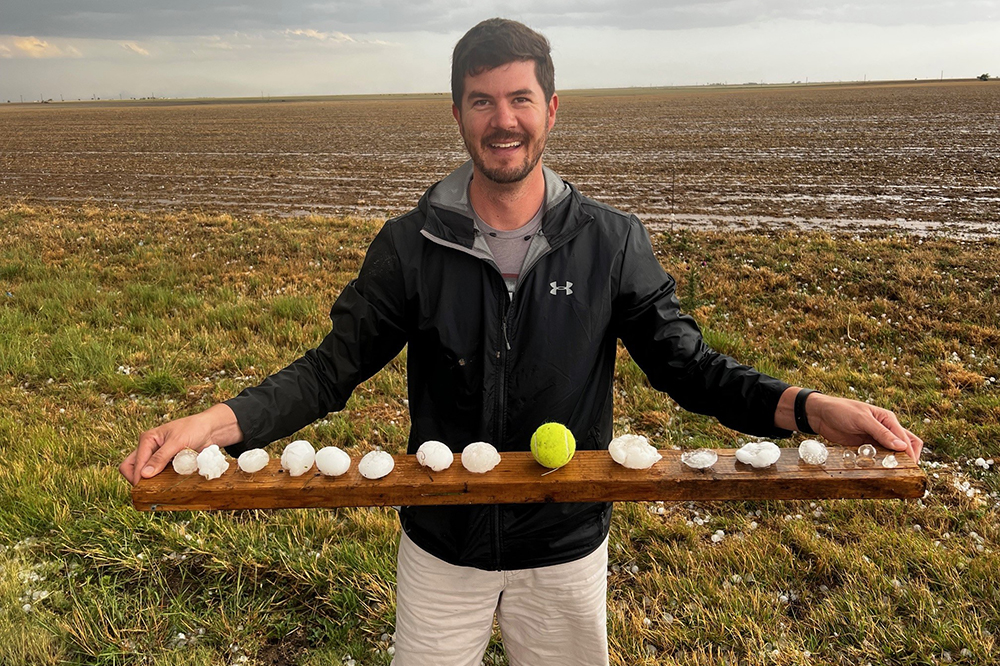
Yes. Climate researchers predict storms that produce golf ball-size or larger hail will become more frequent, thanks to climate change.