
Own Your Web – Issue 14: Webmentions
Hi All! 🤗 Imagine, just for a second, a future in which we all have our own websites and that those sites are at the center of everything we do and create...
Hi All! 🤗 Imagine, just for a second, a future in which we all have our own websites and that those sites are at the center of everything we do and create...

A little tale about how I've implemented Webmentions on this website, as a guide for future seekers. As a bonus, I also talk about IndieAuth!
An RSVP is a reply to an event that says whether the sender is attending, is not attending, might attend, or is merely interested.
Sharing what I learned at Homebrew Website Club London.
Service Design, Enterprise Design, UI, UX, HTML, CSS and IndieWeb
An API of helper function for providing and consuming webmentions - glennjones/webmentions

Fun with SQLite and range requests
A personal feed for Neocities, GitHub Pages, or anywhere else, built with Hugo. #IndieWeb friendly and all yours. It's better than Twitter. - victoriadrake/neofeed-theme
h-entry is the microformats2 vocabulary for marking up blog posts, from articles to notes to replies and more, or episodic or time-series based content in general on web sites, typically inside an h-feed.

Some WordPress and ClassicPress plugins I've used and which ones I recommend.
This is an enhancement or feature. Summary Add microformats to markup Context See #3017
Marking up relevant content with microformats and adding the ability to receive webmentions

My entry into the Lobsters Blog Carnival, detailing the creation of my sharefeed Chrome extension and the side-adventure I took in trying to make it even better.
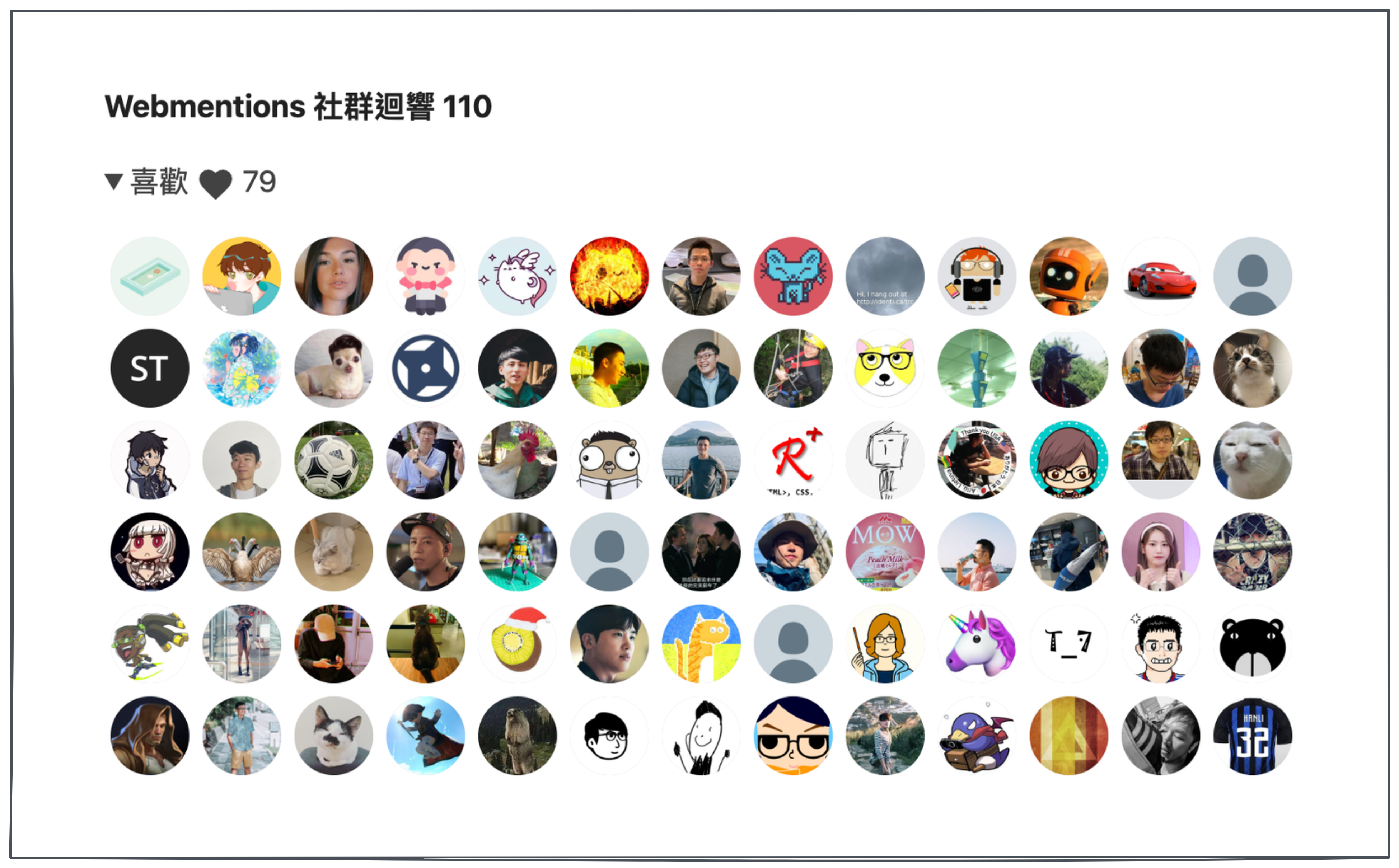
當初選擇自架 blog,除了因為線上 blog 平台不能完美的滿足自己紀錄技術文的需求以外,希望可以自己能設計出自己喜歡風格的個人網站...

A small dive into one of my new favourite web technologies: webmentions. This post talks through how I use them to make my static website feel more alive and social.
Microformats are standards used to embed semantics and structured data in HTML, and provide an API to be used by social web applications, search engines, aggregators, and other tools. These minimal patterns of HTML are used for marking up entities that range from fundamental to domain-specific information, such as people, organizations, events, and locations.

This site now supports sending and receiving webmentions and surfacing structured data using microformats2.

One of the goals of the IndieWeb is to be independent from centralized platforms without losing contact to friends. Besides of the POSSE principle the IndieWeb communityuses Microformats2 to create structured data with HTML and Webmentions to communicate with other websites.

Connects your web site to social media. Likes, reposts, mentions, cross-posting, and more...
Bridgy Fed is a bridge between decentralized social networks like the fediverse, Bluesky, and web sites and blogs.
Push notification adapter for feeds. Contribute to PlaidWeb/Pushl development by creating an account on GitHub.

I want to get the data set up in an HTML block a user can style
Disruptive Library Technology Jester Blog Posts

The HTML time element is both useful and easy to use.
Hi All! 🤗 Imagine, just for a second, a future in which we all have our own websites and that those sites are at the center of everything we do and create...
I did participate in the IndieWebCamp Nuremberg 2023 and made a few updates to my main site and my less polished blog.
Microformats are standards used to embed semantics and structured data in HTML, and provide an API to be used by social web applications, search engines, aggregators, and other tools. These minimal patterns of HTML are used for marking up entities that range from fundamental to domain-specific information, such as people, organizations, events, and locations.
h-entry is the microformats2 vocabulary for marking up blog posts, from articles to notes to replies and more, or episodic or time-series based content in general on web sites, typically inside an h-feed.
Browser reading modes use a completely non-standard rendering mode and implementations vary greatly from browser to browser.

Hell has frozen over …you can now comment on my site. But there’s a catch.
Bridgy Fed is a bridge between decentralized social networks like the fediverse, Bluesky, and web sites and blogs.