
GeistHaus
log in · sign up

Move fast, stay safe

federal-field-notes.ca

A strategy for agile teams in enterprise orgs.

4 pages link to this URL
Three suggestions for the next President of SSC

In early 2022, the President of Shared Services Canada (SSC) announced that he was retiring. In what has accidentally become a tradition, below are some suggestions for the next president to take on the role: start moving to zero trust networking and away from perimeter defence; enable the rapid, secure adoption of third-party software-as-a-service tools at scale; and incrementally make SSC services optional instead of mandatory.

0 inbound links article en CC BY 4.0
Enterprise architecture is dead

When I rejoined the federal government in 2016, our team’s desks were around the corner from a large team working on a financial management transformation project – the walls of their area covered in mesmerizing, plotter-printed posters. This was my first introduction to enterprise architecture. If you haven’t worked in government IT, it can be hard to describe, but if you’ve seen business capability models, target state architectures, TOGAF frameworks, or architecture review committee presentation decks, hello. You’ve met enterprise architecture.

1 inbound link article en CC BY 4.0
Shrink projects to fit leadership turnover rates

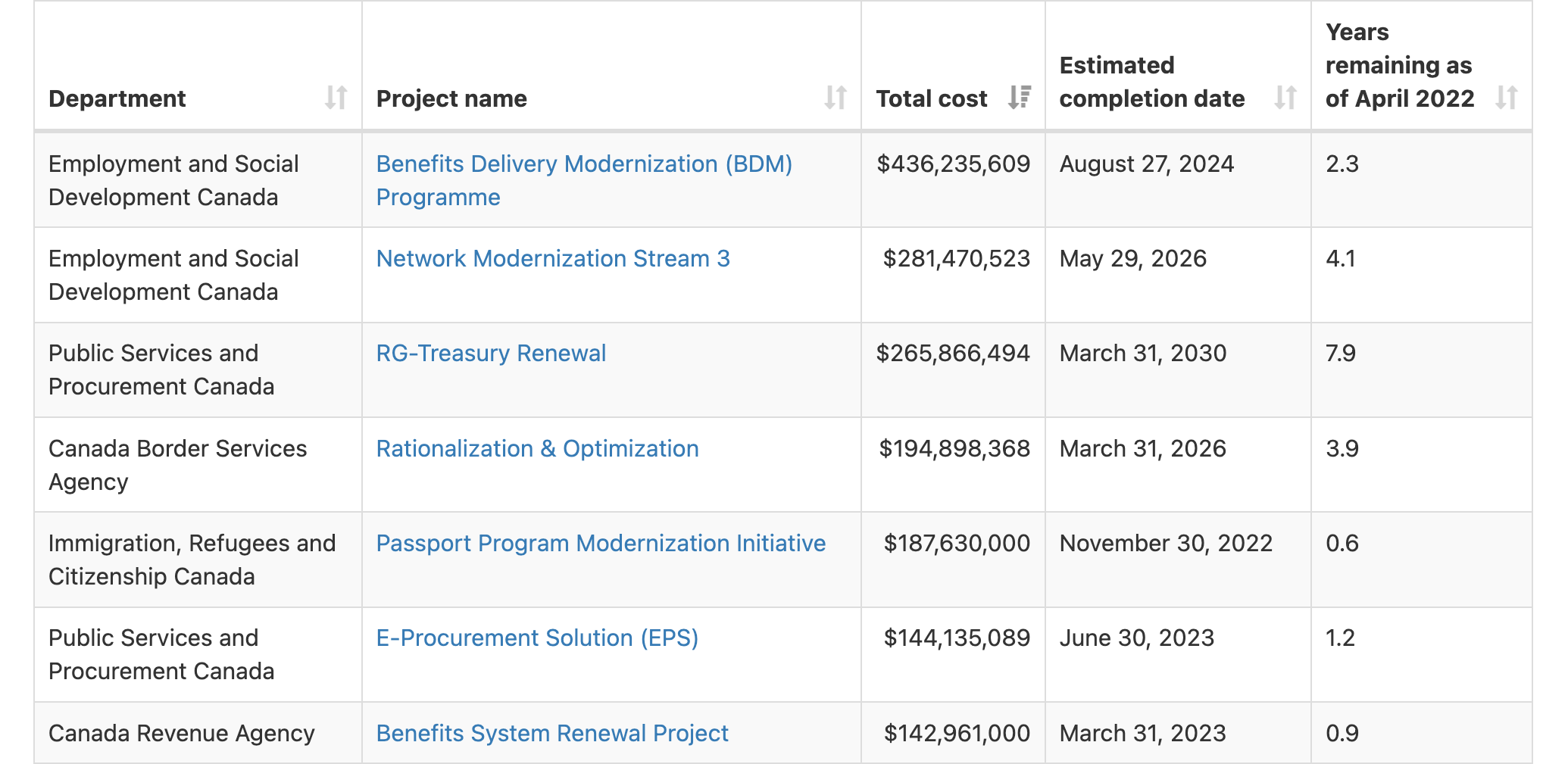
A few years back I remember reading about bike infrastructure improvements in Seville, Spain, where the city had built 80 kilometres of protected bicycle lanes in 18 months. The key to Seville’s approach was starting and finishing the infrastructure project within a single mayoral political term. Government IT projects could learn a lot from this. DM and ADM turnover is estimated at 1-3 years in the same department; most major IT projects outlast the executives that are nominally in charge of them. With no one dedicated at the helm, a project’s own momentum can easily carry it along a failure-bound trajectory for years.

0 inbound links article en Software experts in the US government CC BY 4.0
If you use project gating, you’re not agile

Short feedback loops are the secret to good software (and good IT projects), and years-long, pre-planned waterfall approaches are a fundamental barrier to achieving them. In the Canadian government, “project gating” is the main form this takes, where departmental teams seek approval (one gate at a time) to initiate a project, to get funding, to outline a project plan, an implementation plan, and a variety of other steps that eventually lead to building or procuring an IT system. Project gating is a relic from 25 years ago, and it’s past time for us to leave it behind.

0 inbound links article en CC BY 4.0