Indieweb
Recently, [@ttscoff](https://twitter
Recently, [@ttscoff](https://twitter

A look at what the IndieWeb is, why you should care, and how to get started with it.

A little tale about how I've implemented Webmentions on this website, as a guide for future seekers. As a bonus, I also talk about IndieAuth!


There’s a better way to own and control your online identityThis post was originally published on Chris Aldrich
Service Design, Enterprise Design, UI, UX, HTML, CSS and IndieWeb

Make your blog ready for social interaction via Webmentions

Nowadays whether you’re consuming or sharing content on the web, it is likely to be via a big website. Twitter, Youtube, or a Facebook-owned service are popular examples. Whilst this gives us the advantage of being able to participate in a larger conversation at almost no monetary cost, there is also the downside of potentially losing all our content if a company closes, as has happened in the past. There is an alternative to corporate bubbles online — it’s called the IndieWeb. Build your own personal websites, control your online presence, and learn on your own terms.
當初選擇自架 blog,除了因為線上 blog 平台不能完美的滿足自己紀錄技術文的需求以外,希望可以自己能設計出自己喜歡風格的個人網站...
No, it was always irrelevant if you had your own domain and site. Everything else is optional.

Large language models and their associated bots are bad for the indie web in at least three ways: 1) their logistical consequences are bad for bandwidth, 2) their social consequences are bad for guides, and 3) their citational consequences are bad for surfability.
Brandon's Toots from Mastodon

The indieweb is all the rage, especially as we saw the large social media conglomerates, that once replaced it, start to crack. But what is the indieweb? And how do you get there? All this, and more, in this blogpost (on the indieweb I guess). The indieweb - a web of good intentions The indieweb describes the web of personal blogs, homepages about special interests made with love, and handcrafted personal web presences. You know, the stuff you think about when you think of the internet of the early to mid 2000s. Questionable use of HTML-styling, actual people behind every page, the only metric of engagement being a visitor counter that proudly presents a different randomly generated number on every page load. No corporations, no dark patterns, just people living in the moment.

Money and tech have a complicated relationship. We trained our users to expect things for free. Quickly we realized that wasn’t a sustainable business model, so we sold their data and served …
Transcription of my talk for the OpenUK meet-up. Sharing my journey from being a creative teenager building websites in the early 2000s to becoming involved with IndieWeb through the London Homebrew Website Club.

The IndieWeb is essentially by developers for developers, and I think that’s fine because I’m unconvinced that its technologies are all that important
a tiny technical blog.
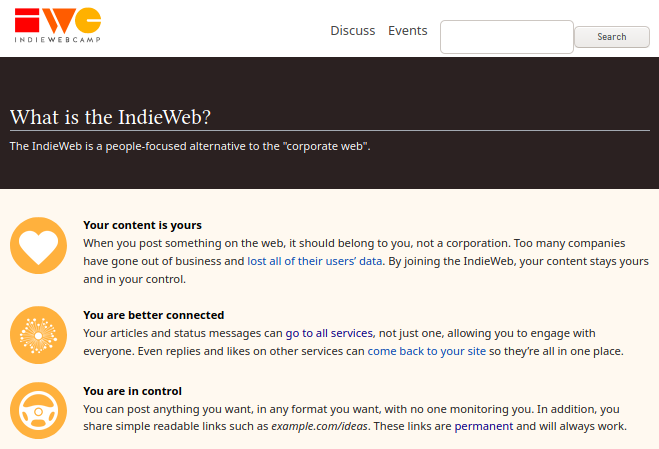
We should all own the content we’re creating, rather than just posting to third-party content silos. Publish on your own domain, and syndicate out to silos. This is the basis of the “Indie Web” movement.

I have been busying myself with bloghopping and checking out blogging communities/webrings for the past week, thanks to the renewed sense of excitement in blogging after checking some blogs on Neocities, and I found this one particular community: IndieWeb. I was initially skeptical about myself joining the community, mostly because, from where I come from, […]

A rundown of all the resources that was used to create BurgeonLab.com, including sections on AI usage and privacy.
How creative ambition transforms into a trap of endless expansion, examining YouTube essayists, neoliberal work culture, and the pressure to constantly optimize artistic output
The IndieWeb is essentially by developers for developers, and I think that’s fine because I’m unconvinced that its technologies are all that important
The Indie Web is a movement of independent people on the web, each curatingtheir own patch of the internet. Sometimes these patches are called blogs, orgarde...

After two years of building and running my own fully featured Webmention server, I think it’s …

Treating your personal website like a garden you tend continuously, not as a finished construction, but rather cultivated, authentic fragmented of web.
I stumbled across Indie Web today, and I think it’s a neat idea. Essentially, it’s a set of philosophies and toolsets to allow indie websites to communicate amongst each other, establish a standard for using your domain as an identity, and a way for websites to parse html as rss feeds. Webmention is the most interesting out of all of their various projects, which is essentially a modern replacement for pingbacks, if you remember those - I certainly did not.