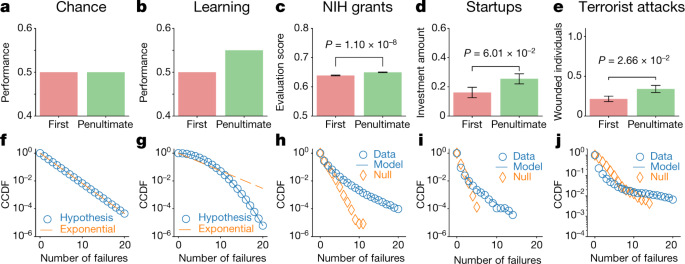
A model demonstrates that people who eventually succeed and those who do not may initially appear similar, but are characterized by fundamentally distinct failure dynamics in terms of the efficiency and quality of each subsequent attempt to succeed.
Citations are widely considered in scientists’ evaluation. As such, scientists may be incentivized to inflate their citation counts. While previous literature has examined self-citations and citation cartels, it remains unclear whether scientists can purchase citations. Here, we compile a dataset of ~1.6 million profiles on Google Scholar to examine instances of citation fraud on the platform. We survey faculty at highly-ranked universities, and confirm that Google Scholar is widely used when evaluating scientists. We then engage with a citation-boosting service, and manage to purchase 50 citations while assuming the identity of a fictional author. Taken as a whole, our findings bring to light new forms of citation manipulation, and emphasize the need to look beyond citation counts.
A model demonstrates that people who eventually succeed and those who do not may initially appear similar, but are characterized by fundamentally distinct failure dynamics in terms of the efficiency and quality of each subsequent attempt to succeed.
Detailing yet another citation manipulation scheme in Google Scholar