Semiconductor chip stocks are declining to open this week’s trading cycle, with Sandisk (SNDK) and Micron (MU) in…
Show full content
Semiconductor chip stocks are declining to open this week’s trading cycle, with Sandisk (SNDK) and Micron (MU) in focus. Both stocks fell around 1% to open Tuesday’s trading, but have tanked over 13% each in the last five days. After a short-term climb in semiconductors last week, the end of last week into the present day has been a rough period for the chip stock sector. SNDK and MU are some of the biggest slip-ups, but why is that?
Despite reporting blowout corporate earnings driven by an unprecedented AI memory supercycle and soaring demand for data center hardware, the chips sector has been hit by the reality of surging bond yields. The 10-year US Treasury (^TNX) yield has jumped to a 12-month high of 4.61% amid rising inflation fears. The rising yields do not bode well for chip stocks, as is reflected in Sandisk and Micron’s recent performances.
The yield on 30-year US Treasuries climbed above 5.18%, reaching its highest level in nearly 19 years. Higher yields may increase mortgage and credit card borrowing costs, potentially weighing on consumer spending, while also adding pressure to highly valued technology and semiconductor stocks. Furthermore, Recent US data suggests inflationary pressures may be picking up again, partly due to higher oil prices following escalating tensions around Iran.
“While bond yields have been rising, the speed of the adjustment is important and could become a trigger for an equity correction,” Goldman Sachs strategist Peter Oppenheimer pointed out in a new note today. “Sharp bond yield moves have coincided with negative equity returns. The surge in government borrowing is an additional factor pushing up longer-dated yields across bond markets.”
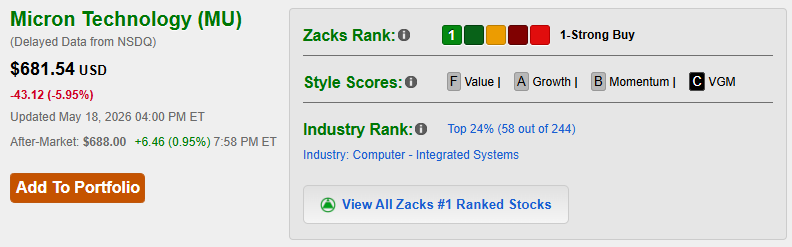
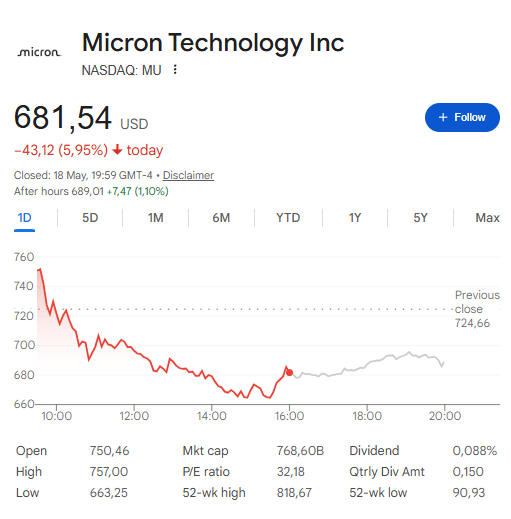
Despite today’s dip, Wall Street recently handed Micron (MU) a notable price target increase on May 18, 2026. Both HSBC and Melius Research lifted their outlooks to $1,100 on the same morning. Shares closed at $681.54, down 5.95% after opening at $750.46.
Google stock is getting a fresh upgrade from Wall Street on a big day for Alphabet investors. The…
Show full content
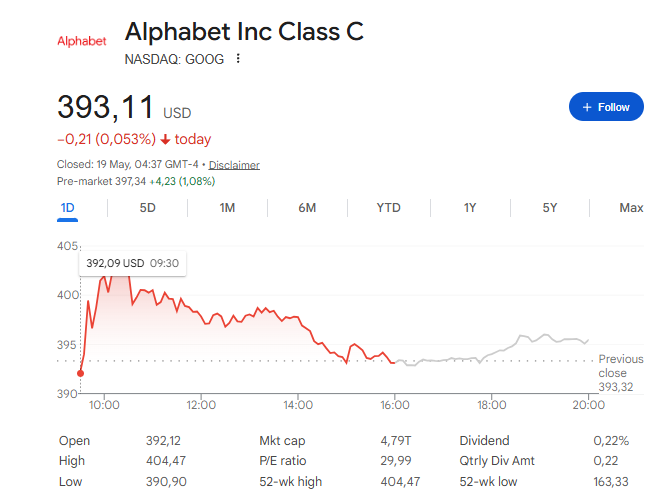
Google stock is getting a fresh upgrade from Wall Street on a big day for Alphabet investors. The Google I/O developer conference is underway right now, with CEO Sundar Pichai’s keynote kicking off at 10:00 AM PT on May 19, and the session opened with some real momentum. GOOGL started the day at $392.12, jumped to an intraday high of $404.47, and closed at $393.11, just a touch below the previous close of $393.32. Pre-market had also shown enthusiasm, with the stock up 1.08% to $397.34 before the open. Bank of America analyst Justin Post reset his outlook on the stock just ahead of the event, putting a Google stock price target of $430 on the table, based on a 28x multiple of estimated 2027 core Google earnings per share plus cash, and keeping his buy rating in place.
Source: Yahoo Finance
At the time of writing, Alphabet Class C shares trade at $393.11, so the BofA price target implies solid upside from where the stock sits today. Google stock has also climbed 25.34% year to date, making Alphabet the strongest performer in the Magnificent 7 and well ahead of the S&P 500’s 8.4% gain over the same stretch, according to Yahoo Finance data.
Google Stock Upgrade, BofA Price Target And AI At I/O Outlook
Source: Private Banker International
What BofA Expects From the I/O Conference
The Google stock upgrade comes with some caveats. BofA analysts noted that expectations heading into the developer event are high, and that a lack of a standout announcement could pressure the stock in the near term. Post and his team laid out a fairly detailed picture of what they are watching for from Alphabet this week.
BofA analyst Justin Post wrote in a research note ahead of Google I/O:
“We think Google could enhance its AI subscription offerings within premium Pro and Ultra tiers focused on higher limits, and broader agent capabilities, while extending AI bundling across the hardware ecosystem and Chrome.”
Beyond subscriptions, the BofA team also flagged the newly launched AI-first laptop category, referred to as “Googlebook,” integrated with Gemini workflows. Updates on Project Aura, next-generation smart glasses in development with XREAL and targeting a possible second-half 2026 release, are also on the agenda. Wear OS upgrades, Gemini-powered automotive experiences, and Pixel 11 hardware previews round out the list of expected announcements.
Strong Fundamentals Back the Google Stock Price Target
The Google stock upgrade also has some pretty strong numbers behind it. Google Cloud posted 63% year-over-year revenue growth in Q1 2026, passing the $20 billion mark for the first time, while Search revenue grew 19% in the same quarter. The company’s revenue backlog from Google Cloud alone now stands at $462.3 billion in remaining performance obligations, a number that reflects just how much enterprise demand Alphabet has locked in.
Post has also pointed out that Alphabet historically traded at around 22x earnings over the past decade, and he thinks the current multiple expansion is reasonable given the company’s AI positioning and growth outlook. Oppenheimer analyst Jason Helfstein also raised his price target to $445, citing higher estimates for Google Cloud Platform. Wall Street’s overall consensus sits at a Strong Buy, with an average target of $426.44 across 28 buy ratings and five holds, according to TipRanks.
Google IO AI Announcements and the Risks Analysts Are Watching
On the Google IO AI front, BofA sees real potential for Gemini innovation to drive Cloud adoption and bring material improvements across Google’s product lineup. The Alphabet stock I/O conference is also set to showcase the company’s push deeper into hardware and operating system integration, areas where Alphabet has historically played a supporting role but now wants to lead.
Risks analysts flag include loss of search traffic to AI competitors, slower-than-expected LLM integration in Search, and potential regulatory pressure from the EU Digital Markets Act. Post also acknowledged that additional AI announcements will be needed to justify further multiple expansion beyond the current BofA price target.
With Google I/O underway today, the next 48 hours are a real test for whether Alphabet can back up the elevated expectations that analysts and investors have been building around Google stock heading into this event.
Solana (SOL) made an attempt to breach the $100 price level earlier this month, albeit without success. The…
Show full content
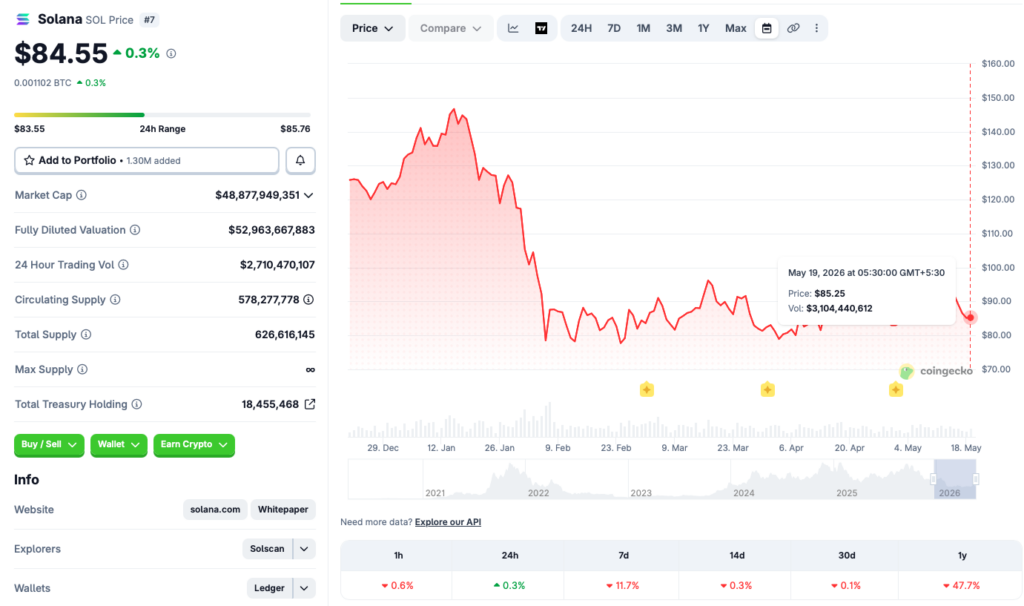
Solana (SOL) made an attempt to breach the $100 price level earlier this month, albeit without success. The asset has faced a price correction since then, falling to the $84-85 support level. According to CoinGecko data, SOL’s price has gained 0.3% in the last 24 hours, but is down by 11.7% in the weekly charts, 0.3% in the 14-day charts, 0.1% in the last month, and 47.7% since May 2025. Let’s discuss why Solana (SOL) is facing a price crash, and if the asset has a chance to rebound soon.
Source: CoinGecko
Why Is Solana Facing A Price Crash? Will It Rebound?
Source: Journal du Coin
Solana’s (SOL) latest dip comes amid a larger market-wide correction. Bitcoin (BTC) fell to the $76,000 level after climbing to $82,000. Most other assets are following BTC’s trajectory. BTC’s dip is likely triggered by higher than expected inflation figures. Rising crude oil prices and high bon yields have risen concerns about the macroeconomic state. The development has led to a decline in the expectations of an interest rate cut. Higher rates could lead to Solana (SOL) and other cryptocurrencies continuing their downward trajectories.
On the other hand, the highly anticipated CLARITY Act cleared the Senate Banking Committee. Although the move is another step towards clearer regulations in the US, the legislation could face additional challenges. Solana’s (SOL) price could take another hit if the bill does not pass into law. Banking groups have asked for stablecoin yields to be prohibited, while some Senators have asked for more ethical language around people in power investing in cryptocurrencies.
The cryptocurrency sector has struggled to gain steam since late 2025, after investors began a risk-off approach. With geopolitical tensions and macroeconomic worries seeing no end, there is a high chance that Solana (SOL) and the larger crypto market will continue on a sideways trajectory, if not face another dip.
Wall Street handed Micron Technology (NASDAQ: MU) a notable price target increase on May 18, 2026, as both…
Show full content
Wall Street handed Micron Technology (NASDAQ: MU) a notable price target increase on May 18, 2026, as both HSBC and Melius Research lifted their outlooks to $1,100 on the same morning. Shares closed at $681.54, down 5.95% after opening at $750.46, and the stock also carries a Zacks #1 Strong Buy rating right now, landing in the top 24% of all tracked industries.
Source: Zacks
That backdrop is what makes the debate over whether to buy or not so interesting at the moment: two major upgrades, a vocal Cramer endorsement, and still a meaningful gap between where the stock trades and where analysts think it goes.
Micron Technology (MU) closed at $681.54 on May 18, 2026, down 5.95% on the day. 52-week range: $90.93 to $818.67 Source: Yahoo Finance
Micron Stock Upgrade and Buy or Not Debate After Cramer Signal
Source: TradingKey
Two Firms, One Number, One Day
HSBC analyst Ricky Seo raised his price target on MU to $1,100 from $750, keeping a Buy rating, and anchored the upgrade to a four-to-five year memory upcycle that he thinks runs longer than the sector’s typical two-to-three year pattern. He also flagged Nvidia’s Rubin Ultra chip, which looks set to need around 3.5 times more DRAM than current models do, and projected the DRAM and NAND markets to grow 69% and 62%, respectively, in 2026. That kind of demand visibility is a big part of why he sees the current dip as an entry point rather than a warning sign.
Melius Research analyst Ben Reitzes also moved to $1,100 the same morning, raising from $700 while keeping Buy. He also lifted long-term estimates across all of Melius’s Buy-rated “bottleneck stocks,” including SanDisk, AMD, Intel, and Marvell. Reitzes had this to say about the broader setup:
“Nothing really emerged as incrementally good from Trump going to China, [but] we feel incrementally good about memory and AI semiconductor companies.”
His initiation note from late April described the structural case in even sharper terms:
“AI-driven demand for memory [is] unlike anything the semiconductor industry has experienced before.”
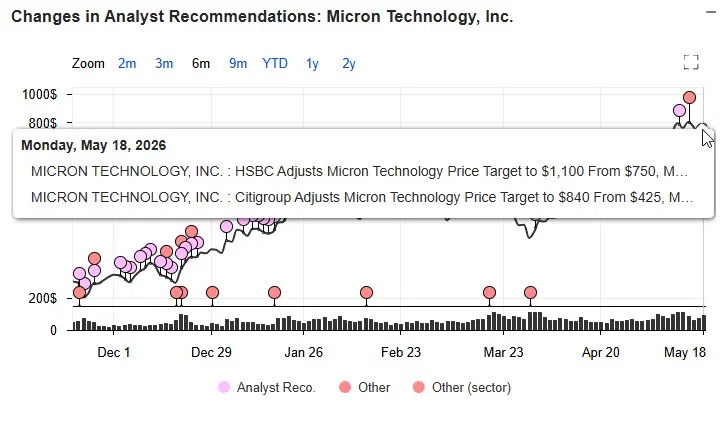
Chart showing changes in analyst recommendations for Micron Technology from December 2025 to May 2026, with the stock price climbing from around $200 to above $800. A tooltip dated Monday, May 18, 2026 highlights two upgrades: HSBC raising its price target to $1,100 from $750, and Citigroup raising its target to $840 from $425 Source: Market Screener
Jim Cramer Calls It a Buy, Not a Panic
Source: CNBC
CNBC’s Jim Cramer also weighed in on the selloff, framing the day’s drop as a shopping opportunity. He told viewers to stop panicking about Micron and start accumulating. On the Micron stock buy-or-not question, Cramer did not hesitate. He called MU one of his:
“Absolute favorite stocks.”
He pointed to a gross margin trajectory heading from just under 46% toward the company’s guided range of 50.5% to 52.5%, and also described the broader semiconductor selloff as a sector rotation rather than any kind of fundamental deterioration. His advice was to scale into positions rather than trying to time an exact bottom. The stock already surged roughly 170% from its April lows, so Cramer also specifically cautioned against chasing it during rallies.
Micron sits right now as one of only three companies globally, alongside Samsung and SK Hynix, that can produce high-bandwidth memory at scale. HBM supply is essentially sold out through year-end, and Citigroup also moved its target to $840 from $425, maintaining Buy. The Micron stock buy now argument therefore has a fairly simple logic: constrained supply, surging AI-driven demand, and three separate firms all telling investors the current price understates where MU goes over the next year or two.
Goldman Sachs, though, holds a considerably more cautious target near $400, and a real group of skeptics keeps pointing out that memory markets stay cyclical. Once manufacturers scale production capacity around 2028, the supply tightness that justifies today’s premium pricing could ease quickly. The real test for the upgrade thesis lands on June 24, 2026, when Micron reports earnings and management is expected to update guidance on HBM supply and AI revenue. That report will give investors a much clearer read on whether the bulls or the bears have this one right.
The cryptocurrency market has seen substantial growth over the last decade and a half. While many have made…
Show full content
The cryptocurrency market has seen substantial growth over the last decade and a half. While many have made massive gains, several others have lost entire life savings. Let’s look at one rule that has often gotten good results, while also looking at how you can protect yourself in the crypto market.
One Rule In Crypto Markets To Make It Big
Source: WatcherGuru
One reason people enter the cryptocurrency market is to make it big in a short amount of time. While some have made it big in short time periods, most people make it big over the long term. Let’s look at Bitcoin (BTC), the original cryptocurrency. It is true that BTC has seen sudden price surges over the course of its history. However, these sudden bursts were followed by steep price corrections. BTC’s price hit an all-time high, breaching the $68,000 mark in 2021. However, the asset fell to the $15,000 level in 2022, before hitting $100,000 in 2024. Bitcoin then went on to hit an all-time high of $126,080 in 2025. However, BTC has since fallen by nearly 39%, according to CoinGecko’s Bitcoin data. BTC’s volatile movements mimic the larger cryptocurrency market sentiment.
Therefore, although you could make decent returns in the short term, entering the crypto market for the long term is both safer and more lucrative.
While the one rule for the crypto market is to enter for the long term, there is also the question about how to keep your cryptocurrency safe. The cryptocurrency sector has seen a significant number of exploits that have resulted in investors losing their holdings. Hence, if you are entering the crypto market for the long term, be sure to keep your cryptocurrencies and holdings in a cold wallet. This way, if an exchange is hacked, your investments are safe.
Micron stock price target got a double lift on Monday, with both Citi and HSBC raising their outlooks,…
Show full content
Micron stock price target got a double lift on Monday, with both Citi and HSBC raising their outlooks, and yet MU shares closed down nearly 6% at $681.54. The session opened at $750.46, touched a low of $663.25, and never really recovered. That two-day drop of roughly 13% is the worst stretch Micron stock has seen in over a year, and right now investors are trying to work out whether the Micron stock price today reflects a genuine shift in sentiment or just short-term noise after a massive run-up.
Micron Technology (MU) closed at $681.54 on May 18, 2026, down 5.95% on the day. 52-week range: $90.93 to $818.67 Source: Yahoo Finance
Micron Stock Price Today As MU Falls and Analysts Raise Outlook
Source: Barron’s
Citi and HSBC Both Raise the Micron Stock Price Target on the Same Day MU Drops
Citi raised its Micron stock price target to $840 from $425 on Monday, keeping a Buy rating in place. The firm pointed to Micron raising DRAM prices and also flagged that the DRAM upturn looks set to run through calendar 2027, with HBM pricing also moving higher given tight capacity. HSBC separately raised its target to $1,100 from $750, also maintaining a Buy rating. Melius Research analyst Ben Reitzes also moved his target up to $1,100 from $700, matching the new Street high.
Chart showing changes in analyst recommendations for Micron Technology from December 2025 to May 2026, with the stock price climbing from around $200 to above $800. A tooltip dated Monday, May 18, 2026 highlights two upgrades: HSBC raising its price target to $1,100 from $750, and Citigroup raising its target to $840 from $425. Source: Market Screener
“We feel incrementally good about memory and AI semiconductor companies despite no major encouraging signal from President Donald Trump’s trip to China last week.”
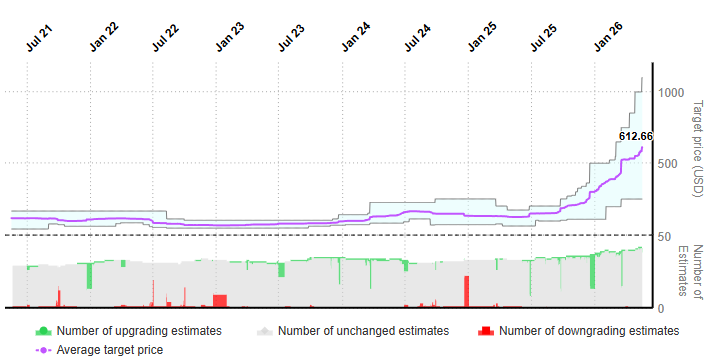
Across 44 analysts tracked right now, the mean consensus sits at Buy. The average target price stands at $612.66, with the high target at $1,100, a spread of +61.40% above the last close of $681.54.
Average analyst target: $612.66. sharp upward revision trend from mid-2025 onward Source: Market Screener
Why Is Micron Stock Dropping After a 140% Rally in 2026
MU shares surged more than 140% in 2026 and over sevenfold during the past 12 months, largely on the back of a severe AI-driven memory shortage. After hitting an all-time high of $818.67 just days ago, a pullback was something a lot of traders had already penciled in. The sell-off also picked up steam from a broader semiconductor slide after reports showed that major Chinese tech firms could not get US government approval to close H200 chip deals with Nvidia, and that rattled the whole AI hardware space.
On top of that, Samsung workers now threaten a general strike running from May 21 through June 7, demanding that the company direct 15% of operating profit toward bonuses. Jefferies estimates a large-scale walkout could knock out roughly 3% of global memory-chip production. JP Morgan analyst Jay Kwon addressed the longer-term picture on Monday. Kwon stated:
“We believe the memory industry is undergoing a pivotal inflection stage that could structurally improve its business model and pave the path for a valuation re-rate from traditional P/B [price-to-book] valuation to P/E [price-to-earnings] valuation.”
Micron Stock Price Target Increases Point to a Structural Story, Not Just a Cycle
The Micron stock price target increases from Citi, HSBC, and Melius all tie back to one core argument: HBM supply for the current year is essentially spoken for, and AI infrastructure spending keeps demand well above what Micron can currently ship.
Micron CEO Sanjay Mehrotra stated during the Q1 FY2026 earnings call:
“We are only able to meet about 50% to two-thirds of our demand from several key customers, and the gap between the demand and supply for all of DRAM, including HBM, is really the highest that we have ever seen.”
Micron stock falling this week, in other words, does not appear to change the fundamental picture analysts keep coming back to. The next real test for MU comes at the estimated June 2026 earnings report, where investors will get updated guidance on supply, AI revenue, and whether the micron stock price target consensus from Wall Street actually has legs.
Iran recently revealed its “Hormuz Safe” initiative that aims to use Bitcoin (BTC) to ensure safe passage of…
Show full content
Iran recently revealed its “Hormuz Safe” initiative that aims to use Bitcoin (BTC) to ensure safe passage of ships through the Strait Of Hormuz. According to the Iranian government, the move could generate $10 million in revenue. The move comes amid the US-Iran war seeing no end in sight. Let’s discuss what the move could mean for the country, and what it means for the US dollar.
What Does Iran’s Use Of Bitcoin Say About The US Dollar?
Source: WatcherGuru
Iran’s desire to use Bitcoin (BTC) is not entirely surprising, given that the country was oust of the US dollar-based system. According to cryptocurrency analysis firm CoinShares, Iran’s BTC adoption has significantly surged over the last few years. About 14 million Iranians use BTC, representing around one in six people. Annual transaction volumes have risen around 12% year-on-year, and represent about 2.2% of Iran’s GDP.
The US has increasingly weaponized the US dollar, especially against countries that have gone against American interests. Western sanctioned counties, such as Russia, Iran, and North Korea, have pivoted to cryptocurrencies, such as Bitcoin (BTC) to settle international trade. According to analyst Chris Bendiksen, sanctioned countries may be moving to Bitcoin (BTC) to bypass the global US dollar-based trade settlements system.
However, things may not pan out as Iran hopes. While using Bitcoin (BTC) could be a way to move away from the US dollar, BTC is an extremely volatile currency. Prices often see violent swings, and profits could fizzle out in a bear market. The US dollar, on the other hand, is a well-oiled machinery. Moreover, the dollar has the highest liquidity in the world, which makes transactions and settlements simple. While using BTC could be a way to navigate the current situation, it may not prove problematic in the long run.
Will Micron stock go up after one of the sharpest drops the chip sector has seen in recent…
Show full content
Will Micron stock go up after one of the sharpest drops the chip sector has seen in recent memory? MU shares closed at $681.54 on May 18, right after the stock hit an all-time high of $818.67 just days before, a gain of around 150% in about two months. The Micron stock plunge sent the price down nearly 6% in a single session and, at the time of writing, it has investors asking the obvious: why did Micron stock drop so fast, and is a real recovery ahead? Those two questions are really the whole story of where MU stands going into the rest of 2026.
Micron Technology (MU) closed at $681.54 on May 18, 2026, down 5.95% on the day. 52-week range: $90.93 to $818.67 Source: Yahoo Finance
Micron Stock Plunge, Forecast for 2026 And Why Did It Drop Analysis
Source: TipRanks
What Actually Triggered the Selloff
The Micron stock plunge today was not a single-cause event. A hotter-than-expected U.S. inflation report pushed Treasury yields higher on May 18, and that alone rattled AI and semiconductor names across the board. The PHLX Semiconductor Index fell more than 3% on the day, with Intel, Qualcomm, and AMD all getting pulled down alongside Micron.
Reports that major Chinese tech companies could not secure U.S. government approvals for Nvidia H200 chip deals also added another layer of uncertainty to the AI hardware space. There were also concerns around potential labor disruptions at Samsung, the world’s largest memory chip manufacturer. That kind of supply tightness could theoretically benefit Micron longer term, but the immediate reaction from the market was just more selling.
Technically, MU had formed a doji candlestick pattern near its $818 high, a classic reversal signal, and once the stock broke below $700 the momentum shift confirmed itself. The stock had surged from around $311 in March, and a pullback after that kind of run was something a lot of people on Wall Street had been expecting even before it happened.
Despite the drop, and despite all the noise around why Micron stock went down so sharply, the picture that management has painted looks a lot more stable. In the Q2 fiscal 2026 earnings call, CEO Sanjay Mehrotra stated:
“Micron set new records across revenue, gross margin, EPS, and free cash flow in fiscal Q2, driven by a strong demand environment, tight industry supply, and our strong execution, and we expect significant records again in fiscal Q3.”
And on the supply side specifically, Mehrotra was also pretty direct in an earlier call:
“The gap between the demand and supply for all of DRAM, including HBM, is really the highest that we have ever seen. We have completed agreements on price and volume for our entire calendar 2026 HBM supply.”
Will Micron Stock Go Up? What the Analysts Are Saying
The Micron stock forecast for 2026 stays broadly bullish across Wall Street, and that has not really changed after the recent selloff. Melius Research raised its price target all the way to $1,100, DA Davidson set its target at $1,000, and Bank of America lifted to $950, also citing a potential AI data-center market worth $1.7 trillion by 2030. Citi raised its target to $840. TD Cowen analyst Krish Sankar, one of the more closely watched chip analysts, kept his Buy rating and raised his own target to $660, describing the dip as a natural cooling-off period rather than any kind of structural breakdown.
Average analyst target: $612.66. sharp upward revision trend from mid-2025 onward Source: Market Screener
Goldman Sachs sits lower, at around $400, pointing to the cyclical risk that has historically hit the memory space hard, and also to Micron’s aggressive $25 billion capital expenditure plan for fiscal 2026 as a source of execution risk. That caution is not without basis. The memory market has seen these cycles before, and a lot of the bull case right now depends on AI demand staying structurally elevated rather than following the usual boom-bust pattern.
Mehrotra addressed that long-term thesis in a CNBC interview:
“AI is in very early innings; you just saw at GTC how much advances are being made in AI. And memory is a strategic asset; you need more memory, you need faster performance memory in order for AI to be able to deliver its full capabilities.”
Whether Micron stock will go up from these levels is a question that will get a lot clearer on June 23, 2026, when the next earnings report comes out. Consensus estimates right now sit at around $34.83 billion in Q3 revenue and adjusted EPS of $19.83. If those numbers land, the Micron stock forecast 2026 targets from the more bullish analysts start looking a lot less like wishful thinking. The Micron stock plunge, in that case, would simply have been a reset before the next leg higher.
How much will 2500 XRP be worth by the end of the next crypto cycle? Right now, 2,500…
Show full content
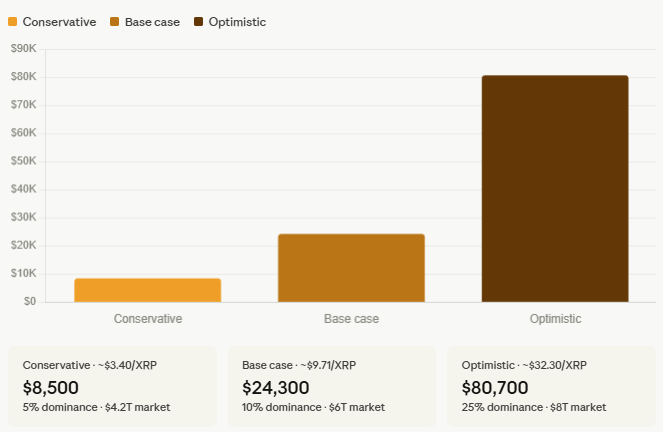
How much will 2500 XRP be worth by the end of the next crypto cycle? Right now, 2,500 XRP sits at around $3,650, based on a price of roughly $1.46. Analyst Steph Is Crypto built out three scenarios for what that same stack could realistically be worth by end of cycle, and the XRP price prediction 2026 picture from broader analysts adds some weight to those numbers too. The range is, well, pretty wide.
XRP Price Prediction in 2026, How Much will 2500 XRP be worth & Adoption Outlook
Source: Watcher.Guru
A Rarer Position Than Most Holders Realize
Holding around 2,200 to 2,500 XRP places an investor inside the top 10% of XRP holders globally. So the 2500 XRP value question isn’t just about price targets. It’s also about how significant a position that actually is, relative to everyone else in the market right now.
Three Scenarios, Three Very Different Outcomes
Steph Is Crypto built the projections around two variables: total crypto market size and XRP’s share of it. The previous cycle served as the baseline. The market grew from around $800 billion in 2022 to roughly $4.2 trillion in 2025, and also, XRP’s dominance climbed from about 1.5% all the way above 5% during that stretch. A lot of holders underestimate how much those two things, combined, can move a coin’s valuation, the analyst argued.
At the time of the analysis, XRP’s market cap sat near $90 billion, with dominance around 3.4%. Bitcoin was near 60% and Ethereum around 11%, and those comparisons are pretty central to how the scenarios get framed.
Bar chart showing the projected value of 2,500 XRP across three analyst scenarios for 2026. The conservative scenario estimates $8,500, based on 5% XRP market dominance and a $4.2 trillion total crypto market. The base case targets $24,300, assuming 10% dominance and a $6 trillion market. The optimistic scenario projects $80,700, based on 25% dominance and an $8 trillion total market. Source: Watcher.Guru using Steph Is Crypto’s data
The optimistic case leans on history. Back in 2017, XRP reportedly neared 25% dominance, and Steph Is Crypto used that as a reference point. The analyst also noted that XRP’s future performance largely depends on overall market growth and XRP’s ability to secure a larger market share over time.
What Other Analysts Say About XRP in 2026
Other analysts also weigh in on how much 2500 XRP will be worth, and the gap between the most conservative and the most bullish calls is significant. Standard Chartered analyst Geoffrey Kendrick projects XRP could hit $8 by end of 2026, citing ETF inflows above $1.15 billion and the regulatory clarity that followed Ripple’s SEC settlement.
Coinpedia’s longer-range forecasts suggest XRP could reach $5 to $6 by 2026 and potentially $18 by 2030, with institutional adoption and Ripple’s payment network partnerships driving that growth. CoinFomania’s machine learning model puts the 2026 average around $4.52, with a high near $5.13.
So the question of how much 2500 XRP will be worth doesn’t really have a single answer. At the conservative end, it’s a solid double from today’s price. At the base case, somewhere around $24,000. And at the top of the range, $80,700 from a $3,650 starting point is the kind of number that makes people hold through the dips. Whether 2,500 XRP is enough depends entirely on which scenario plays out, and the XRP price prediction 2026 outlook, both from Steph Is Crypto and from broader analyst coverage, points to a wide but generally upward range shaped by market growth and XRP dominance.
Zcash (ZEC) is showing strong growth despite a market-wide correction. According to CoinGecko data, ZEC’s price has surged…
Show full content
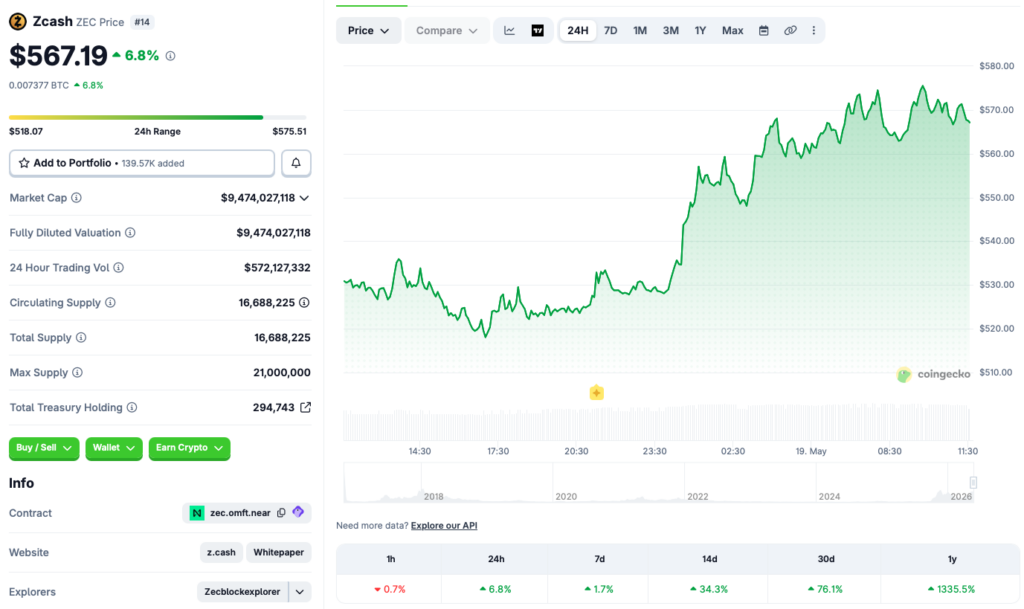
Zcash (ZEC) is showing strong growth despite a market-wide correction. According to CoinGecko data, ZEC’s price has surged 6.8% in the last 24 hours, 1.7% in the last week, 34.3% in the 14-day charts, and 76.1% over the previous month. Moreover, the privacy-focused cryptocurrency has registered a 1335.5% rally since May 2025. Zcash’s (ZEC) rally has far outshined the likes of Bitcoin (BTC), Ethereum (ETH), XRP, etc. Let’s discuss why the coin is going up, and if the pattern can sustain itself.
Zcash’s (ZEC) upswing comes amid the project announcing post quantum developments. According to Zcash Open Development Lab founder and CEO Josh Swihart, the project may be able to reach full post-quantum status within 12 to 18 months. According to Swihart, Bitcoin (BTC) is no longer the cypherpunk-grade money it once was.
Furthermore, there is also a proposal to reduce Zcash’s (ZEC) block time from 75 seconds to 25 seconds. Additionally, the project is also working for increasing scalability towards a Visa- and Mastercard-level throughput. The drastic reduction in block time and increased scalability could make ZEC a very attractive currency for settlements.
Can The Rally Continue?
The cryptocurrency market has faced a steep price correction over the last few days. Bitcoin (BTC) has dipped from the $82,000 level to $76,000. BTC’s correction is likely due to hotter than expected inflation data, rising crude oil prices, and high bond yields. The development has led to a dip in the expectation of an interest rate cut. In fact, many expect rates to be hikes, or kept unchanged. Zcash (ZEC) could face a correction if interest rates go up.
However, there has been a surge in the demand for privacy-focussed cryptocurrencies. Many people are becoming increasingly concerned about government surveillance and prefer to be anonymous. Zcash (ZEC), and other privacy-focused coins are catering to this group. If the demand continues, ZEC’s price rally could continue.
Bitcoin (BTC) seems to have found some footing at the $76k price level, having faced a steep correction…
Show full content
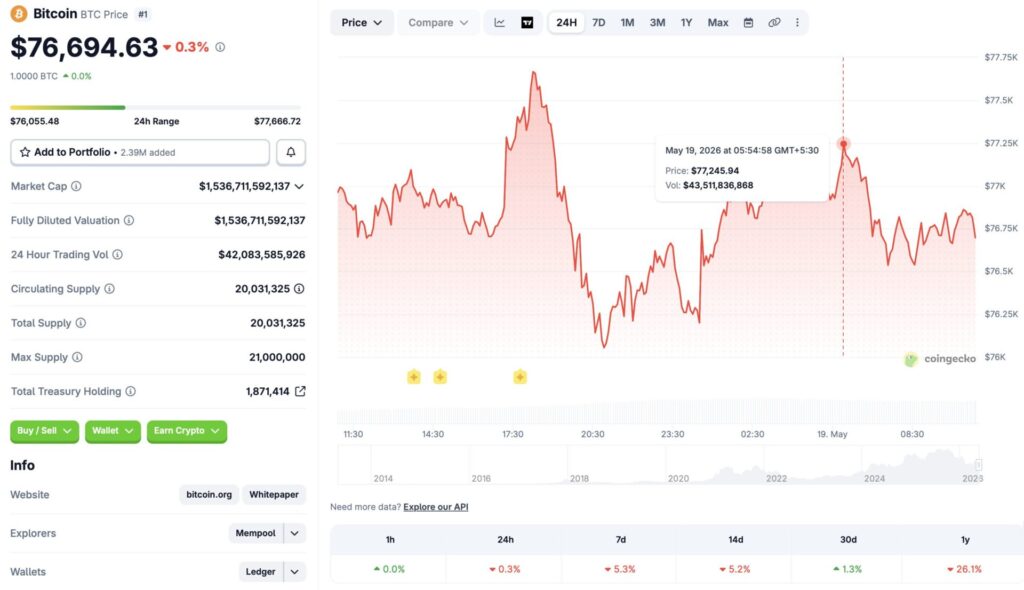
Bitcoin (BTC) seems to have found some footing at the $76k price level, having faced a steep correction over the last weekend. According to CoinGecko data, BTC’s price is down by 0.3% in the last 24 hours, 5.3% in the last week, and 5.2% in the 14-day charts. Despite the dip, BTC has maintained some gains in the monthly charts, rallying by 1.3%. Let’s discuss if the original cryptocurrency can see a rebound anytime soon, and what investors can expect next.
Source: CoinGecko
Bitcoin Price Correction: What To Expect Next?
Source: News.bitcoin
Bitcoin’s (BTC) price dip comes after higher than anticipated inflation data. Not only that, crude oil prices have gone up and US bond yields are also increasing. The development has put a thorn in the expectations of an interest rate cut from the new Federal Reserve Chair Kevin Warsh. Investors are now worries that they may instead face an interest rate hike. Such a move could lead to another price correction for Bitcoin (BTC).
On the other hand, the highly anticipated CLARITY Act cleared the Senate Banking Committee. However, the legislation could face resistance before the final vote. Bitcoin (BTC) could be impacted by the direction of the legislation. Several groups have asked for new language before the bill is passed into law. Some Senators want ethics language for people in power to not profit from cryptocurrency ventures. On the other hand, banking groups want to prohibit stablecoin yields to protect their own businesses. Bitcoin (BTC) could suffer if the CLARITY Act fails to go through.
Furthermore, the US-Iran conflict seems to see no end. President Trump rejected the ceasefire terms presented by Iran. If the conflict re-escalates, investors could move further away from risky assets. Bitcoin (BTC) and the larger crypto market could face another price dip under such circumstances. However, if the Middle East conflict comes to a conclusion, it could elevate investor sentiment.
Iran has announced it is launching a Bitcoin-backed insurance service for shipping companies wanting to transit the Strait…
Show full content
Iran has announced it is launching a Bitcoin-backed insurance service for shipping companies wanting to transit the Strait of Hormuz. The state-backed platform, called Hormuz Safe, aims to use cryptocurrency settlements to bypass Western financial systems and monetize Iran’s control over one of the world’s most critical shipping lanes.
JUST IN: Iran launches Bitcoin-backed insurance service for shipping companies wanting to transit the Strait of Hormuz. pic.twitter.com/kFHz14ZJfB
According to reporting from Fars news agency, Hormuz Safe is designed to issue maritime insurance policies and liability certificates for ships using the key shipping route, providing instant coverage upon payment confirmation, with policies digitally verified and settled in Bitcoin. It could generate more than $10 billion in revenue for Tehran, according to official estimates.
The launch comes less than a month after Iran began demanding Bitcoin for oil ships looking to transport through the Strait of Hormuz. The oil pathway has experienced significant disruption since the US and Israeli airstrikes against Iran began on Feb. 28, prompting Tehran and the Islamic Revolutionary Guard Corps to tighten control over the Strait. Due to several tightening restrictions and sanctions, Iran has begun favoring cryptocurrencies, including BTC and stablecoins, over recent years for global trade. Most recently, the country has told ship operators that passage through the Strait of Hormuz will require digital currency payments, including Bitcoin, with a proposed toll of roughly $1 per barrel for crude carriers, according to the Financial Times.
Iran’s new ordeals towards embracing Bitcoin at such a critical time signal renewed interest in the asset. The fact that Bitcoin was trusted at a time when geopolitical unrest was at its peak showcases how the asset is now slowly evolving into a dignified financial instrument worthy of trust and faith. Despite that, BTC prices fell over the weekend after tensions re-intensified between the US and Iran, sending the king coin south of $80,000. At press time, BTC trades at $76,000.
When will Amazon stock hit $500? Wall Street broadly expects that to happen somewhere between 2028 and 2030,…
Show full content
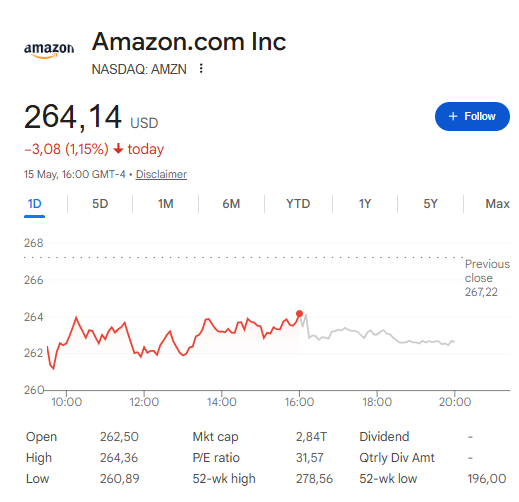
When will Amazon stock hit $500? Wall Street broadly expects that to happen somewhere between 2028 and 2030, with some longer-range forecasts pointing to as early as 2027. At the time of writing, Amazon (AMZN) trades at $264.14, and the average 12-month price target across 62 analysts sits at $315.94.
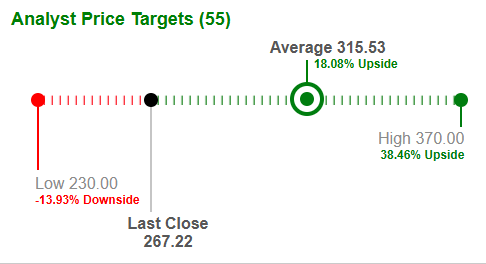
Analyst Price Targets chart: average $315.53, high $370.00, low $230.00 Source: TradingView
That is a long way from $500. Still, the Amazon stock bullish consensus is about as strong as it gets right now, with 95% of covering analysts rating AMZN a Buy or Strong Buy. The question of when will Amazon stock hit $500 keeps coming up in institutional research, and the answer depends on a few specific growth drivers.
Analyst Price Targets: average $315.53, high $370, low $230 Source: Zacks
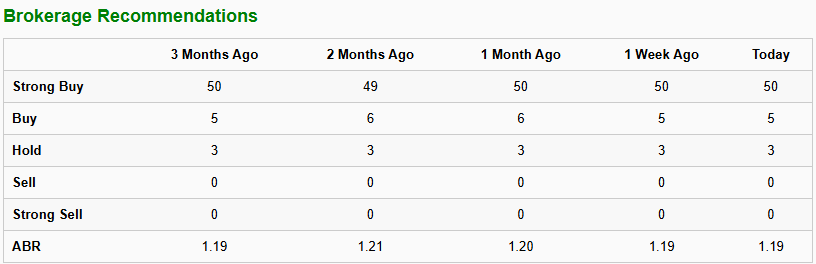
The average brokerage recommendation (ABR) sits at 1.19 and barely moved over the past three months. That signals strong conviction around will Amazon stock go up, even with broader market uncertainty in the picture. Any Amazon stock price prediction 2030 bull case builds on a few key drivers, and there is also a solid near-term story worth tracking.
Brokerage Recommendations: 50 Strong Buy, 5 Buy, 3 Hold, ABR 1.19 Source: Zacks
The Growth Story Behind $500
Amazon Web Services powers this whole thesis. In Q1 2026, AWS posted 28% year-over-year revenue growth, the strongest result in more than three years, and it runs at a margin above 35%. AWS accounts for over half of Amazon’s total operating profit, despite generating just over a fifth of overall net sales. The AI infrastructure boom feeds that growth directly, and Amazon’s custom Trainium chips now open up to third-party customers, adding a new revenue line on top of that.
Advertising and retail efficiency round out the thesis. The stock already ran 33% over the past three months, and Amazon stock bullish sentiment did not crack even when the market initially worried about the $200 billion capital expenditure plan for 2026. Net sales also grew 17% in Q1 2026, the strongest top-line result in nearly five years. That re-rating matters a lot for the Amazon stock price prediction 2030 outlook.
When Will Amazon Stock Hit $500 And What The Math Says
Amazon sits less than 6% away from a $3 trillion market cap right now. A $500 share price pushes that valuation well past that level. No near-term target from any of the 55 Zacks analysts gets close to $500 yet, with the highest at $370. So will Amazon stock go up enough to reach that number?
The bull case says yes, but it needs AWS and AI monetization to scale over several years. Will Amazon stock go up fast enough before the decade ends? Wall Street says probably. Even so, when will Amazon stock hit $500 stays a 2028 to 2030 question for now.
Why is Micron stock dropping? MU shares fell around 6.62% on May 15, closing at $724.99 after also…
Show full content
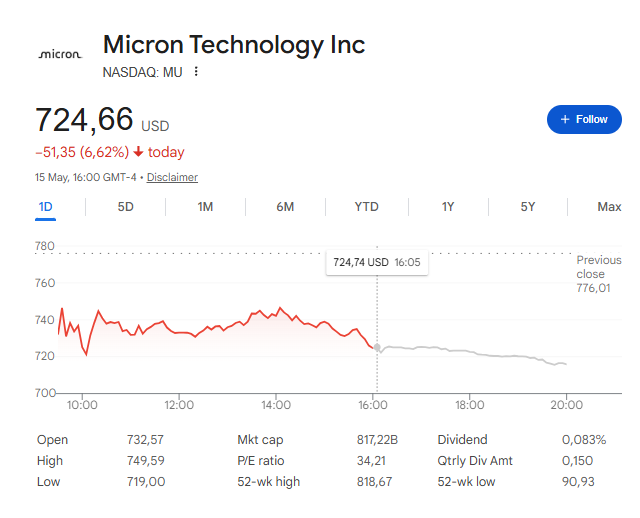
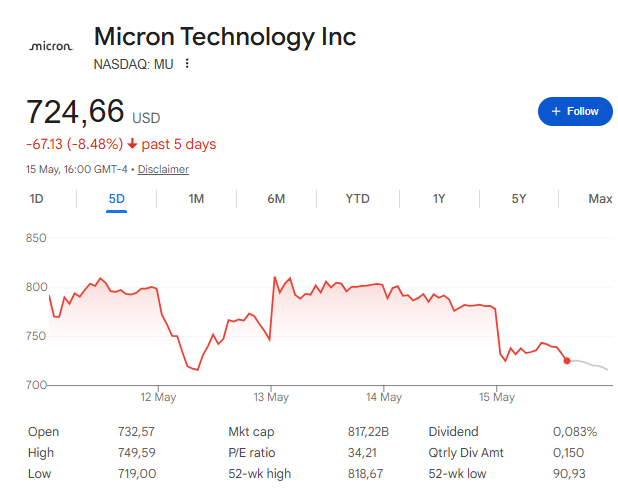
Why is Micron stock dropping? MU shares fell around 6.62% on May 15, closing at $724.99 after also reaching a fresh all-time high of $818.67 just days earlier. The decline came directly from news that Nvidia’s H200 AI chip deals with Chinese companies fell through following the Trump-Xi summit, and that alone was enough to drag the entire semiconductor sector lower. For investors now weighing the Micron stock buy or sell call, or wondering whether Micron is a good buy at current levels, the answer depends a lot on how seriously you take the China risk.
Source: Yahoo Finance
Why Micron Stock Dropping Amid AI Rally And Market Volatility
Source: TipRanks
The China Catalyst Behind the Drop
The immediate trigger for why Micron stock is dropping was a series of reports confirming that no actual H200 chip sales took place between Nvidia and Chinese firms after the summit. Earlier reporting had indicated the US was going to permit Nvidia to sell those chips to around 10 Chinese companies, but those deals also never turned into real purchases.
President Trump was asked about it and dismissed the concern. He had this to say, as reported by The Wall Street Journal:
“Because they chose not to. They want to try and develop their own.”
Further reporting confirmed that Alibaba and ByteDance got no authorization from the Chinese government to go ahead with purchases. The worry right now is that China is pushing hard to build a domestic chip industry rather than rely on US suppliers, and that is a real longer-term concern for companies like Micron.
Profit-Taking After a Historic Run
Whether Micron stock is a good buy also has to be read against the scale of the rally that came before this drop. Micron gained around 116% in roughly six weeks before the reversal. The stock had also climbed above $800 just days earlier, so a pullback was something a lot of traders had been watching for.
On the supply side, CEO Sanjay Mehrotra had already flagged just how tight things are. He told CNBC’s Squawk on the Street:
“Half to two-thirds of their requirements.” (referring to what key Micron customers receive due to the supply crunch)
Wall Street analysts still project 192% revenue growth for Micron this year, and the high-bandwidth memory market looks set to grow from $35 billion in 2025 to $100 billion by 2028. Micron also plans to put roughly $25 billion into capacity expansion during 2026, so the longer-term story has not really changed at the time of writing.
Will Micron Stock Go Down Further?
Whether Micron stock will go down further is the question a lot of investors are sitting with right now. The Micron stock price target across 46 analysts stays at a buy consensus, though the range is wide enough to show real disagreement about where things go from here.
So why is Micron stock dropping if the long-term demand story still holds up? Largely because valuations stretched very fast over a short period, and geopolitical headlines near all-time highs tend to pull profit-taking forward. Analysts noted that demand for AI infrastructure memory products stays extremely strong globally, and that Micron could offset weaker Chinese demand with sales elsewhere. Still, the memory chip market has also historically run in cycles, with periods of high pricing tending to bring oversupply once new capacity ramps up.
That risk, on top of the China uncertainty, is what the market is pricing in right now. Whether this turns into a bigger correction or just a brief pause is something investors tracking the Micron stock price target will need to watch over the next few weeks.
The cryptocurrency sector is know for its high risk and high volatility. While many have made big returns…
Show full content
The cryptocurrency sector is know for its high risk and high volatility. While many have made big returns in the crypto space, several have lost life savings in an attempt to make it big. If you are new to crypto, you may be worried about where to park your money. Let’s look at a few low risk crypto assets that new investors can consider.
3 Low-Risk Crypto Assets For New Investors
Source: WatcherGuru
While some coins may have lower risks, you should bear in mind that all crypto assets come with their fair share of risks. However, navigating the high-risk environment is needed to make gains in the cryptocurrency space. For example, memecoins carry some of this highest risks in the market. If you are new to cryptocurrencies, and are entering in a time of uncertainty, you could do away with investing in memecoins. Now, let’s look at what could be considered low-risk.
The first coin you should consider is Bitcoin (BTC). BTC is the market leader, and other assets tend to follow its trajectory. While BTC also carries high risk and volatility, it tends to set the tone for the larger cryptocurrency market. This makes BTC a solid investment for new investors.
The second coin that could help you negate the risks is XRP. While XRP has faced a steep price correction after hitting a peak in July 2025, the cryptocurrency is expected to recover in the next bullish out break. XRP has seen incredible adoption over the years, and the numbers are expected to continue surging in the time to come. XRP could prove to be a lucrative investment for the long term.
The third coin that could lower your long term risks is Solana (SOL). SOL is one of the most resilient cryptocurrencies in the market. This does not mean that SOL does not have have risks. The asset’s price fell to below $9 after the collapse of FTX in 2022. However, the cryptocurrency made a remarkable comeback in the following years. SOL’s incredible rebound is one major reason you should consider it for your portfolio.
The Amazon stock price target now ranges from $230 on the low end to a high of $370,…
Show full content
The Amazon stock price target now ranges from $230 on the low end to a high of $370, based on forecasts from 55 analysts tracked by Zacks and 62 from TradingView, with an average of $315.53 — that is an 18.08% upside from the last close of $267.22. The Amazon stock prediction for 2026 is about as bullish as Wall Street gets right now, with 86.21% of brokerage recommendations reading Strong Buy at the time of writing. Strong revenue growth, a dominant cloud business, and a market cap that came within 5.5% of $3 trillion earlier this month are all fueling the Amazon stock bullish case.
Analyst Price Targets chart: average $315.53, high $370.00, low $230.00 Source: TradingView
Amazon Stock Price Target And AMZN Highest Price Bullish Forecast
Source: CNBC
The $370 Amazon Stock Price Target
The AMZN highest price target of $370 came from The Benchmark Company’s Daniel L. Kurnos, up from a prior $275 and implying a 40.08% upside from the last close. Cowen and Company’s John R. Blackledge also moved his Amazon stock price target to $350 from $300 on May 12. Exane BNP Paribas went to $345 from $320 on May 5, and Jefferies and Company, Guggenheim Securities, and DZ Bank AG all landed at $320 around the same period.
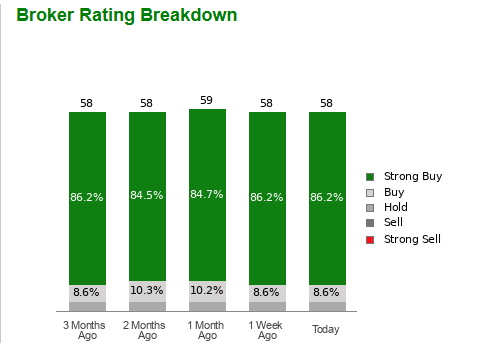
Of the 58 brokerages tracked right now, 50 carry a Strong Buy and five carry a Buy. Not a single Sell or Strong Sell rating is on record. The average brokerage recommendation sits at 1.19 out of 5, and Strong Buy ratings make up 86.2% of all recommendations across the board.
Broker Rating Breakdown: 86.2% Strong Buy across all tracked periods Source: Zacks
AWS and AI Are Driving the Amazon Stock Bullish Case
AWS grew net sales by 28% in Q1 2026, its strongest quarterly performance in over three years. The cloud unit contributes over half of Amazon’s total operating profit, and also runs an operating margin above 35% for the third consecutive year. That kind of margin profile on a business growing at 28% is a big reason the Amazon stock bullish narrative keeps getting reinforced by new analyst upgrades.
Amazon is also developing its own AI chips for AWS and opening those product lines to third-party customers. OpenAI committed to roughly 2GW of Trainium capacity, and Anthropic plans to use up to 5GW. Meta Platforms is deploying tens of millions of Graviton cores for AI workloads. These long-term commitments give a clearer picture of why the Amazon stock prediction for 2026 keeps trending upward, and also why analysts see the current Amazon stock price target averages as likely to keep moving higher.
Morningstar analyst Dan Romanoff stated:
“Over the long term, we expect e-commerce and international opportunities will pay off in retail; over the medium term, we believe the critical growth drivers will be AWS and advertising.”
Will Amazon Stock Go Up to $3 Trillion?
Amazon’s market cap sat at roughly $2.84 trillion as of mid-May, just 5.5% away from crossing $3 trillion. The stock also hit an all-time high of $278.56 on May 5, briefly putting that milestone within reach. Will Amazon stock go up to that level? Most analysts say it’s a matter of when, not if. The main obstacle at this point is a broad market pullback, which also happens to be the most plausible risk to watch.
Source: Zacks
Amazon trades at around 30 times forward earnings right now. A lot of analysts see that as fair, given net sales climbed 17% in Q1 2026, the company’s healthiest top-line growth in nearly five years. AMZN also rose 33% over the past three months, and the Amazon stock price target revisions from firms like Goldman Sachs ($325), KeyBanc ($330), and Scotiabank ($325) all point in the same direction. The AMZN highest price target at $370 and an average above $315 say a lot about where Wall Street thinks this stock goes next.
How low will Micron stock go? Right now, that question is sitting at the top of every MU…
Show full content
How low will Micron stock go? Right now, that question is sitting at the top of every MU investor’s mind. Shares touched an all-time high of $818.67 earlier last week and then fell roughly 7.3% on May 15, landing near $724 at the time of writing. The Micron stock prediction for 2026 has gotten a lot more complicated in a short period of time, with a 12-month bear target as low as $433 sitting against a five-year MU stock price target for 2030 that crosses $1,000. The 52-week low is also on record at $90.93, so the range investors are working with here is, well, enormous.
Source: Yahoo Finance
Micron Stock Forecast for 2030: Price Targets and Pullback Risks
Source: Watcher.Guru
Why MU Shares Dropped This Week
The Friday selloff was tied to a broader semiconductor slide after reports emerged that no AI chip deals got closed during the Trump-Xi summit in Beijing. Alibaba and ByteDance reportedly could not get Chinese government authorization to complete H200 purchases from Nvidia, and that uncertainty pulled Micron, AMD, Intel, and Qualcomm lower along with it.
President Trump addressed the situation directly, saying Chinese buyers “chose not to” purchase the chips and that they “want to try and develop their own.” The market did not take this well. Micron also surged nearly 62% in under a month going into last week, so conditions for a pullback were already in place.
The Bear Case and the Floor Analysts Watch
How low will Micron stock go in a realistic downturn scenario? Wall Street’s low-end targets range from $249 to $435. The 24/7 Wall St. 12-month call lands at $435.15, implying roughly 40% downside from current levels, a figure stated with 90% confidence. The 200-day moving average near $294 functions as a more constructive floor in some models. Also worth noting: as recently as FY2023, Micron posted a net loss of $5.8 billion on $15.5 billion in revenue, a reminder that this is still a cyclical business at its core.
Despite that near-term caution around the Micron stock prediction for 2026, the fundamental picture is hard to argue with. Fiscal Q1 2026 revenue hit $13.64 billion, up 56.6% year over year, and non-GAAP EPS of $4.78 beat the $3.94 consensus. Q2 guidance calls for $18.70 billion in revenue at a 68% gross margin, driven by High Bandwidth Memory and cloud demand.
During the Q1 FY2026 earnings call, CEO Sanjay Mehrotra stated:
“We are only able to meet about 50% to two-thirds of our demand from several key customers, and the gap between the demand and supply for all of DRAM, including HBM, is really the highest that we have ever seen.”
Bank of America raised its MU stock price target to $950 from $500 and kept a Buy rating on shares. The broader analyst consensus sits around $530, and the stock also carries 39 Buy ratings with zero Sell calls among tracked analysts at the time of writing.
Is Micron Stock a Good Buy? MU Stock Forecast for 2030
The Micron stock forecast for 2030 is where the long-term bull case comes into focus. According to 24/7 Wall St., the five-year bull case reaches $1,054, which on roughly 1.13 billion shares pushes market cap past the $1 trillion mark. Their projections assume roughly 20% annual bit shipment growth and sustained HBM market share:
Year24/7 Wall St. Price Target2026$433.932027$575.002028$750.002029$900.002030$1,025.00
Is Micron stock a good buy right now? The forward P/E sits near 8, unusually low for a stock this far into a rally. At the same time, the trailing P/E runs closer to 34. Cyclicals like this one historically face punishment before earnings prove out. Even more, 63 recent insider transactions skewed toward net selling add another layer of caution. How low will Micron stock go if those cyclical patterns reassert themselves? Bear case models go as far down as $269 in a severe downturn, though bulls counter that insider sales reflect equity comp vesting after a 700%-plus run. The Micron stock forecast for 2030 stays constructive on a long enough horizon, but the path, as analysts also note, is a bumpy one.
Ethereum (ETH) is facing a steep price correction amid a larger market-wide dip. According to CoinGecko data, ETH’s…
Show full content
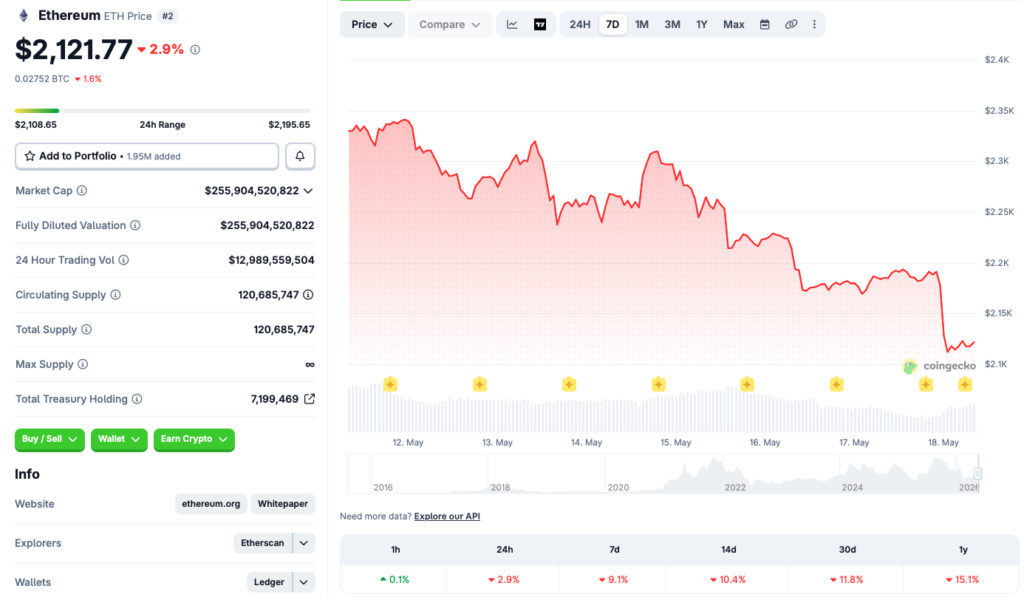
Ethereum (ETH) is facing a steep price correction amid a larger market-wide dip. According to CoinGecko data, ETH’s price has fallen by 2.9% in the last 24 hours, 9.1% in the last week, 10.4% in the 14-day charts, and 11.8% over the previous month. ETH seems to be holding the $2100 price for now, but things could change over the coming days. Let’s discuss if the second-largest cryptocurrency could fall below $2000, or will Ethereum (ETH) see a rebound.
Source: CoinGecko
Is Ethereum Facing A Risk Of Falling Below $2000?
Source: Pixabay
Ethereum (ETH) last traded at sub-$2000 price levels in late March of this year. ETH and the larger crypto market have been making slight gains over the last few months. Bitcoin (BTC) saw a recovery from the $62,000 mark in February to $82,000 earlier this month. However, the upswing was cit short amid macroeconomic and geopolitical tensions.
Ethereum’s (ETH) price dip is likely due to higher than anticipated inflation figures. The development has reduced that chances of an interest rate cut. Many were hopeful that the new Federal Reserve Chair Kevin Warsh will reduce rates after assuming office, as requested by President Trump. However, rates may have to remain unchanged, if not hiked further, to counter inflation.
Ethereum’s (ETH) price has also been impacted by rising oil prices and high bon yields. Rising oil prices have led to higher inflation, which has indirectly hampered the cryptocurrency market.
Given the larger bearish market environment, Ethereum (ETH) could fall below the $2000 mark if the current trend continues. According to prediction markets, there is a 56% chance that ETH will dip below $2000 before the end of this month. Nonetheless, the CLARITY Act is up for vote, which could elevate investor sentiment, if passed. However, a negative outcome could lead to additional confidence dip among investors.
ODDS OF ETHEREUM CRASHING BELOW $2,000 JUST FLIPPED MAJORITY
Prediction markets are increasingly pricing in downside risk for Ethereum, with traders now betting there is a 56% chance ETH falls below $2,000 before month-end. pic.twitter.com/LkuaPiccd4
The CLARITY Act (Digital Asset Clarity Act) is one of the most highly anticipated pro-crypto legislations in US…
Show full content
The CLARITY Act (Digital Asset Clarity Act) is one of the most highly anticipated pro-crypto legislations in US history. President Trump made the cryptocurrency industry a priority during his Presidential campaign. His promises of making the US a global cryptocurrency hub boils down to the Clarity Act going through. However, although the act cleared the Senate Banking Committee, it may still face challenges in the steps ahead. Let’s discuss why.
Why The Pro-Crypto Clarity Act May Face Headwinds
Source: WatcherGuru
The first challenge that the CLARITY Act may face is the lack of enough Republican votes. The legislation requires 60 votes, while there are only 53 Republican seats. This means that at least seven Democrats have to vote in favor of the bill. Now several Senators have asked for language change to prohibit the President and other positions of power from profiting from cryptocurrency investments. This aspect was especially targeted at President Trump’s crypto empire, which has drawn substantial flack over the last year.
Secondly, Wall Street banking groups are asking for changes int he Clarity Act to ban stablecoin yields. Stablecoin yields may greatly impact the banking sector as people may move away from traditional savings accounts, given their lower returns. Stablecoins have become a key pillar of the cryptocurrency sector, but have the potential to disrupt the banking sector.
Additionally, the Banking Committee text has to merge with another bill from the Senate Agriculture Committee. This could also pose problems. Any compromise text could lead to further opposition.
Moreover, the vote must happen by August of this year, else the midterm campaigns will take over. If the vote is missed, the next window may not open until the end of this decade.
Will The Market React To A Failure?
The cryptocurrency market is already facing a correction after higher than expected inflation data. Rising oil prices and high bond yields have further diminished the hopes for an interest rate cut. While many expected new Federal Reserve Chair Kevin Warsh to reduce rates after assuming office, chances are high that rates may remain unchanged, or may even go up, given the ongoing situation.
If the CLARITY Act fails, it could lead to a further dip in investor confidence. The CLARITY Act aims to bring more regulatory clarity and oversight to the crypto market. If it fails to go through, investors may feel unsafe to pour money into the high-risk sector.
While the larger crypto market is facing a price correction, TRON (TRX) is trading in the green zone.…
Show full content
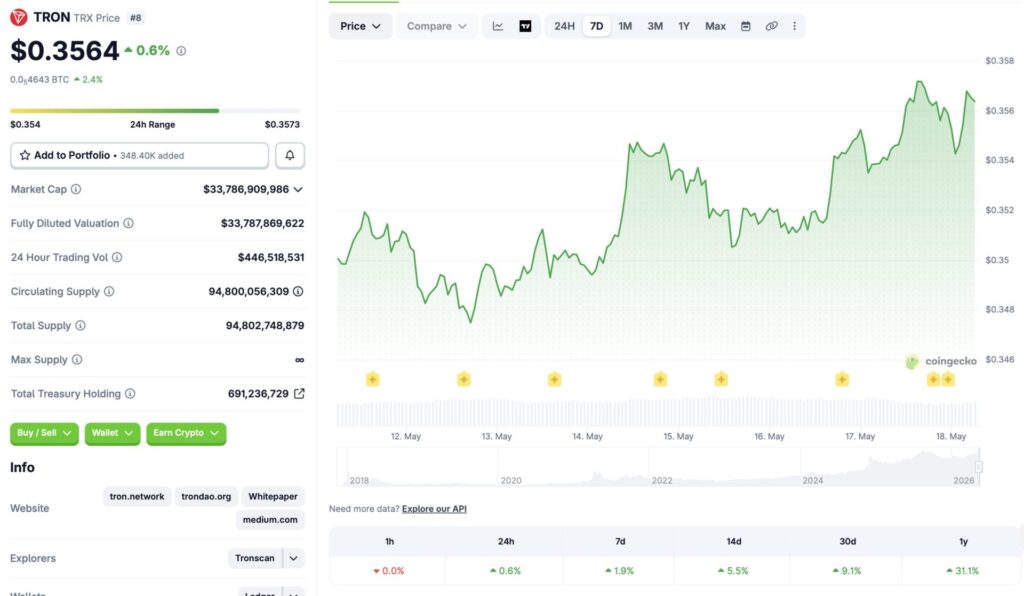
While the larger crypto market is facing a price correction, TRON (TRX) is trading in the green zone. According to CoinGecko data, TRX’s price has rallied by 0.6% in the last 24 hours, 1.9% in the last week, 5.5% in the 14-day charts, and 9.1% over the previous month. Let’s discuss why TRON (TRX) is rallying, while the crypto market is facing another crash.
Source: CoinGecko
Why Is TRON Rallying Amid A Market Crash?
Source: Coinpedia
TRON’s (TRX) price surge could be due to the Tron Inc. purchasing 140,382 TRX tokens on May 18, 2026. The company’s TRX treasury holdings have increased to 696.5 million TRX coins. The big purchase may have led to a price surge for the asset.
Tron Inc. (NASDAQ: TRON) acquired 140,382 TRX tokens today at an average price of $0.3562, further increasing its TRX treasury holdings to more than 696.5 million TRX in total. The company aims to further grow its Tron DAT holdings to enhance long term shareholder value. For live…
Moreover, according to BloomBerg ETF expert James Seyffart, Canary Funds has filed for a staked TRON ETF. The filing may have led to a boost in investor confidence. ETFs have become a key part of the crypto landscape, and we will likely see the launch of several more crypto-based ETFs in the future.
While TRON’s (TRX) price surge amid a market crash is commendable, it is unclear if the asset can sustain its upswing. The larger crypto market is facing significant selling pressure after inflation data came in higher than expected. Moreover, oil prices are rising and US bond yields are going up. Both developments have reduced investor expectations of an interest rate cut. Instead, many anticipate a rate hike after the next FOMC (Federal Open Market Committee) meeting.
Given the larger bearish market forces, there is a high chance that TRON (TRX) will also fall victim to the ongoing market trend. With Bitcoin (BTC) falling to the $76,000 mark, there is little chance for TRX to continue its rally.
The cryptocurrency market is facing another major correction, with Bitcoin (BTC) falling to the $76,000 price level. According…
Show full content
The cryptocurrency market is facing another major correction, with Bitcoin (BTC) falling to the $76,000 price level. According to CoinGlass crypto data, the crypto market faced $660.06 million in liquidations in the last 24 hours. Let’s why the cryptocurrency market faced such a steep price dip in such short period.
BREAKING: $600,000,000 liquidated from the crypto market in the past 60 minutes. pic.twitter.com/HvexIaGqZF
Why Is The Cryptocurrency Market Facing A Price Correction?
Source: WatcherGuru
The latest price dip comes amid higher than anticipated inflation data. Not only that, rising bond yields and higher oil prices have flipped anticipations of an interest rate cut into a possible rate hike. Investors have likely restarted their risk-off approach, quitting high-risk assets, such as cryptocurrencies.
Many anticipate oil prices, and consequently, US bond yields, to continue rising over the coming months. Such a development could put additional macroeconomic pressure. Many thought that the Federal Reserve would reduce interest rates after Kevin Warsh assumes office. However, the currency situation has put a stop to such expectations. Cryptocurrencies often take a hit when rates remain high for longer as borrowing becomes more difficult.
Additionally, the highly anticipated CLARITY Act seems to be facing trouble. The legislation requires 60 votes to pass. Republicans hold only 53 seats. This means that 7 Democrats need to support President Trump’s cryptocurrency clarity bill. However, many have questioned the CLARITY Act, demanding an ethics language to limit people in power to profit from cryptocurrency dealings, eyeing President Trump’s crypto empire. Additionally, banking groups are rallying against the bill to include new language to prohibit stablecoins yields, in the fear of people moving away from savings accounts. If the CLARITY Act does not go through, the cryptocurrency market could face additional challenges, and a dip in confidence.
The cryptocurrency market struggled to gain steam over the last few months. Many were hopeful that the market would turn around by now, but by the look of things, we may remain in bear territory for quite some time.










 Iran launches Bitcoin-backed insurance service for shipping companies wanting to transit the Strait of Hormuz.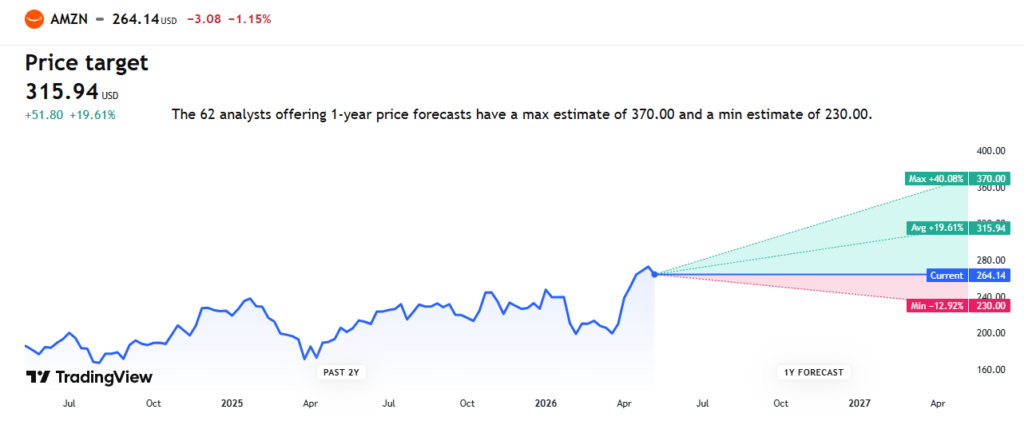





 ODDS OF ETHEREUM CRASHING BELOW $2,000 JUST FLIPPED MAJORITY