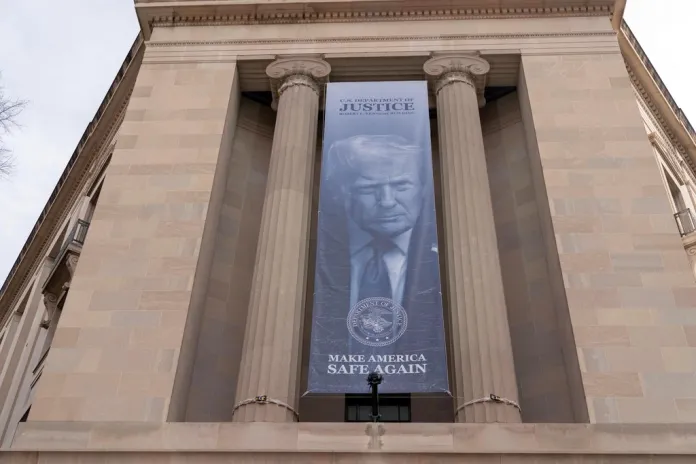
President Donald Trump repeatedly told reporters Tuesday that he has personally donated to the White House ballroom project, which he has pledged will be constructed by private donations. In the past, Trump has stated that the renovation, which has ballooned up to roughly $400 million, would be funded through donations from private individuals and companies. […]
Show full content
President Donald Trump repeatedly told reporters Tuesday that he has personally donated to the White House ballroom project, which he has pledged will be constructed by private donations.
In the past, Trump has stated that the renovation, which has ballooned up to roughly $400 million, would be funded through donations from private individuals and companies.
“All of this was paid for by myself,” he stated on Tuesday while giving the White House press pool a glimpse at the construction. “This is a gift. This is not going to be paid for by the taxpayer. We have a judge that thinks it’s a terrible thing that we’re making a gift.”
Still, White House officials declined to say how large a donation the president himself had given.
Later in his remarks, Trump said he donated “about $10 million” toward renovations to Lafayette Park, located directly to the north of the White House’s gates.
Despite the private funding, the ballroom project has stirred controversy as Congress debates appropriating more than $1 billion for security upgrades tied to the new ballroom and the broader White House complex.
“Congress is approving money for security. Some of it may go here for additional security. I don’t know, but Congress is approving money,” the president responded. “But this building, I mean, I put up the money, built this building, along with a lot of great patriots who have put up a lot of money to build the building, and we have a building that is going to be, I think it’s going to be potentially the most beautiful building in all of Washington.”
America’s transportation system is the backbone of our economy, and the decisions Congress makes in the coming months will determine whether goods and services can continue to move on time, safely, and efficiently. Critical infrastructure funding is set to expire in September, and while House and Senate committees are moving toward early action, history tells us that delays are likely. In 2021, the Infrastructure […]
Show full content
America’s transportation system is the backbone of our economy, and the decisions Congress makes in the coming months will determine whether goods and services can continue to move on time, safely, and efficiently. Critical infrastructure funding is set to expire in September, and while House and Senate committees are moving toward early action, history tells us that delays are likely.
In 2021, the Infrastructure Investment and Jobs Act provided a once-in-a-generation investment in the nation’s infrastructure. Equipment manufacturers across the country applauded the passage of this monumental legislation, and we continue to see the great results it has brought our industry. Its scope and funding levels were unprecedented, and its impact is still being felt across the country as long-overdue projects move from planning to pavement.
But as lawmakers begin shaping the next surface transportation bill, there are clear signals that the debate will look different this time. House Transportation and Infrastructure Committee Chairman Sam Graves (R-MO) has signaled a return to a more traditional framework, albeit with robust funding. At the same time, there are indications that President Donald Trump may push for continued strong investment. Reconciling these approaches in a narrowly divided House — particularly as lawmakers assess how IIJA dollars are being deployed — will not be easy.
But difficulty cannot become an excuse for delay. America’s transportation system does not operate on congressional calendars. States, contractors, and equipment manufacturers need certainty to plan, invest, and deliver. Every month of uncertainty risks slowing projects, increasing costs, and undermining the return on historic federal investments already underway.
One of the most urgent challenges Congress must confront is the long-term solvency of the Highway Trust Fund. The federal gas tax is no longer keeping pace with infrastructure needs, and its effectiveness continues to erode as vehicles become more fuel-efficient. Momentum is building around alternative funding mechanisms, such as a vehicle registration fee, but designing and implementing a sustainable, bipartisan solution will take time.
Funding levels alone, however, are not the only issue at stake. Policymakers will also grapple with Buy America provisions that shape procurement practices and project delivery timelines. Equally important is continued federal support for digital construction technology, which helps improve safety outcomes, prevent costly project errors, and cut overall construction costs. From embedded sensors to 3D modeling, these tools are fundamentally changing how infrastructure is built, and Congress should build on the $100 million investment made in the IIJA.
Ultimately, in the next surface transportation bill, Congress should focus on maximizing the impact of federal investments to ensure dollars flow efficiently to projects that fix and build more roads, bridges, and other critical assets. While it may be tempting to fund projects that are only tangentially related to infrastructure development, this year’s bill should focus on creating jobs, making America’s infrastructure safer, and connecting more communities.
This bill is a rare opportunity to achieve bipartisan consensus on an issue that affects every American, whether they live in a rural town, a suburb, or a city. In every state and every congressional district, Americans rely on Congress to leverage taxpayer funds for essential public goods.
The question is not whether Congress can act — it is whether it will. It is time to finish the job, build on what works, and keep America moving.
Kip Eideberg is senior vice president of Government & Industry Relations at the Association of Equipment Manufacturers.
SenateBill CassidyDepartment of JusticeIRSJanuary 6Republicans
Senate Majority Leader John Thune (R-SD) said Tuesday that he is “not a fan” of the Justice Department’s newly announced “anti-weaponization” fund, the latest sign of GOP discomfort over a pool of money that critics are calling a “slush fund” for President Donald Trump’s political allies. In rolling out the fund on Monday, the Justice […]
Show full content
Senate Majority Leader John Thune (R-SD) said Tuesday that he is “not a fan” of the Justice Department’s newly announced “anti-weaponization” fund, the latest sign of GOP discomfort over a pool of money that critics are calling a “slush fund” for President Donald Trump’s political allies.
In rolling out the fund on Monday, the Justice Department stated there are no “partisan requirements” to be awarded some of the $1.776 billion set aside for victims of “weaponization and lawfare.” But Democrats have accused the DOJ of attempting to protect those in Trump’s orbit who have been prosecuted by the federal government. The funds could also extend to the hundreds of Jan. 6 defendants convicted and subsequently pardoned by Trump for their actions in the Capitol riot.
“I’m not sure exactly how they intend to use it,” Thune told reporters on Tuesday, “but yeah, I don’t see a purpose for that.”
The way the Justice Department is tapping the funds, from an unlimited account Congress has long set aside to settle claims against the federal government, has also drawn scrutiny. Thune told reporters that he expects the arrangement will get a “full vetting” from appropriators later this year.
“My assumption is that based on some of the blowback that’s come since this was announced, that there would be a significant amount of attention paid to it,” Thune said.
The “anti-weaponization” fund is part of a settlement over the IRS’s handling of the Trump family’s tax returns. The president and his children dropped their demand for $10 billion in damages related to the leak, “in exchange for” the fund.
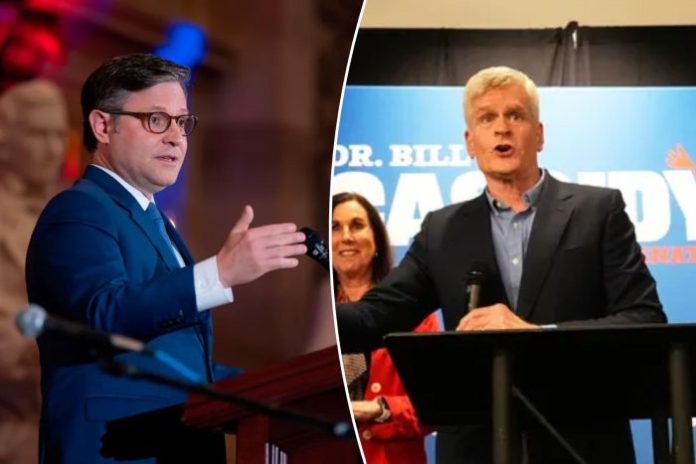
Sen. Bill Cassidy (R-LA), a lame duck senator whose falling-out with the president contributed to his primary loss on Saturday, criticized the $1.8 billion fund as lacking “legal precedent” and told reporters Monday that Congress should be the one to “make the law.”
“We are a nation of laws,” Cassidy said. “You can’t just make up things whole piece.”
The optics of Trump initiating a lawsuit that was resolved by an agency he controls have added to that discomfort. The president, who was investigated under the Biden administration for his conduct surrounding the 2020 election and handling of classified documents, will not personally receive a payout from the fund, the Justice Department said.
Other Republicans have given Trump leeway with the settlement fund, viewing its creation as addressing a long-standing problem of political prosecutions.
“I’m open to the concept,” said Sen. John Kennedy (R-LA), a member of the Senate Judiciary Committee. “Does the federal government abuse people sometimes? Yeah, and those people should have recourse.”
Iran on Monday held a mass wedding for hundreds of couples as part of a propaganda effort to convey support for its conflict against the United States. In Tehran, over 100 couples gathered for ceremonies in Imam Hossein Square, while others participated in mass weddings across several major squares in the capital, according to various […]
Show full content
Iran on Monday held a mass wedding for hundreds of couples as part of a propaganda effort to convey support for its conflict against the United States.
In Tehran, over 100 couples gathered for ceremonies in Imam Hossein Square, while others participated in mass weddings across several major squares in the capital, according to various outlets and footage posted on social media. Crowds were broadcast on state TV parading in military vehicles and holding Iranian flags alongside portraits of Iranian Supreme Leader Mojtaba Khamenei and his late father, former Supreme Leader Ali Khamenei, as depicted in photos from the Associated Press.
The weddings were part of a state-sponsored “Janfada” or “Sacrifice for Iran” event. In footage from Reuters, couples partaking in the “self-sacrifice” scheme pledged their allegiance to the Iranian government and vowed to lay down their lives in the conflict between their country and the U.S. President Donald Trump announced on Tuesday he would give Iran negotiators “two or three” more days to agree to a peace deal with the U.S. that makes critical concessions on the country’s nuclear program, before he unleashes widespread attacks on Iran.
“When I registered for Janfada, I discussed it with my wife and told her, I do not want you without this country,” one man at the ceremony said. “This land must exist for me to want you, and if the time ever comes, I will go with all my heart and defend my country.”
Newlyweds during a mass wedding ceremony for couples participating in the “Janfada” (“Sacrifice for Iran”) government campaign in Tehran, Iran, Monday, May 18, 2026. (Vahid Salemi/AP Photo)
“In my view, war will most likely happen, and if it becomes a ground war, and we can help in any way, we will certainly take part,” another man told the outlet. “Even if it is not a ground war, if they tell us somewhere to come help build missiles, we will rush there without hesitation.”
At Imam Hossein Square, the wedding stage was festooned with balloons and a giant image of Mojtaba Khamenei, as people pledged to put their lives on the line in the war, including by forming human chains outside power stations, according to AFP.
ImmigrationCourtsDepartment of Homeland SecurityICEIllegal ImmigrantsManhattanNew YorkNew York City
A federal judge has banned Immigration and Customs Enforcement from arresting illegal immigrants in most cases at New York immigration courthouses. In a Monday ruling, U.S. District Judge P. Kevin Castel determined that federal arrests cannot be conducted without exceptional circumstances in and around three Manhattan immigration courts. The ruling does not apply to immigration […]
In a Monday ruling, U.S. District Judge P. Kevin Castel determined that federal arrests cannot be conducted without exceptional circumstances in and around three Manhattan immigration courts. The ruling does not apply to immigration courts nationwide.
The decision effectively ends the practice that started last year under the Trump administration. The practice was heavily criticized by Democrats in June 2025, when ICE briefly arrested then-New York City Comptroller Brad Lander while escorting out of immigration court a defendant whom ICE officers wanted to detain.
In delivering the ruling, Castel, a George W. Bush appointee, said while there was “a strong governmental interest in enforcing immigration laws,” there was also a serious interest in letting immigrants attend removal proceedings and pursue asylum claims in a court “without fear of arrest.” He previously declined to ban the practice until this week.
Federal arrests at immigration courthouses in Manhattan, however, can still be conducted if there are serious threats to public safety. Also, Castel didn’t forbid federal agents from detaining immigrants away from immigration courts in New York City.
“It is common sense to take illegal aliens into custody following the completion of their removal proceedings,” the department said. “Nothing prohibits arresting a lawbreaker where you find them. We are confident we will ultimately be vindicated in this case.”
Meanwhile, one of the plaintiffs who brought the lawsuit on behalf of immigrant advocacy groups last year celebrated the decision.
“[Monday’s] ruling is an enormous win for noncitizen New Yorkers seeking to safely attend their immigration court proceedings,” said Amy Belsher, director of immigrants’ rights litigation at the New York Civil Liberties Union.
President Donald Trump made his long-awaited endorsement in the Texas Senate primary, giving Attorney General Ken Paxton a boost ahead of the May 26 runoff. “Ken Paxton has gone through a lot, in many cases, very unfairly, but he is a Fighter, and knows how to WIN,” Trump wrote in a Truth Social post. “Our […]
“Ken Paxton has gone through a lot, in many cases, very unfairly, but he is a Fighter, and knows how to WIN,” Trump wrote in a Truth Social post. “Our Country needs Fighters, and also Loyalty to the Cause of Greatness.
“I know Ken well, have seen him tested at the highest and most difficult levels, and he is a WINNER! Ken is a Strong Supporter of TERMINATING THE FILIBUSTER and, very importantly, THE SAVE AMERICA ACT, something which polls at 87%, including Dumocrats, and yet can’t seem to get approved.”
Trump’s endorsement comes as Paxton will face longtime Sen. John Cornyn (R-TX) in a competitive runoff, after neither candidate received 50% of the votes in the March 3 primary.
Trump called Cornyn a “good man” but said he “was not supportive” when “times were tough.”
The president has been teasing an endorsement in this race for months. Cornyn even said during a Monday event in Texas tgat he believed the ship had “finally sailed” on the president backing anyone in the race.
Both Cornyn and Paxton have been vying for the president’s endorsement since the race began last year.
The two have been locked in a tight runoff for the past two months. Cornyn won 42% of the vote to Paxton’s 40.5% in the primary. Because neither candidate got more than 50%, the contest went to a runoff as required by Texas law. The winner will face Democratic Texas state Rep. James Talarico.
“As I said on primary night, it doesn’t matter who wins this runoff,” Talarico said in a statement. “We already know who we’re running against: the billionaire mega-donors and their corrupt political system. For decades, John Cornyn and Ken Paxton have embodied a broken politics that enriches wealthy donors while costs skyrocket for the rest of us. Our movement to take back Texas for working people rises above party politics — because the biggest fight in this country is not left versus right, it’s top versus bottom.”
The Republican primary between Rep. Thomas Massie (R-KY) and Trump-backed challenger Ed Gallrein has set a record for the most spent on a House primary race since tracking began. Nearly $33 million has been spent on advertising and media in the Kentucky contest after Trump targeted Massie for breaking with him over the Epstein files. […]
Show full content
The Republicanprimary between Rep. Thomas Massie (R-KY) and Trump-backed challenger Ed Gallrein has set a record for the most spent on a House primary race since tracking began.
Nearly $33 million has been spent on advertising and media in the Kentucky contest after Trump targeted Massie for breaking with him over the Epstein files. The race has also become a showcase for increasingly aggressive AI-generated campaign ads.
One anti-Massie ad uses artificial intelligence to depict the congressman dining and holding hands with Reps. Alexandria Ocasio-Cortez (D-NY) and Ilhan Omar (D-MN), accusing him of “cheating on America” with “the Squad,” a reference to the progressive Democratic lawmakers.
#KYPol: "Thomas Massie, caught in a throuple in Washington. He's cheating with the Squad on the America First movement…it's a complete and total betrayal of President Trump."
At the same time, a pro-Massie group released an AI-generated ad labeling Gallrein “Woke Eddie” and portraying the retired Navy SEAL abandoning President Donald Trump on a battlefield.
Massie has said pro-Israel AIPAC has been spending big on his race. AIPAC spent $3 million on ads last weekend, according to Massie. In total, AIPAC’s election branch has spent $4.1 million on the primary, according to FEC data reviewed by Reuters, and is one of multiple pro-Israel PACs funding Massie’s opponent.
The race, set to be decided Tuesday night, is shaping up as another test of Trump’s grip on the Republican Party during the 2026 midterm election cycle. The president has increasingly targeted GOP lawmakers he believes have defied him, backing challengers against Republicans who have broken with him on major votes or policy disputes.
That effort has extended beyond Congress. In Indiana, Trump-backed candidates recently unseated nearly every incumbent Republican state senator targeted in a revenge-driven campaign aimed at lawmakers who voted against a Trump-backed redistricting effort.
That dynamic was also on display in Louisiana, where Sen. Bill Cassidy (R-LA) was defeated over the weekend. Cassidy, who voted to convict Trump during his impeachment trial following the Jan. 6 Capitol riot, had also split with the president on several health policy issues and administration nominations.
Cassidy’s challengers, Rep. Julia Letlow (R-LA) and Louisiana Treasurer John Fleming, will now advance to a runoff to determine who will appear on the November general election ballot. Cassidy spent roughly $5.1 million on advertising during the race. He garnered less than 25% of the vote.
Meanwhile, a political action committee aligned with Health and Human Services Secretary Robert F. Kennedy Jr.’s Make America Healthy Again movement spent nearly $117,000 backing Letlow in the final week before the election.
In Texas, another high-profile Republican battle is unfolding as two major candidates compete for Trump’s endorsement in the Senate runoff race. Sen. John Cornyn (R-TX) has emerged as one of the top Senate spenders nationwide, according to Federal Election Commission data. The race has already become the most expensive Senate primary contest to date.
So far, Cornyn has spent more than $10 million on the race, while his Republican opponent, Texas Attorney General Ken Paxton, has spent more than $5 million, ranking close behind the top 25 Republican spenders nationwide.
Trump said Tuesday that he planned to announce his endorsement in the Texas Senate runoff later in the day.
“Actually, I’m going to be making an endorsement today in Texas,” Trump said. “I’m going to be putting out an endorsement in a little while in Texas, the great state — you know, I won Texas all six times, meaning primaries and the race, and I got the highest vote in the history of Texas — and I love Texas, but I’m going to be making an endorsement at about 12:30, 1 today for the big race, the Senate race in Texas, and I hope you find it good.”
CrimeNational SecurityCaliforniaDeathDomestic TerrorismIslamLindsey GrahamRandy FineReligionSan DiegoShootingsTerrorismTim Scott
The deadly shooting at the Islamic Center of San Diego, which left five dead, including two suspects, has drawn renewed attention to one of California’s best-known mosques, a religious center with a long history that includes both controversy and deep community roots. The mosque was the scene of what police are calling a hate crime, […]
Show full content
The deadly shooting at the Islamic Center of San Diego, which left five dead, including two suspects, has drawn renewed attention to one of California’s best-known mosques, a religious center with a long history that includes both controversy and deep community roots.
The mosque was the scene of what police are calling a hate crime, which left three dead, as well as the two suspects who were found in their car having died by suicide.
Here’s what to know about the mosque at the center of the tragedy:
One of the largest in Southern California
The Islamic Center of San Diego is among the largest and oldest Muslim institutions in Southern California, serving thousands of congregants from diverse ethnic and religious backgrounds.
It hosts daily prayers, youth programs, interfaith events, and an affiliated K-12 school, making it a major religious and community hub in the region. Students, teachers, and faculty from the school were safely evacuated when the shooting occurred, and no injuries or fatalities were reported.
Imam Taha Hassane, director of the Islamic Center, has frequently described the organization as focused on outreach and interfaith understanding. The New York Times reported that the sermons are conducted in English, rather than Arabic, because of the congregation’s diversity.
Following the shooting, Hassane emphasized the center’s role as an open and welcoming place where Muslim and non-Muslim visitors regularly attend educational events and dialogues. The mosque had become known locally for outreach efforts with churches, synagogues, and civic groups in the San Diego area.
Connections to 9/11 hijackers and al Qaeda
The mosque has also faced decades of scrutiny because two of the Sept. 11, 2001, hijackers, Nawaf al Hazmi and Khalid al Mihdhar, worshipped there while living in San Diego in 2000.
Investigators found the men had attended services and used mosque bulletin boards to help find housing while taking flight lessons nearby.
However, the 9/11 Commission never concluded the mosque itself was complicit in the attacks. Rather, the 9/11 Commission Report notes that the hijackers found help within the community and from “well-meaning new acquaintances” at the center.
When helping the hijackers, the administrator let Hazmi use his bank account to receive a wire transfer, but the commission’s report did not note if the administrator was aware of his Al Qaeda connections.
The center’s history has periodically resurfaced in national debates over extremism and surveillance of Muslim institutions, particularly after it came to light that former imam Anwar al-Awlaki once preached in San Diego before later becoming an al Qaeda propagandist.
Controversy involving imam’s family and previous ‘hate crime’
More recently, Hassane and his wife, community activist Lallia Allali, and daughter Selma Hassane, have faced criticism over social media activity and public comments related to Israel and antisemitism allegations.
Taha Hassane made comments about the Oct. 7, 2023, Hamas attacks in Gaza, saying the attack that killed 1,200 people was a response by Hamas to a “brutal Zionist occupation and genocide.”
“Resistance is justified when people are under occupation and don’t let them change that narrative,” he said.
Selma Hassane shared a video on Facebook of her husband encouraging students at the University of California, San Diego to urge the school to “boycott and divest from Israel.”
Allali reportedly shared a graphic of a Jewish star cutting through the heads of babies with the caption “the devil is killing,” following the Oct. 7 attacks, according to an antisemitism watchdog group.
People living near the mosque told the New York Postthat after the Oct. 7 attacks, Taha Hassane changed from his previous moderate and friendly demeanor.
The Islamic center had been the scene of hate crimes before, when posters relating to the Israeli hostages taken by Hamas were posted around the center’s campus.
“They are trying to link the entire community — American Muslim community — with Hamas, with whatever is going on over there,” Taha Hassane said at the time to Fox5 San Diego. ”They are trying to portray us with and associate us with Hamas.”
The center also has ties to the Council on American-Islamic Relations, which has been labeled as a foreign terrorist organization in Florida and Texas.
Republican response split between sympathy and criticism
Several Republican lawmakers have condemned the shooting and violence targeting houses of worship, while some also renewed criticism of past statements made by mosque leadership.
Statements from Republican officials echoed messages often issued after attacks on churches and synagogues, calling for prayers for victims and increased protection for faith communities.
Sen. John Husted (R-OH) offered his condolences for the victims and their families on Tuesday.
“Violence targeting people of faith at a mosque, synagogue, temple, church, cathedral, or chapel is abhorrent and has no place in America,” he said.
Sens. Lindsey Graham (R-SC) and Tim Scott (R-SC), as well as Rep. Mike Lawler (R-NY), also shared statements following the shooting, condemning religious violence.
At the same time, Rep. Randy Fine (R-FL) argued scrutiny of the mosque’s leadership speaking against Israel should not be ignored amid the aftermath.
“This kind of language, which could have inspired two suicidal teenagers today, is disgusting and abhorrent,” he said. “I have massive issues with activities of this Muslim center, but shooting it up is NOT the answer.”
Fine made the statement alongside a video of Taha Hassne speaking out against Israel following the Oct. 7 attacks.
Former Ohio governor and presidential candidate John Kasich announced the John Kasich Show, in partnership with SiriusXM, highlighting bipartisan political talks and bridging divides. “There’s too much shouting and not enough listening in our country right now,” Kasich said in a press release Tuesday. The show will premiere on May 23. It will air weekly […]
Show full content
Former Ohio governor and presidential candidate John Kasich announced the John Kasich Show, in partnership with SiriusXM, highlighting bipartisan political talks and bridging divides.
“There’s too much shouting and not enough listening in our country right now,” Kasich said in a press release Tuesday.
The show will premiere on May 23. It will air weekly on Saturdays from 11 a.m. to 12 p.m., with replays on Sundays on SiriusXM’s POTUS channel.
Former independent West Virginia Sen. Joe Manchin will join Kasich for the first episode. Their conversation will emphasize civility and collaboration.
The press release also said the POTUS channel offers “listeners a wide range of perspectives and in-depth analysis from some of the most recognizable voices in media and politics. The channel is home to major names, including Stephen A. Smith, Chris Cuomo, Michael Smerconish, Steve Scully, Dan Abrams, Julie Mason, among others…”
The John Kasich Show will also feature talking points about faith and culture, and the issues shaping America.
“I’ve always believed in unity over division, personal responsibility, service to others, and the ability of everyday Americans to make a difference. This show is about slowing things down, having honest conversations, and creating a place where people can reflect, find clarity, and focus on what still unites us in a noisy world,” Kasich said.
White HouseJD VanceKaroline LeavittWashington D.C.White House Press Secretary
Vice President JD Vance will hold a press briefing at 1 p.m. Tuesday at the White House, filling in for press secretary Karoline Leavitt while she is on maternity leave. VANCE TO HOLD WHITE HOUSE BRIEFING AFTER RUBIO’S PERFORMANCE GAINED RAVE REVIEWS Vance will head to the briefing room podium on one of the most […]
Show full content
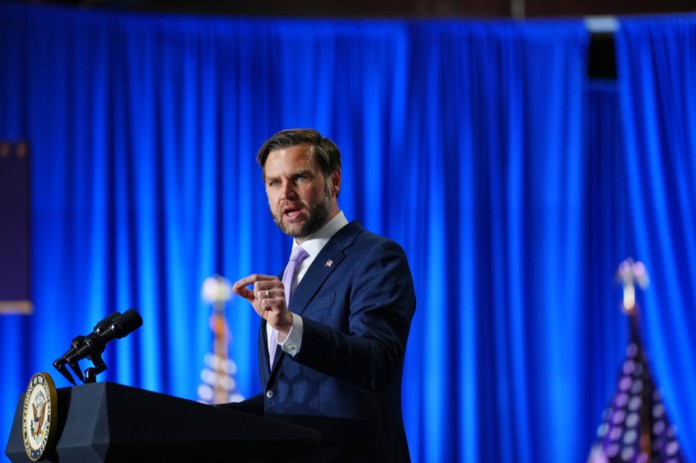
Vice President JD Vance will hold a press briefing at 1 p.m. Tuesday at the White House, filling in for press secretary Karoline Leavitt while she is on maternity leave.
Vance will head to the briefing room podium on one of the most closely watched primary days of the 2026 midterm elections, as voting plays out in Kentucky, Alabama, Georgia, and Pennsylvania. The vice president will likely face questions about these primaries, the war in Iran, and his work fighting fraud across the country.
Pundits’ eyes will be fixated on the briefing, as Vance follows Secretary of State Marco Rubio‘s briefing in early May, which earned him the praise of conservatives around the country.
Energy and EnvironmentCoalEnergyFossil FuelsSolar EnergySupply chainWashington D.C.World
Renewable energy alternatives will become the largest sources of electricity in the next 10 years, new research suggests, as nations seek to diversify their energy resources to avoid future supply shocks, as seen with the closure of the Strait of Hormuz. BloombergNEF released its annual energy outlook on Tuesday, forecasting that if countries continue on […]
Show full content
Renewable energy alternatives will become the largest sources of electricity in the next 10 years, new research suggests, as nations seek to diversify their energy resources to avoid future supply shocks, as seen with the closure of the Strait of Hormuz.
BloombergNEF released its annual energy outlook on Tuesday, forecasting that if countries continue on the current path of deploying clean energy technologies such as wind and solar, the world will reduce its dependence on fossil fuels.
“So far in this decade, the world has suffered three substantial energy shocks – Covid-19, the war in Ukraine and most recently the Iran war in the Middle East,” analysts wrote in the report. “Each has highlighted the inherent volatility and insecurity of today’s energy system.”
In 2025, coal accounted for the largest share of global electricity generation at just over 32%. Natural gas followed closely with 21.8%, while solar and wind made up 9.1% and 8.9%, respectively.
BloombergNEF now estimates that solar will outpace coal by 2032, making up 20.6% of global electricity generation, compared to coal’s 19.8%. Natural gas is only expected to make up 19.2% that same year.
Renewables’ share of electricity generation is only expected to grow in the years after, with solar power estimated to make up 31% by 2050, and wind accounting for 24.9%.
This increased deployment of renewable energy is not expected to completely phase out fossil fuels, as coal is expected to make up 8.3% of electricity generation in 2050, according to the report. Natural gas is also estimated to still make up 17.1% of electricity generation that same year.
This is in part due to the rapid deployment of large-load facilities such as data centers, which are being developed to support advances in artificial intelligence.
In 2025, global data center capacity reached around 84 gigawatts, consuming around 1.9% of total electricity demand worldwide. This is roughly equivalent to a 20% increase compared to 2024.
Over the next 25 years, BloombergNEF estimates that demand from data centers will more than double, making up 3.6% of total demand — roughly a tenth of all electricity consumed worldwide.
The report acknowledged that while China, India, and Europe will see electrification dominate over fossil fuels by the early 2040s, the United States will see a much slower transition.
This is in part due to the Trump administration’s own backing of traditional fuels such as coal and natural gas, and its push to slow the development of renewable energy alternatives.
Just last week, Energy Secretary Chris Wright advocated fossil fuels during an interview with CNBC, saying the “world runs on hydrocarbons.”
“It did when I was born. It does today,” he said. “It will when I die. We just simply don’t have replacements for most all of the uses of hydrocarbons.”
BloombergNEF’s latest outlook estimates that the U.S. will see electricity become the dominant fuel in 2047.
Washington Examiner columnist Guy Benson slammed California Democrats on Monday for a new ballot initiative that would repeal the state’s top-two primary system, which would mean a return to traditional party primaries. “I think it goes to and speaks to the arrogance of entrenched one-party rule in a place like California,” Benson said on Fox […]
Show full content
Washington Examiner columnist Guy Benson slammed California Democrats on Monday for a new ballot initiative that would repeal the state’s top-two primary system, which would mean a return to traditional party primaries.
“I think it goes to and speaks to the arrogance of entrenched one-party rule in a place like California,” Benson said on Fox Business’s The Evening Edit.
In a top-two primary system, also known as a “jungle primary,” all candidates run against one another. And the top two vote-getters advance to the general election, even if they are from the same party.
This is a rising concern for Democrats, who are seeing the possibility of two Republican contenders in the California gubernatorial race.
Benson joked that a few weeks ago, he had a conversation about the top-two primary system and whether both candidates would be Republicans.
“Democrats who run that state will not let it happen. They will change the rules; they will do what they need to do to ensure that is not the case,” Benson said.
Democrat Steven Maviglio filed a ballot initiative to repeal the top-two primary system and return the state to traditional party primaries.
“Voters are too frequently forced to choose from just two candidates from the same political party in the general election. When that occurs, entire segments of voters are left without any candidate who reflects their views,” the initiative said. “It is time to end the experiment and return to a system that will expand voter choice and encourage broader participation.”
Benson pointed out, however, that the race looks more like a “dog fight” now, with one Democrat and one Republican at the top of the ticket.
“I don’t anticipate this [ballot initiative] needing to be the case, but there is a break-the-glass scenario, and there’s many people that have a deep understanding of what it would look like if Democrats were locked out and we’re going to do everything to make sure that doesn’t happen,” Gov. Gavin Newsom (D-CA) said on Thursday.
House Majority Leader Steve Scalise (R-LA) called out the initiative and Newsom.
“Here is the Governor of California and Democrats’ 2028 frontrunner saying he has a secret backup plan to change the outcome of an election if his state’s voters pick candidates he doesn’t like. ‘No Kings,’ right Gavin?” Scalise said on X.
Here is the Governor of California and Democrats’ 2028 frontrunner saying he has a secret backup plan to change the outcome of an election if his state’s voters pick candidates he doesn’t like.
White HouseDonald TrumpIranMiddle EastWarWashington D.C.
President Donald Trump has provided Iran with “two or three days” to make a counterproposal for a more permanent peace deal. Trump announced on Monday that he would delay a new attack on Iran, which had been planned for Tuesday, after Qatar, Saudi Arabia, and the United Arab Emirates asked for more time to negotiate […]
Show full content
President Donald Trump has provided Iran with “two or three days” to make a counterproposal for a more permanent peace deal.
Trump announced on Monday that he would delay a new attack on Iran, which had been planned for Tuesday, after Qatar, Saudi Arabia, and the United Arab Emirates asked for more time to negotiate with Tehran.
A day later, Trump, during an impromptu press conference at the White House, told reporters he had been “an hour away from making the decision to go.”
“I had made the decision, so they called up,” the president said on Tuesday. “They had heard I made the decision. They said, ‘Sir, could you give us a couple of more days because we think they’re being reasonable?’ Well, I mean, I’m saying two or three days. Maybe Friday, Saturday, Sunday, something. Maybe early next week. A limited period of time, because we can’t let them have a nuclear weapon.”
But although providing Iran with some breathing room, Trump on Tuesday continued to apply pressure on the regime, previewing the possibility of “another big hit,” despite a push from Democrats to restrict his war powers.
“They want to stop Trump from, if he has to, giving them another slap,” Trump said of Democrats and Iran. “They want to have a nuclear weapon to blow up the Middle East and to blow up, frankly, the world. It’s not going to happen.”
Trump also used the press conference, which started after he showed reporters the construction site for his ballroom project, to defend the war, contending that it is “very popular,” though he was not “doing this politically.”
“It’s very popular when you, when they hear that it’s having to do with nuclear weapons, weapons that could take out Los Angeles, could take out major cities very quick,” he said. “I don’t really have enough time to explain to people, I’m too busy getting it done.”
“When they understand, I think it’s frankly very popular,” he added. “But whether it’s popular or not popular, I have to do it, because I’m not going to let the world be blown up with my watch.”
President Donald Trump summoned the press pool for an unscheduled viewing of the ongoing White House ballroom construction on Tuesday, claiming that the guest space and security facilities are both critical components of the project. Trump, speaking while construction workers hammered away in the background, reiterated that he and private donors were fully funding the […]
Show full content
President Donald Trump summoned the press pool for an unscheduled viewing of the ongoing White House ballroom construction on Tuesday, claiming that the guest space and security facilities are both critical components of the project.
Trump, speaking while construction workers hammered away in the background, reiterated that he and private donors were fully funding the ballroom itself, even as he conceded that an appropriations bill Republicans are seeking to pass will go to enhance security for the entire complex.
The president specifically touted the complex’s ability to stop bullets and other strikes, telling reporters that “it can stop just about anything.”
Trump also drew attention to what he referred to as a “drone port” that will be located just below the roof of the building.
“We call it a drone port,” he said. “It’s set up for an unlimited number of drones. Purposely, we don’t have any air conditioning equipment up there, because we don’t want anything coming down through the pipes. All of the equipment is inside of the building, and that’s for safety reasons.”
The president faced a number of questions on why the White House security and military enhancements must be completed in conjunction with the ballroom, to which he claimed that the latter “becomes a shield for everything that you see.”
“It’s a shield that will totally protect what’s downstairs,” Trump said.
Trump also reiterated that the ballroom was being funded by himself and private donors, though the White House declined to say how much the president has given.
“We are making a gift of this one. This is a gift. This is not going to be paid for by the taxpayer,” the president said. “It’s going to be one of the most beautiful buildings that’s ever been built in the country, or in Washington, D.C.”
CampaignsHouse2026 ElectionsCaliforniaDemocratic primaryHouse of RepresentativesNancy PelosiSan Francisco
Former House Speaker Nancy Pelosi (D-CA) on Tuesday endorsed San Francisco supervisor Connie Chan to succeed her in Congress. “I know and love this district, I know the Congress, and I know Connie,” Pelosi said in a short video. “I’m proud to endorse Democrat Connie Chan, and ask you to join me in electing her […]
“I know and love this district, I know the Congress, and I know Connie,” Pelosi said in a short video. “I’m proud to endorse Democrat Connie Chan, and ask you to join me in electing her to Congress.”
Pelosi’s endorsement comes before voters head to the polls on June 2 in California’s jungle primary, where all the candidates, regardless of party, will face off. If no candidate gets more than 50% of the vote, then the top two vote-getters head to the general election in November.
Chan is in a competitive race against millionaire entrepreneur Saikat Chakrabarti and state Sen. Scott Wiener. Chakrabarti is a former aide to Rep. Alexandria Ocasio-Cortez (D-NY), who has yet to endorse in the race.
Chan is currently a member of the San Francisco Board of Supervisors. She’s also gained the support of Sen. Adam Schiff (D-CA) and a handful of House Democrats.
Pelosi, 86, has held the seat since 1987. She was the first female House speaker in U.S. history.
CampaignsPresidential2024 Elections2026 Elections2028 ElectionsDemocratic National CommitteeKamala HarrisMarylandWashington D.C.Wes Moore
Gov. Wes Moore (D-MD) is telling Democrats to “move on” from the 2024 presidential election, chiming in that he does not care whether or not the Democratic National Committee releases the contentious autopsy of the election loss. “My point is this: release it, don’t release it. I don’t care,” Moore told Politico in a sit-down […]
“My point is this: release it, don’t release it. I don’t care,” Moore told Politico in a sit-down interview released Tuesday. “I really don’t. I’m like, listen, if you need a research report to know why we lost in 2024, then that’s actually part of the problem.”
Moore has shot down speculation that he could run for president in 2028 throughout the past year or so, but nonetheless, he has maintained his reputation as a rising star in the Democratic Party. With troubles such as the Key Bridge collapse and his crusade for redistricting in Maryland, Moore has attracted national attention. But Moore continued to beat around the bush in the Tuesday interview.
“When I say I’m hungry but I’m not thirsty, my definition of hungry is making sure you’re focusing on 2026,” Moore said over crab cakes. “My definition of thirsty is making sure you’re focused on 2028.”
But Moore chimed in on his thoughts on where the Democratic Party should head in the future. His thoughts? Don’t relive 2024. Moore said he thought the reason Democrats and former Vice President Kamala Harris lost in 2024 was because they “didn’t engage people” and they “did not deliver results with any forms of speed.”
“I just think that everything in our party cannot be a 12-year analysis,” Moore said of the autopsy. “It’s like, listen, are you going to fix it or not? And you know, and you know who actually, who really got that was Donald Trump. He was a great vessel for the frustration.”
Harris has called for the release of the autopsy report, as have many other Democrats, such as Sen. Cory Booker (D-NJ). When Politico’s Jonathan Martin asked if he thinks the party wants to “move on” from 2024, Moore said, “Yes, I do,” adding that he is “exhausted by talking about how or why we lost.”
Moore did not necessarily say the party should move on from Harris, who has said she is eyeing another run in 2028, however. Moore called Harris “one of the most accomplished elected officials of our generation.”
“I think if she wants to run for president, she’s earned the right,” Moore said. “And I think if she doesn’t want to run president, she just wants to go off and live her life, she’s earned the right.”
“I think people are exhausted, but honestly, like, but here’s the thing, I do believe if she chooses to run, I highly doubt she’s going to choose to run a race trying to re-litigate 2024,” Moore said.
In the interview, Moore also addressed his unsuccessful bid to redraw the state’s congressional lines to nix the state’s only Republican House seat, saying “we don’t have a choice but to act.” Moore’s push, curbed by Democratic state senators, comes as part of the national mid-decade redistricting push-and-pull that has dominated the conversation in the 2026 midterm cycle.
White HouseDonald TrumpMilitarySecret ServiceWashington D.C.
President Donald Trump said on Monday that the U.S. military asked him to double the size of the White House ballroom construction project. Trump made the remarks while showing reporters the construction of the new White House East Wing, which will house the 90,000-square-foot ballroom. “We’re right on budget, we’re right on plan,” Trump said. […]
Trump made the remarks while showing reporters the construction of the new White House East Wing, which will house the 90,000-square-foot ballroom.
“We’re right on budget, we’re right on plan,” Trump said. “The only budget change would be that we doubled the size at the request of the military. We doubled the size, but we’re right on budget, right on plan.”
Trump said initially the plan was “to build a much smaller room,” but it “wouldn’t have done the job.” The president also highlighted the security capabilities of the new East Wing modernization project.
“It’s larger because they wanted more military capacity,” said Trump. “They wanted more drone capacity. They needed a larger roof, and frankly, we needed a larger facility.”
Poland said questions remain about why President Donald Trump canceled the deployment of thousands of U.S. troops to the European country. In an interview published Tuesday, Polish Deputy Defense Minister Pawel Zalewski said he plans to press the Trump administration on why the Pentagon canceled the deployment of more than 4,000 Army troops, a move […]
Show full content
Poland said questions remain about why President Donald Trump canceled the deployment of thousands of U.S. troops to the European country.
In an interview published Tuesday, Polish Deputy Defense Minister Pawel Zalewski said he plans to press the Trump administration on why the Pentagon canceled the deployment of more than 4,000 Army troops, a move that reduced American military levels in Europe to near pre-2022 levels. The previous day, Polish deputy prime minister Wladyslaw Kosiniak-Kamysz warned that the reorganization “cannot be made at the cost of the biggest ally of the United States in Europe.”
“We will ask questions, and I guess that we will get answers,” Zalewski told Fox News Digital.
“We remember that President Trump, directly talking with President Nawrodski, president of Poland, declared that the U.S. will maintain its armed forces in our country and the number of armed forces,” he added, pointing to Trump’s promise in September that “we’ll be staying in Poland.”
Zalewski and others in the Polish delegation are holding meetings in Washington this week. Despite concerns over the halted troop rotation, he stressed that Poland remains a “model ally” to the U.S. and that his delegation will focus on the future structure of NATO and defense cooperation between the U.S. and Europe during talks in the coming days.
The U.S. military confirmed last Wednesday that it canceled the deployment of the 2nd Armored Brigade Combat Team, 1st Cavalry Division, also known as the “Black Jack” brigade, based at Fort Hood, Texas. The unit had been preparing for a nine-month rotation to Poland as part of Operation Atlantic Resolve, the NATO mission that expanded following Russia’s invasion of Ukraine.
The decision sparked controversy across the board, with House Armed Services Committee Chairman Mike Rogers (R-AL) telling the Pentagon he was “not happy” with the development. Polish officials echoed the sentiment, saying they were confused by the move due to the country’s close alliance with the U.S.
“We understand that there is a reorganization of the American military presence in Europe,” Kosiniak-Kamysz said during a ceremony in eastern Poland on Monday, according to Defense News. “But this reorganization cannot be made at the cost of the biggest ally of the United States in Europe. We invest around 15,000 dollars every year for the deployment of each [U.S. soldier], which distinguishes us from other European countries.”
“[Poland has] also great, strategic purchases in the United States,” he added, referring to Poland’s numerous U.S. weapon purchases in past years. “It is difficult to find in the world, not only in Europe, a second country that has invested so heavily in purchases of the best American gear for its own needs…More than fifty billion dollars is the sum of the purchases that we are implementing in the United States.”
President Donald Trump announced Tuesday that he will make an endorsement in one of the country’s most closely watched Senate battles by the end of the day, ending months of speculation about who would be boosted by his support. TRUMP ENDORSEMENT TRACKER: HERE’S WHO THE PRESIDENT HAS PICKED IN GOP MIDTERM ELECTION PRIMARIES Trump said […]
Show full content
President Donald Trump announced Tuesday that he will make an endorsement in one of the country’s most closely watched Senate battles by the end of the day, ending months of speculation about who would be boosted by his support.
Trump said that around 1 p.m., he would reveal who he is backing in the Texas Senate race, which features a highly competitive primary runoff between Sen. John Cornyn (R-TX) and state Attorney General Ken Paxton.
“Actually, I’m going to be making an endorsement today in Texas,” the president said. “I’m going to be putting out an endorsement in a little while in Texas, the great state — you know, I won Texas all six times, meaning primaries and the race, and I got the highest vote in the history of Texas — and I love Texas, but I’m going to be making an endorsement at about 12:30, 1 today for the big race, the Senate race in Texas, and I hope you find it good.”
This is a breaking news story and will be updated.
JusticeBiden AdministrationDepartment of JusticeDonald TrumpIRSLawfareLawsuitsSettlementsTreasury Department
A top lawyer for the Treasury Department resigned Monday after the Justice Department announced the creation of a nearly $1.8 billion “anti-weaponization” fund to compensate what it described as lawfare victims of the Biden administration. Brian Morrissey’s departure came hours after the fund was announced as part of an agreement to settle a lawsuit brought […]
Show full content
A top lawyer for the Treasury Department resigned Monday after the Justice Department announced the creation of a nearly $1.8 billion “anti-weaponization” fund to compensate what it described as lawfare victims of the Biden administration.
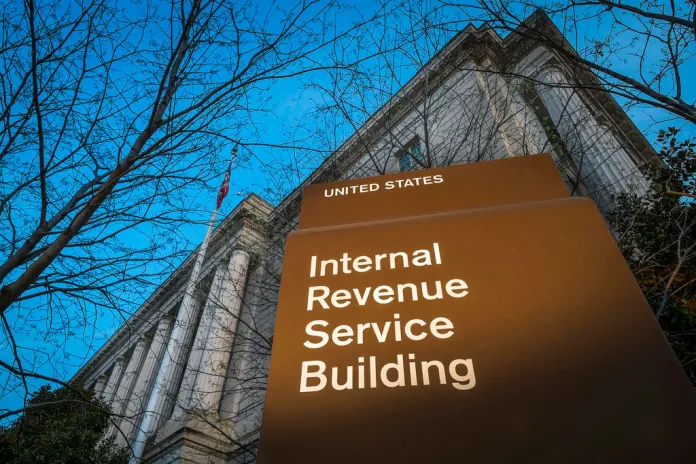
Brian Morrissey’s departure came hours after the fund was announced as part of an agreement to settle a lawsuit brought by President Donald Trump against the Internal Revenue Service over the leaking of his confidential tax records. The IRS is overseen by the Treasury.
Morrissey has served the Treasury as a general counsel since October. He was confirmed by the Senate in a 51-47 vote last year after Trump nominated him for the senior role. Before assuming the position, Morrissey worked at the Sidley Austin law firm.
Morrissey wrote in his resignation letter that he was grateful to have worked for Trump and Treasury Secretary Scott Bessent for the past seven months, according to the New York Times. The Trump appointee has not publicly explained the reason for his resignation.
“As General Counsel, Brian Morrissey has served the United States Treasury with both honor and integrity,” a Treasury spokesperson said in a statement to the Washington Examiner. “We wish him all the best in his next endeavors.”
Following the settlement between Trump and the IRS, the administration set aside $1.776 billion for people allegedly targeted by the Biden-era weaponization of the federal government. Those who may be eligible include some of the roughly 1,500 people prosecuted in connection with the Jan. 6, 2021, Capitol riot and Trump allies.
Acting Attorney General Todd Blanche will select the victims eligible for the money that the Treasury deposits into an account.
“The machinery of government should never be weaponized against any American, and it is this Department’s intention to make right the wrongs that were previously done while ensuring this never happens again,” Blanche said in a statement. “As part of this settlement, we are setting up a lawful process for victims of lawfare and weaponization to be heard and seek redress.”
The initiative will be financed through the federal Judgment Fund, a permanent congressional appropriation used to pay settlements and legal claims against the government. Successful claimants will get formal apologies and monetary relief from the federal government. The DOJ said there will be “no partisan requirements to file a claim” for the anti-weaponization fund.
Trump moved to drop his lawsuit against the IRS after facing scrutiny from a federal judge, who questioned whether the president could sue a federal agency he controlled. The decision came nine days before a hearing at which the judge would have considered dismissing the case for this reason.
The settlement requires the IRS to apologize to Trump, his two oldest sons, and his family business for leaking their tax returns during the president’s first term. The legal agreement does not include any monetary payment or damages.
DefenseDepartment of Defense (Department of War)inspector generalMilitaryNational SecurityTrump Administration
The War Department’s inspector general announced a review of whether the U.S. military’s strikes against suspected drug smugglers in the Caribbean followed the required targeting process. Last September, the Pentagon began what it dubbed Operation Southern Spear, and since its origin, U.S. Southern Command has targeted nearly 60 small boats in the Caribbean Sea or […]
Show full content
The War Department’s inspector general announced a review of whether the U.S. military’s strikes against suspected drug smugglers in the Caribbean followed the required targeting process.
Last September, the Pentagon began what it dubbed Operation Southern Spear, and since its origin, U.S. Southern Command has targeted nearly 60 small boats in the Caribbean Sea or eastern Pacific Ocean that it says were attempting to smuggle drugs into the country, killing nearly 200 people in those strikes.
Specifically, the objective of the review is “to determine whether DoW components followed the established framework of the six-phase Joint Targeting Cycle,” according to a May 11 letter from Bryan T. Clark, assistant inspector general for evaluations programs, combatant commands and operations in a May 11 memo to Gen. Francis Donovan, the leader of U.S. Southern Command, and Bradley Hansell, undersecretary for intelligence and security.
The six phases are the commander’s intent, the development of each target, the analysis and intelligence surrounding each one, the decision to hit it, planning and execution, and assessment, NBC News reported, citing a U.S. official.
This evaluation was self-initiated and not done at the request of Congress.
“The scope of this evaluation includes the joint process for targeted vessels in the U.S. Southern Command area of responsibility as part of Operation Southern Spear,” a spokesperson told the Washington Examiner. “This project was self-initiated based on the DoW OIG’s ongoing assessment of DoW programs and operations.”
The department repeatedly affirmed the legality of the strikes despite bipartisan concern on Capitol Hill. In particular, the first operation on Sept. 2, 2025, garnered a lot of scrutiny when it became clear that the U.S. troops realized the initial strike did not kill everyone on board and then fired again at the vessel to ensure the remaining survivor was killed.
In later instances, Southern Command notified the U.S. Coast Guard of possible survivors to launch search-and-rescue operations. One strike had two survivors, who were later rescued, treated, and ultimately repatriated to their home countries of Ecuador and Colombia.
The most recent strike on a suspected drug boat occurred on May 8, according to U.S. Southern Command, which noted that two people on board were killed, while the Coast Guard activated its search and rescue system for one survivor.
Shortly after the U.S. military began this campaign, War Secretary Pete Hegseth asked Adm. Alvin Holsey, then the commander of U.S. Southern Command, to retire before the end of his tenure. Donovan succeeded him in the position.
Within decades, there will be more humanoid robots in this country than there are people. Are you comfortable with one of them raising your kids? With one of them in your daughter’s bedroom? With your son forming his first idea of intimacy with a machine designed to never say no? These are not hypothetical questions. […]
Show full content
Within decades, there will be more humanoid robots in this country than there are people. Are you comfortable with one of them raising your kids? With one of them in your daughter’s bedroom? With your son forming his first idea of intimacy with a machine designed to never say no?
These are not hypothetical questions. You will vote on them in the next five years. The bills are already being drafted by people who are not waiting for you to catch up.
The runway is shorter than legislators often think. Most state legislative sessions are wrapping up now. Drafting and pre-filing for the next session is already underway in many states. And artificial intelligence has advanced more in the last three months than it did in the prior two years. The states are already behind.
There will not be one AI bill next session. There will be thousands. Infrastructure is AI. Healthcare is AI. Education is AI. Fraud is AI. Elections are AI. The technology is now the substrate underneath every policy domain we legislate, and pretending otherwise will not slow it down.
I do not say so as a critic. I work with legislators, lobbyists, and the press across America every week, teaching, briefing, and meeting with the people who make these decisions. The fluency is not there yet — not in most rooms, not at the depth this moment requires. The people writing bills today are mostly on defense, waiting for the consequences to materialize before adjusting the law, instead of getting in front of the technology while the design choices are still being made.
Drafting a bill used to take a lawyer, weeks of work, and a small army of staff to find model legislation, pull comparable statutes from other states, and turn the policy intent into clean statutory language. That bottleneck is gone.
The data is already showing it. Between Jan. 1 and April 30, tens of thousands of bills were filed across all 50 states and at the federal level. That count is conservative. Add AI on top, and 2027 is going to be the highest-volume legislative year on record by a multiple.
At the same time, a digital divide between the people drafting bills and the people voting on them is functionally emerging as a transfer of power to corporations, the largest firms, and whoever can afford the tools and the talent to use them well. A legislator who is not fluent in AI cannot tell when a lobbyist or a witness is misrepresenting what an AI system actually does. They cannot tell when a vendor is overstating capability to win a contract. They cannot tell when an industry advocate is downplaying risk to kill a bill.
The fluency gap is not a character flaw. It is a training and time problem, and it is solvable. But it has to be solved fast, because the people who would benefit from a less-informed legislature are also adopting these tools, and they are not waiting. AI security matters, but fluency matters first. AI is here to stay, and the legislators who do not learn how to use it will not be able to govern the rest of us.
For legislators, the marching orders are simple: Learn the technology at a working level, not a press-conference level. Use the tools. Pay for the paid versions so your data isn’t training the next model. Have your staff brief you on what your agencies are actually using, and stop drafting bills on defense.
The same logic applies to all Americans. Get involved in AI policy. Decide what matters for the future and start showing up where those decisions are being made. Start associations. Fund nonprofits. Build the education services that can help the public navigate what is coming. The institutions that will guide the next decade are being founded right now. Be one of the people founding them. Learn AI.
From legislators to concerned citizens, AI will wait for none of us. Get in the room, get fluent, and get to work.
Laura Davis is the co-founder of USLege, a venture-backed AI startup, and host of the Bills & Business podcast. Find her at lauraluisedavis.com.
EXCLUSIVE — President Donald Trump expressed confidence in incoming Federal Reserve Chairman Kevin Warsh and said he would leave the interest rate decisions to him. The Washington Examiner spoke to Trump during a Tuesday morning phone call and pointed out that investors are now pegging a higher chance of an interest rate hike rather than […]
Show full content
EXCLUSIVE — President Donald Trump expressed confidence in incoming Federal Reserve Chairman Kevin Warsh and said he would leave the interest rate decisions to him.
The Washington Examiner spoke to Trump during a Tuesday morning phone call and pointed out that investors are now pegging a higher chance of an interest rate hike rather than a cut by the end of the year, and asked him whether he thinks Warsh will deliver a cut.
“I’m going to let him do what he wants to do,” Trump responded. “He’s a very talented guy, he’s going to be fine, he’s going to do a good job.”
The remarks come despite the intense pressure campaign from the White House on outgoing Fed Chairman Jerome Powell to cut interest rates. It also comes after Warsh faced major questions about Fed independence during his confirmation hearing last month.
Warsh is staring down a difficult macroeconomic landscape that has only become more tricky with Powell’s decision to remain on the board.
The problem facing Warsh is that Trump has made it clear he wants lower interest rates, but both the higher inflation environment and Powell’s remaining on the board are making that far less likely.
The war with Iran has caused energy prices to spike, driving up headline inflation. And Powell is staying on the Fed board in part because of the Justice Department investigation into him, which has since been dropped, and the ongoing attempt to fire Fed governor Lisa Cook.
Markets are signaling that they do not believe that Warsh will be able to implement rate cuts. In fact, investors are betting that an interest rate increase is more likely than a cut by the end of the year.
As of Tuesday, the implied odds of a rate cut before the end of the year are just 0.5%, according to CME Group’s FedWatch tool, which calculates the probability of rate changes using futures contract prices for rates in the short-term market targeted by the Fed. The odds of a rate increase have risen to about 55%.
Inflation tracked by the most closely watched consumer price index showed that annual inflation shot up 0.5 percentage points to 3.8% for the year ending in April. The inflation reading for April was the highest since May 2023.
And on Wednesday, the producer price index showed wholesale inflation shot up to a blistering 6%, the biggest increase since 2022. It increased an astonishing 1.4% in April alone.
If higher inflation persists, the case for a rate cut at the Fed becomes increasingly unlikely, and some Fed participants might push for an increase.
Warsh was confirmed by the Senate this month in a 54-45 vote, with only Sen. John Fetterman (D-PA) joining Republicans in voting for him to lead the central bank.
Warsh is set to be sworn in as Fed chairman during a ceremony on Friday. The first meeting he will participate in will be in mid-June.
Washington Examiner columnist Guy Benson argued that Democrats are continuing to “double down” on controversial redistricting and judicial reform rhetoric despite mounting political backlash, warning that some in the party appear willing to “blow up the whole system” over unfavorable outcomes. Benson said the controversy surrounding redistricting battles, Supreme Court rulings, and calls for judicial […]
Show full content
Washington Examiner columnist Guy Benson argued that Democrats are continuing to “double down” on controversial redistricting and judicial reform rhetoric despite mounting political backlash, warning that some in the party appear willing to “blow up the whole system” over unfavorable outcomes.
Benson said the controversy surrounding redistricting battles, Supreme Court rulings, and calls for judicial reform have exposed growing frustration within the Democratic Party.
“There’s a kind of swirl of events that is a bit complex,” Benson said on Fox News’s Fox and Friends Monday, referring to redistricting fights in states such as New York, Texas, California, and Virginia, along with recent Supreme Court decisions on racial gerrymandering.
Benson pointed to the Supreme Court’s position that racial gerrymandering is unconstitutional, saying the ruling has triggered political fallout across several states, particularly in the South.
“The upshot in the minds of many Democrats, as you just heard in that montage, was, ‘Well, the system’s broken because we don’t like the outcomes,’” Benson said. “And therefore, we’re gonna be threatening judicial reform.”
He criticized Democrats for openly discussing expanding the Supreme Court, calling the proposal “shockingly radical.”
“They are angry that they are not getting the power and the results that they want, which they view as a birthright,” Benson said. “And therefore, it sounds like some of them, at least, are willing to blow up the whole system, which is frightening.”
EXCLUSIVE — A major public school district in Wisconsin has partnered with a nonprofit organization to implement diversity, equity, and inclusion programming that would give minority male high school students specialized educational opportunities. Madison Metropolitan School District, the state’s second-largest school system, signed a three-year contract with Improve Your Tomorrow, a California-based DEI academic counseling […]
Show full content
EXCLUSIVE — A major public school district in Wisconsin has partnered with a nonprofit organization to implement diversity, equity, and inclusion programming that would give minority male high school students specialized educational opportunities.
Madison Metropolitan School District, the state’s second-largest school system, signed a three-year contract with Improve Your Tomorrow, a California-based DEI academic counseling group “committed to closing the college achievement gap for young men of color,” according to documents obtained by Defending Education and shared exclusively with the Washington Examiner.
As part of this partnership, Improve Your Tomorrow will provide students at Capital High School and La Follette High School in Madison with mentorship services, career advising, and college exposure activities “designed specifically to support the educational outcomes of young men of color.”
In messages to members of MMSD’s Board of Education, Improve Your Tomorrow recommended that school administrators approve more than $113,000 in estimated expenditures on the partnership project for the 2025-2027 school years.
According to the terms of the agreement memorandum, the school district will provide Improve Your Tomorrow with a list of students to reach out to and enroll as “brothers” in the program. A subsection titled “Target Student Population” stipulates that MMSD, however, must “approve all IYT brothers.”
Improve Your Tomorrow staff will accordingly have access to suspension data, attendance numbers, GPA, and course grades to monitor the academic improvement of program participants.
“There is nothing wrong with wanting to offer extra help to young men of color. But it is illegal to include or exclude students in programs based on race,” Defending Education’s director of communications, Erika Sanzi, told the Washington Examiner.
Sanzi noted that many other male students are in need of additional academic support and urged the school district to use different criteria, one that does not appear to be racially selective, to determine which students require supplemental instruction.
“And not for nothing, but Title IX also prohibits sex-based discrimination in school districts — so that’s a problem too,” Sanzi said.
One of the project’s main goals is to “create culturally affirming environments for [young men of color],” ensuring that MMSD schools are “inclusive, safe, and thriving.” IYT will measure the program’s effectiveness by gauging students’ “sense of belonging,” a priority outcome and “the first indicator of program success.”
To see whether program enrollment is “moving the needle on desired outcomes,” students after two semesters of participation will complete the Member Success Survey, answering questions about “participants’ feelings regarding being an accepted member of a group and being a part of something greater than themselves.”
A spokesperson for IYT told the Washington Examiner that the organization accepts all students into its programs regardless of race.
The representative noted that IYT maintains a nondiscrimination policy clarifying that IYT programs “are open to and serve youth of all races and backgrounds.”
“In accordance with Title VI of the Civil Rights Act of 1964, IYT does not exclude, deny benefits to, or discriminate against any individual on the basis of race, color, religion, sex, or national origin,” the policy states.
IYT says its mission is to increase the number of minority men who attend and graduate from college.
According to reporting from Defending Education, IYT has implemented its demographically tailored college-preparation programming in 18 other school districts across the country. Defending Education reported that IYT, a 501(c)(3) charity, has raked in more than $30 million from school contracts, federal grants, and state funding over the years.
The Washington Examiner contacted MMSD for comment.
WorldAfricaCenters for Disease Control and PreventionEbolaHealthWorld Health Organization
The head of the World Health Organization said he’s “deeply concerned about the scale and speed” of the Ebola outbreak sweeping through the Democratic Republic of Congo and Uganda after the death toll climbed above 100 people early this week. At least 131 people have died and 531 cases are suspected in the outbreak, according […]
Show full content
The head of the World Health Organization said he’s “deeply concerned about the scale and speed” of the Ebola outbreak sweeping through the Democratic Republic of Congo and Uganda after the death toll climbed above 100 people early this week.
At least 131 people have died and 531 cases are suspected in the outbreak, according to Congolese health authorities. The outbreak has alarmed health officials around the world because the rare Ebola strain involved, known as the Bundibugyo virus, has no known vaccine or treatment.
Ebola is a virus with four strains caused by the orthoebolavirus. Symptoms include fever, aches, diarrhoea, vomiting, and unexplained bleeding, according to the Centers for Disease Control and Prevention. Symptoms usually begin 8-10 days after exposure to an orthoebolavirus. It spreads via human-to-human connection.
The mortality rate for Ebola averages at around 50%, but there have been outbreaks with a 90% mortality rate.
The outbreak began in Congo and likely spread unchecked for weeks, as contact tracing in the region has proven difficult.
WHO Director-General Tedros Adhanom Ghebreyesus warned that the disease could spread rapidly because of “significant population movement.”
Ituri, the Congolese province where the outbreak started, attracts a large migrant population due to its gold mining industry and is also home to many people displaced by nearby conflict. Ghebreyesus said more than 100,000 people have been uprooted in recent months.
He also warned that the lack of vaccines and treatments for the rare strain has heightened fears the outbreak could spread further and lead to more deaths, especially among healthcare workers.
A health official uses a thermometer to screen people in front of Kibuli Muslim Hospital in Kampala, Uganda, Saturday, May 16, 2026. (AP Photo/Hajarah Nalwadda)
The virus has begun spreading into urban areas, including Kampala, the capital of Uganda, and Goma in eastern Congo.
On Monday, an American medical missionary serving near the outbreak’s origin point tested positive for the virus. Soon after, the CDC invoked an emergency public health rule to seal U.S. borders to those who have recently been in the Democratic Republic of Congo, Uganda, or South Sudan.
“This order is necessary to protect the health of the United States from the serious risk posed by the introduction of Ebola disease into the United States,” the CDC said.
The latest figures marked a sharp increase from over the weekend, when the WHO first declared a health emergency in the region after more than 250 cases and 88 deaths were linked to the virus.
The last major Ebola epidemic occurred between 2014 and 2016, when nearly 28,000 people were infected. The disease spread to the United States, the United Kingdom, and Italy and resulted in more than 11,000 deaths.
Op-EdsOpinionBusinessRegulationsSouth KoreaTrump AdministrationUnited States
South Korea’s recent pressure campaign against American companies should serve as a warning to policymakers in Washington: Foreign governments are increasingly using regulation as a weapon against successful U.S. firms. It’s time to push back on them. Last month, Republican lawmakers raised concerns about the South Korean government’s treatment of American tech companies operating in […]
Show full content
South Korea’s recent pressure campaign against American companies should serve as a warning to policymakers in Washington: Foreign governments are increasingly using regulation as a weapon against successful U.S. firms. It’s time to push back on them.
Last month, Republican lawmakers raised concerns about the South Korean government’s treatment of American tech companies operating in the country. Their letter highlighted threats of punitive fines, possible business-license actions, and an expansive investigation into a data breach involving the U.S.-based e-commerce giant Coupang.
To Seoul’s credit, officials have since signaled that they will avoid discriminatory treatment toward American firms. But the broader issue remains unresolved. Around the world, governments are taking aim squarely at America’s most competitive industries — especially technology, digital commerce, and advanced services.
For decades, policymakers focused primarily on traditional international issues such as trade policy, security agreements, and diplomatic alliances. Today, the threats to America increasingly come from regulatory warfare: selective antitrust enforcement, politically motivated investigations, digital services taxes, burdensome compliance mandates, and data-localization rules designed to handicap foreign competitors.
These measures carry enormous economic costs for American workers, consumers, and investors. Recent estimates suggest that foreign regulatory actions targeting U.S. digital and e-commerce firms could cost the U.S. economy hundreds of billions of dollars over the next decade. That burden ultimately falls on households through lower growth, weaker investment returns, and reduced competitiveness.
The European Union has become perhaps the most visible practitioner of this approach, routinely targeting major American firms with massive fines and regulations that often seem less about protecting consumers than restraining successful U.S. companies. South Korea risks moving in a similar direction.
The Korea Fair Trade Commission has already developed a reputation for aggressively targeting American technology firms, including Google and Qualcomm. Now, Korean authorities appear to be escalating scrutiny of Coupang following a data breach that the company says affected roughly 3,000 accounts and did not expose financial information. Yet the response reportedly involved more than a dozen government agencies, robustly villainizing the e-commerce company.
None of this means American companies should be exempt from legitimate laws or consumer protections abroad. But enforcement should be transparent, proportional, and applied equally to domestic and foreign firms alike. When governments use regulation as an economic weapon, the United States should treat it as a trade issue — because that is exactly what it is.
The Trump administration has made clear that it intends to pursue a more assertive approach to defending American economic interests. That should include confronting regulatory attacks on U.S. businesses overseas. Washington cannot afford to ignore foreign efforts to weaken the country’s most innovative industries through biased bureaucratic pressure.
American companies remain global leaders because they build products and services that billions of people voluntarily use. Policymakers should not stand idle while foreign governments attempt to punish our success through politicized regulation.
Economic leadership depends not only on innovation itself, but on whether governments are willing to defend the innovators they produce.
White HouseBipartisanshipDonald TrumpHouse of RepresentativesHousingMike JohnsonPoliticsSenateTrump AdministrationWashington D.C.
EXCLUSIVE — President Donald Trump is expressing confidence that Congress will be able to pass landmark bipartisan housing legislation despite disagreement between the House and the Senate over certain provisions. Trump spoke with the Washington Examiner on Tuesday morning during a brief phone call. He said that he was optimistic about housing legislation making its […]
Show full content
EXCLUSIVE — President Donald Trump is expressing confidence that Congress will be able to pass landmark bipartisan housing legislation despite disagreement between the House and the Senate over certain provisions.
Trump spoke with the Washington Examiner on Tuesday morning during a brief phone call. He said that he was optimistic about housing legislation making its way to his desk.
“I think they’re going to get together and come out with something,” Trump said.
The housing legislation has been a point of interchamber contention. Last week, the House released an amended version of the 21st Century ROAD to Housing Act, housing legislation that already passed the Senate overwhelmingly, but that lawmakers in the House and several outside stakeholders had big issues with.
The Washington Examiner asked Trump if he supported the House’s version, which has the blessing of House leadership, including House Speaker Mike Johnson (R-LA).
Well, I’m gonna have to see what all the amendments are, but I support Mike Johnson,” Trump responded. “He’s great, doing a good job. So, let’s see what the amendments are.”
Trump had previously urged the House to vote on the Senate’s version of the housing legislation as is, although the House Financial Services Committee forged ahead and released a new version — one that has received pushback from the Senate.
A key change in the legislation involves the ban on institutional investors purchasing single-family homes. Crucially, the ban would remain in place, but the new language narrows the definition of a single-family home and nixed a controversial provision on build-to-rent homes.
The Senate bill initially contained language that would require investors in build-to-rent homes to sell those houses within seven years. Housing experts argued it would decrease the housing stock, and industry groups have come out hard against the proposal.
Republican and Democratic Senate aides are also pushing back on the language in the House version that narrows the definition of a single-family home, arguing that the combined changes would allow private equity firms to outcompete families in the market more so than the Senate’s version.
Senate Majority Leader John Thune (R-SD) said on Capitol Hill on Monday that he would wait to see what happens with the housing legislation this week in the lower chamber.
Finance and EconomyHouseSenateBipartisanshipHouse Financial Services CommitteeHouse of RepresentativesHousingSenate Banking CommitteeWashington D.C.
It is crunch week for lawmakers on Capitol Hill working to pass bipartisan housing legislation, but there is much uncertainty given differences with the legislation in the House and the Senate. Last week, the House released a revised version of the 21st Century ROAD to Housing Act, housing legislation that already passed the Senate in […]
Show full content
It is crunch week for lawmakers on Capitol Hill working to pass bipartisan housing legislation, but there is much uncertainty given differences with the legislation in the House and the Senate.
Last week, the House released a revised version of the 21st Century ROAD to Housing Act, housing legislation that already passed the Senate in an overwhelming vote, but that lawmakers in the House and several outside groups had major issues with.
Ahead of the revised legislation, the White House and President Donald Trump urged the House to pass the Senate version as is, but the House Financial Services Committee forged ahead and released a new version that is receiving pushback from the Senate.
The whole situation is further complicated by issues with math and timing. The House is set to leave after this week and not return until June, and is attempting to pass the bill under suspension, which requires a two-thirds majority vote and sidesteps certain procedural hurdles.
The plan is a Wednesday vote in the House, which would send it back to the Senate. And while the Senate and White House had wanted the House to vote on the Senate’s version of the bill, some in the lower chamber said that the bill wouldn’t have had the votes absent the changes.
“The Senate bill has a math problem in the House,” one senior House GOP aide told the Washington Examiner. “The House’s amendment reflects a good-faith effort to find consensus and move a bicameral bill to President Trump’s desk.”
But, on the other hand, a senior Senate GOP aide told the Washington Examiner that the House-side changes could threaten the legislation’s support in the upper chamber, which needs a 60-vote majority to pass.
“Any changes made by the House, which go directly against what President Trump himself has said he wants passed, would threaten to tear apart the bipartisan support in the Senate,” the aide warned. “It’s past time the House brings the Senate bill to the floor without changes.”
One key change in the House legislative update involves the ban on institutional investors purchasing single-family homes. Crucially, the ban would remain in place, but the new language narrows the definition of a single-family home and nixed a controversial provision on build-to-rent homes.
The Senate bill initially contained language that would require investors in build-to-rent homes to sell those houses within seven years. Housing experts argued it would decrease the housing stock, and industry groups have come out hard against the proposal.
The provision was heavily criticized by influential groups such as the National Association of Home Builders and the National Multifamily Housing Council.
The House’s revised bill strips that provision, which has drawn plaudits from groups such as the NAHB and the NMHC.
“I mean, obviously, we are pleased that the House understood better the BTR issue specifically,” Sharon Wilson Geno, president of the National Multifamily Housing Council, told the Washington Examiner.
But Republican and Democratic Senate aides are also pushing back on the language that narrows the definition of a single-family home, arguing that the combined changes would allow private equity firms to outcompete families in the market more than the Senate’s version.
Sen. Bernie Moreno (R-OH) also appeared to take a jab at the House’s changes, specifically calling out Rep. Maxine Waters (D-CA), the ranking member of the financial services committee.
“Radical Dems like Maxine Waters & Al Sharpton, who are beholden to corporate landlords, & Trump hating RINOS are teaming up to kill the bipartisan housing bill,” Moreno said Monday on X.
While the changes to the institutional investor provisions received a lot of attention, there were other changes in the House version from the Senate version that House members saw as necessary.
The Main Street Caucus, chaired by Rep. Mike Flood (R-NE), released a statement last week noting the issues that House members in the caucus had with the Senate’s version of the legislation. Flood pointed out that the House’s original housing legislation passed in a 390-9 vote.
“Since then, the Senate made significant substantive changes to the bill that deviate from the House version that work against the stated goals of the bill and have drawn significant opposition from groups that previously supported the package,” the statement said.
There is also the Trump factor at play. It’s unclear how involved the White House will get in the dispute and in what comes next for the legislation, but a second senior GOP Senate aide didn’t mince words when asked about the House’s push to change the text.
“Mike Johnson, Steve Scalise, Tom Emmer, and French Hill are going against President Trump,” the aide said. “The White House, as well as the president, fully endorsed the Senate’s housing legislation. They are going against what President Trump wants — that is unacceptable.”
Senate Majority Leader John Thune (R-SD) told reporters on Capitol Hill on Monday that he is in a wait-and-see mode on the housing legislation.
“Well, we’ll see what they do and what they may or may not add to it,” Thune said. “We’ll see, again what, how it comes back, if it comes back. Again, I wish they would just pick up the Senate bill.”
Foreign PolicyImmigrationAsylum and RefugeesCongressDonald TrumpSouth AfricaState DepartmentTrump AdministrationWashington D.C.
The Trump administration reportedly plans to increase the number of South African refugees allowed into the United States by 10,000 in the coming months. In a Monday report submitted to Congress, first reported by CNN, the State Department proposed lifting the 7,500 refugee cap to 17,500, with the additional 10,000 spots reserved for Afrikaners, a […]
In a Monday report submitted to Congress, first reported by CNN, the State Department proposed lifting the 7,500 refugee cap to 17,500, with the additional 10,000 spots reserved for Afrikaners, a group of white South Africans who descend from Dutch settlers.
The Trump administration argued in the report that “unforeseen developments in South Africa created an emergency refugee situation.”
“This escalating hostility heightens the risks to Afrikaners in South Africa, who are already subject to far-reaching government-sponsored race-based discrimination,” the refugee proposal said.
The State Department said the additional refugees will cost roughly $100 million, according to the report. The administration is required to consult Congress about refugee levels each fiscal year. Administration officials are set to meet with Congress regarding these changes later this week, according to the Associated Press.
Trump dramatically lowered the number of refugees from the Biden administration’s 2024 cap of 125,000 to 7,500. Most of the refugee slots under the Trump administration were reserved for Afrikaners and other South African minorities before the proposed increase.
Trump has long argued that Afrikaners face racial persecution, but South African officials strongly disagree. In February 2025, Trump released a statement highlighting the supposed “egregious actions” of South Africa, alleging that the government seized ethnic minority Afrikaners’ agricultural property without compensation.
South African President Cyril Ramaphosa has denied the Trump administration’s claims, saying that they stem from “white supremacy and white victimhood.”
The State Department also condemned the South African government last year, claiming that it detained U.S. officials who were providing aid to Afrikaners and publicly released their passport information as a form of “harassment.”
Washington SecretsDonald TrumpIranJD VanceKing Charles IIIMarco RubioUnited KingdomWashington D.C.World
Welcome to Tuesday’s edition of Washington’s Secrets. Today, Vice President JD Vance is due up to take his turn in the White House briefing room, and we ask whether his position as President Donald Trump’s explainer in chief puts him in an awkward position, more vulnerable to being undercut by the president than, say, Secretary […]
Show full content
Welcome to Tuesday’s edition of Washington’s Secrets. Today, Vice President JD Vance is due up to take his turn in the White House briefing room, and we ask whether his position as President Donald Trump’s explainer in chief puts him in an awkward position, more vulnerable to being undercut by the president than, say, Secretary of State Marco Rubio, to pick a 2028 rival at random … Also, we get the inside story of how British diplomats steered around a potentially awkward moment during the king’s visit, thanks to Fox & Friends …
It is the toughest job in the administration. And Vance is finding out there is nowhere to hide when your role is playing cleanup, getting in front of the cameras to defend the president.
It happened again this month when Trump was asked whether Americans’ financial struggles were part of his thinking in negotiations to end the war in Iran.
“Not even a little bit,” the president said. “The only thing that matters, when I’m talking about Iran, they can’t have a nuclear weapon. I don’t think about Americans’ financial situation.”
It was a politically problematic comment for a president who campaigned on bringing down prices above everything else.
Cue the president’s cleanup guy.
“I don’t think the president said that,” Vance told reporters a day later at a White House press conference. “I think that’s a misinterpretation.”
Fine. Move on.
Except Trump is not that sort of president.
It was a “perfect statement,” Trump told Fox News anchor Brett Baier soon after.
“I’d make it again,” he added for good measure. “Everybody agrees.”
Vance has been in the role since the campaign. His frequent appearances in front of the cameras mean he often has to field questions about what Trump has just said or done.
Sometimes that puts him in cleanup mode, other times he plays decoder or explainer.
It happened on legal immigration last year. The vice president spent weeks building a case that even legal immigration was too high, that foreign workers were undercutting American wages, and that the country needed to pull back sharply on who was allowed in.
“We have to get the overall numbers way, way down,” he said at the University of Mississippi in October, adding that the optimal number of legal immigrants was “far less than what we’ve been accepting.”
Within two weeks, Trump defended H-1B visas, the program that imports foreign expertise. He told Fox News that the United States needed them to “bring in talent” to do jobs where there were skills shortages.
Vance is not the only one at risk of being undercut or outright contradicted.
“I think that this is a problem that everyone who is in the administration has,” said a former Trump administration official. “If it really is a problem, that is.”
Secretary of State Marco Rubio has found himself announcing policies only for them to be halted hours later. More on that below.
And House Speaker Mike Johnson (R-LA) was another who ran cleanup on the president’s comments about Iran and voters’ financial struggles, only to find himself zigging when Trump was zagging.
For Vance, the pattern was set on Trump’s first day back in the Oval Office. He signed pardons for Jan. 6 convicts, nine days after Vance had said “obviously” people with violent convictions on that day shouldn’t be pardoned.
When the vice president tried to reassure the public about National Guard deployments — “The president is not going out there forcing this on anybody,” he said last September — before Trump tried to do exactly that.
Matt Lewis, a conservative author and podcaster, said it was hard for anyone in the president’s team to speak for such a mercurial leader. It was doubly hard for his vice president.
“When you’re carrying someone else’s water, it’s hard to look strong and decisive,” he said.
“Then I think on top of that, with Donald Trump, it’s especially dicey. I mean, Trump has taken stances on things like Iran that really go counter to Vance’s fundamental brand, and then if you try to play the role of explainer and take something undiplomatic that Trump has said and try to clean it up, make it more palatable, perhaps more ironic, it won’t work because Trump won’t allow you to play that role.
“It’s just a pattern of his.”
Vance’s position and willingness to take questions at the end of speeches make him the most vulnerable of Trump’s lieutenants. Rubio has tamped down media appearances in the past couple of months.
But when Vance takes the briefing room lectern later today, the memory of Rubio’s briefing will be hanging in the air.
Two weeks ago, he told reporters that the war with Iran was over, and the focus had switched to escorting tankers through the Strait of Hormuz.
“Epic Fury, as the president notified Congress, we’re done with that stage of it, OK? We’re now on to this Project Freedom,” he said.
About two hours later, Trump announced that he was pausing Project Freedom.
How Fox & Friends saved British blushes
King Charles III had already landed on American soil when the Financial Times dropped its bombshell report. It had embarrassing audio recording of British Ambassador Sir Christian Turner telling British students that America’s “special relationship” was “probably Israel” rather than the United Kingdom.
He also ran the rule over Prime Minister Keir Starmer’s grip on power. But most worryingly for a diplomatic team focused on ensuring the king’s visit went off smoothly, without attracting the irritation of Trump, he also talked about the Jeffrey Epstein affair.
How “extraordinary” it was, he said, that the American political system had failed to hold U.S. associates of the pedophile to account.
The story dropped on the second day of the royal visit, just as Turner and the king were due to hold a bilateral meeting in the Oval Office with one of Epstein’s best-known associates, the president himself.
What would Trump’s reaction be? The Brits steeled themselves for an awkward encounter with a president who hates to be reminded of his long-past friendship with Epstein.
Secrets can reveal that British officials need not have worried. When Turner arrived with his royal charge, Trump could not have been more welcoming.
And the reason? A fortunate appearance on the president’s favorite TV show. He turned to the ambassador and said he was delighted to have seen him that morning on Fox & Friends, when Turner endorsed the American position that Iran must not have a nuclear weapon and set out the president and the king’s personal connection.
Three times more during a day of speeches, pomp, and military bands, Trump returned to the appearance, praising Turner’s TV hit.
The Financial Times story was one of the few wobbles during a successful visit. And even that was smoothed out with a TV appearance designed for an audience of one.
You are reading Washington Secrets, a guide to power and politics in D.C. and beyond. It is written by Rob Crilly, who you can reach at secrets@washingtonexaminer.com with your comments, story tips, and suggestions. If a friend sent you this and you’d like to sign up, click here.
ColumnistsOpinionAmerica 250American RevolutionGeorge WashingtonNew York
The following is an installment of “On This Day,” a series celebrating America’s 250th anniversary by following the actions of Gen. George Washington, the Continental Congress, and the men and women whose bravery and sacrifice led up to the signing of the Declaration of Independence. May 19, 1776 A panic reverberates throughout New York City […]
Show full content
The following is an installment of “On This Day,” a series celebrating America’s 250th anniversaryby following the actions of Gen. George Washington, the Continental Congress, and the men and women whose bravery and sacrifice led up to the signing of the Declaration of Independence.
May 19, 1776
A panic reverberates throughout New York City as word spreads that British ships have been sighted off the coast.
It is a rumor that hardens patriots, emboldens loyalists, and is ultimately false. However, it spurs Gen. George Washington into formalizing an alarm system so that when the inevitable happens, he, along with the soldiers, citizens, and loyalists who would rise up and join the British Army, would know that the day had come.
The alarm system was simple but effective. By day, two cannons from Fort George and a flag over headquarters. By night, the same cannon signal with lanterns raised.
Washington then orders his troops to be drilled on where their regiment should assemble and how to respond to the attack.
Washington is also strident in ordering readiness. Each soldier will be properly equipped, and every musket on hand must be in working order.
In the end, the false sighting of the British ships becomes a gift, instigating a much-needed rehearsal.
Washington sends a note to the President of the Second Continental Congress, John Hancock.
George Washington to John Hancock, 19 May 1776
New York May 19. 1776
Sir
This will be delivered you by Genl Gates who sets out to day1 for Congress agreable to my Letter of Yesterday.
I have committed to him the Heads of Sundry matters to lay before Congress for their consideration, which from the Interesting Intelligence contained in my last, appear to me of the utmost Importance and to demand their most early and serious attention.
Sensible that I have omitted to set down many things necessary, & which probably when deliberating they will wish to be acquainted with, and not conceiving myself at liberty to depart my post, tho to attend them, without their previous approbation, I have requested Genl Gates to Subjoin such Hints of his own as he may apprehend material. His military experience and Intimate acquaintance with the situation of our Affairs will enable him to give Congress the fullest satisfaction about the measures necessary to be adopted at this alarming crisis, and with his zeal and Attachment to the Cause of America, have a claim to their notice and favors.
When Congress shall have come to a determination on the Subject of this Letter, and such parts of my former Letters, as have not been determined on, you will be pleased to honor me with the Result. I am Sir with Sentiments of the greatest regard & esteem Yr Most Obedt Servt
DefenseHouseAfricaCongressHouse Armed Services CommitteeHouse of RepresentativesIranMiddle EastMilitaryU.S. Central CommandWashington D.C.
Adm. Brad Cooper, commander of U.S. Central Command, is appearing before the House Armed Services Committee on Tuesday at 10 a.m. IRAN THINKS TRUMP IS BLUFFING, EVEN AS IT BRACES FOR ANOTHER ROUND OF PUNISHING U.S. AIRSTRIKES Cooper, the area commander overseeing the Iran war, is expected to face questions from the committee on the […]
Show full content
Adm. Brad Cooper, commander of U.S. Central Command, is appearing before the House Armed Services Committee on Tuesday at 10 a.m.
Cooper, the area commander overseeing the Iran war, is expected to face questions from the committee on the state of the military operations in the Middle East. The committee will likely ask Cooper to address the state of Iran’s nuclear program, CENTCOM’s activities during the ceasefire, and where the conflict stands as peace talks resume.
Cooper will appear alongside Daniel Zimmerman, assistant secretary of war for international security affairs, and U.S. Africa Commander General Dagvin Anderson for the hearing on “U.S. Military Posture and National Security Challenges in the Greater Middle East and Africa.”
Op-EdsOpinionAlzheimer'sCongressDiseaseHealthcareLegislationMental HealthRural America
In America, where you live should never determine the quality of healthcare you receive. But for too many families in rural communities, that is still the reality. An Alzheimer’s diagnosis is difficult anywhere. In rural America, it comes with an added burden — fewer specialists, fewer resources, and fewer opportunities to detect the disease early […]
Show full content
In America, where you live should never determine the quality of healthcare you receive. But for too many families in rural communities, that is still the reality.
An Alzheimer’s diagnosis is difficult anywhere. In rural America, it comes with an added burden — fewer specialists, fewer resources, and fewer opportunities to detect the disease early enough to make a difference. And with a disease where time matters, that gap matters.
Rural communities are older, aging faster, and more medically fragile. At the same time, they face persistent shortages of specialty care and increasing pressure on family caregivers. Nearly 3 in 4 rural physicians report they do not have enough dementia experts to meet the growing demand, leaving communities without the help they need. Rural adults are more likely to receive care from an unpaid family member, and rural caregivers are substantially more likely to experience significant financial strain than urban caregivers.
This disparity has devastating consequences. Alzheimer’s demands preparation, but early diagnosis — essential for planning caregiving, arranging future care, making financial decisions, and honoring a patient’s wishes — remains out of reach for too many rural families.
The reason is that, in addition to a lack of specialists, many rural communities lack access to brain imaging and cerebrospinal fluid testing, which, until recently, were the only two ways to detect biomarkers of Alzheimer’s disease. So, by the time many rural Americans finally receive a diagnosis, they have lost the critical window when this all-consuming disease can be anticipated, planned for, and made more manageable.
Recent breakthroughs in diagnostic testing may help close this gap. Last year, the Food and Drug Administration cleared two blood-based diagnostic tests for Alzheimer’s. These tests are significantly less invasive and easier to administer than costly positron emission tomography scans or CSF testing, which requires an invasive spinal tap by a specialist. It’s not hard to see how blood tests such as these are advantageous in rural clinics and physician offices, especially where there are no nearby dementia specialists or major medical centers.
When coupled with digital cognitive assessments delivered through mobile apps and telehealth platforms by non-specialists, there’s even greater hope for expanded access in underserved areas. Research is ongoing to evaluate whether blood tests can be used to detect Alzheimer’s in people before they show symptoms, which could empower individuals to take steps to reduce their risk and better understand their options for treatment.
These breakthroughs — and others sure to follow — could dramatically change the Alzheimer’s landscape in rural America, but only if policymakers in Washington, D.C. maintain their commitment to bridging the rural-urban divide in dementia care and removing barriers that keep patients and providers from accessing the latest technologies.
A new report from the Information Technology and Innovation Foundation and the National Grange outlines practical steps to reduce rural health disparities, including passage of the Alzheimer’s Screening and Prevention Act. Today, a technical distinction in Medicare policy limits coverage for Alzheimer’s blood tests when used for screening purposes. That distinction may seem small, but its impact is not. Without action from Congress, the full potential of Alzheimer’s blood tests may not be realized for the very communities that stand to benefit most.
The ASAP Act would help address this gap by creating a pathway for Medicare coverage of FDA-cleared blood tests for routine Alzheimer’s screening, allowing more individuals to benefit from earlier detection and more informed decision-making.
Alzheimer’s is one of the most significant health challenges facing our country, and for decades, progress has been slow. Now, we are finally seeing meaningful advancements. The question is whether those advancements will reach every community, or only those with the greatest access.
This is not about one test or one policy. It is about whether we are willing to ensure that where someone lives does not determine whether they have a chance to prepare, to plan, and to face this disease with dignity.
Rural families deserve that chance. And with the tools now in front of us, it is within reach if we choose to act.
Christine E. Hamp is president of the National Grange.
Op-EdsOpinionBudgetsBudgets and DeficitsCongressInfrastructureNational DebtSocial Security
The federal budget is on an unsustainable path. Annual deficits are close to $2 trillion, and the federal debt will reach 120% of GDP by 2036. These top-line numbers should make you worried, but even they don’t fully capture how broken the budget really is. Budgets are more than just lists of spending and revenue. […]
Show full content
The federal budget is on an unsustainable path. Annual deficits are close to $2 trillion, and the federal debt will reach 120% of GDP by 2036. These top-line numbers should make you worried, but even they don’t fully capture how broken the budget really is.
Budgets are more than just lists of spending and revenue. As the old adage goes (and a favorite saying of former President Joe Biden), show us your budget, and we will show you your values. What we spend money on and how we spend it says a lot about who we are. So, what does the federal budget say about America?
First, we prioritize the elderly above all else. An analysis from the Penn Wharton Budget Model finds that we spent $2.7 trillion, or about 40% of the budget, on folks age 65 and older in fiscal 2025. This spending is driven mainly by Social Security and Medicare, the two largest programs in the federal budget. Meanwhile, we spent less than half that amount on working-age adults (ages 26–64) at $1.2 trillion, and only $449 billion on children and young adults. This means for every $1 we spent on children, we spent $6 on seniors.
Keeping the elderly out of poverty is a noble goal, but we do far more than that. The average Social Security benefit is just over $2,000 per month, while the poverty threshold is $1,330 per month. And we have continued to make the programs more generous over the past decades, even though they face insolvency. For example, after adjusting for inflation, the average Social Security benefit today is 70% higher than it was in 1977.
Medicare benefits are also increasing as healthcare costs continue to grow, and these benefits are outpacing the dedicated taxes that support them. The average couple turning 65 in 2030 will receive over $600,000 more in benefits than they paid in taxes to support these programs over their lifetimes; by 2060, that figure jumps to nearly $1.2 million.
Our budget also says we are sloppy and unorganized. In a 2025 report, the Government Accountability Office identified 148 new ways the federal government could reduce duplication, fragmentation, and overlap across agencies that would save taxpayers billions of dollars. For example, there are at least 160 housing and rental assistance programs administered by 20 federal agencies. Eliminating duplication and overlap is something every voter should support. It would save money, improve our fiscal outlook, and make it easier for government officials to determine which programs actually deliver value to taxpayers.
Not only does the government waste significant resources on overlapping programs, but it also has a hard time making payments correctly. Last fiscal year, GAO reported that there were an estimated $186 billion in improper payments, about four-fifths of which were due to overpayments. And that doesn’t cover the full extent of federal spending — it only accounts for agencies that actually reported improper payments, something many agencies fail to even estimate.
We are also showing the world that we are a nation of rule-breakers who refuse to follow our own procedures. In the five decades that the current budget process has been in place, Congress has passed all its required appropriations measures on time only four times: 1977, 1989, 1995, and 1997. And those last three times have an asterisk since Congress was late in passing the budget blueprint that is supposed to precede the actual spending bills. Budgeting based on vibes and whims, as Congress does, is a recipe for disaster, and we are seeing that play out.
Finally, our budget says we are shortsighted and reckless. We are accumulating debt rapidly. Within a decade, 25% of all federal revenue will be used to pay interest, leaving only 75% to pay for defense, safety net programs, infrastructure, and everything else. Absent any changes, we will be forced to borrow even more money, further increasing our debt. The likelihood of getting caught in a debt spiral that leads to a fiscal crisis is increasing by the day.
We are playing with fire, but we don’t have to. There’s time to put the budget on a more sustainable path. It won’t be easy, and voters and Congress alike will have to make tough decisions, but it’s not impossible. Some relatively easy things, such as capping Social Security benefits at $100,000 for a couple or fixing Medicare Advantage to prevent insurers from overcharging, would go a long way.
We should also take concrete steps to reduce our deficit from 6% of GDP to 3%, a more sustainable level.
America does a lot of good in the world. Other countries look to us for leadership. But we need a budget that reflects our true character. A budget that projects stability, reliability, and prudence. Right now, our budget is sending the wrong message about who we are.
Maya MacGuineas is the president of the bipartisan Committee for a Responsible Federal Budget. Adam A. Millsap, Ph.D., is a senior economist and program officer at Stand Together Trust.
White House2026 Elections2028 ElectionsJD VanceKaroline LeavittMarco Rubio
Vice President JD Vance will get behind the podium on Tuesday to host his first White House press briefing since press secretary Karoline Leavitt left for maternity leave. Vance will have a tough act to follow after Secretary of State Marco Rubio hosted the first guest briefing and earned widespread praise for his composure and […]
Show full content
Vice President JD Vance will get behind the podium on Tuesday to host his first White House press briefing since press secretary Karoline Leavitt left for maternity leave.
Vance will have a tough act to follow after Secretary of State Marco Rubio hosted the first guest briefing and earned widespread praise for his composure and lighthearted banter with the press. Rubio’s time at the podium fueled much more speculation about a possible run for president in 2028, as a video of his “hope for America” answer went viral.
But many conservative pundits have long seen Vance as the heir apparent to the MAGA throne, with chatter about a possible Vance 2028 run in the atmosphere since the start of President Donald Trump’s second presidency and even back to the moment when Trump selected Vance as his vice president.
Vance and Rubio have advanced to the front of the hypothetical 2028 GOP presidential field, with both getting a nod from Trump as early as last year. Trump called Rubio and Vance the “perfect ticket” and a “dream team” this month, without details on who he would want to see take the top spot.
With the eyes of politicos watching intently to see how the two pitch themselves in the limelight, Vance will have his moment to do so on Tuesday. Pundits and voters will be tuning in to the briefing to compare how Vance fields questions compared to Rubio on everything from foreign policy to the midterm elections.
Vance’s time in the spotlight comes as he has been traveling around the United States to spread the GOP’s message as a face of the administration to voters during the primary season. With appearances in Maine and Kansas City this week, he has taken on the role of bringing the White House’s midterm elections message to the people, as the Republican Party fights to keep its margins in Congress.
Vance has intertwined his role as the White House’s fraud czar with this midterm election messaging, painting Democrats as politicians who fight for fraudsters and illegal immigrants instead of the people.
“If you actually judge them not by what they say, but by what they do and their emotions, what they reveal to you is that they believe they exist on this earth — they believe their jobs exist in Washington, D.C. — not to fight for you and for your jobs, but to fight for illegal immigrants and the fraudsters who get rich from the system,” Vance said of Democrats on tour on Monday.
Vance will likely face questions from the press about the Iran war, the key midterm election races on Tuesday in Kentucky and Georgia, and his role fighting fraud across the U.S.
Beltway ConfidentialOpinionBorderBorder CrisisBorder PatrolCrimeCustoms and Border ProtectionDonald TrumpIllegal Immigrants
While campaigning in 2024, President Donald Trump pledged to fix the nation’s broken immigration system, a system exacerbated by the rogue incompetence of the Biden administration. Now, after 18 months into his second term, Trump has maintained his excellence in border security and upheld his campaign promise regarding illegal immigration, as the Trump administration has […]
Show full content
While campaigning in 2024, President Donald Trump pledged to fix the nation’s broken immigration system, a system exacerbated by the rogue incompetence of the Biden administration. Now, after 18 months into his second term, Trump has maintained his excellence in border security and upheld his campaign promise regarding illegal immigration, as the Trump administration has achieved a year of zero releases at the U.S.-Mexico border.
Whereas the Biden administration wantonly permitted, if not outright encouraged, border security agencies to release illegal immigrants into the United States, Trump has ensured such ineptitudes would not happen under his watch. After innocent victims such as Laken Riley, Rachel Morin, Jocelyn Nungaray, and many others were murdered by violent illegal immigrants, the Trump administration utilized every possible avenue to ensure that such atrocities would not recur. The first barrier to accomplishing this was limiting border releases.
It is a remarkable success that shows the country’s border security issues stem from failed leadership and a failed president. Biden’s atrocious border policies made the country more dangerous. Trump’s policies made the country safe again. It’s a success that should not go unrecognized.
Homeland Security Secretary Markwayne Mullin touted the historic feat in a press release.
“Twelve straight months of ZERO releases at the border. Under President Donald Trump’s leadership, we are delivering the most secure border in American history,” Mullin said. “The days of catch and release are over. We are enforcing the nation’s laws and sending illegal aliens back to their home countries.”
Mullin’s comments reflect just how much positive change has happened under the Trump administration. While legacy media, political pundits, congressional Democrats, and socialist and communist activist groups regularly whine about illegal immigration enforcement efforts, Mullin and DHS are keeping the country safe from criminally violent illegal immigrants being released into the country. As Mullin noted, the Democrats’ implementation and adherence to “catch and release” policies are finished — a vital component in fixing the problem.
The change has been quite noticeable. Furthermore, it was such a quick and efficient turnaround that every American should ask why Democrats were so intent on releasing violent criminals into the country, which made it less safe for Americans.
Customs and Border Protection Commissioner Rodney S. Scott also celebrated the year without a single release at the border.
“What a difference, America! The U.S. Border Patrol released zero illegal aliens into our country again this month, unlike April 2024 when more than 68,000 were released under President Biden,” Scott said. “Every minute of every day President Trump’s border security policies are making every American safer.”
And while it is understandable for Mullin and Scott to publicize this monumental accomplishment, it is something that should be recognized nationwide. This policy had a domino effect on other aspects of illegal immigration, which, in turn, made the country safer, and made violent criminal illegal immigrants murdering women such as Riley, Morin, and Nungaray, a lot less likely.
Trump cares about citizens. Democrats have shown — based on their immigration policies, actions, rhetoric, and efforts — that they care about illegal immigrants being permitted into the country, regardless of whether their hands are covered in the blood of innocent women. The actuality of zero border releases under Trump, when all that was required was the enforcement of immigration laws, reinforces the imagery of Democrats sitting for citizens at Trump’s State of the Union address. It’s a political reality that every American shouldn’t take lightly.
SenateAppropriations CommitteeBudgetsCongressDepartment of JusticePam BondiTodd BlancheWashington D.C.
Acting Attorney General Todd Blanche is set to testify before the Senate on Tuesday at 9:30 a.m. Blanche is expected to field questions about the Department of Justice’s budget from a Senate Appropriations subcommittee. SALENA ZITO: AMERICA’S LOVE AFFAIR WITH THE ROAD ENDURES This testimony marks the first time Blanche will face lawmakers since then-Attorney […]
Recently, our federal agencies, under the prompting of the Trump administration, moved marijuana products regulated by a state medical marijuana license, and FDA-approved products containing marijuana, from Schedule I to Schedule III of the Controlled Substances Act. Public hearings, which are supposed to occur before such a move, will be held sometime in the future. […]
Show full content
Recently, our federal agencies, under the prompting of the Trump administration, moved marijuana products regulated by a state medical marijuana license, and FDA-approved products containing marijuana, from Schedule I to Schedule III of the Controlled Substances Act. Public hearings, which are supposed to occur before such a move, will be held sometime in the future.
The public-facing reason for this move was to research cannabidiol and marijuana for medicinal purposes. However, CBD has been legally available since the 2018 federal Farm Bill authorized hemp production, and we did not need to reschedule marijuana to study it. For example, the recent executive order to federally fund and study the use of Ibogaine, a Schedule I hallucinogen, for the treatment of mental illness did not require rescheduling.
For years, our nation’s parents have faced headwinds trying to keep their children drug-free. In 2013, our federal government decided to stop enforcing existing marijuana laws. Since that time, a $38 billion addiction-based industry has been allowed to leverage that neglect into profit. Well-funded lobbyist groups and their political helpers have steamrolled states to pass legalization laws quickly before the public noticed the fallout, and entertainment and social media platforms have tried to convince everyone to view marijuana use as normal, safe, and fun.
Now, 13 years later, the 2026 White House National Drug Control Strategy delivers a stark reality. According to this document, cannabis use disorder affects 20.6 million people over the age of 12. In addition, marijuana use is the primary reason given for addiction treatment for those under the age of 20. Today’s high-potency drug is responsible for a significant rise in psychosis, schizophrenia, depression, suicidality, and a slew of other problems that hit those under age 25 the hardest. And yet, the federal government declared, through the reclassification of marijuana for medicinal purposes, that this drug only has a moderate to low probability of abuse. This is abjectly false.
The federal push for carte-blanche reclassification of state-level marijuana products also means that extremely high-THC concentrates and cannabis flower strains with names such as OG Kush, Durban Poison, and Green Crack now have federal legitimacy as substances with a medicinal application. Making matters worse, marijuana is still the only Schedule III substance that does not mandate a cap on potency or require a licensed provider to prescribe an appropriate dosage, strength, and frequency of use.
The real underbelly of Schedule III reclassification is money. This move allows marijuana corporations to claim an estimated $2+ billion in annual federal tax breaks. And for those who are already aware of the behind-the-scenes political greasing that happened while marijuana was classified in Schedule I, just wait and see what happens as this drug downshifts into Schedule III.
If our current administration wants to prevent the corporate frenzy that has already ravaged the American family with false messaging on marijuana, it should advocate the passage of the No Deductions for Marijuana Businesses Act, HR1447. Failure to support this legislation will become the public health vs. corporatism litmus test for every elected federal leader. It should also require marijuana to be governed the same as every other Schedule III drug.
The rush to reclassify marijuana, in spite of the known devastation it has already caused across the nation, is a gut-punch to the countless families whose loved ones have experienced irreparable mental health harm, or death, as a result of marijuana use. Unfortunately, reclassifying marijuana is teaching our nation’s youth one sad lesson: Science is negotiable for the right price.
We must do better for our youngest generation. It is time to make this make sense again.
Susan Homola is the New Hampshire State Chairman for Smart Approaches to Marijuana and a former New Hampshire state representative. Raymond Wiggins, MD, is a licensed physician and the author of the #1 bestselling book series, Weeding Out the Myths About Marijuana.
Conventional wisdom suggests that voter angst over healthcare affordability will haunt the party in power this November. But unlike the typical midterm election pattern — where dissatisfaction with the ruling party pushes voters toward the opposition — voters have not fully embraced the Democratic alternative. That’s an opening for GOP candidates who have historically run […]
Show full content
Conventional wisdom suggests that voter angst over healthcare affordability will haunt the party in power this November. But unlike the typical midterm election pattern — where dissatisfaction with the ruling party pushes voters toward the opposition — voters have not fully embraced the Democratic alternative.
That’s an opening for GOP candidates who have historically run away from healthcare. By leading on Alzheimer’s disease — an overlooked issue — they have a major opportunity to galvanize their base and show critical swing voters that Republicans care about America’s health.
A new Market Institute poll conducted by President Donald Trump’s pollster, Fabrizio Ward, reveals that a supermajority of voters are more likely to support candidates who back earlier diagnosis and expanded access to Alzheimer’s treatments — particularly candidates willing to challenge the coverage barriers standing between patients and their doctor-recommended care.
The issue not only energizes the Republican base but also resonates strongly with independents and swing voters who increasingly feel disconnected from both parties.
Alzheimer’s may once have been perceived as a niche issue, but it is now a widespread voter concern. More than 7 million Americans are living with Alzheimer’s, more than half of voters have a friend or family member with the disease, and 70% worry they or someone they love could eventually be diagnosed. Seniors — the group most likely to be registered to vote — are especially attuned to the issue.
Voters’ concerns are twofold: they fear both the crushing emotional and financial burden of the disease and the growing difficulty of accessing diagnostics and treatment.
Financially, Alzheimer’s costs more than $400,000 over the course of a patient’s lifetime, with families shouldering roughly 70% of those costs through unpaid caregiving and out-of-pocket expenses. Unsurprisingly, 94% of voters say caregiving creates enormous emotional and financial strain on families.
At the same time, Americans understand that early action matters: 92% say earlier detection and treatment can save families emotionally and financially. Lifestyle interventions such as exercise and diet can help preserve brain health, while newer treatments approved by the U.S. Food and Drug Administration have demonstrated the ability to slow Alzheimer’s progression, giving patients and families more time, independence, and stability.
But voters believe the healthcare system is failing to keep pace with this incredible scientific progress. Even when doctors and patients decide on the best course of action, Medicare and private insurers can still delay or deny coverage for diagnostics and treatments. That’s unfair to patients and families who don’t have time to jump through bureaucratic hoops. An overwhelming 89% say coverage restrictions and delays from Medicare and private insurers are blocking patients from FDA-approved treatments. Another 89% worry that doctors avoid prescribing tests or treatments because insurance companies may refuse to cover them.
These fears are too often a reality. Consider Michigan Alzheimer’s patient Lori Baetz’s story. Diagnosed at 62, Baetz began an FDA-approved treatment that helped stabilize her symptoms and preserve her independence. But after Alzheimer’s forced her into retirement, she lost her employer-sponsored insurance — and with it, access to the medicine that had been helping her. Her new insurer refused to continue coverage despite her doctor’s recommendation and clear evidence that the treatment was working. Without it, Baetz began declining.
For voters, stories like Baetz’s crystallize a larger frustration: that even when medical innovation exists, patients still cannot reliably access it because insurers and bureaucratic systems stand in the way. By a nearly 8-to-1 margin, voters say Americans deserve access to promising Alzheimer’s treatments now, even if those treatments slow disease progression rather than cure the disease outright.
Polling shows overwhelming bipartisan support for reforms that expand access. Ninety-two percent support the Alzheimer’s Screening and Prevention Act, which would allow Medicare to cover future FDA-cleared blood tests that screen for Alzheimer’s disease. Support remains above 85% among Republicans, Democrats, independents, and key swing states, such as North Carolina, Pennsylvania, and Ohio.
The political opportunity is clear. In a fragmented election cycle dominated by noise, candidates who focus on the struggles families face in their own communities have a chance to break through.
Voters are looking for leaders willing to put patients before bureaucracy and insurance companies. Republican candidates who recognize that reality and wage the war on Alzheimer’s stand to gain a meaningful advantage among seniors, independents, and swing voters searching for candidates focused on fixing real problems.
Charles Sauer is president of the Market Institute.
Daily on DefenseDefenseDonald TrumpIranMichael FlynnMoscowPresident Donald TrumpRussia-Ukraine WarStrait of HormuzUkraineVolodymyr Zelensky
HERE WE GO AGAIN: It’s becoming a well-established pattern. President Donald Trump grows frustrated with Iran’s refusal to capitulate to all of his demands and issues an apocalyptic threat — “a whole civilization will die,” you’ll be looking “at one big glow coming out of Iran,” and his latest “The Clock is Ticking, and they […]
Show full content
HERE WE GO AGAIN: It’s becoming a well-established pattern. President Donald Trump grows frustrated with Iran’s refusal to capitulate to all of his demands and issues an apocalyptic threat — “a whole civilization will die,” you’ll be looking “at one big glow coming out of Iran,” and his latest “The Clock is Ticking, and they better get moving, FAST, or there won’t be anything left of them” — only to back off claiming there is significant progress toward an acceptable deal.
So far, Trump has been left frustrated and disappointed to find that, despite his belief that a deal was close, the Iranians, emboldened by their stranglehold on the Strait of Hormuz and led by fanatical leaders, have no intention of surrendering.
“Dialogue does not mean surrender,” Iran’s President Masoud Pezeshkianposted on X. “The Islamic Republic of Iran enters into dialogue with dignity, authority, and the preservation of the nation’s rights, and under no circumstances will it retreat from the legal rights of the people and the country.”
As Iranians gathered in Tehran at government-organized street rallies to profess their willingness to die as martyrs for their country, Trump told reporters at the White House, “There seems to be a very good chance that they can work something out. If we can do that without bombing the hell out of them, I’d be very happy.”
BLAME THE NERVOUS ALLIES: In an afternoon post on Truth Social, Trump announced that he was “holding off on a planned military attack” that he said was scheduled for today at the request of the leaders of Qatar, Saudi Arabia, and the United Arab Emirates.
“Serious negotiations are now taking place that, in their opinion, as Great Leaders and Allies, a Deal will be made, which will be very acceptable to the United States of America,” Trump said, while adding he has ordered the Pentagon to “be prepared to go forward with a full, large scale assault of Iran, on a moment’s notice, in the event that an acceptable Deal is not reached.”
The three Gulf allies are worried that if Trump resumes bombing, they will bear the brunt of Iran’s response. “One U.S. official said there’d been ‘a unified message from Doha, Abu Dhabi, and Riyadh. It was along the lines of ‘give negotiations a chance because if you hit Iran, we will all pay the price for it.’” reported Axios’s Barak David. “A second source with knowledge said Trump told some of his hawkish political allies the three Arab leaders told him ‘they don’t want their oil and energy facilities blown up’ due to Iranian retaliation.”
“I won’t predict what Donald Trump is going to do, but he did say that he’s going to be meeting with his national security team in the Situation Room,” Rep. Josh Gottheimer (D-NJ), a member of the Intelligence committees, said on CNN. “We also know what appears to be the response to the latest from Iran on a proposed deal, which seems like, according to reports, right, more words and not a lot of substantive action on their nuclear program.”
TRUMP: THE FAKE NEWS WON’T ADMIT WE WON: Trump continued to rail against any media reports that suggested that war is not going as planned and that even harder hardliners now lead Iran.
In a rant on Truth Social, Trump complained that even “if their entire Military walks out of Tehran, weapons dropped and hands held high, each shouting ‘I surrender, I surrender’ while wildly waving the representative White Flag, and if their entire remaining Leadership signs all necessary ‘Documents of Surrender,’ and admit their defeat to the great power and force of the magnificent U.S.A., The Failing New York Times, The China Street Journal (WSJ!), Corrupt and now Irrelevant CNN, and all other members of the Fake News Media, will headline that Iran had a Masterful and Brilliant Victory.”
But it’s not just the news media that are skeptical of Trump’s ability to wrap up the war on his terms. Retired Lt. Gen. Mike Flynn, Trump’s very first, albeit short-lived, national security adviser, posted on X his opinion that “It is now high time for America to extract ourselves from this very messy situation.”
“Declare Victory and Come Home!” Flynn said, writing that it “has become painfully obvious and more clear by the day,” that freedom fighters inside of Iran must step up to settle the internal situation themselves.
“Now is that moment to accept reality and find an exit,” Flynn wrote. “As I’ve said many times, you may not want war, but war wants you, and this current situation is precisely what I mean. Once you get sucked into the war vortex and those around you are saying we can win with just one more of this or a little more of that, are not facing the reality of the consequences of more war nor the sentiment of the American people.”
Good Tuesday morning and welcome to Jamie McIntyre’s Daily on Defense, written and compiled by Washington Examiner National Security Senior Writer Jamie McIntyre (@jamiejmcintyre) and edited by Christopher Tremoglie. Email here with tips, suggestions, calendar items, and anything else. Sign up or read current and back issues atDailyonDefense.com.
HAPPENING TODAY: EPIC FURY COMMANDER ON THE HILL: U.S. Central Commander Adm. Brad Cooper, who is overseeing the war in Iran, will face some tough questioning this morning when he testifies before the House Armed Services Committee on “security challenges” in the Greater Middle East at 10 a.m. Appearing with him will be U.S. Africa Commander Gen. Dagvin Anderson and Daniel Zimmerman, assistant secretary of defense for international security affairs.
That’s just the first of three hearings today featuring senior Pentagon officials scheduled for this morning. At 10:30 a.m., Army Secretary Dan Driscoll and acting Army Chief Gen. Christopher LaNeve will testify on the Army budget before the Senate Appropriations Committee Defense Subcommittee.
And at 11 a.m. Chief of Naval Operations Adm. Daryl Caudle and Marine Corps Commandant Gen. Eric Smith testify on the Navy’s budget for the next fiscal year.
ZELENSKY: RUSSIA IN A WORLD OF HURT: Ukrainian President Volodymyr Zelensky claims his intelligence services have obtained internal Russian documents that show losses from the war much greater than they are admitting to the world and to the Russian people.
“Importantly, this is specifically a Russian internal assessment — one they are trying to conceal,” Zelensky posted on X. “The first major indicator is a reduction in active oil wells,” Zelensky said, noting that a single Russian oil company has already been forced to shut down around 400 wells.
“Given the specifics of Russian oil production, these are significant losses, as restarting wells in Russia is far more difficult than in other oil-producing countries,” Zelensky said, claiming the documents show an overall reduction in oil refining of at least 10% in the first few months of the year.
“The data on the banking crisis in Russia is also quite convincing: 11 financial institutions are preparing for full liquidation due to problems that cannot be resolved by other means, while another eight banks have accumulated critical issues that cannot be addressed without external resources,” Zelensky wrote. “This year’s federal budget deficit figures also look encouraging for us, standing at almost $80 billion by the fifth month of this year, alongside the bankruptcy of a significant number of Russian regional budgets.”
“We see that our Ukrainian long-range sanctions are truly effective, and we will continue to scale up this line of our active actions,” Zelensky said.
“Ukraine’s May 16 to 17 strike series proved that Russia is unable to effectively defend the Russian capital, a weakness that generated significant frustration in the Russian ultranationalist information space,” the Institute for the Study of War noted in a recent assessment.
“Ukraine’s new domestically produced guided glide bomb will likely allow Ukrainian forces to expand their battlefield air interdiction campaign against Russian forces and assets in the near and operational rear,” the ISW said in a later assessment.
IF AT FIRST YOU DON’T SUCCEED: The New York Times is suing the Pentagon again, over press restrictions that overturned decades of precedent that allowed reporters covering the building to walk the halls and interact freely with military and civilian officials.
The lawsuit, filed in U.S. District Court in Washington, argues the policy violates the First Amendment by requiring journalists to have an official escort at all times when visiting the Pentagon, which it said is “unconstitutional because it imposes unreasonable burdens on reporters.”
Nonsense, said Pentagon spokesman Sean Parnell.
“The latest filing by the New York Times, while dressed up to look like a constitutional challenge, is nothing more than an attempt to remove the barriers to them getting their hands on classified information,” Parnell said in a post on X. “They want to roam the halls of the Pentagon freely and without an escort – a privilege that they do not have in any other federal building. The Department’s policy is completely lawful and narrowly designed to protect national security information from unlawful criminal disclosure.”
“No evidence ever has been presented of reporters obtaining classified information while roaming the halls of the Pentagon,” Washington Post reporter Dan Lamotheposted on X. “Those halls, I would add, are unclassified spaces routinely visited by tourists, foreign military personnel, etc. Classified spaces at the Pentagon are locked — as one would expect.”
9:30 a.m. — Atlantic Council virtual discussion: “European Strength and Transatlantic Ties: Shaping the Next Chapter,” with Jill Dougherty, adjunct professor, Georgetown University; Carrie Filipetti, executive director, Vandenberg Coalition; Lukasz Pawlowski, deputy director, Polish Ministry of Foreign Affairs Department of Strategy; and former Polish Ambassador to the U.S. Marek Magierowski, Atlantic Council nonresident senior fellow https://www.atlanticcouncil.org/event/warsaw-week-2026/
10 a.m. 2118 Rayburn — House Armed Services Committee hearing: “U.S. Military Posture and National Security Challenges in the Greater Middle East and Africa,” with testimony from Gen. Dagvin Anderson, commander, U.S. Africa Command; Adm. Brad Cooper, commander, U.S. Central Command; and Daniel Zimmerman, assistant secretary of defense for international security affairs http://www.armedservices.house.gov
10:30 a.m. 192 Dirksen — Senate Appropriations Committee Defense Subcommittee hearing: “A Review of the President’s FY2027 Budget Request for the Army,” with testimony from Army Secretary Dan Driscoll; and Gen. Christopher LaNeve, acting chief of staff of the Army http://appropriations.senate.gov
11 a.m. G-50 Dirksen — Senate Armed Services Committee hearing: “The Posture of the Department of the Navy in review of the Defense Authorization Request for FY2027 and the Future Years Defense Program,” with testimony from Marine Corps Commandant Gen. Eric Smith; Adm. Daryl Caudle, chief of naval operations; and actingsSecretary of the Navy Hung Cao http://www.armed-services.senate.gov
11 a.m. 1000 Massachusetts Ave. NW — Cato Institute forum: “Should the U.S. Withdraw Troops from Germany?” with Liana Fix, senior fellow for Europe, Council on Foreign Relations; Jennifer Kavanagh, director of military analysis, Defense Priorities; Justin Logan, director of defense and foreign policy studies at Cato; and Katherine Thompson, senior fellow of defense and foreign policy studies at Cato https://www.cato.org/events/should-united-states-withdraw-troops-germany
11 a.m. — Center for Strategic and International Studies virtual discussion: “Cold Peace: Engaging DPRK to Reduce Risk and Threat,” with former State Department Special Representative for North Korea Policy Joseph Yun; Sydney Seiler, CSIS Korea chair; and Adam Farrar, CSIS nonresident senior associate https://www.csis.org/events/impossible-state-live-podcast-cold-peace
12 p.m. — Quincy Institute for Responsible Statecraft virtual discussion: “Europe and the Iran War,” with Thomas Fasbender, head of geopolitics at the Berliner Zeitung; James Crabtree, visiting fellow of the European Council on Foreign Relations; Molly O’Neal, non-resident fellow of the Quincy Institute; and Anatol Lieven, director, Quincy Institute’s Eurasia Program and chair in American diplomatic history at the Quincy Institute https://quincyinst.org/events/europe-and-the-iran-war/
2 p.m. 2200 Rayburn — House Foreign Affairs Oversight and Intelligence Subcommittee hearing: “25 Years After September 11 – Lessons Learned from the Special Inspector General for Afghanistan Reconstruction,” with testimony from John Sopko, former special inspector general for Afghanistan Reconstruction; and Joseph Windrem, former director, Lessons Learned Program in the Office of the Special Inspector General for Afghanistan Reconstruction http://foreignaffairs.house.gov
3 p.m. 222 Russell — Senate Armed Services Emerging Threats and Capabilities Subcommittee hearing: “The Science and Technology Priorities in Review of the Defense Authorization Request for FY2027 and the Future Years Defense Program,” with testimony from Emil Michael, undersecretary of defense for research and engineering and chief technology officer; Chris Manning, deputy assistant secretary of the Army for research and technology; Dave Tremper, deputy assistant secretary of the Navy for research, development, test and evaluation; and Janet Wolfson, associate deputy assistant secretary of the Air Force for technology, engineering, and product support http://www.armed-services.senate.gov
3:30 p.m. — Carnegie Endowment for International Peace virtual discussion: “Is Europe in Danger of Becoming a U.S. or China Colony?” with Noah Barkin, Rhodium Group senior fellow; Rosa Balfour, director of Carnegie Europe; and Anu Bradford, nonresident scholar, the CEIP Europe Program https://carnegieendowment.org/europe/events
White HouseAmerica 250Donald TrumpInfrastructureWashington D.C.
President Donald Trump is forging ahead with a sweeping overhaul of the White House and the nation’s capital that allies hail as beautification and critics say is costly and unnecessary. Undeterred by criticism of his plans to construct a 90,000-square-foot ballroom in place of the White House’s East Wing and to paint the Lincoln Memorial […]
Show full content
President Donald Trump is forging ahead with a sweeping overhaul of the White House and the nation’s capital that allies hail as beautification and critics say is costly and unnecessary.
Undeterred by criticism of his plans to construct a 90,000-square-foot ballroom in place of the White House’s East Wing and to paint the Lincoln Memorial Reflecting Pool blue, Trump is now poised to add a helipad to the South Lawn.
“President Trump has continued to make improvements at the White House and all around D.C. to benefit future presidents and Americans,” White House spokesman Davis Ingle told the Washington Examiner.
The helipad project is in response to concerns regarding the new Marine One helicopters, VH-92A Patriots, which scorched grass during testing, creating a potential fire hazard for the White House.
Reports of the helipad on Sunday coincided with last weekend’s creation of a temporary White House staff parking lot on Pennsylvania Avenue, opposite the North Portico, and the return of the historic Meridian Hill Park fountain.
The fountain was reopened as part of a Trump-directed $54 million National Park Service project to restore the capital’s water features ahead of the country’s 250th birthday this July 4.
“For years, homeless camps and drug addicts took over the park,” the Trump War Room X account posted on Monday. “Now it’s cleaned up and full of families again, thanks to @POTUS’s executive order to make the capital safe and beautiful again.”
Meridian Hill Park before vs. after.
For years, homeless camps and drug addicts took over the park.
Although many Washington residents welcomed the fountain’s return on social media, Trump’s proposed 1,000-person ballroom has drawn criticism over its rising price tag. Trump initially estimated the ballroom would cost $200 million, before later revising the estimate to $400 million as the project expanded.
Trump also said the project would be funded by private donations. The president appears to be keeping that promise, but Congress this month floated an additional $1 billion in taxpayer funding for security upgrades requested by the Secret Service following April’s assassination attempt against the president at the White House correspondents’ dinner.
Those security measures, however, are not certain in their current form after Senate parliamentarian Elizabeth MacDonough ruled over the weekend they could not be included in Republicans’ reconciliation package because they were insufficiently related to the federal budget.
The no-bid contract Trump approved in April to paint the Reflecting Pool from gray to blue has also been scrutinized for rising from $2 million to $13 million, with both projects subject to legal challenges in court and complaints from preservation groups.
“President Trump is making the White House and our nation’s capital beautiful and giving it the glory it deserves — something everyone should celebrate,” said Ingle, the White House spokesman. “Only people with a severe case of Trump Derangement Syndrome would find a problem with that.”
Ronald Reagan biographer Craig Shirley agreed, contending “the ‘Bubble Elites'” oppose Trump because the president “poses a threat to the established order.”
“Trump’s constituency is with the commonsense citizenry and not the corrupt elites,” Shirley, a former Republican strategist, told the Washington Examiner.
Trump has undertaken the most sweeping changes to the White House and Washington since Harry Truman’s reconstruction of the executive mansion in the 1950s.
“Every president has essentially been the unelected mayor of D.C.,” said Shirley, arguing Trump has simply embraced the role more aggressively and visibly than his predecessors.
In addition to redecorating the Oval Office, Trump has redone the Lincoln Bedroom, paved over parts of the Rose Garden to create a patio, installed a presidential walk of fame along the West Colonnade, and erected flagpoles on the North and South lawns.
That excludes his proposal for a 250-foot Independence Arch, similar to France’s 164-foot Arc de Triomphe, across the Potomac River from the Lincoln Memorial for $100 million, as well as the 250-statue National Garden of American Heroes in West Potomac Park for which Congress has already appropriated $50 million.
For Northeastern University political science professor Costas Panagopoulos, Trump appears to be inspired by his “desire” for “tangible manifestations of his legacy” and not simply relying on his policies.
“Even if some of the initiatives are unpopular, costly, or controversial at the outset, they represent a way for Trump to put a visible stamp of his power on Washington, D.C.,” Panagopoulos told the Washington Examiner. “He clearly views himself as a builder president, unshackled by precedent or process. He wants to leave some things behind that cannot be easily dismantled.”
Nevertheless, pollster David Paleologos said Trump must still be mindful of the public perception of the renovations, as affordability and cost-of-living concerns remain top of mind for voters six months before the 2026 midterm elections.
“President Trump knows that the renovations are at the very bottom of voter priorities overall right now,” Paleologos, director of the Suffolk University Political Research Center, told the Washington Examiner. “Trump will make the argument that the project will be completed ahead of schedule and cost less under his watch than it would have been under a Democratic president unfamiliar with construction costs and timelines.”
The Middle East is once again standing on the edge of a dangerous turning point. Tensions between Iran, Israel, and the United States are rising rapidly. Military threats are growing louder. Diplomacy appears frozen. Across Washington, policymakers are debating sanctions, airstrikes, and the possibility of another regional conflict. But amid all the noise, one reality […]
Show full content
The Middle East is once again standing on the edge of a dangerous turning point. Tensions between Iran, Israel, and the United States are rising rapidly. Military threats are growing louder. Diplomacy appears frozen. Across Washington, policymakers are debating sanctions, airstrikes, and the possibility of another regional conflict.
But amid all the noise, one reality is becoming impossible to ignore: the Iranian regime is weaker today than it has been in decades.
For years, Tehran projected strength through fear, proxy militias, missile programs, and regional intimidation. Yet behind the slogans and military parades lies a regime facing enormous internal pressure. Iran’s economy continues to deteriorate under corruption, sanctions, inflation, and mismanagement. Young Iranians are leaving the country in massive numbers. Families struggle to survive while regime elites continue to enrich themselves.
Most importantly, millions of Iranians no longer fear the government the way they once did.
The protests of recent years revealed something far bigger than isolated unrest. They exposed a society exhausted by repression, economic failure, and authoritarian rule. Women, students, workers, and ordinary citizens openly challenged a system once considered untouchable. Even after brutal crackdowns, the anger never disappeared. It simply went underground, waiting for another moment.
That is why the current crisis matters far beyond missiles or nuclear negotiations. The greatest threat facing Tehran is no longer external pressure alone. It is internal exhaustion.
For decades, Washington approached Iran through the same cycle: negotiations, temporary deals, sanctions, threats, and then more negotiations. Yet the regime survived every round because the world continued assuming the Islamic Republic was permanent.
That assumption may now be collapsing.
The U.S. does not need another Iraq-style invasion or another generation of American troops trapped in a Middle East war. Americans are tired of forever wars, and rightly so. But avoiding another war does not mean accepting the survival of one of the world’s most destabilizing regimes forever.
There is another path: stand clearly and aggressively with the Iranian people themselves.
That means maintaining economic pressure on the ruling system while expanding support for independent media, dissidents, labor activists, women’s rights movements, and anti-regime networks inside Iran. It means helping Iranians bypass censorship through technology, encrypted communication, and internet access. Authoritarian governments fear free communication because it weakens their monopoly on fear.
Many American conservatives increasingly recognize this reality. President Donald Trump has repeatedly argued that the regime fears its own people more than foreign armies. Sen. Ted Cruz (R-TX) has also emphasized stronger support for the Iranian people instead of endless diplomacy with Tehran.
History shows that authoritarian systems often appear stable until suddenly they are not. The Soviet Union looked permanent until it collapsed. Dictatorships survive by convincing citizens that resistance is hopeless. Once that illusion weakens, the system itself begins cracking from within.
The Iranian regime understands this danger better than anyone. That is why it fears students, women protesting in the streets, journalists, and ordinary citizens demanding dignity more than it fears speeches from foreign leaders.
A free Iran would fundamentally reshape the Middle East. It would weaken extremist networks, reduce regional instability, lower the risk of nuclear confrontation, and open the door to a far more stable future for millions across the region.
The coming months may determine whether Tehran successfully tightens its grip once again or whether the pressure now building inside Iran finally becomes too great to contain.
One thing is becoming increasingly clear: this may be the beginning of the end for Tehran.
Heyrsh Abdulrahman is a Washington-based senior intelligence analyst and writer specializing in Middle East security, U.S. foreign policy, Iraqi governance, and Kurdish political affairs. His work appears in leading U.S. and international publications.
In order to achieve energy dominance, America must commit to permitting reform. I trained and worked as a geologist. I understand geologic time scales: slow processes unfolding over many years. Permitting large energy infrastructure too often mirrors that same slow pace, holding our country back when urgency is required. Worse yet, even projects that follow […]
Show full content
In order to achieve energy dominance, America must commit to permitting reform.
I trained and worked as a geologist. I understand geologic time scales: slow processes unfolding over many years. Permitting large energy infrastructure too often mirrors that same slow pace, holding our country back when urgency is required. Worse yet, even projects that follow the rules, including engaging with communities, mitigating environmental impacts, and securing approvals, can lead to those approvals being arbitrarily reversed because of shifting political priorities.
Fortunately, Congress has an opportunity to reshape the way energy projects are permitted in this country.
Even in a contentious election year, permitting reform has support across party lines. It is possible that by the end of this congressional term, vital energy infrastructure projects could move forward with confidence in the validity of their permits once they are fully approved. The impact would be immediate and tangible and would bring more energy online more quickly and ensure that increased investment and the jobs that come with it flow to American factories, ports, and workers.
As we remain focused on the construction and operation of our existing U.S. offshore projects, I see firsthand the scale and economic impact of this investment. Hundreds of workers in shipyards across Louisiana, Texas, Mississippi, Florida, and Pennsylvania are building next-generation vessels that will proudly carry the American flag. Hundreds of millions of dollars are being invested in advanced manufacturing and port infrastructure in South Carolina, New York, Rhode Island, and Connecticut. Thousands of union workers are contributing millions of labor hours to support a more secure and energy-independent future. These investments also deliver something essential to American consumers and businesses alike: reliable, predictably priced electricity that will help keep the lights on for decades.
The biggest obstacle to these family-sustaining investments is uncertainty. When approvals can be reversed or processes bypassed, the signal to investors is clear. Long-term, capital-intensive projects in the United States carry political risk. Unless America’s regulations are made more predictable, career-creating investment will go elsewhere. More broadly, this regulatory whiplash harms grid operators, communities, businesses, and ratepayers who depend on affordable, reliable power.
The solution is comprehensive, bipartisan permitting reform. By passing comprehensive permitting reform, Congress can provide energy projects with clear, reliable timelines and can ensure that once permits are issued, they endure across administrations. That can supercharge energy development across the country and deliver more domestically produced energy to consumers. More energy means more investment and more affordable power.
In an increasingly polarized environment, permitting reform represents a rare win-win opportunity to support American energy dominance. Congress should take politics out of energy development by advancing comprehensive permitting reform that provides certainty for all energy technologies.
Amanda Dasch was an executive at Shell for two decades and is now chief development officer of Orsted.
Patriotism and UnityRestoring AmericaAntisemitismHamasHasan PikerIsraelPalestiniansPatriotismProtests
The Departments of Justice, State, and Treasury have all confirmed they are investigating the money behind America’s loudest “pro-Palestinian” network — roughly $278 million funneled since 2017 by Neville Roy Singham, an American communist living in Shanghai, into groups including Code Pink. None of it is registered as foreign. That tells you what it actually […]
Show full content
The Departments of Justice, State, and Treasury have all confirmed they are investigating the money behind America’s loudest “pro-Palestinian” network — roughly $278 million funneled since 2017 by Neville Roy Singham, an American communist living in Shanghai, into groups including Code Pink. None of it is registered as foreign. That tells you what it actually is.
The loudest voices calling themselves “pro-Palestinian” in America aren’t pro-Palestinian. They’re anti-American.
Palestinianism is the marketing. You can prove it with one test: what they don’t protest.
Code Pink, the pink-shirted activist outfit that has spent two-and-a-half years screaming about Gaza, flew a delegation to Havana during an island-wide blackout and had nothing to say about Cuba’s political prisoners or a bankrupt regime running its own people into the dark. The same group has visited China repeatedly and stayed mute on the more than a million Uyghurs locked in camps. Funny how the moral urgency evaporates the moment the abuser isn’t an American ally.
Hasan Piker, the streamer-turned-darling of the progressive left and the subject of glowing New York Times features, called the collapse of the Soviet Union “one of the greatest catastrophes of the 20th century” — because it produced a U.S.-led world order. Tens of millions starved, purged, and put in gulags by communism, and his complaint is that the Soviets lost. Piker isn’t on Singham’s payroll, but this spring, he was set to headline a People’s Forum panel and flew to Cuba alongside Code Pink and the People’s Forum.
Rep. Ilhan Omar (D-MN) said she was “incredibly proud” that her daughter joined Code Pink’s Cuba delegation. Proud, during a blackout, in a country whose government tortures dissidents.
This isn’t a coalition that cares about oppressed peoples. If it did, the Uyghurs, the Cubans, the Ukrainians, and the Iranians hanged from cranes would lead the chants. They don’t. The pattern of selective outrage is the giveaway: These activists go loud on America’s allies and quiet on America’s adversaries.
Now follow the money.
A March Fox News Digital investigation identified roughly 500 organizations with combined annual revenues near $3 billion behind the “No Kings” protests, which crested in an estimated 8 million marchers. Ostensibly, the demonstrations targeted President Donald Trump. In practice, they doubled as something else.
In Richmond, members of the Party for Socialism and Liberation hoisted Cuban, Venezuelan, Iranian, and Palestinian flags. In Portland, demonstrators broke into an ICE facility and burned the American flag. Across the country, the rallies served as anti-war demonstrations against a U.S. campaign to dismantle the Iranian regime — a regime that has spent more than four decades killing Americans.
The funding engine is unmistakable. Singham’s money flows through the People’s Forum, the Party for Socialism and Liberation, the ANSWER Coalition, and Code, whose co-founder Jodie Evans is married to Singham himself. They work in lockstep with the Freedom Road Socialist Organization. It’s the same operation, branded a dozen different ways. And it’s amplified by Qatari, Russian, and Chinese state media — three regimes that happen to share the activists’ chief grievance.
The intellectual giveaway is intersectionality. It is the ideology that lets a movement be against Israel, against U.S.-brokered peace deals, against police, against the dollar, and against the Trump administration all at once without ever having to explain how those things are connected. They aren’t, except by the country that anchors them all.
And it travels well past Singham’s payroll. Most of the people who carry it take none of his money. That’s what makes it dangerous, not less so.
Take someone with no connection to Singham at all: Armenian National Committee of America Policy Director Alex Galitsky, who called the Aug. 8 Peace Summit a “surrender of Armenia’s sovereign rights to a neo-colonial U.S.-backed corporate consortium.” A peace deal, opposed because America brokered it. Galitsky’s slogan is “from Artsakh to Palestine.” Translation: Every time Washington wins, somewhere a victim is being created.
Then comes the political laundering, the step that lets the worldview travel without a money trail. Rep. Rashida Tlaib (D-MI) amplifies ANCA and platforms Galitsky. Sen. Bernie Sanders (I-VT) and Rep. Alexandria Ocasio-Cortez (D-NY) sat down for an extended interview with Piker. None of them is in Singham’s books. They don’t need to be. They carry the network’s worldview into the Democratic mainstream for free.
To be clear, the disease isn’t confined to the Left. Tucker Carlson interviewed Vladimir Putin without challenge, filmed a Moscow grocery-store tour to lecture Americans on Russian living standards, and has platformed Kremlin apologists.
Former Rep. Marjorie Taylor Greene calls aid to Ukraine “money laundering” in language indistinguishable from RT’s. And in 2024, federal prosecutors indicted two RT employees for funneling nearly $10 million through a Tennessee shell company to right-wing influencers. Different audience, same pattern: Foreign regimes shop for American mouthpieces willing to attack American leadership.
What unites all of this isn’t sympathy for Palestinians. If it were, these groups would also fight for Uyghurs, Cubans, and Ukrainians. What unites them is the target: the U.S. Palestinianism works as a rallying cry because it’s emotionally potent and morally simple in the telling. It harvests outrage. The outrage is the point.
The honest version of their slogan isn’t “free Palestine.” It’s “end America.”
Americans should treat this network as what it is — not a peace movement, not a human-rights movement, but a domestic political project funded in part by a communist living in China, echoed by Doha and Moscow, and laundered through sitting members of Congress. The flag of choice is Palestinian. The fight is over Washington.
Joseph Epstein is the Director of the Turan Research Center, which is hosted by the DC-based Yorktown Institute.
Op-EdsOpinionCNNDonald TrumpJournalismMediaMedia BiasMergers and AcquisitionsTV
CNN founder Ted Turner recently died, prompting President Donald Trump to reflect on what the network had become since Turner sold it decades ago. Trump argued on Truth Social that Turner grew disillusioned with CNN’s increasingly ideological direction, and the CNN founder himself said much the same before his death. Now, as CNN’s parent company […]
Show full content
CNN founder Ted Turner recently died, prompting President Donald Trump to reflect on what the network had become since Turner sold it decades ago. Trump argued on Truth Social that Turner grew disillusioned with CNN’s increasingly ideological direction, and the CNN founder himself said much the same before his death.
Now, as CNN’s parent company prepares to be acquired by the pro-Trump Ellison family’s Paramount-Skydance empire, the political and media establishment is panicking over the possibility that the network could finally move back toward the middle.
One day before Turner’s passing, and just weeks after Trump Federal Communications Commissioner Brendan Carr said that the acquisition of CNN’s parent company, Warner Bros. Discovery, by Ellison’s company, Paramount-Skydance, would be approved quickly, the agency’s sole Democratic commissioner opened a “rigorous review” of the merger.
This renewed scrutiny comes as CNN faces yet another self-inflicted controversy that underscores exactly why so many Americans have lost trust in the network.
When late-night host Jimmy Kimmel joked right before the White House Correspondents’ Association dinner that first lady Melania Trump looked like an “expectant widow,” it was bad enough. When a would-be assassin attempted to shoot at Trump officials, it became so much worse.
Kimmel had few defenders after making his ghoulish quip, but guess who jumped to the front of that short line? You guessed it: CNN.
The network’s lead host, Jake Tapper, couldn’t wait to run interference for Kimmel. “Journalism and jokes are not calls for violence,” Tapper claimed, before declaring that “there is zero evidence — zero evidence that the would-be, alleged assassin heard the joke.”
Tapper seemed to think the tasteless crack was only a problem if it directly inspired the shooter. He went on to muse about the Trump administration using “Saturday’s shooting as justification to stop all critical coverage, whether journalistic or comedic, of Donald Trump,” which they never did.
What makes Tapper’s defense of Kimmel all the more galling is the hypocrisy. As Ian Miller notes, after NFL quarterback Aaron Rodgers made a benign joke about Kimmel and Jeffrey Epstein, Tapper went ballistic. “False, defamatory, wildly irresponsible, and not funny,” he proclaimed, adding that there are “lunatics out there who believe this kind of stuff.”
So to recap: It’s OK for Jimmy Kimmel to “joke” about Melania Trump looking like a widow right before a shooter targeted her husband, but not OK to joke about Kimmel.
This double standard drives conservatives crazy, and rightly so. Half the country shouldn’t have to turn on a “mainstream” news outlet and hear this kind of desperate partisanship.
That’s why we should all hope the takeover of Warner Bros. Discovery, which owns CNN, by Paramount wins quick regulatory approval.
The pending acquisition offers a sliver of a chance that fair, objective, and detached journalism might eventually find a home at CNN. Why? Because Paramount’s CEO is David Ellison, who has already demonstrated a commitment to ending the left-wing bias at one network, CBS, after the Tiffany Network came under Paramount’s umbrella.
Ellison installed Bari Weiss, a centrist blogger and veteran of the Wall Street Journal and the New York Times, to run CBS News. Weiss has decreed more evenhanded coverage of the Trump administration and tried to cover political issues more fairly, to the chagrin of many CBS staffers.
Likewise, CNN’s liberal newsroom is reportedly aghast that someone similarly dedicated to fairness and accuracy might end up as their boss. Mainstream Americans can only hope.
As NBC reported, “Seven current CNN employees who spoke to NBC News on Thursday night, hours after Netflix announced it would not try to match Paramount’s bid for WBD, expressed a combination of fear and concern. They described the mood inside the company as ‘shaken’ and ‘depressing.’”
It’s a sad day for journalism when reporters and producers are fearful because new leadership might be on the way in. It’s even sadder when the reason they’re so upset is that their new boss might demand they cover the world fairly.
When Weiss took the reins at CBS News, she told employees, “We have to look honestly at ourselves. We are not producing a product that enough people want.”
Judging by the cable news ratings — CNN badly trails Fox News and even lags behind MSNOW (formerly MSNBC) — CNN is likewise not producing a product that people want. Fewer than 1 million prime-time viewers tune in to CNN, an embarrassing lack of eyeballs for the granddaddy of cable news. Contrast that to Fox News, which averages 3.2 million viewers in prime time.
CNN’s collapse in credibility didn’t happen overnight, and it won’t be fixed overnight either. But if the network truly wants to regain public trust, it has to stop treating naked partisanship as journalism and start remembering what made Turner’s creation successful in the first place.
No serious journalist should have defended Kimmel’s ghoulish joke. And no serious news network should make excuses for the people who do.
CNN’s staff may fear change, but viewers have been demanding it for years.
Michael Glassner, the president of C&M Transcontinental LLC, served as chief operating officer and deputy campaign manager for Donald J. Trump for President Inc. in the 2016 and 2020 campaigns and was a senior adviser on the 2024 campaign. He is one of the longest-serving executives in modern presidential campaign history and has had senior roles in seven presidential campaigns.
EconomyEnergyNewsAffordabilityDonald TrumpFossil FuelsGasGas PricesIranPresident Donald TrumpStrait of HormuzTrump Administration
The national average price for regular gas increased again on Tuesday, climbing to $4.533 per gallon. It marked the third consecutive day of pump price increases, less than a week before the Memorial Day Weekend holiday, traditionally recognized as the beginning of the summer season. Gas prices have fluctuated between $4.50 and $4.56 per gallon […]
Show full content
The national average price for regular gas increased again on Tuesday, climbing to $4.533 per gallon. It marked the third consecutive day of pump price increases, less than a week before the Memorial Day Weekend holiday, traditionally recognized as the beginning of the summer season.
Gas prices have fluctuated between $4.50 and $4.56 per gallon for the last few weeks as the war with Iran and blockades in the Strait of Hormuz continue to send fuel costs soaring. On Sunday, the national average price for gas was $4.513 per gallon. This remained steady on Monday with an ever-so-slight increase to $4.515 per gallon, before rising to Tuesday’s high, according to AAA. However, eight days ago, gas averaged $4.52 per gallon, and a week ago, it decreased to $4.504 per gallon.
Earlier in May, gas prices rose by more than 30 cents per gallon in a week, pushing the national average from $4.176 to $4.483. And while prices have risen and fallen in the last week, the national average price currently remains slightly lower than the 2026 high of $4.56 per gallon set last week, according to AAA.
Gas price fluctuations are nothing new in 2026, as the national average has ranged from below $2.80 per gallon to over $4.50 per gallon this year. Since gas prices fell to $2.79 per gallon on Jan. 12, a five-year low, fuel costs have gradually risen, as mentioned above. Initially, winter weather nationwide was blamed for rising fuel costs, as snowstorms in January and February disrupted oil refinery operations and production. However, fuel prices began to soar after the Iran war began.
During the first week of March, a gallon of regular gas increased to $2.98. By March 31, the national average price of regular gas had risen to $4.02 per gallon. Gas prices had previously reached a 2026 high of $4.16 per gallon on April 9. As a result, soaring fuel costs have been a frequent topic of discussion, with Democrats blaming President Donald Trump’s choice to go to war with Iran as the primary reason gas prices are high.
Nevertheless, despite the recent turbulence at the pumps, the nation’s gas prices vary by state and by region. Currently, the most expensive gas prices in the nation are in the western U.S., while the cheapest are in Gulf states.
California has the most expensive gas prices in the country at $6.146 per gallon. This is followed by Washington state at $5.785 per gallon. Next is Hawaii, with a statewide average price of $5.649 per gallon, and then Oregon, with an average price of $5.344 per gallon. Alaska rounds out the top five states with the highest fuel costs in the nation, with an average price of $5.28 per gallon.
As for the states with the most affordable gas prices in the country, there’s been a substantial realignment in the rankings.
Texas now has the lowest gas prices in the country, with an average of $3.994 per gallon. Mississippi is next, only slightly behind, with a statewide average of $3.998 per gallon, followed by Georgia at $3.999 per gallon. Next is Louisiana, with an average price of $4.026 per gallon, followed by Oklahoma, which has been the state with the cheapest gas prices in the nation for most of the last 2 years. On Tuesday, the statewide average in the Sooner State is $4.049 per gallon.
In FocusAmerica FirstClaudia SheinbaumMexicoNAFTAState Department
In Focus delivers deeper coverage of the political, cultural, and ideological issues shaping America. Published daily by senior writers and experts, these in-depth pieces go beyond the headlines to give readers the full picture. You can find our full list of In Focus pieces here. The State Department’s announcement that it is putting Mexico’s extensive […]
Show full content
In Focus delivers deeper coverage of the political, cultural, and ideological issues shaping America. Published daily by senior writers and experts, these in-depth pieces go beyond the headlines to give readers the full picture. You can find our full list of In Focus pieces here.
The State Department’s announcement that it is putting Mexico’s extensive consular network under review comes none too soon. President Claudia Sheinbaum’s Mexico is a breeding ground for drug cartels that pose a cross-border threat, and internationally she tries to obstruct the pursuit of U.S. interests. It’s time to apply pressure where it hurts.
But the best reason cuts to the heart of the American experiment. Mexico’s 53 consulate complex has been a problem in the making for almost 40 years now, and American presidents of both parties have looked the other way.
An America First approach simply cannot tolerate a wide-ranging consulate network that conspires to cultivate a distinct group that would then act as a permanent pressure lobby. That would enable Mexican leaders to influence America’s own internal debates and hinder the patriotic assimilation of the country’s second-largest ethnic bloc.
Which is why it’s good news that a State Department official confirmed to the press last week that the department was conducting such a probe to ensure that the consulates “are in line with the president’s America First foreign policy agenda and advance American interests.”
Hard to see how they do. Mexico’s consulates stick their noses in our elections, in policy debates, and in national cultural efforts. One of the reasons the consular network came together in the first place was to pull NAFTA across the finish line in the 1990s.
Under George W. Bush, Mexico used its consulate system to advertise and issue Mexican Consular (Matricula Consular) IDs to Mexican nationals in the U.S. to “document” the “undocumented.” Under Obama, it worked to support his most controversial policies, Obamacare and DACA/DAPA. In 2016, the consulates launched a naturalization drive to get more votes against candidate Trump.
In February 2025, Sheinbaum’s response to Trump taking office a month earlier was to order the consulates to take “a proactive diplomatic approach” in a handful of “key areas.” These included “strategic partnerships,” and “combatting disinformation.” In other words, they would engage in U.S. domestic debates and partner with U.S.-based transnational-oriented groups.
In May and June 2025, Sheinbaum openly mobilized Mexican lobbying against creation of a remittance tax in the U.S. Congress’ One Big Beautiful Bill.
The New York Timessaid the State Department review may have been prompted by author Peter Schweizer’s exposé of the consulates in his 2026 bestseller, The Invisible Coup: How American Elites and Foreign Powers Use Immigration as a Weapon. In it, Schweizer detailed, for example, how President Andrés Manuel López Obrador (aka AMLO) used the consulates to oppose Trump’s border policies in 2017.
Sweitzer’s verdict was that, “Across America, the Mexican government, through its more than 50 consulates, is blatantly interfering in our domestic politics, working with American political advisors to turn legal and illegal migrants inside the U.S. into a political force to wield for their benefit.”
In a 2016 essay for National Affairs, I reached similar conclusions about the consulates, warning that “A conservative response must start with understanding that the multicultural, transnational social model, which they have allowed to grow unchecked, poses a real danger.”
Through her own misrule elsewhere, Sheinbaum has of course invited scrutiny of the consulates as a punitive measure. She refuses to cooperate with the United States in pursuing cartels that control large swaths of Mexican territory she can no longer defend. On Cuba, she has pledged to help her fellow Marxists in the Havana regime.
The consulates are central to Mexico’s state policy, however, and State’s review is sure to get Sheinbaum’s attention. She might even appear to mend her ways. After Schweitzer’s book came out, she refuted his findings immediately. “We categorically deny that they are doing anything related to U.S. politics,” she said.
That urgency was in itself revelatory, and should make clear that, now that the review is under way, the Trump Administration should see it through to the end.
A good question to start with: If the consulates aren’t meant to interfere in America’s internal affairs, why are so many needed?
Mexico’s 53 consulates are by far the largest number of any country. Number two Japan only has 17 consulates. Canada has 13 consulates, France 10 and India, Germany and the UK each have eight. El Salvador and Guatemala have around 13 consulates each, but they are more service-oriented than diplomatic, operate in modest office spaces or even mobile units, and are geared to help with matters like remittances.
Mexico could argue that, well, there are 39 million residents in the United States with Mexican origin, and they require consular services. One can counter, admittedly somewhat tongue in cheek, that there is an equal number of Americans who self identify as of “British” ancestry (English, Scots, Welsh, and Scotch-Irish — likely a substantial undercount) and even more Americans who claim German ancestry, yet somehow both those countries manage with eight consulates.
And that is tongue in cheek only up to a point. Many of these “Mexican Americans” out West will proudly tell you that their roots on U.S. soil go back to the 1700s or earlier.
In fact, only 29% of U.S. residents of Mexican origin are foreign born, as per Pew Research. Additionally, 35% of those are naturalized U.S. citizens. So fewer than one in five of these persons require any consular help whatsoever. Not put too fine a point on it, more than 80% of those are American, and Mexico has no claim on them.
But that is not at all how Mexico sees things. It formulated its state policy of acercamiento, or drawing closer — in which the consulates play the key role — in the 1990s to ensure that the fifth, sixth, seventh generation and beyond remained tied to Mexico.
The Mexican view came across most starkly in a comment President Vicente Fox put in on his presidential website in 2002. Mexico, he said, “is one nation of 123 million citizens — 100 million who live in Mexico and 23 million who live in the United States.” Fox created the Institute for Mexicans Abroad (IME), and put at its head the Texas-born Juan Hernandez, to bring these U.S.-based persons the message that, “although far, they are not alone.”
Hernandez then went on ABC News with a message for Mexican-Americans: “I want the third generation, the seventh generation, I want them all to think ‘Mexico First’.”
Fox’s predecessor Ernesto Zedillo in 1997 told a convention of the progressive pressure group La Raza — whose leaders meet on a regular basis with Mexican leaders — that “I have proudly affirmed that the Mexican nation extends beyond the territory enclosed by its borders and that Mexican migrants are an important, a very important part of it.”
Zedillo later amended the Mexican constitution to allow Mexicans to become dual nationals. He privately told a group of Mexican American leaders in Texas in 1995 that the goal of dual nationality was “to develop a close relationship between his government and Mexican Americans, one in which they could be called upon to lobby US policymakers on economic and political issues involving the United States and Mexico.”
One of the main architects of this acercamiento policy, Carlos Gonzalez Gutierrez — today the consul general in Los Angeles, the biggest and most powerful consulate — described the approach in more cloaked diplomatic language in an essay he penned for the Journal of American History in 1999.
“The pertinent question is: How may the Mexican government guarantee in the second and subsequent generations (who were not born in Mexico and do not expect ever to live there) the awareness of being part, not simply of an ethnocultural minority, but of the Mexican diaspora in the United States?” wrote Gonzalez Gutierrez.
Mexico, thus, seeks “the most effective resources and strategy to cultivate in Americans of Mexican ancestry the desire to remain close to their cultural roots, to the values and traditions that provide identity to those who feel they are (actually or symbolically) natives of Mexico.”
In his essay, Gonzalez Gutierrez makes clear that he understands that the U.S. government’s creation of a synthetic pan-ethnic category, Hispanics, allows Mexico City to try to lever up its influence from 39 million to all 60 million “Hispanics” in this country. To make sure that Mexico retains the warm feelings of all these people, Gonzalez Gutierrez has already secured a formal partnership with the lobbying organization of the Smithsonian’s Latino Museum, which is being planned, but not yet built. The head of the museum’s lobbying group traveled to Mexico City in 2024 for Sheinbaum’s inauguration.
And every Monday morning, Gonzalez Gutierrez holds a public audience at the LA consulate, where people will vent off about immigration issues, or even on whether the original homeland of the Aztecs was inside the United States.
To Gonzalez Gutierrez, assimilation is a myth. The “merging of the different national identities of the immigrants into a new American nationality does not correspond to the experience of Mexican immigrants. … The myth of the melting pot, which in the United States has dangled a universal promise of vertical social mobility based on individual merit in a classless society, cannot easily explain the marginality of Mexican communities.”
And from Mexico’s perspective, we can see why. To have its lobbying pressure group — or even a fifth column it can activate one day — Mexico City must work against assimilation. To America, which takes in immigrants yet is determined to remain a distinct nation, assimilation is not an option. It is something it must oppose.
“The one absolutely certain way of bringing this nation to ruin, of preventing all possibility of its continuing to be a nation at all,” Teddy Roosevelt said in 1915, “would be to permit it to become a tangle of squabbling nationalities…each preserving its separate nationality.”
And this, aside from Sheinbaum’s blundering, is ultimately why the Trump administration must see its review, and consulate reduction, through to the end. It’s either America First or Mexico First.
Sen. Bill Cassidy (R-LA), fresh off a stunning primary election loss over the weekend to two Republican challengers, holds no remorse for actions that likely cost him his political career. That includes his 2021 vote to convict President Donald Trump of impeachment over the U.S. Capitol riot. “I voted to uphold the Constitution. That may […]
Show full content
Sen. Bill Cassidy (R-LA), fresh off a stunning primary election loss over the weekend to two Republican challengers, holds no remorse for actions that likely cost him his political career.
That includes his 2021 vote to convict President Donald Trump of impeachment over the U.S. Capitol riot.
“I voted to uphold the Constitution. That may have cost me my seat, but who cares?” Cassidy told reporters Monday evening just off the Senate floor. “I had the privilege of voting to uphold the Constitution. Isn’t that a great thing? Wouldn’t all of us want to say, ‘My, I voted to support the Constitution on something momentous’? That’s the way I feel about it. I’m very pleased about it.”
“When I die,” he later added, “if that’s put in my obituary, ‘He voted to uphold the Constitution,’ that’s going to be a better obituary.”
Trump-backed Rep. Julia Letlow (R-LA) and Louisiana Treasurer John Fleming led Saturday’s primary with 44.8% and 28.3% of the vote, respectively. The duo advanced to a June 27 runoff. Cassidy placed third with less than 25% of the vote.
A conservative who has largely aligned with Trump’s second term but has been critical of health policies and nominees, Cassidy will have the political freedom to wield immense power in a chamber Republicans control by just three seats, should he choose to use it. But the second-term senator did not express an appetite for vengeance against the president by acting as a swing vote, and his GOP colleagues do not expect him to undermine party priorities, including a party-line immigration enforcement bill Senate Republicans hope to pass later this week.
“It’ll be more bringing to completion things I’ve been working hard on and getting stuff that I’ve been working on, that won’t pass this Congress, firmly into somebody else’s office,” said Cassidy, citing Social Security’s impending insolvency as a leading issue he’s long sought to address.
Senate Majority Leader John Thune (R-SD), who backed Cassidy over Letlow despite Trump’s position, praised Cassidy as a “team player,” a “very principled conservative,” and a “very independent thinker.” GOP leadership, Cassidy, and Sen. John Kennedy (R-LA) plan to remain neutral in the runoff between Letlow and Fleming.
“I think he obviously wants to see our team succeed, and he’s got a lot of things I’m sure that he wants to accomplish in his remaining time here,” Thune told the Washington Examiner. “I suspect he’ll be working closely with his Republican colleagues to achieve those things, and work with us to hopefully help us achieve our broader goals and objectives.”
Still, Cassidy would not rule out potential areas where he may diverge from his party or Trump as he criticized Congress for not doing more to “hold the executive branch accountable.”
He declined to reveal how he would vote later this week on a Democratic-led war powers resolution to curb Trump’s ability to continue war against Iran and on the GOP’s immigration push known as a reconciliation bill. Notably, he slammed the Justice Department’s creation of a nearly $1.8 billion “Anti-Weaponization Fund” to compensate Trump allies who claim they’ve been unjustly targeted for criminal prosecution. They could include those convicted, and later pardoned by Trump, for offenses related to the Capitol riot.
“I don’t actually see any legal precedent for that. We are a nation of laws, you can’t just make up things whole piece,” Cassidy said. “It is as if somebody sued themselves and agreed upon a settlement with themselves that’s going to be funded by the rest of us. Now, if that’s the case: What? Wait a second. When I just came off the campaign trail, people are concerned about making their own ends meet, not about putting a slush fund together without a legal precedent.”
Cassidy also compared Trump’s reliance on implementing policies through executive orders rather than Congress to cotton candy that can be easily dissolved by a Democratic administration.
“It tastes good for the moment, but you need something which has a lasting impact upon our country,” he said.
Sen. Bill Cassidy (R-LA) speaks to supporters during an election night watch party Saturday, May 16, 2026, in Baton Rouge, La. (AP Photo/Gerald Herbert)
Cassidy, a doctor by trade, pledged further to “absolutely” hold Health and Human Services Secretary Robert F. Kennedy Jr. accountable, “not to be destructive” but to “be constructive.” Despite repeatedly clashing with Kennedy’s vaccine stances and playing a crucial role in the Cabinet member’s confirmation, Cassidy held no remorse for supporting him and flatly rejected that it was a political calculation to curry favor with Trump.
Cassidy’s concession speech in the moments after his defeat offered another window into how he may more freely air his disagreements with the president, whom he criticized for false 2020 stolen election claims and brash online criticisms.
“When you take part in democracy, sometimes things don’t go your way,” Cassidy told supporters, without invoking Trump’s name. “But you don’t sulk, you don’t complain, and you don’t say the election was stolen.”
Trump celebrated Cassidy’s loss, posting on Truth Social that the senator’s “disloyalty to the man who got him elected is now a part of legend, and it’s nice to see that his political career is OVER!”
One thing that’s likely not in Cassidy’s future is another run for public office. The 68-year-old signaled Monday that any future campaigns were likely out of the question once his term ends in January 2027.
“I am so grateful for the 12 years, and I so respect democracy. I so respect democracy,” Cassidy said. “I may not like the outcome. I respect democracy. And so, right now that door just seems to be shut.”
OpinionPatriotism and UnityRestoring AmericaAmerica 250FreedomGeneration ZPatriotismTechnology
As we celebrate America’s 250th anniversary, we reflect on our shared good fortune. Becoming a citizen, either by birth or by choice, affords us a special kind of privilege. It’s a form of privilege unmatched in the developed world. Our country is by no means perfect, yet the freedoms, opportunities, vast natural beauty, and rugged […]
Show full content
As we celebrate America’s 250th anniversary, we reflect on our shared good fortune. Becoming a citizen, either by birth or by choice, affords us a special kind of privilege. It’s a form of privilege unmatched in the developed world. Our country is by no means perfect, yet the freedoms, opportunities, vast natural beauty, and rugged individualism remain abundant. Even so, these advantages can feel routine if it’s all we’ve known.
The United States in 2026 is the wealthiest and most advanced it’s ever been. In many measurable ways, it is safer than the America that previous generations inherited. Our level of healthcare and access to resources is unparalleled. Generation Z is inheriting unprecedented prosperity and technological convenience.
So why does it seem Gen Z, generally defined as those born between 1997 and 2012, collectively love America less? Is it just one stop on the natural progression of age? Or have older people failed to give them a compelling vision of our country that’s worth believing in?
Data show that Gen Z is the most connected yet loneliest generation. This undoubtedly plays a role in whether young people see present-day America as good and their futures as hopeful. According to 2023 data from the Centers for Disease Control and Prevention, a whopping 40% of high school students “reported persistent feelings of sadness or hopelessness in the past year.” And the Cigna Group’s “Loneliness in America 2025” report shows that 67% of Generation Z consider themselves lonely. This is the highest among the four generations. Only 44% of boomers consider themselves lonely.
Two defining characteristics of Generation Z are that it’s both extremely privileged and technologically captured. The striving of previous generations allows an inherited comfort that gives way to complacency. And before long, that can give way to this thought, especially in younger minds: What’s so great about this country anyway? Add to that the inescapable 24/7 news cycle, a sense of instability, real and imagined, and Generation Z is left depressed and exhausted.
The solution to imbuing younger people with patriotism is twofold. Firstly, Gen Z must grow up a bit more. There’s a lot in life that can’t be taught, but must be experienced. Love for one’s country often deepens as maturity grows. Adulthood, family responsibilities, and observing the wider, less privileged world beyond our borders cultivate this appreciation. Secondly, older people, millennials, Gen X, and boomers alike must model an appreciation for this land in both word and deed. Certainly, older people are cynical in ways younger ones are not. However, reality should never dim the blessing of protected freedoms in a prosperous land such as ours.
It’s tempting to give up on younger people when we see frequent displays of thanklessness and rejections of patriotism. But we must remember that the youth of today will be the leaders of tomorrow. What Gen Z learns will lay the foundation for their individual and collective futures. That’s why it’s imperative that we older people invest in today’s youth. Far too many are being taught to hate this country instead of appreciating the good fortune of being American.
In some ways, our nation’s 250th anniversary feels like it’s something happening to us. We celebrate, but it exists outside of our control. While it’s true that time marches on regardless of man’s actions, we are still responsible for ensuring patriotism doesn’t die with us. Looking to the future has always been a feature of our short yet brave time as a country. A free and flourishing America will only exist if we put in the work now. That requires a commitment to our fellow Americans, young and old. This great nation of ours is as much of a feeling as it is a responsibility.
During a speech on July 6, 1987, President Ronald Reagan famously said, “Freedom is never more than one generation away from extinction. It has to be fought for and defended by each generation.”
We should never take freedom for granted, nor waver in encouraging the generations that follow us to preserve it for themselves.
Courage, Strength, and OptimismOpinionRestoring AmericaChinaDiplomacyDonald TrumpTaiwanXi Jinping
Both U.S. and Chinese officials tout President Donald Trump’s two-day visit to Beijing last week as a masterclass in pageantry and transactional diplomacy. Smiles were exchanged, lucrative trade deals were verbally committed to, and a fragile consensus was reached on stabilizing bilateral ties and managing global flashpoints such as the Iran crisis. Yet, beneath the […]
Show full content
Both U.S. and Chinese officials tout President Donald Trump’s two-day visit to Beijing last week as a masterclass in pageantry and transactional diplomacy. Smiles were exchanged, lucrative trade deals were verbally committed to, and a fragile consensus was reached on stabilizing bilateral ties and managing global flashpoints such as the Iran crisis.
Yet, beneath the diplomatic veneer, the entire architecture of the U.S.-China relationship remains precarious. Beijing has quietly but firmly hinged all these newfound diplomatic gains and trade results on a single, nonnegotiable issue: Taiwan.
During the summit, Chinese President Xi Jinping issued a stark, unambiguous warning directly to the American delegation. Xi made it clear that if the Taiwan issue is handled properly, the U.S.-China relationship will grow and prosper. However, any mishandling of the issue will lead directly to clashes and even military conflicts.
While the U.S. side has publicly attempted to downplay this fiery rhetoric as standard Chinese posturing, Trump now faces an immediate, high-stakes “stress test” that will prove whether his Beijing triumph was substance or merely illusion.
The $140 million dilemma
The fuse for this crisis is a pending $140 million arms sales package to Taiwan, which secured U.S. congressional approval in January. Trump deliberately postponed greenlighting the sale until after his China trip to avoid jeopardizing the high-profile summit. Now, he can delay no longer.
If Trump OKs the sale, will it completely wipe out the progress achieved in Beijing? Probably not entirely, but it will force Trump into significant diplomatic compromises that could quickly turn his “successful” visit into a dud.
Some U.S. strategists also express concerns about how Trump handled the Taiwan topic during the summit. Trump openly acknowledged that Xi raised the issue of U.S.-Taiwan arms deals during their discussions. Under the “Six Assurances” delivered by President Ronald Reagan to Taiwan in 1982, the United States explicitly committed not to consult with Beijing on weapon sales to the island. Though Trump later insisted he wasn’t altering American policy, the risk is merely discussing the sales with Xi skates dangerously close to violating that decades-old promise.
Furthermore, Trump revealed that Xi directly asked whether the U.S. would militarily defend Taiwan in the event of a Chinese attack. Trump declined to answer. While this aligns with the traditional U.S. policy of “strategic ambiguity,” such blunt interaction is unprecedented.
A risky strategy of conditions
This creates a high-stakes game of brinkmanship. Dare Trump approve the arms sale immediately after his trip? If he does, dare China vaporize the trade commitments it just made?
Trump may attempt to pivot by imposing conditions on Xi, using a tactic along the lines of: “If I agree to hold on to the arms sale, you must agree to cool down your military threats in the Taiwan strait.” This might look like the art of the deal. The broader concern, however, is that doing so would condition Taiwan’s defense on bilateral negotiations with Beijing.
In his interview with Fox News in Beijing, Trump attempted to justify his caution by highlighting the sheer geography of a possible conflict, claiming that the worst-case scenario would be entering a war with China over an island 9,500 miles away from the U.S. mainland, while China sits a mere 100 miles from Taiwan.
This assessment is unfortunately flawed. Thanks to a robust U.S. military presence in neighboring countries such as Japan, the Philippines, and Australia — allies expected to provide heavy support in a crisis — the U.S. would not be fighting from 9,500 miles away.
In fact, distance is a distinct American advantage. The U.S. mainland remains safely insulated from conventional theater operations. It is actually China that faces the more suffocating geographical vulnerability. Taiwan sits directly adjacent to China’s most developed, densely populated southeastern coast. This region holds China’s economic engines — metropolises such as Shanghai and Hangzhou — alongside critical manufacturing hubs and numerous nuclear power plants. In the event of a war over Taiwan, the collateral damage to China’s economic core would far exceed what the Chinese side could politically or economically endure.
Ultimately, Trump’s post-summit reality boils down to a classic test of nerves. If he freezes the arms sale to appease Beijing, the Asia-Pacific region and the broader international community will panic over a fragile balance of power turning decisively in China’s favor. If he approves the sale and China retaliates by withdrawing its trade commitments, American farmers — a vital domestic constituency for Trump — will bear the immediate economic brunt.
Is there a third option? Is another postponement of the Taiwan arms sale by the Trump administration possible? Probably yes, but it will become a tactical win for China and, meanwhile, a hard pill for the U.S. and Taiwan to swallow strategically.
Op-EdsOpinionNew YorkNew York CityRailroadsSocialismStrikesTransportationUnions
The public hates inflation. Ever-rising prices reduce prosperity for households and businesses. There are daily articles about high prices for gasoline, electricity, and beef. But rarely does the media spotlight inflation caused by greedy public sector unions that use their monopoly bargaining power to extract absurd wages and benefits. For the first time since 1994, […]
Show full content
The public hates inflation. Ever-rising prices reduce prosperity for households and businesses. There are daily articles about high prices for gasoline, electricity, and beef. But rarely does the media spotlight inflation caused by greedy public sector unions that use their monopoly bargaining power to extract absurd wages and benefits.
For the first time since 1994, five unions representing more than 3,500 workers on the Long Island Rail Road, the country’s busiest passenger rail network, are on strike. The workers walked off the job on Saturday after negotiations that had gone on for more than a year fell apart.
On the surface, the sticking points between the unions and the Metropolitan Transportation Authority, the New York state agency that manages the railroad, seem trivial. The unions want a salary increase of 5% for the next year of their contract, which begins in June. The workers say they need 5% to keep up with inflation. The MTA is offering 3%.
What the MTA should be offering the unions is a wage increase of zero. Compensation for workers on the LIRR is the highest in the United States transit system, driven by the monopoly power of a strong union in a state controlled by far-left Democrats who kowtow to unions to win votes in elections. The average base salary for an LIRR employee is roughly $120,000 to $130,000, but total take-home pay is frequently much higher due to work rule structures and overtime requirements. Overtime is a major component of compensation for these workers. It is common for employees to earn an additional $60,000 to $100,000 or more in overtime pay. Top earners on the LIRR make up to $300,000 annually.
If wages more than four times higher than the average salary of an American worker are not egregious enough, union workers also enjoy “Cadillac” health insurance. Out-of-pocket healthcare costs are about $25 for a doctor’s visit. Workers also receive expansive prescription benefits and comprehensive dental coverage. The economic value of health insurance for a worker with a spouse and children approaches $40,000 a year. Importantly, that is a tax-free benefit.
The compensation and benefits packages for employees of the Long Island Rail Road are difficult to justify to taxpayers and commuters who already face some of the highest transportation costs in the country. The scale of compensation at the LIRR now reflects a public sector system distorted by political favoritism, excessive overtime practices, and weak accountability.
The MTA, which manages the LIRR, struggles with chronic financial deficits, aging infrastructure, and repeated fare hikes. Yet despite these financial pressures, labor costs continue to consume a massive share of the agency’s budget.
Productivity on the LIRR is also a significant problem. The railroad has frequently been criticized for outdated work rules that make modernization difficult and increase labor requirements beyond what technology would otherwise necessitate. In many industries, automation and operational reform have improved efficiency and reduced costs. But powerful public sector unions resist reforms that could reduce overtime opportunities or alter staffing practices.
This matters because affordable transportation into New York City is essential to the state’s economy. Excessive labor costs divert resources away from system modernization, station improvements, and service reliability. Riders pay more while often receiving mediocre service, delays, and overcrowding. Taxpayers are repeatedly asked to fund bailouts while structural inefficiencies remain untouched.
The LIRR compensation packages are a symbol of the abusive power of public sector unions.
Wages and benefits are shaped more by political power and entrenched union influence than by market discipline or operational efficiency. Without reform, taxpayers and commuters will continue paying the price through higher fares, higher taxes, and declining confidence in public institutions.
James Rogan is a former U.S. foreign service officer who later worked in law and finance for over 30 years. Now he writes a daily note on markets, economics, politics, and social issues.
On May 15, Israel eliminated Izz al-Din al-Haddad, better known inside Hamas as Abu Suhaib. The strike in Gaza City removed the terrorist organization’s most senior military commander with real operational authority inside the territory. With his death, Hamas has effectively lost the last figure capable of exercising unified battlefield control over its forces in […]
Show full content
On May 15, Israel eliminated Izz al-Din al-Haddad, better known inside Hamas as Abu Suhaib. The strike in Gaza City removed the terrorist organization’s most senior military commander with real operational authority inside the territory. With his death, Hamas has effectively lost the last figure capable of exercising unified battlefield control over its forces in Gaza.
Abu Suhaib was not an obscure militant operating in the shadows of the organization. He was one of Hamas’s founding members, a longtime brigade commander, and former head of the group’s internal security apparatus. Over the years, he survived at least six Israeli assassination attempts, earning the nickname “Ghost of al-Qassam.” After Mohammed Sinwar’s death in May 2025, Abu Suhaib assumed command of Hamas’s al Qassam Brigades in Gaza, overseeing an estimated 27,000 fighters and roughly 390 kilometers of tunnels concentrated in the northern sector.
He was also directly tied to the Oct. 7, 2023, massacre. According to Israeli intelligence assessments, Abu Suhaib distributed written operational orders to Hamas battalion commanders the night before the assault that slaughtered 1,200 Israelis and resulted in the kidnapping of 251 people. During the war, he helped oversee Hamas’s hostage infrastructure and reportedly kept captives near him as human shields to complicate Israeli targeting operations.
His elimination matters not only because of who he was, but because of what remains of Hamas after nearly three years of war. Israeli operations have already destroyed or severely degraded 23 of Hamas’s 24 battalions as organized fighting forces. Much of the group’s tunnel infrastructure has been rendered unusable, its logistics networks disrupted, and its command structure steadily dismantled.
The financial picture is equally devastating. Before the war, Hamas reportedly controlled roughly $700 million in cash reserves. During the conflict, the organization diverted hundreds of millions of dollars in humanitarian aid to finance tunnel construction, weapons procurement, and military operations. Monitoring data indicated that Hamas operatives looted or taxed the overwhelming majority of aid convoys entering Gaza. Abu Suhaib was deeply embedded in that system and remained a committed opponent of any postwar arrangement that would dismantle Hamas’s military power.
That placed him in direct opposition to the core requirements of President Donald Trump’s Gaza framework, which calls for Hamas’s disarmament, the destruction of its offensive infrastructure, and its permanent exclusion from governing Gaza. In October 2025, Abu Suhaib rejected those conditions outright, consistent with Hamas’s long-standing strategy of preserving enough military capability to sabotage stabilization efforts and perpetuate permanent conflict.
The United States has a direct strategic interest in Hamas’s continued degradation. Washington currently operates a Civil-Military Coordination Center in southern Israel to oversee the October 2025 ceasefire arrangements. Since that ceasefire began, repeated Hamas violations have contributed to continued violence inside Gaza against civilians and the anti-Hamas forces that operate inside the Strip. A commander with Abu Suhaib’s operational experience, ideological commitment, and authority represented an enduring threat both to ceasefire enforcement and to any serious demilitarization effort.
His death now breaks the final link in Hamas’s centralized military command inside Gaza. It further fragments the group’s ability to function as a coherent Iranian proxy and complicates efforts to coordinate attacks across multiple fronts. Hamas still possesses scattered cells, surviving operatives, and political figures. What it no longer possesses is a unified military structure capable of directing sustained, organized warfare from inside Gaza.
For the U.S., Abu Suhaib’s removal reduces the danger to U.S. personnel involved in ceasefire oversight, weakens a key opponent of regional stabilization, and further dismantles the military apparatus responsible for the Oct. 7 massacre, systematic aid theft, and repeated ceasefire violations.
Hamas has not disappeared. But it has been decapitated.
Jose Lev Alvarez is an American–Israeli scholar specializing in Middle Eastern security policy. A multilingual veteran of the Israeli militia special forces and the U.S. Army, he holds three master’s degrees and is completing a Ph.D. in Intelligence and Global Security in the Washington, D.C., area.
Beltway ConfidentialOpinionDonald TrumpIranMiddle EastMilitaryStrait of HormuzWashington D.C.
The Islamic Republic of Iran created the Persian Gulf Strait Authority to collect tolls for ships seeking to transit the Strait of Hormuz’s international waters. The normal toll? $2 million. The Islamic Revolutionary Guard Corps reportedly controls the Authority. That matters because the U.S. designates the Revolutionary Guards in its entirety as a terrorist group. […]
Show full content
The Islamic Republic of Iran created the Persian Gulf Strait Authority to collect tolls for ships seeking to transit the Strait of Hormuz’s international waters. The normal toll? $2 million. The Islamic Revolutionary Guard Corps reportedly controls the Authority.
That matters because the U.S. designates the Revolutionary Guards in its entirety as a terrorist group. This means that any country paying tolls on behalf of its ships is financing terrorism and should be subject to sanctions. At the same time, with Pakistani mediation, President Donald Trump’s negotiating team is negotiating with Mohammad-Bagher Ghalibaf, the speaker of the parliament and an ambitious four-time presidential loser best known to Iranians for his combination of ambition and corruption. Ghalibaf, however, is not the only would-be power broker in the Islamic Republic; indeed, it is not clear he holds any sway among the Iranians whose adverse actions Trump seeks to change.
Beyond nominal U.S. allies pumping funds into the coffers of the Islamic Revolutionary Guard Corps, the Trump team has not explained whether Ghalibaf controls the Strait Authority. If he does not, there is a huge problem in Trump’s strategy. Absent an active supreme leader — and there remains no proof-of-life for nominal Supreme Leader Mojtaba Khamenei, who has not been seen since his appointment — there are multiple Revolutionary Guards factions and power brokers; it is unclear whether any single one can deliver his competitors.
If Trump’s selection of Ghalibaf as the focus of his outreach centers upon Ghalibaf’s own willingness to talk rather than any real power in Iran, then there is a major problem. Put in real estate terms, if Trump wished to purchase a Manhattan skyscraper, he should negotiate with its owner rather than the panhandler out front.
If Ghalibaf can deliver, Trump’s strategy falls short in a different way. Ghalibaf’s rivals within the Revolutionary Guard seek to undermine him and depict him as treasonous for his dealings. If Trump wants to see Ghalibaf succeed, he should eliminate his rivals, targeting Ahmad Vahidi and Saeed Jalili, for example.
Indeed, U.S. military dominance gave Trump the ability to pick his interlocutor. Trump might have demanded each figure beginning with the hardest-line negotiator. He should have started, for example, with Vahidi rather than Supreme National Security Council Secretary Ali Larijani. If Vahidi said no, like he would, then Trump should eliminate him, both removing a hard-line rival to any Iranian willing to deal and telegraphing a lesson about the cost of refusing America. If he said yes, the most dangerous rival would essentially acknowledge the defeat of the Islamic Republic’s ideology. While the first several targets for engagement might simply become targets for elimination, eventually the learning curve would take hold.
Once Trump has a credible partner, he should dictate the terms. The Iranian side projects strength, even when its hand is empty. Calling that bluff is important because it will further delegitimize the regime in the eyes of its own people and, more importantly, in the eyes of rank-and-file Guardsmen.
Because the regime now seeks to utilize its leverage over shipping to force concessions, Trump should discount his own advisors or mediators who counsel a deal that rewards Iran’s actions. Pakistani mediators will always be suspect; after all, they also mediated at times with the Taliban, all the while arming the group, sheltering Al Qaeda leader Usama bin Laden, and even allowing their own citizens to fight. Pakistan helped birth the Iranian nuclear program, with Pakistani nuclear scientist AQ Khan giving Tehran the initial blueprints.
Iran will also pull out the Hormuz card for any future demand it has unless Trump extracts a price the regime cannot bear. Compromise now will only force future oil spikes.
Trump is in the driver’s seat, but he must play his own game and stop playing Iran’s.
Michael Rubin is a contributor to the Washington Examiner’s Beltway Confidential. He is director of analysis at the Middle East Forum and a senior fellow at the American Enterprise Institute.
The Supreme Court‘s weakening of the Voting Rights Act in the Louisiana v. Callais ruling has led to much anxiety about the representation of African American voters in the Deep South. But leaders in the Asian American community are also warning that the ruling could affect the Democratic Party‘s ability to galvanize their voters with […]
Show full content
The Supreme Court‘s weakening of the Voting Rights Act in the Louisiana v. Callais ruling has led to much anxiety about the representation of African American voters in the Deep South. But leaders in the Asian American community are also warning that the ruling could affect the Democratic Party‘s ability to galvanize their voters with less than six months until the midterm elections.
At a recent Asian American Pacific Islander Victory Fund gala, leaders cautioned Democrats against taking their vote for granted.
“The education curve for not only Asians themselves, but all of our allies, our partners in the South, or even nationally working with our democratic partners, we still aren’t understood as part of this progressive fabric,” said Linh Nguyen, president and CEO of AAPI Victory Power Fund.
“When we’re talking to these Asian communities, and specifically in states like Georgia, their baseline understanding is … low,” Nguyen, a former AAPI outreach director for the 2021 campaigns of Sens. Raphael Warnock (D-GA) and Jon Ossoff (D-GA), continued. “But it’s also because they don’t get the outreach from either side. And that’s been the consistent trend, where they don’t hear from us as Democrats, they don’t hear from Republicans.”
Asian Americans are the fastest-growing group of eligible voters since 2020, according to the Pew Research Center.
During the 2024 election, President Donald Trump won 40% of the Asian American vote, 10 percentage points higher than he did in the 2020 election. But polling during Trump’s second administration has shown the president’s support among the community has plummeted.
In several congressional districts in California, Michigan, Arizona, and Texas, the Asian American vote will help decide which party wins competitive races that will determine whether the GOP can keep control of the House or Democrats can retake it.
Democrats, however, cannot solely rely on anti-Trump fervor to win the demographic. They will need to show voters the party can actually fight for their priorities. In some states like Texas, dissatisfaction with Democrats has caused some Indian Americans to run as Republicans.
“They want fighters now. They’re not looking for policy proposals,” said Shekar Narasimhan, chairman of the AAPI Victory Fund, while discussing internal polling.
If Democrats retake the House, they will be able to put some checks on the second half of Trump’s presidency. But after the high court weakened Section 2 of the VRA, and southern states are attempting to create new mid-decade districts, Democrats will likely have a harder time keeping control of the House in 2028 should they win it in 2026.
“Desperate times call for desperate measures,” added Narasimhan. “We’re at a different place altogether after Callais. I feel that the mood has shifted so that now we can reasonably expect that we will have literally thousands of people come out to vote that weren’t even planning to vote in the midterms.”
He did not rule out Democrats creating aggressive maps in response to the ruling, even if it means more Democratic leaders who are not of Asian American descent.
Yet Asian American voters will still need to be persuaded that the Democratic Party is prioritizing their interests.
“We consider them actually a persuadable community,” said Nguyen. “And it’s whoever gets in front of them first is oftentimes where they feel compelled to go.”
Sen. Chris Van Hollen (D-MD), one of the speakers at the AAPI Victory Fund gala, along with honoree Sen. Tammy Duckworth (D-IL), attempted to portray Democrats as fighting for the rights of Asian American voters.
“Norm Mineta was right when he told you that that terrible time that we went through as a country with the internment camps could happen again if we’re not vigilant,” Van Hollen said, referring to the former secretary of transportation and commerce. “And this moment we’re in is exactly one of those moments where we have to fight back, because this president is attacking the very idea of America.”
Van Hollen accused Trump of attempting to tear apart the nation. “We need to fight back with everything we’ve got, because as part of that effort, they’re also attacking our democracy and our Constitution,” he stated.
Duckworth alluded to the work the party will need to do to convince Asian Americans to show up on Election Day during her remarks.
“We don’t have a stronger, more powerful nation that can lead the world and set the standards if some of us are left out of the halls of power, if some of us and our voices are not reflected in the laws and in the legislation and in representation,” said the Illinois senator. “And so you being here is more than what most Americans are doing right now.”
NewsCrimeCrime in CitiesD.C. CrimeDC policeMuriel BowserWashington D.C.
Washington, D.C. Mayor Muriel Bowser is calling for the Council of the District of Columbia to implement a curfew for juveniles in the Washington, D.C. metropolitan area as a public safety matter. Bowser’s plea comes after a violent brawl during a so-called “teen takeover” in the capital city’s Navy Yard section. Video of a melee […]
Show full content
Washington, D.C. Mayor Muriel Bowser is calling for the Council of the District of Columbia to implement a curfew for juveniles in the Washington, D.C. metropolitan area as a public safety matter. Bowser’s plea comes after a violent brawl during a so-called “teen takeover” in the capital city’s Navy Yard section. Video of a melee inside the Navy Yard Chipotle showed several violent juveniles fighting each other, including using store chairs as weapons.
“I urge the DC Council to immediately pass emergency legislation to restore the extended juvenile curfew in Washington, DC,” Bowser said in a post on X.
I urge the DC Council to immediately pass emergency legislation to restore the extended juvenile curfew in Washington, DC.
The absence of this vital tool is having a profound negative impact on both public safety and sense of safety in the District.
“The absence of this vital tool is having a profound negative impact on both public safety and sense of safety in the District,” she posted. “We cannot afford further delay.”
Violent confrontations among juveniles in Washington, D.C. have been a recurring public safety concern in recent months. In one instance, during the first week of April, eight teenagers were arrested after police responded to reports of fighting in the Navy Yard district. In multiple incidents, police officers were reportedly assaulted by the youths.
Bowser’s plea for the restoration of the juvenile curfew comes after U.S. Attorney for the District of Columbia Jeanine Pirro warned that parents of teenagers causing trouble in the so-called “teen takeovers” could face legal consequences in the future, including $500 fines, criminal prosecutions, and jail time, in certain circumstances. Pirro said parents could be held accountable under the city’s “Contributing to the delinquency of a minor” statute.
“We’re going to charge them,” Pirro said. “And if you drop your kid off and you fail to supervise them or you let them skip school to join the chaos, you are going to face fines, court-ordered classes, and possible jail time.”
“This sends a clear message to the parents that you must supervise your kids or face criminal consequences,” Pirro said.
In Bowser’s post calling for the restoration of the curfew, she posted an image of what appears to be a legislative proposal by Councilmember Brooke Pinto to reinstate, on an emergency basis, the “Juvenile Curfew Second Temporary Amendment Act of 2025” and the “Volunteer Services Temporary Amendment Act of 2025.”
Pinto’s council act requested that the proposed amendment should “be cited as the ‘Juvenile Curfew Sunset Emergency Amendment Act of 2026.’”
DefenseForeign PolicyCubaDepartment of Defense (Department of War)DronesMilitaryNational Security
With increasing tension between Cuba and the United States, President Miguel Diaz-Canel warned on Monday that any American military action against his country would result in a “bloodbath with incalculable consequences.” There has been increased tension in recent months between Diaz-Canel and President Donald Trump, though it seemed to reach a new intensity recently, in […]
Show full content
With increasing tension between Cuba and the United States, President Miguel Diaz-Canel warned on Monday that any American military action against his country would result in a “bloodbath with incalculable consequences.”
There has been increased tension in recent months between Diaz-Canel and President Donald Trump, though it seemed to reach a new intensity recently, in part due to an Axios report alleging Cuba has secretly received more than 300 attack drones from Iran and Russia over the span of the last couple of years. The Pentagon declined to comment about the report.
Diaz-Canel added, “Cuba poses no threat, nor does it have aggressive plans or intentions against any country. It has none against the U.S., nor has it ever had any—something the government of that nation knows full well, particularly its defense and national security agencies.”
Trump could authorize a military operation using the drone threat as the pretext for it.
The threat of drone attacks against American personnel was further scrutinized during the U.S. and Israeli war against Iran, which began on Feb. 28. Iran fired thousands of drones at civilian and military targets in countries all over the region, including one attack that killed six American service members in Kuwait.
Cuba’s ties to U.S. adversaries such as China, Russia, and Iran have concerned American leaders for decades, given the island’s proximity to the U.S. homeland, though this is the first reporting that those countries allegedly provided drones to them.
“I think the Trump administration is seriously focused on how to change history and how to bring about the democratic change in Cuba that’s necessary to convert Cuba from an adversary to hopefully, at one point, especially given the geographic proximity … to a U.S. ally,” Jason Marczak, a Latin America expert with the Atlantic Council, told the Washington Examiner.
Secretary of War Pete Hegseth told Rep. Mario Diaz-Balart (R-FL) during a congressional hearing last week, “We’ve long been concerned that a foreign adversary using that kind of location that close to our shores is highly problematic,” when asked about Cuba’s intelligence collection and sharing with China and Russia.
Another Cabinet official, CIA Director John Ratcliffe, visited Havana last week to discuss with his Cuban counterparts the “current scenario,” Cuba’s government said.
His visit came the same day that Energy Minister Vicente de la O Levy revealed that Cuba has “absolutely nothing” left in diesel fuel and oil reserves. The island has faced significant blackouts and more hardship after its Venezuelan oil lifeline was cut off in January, following the U.S. military’s capture of Venezuelan dictator Nicolas Maduro.
Marczak said: “Venezuela was long time a strong supporter of Cuba, and the heydays of Venezuelan oil output, especially under Chavez at the time, Venezuela was a major provider of oil to Cuba, that began to dry up as Venezuela faced its own economic crunch, but now with Maduro out, part of the pressure from the United States has been that Venezuela can no longer continue to support the Cubans.”
Without Venezuelan support, Cuba is now even more desperate for a lifeline, while the U.S. has also sought to further squeeze the Cuban government, implementing new sanctions earlier this month.
The U.S. has also made “numerous private offers to the Cuban regime to provide generous assistance to the Cuban people, including support for free and fast satellite internet and $100 million in direct humanitarian assistance,” the State Department said in a statement last week.
“The regime refuses to allow the United States to provide this assistance to the Cuban people, who are in desperate need of assistance due to the failures of Cuba’s corrupt regime,” the statement said.
The Justice Department is also reportedly preparing to seek an indictment against former Cuban President Raúl Castro for his alleged role in the shooting down of four planes operated by the Miami-based exile group Brothers to the Rescue. With a possible Castro indictment looming, the administration could consider a similar mission to the one that resulted in Maduro’s capture because they used his federal indictment as the pretext for the raid.
In yet another sign that former Vice President Kamala Harris is running for president again in 2028, she has rolled out a new slogan: “This is a moment when there are no bad ideas.” Unfortunately, the ideas Harris rattled off after making that statement were terrible, and also entirely about helping Democrats take and keep […]
Show full content
In yet another sign that former Vice President Kamala Harris is running for president again in 2028, she has rolled out a new slogan: “This is a moment when there are no bad ideas.” Unfortunately, the ideas Harris rattled off after making that statement were terrible, and also entirely about helping Democrats take and keep power rather than designed to make the lives of Americans better. In that sense, Harris is the perfect candidate for the current Democratic Party, for that is all it does — dream up ways to achieve power without regard to the concerns and needs of the country.
First, during a Win With Black Womenlivestream show and then again on a recorded call with Tennessee congressional candidate Justin Pearson, Harris called for a “no bad ideas brainstorm” that, in both instances, included packing the Supreme Court, granting statehood to Puerto Rico and the District of Columbia, and eliminating the Electoral College.
In case anyone was wondering what the purpose of these “reforms” is, Harris spelled it out. “I know that we have the power and I know the power is ours and I know we’re not about to let anybody take our power from us,” Harris said.
The Democratic Party has become a vehicle for a class of leftist elites to obtain and preserve power for themselves without any positive agenda for addressing the most pressing issues of the day, which are energy, housing, and ensuring America is an affordable place to raise a family.
Packing the Supreme Court wouldn’t lower anyone’s electricity bill, but it would turn the judiciary into another partisan weapon, destroying public confidence in the rule of law and inviting each party to expand the court whenever it regains power.
Granting statehood to Puerto Rico and the District of Columbia wouldn’t lower housing costs, but it would trigger a chaotic arms race, with both parties pushing to subdivide friendly states or add new ones simply to manufacture more votes in the Senate.
Eliminating the Electoral College wouldn’t make raising a family any more affordable, but it would concentrate presidential campaigns in the largest population centers, weaken the role of smaller states, and further nationalize elections in a way that would deepen regional resentment and political instability.
When Gov. Gavin Newsom (D-CA) was asked last week if he was worried that, by withholding his endorsement in the gubernatorial primary, he was risking the possibility of Democrats being locked out of the general election, he had a telling response. “We all have agencies. We can shape the future,” he said. “I’ve said this before, so I’ll repeat it. I don’t anticipate this need to be the case, but there is a break-the-glass scenario, and there’s many people that have a deep understanding of what it would look like if Democrats were locked out, and we’re going to do everything to make sure that doesn’t happen. I’ll leave it there.”
Newsom and the Democratic Party have a “break-the-glass” scenario to ensure Democrats are not locked out of power, even if that is what California primary voters choose? Fascinating, though unsurprising given the predilection for exclusive exercise of raw power.
Again, instead of working with one of the candidates to offer a positive vision for California’s future, Newsom says that if the voting does not turn out the way Democrats want, he is ready to intervene to fix the process for his party. That is the best the two-term governor of the Democratic Party’s largest state can offer.
In the talk with Win With Black Women, Harris justified gutting the Constitution to preserve Democratic Party power by accusing “these red states” of cheating.
Contra Harris, however, red states are not beating blue states in political power by cheating but by governing better. After the 2020 census, blue states lost five seats to red states as voters moved from failing, badly governed blue states to high-growth, affordable red states. Projections show the 2030 census will be even more brutal for Democrats, with blue states losing a dozen seats to red states.
Harris calls this a “no bad ideas” moment, but what she really means is that Democrats have no solutions for Americans, only schemes for keeping power for themselves.
NewsKathy HochulNew YorkNew York CityPublic TransportationRailroadsTransportationUnionsZohran Mamdani
Negotiators for the Metropolitan Transportation Authority and labor unions representing Long Island Rail Road workers reached a deal late Monday night to end the 3-day strike for the country’s largest commuter rail system. The work stoppage created chaos on Monday for the hundreds of thousands of commuters in the New York City Metropolitan area who […]
Show full content
Negotiators for the Metropolitan Transportation Authority and labor unions representing Long Island Rail Road workers reached a deal late Monday night to end the 3-day strike for the country’s largest commuter rail system. The work stoppage created chaos on Monday for the hundreds of thousands of commuters in the New York City Metropolitan area who use the LIRR as 3500 workers sought better terms of their work contracts.
Gov. Kathy Hochul (D-NY) announced the deal and the end of the strike in a social media post on Monday night.
Tonight, the @MTA reached a fair deal with the five LIRR unions that delivers raises for workers while protecting riders and taxpayers.
I’m pleased to announce that phased LIRR service will resume beginning tomorrow at noon.
— Governor Kathy Hochul (@GovKathyHochul) May 19, 2026
“Tonight, the @MTA reached a fair deal with the five LIRR unions that delivers raises for workers while protecting riders and taxpayers,” Hochul said in a post on X. “I’m pleased to announce that phased LIRR service will resume beginning tomorrow at noon.”
Hochul discussed the agreement, which concluded the work stoppage, calling it a “good, fair compromise” at a press conference on Monday night.
Strikes are never easy on workers, commuters, or families.
— Governor Kathy Hochul (@GovKathyHochul) May 19, 2026
“I always believed that we could reach a good, fair compromise, a contract that achieved two principles,” Hochul said. “Number one, protecting affordability for Long Islanders and commuters while giving fair wages to the employees. And by working and negotiating together, we have reached that kind of deal. That this contract will ensure that 3500 Long Island Rail Road employees will be paid fairly for their labor.”
“Their work is critical for the entire region, and they deserve a fair wage,” Hochul added. “I also would not accept a deal that would compromise affordability for Long Islanders, at a time when everything is going up. We all know the story. I was not going to allow taxes or fares to go up, and that’s why we stood firm for a deal that would not require any additional fare increases or tax increases.
The specifics of the new contract were not disclosed as Hochul said she was “not at liberty to disclose the details” of the agreement.
Due to the agreement being reached late Monday night, it was announced that LIRR service will resume on Tuesday at 12 p.m. As such, the MTA urged commuters to “continue to work from home on Tuesday if possible.”
New York City Mayor Zohran Mamdani expressed gratitude that the impasse was settled so that the city’s 300,000 daily commuters on the LIRR could once again use its services. He also encouraged New Yorkers to seek other work-commute arrangements on Tuesday morning, if possible.
I’m grateful that LIRR unions and the MTA reached an agreement tonight that recognizes both the critical importance of the LIRR and the workers who keep it running.⁰⁰Phased LIRR service will resume tomorrow at noon, so New Yorkers should continue to make alternative travel…
— Mayor Zohran Kwame Mamdani (@NYCMayor) May 19, 2026
“I’m grateful that LIRR unions and the MTA reached an agreement tonight that recognizes both the critical importance of the LIRR and the workers who keep it running,” Mamdani posted on social media. “Phased LIRR service will resume tomorrow at noon, so New Yorkers should continue to make alternative travel plans and expect travel delays in the morning if they typically commute via the LIRR.”
SenateCongressDonald TrumpJohn ThuneWashington D.C.White House
President Donald Trump used a Monday phone call with Senate Majority Leader John Thune (R-SD) to complain about a ruling from the Senate parliamentarian that has jeopardized millions in security dollars for his East Wing ballroom. The phone call, reported by Semafor and confirmed by a source familiar with the conversation, represents the latest flash […]
Show full content
President Donald Trump used a Monday phone call with Senate Majority Leader John Thune (R-SD) to complain about a ruling from the Senate parliamentarian that has jeopardized millions in security dollars for his East Wing ballroom.
The phone call, reported by Semafor and confirmed by a source familiar with the conversation, represents the latest flash of frustration as Democrats attempt to strip the money from an immigration enforcement bill that will get a Senate vote before the end of the week.
Republicans plan to rework the language to comply with the strict rules of reconciliation, a budget process that lets them skirt the filibuster, but the ruling has reopened wounds that predate the current spending fight.
Last year, Thune rejected conservative calls to fire Parliamentarian Elizabeth MacDonough after she ruled against portions of Republicans’ GOP tax law, and Trump himself asked Thune to remove her on Monday, according toNOTUS. A White House spokesperson did not respond to a request for comment.
Under Democratic control, MacDonough has ruled against language on the minimum wage and other liberal priorities.
Democrats successfully challenged the $1 billion in Secret Service funding on Saturday and will attempt to do so again when Republicans submit their updated text. Of that amount, around $220 million is earmarked for “hardening” the East Wing complex. The funding is part of a $70 billion bill to reopen Immigration and Customs Enforcement and its sister agency, Customs and Border Protection.
Thune downplayed the setback as a normal part of reconciliation, which requires that all language have a budgetary impact and fit within the jurisdiction of committees drafting the text.
“It is an iterative process, it’s a back and forth, and we, like on many issues, have multiple plans and ideas and contingencies for how she may or may not rule,” Thune said of MacDonough on Monday. “It’s a give and take, and you take what she suggests or take her opinions, and then try and come up with a different way of getting it done.”
The president has promised to use private funds to pay for the East Wing expansion, but Republicans’ inclusion of the security dollars has fanned Democrats’ criticism of the ballroom as an elaborate vanity project. A sizable number of Republicans have expressed concern about the price tag of that addition in the face of those attacks.
CrimeNational SecurityDepartment of Homeland SecurityFBIFEMAKash PatelMarkwayne MullinSan DiegoShootings
Homeland Security Secretary Markwayne Mullin on Monday night said the San Diego mosque that was the victim of a shooting could have been more secure if the agency he leads were funded. Speaking with Fox News’s Sean Hannity, Mullin was asked about the deadly shooting at the Islamic Center of San Diego on Monday that […]
Show full content
Homeland Security Secretary Markwayne Mullin on Monday night said the San Diego mosque that was the victim of a shooting could have been more secure if the agency he leads were funded.
Speaking with Fox News’s Sean Hannity, Mullin was asked about the deadly shooting at the Islamic Center of San Diego on Monday that left two suspects and three others dead.
Mullin said his agency works with the FBI and White House with religious institutions, but asserted that the recent shutdown, the longest in history, barred them from working with houses of worship on security measures.
“We have FEMA grants that they could use to help protect themselves,” Mullin said. “Unfortunately, for the last 76 days, we were shut down, so we’re just now getting those grants out. Until then, they have to hire their own security.”
The Federal Emergency Management Agency has a Nonprofit Security Grant Program that provides funding for security to nonprofit organizations at high risk of a terrorist attack. According to FEMA, the grant program is intended to “promote coordination and collaboration in emergency preparedness activities among public and private community representatives, as well as state and local government agencies.”
The two suspects in the shooting were found dead from self-inflicted gunshot wounds in a vehicle near the Islamic center. NBC reported that police identified the suspects as Cain Clark, 17, and Caleb Vazquez, 18.
Hannity brought up the possibility the shooting could have been carried out by illegal immigrants, asking how Mullin plans to keep those attending worship safe.
Mullin said that “fortunately” in the case of Monday’s shooting, the two suspects had “extremist views.”
The San Diego Police Department said its officers are investigating the shooting at the Islamic center as a hate crime. There have been no police statements or comments that terrorism was a possible motive in the attack.
The FBI is working with San Diego’s law enforcement to investigate the circumstances surrounding the incident.
FBI Director Kash Patel also spoke with Hannity on Monday and said the FBI is prioritizing the nation’s safety.
“We are not going to tolerate any acts of violence whatsoever, especially terrorist acts of violence based on radical ideology and misplaced faith,” Patel said.
Several Republican lawmakers have spoken out against violence, issuing statements about the events in Southern California. President Donald Trump also briefly weighed in on the incident, calling it a “terrible situation.”
Sens. Lindsey Graham (R-SC) and Tim Scott (R-SC) both posted to social media condemning violence on places of worship and offering their condolences to the victims and their families.
The FBI has started a tip line for information on the shooting. Anyone with information is encouraged to call 1-800-CALL-FBI.
San Diego Mayor Todd Gloria was heckled during a news conference following a deadly shooting at a San Diego mosque that left five people dead, including both suspects. Gloria held the news conference with law enforcement to brief the public about a shooting at the Islamic Center of San Diego that resulted in two suspects […]
Show full content
San Diego Mayor Todd Gloria was heckled during a news conference following a deadly shooting at a San Diego mosque that left five people dead, including both suspects.
Gloria held the news conference with law enforcement to brief the public about a shooting at the Islamic Center of San Diego that resulted in two suspects dying of self-inflicted gunshot wounds and three others being killed.
An unidentified person in the crowd shouted at Gloria as he took to the podium.
“This is a f***ing direct result of your leadership,” the person said. “Our Muslim brothers and sisters have been talking to you for how long? You have to f***ing listen to them, Todd.”
Another individual could be heard yelling, “It’s Trump.”
Gloria did not respond to the shouting and continued with his remarks.
The shooting took place Monday morning at the Islamic Center of San Diego. The two suspects, reportedly Cain Clark, 17, and Caleb Vazquez, 18, were found dead in a car near the center.
Three other individuals were killed during the shooting, though only one has been identified as a security guard, reportedly named Amin Abdullah. Police have not released the identities of any of the victims.
San Diego Police Chief Scott Wahl said they are investigating the incident as a hate crime because “hate rhetoric” was involved, but it was noted that the hate comments were not specific to a mosque. Multiple reports allege the weapons used had “hate speech” written on them.
Wahl said the mother of one of the suspects called police Monday morning before the shooting and said her son, as well as three of her weapons and her vehicle, were missing from the home. The police chief added that a person who is suicidal “is not going to take three weapons from a location.”
Gloria strongly condemned the shooting during his remarks, promising additional protections for houses of worship in the city that are fearful because of Monday’s events.
“Hate has no home in San Diego,” Gloria said. “Islamophobia has no home in San Diego. An attack on any San Diegan is an attack on all San Diegans, and we will not stand for it in America’s finest city.”
White HouseDonald TrumpDrugsHealthcareMark CubanPharmaceutical IndustryWashington D.C.
The White House hosted a somewhat unexpected visitor on Monday: billionaire entrepreneur Mark Cuban. Cuban’s presence wasn’t a total surprise. Outlets reported earlier in the day that he was one of many healthcare executives who’d be at the White House for President Donald Trump‘s announcement regarding TrumpRx, the federal government’s website aimed at lowering prescription […]
Show full content
The White House hosted a somewhat unexpected visitor on Monday: billionaire entrepreneur Mark Cuban.
Cuban’s presence wasn’t a total surprise. Outlets reported earlier in the day that he was one of many healthcare executives who’d be at the White House for President Donald Trump‘s announcement regarding TrumpRx, the federal government’s website aimed at lowering prescription drug prices. Cuban’s Cost Plus Drugs, a direct-to-consumer marketplace for generic prescriptions, was one of three drug companies joining the TrumpRx venture in hopes of lowering costs for American households.
“I’ve been the biggest proponent of TrumpRx.com, and the reason for that is Republicans want cheaper drugs. Independents want cheaper drugs. Democrats want cheaper drugs,” he said onstage at the South Court Auditorium after being introduced by the president. “Together, I think we’re going to do something special.
Following Monday’s event, Cuban told the Washington Examiner that he and Trump had been discussing for months some type of partnership between Cost Plus and the federal effort.
“We have what’s called programming interfaces … that we make available to everybody, and it was just a natural match for [us] just to work with them — to get as many of our drugs as they wanted to carry,” he explained.
Cuban publicly lauded the TrumpRx launch earlier this year, but he told the WashingtonExaminer their biggest fault was that they needed to “just add more drugs.”
“They can only do so much at a time,” he added, noting that, as of Monday, only roughly 550 of Cost Plus’s thousands-strong catalog will be immediately available through TrumpRx. “Some of the guys have been up three straight nights, and so it wasn’t fair to them to expect them just to take all of our inventory and integrate it all through. So this is a great start, and I’m positive we’ll keep on adding.”
But given his past support for Democrats — including an endorsement of former Vice President Kamala Harris in 2024 — and a lengthy history of publicly attacking Trump himself, many were confused to see “Cubes” side by side with the president.
That group included a number of reporters who caught up with Cuban on the White House driveway, the majority of whom peppered the former Shark Tank star with questions about the 2028 presidential field, the looming November midterm elections, and whether or not he regretted his endorsement of Harris.
Virtually none of those questions were answered.
“Hell no,” he joked, when asked if being at the White House might have inspired some aspirations of his own for political office. “It’s too hot here. I’m all about reducing the cost of healthcare. To me, that’s my ultimate legacy.”
“That was last season, right?” Cuban responded when pressed to see if his thoughts on Trump, whom he’s known personally for more than two decades, had changed over the past 18 months. “What you say during an election cycle is obviously going to be completely different, but now the goal is the goal.”
And for Cuban, that goal is simple: cut healthcare costs for American households.
“Nobody likes it, everybody thinks it sucks, and if I can take something that makes everybody’s life more miserable, and more stressful, and f*** it up — I’m in,” he told reporters.
Beyond the TrumpRx partnership, he expressed a willingness to collaborate with the administration on future healthcare initiatives, including potentially lobbying for Trump’s desired legislation codifying his Most Favored Nation drug pricing policies.
“It just depends,” he told the Washington Examiner in response to a question on whether or not he would talk to Hill lawmakers on the president’s behalf. “I think [Most Favored Nation] is great, but when you look at why we’re more expensive for brand drugs versus the rest of the world, it’s because of the insurance companies and the [pharmacy benefit managers] that they own that introduce all the extra costs. Yeah, if I can work with them to get those vertically integrated insurance carriers out of the mix of brand drugs, then I think the cost of medication will drop dramatically, and [Most Favored Nation] complements that.”
Cuban thought there was absolutely zero chance — “it ain’t gonna happen” — that private insurers would step up, like the 17 drug manufacturers who have signed deals with the administration, and meet Trump’s calls to cut costs for consumers.
Though he was loath to discuss either the past or future politics of Washington, D.C., there was one non-drug-related topic Cuban, an Indiana University graduate, was happy to engage with: Hoosier football’s historic, undefeated national championship season.
“I was mad I wasn’t here,” he joked, referencing last week’s visit by the team to the White House and expressing optimism that head coach Curt Cignetti could lead the team to back-to-back titles. “I was celebrating along with them.”
CrimeGun ViolenceIslamPolice and Law EnforcementReligionSan Diego
San Diego Police Chief Scott Wahl said “hate rhetoric” was involved in the deadly shooting at a San Diego mosque that left five people dead, including the two suspects. Wahl said the shooting that took place on Monday morning at the Islamic Center of San Diego is being investigated as a hate crime. The two suspects […]
Show full content
San Diego Police Chief Scott Wahl said “hate rhetoric” was involved in the deadly shooting at a San Diego mosque that left five people dead, including the two suspects.
Wahl said the shooting that took place on Monday morning at the Islamic Center of San Diego is being investigated as a hate crime.
The two suspects were found dead from self-inflicted gunshot wounds in a vehicle near the Islamic center. NBC reported that police identified the suspects as Cain Clark, 17, and Caleb Vazquez, 19.
Three additional victims were killed in the shooting. One of the victims was a security guard at the Islamic Center, Amin Abdullah, according to reports.
Wahl said the mother of one of the suspects called the police about a “runaway juvenile.” He said after speaking with the mother, she started to “piece together” information, which “elevated the threat level.”
The mother believed her son was suicidal and said several of her weapons and her vehicle, as well as her son, were missing, police said. She said her son was with a companion and they were dressed in camo.
“That is not consistent with what we would typically see from somebody that is suicidal,” Wahl said. “That began to trigger a larger threat assessment picture.”
He said the threat management unit began using the technology available to start tracking the situation. Police were first dispatched to the Fashion Valley mall and the area of Madison High School, which was associated with one of the suspects.
The FBI has started a tip line for information on the shooting. Anyone with information is encouraged to call 1-800-CALL-FBI.
X owner Elon Musk vowed to appeal a federal grand jury’s verdict against his claim that OpenAI CEO Sam Altman was abandoning the company’s original nonprofit vision after it ruled it was not brought in a timely manner. Musk said the jury did not rule on the evidence of the case, but rather a “calendar […]
Show full content
X owner Elon Musk vowed to appeal a federal grand jury’s verdict against his claim that OpenAI CEO Sam Altman was abandoning the company’s original nonprofit vision after it ruled it was not brought in a timely manner.
Musk said the jury did not rule on the evidence of the case, but rather a “calendar technicality,” and reiterated his claims that Altman transitioned OpenAI from a charity model to a for-profit business.
“Regarding the OpenAI case, the judge & jury never actually ruled on the merits of the case, just on a calendar technicality,” Musk posted on X. “There is no question to anyone following the case in detail that Altman & Brockman did in fact enrich themselves by stealing a charity. The only question is WHEN they did it!”
The trial drew hordes of media coverage as artificial intelligence playmakers and media personnel waited to see how the results would affect the ever-growing industry.
Musk was seeking hundreds of billions of dollars in damages from the defendants, including Microsoft, a partner of OpenAI. He also asked for Altman’s removal from OpenAI’s board and the removal of its for-profit status.
“I will be filing an appeal with the Ninth Circuit, because creating a precedent to loot charities is incredibly destructive to charitable giving in America,” Musk said. “OpenAI was founded to benefit all of humanity.”
Obama-appointed District Judge Yvonne Gonzalez Rogers in the Northern District of California oversaw the case and said there was a “substantial amount of evidence” to support the jury’s finding.
Until then, Altman will keep his role steering the AI company, and OpenAI will remain a for-profit institution.
Musk founded OpenAI with Altman, but he left the company in 2018 and founded an AI chatbot company of his own in 2023, xAI. Musk’s Grok and Altman’s ChatGPT are now top competitors in the AI chatbot industry. Musk’s xAI is also a for-profit company.
JusticeDepartment of JusticeDonald TrumpEd MartinLawTrump AdministrationWashington D.C.
A senior Washington, D.C., Bar disciplinary official withdrew from an ethics investigation against U.S. Pardon Attorney Ed Martin after a series of inflammatory social media posts targeting conservatives, Supreme Court justices, and President Donald Trump resurfaced online. Jack Metzler, a senior assistant disciplinary lawyer with the D.C. Office of Disciplinary Counsel, stepped away from the […]
Show full content
A senior Washington, D.C., Bar disciplinary official withdrew from an ethics investigation against U.S. Pardon Attorney Ed Martin after a series of inflammatory social media posts targeting conservatives, Supreme Court justices, and President Donald Trump resurfaced online.
Jack Metzler, a senior assistant disciplinary lawyer with the D.C. Office of Disciplinary Counsel, stepped away from the Martin investigation over the weekend, according to a court filing. The decision to withdraw came amid mounting scrutiny over his alleged posts on X and Bluesky, some of which have been deleted, that raise questions about the impartiality of the D.C. Bar’s disciplinary process.
— Stanley E. Woodward, Jr. (@ASGWoodward) May 17, 2026
Screenshots circulating online show Metzler mocking Supreme Court Justice Samuel Alito in multiple posts. In one 2023 message, Metzler wrote, “How do you solve a problem like Alito?”
In another, he called it “embarrassing for Christianity” that Alito was invited to speak at Franciscan University of Steubenville.
Other posts criticized Justice Clarence Thomas, conservative activist Leonard Leo, FBI Director Kash Patel, and Trump, including one during the Wagner Group uprising in Russia stating, “Trump so jealous of Russia’s coup rn.”
The posts were highlighted in a recent Daily Signalopinion article by Heritage Foundation legal fellow Zack Smith, who argued Metzler’s conduct compromised the appearance of neutrality required for bar prosecutors.
Zack Smith’s screenshot from a 2023 post by Metzler on his now-deleted X account.
Smith also pointed to a June repost Metzler shared from another attorney encouraging opponents of Trump to use “whatever power we have” to resist the administration, even if it damaged careers or led to prison.
Metzler’s withdrawal allows for disciplinary counsel Hamilton Fox III, another lawyer who has been accused by Trump allies of maintaining a partisan animus against lawyers in the administration, to take over in his place.
The sudden movement in the Martin inquiry comes after the Justice Department filed a lawsuit against the D.C. Bar last week over the disciplinary proceedings brought against Martin and former DOJ official Jeffrey Clark. Both men are Trump allies who are facing Bar authorities over alleged misconduct tied to current administration policies and an ethics dispute surrounding past efforts to investigate the 2020 election, respectively.
Clark already faced disciplinary charges stemming from Trump’s post-2020 orders for DOJ leadership to investigate fraud allegations. He previously drafted a letter to Georgia lawmakers suggesting the department had identified “significant concerns” about the election, though the letter was never actually sent. The D.C. Bar later recommended Clark be disbarred on July 31 last year.
Ed Martin speaks at the Capitol in Washington, June 13, 2023. (AP Photo/Amanda Andrade-Rhoades)
Metzler’s decision is notable as his withdrawal only came after the DOJ sued the D.C. Office of Disciplinary Counsel, accusing it of “weaponizing state bar discipline” against executive branch lawyers associated with Trump, and after Smith flagged his online footprint.
“The D.C. Bar will no longer be permitted to probe sensitive Executive Branch deliberations and target Executive Branch officials with whom they happen to politically disagree,” Associate Deputy Attorney General Stanley Woodward said after the lawsuit was filed.
Energy and EnvironmentBureau of Land ManagementEnergyInterior DepartmentLandSenateTrump AdministrationWashington D.C.
The Senate confirmed Stevan Pearce on Monday to lead the Bureau of Land Management amid strong opposition from environmentalists and Democrats who criticized his views on selling off public land. The chamber voted 46-43 to confirm Pearce’s nomination along with 48 other presidential nominees as part of an en bloc package. In his new role, […]
Show full content
The Senate confirmed Stevan Pearce on Monday to lead the Bureau of Land Management amid strong opposition from environmentalists and Democrats who criticized his views on selling off public land.
The chamber voted 46-43 to confirm Pearce’s nomination along with 48 other presidential nominees as part of an en bloc package. In his new role, Pearce will oversee more than 244 million acres of federal land and over 700 million acres of subsurface minerals.
Pearce, a former Republican congressman from New Mexico, received some pushback from Democrats during his confirmation hearings over his past comments about shifting ownership of public land to state or private entities.
In 2012, Pearce, alongside then-Rep. Rob Bishop, wrote a letter proposing to divest some federal land to help reduce the deficit.
“The federal government owns roughly 650 million acres of land, or 1/3 of the entire landmass of our country. Over 90% of this land is located in the Western states, and most of it we do not even need,” the two congressmen wrote at the time.
Pearce attempted to reassure Democrats during his committee hearings that he would not recommend rolling back national monument designations, and that laws like the Federal Land Policy and Management Act prohibit the sale of large swaths of public land.
However, ahead of the Senate Energy and Natural Resources Committee vote on his nomination, ranking member Martin Heinrich (D-NM) released a statement opposing Pearce’s nomination, stating that “commitments to follow the law by prior nominees have proven unreliable.”
“And while Congressman Pearce has said that his past actions opposing national monument designations and calling for public land sell-offs are in his rearview mirror, they remain in the memory of every New Mexican who faced his opposition in order to protect the lands they cherish,” he added.
Environmentalists have called him “sell-off Steve,” urging lawmakers to oppose his nomination and arguing he has pushed for the sale of public land and sought to expand oil and gas operations.
“’Sell off Steve’ doesn’t have any credentials to manage 245 million acres of national public lands other than he knows how to make himself and his buddies oil and gas millionaires by exploiting the public’s coffers,” Margaret Kran-Annexstein, the director of Colorado Sierra Club, said in a statement earlier this year.
FinanceWhite HouseDepartment of JusticeDonald TrumpJanuary 6Washington D.C.
President Donald Trump said on Monday he wasn’t involved in the creation of a $1.776 billion Justice Department fund to compensate victims of alleged lawfare during the Biden administration. The fund was announced this week as part of a settlement resolving Trump’s lawsuit against the Internal Revenue Service over the leak of his confidential tax […]
Show full content
President Donald Trump said on Monday he wasn’t involved in the creation of a $1.776 billion Justice Department fund to compensate victims of alleged lawfare during the Biden administration.
The fund was announced this week as part of a settlement resolving Trump’s lawsuit against the Internal Revenue Service over the leak of his confidential tax records. The “anti-weaponization fund” could help compensate Jan. 6, 2021, Capitol riot defendants and Trump allies, who say they were politically targeted during the Biden administration.
“It’s been very well received, I have to tell you. I know very little about it,” the president responded when asked if taxpayers should be on the hook for compensating pardoned Jan. 6 defendants. “I wasn’t involved in the whole creation of it and the negotiation, but this is reimbursing people that were horribly treated.
“They’ve gone bankrupt,” Trump said. “Their lives have been destroyed, and they turn out to be right.”
Trump said his administration would be setting up a committee of “very talented people, very highly respected people” to review compensation cases brought before the fund.
“I think it’s a committee of five,” he said. “And again, I didn’t do this deal. It was told to me yesterday. It’s all going to be determined by a committee of four or five people that are respected and very brilliant at what they do.”
White HouseDemocratic PartyDonald TrumpMail-In VotingMarylandWashington D.C.Wes Moore
President Donald Trump quipped that Maryland may not even be majority Democrat as he ramps up his criticism of the state’s mail-in ballot rules. “I was told that it’s automatically a Democrat state, and I don’t believe that,” Trump told reporters on Monday. “I did really well there, and I don’t believe it.” Former Vice […]
Show full content
President Donald Trump quipped that Maryland may not even be majority Democrat as he ramps up his criticism of the state’s mail-in ballot rules.
“I was told that it’s automatically a Democrat state, and I don’t believe that,” Trump told reporters on Monday. “I did really well there, and I don’t believe it.”
Former Vice President Kamala Harris won Maryland in the 2024 election with more than 60% of the vote compared to Trump’s 34% support in the state.
Earlier Monday, Trump implored the Department of Justice to investigate Maryland’s mail-in ballot system after a mistake by the Maryland State Board of Elections meant thousands of voters were sent the wrong party ballot for the state’s primary election on June 23.
After an event at the White House on Monday underscoring his work to decrease prescription drug prices, Trump responded to a question about his concerns regarding Maryland, where Gov. Wes Moore (D-MD), a potential 2028 Democratic presidential candidate, is seeking reelection.
“I’m very concerned about mail-in ballots,” Trump said in the South Court Auditorium. “Mail-in ballot is, by just the nature of it, it’s going to be corrupt. So many people handle it.”
Trump then recalled voting in Florida during a recent election, where a polling location volunteer asked him for his identification.
“I was very proud to enter identification, and everything else,” he said. “I mean, you want to have proof of citizenship, you want to have a voter ID, you want to have all these things, but to me, maybe the worst of all is the mail-in ballots, where they come in.”
Of Maryland, Trump added: “It’s a very, very serious thing that’s happened, and I’ve asked the law enforcement to look at it very, very strenuously.”
Maryland’s mail-in ballot error was first reported on Friday, with the state resending all ballots regardless of whether the voter received a correct ballot in the first place.
“The State and Local Boards of Elections remain committed to running an election that is verified, secure and accurate,” Maryland State Administrator of Elections Jared DeMarinis said in a press release. “Mail-in voting is an integral facet of the electoral process. With over 500,000 voters requesting mail-in ballots, we want to eliminate any doubt in its integrity or accuracy that is why I have arranged the sending of replacement ballots.”
HealthcareTravelAfricaCenters for Disease Control and PreventionDonald TrumpEbolaPublic HealthWorld Health Organization
The Centers for Disease Control and Prevention on Monday imposed new travel restrictions and enhanced screening measures for travelers from parts of Central and East Africa as health officials race to contain a growing Ebola outbreak in the Democratic Republic of the Congo. The CDC said it is invoking a Title 42 public health order […]
Show full content
The Centers for Disease Control and Prevention on Monday imposed new travel restrictions and enhanced screening measures for travelers from parts of Central and East Africa as health officials race to contain a growing Ebola outbreak in the Democratic Republic of the Congo.
The CDC said it is invoking a Title 42 public health order to temporarily suspend entry for some non-U.S. travelers who have recently been in Congo, Uganda, or South Sudan, while increasing monitoring for others arriving from the region.
U.S. citizens and lawful permanent residents will still be allowed to enter, but may face additional health screening requirements. The agency said the measures are intended to prevent Ebola from entering the United States as cases rise in Central Africa.
Non-U.S. passport holders are restricted from entering the country if they have been in Uganda, Congo, or South Sudan in the previous 21 days. The CDC said it is coordinating with airlines, international partners, and port-of-entry officials to identify and manage travelers who may have been exposed to the virus.
Additionally, the CDC said it will enhance port health protection response activities, contact tracing, laboratory testing capacity, and hospital readiness nationwide, as well as continue to deploy CDC personnel to support containment efforts in affected regions.
The restrictions come as the World Health Organization declared the outbreak a public health emergency of international concern, citing the spread of a rare Bundibugyo strain of Ebola virus with no approved vaccine or targeted treatment.
CDC officials said the immediate risk to the public remains low but confirmed at least one American tested positive for Ebola while working in Congo. The infected individual, identified as a medical missionary, is being transported to Germany for treatment, while several others believed to have been exposed are being medically monitored and evacuated from the outbreak area.
Speaking at a separate event Monday, President Donald Trump said people should be concerned about the outbreak but stressed it remains geographically limited for now.
“I’m concerned about everything,” Trump said. “It’s been confined right now to Africa, but it’s something that has had a breakout.”
Dr. Heidi Overton, a member of Trump’s Domestic Policy Council, said the administration has activated a “full interagency response,” involving the State Department, CDC, and Defense Department, to monitor the outbreak and assist Americans in the region.
She said the American and the six other high-risk contacts are being taken to Germany, which has a treatment hub for viral hemorrhagic diseases.
Ebola spreads through direct contact with bodily fluids and can cause fever, vomiting, bleeding, and organ failure. While outbreaks have historically been concentrated in Africa, the virus prompted global alarm during the 2014 West Africa epidemic, when infected aid workers were flown to the U.S. for treatment.
Overton emphasized that there are no known cases of Ebola in the U.S., adding that the administration plans to keep it that way.
Senate Majority Leader John Thune (R-SD) won’t be taking sides after Sen. Bill Cassidy (R-LA) failed to make a June 27 runoff for his Louisiana Senate seat. “Not weighing in on that,” Thune told the Washington Examiner when asked if he had a preference between Rep. Julia Letlow (R-LA) and State Treasurer John Fleming, the […]
Show full content
Senate Majority Leader John Thune (R-SD) won’t be taking sides after Sen. Bill Cassidy (R-LA) failed to make a June 27 runoff for his Louisiana Senate seat.
“Not weighing in on that,” Thune told the Washington Examiner when asked if he had a preference between Rep. Julia Letlow (R-LA) and State Treasurer John Fleming, the two candidates who defeated Cassidy in Saturday night’s primary.
“We’ll see how it plays out, but at this point, it’s going to be up to the voters,” Thune said Monday.
As an incumbent, Thune had endorsed Cassidy for reelection and tried to get President Donald Trump on board as well. But the president, upset at Cassidy’s 2021 impeachment vote, instead encouraged Letlow to run and preemptively endorsed her. The race became a referendum on Cassidy’s perceived disloyalty to the president as a result.
On election night, Letlow placed first with 45% of the vote, while Fleming beat Cassidy for second place, receiving 28% support to Cassidy’s 25%. Under Louisiana law, the top two finishers advance to a runoff if no one earns an outright majority.
When asked about the outcome, Thune called Cassidy a “very principled conservative, very independent thinker” and alluded to polling that consistently showed him placing second or third in the primary.
“He probably knew the challenges he was up against in that race, and the way it turned out, obviously the Republican voters in Louisiana have spoken, and so we’ll move on,” Thune said.
Cassidy was also backed by the National Republican Senatorial Committee, which has so far not waded into the runoff. On Monday, House Majority Leader Steve Scalise (R-LA) endorsed Letlow, calling her a “strong conservative fighter who has consistently delivered for Louisiana families, and for President Trump.”
Cassidy’s loss comes at a precarious time for Thune, who is trying to pass a party-line bill on immigration enforcement that became controversial for Republicans over the millions added to secure Trump’s East Wing ballroom project.
Cassidy is one of several Republicans who are noncommittal on approving those funds and could present a roadblock for GOP leadership in other ways as chairman of the Senate’s health and labor committee, though Thune on Monday called him a “team player.”
“He’s got several months here in which he can be a real force for change and a factor in trying to get some things done,” Thune said. “We look forward to continuing to work with him, and we’ll proceed accordingly.”
The Trump administration is joining forces with Mark Cuban’s Cost Plus Drugs, Amazon Pharmacy, and GoodRx to add generic medications to the direct-to-consumer drug sales website, TrumpRx, in an attempt to lower healthcare costs ahead of the 2026 midterm elections. At the White House on Monday afternoon, President Donald Trump announced a merger of the […]
Show full content
The Trump administration is joining forces with Mark Cuban’s Cost Plus Drugs, Amazon Pharmacy, and GoodRx to add generic medications to the direct-to-consumer drug sales website, TrumpRx, in an attempt to lower healthcare costs ahead of the 2026 midterm elections.
At the White House on Monday afternoon, President Donald Trump announced a merger of the TrumpRx platform with several discount pharmacies to expand access to lower-priced generic medications.
“By incorporating this massive catalog of low-cost generics at Trumprx.gov, consumers will now have one source to ensure that they’re getting the lowest possible costs on their prescriptions,” Trump said.
The White House and the Department of Health and Human Services launched the TrumpRx platform earlier this year as a direct-to-consumer website to access Most Favored Nation drug prices negotiated between the federal government and pharmaceutical companies for name-brand drugs.
Most Favored Nation drug prices, also known as MFN, have been at the center of the Trump administration’s healthcare affordability efforts. Under the threat of tariffs, the administration has secured deals from more than a dozen companies to sell their products in the United States at the lowest rate they are sold at in other countries.
But critics of TrumpRx have bemoaned that the platform is only good for name-brand medications not covered by insurance, such as GLP-1 weight loss medications like Wegovy or fertility drugs like Gonal-f.
The administration’s partnership with private industry actors will allow consumers to obtain generic medication through other online discount pharmacies.
Dr. Mehmet Oz, administrator of the Centers for Medicare and Medicaid Services, said during the event that more than 600 generic drugs have now been added to the TrumpRx portfolio.
“TrumpRx is bringing the modern face to healthcare and really helping us to save lots of money and lots of lives,” Trump said.
President Trump is the first President to actually bring down prescription drug prices — and the data is just starting to show up.
— Rapid Response 47 (@RapidResponse47) May 18, 2026
TrumpRx gets a face-lift as healthcare takes center stage
In addition to the added drugs, the TrumpRx website was also updated to allow users to search on a map for the lowest price prescription drugs at different pharmacies in their area.
Joe Gebbia, U.S. chief design officer whose team built out the website, shared during the event the website’s new functions, which are similar to other comparison shopping tools such as for hotels and airlines.
“From search to savings to satisfaction, this is healthcare built for modern life. You can compare prices on flights, why not medicine?” said Gebbia.
Making healthcare more affordable has been an essential message for both the GOP and Democrats heading into the midterm election season.
Nearly 2 in 3 voters are concerned about not being able to afford rising healthcare costs, according to an April poll from the health think tank KFF. That’s on par with the share who worry about gas and transportation costs and other economic concerns.
More than half say healthcare costs will determine whether and for whom they will vote in November.
The White House Council of Economic Advisers estimates TrumpRx will save the public $529 billion in prescription costs over its first decade
HHS adviser Chris Klomp, one of the main architects of the TrumpRx program, said creating the public-private partnerships to decrease prices will have long-term and stabilizing market effects.
“This president has set us on a course to permanently benefit from lower drug prices as a country,” Klomp said. “The foundation is built, the market is engaged, the future is affordable.”
Mark Cuban joins team Trump
Cuban and Trump have had a complex relationship for the past decade, but the duo appears to have put their history aside to advance the goal of lowering drug prices.
Cuban created the online discount pharmacy platform Cost Plus Drugs in January 2022 with the intention of bypassing traditional industry middlemen.
Cost Plus Drugs is known for offering complete price transparency for its generic drug offerings. The cost of drugs on the website includes the manufacturer’s drug cost, a flat 15% markup, a $5 pharmacy labor fee, and $5.25 for shipping.
Like TrumpRx, Cost Plus Drugs is a cash-pay pharmacy, meaning it does not process insurance claims and drug costs from the site do not go toward a patient’s deductible.
Everyone wants me to rip on TrumpRx. Reality is, it’s saving patients money on IVF and a few other drugs. A lot of money.
IMO, anything that saves patients money is a win.
And they truly do have some great people that are making smart moves. You just don’t know their… https://t.co/fGpYWrX2L0
Cuban has previously praised TrumpRx, but he has not always supported the president politically.
In 2015, Cuban said Trump was the “best thing to happen to politics in a long time,” but during the 2024 election cycle, the billionaire campaigned for former Vice President Kamala Harris as part of the group “Business Leaders for Harris.”
During the question-and-answer session at the event, Trump joked it was a “big mistake” for Cuban to endorse Harris, adding that he has “always respected” him.
The president also said he and Cuban “have the same thing, one thing in common: We want to make people better and keep them wealthy.”
“Republicans want cheaper drugs, independents want cheaper drugs, Democrats want cheaper drugs, and together I think we’re going to do something special,” Cuban said.
Allies of Rep. Thomas Massie are taking a political gamble that could put them directly in President Donald Trump’s crosshairs by standing beside the Kentucky Republican in the toughest primary fight of his career. Trump has long been known to punish Republicans who defy him, whether over major policy disputes or personal slights. Now, some […]
Show full content
Allies of Rep. Thomas Massie are taking a political gamble that could put them directly in President Donald Trump’s crosshairs by standing beside the Kentucky Republican in the toughest primary fight of his career.
Trump has long been known to punish Republicans who defy him, whether over major policy disputes or personal slights. Now, some Republicans backing Massie are discovering that support for the Kentucky libertarian carries a major risk.
Rep. Lauren Boebert (R-CO) got a taste of that backlash after appearing with Massie at a campaign event over the weekend. Boebert’s deployment to Kentucky came at the same time as a parade of Trump allies descended on Massie’s district to campaign for his Trump-backed challenger, Ed Gallrein.
“Is anyone interested in running against Weak Minded Lauren Boebert in Colorado’s Fourth Congressional District?” Trump wrote on TruthSocial.
“Boebert is campaigning for the Worst ‘Republican’ Congressman in the History of our Country, Thomas Massie, of the Great Commonwealth of Kentucky, and anybody who can be that dumb deserves a good Primary fight!” the president continued, adding that it would be his “honor” to withdraw his endorsement and back a challenger.
Boebert brushed off the president’s attack.
“Yes, I saw the President’s post,” she wrote on X. “No, I’m not mad or offended. I knew the risks when I agreed to stand by my friend Thomas Massie. I was, and will be, America First, America Always, and MAGA.”
Boebert is not the only GOP lawmaker who could face Trump’s ire. Reps. Victoria Spartz (R-IN) and Warren Davidson (R-OH), along with Sen. Rand Paul (R-KY), have also rallied behind Massie. Spartz and Davidson joined Boebert on the campaign trail in Kentucky over the weekend.
“Even if Massie somehow survives — as he has before — Trump isn’t going to forget it,” GOP strategist Dennis Lennox told the Washington Examiner.
Massie himself appeared to acknowledge the political risk for his allies, telling Scripps News on Monday: “I have friends in Congress, and they’re sticking their neck out for me.”
Since returning to the White House, Trump has aggressively flexed his political muscle against Republicans willing to oppose his agenda.
This year alone, Trump-aligned groups spent millions to defeat for renomination several Indiana GOP state senators who refused the president’s redistricting push. Sen Bill Cassidy (R-LA) saw his chances at reelection tank after Trump endorsed a primary challenger as payback for a five-year-old vote in favor of impeachment for the Jan. 6, 2021, Capitol riot.
Yet even those contests pale in comparison to the effort Trump has undertaken to oust Massie. The race has already shattered records for the most expensive primary in history. More than $32 million has been spent overall, with Trump-aligned groups pouring more than $7 million into the race and pro-Israel organizations spending another $9 million to unseat Massie.
Lennox said the money flooding into the race underscored how determined Trump is to oust Massie — and suggested the president is unlikely to forget Republicans who sided with him.
“Massie was never inside the party’s tent,” Lennox said. “He’s always operated from outside it. And if he loses, the consultants, operatives, and vendors who tied themselves to him are politically stranded unless November turns into a total wipeout for Trump’s Republican Party.”
The outcome of Tuesday’s primary is likely to reverberate far beyond the state. A Massie loss would further cement Trump’s dominance over the GOP, while a victory could offer a road map for anti-establishment conservatives willing to challenge the president.
JusticeFraudKen PaxtonNonprofitsSouthern Poverty Law CenterTexas
Texas Attorney General Ken Paxton announced a new investigation into the Southern Poverty Law Center on Monday as a federal judge in Alabama moved forward with a criminal fraud case against the civil rights organization, setting a jury trial for October. Paxton said his office has opened an investigation into the Alabama-based nonprofit group over […]
Show full content
Texas Attorney General Ken Paxton announced a new investigation into the Southern Poverty Law Center on Monday as a federal judge in Alabama moved forward with a criminal fraud case against the civil rights organization, setting a jury trial for October.
Paxton said his office has opened an investigation into the Alabama-based nonprofit group over allegations tied to its funding of “certain violent extremist groups that it claimed to oppose,” according to a press release from the attorney general’s office.
The investigation comes weeks after federal prosecutors accused the SPLC of fraud involving payments to confidential informants embedded in extremist groups.
The organization pleaded not guilty to fraud charges May 7 after federal prosecutors accused the group of improperly using more than $3 million in donor funds to pay informants connected to organizations that included the Ku Klux Klan, Aryan Nations affiliates, and individuals who helped organize the 2017 “Unite the Right” rally in Charlottesville, Virginia.
Paxton said his investigation will examine whether the SPLC solicited donations from Texans under potentially misleading pretenses and whether representations about its activities complied with state law.
Paxton, a Republican who has frequently sparred with progressive advocacy organizations, framed the investigation as part of a broader effort to ensure charitable organizations are transparent with donors.
“The radical, woke SPLC was funding the very groups it was claiming to oppose,” he said. “Donors of the SPLC deserve to know if they have been manipulated into supporting a non-profit that gives millions of dollars to the KKK and other groups that they thought they were opposing.”
The SPLC had denied wrongdoing and previously called the allegations “provably wrong,” arguing that its informant program was designed to gather intelligence to prevent extremist violence and aid law enforcement.
The nonprofit group, best known for tracking hate groups and litigating civil rights cases, has said federal authorities were aware of aspects of the program for years.
Meanwhile, a federal magistrate judge in Montgomery on Monday set an Oct. 5 jury trial in the criminal fraud case against the SPLC, according to a court scheduling order. The order schedules jury selection and trial to begin at 10 a.m. in federal court in Montgomery before U.S. District Judge Emily Marks.
Sen. John Cornyn (R-TX) said at a rally on Monday that he does not believe President Donald Trump will make an endorsement in his competitive primary runoff against Attorney General Ken Paxton. “I think that ship has finally sailed,” Cornyn said when asked about Trump intervening in the contest, according to the Austin American-Statesman. The […]
Show full content
Sen. John Cornyn (R-TX) said at a rally on Monday that he does not believe President Donald Trump will make an endorsement in his competitive primary runoff against Attorney General Ken Paxton.
“I think that ship has finally sailed,” Cornyn said when asked about Trump intervening in the contest, according to the Austin American-Statesman.
The senator added that “he would welcome a campaign visit by the president in the fall,” provided he wins the May 26 primary runoff.
Both Cornyn and Paxton have been vying for the president’s endorsement since the race began last year. Trump told reporters last week that an endorsement was looming.
“I’ll make a decision,” Trump told reporters at the Lincoln Memorial reflecting pool. “Maybe, relatively soon.”
Cornyn and Paxton have been locked in a tight runoff for the past two months.
Cornyn won 42% of the vote to Paxton’s 40.5% in the primary. Since neither candidate got more than 50%, the contest went to a runoff as required by Texas law. The winner will face Democratic Texas state Rep. James Talarico.
JusticeWhite HouseDepartment of JusticeDonald TrumpMail-In VotingMarylandRedistrictingWes Moore
President Donald Trump on Monday called for the Department of Justice to investigate Maryland’s mail-in ballot system after a mishap led to voters receiving the wrong party ballot for the primary election. Trump’s direction also comes as Gov. Wes Moore (D-MD) is renewing calls to redistrict the state’s congressional districts after his initial directive failed […]
Show full content
President Donald Trump on Monday called for the Department of Justice to investigate Maryland’s mail-in ballot system after a mishap led to voters receiving the wrong party ballot for the primary election.
Trump’s direction also comes as Gov. Wes Moore (D-MD) is renewing calls to redistrict the state’s congressional districts after his initial directive failed in the state legislature.
The president said the investigation is due to an error confirmed by Maryland’s State Board of Elections that thousands of mail-in ballots were sent out incorrectly, leading some voters to receive the wrong party for the gubernatorial primary.
“In Maryland, they sent out 500,000 Illegal Mail In Ballots, and they got caught!” Trump said in a Truth Social post. “So now, they’re going to send out 500,000 more Mail In Ballots, but nobody knows what’s happening with the first 500,000 they sent.
“In addition, many of these Ballots went to Democrats, so any Republican running in Maryland doesn’t have a chance!” he wrote. “This was done by the Corrupt Governor of the State, Wes Moore. He allowed this to happen in order to make sure that Democrats win. It never made sense to me that Maryland was considered an automatic Democrat State, but now I see why. I’m sure this has gone on for years.”
Trump said he would be directing acting Attorney General Todd Blanche to investigate the matter.
Reports of the mail-in ballot error first surfaced on Friday, prompting the state to resend all ballots regardless of whether a correct ballot had been received initially. Anyone who was mailed a ballot before May 14, or those who received or requested their mail-in ballot by web delivery, was affected.
“The State and Local Boards of Elections remain committed to running an election that is verified, secure and accurate,” Maryland State Administrator of Elections Jared DeMarinisin said in a press release. “Mail-in voting is an integral facet of the electoral process. With over 500,000 voters requesting mail-in ballots, we want to eliminate any doubt in its integrity or accuracy that is why I have arranged the sending of replacement ballots.”
Trump had initially weighed in on the matter Saturday, using it as a reason to pass the SAVE America Act, which would require voter ID and proof of citizenship, as well as restrictions for mail-in voting.
The mail-in ballot controversy comes as Moore reignites his push to redistrict the state.
Maryland’s Democratic leadership has been split over redistricting in the last year, as state Senate President Bill Ferguson declined to take up the issue in the upper chamber despite Moore’s public calls to do so.
The legislative session ended in April without a new Free State map in play, but Moore is renewing his calls for the Democratic gerrymander following the Supreme Court’s decision in Louisiana v. Callais.
The Maryland House passed a proposed map that would have favored Democrats in all eight districts, axing the state’s only GOP seat held by Rep. Andy Harris (R-MD). When it moved to the state Senate, the map failed in committee.
Moore renewed his redistricting effort after the Virginia Supreme Court issued a decision to invalidate Democrats’ newly drawn map in the Old Dominion. He used the circumstances in Virginia to urge state lawmakers to act.
CrimeJusticeDepartment of JusticeDonald TrumpJeanine PirroTeenagersWashington D.C.
Washington, D.C.‘s U.S. Attorney Jeanine Pirro on Monday threatened criminal prosecutions, $500 fines, and possible jail time for parents of teenagers involved in violent “teen takeovers” after a chaotic brawl inside a Navy Yard Chipotle over the weekend sparked renewed outrage over the uptick in juvenile crime. Pirro said Monday afternoon that parents who fail […]
Show full content
Washington, D.C.‘s U.S. Attorney Jeanine Pirro on Monday threatened criminal prosecutions, $500 fines, and possible jail time for parents of teenagers involved in violent “teen takeovers” after a chaotic brawl inside a Navy Yard Chipotle over the weekend sparked renewed outrage over the uptick in juvenile crime.
Pirro said Monday afternoon that parents who fail to supervise minors participating in violent mob gatherings, curfew violations, truancy, drug use, and other criminal activity could face prosecution under Washington’s “contributing to the delinquency of a minor” statute.
Jeanine Pirro, the U.S. attorney for Washington, D.C., conducts a news conference at the Department of Justice about Cole Allen, the suspect in the White House Correspondents’ Association dinner shooting, on Monday, April 27, 2026. (Tom Williams/CQ-Roll Call, Inc via Getty Images)
“If your teen is a curfew violator, you’re subject to a $500 fine each and every time,” Pirro said. “If there are crimes under contributing to the delinquency of a minor, you face up to six months in prison, and I am not shy about looking for jail time.”
The warning came after videos widely circulated online showed a violent melee Saturday night inside a Chipotle restaurant in Washington’s Navy Yard neighborhood.
Photos released by the U.S. Attorney’s Office for the District of Columbia show teenagers involved in a violent brawl inside a Chipotle restaurant in Washington’s Navy Yard neighborhood over the weekend. (U.S. Attorney’s Office for the District of Columbia)
The footage appeared to show large groups of teenagers throwing punches, hurling chairs, and using restaurant furniture as weapons while customers fled for safety.
At one point in the video, a man holding a young girl in a pink dress could be seen shielding her from the violence unfolding around them.
“That infuriated me, and it should infuriate every one of you,” Pirro said. “This has to stop.”
According to the Metropolitan Police Department, officers responded around 8:41 p.m. Saturday to reports of a large fight inside the restaurant on 1st Street SE. Police said officers were already nearby monitoring a large gathering and arrived within roughly one minute, though the individuals involved had fled before police entered the business.
Pirro said the FBI is assisting MPD investigators as authorities work to identify those involved.
“These takeovers are not harmless gatherings,” said Darren Cox, the assistant director in charge of the FBI’s Washington field office. “They’re violent incidents that often lead to assaults, fights, and robberies.”
Pirro repeatedly tied the violence to the District’s ongoing debate over expanded juvenile curfew powers. During the press conference, she displayed a poster board featuring the names and phone numbers of D.C. Council members while urging residents to pressure lawmakers into approving broader discretionary curfew authority for police.
U.S. Attorney for the District of Columbia Jeanine Pirro displays a poster board featuring the names and phone numbers of D.C. council members while urging residents to pressure lawmakers to approve expanded juvenile curfew powers during a press conference on teen takeover violence in Washington. (Washington Examiner/Kaelan Deese)
“What the discretionary curfew gives us is the ability for police to go in and break it up,” Pirro said. “If we know about it ahead of time, we’re there before it happens.”
Mayor Muriel Bowser on Monday signed a bill authorizing MPD to establish temporary 8 p.m. juvenile curfew zones in designated areas, although the measure must still undergo Congress’s mandatory 30-day review period before taking effect, which will likely be sometime in July.
Pirro accused council members of “punting” on the issue earlier this spring and argued the city cannot wait as violent incidents continue heading into the summer months.
“We’re coming for you, and we’re coming for your parents,” Pirro said.
Michael Spence, who oversees the Washington side of Pirro’s office, also said prosecutors are examining whether parents living in Maryland or Virginia could potentially face liability if their children travel into Washington to participate in the disturbances.
“There may be circumstances where we may be able to prosecute parents who live in Maryland or Virginia,” Spence said. “It depends on the circumstances.”
ImmigrationJusticeDepartment of Homeland SecurityICEIllegal ImmigrantsImmigrantsMinneapolisMinnesotaShootings
An Immigration and Customs Enforcement officer was charged Monday in relation to the nonfatal shooting of a Venezuelan man during immigration operations in Minnesota earlier this year. Officer Christian Castro faces four counts of second-degree assault and one count of falsely reporting a crime, according to Hennepin County Attorney Mary Moriarty. “Mr. Castro is an ICE […]
Officer Christian Castro faces four counts of second-degree assault and one count of falsely reporting a crime, according to Hennepin County Attorney Mary Moriarty.
“Mr. Castro is an ICE agent, but his federal badge does not make him immune from state charges for his criminal conduct in Minnesota,” Moriarty said, adding that Sosa-Celis never posed a threat. “There is no such thing as absolute immunity for federal officers who commit crimes in this state or any other.”
On Jan. 14, Castro allegedly shot Julio Cesar Sosa-Celis in the thigh while pursuing another man, Alfredo Alejandro Aljorna. Both men were in the country illegally.
The shooting occurred “through the door of a home with many people, including children, inside, while fortunately missing several others,” Moriarty said.
After the shooting, federal authorities accused Sosa-Celis and Aljorna of beating an ICE officer with a broomstick or a snow shovel during the incident, but those charges were later dropped after an investigation into whether the agents lied about the incident.
Both officers were put on administrative leave after the judge dismissed the claim.
“Both officers have been immediately placed on administrative leave pending the completion of a thorough internal investigation,” acting ICE Director Todd Lyons said. “Lying under oath is a serious federal offense.”
Just weeks before Sosa-Celis’s shooting, federal immigration agents shot and killed two U.S. citizens, Renee Good and Alex Pretti, sparking outrage and protests across the cities and surrounding areas.
NewsCandace OwensCharlie KirkErika KirkHunter BidenJoe BidenTurning Point USA
Conservative podcaster Candace Owens, a longtime critic of former President Joe Biden and his son Hunter Biden, is set to sit down with the ex-president’s son to cover a litany of topics, including the infamous “Hunter Biden laptop” saga. Owens, who has frequently criticized Hunter Biden and his family over his business dealings, drug addiction, […]
Show full content
Conservative podcaster Candace Owens, a longtime critic of former President Joe Biden and his son Hunter Biden, is set to sit down with the ex-president’s son to cover a litany of topics, including the infamous “Hunter Biden laptop” saga.
Owens, who has frequently criticized Hunter Biden and his family over his business dealings, drug addiction, and the controversy surrounding his laptop, previewed a wide-ranging discussion touching on addiction, politics, faith, and Washington’s political culture.
“Hunter Biden, welcome to the Candace Owens show,” Owens said in a promo clip previewing the interview.
During the interview, Hunter openly addresses his past struggles with addiction, acknowledging the personal destruction it caused in his life. “I was a crackhead,” Hunter said, reflecting on how his addiction contributed to the collapse of his marriage and sent him into what he described as a “really, really dark cycle.”
“I’ve heard you call me ‘crackhead’ many times, and the truth of the matter is, I was a crackhead,” Hunter Biden said to Owens in a clip previewing the episode.
Biden also defended himself against years of public scrutiny tied to the laptop controversy, arguing that the revelations largely exposed the depths of his addiction rather than broader political wrongdoing.
“The quote-unquote laptop, which by the way is bulls***,” he said.
The conversation reportedly veers into broader political territory as Biden criticizes what he describes as the “Epstein class,” claiming his father was never fully embraced by Washington’s political establishment.
Owens’s interview with Biden is a departure from her more recent, heavy focus on the murder of conservative activist and Turning Point USA co-founder Charlie Kirk and his widow and current TPUSA CEO Erika Kirk, a topic that was discussed during the interview.
“I do think there was something about the Charlie Kirk assassination that everyone sort of looked over,” Owens said.
“The level of disloyalty or fear, I don’t know what it is, and the criticism of you for asking the questions for someone who was like a brother to you, it’s like, what the f*** are you talking about?” Hunter Biden said.
The interview is set to air on YouTube on Thursday, May 21.
President Donald Trump is expected to announce a major expansion of TrumpRX on Monday at 4:30 p.m. at the White House. The pharmaceutical drug purchasing platform, which Trump launched in early February, previously only sold brand-name drugs from 17 specific manufacturers directly to consumers at a discounted rate. Billionaire Mark Cuban, who owns and operates […]
Show full content
President Donald Trump is expected to announce a major expansion of TrumpRX on Monday at 4:30 p.m. at the White House.
The pharmaceutical drug purchasing platform, which Trump launched in early February, previously only sold brand-name drugs from 17 specific manufacturers directly to consumers at a discounted rate. Billionaire Mark Cuban, who owns and operates the online generic pharmaceutical marketplace Cost Plus Drugs, is expected to attend Trump’s announcement.
Cuban announced that Cost Plus Drugs would be collaborating with TrumpRX in late April. Cuban told Fox News at the time that his company would be “integrating” its medication list with the TrumpRX platform.
Trump routinely touts his efforts to lower prescription drug costs, especially his “Most Favored Nations” pricing proposal, for voters, as healthcare and affordability remain top issues heading into the 2026 elections.
NewsAntisemitismBill MaherCommentaryDemocratic PartyJosh ShapiroKamala HarrisSen. John Fetterman
Washington Examiner columnist Joe Concha blasted Democrats over what he described as the party’s unwillingness to condemn rising antisemitism, agreeing with comedian Bill Maher that many Democratic leaders are “petrified” of their own base. Concha praised Maher for speaking out and criticizing anti-Israel rhetoric and the Democratic Party’s response to antisemitism, despite Maher addressing a […]
Show full content
Washington Examiner columnist Joe Concha blasted Democrats over what he described as the party’s unwillingness to condemn rising antisemitism, agreeing with comedian Bill Maher that many Democratic leaders are “petrified” of their own base.
Concha praised Maher for speaking out and criticizing anti-Israel rhetoric and the Democratic Party’s response to antisemitism, despite Maher addressing a largely liberal audience.
“That takes some guts too, because again, this is a studio audience in Los Angeles, obviously liberal viewers on HBO,” Concha said on Fox Business’s Varney & Company Monday.
“And this guy, week after week, defends Jews at every step.”
Concha argued that aside from Sen. John Fetterman (D-PA), Democrats have largely avoided directly confronting antisemitism out of political fear.
“Outside of John Fetterman, Stuart, you can’t find any Democrats who openly condemn growing antisemitism in this country, and the reason why is because they’re petrified, as Maher pointed out, of their own base,” Concha said.
Concha pointed to the 2024 election cycle as an example, arguing that Democrats prioritized appeasing certain voting blocs over elevating Gov. Josh Shapiro (D-PA) as former Vice President Kamala Harris’s running mate.
“I mean, look what happened in the 2024 elections to Josh Shapiro, governor of a key swing state of Pennsylvania, sitting over 60% approval at the time,” Concha said. “He was the two-foot putt version of a vice presidential pick for Kamala Harris.
“Instead, she went with goofy Tim Walz of Minnesota. Why? Because they were afraid of losing Michigan, and all those voters in Dearborn, Michigan, who are obviously Muslim,” he said. “So, in the end, yeah, this is something that Democrats will not condemn, because they’re afraid that they’ll lose voters, and that’s a whole bowl of wrong.”
An American medical missionary tested positive for Ebola while serving in the Democratic Republic of Congo on Monday. Peter Stafford, serving with American mission group Serge, tested positive for the Bundibugyoebola virus variant, the group said in a press release Monday. According to Serge, Stafford was exposed while treating patients at Nyankunde Hospital in Ituri Province […]
Show full content
An American medical missionary tested positive for Ebola while serving in the Democratic Republic of Congo on Monday.
Peter Stafford, serving with American mission group Serge, tested positive for the Bundibugyoebola virus variant, the group said in a press release Monday.
According to Serge, Stafford was exposed while treating patients at Nyankunde Hospital in Ituri Province and was one of three Serge-supported medical missionaries treating patients when the outbreak began. Stafford’s wife and one other individual are currently adhering to quarantine procedures but remain asymptomatic.
The diagnosis comes after the World Health Organization declared a global emergency over the weekend, as more than 250 cases and 88 deaths were linked to the virus. Most reported cases were in the DRC and Uganda.
Serge’s team base is located in Bunia, which is only 25 miles north of the epicenter of the outbreak in Mongwalu. As of Monday, authorities have documented 390 suspected cases and 100 fatalities, according to the missionary organization.
“Our medical teams labor in some of the most demanding settings in the world, serving vulnerable communities who have limited access to healthcare,” said Joel Hylton, Serge’s senior director of mission. “We are profoundly grateful for their dedication to the people of the DRC, and we deeply lament the hardship they are enduring under this current threat.”
The Bundibugyoebola virus spreads through bodily fluids of infected people or animals, with symptoms including fever, fatigue, and vomiting.
In response to the outbreak, U.S. officials issued a Level Four travel advisory, its most severe level, and warned against traveling to the Congo.
The WHO is meeting on Monday, as the recent Ebola and hantavirus outbreaks are likely to be discussed. The U.S. will not be included in these discussions because President Donald Trump pulled out of the organization in January.
The last Ebola epidemic occurred between 2014 and 2016, with nearly 28,000 people infected with the virus. The disease spread to the U.S., the United Kingdom, and Italy, and resulted in the deaths of more than 11,000 people.
Daily on EnergyElectric VehiclesElectricityEnergyEnvironmental Protection AgencyOilTransportation
WHAT’S HAPPENING TODAY: Good afternoon and happy Monday, readers! If you’re in Washington D.C. this week, we hope you’re ready for the first big heatwave of the year. Temperatures could hit as high as 97°F tomorrow. 🥵☀️🌡️ Be sure to drink plenty of water, stick in the shade and cool off where you can! We […]
Show full content
WHAT’S HAPPENING TODAY: Good afternoon and happy Monday, readers! If you’re in Washington D.C. this week, we hope you’re ready for the first big heatwave of the year. Temperatures could hit as high as 97°F tomorrow. Be sure to drink plenty of water, stick in the shade and cool off where you can!
We have a jam-packed newsletter for you today, starting with an announcement from the Environmental Protection Agency made just minutes ago on the agency’s plans to weaken Biden-era rules on PFAS in drinking water.
We have everything you need to know on the electric vehicle fee proposed in the House’s transportation and highway bill introduced yesterday. Plus, keep reading for the latest on the Treasury’s decision to once again extend a waiver for some nations to buy sanctioned Russian oil.
Welcome toDaily on Energy, written by Washington Examiner energy and environment writers Callie Patteson (@CalliePatteson) and Maydeen Merino (@MaydeenMerino). Email cpatteson@washingtonexaminer dot com or mmerino@washingtonexaminer dot com for tips, suggestions, calendar items, and anything else. If a friend sent this to you and you’d like to sign up, click here. If signing up doesn’t work, shoot us an email, and we’ll add you to our list.
EPA AND HHS NEW RULES ON PFAS IN DRINKING WATER: The Environmental Protection Agency alongside the Department of Health and Human Services announced two new rules to address “forever chemicals” in drinking water.
The EPA has proposed revisiting and rescinding some of the Biden administration limits for several PFAS, commonly known as “forever chemicals.” The agency argued that the Biden administration failed to follow statutory requirements when setting limits on four PFAS chemicals such as: PFHxS, PFNA, HFPO-DA and PFBS.
The agency said if the proposal is finalized it would rescind the limit on these four components and re-evalutate the chemicals for regulation.
The EPA also plans to maintain the Biden administration’s limits on two common types of PFAS, known as perfluorooctanoic acid (PFOA) and perfluorooctane sulfonic acid (PFOS). However, the agency will provide water systems an additional two years to comply with the standards.
Some background: The Biden administration in April 2024 established the first-ever limits on PFAS in drinking water, arguing that exposure to these chemicals could raise risk of certain cancers, liver and heart impacts, and damage to children’s development.
HOUSE RELEASES TRANSPORTATION BILL TEXT: The House Transportation and Infrastructure Committee over the weekend unveiled its $580 billion surface transportation reauthorization bill.
Electric vehicle fee: As part of the bill, lawmakers proposed requiring an $130 annual “registration fee” on electric vehicles and $35 fee for plug-in hybrid vehicles collected by each state.
Lawmakers would require the fee to begin in 2029 with the fee increasing by $5 every two years until it hits $150 annually for electric vehicles and $50 for plug-ins. The proposed legislation aligns with the Trump administration’s effort to repeal policies that support the electric vehicle industry.
Some have argued that electric vehicle owners fail to pay to upkeep the nation’s roads and bridges. However, EV supporters claim that the proposed annual fee is high compared to regular gasoline cars.
“Drivers of gas-powered vehicles pay approximately $73 to $89 in federal gas tax each year,” Albert Gore, executive director of Zero Emission Transportation Association, said in a statement. “The proposed fee would charge an unfair premium on EV drivers, at a time when all Americans are looking for ways to save money.”
Read more about the EV fee here by Washington Examiner’sLauren Green.
Targeting permitting: The highway bill also includes several provisions that would accelerate the federal permitting and environmental review process for transportation related projects. Like similar permitting related bills proposed this Congress, these provisions primarily target the National Environmental Policy Act.
The bill would give more authority to states to assume environmental review of projects crossing state boundaries, soften categorical exclusion requirements for Tribal transportation program projects, and would extend a provision which limits when a highway or transit project permit can be challenged in court.
U.S. EXTENDS SANCTION WAIVER ON RUSSIAN OIL: The Trump administration has once again extended a sanctions waiver allowing the purchase of seaborne Russian oil, this time carving out the exemption for the “most energy-vulnerable” countries as the war in Iran continues to choke global flows of crude.
Quick reminder: Treasury first issued a waiver in March allowing the purchase of seaborne Russian crude in an effort to stave off surging energy prices caused by the closure of the Strait of Hormuz. The waiver was extended in April, and officials including Treasury Scott Bessent later indicated that it would not be renewed. That extended waiver formally expired on Saturday.
What’s new: Bessent confirmed today in a post to X that the United States would be issuing the temporary 30-day general license allowing for the purchase of Russian oil for the “most energy-vulnerable” countries.
“This extension will provide additional flexibility, and we will work with these nations to provide specific licenses as needed,” Bessent said. “This general license will help stabilize the physical crude market and ensure oil reaches the most energy-vulnerable countries.”
Bessent also said the extension would help “reroute” existing supply to countries who need it the most by reducing China’s ability to stockpile discounted oil from Russia.
WHERE PRICES STAND: Growing risks of re-escalation between the U.S. and Iran are putting further upward pressure on oil and gas prices.
Just after 3 p.m. EDT today, international benchmark Brent crude was up by 1.02%, selling at $110.37 per barrel. West Texas Intermediate was also up 1.46% and priced at $106.96 a barrel.
“The oil market continues to reprice ongoing supply disruptions, with last week’s Trump-Xi talks yielding no tangible progress in the Middle East,” ING market analysts wrote in a note today. “There had been hope (possibly misplaced) that China could use its influence over Tehran to break the deadlock between the US and Iran.”
If we’ve learned anything over the last few months, if oil continues to rise, so will gasoline. GasBuddy’s head of petroleum analyst Patrick De Haan is warning that the national average price of gasoline could spike ahead just before Memorial Day next weekend.
As of Monday, AAA reported the national average price of gas was $4.515 a gallon, just about $0.50 less than the all-time high recorded in 2022.
J.H. CAMPBELL’S LIFELINE FROM CHRIS WRIGHT EXTENDS FURTHER: The J.H. Campbell coal-fired power plant is living to see another day as Energy Secretary Chris Wright has once again pushed back the facility’s planned closure.
Wright’s office issued its fifth emergency offer directing MISO and the plant’s operator Consumers Energy to keep the facility open through Aug. 16, 2026. The coal-plant had been scheduled to shut down on May 31 of last year, however, the Department of Energy has repeatedly ordered the operator to keep it open.
The administration has claimed the facility is “critical” to the region’s grid operations.
“The energy sources that perform when you need them most are inherently the most valuable—that’s why beautiful, clean coal was the MVP during peak capacity events this past year,” Wright said in a statement.
Legal challenges: The Trump administration’s emergency orders to keep J.H. Campbell has been challenged in court by the Michigan Attorney General’s office, Earth Justice and the Sierra Club. Together, they have argued the administration’s orders are unlawful and disregard prior planning and regulatory approvals.
“Never before this point did the DOE delay the retirement of a power plant absent a request from the operating utility or local governmental body, and only ever in response to concrete, particularized emergencies, and subject to limitations to ensure that the order extends no further than necessary to address the emergency at hand,” the Michigan attorney general’s office said.
Their case was heard before three-judge appellate court on Friday. The panel did not immediately issue a ruling.
During the hearing, a lawyer for Consumers Energy revealed that the orders to keep the coal plant open have cost the company roughly $43 million, according to the New York Times.
BILLION DOLLAR UTILITY MERGER: Electricity rivals NextEra Energy and Dominion Energy have agreed to merge, creating the world’s largest utility with a customer base stretching from Florida to Virginia.
The details: NextEra Energy announced the roughly $67 billion deal on Monday, saying it was merging with Dominion in an all-stock transaction that will leave NextEra shareholders in control of nearly 75% of the joint company. Dominion shareholders will own just over 25%.
NextEra CEO John Ketchum has said Dominion will not be changing its name nor how its utilities operate as part of the deal, however the combined company will be known as NextEra Energy.
If approved, the company would be more than 80% regulated and serve around 10 million utility customers across Florida, Virginia, and the Carolinas. It would also own 110 gigawatts of electricity generation. The deal is expected to close in the next 12 to 18 months.
SENATE TO VOTE ON BLM NOMINEE: The Senate is expected to vote on 49 presidential nominees, including Stevan Pearce to lead the Bureau of Land Management.
Pearce, is a former New Mexico representative, who has received much backlash from conservationists over his previous comments to shift public ownership of land to state or private entities.
During his confirmation hearings, Pearce told Democrats that the Secretary of the Interior does not envision large sales of public lands and noted that the Federal Land Policy Management Act prohibits such sales.
If confirmed, Pearce would oversee more than 244 million acres of federal land and over 700 million acres of sub-surface minerals.
A LOOK AHEAD
May 18 – 21 The Exchange 2026 conference is taking place in Anaheim, California, focusing on challenges facing the U.S. grid.
May 18 – 21 The BioGas Americas 2026 conference is being held in Detroit, Michigan.
May 18 The Solar Energy Industries Association’s American Solar and Storage Manufacturing Expo is taking place on Capitol Hill.
May 19 The CHARGED Initiative is holding a webinar titled, “Charging Ahead with Electrification: Getting GIS Right.”
May 19 United for Infrastructure is holding an all day event titled “Building a Stronger America,” featuring remarks from Federal Highway Administration Administrator Sean McMaster and House Transportation and Infrastructure Committee Chairman Sam Graves.
May 20 – 21 The Western Governors’ Association is hosting a fourth workshop for its energy abundance initiative, focusing on improving permitting regulations for energy projects.
May 20 The Senate Environment and Public Works Subcommittee on Clean Air, Climate, and Nuclear Innovation and Safety is hosting a hearing to examine three nuclear power related bills.
May 20 The House Natural Resources Subcommittee on Oversight and Investigations is holding a hearing titled, “The Profit Engine Driving Environmental Nonprofits.”
May 20 The House Energy and Commerce Subcommittee on Oversight and Investigations is holding a hearing examining the collapse of the Potomac Interceptor sewage pipeline.
May 21 The House Science, Space and Technology Subcommittee on Environment is holding a hearing titled, “Research-Driven Resilience: Applying Science to Secure U.S. Water Systems from Cyber Threats.”
RUNDOWN
Inside Climate News Sea Level Rise and Sunny-Day Flooding Can’t Stop a Building Boom on the Jersey Shore
Bloomberg Why Microsoft’s 24/7 Carbon-Free Pledge Matters for Emissions
The Guardian The Iran war reminds us: we’ll never be energy-independent with fossil fuels
Op-EdsOpinionAffordabilityCongressElizabeth WarrenHouse of RepresentativesHousingLegislationSenate
Americans are told that Washington is hopelessly divided, with Republicans and Democrats drifting further toward extremes as everyday families struggle to afford basic living costs. In an election year, many assume that any meaningful change will have to wait until next year. Yet this week, the House of Representatives is set to offer a rare […]
Show full content
Americans are told that Washington is hopelessly divided, with Republicans and Democrats drifting further toward extremes as everyday families struggle to afford basic living costs. In an election year, many assume that any meaningful change will have to wait until next year. Yet this week, the House of Representatives is set to offer a rare exception: a bipartisan bill that brings together Democrats and Republicans around a single goal — reducing housing costs by making it easier to build homes.
As chairman of the House’s only housing-focused panel, the Housing & Insurance Subcommittee, I know firsthand that the U.S.’s housing affordability crisis stems from a decadeslong imbalance between supply and demand. The solution is straightforward: to bring down housing costs, we must make it easier to build more homes.
Additionally, President Donald Trump has become a leader in solving another core part of this problem. In his State of the Union address, Trump called out institutional investors who buy up single-family homes that would otherwise go to families looking to achieve the dream of homeownership. In some markets, such as Atlanta or Dallas, this is another driver of increased housing costs.
The 21st Century ROAD to Housing Act, as amended by the House, addresses the long-standing housing supply shortfall while also imposing a flat ban on large institutional investors bidding against families looking to finally get into a home. Our bill is a comprehensive housing solution that slashes red tape, cuts housing costs, and ensures more homes come onto the market and go to hardworking families first.
Meanwhile, the Senate-passed version of the bill — written in large part by Sen. Elizabeth Warren (D-MA) — is a Trojan horse for much of her far-left agenda. The bill includes language that would effectively eliminate an entire segment of housing development that adds 70,000 new houses every year, called “build-to-rent.” In a housing supply shortage, destroying a valuable source of new housing stock is akin to trying to put out a fire with a tank of gasoline.
The proposal to eliminate build-to-rent units is already wreaking havoc on the market, contradicting the goals of Trump’s executive order stopping large institutional investors from buying single-family homes. Earlier this year, 10,000 homes were stopped just by the threat of Warren’s legislation passing. Homebuilders and housing advocates have raised the alarm about this provision, which undercuts everyone’s goal of making it easier to build more housing. In the House-amended bill, we protect build-to-rent as a crucial part of lowering housing costs.
There are some other concerning provisions championed by Warren, including one that makes it easier for nonprofit groups to take over portions of the housing market. The Senate bill creates a new taxpayer-backed slush fund for “co-operatives” to own manufactured housing parks. These “co-operatives” will be funded by the very same nonprofit organizations that propped up the worst of the DEI craze, something that Trump has worked so hard to curtail since taking office.
While families struggle to afford a home, one of the more insidious provisions in the Warren housing bill is unrelated to housing altogether. Their housing bill has language that effectively authorizes a central bank digital currency through the back door. Although framed as a “pause” on adopting a CBDC, the provision implies that the Federal Reserve already has the authority to issue one without congressional approval — a central point of contention in the broader debate over congressional oversight of the Federal Reserve.
Warren’s push to include this language lays the groundwork for a CBDC to be introduced in 2030. A CBDC could become one of the greatest threats yet to the public’s financial privacy while dramatically expanding the Federal Reserve’s authority.
Despite pushback from the House and the housing industry, Warren has pressed on, insisting that no changes be made to her prized bill. That shouldn’t surprise anyone. She’s getting everything she wanted and more; why negotiate now?
All of this is why the House of Representatives is taking action. Our amended version of the 21st Century ROAD to Housing Act addresses these damaging provisions. Should Congress pass this amended bill, the development of thousands of housing units will restart, the backdoor green light for a CBDC will be reversed, and a bill that bans institutional investors from bidding against families for homes will become law.
Once the House-amended bill passes, we hope that our friends in the Senate take it up as soon as possible and send it to Trump’s desk. Time is short, and people need relief from rising housing costs. At the very least, they need a bill that doesn’t make things worse.
Mike Flood is a member of the U.S. House of Representatives, serving Nebraska’s 1st Congressional District.
President Donald Trump abruptly announced on Monday that he has called off new strikes on Iran scheduled for Tuesday due to requests from Saudi and Emirati leaders amid negotiations. He said in a Truth Social post on Monday afternoon he instructed military leaders “that we will NOT be doing the scheduled attack of Iran tomorrow, […]
Show full content
President Donald Trump abruptly announced on Monday that he has called off new strikes on Iran scheduled for Tuesday due to requests from Saudi and Emirati leaders amid negotiations.
He said in a Truth Social post on Monday afternoon he instructed military leaders “that we will NOT be doing the scheduled attack of Iran tomorrow, but have further instructed them to be prepared to go forward with a full, large scale assault of Iran, on a moment’s notice, in the event that an acceptable Deal is not reached.”
Trump had not previously publicly talked about any planned strikes for Tuesday, though he has repeatedly threatened to restart offensive military operations against Iran in light of the stalled negotiations.
The president did not specify how long he would give the negotiations before ordering the “large scale assault,” or if this was a legitimate plan and not an elaborate ruse to push the Iranians to be more willing to make concessions.
He said the leaders of Saudi Arabia and the United Arab Emirates asked him to “hold off on our planned Military attack on the Islamic Republic of Iran, which was scheduled for tomorrow, in that serious negotiations are now taking place, and that, in their opinion, as Great Leaders and Allies, a Deal will be made, which will be very acceptable to the United States of America…”
The U.S. and Israel launched the opening attacks of the war on February 28, and Trump declared a two-week ceasefire on April 7, as long as Iran began letting commercial vessels transit the Strait of Hormuz — a vital waterway for oil and gas exports off its coast — which he had barred since the onset of the conflict.
There have been multiple instances in which Iranian troops have fired at commercial or U.S. naval vessels in the region as well.
The president has repeatedly extended the ceasefire, while Iran has not complied with its requirement to allow vessels safely transit the strait and as a result, the U.S. military launched its own blockade of Iranian ports so that they, too, would feel the economic burden their blockade is having on the global economy.
After Trump announced an initiative in which U.S. navy vessels would help guide commercial vessels through the strait, Iran carried out multiple attacks on commercial vessels and against the United Arab Emirates. U.S. officials said the attacks did not collapse the ceasefire, and the fear of renewed attacks on Gulf countries could impact their push for Trump not to carry out new large-scale attacks.
The Trump administration is hoping to make a deal with the Iranians to officially end the conflict, but the Iranians have not capitulated to American demands.
San Diego police responded to an active shooter at the Islamic Center of San Diego on Monday around 3 p.m., according to the city’s police department. “I am aware of the active shooter situation at the Islamic Center of San Diego in Clairemont and am continuing to receive updates from law enforcement,” San Diego Mayor […]
Show full content
San Diego police responded to an active shooter at the Islamic Center of San Diego on Monday around 3 p.m., according to the city’s police department.
“I am aware of the active shooter situation at the Islamic Center of San Diego in Clairemont and am continuing to receive updates from law enforcement,” San Diego Mayor Todd Gloria said in an X post. “Emergency personnel are on scene and actively working to protect the community and secure the area.”
The San Diego Police Department advised residents to steer clear of the area located near the 7000 block of Eckstrom Ave.
Gloria said updates would be shared when more information is available.
One of Georgia‘s leading candidates for governor, Lt. Gov. Burt Jones (R-GA), was called in for jury duty at a rather inconvenient time on Monday: just one day before Election Day in his gubernatorial primary. Jones, who is endorsed by President Donald Trump, spent his time on the eve of the primary in Butts County […]
Show full content
One of Georgia‘s leading candidates for governor, Lt. Gov. Burt Jones (R-GA), was called in for jury duty at a rather inconvenient time on Monday: just one day before Election Day in his gubernatorial primary.
Jones, who is endorsed by President Donald Trump, spent his time on the eve of the primary in Butts County Judicial Center awaiting his juror number while his primary opponents finished up their final campaign stops.
“Trump-endorsed Lt. Governor Burt Jones shows up and leads by example,” Jones campaign spokeswoman Kayla Lott said in a statement to the Washington Examiner. “Whether it’s as Lieutenant Governor, as a father, as a husband or as a citizen reporting for jury duty the day before an election — Burt Jones shows up. That’s the kind of Governor Georgia deserves.”
The untimely jury duty call comes as Jones is running in the crowded GOP primary to replace term-limited Gov. Brian Kemp (R-GA) against businessman Rick Jackson, Georgia Secretary of State Brad Raffensperger, and state Attorney General Chris Carr.
Polling in the race has shown Jackson, a billionaire MAGA-hardliner running as a political outsider, narrowly leading Jones. But a Trump endorsement could go a long way for voters in the Peach State, which Trump won in 2024. The president’s endorsement power has proved consequential in Republican primaries so far this year, with the next tests to come in Georgia and a Kentucky House primary between Rep. Thomas Massie (R-KY) and Trump-backed Ed Gallrein.
The Georgia gubernatorial race seems down to the wire, with the early voting crowd showing up in record numbers.
On the Democratic side, the primary race for the gubernatorial nomination is also jam-packed. Former Atlanta Mayor Keisha Lance Bottoms is leading in the polls, with former Republican Lt. Gov. Geoff Duncan, former state Sen. Jason Esteves, and former DeKalb County CEO Michael Thurmond trailing behind her.
Polls in Georgia are open from 7 a.m. to 7 p.m. Tuesday.
White House2026 ElectionsDonald TrumpFraudImmigrationJD VanceMissouriWashington D.C.
Vice President JD Vance said Monday during an appearance in Missouri that congressional Democrats are more focused on serving illegal immigrants and fraudsters than voters. Vance, the Republican National Committee finance chairman, has taken a leadership role in boosting Republican candidates ahead of the 2026 elections. His Monday trip included a closed-door lunchtime fundraiser for […]
Show full content
Vice President JD Vance said Monday during an appearance in Missouri that congressional Democrats are more focused on serving illegal immigrants and fraudsters than voters.
Vance, the Republican National Committee finance chairman, has taken a leadership role in boosting Republican candidates ahead of the 2026 elections. His Monday trip included a closed-door lunchtime fundraiser for Republicans and remarks at a Milbank Manufacturing plant in the afternoon.
Speaking at the Milbank event, the vice president lauded sitting Republicans for passing the “Working Families Tax Cut,” Trump’s rebranded name for the One Big Beautiful Bill Act, and fighting alongside the president to lower costs for households before turning his sights on Democrats.
“Here’s the problem with today’s Democratic Party in Washington, D.C.,” Vance said. “It’s not just that they want higher taxes, though they do. It’s not just that they voted against the working families tax cut, though they did. It’s not just that they empowered the criminals, which is why we saw such high murder rates under Joe Biden’s leadership. The problem is that they don’t think that they fight for you.
“What makes them passionate? What really gets them fired up? Listen to them talk. What makes them yell and scream and holler is illegal aliens. If you actually ask, if you actually judge them not by what they say, but by what they do and their emotions, what they reveal to you is that they believe they exist on this earth — they believe their jobs exist in Washington, D.C. — not to fight for you and for your jobs, but to fight for illegal immigrants and the fraudsters who get rich from the system.”
The vice president closed by urging voters to support Republicans, not “because we’re right about everything,” but “because at least we know who we fight for, and we fight for you.”
CrimeJusticeCaliforniaDepartment of JusticeHomelessnessLos AngelesVoter FraudVoter RegistrationVoting
The Justice Department announced on Monday that it charged a California woman with violating the law by paying people to register to vote. Brenda Lee Brown Armstrong, 64, was charged with one felony count of paying homeless people living in the Skid Row area of downtown Los Angeles, and other individuals, to register. Armstrong, also […]
Show full content
The Justice Department announced on Monday that it charged a California woman with violating the law by paying people to register to vote.
Brenda Lee Brown Armstrong, 64, was charged with one felony count of paying homeless people living in the Skid Row area of downtown Los Angeles, and other individuals, to register. Armstrong, also known as Anika, faces up to five years in prison and has agreed to plead guilty, according to prosecutors.
“False registrations undermine Americans’ faith in elections — even more so when payoffs are involved,” Assistant Attorney General Harmeet K. Dhillon of the DOJ’s Civil Rights Division said in a statement. “This Justice Department is committed to ensuring that all U.S. elections are fair and free from illegal meddling — so that all Americans can accept the results with confidence.”
According to her plea agreement, Armstrong periodically worked in a “petition circulation” role for roughly two decades and was paid by individuals and entities to collect voter signatures on official petitions for California state ballots, the DOJ said. Her coordinators only paid for signatures attributable to registered voters, leading Armstrong to “regularly” pay homeless people in Los Angeles to register to vote so they could add their signatures to petitions relating to initiatives, referendums, and recalls.
“Armstrong regularly paid and offered to pay individuals cash, usually in amounts between $2 and $3, to induce them to sign her petitions,” prosecutors said. “Starting no later than 2025, Armstrong began offering payment to individuals not only to sign her petitions, but also to complete a voter registration form.”
On several occasions, Armstrong allowed homeless people to use her own address to register to vote, the DOJ said.
The development comes after conservative media figure James O’Keefe said Sunday that his undercover investigation found petitioners admitted they are paid $7-$10 per signature, sometimes earning $1,000 or more per day, collecting signatures from individuals with minimal knowledge of what they were signing.
O’Keefe said he and his team posed as homeless individuals on Skid Row, using hidden cameras to capture Armstrong on camera.
“Now, because you haven’t registered, I need to register you so I can get paid too. I’m paying you guys, I need to get paid,” a woman, who appears to be Armstrong, says in the video, handing cash to a homeless person. O’Keefe alleged such illegal petitions were caught on camera at least 28 times.
Energy and EnvironmentDonald TrumpEnergyForeign AffairsIranWashington D.C.World
The Trump administration has once again extended a sanctions waiver allowing the purchase of seaborne Russian oil, this time carving out the exemption for the “most energy-vulnerable” countries as the war in Iran continues to choke global flows of crude. Treasury Secretary Scott Bessent confirmed Monday that the United States would issue a 30-day general […]
Show full content
The Trump administration has once again extended a sanctions waiver allowing the purchase of seaborne Russian oil, this time carving out the exemption for the “most energy-vulnerable” countries as the war in Iran continues to choke global flows of crude.
Treasury Secretary Scott Bessent confirmed Monday that the United States would issue a 30-day general license allowing the purchase of Russian oil, just two days after the administration let its previous waiver expire.
In March, shortly after the Iran war began, the Trump administration first issued a waiver allowing the purchase of seaborne Russian crude in an effort to stave off surging energy prices caused by the closure of the Strait of Hormuz.
The waiver was extended in April, and officials, including Bessent, indicated that it would not be renewed.
A source familiar with the decision to extend the waiver told Reuters that the second extension was required by poor and vulnerable nations that have been unable to receive any shipments of crude from the Persian Gulf as the Strait of Hormuz remains effectively shut.
“This extension will provide additional flexibility, and we will work with these nations to provide specific licenses as needed,” Bessent said in a post to X. “This general license will help stabilize the physical crude market and ensure oil reaches the most energy-vulnerable countries.”
Bessent also said the extension would help “reroute” existing supply to countries that need it most by reducing China’s ability to stockpile discounted Russian oil.
Before the war, roughly 20 million barrels of crude oil and other oil products passed through the strait each day, equivalent to around 20% of global crude trade.
As many as 180 vessels could transit the waterway on a daily basis. That traffic has dropped by as much as 97% since the end of February.
These disruptions to global energy flows have caused the worst energy crisis seen globally, according to the International Energy Agency, as oil, gasoline, and jet fuel prices continue to surge.
As of Monday, international and domestic benchmarks of crude oil soared above $100, with Brent Crude selling at more than $111 a barrel. West Texas Intermediate was priced at around $107 a barrel. At the end of February, both were trading around $70 a barrel.
Prices at the pump have also rapidly risen, with the national average price of gasoline hitting $4.515 a gallon on Monday, according to AAA. This is just about $0.50 less than the all-time high recorded in 2022.
The Trump administration has been heavily criticized by Democrats for issuing the waiver, as many on the Left argue that it props up Moscow and its war in Ukraine.
“With the average price of gas above $4.50 a gallon, there is no evidence that this license is reducing costs for American families burdened by the President’s conflict in the Middle East,” Sens. Jeanne Shaheen (D-NH) and Elizabeth Warren (D-MA) said in a statement on Friday.
“Meanwhile, Trump is lining Putin’s coffers at the same time that Russia has offered Iran assistance in targeting and killing American service members,” their statement reads. “The Administration has failed to explain how this license helps Americans or oil markets.”
DefenseDepartment of Defense (Department of War)KentuckyNational SecurityPete HegsethThomas Massie
War Secretary Pete Hegseth participated in a campaign rally on Monday for former Navy SEAL Ed Gallrein, who is running for Kentucky’s 4th Congressional District against incumbent Rep. Thomas Massie (R-KY). Hegseth’s participation breaks a long-held norm that defense secretaries avoid partisan politics, though his willingness to wade into partisanship has long been a component of his […]
Show full content
War Secretary Pete Hegseth participated in a campaign rally on Monday for former Navy SEAL Ed Gallrein, who is running for Kentucky’s 4th Congressional District against incumbent Rep. Thomas Massie (R-KY).
Hegseth’s participation breaks a long-held norm that defense secretaries avoid partisan politics, though his willingness to wade into partisanship has long been a component of his tenure. There were also concerns, which the Pentagon disputed, that his appearance at the rally violated the Hatch Act, a law that limits the political activities of executive branch employees.
“I have to say up front for the lawyers — I’m here in my personal capacity as a private citizen, a fellow American, and a fellow combat veteran, here to support Ed Gallrein,” Hegseth said in his opening remarks.
Chief Pentagon spokesman Sean Parnell told the Washington Examiner prior to the event that “No taxpayer dollars will be used to facilitate his visit. His participation has been thoroughly vetted and cleared by lawyers, including the Department of War Office of General Counsel, and does not violate the Hatch Act or any other applicable federal statute.”
Ed Gallrein, Republican congressional candidate for Kentucky, greets U.S. Secretary of War Pete Hegseth on stage during an America First Workers Special Event on May 18, 2026, in Hebron, Kentucky. (Photo by Jon Cherry/Getty Images)
Hegseth, during the campaign speech, hyped up Gallrein’s military career, saying, “He led at the very highest levels of special operations. He served with distinction as a Navy SEAL and rose into leadership within the elite ranks of SEAL Team Six, one of the most demanding combat organizations on planet Earth.”
He compared Gallrein’s military service with Massie: “Now, contrast that with what we’ve gotten from Tom Massie. At some point, being against everything becomes an excuse for accomplishing nothing.” He added, “At some point, constant obstruction is not leadership, it’s just commentary. It’s obstruction.”
“He needs people willing to help him win, to vote with him when it matters the most, and too often Thomas Massive has acted like his job is to stand apart from the movement that President Trump leads, instead of strengthening it. When President Trump needs backup, Massie wants to debate process. When the movement needs unity, especially at the biggest moments, Massie is willing to vote with Democrats when conservatives are fighting the most radical Left in American history,” he continued.
The primary is on Tuesday, and Massie is trying to hold his seat despite Trump’s opposition.
Defense Secretary Pete Hegseth does impression of President Trump at rally for GOP congressional candidate Ed Gallrein in Kentucky: "He said 'Pete, you're gonna have to be tough as shit…You ready? They're gonna come after you.'" pic.twitter.com/bespTz8voh
Earlier in the day, Hegseth visited Fort Campbell, where he presided over a ceremony to award Purple Hearts to 101st Airborne Division Soldiers wounded during a 2003 grenade attack in Kuwait and to administer the oath of enlistment to 190 reenlistees.
Parnell declined to answer additional questions about which parts of the trip would be paid by taxpayers and whether Hegseth would cover expenses incurred outside his duty as secretary.
In early March, Hegseth was set to appear at a campaign rally for Rep. Zach Nunn (R-IA), but his appearance was ultimately canceled following the start of the Iran war. Days before the scheduled event, six American service members from the 103rd Sustainment Command, which is based in Nunn’s home state of Iowa, were killed in an Iranian drone attack in Kuwait.
In late April, in testimony before the House Armed Services Committee that focused heavily on the war in Iran, Hegseth said the “biggest adversaries we face at this point are the reckless, feckless, and defeatist words of congressional Democrats and some Republicans two months in.”
Energy and EnvironmentDonald TrumpEnvironmental Protection AgencyLee ZeldinMAHARobert F. Kennedy Jr.Trump AdministrationWater Pollution
The Trump administration has proposed rolling back Biden administration limits targeting “forever chemicals” in drinking water amid growing pressure from the Make America Health Again movement. The Environmental Protection Agency and the Department of Health and Human Services on Monday announced two new rules to address PFAS, also known as “forever chemicals” in drinking water. […]
Show full content
The Trump administration has proposed rolling back Biden administration limits targeting “forever chemicals” in drinking water amid growing pressure from the Make America Health Again movement.
The Environmental Protection Agency and the Department of Health and Human Services on Monday announced two new rules to address PFAS, also known as “forever chemicals” in drinking water.
PFAS, or per- and polyfluoroalkyl substances, are often called “forever chemicals” because they don’t easily break down in the environment. There are thousands of PFAS components, which can be found in consumer products such as clothing, kitchenware, cosmetics, and more.
The EPA has proposed revisiting and rescinding some of the Biden administration’s limits in the Safe Drinking Water Act on four types of less common PFAS: perfluorohexane sulfonic acid, perfluorononanoic acid, hexafluoropropylene oxide dimer acid (commonly referred to as GenX chemicals), and perfluorobutane sulfonic acid (PFBS).
The proposals come as the EPA and HHS have faced backlash from MAHA advocates to urgently address environmental health issues. For instance, in early December, more than 2,800 people signed a petition urging the White House to fire Lee Zeldin, head of the EPA.
The two agencies last month also proposed listing microplastics and pharmaceuticals, such as antidepressants, as priority contaminants in the EPA’s draft of the Sixth Contaminant Candidate List on drinking water.
The Biden administration in April 2024 established the first-ever limits on PFAS in drinking water. The administration, at the time, argued that increased exposure to these chemicals could raise the risk of certain cancers, liver and heart impacts, and damage to children’s development.
However, the Trump EPA claimed that the previous administration failed to follow statutory requirements when setting limits on the four PFAS components. If the proposed rule is finalized, it would rescind drinking water regulations on the four components. After issuing the final action, the agency will reevaluate these PFAS chemicals for regulation.
“The Trump EPA is committed to Make America Healthy Again by ensuring clean air, land, and water—and by taking on PFAS the right way, across the full lifecycle and built to last,” EPA Administrator Lee Zeldin said in a statement.
“That means rules grounded in gold-standard science and the Safe Drinking Water Act, support for water systems on the front lines, and action to stop PFAS pollution at the source before it ever reaches a tap,” Lee said. “The Biden administration cut corners and failed to follow the law. We are fixing that error with standards water systems can actually implement and that will hold up to scrutiny, while addressing PFOA and PFOS, two of the best-studied PFAS with well-documented health impacts.”
The EPA plans to maintain the Biden administration limits on two common types of PFAS, referred to as perfluorooctanoic acid and perfluorooctane sulfonic acid. The agency, however, is proposing to provide water systems an additional two years, until 2031, to meet compliance requirements. Drinking water systems would need to seek an extension and meet specific requirements in the EPA final rule.
“This design ensures that systems prepared to meet 2029 are not slowed down, while systems facing legitimate implementation hurdles have a transparent, accountable path to additional time,” the agency wrote in its press release.
The agency also announced $1 billion in grant funding to address PFAS in drinking water through the Emerging Contaminants in Small or Disadvantaged Communities Grant.
Finance and EconomyAgricultureChinaDonald TrumpSoybeansTariffsTradeXi Jinping
The Trump administration announced on Sunday that China agreed to a sweeping soybean deal, appearing to mark an amicable end to a trade conflict between the countries. The White House said Chinese President Xi Jinping would purchase at least $17 billion a year of U.S. agricultural products in 2026, 2027, and 2028, in addition to […]
Show full content
The Trump administration announced on Sunday that China agreed to a sweeping soybean deal, appearing to mark an amicable end to a trade conflict between the countries.
The White House said Chinese President Xi Jinping would purchase at least $17 billion a year of U.S. agricultural products in 2026, 2027, and 2028, in addition to the soybean purchase commitments Beijing made in October 2025. Xi made the commitment during his recent meeting with President Donald Trump, following months of pressure from Washington.
“President Trump and President Xi agreed that the United States and China should build a constructive relationship of strategic stability on the basis of fairness and reciprocity,” the White House said, adding that China also restored market access for U.S. beef by renewing expired listings of more than 400 U.S. beef facilities and adding new listings, and working with U.S. regulators to lift all suspensions.
The development comes after Trump’s tariffs on China last year triggered a trade war between Beijing and Washington, impacting the soybean market among other sectors. China pulled out of soybean agreements it had with U.S. farmers in retaliation for Trump’s “Liberation Day” tariffs last April, effectively boycotting the industry. The move left farmers ailing and sparked Trump’s outrage.
“I believe that China purposefully not buying our Soybeans, and causing difficulty for our Soybean Farmers, is an Economically Hostile Act,” he said in a post to Truth Social. “We are considering terminating business with China having to do with Cooking Oil, and other elements of Trade, as retribution. As an example, we can easily produce Cooking Oil ourselves, we don’t need to purchase it from China.”
After increasing its shipments of soybeans from Argentina and other South American countries for months to undercut Washington, China last October agreed to resume purchasing U.S. soybeans.
Sunday’s announcement from the White House marks an expansion of that deal, and a boost for the Trump administration’s effort to renegotiate trade deals it deems more favorable to the U.S.
Though they’ve found some relief, soybean farmers continue to be affected by Washington policy, particularly due to the Strait of Hormuz’s closure throughout the conflict with Iran.
“Maritime freight disruptions from the ongoing conflict in Iran pose significant consequences to food security here at home and around the world,” the American Soybean Association and other major agriculture groups wrote in a letter to Trump on March 19. “This combination of sustained market pressures, weather-related challenges, and geopolitical uncertainty poses a serious threat to the upcoming growing season and the long-term viability of U.S. agriculture.”
NewsAbortionDepartment of Health and Human ServicesDonald TrumpHealthcareReligious FreedomRobert F. Kennedy Jr.TransgenderWashington D.C.
Enforcing rules on protecting religious freedom and conscience rights in healthcare settings, especially on the issues of abortion and gender transition medicine, is becoming a top priority for the Trump administration’s Department of Health and Human Services. The HHS Office of Civil Rights announced on Monday a significant restructuring to revive the Conscience and Religious […]
Show full content
Enforcing rules on protecting religious freedom and conscience rights in healthcare settings, especially on the issues of abortion and gender transition medicine, is becoming a top priority for the Trump administration’s Department of Health and Human Services.
The HHS Office of Civil Rights announced on Monday a significant restructuring to revive the Conscience and Religious Freedom Division that was initially created by President Donald Trump in 2018 and dissolved during the Biden administration.
OCR is the main law enforcement arm of HHS, overseeing voluntary compliance with more than 50 laws and regulations regarding healthcare best practices, including conscience rights, civil rights, and health information privacy and security.
Administration officials charged that the Biden administration HHS, led by now-California Democrat gubernatorial candidate Xavier Becerra, deprioritized cases involving alleged religious liberty violations, particularly among physicians or providers who claimed participating in abortion or gender transition procedures violated their consciences.
HHS Secretary Robert F. Kennedy Jr. said in a press release on the change that reopening the dedicated conscience rights division will allow HHS to “defend these rights with clarity, accountability, and resolve.”
“This reorganization restores the HHS Civil Rights Division and the Conscience and Religious Freedom Division and strengthens the Office for Civil Rights’ ability to defend religious liberty, enforce conscience protections, and combat unlawful discrimination,” Kennedy said.
A high-ranking HHS official who spoke with reporters ahead of the announcement said that the move is to demonstrate that protecting religious liberty and “faith-filled Americans” is a top priority for the Trump administration.
“The division will stand for the principle that it is fundamentally unfair to coerce, treat differently, persecute, or penalize an individual or organization for acting in accordance with its religious or moral beliefs, when those actions constitute protected conduct under federal law,” said the HHS official.
The new division is slated to take on much of the OCR’s current caseload involving religious-affiliated cases.
The office launched its first conscience rights investigation of Trump 2.0 in April 2025 over allegations that employees at a major pediatric teaching hospital were fired for refusing to administer puberty blockers and cross-sex hormones to children with gender dysphoria.
This March, HHS started a sweeping investigation into possible conscience rights abuses in 13 Democrat-led states that require private health insurance plans to pay for elective abortions.
“Restoring the civil rights division allows OCR to bring back its core identity and to build on OCR’s storied past to extend that legacy by eradicating anti-Semitism, restoring biological truth and robustly enforcing civil rights laws,” the senior HHS official said.
The HHS official told the Washington Examiner that the agency will be hiring additional policy and investigative staff for the new division, as well as a new senior executive leader for the division.
The reorganization will be effectuated next month, at which time an official notice will be issued in the Federal Register.
The new action comes on the heels of HHS publishing a report detailing the actions taken to date to eradicate “anti-Christian bias” from the department and across the federal government.
In December, HHS took steps to block federal Medicare reimbursements for hospitals and institutions that provide gender transition medicine treatments to minors, including puberty blockers, cross-sex hormones, mastectomies, and genital surgeries. The move was quickly stalled in the courts by lawsuits from Democrat-led states.
In March, HHS’s Administration for Children and Families undid a Biden-era regulation requiring foster families to affirm a child’s gender transition, which critics argued discriminatorily prohibited Christians from becoming foster parents.
Los Angeles mayoral candidate Spencer Pratt embraced criticism of his living situation in a campaign ad channeling one of the city’s most famous shows. Pratt’s campaign ad featured a parody of the theme song from The Fresh Prince of Bel Air, with the changed lyrics rapping about his story of how he decided to run […]
Show full content
Los Angeles mayoral candidate Spencer Pratt embraced criticism of his living situation in a campaign ad channeling one of the city’s most famous shows.
Pratt’s campaign ad featured a parody of the theme song from TheFresh Prince of Bel Air, with the changed lyrics rapping about his story of how he decided to run for mayor after his house burned down in the Palisades fire in early 2025. The ad was filled with references blending the show and his campaign, including swipes at incumbent Los Angeles Mayor Karen Bass.
Among the images featured was a clip of the mayoral hopeful spray-painting, “They let us burn!” referring to complaints about the city and state’s handling of the fires.
His decision to make a hotel riffing off of Bel Air came after a TMZ report alleged that he had been staying at the upscale Hotel Bel-Air for the past month, while his wife Heidi Montag was living in Santa Barbara with their two children. The report was viewed by some as contradicting one of his central campaign ads, when he filmed himself in a trailer outside the ruins of his home, saying it was where he lived.
Pratt initially pushed back against the criticisms by insisting he didn’t live anywhere but that the trailer would’ve been an improper residence for his wife and children.
“The Airstream [trailer] is a temporary facility,” he said. “A hotel is a temporary facility. Where my kids are in Santa Barbara right now is temporary housing. This is semantics.”
After the initial pushback, Pratt turned the criticism on its head with this new advert, combining both living spaces. His Fresh Prince of Bel-Air ad featured a pickup truck towing his trailer to the hotel’s parking lot.
TheFresh Prince of Bel-Air ran from 1990 to 1996 and was the launch pad for the movie career of Oscar-winner Will Smith.
Beltway ConfidentialOpinionBoeingChinaDonald TrumpEthicsNvidiaWall Street
President Donald Trump made 40 stock transactions a day in the first three months of 2026, according to his latest filings with the Office of Government Ethics. He made purchases of at least $1 million in a few dozen companies, including government contractors, companies to which he granted regulatory relief, and companies affected by his […]
Show full content
President Donald Trump made 40 stock transactions a day in the first three months of 2026, according to his latest filings with the Office of Government Ethics.
He made purchases of at least $1 million in a few dozen companies, including government contractors, companies to which he granted regulatory relief, and companies affected by his fickle on-again, off-again tariffs.
For instance, Trump purchased at least $1 million in Nvidia stock on Feb. 10, the day Vice President JD Vance, while meeting with Armenia’s prime minister and Nvidia executives, announced a massive AI project in the Asian country.
Firebird, the infrastructure company involved in the deal, explained in a press release that Nvidia was “securing U.S. export licensing and regulatory approvals for the sale and delivery of an additional 41,000 Nvidia GB300 graphics processing units (GPUs) to Armenia.”
Trump also invested at least $1 million in Boeing in February. This past weekend, Trump returned along with Boeing officials from a diplomatic and commercial mission to China, announcing that the country would buy at least 200 Boeing jets for its state-owned airlines.
So Trump is expending U.S. diplomatic capital to help a company in which he recently invested at least $1 million. Even if Trump didn’t give up much to secure this agreement with China, and even if this sale is a net positive for the United States, it’s still a conflict of interest for the president to be pushing trade deals that enrich him personally.
Even if Trump believes he is making decisions in the best interest of the country, it’s hard to be confident that he isn’t weighing his own personal stakes when he is constantly buying and selling millions of dollars in stocks.
Over the weekend, Ukraine launched its largest drone assault on Moscow since the start of the war in February 2022. It deployed more than 500 drones in coordinated waves that kept Russian air defenses firing through the night and into the morning. Targets included military-industrial plants and fuel infrastructure across Moscow Oblast. The strikes hit […]
Show full content
Over the weekend, Ukraine launched its largest drone assault on Moscow since the start of the war in February 2022. It deployed more than 500 drones in coordinated waves that kept Russian air defenses firing through the night and into the morning. Targets included military-industrial plants and fuel infrastructure across Moscow Oblast. The strikes hit a semiconductor plant, a sanctioned facility supplying components to Russia’s war machine, along with the Moscow Oil Refinery and two fuel pumping stations.
The scale of this attack was also apparent in the debris from drones that Russian forces were able to shut down. This debris landed across multiple residential districts, killing at least three people in the Moscow region. Sheremetyevo Airport, Russia’s busiest air hub, reported debris on its grounds, while around 200 flights were delayed or canceled.
This is a big victory for Ukraine.
For more than four years, Russia has broadly kept its population insulated from the consequences of Vladimir Putin’s decisions. At the same time, Ukrainian cities such as Kyiv, Kharkiv, Dnipro, Odesa, have all absorbed heavy missile and drone barrages that kill civilians in their apartments, destroy energy infrastructure through winters, and keep entire populations in a state of perpetual crisis. As long as Moscow’s population experienced this war as something distant, the Kremlin was confident it would face only limited domestic pressure to seek a genuine settlement. Ukraine’s latest attacks will help change those calculations.
The Moscow operation proves that Ukraine’s military can project force at a significant range with precision, and that Kyiv’s war capabilities have advanced dramatically over the course of 4.5 years of war. Russian air defense networks have been unable to keep up with Ukrainian drone advances. Still, it should be noted that Ukraine maintains discipline in target selection. This distinguishes it from the Russian strikes, which have repeatedly hit hospitals, apartment blocks, and civilian markets. Civilian deaths may be inevitable, but civilians should never be a target.
All of this comes as Ukraine is also claiming success on the battlefield. Last month, Russian forces recorded a net territorial loss for the first time since 2024, with Moscow losing control of roughly 113 square kilometers over the previous month and continuing to retreat farther, according to the latest analysis.
The tide of war has turned against Moscow. Kyiv has shown it can both endure and raise costs for Russia. That should not go unnoticed in Washington.
A federal grand jury dismissed Elon Musk‘s claims that OpenAI CEO Sam Altman was abandoning the company’s original humanitarian mission in a ruling on Monday. The jury unanimously decided that all of Musk’s claims were not brought in a timely manner within the statute of limitations, and thus Altman could not be held liable. WHAT […]
Show full content
A federal grand jury dismissed Elon Musk‘s claims that OpenAI CEO Sam Altman was abandoning the company’s original humanitarian mission in a ruling on Monday.
The jury unanimously decided that all of Musk’s claims were not brought in a timely manner within the statute of limitations, and thus Altman could not be held liable.
The ruling is a major blow to Musk, who brought the lawsuit against his former friend and co-founder of OpenAI, a company they built together with other artificial intelligence industry leaders.
Musk’s lawsuit centered on the fact that Altman transitioned OpenAI away from its nonprofit model to a for-profit company, arguing that Altman prioritized monetary gain over the original beneficial mission. The ChatGPT parent company first announced a for-profit subsidiary in 2019 and fully transitioned to the for-profit model in 2025.
This is a developing story. Check back for updates.
In Focus delivers deeper coverage of the political, cultural, and ideological issues shaping America. Published daily by senior writers and experts, these in-depth pieces go beyond the headlines to give readers the full picture. You can find our full list of In Focus pieces here. When leftists aren’t able to achieve their desired political, policy, […]
Show full content
In Focus delivers deeper coverage of the political, cultural, and ideological issues shaping America. Published daily by senior writers and experts, these in-depth pieces go beyond the headlines to give readers the full picture. You can find our full list of In Focus pieces here.
When leftists aren’t able to achieve their desired political, policy, and ideological outcomes, they often target any institution perceived to be standing in their way. Nothing is safe or sacred.
Their targets for “reform,” a preferred euphemism for burning down institutions and rigging the rules on behalf of power-driven ends, have included the Senate, the Electoral College, and the judiciary.
They drone on about defending “democracy” and resisting “authoritarianism,” but much of this posturing is pure projection. They vow to blow up the system to “save” it, but the goal isn’t preserving democracy or any other high-minded-sounding objective. It’s securing power and control, which they view as their birthright. Anything obstructing that power and control must be a flaw in our institutional structure, you see, so that structure must be eliminated or manipulated — sorry, “reformed” — until they get their way.
The truly radical project of court-packing is fast becoming a mainstream view, if not a litmus test, on the Left. Lawmakers with presidential ambitions are demanding “reforms” to the Supreme Court, with several openly calling for the addition of four seats.
Why four, you ask? Well, after decades of progressive supremacy, especially on social and cultural fronts, the court now features a 6-3 conservative-leaning and constitutionalist majority. This is the product of many years of hard work by the conservative legal community, forged through hard-fought election victories and bruising confirmation battles. Every step of the way, leftists have been the aggressors in these fights, but conservatives persevered and adapted — finally attaining a long-sought majority through legitimate means, within the rules. So-called progressives hate it. They feel entitled to their desired outcomes, so this court is a problem.
Adding four seats would theoretically allow Democrats to turn a legitimate 6-3 conservative majority into an illegitimate 7-6 progressive majority, overnight. Presto. “Progressives” will whine about the Antonin Scalia vacancy and alleged GOP hypocrisy on the Ruth Bader Ginsburg vacancy, but they can thank Democrats for both of those results.
This banana republic madness would destroy the court’s authority and would bring about a bona fide constitutional crisis. Its proponents don’t care. They want what they want, and they seem willing to do literally anything to get it. Rep. Ro Khanna (D-CA) just posted a call for court-packing extremism. In addition to pushing Supreme Court term limits, which would likely require a Constitutional amendment, Khanna echoed a growing roster of other congressional leftists in insisting upon action to “expand the court from 9 to 13 Justices, now.”
Now? Is Khanna asking the current Republican majorities and President Donald Trump to implement a 10-3 conservative Supreme Court majority? Of course not. The “now” bit is just activist agitation language.
What he means, naturally, is that Democrats should expand the court if and when they attain the levers of power to implement such an extreme course of action. This version of the chant doesn’t exactly roll off the tongue:
What do we want?
Court-packing!
When do we want it?
As soon as we have a governing trifecta, but definitely not before!
“Now,” therefore, was just a filler word to mindlessly complete the chant. It was plainly not intended to be taken literally, which gives the whole game away. If it were a few back-benchers rattling this particular saber, that would be concerning, but not urgently alarming. The real red flag here is the endorsement of this extremism by “old guard,” Clintonite Democrats such as James Carville, and an apparent embrace of similar “reforms” by the party’s two most recent presidential nominees.
Former President Joe Biden announced his version of a proposal in the waning days of his relevance, just after he was forced out of the 2024 race — just prior to Democrats nullifying their entire primary election, as soon as their giant lie about their incumbent’s mental fitness imploded on a debate stage. The woman who replaced him in that race, and who lost the election, recently told allies that her party should consider court-packing.
“Look, this is a moment where there are no bad ideas, a ‘no-bad-idea brainstorm’ is what I’d like to call it,” former Vice President Kamala Harris said. “And in that no-bad-ideas brainstorm, we talk about what we need to do and think about doing around the Electoral College. We talk about the idea of Supreme Court reform, which includes expanding the Supreme Court.”
She also mentioned another popular leftist power-grab fantasy: “statehood for Puerto Rico and D.C.” What is significant about this tepid half-hug of adding Supreme Court seats and U.S. senators, which is the one and only purpose of the ‘statehood’ scheme, is that Harris is not a leader. She follows the blowing winds within her coalition, often belatedly. She is a lagging indicator. If it’s finally occurring to her that “golly, maybe we need to pack the Supreme Court,” that means that the horse has been out of the intellectual barn for some time. Again, this institution-wrecking radicalism is already a mainstream stance within her wider tribe. It’s fast-approaching “requirement” status, joining anti-Israel fanaticism.
And in spite of Harris’s less-than-snappy “no bad ideas” slogan, court-packing is a profoundly bad idea — as is state-adding, also known as Senate-packing. If this Rubicon is crossed, the opposing side will have no choice but to retaliate at the very first opportunity, even if these moves would be aimed at ensuring solidified, quasi-permanent power for the Left. Republicans would have no choice but to add new red states, and thus GOP senators. They’d expand the Supreme Court again, further crushing the legitimacy of the institution.
This is a path to ruin. It is frightening that it’s becoming something of a consensus in many leftist quarters. And none of it is about any sort of noble cause or true “reform.” It’s about seizing and entrenching power, as evidenced by the reality that they never dreamed of such appalling actions when they were consistently winning. It’s ends-driven destruction. Both parties should stiff-arm the braying of elements of their respective bases and reject the elimination of the legislative filibuster. They should reject adding states for partisan advantage. They should absolutely reject court-packing.
Our moment demands fortifying institutions against fleeting passions, not the opposite. Pushing our republic and system of governance to the brink with such courses of action would be profoundly, and perhaps irreparably, reckless. The sane litmus test should be forswearing these horrific, short-sighted, country-endangering misadventures. The poison of an endless “Flight 93” electoral mindset should be defused, not vindicated and ratcheted up.
If any influential Democrats actually believe in “country over party” as anything other than a cynical slogan about the Republicans and Trump, saying “no” to this is the bare minimum.
Gov. JB Pritzker (D-IL) criticized Chicago Mayor Brandon Johnson, saying the mayor has “no plan” to keep the National Football League’s Chicago Bears in the city after three years in office. The blunt rebuke comes as the Bears weigh where to build a new stadium. The NFL is currently considering two sites: Arlington Heights, Illinois, […]
Show full content
Gov. JB Pritzker (D-IL) criticized Chicago Mayor Brandon Johnson, saying the mayor has “no plan” to keep the National Football League’s Chicago Bears in the city after three years in office.
The blunt rebuke comes as the Bears weigh where to build a new stadium. The NFL is currently considering two sites: Arlington Heights, Illinois, and Hammond, Indiana, a city right across the Illinois border and about 23 miles from the Bears’ current home, Soldier Field. While many Chicago leaders want the team to remain in the city, momentum has increasingly shifted toward the suburban and out-of-state proposals.
Pritzker said Johnson has failed to present a serious effort to keep the Bears in Chicago.
“He has come up with no plan at all about how the Bears would end up in the city of Chicago, so that’s problematic,” Pritzker said. “I’d love them to be in the city, but we are three years in [the Johnson administration], and he still has no plan. The Bears have said publicly — again — that they have now only two options, and that’s the state of Indiana and Arlington Heights.”
The governor also accused Johnson of waiting too long to engage state leaders on the issue.
“The mayor has shown up every spring — at the end of session — to pronounce what he would like to see happen, and, as you know, I present my budget to the legislature in February, so that seems like a good time period to come talk to the governor’s office,” Pritzker said. “We have seen almost nothing out of the mayoral administration here on that subject, or, really, any other, so to show up in May and have a bunch of demands seems late in the game.”
Johnson’s administration, meanwhile, has continued to argue there is still a path to keeping the Bears in Chicago.
Last week, Johnson adviser Jason Lee told the Chicago Sun-Times that both the Arlington Heights and Hammond proposals face significant obstacles, leaving the door open for a return to negotiations with the city.
“I’m not saying there’s no world in which they work. I’m saying that both of them have challenges … And as long as that remains the case, then there’s always the realistic possibility that you have to make a pivot” back to Chicago, Lee said.
The Bears pushed back on those comments, telling the Chicago Sun-Times that the only viable stadium options are in Arlington Heights and Hammond. A decision is expected later this spring or early summer, the team said.
The Arlington Heights proposal faces major hurdles in Illinois. The General Assembly would need to approve a massive property tax break along with roughly $855 million in infrastructure funding to prepare the former racetrack site for development.
Indiana, meanwhile, has already advanced its proposal through the legislature. Gov. Mike Braun (R-IN) signed a bill creating a stadium finance authority that would allow the state to collect revenue from tickets, hotel rooms, restaurants, and tolls to support the project.
Under Indiana’s proposal, the publicly owned stadium would be built for the Bears while the team would keep all revenue generated from games, concerts, and other events.
The Supreme Court announced Monday it will hear a case determining if employees of a federally funded school may sue for sex discrimination under Title IX, something students at those schools may already do under federal law. The high court granted review of Crowther v. Board of Regents of the University System of Georgia in […]
Show full content
The Supreme Court announced Monday it will hear a case determining if employees of a federally funded school may sue for sex discrimination under Title IX, something students at those schools may already do under federal law.
The high court granted review of Crowther v. Board of Regents of the University System of Georgia in its orders list, adding the case to its oral argument schedule for its next term. The case stems from a pair of sex discrimination claims brought by a women’s basketball coach at Georgia Tech, MaChelle Joseph, and an Augusta University art professor, Thomas Crowther, under Title IX, which were consolidated at the U.S. Court of Appeals for the 11th Circuit.
Title IX, a 1972 landmark anti-discrimination law, ensures there is no sex-based discrimination in education programs or activities that receive federal funding, with its most visible results over the past 54 years being the expansion of women’s collegiate sports.
Joseph claimed that the women’s basketball program was not allocated the same resources as the men’s program and that she was fired after years of voicing those concerns. Crowther was fired after an investigation into an allegation of sexual harassment filed against him by a student, but he claims the school treated him differently throughout the investigation because he is a man and alleged the university declined to give him a hearing to plead his case. The federal appeals court dismissed both cases, finding “that Title IX does not provide an implied right of action for sex discrimination in employment.”
In their petition asking the Supreme Court to take up their appeal, Joseph and Crowther warned that the 11th Circuit’s ruling has “far-reaching implications” for Title IX and undermines the landmark law’s enforcement.
“It undermines the uniform enforcement of Title IX across the country,” the petition reads. “It threatens to destabilize enforcement of anti-discrimination provisions under other Spending Clause statutes that, like Title IX, lack explicit private rights of action but have long been interpreted by courts to allow individuals to sue for violations.”
The Trump administration urged the Supreme Court to take up the case, calling on it to resolve the split among appeals courts and to uphold the 11th Circuit’s ruling.
“This Court has never recognized a private right of action for employment discrimination under Title IX,” the Justice Department’s filing to the high court said. “The statutory text and structure do not support expanding the right of action inferred in Cannon v. University of Chicago to reach such claims. ‘Congress, not this Court, should extend th[at] implied cause[] of action’ if it so chooses.”
The Supreme Court is expected to hear arguments in the case during its next term, which will begin in October. Oral arguments will likely be scheduled sometime between Oct. 5, 2026, and April 27, 2027.
In the coming weeks, the high court will issue a ruling in another case where Title IX is at the center of the dispute, when it releases its decision in one of the two cases this term involving state laws barring biological men from women’s sports. In West Virginia v. B.P.J., the Supreme Court will decide whether West Virginia’s Save Women’s Sports Act violates either the equal protection clause of the 14th Amendment or Title IX.
The West Virginia case was argued before the justices in January, immediately following arguments in Little v. Hecox, where the Supreme Court weighed whether Idaho’s Fairness in Women’s Sports Act, which also bans biological men from women’s sports, violates the equal protection clause. Rulings in both cases are expected by the end of June.
There is an increasing appetite among European powers to engage with Russia toward ending the war in Ukraine. To that end, some suggest a mediator should facilitate negotiations between Russian President Vladimir Putin and Ukrainian President Volodymyr Zelensky. But who might that mediator be? More than four years after the war began, Russia has lost hundreds of thousands of soldiers, […]
Show full content
There is an increasing appetite among European powers to engage with Russia toward ending the war in Ukraine. To that end, some suggest a mediator should facilitate negotiations between Russian President Vladimir Putin and Ukrainian President Volodymyr Zelensky.
But who might that mediator be?
More than four years after the war began, Russia has lost hundreds of thousands of soldiers, gained an increasingly decrepit economy, and failed to secure any significant military success. This leads the Europeans to foolishly believe that Putin might now be open to major concessions. But referencing the prospect of a mediator, Putin suggested last weekend that, “Of all European politicians, I would prefer talks with [former German Chancellor Gerhard] Schroeder.”
Putin is showing his very dismissive view of the European outreach here.
After all, Schroeder is an overt Russian asset, someone who long ago sold his soul to the Kremlin in order to enrich himself as a top Russian energy advisor. Ukraine would rightly regard him not simply as a wholly unreliable mediator, but as a direct proxy for Putin. The former KGB officer knows as much.
But even if Putin is floating Schroeder’s name as a joke, more serious observers are making a near equally absurd mediator suggestion of their own. It’s another former German Chancellor, Angela Merkel, who was in power from 2005 to 2021.
As the influential German magazine Der Spiegel reports, “Merkel is now also appearing in the debate [over who to appoint as mediator]… Merkel knows Putin and Zelensky personally well, she even speaks Russian… In response to a Spiegel inquiry, Merkel’s office said: ‘There are no inquiries to the former Chancellor.'”
This suggestion is utterly ridiculous, made even more so by the obvious effort of Merkel’s office to keep her name in the running. Why is it so absurd, you ask?
Spiegel hints at the answer in a statement of supreme German understatement. It notes that Merkel, “had pursued a course in the intensifying conflict between Ukraine and Russia that was considered too Moscow-friendly in retrospect.” This is like saying that President Joe Biden was, in retrospect, too old for the presidency.
Though veiled beneath a broad media delusion, the reality of Merkel’s tenure is clear. Just as she ignored Xi Jinping’s threats to international security so Germany could export cars to China, she also appeased Putin’s aggression so Germany could guzzle cheap Russian gas. The costs of this appeasement were serious and wide-ranging.
Merkel presided over the collapse of the German military, turning it into a clown show of painted broomsticks — current Chancellor Freidrich Merz is now resolving this malaise. She consistently protected Russia’s Nord Stream II gas pipeline to Europe, undermining the security of Ukraine and Germany’s allies in the Baltics, and reinforcing Putin’s energy blackmail agenda.
Merkel also repeatedly forced Ukraine into yielding to Putin following his earlier 2014 attack on the country. She even allowed the Russian chemical weapons program to operate on German soil. The good Chancellor steadfastly refuses to apologize for any of this. Only a fool would consider her a credible mediator.
Who else might do the job?
Spiegel references Finnish President Alexander Stubb as one possibility. But while Stubb would be a good pick, Putin is highly unlikely to agree to his mediation over anger at Finland’s 2023 NATO accession.
Still, the deeper issue here is that the notion of appointing a mediator is a waste of time in the first place. Putin will view this effort as a sign of European weariness and weakness. And he will continue this war until domestic political pressures force him to change course.
In turn, to secure a just end to this war, the West must maintain support for Ukraine. The Trump administration should further demand that the aggressor rather than the victim in this war make the outsized concessions toward peace.
Patient resolution will make Putin cut a deal. Mediator Merkel will only make him toast European idiocy.
White HouseJD VanceKansas CityManufacturingMissouri
Vice President JD Vance is speaking in Kansas City, Missouri, on Monday at 2 p.m. ET. The talk is expected to cover the Trump administration’s support for American manufacturing. Vance also visited a manufacturing facility on Monday morning before giving his remarks. The event comes as Vance and Secretary of State Marco Rubio are being […]
The talk is expected to cover the Trump administration’s support for American manufacturing. Vance also visited a manufacturing facility on Monday morning before giving his remarks.
The event comes as Vance and Secretary of State Marco Rubio are being eyed as legitimate contenders to run in the 2028 presidential election to succeed President Donald Trump.
Vance has been a visible presence on the campaign trail in recent weeks.
Last Thursday, he appeared in Maine to promote the administration’s crackdown on Medicaid fraud with former Gov. Paul LePage, who is the Republican nominee in the state’s 2nd Congressional District. He has also recently appeared in Iowa, Arizona, and North Carolina.
Pakistan deployed 8,000 soldiers and a squadron of fighters to Saudi Arabia during the war with Iran, according to a new report. The deployment wasn’t previously disclosed and may create problems as Pakistan was serving as a neutral mediator in the conflict between Iran and the United States. Despite its mediating role since early in […]
Show full content
Pakistan deployed 8,000 soldiers and a squadron of fighters to Saudi Arabia during the war with Iran, according to a new report.
The deployment wasn’t previously disclosed and may create problems as Pakistan was serving as a neutral mediator in the conflict between Iran and the United States. Despite its mediating role since early in the war, three security officials and two government sources toldReuters that the deployment included a squadron of 16 advanced JF-17 fighters, 8,000 capable troops, and a Chinese HQ-9 air defense system. The force was described as combat-capable and intended to support Riyadh if it came under further attack.
The full timeline of deployments was unclear, but the fighter squadron was deployed in early April. The fighters and equipment were operated by Pakistani personnel and financed by Saudi Arabia, though intended mainly for a training and supportive role.
The deployment came one year after the two countries signed a defense pact, the details of which haven’t been made public. A government source familiar with the agreement, speaking with the outlet, claimed it provides for up to 80,000 Pakistani troops to be deployed to the kingdom, while two security officials claimed it involved the deployment of Pakistani warships.
The Washington Examiner reached out to the Pakistani and Saudi embassies for comment.
Pakistan boasts the most powerful military in the Muslim world, and is the only nuclear-armed Muslim state. It has long enjoyed a close relationship with Saudi Arabia, which has grown in recent years as the kingdom seeks to augment its lagging defense capabilities in exchange for financial and economic support.
An unspecified number of Pakistani troops were already deployed to Saudi Arabia before the war started.
The reveal of the reported deployment of troops to Saudi Arabia adds further confusion to Islamabad’s relationship with Iran. Many hawks in the U.S. have denounced Pakistan as too close to Iran, with Sen. Lindsey Graham (R-SC) leading the charge. Just last week, he urged a “complete reevaluation of the role Pakistan is playing as mediator between Iran, the United States and other parties,” after a senior U.S. official told CBS News that Pakistan sheltered multiple valuable Iranian military aircraft in its territory during the war, to shield them against U.S. attacks.
Spencer Pratt is unlikely to win the Los Angeles mayoral race, given the partisan lean of the city. But his chances continue to rise, as evidenced by how terrified Karen Bass is of Pratt’s candidacy and how she is floundering trying to fend him off. Pratt has the undeniable momentum in the race, dominating the debate between […]
Show full content
Spencer Pratt is unlikely to win the Los Angeles mayoral race, given the partisan lean of the city. But his chances continue to rise, as evidenced by how terrified Karen Bass is of Pratt’s candidacy and how she is floundering trying to fend him off.
Pratt has the undeniable momentum in the race, dominating the debate between the three candidates and rising in the polls from 10% in March to 22% this month, pushing progressive City Councilwoman Nithya Raman into third. Pratt’s momentum is leaving Bass to turn to hysterics, claiming “what’s worrying me” is that Pratt’s campaign is “now taking on a violent turn.” She said Pratt is hateful, demonizing people, provoking unstable people to jeopardize people’s safety.
How so? One Pratt ad created using artificial intelligence shows people throwing tomatoes at Bass. Or, to hear Bass tell it, “the throwing of the tomatoes, which look like blood.” Don’t laugh. She’s serious.
If only Bass were serious about Los Angeles’s problems, she wouldn’t be having to pretend that Pratt is trying to harm her with a tomato-armed mob. Pratt is only running because Bass’s incompetence allowed his house to burn down with hundreds of others in the Los Angeles fires, and Bass’s incompetence has prevented Los Angeles from rebuilding. She has then turned around and painted Pratt as the one victimizing the fire victims because he is “exploiting” their grief and anger. You know, the grief and anger they feel from Bass allowing their houses to burn down and preventing them from being rebuilt.
Bass is essentially telling voters that actually doing anything to fix Los Angeles is a superhuman effort. This is almost literally what she has said. Talking about Pratt depicting himself as Superman, Bass said, “Oftentimes we look for someone superhuman to save us, but the reality is: It never happens.” But it doesn’t take Superman to rebuild burned-down homes or get homeless drug addicts off the streets. It just takes some willpower, something Pratt has in spades and that Bass, at least when it comes to improving the quality of life in the city, lacks.
Pratt is showing that Los Angeles can have a mayor who actually wants to fix problems, rather than just funneling money to liberal NGOs and labor unions and calling it a day. The possibility that voters go for that scares Bass, and it scares Democrats nationally, who recognize that Pratt’s success as mayor could kill the monopoly Democrats have on power in major cities. That is why Bass, with no record to run on, is leaning on outlandish rhetoric about Pratt’s rhetoric, and why Pratt is starting to fall in the crosshairs of national Democrats.
HouseSenateWhite House2026 ElectionsBill CassidyCampaignDonald TrumpHouse of RepresentativesLouisianaMike JohnsonRepublican Party
House Speaker Mike Johnson (R-LA) on Sunday pushed aside concerns that Sen. Bill Cassidy’s (R-LA) primary loss signals the Republican Party has become beholden to President Donald Trump. Cassidy lost his primary election over the weekend after Trump endorsed one of his rivals. Trump made the decision after expressing outrage that the “very disloyal” lawmaker […]
Show full content
House Speaker Mike Johnson (R-LA) on Sunday pushed aside concerns that Sen. Bill Cassidy’s (R-LA) primary loss signals the Republican Party has become beholden to President Donald Trump.
Cassidy lost his primary election over the weekend after Trump endorsed one of his rivals. Trump made the decision after expressing outrage that the “very disloyal” lawmaker voted to impeach him in 2021. The president has also expressed concern that the senator, a medical doctor who chairs the Senate health committee, failed to show adequate support for the White House’s “Make America Great Again” agenda.
When asked to weigh in on concerns that Cassidy’s loss shows there is no room for dissent within Trump’s GOP, Johnson said he still often sees robust disagreements within the party in Congress.
“You see dissent here every day. I mean, I deal with it all day long with the smallest margin in history, working through people’s philosophical differences and preferences,” Johnson said during an appearance on Fox News Sunday. “But this is a vibrant party, it’s a strong party. We are in a great position to win the midterms and defy history.”
“It’s true that President Trump has a huge influence in [Louisiana], as he does still across the country, and you see that over and over in all these elections,” he added. “It’s the most powerful endorsement in the history of politics, and it continues to be shown.”
After the 2024 election, Republicans hailed a “big tent” coalition transcending gender, racial, and socio-economic lines, which helped Trump win a second term.
In recent months, some top Republicans have continued to stand by lawmakers running for reelection who appeal to varying factions of the party, despite Trump’s condemnation of incumbents, including Cassidy and Rep. Thomas Massie (R-KY), who don’t always adopt the White House’s messaging.
Ahead of the midterm elections, Vice President JD Vance and Sen. Tim Scott (R-SC), the chairman of the National Republican Senatorial Committee, which serves as the upper chamber’s GOP campaign arm, have moved to praise Sen. Susan Collins (R-ME), a centrist lawmaker known for opposing Trump at times in Congress.
Collins has “learned how to walk to the beat of a different drummer” as a Republican, Scott previously told the Washington Examiner, “but she represents Maine in the way that they deserve.”
“She’s far more moderate than I am, but she is consistent with her state, and so we need to have a big tent party that’s tethered to the same value system,” he said.
Vance admitted during a campaign stop in Maine last week: “Sometimes I get frustrated with Susan Collins. I almost wish that she was more partisan. But the thing I love about Susan is she is independent because Maine is an independent state, and frankly, if she was as partisan as I sometimes wish that she was, she would not be a good fit for the people of Maine.”
But not every Republican has been as fortunate. Cassidy became the first GOP senator to lose renomination in close to a decade on Saturday, after drawing Trump’s ire.
“Senator Bill Cassidy of Louisiana … suffered an unprecedented loss tonight by not even being allowed to run in the Republican Primary,” Trump said on Sunday. “That’s what you get by voting to Impeach an innocent man, especially one who made it possible for Cassidy’s Senate win. Very disloyal.”
New York Times columnist Nicholas Kristof triggered a media storm this week. Attention has largely focused on Kristof’s publication timing, questionable sources, and insufficient substantiation of extreme allegations. But it’s also worth identifying Kristof’s audience for this conspiracy-influenced piece. Kristof wrote for readers interested in equating democratic Israel and barbarous Hamas, especially right before Israel […]
Show full content
New York Times columnist Nicholas Kristof triggered a media storm this week. Attention has largely focused on Kristof’s publication timing, questionable sources, and insufficient substantiation of extreme allegations. But it’s also worth identifying Kristof’s audience for this conspiracy-influenced piece.
Kristof wrote for readers interested in equating democratic Israel and barbarous Hamas, especially right before Israel released a 300-page report detailing Hamas’s sexual and gender-based violence since Oct. 7, 2023. These readers welcomed Kristof’s claim that “a pattern of widespread Israeli sexual violence against men, women and even children,” as it justifies their anti-Zionism.
Kristof’s target audience accepted his citing of unreliable narrators, biased organizations, and anonymous sources.
As Honest Reporting’s Rachel O’Donoghue noted in the Wall Street Journal, two arrestees Kristof actually named have changed their stories over time. Kristof also relied on Euro‑Med Human Rights Monitor, which “Israel has linked … to Hamas. Euro-Med has a documented record of promoting wild allegations against Israel,” such as asserting Israel evaporated Gazans’ bodies. Kristof’s other trusted sources include the overtly anti-Israel United Nations Human Rights Council and the Open Society Foundation-funded human rights group B’Tselem.
Former Israeli Prime Minister Ehud Olmert, who was quoted as confirming, said he “did not validate” Kristof’s “claims” and that his views were misrepresented. Kristof’s most defamatory claim, originated by Euro-Med, that Israelis taught dogs to rape Palestinian prisoners, was deemed “absurd” by a “canine behavior expert” National Review consulted. And yet, this isn’t the first time Israel has been accused of employing animals to harm or spy on their neighbors.
Egyptian-born Hussein Aboubakr Mansour, a Jewish Institute for National Security of America fellow, previously described “a misanthropic and antisemitic conspiratorial worldview” becoming a feature of the Middle East in the last century. “In this worldview … ’Liberating Palestine’ is not a concrete political issue that has to do with concrete problems but a salvific longing that gives history its meaning and purpose and defines a total conception of the moral, religious, and political good.”
That symbolism should sound familiar to Americans. Since Oct. 7, 2023, Gaza has increasingly defined some Americans’ identities. Conspiratorial beliefs about Israel and Jews have also become more common.
In a recent poll of the Democratic coalition, the Manhattan Institute found approximately one-quarter of respondents “believe that the October 7th attack on Israel was an ‘inside job’ or false flag operation carried out or permitted by the Israeli government as a pretext for the war in Gaza.” Splits by age were striking. “Among those aged 18–29, 24% say that the Holocaust of Jews in Nazi Germany was greatly exaggerated or did not happen as historians describe (compared with 3% of those 65+) … and 38% view October 7th as an inside job (compared with 11% of those 65+).”
The Manhattan Institute concluded that younger Democratic voters don’t have a “unified conspiratorial worldview” as much as they trust institutions less. Significant numbers clearly accept conspiracy myths about Jews, though.
That trend extends to the Right. While the Manhattan Institute didn’t ask Republican voters about Oct. 7 conspiracies, it reported that 37% of Republican respondents “believe the Holocaust was greatly exaggerated or did not happen as historians describe.” That figure jumped to 39% for “women under 50” and 54% for “men under 50.”
These distrustful Americans were an integral part of Kristof’s audience. But they’d be wise to heed Mansour’s words about “the struggle against Zionism” becoming “all-encompassing” and sending “many societies on a spiral of moral and social collapse.”
That’s a pattern Americans should eschew. Societies that scapegoat Israel or its Jewish citizens never solve their own very real problems and only make life worse for everyone.
Melissa Langsam Braunstein (@slowhoneybee) is an independent writer in metropolitan Washington.
Washington, D.C.‘s restaurant industry trade group has waded into the district’s mayoral race, backing moderate councilman Kenyan McDuffie over socialist Janeese Lewis George. The Restaurant Association Metropolitan Washington, or RAMW, has been a staunch supporter of current Mayor Muriel Bowser throughout her tenure. Their backing of McDuffie, an ally of Bowser’s, continues the business group’s […]
The Restaurant Association Metropolitan Washington, or RAMW, has been a staunch supporter of current Mayor Muriel Bowser throughout her tenure. Their backing of McDuffie, an ally of Bowser’s, continues the business group’s support for more centrist-leaning candidates, bucking Lewis George’s more leftist campaign, often compared to that of New York Mayor Zohran Mamdani.
“Kenyan McDuffie emphasizes a results-oriented approach to governance, improving public safety, focusing on supporting small businesses, modernizing city government, and strengthening neighborhood commercial corridors,” RAMW said in a statement on the endorsement.
The group represents more than 1,500 restaurants in D.C., Northern Virginia, and the Maryland suburbs of the district. In Washington, D.C.’s vibrant food scene, the restaurant industry means a lot for local businesses and the local economy. RAMW has a Foodservice Political Action Committee and is active in local immigration policy advocacy.
The restaurant group said they were backing McDuffie due to his proposed policies of streamlining permitting and licensing processes into a single digital portal, creating an AI tool system to help local businesses open more quickly and creating a fund for small business rent support for those at risk of eviction. The statement did not mention Lewis George.
The endorsement of McDuffie also comes at a time when New York City businesses and restaurants have been wary of the business policies coming from Mamdani, a politician Lewis George has tried to emulate. Several high-profile New York City restaurateurs suspended their expansion plans in the Big Apple after Mamdani’s election, the New York Postreported.
When reached for comment on what a possible Lewis George administration would mean for D.C., Lewis George’s campaign pointed to her platform of “reduce red tape and rent for all small businesses.”
Lewis George, who has pulled in massivefundraising numbers so far in the race, also argues for a streamlined, “one-stop shop” licensing and permitting process, while advocating an increase in property taxes on long-term vacant commercial spaces and expanding the small business property tax credit.
RAWM did not respond to the Washington Examiner‘s request for comment on why they supported McDuffie over Lewis George.
ImmigrationNational SecurityChip RoyCustoms and Border ProtectionDonald TrumpICEJohn FettermanReconciliation
As Democrats and Republicans battle over a third reconciliation bill, Rep. Chip Roy (R-TX) is accusing Democrats of undermining border security funding by refusing to back resources for immigration enforcement and national security. “You can’t even put into words that there’s a modern political party that represents almost half of our members of Congress who will […]
Show full content
As Democrats and Republicans battle over a third reconciliation bill, Rep. Chip Roy (R-TX) is accusing Democrats of undermining border security funding by refusing to back resources for immigration enforcement and national security.
“You can’t even put into words that there’s a modern political party that represents almost half of our members of Congress who will refuse to fund the people responsible for securing the border of the United States,” Roy said.
Republicans have been pushing for a third reconciliation bill that would allocate $70 billion to Immigration and Customs Enforcement and Customs and Border Protection. Democrats have been reluctant to approve the funds, arguing that passing a third bill would be used to “fast-track” the Republican Party’s spending wish list and bypass negotiations.
“Thank God for President Trump, thank God for [Homeland Security Secretary Markwayne Mullin], for [border czar] Tom Homan, for all the brave men and women of the ICE border patrol, and thank God that Republicans are standing up and doing the job that is necessary,” Roy said.
Rep. Roy: "Democrats have been more interested in importing almost 6 million people from majority Muslim countries since 9/11. They don't care about the status and the security of our country." pic.twitter.com/IepjCVPUAy
— Rep. Chip Roy Press Office (@RepChipRoy) May 18, 2026
Roy emphasized that not all Democrats oppose funding Border Patrol and ICE, noting that Sen. John Fetterman (D-PA) supports the effort as debate over the reconciliation bill continues. “God bless Sen. Fetterman for at least acknowledging it and being willing to work with us for common-sense things like that,” he said.
Though Republicans have yet to pass their second reconciliation bill, the Trump administration is hopeful the bill will secure funds for national security.
“And he’s also right about what we need to do on the funding on the ballroom. It’s absurd that [Democrats are] making this into some political issue. This is part of the White House infrastructure. They know they want to put in some secure facilities below it so that we have a stronger place there for the leaders of our government,” Roy said.
“You’d think in a post-9/11 world, Democrats would recognize we need that for our leaders regardless of party. No, instead Democrats have been more interested in importing almost 6 million people from majority Muslim countries since 9/11,” Roy said.
“They don’t care about the status and security of our country,” he said.
JusticeBiden AdministrationDepartment of JusticeDonald TrumpIRSJanuary 6Joe BidenTodd BlancheTrump AdministrationWashington D.C.
The Justice Department announced on Monday a $1.776 billion “anti-weaponization fund” that could help compensate Jan. 6, 2021, Capitol riot defendants and allies of President Donald Trump who say they were politically targeted during the Biden administration. The fund, announced in a DOJ press release Monday morning, was created as part of a settlement resolving […]
Show full content
The Justice Department announced on Monday a $1.776 billion “anti-weaponization fund” that could help compensate Jan. 6, 2021, Capitol riot defendants and allies of President Donald Trump who say they were politically targeted during the Biden administration.
The fund, announced in a DOJ press release Monday morning, was created as part of a settlement resolving Trump’s lawsuit against the Internal Revenue Service over the leak of his confidential tax records.
A banner with a portrait of President Donald Trump is hung from the Justice Department on Thursday, March 5, 2026, in Washington. (AP Photo/Jose Luis Magana)
Under the agreement, Trump, Donald Trump Jr., Eric Trump, and the Trump Organization will receive no direct financial damages. Instead, the plaintiffs agreed to dismiss their lawsuit with prejudice in exchange for the DOJ establishing a formal claims process for alleged victims of “lawfare” and political weaponization.
“The machinery of government should never be weaponized against any American, and it is this Department’s intention to make right the wrongs that were previously done while ensuring this never happens again,” acting Attorney General Todd Blanche said in a statement.
Principal Associate Deputy Attorney General Trent McCotter said the use of federal power “to target individuals or entities for improper and unlawful political, personal, or ideological reasons should not be tolerated by any administration.”
While DOJ officials stressed there would be “no partisan requirements” to file claims, some Democrats critical of the president’s decision immediately warned the fund could become a vehicle for compensating Jan. 6 defendants and other Trump-aligned figures who have claimed they were unfairly prosecuted during the Biden administration.
“This, of course, is a political grievance fund that Donald Trump can use to pay off his friends,” Rep. Jamie Raskin (D-MD), the top Democrat on the House Judiciary Committee, said in a Sunday interview on ABC News’s This Week.
The settlement announcement comes as many Jan. 6 defendants have already sought restitution refunds or multimillion-dollar payouts tied to their prosecutions after Trump pardoned roughly 1,500 people connected to the Capitol riot earlier this year.
The fund will have the authority to issue both formal apologies and monetary compensation to successful claimants. It will be financed through the federal Judgment Fund, a permanent congressional appropriation used to pay settlements and legal claims against the government.
The department pointed to the Obama-era Keepseagle settlement as precedent for the arrangement. That case created a $760 million compensation fund for Native American farmers who alleged discrimination by the federal government.
DOJ officials contrasted the new program with Keepseagle by emphasizing that leftover money from the Anti-Weaponization Fund cannot be redirected to nonprofits or outside groups. The fund will instead issue quarterly reports to the attorney general and remain subject to audit oversight.
The announcement also landed as U.S. District Judge Kathleen Williams had been weighing whether Trump could legally sue agencies he controls as president, raising broader constitutional and ethical concerns about the litigation.
DOJ officials said the fund will sunset on Dec. 1, 2028, and that any remaining money would revert to the federal government rather than to outside organizations.
DefenseCanadaDepartment of Defense (Department of War)Elbridge ColbyMark CarneyMilitaryNational SecurityTrump Administration
The Department of War announced on Monday that it would be pausing its participation in the Permanent Joint Board on Defense, which had been the primary forum for U.S.-Canada bilateral defense cooperation for decades. Undersecretary for policy Elbridge Colby, while announcing a halt and review of the advisory body that was created in 1940, cited […]
Show full content
The Department of War announced on Monday that it would be pausing its participation in the Permanent Joint Board on Defense, which had been the primary forum for U.S.-Canada bilateral defense cooperation for decades.
Undersecretary for policy Elbridge Colby, while announcing a halt and review of the advisory body that was created in 1940, cited Prime Minister Mark Carney’s speech at the Davos Economic Forum in January as a contributing factor.
“A strong Canada that prioritizes hard power over rhetoric benefits us all,” Colby said. “Unfortunately, Canada has failed to make credible progress on its defense commitments. DoW is pausing the Permanent Joint Board on Defense to reassess how this forum benefits shared North American defense.
“We can no longer avoid the gaps between rhetoric and reality. Real powers must sustain our rhetoric with shared defense and security responsibilities,” he continued. “Delivering on shared continental defense begins by recognizing our shared geography. Only by investing in our own defense capabilities will Americans and Canadians be safe, secure, and prosperous.”
It’s unclear why Colby made the announcement on Monday, given that Carney’s Davos speech was months ago.
Minutes before the announcement, Colby posted a photograph of himself meeting with the U.S. ambassador to Canada, Pete Hoekstra, at the Pentagon, though he did not specify when the meeting took place.
“We’re working closely to ensure every NATO partner, including Canada, reaches the Hague Summit’s 3.5% GDP defense spending target, a vital investment for North American and Arctic defense,” he wrote along with the photo.
Carney’s relationship with President Donald Trump has fractured in recent months over several different issues, including the former’s address at Davos.
“The middle powers must act together, because if we’re not at the table, we’re on the menu,” Carney said, in a speech widely seen as a thinly-veiled shot at Trump’s treatment of U.S. allies. “We know the old order is not coming back. We shouldn’t mourn it. Nostalgia is not a strategy, but we believe that from the fracture, we can build something bigger, better, stronger, more just.”
Trump has long called Canada — along with some U.S. allies in Europe — ungrateful and accused the country of relying too heavily on the United States.
The two have fought over Trump’s “Liberation Day” tariffs announced last April. Meanwhile, Ottawa’s decision to deepen ties with other nations, including China, has sparked outrage from the Trump administration, and Trump has threatened a crucial bridge project between Ontario and Detroit. Trump’s frequent quips about making Canada the 51st U.S. state have not helped their relationship; instead, they have pushed Carney to declare that “Canada is not for sale.”
CampaignsCongressional2026 ElectionsCampaignDonald TrumpHouse of RepresentativesKentuckyRepublican PrimaryThomas Massie
The clock is ticking on Rep. Thomas Massie (R-KY) to convince Kentucky he deserves another term in the House, as he engages in a duel with former Navy SEAL Ed Gallrein to secure the state’s Republican nomination. Voters head to the polls Tuesday to cast ballots in the race that decides who will head to […]
Show full content
The clock is ticking on Rep. Thomas Massie (R-KY) to convince Kentucky he deserves another term in the House, as he engages in a duel with former Navy SEAL Ed Gallrein to secure the state’s Republican nomination.
Voters head to the polls Tuesday to cast ballots in the race that decides who will head to the general election in November to represent Kentucky’s 4th District.
How tight is the race?
Three recent polls have Gallrein in the lead or in a dead heat with Massie ahead of the Tuesday primary; another has Massie with a slim advantage.
“Massie continues to hold a durable base of support, especially among Republicans drawn to his independent brand and willingness to break with party leadership,” a Quantus Insights poll published this month reads. “But in a primary shaped heavily by [President Donald] Trump’s endorsement, national attention, and outside spending, Gallrein’s lead on both the initial ballot and leaner allocation shows the Trump-backed challenger in the stronger position entering the final stretch.”
Massie has warned that the race’s outcome will boil down to voter turnout and has sparked controversy for blaming donor funding from Israel supporters and lobbyists for fueling Gallrein’s campaign. He told the Washington Examiner over the weekend that he believes the race is “the most expensive in history, like anywhere.” According to AdImpact, $32.6 million has been poured into the race, the most expensive House primary on record.
“The real reason that this race is a serious race, and I may lose, is because a foreign lobby has fully funded, to the extent that they’ve never done in any Republican race ever before, my opponent,” Massie said during a recent appearance on The Tucker Carlson Show.
“It’s going to be close,” he added. “The result is going to be based on who turns out.”
Why is Gallrein challenging Massie?
Gallrein entered the race in October, after Trump personally pushed him to launch a campaign to oust Massie. The incumbent lawmaker, known as a maverick and more libertarian member of the GOP who is frequently isolationist and fiscally conservative, has opposed Trump’s agenda on several fronts, coming out against military action in Iran, denouncing the United States’s long-standing support for Israel, and bucking the president’s signature “big, beautiful bill,” due partly to concerns it would raise the national debt and fail to prioritize domestic issues.
“Thirty minutes into that conversation on Oct. 17, President Trump said, ‘Ed, I don’t have two consecutive terms like President Reagan to enact the agenda that I was overwhelmingly elected to deliver,” Gallrein previously told the Washington Examiner. “Every year matters, every month matters, every week matters, every day matters. And every vote in the Congress and Senate matters.’”
“Then it hit me hard,” Gallrein continued. “Because I’d already lived a life of sacred obligation as a career SEAL officer, leading troops all around the world. Some who didn’t come home. They gave their all.”
President Donald Trump listens as congressional candidate Ed Gallrein speaks on Wednesday, March 11, 2026, in Hebron, Kentucky. (AP Photo/Julia Demaree Nikhinson)
As Trump has flexed his endorsement power in the state he won by over 30 points in 2024, Massie has sought to walk a line between assuring voters he backs the majority of the president’s agenda and touting his independent stance.
“Look … I agree with President Trump nearly all of the time. It’s why in the past, I’ve endorsed him, and he’s endorsed me,” Massie said in one campaign ad aired across his district. “But the other truth is, I’m one of the few Republicans in Washington who stands up to every president, including President Trump, when it comes to these big government spending bills.”
But he could face a tough night on Tuesday. Sen. Bill Cassidy’s (R-LA) Saturday primary loss to a Trump-backed challenger underscored the extent to which the president dominates the party, signaling to other lawmakers critical of the White House that they may face steep odds. Cassidy was the first GOP senator to lose renomination in close to a decade.
Gallrein: From farmer to congressional candidate
Gallrein at the Kenton County Republican Party Lincoln Day Dinner, Thursday, April 30, 2026, in Covington, Kentucky. (AP Photo/Jon Cherry)
Aside from his military service, Gallrein has touted his farming roots.
His family runs a destination farm in Shelby County, in the western stretch of the 4th District, and the candidate grew up on the family dairy farm, saying previously to the Washington Examiner that it’s “a contact sport, and for five generations we’ve been farming in Kentucky for over a hundred years down on the river bottoms.”
Since Trump recruited Gallrein to run against Massie, the Republican camp has become divided as to whom to support. Defense Secretary Pete Hegseth is set to appear at one of Gallreign’s campaign events in Kentucky on Monday afternoon. Meanwhile, lawmakers such as Reps. Lauren Boebert (CO) and Warren Davidson (OH) have continued to stand by Massie, including during a campaign event on Sunday.
Accusations have been hurled on both sides of the race, throwing the primary into the limelight.
Massie’s campaign has been hit by allegations from his ex-girlfriend that the incumbent congressman offered her thousands of dollars to drop a workplace wrongful termination complaint against his political ally, Rep. Victoria Spartz (R-IN).
Gallrein has faced scrutiny for changing his registration from Republican to independent in 2016, just weeks after Trump was announced as the GOP’s presumptive nominee for president. Gallrein changed his registration back to Republican in 2021 when he decided to run for state Senate, about five months after President Joe Biden was inaugurated, according to voter registration records obtained by Massie’s campaign.
HouseElectric VehiclesHouse of RepresentativesInfrastructureTaxesTransportation
Congress could soon impose a $130 annual fee on owners of electric vehicles to help pay for repairs to the nation’s roads. The provision was tucked into a $580 billion bipartisan highway funding bill that Congress is aiming to pass before the end of September. If the bill becomes law as written, the Federal Highway […]
Show full content
Congress could soon impose a $130 annual fee on owners of electric vehicles to help pay for repairs to the nation’s roads.
The provision was tucked into a $580 billion bipartisan highway funding bill that Congress is aiming to pass before the end of September. If the bill becomes law as written, the Federal Highway Administration would be required to impose a $130 annual “registration fee” on electric vehicles collected by each state. It also imposes an annual “registration fee” of $35 for plug-in hybrid vehicles.
Starting in 2029, according to a summary of the legislation, the fee would increase by $5 every two years until it hits $150 annually for electric vehicles and $50 or plug-in hybrids.
“The BUILD America 250 Act ensures that electric vehicle owners begin paying their fair share for the use of our roads,” said House Transportation Committee Chairman Sam Graves (R-MO), who helped author the highway funding bill.
Infrastructure experts have long warned that the increased use of electric vehicles could severely deplete funding for the nation’s roads and bridges. That’s because the federal government funds upkeep for infrastructure projects through the federal gas tax — 18.4 cents per gallon for gasoline and 24.4 cents per gallon for diesel.
Critics of electric vehicles have long argued that their owners use the nation’s roads and bridges, but don’t pay for the upkeep.
Supporters of electric vehicles, however, claim that the proposed annual fee is high compared to that paid by owners of regular cars via the gas tax.
“Drivers of gas-powered vehicles pay approximately $73 to $89 in federal gas tax each year,” Albert Gore, executive director of Zero Emission Transportation Association, said in a statement. “The proposed fee would charge an unfair premium on EV drivers, at a time when all Americans are looking for ways to save money.”
Still, the fee the House is considering is lower than the surcharges some states have already imposed on electric vehicles.
Illinois currently charges electric vehicle owners an additional $100 on top of standard vehicle registration fees. Earlier this year, Democrats in the state legislature proposed raising that surcharge to $320.
TravelAir TravelArlington National CemeteryHolidaysMemorial DayTrafficVeteransWashingtonWashington D.C.Weather
This Memorial Day weekend is expected to be the busiest travel holiday in years, with millions of people hitting the roads and airports to commence the unofficial start of summer. AAA projects that roughly 45 million Americans will travel at least 50 miles from home over Memorial Day weekend, surpassing last year’s numbers and setting […]
Show full content
This Memorial Day weekend is expected to be the busiest travel holiday in years, with millions of people hitting the roads and airports to commence the unofficial start of summer.
AAA projects that roughly 45 million Americans will travel at least 50 miles from home over Memorial Day weekend, surpassing last year’s numbers and setting a new high for holiday travel demand.
Millions expected on the roads
Driving remains the most popular option for holiday travelers, accounting for nearly 87% of all Memorial Day trips. AAA estimates about 39.1 million people will travel by car this weekend, slightly above the 39 million drivers recorded last year.
With so many vehicles expected on highways nationwide, AAA is urging travelers to prepare their cars before leaving home by checking batteries, tire pressure, and fluid levels. During last year’s Memorial Day weekend, AAA responded to more than 350,000 roadside assistance calls involving dead batteries, flat tires, and empty gas tanks.
Rental car demand is also expected to spike, with Thursday and Friday projected to be the busiest pickup days. Orlando, Las Vegas, Los Angeles, Denver, and Boston are expected to see the highest rental demand in the country.
Heavy traffic expected in major metro areas
Drivers should prepare for significant traffic delays, especially on Thursday and Friday afternoons between 3 and 6 p.m., as well as Monday afternoon during the return trip home. Sunday is expected to be the lightest day for traffic.
Transportation analytics company INRIX says congestion tends to shift away from city centers and onto highways during holiday weekends, increasing crash risks as drivers travel unfamiliar routes.
Several major metro areas are expected to experience dramatic increases in travel times. In the Washington region, the drive from Washington, D.C., to Baltimore along the Baltimore-Washington Parkway could take nearly two hours Thursday afternoon, more than doubling normal travel times.
Travelers driving around Philadelphia, New York City, and Boston are also expected to face major slowdowns throughout the holiday weekend.
Higher gas prices won’t slow travelers down
Travelers are also facing higher fuel costs this Memorial Day weekend compared to a year ago. The national average price for regular gasoline stood at $3.17 per gallon during Memorial Day weekend last year, while current prices are the highest since the summer of 2022. As of Monday, the national average was $4.515.
“Memorial Day marks the unofficial start of summer, and for most Americans, it’s a three-day weekend,” said Stacey Barber, Vice President of AAA Travel. “Travel demand remains strong, and despite higher fuel prices, many people are prioritizing leisure travel during holiday breaks.”
Air travel continues to increase
AAA projects approximately 3.66 million Americans will fly to their destinations this Memorial Day weekend, representing about 8% of holiday travelers. That figure marks a slight increase over last year.
Travelers who booked flights early may have benefited from lower airfare prices before rising jet fuel costs began affecting ticket prices. According to AAA booking data, domestic round-trip flights are averaging about $800 this year, roughly 6% cheaper than last Memorial Day weekend.
Popular domestic destinations include Orlando, Seattle, New York City, and Las Vegas, while Rome, Vancouver, Paris, and London top the list of international destinations.
Memorial Day events in Washington
Washington, D.C., is preparing for several major Memorial Day events honoring fallen service members and veterans.
The National Memorial Day Parade will return to Constitution Avenue on Monday, May 25, with veterans, active-duty military personnel, and musical performances. The parade outlines American sacrifice from the Revolutionary War through modern conflicts and will be filmed for a nationwide television broadcast.
The annual Rolling Thunder motorcycle rally is also returning Sunday, May 24, to raise awareness for prisoners of war, service members missing in action, and issues affecting veterans.
On Sunday evening, the National Memorial Day Concert will take place on the West Lawn of the U.S. Capitol. The free event honors military members and their families and will air nationally on PBS at 8 p.m.
At Arlington National Cemetery, service members will place American flags at more than 250,000 graves in the days leading up to Memorial Day. The Memorial Day Flowers Foundation will also provide free roses to visitors paying tribute to fallen service members. Official cemetery tours will be available daily throughout the holiday weekend.
Cooler, stormy weather expected
The holiday weekend forecast for the D.C. area is expected to bring scattered storms and relatively cool temperatures. From Thursday through Monday, highs are expected to remain in the mid-70s with overnight lows in the mid-60s.
One person in Colorado has died from a hantavirus exposure from a local rodent, the Colorado Department of Public Health and Environment said. The adult was not connected to the outbreak on the MV Hondius cruise ship from April, the department said. The state health agency said in a statement that “the risk to the […]
Show full content
One person in Colorado has died from a hantavirus exposure from a local rodent, the Colorado Department of Public Health and Environment said.
The adult was not connected to the outbreak on the MV Hondius cruise ship from April, the department said. The state health agency said in a statement that “the risk to the general public remains low.”
The CDC had said last week that there were no cases of hantavirus in the United States, as health officials have widely urged Americans to remain calm about the virus.
“This is, again, not like COVID, and the CDC has been working very closely with our international partners, our state and local partners,” Acting CDC Director Jay Bhattacharya said in early May during worry over the MV Hondius outbreak, which resulted in three human deaths.
Washington SecretsAnthropicArtificial IntelligenceDonald Trumpeffective altruismPete HegsethThe BibleWashington D.C.
Welcome to Monday’s edition of Washington Secrets. Today, we take a look at the return of Amy Kremer, longtime booster of Donald Trump, who is emerging as a player in the AI wars. Her outfit, Humans First, released a letter calling for careful regulation of the technology. But could she be the witting or unwitting […]
Show full content
Welcome to Monday’s edition of Washington Secrets. Today, we take a look at the return of Amy Kremer, longtime booster of Donald Trump, who is emerging as a player in the AI wars. Her outfit, Humans First, released a letter calling for careful regulation of the technology. But could she be the witting or unwitting conservative face of a movement launched by Effective Altruists? Plus, why you should always take photos of Pete Hegseth if you see him out and about around town!
Dozens of New Yorkers gathered in a church hall in March, setting aside their political differences to unite against the way big tech and its wealthy owners were trying to foist artificial intelligence on Americans.
MAGA conservatives were represented by Joe Allen, a sidekick of Steve Bannon. One of the organizers was Jeremy Ornstein, who rose to prominence with the anti-Trump Sunrise Movement.
The meeting of Humans First was meant to show that AI was too important to be left to narrow party politics.
Yet exactly a month later, the experiment was over. Humans First announced it was rebranding as an organization of “grassroots conservatives committed to fighting for an America First AI policy,” helmed by Amy Kremer, a Tea Party alumna who became notorious for her role in organizing the January 6 rally beside the White House in 2021.
“The same Big Tech billionaires who deplatformed President Trump and who silenced anyone who questioned the COVID narrative, now want the unfettered ability to develop dangerous Artificial Intelligence technology,” she said in the press release.
So what happened?
“In theory, it was a great idea, but in reality, it just wasn’t going to work,” Kremer told Secrets in an interview.
“The left and the right operate in completely different ways. I mean, our lexicon is different, the way we operate, the way we work, it’s completely different.”
Not everyone is convinced it was as simple as that.
Humans First grew out of a project set up by the Center for AI Safety. Its early funding came from Open Philanthropy, financed by Facebook co-founder Dustin Moskovitz.
He is part of the Effective Altruism movement. Its adherents mix progressive goals with libertarian instincts to maximize their positive impact on society (while, it seems, retaining the right to make pots and pots of cash). Their voices are often the loudest in debates about AI safety, and they are particularly associated with Anthropic, an AI company that puts those concerns about risk at the heart of its business.
The movement has poured billions of dollars into trying to shape the debate about the future of AI.
The Bull Moose Project, an America First advocacy group, found the total added up to $5.9 billion during the past six years, funding left-of-center political causes, nonprofit grantmaking, lobbying, and dark money operations.
But it also claimed that the movement had retained half a dozen Republican-connected lobbyists and firms “to provide them cover.”
“The pattern is consistent: hire enough Republicans to claim bipartisanship while the operational staff, donors, and policy agenda remain overwhelmingly Democratic,” it concluded.
The idea is simple. In a Washington where the MAGA movement lives at the White House and where Republicans hold both chambers of Congress, conservative groups are the best way to ensure your message is heard.
On Monday, Humans First made a fresh push. More than 60 figures loyal to Trump, including Bannon, signed its letter calling on Trump to examine and approve the most powerful new AI models before they are released.
The role of Effective Altruists in Humans First’s origin story has some Trump allies wondering if it is an “astroturf” outfit, a way for big-money interests to hide their role behind a grassroots campaign.
For example, Jordan Schachtel, publisher of The Dossier, claimed the group had been packaged to sell a regulatory program to conservatives.
“You cannot change the ideology of an authentic movement, but you can change the wrapper on a product,” he wrote.
Kremer rejected the idea, saying Moskovitz had not donated money to CAIS for several years and that Humans First had been spun out by the time she joined.
“We have not taken any money from him. I don’t know who he is. I don’t know him,” she said. “And actually, I mean, I’m out there raising money right now. Which we feel good about because the polling shows the American people are with us.”
Kremer said she was excited to be working on what would likely be the most important issue of her lifetime. She was horrified to learn about how big AI was pouring money into lobbying groups trying to shape the debate.
“I’m not for sale,” she said. “When I do something, I pour my whole heart and soul into it.”
She said she had become involved out of concern at the growing number of stories about children manipulated by chatbots, or adults getting help to commit crimes or take their own lives from AI engines.
It is a family-first agenda, she said, that chimed neatly with Trump’s own positions. No political gymnastics were needed to develop a MAGA case for regulating the technology.
“The people that are writing the grifter stories, they are the ones that are the grifters,” she said. “What I have learned over the past couple of months is the number of people that have taken money from big AI and won’t dare speak out because they’ve been bought and paid for.”
Hegseth says ‘cheese’
A Secrets source is in touch to describe the scene at Frager’s, Capitol Hill’s best-loved hardware and garden store, over the weekend. While they were shopping for plants on Sunday, a small motorcade of black SUVs pulled up, disgorging Secretary of War Pete Hegseth and family onto the sidewalk.
Onlookers were quick to pull out phones to document the moment, as Hegseth picked up a canister of butane, no doubt lining up an afternoon of grilling.
The snappers included an older gent, who asked Secret Service whether there was any problem with taking pictures of a VIP.
“No, he loves it,” came the reply.
So good he read it twice
Thousands of people gathered on the National Mall on Sunday for an evangelical-style day of worship, including readings from prominent Trump administration figures.
“Trump, who is not known for quoting the Bible,” reported the Washington Post slightly sniffily, “read a passage from Scripture in which God promises to heal the ancient Israelites if they agree to pray and humble themselves before God.”
If that sounds rather familiar, that’s because it is rather familiar. The passage was from 2 Chronicles, Chapter 7, when God responds to King Solomon after the completion of the Temple.
It includes the verse: “If my people, which are called by my name, shall humble themselves, and pray, and seek my face, and turn from their wicked ways; then will I hear from heaven, and will forgive their sin, and will heal their land.”
It was the exact same passage that Trump delivered in a video made for a marathon Bible-reading event last month. And in fact, it was the exact same footage with Trump seated at his desk in the Oval Office.
Lunchtime reading
How Nicki Minaj became Trump’s ‘No. 1 fan’: The alternative headline might be how a 29-year-old former campaign staffer named Alex Bruesewitz scouts stars and influencers to back the president… and how she weighed in with thoughts on ending the government shutdown.
MAGA Women are leading a #Me2.0 in Washington: Last time around, it was Democratic women. This time, think Reps. Lauren Boebert (R-CO), Nancy Mace (R-SC), and Anna Paulina Luna (R-FL), who drove the resignations of two of their colleagues last month.
You are reading Washington Secrets, a guide to power and politics in D.C. and beyond. It is written by Rob Crilly, who you can reach at secrets@washingtonexaminer.com with your comments, story tips, and suggestions. If a friend sent you this and you’d like to sign up, click here.
ColumnistsDaily Memo2026 ElectionsApproval RatingsByron YorkDonald TrumpPollsRepublican Party
WITH TRUMP APPROVAL TICKING DOWN, MIDTERM ELECTIONS ARE STILL A GLOOMY PICTURE FOR GOP. For the first time this term, President Donald Trump’s job approval rating has dipped below 40% in the RealClearPolitics average of polls. The newest rating is 39.9% approval and 57% disapproval. The president’s approval has been ticking downward for months — it started […]
Show full content
WITH TRUMP APPROVAL TICKING DOWN, MIDTERM ELECTIONS ARE STILL A GLOOMY PICTURE FOR GOP. For the first time this term, President Donald Trump’s job approval rating has dipped below 40% in the RealClearPolitics average of polls. The newest rating is 39.9% approval and 57% disapproval.
The president’s approval has been ticking downward for months — it started at 50.5% in January 2025 — and has come to its current level following a number of polls showing his job approval in the mid-to-high 30s. The latest is a New York Times poll, released Monday, that shows Trump at 37% approval and 59% disapproval, all among registered voters.
The New York Times poll found a significant gender gap in Trump approval. Forty-four percent of men approve of the job the president is doing, while 29% of women approve. The race/ethnicity gap is larger — Trump’s approval among white respondents is 45%, while his approval among non-white respondents is 20%. Among respondents who voted for Trump in 2024, his approval rating is 79%. Among those who voted for former Vice President Kamala Harris, it is 3%, and among those who did not vote, it is 21%.
The new survey, like many others, found solid disapproval of the war in Iran. The New York Times asked, “Do you think Donald Trump’s decision to go to war with Iran was the right decision or the wrong decision?” Sixty-four percent said the wrong decision, while 30% said the right decision. Among Trump 2024 voters, 76% said going to war was the right decision. Among Harris voters, 95% said it was the wrong decision.
The pollsters, of course, asked respondents’ opinions on Trump’s handling of the economy — 33% approved and 64% disapproved. More specifically, they also asked about Trump’s handling of the cost of living — 28% approved, 70% disapproved.
As far as the coming midterm elections are concerned, on the so-called generic ballot question — “If the 2026 general election for Congress were held today, which party’s candidate would you be more likely to vote for in your district?” — 50% said the Democratic candidate, while 39% said the Republican candidate, and 11% said they did not know.
That 11-point advantage for Democrats is bigger than the party’s advantage in the RealClearPolitics average of the generic ballot, which stands at 7.2 points. Still, even the average is big enough to cause Republicans serious concern. It’s especially concerning in light of the president’s low job approval rating, another good predictor of midterm election results.
In Trump’s first midterm elections,in 2018, the president’s party, like today, controlled both the House and Senate. The final generic ballot average before the elections favored Democrats by 7.3 points, nearly the same as it is today. Trump’s job approval rating immediately before the 2018 elections was 43.6%, a bit better than it is today. In that election, Democrats picked up 41 seats to win control of the House. The GOP kept control of the Senate.
The Republican Party’s obvious weakness going into the 2026 elections is, of course, the main reason behind the massive battle over redistricting. It appears the GOP will win that battle, at least this year, which could reduce its possible losses in the House. But the current Republican advantage in the House is so small that Democrats can win control by picking up a tiny number of seats.
The current party balance in the House is 217 Republicans to 212 Democrats, with one independent and five vacancies. However those are sorted out, the fact is that if the election were held today, Democrats could win control of the House by picking up three or four seats. That is an incredibly low bar for the party to achieve.
Meanwhile, Trump is adding to his already dominant power in the Republican Party. Over the weekend, one of his last GOP antagonists in the Senate, Sen. Bill Cassidy, lost a primary in Louisiana after Trump endorsed his Republican opponent. That means Trump has gotten rid of all but two of the seven Republicans who voted to convict him in the 2021 post-presidential impeachment trial.
The Cassidy defeat is on top of others, such as the successful Trump-encouraged primary challenges of several Indiana Republican state lawmakers who crossed the president on redistricting. Trump’s obvious power in such matters has made many lawmakers scared of clashing with him, whatever they might feel about redistricting.
So now, Trump’s authority over the Republican Party has never been higher. But now, with five and a half months until midterm elections, he’s not doing nearly as well with the electorate as a whole.
CrimeJusticeAssassinationsCourtsLawNew York CityTrial Lawyers
A judge cleared prosecutors to use Luigi Mangione’s diary and gun, found in his backpack, for use at his murder trial, but blocked other pieces of evidence from being used. In the latest development in Mangione’s state murder trial over the killing of United Healthcare CEO Brian Thompson, Judge Gregory Carro gave a split ruling. […]
Show full content
A judge cleared prosecutors to use Luigi Mangione’s diary and gun, found in his backpack, for use at his murder trial, but blocked other pieces of evidence from being used.
In the latest development in Mangione’s state murder trial over the killing of United Healthcare CEO Brian Thompson, Judge Gregory Carro gave a split ruling. The ruling allowed prosecutors to use a gun and handwritten diary found in Mangione’s backpack, rejecting the defense’s argument that they were obtained illegally. However, Carro bought the defense’s argument when it came to a gun magazine, cellphone, passport, wallet, and computer chip.
The key difference was that the gun and diary were uncovered at the police station, while the other items were taken from his backpack at a McDonald’s during his arrest in December 2024. Carro said that the search at the police station was in line with the Altoona Police Department’s protocol, while the search at the restaurant, done before obtaining a warrant, was not. He said that the police failed to properly justify their logic that the search was intended to uncover any dangerous weapons.
“However, while the body-worn camera footage showed that officers did express concern at the scene that the backpack might contain a bomb, there was no evidence that a gun was a concern or that it was the basis for the search,” Carro wrote.
“But even if it were a legitimate concern, there was no possibility at the time of the search that the defendant might retrieve a gun from the backpack, and thus no exigency,” he said.
Despite the loss of the McDonald’s backpack evidence, the approval of the gun and diary, two of the biggest pieces of evidence, prosecutors say show a motive and link Mangione to the shooting. Prosecutors have described the diary as a “manifesto.”
“I finally feel confident about what I will do,” Mangione wrote in an August 2024 entry, according to court filings. “The details are coming together. And I don’t feel any doubt about whether it’s right/justified. I’m glad – in a way – that I’ve procrastinated [because] it allowed me to learn more about [UnitedHealthcare].”
The federal judge sided with the prosecution on the backpack evidence in the federal case.
“[T]he entire contents of the Backpack fall squarely within several exceptions to the warrant requirement,” U.S. District Court Judge Margaret Garnett wrote in January.
Mangione has three different trials — his second-degree murder trial in New York, his federal trial, and then his Pennsylvania trial based on charges around his arrest. He has pleaded not guilty to all charges.
Mangione’s trial has become one of the most monitored in modern history, with many on social media openly sympathizing with the alleged murderer.
The Supreme Court tossed out federal court rulings in Mississippi and North Dakota on Monday over racial redistricting claims under Section 2 of the Voting Rights Act, weeks after the high court issued a landmark decision changing the standard for such legal challenges. The justices issued the pair of summary dispositions in an orders list, […]
Show full content
The Supreme Court tossed out federal court rulings in Mississippi and North Dakota on Monday over racial redistricting claims under Section 2 of the Voting Rights Act, weeks after the high court issued a landmark decision changing the standard for such legal challenges.
The justices issued the pair of summary dispositions in an orders list, ordering the respective federal district courts where the cases originated to decide on the next steps for both cases with the high court’s recent ruling in Louisiana v. Callais. Justice Ketanji Brown Jackson dissented from the unsigned majority in both cases.
In the Mississippi case, the U.S. District Court for the Southern District of Mississippi struck down two state Senate districts and one state House district as violations of Section 2 of the Voting Rights Act, finding that they unlawfully diluted black people’s ability to elect their representatives of choice. In the North Dakota case, the U.S. District Court for the District of North Dakota found that the state’s legislative district map unlawfully diluted Native Americans’ ability to elect their representatives of choice, in violation of Section 2 of the Voting Rights Act.
The Supreme Court’s ruling in Callais last month significantly raised the bar for bringing Voting Rights Act lawsuits over alleged racial gerrymandering, requiring clear proof of intentional racial gerrymandering, rather than the incidental splitting of racial groups into different districts, while pursuing partisan gerrymandering, which is lawful.
In both cases, the justices were asked to decide whether private parties could bring lawsuits alleging violations of the Voting Rights Act, something the district courts allowed in both cases. Jackson argued in her dissent that that particular issue still needed to be addressed by the high court.
“This case presents only the question of Section 2’s private enforceability, which our decision in Louisiana v. Callais did not address,” Jackson wrote in both of her brief dissents. “Thus I see no basis for vacating the lower court’s judgment.”
The Supreme Court’s decision to toss out rulings in the Mississippi and North Dakota cases is the latest order set off by the justices’ 6-3 decision in Callais last month. Earlier this month, the high court quickly tossed a VRA ruling against Alabama’s congressional map that had mandated the state have two black-majority districts.
The high court’s ruling in Callais, along with subsequent orders such as in Alabama, have touched off a new round of mid-decade redistricting, as states have significantly more freedom to redraw their congressional and state legislative maps without prioritizing racial outcomes.
HealthcareAbortionBill CassidyDonald TrumpFDAFloridaLouisianaPlanned ParenthoodRoe v. WadeSupreme CourtWashington D.C.
The new acting commissioner of the Food and Drug Administration is facing pressure from the anti-abortion lobby after it emerged that Kyle Diamantas had previously been retained as corporate counsel for Planned Parenthood, despite strong support from the Trump administration and top leaders in the movement. Diamantas, 38, was previously the director of the Human Foods Program at the FDA […]
Show full content
The new acting commissioner of the Food and Drug Administration is facing pressure from the anti-abortion lobby after it emerged that Kyle Diamantas had previously been retained as corporate counsel for Planned Parenthood, despite strong support from the Trump administration and top leaders in the movement.
Diamantas, 38, was previously the director of the Human Foods Program at the FDA and was selected to work as acting commissioner after President Donald Trump’s first FDA commissioner, Marty Makary, abruptly resigned this week. Almost immediately after his appointment was announced, anti-abortion activists began to peer into his past, finding at least one eyebrow-raising instance in his professional career for what conservatives view as an unsavory former client.
President Donald Trump listens as Dr. Marty Makary, commissioner of the Food and Drug Administration, speaks in the Roosevelt Room of the White House, Monday, Sept. 22, 2025, in Washington. (AP Photo/Mark Schiefelbein, file)
Court documents reviewed by the Washington Examiner show Diamantas’s name appeared on at least six filings for a Florida Planned Parenthood affiliate in a land-use dispute that began in 2014, when a nearby medical practice sued to block Planned Parenthood from performing abortions at the site under deed restrictions barring outpatient surgeries. Diamantas’s name appears on related litigation filings in the case as recently as April 2016, when he was working at Baker, Donelson, Bearman, Caldwell & Berkowitz.
For the anti-abortion lobby, which has already expressed dissatisfaction over the FDA’s long-stalled review of abortion-inducing drugs such as mifepristone and misoprostol, the details of Diamantas’s career past matter now more than ever.
White House spokesman Kush Desai sought to distance the new acting FDA pick from his role working for the private firm over a decade ago, telling the Washington Examiner on Friday that Diamantas was “a junior legal associate” assigned to the case by his superiors.
“He expressed his objections to representing Planned Parenthood, based on his personal convictions, and ultimately removed himself from the case,” Desai said.
While a handful of anti-abortion advocates privately expressed concern to the Washington Examiner over Diamantas’s career history, a notable majority of the public comments from advocates have expressed a cautious defense of Diamantas, despite his record, and others who say he should be judged not by his past but instead by what actions he takes now.
Anti-abortion advocate says Diamantas has a chance to show his ‘fortitude’
40 Days for Life President Shawn Carney, who often lauds Trump for nominating three Supreme Court justices who helped overturn Roe v. Wadein 2022, said the key question was whether Diamantas had the “testicular fortitude” to pursue stronger oversight of abortion pills.
“Does he have the testicular fortitude to do anything about abortion pills?” Carney told the Washington Examiner when asked what is needed from Diamantas to win over other anti-abortion advocates. “Nobody listened to Trump or Vance or RFK wanting to investigate these dangerous abortion drugs” prior to his nomination.”
Carney argued the FDA under Makary moved too slowly despite repeated vows from Trump administration officials to review the safety regime surrounding mifepristone. That reality has made advocates in this space all the more wary when it comes to Trump’s next nomination for a permanent commissioner.
“We now have case after case of not only it hurting women, but also it going to boyfriends who then put them in milkshakes and smoothies and blueberry pancakes and use it to force abortion,” Carney said. “We have this forced-abortion crisis in our country because of the deregulation of these abortion pills.”
Still, Carney said he did not hold Diamantas’s prior association with Planned Parenthood against him.
“He worked for a firm that represented Planned Parenthood, and he recused himself because of his pro-life beliefs, which is exactly what a pro-life lawyer should do,” Carney said. “So, I think that’s one of the good things about him, frankly. And one thing that gives me hope.”
Mifepristone, the first drug in a two-part medication abortion protocol, is used in roughly two-thirds of the 1.1 million abortions annually in the United States.
In 2023, the Biden administration’s FDA removed in-person screening requirements before and after dispensing mifepristone, which had been part of the abortion pill protocol since the drug was initially approved in 2000. The move allowed telehealth providers to send the drug through the mail, facilitating at-home medication abortions.
Makary and Health and Human Services Secretary Robert F. Kennedy Jr. each pledged during their Senate confirmation hearings that they would conduct a comprehensive safety review of mifepristone under the new at-home abortion protocol, but anti-abortion advocates increasingly believe the review has stalled.
In the backdrop of the new FDA head announcement, the Supreme Court on Thursday evening dealt a blow to anti-abortion advocates by preserving the status quo for online abortion pill sales as Louisiana’s lawsuit challenging the FDA’s mifepristone regulations continues through the courts. The ruling has increased pressure on the FDA to revisit the drug’s safety standards independently, absent a judicial mandate.
Following the ruling, the FDA’s X account posted that the agency would “press forward to complete the science-based safety review” and would “provide greater transparency” regarding milestones in the investigation.
FDA is committed to protecting the health and safety of women. The Supreme Court’s order, issued today, maintains the status quo with respect to the REMS governing mifepristone. The FDA will press forward to complete its science-based safety review of the mifepristone REMS and,…
How Diamantas backed out of his Planned Parenthood case
Derek Goodwyn, an attorney who represented the medical practice suing Planned Parenthood in the Florida case, told the Washington Examiner that Diamantas was a junior associate assigned to the matter at a large law firm and later voluntarily removed himself from the litigation ahead of key proceedings before the Florida Supreme Court.
“He sacrificed something that could have been really good for his career,” Goodwyn, who described himself as a “pretty conservative guy,” told the Washington Examiner. “Any chance to get on a state Supreme Court case, even for free, you typically jump all over it.”
Despite being on opposing sides of the case at the time, Goodwyn said Diamantas told him at the time that he “just couldn’t deal with Planned Parenthood” because of his personal beliefs.
“He took himself off the case when it got to the Supreme Court, which takes guts,” Goodwyn said.
Goodwyn said the litigation itself largely centered on technical land-use and contractual questions over whether abortions qualified as outpatient surgeries under restrictive property covenants, noting that it was not a typical legal fight like the more high-profile cases involving abortion legality or access to abortion-inducing drugs.
Mea culpa to anti-abortion groups
Since becoming acting commissioner, Diamantas has contacted multiple anti-abortion leaders directly in an effort to reassure them he intends to take the abortion issue seriously.
Lila Rose, president of the anti-abortion group Live Action, said on X that Diamantas personally called her to express regret over the Planned Parenthood matter.
LET'S BE REAL: A change of cast at the FDA without action on Chemical Abortion Pills is only rearranging the deck chairs on the Titanic.
Our team at @sflaction has filed EIGHT citizen petitions at the FDA. And with the FDA's complete lack of action or communication on those… https://t.co/df494D11xV
“Diamantas told me that reviewing the abortion pill is a top priority for him and the administration,” Rose wrote.
Kristan Hawkins, president of Students for Life, initially reacted skeptically to the leadership shake-up.
“A change of cast at the FDA without action on Chemical Abortion Pills is only rearranging the deck chairs on the Titanic,” Hawkins wrote on X Wednesday.
LET'S BE REAL: A change of cast at the FDA without action on Chemical Abortion Pills is only rearranging the deck chairs on the Titanic.
Our team at @sflaction has filed EIGHT citizen petitions at the FDA. And with the FDA's complete lack of action or communication on those… https://t.co/df494D11xV
But Hawkins later said she also spoke with Diamantas and came away more optimistic.
“He has promised to be the most pro-life head of the FDA we’ve ever had,” Hawkins said Thursday.
Diamantas also spoke with Jennie Bradley Lichter, president of March for Life, according to the National Catholic Register.
Lichter said she felt “really comfortable that he is bringing in strong pro-life commitments” to the office and predicted he would become “a real champion at the FDA.”
Choosing the next FDA commissioner
Anti-abortion advocates and Republican lawmakers are now increasing pressure on the White House to make abortion policy a major consideration in selecting the FDA’s next permanent commissioner.
The White House would not confirm whether Diamantas is under consideration for the permanent role when asked.
While it is unclear whether he will become the front-runner the administration seeks to confirm in the Senate, any possible nomination could also raise questions about additional litigation Diamantas has represented, which some critics may see as problematic.
For example, the Guardian reported this week that while working at the Miami firm Jones Day, he litigated on behalf of Abbott Laboratories in a case in which the company was accused of failing to inform customers that its premature infant formula increased the risk for a potentially fatal gastrointestinal condition. Abbott lost the case in 2024 and was forced to pay $495 million.
Overall, Republicans in Congress hope Diamantas will work to make clear his goals for addressing the abortion drug issue to quell any concerns about his professional past. Sen. Bill Cassidy (R-LA), chairman of the Senate committee overseeing FDA confirmations, told the Washington Examiner he expects the administration to recognize how central the abortion pill issue has become for Republicans.
“I think the administration understands that the Republicans on the committee are going to be concerned with this issue and that the Republicans are going to want to have reassurances that this is actually an issue,” Cassidy said.
Cassidy has sent multiple oversight letters to the FDA regarding approval of a generic version of mifepristone and opened a broader committee investigation into the FDA’s oversight of abortion pill manufacturers and illicit abortion drugs imported from abroad.
The senator said he believed the administration overall had so far treated the issue too casually.
“It’s not just the FDA commissioner, because sometimes the FDA commissioner might just be taking orders,” Cassidy said. “There has to be a commitment above that level.”
Fairness and JusticeOpinionRestoring AmericaArtificial IntelligenceData CentersFarmingPennsylvaniaProperty Rights
My farm in Northampton County, Pennsylvania, has been in our family for nearly two centuries. My great-great-grandparents worked it with their hands. My grandparents ran it as a dairy. My mother lives on it still. I bought my own piece of that land — a patch of earth I’ve been planning to retire to, where […]
Show full content
My farm in Northampton County, Pennsylvania, has been in our family for nearly two centuries. My great-great-grandparents worked it with their hands. My grandparents ran it as a dairy. My mother lives on it still. I bought my own piece of that land — a patch of earth I’ve been planning to retire to, where I had hoped to plant apple trees, cherry trees, and pumpkins beside her.
Now, two developers want to build a 1.2-gigawatt data center campus on 450 acres adjacent to our farm, and everything my family has worked for is under threat.
This is not a story about nostalgia. It is a story about property rights, about the rule of law, and about what happens when one of the most powerful industries in the world decides that agricultural land — zoned explicitly for farming, some of it under formal state preservation — is more valuable to them than it is to the families who have spent generations tending it.
It is also, for my family, the second time we have watched the government’s machinery turn against us. My grandparents lost their dairy herd in the 1950s, after government inspectors believed the cows had tuberculosis and destroyed them. When the test results came back negative, my grandparents were told it was too bad. They could not afford to replace the herd. They went to work in local factories instead, and the dairy operation never returned. The land stayed in the family. Today, a friend farms it. My mother still lives on it. And what they took from my grandfather 70 years ago, a trillion-dollar industry now wants to take from his grandson.
To build the data center, the township will have to rezone working agricultural land for industrial use. My mother did not agree to sell. The township has not been required to hold a supermajority vote or a binding public hearing on the rezoning itself. The developers held an optional town hall — the formal process that will actually rezone the land does not require one. This is happening not because the land is uniquely suited for data centers, but because it is cheap, because the power grid runs through it, and because rural counties have fewer lawyers than city planning boards do.
There is a larger question embedded in our family’s fight. In the year America celebrates 250 years of constitutional government, we are watching agricultural land — preserved by law, zoned by regulation, and worked by families for generations — being rezoned for industrial use without the transparency or consent that those same regulations promise. If property rights do not protect a Pennsylvania farm that has been in continuous use since before the Civil War, what property rights actually exist anymore?
My fourth great-grandfather, Jacob Miller, is buried in a cemetery on the scenic byway where our farm sits. His headstone reads: Pvt 4 Batt 1st Co Northampton Flying Camp, Revolutionary War. In 1776, he served in the militia battalions that Gen. George Washington personally requested from Pennsylvania to defend the middle colonies. The land my family farms sits less than 50 miles from Washington’s Crossing on the Delaware River. The road is a designated scenic byway. The colonial cemeteries, stone homes, and 1803 schoolhouse within walking distance of our fields make this one of the most intact Revolutionary-era landscapes in the Mid-Atlantic.
I raise this history not out of nostalgia. I raise it because the men who are buried there fought for a principle: that property rights — the right to keep what you own, and to decide what happens to it — were foundational to freedom itself. That principle was radical in 1776. It should not be radical in 2026.
The data have to live somewhere. There are thousands of underutilized industrial parks across America with the power and water infrastructure data centers require already in place. Lower Mount Bethel Township is not one of them. It is being targeted because it is vulnerable. And because the developers know that if a rezoning can happen here, it can happen anywhere a company has enough lawyers and enough money.
The costs of getting this wrong are concrete. At 1.2 gigawatts, this single data center campus will consume as much electricity as nearly a million American homes — roughly the residential load of a city the size of Pittsburgh. On a grid built for farms, that demand strains infrastructure and raises rates for every household and small business in the region. The developers have committed to drawing cooling water from the Delaware River through the adjacent Martins Creek Power Plant rather than from local groundwater — an arrangement that depends entirely on the long-term reliability of a single corporate commitment. Even at the developer’s stated 50 million gallons annually, the water permits required for this facility will tie up regional capacity for decades. The bald eagles nesting on the proposed site, still protected under federal law, were there before any of us were.
My family is not alone. More than 42,000 people have now signed a Change.org petition calling on Congress and state legislatures to restrict data center construction to industrially zoned land. They are signing because what is happening in Northampton County is happening in Virginia, Iowa, Texas, and every state where a farming community has discovered that its zoning is suddenly negotiable. The movement is not coastal, and it is not partisan. It is the response of a country that still believes the rules should mean something.
The conservative case for stopping this is not an environmental case or a romantic one. It is a rule-of-law case. Agricultural zoning exists. Farmland preservation laws exist. Federal eagle protection exists. These are not new regulations. They are existing laws that are being ignored for a single corporate bidder. The question is whether we still have a legal system in which the rules apply to everyone, or whether we have a system where the biggest corporation gets exemptions.
I am not opposed to technological progress. I have benefited from it. What I am opposed to is the assumption that progress gives one industry the right to displace another — that a company’s balance sheet outweighs 200 years of a family’s history, or the food security and water supply of an entire region. That is not progress. That is substitution of one set of interests for another, dressed up in the language of inevitability.
As America approaches 250 years of constitutional government, this is the question that matters. We can celebrate the founding, or we can actually defend the principles that the founding enshrined. We cannot do both if property rights are no longer binding on government when a trillion-dollar industry decides they are inconvenient.
My mother wants to finish her years on the land her family has worked since the 1860s. I want to come home and walk the fields my great-great-grandparents walked, and plant the fruit trees I’ve been planning for years. That should not require heroism. It should require only that the law mean what it says — and that the government, this time, get it right.
Bruce Horne is a multigenerational Pennsylvania farmer and a descendant of Pvt. Jacob Miller, Northampton Flying Camp, Revolutionary War. He is the author of a Change.org petition, signed by more than 42,000 people, urging that data centers be sited on industrially zoned land.
The verdict is in. Study after study has revealed that artificial intelligence is adversely affecting students’ ability to think critically, solve problems, and formulate their own ideas without the assistance of machine learning tools. Who could have predicted that outsourcing every homework assignment to a robot would have such dire consequences for our students? TRUSTING […]
Show full content
The verdict is in.
Study after study has revealed that artificial intelligence is adversely affecting students’ ability to think critically, solve problems, and formulate their own ideas without the assistance of machine learning tools.
Who could have predicted that outsourcing every homework assignment to a robot would have such dire consequences for our students?
Generally speaking, there is no denying that AI is a useful tool. Whether you’re using ChatGPT, Perplexity, or Gemini (take your pick) — no one can say with a straight face that these tools have not made their lives easier, in some regard.
Want to book the most luxurious vacation at the best value, or figure out how much you should tip the movers after yet another relocation? Ask AI.
Want to figure out the best way to revive the puffiness of a down jacket after putting it in the washing machine? Ask AI.
Want help with your golf swing, improving your resume, tips on emailing an obnoxious boss, putting together a presentation, using an Excel formula, stopping a toilet from making an irritating noise, planning an event, getting over the flu — or simply figuring out how to suck less at whatever it is you do? Just ask AI!
But therein lies the problem. Making your professional and personal life more efficient is vastly different than relying on AI to do everything for you — especially when your brain is still developing.
Presumably, if you’re over the age of 25, you can figure out how to do most of the things on the aforementioned list — without relying on AI. It’s simply a second opinion, or an insurance policy.
“I know how to drive from point A to point B, but is there a better route that might save me some time?”
“I sort of know how to boil a lobster, but let me double-check, so I don’t end up looking like Mrs. Doubtfire.”
“Do I really need to pay for the services of a financial advisor, or can I just use Origin?”
But there is a colossal difference between asking AI to help you save time and money, and a sixth grader who uses AI to solve every math problem or write an entire essay for them.
Sure, the assigned book was probably a terrible bore, but the chances are that if students are using AI to write a five-paragraph essay for them, they’re likely also using it to write other papers that should be about their own experiences and not what a machine thinks their personal experiences are.
One 2024 study from the University of Pennsylvania’s Wharton School, with the purpose of understanding the effect of AI math assistance tools on students’ learning, clearly outlined the problem:
“The research tasked students with attending a math lesson and then solving related problems using either traditional methods — like notes and textbooks — or AI tools, including a basic version of ChatGPT and a specially developed AI tutor. Initially, students using AI tools showed remarkable improvements, with those using the basic and tutor versions scoring 48 percent and 127 percent better than their peers, respectively. However, this success was short-lived: On a closed-book test of the same skills, the scores of the students who had used AI plummeted… The study revealed that students using the basic ChatGPT engaged in superficial interactions, frequently asking the AI direct questions like ‘What is the answer?’ The researchers concluded that unsupervised use of AI during skill-building phases can become a hindrance — and potentially limit learning.”
In other words, when students did not have AI tools at their disposal, they were essentially clueless about how to solve a problem.
A 2025 study from researchers at the Massachusetts Institute of Technology and several other elite institutions, to better understand the effect of AI tools on students’ ability to write and retain information, revealed that “AI tools, while valuable for supporting performance, may unintentionally hinder deep cognitive processing, retention, and authentic engagement with written material. If users rely heavily on AI tools, they may achieve superficial fluency but fail to internalize the knowledge or feel a sense of ownership over it.”
In other words, students who did not take the time to do their own research or formulate their own ideas or arguments were less likely to be able to effectively articulate the conclusions the AI tools provided.
As another academic year comes to a close, with math, reading, and writing scores already facing steep declines in the United States, and with more studies revealing that AI use is stunting students’ ability to think for themselves and problem-solve, it’s worth school administrators assessing how AI should be used in the classroom and whether it is helping or contributing to the problem.
David Keltz is an author and communications strategist based in New York City.
BusinessKathy HochulNew YorkNew York CityPublic TransportationRailroadsStrikesUnionsZohran Mamdani
New York City’s Monday morning commute turned to chaos this week as Long Island Rail Road workers continued their strike for higher wages. LIRR workers began picketing on Saturday after negotiations between their unions and the Metropolitan Transportation Authority reached an impasse. The strike caused all 11 branches of the LIRR to shut down, obfuscating […]
LIRR workers began picketing on Saturday after negotiations between their unions and the Metropolitan Transportation Authority reached an impasse. The strike caused all 11 branches of the LIRR to shut down, obfuscating the commutes of the railroad’s approximate 300,000 daily passengers on Monday morning. This is the first LIRR strike in over three decades.
The commuters who take the LIRR largely either resorted to driving or busing into the city on Monday, making rush hour even more of a hassle on the roads. The MTA began an alternate bus service for the strike period, starting shuttle buses in Ronkonkoma, Bay Shore, and Hempstead, to take commuters to subway stations in Queens. Anyone east of those three bus stations had to find their own way to the stops.
Gov. Kathy Hochul (D-NY) encouraged New York City commuters to work from home during the strike.
“It’s impossible to fully replace LIRR service. So effective Monday, I’m asking that regular commuters who can work from home should. Please do so. And employers should make every accommodation necessary to allow for remote work,” Hochul said during a weekend press conference.
The MTA bus shuttles could only transport 13,000 of the 300,000 typical LIRR commuters on Monday, according to the New York Daily News. Janno Lieber, chairman of the MTA, told ABC 7 that most commuters seemed to heed Hochul’s work-from-home directive.
New York City Mayor Zohran Mamdani told New Yorkers to plan for longer travel times and heavier traffic, and also notified the city that New York City Police Department officers would be deployed along major roadways to help facilitate traffic.
Mamdani, a socialist mayor who has picketed with Starbucks workers and nurses, has not joined the LIRR workers on their picket line. Mamdani’s public statements have been much more focused on the traffic chaos than the workers’ arguments.
“As negotiations between the MTA and workers continue and LIRR service remains suspended, the City is preparing for travel disruptions going into the workweek and New Yorkers should too,” Mamdani said on Sunday.
Teamsters and the Brotherhood of Locomotive Engineers and Trainmen are the two unions organizing the strike. They have argued that the 3,500 workers on strike have not received wage raises in three years as they bargain for new contracts.
“Union workers have sacrificed so much for the railroad for years while consistently bargaining in good faith for a fair contract,” Teamsters General President Sean O’Brien said in a statement. “Hundreds of thousands of commuters rely on our members’ labor every day. The LIRR is stranding passengers while denying wages, benefits, and respect to BLET Teamsters and other hardworking union members.”
Hochul has publicly pushed back on the unions’ wage raise demands, saying “the MTA cannot agree to a contract that would raise fares as much as eight percent and risk hiking taxes for Long Islanders.”
Negotiations resumed on Sunday and were currently underway as of press time.
Faith, Freedom, and Self-RelianceRestoring AmericaChinaDemocratsEconomyRepublicansTariffs
This essay is a part of The Right Way Forward, Restoring America’s new think tank debate series in which leading conservative institutions argue the defining questions of the post-Trump era. Read about the series here. For years, Republicans warned voters that Democrats wanted the federal government to run the economy. The concern was well-founded, but […]
Show full content
This essay is a part of The Right Way Forward, Restoring America’s new think tank debate series in which leading conservative institutions argue the defining questions of the post-Trump era.Read about the series here.
For years, Republicans warned voters that Democrats wanted the federal government to run the economy. The concern was well-founded, but too many Republicans now seem comfortable with Washington micromanaging the economy, so long as it’s President Donald Trump in charge.
Republicans have long portrayed themselves as defenders of free enterprise against government encroachment. To vote for Democrats would be to vote for socialism, they said. But the second Trump administration is going well beyond the Biden administration’s industrial-planning schemes by inserting the federal government directly into the corporate bedroom.
Many of the issues that Trump-style economic nationalism seeks to address are not trivial matters. China is a serious strategic competitor. Supply chains for semiconductors, critical minerals, and weapons systems are important to national security and economic resilience. And conservatives are right to be frustrated by a federal government that cannot permit projects quickly, buy weapons efficiently, or maintain a serious industrial base without drowning it in red tape.
But identifying a legitimate problem does not mean heavy-handed government intervention is the solution, regardless of which political party controls the White House. Having Washington become investor, creditor, regulator, customer, and corporate overseer — a situation that conservatives would have rightly considered anathema until Trump took over the Republican Party — is a recipe for cronyism and economic sclerosis, not security.
The Biden administration’s industrial policy was bad enough. Through the CHIPS and Science Act and the Inflation Reduction Act, subsidies, tax credits, loans, and mandates were employed to push capital toward politically favored industries. Many Republicans criticized that approach as industrial planning, and they were right. Industrial policy can sound good on paper, but as corporate America is finding out, making business decisions based on government incentives subject to change from one administration to the next can easily backfire.
But instead of merely rolling back Biden administration interventions, the Trump administration has built on them by having the federal government take ad hoc ownership in a slate of American companies. It has done so randomly, in an opaque manner, and without regard for congressional input or constitutional concerns.
The administration and its supporters also apparently don’t care that a future Democratic administration can use the precedents being set and the equity stakes it inherits to engage in mischief. Indeed, were it a Democratic administration trying to concoct a pseudo-government investment fund for the president to play with, the outcry from self-described conservatives and congressional Republicans would be deafening.
The Biden model was Washington telling companies where it wanted capital to go. The Trump model has Washington supplying the capital in exchange for the power, leverage, and control that come with government ownership. So, while subsidies distort investment, federal ownership creates a deeper problem by forcing firms to make decisions based on political rather than market considerations.
Once the federal government owns part of a company, every regulatory, procurement, tax, trade, antitrust, and permitting decision involving that company or its rivals becomes suspect. Is Washington enforcing neutral rules, or protecting its investment? Is a competitor being treated fairly, or punished for lacking the right political sponsor? Is the taxpayer being protected, or is a favored firm being propped up because officials do not want their deal to fail?
A government that owns the players cannot be trusted to call the game fairly.
While a government investment can initially boost a company’s immediate prospects, taking a bite of the proverbial apple comes with consequences. Broadly speaking, firms may come to see the path to capital as running through Washington. As we almost witnessed with Spirit Airlines, ordinary commercial problems will be sold as a national security emergency. Bad investments will be packaged as strategic necessities. And executives (and their lobbyists) will discover that the right sales pitch is more important than the right business plan.
Traditional conservatives know this. But the Trump-rebranded right should understand that if the solution to every economic problem is tariffs, subsidies, loans, targeting tax breaks, and federal equity stakes, then it becomes impossible to critique the left’s interventions credibly.
They’ll just have a rival industrial policy.
Republicans can’t denounce the government “picking winners and losers” when Democrats do it and then call it “deal-making” when Trump does it. They can’t warn that Democratic industrial policy is socialism while claiming that Trump’s industrial policy represents “America First.” And they certainly cannot credibly defend free enterprise while cheering federal ownership of private firms.
Markets discipline error while politics rewards influence. And once the federal government starts owning companies it regulates, subsidizes, and contracts with, that discipline begins to disappear. Conservatives used to make this argument when criticizing the left — and some still do.
But those self-described conservatives who jettisoned whatever principles they had for political fealty, and the money and influence that can come with it, will have zero credibility when the other team gets the chance to open the gifts the Trump administration left for them.
Tad DeHaven is a policy analyst on federal and state economic and fiscal policy issues for the Cato Institute.
White HouseApproval RatingsDonald TrumpEconomyElectionsIranPollingPolls
President Donald Trump’s approval rating continues to take a hit thanks to prices rising amid the Iran war, according to new polling. More than 60% of respondents said Trump’s decision to go to war was the wrong choice, according to a New York Times-Siena College poll. Among Republicans, however, just over 20% of respondents thought […]
Show full content
President Donald Trump’s approval rating continues to take a hit thanks to prices rising amid the Iran war, according to new polling.
More than 60% of respondents said Trump’s decision to go to war was the wrong choice, according to a New York Times-Siena College poll. Among Republicans, however, just over 20% of respondents thought it was the wrong choice to go to war with Iran.
The poll comes as the 2026 elections are drawing closer, with primary races in full swing. Trump’s leadership is being tested as he attempts to oust lawmakers whom he believes have betrayed him. The president ran a successful campaign in Indiana, ousting several longtime state senators who voted against a Trump-backed redistricting effort last year, and on Saturday, Sen. Bill Cassidy (R-LA), who voted to convict Trump in his second impeachment trial, lost his primary.
Trump’s overall approval rating has sunk to its lowest point in his second term, with just 37% of respondents saying they approve of his job performance.
At the same time, most respondents indicated anxieties about the economy as inflation rose to 3.8% in April, the highest level since May 2023, while gas prices have also surged in recent weeks.
The share of voters who rate the economy as “poor” has risen by 11 percentage points since January, up to nearly half of all voters giving the worst rating for the economy. Only roughly half of Republicans said the economy was only fair or poor.
At the same time, the share of voters saying the country was on the right track fell from 37% in January to 32% in the latest poll, likely due to a 12-point drop among Republicans.
While the numbers are looking dismal for Republicans overall, many within the party still appear satisfied with the state of their affiliation. Only 26% of Democrats said they were satisfied with their party, indicating Democrats have struggled to improve their political brand as they look ahead to competitive battles in the 2026 midterm elections and beyond.
At the same time, just 23% of Republicans said they were unsatisfied with their party.
The president’s most favorable issue remains immigration, with an approval rating holding steady at 41%.
Trump has brushed off economic concerns raised by the war in recent weeks.
“I don’t think about Americans’ financial situation,” he said. “I don’t think about anybody. I think about one thing: We cannot let Iran have a nuclear weapon.”
The poll was conducted among 1,507 registered voters nationwide from May 11 to May 15. The margin of sampling error among registered voters is plus or minus 2.8 percentage points.
President Donald Trump on Monday moved to dismiss his $10 billion lawsuit against the IRS over the leak of his confidential tax returns, as the Justice Department reportedly weighs the creation of a $1.7 billion compensation fund for alleged victims of government “weaponization.” The voluntary dismissal, filed in federal court in Miami by Trump attorney […]
Show full content
President Donald Trump on Monday moved to dismiss his $10 billion lawsuit against the IRS over the leak of his confidential tax returns, as the Justice Department reportedly weighs the creation of a $1.7 billion compensation fund for alleged victims of government “weaponization.”
The voluntary dismissal, filed in federal court in Miami by Trump attorney Alejandro Brito, offered little explanation for why the president chose to abandon the high-profile case just days before a scheduled hearing on whether the lawsuit should be thrown out altogether.
This April 13, 2014, file photo shows the headquarters of the IRS in Washington. The Trump administration has settled lawsuits with dozens of Tea Party groups who said they received extra, often burdensome scrutiny when applying for tax-exempt status. (J. David Ake, File/AP Photo)
“The dismissal requires neither leave of court nor the consent of any party,” Brito wrote in the filing to U.S. District Judge Kathleen Williams, writing that no judicial input was needed to dismiss the case.
The move comes as multiple reports in recent days have indicated that the administration is seeking to establish a roughly $1.7 billion federal fund to compensate individuals who say the federal government politically targeted them during the Biden administration. Trump himself would reportedly not receive money under the arrangement, according to ABC News, which first reported on the fund plans.
Those who may be eligible beneficiaries from the fund include some of the roughly 1,500 people prosecuted in connection with the Jan. 6, 2021, Capitol riot, and others who may have had their livelihoods upended over politically charged prosecutions during former President Joe Biden’s term.
Trump, his sons Donald Trump Jr. and Eric Trump, and the Trump Organization filed the lawsuit earlier this year against the IRS and Treasury Department, arguing the government failed to safeguard their tax records from unauthorized disclosure.
The case stemmed from the actions of former IRS contractor Charles Littlejohn, who pleaded guilty in 2023 to leaking the tax information of Trump and thousands of wealthy Americans, including billionaires such as SpaceX CEO Elon Musk, Amazon founder Jeff Bezos, and Citadel CEO Ken Griffin, to media organizations, including the New York Times and ProPublica. Prosecutors said Littlejohn was motivated by politics. He was sentenced to five years in prison.
Trump’s litigation raised concerns among some of his critics due to conflicts of interest that could arise from suing the government while president. Last month, Williams openly questioned whether the parties in the dispute were “truly antagonistic to each other,” given Trump’s authority over both the IRS and the Justice Department.
Williams had scheduled a May 27 hearing to consider whether the case should be dismissed on those grounds before Trump moved to withdraw the suit on Monday.
Patriotism and UnityRestoring AmericaAmerican RevolutionConstitutionDeclaration of IndependenceJusticeRome
The heat was sweltering when delegates emerged from Independence Hall on Sept. 17, 1787. Crowds had gathered outside, waiting for news from the Constitutional Convention. Among them was Elizabeth Willing Powel, a prominent Philadelphia socialite, who approached Benjamin Franklin, who at 81 was wizened but still sharp. “Well, Doctor, what have we got?” she asked. […]
Show full content
The heat was sweltering when delegates emerged from Independence Hall on Sept. 17, 1787. Crowds had gathered outside, waiting for news from the Constitutional Convention. Among them was Elizabeth Willing Powel, a prominent Philadelphia socialite, who approached Benjamin Franklin, who at 81 was wizened but still sharp.
“Well, Doctor, what have we got?” she asked. “A republic or a monarchy?”
“A republic,” Franklin replied, “if you can keep it.”
The anecdote has become part of the lore of the American Revolution, and for good reason. Franklin’s quip captured the fragility not only of the American experiment but of liberty and self-governance itself.
This is not to say the American experiment has failed, nor to suggest the United States has not been a force for good in the world. It has. But it is fair to ask, as some have, whether America is drifting toward something more akin to late-stage Rome than the republic Franklin envisioned.
For one, few people today even speak of America as a republic. It is far more commonly described as a democracy, something many of the founders rightfully distrusted. When James Madison wrote in Federalist No. 10 that “pure democracies have ever been spectacles of turbulence and contention,” he was warning that unchecked majority rule often devolves into factionalism, instability, and the erosion of individual rights.
That description feels uncomfortably familiar today, and there’s reason to believe it stems from the erosion of the constitutional system Franklin, Madison, and company created in 1787.
Above all else, the founders sought to create a system that divided power. They feared concentrated authority, and nothing was more dangerous than unchecked government. When Thomas Paine called government a “necessary evil,” he was describing the premise on which the Constitution was built.
Drawing on the ideas of Montesquieu, David Hume, John Locke, and other Enlightenment thinkers, the framers split federal authority into three branches, but that was only the most visible feature of America’s checks and balances. Federal powers — coining money, regulating interstate commerce, declaring war, maintaining armed forces — were carefully enumerated in the Constitution. Then came the Bill of Rights.
Rather than listing what government must do for the people, it listed what government could not do: censor speech, disarm citizens, conduct unreasonable searches, seize property without due process, etc. The 10th Amendment further stated that powers not delegated to the federal government were reserved to the states or the people.
All of this was intended to keep the government in check. The framers understood that government mission creep is the norm.
“The natural progress of things is for liberty to yield and government to gain ground,” Thomas Jefferson wrote in 1788.
That is precisely what happened over the course of generations. Today, the federal government regulates nearly every form of economic activity not expressly prohibited, often through executive agency fiat.
The founders are unlikely to have believed the Constitution authorizes the federal government to run a national health insurance market or compel individuals to buy insurance. Still, Obamacare passed Congress. President Donald Trump often appears uninterested in involving Congress at all.
From unconstitutional tariffs to unlawful bump stock bans to the undeclared war in Iran, now stretching beyond 70 days, Trump has repeatedly acted unilaterally. Even supporters of these actions couldn’t argue they are republican (small r) in nature. This is precisely the kind of concentrated executive power the founders feared.
John Adams warned that “liberty, once lost, is lost forever.” But perhaps he was wrong.
Though Washington has grown in power, checks and balances continue to work. The Supreme Court has recently rolled back executive power grabs, including President Barack Obama’s carbon dioxide endangerment finding and Trump’s IEEPA tariffs.
Still, the court cannot rescue the American experiment on its own. Only a renewal of the ideals on which the nation was founded can do that.
Fortunately, the antidote was articulated long ago by Adam Smith in The Theory of Moral Sentiments and The Wealth of Nations — two very different books that together describe the foundations of a free society.
The first emphasized virtue: self-command, moral responsibility, prudence, and justice. The second explained how prosperity emerges when people are free to produce, trade, innovate, and cooperate under stable rules that protect life, liberty, and property.
Unfortunately, Smith’s ideas are not exactly in fashion these days, which helps explain why America today faces $40 trillion in debt, persistent inflation, rampant fraud and corruption, and institutional decay.
Despite these challenges, the American experiment can survive another 250 years, but only through a renewal of the classical liberal ideals on which it was founded.
It will not survive another 50, however, if Americans forget what Benjamin Franklin understood: Keeping a republic requires a virtuous people devoted to liberty, not power.
The U.S. military continued the intensification of its campaign against ISIS in Nigeria, carrying out another wave of strikes on Sunday. The strikes concluded a busy week for AFRICOM in Nigeria, coming off its Saturday operation that killed Abu-Bilal al Minuki, ISIS’s director of global operations and second in command. AFRICOM said assessments are ongoing […]
Show full content
The U.S. military continued the intensification of its campaign against ISIS in Nigeria, carrying out another wave of strikes on Sunday.
The strikes concluded a busy week for AFRICOM in Nigeria, coming off its Saturday operation that killed Abu-Bilal al Minuki, ISIS’s director of global operations and second in command. AFRICOM said assessments are ongoing around its Sunday strikes but that the targets were confirmed ISIS fighters.
“The removal of these terrorists diminishes the group’s capacity to plan attacks that threaten the safety and security of the U.S. and our partners,” it said, adding that the strikes were done in coordination with Nigeria’s government.
Nigerian Armed Forces spokesman Samaila Uba said more than 20 ISIS fighters were killed in the strikes.
AFRICOM released thermal footage of the strike, showing three alleged ISIS fighters being hit with a missile and presumably killed.
#AFRICOM, in continued coordination with Nigeria, conducted kinetic strikes against ISIS fighters in NE Nigeria on May 17. No U.S. or Nigerian forces were harmed.
— U.S. Africa Command (AFRICOM) (@USAfricaCommand) May 18, 2026
The Nigerian Armed Forces provided further context around the strikes in its own statement.
“Following observed convergence and migration of terrorist elements, multiple air strikes were conducted resulting in the elimination of more than 20 ISIS/ISWAP fighters,” Uba said. “The ongoing operations follow the neutralisation of ISIS commander Abu-Bilal al-Minuki and are part of sustained efforts to disrupt terrorist networks, remove them from the battlefield and deny the terrorists any safe haven within Nigeria.”
“The Armed Forces of Nigeria will continue to aggressively defend the sovereignty, security and territorial integrity of the nation. Terrorists who threaten our citizens, communities and national stability will be located and defeated,” he added.
Analysts noted that the strikes over the weekend marked a public shift from the U.S.’s publicly advertised role in Nigeria, from being limited to intelligence and training to a more direct combat role. An airstrike targeting just a handful of militants suggests the U.S. was given significant freedom of operation in the country.
The Sunday strikes are less notable than Saturday’s al Minuki killing, which earned a lengthy Truth Social post from President Donald Trump. AFRICOM described al Minuki as the “most active terrorist in the world.”
Nigeria has long been an active front in the global war on terrorism, but the Islamic insurgency has been given newfound attention over the alleged targeting of Christians. The concern led Trump to send troops and deploy more assets to the African country.
Op-EdsOpinionAffordabilityDonald TrumpDrugsHealthcareLouisianaMedicinePharmaceutical Industry
President Donald Trump has said it plainly: Americans pay “massively higher prices than other nations pay for the same exact pill, from the same factory.” He’s right, and unlike many politicians before him, he forced the pharmaceutical industry to the table. TrumpRx and his Most Favored Nation pricing agreements achieved something Washington insiders long insisted […]
Show full content
President Donald Trump has said it plainly: Americans pay “massively higher prices than other nations pay for the same exact pill, from the same factory.”
He’s right, and unlike many politicians before him, he forced the pharmaceutical industry to the table. TrumpRx and his Most Favored Nation pricing agreements achieved something Washington insiders long insisted was impossible: They created real pressure on drugmakers to lower prices for American patients.
But patients should also understand something important: Some of those manufacturer agreements appear to last only about three years. Temporary concessions may ease pressure in the short term, but they do not solve a pricing problem decades in the making. The clock is already ticking.
That reality makes state action more important, not less.
Most state legislatures have already concluded their work for the year. The states still in session have a closing opportunity to act while national momentum on drug pricing remains real. Across the country, prescription drug costs have become part of a broader affordability crisis touching groceries, housing, insurance, and healthcare alike.
Louisiana is one of the states still moving.
Its legislature is currently considering SB 401, a proposal by Senate Insurance Committee Chairman Kirk Talbot that would create a Prescription Drug Affordability Board empowered only to gather information about high-cost drugs and report its findings publicly. The Louisiana Senate passed the bill unanimously.
Importantly, the proposal would not impose price controls or cap prices. It is fundamentally a transparency measure — a smoke alarm, not a sprinkler. The board would identify possible affordability problems and help policymakers better understand how rising drug costs affect patients, taxpayers, employers, and the healthcare system.
That may sound modest. It isn’t.
Before governments can respond intelligently to rising drug prices, they first have to understand what is happening in the market.
And there are reasons for concern.
Around Jan. 1, manufacturers reported price increases on hundreds of prescription drugs. Industry groups described the increases as modest and tied to inflation. Yet the median increase this year was roughly 4% — well above inflation, which stood closer to 2.7%.
For families already squeezed at the grocery store and the gas pump, that difference matters.
So does the growing burden on public programs. Louisiana taxpayers have spent roughly $1.1 billion annually on Medicaid prescription drugs in recent years, even after rebates. Nationally, Medicaid drug spending exceeds $44 billion annually.
Meanwhile, many uninsured Americans remain directly exposed to list prices. For the roughly 308,000 uninsured Louisianans, those prices are often the actual prices patients encounter at the pharmacy counter.
We founded Americans for Lower Drug Prices because patients are too often missing from conversations dominated by corporate stakeholders. One Baton Rouge resident we met described a career-ending spinal injury that left him in chronic pain. High drug costs did not create his suffering, but they made an already difficult life harder. Still, he works full-time. His story is not unique.
The pharmaceutical industry argues that high prices are necessary to support innovation. Research and development are important. But that argument becomes harder to defend when Americans consistently pay more than patients in other countries for identical medicines manufactured in the same facilities.
That is why transparency matters.
Texas has required pharmaceutical price reporting since 2019. The federal government already requires manufacturers to disclose similar — and often more extensive — information for Medicare and Veterans Affairs programs. The Trump administration is using this type of pricing data to support its affordability efforts.
A state asking for equivalent transparency is not engaging in radical experimentation. It is joining an effort already underway in conservative states and in Washington.
In Louisiana, Gov. Jeff Landry, a Republican, has made rural healthcare transformation and affordability major priorities for his administration. SB 401 will be a key tool in that work by giving the state better visibility into prescription drug costs and the pressures they place on patients, small businesses, and public healthcare programs.
Predictably, pharmaceutical lobbyists have warned that even transparency measures could somehow threaten innovation or reduce patient access. Similar warnings accompanied earlier reporting requirements elsewhere. Those fears did not materialize.
Trump demonstrated that the pharmaceutical industry will move when political leaders apply enough pressure. But temporary agreements alone will not permanently fix America’s drug pricing problems. Durable accountability requires durable oversight.
The states still in session have a chance to help build it. They should use it.
Michael Glassner and Jason Young are co-founders of Americans for Lower Drug Prices. Over the past 10 years, Glassner has served in senior roles in President Donald Trump’s campaigns, including as deputy campaign manager (2016), chief operating officer (2020), and as a senior adviser (2024). Young served in key federal roles at the Department of Health & Human Services, the Food and Drug Administration, and the National Institutes of Health.
ColumnistsOpinionAmerica 250American RevolutionCanadaGeorge WashingtonNew York
The following is an installment of “On This Day,” a series celebrating America’s 250th anniversary by following the actions of Gen. George Washington, the Continental Congress, and the men and women whose bravery and sacrifice led up to the signing of the Declaration of Independence. May 17-18, 1776 At his headquarters in New York, Gen. […]
Show full content
The following is an installment of “On This Day,” a series celebrating America’s 250th anniversaryby following the actions of Gen. George Washington, the Continental Congress, and the men and women whose bravery and sacrifice led up to the signing of the Declaration of Independence.
May 17-18, 1776
At his headquarters in New York, Gen. George Washington sends an urgent note to Second Continental Congress President John Hancock. Washington has received intelligence from the battlefield in Canada indicating that the situation is dire.
Washington grimly writes that American efforts are unraveling. Washington calls the entire operation “a melancholy prospect.”
He warns Hancock that sending more troops and supplies to Canada would only weaken efforts needed in New York.
To John Hancock
New York May 17 1776
Sir
I this moment received by Express from Genl Schuyler an account of the melancholy prospect and reverse of our affairs in Canada:1 and presuming that the Letters which accompany this, will give Congress full information upon that Subject, I shall only add, that Genl Schuyler in pursuance of Orders from the Honble Commission[e]rs has directed Brigr Genl Sullivan to Halt his Brigade, as a further reinforcement on account of the Scarcity of provisions wou’d not releive, but contribute greatly to distress our Troops already in Canada. Before he received these Orders, all the Brigade except Dayton & Wain’s Regiments, had left Albany, but I suppose he will be able to stop their march.
By my Letter of the 15th, Congress will perceive the Quantity of pork already gone from hence, and the Commissary has assured me, that he will forward a further supply as soon as It can be possibly collected—I had also directed Five Tons of Lead to be sent Genel Schuyler for the Canada expedition before I received this unfortunate account,2 which was as much as could be spared for the present, our Stock being inconsiderable in proportion to the demand we may reasonably expect for It, and shall do every thing in my power to releive our Affairs from their present distressed & melancholy situation in that Quarter which occur to me and appear necessary.
I am also to acknowledge the receipt of your favors of the 10 & 13 Instant with their several Inclosures—the money accompanying the Latter came to the paymaster’s Hands safe. I have the Honor to be with Sentiments of the greatest regard Sir Yr Most Obedt Servt
Go: Washington
On May 18, 1776, Washington issues his General Orders of the day, stressing that merit–not mere succession–must guide army promotions, reflecting Congress’s authority to reward “persons of merit” and to encourage “the brave and active.”
[The General] has it now in command from Congress, to signify to the Army, that no promotion upon vacancies, shall take place merely by succession, without their authority, inasmuch as they have reserved, and will exercise the power; of giving Commissions to persons of merit, regardless of any claim by succession.
Washington’s emphasis on merit lingers from his own disillusionment with the British Army. During the French and Indian War, Washington had repeatedly been denied a royal commission despite the merits of his leadership. Colonial soldiers were frequently accorded a lower status, with the British military establishment viewing the provincials as inferior.
HealthcareAfricaCenters for Disease Control and PreventionDonald TrumpEbolaHantavirusHealthWorld Health Organization
The World Health Organization is meeting on Monday after several recent disease outbreaks stirred health concerns in the international community. Hantavirus and Ebola will likely be among the top matters of discussion as leaders gather in Geneva this week. The U.S. is not among the member states assembling for WHO’s annual meeting, as President Donald […]
Show full content
The World Health Organization is meeting on Monday after several recent disease outbreaks stirred health concerns in the international community.
Hantavirus and Ebola will likely be among the top matters of discussion as leaders gather in Geneva this week. The U.S. is not among the member states assembling for WHO’s annual meeting, as President Donald Trump officially pulled Washington out of the organization in January, citing concerns over its handling of COVID-19, among other issues.
Hantavirus
The WHO reported on May 13 that there are a total of 11 cases of hantavirus, including in France and Spain. Officials believe that the latest outbreak of disease, tied to rodents, originated earlier this month on the Dutch-owned cruise ship MVHondius.
Authorities have sought to reassure the public that the virus is not comparable to highly contagious strains of COVID-19. Three deaths have been linked to the international Andes virus outbreak, none of them U.S. citizens.
Eighteen passengers on the vessel that were exposed to the virus were flown to the U.S. for quarantine, and one initially tested positive. The Centers for Disease Control and Prevention said Thursday that there are now no cases of hantavirus in the U.S., though it is monitoring 41 people for symptoms. The virus impact has continued, however, as Ottawa revealed Sunday that one of four Canadians who returned from a cruise ship had tested positive.
The WHO will discuss this week whether to launch a formal reform process for the “global health architecture,” a jumble of groups that do not always work together and often overlap, according to AFP.
“Among the issues to be explored are what is best done at the global and regional levels… and what is a national responsibility?” Helen Clark, co-chair of The Independent Panel for Pandemic Preparedness and Response and a former New Zealand prime minister, said.
“This current crisis, with the departure of key players, also allows … the WHO to re-examine its strategy with its members,” Canadian Health Minister Marjorie Michel added in comments to the outlet.
Ebola
In addition to hantavirus, a new Ebola outbreak has the world on edge. The WHO declared the disease a global emergency over the weekend, after more than 250 cases and 88 deaths were linked to the highly contagious and fatal virus, primarily in Congo. This strain of Ebola spreads through bodily fluids and is caused by the Bundibugyo virus. There is no approved vaccine or therapeutics for Bundibugyo.
The WHO warned that the “event requires international coordination and cooperation” to “scale up and strengthen operations and ensure ability to implement control measures.”
“There are significant uncertainties to the true number of infected persons and geographic spread associated with this event at the present time,” the WHO said in a statement Sunday.
The CDC announced Sunday that “a small number of Americans” had been directly impacted by the outbreak. At least six Americans have reportedly been exposed to the Ebola virus.
Tedros Adhanom Ghebreyesus, Director General of the World Health Organization (WHO) delivers his statement during the opening of the 79th World Health Assembly (WHA79) at the European headquarters of the United Nations, in Geneva, Switzerland, Monday, May 18, 2026. (Salvatore Di Nolfi/Keystone via AP)
The last major Ebola epidemic occurred between 2014 and 2016, primarily within West Africa, when nearly 28,000 people were infected with the virus. The disease eventually spread to the U.S., the United Kingdom, and Italy, killing over 11,000 people before it died out.
Amid the recent break, U.S. officials issued a Level Four travel advisory, its most severe level, warning against traveling to the Congo.
Energy and EnvironmentElectricityEnergyMergers and AcquisitionsWashington D.C.
Electricity rivals NextEra Energy and Dominion Energy have agreed to merge, creating the world’s largest utility with a customer base stretching from Florida to Virginia. The deal, which requires approval from state and federal regulators, will cement the merged companies’ leading position to tackle the surging energy demand crisis fueled by the rapid development of […]
Show full content
Electricity rivals NextEra Energy and Dominion Energy have agreed to merge, creating the world’s largest utility with a customer base stretching from Florida to Virginia.
The deal, which requires approval from state and federal regulators, will cement the merged companies’ leading position to tackle the surging energy demand crisis fueled by the rapid development of artificial intelligence data centers.
NextEra Energy announced the roughly $67 billion deal on Monday, saying it was merging with Dominion in an all-stock transaction that will leave NextEra shareholders in control of nearly 75% of the joint company. Dominion shareholders will own just over 25%.
“This is a historic moment for our two companies and for the states we are privileged to serve. Electricity demand is rising faster than it has in decades,” NextEra president and CEO John Ketchum said. “Projects are getting larger and more complex. Customers need affordable and reliable power now, not years from now.
“We are bringing NextEra Energy and Dominion Energy together because scale matters more than ever— not for the sake of size, but because scale translates into capital and operating efficiencies,” Ketchum continued. “It enables us to buy, build, finance and operate more efficiently, which translates into more affordable electricity for our customers in the long run.”
Ketchum insisted that Dominion, which provides electricity to millions of customers across Virginia, North Carolina, and South Carolina, will not change its name, nor how its utilities operate.
Officially, though, the company will be known as NextEra Energy. Ketchum will serve as chairman and CEO.
If approved, the company would be more than 80% regulated and serve around 10 million utility customers across Florida, Virginia, and the Carolinas. It would also own 110 gigawatts of electricity generation.
The deal also proposes offering $2.25 billion in bill credits for Dominion customers in the mid-Atlantic region over two years after the merger closes.
NextEra Energy expects the deal to close in 12 to 18 months after receiving approval from shareholders, the Federal Energy Regulatory Commission, the Nuclear Regulatory Commission, and state regulators in Virginia and the Carolinas.
The merger comes at a critical time for the utility industry, which is facing increased demand pressure from increased manufacturing, electrification, and large load facilities such as data centers.
NextEra alone hopes to develop 30 gigawatts worth of data center hubs by 2035.
While NextEra is known for its significant investments in renewable technologies, the company has also increased its investment in baseload fuels, including natural gas and nuclear energy, during the second Trump administration.
By purchasing Dominion, the companies have said they will be the leading company in the world for renewables and battery storage, natural gas generation, and the second-largest in the United States for nuclear generation.
Op-EdsOpinionColleges and UniversitiesCongressDepartment of EducationEducationHigher EducationLegislation
This week, higher education experts are meeting in Washington to update regulations about accreditation — the quality assurance process that oversees $110 billion taxpayer-funded financial aid dollars. Many of the conversations had during this process are valuable, like those about strengthening student outcomes and academic freedom protections. But the Trump administration’s reliance on making accreditation […]
Show full content
This week, higher education experts are meeting in Washington to update regulations about accreditation — the quality assurance process that oversees $110 billion taxpayer-funded financial aid dollars.
Many of the conversations had during this process are valuable, like those about strengthening student outcomes and academic freedom protections. But the Trump administration’s reliance on making accreditation changes through regulatory action rather than revising the statutes prioritizes rhetoric over enduring reform.
Regulations are, by their nature, evanescent. They can be imposed without congressional oversight, so presidential administrations are able to use them to interpret (or exploit) vague statutes to suit their needs. Higher education has been particularly vulnerable to this trend; since 2011, each presidential administration has put forth its own interpretation of Title IX’s protections against sexual harassment.
The result has been a decade of regulatory whiplash, causing confusion and costing students and taxpayers hundreds of millions of dollars. This week’s rulemaking might give the Trump administration a short-term political win. But it does not take an expert to predict that if the White House changes hands, it is unlikely that a Democratic president will share President Donald Trump’s vision for accreditation.
The state of higher education demands durable congressional action, not fleeting regulatory reform. Today, more than a third of colleges fail to graduate half their students, and those colleges receive more than $20 billion in federal funds annually. At the same time, institutions are spending billions on services that do little to increase graduation rates. Colleges and their accreditors have been stubbornly unwilling to self-regulate, and the current rules do not properly incentivize improving student outcomes. The Department of Education cannot solve this either, as statute prohibits the Secretary from creating new standards in this area. This deference to the industry does not serve students and families well.
To tackle these pernicious trends, Congress must reauthorize and amend the Higher Education Act of 1965 to make lasting changes to improve quality assurance and student outcomes. This law was designed to be updated on a five-year cycle to keep the statute up to date with what should be America’s most innovative sector. In practice, it hasn’t been reauthorized in nearly 20 years, leaving regulators to fill the gaps left by congressional inaction.
In updated legislation, Congress needs to prioritize oversight that ensures that students receive a quality education at an affordable price. Legislators should mandate specific student outcome measures and set benchmarks that colleges must meet to receive federal financial aid. To do otherwise is a gross waste of taxpayer dollars and students’ time and resources. Institutions should also be required to publish their costs and outcomes.
Students and families deserve to know how much college will cost, what their expected earnings will be, and if their education will prepare them for success in the workplace before spending time and money filling out applications. Legislators should also make sure that institutions protect faculty rights and students’ freedom of speech — regardless of political affiliation. The free exchange of ideas on campus is an essential part of student learning.
This week’s Department of Education meetings cannot create lasting improvements for students or taxpayers. Our organizations, the American Council of Trustees and Alumni and Third Way, are often on different sides of the political aisle. While we don’t always see eye to eye on policy issues, but Republican or Democrat, we agree that higher education is in desperate need of an improved quality assurance framework.
Lasting change requires an act of Congress, and America’s students deserve no less.
Kyle Beltramini is a senior research fellow at the American Council of Trustees and Alumni. Emily Rounds is the senior higher education policy advisor at Third Way.
Op-EdsOpinionAffirmative ActionAfrican AmericansColleges and UniversitiesDepartment of JusticeDiscriminationRacismYale University
The Justice Department is now accusing Yale School of Medicine of discriminating against White and Asian applicants in the name of maintaining racial diversity. The case has reignited the national fight over affirmative action two years after the Supreme Court struck down race-conscious admissions in higher education. But beneath the legal arguments lies a more […]
Show full content
The Justice Department is now accusing Yale School of Medicine of discriminating against White and Asian applicants in the name of maintaining racial diversity. The case has reignited the national fight over affirmative action two years after the Supreme Court struck down race-conscious admissions in higher education.
But beneath the legal arguments lies a more uncomfortable truth: Elite universities do not trust black excellence nearly as much as they claim to.
For years, universities defended affirmative action as necessary to maintain a “sufficient” number of black students on campus. Read between the lines, and the implication becomes hard to ignore. These institutions are effectively admitting that if admissions were based on grades, test scores, and traditional academic achievement within their existing recruitment systems, they do not believe enough black students would qualify.
America has no shortage of brilliant black students. There are black students in Detroit, Baltimore, Atlanta, and Memphis earning near-perfect GPAs, leading classrooms, winning academic competitions, and overcoming obstacles most elite admissions officers could scarcely imagine. The valedictorian at an underfunded public school may never have access to private SAT tutors, elite college counselors, or legacy connections, but that does not make that student less capable of succeeding at Yale.
The real problem is not black talent. The real problem is where elite institutions choose to look for it — and more importantly, where they have decided not to bother.
Yale draws heavily from the same wealthy suburbs, elite preparatory academies, and well-connected social circles year after year. When those pipelines fail to produce the racial demographics administrators want, universities resort to race-conscious admissions rather than confronting the deeper failure of their own recruitment model. That is not equity. It is institutional laziness disguised as social progress.
These same universities know exactly how to recruit aggressively when they want to. They spend enormous resources identifying athletic talent in overlooked zip codes nationwide. They cultivate donor families and legacy applicants for generations. They maintain sophisticated pipelines that overwhelmingly favor students already connected to elite America.
Yet we are supposed to believe these institutions cannot find academically exceptional black students without using race as a deciding factor? Programs like QuestBridge have spent years proving that high-achieving low-income students, disproportionately black and Latino, exist in abundance when institutions bother to look. The data is not ambiguous: When universities invest in broad national recruitment rather than relying on self-selecting applicant pools from privileged zip codes, the diversity of academically qualified applicants expands dramatically. The talent is there. The institutional will is not.
That is not a pipeline problem. It is a choice.
Conservatives should resist the temptation to dismiss the concerns of black Americans who support affirmative action — the history of exclusion is real — but real history does not require a permanent system of racial management run by institutions that already struggle with class bias and elitism.
What Yale and institutions like it should be doing is straightforward: Expand aggressive outreach into overlooked communities, identify high-achieving students earlier, build lasting partnerships with underfunded school districts, and stop treating their own narrow recruitment geography as a neutral baseline.
America does not have a black excellence shortage. Elite universities have a willingness shortage, a deliberate preference for the convenient fiction that race-conscious admissions is the only available tool, rather than an honest reckoning with the fact that their recruitment model was never designed to find the students it claims it cannot locate.
That is the admissions scandal worth talking about.
David Sypher Jr. is a conservative opinion journalist and commentator whose work has appeared in The Hill, The Spectator World, The American Spectator, Spectator World, Human Events, and elsewhere.
White HouseDonald TrumpHelicoptersMarine CorpsTrump Administration
The White House is reportedly planning to build a helipad on the South Lawn to mitigate damage from the Marine One helicopters’ frequent landings and takeoffs. Concern has been raised for years about the damage to the South Lawn’s grass from the much heavier and more powerful VH-92A Patriot helicopter, which is replacing the older […]
Show full content
The White House is reportedly planning to build a helipad on the South Lawn to mitigate damage from the Marine One helicopters’ frequent landings and takeoffs.
Concern has been raised for years about the damage to the South Lawn’s grass from the much heavier and more powerful VH-92A Patriot helicopter, which is replacing the older VH-3D Sea King to serve as Marine One. President Donald Trump is looking to carry out yet another renovation of the White House, solving this problem by installing a helipad, according to people familiar with the matter speaking with the Wall Street Journal.
A timetable hasn’t yet been established, but the plan is likely to face opposition from liberal groups, which have fought Trump’s other renovation projects.
The Washington Examiner reached out to the White House for comment.
President Donald Trump waves to reporters as he walks to board Marine One on the South Lawn of the White House, Friday, May 8, 2026, in Washington. (AP Photo/Jose Luis Magana)
The VH-92A’s powerful engine emits more exhaust than the VH-3D, which risks burning the grass. The danger has prevented the Marine Corps from flying the new aircraft onto the White House lawn and forced it to continue using the decades-old VH-3D, which was originally planned to be retired this year.
A helipad is also planned for Trump’s Mar-a-Lago residence, according to the outlet.
Trump has renovated the White House more than any other president, drawing heavy backlash from critics. In just his first year in office, Trump paved over the Rose Garden, installed a granite walkway along the West Wing Colonnade, installed two new flagpoles on the White House lawn, renovated the Lincoln bathroom, and demolished the East Wing to make way for the construction of a ballroom.
Rep. Thomas Massie (R-KY) will face challenger Ed Gallrein in Tuesday’s Republican primary, but the incumbent is really locking horns with President Donald Trump. Trump’s endorsement of Gallrein and decision to deploy his political operation against Massie is what has made this a competitive primary, in addition to an expensive, nasty, and intensely personal one. […]
Show full content
Rep. Thomas Massie (R-KY) will face challenger Ed Gallrein in Tuesday’s Republican primary, but the incumbent is really locking horns with President Donald Trump.
Trump’s endorsement of Gallrein and decision to deploy his political operation against Massie is what has made this a competitive primary, in addition to an expensive, nasty, and intensely personal one.
Unlike many Republicans who have raised Trump’s ire in the past, Massie can plausibly argue that on a number of issues — Jeffrey Epstein files transparency, no more foreign wars, fighting government surveillance and the “deep state” — he is a MAGA candidate.
Since former Republican Georgia Rep. Marjorie Taylor Greene resigned from Congress rather than run for reelection after breaking with Trump, Massie’s primary will be the biggest test of whether MAGA is about a set of policies versus trusting Trump, a populist ideological movement rather than a cult of personality dominated by one man who will soon be term-limited out of office.
Trump’s position on this is clear: he gets to decide what MAGA is and define America First, not the lawmakers or podcasters who’ve gone off the reservation. He has long been a supporter of Israel and an opponent of Iran acquiring nuclear weapons, and he remains a major player in Republican primaries more than a decade into his leadership of the party.
Rep. Thomas Massie (R-KY) leaves the U.S. Capitol after the last votes of the week on Friday, May 15, 2026. (Tom Williams/CQ-Roll Call, Inc via Getty Images)
Massie is also dogged by the perception that Republicans in Congress haven’t done much to advance Trump’s agenda. One of the few exceptions was the One Big Beautiful Bill Act, which extended the Trump tax cuts and funded the president’s deportations push. Massie voted no.
What Republican primary voters normally regard as principled iconoclasm and independence could be folded into their frustration with what they see as a do-nothing GOP Congress, which has endangered incumbents very different from Massie, such as Sen. John Cornyn (R-TX).
Trump has blasted Massie as “Rand Paul Jr.” But Massie is arguably the ideological progeny of Sen. Rand Paul’s (R-KY) father, 12-term former Texas Rep. Ron Paul. The elder Paul was nicknamed “Dr. No” based on both his medical practice and tendency to vote against bills that might otherwise pass unanimously.
Massie is one of the last Ron Paul Republicans in the House, and has been able to remain more conservative-coded than former Rep. Justin Amash of Michigan, who left both the GOP and Congress. But the Pauls have tended to serve in bigger Republican majorities. In this Congress, the GOP’s House majority is so small that Massie’s vote sometimes counts. Rand Paul’s relationship with Trump has been more up-and-down. Ron Paul had an arrangement with GOP leadership that he would vote with them on procedural matters, such as rules votes, even if he opposed their bills on final passage.
Massie sometimes opposes leadership on rules votes. He was the only Republican to vote against reelecting House Speaker Mike Johnson (R-LA) last year.
While most of the Republicans Trump has opposed in primaries are more of the establishment variety, he has helped run strong fiscal conservatives out of their congressional seats before. Former Sen. Jeff Flake of Arizona and former Rep. Mark Sanford are two of the most prominent examples.
There is also a big generational divide in the Republican primary election. A Quantus Insights poll found that voters aged 55 and under backed Massie by double digits, with those aged 26 to 35 supporting him by a 56-point margin, while his challenger boasts similar leads among voters over 56, including a 35-point advantage with the aged 66 to 75 crowd.
This presumably reflects differing views on foreign policy and how to talk about Israel, as well as differences in where these voters get their information. The older voters likely watch more Fox and other cable news. The younger voters might listen more to conservative podcasters who have become critical of Trump over inflation and the war in Iran.
When Trump first demanded lawmakers “throw Massie out of the Republican Party!” in 2020, then Rep. Liz Cheney (R-WY) was on his side. She donated to Massie’s primary challenger that year, who Trump ultimately did not endorse.
“The truth is Congressman Massie is a candidate who was born out of the populist Tea Party movement just like President Trump,” a Republican strategist advising Massie told me at the time.
Dozens of conservatives demanded the U.S. government place tighter guardrails on artificial intelligence, voicing concern that “unelected elites” could wield undue control over it. More than 60 people affiliated with President Donald Trump, including former senior adviser Steve Bannon, urged the White House to mandate an executive review of the most powerful AI models before […]
Show full content
Dozens of conservatives demanded the U.S. government place tighter guardrails on artificial intelligence, voicing concern that “unelected elites” could wield undue control over it.
More than 60 people affiliated with President Donald Trump, including former senior adviser Steve Bannon, urged the White House to mandate an executive review of the most powerful AI models before they’re released, Axios reported. It comes after Google, Microsoft, Elon Musk’s xAI, and other major technology companies agreed to hand the government early access to their most advanced AI models for national security reviews before they are released to the public.
“America did not become the greatest nation in the world by allowing unelected elites to experiment on the public without safeguards or accountability,” read the letter, which was obtained by the Washington Examiner and organized by conservative group Humans First. “America First means American strength, American security, and the protection of our people first.”
“Some of the world’s largest AI companies are operating with little accountability while racing to build increasingly powerful systems,” it continued. “We know that we cannot trust these companies to police themselves.
The Trump administration has taken a hands-on approach to AI, pushing Congress to pass a national framework regulating the technology that forgoes a “patchwork of conflicting state laws,” as it transforms sectors ranging from the military to the healthcare industry. The White House believes it is of strategic importance to stay on top of the technology to keep an edge on competitors such as China. Trump discussed the topic with Chinese President Xi Jinping during a meeting last week, revealing they “talked about possibly working together for guardrails.”
While Trump has conceded that AI will likely have a seismic impact on the labor market, his team has been bullish about the technological advancement, arguing it is likely to create “a lot” of new jobs. Conservative groups such as Humans First are less confident, expressing fear about a reality where AI could eliminate livelihoods, amid polling indicating a decisive majority of the public believes AI “will decrease jobs.”
“We support proposed policies that require mandatory testing, evaluation, vetting, and government approval of potentially dangerous frontier AI systems before they are deployed,” Human First’s letter read. “Nuclear materials are strictly controlled. Aviation systems undergo rigorous certification. The most powerful AI systems, which can now, or soon will be able to, assist in designing bioweapons, breaking into critical infrastructure, or manipulating financial markets, should be treated with the same seriousness and care.”
At a moment when global energy markets are anything but predictable, it’s increasingly clear that Alaska’s role in America’s energy future has never been more important. Alaska plays a role in the national interest that far exceeds its status as a strategic asset and producing region. The resources on the North Slope, the infrastructure that […]
Show full content
At a moment when global energy markets are anything but predictable, it’s increasingly clear that Alaska’s role in America’s energy future has never been more important.
Alaska plays a role in the national interest that far exceeds its status as a strategic asset and producing region. The resources on the North Slope, the infrastructure that moves those barrels through the Trans-Alaska Pipeline System, and the workforce that supports it all are directly tied to U.S. energy security.
But energy production in Alaska doesn’t stand alone. It is part of a broader economic system that has to function well for investment, development, and long-term production to continue. That’s where Alaska Native corporations come in.
Created under the Alaska Native Claims Settlement Act, ANCs are a uniquely Alaskan model of economic development. They are private, for-profit companies that generate economic opportunity and financial return for Alaska Native shareholders while reinvesting in communities across the state.
Today, ANCs are deeply integrated into Alaska’s economy, and increasingly into the national economy, through participation in the SBA 8(a) Business Development Program. That program allows ANCs to compete for and perform federal contracts in areas such as logistics, engineering, infrastructure support, and cybersecurity. The result is business growth and capital flowing back into Alaska.
That matters more than many in Washington may realize. ANCs are job creators and economic importers. They bring outside revenue into Alaska and reinvest it in scholarships, healthcare, small businesses, and essential services in both rural and urban communities. In many parts of the state, they are foundational to the local economy.
Proposals to restrict or fundamentally alter ANC participation in the 8(a) program risk undermining that model. When you weaken a foundational part of Alaska’s economy, the effects won’t stay isolated.
Energy development, particularly in Alaska, is long-cycle, capital-intensive, and highly sensitive to investment conditions. Companies making billion-dollar decisions look at the broader operating environment, including workforce stability, community strength, infrastructure, and economic continuity.
If one part of that system is destabilized, it introduces risk across the board. As a result, the consequences of instability become less theoretical and quickly create real implications for projects driving Alaska’s next generation of production.
Projects like Pikka Phase 1 are nearing first oil, and Willow is advancing toward development. Recent leasing activity in the National Petroleum Reserve in Alaska demonstrated renewed investor interest in the region. These transformative projects are the result of a successful system characterized by stable policy, aligned stakeholders, and a broad economic base that supports development. ANCs are a vital part of this system.
This is why the conversation around the 8(a) program should not be viewed narrowly as a federal contracting issue. It is an economic and strategic issue with direct ties to domestic energy production, national security, and the long-term viability of one of the United States’s most important resource basins.
Alaska has always required a different lens. It is remote, lacks basic infrastructure, and operates on long timelines. But it also offers outsize benefits to the state and to the country when the policy framework is right.
If we want more American energy, we need a strong Alaska. But a strong Alaska needs policies that reinforce the economic institutions that make development possible. That includes ANCs and the tools that allow them to compete, grow, and reinvest profits back into the state.
Policymakers in Washington should recognize what works for Alaska and the nation, including the 8(a) program, and make sure we don’t inadvertently break it. Because when Alaska succeeds, America’s energy future becomes brighter and more dominant.
Steve Wackowski is the president and CEO of the Alaska Oil and Gas Association. Connor Hajdukovich is the executive director of the Resource Development Council for Alaska.
Turkey decried Israel over its interception of a flotilla bound for Gaza in violation of its naval blockade, labeling it a “new act of piracy.” Israeli naval forces intercepted 36 of the 54 vessels headed for Gaza off the coast of Cyprus as of Monday, according to the Global Sumud Flotilla’s website, roughly 250 miles […]
Show full content
Turkey decried Israel over its interception of a flotilla bound for Gaza in violation of its naval blockade, labeling it a “new act of piracy.”
Israeli naval forces intercepted 36 of the 54 vessels headed for Gaza off the coast of Cyprus as of Monday, according to the Global Sumud Flotilla’s website, roughly 250 miles from their intended destination. The interceptions happened largely without incident, and the activists were transferred to an Israeli landing craft. The ships took off from the Turkish port of Marmaris, and appear to have been tacitly supported by the Turkish government.
This grab from CCTV footage shows activists aboard a flotilla boat with their hands in the air as a boat approaches one of more than 50 vessels that departed from the port of Marmaris, Turkey, last week in what organizers of the Global Sumud Flotilla described as the final leg of their planned journey to Gaza’s shores, in international waters Monday, May 18, 2026. (Global Sumud Flotilla via AP)
“Israel’s attacks and intimidation policies will in no way prevent the international community from seeking justice and solidarity with the Palestinian people,” the Turkish Foreign Ministry said in a statement.
“We invite the international community to take a common and determined stance against Israel’s lawless actions without delay,” it added.
RED ALERT!
Military vessels are currently intercepting our fleet and IOF forces are boarding the first of our boats in broad daylight.
We demand safe passage for our legal, non-violent humanitarian mission. Governments must act now to stop these illegal acts or piracy meant to… pic.twitter.com/4RmPuswZNo
— Global Sumud Flotilla (@gbsumudflotilla) May 18, 2026
The ministry called for the immediate release of the activists, who hail from roughly 40 different countries.
Turkey has become increasingly hostile towards Israel since Oct. 7, 2023, and positioned itself as a main international advocate for the Palestinian cause. The degradation of Iran and more ambiguous stance towards the Palestinian issue from the Gulf countries has helped elevate Turkey to one of the Palestinians’ main supporters on the international stage.
The Global Sumud Flotilla is the latest of several naval aid convoys to travel to Gaza since the beginning of the Israel-Hamas War, continuing a pattern of attempts to reach the exclave by sea since Jerusalem imposed a naval blockade following Hamas’s takeover.
The most viral flotilla since the beginning of the war in Gaza was a Global Sumud Flotilla that set sail in September 2025, joined by climate activist Greta Thunberg. The flotilla was intercepted before it could reach Gaza, and the activists were deported after a short time in detention.
“If she is one of the most valuable of the nation’s citizens, she should have a voice in its affairs,” stated Constance Smedley, an unapologetic advocate of a woman’s right to vote before women could legally cast a ballot. This sentiment remains true today. Women’s voices are valuable. Women obtained the right to vote in […]
Show full content
“If she is one of the most valuable of the nation’s citizens, she should have a voice in its affairs,” stated Constance Smedley, an unapologetic advocate of a woman’s right to vote before women could legally cast a ballot. This sentiment remains true today. Women’s voices are valuable.
Women obtained the right to vote in America barely over a century ago. The battle for these voting rights, both political and cultural in nature, was won due to the blood, sweat, and tears of many like Smedley. It was the result of a long and strenuous pursuit of full equality in the election of a representative government.
And yet, these rights are now at risk. Why? Because the federal government is failing to implement the most basic safeguards that would secure American elections. The SAVE America Act has been languishing in the Senate for 58 days. That’s 58 days of failing to protect American voters.
At night, you lock your door because you want to prevent someone unauthorized from coming in. We need the provisions in the SAVE America Act to lock the door to our elections. Just as your home locks protect belongings and lives, these provisions protect the rights so foundational to our democracy.
Principle #1: Requiring photo ID to vote
Requiring photo ID to vote helps ensure that the person casting a ballot is who they claim to be. It’s not controversial: 83% of Americans support this policy, per a recent CNN poll, spanning all demographics and political parties in majority support. As women, we use photo IDs for commonplace activities anyway. We book hotel rooms, visit the doctor, drive cars, and go out for a glass of wine with friends. If we can provide photo ID without objection to these activities, why would it be at all objectionable when the integrity of ballots is on the line?
The claims that photo ID requirements suppress voter turnout are verifiably false. In 2021, Georgia enacted comprehensive election security legislation, including requiring a photo ID to vote. In 2022, the state experienced record turnout across all demographics. Just this month, the state reported even greater turnout. Photo ID helps voters trust that their ballots aren’t being canceled out by illegitimate votes.
Principle #2: Prohibiting noncitizen voting
If you went to France, Japan, or Australia and tried to cast a ballot in their elections, you would be denied. Similarly, no person who is not a citizen should be afforded voting rights in the United States. And yet, it happens. The fix requires documentary proof of citizenship, whether that’s a passport, birth certificate, or naturalization documents, to name a few options, instead of just trusting everyone to self-affirm citizenship correctly.
Just recently, four noncitizens were charged in New Jersey for voting, not just registering to vote, but actually casting ballots. That’s four New Jersey voters whose voices have been erased. Americans deserve so much better.
Principle #3: Maintaining accurate voter rolls
We live in a very transient society. People often move for work, or to be closer to family, or for a new adventure. The voter rolls, which are lists of people registered to vote, should reflect the accurate location of eligible voters. If I move to Georgia, I shouldn’t be registered to vote in Mississippi. States routinely struggle to remove deceased people, people who have moved, and otherwise ineligible registrants from their rolls. Bloated voter rolls are a serious liability.
When you go to a wedding, you send an RSVP and are entered onto a list. If you attend a wedding without doing this, you’re a wedding crasher. No one should be able to crash the party when it comes to elections. The people who are eligible to vote are the ones who should decide elections.
These election security principles protect women’s votes, and it’s why the SAVE America Act is necessary. They are the most foundational pillars of a functioning election. When you support these principles and understand the facts behind them, you empower yourself to defend your voting rights.
All of the women who went before us did not labor in vain. It is critical to carry on their legacy through championing the best policies. Protecting and respecting the right to vote is just as important now as it was for Constance Smedley.
Anna Pingel is a visiting fellow at Independent Women’s Voice.
Texas Attorney General Ken Paxton enters the May 26 Republican primary runoff against Sen. John Cornyn (R-TX) with a fundraising gap that could prove fatal to his campaign. And unusually for a race of this size, Paxton allies are pointing the finger at a single donor: Leonard Leo, the conservative powerbroker sitting atop a reported […]
Show full content
Texas Attorney General Ken Paxton enters the May 26 Republican primary runoff against Sen. John Cornyn (R-TX) with a fundraising gap that could prove fatal to his campaign.
And unusually for a race of this size, Paxton allies are pointing the finger at a single donor: Leonard Leo, the conservative powerbroker sitting atop a reported $1 billion-plus war chest, large portions of which he had previously deployed to make Paxton the GOP political force he is today, but which are now parked safely on the sidelines as Paxton faces the toughest fight of his political life.
Leo is not a household name in Texas, but his fingerprints are on a substantial portion of the conservative legal infrastructure that defines modern Republican politics. He helped build the Federalist Society into the primary pipeline for conservative judicial nominees. Every Supreme Court justice appointed by Donald Trump was recommended by the Federalist Society. The same network that shaped the federal judiciary also spent a decade shaping Paxton.
When Paxton won his first attorney general race in 2014, Leo joined his transition team, an unusual commitment for a Washington operative in a Texas statehouse race. Over the following decade, Leo’s Judicial Crisis Network, later renamed the Concord Fund, funneled $20.3 million to the Republican Attorneys General Association. In 2018 alone, RAGA gave Paxton $650,000 plus $21,500 in in-kind contributions. RAGA once called Paxton its “greatest champion,” a line that has since been quietly removed from its website.
Leo also gave Paxton’s office something harder to quantify: a central role in the legal campaigns the Federalist Society network had spent years engineering. In 2021, Leo provided legal counsel to a whistleblower organization in a False Claims Act lawsuit against Planned Parenthood, filed before Judge Matthew Kacsmaryk in Amarillo, a Federalist Society member whose appointment Leo had helped secure. Paxton’s office joined the litigation. That same year, Paxton led the multistate challenge to OSHA’s COVID-19 vaccine mandate that produced NFIB v. OSHA at the Supreme Court, a ruling grounded in the major questions doctrine the Federalist Society had championed for years. In November 2024, Paxton led a coalition of 11 states suing BlackRock, Vanguard, and State Street over alleged antitrust violations in the coal market, one of the highest-profile ESG enforcement actions in the country. The outside counsel was Cooper & Kirk, a Federalist Society-aligned firm with documented ties to Leo’s network. In each case, Paxton was the institutional vehicle. Leo’s network supplied the doctrine, the judges, and the legal firepower.
That relationship is now effectively over.
In January 2026, Leo quietly dissolved the Concord Fund. The successor organizations he has stood up have not directed a dollar toward Paxton’s Senate race. A review of Paxton’s Q1 2026 FEC filings covering more than 3,000 itemized transactions turned up zero matches for any Leo-affiliated name, employer, or vendor.
Where Leo is spending tells its own story. The Lexington Fund gave $1 million to a super PAC supporting Maine Sen. Susan Collins, hardly a MAGA standard-bearer. It also gave $500,000 to the Sentinel Action Fund, a conservative super PAC whose 2026 endorsement pattern reads as a clear statement of strategic priorities: Susan Collins first, then former Rep. Mike Rogers in Michigan, then Sen. Jon Husted in Ohio. Both Rogers and Husted have received Trump endorsements, but none of SAF’s picks are MAGA insurgents. They are establishment-aligned, institutionally credible, and built for general elections.
The tension between Leo’s network and MAGA populism goes deeper than endorsement patterns. The Federalist Society justices Leo championed have declined to simply hand Trump legal victories when the law did not support it, and that independence has made them targets on the MAGA Right. Notably, Leo was the driving force behind the Supreme Court challenge to Trump’s signature tariff policy, where his side prevailed with help from Justices Neil Gorsuch and Amy Coney Barrett, both Federalist Society-recommended nominees. Leo appears to have concluded that the future of the conservative legal project runs through electable institutionalists, not through candidates such as Paxton.
There are signs SAF has weighed involvement in the Texas runoff on Cornyn’s behalf, though at least one Paxton ally speaking on background predicted it would not happen, arguing that polling and campaign momentum suggest Paxton will win comfortably. The RealClearPolitics average does give Paxton a lead.
But nearly a quarter of Cornyn’s primary voters say they would back Democrat James Talarico in November if Paxton is the nominee, a defection rate that could prove decisive in what is shaping up as a difficult cycle for Texas Republicans statewide. The man who built Paxton’s career has placed his bets elsewhere. Whether that costs Paxton the nomination is an open question. Whether it would cost him in November is harder to dismiss.
Taylor Millard is a freelance journalist who lives in Virginia. Follow him on X @TaylorMillard.
The Iran war is a national security issue that has dominated our attention for the past 11 weeks. By comparison, it is a short time compared to the years most wars consume, yet this one is different. Like everything else in our world, it began quickly and it’s anticipated to end just as rapidly. Yet, […]
Show full content
The Iran war is a national security issue that has dominated our attention for the past 11 weeks. By comparison, it is a short time compared to the years most wars consume, yet this one is different. Like everything else in our world, it began quickly and it’s anticipated to end just as rapidly. Yet, questions arise. If we have won, then why are we still there? Why preserve an enemy’s oil infrastructure? Why hold back when our overwhelming force clearly exists?
In the high-stakes back rooms of global strategic planning, there is a dangerous tendency to mistake the lack of total destruction for a lack of progress. Critics see the administration’s restraint and conclude that the United States is paralyzed by indecision or concerned about optics. They are fundamentally misreading the board.
What we are witnessing is the execution of a multidimensional “Preservation Doctrine.” … The strategic realization that for a war to be truly won, the nation itself must survive the “Day After.”
Let’s dismantle the illusion of Iranian leverage. Our force is not theoretical; it is highly visible, as it has decimated the regime’s leadership, military command, and strategically frozen its economy. If the objective were simply a scorched-earth victory, the war would have concluded within 48 hours.
The decision to spare Iran’s oil sector is not hesitation; it is strategic preservation. That infrastructure is the only foundation from which Iranian citizens can someday rebuild their lives. The current regime is more than willing to go down in flames and bring every civilian with it, viewing its own population as disposable fuel for an ideological obsession. To destroy the economic lifeblood of the nation today would be to condemn future generations to a decade of poverty and resurgent radicalization.
The calculus of pain
However, this restraint creates an executive paradox. We are effectively preserving economic systems that currently benefit a brutal regime because those same systems are necessary for the civilian population to survive once that regime falls. We find ourselves in the position of subsidizing the captors to protect the hostages.
Yet, history teaches us that nations reduced to hopelessness rarely emerge stable. A destroyed country does not automatically produce peace; it produces survivors with nothing left to lose. If we leave the people with no water, no food, and no economy, we simply create a vacuum for the next brutal regime to fill.
The unique military standard
There is a reality here that the world often ignores: the U.S. and Israel consistently shoulder the burden of protecting an enemy’s civilians while under fire. Whether through evacuation notices, humanitarian corridors, or medical and food assistance, this doctrine is founded on the fundamental distinction between an evil regime and the people who are trapped within it.
It is difficult for the West to comprehend that true evil actually exists. Yet to this regime, humans are expendable, as they place military assets beneath schools, hospitals, and playgrounds, to ensure civilian casualties for propaganda. You cannot negotiate with a leadership that views the pleasure of inflicting pain as currency. And the new leaders hold the same radical ideology as the old, just dressed in better rhetoric.
The digital and tactical gap
If our goal is a functional restart for Iran, we must help reinstate communication networks. The Iranian people have the desire to rise, but they are paralyzed by regime-imposed digital blackouts and surveillance. The ability to connect is an essential element in the path to freedom.
However, communication is only part of the battle. We have seen millions of Iranians take to the streets with nothing but courage, only to be met by sharpshooters and state-sponsored killers. We cannot expect a hostage population to overthrow a heavily armed captor while being slaughtered from the rooftops. Providing the people with the defensive means to neutralize these threats is a tactical necessity. True compassion requires providing access to the tools necessary for survival.
The final clause: Now or never
We must also acknowledge the pain that war leaves in its wake … the shattered families and the systematic elimination of youth. With the loss of young soldiers, how do you rebuild a society with traumatized children and no young leaders to prepare for the future? This is the void that our administration is trying to mitigate.
But humanitarian restraint carries enormous risk. Every delay creates an opportunity for the regime to regroup, reposition assets, and weaponize civilian suffering for propaganda. Therefore, restraint is not a permanent status; it is a tactical window. There comes a point where “holding back” ceases to be compassionate and becomes complicit. We cannot allow the regime to weaponize our own morality against us. Finishing the task is the ultimate humanitarian act.
True compassion in warfare is not the absence of force. Sometimes, it is the disciplined application of overwhelming force while still preserving enough of a nation that allows peace to survive afterward.
Jacqueline Cartier is a corporate and legislative strategist focused on communications, crisis leadership, public trust, and emerging technologies that shape human behavior and decision-making. Follow her on LinkedIn.
Vice President JD Vance is emerging as a key surrogate as Republicans try to retain control of the House in the 2026 midterm elections. Vance has increasingly become one of the GOP’s most visible campaign trail assets, stepping into battleground House districts across the country while President Donald Trump remains consumed by foreign policy and […]
Show full content
Vice President JD Vance is emerging as a key surrogate as Republicans try to retain control of the House in the 2026 midterm elections.
Vance has increasingly become one of the GOP’s most visible campaign trail assets, stepping into battleground House districts across the country while President Donald Trump remains consumed by foreign policy and governing battles.
Vance returned to the campaign trail on Thursday, this time in Maine to promote the administration’s crackdown on Medicaid fraud with former Gov. Paul LePage. LePage is the Republican nominee to contest Maine’s 2nd Congressional District this November.
Maine’s 2nd Congressional District is seen as a prime pick-up opportunity for Republicans this fall. President Donald Trump won the district by 10 percentage points over former Vice President Kamala Harris in 2024. The race is open after four-term Rep. Jared Golden (D-ME) announced his retirement from politics last year.
“He was the biggest advocate for your tax dollars and the biggest threat to fraudsters that ever existed in the state of Maine,” Vance said. “Let’s send Paul LePage to the U.S. House.”
The swing through Maine is the latest in a string of campaign appearances Vance has made for House Republicans in recent weeks.
“Winning in the midterms really comes down to one thing — turning out your base,” Republican strategist Cesar Conda told the Washington Examiner. “Aside from Trump himself, I’m not sure there’s anyone better positioned to energize the MAGA base than JD Vance.”
Last week, Vance was in Iowa for Rep. Zach Nunn (R-IA). Nunn is facing a tough reelection challenge in a district Trump won by 4 percentage points in 2024.
The month before, Vance traveled to Arizona to address a Turning Point USA event with Rep. Juan Ciscomani (R-AZ), who is seeking reelection in a district Trump won by 1 percentage point.
In March, Vance was in North Carolina‘s 1st Congressional District for Laurie Buckhout, who is running against Rep. Don Davis (D-NC). Under a newly drawn congressional map, which goes into effect this cycle, Trump won the district by 11 percentage points.
And in February, Vance was at a Wisconsin manufacturing facility with Rep. Derrick Van Orden (R-WI). Trump won Van Orden’s district by 8 percentage points in 2024, but the Republican’s race is considered a toss-up by the Cook Political Report.
Six months before the midterm elections, Democrats have an average 6 percentage point advantage over Republicans in generic congressional ballot polls, according to RealClearPolitics.
“Some will say he’s not the right fit for swing districts or more moderate areas,” Conda said. “But I’d push back a little on that. I think JD actually has a real ability to connect with working class voters, people who might otherwise just stay home on Election Day. That could matter a lot come November.”
Sources close to the White House pushed back on the idea that Vance is becoming increasingly responsible for campaigning before this November’s midterm elections, particularly considering Trump was in China this week and has been contending with the war with Iran since February.
A second GOP source, who praised Vance’s communication skills, suggested the first millennial vice president was being deployed to help the party shore up its appeal to younger men and independents. Those demographics have been especially skeptical of the Iran conflict.
“It’s a tag team effort,” the source told the Washington Examiner. “The president and the vice president do balance each other out quite perfectly, where the president is very good at turning out the base, but I do see Vance as a way of appealing to independents a little bit more.”
Vance is also responsible for GOP fundraising as the Republican National Committee’s finance chairman, raising $60 million during the past 12 months.
Campaigning also gives Vance an opportunity to introduce himself more to the public, especially when Trump is otherwise occupied, according to George Mason University political science professor Jeremy Mayer.
“[Vance] has a lot of room to define himself,” Mayer told the Washington Examiner. “There’s a special problem with being Donald Trump’s vice president, and that is that Trump just sucks the air, the attention out of anyone else who tries to rise up in the Republican Party.”
During his rally on Thursday in Maine, Vance sought to portray his efforts to root out fraud in broad terms that could appeal to even the most “generous people.”
“We don’t want American citizens to go hungry,” he said. “But you know what destroys those programs? And not just destroys those programs, but destroys the spirit of generosity that makes those programs possible? It’s when local officials, and state officials, and federal officials, it’s when they let the fraudsters take advantage of you instead of fighting for you.”
Courage, Strength, and OptimismRestoring AmericaDiseaseForeign AidMilitaryTrump AdministrationUNICEF
The hantavirus outbreak, and the mpox epidemic before it, highlight how the United States faces a variety of threats that originate overseas. It also underscores how military tools alone cannot protect Americans from such challenges, whether infectious disease outbreaks or destabilizing intra-state conflicts that generate mass migration, as in Haiti, or complicate access to critical […]
Show full content
The hantavirus outbreak, and the mpox epidemic before it, highlight how the United States faces a variety of threats that originate overseas. It also underscores how military tools alone cannot protect Americans from such challenges, whether infectious disease outbreaks or destabilizing intra-state conflicts that generate mass migration, as in Haiti, or complicate access to critical sea lanes, as with Sudan and the Red Sea.
We could increase the U.S. military budget tenfold, but no number of precision military strikes can neutralize deadly microbes, suppress terrorist recruitment, or stabilize important regions affected by conflict.
We need non-military tools, such as international assistance, to mitigate these threats. This is not “soft” power but the smart use of non-military tools to insulate the American people from serious dangers.
But in the past year, governments across the world — including the U.S. — have significantly reduced support for foreign aid. These cuts risk both immediate and long-term global consequences that are counterproductive to U.S. priorities abroad. Cutting international assistance undermines U.S. strength, security, and prosperity by disrupting proven and effective efforts that deliver returns on U.S. taxpayer dollars. We should be making strategic, forward-looking investments that help insulate the U.S. from threats that do not respond to kinetic means alone.
Modest investments in international assistance have proven effective in stopping outbreaks before they reach the United States. Just this year, UNICEF increased support to contain outbreaks of measles and rubella in Nigeria, and of cholera in Mozambique. Vaccinating children doesn’t just protect that child or their immediate community — it protects everyone by preventing outbreaks before they become global public health threats. This is precisely the model the Trump administration’s own America First Global Health Strategy calls for: monitoring and quickly containing infectious disease outbreaks before they reach U.S. shores.
The Trump administration is concerned with mass migration and terrorism. Again, foreign assistance can mitigate both. Programs in areas including emergency relief, education, nutrition, and water, sanitation, and hygiene mitigate destabilizing conditions that often lead to migration and leave children vulnerable to recruitment and exploitation by criminal gangs and traffickers. Between 2005 and 2022, at least 105,000 children were recruited by terrorist organizations and armed groups worldwide — each one a potential future threat to U.S. security. In South Sudan, UNICEF supported the release of 3,677 children from armed groups over five years and prevented their re-enrollment. In Mali, economic programming reached more than 23,000 people across seven regions, combining income opportunities with skills training to dry up the pool of recruits that extremist organizations depend on. These upstream counterterrorism investments reduce pressure on U.S. forces and prevent the formation of new threats to the homeland.
Through local economic development, capacity building, education, and skills and vocational training, U.S. foreign assistance enables communities to become self-sustaining. In Haiti, one mother established a local network dedicated to building sanitation infrastructure and implementing hygiene practices that prevent the spread of cholera in her community. In Egypt, a youth employment and entrepreneurship program has reached more than 400,000 young people since 2008, equipping them with skills and livelihoods that reduce the conditions that fuel extremism. Water, sanitation, and hygiene programming in Egypt’s Upper Nile governorates is further stabilizing a critical ally by improving public health in areas of acute need. Community-driven initiatives like these lessen a country’s dependence on foreign aid and advance the administration’s own “trade over aid” vision.
Federal foreign aid spending also provides a proven return on investment to the U.S. economy. In 2024, UNICEF invested $770 million in U.S. businesses across 37 states to procure life-saving medicine, ready-to-use therapeutic food, and humanitarian supplies — advancing U.S. interests abroad while also creating jobs here at home in companies that provide services from the East Coast to the West Coast.
After recent aid cuts, the U.S. has begun to signal a willingness to restore funding to foreign aid priorities through its $2 billion commitment to the U.N. Office for the Coordination of Humanitarian Affairs and several bilateral global health compacts. But these commitments pale in comparison to the need.
As the administration enters Year 2 of its tenure, senior officials must pair a clear-eyed assessment of key challenges with an evidence-based approach to selecting the tools best suited to keep Americans safe and promote our economic interests overseas. International assistance is one such tool.
Patrick W. Quirk is vice president for global policy and public affairs at UNICEF USA. He served on the secretary of state’s policy planning staff during the first Trump administration.
In FocusAbigail SpanbergerATFGun ControlGuns and FirearmsKathy HochulSecond Amendment
Over the past several years, Democratic-led states have increasingly moved to crack down on “ghost guns,” unserialized firearms assembled from kits or homemade parts that are difficult for law enforcement to trace and have become the focus of gun control efforts. Earlier this month, Gov. Kathy Hochul (D-NY) included legislation in her latest budget barring […]
Show full content
Over the past several years, Democratic-led states have increasingly moved to crack down on “ghost guns,” unserialized firearms assembled from kits or homemade parts that are difficult for law enforcement to trace and have become the focus of gun control efforts.
Despite a growing wave of state crackdowns, law enforcement officials and experts say legislation banning ghost guns does little to actually stop criminals from using the untraceable firearms.
Ghost guns have surged in recoveries by police departments nationwide, from Baltimore to Chicago to Washington, D.C. Yet some former officials from the Bureau of Alcohol, Tobacco, Firearms and Explosives who support tighter regulations say legislation alone is unlikely to meaningfully reduce criminal gun violence without aggressive prosecutions targeting offenders who possess or traffic the weapons.
The ghost gun boom
The term “ghost guns” encompasses two types of unserialized guns that are constructed by individuals: firearms made by kits, which are mainly ordered online, and 3D printed guns.
For decades, the ATF largely did not regulate unfinished gun parts kits because key components, known as 80% receivers, were largely not considered firearms under the federal Gun Control Act of 1968. Prior to this, people could generally build a firearm for personal use without a license.
But as ghost guns increasingly turned up on the streets, the ATF in 2022 issued a rule redefining certain kits and partially completed frames or receivers that could be “readily” assembled into functioning firearms as regulated guns, requiring serial numbers, background checks, and licensed sales.
Carlos Canino, the former ATF special agent in charge of the Los Angeles field division, said he first saw ghost guns emerge while working in California when sellers began to offer AK-47 unfinished receivers. He said at the time, you needed “some skill and a garage full of tools” to construct firearms from the receivers.
“California is a trendsetter,” Canino said, arguing the proliferation of ghost guns in Southern California eventually spread nationwide, particularly in states where legally purchasing a firearm through a licensed dealer can be difficult.
He added that gun kits moved from large guns to smaller, easier to assemble firearms.
“My first tour as a special agent in charge of Los Angeles, you started seeing a lot of homemade AR-15s,” he said. “When I went back for my second tour as a special agent in charge of Los Angeles in 2019, you started seeing the 9 mm pistols, untraceable.”
Canino said by the time he returned to the West Coast, people looking to covertly possess a firearm didn’t need to be experts in assembly.
Unlike traditional firearms purchased from licensed dealers, ghost guns are typically assembled from partially completed frames or receivers, the core component of a firearm legally classified as the gun itself. Buyers can purchase unfinished kits online, often containing jigs and instructions showing where to drill holes before attaching barrels, slides, and trigger mechanisms.
One does not need a Federal Firearms License to purchase a ghost gun because unserialized guns are not regulated by the ATF.
The process, Canino said, became dramatically easier as technology improved.
“It’s like a Mr. Potato Head, you just bolt on all the parts,” he said.
Still, former ATF Deputy Assistant Director Richard Marianos cautioned against overstating how much ghost guns have displaced traditional firearms trafficking. Burglaries, thefts, and straw purchases, which are when someone legally buys a firearm for another person prohibited from owning one, remain dominant ways criminals obtain guns, he said, though ghost guns represent a growing share of the market.
The two former ATF officials also differed somewhat on the threat posed by fully 3D printed firearms. Marianos said advancements in printed technology have made some plastic firearm components increasingly viable and raise concerns about weapons evading security detection.
Canino, however, said 3D printed guns “are not a thing,” as he rarely encountered fully-printed guns in day-to-day operations, arguing most ghost guns recovered by police are assembled from commercially available kits rather than entirely printed at home.
If a gun is entirely constructed of 3D printed parts, it is unlikely that it can be fired more than a few times before it melts.
What police data shows
As ghost guns became easier to assemble and purchase online, law enforcement agencies across the country began reporting sharp increases in recoveries, particularly in major cities grappling with violent crime.
Nationwide, law enforcement recovered at least 45,240 suspected ghost guns between 2016 and 2021, according to federal data. At least 692 of those firearms were tied to homicide or attempted homicide investigations, underscoring concerns among officials that once-niche weapons were increasingly appearing in violent crimes.
The ATF reported in 2023 that more than 27,000 suspected ghost guns were recovered and submitted for tracing alone.
Some cities saw especially dramatic spikes.
In Baltimore, police recovered just seven guns in 2018. By 2021, that number had climbed to 201 as city officials warned the firearms were becoming more common in shootings and robberies.
In Los Angeles, authorities recovered 1,921 ghost guns in 2021 alone.
Chicago also saw considerable growth, as the number of ghost guns recovered by law enforcement increased from two in 2016 to 455 in 2021.
Washington, D.C., saw one of the nation’s sharpest increases in the country, with Metropolitan police recovering just three ghost guns in 2017 compared to 346 in 2021.
The Supreme Court in 2025 upheld its previous ruling that allowed the ATF to regulate gun kits, adding emphasis that ghost guns were appearing more often nationally.
Marianos said the rise in recoveries does not necessarily mean ghost guns have overtaken traditional firearms in criminal activity. Rather, he said the numbers illustrate how rapidly the weapons moved from a relatively obscure corner of gun culture into mainstream criminal investigations.
At the same time, Marianos cautioned that recovery figures often lack context, including whether firearms were tied to violent crimes, possessed by prohibited offenders, or ultimately led to prosecution. He said agencies frequently release headline-grabbing seizure totals without consistently detailing how the weapons were used or who possessed them.
Why law enforcement worries about them
The core concern surrounding ghost guns is not necessarily that they are more dangerous than traditional firearms, but that they are hard for investigators to trace after a crime has been committed.
Unlike commercially manufactured firearms sold through licensed dealers, ghost guns lack serial numbers, leaving investigators without one of the most common tools used to identify where a weapon originated and who may have possessed it.
Marianos said tracing a traditionally manufactured firearm can help investigators quickly establish leads. Once a gun’s serial number is entered into ATF systems, law enforcement can determine the original purchaser, creating a paper trail that may reveal whether the firearm was stolen, trafficked, sold illegally, or used by the original owner in a crime.
Marianos said investigators can subpoena records or interview the purchaser to determine how the firearm changed hands.
Ghost guns complicate that process.
Because the weapons are assembled privately and never sold through licensed dealers, there is frequently no purchase trail for investigators to follow.
Canino said the lack of traceability can make ghost guns particularly attractive to criminals seeking to avoid detection.
“If you don’t have any witnesses … good luck getting DNA off of guns,” Canino said, describing ghost guns as potential “crime scene discard,” meaning criminals can abandon guns at scenes with fewer investigative leads than a serialized firearm.
The investigative challenges, combined with sharp increases nationwide, help explain why lawmakers in several Democratic-led states have moved aggressively to regulate untraceable firearms.
The enforcement problem
When signing Virginia’s gun package, Spanberger framed restrictions as “commonsense gun laws,” part of a broader effort to keep increasingly accessible firearms off the streets. In New York, Hochul has repeatedly argued that ghost guns create a public safety threat because they are designed to bypass traditional safeguards.
Marianos said bans alone are unlikely to meaningfully reduce violent crime unless they are paired with aggressive prosecutions targeting offenders already carrying illegal weapons.
He said legislation regulating ghost guns can help disrupt supply chains and close loopholes that allow unfinished firearms to be sold without oversight. But by itself, he argued, banning ghost guns does little to remove firearms already circulating among criminals.
“The idea behind ghost gun bans is good if it’s targeting the criminals in possession or individuals making the guns for crooks,” Marianos said, arguing lawmakers should pair restrictions with stronger penalties for violent offenders.
He said the rapid increase in recoveries helps explain why governors are signing off on ghost gun legislation, but the lack of a framework that will actually reduce crime shows how little lawmakers actually understand about guns.
“My personal belief is if we would wake up amongst our legislators on both sides, and begin to focus on the criminals in possession of weapons, … and just regulate the sportsmen, the collectors, and the enthusiasts, but put more criminal enforcement towards the bad guys, then we begin to deal with our firearms problem in this nation much better,” Marianos said.
Canino similarly said lawmakers were reacting to a technology that evolved faster than existing gun laws.
“Technology has surpassed legislation,” Canino said, comparing ghost guns to the early internet era when emerging technology outpaced criminal statutes and created new opportunities for illicit activity.
Even among former ATF officials who support tighter oversight, there is agreement on one point: Bans may slow the spread of ghost guns, but stopping violent offenders will likely require more than regulating the weapons themselves.
“The reality is that gun legislation is the third rail of politics,” Canino said. “These politicians are deathly afraid to enact any meaningful gun legislation because they think they’re going to get voted out.”

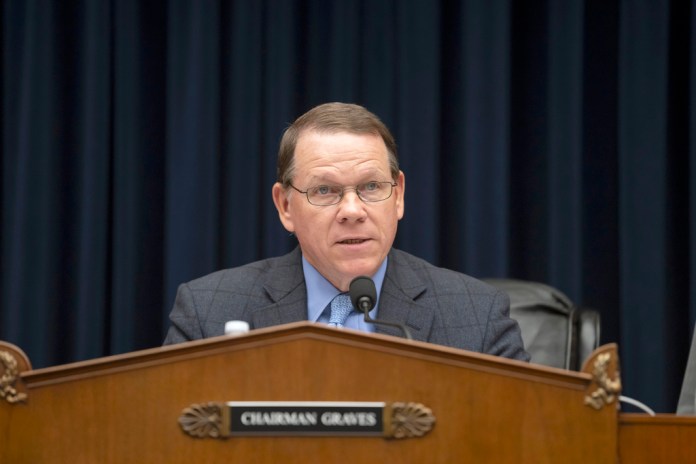
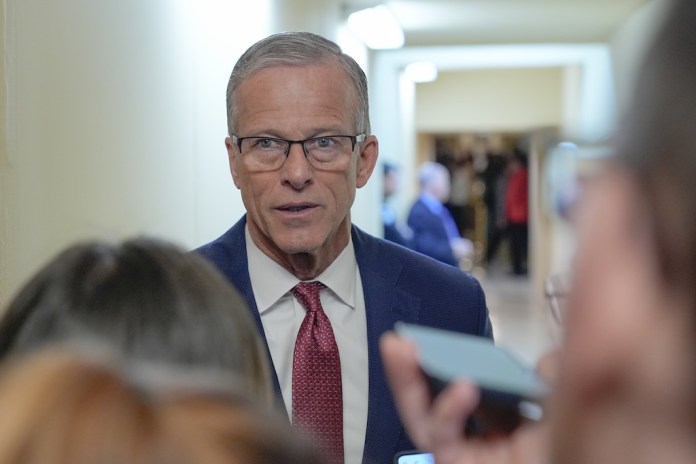


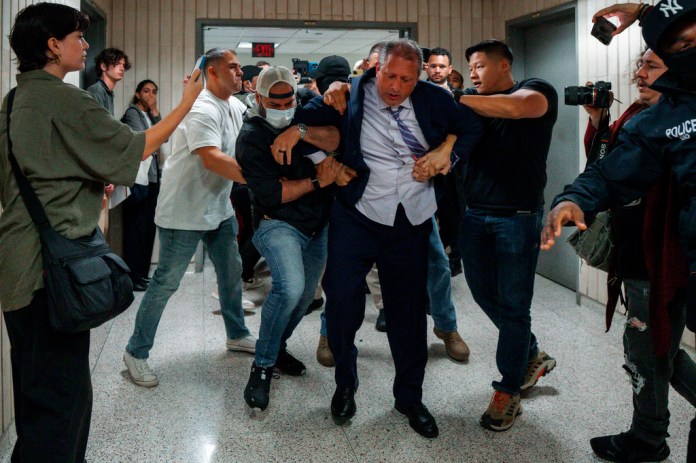
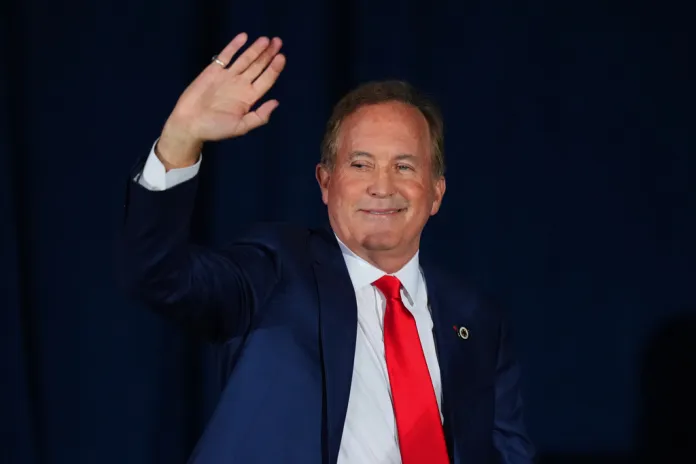


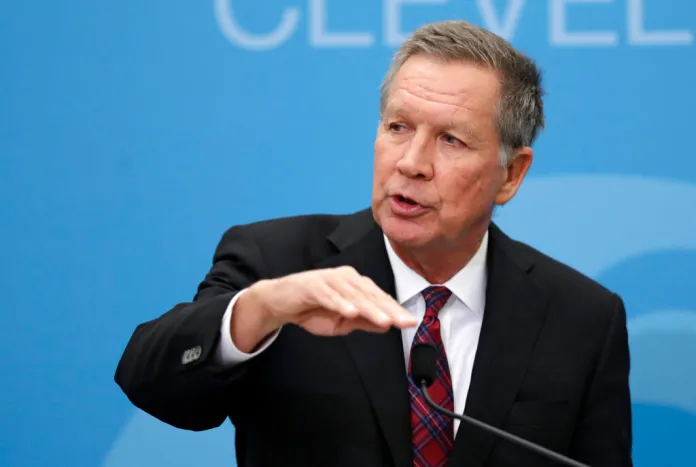
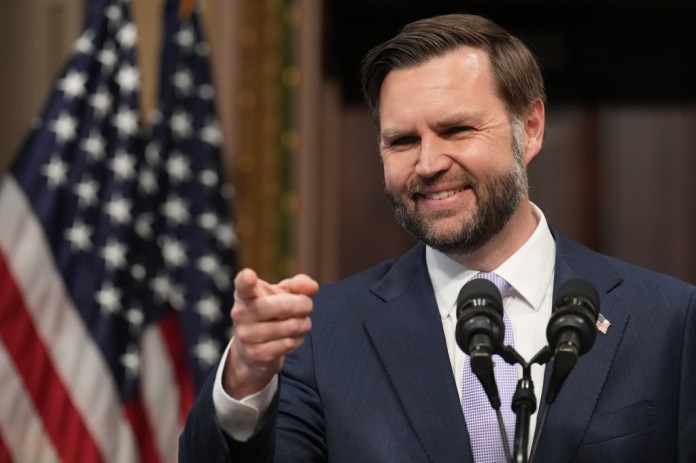

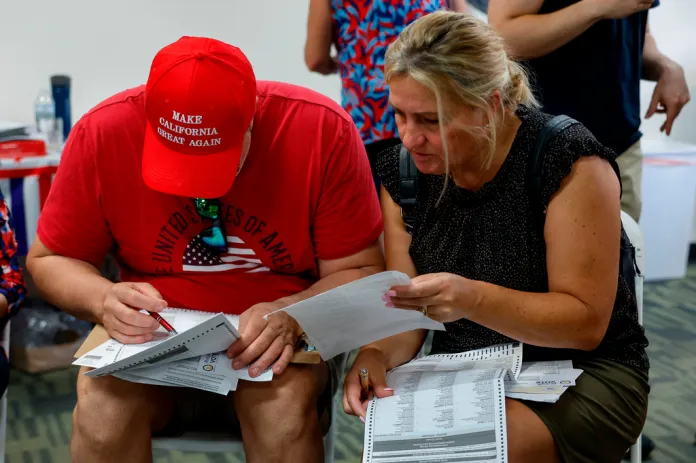



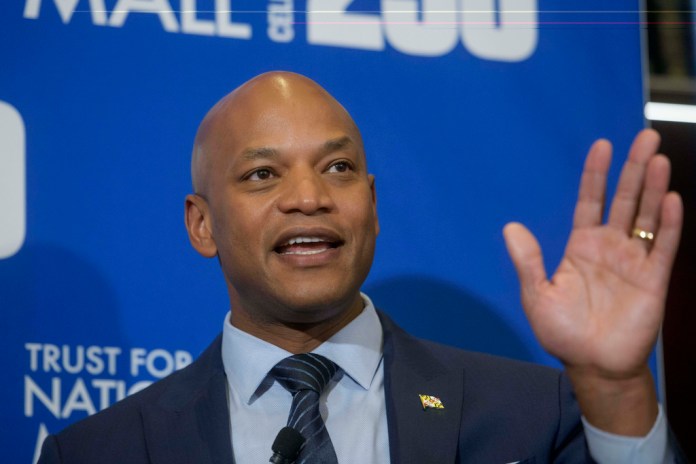


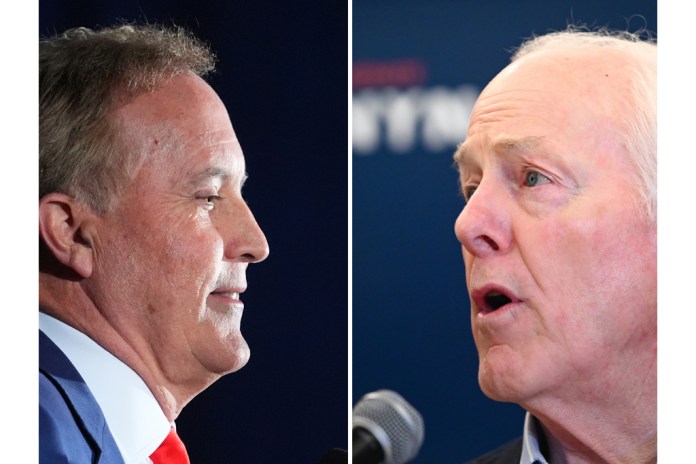

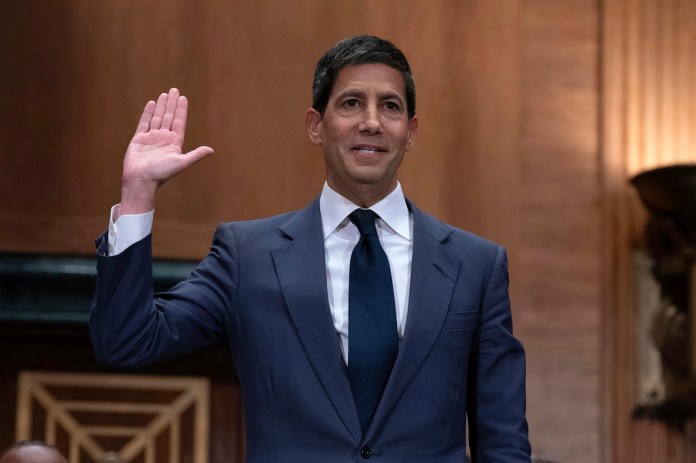




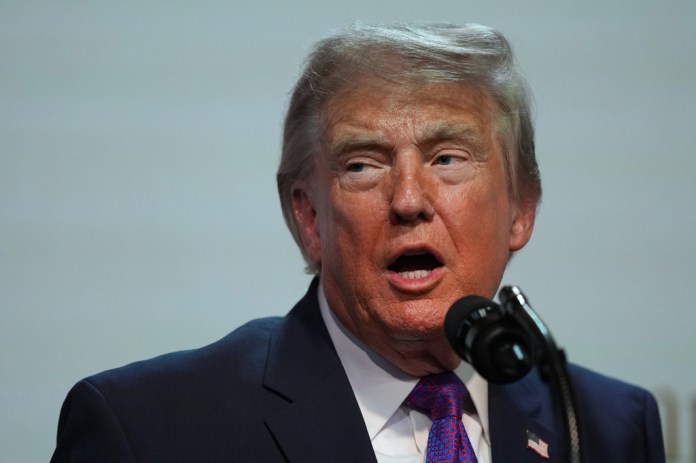
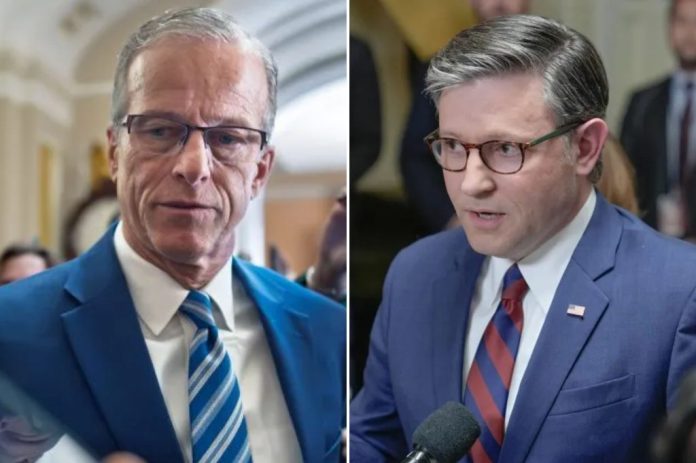
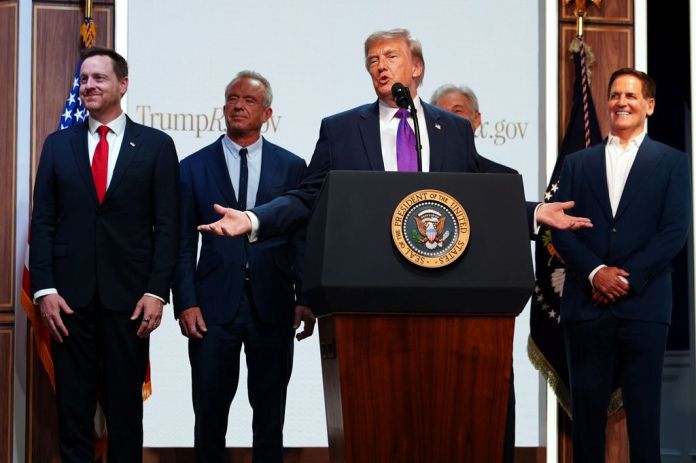
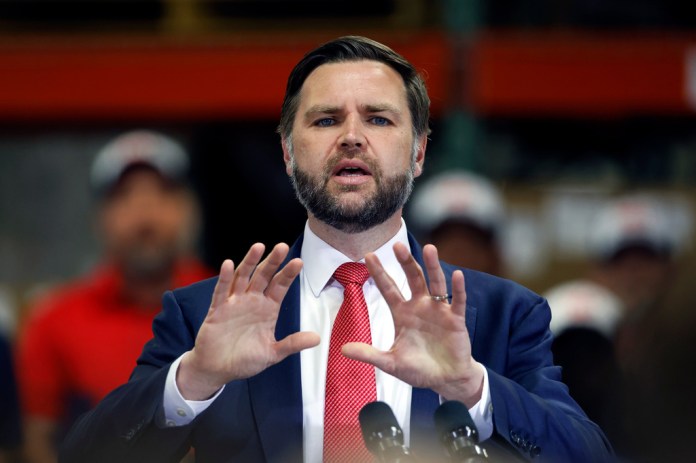




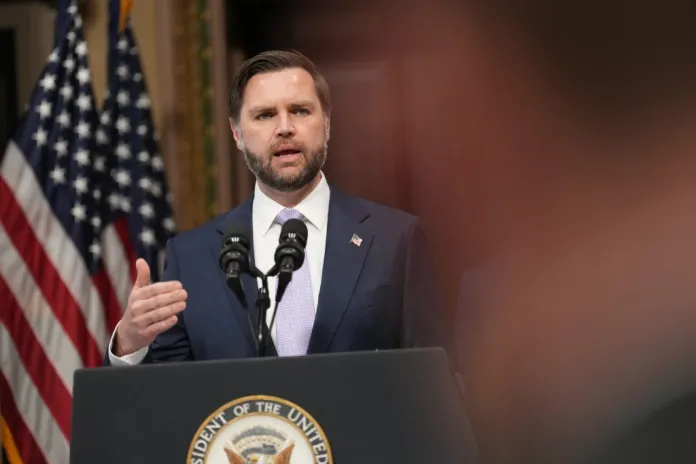

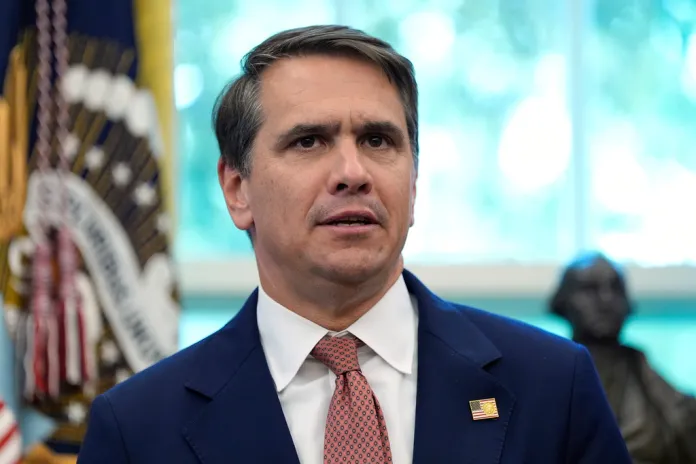

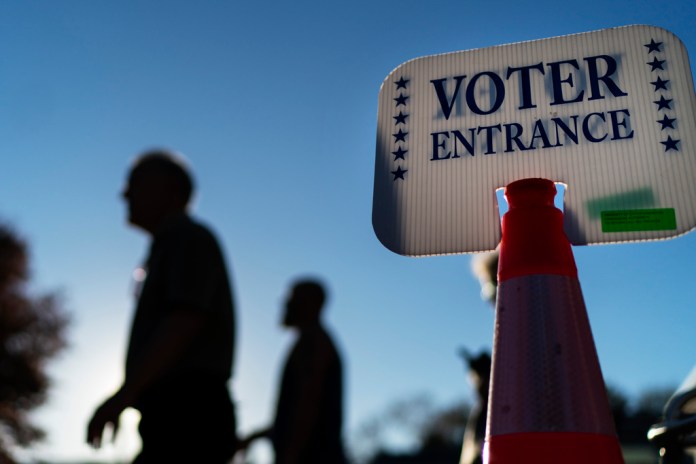









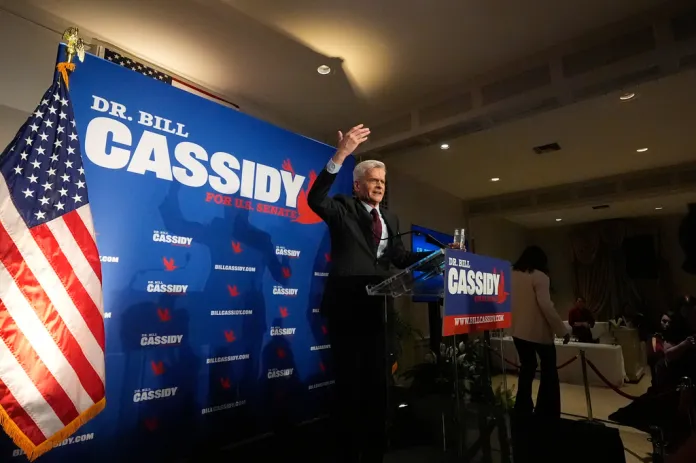

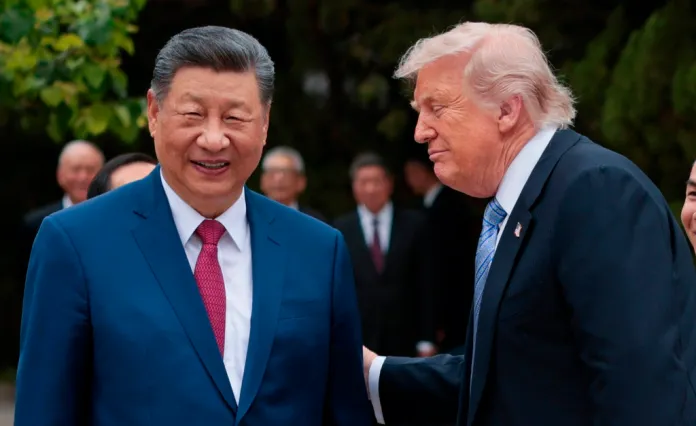




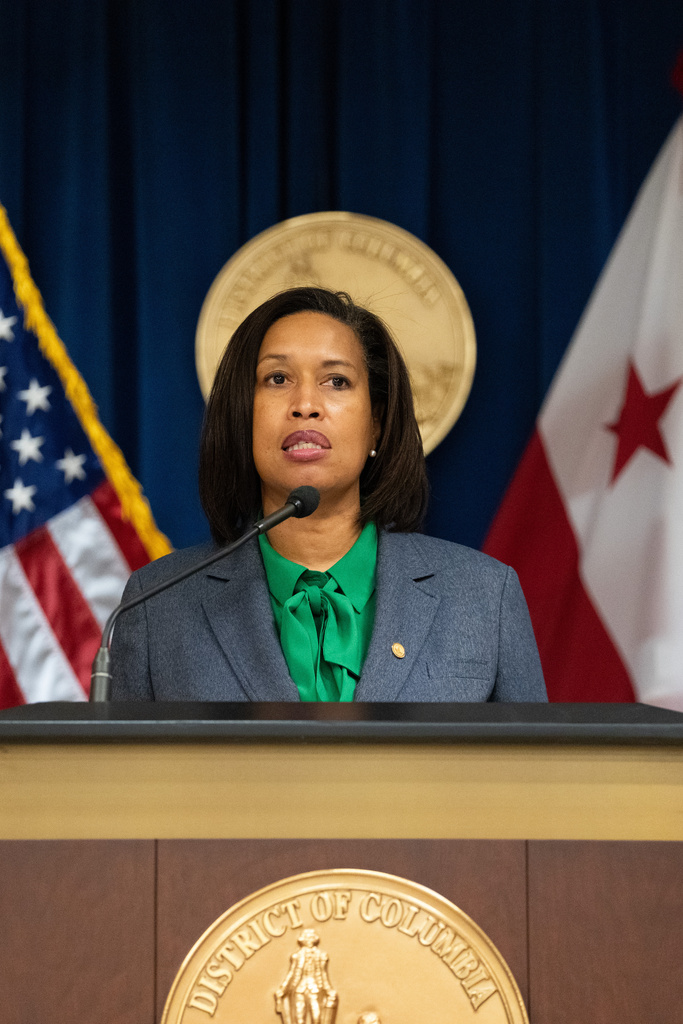

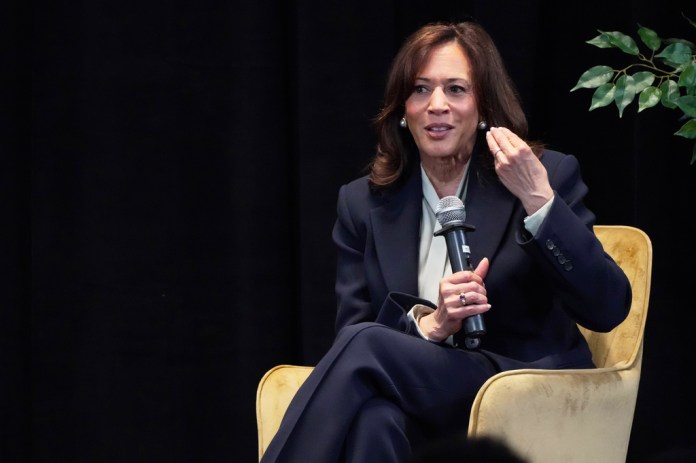

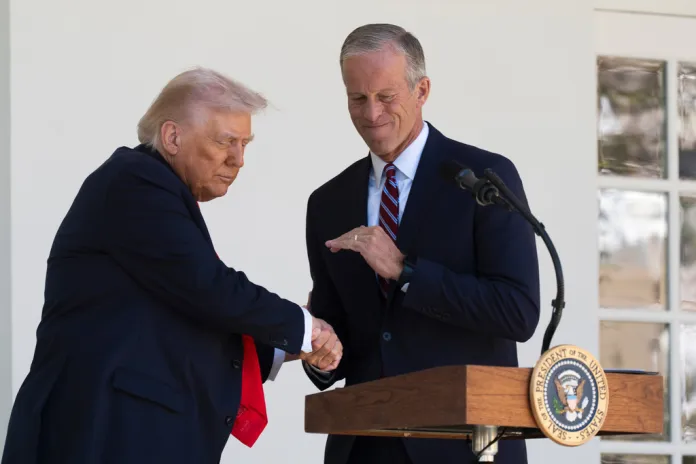
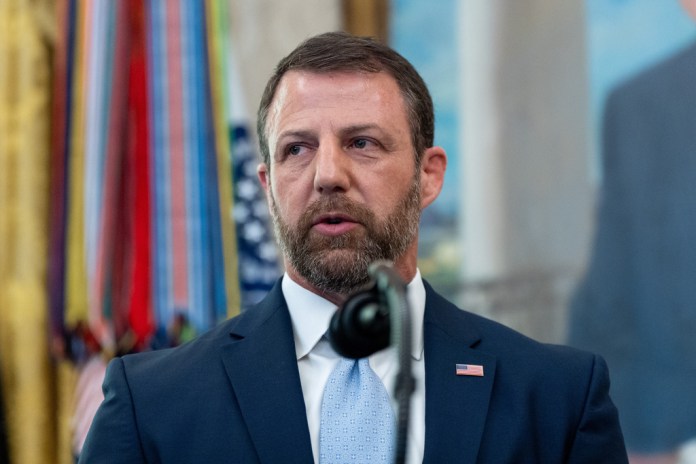
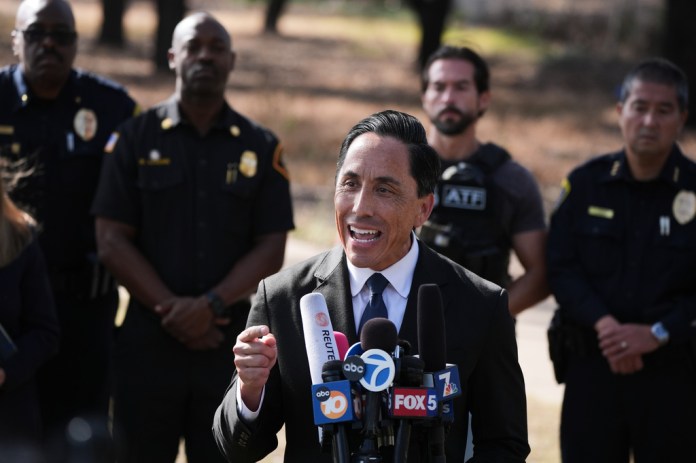
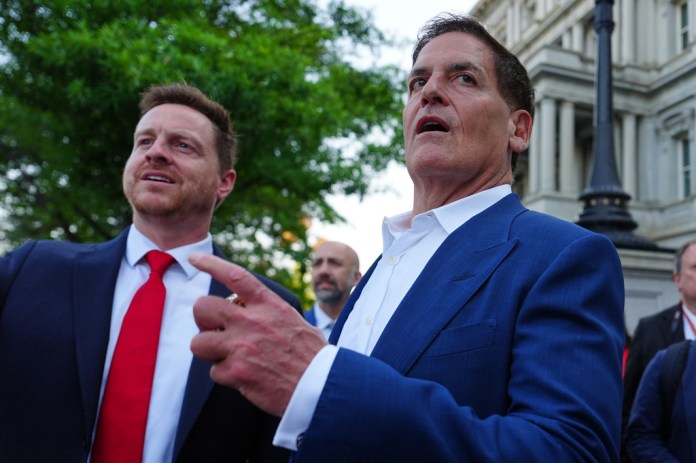




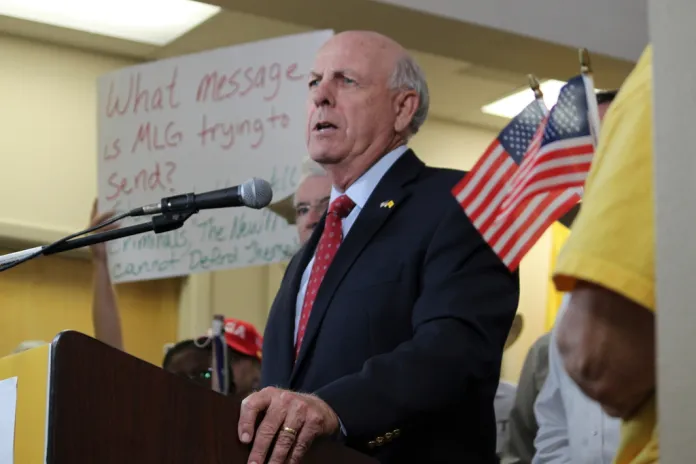

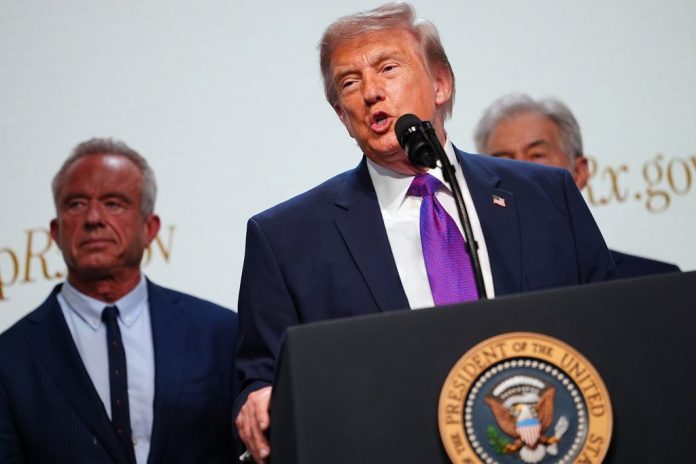

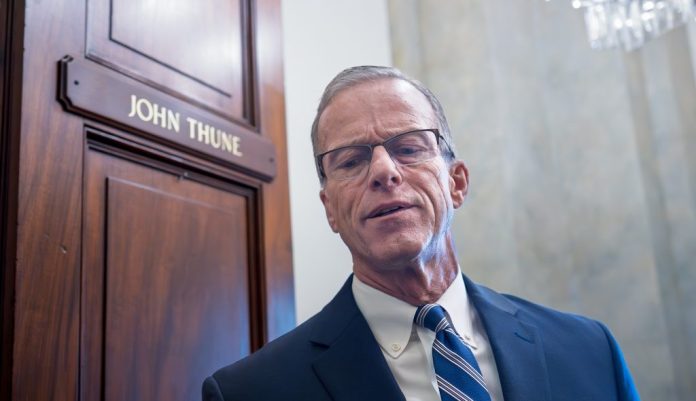

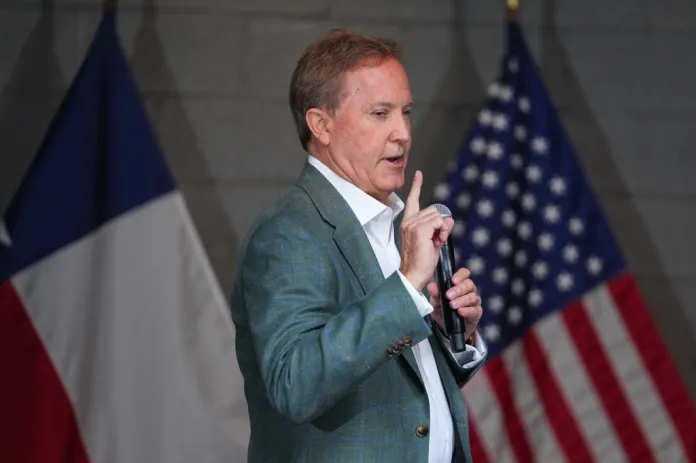
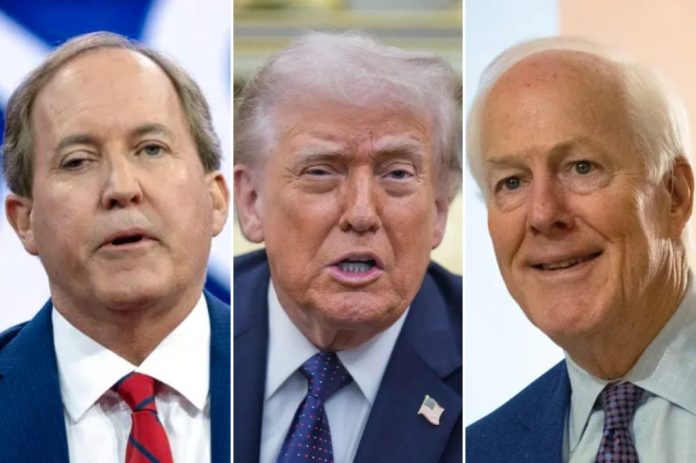
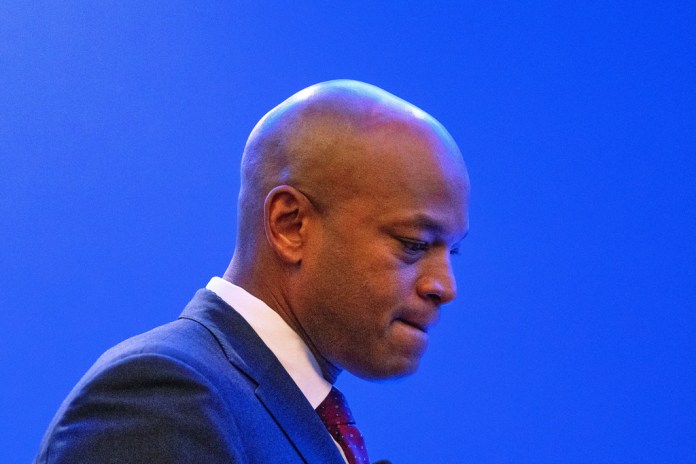







 Be sure to drink plenty of water, stick in the shade and cool off where you can!

 Plus, keep reading for the latest on the Treasury’s decision to once again extend a waiver for some nations to buy sanctioned Russian oil.