GeistHaus
log in · sign up

https://blogger.com/feeds/9074287/posts/default

atom
25 posts
Polling state
Status active
Last polled May 19, 2026 00:28 UTC
Next poll May 20, 2026 02:30 UTC
Poll interval 86400s
ETag W/"e5eaa6e396afae7201cbe6e8bc6b1bbda666ae2b23af9da0fd60a49f824dea2e"
Last-Modified Sun, 17 May 2026 09:38:02 GMT

Posts

With Nostr, Jack is well ahead of what Elon and Zuck have learned about censorship
Show full content

Mark Zuckerberg’s announcement that he is dropping censorship in the U.S. for Facebook and Instagram was accompanied by a comment that he is going to work with the U.S. government to encourage other countries to not censor content. Upon acquiring Twitter, Elon Musk dropped censorship and soon learned that government mandates from across the world censor content.

In 2024, Brazil blocked Twitter until it complied with censorship demands, France arrested Telegram’s CEO Pavel Durov, the EU censored additional Russian outlets and wrote letters to Twitter mandating more content moderation, and Australia announced it will fine platforms for misinformation.

The current U.S. administration had a heavy censorship hand and had threatened to revoke Section 230 which protects Internet sites from liability about their users’ content. Zuck indicated in his announcement and a letter to Congress in November that Meta felt coerced to comply. Twitter under Jack Dorsey was also coerced to censor, as disclosed in the Twitter Files and Alex Berenson’s amended censorship lawsuit with new insider materials from Twitter.

Western governments did not typically engage in government guidance or mandates on content until after the Brexit and Trump elections in 2016 followed by the Russia-Ukraine war in 2022. Once Western governments realized that they had lost narrative control, they started playing catch up with China, which was well aware from the start of the power of social networks to both disrupt and control narratives.

Due to the secretive nature of government guidance and mandates, Elon and those outside social media organizations had only witnessed basic content moderation. Jack and Zuck had already experienced years of coercive government guidance threatening Section 230 revocation as well as numerous explicit censorship mandates from Western governments.

Zuck’s response was to downrank and de-emphasize political content in early 2021 after the bruising 2020 U.S. election cycle. This was a difficult decision since Facebook made a lot of money from political arguments, as I pointed out in a 2019 article for VentureBeat. Zuck sidestepped government pressure and continued to grow his properties. Correspondingly, despite the volumes of racist and homophobic content on Instagram, there is not much pressure for content moderation from groups like Media Matters and GARM that have targeted X/Twitter.

Jack’s response was to fund Bluesky to shift Twitter to an open protocol like email’s SMTP and the web’s HTTP. Governments can of course censor at the protocol level with firewalls like they currently do for email and web, but by separating the application and protocol layers, Jack recognized that social networks could operate like any other Internet infrastructure that is content neutral. Jack departed Bluesky when the company started massively moderating accounts and content. Jack then discovered Nostr (Notes and Other Stuff Transmitted by Relays), a decentralized messaging protocol initially created by an anonymous developer FiatJeff, much like an anonymous developer Satoshi Nakamoto created Bitcoin.

Nostr is reminiscent of FidoNet, a popular store-and-forward messaging protocol for Bulletin Board Systems (BBS) in the 1980s. Each BBS was fully independent, and each could choose which forum messages to store-and-forward, whether to moderate content, and how long to keep the messages. In addition, FidoNet could store-and-forward private messages between users. UseNet also operated in a similar store-and-forward manner for Internet forums, but did not operate private messages since the Internet already had SMTP.

Nostr developers offer an active ecosystem of both clients and servers offering an interface familiar to social network users, as well as micro apps offering new functionality on top of the protocol. Nostr is decentralized with no central control point and transmits messages across independently operated relays. Just like with current email systems and Nostr predecessors FidoNet and UseNet the independence of the relays create inefficiency. Different users may not see each others’ replies chronologically until the messages transmission has caught up, and not all relays transmit all messages. FidoNet and UseNet were inefficient due to resource constraints such as long distance charges and intermittent connectivity. Nostr and Bitcoin use inefficiency to engineer resilience into the protocol.

A Nostr account can never be “revoked,” however relays are not obligated to carry an account’s messages. Users can easily switch relays or even operate their own. As part of the new generation of decentralized crypto software, Nostr uses a public/private key combination for identity, and you can optionally publish your profile name, e-mail address, and lightning wallet associated with the key. Nostr clients sign messages with your private key when you post, and users know it’s you by your public key. A note of caution: just like with crypto, if your private key gets compromised or lost, it’s like losing or having your Bitcoin private key stolen.

A new administration could easily coerce social media companies. This time, Elon stood in the face of a government onslaught. Zuck followed when the coast was clear. Jack has laid the foundation for the future.

tag:blogger.com,1999:blog-9074287.post-4003820915533904898
Extensions
It's time to secure user data in your identity system
Show full content

This post was also published with the Industry Association of Privacy Professionals.

It seems like every day there is a new report of a major personal data breach. In just the past few months, Neiman Marcus, Ticketmaster, Evolve Bank, TeamViewer, Hubspot, and even the IRS have been affected.

The core issue is that user data is commonly spread across multiple systems that are increasingly difficult to fully secure, including database user tables, data warehouses and unstructured documents.

Most enterprises are already running an incredibly secure and hardened identity system to manage customer login and authorization, commonly referred to as a customer identity access management system. Since identity systems manage customer sign-up and sign-in, they typically contain customer names, email addresses, and phone numbers for multifactor authentication. Commercial CIAMs provide extensive logging, threat detection, availability and patch management.

Identity systems are highly secure and already store customers' personally identifiable information, so it stands to reason enterprises should consider identity systems to manage additional PII fields.

Identity systems are designed to store numerous PII fields and mask the fields for other systems. The Liberty Project developed the protocols that became Security Assertion Markup Language 2.0, the architecture at the core of CIAM systems, 20 years ago, when I was its chief technology officer. SAML 2.0 was built so identity data would be fully secure, and opaque tokens would be shared with other systems. Using tokens instead of actual user data is a core feature of identity software that can be used to fully secure user data across applications.

Most modern identity systems support adding additional customer fields, so it is easy to add new fields like Social Security numbers and physical addresses. Almost like a database, some identity systems even support additional tables and images.

A great feature of identity systems is that they often provide a full suite of user interface components for users to register, login and manage their profile fields. Moving fields like Social Security numbers from your database to your identity system means the identity system can fully manage the process of users entering, viewing and editing the field, and your existing application and database become descoped from managing sensitive data.

With sensitive fields fully isolated in an identity system and its user interface components, the identity system can provide for cumbersome and expensive compliance with standards such as the Health Insurance Portability and Accountability Act for medical data and the Payment Card Industry Data Security Standard for payment data, saving the time and effort to achieve similar compliance in your application.

There are, of course, applications that require sensitive data, such as customer service systems and data warehouses. Identity systems use a data distribution standard called System for Cross-domain Identity Management 2.0 to copy user data to other systems. The SCIM is a great standard to help manage compliance such as "right to be forgotten," because it can automatically delete customer data from other systems when a customer record is deleted from the identity system.

When copying customer data from an identity system to another application, consider anonymizing or masking fields. For example, anonymizing a birthdate into an age range when copying a customer record into a data warehouse can descope the data warehouse from containing personal information.

Most enterprises already run an Application Programming Interface Gateway to manage web services between systems. By combining an API Gateway with the identity system's APIs, it becomes very easy to automatically anonymize and mask customer data fields before they are copied into other systems.

A new set of companies including Baffle, Skyflow, and Piiano have introduced services that combine the governance and field management features of an identity system with extensive field masking. Since these systems do not offer the authentication and authorization features of an identity system, it's important to balance the additional features as they introduce an additional threat surface with PII storage and permissions.

PII sprawl is an increasing liability for companies. The most secure, compliant and flexible central data store to manage PII is the existing CIAM and API Gateway infrastructure that enterprises have already deployed.

Move that customer data into your identity system and lock it down.

tag:blogger.com,1999:blog-9074287.post-2313831322513973571
Extensions
Miami has become the Dubai of the Western Hemisphere
Show full content

This post was also published in Refresh Miami
Dubai reopened aggressively during the pandemic with extensive testing and vaccination programs. It has since outpaced its primary competitor, Singapore, as the key destination for the wealthy seeking sunshine, lifestyle, and lower taxes. Dubai now stands alone in the Eastern hemisphere as the nexus point for the wealthy of the Middle East, Asia, Russia, and many Europeans.

Similarly, Miami became a top destination for the wealthy through the pandemic and has now emerged as the Dubai of the Western hemisphere. Already considered the “capital of Latin America,” Miami has become the nexus point for the wealthy of the U.S., Canada, and Europe for the same reasons as Dubai: sunshine, lifestyle, and lower taxes.

Very much like Dubai, the culture of Miami encourages emigration, success, capitalism, and wealth. The city government, led by Mayor Francis Suarez, actively seeks to expand the city and attract new business.

The new people

For those who have not visited Miami since before the pandemic, it’s hard to comprehend how much has changed. Take Miami, as you knew it before, with many successful Latin American businesspeople. Add 50,000 successful entrepreneurs, executives, and personalities who moved to Miami from cities like New York, L.A., San Francisco, and Chicago. And another 50,000 are coming.

The social environment is similar to Dubai, with a mix of successful people from various industries who are in a new environment conducive to networking and integrating new people. Successful people who grew up in Miami and thought they had to be somewhere else are now coming home, topped off by the recent return of Jeff Bezos.

A lavish lifestyle

Dubai is a great place to be wealthy, and so is Miami. The weather is excellent eight months of the year and suitable for dining outside and yacht parties. A slew of high-end restaurants have opened in Miami, and there is a remarkable overlap of establishments between the Dubai International Financial Center (DIFC) and Miami’s Brickell, including Cipriani, Hutong, L’Atelier, LPM, and Zuma. Indeed, they are both attracting the same type of wealthy clientele that live or work in business areas of the respective cities.

The nonstop events include F1, Art Basel, Boat Show, Ultra, and Swim Week. Miami is one of the few U.S. cities with teams in the NBA, NFL, MLB, and MLS, with stars like Lionel Messi picking Miami as their go-to city.

Yes, people have a great time here, and Henley & Partners research shows that during peak season, Miami has the most wealthy residents of anywhere in the world.

An expanding metropolis

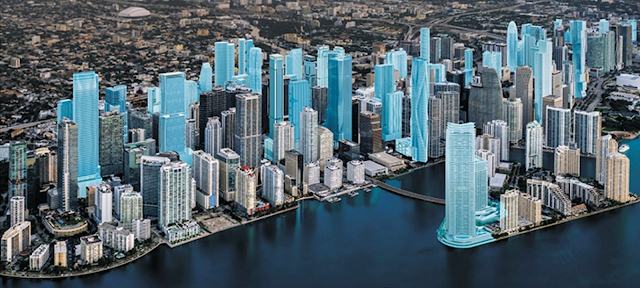
Like Dubai, the construction in Miami is nonstop, and new neighborhoods are seemingly created overnight. Dozens of new towers are planned or under construction in Miami’s commercial center Brickell, with a skyline increasingly looking like downtown Dubai. While other cities struggle to fill vacant commercial buildings, Citadel’s Ken Griffin is building a new $1 billion office tower in Brickell. Dozens of architecturally significant buildings are near completion from St. Regis, Edition, Shore Club, and Cipriani.

Major neighborhoods such as Wynwood, Midtown, and the Design District have been fabricated in the last few years. Despite the construction, housing costs have doubled due to the influx of residents. Fortunately, there is much room to expand to lower housing costs. Just like Dubai is expanding into the desert and towards Sharjah and Abu Dhabi, Miami has become the capital of South Florida. It is becoming a metropolitan area, reaching across Palm Beach, Fort Lauderdale, Homestead, and the Florida Keys. Local governments are also planning for the future, focusing on adding workforce housing.

Miami as a finance center

South Florida has become “Wall Street South,” with $1 trillion of assets under management moving in the past few years. The list of firms that fully or partially moved to Miami and Palm Beach continues to grow, including Thoma Bravo, Apollo, Citadel, ESL, Elliott, Point72, Virtu, Founders Fund, and more. Traditionally a bastion for Latin American family offices, Miami is now attracting family offices from across the U.S.

Miami is increasingly building the infrastructure, services, and talent pool to be a full-fledged financial center. Policy shifts in Chicago are accelerating the departure of financial firms from the city, and New York firms increasingly consider South Florida to be a sixth borough.

Miami as a tech hub

Dubai is not a top tech hub, but has a lot of tech. Thanks to the efforts of investors like Keith Rabois, Jack Abraham, Shervin Pishevar, and Delian Asparov, Miami now has as many new tech company formations as established tech hubs like Austin, Boston, and Seattle. Miami has a hustle culture with twice the entrepreneurs per capita as any other city and an edge in real estate, hospitality, media, finance, gerontology, and other areas.

Some in San Francisco regularly like to bag on Miami but didn’t seem to notice that in the last ten years, New York City has emerged as an almost peer competitor with nearly two-thirds of the tech formations of the Bay Area. And there is a very tight relationship between New York City and Miami, with many executives living in Miami a minimum of -ahem- 183 days a year. It’s still uncertain what will happen in San Francisco with tech. There are indeed large A.I. companies that were formed years ago. Still, the past year’s Cambrian explosion of San Francisco A.I. startups keep getting nuked from orbit by the large incumbents that add A.I. features much faster than new startups can add distribution.

Attracting top talent

Dubai attracts two types of talent: already successful people from Europe and top talent from India and other developing countries. For young Americans starting in finance and tech, going to the hub city to network, learn, and make it can be necessary. Many people who are already successful and have built out a network of industry and financing connections come to Miami to start their second or third venture. Repeat entrepreneur Howard Lerman, for example, recently launched his new company, Roam, in Miami after taking his last company Yext public in New York City.

The talent density is not yet there in Miami. However, Miami has the opportunity to continue to import talent from the rest of the U.S. as well as attract the top talent from the 670 million population of Latin America either into Miami or as remote offices in hot spots like Medellin and Buenos Aires. People think that what made Silicon Valley happen was the roughly 3,000 combined yearly computer science graduates from Stanford and Berkeley. Walk through any larger Silicon Valley office, and it is clear that what made the place happen was attracting all the top talent from India, China, and Russia.

A travel nexus

Thanks to Emirates’ extensive route network, Dubai is where people always seem to come through and come to vacation. Similarly, Miami is the U.S. gateway to the Caribbean and South America and the U.S.’s largest cruise hub. Miami Beach is a top-rated beach and hosts numerous luxury hotels. For residents looking for a weekend getaway, there are over 30 countries within a direct 3-hour flight.

Unlike Dubai’s massive convention center, Miami does not have the biggest conference business. However, it hosts many finance-oriented conferences and smaller conferences for influential stakeholders, such as numerous conferences for wealthy family offices.

Unfortunately, through the pandemic, Miami Beach also became a destination for rowdy college kids and furloughed people with stimulus checks, leading to rampant crime and violence during Spring Break. This year, the city has clamped down significantly to prevent a recurrence.

The good weather (for two-thirds of the year)

Like Dubai, Miami offers good weather for around eight months a year. It gets hot and humid from June to September for four months, just like New York City becomes miserably cold for four months from November to February. A significant difference is that if you have kids in school and live in New York, there is no avoiding the winter. If you have kids and live in Miami, you can take off for the summer if you don’t like the weather.

Increasingly, people stay through the summer. I went on business trips to Dubai in June and August last year because people were in town and doing business. Many now stay in Singapore through the Southwest Monsoon rainy season in the summer. Similarly, Miami has many full-time residents who enjoy the beach life and A/C and wear shorts to business meetings. The muggy weather is not that dissimilar from Washington, D.C. where I lived for 14 years.

Hurricanes and climate

South Florida is, of course, susceptible to the hurricane season. Interestingly, in the past twenty years, New York City has been more damaged by hurricanes than Miami. New York City has many low-lying areas, lots of underground infrastructure, and building codes unsuitable for the type of storms that reach the city. California has also experienced large-scale flooding this year.

I lived in San Francisco for 23 years. The Bay Area has an annual devastating fire season, and there is a lot of agreement about climate change, but there was no action on thinning trees or burying power lines.

In Miami, not everyone agrees about climate change, but everyone agrees that flooding is increasingly a problem. New pumping stations and seawalls are under construction throughout the area, and research is underway on how to mitigate seepage through the limestone into building foundations. Miami has very little underground infrastructure, staunch building codes since Hurricane Andrew, and heavy code enforcement since the Surfside building collapse in 2021.

Snarled transportation and future-looking transport

Miami is one of the few places where rail infrastructure has been upgraded with high speed rail, which now operates through West Palm Beach to Orlando, and soon to Tampa. Metrorail is about to be upgraded between the Southern suburbs of Coconut Grove and Coral Gables to downtown. Things are getting done in a reasonable amount of time and at a reasonable cost, in stark contrast to transportation infrastructure in other cities.

However, local traffic is snarled during the rush hours. Miami was a city that hosted many part-time residents who suddenly became full-time residents. This shift inevitably led to increased traffic, especially on Miami Beach and its causeways to the mainland. Miami is now one of those metro areas where many people stick to their walkable/microbility neighborhoods such as Brickell or South of Fifth. Going to other parts of the area requires planning, much like San Francisco residents do not go to the Peninsula during the rush hour.

New technology presents an opportunity to rapidly add mass transit without building out expensive rail infrastructure. Miami-Dade has numerous highways with carpool and paid express lanes that could easily be adapted to self-driving vans and buses traveling at high speed. Like Dubai, there is active discussion in Miami about electric hydrofoils and drone transportation systems.

Miami’s anti-crime efforts

Miami is not crime-free, but the crime is not evenly distributed. There are good parts of town with vigorous enforcement of quality-of-life crimes and bad parts of town. It isn’t fair, and policymakers aim to recruit and support enough police officers to make the bad parts of town safer rather than make the good parts of town less safe. In Miami, I leave my gym bag in the car because the risk/reward is simply not there for a criminal to break into the car and see if there is something in the gym bag other than smelly clothes, versus the multiple exploratory break-ins I experienced while living in San Francisco.

In a lot of cities, crime has become uniform throughout the city, and there is a profound lack of enforcement due to a declining police force and a series of measures that prevent arrests and putting repeat offenders in prison. We can debate the merits of these measures, but in Miami, during public response sessions, citizens regularly bring up San Francisco and the proven negative externalities of policies.

An expanding educational system

One of the limiting factors for successful people moving to Miami is that the sudden influx has overwhelmed the existing K-12 private schools. Charter and private schools are expanding, but catching up with demand will take a while. New types of schools, such as Primer, which offers small private neighborhood schools, are rapidly expanding across the Miami market to compensate for the shortfall.

Florida’s university system continues to gain in rankings and stands to gain even more as premier universities elsewhere focus on producing graduates with an almost unemployable worldview and work ethic.

Is Miami really the Dubai of the Western Hemisphere? Yes. To sum it up, business people would rather build a new office tower from scratch in Miami than move into an empty one in San Francisco. That is excitement. That is growth.

That is the new Miami.

tag:blogger.com,1999:blog-9074287.post-5981363422631357253
Extensions
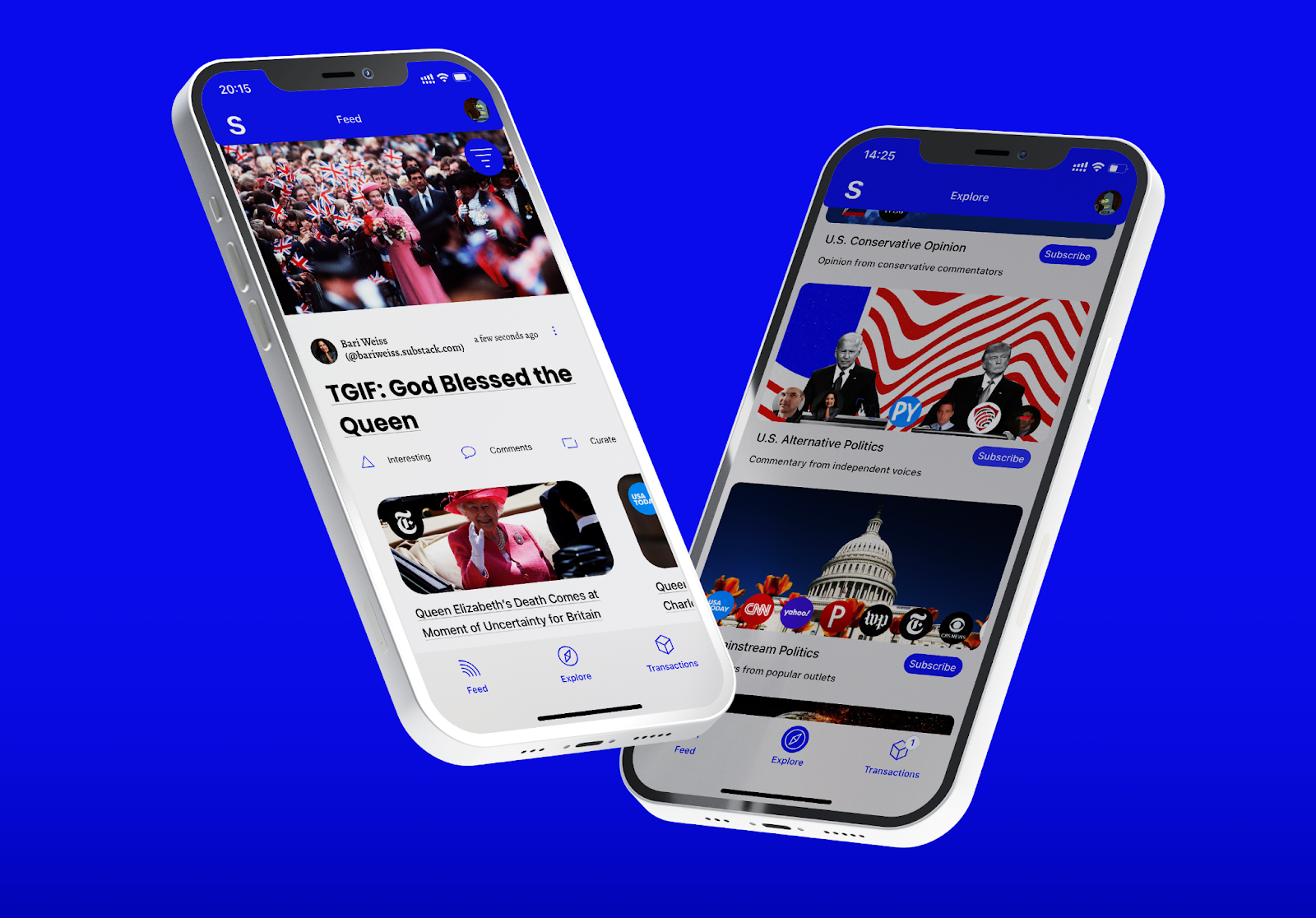
Introducing Summary.News - The AI news aggregator that summarizes by perspective
Show full content

I’m excited to soft launch Summary.News, an AI news aggregator that helps news readers know what's really happening by summarizing perspectives such as liberal, mainstream, and conservative. We aim to restore trust in the news with a more holistic view of stories.
Many people were shocked when inflation was not transitory, Kyle Rittenhouse was declared not guilty, a miracle vaccine did not stop spread, and the Ukrainian counter-offensive quickly ground to a halt. A select few newshounds were not surprised by these outcomes, but it takes a lot of time and energy to hunt, peck, and distill through various news sites to triangulate on what’s really happening. Trust in the news has unfortunately dropped to only 11% for newspapers, which to be clear are primarily mainstream publications and does not include Fox News. Popular news media typically operates from a factual basis but often omits vital facts. Articles about the Supreme Court Dobbs decision will include opinion polls about support for abortion (61% support abortion access). But articles about the Supreme Court Students for Fair Admissions decision often do not include opinion polls about support for affirmative action (only 33% support affirmative action).
At some point, all media converges on reality. Readers who are repeatedly surprised by outcomes like the persistent inflation and the stalled Ukrainian counter-offensive are increasingly losing trust in the media they read on the way to these realities.It’s a matter of perspectives, summarized by AISummary.News offers news summaries from five very different perspective groupings of news sources: Liberal, Mainstream, Conservative, Alternative, and Eastern Bloc. The Alternative perspective includes commentators such as Glenn Greenwald, Matt Taibbi and the Eastern Bloc perspective is composed of Russian and Chinese state media.

Summary.News users by default see articles from all perspectives in their main feed. However, you can subscribe to a subset of perspectives in the main feed and continue to see all available perspective summaries on a news topic. For example, you can subscribe to only the Mainstream perspective, see articles from sources like CNN, New York Times, and the BBC, which are augmented by holistic summaries of the other perspectives.
We have been tuning our AI model to learn what’s essential to each perspective. It’s important to dig deeper than liberals say “Trump bad” and conservatives say “woke bad.” Sometimes, multiple perspectives are saying the same thing, which is a good validation that there is a consensus on the news item. Other times, there are widely different perspectives on an event.

For subjects like technology and sports where there are typically not divergent perspectives, Summary.News shows the most relevant related articles.AI translation and summarization of non-English news sourcesSummary.News uses AI to translate and summarize Russian, Chinese, and Arabic news sources with perspectives rarely exposed outside of their home markets. The Russian and Chinese sources are grouped as the “Eastern Bloc” perspective, often providing a contrarian take to Western news media. They may be right or wrong, but it’s essential to understand what they are thinking and where they are coming from. In the old days (twenty years ago!), Western media would showcase propaganda like the second Gulf War’s “Baghdad Bob,” but now these perspectives are often no longer included.
How it worksSummary.News is a comprehensive news aggregator with AI and machine learning at every step. We use news sites’ RSS feeds to pull content at regular intervals. Every article is summarized using an AI summary generator. We then use AI to group articles together by topic and recency. Within each group of articles, we then summarize the relevant articles from each perspective. For the feed, we gather an “interestingness” signal from an intersection of sites across the Internet. We then use AI to sort the user’s feed by interestingness and the curations and perspectives the user follows. 
We then rerun this entire cycle every fifteen minutes, as various news outlets are typically updating articles or writing new articles about a breaking story.
Summary.News’s AI summaries are just that: a summary. We always point to the original article and the collection of articles forming a perspective summary.Who needs a new news aggregator?Many people get their news from news aggregators: Google News has 392 million visits per month, and the Yahoo! home page with news has 3.3 billion visits per month. The issue with these giant news aggregators is that they offer limited perspectives and merely present the news rather than summarize it. On social media, Facebook has de-emphasized news, and Twitter/X is essentially a live stream of everything where it takes time for the casual news reader to catch up on the latest news quickly.
Many Democrats are happy with mass media, but younger Democrats, Republicans, and independents are increasingly dissatisfied. This unique inflection point is an opportunity to reinvent news aggregators with AI summaries by perspective.
The Syndichain blockchainAll of the articles pulled by Summary.News are posted onto Syndichain, a Layer 1 blockchain purpose-built to syndicate content using an eventually consistent consensus mechanism. Blockchains like Syndichain are inherently censorship-resistant since they are immutable and achieve consensus across a worldwide network of nodes.
However, every country has its laws and customs for content. Syndichain Node operators in individual countries can additionally filter content for their users, but their actions are isolated to their country, and they can’t affect what happens in other countries. I’m the founder and CEO of InCountry, where we help multinational companies keep regulated data within a country. Syndichain is the inverse of InCountry in that Syndichain helps countries manage what information enters a country.Thank you to the Summary.News team and the AI communityA big thank you to our team of seven incredible engineers that were able to create a better Google News. I’m continually amazed by what a small, focused team of excellent engineers can accomplish. And a thank you to the creators of BERT, BARTT5, OpenNLP, and the rest of the AI and NLP community for all your contributions, openness, and collaboration. Being part of a wave of technology with such a great community is wonderful. It’s been a while since that’s happened.
Let us know what you think about Summary.News on Telegram or Twitter/X!
tag:blogger.com,1999:blog-9074287.post-3347955292938647925
Extensions
AI is coming for the professional-managerial class
Show full content

In his 1941 book, The Managerial Revolution, James Burnham predicted that a class of managers and administrators would rise above people performing actual tasks. Later dubbed the “professional–managerial class” by John and Barabara Ehrenreich, no one could have predicted that a vast swath of the upper middle class would become administrators, project managers, program managers, compliance officers, and the like.

The growth of managers and administrators

From hospitals to schools to companies, there are more managers and administrators than individual contributors working on what the organization actually creates. Thirty years ago, if you walked into a three-doctor physician’s practice, one receptionist would be at the desk. Now, an army of schedulers, insurance submitters, transcribers, and other paperwork managers serve the three doctors.

What do managers and administrators do all day?

These college-educated professionals make presentations, checklists, align, strategize, check off checklists, align, strategize, budget, summarize, and extrapolate. Most everything that they do can be replaced by the new generation of AI chatbots that are just now rolling out into organizations.

Love him or hate him, Elon Musk showed that Twitter could carry on without 80% of its former staff. People predicted that Twitter would collapse, and it did have a few minor outages. However, we must consider that a lot of staff also increases complexity and communications overload. While Twitter kept humming along, all of the airplanes in the U.S. were grounded due to a faulty computer update at the well-staffed Federal Aviation Administration, and all stock trading was halted due to a computer glitch at the well-staffed New York Stock Exchange.

AI can easily manage and administrate because of the work’s predictable behavior

Goldman Sachs predicts that 300 million jobs will be lost to AI automation, none of which are bricklayers. The new generation of AI can replace people with “know-how” that is predictable and consensus-driven. Everything from administrative staff, marketing copy, paralegal, data science, and even computer programming can be replaced with AI. Ironically, computers are among the first thing computer AI can replace.

Now medicine and other skills are still important. You need a doctor to ask the right prompts of the AI using the right terms. And you need the doctor to see if the AI comes up with something stupid. Regulators will ensure that doctors are still around, and patients will be relieved that they no longer have a human scanning their brain when presented with a list of symptoms. But you do not need that entire office full of people anymore or that entire building full of hospital chain administrators. Doximity has already shipped the AI that can replace these jobs.

In the developing world, they will not build up these administrative jobs, just like they skipped landlines and went straight to mobile. In areas without doctors, AI will be far better than nothing.

Whatfor the “surplus elites”?

During COVID, the essential workers keeping the world running and delivering food often wondered what these non-essential people were working on from home. These college-education “surplus elites” will switch from waiting in line to get into the Centurion lounge to… something new. But worry not, we have had large-scale job transitions before.

Back in 2015, I suggested that we will transition to a “village” lifestyle of working a Keynesian fifteen hours a week on jobs that entertain us, like the many college graduates we know that are now pilates instructors or gluten-free bakers. On the other hand, we all can be put to work installing solar panels and other green energy projects. That’s what we told the working class when their jobs were transitioned by globalization, amirite?

Line of surplus elites waiting to get into the Las Vegas airport American Express Centurion Lounge

PS: Yes, I wrote this myself. 😃

tag:blogger.com,1999:blog-9074287.post-6040571626221811689
Extensions
Introducing Syndichain - The censorship-resistant Web3 news aggregator
Show full content

I’m excited to share the soft release of Syndichain! Syndichain is a censorship-resistant news aggregator with open algorithms and news context. Syndichain is built on a new Layer 1 blockchain that is purpose-built to syndicate content using an eventually consistent consensus mechanism.

Syndichain was inspired by a systemic issue with news aggregators like Google News, Apple News, Twitter, and Facebook filtering content to a very narrow Overton window. These apps have recreated AOL’s walled garden of sanitized content. Many people are happy with an AOL experience. Syndichain is the app for people interested in a news aggregator that automatically includes alternative perspectives on issues like the Ukraine war and COVID response, as well as niche topics of interest. 

It’s been a two year journey of stealth development. Building a Layer 1 blockchain, news aggregation middleware, and a full app experience was a much bigger endeavor than we initially expected! It’s also fun to go deep on new distributed computing methods, a field I have worked in since the 1990s. A big thank you to the Syndichain engineering, devops, and QA team for their tremendous effort. Thank you to our two rounds of beta testers for contributing their time and feedback. And a special thank you and our prayers for our colleague Serhiy, the first Syndichain blockchain engineer, who is now fighting in a war.

Whyfor Web3

Ten years ago, I was the CTO/CIO at CBS Interactive, a Comscore 10 media behemoth. Even at the scale of a top media company, aggregators were extracting a lot of value from our content creators and curators.

Web3 offers the opportunity to radically change the economics for creators and curators. Curators currently do not have mechanisms to monetize their audience, and creators split a large percentage of revenue with aggregators or are hidden behind paywalls. Web3 offers the opportunity to invert the monetization pyramid and pay curators and creators for their efforts. Syndichain’s roadmap includes a placed content network for curators and microtransactions for creators.


News

Aggregators

Algorithms

Content

Filtering

Monetization

OG Web

MyYahoo!

iGoogle

RSS readers

None

None

Aggregator

Publishers

Web 2.0

Google News

Apple News

Facebook

Twitter

Closed

Pervasive

Aggregator

Publishers

Web3

Syndichain

Open

Two level graph

Opt-in block lists

Creators

Curators

Publishers

Nodes

Syndichain’s six core features

#1: Blockchain syndication

While blockchains are typically built for transactions, Syndichain's Layer 1 blockchain is purpose-built to syndicate content. Current blockchain consensus mechanisms ensure that there is never an instant where two people have the same asset like a Bitcoin, but the mechanisms are prolonged and cumbersome. Conversely, a news article or comment does not require consensus prior to node distribution. If I post an article, and you like a post, and Jane comments on a post, there is no reason why someone can’t access the new content the instant a node is aware of the content. This is why we have built an eventually consistent Layer 1 blockchain that is well-suited for content syndication.

#2: Censorship-resistant

Blockchains like Syndichain are inherently censorship-resistant since they are immutable and achieve consensus across a worldwide network of nodes. However, every country has its laws and customs for content. Syndichain Node operators in individual countries can additionally filter content for their users, but their actions are isolated to their country and they can’t affect what happens in other countries. I’m the founder of InCountry, where we help companies keep confidential data within a country. Syndichain is the inverse of InCountry in that Syndichain helps countries manage what information enters a country.

Syndichain is a modern progressive web app (PWA) that bypasses the Apple and Google app stores, which are increasingly censoring content. The Syndichain app functions like a native app, with an icon on the home screen, a full-screen experience, and snappy native user interface features like smooth transitions and translucency. The only feature the app doesn’t offer is browser-based push notifications, which Android and iOS may soon enable.

#3: Open algorithms

The algorithms used by news aggregators and social media sites are black boxes. You can’t see the source code, and the weightings are undisclosed. Many news sites and blogs are black-listed or throttled. And there’s a definite tilt towards attention-seeking rather than interesting content. With Syndichain, every post, comment, and like is on the blockchain, and anyone can write an algorithm to sort the content. The default algorithm in our middleware surfaces relevant content using the accounts you follow, the accounts they follow, and your activity. Node operators and developers can compete with algorithms to attract traffic.

#4: RSS compatible

Dave Winer invented Really Simple Syndication (RSS) for the OG Web to syndicate content across sites. Most media sites and blog platforms still include RSS feeds. RSS makes it possible for Syndichain to include news from around the web. Soon, any Syndichain account will be able to have an RSS URL that automatically populates the account with new posts.

#5: Context included

A big problem in today’s media environment is that readers typically live within content bubbles. News is so skewed nowadays that readers must discern a semblance of the truth by consuming a variety of perspectives. Syndichain uses machine learning to automatically surface related articles when you are scrolling through or reading an individual article. For example, Syndichain can provide the mainstream media, liberal, and conservative takes on a given news article.

#6: Curator powered

Syndichain's content experience centers on topic-based Curations of accounts and posts. We have included Curations covering common news sources, alternative voices, and even foreign state media. Soon, users will be able to create Curations of accounts, feeds, and posts on topics where they can offer expertise. We hope to see a Cambrian explosion of Curations for cities, hobbies, professions, and more.

The Syndichain road map

v1 - Aggregator: Now shipping a full news aggregator experience with social features. Adding bot detection so we can remove the token invitation system.

v2 - Curators: Users can build their own news Curations and attach RSS feeds to an account.

v3 - Monetization: Placed content network so curators and creators can monetize their audience with relevant content.

If you got this far down in the blog post, thank you for your interest!  Please check out Syndichain and let us know what you think through the app’s feedback feature or on our Telegram channel!

tag:blogger.com,1999:blog-9074287.post-7874959435716249362
Extensions
San Francisco: The reckoning is here
Show full content

As the President said this week, the pandemic has ended. What also ended are the fantasies in San Francisco that “after the pandemic, everything will come roaring back” and “the harder we lock down, the better the economy will bounce back.” California has the same age-adjusted excess mortality as Florida, so the destruction was wrought for naught.

Why do I write about San Francisco more than two years since departing? There are profound lessons to be learned from the San Francisco experience. These lessons need to be heeded in other cities and states where people are staunchly advocating for similar decision-making that will inevitably lead to similar results.

There are five clear trends that are now irrefutable and near-term irreversible.

1. An empty downtown results in massive budget cuts

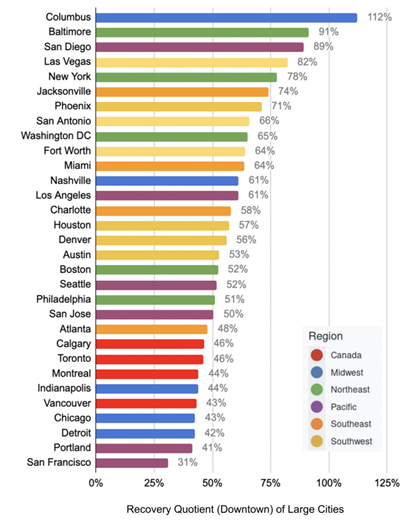
San Francisco’s downtown is empty. There’s a narrative that the buildings are vacant because it’s easy for tech companies to go remote. However, Portland, Minneapolis, Chicago, and Seattle are in similar dire straits. A distinct set of policy choices are driving people to leave and for companies to set up alternative locations where people can come back to work in an office.

The Federal stimulus that kept these empty Potemkin downtowns going for the past two years is now running out, and now there will be a series of significant budget cuts to government services. Even New York City, which has bounced back better than other lockdown-oriented locales, is facing a 10% budget deficit. Budget cuts could lead to more efficiency, but without attracting new businesses and people, there is the potential for a continuous, Detroit-style downward cycle.

2. A declining and inefficient police force results in more crime

San Francisco has replaced its DA and now re-funded police. However, police officers are leaving in droves, with very few recruits. Policing is all about coverage and staffing, and a declining police force inevitably leads to more crime. The police officers left are demotivated, highly risk averse, hated by a significant portion of the politicians and populace, and are “quiet quitting” until retirement.

In most cities, there are good neighborhoods, and there are bad neighborhoods. Such unevenness is an unequal situation that needs a solution. However, the way to rectify this is not to make all neighborhoods bad neighborhoods. It’s to invest in effective policing to ensure that bad neighborhoods have the same quality of life as good neighborhoods. With proper training and resources, it is very predictable to provide effective policing that does not arbitrarily kill unarmed Black men, and provides a secure environment for underprivileged neighborhoods to grow and thrive.

3. Fewer young and ambitious people are moving in

San Francisco was already becoming a place more suited to employees of big tech companies and later-stage startups. The larger tech companies are publicly committed to San Francisco and the Bay Area. However, they are more committed to their employees and attracting the best young talent. And the best young talent wants to live in vibrant, livable cities.

San Francisco's top technology employer Salesforce only has 5% of new job reqs in San Francisco, and Google’s Sundar Pichai is betting on New York City and Toronto. An ambitious young person can now have that awesome Google job while living in the Meatpacking district and walking to the Google office in Chelsea.

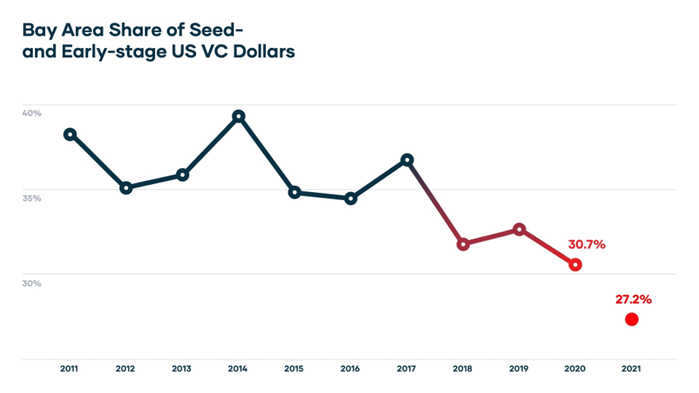
The leading indicator of future large companies and growth engines is the location of early-stage financings. The Bay Area was already experiencing a steep decline in early-stage financings. Now, investors no longer mandate startups to be in the Bay Area. Other locations like London are becoming centers of deep tech like AI, hosting leading companies like DeepMind and Stability.ai (Stable Diffusion).

Consider two young entrepreneurs graduating from Carnegie Mellon and starting a new company. Moving to San Francisco means that the entrepreneurs are contributing 13% in taxes of their outcome. Founders constantly debate whether Y Combinator is worth 7% at the start of a company, before any dilution. San Francisco has to present a clear and compelling case of why that 13% is worth it versus Austin or Miami.


Directionally, Texas and Florida are recreating a 1990s California, while California is recreating a stagnating France.

4. More older and accomplished people are moving out

When we sold our San Francisco house last summer, there were only a handful of competitive listings, and our house sold above asking in a week. In the past few weeks, there’s been a deluge of higher-end homes on the market as the rich begin to vacate San Francisco. Politicians are mocking the rich for selling their homes and moving rather than showing concern.

The middle class initially drove the demographic shift to the sunbelt, and now they’re joined by accomplished executives, venture capitalists, and entrepreneurs who can work remotely or move their companies. The initial batch of rich people moved primarily due to lockdown policies. The latest batch seems driven mainly by tax savings and quality of life. Anecdotally, there is another wave of departures waiting for their kids to graduate before they leave. Data shows that the people moving in make less money than the people who leave, and therefore provide less revenue to the city and state.

The pandemic is not the cause of this continuing shift of people, because the pandemic is over. The pandemic created nexuses of 50,000 intelligent and ambitious people that moved to a city like Miami from San Francisco, New York, Chicago, and Los Angeles, with another 50,000 on their way. That is enough of a network and ecosystem that ambitious people now feel comfortable moving to a Miami instead of a New York. For those that are sanctimonious about Florida or Texas politics, consider the next section on California’s treatment of Black and Brown children.

5. A monoculture results in less dynamism

A crisis reveals true character and whether decision-making is rational or emotional. When faced with the choice of re-opening schools, most European countries, as well as U.S. states like Florida and Texas, made a very rational data-based trade-off and re-opened schools.

San Francisco kept public schools closed through September of 2021, one of the most prolonged closures in the world. Concurrently, San Francisco also allowed private schools to open in October 2020, creating a situation where rich White kids were at in-person school while poor Black and Brown kids weren’t even dialing into school. A generation of disadvantaged children have been set back, and history will look on this as one of the most racist education decisions since segregation.

You would think that in the leading center of both technology and advocacy, there would be an active, data-oriented discussion focusing on outcomes for disadvantaged communities. Instead, as far as I know, only two San Francisco business executives publicly discussed the school opening issue: myself, in a widely circulated article in December 2020, and Jennifer Sey, the Chief Marketing Officer of Levi’s, who was promptly fired due to her advocacy that poor Black and Brown children return to in-person school.

The iconic ad representing San Francisco and Silicon Valley is Steve Jobs narrating an ode “to the crazy ones, the misfits, the rebels, the troublemakers.” Is San Francisco a place where rebels and troublemakers can publicly argue against the consensus opinion? Or has it become a place for people who did everything just right in high school, joined all the right clubs at just the right college, landed a job at a FAANG, and know just what they’re supposed to think?

tag:blogger.com,1999:blog-9074287.post-7970212065027989586
Extensions
The entire Bay Area has become a large declining tech company
Show full content

The large declining tech company. We’ve all read articles in the tech press and blogs analyzing how once hot companies lost their way. Most of them have followed similar trajectories and have a common set of characteristics. What if we apply the same “large declining tech company” framework to the Bay Area? It turns out that large declining tech companies and the Bay Area actually have a lot in common.

It breaks my heart to see what has become of San Francisco. I lived there for almost 25 years. When I first moved to San Francisco in 1997, it was a magical and inspirational place. Remember the Flying Saucer and Survival Research Labs parties? I hope that by analyzing what has gone wrong using a framework we know well, we can find a path to revitalization, and also provide warning signs for other metropolitan areas to not follow a similar policy trajectory.


The fall of Yahoo! is a well-documented example of a large declining tech company, and the following five categories are a great framework to analyze what is going on in the Bay Area.


1. The monoculture and shunning of heretics

If you worked at Yahoo! in the early aughts, you were considered a heretic if you brought up that Search was becoming a more important feature than Directory or Portal. People would stop inviting you to meetings. Your manager would tell you to stop being negative. But if you walked out of the building to any other company, people would agree that Search was a vast and fast-growing trend, and Google was already becoming a verb.


A scant five years ago, a “tech bro” wrote an open letter to the San Francisco mayor about street conditions, including being assaulted by a homeless person and pervasive drug use on the streets. He was lambasted in the tech and national press, and his letter effectively ended his career. If he had written that letter in pretty much any other city, everyone would have agreed with him. In San Francisco today, everyone now publicly states what he wrote five years ago.


Eventually, a trend becomes indisputable, but there is an interim narrative, and people desperately cling to their false reality and piously lecture dissenters. The Bay Area claims they are the most woke, and everyone else is racist. Yet this is the area where rich white kids went to in-person school in October 2020 only six months after the pandemic started, while BIPOC children couldn’t even dial into Zoom class for eighteen months due to lack of technology. Just like with Yahoo!, you can walk out of the building and state obvious facts to broad agreement, but if you bring up obvious fallacies in the Bay Area, people get angry.


2. The declining brand and the power of buzz

For years, Yahoo! was a hip, young brand that was the web’s home page. Everyone used it, and everyone talked about it. Over time, the brand degraded, and the users and advertisers moved on to Google. All of us in Silicon Valley have seen this rise and fall numerous times.


Right now, the Bay Area doesn’t have any “heat.” Key influencers like Elon Musk, Jason Calcanis, and Keith Rabois say it is a terrible place to start a new company. Hip young mayors like Miami’s Francis Suarez are like the hot up-and-coming startup with better services and a better cost model. The media is lapping it up with cover stories and commentary.


The brand and the buzz matter because it is what attracts new entrants. The engine of Silicon Valley’s growth has been that it is THE place for new startups to form, with an extensive network of angels, investors, and advisors. Right now, what is the compelling reason for two young founders who just graduated from Carnegie Mellon to go to the Bay Area and pay California 13% of their outcome? A fun, bustling city? There are now networks of founders and investors in the emerging tech hubs, and in particular networks of founders and investors fomenting the next waves of technology like Web3. Their idols and influencers are saying to go elsewhere, and you can already see the profound effect on Bay Area funding metrics.


It’s well known now that older companies like HP and Oracle are moving their headquarters to Texas. Yet just like Facebook is moving on to the Metaverse, Google, Facebook, Apple, and Salesforce are hiring in New York, Seattle, Austin, and Raleigh. Salesforce, San Francisco’s top employer, canceled the lease on a new office tower, and only 5% of its almost 2,000 job listings are exclusive to the Bay Area.


3. The empty campus and petty crime


As companies decline, their campuses begin to empty with people “working from home.” Employees walk around like zombies, and nobody’s smiling. The headquarters campus is always kept spiffy, but remote campuses begin to decline due to a lack of capital expenditures, with conference rooms that have CRT screens, old desks, and dirty kitchens.


The corporate campus decline is very similar to San Francisco’s rapid decline into an empty and dirty downtown dominated by the mentally ill and drug addicted, with an unsmiling populace working remote and rarely seen on the streets. Like the spiffy corporate headquarters campus, people post photos of Dolores Park and Crissy Field on the rare sunny day and tell you everything’s great.


It’s common for declining companies to experience rampant petty theft. Employees barely work two-hour days, don't report vacation time, go on expensive boondoggle trips to unnecessary conferences, and regularly sit on the beach doing nothing while yet another re-org shakes out. The managers that are supposed to be catching this behavior are doing the same things themselves, so there is no oversight. However, the accounting department will cite employees if they expense a drink out of a hotel minibar even if they arrive at a city at midnight on a legitimate business trip.


Much like a declining large tech company, San Francisco has descended into a well-documented spiral of petty crime, with rampant thefts and no quality of life issues enforced. However, the police will happily cite you for using your phone at a red light, which happened to me personally three times in the couple of years before I moved.


4. The people who leave and the people who stay


Initially, it’s the risk-takers that leave, and quite literally life or death considering there was a pandemic underway. Their peers lambast them. How could you leave Yahoo!? It’s been so good to you. You should stay. You’re going to die at the new startup. Search is stupid.


Just like people who moved to Florida and Texas didn’t die, neither did the people who left Yahoo! and went to Google and other companies. In fact, they flourished as their destination grew and prospered. They live on the waterfront in Miami and have parties on yachts, all at no cost due to tax efficiencies similar to the cost efficiencies of Google using cheap x86 hardware to scale their search algorithms. People start to follow them. At some point, the people who left are celebrated, like Yahoo! alums are currently celebrated.


Of course, people do stay. There is nothing wrong with staying and enjoying your current company and job. Some people like to be with a stable, well-known company, much like the prestige of Silicon Valley. Some people have the golden handcuffs of in-the-money stock grants, much like a house with a low Prop 13 tax rate. Some people don’t want to disrupt their work relationships, much like moving disrupts connections to family and friends. Some people have H1B visas or green card sponsors and have to stay put. There is nothing wrong with continuing to work at Yahoo!. Yet it is continuing to work at Yahoo!. Promotion practices stagnate and the mediocre rise, much like California will no longer teach algebra to middle school students.


Of course, to stem the flight, both companies and jurisdictions attempt to deploy friction on people leaving. Some companies try to sue people who leave for stealing trade secrets. San Francisco has a new tax on the sale of expensive homes. I would not be surprised if California attempts to deploy an exit tax on unrealized gains, similar to how the US taxes unrealized gains when people renounce their citizenship.


5. The shenanigans with finances and metrics

Yahoo! And other declining companies typically do financial engineering to show that they have a sustainable business. But look under the hood, and it turns out that Yahoo! Japan provides the value, not the rest of the business. It’s also typical to change metrics, such as switching from tracking monthly active users to the number of pageviews.


San Francisco is surviving on a fiscal stimulus that will expire at the end of 2022. In the next twelve months, will the downtown offices fill up? Will Union Square storefronts be re-occupied by retailers, Moscone Center full of conventions, and Pier 39 full of tourists? This is highly doubtful. At that point, very tough decisions will have to be made, like the budget cuts to the San Francisco school system now that there has been a dramatic drop in students.


In the Bay Area and California, there are similar shenanigans with metrics. They actively tell you that crime is down by cherry-picking statistics. They say that they’ve had the fewest COVID deaths when all-cause mortality (which includes increased suicides, drug overdoses, and homicides) is almost equivalent to fully open Florida. The ne simple metric to evaluate whether an area can support growth is housing construction. No housing construction, no growth. Will Austin add 300,000 housing units and widen its freeways? While in the midst of a housing price spike from the sudden influx of people, Miami is literally building new neighborhoods.


The potential turnaround


So how do you turn around a declining company or entire metropolitan area?


After out of control looting, years of crime spikes, and miserable street conditions, London Breed, the mayor of San Francisco, yesterday announced that lawbreakers had “destroyed the city". It’s great when management finally admits that there’s a problem. But are the people whose policies caused all of the problems and then ignored that they were happening, really the right people to turn things around?


Marissa Meyer was brought in as the savior CEO to Yahoo!, but her strategy was to throw a lot of money at acquisitions and bring in smart people. San Francisco has the most money per capita of any major U.S. city, and has hired a lot of smart people, but just like at Yahoo!, lots of money and smart people do not turn around a sinking ship. Simple projects like redoing the Yahoo! home page or adding bus lanes to Van Ness are cumbersome, overly expensive, and take forever.


Brad Garlinghouse, now the CEO of Web3 company Ripple, wrote the infamous peanut butter manifesto at Yahoo! where he described how resources were spread thin with a lack of vision, ownership, accountability, and decisiveness. Brad was ignored, and he moved on to bigger and better things and is now a billionaire as the CEO of Ripple, a company that has clear vision and execution, even under the onslaught of the SEC.


Clear vision and execution need to be articulated and executed for the Bay Area to succeed. Not a single politician has stated that they would like to see tech companies back in downtown San Francisco, or that it is a great place for founders to start their companies, or that the government will support and nurture the nascent crypto/Web3 industry.


A turnaround is a hard thing to pull off. After a series of acquisitions and divestitures, Yahoo! is now owned by a private equity firm that hired my former boss Jim Lanzone as CEO. Jim is proven: he pulled CBS – a moribund media company – into cloud streaming and an array of profit spewing websites. The Bay Area needs the equivalent: people who know how to grow a metropolitan area, build housing and infrastructure, and attract new business. The problem is that the voters have to vote for a change agent, and the change agents are all moving to Miami.


tag:blogger.com,1999:blog-9074287.post-4279763920750475054
Extensions
California’s lockdowns were as effective as a slow speed limit
Show full content


California, Florida, and Texas are among the largest U.S. states, and all three shut down before the Coronoavirus was widespread. They also have similar demographics, and a mix of city and rural populations. I have been writing about the relative success of the coronavirus virus response in Florida and Texas compared to California since last August. The coronavirus is a deadly plague that has affected countless lives. The data now shows that the quasi-lockdowns implemented by some U.S. States, with California at the forefront, did not have a material impact on death rates.

California’s lockdowns have saved 3,500 lives versus Florida and 8,000 lives versus Texas, simply by extrapolating the per capita death rate and not adjusting for demographics such as Florida’s elderly population. 3,500 to 8,000 lives are not a trifling number of lives to lose and the impact of loss on families and friends is heartbreaking. That said, we must consider that California is a large state with a population of 39.5 million people where 271,000 people die in an ordinary year like in 2019.

California’s lockdowns have saved the same number of people that die in vehicle accidents

When compared to Florida’s coronavirus fatality rate, California has just passed the 3,500 lives saved threshold where its lockdown policies have saved the equivalent number of lives as its 3,500 annual traffic fatalities. Traffic fatalities are a reasonable metric that represents the policy trade-offs a society is willing to make between economics, freedom of movement, and health.

The following is of course tongue-in-cheek, with the intent to illustrate that government policies need to balance economics, freedom of movement, and health.

A California speed limit of 5mph will save 3,500 lives per year

According to data and science, setting the California speed limit to 5mph on all roads and highways will save 3,500 lives per year. Scientists at the National Highway Traffic Safety Administration (NHTSA) have determined that at speeds of 5mph or lower, vehicle bumpers do not need to absorb the impact of an accident as there will be minimal harm to vehicle occupants or harm to pedestrians.

The elderly and vulnerable die at higher rates in accidents

Of particular concern are the elderly and people with comorbidities such as obesity and diabetes. These populations experience much higher rates of death from vehicle accidents than the young and healthy. The elderly also experience higher vehicle accident rates than the middle-aged population, so they are particularly vulnerable to accident deaths.

Long recovery time for some accident survivors

Beyond the 3,500 annual California vehicle fatalities, in 2017 there were over 277,000 people injured in California vehicle accidents. Some of these injuries require long hospitalizations and recovery times, with some patients having lasting debilitating conditions.

Your accident can kill others, especially the vulnerable

Even if you are a very safe driver, data shows that you will be involved in four vehicle accidents in your lifetime. A simple social interaction could cause a vehicle accident that could kill or severely harm others, especially the elderly and vulnerable. The inconvenience of driving 5mph is a small price to pay when you consider the lives saved.

Remote work and school since commuting is no longer possible

For many people, a 5mph speed limit makes commuting to work and school impossible. Thanks to modern technology, people can stop going to offices and schools and work remotely with technologies like Zoom and Slack. There are many lifestyle benefits to this style of working, although it can cause loneliness and depression. Essential workers will continue to work, although they will be very inconvenienced by the 5mph speed limit, but they will understand because the 5mph speed limit saves lives.

The climate benefits of the 5mph speed limit

Data and science show that driving at 5mph emits fewer greenhouse gases than driving at higher speeds. While the 5mph speed limit has massive inconveniences, there are also tangential benefits towards the greater goal of saving the planet. Even if the 5mph speed limit lasts for just a short while, we can see the collective benefits of limiting our driving speed.

Emergency vehicles should also be limited 5mph

Although it can also save lives to have rapid response fire, police, and ambulance services, the policy focus should be fixated on making sure that the streets are safe for all, especially the vulnerable. Subjecting all vehicles to the 5mph speed limit guarantees that 3,500 lives will be saved. Emergency vehicles should only go over the 5mph speed limit for the most dire of circumstances.

Spread the "Drive 5, Save Lives" message

The California government can’t simply set a 5mph speed limit and universally enforce it. So it’s important that the media and citizens widely publicize the benefits of the speed limit to the population. For the media, the highest impact is articles and photos of car wrecks, jaws of life, and morgues. People must think that they will die if they drive over 5mph. For citizens, the highest impact is constant social media posts, updated avatars, and public shaming via Nextdoor videos of neighbors driving 10mph instead of 5mph.

If the 5mph speed limit doesn’t make sense, neither did the lockdowns

Of course, last spring, nobody knew what to do. Hospitals and nursing homes were unprepared, so a short lockdown made sense. By the summer, there was already data from Europe on safe school reopenings, as well as serology testing showing an infection fatality rate of around 0.25% which was far lower than previous estimates, there was very little outdoor spread, and proof from that businesses could stay open with proper protocols

As I wrote in August, by the summer it was clear from the states that had reopened and contact tracing that businesses with safety protocols were not driving spread, including outdoor dining, gyms, and hairdressers.

It’s now been a full year. Looking at empirical data, it is clear that closing schools and businesses did not save many, if any, lives. The data trend was very predictable as I outlined in my December article. Let’s stop pointing out that cities mostly populated by rich, white people did great. The impact on BIPOC children and adults has been dreadful and is likely the most racist policy outcome the U.S. has experienced since segregation.

If all of the lockdown destruction was worth it, we would set the speed limit to 5mph tomorrow.


tag:blogger.com,1999:blog-9074287.post-2622209461768434275
Extensions
Florida and Texas flattened the curve. California did not.
Show full content


  • After the initial shutdowns in March, ventilators, PPE, and testing shortages were mostly solved by early May.
  • Florida, Texas, and other states that followed the original plan to flatten the curve for hospitalizations have re-opened their economies while maintaining hospital capacity.
  • California opted for a novel virus suppression strategy that has destroyed its small businesses with a profoundly negative impact on minorities. California is now about to run out of hospital capacity.
In March, we were all introduced to “flatten the curve.” During a surge, patients in need of a hospital bed would have one available. The entire country pitched in for two weeks, followed by 30 days. In that hectic time, the Federal government and states prepared hospitals with ventilators, PPE, and testing infrastructure. As I wrote in August, states then reached a critical juncture: re-open with prepared hospitals per the original virus mitigation plan or continue lockdowns in an attempt to suppress the virus until a vaccine was created.

States like Florida and Texas re-opened per the original virus mitigation plan and were pilloried by the press and health officials. States like California and New York that went with the suppression strategy were lauded for “following the science.” When we moved from California to Florida in September, my friends told me we were insane. I told them that, looking at the math, they were insane for staying. It is now clear that “following the science” without the integration of economic or social science has had devastating effects.

Florida, Texas, and California are directly comparable: large states with a mix of cities and rural areas, “sunbelt” weather (especially in the Southern California epicenter), and all three shut down before the coronavirus began to spread.

Florida and Texas split two surges evenly

When states like Florida and Texas re-opened in May and June, there was, of course, a surge in the virus. People gradually began to re-engage with society, and vulnerable people were much less likely to socialize. Hospitals were stressed, smaller hospitals ran out of capacity, and some patients had to be transferred to other areas in order to get treatment. However, no patient needing intensive care was unable to get the care they needed. Cases soon subsided, following a textbook Gompertz curve, and the hospitalization curve was flattened.

When the inevitable second wave came in the fall, Florida and Texas’s curves followed the same trajectory as the first wave. Vulnerable people were exercising more caution, and businesses were open but less busy than usual. An estimated 20-30% of residents had already been exposed to the coronavirus and built up immunity, In addition, some scientists theorized that there are already some people with pre-existing immunity from other coronaviruses. Of course, this is not full herd immunity, but enough immunity to dampen the second wave to a level that hospitals would not be overwhelmed. Even Thanksgiving did not spike the trajectory of the curve in Florida and Texas.

Hospitals are again becoming stressed, but there are now better therapeutics and knowledge, and hospital stays are shortening compared to the first wave. Despite claims that Florida is manipulating its data, Florida tracks exactly like Texas and its neighbor Georgia. New York has a similar curve as Florida and Texas in its second wave, not because of mitigation measures, but because New York had a similar number of cases in its first wave that built up immunity. Now of course these curves can continue to spike up, but not as sharply or as high as California's second wave curve.

California did not “flatten the curve” and will run out of hospital capacity

When California experienced its first wave of cases last summer, it very quickly shut down again even though hospitals were virtually empty. Counties in the San Francisco Bay Area went beyond the state guidance by shutting down earlier and longer. These actions pushed all of the cases that would have happened in the first wave directly into the second wave. And due to exponential math, moving more cases into the second wave dramatically increases the spike in cases.

The media has had a penchant for fearmongering about hospital capacity. During Season 1 of “the hospitals will run out of capacity” in March in New York, massive surge facilities were built out by the Army Corps of Engineers, and Navy hospital ships were deployed. But then they weren’t needed. During Season 2 of “the hospitals will run out of capacity” in the Sunbelt over the summer, rural and small hospitals were highlighted, especially in Texas. Even when cases were already steeply dropping, meaning that hospitalizations would soon drop, we were deluged with articles about hospitals running out of capacity. During Season 3 of “the hospitals will run out of capacity” in the fall, a surge in the upper Midwest stressed rural hospitals in states like South Dakota, even while “Covidiots” still celebrated Thanksgiving across the country.

Through all of the ups and downs of the first three seasons, the hospitals’ heroic doctors and nurses made it through! Elective surgeries were canceled! Every patient that needed an intensive care bed got one! America!

We are now kicking off Season 4 of “the hospitals will run out of capacity” in California. This time the hospitals will actually run out of capacity. Cases are stratospheric and climbing, so more hospitalizations and deaths will soon follow. Unfortunately, very few people in California believe the hospitals will fail. The media and public health fearmongering about hospitalizations are now the boy who cried wolf.

California does not have as much ICU capacity as Florida and Texas. California also did not build up extensive surge facilities over the past nine months. Inexplicably, even amid a massive spike in cases, California has not stopped elective surgeries that can fill up ICU beds. Officials seem to think they can stop this wave by doing another shutdown.

Public health guidance has to account for “will people actually do it”?

We can immediately save the 40,000 Americans that die every year from car accidents. Scientists say that if we set the speed limit to 5 mph on every street and highway, we can reduce those fatalities to zero. The experts have spoken! Science! Easy-peasy, right?

Public health guidance has to account for whether the target population will actually do it. Dr. Anthony Fauci is now lamenting that Americans are too independent. Yet it is very well-known, especially to social scientists, that Americans are one of Earth’s most independent peoples. The U.S. cannot employ strict multi-month lockdowns deployed by Confucius-based societies like China and Singapore. Or the military- and police-enforced lockdowns deployed in Australia and Europe every time there is a new outbreak, even if they produce no results as is the case in Europe. It is simply (and now obviously) not a strategy that will work in the U.S. for ten months. The people won’t comply, and the police and military will refuse to deploy.

Government officials are being called out as hypocrites for violating their own health guidance. They are not hypocrites; they are simply human beings like millions of others that can’t follow impossible public health guidelines. However, when the leaders don’t follow their own guidance, they lose all credibility upon issuing new guidance. They are signaling that the guidance is like the speed limit: optional.

We have known for months that COVID transmission requires fifteen minutes of close contact. Suppose you could pick one thing to get every American to do. Which would it be: #1 wear a mask and keep social distance outside at the beach and walking down sidewalks, #2 wear a mask and keep social distance while walking down the grocery store aisle, or #3 wear a mask and social distance while visiting friends and family. We have a lot of virtue signaling with people doing 1 & 2, but then not doing #3. To mitigate transmission public health education should have focused on #3, rather than whether people are wearing masks while sitting on a beach.

People in California mocked armed anti-lockdown demonstrations in Michigan in May and then hosted indoor dinner parties just a few months later.

Californians are no longer listening to public health guidance

Officials no longer use the words “data and science” in their diktats. As court cases and anyone Googling basic science can find, it is because officials are no longer actually using any “data and science.”

Residents and even the mayor of San Francisco are pushing back on closed playgrounds because surface transmission is minimal. Restaurants are pushing back on closed outdoor dining because tracing shows minimal transmission, even for indoor dining. Every major school system in California is still closed even though they are open in other deep Blue states, and all data shows that there is minimal transmission risk in schools.

If you force a bunch of people to do erratic things that don’t actually drive results, eventually they give up on all of them. There is learned behavior from the first shutdown, and people in California know that a two to three-week shutdown will likely lead to months-long shutdowns. This time, rather than waiting, they are immediately visiting each other’s houses. The social media Karens that were proudly wearing masks in their avatars and hectoring everyone as “Covidiots” are now busy having their friends over for wine.

California has, at this point, lost the consent of the governed.

The racist and deleterious effects of California’s extended lockdown

The California lockdown has been systematically racist and benefited the tele-working rich hiding in their homes. The truancy rate among Hispanic and Black students is enormous, while teachers’ unions in California implore that teachers Zoom from home, unnecessarily participating in the work from home Zoom life of their college-educated peers. Small businesses with large proportions of minority ownership, like nail and hair salons, have been decimated.

Minorities make up a large proportion of essential workers and have died in much greater proportions than Whites. The essential workers in the back of a restaurant are making the food whether it's meant to go to the front of the restaurant or for delivery, and then they go home and infect their inter-generational households. In Los Angeles, Hispanics are dying at three times the rate of Whites. There are more drug overdoses than COVID deaths in San Francisco, deaths that also disproportionately affect minorities.

Officials were in competition with each other over virus rates and deaths and not tracking any other metrics, seemingly only capable of first-order thinking without considering second-order effects. In San Francisco, more than half of the storefronts are permanently closed, and 10% of households have left the city, with many ironically moving to Florida and Texas, which are both open and growing. California's unemployment rates increased by roughly 3% more than in Florida and Texas. The CDC estimates that a third of excess deaths are deaths of despair. People are walking around with the same dazed and depressed vibe as those living in an authoritarian state.

California’s pandemic response has followed the exact arc of its response to other crises. Consider the homeless crisis. Bring in experts. Listen to the experts. Roll out policies that burden the many and business owners in favor of the few. Even if the results are terrible, double down, because the intentions are honorable.

The pandemic is over in February - no matter what

After a couple of months of vaccinations, there will no longer be vulnerable people that can die from the coronavirus. The death rate and hospitalizations will drop to below that of the flu. Cases counts will also drop given WHO guidance on using a lower PCR cycle threshold to determine positivity, which Florida had already implemented.

Florida and Texas are still forging their own path rather than relying on the CDC expert guidance, with the obvious idea of distributing the vaccine first to the people who are dying the most. Consider: you have one group of people working in hospitals that are not in the most at-risk group, with PPE and protocols to stay safe. You have another group of people that is the most at-risk clustered in nursing homes with insufficient PPE and health protocols. Which group do you give it to first? Florida is going with the at-risk people. Ironically, medical professionals have already pushed back about taking the vaccine themselves, while the elderly are begging to get the vaccine immediately.

With vaccines deployed to vulnerable populations, people will not be “killing grandma” by going out, and there will be a full-scale revolt against any public health guidance. Scary articles that skew numbers will fail to convince young people that they will die from a virus with the death rate of the flu for those under age 65. Long-term effects apparently rectify within a few weeks. It’s time to see some real data that is not manipulative because young people are smart and are seeing through any dissembling. At this point, it’s likely that a third of a young person’s social network has already had the virus, and these friends can make it up the stairs months later without wheezing.

Follow the multi-disciplinary science

Hopefully, in the future, we can indeed “follow the science.” Actual science that is multi-disciplinary and uses empirical evidence to test hypotheses.
tag:blogger.com,1999:blog-9074287.post-5312306263915138299
Extensions
The alt-cities: Why Tech, Finance, and Music chose Austin, Miami, and Nashville
Show full content

Three months ago, my wife and I moved from San Francisco to Miami. I previously lived in San Francisco for over 23 years, where I started multiple companies and worked at companies like Sun Microsystems. Given the spate of people now moving, I thought it would be useful to aggregate the unique characteristics that have turned Austin, Miami, and Nashville into such hot destinations.

Globalization and network effects have produced centers of industry in mega-cities, such as finance in New York and technology in San Francisco. It takes a monumental event to displace an industry from a mega-city; the only such event in the modern era is the handover of Hong Kong to China, which shifted Asian finance to Singapore.

The coronavirus is now as significant an event as the handover of Hong Kong. Three alt-cities (alternative cities) for key industries are quickly emerging: finance from New York to Miami, technology from San Francisco to Austin, and music from Los Angeles to Nashville. There is also cross-pollination in these emerging centers. Much like New York started to have a tech scene, Miami has a rapidly burgeoning tech scene with great support from its mayor Francis Suarez.

Alt-cities require multi-faceted kindling to become viable competitors:

Key people

It's all about the key people. You can't move the center of an industry without moving key players. Years of attempts to kindle homegrown Silicon Valleys everywhere from the Silicon Prairie to Silicon Beach have fallen flat as a replacement to Silicon Valley because the key people stayed put

Rather than going fully remote, key people are aggregating in cities where they will be able to network post-COVID. Austin has attracted well-known technology figures such as Elon Musk, Drew Houston, and Joe Lonsdale. Miami and South Florida have landed finance billionaires Carl Icahn and Paul Singer, as well as prominent technology investors Keith Rabois, David Blumberg, and Sherwin Pishevar. Nashville hosts well-known artists including Jack White, Miley Cyrus, and Taylor Swift, who rejected Los Angeles and helped shift Nashville from country to other forms of music. These cities are attracting free thinkers known to lead the way, leaving the impression that those left behind in the origin cities are clock-punchers at Google.

Prestigious companies

Alt-cities need well-known and prestigious companies to relocate or create significant outposts to help create an ecosystem. These companies help attract new talent to the area as well as transfers from other locations.

The Miami area has attracted numerous hedge funds, including Elliott Management, and even top-tier Wall Street firms such as Blackstone and Goldman Sachs are relocating key divisions to Miami. In Austin, Tesla is building its largest facility on the outskirts and Oracle is moving its  headquarters there, joining outposts from Amazon, Apple, Facebook, Dell, and many other top-tier technology companies. Brand name Silicon Valley VC firms are closing their San Francisco South Park outposts and setting up shop in Austin. Nashville has sprung from its country music roots, with Warner, RCA, Sony, Universal, and other top-tier music labels expanding in the city.

Business-friendly

While New York City and San Francisco are mulling converting their emptied office buildings into residences, the alt-cities have seen an increase in office space demand and are quickly green-lighting new office space projects. Tesla's new facility in the outskirts of Austin was fast-tracked and is nearing completion.

The coronavirus highlighted how business-friendly a jurisdiction was in terms of using data and science to set rational re-opening parameters. With pandemic protocols in place, Tesla's factory was open in China, Boeing’s factories were open in Washington, and auto factories were open in Detroit, Alabama, and South Carolina. Tesla's San Francisco-area factory was one of the only auto factories in the world that was still closed, forcing Elon Musk to play a game of brinksmanship with local authorities, with the county’s assemblywoman sending Musk a vulgar missive.

Escaping increasingly bizarre taxes and regulations, it’s now no surprise for innovators to start a new hedge fund in Miami, a new tech startup in Austin, or a new record label in Nashville. Access to people and capital will be equivalent to the previous centers of industry.

Affordable suburban living

From the 1980s to the mid-1990s, cities suffered from high crime rates and numerous quality of life issues. New York City, San Francisco, Los Angeles, and some other major cities have recreated the environment of that era, with non-scientific pandemic restrictions that devastated local businesses and a penchant for placing the mentally ill directly in family-oriented, residential neighborhoods. These cities have stopped prosecuting many property and quality of life crimes, inevitably leading to bad quality of life and apathetic enforcement of more serious crimes.

The coronavirus has reset consumer expectations back to suburban living with the mental health benefits of living in greenspace. There has been an exodus from major industry centers to their suburbs and to the alt-cities. The alt-cities of Miami, Austin, and Nashville all offer car-friendly, suburban living, relatively cheap housing, and continual housing construction. With the acceleration of sustainable building materials and clean and cheap energy, the urban planning rationale to pack people into urban cores with mass transportation was already beginning to fray, and the coronavirus has sealed its fate.

Culture and openness

Miami is incredibly diverse, a nightlife capital of the world, has a booming art scene centered around Art Basel, and is almost as LGBTQ friendly as San Francisco. Austin and Nashville are both well known for live music and vibrant nightlife. All three offer farm-to-table restaurants and craft breweries, as artisans follow their clientele to new locations where they are unlikely to be arbitrarily shut down or face inordinately high insurance premiums.

New York City, San Francisco, and Los Angeles are increasingly recognized for only accepting a single, maximalist viewpoint with a rapidly shrinking Overton window that even excludes working with the defense industry. In Miami, half the people you meet are conservative and half are  liberal, and there is an acceptance that there are alternative viewpoints. A diversity of thought -- rather than a single yet constantly shifting viewpoint -- is attracting "the crazy ones, the misfits, the rebels, the troublemakers, the round pegs in the square holes" to the alt-cities.

Low taxes and quality government

People are not moving solely for tax purposes. New York and California’s tax rates are only a few points higher than they were twenty years ago. However, once people decide to move, of course tax rate is a factor in choosing a destination. Florida, Texas, and Tennessee seemingly offer everything that California and New York offer: highways, streets, schools, police departments, fire departments, and such. All the government services one would expect are there, and none of the capital gains taxes that entrepreneurs and venture capitalists typically pay.

As comedian and political commentator Bill Maher recently noted, California is reminiscent of a 1970s Italy, with high taxes and terrible government services. In return for high taxes, one would expect to go to Hunter's Point, East Palo Alto, or East San Jose and see excellent schools and services for disadvantaged people. A hyperloop instead of a failed high-speed train. Fire mitigation and stable power to complement long term climate change goals. A boom in middle-class housing rather than a $700K median house price. California and New York are becoming bad versions of Singapore, with a wealthy technocratic elite, an immigrant servant class, and a collapsed middle class.

What’s next for alt-cities?

The alt-city trend has only just begun as legacy cities seem ideologically unwilling to waver on these characteristics. Other industries are starting to relocate, including the Los Angeles entertainment industry to Las Vegas by piggybacking on the porn industry, Seattle aerospace industry to Charleston by piggybacking on Boeing, New York art industry to Miami by piggybacking on Art Basel, Denver building a bigger technology sector by piggybacking on it broadcast/telecommunications base, and the New York retail fashion industry to Columbus by piggybacking on L Brands.

We are at a momentous intersection where numerous Hong Kongs are becoming Singapores.


tag:blogger.com,1999:blog-9074287.post-1263537399197749957
Extensions
Florida and Texas are the new and improved Sweden: short shutdowns work best
Show full content

  • From March to early May 2020, the U.S. caught up on ventilators, PPE, and testing.

  • In May there was a juncture: continue the “flatten the curve” strategy, or attempt to suppress the virus with an extended shutdown.

  • States that continued with the “flatten the curve” strategy and re-opened had a lower unemployment increase and a similar death rate as states with extended shutdowns.


Sweden is much maligned for not implementing a complete shutdown, resulting in a much higher COVID-19 death rate than its neighbors Norway and Denmark, albeit a lower death rate than many other European countries. Almost half of Sweden’s 6,000 deaths came from not sufficiently protecting nursing homes. Sweden’s GDP contracted significantly but outperformed most of Europe since Sweden had far fewer business closures.


The U.S. coronavirus response was much looser than most European and Asian countries, many of whom had strict shutdowns where people could rarely leave their homes. Within the U.S., there were various responses between states, ranging from no business closures to significant and long-lasting closures. As we near the sixth month of the U.S. pandemic response, we can analyze the efficacy of different approaches. In particular, whether the length and breadth of a shutdown helped reduce per capita deaths, and at what economic expense.


The U.S. shutdown to “flatten the curve”

The U.S. government is widely criticized for not locking down quickly enough or implementing a quick response similar to those of Asian countries with SARS experience. As the outbreak intensified in New York City, the U.S. instituted a federally mandated slow down for 15 days from March 16 to March 31, followed by an additional 30 days from April 1 to April 30. Various jurisdictions surpassed federal guidance with shelter-in-place and business closures. The shutdowns’ stated goal was to “flatten the curve” to prepare for and slow down a wave of sickened people so that everyone who needed a hospital bed or ICU would get one.


The messy rush for ventilators, PPE, and testing was mostly solved by May

What happened from March to May was very messy. Computer models from Imperial College and IHME predicted a massive spike in cases and a corresponding shortage of ventilators. The predicted shortages triggered an enormous scrum between governments and private industry to obtain ventilators and PPE (Personal Protective Equipment). There is the complaint that the U.S. should have created a single government coordination point to obtain and distribute ventilators and PPE, qualify requests, and set up a distribution mechanism. Instead, the government decided to let the free market reign and have organizations purchase these goods through whatever channels necessary. Although quite messy, the approach worked; the need for ventilators and PPE peaked at the beginning of April and subsided through May, helped by the fact that fewer ventilators were needed than predicted. In early May, the U.S. had excess capacity and was shipping ventilators to other countries in need of the medical equipment.


Another debacle was the need for more testing. The U.S. Centers for Disease Control (CDC) had a longstanding policy that only the CDC can create new viral tests from scratch and distribute the test to industry. The CDC was a single point of failure that did indeed fail, causing another scrum to catch up in testing. The U.S. did not begin to catch up with its peer Western nations until the beginning of May. The testing system continues to be stressed by delays in processing. However, tests for frontline workers and those with symptoms are prioritized over other tests and are generally processed quickly. U.S. testing capacity continues to increase, leveraging its fee-for-service medical system’s endless capacity to test any number of ailments.


The May divergence: continue with the “flatten the curve” strategy or commence a virus suppression strategy


At the beginning of May, the U.S. had begun to resolve ventilator shortages, PPE shortages, and caught up in testing. Elderly and vulnerable populations were well educated, and long-term care facilities had time to institute new protocols. Early serology testing from around the U.S. and Germany showed a high number of asymptomatic cases and a relatively low infection fatality rate of 0.1%-0.4%, much lower than the 3%-5% case fatality rate of symptomatic patients. It was becoming clear that COVID-19 was not as fatal as previously thought in early models. Current CDC estimates show the infection fatality rate is 0.26%, two-and-a-half times that of the flu.


Option 1: Continue with “Flatten the curve”

The U.S. was at a juncture, and there was a divergence in strategy. The federal government and most states, including Texas, Florida, Arizona, and Georgia, wanted to re-open with the original “flatten the curve” strategy. This meant re-opening knowing that there would be a rise in cases, yet slowing the rise such that hospitals would not be overwhelmed. Business leaders recommended this strategy to prevent an economic calamity. The vast majority of epidemic planning for respiratory infections with an infection fatality rate lower than 1% recommended this approach.


Option 2: Suppress the virus

Other states such as New York, California, Michigan, and Illinois opted to remain closed and implement a virus eradication strategy. This strategy was implemented by emulating countries such as Australia, New Zealand, and most of Europe which implemented a virus suppression strategy with extremely strict shutdowns, contact tracing, and isolation. Many in the U.S. are very independent-minded, so there is a very low likelihood of success of implementing European-style military-enforced shutdowns, tracking peoples’ movement for contact tracing, printed out “hall passes” for one member of a household to go shopping per day, and pulling people out of their homes to put them into mandatory isolation. Most U.S. public health experts and the media backed the suppression strategy, although it was a novel strategy.


Re-opening spiked cases counts in Florida, Texas, Arizona, and Georgia

Georgia began to open up on April 24 (22-day shutdown), Texas on May 1 (28-day shutdown), Arizona on May 15 (45-day shutdown), and Florida on May 19 (46-day shutdown). Immediately after re-opening, the number of cases grew dramatically. Despite a media outcry, these states stayed the course, while adding some mitigation to “slow the spread” to ensure a flattened curve, like mask requirements and reclosing bars. The virus quickly reached an apex in these states and then quickly plateaued and subsided. The peak in per capita cases in Florida and Arizona were very close to the peak of per capita cases in New York and New Jersey, the hardest-hit U.S. states (and region of the world) that suffered the first U.S. outbreak. This time, most infected people were less than 60 years old, with a fatality rate similar to the flu. After the wave passes, the elderly and vulnerable can resume their activities.


With large case spikes, there are concerns about long-term heart, lung, brain. and kidney problems that are the rare but typical symptoms of viral inflammation. Each new report about these outcomes seems to use small sample sizes and then gets debunked and fade away.


“Flatten the curve” worked in Florida, Texas, Arizona, and Georgia

“Flatten the curve” did indeed work. Graphically comparing these four early-opening states to New York and New Jersey looks precisely like the CDC “flatten the curve” example, other than the curve is flatter than expected. Hospital capacity in these states was stressed but not overwhelmed. Nursing homes and elder care were relatively secured. Patients sometimes did not have a room available, yet every patient that needed an ICU or treatment received it. In rural Texas hospitals without ICUs, there were indeed tough decisions for terminal patients whether to be sent to an available bed thousands of miles away or home to hospice care.


The difference in taking 4-6 weeks to secure the vulnerable population and prepare the hospital system for a spike in cases is very apparent. Texas is the second most populous state with 29 million people and has had 12,000 deaths after re-opening. Florida is the third most populous state with 21 million people and has had 11,000 deaths after re-opening. These are far fewer deaths than predicted and far fewer deaths per capita than states that shutdown for far longer. There are estimates that up to 2/3 of those deaths were people that would have died in the next six months. To put these unfortunate deaths into context, Texas has 198,000 deaths and Florida has 203,000 deaths every year. During the 2017-18 flu season, Texas had a comparable 11,000 flu deaths.


Comparing death rates and economic consequences of mitigation vs. suppression

States like Florida, Texas, Arizona, and Georgia were shut down for 3-7 weeks, which had a profound effect on their economies. However, they have half the unemployment increase of states with extended shutdowns like Michigan, Illinois and California. Florida, Texas, Arizona, and Georgia also have a lower per capita death rate than the states with extended shutdowns. States like New York, New Jersey and Michigan that were hit at the beginning of the pandemic have a high death rate, and a large unemployment increase because they stayed shutdown. [Note these charts use last month’s Bureau of Labor Statistic’s numbers because this month’s numbers are undergoing some debate and will likely be updated.]


Of particular contrast are California and Washington, both part of the “Western States Pact,” both experienced early COVID outbreaks and early shutdowns. The most populated regions of California have maintained shutdowns far longer than other states and municipalities. Fitness centers, hair salons, and bars have been closed in swaths of the state for over five months, and a great deal will likely not survive.


Tesla illegally re-opened its California factory on May 11 to force the issue and then was able to legally re-open. Washington, also part of the “Western States Pact,” has been much more aggressive, allowing Boeing to restart manufacturing on April 21 with safety protocols. Both Washington and California have the same per capita death rate. Yet Washington has only a 6% increase in unemployment and California has an 11.5% increase in unemployment. California has the same per capita death rate as Washington, but twice the unemployment rate. Pragmatic Germany did not close its factories and simply instituted safety protocols.


The virus comes back after re-opening, no matter how long the shutdown

It is becoming apparent that the cases start to climb again no matter how long a shutdown. Once a country or state re-opens, the cases come back. Michigan and Illinois, two states with long shutdowns, have cases that are steadily rising during their gradual reopenings and scalebacks. Arizona already has fewer new cases than these two states, and Florida, Texas, and Georgia will soon also outperform Michigan and Illinois. All six states have similar per capita death rates in the 500-650 per million range.


Places with short shutdowns outperforming long shutdowns is also happening within California. Santa Clara County, which had a very strict shutdown and citizen compliance, now has the same case counts as Orange County, which opened up as fast as it could and residents were highly resistant to mask guidance and beach closures.


The trend is very apparent in the E.U., where countries had very strict lockdowns lasting months. After re-opening, several countries are seeing spikes, including Spain, France, Germany, the United Kingdom, and others. Most profound is Spain, which had a strict, three-month lockdown, only to re-open to a rapidly growing case count in the Catalon region where the virus had not previously taken hold. The U.S. had a much looser shutdown and the virus has run its course through the U.S.'s most populous states, so case counts are now falling the U.S. while they are rising in the E.U. Many E.U. countries have stated that despite rising cases that they will not re-introduce lockdowns.


The super lockdown and contact tracing countries still have spikes

In spite of extended and strict lockdowns, even countries that were the epitome of the suppression strategy - New Zealand and Australia - are seeing new spikes and have to lockdown entire regions again. They will likely still succeed; a country with closed borders and a compliant population can indeed eradicate the virus with continual sieges. However, those countries will likely be isolated from the world until there is a vaccine.


There is a retrospective hope that an early lead in testing combined with contact tracing could have suppressed the virus. Testing and contact tracing was a successful strategy in Taiwan and somewhat successful in South Korea, which has experienced several flare-ups and is now on the verge of a major outbreak. Upon re-opening, Western countries like Germany and Spain that had months to prepare testing infrastructure and contact tracing still have wide community spread. Given the European re-opening experience and South Korea’s recent issues, it is doubtful that a testing and contact tracing strategy would have been effective in containing the virus in March in the U.S. given porous borders and a large outbreak in NY that spread across the country.


Countries and states with a high prevalence of cases may not spike after re-opening, but the science is uncertain

Areas like New York and Sweden and Italy that had a high prevalence of cases did not experience a large spike after re-opening. Scientists are theorizing that there is a lower threshold of 20% for herd immunity due to T-Cells immunity from this Coronavirus and pre-existing immunity from previous Coronaviruses. New York maintained strict shutdown protocols for months after its spike, with gyms for example opening next week. However, it follows the same curve as Sweden, which has had virtually no shutdown and much high mobility indices. The threshold seems to be roughly 20% of the population infected, a threshold that Florida just recently reported.


Either way, a higher prevalence in the first wave will dampen prevalence in the next wave.


Conclusions

No one knows whether COVID-19 is seasonal or how long T-Cell immunity will last. It is clear at this point that after re-opening, a six-week shutdown has the same death rate as a five-month shutdown. The length of a shutdown does not decrease the death rate, but it definitely reaps economic devastation. Government policy has swerved from a shutdown with no masks to an opening with masks.


After short shutdowns to prepare, Texas and Florida experienced only 11,000 and 12,000 deaths respectively, numbers that are similar to a bad flu season. Both states managed to quickly re-open their economies and limit unemployment increases relative to states with long shutdowns. Prior to this pandemic, if you asked an epidemiologist for the best case death rate and economic damage of a once-in-a-century pandemic, Texas and Florida’s numbers would grade an A+.


tag:blogger.com,1999:blog-9074287.post-3729057292829319526
Extensions
The Coronacceleration: The move to digital money and digital gold, while Bitcoin tracks the stock market
Show full content

This post was also published on LinkedIn Pulse. 

A series on the latent trends that have been accelerated by the CoronavirusBitcoin advocates have long claimed that Bitcoin was the ultimate hedge against fiat currencies printing unlimited amounts of money. We just experienced this scenario: the U.S. Federal Reserve is buying “unlimited” amounts of debt, and the U.S. Treasury is spiking its debt load to $25 trillion while promising to pay almost nothing in interest.

Bitcoin should be spiking relative to the U.S. Dollar due to the debasement of the world’s primary reserve currency. What has actually happened is that the stock market has risen, and Bitcoin has followed the stock market. Inflation increases asset prices and Bitcoin is clearly now a dollar-based asset, much like a tech stock. Especially over the past year, the same type of people that trade Bitcoin also trade tech stocks, and yesterday’s Bitcoin halving had the zeal of a tech stock split. It is now evident that printing tranches of fiat money also includes mining with an intensive legislative process, a quorum with a vote across two houses of Congress, followed by the proof of work of a Congressional bill.

Gold, the traditional bellwether against currency debasement, has outperformed both the stock market and Bitcoin. Ironically for cryptocurrencies based on increasingly difficult mining, stocks in gold mines that can mine even more gold have really spiked during the Coronavirus-induced market turmoil, with Barrick Gold Corp (NYSE:GOLD) up over 50% in the past three months.


If not “traditional” cryptocurrencies, what will become our future in digital money? Right now, banks keep databases that track your digital money, but soon enough, it will be governments themselves. The U.S. was already trending towards contactless and digital payments, making cash a thing of the past, but now, due to COVID-19, that trend has accelerated. With Coronavirus, nobody wants to handle cash or even hand a credit card to a clerk. Even the U.S. Congress was flirting with “digital dollars” in the latest stimulus bill.

An axis of U.S.-sanctioned countries led by Russia and China have for years attempted to escape the orbit of the U.S. dollar and the SWIFT banking system. Both Russia and China have experimented with digital currencies. However, outside of their respective economies, nobody wants a wallet full of Rubles or Yuan.

Over the past decade, Russia and China have both been stocking up their gold reserves while minimizing their U.S. Treasury holdings. China’s Shanghai Gold Exchange is now the world’s largest gold exchange and China mines 11% of the world’s gold.

Russia reportedly helped Venezuela issue a petro-backed cryptocurrency, and Iran has already issued a gold-backed cryptocurrency of its own. It is not a huge speculative leak that Russia and China could issue gold-backed cryptocurrencies using their reserves to offer enough float to support the trading of goods, completely independent of the Western banking system. We could even see a topsy-turvy world where Russian and Chinese oligarchs hide their money as dollars in Western banks, and Western oligarchs hide their money as gold-backed cryptocurrencies in Eastern banks.

Free-floating currencies are based on faith. There is faith that the U.S. government will pay back its loans even if there is rampant inflation because “there is no alternative” (an acronym known as TINA) to the dollar. Dollar-based instruments like the U.S. stock markets will price in that inflation. Bitcoin is apparently another dollar-based instrument that is also pricing in that inflation. Even Facebook’s much-maligned Libra initiative is moving to currency-based stablecoins.

In the end, gold-backed cryptocurrency is turning out to be the fiat currency hedge rather than Bitcoin which tried to digitally mimic gold mining. This is an ironic twist just 50 years after the U.S. left the Bretton Woods gold standard in 1971. In the meantime, wipe your butt with dollar bills and hide the toilet paper under the bed!

.

tag:blogger.com,1999:blog-9074287.post-9114724414322813674
Extensions
The Coronacceleration: De-urbanization and the redistribution of technology companies
Show full content

This post was also published on LinkedIn Pulse. 

A series on the latent trends that have been accelerated by the CoronavirusPopulation density and hygiene are the two most important factors in the spread of respiratory illnesses. In a post-Coronavirus world, people are going to be more incented to avoid dense urban centers that were experiencing typhoid outbreaks even before the Coronavirus.
The acceleration of Millennials moving to smaller citiesThere was already a trend, especially amongst the Millennial generation, to move from dense urban centers such as New York, Los Angeles, and the Bay Area to smaller emerging sunbelt cities such as Austin, Raleigh, and Nashville. This trend will accelerate as newly unemployed people move to cheaper locales or back home with their parents. Less densely populated, relatively clean cities are much less likely to be shut down due to future “second wave” outbreaks. Small businesses in smaller sunbelt cities will mostly survive a relatively short shut down of a few weeks, providing a relatively normal nightlife.

Knowledge worker centers such as New York and San Francisco were already increasing in high vacancy rates for storefronts. On the other side of the Coronavirus, the cities that have shut down for three months will be unrecognizable with many restaurants, bars, and stores closing forever. The outlets that are able to come back will also struggle. Customers are now trained to buy everything online and have discovered the plethora of options that are just as easy as Amazon. People will not be as inclined to go out which will decrease revenue, and social distancing measures will continue to cut into already thin margins. It will be extremely difficult for new businesses to start in the vacant spaces, even with lower rent, due to Byzantine regulations, high capital costs, and labor costs required to start a storefront in dense urban centers.

Will people escaping dense urban environments make their destinations politically purple? The Millennials in most of the US are very liberal and supportive of gay rights, legal marijuana, and other social issues. However, there are starkly differing opinions on housing, small business, crime, and homeless policies where the policy outcomes in dense urban areas have been measurably terrible.  High taxes with bad results is not a pattern that people want to repeat.
The continuing redistribution of technology companiesIf knowledge worker cities are going to suffer a vast decline in services, will they be able to retain knowledge workers?

The Bay Area has long been the center of technological innovation in the world, with a unique intersection of top educational centers, venture capitalists, startups, and large technical powerhouses. It’s not clear that employees working from home during the shelter-in-place directives will drive companies towards shutting down all of their offices and going fully remote.

Even before the Coronavirus, there was already an increasing realization that all employees do not necessarily have to be within commuting distance to Mountain View. Top Bay Area companies like Google and Facebook increase access to talent with engineering centers in New York, Seattle, Vancouver, and London. Silicon Valley companies were already moving back-office and sales functions out of the Bay Area, much like Wall Street moved back-office functions first to New Jersey and then to the Midwest and South. Technology conferences were already moving out of San Francisco due to costs and street conditions.

When I was the CIO and CTO of CBS Interactive, Facebook and Google were poaching all of our technical staff in San Francisco and New York. We were fortunate to have an engineering center in Louisville, Kentucky where the leadership had deep ties to local universities and a great reputation. We made Louisville our key development center for a next-generation content management system. The engineering staff in Louisville worked hard, had great attitudes, and were just as good as our poached staff that used to work for us in San Francisco and New York. Most importantly, they were paid well for the area and were able to afford homes and a great lifestyle with a revived downtown offering farm to table restaurants and craft breweries.

I’ve started five startups in Silicon Valley and built teams in the Bay Area for over 20 years. At my last company, Sapho, we found it impossible to recruit world-class application infrastructure talent as we were competing head-to-head with Google and Amazon in 2014’s highly competitive cloud infrastructure employment market. I was fortunate to have met a couple of elite engineers in Prague that we acqui-hired, and we subsequently built a world-class team of 80 people around the two of them. We continued executive leadership in the Bay Area without having to build a large engineering team locally. A top venture capitalist that had invested in the company fretted that we would hurt our valuation by not having a Silicon Valley team. The company was acquired by Citrix in 2019 for $225 million and the venture capitalist now sends startups to me for advice on how to build teams outside of the Bay Area.

At my new startup, InCountry, we are building a worldwide cloud and have scaled to over 80 people across Minsk, Saint Petersburg, and Rostov-on-Don and have been very fortunate to have been able to hire another world-class team of deeply experienced and capable technical talent. Just like with Sapho, we have a small team of experienced and well connected executives in the Bay Area.

It was already increasingly normal for Silicon Valley startups to have a small office in the Bay Area along with an engineering center in another city or a remote engineering team. This trend will only accelerate as companies follow the talent to smaller markets and look to cut costs in a recession. Even Uber is rumored to be looking to move from San Francisco to Texas after bailing on its Oakland expansion plans. Many more Bay Area and NYC companies will likely Uber to greener pastures as well.
tag:blogger.com,1999:blog-9074287.post-7015735049541310943
Extensions
The Coronacceleration: The transition from mass to personal transport and travel
Show full content

This post was also published on LinkedIn Pulse. 

A series on the latent trends that have been accelerated by the CoronavirusAfter the widespread fear of a pandemic, people are not going to be inclined to get into a crowded train or other mass transit, and will orient towards more personalized transportation whenever possible.

In just the past few years, consumers had already flocked to personalized transportation. Uber and Lyft quickly infiltrated the public consciousness as on demand taxi service. Uber Pool and Lyft Line were introduced shortly afterwards which enabled users to form dynamic carpools, beginning to replace public transportation for a set of more wealthy riders. Lately, on-demand electric bikes and scooter rentals have democratized on-demand, highly personalized transportation.

Adding bike lanes for personal electric vehicles and dedicated lanes for carpools is a much cheaper and flexible alternative to restructuring roads or building tunnels to accommodate new or upgraded light rail. The cost of light rail and subways has grown significantly, as well as the cost of maintenance and paying for municipal staff to operate the systems. Light rail projects take years of planning and development, whilst areas of cities are constantly ebbing and flowing. Bike lanes and dedicated lanes are also much more organic to a city’s constantly changing needs.

Self-driving vehicles in cities are increasingly unlikely anytime soon. However, adding very well marked and isolated lanes of traffic make relatively simple Level 3 autonomous vehicles cheap and safe to deploy within and around a city. The trend towards electrified vehicles will definitely accelerate now that everyone has experienced life without vehicle pollution.

Once travel starts up again, the trend towards AirBnB and smaller boutique hotels will accelerate versus large hotels with a lot of people coming and going and many common areas. AirBnB is introducing sterilization standards which will also increase traveller comfort relative to crowded facilities.

Air travel will take quite a while to come back, but there will be a preference for smaller jet services like JSX flying from private terminals rather than large jets from major airports. Travelling internationally will have quite a few barriers and inconveniences such as testing on departure and on arrival.

New technology is on the verge of deployment. Large, personal drones that function as air taxis are already being tested in the UAE. The ability to take off and land pretty much anywhere will make every suburban house the equivalent of high value property that is right next to a rail station. Hyperloops with their pod-based carriers are still in the planning stages in various areas and also have the potential to replace mass transit projects like California’s failed high speed rail project.

High spending SF-based startups like AirBnB and Uber will need to adjust their spend to the traditional economics of travel apps and websites. There’s no reason for AirBnB’s tech costs to be more than HomeAway’s tech costs. For example, Uber could simply switch to using the Careem app they just acquired and do a deal with Google Maps, rather than continuing to invest in thousands of engineers.

The economics of personalized travel were already approaching those of mass transit, and Coronavirus has created a tipping point towards the personalized trend.
tag:blogger.com,1999:blog-9074287.post-1635975039406440338
Extensions
The Coronacceleration: A deepening mistrust in experts as we live through the five stages of model grief
Show full content

This post was also published on LinkedIn Pulse. 

A series on the latent trends that have been accelerated by the CoronavirusExperts and scientists use hypotheses and models to define their outlook and predictions, which usually are developed, tested and refined over long periods of time. Models can have profound policy implications far beyond experts changing their opinion from don’t wear masks and then to wear masks. With the Cononavirus, we are seeing an unprecedented acceleration of hypotheses and models changing in near real time, leaving heads spinning.

The initial Coronavirus models overestimated the death rate by underestimating asymptomatic carriers, and also overestimated the hospitalization rate. The moment that it was clear there was a flawed model was when New York said they needed 30,000 more ventilators and the Federal government said they didn’t. Epidemiologists are scientists, and scientists work with models that are constantly refined. The Governor of New York later said he was working with the Federal government’s model, but clearly the Federal government had used the updated IMHE model, which to the IHME’s credit has been constantly tuned with new data.

Many business people also use models, and there are distinct phases that happen when people start to recognize that a model is inaccurate, which I like to call the “Five stages of model grief.”
Stage 1 - ChallengeInitially, the Coronavirus models used educated guesses based on past coronaviruses as to how many asymptomatic carriers there were using previous Coronaviruses as the baseline. Various serology tests showed that there is likely a vast undercount of people that caught COVID-19 but displayed no symptoms. Many of these studies are aggressively questioned as not perfect, but they are far better data than the educated guess with which the models started. After much challenging of Sweden’s strategy to maintain a limited lockdown in order to achieve immunity in their younger population, the WHO and the press are coming around based on the reality that the death rate in Sweden is similar to other countries such as Ireland, although larger than neighboring countries that will have outbreaks in waves.
Stage 2 - SwitchA common reaction when a model becomes inaccurate is to switch the tracked metric. Initially, there was a focus on the number of projected deaths and hospital surge. When the projected deaths and hospital surge did not happen as predicted in Florida and Georgia, and the curve was over-flattened to only 30% of ICU capacity in California, the metric to track was changed to predicted infection rate. Now, with states and countries re-opening, we should be tracking infection rates rather than death or hospitalization rates.
Stage 3 - BoostAnother common reaction is to boost other variables. With the serology testing beginning to show that there are far more asymptomatic carriers than previously assumed, it significantly lowers the fatality rate of the Coronavirus. Previously there had been numerous reports of an overstated death count, which pivoted to articles boosting the death count without accounting for the fact that numerous people have avoided medical treatment in a time of intense stress.
Stage 4 - DistractAnother common reaction is to bring up ancillary outcomes that are not yet measured, in this case strokes and heart disease, without any metrics as to the occurrence level. “Several” strokes in New York City, a city of over eight million with an estimated 25% infection rate, means that the chance of getting a stroke is 0.00025%. The chance of getting hit by a lightning strike is 0.00014%. Now of course it is fine to discuss ancillary outcomes, however there should be an effort to estimate the chances of those outcomes as well as note that the flu can also cause strokes.
Stage 5 - DenyThen there is of course the non-reaction to stick with the original narrative no matter what. For example, the head of UCSF epidemiology “doing math” where he continues to use the older, highly questioned case fatality rate and maintains that an infectious respiratory illness will reach 100% of a population, which has never happened.

“Tech Twitter” saw the beginning of an exponential growth curve and thought that it would go up forever, just like they hope their apps will grow. In the end, viral exponential curves, whether in appstore or biological form, inevitably turn into an S, the only thing that is debatable is at what point the top of the S flattens out. Elon Musk, always the outlier, is pointing out that Silicon Valley is sanctimonious and then followed up with a chart of how the models in California have shifted even with social distancing included in the models.

As they say, you can fool some of the people some of the time, but you can’t fool all of the people all of the time. On the other side of the Coronavirus, distrust in experts will increase. This will unfortunately not bode well for well researched climate change models.
tag:blogger.com,1999:blog-9074287.post-1478095184075822441
Extensions
The Coronacceleration: Online-everything will drive growth for developing nations
Show full content

This post was also published on LinkedIn Pulse. 

A series on the latent trends that have been accelerated by the CoronavirusThe most obvious Corona acceleration is the online-everything trend. Over the next decade, companies were already on their path to a digital transformation to enable most consumer and business transactions online, and with everyone suddenly at home, the trend has rapidly accelerated into the present.

The online-everything trend is particularly relevant to emerging countries. Similar to how most of the developed world skipped landlines and went straight to mobile telephony, developing countries that were well on their way to copying Western structures will consider skipping the present and going straight into the future.
Financial servicesEven in the West, many financial services were still in a “come on down to the branch” phase for many interactions including mortgages and wealth management. With these types of interactions no longer possible, consumers have flocked to fintech apps. Local, regional, and global banks will rethink their branch footprint as they expand through Asia, the Middle East, South America, and Africa. The ubiquitous Bank of America and Wells Fargo branches we see throughout the United States do not need to be replicated in growth economies.
Health servicesMany countries are replicating Western health infrastructure as well. The UAE, for example, has a more modern health infrastructure than many Western countries and was quickly at the top of the list for COVID-19 testing per capita. Now that telemedicine has suddenly become the norm in the West, developing nations should consider building out more telemedicine rather than depending only on a large physical footprint of doctor centers. Local infrastructure can be built out to focus only on emergency medicine and the type of care that mandates in-person consultations.
Postal distribution

While we may debate the efficacy of the U.S. Postal Service, the thought that a developing country should deliver marketing materials, bills, and the occasional private letter by building out the sorting and distribution infrastructure to have humans visit every single residence and business six days a week is not realistic.
EducationNow that even Ivy League universities are going to issue accredited degrees based on distance learning, emerging economies should seriously consider the balance of distance and in-person education. In the U.S., students are paying an aggregate $10,000 per hour for large introductory classes at public universities. Personalized distance education is a viable alternative that can reach students in emerging economies while bypassing the need to build expensive campuses and maintain administrative staff.
FitnessBefore boutique fitness chains spring up all over the developing world, it should be considered that it’s very difficult even in the West to make time to go to a gym and work out. The Peloton holiday ad was skewered because the actress was already thin, but the point of the ad was that she no longer goes to SoulCycle and it’s daylight when she comes home. Chances are her husband in the flannel shirt was hinted at numerous times to buy her a Peloton, and now he is doing plyo workouts off of YouTube. Encouraging at-home fitness is a great way to balance fitness needs. Some yoga teachers are even making more money now that they have cut out the “middle person” of the studio with Zoom. myYogaTeacher.com, a company that provides live 1-on-1 and group sessions by connecting teachers in India with students in the US, is seeing over 2,000 new students every day for its group classes.
WorkIt is still to be determined whether working remotely works well for many people when teams have not had the opportunity to build trust within relationships. Many people still enjoy going to an office and it is much easier to integrate new employees into a company’s culture. It is also difficult for some people to adapt to a structureless day. However, the trends of flexible working hours due to familial obligations and the ability to work from home are now forever accelerated into working lives in the West and will hopefully be adopted in the developing world. Even the NYSE will likely never go back to a trading floor, so why should a stock exchange in any country have people come to a physical location every day?

Sometimes crises are an opportunity; Coronacceleration will enable the developing world to bypass the calcified systems of the West.
tag:blogger.com,1999:blog-9074287.post-729373483186193353
Extensions
How to manage global data under CLOUD Act governance
Show full content

This post was also published with the Industry Association of Privacy Professionals.
It’s common knowledge that the U.S. government, with a subpoena or warrant, can compel companies to disclose data about companies and individuals. All governments have some type of legal capability to request data from information providers.
What is surprising to many, even those of us in IT, is that with the 2018 Clarifying Lawful Overseas Use of Data Act, the U.S. government can compel a U.S. company that is hosting data in another country to comply with such information requests. For example, if a Malaysian company is hosting data in Amazon Web Service’s Singapore region, Amazon will have to comply with U.S. subpoenas and warrants to disclose the data.
The CLOUD Act was passed to amend the Stored Communication Act of 1986, after Microsoft took a case all the way to the U.S. Supreme Court to not disclose data that was stored on a Microsoft server in Ireland. There are also similar laws in other countries, such as Australia, that go beyond the CLOUD Act, as they can be executed without disclosure.
Banks, health care providers and other large companies are highly concerned about the U.S. government having access to their data outside of their own countries’ legal process for accessing data.
If your company is storing German data and the German government can legally request the data, this should, of course, always be complied with and be expected by your German customer. If your company is storing Kuwaiti data in Canada, the Kuwaiti customer will be very concerned if the Australian government can access that data without following either Kuwaiti or Canadian laws and processes. So how can a U.S.-based company that is storing regulated data globally alleviate these customer concerns? Disclose governmental access possibilities to prospects and customers First off, when selling to international customers, be proactive in describing the jurisdictional controls that would apply to their data. It is better to address these issues head-on and upfront rather than when your software deal hits legal and compliance. Being proactive will save both your prospect and you wasted time and effort in case they are not willing to have their data disclosed to the U.S. government outside of their country’s legal procedures. Restrict where data is hosted and which staff can access data One option is to avoid U.S. cloud vendors and evaluate foreign clouds promoting themselves as hosting solutions beyond the reach of the CLOUD Act. It’s also important to have controls in place that restrict access to data. Specifically, for technology companies, engineers should never have access to production data. Do you think the front-end engineer that works on your bank’s website should make their debugging job easier with access to your personal bank records? Absolutely not. Every company needs to have strict data controls. Move your US-based company to a data-friendly jurisdiction If storing regulated data is a company’s primary business, consider moving your company’s headquarters to a data-friendly jurisdiction. Countries like Singapore and free trade zones like Abu Dhabi General Market are increasingly attracting high tech companies that need to instill customer trust in data storage. In countries where data disclosure of foreign data can be compelled, employees should work for a distinct subsidiary with absolutely no access to data or the right to direct employees in other countries to access data. For example, a company that is headquartered in the United Arab Emirates would have subsidiaries in the U.S. and Europe. The U.S. subsidiary would comply with U.S. government subpoenas and warrants for U.S. data but would not be able to comply with U.S. government subpoenas and warrants for Russian data. Work with a systems integrator or local hosting partner to manage customer data New technology trends, such as cloud native and Kubernetes, enable a partner to deploy and manage a software deployment on their own servers. With this mechanism, a systems integrator or local hosting provider can host your software on behalf of a customer. This may sound familiar to those that have been around IT for a while because it is very similar to a customer or partner running an on-premises version of your software. You provide the software, but you have no control or access to the servers running the software or the data within the servers. This type of deployment may not be suitable to your company as it requires a very modern software stack and deep technical support team. As the world’s data laws become increasingly fragmented, companies that store and manage regulated data need to seriously consider exactly under which jurisdictions they are storing data. International customers are making this part of their selection criteria.
tag:blogger.com,1999:blog-9074287.post-220189203253260038
Extensions
Building a global cloud with lessons learned from WeWork
Show full content
Amazon.com: Posterazzi Male Hand Holding Earth Globe White ...
We couldn't build a global cloud that would go bankrupt without massive infusions of cash. We had to apply lean and agile methodologies to our global data center build-out.
At InCountry, we face the herculean task of building a global data storage and processing cloud with points-of-presence (PoP) in every country in the world.  To make it even more challenging, we need two redundant facilities in each country and to be compliant with each country’s specific regulations. Our customers would then be able to store and process data in any country with our multi-tenant offering or use dedicated hosts with our single-tenant offering.
Building fixed infrastructure across all of these countries would quickly add up. There are 193 countries in the United Nations. With two redundant facilities in each country, that’s 386 facilities. With an average annual hosting and bandwidth contract of $100,000 per facility and an average set up cost of $50,000 per facility and, we were looking at almost $20 million of set up cost and a $40 million annual spend with a three-year commitment.
Especially when considering that there can be sudden global economic headwinds like the current pandemic, it’s critical that startups think through how to scale up while not burdening themselves with significant committed costs.
The spendthrift WeWork way
We would need $140 million just to set up the infrastructure and commit to three-year agreements! Then rent out slices of the facilities to customers down the line that we would hope would make more money than our costs.
This should sound familiar to anyone who has read about WeWork. WeWork signed long-term leases for office space worldwide (just like our data center facilities), executed build-outs of those facilities, and then sublet desks (just like our multi-tenant offering) and team rooms (just like our single-tenant offering).
We all know how it turned out. They raised a gargantuan amount of money, made large long-term commitments, and had to continue raising even more money just to pay the bills in advance of enough customer volume renting slices of their spaces to make up for the cost of each office. Until the strategy hit a wall.
The lean and agile way: v0 product
When we were initially building out the technology in stealth, we used large public cloud regions as our testing grounds. Amazon Web Services, Microsoft Azure, and Google Cloud gave us reach across 17 countries with two separate providers in each country, and we added Alibaba Cloud in two China regions to make it 18 countries.
We were able to leverage features like Amazon AWS API Gateway, AWS Lambda serverless functions and dynamic data storage engines like AWS’s Amazon DynamoDB and Google Cloud’s BigTable to offer API access and record storage based on elastic demand within each region rather than fixed costs. We were also able to test replication across different infrastructure and using a message queue to manage peak requests to databases.
Everything worked end-to-end. Routing all traffic through serverless functions and using scalable backends offered both high availability and high scalability. Amazon API Gateway helped us create SDKs for multiple languages, and we added client-side encryption using the underlying encryption libraries that came with each language platform.
The dynamic architecture was very secure and highly available, but not very flexible as it required all traffic to go through a single gateway.
Mini-PoPs: v1 product
For the v1 product, we expanded beyond the cloud to what we termed Mini points of presence. To expand from 18 countries to 50 countries, we rented dedicated databases from two separate providers in each new country. Our SDK encrypted data with 256 bits on the client side, so when the data was stored in the rented dedicated databases, it used the same level of encryption used for storing data at rest on hard drives. For example, if somebody loses a MacBook with proprietary data that is encrypted at 256-bit on its storage drive, information security teams will sign off as the loss of the MacBook as not representing a data breach.
We continued to use Amazon API Gateway and AWS Lambda as a dynamic interface to a hybrid mix of cloud vendors and rented database hosts. Eventually, we were able to offer self-service ability for developers to store encrypted data in 50 countries.
The dedicated databases were very secure, but they were not highly available.
Midi-PoPs: v2 product
One of the biggest issues with our v1 product was that all requests were transited through our AWS gateway service in the US East coast. We needed to add the capability for our SDK to contact any of our points of presence directly. We also had prospects requesting features like a Border Proxy that would automatically redact and reinsert data from web service calls. These capabilities would require full hosts at our points of presence rather than simple databases.
We sourced dedicated hosts worldwide that we would normalize with the same version of Linux and provision using the Hashicorp stack. At this point, we also put in place the processes and documentation to achieve SOC 2 Type 2, PCI DSS and HIPAA compliance.
The set of dedicated hosts in each facility ran an API tier and a data tier, and the database replicated automatically between the two facilities in each country. We now offered direct access from our SDK to specific countries, and also offered a new product which we called InCountry Border that could automatically redact data.
The dedicated hosts were very secure and moderately available.


Super-PoPs: v3 product
At this point, we had significant market signal on the countries and categories of data that were of particular interest to prospects. We identified key market pairings such as “UAE-Health” and “Russia-Profile” and worked to ensure there were appropriate dedicated hosts and providers in those markets. Our risk management team would check underlying certificates of the vendor chain for each facility, so our sales team would know what types of data could be stored in which countries. It became clear at this point that we would need owned facilities that were PCI DSS compliant to offer storage and processing for payment data.
We also rented excess capacity so that we could offer single-tenant dedicated hosts to customers at a higher price point and margin than our multi-tenant offering.
The newer dedicated hosts were very secure, very available, and very flexible because we could deploy newer software to dedicated hosts for customer pilots.
Ultra-PoPs: v4 product
Finally, the destination! We had deals that provided very clear direction about which countries and which types of facilities where required! We also achieved SOC 2 Type 2, PCI DSS and HIPAA compliance that enable us to store highly regulated data. We worked with a data center specialist to source and negotiate with top tier facilities to build out co-location facilities where we can define the networking, hardware, and physical security.
Sourcing and build-outs of co-location facilities in far flung locations can take 2-4 months, which mapped quite well to the procurement cycle for highly regulated customers in the finance and health sectors.
The co-located facilities and hosts are highly secure, highly available, and highly flexible.
Lessons Learned
We learned it’s possible to scale a global footprint iteratively using lean and agile methodologies. The benefits of cashflow savings are compounded with the iterative learning about various markets and measuring customer demand before over-investing in a specific market.
tag:blogger.com,1999:blog-9074287.post-8576490520990654435
Extensions
Why doesn't Facebook simply filter out politics?
Show full content

This post was also published in VentureBeat.

As the adage goes, don’t discuss politics or religion at the dinner table. Facebook’s genesis was for friends and family to share what was going on in their lives. Yet over the past couple of years, many Facebook newsfeeds have turned into “Trumpbook,” with a stream of outrage-focused political posts fueling Facebook interactions, especially during election cycles.
Facebook first claimed that its fake news issue was “crazy”, then repeatedly stated that their algorithm could discern fake news, and has since changed its tune — it has a war room where armies of contractors analyze ads and posts for validity.
But with recent advancements in machine learning, it is now possible to algorithmically filter out political news and advertisements using off-the-shelf machine learning algorithms. Topic categorization algorithms have been successfully identifying content for years and have become increasingly sophisticated and turnkey. The realistic goal here should be to offer an option to filter out most political posts to avoid a problem called “overfitting” which would also filter out non-political posts. There is even a free Google Chrome extension that already filters out politics.
So given these advancements, why doesn’t Facebook offer an option to filter out political posts?


Our circle of “friends” has expanded
The first reason is that because our Facebook social networks have expanded far beyond actual friends and now encompass casual acquaintances, people are sharing fewer and fewer posts that are meaningful and personal. Posts have devolved into prompted interactions, with “tell me how you met me” chain letters, fundraisers, personality quiz results, fake events, birthday posts, and restaurant recommendations. People are increasingly sharing drivel.
Zuckerberg’s law of social sharing, which said people would double their sharing every year, started turning in 2016 and only accelerated as Facebook users have run out of things to post about and begin to worry about privacy. Attempts to get people to post live video to spice it up a bit did not get traction. One interesting point of traction is Facebook Memories where people can recycle older, more interesting posts.
But in the end, Facebook is a media company that needs to capture attention, and media has to be interesting to do that. People’s lives are generally repetitive and now that we’re in the tenth season of everybody's personal reality show, politics are taking a role by filling that gap.

Facebook needs the political traffic and advertising
A second reason is that Facebook needs the political traffic and advertising. Facebook has to maintain the news gravytrain until something else can make up for the traffic. The small tweaks that Facebook made in Q1 to promote meaningful social interactions and wellbeing over news posts led to a big dropoff in pageviews, culminating with a massive Q2 slowdown causing the largest stock market loss in history.
Meaningful social interactions now seem to include interactions about politics, because the news posts and pageviews are back. Facebook is even attempting to maintain the flow and quality of news by allowing users to rate news sources and adding context around news posts.
Election years are a boon to media advertising, and Facebook is no exception — though its advertising capabilities provide functions that differ from those of traditional media. Where traditional media offers broad granularity of audiences and some level of accountability. Facebook encourages tight microtargeting and the ability to target specific audiences, which the 2016 Trump campaign deployed with Cambridge Analytica.
For this election cycle, Facebook started with forced ad labeling, but now only three weeks before the midterms, Facebook is starting to clamp down on these microtargeted “dark ads.” There are reports that Facebook did in fact consider banning all political advertising, but did not because the ads reportedly compose a significant amount of revenue, however less than 5% of overall ad revenue according to Reuters.

Attempts for new types of content have failed
A third reason is that attempts for new types of content have failed. A lot of Facebook’s early traction was in addictive social gaming that began to fall off of a cliff as users tired of the games. Since then, Facebook has cast about for new products that can maintain viral loops. There’s a litany of attempted product offerings including Deals, Gifts, Marketplace, Gaming Video, Pintrest-like Sets, etc.
Facebook is even attempting to go up against YouTube with a comprehensive premium video platform for advertisers. However, the end user experience is inferior and overmonetized. For example, viewing a video in full screen mode takes the viewer to a landing page that features other videos, there are painfully inserted midroll ads and another video starts automatically after finishing the first one. It provides a seriously a subpar user experience that attempts to extract every last cent out of a user — reminiscent of Yahoo! towards its bitter end.
Facebook’s biggest problem as it tries to broach new markets is that its continual user account breaches and the founding “move fast and break things” ethos has left users with little trust. As Facebook tries to enter lucrative new markets like online dating, it has to convince its users to share even more intimate details about their lives.

Onwards to thoroughly monetizing the acquisitions
Facebook is starting to recognize that meaningful posting is increasingly taking place on its acquired properties such as Instagram and Whatsapp. These properties are all growing fast and have very constrained posting, such as Snapchat-inspired “stories,” which are hard to algorithmically game. Whether story-style posting can be backported into the core Facebook property remains to be seen — but it appears that Facebook may be using political advertisements as a revenue bridge as it begins to monetize Instagram and Whatsapp.
Thoroughly monetizing Instagram and WhatsApp, however, would require significant changes. Brian Acton, the founder of WhatsApp, says he left due to disagreements with Facebook about ads and the user analytics that power ads. Kevin Systrom, the founder of Instagram, won’t say why he recently left Facebook. However, Systrom is well known for product purity, and the ad load on Instagram has spiked.
In the meantime, Facebook will continue to monetize political posts, even if it’s to our national detriment. I’ll be posting this article to my Facebook feed.

tag:blogger.com,1999:blog-9074287.post-8989700477009713197
Extensions
Payments will be Facebook's regulatory waterloo
Show full content

This post was also published in Entrepreneur.
 Facebook has had quite a run operating in the completely unregulated, wild world of social media, finally ending with a mea culpa that it needs government regulation in order to manage the massive social and democratic disorder it has created. With its new Libra cryptocurrency, Facebook wants to disrupt the most highly regulated industry on the planet: the payments and transborder payments markets.
In recent years, startups have made a habit of taking on regulators in order to grow, with Uber and Lyft as the posterchildren. Playing cat and mouse with much-hated, local regulators like the Taxi and Limousine Commissions of various cities and countries proved easy fodder in many jurisdictions and Uber and Lyft are now multibillion dollar public companies. 
However, once startups aggressively step into highly regulated industries like insurance or healthcare, regulators come down on them hard. The once high-flying Zenefits was kneecapped by various state insurance regulators and never recovered
When companies apply to enter highly regulated industries, regulators are typically looking at intentions and previous compliance, consumer benefit, and capability.Intentions and previous compliance When companies attempt to enter new highly regulated markets, regulators typically look at the company’s intentions and previous compliance. Facebook has a long history of willful neglect of their consumers’ privacy, as evidenced by numerous disclosures, including a document seizure by the United Kingdom’s parliament. Facebook also has a long history of obfuscation, as studiously documented by my former CBS colleague Jason Kint, now the CEO of the privacy organization Digital Content Next.
A company that willfully ignores parliamentary subpoenas and document requests -- like Facebook has done in countries ranging from Canada to the United Kingdom -- cannot expect to get a welcome reception when calling in those same countries on the regulatory authorities that regulate new entrants into tightly regulated environments like payment systems.
In an attempt to augment its reputation, Facebook has of course signed up an array of partners, ranging from processors like Visa and MasterCard and existing payment systems like Paypal. Including companies like Uber that grew by breaking regulations in the consortium does not help the cause. Noticeably absent are the large banks consumers are currently using to manage their payments and handle their cash. The consortium would have been far more powerful if Chase, HSBC, Wells Fargo, RBC, and other large banks had participated. Consumer benefit When weighing the risks of a new payment vendor or system, regulators are looking to weigh the risks against the benefits for consumers. The vast majority of consumers are not foreign exchange traders and do not understand “currency baskets”. They want to put their local currency such as US Dollars into an account, see the exact amount of US Dollars in their balance, and then spend their US Dollars for something that is priced as US Dollars.
There is zero benefit to the consumers of developed countries of storing money that is meant to be spent online as basket of currencies. Of course, a claim can be made that the Libra system will help the “unbanked”. However, regulators are currently evaluating a variety of new options for the unbanked, and will be quite skeptical at permitting large institutions to target unsophisticated consumers with the type of multi-currency store of value typically targeted at highly sophisticated investors and companies hedging their international sales.
The regulators of developing nations will need to evaluate whether having their consumers understand and use a basket of currencies will be more useful than using their own local currency. Currently there are numerous very efficient and cheap mobile banking solutions for developing nations that have achieved wide adoption. Capability Facebook has hired very smart people like David Marcus, the previous President of Paypal, to figure out how to build a new payment mechanism using cryptocurrencies. Marcus definitely understands the payments market, but has never previously set up a new payments system from scratch.
It is actually not that technically difficult to send money from one place to another. The payments market is tightly controlled to know exactly who is making the payments and what happens when things go wrong.
In the payments industry, there is currently a huge focus on “Know Your Customer,” so a payments operator can prove they made a best attempt to prove consumer identity before a payment account can be set up. “Anti-Money Laundering” (AML) consumes vast resources to ensure that illicit money from the illegal drug trade or to fund terrorism are not funneled through digital payment mechanisms.
Payment operators must ensure that they comply with dispute resolution rules in each market, which requires customer service operations that retain all customer communications. And finally, payment operators are subject to intense information security requirements to ensure that there are no breaches or malfeasance.
Facebook has zero core competence in any of these areas, with a history of fake accounts, false advertising metrics, and various security breaches. Facebook should pivot back to fixing its core business. Facebook has some great concepts in Libra, including significant consumer privacy features and a consortium to drive platform decisions. Facebook should consider adding privacy and decentralization to repair its social media business, rather than to try to “disrupt” the highly regulated payments industry.
tag:blogger.com,1999:blog-9074287.post-5829992023973874674
Extensions
Why IT leaders need to meet the needs of the hourly worker
Show full content

This post was also published in CIO.com.

Hourly employees are frequently overlooked in IT strategy — but often present the highest case for return on investment.

In IT decision making, the core stakeholder of a business system is typically the business function. The finance department selects the finance system, the human resources department selects the HR system, and so on. Downstream from these decisions, regular employees are then frequently confronted with Byzantine systems.

This issue is particularly pronounced for hourly workers, who are rarely considered when building and investing in work systems. At many large and midsize companies, hourly workers use a variety of non-intuitive legacy systems to perform functions like submitting timesheets, scheduling shifts, and looking up inventory.

The business challenge of integrating hourly workers

Hourly employees are usually the most underfunded in terms of IT spend, but often present the highest case for IT return on investment. It typically takes over a week to train an hourly employee in the systems and processes for their job, which quickly adds up when you factor in seasonal employment and typically high turnover. Once an hourly employee is on board, retention quickly becomes an issue, too: A recent study by Unisys of 12,000 workers showed that workers at companies considered to be technology laggards were 450% more likely to want to work at a different company.

Finding, training, and retaining hourly workers can quickly add up in costs that far outweigh the cost of modernizing systems. To solve this challenge, and increase retention while reducing onboarding and training time, IT can look to improve the specific tools that hourly employees use from each system.

For example, one of the biggest pain points for hourly employees is being burdened with using legacy applications, often from character-based terminals, in order to do their jobs. While it used to be incredibly expensive to upgrade those systems, a new wave of application modernization tools offer specific workflows with single-function micro apps. Reviewing the common tasks performed by hourly workers and partnering with the line of business on how an IT investment is optimizing each specific workflow can result in increased efficiency which can unleash profound results in both hourly employee satisfaction and productivity.

Let’s look at the challenges that hourly workers face and specific areas that IT can focus on to give these employees the work tools they need to succeed.

Scheduling and time sheets

The most popular mobile applications for hourly workers are those that provide shift planning and time management. Many businesses still require hourly employees to call into a help desk to change shifts and even use paper to submit timesheets. Time sheets can be particularly onerous especially for remote workforces that are out in the field.

Providing mobile apps so that hourly employees can easily perform these simple tasks is a huge step forward for both hourly employee satisfaction and business efficiency.

Device access and compliance

Hourly workers have very unique compliance requirements that vary significantly by jurisdiction. Although providing mobile access to IT systems from personal devices seems like an obvious and simple solution given the popularity of BYOD (Bring Your Own Device) for salaried workers, many jurisdictions have restrictions on the types of information that can be accessed by hourly workers depending on the situation.

For example, oftentimes it is critical that access to certain systems be limited by whether or not an employee is on the clock. Other apps, like those that enable workers to change a shift or request time off, are not giving employees the ability to do actual work on their devices while they are off the clock and thus can be made available anytime. In addition, many jurisdictions require businesses to provide alternative devices such as a company-owned desktop computer so that using a personal device is optional. No matter the requirements, investing the time and effort to ensure hourly workers have access to the tools they need to be successful will help them become better integrated into their organizations.

Application access based on identity

Many companies use separate identity systems for hourly employees rather than the same Active Directory or LDAP used by salaried employees. Hourly employees are typically provisioned in a separate database with an obscure username and password based on name, birthday, and parts of their Social Security number. This separation took place years ago, when maintaining identity systems like Active Directory and LDAP was expensive and cumbersome, and had many associated help desk costs like employees calling in to reset a password.

Today, however, modern identity servers are far cheaper to run and there is no longer a need to maintain a separate, complicated system for hourly employees. Consolidating onto a common system saves IT money and provides hourly employees with a login similar to the full-time employees.

Once hourly employees have a company-standard login, they can access common business functions like email and corporate portals. This helps hourly employees become a part of the team and better enjoy the corporate culture.

Providing access to portals enables hourly employees to access information about the company and benefits like any other employee. It also helps HR publish content specific to hourly employees the way they publish content for other employees, directly into the content portal.

What’s next? Rip and replace vs. embrace and extend

With a better understanding of how to cater work systems for hourly workers, the question is: Should you rip and replace your current work systems? Or should you embrace and extend? It’s an age old question in IT. At this point, many systems are so sedimented and intertwined with other systems that it is incredibly expensive to replace them.

To improve the digital lives of hourly workers, IT should instead have a flexible approach. Some tasks such as shift scheduling can be fully replaced with apps like Humanity or Kronos that can then export back into your existing systems. Other tasks that are more specific to internal applications can be extended with micro apps. Regardless of the approach, it’s important to keep an open mind and evaluate which method provides the best time to value and return on investment.

tag:blogger.com,1999:blog-9074287.post-3983730610135545072
Extensions
Seven tech trends that will destroy globalization
Show full content

This post was also published in CNBC.

Over the past few decades, globalization has bound countries together into a global supply chain encompassing finished products, parts, agricultural products, food products and energy.

But a commingling of seven well-known tech trends will soon make it inconceivable to manufacture a product in China, ship it 7,000 miles to Long Beach, and then truck it 700 miles to Salt Lake City to be placed onto a Walmart shelf. With projected continual improvement in each of these seven tech trends, a large majority of global trade could cease very shortly.

1. Automated manufacturing

A fundamental basis of outsourcing manufacturing is that decreased labor costs outweigh the shipping cost. But thanks to more automated assembly lines, we are very close to the tipping point in employee productivity where the shipping cost will outweigh the labor savings of offshore manufacturing.

It's not a coincidence that multinational companies are suddenly pulling manufacturing back into the U.S. Rather it's the culmination of years of acceleration in manufacturing automation, ranging from textiles to factory lines. As Tesla found out the hard way, we are not quite at the point of fully automated manufacturing – but the rate of automation is accelerating.

2. 3D printing

The global supply chain prides itself on shipping just-in-time parts as needed, using airplanes instead of warehouses. But that's no longer necessary if it's cheaper and easier to manufacture parts locally.

3D printing has long been a hobbyist fascination, but the technology can now print metal and is increasingly capable of producing parts such as Ford car parts and Airbus plane parts. Today 3D printing can print entire products such as Adidas sneakers or backpacks, and are being mass printed with equipment from companies like Carbon. Even complicated products like rocket engines are being 3D-printed.

3. Vertical farming

The current technology behind global agriculture was driven by the fear that overpopulation would lead to mass starvation, culminating in genetically modified foods and an escalating war between pesticides and pests. Food has also been globalized — in the past few months, I have purchased California pistachios in both Saigon and Prague.
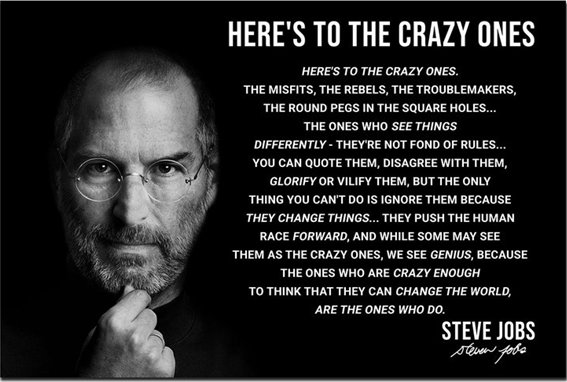
Companies like Plenty and Infarm are building full-scale local vertical farms that can grow a variety of produce locally, regardless of weather conditions or season. Vertically farmed produce can be either exotic varietals or local favorites, does not need to be engineered to reduce spoilage during transport and is incredibly water efficient.

4. Lab-grown meat

Meat products constitute a large portion of global trade, ranging from Australian lamb imported to the U.S., to U.S. pigs being exported to China. Factory farming is incredibly efficient economically, but it is wasteful environmentally and disease prone.

Lab-grown meat is still in its early days, and is very expensive (although the price is dropping fast). I had the pleasure of sampling "beef" tacos made by Impossible Foods. When cooked and seasoned correctly, Impossible Foods' meat — impossible as it is to imagine — is indistinguishable from real meat and is available today.

5. Clean energy

The infrastructure for large electrical grids that span countries is expensive and power is degraded when it is transmitted.

Meanwhile, energy produced by solar and wind is fast becoming a large part of new energy production. Solar density is increasing at a pace similar to Moore's law and wind turbines and batteries to store the capacity are also becoming increasingly cheap. Combined with local battery storage, the need to transport electricity across long distances is beginning to diminish.

6. Fracking

Hydraulic fracturing can be considered an environmental nightmare, however it is helping to make the U.S. energy-independent. There are over 250 million passenger cars and trucks in the U.S. which are not going to be replaced by electric vehicles overnight, and in the meantime will need gas. The plastics industry relies on petrochemicals that now no longer need to be imported. Natural gas is a very clean byproduct of fracking.

So while fracking is not a long-term technology, it is a short- and mid-term technology that is sharply reducing oil imports for countries that are willing to sacrifice a localized section of their environment.

7. Internet firewalls and filter bubbles

The internet, once a great unifier, is being increasingly fragmented across countries. It is no longer certain that users can access anything from anywhere or that internet companies can have global reach.

China has strict firewalls that block out large swaths of content and services, Russia blocked Telegram and threw out LinkedIn, and Egypt is blocking YouTube for a month. The European Union's GDPR rules have gone into effect and some U.S. websites have gone dark in the EU. The EU may soon add a link tax that will darken even more sites. People in developing countries can get free, but super limited internet courtesy of Facebook. In the U.S., net neutrality rules have been weakened, potentially allowing transmission providers to block or slow access to certain content, and users are inceasingly isolated into "filter bubbles" where they only choose to see and believe news that already reinforces their beliefs. New blockchain-based companies like Orchid and Newbound Network are attempting to address this but it will be challenging to overcome.

A trade-free world?

So what's going to be left to trade?

Handcrafted specialty goods will always find a market. It is still incredibly difficult to produce microprocessors and memory, and there are only a few good chip fabricators in the world. Ironically, some commodities such as cobalt and phosphorous may become more valuable than finished goods, especially for countries not willing to extract rare elements. Companies like Apple claim they will one day no longer need rare earth minerals, but are still guaranteeing their own supply of elements such as cobalt direct at the source.

One global industry that is clearly not ending is tourism. Citizens of newly developed countries are eager to visit other countries, and cheap airfares are encouraging more and more people to travel. Last year, four billion passengers flew on scheduled air service. Perhaps the future will hold far more cultural exchange than goods exchange. Think global and buy local!

tag:blogger.com,1999:blog-9074287.post-6189530522947453337
Extensions
From federated identity to consolidated identity: a look at the past, present and future
Show full content

This post was also published in CIO.com.

It’s time for a better way to maintain identity in the enterprise. Let’s explore a new identity model, Consolidated Identity, that will simplify how employees authenticate into systems, access data and complete workflows.

Today, it is common to use your Google, LinkedIn, or Facebook identity to log into a website. However, in the first generation of the commercial Internet, this was not the standard experience. Virtually every internet service required users to create an account with a username and password. For services that were only used occasionally, having to create this account and remember all the associated passwords often created friction for new users.

The invention of federated identity for the consumer Internet

I worked for Sun Microsystems in the early 2000s and was fortunate enough to be the technical lead for a new concept called federated identity, which presented a way for separate online entities to share identity across any number of websites. In order to build it, Sun formed the Liberty Alliance, a consortium of large companies from a variety of sectors, ranging from telecom to travel to banking.

With federated identity, we separated two important concepts:

  • Logging into a website
  • Using a service from a website

Using a standard protocol, a user could, for example, log into Aol.com and then go rent a car from Hertz.com without having to log into their Hertz account. Federated identity allowed distinct websites to enter a business relationship with each other. Using a standard protocol, a website, such as Aol.com, could operate as an identity provider where users had an account with login credentials, while another website, such as Hertz.com, could operate as a service provider where users could then rent a car. As a result, users benefitted from simplified access to services using their pre-existing accounts.

User identity on the consumer internet

Federated identity was built on a loose trust model, which placed a firewall between users’ account information and their service history across providers. In other words, there was no need for AOL to know anything about your rental car history or for Hertz to know your AOL preferences. With the Liberty Alliance, we created extensions to the protocol that enabled services, such as user information transfer and payment processing, to be exchanged between providers.

The adoption of federated identity in the enterprise

The protocols of the Liberty Alliance became the basis of SAML 2.0 when they were transferred to the OASIS standards organization. Accelerated by the prevalence of identity servers and identity access managers that supported the SAML standard from vendors, such as Sun, Oracle, and CA, enterprises embraced the SAML 2.0 protocol as a standard way to perform single sign-on (SSO) across enterprise systems.

However, SSO is only the first step for a successful enterprise identity model since, unlike consumer internet and service providers, enterprise systems have a tight trust model. Many enterprise identity and service providers are hosted by the enterprise itself, and external service providers are subject to intense security controls and compliance to ensure that employee data remains secure.

A direct consequence of federated identity is that all of the data related to an identity is also federated across countless systems. Employee data, for example, is hosted in numerous systems, including payroll, human resources management, and financial and ticketing systems.

Consolidated identity is an evolution of federated identity, specifically for the enterprise. In an organization, there is no need for the firewall between the identity provider and the service provider. The enterprise itself is the primary identity provider and the service providers that provide services, such as payroll and time off requests, do not hold any data that should not be accessible to the enterprise.

In the enterprise, each employee has data spread across dozens of systems, and unfortunately with federated identity, there is no way for the employee to cross those silos – the employee has to log into each system and use its interface to access the data they need. That’s where consolidated identity comes in, providing employees with the same simplified access to their business services that federated identity delivers to consumers.

Here are the five steps to consolidating identity in the enterprise:

  1. Determine which authentication systems are in use and chain an employee’s identity across those systems. A typical enterprise uses one or more directories, such as Active Directory or LDAP, and enterprise mobility management systems.
  2. Consolidate the data associated with an employee. While it is considered incredibly difficult to integrate widespread data, it is much more efficient when the use case is narrowed. Typically, it is only necessary to consolidate the “active data” related to an employee. For example, the requests of the consolidated identity system could be only for open time off requests, rather than every time off request ever made for both active and inactive employees.
  3. Control how data can be accessed. A consolidated identity framework must also include a copy of the rules for how any cached data can be accessed. Most systems use declarative access rules and groups that can be copied along with data to ensure that data is only viewed by appropriate parties. Combining the rules that control how data is accessed with the data itself is a much more efficient mechanism than using mechanisms like data warehouse slices.
  4. Control access to functions, such as micro apps, with identity provider and application groups. In a typical enterprise, there are Active Directory groups, such as “Management”, as well as groups defined within applications like “ServiceNow Administrators”. A consolidated identity system needs the capability to validate a user’s membership in an application’s security groups.
  5. Facilitate writebacks to source systems. This can be performed using an application API with a service account and delegated authentication or a record notation of who performed an action. Another option is to leverage SSO to either deep link into a target application, so a user can perform an action within it, or have the user bounce to an application login page and login via SSO in order to get a user token to pass to an API.
Consolidated identity and the identity graph

A consolidated identity system evolves federated identity by creating an aggregated store of each employee and their entitlements across both identity providers and applications. This “identity graph” enables a new wave of applications that are both employee-centered and secure in authentication, authorization, and data governance.

For more, check out this whitepaper on consolidated identity that I wrote.
tag:blogger.com,1999:blog-9074287.post-3672100576202762418
Extensions
Why disrupting government pot policy is so much harder than the taxi commission
Show full content

This post was also published in VentureBeat.

The recent legalization of recreational marijuana in California and other states now totals to 45 states that have legalized some form of marijuana. However, the federal government has never endorsed even medical marijuana. The Obama administration created rules known as the Cole memo where they decided not to enforce federal marijuana laws if states legalized it. Recently, Attorney General Jeff Sessions reversed this course and stated that marijuana laws would be enforced.

A raft of startups are operating in this tenuous legal gray area, including Eaze, Baker, and Pax Labs. Much like Uber and Lyft flouted taxi commission regulations, these startups are betting that public sentiment and user traction will overcome the existing legal and regulatory environment. Indeed, all of the state legalization efforts were passed by millennial-driven voter ballot initiatives in both red and blue states rather than by entrenched legislators. The citizens want their cannabis, just like they wanted their Uber.

Name brand Silicon Valley investors have been much more reticent to jump into the fray, which is understandable given the legal uncertainty. The void is being filled by seed investors like Snoop Dogg, AngelList cannabis syndicates, smaller institutional investors like The Arcview Group, and foreign firms like Merida.

The big question is, why is there such government resistance to legalizing marijuana? The answer is quite simple, and actually quite similar to the reason for the resistance to ride sharing. Just as the taxi commission and taxi companies were protecting the $3 billion taxi market, the war on drugs is a $76 billion annual business that decidedly does not want to be disrupted.

The government can credibly spend $76 billion a year on a very big problem with 44 million criminals. If marijuana is decriminalized, that subtracts 35 million people from the user count. It’s also hard to justify a war against the 15 million prescription drug abusers in the United States, because the drugs come from large pharmaceutical companies, not across the border from drug cartels.

Without marijuana users and prescription drug abusers, the annual $76 billion war on drugs becomes about just the seven million serious drug abusers who are consuming cocaine, heroin, hallucinogens, and other hard core drugs. That’s just not enough people to justify the huge investment and would constitute an incredibly excessive spend of about $11,000 per user.

Much as certain jurisdictions arrested Uber drivers and regional managers, it is very likely the federal government will actively bring its weight to bear on cannabis startups. Unfortunately for the nascent cannabis startups, the federal government is much more powerful than the taxi commission and regional police forces. Cannabis startups are already forced to avoid the federal banking system, and it is likely the government will use aggressive tools like asset forfeiture to seize profits.

An array of businesses, citizens groups, and legislators from both sides of the political spectrum are aligning to attempt to convince the federal government to change its mind. Both cannabis startups and investors thought they had a clear quasi-legal path to success with state initiatives, but the recent about-turn in federal government policy is definitely going to put a pause on the nascent industry. Disrupting the government is never easy, especially when $76 billion per year of spend is at stake. From that perspective, Uber had it easy.

The author last smoked pot at the tender age of 18.

tag:blogger.com,1999:blog-9074287.post-4751239544062729753
Extensions