GeistHaus
log in · sign up

https://stainedglassattitudes.wordpress.com/feed

rss
10 posts
Polling state
Status active
Last polled May 19, 2026 03:46 UTC
Next poll May 20, 2026 01:01 UTC
Poll interval 86400s
Last-Modified Fri, 24 Apr 2026 21:32:01 GMT

Posts

Spacefleet Ecclesiastica: the Super Universas cathedrals of the Spanish Netherlands
Spacefleet Ecclesiastica
The ecclesiastical provinces of the Spanish Netherlands were reformed by a bull of 1559 creating 14 new dioceses. This post looks at their newly-made cathedrals in their wider political and architectural context
Show full content

At the beginning of this year I completed another comparison of 3D models of medieval cathedrals … in Space! This time it was the cathedrals of the Holy Roman Empire. So join the Imperator Romanorum in his command ship of the Aachen Palatine chapel to survey all the cathedrals of the dioceses under his rule (that I could get hold of 3D models of, anyway).

n.b.: I did the terrible YouTube sin of deleting and reuploading this from its first upload in January, since after all this research into the Super Universas I noticed some glaring mistakes in their diocese divisions (and also could correct a few small errors that always get past the checks in these animation projects). So if you watched it in January, please do click the thumbs up again (i.e. pls like and subscribe, sorry).

I have mapped the Holy Roman Empire’s Cathedrals already, but at that time did not include the Super Universas dioceses of 1559, which fly out of the sun to provide reinforcements at the end of the rather thin narrative conceit I applied to my animation. This was under the logic that they were not built as cathedral churches. However, many of them, such as Mechelen, Ypres and especially Antwerp, are generally thought of as bona-fide cathedrals in much the same way as Peterborough, Gloucester, Bristol etc. And since I spent quite a while making some of the models (especially Antwerp) for them only to appear in a video for a few seconds I thought I would upload them as separate models for perusal, and make a little gazetteer of all of them.

But then I had questions. Who decided the dioceses? Where did they get the canons for the new cathedral chapters from? Who were the bishops? How far can you compare it to the episode of establishing new dioceses under the English Crown two decades earlier? Turns out it is a very different and tougher process when you don’t declare yourself head of the Church and you can do just about anything you want with religious houses because you got them to sign an Act of Supremacy to you (although, funnily enough, Phillip II of Spain, who finally pushed the project through Rome in 1559 and continued to work on it through the 1560s placating upset prelates and nobles alike, was King of England jure uxoris 1554-8).

So it all got a bit complicated, and here’s what I’ve put together in a couple of months. First, we are going to look at the administrative project, then we’ll look at each of the buildings that became cathedrals after the Bull’s enaction.

The Super Universas dioceses project

For well over a century before the Super Universas bull was issued in 1559, the lack of cathedrals in the Low Countries had become a problem.1 Particularly what is now the modern country of the Netherlands, which had had a huge economic upsurge in the fifteenth century, had only one bishop living within its territory: the Bishop of Utrecht, a suffragan of Cologne.2 There was also the complaint that the Dutch-speaking regions had a language barrier with the German and French metropolitans.3 Emperor Charles V first expressed a desire to establish new bishoprics in the area “to safeguard the Catholic faith and the salvation of souls” and plans were drawn up in 1552 but ultimately came to nothing.4 The total destruction of Thérouanne, a French enclave in west Flanders in 1553 by Emperor Charles and with it its Cathedral (suffragan to Reims) somewhat escalated the issue. However, with Charles’ abdications the task fell on his son, Phillip II, Lord of the Netherlands (from 25 October 1555) and King of Spain (from 16 January 1556) to carry it forward. Franciscus Sonnius, canon at Utrecht and Professor of Theology at the University of Leuven was instrumental in ultimately coming to the fore of mastering the practicalities of the project, but had to accept the collegiate church of St Peter in Leuven was not getting selected as a university-associated metropolitan seat over Mechelen.5 He was sent by Philip to bring the completed plans to the attention of Pope Paul IV Carafa in March 1558.6
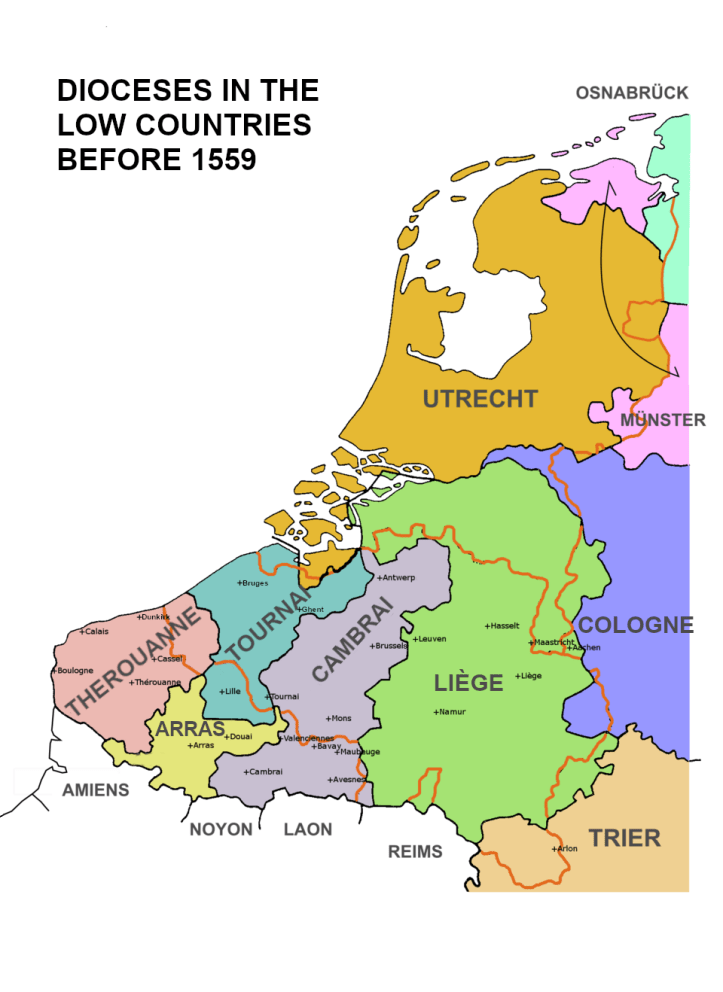
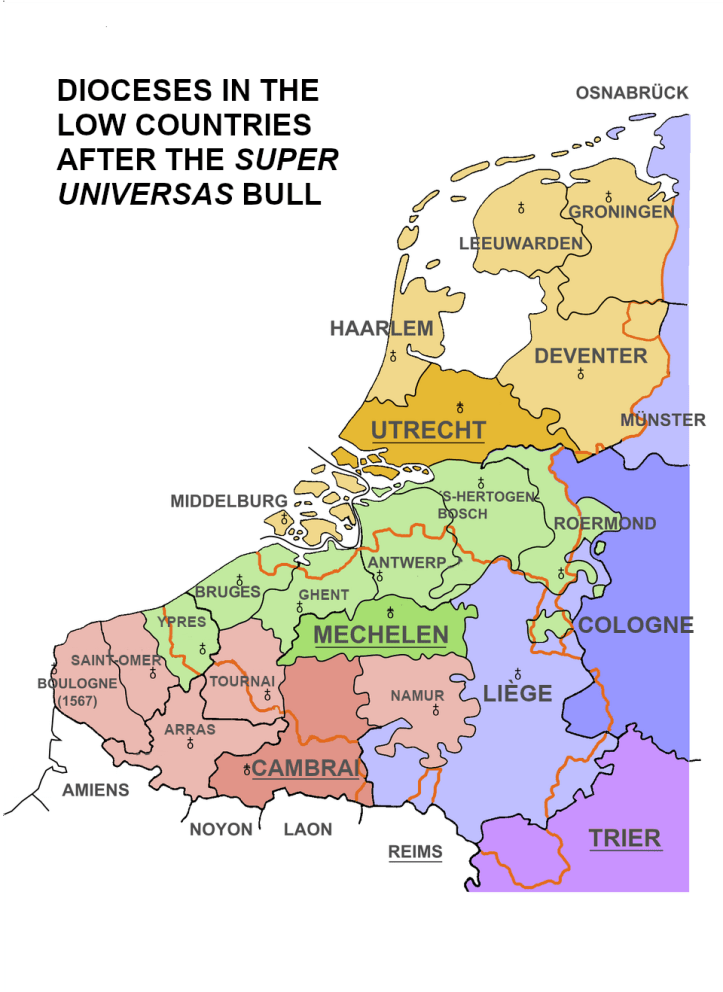
Before and after Super Universas 1559
Adapted (names Anglicised for clarity) from Wikicommons: Hans Erren, CC BY-SA 4.0.
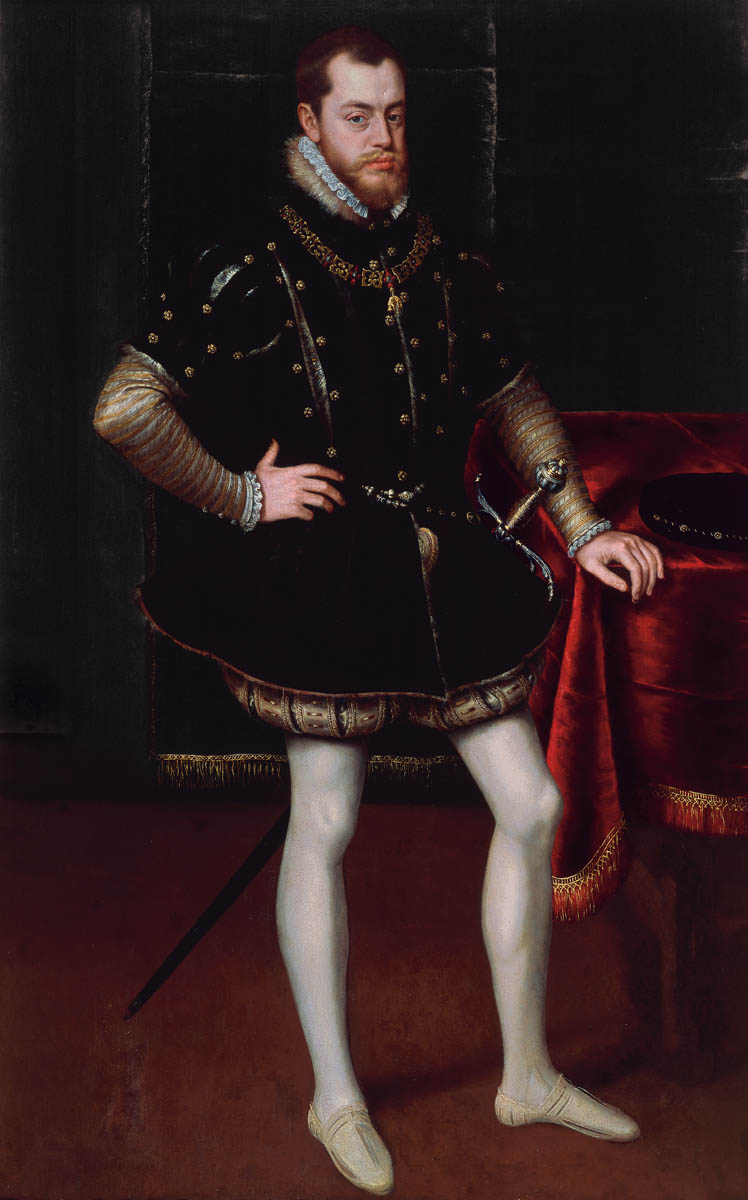
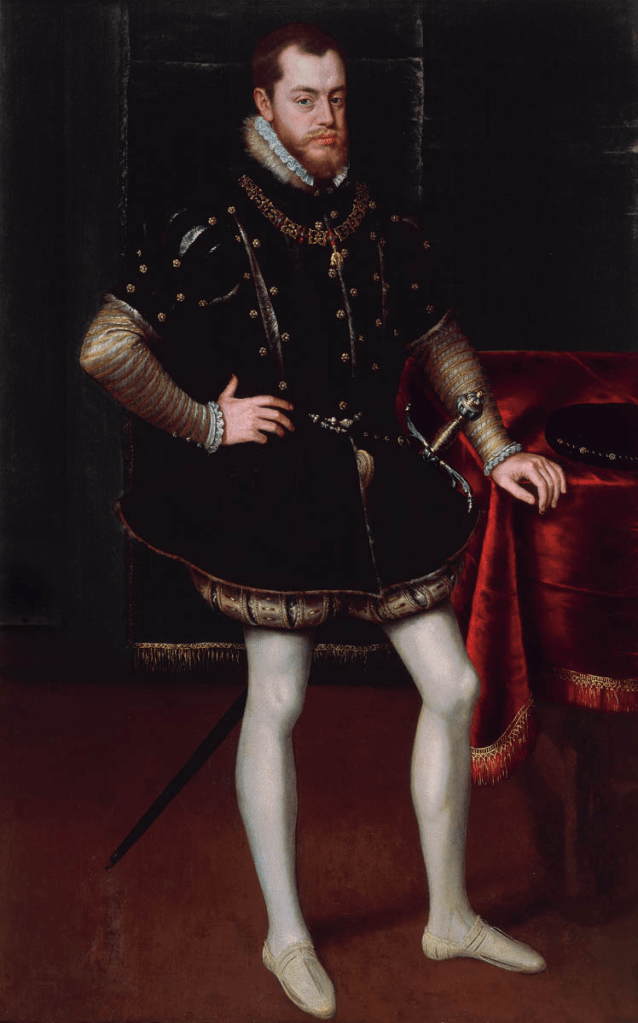
Phillip II of Spain, oil on canvas by Jooris van der Straeten, c.1556.
BBVA (Banco Bilbao Vizcaya Argentaria) Collection, Inv. No. P01495

This was a shaky time for Phillip to be pushing the diocesan reform through. In 1557 during the conclusion of the Italian Wars, the fundamentally anti-Habsburg Pope Paul had narrowly avoided a repeat of the 1527 Sack of Rome by an Imperial army, this time under Spanish troops led by the “Iron” Duke of Alba: but it was either this or start from scratch with a new Pope.7 Later in 1558 the plans leaked and the Archbishops of Reims and Cologne, the Prince-Bishop of Liège and the chapter of Cambrai planned a counter-delegation against the annexing of their episcopal territories.8 After the Peace of Cateau-Cambrésis was declared between France and Spain to bring the half-century of Italian Wars to a close on 3 April 1559, the following 12 May the Super Universas bull was finally issued.9 Getting the bull over the line in Rome cost Phillip 10,000 ducats that he struggled to get out of his debtors after the costs of the treaty.10

Getting the Bull past the Papacy was only the first challenge. What followed in the early 1560s was also wider secular resistance among nobles in the territory of the Netherlands about how the Spanish Crown would have exclusive nomination rights over the new bishoprics, and with those prelates’ voting in the States of Brabant, would solidify Habsburg power in the region.11 There was wide speculation that the project would be used to launch a general Inquisition, which it was thought would prove catastrophic to trade.12 But by 1570, all the dioceses were occupied by consecrated bishops.13 Even overlooking that Leuven was the only university in the region, it is notable how many of the new bishops were professors, headed colleges at or held doctorates from Sonnius’ university.14 While the new turn did not quite shatter the pattern of nepotistic appointments to sons of the nobility, it did lessen their grip in the favour of fully-schooled theologians.15

Although the new dioceses centred mostly around pre-existing collegiate churches, some quite wealthy with large numbers of canons who held valuable prebendal estates, all of the bishops’ incomes had to be supplemented by appropriating the income of local abbeys and priories: something which many of the heads of these houses were understandably not happy about.16 Some of the dioceses in the Netherlands that had the bishop’s seat placed in a parish church that had to have canons totally pulled from the brethren of appropriated houses of regulars to create a cathedral chapter.

Despite all this top administrative work, the Dutch Revolt two years later from 1572 and Protestant control in the region meant it mostly unravelled and the Catholic Hierarchy suppressed most of the new sees in the territory of the modern country of the Netherlands in the 1580s: holding out on Middelburg in the south until 1603 (Roermond in Limburg is the only outlier, this was outside of the Dutch Republic). Subsequently ‘s-Hertogenbosch would go in 1646 after it was lost by the Spanish Netherlands. Five more would be eliminated in the Napoleonic Concordant of 1801. Only three dioceses have survived essentially uninterrupted from 1559 to the present, although a number have been revived, but not always in the same building.

So as you may gather from the numerous citations above, there has been much historical research into the political, religious, social and economic aspects of the Super Universas bull in its Counter Reformation context. But no one has looked at the architectural context: the church buildings that became cathedrals. This is because chapters and financial matters clearly counted before fancy buildings in deciding new sees. However institutions worthy of transforming into an episcopal seat tended also to have a nice church associated with them. Thus these new cathedrals encapsulate the history of Gothic architecture in Low Countries rather well: from early builds venerably built around Romanesque structures to some of its more over-ambitious moments towards the close of the Middle Ages. So let’s have look at them all…

The Super Universas Cathedrals
(churches declared as bishops’ seats in 1559 that still exist above ground today)

L-R:
Cambrai archdiocese: Saint-Omer, Namur
Mechelen archdiocese: Mechelen, Ypres, Antwerp, Ghent, ‘s-Hertogenbosch
Utrecht archdiocese: Deventer, Haarlem, Leeuwarden, Groningen

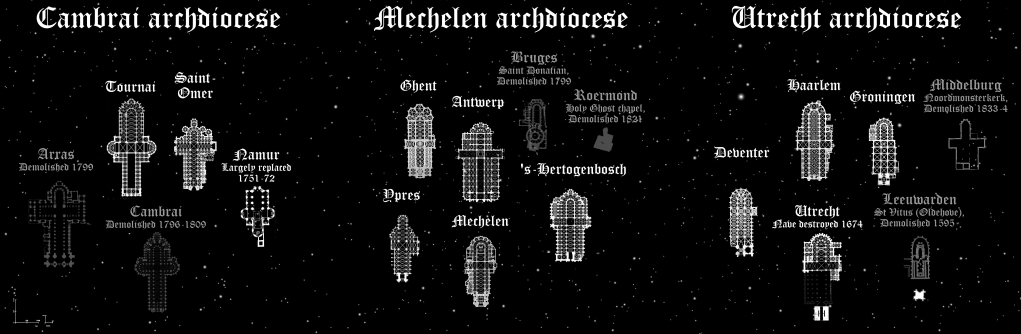
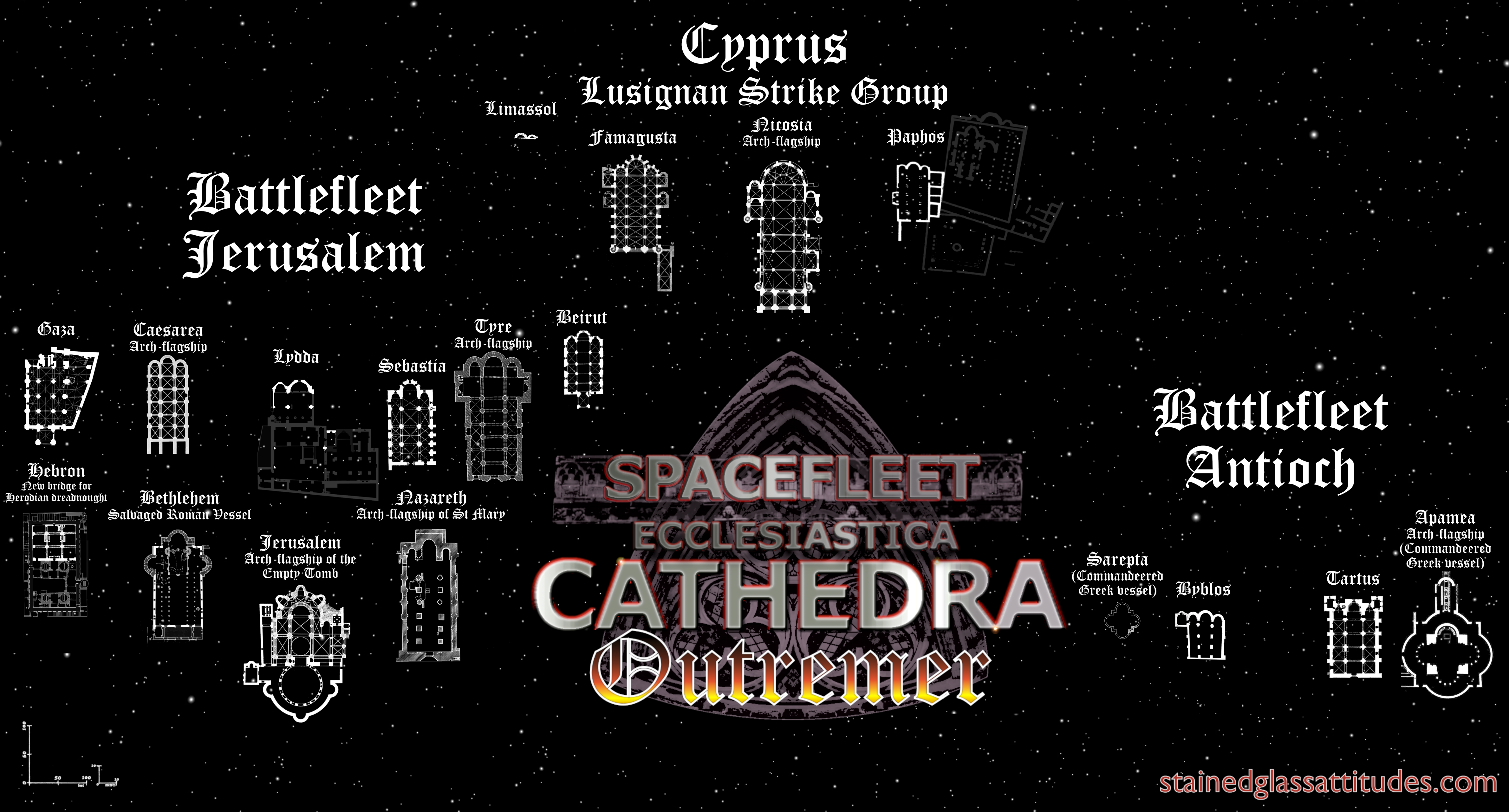
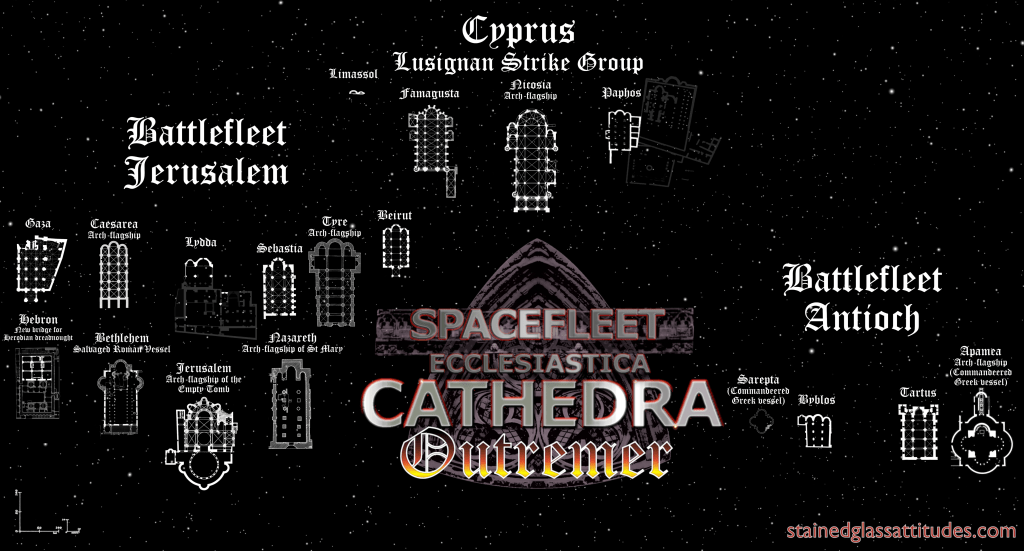
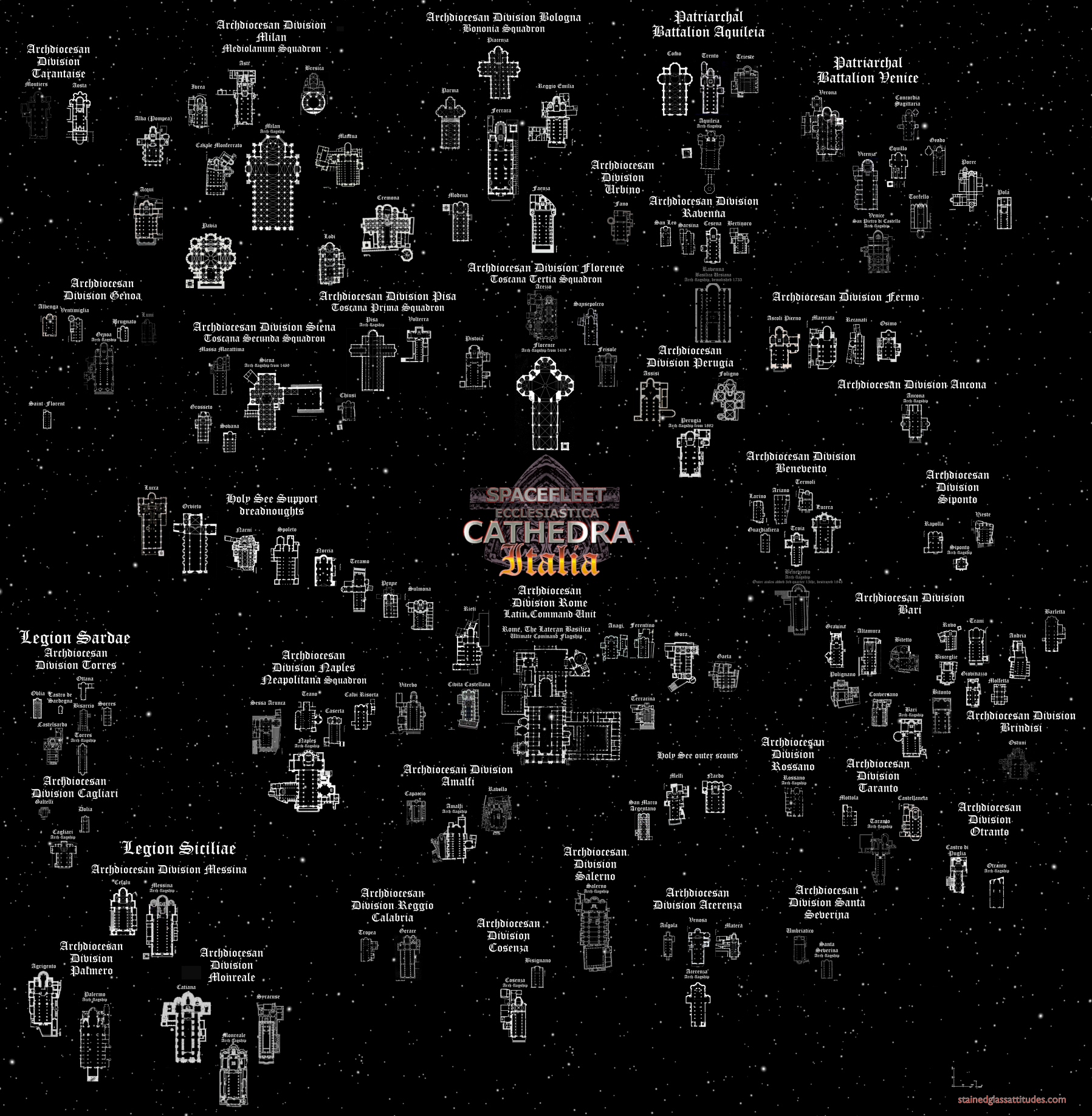
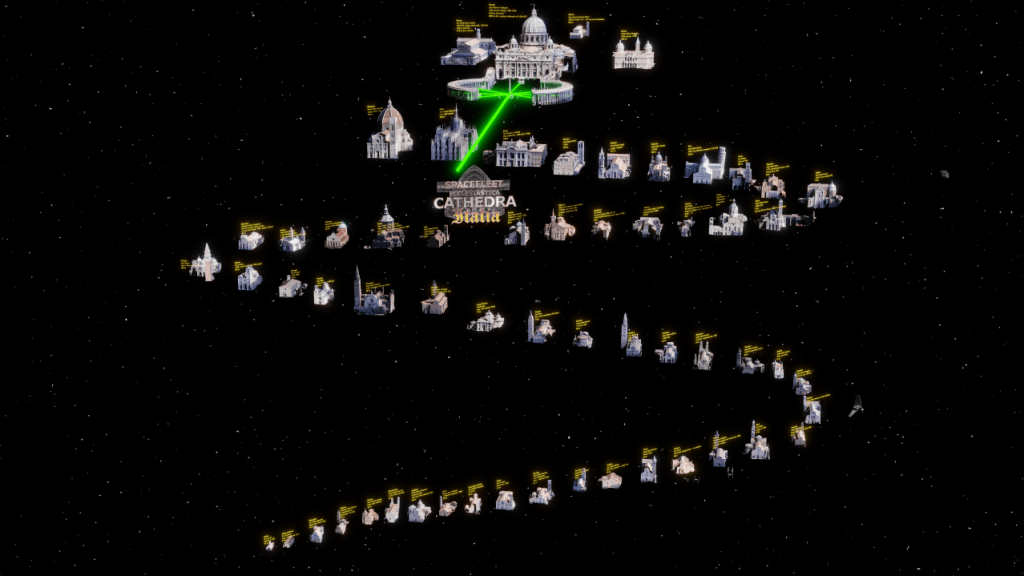
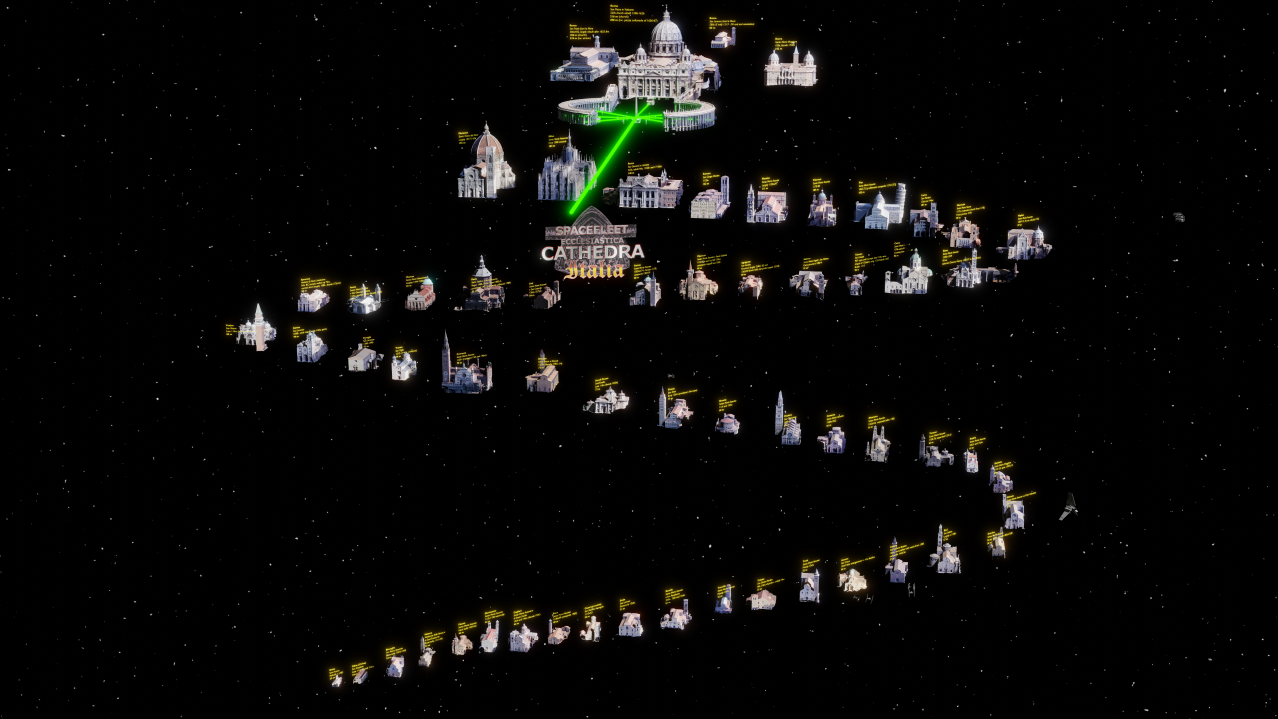
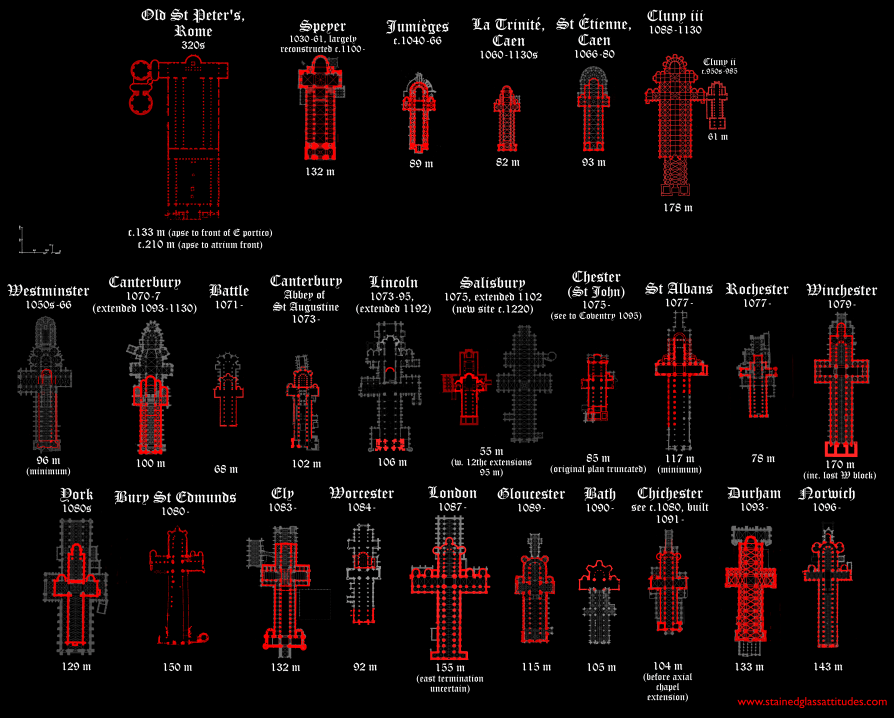
And, for old times (c. 2020) sake, here they are (including totally demolished ones) in the universal language of vaulted ground plans on a starfield. Haven’t done one of these for a while!
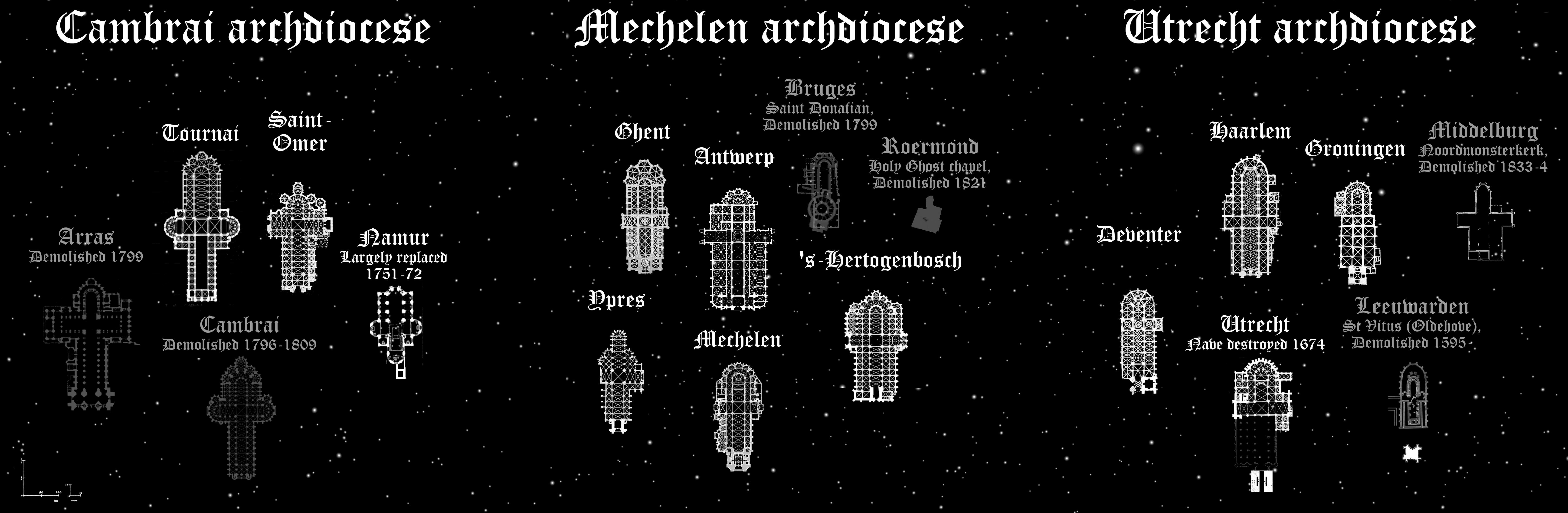
I must admit, I’ve only been to one of these buildings in person (possibly the most boring one, at least internally), and make no excuses for using 360 panoramas to study them for this project, hence why I’ve made no attempt to disguise when I’ve screengrabbed stuff off G-Maps, even if it is trivial for me to download them and do my own custom projection (as I have done on some where it’s necessary to make a visual point beyond what the web-viewer allows). All credit goes to the original photographers who uploaded their images.

Cambrai archdiocese
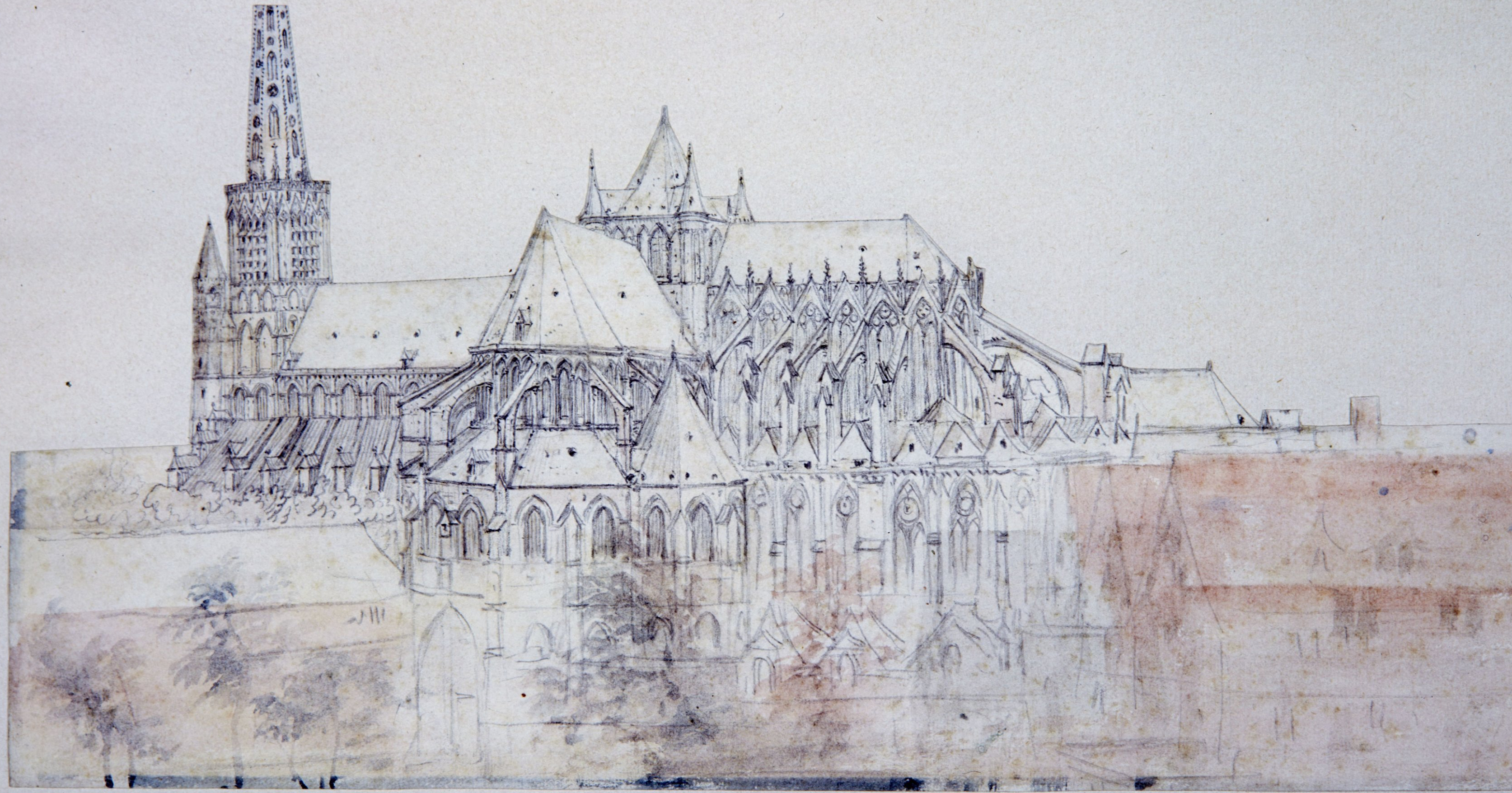
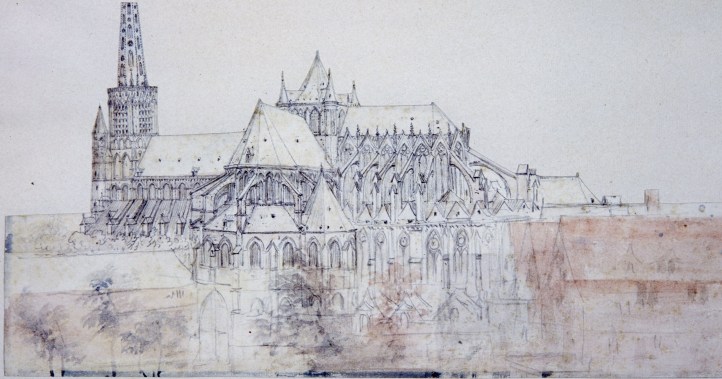
Cambrai Cathedral, metropolitan from 1559, totally demolished 1796-1809.
Graphite and watercolour highlights on paper, by A.F. Van Der Meulen (d. 1690). Mobilier national, NO 44.

Cambrai, previously a suffragan of Reims, was elevated to an archdiocese for these new sees, although by the terms of the Bull, the Habsburgs did not have nomination rights for its new archbishop. You can read about the totally demolished Cathedral of Cambrai here. Former suffragans of Reims – Arras (also totally demolished after the French Revolution) and Tournai – were transferred to it, as well as the two new dioceses below.

Saint-Omer, Our Lady

Collegiate church founded mid 7th century
(Diocese suppressed 1801)

This model is rather janky but was done out of my determination to complete the surviving Super Universas canon. It is processed from edited data from this excellent drone footage uploaded to YouTube by GOTHICA and augmented with some other still imagery of the building I recoloured, edited and modelled a bit to match.
A proper photogrammetry/laser scan, including roof and tower spaces, has been made by 3D Patrimoine and stills of it can be seen on the all-round excellent architecture pages of the official church website.
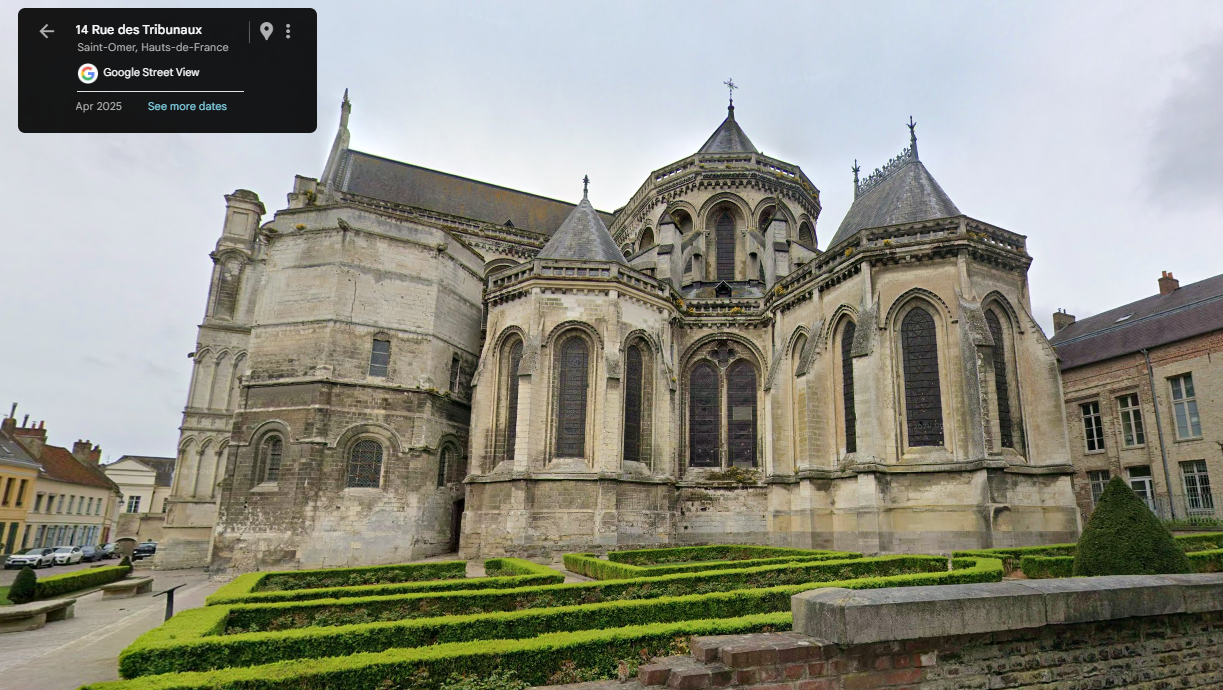
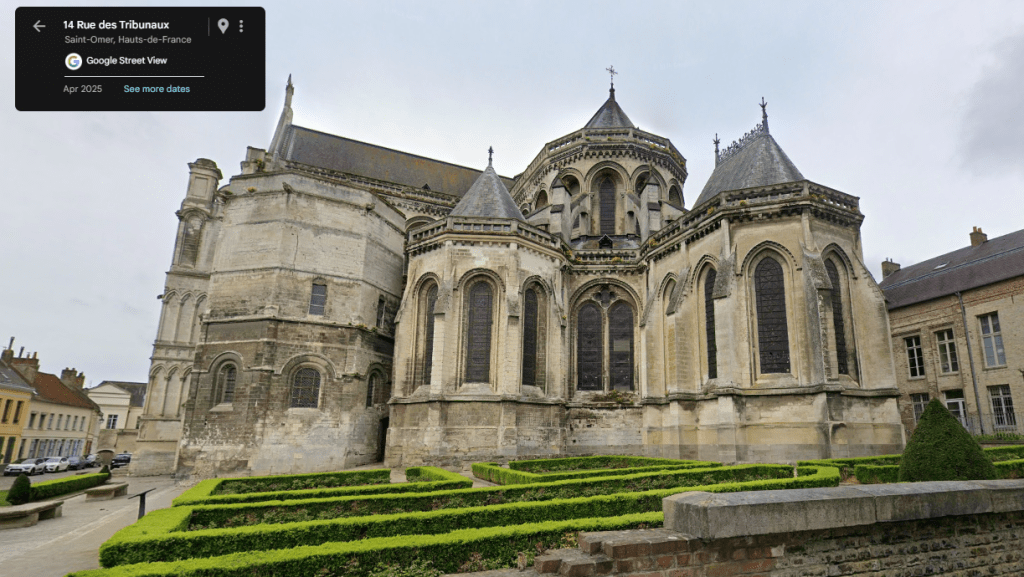
Notre-Dame, Saint-Omer. E arm from SW.
The “Tour Octogonale” to the L is widely-held to be contemporary build with the E arm beginning 1191×1207: although the axial chapel was extended 1628/9.

Although now French, Saint-Omer was an Imperial town until it was annexed in 1678. The collegiate church which became a cathedral shared an origin with the Abbey of Saint-Bertin on the other side of town going back to Merovingian times: the missionary bishop Audomarus being the patron of the canons, and his contemporary Abbot Bertinius whose corpus was held by the monks. As the town’s modern name was actually a corruption of Saint Audo, there must have been an impetus for the canons to make sure his burial church was at least the architectural equal of the abbey of his companion. That said, the first bishop of Saint-Omer was Gérard de Haméricourt, the incumbent abbot of St-Bertin. Saint-Bertin Abbey survived until its closure after the French Revolution, and the bishopric also prevailed until the Concordat of 1801.
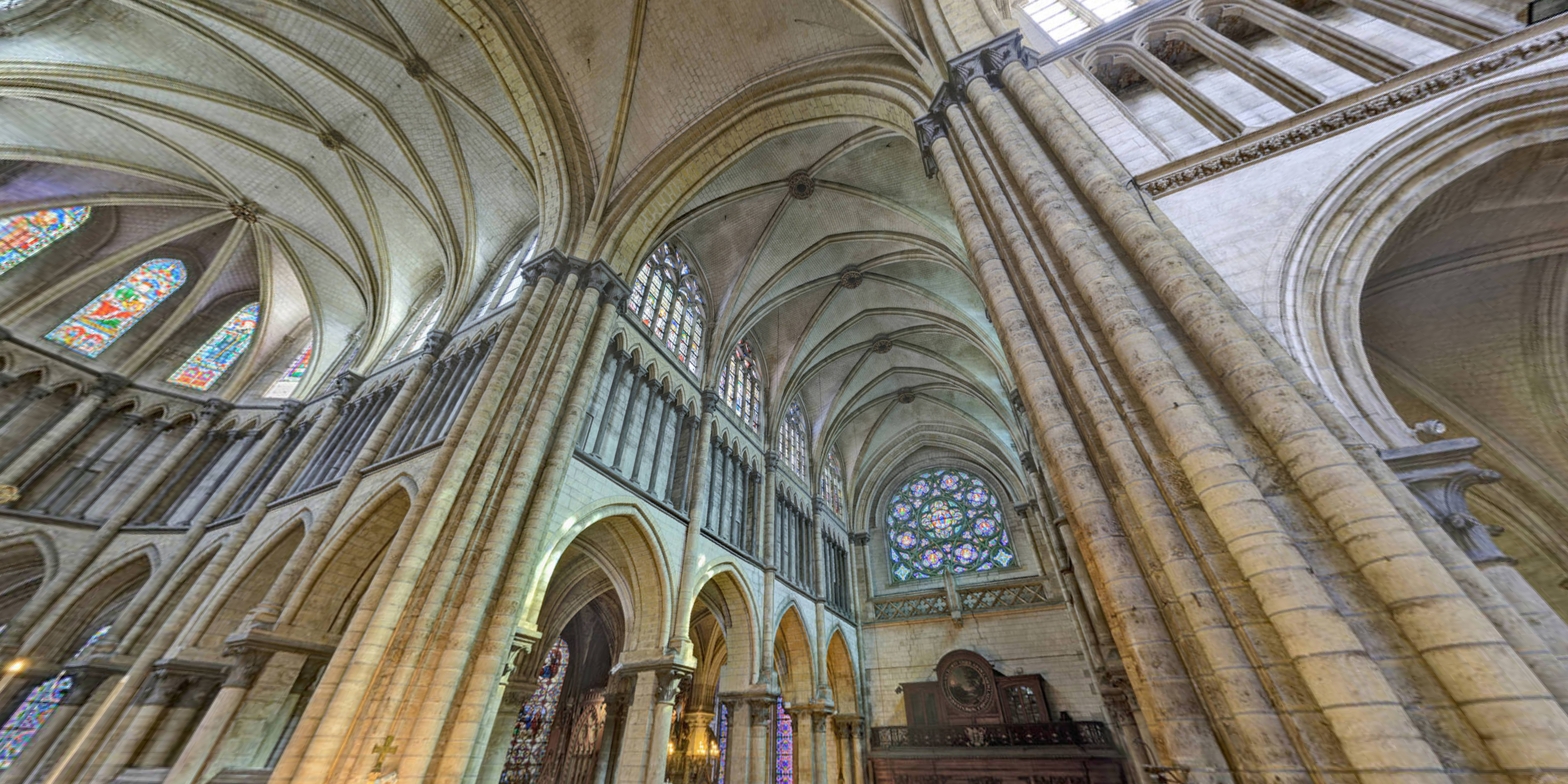
Notre-Dame, Saint-Omer interior looking SE from the crossing. To L is the early 13thc part that establishes the basic elevation design, middle is the Rayonnant-style build of the S transept that barely changes it except for the clerestory windows, and foreground right is the nave triforium that leaves out the Tournai marble shafts.
This 360 view is available in extraordinarily good high-res here, as well as a view from the S transept.

Exemplary of the first main phase of Gothic in the Low Countries is the elevation of the early 13th-century east arm, which has a large blind triforium against the lean-to aisle roofspace that is basically equal in height to the clerestory above. This is when Chartres and its French High Gothic successors were massively reducing the middle storey in their designs. What isn’t typical Low Countries about Saint-Omer are the initial pier-forms, which, rather than stout cylindrical columns, incorporate en-délit shafts (i.e. monolithic, edge-bedded, long pieces of stone) attached to a square masonry core, except in the transition between the apse and straight bays, where the double shafts on the core are pilier cantonné (that is through-coursed masonry blocks). The plan of the east arm is very conservative to the Romanesque it was replacing, with three separate octagonal chapels (the centre one was extended at the end of the 16th century), when great churches in France were favouring the continuous chevet of joined chapels.17
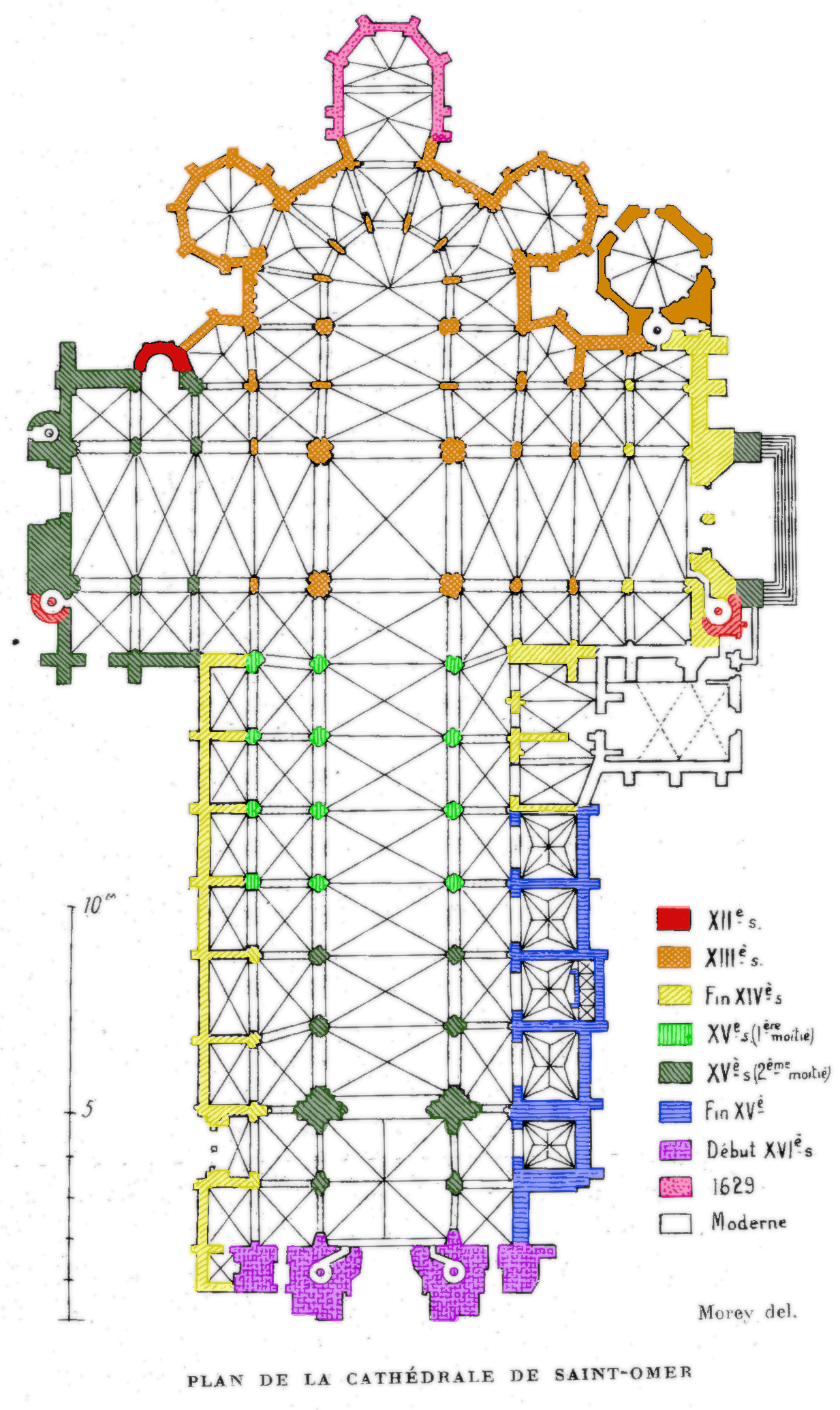
The south transept, with Rayonnant tracery, was built in the third quarter of the thirteenth century (although it kept the pier forms, no one was interested in maintaining en-délit anymore, so the shafts are all coursed masonry), with the nave following on in the late fourteenth century into the mid-fifteenth. In the later nave the Tournai marble columns of the triforium are eliminated in favour of continuously moulded tracery trefoil-headed openings, and pier forms changed to a profile of a cylindrical core fully-coursed with four attached shafts. The north transept would be the last part of the Romanesque plan to be replaced (delayed due to its connection to the canons’ cloister), a project carried out within the years 1448-72 to renew the arm in the Flamboyant style while carefully retaining one Romanesque apsidal chapel in the east wall.18 The squat west tower, which concerned the college’s building works into the sixteenth century would also seem to be Romanesque masonry reskinned. The axial chapel was also extended at some point in the seventeenth or eighteenth century and subsequently remodelled.19

Left: phased plan of Notre-Dame, Saint-Omer.20 The S transept should be dated earlier than late 14thc but otherwise it gives you a good idea about the phasing of realising the gothic build. I’ve imposed the transept stair turrets to the primary Romanesque phase as noted in Olympios 2018, and have also included the Tour Octogonale in the primary Gothic building phase.

Namur, St Aubain

Collegiate church founded 1047
(Diocese never suppressed)
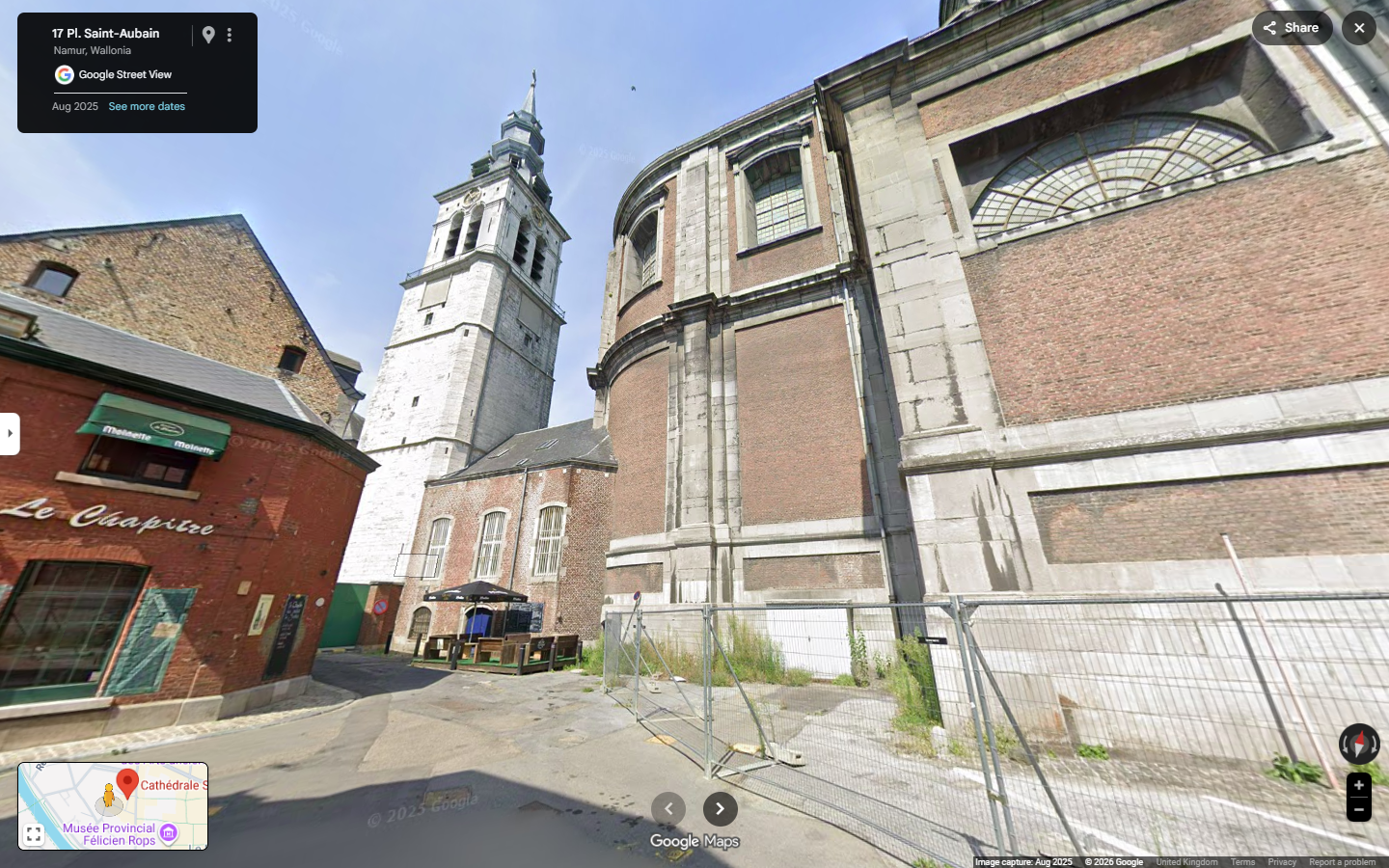
Photogrammetry model of Namur Cathedral, orientated with SW tower at the front
The former W tower now round the back of the apse of Namur Cathedral (incidentally that temporary Heras-type fencing has been down the sides of the building for over a decade!)

Unique to the Super Universas cathedrals, the episcopal chapter of Namur had their church almost entirely rebuilt, 1751-72 to the plans of the Swiss-Italian architect Gaetano Matteo Pisoni. The new build was occidented (i.e., the entrance is at the east end and the apse points west) allowing for the the medieval collegiate church’s south-west tower to be retained at the “back”. As far as I can tell there’s been no archaeology on the site of St Aubain regarding the old cathedral (isn’t it fun trying to confirm a negative?), therefore we don’t know a huge amount about the church that was chosen as a site of a bishop in 1559.
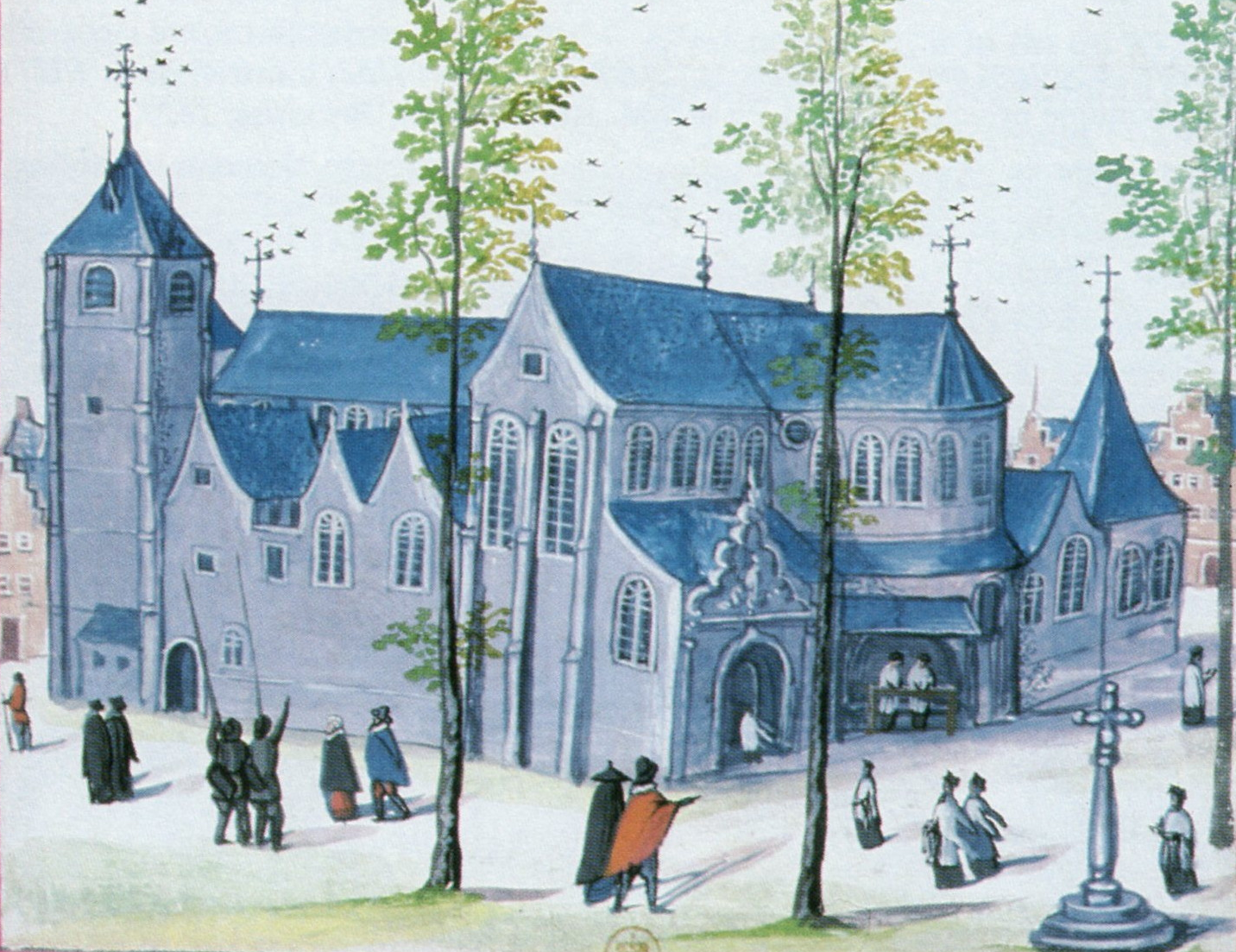
Namur Cathedral from the south-east c.1604. Miniature painting on vellum by Adrien de Montigny.

The best view of the medieval Cathedral of Namur is in the Albums de Croÿ made for the Low Countries nobleman Charles III de Croÿ of Hainaut.21 The surviving tower is clearly shown to the left, adjoining some sort of domestic capitular buildings around a quad with an upper storey adjoining the nave. The transept has four clerestory windows in its east face, with a lean-to roof below. While formerly it would have been chapels, it appears to been knocked through for a Baroque porch. The east arm is apsidal, and has an ambulatory. Two canons seem to stand under an arch with what looks like a veranda above, which may have been the site of a radiating chapel. It is difficult to estimate the date of the building overall, but judging from the rest of the Albums de Croÿ (and by Jove, there is a lot of them), the artist, Adrien de Montigny, is seemingly incapable of drawing a pointed arch, thus the lack of any prominent buttressing on the apse is the greatest indicator it may have been Romanesque.
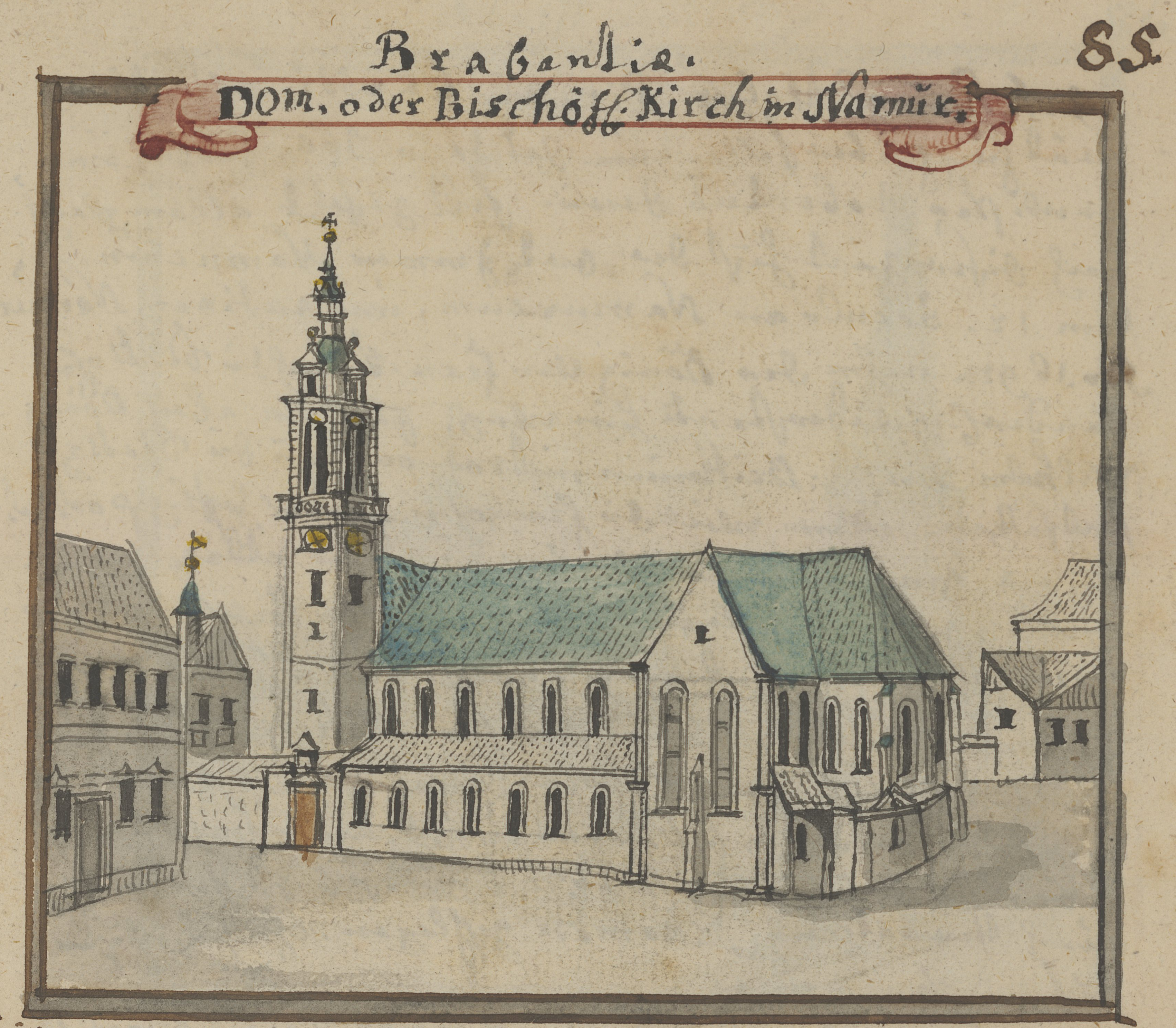
Namur Cathedral from SE by F. B. Werner,c.1770. From Peregrinationes oder Christliche Wanderschaft und geistliche Reisebelustigung.Ps. 2, Biblioteka Jagiellońska Rkp. 7462 II, t.2, f.132r.

Another view, by the Silesian draftsman Friedrich Bernhard Werner, c. 1770, seems to show the existing tower with its current belfry and a version of its current spire (albeit with the clock mounted in the square inlays that still exist below the belfry stage). The church appears to have been massively tidied up from the depiction of the previous century. Strangely there’s no sign of that Baroque porch into the south transept, so perhaps it simply isn’t a very accurate depiction. And there are some buttresses with set-offs on the east apse now. They were definitely looking at the same building, for instance the two terminal windows in the transept end between a buttress, but in fine details it’s very hard to make them agree on much. And looking through Fredrich’s drawings he struggles with pointed windows too.22


You may have noticed on the initial map that another new Diocese appeared next to Saint-Omer: Boulogne. This was the titular successor of utterly obliterated Thérouanne, with its Abbey there taking in some of the former canons of the chapter from the much-besieged and now-annihilated town, with which they had long-standing links. Thérouanne diocese lost territory to Saint-Omer in the 1559 Bull, but continued as titular bishopric of that north-east corner of the Kingdom of France, and suffragan of Reims. Paul IV’s successor, Pius IV Medici, in a bull of 3 March 1566, taking advantage of the death of the to-be final abbot Jean de Rebinghes, confirmed the former Abbey Church of Boulogne as a bishopric, remaining as suffragan of the archbishopric of Reims.23 The medieval building was demolished in 1798 as part of the post-Revolution selling-off of appropriated church property by the French state. Unlike Habsburg Saint-Omer, Boulogne was firmly in France: so I won’t concern myself with it here.24

Mechelen archdiocese
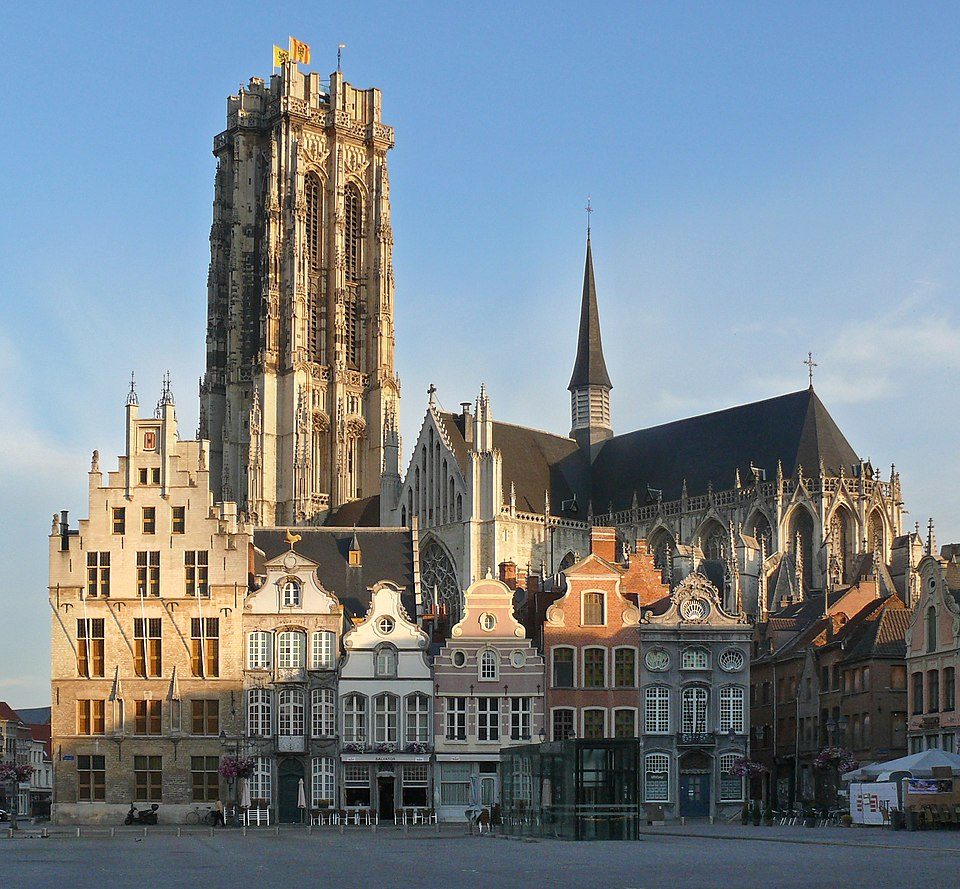
The Cathedral of Mechelen over the Grote Markt, July 2010.
Wikicommons – Ad Meskens

Mechelen was the only church in the Super Universas bull to go straight from a collegiate church to archiepiscopal with three suffragan dioceses under it. Thus it was the only diocese to receive a translation of a sitting bishop, Antoine Perrenot de Granvelle who sat at Arras.25 Granvelle, subsequently Cardinal, was the son of Charles V’s Imperial chancellor, Nicolas Perrenot de Granvelle and served as keeper of the Emperor’s seal, thus was a largely unwelcome figure in the Netherlands for what he represented regarding Habsburg control.

Mechelen, St Rumbold

Collegiate church founded 996 or 1000 on site of monastery established 8th century by Saint Rumbold and revived 10th century. Twelve prebends instituted 1250-8.
(Diocese never suppressed. Made co-cathedral with Brussels, collegiate church of St Michael and St Gudula 1962)
Photogrammetry capture of Mechelen Cathedral, comped from two sources (for more, see the Sketchfab description).
Mechelen Cathedral, crossing looking SE, with the second-quarter 14thc choir straight-bays in novel Brabant Gothic style to the L.
360 panorama from Visit Mechelen

Aside from Saint-Omer, Mechelen’s origins as a collegiate foundation, traditionally owing to Irish missionary Rumbold, are the earliest of any of the churches promoted to cathedral under the Super Universas bull: perhaps why Rome allowed it to be accorded such an extraordinary status as a brand-new metropolitan see.

At first glance the church of St Rumbold seems rather consistent as a building, but actually realising the Gothic church was quite a slow process, dating from initially around 1200, subsequently with a Rayonnant phase for the nave aisles and a higher nave elevation in the later thirteenth century. However, the most important phase in terms of architectural invention and influence are the straight bays of the east arm, generally dated to after a a city-wide fire in 1342 that is assumed to have destroyed a pre-1200 east arm, which again upped the height of the elevation.26 Overlaid above the Mechelen choir arcade arches is a splendid grid-like system of classic Gothic motifs (pointed trefoils and quatrefoils and trefoil-headed arches), both as relief carvings and pierced stonework over the triforium passage. This approach of covering surfaces with all-over system of grid-like patterning herald the second phase of Low Countries Gothic, the Brabant, would also be used on the successive new build at Antwerp from 1352, and is often attributed to the master mason Jean d’Oisy.27
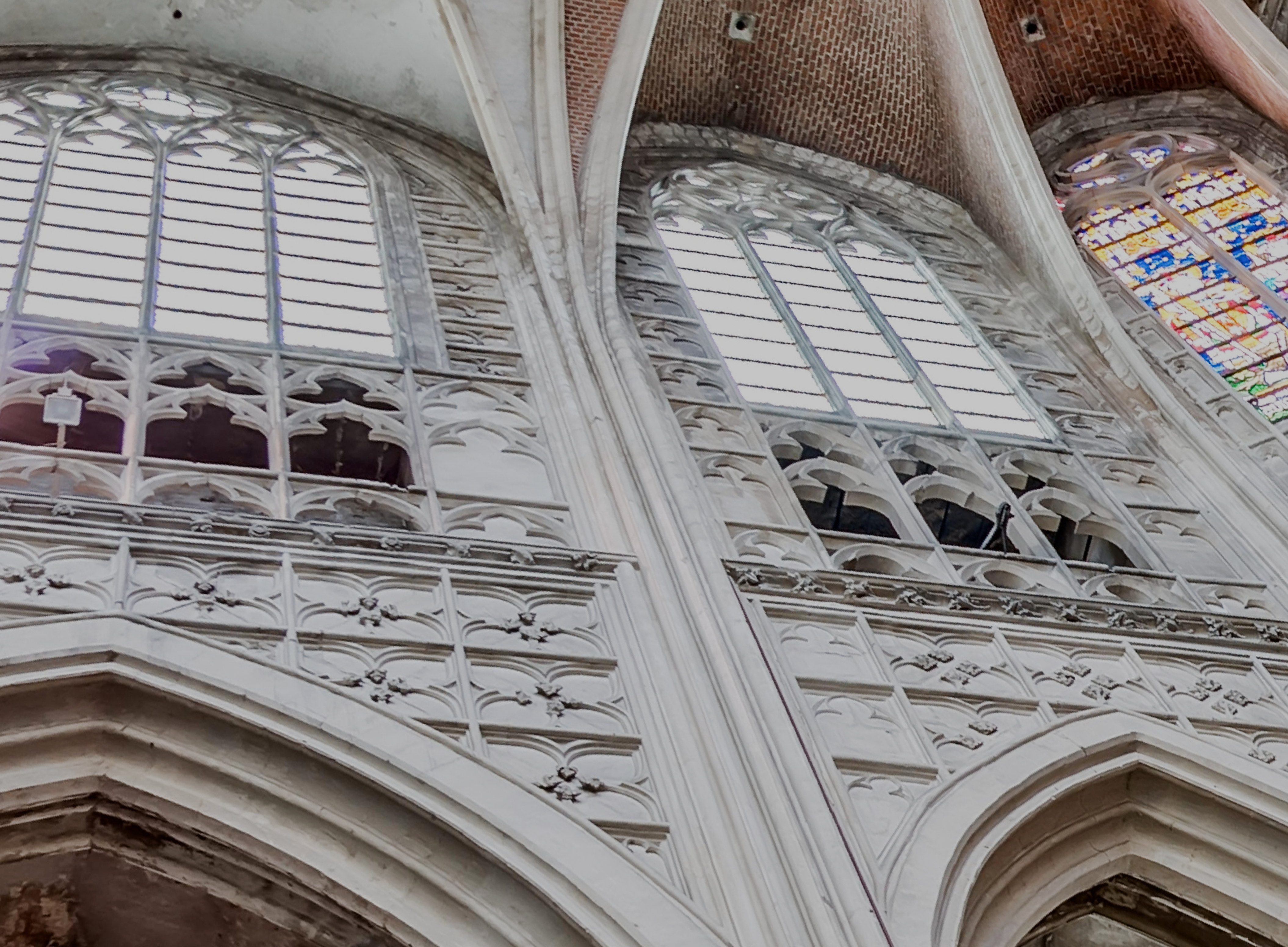
Mechelen Cathedral, N bays of choir. Left, original 2nd quarter 14thc work, right, mid 15thc apse bays with unrendered brick vaulting over.
360 panorama from Visit Mechelen

Seemingly so pleased were the canons with the design, the grid-like triforium was subsequently retrofitted to the nave elevations. The rebuilt hemicycle bays, that were likely completed for a consecration in 1451, are more or less a direct copy of the work of a century before. Only in the much less refined mouldings of the openwork grill do they give themselves away (Right).
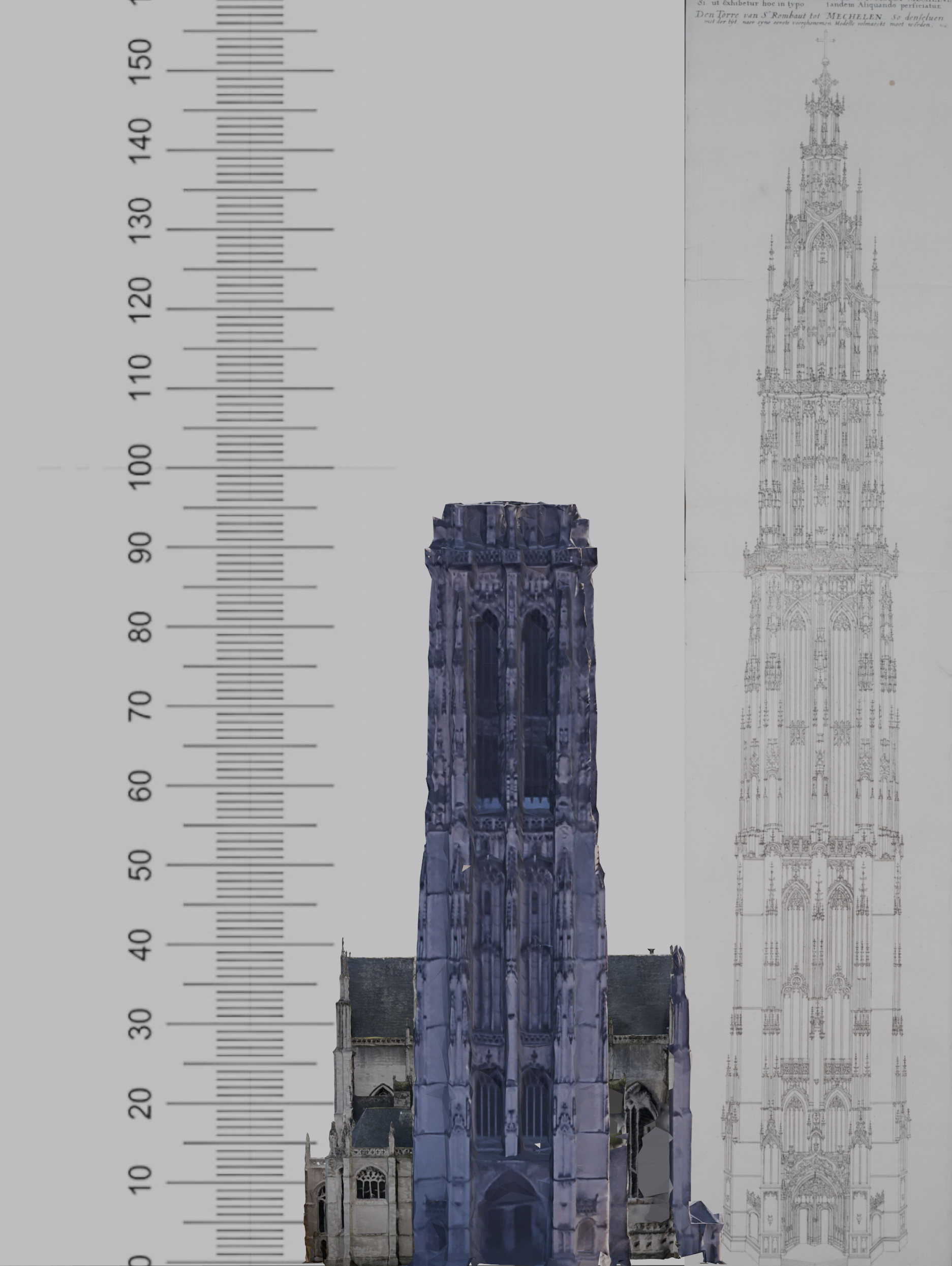
Mechelen Cathedral compared to the architectural drawing preserving the design of its begun steeple, here shown as the Hollar engraving made after the original in 1649.

However the church of St Rumbold is most famous for its western tower, begun in 1452, but with only seven metres of the spire above the belfry built before being capped off at around 96 m c.1520. A mid-16th century architectural drawing shows how sublime the planned steeple was to be. The drawing was meant principally as a presentation piece for the secular canonesses of St Waltrude, Mons in 1550 to represent how the work at Mechelen could be copied for their new west tower (which ultimately reached only to the height of the nave clerestory roof parapet).28 The master of their works, Jean Repu, seems to have had access to the designs of the Keldermans dynasty, city architects of Mechelen for three generations, to copy the largely unbuilt spire, and also updated the rather conservatively-detailed portal storey to confirm with the Florid style of the rest of the tower.29 There is only so far you can get the drawing to match reality exactly (Left) – it is perspectival rather than an orthogonal elevation – but most estimates put it at 163 m. This would be taller than the spire of Ulm of 143 m completed in 1890, and would still today rank as the tallest pure masonry church tower in the world.30 Unlike most hugely ambitious late medieval building projects that seemed doomed to failure, it is unfortunate this one was never completed, because it seemed both beautiful and achievable. That nothing happened with the project after the church became a metropolitan seat demonstrates that becoming a diocese came with little financial reward for the existing collegiate institutions: if anything it was a burden.

Antwerp, Our Lady

Collegiate church founded 1088×1100
(Diocese suppressed 1801. Re-erected 1961)

Photogrammetry model of Antwerp Cathedral, comped from multiple sources, with outline of the plan of 1521 “Nieuwe Werk” project underneath
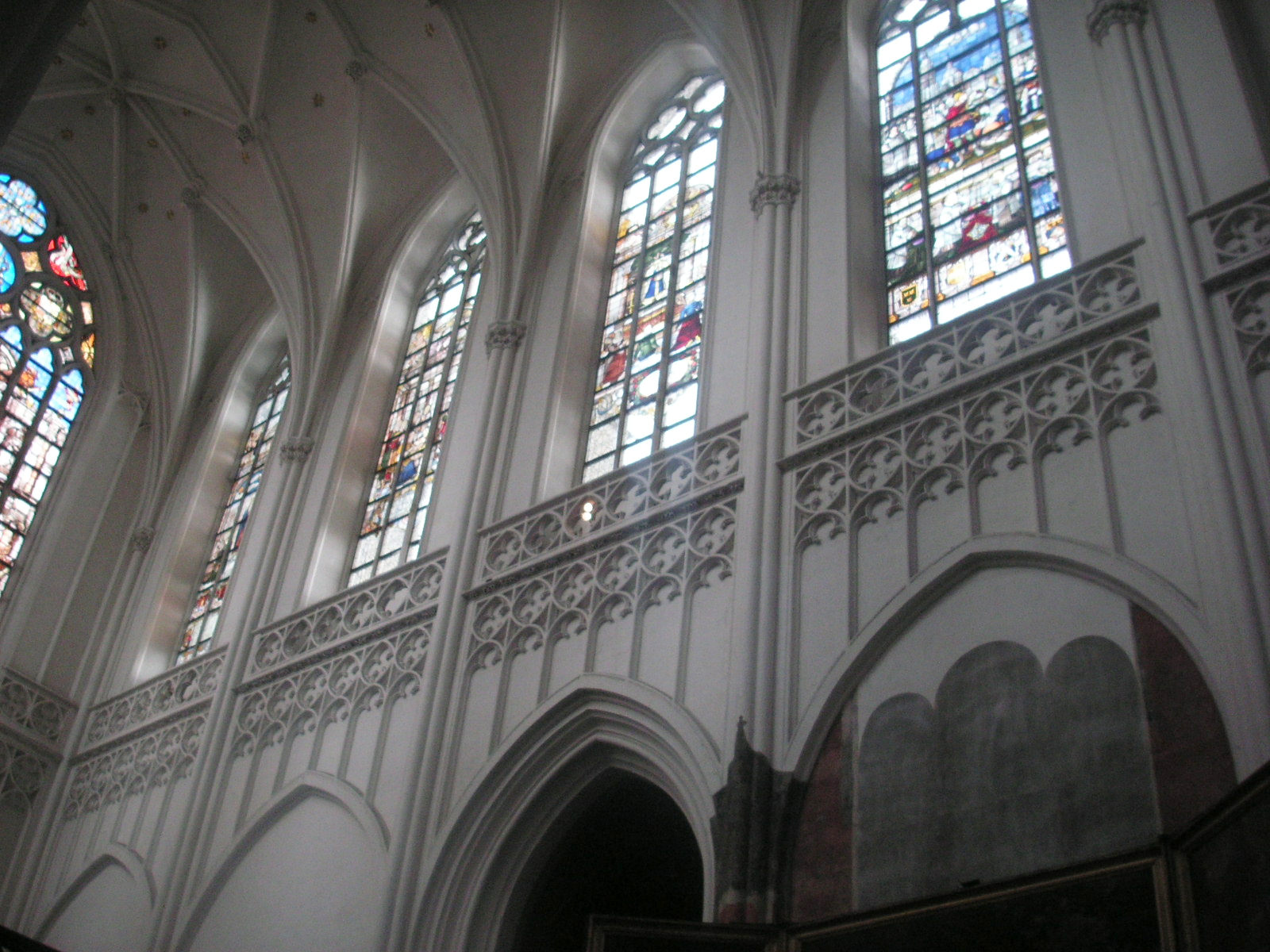
Antwerp Cathedral, E elevation of N transept.
I took this! It’s about the only picture from my 2013 visit there that’s usable!

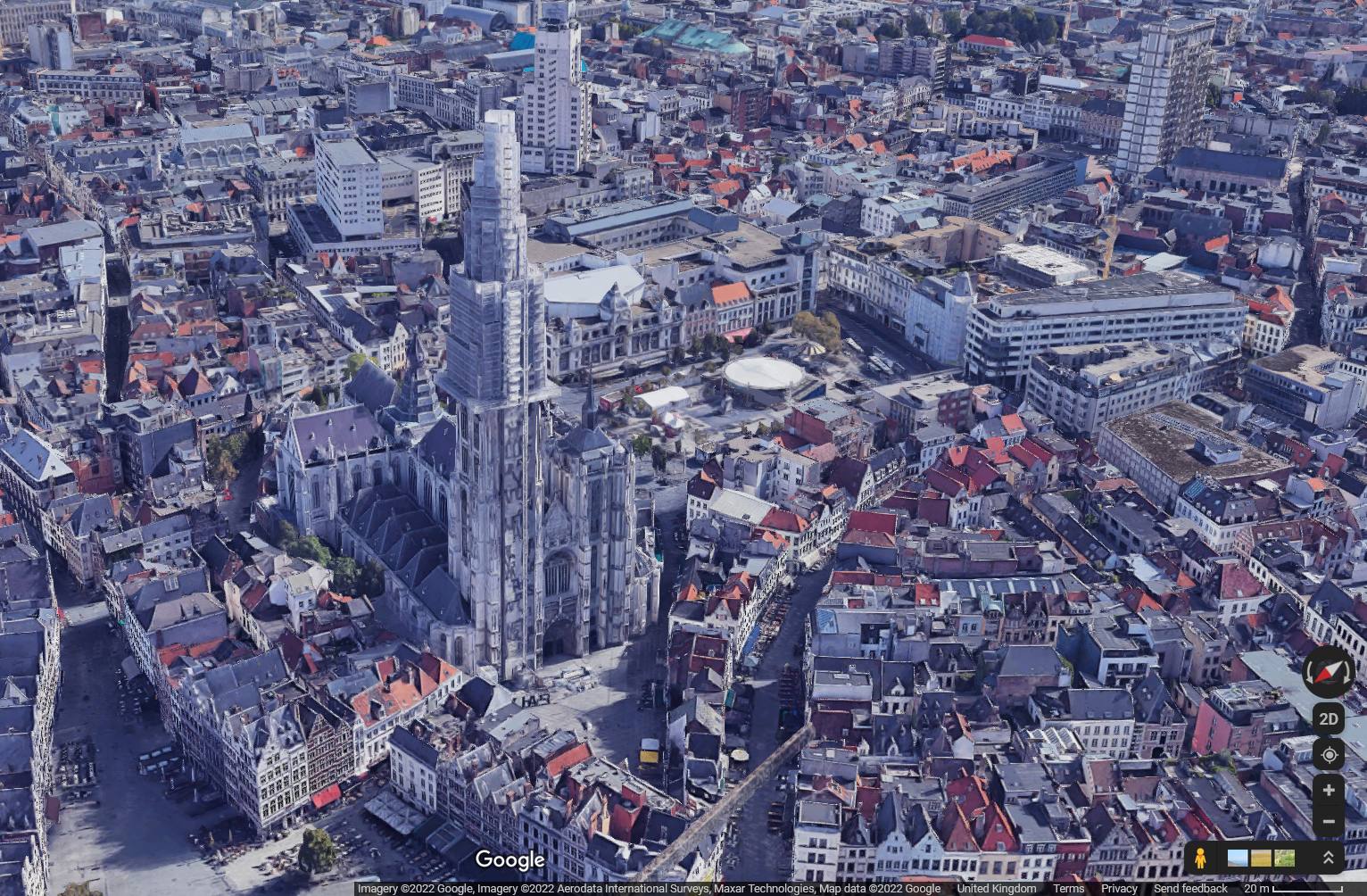
Partly due to its enormous north-west tower which is almost exactly the same height as the crossing steeple of Salisbury Cathedral (123 m), Antwerp is probably the best-known cathedral on this list, and it would surprise most of its daily visitors to learn that not only was it not built as a cathedral, but that the current incarnation of the bishopric that sits there only dates back to 1961. The current building was begun in 1352 with the ambulatory east end opening into a series of five polygonal chapels. Something that is rather un-cathedral like is the complete elimination of a middle-storey due to the almost flat roofs over the vaults of the aisles and chapels which is resolved internally as a sill wall-passage with a quatrefoil parapet. This is (partly) compensated for by the blind panel tracery of quatrefoils impaled on trefoil-headed panels which fill the arcade spandrels, generally thought to have been inspired by the straight choir bays at Mechelen. The system is taken over for the rest of the building: the nave with its double aisles being constructed from 1419-70, subsequently a third, wider set of outer aisles being added part way through the build.
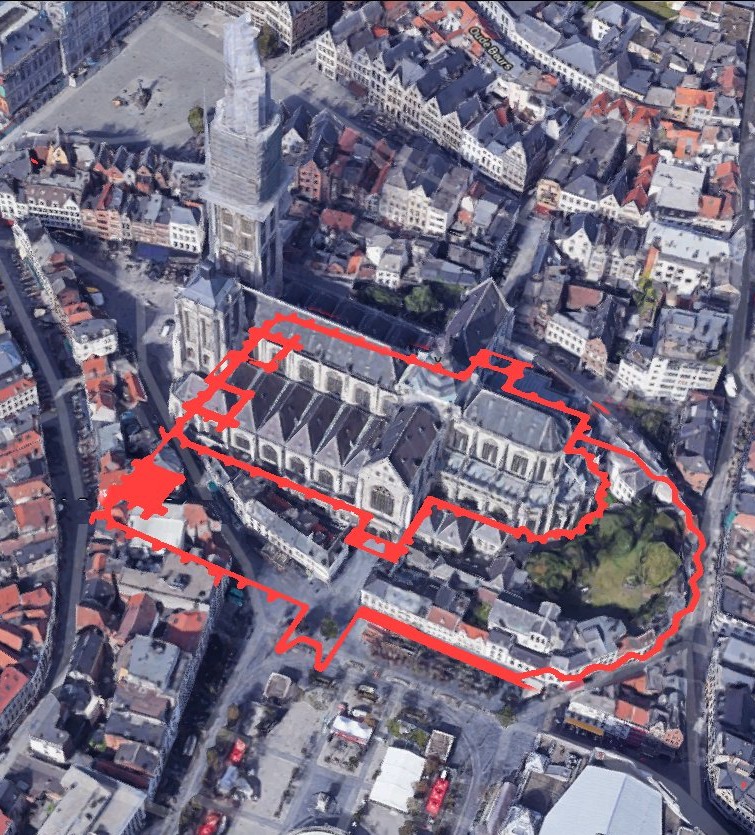
Plan of the of the gargantuan apse begun in the 1521 project and conjectural nave and transept rebuild at Antwerp Cathedral, around the plan of the existing church (which is hardly small itself).
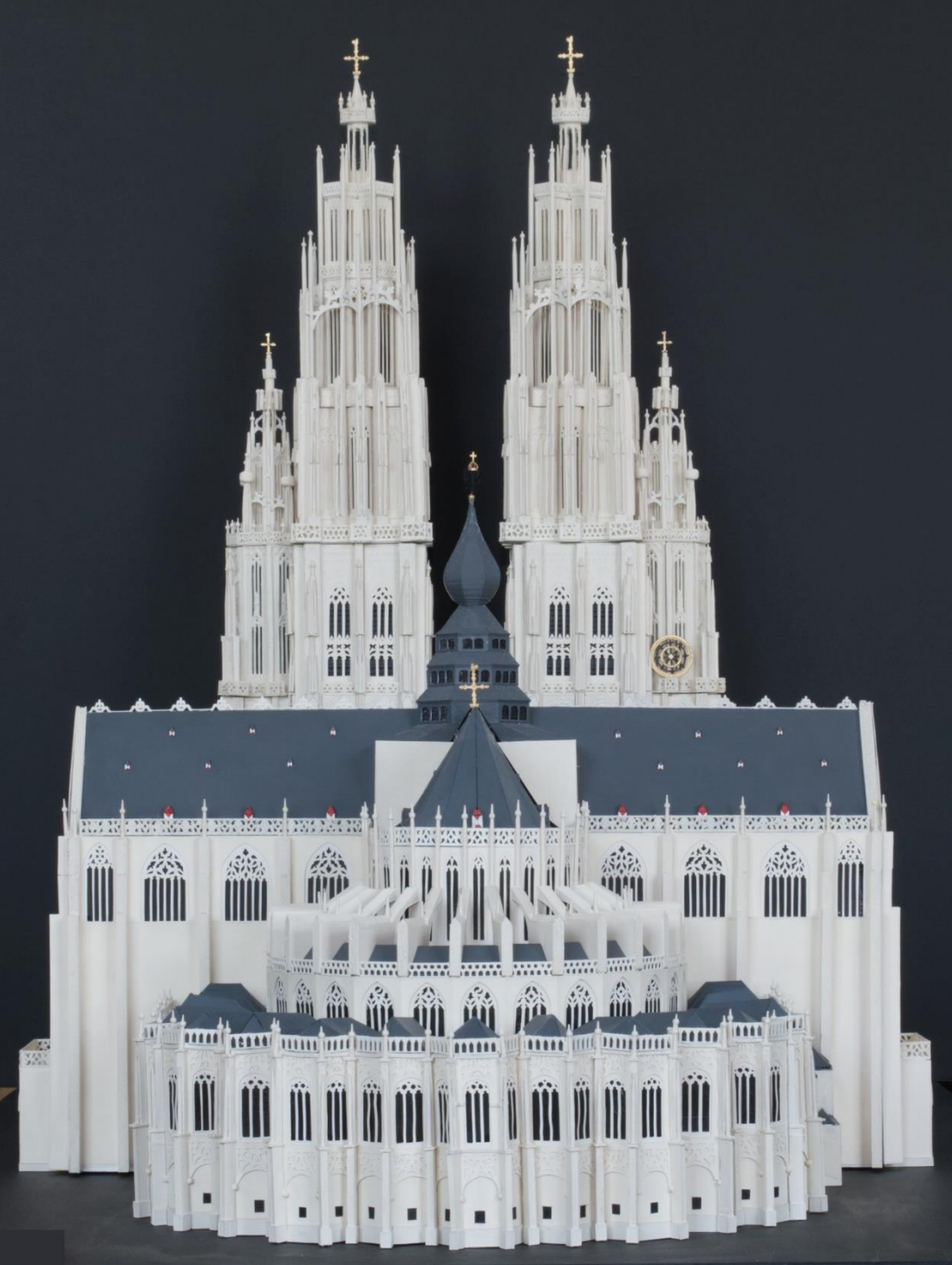
Hypothetical realisation of the Antwerp Nieuwe Werk scheme, viewed from behind the eastern chevet.
Maquette of largely of foam cardboard with wood and some 3D-printed PLA elements, by Kasper Dupré, 2020.

The north-west tower reached its current, super-tall status during 1501-18 when a Florid Gothic octagonal stage crowned with a spire concocted of a cage-like structure of traceried flying buttresses was added on top of the 1460s belfry. It is the only super-tall Florid Gothic tower fully realised to the ambitions of its custodians and builders before the Dutch Revolt put the dampers on such construction projects. But that tower was only the beginning of an utterly megalomaniacal ambition at Antwerp, as on 15 July 1521, Emperor Charles V ceremonially laid the foundation stone of an outer wall of an absolutely gargantuan choir, the outline of which can clearly be seen today in the buildings that sit atop its foundations after the project was abandoned by the canons.31 No doubt partly inspired by the Spanish Netherlands wishing to have something the proportions akin to the Cathedrals of Habsburg Spain,32 it would have outstripped Seville Cathedral’s 90 m width with around 115 m, making it the widest church in the world. Even today, only St Peter in the Vatican would rival it for sheer volume for a church building.

A fire in the existing church in 1533 scuppered the project well before the 1559 bull turned it into a cathedral, and the Dutch Revolt and economic decline after the migration of Protestant adherents from the city pulled down the shutters on it forever. Like so many unhinged Gothic rebuild projects, such as that planned at Siena in the second quarter of the 14th century, it was probably for the best it got shut down: because it seemed like it was a really, really bad idea.

Ypres, St Martin

Parish church elevated to collegiate 1102
(Diocese suppressed 1801. Building largely destroyed between 1914-8. Essentially reconstructed anew as a replica 1922-30)
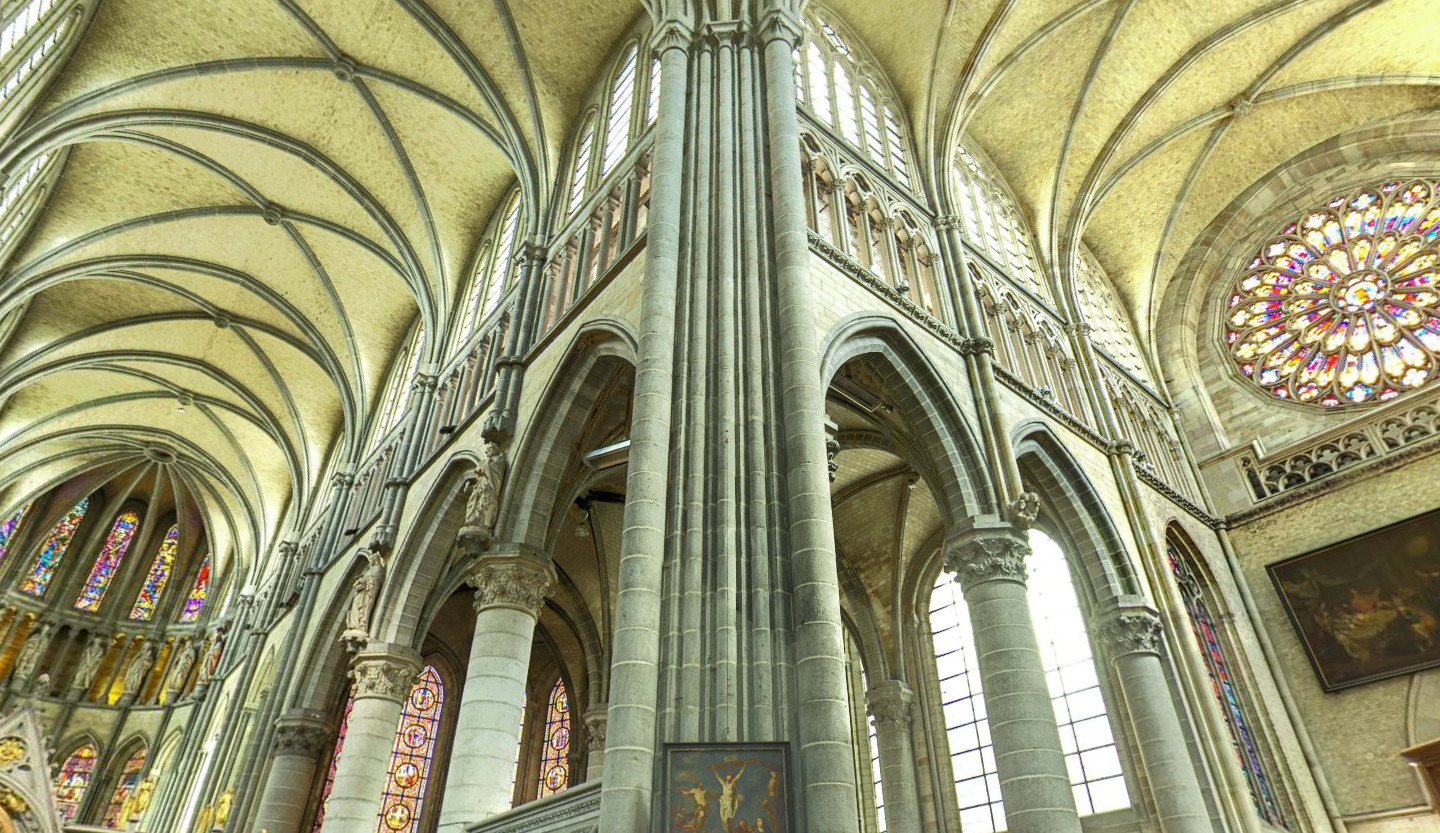
St Martin, Ypres my modification of a SketchUp model by Lenaren. I corrected the textures, added the stair turret on the N side of the choir, narrowed the aisles to meet only with one bay of the transepts, heightened the spire to its widely agreed height of c.100 m, corrected the elevation proportions including the high roof thanks to architectural surveys regarding the planned extension to the “Proosdijzaal” in 2015 that was resisted by local government and thus has never been carried out. I also converted via photogrammetry into a single mesh to make it easier to deal with in the animation process and also smooth out some of the details to make it look like a real-world capture. Which sounds like a lot I guess but it was still a good model to start with.
St Martin, Ypres. Angle of S transept and E arm, showing the differences in triforium design between 1221- and early 14thc S transept, with the “Braine-type” radiating chapels in the angle. Of course literally all the masonry you see here was made in the 1920s.
Part of a 360 panaroma shot by Philippe Vercoutter

Ypres has a solid start date of 1221 for the east end, and another good early example alongside Saint-Omer of how Flemish Gothic differs from contemporary mainstream French. Instead of the tall Chartrain clerestory, space is given over in the elevation there is a large blind triforium. Unlike Saint-Omer there is no ambulatory around the eastern arm. Instead, the high apse is unaisled, and chapels are placed in the angle between the choir and transepts, in a clever rethinking of the Romanesque en echelon plan. Such a design, which became popular in Flanders, is of uncertain origin but is best exemplified in the surviving east arm the Premonstratensian Abbey church of Braine, near Soissons.33 Although the collegiate church’s Gothic build took over a century to complete – the nave was begun in 1321 – the elevation remains largely consistent except for superficial changes in style regarding foliage and the window tracery: including a brief fling with Parisian Rayonnant in the south transept. Although with its high triforium, external clerestory passage it is similar to Saint-Omer, it overall feels more slender and light due to, as well as the lack of an eastern ambulatory, it not having lateral chapels along the aisles. In fact they totally prevented them being retrofitted on the north side by including a canons’ cloister.
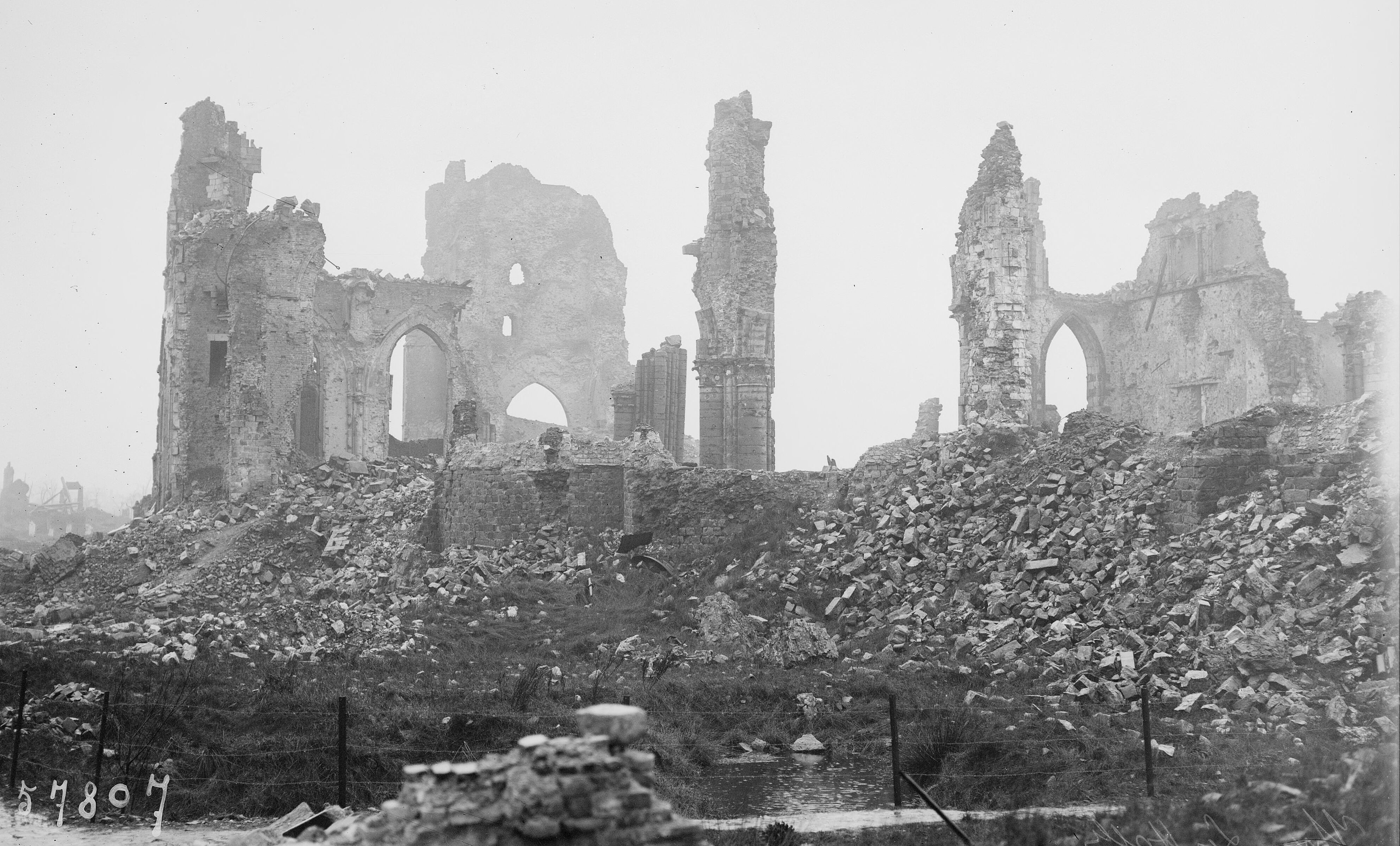
St Martin, Ypres from the SE in Jan 1920.
Left is the S transept, with SE stair turret collapsed so you can see the door up to the S sill passage, and connected to it the arcade of the chapels at the base of the E arm. The lump in the centre distance is the front face of the W tower, then you have some of the crossing piers and the N transept attaching to the “Proosdijzaal” off to the N.
BNF.

Ypres’s importance as a piece of medieval gothic architecture is of course somewhat overshadowed by the fact that the building there today is a clever replica of an original which no longer exists. Between 7 October 1914 and 14 October 1918, the town was almost completely destroyed by long-range heavy field artillery fire from the German army.34 The Cloth Hall and St Martin’s at the heart of the town were no exception – progressively damaged through the years of The Great War and eventually pulverised to almost complete annihilation.

You absolutely cannot exaggerate the extent of destruction of Ypres: all that remained standing of the former cathedral church after the Armistice was the lower parts of the south transept and west tower facades, parts of the crossing piers and bits adjoining them. It’s quite incredible how much the building was pummelled almost entirely out of existence. The standing masonry survivals were moot, as the damage was so heavy the site seems to have been almost entirely cleared to ground level and the church rebuilt entirely from scratch on top of the footings.

The slideshow below focuses on the south transept facade, which was subject to restorative reconstruction just before the War,35 and was one of the few parts left standing in early 1920.
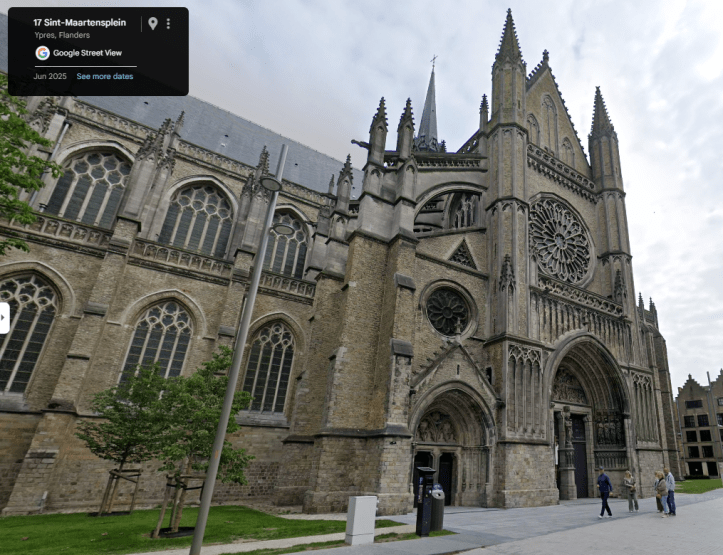
  • Streetview of St Martin, Ypres, S transept from SW 2025
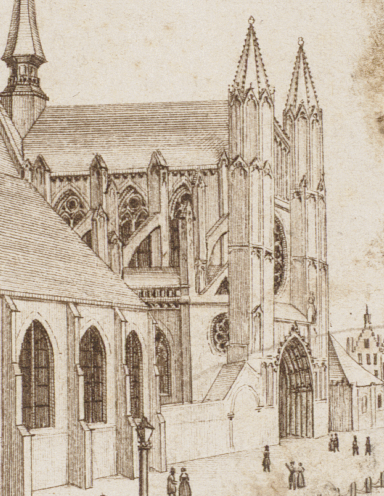
  • Detail of 1844 print by F. Böhm. Note the arrangement of oculus in the end of the aisle with triangle in the lean-to roof. Foreground is the dean’s chapel which was destroyed early in the War and not rebuilt.
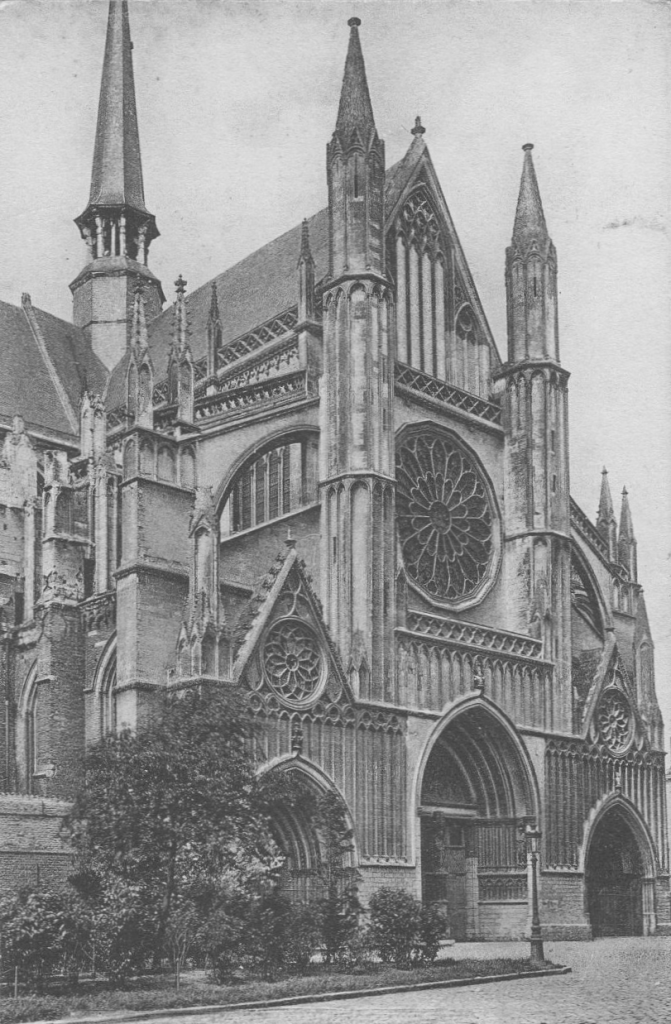
  • S transept SW angle from before the Coomans restoration of 1907, showing the frankly daft-looking symmetrical false gables flanking the transept instated by J. Dumont in the 1840s-50s.
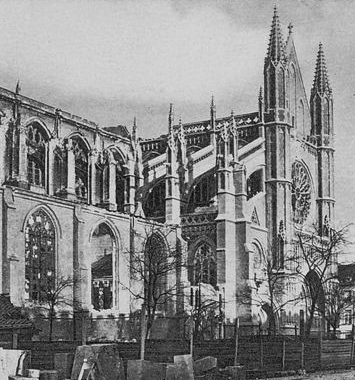
  • S transept SW angle early stages of the Great War (late 1914 or early ’15), the roofs have burnt off and the Dean’s chapel is gone. Note however Cooman’s reinstatement of the previous S transept facade arrangement.
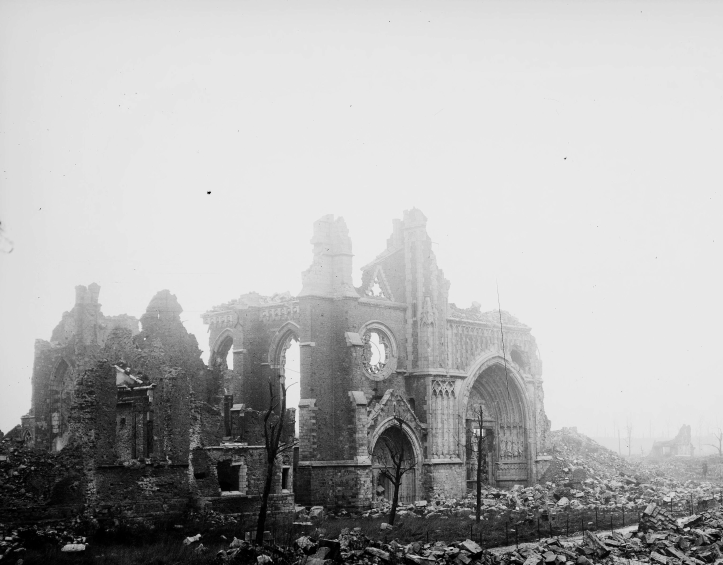
  • S transept SW angle in 1920. Only some outer walls stand to aisle roof level. The wall in front to the L is the inner side of the N wall of the Cloth Hall.
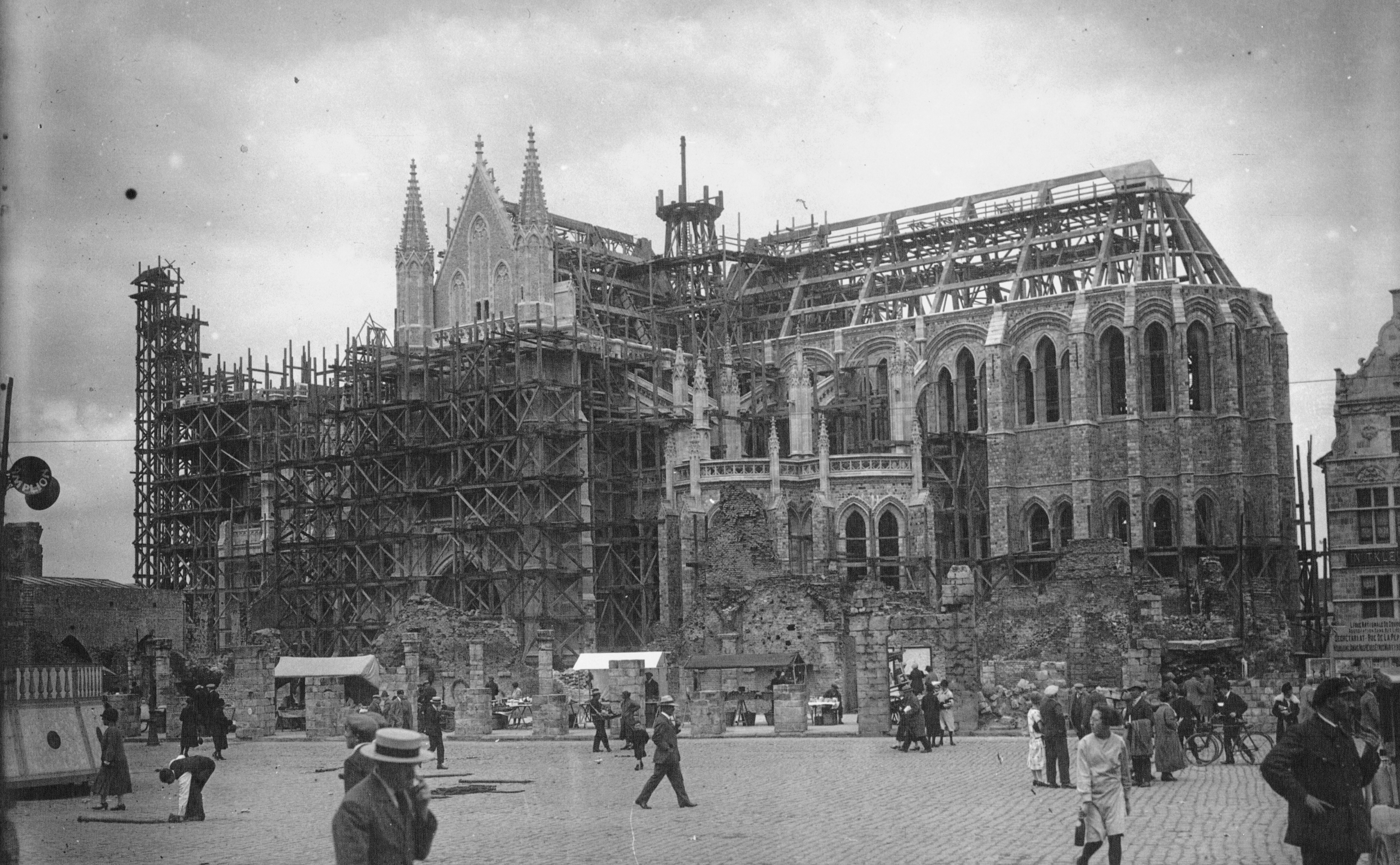
St Martin, Ypres in July 1927, the rebuild of the E arm and transepts largely complete with the high roof structure exposed. Note this view of the church is impossible now due to the reconstruction of the Cloth Hall, some walls and undercroft pillars of which you can see in the foreground.
BNF

The architect in charge of rebuilding, Jules Coomans, had already restored the church in 1907, so much of the work was reinstating the design as he had established and documented then. The facing masonry components – Arras sandstone for the east arm and a mixture of yellow local brick and stone dressings for the rest – are particularly admirable for their authenticity. It should be noted however that many of the details you can see destroyed in the Great War and reinstated today, were in fact introduced by Coomans in 1907. The rebuild was completed at the conclusion of the decade and the grand rededication was on 13 April 1930. Although no rebuild can be a perfect replica of the building, partly due to the speed of reconstruction, Ypres has been appraised as showing a greater conformity of treatment to the capitals than in the original, that took over ten times as long to realise.36 Nevertheless, rebuilding it was a triumph to be treasured as an artistic achievement in its own right.

Ghent, St Bavo

Parish church, elevated to collegiate 1540
(Diocese never suppressed)

Photogrammetry capture of St Bavo (formerly St John), Ghent

This was originally a parish church, only becoming collegiate after the destruction of the abbey of St Bavo for the construction of an Imperial Citadel on its site. Emperor Charles V secularised the chapter and installed them at the parish church of St John, changing the dedication to that of the old abbey.
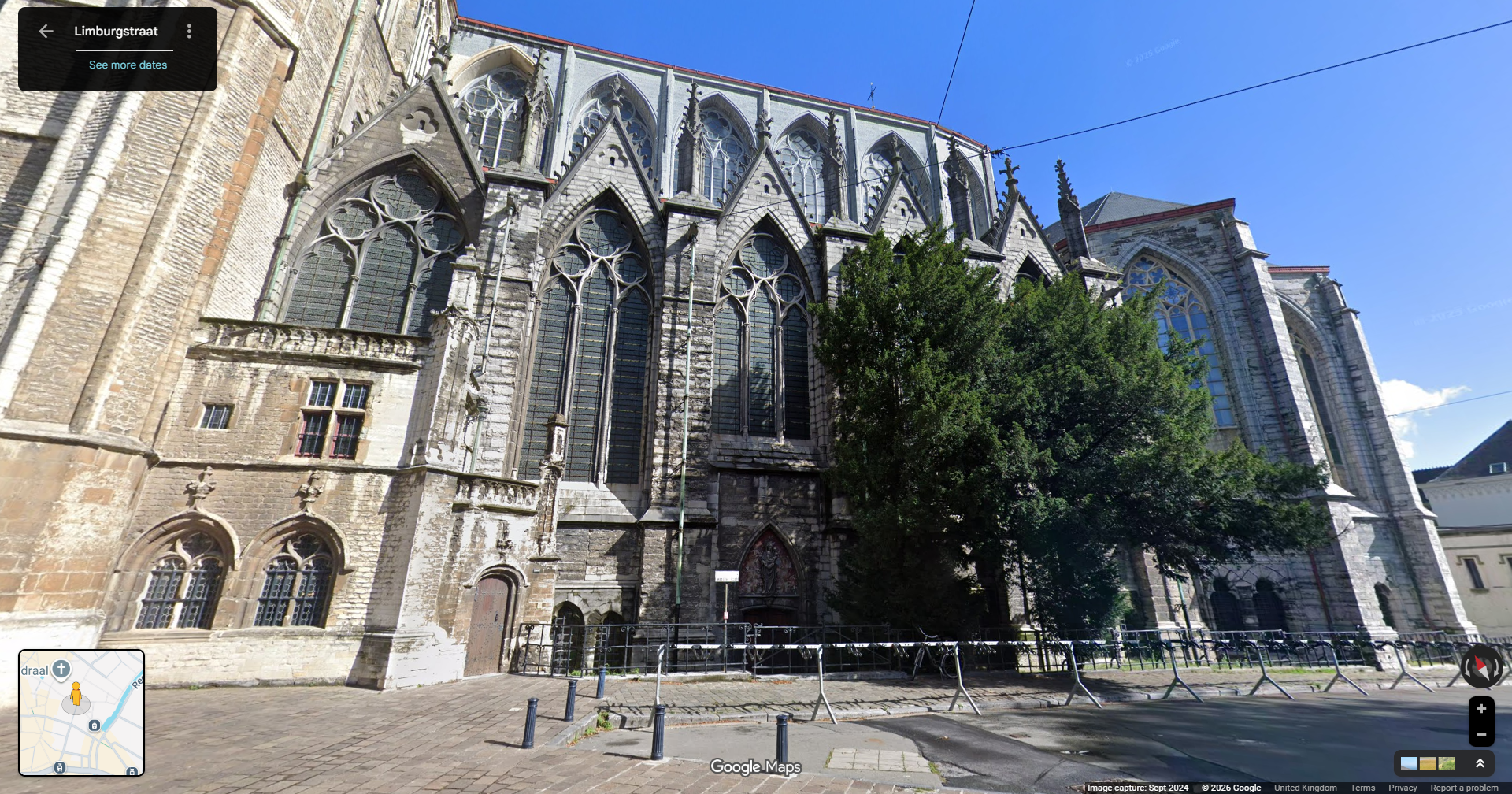
Ghent Cathedral, E arm from S.
The crocketed gables over the early 14thc aisle chapels, although derived from High Gothic decorative detailing such as the clerestory of Amiens Cathedral choir, here do genuinely face transverse roofs which run into valley gutters between the chapels. The later 14thc ambulatory chapel behind the tree to the right became the Vijdkapel and the first home of the Van Eyck altarpiece.

The Sint-Janskerk, such as it was, survived as a Romanesque basilica (represented by the central part of the crypt under the current choir), until it received a Gothic east arm in the early 14th century. One might say, with its through-coursed piers of a cylindrical core with shafts at the angles, simple crocket capitals, openwork tracery in front of a triforium passage, and standard fenestration in the clerestory of four lights two quatrefoils over and an encircled octofoil in the head, this is a rather off-the-peg bit of provincial Rayonnant. That one commentator might be a bit of an tedious know-it-all, but regardless, largely correct. Like pretty much all of pre-Florid Brabatine Gothic, it’s coasting off the cathedrals of Tournai and Cambrai and not doing much new. Aside from the crocketed and finial’d gables over the choir chapels, the exterior is rather plain. I’m not knocking it, it’s fine, it’s just hard to get excited about, that’s all.
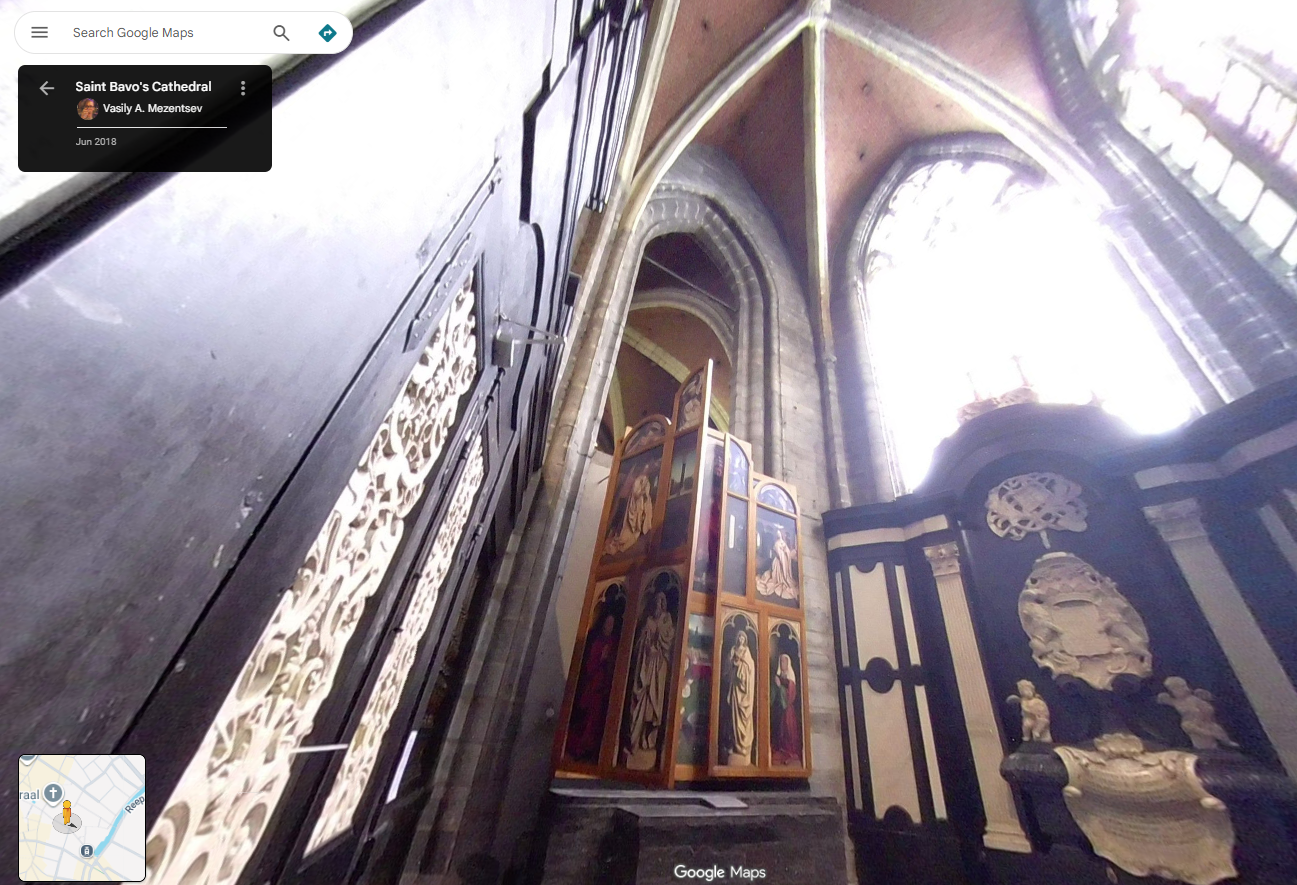
Ghent Cathedral, the Vijdkapel: first radiating chapel on the S side of the apse, the original home of the Ghent Altarpiece, with a replica in the E arch it was originally built to fit. Surprisingly difficult to find a photo of this

In the 1390s, the ambulatory was expanded and given exceptionally generously-proportioned polygonal chapels which do up the excitement of the east arm. The first one of which on the south side had the world-famous ensemble of oil paint of oak panels, widely known as the Ghent Altarpiece (properly the “Adoration of the Mystic Lamb” Dutch: De aanbidding Het Lam Gods), made for it by the brothers Van Eyck and installed there by 1432, which of course, everyone gets very excited about. The crypt was also expanded beneath the chapels. From 1462, a west tower was built in front of the Romanesque nave. It is hardly a match to the Brabant towers going up around the same time, either in height or detailing, although with its octagonal top stage’s pinacles at 89 m, it beats any parish church in England (Boston, pinnacles of octagon, 81 m; Louth, masonry spire, 86.6). Especially since in sixteenth-century maps you can see it had a sizeable spire on top of the octagonal stage taking it well above 100 m.37
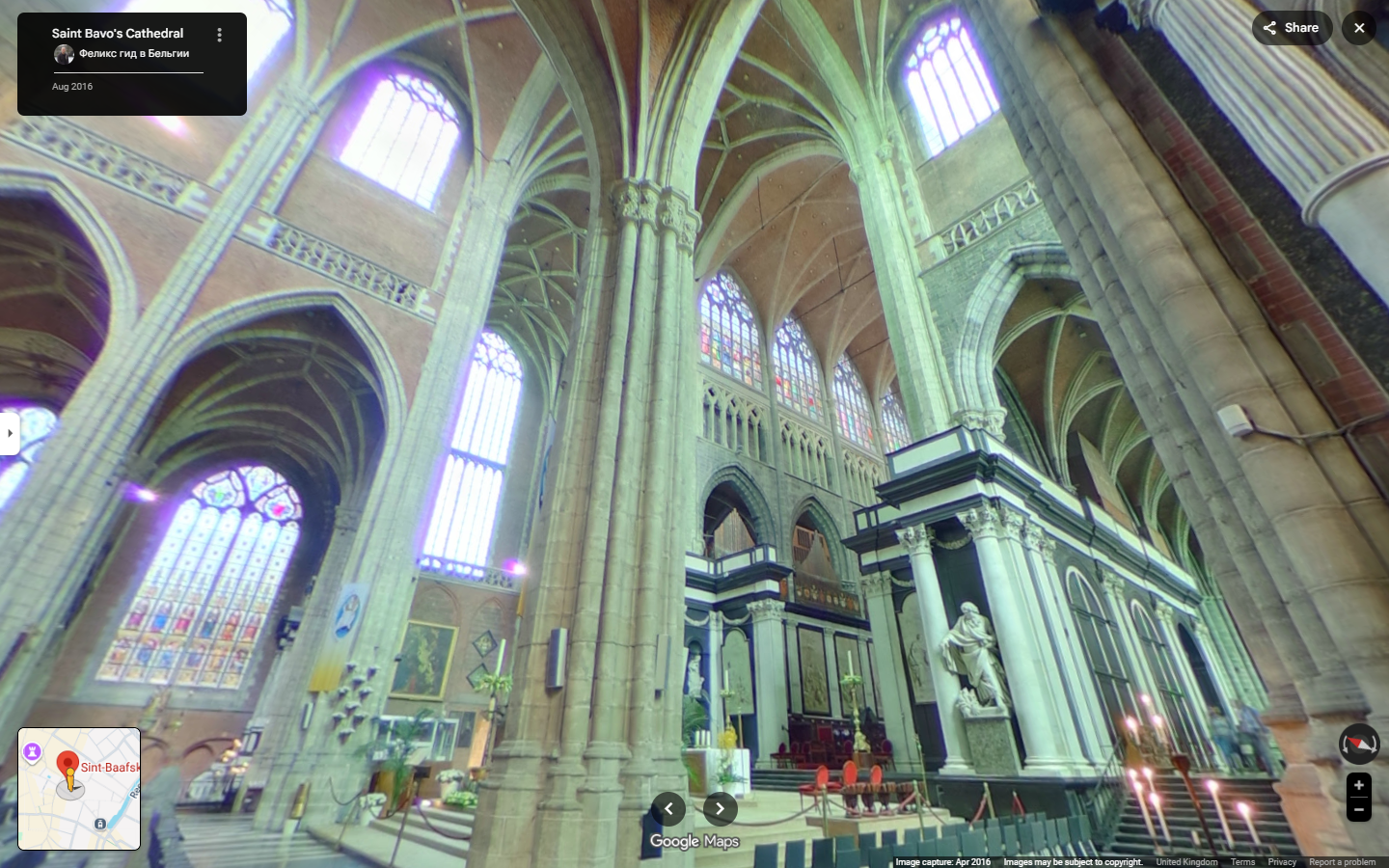
Ghent Cathedral, S aisle looking toward crossing and early-14thc Rayonnant E arm. Notice the contrast of the full three-storey elevation with the openwork tracery triforium, and the 16thc nave and transepts with just a low openwork “parapet” below blank wall-space, framed with stone quoining.

A campaign to replace the Romanesque transepts and nave between the choir and tower was inaugurated 7 August 1533. The build matches the Rayonnant choir elevation but eschewing the triforium for a bare space of brick over some pierced tracery which looks like the balustrade of a walkway but isn’t. The building might lay claim to having the most recent major building work of any cathedral in the Super Universas bull for in 1550, Emperor Charles V, gave the sum of 15,000 Italian crowns, each to the value of 36 sous to the church.38 Sous is an alternative word for shilling, so in units of account the gold coinage works out as £26,250. However, to compare this sum with something like King Henry VII of England’s exceptionally lavish 32-metre-long Lady Chapel at Westminster Abbey built 1503-12 which cost over £19,586,39 we have to recognise that a Flemish groat pound was worth much less than a English pound sterling: between an eighth to ninth in the early sixteenth century.40 Therefore Charles V’s gift was more in the region of £3,000 when converted to English currency.  Was Charles motivated by a plan to make it into a cathedral, because he had been baptised there in 1500, or as compensation for destroying the Abbey church of St Bavo? Or a bit of all of those? Probably.

Bruges, St Donatian

Palatine chapel and collegiate church founded 10th century
(Last bishop in office 1794. Church destroyed 1799. Diocese suppressed 1801.
Diocese re-erected in 1834 and bishop’s seat installed at medieval parish church of St Salvator)
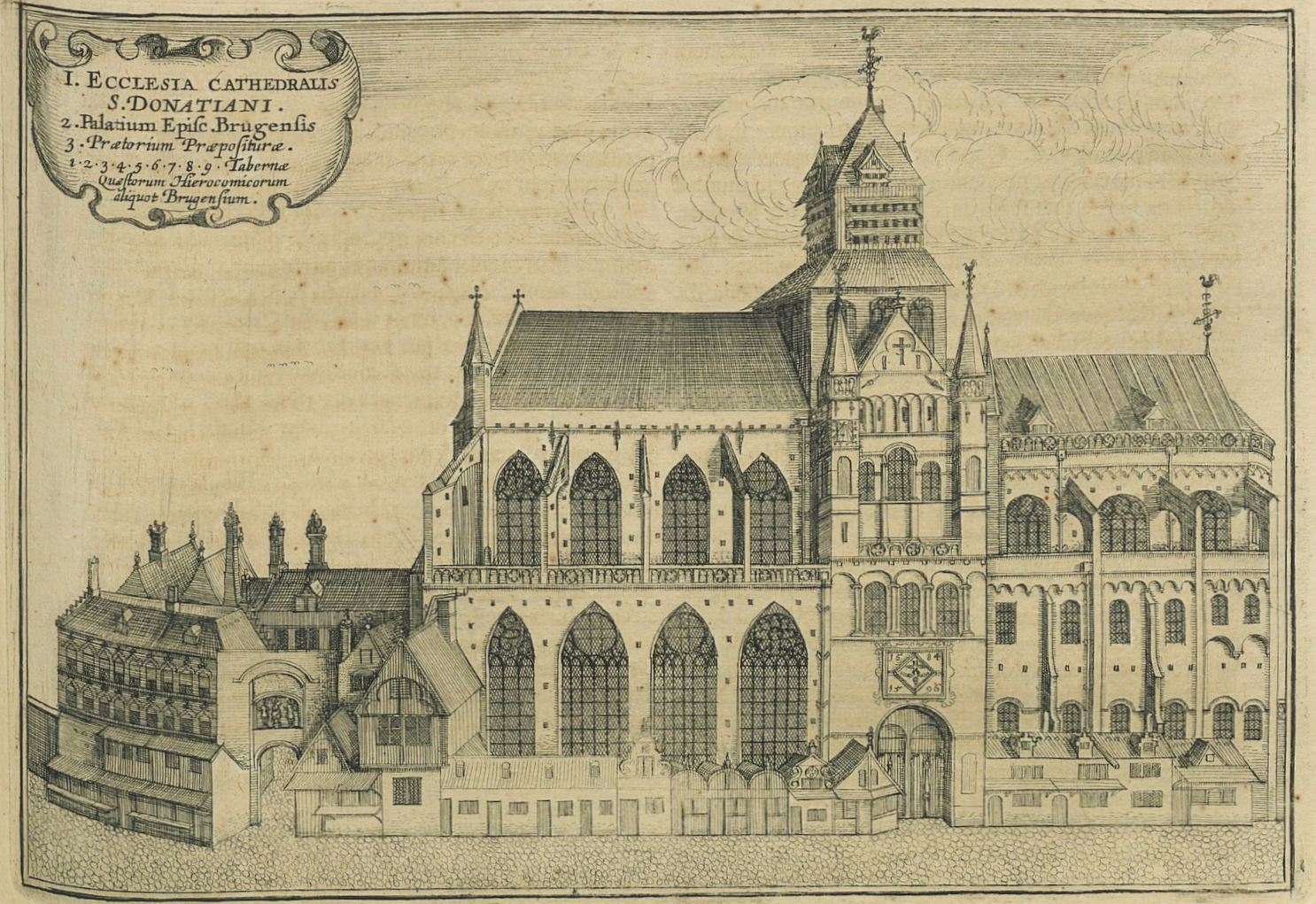
Cathedral church of St Donatian, Bruges, from the north (Burg Square).
From Antonius Sanderus, Flandria Illustrata, Vol. 1, 1631, p.211. Via Koninklijke Bibliotheek van België
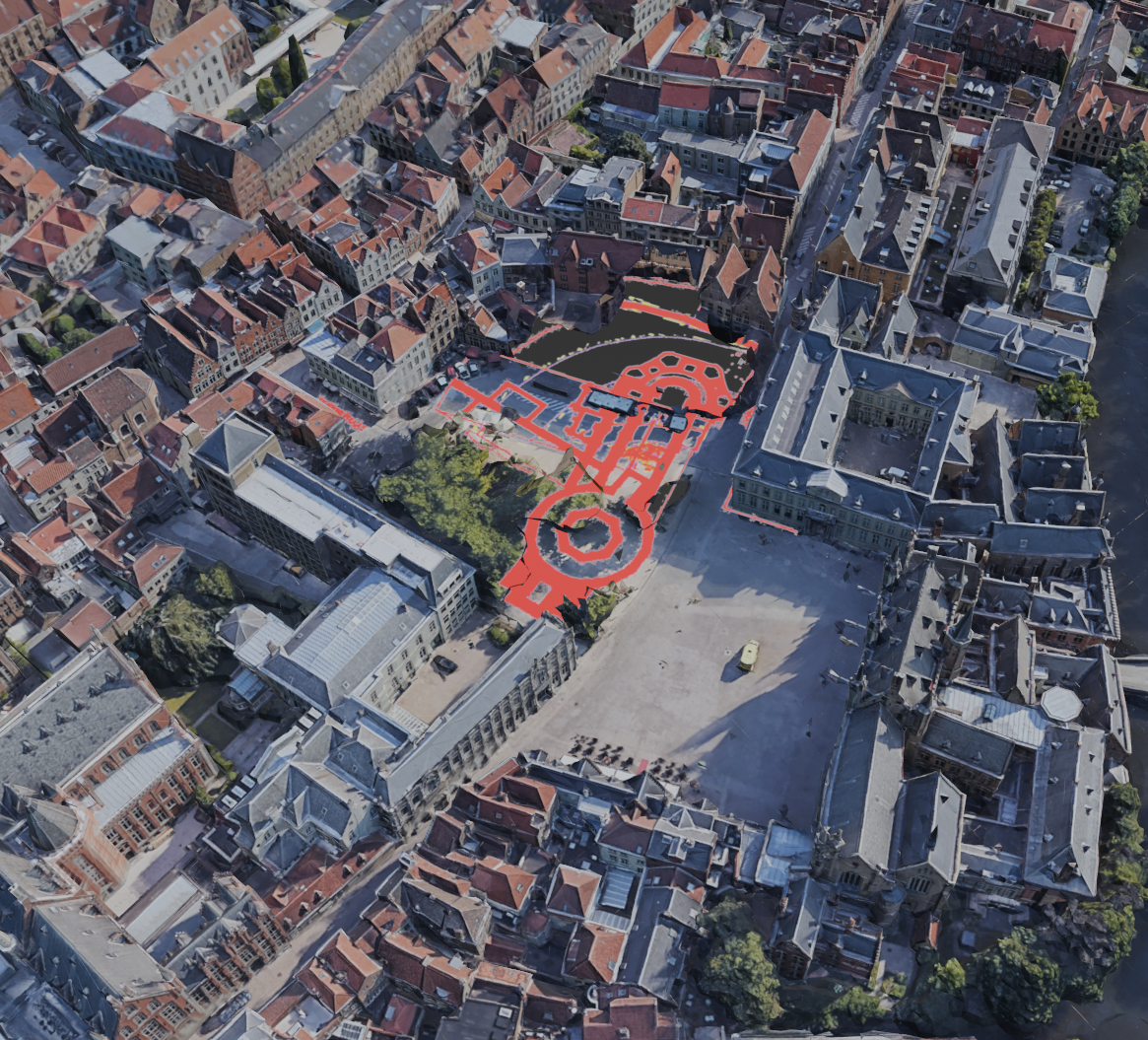
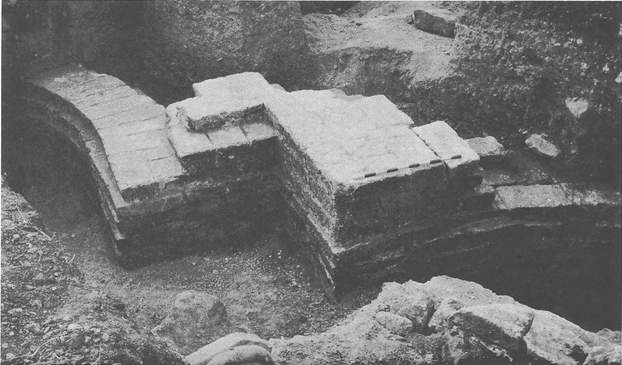
Archaeology of the Carolingian rotunda, Romanesque/Gothic basilica, collegiate buildings and original castle moat, looking over Burg Square from the NW, as if looking from the Belfort of the Town Hall.
The Crowne Plaza hotel geometry has been removed to show the eastern apse of the cathedral.
The Basillica of the Holy Blood is bottom-right.

St Donatian is now totally vanished above pavement level, and thousands of daily tourists walking over its site in the historic centre south of Burg Square (opposite the Basilica of the Holy Blood) have no idea it was ever there.41

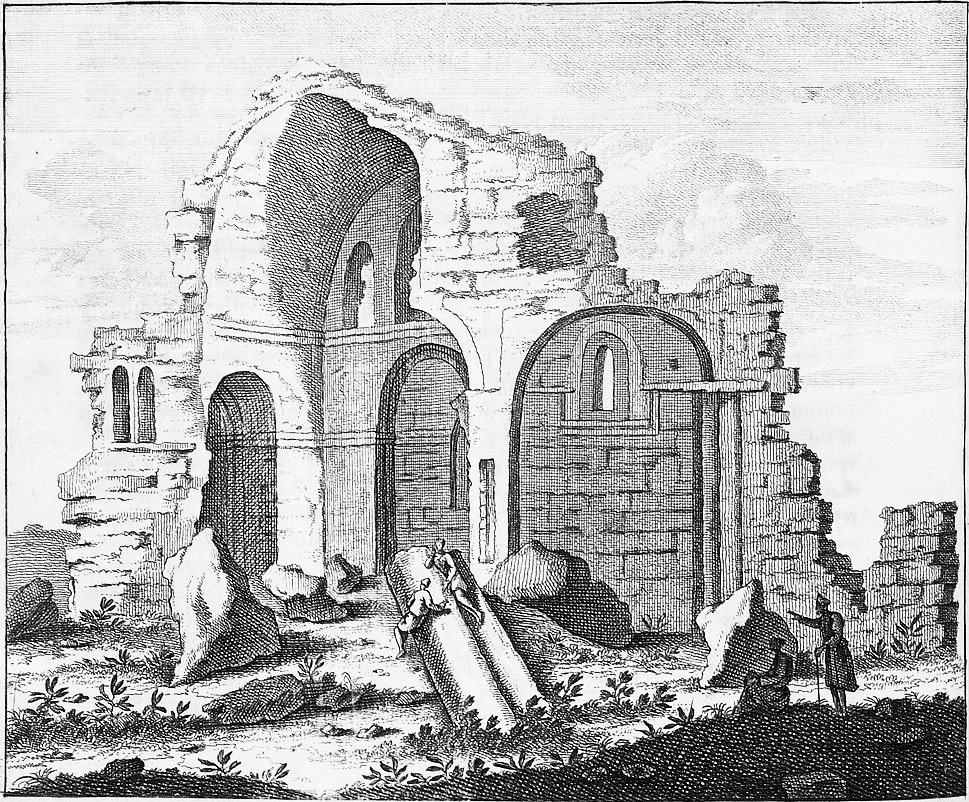
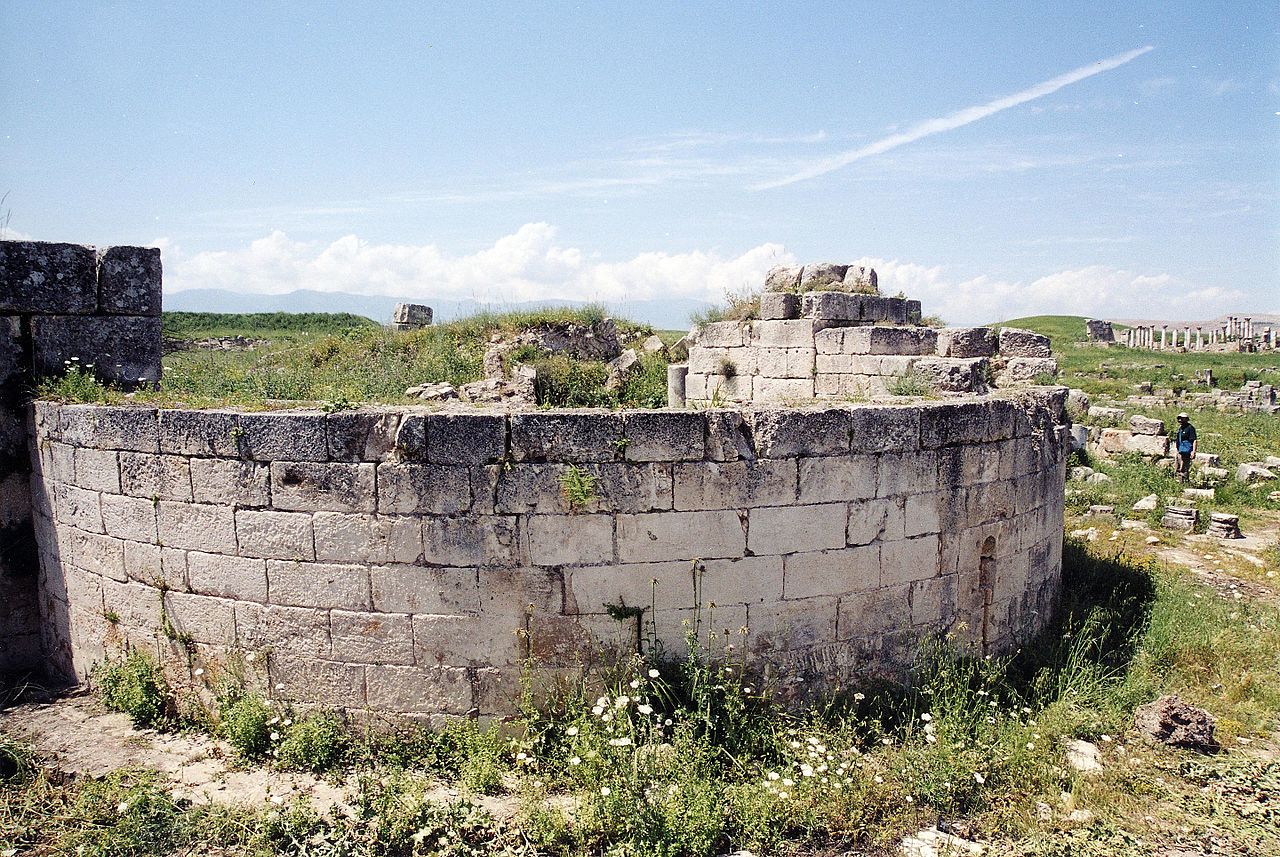
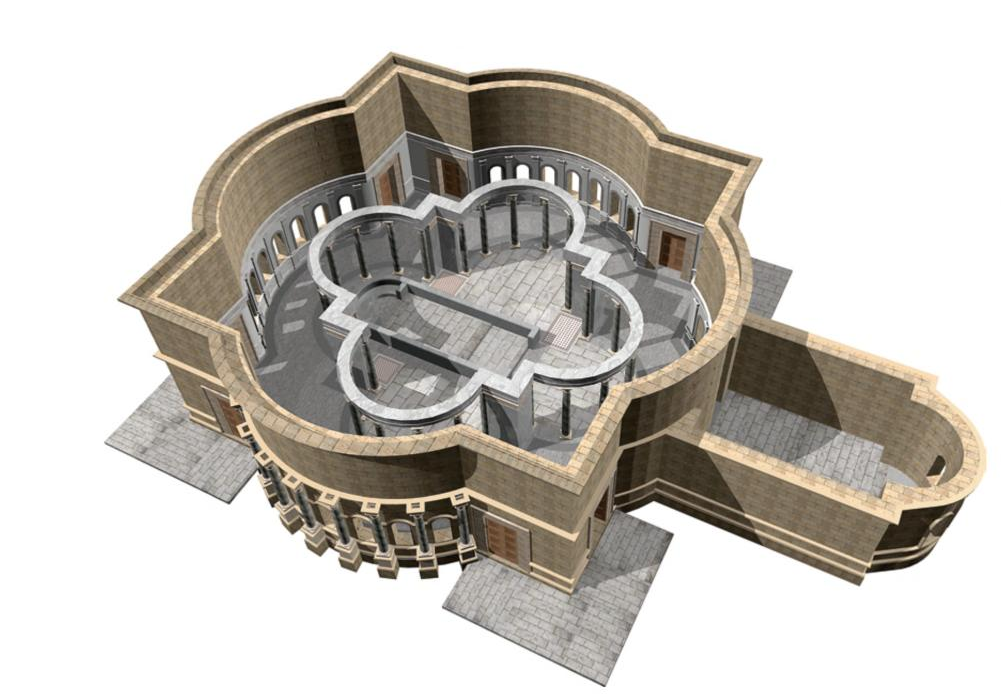
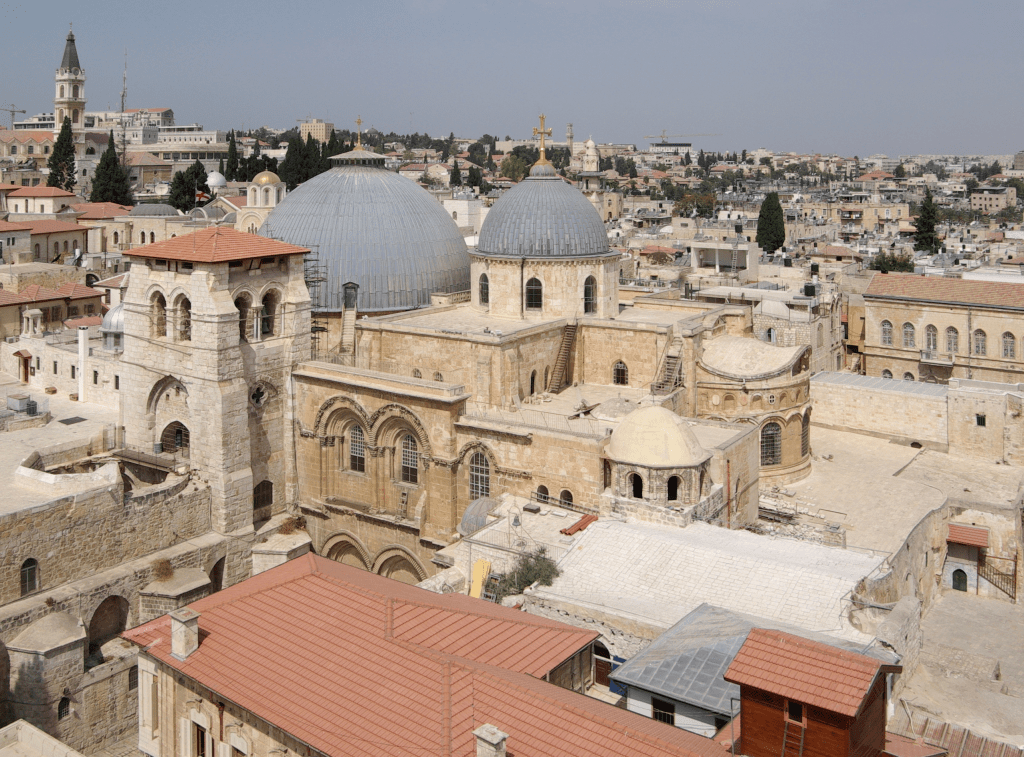
It was initially founded as the chapel of the Burg (castle) held by the counts of Flanders in the 10th century, and built as a centrally-planned octagon in emulation of the Palatine Chapel at Aachen, and thus ultimately the Holy Sepulchre in Jerusalem. This is the building in which the Count of Flanders, Charles “the Good” was murdered inside on the 2 March 1127 by knights acting on behalf of the embittered Erembald family with whom he was feuding.42 This church was damaged beyond repair in 1184, and replaced with a standard Romanesque basilica-form church, which extended out over the former castle moat.

The church nave was rebuilt in the 14th century, and the Romanesque ambulatory modified into a continuous chevet by inserting two chapels between the separate Romanesque ones. Under French rule, the church complex was confiscated as typical for religious buildings, and sold to be demolished for its materials, and was taken down between 25 October 1799 and 1802: mostly the structure was undermined by lighting fires under the walls.43
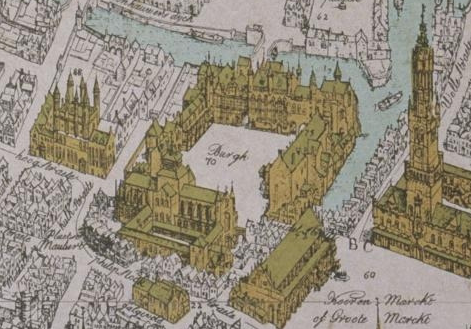
  • Crop of the 1561 isometric map by Marcus Gheeraerts the Elder. St Donatian’s collegiate complex is at the bottom of the Burg Square. Between it and the Town Hall with its monumental belfry is the Waterhalle, demolished in 1787
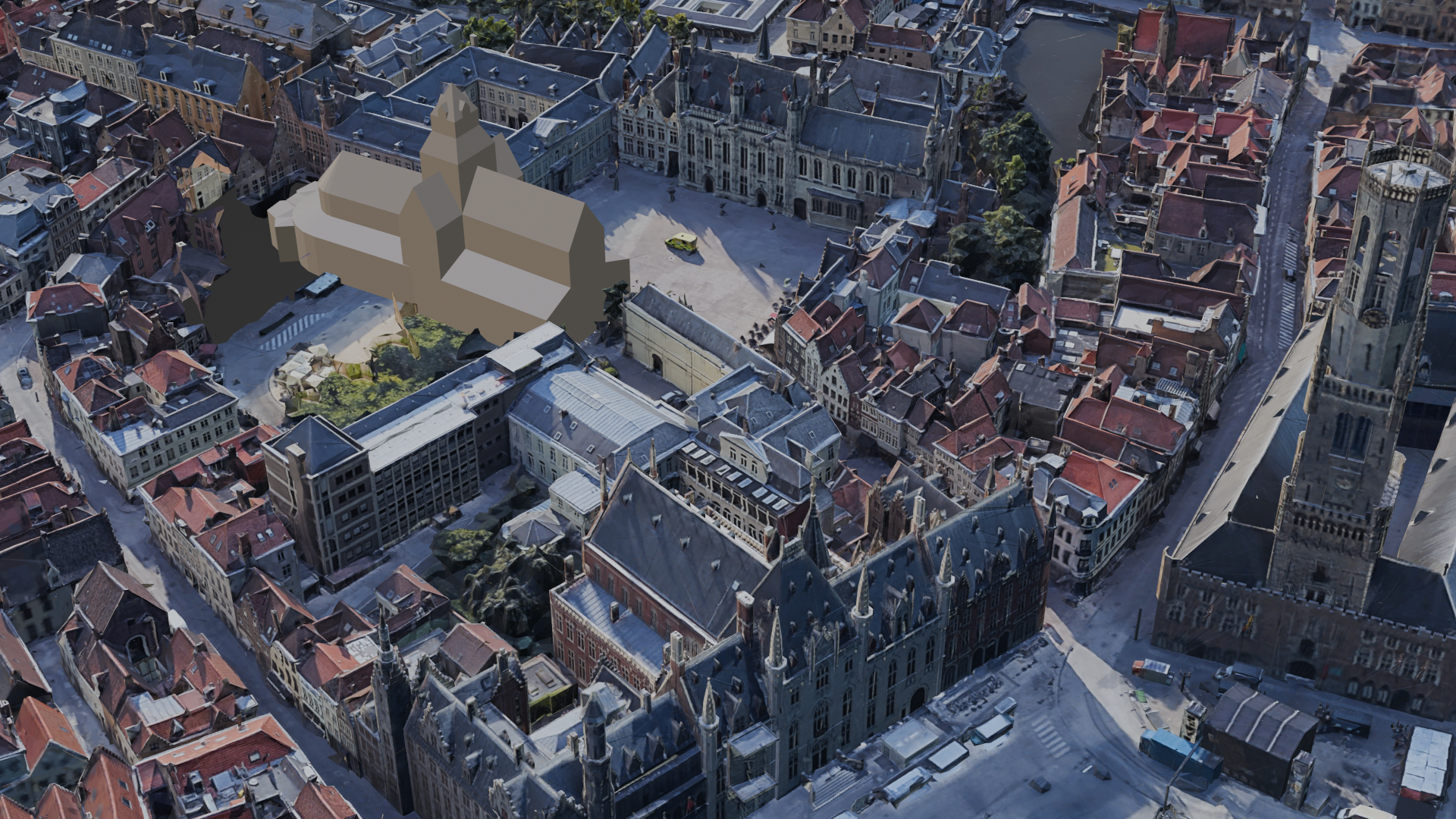
  • Similar view of modern-day Bruges showing a rough massing of the church of St Donatian. The Crown Plaza hotel has been removed to allow visibility of the E end.
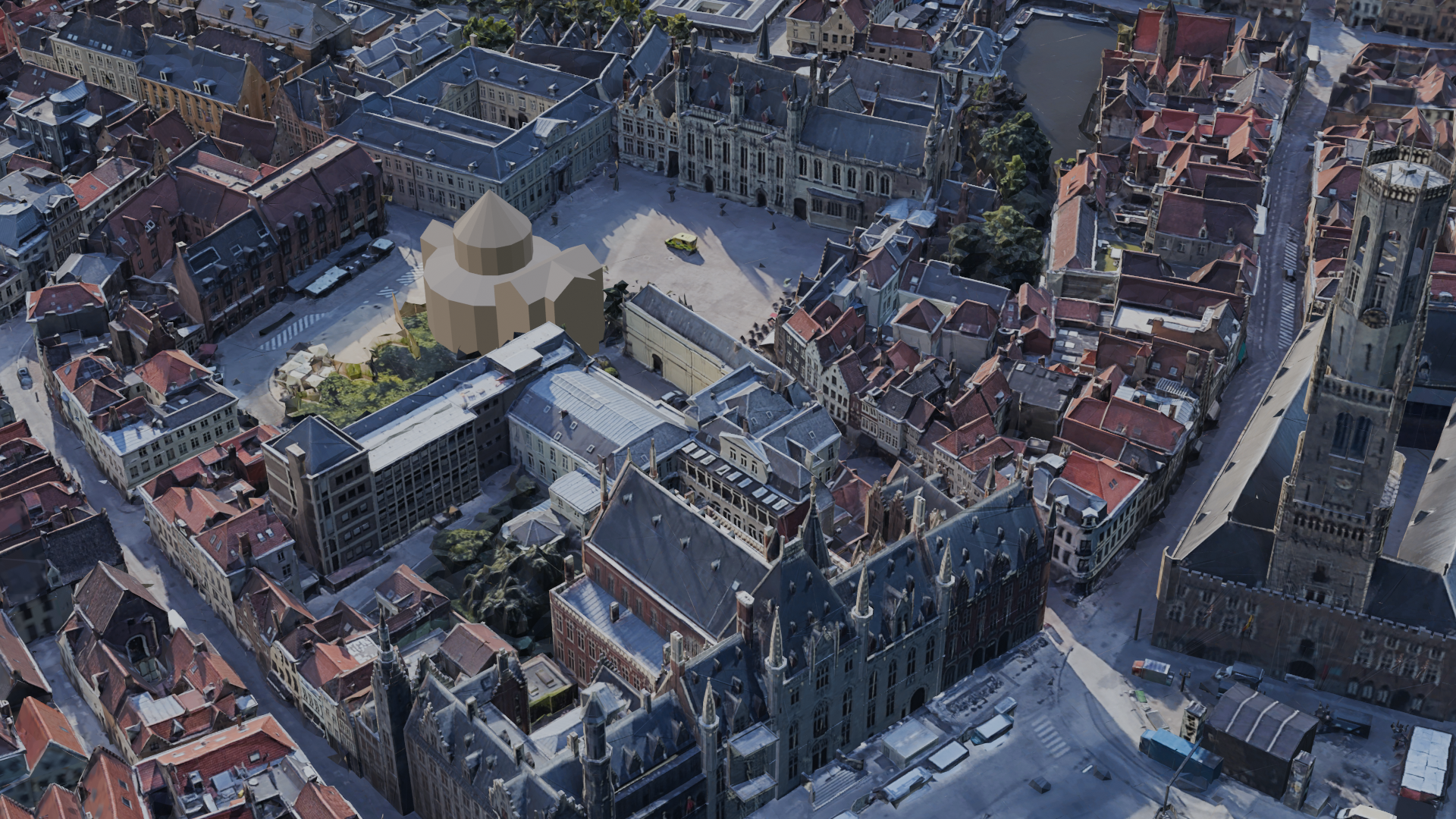
  • Same view but with the Carolingian rotunda and west block that preceded the basilica in view. The elevation of the model is extrapolated from scaling down Aachen to the same scale.
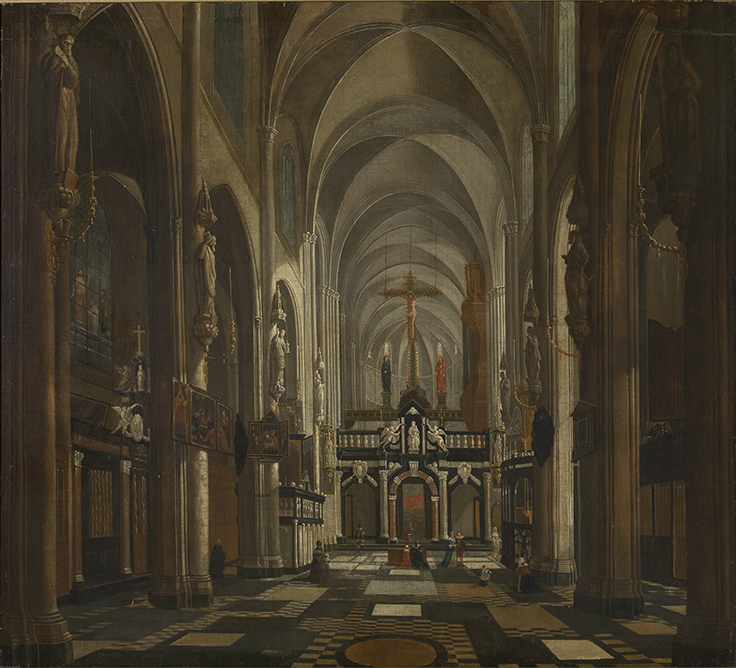
Interior of the nave of the Sint-Donaaskerk, Bruges.
Oil on canvas, c.1696 by Jan Baptist van Meunincxhove,
Groeningemuseum, Bruges 0000.GRO1383.I

There are a number of visual records of the building. One is on the isometric map of Bruges from 1561 by Marcus Gheeraerts the Elder (above), and a 1641 engraving for Anton Sander’s Flandria Illustrata (header). Jan Baptist van Meunincxhove painted a view from the nave with the Romanesque choir elevation tantalisingly behind the Baroque choir screen. These and other visual records correspond to show it had a four-bay nave with a two-storey elevation, and a Romanesque east arm with a gallery and ambulatory, as were found in the excavations of 1955-6, which largely revealed the Carolingian rotunda and 1987-9, which discovered the east arm of the basilica church.44 After this, c.1991-2, the Crowne Plaza Hotel was built over the site of the east arm, and the remains beneath are accessible from its basement. They used to be freely available to visit, but in 2023 due to littering and vandalism, the hotel restricted access only to tour groups lead by licenced city guides, which is a huge shame.45

What is striking about the Cathedral it was not the biggest church in Bruges: the church the bishop’s seat returned to in 1834, St Salvator, is larger. But it was the importance of the collegiate chapter that lead to this church, on a constrained site in the Burg, to be chosen as a bishop’s seat. If it survived today, it would be the Romanesque east arm that would set it apart from the other impressive church buildings Bruges has to offer.

‘s-Hertogenbosch, St John

Parish church, elevated to collegiate 1366
(Diocese suppressed 1646, re-erected 1853)

Photogrammetry capture of ‘s-Hertogenbosch Cathedral
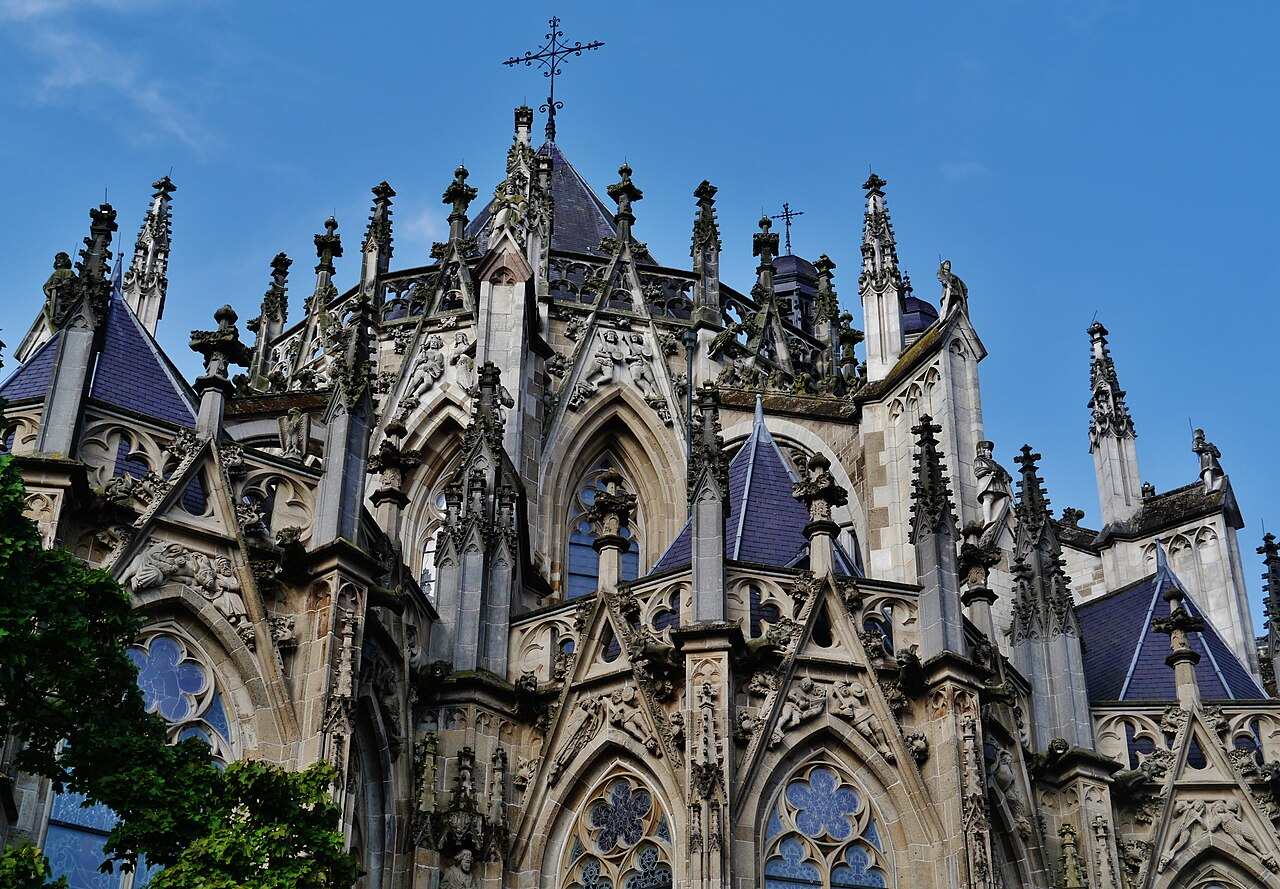
‘s-Hertogenbosch Cathedral. Ornamented decorative gables over windows of choir chapels and high apse.
Wikicommons: Zairon. Taken August 2015

The principal administrator of the Super Universas project in its final form that saw through its issuing as a papal bull, Franciscus Sonnius, was rewarded with the appointment of this see in 1561 and was ordained 8 November 1562, however he was translated to Antwerp 13 March 1570. The seemingly unusual name of the town is a contraction of des Hertogen bosch, the forest of the duke, hence the French name Bois-le-Duc, and it is commonly called Den Bosch in Dutch.

What stands now is an absolute hulk of a collegiate church. The feature that gives it this impression, aside from the double aisles of the nave, is the retained west tower of brick from the mid-13th century (mentioned 1268). A collegiate chapter was founded in 1366 and it is likely from 1380 that the building of a new east arm with an ambulatory and radiating chapels was begun, with a rich Brabantine Gothic language being used on the interior elevation of arcade spandrels and openwork-tracery pierced triforium passage, but also the exterior, with the buttressing system and decorative gables (Dutch: wimberg) over the windows enriched with an unusual amount of figure sculpture both sacred and profane.46
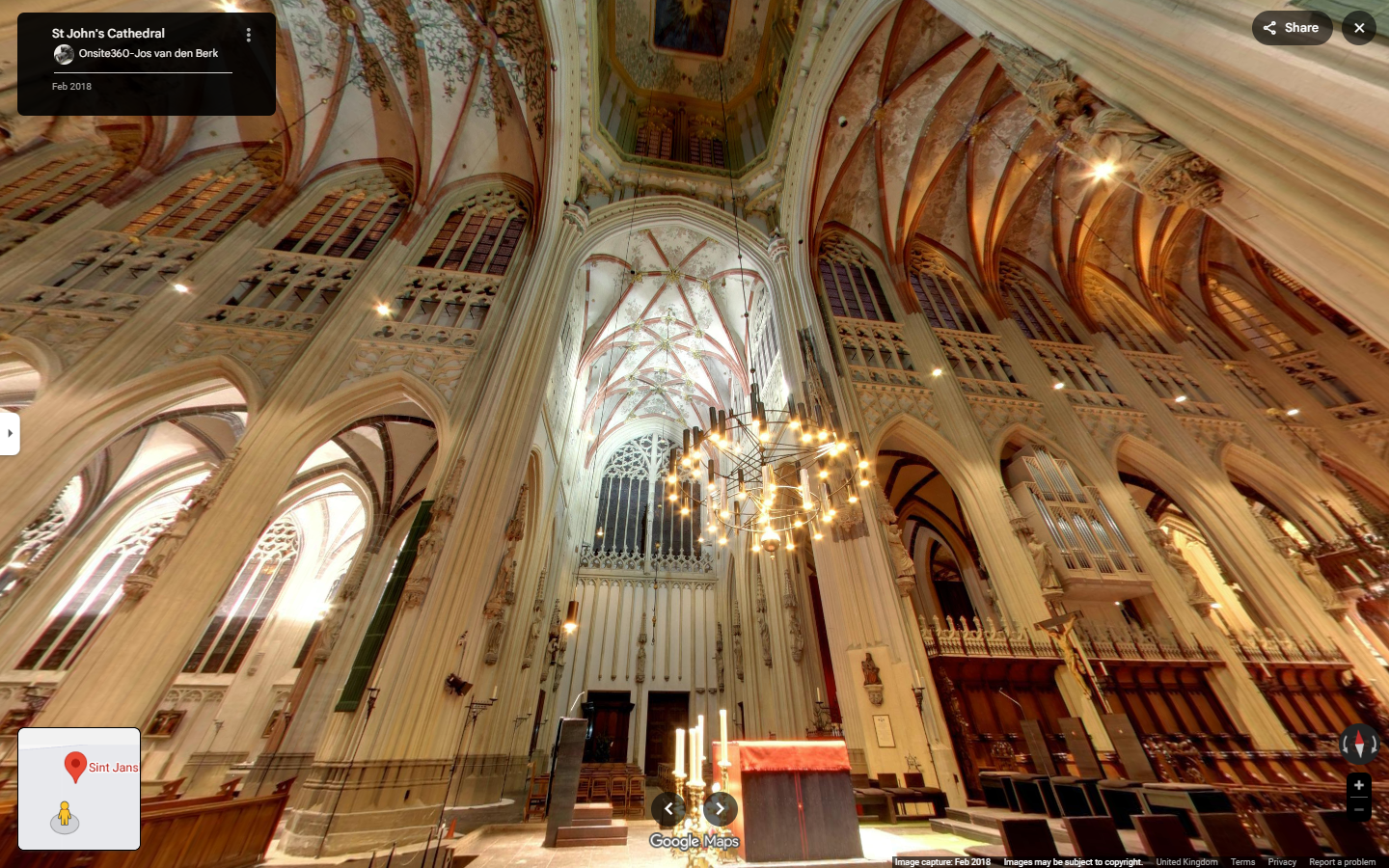
‘s-Hertogenbosch Cathedral, looking from S transept towards the heavily-ornamented yet unified Brabant gothic elevations of choir (1380s-) and nave (c.1469-c.1517)

The south transept porch, with its magnificent cresting of ogees intersecting with inverted curves, is indebted to Parlerian designs such as the main frontage of Prague Cathedral, and its dating in the 1430s means it is likely seminal in establishing the third main style of Low Countries Gothic: the Florid.47 The whole frontage has been extensively restored: even in the early 17th century the reversed-ogee parapet was in a ropey state (possibly from the siege of 1629 by the Dutch Republic, when the city remained loyal to Habsburg Spain, but also perhaps the steeple fire and inevitable collapse of 1584) and much of it was remade in the 1886-7 restoration. We can also see from a splendid mid-seventeenth century watercolour in the Rijksmuseum that the great end window with two subarcuations separated with a bold central mullion was even more asymmetrical, with two completely different tracery patterns in the heads.
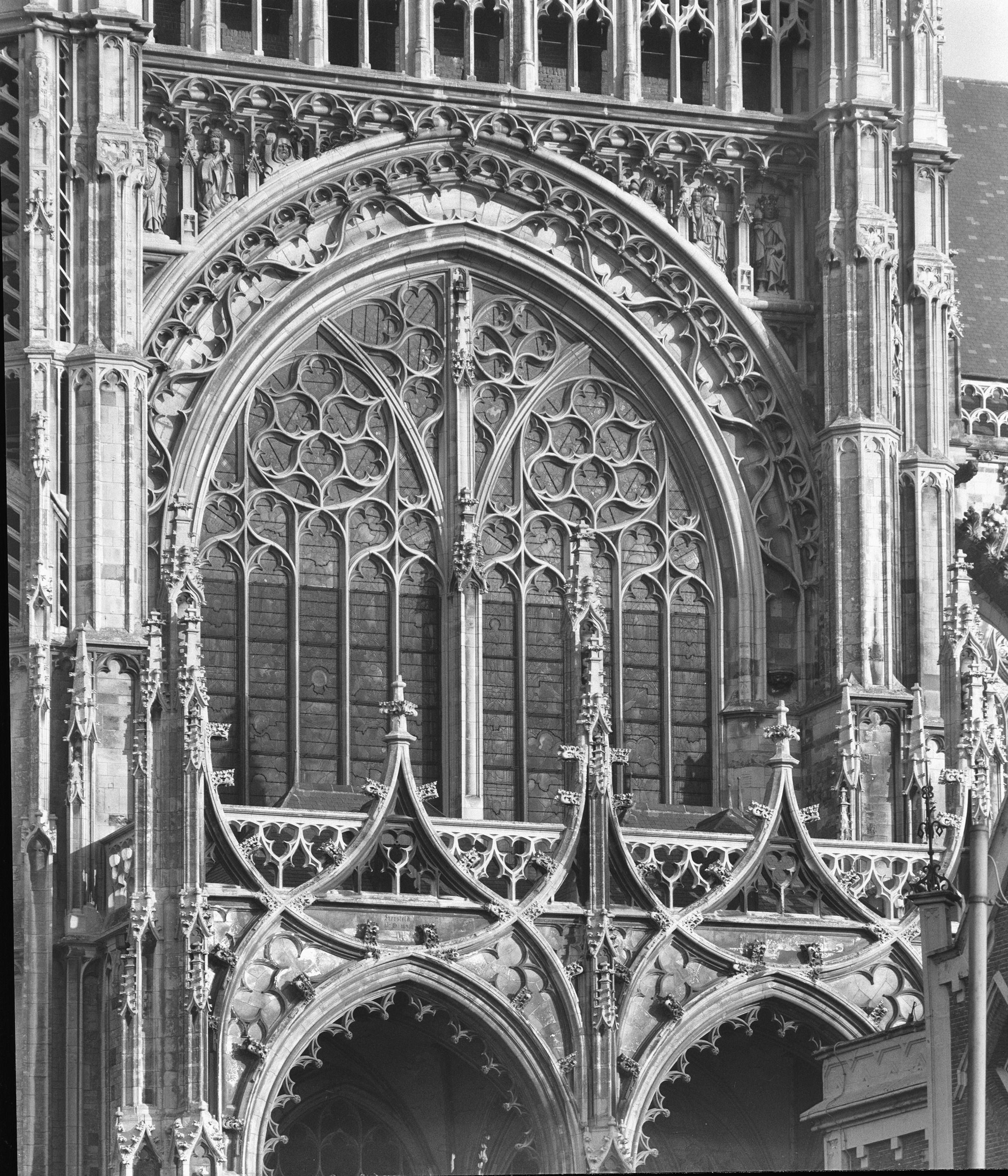
‘S-Hertogenbosch Cathedral, S transept – cresting of the porch and great end window.
Photograph taken Feb 1964 by G.Th Delemarre: Rijksdienst voor het Cultureel Erfgoed
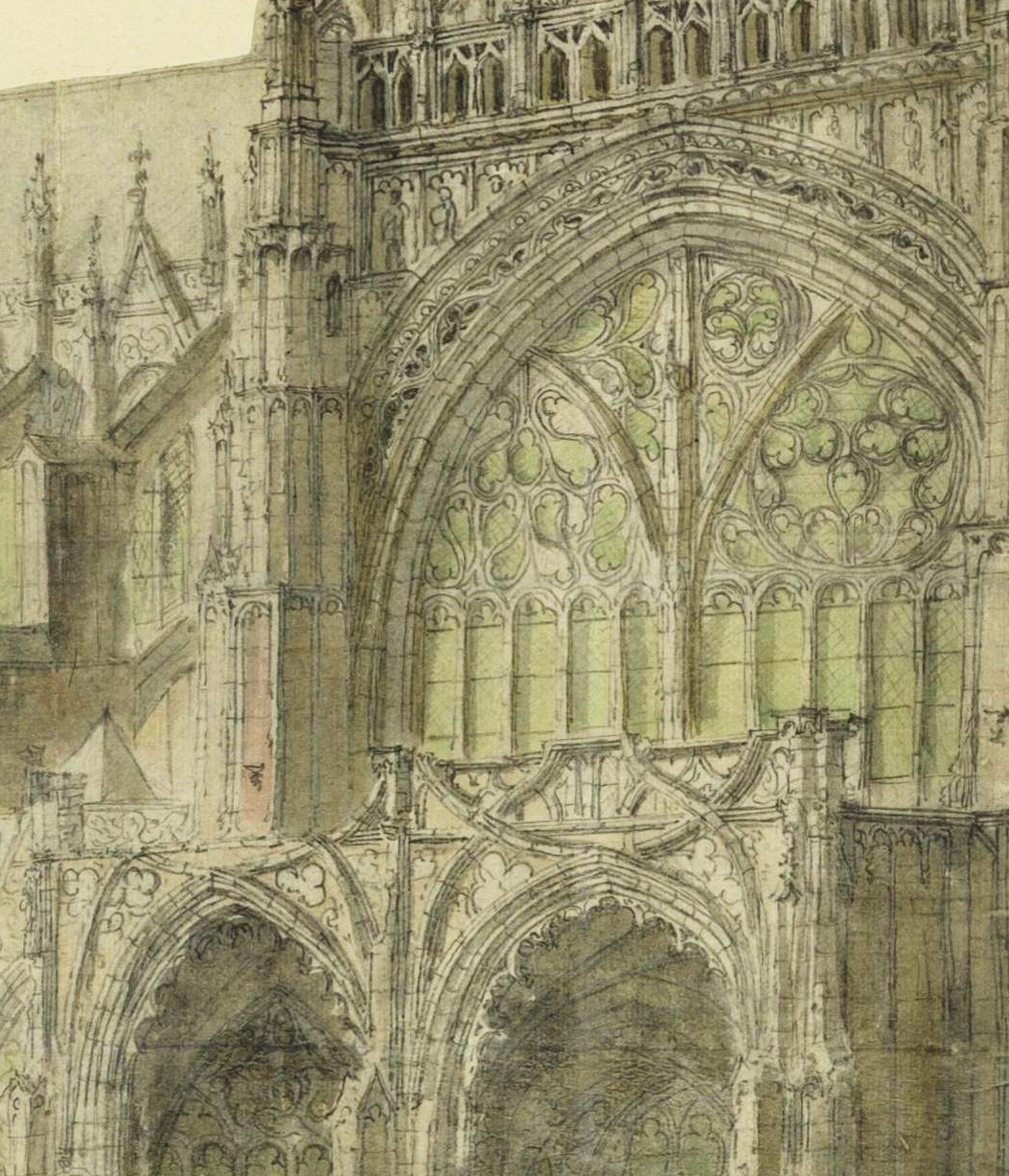
‘S-Hertogenbosch Cathedral, S transept – cresting of the porch and great end window, detail of pencil and watercolour by Jan Abrahamsz Beerstraaten (1622-66).
Amsterdam, Rijksmuseum, RP-T-1965-316.
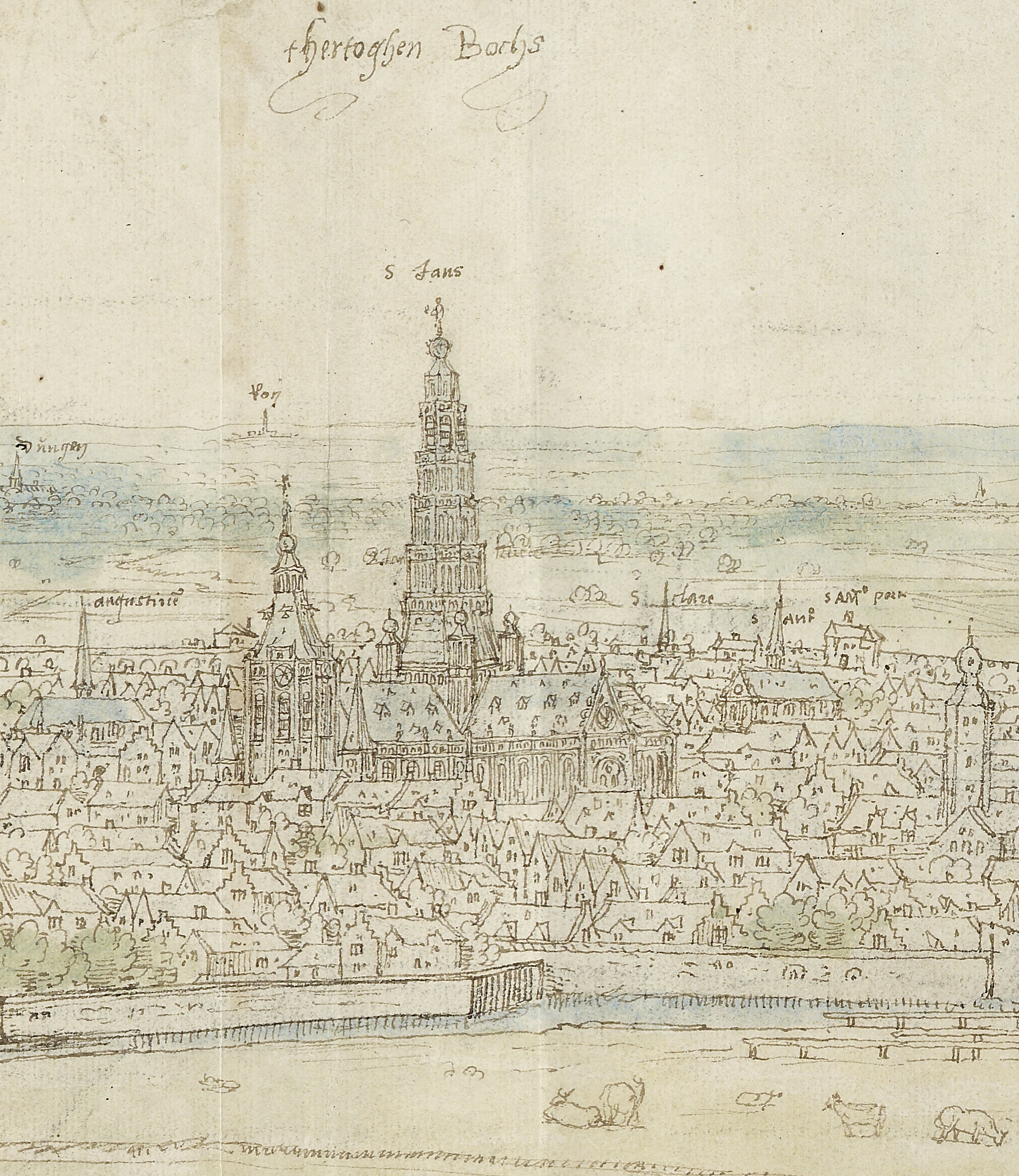
The Florid Style went on to realise some of the highest towers in the world, including Antwerp, but ‘s-Hertogenbosch never received a mega-tall masonry west tower, the existing mid-13th tower being given a relatively modest higher ringing chamber belfry in brick to match the existing parts underneath by 1505. Instead, by 1530 the crossing lantern had an enormous six-tiered timber spire over it. Sadly, it barely lasted half a century, for in 1584 it was struck by lightning and burnt down.

In that period it was however, thankfully captured in exquisite detail c.1558 in a panorama of ‘S-Hertogenbosch by Anthonis van den Wijngaerde (right) which shows it looking positively Babel-esque over the walled town.
(Ashmolean Museum, WA.Suth.L.4.45)

Roermond, Holy Ghost

Collegiate church founded 1361. Seat of the Bishop moved to Grote Kerk (St Christopher) in 1661.
(Diocese suppressed 1801. Holy Ghost Chapel demolished 1821, diocese re-erected in St Christopher 1853)
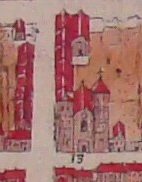
Detail of the 1671 map by H. Jansens showing the Heilige Geestkerk (Cathedral). Stedelijk Museum Roermond

Roermond is a particularly unusual one. The original cathedral chapter was provided from the collegiate church which had been founded in 1361 by secular canons from Sint Odiliënberg (a village three miles south of Roermond), and subsequently it was their Holy Ghost Chapel that was Roermond Cathedral for a century. The current cathedral, the former parish church of St Christopher, became the seat of the Bishop from 1661, and lasted until the Napoleonic Concordat of 1801: the only diocese in what is now the Netherlands to survive that long. It was re-erected 1853 in St Christopher, where it remains today. But I’m not going to concern myself with that building here, as we’re focussing full on the original cathedrals dictated by Sonnius’s negotiations and original choices for episcopal seats in the late 1550s.
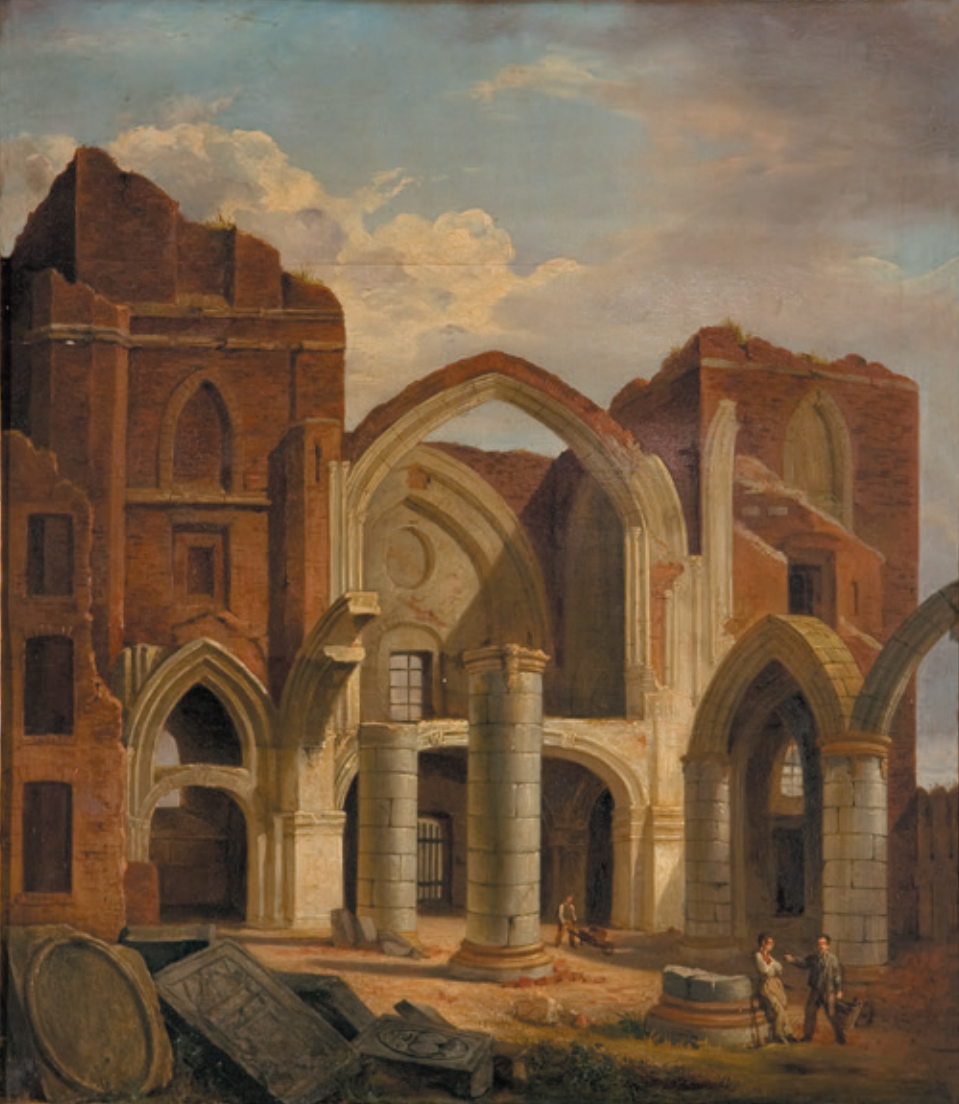
The ruins of the H. Geestkerk in Roermond, 1821.
Oil on canvas by Henri Linssen (1805-1869),
probably after 1842, after a watercolour by A. F. van Aefferden (1767-1840).
Historiehuis Roermond.
Photograph: Peter Bors, Beesel

The Holy Ghost chapel (Heilige Geestkerk) stood at the west end of its titular street . As maps show us it occupied no more than half of the length of the block, it cannot have been much more than 30 m long, and probably less (St Christopher is around 60 m long, with a double-aisled nave 32 metres wide). A map showing the damage of the city fire of Roermond in 1665 by the draftsman Herman Jansens shows the best similitude of the church buildings. The Holy Ghost chapel (with its roof coloured red, showing that it was burnt off in the fire) shows a two-towered facade of unequal heights.

This corresponds with a view looking west during its demolition in 1821.48 This shows a typically-columnar Low Countries nave arcade piers leading up to a pair of brick-Gothic towers of differing design, with what looks like a Baroque organ loft inserted in between. While the two towers must have given it some grandeur, this was by far the smallest church building chosen as a cathedral in the Super Universas bull. No doubt it was the convenience of the existing secular chapter and their extant residences around the church that meant the obviously grander church of St Christopher was not initially chosen (the nearby Munsterkerk, with a rich late Romanesque/Early Gothic galleried elevation, was under a Cistercian Abbess until 1798).
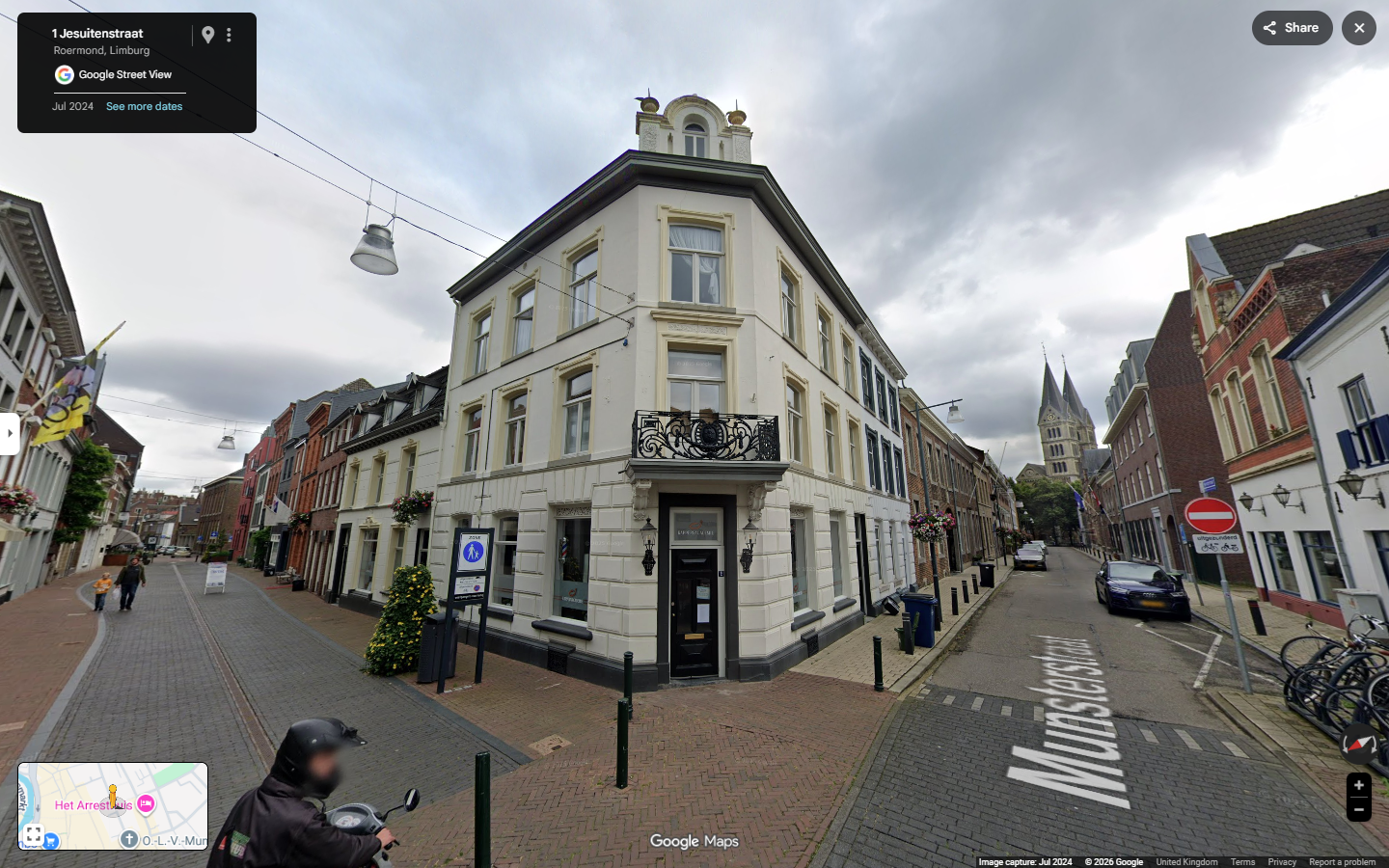
Roermond, the site of the former cathedral church at the corner of Munsterstraat and H.H. Geestsraat, looking NE. The W towers of the Munsterkerk can be seen to the R.
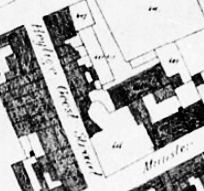
Cadastral map of Roermond, 1819 showing empty plot of the Heilige Geestkerk. North is to the right up Munsterstraat.

Such is the detail of cadastral maps in the Netherlands under French government, and government-funded digitisation projects to make them available online, the fate of the plot is easy to trace. It is shown as empty in a survey of 1819, with an curiously apse-shaped bulge in the eastern edge of its curtilage (see Right).49 By 1844 it was occupied by the house and yard of Jan Anthoon Jennissen, a merchant.50 The white-stucco’d building that currently stands on the corner was built 1898.51


Utrecht archdiocese
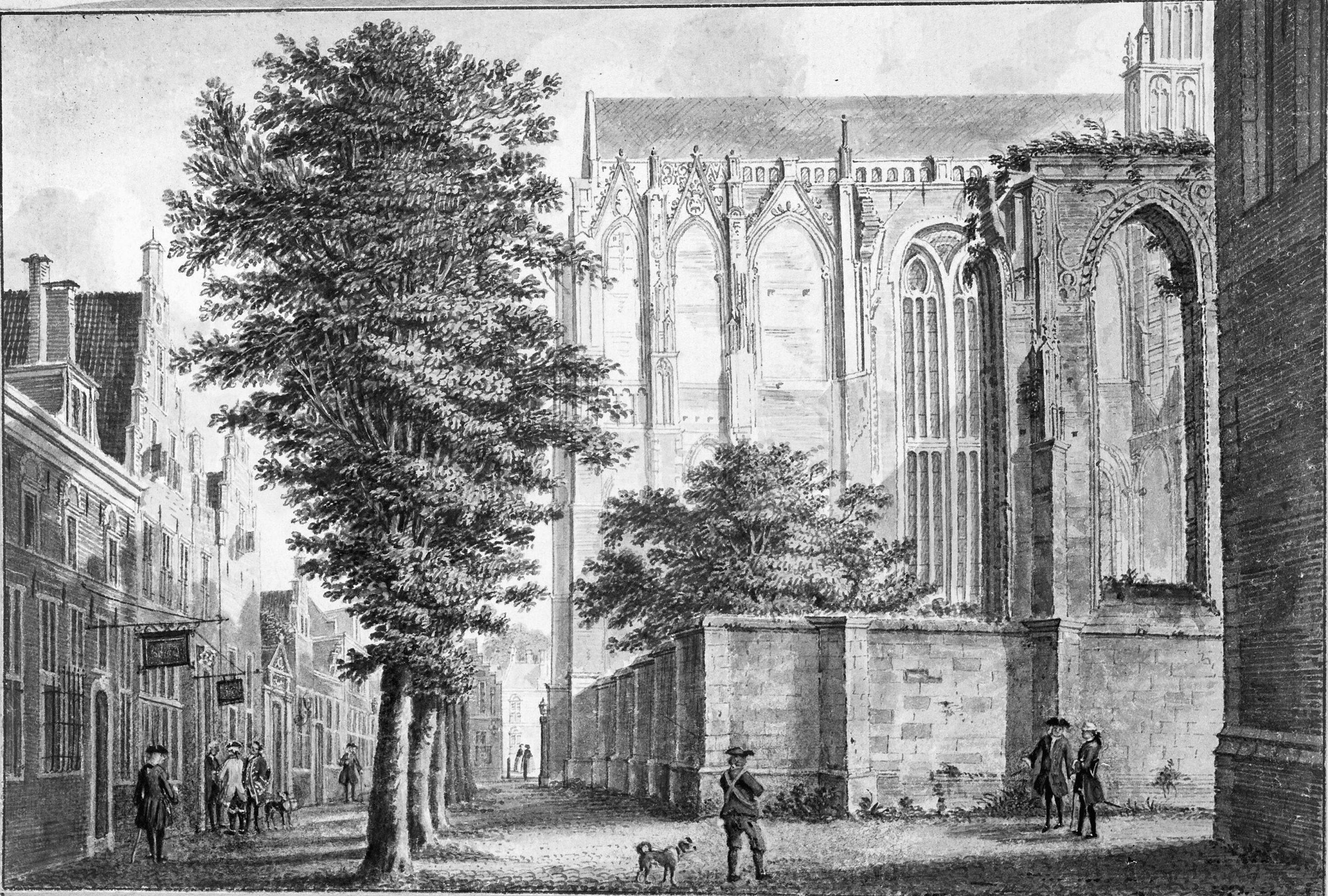
Utrecht Cathedral. View down N side with outer walls of the triple N aisle still standing to sill level.
From “Het verheerlykt Nederland of Kabinet van hedendaagsche gezigten“, 1748, etching by Caspar Philips Jacobs after Jan de Beijer.

Previously a suffragan diocese under Cologne, Utrecht, as the only cathedral in what is now the Netherlands before the 1559 bull, was made an archbishopric over eight new suffragan dioceses. The Cathedral had a nave with a prodigious triple aisle on the N side which it lost to a tremendously powerful storm 1 August 1674 (possibly a bow-echo system)52 ultimately marooning its west tower from the crossing when the last vestiges of the outer walls were cleared away in 1826.

Photogrammetry capture of Utrecht Cathedral, comped from two sources, with the plan of the lost nave underneath

Haarlem, St Bavo (Grote Kerk)

Parish church, zeven-getijdencollege first recorded 1452.
Diocese suppressed 1587

(Re-erected 1853 in the 1841 church of St Joseph, before moving to new-built cathedral in 1898. Renamed Haarlem-Amsterdam 2008)

Photogrammetry capture of Grote of Sint-Bavokerk Haarlem

Although St Bavo in Haarlem is sometimes described in the literature as being elevated to a collegiate church at various dates in the fifteenth century, this is mistaken.53 Haarlem was instead part of a phenomenon in Flanders and the northern part of the Low Countries known as zeven-getijdencolleges: colleges of the seven canonical hours.54 In these major town churches, secular bodies established an endowment fund to maintain priests and choirboys to celebrate the Divine Office, without actually setting up a college of canons funded by properties of massively valuable prebendal lands.55 This meant the community could enjoy the prestige of an increase of divine service without establishing a sizeable institution with a degree of autonomy operating under canon (rather than civil) law. Thus an actual chapter had to be established in the church after the Bull of 1559, and the canons were drawn from the collegiate church of Geervliet some 40 miles away in South Holland, and the Austin Canons of Heiloo 15 miles to the north.56 The first bishop of Haarlem was Nicolaas Van Nieuwland, who had been a wijbishop (auxilary bishop) in Utrecht: although he obtained a reputation as wijnbishop (wine bishop).57 He was accused of walking drunk in procession, and being too hungover to attend a pontifical Mass.58 He did have a doctorate in Theology from Leuven though.
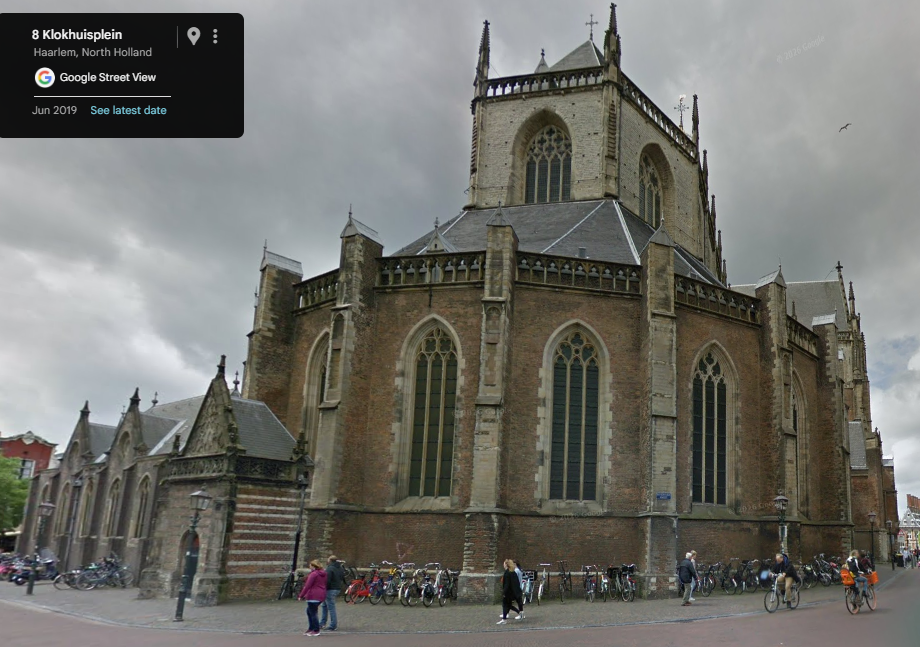
St Bavo, Haarlem, the 1370-1400 ambulatory from the NE. The Florid porch on the first diagonal bay to the S was added in the 16thc.

Regardless of its lack of actual collegiate status, Haarlem was one of the largest churches in Holland in 1559. The enormous choir was built in the last quarter of the fourteenth century, with a wide five-sided ambulatory built almost obnoxiously with no radiating chapels but like the Grote Kerk in The Hague and the Oude Kerk in Amsterdam.59 It was almost certainly designed by Engelbrecht van Nijvel (Nivelles, Belgium), stadsmeester of Haarlem, who from 1402 was employed by the count of Holland as master mason in his court at The Hague.60 I really have to say, after going through a lot of Grote Kerken in Holland,61 Haarlem has an extremely strange internal elevation. Above the typical stout Low Countries cylindrical columns with but a roll for a capital, it has a ludicrously tiny triforium. It’s like the usual parapet of a walkway you get in the region, but set into wall, with a massive gap above of completely unarticulated wall space up to the sill of the clerestory, which represents the very high pitch of the roofs over the aisles. I can only assume that the space was meant for a wall painting scheme, decorative fragments of which were discovered in the 1981-5 restoration.62
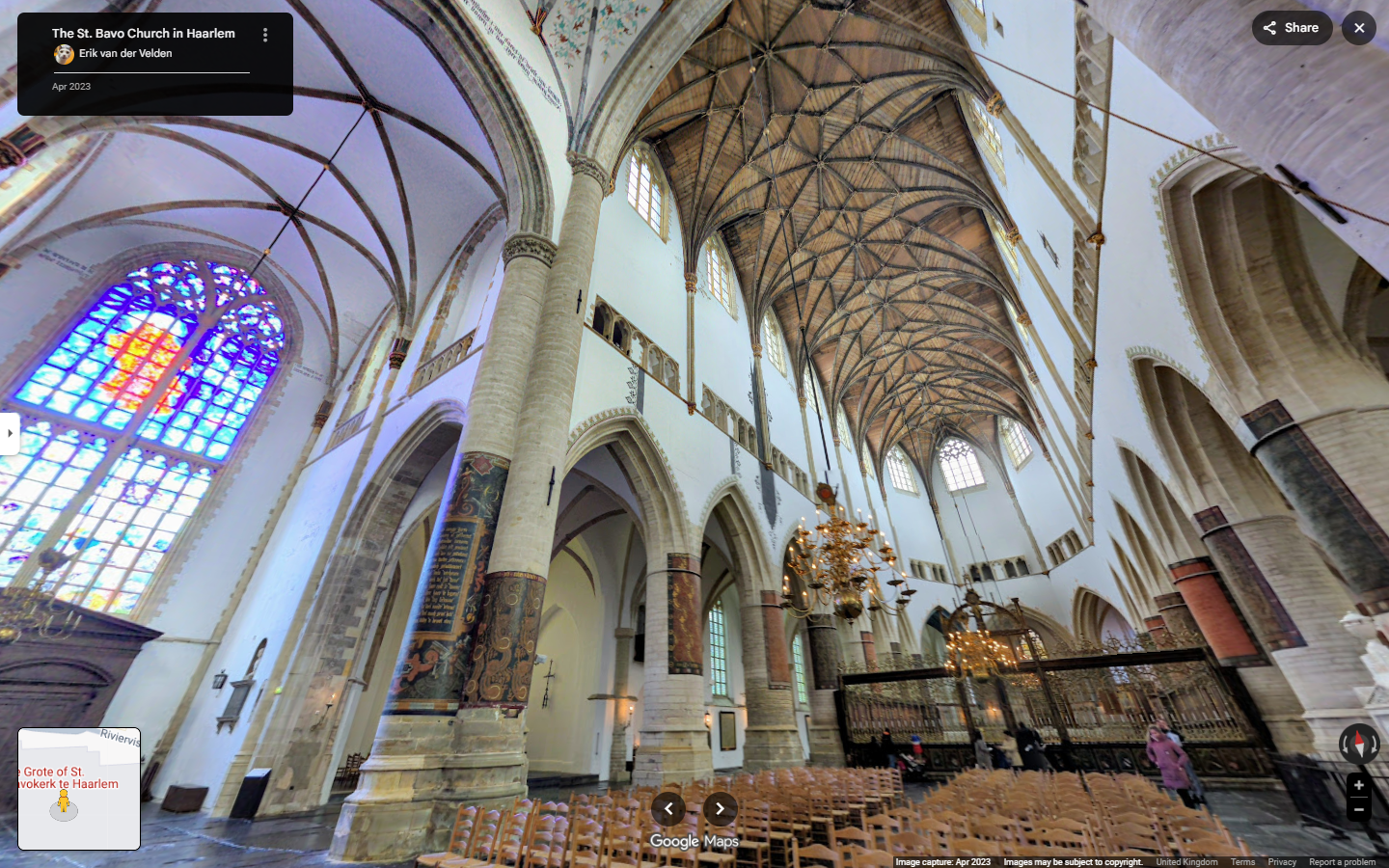
St Bavo, Haarlem. View from the crossing looking NE with the bizarre gap of totally unarticulated wall space above tiny openings into the roofspace over the aisle vaults, and the modification of the design into a parapet walkway in the later transepts.

The existing nave of 13th-14th century date was retained until a campaign to replace it begun 1445 under Evert Spoorwater of Antwerp (mason in charge of the nave build at Antwerp, and the collegiate church at Dordrecht) where the north transept, north aisle wall and west facade were built around it.63 Master Spoorwater modified the elevation in line with the typical Dutch type of having an internal balcony rather than the tiny openings to the roofspace passage. In 1470 the work had progressed enough to mean that the lower old church attached to Engelbrecht’s choir could be demolished, and a stone-faced clerestory built on top of the transepts to bring the high parapet in line throughout the building. The church was clearly meant to be masonry vaulted throughout, but only the aisles, crossing and ambulatory were built in the Middle Ages. The high star vaults of the nave and east arm are of timber, installed under the direction of Jacob Symonsz van Edam and Pieter Jansz 1530-8. The transepts received masonry vaults on the intended springers in the restoration of 1891-2.

Deventer, St Lebuinus (Grote Kerk)

Collegiate church founded c.1040
Diocese suppressed 1581

Photogrammetry capture of Grote of Lebuinuskerk, Deventer
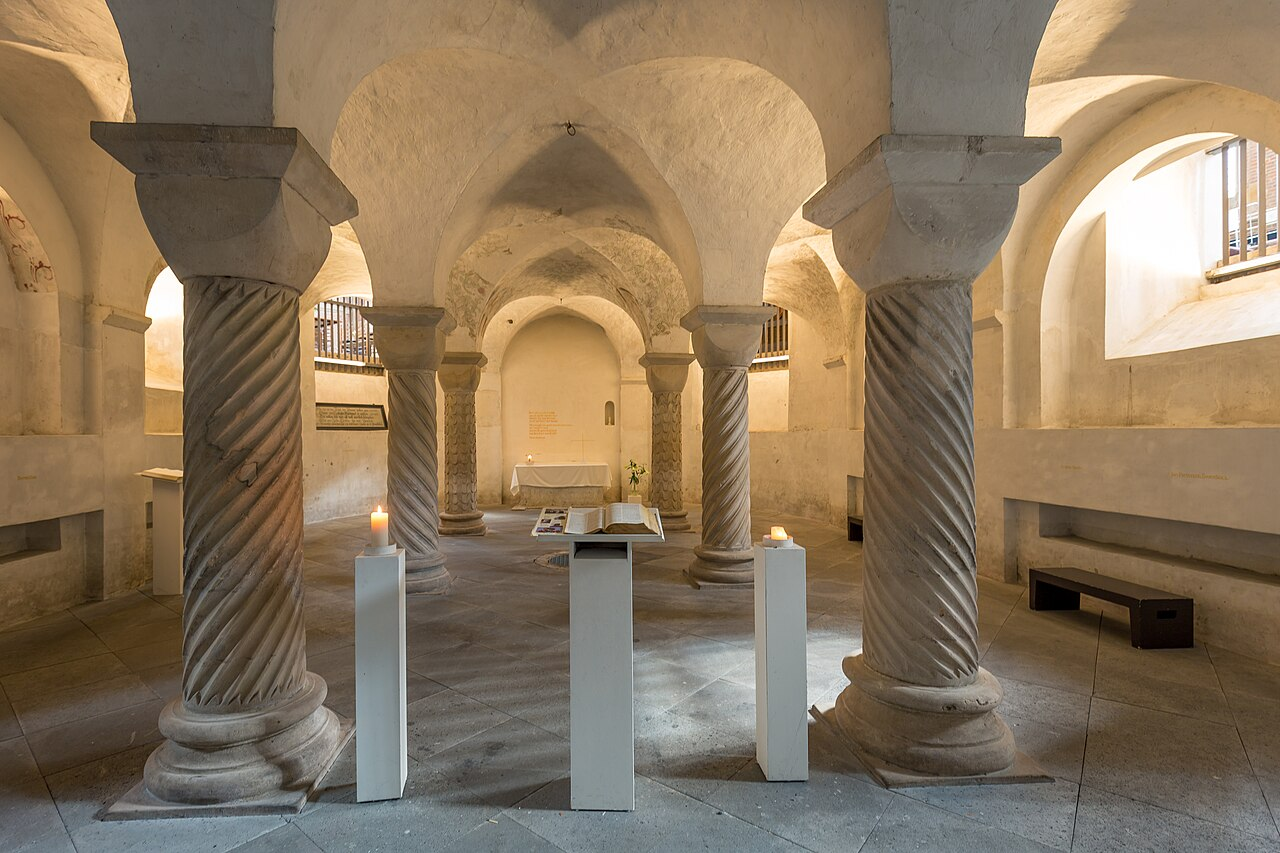
St Lebuinus, Deventer. Crypt looking E, built mid 11thc.
The central bay originally had a splayed window, which was opened and reclosed in the 1990 archaeological works.
Wikicommons: Davidh820. Taken Sept 2017

Deventer is a church with a storied past comparable to Saint-Omer. It had been founded by Lebuinus, a missionary to Germany from the Northumbrian monastery of Ripon, and his burial place around 775. The crypt of the church has spiral and scaled columns, dating from the time of Bernold, Bishop of Utrecht 1027-54 who founded it as a collegiate church. The spiral columns follow the example of the Solomonic Columns flanking the tomb of St Peter in the Vatican Basilica to mark it out as a particularly sacred burial place, and are also seen at St Peter in Utrecht, another project attributed to Bishop Bernold.64
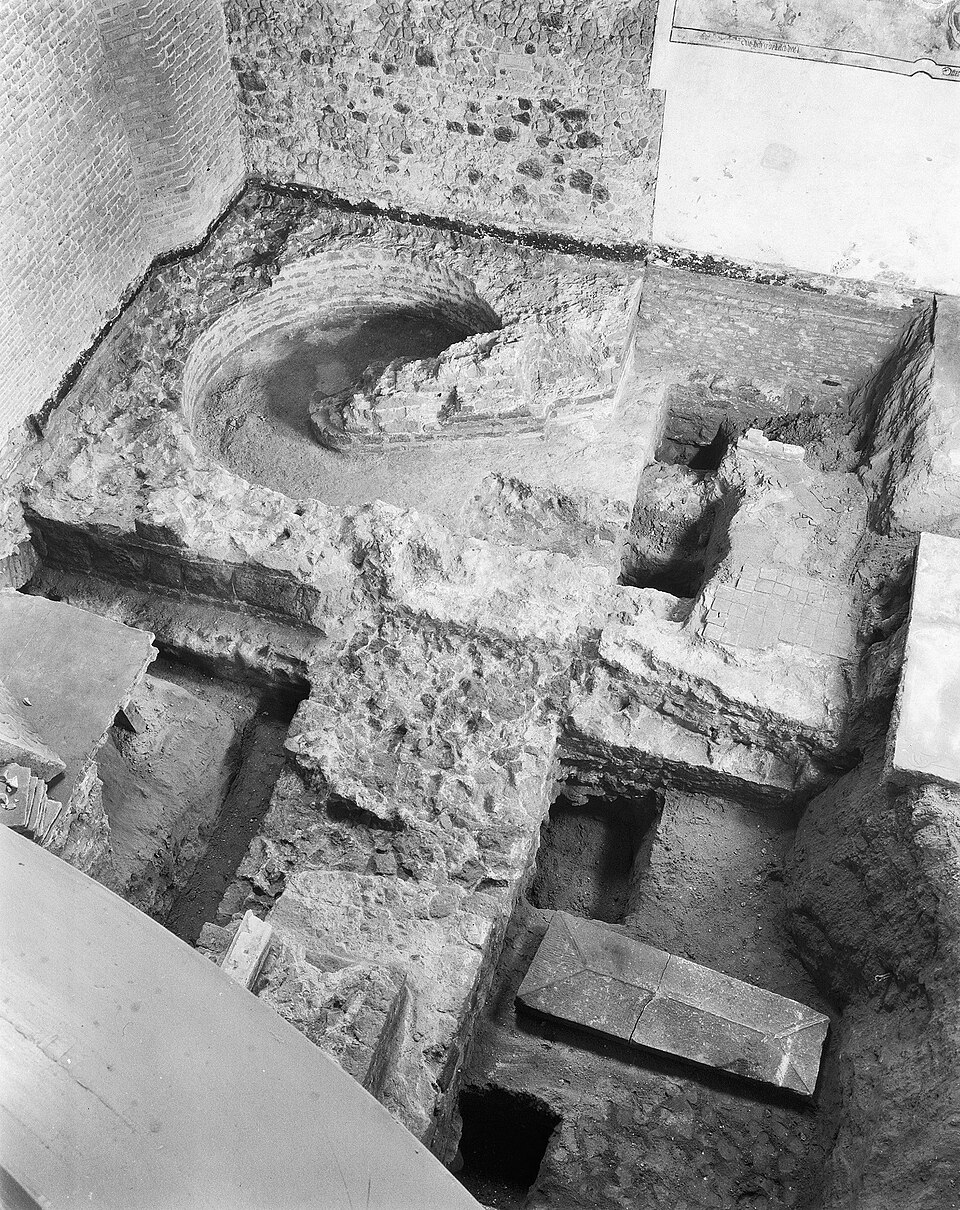
Bernold’s basilica outside the crypt was vast, with a western transept fronted by two towers, and much of it defines the footprint of the Hall Church that largely replaced it in the second half of the 15th century. Contrasting with the volcanic tuff stone of the 11th century build, the majority of the masonry used for the hall church was brick, with reused tuff and Bentheim sandstone for dressings.

Left: Footings and newel stair of the Romanesque NW transept tower, now under W end of S aisle, 1961 excavations.
Photographer: G.Th. Delemarre. Rijksdienst voor het Cultureel Erfgoed
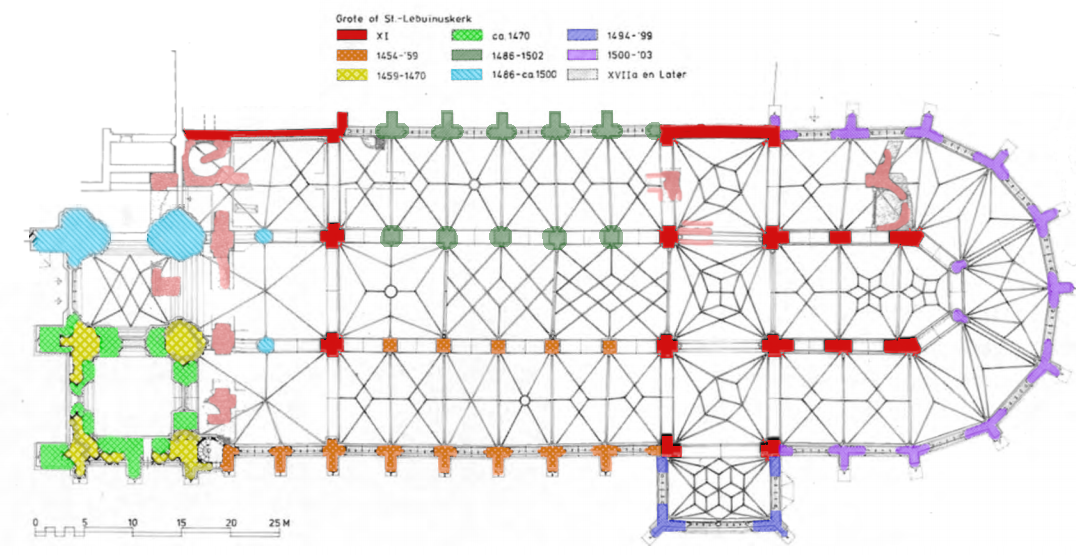
Composite of a phasing interpretation of St Lebuinus, Deventer. The 11thc is shown in red: solid existing walls, light red buried footings excavated 1961
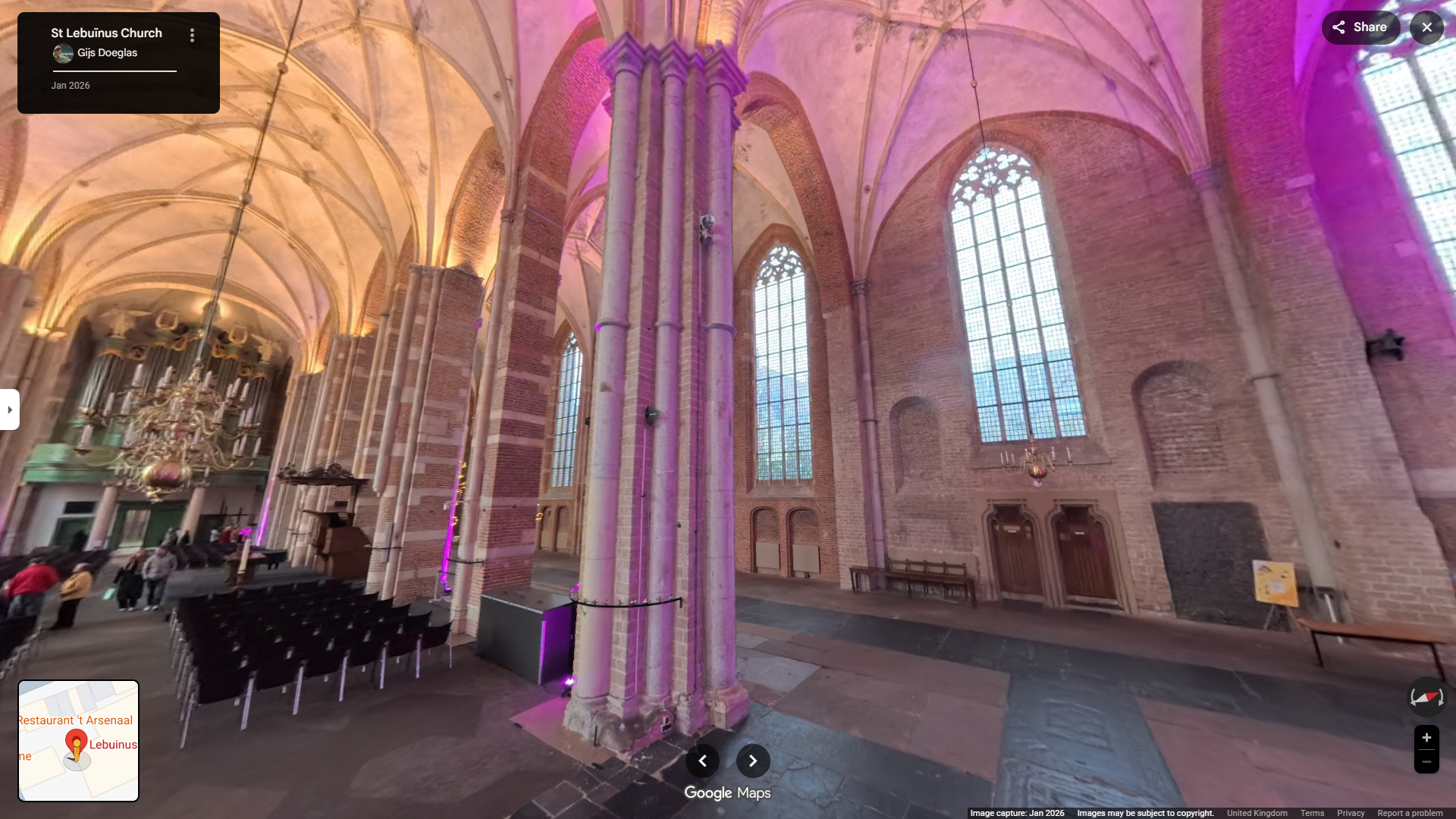
St Lebuinus, Deventer. Crossing looking NW. The wall with two blind niches just above dado level is the original Romanesque transept end wall, that was embraced by aisles that were doubled in width when the basilica was converted into a hall church in the 15thc.

First the high-vaulted south aisle was added, bringing the aisle wall in line with south transept wall, then the north aisle in the same way, the nave covered in net vaulting, and finally the ambulatory almost completely enshrining the remnants of Bernold’s building, with the groin-vaulted crypt at its heart.65 The original basilica’s clerestory windows remain above the level of the high vaults and can be seen from the roofspace.66

Like so many Low Countries churches, the plan for a west front with two spires fizzled out. The south tower never received its intended superstructure above the belfry, being crowned with a small but effective red-brick octagon with domical roof in 1613. A start was made on a north tower, but the Mariakerk, a parish church whose south aisle directly abutted the Romanesque westwerk forbid much progress.67

Groningen, St Martin (Martinikerk)

Parish church
Diocese suppressed 1580.
(Re-erected 1956 in the Roman Catholic church of St Martin built in 1895, transferred to the Roman Catholic church of St Joseph built 1887 in 1981 due to the former’s impending demolition, which was carried out in 1982.
68)

Photogrammetry capture of St Martin, Groningen

The church is distinctive for having a three-storied choir that is markedly higher than the nave it immediately adjoins (like Augsburg Cathedral, or the Grote/Sint-Jacobskerk of The Hague) which would make it ideal for a collegiate chapter to have a defined space. Yet seems to have been a distinct choice rather than accident of funding, as these seem to have been two consecutive builds across the first half of the fifteenth century, and there was a decision to make the thirteenth-century Romanesque nave into a wide hall church rather than match the height of the east arm. As this church was not collegiate, the Premonstratensian Abbey of Bloemhof north-east of Groningen was suppressed to provide a secular chapter – the few monks there becoming canons and the abbot archdeacon.69
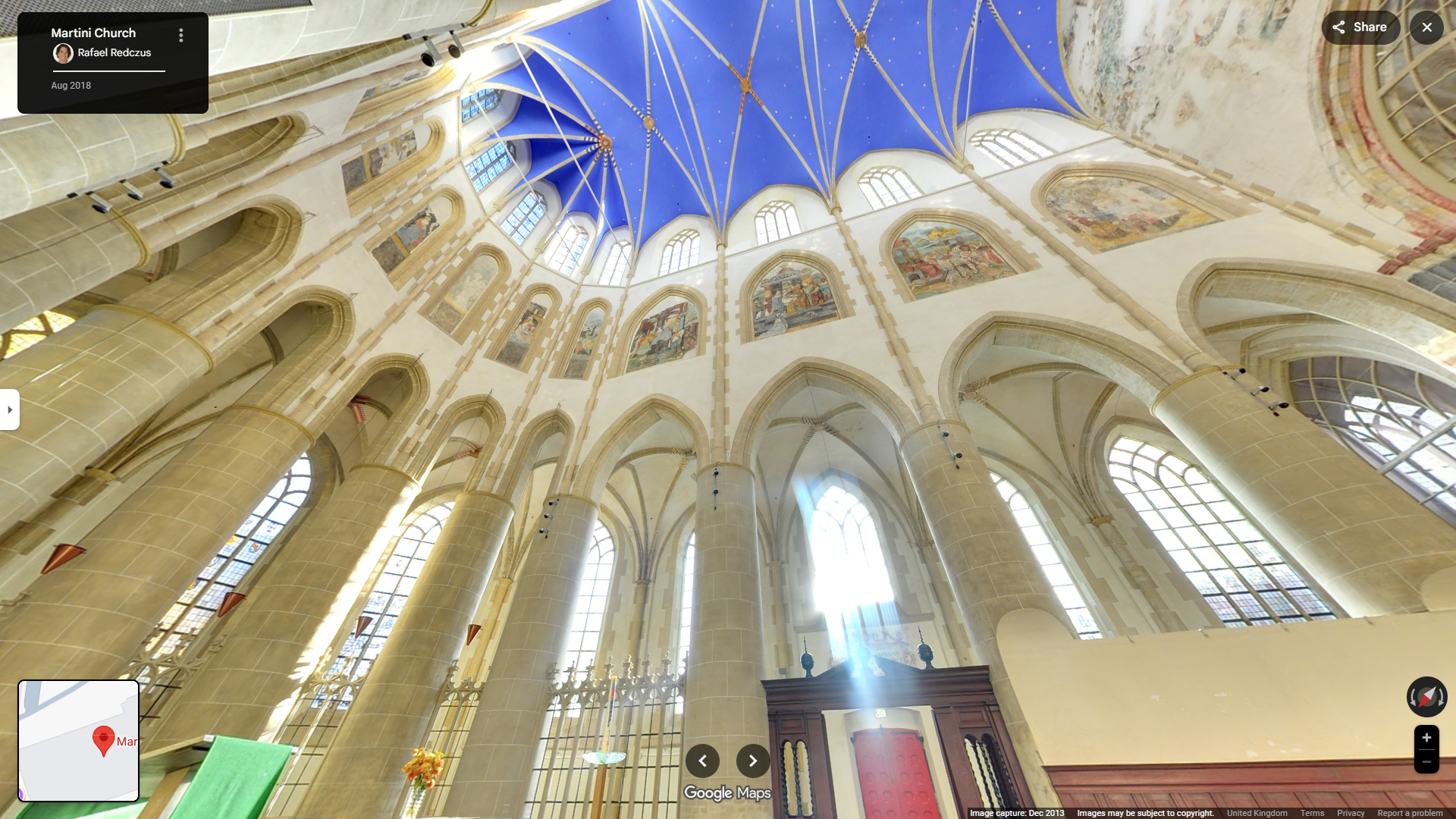
St Martin, Groningen, choir looking S

The east arm, built in the first quarter of the fifteenth century, has an extremely plain elevation with stout columns in the traditional Low Countries Gothic manner with a now-blocked second-storey false-gallery openings with moulded arches, and a small clerestory on top. The ambulatory is just vaults to an outer wall under a lean-to roofspace: like Deventer and Haarlem it has no chapels whatsoever. The second storey was bricked-up at some point toward the middle of the sixteenth century,70 and in them scenes from the New Testament painted a secco on plaster: they were only discovered in 1923.71 The ensemble was an extraordinary commission for their time, and draw on wide sources across German and Italian prints.72
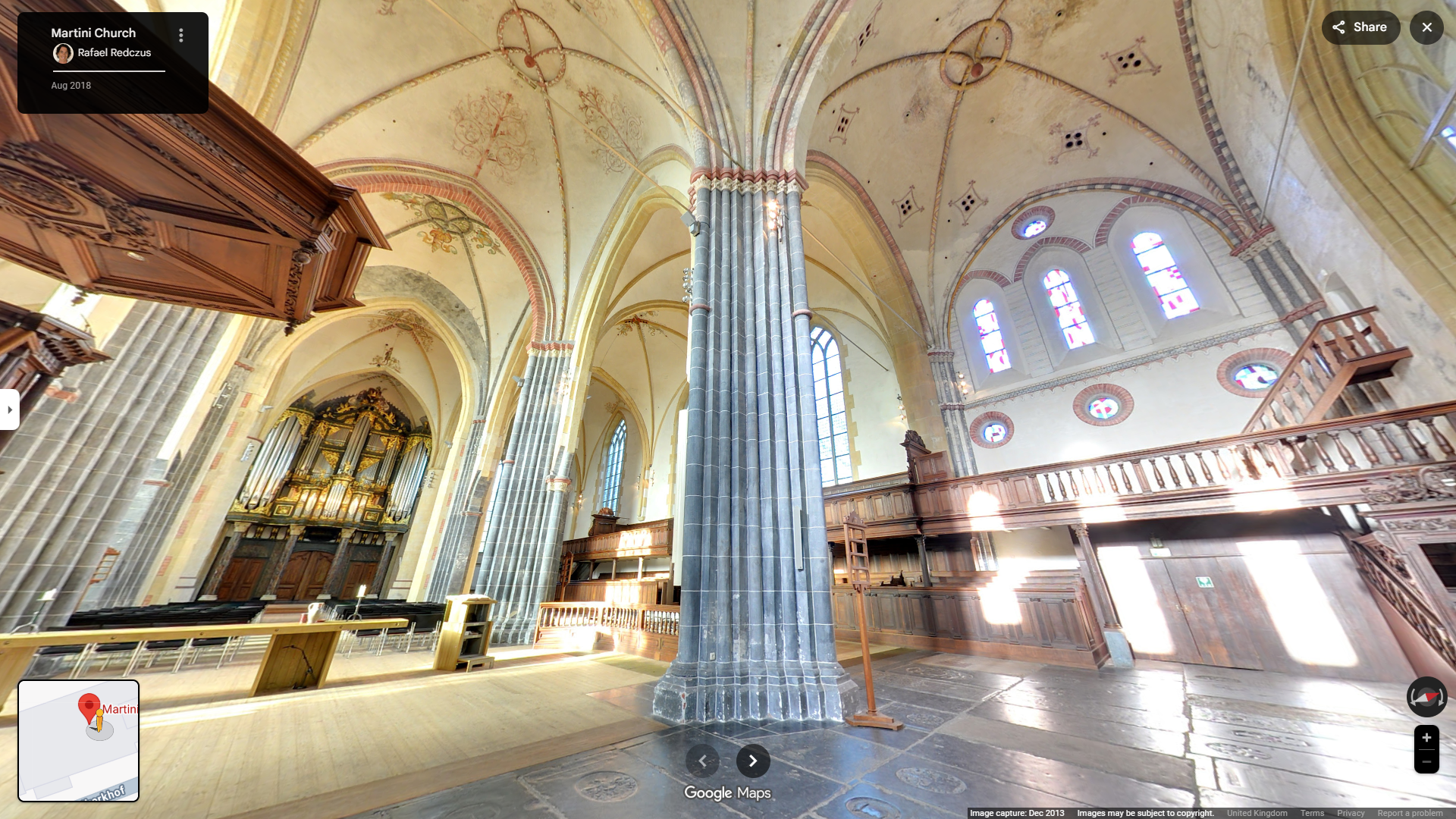
St Martin, Groningen, nave looking NW from the former Romanesque crossing. You can see the springer of the original arcade past the crossing that presumably formed a Gebundenes System (double bay) with columns supporting a gallery and clerestory between the piers.

The nave retains the transept walls and domical high vaults of the crossing and two further bays of the thirteenth-century Romanesque basilica, but with the elevations smashed through to create a hall-church. After the west tower collapsed in 1468, the nave was extended by two bays, with a pair of stout Low-Countries columns bridging the gap between the remaining fabric and the west wall.

The landmark Martinitoren was completed by 1481, is of three square stages topped with a small octagon carrying a spire: a very squashed and reduced emulation of Utrecht Cathedral. It is also called  d’Olle Grieze (the old grey one) as it is, unlike the rest of the church and indeed much of Groningen, dressed in sandstone rather than of brick. It was dangerously erring further out of plumb and was rescued from 1936-48 by excavating its cracking foundations and encasing them in a reinforced concrete collar. A drastic restoration from 1962-75 reinstated the transverse gables of the hall nave that had been removed in 1688, replaced the cast iron tracery with imitations in stone and inserted Romanesque-style fenestration into the original thirteenth-century transept walls, as you can see below. Although notice the three original apertures with corbelled arches in the east transept wall.
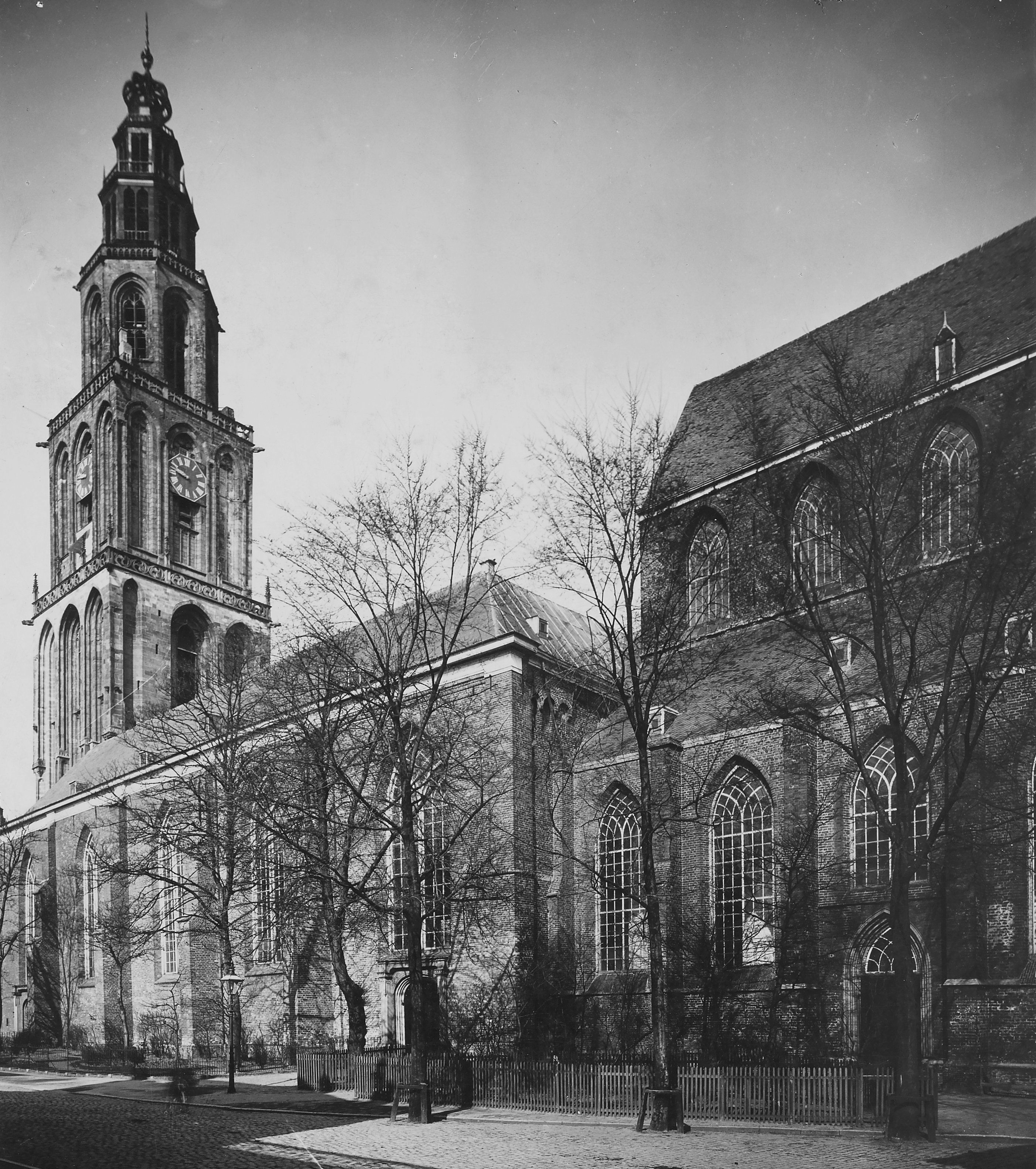
  • S side of nave and choir before the 1962-75 restoration [Rijksdienst voor het Cultureel Erfgoed]
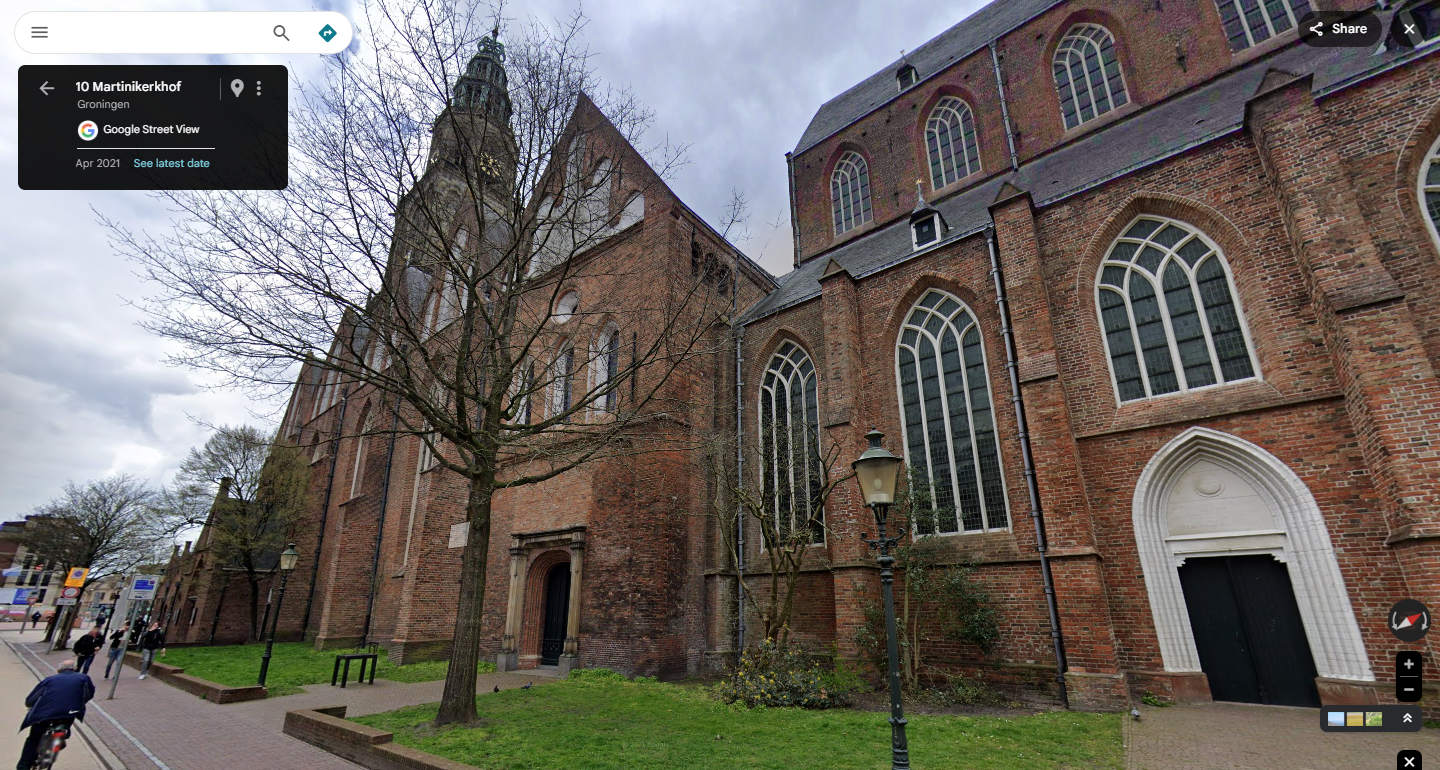
  • Current street view after installation of stone tracery, reinstatement of transverse gables, and remodelled transept facade
Leeuwarden, St Vitus (Oldehove)

Parish church, zeven-getijdencollege recorded 1534
Diocese suppressed 1580. Church demolished 1595.

Photogrammetry capture of the Oldehovetoren, over archaeology of the demolished church of St Vitus it was meant to adjoin

Leeuwarden only existed as a single entity from 1435 when Oldehove, Nijehove and Hoek were merged into one city borough. The church of St Vitus in Oldehove which had existed since at least the tenth century remained as their principal parish. Again, as the church was not collegiate,73 a chapter was to be provided from Mariëngaarde Premonstratensian Abbey a little under seven miles to the north, the abbot serving as dean.74 The first bishop was Remi Drieux, a professor of civil law at Leuven and member of Great Council of Mechelen. He never took possession of the see, and was translated to Bruges in 1569.  His successor Cuneris Petri did take up residence and attempted to enforce the Council of Trent via visitations, but met with strong resistance from Calvinists, and ended in 1578 up being held prisoner by the Stadtholder of Friesland and Groningen George, Count of Renneberg at Harlingen on the coast 15 miles west as part of his last efforts to placate the rebels.75 He died in Cologne in 1580 and it subsequently the diocese of Leeuwarden was suppressed.

Whatever the short-lived Leeuwarden Cathedral consisted of was largely demolished, after the Protestant triumph freed up the more centrally-placed Dominican Church as the new Grote Kerk of the town. All that survives today of the church is its unfinished west tower, named Oldehove after the neighbourhood defined by the artificial turf mound, or terpdorp, first built around the first century AD. However, excavations in 1968-9 revealed the development of the building. The church of St Vitus is first documented in 1148, and that era is represented by a 40-metre long Romanesque plan of an unaisled building with a long apsed east arm and transepts with apsidal chapels expanded, first with a westwerk and then a larger choir around the transepts. These were completely superseded by an aisled church with ambulatory in the fifteenth century. The earliest view of 1533 shows a seemingly under-construction nave connected to an ambulatoried choir, while Braun and Hogenberg’s map of 1580 shows the nave attached to a higher choir.76 Johan Sem’s map just over two decades later shows only the outer walls standing, as the interior of the church continues as a graveyard (see slideshow Right).
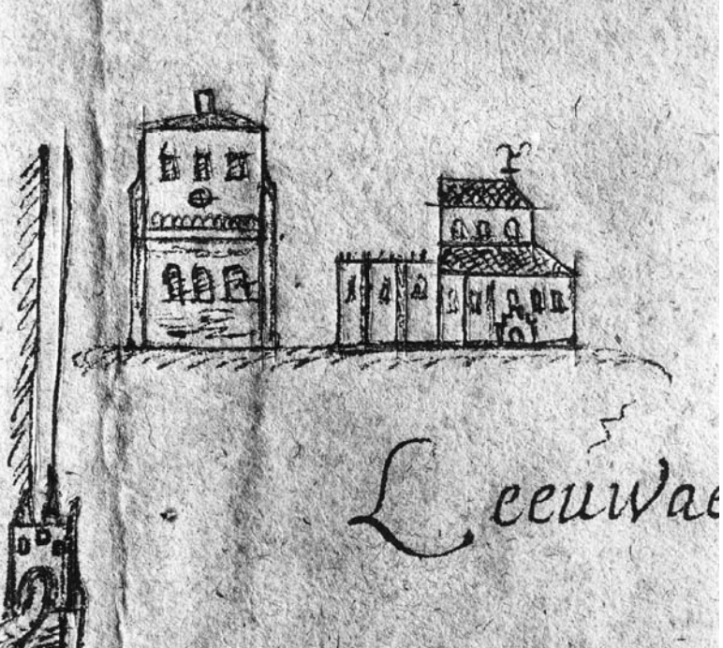
  • Detail from Jacob Heeres’ map of 1533.
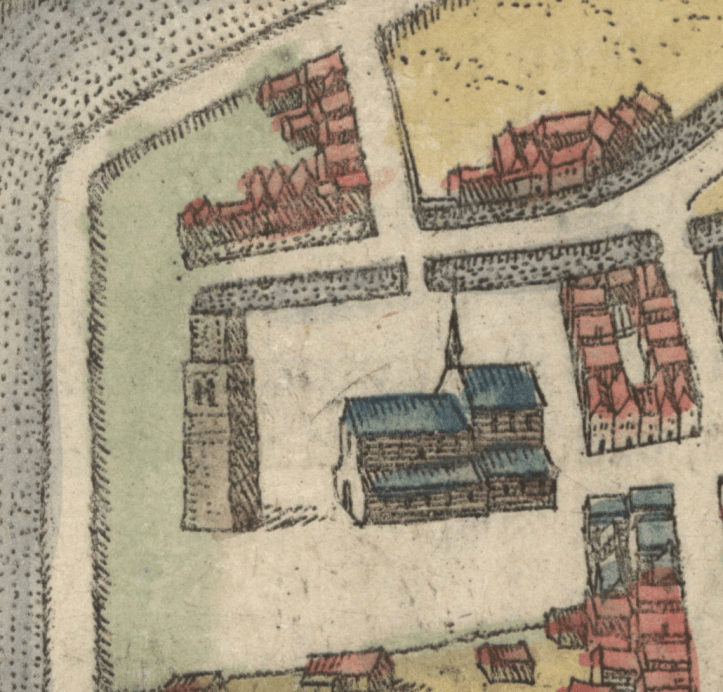
  • View of Oldhove from map of Leeuwarden by Georg Braun and Franz Hogenberg dated 1580. This hand-colour printing from 1616, Bibloteka Narodowa, ZZK 0.261.
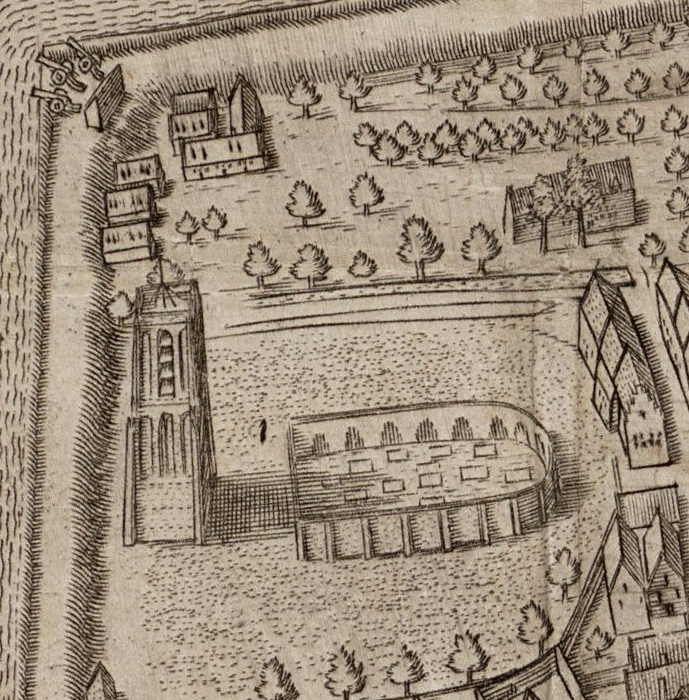
    View of Oldhove from map of Leeuwarden by Georg Braun and Franz Hogenberg dated 1580. This hand-colour printing from 1616, Bibloteka Narodowa, ZZK 0.261.
  • Detail of Oldhove from Johan Sems map of 1603
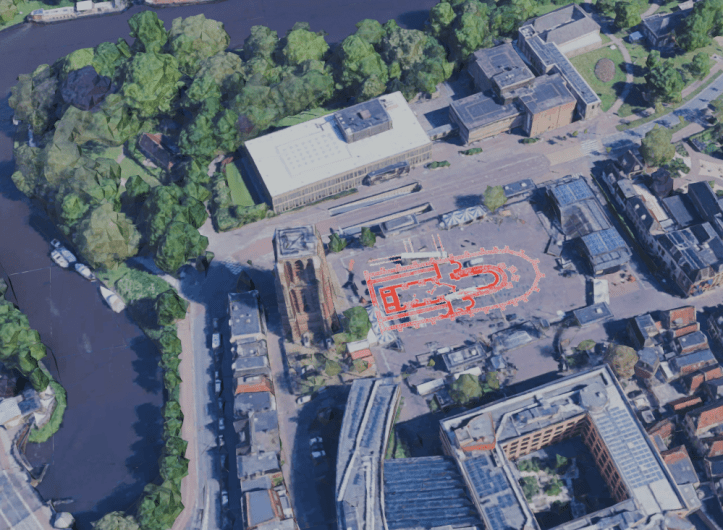
  • Archaeology overlaid in modern environs
    Archaeology overlaid in modern environs
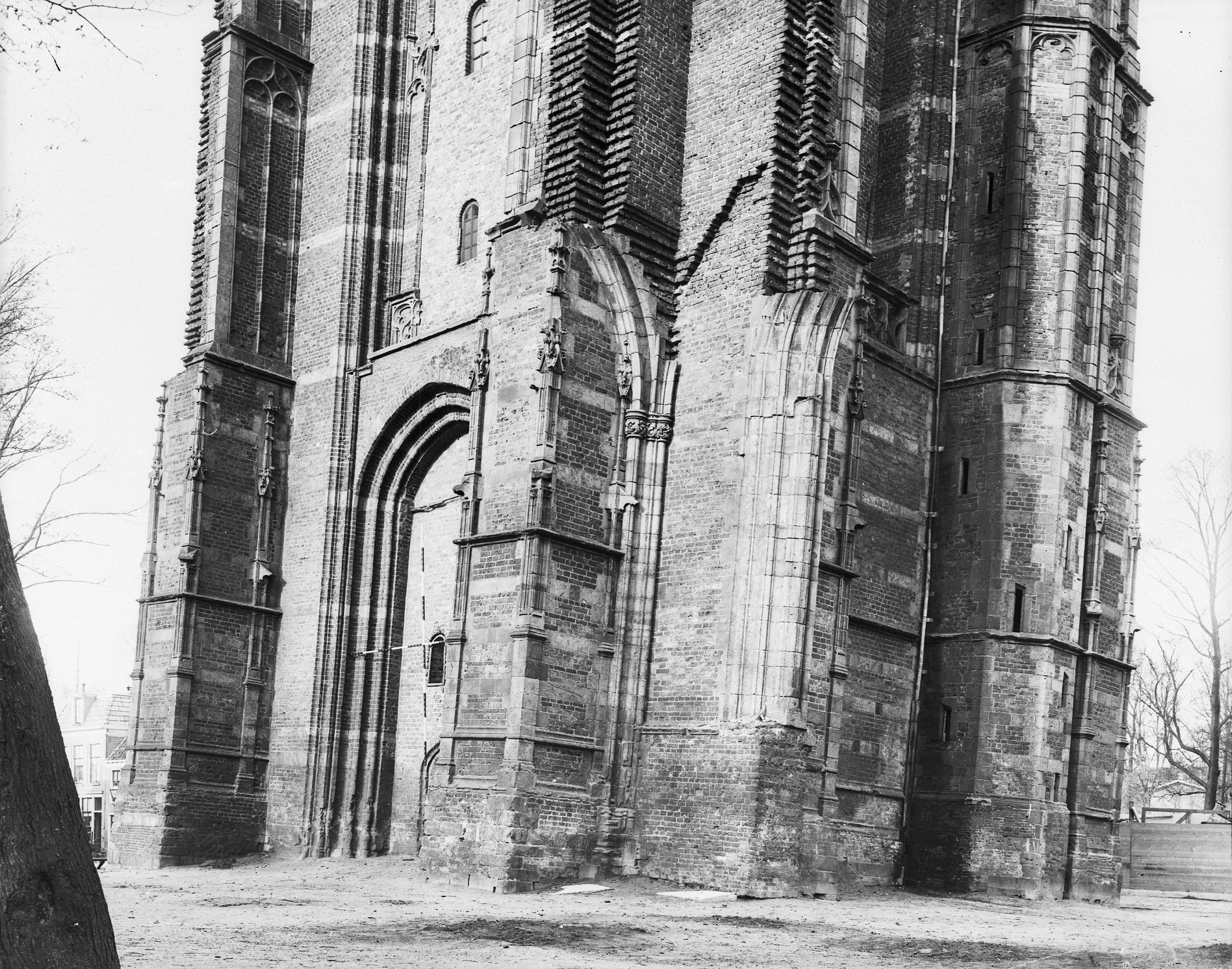
Oldhoventoren from the NE, showing vaulting springing and window jamb with masonry toothing above.
Photograph taken by P. Kramer, dated 1 June 1907, before the first major restoration.
Rijksdienst voor het Cultureel Erfgoed: [1] [2]

The tower resulted from the new confidence as the confirmation of the town as capital of Friesland in 1504. The build is documented as taking place under the master mason Jacob van Aken (Aachen, Germany) from 1529. Subsidence – because the masons didn’t realise they were building on the edge of an artificial mound – was initially attempted to be corrected by building the upper storey at an angle (like the belfry stage of the campanile of Pisa Cathedral). The tower was clearly intended to join the church (there is toothed masonry on the east side, as well as window jambs and capitals with springers for aisle vaults) but it ended up so hopelessly out of plumb the project was abandoned in 1532 to become a free-standing tower. With the demolition of the church in 1595-6, many of the openings were bricked up with demolition material to help shore it up. It seems from early maps that part of the Gothic church walls survived enclosing a graveyard, but they had gone by 1706. The Oldehovetoren has gone through many restorations to stabilise its structure – including iron ties, concreting the foundations and reconstructing the masonry. In the twentieth century there was major interventions in 1910-3,77 1972-4 and 1997. In the slideshow below you can compare how much has changed – major masonry replacement (note the arches), changes to the fenestration in blocked apertures, and new placement of pattresses (wall plates for iron tie-rods).
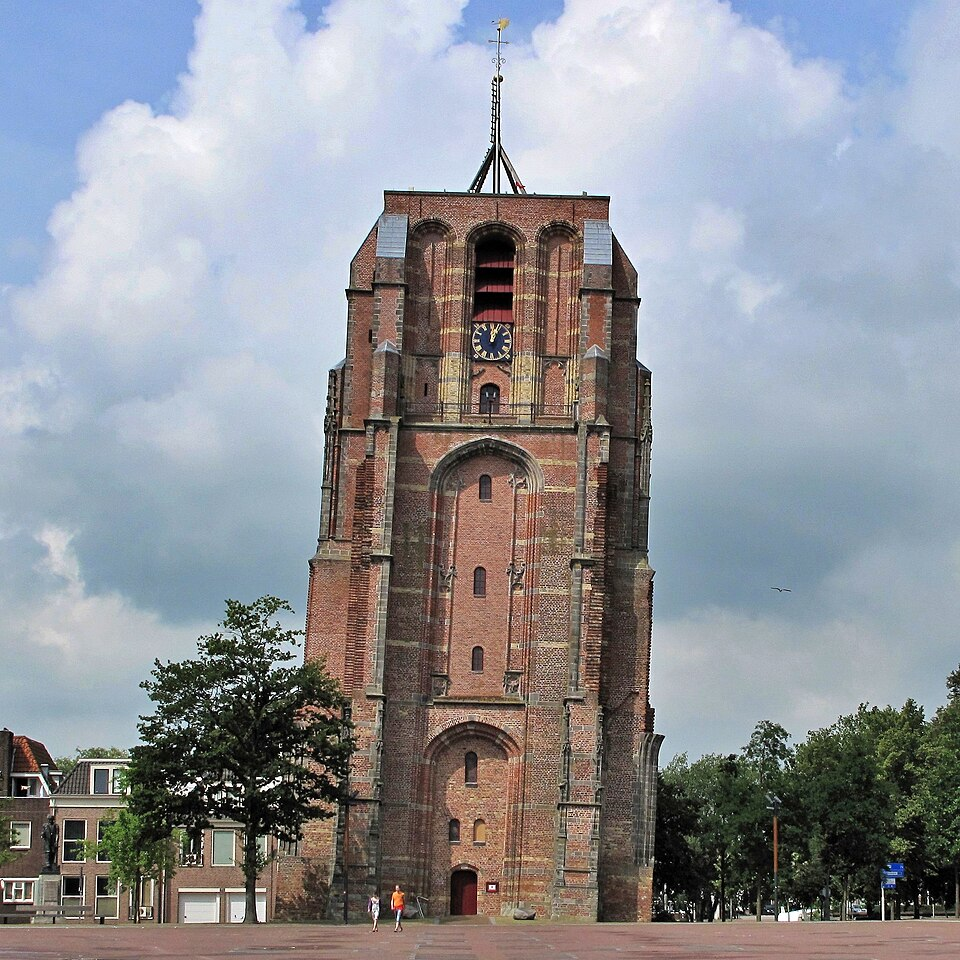
  • The Oldehovetoren from E. Wikicommons – Ben Bender
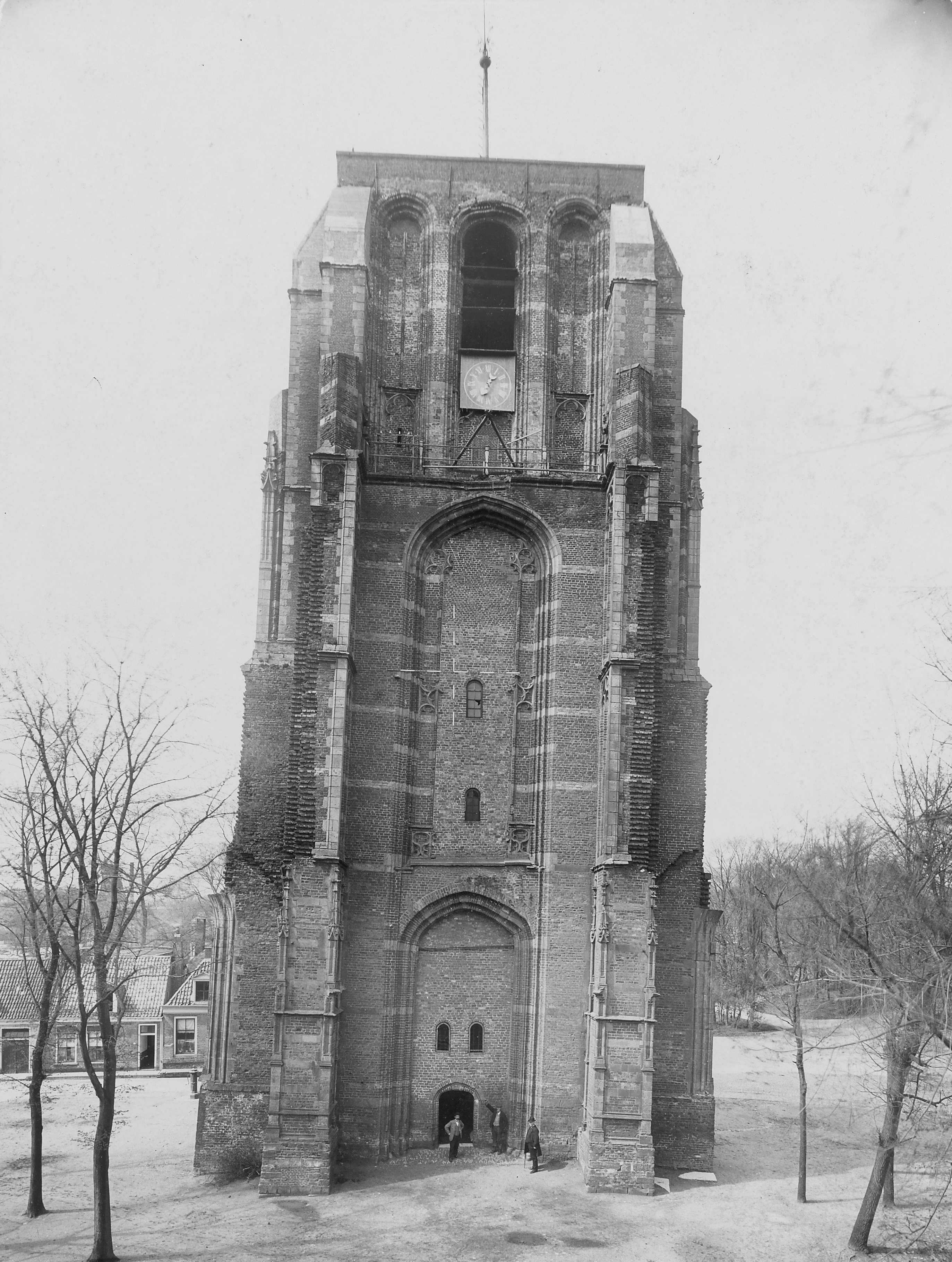
  • The Oldehovetoren from the E in a photo dated 1 June 1907 prior to the first major restoration. Rijksdienst voor het Cultureel Erfgoed

Many myths persist about the Oldehovetoren. Aside from the ever-present Dutch legend that it was built on salted ox-hides,78 there is a tendency to exaggerate its intended height: either that it was meant to surpass that of Groningen, or even its diocesan church at Utrecht. A simple comparison of the dimensions show the latter is an utter impossibility, and it was never intended to be on the scale of the prodigy Brabant towers like Antwerp and Mechelen. Like a certain campanile in the Italian states again, the wonkiness of Oldehovetoren has somewhat eclipsed its design, which with its careful use of brick, yellow sandstone banding and dark sandstone dressings is arguably more aesthetically accomplished than the Martinitoren over at Groningen.

It clearly wasn’t meant to be excessively high, but was the start of clearly a very fancy building campaign that sadly ended up in the trash for not just for the excessive settlement but for a multitude of reasons (a bit like the diocesan reorganisation of the Spanish Netherlands, eh?!?).
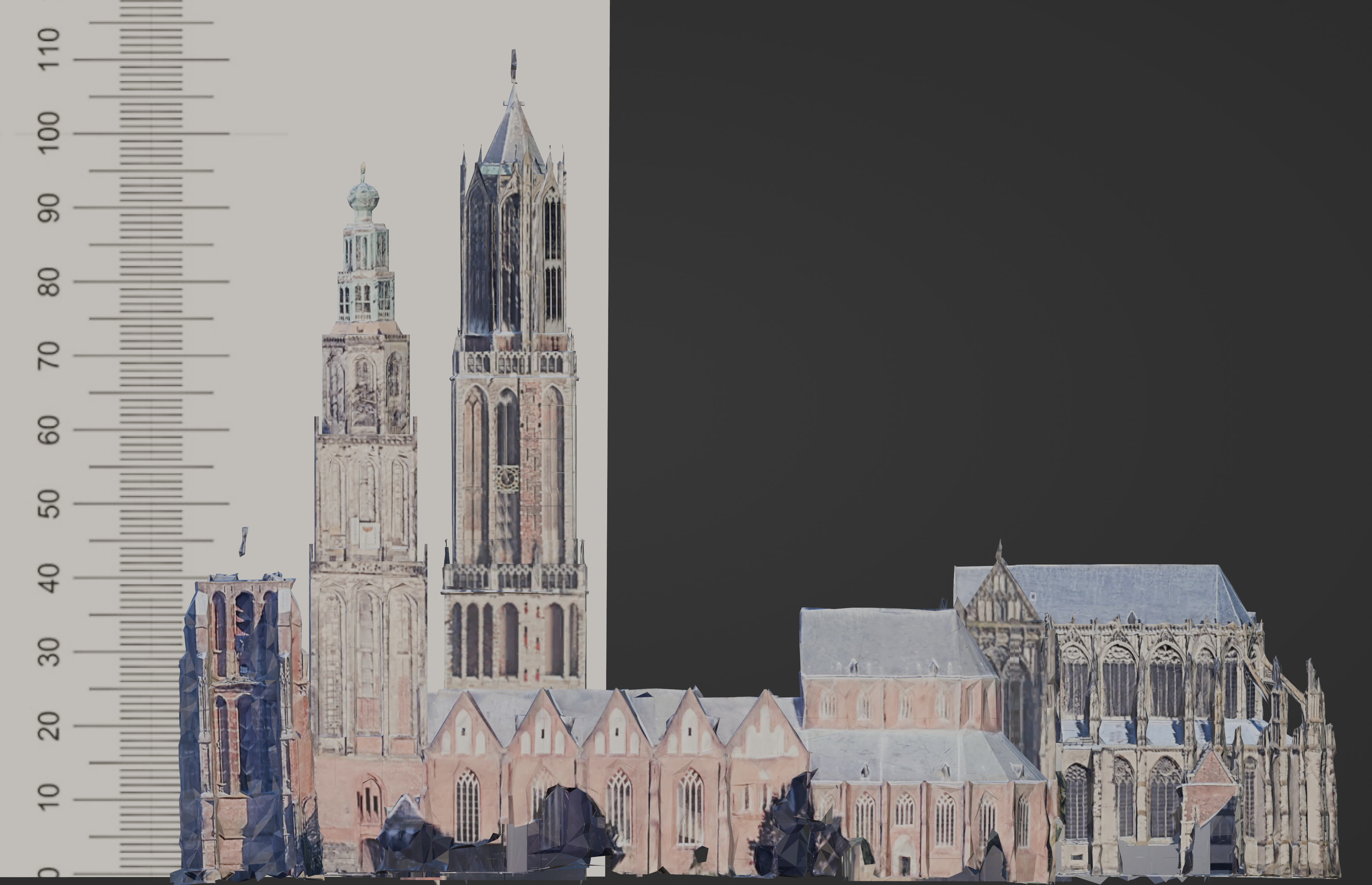
Relative heights of Oldehovetoren, Leeuwarden (c. 39 m, masonry; 47 m, current antenna), Martinitoren, Groningen (c. 73 m, masonry; c. 96 m with spire) and Domtoren, Utrecht (c. 98 m, masonry; c. 112 m with roof and metal cross)
Middelburg, St Peter (Noordmonsterkerk)

Parish church elevated to collegiate in 1311
Diocese suppressed 1603. Church demolished 1833-4
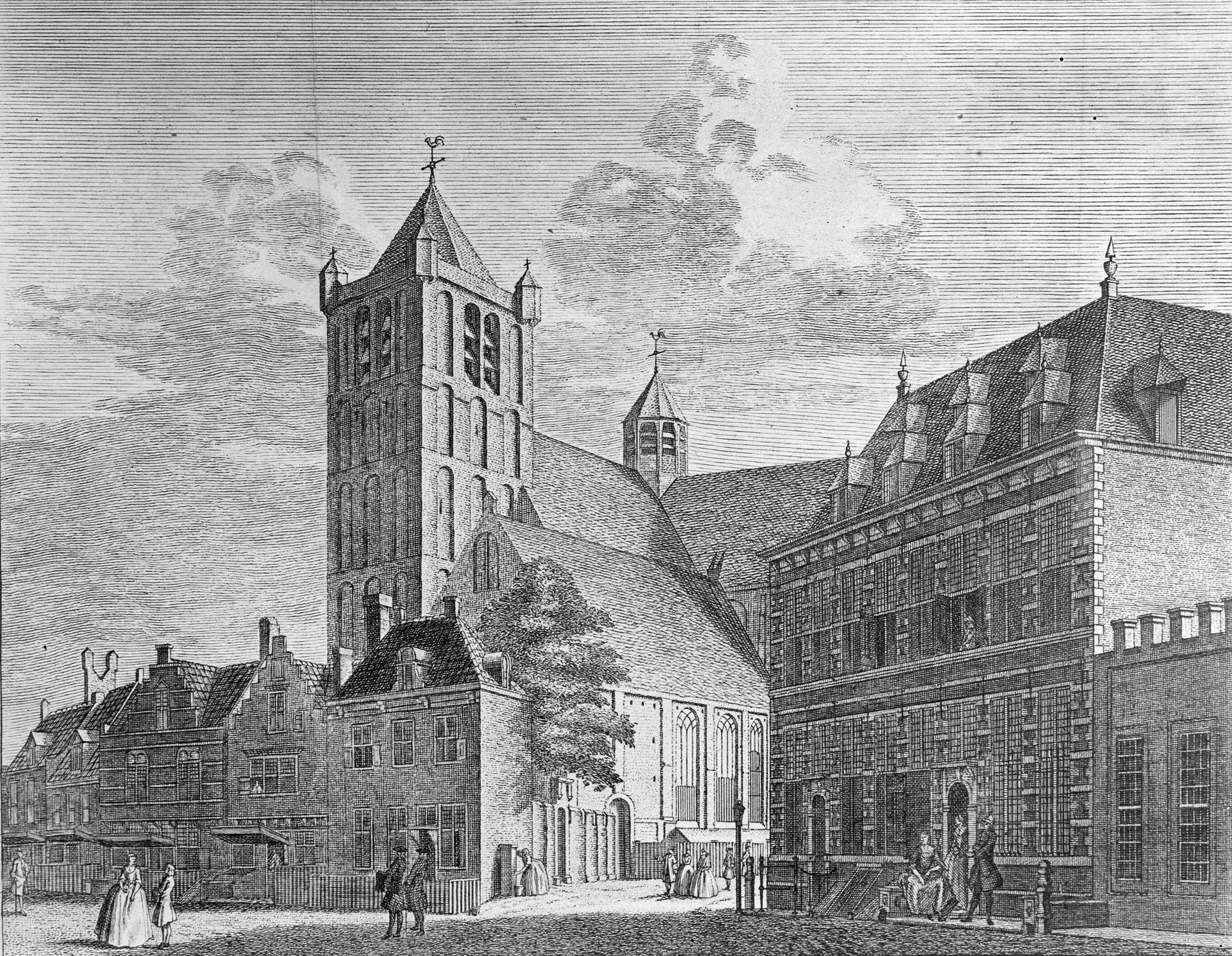
View of Noordmonsterkerk, Middelburg, from Lange Noordstraat, looking NE.
Drawn by Cornelis Pronk 1743, engraved by Jan Caspar Philips, published by Issak Tirion.
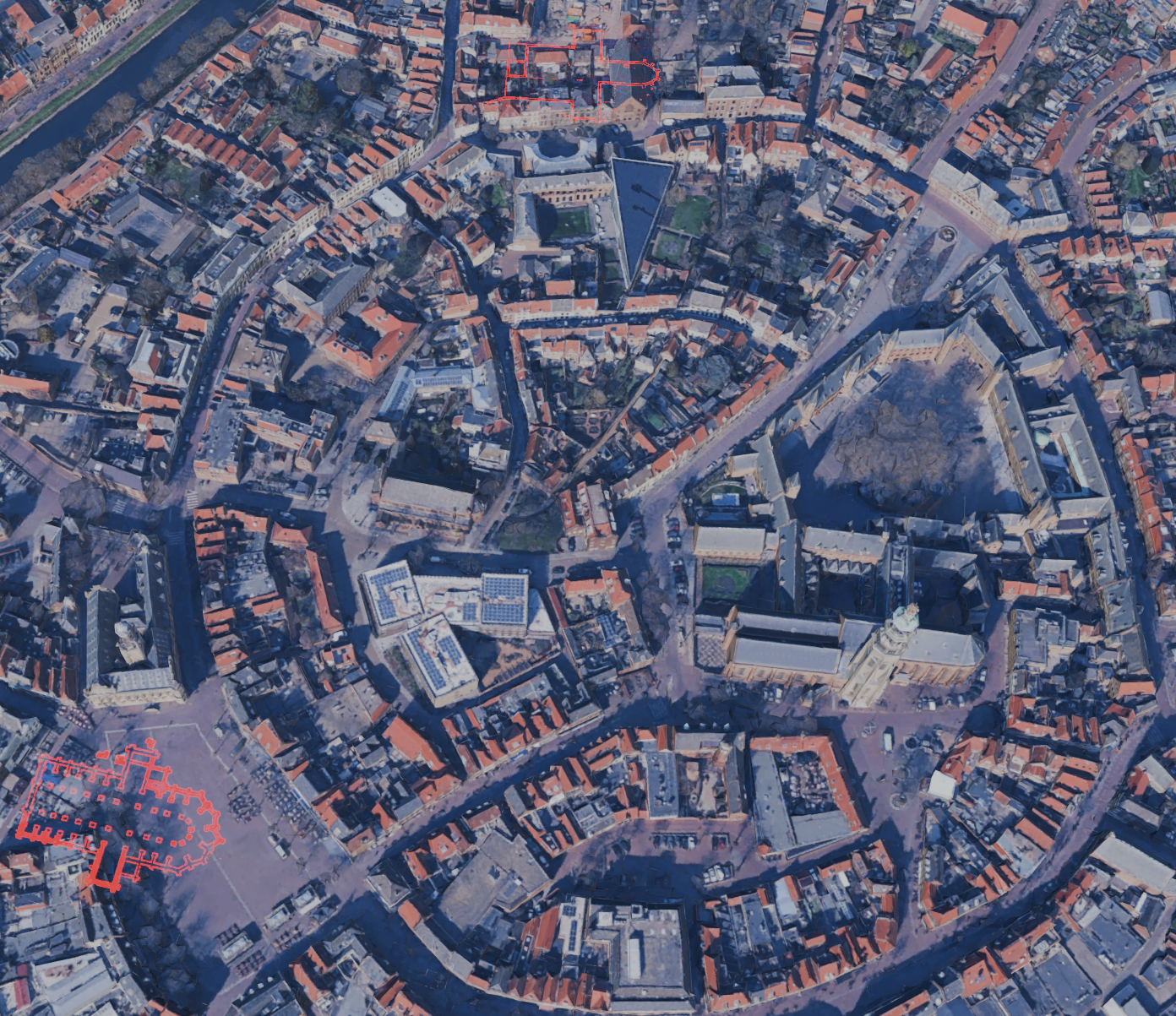
Middelberg with outlines of the Westmonsterkerk (L) and Noordmonsterkerk (top), with the surviving Nieuwe Kerk (former Augustinian Abbey) at the centre.

To conclude, another odd site, this time consisting of not one, but two collegiate parish churches that have been totally demolished: and it was actually the smaller one that was the Cathedral. The first parochial church was the Westmonsterkerk dedicated to St Peter, which was located where the grote markt is now. The open site means it has been excavated and we can see it was ultimately a large building – 68 m long in all – with an ambulatory with radiating chapels, projecting transepts, and a nave with outer chapels.79 It was raised to collegiate in 1479 with twelve canons by Mary, Duchess of Burgundy and her husband, Emperor Maximillian I. It suffered from violent storms including one at the beginning of 1559, perhaps why it was passed over as cathedral of the capital of the county (now province) of Zeeland. In 1575, following the town’s capture from the Spanish, the city government decided to sell the Westmonsterkerk for materials. Mason Pieter Pietersz paid £1,800, with the organs, pulpit, pews and bells sold separately, and in 1577 two pavers from Ghent were contracted for £107, 19 s. to pave the new market square, with £1, 13 s., 10 d. paid for completion the following year.80

The church which did become a cathedral after 1559 was the Noordmonsterkerk dedicated to St Peter, which was smaller, at around 66 m in length, and lacking an ambulatory. It had been a former chapel held by the Counts of Zeeland, and raised to collegiate in 1311 by William I, Count of Hainaut.81 The Abbot of the Premonstratensian Abbey in centre of Middelburg was appointed the first bishop, however he died in 1573, during the siege by the Geuzen army.82 This eventually led to the end of Catholicism in the town in February 1574 with the departure of the Spanish garrison and the Catholic clergy. The Catholic Church kept appointing bishops until the translation of Bishop Karel-Filips de Rodoan to Bruges in 1603,83 when the diocese was suppressed. The Augustinian Abbey in the centre of Middelburg, the nave of which had served parochially in the later Middle Ages to the town as the Nieuwe Kerk, became sufficient for the population after its canons were ejected.
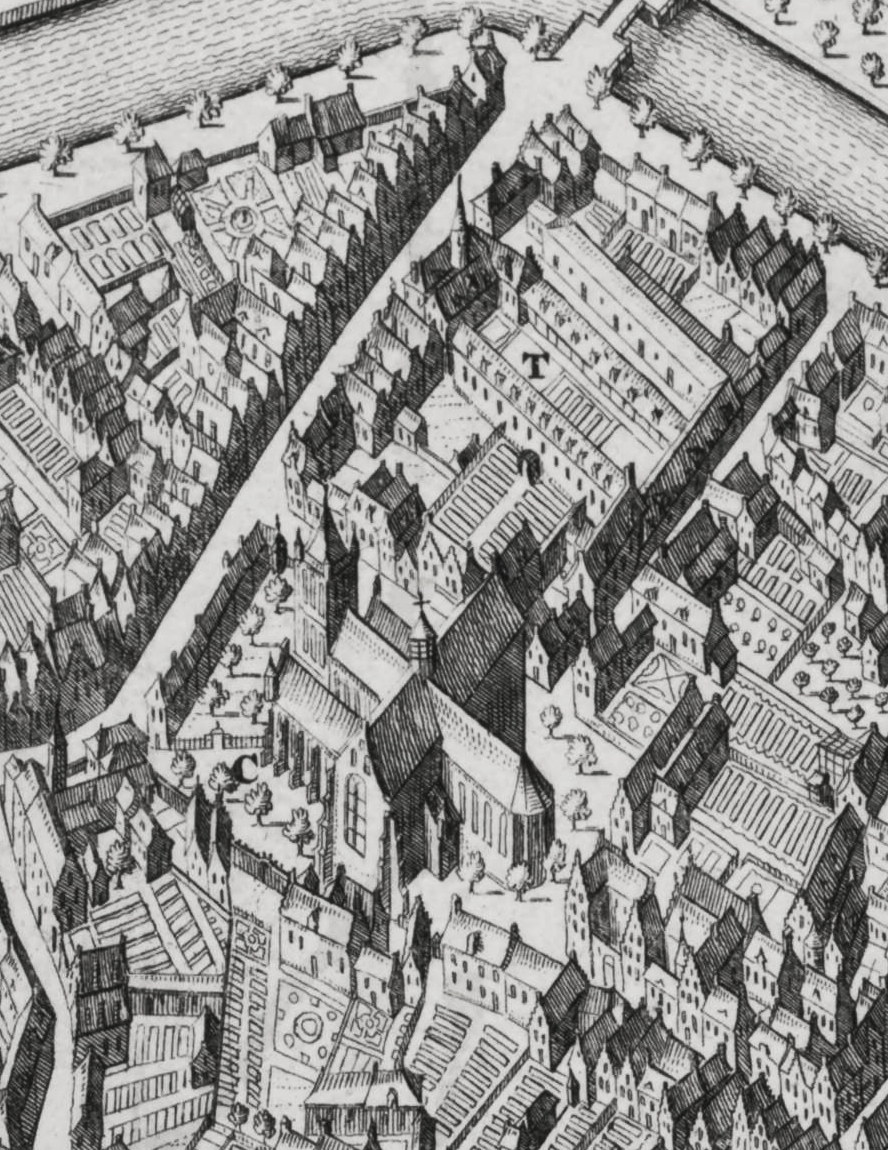
  • Detail of 1657 map by Cornelis Goliath showing the Noordmonsterkerk
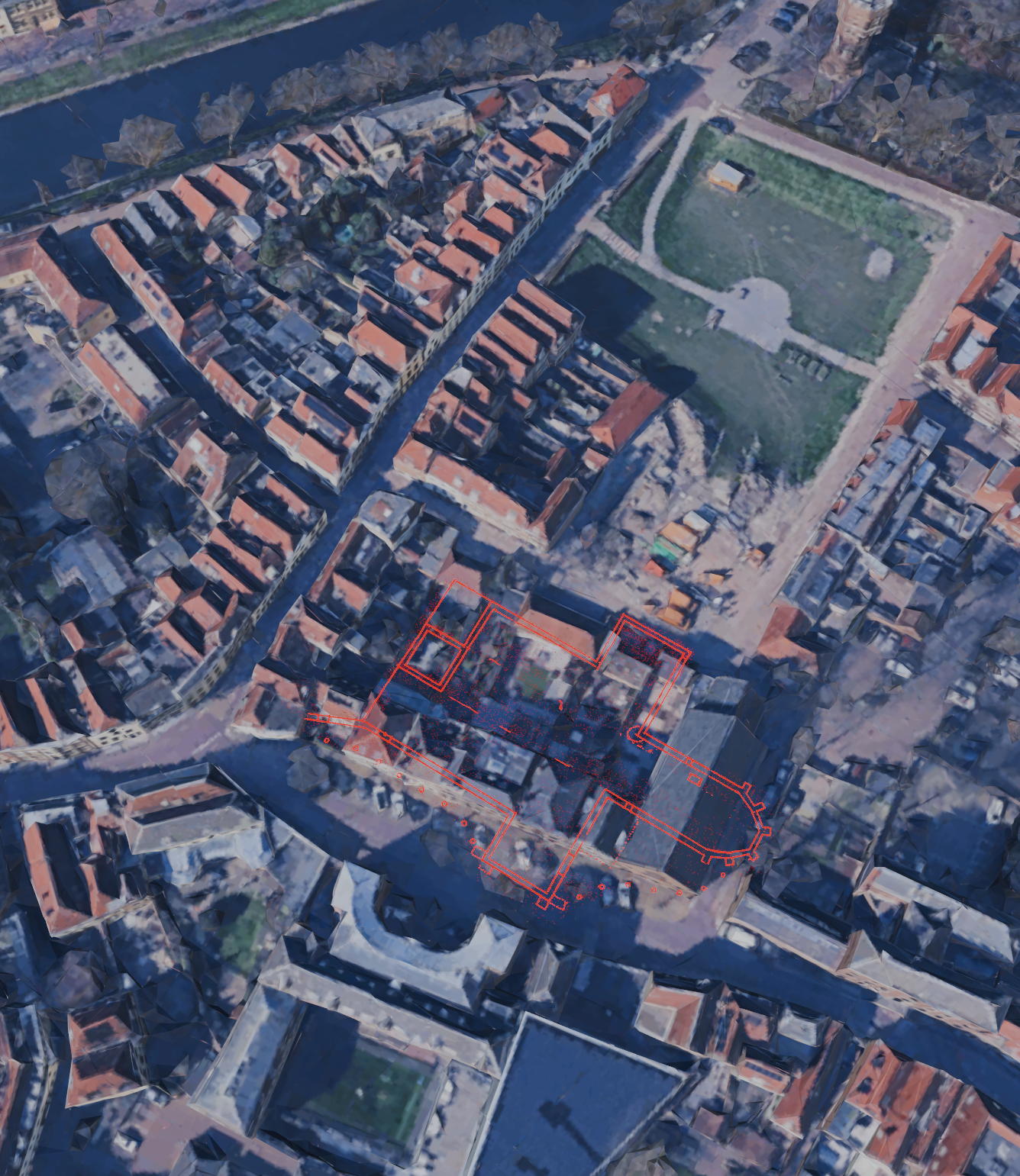
  • Equivalent view in modern environs with scaled pre-demolition plan positioned via an 1818 cadastral map
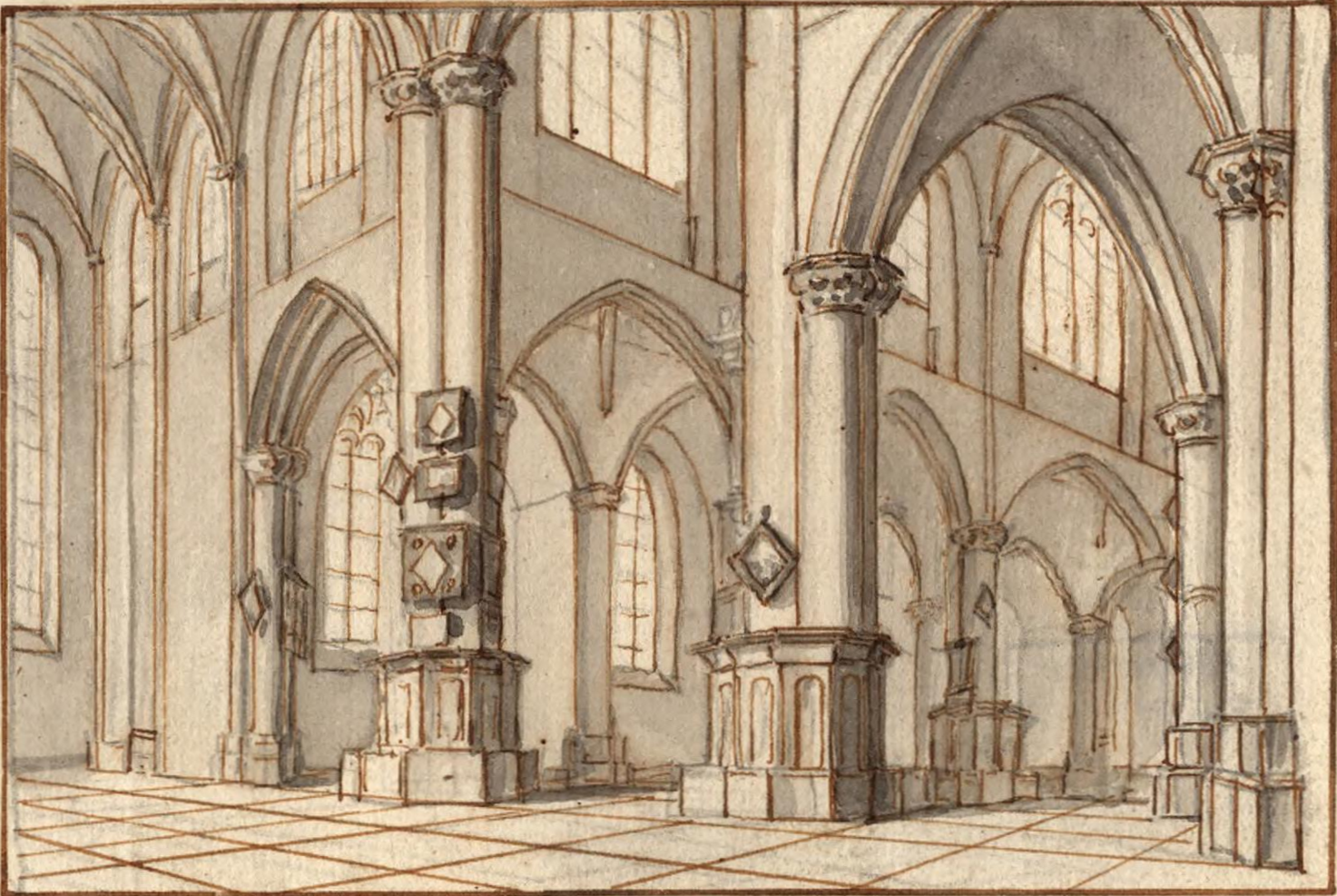
Noordmonsterkerk, Middelburg looking SW from the crossing. Note the outer arcade for the S aisle chapels which have transverse walls between the bays and adjoin a blind bay of the transept.
Ink on paper, by Daniel de Blieck, c.1660-5
Koninklijk Zeeuwsch Genootschap der Wetenschappen, ZI-II-2641.

The former cathedral, by then known in distinction as the Oude Kerk, seems to have never recovered from when it was used for garrisoning soldiers to guard against the 1809 British expedition known as the Walcheren Campaign in Napoleonic Wars, and was only used for burials from then until it was sold for demolition materials to contractor and hydraulic engineer Dirk Dronkers for 19,300 guilders in 1833.84 The empty plot was left as open land until it was built over in the 1890s.85 Its site, which as far I can tell has never been investigated, is now covered by buildings, including the 1930-1 Hofpleinkerk at the east end, a minimalist brick building, which ceased use as a Protestant Church in 2019.86 Since the former cathedral church building survived until the 1830s, we do have a fair few depictions of it, if not properly measured architectural surveys. We can see it had an unaisled choir with a five-sided polygonal apse (as at the east arm of Middelburg Augustinian church now known as the Koorkerk) with late Gothic tracery. The nave and transept had typical Low Countries cylindrical columns with vegetative capitals, and a clerestory with an interior dropped sill below, and outer chapels off the south aisle.87 It had a sizeable west tower, articulated as five stories, with the second to fourth stories having three blind arches to each face, and the fifth storey having four arches with the inner two open for the belfry.

Quite honestly, it’s clearly not the biggest loss on this list (even in the town, the Westmonsterkerk was clearly much more splendid), but you can see a timeline where it limped on as the Oude Kerk and now was a thriving arts venue.
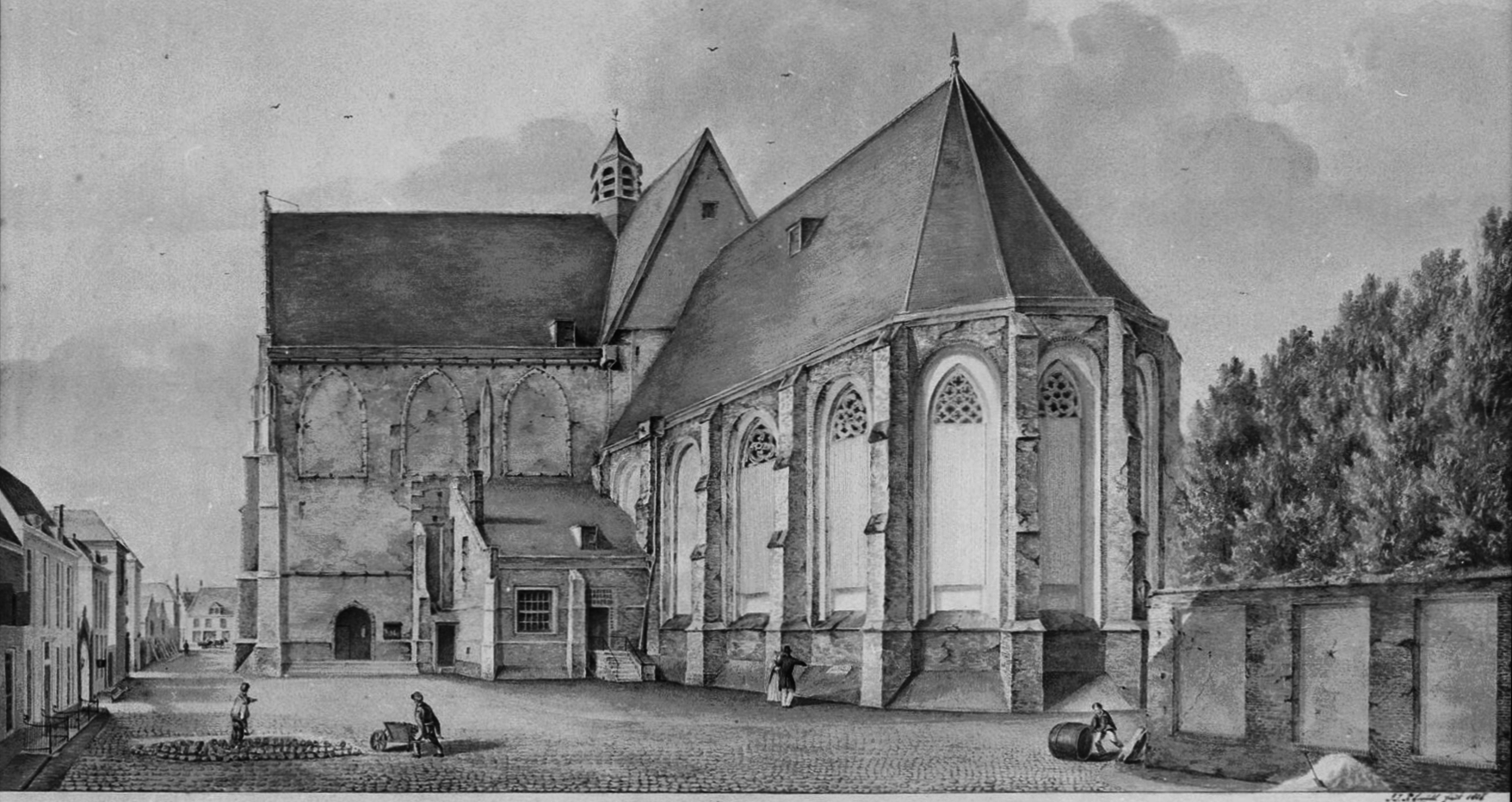
Noordmonsterkerk, Middelburg from NW. The long 3-bay S transept opened into the S aisle and interfaced with the outer S chapels.
Signed print (?1826)
Image adapted from a photograph taken 1972, Rijksdienst voor het Cultureel Erfgoed

So there you go, a rag-tag bunch of fourteen recruited cathedral churches that perform(ed) architecturally to very different degrees as representing the authority of the bishop within carefully constructed administrative structures of their dioceses. I hope this was interesting to someone: while preparing it my WordPress.com account finally went over its free storage limit and rather than try to have a clear-out I upgraded to a paid plan for more space. This does at least let me use my domain properly though. And I am quite taken with WordPress.com now because how of easily it lets me create the…

Footnotes
  1. Much as is defining “Low Countries”. The term “Netherlands” has the same literal meaning, but I mean it here to be all the parts in the northern coastal angle between Germany and France that were not part of the Kingdom of France in the Middle Ages, which includes parts of the modern states of Belgium and France as well as the modern country of the Netherlands.
    My summary of the diocesan reorganisation project largely comes via L.J. Rogier, Geschiedenis van het katholicisme in Noord-Nederland in de 16e en de 17e eeuw, 3 Vols, (Urbi et orbi,1947), Vol. 1, pp.201-406, but also from findings from the work that stands central to modern scholarship on the episode: Michel Dierickx S.J., De oprichting der nieuwe bisdommen in de Nederlanden onder Filips II (1559-1570) (Uitgeverij Het Spectrum, 1950) and subsequently Documents inédits sur l’èrection des nouveaux diocèses aux Pays-Bas: Vol. 1, “Des premiers projets sous Charles-Quint à la promulgation des bulles de circonsriptions et de dotation”, 1960; Vol. 2, “De la promulgation des bulles de circonscription et de dotation à la désincorporation des abbayes brabançonnes (août 1561 – juillet 1564)” 1961; Vol. 3, “De la désincorporation des abbayes brabançonnes à l’installation du dernier des dix-huit évêques (juillet 1564 – fin 1570)” 1962, which I cannot get hold of, hence going through the following reviews:
    Maurice van Durme in Revue Belge de Philologie et d’Histoire 30:1-2 (1952), pp.355-9 
    J. Godard in Revue Historique, T. 228, Fasc. 2 (1962), pp. 473-474.
    P. H. Ramsey in The English Historical Review, Vol. 77, No. 303 (Apr. 1962), pp. 368-70
    Gabriel Le Bras in Revue historique de droit français et étranger, 4th Ser., Vol. 41 (1963), pp. 115-6
    Claude Malbranke in Revue de Nord, Vol. 45, No. 177 (Jan.-Mar. 1963), pp. 132-3
    Claude Malbranke in Revue du Nord, Vol. 45, No. 178 (Apr.-Jun. 1963), pp. 257-8
    Basil Hall, The Journal of Ecclesiastical History, Vol. 14 , Iss. 2  (Oct. 1963), pp. 232-3
    P. H. Ramsey in The English Historical Review, Vol. 79, No. 310 (Jan. 1964), pp. 166-7
    H. A. Enno van Gelder in Tijdschrift voor geschiedenis, Vol. 77 (1964), p.501-2.
    The English wikipedia page is pretty solid and I’ve also used the Dutch one. There is much more recent scholarship beyond this, which can be seen cited in the summary of the episcopal reorganisation in Els Agten, The Catholic Church and the Dutch Bible: From the Council of Trent to the Jansenist Controversy (1564–1733), Brill’s Series in Church History, Vol. 80 (Brill, 2020), pp.12-5, https://doi.org/10.1163/9789004420229_003. ↩
  2. Also the Prince-Bishop of Liège held ecclesiastical territory there, along with small parts of the dioceses of Osnabrück, Münster, Tournai and Cologne, as can be seen in the maps. ↩
  3. A. Graafhuis, “Bulla super universas 12 mei 1559” Maandblad van Oud Utrecht 32: (1959), pp. 38-49, p.41 ↩
  4. Graafhuis, 1959, p.41. The first proposal in 1522 concerned splitting Utrecht with Leiden, in 1529 Middelburg is also included in the Netherlands, with Brussels alongside Ypres, Ghent and Bruges in the southern Low Countries, L.J. Rogier, Vol. 1, p.208.
    The impressive gothic great church of St Michael and St Gudule in Brussels, new east arm begun in 1226 (but built so slowly it was rather out-of-date when it was finished) was not made a cathedral until 1961 when it was made a joint seat with Mechelen. ↩
  5. Rogier 1947, Vol. 1, pp.238-9. Sonnius was actually keen to have Leuven, the only university in the Low Countries, as the seat of one of two archdioceses, but it eventually did not even receive a bishop’s seat. Gert Gielis, “Viri docti et periti rerum divinarum: Leuven Theologians, Ecclesiastical Reform and the ‘Episcopal Turn’ in the Early Modern Low Countries” in Louvain, Belgium, And Beyond: Studies In Religious History In Honour Of Leo Kenis eds Mathijs Lamberigts and Ward De Pril (Peeters, 2018), pp.26-7, 37. ↩
  6. Rogier 1947, Vol. 1, p.213; Graafhuis 1959, p.42. ↩
  7. For the Carafa War: Michael J. Levin, Agents of Empire: Spanish Ambassadors in Sixteenth-Century Italy (Cornell UP, 2005), pp.65-6 https://www.jstor.org/stable/10.7591/j.ctv2n7gvc.6, James D. Tracy, Holland under Habsburg Rule, 1506–1566: The Formation of a Body Politic (University of California Press, 1990), pp.176-7 and Rogier 1947, Vol. 1, p.209.
    ↩
  8. Rogier 1947, Vol. 1, pp.246; Graafhuise 1959, p.43. ↩
  9. The name “Super universas”, sounds rather cosmic, but simply comes from the opening words of the 1559 Bull “Super universas orbis ecclesias…” which means “over all the world’s churches…”. You can read the whole thing in Gisbert Brom and A. H. L. Hensen, Romeinsche Bronnen Voor Den Kerkelijk-Staatkundigen Toestand Der Nederlanden in de 16de Eeuw. Rijks Geschiedkundige Publicatiën 42 (Martinus Nijhoff 1922), pp.69-74. ↩
  10. Ramsay Apr. 1962, p.369. It is interesting to note this sum would seem to be a third less than the 15,000 Italian crowns which his father gifted to the to-be Cathedral of St Bavo in 1550 (see below). Italian gold coins used for large international transactions generally had the same fineness and weight of bullion (3.53/3.54 grams) so it would seem parity in units can be reasonably assumed. Peter Spufford, Money and its use in medieval Europe (Cambridge UP, 1988), pp.177-8. ↩
  11. Hall Oct. 1963, pp. 232; Gelder 1964, p.501-2. ↩
  12. Ramsay Jan 1964, p.167, Hans Cools, “Bishops in the Habsburg Netherlands on the Eve of the Catholic Renewal, 1515–59”, Episcopal Reform and Politics in Early Modern Europe, ed. Jennifer Mara DeSilva (Truman State UP, 2012), p.47. Although Sonnius was an inquisitor against heresy, the idea the new dioceses would be used to launch a Spanish-scale Inquisition were unfounded, van Durme 1952, p.357. ↩
  13. J. Godard 1962, pp. 473-474; Le Bras p. 116. The final bishop to take up his seat was Deventer, 30 November 1570, Rogier 1947, Vol. 1, p.317; Van Durme 1952, p.358. ↩
  14. Gielis 2018, pp.37-8. Even Granvelle had studied at Leuven, but not exclusively or to doctoral level. The exceptions seem to be in Tournai archdiocese who were alumni of Paris: at Namur, Antoine Havet was prior of the Dominican house at Arras and had a doctorate from the College of the Sorbonne, Biographie Nationale de Belgique (1881-5), Vol. 8, pp.801-3, and at Saint-Omer Gérard de Haméricourt, the Abbot of St Bertin, had studied at Collége de Boncourt. Henri de Laplane, Les Abbes de Saint-Bertin (Fleury-Lemaire, 1855), Vol.2, p.106. ↩
  15. Cools 2012, pp.46-62 ↩
  16. van Durme 1952, pp.357-8. ↩
  17. The Tour Octogonale is clearly a two-storey sacristy/treasury that was built at the same time as the Gothic east arm, and like the slightly earlier build at the Collegiate Church of Ripon (West Yorkshire), used archaising stylistic features. As assessed recently in Lesley Milner, Secret Spaces: Sacred Treasuries in England 1066-1320 (Brill, 2024), pp.121-127, https://doi.org/10.1163/9789004695634_009. ↩
  18. Michalis Olympios, “The Romanesque as Relic: Architecture and Institutional Memory at the Collegiate Church of Saint-Omer”,  Journal of the Society of Architectural Historians, Vol. 77, No. 1 (Mar., 2018), pp.14-15, https://doi.org/10.1525/jsah.2018.77.1.10. Olympios plausibly suggests that the apsidole was carefully retained as representative of the high altar of St Audomarus’s Merovingian church. ↩
  19. M.J. de Pas, Congrès archéologique de France: 99e Session Tenue a Amiens en 1936 (Société française d’archéologie: 1937), p.485 ↩
  20. M.J. de Pas 1937, p.480. ↩
  21. The Wikipedia Commons upload of the Albums de Cröy Namur Cathedral leaf cites the exhibition catalogue, D. Misonne, Abbayes et collégiales entre Sambre et Meuse: VIIe – XXe siècle (Crédit Communal de Belgique, 1987) p.80. I cannot find who owns it: the best collection I could find of the Albums de Cröy online was 14 bindings at the Austrian National Library, but I looked for Namur in vain. There are some cool abbey churches there that no longer exist though! ↩
  22. I was hoping to find a drawing of his showing Saint-Omer, but he seems not to have visited. Instead here is his depiction of the also fully-Gothic St Martin, Ypres, which we look at below. ↩
  23. Antoine Leroi, Histoire de Notre-Dame de Boulogne (Le Roy-Mabulle, Boulogne-sur-Mer/Techner, Paris, 1839), pp.185-8 ↩
  24. Just as well. A Romanesque crypt survives underneath, but I struggled to find any good sources about the archaeology of the abbey church. And as for the replacement built over the site 1827-66 – that I’ve never encountered until now – it is genuinely one of the ugliest churches I’ve ever seen pictures of. I hope by burying this flippantly rude assessment in a footnote, no one will shout at me about it. ↩
  25. Nicolaas Van Nieuwland, appointed to Haarlem, had been appointed as an auxiliary bishop of Utrecht and titular bishop of Hebron (Patriarchate of Jerusalem) in 1541, Rogier 1947, p.283. ↩
  26. A basic overview of the chronology can be found in Annales du XIIe Congrés Archéologique & Historique: Malines – 1897 (Féderation Archéologique & Historique de Belgique, 1897), pp.160-4. Also overviews in Jan Esther, “Le Brabant” in Architecture Gothique en Belgique, Buyle et al. (Editions Racine, 1997), pp.87-8 and Christopher Wilson, The Gothic Cathedral (Thames and Hudson, 1992 rev. 2000), pp.237-8. ↩
  27. Jean d’Oisy is primarily documented as magister operis from 1357 at Notre-Dame-au-Lac in Tienen, Esther in Buyle et al. 1997 pp.84-5. Establishing Jean’s exact role in the creation of Brabantine Gothic is a rather fraught one I won’t wade into. ↩
  28. The drawing is at the Archives de l’État à Mons, inventoried as Documents précieux 4. Merlijn Hurx “Collaboration and Competition: Master Masons and Painters in the Production of Architectural Designs in the Low Countries in the 16th Century”, Architectural Histories 11:1 (2023), https://doi.org/10.16995/ah.9179. ↩
  29. Wilson 1992 rev. 2000, p.245; for an overview of the Keldermans dynasty see Esther in Buyle et al. pp.100-2. ↩
  30. The Basilica of La Sagrada Família, Barcelona, begun 1882 under the designs of Antoni Gaudí, is to be completed in 2026 with a height of 172.5 m, but due to the safety margin regarding once-in-a-century earthquake events and other factors, from 2014 the build for the central tower relied on prestressed panels of reinforced concrete. See ARUP [link], [archive] ↩
  31. Part of an undercroft was also begun and some of a brick support can from the gardens to the south-east of the cathedral. An overview of the project and its large bibliography can be found at Inventaris Onroerend Erfgoed. For the three-dimensional realisation of the scheme, see Kasper Dupré, ““PLVS OVLTRE”: De reconstructie van een laatgotische droom in Antwerpen”, BA Dissertation, KU Leuven, 2019-20. ↩
  32. I suppose I ought to make a video out of this some day: Spacefleet Ecclesiastica: Cathedrals of the Iberian Peninsula. ↩
  33. Also importantly at one of the earliest mature Gothic buildings in the Empire: the Liebfrauenkirche, Trier, begun c.1227, although here the plan goes towards the centrally-planned design of the building so it is difficult to fit it into basilican-type ideas. The Benedictine Abbey church of Saint-Michel-en-Thiérache has been suggested but it seems unlikely it is the prototype. Go dive into Paul Frankl rev. Paul Crossley, Gothic Architecture (Yale UP, 2000), p.329 fn.57, you massive nerd bothering to read this footnote. It is also to my eternal annoyance that my bus to Braine never turned up during my North-East France trip last decade, but thankfully I had the option of train to get to my booked hotel in Soissons. I had it all planned out! I should have been to Braine!! Although not sure whether it would have been open anyway. ↩
  34. These dates are from the 1928 reprint of T.S. Bumpus (see below), p.vii, I’m not able to get into WW1 history to confirm quite how the town and church got pulverised. ↩
  35. “When Ypres was visited in the summer of 1908 the facade of this transept was undergoing restoration — although one had taken place about fifty years previously — and was too much enveloped in scaffolding to allow of a satisfactory survey being taken of it”, Thomas Francis Bumpus, The Cathedrals and Churches of Belgium (T. W. Laurie, 1909), p.121. pp.118-29 is a good assessment of the building a few years before it was destroyed. ↩
  36. Wederopbouw getuigend voor Coomans’ eenheid-van-stijl-principen: onder meer ruime toepassing van natuursteen voor structurele onderdelen en parement, uniformeren van kapitelen in middenbeuk, onnauwkeurige reconstructie van blinde nissen, voornamelijk in de zuidelijke transeptarm, en eerder willekeurige houding ten opzichte van de 19de-eeuwse restauraties.Inventaris Onroerend Erfgoed, which also provides an in-depth overview of the chronology for the construction, restoration, and rebuild. ↩
  37. This spire disappears in seventeenth-century maps due to a fire in the tower 2 September 1603, “as the result of a bad storm”. Reference in Hendrik Vanden Abeele, “What late medieval chant manuscripts do to a present-day performer of plainchant”, doctoral thesis (University of Leiden, 2014), p.152. ↩
  38. Mémoires sur la ville de Gand, par le chevalier Charles-Louis Diericx, Vol. 2, 1815, p.30 ↩
  39. Tim Tatton-Brown “The Building History of the Lady Chapels” in Westminster Abbey: The Lady Chapel of Henry VII, ed. T. Tatton-Brown and R. Mortimer, (Boydell & Brewer, 2003), pp.192-3. ↩
  40. Steven Gunn et al., War, State, and Society in England and the Netherlands 1477-1559, Oxford UP, 2007, p.ix ↩
  41. It was extremely difficult to find archaeological plans of the site online, other than isolated plans of the Carolingian rotunda. I eventually found an overview plan reproduced in Jan Moens, “De archeologie van leren schoeisel in de
    middeleeuwen en nieuwe tijden in Vlaanderen. Een chronologische, technische en typologische studie. Analyse en interpretatie”, Ph.D. dissertation, Vrije Universiteit Brussel/Universiteit Gent, 2018-2019
    , p.115, and punched the air. ↩
  42. Joseph Mertens, “Quelques édifices religieux a plan central découverts récemment en Belgique”, Archaeologia Belgica 73 (1963), pp.146-149. ↩
  43. Antoon Viaene, “Bij een honderdvijftigste verjaring. Het einde van een kathedraal: De Sint-Donaaskerk te Brugge verkocht en afgebroken”, Biekorf 50 (1949), pp.169-180. The absolutely enormous amount of 4 million francs bid for the cathedral site for its raw materials by meester-timmerman (essentially city contractor) Dominique Maeyens will be to do with the collapse of fiat currency in the French Revolutionary state and basically wheelbarrow-full-of-paper-notes stuff as far as I understand. ↩
  44. Inventaris Onroerend Erfgoed. ↩
  45. “Deze ‘verborgen parel’ in Brugge ontdek je voortaan alleen nog met erkende gids: “Sommige bezoekers stalen zelfs stenen uit de muur””, Het Laatste Nieuws, 20 April 2023 [direct link] [archive] . ↩
  46. A detailed interpretation of the construction history can be found in C.J.A.C. Peeters, De Sint Janskathedraal te ‘s-Hertogenbosch (Staatsuitgeverij/Rijksdienst voor de Monumentenzorg,1964), pp.385-99. ↩
  47. This is an argument forwarded in Wilson 1992 rev. 2000, pp.242-3, and has been largely accepted since. ↩
  48. Formerly owned by Roermond notary and keen antiquarian collector Charles Gullion (1811-73), and perhaps commissioned by him: Gerard Venner, “De historische belangstelling van Charles Guillon“, Publications De La Société Historique Et Archéologique Dans Le Limbourg 155 (2020), p.161-5. Guillon also owned the archives of the chapter, going back to before it was converted into a cathedral, p.180. ↩
  49. Certified copy of 1906, RCE – Gebouwd 203.746. ↩
  50. Via https://aezel.eu/ontdekken/geografie/minuutplans-grondgebruik ↩
  51. Via map of the development of Roermond 1842-2015, https://aezel.eu/ontdekken/geografie/tijdlijn-kadaster. First appears tax year 1899 so presumably built the year before. ↩
  52. Gerard van der Schrier and Rob Groenland, “A reconstruction of 1 August 1674 thunderstorms over the Low Countries”, Natural Hazards and Earth System Sciences 17 (2017), pp.157-70. https://doi.org/10.5194/nhess-17-157-2017 ↩
  53. Oft-given collegiate establishment dates of 1474 and 1479 are actually when the City of Haarlem granted the getijdencollege the revenues of excises on beer and corn, and right on grazing respectively. Eric Jas, Piety and Polyphony in Sixteenth-Century Holland: The Choirbooks of St Peter’s Church, Leiden (Boydell and Brewer 2019), p.23. https://doi.org/10.1017/9781787443198.003 ↩
  54. Jas 2019 pp.5-6. Although there are eight canonical hours (Matins, Lauds, Prime, Terce, Sext, None, Vespers, Compline), the secular clergy tended to run Matins and Lauds together as one, and seven sounded more mystical, basically. ↩
  55. For Haarlem specifically, see Jas 2019, pp.21-5 ↩
  56. Rogier 1947, Vol. 1, p.222. ↩
  57. Herman J. Selderhuis and Peter Nissen, “The Sixteenth Century” in Handbook of Dutch Church History, ed. H.J. Selderhuis (Vandenhoeck & Ruprecht GmbH & Co. KG, 2014), p.196 ↩
  58. Rogier 1947, Vol. 1, pp.283-5. ↩
  59. Ingeborg Worm, “Saint Bavo [Grote Kerk] (Haarlem)”, Grove Art Online (2003) https://doi.org/10.1093/oao/9781884446054.013.90000373327
    There are a number of precedents in Belgian Gothic for ambulatories with no chapels: St Leonard, Zoutleeuw (c.1231-); St Materne, Walcourt (c.1235-) and Notre-Dame-de-Pamele, Oudenaarde, 1234 (dated by external brass inscription), Architecture Gothique en Belgique, Buyle et al. (Editions Racine, 1997), pp.38, pp.52-3. It seems appropriate that the later Protestant Netherlands took these “chapel-less” east ends up, but of course when they were initially built, they were filled with altars as any Catholic ambulatory was. ↩
  60. A.J. van Egmond 2019, p.223 ↩
  61. Literally, I went through all of R. Stenvert et al., Monumenten in Nederland: Noord-Holland (Rijksdienst voor de Monumentenzorg/Zeist Waanders Uitgevers, 2006) and R. Stenvert et al., Monumenten in Nederland: Zuid-Holland (Rijksdienst voor de Monumentenzorg/Zeist Waanders Uitgevers, 2004). I know what a Holland is. ↩
  62. Worm 2003. ↩
  63. This post-choir build chronology is from R. Stenvert et al., Monumenten in Nederland: Noord-Holland (Rijksdienst voor de Monumentenzorg/Zeist Waanders Uitgevers, 2006), pp.313-5. ↩
  64. Eric Fernie, Romanesque Architecture: The First Style of the European Age (Yale UP, 2014), p.76. ↩
  65. For an interpretation of the dating of the Gothic works, see R. Stenvert et al., Monumenten in Nederland: Overijssel (Rijksdienst voor de Monumentenzorg/Zeist Waanders Uitgevers, 1998), pp.99-100. ↩
  66. Photographs from above the roofspace, if you’re excited by the sort of thing, can be seen courtesy of the Rijksdienst voor het Cultureel Erfgoed ↩
  67. The Mariakerk was secularised under the Calvinists after 1578. The main vessel survives as an unroofed courtyard between the bricked-up arcades, with the south aisle mezzanined at an early date. ↩
  68. St Joseph’s site is now occupied by the library of Rijksuniversiteit Groningen, opposite its neo-Dutch Renaissance Academy Building (Academiegebouw) of 1906-9. ↩
  69. Rogier 1947, Vol 1, p.226 ↩
  70. You can actually see the different-coloured bricks on this photograph inside the lean-to roofspace. ↩
  71. Some initial publications after the discovery available online: Elisabeth Neurdenburg, “De Muurschilderingen in net Koor van de Martinikerk te Groningen”, Oudheidkundig Jaarboek, Bulletein van den Koninklijke Nederlandse Oudheidkundige Bond 3rd Ser., 4 (1924), pp.241-254;  Cornelis Hendrikus van Rhijn, De Muurschilderingen in de Martinikerk te Groningen (Evern B. van der Kamp, ?1925). ↩
  72. Although it is tempting to relate these to its brief role as the Catholic Cathedral beginning in 1559, most datings tend to place them in the 1530s or 40s. See Kees van der Ploeg, “Mural Painting in Medieval Frisian Churches”, CODART.nl (March 2022) [link] [archive] ↩
  73. There is a single mention of a zeven-getijdencollege in 1534. Jas 2019, p.41. ↩
  74. Rogier 1947, Vol. 1, p.227. ↩
  75. Jacob de Jong, “Cunerus Petri” in Nieuw Nederlandsch biografisch woordenboek Vol. 5, 1921, pp.122-4. ↩
  76. This hand-coloured printing from 1616, Bibloteka Narodowa, ZZK 0.261. ↩
  77. The use of fat, non-hydraulic lime mortar in this restoration was criticised by rocks and rock products specialist Alfred Broadhead Searle in The Building News, 26 June 1914 ↩
  78. An overview of the persistent ox skins (ossehuiden/taurinis cutibus) myth can be found in Peeters 1964, pp.51-3. Despite the many consolidating excavations around the foundations of church towers in the Netherlands in modern times to secure their structure, not a shred of archaeological evidence has been found for the use of ox hides below building footings. ↩
  79. First excavated in 1943 when the market was reconstructed after bombing, and again during redevelopment in 1998, with further archaeology of the site of the nave and cemetery in 2010 due to a building demolition. Most recent archaeological report, G.M.H. Benerink, Archeologische Begeleiding en Archeologische Opgraving Bouwlocatie
    Markt 65, Middelburg, Gemeente Middelburg
    (SOB Research, 2010
    ). The “monster” in these churches’ names relates to “monastery”, in the same way as minster/munster. ↩
  80. Frederik Nagtglas, De Algemeene Kerkeraad der Nederduitsch-Hervormde Gemeente te Middleburg van 1574-1860, (Altorffer 1860), pp.30-1. ↩
  81. Nagtglas 1860, p.31. ↩
  82. Rogier 1947, Vol. 1, pp.306-11. ↩
  83. Rogier 1947, Vol. 1, pp.313-4. ↩
  84. Nagtglas 1860, p.33. The amount Dronkers paid is something like £1,600 British sterling: using the 11.95:1 rate cited in Tate, The Modern Cambist (Royal Exchange, 1861) pp.33-4. ↩
  85. The mansions on the north side of Hofplein 9-11 are dated c.1895 in R. Stenvert et al., Monumenten in Nederland: Zeeland (Rijksdienst voor de Monumentenzorg/Zeist Waanders Uitgevers, 2003), pp.178-9. Although not uploaded at a good resolution to read the plot label certainly, you can make out the former church site marked as “terrein” in 1860 and 1873 maps. The 1818 cadastral map can be found here in this study. The measured plan can be found on Wikimedia Commons as attributed as being held by the Zeeland Society (Zeeuws Genootschap) and dated to 1814, although unfortunately I cannot find another source to confirm. The notes regarding rasterwerk (latticing) of the walls and churchyard and its height seem to point to it being a sketch regarding assessment of chattel before site disposal rather than antiquarian recording. ↩
  86. Nieuwe Kerkgemeente Middelburg website, 29 May 2019 [archive] ↩
  87. The question of whether it was vaulted is an irksome one. They are clearly there in the watercolour, but Daniel de Blieck’s sketchbook, which was presumably the in-situ reference, has no vaults in the nave, aisles or transepts, Rijksdienst voor het Cultureel Erfgoed. The truss roof of the nave looks like it’s meant to be over a vault though, also advised by the the capitals and hoods over the nave clerestory, so perhaps Daniel was combining information from a visit above the vaults in this sketch. The south aisle however, looks like it is supposed to have a genuine open timber roof. ↩

blog thumbnail
drjacameron
http://stainedglassattitudes.wordpress.com/?p=6620
Extensions
Reimaging Glastonbury Abbey and other recreation videos
Art HistoryMonasteryQuest™3DAnimationarchitectureBlenderCathedralChurchesHistoryMedievaltravelYouTube
Just to pop on the ol’ website that I have here, that I put together this in the 3D animation program Blender recently: a rendered recreation of the great church of Glastonbury Abbey, England’s wealthiest monastery (by gross income at least by 1535) and one of the very last to be suppressed by the Crown, […]
Show full content

Just to pop on the ol’ website that I have here, that I put together this in the 3D animation program Blender recently: a rendered recreation of the great church of Glastonbury Abbey, England’s wealthiest monastery (by gross income at least by 1535) and one of the very last to be suppressed by the Crown, in quite bloody fashion.

This YouTube upload is followed by a deep-dive via the business end of the program to explore the wider history of the building and a size comparison some of the surviving cathedral-scale buildings I stole from to create it. Actually already had enough feedback and interest that there will be soon be a remastered version of the render, but until then…

This followed a test I made of the principal Cluniac house in England: Lewes Priory, the site of which was unfortunately ploughed through by the Brighton, Lewes and Hastings Railway company in 1845, although with the buildings just as untextured, colour-coded models. Certainly could do with revisiting on the timing of the animation but the environs are a bit limiting as it’s right on the edge of the 3D coverage. Also apses are hard work, as all Englishmen seem to agree. (no sound)

These build on other church building recreations I’ve done using other people’s models last couple of years, of Reading Abbey and its absolutely underrated concentrated history of both having a king buried in and the prison that held Oscar Wilde built over part of it. (no sound)

And also Old St Paul’s Cathedral, London (no sound) which I was quite proud of how it looks but doesn’t really have a narrative or whatever. It’s just cool.

I did a re-render of this for upright phone viewing, which considering how much London had changed in a few years was more trouble than it was worth, frankly.

But Coming Soon! Oseney Abbey! The short-lived cathedral of Oxford! Has taken two months of work and uses some slightly more advanced techniques that my Glastonbury one. But the render is basically done, just needs editing together and the behind-the-scenes videos recording. And yes, there’s a lot of behind-the-scenes about why it’s the frankly weird shape it is. Almost too much, really.

A reminder I still have a donations page, if you want to encourage me along!

ko-fi donation banner
Vimeo thumbnail
drjacameron
ko-fi donation banner
http://stainedglassattitudes.wordpress.com/?p=6535
Extensions
A Cathedral on Mars: the church in episode 5 of Cowboy Bebop and its relation to Chartres
Art HistoryAnimearchitectureCathedralChurchChurchesCowboy BebopNerd stuffStained glass
A look at the background design of a church in the 1998 anime Cowboy Bebop, which is based on Chartres Cathedral in a surprising number of aspects.
Show full content

Cowboy Bebop (カウボーイビバップ), an original anime series initially broadcast in Japan throughout 1998 and early ’99, went on to be a big success on American cable television and beyond three years later.1 The episodic show follows a pair of bounty hunters in 2071 who travel on their spacecraft, the Bebop, across the solar system when humanity has largely been forced to abandon Earth due to a catastrophic warp gate accident that partially destroyed the moon.

Vicious’ pet cormorant perches on a crucifix in our Martian pseudo-cathedral-cum-convenient cool location to have an epic gunfight

Mostly it’s about nostalgic style than plausible future, particularly since we’ve somehow managed to colonise the asteroid belt and terraform Venus, Mars and the Galilean moons of Jupiter in a couple of generations. But it has an extremely high level of art direction, evident in its backgrounds, character animation, and mechanical design, with occasional bits of hard science when it suits. Anyway, on rewatching for the first time in twenty-odd years, I noticed there’s a showdown in a building that really looks like Chartres Cathedral. I mean, really. So much I need to tell you about it! At length! With footnotes!

A warning that this post, although it took a fair bit of effort, is the sort of nonsense fluff I used to stick on Twitter, but I am very wary about putting any effort into that website anymore since it’s utterly terrible post-Musk. And also going through the sequence frame-by-frame has got rather involved so it’s probably better off here anyway.

This variety of settings across the solar system up to Jovian moons means there’s a huge amount of freedom in the visual direction of each individual episode of Bebop. Not least when a big church building crops up in episode 5, “Ballad of Fallen Angels”, which is pivotal in introducing the backstory for the seemingly happy-go-lucky main protagonist Spike Spiegel. I’m not the first person to notice the location is inspired by Chartres Cathedral, but I was fascinated quite how much it’s consistently modelled after aspects of the building: the architecture, sculpture and the stained glass.

In the episode, the recent addition to the crew of the Bebop, Faye Valentine, has fallen in a fairly obvious trap chasing a bounty related to the Martian crime syndicate of the Red Dragon that Spike used to work for. Permitted to communicate she’s held hostage at a church at the edge of a Martian city to the Bebop, Spike agrees to rescue her, but only (ostensibly, his personal motivations throughout the series are up for debate) because he wants to settle his score with her captor, his former partner in crime at the Red Dragon Syndicate: Vicious.

The establishing shot of the church – indeed, the first we know the showdown is going to be in a church – shows two asymmetrical towers with birds flocking around them in a gloom where the sun is likely below the horizon. The tower closest to us is patently based off Chartres’ south steeple, which is one of the earliest masonry church spires (although the scaling on the surface does make the spire look like it’s leaded, but believe me, it’s all stone), topped out c.1170. Its early Gothic gables on the sides of the octagonal stage under the spire are unmistakeable, even if a lot of the details are simplified. The BG artist has made the prudent decision to obscure the fiddly Flamboyant-style lantern of 1506-13 behind the high roof, although the spire is clearly sharper and taller than that of its partner in the foreground.

Photograph from Marie d’Aragon, Chartres (Paris: Grange Batelière, 1972), credited to J.C.B.

Then we see the whole “west” front of the building in an upward scrolling shot I’ve comped together (who knows what crater it’s in on Mars, although there are more craters in the northern hemisphere so whatever, we can probably keep general north-south liturgical topography for the rest of this).

Engraving of the west elevation, Lassus and Ollivier, published in Monographie de la Cathedrale de Chartres: Atlas (Paris, 1867)

Note not only the north spire is taller, but the north tower it’s sat on too.2 The three windows over the central portals are more pointed but are basically the same as the Terran ones over the “Portail Royal” (three portals of elaborate and influential Early Gothic sculpture, probably of the 1140s). However, the rose window is modified to look like the slightly later south transept rose (note that the outer ring consists of semi-circles rather than octofoils), for reasons related to the final confrontation between Spike and Vicious. Note as well, the paired tall thin lancets on the projections to the sides of the steeples which have a lot of similarities (these are not actually the elevations of the transept arms themselves, but the transept towers that stand over the west/east aisles that were obviously intended to take spires of their own).

Spike then approaches the church (in his trench coat, which means business). This lovely bit of BG art in the consistent purple light that characterises this whole scene is also clearly based off Chartres Cathedral: but it’s not the main west entrance.

G-Maps Streetview capture from September 2020

It’s the south porch, unequivocally. Yes, it’s different in a lot of details: the gables are steeper, and there’s a lot less figure sculpture, but there’s two massive giveaways it’s been copied by a BG artist.

One, the buttress to the right of Spike has been copied verbatim from Chartres. In the building it’s a very specific situation where an angle of the front set-off of the transept’s tower buttress was built by the Chartres masons – for some reason – even though it’s directly interfacing with the grand south porch and doesn’t actually need to be there, thus confusing generations of architectural historians about whether the porches were an afterthought or not.3

Regardless, it’s very funny this odd arrangement got copied into a background painting of a Gothic church on Mars for an animation made in Japan a bit over 800 years later.

Second, the big heavy canopied tabernacles over the dividing shafts of the portals (which aren’t present on the otherwise very similar north porch), although the closest pair has been missed off to allow us to see the windows. The lancets below are misunderstood by the BG artist and divided horizontally, but here the rose window is closely emulated from the source (outer semi-circles aligned with circles, you will get very bored with me explaining that pattern if you read this to the end, I’m sure). You can also see the overly-generous shafting of the buttresses flanking the transept (for the transept towers) is copied.

Here I’ve warped the G streetview image to fit over the BG painting, which does actually fatten up the gables a bit

Despite the discrepancies between this background and that of the two-steepled facade seen previously, and that you’ve got the steeple clearly at the end of a long nave rather than directly abutting it, it’s heavily implied this is the main entrance of the Martian church in the western main facade. Spike’s clearly not supposed to have gone round the side, from what follows.

I initially thought the above BG may have been referenced from this photograph, as it is widely printed and the SE angle buttress built into the porch is clearly visible to copy.

However, the more I looked at the sequence, even if they mix up the south and west entrances, I did start to wonder if someone on the team working on Bebop actually went to Chartres and took their own reference photos. 4 I mean, it was made in 1997!5 Do you know how few pictures were on the internet then?

As we follow on to the establishing shots of the interior using stained glass you might see what I mean…

Photograph of the south transept portal from the SE.
Etienne Houvet, 1928. From archive.org
Right lancet of the outer bay of the eastern clerestory of the south transept. From Wikicommons

Both of the two successive shots of the medieval glass are taken from the clerestory of the north transept of Chartres. The first shot, above (three seconds long) is based on the northernmost window of the eastern clerestory, also including part of the left light of the next bay.6 The repetition of designs in the figures I initially assumed was the BG department cutting corners but no, it genuinely is what the medieval windows look like: it was actually the medieval artists who were being lazy!7

The next stained glass shot (again, three seconds) is of the lancets of under the north rose window, the titulus of Saint Anne (“SANCTA ANNA”) reproduced above the arms of France. The blue cloak of Solomon in the adjacent lancet is also represented.

Centre and inner right lancets from underneath the north rose window, late 1220s. From Wikicommons, see below for the whole image.

If you look at what the above looks like from the sill of the south transepts at triforium level, along with the other windows in the previous shot, you can see it’s crazily accurate to both. I’d love to know where they got the reference material for this standing on the triforium level view. Or as I say, if someone from the staff actually went there themselves.

From this panorama from the Mapping Gothic site

Then Spike enters the church. Contributing to the presumed intention that Spike has entered through the west door of the church directly into the main vessel of the nave, this references the very unusual internal west end of Chartres, which is basically a monumental twelfth-century westwork built on to an eleventh-century basilica, the latter of which has been totally replaced. The responds either side of the door give it away,8 although the rounded arch into the south tower also looks right, as well as the relieving arch at the back of the tympanum. Again, this is really surprising how close it is to Chartres. It’s only a nerd like me who would ever notice this.

From the Conway Library

Then a shot of something undeniably, unmistakably, and clearly utterly deliberately Chartres is this of astronomical clock, part of the early sixteenth-century masonry choir enclosure screen completed in 1528. Even the passages of all’Antica sculpture to the left are there, and clerestory of the east arm in the background makes sense as paired lancets with big oculi above. Here’s a comparison with my photo in 2016 because I’ve not managed to find any photographs in publications that might have been used c.1997.

The next shot is odd, because basically it shows Spike walking through an empty chevet with a double ambulatory: that is, an arcade column in the immediate foreground, another arcade beyond, then the ambulatory column supporting the two sets of aisle vaults, and then the outer chapel windows. You’d never find a photo of Chartres looking like this, basically because of the stone choir screen we’ve seen above that would block the through-view of all the columns, but some BG artist seems to have understood its space in the abstract. Well except that the arcade columns should be composite piers, and some of the ambulatory ones are octagonal but whatever. It’s a French great church, that’s for sure! There’s not a double ambulatory in all of Igirisu,9 so it’s kind of a sore point even Mars got one eventually.

South aisle of the double ambulatory (choir enclosure screen to left)

Next, a panning shot of standing figure sculptures on an internal screen.

(yes I comped this together, also slightly blown out in brightness levels like the above two images as well)

Mixed about and simplified a fair bit, but I’m pretty sure these figures are copied from the jamb apostles of the south transept central portal (Christ on the trumeau in the centre, holding the book, probably mixed in too). Certainly their conservational, slightly agitated positions seem to serve as the inspiration.

Photograph by Jean Bernanrd, from Jean Favier, The World of Chartres, published 1990 (In French as L’Univers de Chartres, 1988)

Spike moves up the church past some aisle windows that go behind the aisle columns as we follow him up the church. These look pretty generic and abstracted, not sure if they were going for a modern glass look or that’s just what it looks like when you abstract medieval windows as a BG artist that you’re only going to see on screen for a second at most.


(If you blow these screenshots out with brightness levels there’s not really anything else to see, it really is just black ink, so I’ve left them as is. Turn up your monitors but I assure you there’s nothing more to see, at least in the video source I used)

Amid the pews (and another rose window beyond, presumably the east window: we get a better shot of it later), Spike approaches his nemesis Vicious. The nave here is established as an aisled vessel (single side aisles, like Chartres) but with cylindrical columns: unlike Chartres nave where the arcades have composite piers, with shafts on the four angles (see right).

Chartres nave elevation, south side, up to the organ over the first bay after the transept west aisle

Then, very boldly, we get a full elevation of the church in this extremely cool shot of Spike facing Vicious across the pews. The scene direction could have avoided depicting the full space of the church, and although much of the detail is again obscured completely in inky shadow, it’s still an ambitious thing to do. As well as the striking geometry emphasising the standoff, we also get firmly shown the pews, which help us understand Spike’s movement in subsequent shots. It really pays off in the drama of the whole sequence.

The elevation even cloaked in as much dark ink as it is, as you can see with the image above, looks nothing like Chartres’ elevation. It doesn’t even have a rib vault, but a pointed barrel with big transverse arches. The great plate-tracery clerestory is entirely absent. It manages instead to look like the unfinished and slightly embarrassing cathedral at Lille, although I think this is a coincidence for what happens if you strip back a great-church elevation to its bare essentials.

Lille Cathedral (begun 1854) nave begun 1936. The tiny clerestory of four lights over each bay, and the reinforced concrete high vault was added from 1954.

Vicious and Spike face off with cylindrical columns behind them, also transverse arches of the aisle vaults.

Then there’s a shot of this apparently weeping angel sculpture, clasping its drapery, looking down. It could be based off something Real, possibly an Entombment group: but also might be any sort of modern stuff you’d see in a cemetery. I’m including it here because I looked at every frame of this sequence and I don’t want to pretend I didn’t have a bash thinking about it.

Spike then turns to shoot a henchman holding Faye in the aisle to his left and hits him clean through the head, splattering blood over her face (hence why this wasn’t broadcast on TV Tokyo at 18:00). Notice the rose window behind Vicious and his bird, presumably the eastern/altar end of the building, is different to the roses we’ve seen on the outside shots. It has a central roundel, followed by 12 radiating lights, syncopated to, rather than aligned with, the outer register of 12 semi-circles.

Chartres on Earth, of course, does not have an eastern rose, because it has a curved apse and ambulatory with radiating chapels. It’s not Laon!

Then we see a henchman in the balcony which is quickly established as an important location in the unfolding drama (Chartres does not have a balcony in the aisles of course, the triforium is navigable but it would be quite a squeeze between the columns and there is absolutely no safety rail).

The window I think is just completely made up by the BG artist, although notice the one fleur-de-lys of the French arms. I don’t know what the inscription that looks like “GANNATACOVA” could mean, I did think it might be the name of someone on the staff but couldn’t find any similarity. Guess it’s just nonsense, a mangling of “SANCTA” etc.

I just like this next shot and want to show it you because of the one frame when the gun fires exposes up the painted background with the aisle columns and balcony, as well as the pews which are painted on the cel. Really cool.

Also the pews really do add a great sense of direction to the scene on which way Spike is moving to face Vicious and his henchmen.

Because of this guy and his big gun, Spike thus avoids the pews and goes up the south aisle (again, assuming this church is in the northern hemisphere of Mars). This is also two frames (at 24fps) reused three times where you see the bullet come out of the gun. cool huh

This is a comp of Spike running up the south aisle past the arcade columns. That the comp doesn’t quite work and the column bases look twisted and weird together is actually testament to how it’s been considered that the background is clearly meant to evoke the “camera” turning a bit rather than apparently dollying along with Spike’s position.

Hiding behind an arcade column, Spike throws a grenade into main vessel to solve the problem of guy with a big gun. Again just thought this bit was cool and I wanted to show you my screencaps. But that’s one way to get rid of your pews!!

Faye, after some *ahem* character animation (someone else has made a GIF, I noticed), somewhat sheepishly, escapes in the evening dress she wore trying to grab her trap bounty, and we see the same BG art based off Chartres south porch again, so we get to enjoy that weird buttress a second time.

Just before she turns to her left to look back at the sound of Spike’s grenade going off, we see this arm of the building behind her right. It doesn’t really make sense topographically, and (except for that one shot of the elevation) it’s also is the only bit of the whole sequence where nothing looks anything like anything at Chartres. Is it based on anything specific? uhhh.. maybe…? I did try.

Google Earth 3D shot of St Albans abbey church from the N, showing the N transept stair turret and presbytery clerestory

It’s a clerestory on a straight-ended vessel with a high-pitched roof and windows with three lights and what looks like a pointed trefoil in the head, with a plain stair turret in the foreground. Something like this view of the presbytery of St Albans Abbey, except the windows need to be closer to the high roof parapet. I mean it could be anywhere really. Let’s move on, there’s the really cool climax to come.

Spike then rushes to access the balcony that he’s been sniped from via a roomy stairwell the like of which you never get to gain access to the upper levels of a medieval church (but from the production sketches you can see reproduced below is intended as taking up the interior space of the north-west tower at the end of the north aisle). He gets hit by a bullet and there’s a quick flash over to the Bebop with his partner Jet Black pruning his beloved bonsai trees, when Faye calls him for help, and, grudgingly, he sets off to rescue his partner from the vengeful caper he’s wilfully got himself tied up in.

When Spike gets up to the gallery/balcony (whatever it is) we get a shot of Vicious’ feathered friend flapping off to go sit on a crucifix,10 with the background being a pointed passageway to the balcony before the rose window. This is the best view of it we get.

Spike then encounters his nemesis at a balcony underneath one of the rose windows of the Martian church: as said, heavily implied to be over west door which he entered through.

And then the money shot, where we see the general arrangement of the window (hesitate to use “tracery” as the whole thing is glazed as a consistent piece of leaded glass rather than set in a supporting stone frame) is the same as the rose windows we’ve seen from the outside.

Short art history diversion! Chartres on Earth, like most French Gothic cathedrals,11 has three rose windows: north transept, west front, and south transept. All built after the 1194 fire, with the north (left below) is probably most recent, as it boldly uses squares rather than circles in the third register and pierces the bottom spandrels with trefoil-headed lights to dissolve wall to glazing in the burgeoning Rayonnant style. Its glass displays armorials to demonstrate that it was donated by Blanche of Castile, regent of France 1226-36 (we saw above the centre and inner right lancets in an establishing shot). The west rose (centre below) was the earliest, and is a more traditional wheel-window based on arcading and plate tracery, probably built in the 1210s, but over the original windows and glazing of the late 1140s west front. Remember that the establishing shot of the front of the Martian cathedral eschewed its pattern in favour of that of the south rose (right below) which dates to the early 1220s.

Chartres north transept glazing, c.1240 (Wikicommons). Two of the lower lancets, St. Anne, centre and Solomon to the right, were used in an establishing shot.
Chartres west facade glazing: 1140s, lower lancets and 1210s, rose window (my composite, using this of the counterfacade for scale, this of the rose and this of the lancets)
Chartres south transept glazing, probably late 1220s (Wikicommons). The one used in the anime for the showdown scene.

And yes, the window in the anime is unequivocally based on the Chartres south transept rose, the tracery design we’ve seen twice already on two BGs of the exterior of the church: 12 semicircles around the edge, aligned with an order of 12 circles. The pictorial glass is a relatively straightforward programme of imagery, based around the Apocalypse. The centre, with the enthroned Christ surrounded by 12 white quatrefoils is expanded to fill the space otherwise occupied by 12 trefoil-headed panels, containing eight censing angels and the four Evangelist symbols.

The anime rose window
My photo of the Chartres S rose in 2016 I happened to take for some reason, even though I wasn’t really there for the glass.

The outer two registers of the Chartres south rose are the twenty-four Elders of the Apocalypse, in the roundels and the semi-circles round the edge, and are imitated pretty closely in the BG, as you can see below. Although as said, the black spaces that are in reality stone tracery are changed to be fully glazed, making this a single continuous leaded window…

This is obviously from the above WikiCommons image, not my effort.

… hence why Vicious can grab Spike’s face like a wildman, and smash his head right through it.

(this shot, with the fairly complex shard movement is animated on twos at 24 FPS, but with the pan moving on ones. I suspect there was some digital help with the shards, as rudimentary but often very subtle and CG work, effectively blended with the photographed cels/backgrounds is all over Bebop from the beginning and used increasingly in the later episodes: Sunrise were quite pioneering in their use of computers in anime)

This is why the rose window tracery was changed in the initial scroll-up elevation of the west front: to keep it consistent with Spike going out through the front of the church. We can see the big chunky pinnacles of the actual Chartres south porch below (even though the one one we see, on the right side, was missed out on the BG). I mean, not that it matters. We don’t even see how Spike survives falling about 25 metres from the rose window sill,12 so we probably shouldn’t worry too much.

Of course before he fell, Spike threw an armed grenade onto the balcony. So the whole of that window gets blown out and probably every fragment melted beyond identification. But not Vicious, he comes back in episode 12 (“Jupiter Jazz, Part 1”).

Oof! Let’s hope that wasn’t the actual glazing rescued from Earth and just some c.2050s Martian copy.

You might think the production drawings for the episode would help clear up the Chartres relationship.13

Production art from the climactic scene of episode 5.

Alas, no, because, as interesting as they are (particularly the second sheet that lays out the action of the whole scene within the environment, the assault from the balcony, Spike running up the aisle and the final face-off in front of the rose) it’s not Chartres but…

Initial set design for Ballad of Fallen Angels finale, Sunrise Inc. c.1997.
Reims Cathedral, counterfacade of west end, late 1250s. Photo by me, 2013.
Drawing of the Reims counterfacade by Jacques Cellier, from Recherches de plusieurs singularités…, BNF MS Fr. 9152, f. 70r. Made 3 March 1583 x 10 September 1587

… glazed tympanum and triforium? That could only be Reims Cathedral! Although the design of the rose window is the Chartres south one: the 12 semi-circles aligned with an inner order of circles.14 So the decision to model the Martian cathedral so closely with Chartres does not seem to have been established from the outset, but arrived on during the production of the episode. Would love to see the full storyboards and layout (key animation/genga/原画)…

Addendum: the Netflix version’s rose window, and Paris

But hold on! We’re not done yet! I realised while making this, there was of course a Cowboy Bebop live-action adaption released on Netflix in November 2021, which I can’t bring myself to watch as it wasn’t well received by most accounts (also I’ve never had a Netflix password or watched anything on Netflix. so I don’t know how). And in its final episode of the run (probably ever, because it’s cancelled now), it does a version of the Vicious encounter in a big ol’ church, to the point of doing the rose-window fight as a shot-by-shot remake, so I suppose I need to look at it too. It is rather interesting in its sources, I promise.

I found enough footage and promotional images freely online of the scene to work it out. It’s quite interesting! But it’s not Chartrain…

This does seem to reference the very brief frames of the arches onto the balcony space we see behind Vicious’ bird in the anime, but here the balcony seems much wider, notice extra stuff like the candles (why would a derelict church have a candle rack on a balcony? Just asking for trouble really)

… it’s Parisian! The rose window in the probably entirely digital set (even the candles, etc probably aren’t real) is made largely with reference to roundels from the west rose of Paris Cathedral (Notre-Dame, the one that had its roof burnt off).

Paris is not a cathedral that retained much of its original stained glass. I have banged on before how much of it is heavy-handed and grim nineteenth century stuff I’d love to see taken out. However the programme of the west rose, including Virtues and vices, the zodiac and the labours of the months, with the Virgin and Child encircled by prophets at its centre is basically a design installed in the late 1220s, if massively restored.

Due to not much of it being Real medieval, the glazing of Paris Cathedral is one of those things that isn’t looked at in art history very often because there’s easier things to think about. The west window even more so, because the bloody organ is, until very recently, always in the bloody way.

The highly-restored late 1220s west rose of Paris Cathedral, partly blocked by the pipes of the principal organ and its casing (essentially dating from 1730).
From Wikicommons

So I made this below graphic identifying everything in the window before we look at which bits were used in the Netflix Bebop.15 The attacking Virtues, in the literary tradition of the Psychomachia adopted in the visual arts, have attributes, mostly emblazoned on their shields, that identify them as the contrary states to the Vices in the roundels below. The panels circled in YELLOW (all in the lower half of the window, so presumably related to complications with the earliest organ) are stylistically distinct replacements in a Renaissance pictorial style, probably sixteenth century. The panels highlighted in WHITE are largely original early thirteenth-century glass, while everything else is on a sliding scale from quite-restored to entirely made in the nineteenth century. While views of the window has been generally blocked by the organ, some high-quality photos have been made of it during the instrument’s removal for cleaning and restoration after the 2019 fire.

The brilliant photo of this window without the bloody organ in front of it (some benefits of the roof fire) from https://differentvisions.org/it-ought-to-be-mary/, credited to Christian Dumolard

The Netflix Bebop rose takes the central Virgin and Child (which has literally no medieval glass in it at all, it’s entirely modern, but it’s surely the subject that was there I can’t see what else 12 prophets would surround otherwise), and fills the perimeter with the vices from the upper half of the third register. Directly behind Spike and Vicious at the base of the window is the vice of Anger with Idolatry to the left and Wrath to the right. So perhaps there is a bit of thought of putting the violent vices around the violent confrontation of sinners, or perhaps they just picked the one where it’s an image person holding up a sword.

Image of the vice of Anger taken from this site

While some of the stained-glass roundels in Paris’ west window are massively restored to the point being entirely made-up in the nineteenth century, the particular cycle of Virtues and Vices in the window owes a lot to the 12 pairs on the plinth of the central portal of the Cathedral west front, also c.1220s. Here are Fortitude/Anger, Sweetness/Wrath and Concord/Discord.

Central portal of Paris west front, plinth, right side, pairs 2-4 from centre.
Conway Library, Photographer James Austin

Anyway, if we look at the “money shot” in the Netflix Bebop we can see they didn’t do a very good job populating the window with a scheme. In fact, they got rather lazy….

I’ll give them that this looks like an organ gallery with no organ. Also, no vault! Just the timber roof! And the candles have disappeared from the earlier shot where Spike was pointing the gun. Shame when your object permanence in a live-action production is less than in an animation

…. because the upper five roundels just repeat vices from the bottom half, which is terribly disappointing. Says a lot really. It also really looks like one of those sticky bits of plastic you can buy in cathedral gift shops. Very much like the superficial cosplay that the Netflix series goes in for (although the lead casting looks great, from the general look of the series I won’t be rushing to watch it soon. Gonna watch Super Dimension Fortress Macross instead I think).

SEE YOU SPACE WINDOW …

  1. The broadcast history of Cowboy Bebop is quite interesting, as only half of the 26 episodes aired on TV Tokyo, a network channel, April-June 1998 in a slot on Fridays at 18:00, essentially for reasons related to violent content (just before the onset of adult-orientated anime being largely stuck in late-night broadcast slots on Japanese network TV, although Neon Genesis Evangelion’s October 1995 to March 1996 18:30 TV Tokyo slot was a precedent). The show aired in full on the satellite network WOWOW October 1998-April 1999 at 1 AM Saturday (25:00 Friday in Japanese broadcast terminology).
    It premiered on the new “Adult Swim” block on American cable channel Cartoon Network (which was kind of a big thing at the time, I remember it, even if I couldn’t see it) with a double bill of the first two episodes from 3 September 2001 at midnight (Sunday/Monday) although the run was heavily disrupted in the wake of the 11 September attacks, again for content issues. It first aired in the UK on the short-lived CNX channel which launched 14 October 2002. They aired episodes every night at 9pm and thus ploughed through the entire series in less than a month then repeated it ad infinitum until the channel tanked and was fully rebranded into Toonami a year later, showing exclusively kids’ action-orientated cartoons. ↩
  2. Chartres’ north tower was built beginning c.1134/8, originally with a timber spire, as an addition to the early eleventh-century building which has now been entirely replaced except for its east end crypt which is buried under the current cathedral and not generally accessible to the public. I didn’t get down there anyway. ↩
  3. The transepts porches almost certainly were always planned. Check out John James, The Contractors of Chartres, 2nd ed. (Mandorla: Wyong, New South Wales, 1981), pp.33-52, but be prepared not understand. Don’t say I didn’t warn you. ↩
  4. The set designer for Cowboy Bebop was Isamu Imakake who presumably had a big hand in the appearance of the showdown church, although it’s far from the most complicated set in the series. The backgrounds were outsourced by Sunrise Inc. to Studio Easter, founded by the series’ art director Junichi Higashi (this had been the arrangement for Sunrise’s Gundam series too). The credited staff for Bebop’s backgrounds are Yoshio Kajiwara, Nobuaki Ishihara, Akira Itomitsu, Toshiyuki Tokuda, Kenya Shimizu, Sadako Minamisawa, Kaori Fujii, Tomoko Takahashi, Shizukο Νakata and Aya Shimizu. Episode 5 was storyboarded by series director Shinichirō Watanabe (who also storyboarded episodes 1, 2, 9, 17 and 25-26) with episode direction by Tetsuya Watanabe. ↩
  5. This episode was made in 1997 well before transmission, but the series production continued after the end of the initial run on network TV in June 1998 into early 1999, going by the dates on production sketches in the art book cited in note 13. ↩
  6. Bay 119 in the Corpus Vitrearum numbering, with the adjacent window to the right/south bay 117. Frankl, cited below, uses a different numbering system. ↩
  7. In addition, the titulus “Thomas” appears twice in these adjacent lights showing the Apostles, they really didn’t seem to care much by this point finishing Chartres’ glazing off. On the glazing of this clerestory and its notably spotty quality compared to the main run of medieval glazing in the Cathedral see Paul Frankl, “The Chronology of the Stained Glass in Chartres Cathedral” Art Bulletin 45:4 (1963), p.320. https://doi.org/10.2307/3048112. ↩
  8. I have never understood these two pilasters, except that they serve to hold the dividing shafts between the windows. They could not serve as responds to the colonnades of the previous early-eleventh-century basilica built under Bishop Fulbert: its arcades were set the same width apart as the current ones. They’re weird as well but so is nearly all of Chartres if you go there and actually look at the building. ↩
  9. Recently found out that this term, イギリス, is how the Japanese generally refer to the United Kingdom. They have no concept of Britishness. Which, fair enough, is very funny.  ↩
  10. Yeah John Milton, Paradise Lost, book 4, 196, I know ↩
  11. At least the sorts of fancy buildings we think of as cathedrals, rather than the reality of what a lot of medieval churches with a bishop’s seat look like. I made this! Also some exceptions in the fancy department are Bourges which doesn’t have transepts and Beauvais where they never managed to build a nave. ↩
  12. Yes I measured this, that’s how far the bottom sill of the Chartres west rose window is from the base of the west portals. No, you couldn’t survive that fall without slowing your descent and lessening your impact, both of which are difficult if you are busy having a flashback to your troubled past. Jet caught him on a crash mat on the deck of the Bebop okay? ↩
  13. Sunrise Co. Ltd. Sunrise Art Works: Cowboy Bebop TV Series (Tokyo: Sandano Yu, 2012), p.136. The location is identified in the sketches as “聖堂”, kanji generally used for cathedrals in Japanese, e.g.: for Chartres, シャルトル大聖堂, “sharutorudaiseidō”, but literally the two characters mean “holy” and “temple/hall” and used fairly indiscriminately for sacred buildings of world religions rather than meaning a Christian church building with the seat of a bishop. ↩
  14. The only Remois element which endures in the anime itself are the circles in the corner spandrels of the rose window, used in the background design and and retained in the painted backgrounds for the final showdown. At Reims’ rose they are glazed but here they are reduced to elements of the surrounding interior wall surface. I feel like such an incredible nerd typing this footnote, you cannot believe ↩
  15. This is the most important footnote, as it contains links to other websites that I wouldn’t have deciphered the Paris west rose without. Do click on them all to learn more about this wonderful window stuck behind an organ.
    The website “therosewindow.com” has a full list of the subjects, as well as close-up images taken from the organ gallery. Presumably the identifications, although there are clearly some errors, are taken from the assessment of the window by Jean Lafond in Marcel Aubert et al., Les vitraux de Notre-Dame et de la Sainte-Chapelle de Paris, Corpus Vitrearum Medii Aevi, France, I (Paris: Caisse nationale des monuments historiques, 1959), which I couldn’t access online.
    Definitely worth a read is Elizabeth Pastan, “It Ought to be Mary: Themes in the Western Rose Window of Notre-Dame of Paris”, Different Visions: New Perspectives on Medieval Art 8 (2022), https://doi.org/10.61302/FRYZ5161 which considers the imagery and whether there was necessarily a Marian image at the centre.
    The 12 similar images on the plinth of the central west portal of the Cathedral are discussed in Antoine Pierre Marie Gilbert, Description historique de la basilique métropolitaine de Paris (Paris 1821), p.67, available on archive.org, here and I used them to try and iron out the differences between Wrath, Anger and Ingratitude which seem to get confused across descriptions.
    This page on the website cathedrale.gothique.free.fr also has some brilliant pictures from the organ gallery and some interesting interpretations of the subjects which were very helpful.
    This was probably more research than I ought to have done regarding a window in a live-action version of anime, that I haven’t actually watched. tbh. ↩
image-39
drjacameron
http://stainedglassattitudes.wordpress.com/?p=6216
Extensions
Spacefleet Ecclesiastica: The full fleet of the Latin Church
Spacefleet EcclesiasticaCathedralChurches
So here is the ultimate outcome of the Spacefleet Ecclesiastica project as begun just over two years ago in September 2020: a map of every cathedral in the medieval Latin Church. Of course there’s a certain elasticity to the definition of “medieval” here: the Latin bishops’ seats in the Crusader States and Greenland were long […]
Show full content

So here is the ultimate outcome of the Spacefleet Ecclesiastica project as begun just over two years ago in September 2020: a map of every cathedral in the medieval Latin Church. Of course there’s a certain elasticity to the definition of “medieval” here: the Latin bishops’ seats in the Crusader States and Greenland were long vacant by the time the great Renaissance cathedrals of Andalusia were built. But at least it’s before swathes of northern European states seceded from the papacy, and the Catholic Church began to expand across the Atlantic Ocean into the Americas. The map is based on the categories I’ve approached the project from (England, France, Holy Roman Empire, Iberia, Frontiers and the Crusader States) as an overall map of the diocesan structure of the Latin Church.

The biggest barrier to getting this realised as a full compendium of plans of Latin episcopal churches has of course, been Italy, with its exceptional density of dioceses, a lot of very boring cathedrals but also some of the largest ever built. But by ignoring the totally rebuilt Baroque buildings, I have managed 151, which is only about a dozen short of what I was looking for. This is largely thanks to the resources at BeWeB: in fact it would have been impossible without this site, as the majority of the smaller cathedrals came from here (of course it’s far from perfect, the plans have been compared to Google Maps aerial photo measurements when scaling them, a good many were wrong. I have deleted the 10-metre stick when it’s wrong, otherwise measurement sticks can be considered accurate).

So here we are, the cathedrals of the medieval Latin Church presented as a material corpus as perhaps never before. In space. What does this tell us as a graphic? Well, that not all cathedrals were great churches. While bishops’ churches generally aspired to the great-church aisled-basilica plan as established under Emperor Constantine in the early fourth century, many of them were simply venues for a bishop’s throne and for a community of (nearly always outside of Britain) secular canons to celebrate the daily liturgy of the divine office inside. But then you get buildings like Florence and Milan that to this day, are so absurdly large they go beyond any simple form-follows-function relationship. What is a medieval cathedral? After this, I am little the wiser, to be honest.

If for some reason you want this as a stupidly-large image file on the same resolution as the England, France, Empire and Iberia fleets I released, I have made a high-res version (78 MB!) available on Ko-fi for like, a couple quid. There are limitations with computer memory at this point what I can do manipulating a file this big, even doing it with flattened images has been a bit of a slog. There will be no “sensible version” because none of this is sensible, although there is a white-backed version with no starfield included in this download (48 MB)

Here are my previous posts of the sections that make up the whole of the Latin Church, along with Anglo-Norman size comparison article which compensates for the first piece England’s cathedrals piece being rather lacking beyond a general introduction to the project. (wordpress.com is supposed to show the featured image thumbnails, but it absolutely refuses to. oh well, please click through and enjoy)

Spacefleet complete scaled for web
drjacameron
http://stainedglassattitudes.wordpress.com/?p=5965
Extensions
Spacefleet Ecclesiastica Outremer: Latin Cathedrals of the Crusader States
Spacefleet Ecclesiastica
The final instalment of all of the medieval Latin cathedrals has to conclude with the bishoprics that were established in the Crusader States that existed from 1098-1291. How many cathedrals are left? What did they look like? Well, there’s a few factors that stop there being a straight-forward answer to that question… It ought to […]
Show full content

The final instalment of all of the medieval Latin cathedrals has to conclude with the bishoprics that were established in the Crusader States that existed from 1098-1291. How many cathedrals are left? What did they look like? Well, there’s a few factors that stop there being a straight-forward answer to that question…

The Crusader States at their height in 1135 (incidentally, when the new E end of St Denis, N of Paris is going up under Abbot Suger).
At this point Cyprus is still held by the Byzantine Empire and Armenian Cilicia is yet to become a kingdom.
Wikicommons – Amitchell125

It ought to be remembered that before the Crusades, there was already a Christian administrative structure in the Holy Land with bishops of the Eastern Church (established as fundamentally separate to the Latin with the Great Schism of 1054), who often had their cathedra in late antique churches on sites of biblical importance. The First Crusade of 1096 took advantage of the upset of the Seljuk Turks advancing into the Fatimid Caliphate to launch an absolute all-guns-blazing assault on the Holy Land, with the Kingdom of France, the Holy Roman Empire, the navally-supreme Republic of Pisa, the Anglo-Norman state, and many more lending large militias and resources to what was essentially a lethally-armed pilgrimage to establish new territory for the Frankish (i.e. what we now known as France) aristocracy.

Despite enormous military support from across Europe, the First Crusade was essentially a Frankish political project, under the endorsement of Pope Urban II (who – funnily enough – was born as Odo in Châtillon, Champagne). The term Outremer (outré mer – far across the seas) encapsulates this somewhat better, as of course, while the zealously brutal Crusader militias conquered the territory, they generally didn’t stay there. “Crusader States” is an acceptable widespread term, as the states were acquired and maintained through the military campaigns of Crusaders. However, the term “Crusader Cathedral” is one I’ve tried to avoid, as the Crusaders didn’t build the cathedrals: they were built under the auspices of the overwhelmingly French-administered governments that had been established in the Levant, and at least partly using resident Levantine mason labour and expertise.

The Crusader States c.1190 before the Third Crusade
Wikicommons: MapMaster 

The new Latin dioceses, and, subsequently, cathedrals in the Crusader States were aligned under two Latin patriarchs based in Antioch and Jerusalem, essentially prelates with even higher autonomy from the pope than an archbishop. Albara, Apamea, Edessa, Tripoli, Tyre, Caesarea, Petra and Nazareth were archbishoprics within these patriarchates. Some of the initially-conquered territory likely did not endure long enough under Frankish control to get a new cathedral building project begun: the County of Edessa fell to the Seljuk Empire after less than fifty years. Most of the church-building occurred in the Kingdom of Jerusalem in the twelfth century, interrupted by the campaigns of Saladin as Sultan of Egypt and Syria in the last quarter of the twelfth century, and ended by the Mamluk Egyptian Sultanate’s flattening of the whole Crusader States on the mainland by the close of the thirteenth century.

The Ninth, and arguably last Crusade, led by Edward of Duke of Gascony (King Edward I of England from 1272)
Wikicommons: PHGCOM 

The island of Cyprus was captured from the Eastern Empire in 1191 (a foreshadowing of the Christian in-fighting of the Sack of Constantinople during the Fourth Crusade in 1204) by Richard I (Cœur de Lion) of England, and subsequently passed to the Lusignan Kings of Jerusalem as another Frankish Kingdom. Its Latin cathedrals, are included here, as it’s all essentially a Crusader Outremer project, just one that lasted a bit longer than the mainland. The only way a Western state could have been maintained around Jerusalem would be with a professional standing army acting as a permanent defensive force.

al-Aqsa [the farthest] Mosque, Temple Mount, Jerusalem, from the NE.
Largely early 8thc (Abbasid caliphs) and early 11thc (Fatimid caliphs).
The front porch (the main arch with chevron ornament) was added under Knights Templar custodianship in the mid 12thc.
Wikicommons – Andrew Shiva

The new Latin churches and cathedrals in the Frankish-controlled Levant were almost certainly built largely through the labour and expertise of local masons (who, of whatever faith, would build whatever if you paid them). However established ideas on how a church should look were brought over from western Europe and were mingled with already established building techniques in the territory for Byzantine and Muslim buildings. The pointed arch had already been used in late eleventh-century Burgundy before the Crusades, but, due to its extensive use in extant Islamic architecture, for instance Al-Aqsa Mosque on the Jerusalem Solomonic Temple Mount (which became the headquarters of the Knights Templar, with expansions that survive to this day) they were utilised extensively in new Latin churches in the Crusader States. You can imagine a Frankish prelate gesturing to the Temple Mount mosque as a blueprint for a new basilica cathedral to a Byzantine Greek architect: but you know, put apses like you do on your tetraconch churches at the east ends of the aisles, capiche? Many of the new cathedrals were not terribly large compared to what we think of as cathedral churches today, but then, that’s hardly different to many early twelfth-century builds in the south of France.

Abbey church of St Denis, Paris: double ambulatory built late 1130s (2nd storey and inner hemicycle piers revamped 1230s)
me – 2013

Certainly there is an argument that the Crusader States solidified the take-up of the pointed arch in the architecture of northern Europe we now know as Gothic. When the new east end of St Denis was unveiled to the bishops of the Kingdom of France and beyond 11 June 1144, the consistent pointed arches really would have screamed “Jerusalem” to anyone who had been to Outremer. Same with the new Knights Templar Church in London, built late 1150s and consecrated 1185 by Heraclius, Patriarch of Jerusalem. The semi-circular arch of Imperial Rome could be said to have been superseded iconographically, and masons were no doubt happy about it, as the pointed arch is much closer to the actual thrust of the load of a masonry structure.

E doorway (spolia from a Frankish church in Acre), Madrasa/Mausoleum of Al-Nasir Muhammad,
Cairo, Arab Republic of Egypt

This spacefleet of plans is based off what I’ve been able to find from both looking at secondary sources of lists of bishoprics and looking at surviving buildings on and off over the last five months. Important Crusader States cities like Antioch and Acre were basically razed to the ground during the Mamluk conquest. Of the 80 or so churches once in Acre, the most impressive survival is a Gothic portal (possibly from the church of St Andrew that survived in impressive ruins till the seventeenth century), in, uh, Cairo.

So, these eighteen cathedral plans will be discussed below: clearly not every cathedral that was built in the Crusader States, and also I can’t guarantee they are everything there is evidence for. Omitted are two Frankish Latin buildings that were possibly cathedrals but I couldn’t find plans of: Tarsus (Republic of Turkey)1 and Ramla (State of Israel)2. Also, getting plans, photos and aerial shots from this politically rather-fraught region is quite difficult. Especially anything in Syria, of which many archaeological sites have been desecrated and looted in the last decade. So this is the best I’ve managed. All modern states are de facto governmental control.

Patriarchate of Jerusalem Jerusalem, Patriarchal cathedral of the Holy Sepulchre Church of the Holy Sepulchre (State of Israel, West Jerusalem)
Church of the Holy Sepulchre from SE, the Gothic campanile and late 1860s iron dome over the Constantinian rotunda to the L, the smaller dome is over the crossing of the 12thc Frankish addition with the S transept in front of the main entrance courtyard; and the clerestory of its hemicycle to the R. Its radiating apsidal chapels were likely always embedded in the cloister of the Augustinian Canons to the E
Wikicommons: Berthold Werner

Arguably the most impressive church-building project in the Frankish Crusader states: an addition to what was originally a Rotunda over the Tomb of Christ constructed on the model of Imperial Roman mausolea under the Emperor Constantine in the late 320s. This Rotunda was part of the laying out of the site of Calvary, the location of which was (arguably accurately) ascertained as outside the western wall of Herod’s city by an envoy led by the Emperor’s mother Helena. The site had been covered by a temple to Venus built by Emperor Hadrian c.130s in his recolonisation of the city as Aelia Capitolina after the Imperial Roman Army had basically destroyed the Jewish city in the siege of 70 AD.

The Holy Sepulchre site as built under Constantine late 320s:
Left, Rotunda (Anastasis) with Aedicule centre (tomb of Christ);
Centre, forecourt (Holy Garden) and apse of the basilica of the Martyrium with the Rock of Golgotha below;
Right, narthex.

When the Crusaders took Jerusalem in 1099, the great basilica of the Martyrium had been long destroyed, but the Rotunda over the empty tomb of Christ survived. Through the virtue of its utterly central importance to Christianity it had been repaired under Byzantine custodianship (it had basically be brought down to the ground by Fatimid caliph al-Ḥākim bi-Amr Allāh in 1009, but the Greeks quickly intervened to rebuild it). The Rotunda was reimagined by the Franks as the nave of a new cathedral church rather than just a shrine/mausoleum.

The Holy Sepulchre site as rebuilt into a cathedral and house of Augustinian Canons by the mid 12thc in the Frankish Kingdom of Jerusalem. The complex was lost to the Egypt/Syria Sultan Saladin 1187, who allowed it to continue as a Christian pilgrimage site.
S transept of the Frankish Cathedral of the Holy Sepulchre, campanile to left, E arm to right.

Yes, the “immovable ladder” which is part of the Status Quo of 1757 is above the R portal, and allows access from the tribune to the ledge above the portals
S elevation of Frankish choir from N tribune gallery, photograph c.1957

The essentially Constantinian rotunda was complemented by a brand-new E arm built in the Burgundian Romanesque style on the E face of the rotunda, formally consecrated in 1149, fifty years after the First Crusade. It is connected to the plans of pilgrimage churches as had been built in the last quarter of the eleventh century in southern Europe (e.g. Conques, Ste-Foi, see my Iberian cathedrals for those), with a crossing space for the choir of a community of Augustinian canons, with an ambulatory with three radiating chapels behind. The main pilgrim access to the church, as still is today, was through the double doorway of the S transept.

The early twelfth-century Frankish Latin E arm is now difficult to appreciate architecturally since it serves as an Greek Orthodox church within the now multi-denominational building (with other parts custody of the Armenian, Roman, Coptic, Ethiopian and Syriac Churches), with the main apse and arcade capitals hidden behind the iconostasis screen, and the N-S arches of the crossing blocked in their lower parts by masonry walls. The galleries are filled in with upper chapels making them look more like triforia. This photo (R) seems to have been taken at the beginning of the refurnishing of the Katholikon in 1957, and shows the elevation far clearer than you can ever see it today (below).

The S elevation of the Frankish choir as the Greek Orthodox Katholikon, from floor as it currently appears
Nazareth, Cathedral church of the Annuciation Basilica of the Annunciation (State of Israel)

One of the biggest Gothic building projects in the Frankish Levant, yet extremely short-lived as a structure, being destroyed 1263, only 12 years after it had been re-consecrated with an Annunciation Day Mass in the presence of King Louis IX of France. A striking thing about the church was that the second pier of the north arcade was built on top of the Holy House where the Virgin Mary met the Archangel Gabriel. Since the tradition was preserved from Apostolic times, it’s probably fairly likely to be the actual childhood home of Jesus of Nazareth. This north-side position of the Holy House under the arcade inspired a copy at Tartus Cathedral (see below) and also perhaps the position of the copy of the Holy House at Walsingham Priory in Norfolk, along with the north-side Lady Chapels at Peterborough Abbey and Ely Cathedral.

The high altar of the 1730 Franciscan church, with the high altar over the Holy House, from S, before its demolition in the 1950s.
View of the Holy House (formerly under the pier of the Frankish Cathedral and the altar of the 1730 Franciscan Church) from S in the lower church built 1960-9
Wikicommons: Israel Preker

Only parts of the N wall of the Latin cathedral survived into the modern era. After an initial Franciscan recolonisation of the site in 1620, an agreement was reached with the Ottoman governor for a small church to be built north-south over the ruins of the basilica in 1730. This church, subsequently expanded 1877, was demolished and the site thoroughly excavated from 1954 in preparation for a grand new Christian church in the State of Israel. At this time a great deal of architectural sculpture was discovered that showed the grandeur of this almost entirely destroyed Frankish cathedral.

The Grotto of the Annunciation, that is, the Holy House, is now preserved under the modern basilica. Despite more ambitious plans by Antonio Barluzzi (1884-1960), the current church was built largely of reinforced concrete to the design of Italian architect Giovanni Muzio (1893-1982) by Israeli engineering company Solel Boneh, 1960-9.

Bethlehem, Cathedral church of St Mary Basilica of the Nativity (State of Palestine)
Bethlehem Cathedral, nave NE. The trapdoors to the L are open to the Constantinian mosaic pavement discovered in the 1920s.

The Cathedral of Bethlehem was originally a Constantinian basilica building, ending in a masonry octagon (possibly concrete vaulted?) over the grotto where the birth of Christ was largely believed to have taken place. The church that survives today was rebuilt under the Eastern Emperor Justinian in the sixth century, keeping the outline of the nave and its colonnades but but replacing the octagon with a transeptal triconch arrangement. The church is one of the best-surviving Roman basilicas and arguably the earliest Christian building that has remained in regular use as a church.

Bethlehem Cathedral: Constantinian work, solid, Justinian rebuild of the E end as a triconch, open.

Also extraordinary for their survival are the twelfth-century mosaics, dated 1169, which were co-sponsored by both the Byzantine Emperor Manuel Komnenos (1143-80) and King Amalric of Jerusalem (1163-74), and executed by local artists as part of the rejuvenation of a central shrine of Christendom. Their use of Greek and Latin does remind that church building in Outremer was not exclusively a Frankish endeavour.

S elevation of the 6thc nave of the Bethlehem basilica, with mosaics, internally dated 1169
Flickr – Peter Horenský
Beirut, Cathedral church of St John the Baptist Jameh al-Umari al-Kabir [Al-Omari Grand Mosque] (Republic of Lebanon)
Beirut Cathedral, exterior SE
Beirut Cathedral, interior SE (mihrab/minbar in S wall)

An excellent surviving example of a typical Frankish Levant cathedral build. An aisled church of 5 bays ending in three echelon apses, barrel vault over the main space, groins over the aisles. No real clerestory, but small openings in the high vault above the arcades that give concession to the hotter climate. Arches gently pointed, exterior decoration of a corbel table with demi-shafts on the apses, and shallow buttresses on the nave walls. The apse window surrounds also have a hood of chevron ornament.

The building does not seem to have been particularly affected by the terrible Beirut port blast of 4 August 2020 that claimed over 200 lives. Although it is only 1.3 km from the blast site, much of the force of the explosion went eastward, while western Beirut was shielded by the surviving W face of the reinforced concrete grain silos.

Caesarea, Cathedral Church of St Peter Ruin (State of Israel)
N and main apses of Caesarea Cathedral from W
Wikicommons Deror_avi 

Lower walls of the echelon apses of a a vast twelfth-century basilica are still visible. The whole church was around 50 metres long, along with Tyre, one of the biggest church builds in the Crusader States, exceptionally (other than the Holy Sepulchre), with high rib (rather than simply barrel or groin) vaults over the main vessel.

Gaza, Cathedral church of St John the Baptist Jāmaʿ al-ʿUmarī al-Kabīr [Great Omari Mosque] (State of Palestine, the Gaza Strip)
After 1917 British bombardment, looking SW
After 1917 British bombardment, looking E
Building today, looking SW from N aisle
W facade and porch after 1917 British bombardment

Probably built after the fortification of Gaza under King Baldwin III of Jerusalem in 1149.3 The W facade has an oculus, and porch in front of a simply but elegantly-moulded doorway. Inside, the main arcade capitals are reused Byzantine work in a two-storey elevation featuring high groin-vaults. A minaret was built at the east end on the site of the main apse under the Mamluks and a canted outer south aisle added for the mihrab and minbar.

W doorway of Gaza Cathedral
adapted from this video

The building was severely damaged in the British artillery bombardments of Gaza in 1917, after intelligence that the Ottomans were allegedly using it as a munitions store, and the vaulting partially collapsed in multiple places under the assault. It was rebuilt 1925-7 under the Supreme Muslim Council during British Mandatory Palestine, led by Sa’id al-Shawwa, former mayor of Gaza 1906-17.

UPDATE: This building was catastrophically struck during the Israel-Gaza War on the 7/8 Dec 2023.

State of the building 12 Feb 2025, taken by Jehad Alshrafi, presumably from on top of the W porch, by the surviving elevation out of shot to the left (see below panorama stitch).

The vast majority of the twelfth-century structure collapsed in what was almost certainly a targeted airstrike, and the building is essentially all but destroyed internally except one bay of the elevation. Much of the 14th-century minaret also survives (although it was largely rebuilt after the British 1917 bombing). One bay of the vaulting of the north aisle survives behind the elevation, along with most of the outer walls, including the mihrab at the end of the canted south aisle.

Ground plan of the Great Omari Mosque. The video the below panorama is made from was shot from the door the wall on the bottom-left. Note the minaret tower is over the site of the original eastern apse (right).
Panorama stitch from a video posted 8 Dec 2023 of the ruins from the outer S aisle the morning after the airstrike. To the L you can see the one bay of surviving elevation with some of high vaulting coming out (with the sheet roof covering falling down over it) and the shadow of the surviving vaulting of the N aisle behind it.
(I have added in some colour in the voids not covered by the camera for ease of reading the image)
Hebron, Cathedral Church of St Abraham Cave of the Patriarchs / Masjid-e-Ebrahim [Abraham Mosque] (State of Palestine)
View of Hebron complex from the SE

The main complex is demarcated by a precinct wall built in the reign of Herod the Great (c. 37 BC-1 BC) enclosing the burial plot of Abraham, his sons and their wives, essentially the only Herodian build left standing. The site inside the walls was first covered over by the Eastern Empire, but the Franks inserted a whole arcade and clerestory inside the eastern half, transforming it into a vaulted basilica. Saladin reconquered the area 1188 and the structure was converted into a mosque, although Christian worship was still permitted. Now the site is more a site of joint Jewish/Muslim veneration of the patriarchs, who are held to be interred in the essentially sealed-off cave complex below.

Elevation of the Frankish Church of Hebron, looking SE. The minbar/mihrab are bottom R. The marble-clad cenotaph of Isaac is between the arcade piers.
Panoramic view from S aisle roof of Frankish church. Clerestory to R, dome over the cenotaph of Abraham centre, with domes over Jacob/Leah cenotaphs behind the courtyard below the minaret.

The Frankish Latin cathedral is now a mosque, with the mihrab facing Mecca in the E wall. While the dado area is clad in coloured marble, the main twelfth-century arcade elevation with clustered piers and foliate capitals is visible. The cenotaphs to Isaac and Rebecca are also clad in marble.

The W end may have held a formal cloister in the Crusader States period, but still contains the cenotaphs to Abraham/Sarah and Jacob/Leah, which are covered by lead domes, around a central tarp-covered courtyard.

Lydda [Lod], Cathedral church of St George Greek Orthodox church of St George / El-Khidr Mosque (State of Israel)
Photograph of the S arcade from S, shortly before the 1870 rebuilding
The S arcade inside the church today, the arch filled with masonry and a window.

A church built largely for the shrine of St George, which became a ruin after the fall of the Crusader States. It stood as a fragment of the s arcade with parts of the N and central apses until they were incorporated into a new build as an Orthodox church in 1870-4. The entrance to the Mamluk mosque still occupies the W half of the original Frankish church building.

The ornamented inner cornice of the apse’s masonry semi-dome (comparable to carving in the Holy Sepulchre) shows that it was quite a sophisticated building despite its small size.

Sebastia, Cathedral church of St John the Baptist Jama’a Nabi Yahya [Prophet John Mosque] (State of Palestine)
View of the Baptist tomb from W between original Frankish S aisle transverse arches. Roofed Ottoman mosque and minaret in background

The Frankish Latin church nave is largely an open ruined shell, but with part of the arcades surviving showing it was a typical early twelfth-century Crusader-States build, with groin-vaulted aisles but, uniquely, a mostly sexpartite-vaulted main vessel. The E apses were demolished and the last bays filled in to be revamped and vaulted as an Ottoman mosque, using some spolia from the earlier Christian phases in its construction.

The domed structure built into the S arcade marks the site of John the Baptist’s original tomb.

Sebastia Cathedral, E arm, rebuilt as a mosque in the Ottoman Period. The minbar centre in what is essentially the original cathedral S wall
Tyre, Cathedral church of the Holy Cross Ruin (Republic of Lebanon)
Tyre Cathedral, view of the S and central apses from SE. The Roman granite columns have been re-erected on the medieval pier foundations, almost certainly entirely incorrectly
from https://flic.kr/p/8vGwq
Engraving of the now vanished S transept of Tyre Cathedral, with the enclosed S-facing apse and part of the nave arcade and E arm aisle wall from the N, by Cornelius van Bruyn, 1682.
Notice one of the granite monolithic columns well buried in the position of the crossing.

Arguably the largest Crusader States Frankish cathedral, some 67 metres long (Nazareth was longer, but likely Tyre was greater in overall size and volume), ending in echelon apses, and also protruding transepts with enclosed apses. The ambitious transepts – generally Frankish Levant churches were planned as straight-through basilicas – were possibly due to its dedication to the Holy Cross. Genuinely a hefty church build for early twelfth-century Europe. However, typically for Outremer, there were no high rib-vaults, only barrel vaults over the central vessels. The crossing piers were almost certainly made from the monolithic Egyptian red granite columns – probably originally from a Roman temple – that were lying around the nave still in the late nineteenth century. Relatively recently the columns were re-erected on the nave pier foundations without justification, and look misleadingly silly. In fact the whole site is a bit of a mess really, and needs a good bit of consolidation.

Patriarchate of Antioch

Encompassing the states of the Principality of Antioch, along with the Counties of Edessa and Tripoli, there is much less left of Frankish buildings for this patriarchate than for Jerusalem’s. Whether this is a consequence of them simply not getting round to building much or later destruction (as seen above, a nice big aisled basilica on a biblical site would never be frowned upon as a mosque) I’m not really sure. But the first two buildings are interesting Eastern Empire churches it’s fun to have a look at anyway.

Apamea, “Eastern Cathedral” Ruin (Syrian Arab Republic)
E apse of the Tetraconch church (Eastern Cathedral), Apamea, early 6thc
Wikicommons: Gianfranco Gazzetti, taken 2002

Apamea was a Hellenic and Imperial Roman city, which had a large aisled “tetraconch” church built in the early sixth century. Since there is no trace of a Latin Cathedral, I’m assuming the Latins used this building as the base of their archbishopric. Regardless, it’s interesting to throw it into comparison for size. It was a genuinely impressive build, and its construction is best evoked by this reconstruction of Seleucia-Pieria church, of the late fifth century.

Church of Seleucia Pieria (Republic of Turkey), probably late 5thc, 3D reconstruction by James Stanton-Abbott

Apamea underwent systematic looting after the beginning of the Syrian Civil War in 2011. Quite alarmingly so.

Sarepta, Excavated Byzantine Church Buried archaeology (Sarafand, Republic of Lebanon)
The SW corner of the church at Sarepta

A probably unaisled tetraconch church discovered 1969-74 is the only known church building in this Roman port settlement that had a Latin bishopric. Its shape was extrapolated by the excavated corner of lower footings, with one loose shaft base discovered.

The marble shaft base

This Eastern Empire church was likely built in sixth century beside the Roman quay. It may have been in ruins before the First Crusade, so whether it was used by the Latins is conjecture, but there is no site for a Latin Cathedral. Again, it is interesting to include for scale of what the Franks were combatting with their new basilicas. The point on my Google Map is bang on it as far as I could work it out.

Byblos [Jubayl], Cathedral church of St John the Baptist Church of St Jean-Marc (Republic of Lebanon)
Byblos Cathedral from E
© Emily C. Floyd
Byblos Cathedral, main apse from SW

A three-bay nave ending in echelon apses: Shafted detailing on the windows of the main apse inside and out, with gently pointed arches. The fanciest bit is arguably the slightly-later addition of a vaulted porch/baptistery on the S side of the nave, which has a variety of ornament on its three arches.

Barrel-vaulted nave, arcade with pointed arches and simple capitals, groin vaults over the aisle. Again, exactly the sort of thing you’d get as a small cathedral in the south of France in the early twelfth-century.

Tartus, Cathedral church of Our Lady of Tortosa Tartus Museum (Syrian Arab Republic)
Tartus Cathedral from SW, Dec 1987
Wikicommons – Ziegler175
Tartus Cathedral, N arcade with Marian shrine (Photo by D. Pringle, 1984)

One of the most assured Gothic builds in the Frankish Levant, sporting clustered piers to the nave arcades with interior shafts which support a pointed barrel vault with small window openings. A shrine to the Virgin Mary, ostensibly preserving the first church dedicated to her by St Peter himself, was incorporated under the centre pier of the N arcade on the model of Nazareth. The church was probably built in the latter part of the twelfth century, as the clustered piers bear a resemblance to later Early Gothic, e.g. at Laon Cathedral. The west front has a set of pointed windows with flanking shafts with shaft-rings, advising a completion date in the early thirteenth century.

Kingdom of Cyprus

The Island of Cyprus was conquered in 1191 by Richard I of England from the Byzantine Empire in the Third Crusade. It served like an aircraft carrier for tactical strikes by the Latins on the coast of the Levant. Richard initially sold the island to the Knights Templar, who acted like complete murderous bullies (as usual), so it quickly passed to the Lusignans in 1192 who held the Kingdom of Jerusalem. As the Crusader States collapsed to the Mamluks, Cyprus became a handy bolt-hole for as the Frankish Levant finally collapsed for good.

There were four Latin dioceses in medieval Cyprus, under the archbishopric of Nicosia. Two Latin cathedrals survive as mosques, one a scaled-back High Gothic build and another an exceptional plant of quite advanced Rayonnant architecture c.1300. The Greeks had their own separate cathedrals. The island fell to the Ottoman Empire in 1570.

Nicosia, Cathedral church of St Sophia Ayasofya/Selimiye Mosque, North Nicosia (Turkish Republic of Northern Cyprus)
Nicosia Latin Cathedral from the SW. The two minarets were of course raised in the Ottoman period
Wikicommons – A.Savin
Nicosia Cathedral, S elevation
wikicommons – Chris06

This outshines the churches in the mainland Crusader States as a fully rib-vaulted Gothic church with a grand clerestory, built from 1209. The elevation is two-storey and generally squat compared to a contemporary French cathedral, likely a concession in style to the hotter climate. The squat proportions also seem to inspire the odd Remois passage in the nave walls, which have steps down from the aisle windows to under the vault capitals.

The W portals, although stripped of all imagery (rather reminiscent of what also happened to the Early Gothic Noyon Cathedral in northern France), is a superb show of mid-thirteenth-century High Gothic ornament (below)

Nicosia W porch looking S
Wikicommons – Chris06
Famagusta, Cathedral Church of St Nicholas Ayasofya/Lala Mustafa Pasha Mosque (Turkish Republic of Northern Cyprus)
Famagusta, Latin Cathedral from the S. Note the central bays of the clerestory lacking Rayonnant gables.
Wikicommons – Zairon
S elevation of choir and apse with mural double piscina and triple sedilia (latter stepped down to the east)
Wikicommons – Ad Meskens

An absolutely exceptional provincial late rayonnant Gothic building, in some ways a simplified version of the papal collegiate church of St Urbain, Troyes (1262-). Notably, the patron of that building, Pope Urban IV (1261-4) was, as Jacques Pantaléon, patriarch of Jerusalem 1255-61. The new Latin cathedral of Famagusta was begun shortly after 1298 with the ascension of Bishop Guy. There was a suspension in construction after his death 1308×11 (recorded by an inscription on the south door of the cathedral), which may explain why the clerestory of the central bays lacks the rayonnant gables of the W and E ends.

Although the open-work double piscina may be drawn from Troyes, the high altar sedilia (which are probably mediated through Rhineland sources, as mural sedilia are completely unknown in France) are stepped down towards the E end. This is probably due to later interventions: the church became a mosque in 1571, with a minaret built over the NW stair turret, and has remained as such ever since.

Famagusta Latin Cathedral, W front, either 1308×11 or mid 14thc
Wikicommons – Zairon
Paphos, Cathedral Church of St Peter Ruin (Republic of Cyprus)
The Gothic church ruin by the harbour basilica
Fragment of a vaulted church (possibly the Latin Cathedral) of Paphos, from E
Image by Michel Willis, 1974

The candidate shown on the plan is a Gothic church built alongside the massive seven-aisled early fifth-century basilica of Panagia Limeniotissa (Our Lady of the Harbour), partly destroyed in seventh-century raids by the Umayyad Caliphate. The Gothic building was superseded by a small sixteenth-century church, Saint Kyriaki, built in the centre of the Roman basilica ruins.

There is another candidate for the Latin Cathedral, a small fragment of an angle of masonry further north. It has fine ashlar facing and a springing of low vaulting. Have to admit couldn’t find anything academic about it, although I’m sure there must be something published on it.

Limassol, Cathedral Church of Saint Sophia Replaced by Camii Kabir [Grand Mosque] (Republic of Cyprus)
The apses of Limassol Latin Cathedral
Google Maps user GL Littleton

The archaeology of two apses discovered at the E side of the Ottoman mosque in 1993 suggests that the Latin bishops commandeered an existing Imperial Roman/Byzantine church and did little more than plaster over the synthronon. In 1491 the cathedral was heavily damaged in an earthquake, and the rebuild of the walls from this time was incorporated into the mosque.

Archaeology of the apses behind the Grand Mosque (from a information plaque outside the building)

So there we go. Here is the sensible version of these buildings (click for full size).

This is such a small project, and also way beyond my expertise I’m not going to paywall the full-res images even for a penny, because I’m pretty sure I’ll want to mod them within about a couple days of putting this live (corrections and additions are welcome). These plans are the same resolution as my “Frontiers” project, (that is, slightly higher than for the generally much larger cathedrals of England, France and Germany) so if you’d like to donate, please consider that. I think the PDF is quite fun. Here comes the support banner!

So, one last thing to do… all the medieval Latin cathedrals? Not sure whether I will put all the fleets together on one single image (especially since I balked on doing Italy) but there is one big Google Map nearly ready to drop. Stay tuned.


Bibliography and Footnotes for nerds

A great deal of this was gathered from what I could get online of Denys Pringle’s 4 vol. The Churches of the Crusader Kingdom of Jerusalem and many of his other publications. An older useful text I got hold of in full was A History of the Crusades, Vol IV, The Art and Architecture of the Crusader States ed. Kenneth M. Setton (Wisconsin UP, 1977), notably the chapters by T.S.R. Boase. Otherwise, Fernie, Romanesque Architecture: The First Style of the European Age (Yale UP, 2014) was as invaluable as ever for its delightfully pithy Marxist approach to these buildings. If you want to know more about Cyprus, seek out Michalis Olympios, Building the Sacred in a Crusader Kingdom: Gothic Church Architecture in Lusignan Cyprus, c.1209-c.1373, Architectura Medii Aevi 11 (Brepols 2018). Although I didn’t read it for this, because I could buy a plane ticket to the island for how much those AMAs retail at.

1 There were Latin bishops in Tarsus during the twelfth century even though it wasn’t inside a Frankish Crusader State, but in which church they sat is unclear to me: other than the clearly mid twelfth-century Eski Camii [Old Mosque], there’s a case that perhaps they shared the royal Armenian cathedral of Saint Sophia, where Lewon I was crowned first King of Armenian Cilicia, probably on the site of the Ulu Camii [New Mosque]. There is also another church in Tarsus south of the Ulu Camii, often called one of the earliest Crusader churches but essentially completely rebuilt in the 1850s. Tarsus, along with the diocese of Mamistra, was never in a Frankish Crusader state, but nevertheless was part of the Latin Patriarchate of Antioch.

2 Ramla is bang right next to Lydda, so at most it was a joint diocese. Ramla was the only city founded ex-novo by the Arabs in Palestine and its earliest capital. There will be a plan in Ramla: City of Muslim Palestine, 715-1917, eds by A. Petersen and D. Pringle (Archaeopress, 2021), but I don’t have free access to it. But also I can see Pringle doesn’t call the church a cathedral, so that’s enough for me not to bother.
Other buildings like the Great Mosque of Nablus (Palestine) may be built on the site of Byzantine/Latin cathedrals and reuse sculptural elements such as capitals from them, but seem to be totally rebuilt as mosques anew.

3 There was no Latin bishop of Gaza appointed in the twelfth century, due to its blocking as an episcopate by the resident Templars who King Baldwin III appointed the territory to after fortification. Whether this church was built as a cathedral (or even if the John the Baptist dedication is legitimate beyond later Islamic tradition) is uncertain, although it was perhaps used as one for a short time after its construction.

outremer-1
drjacameron
http://stainedglassattitudes.wordpress.com/?p=5551
Extensions
Video: Steeples size comparison
Spacefleet Ecclesiastica
This has been a long time in development, but finally, despite ending up with a nearly unmanageable project file (1.3 gigabytes, excluding textures!), here it is, just in time for 2022! So, here’s some director’s commentary, as it were. I realised that a height comparison makes no sense without a ground, so after flirting with […]
Show full content

This has been a long time in development, but finally, despite ending up with a nearly unmanageable project file (1.3 gigabytes, excluding textures!), here it is, just in time for 2022!


So, here’s some director’s commentary, as it were.

I realised that a height comparison makes no sense without a ground, so after flirting with the idea of putting them on top of a super star destroyer, decided to leave outer space for the apt location of Monument Valley in Arizona. The landscape is actually to scale with the buildings (although of course, the ground there isn’t flat, so they are obviously on a platform just above it). Grounding the structures led me to decided to keep the environs rather than divorcing each building from its setting as I have always done previously.

Firstly I want to say, re: the disclaimer, this is far from accurate, and for entertainment purposes only. I intentionally avoided giving absolute heights for all the structures, instead using an ascending counter. I have used a combination of reliable surveys (especially the measured drawings in Fifty English Steeples: The Finest Medieval Parish Church Towers and Spires in England by Julian Flannery, Thames and Hudson, 2015, which, while I have many issues with the text, the surveys are superb), and comparing the heights of the imported models from Google Earth, which I scaled accurately from the length of the whole church building.

St Mary Abbots, Kensington, current Google model, the whole top of the spire hasn’t been captured properly.

The problem is that heights on the internet and even in architectural history books, while not necessarily wrong, is that you don’t know precisely what they’re including in the measurement, for instance flag poles and pinnacles. Generally when you measure a masonry spire, only the stone elements should count toward the height (framed spires – timber, metal and reinforced concrete – which appear occasionally here, complicate this rule a bit). A second problem is with the Google Earth rips: some of the spires (most notably here, St Mary Abbots, Kensington) get truncated slightly in the photogram process. The shorter buildings at the beginning were the most difficult, particularly matching the ground levels so it is accurate to the actual height of the structure but also looks aesthetically pleasing.

Church of Our Lady, Antwerp (cathedral from 1559). The scaffolding of the N tower, photogram made probably early 2020. You can see why I didn’t bother with it, although the whole thing is scaffolded down to the ground now.

My selection of buildings is of course, largely governed by what areas are covered by Google photogrammetry, but also my own whims. Hence the lower end is mostly English medieval parish church spires, with a few of the most spectacular Victorian spires thrown in for comparison. The upper end are dominated by the tallest church spires in the world. Antwerp was a lamentable omission because although it is in Google Earth 3D, the whole tower is covered in scaffolding in the current capture so completely useless. Rouen also currently has major scaffolding on its spire in Google at the moment, but I used a composite with an earlier capture I’d made to create a completely clean version.

The centrepiece to this video, of course, is Lincoln. Famously, the timber and lead spire for this, which failed in 1548 was taller than the Pyramid of Giza, the only surviving Wonder of the World, constructed c.2600 BC as a mausoleum for the pharaoh Khufu. Or was it?

My meme showing Lincoln’s possible spire heights with the Great Pyramid of Giza. Most of the base would be buried under sand in the Middle Ages anyway, which raises the question how much a foundation counts as the height of a building.
The Great Pyramid of Giza, now on the outskirts of Cairo, in case you forgot what it looked like.

There is, as far as I’m aware, no good evidence how tall the Lincoln spire was. It is traditionally considered higher than the spire of Old St Paul’s Cathedral, London, which was destroyed in 1561 (Christopher Wren in 1669 estimated it as 460 feet/149 metres, but of course by then the whole cathedral was totally burnt out and partially collapsed by the Great Fire of 1666).

I’ve discussed the Lincoln spire with people who know far more about Lincoln Cathedral than I do and they are not sure about it either. My reconstruction uses a generous 5:4 ratio that makes it basically the same height as the Great Pyramid before it lost its pyramidion (capstone) which would’ve just made it the tallest structure in the world. Although not in masonry.

… at least until the construction of the west tower of St Mary, Stralsund 1478 in brick with a copper-clad spire at, allegedly, 151 metres (I have been, but it’s not in 3D, so didn’t consider including it), collapsed 1647 and replaced with a Baroque dome. And of course the crossing tower of the oft ill-fated Beauvais Cathedral, allegedly reaching 153 metres, perhaps all in stone masonry, which collapsed shortly after its completion in 1573.

Engraving of the crossing tower at Beauvais as stood 1569-73, printed by Louis Perrin of Lyon (1795-1865). As far as I understand, its details are entirely invented, including whether it was all masonry.
Interior of the W block of the parish church of St Mary, Stralsund (Mecklenburg-Vorpommern, Germany), which possibly held the tallest spire in the world from 1478 to 1647, excepting the brief reign of Beauvais

Again all these historic “world records” remain to receive proper scrutiny as to their precise height. But, in my opinion, there is no way Lincoln was nearly 160 metres tall with its timber spire. It’s ridiculous that the spire would be taller than the whole tower and also it would have looked a bit ridiculous. Good proportions were probably more valued than sheer height: the fact that we don’t have documented heights goes towards proving that.

A hi-res render all the structures in this video, including all the captions with titles, dates and materials, is available for a donation on my Ko-Fi page.

5697
drjacameron
http://stainedglassattitudes.wordpress.com/?p=5506
Extensions
Cathedral Frontiers: The Outer Rim of the medieval Latin Church
Spacefleet Ecclesiastica
So here I hurdle towards completing the second (and I’m pinning it to the wall as FINAL) global pandemic project of finding every medieval cathedral in the Latin Church. Here I combine the Balkans, central Europe, the Baltic, Ireland, Scotland and Scandinavia as a frontier that stretches from the Dnieper to the Americas to tidy […]
Show full content

So here I hurdle towards completing the second (and I’m pinning it to the wall as FINAL) global pandemic project of finding every medieval cathedral in the Latin Church. Here I combine the Balkans, central Europe, the Baltic, Ireland, Scotland and Scandinavia as a frontier that stretches from the Dnieper to the Americas to tidy up (almost) the last ones outside of the traditional cathedral centres of France, England, Germany, Italy and Spain.

I have made a 65-page PDF of all of these buildings available for download at the bottom of this post. But first you may wish to have a taster of the extremities of these frontiers. The western, northern, north-eastern and south-easternmost cathedrals of the Latin Church.

Westernmost medieval cathedral Garðar (Greenland)

It is extremely little-known that the medieval Latin church founded a diocese, with an actual cathedral church with residential bishops, in the genuine Americas in the twelfth century. First assigned to the archdiocese of Bremen, then to Lund in Denmark, it eventually became part of the newly-founded Norwegian diocese of Nidaros in 1152.

In the eleventh century, Norse settlement had got as far as L’Anse Aux Meadows in Newfoundland (now Canada), and while that settlement was probably permanently abandoned by the point Garðar diocese was established, it demonstrates the potential reach of this pioneering see. Bishops continued in Greenland, with varying degrees of residence, until the late fourteenth century. The diocese and settlement went extinct in the fifteenth century when the medieval warm period ended and agriculture on the island became unsustainable.

The cathedral site from the NE. The bishop’s burial marking can be seen on the right.
Ivory crozier head and episcopal ring from Garðar, mid thirteenth century. Nationalmuseet, Denmark

The cathedral survives only as foundations excavated by Danish archaeologists in 1926 now marked mostly by raised turf. There isn’t much to say about the church except that it was a simple aisleless cruciform plan built of local red sandstone, articulated with a stringcourse of soapstone. The nave may have had an internal timber arcade to hold up the roof, but its masonry outer walls would have made it stand out from the rest of the settlement. The building is usually thought to be work of Bishop Jón smyrill Árnason, who, among travels back to Norway and Rome, died in his see in 1209.

Perhaps the most interesting find during the 1920s excavations was inside the the NE chapel: a skeleton wearing an episcopal ring and buried with a walrus-ivory crozier. Carbon-14 dating on the bones strongly suggest this is the burial of Bishop Olaf (1246-80). His burial is now marked with a modern carved cross-slab.

Gardar Cathedral 3

Reconstruction of Garðar Cathedral by the mysterious xxUserxx

Gardar Cathedral 5

Section showing timber arcade. Please click to view their gallery, there are other Norse churches based on summary excavation evidence.

Northernmost medieval cathedral Trondheim (Norway)

The two medieval cathedrals of the Norse medieval colony on Iceland, Skálholt and Hólar, were made of timber and neither have survived in their medieval form. So just of slightly higher latitude than Garðar is its archdiocesan church of Trondheim.

View of the c.1200- octagon, looking W. The N arcades (R) were rebuilt after the fire of 1328, and the whole triforium also replaced with more elaborate English Decorated tracery at the same time. The whole internal S elevation (L) had to be dismantled and reconstructed in the 1510s.

The medieval name for the town was Nidaros, old Norse for “at the mouth of the Nid” (now the River Nidelva). King Olaf II Haraldsson founded the town in 997 and its church had a bishop by 1015. When Olaf died in battle in Sweden in 1030, his body was returned for burial at Trondheim. On exhumation a year later his body was found to be perfectly preserved, and was reinterred at the town church, whereupon a cult sprung around his burial. In the latter part of the eleventh century his nephew, King Olav III Haraldsson, built the first masonry church, dedicated as Christchurch.

Trondheim Cathedral, photograph c.1860, before the first major restoration campaign. Most early images are from this angle to hide the demolished nave. Note the simple “Y”-tracery of the choir, which at this point was still sheer walls blocking off the aisles.

This royal pedigree contributed to why Trondheim was chosen as a seat of an archbishop, despite its remoteness from mainland Europe, as well as the ambition to maintain an ecclesiastical province across the islands of the north Atlantic. In 1152/3, English-born Nicholas Breakspear (later Pope Adrian IV) oversaw the promotion of Trondheim to a metropolitan archdiocese.

Trondheim Cathedral, S choir elevation, first built c.1220s-, reconstructed under Christian Christie 1877-90.

Around that time, construction began on a much larger cathedral to replace the Christchurch of Olaf III, in a mature Romanesque style similar to that of the cathedrals and great abbeys of England. A Gothic octagon for the relics of St Olav was attached to the E end at the beginning of the thirteenth century, and subsequently the Romanesque apse demolished for a new Gothic choir in a manner close to Lincoln Cathedral, likely with some masons brought from England (the structural problems that the arcades suffered almost immediately, if anything, only supports the assumption English masons were involved: remember Lincoln’s tower fell down while they were building it). The nave was constructed from some point in the later part of the thirteenth century, with the foundation stone for the W front placed in 1240, but it’s a point of argument quite how much was ever finished to the full eight bays we see today.

Section of Trondheim Cathedral, N. Ryjord, 1906, to the plan of the C. Christie reconstruction, and well before the nave rebuild was completed
Trondheim Cathedral from the NW in 1878, photograph by Erik Olsen. The three portals of the W front have all been buttressed up and the nave behind is still an open yard.

You see, the problem with Trondheim, is that because it was very unlucky, hardly any of the building you see today is actually medieval. Being in a town essentially completely made of timber, it had its fair share of fires, but a particularly savage city blaze in 1531 left the cathedral gutted. It might have been fixed up better, but the Lutheran reformation and the disestablishment of the Catholic archdiocese left little appetite for restoring the church properly. The nave had its arcades pulled down and only the aisle walls left standing, forming a open courtyard in front in the blocked-up western arch of the crossing tower.

Trondheim Cathedral W front, engraving by Jacob Maschius, 1661, for his publication “Norwegia Religiosa“. Note the N portal is still open, and the fragments of the the niches flanking the central window, which had gone by the 19thc, but informed the 20thc rebuilding

The now-famous choir had not been without its problems almost as soon as it was built, and the arcade columns had already been partly walled up, so it was not a huge leap after the 1531 fire to completely wall up the lot with only a few arched openings into the side aisles. By the beginning of the nineteenth century, all that was medieval of the choir interior was the eastern octagon and its 1330s stone screen. The south wall on the site of the former S arcade pierced with large windows, and the north wall filled with galleries like opera boxes facing the pulpit.

Hopefully this slidey thing, although it’s not quite perfect (I spent quite a while trying to fit the 360 photo over it) will hit home just quite how much Trondheim has changed in the past couple centuries…

Plans to restore the cathedral back to its medieval Gothic magnificence began after the embarrassing condition of the building was fully evident during the coronation of King Carl John in 1818. In 1842, German architect Heinrich Ernst Schirmer conducted a full survey of the building, and in 1869-71 he restored the Romanesque sacristy on the north side of the choir. Schirmer’s work was judged unnecessarily heavy-handed and his contract was not renewed. In 1872, Swedish architect Christian Christie was appointed, and begun with the stabilisation and re-roofing of the best preserved part of the medieval cathedral: the Olav shrine octagon.

The famous crocketed “Trondheim column” found in the 16thc N wall core, with the 1323- octagon screen column in the foreground

Between 1877-90, Christie rebuilt the Lincoln-like choir arcades by demolishing the sixteenth-century walls and retrieving the original responds and parts of their carved masonry from the cores. He got round the original medieval structural problems by using modern materials such as cast concrete and steel, and increased the dimensions of the piers slightly.

Christian Christie’s elevation design for the nave NW bay, with retrieved medieval masonry pieces coloured magenta.

The nave was arguably an even bigger job, but Christie managed to use the many bits of architectural masonry that the cathedral lapidarium had collected from all over the town, and like a big jigsaw puzzle with only a few pieces remaining, the elevation was rebuilt using as much medieval work as possible. Christie died suddenly in 1906, and his work was continued by his assistant, Nils Ryjord. Subsequent work 1908-25 fell to the young (born 1883) architect Olaf Nordhagen, who current Nidaros archaeologist Øystein Ekroll shows had a very stressful opposition to his plans to rebuild the upper parts of the W front in a neutral style, and died in 1925 aged only 42.

The ultimate task of rebuilding the W front fell to the also young (born 1897) Helge Thiis, appointed 1930. The current W front is almost certainly higher than the medieval church ever got. The S tower was only topped out in 1969. In my opinion, Nordhagen’s plan would have been way better than the current blocky screen facade that has nothing to do with the building behind.

Comparison between Trondheim’s W front in early 1930 (before the 900th anniversary of St Olav’s death on 29 July) and July 2019 (via Google street view, deformed by me to fit). The state for the 1930 jubilee represents the extent of medieval design that is known from the surviving aisle-level fabric, viz the three gallery-level canopied niches recorded on the 1661 engraving, and the documented presence of a central rose window. Everything subsequently added afterwards is entirely modern in design.
[It should be noted in the 2019 street view, the central spire is entirely obscured by the SW tower, it is of course there]
Easternmost medieval Latin cathedral, in northern Europe Tartu (Estonia)

The easternmost Latin bishopric in Europe was Kyiv (Ukraine, often still referred to in English with the Russian Kiev), established in 1321. However, the medieval Latin bishop in Kyiv never had his own cathedral church, spending his time in the Dominican Priory (the extraordinary, largely eleventh-century cathedral of St Sophia, with its extensive surviving medieval mural art, being on the eastern side of the Great Schism, is beyond the scope of this project).

Instead, for sheer latitude, we need to look at the Baltic States, nominally pagan until the beginning of the Northern Crusades in the early thirteenth century. Its Latin Church dioceses were established as part of what was essentially a Germanic state-building campaign toward the increasingly-profitable trading basin of the Baltic Sea under the wafer-thin guise of missionary work. In fact much of the campaigns of the nominally-religious militia of the Teutonic Knights can only be called ethnic cleansing of Baltic tribes to colonise the coastline for their own monetary profit as a monastic state.

All of the four cathedral sites established in Old Livonia in the early thirteenth century have a fortified character (Piltene and Haapsalu actually being inside castle baileys), but the easternmost, Tartu, is perhaps most imposing for its enormous W block.

Tartu Cathedral from the N in 1803, ink on paper (?)by Eduard Philipp Körber
Tartu Cathedral, nave, from SE. The main arcades outside and in can be seen, with the aisles and buttress chapels with a single roofline against the SW tower.

The prince-bishopric of Dorpat (the German form of the Estonian Tarbatu) was founded 1224 as roughly a quarter of so-called Terra Mariana in the region of Livonia at the edge of the Baltic after the Livonian Brothers of the Sword, later part of the Teutonic Knights, hammered it into submission. The cathedral is an early backsteingotik basilica, begun in the second half of the thirteenth century and in use by 1299: it has an articulated triforium with a clerestory. By 1470 the E arm had been rebuilt as a hall church. Subsequently the massive W towers were completed.

Tartu Cathedral before the construction of the library in the hall-choir, watercolour, April 1803 by Johann Wilhelm Krause. Tartu University Library.

The cathedral may have been damaged in the iconolastic riot of 7 January 1525 incited by the reformer Melchior Hofman, but most certainly structurally compromised by the occupying Russian army 1558 under a certain Tsar Ivan IV (the Terrible one), when the bishopric subsequently subsequently ended. The church building further deteriorated under the occupation of the Lutheran Swedish Empire. In 1804-7 the hall-choir was fitted out and re-roofed for a library of the University of Tartu, and has been a museum since 1981. The nave however remains roofless and vaultless, with the outer walls and chapels mostly gone.

Tartu Cathedral after the conversion of the hall-choir into the university library, Lithograph by Louis Höflinger 1860 (Tartu Art Museum)
easternmost medieval Latin cathedral, IN southern Europe Gyulaféhérvár (Alba Iulia, Romania)
Gyulaféhérvár Cathedral, W front.

The name looks like a mouthful to a monoglot Anglophone, but not too bad if you break it down into Gyula feher var: Julia’s white castle. This Gyula was a tenth-century Hungarian leader who was baptised in Constantinople and brought a bishop back to the Roman castrum of Apulum. Subsequently in Stephen’s reign (Gyula was his maternal grandfather) and the adoption of the Latin Church, Apulum became the bishopric of what came to be known as Transylvania (“beyond the forest”).

The current cathedral was built over the walls of a basilica first built in the time of King Stephen. It was rebuilt beginning from the last quarter of the twelfth century, and its sources surprisingly numerous and far-flung. The most striking part is arguably the nave that was completed early in the thirteenth century. Its vaulting system the double-bay quadripartite with no middle storey articulation common to great-church architecture in the Holy Roman Empire (see more of this here), but the half-columns, gently pointed arches, and big roll on the intrados more akin to the Burgundian Romanesque.

Gyulaféhérvár Cathedral, nave E bays of S arcade. Early 13thc.

The east end that went with this building was evidentially heavily damaged in the raids of 1241/2 by the expanding Mongol Empire, and quickly replaced with a rather understated yet graceful polygonal apse based on French High Gothic style: the “voids” above the trefoil oculi of the windows is very like Rheims Cathedral (begun 1211).

Gyulaféhérvár Cathedral, choir, probably originally built from 1287 (W bay to L over choir stalls late 12thc), and reconstructed mid-18thc
Fragments of the transverse arch of the Romanesque
apse of Gyulafehérvár cathedral, reconstruction
(Roman Catholic Archbishopric of Gyulafehérvár,
Lapidarium)

However, the original apse was exceptionally lavish and interesting. As Imre Takács has shown, it used advanced point-to-point chevron ornament of English stylistic origin. However, the tympanum of the S nave portal looks far more Imperial German. There are also sculptural fragments embedded in the upper apses, that at least have Roman stylistic pedigree.

Plaster cast of the S portal of the S transept of Gyulaféhérvár Cathedral originally c.1200, cast made 1905×7, Museum of Fine Arts, Budapest
South-westernmost medieval latin cathedral??!
Silves Cathedral (Portugal), begun c.1268

Well, it’s Silves in Portugal, isn’t it. But that’s the remit of my Spacefleet Iberia, so check that out instead. Although Lisbon founded the diocese of Funchal in 1514, which became the archdiocese for subjugating the New World and Africa from 1533. Which, as well as far outside of my expertise, is also the time that the Latin Church lost great swathes of its jurisdiction in Europe as state Churches seceded in the reformation, so a good time for me to draw the line on when to stop.

Since most of these buildings are extremely obscure in the English-language literature, I didn’t think it was worth releasing this unless I actually did a summary of each one. Something that I thought would take like an afternoon but somehow it ballooned into 64 pages.

The PDF, with all the plans scaled and about 100-300 words on the main points of each medieval cathedral is now available (compressed) for FREE! It is illustrated with lots of B/W out-of-copyright prints and photographs. And there are links to Google Maps for each building with the 3D flagged up so you can look at what they look like now for yourself. So click here! Or there!

Wow! If you like it please do consider donating where you can also get download links to the usual pair of hi-res images in space mode and not space mode.

As usual I have gathered all the groundplans (some of the tiny Irish ones by tracing over aerial photos) with their vaulting plans (some of which I’ve needed to draw on myself via looking at Google Earth 360s). A clean version with the kingdoms and archdioceses without silly cod-Latin spaceship allusions is available via donation on my Ko-Fi page.

Of course, this might be the Outer Rim: but there’s still a Final Frontier…

And do please check out the Academia pages for Øystein Ekroll and Imre Takács as I wouldn’t have been able to say anything nearly as interesting about Trondheim and Gyulaféhérvár without them sharing their articles online!

battlefleet frontiers web
drjacameron
Gardar Cathedral 3
Gardar Cathedral 5
http://stainedglassattitudes.wordpress.com/?p=5390
Extensions
Spacefleet Ecclesiastica: Tutti i Duomi d’Italia
Spacefleet Ecclesiastica
How many cathedrals does Italy have? Far too many. How hard is it to sum them up? Basically impossible, but here we go.
Show full content

If France’s total number of medieval cathedrals at nearly 130 is a surprise, medieval Italy’s is even more so: just ten short of three hundred, for a landmass less than half the size. Only really in the twentieth century dioceses started to be combined to bring down the number: there are currently 227 dioceses in the Italian Republic. Finding plans for the majority of these buildings would be a Heraclean task I will never ever do (edit: October 2022, as you can see by the new thumbnail I have now, kind of, see end of this blog post for the file), beyond my space-based animation of about a sixth of them, so take a look at that if you haven’t already.

That it is not uncommon for even medium-sized Italian towns to have cathedrals is possibly why duomo is more common a term than cattedrale in general Italian speech when referring to one of these buildings. Originally from Latin domus (house), but later literally meaning dome, it has no direct English counterpart for churches (but does have Dom in German and other languages). It also leads to even more blurring between “big church” and “cathedral” than usual: for instance, the duomos of San Gimignano (Tuscany) and Monza (Lombardy) have never been the seat of a bishop, yet they are often referred to as “cathedral” in English articles. Anyway, onto le grandi mappe:

I should say that I’m certain there must be a few cathedrals that I have missed in this map. Anything see that sprung up and disappeared before 1200 I’ve omitted, since I’m interested in surviving buildings most of all. Certainly around Rome, the sees moved about frequently, resulting in quite a few orphaned and co-cathedrals. Marking all of these would just over-complicate things. For instance, Porto moved from the chief imperial harbour after its dilapidations partly from raids by Arab pirates to the Tiber Island in the capital by the eleventh century, and then joined with Cerveteri and Selva Candida (San Rufina) by the twelfth. Since 1953 the bishop of Porto-San Rufina has resided at a twentieth-century Jesuit church. The seven suburbican sees of Rome were headed by cardinal bishops who presumably were involved more with the Lateran Palace than they were with their own dioceses. It was all very head-office round here, and indeed the peninsula in general.

These are all medieval sees, but not necessarily medieval buildings. By my reckoning, out of 290 cathedrals: 104 are essentially a medieval church inside and out, 106 are completely Baroque rebuilds, 34 are so remodelled so they might as well be Baroque rebuilds, 15 are remodelled but retain significant medieval bits, 12 I’ve classed as Renaissance (which means early fifteenth to mid sixteenth-century classical design), 10 are destroyed or in ruins (which is interesting in itself and I might write up at some point) and 9 are nineteenth or twentieth-century. The susceptibility of central and southern Italy to devastating earthquakes and the overwhelming influence of the Counter-Reformation coming out of Rome are to blame for that. Oh and also Italy becoming fascist and getting bombed to bits in strategic places by the Allies in the 1940s, most unfortunately the remodelled Carolingian-era cathedral of Benevento, which was obliterated 12-14 September 1943.

One interesting consistency, albeit non-architectural, of Italian cathedrals is their dedication to the Virgin Mary. Out of my 290 identified sees, an extraordinary 99 are straightforwardly dedicated to Santa Maria Assunta (Saint Mary of the Assumption), with 11 Santa Maria Assunta and a secondary dedication, then a further 26 Marian dedications. In total, that’s 136, nearly half. Most of these dedications probably originate from late medieval rebuildings onward (e.g. the paleochristian cathedral of Santa Reparata in Florence was rededicated to the unique title of Santa Maria del Fiore 1294). The peculiar devotion to the Assumption likely owes to the important relic of the Virgin’s girdle, as caught by the Apostle Thomas after her ascent, brought to Prato from Jerusalem in 1141. The Assumption became an important subject of painting from the mid Trecento onwards. Influence from the Byzantine devotion to the Virgin via icons like the Hodegetria, Theotokos and Eleousa also surely contribute.

Cathedral of Santa Maria Assunta, Parma (Emilia-Romagna). E arm with masonry dome consecrated 1106, W parts of nave complete by mid 12thc. Baptistery to L underway 1196.

Why so many cathedrals? The main reason is that, like the south coast of France, its closeness to the early capital cities of the Christian Roman Empire (Rome, of course, then Milan 286-402, finally Ravenna up to 476) means that a lot of its bishoprics were founded in antique civitates as early as the fourth century, and never rescinded. Being an Italian bishop was an entirely different role to the prince bishops of the north: clearly not a plum job that came with lots of property like in England or Germany, and at best was a stepping stone to a cardinal or other prelate. Hence, unlike the vast dioceses in northern Europe, Italy’s cathedrals were built by municipal enterprise rather than the ambition and personal wealth of their bishops and chapters of canons, challenging the barrier between sacred and secular like nowhere else. Non-archiepiscopal cathedrals were only big if the city was wealthy: but from the twelfth century onwards, the republics of Italy were some of the wealthiest secular institutions in the Latin West, so there are plenty of bangers.

Cathedral of San Lorenzo, Genoa (Liguria), nave looking NE from S aisle. The arcades and surmounting false galleries (i.e., the second storey of arches that opens into thin air over the aisles) date from after catastrophic fire in 1296, a reconstruction campaign within the old Romanesque walls which went on until at least 1317. Wikicommons.
Pavia (Lombardy), the former Torre Civica next to the Renaissance Cathedral. The lower parts were 2nd half 11thc, with c.1200 upper parts, and a granite belfry 1583×99 weighing 3k tons. It collapsed 8:55 AM 17 March 1989, killing four people. It was not rebuilt.

That the construction of cathedrals was driven by civic pride meant that there was less consensus what a “cathedral” ought to be than pretty much anywhere else in Europe. The aisled basilica was preferable, often with a long, continuous transept at the altar end. The influence of these largely came from the Imperial basilicas of Rome, and because those buildings had their altar at the west end, strict orientation of churches was much less of a concern for the peninsula than anywhere else in the Latin West. However, on the eastern coast, influence from the centrally-planned churches of the Byzantine Empire was strongly felt, and subsequently the massive gothic build at Siena in Tuscany with its hexagonal crossing ratified dramatic open polygonal crossings as a trope in Italian cathedral building. Municipal function also manifested itself in tall, free-standing bell-towers (so much that the Italian campanile is often used in English to refer to any such feature). The baptistery, which bestowed the first sacrament on all Christian citizens of a pieve, was also an important element, often detached from the cathedral. Most notable is Florence’s masonry-domed marvel, built in the second half of the eleventh century under the reign of Countess Matilda, in a distinctly Roman style with marble cladding inside and out that espoused that her pro-Papal stance against the German Empire.

Highly simplfied map of the main political units of medieval Italy in the early 14thc. Based on this Dutch wikicommons map.

And this brings us to the politics of trying to sum up the medieval architecture inside a modern nation state: Italy being more complicated than most. For much of the medieval period, the upper part of the peninsula was a collection of the territories of city states torn between allegiance to the German Empire in the north or the Papal State in central Italy. Broadly, the pro-imperial cities of Pisa and then Siena had the initial successes which led to gigantic cathedral projects, before falling flat on their faces to pro-Rome Genoa and Florence respectively. The southern part, which after domination by Norman Sicily largely became the Kingdom of Naples held by the Capetian House of Anjou, before it was absorbed by the Crown of Aragon. This huge variety of political units means that the story of Italy’s cathedrals is not tellable as a straightforward narrative like the development of the Romanesque in the German Empire under the Carolingian, Ottonian and Salian dynasties and the importation of developed Norman Romanesque on a huge scale to the Kingdom of England. In fact, it’s nigh-on impossible, but here’s me having a crack at it.

1/3. Roman and Romanesque Romanitas
Old St Peter’s Basilica, Rome, H.W. Brewer, published in The Builder 1892. Page gutter fixed by me. Key sketch from same issue here.

Medieval Italy had of course, the benefit that it had inherited some of the largest buildings in the world from the Roman Empire, like the Pantheon (113-125) or the Baths of Diocletian (298-306), both having opus caementicium vaulting that likes of which wasn’t to be approached again until the masonry rib-vaults of the Gothic age a millennium later. Also in Rome, the basilica of St Paolo Fuori Le Mura (386×402), although massively damaged by a catastrophic fire in 1823, is still one of the longest churches in the world. Old St Peter’s Basilica (320s, completely destroyed 1506×1626) on the Vatican Hill next to the site of the apostle’s execution at the Circus of Nero, was the most imitated building in Western Europe. The Lateran Cathedral (320s, completely rebuilt in the ninth century, the 1360s, and the seventeenth to eighteenth centuries) also remains on its original plan of exceptional dimensions for a church even to this day. However, Rome itself almost completely ignored the Romanesque and Gothic styles, almost exclusively using the late antique manner to repair and build churches until the revival of the all’antica in the fifteenth century. They didn’t need to do any of that northern feudal posturing with pretend Roman buildings, because they WERE Rome.

Plans of the replaced basilica Ursiana, Ravenna, 402-7 and San Paolo Fuori le Mura, Rome, 386-402, to scale.

Surviving imperial-era cathedral churches outside of Rome in Italy are extremely scant. The loss of Ravenna Cathedral, built at the beginning of the fifth century when it became capital of the Roman Empire, demolished from 1727 for a Baroque replacement, is lamentable. However, it should be remembered, with their huge span of wooden roofs, these buildings were a massive liability to maintain and extremely vulnerable to catastrophic fires. They were also of course, thrown up extraordinarily quickly as part of a chattel slave economy that Imperial Roman Christianity initially did very little indeed to reform, let alone abolish, right up to its eventual implosion by 476. Medieval states had to build up their economies through international trade before they could even attempt anything on a scale approaching anything a Roman Emperor could commission. Regardless, they got there in the end.

Cathedral of Santa Maria Assunta, Pisa (Tuscany), 1063-, from SE.

The most important Romanesque cathedral in Italy, and the first that approaches the scale of Imperial Rome, is often overshadowed (literally, depending what time of day it is) by its iconically wonky twelfth- to fourteenth-century campanile: that of the city of Pisa. Unarguably it was the most powerful Italian republic of this early period, exceeding even Venice’s maritime domination: hence the extraordinary ambition of the cathedral.

Pisa Cathedral, S elevation. The ovoid dome with its corner squinches over the rectangular crossing can be seen above the through-arcades over the transepts, with the E apse to the L. To the R are the groin-vaulted double aisles of the nave.

Begun 1063, and as that precedes the Norman church builds in the Kingdom of England after 1066, it can claim to be the most massive church building project begun in the world at the time. The largely marble-clad cathedral (partly using Tuscan limestones, which also forms its mass as rubble wall-core) has an enormously complex plan of double aisles down the nave, echoing the great Roman basilicas, and fully aisled transepts ending in apses which are almost like churches in themselves. Its rectangular crossing is marked with an elliptical masonry dome: its odd ovoid shape meaning it was likely was not planned from the start but added in imitation of the Salian Imperial cathedral at Speyer. This was possibly prompted by its confirmation in the Holy Roman Empire as the first independent comune in Italy c.1085, or its promotion to an archbishopric in 1091. Although the dome was probably originally hidden externally inside an octagonal stone lantern, with the current presentation of the dome exposed with lead cladding surrounded with a pretty Gothic loggetta dating from c.1383-9, it has a good case for being the first duomo to have a prominent central dome, prefiguring those at Siena, Florence, and ultimately New St Peter’s, Rome.

Cathedral of San Ciriaco, Ancona (Le Marche), late 11thc, looking SW (S transept on left, nave on right).

While the Republic of Pisa’s power in the Tyrrhenian Sea would nose-dive at the end of thirteenth century, both of the islands of Sardinia and Corsica are counted as medieval Italy for my purposes, because Pisa’s early control over them means their medieval cathedrals owe a great deal to theirs, albeit on a much smaller scale. That other great maritime republic, Venice (which had domains down the Dalmatian Coast, which I haven’t included in this, because, well, effort really: although I do have them all mapped), has the basilica of San Marco which, although perhaps most famous for its sizzling fourteenth-century ogival west front, under that and later accretions is essentially the building put up in the mid-eleventh century. However, it was not the seat of the bishop or later patriarch of Venice, but the chapel of the Doge’s Palace, and did not become a cathedral until 1807 (the medieval bishop resided at San Pietro di Castello on the east side of the city towards the Lido). While Pisa owed its mosaiced masonry semi-dome to Byzantine prototypes, San Marco owes a lot more to the Eastern Empire with its domes throughout, but also the centralised plan is surely a nod to Charlemagne’s Aachen and a reminder it was not built as a cathedral. Other cathedrals in the politically-complex region of the Marches, such as Ancona, similarly incorporated masonry domes, but also characteristically Lombardian motifs, such as portal columns resting on sculpted lions. The likes of which I am going to include here because I got up at like before 6 AM to see them: these two red marble lads either side of the main portal of the cathedral of Assisi (btw: it’s a big shock inside that the interior is totally remodelled Renaissance, boo). Yes, Saint Francis himself certainly saw these and probably also patted them on the head. I know I did.

KONICA MINOLTA DIGITAL CAMERA

Cathedral of San Rufino, Assisi (Umbria), begun 1140. W front, red marble lions flanking central portal

The other impressive eleventh-century Italian cathedrals are those on the heel of the great boot: a group around the Apulian capital, Bari. They of course, pale in comparison to the scale of the cathedrals going up in Norman England at the time, but considering that nearly every town round here had its own bishop, there’s still an impressive amount of monumental building going on here around 1100. Cathedrals (and other churches) in the Bari group are characterised by their consistently high-roofed basilicas ending in an contiguous transept before an apse.

Cathedral of San Sabino, Bari
Cathedral of San Pietro Apostolo, Bisceglie
Cathedral of Santa Maria Assunta, Bitonto
Cathedral of Santa Maria Assunta, Giovinazzo
Cathedral of San Corrado, Molfetta
Cathedral of Santa Maria Assunta e San Pantaleone, Trani

Some of the cathedrals of the Bari Group (Apulia)

Cathedral of Santa Maria Assunta, Palermo (Sicily), consecrated 1185. The S porch is 1426-30, the cupola and interior are from an utterly tragic classification beginning in 1781. The pointed arches abutting the W front link to the Archbishop’s Palace.

Into the twelfth century, some other Italian regions started to build cathedral churches on a scale prompted by the gigantism of Norman England. The Norman kings of Sicily from the mid twelfth-century had a strong centralised government which permitted the construction of large Romanesque buildings like Cefalù and Monreale. The cathedral of Palermo, like Monreale, was that peculiarly English setup of a cathedral run by Benedictine monks, and the church was built from 1170 on a scale befitting an English cathedral of the age, by its enterprising archbishop Walter Ophamil. Sadly (again) the interior has been neo-classified within an inch of its life. Poor thing.

Duomo Vecchia, Brescia (Lombardy). c.1100. Wikicommons.

In the north, Lombardy also gets in on its version of the Romanesque going in the early twelfth century, with the cathedrals of Modena, Parma, Piacenza and Ferrara sizeable buildings which largely survive intact today. Brescia is notable as a copy of the Constantinian rotunda of the Holy Sepulchre in Jerusalem (down to equalling the dimensions to within a metre). Although the fourth-century rotunda for the tomb of Christ had been copied in the west before (in 1020 a rotunda was built under King Canute at Bury St Edmunds, and in 1036 the Bishop of Paderborn obtained its precise measurements for the city’s Busdorfkirche), its recapture by the Latin Church in the First Crusade in which Pisan troops made a large contingent, prompted a flood of copies. Yet its use at Bresica as a episcopal church is exceptional.

2/3. Italian cathedral Gothic – such as it is
Cathedral of Santa Maria Maggiore, Barletta (Apulia), east two bays and ambulatory 1290s-1310s (linking bays 16thc). Initial Romanesque church consecrated 1267.

The greatest cathedrals of Italy are undoubtedly those of the central republics built in the thirteenth and fourteenth centuries in often long protracted campaigns organised by governmental committees. However, Italy was almost completely indifferent to the development of the Early Gothic style in twelfth-century Capetian France and its rapid dissemination to England, Spain and Germany by the early thirteenth century in influencing its church design. Barletta is perhaps the only Italian cathedral with a Gothic chevet, built from 1313 due to the city’s links to the Crown of Anjou, who also facilitated the building of the cathedral of Naples partly over the Constantinian basilica of Santa Restituta from 1296. Both of these, like the churches of the mendicant friars, have extremely simple mouldings compared to anything episcopal in northern Europe: Naples arguably more keen to show off its antique marble shafts than anything else.

Cathedral of Santa Maria Assunta, Siena (Tuscany), from the S, taken from the top of the facciatone. The purely Romanesque campanile, now absorbed into the S transept W aisle, is c.1200. The main church is 1220s-60s, with the 1330s arcade on the right the side aisle of the Duomo Nuovo project, officially abandoned 1357.

The only Gothic cathedral built in Italy during the first half of the thirteenth century was Siena, which established its office of the Opera dell Duomo in the twelfth century, and substantial building work was underway on the cathedral in the 1220s. After the city’s decisive Ghibelline (imperial) victory over then Guelf (papal) Florence at the Battle of Montaperti in 1260, in which the citizens made a pledge to an image of the Virgin in a chapel of the cathedral, the monumental west front was added 1284-97 under Giovanni Pisano. Spurred on by their rivals the Florentines work on their cathedral of Santa Maria del Fiore from 1294 onwards, Siena underwent a doubling of the length of its east arm in the fourteenth century, when it was planned that it would become a new “right” transept for a megalomaniacal project to reorient the cathedral via a massive nave from the existing south transept that would make it as long as the largest English and French cathedrals. However, their economy was so badly hit by the Black Death in 1348, the project was drastically scaled back to consolidating the extension as a choir and raising the clerestory of the original nave. Only one arcade, aisle wall and the unclad new frontage of the facciatone survives from the ill-fated Duomo Nuovo projection after its abortion in 1357, which today houses the Museo dell’Opera del Duomo (including the remainder of the cathedral’s double-sided high altarpiece of 1308-11 by Duccio di Buoninsegna, after it was sawn up in 1771).

If Pisa was the defining titan of the Italian Romanesque, Siena was for the Gothic. Indeed, the Sienese surely took some inspiration for the marble cladding directly from their maritime Tuscan neighbours, especially since they post represented solidarity with the Holy Roman Empire. Orvieto, with its famous west front and similarly stripey interior, followed from 1290. Grosseto, a possession of the Republic of Siena is clearly dependent on the cathedral with its go-faster stripes, but the unassuming little cathedral of Sovana has columns striped with travertine from a century earlier. The line between Romanesque and Gothic is extremely difficult to draw in Italy, to the point of where drawing a line between the two is often a pointless exercise. Fun though.

Cathedral of Santa Maria Assunta, Orvieto
Cathedral of San Lorenzo, Grosseto
Cathedral of SS. Pietro e Paolo, Sovana
Begun 1290, first roof beam laid 1310
1294-1302 with much 19thc restoration
Nave of 1153×75, vaulted c.1248

Tuscan Cathedrals go fasta

3/3. The Renaissance and il Trionfo del Duomo

Florence really set out to outdo Siena in every way with one of the most massive cathedrals in the Latin West — indeed one of the biggest construction projects in the world — which regardless took over a century to be realised. The tighter pattern of buttressing on the N wall of the W part of the aisle (watch the video below) represents the original plan to replace the fourth-century basilica of Santa Reparata, abandoned in the early fourteenth century for one largely based around the construction of an enormous octagon crossing to utterly eclipse Siena’s contemporary extensions. From 1420 this crossing was finally capped with the planned masonry dome under Filippo Brunelleschi: the largest since Imperial Rome, and still the largest masonry dome in the world.

Section of Cathedral of Santa Maria Nascente, Milan (Lombardy) from Cesare Cesariano’s 1521 edition of De Architectura, showing perceived Vitruvian principles.

Florence’s ambition is only matched, if not quite outstripped, by the realisation of Milan Cathedral in the late fourteenth century. Formerly the capital of the Western Roman Empire, with many significant Romanesque churches built inside its walls, the city government established a plan to rebuild the cathedral on a world-beating level around the time of the ascension of Gian Galeazzo Visconti to the Duke of Milan within the Holy Roman Empire. From the project’s beginning in 1386, it was plagued by false starts and endless redesigns. One of the more notable recurring events in its extremely well-documented construction is the city calling in northern architects, largely to ignore everything they say. Most famous is the arrival of Parisian Jean Mignot in 1399, who clearly had fundamental disagreements with the Lombardians on how buttresses take thrust, and basically cannot accept anything other than that the whole scheme needed radically altering or it would all fall down. He was dismissed in 1401, and, luckily for Milan, turns out he was completely wrong on how masonry thrust works: the flyers Jean wanted would’ve done nothing.

Construction of New St Peter’s Basilica, Rome in the 1530s, with masonry visible before marble cladding. The nave of the Constantinian basilica is visible L, connected to the surviving Sistine chapel in the foreground. In the background is the Vatican Obelisk which now stands in the centre of the Piazza San Pietro.
From Maarten van Heemskerck’s Roman Sketchbook,
Staatliche Museen Berlin, 79D 2, f.15r.

The great masonry dome of Florence had two major imitators, the cathedral of Pavia (designed and begun 1488, but the masonry dome not realised until 1882-5) and St Peter’s Basilica, Rome. St Peter’s, is of course, not a cathedral, but you know, it’s a nice place to end. It was begun in 1506, going through the usual major revisions of design, beginning with Bramante’s centrally-planned church, and ending with the destruction from 1608 of the remaining part of the Constantinian basilica, that had inspired the scale of so many cathedrals and great churches north of the Alps, for it to be replaced with a longitudinal nave by 1626. Fitting that it was replaced with the iconic masonry dome that had been developed in Italy from both antique imperial and Byzantine models. The staggering scale of the construction project was funded mostly by the sale of indulgences, which was, funnily enough, one trigger for the Protestant Reformation in Northern Europe. Hence why it’s quite fun to consider it the blow-out climax of the Italian middle ages rather than the apex of the humanist Renaissance.

Anyway, here are 151 of the 289 Italian cathedrals, which represents pretty much all of those that are pre-Baroque buildings.

It would be unscholarly for me not to acknowledge most of this was cribbed from Eric Fernie, Romanesque Architecture (Yale: 2014), with bits from Paul Frankl rev. Paul Crossley, Gothic Architecture (Yale: 2000) and Christopher Wilson, The Gothic Cathedral (Thames and Hudson: 1990, rev. 2000). Other specific stuff from Christine Smith, “East or West in 11th-Century Pisan Culture: The Dome of the Cathedral and Its Western Counterparts”, JSAH 43:4 (1984), and the summaries for the meandering builds of Siena and Florence from Tim Benton, “The Design of the Siena and Florence Duomos”, in Siena, Florence and Padua: Art, Society and Religion, 1280-1400, Vol. 2: Case Studies, ed. D. Norman (Yale with The Open University: 1995). I got bits from this book on church-building in Angevin Naples by Caroline Bruzelius that’s probably very interesting if I could read all of it. If you’re like me and you also dig obscure little cathedrals no one cares about, you’ll also want to take a look at this thesis about Sovana Cathedral.

As usual I have left credits on user-submitted Google Maps images, so thank you to those people who took the time to upload their 360s so I can do virtual visits and check out elevations. But could you please stand in the aisles more often. Cheers

Italia plans thumbnail
drjacameron
http://stainedglassattitudes.wordpress.com/?p=5236
Extensions
Video: Spacefleet Italia
Spacefleet Ecclesiastica
Sixty-one medieval and Renaissance great churches... in space!
Show full content

This has taken like three months of on-and-off work (mostly off, tbh) of cleaning up the models, animating them and researching their captions, and then like ten-plus days of machine time to render, not counting the bits I had to re-render because there was a mistake in the animation. Like George with the Phantom Menace, I probably went a bit too far in some places. Not least turning the Piazza San Pietro into a superlaser, but also insisting on recording an obscure late 1920s 15-part orchestral piece as the backing with only my guitar and some drum-programming software just because it was Italian and I always thought it was cool.

Anyway this accompanying post is really just to say I made this map of the all the cathedrals (and Roman basilicas) featured in the video, grouped by length from white to black, which should help you understand where they all are. Remember, the distribution is governed partly by whether the area is covered by Google Earth photogrammetry (hence why there’s no Orvieto, unfortunately), and I’m only including cathedrals that largely date in their core structure to before the seventeenth century.

A full map and a pithy digest about the incredibly complex political situation behind all of Italy’s nearly THREE HUNDRED medieval cathedrals will follow shortly. I have rendered hi-res images of the “set” for the video, with all labels readable, both with Star Wars stuff and a plain version, available for a ko-fi drop of two quid (which I lose a chunk to fees, ho hum).

italia-sw-smol
drjacameron
http://stainedglassattitudes.wordpress.com/?p=5248
Extensions
The Biggest Churches in the World: Anglo-Norman eleventh-century cathedrals
Spacefleet Ecclesiastica
Usually the idea of what a cathedral ought to be, that is, a colossal church building with a vast hall-like interior verging on the sublime, is said to originate in France in the twelfth century. And yes, while buildings like the Abbey church of St-Denis and cathedral of Sens in the 1140s did develop important principles of engineering, they were more a refinement of a plan which by that point, had been around over a century, and most powerfully accentuated by a group of great churches built in the last third of the eleventh century in England.
Show full content
Winchester Cathedral, N transept W, 1080s

Usually the idea of what a cathedral ought to be, that is, a colossal church building with a vast hall-like interior verging on the sublime, is said to originate in France in the twelfth century. And yes, while buildings like the Abbey church of St-Denis and cathedral of Sens in the 1140s did develop important principles of engineering, they were more a refinement of a plan which by that point, had been around over a century, and most powerfully accentuated by a group of great churches built in the last third of the eleventh century in England.

Blyth Priory, Nottinghamshire, f. 1088. One of the best-preserved 11thc Anglo-Norman three-storey elevations. The gallery was filled in and the aisle roof dropped in the 16thc and filled in to make it into a triforium. The high vault is mid-13thc. The crossing tower and echelon-apse E arm was demolished shortly after its suppression by the crown in 1536.

Before the Capetian monarchy pulled itself together in the early twelfth century, the Kingdom of France was massively outpaced architecturally by a state that was nominally its vassal: the Duchy of Normandy. And when in 1066 Duke William fought and won his claim for the English crown, he and his ordered regime set out to consolidate and develop their spoils, resulting in some of the largest masonry structures built in Western Europe since the heyday of the Roman Empire. And in their sheer monumental massing and round-arch engineering, they were very Imperial indeed, and quite more austere than the zig-zaggy stuff we are more familiar with in mid-twelfth-century parish churches.

Lincoln Cathedral W front, the 11thc parts of the original W block. The doorways and frieze were added mid 12thc, the statues and windows are of course much later, 14th-15thc. The blind niches L and R however are original and can also be seen inside from the 13thc side chapels.
Image an adaption from Wikimedia Commons, Julian P. Guffogg.
Chester, St John (built as a cathedral). Surviving blocked-up arcade and gallery representing the choir elevation with NE crossing pier, late 1070s
Also worst-lit church in Britain.

The only cathedral church of comparable ambition was Speyer Cathedral, built from the 1020s under Holy Roman Emperor Conrad II to the same length as Emperor Constantine’s Basilica of St Peter, Rome. The Normans certainly had imperial ambitions. By the early twelfth century they would hold territory in the Mediterranean – Sicily, North Italy and even the Crusader state of Antioch – but undoubtedly their biggest gain was the Kingdom of England. But while the German Empire only had the one, while the Normans would end up building a Speyer in nearly every see. They had plenty of other things to do there other than building churches of course: consolidating their new territory’s borders and putting down rebellions. But from 1070 a string of churches of often dizzying scale and increasing complexity were built in their new kingdom.

There is a pervasive myth that cathedral churches were commonly begun with the idea that no one alive would see the completion of the design. It is of course wrong. Lanfranc’s Canterbury was, quite credible by all accounts, thrown up almost completely within seven years. As scale and ambition increased, the religious community of a great church tended to budget for a project of getting up the eastern arm, transepts, crossing and at least two bays of the nave to buttress it within a decade. This would at least allow them to move into the new church for their daily services. Then the nave could be soft-pedalled as revenue allowed, and the plan for its length and ultimate western frontage revised as circumstances changed.

St Albans, crossing tower, 1080s. Originally the brickwork would have been plastered white.

As well as plan and scale, what the Normans introduced was a consistent use of three-storey elevations: arcade, gallery and clerestory, which would become the essential ingredient for the Gothic Cathedral. They were also keen on that most un-Roman element, a tower over the crossing, which led to a few disasters, such as Winchester’s collapse in 1109. In fact the only eleventh-century central tower that survived was St Albans’ (Norwich they actually let the piers settle properly, so the tower won’t have been built up until the 1100s).

Durham Cathedral Priory, nave N, built early 12thc, vaulted 1122-33

Failures aside, developments such as the insistent verticality of the elevations, present all through Jumiéges, Winchester and Ely, and technological advances cumulating in Durham’s engineering success that was a high ribbed vault almost certainly installed over its east arm in the late 1090s, surely set an important precedent for the resurgent French crown in the early twelfth century. The splerging of state sponsorship over Abbot Suger to go nuts with a new double-ambulatory east arm for the royal abbey of St-Denis in the 1140s caused, as there had been an Anglo-Norman mania over length and equalling Rome, an arms-race over sheer height radiating from Paris. But in length, the ones to outgun, for centuries, were the Normans.

Sowithoutfurtherado, here are the ground plans of cathedrals and major abbeys begun in England after the Conquest up to 1100 rendered to scale, along with some of their ancestors and cousins. Original parts surviving in red, later additions greyed behind.

Canterbury, Abbey church of St Augustine, N nave wall, late 1070s

Why stop at 1100? Because the picture becomes too complicated to be a linear parade, from having to consider the extensions of Canterbury and York, through some very uncertain east ends (Hereford, Exeter) and then some where the plan is practically unknown (Lichfield, Coventry). I also have left out a few eleventh-century churches we largely know the plan of such as Tewkesbury and Blyth: Battle is only there because it’s so important.

If you want to more about each of these in detail I dug out that is far too dull to put on my blog (including for instance, how I arrived at that Romanesque London plan and a more modest alternative, and the importance of Battle’s ambulatory as establishing it as a type for a mausoleum at Canterbury and Bury St Edmunds) you can drop me a ko-fi donation for a 11-page PDF going through all 26 of these buildings and the hi-res version of the comparison image with black and white backgrounds.


n.b. update January 2022, a very small change to the scale of Old St Peter’s re: the measurements presented in Richard Gem, “St Peter’s Basilica in Rome, c.1024-1159; a model for emulation?” in Romanesque and the Past eds John McNeill and Richard Plant, (Maney for the British Archaeological Association, 2013), 49-66. PDF remains the same, contact me if you’d like the updated large-scale PNGs. Although quite frankly, no one would notice.

anglo-norman-builds-black-v2-1
drjacameron
http://stainedglassattitudes.wordpress.com/?p=5201
Extensions