Odd title perhaps but Clarivate’s report “Pulse of the Library” draws on responses from over 2,000 libraries from 103 countries. You can download the report at that link. They report that 67% of the libraries responding are exploring or implementing artificial intelligence, but the USA lags. (Let us note also that a third of respondents […]
Show full content
Odd title perhaps but Clarivate’s report “Pulse of the Library” draws on responses from over 2,000 libraries from 103 countries. You can download the report at that link.
They report that 67% of the libraries responding are exploring or implementing artificial intelligence, but the USA lags. (Let us note also that a third of respondents were doing nothing about AI.)
It’s early days but the comparison with last year’s survey shows libraries are moving in the “right” direction. Surely AI has to be helpful at least with queries like “It’s got a green cover, and it’s about food policy in Africa”. The main library AI usage reported involved support for student learning.
The Book Industry Study Group also has a survey of libraries and AI-use. The picture they show is broadly similar to Clarivate’s. The BISG report is linked to in a piece by Jane Friedman entitled AI and Libraries.
Almost simultaneously comes a report from the British Government about AI and copyright. Publishing Perspectives tells about it, and contains a link to the report. The main news-worthiness of this report is its reversal (or at least rendering uncertain) of the government’s prior laissez-faire policy on AI developers using copyrighted works to train their LLMs.
We creep forward towards the safe use and control of artificial intelligence.
Anatoly Liberman tells us at his etymological Oxford University Press blog, that the word brochure derives from the French verb brocher, to sew a book, to stitch it together. Thus etymologically all brochures should be stitched. And pretty much they are — bear in mind that wire staples count as stitching — in the trade […]
Show full content
Anatoly Liberman tells us at his etymological Oxford University Press blog, that the word brochure derives from the French verb brocher, to sew a book, to stitch it together. Thus etymologically all brochures should be stitched. And pretty much they are — bear in mind that wire staples count as stitching — in the trade it’s called wire stitching.
As regards the brochure’s cousin, the pamphlet, the Oxford English Dictionary gives us the definition “A short printed work of several pages fastened together without a hard cover; a booklet; a leaflet”. They derive the word from the French and take its use in English back to the fifteenth century. Professor Liberman says “but in some other modern European languages, a pamphlet makes one rather think of its synonym lampoon“. As he points out the word pamphlet often carried an erotic charge. He quotes bibliophile Richard de Bury, Bishop of Durham, who wrote in The Philobiblon, (The Love of Books) shortly before his death in 1345 “that the youths of his generation had cared more for fat palfreys than for lean panfletos“: panfletos being a word at that time for dirty books; predating the OED‘s earliest example. Wikipedia informs us that “The first printing [of Philobiblion] was in Cologne in 1473, the second at Speyer in 1483, and the third in Paris in 1500. Nearly a hundred years passed before it was printed again in England by Thomas James, Bodley’s Librarian, in 1599.” The word “again” in the middle of that sentence seems there just to provide ambiguity. I think we have to assume the first English printing took place in 1599.
As is far from unusual in the world of etymological detective work, Professor Liberman ends up having to confess to uncertainty on the word pamphlet’s origins. He lends most weight to The Century Dictionary, 2nd edition, which lists four possible derivations, the fourth of which he inclines most toward: “1) from a supposed Old French *paum-fueillet (as though ‘a leaf of paper held in the hand’), 2) from a supposed Medieval Latin *pagina filata ‘a threaded (sewed) leaf’, 3) from a supposed use of French par un filet ‘by a thread’, and 4) from a supposed Old French *pamfilet, Medieval Latin *pamfiletus, resting upon a name Pamphilus or Pamphila, of Greek origin.”
The Thomas Paine Society however derives the word more confidently, if in the same direction. They assert “According to the book, ‘Inventing English’,* the word pamphlet originated from a twelfth-century Latin love poem: ‘Pamphilus, seu de Amore’. The first word of the Latin title means “loved by all” and was translated into French as pamphilet which became pamphlet in English.” Confidently expressed, but as the more cautious Professor Liberman insists, far from conclusive — something so beloved sounds almost like it should have meant best-seller!
_____________________
* Presumably this is a reference to Seth Lerer: Inventing English: A Portable History of the Language, (Columbia University Press, revised and expanded edition, 2015).
In his Autobiography (1771) Benjamin Franklin indulges in a pretty little bibliographic conceit. Referring to the happiness of his life up to that point he writes: “That Felicity, when I reflected on it, has induc’d me sometimes to say, that were it offer’d to my Choice, I should have no Objection to a Repetition of […]
Show full content
In his Autobiography (1771) Benjamin Franklin indulges in a pretty little bibliographic conceit. Referring to the happiness of his life up to that point he writes:
“That Felicity, when I reflected on it, has induc’d me sometimes to say, that were it offer’d to my Choice, I should have no Objection to a Repetition of the same Life from its Beginning, only asking the Advantage Authors have in a second Edition to correct some Faults of the first. So I would if I might, besides correcting the Faults, change some sinister Accidents and Events of it for others more favourable, but tho’ this were deny’d, I should still accept the Offer. However, since such a Repetition is not to be expected, the next Thing most like living one’s Life over again, seems to be a Recollection of that Life; and to make that Recollection as durable as possible, the putting it down in Writing.”
I expect we need be in no doubt about the experienced diplomat’s awareness, in writing his autobiography, of the potential need of second edition correction. Perhaps we shouldn’t look for active embellishment, for our author’s changing “some sinister Accidents and Events”, but the opportunity to “correct some Faults” must surely be taken advantage of by almost anyone writing their life story — if only by omission. However Carl van Doren, in the Preface to his Benjamin Franklin (1938), refers to the Autobiography as a “masterpiece of memory and honesty”, so maybe temptation was resisted?
See also Edition, impression on the nuts and bolts of whether first impressions may not be revised in a second edition.
Well, we all know it happens, and we hope that we are able to avoid harm by remaining alert and skeptical. We have been hearing over the past couple of years about authors, specifically, being targeted by online or email scammers. Robert Gray investigates the issue with one author and one publisher at the May […]
Show full content
Well, we all know it happens, and we hope that we are able to avoid harm by remaining alert and skeptical.
We have been hearing over the past couple of years about authors, specifically, being targeted by online or email scammers. Robert Gray investigates the issue with one author and one publisher at the May 7th Shelf Awareness issue.
Johanna Ingalls, editor at Akashic Books in Brooklyn instances an e-mail they received from a hopeful author, who was checking that the e-mail they had received from Johnny Temple, publisher of Akashic, was indeed legitimate. It wasn’t.
“In it, a sophisticated bot (or this is what I assume it is) praises the author’s work and expresses interest in hearing about what they are currently working on,” Ingalls said. “The bot peppers in details from the author’s previous, self-published work, says everything an author would want to hear, offers to connect them with an agent, etc. As soon as we learned of this it seemed the flood gates opened. It seems we were able to stop the Johnny e-mails, but then ‘I’ started — or the sophisticated bot version of Johanna at Akashic Books started — ‘her’ outreach. From a made up e-mail address I can’t figure out how to take down (akashicbooks@johannaingalls.co.site), ‘I’ contact numerous authors daily with the same style e-mail — tons of praise, tons of details about a previous work by the author, etc. A former intern of ours has also been affected.”
Newbie authors are an easy target because their eagerness to be published may well push them into deals which turn out to be undesirable deals, and of course they’ve no idea of what a “real” publishing company might look like. The ultimate aim of the phishers is of course to extract a fee (or even better a credit card number) from the author in return for the service of bringing their book before the public. After all many a first-time author will strike a (perfectly legitimate and respectable) deal with a publishing services company offering editing, design, and even publishing services. But obviously getting an email from Publishing Services Company XYZ is a different cup of tea from getting a fake one from an imitation HarperCollins, Macmillan, Akashic or whomever. Vigilance is called for, but it’s almost not enough.
Here, from WriterBeware are accounts of scam invitations to authors to participate in book festivals, or to be interviewed on radio — both chains ultimately getting round to the point that of course you need to pay something for the honor on offer. (Link via Nate Hoffelder’s weekly Morning Coffee email round-up.)
I do suspect that the “enshittification” of the online world will probably end up meaning that we all eventually desert it. It’s getting to the point — maybe it’s already there — where we look on almost any email or message coming from an address we don’t recognize as a potential malign weapon. Let’s hope (assume) we’ll come up with something else which works better. The decay in our current system is being greatly helped along by AI-assisted nonsense. AI is already involved in compiling these phishing emails to aspiring writers. Surely there will come a moment when we say to ourselves “All this hassle over authenticity is just not worth the efficiency of online communication. I give up.” Maybe by then someone will have come up with something better than good old-fashioned letter-writing (if the postal service still exists by then — apparently they just cancelled it in Denmark), but even that we might come to love. Why did we tear out all those analog phone lines?
This in full is the Publishers Lunch story from 20 April: The fallout from the firing last week of longtime CEO of Hachette-owned Grasset Olivier Nora continues. Controlling owner Vincent Bolloré confirmed that Nora was fired due to a dispute over the publication date for author Bouale Sansal’s account of his imprisonment in an Algerian jail, which will […]
Show full content
This in full is the Publishers Lunch story from 20 April:
The fallout from the firing last week of longtime CEO of Hachette-owned Grasset Olivier Nora continues. Controlling owner Vincent Bolloré confirmed that Nora was fired due to a dispute over the publication date for author Bouale Sansal’s account of his imprisonment in an Algerian jail, which will be released on June 6. “The head of Grasset had wanted to release it at the end of the year—a move contrary to the wishes of Hachette’s management, the true owner of Grasset,” Bolloré wrote in a column in Le Journal du Dimanche, a publication he owns.
Bolloré noted: “As for the attacks concerning my ‘ideology,’ I reiterate once again: I am a Christian Democrat, and Hachette’s management will continue to publish all authors who wish to be published.” Regarding the authors who have signed an open letter saying they will not agree to published by Grasset in the future, Bolloré wrote: “Grasset will continue, and those who are leaving will allow new authors to be published, promoted, recognized, and appreciated.” He blames “a small caste that believes itself to be above everything and everyone and that co-opts and supports itself.”
Bolloré also says the “dispute unfolded against a backdrop of highly disappointing economic performance” at Grasset. Sales fell from €16.5 million in 2024 to €12 million in 2025 and operating profit dropped in half, to €0.6 million in 2025. Bolloré writes that Nora’s compensation “rose from €830,000 to €1.017 million” during the same period. He asks about the controversy in the press over an imprint with 38 employees (“out of the 33,000 within the Lagardère Group”): “How is this possible? At a time when the financial and social situation of millions of French people is, in fact, genuinely concerning, how can this affair create such a commotion?”
Because it is France. Le Monde writes that Nora is expected to soon join his friend Denis Olivennes, who recently became chair and CEO of Editis.
Socialist senator Sylvie Robert has called for the creation of “conscience clause” for authors “in the event of a radical change in editorial line,” said to be supported by Horizons MP Jérémie Patrier-Leitus — who told AFP that he was “working on a law” that would allow “the compulsory and automatic inclusion in publishing contracts of a clause known as ‘intuitu personae,'” which would allow for the termination of authors’ contracts if their publisher leaves the company.
— — — — —
Apparently, 115 Grasset authors have written in an open letter asserting that they will not work with the publisher as a result of Nora’s firing. M Nora was in charge of Grasset for twenty-six years. The authors wrote “Grasset was our publishing house, a special one, because it peacefully brought together women and men writers who agreed on very little . . . Olivier Nora was both its bulwark and its binding force, through his moral elegance, his availability, and his commitment.” It seems that the firing is being regarded as politically motivated, certainly by these authors, though this is strenuously denied by M Bolloré, head of the conglomerate Bolloré which owns Vivendi, which owns Hachette, which owns Grasset.
What I find particularly fascinating about this story is the financial detail it provides. I suspect we can assume that the ostensible reason, the publication date of a forthcoming book by a French-Algerian writer, had little to do with M Nora’s firing beyond perhaps providing a pretext. The Euro numbers quoted by M Bolloré, who seems to be playing a very odd game here, tell us is that Nora’s pay rose from $976,876 to $1,196,968 during 2024 — during a year when sales went from $19,419,840 to $14,123,520. Can this really be true? This doesn’t leave much for the other thirty-seven employees at Grasset. Might M Nora be seen as having been overpaid while underperforming? But as he’s signed on with Editis, I don’t think we need to focus on any problems for him. However, perhaps we should not rule out the possibility that M Bolloré may be exaggerating the numbers he gives in order to disguise his real reasons for the move, which may indeed be political.
Olivia Snaije, writing at Publishing Perspectives, certainly puts a political twist on the story. “As of midnight on the 16th, 71 publishers (now 250) had signed a petition denouncing a ‘threat to editorial diversity’.”
In the final paragraph of the Publishers Lunch story we are told of parliamentary reactions to M Nora’s firing. I’m not sure laws or contract clauses allowing authors to back out make too much sense. What law is it that demands “editorial diversity” anyway? If you sign up with a left-wing publisher that’s bought by conservatives half way through your publishing process, there’s no real chance that by the time your book comes out there will have been any effective difference made to the publishing program of the house: they’ll still be publishing all those left wing tomes. Writing books and getting them published just takes time, and by the time the list looks like something you’ll disapprove of your book will in all probability be out of print! Just don’t offer them your next one. If they are really ideological they may of course offer your rights back to you anyway.
Now four weeks after the firing, which took place on 14 April, we are treated to an op-ed piece in The New York Times by Olivier Guez, one of the disaffected Grasset authors. Surely you are over-egging the argument when you find yourself claiming “The evident struggle between Mr. Bolloré and Mr. Nora is a microcosm of the battle for cultural control that is taking place globally between the wealthy new right and the cultural old guard. Think Jeff Bezos and The Washington Post, Rupert Murdoch and Fox News.” Last time I looked book publishers were free to publish whatever they wanted to. Nobody bitches at The American Chemical Society because they don’t publish books on physics, and you’ll wait a long time for a Regnery edition of The Communist Manifesto. If Rupert Bezos-Bolloré wants to publish only books by right-handed blondes, it makes more sense for all the left-handed brown-haired authors to find a different publisher, rather than to stand outside the old publisher’s office chanting “Left rules”.
Maybe M Bolloré is making a mistake. Maybe Grasset will tank. Sounds like Bolloré can afford it. But of course that probably won’t happen. Grasset’s list will probably end up looking more conservative, but of course having 115 liberals withdraw their books will certainly accelerate that process. But what this story is not, as Mr Guez concludes, is “a warning to us all, to the democratic peoples of every country.” It’s a story about authors who think that there’s some important cultural significance in the fact that their book comes from this publishing house rather than that one. Unfortunately it’s really only people in the business who have any awareness of the imprint under which this or that book was published: nobody else cares. M Guez spirals upward — “It shows the threats that are in motion in our societies. Our democracies are still open, but for how much longer?” You’d think he was writing about gerrymandering! We may regret it, but the book publishing business just isn’t that significant.
Fair blows the wind . . . the vessel drives along,Her streamers fluttering at their length, her sailsAll full; she drives along, and round her prowScatters the ocean-spray. What feelings thenFilled every bosom, when the mariners,After the peril of that weary way,Beheld their own dear country! Here stands oneStretching his sight toward the distant shore;And, […]
Show full content
Fair blows the wind . . . the vessel drives along,
Her streamers fluttering at their length, her sails
All full; she drives along, and round her prow
Scatters the ocean-spray. What feelings then
Filled every bosom, when the mariners,
After the peril of that weary way,
Beheld their own dear country! Here stands one
Stretching his sight toward the distant shore;
And, as to well-known forms his busy joy
Shapes the dim outline, eagerly he points
The fancied headland, and the cape and bay,
Till his eyes ache o'erstraining. This man shakes
His comrade's hand, and bids him welcome home,
And blesses God, and then he weeps aloud:
Here stands another, who, in secret prayer,
Calls on the Virgin, and his patron Saint,
Renewing his old vows of gifts and alms
And pilgrimage, so he may find all well.
Silent and thoughtful, and apart from all,
Stood Madoc; now his noble enterprize
Proudly remembering, now in dreams of hope,
Anon of bodings full, and doubt and fear.
Fair smiled the evening, and the favoring gale
Sung in the shrouds, and swift the steady bark
Rushed roaring through the waves.
Thus begins Madoc, an extremely long poem by Robert Southey (1774–1843) — it ran to 576 pages in its first edition, which may be seen at the Internet Archive. The poem is based on the legend of Madoc, a supposed 12th century Welsh prince who lost out in succession disputes and sailed west, allegedly to the Americas. The first half of the romance deals with Madoc in Wales and the second half with his struggles against the Aztecs. To me this sort of stuff smacks far too much of just putting one word after another in order to give under-occupied people something to do in their long afternoons. You’re not getting paid by the word after all! As far as I can see Madoc doesn’t get any more exciting.
Robert Southey, is quoted by Paul Muldoon in his Madoc: A Mystery (1990), as exclaiming upon first seeing his book: “I am startled at the price of Madoc. In fact, books are now so dear that they are becoming rather articles of furniture than anything else; they who buy them do not read them, and they who read them do not buy them. I have seen a Wiltshire clothier who gives his book-seller no other instructions than the dimensions of his shelves. If Madoc obtain any celebrity, its size and cost will recommend it among those gentry — libros consumeri nati — born to buy quartos and help the revenue.”
Southey worked on the poem for years. He had hoped that its sale would raise enough money to fulfill his ambition of starting a new life in America, where he hoped to found Utopian commune or “Pantisocracy” along with Samuel Taylor Coleridge. When the poem Madoc was published, by Longman in 1805, it was not well received. Needless to say the hoped-for pantisocratic commune never came into being — though Muldoon’s Madoc: A Mystery plays with the assumption that both Coleridge and Southey did actually go to America, mingling with the Lewis & Clark party. Myth and rumor persist that the native inhabitants of the lower Missouri are descended from Madoc and his Welsh companions. The name of the Mandans has been fantasized into a corruption of Madoc.
Pantisocracy means literally “equal or level government by/for all”. Coleridge and Southey hoped to escape modern society’s oppression by going off to a site they had selected on the banks of the Susquehanna. Southey got cold feet and suggested they’d do better to set up their utopian community in Wales, to which suggestion STC wouldn’t agree. The whole plan collapsed.
Southey was also to say of his poem “By its high price, one half the edition is condemned to be furniture in expensive libraries, and the other to collect cobwebs in the publisher’s warehouses. I foresee that I shall get no solid pudding by it”. His foresight was perhaps better than the sale — though, as this picture shows, Longmans did at least sell enough that by 1812, a third printing was required. I suspect they must by then have been a bit fed up with their complaining author.
Robert Southey notoriously started as a romantic and liberal, and as he aged grew ever more conservative. As Byron wrote in his Vision of Judgement he “Had turn’d his coat — and would have turn’d his skin” — no love lost there. In his romantic, radical phase he moved to Keswick and became known as a member of the Lake School, a grouping which never really had any formal reality — it was just that Wordsworth and Coleridge were neighbours. He was a generous man, and Samuel Taylor Coleridge and family might have starved without him. Southey stayed in Keswick for the rest of his life, and wrote copiously. Some of his short poems are still anthologized, but his longer, more ambitious works, the rather exotic verse romances Thalaba (1801), Madoc (1805), The Curse of Kehama (1810), Roderick, The Last of the Goths (1814), and All for Love (1829) are pretty much unread nowadays. Southey was Poet Laureate from 1813 until his death; it was a job he didn’t much enjoy. One if the duties of the Poet Laureate was of to write a poem on the death of the monarch. Southey’s 46-page poem for George III’s death in 1820 is most notable as having provoked a parody with the same title, The Vision of Judgement, by Lord Byron.
Southey’s prose works include a life of Nelson, and the original of Goldilocks and the three bears.
Simon & Schuster announces the establishment of a global distribution service to facilitate world-wide sales of their books. Publishing Perspectives quotes Perminder Mann, CEO of Simon & Schuster U.K. and International: “One of Simon Global’s key aims is to offer more effective global distribution to our authors from our companies whether they’re first published in the US, Canada, U.K., Australia, India, or by VBK in […]
Show full content
Simon & Schuster announces the establishment of a global distribution service to facilitate world-wide sales of their books. Publishing Perspectives quotes Perminder Mann, CEO of Simon & Schuster U.K. and International:
“One of Simon Global’s key aims is to offer more effective global distribution to our authors from our companies whether they’re first published in the US, Canada, U.K., Australia, India, or by VBK in the Netherlands and Belgium . . . More effective worldwide distribution will grow sales and visibility of our publishing, no matter where our books are being sold and distributed. It reinforces our global outlook, our service to our authors and our mission to connect people and books around the world.”
So are we moving inexorably toward the end of territoriality in book rights? It almost goes without saying that such a situation would favor the publisher, who’d thereby sell more copies of their edition of the book. The losers (if there are to be losers) would be the literary agents, and by extension the authors. From the viewpoint of author and agent it’s much better to have six different publishers doing your book — each one of them will at least potentially have to pay out a nice advance against royalties when they sign up the book. (And as we know most advances don’t earn out.) If there’s only one publisher of the English-language edition, then there’s only one advance-opportunity. Of course the publishers will argue that for world-wide rights their royalty advance will be bigger, but cynicism isn’t altogether essential to doubt the mathematics of this.
No doubt in the blink of an eye we’ll be able to add domestically produced translations to this stream.
One tiny point: there already appears to be a world-wide distribution business called Simon Global Services. Not quite the same I dare say — “We specialize in domestic and international shipping of documents, packages via UPS and FedEx. We provide packing services and sell an array of hard to find size boxes.”
Via Open Culture comes this YouTube video showing how librarians can save a wet book. The main secret seems to be unlimited supplies of paper towels. See also Reading habits
Show full content
Via Open Culture comes this YouTube video showing how librarians can save a wet book. The main secret seems to be unlimited supplies of paper towels.
Nostalgia for the pre-AI era grips us. Dr Mohamed Mannaa confesses “I remember what it meant to write before this era. Writing a single paragraph often required reading dozens of papers, abandoning weak ideas, and slowly learning how to synthesize evidence into something coherent. It was difficult, frustrating, and time-consuming. But that difficulty was not […]
Show full content
Nostalgia for the pre-AI era grips us. Dr Mohamed Mannaa confesses “I remember what it meant to write before this era. Writing a single paragraph often required reading dozens of papers, abandoning weak ideas, and slowly learning how to synthesize evidence into something coherent. It was difficult, frustrating, and time-consuming. But that difficulty was not incidental. It was how scientific thinking was formed. As many writing scholars have argued for decades, writing is not just a way to report what we think; it is one of the main ways we arrive at what we think (see, for example, Emig’s classic discussion of writing as a mode of learning).”
Fair enough, but not really an argument for avoiding AI, which, it’s true, is not exactly what Dr Mannaa is doing at his Scholarly Kitchen piece, which is where these words come from. No doubt Erasmus might have mused “I remember what it meant to write before this era — you had to travel all around Europe consulting unique manuscripts in a whole bunch of libraries”. You twentieth-century guys had it easy — don’t complain about efficiency aids!
Yes, of course writing an academic paper used to require a lot of analog research, which took time and maybe did make you feel like you’d achieved “something”. Mississippi riverboat crewmen used to walk back from New Orleans to Kentucky, but this is not a reason for refusing to fly now. AI offers a tool which can significantly accelerate the production of scholarly papers. Of course there will be some who cheat — there are some who cheat without the help of AI, though AI does make it easier — but surely insisting that writers should not use the power of AI is a) doomed to failure, and b) self-harming. If academic research is worth doing, why is it not worth doing faster? The assumption that our nervous colleagues seem to start with is that AI is incapable of producing anything of value, that it’ll just hallucinate away, reproducing all sorts of obnoxious prejudices, and that anyone who uses it must by definition be cheating. And of course anyone who doesn’t carefully edit and verify their AI output could be said effectively to be cheating. But using the system right is surely all right.
InQuiver, don’t Quake, Nadim Sadek identifies collaborative action between the intuitive thinking which the human brain is quick and good at (Daniel Kahneman’s System 1*), and the analytical data-crunching thinking (System 2) which AI excels at. His vision is almost that, even though you don’t know how to throw a pot, you too can create that ideal pottery water jug you can see in your mind’s eye.† At first blush this seems like “a bad thing”, but stop and think. We value craft because up until now it has been the only way for the realization of artistic vision — but does using craft from a different source invalidate that vision?‡ Mr Sadek goes further, suggesting that the AI can help refine and amplify the artistic vision too. Working with AI he writes is “like having a conversation with someone who’s read every book, heard every song, seen every painting, but who uses all that knowledge solely to help us understand what we’re trying to create.”
Dr Mannaa worries about people losing the ability to think if they subcontract their writing to AI chatbots. Surely this has to be unnecessarily pessimistic. Plato fell into the same error. Just imagine, Dr Mannaa, maybe you’ll find your mind cleared for thinking about other things. And this is of course exactly what would happen. We have obviously not missed a beat (quite the opposite) since, once computers were invented, we stopped having to write everything out by hand. The spare time we generate can be used for new thoughts! I have to applaud the University of Sussex who accept that students will use AI, but insist on papers being hand-written, so that students at least have to read the AI text and edit it a bit. (But education is going to have to change a lot. Gone is the need to remember stuff; welcome to the world of thought and analysis.)
Of course we can’t know what the situation will be in the future. Patrick McCray, author of ReadMe: A Bookish History of Computing from Electronic Brains to Everything Machines, reminds us at The MIT Press Reader (link via LitHub) “If history tells us anything, it’s that the human activities that we think distinguish thinking from computation — like writing and reading — are not fixed but contingent and constantly in flux.” Nevertheless what we don’t understand we fear, and what we fear we want to banish or destroy.
But ’twas ever thus. In a 27 April piece LitHub points out that the inventor of photography confronted the same problem: “more than fifty years after the announcement of the French state’s purchase of the daguerreotype process in 1839, Nadar suggests that readers would do well to remember this ‘universal stupefaction’ experienced in response to the introduction of photography. In his estimation, a recurring disbelief in the possibility of new technologies causes individuals to react in fear rather than appreciation when confronted by the new. ‘[B]y nature,’ Nadar writes, ‘we are hostile to everything that disconcerts our received ideas and disturbs our habits’.” The context is Balzac’s alleged fear of having his daguerrotype made: “According to Nadar, Balzac believed that a photograph was a material remnant of that which had been photographed, the resulting image akin to a spectral skin peeled off its subject.” It’s not, and neither is AI an evil plot against humanity.
This jokey AI-generated warning label is from a meditation by Steven Heller about AI-created art. Do we really believe we have to label AI-aided writing this way? Seems ludicrously silly to me — after all where do you draw the line? Do I need to label this paragraph because after I had typed the word “need” the screen suggested I might like to add “to”?
Naturally none of this means there aren’t risks in adopting AI. At the non-apocalyptic end of the scale Roohi Ghosh wonders at The Scholarly Kitchen about those AI-generated responses to search requests — does this mean nobody’ll click through to original sources ever again, thus destroying an economic model? Is it too much to hope that this issue might be taken care of as part of the general copyright infringement cases now being brought against tech companies? Not getting paid for the use of copyright materials in the training of AI is one end of the process: not getting paid as a consequence of the output completes the circle! (Surely a thorough revision of our copyright laws is long overdue.) We are also beginning to hear about constraints on AI computing capacity (which we seem now to label “compute”) and as we know AI is also demanding of electricity supply. But, we have to assume, such constraints will eventually be worked out. Maybe we can use the opportunity of any slow down in adoption to control the risks we detect in AI. Sensible policy fences off the risks while acting on the useful stuff. Particularly difficult I suspect are going to be the employment implications of the adoption of AI methodologies in the workplace. But it’s important not to let the negatives distort our policies. Do remember babies and bathwater, noses and faces, and so on.
Thus far book publishers appear to be extremely cautious. More publishers embargo AI-generated content than welcome (or accept) it. Surely we’ll find this stance moderating as we get more familiar with just how to use AI responsibly. One of the problems is that by forbidding AI we discourage cautious users from admitting what they’ve done. Deceiving ourselves is not a wise policy.
____________________
* Propounded in Thinking, Fast and Slow, (2011, Farrar, Straus and Giroux). The Decision Lab has an account of the two systems. But caution is perhaps indicated when Kahneman tells us “In other words, System 2 is in charge of self-control.” Our editing of the AI we use needs to be rigorous.
† OK, OK. An over-elaborate metaphor; Probably AI would have saved me from that choice! Sadek’s not suggesting that AI can throw a pot — though I suppose it could drive a 3-D printer to fabricate something like a pot.
‡ Is having a helper (even an inanimate helper) unambiguously wicked? Michelangelo, Leonardo, Raphael et al all had assistants who’d execute part of their paintings. More recently Andy Warhol had his Factory, and Jeff Koons “himself admits to employing a staff of 150”. Do our knees jerk, as many do at the mention of AI, when we buy a James Patterson book? He has many collaborators. Why is it OK to have a human ghostwriter collaborator but apparently not an AI one? Just get used to the idea!
Publishers Weekly headlines their story on the Book Manufacturers’ Institute’s 2026 State of the Book Industry Report with the eye-catching words “Book Manufacturing Could Soon See Major Changes”. They quote from the report “Historically, purchasing has trended toward sourcing books at the lowest unit cost, which would then be printed with conventional technology and stored […]
They quote from the report “Historically, purchasing has trended toward sourcing books at the lowest unit cost, which would then be printed with conventional technology and stored in inventory as needed. . . As book demand has dropped amidst digitization,* publishers are now increasingly less inclined to purchase in such high volumes with inventory and disposal costs potentially negating the low unit cost savings.” Duh?
More than three decades ago I left a good job in publishing to sell this exact idea to book publishers. As PW puts it “Though the unit cost of each individual book will likely be higher with digital printing than with offset printing, using digital printing lets publishers order in quantities that they feel confident will be sold, thereby reducing leftover inventory costs”. How often have I said this? (I’d like to think I said it more smoothly.) It’s true I did often feel a bit like John the Baptist, crying in the wilderness, though I have to recognize that he managed to get his message accepted a bit more quickly than it appears I did, if Publishers Weekly‘s anything to go by.
The real headline here is the book manufacturing industry’s elevation of what used to be a minority interest into a major trend. Despite PW‘s surprise, print-on-demand has already become pretty well established in book publishing — well in much of book publishing — and now even the big trade houses can be found using it. For academic publishing it has become a mainstay. Cambridge University Press for example has announced that all their books (apart from a few aspirational “best-sellers”) will now be printed digitally, on demand, i.e. after receipt of a purchase order.
Recently Mensch Publishing made the same move. I recently experienced this at first hand when I ordered a copy of their Quiver, don’t Quake from Blackwell’s of Oxford. The book is beautifully printed on an excellent cream sheet, and is only detectably POD by examination of the barcode at the back of the text block.
That barcode and accompanying info tell me that the book was actually printed by Ingram in Milton Keynes on my birthday. (I had ordered it three days before.) The order would have been sent via EDI (Electronic Data Interchange) from Blackwell’s to Mensch and then from Mensch to Ingram. Ingram printed the book, put it into the Blackwell’s imprinted cardboard envelope, output the label and affixed it, sending the whole thing, along no doubt with other US orders, to Newark, New Jersey, where Liberty Express Distribution USA put it into the mail, so that USPS could deliver it to me the following week. (And I bet that final 23 miles took the most time!)
Now of course the next logical step in this production process will be to have the book printed in America, and thus reduce the cost of shipping it to me. Because this particular book is not “published” in America, this couldn’t take place in this instance, but multinational companies are already doing this around the world.
I resist the temptation to claim that this will become the way things will be done in the future for all books, though economics does exert its hefty pressure. People still seem to like going into bookshops, and it’ll be a while, I suspect, before any publisher decides to pocket the discount they give the bookstore and supply all their books direct to the reader/customer through the mail.
_________________
* For completeness sake I would expand that “book demand has dropped amidst digitization” claim to indicate that it refers to demand per individual title, not overall industry-wide demand, which has not dropped, but indeed has grown. Obviously there are titles for which individual demand has grown, but overall average print numbers have been coming down as publishers recognize that they can print fewer copies more often, thus reducing the risk of unsold left-over books.
I never thought of myself as a prude, though I did grow up in a world where a printer could (in theory) have gone to jail for printing the f-word — and I’m not sure I disagree too strongly with such a prohibition. I have to admit that I have myself frequently observed parents wincing […]
Show full content
I never thought of myself as a prude, though I did grow up in a world where a printer could (in theory) have gone to jail for printing the f-word — and I’m not sure I disagree too strongly with such a prohibition. I have to admit that I have myself frequently observed parents wincing as I have uttered the forbidden word in front of their children. I apologize. But I do think writing it is worse than saying it, and I think printing it is worse than writing it. Printing it on your book jacket in four colors is probably four times worse than printing it inside, even if you do use grawlix. Not sure having a speech bubble implying that a rat said it makes it any better. Obviously Hachette decided differently in the case of Robert Isaacs’ It’s Hard to be an Animal. Was their legal department confident that the animals don’t have a libel case? I bet those rats are a litigious lot.
Apparently the f-word does feature in black and white inside Mr Isaacs’ novel too. At least on one occasion, according to Shelf Awareness‘ review (scroll down): when a “sweet, decorative little bird [a magnolia warbler migrating through Central Park in New York City] considers the pair, and then speaks. ‘F*ck off,’ it says clearly to Henry and then continues in a similarly foul-mouthed territorial vein.” Henry gets cussed out by numerous other animals, but we aren’t given their vocabulary in the Shelf Awareness review. [I substituted the asterisk here too; apparently the text spells it out.]
Maybe this prudishness is all just silly of me. Have we come out the other side on this issue? After all mustn’t it mean something when international relations can now include demands like “Open the F*ckin’ Strait, you crazy bastards”? [Again, my asterisk.] What a long way diplomacy has come!
But is cussing really wicked? My comforting reflection before those wincing parents is always that kids learn all these words before they’re even five years old. Parents have always told kids never to utter these “bad” words, and kids are really good at complying. It’s true that thereby we’re just fetishizing words, but our societies seem to like fetishes, and this is no worse than, say, the prohibition on taking of the name of god in vain, or not wandering around without any clothes on. Forbidding us to use some words just indicates to children that these are very powerful words. We definitely need the f-word for those occasions when we miss the nail and hit our thumb with the hammer — or get shot in the stomach! It’s part of everyone’s vocabulary, but, up until now (?), we have always held that it shouldn’t be bandied about in public. Is it just because I’m getting old that I find I would prefer that the old inhibitions stayed in place?
The book is to be published in May by Grand Central Publishing, an imprint of Hachette.
I had another go at this topic almost a decade ago.
This is the entire Shelf Awareness entry from 23 April: PW Bookstore of the Year: Watchung Booksellers, Montclair, N.J. Congratulations to Watchung Booksellers, Montclair, N.J., winner of PW‘s Bookstore of the Year, cited in a nominating letter for being “a beloved literary and community hub for anyone who treasures the written word.” (Some Shelf Awareness staffers are former residents of Montclair […]
Show full content
This is the entire Shelf Awareness entry from 23 April:
PW Bookstore of the Year: Watchung Booksellers, Montclair, N.J.
Congratulations to Watchung Booksellers, Montclair, N.J., winner of PW‘s Bookstore of the Year, cited in a nominating letter for being “a beloved literary and community hub for anyone who treasures the written word.” (Some Shelf Awareness staffers are former residents of Montclair and nearby towns and can attest to that!)
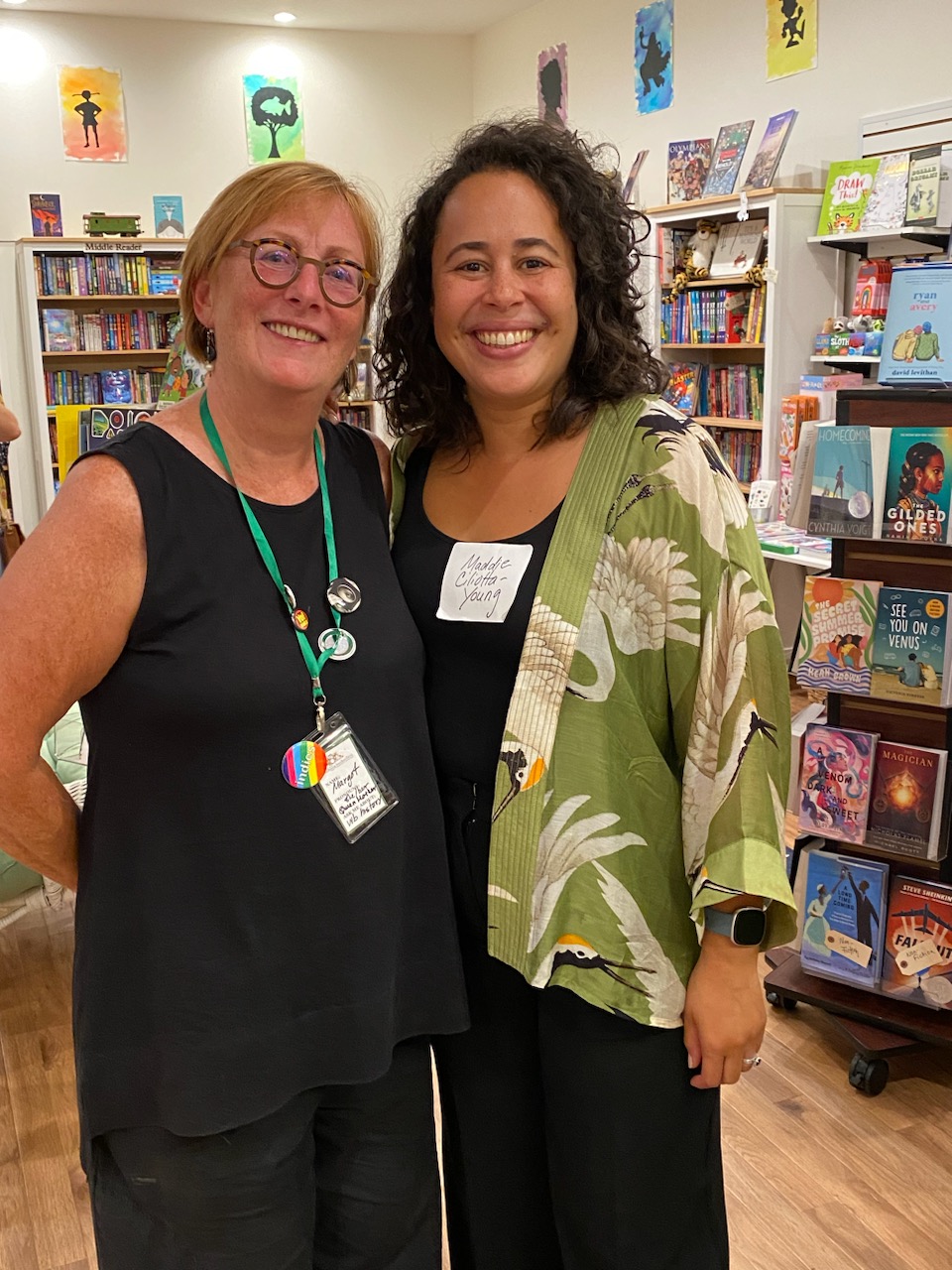
Margot Sage-EL and Maddie Ciliotta-Young
Yesterday in its newsletter to customers, owner Maddie Ciliotta-Young wrote about the award. She has been owner since 2022, taking over from her mother, Margot Sage-EL, who bought the store in 1996 with a partner, then took full ownership in 2000. Sage-EL moved the store and expanded it, and in 2023, the Kid’s Room, a children’s branch was opened nearby.
Ciliotta-Young said in part, “This is a huge honor that we are so proud of and has kept a smile plastered on my face all week. Bookselling was not on the top of my list of careers when I was growing up. In fact, when my mom first transitioned from a Great Owl Books catalog to owning Watchung Booksellers, I stopped reading for a year in protest.
“Fast forward a few decades and I couldn’t imagine being anywhere else but right here with our amazing staff, customers, and literary community. This designation didn’t happen by chance and it’s truly humbling to get national recognition for what we do day in and day out. Behind every book club is a bookseller who’s dying to share their favorite backlist with you. Behind every podcast episode is a bookseller with a vision that the next conversation will be the reason a listener deepens their relationship with books. Behind each storytime is a bookseller who curates a space where babies and toddlers grow up surrounded by books and joy. Behind every bookfair is a bookseller who knows each school so intimately that we aim to change the literacy trajectory of even the most reluctant reader. Behind every event is a bookseller who has taken a chance on an author that we are so sure you will love too.
“We don’t do this for fame or glory–although this glory certainly feels good! We do this because we believe in books and we know you do too. We believe that books have the power to shape, change, and connect communities. We know that gathering around literature, introducing our youngest community members books, and supporting writers only makes a community stronger. We’re grateful that you all trust us enough to join in while we set out to do just that. Thank you.”
— — — — —
The Watchung Booksellers website informs us that from May 2nd to 11th the Montclair Literary Festival is underway, and includes a link to the program.
The name Watchung is the Lenni Lenape word for “high hills”. The Watchung Mountains (more high hills than mountains I guess) are located in northern New Jersey, about twenty miles from Montclair. The Borough of Watchung’s website includes a short history.


 Margot Sage-EL and Maddie Ciliotta-Young