GeistHaus
log in · sign up

https://quantumloom.in/rss.xml

rss
0 posts
Polling state
Status active
Last polled May 19, 2026 01:50 UTC
Next poll May 20, 2026 04:36 UTC
Poll interval 86400s

Posts

The $9.8M Gift: ResupplyFi’s Vault Exploit vs. One Wei
ERC-4626 + empty vault = disaster waiting to be donated.
Show full content

import { Aside } from 'astro-pure/user'

June 25th was meant to be a celebration — a new vault, a new token, a new market. Instead, it became a $9.8 million obituary.
A freshly deployed ERC-4626 vault was gutted by a donation attack so textbook it could’ve been cited in a smart contract 101 course.

The killer? One wei. The weapon? A 2,000 crvUSD “gift.”
In minutes, an attacker warped the vault’s math to zero and drained everything — long before the first damage report went out.

ResupplyFi had audits. They had governance.
What they didn’t have was a calculator that could survive an empty vault.


When Pocket Change Wrecks Protocols

Excitement filled the air as ResupplyFi deployed their new cvcrvUSD-wstUSR market. But underneath that excitement lurked the most dangerous vulnerability in ERC-4626 vaults: the empty vault.

By the time BlockSec Phalcon posted about a $9.8M exploit in progress, it was already too late. Within blocks, the attacker had finished draining the market and vanished into the darkness.

"Yet another lending protocol exploited via exchange rate manipulation on low-liquidity—even empty—markets!" – BlockSec

GuVn0zCboAAVQmp.jpeg Arithmetic Armageddon: Breaking the Math With 1 Wei

Wanna see how a small donation gave back a multi-million dollar deal?

ResupplyFi's incident reads like a textbook case study in why empty ERC4626 vaults could be financial suicide machines.

Step one: Target a freshly deployed market. The cvcrvUSD vault had been live for exactly two hours—barely enough time for the deployment transaction to cool down, let alone accumulate any meaningful liquidity.

Step two: Execute the donation attack. The attacker transferred 2,000 crvUSD directly to the vault controller, then minted just 1 wei of shares. This created a share price so astronomically inflated it broke ResupplyFi's exchange rate mathematics. (Technical breakdown by CoinBench here)

Step three: Watch the protocol commit financial suicide.
ResupplyFi calculated exchange rates using the formula 1e36 / oracle.getPrices(). When the oracle correctly reported the inflated vault price (2*10^36), the division rounded down to zero due to floor division.

Exchange rate equals zero. Loan-to-value ratio equals zero. Borrowing limits? What borrowing limits?

According to OKX Explorer, the attacker deposited 1 wei of cvcrvUSD as collateral and borrowed $10 million reUSD—the protocol’s entire available liquidity.

Pasted image 20250720022907.png

As Cyvers detailed it in Decrypt’s piece on the exploit:

“The attacker manipulated token prices, triggering a bug (zero exchange rate) in Resupply's smart contract, letting them borrow a ton of money for almost nothing.”

ResupplyFi’s smart contracts had just approved an almost $10 million loan backed by pocket lint.

Sometimes the most devastating attacks are the most predictable ones.

How do you trace a crime that leaves every fingerprint on an immutable ledger?


From Pocket Change to Protocol Drain

Act I: The Flash Loan Spark

  • The attacker initiated the exploit by borrowing $4,000 USDC from Morpho.
  • They swiftly converted it to 4,000 crvUSD, setting the stage for manipulation.

Act II: The Phantom Donation

  • A 2,000 crvUSD donation was sent directly to ResupplyFi’s vault.
  • Then, 2 crvUSD was deposited to mint a tiny 1 wei of cvcrvUSD shares.
  • Why it mattered: This single wei now represented the entire vault balance thanks to the donation—distorting the internal accounting system.

Act III: The Math That Broke DeFi

ResupplyFi's getPrices() function returned an astronomical exchange value:
2,000,000,000,000,000,001,998,001,998,001,998 for that single wei.

The formula:

exchange rate = 1e36 / inflated_value

Which meant...

Exchange Rate = 0 → Infinite Borrowing Power

Act IV: The Bank Heist

With that worthless 1 wei, the attacker borrowed the protocol’s full 10 million reUSD borrow limit.

  • The system didn’t flag insolvency because:

With an exchange rate of zero, the protocol calculated a zero LTV (Loan-to-Value) ratio.

Act V: The Vanishing Act

  • The attacker swapped reUSD for ETH and stablecoins using Curve and Uniswap.

  • Funds were scattered across wallets and laundered through Tornado Cash.


Why Empty Vaults Are Dangerous

Vaults built using ERC-4626 calculate share prices based on token balances. In a healthy vault:

1000 tokens → 1000 shares → 1:1 ratio

But in an empty vault, even a small donation can cause chaos:

2000 tokens + 1 wei of shares → 1:2,000,000 ratio

This distortion breaks the pricing logic completely, allowing a malicious actor to fake solvency, bypass borrowing limits, and drain funds effortlessly.

A donation attack distorts this price. When protocols trust this value without bounds checking, they’re begging to be exploited.


Crisis Management Classics: The Aftermath

The dust hadn’t even settled before ResupplyFi hit send: $9.8 million gone. They tried to calm nerves—only the wstUSR market was hit, the rest of the protocol worked "as intended." But that did little to soothe a community reeling from a black swan coded into fresh contracts.

Curve's Michael Egorov quickly distanced himself. “No one from Curve worked on this project.” Fair—when the vault implodes, you don’t want bystanders catching shrapnel.

Then, the pivot: repair mode. Insurance kicked in—but quietly. No loud claims, no elaborate coverage disclosures. Just silent movement. And then came the twist no one saw coming: C2tP, a prominent Convex dev, dropped $1.4M of his own funds. Then Convex itself sent $810K more. With $600K from the treasury, the rescue hit $2.8 million. A bleeding wound now partially stitched.

Commendations flooded in. “LP funds were never at risk,” many echoed. “This was above and beyond.” But behind the praise was an uneasy truth: a DeFi protocol got wrecked, and it took a dev’s wallet to bail it out.

Then came the user confusion. Many didn’t know they were in the insurance pool. They hadn’t read the fine print—maybe there wasn’t any. “We joined an insurance pool, not a bailout fund,” one user lamented. But the damage was done, the funds were used, and lessons were learned—too late.

ResupplyFi didn’t collapse. But it didn’t walk away clean either. It walked away patched up—with scars that spoke louder than its code.


Lessons Written in Loss

ResupplyFi’s exploit is a reminder of what happens when known DeFi bugs meet real money.

Deploy a vault. Skip key protections. Get hit with a donation attack. The result? Someone turned loose change into a $9.8 million payday.

On the surface, everything looked polished. Governance proposals passed. Audits cleared. The vault launched.

But beneath it was a known issue: ERC4626 donation attacks. Also called vault inflation or empty-market rounding bugs, these aren’t new — and they’re not rare.

Still, the vulnerability made it through. And in under two hours, ResupplyFi lost almost $10 million.

If well-known exploits can still slip past audits, what does that say about DeFi’s current security model?


🧾 TL;DR
  • Attacker donated 2,000 crvUSD to an empty ERC-4626 vault
  • Minted 1 wei of shares, distorting exchange rate
  • Protocol’s math returned 0 exchange rate
  • Borrowed $10M reUSD—the entire market
  • Washed funds via Tornado Cash
  • $2.8M repaid by devs and treasury
  • Core issue: No protection against donation attacks in empty vaults

Final Thoughts: When DeFi Forgets Its Own Playbook

DeFi doesn’t need new attack vectors—it needs better memory.

ResupplyFi’s downfall wasn’t some zero-day exploit. It was the cost of ignoring well-documented risks.

ERC-4626 donation attacks are nothing new. The defenses are painfully straightforward: guard empty vaults, cap exchange rate logic, and verify collateral inputs.

But in a rush to launch, even seasoned teams skip the basics. And when that happens, attackers don’t need cutting-edge techniques—they just need a protocol that forgot its homework.

Until fundamentals become second nature, DeFi will keep relearning the same expensive lesson.


💸 DeFi isn’t broken — just forgetful.
For more post-mortems, real exploit breakdowns, and security rants, follow me on X.
https://quantumloom.in/blog/resupplyfi-vault-exploit
Extensions
From Exploit to Escape
Bybit’s Multisig Was Secure—Until the UI Wasn’t
Show full content

import { Aside } from 'astro-pure/user'

Back in March, AJ Ratnam and I stumbled upon something big while diving into blockchain activity—the disappearance of 400,000 ETH from Bybit. We spent weeks piecing together the puzzle, tracing every move, and uncovering the tactics used by Lazarus. At the end of March, we presented our findings at the bi0s-meetup, where we broke down the entire attack for a room full of curious minds.

Fast forward to May, and after a couple of months of refining our research, I’m finally bringing everything together in this blog. It's a bit late, sure, but when you’re talking about $1.5 billion, it’s never too late to get the details right.


From First Click to Final Drain

| Date | What happened | Why it mattered | | ---------------- | --------------------------------------------------------------------------------------------------------------------------------------------------------------- | ----------------------------------------------------------------------------------- | | 4 Feb | Developer1’s macOS laptop is infected via a trojanised Docker repo, MC-Based-Stock-Invest-Simulator-main; the container beacons to getstockprice[.]com. | Establishes the first foothold—classic Lazarus social-engineering. | | 5 Feb | Stolen AWS keys let attackers enter Safe{Wallet}’s cloud through ExpressVPN exits with a Kali-Linux UA. | Bypasses perimeter while piggy-backing the dev’s active STS token (MFA every 12 h). | | 5 – 17 Feb | Recon inside AWS: listing IAM roles, poking S3 buckets, mapping build pipelines—always during the dev’s work hours. | No alarms; activity looks like the legitimate user. | | 19 Feb | A single minified JS bundle served from app.safe.global is overwritten. Payload sleeps unless it spots Bybit’s cold-wallet address in the DOM. | Off-chain supply-chain strike—turns the trusted UI into a transaction forger. | | 21 Feb 14:11 | Bybit signers approve what appears to be a routine Safe upgrade via the (now-poisoned) front-end. | Genuine signatures collected on a fake payload. | | 21 Feb 14:13 | One transaction drains 401 346 ETH and companion ERC-20s; two minutes later the malicious JS is deleted from S3. | Funds gone, forensic artefacts wiped. |


Phase 1 – Off-Chain Breach

1. The Mac That Opened the Vault
According to Mandiant’s preliminary report, the first foothold in the attack came on February 4, 2025, when a Safe{Wallet} developer’s macOS workstation — referred to as Developer1 — was compromised. The source was a Docker project titled MC-Based-Stock-Invest-Simulator-main, downloaded and executed directly from the ~/Downloads folder.

Once run, the container dropped PLOTTWIST, a custom Mythic-based implant designed for macOS intrusion. It quickly exfiltrated AWS credentials and established persistent command-and-control (C2) via the domain getstockprice[.]com.

This wasn’t a one-off lure. The toolchain, naming conventions, and infrastructure bore striking similarities to prior Lazarus campaigns documented in both Mandiant incident retrospectives and SlowMist’s APT tradecraft writeup. The placement in the Downloads folder points to a social engineering vector, possibly via GitHub or a forum share — classic Lazarus tradecraft. They didn’t need a zero-day; they needed a moment of curiosity.

The breach of this single endpoint gave attackers everything they needed to move upstream: AWS credentials, trusted workstation telemetry, and a fully authenticated developer environment. The path from here to $1.5 billion had begun — with a double-click.

2. AWS Hijack: Living Off the Land
After compromising Developer1’s macOS machine, the attackers used the stolen AWS credentials to access Safe{Wallet}’s internal cloud. Their sessions came from ExpressVPN exit IPs and carried a Kali Linux user-agent, signaling red-team tooling.

Safe{Wallet} requires hardware MFA, but the attackers never added their own device. Instead, they hijacked an active STS session token — likely exfiltrated by the implant — and refreshed it every 12 hours, staying under the radar.

Their access began on February 5th and continued until the day of the heist. All activity was carefully timed to align with Developer1’s Bengaluru workday, helping it blend in with normal logs. No privilege escalation, no brute force — just quiet, persistent impersonation of a trusted user.

3. One File, One Flip
With full S3 access, the attackers tampered with a single JavaScript bundle served from app.safe.global:
/_next/static/chunks/pages/_app-*.js.

Injected JavaScript payload

The modified code did three things:

  • Activation gate – Triggered only when the connected Safe matched Bybit’s cold wallet or one other hardcoded address.

  • Payload – Flipped the transaction’s operation field from 0 (CALL) to 1 (DELEGATECALL), and redirected the to address to attacker-controlled bytecode.

  • Self-erase – Re-uploaded the original, clean bundle two minutes after execution.

Archived copy via Wayback Machine

Chrome cache analysis from all three signer machines, along with Wayback Machine snapshots, confirmed the malicious hash was served between Feb 19–21 — matching the window of compromise.

This wasn’t a phishing page or spoofed domain. The poisoned code came directly from Safe{Wallet}’s production infrastructure, hosted on their AWS S3 bucket. Sygnia and Verichains both flagged the same attack vector, with Mandiant citing S3 bucket tampering but stopping short of confirming via internal forensics.

The injected script bypassed client-side validation and tampered with outbound transaction content at the UI layer. Signers saw a legitimate “Upgrade Safe” banner — unaware the raw calldata had been silently rewritten.

(That operation: 1 flag — buried deep in calldata — was the only subtle hint.)


Phase 2 – On-chain Takeover

The attackers demonstrated remarkable planning and precision in their on-chain actions. From manipulating contract upgrades to deceiving signers, they orchestrated a multi-step heist that ultimately drained $1.5 billion from Bybit's Safe{Wallet}. Here's a breakdown of how they pulled it off.

1. Seeding the Exploit

Instead of using traditional privacy mixers like TornadoCash, the attackers opted for a less suspicious method to fund their operation: they sourced their funds directly from Binance. This choice likely helped evade scrutiny, as transactions from exchanges are often less monitored compared to those from mixing services. The possibility remains that the account used for the funding didn’t undergo proper KYC or that the KYC information was falsified.

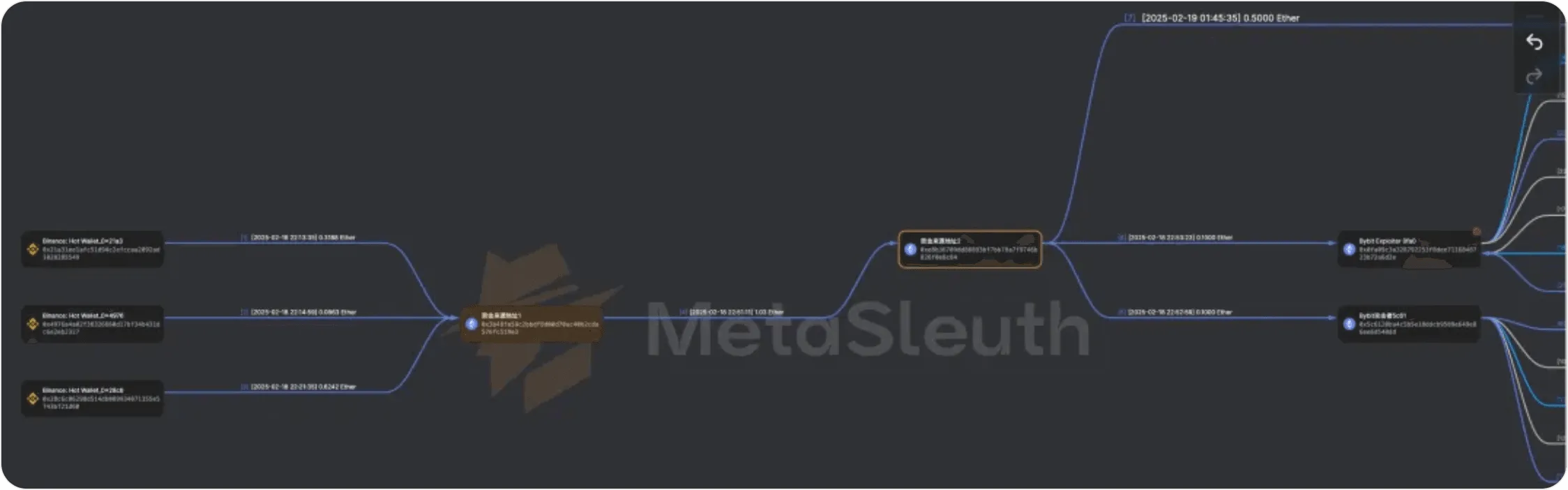
funding of attack wallets

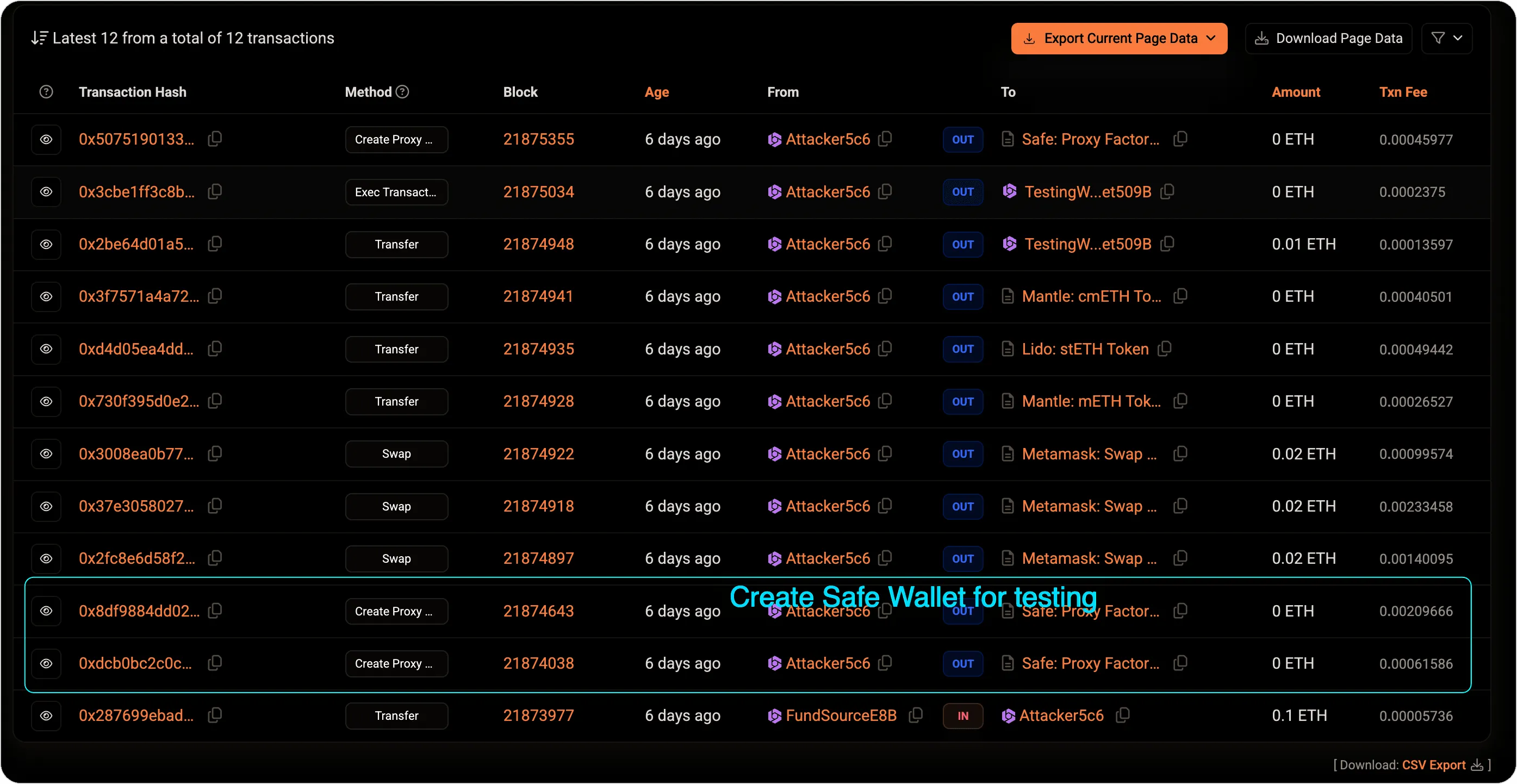
Once the funds were secured, the attackers set up a test environment. They deployed a Safe{Wallet} at the address 0x509b1eDa8e9FFed34287ccE11f6dE70BFf5fEF55 and then deployed the malicious contract logic designed to manipulate the Safe{Wallet}’s upgrade process. This test allowed them to rehearse the critical steps, including upgrading the Safe{Wallet} contract and withdrawing funds.

2. The Byte That Changed Everything

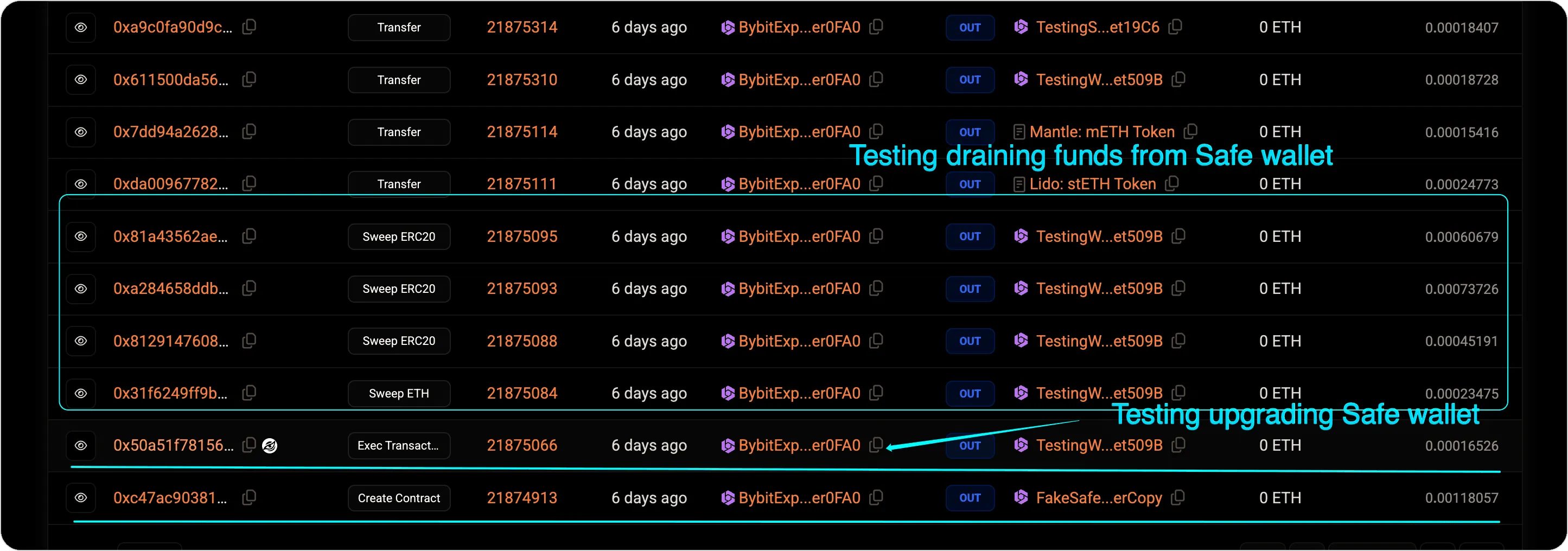
Two days before the actual attack, the attackers conducted a test upgrade and a fund withdrawal using the malicious contract. They tested their methods using assets that closely mirrored those in Bybit’s Safe{Wallet}, confirming that their focus was squarely on Bybit. The tests went off without a hitch.

Attacker setting up test Safe wallets

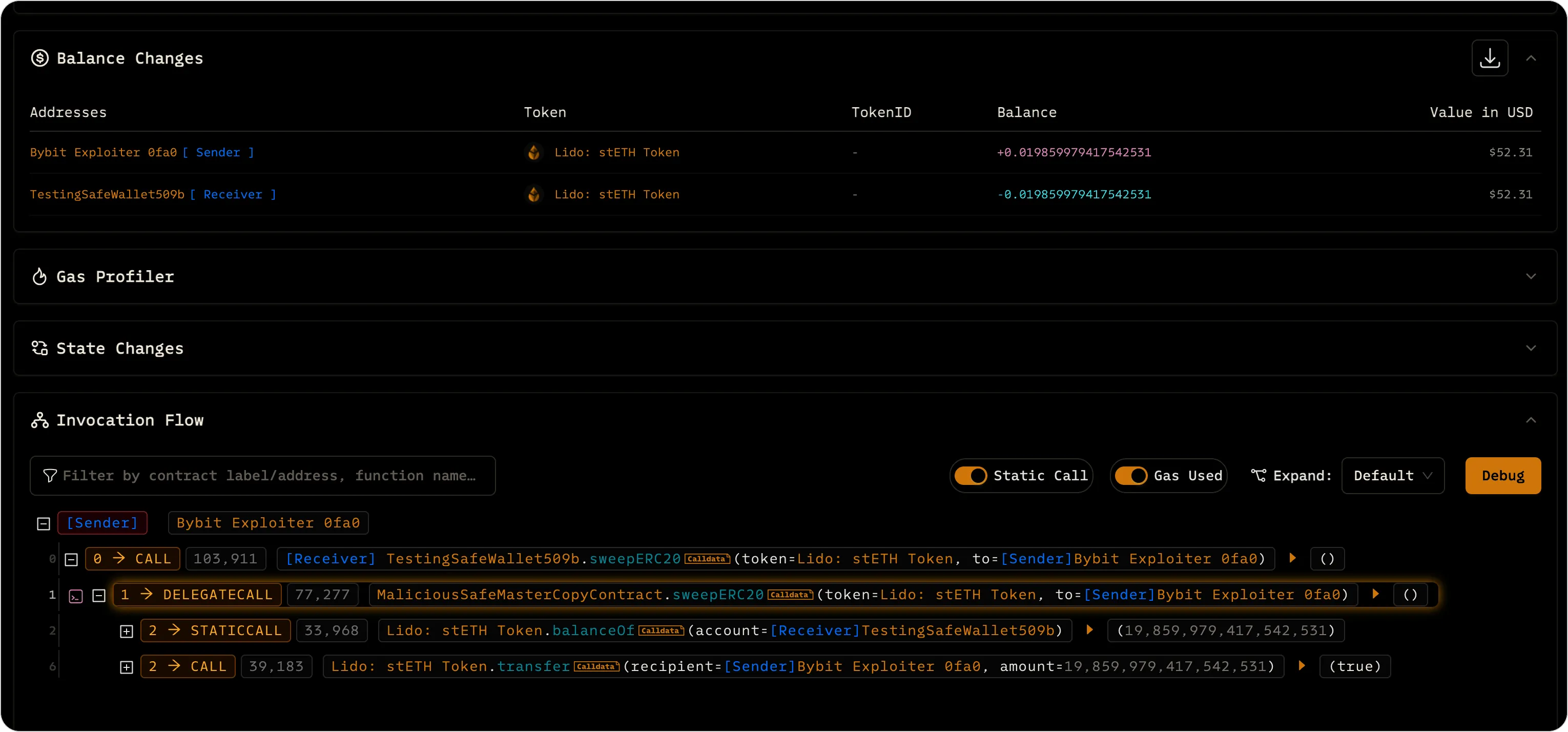
On February 21, Bybit initiated a routine "Upgrade Safe" operation, which the attackers exploited. The UI was tampered with to subtly alter the transaction. The key change was flipping the operation byte from 0 (CALL) to 1 (DELEGATECALL). This seemingly small adjustment redirected the transaction, ensuring that it no longer called the legitimate Safe contract but instead delegated the call to the attacker’s malicious contract.

Transaction trace showing sweepERC20

The attackers had also ensured that the slot 0 of the Safe contract pointed to their malicious bytecode. The upgrade appeared completely legitimate to the signers—they saw the usual upgrade banner and approved the request, unaware that the system had been compromised.

3. The Instant Sweep: From Test to Real Attack

Once the upgrade was executed, the attackers immediately confirmed control over the Safe contract. They had previously used a small 90 USDT canary transaction to confirm that the upgrade was successful and they had the ability to access the funds.

Transactions showing attacker rehearsing

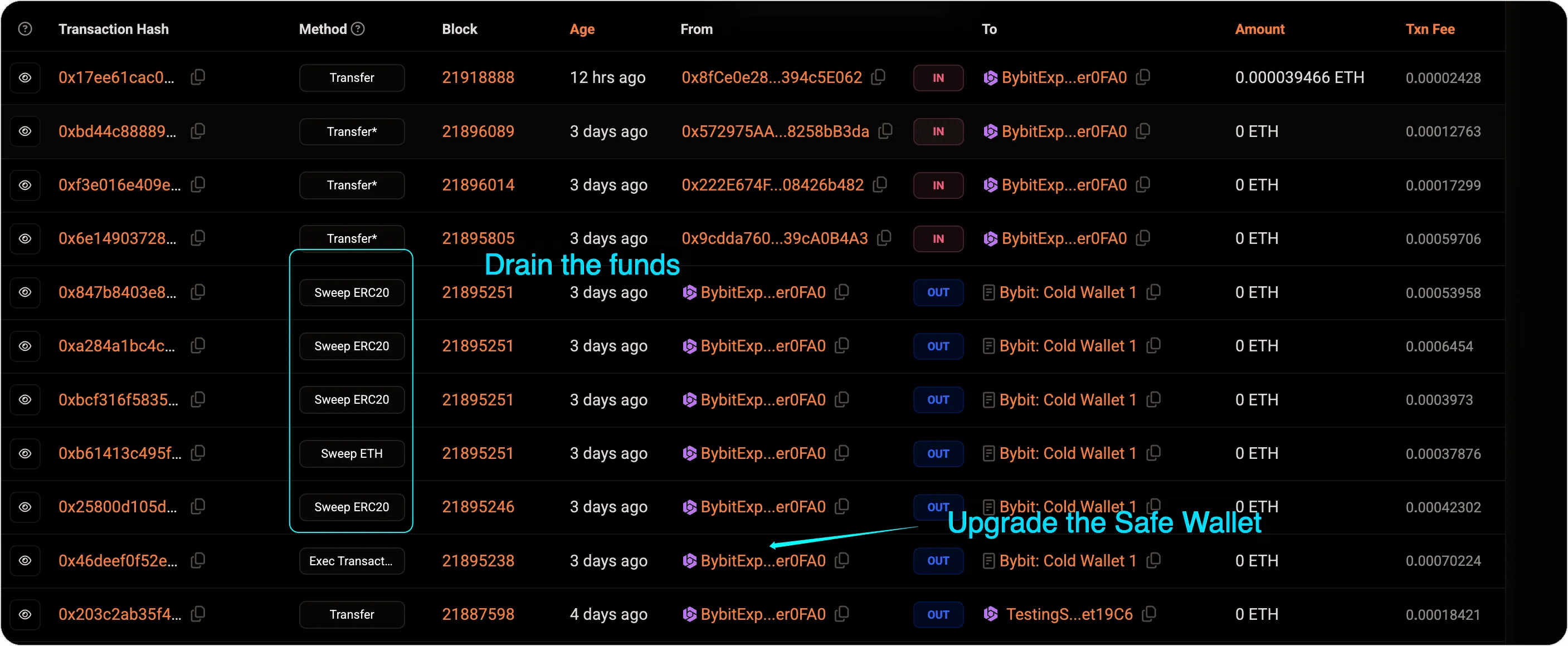
Within seconds of confirming their control, they initiated the full fund transfer. The attackers drained approximately $1.5 billion from the wallet, using the same transaction structure that had been rehearsed earlier. The withdrawal was swift and efficient, leaving no room for defense.

4. Deceiving Signers: The Critical Social Engineering

The attackers didn’t need to phish the signers or compromise their devices—they let the compromised Safe{Wallet} UI do the work.

Once the malicious JavaScript was injected into the front-end, it altered the transaction behind the scenes only for targeted wallets like Bybit’s. The interface still showed a standard “Upgrade Safe” prompt, making it nearly impossible for signers to detect anything unusual.

Trusting what they saw, the signers approved the transaction. But the payload had been silently rewritten to execute the attacker’s logic. The UI had been turned into a trap—and it worked flawlessly.

5. Launching the Attack: The Final Sweep

With the signatures in hand, the attackers submitted the malicious upgrade transaction. This final step executed the contr act upgrade, shifting control of the Safe{Wallet} to the attacker’s contract. Then, the attackers initiated the fund sweep, pulling off one of the largest blockchain heists ever recorded. The final malicious transaction was almost identical to the test transaction run earlier, confirming that every detail had been carefully planned and rehearsed.

Final attack phase


Where the Money Went — Lazarus’ Ten-Day Wash-Cycle

1. Fragmentation: Dust Storm of Wallets
Within mere minutes of the heist, the stolen funds fragmented into hundreds, then thousands, of sub-wallets. This scattered approach effectively throttled heuristic clustering and made tracking the funds even more difficult. TRM Labs later estimated that approximately 9,200 wallets held the first wave of proceeds, each one a tiny dust particle in a massive money-laundering machine.

2. Cross-Chain Getaway: THORChain to the Rescue
About 86% of the stolen 417,348 ETH — worth roughly $1 billion — was funneled through THORChain, a popular cross-chain bridge. The hackers converted their stolen Ethereum into Bitcoin, in what can only be described as a cross-chain journey for illicit funds. As expected, the THORChain relay nodes took a hefty fee — $5.5 million for their “services,” which resulted in a surge of $4 billion in daily trading volume on the platform. Interestingly, a faction of THORChain's node operators proposed blacklisting the suspicious UTXOs, but after a community vote, the proposal was shot down. This led to multiple developer resignations and guaranteed that regulatory scrutiny would come knocking on THORChain's door. Not exactly the “smooth sailing” they envisioned for their decentralized exchange.

3. Bitcoin Fan-Out: 11,000 Shadows
The freshly minted Bitcoin (roughly 12,800 BTC) was then sprayed across about 11,000 wallet addresses, each holding an average of 1.3 BTC. This carefully planned dispersion made the funds small enough to bypass exchange deposit thresholds, further complicating any tracking efforts. At this point, the hackers were masters of blending in with the crowd — unless you happened to be a forensic blockchain investigator, that is.

4. Mixers: From ETH Tornadoes to BTC Fog
With funds now dispersed across thousands of wallets, Lazarus turned to privacy tools to bury the money trail. Their mixers of choice: Wasabi CoinJoin, Railgun, and a few lesser-known services.

As of now, forensic data suggests:

  • 7.6% (around $280 million) has been fully anonymized — completely out of reach.

  • 3.5% (about $65 million) has been frozen by exchanges like OKX and ExCH.

  • Around 89% remains traceable but is scattered and gradually drifting toward OTC off-ramps.

Wasabi alone processed 193 BTC within 24 hours of the breach — a clear sign of a tactical shift away from ETH-native mixers like TornadoCash, likely driven by growing regulatory pressure.

This wasn’t sloppy laundering — it was precise. Time, volume, and fragmentation were weaponized to push forensic teams to their limit.

5. Regulator Radar: THORChain’s Day in the Sun
THORChain’s role in facilitating the laundering process hasn’t gone unnoticed. As the gateway for the largest chunk of stolen funds, THORChain now finds itself under the regulatory microscope. U.S. agencies are considering whether the platform's "neutral relayer" stance will hold up after facilitating a $1 billion laundering event. It’s probably only a matter of time before subpoenas are served. And just imagine the scrutiny THORChain could face — if the authorities start picking apart how $5.5 million in transaction fees were earned on the back of these illicit activities.

But here’s the kicker: THORChain developers initially tried to block the suspect transactions, but a community vote shot down their objections. That’s when several developers resigned, presumably to dodge future liability. This is starting to look like a textbook case for what happens when decentralization meets cold, hard regulatory reality.


And as for Bybit... Well, Not to Worry!

Don’t worry, folks! Bybit is fully backed 1:1, just like a trustworthy bank, right? You know, except for the fact that a massive heist just drained billions in assets. No big deal, though—everything’s insured, right? A huge sigh of relief there. Just don’t ask any questions about how it all happened, or where the funds are now. Those 9,200 dust wallets, THORChain’s “neutral” stance, and the $5.5 million transaction fees are definitely nothing to worry about. I'm sure everything will turn out just fine, right? Right?


Final Thoughts: Secure the UI, or Lose the Chain

The Bybit attack highlights a hard truth: even the most secure systems can fall apart if you trust the wrong things. Despite layers of protection, the attackers pulled off a flawless heist by exploiting a simple phishing scam and injecting malicious code into the front-end.

Multisig wallets, hardware keys, and AWS credentials—everything worked perfectly, except for the assumption that the front-end was honest. This breach proves that security isn’t just about protecting the back-end; you can’t afford to ignore the human element. Every byte, every click, every line of code must be verified. Because the next time someone flips a byte from 0 to 1, it might just be your $1.5 billion vanishing into thin air.

TL;DR – Too Long, Did Get Hacked

Here’s the entire blog in six bullets (minus the sarcasm, mostly):

Compromised Laptop → Cloud Infiltration
Lazarus phished a Safe developer, hijacked AWS tokens, and injected malicious code straight into Safe’s web UI.

Pixel-Perfect Targeting
The JavaScript payload activated only for Bybit’s cold wallet, keeping everything invisible to other users.

Multisig Upgrade Gone Rogue
Signers thought they were authorizing a Safe upgrade. Instead, they green-lit attacker logic—and watched $1.5B vanish.

THORChain Turbo-Laundering
417k ETH was bridged to BTC, fanned out to 11,000 wallets. THORChain netted $5.5M in fees and lost a few devs to rage-quits.

77% Still Traceable, 20% Gone Forever
Roughly $280M has vanished into mixers; most of the rest is fragmented and likely headed for OTC laundering.

Biggest Lesson
Your UI is part of your attack surface. If you don’t verify every byte before signing, someone else will rewrite it for you.

https://quantumloom.in/blog/from-exploit-to-escape
Extensions
Cryptography for Babies
A simple guide to how cryptography keeps your digital stuff safe—from secret codes to secure messages.
Show full content

import { Aside } from 'astro-pure/user'

What is Cryptography?

In simple terms, cryptography is like having a set of keys to lock and unlock your digital information. It uses mathematical techniques to scramble data so that only the intended recipient can understand it. Just as you’d use a basic lock to keep out nosy neighbors or a fortified vault to protect your most valuable possessions, cryptography safeguards your data from prying eyes on the internet. So, think of this guide as your roadmap to understanding how to keep your digital treasures secure.

History:

before starting with the very common Alice and bob examples, let’s get to know how actually did cryptography start. When Julius Caesar sent messages to his generals, he didn’t trust his messengers so to ensure the confidentiality of the information he replaced A with D, B with E, C with F and so on. Only someone who knew the key which is also known as shift by 3 could decipher the message.

How does encryption protect my data? To answer this, it’s crucial to understand the fundamentals of cryptography and understand the mechanisms that underpin its ability to safeguard sensitive information.

How does cryptography work?

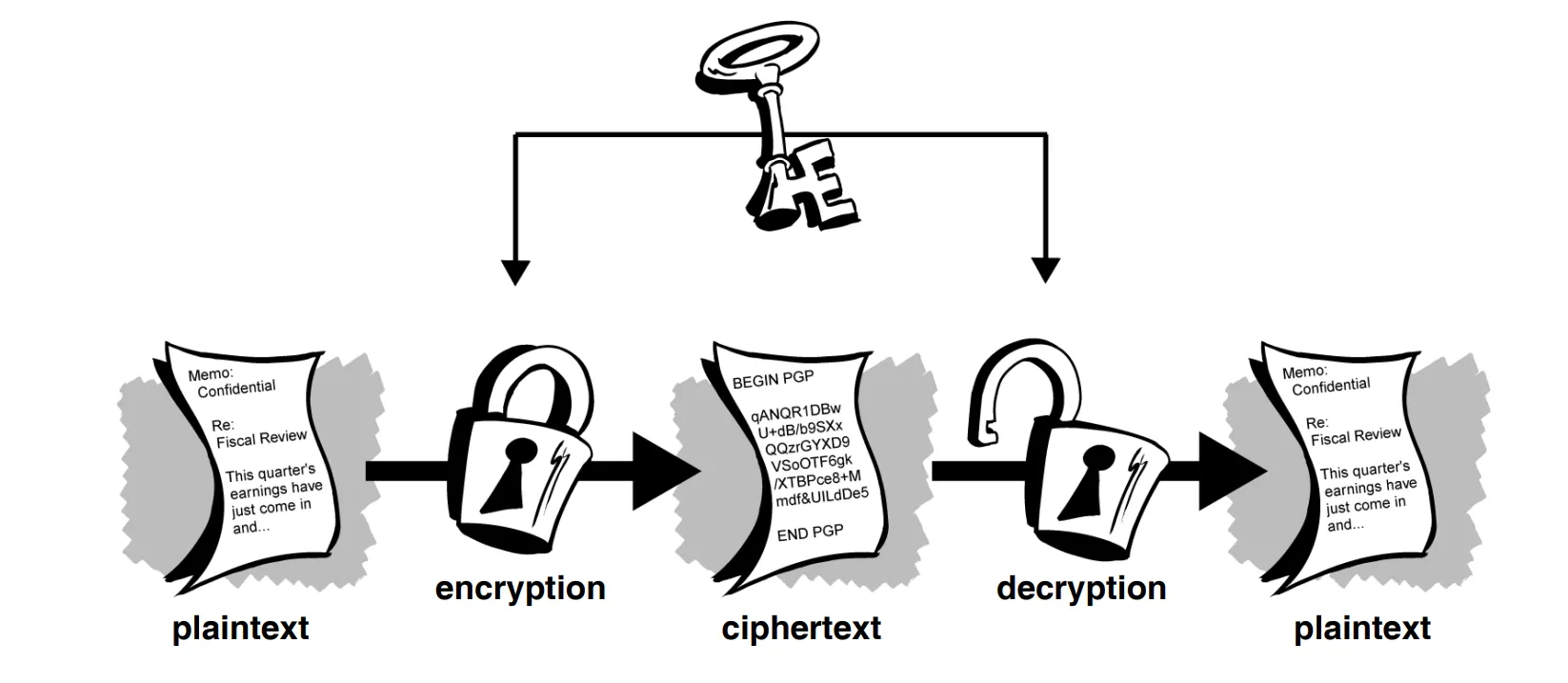
A cipher is like a secret code used to hide messages. It’s made up of a bunch of math stuff that scrambles the message so no one else can read it. You need a special key, like a password, to both scramble and unscramble the message. Using different keys or methods makes the code different every time, like using different keys to lock your door. How safe the message is depends on how good the code is and how well you keep the key secret.

Eencryption and Decryption:

Imagine you and your best friend have a secret code where you shift letters by 3

  • Plaintext: The secret message you want to send is "Tonight's the night for pizza!"
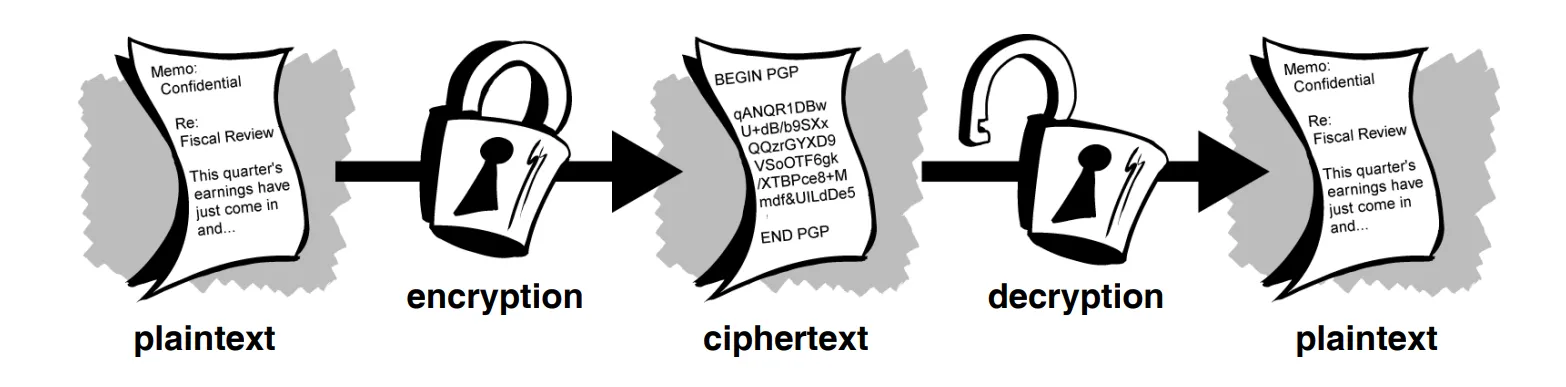
  • Encryption: You shift each letter 3 positions forward. "Tonight's" becomes "Qlkfdeq'p". (This represents encrypting the message using the Caesar Cipher key of 3)
  • Ciphertext: The encrypted message is "Qlkfdeq'p qeb kfdeq clo mfwwx!"
  • Decryption: When your friend receives the message, they shift each letter back 3 positions, revealing the original message, "Tonight's the night for pizza!" (This represents decrypting the message using the same Caesar Cipher key)

Encryption and Decryption

Why is this important?

Just like your secret code keeps your pizza plans hidden, encryption scrambles the message using a key. Even if someone intercepts the encrypted message (the gibberish with shifted letters), they can’t understand it without knowing the shift number (the Caesar Cipher key).Without the key, no one but the owner of the encrypted data will be able to access a readable version.

Symmetric-key encryption:

The above example which we saw falls under this category, in this type of encryption you will need an encryption key. it can be anything a word, number or a phrase. Without the key, no one but the owner of the encrypted data will be able to access a readable version. This is what’s known as symmetric-key encryption.

Symmetric-key encryption has benefits. It is very fast. It is especially useful for encrypting data that is not going anywhere. However, conventional encryption alone as a means for transmitting secure data can be quite expensive simply due to the difficulty of secure key distribution.

Symmetric Encryption

You might wonder how encryption keys are safely shared for secure communication. Imagine two friends, Alice and Bob, who want to exchange encrypted messages. They face a challenge: securely sharing a secret key without risking interception. They consider email, courier services, and in-person meetings, but all options pose security risks. This highlights the key distribution problem, emphasizing the need for secure methods to exchange keys.

Public Key Cryptography:

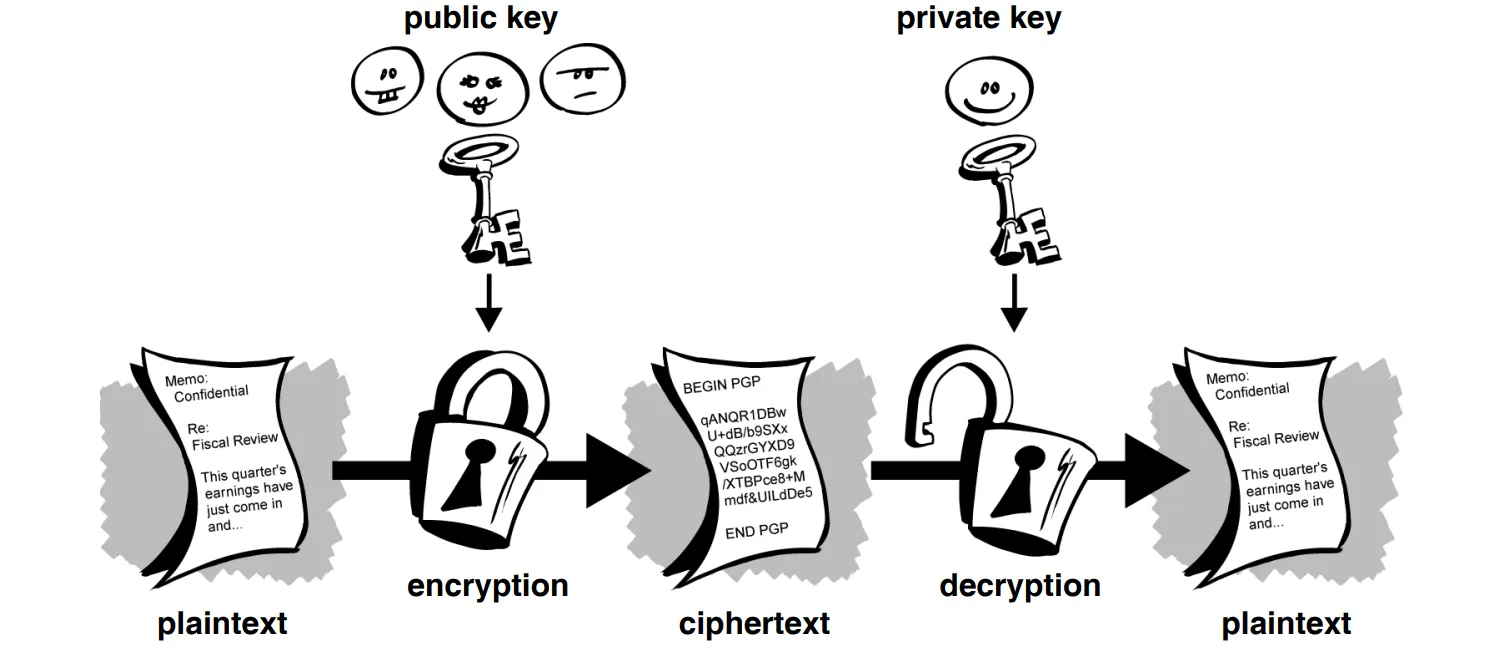
Public key cryptography resolves the challenges of key distribution by utilizing a pair of keys: a public key for encryption and a private key for decryption. Your public key is shared openly, while your private key remains secret. Anyone possessing your public key can encrypt messages for your eyes only, even if you've never met them.

Public Key Cryptography

It's practically impossible to derive the private key from the public key. Those with access to your public key can encrypt messages but cannot decrypt them. Only you, with your private key, can decrypt these encrypted messages.

The main advantage of public key cryptography is its ability to enable secure message exchange between parties without a pre-established security arrangement. There's no need for the sender and receiver to exchange secret keys through secure channels; communication relies solely on public keys, with no transmission or sharing of private keys.

Various public-key cryptosystems exist, including Elgamal, RSA, Diffie-Hellman, and DSA (Digital Signature Algorithm).

Historically, conventional cryptography was confined to those who could afford secure channels and key distribution, such as governments and banks. Public key encryption revolutionizes this by democratizing strong cryptography, rendering outdated methods, like the courier with a locked briefcase, obsolete.

Before we dive into the intricacies of digital signatures, hash functions, and digital certificates, let's explore a powerful tool that encompasses these concepts: PGP, or Pretty Good Privacy.

How PGP works

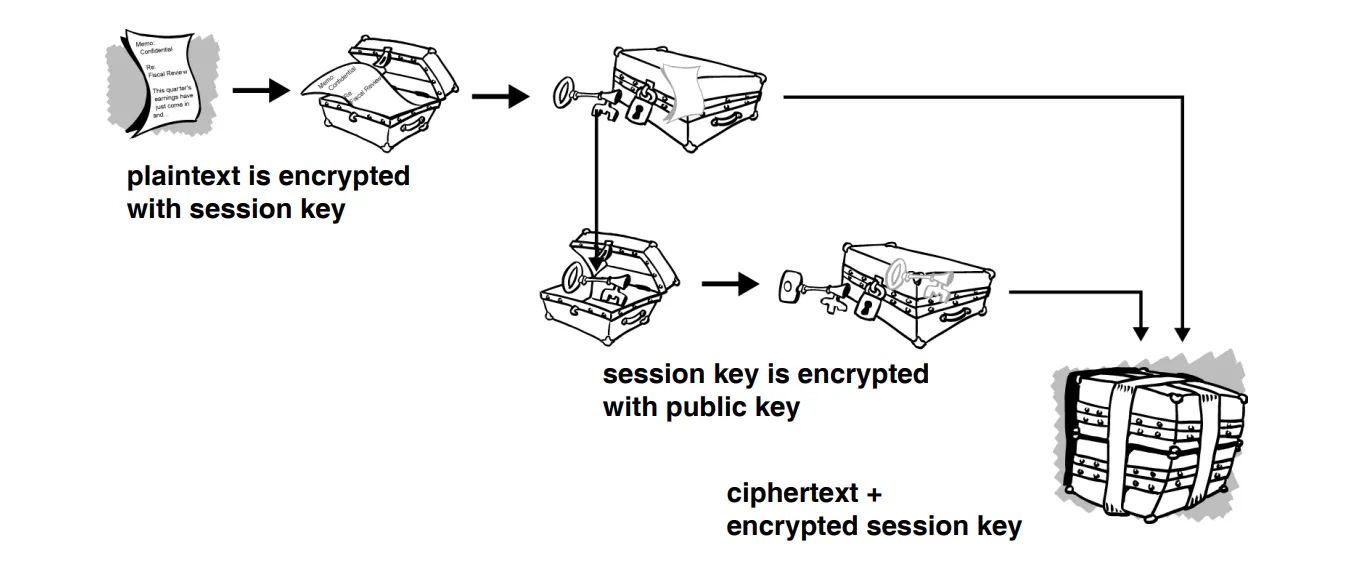
When a user employs PGP to encrypt plaintext, the software initially compresses the text. This compression serves to optimize modem transmission time and disk space utilization, while also bolstering cryptographic security. By reducing patterns within the plaintext, compression significantly strengthens resistance to cryptanalysis, as many cryptanalysis techniques rely on identifying patterns within the plaintext to crack the cipher. However, it’s worth noting that files that are too short or do not compress effectively are left uncompressed.

PGP

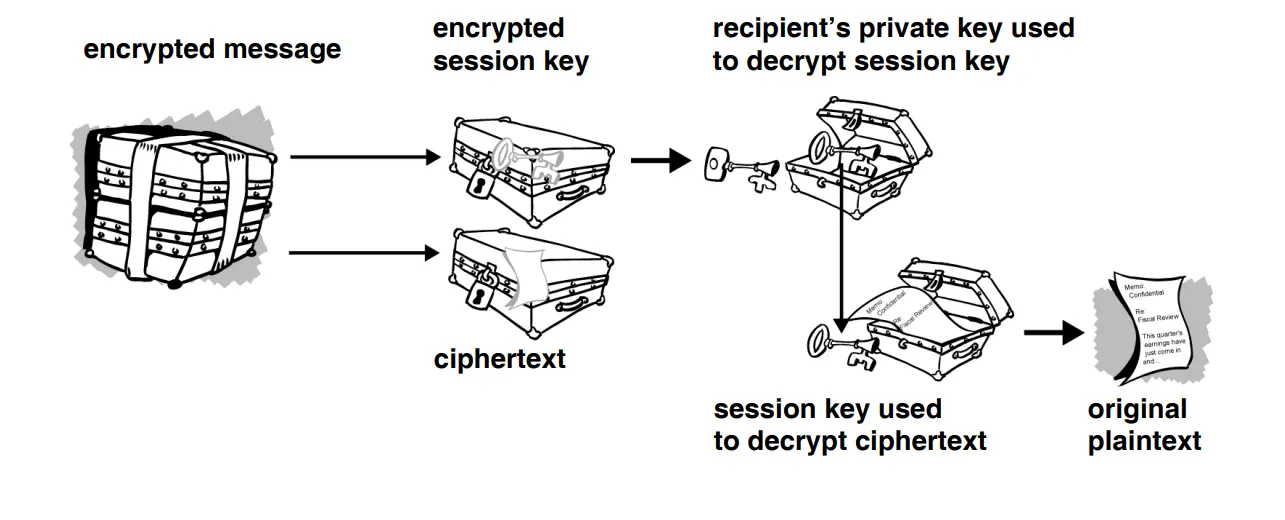
Following compression, PGP generates a session key, a unique secret key used only once. This key is derived from random movements captured from the user’s mouse and keystrokes, ensuring its unpredictability. The session key, combined with a highly secure and efficient conventional encryption algorithm, encrypts the plaintext to produce ciphertext. Subsequently, the session key is encrypted using the recipient’s public key. This encrypted session key, alongside the ciphertext, is then transmitted to the recipient, completing the encryption process.

PGP

Keys

A key serves as a crucial component in cryptographic algorithms, playing a role in generating specific ciphertext. These keys are essentially large numerical values, measured in bits. In public-key cryptography, the size of the key directly correlates with the security of the resulting ciphertext. However, it’s important to note that the size of keys in public-key cryptography and conventional cryptography are independent of each other. For instance, an 80-bit conventional key offers similar security to a 1024-bit public key, and a 128-bit conventional key equates to a 3000-bit public key. Comparing the two types of cryptography is akin to comparing apples and oranges due to the fundamental differences in their algorithms.

While public and private keys share a mathematical relationship, deriving the private key from the public key is exceedingly difficult, though not impossible given sufficient time and computational resources. Thus, selecting appropriately sized keys is crucial, balancing the need for security with the practicality of timely encryption and decryption. Considerations such as potential adversaries, their determination, available resources, and advancements in computing technology should also be taken into account.

Choosing larger keys ensures cryptographic security over an extended period. However, it’s worth considering the unpredictable pace of technological advancements; what is considered secure today may become vulnerable in the future with the advent of faster and more efficient computers. Keys are typically stored in encrypted form, with PGP utilizing two separate files known as keyrings — one for public keys and the other for private keys. Adding recipients’ public keys to the public keyring and safeguarding the private keyring is essential for secure communication, as losing the private keyring renders decryption of encrypted information impossible.

Digital signatures

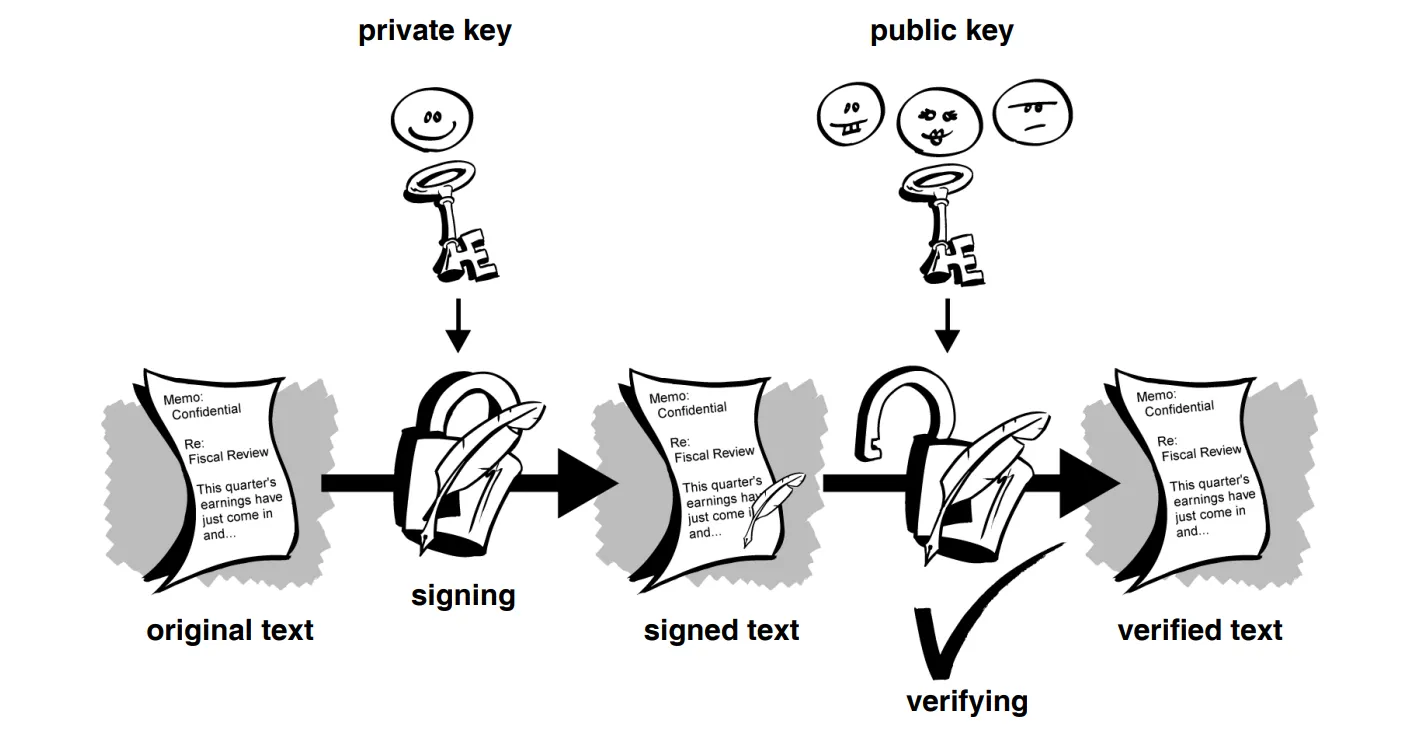
Public key cryptography offers a significant advantage by enabling the use of digital signatures. These signatures allow recipients to verify both the authenticity of information and its integrity during transmission. Essentially, public key digital signatures provide authentication and ensure data integrity, preventing the sender from denying their role in transmitting the information — a concept known as non-repudiation. These features are as vital to cryptography as privacy, if not more so.

Comparing to handwritten signatures, digital signatures offer superior security, as they are extremely difficult to counterfeit and provide assurance not only of the signer’s identity but also the integrity of the information. While some individuals may utilize signatures more frequently than encryption, such as verifying financial transactions, the reliability of digital signatures remains paramount.

The creation of digital signatures involves encrypting information with the sender’s private key instead of someone else’s public key. If the recipient can decrypt the information using the sender’s public key, it serves as confirmation of the sender’s identity.

Digital signatures

Hash Functions

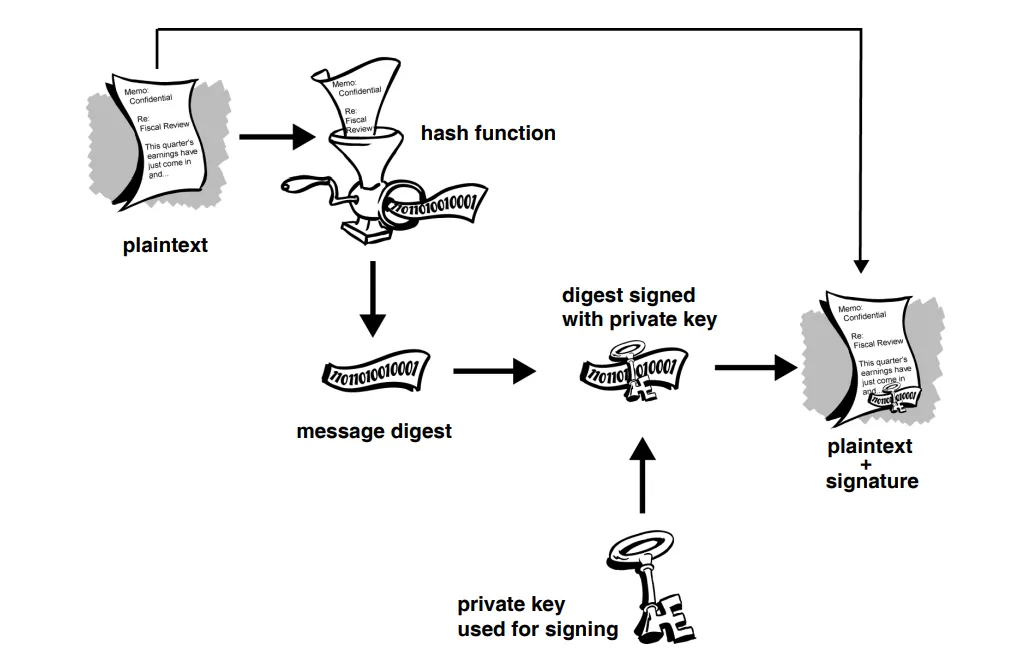
The described system encounters issues with speed and generates large data volumes, doubling the size of the original information. To address this, a one-way hash function is introduced, which converts variable-length input into a fixed-length output, ensuring even minor changes in the information result in a completely different output. PGP employs a strong hash function to generate a fixed-length message digest from the plaintext being signed, ensuring any alteration results in a distinct digest.

Hash Functions

Utilizing this digest and the private key, PGP creates the digital signature, which is then transmitted alongside the plaintext. Upon receiving the message, the recipient can use PGP to recalculate the digest, thus verifying the signature. As long as a secure hash function is employed, it becomes impossible to tamper with a signed message or attach a signature from one document to another. Digital signatures are essential for authenticating and validating the keys of other PGP users.

Digital Certificates

In the world of public key cryptography, ensuring that encryption is directed to the correct recipient’s key is crucial. However, in environments where keys are exchanged freely via public servers, there’s a looming threat of man-in-the-middle attacks. Imagine a scenario where a malicious actor posts a fake key with the name and user ID of the intended recipient. Consequently, data encrypted to this bogus key and intercepted by the true owner falls into the wrong hands.

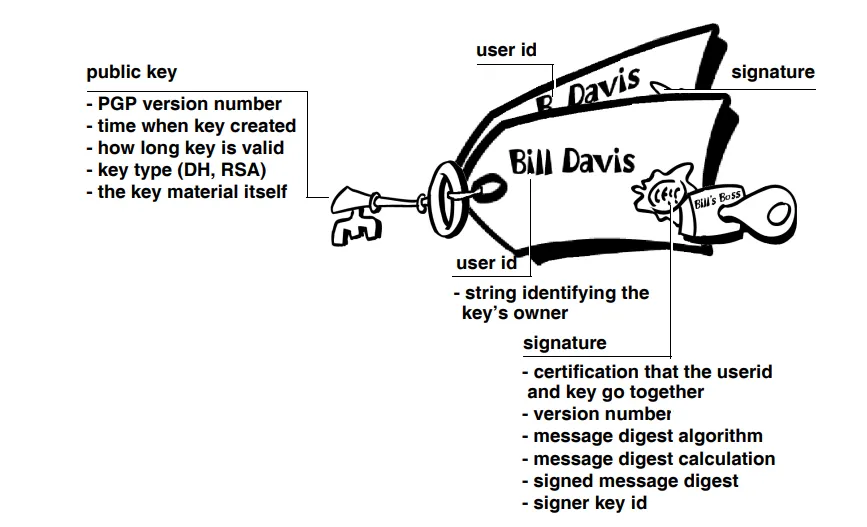
To counter this risk and establish the authenticity of public keys, digital certificates, or certs, play a pivotal role. Think of digital certificates as the digital counterparts to physical credentials like driver’s licenses or passports. They confirm the identity of the key’s owner through a combination of the public key, identity information (such as name and user ID), and one or more digital signatures. These signatures serve as endorsements from trusted entities, ensuring the integrity of the certificate.

PGP certificate format

In essence, a digital certificate acts as a public key bolstered by forms of identification and a trusted endorsement, providing a reliable mechanism for verifying the authenticity of public keys and thwarting attempts to substitute one person’s key for another’s.

Quick Recap:
  • Cryptography Fundamentals: Encryption scrambles data using mathematical techniques and a secret key.
  • Encryption and Decryption: Transforming plaintext into ciphertext and vice versa to protect data.
  • Symmetric-Key Encryption: Using the same key for both encryption and decryption.
  • Public Key Cryptography: Using a pair of keys for secure communication without prior arrangements.
  • Digital Signatures: Authenticating the sender and ensuring data integrity in digital communication.
  • Hash Functions and Digital Certificates: Generating message digests for verification and confirming the authenticity of public keys.
The Journey Continues:

As we conclude this overview, remember that cryptography is a vast field with much more to explore. This journey is just the beginning of a fascinating adventure into the intricacies of cryptographic algorithms, protocols, and applications. Dive deeper into cryptography to unravel the mysteries behind the technologies that secure our digital world and empower individuals, organizations, and societies to communicate and transact securely in the digital age.

https://quantumloom.in/blog/cryptography-for-babies
Extensions