As a warm-up to the subject of this blog post, consider the problem of how to classify  matrices
  up to change of basis in both the source (
 ) and the target (
 ). In other words, the problem is to describe the equivalence classes of the equivalence relation on matrices given by
 .
.
It turns out that the equivalence class of  is completely determined by its rank
  . To prove this we construct some bases by induction. For starters, let
  be a vector such that
  ; this is always possible unless
  . Next, let
  be a vector such that
  is linearly independent of
  ; this is always possible unless
  .
.
Continuing in this way, we construct vectors  such that the vectors
  are linearly independent, hence a basis of the column space of . Next, we complete the
  and
and  to bases of in whatever manner we like. With respect to these bases, takes a very simple form: we have
  if
if  and otherwise
  . Hence, in these bases, is a block matrix where the top left block is an
  identity matrix and the other blocks are zero.
Explicitly, this means we can write as a product

where  has the block form above, the columns of
  are the basis of we found by completing
  , and the columns of
  are the basis of we found by completing
  . This decomposition can be computed by row and column reduction on , where the row operations we perform give and the column operations we perform give .
Conceptually, the question we’ve asked is: what does a linear transformation  between vector spaces “look like,” when we don’t restrict ourselves to picking a particular basis of
  or
or  ? The answer, stated in a basis-independent form, is the following. First, we can factor
  as a composite

where  is the image of . Next, we can find direct sum decompositions
  and
and  such that
  is the projection of onto its first factor and
  is the inclusion of the first factor into . Hence every linear transformation “looks like” a composite

of a projection onto a direct summand and an inclusion of a direct summand. So the only basis-independent information contained in is the dimension of the image , or equivalently the rank of . (It’s worth considering the analogous question for functions between sets, whose answer is a bit more complicated.)
The actual problem this blog post is about is more interesting: it is to classify matrices up to orthogonal change of basis in both the source and the target. In other words, we now want to understand the equivalence classes of the equivalence relation given by
 .
.
Conceptually, we’re now asking: what does a linear transformation  between finite-dimensional Hilbert spaces “look like”?
Inventing singular value decomposition
As before, we’ll answer this question by picking bases with respect to which is as easy to understand as possible, only this time we need to deal with the additional restriction of choosing orthonormal bases. We will follow roughly the same inductive strategy as before. For starters, we would like to pick a unit vector  such that
  ; this is possible unless is identically zero, in which case there’s not much to say. Now, there’s no guarantee that
  will be a unit vector, but we can always use
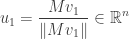
as the beginning of an orthonormal basis of . The question remains which of the many possible values of  to use. In the previous argument it didn’t matter because they were all related by change of coordinates, but now it very much does because the length
  may differ for different choices of . A natural choice is to pick so that is as large as possible (hence equal to the operator norm
  of ); writing
  , we then have
 .
.
 is called the first singular value of , is called its first right singular vector, and
  is called its first left singular vector. (The singular vectors aren’t unique in general, but we’ll ignore this for now.) To continue building orthonormal bases we need to find a unit vector

orthogonal to such that  is linearly independent of ; this is possible unless , in which case we’re already done and is completely describable as
  ; equivalently, in this case we have
 .
.
We’ll pick  using the same strategy as before: we want the value of such that
  is as large as possible. Note that since
  , this is equivalent to finding the value of such that
  is as large as possible. Call this largest possible value
  and write
 .
.
At this point we are in trouble unless  ; if this weren’t the case then our strategy would fail to actually build an orthonormal basis of . Very importantly, this turns out to be the case.
Key lemma #1: Suppose is a unit vector maximizing . Let  be a unit vector orthogonal to . Then
  is also orthogonal to .
Proof. Consider the function
 .
.
The vectors  are all unit vectors since
  are orthonormal, so by construction (of ) this function is maximized when
  . In particular, its derivative at is zero. On the other hand, we can expand
  out using dot products as
 .
.
Now we can compute the first-order Taylor series expansion of this function around , giving

so setting the first derivative equal to  gives
gives  as desired.
This is the technical heart of singular value decomposition, so it’s worth understanding in some detail. Michael Nielsen has a very nice interactive demo / explanation of this. Geometrically, the points  trace out an ellipse centered at the origin, and by hypothesis describes the semimajor axis of the ellipse: the point furthest away from the origin. As we move away from , to first order we are moving slightly in the direction of , and so if were not orthogonal to it would be possible to move slightly further away from the origin than by moving either in the positive or negative
  direction, depending on whether the angle between and is greater than or less than
  . The only way to ensure that moving in the direction of
  does not, to first order, get us further away from the origin is if is orthogonal to .
Note that this gives a proof that the semiminor axis of an ellipse – the point closest to the origin – is always orthogonal to its semimajor axis. We can think of key lemma #1 above as more or less being equivalent to this fact, also known as the principal axis theorem in the plane, and which is also closely related to but slightly weaker than the spectral theorem for real  matrices.
Thanks to key lemma #1, we can continue our construction. With as before, we inductively produce orthonormal vectors  such that
  is maximized subject to the condition that
  for all
  , and write

where  is the maximum value of
  on all vectors orthogonal to
  ; note that this implies that
 .
.
The are the singular values of , the  are its right singular vectors, and the
  are its left singular vectors. Repeated application of key lemma #1 shows that the are an orthonormal basis of the column space of , so the construction stops here: is identically zero on the orthogonal complement of
  , because if it weren’t then it would take a value orthogonal to
  . This means we can write as a sum
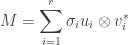 .
.
This is one version of the singular value decomposition (SVD for short) of , and it has the benefit of being as close to unique as possible. A more familiar version of SVD is obtained by completing the and to orthonormal bases of and (necessarily highly non-unique in general). With respect to these bases, takes, similar to the warm-up, a block form where the top left block is the diagonal matrix with entries  and the remaining blocks are zero. Hence we can write as a product

where  has the above block form,
  has columns given by
  , and
, and  has columns given by
  .
.
So, stepping back a bit: what have we learned about what a linear transformation between Hilbert spaces looks like? Up to orthogonal change of basis, we’ve learned that they all look like “weighted projections”: we are almost projecting onto the image as in the warmup, except with weights given by the singular values to account for changes in length. The only orthogonal-basis-independent information contained in a linear transformation turns out to be its singular values.
Looking for more analogies between singular value decomposition and the warmup, we might think of the singular values as a quantitative refinement of the rank, since there are  of them where is the rank, and if some of them are small then is close (in the operator norm) to a linear transformation having lower rank.
Geometrically, one way to describe the answer provided by singular value decomposition to the question “what does a linear transformation look like” is that the key to understanding is to understand what it does to the unit sphere of . The image of the unit sphere is an -dimensional ellipsoid, and its principal axes have direction given by the left singular vectors and lengths given by the singular values . The right singular vectors map to these.
Properties
Singular value decomposition has lots of useful properties, some of which we’ll prove here. First, note that taking the transpose of a singular value decomposition  gives another singular value decomposition

showing that  has the same singular values as , but with the left and right singular vectors swapped. This can be proven more conceptually as follows.
Key lemma #2: Write  . Then for every , the left and right singular vectors
  maximize the value of
  subject to the constraint that
  for all , that is orthogonal to
  , and that is orthogonal to
  . This maximum value is .
Proof. At the maximum value of subject to the constraint that  is orthogonal to and is orthogonal to , it must also be the case that if we fix then
  takes its maximum value at . But for fixed ,
  uniquely takes its maximum value when is proportional to (if possible), hence must in fact be equal to
  ; moreover, this is always possible thanks to key lemma #1. So we are in fact maximizing
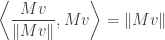
subject to the above constraints and we already know the solution is given by  .
.
Left-right symmetry: Let  be the singular values, left singular vectors, and right singular vectors of as above. Then
  are the singular values, left singular vectors, and right singular vectors of . In particular,
  .
.
Proof. Apply key lemma #2 to , and note that is the same either way, just with the roles of and switched.
Singular = eigen: The left singular vectors are the eigenvectors of  corresponding to its nonzero eigenvalues, which are
  . The right singular vectors are the eigenvectors of
  corresponding to its nonzero eigenvalues, which are also .
Proof. We now know that  and that , hence

and
 .
.
Hence  are orthonormal eigenvectors of
  respectively. Moreover, these matrices have rank at most (in fact exactly) , so this exhausts all eigenvectors corresponding to nonzero eigenvalues.
This gives an alternative route to understanding singular value decomposition which comes from writing  as
as

and then applying the spectral theorem to to diagonalize, but I think it’s worth knowing that there’s a route to singular value decomposition which is independent of the spectral theorem.
In addition to the above algebraic characterization of singular values, the singular values also admit the following variational characterization.
Variational characterizations of singular values (Courant, Fischer): We have

and
 .
.
Proof. For the first characterization, any  -dimensional subspace intersects
  nontrivially, hence contains a unit vector of the form
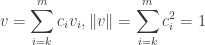 .
.
We compute that
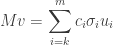
and hence that
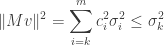 .
.
We conclude that every contains such that  , hence
  . Equality is obtained when
  .
.
The second characterization is very similar. Any  -dimensional subspace intersects
  nontrivially, hence contains a unit vector of the form
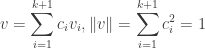 .
.
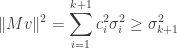
We compute that
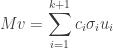
and hence that
 .
.
We conclude that every contains a vector such that  , hence
  . Equality is obtained when
  .
.
The second variational characterization above can be used to prove the following important theorem.
Low rank approximation (Eckart, Young): If is the SVD of , let  where
where  has diagonal entries
  and all other entries zero. Then
  is the closest matrix to in operator norm with rank at most ; that is, minimizes
  subject to the constraint that
  . This minimum value is
  .
.
Proof. Suppose is a matrix of rank at most . Let  be the nullspace of , which by hypothesis has dimension at least . By the second variational characterization above, this means that it contains a vector
  such that
  , and since
  this gives

and hence that  . Equality is obtained when
  as defined above.
The variational characterizations can also be used to prove the following inequality relating the singular values of two matrices and of their sum, which can be thought of as a quantitative refinement of the observation that the rank of a sum  of two matrices is at most the sum of their ranks.
Additive perturbation (Weyl): Let  be matrices with singular values
  . Then
 .
.
Proof. We want to bound  in terms of the singular values of and
  . By the second variational characterization, we have
 .
.
To give an upper bound on a minimum value of a function we just need to give an upper bound on some value that it takes. Let  and
and  be the subspaces of of dimensions
  respectively which achieve the minimum values of
  and
and  respectively, and let
  be their intersection. This intersection has dimension at least
  , and by construction
 .
.
Since  has dimension at least , the above is an upper bound on the value of
  for any
  -dimensional subspace
  , from which the conclusion follows.
The slightly curious off-by-one indexing in the above inequality can be understood as follows: if  and
and  are both very small, this means that and are close to matrices of rank at most and
  respectively, and hence
  is close to a matrix of rank at most
  , hence
  also ought to be small.
Setting  in the additive perturbation inequality we deduce the following corollary.
Singular values are Lipschitz: The singular values, as functions on matrices, are uniformly Lipschitz with respect to the operator norm with Lipschitz constant  : that is,
 .
.
Proof. Apply additive perturbation twice with , first to get

(remembering that is the operator norm), and second to get

(remembering that  ).
).
This is very much not the case with eigenvalues: a small perturbation of a square matrix can have a large effect on its eigenvalues. This is explained e.g. in in this blog post by Terence Tao, and is related to pseudospectra.
Setting  , or equivalently
  , in the additive perturbation inequality, we deduce the following corollary.
Interlacing: Suppose are matrices such that  . Then
 .
.
Proof. Apply additive perturbation twice, first to get

and second to get
 .
.
Interlacing gives us some control over what happens to the singular values under a low-rank perturbation (as opposed to a low-norm perturbation; a low-rank perturbation may have arbitrarily high norm, and vice versa). For example, we learn that if all of the singular values are clumped together, then a rank- perturbation will keep most of the singular values clumped together, except possibly for either the largest or smallest singular values. We can’t expect any control over these, since in the worst case a rank- perturbation can make the largest singular values arbitrarily large, or make the smallest singular values arbitrarily small.
A particular special case of a low-rank perturbation is deleting a small number of rows or columns (note that a row or column which is entirely zero does not affect the singular values, so deleting a row or column is equivalent to setting all of its entries to zero), in which case the upper bound above can be tightened.
Cauchy interlacing: Suppose is a matrix and is obtained from by deleting at most rows. Then
 .
.
Proof. The lower bound follows from interlacing. The upper bound follows from the observation that we have  for all , then applying either variational characterization of the singular values.
Cauchy interlacing also applies to deleting columns, or combinations of rows and columns, because the singular values are unchanged by transposition. In particular, we learn that if is obtained from by deleting either a single row or a single column, then the singular values of interlace with the singular values of , hence the name.
In particular, if all of the singular values of are clumped together then so are those of , with no exceptions. Taking the contrapositive, if the singular values of are spread out, then the singular values of must be as well.
Three special cases
Three special cases of the general singular value decomposition are worth pointing out.
First, if has orthogonal columns, or equivalently if is diagonal, then the singular values are the lengths of its columns, we can take the right singular vectors to be the standard basis vectors  , and we can take the left singular vectors to be the unit rescalings of its columns. This means that we can take
  to be the identity matrix, and in general suggests that
  is a measure of the extent to which the columns of fail to be orthogonal (with the caveat that is not unique and so in general we would want to look at the closest to
  ).
).
Second, if has orthogonal rows, or equivalently if is diagonal, then the singular values are the lengths of its rows, we can take the left singular vectors to be the standard basis vectors  , and we can take the right singular vectors to be the unit rescalings of its rows. This means that we can take
  to be the identity matrix, and in general suggests that
  is a measure of the extent to which the rows of fail to be orthogonal (with the same caveat as above).
Finally, if is square and an orthogonal matrix, so that  , then the singular values are all equal to , and an arbitrary choice of either the left or the right singular vectors uniquely determines the other. This means that we can take
  to be the identity matrix, and in general suggests that
  is a measure of the extent to which fails to be orthogonal. In fact it is possible to show that the closest orthogonal matrix to is given by
  , or in other words by replacing all of the singular values of with , so

is precisely the distance from to the nearest orthogonal matrix. This fact can be used to solve the orthogonal Procrustes problem.
In general, we should expect that the SVD of a matrix is relevant to answering any question about whose answer is invariant under left and right multiplication by orthogonal matrices. This includes, for example, the question of low-rank approximations to with respect to operator norm we answered above, since both rank and operator norm are invariant.












![\displaystyle n_p = [n]_p! = \prod_{i=1}^n [i]_p = \prod_{i=1}^n \left( p^{i-1} + p^{i-2} + \dots + 1 \right)](https://s0.wp.com/latex.php?latex=%5Cdisplaystyle+n_p+%3D+%5Bn%5D_p%21+%3D+%5Cprod_%7Bi%3D1%7D%5En+%5Bi%5D_p+%3D+%5Cprod_%7Bi%3D1%7D%5En+%5Cleft%28+p%5E%7Bi-1%7D+%2B+p%5E%7Bi-2%7D+%2B+%5Cdots+%2B+1+%5Cright%29&bg=ffffff&fg=333333&s=0&c=20201002)
![\displaystyle |GL_n(\mathbb{F}_p)| = p^{ {n \choose 2} } (p - 1)^n [n]_p!](https://s0.wp.com/latex.php?latex=%5Cdisplaystyle+%7CGL_n%28%5Cmathbb%7BF%7D_p%29%7C+%3D+p%5E%7B+%7Bn+%5Cchoose+2%7D+%7D+%28p+-+1%29%5En+%5Bn%5D_p%21&bg=ffffff&fg=333333&s=0&c=20201002)

. By the PGFPT this means any
.





 of fixed points satisfies
  . In particular, if
  (that is, if
  where
where  , then
  ) or a
  acts by cyclic shifts on the set
 then
then  . This set has cardinality
  , which is not divisible by
  .
.  into
into  blocks of size
  blocks-of-blocks of size
 of
of  . It follows that this is a Sylow
  . This lemma doesn’t appear to have a standard name, so we’ll name it
 such that
  , then
  . By grouping the cosets into
 ![\displaystyle |H/P| = \sum_{[h] \in G \backslash H/P} \frac{|G|}{|\text{Stab}_G(hP)|}](https://s0.wp.com/latex.php?latex=%5Cdisplaystyle+%7CH%2FP%7C+%3D+%5Csum_%7B%5Bh%5D+%5Cin+G+%5Cbackslash+H%2FP%7D+%5Cfrac%7B%7CG%7C%7D%7B%7C%5Ctext%7BStab%7D_G%28hP%29%7C%7D&bg=ffffff&fg=333333&s=0&c=20201002)
 is the collection of
 , hence a power of
 . Since
  are cofinal (this is exactly
 ![\displaystyle |GL_n(\mathbb{F}_p)| = p^{ {n \choose 2} } (p-1)^n [n]_p!](https://s0.wp.com/latex.php?latex=%5Cdisplaystyle+%7CGL_n%28%5Cmathbb%7BF%7D_p%29%7C+%3D+p%5E%7B+%7Bn+%5Cchoose+2%7D+%7D+%28p-1%29%5En+%5Bn%5D_p%21&bg=ffffff&fg=333333&s=0&c=20201002)
![[n]_p!](https://s0.wp.com/latex.php?latex=%5Bn%5D_p%21&bg=ffffff&fg=333333&s=0&c=20201002) is the
is the 
 then we’re done by reduction to the abelian case. Otherwise,
  but does divide
  such that the centralizer
  has index in
  . Since
 ![\displaystyle |H/P| = \sum_{[h] \in G \backslash H/P} \frac{|G|}{|h^{-1} G h \cap P|}](https://s0.wp.com/latex.php?latex=%5Cdisplaystyle+%7CH%2FP%7C+%3D+%5Csum_%7B%5Bh%5D+%5Cin+G+%5Cbackslash+H%2FP%7D+%5Cfrac%7B%7CG%7C%7D%7B%7Ch%5E%7B-1%7D+G+h+%5Ccap+P%7C%7D&bg=ffffff&fg=333333&s=0&c=20201002)
 such that
  has index coprime to
  ; conjugating, we get that the intersection of
  with
with  then this subgroup is just the trivial group.)
 where
where  and consider the action of
  of
of  -element subsets of
  iff
iff  consists of cosets of the cyclic subgroup
  generated by
 ![\displaystyle {|G| \choose p^k} = \sum_{[S]} \frac{|G|}{|\text{Stab}(S)|}](https://s0.wp.com/latex.php?latex=%5Cdisplaystyle+%7B%7CG%7C+%5Cchoose+p%5Ek%7D+%3D+%5Csum_%7B%5BS%5D%7D+%5Cfrac%7B%7CG%7C%7D%7B%7C%5Ctext%7BStab%7D%28S%29%7C%7D&bg=ffffff&fg=333333&s=0&c=20201002)
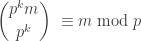 .
.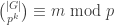 is not divisible by
  is also not divisible by
  is a power of
  . This stabilizer is a Sylow
  contains a (central, abelian, nontrivial) Sylow
  , which we can quotient by. Then
  , by the inductive hypothesis, also contains a Sylow
  , then again we inspect the class equation
![[g_i]](https://s0.wp.com/latex.php?latex=%5Bg_i%5D&bg=ffffff&fg=333333&s=0&c=20201002) such that
such that  , hence such that
  have the same
  . These subgroups can be constructed inductively by starting from an element of order
  , which is not hard to prove by induction once we know that finite
  is Cauchy’s theorem, which we proved above (four times!).
 . Consider the action of
  .
. such that
  , or equivalently such that
  . So they are naturally in bijection with the quotient
 .
. , or equivalently if
  and hence
  , so by Cauchy’s theorem it follows that
  is then a
  given by some extension
 of
of  , so by the PGFPT,
 .
. , or equivalently such that
  , so there must be at least one such
  and
and  ; in particular,
  .
.
 gives the desired result.
 ). This proof has the benefit of explaining what this congruence “means.”
 strings of length
 , which is smaller. Hence there’s no injective function from the set of binary strings of length
  is replaced by a larger number, or if we try to compress strings of length at most
  .) Probably all probability distributions describing real-life data have this property. And this is before taking into account the possibility of
  of all binary strings of length
  . For example, taking
  , less than 1% of strings of length
  can have their length reduced by
  or more by any fixed compression scheme.
 , is not dimensionally consistent: if the parameters you’re optimizing over have units of length, and the loss function is dimensionless, then the derivatives you’re subtracting have units of inverse length.
  for some kind of characteristic length scale
  , which loosely speaking is the length at which the curvature of
  over a field
![k[x]](https://s0.wp.com/latex.php?latex=k%5Bx%5D&bg=ffffff&fg=333333&s=0&c=20201002) together with the Hopf algebra structure given by the comultiplication
together with the Hopf algebra structure given by the comultiplication
 , and so it is an affine group scheme whose underlying scheme is the affine line
  over
over 
 on the dual of
  we recover
  we recover
  .
.![\mathbb{G}_a \ni x \mapsto \left[ \begin{array}{cc} 1 & x \\ 0 & 1 \end{array} \right]](https://s0.wp.com/latex.php?latex=%5Cmathbb%7BG%7D_a+%5Cni+x+%5Cmapsto+%5Cleft%5B+%5Cbegin%7Barray%7D%7Bcc%7D+1+%26+x+%5C%5C+0+%26+1+%5Cend%7Barray%7D+%5Cright%5D&bg=ffffff&fg=333333&s=0&c=20201002)
 .
.
 defines an
  -linear action of the group
  on the
  in a way which is natural in
  in the one-parameter group above as running over all elements of all
  can equivalently, by currying, be thought of as a natural transformation of group-valued functors from
 is an affine group scheme, namely the general linear group
  .
.![\text{Aut}_{k[x]}(V \otimes_k k[x]) \subseteq \text{End}_{k[x]}(V \otimes_k k[x]) \cong \text{Hom}_k(V, V \otimes_k k[x])](https://s0.wp.com/latex.php?latex=%5Ctext%7BAut%7D_%7Bk%5Bx%5D%7D%28V+%5Cotimes_k+k%5Bx%5D%29+%5Csubseteq+%5Ctext%7BEnd%7D_%7Bk%5Bx%5D%7D%28V+%5Cotimes_k+k%5Bx%5D%29+%5Ccong+%5Ctext%7BHom%7D_k%28V%2C+V+%5Cotimes_k+k%5Bx%5D%29&bg=ffffff&fg=333333&s=0&c=20201002)
![V \to V \otimes_k k[x]](https://s0.wp.com/latex.php?latex=V+%5Cto+V+%5Cotimes_k+k%5Bx%5D&bg=ffffff&fg=333333&s=0&c=20201002) to correspond to an element of
to correspond to an element of ![\text{Aut}_{k[x]}(V(k[x]))](https://s0.wp.com/latex.php?latex=%5Ctext%7BAut%7D_%7Bk%5Bx%5D%7D%28V%28k%5Bx%5D%29%29&bg=ffffff&fg=333333&s=0&c=20201002) giving a homomorphism of group-valued functors
giving a homomorphism of group-valued functors  , we are led to the following.
![\mathcal{O}_{\mathbb{G}_a} \cong k[x]](https://s0.wp.com/latex.php?latex=%5Cmathcal%7BO%7D_%7B%5Cmathbb%7BG%7D_a%7D+%5Ccong+k%5Bx%5D&bg=ffffff&fg=333333&s=0&c=20201002) .
.![\alpha : V \to V \otimes_k k[x]](https://s0.wp.com/latex.php?latex=%5Calpha+%3A+V+%5Cto+V+%5Cotimes_k+k%5Bx%5D&bg=ffffff&fg=333333&s=0&c=20201002) . Isolating the coefficient of
. Isolating the coefficient of  on the RHS, this map breaks up into homogeneous components
 , which we’ll call
  . The entire action map can therefore be thought of as a power series
 is part of a comodule structure turns out to be precisely the condition that 1)
  is the identity, 2) that we have
 ,
,  for all but finitely many
  , which takes the form
 .
. and of
  on both sides of the identity
  (the two coefficients are equal on the LHS, hence must be equal on the RHS) gives
 commute. This is necessary and sufficient for us to have
 ![\displaystyle k[M_1, M_2, \dots] / \left( {i + j \choose i} M_{i + j} = M_i M_j \right)](https://s0.wp.com/latex.php?latex=%5Cdisplaystyle+k%5BM_1%2C+M_2%2C+%5Cdots%5D+%2F+%5Cleft%28+%7Bi+%2B+j+%5Cchoose+i%7D+M_%7Bi+%2B+j%7D+%3D+M_i+M_j+%5Cright%29&bg=ffffff&fg=333333&s=0&c=20201002)
![\displaystyle \sum_i M_i x^i : V \mapsto V \otimes_k k[x]](https://s0.wp.com/latex.php?latex=%5Cdisplaystyle+%5Csum_i+M_i+x%5Ei+%3A+V+%5Cmapsto+V+%5Cotimes_k+k%5Bx%5D&bg=ffffff&fg=333333&s=0&c=20201002) .
. , then the divided power algebra can be thought of as the subalgebra of
 ![(k \otimes \mathbb{Q})[x]](https://s0.wp.com/latex.php?latex=%28k+%5Cotimes+%5Cmathbb%7BQ%7D%29%5Bx%5D&bg=ffffff&fg=333333&s=0&c=20201002) spanned by
spanned by  , where the isomorphism sends
  if there is no torsion.
 for each
  to modules over a profinite algebra dual to it in this way under suitable hypotheses, for example if
  -algebra, then the divided power algebra simplifies drastically, because we can now divide by all the factorials running around. Induction on the relation
  readily gives
 of a
of a  for all but finitely many
 ![\displaystyle \exp (M_1 x) : V \to V \otimes_k k[x]](https://s0.wp.com/latex.php?latex=%5Cdisplaystyle+%5Cexp+%28M_1+x%29+%3A+V+%5Cto+V+%5Cotimes_k+k%5Bx%5D&bg=ffffff&fg=333333&s=0&c=20201002) .
.![k[[\partial]]](https://s0.wp.com/latex.php?latex=k%5B%5B%5Cpartial%5D%5D&bg=ffffff&fg=333333&s=0&c=20201002) in one variable, with comultiplication
in one variable, with comultiplication  . If
. If ![\left[ \begin{array}{cc} 1 & x \\ 0 & 1 \end{array} \right]](https://s0.wp.com/latex.php?latex=%5Cleft%5B+%5Cbegin%7Barray%7D%7Bcc%7D+1+%26+x+%5C%5C+0+%26+1+%5Cend%7Barray%7D+%5Cright%5D&bg=ffffff&fg=333333&s=0&c=20201002) we wrote down earlier corresponds to exponentiating the Jordan block
we wrote down earlier corresponds to exponentiating the Jordan block ![\left[ \begin{array}{cc} 0 & 1 \\ 0 & 0 \end{array} \right]](https://s0.wp.com/latex.php?latex=%5Cleft%5B+%5Cbegin%7Barray%7D%7Bcc%7D+0+%26+1+%5C%5C+0+%26+0+%5Cend%7Barray%7D+%5Cright%5D&bg=ffffff&fg=333333&s=0&c=20201002) .
.![\displaystyle \mathbb{G}_a \ni x \mapsto (f(y) \mapsto f(y+x)) \in \text{Hom}_k(k[y], k[y] \otimes_k k[x])](https://s0.wp.com/latex.php?latex=%5Cdisplaystyle+%5Cmathbb%7BG%7D_a+%5Cni+x+%5Cmapsto+%28f%28y%29+%5Cmapsto+f%28y%2Bx%29%29+%5Cin+%5Ctext%7BHom%7D_k%28k%5By%5D%2C+k%5By%5D+%5Cotimes_k+k%5Bx%5D%29&bg=ffffff&fg=333333&s=0&c=20201002) .
. (hence the use of
  above). More generally, locally nilpotent derivations on a
  .
. nilpotent Jordan block, which follows from the fact that they have a one-dimensional invariant subspace given by the constant polynomials.
 in the relation
  .
. , we find that we can put no constraint on it in terms of smaller
  . In fact we have
  for all
 ; we at least also need to know
  still makes sense in characteristic
 and
and  is not divisible by
  by
by  . This gets us up to
  and then when we try to analyze
  we find that we cannot relate it to any of the smaller
  is always divisible by
  , which we already knew.
 precisely when we can find
  such that
  is nonzero
  . We can be more precise as follows. Write

 .
.![\displaystyle k[M_1, M_p, \dots]/(M_1^p, M_p^p, \dots)](https://s0.wp.com/latex.php?latex=%5Cdisplaystyle+k%5BM_1%2C+M_p%2C+%5Cdots%5D%2F%28M_1%5Ep%2C+M_p%5Ep%2C+%5Cdots%29&bg=ffffff&fg=333333&s=0&c=20201002) .
.![k[M_1, M_p, \dots]/(M_1^p, M_p^p, \dots)](https://s0.wp.com/latex.php?latex=k%5BM_1%2C+M_p%2C+%5Cdots%5D%2F%28M_1%5Ep%2C+M_p%5Ep%2C+%5Cdots%29&bg=ffffff&fg=333333&s=0&c=20201002) which are locally finite in the sense that for all
which are locally finite in the sense that for all  for all but finitely many
 ![\displaystyle \exp (M_1 x + M_p x^p + \dots) : V \mapsto V \otimes_k k[x]](https://s0.wp.com/latex.php?latex=%5Cdisplaystyle+%5Cexp+%28M_1+x+%2B+M_p+x%5Ep+%2B+%5Cdots%29+%3A+V+%5Cmapsto+V+%5Cotimes_k+k%5Bx%5D&bg=ffffff&fg=333333&s=0&c=20201002) .
.![J = \left[ \begin{array}{cc} 0 & 1 \\ 0 & 0 \end{array} \right]](https://s0.wp.com/latex.php?latex=J+%3D+%5Cleft%5B+%5Cbegin%7Barray%7D%7Bcc%7D+0+%26+1+%5C%5C+0+%26+0+%5Cend%7Barray%7D+%5Cright%5D&bg=ffffff&fg=333333&s=0&c=20201002) , and all the other
, and all the other  commute with it. A calculation shows that this implies that each
 ![\left[ \begin{array}{cc} 0 & c_j \\ 0 & 0 \end{array} \right]](https://s0.wp.com/latex.php?latex=%5Cleft%5B+%5Cbegin%7Barray%7D%7Bcc%7D+0+%26+c_j+%5C%5C+0+%26+0+%5Cend%7Barray%7D+%5Cright%5D&bg=ffffff&fg=333333&s=0&c=20201002) for some scalars
for some scalars  , and hence our representation has action map
![\displaystyle \exp \left( J (x^{p^i} + c_{i+1} x^{p^{i+1}} + \dots) \right) = \left[ \begin{array}{cc} 1 & x^{p^i} + c_{i+1} x^{p^{i+1}} + \dots \\ 0 & 1 \end{array} \right]](https://s0.wp.com/latex.php?latex=%5Cdisplaystyle+%5Cexp+%5Cleft%28+J+%28x%5E%7Bp%5Ei%7D+%2B+c_%7Bi%2B1%7D+x%5E%7Bp%5E%7Bi%2B1%7D%7D+%2B+%5Cdots%29+%5Cright%29+%3D+%5Cleft%5B+%5Cbegin%7Barray%7D%7Bcc%7D+1+%26%C2%A0+x%5E%7Bp%5Ei%7D+%2B+c_%7Bi%2B1%7D+x%5E%7Bp%5E%7Bi%2B1%7D%7D+%2B+%5Cdots+%5C%5C+0+%26+1+%5Cend%7Barray%7D+%5Cright%5D&bg=ffffff&fg=333333&s=0&c=20201002) .
. ).
). is the derivative. Now, in characteristic
  ; among other things this means that translation is no longer given by just exponentiating the derivative. However, since over
  we have

 ; otherwise zero) and this differential operator must be
 ; otherwise zero, as above).
 , and the pullback of any representation along an endomorphism is another representation. Pulling back along the Frobenius map sends
  to
to  . More generally, any sum of powers of the Frobenius map gives a nontrivial endomorphism of
 ![f(x) \in k[x]](https://s0.wp.com/latex.php?latex=f%28x%29+%5Cin+k%5Bx%5D&bg=ffffff&fg=333333&s=0&c=20201002) such that
such that  and
and  .
. ) correspond to elements of
 ![\mathbb{G}_a(k[x]) \cong k[x]](https://s0.wp.com/latex.php?latex=%5Cmathbb%7BG%7D_a%28k%5Bx%5D%29+%5Ccong+k%5Bx%5D&bg=ffffff&fg=333333&s=0&c=20201002) , hence to polynomials
, hence to polynomials  , and the condition that such a map corresponds to a group homomorphism is precisely the condition that
  , equating the coefficient of
 for
for  (by setting
  where
where  ), and since
  the only possible nonzero coefficient is
  . So
. So  is scalar multiplication by the scalar
  doesn’t vanish if
![k[F]](https://s0.wp.com/latex.php?latex=k%5BF%5D&bg=ffffff&fg=333333&s=0&c=20201002) , with
, with  acting by Frobenius.
![\alpha_p \cong \text{Spec } k[x]/x^p](https://s0.wp.com/latex.php?latex=%5Calpha_p+%5Ccong+%5Ctext%7BSpec+%7D+k%5Bx%5D%2Fx%5Ep&bg=ffffff&fg=333333&s=0&c=20201002) with functor of points
with functor of points .
. of algebras, bimodules, and bimodule homomorphisms over
  of
of  over
over  , where
  , and
, and .
. be a symmetric monoidal category (which in this post will be
  is the
  of objects in
 , this reduces to the usual tensor product of
  , while a right module over
  . If
. If  are two
  -bimodule is a
  .
.![\displaystyle \text{Mod}(C) \cong [C^{op}, \text{Mod}(k)]](https://s0.wp.com/latex.php?latex=%5Cdisplaystyle+%5Ctext%7BMod%7D%28C%29+%5Ccong+%5BC%5E%7Bop%7D%2C+%5Ctext%7BMod%7D%28k%29%5D&bg=ffffff&fg=333333&s=0&c=20201002)
 correspond to
  , or equivalently (by an adjunction) to
  (where
  is also the coproduct. This is because on the one hand a functor (cocontinuous and
  , and on the other hand
 rather than
  , but in the case of algebras these are Morita equivalent as
  .
.![\displaystyle [\text{Mod}(A) \otimes \text{Mod}(B), \text{Mod}(C)] \cong [\text{Mod}(A), [\text{Mod}(B), \text{Mod}(C)]]](https://s0.wp.com/latex.php?latex=%5Cdisplaystyle+%5B%5Ctext%7BMod%7D%28A%29+%5Cotimes+%5Ctext%7BMod%7D%28B%29%2C+%5Ctext%7BMod%7D%28C%29%5D+%5Ccong+%5B%5Ctext%7BMod%7D%28A%29%2C+%5B%5Ctext%7BMod%7D%28B%29%2C+%5Ctext%7BMod%7D%28C%29%5D%5D&bg=ffffff&fg=333333&s=0&c=20201002) .
.![[-, -]](https://s0.wp.com/latex.php?latex=%5B-%2C+-%5D&bg=ffffff&fg=333333&s=0&c=20201002) is the category of cocontinuous
is the category of cocontinuous  is
is
 is the “naive” tensor product over
  , which might look familiar as a categorification of a corresponding statement about finite-dimensional vector spaces. This reflects the fact that
  .
. ; the components of this presheaf can be thought of as the “coordinates” of
 of the “basis” of representable presheaves. This is an enriched version of the
  can be interpreted as saying that such functors can be written as “matrices” indexed by
  . Then we get that endomorphisms of
  -bimodules, or equivalently to functors
  . These are precisely the sorts of things we can take coends of, getting an object
 , so taking its trace we get the Hochschild homology or trace of
  .
.
 and
and  to the two composites
  and
and  . In other words,
  is the quotient of the direct sum of the endomorphism rings of every object in
  , where
  need not themselves be endomorphisms.
 in
in  satisfying
 is just the quotient
 ![A/[A, A]](https://s0.wp.com/latex.php?latex=A%2F%5BA%2C+A%5D&bg=ffffff&fg=333333&s=0&c=20201002) of
of  of
of  there is a trace
![\displaystyle \text{tr}(f) \in A/[A, A]](https://s0.wp.com/latex.php?latex=%5Cdisplaystyle+%5Ctext%7Btr%7D%28f%29+%5Cin+A%2F%5BA%2C+A%5D&bg=ffffff&fg=333333&s=0&c=20201002) .
. ; equivalently, the
  -module categories we consider are finite direct sums of copies of
  to
to  correspond to
  matrices of vector spaces, just as for free modules, and the trace of an endomorphism
  is the direct sum of its diagonal vector spaces.
 is a Galois extension with Galois group
  of
of  of
of  , and if
  ;
; regarded as a
  is a point, then
  , and
, and  is the category of
  is a
is a  , and
, and  .
.
 given that it’s in thermal equilibrium at temperature
 is the energy of state
  is
is  is
is 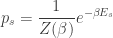
 is the normalizing constant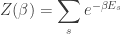

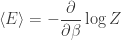 .
. is the more fundamental quantity because it might be zero (meaning every microstate is equally likely; this corresponds to “infinite temperature”) or negative (meaning higher-energy microstates are more likely; this corresponds to “
 . The energy eigenstates of a quantum harmonic oscillator are labeled by a nonnegative integer
  , which can be interpreted as the number of photons of frequency
 is the
  .
. , is required to be an integer here is the
  .
. . In particular, the average energy of all photons of frequency
 .
. (so for small frequencies), and the classical answer is consistent with the
  ); the choice of boundary conditions, as well as the shape of the box, will turn out not to matter in the end. Possible frequencies are then classified by
  ) to eigenvalues of the
  . More explicitly, if
  , where
  is a smooth function
  , then the corresponding standing wave solution of the electromagnetic wave equation is
 is typically negative, so
  is typically purely imaginary) the corresponding frequency is
 .
. times where
  is the
 is the
  where
where  is a
is a  depending on conventions). The corresponding eigenvalue of the Laplacian is
 is the number of ways to write
 .
. , which is strictly speaking discrete, as a continuous probability distribution, and compute the corresponding
  ; the idea is that
  should correspond to the number of states available with frequencies between
  . Then we’ll do an integral over the density of states to get the final partition function.
 , there is an occupancy number
  describing the number of photons with that wavenumber; the total number
  of photons is finite. Each such photon contributes
  to the energy, from which it follows that the partition function factors as a product
 .
. . In fact, the number of wave vectors in a region of phase space is exactly
  times the volume, where
  is the volume of our box / torus.
 between
  and radius
  , and hence its volume is
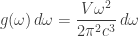 .
.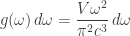 .
. .
.
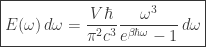
 , and we get
 .
. (meaning low temperature relative to frequency), the denominator approaches
  , and we get
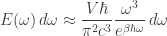 .
. is maximized given the temperature
 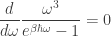 .
. .
. , so that we can rewrite the equation as
 .
. , and hence that
  , giving that the maximizing frequency is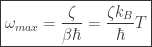
 gives
gives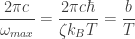

 in terms of wavelengths, then taking the maximum of the resulting density. Because
  is proportional to
  , this has the effect of changing the
  from earlier to an
  , so replaces
  with the unique solution
  to
to
 . This gives a maximizing wavelength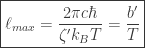
 .
. .
. (or around
  celsius), and substituting this in above produces wavelengths of
 .
. for red light and
  for violet light. Both of these computations correctly suggest that most of the radiation from a wood fire is infrared; this is the radiation that’s heating you but not producing visible light.
 , and substituting that in produces wavelengths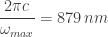

 , comparable to the temperature of the interior of the sun. Substituting this in produces wavelengths of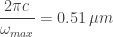
 .
.
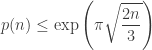
 . In this post I’d like to record an elementary argument, making no use of generating functions, giving a lower bound of the form
  for some
  , which might help explain intuitively why this exponential-of-a-square-root rate of growth makes sense.
 such paths, and if the area under the path is
  , so this already goes a long way towards explaining the exponential-of-a-square-root behavior.
 and ending at
  where
where  , and the number of such paths is exactly
  . This gives
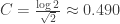 , quite a bit worse than the correct value
  . This bound generalizes to all values of
  for awhile at the end before hitting the x-axis).
 .
. . With a more convex curve we can afford to make the path longer while fixing the area under it.
 , so the number of lattice paths with area at most
  times this count. And we have much more freedom to pick a path now that we only need to bound its area rather than find it exactly. We can now take the path to be any
 denotes the Catalan numbers and the asymptotic can be derived from Stirling’s approximation. The area under a Dyck path is at most
 ),
),
 where
where  , a substantial improvement over the previous bound. Although we are now successfully in a regime where our counts include paths of a typical shape, we’re overestimating the area under them, so the bound is still not as good as it could be.
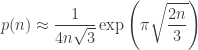 .
. and comparing it to what this approximation gives. In this post I’d like to describe how one might go about conjecturing this result up to a multiplicative constant; proving it is much harder.
 .
. is to associate to it the generating function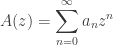
 , often for complex values of
  , to the behavior of
  near the pole (or poles) closest to the origin. For rational
  of partitions into parts of size at most
 and of order
  roots of unity, and of order at most
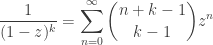
  . We can factor
  as
as

 .
. of Stirling’s approximation gives
 for some
  gives
gives .
. then this quantity is negative; at this point we’re clearly not in the regime where this approximation is accurate. If
  then the first term dominates and we get something that grows like
  . But if
  then the first term vanishes and we get
 .
. , and the multiplicative constant isn’t so off either: the correct value is
  .
. denote the number of weak orders of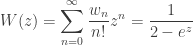
 ; loosely speaking, this corresponds to a description of the
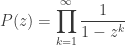
  . The unique pole closest to the origin is at
  , and we can compute using l’Hopital’s rule that
 begins

 .
. .
. using the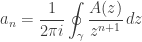
 is a closed contour in
  with
with  , and the maximum value that
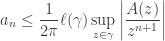
  takes on it, which gives
 .
. . If
. If  will take its maximum value when
  , which gives the saddle point bound
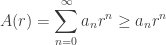
 converges then for
  we clearly have
 .
. is minimized (subject to the constraint that
  of
of 
 , as a real-valued function of
  , will have a
 for some nice
  , in which case the saddle point equation simplifies further to
 .
. ; we’ll use this generating function to get a lower bound on factorials. The saddle point bound gives
 , since
  has infinite radius of convergence. The saddle point equation gives
  , which gives the upper bound
 .
. can be rearranged to read
 denote the number of
  .
.
 has infinite radius of convergence. The saddle point equation is

 for simplicity gives
 count the number of partitions of a set of

 (a bit more precisely, we want something more like
  , and it’s possible to keep going from here but let’s not), giving the saddle point bound
 .
. (between the pole of
  at
at  and the essential singularity at
  , so let’s try to understand the logarithm. (
 previously appeared on this blog
  of index

 .
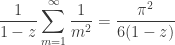
. very clear: we see that as
  .
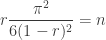
. , the saddle point gets closer and closer to the essential singularity at
  , which gives the approximate saddle point equation
 .
. , so we can ignore the
  .
. .
. and a lower bound on
  to get an upper bound on
 then
then  for
for  , hence


 off from the true answer.
 .
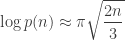
.
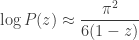 .
.
 and some
  . From here he more or less employs a saddle point bound in reverse, estimating
 so that this sum can be rewritten
 . We want to turn this into an estimate for
  involving only
  , so we want to eliminate
  , valid as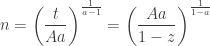
 is positive), so that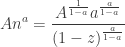
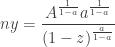
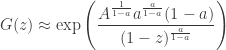
 gives
gives  and
and
 .
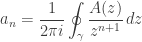
.
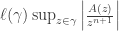 .
. we’ll end up at a saddle point
  ). Depending on the geometry of the locations of the zeroes, poles, and saddle points of
  is in fact maximized at
  . The function
  has a unique saddle point at
  , but to simplify the computation we’ll take
  .
. , so that
 .
. only controls the phase of the integrand, and since it doesn’t vary much (it grows like
  for small
  ) we’ll be able to ignore it.
  controls the absolute value of the integrand and so is much more important. For small values of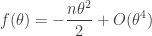
 for some small (where the meaning of “small” depends on
  and a “minor arc” consisting of the other values of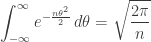
 ); ignoring all the details, the conclusion is that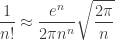

 , which can be viewed as a corollary of the central limit theorem, since such a Poisson random variable is a sum of
  , let
, let  . Then, as
 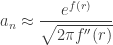 .
. .
. we established earlier in two ways: first, the introduction of the
  term contributes a factor of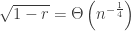
 contributes another factor, which we approximate as follows. We have


 (we actually know the multiplicative constant here, but it doesn’t matter because we already lost multiplicative constants when estimating
  ) and hence
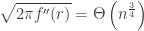 .
.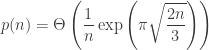 .
.