GeistHaus
log in · sign up

https://qrm.guru/feed

rss
10 posts
Polling state
Status active
Last polled May 18, 2026 23:40 UTC
Next poll May 19, 2026 20:47 UTC
Poll interval 86400s
ETag "8783981f48154de6f87a6025315839c2"
Last-Modified Sun, 01 Dec 2024 00:45:09 GMT

Posts

TV Interference or …?
Case StudiesLED LightsTV interference
TV OR NOT TV? – a Case Study By Ian Jackson VK3BUF Editor’s Note: Whilst this article relates to a television reception problem, the underlying issues and processes employed by Ian apply to amateur radio. The subject could just as easily have been an amateur radio receiver as opposed to a television. This is also […]
Show full content

TV OR NOT TV? – a Case Study

By Ian Jackson VK3BUF

Editor’s Note: Whilst this article relates to a television reception problem, the underlying issues and processes employed by Ian apply to amateur radio. The subject could just as easily have been an amateur radio receiver as opposed to a television. This is also an EXCELLENT example of how Ian applied the QRM Guru process end-to-end… from problem identification through to resolution. Every step is clearly demonstrated and can be applied in your own situation.

It’s August 2024.  I visited my father a few days ago, and he advised his TV had stopped working.  Sure enough, the digital TV had a No Signal message on every channel.    A second TV in another room suffered the same symptom.  This ruled out a fault on the TV itself as the problem had to be common to both sets.  The antenna system was an obvious candidate.

The antenna is a common log-periodic with a masthead pre-amp and a splitter designed for digital TV.  It was only a couple of years old and seemed to be in good condition.  It was dark at the time, but a sturdy shake of the antenna pole did not resolve the problem, so an intermittent mechanical problem was unlikely.  Likewise, a shake of leads and connectors between the TV and the wall connection introduced no telltale fluctuations.  The DC supply which fed power up the antenna appeared intact and working.  I resolved to return the next day and continue diagnostics in daylight.

The following morning I received a call to say that the problem had ‘fixed itself’ and nothing had to be done.  Later that day I received another call.  “It stopped working again.”

I planned to return with test gear and portable TV receiver to see what was going on.  At that point I had a followup call with a pivotal observation:  “When I turn on the lounge room lights, the stations all disappear, when I turn them off, everything works again.”

This shifted the focus of the problem from an antenna continuity issue to a QRM issue.   Evidently one of the four LED down lights servicing the room had gone rogue and was generating extreme interference, wiping out both television sets.

I packed up some gear and returned to the house.  My first step was to set up the spectrum analyser next to the TV and shift the TV antenna from the telly to the analyser.  I started wide, selecting a receiver range from 1 MHz to 1 GHz.  With the lights off, it looked like this:

The BEFORE picture: Interference free image on scope.

All was normal.  Not too much noise and a couple of commercial transmissions evident.  Then I turned on the lounge room down lights and it looked like this:

Image of QRM on Scope.
The AFTER picture: Image of wideband QRM on Scope

This was a mess, with an obvious noise source disrupting a good part of the spectrum.   These LED lamps had been in place for 6-7 years.  It was probable that one or more of the filter capacitors in the lamp regulator had dried out and were no longer cleaning up the high-speed switching that was applied to the lamp elements.   Two different size lamps were in use, but they were all under control of a common wall switch.

The offending LED lights

The next action was to visit Bunnings to purchase replacement LED lamps.   I had previously assessed some of their lamps.  They were inexpensive and all proved to be RF quiet.  It was not worth trying to determine which lights had failed, but simply replace all of them.

The new LED lights and noise free spectrum.

The lamp replacement proceeded without difficulty.  With the new lamps in place and activated, both television sets performed normally.   A good outcome.

While this case did not directly relate to Amateur Radio, there are strong implications for us.

  1. Although none of his neighbours were Amateurs, conceivably they could have been.  Had a prominent Amateur antenna been nearby and interference was being experienced, some residents would be fast to conclude that this was the cause.  In such situations, the non-technical neighbour can’t be relied upon to behave rationally or systematically.   The effects of the interference are very real for the people concerned.
  2. If the broadcast signal into the neighbour’s TV was strong enough to penetrate the interference caused by their own LED lamps, the lamps could still produce S9 noise on several HF bands over a large radius.  The house owner could be unaware of the problem.  Maybe their wifi runs somewhat slower, but they hadn’t noticed.  The consequences for a sensitive HF receiver next door could be tragic and obliterate the enjoyment of an Amateur Radio installation.

These situations are relevant and more likely to occur as society embraces modern electronic appliances .   More and more, the process of identifying interference sources has become part of the hobby of Amateur Radio.  We cannot rely upon or expect the ACMA to dispatch field operatives to resolve these issues for us.  (Editor’s note: It’s fair to say the ACMA are unlikely to assist Amateurs with interference unless they can illustrate they’ve conducted their own analysis and can provide supporting evidence of the noise source)

The website QRM.guru is a free resource dedicated to dealing with exactly these sorts of situations.  It describes the process of identifying the origins of interference and lists the actions that can be taken to resolve these issues.   Fundamentally, if there is radio noise, there must be a noise source.  Once it has been identified, the goal should be resolution, rather than tolerance.

Readers are encouraged to visit the site and read up on some of the case studies..   For the shack wall, download a copy of the QRM tracking flowchart that helps those suffering QRM to correctly profile radio noise sources.

In this instance, the interference issue was resolved and that trashy, advert filled medium known as ‘free-to-air TV’ has now been restored to its former glory.    The old lamps were disposed of as recyclable scrap metal.

If you haven’t already, visit QRM.guru and get informed on how to identify and minimise unwanted RF interference.
 

https://qrm.guru/?p=2302
Extensions
Solar Panels and Micro-Inverter
Case StudiesSupport for Solar Panels & Invertersmicro-inverter qrmsolar enphase micro-inverterssolar panel qrm
“I negotiated with my installer to put ferrites on the leads from the Enphase micro-inverters, to agree to work with me (at my expense) to mitigate any RFI, and to assure me that I could switch off the system while operating the radio if all else failed. The system is completely quiet, directly under my […]
Show full content

“I negotiated with my installer to put ferrites on the leads from the Enphase micro-inverters, to agree to work with me (at my expense) to mitigate any RFI, and to assure me that I could switch off the system while operating the radio if all else failed. The system is completely quiet, directly under my beams and dipole. I don’t know if the inverters themselves are quiet or if the ferrites tamed them. I’d recommend that approach to anyone considering a PV installation. If you’re friends with your neighbors and they are considering PV, consider offering to pay the incremental cost of such measures if they’re willing to do so. PV is great … if you can do it without RFI.”


/Rick N6XI

https://qrm.guru/?p=2290
Extensions
A noisy Brivis Air Conditioner
Case Studiesair conditionerair conditioner qrmcooler qrmevaporative cooler
QRM GURU – A CASE STUDY Air Conditioner Plant Makes S9 Noise at Home Klaus Illhart VK3IU  had a significant noise problem that made HF operations difficult.  Klaus has prepared a detailed description of the process of tracing and resolving the source of the interference.  Here we have an abbreviated version to give readers a […]
Show full content

QRM GURU – A CASE STUDY

Air Conditioner Plant Makes S9 Noise at Home

Klaus Illhart VK3IU  had a significant noise problem that made HF operations difficult.  Klaus has prepared a detailed description of the process of tracing and resolving the source of the interference. 

Here we have an abbreviated version to give readers a sample of Klaus’s experience.

————————————————–

RF interference through Brivis Evaporative Cooler


Telecommunications Engineer (Australian Professional Engineer) Clyde North, VIC 

I would like to express my sincere thanks to the Brivis support team, which certainly in early steps, went above anything that I would have expected in supporting me.  I am looking forward to solving the RFI to a level where a proper use of the radio spectrum will be possible while keeping the family cool.

Problem description

When the evaporative Cooler is operational, noise levels increase from S2 on an HF Receiver to S9 over a frequency range from 18MHz to 30MHz.  Further “control traffic” can be observed in the 140 MHz to 150MHz range.


This was heard on individual frequencies at S3, even when the evaporative cooling unit is not operational and in standby mode.  Switching OFF of the evaporative Cooler at the main ac power switch board kills all interference.


When the evaporative cooler is operating, it makes the use of the frequencies between 18 to 30MHz impossible, as receive signals cannot not be decoded/received.

Antenna installation:

left antenna vertical Butternut HF6V  HF antenna 3.5 to 30MHz,  8m height on the 1.5m mast.  Antenna to the right 50 to 450MHz vertical antenna,  2m height on 1.5m mast.   The evaporative cooling unit is approximately 2m from antennas.


RFI Measurement

Measurement of the RFI was carried out both as an observation on the Transceivers, expressed in S Units and through more detailed measurement using a HP8590A spectrum analyser, which shows noise levels expressed as dBm.  The tests were carried out over the frequency range from 2 to 52 MHz.


It should be noted that the antenna used was the Butternut HF6V trapped vertical, which is resonant in sections of the HF band but performs poorly for frequencies above 30 MHz .

Evaporative cooler on standby (not switched ON)

The adjacent image shows a reference shot of the spectrum analyser, with the evaporative cooler deactivated.  The area in the yellow rectangle shows low noise activity between 20 and 30 MHz.


Controller Replaced

The air conditioner controller was changed by Brivis technicians in February 2022.  Measurement conducted after the change showed a decrease in noise floor between 20MHz to 30MHz of approximately 5dB.  This provided a slight improvement.


Noise present from original controller Noise present from new controller

Testing resumed with the evaporative cooler after it had started up and completed its Wetting cycle. Note that the new controller changed the behaviour observed.  While the old controller the noise level was present instantly, the new controller increased the noise floor moments after the fan activated at the completion of the wetting cycle.

Portable battery operated HF transceiver

A battery-operated portable HF transceiver was used to conduct independent and portable measurements on the AC power.  This was achieved with an Elecraft K2 portable HF Receiver and a simple HF Loop antenna.  (muddy meaning)


Near field investigation within the house and on the roof indicated that the distance to the Evap Cooler is not of a consequence as the level only slightly drops when the receive antenna is moved away, several meters. 


Exclusion of RF through the AC mains supply

Interference is received through the HF Antenna.  There was no influence of RF through AC power.  This has been experimentally verified after power to the radio room had been cut off at the switchboard.


My station is sufficiently RF proofed.  It uses RF grounding of 20mm2 cable into an earth rod buried 1.5M into ground.  The 240V AC supply is passed through a mains filter to prevent any RF from reaching the test equipment.


RF AC RFI filter in 240V AC supply path, CORCOM – TE CONNECTIVITY 

Power Line Filter rated at 250VAC 10A on a single phase supply.


Ferrite installation

I added three clip on ferrite clamps (material 43) on the power supply cable (yellow circled) to the FAN.  This reduced the RFI further. It was noticeable that at frequencies above 28 MHz a decline in RFI is observed. Noise was suppressed by approximately 5dB and from 22MHz to 30MHz.  


Unfortunately, I ran out of clip-on ferrites.  I am unsure if the smaller diameter clip had any impact.  It would have been useful if Brivis could advise the function of these cables.


This is already very promising; it seems that the FAN contributed heavily to the RFI.  Further tests will be done when I am able to procure additional ferrite of different materials.


Dependency FAN speed to RFI

A test was carried out by changing the FAN speed from minimum to the maximum speed. The observed result is that a change in FAN speed is not much affecting the noise level on the transceivers, but only a slight change in the spectral measurement can be observed.  

S-Unit at  FT-1000MP Band / freq in MHz Aircon OFF Aircon ON
FAN unit minimum Aircon ON
FAN unit maximum 29.5 2 7 7 29.0 3 5 6 28.5 3 7 7 28.0 2 7 7 21.0 2 9 9 18.07 3 7 8 14.0 6 6 7 10.1 6 6 7 7.0 7 7 7 3.8 5 4 4 3.5 9 9 8


Insertion of RF suppression filter

Some months later.  After opening the control box of the evaporative cooler it was immediately noted that Brivis applied an unknown ferrite ring, feeding through all wires of the cable loom, going to the fan motor. 


Due to the size and number of wires only one turn was applied. This approach is highly inefficient and didn’t produce much noise reduction.


Brivis block diagram

Marked in RED, GREEN and YELLOW are the main power supply feeds to the three phase motor.  The Brivis application of their ferrite core to all wires is not necessary, as only the power feed wires are suspected to carry the motor high current requirements.  The remaining are simply control and sensor wires.  


I initially tried to use this ferrite core and apply more turns to the motor power wires only, but I was not able to add more than 2 turns, which didn’t improve the noise situation.  Further the ferrite material characteristics were unknown to me and I decided to develop my own solution.


T38 Toroid filter for 3 phase motor

I experimented with two types of ring toroids F43 and T38 material, but decided after measuring both variations for my purpose the more costly T38 material was the best approach.  One toroid for each of the three phase supply wires should be applied.      
Manufacturer: TDK  R 36.0 x 23.0 x 15.0  mm   Order code: B64290L0674X037


Thanks to QRM Guru and especially Ian VK3BUF with his industrial experience and his professional advice, I settled on a counter-turn ring ferrite, 10 turns left and 10 turns right.  This as per Ian’s advice will eliminate current inside the toroid itself, but keeps a good filter characteristic.   The toroid remains cold after 10 minutes of running the fan on maximum.  Initially I experimented with insulated wire, but this limited the number of turns I could apply over the ferrite core.  I decided to go for coated solid copper wire instead.


Installation of Toroid in Evaporative Cooler

This November I finally went back on the roof and inserted the three toroids and started to measure the effect they may have on the RF noise.  The diagram below shows the wiring layout.


I had a spare F43 toroid and spare wire length, so I decided that while on the roof, I would use it as well and wound around another 5 turns.  I believe this was not necessary.  It was more a measure to reduce the excess wires, which  prevented the box closing.


Noise with inserted Choke Filters

A series of repeated measurements were taken over the following days. 

Measured was always with two methods, the YAESU FT-1000MP in S scale and with the HP Spectrum analyser showing dBm levels.


1   AC off, 

2   AC on slow fan and 

3   AC on, fan on maximum speed.


At the start I also measured the AC start up phase, where the pre-cooling happens.  The pump is pumping water through the filter matts to pre-wet them before the FAN starts up. The water pump in pre-cooling phase does not contribute significantly to the noise.


As expected, the modifications had a big effect.  The noise stayed well below the -80dBm mark of the analyser. The noise floor fell by approx. 15dB.

Improved noise figures – 10 January 2023  app TIME 1820H to 1831H

2.4kHz SSB Filter  /   500Hz  CW Filter   pre amplifier  TUNED amplification curve


Conclusions

These changes have taken 18 to 30 MHz from being completely unusable, to my being able to conduct good QSOs on these bands.  The effort involved was totally worthwhile, as apart from my own comfort, turning off the air conditioning on hot days would not be popular with the family.


As a future task, I will be sourcing clip-on ferrites of different materials to further suppress RFI from 20 MHz up.  


The air conditioning company, Brivis stopped co-operating after I sent the details of this report and they have not responded.  This is rather disappointing as a co-operation would have been a mutual benefit for all involved.  Future Coolers could be built with less radiated noise.


My advice to readers with similar problems is ‘Don’t give up’.   Identify the source of the noise and work out a solution which will reduce its impact.  Of course this is easier if you are the owner of the noise source, but it is more challenging if the noise is coming from neighbours. 


_________________________

https://qrm.guru/?p=2237
Extensions
Ultrasonic Receiver Kit
QRM Kill Kits
Ultrasonic Receiver Short Form Kit For those interested in constructing an ultrasonic receiver project, (like the design featured in the March 2023 QTC magazine) we have blank PCBs and short form kits available. Blank PCB only      $10 Short form kit       $125 Postage (Australia only)    $10 The short form kit includes […]
Show full content

Ultrasonic Receiver Short Form Kit

For those interested in constructing an ultrasonic receiver project, (like the design featured in the March 2023 QTC magazine) we have blank PCBs and short form kits available.

Blank PCB only      $10

Short form kit       $125

Postage (Australia only)    $10

The short form kit includes the PCB, the ultrasonic transducer all pcb components, pots, knobs, switch & Hammond plastic case.

All proceeds from these kit sales go towards maintaining the QRM Guru website.

email us with your postal address and order: info@vkradioamateurs.org.au

We will respond with final amount owing and Bank Account details.

https://qrm.guru/?p=2225
Extensions
QRM Guru offers email support
An Overview of the QRM Guru ProcessAnnouncementsemail supportservice desk
QRM Guru Service Desk – online ticketing system 30 July 2022 QRM Guru and RASA are pleased to announce that effective 1 August 2022 we’ll be offering email and limited telephone support for amateurs seeking additional assistance with their QRM & RFI problems. A service desk has been implemented using Freshdesk.  This works on the […]
Show full content

QRM Guru Service Desk – online ticketing system

30 July 2022

QRM Guru and RASA are pleased to announce that effective 1 August 2022 we’ll be offering email and limited telephone support for amateurs seeking additional assistance with their QRM & RFI problems.

A service desk has been implemented using Freshdesk.  This works on the same platform used by over 50,000 businesses world-wide.  Our service will run as a trial until the end of 2022 when we’ll review its performance, sustainability, and value for the amateur radio community.

Before raising a ticket with QRM Guru, please ensure you’ve followed the process and attempted to identify and resolve your QRM problems yourself.  Please ensure you provide as much information as you can about your problem.  As a minimum we expect that you will:

  1. Follow the process https://qrm.guru/qrm-guru-process/
  2. Profile the noise and complete the template https://qrm.guru/noise-profiling-template-for-the-radio-ham/
  3. Be able to provide us with additional data and information as requested
  4. Be willing to work collaboratively with the team

So, if you could do with a bit of extra help in sorting your QRM, email us at

support@amateurradiotechsupport.freshdesk.com


We’ll get back to you within 72 hours.  Support will be via email, but in certain circumstances we may ask to speak with you on the phone.


Note: our resources are limited, and this is a free service.  QRM situations can vary widely and there are many variables that can influence the complexity in identifying and resolving QRM/RFI.  Support will usually be limited to advice by correspondence and does not imply that we are able to provide a physical presence at an interference site.  No guarantee of success or specific service level is implied.

The team will provide as much support as can be reasonably expected.

https://qrm.guru/?p=2173
Extensions
HDMI Interference
Case StudiesStep 1 - Basic DiagnosisFerritesHDMI
HDMI – HIGHLY DEPENDABLE MOBILE INTERFERENCE QRM from your PC? There are probably millions of screens around the world which use HDMI video connections.   HDMI is supposed to stand for ‘High Definition Multimedia Interface’ but in Amateur Radio circles it can sometimes cause annoying interference problems.  The HDMI standard is quite complex, with several […]
Show full content

HDMI – HIGHLY DEPENDABLE MOBILE INTERFERENCE

QRM from your PC?

There are probably millions of screens around the world which use HDMI video connections.


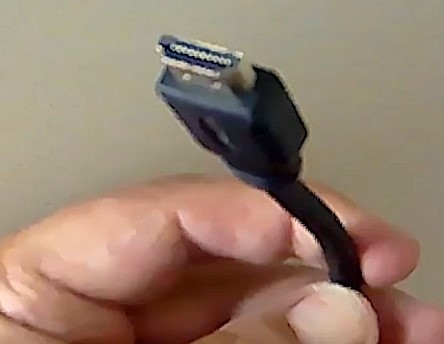
HDMI is supposed to stand for ‘High Definition Multimedia Interface’ but in Amateur Radio circles it can sometimes cause annoying interference problems.  The HDMI standard is quite complex, with several variations, but for the most part we regard it as a straightforward method of getting sound and video to a screen and speaker.   Inside the HDMI cable there are 19 wires, terminating on connections a mere 0.5mm apart.  The high-quality video and audio comes from wide bandwidth and high data rates into VHF frequencies.  Generally, the shielding is effective at preventing these signals from radiating as interference, but harmonics can still bleed through.

HDMI interference will vary with the line frequency and the monitor’s resolution settings.  At QRM Guru we received a report about a shack PC display which was creating noise in the 2 Metre band.  The noise was also evident at 445.5 MHz, well within our 70cm Amateur television allocation. We decided to check this out and see what it would take to reduce or eliminate this noise entirely.


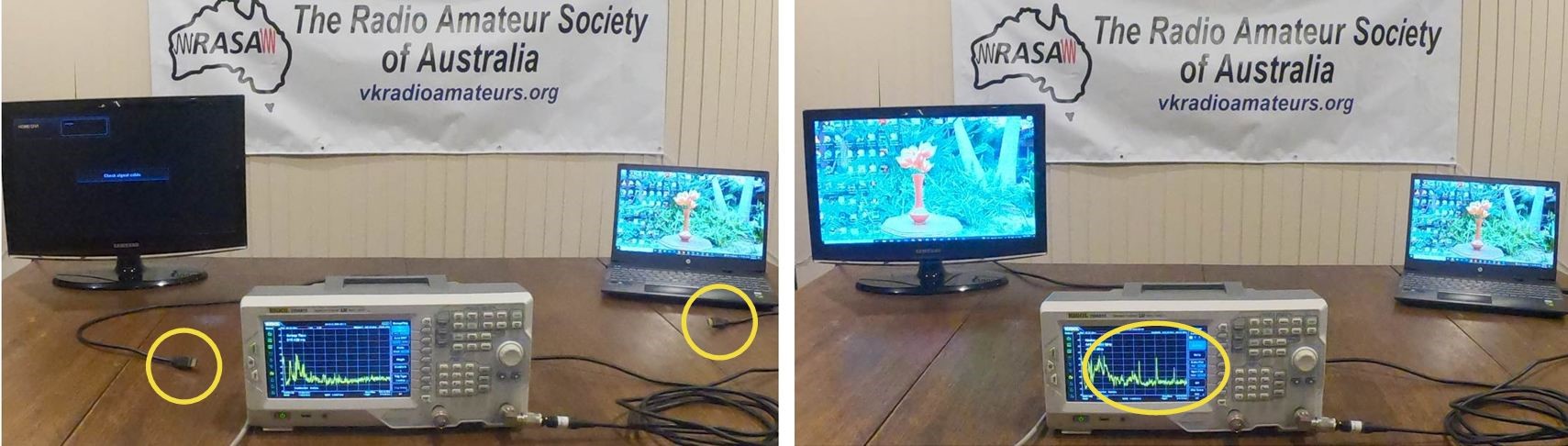
First, we set up a laptop, a monitor, and a HDMI cable.  We performed a spectrum sweep to around 500MHz and had a look around.   This image shows the ‘before’ and ‘after’ of hooking up the offending cable.


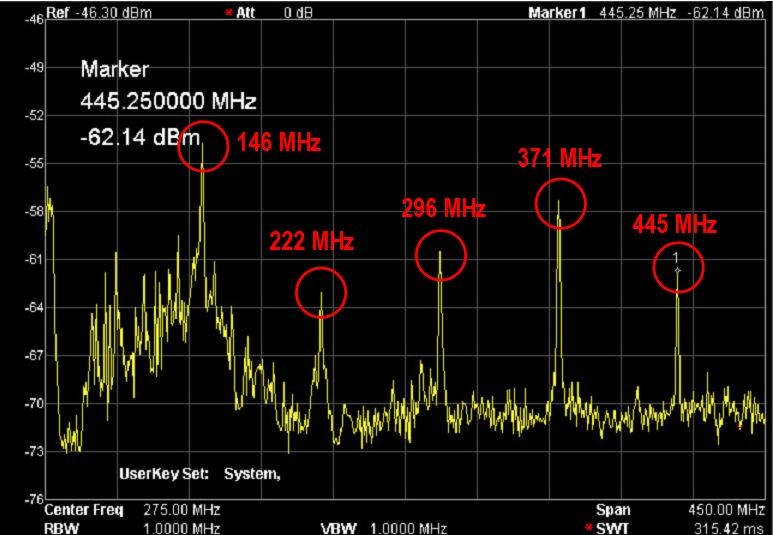
The ‘Before’ image (left) shows the unplugged ends of the HDMI cable.  On the analyser, there were some FM broadcast stations at the low end, but the band was mostly clear. When the external monitor was connected, multiple spikes appeared on the screen.  Here’s a close-up.


The HDMI noise was behaving as a comb generator, with interference spikes appearing every 75 MHz.  The first and last spikes appeared in the Australian amateur allocations and the 222 MHz spike was clearly within the international 1.25 Metre Amateur Band.

In practical terms the interfering signals were not strong.  A better-quality screened cable could help or selecting a different monitor frequency to move the interference away from amateur bands would be another possible option.  Still, the interference was evident and an attempt to reduce or eliminate was warranted.

Having replicated this QRM, the question was, ‘what will it take to eliminate this interference?’

We generally advocate the use of ferrites to suppress such unwanted RF radiation.  Generally, minimising or eliminating unwanted RFI can be achieved with ferrites.

More specialised VHF/UHF rated ferrites would be a better option, but we performed the tests with the more commonly available Type 43 ferrites.  These are most useful at HF and lower VHF frequencies, but still exhibit useful RF absorption characteristics at higher frequencies.

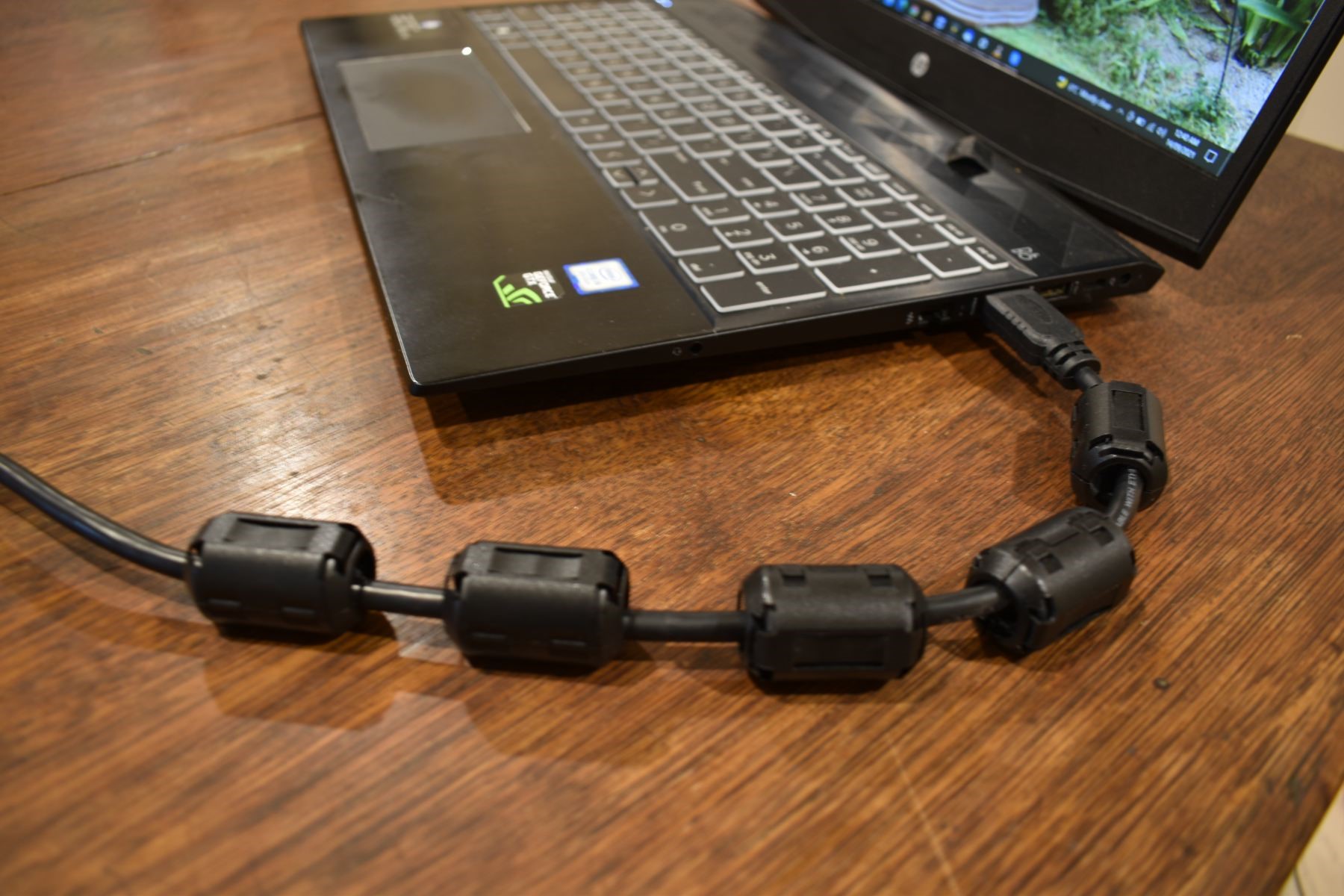
We began with a single small ferrite clamp. Sadly, this hardly made any detectable difference. Next, we moved to larger clamps, and kept adding more.  This was better.  By the time five clamps were on the cable the QRM intensity had halved.

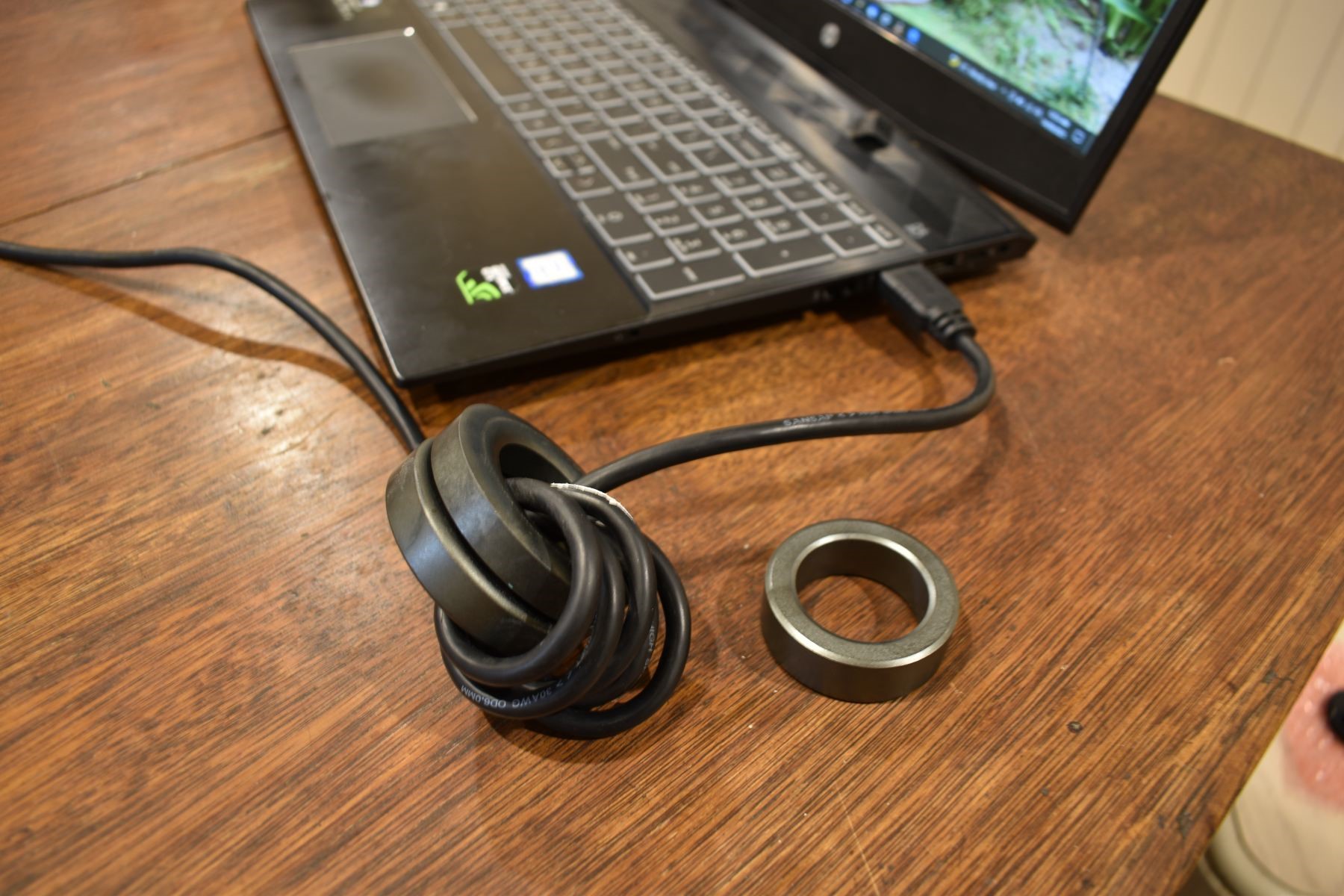
It was time to bring in the big guns and try out some ferrite rings.   These are a lot more effective.  The additional mass of the larger rings adds considerable absorption, but more importantly, it lets us loop multiple turns of cable through the ring.  There is a multiplying effect here as two turns is four times as effective as a single pass. Four turns yield approximately 16 times the attenuation.  By the time four turns of the HDMI cable has passed through the 50mm ring, the interference spikes were still present, but getting close to the background noise.

We ramped it up even further to find out what it would take to suppress all the discernable noise.  In the end it took two 60mm rings, stacked, with four turns of cable, located close to the laptop.  With this in place, the band was quiet, the noise source successfully eliminated.

Conclusions

The significant take-away from this experiment is that the desired effect may not be achieved with just one or two ferrite clamps.  But don’t give up!  It is worthwhile ramping up the ante until you achieve the desired outcome.

These experiments were conducted with a standard Kill Kit from the QRM Guru website.

We are surrounded by noisy appliances that will try to test our resolve.  A modern necessity of Amateur Radio is to get that noise floor down as low as possible.

26 July 2022

https://qrm.guru/?p=2158
Extensions
QRM Guru & RASA responds to ACMA announcement
Announcements
21 July 2022 In a recent ACMA Update ( 20th July) the ACMA deny any official support for QRM Guru.  We are genuinely confused by this announcement.  It is our firm understanding that our announcement represented our in good faith discussions with ACMA.  ACMA’s acknowledgement that QRM Guru would add value to the amateur radio […]
Show full content

21 July 2022

In a recent ACMA Update ( 20th July) the ACMA deny any official support for QRM Guru.  We are genuinely confused by this announcement.  It is our firm understanding that our announcement represented our in good faith discussions with ACMA.  ACMA’s acknowledgement that QRM Guru would add value to the amateur radio sector and their own compliance operations team was unambiguous.  They were also extremely supportive of our plans to promote QRM Guru with the WIA and rollout a national education campaign.

We will be writing to the ACMA seeking clarification.

Whatever the outcome of this confusion, RASA will continue its support for QRM Guru.  It is the only on-the-ground sector led resource to assist radio amateurs (and the ACMA) in dealing with unwanted RFI for the Amateur Radio community.

In the meantime, irrespective of ACMA’s stance, QRM Guru’s next step is to implement a dedicated online ticket support system for amateurs dealing with RFI.  This service will provide email and limited telephone support to amateurs with chronic or particularly challenging QRM/RFI issues.  We’ll also support clubs and beginners looking for guidance.

You’ll hear more about this in the coming couple of weeks.  Our other initiative, following on from ACMA’s recommendation, is to prepare a national education and support rollout program.

More news on the above topics as it comes to hand

https://qrm.guru/?p=2150
Extensions
QRM Guru News Update
AnnouncementsAustralian RegulationsACMAACMA AcknowledgementInterference Managementonline support
QRM Guru news update 16 July 2022 Key Points: Interference (RFI/QRM/EMC) is an ongoing problem for Amateur Radio in Australia In line with Australian Federal Government Policy, the Australian Communications and Media Authority (ACMA) is implementing a deregulation agenda and a strategy of voluntary compliance The ACMA has fewer resources than ever to address low […]
Show full content

QRM Guru news update

16 July 2022

Key Points:

  • Interference (RFI/QRM/EMC) is an ongoing problem for Amateur Radio in Australia
  • In line with Australian Federal Government Policy, the Australian Communications and Media Authority (ACMA) is implementing a deregulation agenda and a strategy of voluntary compliance
  • The ACMA has fewer resources than ever to address low priority matters – in practice this means that we (being Amateur Radio technical hobbyists) must take a proactive and process driven approach to resolving our own problems before engaging the Regulator
  • Should we need to engage ACMA to assist us in resolving an RFI/QRM/EMC issue, using the processes, methods, techniques and tools in QRM Guru will better inform the ACMA and greatly improve your chance of getting support
  • QRM Guru fits perfectly with ACMA’s direction and preferred approach for the Amateur Radio Sector
  • If your club would like an introduction and/or training in QRM Guru, please contact us
  • If you or your club can assist with the continued development of QRM Guru, please contact us


Over the course of the last 20 years, QRM, RFI, and rising noise floors have become one of the biggest threats to Amateur Radio, not just in Australia, but world-wide.  This is further complicated with imported electrical appliances and their inadequate RF filtering.  A lack of appetite from Government Regulators to address these industry shortcomings only adds fuel to the fire.

As technical hobbyists we must take more ownership in the resolution of QRM/RFI problems.  ACMA policies and resourcing models have changed.  They now have a Compliance and Enforcement Policy and it is clear that Amateur Radio interference issues are unlikely to receive a high priority with compliance and enforcement responses.

The QRM Guru and RASA teams have been liaising with the ACMA for almost one year to investigate how QRM Guru and RASA could better integrate a sector-wide model for Interference Management that aligns with ACMA Policy.  At our request, the ACMA undertook an internal evaluation of QRM Guru.

The ACMA regard QRM Guru as a “useful tool for self-diagnosis and management of interference by Amateurs to inform any request for assistance by the ACMA and is open to all members of the amateur community to use.”

This reinforces what the ACMA and the sector bodies (RASA & WIA) have already recommended as the way forward for Interference Management.

The WIA also recommended that there is demand for an amateur community-wide information campaign on how to manage interference issues. The WIA suggested (to the ACMA) that self-education programs should be expanded and that regionalised self-help support groups should be established to help amateurs find technical assistance to resolve these problems. The WIA advised that it was prepared to provide more avenues for support in this area.” (ACMA: 4 July 2022)

WIA President Scott Williams VK3KJ cemented WIA support for QRM Guru when he awarded QRM Guru author, Ian Jackson VK3BUF with the WIA Technical Excellence Award for 2022.

So, what’s next for QRM Guru?

Now that ACMA have acknowledged QRM Guru we want to strengthen the underlying support platform and extend its features.

Initially, we are making some changes to the QRM Kill Kits.  We are removing the five medium sized snap-on clips and replacing them with two 50mm ferrite rings.  These rings are far more appropriate in dealing with RFI suppression.

For now, we wont be selling any more DF Loop Antennas.  By their nature, these are expensive to post, and people have advised they’re able to purchase the parts locally.  However, we still provide instructions and videos on how to build and use these in the field.

Next, we want to build a better help desk to provide online support for amateurs Australia wide.  We’ll need financial and technical support to make this happen.

We also plan more on-the-ground presentations and training sessions.  For these, we’ll need money and dedicated volunteers to assist.

If you, or your club can help in any way, please send us an email.

We thank our contributors, supporters and donors who have helped get QRM Guru this far…  and we’re excited with plans for the upcoming 12 months.

Contact us at: feedback@qrm.guru

Note: ACMA are not a contributor to the development of QRM Guru and neither QRM Guru nor RASA infer that ACMA are affiliated with our organisation or resources.

(This news item updated 3 August 2022)


https://qrm.guru/?p=2128
Extensions
Mitigating Amateur Radio Interference to VDSL2
Case StudiesStep 4 - Techniques for Resolving NoiseNBN interferenceVDSL2
NBN Co. have recently published a very helpful article on Amateur Radio interference and the NBN.  The PDF can be downloaded from the NBN website; click on the image below. You’ll also find plans for a simple 40m notch filter here, thanks to Andrew VK3FS.    
Show full content

NBN Co. have recently published a very helpful article on Amateur Radio interference and the NBN.  The PDF can be downloaded from the NBN website; click on the image below. You’ll also find plans for a simple 40m notch filter here, thanks to Andrew VK3FS.


https://qrm.guru/?p=2098
Extensions
Club Visits 2022
Announcements
Following over two years of Covid lockdowns, it’s great to be back visiting clubs and Hamfests, even in a hybrid (face-to-face and Zoom) environment. 23 July 2022 – Hinesville Amateur Radio Emergency Society. Atlanta USA, via Zoom 14 May 2022 – Moorabbin & District Radio Club Hamfest   6 May 2022 – Eastern & Mountain […]
Show full content

Following over two years of Covid lockdowns, it’s great to be back visiting clubs and Hamfests, even in a hybrid (face-to-face and Zoom) environment.

23 July 2022 – Hinesville Amateur Radio Emergency Society. Atlanta USA, via Zoom

14 May 2022 – Moorabbin & District Radio Club Hamfest


6 May 2022 – Eastern & Mountain District Radio Club

Zoom presentation on QRM Guru


https://qrm.guru/?p=2094
Extensions