GeistHaus
log in · sign up

https://pavelkosenko.wordpress.com/feed

rss
10 posts
Polling state
Status active
Last polled May 18, 2026 22:23 UTC
Next poll May 19, 2026 23:54 UTC
Poll interval 86400s
Last-Modified Mon, 30 Mar 2026 12:57:29 GMT

Posts

The Classic Motion Picture Color Film Production Process
articles
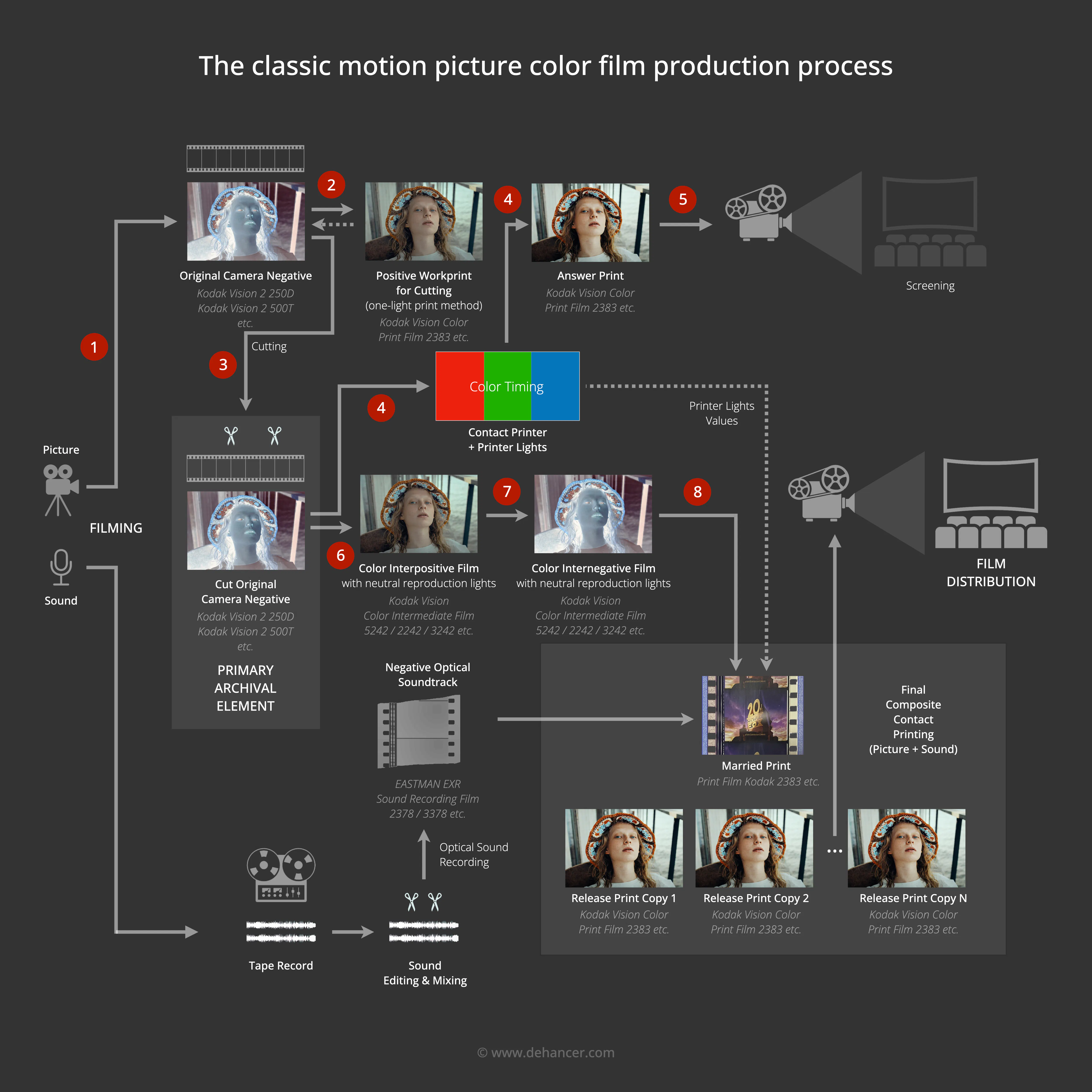
The classic processes of motion picture production are well covered in specialized publications. However, we were unable to find a clear, comprehensive diagram that would illustrate the key stages of analog filmmaking and be accessible to film enthusiasts and colorists who routinely work with digital embodiments of these processes. We therefore took it upon ourselves … Continue reading The Classic Motion Picture Color Film Production Process
Show full content

The Classic Motion Picture Color Film Production Process

The classic processes of motion picture production are well covered in specialized publications. However, we were unable to find a clear, comprehensive diagram that would illustrate the key stages of analog filmmaking and be accessible to film enthusiasts and colorists who routinely work with digital embodiments of these processes.

We therefore took it upon ourselves to create such a diagram and accompany it with detailed commentary. Our primary focus is color motion picture production, since black-and-white filmmaking follows essentially the same workflow.

In developing this diagram, we drew on technologies pioneered and refined by Kodak through the 1970s-1990s – a period widely regarded as the golden age of photochemical cinema. Kodak’s technologies set the industry standard and served as a benchmark for other film stock manufacturers and equipment makers worldwide.

Read the Article

pavelkosenko
The Classic Motion Picture Color Film Production Process
http://pavelkosenko.wordpress.com/?p=927
Extensions
Films at different exposures: Kodak Portra 400
articles
Here we present you the results of Kodak Portra 400 film exposure test, shot in the range from -3 EV to +7 EV with Hasselblad 503cw camera, Carl Zeiss Planar 2.8/80 lens on medium format film (type 120). For normal exposure we considered spot metering with an external spotmeter of the faces in such a … Continue reading Films at different exposures: Kodak Portra 400
Show full content

Films at different exposures: Kodak Portra 400

Here we present you the results of Kodak Portra 400 film exposure test, shot in the range from -3 EV to +7 EV with Hasselblad 503cw camera, Carl Zeiss Planar 2.8/80 lens on medium format film (type 120).

For normal exposure we considered spot metering with an external spotmeter of the faces in such a way that their tone corresponded to the Adams VI zone. The aperture on all shots was set to f/2.8, except the first one (underexposed by -3 EV). The shutter speeds for the above sequence of photos (from left to right) were: 1/500 (-3 EV), 1/250 (-2 EV), 1/125 (-1 EV), 1/60 (Normal Exposure), 1/30 (+1 EV), 1/15 (+2 EV), 1/8 sec (+3 EV), 1/4 sec (+4 EV), 1/2 sec (+5 EV), 1 sec (+6 EV), 2 sec (+7EV). Shooting was carried out with a tripod and mirror lockup.

The film was developed using the standard C-41 process and scanned on a Noritsu HS-1800 scanner. White balance was set manually using the normally exposed photo and copied to all frames.

The purpose of this test is to observe the behavior of film color depending on exposure and to identify the limits of acceptable exposure errors.

The test results can be observed in the title picture of this article.

Read the Article

pavelkosenko
Films at different exposures: Kodak Portra 400
http://pavelkosenko.wordpress.com/?p=924
Extensions
Films at different exposures: Kodak Gold 200
articles
This time we will test the photographic film of all times -– the legendary Kodak Gold 200. This is a fresh film with an expiration date of 07/2019, which was not imported to Russia for a long time, but since the fall of 2017 its supply has been restarted. Based on flashbacks from the 90s, … Continue reading Films at different exposures: Kodak Gold 200
Show full content

Films at different exposures: Kodak Gold 200

This time we will test the photographic film of all times -– the legendary Kodak Gold 200. This is a fresh film with an expiration date of 07/2019, which was not imported to Russia for a long time, but since the fall of 2017 its supply has been restarted.

Based on flashbacks from the 90s, many people think that Kodak Gold is cheap consumer photographic film. In fact, this is not quite true. Actually, in the lineup, Gold occupies an intermediate position between the cheapest Color Plus and professional Portra, both in quality and price. But in the 90’s the difference in cost was so insignificant that many distributors and stores preferred to buy and sell higher quality and more reliable and Kodak Gold.

This film was proven not only by its trademark, much-loved golden tones, but also by its good tolerance to exposure errors. In other words, average users (not only professional photographers) could shoot this film with almost any camera, even the simplest ones with inaccurate exposure metering, and it was difficult to ruin the film or get a completely unacceptable result.

Let’s put it to the test. For this purpose we will shoot Kodak Gold film in the exposure range from -6 EV to +10 EV and observe how the image will behave with such significant metering errors. We will evaluate the detail in highlights/shadows and of course the overall color balance of the photo. For this test we took an Olympus OM-1 camera with a 50 f/1.2 lens, shooting in manual M mode.

For normal exposure we considered spot metering with an external spotmeter of the faces in such a way that their tone corresponded to the Adams VI zone. The aperture on all shots was set to f/2.8. The shutter speeds for the above sequence of photos (from left to right) were: 1/1000 (-6EV), 1/500 (-5EV), 1/250 (-4EV), 1/125 (-3EV), 1/60 (-2EV), 1/30 (-1EV), 1/15 (Normal Exposure), 1/8 (+1EV), 1/4 (+2EV), 1/2 sec (+3EV), 1 sec (+4EV), 2 sec (+5EV), 3 sec (+6EV), 4 sec (+7EV), 8 sec (+8EV), 16 sec (+9EV), 32 sec (+10EV). Shooting was carried out with a tripod, and at slow shutter speeds the models tried not to move during the exposure.

As lighting we used ADOX Adolight fluorescent lamps with high color rendering quality CRI > 95 and temperature 5400K. The film was scanned on a Nikon Coolscan 5000 scanner with automatic white balance and the same settings for all frames.

The test results can be observed in the title picture of this article.

Read the Article
pavelkosenko
Films at different exposures: Kodak Gold 200
http://pavelkosenko.wordpress.com/?p=919
Extensions
Films at different exposures: Kodak Color Plus 200 vs Fujicolor C200
articles
Here are the results of exposure test of two budget 35 mm films – Kodak Color Plus 200 and Fujicolor C200, shot within the range from -4 EV to +10 EV. In both cases Canon EOS 3 camera and 24-70 II f/2.8L lens were used. Normal exposure was determined by spot metering with a Minolta … Continue reading Films at different exposures: Kodak Color Plus 200 vs Fujicolor C200
Show full content

Films at different exposures: Kodak Color Plus 200 vs Fujicolor C200

Here are the results of exposure test of two budget 35 mm films – Kodak Color Plus 200 and Fujicolor C200, shot within the range from -4 EV to +10 EV. In both cases Canon EOS 3 camera and 24-70 II f/2.8L lens were used.

Normal exposure was determined by spot metering with a Minolta F external spotmeter on the model’s right cheek, so that its tone corresponded to Adams zone VI. Aperture on all frames is f/2.8, shutter speed varied from 1/8000 to 4 sec. Shooting was carried out from a tripod.

Both films were scanned on a Nikon Coolscan 5000 scanner with automatic exposure and white balance. All additional processing during scanning is disabled.

The purpose of the test is to observe the behavior of each film depending on exposure, to determine the range of acceptable exposure mistakes when shooting and to compare the films, as they are marketed in the same price segment – as the most budget color negative films.

Read the Article

pavelkosenko
Films at different exposures: Kodak Color Plus 200 vs Fujicolor C200
http://pavelkosenko.wordpress.com/?p=915
Extensions
Recreation of colors from 3 separated B&W Prokudin-Gorsky positive glasses
articles
© S.M. Prokudin-Gorskiy, 1911, Uzbekhistan, Starving steppe The first time I tried to restore color from scans of Prokudin-Gorsky’s B&W slides about 10 years ago, and then I didn’t succeed very well. The color turned out to be somehow childish, cartoonish. At that time I didn’t have enough aesthetic experience, although I had technical skills. … Continue reading Recreation of colors from 3 separated B&W Prokudin-Gorsky positive glasses
Show full content

Recreation of colors from 3 separated B&W Prokudin-Gorsky positive glasses
© S.M. Prokudin-Gorskiy, 1911, Uzbekhistan, Starving steppe

The first time I tried to restore color from scans of Prokudin-Gorsky’s B&W slides about 10 years ago, and then I didn’t succeed very well. The color turned out to be somehow childish, cartoonish. At that time I didn’t have enough aesthetic experience, although I had technical skills. Recently I was interested in doing it again, and this time I got quite acceptable colors.

In fact, there is nothing complicated here. I took high-resolution scans of Prokudin-Gorskiy’s glass plates from the Library of Congress website. Each scan consists of three black-and-white positive images. I devided them and combine in Photoshop in RGB channels. There are a few nuances to take into account during this proccess:

1) Prokudin-Gorskiy’s top-down color channels disposition are BGR, not RGB.

2) At that time camera shutter speeds were quite long, 1-3 seconds or more each. In the process of triple exposure people were a little moving, the camera shifted a little too (when the shutter was triggered and filters were changed). So the main chore with color recovery, is geometric matching. To be honest, I didn’t bother with them too much.

3) There is no definite information about the color of the light filters used by Prokudin-Gorsky. Therefore, when we technically combine the three channels in Photoshop, we get some conditional colors. So we can see, for example, a blue sky, but we don’t know exactly which that blue was. And we will never know. That’s why after technical matching the most interesting thing starts – our personal interpretation of the initial data. And here the only tool we have is our own perception of the beautiful.

In this example, I didn’t spend much time on geometric matching of three frames in RGB channels. However, the specific feature of digital photography is oversaturation, so the reproduction had to be desaturated significantly. I also normalized the white balance and overall brightness of the final color picture. The whole processing from the moment of downloading the original file took no more than 3 minutes.

You can see a big selection of Prokudin-Gorsky’s photos here:

1904-1916. Color photographs by S.M. Prokudin-Gorsky (1863-1944)

pavelkosenko
Recreation of colors from 3 separated B&W Prokudin-Gorsky positive glasses
http://pavelkosenko.wordpress.com/?p=901
Extensions
How Many Colors Can You See?
articles
Arguably, the first person to attempt an answer to this question was English psychologist Edward Titchener, who in 1896 concluded that a human is capable of distinguishing 33,000 colors. In 1939, Edwin Boring, a professor of psychology at Clark University and Harvard University, cited a value of 300,000 colors. That same year, American physicist Dean … Continue reading How Many Colors Can You See?
Show full content

How Many Colors Can You See

Arguably, the first person to attempt an answer to this question was English psychologist Edward Titchener, who in 1896 concluded that a human is capable of distinguishing 33,000 colors.

In 1939, Edwin Boring, a professor of psychology at Clark University and Harvard University, cited a value of 300,000 colors. That same year, American physicist Dean Judd—who made significant contributions to scientific colorimetry—estimated that a trained observer could distinguish approximately 10,000,000 colors.

In 1943, American researchers Dorothy Nickerson and Sidney Newhall determined that under ideal viewing conditions, a person could distinguish 7,295,000 colors.

Presumably, such a wide range of values arises due to two main factors: on one hand, the viewing conditions at the time were not precisely defined; on the other hand, there was a lack of accurate measurement instruments for standardizing the set of reference samples.

Read the Article

pavelkosenko
How Many Colors Can You See
http://pavelkosenko.wordpress.com/?p=878
Extensions
Halation effect: What is it and why is it important for the film emulation?
articles
In this video we’ll talk about the film halation effect and explain what it is and why it’s so important to use when imitating a film image. At the end of the video, we will demonstrate how this can be done using Dehancer plugin, but we believe that information about its nature will be useful … Continue reading Halation effect: What is it and why is it important for the film emulation?
Show full content

In this video we’ll talk about the film halation effect and explain what it is and why it’s so important to use when imitating a film image.

At the end of the video, we will demonstrate how this can be done using Dehancer plugin, but we believe that information about its nature will be useful to every photographer or videographer, not just for those interested in film emulation, for a couple of reasons:

•Halation is much more complex and doesn’t only appear around the light sources.
•Halation can make skin tones more attractive and natural.

Keep watching to learn everything about the halation effect from A to Z, and how it works in Dehancer.

pavelkosenko
http://pavelkosenko.wordpress.com/?p=851
Extensions
How to See Color? | Part 3: Color Harmony | Video-course by the CEO of Dehancer – Pavel Kosenko
video
Color wheel is one of the most popular concepts when it comes to color harmony. It is believed that, on this wheel, colors are located in a special way. And if they balance each other out and add up to a neutral color, then they are harmonious. That’s fake news. In this video we’re debunking … Continue reading How to See Color? | Part 3: Color Harmony | Video-course by the CEO of Dehancer – Pavel Kosenko
Show full content

Color wheel is one of the most popular concepts when it comes to color harmony. It is believed that, on this wheel, colors are located in a special way. And if they balance each other out and add up to a neutral color, then they are harmonious.

That’s fake news.

In this video we’re debunking the color wheel myth, and share the tips and tricks to actually harmonise colors. Take notes.

pavelkosenko
http://pavelkosenko.wordpress.com/?p=847
Extensions
How to See Color? | Part 2: Variability | Video-course by the CEO of Dehancer – Pavel Kosenko
Dehancervideo
Long-awaited continuation of Pavel Kosenko’s video-course is here! Today we’ll focus on variability and how it helps us “savour” colors. We’ll look at the 3 main components: •Hue •Saturation •Brightness Watch the video to find out how the synergy of these variables can create a rich and sophisticated image. HOW TO SEE COLOR Part 2. … Continue reading How to See Color? | Part 2: Variability | Video-course by the CEO of Dehancer – Pavel Kosenko
Show full content

Long-awaited continuation of Pavel Kosenko’s video-course is here! Today we’ll focus on variability and how it helps us “savour” colors. We’ll look at the 3 main components:

•Hue
•Saturation
•Brightness

Watch the video to find out how the synergy of these variables can create a rich and sophisticated image.

HOW TO SEE COLOR
Part 2. Variability?

Chapters:
00:00​ Introduction
00:50​ What is color variability?
01:53​ Color value
02:22​ HSB system
02:50​ Variability in brightness
03:46​ Objective and figurative thinking
04:36​ Why vignetting is beneficial for color
04:52​ Variability in saturation
05:54​ Variability in hues
06:54​ Synergy of all variables
07:12​ Example #1: Where is color more interesting?
07:58​ Example #2: Different types of color expressiveness
08:29​ Variability and HSB
08:53​ Theoretical model of color gamut
10:08​ Practical model of color gamut
11:20​ Observation #1: Extreme color saturation
12:01​ Observation #2: Lightening/darkening of color
12:35​ Observation #3: Increase in saturation
12:50​ More mud – more fuse
13:13​ An example of increased variability
14:11​ Afterword

pavelkosenko
http://pavelkosenko.wordpress.com/?p=845
Extensions